Savannah Tribune
Saturday, January 30, 1909
Savannah, Georgia
Page text (machine-generated)
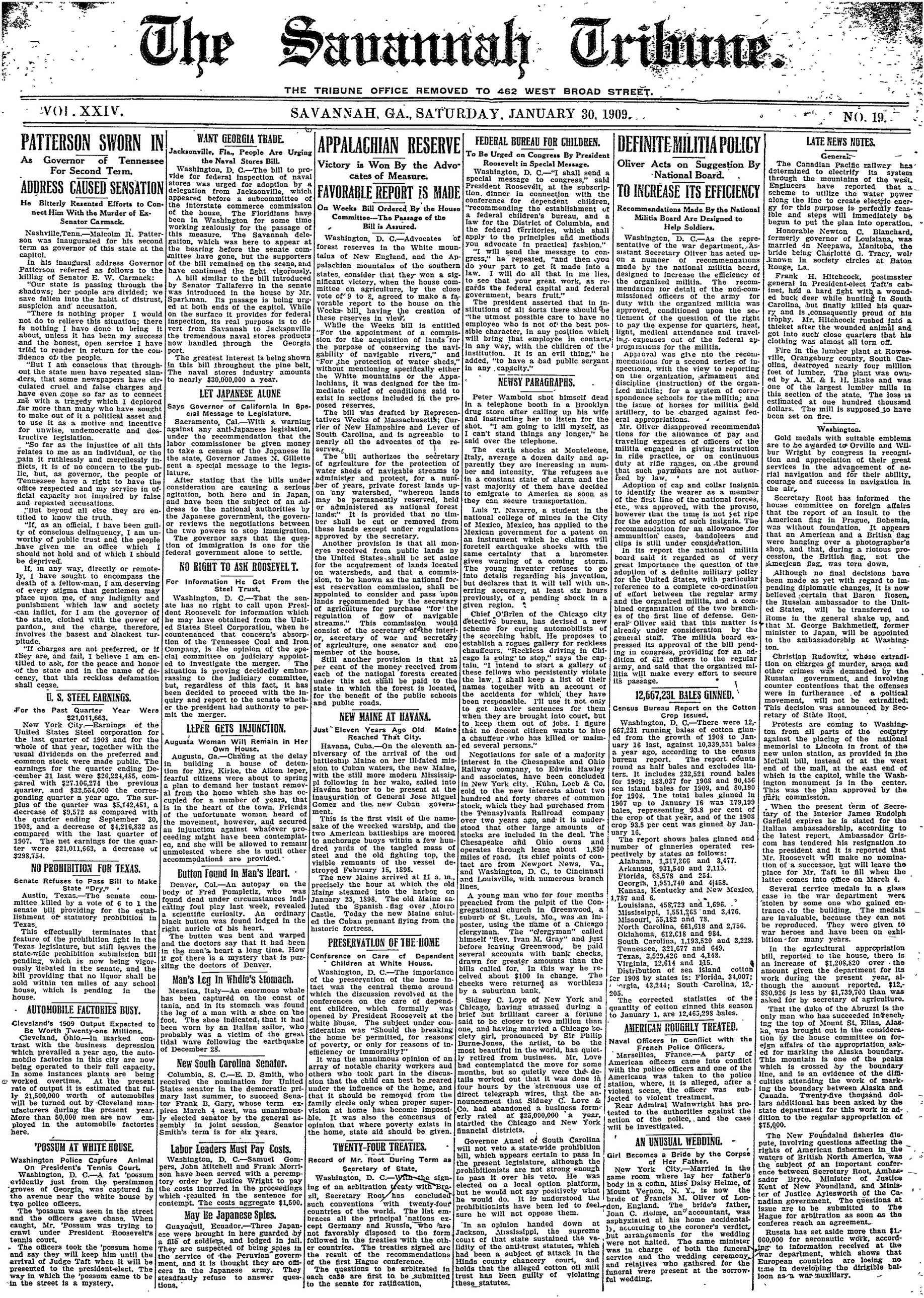
PATTERSON SWORN IN
As Governor of Tennessee For Second Term.
ADDRESS CAUSED SENSATION
He Bitterly Resented Efforts to Connect Him With the Murder of Ex-Senator Carmack.
Nashville,Tenn.—Malcolm R. Patterson was inaugurated for his second term as governor of this state at the capitol.
In his inaugural address Governor Patterson referred as follows to the killing of Senator E. W. Carmack:
"Our state is passing through the shadows; her people are divided; we save fallen into the habit of distrust, suspicion and accusation.
"There is nothing proper I would not do to relieve this situation; there is nothing I have done to bring it about, unless it has been my success and the honest, open service I have tried to render in return for the confidence of the people.
"But I am conscious that throughout the state men have repeated slanders, that some newspapers have circulated cruel and false charges and have even gone so far as to connect me with a tragedy which I deplored far more than many who have sought to make out of it a political asset and to use it as a motive and incentive for unwise, undemocratic and destructive legislation.
"So far as the injustice of all this relates to me as an individual, or the pain it ruthlessly and mercilessly inflicts, it is of no concern to the public, but, as governor, the people of Tennessee have a right to have the office respected and my service in official capacity not impaired by false and repeated accusations.
"But beyond all else they are entitled to know the truth."
"If, as an official, I have been guilty of conscious delinquency, I am unworthy of public trust and the people have given me an office which I should not hold and of which I should be deprived.
If, in any way, directly or remotely, I have sought to encompass the death of a fellow-man, I am deserving of every stigma that gentlemen may place upon me, of any indignity and punishment which law and society can inflict, for I am the governor of the state, clothed with the power of pardon, and the charge, therefore, involves the basest and blackest turpitude.
"If charges are not preferred, or if they are, and fail, I believe I am entitled to ask, for the peace and honor of the state and in the name of decency, that this reckloss defamation shall cease.
For the Past Quarter Year Were
$21,011,663.
New York City.—Earnings of the United States Steel corporation for the last quarter of 1909 and for the whole of that year, together with the usual dividends on the preferred and common stock were made public. The earnings for the quarter ending December 31 last were $26,224,485, compared with $27,106,274 the previous quarter, and $32,544,000 the corresponding quarter a year ago. The surplus of the quarter was $5,142,451, a decrease of $9,572 as compared with the quarter ending September 30, 1908, and a decrease of $4,216,332 as compared with the last quarter of 1907. The net earnings for the quarter were $21,011,663, a decrease of $298,754.
Senate Refuses to Pass Bill to Make State "Dry." Austin, Texas.-The senate committee killed by a vote of 6 to 1 the senate bill providing for the establishment of statutory prohibition in Texas. This effectually terminates that feature of the prohibition fight in the Texas legislature, but still leaves the state-wide prohibition submission bill pending, which is now being vigorously debated in the senate, and the bill providing that no liquor shall be sold within ten miles of any school house, which is pending in the house.
Cleveland's 1909 Output Expected to Be Worth Twenty-one Millions. Cleveland, Ohio.—In marked contrast with the business depression which prevailed a year ago, the automobile factories in this city are now being operated to their full capacity. In some instances plants are being worked overtime. At the present rate of output it is estimated that fully 21,500,000 worth of automobiles will be turned out by Cleveland manufacturers during the present year. More than 50,000 men are now employed in the automobile factories here.
Washington, D. C.—A fat 'possum evidently just from the persimmon groves of Georgia, was captured in the avenue near the white house by two police officers.
VOL. XXIV.
U. S. STEEL EARNINGS.
NO PROHIBITION FOR TEXAS.
- AUTOMOBILE FACTORIES BUSY.
'POSSUM AT WHITE HOUSE
Washington Police Capture Animal
On President's Teenis Court.
The 'possum was seen in the street and the officers gave chase. When caught, Mr. 'Possum was trying to crawl under President Roosevelt's tennis court. The officers took the 'possum home and say they will keep him until the arrival of Judge Taft when it will be presented to the president-elect. The way in which the 'possum came to be in the street is a mystery.
The
WANT GEORGIA TRADE
Jacksonville, Fla., People Are Urging the Naval Stores Bill.
Washington, D. C.—The bill to provide for federal inspection of naval stores was urged for adoption by a delegation from Jacksonville, which appeared before a subcommittee of the interstate commerce commission of the house. The Floridians have been in Washington for some time working zealously for the passage of this measure. The Savannah delegation, which was here to appear at the hearing before the senate committee have gone, but the supporters of the bill remained on the scene, and have continued the fight vigorously.
A bill similar to the bill introduced by Senator Tallafero in the senate was introduced in the house by Mr. Sparkman. Its passage is being urged at both ends of the capitol. While on the surface it provides for federal inspection, its real purpose is to divert from Savannah to Jacksonville the tremendous naval stores products now handled through the Georgia port. The greatest interest is being shown in this bill throughout the pine belt. The naval stores industry amounts to nearly $30,000,000 a year.
LET JAPANESE ALONE
Says Governor of California in Special Message to Legislature.
Sacramento, Cal.—With a warning against any anti-Japanese legislation, under the recommendation that the labor commissioner be given money to take a census of the Japanese in the state, Governor James N. Gillette sent a special message to the legislature.
After stating that the bills under consideration are causing a serious agitation, both here and in Japan, and have been the subject of an address to the national authorities by the Japanese government, the governor reviews the negotiations between the two powers to stop immigration.
The governor says that the question of immigration is one for the federal government alone to settle.
NO RIGHT TO ASK BOOSEVEL T.
For Information He Got From the Steel Trust.
Washington, D. C.-That the senate has no right to call upon President Roosevelt for information which he may have obtained from the United States Steel Corporation, when he countenanced that concern's absorption of the Tennessee Coal and Iron Company, is the opinion of the special committee on judicially appointed to investigate the merger. The situation is proving decidedly embarrassing to the judicially committee, but, regardless of this fact, it has been decided to proceed with the inquiry and report to the senate whether the president had authority to permit the merger.
LEPER GETS INJUNCTION.
Augusta Woman Will Remain in Her Own House.
Augusta, Ga.—Chaing at the delay in building a house of detention for Mrs. Kirke, the Alken leper, fearful citizens were about to spring a plan to demand her instant removal from the homo which she has occupied for a number of years, that is in the heart of the town. Friends of the unfortunate woman heard of the movement, however, and secured an injunction against whatever proceeding might have been contemplated, and she will be allowed to remain unmolested where she is until other accommodations are provided.
Button Found In Man's Heart.
Denver, Col.—An autopsy on the body of Fred Pompletz, who was found dead under circumstances indicating foul play last week, revealed a scientific curiosity. An ordinary black button was found lodged in the right auricle of his heart. The button was bent and warped and the doctors say that it had been in the man's heart a long time. How it got there is a mystery that is puzzling the doctors of Denver.
Man's Len In Whidle's Stomach.
Messina, Italy—An enormous whale has been captured on the coast of tania, and in its stomach was found the leg of a man with a shoe on the foot. The shoe indicated, that it had been worn by an Italian sailor, who probably was a victim of the great tidal wave following the earthquake of December 28.
New South Carolina Senator.
Columbia, S. C.-E. D. Smith, who received the nomination for United States senator in the democratic primary last summer, to succeed Senator Frank D. Gary, whose term expires March 4 next, was unanimously elected senator by the general assembly in joint session. Senator Smith's term is for six years.
Labor Leaders Must Pay Costs.
Washington, D. C.-Samuel Gompers, John Mitchell and Frank Morrison have been served with a peremptory order by Justice Wright to pay the costs incurred in the proceedings which resulted in the sentence for contempt. The costs aggregate $1,500.
May Be Japanese Spies.
Guayaquil, Ecuador.—Three Japanese were brought in here guarded by a file of soldiers, and lodged in jail. They are suspected of being spies in the service of the Peruvian government, and it is thought they are officers in the Japanese army. They steadfastly refuse to answer questions.
THE TRIBUNE OFFICE REMOVED TO 462 WEST BROAD STREET. SAVANNAH, GA., SATURDAY, JANUARY 30, 1909.
APPALACHIAN RESERVE
Victory is Won By the Advocates of Measure.
FAVORABLE REPORT IS MADE
On Weeks Bill Ordered By the House Committee—The Passage of the Bill is Assured.
Washington, D. C.—Advocates of forest reserves in the White mountains of New England, and the Appalachian mountains of the southern states, consider that they won a significant victory, when the house committee on agriculture, by the close vote of 9 to 8, agreed to make a favorable report to the house on the Weeks bill, having the creation of these reserves in view.
While the Weeks bill is entitled "For the appointment of a commission for the acquisition of lands for the purpose of conserving the navigability of navigable rivers," and "For the protection of water sheds," without mentioning specifically either the White mountains or the Appalachians, it was designed for the immediate relief of conditions said to exist in sections included in the proposed reserves.
The bill was drafted by Representatives Weeks of Massachusetts; Currier of New Hampshire and Lever of South Carolina, and is agreeable to nearly all the advocates of the reserves.
The "bill authorizes the secretary of agriculture for the protection of water sheds of navigable streams to administer and protect, for a number of years, private forest lands upon any watershed, "whereon lands may be permanently reserved, held or administered as national forest lands." It is provided that no timber shall be cut or removed from these lands except under regulations approved by the secretary.
Another provision is that all monies received from public lands by the United States shall be set aside for the acquirement of lands located on watersheds, and that a commission, to be known as the national forest reservation commission, shall be appolated to consider and pass upon lands recommended by the secretary of agriculture for purchase "for the regulation of flow of navigable streams." This commission would consist of the secretary of the interior, secretary of war and secretary of agriculture, one senator and one member of the house.
Still another provision is that 25 per cent of the money received from each of the national forests created under this act shall be paid to the state in which the forest is located, for the benefit of the public schools and public roads.
NEW MAINE AT HAVANA.
Just' Eleven Years Ago Old Maine Reached That City.
Havana, Cuba.—On the eleventh anniversary of the arrival of the old battleship Maine on her ill-fated mission to Cuban waters, the new Maine, with the still more modern Mississippi following in her wake, sailed into Havana harbor to be present at the inauguration of General Jose Miguel Gomez and the new Cuban government.
This is the first visit of the namesake of the wrecked warship, and the two American battleships are moored to anchorage buoys within a few hundred yards of the tangled mass of steel and the old fighting top, the visible remnants of the vessel destroyed February 15, 1898.
The new Maine arrived at 11 a. m., precisely the hour at which the old Maine steamed into the harbor on January 25, 1898. The old Maine saluted the Spanish flag over Moiro Castle. Today the new Maine saluted the Cuban pennant flying from the historic fortress.
PRESERVATLON OF THE HOME
Conference on Care of Dependent Children at White House. Washington, D. C.—The importance of the preservation of the home intact was the central theme around which the discussion revolved at the conferences on the care of dependent children, which formally was opened by President Roosevelt at the white house. The subject under consideration was "Should the breaking the home be permitted, for reasons of poverty, or only for reasons of inefficiency or immorality?" It was the unanimous opinion of an array of notable charity workers and others who took part in the discussion that the child can best be reared under the influence of the home, and that it should be removed from the family circle only when proper supervision at home has become impossible. It was also the consensus of opinion that where poverty exists in the home, state aid should be given.
TWENTY-FOUR TREATIES.
Record of Mr. Root During Term as Secretary of State,
Washington, D. C. With the signing of an arbitration treaty with Brazil, Secretary Root has concluded such conventions with twenty-four countries of the world. The list embraces all the principal nations except Germany and Russia, who are not favorably disposed to the form followed in the treaties with the other countries. The treaties signed are the result of the recommendations of the first Hague conference.
The questions to be arbitrated in each case are first to be submitted to the senate for ratification.
FEDERAL BUREAU FOR CHILDREN.
To Be Urged on Congress By President Roosevelt in Special Message
Washington, D. C.—I" shall send a special message to congress," said President Roosevelt, at subscription, dinner in connection with the conference for dependent children, "recommending the establishment of a federal children's bureau, and a law for the District of Columbia, and the federal territories, which shall apply to the principles and methods you advocate in practical fashion." "I will send the message to congress," he repeated, "and then you do your part to get it made into a law. I will do all that in me lies, to see that your great work, as regards the federal capital and federal government, bears fruit."
The president asserted that in institutions of all sorts there should be "the utmost possible care to have no employee who is not of the best possible character, in any position which will bring that employee in contact, in any way, with the children of the institution. It is an evil thing," he added, "to have a bad public servant in any capacity."
NEWSY PARAGRAPHS.
Peter Wambold shot himself dead in a telephone booth in a Brooklyn drug store after calling up his wife and instructing her to listen for the shot. "I am going to kill myself, as I can't stand things any longer," he said over the telephone.
The carth shocks at Monteleone, Italy, average a dozen daily and apparently they are increasing in number and intensity. The refugees are in a constant state of alarm and the vast majority of them have decided to emigrate to America as soon as they can secure transportation.
Luis T. Navarro, a student in the national college of mines in the City of Mexico, Mexico, has applied to the Mexican government for a patent on an instrument which he claims will foretell earthquake shocks with the same certainty that a barometer gives warning of a coming storm. The young inventor refuses to go into details regarding his invention, but declares that it will tell with unerring accuracy, at least six hours previously, of a pending shock in a given region.
Chief O'Brien of the Chicago city detective bureau, has devised a new scheme for curing automobilists of the scorching habit. He proposes to establish a regues gallery for reckless chaufeurs. "Reckless driving in Chicago is going to stop," says the captain. "I intend to start a gallery of these fellows who persistently violate the law. I shall keep a list of their names together with an account of the accidents for which they have been responsible. I'll use it not only to get heavier sentences for them when they are brought into court, but to keep them out of jobs. I figure that no decent citizen wants to hire a chauffeur who has killed or maimed several persons."
Negotiations for sale of a majority interest in the Chesapeake and Ohio Railway company, to Edwin Hawley and associates, have been concluded in New York city, Kuhn, Loeb & Co. sold to the new interests to two hundred and forty shares of common stock, which they had purchased from the Pennsylvania Railroad company over two years ago, and it is understood that other large amounts of stocks are included in the deal. The Chesapeake and Ohio owns and operates through lease about 1,850 miles of road. Its chief points of contact are from Newport News, Va., and Washington, D. C., to Cincinnati and Louisville, with numerous branch lines.
A young man who for four months preached from the pulpit of the Congregational church in Greenwood, a suburb of St. Louis, Mo., was an imposter, using the name of a Chicago clergyman. The "clergyman" called himself "Rev. Ivan M. Gray" and just before leaving Greenwood, he paid several accounts with bank checks, drawn for greater amounts than the bills called for. In this way he received about $100 in change. The checks were returned as worthless by a suburban bank.
Sidney C. Love of New York and Chicago, having unassured during a brief but brilliant career a fortune said to be closer to two million than one, and having married a Chicago society girl, pronounced by Sir Philip Burne-Jones, the artist, to be the most beautiful in the world, has quietly retired from business. Mr. Love had contemplated the move for some months, but so quietly were the details worked out that it was done in four hours by the strenuous use of direct telegraph wires, that the announcement that Sidney C. Love & Co. had abandoned a business formerly rated at $25,000,000 a year, startled the Chicago and New York financial districts.
Governor Ansel of South Carolina will not veto a state-wide prohibition bill, which appears certain to pass in the present legislature, although the prohibitionists are not strong enough to pass it over his veto. He was elected on a local option platform, but he would not say positively what he would do. It is understood the prohibitionists have been led to feel sure he will not oppose them.
In an opinion handed down at Jackson, Mississippi, the supreme court of that state sustained the validity of the anti-trust statutes, which had been a subject of attack in the Hinds county chancery court, and holds that the alleged cotton oil mill trust has been guilty of violating these statutes.
DEFINITE MILITIA POLICY
Oliver Acts on Suggestion By National Board.
TO INCREASE ITS EFFICIENCY
Recommendations Made By the National Militia Board Are Designed to Help Soldiers.
Washington, D. C.—As the representative of the war department, Assistant Secretary Oliver has acted upon a number of recommendations made by the national militia board, designed to increase the efficiency of the organized militia. The recommendation for detail of the non-comissioned officers of the army for duty with the organized militia was approved, conditioned upon the settlement of the question of the right to pay the expense for quarters, heat, light, medical attendance and traveling, expenses out of the federal appropriations for the militia.
Approval was give into the recommendations for a second series of inspections, with the view to reporting on the organization, armament and discipline (instruction) of the organized militia; for a system of correspondence schools for the militia; and the issue of horses for militia field artillery, to be charged against federal appropriations.
Mr. Oliver disapproved recommendations for the allowance of pay and traveling expenses of officers of the militia engaged in giving instruction in rifle practice, or on continuous duty at rifle ranges, on the ground that such payments are not authorized by law.
Adoption of cap and collar insignia to identify the wearer as a member of the first line of the national forces, etc., was approved, with the proviso, however that the time is not yet ripe for the adoption of such insignia. The recommendation for an allowance for ammunition cases, bandoleers and clips is still under consideration.
In its report the national militia board said it regarded as of very great importance the question of the adoption of a definite military policy for the United States, with particular reference to a complete co-ordination of effort between the regular army and the organized militia, and a combined organization of the two branches of the first line of defense. General Oliver said that this matter is already under consideration by the general staff. The militia board expressed its approval of the bill pending in congress, providing for an addition of 612 officers to the regular army, and said that the organized militia will make every effort to secure its passage.
12.667.231 BALES GINNED.
Census Bureau Report on the Cotton Crop issued,
Washington, D. C.—There were 12,667,231 running bales of cotton ginned from the growth of 1908 to January 16 last, against 10,339,551 bales a year ago, according to the census bureau report. The report counts round as half bales and excludes linters. It includes 232,521 round bales for 1909; 188,037 for 1908 and 90,456 sea island bales for 1909, and 80,190 for 1908. The total bales ginned in 1907 up to January 16 was 179,199 bales, representing 93.8 per cent of the crop of that year, and of the 1908 crop 93.5 per cent was ginned by January 16.
The report shows bales ginned and number of ginneries operated respectively by states as follows:
1,787 and 6.
Louisiana, 458,723 and 1,696.
Mississippi, 1,551,265 and 3,476.
Missouri, 55,182 and 78.
North Carolina, 661,618 and 2,756.
Oklahoma, 612,618 and 984.
South Carolina, 1,193,520 and 3,229.
Tennessee, 321,677 and 649.
Texas, 3,529,246 and 4,148.
Virginia, 12,614 and 215.
Distribution of sea island cotton
for 1908 by states is: Florida, 34,007;
Georgia, 43,244; South Carolina, 12,205.
The corrected statistics of the quantity of cotton rinned this season to January 1. are 12,465,298 bales.
ANERICAN ROUGHLY TREATED.
Naval Officers in Conflict with the French Police Officers. Marseilles, France.—A party of American officers came into conflict with the police officers and one of the Americans was taken to the police station, where, it is alleged, after a violent scene, the officer was subjected to violent treatment.
Rear Admiral Walnwright has protested to the authorities against the action of the police, and the case will be investigated.
AN UNUSUAL WEDDING.
Girl Becomes a Bride by the Corpse of Her Father.
New York City.—Married in the same room where lay her father's body in a coffin, Miss Daisy Helme, of Mount Vernon, N. Y., is now the bride of Francis M. Oliver of London, England. The bride's father, John C. rielem, an accountant, was asphyxiated at his home accidentally, according to the coroner's verdict, but arrangement for the wedding were not halted. The same minister was in charge of both the funeral service and the wedding ceremony, and relatives who gathered for the funeral were present at the sorrowful wedding.
LATE NEWS NOTES.
The Canadian Pacific railway has determined to electrify its system through the mountains of the west. Engineers have reported that a scheme to utilize the water power along the line to create electric energy for this purpose is perfectly feasible and steps will immediately be begun to put the plan into operation.
Honorable Newton C. Blanchard, formerly governor of Louisiana, was married in Neepawa, Manitoba, the bride being Charlotte G. Tracy, well known in society circles at Baton Rouge, La.
Frank H. Hitchcock, postmaster general in President-elect Taft's cabinet, had a hard fight with a wounded buck deer while hunting in South Carolina, but finally killed his quarry, and is consequently proud of his trophy. Mr. Hitchcock rushed into a thicket after the wounded animal and got into such close quarters that his clothing was almost all torn off.
Fire in the lumber plant at Rowesville, Orangeburg county, South Carolina, destroyed nearly four million feet of lumber. The plant was owned by A. M. & I. H. Blake and was one of the largest lumber mills in this section of the state. The loss is estimated at one hundred thousand dollars. The mill is supposed to have been set on fire.
Washington.
Gold medals with suitable emblems are to be awarded to Orville and Wilbur Wright by congress in recognition and appreciation of their great services in the advancement of aerial navigation and for their ability, courage and success in navigation in the air.
Secretary Root has informed the house committee on foreign affairs that the report of an insult to the American flag in Prague, Bohemia, was without foundation. It appears that an American and a British flag were hanging over a photographer's shop, and that, during a riotous procession, the British flag, not the American flag, was torn down.
Although no final decisions have been made as yet with regard to impending diplomatic changes, it is now believed certain that Baron Rosen, the Russian ambassador to the United States, will be transferred to Rome in the general shake up, and that M. George Bakhmetiief, former minister to Japan, will be appointed to the ambassadorship at Washington.
Christian Rudowitz, whose extradition on charges of murder, arson and other crimes was demanded by the Russian government, and involving counter contentions that the offenses were in furtherance of a political movement, will not be extradited; This decision was announced by Secretary of State Root.
Protests are coming to Washington from all parts of the country against the placing of the national memorial to Lincoln in front of the new union station, as provided in the McCall bill, instead of at the west end of the mall, at the east end of which is the capitol, while the Washington monument is in the center. This was the plan approved by the jfirk commission.
When the present term of Secretary of the Interior James Rudolph Garfield expires he is slated for the Italian ambassadorship, according to the latest report. Ambassador Griscom has tendered his resignation to the president and it is reported that Mr. Roosevelt will make no nomination of a successor, but will leave the place for Mr. Taft to fill when the latter comes into office on March 4.
Several service medals in a glass case in the war department were stolen by some one who gained entrance to the building. The medals are invaluable, because they can not be reproduced. They were given to war heroes and have been on exhibition for many years.
In the agricultural appropriation bill, reported to the house, there is an increase of $1,208,520 over the amount given the department for its work during the present year, although the amount reported, $12,800,926 is less by $1,739,700 than was asked for by secretary of agriculture.
That the duke of the Abruzzi is the only man who has succeeded inenching the top of Mount St. Ellas, Alaska, was brought out in the consideration by the house committee on foreign affairs of the appropriation asked for marking the Alaska boundary. This mountain is one of the peaks which is crossed by the boundary line, and is an evidence of the difficulties attending the work of marking the boundary between Alaska and Canada. Twenty-five thousand dollars additional has been asked by the state department for this work in addition to the regular appropriation of $75,000.
The New Foundland fisheries dispute, involving questions affecting the rights of American fishermen in the waters of British North America, was the subject of an important conference between Secretary Root, Ambassador Bryce, Minister of Justice Kent of New Foundland, and Minister of Justice Ayleworth of the Canadian government. The questions at issue are to be submitted to The Hague for arbitration as soon as the conferences reach an agreement.
Russia has set aside more than $1,000,000 for aeronautic work, according to information received at the war department, which shows that European countries are losing no time in developing the dirigible balloon as a war auxiliary.
3 HOME OFFICE. : .
> & iB Weer BROAD STREET,
eI SAVANNAH, GEORGIA.
fen Phone 1192. Ga. Phone 2029. | -
Si wrectors.
i r=
_ «RR, Fields. . ‘ow. H Ber
a J. H. Deveaux ‘ J. H Bug
‘ LM. Pollard. § - ;
: i ‘i J. M. Fert
; ;
=a
This company is duly charterod under the laws of the State of Georgia, and has complied with all re
quirements of the State Insurance department, therefore all policy holders are protected with all the safeguards
that the strict insurance laws of this State ‘seek to protect ita citizens.
Its affairs are directed and maneged by Negro men of the city of Savannah of leading standing, and whose
character and reputation are of such as to command the respect and confidencg of all the people of that
community. Tho same men that manage this Goclety are the ones that or ganized sndiare conducting the af-
faira of the firat successful Negro Savings Bank in this state, therefore we cana readily see that by connecting
themselves with this Insurance company thelr Interest will be {n safe hands.
By comparing ovz rulea and benelits with other first class companies it will be seen that we offer the most
Mberal inducemerts with the largest sick, accident and,death benefits to our members than any other com-
pany in this business, r .
That we pay our claims promptly can be testified to by tho thousands “of our satisfied members. .
Agents Wanted
ro Everywiere
oe Liberal Terms and Commission.
ADDRESS THE HOME OFFICE, | on cue ;
———$“—000—«—0—0M0MmS0TCTEEEEE SSS eeeeeeeaeaeaeaeaeaoaoa@m0sSSS SS eeeeeeeea——S—Tw——weeoe
f
NIGHT TRAINS | rontconery.|
A 3 :
MONTGOMERY.
VIA i °
|
AIR LINE RAILWAY. .~ =
WUSTROUND. | EAstROUND.
“Leave Savannubin nnn 5.00 P.M. Leave New Orleans... 9.25 A.M.
7 Attive Hiebenia vss $15 BOM) || Teave Homingliitencie E50 PR ° |
Arnve Cordele wnccaccee i DM i] Peave Monigomery. 0 TH EM gf
Alrlve Amrit ccmes BASAL ML} Lease Lanmp hi wesenesenn LG BAM.
Artive Richland 2.0L goo ADM jf Beave Richhund., ...- eee 1G ALM -
, Arrive Lumpkin wsccsssnse 2222 AML i Trenve Amenicussvrcdesen 1d A.M,
Arlive Moytomery mscceee 645 At Me | Leuve Cortele sverccsseeeren S15 As M. . )
Enive BirminghaWi Oda ar: Leave Abbeville III 4.20 AM : |
FEIN S STUe HA escerseseem WA A Me Leave Helena wen SISA. M. |
Atrive New Orlents. O01 PM. | Arrive Sqvanmali,... cee 930A. M.
ts |
Train will consist of PULLMAN BUFFET SLEEPING CARS, Day Coiches Letween Savannah and
Montgomery without change; making close connection at Montgomery with all lines divergins for Pensacola, |
Mobile, New Orleyus aut all Western points; Birmingham, Memphis, St. Louix, Nashville, Chicago and ail
Nerthwestern points; the SHORTEST Lin to Montgomery; New Orleans, Birmingham and the earliest
arrival at thexe points. atSavanunah clove connection i+ made for all BASTERN POINTS, Richmond, Wash-
ington, New York ani with Coustwise Steamships for Baltimore, Philadelplua, New York and Keston. ed
Get sleeping car reservations aa-} full information from any SEABOARD Azent, or write to
> CHARLES TF. STEWART,
= Asst: General Passenger Acent, Savannah, Georgia.
P. B. RAY,
Pailoring,
DRY AND STEAM CLEANING.
LADIES’ WORK A SPECIALTY,
HATS CLEANED AND RESLOCKED
BELL PHONE 2050,
JEFFERSON AND BERRIEN S8T8,
SAVANNAH, GA.
——
Masonic Books &
Regalias.
LODGE SEALS, e 2,
FINANCIAL CARDS and
f BLANKS cf every descriction,
Publishers’ and Manufacturers’ Prices
Liberal Discounts WIIl-Be Arranged
BOL. C. JOHNSON, 7
, Savannah, Ga.
ee
SOL. 6. JOHNSON
li
Notary Public.
Deeds, Contracts, Wills and Other
Legal Forms Prepared and ~
Attested. ,
1144 West Gt Julian Street.
eo re ae | Us a oF os
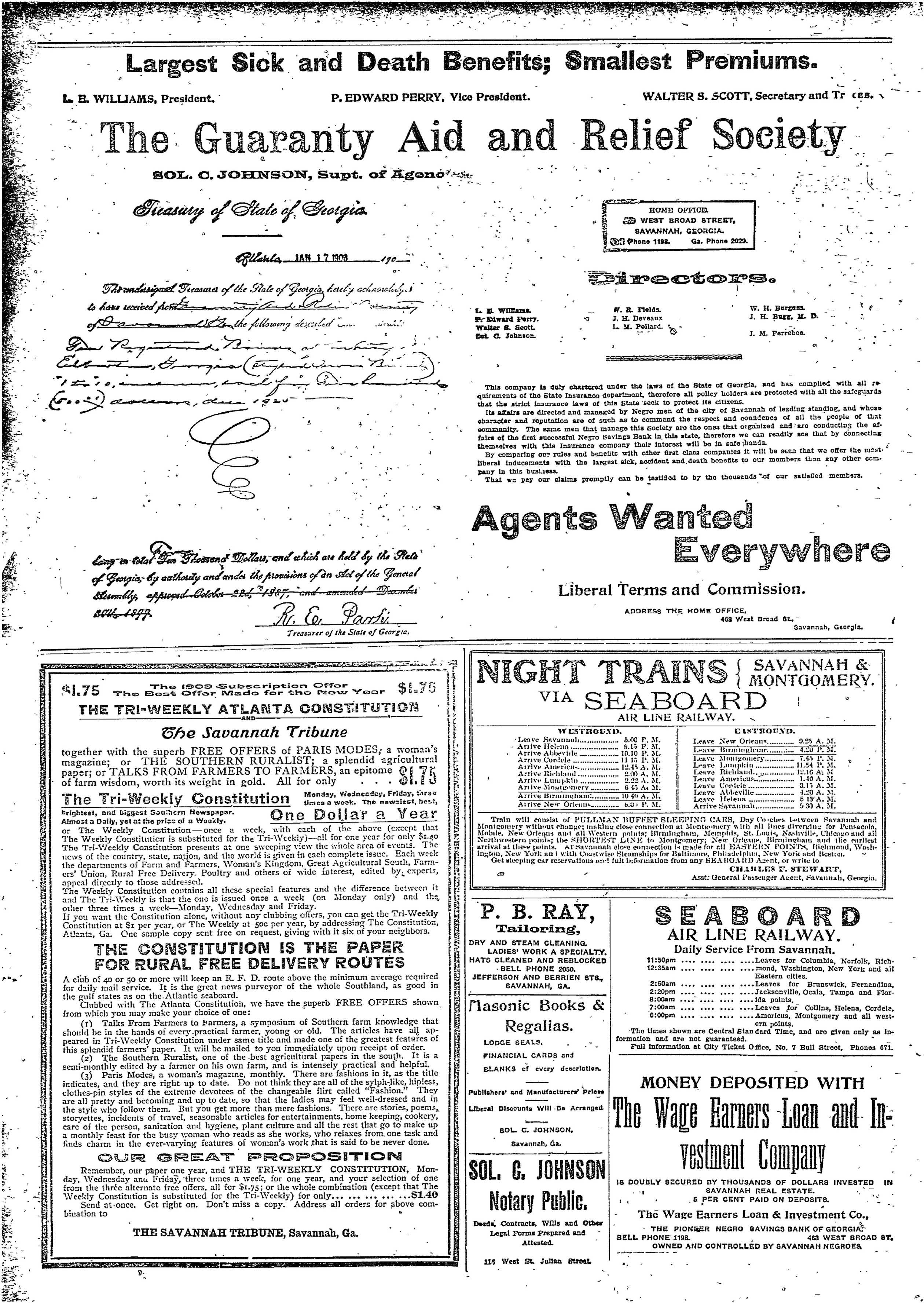
: - Largest Sick and Death
: 8. 8. WILLIAMS, President, ' P. EDWARD PERRY, V
. The. G ity Alc
_. The. Guaranty Aic
ae - |—s OL, ©. JOHNSON, Supt. of Ageno’+
| | Stasuty of late ff Bioigia
7 Cfleetay AN ATN08 argo
SS pnalisipail Fressmes of the Rate of Gergen hacky eotaswleg.§
7 & haw vested finn on te At sea fi,
= fe tL athe following aticled canes Oru
ct gg es PE ey, ge a I”
s Horn = 7 eo es . Sie TN,
; ae 7 ; ame a a a ~)
0, eS, : C3 t-—-€
spl ee
= a so o . , «2 ue
Lo Ling w t108 Bs Gleam Tilly end ehh a bell! by Cha Fata
| ” of Georgia; by eathouly and anda the providions of an lal of the General |
Mearbly <f pieced Colaba bel ABE end amended —Beccrr BBL HEF on webs
. LU LOPP. , Ke to 2g f: °
, . * . . Treasurer of the State of Georgia. .
SSE 2 cer RO a ce Rome sai that Fm >
ne EE
2 iy
The (909 Sub ipti orf gyn |
SI.75 +o oest Gifer Mado for tho Mew Year $i.75 i
THE TRIFWEEKLY ATLANTA CONSTITUTICN - i
—_ hh
Ghe Savannah Tribune
together with the superb FREE OFFERS of PARIS MODES, a woran’s
magazine; or THE SOUTHERN RURALIST; a splendid agricultural
paper; or TALKS FROM FARMERS TO FARMERS, an epitome 8 7h
- of farm wisdom, worth its weight in gold. All for only wee OEE é
4 : L . Mondsy, Wed day, Friday, saree
The Tri-Weekly Constitution sicrtucct tne rewatect hess,
brightesi, and biggest Southern Newspaper. % % ;
Aimost a Daily, yet atte price of a Wook. One Dollar a Year |
er The Weekly Constitution—once a week, with cach of the above (except that I
The Weekly Constitution is substituted for the Tri-\Weekly)—all for one year for only $1.40 {
The Tri-Weekly Constitution presents at one sweeping view the whole arca ofevents. The ¢
news of the country, state, nation, and the world is given in each complete issue. Each week 3
the departments of Farm and farmers, Woman's Kingdom, Great Agricultural South, Farm-
ers’ Union, Rural Free Delivery. Poultry and others of wide interest, edited by, experts,
appeal directly to those addressed. ~ 7
The Weekly Constituticn contains all these special features and the difference between it
and The Tri-Weekly is that the one is issued once a week (on Monday only) and the
other three times a week—Monday, Wednesday and Friday. 7
If you want the Constitution alone, without any clubbing offers, you can get the Tri-Weekly
Constitution at $x per year, or The Weekly at 5oc per year, by addressing The Constitution,
Atlenta, Ga. Qne sample copy sent free on request, giving with it six ot your neighbors.
=
THE CONSTITUTION IS THE PAPEK
A club of 40 or 50 or more will keep an R. F. D. route above the minimum average required
for daily mail service. It is the great news purveyor of the whole Southland, as good in
the gulf states as on the. Atlantic seaboard.
Clubbed with The Atlanta Constitution, we have the superb FREE OFFERS shown,
from which you may make your choice of ene: .
(1) Talks From Farmers to Karmers, a symposium of Southern farm knowledge that
should be in the hands of every-practical farmer, young or ofd. The articles have all ap-
peared in Tri-Weekly Constitution under same title and made one of the greatest features of
this splendid farmers’ paper. It will be mailed to you immediately upon receipt of order.
(2) The Southern Ruralist, one of the best agricultural papers in the south. It is a
semi-monthly edited by a farmer on his own farm, and is intensely practical and helpful.
(3) Paris Modes, a woman’s magazine, monthly. There are fashions in it, as the title
indicates, and they are right up to date. Do not think they are ail of the sylph-like, hipless,
clothes-pin styles of the extreme devotees of the changeable flirt called “Fashion.” They
are all pretty and becoming and up to date, so that the ladies may feel well-dressed and in
the style who follow them. But you get more than mere fashions. There are stories, poems,
storyettes, incidents of travel, seasonable articles for entertainments, home keeping, cookery,
care of the person, sanitation and hygiene, plant culture and all the rest that go to make up
a monthly feast for the busy woman who reads as she works, who relaxes from, one task and
finds charm in the ever-varying features of woman’s work that is said fo be never done.
SUR GREAT PROPoOoSlTicrg
Remember, our paper one year, and THE TRI-WEEKLY CONSTITUTION, Mon-
day, Wednesday anu Friday, ‘three times a week, for one year, and your selection of one
from the thréc alternate free offers, all for $1.75; or the whole combination (except that The
Weekly Constitution is substituted for the Tri-Weckly) for only... ses ose eee +s-BL40
Send at-once. Get right on. Don’t miss a copy. Address all orders for above com-
bination to «
:
THE SAVANNAH TRIBUNE, Savannah, Ga. a
= + > = ~
GL HB Willan,
Pr Edward Perry.
‘Walter &. Scott.
Geil oO. Johnson.
eS pe
SEABOAR :
AIR LINE RAILWAY, |
Daily Service From Savannah,
VW1350pm .... .e2. 2.2. ----Leaves for Columbia, Norfolk, Rich-
12:35am .... seoe sees ose-mond, Washington, New York and all
Eastern cities.
23:50am 1... cee eoee oneeLeaves for Brunswick, Fernandina,
2:20pm .... sees veee oe-Jacksonville, Ocala, Tampa and Flor-
B00am -..0 wees seve oeeeida points,
7:00am 2.4. sooo eee os+eLeaves for Collins, Helena, Cordele,
"Gi00pm 2... ..00 eons eee» Americus, Montgomery and all west-
ern points, ~
Tho times shown are Central Standard Time, and are given only as in-
formation and are not guaranteed. ‘ =
Pull information at City Ticket Office, No, 7 Bull Street, Phones 671.
MONEY DEPOSITED WITH —
The Wage Earners Loan avd: in.
vestment COMPANY =.
18 DOUBLY SECURED BY THOUSANDS OF DOLLARS INVESTED In
ot SAVANNAH REAL ESTATE. * = 7 z
tx a _& PER CENT PAID ON DEPOSITS. ro,
- The Wage Earners Loan & Investment Co.,
7 - THE PIONSER NEGRO SAVINGS BANK OF GEORGIA
BELL PHONE 1193. # 468 WEST BROAD 8%.
____OWNED AND CONTROLLED BY SAVANNAH NEGROES
What makes the landscape look so fair,
What blossoms bright perfume the air,
What plant, repays the farmer's toil,
And will enrich the worn-out soil!
Alfalfa
What grows in loam and clay and sand,
What hits the mortgage off the land,
What crop is, cut six times a year,
And no foul weeds in it appear-
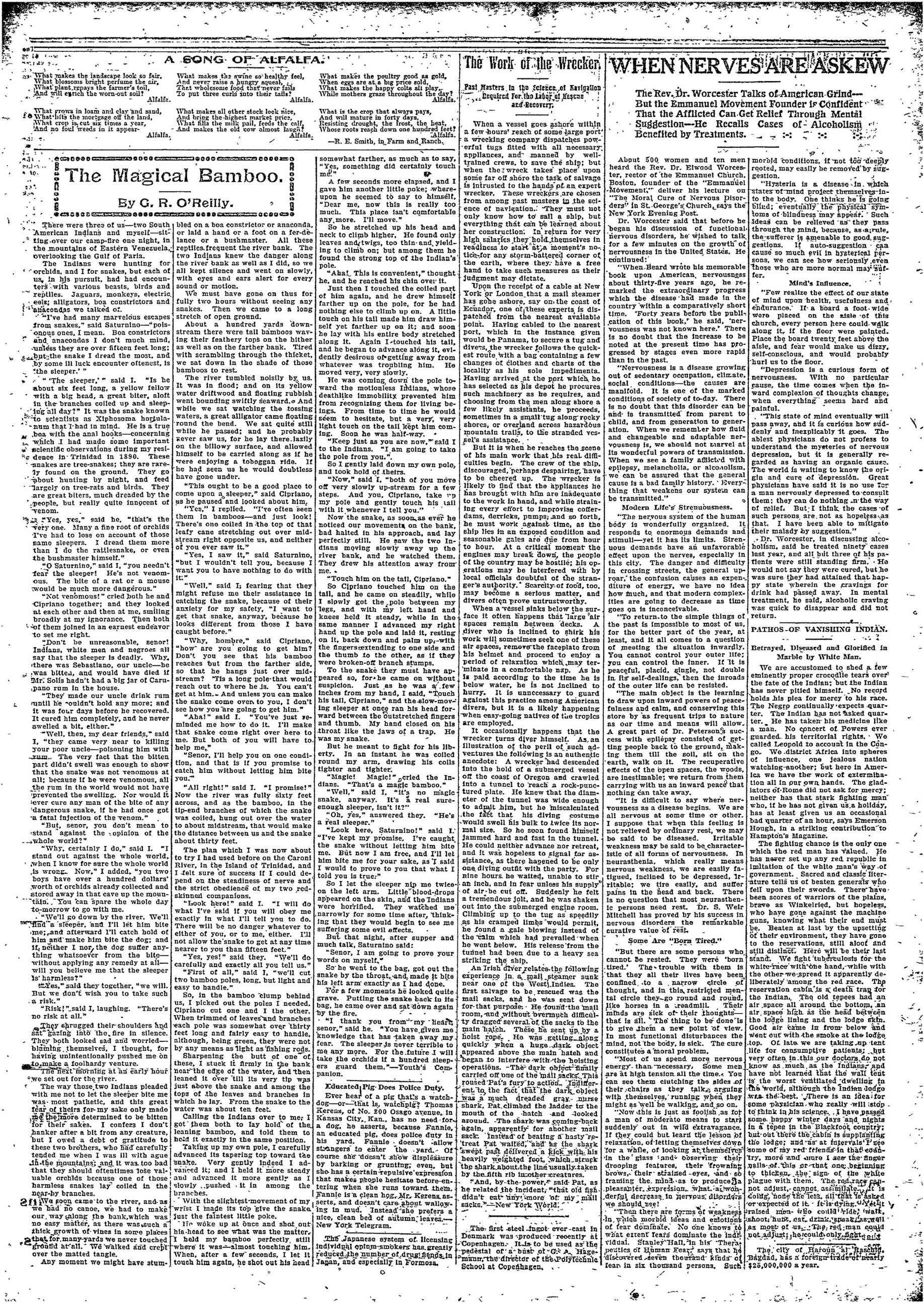
There were three of us—two South American Indians and myself—sitting over our camp-fire one night, in the mountains of Eastern Venezuela, overlooking the Gulf of Paria.
The Indians were hunting for orchids, and I for snakes, but each of us, in his pursuit, had had encounters with various beasts, birds and reptiles. Jaguars, monkeys, electric eels; alligators, boa constrictors and anacondas we talked of.
"I've had many marvelous escapes from snakes," said Saturnino—"poisonous ones, I mean. Boa constrictors and anacondas I don't much mind, unless they are over fifteen feet long;
but the snake I dread the most, and by some ill luck encounter often is, 'the sleeper.'"
"The sleeper," said I. "Is he about six feet long, a yellow fellow with a big head, a great biter, aloft in the branches colled up and sleeping all day?" It was the snake known to scientists as Xiphosoma hurlanum that I had in mind. He is a true boa with the anal hooks—concerning which I had made some important scientific observations during my residence in Trinidad in 1890. These snakes are tree-snakes; they are rarely found on the ground. They go about hunting by night, and feed largely on tree-rats and birds. They are great biters, much dreaded by the people, but really quite innocent of venom.
"Yes, yes," said he, "that's the very one. Many a fine root of orchids I've had to lose on account of those same sleepers. I dread them more than I do the rattlesnake, or even the bushmaster himself."
"O Saturnino," said I, "you needn't fear the sleeper! He's not venomous. The bite of a rat or a mouse would be much more dangerous."
"Not venomous!" cried both he and Cipriano together; and they looked at each other and then at me, smiling broadly at my ignorance. Then both of them joined in an earnest endeavor to set me right.
"Don't be unreasonable, senor! Indians, white men and negroes all say that the sleeper is deadly. Why, there was Sebastiano, our uncle—he was bitten, and would have died if Mr. Solis hadn't had a big jar of Caru-pano rum in the house.
"They made our uncle drink rum until he 'couldn't hold any more; and it was four days before he recovered. It cured him completely, and he never swelled a bit, either."
"Well, then, my dear friends," said I, "they came very near to killing your poor uncle—poisoning him with rum. The very fact that the bitten part didn't swell was enough to show that the snake was not venomous at all; because if he were venomous, all the rum in the world would not have prevented the swelling. Nor would it ever cure any man of the bite of any 'dangerous snake, if he had once got a fatal injection of the venom."
"But, senor, you don't mean to stand against the opinion of the whole world?"
"Why, certainly I do," said I. "I stand out against the whole world, when I know for sure the whole world is wrong. Now," I added, "you two boys have over a hundred dollars' worth of orchids already collected and stored away in that cave up the mountain. You can spare the whole day to morrow to go with me.
"We'll go down by the river. We'll find a 'sleeper,' and I'll let him bite me; and afterward I'll catch hold of him and make him bite the dog; and if neither I nor, the dog suffer anything whatsoever from the bite—without applying any remedy at all—will you believe me that the sleeper is harmless?"
"Yes," said they together, "we will. But we don't wish you to take such a risk."
"Risk!" said I, laughing. "There's no risk at all."
They shrugged their shoulders and sat gazing into the fire in silence. They both looked sad and worried—blumhung, themselves. I thought, for having unintentionally pushed me on to make a foolhardy venture.
The next morning at an early hour we set out for the river.
The way those two Indians pleaded with me not to let the sleeper bite me was most pathetic, and this great fear of theirs for my sake only made me the more determined to be bitten for their sakes. I confess I don't hanker after a bit from any creature, but I owed a debt of gratitude to these two brothers, who had carefully tended me when I was ill with ague in the mountains; and it was too bad that they should oftentimes lose valuable orchids because one of those harmless snakes lay coiled in the near-by branches.
We soon came to the river, and as we had no canoe, we had to make our way along the bank, which was no easy matter, as there was such a thick growth of vines in some places
that for many yards we never touched ground at all. We walked and crept over the matted tangle. Any moment we might have stum-
What makes the swine so healthy feel,
And never raise a hungry squeak.
That wholesome food that never fails
To put three curls into their tails?
Alfalfa.
What makes all other stock look nice,
And bring the highest market price.
And fill the milk pail, feeds the calf,
And makes the old cow almost laugh?
Alfalfa.
bled on a boa constrictor or anaconda, or laid a hand or a foot on a fer-delance or a bushmaster. All these reptiles.frequent the river bank. The two Indians knew the danger along the river bank as well as I did, so we all kept silence and went on slowly, with eyes and ears alert for every sound or motion. We must have gone on thus for fully two hours without seeing any snakes. Then we came to a long stretch of open ground. About a hundred yards down-stream there were tall bamboos waving their feathery tops on the hither as well as on the farther bank. Tired with scrambling through the thicket, we sat down in the shade of those bamboos to rest.
The river tumbled noisily by us. it was in flood; and on its yellow water driftwood and floating rubbish went bounding swiftly seaward. And while we sat watching the tossing waters, a great alligator came floating round the bend. We sat quite still while he passed; and he probably never saw us, for he lay there, lazily on the billowy surface, and allowed himself to be carried along as if he were enjoying a toboggan ride. If he had seen us he would doubtless have gone under.
"This ought to be a good place to come upon a sleeper," said Clpriano, as he paused and looked about him.
"Yes," I replied. "I've often seen them in bamboos—and just look! There's one coiled in the top of that leafy cane stretching out over midstream right opposite us, and neither of you ever saw it."
"Yes, I saw it," said Saturnino, "but I wouldn't tell you, because I want you to have nothing to do with it."
"Well," said I; fearing that they might refuse me their assistance in catching the snake, because of their anxiety for my safety, "I want to get that snake, anyway, because he looks different from those I have caught before."
"Why, hombre," said Cliprano, "how are you going to get him? Don't you see that his bamboo reaches but from the farther side, so that he hangs just over midstream? "Tis a long pole-that would reach out to where he is. You can't get at him. And unless you can make the snake come over to you, I don't see how you are going to get him."
"Aha!" said I. "You've just reminded me how to do it. I'll make that snake come right over here to me. But both of you will have to help me."
"Senor, I'll help you on one condition, and that is if you promise to catch him without letting him bite you."
"All right!" said I. "I promise! Now the river was fully sixty feet across, and as the bamboo, in the tip-end branches of which the snake was coiled, hung out over the water to about midstream, that would make the distance between us and the snake about thirty feet.
The plan which I was now about to try I had used before on the Caroni River, in the Island of Trinidad, and I felt sure of success if I could depend on the steadiness of nerve and the strict obedience of my two red-skinned companions.
"Look here!" said I. "I will do what I've said if you will obey me exactly in what I'll tell you to do. There will be no danger whatever to either of you, or to me, either. I'll not allow the snake to get at any time nearer to you than fifteen feet."
"Yes, yes!" said I. "We'll do carefully and exactly all you tell us."
"First of all," said I. "we'll cut two bamboo poles, long, but light and easy to handle."
So, in the bamboo clump behind us, I picked out the poles I needed. Ciprano cut one and I the other. When trimmed of leaves and branches each pole was somewhat over thirty feet long and fairly easy to handle, although, being green, they were not by any means as light as fishing rods.
Sharpening the butt of one of these, I stuck it firmly in the bank near the edge of the water, and then leaned it over till its very tip was just above the snake and among the tops of the leaves and branches in which he lay. From the snake to the water was about ten feet.
Calling the Indians over to me, I got them both to lay hold of the leaning bamboo, and told them to hold it exactly in the same position.
Taking up my own pule, I carefully advanced its tapering top toward the snake. Very gently indeed I advanced it; and I held it more steady and advanced it more gently as I slowly pushed it in among the branches.
With the slightest movement of my wrist I made its top give the snake just the faintest little poke.
He woke up at once and shot out his head to see what was the matter. I held my bamboo perfectly, still where it was—almost touching him. When, after a few seconds, I let it touch him again, he shot out his head
What makes the poultry good as gold,
When eggs are at a big price sold,
What makes the happy colts all play,
While mothers graze throughout the day!
Alfalfa.
What is the crop that always pays,
And will mature in forty days,
Resisting drought, the frost, the heat,
Whose roots reach down one hundred feet?
Alfalfa.
—R. E. Smith, in Farm and Ranch.
somewhat farther, as much as to say,
"Yes, something did certainly touch me"
A few seconds more elapsed, and I gave him another little poke; whereupon he seemed to say to himself,
"Dear me, now this is really too much. This place isn't comfortable any more. I'll move."
So he stretched up his head and neck to climb higher. He found only leaves and twigs, too thin and yielding to climb on; but among them he found the strong top of the Indian's pole.
"Akai! This is convenient," thought he, and he reached his chin over it.
Just then I touched the colled part of him again, and he drew himself farther up on the pole, for he had nothing else to climb up on. A little touch on his tail made him draw himself yet farther up on it; and soon he lay with his entire body stretched along it. Again I-touched his tail, and he began to advance along it, evidently desirous of getting away from whatever was troubling him. He moved very, very slowly.
He was coming down the pole toward the motionless Indians, whose deathlike immobility prevented him from recognizing them for living beings. From time to time he would seem to hesitate, but a very, very light touch on the tail kept him coming. Soon he was half-way.
"Keep just as you are now," said I to the Indians. "I am going to take the pole from you."
So I gently laid down my own pole, and took hold of theirs.
"Now," said I, "both of you move off very slowly up-stream for a few steps. And you, Ciprano, take up my pole and gently touch his tail with it whenever I tell you."
Now the snake, as soon as ever he noticed our movements on the bank, had halted in his approach, and lay perfectly still. He saw the two Indians moving slowly away up the river bank, and he watched them. They drew his attention away from me.
"Touch him on the tail, Cipriano." So Cipriano touched him on the tail, and he came on steadily, while I slowly got the pole between my legs, and with my left hand and knees hold it steady, while in the same manner I advanced my right hand up the pole and laid it, resting on it, back down and palm up, with the fingers extending to one side and the thumb to the other, as if they were broken-off branch stumps. To the snake they must have appeared so, for he came on without suspicion. Just as he was a few inches from my hand, I said, "Touch his tail, Cipriano," and the slow-moving sleeper at once ran his head forward between the outstretched fingers and thumb. My hand closed on his throat like the jaws of a trap. He was my snake.
But he meant to fight for his liberty. In an instant he was colled round my arm, drawing his colls tighter and tighter.
"Magic! Magic!"cried the Indians.
"That's a magic bamboo."
"Oh, yes," answered they. "He's a real sleeper."
"Look here, Saturnino!" said I. "I've kept my promise. I've caught, the snake without letting him bite me. But now I am free, and I'll let him bite me for your sake, as I said I would to prove to you that what I told you is true."
So I let the sleeper nip me twice on the left arm. Little blood-drops appeared on the skin, and the Indians were horrified. They watched me narrowly for some time after, thinking that they would begin to see me suffering some evil effects.
But that night, after supper and much talk, Saturnino said:
"Senor, I am going to prove your words on myself."
So he went to the bag, got out the snake by the throat, and made it bite his left arm exactly as I had done.
For a few moments he looked quite grave. Putting the snake back in its bag, he came over and sat down again by the fire.
"I thank you from my heart, senor," said he. "You have given me knowledge that has taken away my fear. The sleeper is never terrible to me any more. For the future I will take the orchids if a hundred sleepers guard them."—Youth's Companion.
Educated: Pig: Does Police Duty
Ever hear of a pig that's a watchdog-or-that is, watchplig? Thomas Kerens, of No. 200 Osage avenue, in Kansas City, Kan. has no need for a dog, he asserts, because Fannie, an educated pig, does police duty in his yard. Fannie doesn't allow strangers to enter the yard. Of course she doesn't show displeasure by barking or grunting, even, but she has a certain repulsive expression that makes people hesitate before entering when she runs toward them. Fannie is a clean hog, Mr. Kerens asserts, and doesn't care about wallowing in mud. Instead she prefers a nice, clean bed of autumn leaves.—New York Telegram.
The Japanese system of. licensing individual optum-smokers has greatly reduced the number of drug friends in Japan, and especially in Formosa.
Past Masters In the Science of Navigaiton Required For the Labor of Hescus and Recovery.
When a vessel goes ashore within a few hours' reach of some large port a wrecking company dispatches powerful tugs fitted with all necessary appliances, and manned by well-trained crews, to save the ship; but when the wreck takes place upon some far off shore the task of salvage is intrusted to the hands of an expert wrecker. These wreckers are chosen from among past masters in the science of navigation. They must not only know how to sail a ship, but everything that can be learned about her construction. In return for very high salaries they hold themselves in readiness to start at a moment's notice for any storm-battered corner of the earth, where they have a free hand to take such measures as their judgment may dictate.
Upon the receipt of a cable at New York or London that a mail steamer has gone ashore, say on the coast of Ecuador, one of these experts is dispatched from the nearest available point. Having cabled to the nearest port, which in the instance given would be Panama, to secure a tug and divers, the wrecker follows the quickest route with a bag containing a few changes of clothes and charts of the locality as his sole impediment. Having arrived at the port which he has selected as his depot he procures such machinery as he requires, and choosing from the men along shore a few likely assistants, he proceeds, sometimes in a small tug along rocky shores, or overland across hazardous mountain trails, to the stranded vessel's assistance.
But it is when he reaches the scene of his main work that his real difficulties begin. The crew of the ship, discouraged, perhaps despairing, have to be cheered up. The wrecker is likely to find that the appliances he has brought with hfm are inadequate to the work in hand, and while straining every effort to improvise cofferdams, derricks, pumps, and so forth, he must work against time, as the ship lies in an exposed condition and seasonable gales are due from hour to hour. At a critical moment the engines may break down, the people of the country may be hostile; his operations may be interfered with by local officials doubtful of the stranger's authority. Scarcity of food, too, may become a serious matter, and divers often prove untrustworthy.
When a vessel sinks below the surface it often happens that large air spaces remain between decks. A diver who is inclined to shirk his work will sometimes seek one of these air spaces, remove the faceplate from his helmet and proceed to enjoy a period of relaxation which may terminate in a comfortable nap. As he is paid according to the time he is below water, he is not inclined to hurry. It is unnecessary to guard against this practice among American divers, but it is a likely happening when easy-going natives of the tropics are employed.
It occasionally happens that the wrecker turns divers himself. As an illustration of the peril of such adventures the following is an authentic anecdote: A wrecker had descended into the hold of a submerged vessel off the coast of Oregon and crawled into a tunnel to reach a rock-puncture plate. He knew that the diameter of the tunnel was wide enough to admit him, but he miscalculated the fact that his diving costume would swell his bulk to twice its normal size. So he soon found himself jammed hard and fast in the tunnel. He could neither advance nor retreat, and it was hopeless to signal for assistance, as there hapened to be only one diving outfit with the party. For nine hours he wattled, unable to stir an inch, and in fear unless his supply of air-be cut off. Suddenly he felt a tremendous jolt, and he was shaken out into the submerged engine room. Climbing up to the tug as speedily as his cramped limbs would permit, he found a gale blowing instead of the calm which had prevailed when he went below. His release from the tunnel had been due to a heavy sea striking the ship.
An Irish diver relates the following experience in a mall steamer sunk near one of the West Indies. The first salvage to be rescued was the mail sacks, and he was sent down for that purpose. He found the mall room, and without bermuda difficulty dragged several of the sacks to the main hatch. These he sent up by a hoist rope. He was getting along quickly when a huge dark object appeared above the main hatch and began to interfere with the hoisting operations. - The dark object initially carried off one of the mall sacks. This roused Pat's fury to action. I differented to the fact that the dark object was a much dreaded gray nurse shark, Pat climbed the ladder for the mouth of the hatch and looked around. The shark was coming back again, apparently for another mall sack. Instead of beating a hasty retreat Pat waited, and 'as he swept past delivered a kick with his heavily weighted foot, which struck the shark about the line usually taken by the fifth rib in other creatures.
"And, by the-power," said Pat, as he related the incident, "that old fish didn't eat tiny more of my mall sacks."—New York World.
The first steel ingot ever cast in Denmark was produced recently at Copenhagen. It is to be used as the pedestal of a bust of G. A. Hagemann, the director of the Polytechnic School at Copenhagen.
WHEN NERVES ARE ASKEW
The Rev. Dr. Worcester Talks of American Grind—But the Emmanuel Movement Founder is Confident That the Afflicted Can Get Relief Through Mental Suggestion—He Recalls Cases of Alcoholism Benefited by Treatments.
About 500 women and ten men heard the Rev. Dr. Elwood Worcester, rector of the Emmanuel Church, Boston, founder of the "Emmanuel Movement," deliver his lecture on "The Moral Cure of Nervous Disorders" in St. George's Church, says the New York Evening Post.
morbid conditions, if not too deep, rooted, may easily be removed by surgical.
"Hysteria is a disease in which states of mind project themselves in to the body. One thinks he is going blind; eventually the physical symptoms of blindness may appear. Such
Dr. Worcester said that before he began his discussion of functional nervous disorders, he wished to talk for a few minutes on the growth of nervousness in the United States. He continued:
"When Beard wrote his memorable book upon American, nervousness about thirty-five years ago, he remarked the extraordinary progress which the disease had made in the country within a comparatively short time. 'Forty years before the publication of this book,' he said, 'nervousness was not known here.' There is no doubt that the increase to be noted at the present time has progressed by stages even more rapid than in the past.
"Nervousness is a disease growing out of sedentary occupation, climate, social conditions—the causes are manifold. It is one of the marked conditions of society of to-day. There is no doubt that this disorder can be and is transmitted from parent to child, and from generation to generation. When we remember how fluid and changeable and adaptable nervousness is, we should not marvel at its wonderful powers of transmission. When we see a family afflicted with epilepsy, melanchoia, or alcoholism, we can be assured that the general cause is a bad family history. Everything that weakens our system can be transmitted."
Modern Life's Strenuousness.
"The nervous system of the human body is wonderfully organized. It responds to enormous demands and stimuli—yet it has its limits. Strenuous demands have an unfavorable effect upon the nerves, especially in this city. The danger and difficulty in crossing streets, the general uproar, the confusion causes an expenditure of energy, we have no idea how much, and that modern complexities are going to decrease as time goes on is inconceivable.
"To return to the simple things of the past is impossible to most of us, for the better part of the year, at least, and it all comes to a question of meeting the situation inwardly. You cannot control your outer life; you can control the inner. If it is peaceful, placid, single, not double in its self-dealings, then the inroads of the outer life can be resisted.
"The main object is the learning to draw upon inward powers of peacefulness and calm, and conserving this store by as frequent trips to nature as our time and means will allow. A great part of Dr. Peterson's success with epilipsy consisted of getting people back to the ground, making them till the soil, sit on the earth, walk on it. The recuperative effects of the open spaces, the woods, are inestimable; we return from them carrying with us an inward peace that nothing can take away.
"It is difficult to say where nervousness as a disease begins. We are all nervous at some time or other. I suppose that when this feeling is not relieved by ordinary rest, we may be said to be diseased. Irritable weakness may be said to be characteristic of all forms of nervousness. In neurasthenia, which really means nervous weakness, we are easily fatigued, inclined to be depressed, Irritable; we tire easily, and suffer pains in the head and back. There is no question that most neurasthenic persons need rest. Dr. S. Weir Mitchell has proved by his success in nervous disorders the remarkable curative value of rest.
Some Are "Born Tired."
"But there are some persons who cannot be rested. They were 'born tired.' The trouble with them is that they all their lives have been confined, to a narrow circle of thought, and in this restricted mental circle they go round and round, like horses in a readmill. Their minds are sick of their thoughts—that is all. 'The thing to be done is to give them a new point of view. In most functional disturbances the mind, not the body, is sick. The cure constitutes a moral problem.
"Most of us spend more nervous energy than necessary. Some men are at high tension all the time. You can see them clutching the sides of their chairs as they talk, arguing with themselves, running when they might as well be walking, and so on."
"Now this is just as foolish as for a man of moderate means to start suddenly out in wild extravagance. If they could but learn the lesson of relaxation, of letting themselves down for a while, of looking at themselves in the glass and observing their drooping features, their frowning brows, their strained eyes, and so pleasing the mind as to produce a pleasing the mind, expression, what a wonderful decrease in nervous disorders we should see!
"Then there are forms of weakness in, which morbid ideas and emotions of fear dominate. No one knows to what extent fears dominate the individual. Stanley Hall, in his 'Theerapieutes of Human Hall,' says that he discovered seven thousand kinds of fear in six thousand persons. Such
morbid conditions, if not too deeply rooted, may easily be removed by suggestion.
"Hysterla is a disease in which states of mind project themselves into the body. One thinks he is going blind; eventually the physical symptoms of blindness may appear. Such ideas can be relieved as they pass through the mind, because, as a rule, the sufferer is amenable to good suggestions. If auto-suggestion can cause so much evil in hysterical persons, we can see how seriously even those who are more normal may suffer.
Mind's Influence.
"Few realize the effect of our state of mind upon health, usefulness and endurance." If a board a foot wide were placed on the aisle of this church, every person here could walk along it. If the floor were painted. Place the board twenty feet above the aisle, and fear would make us dizzy, self-conscious, and would probably hurl us to the floor.
"Depression is a curious form of nervousness. With no particular cause, the time comes when the inward complexion of thoughts change, when everything seems hard and painful.
"This state of mind eventually will pass away, and it is curious how suddenly and inexplicably it goes. The ablest physicians do not profess to understand the mysteries of nervous depression, but it is generally regarded as having an organic cause. The world is waiting to know the origin and cure of depression. Great physicians have said it is no use for a man nervously depressed to consult them; they can do nothing in the way of relief. But I think the cases of such persons are not as hopeless as that. I have been able to mitigate their malady by suggestion."
Dr. Worcester, in discussing alcoholism, said he treated ninety cases last year, and all but three of his patients were still standing firm. He would not say they were cured, but he was sure they had attained that happy state wherein the cravings for drink had passed away. In mental treatment, he said, alcoholic craving was quick to disappear and did not return.
PATHOS OF VANISHING INDIAN.
Betrnyed, Diseased and Glorified in Marble by White Man.
We are accustomed to shed a few eminently proper crocodile tears over the fate of the Indian; but the Indian has never pitted himself. No record holds his plea for mercy to his race. The Negro continually expects quarter. The Indian has not asked quarter. He has taken his medicine like a man. No concert of Powers ever guarded his territorial rights. We called Leopold to account in the Congo. We district Africa into spheres of influence, one jealous nation watching-another; but here in America we have the work of extermination all in our own hands. The gladiators of Rome did not ask for mercy, neither has that stark fighting man who, if he has not given us a holiday, has at least given us an occasional bad quarter of an hour, says Emerson Hough, in a striking contribution to Hampton's Magazine.
The fighting chance is the only one which the red man has valued. He has newer set up any red republic in imitation of the white man's way of government. Sacred and classic literature tells us of beaten generals who fell upon their swords. There have been scores of warriors of the plains, brave as Winklerried, but hopeless, who have gone against the machine guns, knowing what their end must be. Beaten at last by the upsetting of their environment, they have gone to the reservations, still aloof and still distinct. Here will be their last stand. We fight tuberculosis for the white-race with one hand, while with the other we spread it apparently deliberately among the red race. The reservation cabin is a death tractor for the Indian. The old tepees had an air space all around the bottom, an air space high as the head between the lodge lining and the lodge skin. Good air came in from below and went out with the smoke at the lodge top. Of late we are taking an tent life for consumptive patients; but very often in this our doctors do not know as much, as the Indians, and have not learned that the wall tent is the worst ventilated dwelling in the world, although the Indian dodge was the best. There is an ideal for some physician who really will stop to think in his science. I have passed some happy winter days and nights in a jacket in the Blackfoot country; but out there the cabin is supplanting the lodge; and at intervals I see some of my red friends in that country, more and more I see the finger nails of this or that one, beginning to thicken, the sign of the white plague with them. The red race cannot adjust, cannot assimilate, it is doing, none the less, all that is asked or expected of it. It's dying, when raised men who could ride, walk, shoot, hunt, eat drink, speak well as most of us. The red man could not adjust, he could only said
The city of Haifa is located
Baghdad, has a foreign trade of nearly
$25,000,000 a year.
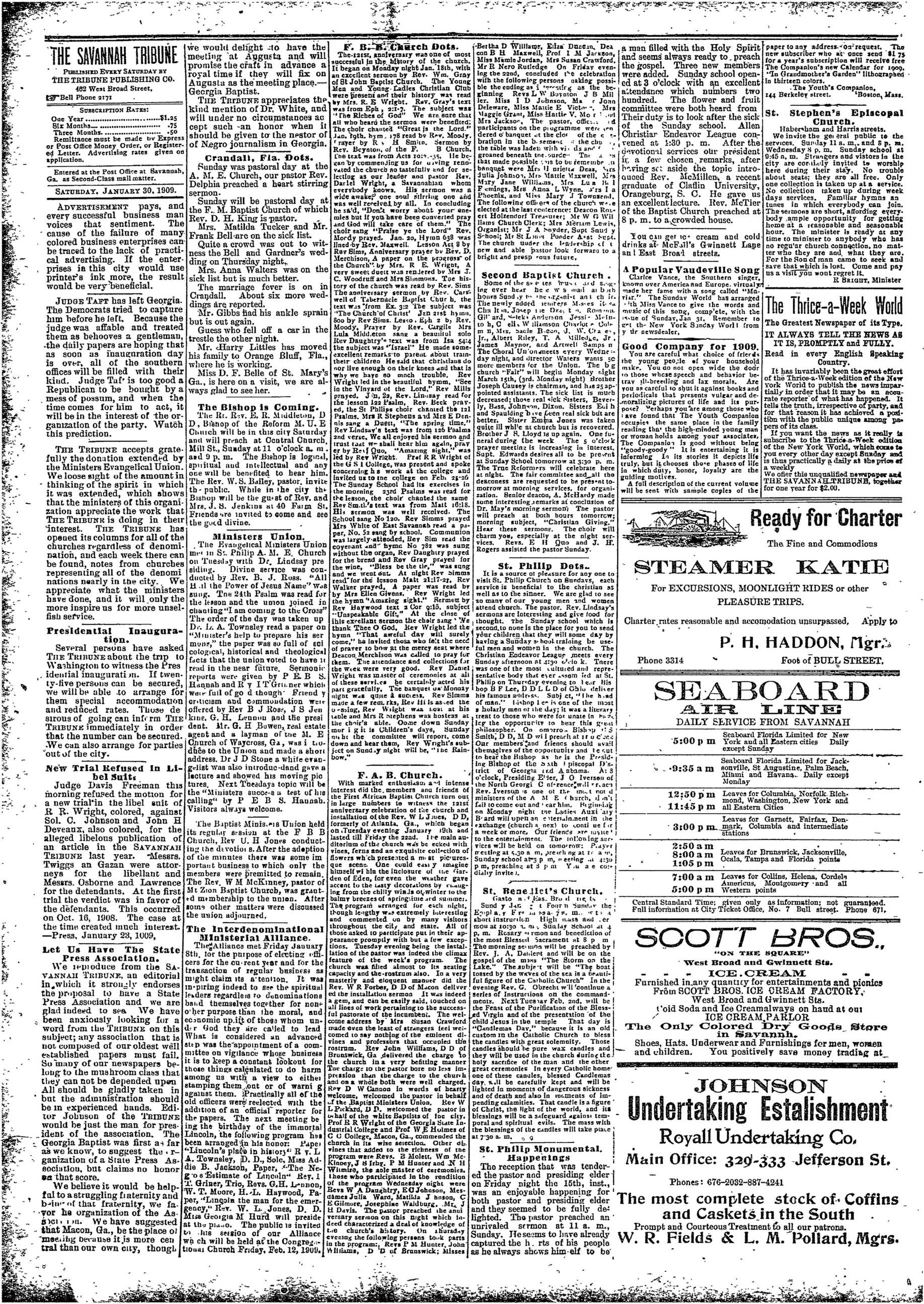
THE SAVANNAH TRIBUNE
SUBSCRIPTION RATES:
One Year.....$1.25
Six Months.....-75
Three Months.....-50
Remittance must be made by Express
or Post Office Money Order, or Registered
Letter. Advertising rates given on
application.
Entered at the Post Office at Savannah,
Ga. as Second-Class mail matter.
ADVERTISEMENT pays, and every successful business man voices that sentiment. The cause of the failure of many colored business enterprises can be traced to the lack of practical advertising. If the enterprises in this city would use printer's ink more, the result would be very beneficial.
JUDGE TAFT has left Georgia. The Democrats tried to capture him before he left. Because the judge was affable and treated them as behooves a gentleman, the daily papers are hoping that as soon as inauguration day is over, all of the southern offices will be filled with their kind. Judge Taf' is too good a Republican to be bought by a mess of possum, and when the time comes for him to act, it will be in the interest of the organization of the party. Watch this prediction.
THE TRIBUNE accepts gratefully the donation extended by the Ministers Evangelical Union. We loose sight of the amount in thinking of the spirit in which it was extended, which shows that the ministers of this organization appreciate the work that THE TRIBUNE is doing in their interest. THE TRIBUNE has opened its columns for all of the churches regardless of denomination, and each week there can be found, notes from churches representing all of the denominations nearly in the city. We appreciate what the ministers have done, and it will only the more inspire us for more unselfish service.
Presidential Inauguration.
Several persons have asked THE TRIBUNE about the trip to Washington to witness the Presidential inauguration. If twenty-five persons can be secured, we will be able to arrange for them special accommodation and reduced rates. Those desirous of going can inform THE TRIBUNE immediately in order that the number can be secured. We can also arrange for parties out of the city.
New Trial Refused in Lihel Suit
Judge Davis Freeman this morning refused the motion for a new trial'in the libel suit of R R. Wright, colored, against Sol. C. Johnson and John H Deveaux, also colored, for the alleged libelous publication of an article in the SAVANNAH TRIBUNE last year. Messrs. Twiggs an Gazan were attorneys for the libellant and Messrs. Osborne and Lawrence for the defendants. At the first trial the verdict was in favor of the defendants. This occurred on Oct. 16, 1908. The case at the time created much interest. —Press, January 23, 1009.
Let Us Have The State Press Association.
Press Association.
We reproduce from the SAVANNAN TRIBUNE, an editorial in which it strongly endorses the proposal to have a State Press Association and we are glad indeed to see. We have been anxiously looking for a word from the TRIBUNE on this subject; any association that is not composed of our oldest well established papers must fail. So many of our newspapers belong to the mushroom class that they can not be depended upon. All should be gladly taken in but the administration should be in experienced hands. Editor Johnson of the TRIBUNE would be just the man for president of the association. The Georgia Baptist was first as far as we know, to suggest the organization of a State Press Association, but claims no honor that score.
We believe it would be helpful to a struggling fraternity and being of that fraternity, we favor the organization of the Association. We have suggested that Macon, Ga., be the place of meeting because it is more central than our own city, though
we would delight to have the meeting at Augusta and will promise the craft in advance a royal time if they will fix on Augusta as the meeting place.—Georgia Baptist.
THE TRIBUNE appreciates the kind mention of Dr. White, and will under no circumstances accept such an honor when it should be given to the nestor of Negro journalism in Georgia.
Crandall. Fla. Dots.
Sunday was pastoral day at the A. M. E. Church, our pastor Rev. Delphia preached a heart stirring sermon. Sunday will be pastoral day at the F. M. Baptist Church of which Rev. D. H. King is pastor.
Mrs. Matilda Tucker and Mr. Frank Bell are on the sick list.
Quite a crowd was out to witness the Bell and Gardner's wedding on Thursday night.
Mrs. Anna Walters was on the sick list but is much better.
The marriage fever is on in Crandall. About six more weddings are reported.
Mr. Gibbs had his ankle sprain but is out again.
Guess who fell off a car in the trestle the other night.
Mr. Harry Littles has moved his family to Orange Bluff, Fla., where he is working.
Miss D. F. Belle of St. Mary's Ga., is here on a visit, we are always glad to see her.
The Bishop is Coming.
The Bishop is Coming.
The Rt. Rev. E. R. Mudleton, D
D, Bishop of the Reform M. U. E
Church will be in this city Saturday
and will preach at Central Church,
Mill St. Sunday at 11 o'clock a.m.
and 9 p.m. The Bishop is logical,
spiritual and intellectual and any
one will be benefited to hear him.
The Rev. W. S. Bailey, pastor, invite
the public. While in the city the
Bishop will be the guest of Rev. and
Mrs. J. S. Jenkins at 40 Farm St.
Friends are invited to come and see
the good divine.
Ministers Union
Ministers Union.
The Evangelical Ministers Union met in St. Philip A. M. E. Church on Tuesday with Dr. Lindsay presiding. Divine service was conducted by Rev. B. J. Ross. "All Hail the Power of Jesus Name" was sung. The 24th Psalm was read for the lesson and the union joined in chanting "I am coming to the Cross". The order of the day was taken up Dr. L. A. Townsley read a paper on "Minister's help to prepare his serios," the paper was so full of sociological, historical and theological facts that the union voted to have it read in the near future. Sermonic reports were given by P E B S. Hannah and R y I Gruner which were full of go'd though. Friend criticism and commotion were offered by Rev B J Ross, J S Jennie, G. H. Lennon and the president. Mr. G. H Bowen, real estate agent and a layman of the M. E Church of Waycash, Ga., was in attendance to the Union and made a short address. Dr J D Stone a white evangelist was also introduce-dand gave a lecture and showed his moving pictures. Next Tuesdays topic will be the "Ministers success a test of his calling" by P E B S. Hannah. Visitors always welcome.
The Baptist Ministers Union held its regular session at the F B B Church, Rev U. H Jones conducting the devotion. After the adoption of the minutes there was some important business to which only the members were premitted to remain. The Rev W M McKinney, pastor of Mt Zion Baptist Church, was granted membership to the union. After some other matters were discussed the union adjourned.
The Interdenominational Ministerial Alliance.
The Alliance met Friday January 8th, for the purpose of electing officers for the current year and for the transaction of regular business as might claim its attention. It was in-piring indeed to see the spiritual leaders regardless to denominations and themselves together for non-other purpose than the moral, and economic upfit of those whom under God they are called to lead. What is considered an advanced step was the appointment of a committee on vigilance whose business it is to keep a constant lookout for those things calculated to do harm among us with a view to either stamping them out or of warni against them. Practically all of the old officers were reelected with the addition of an official reporter for the papers. The next meeting being the birthday of the immortal Lincoln, the following program has been arranged in his honor: Paper "Lincoln's place in history" R. V. L. A. Townsley, D. D., Solo, Miss Addie B. Jackson, Paper, "The Negro Estimate of Lincoln" Rev. I. G. Griner, Trio, Revs. G. H. Lennon, W. T. Moore, H. L. Haywood, Paper, "Lincoln the man for the emergency" Rev. W. L. Jones, D. D. Miss Georgia M Hurd will preside at the piano. The public is invited to his session of our Alliance which will be held at the Congregational Church Friday, Feb. 12, 1909.
F. A. B. Church.
Bertha D William, Eliza Duncan, Deacon B H Maxwell, Proff M I Jackson, Miss Mamie Jordan, Mrs Susan Crawford, Mr B Nero Rutledge. On Friday evening the 22nd, concluded the celebration with the following persons making possible the ending as interesting as the beginning Rews L W Boyston J B Miller, Miss I D Johnson, Ma r Jone Deaware, Miss Matte E Victory, Mrs Maggie Grant, Miss Hattie V, M o r Jodr Mrs Jackson, the pastor, officers and participants on the programme were ordered on banquet at the cloist of the celebration in the basement of the church, the table was laden with vids and groaned beneath the curver. The a s that made possible this to be remember in banquet was M hri nieta Deas, Mrs Julia Johnson, Mrs Mattle Maxwell, Mrs Mary Jane Williams, Mrs Lua J Flemings, Mrs Anna L Wynn, I s I Phoenk, and Miss Mary J Townsend. The following officers of the church were elected at the last conference: Deacon Robert Holtzentoffrord Treasurer; Mr W G William Church Clerk; Mrs Meriam Lewis, Organist; Mr J A Snyder, Sundy S school; Mr St Luna, Ponder Asst Supt. The church under the Leadership of a new and able pastor look forward to a bright and prosperous future.
Second Baptist Church .
Second Baptist Church.
Some of the sweets trust and song ever hear he we is mad at all hours Sunday to the organist and chirl. The newly added members Makes it a Chin It, Joseph Dray, R. Romona Gilard, Eilea Anderson Jessie Miles, h. Cell, William Charlotte Colm, m. Sacie Bean, J. W. Claey, Jr. Albert Riley, T. A. Millead, Jr. James Maynor, and Artwell Samps n. The Choral Union meets every Wednesday night, and director Waters wants some members for the Union. The big church "Fair" will begin Monday night March 15th, (3rd, Monday night) Brother Joseph Causey is chairman, and has 25 appointed assistants. The sick list is much decreased; those real sick Sisters, Beverly, Bass, Johnson, Dikers. Sisters Eulh and Spaulding have been real sick but are better. Sister Emma Jones was taken quite ill while at church but is recovered. Brother J. S. Lloyd is up again. One funeral during the week. The 5 o'clock interest is increasing. Interest, Supt. Edwards delie is here to present at Sunday School tomorrow at 3:30. The True Reformers will celebrate here at night. The fair committee and all the desacons are requested to be present to tomorrow at morning services, for organization. Senior deacon, A. McHardy made some interesting remarks at conclusion of Dr. May's morning sermon. The pastor will preach at both hours tomorrow, morning subject, "Christian Giving." Hear these sermons. The choir will charm you, especially at the night services. Revs. E H Quo and J. H. Rogers assisted the pastor Sunday.
St. Phillip Dots.
It is a source of pleasure for any one to visit St. Philip Church on Sundays, each service is beneficial to the christian as well as to the sinner. We are glad to see so many of your young men and women attend church. The pastor. Rev. Lindsay's sermons are interesting and give food for thought. The Sunday school which is second, to none is the place for you to send your children that they will some day by having a Sunday school trailing be useful men and women in the church. The Christian Endeavor League meets every Sunday afternoon at 4:30 o'clock. There was one of the most cultured and representative body that ever assembled at St. Philip on Thursday evening to hear His bishop B F Lee, D D L D of Ohio deliver his famous address. Subjct, "the hand of man." bishop Lee is one of the most scholarly of the day; it was a literary treat to those who were forunate in benefiting the opportunity to hear this great philosopher. On omronr. Bishop S Smith, D D, D M will present at 10 o'clock Our members and friends should avail themselves of the opportunity and be cut near the bishop as he is the Publishing Board of Georgia and Anchorage At 3 o'clock, Presiding Elder, J O Iverson of the North Georgi Conference will visit Rev. Iverson is one of the most notd ministers of the A M E Church, don't fall to come out and hear him. Beginning on Monday night the Ladies Auxiliary Board will open an entertainment in the exchange (church a nex) to conti ure for a week or more. Our friends are invited to the entertainment. The following services will be held on tomorrow: Prayer meeting at 5:30 a.m. preaching at 6 a.m. Sunday school aagm, meeting at 4:30 p.m. preaching at 3 p.m. You are cordially invite.
St. Benedict's Church.
Gasto n i f e s. Brod ing t s.
Sund y j a n d Four n i sund the Epiphany. F r e s a s a 7 m. t a short instruction. High mass and er m o u n at 10:30 m. Sunny School at 4 p. m. Rosary sarmon and benediction of the most Blessed Sacrament at 8 p.m. The morning session will be preached by Rev J. A. Daident and will be on the gospel of the mass "The Storm on the Lake." The subject will be "The boat tossed by the waves of the sea is a beautiful figure of the Catholic Church." In the evening Rev. G. Obrecht will continue a series of Instructions on the commandments. Next Tuesday Feb. 2nd, will be the Feast of the Purification of the Blessed Virgin and of the presentation of the child Jesus in the temple. That day is "Candlesmas Day," because it is an old custom in the Catholic Church to bless the candles with great solemnity. Those candles should be pure wax candles and they will be used in the church during the holy sacrifice of the man and the other great ceremonies. In every Catholic home one of these candles, blessed Candlesmas day, will be carefully kept and will be lighted in moments of dangerous sickness and of death and also in moments of impending calamities. That candle is a figure of Christ, the light of the world, and its blessings will be a safeguard against temporal and spiritual evils. The mass with the blessings of the candles will take place at 7:30 a.m.
St. Philip Monumental. Happenings
The reception that was tendered the pastor and presiding elder on Friday night the 15th, inst., was an enjoyable happening for both pastor and presiding elder and they seemed to be fully delighted. The pastor preached an unrivaled sermon at 11 a. m., Sunday. He seems to have already captured the h. rts of his people as he always shows him elf to be
Central Standard Time; given only as information; not guaranteed.
Full information at City Ticket Office, No. 7 Bull Street, Phone 671.
ICE.CREAM Furnished in any quantity for entertainments and picnics From SCOTT BROS. ICE CREAM FACTORY. West Broad and Gwinnett Sts. T'oid Soda and Ice Creamalways on haud at our ICE CREAM PARLOR The Only Colored Dry Goods Store in Sayannh. Shoes, Hats. Underwear and Furnishings for men, women and children. You positively save money trading at
The most complete stock of Coffins and Caskets in the South Prompt and Courteous Treatment to all our patrons. W. R. Fields & L. M. Pollard, Mgrs.
a man filled with the Holy Spirit and seems always ready to preach the gospel. Three new members were added. Sunday school opened at 3 o'clock with an excellent attendance which numbers two hundred. The flower and fruit committee were both heard from Their duty is to look after the sick of the Sunday school. Allen Christian Endeavor League convened at 1:30 p. m. After the devotional services our president in a few chosen remarks, after having set aside the topic introduced Rev. McMillen, a recent graduate of Claflin University, Orangeburg, S. C. He gave us an excellent lecture. Rev. McTier of the Baptist Church preached at 8 p. m. to a crowded house.
You can get 10 cream and cold drinks at McFall's Gwinnett Lape and East Broad streets.
A Popular Vaudeville Song
Clarice Vance, the Southern singer,
known over America and Europe, virtually
made her fame with a song called "Mariar."
The Sunday World has arranged
"With Miss Vance to give the words and
music of this song, complete, with the
issue of Sunday, Jan 31, Remember to
get the New York Sunday World! from
y ur newdealer,
Good Company for 1909.
Good Company for 1909.
You are careful what choice of friends the young people of your household make. You do not open wide the door to those whose speech and behavior betray ill-breeding and lax morals. Are you as careful to shut it against books and periodicals that presents vulgar and demoralizing pictures of life and its purpose? Perhaps you are among those who have found that The Youth Company occupies the same place in the family reading that the high-minded young man or woman holds among your associates. The Company is good without being "goody-goody." It is entertaining it is informing. In its stories it depicts life truly, but it chooses those phases of life in which duty, honor, loyalty are the guiding motives.
A full description of the current volume will be sent with sample copies of the
paper to any address. Our request. The new subscriber who at once send $175 for a year's subscription will receive free The Companion's new Calendar for 1909, "In Grandmother's Garden" lithographed in thirteen colors. The Youth's Companion, 144 Berkeley street. 'Boston, Mass.
St. Stephen's Episcopal Church.
Habersham and Harris streets.
We invite the general public to the services. Sunday 11 a.m., and 8 p.m., Wednesday 8 p.m., Sunday school at 9:45 a.m., Strangers and visitors in the city are cordially invited to worship here during their stay. No trouble about seats; they are all free. Only one collection is taken up at a service. No collection taken up during week days services. Familiar hymns amnesia in which everybody can join. The sermons are short, affording everybody ample opportunity for getting home at a reasonable and seasonable hour. The minister is ready at any time to minister to anybody who has no regular^u^r church connection, no matter who they are and what they are. For the Son of man came to seek and save that which is lost. Come and pay us a visit you won't regret it.
R BRIGHT. Minister
The Thrice-a-Week World
The Greatest Newspaper of its Type.
IT ALWAYS TELL THE NEWS AS IT IS, PROMPTLY and FULLY.
Read in every English Speaking Country.
It has invariably been the great effort of the Thrice-A-week edition of the New York World to publish the news impartially in order that it may be an accurate reporter of what has happened. It tells the truth, irrespective of party, and for that reason it has achieved a position with the public unique among papers of its clauses.
It tells the news as it really subscribe to the Thrice-A-week edition of the New York World, which comes to you every other day except Sunday and is thus practically a daily at the price of a weekly.
We offer this unqualified newspaper and THE SAVANNAH TRIBUNE, together for one year for $2.00.
SATURDAY, JAN. 30, 1909
G and Chansellor, G. D. Creswill was in the city this week.
A list of donations to the Charity Hospital will be published next week.
Mrs. Mamie Wilson Rose arrived in the city Friday morning of last week for a short stay with relatives and friends.
Miss Rosa Davis has returned to the city after an extended and pleasant visit to New York City.
Miss Sarah J. Blunt of 616 Duffy street west has been confined to bed for more than two weeks and her friends are in doubt of her recovery.
Licentiate C. Wright is conducting a successful revival service at New Zion Baptist Church, Mill Haven. Rev. Priester is at Pooler.
Miss Marie L. Taylor left on Tuesday for Bluffton, S. C., to spend a few days with her uncle Mr. Edward Taylor who has been ill for some time.
Prof. J. W. Gilbert and Mr. E. J. Mathews, auditors of the Pythian Grand Lodge, spent the week in the city auditing the books and accounts of the secretary and treasurer of the endowment department.
Intelligence was received in the city about the death of Mr. Wm Mitchell, which occurred in Macon on Monday. Mr. Mitchell was an old Savannahian and is well known by the older citizens.
Miss Susie Woods of Allendale, S. C., is the guest of her sister, Mrs J. B. Simmons, 550 State St., east. Miss Woods who is of an affable disposition is making a number of friends who hope to make her stay pleasant.
Mrs. L. M Fisher, formerly of this city but now a resident of Jacksonville, Fla., arrived Wednesday of last week. Her many friends are endeavoring to make it very pleasant for her during her stay.
Mrs. Louise Wilson Walker of Providence, R. I., arrived in the city last week on steamer from New York on visit to parents and friends. This is her first visit in several years and was royally greeted by her host of friends who will join in making her stay one of continued pleasure.
Rev. I. W. Coles of Sheldon, S. C. was in city last week and came in to see us. We were glad to shake hands with the reverend. He pastor a number of churches in Beaufort County.
Miss Angie Shumon, sister of Mrs. Lizzie Buncombe and Mrs Alice Betterson, died on Jan. 16th, at Ludowci, Ga., and was buried the next day. The friends of the sisters sympathize with them in their bereavement.
Monday night City Council elected officers to serve the city for the next two years. There was at least one surprise. All of the colored officers were reelected. It was at first thought that Mr. Wallis, the efficient keeper of the colored cemetery would be defeated, but at the last moment his friends rallied to his support and caused the defeat of his most formidable opponent.
Kindly pay your subscription. When your time expires and you do not want the paper continued, notify us at once to stop it. The law gives us the right to collect from a subscriber as long as the paper continues. Subscribers can readily see the necessity of notifying us to stop the paper when they do not want it longer. tf.
After an absence of ten years, Mr. J. M. Davis, accompanied by Mrs. Davis, arrived in the city last week from New York. Mr. Davis is favorably known to many citizens. Before leaving for New York he conducted a very successful barber shop on West Liberty street. He is now residing at Amogansett, N. Y., and is engaged in the real estate business Mr. Davis is making good and no doubt one of these days he will return to us retired from business and taking life easy. He left yesterday for Lynchburg, Va., and other points before returning home.
After each service at the First Congregational Church there can be heard exclamations of delight on the sermons delivered by the pastor, Roy. W. L. Cash. They are indeed gems of thought and logic, and delivered in a forceful way, so easy to attract the attention of the hearers Services tomorrow as usual. The officers and members are imbibing much interest in the proposed improvements and plans to raise funds for the same. The service tomorrow morning will be short in order to hold a congregational meeting afterward in order to inaugurate improve ment plans. Each member of the church is urged to be present.
Wedton Lodge 20, I. P. B. O. Eor W.
At the regular meeting, Tuesday night January 5, the following officers were elected: Dr. C. B. B. Tyson, Exalted Ruler; R. L. Rutledge, Esteemed Leading Knight; Frank Thomas, Esteemed Loyal Knight; J. R. Brown, Esteemed Lecturing Knight; J. D. Powell, Sec.; Frank Dilworth, Treas.; Henry S. Dundar, Paul E. Gaston,
Prince E. Cohen, Chas. duH. Fox, J. H. Beesley, Trustees; P. W. Bythewood, Tyler. The above officers are to serve six months. Mr. R. L. Jones, District Deputy of Georgia, presided.
Catholic Mutual Aid Society in St. Benedict's Church.
On Monday evening an interesting little ceremony took place in the school room of St. Benedict's church, it was the installation of the new officers of the Catholic Mutual Aid Society attached to the church. As the constitution and by-laws indicate it, the object of this Society is the relief of its members in sickness and death; and development in all that pretains to the best in morals, social and literary acquirements. The members of the society must be communicants of the Catholic church. Besides the ordinary officers, the society has a sick committee of three members Whose duty it is to visit the sick members and to render them whatever aid the society allows; to watch their bed of suffering during the night and to give them consolation and comfort. The society was organized about 8 years ago, and since then it has done graet work. Its financial part is on a solid basis, and the society may confidently look into a prosperous future. The newly elected officers are President, John Scurdy; Vice President, James Dowes: Secretary and Treasure, Joseph King; Sergeant at Arms, John Simmons; Chairman of sick committee, John Boeifuillet. On Monday evening these officers were installed into office by the pastor, who in a few delicate words reminded each of them of their respective duties and responsibilities. After the installation a delightful social party took place, during which serious conversation was mingled with wit and humor. Very Rev. Ignatius Lissner, the superior of the colored mission in Georgia, honored the party with his presence and addressed a few words of encouragement to the men. It was also a pleasure to listen to the eloquent and humeric speeches made by several gentlemen. The interest of the C. M. A. Society and of St. Benedict's Church were considered in a practical stand point. Good work, both spiritually and financially, has been done in St. Benedict's in the last year. What we want is not so much the quantity as the quality. The consoling progress made in the last year is due not only to the zealous priests attached to the church, but also to the generous efforts of devoted ladies and faithful gentlemen. The secret of the successie St. Benedict's Church is the strong unity of the membres themselves and their sinceres devotedness to their priests. A congregation which can depend on a body of men like the members of the O. M. A. society can be proud and be assured of success and prosperity. Besides the above mentioned officers, there were also present, Theodore Mitchell, Charles Madden, William Smith, John Simmons, Amos Cannon, Charles Dezera and Frank Williams. The society lost one member in the last year in the person of Mr. Charles Daniels, who died on Christmas day. Mr. Daniels had been a faithful member since the beginning and his memry was piously remembered at this special meeting.
Died Unexpectedly
Mr. Oscar Elmore died suddenly on Friday night of last week. The funeral took place on Sunday afternoon from the First A. B. Church. It was attended by a large number of persons. Rev. W. L. Jones conducted the services, assisted by other divines. The funeral was attended by Mt. Moriah Lodge No. 15, of Masons and by the True Reformers.
Mr. Elmore was born in Augusta, Ga. and joined the Central-Baptist Church when he was eleven years of age. In 1882 he came to this city and joined Mt. Zion Church, but soon afterward removed his membership to the F. A. B. Church which he served faithfully until his death. He was one of the oldest deacons, and as a worker was unsurpassed in raising money for the church.
Mr. Elmore was beloved by everybody.
He leaves two daughters, Miss Caroline Elmore, Mrs. Janie Price a grandson, Oscar Elmore, two nieces, Misses Ruth Woodson and Mary L. Coleman of Augusta, and other relatives.
Following resolutions from the J. W. Carr Association, were read at the services:
Where as, It has pleased Almighty God to take out of our midst the soul of our deceased brother, let us bow in humble submission for He worketh all things for good and for the glory of heaven. Bro. Elmore was a true and faithful worker of this Association. We will truly miss him; his work will never be forgotten. But as the poet hath said:
RESOLVED, that a copy of these resolutions be spread upon our minutes, a copy be sent to the bereaved family and a copy be published in the SAVANNAH TRIBUNE.
Notice to Reformers,
To all True Reformers of the Savannah Division; Our.Grand Officers will be here Feb. 2, 3, and 4. A grand entertainment will be given in honor of the grand officers Feb. 2, at Morse's hall. At the S.cond Baptist Church a public meeting will be held on the 3rd at 8 o'clock p. m.
J. H. Walker, Chief.
Ten Dollars Reward.
LOST—Small purse, shaded like a walnut made of alligator hide; contents, 2 rings, one garnet settling, other dark green stone setting, pair copper cuff buttons, silver links, small emblem pin design similar Uneeda Biscuit trade mark, and a penny. Reward of $10 00 for purse and contents insult at Postal Telegraph office, Bull and Bryan streets. No questions will be asked the finder.
St: James Dots.
On tomorrow, early prayer meeting at 5 o'clock, preaching at 11 a.m. and 8 p.m. Sunday School at 3 o'clock. Program of music class at 4 p.m. There will be a grand tally on Sunday all day. The A.C.E Leagu will convene at 6 o'clock. The Sunday School and League are arranging for a grand five nights musical carnival, which will begin on Feb. 8th, continuing to the 15th. There will be classical singing and distinguish speakers each night.
Experienced Embalmer.
In another column will be noted that Mr. Albert Jackson is connected with the firm of A. M. Mouroe and Company, as its embalmer. Mr. Jackson is our oldest embalmer and the firm is indeed fortunate is securing his services as such.
A Successful Business Man
Mr. G. H. Bowen of Waycross
spent the week in the city working
up interest in real estate in his
town. He has an number of well
located lots that are on the market
at present at a small cost, and
which will prove profitable to the
investor in the near future. Mr.
Bowen has made a success in his
several enterprises. The people
of Waycross should appreciate the
having of such a man in the com-
munity and do all they can to fur-
ther his enterprises.
Oul, Dry Goods Store owned and
controlled by colored people, Scott
Bros., West Broad and Gwinnett
streets.
Memoriam
In loving memory of our dear baby
ROBERT WILLIAM HOLMES,
Born.Sept. 28, 1902; died Oct. 24, 1908
Age, six years. He was the sunshine of
our home.
Dearest baby thou has left us
And thy loss we keenly feel;
But 'tis God that hast bereft us,
He can all our sorrows heal,
Sleep on dear babe and take thy rest
His mother, Mrs. Martha Holmes
Aunt, Miss Evelena Huger
Grand mother, Mrs, Louisa Huger
Uncle, Mr. H C Huger
Brother, Master Luther Holmes.
AMUSEMENT COLUMN.
Coming[Events in The Social World.
A grand entertainment will be given at Harris Street Hall, by the Yaung Imperial A, and S. Club Monday night Feb. 1st. Tickets 25 and 40 cents.
The Young Adelphia A. and S. Club will give their first Oyster Supper of the New Year at Masonic Temple Monday night, February 1st. Tickets 25 and 35 cents.
Porters Benvolent Association will give a grand dance at Harris Street Hall Monday night Feb. 8th. Tickets 15 and 25 cents.
The 3rd anniversary of the Mutual Benvolent Society will be celebrated by a Soirée at Harris Street Hall, Tuesday night Feb 9th. Tickets 25 cents.
The second annual dance of the Boys of Pleasure will be given at Harris street Hall, Thursday night Feb 11th. Tickets 25 cents.
The 29th anniversary of Armenia Lodge No. 1930 G. U. O. of O. F. will take place at Duffy Street Hall, Monday night Feb. 15th. Tickets 50 and 75 cents,
The fifth anniversary of Forest City
Lodge No. 140, K of P at Harris street
hall, Tuesday night, Feb. 2nd. Tickets
25 cents.
The annual dance of the Hycianth A
and S Club will be given at Masonic Temp
ple Thursday night February 25th. Tickets
15 and 25.
J C Ross Cadet Co. A U R will give a
five nights fete at Masonic Temple com-
mencing Monday night February 5th.
Tickets 10 cents.
A grand noirie will be glyen in honor
of the Grand Officers of the U O T at
Duffy street hall, Tuesday night, Febu-
ruary 22. Ticket 15 and 25 cents.
Star Company No. 31 U R K of D will
give their initial dance at Morse's hall,
Monday night February 1st. Tickets 15
and 25 cents.
The Eureka A and A Club will give
their first solre of the new year and
opening of their club rooms at Masonic
Temple Wednesday night February 3rd.
Tickets 25 and 50 cents.
A grand Valentine Festival will be given at Harris street ball for the benefit of St. Benedict's Church, Tuesday evening, February 16th. Tickets 25 cents.
A grand five nights musical carnival will be given by St. James A M E Sunday school and League, commencing Monday night, February 8th. Tickets 10 and 5 cents.
The Evening Call A. and B. Club will give their 14th Annual Pink Rose Ball at Masonic Temple Monday night Feb. 15th continuing with a four night fete. Tickets 35, 50 and 10 cents.
DR. L. S. PARKS,
240 Barnard St., Savannah, Ga.
Does all kind of high grade dental work of the best quality and workmanship. Gold crowns and bridge work White Porcelain Pivot, and Gold Crowns mounted on the natural roots. Gold Fillings, Cement Fillings, and Silver or Amalgam Fillings, from nine to a full set of teeth $7.00 and $8.00. Broken Places mended and teeth added to old ones for a small cost. BellPhone 1244 Gold Crowns Guaranteed 23% K Gold
Besumed Practice.
Dr. E. M. Pinckney desires to announce to his many friends
Some Blue, Some Plain Black and others of Neat Mixtures This sale which has already been taken advantage of by over 200 satisfied purchasers, is the biggest value affording event ever offered for
A TEN DOLLAR BILL.
and patrons that on and after Jan. 15th he will resume practice at the office of the late Dr. R. H. Johnson, 555 Bryan St. W. Diseases of women and children a specialty. Practice will be confined to the office. Calls by appointment. 1-16 1m
Remvoal Notice.
The People! Shoe Co., moved to 623 West Broad Street. We invite our many friends and patrons to call and see us
Dr. J. H. KING,
Special Notice.
This certifies that I have accepted the position of embalmer with A. M. Moore & Co, and that I shall be pleased to serve my old friends and patrons in this connection.
"Prompt and courteous attention all business entrusted to us," is the motto of this firm.
Office, 605 West Broad St.,
Phone 1211 ALBERT JACKSON
Lincoln's Birthday.
We hereby give notice to the public that the 20th anniversary of the birth of Abraham Lincoln will be celebrated on the 27th day of February, and that in the rural districts the exercises will be held at the county seat. And, that the cooperation of the Women's Relief Corps, Ladies of the G A R, Sons and Daughters of Veterans and other patriotic societies be invited to participate in all functions arranged for this occasion, and that all de partments of education controlling colleges, universities and public parochial or private schools, are requested to arrange for recognition with appropriate and special exercises, and that the clergy are requested to have special services in their churches, Synagogues and Sabbath schools on the Sabbath preceding Feb. 27th. Any one desiring further information as regards to program for the day will apply to Robert G Shaw Post No. 8, G A R.
Committee,
George Blanden, Robt. Gerdn'er,
John W Hill, Chai man,
David Houston, Commander.
2t
The Apollo Dance Class
For First Class
Shoe Repairing
GO TO
The
Atlanta Shoe Shop
Special attention paid
to Ladies and Child-
ren Shoes. Polite
attention given to all
work.
103 LIBERTY ST., WEST.
J. H. WASHINGTON, Prop.
DON'T BUY A NEW ONE.
Do your Stove Give Satisfaction?
Does it bake in the bottom as on top? Does it draw the draught up the flue so as not to fill your eyes with smoke when cooking? If it doesn't, some part of it is out of order and we can remedy it if you would call and see us. We are experienced workers in the repairing of cook stoves and furniture of every description. Oil finishing, Upholstering, Recaning Chairs, Mattress Renovating. Carpet and Matting laying a specialty. Call and see us at JACKSON-SLOCUM FURNITURE REPAIR SHOP, Phone 4262. 637 East Broad St.
Colonial · Hotel
The finest Colored Hotel in the South.
First-Class in Every Respect.
21 Large Airy Rooms.
Hot and Cold Baths, on Eacn Floor.
Gas and Electric Lights.
Private Dining Rooms.
First-Class Cafe, Billiard and Pool Room Attached.
C. H. Douglass, Prop.
361 and 363 Fourth St.,
MACON, GA.
Dr.B.W.S.Daniels
PHYSICIAN & SURGEON
Office: 551 West Broughton St.
Residence: 722 Waters Ave.
Phone 4448
Hours—9 to 11 a. m.
2:30 to 4 p. m.
7 to 8 p. m.
Prompt response to all calls.
Scientific Treatment and Courteous Attention to all patrons.
1-16-09,
A New Pharmacy The People's Pharmacy
809 West Broad St. Prescriptions carefully compounded. Drugs Toilet Articles and Sundries. Candles; Soda Water a d Ice Cream. J. F. Ford, Prop.
P. L. Bowen & Co.,
Where you will get the best
GROCERIES, MEAT,
GRAIN and FEED.
504 Gwinnett St., west.
F. F. JONES,
DEALER IN
Beef - Veal - Mutton
Lamb-Pork-Hams
Bacon and
CORNED BEEF
All Kinds of GAME in Season.
Goods promptly delivered to
any part of the city free of
charge
STAJI 31 CITY MARKET
Dr. J. W. Jamerson,
Firstclass Dentist,
All Work Guaranteed.
623 WEST BROAD STREET.
Bet. Huntingdon and Hall.
Bell Phone 2098.
Miller's Resort
WATER'S ROAD.
The Place to get an Up-to-date
OYSTER ROAST.
Oysters in Every Style.
Lunches of the most delicious kind.
When out for a drive, stop at
this well known resort.
Facilities to entertain
PRIVATE PARTIES.
A Cordial Welcome await all
Patrons.
FOR THE FARMER AND STOCKMAN Manure Sled. when we stopped feeding in the la
No more useful a device than a manure sled can be found on any farm. There is hardly a day that it will not be used, if not for manure, then for other purposes. The bed we made of inch stuff and is fourteenth inches deep by five and ten feet in length and breadth. The runners are made of 2x6 pieces, rounded off at the front. When not in use we keep this near the stable, and when cleaning up mornings wheel manure out and dump on the sled. When full we haul out and spread on land broadcast, which we find better than using in bills or drill—L. E. Gateley, in The Epitomist.
Value of Rotation Demonstrated.
The value of rotation in ridding land of weeds is well illustrated by two plats at the Minnesota station. One plat on which wheat has been grown continuously for eleven years is quite badly infested with wild oats. Another plat two feet away from the first one, on which a five-year rotation (wheat, grass, oats and corn) is followed, is free of wild oats. If any farmer who is troubled with any of our common annual weeds will lay his farm off in convenient shaped and sized fields, and follow a system of rotation, using a well cultivated crop of corn once in five to seven years, and one to three grass crops during the same time, he will have but little trouble with weeds, and will increase the products of his farm.—Weekly Witness.
Effect of Fatigue on Milk Supply.
In experiments made by the Vermont Experiment Station to determine the effect of fatigue on the milk flow, the cows were driven ten to twelve miles and shipped fifty to seventy miles by rail. In the first trial with twenty-five cows, half gave richer milk the night of their arrival, and all richer milk the next morning than they did two weeks later, the fat being the most variable constituent. The quantity was unfavorably affected. In the second trial it was found that fatigue lessened the flow temporarily, affected its quality, seriously for the first one or two milkings, and raised the quality after a little while. On the third trial six cows, eleighteen hours en route and not milked during this time, showed temporary enrichment of the milk for a day or two. Apparently there was no serious milk shrinkage. It seems safe to conclude as a result of the three trials that fatigue tends to lessen the flow temporarily and variously to affect the quality for one or two milkings. The folly of testing milk before a cow has become accustomed to her new surroundings is clear—Farmers' Home Journal.
I give a great deal of my time to blueberry growing as a business. The fields where I grow the bushes on a hill located in the town of Wilton, on the west shore of Varnum pond. The hill rises nearly 300 feet above the level of the pond, overlooking the pond and the valley. It contains nearly sixty acres, and is part of a farm of 140 acres on the hill. A great deal of work has been done smoothing and working the fields. I plant the bushes in the fields that have been plowed and smoothed so that carriages can be driven where the berries grow, and I want to say that I am very much pleased with the returns the berries have brought me on one acre planted seventeen years ago. The berries were not so good as last year on account of the drought, but I harvested 100 bushels.
The berries grow on bushes of nine different varieties, and in flavor are from sub-acid to sweet, and color are blue, pink and black. The bushes are from the dwarf to bushes that will grow five or six feet high.
I have taken care to get bushes that will bear large berries and have them come to ripening from the first of July to the middle of September.
I think I have planted at the present more than twenty acres, and I plan if I am prospered to plant the greater part of the hill to blueberries and other berries. David L. Pratt, in the American Cultivator.
Clothed Epsilage
Hitherto corn has been almost entirely relied upon for filling the silo. There has been much inquiry as to the possibility of clover for this purpose, and the best we have yet seen on this subject is in a letter of W. A. Conant, of Massachusetts, to the Country Gentleman, in which he says: "I write briefly of a matter of no small interest to dairy farmers. Two years ago, at Bonnymede Farm, Maine, I suggested putting the second crop of clover in the silo, at the bottom, underneath the corn. It made an almost perfect feed for the following early summer, before grass had started much in pastures. Now, Mr. Pope has made a further advance, as I have just been informed by recent letter. Will you kindly print the quotation from that letter, as I believe it to be of much importance to Eastern dairy farmers."
"Perhaps you will be interested to know," writes Mr. Ned Pope, under date of September 18, "that the clover enslure, left without covering
when we stopped feeding in the latter part of May was not moldy at all when we began feeding the middle of July, except for about a foot around the walls, the surface being merely dried over a bit and all right for feeding. For summer feeding it seems far better than corn ensilage, for there was no waste by spillage, no matter how slowly we fed." To prove that Mr. Pope has been successful with his large herd of jerseys I need only add that notwithstanding pastures burned by drought and grain runnually high in price, his average production for the year ending September 1 has been almost 7500 pounds of milk per cow (to be exact, 7420 pounds). There is no guess work about it, for the milk of every cow is carefully weighed and recorded at each milking. It means an average of better than 400 pounds of butter per cow—in a bad year like 1908.
What a large value the silo has for crops difficult to cure, like second-crop clover. Hurrah for clover enslage!
"Blamed Fool Education."
That is what some knowledge of agriculture and dairying is called by a man who says he never or read agricultural or dairy papers in his life. He assumes that he knew it all when he was born. Here is an inventory of that fellow set out by Hoard's Dairyman. In referring to one of its cows census correspondents who was looking over the dairy field of Wisconsin, it says of this man: "He found a farmer with a herd of sixteen cows, the milk of which he was taking to a creamery. Actually he did not get money enough from his cows to pay for their keeping, and he lost about $$ a head. Within a quarter of a mile of this man was another farmer, a patron of the same creamery, whose herd of nineteen cows paid a profit above the cost of keeping of $17 apiece. The difference between those two men was, one man's loss added to the other's profit, or a difference of $25 per cow for the poor herd.
The census taker tried to arouse the dull man to a sense of the situation he was in, and showed him the figures relating to the more successful farmer. This seemed to anger him, and he said it was "all a lie," and he knew it. So low and sunken was this man's mind that he had never had a dairy or agricultural paper in his house. That showed clearly the amount of brains he was bringing to bear on his work. He boasted to the census taker that he had got all he had without any of this "blamed fool education."
Woman Wisdom.
A woman would rather,be praised for her taste In dress than be credited with the possession of all the cardinal virtues.
The world would never find out about the foolish things we do if we did not tell them ourselves.—Dorothy Dix
```markdown
```
It will come somewhat as a surprise to the people of this Christian country to learn that a Hindu temple has just been dedicated in San Francisco by the members of the local Vedanta Society. The interior of this building, the cornerstone of which was laid in 1905, is similar to that of an ordinary house of worship, and it is only by its exterior, with its domes, towers and minarets, that the stranger is given notice that the architecture of another people and clime has been transplanted into the midst of Western progress and civilization along with the teachings of the Vedas themselves. The dedicatory services were simple, consisting of music, a prayer and sermon. Calla lilies and greens served as decorations. 'On the platform were two large pictures of noted expounders of the Vedanta faith, dressed in their native Hindu costume.'—J. DeRowe, in Christian Herald.
ONLY A WANDERING MIND!
Peruvian Relics.
In the Pennsylvania Museum, Memorial Hall, exhibited with the collection of old pewter, are three examples of Peruvian figure work in lead, dating; back probably to the Spanish Conquest. The central figure represents a man with mitre and crozier, apparently a Spanish bishop or abbot. Another is intended to portray a knight or soldier, holding in one hand a two-handed sword. On his head rests what appears to be a crown, while from his breast is suspended a crucifix. The third figure shows a member of the priesthood, carrying in one hand a chalice, while from his
A
neck and waist are suspended crucifixes. These very interesting, figures were doubtless intended by the native Peruvian artists to caricature the Spanish invaders. They are, therefore, particularly interesting, not as examples of native Peruvian art, but as illustrating the post-incarial Peruvians' sense of humor in the exaggeration of the features and traits of their conquerors. These curious objects, belong to the Dr. Robert H. Lamborn collection.
The ancient Peruvians were, perhaps, the greatest caricaturists of all the Western nations, as revealed in their pottery, their textiles and their metal work. In the valuable collection of Peruvian antiquities brought to Philadelphia by J. Randolph Clay, who was United States Minister to that country nearly fifty years ago, are two bronze implements, one of them terminating in two figures of monk toys, dressed in Spanish costumes and riding mules. Until a few years ago these instruments were believed to be knives or choppers, but it is now known that they were used for cutting the wool of llamas, alpacas and vicunas, a Peruvian vase having been recently discovered on which a man
is depicted in the act of shearing a native animal with a similar tool. Philadelphia Record.
The Growth of Cities.
The century-just passed has witnessed an enormous multiplication of large cities and their rapid growth. In 1801 there were in all Europe but twenty-two cities of more than 100,000 inhabitants, of which only London and Paris had more than 500,000, and none reached a million. At present there are 160 cities of more than 100,000 inhabitants, fifty-five above 500,000, and seven of more than a million. In the entire world there are thirteen cities of a million or more inhabitants, including the European seven. M. de Foville, a French student of comparative statistics, attributes this unprecedented increase to the fact that the combined efforts of science, industry and invention have actually changed the face of the world. Chemistry, steam and electricity, railways and steamships, gold and credit have all appeared during this period and have given both to men and to affairs an impulse like the stroke of a magic wand.—San Francisco Call.
Waistcoat in Parts.
A resident of Chicago has created a coat and vest compiled in one which it is claimed has many advantages over the present cut. The chief claim for the new arrangement is that the vest, being made in two parts, the back and front, enables the wearer to remove the back entirely at such times as the temperature demands lighter clothing without laying the wearer open to the accusation of being partially dressed, as he is sometimes when he lays aside his vest en-
```markdown
```
trightly. The front of the vest is in place as usual when the back has been removed, and being secured to the coat at the sides has all the appearance of a fully shaped garment. —Washington Star.
Her Vialting Cards.
"The etory in The New York Press about the short-sighted woman who was ashamed to wear glasses, reminds me of my Aunt Muria, who has begun to wear them and is ashamed to have any one know it," says a reader.
"Aunt Maria is something of a business woman, and on a certain day not long ago made several calls at offices where she was requested to send in her card first. It is her custom to keep some of her own cards in one side of her card case and these of people she meats in the other side. She thought she knew the right-side-up of her card case, and so without hesitation handed out the bits of pasteboard to office boys and secretaries on request. She noticed that every one seemed surprised to see her, but not until several days had passed did she discover the reason. Wishing to verify an address, she consulted the various cards in her case.
"Gracious! she shrieked, 'do you know what I've been and done? Handed out Tom, Dick and Harry's and the Lord only knows whose cards to all sorts of people the other day!"
"And so it proved on inquiry. The good woman had sent in the cards of various clergymen, dentists, lecturers, teachers and even one or two military titles."
In another column will be found the advertisement of the Nashville Seed Co. These people are not on y in position to aid and encourage farmers in diversifying their crops, but are also ready to answer all questions about the object of farming and trucking. There is too much cotton in the South and not enough hay, corn, live stock and garden truck.
The real feature of the Milton tercentenary, sneers, the Richmond Times-Dispatch was the collection of glowing articles written about the bard by tired editors who never think of reading film.
Red, Wenk, Wenry, Watery Eyes Believed by Murine Eyes Remedy.
Relieved by Murine Eye Remedy,
Compounded by Experienced Physicians.
Conforms to Pure Food and Drug Laws.
Murine Doesn't Smart; Soothes Eye Pain.
A GOOD CLIENT.
First Lawyer—I wish I had been
living in King Solomon's time.
Second Lawyer—Why?
First Lawyer—He had seven hundred wiles. Think of the divorce
business he could have thrown in my way.—Illustrated Bits.
LOVE.
Howard—And how did the plain
widow Perkins capture the fastidious
Mawker?
Coward—Oh, took him out in her
car and showed him a few hundred
of her building lots"—
Howard—Ah, I see! A case of love
at first site!—Harper's Weekly.
BABY'S SKIN ERUPTION CURED
Was So Sore, Irritating and Painful
That Little Sufferer Could Not
Sleep—Scratched Constantly—
Cuticura's Efficacy.Proven.
"When about two and a half years old
my daughter broke out on her hips and the
upper parts of her legs with a very irritating
and painful eruption. It began in October;
the first I noticed was a little red surface
and a constant desire on her part to scratch her limbs. She could not sleep and
had to get good sore, and yellow water came out of them. I had two doctors treat her, but she grew worse under her treatment. Then I bought the Cuticura Remedies and only used them two weeks when she was entirely well. This was in February. She has never had another rough place on her skin, and she is now fourteen years old. Mrs. R. R. Whitaker, Winchester, Tenn., Sept. 22, 1903."
Potter Drug & Chem. Corp., Sole Props, of Cuticura Remedies, Boston, Mass.
A light heart illuminates the way through life.
Breaks a Cold Promptly.
The following formula is a never falling remedy for colds:
One ounce of compound syrup of Sarsaparilla, one ounce Toris compound and half pint of good whiskey; mix and shake thoroughly each time and use in doses of a tablespoonful every four hours.
This will frequently cure an acute cold in twenty-four hours. The ingredients can be gotten at any drug store.
A Premature Celebration.
Andrew L. Harris, the farmer governor of Ohio, was defeated last November for re-election. But in the opinion of his neighbors, down in Freble County, where he makes his home on one of the most beautiful farms in Ohio, he didn't mind the defeat at all compared with the time Paul Sorg, the tobacco man, outdistanced him in a race for congress.
It wasn't that he wanted to go to congress so much. There were more particular reasons that made the defeat annoying. The first returns that night indicated that "Andy," as his neighbors called film, was elected. Everybody went over to his house to celebrate. When still later returns confirmed his election, somebody suggested that they ought to start a big bonfire. As there was nothing else handy they just tore down Andy's nice picket fence and used that for the big celebration: The loss of the fence never feazed Andy a hit—not that, night, "goosh all hemlocks!" says one of his old neighbors, "how zore he was the next morning when the corrected returns came in showing that he was licked after all."—New York Press.
NOTHING.
"Nature plants well for mankind's needs."
"I should say no. What could be more convenient than ears; to hook spectacles over!"—Washington Herald.
acts gently yet promptly on the bowels; cleanses the system effectually; assists one in overcoming habitual constipation permanently. To get its beneficial effects.always buy the genuine.
SOLD BY LEADING DRUGGISTS 50 ABOUTILE
The way is easiest found by he who has the will.
Do not neglect constipation, for this condition poisons the blood and leads to chronic ill health. Garfield Tea, the mild herb lazive, corrects constipation, keeps the blood pure, and the health good.
Often the most praiseworthy thing gets the least praise.
Every Woman Will Be Interested.
If you have pains in the back, Urinary, Bladder or kidney, trouble, and want a pleasant herb cure for woman's ill, try Mother Gray's Australian Leaf. It is a rolable regulator. All Druggists 50 cts. a sample free. The Mother Gray Co., Lo Roy, N.Y.
Genius is the capacity for putting great ideas in full swing.
Files Cured in 6 to 14 Days.
Paso Ointment is guaranteed to cure any case of itching, Blind, Bleeding or Protruding Files in 6 to 14 days or money refunded. $50
Press agent work done in our interest by well meaning persons who don't consult us beforehand, insists the New York Telegram, is apt to bring us face to face with embarrassing situations later.
Deafness Cannot Be Cured
Deafness Cannot Be Cured
by local applications as they cannot reach the
way to cure deafness, and that is by constu-
tutional remedies. Deafness is caused by an
inflamed condition of the mucous lining of
the Eustachian Tube. When this tube in-
side is inflamed, it causes hearing loss,
and when it is entirely closed
Deafness is the result, and unless the in-
flammation can be taken out and this tube re-
solved, the condition, hearing loss
will be forever restored. No mucous
arecaused by cataract, which is nothing but
inflamed condition of the mucous surfaces.
We will give One Hundred Dollar for any
deafness not be cured by Hall's Cataract Cure, Send for
circular free. P.J. CHEYEN & Co., Toledo, O.
Sold by Dr. Dugtia, 750.
Take Hall's Family Pills for constipation.
South's Brains in Business.
The brains of the south have been turned to business—brains that would under better conditions, politically, dominate the United States and give it a strong, virile government of statesmen. Turned into active business, the brains and ability of the south are making this country richer year by year, in spite of Yankee pensions and protective highway robbery, and we are going to get along regardless of the conditions and abuses of government. No Rockefeller or Harriman has yet been developed to the point where he can control the cotton crop or the seasons, and until such a one arises we are all right, regardless of whom the devilish hosts of Yankeeedom may select to roll around in the presidential chair—Humboldt Courier-Chronicle.
TOO SMART A BOY.
Boy—Yes, sir. That's the kind we planted.
Traveller—Looks as though you will only have half crop.
Boy—Don't expect any more. The landlord gets the other half.
Traveller (after a minute's thought)
—Say, there is not much difference between you and a fool.
Boy—No, sir. Only the fence—judge's Library.
And the Other Kind,
Did you ever stand on a prominent corner at an early morning hour and watch the throngs of people on their way to work? Noting the number who were forcing themselves, along because it meant their daily bread, and the others cheerfully and eagerly pursuing their way because of love of their work.
It is a fact that one's food has much to do with it. As an example:
If an engine has poor oil, or a boiler is fired with poor coal, a bad result is certain, isn't it?
Treating your stomach right is the keystone that sustains the arch of health's temple, and you will find "Grape-Nuts" as a daily food is the most nourishing and beneficial you can use.
We have thousands of testimonials, real genuine little heart throbs, from people who simply tried Grape-Nuts out of curiosity—as a last resort—with the result that prompted the testimonial.
If you have never tried GrapeNuts it's worth while to give it a fair, impartial trial. Remember, there are millions eating Grape-Nuts every day—they know, and we know, if you will use Grape-Nuts every morning your work is more likely to be joy-work, because you can keep well, and with the brain well nourished work is in joy. Read the "Road to Well- ville" in every package—"There's a Reason."
WHAT WOMEN ARE WEARING
1
New York City.—The popularity of the over blouse seems to be an ever increasing one, and this model is so
10
pretty, so graceful and so simple in one that it must appeal to every wom-
10
an of taste. In the illustration it is made of crepe de chine trimmed with taffeta, but it is adapted to many materials, and would be very charming for linen and other washable materials quite as well as for silk and wool. It can be made to match the skirt or match the trimming on the skirt as liked, or it can be made as an entirely separate garment, and it consequently suits a great many purposes. The wide girdle is very becoming, while it makes one of the latest features and the trimming is unusual and exceedingly smart. Very little material is required and so little labor is involved in the making that the model makes an exceptionally desirable one from every point of view.
The over blouse is made in two pieces, there being no seams whatever. It is attached to a foundation girdle and over this the draped one is arranged. It can be closed at either the front or the back, and the inner edges are faced to form the trimming, while the outer ones are finished with shaped bands applied over them.
Conrser Silks.
The coarser the ribs the more fashionable the silk.
Liko Big Powder Puffs.
Up to the very latest minute is the swansdown hat. A model in one of the smart milliner shops was in a mushroom effect, covered with the fluffy swansdown. Around the crown went a twist of gold ribbon and just at one side was a huge pale pink rose. The effect was very babyish and charming, and despite the substantial price asked by the Fifth avenue milliner, a hat should be contrived at home for a very moderate sum.
The New Boot.
As petticoats will not be worn the new boot is designed to keep women's ankles covered when they are crossing the street and holding up their gowns. It is already widely in favor.
Misses' Three-Piece Skirt.
The three-piece skirt is one of the prettiest variations of the circular model. It includes the narrow front gore, which gives the fashionable straight lines and it falls in graceful and becoming folds. This one is designed for young girls and is appropriate for any skirting material, whether the skirt makes part of a sult or an indoor gown. It can be trimmed with buttons as illustrated, with braid or with banding, or be finished in any way that individual fancy may dictate. The buttons and simulated buttonholes are, however, exceedingly smart, and in the illustration they are made of satin, while the skirt itself is made of broadcloth.
The skirt consists of three pieces. The front gore is turned under at its edges and arranged over the circular portions to give the box pleat effect, and the fulness over the hips is taken up in darts, while there are inverted pleats at the back. The quantity of material required for the sixteen-year size is five and
THE LADY'S DRESS
five-eighth yards twenty-four, five and three-eighth yards twenty-seven or three and five-eighth yards forty-four or fifty-two inches wide.
1
Rimmed Buttons.
Because women complained loudly of braid and cloth buttons wearing out so soon, the new ones have a metal rim, which entirely protects the edges. The mold inside may be covered with any material desired and the metal cap fitted on. Horn is also used as well as bone, and it is possible that both the latter look better on a rough serge or cheviot suit than buttons with rims of metal.
You Look Prematurely Old
Because of those ugly, grizzly, gray heirs. Use "LA CREOLE" HAIR RESTORER, Price, $1.00, retail.
The man who is too choice in picking his jobs seldom has the chance fo grab Opportunity by the forelock.
"I had exema on my chest for seven years and it looked like a piece of rusty iron; the torture was almost unbearable. One of your salesmen offered to pay for the Tetterine if it did not cure me. I used it than three boxes and am entirely well."
Clem Kinard, Ruffin, S. C.
Tetterine cures Eczema, Tetter, Ring Worm, Ground Icth, Itching Fills, Inflammation, Icth Patch, Rough Scaly Patches on the Face, Old Itching Sores, Dandruff, Cankered Scalp, Juveniles, Corns, Chilblains and every form of Skin Disease. Tetterine 50c; Tetterine Scap 25c. Your druggist, or b-mail from the manufacturer, The Shuprine Co., Savannah, Ga.
Feeling the public pulse often causes a politician heart throbs.
Itch cured in 50 minutes by Woolford's Sanitary Lotion. Never fails. At druggists.
If a fool is lucky you can see the advantage of wisdom.
Only One "Bromo Quinine"
Only One "Bromo Quinine"
That is Laxative Bromo Quinine. Look
for the signature of E. W. Grove. Used the
World over to Cure a Cold in One Day. 250.
When things which used to make
you feel glad cease to interest you,
it is time to change your brand.
WANTS HER LETTER PUBLISHED
For Benefit of Women who Suffer from Female Ills
Minneapolis, Minn.—"I was a great sufferer from female troubles which caused a weakness and broken down condition of the system. I read so much of what Lydia E. Pinkham's Vegetable Compound had done for other suffering women I felt sure it would help me, and I must say it did help me wonderfully. My pains all left me.
grew stronger, and within three months I was a perfectly well woman.
"I want this letter made public to show the benefit women may derive from Lydia E. Pinkham's Vegetable Compound."—Mrs. John G. MOLDAN, 2115 Second St. North, Minneapolis, Minn.
Thousands of unsolicited and genuine testimonials like the above prove the efficiency of Lydia E. Pinkham's Vegetable Compound, which is made exclusively from roots and herbs.
Women who suffer from these distressing ills peculiar to their sex should not lose sight of these facts or doubt the ability of Lydia E. Pinkham's Vegetable Compound to restore their health.
If you want special advice write to Mrs. Pinkham, at Lynn, Mass. Shewill treat your letterastrictly confidential. For 20 years she has been helping sick women in this way, free of charge. Don't hesitate—write at once.
The man who sits on the fence is fond of talking about taking high ground on all questions.
HANDSOME SCAKE-PIN FREE.
A Phenomenal Offer Made By a New York Firm.
Thousands of persons all over the United States are taking advantage of the generous offer made by Merrill & Co. 1123 Broadway, N. Y. City, making request for a beautiful gold-plated coat-pin, for either 'ady or gentlemen, which is mailed to anyone sending their name and address, free of charge.
This offer is made by this well known house to introduce their large catalogue of general merchandise, household goods, jewelry, novelties, etc., and the readers of this paper are requested to send their name and address immediately enclosing fourtwocent stamps to cover packing and postage.
Seed to-day, and be the possessor of a piece of jewelry that you will be very proud of, and which does not cost you anything.
They who wear the garments of religion all the week can feel pious on Sunday without a frock coat.
Mrs. Winslow's Soothing Syrup for Children teething, softens the gums, reduces inflammation, allows pain, cures wind colic. 25c a bottle.
It frequently happens that one who is a slave to duty is a master of men.
Women Struggle Hopelessly Along,
Suffering Backache, Dizzy Spells,
Languor, Etc.
Women have so much to go through
in life that it's a pity there is so much
suffering from backache and other common curable kidney ills. If you suffer so,
profit by this woman's example: Mrs.
Martin Douglass, 52
Cedar St., Kingston,
N. Y., says: "I had
a lame, aching back,
dizzy spells, headaches, and a feeling of languor. Part of
ache and other common curable kidney ills. If you suffer so, profit by this woman's example: Mrs. Martin Douglass, 52 Cedar St., Kingston, N. Y., says: "I had a lame, aching back, dizzy spells, headaches, and a feeling of languor. Part of the time I could not attend to my work and irregularity of the kidney secretions was annoying. Doan's Kidney Pills brought me prompt relief." Sold by all dealers. 50c. a box.
Sold by all dealers. 506. a box. Foster-Milburn Co., Buffalo, N. Y.
If there's a right thing to be done, and we seem to pass through a wrong thing on our way to it, depend upon it there's another way to it, and a better one, and it is our own fault, and not God's that we do not find it.
Life is made up, not of great sacri-
fices or duties, but of little things,
in which smiles, but kindness and
small obligations, given habitually,
are what wins and preserves the
heart and secure comfort.
B.B.B.
Pimp
Cures Through the Blood
PUTNAM
Color more goods brighter and faster colors than any
san dye any garment without ripping apart.
Some men never get to the top, explains the New York Press, because they depend too much on the elevator.
CAPUDINE
CURES COLDS
and GRIPP It Removes the Cause.
Relieves the aches and feverishness.
Contains No Acetanilide
TYPEWRITERS ALL
Sold, rented, exchanged everywhere. Machines, new, others equal to new sold at a saving of 80 to 60 per cent on manufacturers' price. Cash or monthly payment. Covered by insurance at manufacturers' give. Write for specimens of writing and net prices.
TYPEWRITER SALES CO., No. 5 Cortlandt St., Cor. Broadway, New York.
Cancers Cured.
Of the thousands of Cancers Cured not one has returned. No doctor in the world has better success in curing Cancers and Tumors Dr. Howard. Doctor is best treatment and testimonials are free on application. Address J. E. HOWARD, M. D. Box 561 Birmingham, Ala.
ONION SEED a lb.
For Salzer's catalog, page 122.
Largest growers of onion and vegetable seeds in the world. Big catalog free; or, at least, in excellent catalog and 100 kernels each of onion, celery, radishes, 1500 each lettuce, rutabaga, turnips, 100 parsley, 100 tomatoes, 100 melons, 1200 charming flower seeds, in all 19,000 kernels, easily worth $1 of any man's money. Or, send 20 c. and we will add one package of Earliest Peep O'Day Eweet Dorn.
SALZER SEED CO., Box A. C., La Crosse, WI.
PostCards FREE
Home of Andrew Jackson, hunting scenes, views in Washington, D.C. and other souvenir cards of national interest. 20 in all. FREE if you send Jao. P. Draughon, Nashville, Tenn. (mention this paper) names and addresses of 5 more you may contact for business college or take lessons BY MAIL. IF YOU WANT TO RISE from the DOLLAR A-DAY class into the FIVE-DOLLAR A-DAY class, then START RIGHT by asking for FREE catalogue.
DRAUGHON'S
Practical Business College
ATLANTA. JACKSONVILLE.
NASHVILLE or HONTGOMERY.
WARLICK
Sheet Metal Manufacturing Co.,
60 W. Alabama St., ATLANTA, GA.
Hot Air Furnaces.
METAL CORNIGES, CEILINGS.
Ventilators, Skylights, Roofing.
METALLIC
HEELS and
COUNTERS
For MINERS,
and All Men who do Rough Work.
Will make your shoes last longer. They are easy to attach. Any cobbler can put them on. They will make your old shoes good as new. You can buy shoes fitted with them from your shoe dealer.
Send fast boots that tell all about them.
Send for booklet that tells all about them. United Shoe Machinery Co., BOSTON, MASS. SEEDS WE SHIP BEST QUALITY FIELD AND GARDEN SEEDS DIRECT TO FARMERS AT LOWEST WHOLESALE PRICES.
WE SELL CLOVERS, GRASSES,
SEED OATS, SEED CORN, CANE
SEED, MILLET, COW PEAS, SOJA
BEANS, PEANUTS, SEED POTATOES, CABBAGE PLANTS, POTATO
and TOMATO SLIPS, ONION SETS,
GARDEN BEANS, GARDEN PEAS,
ALL KINDS GARDEN, FIELD AND
FLOWER SEEDS, LAND PLASTER
AND FERTILIZERS. WRITE US
FOR PRICES AND SAMPLES.
STATE WHAT YOU WANT.
NASHVILLE SEED CO.
215 Second Avenue, North Nashville, Tenn. ook Pre Use ugly, grizzly, gray heirs. Use "LA
nors, Rheumatism, Blood
ema, Bone Pains.
e only Blood remedy that kill the poison in
growth of pure rich blood direct to th skin
in disease is oated. In this way all Sores,
can cure pains and aches of Rheumatism
pletely changes the body into clean, healthy
body of perfect health. B. L. cure that
large bottle at Drug Stores with directions
writing BLOOD BALM CO., Atlanta, Ga.
LESS DYES
borks. They dye in cold water better than any other dye. You
and Mix Colors. MONROE CO., Quincy, Illinois.
Fertilizer
MIXING MACHINERY,
ANY CAPACITY.
ATLANTA UTILITY WORKS
EAST POINT, GA.
We Buy
FURS
Hides and
Wool
CORN
ed seed and the most thorough cultiva-
dence between profit and loss on the
It makes strong, sturdy stalks and
d out to the very tip, with every kernel
in phosphoric acid, with a little nitro-
need Potash to complete them—15 to 20
Supplement the manure or clover or fer-
Muriate of Potash per acre.
POTASH IS PROFIT
Lycea, an Feritizing Corn and all other Crops
BURKS, 1224 Candler Bldg., Atlanta
St. CHICAGO; Monadnock Block
"SPOHN'S"
POTASH
CORN
requires the best selected seed and the most thorough cultivation; but the real difference between profit and loss on the crop depends on Potash. It makes strong, sturdy stalks and well shaped ears filled out to the very tip, with every kernel sound. Fertilizers high in phosphoric acid, with a little nitrogen, won't do. They need Potash to complete them—15 to 20 lbs. to the hundred. Supplement the manure or clover or fertilizer with 50 lbs. of Muriate of Potash per acre.
POTASH IS PROFIT
Vulcanable Literature, Pric. on Fertilizing Corn and all other Crops
GERMAN KALI WORKS, 1224 Candler Bldg, Atlanta
NEW YORK—93 Nassau St.
CHICAGO: Honeckock Block
edy is needed to break up an attack of croup. Many cases of croup. It acts instantly—when inside of the throat it breaks up the phlegm, relieves the difficulty of breathing.
Liniment
of asthma, bronchitis, sore throat, tonsilitis,
Price, 25c., 50c., and 81.00.
Sloan, Boston, Mass.
ely Old
A quick and powerful remedy is needed to break up an attack of croup. Sloan's Liniment has cured many cases of croup. It acts instantly—when applied both inside and outside of the throat it breaks up the phlegm, reduces the inflammation, and relieves the difficulty of breathing.
gives quick relief in all cases of asthma, bronchitis, sore throat, tonsillitis, and pains in the chest. Price, 25c., 50c., and 81.00. Dr. Earl S. Sloan, Boston, Mass.
RISO'S
CURES WHERE ALL ELSE FAILS
Just South Byron, Pastor Good.
Use in the form: Sold by Dr. James.
CURE
les, Itching Humors,
Poison, Eczema,
B. B. B. (Botanie Blood Balm is the only bloo
the blood and then purifies it—sending a blood of
ulcerous Blood Balm, and whereve the disease
Hippe, Empfumes, hailed an eurease
cease, swellings subide. B. B. B completely
condition, giving the skin the rich re-fueue of p
worst old cases. Try it. $10 00 per cok
for home cure. SAMPLE FREE by writing B
FADELE
other dye. One 100 package colors all alberes. The
for free booklet—How to Dye, Bleach and Mix Colo
LADIES
Let me tell you the story of VITA SANA. In home
Treatment for Female Diseases. Write
now. EDWIN MERCER Co., Dept. D. Dextror Micr
ANY INTELLIGENT MAN CAN
INCREASE HIS INCOME
Why not add $1000.00 to $10,000.00 to yours by acting as Local Agent? Write me if you would like to represent The Mutual Life Insurance
Company of New York.
ASSETS OVER $500,000,000.00.
R. F. SHEDDEN, Manager.
English-American Building. ATLANTA, GA.
Dropsy
CURED
Gives
Quick
Relief.
Removes all swelling in $40 00
days it affects a permanent cure
in 20 to 60 days. Trial treatment
given free. Nothing can be fairer
Write Dr. H. H. Green's Sons.
Spectallais. Box B Atlanta, Gr.
(At-5'09)
POTASH
COR
requires the best selected seed an-
tion; but the real difference be-
crop depends on Potash. It ma-
well shaped ears filled out to the
soomd. Fertilizers high in phos-
gen, won't do. They need Potash
lbs. to the hundred. Supplemen-
tilizer with 50 lbs. of Muriate of
POTASH IS
Valuable Literature, Free, on Fertil-
GERMAN KALI WORKS, 12
NEW YORK—93 Nassau St.
SPOHN'S
DISTEMPER CUPE
A GUARANTEED CURSE
AND PREVENTIVE
FOR
Distemper, Influenza, Black
Eye, Eyepores, and
Catarhal Peteur.
Effecious in Laryngitis,
Pharyngitis, Catarh,
and Glick.
Best Known Rescue Ice Heavy.
Greatest of all Germicides.
Can be used successfully on
all domestic animals.
SPOHN MEDICAL OFF.
Sole Propidazole and Misturim,
Goshen, Indiana.
For Croup Tonsilitis and Asthma
A quick and powerful remedy is nec-
Sloan's Liniment has cured many cases
applied both inside and outside of the
duces the inflammation, and relieves th
Sloan's L
gives quick relief in all cases of asthm
and pains in the chest. Price, 22
Dr. Earl S. Sloan
SAW LATN SHINGLE MILLS
SHAFTING, PULLEYS; BELTS
LOMBARD IRON WORKS, AUGUSTA, GA.
Feathers, Tallow, Beeswax, Ginseng,
Golden Seal (Yellow Root), May Apple,
Wild Ginger, etc. We are dealers
established in 1856 "Over half a century in
Louisville" and can do better for you than
agents or commission merchants. Reference,
any Bank in Louisville. Write for weekly
price list and shipping tag.
M. Sabel & Sons,
227 E. Market St. LOUISVILLE, KY.
SELL YOUR PATENT by our new method. Do
monstrate it to the leading equivittative
New York, Write NATIONAL PATENT & NOVELTY
EXHIBITION CO., 1023-5-7 Real Estate Edge, Philadelphia, PA.
As this very remarkable preparation is now called, is the greatest Constitutional Remedy, ever known for Brood Mares, Colts, Stallions and all other horses; also Distemper among Dogs and Sheep. "This compound is made of the purest ingredients and not an atom of any other substance," the composition. Many persons are now taking SPORN'S for La Gripe, Colds, Coughe, Kidney Trouble, etc., and it is always safe. It expels the Disease Germs from the body; acts directly on the Blood and Glands. SPORN'S is now sold by nearly every druggist and harpess dealer in the land, and any can get it for: the treatment of the greatest amount of price to the manufacturers, who will sell it to thecher, express paid. Fifty cents and $1.00 n bottle, and $5.00 and $10.00 the dozen.
Record of Annual Sales.
1st Year..... 1.053 Bottles Sold.
2nd Year..... 4.264 * * *
3rd Year..... 9.276 * * *
4th Year..... 19.150 * * *
5th Year..... 40.284 * * *
6th Year..... 72.280 * * *
7th Year..... 100.532 * * *
8th Year..... 124.500 * * *
9th Year..... 172.485 * * *
10th Year..... 221.769 * * *
11th Year..... 287.629 * * *
12th Year..... 378.962 * * *
13th Year..... 508.720 * * *
14th Year..... 548.280 * *
Send for our Booklet of twelve good recipes for family and stock medicines. FREE.
SPOHN MEDICAL CO.,
GOSHEN, IND., U. S. A.
Lessons Used White Prisoners for Book-
keepers, Etc.-State Will Put Them
On Farm.
Atlanta, Ga. — When the convict
lease system goes out of business in
Georgia, as it will on April 1, that
class of white convicts which has
been able-to do mental and pro-
fessional work, and for whose talents
the lessees found use, may have to
pick up a hoe or take hold of a plow
and go to work in the field.
There has always been a number of white convicts skilled in business or certain trades—such as bookkeepers, engineers and the like, for whom the leseses have found office work in such lines or employment at those callings in which they were expert. Almost every one of the leseses got bored of their work, and the man, officer man, engineer or some other among the convicts allotted to him, and they were kept employed in these lines.
The state will have no use for these now. The counties will not want them, as they do not propose to take any white convicts. It is the purpose of the state to place all of the white convicts on a central farm, soon to be purchased. On this farm the state may have occasion to use or two office men, but scarcely more, and it looks as if the balance will have to take to the field and do farm work. The state will have no use for the feature under consideration, but has not been able to arrive at any definite solution, other than the employment of practically all of the white convicts at farm work.
Another opportunity which the convicts will lose is that of accumulating money by extra work, as they have been able to do in many instances under the lease system. Usually in the lessees camps cach convict had so much work to do, and all he did in excess of the amount required he was paid for at a certain fixed rate. In this way many of them have been able to leave the penitentiary with comfortable sums to their credit. One negro recently left the penitentiary, after fourteen years' service, with $800 cash in his pocket.
The state, of course, will not establish any such custom as this. The law does not contemplate that a convict shall earn anything, nor could the opportunity be given in doing road work under state direction. The only thing the prison commission could do, should it deal in any way with this phase of the problem, would be to shorten to a certain extent the terms of those who give their best service to the state.
Present indications are that after each county which has called for convicts has been supplied with its legal pro rata share, there will remain only about 200 "overs" for distribution among the counties that want convicts in excess of their legal number.
This number would supply scarcely more than one-tenth of the demand. There are applications now on file for something like 1,600 -overs or more. Each county calling for overs would, therefore, get from one to five, or something like that.
Inasmuch as the large counties will get a sufficient number of convicts from their regular pro rata to constitute a good-sized working gang, Secretary Goodloe Yancey of the prison commission, has suggested that the smaller counties be permitted to divide the "overs" among themselves so that they may secure gangs of sufficient size to accomplish something.
FRUIT NOT HURT.
Blooms Appear Only in Sheltered or Diseased Trees.
Atlanta, Ga.-Despite rumors of damage to peach orchards from the unseasonably warm weather of the week, and the appearance here and there of blooms, President H. C. Bagleg of the Georgia Fruit Exchange says that the orchards have not been damaged. He has recently returned from Fort Valley, and that territory, and says that he not only saw no premature blooms himself, but that nop were reported to him by growers, whom he met in large numbers.
Mr. Bagleg says that the peach blooms one sees on trees in and around Atlanta are not dangerous indications. These trees, he says, are either sheltered by houses, or are diseased. The warm weather has not been prolonged sufficiently to cause swelling of the buds in orchards.
Mr. Bagleg added that reports of injury to the crop are very damaging to the growers, and while made in good faith are none the less damaging to fruit interests.
FUNDS FOR GEORGIA RIVERS.
Estimates for River and Harbor Improvements in Georgia.
Washington, D. C.—Following are United States' engineers' estimates for river and harbor improvements in Georgia in which will be carried in "hump sum" rivers and hardwon bill to be reported:
Savannah river above Augusta, $25,000; Altamaha, Oconee and Oculmegree rivers, $40,000; waterway Savannah to Fernandina, $25,000; Flint river, $25,000; Chattahbooche river, $115,000; Coosa river, $40,000.
The appropriations will carry work already under way.
BIG OAT CROP EXPECTED.
Columbia and Other Counties Have Large Acreage.
Appling, Ga.—The prospect for an oat crop in Columbia and adjoining counties is the best in years. The largest acreage in the past twenty years is sown in ots, and the acreage in cotton will be materially reduced. Farm labor is more plentiful than in several years past, and farmers are pushing their winter work very energetically, endearingly to make a record crop of every kind.
THROUGHUOT THE STATE
At a banquet in his honor, given by the Augusta chamber of commerce, Mr. E. H. Harriman, the railway king, outlined the policy of his railroads in the state of Georgia, and, in condensed form, they are as follows: If the people of the state will cease to be antagonistic to the railroad interests he will spend ten million dollars on the Central of Georgia railroad, of which road he is the controlling-factor, and that if he improves his property, the other roads will have to do likewise. His address was impromptu and he took up statements of the leading speakers of the evening and defined his future attitude in this state. He complimented the people of the state upon the election of Honorable J. Brown to the governor's chair, and said that he believed it would result in prosperity to the entire state. Mr. Harriman came to Augusta for health, and he says that he has gained back his health. "It is up to Georgia to raise the embargo," he said. He only vouchsafed a promise of railroad extension in this state insofar as the attitude of the law and public sentiment will justify.
The Farmers' National Bank of Monticello has been authorized to begin business with $30,000 capital, E. H. Jordan, president; J. A. Kelly, vice president; D. N. Harvey, cashier. Rev. B. F. Fraser of Gainesville, since November the North Georgia Conference missionary evangelist, was notified by Bishop Hoss of his appointment as presiding elder of Augusta district to succeed the late Dr. J. W. Heldt, whose death occurred a few days ago. Evangelist Burke Culpepper of Valdosta, though not a very strenuous preacher, has succeeded in making it necessary to deny some very sensational reports which it is said that a street preacher has been circulating about him in Florida. The report was that during one of his meetings in the upper part of this state he became involved in an affray with a man in his congregation and that he shot at the man, striking a woman and killing her.
Much has been heard of the alleged cruelties of the prison system of Georgia, but the negro who has just been pardoned after fourteen years' service as a convict in a coal mine, and received with his pardon $300 in cash which he had earned in that period by working overtime, evidently has small reason to make complaint.
In the clerk's office in Bilbb superior court, a large mortgage given by the Central Georgia Power company to the Windsor Trust company, of New York, for a loan of $3,000,000 is being placed on record. The agreement covers an issue of bonds bearing interest at 5 per cent, the last to expire in 1918. The funds are going into a large power plant now in construction on the Oculmule river near Lloyd's shoals, in Butts county.
Fifteen indictments were returned by the Ware county grand jury against alleged night riders, for taking part in the recent shooting up of the town of Beach, that county. In the trouble, Miss Maggie Taylor, aged 14, was shot and very seriously wounded. The indictments charge a mideanearn, riot and assault with intent to murder. The indictments are against five young men, who, it is said, are not under arrest. They, it is alleged, rode into the little town at night and fired over five hundred bullets from pistols, firing into houses at random, and into groups of persons on the streets, throwing the entire community into terror.
President J. J. Connor of the board of trustees of the $100,000 Agricultural college at Athens and also the president of the State Agricultural society of Georgia, while in Atlanta recently announced, definitely, that the "Agricultural College on Wheels" would not be operated this year, as first contemplated. The reason given for this action is not on account of any lack of co-operation by the roads in Georgia or opposition by the railroad commission of Georgia, or lack of interest in the train by the planters of the state, for these three elements were heartily in favor of the train, but because of the splendid growth in the interest of the Agricultural college, which would prevent Dr. Soule and his able corps of assistants from devoting the time necessary to the trip at this juncture, President Connor had just returned from Athens, where he has been in attendance at the Farmers' institute and that of the Farmers' wives. He declared it has been so successful that it had been decided to repeat the conference next year. At this conference some of the best known authorities on agricultural topics in the state were heard in lectures. One of the chief industries generally discussed at this conference was that of cattle raising in Georgia. Dr. Soule is bending all of his energies in this direction. He is an ardent advocate of the use of cotton seed meal mixed with hulls as a feed, having made experiments whereby it has been proven that by feeding a ton of this mixture, properly proportioned, five hundred pounds can be added to the weight of the cattle fed. It is accepted as the cheapest as well as the best feed on the market, and has been pointed out in using it the southern planter helps himself who furnishes to the mills the seed from which it is made. Dairy demonstrations, too, proved its splendid qualities for making more and richer cream. The soil tests where cotton seed meal is used in a commercial fertilizer, demonstrating its value there, will be made early in the spring.
General A. J. West of Atlanta has been named as an aldee to General J. Franklin Bell, grand marshal of the inaugural parade, for the parade which will mark the induction into office of Mr. Taft. From preparations already made, it is announced that the parade will be the greatest military pageant seen in Washington since the civil war. Application has been made by Warren Edwards of Milledgeville for a place in line for the Taft Marching Club of Georgia, including 500 men and a military band.
GROCERIES, WOOD AND COAL.
OFFICE OF THE GRAND MASTER.
Dear Brethren,
Peace and harmony are prevailing in every corner of our beloved jurisdiction. Every lodge is urged to report their officers to the Grand Master and Grand Secretary at once. The reports are coming in very nicely, but they should have been in two weeks ago. Let every brother of every lodge resolve to assist the Master in making his lodge the best in the jurisdiction. Let every brother resolve within himself that he will see to it that his lodge shall stand at the top in all the reports in all the departments. It is my desire that every Grand Lodge officer and committeeman make a special effort this year to see to it that their lodges and the lodges in their localities come up to the top notch this year.
Masonny is in a red hot blaze everywhere in the state. The compact or so-called. York-Rite Lodges scattered about in the state are praying to be taken in every day. Every mail brings letters from members and whole lodges with the exclamations, "What can we do to be saved?"
The morning light is breaking with these men. Go labor quietly and sweetly on in your beloved work, my brethren, and we will be able to make one of the grandest reports in June that the jurisdiction has ever heard or had. Our worthy Brother Johnson, the Grand Secretary, is untiring in his efforts along this line, as are many of the other Grand officers. Let us all put our shoulders to the wheel. The grand call will be out soon when you all will have full time to get your bearing.
H. H. BUTLER, M. D.
Grand Master.
Among the Masons.
In a sermon to Masons last month, the Rev. Addison of Jersey City, N.J., described the source of fraternal orders as the natural development of the social and economical intercourse of man. He discussed Masonry as related to the church and as a factor in the creed of the Fatherhood of God and the brotherhood of man. He declared that its work had always been interlinked with that of the church, and gave it credit for cathedrals erected in many parts of the world. $ ^{P} $
The term "high Mason" is often heard; but never "low Mason." They are all high Masons who follow the precepts of Masonic teachings, and while "low Mason" is not mentioned, he is a "low Mason" who does not pay his just debts if able, back bites his brother Mason, turns a deaf ear to the cry of the needy if able to relieve them, in short who pays no attention to the lessons taught him within the tiled door, no matter what degrees he may have attained in the order.
MASONRY A PURIFIER.
Masonry is a chief purifier. It especially inculcates, in all its ceremonies and instructions, that it is not the outward man that is to be regarded, but the inner, honest, noble nature. Our institution stands as a bulwark against all sentiments that encourage and fortify social vices. It teaches, in plainest lessons, the full fraternity of all men, and distinctions to be based chiefly upon moral worth. It protests vigorously against adoration of mere success, against hero worship, grown into brute worship. It sternly criticizes the means through which success has been achieved, and accords honor to the highest and less selfish modes of activity. It teaches that our rich bethren should not spend their lives in personal gratification, but devote them to the general welfare. Let men of wealth among us be honored only as they deserve it—by the use they make of this, their talent.—National freemason.
ORIGINAL AND RECULIAR:
GRAND Master Bell in his remarks to lodges is calling attention to one matter which all Masons should be brought to understand and that is that Masonry is the original fraternal society and is organized and operated along lines peculiar to itself, it patterns after no human society and is the peer of them all. The tendency of the times is to borrow from other orders and to ape their manner of procedure. Because the Odd Fellows or Knights of Pythias do certain things is no reason why Masonry should immediately adopt the same practices. One great trouble with Masonry today is that men educated to the practice of, other societies find their way into office in a Masonic lodge and immediately commence to follow out what they have previously learned without ever trying to acquaint themselves with the teachings of Masonry, or the manger of Masonic procedure.
MAKING MASONS
We do not share the opinion that the chief danger of the present situation lies in the acceptance of unworthy material, although in the hurry and excitement, bad men are liable to creep in. The supreme difficulty is that a lodge cannot properly assimilate more than a reasonable number of new members. We can not make
Masons in unlimited quantities and make them right. It is true that the number of degrees that can be conferred can be limited only by the endurance of the workmen. But there is much more in Masonry than the ritual, and the conferring of the degrees is only a stepping stone to the making of a Mason. It is the beginning of his education, but in too many cases it is the ending. A good man will not make a good Mason unless he is properly instructed. If he is "railroaded" into the fraternity and then left to his own devices, as too many are, he gains no true conception of the institution and becomes a very indifferent Mason—Masonic Tidings.
CORDIAL RELATIONS.
The Order of the Eastern Star is not only making rapid progress as an order, and doing much for humanity, but also has become an important factor in Masonry. The brethren are realizing the benefits of the active cooperation of the wives, widows, mothers, sisters and daughters of Masons, so that the preparatory work for many new chapters has been done at the lodge meetings. The result has been the lodge workers are the active ones in these new chapters, which insures their immediate success.-E. W. Polindexter, P. G. P., Kansas.
SPORTING BREVITIES.
The receipts from baseball at Lafayette College last season were $2844.29.
Clark Griffith is credited with a desire to secure Jake Stahl to play first base for the Cincinnati Reds.
The Massachusetts Institute of Technology is one of the leading institutions of the country in minor sports.
The season's largest basketball score is that of the N. Y. U-St. Stephen game, won by the former, 80 to 6.
Professor Lowell, president-to-be of Harvard, once was a distance runner. He is said to be in favor of intercollegiate athletics.
Harvard's general improvement in sports is chargeable greatly to the work of William F. Gracelon, graduate manager of athletics at the university.
There are thirty-six men in training for the Wisconsin varsity crew, and pretty nearly every man of them has had some previous rowing experience.
Stanford's rugby football players likely will get a match with the Wailables, the crack Australian fifteen, who played many successful matches in Great Britain.
Charles R. King Pittinger, the famous pitcher of the Phillies several years ago, died at Carlisle, Pa. Pittinger had been suffering from tuberculosis for over a year.
Followers of boxing in the State of Maine will try to have the present law, which permits of six round bouts, amended so that twelve round contests can be held in reputable athletic clubs.
The heaviest man who reported for the Yale freshman crew weighs 136 pounds. The lightest, outside of candidates for coxswain, weighs 125 pounds. The youngest is 16.6 years and the oldest twenty-three years old.
NEWSY GLEANINGS.
The agreement between Austria and Turkey will be signed at once.
A marked increase in the cholera epidemic in St. Petersburg was reported.
A new airship trust was announced. It will try to sell plans of airships to governments.
Vessels of the American battleship fleet were welcomed at Malta, Villefranche and Marseilles.
The Hill and Harriman lines made Colorado the battleground of their struggle for supremacy.
The Servlan Cabinet, for the third time within a fortnight, tendered its resignation to King Peter.
The falling off in ocean passenger traffic in the year 1908 amounted to a million passengers at London.
German importers complained that they were receiving an inferior grade of grain from American exporters.
President-elect Taft held a series of conferences with Senator Knox at Augusta, Ga., regarding Cabinet appointments.
A committee of Englishmen, graduates of Oxford and Cambridge, plans the establishment of a Christian university in China. Customs officials were ordered by the Surveyor of the Port of New York not to accept free cigars and drinks on incoming ocean liners. A Socialist demonstration in behalf of electoral reform in Dresden caused a riot in which more than a hundred persons were injured. Baltimore had its first Assembly, and the affair was so exclusive that heartburnings were caused to many society folk who were not invited. The subsidiary companies of the New York Gas Trust decided to conform to the United States Supreme Court's decision in the case of the Consolidated.
His Favorite Game Bird.
At a dinner one day, says a witness in The Philadelphia Ledger, some men were discussing the merits of the different kinds of game birds.
The discussion and the dinner ending about the same time, one of the gentlemen turned to the old butler and asked:
"Now, Frank," he said, "what kind of game do you like best?"
"Well, such to tell the truth, almost any kind of game suits me, but what I like-best is an American eagle served on a silver dollar."
Even a sad-iron may get gay in a free fight.
DO APES REASON?
His next attempt was to break the England loses 60,000 persons every fastening on the door of the cage. He year from emigration.
An ape, reared from babyhood at the Biological Institute in Amani, German East Africa, has accomplishments as a bicycle rider. There was a demand from Berlin for so gifted a specimen of the anthropoid ape and he has now been added to the collections in the zoological garden of that city. Perhaps it is not very remarkable that an intelligent ape, with innate love for feats of balancing and gymnastic stunts on the branches of trees, should learn to ride a bicycle. His trainer reports that his patience and time were not overtaxed in teaching him to ride. The ape was a little slow in grasping the idea that by working the pedals he could propel the machine, but when light dawned upon him his education as a wheelman was almost complete. He is not yet sufficiently observant of obstacles in the road but he is improving.
Just now the German public is most interested in the studies that Dr Alexander Sokolowski has been making of three anthropold apes at Stellingen, near Berlin. His scientific specialty is zoological psychology and he has been observing the life of two orang-outtangs, male and female, called Jacob and Rosa, and an unnamed chimpanzee. He has convinced himself that these animals have not only instinct but also elementary reasoning powers.
The three animals are excellent friends, but there are marked temperamental differences between the chimpanzee and the orang-outangs. The former is full of life and is doing something every waking moment. The latter are more quiet, sit resupposed for long periods on the floor, and when they attempt the swinging bar they are slower and more cautious than the chimpanzee who is reckless. He likes rough and tumble play with Jacob, but Rosa is his favorite. There seems to be a perfect understanding between them and she is his dutiful servant in many of his original performances.
To facilitate Dr. Sokolovski's studies the keepers gave a good deal of latitude to the three animals. The chimpanzee especially has had his own way to an unusual extent. He acts more naturally when he does not know that he is under human observation, and for hours every day he has been apparently by himself though watched every moment.
Some of the most interesting results of Dr. Sokolovski's studies grew out of the chimpanzee's desire to escape confinement. He does not like it, though his two friends seem content. They occupied a part of a very large wire cage, more than half of which was used as the summer sleeping place of the giraffes. The board partition dividing the cage into two compartments was high, though it did not extend to the roof. Nobody dreamed that the chimpanzee could surmount this wall, but he did, and it was of his three successful attempts to get out of his cage.
In a corner of the cage against the wooden partition was a large box in which the apes slept and so heavy that they could not move it. One day the chimpanzee jumped up on this box and seemed to be critically examining the partition. He jumped into the air again and again with his arms stretched above his head, but he could not bring his fingers within three feet of the top of the wall. His attention suddenly became riveted upon a large tin globe which had been given to the animals to play with. It was made of thick plate and was so big and heavy that it was not easy to handle. It was made for rolling along the ground.
Now was the time for Rosa to help, and she was summoned. Together they boosted the globe upon the box and rolled it into the corner. Here it was kept by the faithful and intelligent Rosa while her friend clambered up over her back to the top of the globe. Rosa still kept the globe in place while the venturesome chimpanzee jumped again and again for the top of that partition. But he could not reach it by several inches. Then he had a conference with Rosa. Just how he communicated his idea to her is not known, but she understood him somehow or other.
The chimpanzee took her arm and helped her to clamber up on the globe. She stretched herself face downward on the rounding surface. The chimpanzee mounted on her body and made another mighty spring into the air.
It was a great success, for he clutched the top of the partition and dropped down among the giraffes on the other side. He was not a bit concerned about leaving his friends, but the unselfish Rosa had helped him to desert without reaping any advantage herself.
The keepers escorted the ape back to his own compartment and deprived the three friends of the globe that had given them so much amusement. They were very certain that the chimpanzee could not surmount the partition again. They did not know the extent of the animal's resources. It was observed a few days later the chimpanzee was having more fun than ever on his trapezo, and it looked as though he was continually trying to swing himself against the roof. At last he gathered all his energies for the biggest swing of all, and when at the summit of his flight he sprang off the bar and just managed to catch the top of the partition. The next moment he was among the giraffes again. That very day the partition was extended to the roof and flight in this direction was quite cut off.
observed with much apparent interest that when the keeper entered the cage he handled a bunch of keys, one of which he inserted if a padlock. The keeper sometimes gave him the keys because he was so gravely curious to examine them one by one, and often he would strain up against the wire to look at the padlock outside, for the idea seemed to dawn upon him that it had something to do with getting into or out of the cage.
One day Jacob managed to break the wooden piece on the swing and this put an implement into the hands of the chimpanzee. The bit of tough hardwood was about three feet long and it had broken so that one end was almost a point. Dr. Sokolovski could scarcely believe his eyes when he saw the ape thrust the stick outside of the wire, push the thin end up through the staple that held the padlock and then pry with all his might to force it out. The keeper was notified, the performances terminated, and the chimpanzee was deprived of his new tool. As he felt his restraint so deeply it was decided to give him a little occasional exercise in the open, and so one day the keeper-took him out into the garden for a stroll, leading him by a small chain. It was a great lark for the ape and he plainly manifested his enjoyment and all the more when they reached a fruit stall at the gate, where he was regaled with bananas.
He had the time of his life and the very next day he decided that he wanted another stroll and more bananas. He set to work on the wire of the cage, which was merely meant for summer use, but was supposed to be strong enough to hold any animal that was put into the cage. The chimpanzee confined his attention to the smaller wires that were bent around the network of larger wires to keep them in place. He bit and tugged at one wire with his strong teeth till it broke, and then he uncolled it with his fingers and threw it on the ground. He treated a number of these wire bands in the same way and then with his enormously strong hands and arms he pulled and bent the larger wires till he had cleared a hole big enough to crawl through.
It was high time to sound the alarm, but before anything could be done the chimpanzee was out in the garden and Jacob and Rosa were at his heels. The leader was making straight for the fruit stand when the force of keepers corralled the party and forced them back into the cage.
This is only one series of observations among many which led Dr. Soklovskii to the conviction that these animals, while less than human, are much more than brutes. He learned many things also from the orang-outang, but they were not so bright and interesting as the chimpanzee.
One of the peculiarities of this fellow was his antipathy for everything human excepting his keepers. Jacob and Rosa would blainly extend their hands for a cordial shake with the public while the chimpanzee lurked behind for a good chance to snatch off the headgear of the visitors. Spectacles aroused his-greatest ire and he had a way of sweeping them off the nose with a sort of backhand claw that hurt and almost stunned the victim. Dr. Sokolovski advises that a number of young men trained in zoological or comparative, psychology be stationed in the native homes of these animals to make a thorough study of them. He does not think that the anthropoid ape was the direct ancestor of the human race, but he believes man originated through some striking differentiation-from them.
At any rate in physical structure and in mental processes they are the nearest approach which the brute creation has made to man. They are worthy of the most minute study, and with the present methods of Investigation Dr. Sokolovski believes it will be possible to reveal their whole life and history and to learn just what they are.—New York Sun.
Men of the Hour.
"We need only to study the map of the eastern coast of the United States," said Mr. Samuel G. Taylor, of the Illinois Central Railroad, who is at the Hoffman House, "and then trace the route planned for the inner coastal chain of waterways to see that James J. Hill is right when he says that the railroads and the proposed internal waterways are in no sense antagonistic to each other.
"On the other hand a highly developed railroad system and an internal waterway system would be interdependent and mutually helpful.
"The greatest problem before the country is that of getting products to market. A national policy of developing internavigation routes has been too long delayed. There is no other proposition of national importance which is received with so much popular interest as that of deepening and linking together the inner water routes of this country."—New York Telegram.
A Dull Letter.
"The only news I have to tell you," wrote the Billville citizen, "Is that the river has riz an' drowned all yer cattle, an' yer uncle has brok jall; likewise the vildder woman you wuz ago-in' ter marry has runned off with a book agent. Outside of these hee- things, we air all a-doin' well."—Atlanta Constitution.
See
a
cS
ae
=