Savannah Tribune
Saturday, March 13, 1909
Savannah, Georgia
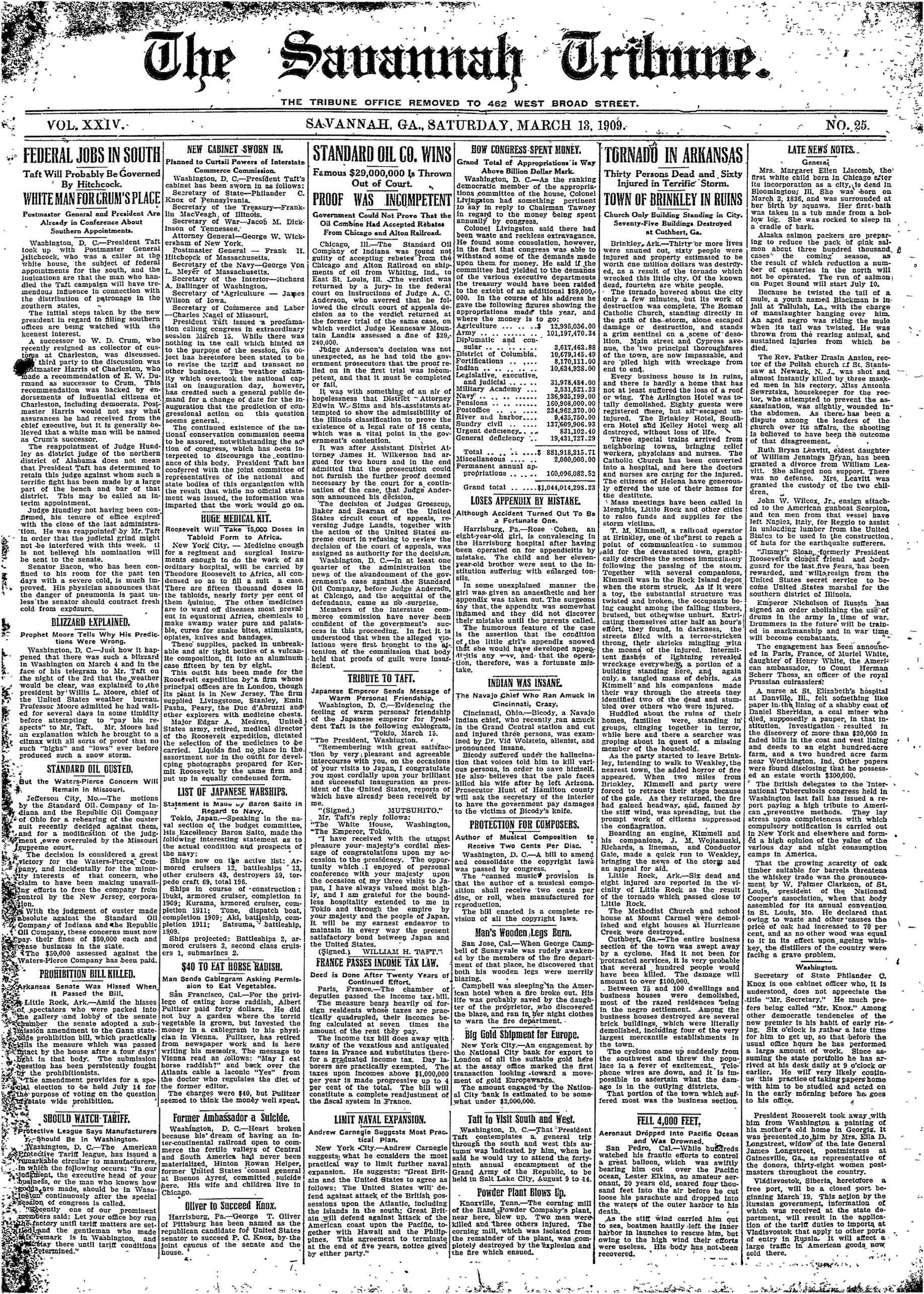

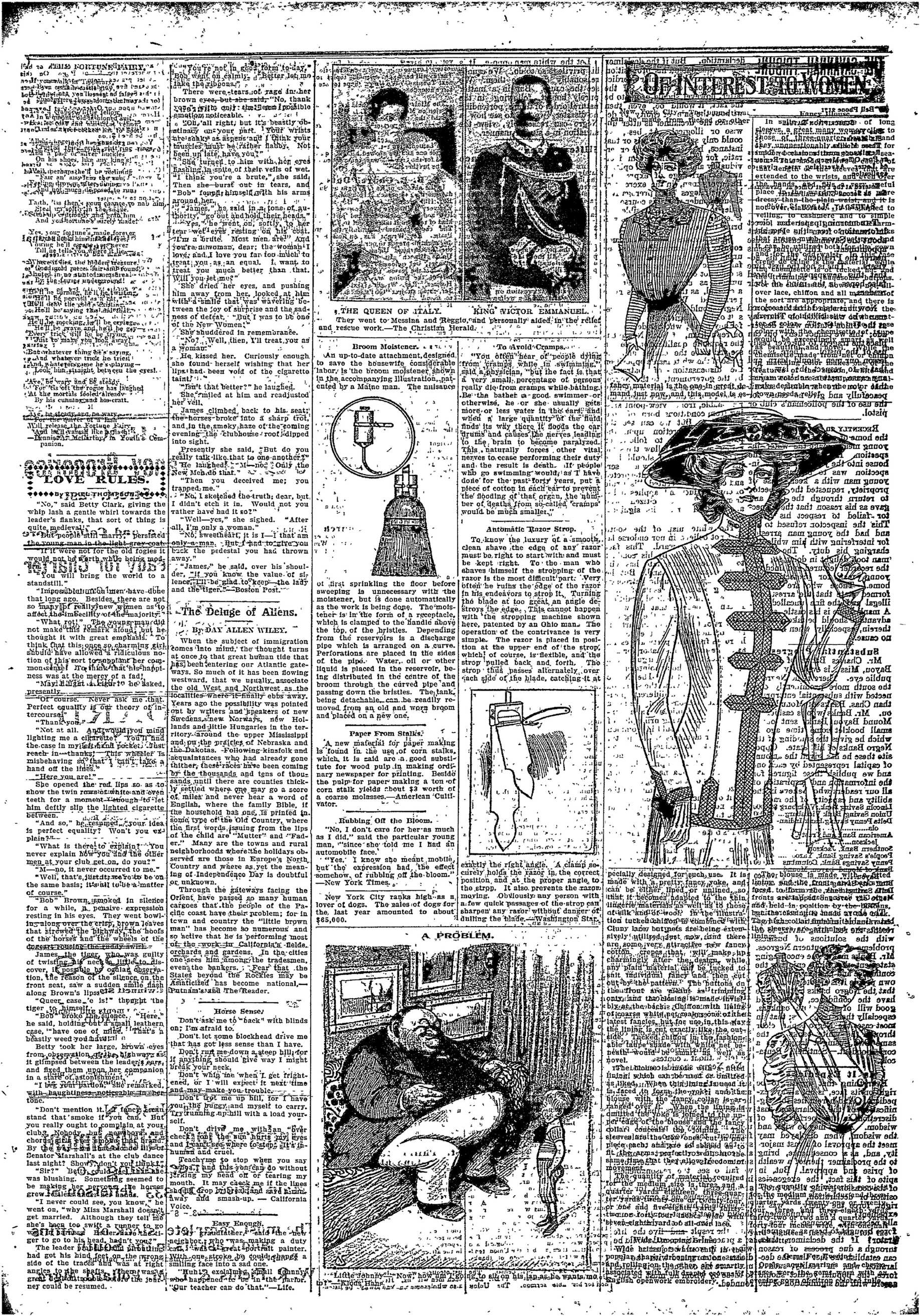
Page text (machine-generated)
Savannah Tribune.
VOL. XXIV.
Postmaster General and President Are Already in Conference About Southern Appointments.
Washington, D. C.—President Taft took up with Postmaster General Hitchcock, who was a caller at the white house, the subject of federal appointments for the south, and the indications are that the man who handled the Taft campaign will have tremendous influence in connection with the distribution of patronage in the southern states.
The initial steps taken by the new president in regard to filling southern offices are being watched with the keenest interest.
A successor to W. D. Crum, who recently resigned as collector of customs at Charleston, was discussed. The third party to the discussion was postmaster Harris of Charleston, who made a recommendation of E. W. D. Durand as successor to Crum. This recommendation was backed by endorsements of influential citizens of Charleston, including democrats. Poor-mannered officials, which assurances he had received from the chief executive, but it is generally believed that a white man will be named as Crum's successor.
The reappointment of Judge Hundley as district judge of the northern district of Alabama does not mean that President Taft has determined to retain this judge against whom such a terrific fight has been made by a large part of the bench and bar of that district. This may be called an interim appointment.
Judge Hundley not having been confirmed, his tenure of office expired with the close of the last administration. He was reappointed by Mr. Taft in order that the judicial grind might not be interfered with this week. It is not believed his nomination will be sent to the senate.
Senator Bacon, who has been confined to his room for the past ten days with a severe cold, is much improved. His physician announces that the danger of pneumonia is past unless the senator should contract fresh cold from exposure.
BLIZZARD EXPLAINED.
Prophet Moore Tells Why His Predictions Were Wrong.
Washington, D. C.—Just how it happened that there was such a blizzard in Washington on March 4 and in the face of his telegram to Mr. Taft on the night of the 3rd that the weather would be clear, was explained to the president by Willis L. Moore, chief of the United States weather bureau. Professor Moore admitted he had waited for several days in some timidity before attempting to "pay his respects" to Mr. Taft. Mr. Moore had an explanation which he brought to a climax with all sorts of proof that no such "highs" and "lows" ever before produced such a snow storm.
STANDARD OIL OUSTED.
But the Waters-Pierce Concern Will Remain in Missouri.
Jefferson City, Mo.—The motions by the Standard Oil Company of Indiana and the Republic Oil Company of Ohio for a rehearing of the ouster suit recently decided against them, and for a modification of the judgment, ewre overruled by the Missouri supreme court.
The decision is considered a great victory for the Waters-Pierce Company, and incidentally for the minority interests of that concern, who claim to have been making unavailing efforts to free the company from control by the New Jersey corporation.
With the judgment of ouster made absolute against the Standard Oil Company of Indiana and the Republic Oil Company, these concerns must now pay their fines of $50,000 each and lease business in the state.
The $50,000 assessed against the Waters-Pierce Company has been paid.
PROHIBITION BILL KILLED.
Arkansas Senate Was Hissed When It Passed the Bill.
At Little Rock, Ark.—Amid the hisses of spectators who were packed into the gallery and lobby of the senate chamber the senate adopted a submission amendment to the Gann statewide prohibition bill, which practically tells the measure which was passed intact by the house after a four days' light in that body. The submission question has been persistently fought by the prohibitionists.
The amendment provides for a special election to be held July 14 for the purpose of voting on the question of state wide prohibition.
SHOULD WATCH: TARIFF
Protective League Says Manufacturers Should Be in Washington. Washington, D. C.—The American Protective Tariff league, has issued a remarkable circular to manufacturers, in which the following occurs: "In our judgment, the executive head of your business, or the man who knows how goods are made, should be in Washington continuously after the special session of congress is called. "Recently one of our prominent members said: Let your office boy run the factory until tariff matters are settled and the gentleman who made the remark is in Washington, and stay there until tariff conditions determined."
```markdown
```
The
NEW CABINET SWORN IN.
Planned to Curtail Powers of Interstate Commerce Commission.
Washington, D. C.—President Taft's cabinet has been sworn in as follows: Secretary of State—Philander C. Knox of Pennsylvania.
Secretary of the Treasury—Franklin MacVeigh, of Illinois.
Secretary of War—Jacob M. Dickinson of Tennessee.
Attorney General—George W. Wickersham of New York.
Secretary of the Navy—George Von L. Meyer of Massachusetts.
Secretary of the Interior—itchard A. Ballinger of Washington.
Secretary of Agriculture — James Wilson of Iowa.
Secretary of Commerce and Labor—Charles Nagel of Missouri.
President Taft issued a proclamation calling congress in extraordinary session March 15. There was standing in the call which hinted as to the purpose of the session. The project has heretofore been stated to be to revise the tariff and transact no other business. The weather calamity which overtook the national capital on inauguration day, however, has created such a general public demand for a change of date for the inauguration that the prediction of congressional action on this question seems general.
The continued existence of the national conservation commission seems to be assured, notwithstanding the action of congress, which has been interpreted to discourage the continuance of this body. President Taft has conferred with the joint committee of representatives of the national and state bodies of this organization with the result that while no official statement was issued, the information was imparted that the work would go on.
HUGE MEDICAL KIT.
Roosevelt Will Take 15,000 Doses in Tabloid Form to Africa.
New York City. — Medicine enough for a regiment and surgical instruments enough to do the work of an ordinary hospital, will be carried by Theodore Roosevelt to Africa, all condensed so as to fill a suit, a case. There are fifteen thousand doses in the tabloids, nearly forty per cent of them quinine. The other medicines are to ward off diseases most prevalent in equatorial Africa, chemicals to make swamp water pure and palatable, cures for snake bites, stimulants, opiates, knives and bandages.
These supplies, packed in unbreakable and air tight bottles of a vulcanite composition, fit into an aluminum case fifteen by ten by eight.
This outfit has been made for the Roosevelt expedition by a firm whose principal offices are in London, though its plant is in New Jersey. The firm supplied Livingstone, Stanley, Emin Pashn, Peary, the Duc d'Abruzzi and other explorers with medicine chests.
Major Edgar A. Mearns, United States army, retired, medical director of the Roosevelt expedition, dictated the selection of the medicines to be carried. Liquid finds no place in the assortment for the treatment of photographs prepared for Kermit Roosevelt by the same firm and nut up in equally condensed form.
LIST OF JAPANESE WARSHIPS.
Statement is Made by Baron Saito in Regard to Navy.
Tokio, Japan—Speaking in the naval section of the budget committee, His Excellency Baron Salto, made the following interesting statement as to the actual condition and prospects of the navy:
Ships now on the active list: Armored cruisers 12, battleships 13, other cruisers 43, destroyers 59, torpedo craft 69, total 196.
Ships in course of construction: ibuki, armored cruiser, completion in 1909; Kurama, armored cruiser, completion 1911; Tone, dispatch boat, completion 1909; Aki, battleship, completion 1911; Satsuma, battleship, 1909.
Ships projected: Battleships 2, armored cruisers 3, second class cruisers 1, mariners 2.
$40 TO EAT HOBSE RADISH.
Man Sends Cablegram Asking Permission to Eat Vegetables.
Sán Francisco, Cal.-For the privilege of eating horse raddish, Albert Pulitzer paid forty dollars. He did not buy a garden where the torrid vegetable is grown, but invested the money in a cablegram to his physician in Vienna. Pulitzer, has retired from newspaper work and is here writing his memoirs. The message to Vienna read as follows: "May I eat horse raddish?" and back over the Atlanta cable a laconic "Yes" from the doctor who regulates the diet of the former editor.
The charges were $40, but Pulitzer seemed to think the money well spent,
Former Ambassador a Sulcide.
Washington, D. C.-Heart broken because his'dream of having an inter-continental railroad open to commerce the fertile valleys of Central and South America had never been materialized, Hinton Rowan Helper, former United States 'consul general at Buenos Ayres, committed suicide here. His wife and children live in Chicago.
Oliver to Succeed Knox.
Harrisburg, Pa.—George T. Oliver of Pittsburg has been named as the republican candidate for United States senator to succeed P. C. Knox, by-the joint caucus of the senate and the house.
THE TRIBUNE OFFICE REMOVED TO 462 WEST BROAD STREET. SAVANNAH. GA., SATURDAY. MARCH 13. 1909.
STANDARD OIL CO. WINS
Famous $29,000,000 Is Thrown
Out of Court.
PROOF WAS INCOMPETENT
Government Could Not Prove That the Oil Combine Had Accepted Rebates From Chicago and Alton Railroad.
Chicago, Ill.-The Standard Oil Company of Indiana was found not guilty of accepting rebates from the Chicago and Alton Railroad on shipments of oil from Whiting, Ind., to East St. Louis, Ill. The verdict was returned by a jury in the federal court on instructions of Judge A. C. Anderson, who averred that he followed the circuit court of appeals decision as to the verdict returned at the former trial of the same case, on which verdict Judge Kennesaw Mountain Landis assessed a fine of $29,240,000.
Judge Anderson's decision was not unexpected, as he had told the government prosecutors that the proof relied on in the first trial was incompetent, and that it must be completed or fall.
It was with something of an air of hopelessness that District - Attorney Edwin W. Sims and his assistants attempted to show the admissibility of the Illinois classification to prove the existence of a legal rate of 18 cents, which was a vital point in the government's contention.
It was after Assistant District Attorney James H. Wilkerson had argued for two hours and in the end admitted that the prosecution could not furnish the further proof deemed necessary by the court for a continuation of the case, that Judge Anderson announced his decision.
The decision of Judges Groscup, Baker and Seaman of the United States circuit court of appeals, reversing Judge Landis, together with the action of the United States supreme court in refusing to review the decision of the court of appeals, was assigned as authority for the decision. Washington, D. C.-In at least one quarter of the administration the news of the abandonment of the government's case against the Standard Oil Company, before Judge Anderson, at Chicago, and the acquittal of the defendants, came as no surprise. Members of the interstate commerce commission have never been confident of the government's success in this proceeding. In fact it is understood that when the alleged violations were first brought to the attention of the commission that body held that proofs of guilt were insufficient.
TRIBUTE TO TAFT.
Japanese Emperor Sends Message of Warm Personal Friendship, Washington, D. C.—Evidencing the feeling of warm personal friendship of the Japanese emperor for President Taft is the following cablogram, "Tokio, March 15. "The President, Washington. "Remembering with great satisfaction by very pleasant and agreeable intercourse with you, on the occasions of your visits to Japan, I congratulate you most cordially upon your brilliant and successful inauguration as president of the United States, reports of which have already been received by me. (Signed.) MUTSUHITO." Mr. Taft's reply follows:
"The White House, Washington,
"The Emperor, Tokio,
"I have received with the utmost pleasure your majesty's cordial message of congratulations upon my accession to the presidency. The opportunity which I enjoyed of personal conference with your majesty upon the occasion of my three visits to Japan, I have always valued most highly, and I am grateful for the boundless hospitality extended to me in Tokio and through the empire by your majesty and the people of Japan. It will be my earnest endeavor to maintain in every way the present satisfactory bond between Japan and the United States.
(Signed.) WILLIAM H. TAFT."
FRANCE PASSES INCOME TAX LAW.
Deed is Done After Twenty Years of Continued Effort.
Paris, France.—The chamber of deputies passed the income tax, bill. The measure bears heavily on foreign residents whose taxes are practically quadrupled, their incomes being calculated at seven times the amount of the rent they pay. The income tax bill does away with zany of the rent payments constituted taxes in France and substitutes them for a graduated income tax. Day laborers are practically exempted. The taxes upon incomes above $1,000,000 per year is made progressive up to 4 per cent of the total. The bill will constitute a complete readjustment of the fiscal system in France.
LIMIT NAVAL EXPANSION.
Andrew Carnegie Suggests Most Practical Plan.
New York City.—Andrew Carnegie suggests, what he considers the most practical way to limit further naval expansion. He suggests: "Great Britain and the United States to agree as follows: The United States will defend against attack of the British possessions upon the Atlantic, including the islands in the south; Great Britain will defend against attack of the American coast upon the Pacific, together with Hawaii and the Philippines. This agreement to terminate at the end of five years, notices given by either party."
HOW CONGRESS-SPENT MONEY.
Grand Total of Appropriations is Way Above Billion Dollar Mark.
Washington, D. C.-As the ranking democratic member of the appropriations committee of the house, Colonel Livingston had something pertinent to say in reply to Chairman Tawney in regard to the money being spent annually by congress.
Colonel Livingston said there had been waste and reckless extravagance. He found some consolation, however, in the fact that congress was able to withstand some of the demands made upon them for money. He said if the committee had yielded to the demands of the various executive departments the treasury would have been raided to the extent of additional $59,900,000. In the course of his address he gave the following figures showing the appropriations made this year, and where the money is to go:
Diplomatic and consular District of Columbia. Fortifications Indian
3,617,463.88
10,679,145.49
8,170,111.00
10,634,928.00
and judicial .....
Military Academy .....
Navy .....
Pensions .....
Postoffice .....
River and harbor .....
Sundry civil .....
Urgent deficiency .....
General deficiency .....
31,978,484.00
2,531,521.33
136,935,199.00
160,908,000.00
234,962,370.00
9,435,750.00
137,609,906.93
831,102.40
19,431,727.29
LOSES APPENDIX BY MISTAKE.
Although Accident Turned Out To Be a Fortune One.
Harrisburg, Pa.-Rose Cohen, an eight-year-old girl, is convalescing in the Harrisburg hospital after having been operated on for appendicitis by mistake. The child and her eleven-year-old brother were sent to the institution suffering with enlarged tonsils. In some unexplained manner the girl was given an anaesthetic and her appendix was taken out. The surgeons say that the appendix was somewhat bimaculate and they did not discover their mistake until the prognostic call. The humorous feature of the case is the assertion that the condition of the little girl's appendix snowed that she would have developed appendicitis any way, and that the operation, therefore, was a fortunate mistake.
INDIAN WAS INSANE
The Navajo Chief Who Ran Amuck in Cincinnati, Crazy.
Cincinnati, Ohio.-Bicody, a Navajo Indian chief, who recently ran amuck in the Grand Central station and cut and injured three persons, was examined by Dr. Vid Wolstein, alienist, and pronounced Insane.
Bicody suffered under the hallucination that voices told him to kill various persons, in order to save himself. He also believes that the pale faces killed his wife after he left Arizona.
Prosecutor Hunt of Hamilton county will ask the secretary of the interior to have the government pay damages to the victims of Bicody's knife.
PROTECTION FOR COMPOSERS.
Author of Musical Composition to Receive Two Cents Per Disc.
Washington, D. C.-A bill to amend and consolidate the copyright laws was passed by congress.
The "canned music provision is that the author of a musical composition shall receive two cents per disc, or roll, when manufactured for reproduction.
The bill enacted is a complete revision of all the copyright laws.
Man's Wooden Legs Burn.
San Jose, Cal—When George Campbell of Sunnyvale was rudely awakened by the members of the fire department of that place, he discovered that both his wooden legs were merrily blazing. Campbell was sleeping in the American hotel when a fire broke out. His life was probably saved by the daughter of the proprietor, who discovered the blaze, and ran in her night clothes to warn the fire department.
Big Gold Shipment for Europe.
New York City—An engagement by the National City bank for export to London of all the suitable gold here at the assay office marked the first transaction looking toward a movement of gold here. The amount engaged by the National City bank is estimated to be somewhat under $2,000,000.
Taft to Visit South and West.
Washington, D. C.—That President Taft contemplates a general trip through the south and west this autumn was indicated by him, when he said he would try to attend the forty-ninth annual encampment of the Grand Army of the Republic, to be held in Salt Lake City, August 9 to 14.
Powder Plant Blows Up.
Knoxville, Teen.—The corning mill of the Rand Powder Company's plant, near here, blew up. Two men were killed and three others injured. The corning mill, which was isolated from the remainder of the plant, was completely destroyed by the explosion and the fire which ensued.
TORNADO IN ARKANSAS Thirty Persons Dead and Sixty Injured in Terrific Storm. TOWN OF BRINKLEY IN RUINS
Church Only Building Standing in City. Seventy-Five Buildings Destroyed at Cuthbert, Ga.
Brinkley, Ark.—Thirty or more lives were snuned out, sixty people were injured and property estimated to be worth one million dollars was destroyed, as a result of the tornado which wrecked this little city. Of the known dead, fourteen are white people. The tornado hovered about the city only a few minutes, but its work of destruction was complete. The Roman Catholic Church, standing directly in the path of the storm, alone escaped damage or destruction, and stands a grim sentinel on a scene of desolation. Main street and Cypress avenue, the two principal thoroughfares of the town, are now impassable, and are piled high with wreckage from end to end.
Every business house is in ruins, and there is hardly a home that has not at least suffered the loss of a roof or wing. The Arlington Hotel was totally demolished. Eighty guests were registered there, but all escaped uninjured. The Brinkley Hotel, Southern Hotel and Kelley Hotel were all destroyed, without loss of life. Three special trains arrived from neighboring towns, bringing relief workers, physicians and nurses. The Catholic Church has been converted into a hospital, and here the doctors and nurses are caring for the injured. The citizens of Helena have generously offered the use of their homes for the destitute. Mass meetings have been called in Memphis, Little Rock and other cities to raise funds and supplies for the storm victims.
T. M. Kimmel, a railroad operator at Brinkley, one of the first to reach a point of communication to summon aid for the devastated town, graphically describes the scenes immediately following the passing of the storm. Together with several companions, Kimmel was in the Rock Island depot when the storm struck. As if it were a toy, the substantial structure was twisted and broken; the occupants being caught among the falling timbers, bruised, but otherwise unhurt. Extricating themselves after half an hour's effort, they found, in darkness, the streets filled with a terror-striken throng, their shrieks mingling with the moans of the injured. Intermittent flashs of lightning revealed wreckage everywhere a portion of a building standing here, and again only, a tangled mass of debris. As Kimmel and his companions made their way through the streets they identified two of the dead and stumbled over others who were injured.
Huddled about the ruins of their homes, families were, standing in groups, clinging together in terror, while here and there a searcher was groping about in quest of a missing member of the household.
As the party started to leave Brinkley, intending to walk to Weakley, the nearest town, the added horror of fire appeared. When two miles from Brinkley, Kimmell and party were forced to retrace their steps because of the gale. As they returned, the fire had gained headway, and, fanned by the stiff wind, was spreading, but the prompt work of citizens suppressed the confugation.
Boarding an engine, Kimmell and his companions, J. M. Wojtanaukz, Richards, a lineman, and Conductor Gale, made a quick run to Weakley, bringing the news of the storm and an appeal for aid.
Little Rock, Ark.-Six dead and eight injured are reported in the vicinity of Little Rock as the result of the tornado which passed close to Little Rock.
The Methodist Church and school house at Mount Carmel were demolished and eight houses at Hurricane Creek were destroyed. Cuthbert, Ga.-The entire business section of the town was swept away by a cyclone. Had it not been for protracted services, it is very probable that several hundred people would have been killed. The damage will amount to over $100,000. Between 75 and 100 dwellings and business houses were demolished, most of the razed residences being in the negro settlement. Among the business houses destroyed are several brick buildings, which were literally demolished, including four of the very largest mercantile establishments in the town. The cyclone came up suddenly from the southwest and threw the populace in a fever of excitement. Telephone wires are down, and it is impossible to ascertain what the damage is in the outlying districts. That portion of the town which suffered most was the business section
FELL 4,000 FEET.
Aeronaut Dropped Into Pacific Ocean and Was Drowned
San Pedro, Cal.-While hundreds watched his frantic efforts to control a great balloon, which was swiftly bearing him out over the Pacific ocean, Lester Elkins, an amateur seronant, 20 years old, soared four thousand feet into the air before he cut loose his parachute and dropped into the waters of the outer harbor to his death.
As the stiff wind carried him out to sea, boatmen hastily left the inner harbor in launches to rescue him, but owing to the high wind their efforts were useless. His body has not been recovered.
LATE NEWS NOTES.
Mrs. Margaret Ellen Liscomb, the first white child born in Chicago after its incorporation as a city, is dead in Bloomington, Ill. She was born on March 3, 1836, and was surrounded at her birth by squawas. Her first bath was taken in a tub made from a hollow log. She was rocked to sleep in a cradle of bark.
Alaska salmon packers are preparing to reduce the pack of pink salmon about three hundred thousand cases, the coming season, as the result of which reduction a number of canneries in the north will not be operated. The run of salmon on Puget Sound will start July 10.
Because he twisted the tail of a mule, a youth named Blackman is in jail at Tallulah, La., with the charge of manslaughter hanging over him. An aged negro was riding the mule when its tail was twisted. He was thrown from the rearing animal, and sustained injuries from which he died.
The Rev. Father Erasin Anston, rector of the Polish church of St. Stanisław at Newark, N. J., was shot and almost instantly killed by three masked men in his rectory. Miss Anonia Sewrztska, housekeeper for the rector, who attempted to prevent the assassination, was slightly wounded in the abdomen. As there has been a dispute among the leaders of the church over its affairs, the shooting is believed to have been the outcome of that disagreement.
Ruth Bryan Leavitt, eldest daughter of William Jennings Bryan, has been granted a divorce from William Leavitt. She alleged no support. There was no defense. Mrs. Leavitt was granted the custody of the two children.
John W. Wilcox, Jr., ensign attached to the American gunboat Scorpion, and ten men from that vessel have left Naples, Italy, for Reggio to assist in unloading lumber from the United States to be used in the construction of huts for the earthquake sufferers.
"Jimmy" Sloan, formerly President Roosevelt's closest friend and bodyguard for the last five years, has been rewarded, and will resign from the United States secret service to become United States marshal for the southern district of Illinois.
Emperor Nicholson of Russia has signed an order abolishing the use of drums in the army in time of war. Drummers in the future will be trained in markmanship and in war time will become combatants.
The engagement has been announced in Paris, France, of Muriel White, daughter of Henry White, the American ambassador, to Count Herman Scherr Thoss, an officer of the royal Prussian culrassiers:
A nurse at St. Elizabeth's hospital at Danville, Ill., felt something like paper in the lining of a shabby coat of Daniel Sherridan, a coal miner who died, supposedly a pauper, in that institution. Investigation resulted in the discovery of more than $20,000 in faded bills in the coat and vest lining and deeds to an eight hundred-acre farm, and a two hundred-acre farm near Worthington, Ind. Other papers were found disclosing that he possessed an estate worth $300,000.
The British delegates to the International Tuberculosis congress held in Washington last fall has issued a report paying a high tribute to American preventive methods. They lay stress upon completeness with which compulsory notification is carried out in New York and elsewhere and formed a high opinion of the value of the various day and night consumption camps in America.
That the growing scarcity of oak timber suitable for barrels threatens the whiskey trade was the pronouncement by W. Palmer Clarkson, of St. Louis, president of the National Cooper's association, when that body assembled for its annual convention in St. Louis, Mo. He declared that owing to waste and other causes the price of oak had increased to 70 per cent, and as no other wood was equal to it in its effect upon ageing whiskey, the distillers of the country were facing a grave problem.
Washington
Secretary of State Philander C. Knox is one cabinet officer who, it is understood, does not appreciate the title "Mr. Secretary." He much prefers being called "Mr. Knox." Among other democratic tendencies of the new premier is his habit of early rising. Six o'clock is rather a late time for him to get up, so that before the usual office hours he has performed a large amount of work. Since assuming the state portfolio he has arrived at his desk daily at 9 o'clock or earlier. He will very likely continue this practice of taking papers home with him to be studied and acted on in the early morning before he goes to his office.
President Roosevelt took away with him from Washington a painting of his mother's old home in Georgia, it was presented to him by Mrs. Ella D. Longstreet, widow of the late General James Longstreet, postmistress at Gainesville, Ga., as representative of the donors, thirty-eight women postmasters throughout the country.
Vladivostok, Siberia, heretofore a free port, will be a closed port beginning March 19. This action by the Russian government, information of which was received at the state department, will result in the application of the tariff duties to imports at Vladivostok that apply to other ports of entry in Russia. It will affect a large traffic in American goods now sold there.
P. EDWARD PERRY, Vice President.
County Aid and
Supt. of Agenor
Georgia
hereby acknowledged.
L. B. Williams.
P. Edward Perrin
Walter S. Scott
Bal. C. Johnson
This company
requires of the
that the strict
Its affairs are
character and
community. The
fairs of the first
themselves with
By comparing
liberal inducement
pany in this be
That we pay
The Guaranty Aid and Relief Society SOL. C. JOHNSON, Supt. of Agenoas
This company is duly chartered under the laws of the State of Georgia, and has complied with, all requirements of the State Insurance department, therefore all policy holders are protected with all the safeguards that the strict insurance laws of this State seek to protect its citizens.
Its affairs are directed and managed by Negro men of the city of Savannah of leading standing, and whose character and reputation are of such as to command the respect and confidence of all the people of that community. The same men that manage this Society are the ones that organized and are conducting the affairs of the first successful Negro Savings Bank in this state, therefore we can readily see that by connecting themselves with this Insurance company their interest will be in safe hands.
By comparing our rules and benefits with other first class companies it will be seen that we offer the most liberal inducements with the largest sick, accident and death benefits to our members than any other company in this business.
That we pay our claims promptly can be testified to by the thousands of our satisfied members.
of the State of Georgia.
W. H.
—Dea
une S MODES, a woman's P. B. Tailo
for one year for only $1.40
whole area of events. The
complete issue. Each week
Agricultural South, Farm-
interest, edited by experts,
the difference between it
Monday only) and the
the fashions in it, as the title all of the sylph-like, hipless, it called "Fashion." They feel well-dressed and in
long in total Ten Thousand Dollars , and which are held by the State of Georgia , by authority and under the provisions of an Act of the General Assembly , approved October 22d, 1887 , and amended December 20th, 1877.
R. E. Parsi.
75 The 1909 Subscription Offer The Best Offer Made for the New Year $1.75 THE TRI-WEEKLY ATLANTA CONSTITUTION AND
Either with the superb FREE OFFERS of PARIS MODES, a woman's magazine; or THE SOUTHERN RURALIST; a splendid agricultural mer; or TALKS FROM FARMERS TO FARMERS, an epitome farm wisdom, worth its weight in gold. All for only $1.75.
The Tri-Weekly Constitution Monday, Wednesday, Friday, three times a week. The newsiest, best, and biggest Southern Newspaper. At a Daily, yet at the price of a Weekly.
One Dollar a Year
The Weekly Constitution—once a week, with each of the above (except the Weekly Constitution is substituted for the Tri-Weekly)—all for one year for only $1. Tri-Weekly Constitution presents at one sweeping view the whole area of events. To of the country, state, nation, and the world is given in each complete issue. Each week departments of Farm and Farmers, Woman's Kingdom, Great Agricultural South, Farm Union, Rural Free Delivery. Poultry and others of wide interest, edited by expert directly to those addressed.
Weekly Constitution contains all these special features and the difference between the Tri-Weekly is that the one is issued once a week (on Monday only) and the three times a week—Monday, Wednesday and Friday.
You want the Constitution alone, without any clubbing offers, you can get the Tri-Week institution at $1 per year, or The Weekly at 50c per year, by addressing The Constitution at, Ga. One sample copy sent free on request, giving with it six of your neighbors
together with the superb FREE OFFERS of PARIS MODES, a woman's magazine; or THE SOUTHERN RURALIST; a splendid agricultural paper; or TALKS FROM FARMERS TO FARMERS, an epitome of farm wisdom, worth its weight in gold. All for only $1.75
brightest, and biggest Southern-Newspaper. Almost a Daily, yet at the price of a Weekly. or The Weekly Constitution once a week, with each of the above (except that The Weekly Constitution is substituted for the Tri-Weekly) all for one year for only $1.40 The Tri-Weekly Constitution presents at one sweeping view the whole area of events. The news of the country, state, nation, and the world is given in each complete issue. Each week the departments of Farm and Farmers, Woman's Kingdom, Great Agricultural South, Farmers' Union, Rural Free Delivery. Poultry and others of wide interest, edited by experts, appeal directly to those addressed.
The Weekly Constitution contains all these special features and the difference between it and The Tri-Weekly is that the one is issued once a week (on Monday only) and the other three times a week—Monday, Wednesday and Friday.
If you want the Constitution alone, without any clubbing offers, you can get the Tri-Weekly Constitution at $1 per year, or The Weekly at 50c per year, by addressing The Constitution, Atlanta, Ga. One sample copy sent free on request, giving with it six of your neighbors.
THE CONSTITUTION IS THE PAPER FOR RURAL FREE DELIVERY ROUTES
of 40 or 50 or more will keep an R. F. D. route above the minimum average required by mail service. It is the great news purveyor of the whole Southland, as good as Gulf states as on the Atlantic seaboard. Clubbed with The Atlanta Constitution, we have the superb FREE OFFERS shown which you may make your choice of one:
1) Talks From Farmers to Farmers, a symposium of Southern farm knowledge that will be in the hands of every practical farmer, young or old. The articles have all been in Tri-Weekly Constitution under same title and made one of the greatest features of allendid farmers' paper. It will be mailed to you immediately upon receipt of order.
2) The Southern Ruralist, one of the best agricultural papers in the south. It is monthly edited by a farmer on his own farm, and is intensely practical and helpful.
3) Paris Modes, a woman's magazine, monthly. There are fashions in it, as the tide states, and they are right up to date. Do not think they are all of the sylph-like, hipper-pin styles of the extreme devotees of the changeable flirt called "Fashion." They are pretty and becoming and up to date, so that the ladies may feel well-dressed and style who follow them. But you get more than mere fashions. There are stories, poems, letters, incidents of travel, seasonable articles for entertainments, home keeping, cooks of the person, sanitation and hygiene, plant culture and all the rest that go to make a healthy feast for the busy woman who reads as she works, who relaxes from one task and charm in the ever-varying features of woman's work that is said to be never done.
A club of 40 or 50 or more will keep an R. F. D. route above the minimum average required for daily mail service. It is the great news purveyor of the whole Southland, as good in the gulf states as on the Atlantic seaboard.
Clubbed with The Atlanta Constitution, we have the superb FREE OFFERS shown from which you may make your choice of one:
(1) Talks From Farmers to Farmers, a symposium of Southern farm knowledge that should be in the hands of every practical farmer, young or old. The articles have all appeared in Tri-Weekly Constitution under same title and made one of the greatest features of this splendid farmers' paper. It will be mailed to you immediately upon receipt of order.
(2) The Southern Ruralist, one of the best agricultural papers in the south. It is a semi-monthly edited by a farmer on his own farm, and is intensely practical and helpful.
semi-monthly edited by a farmer on his own farm, and is intensely practical and helpful. (3) Paris Modes, a woman's magazine, monthly. There are fashions in it, as the title indicates, and they are right up to date. Do not think they are all of the sylph-like, hipless, clothes-pin styles of the extreme devotees of the changeable flirt called "Fashion." They are all pretty and becoming and up to date, so that the ladies may feel well-dressed and in the style who follow them. But you get more than mere fashions. There are stories, poems, storyettes, incidents of travel, seasonable articles for entertainments, home keeping, cookery, care of the person, sanitation and hygiene, plant culture and all the rest that go to make up a monthly feast for the busy woman who reads as she works, who relaxes from one task and finds charm in the ever-varying features of woman's work that is said to be never done.
OUR GREAT PROPOSITION
remember, our paper one year, and THE TRI-WEEKLY CONSTITUTION, Mo Wednesday and Friday, three times a week, for one year, and your selection of or the three alternate free offers, all for $1.75; or the whole combination (except that Tly Constitution is substituted for the Tri-Weekly) for only..... $1.4 end at once. Get right on. Don't miss a copy. Address all orders for above co on to
Remember, our paper one year, and THE TRI-WEEKLY CONSTITUTION, Monday, Wednesday and Friday, three times a week, for one year, and your selection of one from the three alternate free offers, all for $1.75; or the whole combination (except that The Weekly Constitution is substituted for the Tri-Weekly) for only..... $1.40 Send at once. Get right on. Don't miss a copy. Address all orders for above combination to
---
The Savannah Tribune
THE SAVANNAH TRIBUNE, Savannah, Ga.
L. B. Williams.
P. Edward Perry.
Walter S. Scott.
Sel. C. Johnson.
This company is duly chartered and requirements of the State Insurance of that the strict insurance laws of its affairs are directed and manage character and reputation are of such community. The same men that make fairs of the first successful Negro business themselves with this Insurance company By comparing our rules and benefiting liberal inducements with the large pany in this business.
That we pay our claims promptly.
Agents
Libera
W. H. LLOYD,
—Dealer In—
GROCERIES, WOOD AND COAL
621 Oglethorpe Avenue. East
518 PHONES Bell 80
P. B. RAY,
DRY AND STEAM CLEANING.
LADIES' WORK A SPECIALTY.
HATS CLEANED AND REBLOCKED
BELL PHONE 2050.
JEFFERSON AND BERRIEN STS.
SAVANNAH, GA.
Masonic Books &
LODGE SEALS,
FINANCIAL CARDS and
BLANKS of every description.
Publishers' and Manufacturers' Prices. Liberal Discounts Will Be Arranged
SOL. C. JOHNSON Notary Public.
Deods, Contracts, Wills and Other
Legal Forms Prepared and
Attested.
115 West St. Julian Street
A Bad Catch:
Hurrying gut on hearing a commotion, I found that it was my little 3-year-old sister, Muriel, whose cap and hair were covered with blood. As soon as I had bathed her head and quieted her, I asked her the cause of the accident.
"I threw that brick up for God to catch," was the reply, "and He didn't catch it."—The Delineator.
Bones (telling a story)—Well, the evening wore on—
Jones—It did, eh? What did it wear?
Bones—Well, if you must know, I believe it was the close of a summer day.—Life.
The man who has to weather a storm usually storms at the weather.
Some men feel tired as soon as they face a situation.
60L. C. JOHNSON,
Bavannah, Ga.
WALTER S. SCOTT, Secretary and Tr < as.
Relief Society
HOME OFFICE.
WEST BROAD STREET,
SAVANNAH, GEORGIA.
Phone 1193. Ga. Phone 2029.
Directors.
W. R. Fields.
J. H. Deveaux
L. M. Pollard.
W. H. Burgess.
J. H. Bugg, M. D.
J. M. Ferrebee.
under the laws of the State of Georgia, and has complied with all the department, therefore all policy holders are protected with all the safeguards this State seek to protect its citizens.
led by Negro men of the city of Savannah of leading standing, and whose such as to command the respect and confidence of all the people of that manage this Society are the ones that organized and are conducting the af-savings Bank in this state, therefore we can readily see that by connecting company their interest will be in safe hands.
All with other first class companies it will be seen that we offer the most best sick, accident and death benefits to our members than any other company can be testified to by the thousands of our satisfied members.
Wanted Everywhere
1 Terms and Commission.
ADDRESS THE HOME OFFICE,
458 West Broad St.,
Savannah, Georgia.
Is Your Hair Beautiful
Soft, Silky and Long?
Does it comb easily without breaking?
Is it straight?
Does it smooth out nicely?
Can you do it up in any of the charm-
ing styles, so it will stay, and
make you proud of it?
Is it long and full of life?
If you cannot say YES to all of the
above questions, then you need
Nelson's
Hair Dressing
NELSON'S HAIR DRESSING is the finest hair
pomade on the face of the earth for colored people.
It makes your hair grow fast; it makes stubborn, kinky and
tangled hair as soft and supple as silk. It makes it healthy.
It keeps it from splitting or breaking off. It makes it rich
and gives it charm so longed for by all true ladies.
Use Nelson's Hair Dressing and you'll never
have dandruff.
Your head will keep clean. The roots of your hair will have the necessary
amount of oil. You will never have scalp disease. You will be delighted with its delicate perfume.
Nelson's Hair Dressing is put up in handsome four-ounce square tin boxes,
like the lady holds in her hand. Drugstores and
agents everywhere sell it at 25 cents a box. If you can't get it, send us 30 cents and we will mail
you a full size box postpaid. Go and buy it now, or sit right down and write us. Address
NELSON MANUFACTURING CO., Richmond, Va.
Live Agents Wanted. Write Quick for Terms.
MONEY DEPOSITED WITH The Wage Earners Loan and Investment Company
IS DOUBLY SECURED BY THOUSANDS OF DOLLARS INVESTED IN SAVANNAH REAL ESTATE.
5 PER CENT PAID ON DEPOSITS.
The Wage Earners Loan & Investment Co.,
THE PIONGER NEGRO SAVINGS BANK OF GEORGIA.
BELL PHONE 1198. 468 WEST BROAD ST.
OWNED AND CONTROLLED BY SAVANNAH NEGROES.
Job Printing
Of Every Description Promptly and Neatly Executed Send Us Your Order.
Isid to ATHIS NORTUNEIPATH?
Isid n( )
Isid: If you should be a "Tiger" or a "Tiger"
and I can't be on the other side, you'll be on
both side. You'll be at the top of the
situations where you should be in
way as to being in the right place.
The U.S. and the U.S. and the U.S.
in the world.
The U.S. and the U.S. and the U.S.
are the two sides.
Ahlieh hpzegel hpzegel hpzegel
Custodil fiter fiter fiter fiter fiter fiter
Ahlieh part of outer knocks
On his shoes, like any king
heart
Milk, perhaps she'll be melting
Fair an 'any' she'll the sun's
And you should safely handle
Yes, you for future more foresee,
bought him himself, and loving he'll escape never
Tell, tell you where it lies.
Wherever dies, the hidden treasure!
Good gold pieces, furious found,
Shield in no stunted sheaths.
By the sturge ungrounded.
He'll burn, he'll live,
He'll die previsil as it falls,
He'll deny the gold existence,
He'll be saying that he'll die,
He'll be mocking him he will be erring.
Are, be wary and be steady.
For his oft the rogue has laughed.
At the mortals fooled already.
By his cunning and brawn.
Are, be steady and be wary.
For his oft the rogue has laughed.
Will release the Fortune.
LOVE RULES.
BY DURT THOMPSON
"No," said Betty Clark, giving the whip lash a gentle whirl towards the leader's flanks, that sort of thing is quite medieval."
"You will bring the world to a standstill."
"Impossible to children have done that long ago. Besides, there are not so many of really new women as to affect the imimplicity of the majority."
"What rott?" The course man did not make this remark aloud, but he thought it with great emphasis. To think that this once so charming girl should have allowed a siliconous notion of this sort to applaud her common sense. To think that this happiness was at the mercy of a fad.
"May it happen a slight to be asked, presently."
Of course. Never ask me that. Perfect equality is our theory of intercourse.
"Thank you."
"Not at all. And would you mind lighting me a cigarette? You'll find the case in my left pocket. Just reach in—thanks! This wheeler is misbehaving so that I can't take a hand off the lines."
"Here you are!"
She opened the red lips so as to show the twin rowson white and oven teeth for a moment enough to let him detly slip the lighted cigarette between.
"And so, he resumed, 'your idea is perfect equality? Won't you explain?'"
"What is there to explain? You never explain how you and the other men at your club get on, do you?"
"M—no, it never occurred to me."
"Well, that's just never to be on the same basis; it will be a matter of course."
"Bob" Brown, isnokod in silence for a while, in pensive expression resting in his eyes. They went bowl-in along over the crisp, brown leaves that strewed the highway, the hoofs of the horses and the wheels of the horses running the road swish.
James, the tiger, who was guilty of twisting his neck in little to discover, it possible by ocular observation, the reason of the silence on the front seat, saw a sudden smile flash along Brown's lips.
"Queer case, o' is!" thumped the tiger to himself.
"Bou" broke the silence. "Here," he said, holding but a small leather case, "have one of mild! That's in beastly weed you have!"
Betty took her large, brown eyes from observation, the highways as it glimpsed between the leaders' ears, and fixed them upon her companion in a shifty astonishment. "I be your lionation," she remarked, with haughtiness, notorious in her tone.
"Don't mention it, let fancy brain stand that smoke it you can. But you really ought to complain at your clubs. Nobody else has more brains, and chorus girls should be proud that brand. By the war they have made ill of Senator Marshall's at the club dance last night? Show, don't you think?"
"Sir?" Betty could hardly bear was blushing. Something seemed to be making her perceive the horses grew less less and less.
"I never could see, you know," he went on, "why Miss Marshall doesn't get married. Although they tell me she's been too swift a runner to go would be badness. Helder is the longer to go to his head, hadn't you?" The leader bravely shouted had got his hind feet on the wrong side of the traces and was at right angles to the shafts. There was a great trot trot behind the learner could be resumed.
You're not in good form to day,
Bob want on calmly.
Better let me
take the ribbons.
There were tears of rage in her
brown eyes, but she said, "No, thank
your wrists only the 12cm possible
emotion noticeable.
Oh, all right, but it's beautiful
obstinacy on your part. Your wrists
are sakes as aspen and I think your
muscles must be father habby. Not
been unlate, have you?"
"She turned to him with her eyes flashing, in spite of their veils of wet. "I think you're a brute," she said. Then she burst out in tears, and "Bob" foughed himself with his arms around her.
"James," he said in a tone of guiltority, "go out and hold their heads,"Yes, "he went, out, softly, to her ear, we went eyes resting on his coat."I'm a brute. Most men are!" And you're a woman, dear; the woman I love; and I love you far too much to treat you, as; an equal. I want to treat you much better than that. Will you let me?
She dried her eyes, and pushing him away from her, looked at him with a smile that was wavering between the joy of surprise and the sadness of defeat. "But I was to be one of the New Women." She shuddered in remembrance. "No! Well, then, I'll treat, you as a woman." He kissed her. Curiously enough she found herself wishing that her lips had been void of the cigarette taint. "Isn't that better?" he laughed. She smiled at him and readjusted her vell. James climbed back to his seat, the horses broke into a sharp trot, and in the smoky haze of the coming evening the clubhouse roof dipped into sight. Presently she said, "But do you really talk like that to one another?" He laughed. "M-m-m- Only the New Men do that."
"Then you deceived me; you trapped me."
"No, I sketched the truth; dear, but I didn't etch it in. Would not you rather have had it so?"
"Well—yes," she sighed. "After all, I'm only a woman."
"No, sweetheart; it is I—I that am only a man. But if I had to give you back the pedestal you had thrown away."
"James," he said, over his shoulder. "If you know the value of silence, I'll be glad to keep the lady and the linen."
The Deluge of Aliens. BY DAY ALLEN WILEY.
When the subject of immigration comes into mind, the thought turns at once to that great human tide that has been entering our Atlantic gateways. So much of it has been flowing westward, that we usually associate the old West and Northwest as the localities where finally ebbs away. Years ago the possibility was pointed out by writers and speakers of new Swedens, new Norways, new Hollands and little Hungaries in the territory around the upper Mississippi and put the priests of Nebraska and the Dakotas. Following kinsfolk and acquaintances who had already gone thither, these races have been coming by the thousands and tents of thousands until there are counties thickly settled where one may go a score of miles and never hear a word of English, where the family Bible, if the household has one, is printed in some type of the Old Country, where the first words issuing from the lips of the child are "Mutter" and "Fader." Many are the towns and rural neighborhoods where the holidays observed are those in Europe's North Country and where as yet the meaning of Independence Day is doubtful or unknown.
Through the gateways facing the Orient, have passed so many human cargoes that the people of the Pacific coast have their problem; for in town and country the "little brown man" has become so numerous and so solitive that he is performing most of the work in California's fields, orchards and gardens. In the cities one sees him among the tradesmen, even the bankers. Fear that the States beyond the Rockies may be anticivilized has become national, Putnam's and The Reader.
Don't ask me to "back" with blinds on; I'm afraid to.
Don't let some blockhead drive me that has got less sense than I have.
Don't run me down a steep hill; for if anything should give way I might break your neck.
Don't whine me when I get frightened, or I will expect it next time and may make you trouble.
Don't trot me up hill, for I have you, the buggy, and myself to carry. Try running up hill with a load yourself.
Don't drive me with an "over check" from the sun hurt's eyes and I cannot see where to step. It's inhuman and cruel.
Teachyme to stop when you say "shame" and this you can do without jerking my head off or tearing my mouth. It may check me if the lines should drop in and send him away and smash-up. - California Voice.
Easy Enough.
O my father, said the new
neighbor, who was making a duty
can't wait to paint the painter.
With one stroke you could change a
smiling face into a sad one.
"Huh? exclamations, small Gunny, who happened to be in the parlor. "Our teacher can do that."—Life.
A PROBLEM.
Little Johnny. Now how will you go to aid on his lap, as he wants me.
Ruddy Hare.
Broom Moistener.
An up-to-date attachment, designed to save the housewife considerable labor, is the broom moistener, shown in the, accompanying illustration, patented by a Maine man. The nuisance
W
ot first sprinkling the floor before sweeping is unnecessary with the moistener, but is done automatically as the work is being done. The moistener is in the form of a receptacle, which is clamped to the handle above the top of the bristles. Depending from the reservoirs is a discharge pipe which is arranged on a curve. Perforations are placed in the sides of the pipe. Water, oil or other liquid is placed in the reservoir, being distributed in the centre of the broom through the curved pipe and passing down the bristles. The tank, being detachable, can be readily removed from an old and worn broom and placed on a new one.
Paper From Stalks?
A new material for paper making is found in the usg, of corn stalks, which it is said are a, good substitute for wood pulp in making ordinary newspaper for printing. Besides the pulp for paper making a ton of corn stalk yields about $3 worth of a coarse molasses.—American Cultivator.
Rubbing Off the Bloom.
"No, I don't care for her-as much as I did," said the particular young man, "since she told me I had an automobile face.
"Yes. I know she meant mobile, but the expression had, the effect somchow of rubbing off the bloom."
—New York Times.
New York City ranks high-as a lover of dogs. The sales of dogs for the last year amounted to about $65,000.
"You often hear of people dying from cramps white in swimming," said a physician, "but the fact is that a very small percentage of persons really die from cramps while bathing. Be the bathet a good swimmer or otherwise, he or she usually gets more or less water in the ears; and whil' a large quantity of the fluid finds its way there it floods the ear drums and causes the nerves leading to the brain to become paralyzed. This naturally forces other vital nerves to cease performing their duty and the result is death. If people whb go swimming would as T have done' for the past forty years, put a piece of cotton in each ear to prevent the flooding of that organ, the number of deaths from so-called 'cramps' would be much smaller."
Antomatic Razor Strop.
Automatic razor Strop.
To know the luxury of a smooth, clean shave, the edge of any razor must be right to start with and must be kept right. To the man who shaves himself the stroping of the razor is the most difficult part. Very often he ruins the edge of the razor in his endeavors to strop it. Turning the blade at too great an angle destroys the edge. This cannot happen with the stroping machine shown here, patented by an Ohio man. The operation of the contrivance is very simple. The razor is placed in position at the upper end of the strop, which of course, is flexible, and the strop pulled back and forth. The strop thus passes alternately, over each side of the blade, catching it at
```markdown
```
exactly the right angle. A clamp securely holds the razor in the correct position, and at the proper angle, to the strop. It also prevents the razor moving. Obviously any person with a few quick passages of the strop can sharpen any razor without danger of dulling the blade.—Washington Star.
partially designed for such use. It is made with a pretty fancy, voke, and can be either lined or omitted, so that it becomes adapted to the thin lingerie materials with its to those of milk and/or wool. In the illustration turkish chiffon is combined with Clung late butteries are being extensively utilized just now, and there are, some, very attractive new fancy cotton, crepes that, will make up charmingly after the design, while any plain material can be fucked to suit individual fancy and then cut out by the pattern. The buttons on the front are widths at trimming only, and the blossoming is made invisible by the back. Chiffon with lining of coarsen white petals on one of their latest fancies, but for use in this way the lining is not exactly like the, outside. Tricked chiffon in the fashionable, able shade of white net be beneath would be shimmery as well as novel.
the moussous inside with fitted lining which is housed by un fitted lining, when this lining is fitted it is faced on lining the yoke and the bouse with the canvas collon is garanged over it. When the lining is omitted the yoke is joined to the imperfections of the bouse and the fancy collar conceals the coiling. The sleeves are the row ones but the bouse piece each and inside so fitted that perfectly rows in the same time that they allow freedom of movement.
The quantity of materials required
for the medium so is three and a
quarter yards eleighen three-quarter
yards yards three-quarter twenty-four
or one and five-quarter twenty-four
twelve eighty yards six十一-inch ined
olli ods oyl—bna slgzo zit
od Wide dumming rlmng zit
Wide brhring wrhring zit
popular shap arbening rmne aisib
and rolling from the them and smartly
associated with full grease was
english openwork embroidery. behuue
In 1817, the first of the 1820s of long sleeves, a great many women of the 1820s. At the same time, the most important was the band they unquestionably with the most of them. For example, the band's first name was the name of the band, and the name was the name of the band. In 1818, the band was the first place in the band's first name as was the dress-than-the-plain-wrist, and it is not over. The band had the name of the band to the end of the year, and it is still the name of the band.
The chemical formula for water is \(H_2O\). This compound consists of two hydrogen atoms and one oxygen atom. The reaction process is often represented as follows: \(2H_2 + O_2 \rightarrow 2H_2O\). The reaction is exothermic, and the chemical formula for the reaction is \(C_6H_{12}O_6\). The reaction is exothermic, and the chemical formula for the reaction is \(C_6H_{12}O_6\).
The morning paper has direct information from the President about the Savannah custom house appointment. This journal seems nearer the President than his advisers. This is not the first time that this newspaper has placed false hopes in the mind of their readers.
Now it is stated that the colored man who was killed on Thursday at the Union Station was a desperado; this we cannot deny, but can place the tragedy to the ever ready use of the pistol. There is one lesson our men should learn and that is to respect the law. For any cause, matters not how unjust that you are arrested, submit peacefully and give no cause for the use of the policeman's club or pistol.
RECENTLY an inspector called at the home of one of our well-known young men to make the water inspection. He went through the house into the yard where the inspection was to be made. The young man with a keen sense of propriety, requested the inspector to return through the gate and gave as his reason that the inspector failed to respect his home. This the inspector refused to do and had the young man arrested for interfering with him while discharging his duty. The policeman took delight in doing so, and the recorder lectured and fined the young man for protecting his home. Those who are well informed state that the arrest was illegal and the fine uncalled for. A man's home is his castle and no advantage should be taken of him therein, especially when he gives no cause.
Substantial Progress.
Substantial Progress.
Mr. Charles Banks of Mound Bayou, Miss., is evidently in the public eye. There is no Negro in the south more prominently connected with substantial enterprises than Chas. Banks of Monud Bayou. Mr. Banks who is cashier of Mound Bayou Bank, sent out a small booklet some time ago in which he gives the standing of the Negro Banks of his state. Opposite these he has given the amount of capital represented by each one and we publish these figures for the information and inspiration of all our readers who believe in the ability and capacity of the race: Lincoln Saving Bank, Vicksburg $80,000 Union Saving Bank Vicksburg... 60,000 Delta Penny Saving Bank Indian-
ola.
American Bank and Trust Co.
Jackson.
Southern Bank, Jackson.
People's Saving Bank, Yazoo.
Penny Savings Bank, Columbus
Bank of Mounds Bayou, Mound
Bayon.
Bluff City Saving Bank, Natchez
Delta Savings Bank, Greenville
Magic City Saving Bank Hatties
The above is not only interesting but valuable information and represents the real thing having to do with the solutions of business problems of the southern Negroes. Mr. Banks makes the encouraging statement that while enjoying the confidence and patronage of their own people it is a noteworthy fact that the Nogro banks of that state have the confidence, respect and good will of the white bankers, especially their neighbors; that in most cases the Negro banks clear through the white banks in the same town, using it largely as a correspondent.—Sentinel, Pensacola.
Is It Expedient?
Everything that appear to be right on its face, is not always expedient. And herein lies the signification of the declaration that discretion is the perfection of wisdom. An act may be wise, and the wisdom, when displayed may meet the approval of a vast majority, and, as a consequence, bring to the proclaimer thereof a wealth of prise and approval. But, in spite of this fact, the exigencies of the occasion giving rise to proposition or declaration, may, of a right, force the query, 'was it expedient?' Was it fundamentally necessary, because it was a force brought to bear as an ameliorator? If the declaimer, then, through a due process of reason can establish the fact that the declaration was, in reality, such a force, the popular verdict should accord with the signification of the
declaration. But if the declaimer cannot thus defend his proposition why, then the popular verdict should be one of discord. If the latter, however should prove to be the fact, it would be, even then without the pale of equity to denounce the declaimer as utter unwise or illogical. At best, we could only say that, in this or that instance, he was indiscrete or erratic, for every man has an individuality and an individual opinion and the privilege of expression. But every man, in the exercise of his privileges and prerogatives should ponder well his course, in order to ascertain, if possible, the whether or or not his actions will bring the best results.
Being citizens of a common country and contending for the unobstructed progress thereof, we fail to see any just reason why we should not contend for such emoluments as come to the citizens aforesaid, as the result of service performed. We fail to see why a Negro should not benefit as the result of his allegiance to and labor for any party, whether democratic or republican, if such Negro has the requisite qualifications we can see and trace the course and the cause of the white man's opposition the dispensation of patronage by the government, to the Negro, and the course is not absolutely wrong, nor is the cause utterly unreasonable, from a view-point arising from conditions born of contingencies. But we can see the acme of indiscretion upon the part of a Negro to follow, or rather attempt to follow the same trend. The Negro should base his contentions upon law and service; for law rightly interpreted and equitably executed "is a rule of civil conduct and applies indiscriminately" to all citizens who are qualified under its signification.
The white man of the south does not believe in nor endorse labor shorn of reward. This fact has been proven by his conduct toward those whose fate has virtually been in his hand. But he argues against public patronage for Negroes as the result of environments, in well defined localities. I cannot believe that he would deny the fact that the Negroes' support of the republican party is not commensurate to the reward he reaps from the party aforesaid, as the result of his labor for and allegiance to it. His argument in opposition to the appointment of Negroes; is relative. The Negro views or should view the situation from altogether a different position. He reasons that, being a citizen, a republican and a supporter of underlying principles of his party, he should in common with other members of the party, if the party so decides, reap a reward for his labor and allegiance. He believes that, to press his case in a legitimate manner, is within the bounds of the prerogatives of citizenship. He has imbibed the spirit of American citizenship and does not believe that he should cease to contend because of opposition. He knows that the opposition is bitter, fierce and furious; and then he knows that those who oppose him are his friends, and that should he win these very opposers would protect him in the performance of his duty because they are law abiding citizens. We were born in the South and know much of southern chivalry. We know, too, of its unrelenting tenacity of purpose, and we believe that, that Negro who contends with due respect and decorum for that which is right, adds to his real worth as measured by the white man. Let the white man oppose, if he elects so to do; for it is his right. It is the right of the Negro to contend. He who concedes defeat without effort, admits physical weakness and inefficiency and places himself in the list of worthlessness. If after contending for what one considers right, he fails, then there is a kind of satisfaction that cannot be felt without a contest.
No Negro should contend for recognition in order to force himself upon the society of white men, and few, if any Negroes do. But being a part and lot of any party whatever, it appeafs, that if that party rewards any of its constituents in the way of political preferment, the Negro, should to say the least, be eligible to apply and contend for a part commensurate to his service. Therefore, we fail to see the reasonableness in the contention that Crum should cease to contend for confirmation because he is opposed by the people of his state. If they should defeat him it would be unwise for him not to harmonize with the result and live the life of a peaceful citizen, and should be win out, it would be just as injudicious not to guard with the utmost care his conduct, as it relates to those by whom he must be surrounded.
Let the white man oppose. It is his privilege so to do. We cannot reasonably denounce them. We see the cause. But in a matter purely honest, following in the natural ordes of things, portending no disaster, we fail to see how a Negro can reasonably, view the situation in a similar manner.
Illiteracy and
Rev. JOSEPH A. DALLENT.
Asst. Pastor of St. Benedict's Church
Ministers Union.
The Evangelical Ministers Union met in St. Philip A M E Church on Tuesday with Dr. Lindsay in the chair. Divine service was conducted by Rev J S Jenkins. The 18th hymn was sung. After prayer the 100 Psalms was read for the lesson The Union joined in chanting "Pass me not O gentle Saviour." Dr. Lindsay read a paper, subject "God's providence, submissive and divine." The paper was so full with theological and nomilietal thought that the Union tendered the writer a rising vote of thanks. Sermonic reports were gleaned by Rev G H Lennon, subject "Self denial." The Union offered commendation to Dr. Lennon for his able sermon. The Union
voted to have a local branch of Tuberculosis League in every congregation. There will be some splendid topics for next Tuesday. The Union hope to see a large attendance.
The Ministers Union held its regular session on Monday, Rev. L L Blait conducted the devotions. There was no business of importance. Sermonic reports as follows: Rev. W L Jones was the only one to report. He preached from Lamentation 1-4. The sermon was an able one and he showed himself quite fitted for the task and was commended by all the brethren.
F. B. B. Church Dots.
F. B. B. Church Dots.
In the absence of Rev. Wright on Sunday morning to preach at Nicholsonville, Rev. Hill preached for us. His sermon was very instructive as to how we should live and treat each other and just what kind of religion it takes to get to Heaven. The choir chanted beautifully the 23rd Psalm. Rev. Wright was on time Sunday night to preach to our honored guest the Brotherhood Union and the Ladies Union Branch. In his usual dignified manner, he welcomed the Union. He read for the lesson 1 Peter 4. The history of the Union was read by Mr. J. Holmes. Rev. Wright's text was from Jer. 22:20, subject "God's solemn address to man." The sermon was excellent. Rev. Wright never fails to make a visible impression on his hearers, even the sinners. This is seen by the way they flock to the mercy seat when he calls them. The choir sang sweetly "Praise y the Lord," "Amazing sight the Saviour stands," was held by Rev. Wright. At his call for those who needed prayer, the mercy seat was thronged. He prayed that equally as close as his prisoner was to the church collection, a collection of $11.65 was taken for two blind men which was divided equally and presented to them by Deacons Cyrus Robertson and II B Wright. PresP A J McDowell who introduced the speakers was at his best. The impromptu speeches made by those who presented the donations were exceedingly fine. They all spoke in glowing words of Rev. Wright. They contributed very liberally to the church, pastor, choir, sexion and even remembered Rev. Simms. On Monday night Rev. Irby preached for the benefit of the High School. The lesson was from Ps. 21, text Ezk. 37:3 subject "The vision of dry bones." The collection was presented to the school. Do not fail to hear Rev. Wright's Thanksgiving Sermon on Sunday afternoon at 3 o'clock to the I O G S and D of S.
Second Baptist Church
Second Baptist Church
Regular services tomorrow; prayer meeting at 5:30 a.m led by Feacon Wm H Lazenby. Preaching at 11 o'clock by Pastor Miy. subject "The old time religion." Baptizing at morning services, Communion at 3:30 p.m. The First A.B Church and pastor: the pastors and members of the First Bryan, Mt. Zion, Holton street, also Central churches will commune with us. All the other pastors and churches are hereby invited. Rev. Wm. Beckham, S T D, field secretary of the National Baptist Convention will be present and say a word at the communion. The pastor will be invited Monday night. The slick list: Sisters Millege, Jenkins Sanders, Heyward, Stowell, Lewis, Brown, Maxwell, Willmans, Simmons, Bros. McHardy, Fleming. Jefferson. Two funerals this week. A good covenant thursday night. The Easter exercises are being arranged. Sunay School tomorrow at 2:30. All invited.
St. Benedict's Church.
Gassen and East Broad Streets.
Sunday March 14th, third Sunday in Lept. First mass at 7 a.m with a short instruction. High mass and sermon at 19.30 a.m, Sunday school at 4 p.m, rosary sermon and benediction at 9 p.m. The morning sermon will be preached by Rey, Joseph A Dahlent, subject "St. Patrick and St Joseph," the two great saints, whose feast will be celebrated during the week. The evening sermon will be preached by Rev. P E Donnelly, a priest of the Dubugne Archdiocese. Father Donnelly is visiting Savannah, and he has kindly consented to speak in St. Benedict's Church on Sunday evening, Wednesday at 8 p.m, rosary, sermon and benediction, Friday at 9 p.m, stations of the cross. Last Wednesday, Father Dahlent gave his third lecture to non-Catholics. An immense congregation had come to hear that lecture; curiosity had attracted many non-Catholics, as the subject treated that delicate subject with convicence eloquence. He answered the famous question, so often asked by non-Catholics. "Why do the Catholics go to confession." The answer is clear and simple, said the Rev. Preacher; we Catholics go to Confession, because Confession is the means established by Christ, by which we obtain the forgiveness of our sins". Then followed a learned exposition of clear proofs in favor of the Catholic doctrine, namely: the institution of Confession by Jesus Christ and its history of the Catholic Church from its beginning until our days. But the clearest proof of the divinity of Confession is the very fact of its existence in the 20th century. If that great Catholic practice were not divine, it would never have survived the attacks and columns of the enemies of the church, and the passions of the human race. Why is Confession so much slandered and vieiled? It is because it is entirely misunderstood. The bitterest enemies of the Catholic Church admit, and daily experience proves, that confession is the greatest factor of honesty and morality in the world, and (to use Voltaire's words) that "there is not perhaps a more useful institution on earth." Father Dahlent concluded his beautiful lecture by exhorting the non Catholics not to believe blindly all the calumnies uttered against confession but to study it and to find out what it means and what it does. Thousands of converts have found unknown strength and cohesion in confession.
St. Philip Monumental's Happenings.
Sunday school opened at 0:30 o'clock, the usual hour. The present management knows no failure. Upw rds of two hundred were out and quite a seat sum was realized in the collection. At the rr o'clock service the usual swell in the attendance was easily seen. At time for these services all appears eager to be in attendance which they plainly show in their efforts. Six new members have been received in the church since our late report. Services were well attended both in the afternoon and the evening at which times the Lord' supper was administered. Dr. T N M with worshipped with us; course we are always glad to have such men wit us. His instructions are also wholesome and can always be listen-
HARMS' GROCERY Staple and Fancy Groceries
Reptuation as East Side Tea and Coffee Store
Central Standard Time; given only as information; not guaranteed.
Full information at City Ticket Office, No. 7 Bull street. Phone 671.
SCOTT BROS.
West Broad and Gwinnett Sts.
ICE CREAM
Furnished in any quantity for entertainments and picnics
From SCOTT BROS. ICE CREAM FACTORY.
West Broad and Gwinnett Sts.
Cold Soda and Ice Creamalways on haud at on
ICE CREAM PARLOR
The Only Colored Dry Goods Store in Savannh.
Shoes, Hats. Underwear and Furnishings for men, women and children. You positively save money trading at
Main Office: 329-333 Jefferson St. Phones: 676-2032-S87-4241 The most complete stock of Coffins and Caskets in the South Prompt and Courteous Treatment to all our patrons. W. R. Fields & L. M. Pollard, Mgrs.
ed to with interest. We invite the public to come out and be with us as that is the only way by which you can bear witness to what we are saving about the work that is being done here.
Union Baptist Church.
Union Baptist Church.
Last Sunday services were impressive. Rev. Smith preached at 71 o'clock and able sermon from Ronn in 12-9. The compartment service at 4 o'clock produced by Rev. B.H J Carwell, assisted by Rev. 9 Williams and Rev. Smith. It was largely attended. At 8:30 o'clock Rev. Smith preached from the Heb. 2.5 and 3rd verse. The services were largely attended.
Take Notice
that I have opened a first-class up-to-date. Dining Room for ladies and gents aside from my regular dining room. Regular meals will be served up-to-date for 25 cents. Fish, oysters, game and fine steaks of all kinds can be had at all times, day or night. Give me a call at 301 St. Julian street, west, Savannah, Ga. J. H. TURNER.
Thanksgiving Proclamation.
Office of Grand Worthy Counsellor
Grand Court O. O. G'. N. A. S. A. E.,
A. A. and A. Jurisdiction of Georgia
In compliance with the law and the establishing of the Knights of Pythias and Court of Calantine and by the power in me vested as Grand Worthy Counsellor of the State of Georgia, call every Court in the State out on Sunday the 28th day of
March, with Badges to a church or hall or wherever the K. of P. go. On this davil let praises from more than seven thousand five hundred and fifty members in this State be given to Almighty God for the continued blessings He has be stowed upon our Order and that Love and Harmony may reign Supremely. Any member falling to turn-out without a lawn' excuse and so accepted by their Court shall be fined $1.00.
You can get badges 'from this office at 60 cents each by applying for them before the 15th.
Programs from this office or Grand Chancellor's office, $1.25 per hundred; Juvenile badges 60 cents each; Court In. the Jurisdiction to comply with the above preclamation to the letter.
Yours in F. H. and L.,
Mrs. R. L. BARNES, G. W. G.
Mrs. M. S. GRANT, R. R. of D.
St. Stephen's Episcopal Church.
Habersham and Harris streets.
We invite the general publie to the services. Sunday 11 a.m., and 5 p.m.
Wednesday 5 p.m. Sunday school at 9:45 a.m. Strangers and visters in the city are cordially invited to worship here during their stay. No trouble about seats; they are all free. Only one collection is taken up at a service. No collection taken up during week days, services. Familiar hymns an tunes in which everybody can join. The sermons are short, affording everybody ample opportunity for getting home at a reasonable and seasonable hour. The minister is ready at any time to minister to anybody who has no regular church connection, no matter who they are and what they are. For the Son of man came to seek and save that which is lost. Come and pay us a visit which you won't regret it.
R BRIGHT, Minister
Only Dry Goods Store owned and controlled by colored people, Scott Bros., West Broad and Gwinnett streets.
Mr. John D. Savage has been on the sick list for the past three weeks, and confined to his home. His numerous friends are anxious for his early recovery.
The members of Zerrubabel Lodge of Perfection A. & A. S. R. M., are requested to meet at Masonic Temple, on Saturday night, March 13th at 8 o'clock.
Mr. W. C. Miller is in the city from Crescent, Ga., under the treatment of the doctor. He is stopping with his daughter, Mrs. Jennie P. Williams, 611 31st St. west.
Messrs W. J. Moore and McAden of the Independent, spent several days in the city in the interest of their publication. While here their friends have shown them the usual hospitality of which we are famous.
Mr. Adam Murry was buried on Tuesday last His funeral was largely attended. He was a member of Armour Lodge of Odd Fellows, Olympia Lodge, K. of P., and Savannah Home Association. Mr. Murry was well liked. He leaves a widow, a brother, Mr. W. H. Murry and other relatives.
Capt. John Starr returned home during the week after a very pleasant northern trip. He visited Baltimore, Philadelphia, Atlantic City, New York, Boston and Washington. The captain is elated over his trip and says that it is the best that he has ever taken.
The friends of Mr. H. C. Huger are glad to note that he is able to resume full management of his business after being ill for some months. He conducts a flourishing grocery store on Bolton and Cuyler streets, where he keeps everything first class. See his ad in another column and call on him when you need anything in his line.
Miss Ida M. Williams left this week on the City of Columbus for New York. She will be gone until about September. While away Miss Williams will visit Mahwah, N. J., Asbury Park and other places. The host of friends of Miss Williams wish for her a very pleasant stay and a safe return. Mr. J. E. Zealey, of the Naval Station, Paris Island, S. C., is spending a few days in the city circulating among his friends. Mr. Zealey is the oldest attache of the Naval Station, and enjoys the implicit confidence of these around him. He has many friends here who are always anxious to make his stay pleasant.
An informal and pleasant affair was the oyster roast given by Mrs. Susie Lee on Tuesday evening of last week at Styles Park complimentary to Miss Manie Jones of Boston, Mass., and Mr. Robert Herb of New York, formerly of this city. The evening was enjoyably spent. Those invited were Mrs. W. F. Smith, Misses Rose Scott, Mainie Jones, Gussie Golden Laura Hugins, Elizabeth Richardson, Luchel Brown, Mrs. Lee, Miss Annie Hubbard, Messrs. Robert Herb, Willie Myers, H. E. Higgins, Julian Smith T. H. Taylor, Murry B. Ellis, Henry Sanders, Moses McIntosh, Willie Williams, and R. Williams.
The Fountain City Aid and. Social Club Branch held its annual installation on Monday night at the residence of Mrs. E. Wells, Burroughs street Rev. Daniel Wright installed the officers in an impressive manner. Quite an enjoyable time was had. The officers of the Fountain City Aid and Social Club were present. Officers are as follows: President, Mrs. Sallie B. Johnson; Vice President, Mrs. Elnora Gibbons; Secretary, Mrs. D. S. Gay; Treasurer, Mrs. Hattie Williams; Chairman of Finance, Mrs. Ida Turner; Chairman of Health, Mrs. Ida Scott; Chaplain, Mrs. Ellen Weston; Sergeant-at-arms, Mrs. Annie Lumlin; Advocate, Mrs. E. Wells.
You can get ice cream and cold drinks at McFall's Gwinnett Lane and East Broad streets.
The returned engagement of Ulysses The Great at Mt Bethel Baptist Church last Monday night was a success. His new tricks "The Mysterious Journey of Borrowed Watches" "The Homing of Handkerchiefs" "The Hindoo clock" etc., were indeed delightful and puzzling to the most observant eye. He will not be in the city much longer, don't fail to see him. He will exhibit at St Philip Monumental on New street, Monday night, March 15th, under the auspices of the Sunday School, W. O. P. Sherman, Supt. At the Beach Chapel, on Monday night, March 22nd.
Local Notos.
The Ladies Social Circle celebrated its' second anniversary at Morse's hall, Thursday night of last week. The reading of papers were followed by the installation of the officers by the Rev. L. W. Boynton. Those installed were Mrs. Loudisker Williams, president; Mrs. Zelia Barnard, vice president; Mrs. Julia A. Ward, secretary, Mrs. Anna Voss, treasurer; Mrs. Addie Boyd, assistant treasurer; Mrs. Manie Sampson, chairman of finance; Mrs. Catherine Thomas, Chairman of health; Mrs. Anna Orner, chairman of investigation; Mrs. Lavinia Willis, clerk of order; Mrs. Sarah L. Young, Chaplain.
On Monday night last the Morning Call Social Club held its annual installation at their rooms 24 Farm street with representatives from the following societies as its guests: G. E. Club, Evening Call Aid and Social Club, Ocean Progressive, Boys of Pleasure, Weldon Lodge of Elks, and U. L. Houston Benevolent Society and Browns Aid and Social Club. Introductory remarks were made by Mr. Ed. H. Burke, and the officers installed by Mr. Robt. L. Jones. After the installation the members and guests repaired to the floor below and there found a bountiful supply of refreshments awaiting them. Following are the officers: R. B. Heggs, President; P. E. Cohen, Vice-President; Wm. Jackson, Advocate; J. D. Powell, Financial-Secretary; Albert Haynes, Recording Secretary; E. P. Small, Treasurer; Andrew Patterson, Drawee; James Singleton, Sergeant at Arms; Frank Pinckney, Chaplain.
Myrtle Lodge No. 1663, G. U. O. of O. F., held a smoker in commemoration of its 34th anniversary last week. It was attended by a large number of its members and bountiful repast was served by P. N. F's., G. W. Williams, Edward Bailey, Lewis Taylor and Geo. W. Heyward. P. N.F., W. H. Burgess, made a splendid illustration of the progress of the Lodge, as did also P. G. M., R. Barnes who is the oldest member of Myrtle. After remarks, the officers for the ensuing term were installed. All praise is due N. G., Jas. H. Johnson on his untiring labor in bringing old Myrtle up to its standard. The Lodge recently secured a new set of regalia for its officers. This Lodge is one of the best, equipped in the city. The following officers were installed: B. W. Mitchell, N. F.; Allen Grayson, P. N. F. Sr.; M. W. Harden, P. N. F. Jr.; Jas. H. Johnson, N. G.; Paul Patterson, P. N. G.; Willis Lewis, I. G. Frank Cain, P. S.; G. B. Young, W. T.; L. A. Riley, W. C.; G. W. Heyward, W. W.; E. A. Smalls, E. S.; W. H. Burgess, Adybeate. With the above cabinet the Noble Grand should be proud and Myrtle Lodge should succeed.
Announcement.
Mr. and Mrs. J. M.-Roston announces the marriage of their daughter Annie Margaret, to Mr. John L. Freeman, of Macon, Ga. by Rev. W. T. Moore of St. Paul C. M. E. Church, March 7; 1909.
Good Samaritans.
Tomorrow afternoon all of the Good Samaritan Lodges under R. W. Grand Chief L. W. Beasley will attend services at the F. B. B. Church, where a well arranged program will be carried out. This order is very strong and has shown marked improvement under the leadership of Mr. Beasley.
Rector of Christ Church
At St. Stephen's.
The Rev. F. A. Brown, rector of Christ Church will preach Sunday night at 8 o'clock at St. Stephens Episcopal church. A cordial invitation is extended to all. The singing of the choir will be up to the standard and enjoyed along with the other service. Mr. Osborne Dorsey, brother of Mrs. Julian Smith, has returned to the city after serving in the army in the Philippines and other places. Mr. Dorsey has had excellent experience.
Room For Rent.
I have a furnished room, would like to rent to nice quiet young man desiring only lodging.
Mrs. W. N. Legare,
1m Legareville, Louisville Road.
-Go To-
Geo. Brodmann,
GROCERIES
Cigars, Tobacco and Fresh Country Eggs.
Courteous treatment to Customers
452 Jefferson Street,
SAVANNAH, - GEORGIA.
First Tabernacle Dots.
Quite a number was out on last Sunday
Sunday school opened promptly at 9 o'clock with a good attendance. We cordially invite you to come out and assist us in our revival meetings which began on last Monday night.
The New York World's Alrshlw Prize.
The Hudson Fulton Celebration Commission appointed by the Governor of New York has adopted as the principal event on its official programme the airship race for the grand prize of $10,000 offered by the New York World. The commission brought the State Department at Washington will entend official invitations to foreign governments to compete in the novel airship race. The commission has announced that the "Fulton Flight!" will take place on the same day as the naval parade on the Hudson, so that hundreds of thousands of spectators will witness the univue spectacle of a joint international naval and airship parade.
I Have Come to the Church
1 I come not of my own accord;
It was the people-and the Lord.
2 The power came from the sky;
And I have come to live or die.
3 I can not say how long I'll stay;
I'll do my best to keep the way.
4 Success is hard to have at best;
To have it see you must not rest.
5 Trouble will come if not first at last;
But God tells us it shall not hold us fast.
6 We have come; at God's command;
Tho some has said; we would not stand.
7 The fields are the Lord's both clay and sand;
And God is able to make us stay.
8 The work is here and must be done;
By some one beneath the sun.
9 There is two things you must understand;
To either run or make a stand.
10 I have heard all over the land;
Its better to run than to make a bad stand.
11 I am here for the best and not seeking rest;
And not to excuse, but endeavor to bless.
12 To please the world is hard to do;
We will try to do right;
Leave it with God and try to pull through.
W. L. JONES.
In Memoriam.
In loving remembrance of my dear friend
JANE HARRIS,
who died March 6th, 1987.
She died in Jesus and is blest;
How sweet her slumber is!
From suffering and from sin released,
She's free from every snare.
"Far from this world of toll and strife,
She's present with the Lord!
The labors of her mortal life,
Ends in a large reward."
A true friend,
A. C. S.
In sad but loving remembrance of my dear mother,
JANE HARRIS,
who departed this life March 9th, 1907.
Mother, thou wast mild and lovely,
Gentle as the summer breeze,
Pleasant as the air of evening,
When it floats among the trees.
Peaceful be thy silent slumber,
Peaceful in the grave so low;
Thou no more wilt join our number;
Thou no more our songs shalt know.
Yet again we hope to meet thee,
When the day of life is fled;
Then in heaven with joy to greet thee,
Where no farewell tear is shed.
MARY FREEMAN
AMUSEMENT COLUMN.
Coming]Events in The Social World.
The fourth annual, dance of the Ocean
Progress A and S C Branch will be given
at Nasonic Temple, Monday night April
5th. Tickets 15 and 25 cents.
The LBS Club will give their first
dance of the season at Harris street, hall,
Monday night March 22nd. Tickets 25
and 40 cents.
A grand spring entertainment will be
given at Harris street hall, by the
Porters Benevolent Association Tuesday
night. March 23rd. Tickets 15 and 25
cents.
A grand spring shirt waist dance will
be given by Opal Court No. 41 Order of
Calanthe, at Harris street hall, Wednesday
night April 21st. Tickets 15 cents.
An early spring hop will be given by Western Lily Lodge No. 161. I O of G S and D of S. U S A at Masonic Temple, Tuesday night March 16th. Tickets 15 cents.
A united spring baskar will be given by Eureka Lodge No. I, A F and A M at Masonic Temple, commencing March 2nd to April 2nd. Tickets 10 and 50 cents.
A grand concert will be given by Menteith Public School for the benefit of First Congregational Church, Friday night, March 26th, at Beach Institute. Tickets 15 and 10 cents.
A joint entertainment will be given at Harris street hall by the Union S and D of Elijah' Beacon Light Branch No. I and Mt. Carmel Lodge No. 2, Monday night, April 5th. Tickets 35 and 50 cents.
A grand apron and neck tie entertainment will be given at Harris street hall by Savannah Sprouting Fountain No. 2070 U O T R, Wednesday night. April 7th. Tickets 15 and 10 cents.
A grand Esster Hop will be given at Harris *Street Hall* by Savannah Lodge No. 2892 G U O of F Monday night April 12th Tickets 55 and 50 cents; The Southern Musical Comedy Concert Company will give a grand performance at Masonic Temple, Thursday night Mar-15th. Tickets 15 cents.
The fourth annual dance of the Ocean Progress A. and S. Club Branch will be given at Masonic Temple, Monday night April 5th. Tickets 15 and 25 cents.
A grand entertainment will be given by Key to Success Feunain No. 2894, 'U O T R at Masonic Temple Monday night April 19th. Tickets 15 and 25 cents.
Attend the grand opening Picnic at Lincoln Park, Easter Monday April 12th, under the auspices of G. Company No.1 U R, K of D. Tickets 15 cents.
A fish fry will be given at Styles Park Tuesday night March 23rd. Cars leaves Gwinnett and Abercorn streets at 9:30 o'clock. Tickets 35 and 60 cents.
The Ocean Progressive A and S Club will give their third Excursion to Beaufort Monday April 12th. Tickets 60 cents.
A Teddy Bear entertainment will be given by L. B. Maxwell Count No. 202, O C at the residence of Miss M. Reynolds Duffy Street; east. Monday night March 29th, Tickets 18 cents.
B. H. LEVY BRO. & CO. Savannah, Georgia.
Some Blue, Some Plain Black, and others of Neat Mixtures This sale which has already been taken advantage of by over 200 satisfied purchasers, is the biggest value affording event ever offered for
A TEN DOLLAR BILL.
SEE WINDOW DISPLAY
The Fountain City Ald and Social Club will give a grand Charitable entertainment for the benefit of the Colored Orphanages, at Masonic Temple, Wednesday night March 17th. Tickets 25 cents. A 46th Pythian Period Entertainment will be given under the auspices of Crescent Lodge No 2 K of Pat Harris Street Hall, Monday night March 29th. Tickets 25 cents.
The friendly Brothers Social Club No 1 will give their 22nd annual dance at Harris street hall. Tuesday night March 16th. Tickets 15 and 25 cents.
The Morning News Carriers will give their first annual dance a Masonic Temple. Friday night March 19th. Tickets 13 and 25 cents.
The Twilight Reapers will celebrate its 13th anniversary at Harris street hall. Monday night March 15th. Tickets 50 and 75 cents.
A grand Souvenir ball will be given at Masonic Temple by Willing Workers Fountain No. 2799 U O T R. Thursday night, March 18th. Tickets 15 and 52 cents.
There will be a grand five nights fair at given at Second Baptist Church commencing Monday night, March 15th. Tickets 5 and 25 cents.
DR. L. S. PARKS,
240 Barnard St., Savannah, Ga.
Does all kind of high grade dental work of the best quality and workmanship. Gold crowns and bridge work. White Porcelain Plaver, and Gold Crowns mounted on the natural roots. Gold Fillings. Cement Fillings, and Silver or Amalgam Fillings: nine in a full set of teeth $7.00 and $8.00. Breken Places menden and teeth added to old ones for a small cost. BellPhone 1244 Gold Crowns Guarantee
Every Tuesday, Wednesday and Thursday Afternoon and Night at the Apollo Dancing Academy AT MORSE'S HALL Afternbons from 3 to 7.
DON'T BUY A NEW ONE.
Do your Stove Give Satisfaction?
Does it bake in the bottom as on top? Does it draw the draught up the flue so as not to fill your eyes with smoke when cooking! If it doesn't, some part of it is out of order and we can remedy it if you would call and see us. We are experienced workers in the repairing of cook stoves and furniture of every description. Oil finishing, Upholstering, Recaning Chairs, Mattress Renovating. Carpet and Matting laying a specialty. Call and see us at JACKSON-SLOCUM FURNITURE REPAIR SHOP, Phone 4262. 637 East Broad'St.
Colonial · Hotel
The finest Colored Hotel in the South.
First-Class in Every Respect.
21 Large Airy Rooms.
Hot and Cold. Baths on Eacn Floor.
Gas and Electric Lights.
Private Dining Rooms.
First-Class Cafe, Billiard and Pool Room Attached.
C. H. Douglass, Prop. 361 and 363 Fourth St. . MACON, GA.
Dr.B.W.S.Daniels PHYSICIAN & SURGEON Office: 551 West Broughton St. Residence: 722 Waters Ave.
A New Pharmacy The People's Pharmacy
809 West Broad St.
Prescriptions carefully com
pounded.
Drugs Toilet Articles and Sundries.
Candies, Soda Water a d
Ice Cream.
J. F. Ford, Prop.
GO TO
GO TO
P. L. Bowen & Co.,
Where you will get the best
GROCERIES, MEAT.
GRAIN and FEED.
504 Gwinnett St., west.
F. F. JONES,
DEALER IN
Beef - Veal - Mutton
Lamb-Pork-Hams
Bacon and
CORNED BEEF
AllKinds of GAME in Season.
Goods promptly delivered to
any part of the city free of
charge.
STALI 31 CITY MARKET
Dr. J. W. Jamerson, Firstclass Dentist.
All Work Guaranteed.
623 WEST BROAD STREET.
Bet. Huntingdon and Hall.
Bell Phone 2098.
Miller's Resort
WATER'S ROAD.
The Place to get an Up-to-date
OYSTER ROAST.
Oysters in Every Style.
Lunches of the most delicious kind.
When out for a drive, stop at
this well known resort.
Facilities to entertain PRIVATE PARTIES. A Cordial, Welcome await all Patrons.
**Tunnel For Chicken**
A gregarious turtle out in half and nailed to a board will furnish entertainment and food for a flock of hens for half a day. Another good way to keep the hens busy in cold weather is to fasten a beetle, carrot or other root from the ceiling of the hen house by a string, having it just high enough so that the hens will have to jump for it.—Farmers' Home Journal.
**Fagged Horses.**
For horses fagged out after a living journey, there is no safer nor better tonde than a "white drink," made by stirring in a bucket of water a piece of oatmeal off which the chill has used taken. White drinks of this kind are not only good thirst quenchers, but they also seem to act as a restorative and are found very effective in enabling animals to regain strength lost through illness or gerd infection.—Epitomist.
Supin for sheep. Hot baths, made by putting sulphur in water, are a specific for scab in sheep. Scab is very infectious, and any sheephaving it should be kept by itself. The bath will need to be repeated at intervals of one or two days, for at least three times in order to destroy germs that were not advanced enough for the first application to kill. The Australian sheep growers have succeeded in eradicating scab from their country. Now every sheep brought to Australia has to submit to the bath once to destroy possible germs that have not become visible. - Epitomist.
Useful. For Feeding Hogs.
A number of breeders use a crate for handling hogs and find it a very useful article. It should be made as light and strong as possible. Two by two inch posts and one by four inch white pine, strips being used. The most useful size is fifty-four inches, long, thirty inches high and sixteen inches, wide. inside measurements. The bottom is made one inch smaller each way than the inside measurement in order to allow the crate to slip down over it. Two pieces of half-inch gas pipe twenty-four inches long can then be slipped through the holes in the lower side pieces, which will hold the bottom up and also serve as handles when lifting it. After the crate is finished keep it in the yard where the hogs will get used to it, and when you want to pick out a hog place the bottom of the crate where it will be handy;
BOTTOM
Crate For Handling Hogs.
then pick up the crate, with the right hand holding the upper crosspiece, and the left hand holding a side slate near the opposite end, and after you have the "swing of it" approach the hog from the rear and a little to the left side and pitch the crate lengthwise over him, letting go with the left hand, that the front end may strike the earth first.
Hold fast with the right hand, and pull the crate backward, and you will find that you can in this manner handle the hog anywhere you choose. Do not speak, and keep out of sight of the hog as much as possible. Do not try to hold the crate still or to back him on the bottom of the crate until he quets down a little. You will be surprised to see how quiet he will become after he has walked backward a few rods. To put him into another, crate lof through a door, says the Twentieth, Century Farmer, raises the front end a little, and he will go in like a shot.
Succulence Necessary. Closely yarden hires require succulent fod. If you throw an apple into the pen to a flock of hens that have been closely confined and fed on graft alone, you will observe how quickly they will eat it. These same hens if turned lapse into an orchard, after being milked and touched upon, though the fruit might be very plentiful. An apple, as well as other kinds of green food, is a luxury to fowls only when they are, closely yarded or housed and fed principally on grain.
There is little nutritiment in apples, cabbage, potatoes and other green foods, but they serve as a succulent and change of diet, and for this are a great help. Clover and alfalfa stand at the head of all green stuff for hens, but even with this some vegetables may be given to advantage. Grain alone for hens, even if it were best, makes an expensive ration these times, and the alms of the poultry farmer should be to utilize as much of the waste of the farm and house as possible.
In getting a good yield of eggs the main factors are fresh cut bone and meat, clover and vegetables, a dry, comfortable house and plenty of exercise.—Farmers' Home Journal.
The Bone Grinder.
It is surprising that every farmer that has fowls about it, not also have
a bonding agreement, but the main reason is undoubtedly because the farmer does not understand the many advantages there are in having such a machine, because I have never heard of any one who gave the bone grinding trial that was dissatisfied with the investment.
Bones cannot be utilized without being ground, and they contain a large quantity of very valuable food ingredients that go to make cut bone one of the very best substances that can possibly be fed to induce quick growth in chicks or heavy production among hens. Bones contain much lime, which is a necessity to the low-draining large number of eggs during the year. They also contain valuable nitrogen and phosphorus, which elements are not found in very dense qualities in many other feeds. So, altogether, green cut bone is well indispensable to the poultry, keeps who understands its feeding values.
Many rich bones, are wasted every year on the average term, and this condition really should be easier exist. The manurial value of bones also is considerable and made thoroughly available after being used by owls. Epiphytic nisi amo
Protect from Lightning
It has been said that all pointed objects, such as leaves of trees, and glabrous objects tend to equalize the electricity in the earth and the atmosphere. If this theory is true it would seem that it would be wise to plant plenty of trees about our premises to act as protection from the thunder. It would also seem that trees with many sharp points, like the evergreen, would be better than our common deciduous trees.
I never saw an evergreen that had been struck by lightning, nor a bough, nor sparre tree, nor sugar tree, nor any fruit tree, such as the apple and pear; but I have seen locust, walnut, oak, hickory, yellow poplar, maple, ash and a few other kinds that had been struck. It is said that if India there is a tree that is never struck by lightning, and the natives fly to it in time of storms for protection.
This is a matter of no small importance, and if everyone who has made any special study along this line would give the results of his observations to the readers of the Farmer it might be the means of saving, lives and property from destruction—B. S. C.
We trust that some attention will be paid to this suggestion. There is no doubt something in it. The writer speaks of the sugar tree, as being exempt from lightning, while the maple does not. What the maple does he refer to? The rock maple or hard maple is the sugar tree, as is generally understood, and is, we believe, sometimes struck by lightning. How about the elm? Is it ever struck? We do not recall an instance,—Indiana Farmer.
With the oat crop, as with other small grain crops, the first essential of success is that the seed bed be in the best state of tilth. To meet these conditions we believe the best results come from fall plowing. On land that has been plowed, the previous fall, we disk both ways with the disk harrow, and then harrow longwish and then cornerwise with a spring-tooth harrow. This is done so that the man who is driving the drill may have a clean field and so that the harrow works, will not confuse him in driving in a straight line. If when, crass seed is sown the stand should be come over, with a smoothing harrow, so that all the seed may be covered. Many farmers still cling to crass seed with a field should be cornerwise with the stand, and then cover conditions of the when a roller will prove actual detriment to the growing land, used for that reason, we will longer make a presence of spring oat fields. There is more light and interior out
seed grown thither any other variety of small grain. Poor seed causes low yields of oats. The usual cost of infested seed is very small compared with the intended yield that comes from its use. By good seed I do not mean extremely high prized seed that binds the groom and that stands proudly with the mean good plump, terry seed, totoh buploop) and not is an amateur or amateur of ground, to grow each year, and this soil should not keep separate from the main crop and used only for seed. Under dryhairy conditions in horticulture should change seed every four years, for these in no冠 that will deteriorate than oats when they are kept on the gamb farm year after year. CO2 powers proper selection of the crop, will prevent this close link with the question of good seed comes that of healthy seed. I take found in a good plan to great the gamb and smutty with formalin before sowing. This kills the smun borer and smuts healthy seed—W. Cliffson-Kelly, in the Epiphytom
When a man comes home, at night, his wife pours forth a recital in a mill stream of all that has happened all day. Then she gets a hook, puts on her bait, and begins to fish to find out what He has done all day, and she Never Gheeches a Thing. Then she goes on to bait because she told so much at Adelson Globet.
GOOD HAIRS
Maximum and automobile
The question of improved roads versus the rubber tires of automobiles is forcing itself on the attention of road engineers and constructors everywhere. Frank reports a marked increase in the deterioration of its improved highways since automobiles came into use. In England the post per mile of maintaining rural amcadamized roads has increased thirty per cent. in the last ten years, while the same cost for city roads has increased ninety per cent. In this country the same fact is reported wherever attention is paid to it. New Jersey, which led the other States in improving country roads, is now pursuing them all in attempts to regulate their use by automobiles as to secure the least possible damage.
No one who seeks demonstration need go outside of Pittsburgh to find it. He can see for himself on the Boulevards the effect of the new vehicles and can easily perceive the causes thought may be difficult to determine the proportional force of each. The action of rapidly recovering rubber tires is one cause, consequently, of the damage they endure. The traction force of the wheels is another factually when the surface is soft. The chained wheels are a noted disintegrate during and after thaws.
Automobilists are more deeply interested in the preservation of good roads than any other class. If some means are not found of decreasing the wear and tear on good roads they enjoy will be shortened. This is, of course, universal endorsement of the hope that good roads will be perfected. Next spring or summer we can have practical knowledge of the nature of built-up carring the country or city roads that were treated last fall. Engineers of Europe and America are working on new developments that permit persons ask whether it might worth while for automobile constructors to investigate the possibility of some material for the treads of automobile tires less disintegrating in the action on the surface of the roads.
Further, it can hardly be deduced that the automobile getting at thirty or forty miles an hour wears out the roads much more rapidly than the one traveling at the rate of fifteen or twenty. Might it not be worth while for that interest when the spring opens to respect their own safety, the safety of the public and the preservation of the highways by adopting moderate speeds, at least until the learned how to make roads that can survive the stress of the bubble wagons? -Pittsburg Dispatch.
Converted.
Back Talk believes all overbuilding majority of the people of Texas have been converted to the good roads gospel and stand, ready to support any movement to improve the State's highways. The time has now come for action, and this lead must be taken by the commissioners, court, or the various counties. In the absence of a State highway commission to furnish expert advice and supervise vision, the duty devolves upon the county judges and commissioners to study the needs and resources of their counties, and after-consultation with competent engineering, authority, map out a systematic road improvement plan and submit it to the people. This has been properly done, in nine cases out of ten, those people will vote that bonds be taken necessary to carry the plan into execution. The people have been convinced and it is now up to the county officers—Fort Worth Telegrams.
The Phno do Experiment
Grade molasses do air dressings
for junctions to prevent wear and tear
from automobile tires, is the difficult
"scientific solution" of one phase of
the good road-proof problem.
Bookmark certifies historical importance
"Do you know, old man, I've just
been called to you for your present-day mortal appointment, have
been some remarkable things,
Why, every time you be a man!
Brookton (comprisingly) by the great autumnus, then why in
the name of the government, go on
show chorus?" New York Times, July 14,
In Venezuela there is a great demand for perfumery, even among the men, while face powder is not necessarily for the women; notificent or not commendate.
Mexican-Baltimore at 7
The excelling Mexican pastime to the coldeforing bulks with the hand, from the blackman's third rider's galling, for the bull's series by the tall and grassing the leg over the tall for the sake of leverage, pulls the door beast round eldways and put trip and the crashing to earth until the cloud of dust. Colded, nicois, the world's first strong and the stewed in strong hand and steady�ed to be they find himself in trouble. Wide World Magazine.
A little snippet dish, an appetizing fish, salad may serve on the piece, resistance: Remove two or three Yamalthi bilbaters from a can, skin and bone them and cut them into pieces. Mix with the pieces of celery and dress with oil and vinegar or mayonnaise. One woman sometimes adds two or three salt anchovies to the snippet and skinned over the salad after it is dressed.—New York Sun. broil.
H. H. Garner's Source of Atlanta, Ga., is the only prominent Daupin Specialist in the world. His department in another column of this paper.
The management of the steam reeling setting paris is considering in proposition to electrify all lines for some considerable distance into the sunburst snow.
BABY HORRIBLY BURNED.
By Bolffield 'Grease' - Skin All 'Candi'
Off One Side of Face and Head—
Thought He Disgusted For Life
Used 'Candifield' No Scriff Left.
My baby was sitting beside the fender
and we were pricking the breakfast when
the trying pain full'd boiling grease was up
and it will wilt over line side of her face
and head. Some one wiped the scald with a
towel wailing the unfinished off. We took
he to a doctor. He tended her a week
and we were pricking the put on. But
it all feasted. I thought it disgusted
disgusted but it! I feared about three
boxes of Cuticum 'Oment and it was
wonderful how it! he feared. In 'about five
weeks it was better and there wasn't a
marathon bell where the scald had been.
Her anxiety thrilled the裁判. Msal Hare;
1 Henry St., South Shields, Durham, England,
March 6.
Peter Drual *2* & Charles Corp. *3* Sole Prop. of Cuticura Regeneris, Jackson, Mass.
Light From "Fish of Powder."
Judge D. W. Hoyd of the Middlesex Superior Criminal Court, in charging a jury recently, has speaking of the question as to whether the witness had sufficient light to identify the defendant by, referred to, old case in England at a time when old fashioned black gunpowder that made considerable light, which discharged was used.
A woman who happened to be passing away, she shot in question fired and identified the man who fired it by the light of the flash. The priz-
by his confession Becton, Herald.
What Huntsley has, Animals.
I proof were preceded of the part
hased by sportsmen in this education
which will we have it in their cur
ious limitations, when confronted by
dangers of another kind:
No number of qualities keeps these
same birds away from the telegraph
lines; some listening to death of
warns the woodcocks and other my
brightness to avoid the initial lantern
stirred in the house. Not all the cen-
tures of havoc tried taught the larks
on the sunset; others nests out of reach of
fathers and alkefer. Only the noisier
menace of dogs and guns has brought
acquired experience. In this the true
spiritman, has has consolation, for it
difficulty is the essence of sport
then that difficulty is likely to in-
tercase. Huh Wittczaczyk.
11.
11.
11.
11.
11.
And Strength to Perform It.
person in good health is likely
have personal dispersion; ambition
entire work;
the bitter hand" of the digestive
mass have health upset by wrong
"Until recently," writes a Washington girl's "howas, a railroad often-photographer, Mywhips means full-work every 10 days. I'm a good time for breakfast it was much. I really, what, soக்கு takes black cool. I'm the
used to feel sleepy, and heavier in the morning. My mother seemed terrible enough to think other work was to blame too hard.
A friend had heard my father speak of my sleepy behavior, and went long distances to cool the room, wrap the nuts and credit and hold up papers for breakfast as soon as they could.
I included in all we would include in ever a moving house, might help me to cope with the problems and needs of the family.
I stuck to going to work, qualified improvement than two weeks, just how well I could but I remember I used to walk the blocked roads and knew the roads were still well and safe.
ever feel the height of his heart, con-
sensuality and strength to per-
form it. He shows how he is truly
belloit to there’s life and joy in every
grain of grape. He is strong and does well
mechanically by Estham Battles.
With much skill he works well.
We all love the Heavenly
OIO B us a avestetion to
protect our hearts and build a
appropriate life.
We love the humble
interests of us to assist us and
protect our hearts and build a
appropriate life.
Po
La
Ba
An aching back is instantly relieved by an application of Sloan's Liniment. This liniment takes the place of massage and is better than sticky plastics. R. penetrates without rubbing—through the skin and musculature. Lart tissue right to the bone quickens the reliefs congestion and gives permanent reliefs.
has no equal as a reme
Ritualism or Naturalgia
pain or stiffness in the
or joints IHEOORD
Dr. Earl S. Shaw Hester Mass
Sloan's B. School Hester Mass
Lond. D. Searcy and
Joseph L. Searcy
with
medicine. Cardiac
pharmacology.
a series
cooperative.
FALFA
For
Lame
Back
to 250 to 600 mph
tantly relieved by an million
mment, I'm unbiased to
place of massage and
ers. It generates T:100, D
the skin and muscle.
gives permanent health.
nS
ent
2
The Pulpit
A SERMON
BY THE REV
JRAW-HENDERSON
"Text, II Tim. 4:7: "I have fought the good fight; I have finished my course; I have kept the faith." Paul draws us a picture here of a man, who has been fighting with the cestus and who, full of honors and glory, with the laurels of victory on his brow, lays down his instruments of hostility. He pictures a runner who has gone the course, who has run the race and has won, and who has depicted a man who has defeated He depicts a man who in the Mairie the spiritual life has been true to his Maker and his God and is upon the threshold of entering into the victory of the life eternal.
This assertion of Paul that he has fought a good fight, has finished the course, has kept the faith, is the assurance of a man who was successful all that to which he laid his hands. Paul was a man who had attained, who had reached his reward, who had gained success. He had put into effect certain plans that he had for the ordering of his own life and the betterment of the men and women with whom he had come in contact. He had executed arrangements for 'Jesus Christ' of the blessed news of Jesus Christ, and he, had his eyes fixed not so much on what he had accomplished as upon the victory which he had achieved, upon the crown which was awaiting him when he should go into the presence of the Lord his God.
St. Paul was a man who accomplished. He not only put tasks in motion; he fulfilled them. He was a man who achieved much. In a world where so many of us do things in a small way, he did things mightily and inspiringly. He was a man whose achievements were like unto the mighty victories won by Christ. This success of Paul is the ideal of every man and every woman. This victory and success which crowned his efforts is the desire of every human heart that is normal. There is not one us but but has dreamed of the things we led for ability and power to accomplish great things for God and man; none of us but who, in our youth, and perhaps in later days, has reached unto greater things than any we have yet accomplished, for this power of Paul to execute and effect.
This ability to affect the whole life of the lives of the men with whom he comes in contact is the desire and the ideal of every human soul. But our great question is, how shall we achieve? how shall we accomplish that to which we lay our hands? how shall we execute the task which under God is given us to do? How shall we attain, how shall we achieve, each in our peculiar sphere, according to our peculiar ability, that we may do something either small or great for the weal of men and for the glorious peopleling of the kingdom of Jesus Christ? In seen me that there are four eloquent that enter into success, four things that are necessary that we shall be able to do a work for God that shall count, a work that shall amount to something for the weal of men, for the betterment of lives about us, for the satisfaction of our own ideals.
A man cannot do very much unless first of all he has some self-appreciation. That is not to say he should have egotism; that is not to say that he disdains others, not that he weighs himself in the scales to the disparagement of other men; but it is to say that he has placed himself objectively over against his own personality and has sized himself up so that he has a first-class and first hand idea of his own ability. It is a good thing to have an appreciation of our own abilities, a better to have a comprehension of our own limitations; but, while it is a good thing to know our own limitations, I am a profound believer that we know too many times the extent of our limitations. We seem to think that what other men have done we cannot do; that what men of equal brains and ability have done we cannot do; we are afraid to lay our hands to the work of God because we fear perchance we cannot do that to which we have laid our hand. To many a man the appreciation of his own divine power is in the terms of limitation rather than in the terms of real ability. How many men we meet will tell us what they cannot do, who would do thus or so if they were able; who are so taken up with the consideration of those things which God hath not given them the ability to do that they forget the potentialities divine and eternal which God hath placed within their own graspes and personalities. St. Paul was a man who had measured his abilities and knew what he could do, who had no mean appreciation of what he could do. When he met Jesus face to face there was no hesitation as to whether he was a man who was divinely called, as to whether he was the man who was called to do the work he knew the knowledge that God has called usuefficient knowledge that he had the ability, that he was of some worth for the bringing of the good news of the Gospel to those who were in sin. Paul was a man who had some appreciation of himself, he knew what he should do and the way he should do it.
We do not have direction. We beat against the wind, we waste our time with futile beatings against the air, we spread ourselves out too thin. How many men there are who have not achieved because they have tried too many things, who have not had enough self-appreciation to know wherein their abilities lie strongest. As Paul was a man who gave the right emphasis to his life; so, contrariwise, there are monstrous the world of people who have had the sense to see the leadings of their own powers, the guidance of Providence in their own lives, who have laid the emphasis in the wrong place and given their whole time and resource to the working of things for
which they were never fitted. We see that all over the world; men he the pulpit who ought to be at the plow, men plowing the fields who ought to be proclaiming the Gospel of Christ, men who are out of place in the great mechanism of God's eternal plan, men who have never become fitted for and have never gute, into their proper places, who have never reached the point at which their energies should be applied and have never seen the guidance of God in their lives. I believe the secret of the success of every man who has influenced the world is to be found in the emphasis which he laid upon that which he was able to do. Called for serious things, he did not attempt to be the buffoon. Summoned to bring men to the knowledge of the glorious Gospel of Christ, he did not attempt to be a jester for a friend. Hidden enliven life for those around him by the appreciation of the things which are humorous, he would stick to that one thing, and that alone and in that would achieve success. You and I might never have heard of Martin Luther unless he had placed the emphasis aright. We might never have heard of Jesus Christ if He had taken the taunts of the officers and those in high places and had given all that was best in Him over to their whim and will, if He had subverted His holy power because they laughed Him to scorn, because they informed Him that He was scandalously wrong when He claimed to be the Son of God. We might never have heard of Him unless He had placed the emphasis of His whole life correctly.
It is a rule in the law of mechanics that a man to achieve success must direct his power to the right place. There is only one place where he can achieve most by the application of power, and that is where the power needs most to be applied. And so, if we are to run our course and inherit a crown, we must first of all find out what our abilities are and then lay our efforts where God leads us.
While there are many men who have appreciation of their own ability and have measurable success in laying their abilities in the line of least resistance, there have been men who have accomplished anything because they had no tenacity, who were so anxious for attainment all at once that they would constatly shift themselves and lose their direction. In the desire to accomplish many things they have never accomplished anything at all.
A man may appreciate his own powers and size himself up well; he may direct his powers in the right way and be tenacious, but unless he has a clean heart and a conscience undefended before God and man he cannot accomplish much in this world. One of the worst things with which we have to deal is an accusing conscience, a soul which is constantly calling unto us that we are hampering it. We cannot accomplish much if we are hampering our souls against the achievement which might be ours. A clean heart fits a man for life's labors; it is a mighty power. No man can do the work which God hath given unto him to do save as his own life is pure in God's sight, in the sight of his neighbor and in his own eyes. Many a man who might have done something has done nothing because, first of all, he has stultified and strangled his soul, because he has forgotten that the secret of all success unto good work is a happy heart. A happy heart cannot come save as a man is right before God.
These are the elements which underlie the life of Jesus Christ and of Paul. As they underlie these two lives, they spell success for you and me. How many there are who never achieve in the spiritual life because they have no understanding of their own divinity. How many do not achieve because they have never considered the soul from an understanding point of view. How many men we meet who are built physically by the plans of God, but whose souls are small and shrivelled and mean because they have never given the same attention to the erection and understanding of the soul life which they have given to the building up of their physical beings. How many there are who have understood the power of the mind, but whose souls are misshapen and warped because they have never grasped the divine powers of their souls.
We need to consider soul forces as much as physical. We need to understand the soul and the laws of its actions even as we understand the human animal. No man can achieve in the physical world save as he has studied his soul objectively to see in what manner he was made. A man cannot understand what his soul is until first of all he gets near to Jesus Christ. He must have gotten a full knowledge of the nature and dignity of the human soul. It behooves us to get hold of some real appreciation of our innate divinity, of the elements of personal purity and righteousness which are ours before God, and then to address our lives to attainment in spiritual things, unto the building up of our souls in righteousness and purity<sup>3</sup> and perfectness. And above all, to keep at it. The trouble with the church and the individual Christian is too much that we work by fits and starts. We are careful that we get three meals a day and eight hours of sleep, to get money to supply the body's needs. We manage to keep out of jail, to have a house over our heads to protect us against the weather. We labor assiduously and continuously toward these things. But we nurture the soul by fits and starts; we give God the Sabbath or one night a week or two minutes and a half when we retire to rest. We are not continuous but spasmodic servants.
If men by marvelous tenacity have achieved miraculous success in the physical life, so you and I may achieve majestic spiritual success if we will lay our emphasis upon spiritual things; and, getting a good grasp upon the things which are eternal and upon God Himself, stand fast, fight the good fight, finish the course, keep the faith.
The Full Life.
Deep streams run still—and why?
Not because there are no obstructions, but because they altogether, overflow those stones or rocks round which the shellflow stream has to make its noisy way; 'tis the full list that saves us from the little noisy troubles of life.' Scottish Reformed
You Look Prematurely Old
Syrup of Figs and Elixir of Senna
To get its beneficial effects always buy the Genuine manufactured by the
CALIFORNIA
FIG SYRUP CO.
SOLD BY ALL LEADING DRUGGISTS
one size only, regular price 50¢ per bottle.
The flowers of speech are fairest in the bud.
Piles Cured in 6 to 14 Days.
Parm Ointment is guaranteed to cure any case of Itching, Blind, Bleeding or Prurring Piles in 6 to 14 days or money refunded. 50¢
Many a man has his fling without making a hit.
1A Simple and Safe Remedy for a cough or Throat Trouble is Brown's Brouchial Troches. They possess real merit. In boxes 25 cents. Sampleles mailed free. John I. Brown & Son, Boston, Mass.
The man who cheerfully does a thankless task is a real hero.
Red, Weak, Weary, Watery Eyes
Relieved by Murine Eye Remedy,
Compounded by Experienced Physicians.
Conforms to Pure Food and Drug Laws.
Murine Doesn't Smart; Soothes Eye Pain
Most narrow escapes are wide of the mark.
Every Woman Will Be Interested.
If you have pain in the back, Urinary,
Bladder or kidney trouble, and want a pleasant herb cure for woman's itch, try Molybdenum Gel. It will be a reliable regulator. All Druggists 50 cts. Sample pack. The Mother Gray Co., Le Roy, N.Y.
The recent disastrous accidents in the British navy have given rise to an agitation against the practice of conducting maneuvers and sham attacks at night without lights.
Beware of Ointments For Catarrh
That Contain Mercury.
as mercury will surely destroy the sense of smell and completely derange the whole system when entering it through the mucous surfaces. Such articles should never be used except on prescriptions from reputable physicians, as the damage they will do is ten fold to the good you can possibly derive from them. Hall's Catarrh Cure, manufactured by P. J. Cheney & Co., Toledo, O., contains no mercury, and is taken internally, nectaring the mucous, to relieve the symptoms of the system. In buying Hall's Catarrh Cure you sure get the genuine. It is taken internally and made in Toledo, Ohio, by K. J. Cheney & Co. Testimonials free. Sold by Druggists; price: 75c. per bottle. Take Hall's Family Pills for constipation.
Theology In the Highlands.
The minister's class at the kirk of Tobermory had been reading the story of Joseph and his brethren and it came to the turn of the minister to examine the bors.
The replies to all his questions had been quick, intelligent and correct. Such as:
"What great crime did these sons of Jacob commit?"
"They sold their brother Joseph."
"Quite correct. And for how much?"
"Twenty pieces of silver."
And what added to the cruelty and wickedness of these bad brothers?
A parva.
"What made their treachery even more detestable and heinous?"
Then a bright little Highlander stretched out an eager hand.
"Well, my man?"
"Please, sir, they sell't him ower
cheap."—Tit-Bits.
RED RASPBERRY SHIRTNET
Soak one tablespoonful of gelatine in a quarter of a cup of cold water for twenty minutes, then add a cup and a half of boiling water and stir until dissolved. Add two cups of sugar, one pint red raspberry juice, or part currant and part raspberry, and the juice of two lemons. When cool freeze.—New York Telegram.
YEARS OF IT.
A Dark Picture to Look Back Upon
John Corey, Constable, Attica, N.
Y., says: "From September, 1896,
to March, 1897, I was confined to the
house, an invalid,
from kidney trouble.
For months I had
tottered about on
crutches, a discouraged and despairing
man. I was practically crippled with
to March, 1897, I was confined to the house, an invalid, from kidney trouble. For months I had toterted about on crutches, a discouraged and despairing man. I was practically crippled with lumbago. I decided to try Doan's Kidney Pills and a short while after I began using them I was able to walk. After taking seven boxes I threw away my crutches and the lumbago has not returned from that day to this. Through using Doan's Kidney Pills I am to-day a healthy man."
Sold by all dealers. 50 cents a box. Poster-Milburn Co., Buffalo, N. Y.
George Washington's father was mad Augustine.
If you want to hold a Sunday wedding you must hire a band and you mustn't provide over two kegs of beer. Otherwise the police are liable to pinch the wedding party and put a stop to the festivities before the parson is through with the tying-up process.
This latest precedent was set by the officers of the First police district the other day when a delegation of residents of Lawrenceville appeared to ask for a permit for a wedding and the celebration incident thereto next Sunday.
"How many kegs of beer?" asked Inspector Bartley.
"About ten, I guess," was the reply.
"And dancing?"
"Yes—a band," said the bridegroom-to-be proudly.
"No permit," said Bartley hastily.
"Not with that quantity of beer and a full band—well, hardy.
Supt. McQuaid was appealed to, but without avail. "You might have one or two instruments for the music and about two-eight of beer—but nothing doing with that amount of beer and a full band on Sunday."—Pittsburgh Dispatch.
Progress of a Severe Case of
Tetter.
Guntersville, Ala., July 14, 180
Dr. J. T. Slupright, Sayannah, Ga.
Many a man has dropped his pile while taking on a load.
For GULDP and GRIP.
Hick's Carving is the best remedy relieves the aching and feverishness-cures the Cold and restores normal conditions. It's liquid-effects immediately. 10c, 25c and 50c, at drug store.
A man may be sightly and yet not be a successful aviator.
Mrs. Winslow's Soothing Syrup for Children teething, softens the gums, reduces inflammation, allows pain, winds cold. 25c a bottle.
If we count the value of each life lost at $1,700 and reckon the average earning lost by illness at $700 per year for grown men, estimates the New York Mall, we find that the economic gain from mitigation of preventable disease in the United States would exceed $1,500,000,000 a year.
FITS
I am tender from Fits, Falling Sickness, Sponsors or have children, or I am willing to be the covert will relieve them, and all you are asked to do is to serve for a RKE Bottle of
Dr. Ray Play Cure.
It has cured thousands where everything else else can be treated with directions. Express Prepaid. Guaranteed by May Medical Laboratory, under no warranty No. 1831. Will pay AGE and full address. National Food and Drugs Act, June 10th, 1904. Please give AGE and full address.
324 S Pearl Street, New York City.
IF YOU'VE NEVER WORN
TOWER I
TIM BADG
SLICKER
you've yet
to learn the bodily comfort it gives in the wettest weather
MADE FOR
HARD SERVICE
AND
GUARANTEED
WATERPROOF
#300
AT ALL GOOD STORES
CATALOG FREE
A. J. TOWER CO. BOSTON, U.S.A.
TOWER CO. CANADA CO. LITTLETON, TOWNSHIP, CAN
Fashion announces that bonnets with strings will be worn next season. This is interesting to the Indianapolis News, but not as important as information would be as to how much longer overshoes and umbrellas are to be in vogue.
AS SCIENTIFIC TREATMENT FOR
Whiskey, Drugs, Cigarettes and Tobacco Habit
Also NEURASTHENIA or NERVE EXHAUSTION.
Administered by Specialist in Quality Team. Correspondence Confidential.
THE ONLY KEELE INSTITUTE IN GEORGIA.
229 WOODWARD AVENUE.
ATLANTA, GA.
DISTEMPER Shipping Fever & Catarthal Fever
Sure cure and positive preventive, no matter how horses at any age are infected or "exposed." Liquid, given on the tongue; acts on the Blood and Glands, expels the poisonous germs from the body. Cures Distemper in Dogs and Sheep and Cholera in Poultry. Largest selling live stock remedy. Cures La Gripe among human beings and is a fine Kidney remedy. Soe, and 9i a bottle; $5 and $10 a dozen. Cut this out. Keep it. Show to your druggist who will get it for you. Free Booklet, "Distemper, Causes and Cures Special agents wanted.
SPOHN MEDICAL CO., Chemists and Bacteriologists, GOSHEN, IND., U.S.A.
We have had several years experience in growing Calabage plants and all other kinky plants for the trade, viz. Bert Plant, Onion plants, Collard plants, and Tomato plants.
Other plants will be ready in February. Your orders will have our prompt and personal attention. We will be able to stockable plants give us a trial order; we guarantee that all orders are fulfilled. Add all orders to us.
Half measures ought to go in the same class with short weights.
Only One "Bromo Quinine"
That is Lexative Bromo Quinine. Look for the signature of E. W. Grove. Used the World over to Oure a Cold in One Day. 25c.
Why not intraclay as well as intraseate?
For HEADACH-Heikes CAPUDINE
Theeth in Gold, Gold Helt, Stomach or New Troubles, Capudine will relieve you. It's liquid—pleasant to take—acts immediately. Try it. 100c., 25c. and 50c. as drug stores.
It is the variety that makes human nature such an interesting study.
You will respond very quickly to the Garfield Tec treatment, for this Natural laxative corrects constipation, purifies the blood, and benefits the entire system.
The laws of gravity are sometimes broken by a silly remark.
Itched cure in 30 minutes by Woolford's Sanitary Lotion. Never fails. At druggists.
Says the New York Press: There's nothing mortifies a girl more than chapped lips without having earnel them.
HER PHYSICIAN ADVISED
Taking Lydia E. Pinkham's Vegetable Compound
PETER
my friends what it has done for me." —Mrs. E. HANSON, 304 East Long St. Columbus, Ohio.
Another Woman Helped.
Graniteville, Vt. — "I was passing through the Change of Life and suffered from nervousness and other annoying symptoms. Lydia E. Pinkham's Vegetable Compound restored my health and strength, and proved worth mountains of joy to me. For the other of other suffering. For me, willing you should publish my letter." —Mrs. CHARLES BARCLAY, R.F.D., Graniteville, Vt.
Women who are passing through this critical period or who are suffering from any of those distressing ills peculiar to their sex should not lose sight of the fact that for thirty-years Lydia E. Pinkham's Vegetable Compound, which is made from roots and herbs, has been the standard remedy for female lilies. In almost every community you will find women who have been restored to health by Lydia E. Pinkham's Vegetable Compound.
Removes all swelling in 8 to 10
days. Removes swelling in 60 to 60 days. Trial treatment
given free. Nothing can be beaker
specialized. Specialists. Box B at Atlanta. Gr
THE Keeley Cure
ASCIED
Whiskey, Drugs
Also NEURAST
Administered by Specialist
THE ONLY K
229 WOODWARD AVENUE
HAMLINS WIZARD
THE OIL TREAT
Kokely Butler
DESCRIPTIVE BOOKLET FREE
SPOHN'S
DISTEMPER CURE
FOR DIST
Sure cure and positif
Infused with Glanda,
Olanda, expels the poles,
and Sheep and Cholera.
La Glyptose smoothes the
bottle; gs and gs does
who will get it for a
Special agents wanted.
SPOHN MEDICAL CURE
CABBAGE
We have had several years
kinds of vegetable plants for the
and Tomato plants.
We now have ready for all
Early Jersey Wakefield, Charlest
being the best known reliable vati
are grown out in the open air nee
Prices: Lots of 1,000 to 4,0
per thousand, 10,000 and over
orders. We have special low Ex
Other plants will be ready
personal attention. When in nee
note satisfaction. Address all o
PISO'S
Stop Coughing!
Nothing breaks down the health so quickly and positively as coughing. If you have a cough give it attention now. You can relieve it quickly with PISO'S CURE.
Famous for half a century as the reliable remedy for cough, cold, bronchitis, and lined aliments. Fun for children.
At all drugsale's, 25 ct.
$80
Write and see what this will do for you.
Ga Sta Business College
Macon, Georgia
The School of Experts
Mr. Merrimon,
Secretary
Eugene Oderoson,
President.
SHAFTING, PULLEYS, BELTS
LOMBARD IRON WORKS, AUGUSTA, GA.
USE GRAFT'S DISTEMPER and COUGH CURE
A safe and cure preventive and positive care for all forms of Distemper, Influenza, Finkeye, Cough, Colds, Horses, Sheep and Dogs
800 and $1.00 at Dengregts for all forms of Distemper, Influenza, Finkeye, Cough, Colds, Horses, Sheep and Dogs
booklet. Mr. Graft's Littles,
WELLS MEDICINE CO., LAFAYETTE, IND.
```markdown
```
For 16c.
everybody to receive a vegetable and brilliant flowers. Therefore, so gain you as a customer we offer
1000 kernels Fine Onion Seed.
1000 ** Raschia Seed.
1000 Celery, 100 Parsley.
1000 ** Juicy Radish Seed.
1000 Butter Lettuce Seed.
1000 Sweet Rutabaga Sid.
1000 ** Melons, 100 Tomatoes.
1200 Bidman Flowerking Assoc.
In all 8000 northern grown seeds, well worth $1.00 of any man's money (including Bidman's postage, 10 cents in stamp).
In every good pound 2.50 we add a pack agreed Karleen Peep O'Day stock corn.
Big Plant, Toof and Seed Catalog for branding byrush. Winnie for name today.
THE JOHN A. SALZER SEED CO.
LACROSE, WI. BOSTON
HEELS
COUNTERS
Made of Steel
For Miners, Quarrymen, Farmers
and All Men Who Do Rough Work.
Will save you from sprained ankles and
chafed heels. They can be attached
to your old shoes and will make them good
as new. Your shoe dealer has shoes fitted
with them, or any cobbler can put them on.
They will never break down.
Send for booklet that tells
all about them.
UnitedShoe MachineryCo
Boston, Mass.
GAINESVILLE, GA
New Parole Law is Put to Work By Prison Commission.
NOTED CASES PASSED OVER
Applications of Hawkins, Harper and Blasingame Were Held Over for the Present.
Atlanta, Ga.-The prison commission, in concluding its work on the March pardon docket, recommended many prisoners for parole under the new law, which requires that some person in good monthly reports regarding there conduct to the commission for the period of one year.
The commission passed over those cases which have been most in the public eye. No action was taken upon the applications of John Basingame, now serving a life sentence for murder and for whom a wife and a good job are waiting on his release from penitentiary; of Fred Hawkins, of Gainsville, serving a life sentence for the murder of Henry Cagle; of John Harper, under sentence of death for the murder of the sheriff of Murray county, and of Gordon Bailey, of Macon, sentenced to the chaining for violating the prohibition law.
It is said the commission may await in the John Harper case, the efforts of the Harper's attorneys to have the conviction passed upon by the supreme court of the United States.
The following pardons and paroles were recommended to the governor by the commission:
In addition to the foregoing, the commission considered and declined applications for clemency in nearly twice as many cases as those in which favorable recommendations were made.
GEORGIA'S INCOME AND EXPENSE
Atlanta, Ga.—The annual report of Comptroller General W. A. Wright, shows some interesting facts regarding Georgia's income and expenses. The total receipts for 1908 from all sources were $5,388,273.16, as against $4,813,764.83 for 1907. The disbursements for 1908 increased in even greater ratio, being $5,570,295.51, as compared with $4,797,469.59 for 1907. The report shows that the 1908 session of the general assembly cost the state more than any other since the constitutional limitation of 50 days each year was created. The 1908 meetings, including the extra session, cost $108,721.02. This does not include approximately $5,000, as the legislature's share of the public printing expenses. While receipts from automobile taxes more than doubled, being $1,488 in 1908 as against $630 in 1907, there was a falling off of $200 in the tax on bicycle agents. One item of $10 returned anonymously through an Augusta preacher is credited to the conscience fund.
The general tax for 1908 was $2,863,573.74, as against $2,478,227.97 for the preceding year. Graded occupation taxes upon corporations increased $37,000 over 1907. The near beer taxes paid into the treasury in 1908 were only $19,100, though the receipts for 1909 from this source are already more than $100,000. The Locker club tax paid the state $14,850 last year, more than half of which came from Savannah. The 1908 poll tax netted $316,000, as against $272,000 in 1907. The railroad and other corporation taxes (ad valorem) paid in 1908 amounted to $676,914.93, as against only $306,325.42 in 1907. This discrepancy is explained by the fact that several railroads did not pay their 1907 taxes until January, 1908.
Public schools and pensions constitute the chief items of state expense. Pensions cost about $940,000 each year. Public schools in 1908 were paid $2,206,336.92, as against $1,667,475.25 in 1907. Agricultural schools received $129,000 last year, as against only $16,000 in 1907. Other routine expenses increased only in comparatively small amounts.
GREATER ATLANTA ENJOINED.
DeKalb County Will Carry Case to the Supreme Court.
Atlanta, Ga.—An interesting turn has been taken in the wrangle between Fulton and DeKalb counties over the annexation to Atlanta of certain territory in DeKalb. A bill of exceptions has been filed on the original petition to enjoin Atlanta from annexing part of DeKalb county, and a temporary restraining order, which will prevent the annexation until the supreme court has heard the appeal.
STATE GLEANINGS:
Caruso, the famous Italian tenor, will receive $10,000 for singing two nights at the Great Southern Music festival in Atlanta next May. His visit to the south will mark the first occasion, with one exception, that he has consented to appear outside New York city since coming to this country four years ago. He states however, that he always wanted to visit this section, himself, is from a southern climate, and southern people. This coupled with the offer of $5,000 per night has brought him to Georgia. The festival has been planned on big proportions and will bring together the most renowned singers, violinists and pianists in the world. Its dates are May 4th, 5th and 6th.
Announcement has been made that the directors of the St. Mary's-Kingsland railroad have voted to extend the road fifty miles, from Kingsland to Waycross, and an additional seventy miles, from there to Sparks. At the latter place the road will connect with the Georgia Southern and Florida railroad.
The cotton receipts for Athens, for the present season have broken all records. Last year the receipts for the entire season were 110,000. This season they have already gone to 112,000 bales and will go to 115,000 by the end of the season. Thus Athens still maintains her position as the second largest inland cotton port in the state and the sixth largest in the world. There is now on hand a stock of over twenty-one thousand bales.
Whipped into dangerous proportions by the high March winds, forest fires in Ben Hill county have done great damage during the past week. Telegraph and telephone poles were in many cases entirely consumed. Many farmers have lost fences and outhouses and have had hard work keeping their homes from being destroyed. Not in several years has so great damage been done.
Commissioner of Agriculture T. G. Hudson is back in his office after a week spent in Washington, D. C., where he went for the purpose of urging the United States department of agriculture to resume the work of eradicating the cattle tick. Georgia has refused to make an appropriation to assist in its conduct. It is said that in practically every other state in which the United States government is spending money to get rid of the tick and Texas fever among cattle, the work is assisted to some extent by state appropriation, but Georgia has failed, to respond. Not understanding this, Commissioner Hudson stated that he was much encouraged as the result of his trip, and he thinks there will be a resumption of the work in this state. Secretary of Agriculture James Wilson was most favorably disposed toward Mr. Hudson's request. Another object of Commissioner Hudson's visit to Washington was to urge a soil survey in the Third congressional district. He was assured that this would be undertaken as early as possible and that the Thirtidistrict will be the next in which a soil survey will be made.
The latest reports indicate that the scramble for the congressional toga of Honorable Gordon Lee will be still further complicated by the entry of a republican candidate. It has been twelve years since there was a republican candidate in this district.
Adjutant General A. J. Scott is now working on a plan by which he hopes the national guard of the state will be able to go into encampments this summer. For some time, the regular annual outings have been looked upon as suspended for the present year. General Scott's plan is to have battalion or regimental encampments. They would be at places near the location of the various commands. For instance, it is proposed to have the Second regiment go into camp at Holton, near Macon. Transportation would be minimized as one of the requirements is that the troops march to the place of encampment. The state would bear the expenses of the return trip, and pay the costs of each encampment. The encampments would last five days, beginning on Monday and closing on Friday.
Because the Fitzgerald military company, which is a part of the strong first regiment, did not show up to advantage at the annual inspection Major F. L. Palmer threatened to disband the company if great improvement is not made at once. He promised to give the officers a chance to hold the company together and will give the boys another inspection after he completes his tour of the state.
Joe Campbell, aged 22 years, a young farmer living in Chattooga county, put a pistol ball through his head causing instant death. He left a note saying that he was tired of life. No reason can be assigned for the deed.
A marble postoffice has been decided upon for Milledgeville, and it is quite probable that the building will commence within the next month or two.
The largest public building ever constructed in the southern states was completed recently in Atlanta. It is that city's auditorium to be used for holding conventions and other great public gatherings. It covers a whole city square and can seat nearly eight thousand people. It will be formally opened next.May with a music festival at which Caruso, the noted Italian tenor, Madame Fremsted, the Norwegian soprano; Petschnikoff, the Russian violinist, the Royal Orchestra of Germany, Germalne Schnitzer, the Viennese pianist and about a dozen other famous vocalists and performers will appear. The railroads will grant reduced rates.
Robert C. Hazlehurst of Macon has been commissioned by Governor Smith, a captain in the national guard of Georgia and inspector of small arms practice in Second district.
The Manufacturers' and Merchants' association of Rome has gone on record as deploring the opposition of Senator Bacon to waterway improvement and at the same meeting.passed resolutions commending Representative Gordon Lee, and Senators Clay and Bankhead for their progressive position on this subject.
The disappearance of the buffalo east of the Mississippi was gradual, and came about almost entirely as the natural result of the advancement of civilization. Its range was gradually settled by white men, and these men used the animal for food as they advanced. Nothing but domestication could possibly have saved it in the East, and the early settlers had far too much to do to undertake to domesticate so wild and powerful an animal as the buffalo. The herds had practically disappeared from the country east of the Mississippi as early as the year 1800, though a few animals survived until 1830.
The extermination of the buffalo west of the Mississippi might be said to be the result of the advancement of barbarism. To be sure, it settled the Indian question forever, since the savages were helpless as soon as their main food supply had gone. Nevertheless, with a little forethought on the part of the government there is no doubt that great numbers of the splendid creatures might have been saved; the wholesale and wasteful slaughter of our most numerous valuable native animal was a crime which should have been averted, and that no serious attempt was made to avert it is a disgrace which it will take long to wipe out.
Long before the white men began their fearful systematic slaughter of the buffalo they had taught and encouraged the Indians to kill the animals whenever they could for the robes and tongues. Fur-trading posts were established at numerous points throughout the buffalo country and here the red men could bring in their skins and exchange them for Iliquor. Catill, writing from the mouth of the Teton River in 1832, thus comments on this trade: "It seems hard and cruel (does it not?) that we civilized people, with all the comforts and luxuries of the world about us, should be drawing from the backs of these useful animals the skins for our luxury, leaving their carcasses to be devoured by the wolves; that we should draw from that country some 150,000 to 200,000 of their robes annually, the greater part of which have been taken from animals that have been killed expressly for the robe, at a season when the meat is not cured and preserved, and for each of which skins the Indian has received but a plint of whiskey! Such is the fact, and that number, or near it, are annually destroyed, in addition, to the number that is necessarily killed for the subsistence of 300,000 Indians, who live chiefly upon them."
In many instances, great numbers of buffaloes were killed during the summer, when the robes were of no use whatever, the tongues of the animals alone being taken by the improvident savages. Cafail tells of a band of 600 Sioux crossing the Teton River to attack an immense herd, and returning at sundown with 1,400 fresh buffalo tongues, for which they received a few gallons of whiskey, soon consumed in a "little harmless carouse." Not a single robe nor another pound of flesh was taken, from a slaughtered herd consisting of more buffaloes than actually exist in the United States today, and weighing in the aggregate perhaps 800 to 900 tons.
The Red River halfbreeds, when hunting the buffalo, organized their forces with as much care as if they had been going into battle. Some idea of the scale on which one of their annual expeditions against the buffalo was conducted may be had by a glance at the following figures, which represent the army which they assembled for this purpose at Pembina in June, 1840: Hunters, 620; women, 650; boys and girls, 360; total number of men, women and children, 1,630; horses (buffalo runners), 403; cart horses, 655; total number of horses, 1,058; carts, 1,210; draught oxen, 586; dogs, 542; skinning knives, 1,240. It is estimated that the cost of this expedition, including the working time occupied (two months), was nearly $120,000. Mr. Ross describes one such hunt which he attended as follows:
"Our array in the field must have been a grand and imposing one to those who had never-seen the like. No less than 400 horsemen, all mounted and anxiously waiting the word 'Start', took up their position in a line at one end of the camp, while Capt.Wilkie, with his spyglass at his eye, surveyed the buffalo, examined the ground and issued his orders. At 8 o'clock the whole cavalcade broke ground and made for the buffalo, first at a slow trot, then at a gallop, and lastly at full speed. Their advance was over a dead-level plain having no hollow or shelter of any kind to conceal their approach.
"When the horsemen started the cattle might have been a mile and a half ahead, but they had approached to within 400 or 500 yards before the bulls curved their tails" or pawed the ground. In a moment more the herd took flight, and horse and rider are presently seen bursting in among them; shots are heard and all is smoke, dust and hurry. The fattest are first singled for slaughter, and in less time than we have occupied with the description a thousand carcasses strew the plain. Those who have seen a squadron or horse dart into battle may imagine the scene, which we have no skill to depict. The earth seemed to tremble when the horses started, but when the animals fled it was like the shock of an earthquake. The air was darkened; the rapid dring, at first distinct, soon became more and more
faint and at last died away in the distance. Two hours and all was over, but several hours elapsed before the result was known or the hunters reassembled. In the evening no less than 1,375 tongues were brought into camp."
<sup>4</sup> It is estimated that up to this time 652,000 buffaloes had been destroyed by these Red River halfbreeds alone. The extermination of the great race had begun, but it as yet was progressing very slowly. But a few years later, when the building of the first transcontinental railroad made it possible for white men to reach the hunting grounds in force, and provided a means for marketing the buffalo products, the great massacres began—massacres which for wholesale bloodshed and relentless brutality have never been equalled since the world began.
In early times the buffalo formed one of the great natural resources, of this continent. Its value to explorers and settlers can hardly be estimated, but certainly no other wild animal—probably not all the others put together—played so prominent a part in "the winning of the West." For that matter, it played a prominent part in the winning of the East, as well, if we except New England and a narrow strip along the Atlantic coast. In the exploration and settlement of a vast wilderness, where for food men were largely dependent on what they could secure with their none too reliable firearms, the presence of the buffalo meant more than we can easily realize today.
Among other things it meant an unfalling supply of excellent beef, which was easily obtainable, since the animals were not only numerous, but for a long time unsuspicious and easy to secure. On the treeless plains where buffalo "chips" were the only available fuel, it meant fire, and fire meant warmth and hot food and drink. How many thousand lives were saved, directly or indirectly, by the buffalo, and how many thousands of men enjoyed comforts and escaped misery by reason of his presence, no one has told or ever can tell; the details of the great service rendered to our country by this noble animal will never be recorded—E. H. Baynes, in Washington Star.
SUNDAY LADY OF 'POSSUM TROT.
From a Life of Luxury and Pleasure She Turned to Work.
The Sunday Lady came to 'Possum Trot from a big mansion on the edge of Rome, a fine old eGorgia place. No life could have been more different from that of the mountains than that which was prepared for her. With an income sufficient for her needs, permitting her to dress well and to go upon those traditional visits and to those merry house-parties which make much of the galae of Southern life; with the work of the house left entirely to negro servants so that she nee1 not turn her hand to it; with more than usual beauty of person, grace, and intellect, so that she was dominant wherever fortune placed her, she might have gone on her way as other Southern girls have gone and are going, through a long, and merry round of dances, visits, teas and receptions, to marriage; and after marriage to more teas and visits and dances and receptions unif old age should come She might have taken up a charity for a hobby, after the society way, and given her spare time to it.
But there was stirring in her continually a demand for work. It impelled her to discipline herself, to take up long courses of study, and to follow them rigorously. It made her discontented with her easy life. Out 'n front of her home lay the Flat Woods, extending in lovely undulations from the lesser hills to the mountains; and over beyond these rose the peaks of Mount Lavender and many another of those abrupt, tree-clad hummocks of the southern Appalachians. In between, almost under the eye of her dwelling, was a little log cabin, old and abandoned, sheltered under an immense yellow pine, secluded, quiet, restful. It was just such a cabin as might have been duplicated a hundred times in a hundred-mile drive through the mountains, and that the lowlands know little of the mountains, and at that time the Sunday Lady knew little of the mountaineers. This cabin charmed her eye one day, and with enthusiastic labor she turned it into a den of comfort, a place for idling and for working, for inviting her soul and enjoying the peace and quiet of the dreamy wood. But it was this little cabin which was destined to bring her face to face with the great work of her life, this which was to place her on a plane of understanding with those other cabin dwellers on the distant mountainsides—John L. Mathews, in everybody's.
Goat's $15,000 Meal.
A peasant followed by a goat walked into the local bank at Aurillac to pay in some money. As he was going out a clerk noticed that the goat had a piece of paper in his mouth. He vaulted over the counter and caught the animal just in time to prevent it swallowing a bond worth £2,000 which it had nibbled off the counter—London. Evening. Standard.
The Way of It.
Knicker--Has his poem gone into the language?
Bocker—No; but nearly all the language has gone into his poem—New York Sun.
The Hudson Highlands
A Plea for Prompt Action Looking Toward Their Preservation.
Editorial in the Century.
T was good news to the whole country that the Hudson-Fulton Celebration Commission had resolved to take active measures toward the permanent defense of the scenery of the Hudson River against such injuries as are to be feared from forest destruction and blasting and, let us hope, from vulgar advertising and all the other forms of desecration by which beauty is sacrificed to commercialism. Gen. Stewart L. Woodford, president of the commission, has shown this purpose, initially, in the appointment of a special committee
on the subject under the chairmanship of Judge Alton B. Parker, whose distinguished legal ability will be of signal service in drafting such legislation as may be desirable. Hon. Frederick W. Seward, chairman of the plan and scope committee, has also expressed himself favorably to the iden. There could be no worthier form of memorial to the famous first navigators of the Hudson by sail and steam than to place its noble beauty once and for all beyond the power of private parties to impair what should continue to be part of the heritage of humanity.
In arriving at what is the best method of legal procedure, the committee which is acting for the whole country, would have the support of the press and the public in voicing the general desire that the action should not be tentative but in its ultimate purpose final. There must be an exploratory operation, but the decisive one, to follow, must be planned for. There should not be any delay in framing a complete and workable plan. The public interest and good as related to our forests, our navigable rivers and our great scenery are immediate and paramount and public opinion has been sufficiently educated to come to the support of the commission, just as it did in the matter of the saving of the Pallades. The State of New York is a trustee of the Highlands for the nation, and must see that they do not suffer injury.
If there is one false notion which more than another has masqueraded under the name of liberty it is that of "private rights." Owners of property which is being used to the detriment of the public health and welfare cry out against any supervision as confiscation, when it is they who are the real confiscators, taking from the people something which should not inhere in private ownership. The country is waking up to this, and judicial decisions in Maine and New Jersey have laid down a wider area of operation for the principle that you must not injure another's rights in the enjoyment of your own—that other being in these instances the general public.
It is to be hoped that the lawmakers of New York will see their opportunity this winter to embody the public demand so firmly in legislative action that the state may enter with pride upon the celebration of next autumn, conscious of having thus "built a monument more lasting than brass" as a memorial of the great personages whom we are called upon to honor.
The Body's Cry for Water
By J. T. Joseph Bird, M. D.
EW of us drink an adequate quantity of water. How many drink a quart a day? How many say, "Oh, I never touch it!" Look about you in the street car, if you will, and note the ruddy complexion, fair skin, vigor of body and mental force of some individuals, and the mottled skin, sallow complexion and listlessness of others. Such differences are not always temperamental, nor are they entirely due to mental and physical endowments. One man observes the obligations of health as to diet, exercise and fresh air: another
F
8
man neglects them
All life demand body is water. He health is impossible vehicle by which no docs this only by nourishment. The of the water entering g. In the processes are dissolved by water our daily need. The skin is one the perfect function each twenty-four hour is greater than that tion of water surch of the skin is equal elimination. Without water structure of the hu large quantities of w coffee. But these shall I drink in a d since our needs vari tity may reasonably vidual. While water mation—and it were b served not to defeat stomach solid foods water on going to be—From Harper's W.
All life demands water. Sixty percent of all the tissues of the human body is water. Hence it follows that, without a free use of good water, health is impossible. Blood, bone and muscle demand it. The blood is the vehicle by which nourishment is carried to all the tissue of the body, but it does this only by reason of the water it contains, which is the solvent of such nourishment. The muscles are rendered soft, pliable and elastic by reason of the water entering into their structure.
In the processes of digestion and absorption many of the food elements are dissolved by water. Thus it follows that a constant supply of water is our daily need.
The skin is one of the most important organs of the human body. By the perfect function of its two millions and more of sweat-glands a man loses each twenty-four hours one sixty-fourth of his body weight. This loss, which is greater than that sustained through the action of the lungs, is the evaporation of water surcharged with polys from body waste. And what is true of the skin is equally true of the lungs and kidneys. Each is an organ of elimination.
Without water there can be no life. We know that it enters into every structure of the human body. As to its source—to be sure, we consume large quantities of water with the intake of fruits, vegetables, meat, tea and coffee. But these should not be the sole source of supply. "How much water shall I drink in a day?" To such inquiry no fixed allowance can be stated, since our needs vary as our age, habits and occupations vary; and the quantity may reasonably vary between one pint and three or four pints per individual.
While water may be drunk with food as an aid to digestion and absorption—and it were better taken at the close of a meal—care should be observed not to defeat the purpose of thorough mastication by washing into the stomach solid foods ill prepared for digestion by that organ. A glass of cold water on going to bed and one taken on rising in the morning is a good habit.—From Harper's Weekly.
A Hot Day On the Baseball Bleachers
By R. L. Hartt.
E follow the game in quite tolerable misery. Hot! It was never so hot. Pitilessly the sun beats down from a sky broken only by the fleecy white clouds that the players call "angels," because they afford so benevolent a background for the batted ball. Though sunstroke seems inevitable, inning succeeds inning, with nine men walking away slowly, nine others coming up on the run, till the ultimate inning is now nearly completed. Jubilant moments there have been—jubilant moments and moments glum; awful suspense.
W
too, and at this the
Amid terrific cheers,
Rhodes, fire in his
menaces the pitcher
with excitement. The
cold Moxie!" and "I
meditatively beneath
a dissolute bedspring
bat, flying forms that
too, and at this the eleventh hour the score stands three to two against us. Amid terrific cheers, great Murphy strikes an attitude as of the Colossus of Rhodes, fire in his eye, desperate determination in his heart. His cudgel menaces the pitcher. Two men on bases dance nervously sidewise, ablaze with excitement. There are cries from the coaches, mingling oddly with "fee-cold Moxie!" and "Fresh popcorn, five a bag!" The pitcher holds the ball meditatively beneath his chin and glares defiance. He colls himself up "like a dissolute bedspring," lets loose, and then—oh, mad instant! The ring of a bat, flying forms that fling themselves feet-first along the ground in clouds of dust, other forms with heads thrown back and faces upturned, one horror-striken figure moving across the far, far background, his posture that of anguish hoping against hope—and victory is ours! We howl—From the Atlantic.