Savannah Tribune
Saturday, April 24, 1909
Savannah, Georgia
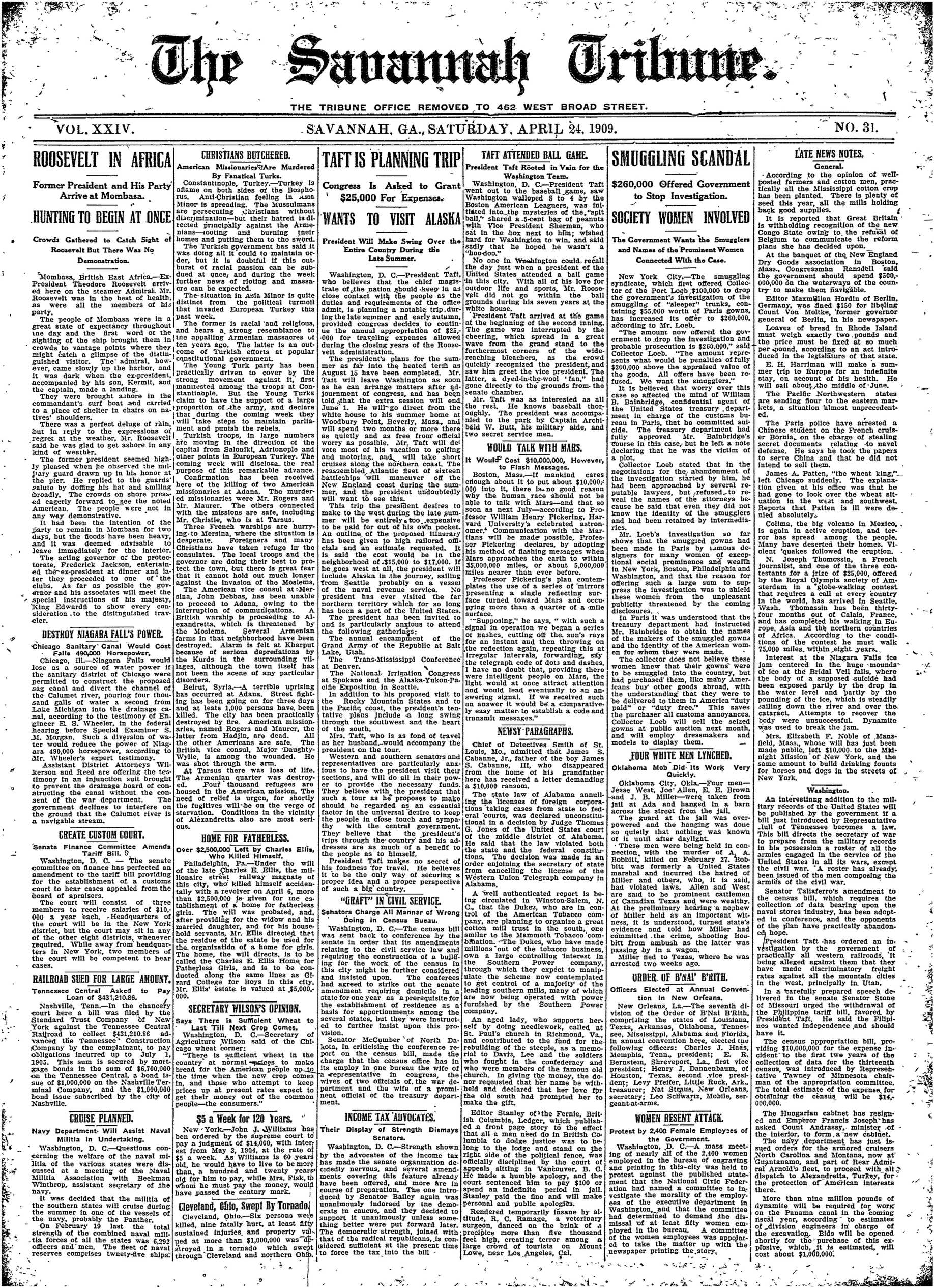

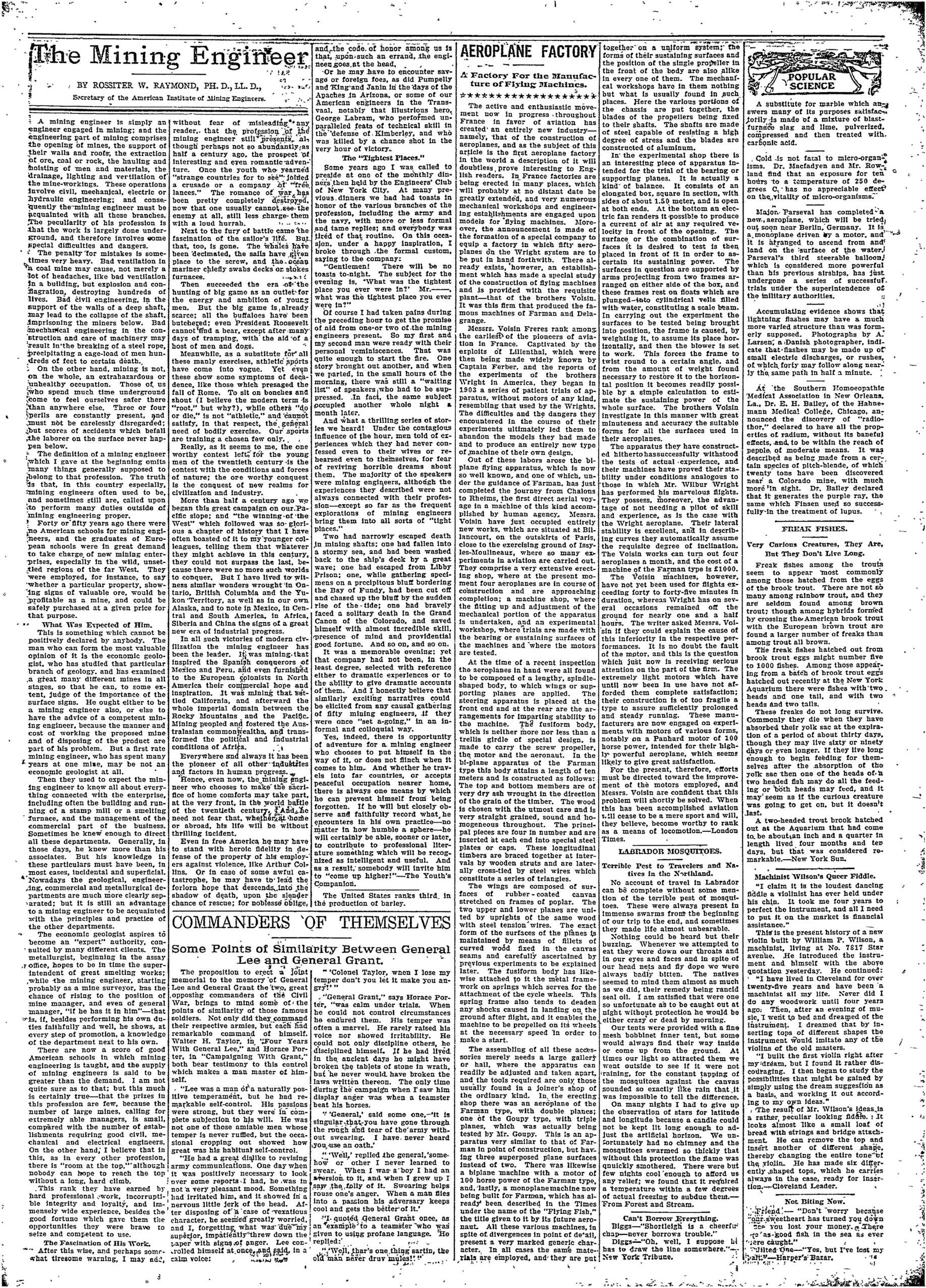
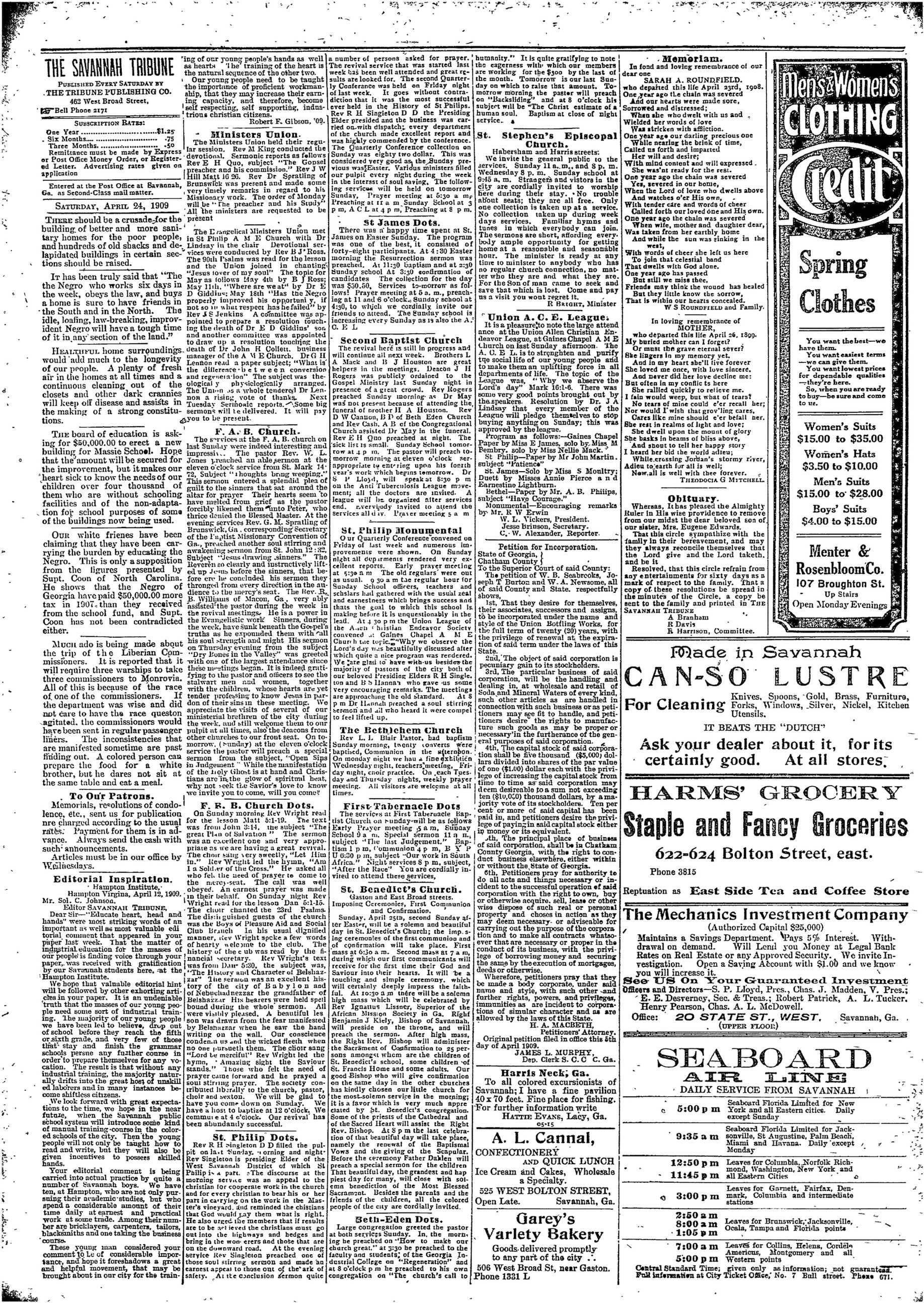
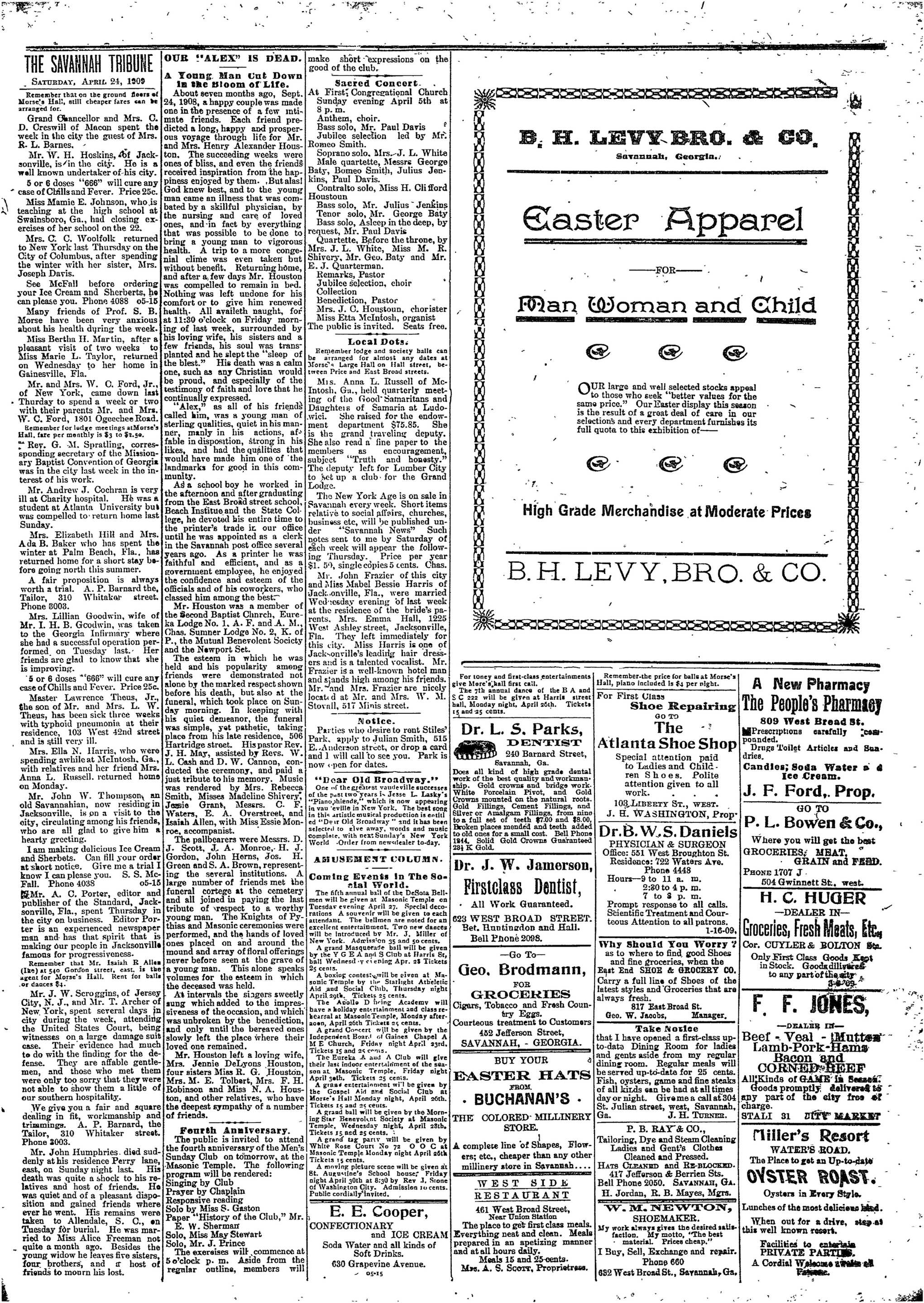
Page text (machine-generated)
ROOSEVELT IN AFRICA
Former President and His Party Arrive at Mombasa.
HUNTING TO BEGIN AT ONGE
Crowds Gathered to Catch Sight of Roosevelt But There Was No Demonstration.
Mombasa, British East Africa.—Ex-President Theodore Roosevelt arrived here on the steamer Admiral Mr. Roosevelt was in the best of health, as were all the members of his party.
The people of Mombasa were in a great state of expectancy throughout one day and the first word or the sighting of the ship brought them in crowds to vantage points where they might catch a glimpse of the distinguished visitor. The admiral, however, came slowly up the harbor, and it was dark when the ex-president, accompanied by his son, Kermit, and the captain, made a landing.
They were brought ashore in the commandant's surf boat and carried to a place of shelter in chairs on natives' shoulders.
There was a perfect deluge of rain, but in reply to the expressions of regret at the weather, Mr. Roosevelt said he was glad to get ashore in any kind of weather.
The former president seemed highly pleased when he observed the military guard drawn up in his honor at the pier. He replied to the guards' salute by doffing his hat and smiling broadly. The crowds on shore pressed eagerly forward to see the noted American. The people were not in any way demonstrative.
It had been the intention of the party to remain in Mombasa for two days, but the foods have been heavy, and it was deemed advisable to leave immediately for the interior. For the protectorate, Frederick Jackson, entertained the ex-president at dinner and later they proceeded to one of the clubs. As far as possible the governor and his associates will meet the special instructions of his majesty, King Edwardfi to show every consideration to the disinguished traveler.
DESTROY NIAGARA FALL'S POWER.
Chicago Sanitary Canal Would Cost Falls 490,000 Horsepower. Chicago, Ill.-Nagara Falls would lose as a source of water power if the sanitary district of Chicago were permitted to construct the proposed sag canal and divert the channel of the Calumet river, pouring four thousand galls of water a second from Lake Michigan into the drainage canal, according to the testimony of Engineer E. S. Wheeler, in the federal hearing before Special Examiner S. M. Morgan. Such a diversion of water would reduce the power of Niagara 490,000 horsepower, according to Mr. Wheeler's expert testimony. Assistant District Attorneys Wilkerson and Reed are offering the testimony in an injunction suit brought to prevent the drainage board of constructing the canal without the consent of the war department. The government declines to interfere on the ground that the Calumet river is a navigable stream.
CREATE CUSTOM COURT.
Senate Finance Committee Amends Tariff Bill. 9
Washington, D. C. — The senate committee on finance has perfected an amendment to the tariff bill providing for the establishment of a customs court to hear cases appealed from the board of apraisers. The court will consist of three members to receive salaries of $10,000 a year each. Headquarters of the court will be in the New York district, but the court may sit in any of the other eight districts, whenever required. While away from headquarters in New York, two members of the court will be competent to hear cases.
RAILBOAD SUED FOR LARGE AMOUNT.
Nashville, Tenn.—In the chancery court here a bill was filed by the Standard Trust Company of New York against the Tennessee Central Railroad to collect $431,210.86 advanced the Tennessee' Construction Company by the complainant, to pay obligations incurred to July 1, 1905. This sum is secured bygage bond in the sum of $7,500,000 the Tennessee Central, a bond issue of $1,000,000 on the Nashville Terminal Company, and the $1,000,000 bond issue subscribed by the city of Nashville.
CRUISE PLANNED.
Navy Department: Will Assist Naval Militia in Undertaking.
Washington, D. C.—Questions concerning the welfare of the naval militia of the various states were dis-attained at a meeting of the Naval Militia, Association with Beekman Winthrop, assistant secretary of the navy.
It was decided that the militia of the southern states will cruise during the summer in one of the vessels of the navy, probably the Panther.
On February 19 last the total strength of the combined naval militia forces of all the states was 6,232 officers and men. The fleet of naval reserves comprises twenty-five ships.
CHRISTIANS BUTCHERED.
American Missionaries Are Murdered By Fanatical Turks.
Constantinople, Turkey—Turkey is afame on both sides of the Bosphorus. Anti-Christian feeling in Asia Minor is spreading. The Mussulmans are persecuting Christians without discrimination—but their hatred is directed principally against the Armenians—biting and burning their homes and putting them to the sword.
The Turkish government has said it was doing all it could to maintain order, but it is doubtful if this burst of racial passion can be subdued at once, and during the week further news of rioting and massacre can be expected.
The situation in Asia Minor is quite distinct from the political turmoil that invaded European Turkey this past week.
The former is racial and religious, and bears a strong resemblance to the appalling Armenian massacres of ten years ago. The latter is an outcome of Turkish efforts at popular constitutional government.
The Young Turk party has been practically driven to cover by the strong movement against it, first maniested among the troops at Constantinople. But the Young Turks claim to have the support of a large proportion of the army, and declare that during the coming week they will take steps to maintain parliament and punish the rebels.
Turkish troops, in large numbers are moving in the direction of the capital from Salonikli, Adrianople and Istanbul, where the coming week will disclose the real purpose of this remarkable advance.
Confirmation has been received here of the killing of two American missionaries at Adana. The murdered missionaries were Mr. Rogers and Mr. Maurer. The others connected with the missions are safe, including Mr. Christie, who is at Tarsus.
Three French warships are hurrying to Mersina, where the situation is desperate. Foreigners and many Christians have taken refuge in the consulates. The local troops and the governor are doing their best to protect the town, but there is great fear that it cannot hold out much longer against the invasion of the Moslems. The American vice consul at Mersina, John Debbas, has been unable to proceed to Adana, owing to the interruption of communications. A British warship is proceeding to Alexandria, which is threatened by Moslems. Several Armenian farms in that neighborhood have been destroyed. Alarm is felt at Kharput because of serious depredations by the Kurds in the surrounding villages, although the town itself has not been the scene of any particular disorders.
Beltrut, Syrla.—A terrible uprising has occurred at Adana. Street fighting has been going on for three days and at leats 1,000 persons have been killed. The city has been practically destroyed by fire. American missionaries, named Rogers and Mauur, the latter from Haddjin, are dead. All the other Americans are safe. The British vice consul, Major Daughty-Wylie, is among the wounded. He was shot through the arm. At Tarsus there was loss of life. The Armenian quarter was destroyed. Fourth the southern refugees are housed in the American mission. The need of relief is urgent, for shortly the fugitives will be on the verge of starvation. Conditions in the vicinity of Alexandretta also are most serious.
HOME FOR FATHERLESS.
Over $2,500,000 Left by Charles Ellis, Who Killed Himself.
Philadelphia, Pa.—Under the will of the late Charles E. Ellis, the millionaire street railway magnate of this city, who killed himself accidentally with a revolver on April 6, more than $2,500,000 is given for the establishment of a home for fatherless girls. The will was probated, and, after providing for the widow and his married daughter, and for his household servants, Mr. Ellis directed that the residue of the estate be used for the organization of a home for girls. The home, the will directs, is to be called the Charles E. Ellis Home for Fatherless Girls, and is to be conducted along the same lines as Glard College for Boys in this city, Mr. Ellis' estate is valued at $5,000,000.
SECRETARY WILSON'S OPINION.
Says There is Sufficient Wheat to
Last Till Next Crop Comes. Washington, D. C.-Secretary of Agriculture Wilson said of the Chicago wheat corner: "There is sufficient wheat in the country at normal prices to make bread for the American people up to the time when the new crop comes in, and those who attempt to keep prices up at present rates expect to get their money out of the common people—the consumers."
$5 a Week for 120 Years.
New York—John J. Williams has been ordered by the supreme court to pay a judgment of $14,000, with interest from May 3, 1904, at the rate of $5 a week. As Williams is 60 years old, he would have to live to be more than a hundred and twenty years old for him to pay, while Mrs. Fisk, to whom he must pay the money, would have passed the century mark.
Cleveland, Ohio, Swep By Tornado
Cleveland, Ohio.-Six persons were killed, nine fatally hurt, at least fifty sustained injuries, and property valued at more than $1,000,000 was destroyed in a tornado which swept through Cleveland and northern Ohio.
THE TRIBUNE OFFICE REMOVED TO 462 WEST BROAD STREET. SAVANNAH, GA., SATURDAY, APRIL 24, 1909.
TAFT IS PLANNING TRIP
WANTS TO VISIT ALASKA
President Will Make Swing Over the Entire Country During the Late Summer.
Washington, D. C.—President Taft, who believes that the chief magistrate of the nation should keep in as close contact with the people as the duties and requirements of the office admit, is planning a notable trip during the late summer and early autumn, provided congress decides to continue the annual appropriation of $25,000 for traveling expenses allowed during the closing years of the Roosevelt administration.
The president's plans for the summer as far into the heated term as August 15 have been completed. Mr. Tatt will leave Washington as soon as he can arrange matters after adjournment of congress, and has been told that the extra session will end June 1. He will go direct from the white house to his summer home at Woodbury Point, Beverly, Mass., and will spend two months or more there as quietly and as free from official worry as possible. Mr. Tatt will designate his vacations tocolling and motoring, and will take short cruises along the northern coast. The reassembled Atlantic fleet of sixteen battleships will maneuver off the New England coast during the summer, and the president undoubtedly will want to see this.
This trip the president desires to make to the west during the late summer will be entirely too expensive to be paid for out of his own pocket. An outline of the proposed itinerary has been given to high railroad officials and an estimate requested. It is said the cost would be in the neighborhood of $15,000 to $17,000. If he goes west at all, the president will include Alaska in the journey, sailing from Seattle probably on a vessel of the naval revenue service. No president has ever visited the far northern territory which for so long has been a part of the United States.
The president has been invited to
and is particularly anxious to attend
the following gatherings:
The annual encampment of the
Grand Army of the Republic at Salt
Lake, Utah.
The Trans-Mississippi Conference
at Denver.
The National Irrigation Congress
at Spokane and the Alaska-Yukon-Pacific Exposition in Seattle.
In addition to his proposed visit to
the Rocky Mountain States and to
the Pacific coast, the president's tentative plans include a long swing through the southwest and the heart of the south.
Mrs. Taft, who is as fond of travel as her husband, would accompany the president on the tour.
Western and southern senators and representatives are particularly anxious to have the president visit their sections, and will do all in their power to provide the necessary funds. They believe with the president that such a tour as he proposes to make should be regarded as an essential factor in the universal desire to keep the people in close touch and sympathy with the central government. They believe that the president's trips through the country and his addresses are as much of a benefit to the people as to himself. President Taft makes no secret of his fondness for travel. He believes it to be the only way of securing a proper idea and a proper perspective of such a big country.
"GRAFT" IN CIVIL SERVICE
Senators Charge All Manner of Wrong Doing in Census Bueau.
Washington, D. C.—The census bill was sent back to conference by the senate in order that its amendments relating to the civil service law and requiring the construction of a building for the work of the census in this city might be further considered and insisted upon. The conferences had agreed to strike out the senate amendment requiring domicile in a state for one year as a prerequisite for the establishment of residence as a basis for apportionments among the several states, but they were instructed to further insist upon this provision.
Senator McCumber of North Dakota, in criticising the conference report on the census bill, made the charge that the census office has in its employ in one bureau the wife of a representative in the congress, the wives of two officials of the war department and the wife of a prominent official of the treasury department.
INCOME TAX ADVOCATES
Washington, D. C.-Strength shown by the advocates of the income tax has made the senate organization decidedly nervous, and several amendments covering this feature already have been offered, and more are in course of preparation. The one introduced by Senator Bailey again was unanimously indorsed by the democrats in caucus, and they decided to support it unanimously unless something better were put forward later. The democratic strength, joined with that of the radical republicans, is considered sufficient at the present time to force the tax into the bill
TAFT ATTENDED BALL GAME.
President Taft Rooted in Vain for the
Washington Team.
Washington, D. C.-President Taft
went out to the baseball game, saw
Washington walloped 8 to 4 by the
Boston American Leaguers, was
initiated into the mysteries of the, "spit
ball," shared a 5-cent bag of peanuts
with Vice President Sherman, who
sat in the box next to him; wished
hard for Washington to win, and said
sadly that he hoped he wasn't a
"hoo-doo."
No one in Washington could recall
the day just when a president of the
United States attended a ball game
in with a host of his love for
outdoor life and Mr. Rose-
velt did not go within the ball
grounds during his seven years at the
white house.
President Taft arrived at the game at the beginning of the second inning. The game was interrupted by the cheering, which spread in a great wave from the grand stand to the furthermost corners of the wide-reaching bleachers, as the crowd quickly recognized the president, and saw him greet the vice president. The latter, a dyed-in-the-wool 'fan,' had gone directly to the grounds from the senate chamber.
Mr. Taft was as interested as all the rest. He knows baseball thoroughly. The president was accompanied to the park by Captain Archbold W. Butt, his military aide, and two secret service men.
WOULD TALK WITH MARS.
Boston, Mass.—If mankind cares enough about it to put about $10,000,000 into it, there is no good reason why the human race should not be able to talk with Mars—and that so soon as next July—according to Professor William Henry Pickerling, Harvard University's celebrated astronomer.* Communication with the Martians will be made possible, Professor Pickerling declares, by adopting his method of flashing messages when Mars approaches the earth to within 35,000,000 miles, or about 5,000,000 miles nearer than ever before.
Professor Pickering's plan contemplates the use of a series of mirrors presenting a single reflecting surface turned toward Mars and occupying more than a quarter of a mile surface.
"Supposing," he says, "with such a signal in operation we began a series of nashes, cutting off the sun's rays for an instant and then throwing on the reflection again, repeating this at irregular intervals, forwarding, say the telegraph code of dots and dashes, have no need that, providing there were intelligent people on Mars, the light would at once attract attention and would lead eventually to an answering signal. If we received such an answer it would be a comparatively easy matter, to establish a code and transmit messages."
NEWSY PARAGRAPHS.
Chief of Detectives Smith of St. Louis, Mo., admitted that James S. Cabanne, Jr., father of the boy James S. Cabanne, III, who disappeared from the home of his grandfather here has received a letter demanding a $10,000 ransom. The state law of Alabama annulling the licenses of foreign corporations taking cases from state to federal courts, was declared unconstitutional in a decision by Judge Thomas G. Jones of the United States court of the middle district of Alabama. He said that the law violated both state and federal constitutions. The decision was made in order enforcing the secretary of state from cancelling the license of the Western Union Telegraph company in Alabama.
A well authenticated report is being circulated in Winston-Salem, N.C., that the Dukes, who are in control of the American Tobacco company, are planning to organize a great cotton mill trust in the south, one similar to the Mammoth Tobacco combination. "The Dukes, who have made millions' out of the tobacco business, own a large controlling interest in the Southern Power company, through which they expect to manipulate the scheme now contemplated to get control of a majority of the leading southern mills, many of which are now being operated with power furnished by the Southern Power company.
An aged lady, who supports herself by doing needlework, called at St. Paul's church in Richmond, Va., and contributed to the fund for the rebuilding of the steeple, as a memorial to Davi, Lee and the soldiers who fought in the confederacy and who were members of the famous old church. In giving the money, the donor requested that her name be withheld and declared that her love for old south had prompted her to make the gift.
Editor Stanley of the Fernie, British Columbia, Ledger, which published a front page story to the effect that all a man need do in British Columbia to dodge justice was to be the lodge and stand on the right side of the public ence, was officially disciplined by the court of appeals sitting in Vancouver, B. C. He made a humble apology, and the court sentenced him to pay $100 or spend an indefinite period in jail. Stanley paid the fine and will make personal and public apologies.
Rendered temporarily insane by altitude, R. C. Ramage, a veterinary surgeon, danced on the brink of a precipice more than five thousand feet above the large crowd of tourists on Mount Lowe, near Los Angeles, Cal.
SMUGGLING SCANDAL
SOCIETY WOMEN INVOLVED
The Government Wants the Smugglers and Names of the Prominent Women Connected With the Case.
New York City—The smugglling syndicate, which first offered Collector of the Port Loeb, $100,000 to drop the government's investigation of the smugglling of "sleeper" trunks, containing $55,000 worth of Paris gowns, has increased its offer to $260,000, according to Mr. Loeb.
"The amount now offered the government to drop the investigation and probable prosecution is $260,000," said Collector Loeb.
The amount spents what would be politics of fully $200,000 above the appraised value of the goods. All offers have been refused. We want the smugglers."
It is believed that worry over this case so affected the mind of William B. Bainbridge, confidential agent of the United States treasury, department in charge of the customs bureau in Paris, that he committed suicide. The treasury department had fully approved Mr. Bainbridge's course in this case, but he left a note declaring that he was the victim of a plot.
Collector Loeb stated that in the negotiations for the abandonment of the investigation started by he had been approached by several relevant lawyers, but, refused, to reveal the names of the attorneys because he said that even they did not know the identity of the smugglers and had been retained by intermediaries.
Mr. Loeb's investigation so far shows that the smuggled gowns had been made in Paris by famous designers for many women of exceptional social prominence and wealth in New York, Boston, Philadelphia and Washington, and that the reason for offering such a large sum to suppress the investigation was to shield these women from the unpleasant publicity threatened by the coming disclosures.
In Paris it was understood that the treasury department had instructed Mr. Bainbridge to obtain the names of the makers of the smuggled gowns and the identity of the American women for whom they were made. The collector does not believe these women knew that their gowns were to be smuggled into the country, but had purchased them, like many Americans, buy other goods abroad, with unused goods. They were delivered to them in America "duty paid" or "duty free." This saves the purchaser all customs annoyances. Collector Loeb will sell the seized gowns at public auction next month, and will employ dressmakers and models to display them.
FOUR WHITE MEN LYNCHED.
Oklahoma Mob Did Its Work Very Quickly.
Oklahoma City, Okla.-Ole four- Jesse West, Joe' Allen, E. E. Brown- and J. B. Miller—were taken from jail at Ada and hanged in a barn across the street from the jail.
The guard at the jail was overpowered and the hanging was done so quietly that nothing was known of it until after daylight.
These men were being held in connection, with the murder of A. A. Bobbitt, killed on February 27. Bobbitt was formerly a United States marshal and incurred the hatred of Miller and others, who it is said, had violated laws. Allen and West are said to be prominent cattlemen of Canadian Texas and were wealthy.
At the preliminary hearing a nephew of Miller, impaired and witless, it is understood turned state's evidence and told how Miller had committed the crime, shooting Bobbitt from ambush as the latter was passing by in a wagon.
Miller tied to Texas, where he was arrested two weeks ago.
ORDER OF B'NAI B'RITH.
Officers Elected at Annual Convention in New Orleans.
New Orleans, La.—The seventh division of the Order of B'Nal B'Rith, comprising the states of Louisiana, Texas, Arkansas, Oklahoma, Tennessee, Mississippi, Alabama and Florida, in annual convention here, elected the following officers: Charles J. Haas, Memphis, Tenn., president; E. R. Bernstein, Shreveport, La., first vice president; Henry J. Dannenbaum, Houston, Texas, second vice president; Levy Pfeifer, Little Rock, Ark., treasurer; Nat Straus, New Orleans, secretary; Leo Schwartz, Mobile, sergeant-at-arms.
WOMEN RESENT ATTACK
Protest by 2,400 Female Employees of the Government. Washington, D. C.—A mass meeting of nearly all of the 2,400 women employed in the bureau of engraving and printing in this-city was held to protest against the published statement that the National Civic Federation had named a committee to investigate the morality of the employees of the executive department in Washington, and that the committee had determined to demand the dismissal of at least fifty women employed in the bureau. A committee of the women employees was applotted to take the matter up with the newspaper printing the story.
LATE NEWS NOTES.
According to the opinion of well-farmed farmers and cotton men, practically all the Mississippi cotton crop has been planted. There is plenty of seed this year, all the mills holding back good supplies.
It is reported that Great Britain is withholding recognition of the new Congo State owing to the refusal of Belgium to communicate the reform plans she has decided upon.
At the banquet of the New England Dry Goods association in Boston, Mass., Congressman Renadell said the government should spend $500,000,000 on the waterways of the country to make them navigable.
Editor Maxmüllan Hardin of Berlin, Germany, was fined $150 for libeling Count Von Moltke, former governor general of Berlin, in his newspaper.
Loaves of bread in Rhode Island must weigh exactly two pounds and the price must be fixed at so much per pound, according to an act introduced in the legislature of that state.
E. H. Harriman will make a summer trip to Europe for an indefinite stay, on account of his health. He will sall about the middle of June. The Pacific Northwestern states are sending flour to the eastern markets, a situation almost unprecedented.
The Paris police have arrested a Chinese student on the French cruiser Bornia, on the charge of stealing secret documents relating to naval defense. He says he took the papers to serve China and that he did not intend to sell them.
James A. Patten, "the wheat king," left Chicago suddenly. The explanation given at his office was that he had gone to look over the wheat situation in the west and southwest. Reports that Patten is ill were denied absolutely.
Collaim, the big volcano in Mexico, is again in active eruption, and terror has spread among the people. Many have deserted their homes. Violent 'ouakes followed the eruption.
N. Joseph Thomossin, a French journalist, and one of the three contestants for a prize of $25,000, offered by the Royal Olympia society of Amsterdam in a "globe-walking contest that requires a call at every country in the world, has arrived in Seattle, Wash. Thomassin has been thirty-four months out of Calais, France, and has completed his walking in Europe, Asia and the northern countries of Africa. According to the conditions of the contest he must walk 75,000 miles within eight years. Interest at the Niagara Falls ice jam centered in the huge mounds ice at the Bridges cell falls, where the body of a supposed soldier has been exposed partly by the drop. In the water level and partly by the pounding of the ice, which is steadily sailing down the river and over the cataract. Attempts to recover the body were unsuccessful. Dynamite was used to break the jam.
Mrs. Elizabeth F. Noble of Mansfield, Mass., whose will has just been made public, left $10,000. to the Mintnight Mission of New York, and the funds to be used for horses and dogs in the streets of New York.
Washington.
An interesting addition to the military records of the United States will be published by the government if a bill just introduced by Representative lull of Tennessee becomes a law. This bill directs the secretary of war to prepare from the military records in his possession a roster of all the armies engaged in the service of the United States in all its wars, except the civil war. A roster has already been issued of the men composing the armies of the civil war.
Senator Taliaferro's amendment to the census bill, which requires the collection of data bearing upon the naval stores industry, has been adopted in conference, and the opponents of the plan have practically abandoned hope.
President Taft has ordered an investigation by the government of practically all western railroads. It being alleged against them that they have made discriminatory freight rates against all the mountain cities in the west, principally in Utah.
In a carefully prepared speech delivered in the senate Senator Stone of Missouri urged the withdrawal of the Philippine tariff bill, favored by President Taft. He said the Filipinos wanted independence and should have it.
The census appropriation bill, providing $10,000,000 for the expense incident to the first two years of the collection of data for the thirteenth census, was introduced by Representative Tawney of Minnesota chairman of the appropriation committee. The total estimate of the expense for obtaining the census will be $14,000,000.
The Hungarian cabinet has resigned and Emperor Francis Joseph has asked Count Andrassy, minister of the interior, to form a new cabinet.
The navy department has just issued orders for the armored cruisers North Carolina and Montana, now at Guantanamo, and part of Rear Admiral Arnold's fleet, to proceed with all dispatch to Alexandretta, Turkey, for the protection of American interests there.
More than nine million pounds of dynamite will be required for work on the Panama canal in the coming months, and to assist in the division engineers in charge of the excavation. Bids will be opened shortly for the purchase of this explosive, which, it is estimated, will cost about $1,000,000.
Largest Sick and Death Benefits; Smallest Premiums.
The Guaranty Aid
The Guaranty Aid and Relief Society
SOL. C. JOHNSON, Supt. of Agenoies
Illinois JAR 17 3000 190
The underlined Treasures of the State of Georgia, hereby acknowledged as
to have received from the following described
The Regents of the State of Georgia, in the
Electorial, Georgia (at the end of
17th 1900), are each of the
(500) persons, due in 1920.
P
Elsa Bauman, L. add to the well-bala clever n
B. WILLIAMS, President.
The G
Treasury of State of Georgia
The undesignated Treasurer is to have received from the
Dear Regina,
Elegant, Enjoying
7:00.
Long in Stat. Ten Thousand Dollais and which are held by the State of Georgia by authority and under the provisions of an Act of the General Assembly, approved October 22d, 1887, and amended December 20th, 1897.
R. E. Parsi
Treasurer of the State of Georgia.
$1.75 The 1909 Subscription Offer The Best Offer Made for the New Year $1.75 THE TRI-WEEKLY ATLANTA CONSTITUTION
The Savannah Tribune
together with the superb FREE OFFERS of PARIS MODES, a woman's magazine; or THE SOUTHERN RURALIST; a splendid agricultural paper; or TALKS FROM FARMERS TO FARMERS, an epitome of farm wisdom, worth its weight in gold. All for only $1.75
brightest, and biggest Southern Newspaper. Almost a Daily, yet at the price of a Weekly. One Dollar a Year
or The Weekly Constitution once a week, with each of the above (except that The Weekly Constitution is substituted for the Tri-Weekly) all for one year for only $1.40 The Tri-Weekly Constitution presents at one sweeping view the whole area of events. The news of the country, state, nation, and the world is given in each complete issue. Each week the departments of Farm and Farmers, Woman's Kingdom, Great Agricultural South, Farmers' Union, Rural Free Delivery. Poultry and others of wide interest, edited by experts, appeal directly to those addressed. The Weekly Constitution contains all these special features and the difference between it and The Tri-Weekly is that the one is issued once a week (on Monday only) and the other three times a week—Monday, Wednesday and Friday.
If you want the Constitution alone, without any clubbing offers, you can get the Tri-Weekly Constitution at $1 per year, or The Weekly at 50c per year, by addressing The Constitution, Atlanta, Ga. One sample copy sent free on request, giving with it six of your neighbors.
THE CONSTITUTION IS THE PAPER FOR RURAL FREE DELIVERY ROUTES
A club of 40 or 50 or more will keep an R. F. D. route above the minimum average required for daily mail service. It is the great news purveyor of the whole Southland, as good in the gulf states as on the Atlantic seaboard.
Clubbed with The Atlanta Constitution, we have the superb FREE OFFERS shown from which you may make your choice of one:
(1) Talks From Farmers to Farmers, a symposium of Southern farm knowledge that should be in the hands of every practical farmer, young or old. The articles have all appeared in Tri-Weekly Constitution under same title and made one of the greatest features of this splendid farmers' paper. It will be mailed to you immediately upon receipt of order.
(2) The Southern Ruralist, one of the best agricultural papers in the south. It is a semi-monthly edited by a farmer on his own farm, and is intensely practical and helpful.
semi-monthly edited by a farmer on his own farm, and is intensely practical and helpful. (3) Paris Modes, a woman's magazine, monthly. There are fashions in it, as the title indicates, and they are right up to date. Do not think they are all of the sylph-like, hipless, clothes-pin styles of the extreme devotees of the changeable flirt called "Fashion." They are all pretty and becoming and up to date, so that the ladies may feel well-dressed and in the style who follow them. But you get more than mere fashions. There are stories, poems, storyettes, incidents of travel, seasonable articles for entertainments, home keeping, cookery, care of the person, sanitation and hygiene, plant culture and all the rest that go to make up a monthly feast for the busy woman who reads as she works, who relaxes from one task and finds charm in the ever-varying features of woman's work that is said to be never done.
OUR GREAT PROPOSITION
Remember, our paper one year, and THE TRI-WEEKLY CONSTITUTION, Monday, Wednesday and Friday, three times a week, for one year, and your selection of one from the three alternate free offers, all for $1.75; or the whole combination (except that The Weekly Constitution is substituted for the Tri-Weekly) for only... $1.40
Send at once. Get right on. Don't miss a copy. Address all orders for above combination to
THE SAVANNAH TRIBUNE, Savannah, Ga.
and Relief Society
HOME OFFICE
WEST BROAD STREET,
SAVANNAH, GEORGIA.
Phone 1169. Ga. Phone 2022.
Directors.
A. E. Williams.
B. Edward Perry.
W. R. Fields.
J. H. Deveaux
L. M. Pollard.
W. H. Burgess.
J. H. Bugg, M. D.
J. M. Ferrebee.
This company is duly chartered under the laws of the State of Georgia, and has complied with all requirements of the State Insurance department, therefore all policy holders are protected with all the safeguards that the strict insurance laws of this State seek to protect its citizens.
Its affairs are directed and managed by Negro men of the city of Savannah of leading standing, and whose character and reputation are of such as to command the respect and confidence of all the people of that community. The same men that manage this Society are the ones that organized and are conducting the affairs of the first successful Negro Savings Bank in this state, therefore we can readily see that by connecting themselves with this Insurance company their interest will be in safe hands.
By comparing our rules and benefits with other first class companies it will be seen that we offer the most liberal inducements with the largest sick, accident and death benefits to our members than any other company in this business.
HOME OFFICE
WEST BROAD STREET,
SAVANNAH, GEORGIA.
Phone 1193. Ga. Phone 2022.
Directors.
L. R. Williams.
P. Edward Perry.
Walter B. Scott.
Sel. C. Johnson.
W. R. Fields.
J. H. Deveaux
L. M. Pollard.
W. H. Burgess.
J. H. Bugz, M. D.
J. M. Ferrebee.
This company is duly chartered under the laws of the State of Georgia, and has complied with all requirements of the State Insurance department, therefore all policy holders are protected with all the safeguards that the strict insurance laws of this State seek to protect its citizens.
Its affairs are directed and managed by Negro men of the city of Savannah of leading standing, and whose character and reputation are of such as to command the respect and confidence of all the people of that community. The same men that manage this Society are the ones that organized and are conducting the affairs of the first successful Negro Savings Bank in this state, therefore we can readily see that by connecting themselves with this Insurance company their interest will be in safe hands.
By comparing our rules and benefits with other first class companies it will be seen that we offer the most liberal inducements with the largest sick, accident and death benefits to our members than any other company in this business.
That we pay our claims promptly can be testified to by the thousands of our satisfied members.
Agents Libera
Agents Wanted Everywhere Liberal Terms and Commission.
Gavannah, Georgia.
P. B. RAY,
DRY AND STEAM CLEANING. LADIES' WORK A SPECIALTY. HATS CLEANED AND REBLOCKED BELL PHONE 2050. JEFFERSON AND BERRIEN STS. SAVANNAH, GA.
AND STEAM CLEANING.
LADIES' WORK A SPECIALTY.
B CLEANED AND REBLOCKED
BELL PHONE 2050.
FERSON AND BERRIEN ST8.
SAVANNAH, GA.
W. H. LLOYD.
—Dealer In—
CERIES, WOOD AND COAL.
21 Oglethorpe Avenue, East.
18 PHONES—Bell SD
Sonic Books & Regalias.
ODGE SEALS,
FINANCIAL CARDS and
LANKS of every description.
Hers' and Manufacturers' Prices
Discounts Will Be Arranged.
GOL. C. JOHNSON,
Savannah, Ga.
Soft, Silky and Long?
Does it comb easily without breaking?
Is it straight?
Does it smooth out nicely?
Can you do it up in any of the charming styles, so it will stay, and make you proud of it?
Is it long and full of life?
If you cannot say YES to all of the above questions, then you need
Nelson's Hair Dressing
NELSON'S HAIR DRESSING is the finest hair pomade on the face of the earth for colored people.
It makes your hair grow fast; it makes stubborn, kinky and tangled hair as soft and supple as silk. It makes it healthy.
It keeps it from splitting or breaking off. It makes it rich and gives it that charm so longed for by all true ladies.
Use Nelson's Hair Dressing and you'll never have dandruff.
Your head will keep clean. The roots of your hair will have the necessary amount of oil. You will never have scalp disease. You will be delighted with its delicate perfume.
Nelson's Hair Dressing is put up in handsome four-ounce square tin boxes, like the lady holds in her hand. Druggists and agents everywhere sell it at 25 cents a box. If you can't get it, send us 50 cents and we will mail you a full size box postpaid. Go and buy it now, or sit right down and write us. Address
NELSON MANUFACTURING CO., Richmond, Va.
Live Agents Wanted.
Write Quick for Terms.
W. H. LLOYD.
—Dealer In—
GROCERIES, WOOD AND COAL.
621 Oglethorpe Avenue, East.
518 PHONES—Bell 50
Masonic Books &
Regalias.
LODGE SEALS.
FINANCIAL CARDS and
BLANKS of every description.
Publishers' and Manufacturers' Prices
Liberal Discounts Will Be Arranged.
GOL. C. JOHNSON,
Gavannah, Ga.
SOL. C. JOHNSON Notary Public.
Deeds, Contracts, Wills and Other
Legal Forms Prepared and
Attested.
119 West St. Julian Street
The Smart Set for May.
Jack London is represented in the
May issue of the Smart Set by one of
the most charaming stories he has
ever written. "Aloha Oe" is a tale
of Hawaii, full of the romance and
perfume of that sun-bathed island empire.
"His Child's Godmother," the complete novel in the May Smart Set, is from the pen of Frances Pusey Gooch. It is a tale of the reconstructed south, a romance of the ward of a governor and the long-exiled son of an old warimpoverished family, and presents a beautiful picture of the winning of a wife's love after marriage.
There are a number of short stories in this issue deserving of notice for their unusual strength and charm.
Other features by Harold Susman, Elsa Baker, Reginald Wright Kauffman, Lucia Chamberlain and others add to the make-up of an exceedingly well-balanced number of this always clever magazine.
WALTER S. SCOTT, Secretary and Tr cas.
· ADDRESS THE HOME OFFICE. 468 West Broad 8t.
Is Your Hair Beautiful
MONEY DEPOSITED WITH The Wage Earners Loan and Investment Company
18 DOUBLY SECURED BY THOUSANDS OF DOLLARS INVESTED IN SAVANNAH REAL ESTATE. 5 PER CENT PAID ON DEPOSITS.
THE PIONDER NEGRO SAVINGS BANK OF GEORGIA. BELL PHONE 1198. 468 WEST BROAD ST. OWNED AND CONTROLLED BY SAVANNAH NEGROES.
Job Printing
Of Every Description Promptly and Neatly Executed
Send Us Your Order.
The Mining Engineer
BY ROSSITER W. RAYMOND, PH. D., LL. D., Secretary of the American Institute of Mining Engineers.
A mining engineer is simply an engineer engaged in mining; and the engineering part of mining comprises the opening of mines, the support of their walls and roofs, the extraction of ore, coal or rock, the hauling and hoisting of men and materials, the drainage, lighting and ventilation of the mine-workings. These operations involve civil, mechanical, electric or hydraulic engineering; and consequently the mining engineer must be acquainted with all these branches. The peculiarity of his profession is that the work is largely done underground, and therefore involves some special difficulties and dangers.
without fear of misleader, that the profess mining engineer still though perhaps not so ab half a century ago, the interesting and even romance. Once the youth w strange countries for to a crusade or a company lances." The romance been pretty completely now that one usually can enemy at all, still less with a loud hurrah.
Next to the fury of batt fascination of the sailor that too, is gone. The
The penalty for mistakes is sometimes very heavy. Bad ventilation in a coal mine may cause, not merely a lot of headaches, like bad ventilation in a building, but explosion and conflagration, destroying hundreds of lives. Bad civil engineering, in the support of the walls of a deep shaft, may lead to the collapse of the shaft, imprisoning the miners below. Bad mechanical engineering in the construction and care of machinery may result in the breaking of a steel rope, precipitating a cage-load of men hundreds of feet to certain death.
or feet to certain death.
On the other hand, mining is not, on the whole, an extrahazardous or unhealthy occupation. Those of us who spend much time underground come to feel ourselves safer there than anywhere else. Three or four perils are constantly present, and must not be carelessly disregarded; but scores of accidents which befall the laborer on the surface never happen below.
The definition of a mining engineer which I gave at the beginning omits many things generally supposed to belong to that profession. The truth is that, in this country especially, mining engineers often used to be, and sometimes still are, called upon to perform many duties outside of mining engineering proper.
Forty or fifty years ago there were no American schools for mining engineers, and the graduates of European schools were in great demand to take charge of new mining enterprises, especially in the wild, unsettled regions of the far West. They were employed, for instance, to say whether a particular property, showing signs of valuable ore, would be profitable as a mine, and could be safely purchased at a given price for that purpose.
What Was Expected of Him.
This is something which cannot be positively declared by anybody. The man who can form the most valuable opinion of it is the economic geologist, who has studied that particular branch of geology, and has examined a great many different mines in all stages, so that he can, to some extent, judge of the importance of the surface signs. He ought either to be a mining engineer also, or else to have the advice of a competent mining engineer, because the manner and cost of working the proposed mine and of disposing of the product are part of his problem. But a first rate mining engineer, who has spent many years at one mine, may be not an economic geologist at all.
Then they used to expect the mining engineer to know all about everything connected with the enterprise, including often the building and running of a stamp mill or a smelting furnace, and the management of the commercial part of the business. Sometimes he knew enough to direct all these departments. Generally, in those days, he knew more than his associates. But his knowledge in these particulars must have been, in most cases, incidental and superficial. Nowadays the geological, engineering, commercial and metallurgical departments are much more clearly separated; but it is still an advantage to a mining engineer to be acquainted with the principles and practice of the other departments.
The economic geologist aspires to become an "expert" authority, consulted by many different clients. The metallurgist, beginning in the assay office, hopes to be in time the superintendent of great smelting works; while the mining engineer, starting probably as a mine surveyor, has the chance of rising to the position of mine manager, and even of general manager, "if he has it in him"—that is, if, besides performing his own duties faithfully and well, he shows, at every step of promotion, a knowledge of the department next to his own.
There are now a score of good American schools in which mining engineering is taught, and the supply of mining engineers is said to be greater than the demand. I am not quite sure as to that; but this much is certainly true—that the prizes in this profession are few, because the number of large mines, calling for extremely able managers, is small, compared with the number of establishments requiring good civil, mechanical and electrical engineers. On the other hand, I believe that in this, as in every other profession, there is "room at the top," although nobody can hope to reach the top without a long, hard climb.
This rank they have earned by hard professional work, incorruptible integrity and loyalty, and immensely wide experience, besides the good fortune which gave them the opportunities they were brave to seize and competent to use.
The Fascination of His Work.
After this wise, and perhaps some-
what tiresome warning, I may aid.
COMMANDERS `OF THEMSELVES
Some Points of Similarity Between General Lee and General Grant.
without fear of misleading any reader, that the profession of the mining engineer still presents, although perhaps not so abundantly, as half a century ago, the prospect of interesting and even romantic adventure. Once the youth who yearned "strange countries for to see" joined a crusade or a company of "free lances." The romance of war has been pretty completely destroyed, now that one usually cannot, see the enemy at all, still less charge them with a loud hurrah.
Next to the fury of battle came the fascination of the sailor's life. But that, too, is gone. The whales have been decimated, the sails have given place to the screw, and the ocean mariner chiefly swabs decks or stokes furnaces.
Then succeeded the era of the hunting of big game as an outfit for the energy and ambition of young men. But the big game is, already scarce; all the buffaloes have been butcheed; even President Roosevelt cannot find a bear, except after many days of tramping, with the aid of a host of men and dogs.
Meanwhile, as a substitute for all these manly exercises, athletic sports have come into vogue. Yet even these show some symptoms of decadence, like those which presaged the fall of Rome. To sit on bonches and shout (I believe the modern term is "root," but why?), while others "do or die," is not "athletic," and cannot satisfy. In that respect, the general need of bodily exercise. Our sports are training a chosen few only.
Really, as it seems to me, the one worthy contest left for the young men of the twentieth century is the contest with the conditions and forces of nature; the ore worthy conquest is the conquest of new realms for civilization and industry.
More than half a century ago we began this great campaign on our.Pacific slope; and "the winning-of the West" which followed was so glorious a chapter of history that I have often boasted of it to my younger colleagues, telling them that whatever they might achieve in this century, they could not surpass the last, because there were no more such worlds to conquer. But I have lived to witness similar wonders wrought in Ontario, British Columbia and the Yukon "Territory, as well as in our own Alaska, and to note in Mexico, in Central and South America, in Africa, Siberia and China the signs of a great new era of industrial progress.
In all such victories of modern civilization the mining engineer has been the leader. It was mining that inspired the Spanish conquerors of Mexico and Peru, and even furnished to the European colonists in North America their commercial hope and inspiration. It was mining that settled California, and afterward the whole imperial domain between the Rocky Mountains and the Pacific. Mining peopleled and fostered the Australasian commonwealths, and transformed the political and industrial conditions of Africa.
Everywhere and always it has been the pioneer of all other industries and factors in human progress.
Hence, even now, the mining engineer who chooses to make the sacrifice of home comforts may take part, at the very front, in the world battle of the twentieth century. And, he need not fear that, whether at home or abroad, his life will be without thrilling incident.
Even in free America he may have to stand with heroic fidelity in defense of the property of his employers against violence, like Arthur Collins. Or in case of some awful castrophe, he may have to lead the forlorn hope that descends into the shadow of death, upon the slender chance of rescue; for noblesse oblige,
The proposition to erect a joint memorial to the memory of General Lee and General Grant the two, great opposing commanders of the Civil War, brings to mind some of the points of similarity of those famous soldiers. Not only did they command their respective armies, but each had remarkable command of himself. Walter H. Taylor, in "Four Years With General Lee," and Horace Porter, in "Campaigning With Grant," both bear testimony to this control which makes a man master of himself.
"Lee was a man of a naturally positive temperament, but he had remarkable self-control. His passions were strong, but they were in complete subjection to his will. He was not one of those amiable men whose temper is never ruffled, but the occasional cropping out showed how great was his habitual self-control.
"He had a great dislike to revising army communications. One day when it was positively necessary to look over some reports I had, he was in not a very pleasant mood. Something had irritated him, and it showed in a nervous little jerk of the head. After disposing of a case of vexatious character, he seemed greatly worried, and I, forgetting, what was due my superior, impatiently threw down the paper with signs of anger. Lee controlled himself at once, and said, in a calm voice:
and, the code of honor among us is that, upon-such an errand, the engineer goes at the head. Or he may have to encounter savage or foreign foes, as did Pumpelly and King and Janin in the days of the Apaches in Arizona, or some of our American engineers in the Transvaal, notably that illustrious hero, George Labram, who performed unparalleled feats of technical skill in the defense of Kimberley, and who was killed by a chance shot in the very hour of victory.
The "Tightest Places."
Some years ago I was called to preside at one of the monthly dinners then held by the Engineers' Club of New York City. At many previous dinners we had had toasts in honor of the various branches of the profession, including the army and the navy, with more or less formal and tame replies; and everybody was tired of that routine. On this occasion, under a happy inspiration, I broke through the formal custom, saying to the company:
"Gentlemen! There will be no toasts to-night. The subject for the evening is, 'What was the tightest place you ever were in?' Mr.——, what was the tightest place you ever were in?"
Of course I had taken pains during the preceding hour to get the promise of aid from one or two of the mining engineers present. So my first and my second man were ready with their personal reminiscences. That was quite enough to start the fire. One story brought out another, and when we parted, in the small hours of the morning, there was still a "waiting list" of speakers who had to be suppressed. In fact, the same subject occupied another whole night a month later.
And what a thrilling series of stories we heard! Under the contagious influence of the hour, men told of experiences which they had never confessed even to their wives or rehearsed even to themselves, for fear of reviving horrible dreams about them. The majority of the speakers were mining engineers, although the experiences they described were not always connected with their profession—except so far as the frequent explorations of mining engineers bring them into all sorts of "tight places."
Two had narrowly escaped death in mining shafts; one had fallen into a stormy sea, and had been washed back to the ship's deck by a great wave; one had escaped from Libby Prison; one, while gathering specimens on a precipitous bluff bordering the Bay of Fundy, had been cut off and chased up the bluff by the sudden rise of the tide; one had bravely faced a solitary death in the Grand Canon of the Colorado, and saved himself with almost incredible skill, presence of mind and providential good fortune. And so on, and so on.
It was a memorable evening; yet that company had not been, in the least degree, selected with reference either to dramatic experiences or to the ability to give dramatic accounts of them. And I honestly believe that similarly exciting narratives could be elicited from any causal gathering of fifty mining engineers, if they were once "set a-going." in an informal and colloquial way.
Yes, indeed, there is opportunity of adventure for a mining engineer who chooses to put himself in the way of it, or does not flinch when it comes to him. And whether he travels into far countries, or accepts peaceful occupation nearer home, there is always one means by which he can prevent himself from being forgotten. If he will but closely observe and faithfully record what, he encounters in his own practice—no matter in how humble a sphere—he will certainly be able, sooner or later, to contribute to professional literature something which will be recognized as intelligent and useful. And as a result, somebody will invite him to "come up higher!"—The Youth's Companion.
The United States ranks third, in the production of barley.
" "Colonel Taylor, when I lose my temper don't you let it make you angry?""
"General Grant," says Horace Porter, "was calm under trials. When he could not control circumstances he endured them. His temper was often a marvel. He rarely raised his voice nor showed irritability. He could not only discipline others, he disciplined himself. If he had lived in the ancient days he might have broken the tablets of stone in wrath, but he never would have broken the laws written thereon. The only time during the campaign when I saw him display anger was when a teamster beat his horses.
"General," said some one, "it is singular, that you have gone through the rough and tear of the army without swearing. I have never heard you use an oath."
"Well," replied the general, "somehow or other I never learned to swear. When I was a 'boy I had an version to it, and when I grew up I say the folly of it. Swearing helps rouse one's anger. When a man files into a passion his adversary keeps cool and gets the better of it." I quoted General Grant once, as an example to a teamster who was given to using profane language. "He replied: "Well, that's one thing sartin, the old man never druv mules!"
AEROPLANE FACTORY
AEROPLANE FACTORY
A Factory For the Manufacture of Flying Machines.
The active and enthusiastic movement now in progress throughout France in favor of aviation has created an entirely new industry—namely, that of the construction of aeroplanes, and as the subject of this article is the first aeroplane factory in the world a description of it will doubtless, prove interesting to English readers. In France factories are being erected in many places, which will probably at no distant date be greatly extended, and very numerous mechanical workshops and engineering establishments are engaged upon models for flying machines. Moreover, the announcement is made of the formation of a special company to equip a factory in which fifty aeroplanes on the Wright system are to be put in hand forthwith. There already exists, however, an establishment which has made a special study of the construction of flying machines and is provided with the requisite plant—that of the brothers Volsin. It was this firm that produced the famous machines of Farman and Delagrange.
Messrs. Voisin Freres rank among the earliest of the pioneers of aviation in France. Captivated by the erploits of Lilienthal, which were then being made widely known by Captain Ferber, and the reports of the experiments of the brothers Wright in America, they began in 1903 a series of patient trials of apparatus, without motors of any kind, resembling that used by the Wrights. The difficulties and the dangers they encountered in the course of their experiments ultimately led them to abandon the models they had made and to produce an entirely new type of machine of their own design.
Out of these labors arose the biplane flying apparatus, which is now so well known, and one of which, under the guidance of Farman, has just completed the journey from Chalons to Rheims, the first direct aerial voyage in a machine of this kind accomplished by human agency. Messrs. Voisin have just occupied entirely new works, which are situated at Billancourt, on the outskirts of Paris, close to the exercising ground of Issles-Moulneau, where so many experiments in aviation are carried out. They comprise a very extensive erecting shop, where at the present moment four aeroplanes are in course of construction and are approaching completion; a machine shop, where the fitting up and adjustment of the mechanical portion of the apparatus is undertaken, and an experimental workshop, where trials are made with the bearing or sustaining surfaces of the machines and where the motors are tested.
At the time of a recent inspection the aeroplanes in hand were all found to be composed of a lengthy, spindle-shaped body, to which wings or supporting planes are applied. The steering apparatus is placed at the front end and at the rear are the arrangements for imparting stability to the machine. The fusiform body, which is neither more nor less than a trellis girdle of special design, is made to carry the screw propeller, the motor and the aeronaut. In the bi-plane apparatus of the Farman type this body attains a length of ten meters and is constructed as follows: The top and bottom members are of very dry ash wrought in the direction of the grain of the timber. The wood is chosen with the utmost care and is very straight grained, sound and homogeneous throughout. The principal pieces are four in number and are inserted at each end into special steel plates or caps. These longitudinal timbers are braced together at intervals by wooden struts and are laterally cross-tied by steel wires which constitute a series of triangles.
The wings are composed of surfaces of rubber-coated canvas stretched on frames of poplar. The two upper and lower planes are united by uprights of the same wood with steel tension wires. The exact form of the surfaces of the planes is maintained by means of fillets of curved wood fixed in the canvas seams and carefully ascertained by previous experiments to be explained later. The fusiform body has likewise attached to it the metal framework on springs which serves for the attachment of the cycle wheels. This spring frame also tends to deaden any shocks caused in landing on the ground after flight, and it enables the machine to be propelled on its wheels at the necessary speed in order to make a start.
The assembling of all these accessories merely needs a large gallery or hall, where the apparatus can readily be adjusted and taken apart, and the tools required are only those usually found in a joiner's shop of the ordinary kind. In the erecting shop there was an aeroplane of the Farman type, with double planes; one of the Goupy type, with triple planes, which was actually being tested by Mr. Goupy. This is an apparatus very similar to that of Farman in point of construction, but having three superposed plane surfaces instead of two. There was likewise a biplane machine with a motor of 100 horse power of the Farman type, and, lastly, a monoplane machine now being built for Farman, which has already been described in the Times under the name of the "Flying Fish." the title given to it by its future aeronaut. All these various machines, in spite of divergences in point of de'all, present a very marked generic character. In all cases the same materials are employed, and they are put
together on a uniform system; the forms of their sustaining surfaces and the position of the single propeller in the front of the body are also alike in every one of them. The mechanical workshops have in them nothing but what is usually found in such places. Here the various portions of the chassis are put together, the blades of the propellers being fixed to their shafts. The shafts are made of steel capable of resisting a high degree of stress and the blades are constructed of aluminum.
In the experimental shop there is an interesting piece of apparatus intended for the trial of the bearing or supporting planes. It is actually a kind of balance. It consists of an elongated box, square in section, with sides of about 1.50 meter, and is open at both ends. At the bottom an electric fan renders it possible to produce a current of air at any required velocity in front of the opening. The surface or the combination of surfaces it is desked to test is then placed in front of it in order to ascertain its sustaining power. The surfaces in question are supported by arms projecting from two frames arranged on either side of the box, and these frames rest on floats which are plunged into cylindrical vells filled with water, constituting a scale beam. In carrying out the experiment the surfaces to be tested being brought into position, the frame is caused, by weighting it, to assume its place horizontally, and then the blower is set to work. This forces the frame to twist round to a certain angle, and from the amount of weight found necessary to restore it to the horizontal position it becomes readily possible by a simple calculation to estimate the sustaining power of the whole surface. The brothers Volsin investigate in this manner with great minuteness and accuracy the suitable forms for all the surfaces used in their aeroplanes.
The apparatus they have constructed hitherto hassuccessfully withstood the tests of actual experience, and their machines have proved their stability under conditions analogous to those in which Mr. Wilbur Wright has performed his marvelous flights. They possess, moreover, the advantage of not needing a pilot of skill and experience, as is the case with the Wright aeroplane. Their lateral stability is excellent, and in describing curves they automatically assume the requisite degree of inclination. The Volsin works can turn out four aeroplanes a month, and the cost of a machine of the Farman tyse is £1000.
The Volsin machines, however, have not yet been used for flights exceeding forty to forty-five minutes in duration, whereas Wright has on several occasions remained off the ground for nearly one and a half hours. The writer asked Messrs. Volsin if they could explain the cause of this inferiority in the respective performances. It is no doubt the fault of the motor, and this is the question which just now is receiving serious attention on the part of the firm. The extremely light motors which have until now been in use have not afforded them complete satisfaction; their construction is of too fragile a type to assure sufficiently prolonged and steady running. These manufacturers are now engaged on experiments with motors of various forms, notably on a Panhard motor of 100 horse power, intended for their highly powerful aeroplane, which seems likely to give great satisfaction.
For the present, therefore, efforts must be directed toward the improvement of the motors employed, and Messrs. Voisin are confident that this problem will shortly be solved. When this has been accomplished aviation will cease to be a mere sport and will, they believe, become worthy to rank as a means of locomotion.—London Times.
LABRADOR MOSQUITOES.
Torrible Pest to Travelers and Natives in the Northland.
No account of travel in Labrador can be complete without some mention of the terrible pest of mosquitoes. These were always present in immense swarms from the beginning of our trip to the end, and sometimes they made life almost unbearable. Nothing could be heard but their buzzing. Whenever we attempted to eat they were down our throats and in our eyes and faces and in spite of our head nets and fly dope we were always badly bitten. The natives seemed to mind them almost as much as we did, their remedy being rancid seal oil. I am satisfied that were one so unfortunate as to be caught out at night without protection he would be either crazy or dead by morning.
Our tents were provided with a fine mesh bobbinet inner tent, but some would always find their way inside or come up from the ground. At times our light so attracted them we went outside to see if it were not raining, for the constant tapping of the mosquitoes against the canvas sounded so exactly like rain that it was impossible to tell the difference. On many nights I had to give up the observation of stars for latitude and longitude because a candle could not be kept lit long enough to adjust the artificial horizon. We unfortunately had no chimney and the mosquitoes swarmed so thickly that without this protection the flame was quickly smothered. There were but few nights cool enough to afford us any relief; we found that it required a temperature within a few degrees of actual freezing to subdue them.—From Forest and Stream.
Can't Remow Everything
"I Don't Borrow Everything.
Biggs—"Shortleigh is a cheerful chap—never borrows trouble."
Diggs—"Oh, well. I suppose he has to draw the line somewhere."—New York Tribune.
POPULAR SCIENCE
A substitute for marble which an
swers many of its purposes satisfac-
torially is made of a mixture of blast-
furnace slag and lime, pulverized,
compressed and then treated with
carbonate acid.
Gold is not fatal to micro-organisms. Dr. Macfadyen and Mr. Row-
land find that an exposure for ten
hours to a temperature of 250
degrees C. has no appreciable effect
on the vitality of micro-organisms.
Major. Parseval has completed a new, aeroplane, which will be tried, out soon near Berlin, Germany. It is a monoplane driven by a motor, and it is arranged to ascend from and land on the surface of the water. Parseval's third steerable balloon, which is considered more powerful than his previous airships, has just undergone a series of successful trials under the superintendence of the military authorities.
Accumulating evidence shows that lightning flashes may have a much more varied structure than was formerly supposed. Photographs by A. Larsen, a Danish photographer, indicate that flashes may be made up of small electric discharges, or rushes, of which forty may follow along nearly the same path in half a minute.
At the Southern Homoeopathic Medical Association in New Orleans, La., Dr. E. H. Bailey, of the Hahnemann Medical College, Chicago, announced the discovery of "radiothor," declared to have all the properties of radium, without its baneal effects, and to be within the reach of pebble, of moderate means. It was described as being made from a certain species of pitch-blende, of which twenty tons have been discovered near a Colorado mine, with much more'in sight. Dr. Bailey declared that it generates the purple ray, the same which Finsen used so successfully-in the treatment of lupus.
FREAK FISHES.
Very Curlins Creatures, They Are,
But They Don't Live Long.
Freak fishes among the trouts
seem to appear most commonly
among those hatched from the eggs
of the brook trout. There are not so
many among rainbow trout, and they
are seldom found among brown
trout; though among hybrids formed
by crossing the American brook trout
with the European brown trout are
found a larger number of freaks than
among trout all brown.
The freak fishes hatched out from
brook trout eggs might number five
to 1000 fishes. Among those appearing
from a batch of brook trout eggs
hatched out recently at the New York
Aquarium there were fishes with two
heads and one tail, and with two
heads and two tails.
These freaks do not long survive. Commonly they die when they have absorbed their yolk sac at the expiration of a period of about thirty days, though they may live sixty or ninety days or even longer. If they live long enough to begin feeding for themselves after the absorption of the yolk sac then one of the heads of a two headed fish may do all the feeding or both heads may feed, and it may seem as if the curious creature was going to get on, but it doesn't last.
A two-headed trout brook hatched out at the Aquarium that had come to be about an inch and a quarter in length lived four months and ten days, but that was considered remarkable.—New York Sun.
Machinist Wilson's Oueer Fiddle.
"I claim it is the loudest dancing
fiddle a violinist has ever held under
his chin. It took me four years to
perfect the instrument, and all I need
to put it on the market is financial
assistance."
This is the present history of a new
violin built by William P. Wilson, a
machinist, living at No. 7817 Star
avenue. He introduced the instrument
and himself with the above
quotation yesterday. He continued:
"I have lived in Cleveland for over
twenty-five years and have been a
machinist all my life. Never did I
do any woodwork until four years
ago. Then, after an evening of
music, I went to bed and dreamed of
the instrument. I dreamed that by
inserting tops of different shapes the
instrument would imitate any of the
violins of the old masters.
"I built the first violin right after my dream, but I found it rather discouraging. I then began to study the possibilities that might be gained by simply using the dream suggestion as a basis, and working it out according to my own ideas."
The result of Mr. Wilson's ideas is a rather, peculiar looking fiddle. It looks almost like a small loaf of bread with strings and bridge attachment. He can remove the top and insert another of different shape, thereby changing the entire tone of the violin. He has made six differently shaped tops, which he carries always in the case, ready for insertion.—Cleveland Leader.
Not Biting Now.
Friend — "Don't worry because our sweetheart has turned you down once you lost your money. There are as good fish in the sea as ever are caught."
"Hilted One—"Yes, but I've lost my
paint."—Harper's Bazar.
PUBLISHED EVERY SATURDAY BY
THE TRIBUNE PUBLISHING CO.
462 West Broad Street,
One Year .....$1.25
. Six Months.....-75
. Three Months.....-50
Remittance must be made by Express
or Post Office Money Order, or Registered
Letter. Advertising rates given on
application
Entered at the Post Office at Savannah,
Ga. as Setond-Class mail matter.
SATURDAY, APRIL 24, 1909
THERE should be a crusade for the building of better and more sanitary homes for the poor people, and hundreds of old shacks and delapidated buildings in certain sections should be raised.
It has been truly said that "The the Negro who works six days in the week, obeys the law, and buys a home is sure to have friends in the South and in the North. The idle, leafing, law-breaking, improvident Negro will have a tough time of it in any section of the land."
HEALTHFUL home surroundings would add much to the longevity of our people. A plenty of fresh air in the homes at all times and a continuous cleaning out of the closets and other dark crannies will keep off disease and assists in the making of a strong constitutions.
The board of education is asking for $50,000.00 to erect a new building for Massie School. Hope that the amount will be secured for the improvement, but it makes our heart sick to know the needs of our children over four thousand of them who are without schooling facilities and of the non-adaptation for school purposes of some of the buildings now being used.
Our white frienes have been claiming that they have been carrying the burden by educating the Negro. This is only a supposition from the figures presented by Supt. Coon of North Carolina. He shows that the Negro of Georgia have paid $50,000.00 more tax in 1907 than they received from the school fund, and Supt. Coon has not been contradicted either.
Much ado is being made about the trip of the Liberian Commissioners. It is reported that it will require three warships to take three commissioners to Monrovia. All of this is because of the race of one of the commissioners. If the department was wise and did not care to have the race question agitated, the commissioners would have been sent in regular passenger liners. The inconsistencies that are manifested sometime are past finding out. A colored person can prepare the food for a white brother, but he dares not sit at the same table and eat a meal.
To Our Patrons.
Memorials, resolutions of condolence, etc., sent us for publication are charged according to the usual rates: Payment for them is in advance. Always send the cash with such announcements. Articles must be in our office by Wednesdays.
Hampton Virginia, April 12, 1909.
Mr. Sol. C. Johnson.
Editor SAVANNAH TRIBUNE,
Dear Sir—"Educate heart, head and hands" were most striking words of an important as well as most valuable editorial comment that appeared in your paper last week. That the matter of indifference for the masses of our people is finding voice through paper, was received with gratification by our Savannah students here, at the Hampton Institute.
We hope that valuable editorial hint will be followed by other exherting articles in your paper. It is an undeniable truth that the masses of our young people need some sort of industrial training. The majority of our young people we have been led to believe, drop out of school before they reach the fifth or sixth grade, and very few of those that' stay and finish the grammar schools persue any further course in order to prepare themselves for any vocation. The result is that without any industrial training, the majority naturally drifts into the great host of unskilled laborers and in many instances become shiftless citizens. We forward with great expectations to the future, hope in the near future, when the Savannah public school system will introduce some kind of manual training-course in the colored schools of the city. Then the young people will not only be taught how to read and write, but they will also be given incentives to possess skilled hands.
Your editorial comment is being carried into actual practice by quite a number of Savannah boys. We have ten, at Hampton, who are not only pursuing their academic studies, but who spend a considerable amount of their time daily at earnest and practical work at some trade. Among their number are bricklayers, carpenters, tailors, blacksmiths and one taking the business course. These young man considered your comment to be of considerable importance, and hope it foreshadows a great and helpful movement, that may be brought about in our city for the train-
ing of our young people's hands as well as hearts. The training of the heart is the natural sequence of the other two. Our young people need to be taught the importance of proficient workmanship, that they may increase their earning capacity, and therefore, become self respecting, self supporting, industrious christian citizens.
Ministers Union.
The Ministers Union held their regular session. Rev M King conducted the devotional. Sermonic reports as fellows Rev E H Quo, subject "The Gossel preacher and his commission." Rev J W Hill Matt 16 26. Rev Dr Spratling of Brunswick was present and made some very timely remarks in regard to his Missionary work. The order of Monday will be "The preacher and his Study" All the ministers are requested to be present
The Ecclesiological Ministers Union meet in St Philip A M E Church with Dr Linday in the chair. Devotional services were conducted by Rev B J. Ross. The 90th Psalms was read for the lesson and the Union joined in chanting "Jesus tover of my soul" The topic for May as follows May 4th by B J Ross; May 11th "Where are weat" by Dr E D Giddins; May 18th "Has the Negro properly improved his opportunt y, if not so in what respect has he failed" by Rev J S Jenkins A committee was appointed to prepare a resolution touching the death of Dr E D Giddins' son and another committee was appointed to draw up a resolution touching the death of Dr John H Collett, business manager of the A M E Church. Dr G H Lennon read a paper subject; "What is the difference between conversion and regeneration" The subject was theological y physiologically arranged. The Union as a whole tendered Dr Lennon a rising vote of thanks. Next Tuesday Seminario reports. Some big sermons will be delivered. It will pay you to be present.
F. A. B. Church.
The services at the F. A. B. church on last Sunday were indeed interesting and impressive. The pastor Rev. W. L. Jones lauched an able sermon at the church's clock service from St. Mark 14:72. Subject "thoughts be wringing." This sermon entered a splendid plea of guilt to the sinners that sat around the altar for prayer. Their hearts seem to have melted from grief as the pastor forbly likened them unto Peter, who thrice denied the Blessed Master. At the evening services Rev. G. M. Sprouting of Brunswick, Ga., corresponding Secretary of the Pastor Missionary Convention of Ga., preached another soul stirring and awakening sermon from St. John 12:32. Subject "Jesus drawing sinners." The Reveren so clearly and instructively lifted up Jesus before the sinners, that before he concluded his sermon they thronged from every direction in the audience to the mercy's seat. The Rev. B. Williams of Macon, Ga., very easily assisted the pastor during the week in the evangelistic work. Sinners, during the week, have hunked beneath the Gospel's truths as he expounded them with all his soul strength and might. His sermon on Thursday evening from the subject "Dry Bones in the Valley" was greeted with one of the largest attendance since these meetings began. It is indeed gratifying to the pastor and officers to see the stalwart men and women, together with the children, whose hearts are yet tender professing to know Jesus in pardon of their sins in these meeting. We appreciate the thirteen of several of our ministerial brethren of the city during the week, and still welcome them to our pulpit at all times, also the deacons from other churches to our front seat. On tomorrow. (Sunday) at the eleven o'clock service the pastor will preach a special sermon from the subject, "Open Sips in Judgement." While the manifestation of the holy Ghost is at hand and Christians are in the glow of spiritual heat, why not seek the Savior's love to know we invite you to come, will you cone?
F. B. B. Church Dots.
F. E. B. Church Dots.
On Sunday morning Rev Wright read for the lesson Matt 5:11-19. The text was from John 3:14, the subject "The great Plan of Salvation" The sermon was an excellent one and very appropriate as we are having a great revival. The choir sang very sweetly, "Let Him in." Rev Wright led the hymn, "Am I a Soldier of the Cross." He asked all who felt the need of prayer to come to the mercy-seat. The call was well obeyed. An earnest prayer was made in their behalf. On Sunday night Rev Wright read for the lesson Dan 5:1-15. The choir chanted the 23rd Psalms. The distinguished guests of the church was the Boys of Pleasure Aid and Social Club Branch. In his usual dignified manner, Rev Wright spoke a few words of hearty welcome to the club. The history of the club was read by the financial secretary. Rev Wright's text was from Dan 5:30, the subject was, "The History and Character of Belshazzar" The sermon was an excellent history of the city of Belshazzar. Of Nebuchadnezzar the grandfather of Belshazzar. His hearers were held spell bound during the whole sermon. All were well pleased. A beautiful lesson was drawn from the fear manifested by Belshazzar when he saw the hand writing on the wall. Our conscience condone us and the wicked feeth when no one pursueth them. The choir sang "Lord be merciful" Rev Wright led the hymn, "Amazing sight the Saviour stands." Those who felt the need of prayer came forward and he prayed a soul stirring prayer. The society contributed liberally to the church, pastor, choir and sexton. We will be glad to have you come down on Sunday. We have a host to baptize at 12 o'clock. We commune at 4 o'clock. Our revival has been abundantly successful.
St. Philip Dots.
Rev R H Singleton D D filled the pulpit on last Sunday, morning and night Rev Singleton is presiding Elder of the West Savannah District of which Ski Philip is a part. The discourse at the morning service was an appeal to the christian for cooperate work in the church and for every christian to bear his or her part in carrying on the work in the Master's vineyard, and reminded the christians that God would lay them that is right. He also urged the members that if results are to be actived the christians must go out into the highways and hedges and bring in the wom erers and those that are on the downward road. At the evening service Rev Singleton preached one of those soul stirring sermon and made an earnest appeal to those out of the ark of safety. At the conclusion sermon quite
a number of persons asked for prayer. The revival service that was started last week has been well attended and great results are looked for. The second Quarterly Conference was held on Friday night of last week. It goes without contradiction that it was the most successful ever held in the History of St Philips. Rev R H Singleton D D the Presiding Elder presided and the business was carried on with dispatch; every department of the church made excellent report and was highly commended by the conference. The Quarterly Conference collection on Sunday was eighty two dollar. This was considered very good as the Sunday previous was Easter. Varidus ministers filled our pulpit every night during the week in the interest of soul saving. The following services will be held on tomorrow Sunday. Prayer meeting at 5:30 a m. Preaching at 11 a m. Sunday School at 3 p m. A C L at 4 p m. Preaching at 8 p m.
St James Dots.
There was a happy time spent at St. Janes on Easter Sunday. The program was one of the best, it consisted of forty-eight participants. At 4:30 Easter morning the Resurrection sermon was preached. At 11:20 Baptism and at 2:30 Sunday school at 3:30 confirmation of candidates. The collection for the day was $30.50. Services to-morrow as follows! Prayer meeting at 5 a.m., prenching at 11 and 6 o'clock. Sunday school at 4:30, to which we cordially invite our friends to attend. The Sunday school is increasing every Sunday as is also the A. C. E. L.
Second Baptist Church
Second Baptist Church
The revival here is still in progress and
will continue all next week. Brothers L
A Mack and B J Houston are great
helpers in the meetings. Deacon J H
Rogers was publicly ordained to the
Gospel Ministry last Sunday night in
presence of a great crowd. Rev Rogers
preached Sunday morning as Dr May
was not present because of attending the
funeral of another H A Houston. Rev D
W Cannon, B P of Beth Eden Church
and Rev Cash, A B of the Congregational
Church assisted Dr May in the funeral.
Rev E H Quo preached at night. The
sick list is small. Sunday School tomorrow
at 4 p.m. The pastor will preach to
tomorrow morning at eleven o'clock
appropriate to entering upon his fourth
year's work which begins tomorrow. Dr S
P Lloyd, will speak at 8:30 p.m
on the Anti Tuberculosis League movement;
all the doctors are invited. A league will be organized after services end. Everybody invited to attend the
services all day. Praise meeting 5 a.m
St. Philip Monumental
Our Quarterly Conference convened on Friday of last week and numerous improvements were shown. On Sunday night all departments rendered very excellent reports. Early prayer meeting at 5:30 a.m. The old regulars were out as usual. 9:30 a.m the regular hour for Sunday School officers, teachers and schlars had gathered with the usual zeal and earnestness which brings success and thats the goal to which this school is making before it is unquestionably in the lead. At 4:30 p.m the Union League of the Amenhist Christian Endaycor Society convened at Gaines Chapel A M E Church the topic "Why we observe the Lord's day was beautifully discussed after which quite a nice program was rendered. We are glad to have with us besides the majority of pastors of the city both of our beloved Presiding Elders R H Singleton and B S Hannah who gave us some very encouraging remarks. The meetings are approaching the old standard. At 8 p.m Dr Hannah preached a soul stirring sermon and all who heard it were compel to feel lifted up.
The Bethchem Church
Rev L. L. Blair Pastor, had baptism
Sunday morning, twenty converts were
baptised, Communion in the afternoon.
On Monday night we haw a fine exhibition
Wednesday night, teachers' meeting,
Friday night, cnoir practice. On each Tuesday
and Thursday nights, weekly prayer
meeting. All visitors are welcome at all times.
First Tabernacle Dots
First Tabernacle Dots
The services at First Tabernacle Baptist Church on Sunday will be as follows
Early Prayer meeting 5 a.m.
Sunay School 8 p.m. Speech sermon 11 m.
School 8 p.m. Judgment sermon 11 m.
Baptism 1 p.m. Communion 8 p.m. B Y P U 6:30 p.m. subject "Our work in South Africa." Night services 8 p.m. subject, "After the Race" You are cordially invited to attend these services.
St. Benedict's Church.
Imposing Ceremonies, First Communion and Confirmation
communication.
Sunday, April 25th, second Sunday after Easter, will be a beautiful day in St. Benedict's Church; the imping ceremonies of the first communion and of confirmation will take place. First mass at 6:30 a.m. Second mass at 7 a.m. during which our first communicants will receive for the first time their God and Saviour into their hearts. It will be a touching and simple ceremony, which will certainly deeply impress the faithful. At 10:30 a.m there will be a solemn high mass which will be celebrated by Rev Ignatius Lissner, Superior of the African Mission Society in Ga. Right Benjamin J Kiely, Bishop of Savannah, will preside on the throne, and will preach the sermon. After high mass, the Right Rev. Bishop will administer the Sacrament of Confirmation to 25 persons amongst whom are the children of St. Benedict's school, some children of St. Francis Home and some adults. Our good Bishop who will give confirmation on the same day in the other churches has kindly chosen our little church for the most-solemn service in the morning; it is a formidable task, much appreciated by St. Benedict's priest. Some of the priests of the Cathedral and of the Sacred Heart will assist the Right Rev. Bishop. At 8 p.m the last celebration of that beautiful day will take place, namely the renewal of the Baptismal Vows and the giving of the Scapular. Before the ceremony Father Dakken will preach a special sermon for the children. That beautiful day, the grandest and hap piest day for many, will close with solemn benediction of the Most Blessed Sacrament. Besides the parents and the friends of the children, all the colored people of the city are cordially invited.
Beth-Eden Dots.
Large congregation greeted the pastor at both services Sunday. In, the morning he preached on "How to make our church great," at 5:30 he preached to the faculty and students, of the Georgia Industrial College on "Regeneration" and at 8 o'clock p.m he preached to his own congregation on "The church's call to
humanity." It is quite gratifying to note the eagerness with which our members are working for the $300 by the last of the month. Tomorrow is our last Sunday on which to raise that amount. Tomorrow morning the pastor will preach on "Backsliding" and at 8 o'clock his subject will be "The Christ estimate of a human soul. Baptism at close of night service.
St. Stephen's Episcopal Church.
Hauksholm and Harris streets.
We invite the general public to the services. Sunday 11 a.m., and 8 p.m. Wednesday 8 p.m. Sunday school at 9:45 a.m. Strangers and visitors in the city are cordially invited to worship here during their stay. No trouble about seats; they are all free. Only one collection is taken up at a service. No collection taken up during week days services. Familiar hymns and tunes in which everybody can join. The sermons are short, affording everybody ample opportunity for getting home at a reasonable and seasonable hour. The minister is ready at any time to minister to anybody who has no regular church connection, no matter who they are and what they are. For the Son of man can to seek and save that which is lost. Come and pay us a visit you won't regret it.
Union A. C. E. League:
UNION A. C. E. LEAGUE.
It is a pleasure to note the large attendance at the Union Allen Christian Endeavor League, at Gaines Chapel A M E Church on last Sunday afternoon. The A. C. E. L is to strengthen and purify the social life of our young people and to make them an uplifting force in all departments of life. The topic of the League was, "Why we observe the Lord's day" Mark 16:1-6. There was some very good points brought out by the speakers. Resolution by Dr. J A Lindsay that every member of the League will pledge themselves to stop buying anything on Sunday; this was approved by the league.
Program as follows:—Gaines Chapel Paper by Miss E James, solo by Miss M Frembry, solo by Miss Nellie Mack.
St Philip—Paper by Mr John Martin. subject "Patience"
St. James—Solo by Miss S Moultry; Duett by Misses Annie Pierce a nd Earnestine Lightburn.
Bethel—Paper by Mr. A. B. Phiiips, subject "Have Courage." Monumental—Encouraging remarks by Mr. R W Erwin
W. L. Vickers, President.
Jesse Brinson, Secretary.
C. W. Alexander, Reporter
Petition for Incorporation.
To the Superior Court of said County: the petition of W. B. Seabrocks, Joseph T Burton and W.A. Newsome, all of said County and State, respectfully shows. 1st, That they desire for themselves, their associates, successors and assigns, to be incorporated under the name and side of the Union Bottling Works, for the entire twenty years, with the privilege of renewal at the expiration of said term under the laws of this State. 2nd, The object of said corporation is pecuniary gain to its stockholders.
3rd. The particular business of said corporation, will be the handling and dealing in, at wholesale and retail of Soda and Mineral Waters of every kind, such other articles as are handled in connection with such business or as petitioners may see fit to handle, and petitioners design the rights to manufacture such goods necessary in the furtherance of the general purposes of said corporation.
4th. The capital stock of said corporation shall be five thousand ($5,000) dollars divided into shares of the par value of one ($1,000) dollar each with the privilege of increasing the capital stock from time to time as said corporation may deem desirable to a sum not exceeding ten ($10,000) thousand dollars, by a majority vote of its stockholders. Ten per cent or more of said capital has been paid in, and petitioners desire the privilege of paying in said capital stock either in money or its equivalent.
5th. The principal place of business of said corporation, shall be in Chatham County Georgia, with the right to conduct business elsewhere, either within or without the state of Georgia.
6th. Petitioners pray for authority to do all acts and things necessary or incident to the successful operation of said corporation with the right to own, buy or otherwise acquire, sell, lease or other wise dispose of such real or personal property and choses in action as they may deem necessary. or adviseable for carrying out the purpose of the corporation and to make all contracts whatsoever that are necessary or proper in the conduct of its business, with the privilege of borrowing money and securing the same by the execution of mortgages, deeds or otherwise.
Wherefore, petitioners pray that they be made a body corporate, under said name and style, with such other and further rights, powers, and privileges, immunities as are incident to corporations of similar character and as are allowed by the laws of this State.
H. A. MACBETH,
Petitioners' Attorney.
Original petition filed in office this 5th day of April 1909.
Harris Neck; Ga.
To all colored excursionists of Savannah; I have a fine pavilion 40 x 70 feet. Fine place for fishing.
For further information write HATTIE EVANS, Lacy, Ga.
A. L. Cannal,
Garey's
Varlety Bakery
Goods delivered promptly to any part of the city ..
506 West Broad St, near Gaston.
Phone 1331 L
memoriam.
In food and loving remembrance of our dear one
SARAH A. ROUNDFIELD.
who departed this life April 23rd, 1908.
One year ago the chain was severed
And our hearts were made sore,
Sorrowed and distressed;
When she who dwelt with us and
Wielded her words of love
Was stricken with affliction.
One year ago our darling precious one
While nearing the brink of time,
Called us forth and imparted
Her will and desire;
With mind content and will expressed.
She wasn't ready for the rest.
One year ago the chain was severed
Yes, severed in our home,
When the Lord of love who dwells above
And watches o'er His own,
With tender care and words of cheer
Called forth our loved one and His own.
One year ago the chain was severed
When wife, mother and daughter dear,
Was taken from her earthly home
And while the sun was sinking in the
west,
With words of cheer she left us here
To join that celestial band
That dwells with God alone.
One year ago has passed
But still we miss thee.
Friends may think the wound has healed
But they little know the sorrow.
That is within our hearts concealed.
W S ROUNDFIELD and Family.
he left us here band alone. and. e. wound has healed the sorrow, its concealed. FIELD and Family.
In loving remembrance of MOTHER.
who departed this life April 26, 1899.
My buried mother can I forget?
Or must the grave eternal sever?
She lingers in my memory yet.
And in my heart she'll live forever
She loved me once, with love sincere.
And never did her love decline me:
But often in my conflict its here
She rallied quickly to relieve me.
I fain would weep, but what of tears?
No tears of mine could e' recall her;
Nor would I wish that grow'l cares.
Cares like mine should e' befall her.
She rest in realms of light and love;
She dwell upon the mount of glory
She hasks in beams of bliss above.
And shout to tell her happy story
I heard her bid the world adieu;
While erasing Jordan's stormy river,
Adieu to earth for all is well;
New.all is well with thee forever.
THEODOCIA G MITCHELL
My departed this life April 26, 1809.
My buried mother can I forget?
Or must the grave eternal sever?
She lingers in my memory yet.
And in my heart she'll live forever
She loved me once, with love sincere.
And never did her love decline me:
But often in my conflict here
She rallied quickly to relieve me.
I fain would weep, but what of tears?
No tears of mine could eer recall her;
Nor would I wish that growling cares,
Cares like mine should eer betall her.
She rest in realms of light and love;
She dwell upon the mount of glory
She basks in beams of bliss above,
And shout to tell her happy story
I heard her bid the world adieu;
While crossing Jordan's stormy river,
Adieu to earth for all is well;
Now, all is well with thee forever.
THEODOCA G MITCHELL
Obituary.
Wheras, it has pleased the Almighty
Ruler in His wise providence to remove
from our midst the dear beloved son of
our sister, Mrs. Eugene Edwards.
That this circle sympathize with the family in their bereavement, and may they always reconcile themselves that the Lord give and the Lord taketh, and be it Resolved, that this circle refrain from any entertainments for sixty days as a mark of respect to the family. That a copy of these resolutions be spread in the minutes of the Circle, a copy be sent to the family and printed in THE SAVANKAH TRIBUNE
A Branham
R Davis
R Harrison, Committee.
Made in
CAN-SO
For Cleaning Knives,
Forks, Utensils,
Made in Savannah
SO LUS
ing Knives, Spoons, Gold
Forks, Windows, Silve
Utensils.
For Cleaning Knives, Spoons, Gold, Brass, Furniture, Forks, Windows, Silver, Nickel, Kitchen Utensils.
IT BEATS THE "DUTCH"
Ask your dealer about it, for its certainly good. At all stores.
HARMS' GROCERY
Staple and Fancy Groceries
622-624 Bolton Street, east.
r dealer about it ly good. At all MS' GRO
Ask your dealer about it, for its certainly good. At all stores.
HARMS' GROCERY Staple and Fancy Groceries
622-624 Bolton Street, east.
Phone 3815
Reptuation as East Side Tea and Coffee
The Mechanics Investment Comp
(Authorized Capital $25,000)
Maintains a Savings Department. Pays 5% Interest.
drawal on demand. Will Lend you Money at Legal
Rates on Real Estate or any Approved Security. We invi
vestigation. Open a Saving Account with $1.00 and we
you will increase it.
See US On Your Guaranteed Invest
Officers and Directors—S. P. Lloyd, Pres., Chas. J. Madden,
Reptuation as East Side Tea and Coffee Store
Maintains a Savings Department. Pays 5% Interest. Withdrawal on demand. Will Lend you Money at Legal Bank Rates on Real Estate or any Approved Security. We invite Investigation. Open a Saving Account with $1.00 and we know you will increase it. See US On Your Guaranteed Investment Officers and Directors—S. P. Lloyd, Pres., Chas. J. Madden, V. Pres.; E. E. Desverney, Sec. & Treas.; Robert Patrick, A. L. Tucker, Henry Pearson, Chas. A. L. McDowell.
SEABOARD
AIR LINE
DAILY SERVICE FROM SAVANNAH
5:00 p m Seaboard Florida Limited for New York and all Eastern cities. Daily except Sunday
9:35 a m Seaboard Florida Limited for Jacksonville, St Augustine, Palm Beach, Miami and Havana. Daily except Monday
12:50 p m Leaves for Columbia, Norfolk Richmond, Washington, New York and all Eastern Cities
11:45 p m Leaves for Garnett, Fairfax, Denmark, Columbia and intermediate stations
3:00 p m Leaves for Garnett, Fairfax, Denmark, Columbia and intermediate stations
2:50 a m Leaves for Brunswick, Jacksonville, Ocala, Tampa and Florida points
8:00 a m Leaves for Brunswick, Jacksonville, Ocala, Tampa and Florida points
1:05 p m Leaves for Collins, Helena, Cordela Americus, Montgomery and all Western points
Central Standard Time; given only as information; not guaranteed.
Full information at City Ticket Office, No. 7 Bull street. Phone 671.
Obituary.
Phone 3815
Men's & Women's
CLOTHING
Credit
Spring Clothes
You want the best—we have them.
You want easiest terms—we can give them.
You want lowest prices for dependable qualities—they're here.
So, when you are ready to buy—be sure and come to us.
Women's Suits
$15.00 to $35.00
Women's Hats
$3.50 to $10.00
Men's Suits
$15.00 to $28.00
Boys' Suits
$4.00 to $15.00
Menter & RosenbloomCo.
107 Broughton St.
Up Stairs
Open Monday Evenings
Savannah
LUSTRE
Spoons, Gold, Brass, Furniture
Windows, Silver, Nickel, Kitchen
about it, for its At all stores. GROCERY
THE SAVANNAH TRIBUNE
Remember that on the ground floors of Morse's Hall, still cheaper fares can be arranged for.
Grand Chancellor and Mrs. C. D. Creswill of Macon spent the week in the city the guest of Mrs. R. L. Barnes.
Mr. W. H. Hoskins, of Jacksonville, is in the city. He is a well known undertaker of his city.
5 or 6 doses "666" will cure any case of Chills and Fever. Price 25c.
Miss Mamie E. Johnson, who is teaching at the high school at Swainsboro, Ga., had closing exercises of her school on the 22. Mrs. C. C. Woolfolk returned to New York last Thursday on the City of Columbus, after spending the winter with her sister, Mrs. Joseph Davis. See McFall before ordering your Ice Cream and Sherberts, he can please you. Phone 4088 05-15 Many friends of Prof. S. B. Morse have been very anxious about his health during the week.
Miss Bertha H. Martin, after a pleasant visit of two weeks to Miss Marie L. Taylor, returned on Wednesday to her home in Gainesville, Fla.
Mr. and Mrs. W. C. Ford, Jr. of New York, came down last Thursday to spend a week or two with their parents Mr. and Mrs. W. C. Ford, 1801 Ogeechee Road.
Remember for ledge meetings atMorse's Hall fare per monthly is $3 to $2.50.
Hall, fare per monthly is $3 to $2.50.
Rev. G. M. Spratling, corresponding secretary of the Missionary Baptist Convention of Georgia was in the city last week in the interest of his work.
Mr. Andrew J. Cochran is very ill at Charity hospital. He was a student at Atlanta University but was compelled to return home last Sunday.
Mrs. Elizabeth Hill and Mrs. Ada B. Baker who has spent the winter at Palm Beach, Fla., has returned home for a short stay before going north this summer.
A fair proposition is always worth a trial. A. P. Barnard the, Tailor, 310 Whitaker street. Phone 3003.
Mrs. Lillian Goodwin, wife of Mr. I. H. B. Goodwin, was taken to the Georgia Infirmary where she had a successful operation performed on Tuesday last. Her friends are glad to know that she is improving.
5 or 6 doses "666" will cure any case of Chills and Fever. Price 25c.
Master Lawrence Theus, Jr., the son of Mr. and Mrs. L. W. Theus, has been sick three weeks with typhoid pneumonia at their residence, 103 West 42nd street and is still very ill.
Mrs. Ella N. Harris, who were spending awhile at McIntosh, Ga., with relatives and her friend Mrs. Anna L. Russell, returned home on Monday.
Mr. John W. Thompson, an old Savannahian, now residing in Jacksonville, is on a visit to the city, circulating among his friends, who are all glad to give him a hearty greeting.
I am making delicious Ice Cream and Sherbets. Can fill your order at short notice. Give me a trial I know I can please you. S. S. McFall. Phone 4038 05-15
Mr. A. C. Porter, editor and publisher of the Standard, Jacksonville, Fla., spent Thursday in the city on business. Editor Porter is an experienced newspaper man and has that spirit that is making our people in Jacksonville famous for progressiveness.
Remember that Mr. Isaiah R Alles (Ike) at 540 Gordon street, is the agent for Morse's Hall. Rent for balls or dances $4.
Mr. J. W. Scroggins, of Jersey City, N. J., and Mr. T. Archer of New York, spent several days in city during the week, attending the United States Court, being witnesses on a large damage suit case. Their evidence had much to do with the finding for the defense. They are affable gentlemen, and those who met them were only too sorry that they were not able to show them a little of our southern hospitality.
We give you a fair and square dealing in fit, workmanship and trimmings. A. P. Barnard, the Tailor, 310 Whitaker street. Phone 3003.
Mr. John Humphries died suddenly at his residence Perry lane, east, on Sunday night last. His death was quite a shock to his relatives and host of friends. He was quiet and of a pleasant disposition and gained friends where ever he went. His remains were taken to Allendale, S. C., on Tuesday for burial. He was married to Miss Alice Freeman not quite a month ago. Besides the young widow he leaves five sisters, four brothers, and $ \pi $ host of friends to mourn his lost.
A Young Man Cut Down
In the Bloom of Life.
About seven months ago, Sept. 24, 1908, a happy couple was made one in the presence of a few intimate friends. Each friend predicted a long, happy and prosperous voyage through life for Mr. and Mrs. Henry Alexander Houston. The succeeding weeks were ones of bliss, and even the friends received inspiration from the happiness enjoyed by them. But alas! God knew best, and to the young man came an illness that was combated by a skillful physician, by the nursing and care of loved ones, and in fact by everything that was possible to be done to bring a young man to vigorous health. A trip to a more congenial clime was even taken but without benefit. Returning home, and after a few days Mr. Houston was compelled to remain in bed. Nothing was left undone for his comfort or to give him renewed health. All availeth naught, for at 11:30 o'clock on Friday morning of last week, surrounded by his loving wife, his sisters and a few friends, his soul was transplanted and he slept the "sleep of the blest." His death was a calm one, such as any Christian would be proud, and especially of the testimony of faith and love that he continually expressed.
"Alex," as all of his friends called him, was a young man of sterling qualities, quiet in his manner, manly in his actions, affable in disposition, strong in his likes, and had the qualities that would have made him one of the landmarks for good in this community.
As a school boy he worked in the afternoon and after graduating from the East Broad street school, Beach Institute and the State College, he devoted his entire time to the printer's trade in our office until he was appointed as a clerk in the Savannah post office several years ago. As a printer he was faithful and efficient, and as a government employee, he enjoyed the confidence and esteem of the officials and of his coworkers, who classed him among the best.
Mr. Houston was a member of the Second Baptist Chnrch, Eureka Lodge No. 1, A. F. and A. M., Chas. Sumner Lodge No. 2, K. of P., the Mutual Benevolent Society and the Newport Set.
The esteem in which he was held and his popularity among friends were demonstrated not alone by the marked respect shown before his death, but also at the funeral, which took place on Sunday morning. In keeping with his quiet demeanor, the funeral was simple, yet pathetic, taking place from his late residence, 506 Hartridge street. His pastor Rev. J. H. May, assisted by Revs. W. L. Cash and D. W. Cannon, conducted the ceremony, and paid a just tribute to his memory. Music was rendered by Mrs. Rebecca Smith, Misses Madeline Shivery, Jessie Grant, Messrs. C. F. Waters, E. A. Overstreet, and Isaiah Allen, with Miss Essie Monroe, accompanist.
The palbearers were Messrs. D. J. Scott, J. A. Monroe, H. J. Gordon, John Herns, Jos. H. Green and S. A. Brown, representing the several institutions. A large number of friends met the funeral cortege at the cemetery and all joined in paying the last tribute of respect to a worthy young man. The Knights of Pythias and Masonic ceremonies were performed, and the hands of loved ones placed on and around the mound and array of floral offerings never before seen at the grave of a young man. This alone speaks volumes for the esteem in which the deceased was held.
At intervals the singers sweetly sung which added to the impressiveness of the occasion, and which was unbroken by the benediction, and only until the bereaved ones slowly left the place where their loved one remained.
Mr. Houston left a loving wife, Mrs. Jennie DeLyons Houston, four sisters Miss R. G. Houston, Mrs. M. E. Tolbert, Mrs. F. H. Robinson and Miss N. A. Houston, and other relatives, who have the deepest sympathy of a number of friends.
Fourth Anniversary. The public is invited to attend the fourth anniversary of the Men's Sunday Club on tomorrow, at the Masonic Temple. The following program will be rendered:
E. W. Sherman
Solo, Miss May Stewart
Solo, Mr. J. Prince
The exercises will commence at 5 o'clock p. m. Aside from the regular outline, members will
For toney and first-class entertainments give More's hall first call.
The 7th annual dance of the B A and
SC 222 will be given at Harris street
hall, Monday night, April 26th. Tickets
15 and 25 cents.
DENTIST
240 Barnard Street,
Savannah, Ga.
Does all kind of high grade dental
work of the best quality and workman-
ship. Gold crowns and bridge work.
White Porcelain Pivot, and Gold
Crowns mounted on the natural roots.
Gold Fillings, Cement Fillings, and
Silver or Amalgam Fillings, from nine
to a full set of teeth $7.00 and $8.00.
Broken places mended and teeth added
to old ones for a small cost. Bell Phone
1844. Solid Gold Crowns Guaranteed
281 K Gold.
Dr. J. W. Jamerson,
Firstclass Dentist,
All Work Guaranteed.
623 WEST BROAD STREET.
Bet. Huntingdon and Hall.
Bell Phone 2098.
—Go To—
Geo. Brodmann,
FOR
GROCERIES
Cigars, Tobacco and Fresh Country Eggs.
Courteous treatment to Customers
452 Jefferson Street,
SAVANNAH, - GEORGIA.
EASTER HATS
FROM
BUCHANAN'S
THE COLORED MILLINERY
STORE.
A complete line of Shapes, Flowers; etc., cheaper than any other millinery store in Savannah....
The place to get first class meals. Everything neat and clean. Meals prepared in an apetizing manner and at all hours daily.
Meals 15 and 25 cents.
Mrs. A. S. Scott, Proprietress.
make short expressions on the good of the club.
Sacred Concert
At First; Congregational Church
Sunday evening April 5th at
8 p.m.
Anthem, choir.
Bass solo, Mr. Paul Davis
Jubilee selection led by Mr.
Romeo Smith.
Soprano solo, Mrs.-J. L. White
Male quartette, Messrs George
Baty, Bomeo Smith, Julius Jenkins, Paul Davis.
Contralto solo, Miss H. Clifford
Houstoun
Quartette, Before the throne, by Mrs. J. L. White, Miss M. R. Shivery, Mr. Geo. Baty and Mr. E. J. Quarterman.
Local Dots.
Remember lodge and society halls can be arranged for almost any dates at Morsc's Large Hall on Hall street, between Price and East Broad streets.
Mrs. Anna L. Russell of McIntosh, Ga., held quarterly meeting of the Good Samaritans and Daughters of Samaria at Ludowici. She raised for the endowment department $75.85. She is the grand traveling deputy. She also read a fine paper to the members as encouragement, subject "Truth and honesty." The deputy left for Lumber City to set up a club for the Grand Lodge.
The New York Age is on sale in Savannah every week. Short items relative to social affairs, churches, business etc, will be published under "Savannah News". Such notes sent to me by Saturday of each week will appear the following Thursday. Price per year $1.50, single copies 5 cents. Chas.
Mr. John Frazier of this city and Miss Mabel Bessie Harris of Jack-onville, Fla., were married Wednesday evening of last week at the residence of the bride's parents. Mrs. Emma Hall, 1225 West Ashley street, Jacksonville, Fla. They left immediately for this city. Miss Harris is one of Jacksonville's leading hair dressers and is a talented vocalist. Mr. Frazier is a well-known hotel man and stands high among his friends. Mr. and Mrs. Frazier are nicely located at Mr. and Mrs. W. M. Stovall, 517 Minis street.
Notice.
Parties who desire to rent Stiles' Park, apply to Julian Smith, 515 E. Anderson street, or drop a card and I will call to see you. Park is now open for dates.
"Dear Old Broadway."
One of the greatest vaudeville successes of the past two years is Jesse L. Lasky's "Pianophiends," which is now appearing in van'ville in New York. The best song in this artistic musical production is entitled "Dear Old Broadway" and it has been selected to give away, words and music complete, with next Sunday's New York World. Order from newsdealer to-day.
AMUSEMENT COLUMN.
Coming Events in The Social World.
The fifth annual ball of the DeSota Bellmen will be given at Masonic Temple on Tuesday evening April 27. Special decorations a souvenir will be given to each attendant. The bellmen are noted for an excellent entertainment. Two new dances will be introduced by Mr. J. Miller of New York. Admission 35 and 50 cents. A grand Masquerade ball will be given by the Y G E A and S Club at Harris St. ball Wednesday evening Apr. 28 Tickets 25 cents. A boxing contest will be given at Masonic Temple by the Starlight Athletic Aid and Social Club, Thursday night April 29th. Tickets 25 cents. The Ancollo D being Academy will have a holiday entertainment and class rehearsal at Masonic Temple, Monday after noon, April 26th Tickets 25 cents. A grand Concert will be given by the Independent Board of Gaines Chapel A M E Church, Friday night April 23rd, Tickets 15 and 25 cents.
The Eureka A and A Club will give their last indoor entertainment of the season at Masonic Temple. Friday night April 30th, Tickets 25 cents.
A grand entertainment will be given by the Gospel Aid and Social Club at Morse's Hall Monday night, April 26th. Tickets 15 and 25 cents.
A grand ball will be given by the Morning Star Benevolent Society at Masonic Temple, Wednesday night, April 28th, Tickets 15 and 25 cents.
A grand tag party will be given by White Rose Court No 72 O O C at Masonic Temple Monday night April 26th Tickets 15 cents.
A moving picture scene will be given at St. Augustine's School house. Friday night April 30th at 8:30 by Rev J. Stone of Washington City. Admission 10 cents. Public cordially Invited.
E. E. Cooper,
CONFECTIONARY and ICE CREAM Soda Water and all kinds of Soft Drinks. 630 Grapevine Avenue. 05-15
Easter Apparel
FOR Man Woman and Child
OUR large and well selected stocks appeal to those who seek "better values for the same price." Our Easter display this season is the result of a great deal of care in our selections and every department furnishes its full quota to this exhibition of—
High Grade Merchandise at Moderate Prices
B. H. LEVY, BRO. & CO.
BUY YOUR
WEST SIDE
RESTAURANT
461 West Broad Street,
Near Union Station
Atlanta Shoe Shop Special attention paid to Ladies and Children Shoes. Polite attention given to all work.
Dr.B.W.S.Daniels
PHYSICIAN & SURGEON
Office: 551 West Broughton St.
Residence: 722 Waters Ave.
Phone 4448
Hours—9 to 11 a. m.
2:30 to 4 p. m.
7 to 8 p. m.
Prompt response to all calls.
Scientific Treatment and Courteous Attention to all patrons.
1-16-09
Why Should You Worry? as to where to find good Shoes and find treasures where the
and fine groceries, when the East End SHOE & GROCERY CO. Carry a full line of Shoes of the latest styles and Groceries that are always fresh. 817 East Broad St. Geo. W. Jacobs. Manager.
Take Notice
Take Notice
that I have opened a first-class up-to-date Dining Room for ladies and gents aside from my regular dining room. Regular meals will be served up-to-date for 25 cents. Fish, oysters, game and fine steaks of all kinds can be had at all times day or night. Give me a call at 304 St. Julian street, west, Savannah, Ga. J. H. TURNER.
P. B. RAY & CO.,
Tailoring, Dye and Steam Cleaning
Ladies and Gent's Clothes
Cleaned and Pressed.
HATS CLEANED and RE-BLOCKED.
HATS CLEANED and RE-BLOCCED 417 Jefferson & Berrien Sts. Bell Phone 2050. SAVANNAH, GA. H. Jordan, R. B. Mayes, Mgrs.
My work always gives the desired satisfaction. My motto, "The best material. Prices cheap."
A New Pharmacy The People's Pharmacy
809 West Broad St. Prescriptions carefully compounded. Drugs Toilet Articles and Saidries. Candles; Soda Water a Ice Cream. J. F. Ford., Prop.
P. L. Bowen & Co.,
Where you will get the best GROCERIES; MEAT, GRAIN and FEED.
PHONE 1707 J.
504 Gwinnett St., west.
H. C. HUGER
—DEALER IN—
Groceries, Fresh Meats, Etc.
Cor. CUYLER & BOLTON Stn.
Only First Class Goods Kept in Stock. Goods dilliyere to any part of the city.
F. F. JONES,
Beef - Veal - Mutten
Lamb-Pork-Hams
Bacon and
CORNED BEEF
All Kinds of GAME in Season.
Goods promptly delivered to
any part of the city free of
charge.
STALI 31 CITY MARKET
Miller's Resort
WATER'S ROAD.
The Place to get an Up-to-date
OYSTER ROAST.
Oysters in Every Style.
Lunches of the most delicious kind.
When out for a drive, step at this well known resort.
Facilities to entertain
PRIVATE PARTIES.
A Cordial Welcome awaits all
Families.
19
New York City.—The Empire waist is unquestionably the favorite one of the hour, and here is one that is charmingly graceful and attractive yet quite simple. It can be made as illustrated with high neck, long
THE LADY'S DRESS
sleeves or with a low neck and short sleeves, and it can be made with the yoke and high collar, so becomingly adapted to nighttime wear. In any case it is an exceedingly charming model that can be developed in al-
SENIOR
MATRIX
MATRIX
most any fashionable material. In the illustration it is shown made of crepe meteorite combined with heavy appliqué and simple embroidered net, the girdle and the narrow bands being of measuring. For the little gathered frill, or tucker, as an English friends call it, and the long edges any pretty thin material is appropriate, net, tuck, chiffon or anything of the sort. For the girdle and the band, the same material or one in contrast may be used as preferred.
contrast may be used as presented.
The waist is made over a fitted lining, and consists of the little gathered trifle or tucker, the front-and-back portions and the bretelle. The wide girdle finishes the lower edge, while the skirt is designed to be adjusted over the lining and under the edge of the girdle. The long sleeves are shirred and arranged over fitted linings, and these linings should be of transparent material to give the best results. The short sleeves are simple plain ones trimmed in harmony with the waist when the high neck is desired the lining is faced to form the yoke.
Pretty chalking Turtles must for coln purse may be made of a pleated ribbon to match the suit.
Even the skirts of sporting suits are being made longer than for some few seasons past.
The dressy blouse that, can be closed at the front is a genuine boon, and this one is charming and attractive, while it includes that feature. In the illustration it is made from one of the new French crepes with embroidered dots, and the trimming is embroidered banding, in which buttonthees are worked that allow of passing, the ribbon scarf in and out. But it is adapted to every seasonable waistting, to the odd blouse and to the gown, and is exceedingly charming apart from the material chosen. The trimming illustrated is effective, and among the novelties of the season, but not obligatory, for the band on the front could be embroidered by hand or trimmed in any way that fancy may suggest. Greepy materials will be extensively used this season, and have the merit of requiring no starch nor iron, but there are just as many of the lawns, batistes and other familiar waistlings seen as ever.
The blower is made with the fronts and back. It is tucked on becoming lines, and is closed invisibly at the centre front. The sleeves are pointed over the hands and are so shaped that they 'cling' to the arms, taking their form perfectly, and are graceful in the extreme.
The quantity of material required for the medium size is three and five-eighth yards twenty-four, two and three-quarter yards thirty-two or two yards forty-four inches wide with
15bnr.
five-eighth yard of banding-two and a quarter Inches wide and one and three-quarter yards of lace insertion and three yards of edging to make as illustrated.
25
. .
CIRCUMSTANCES AND CASES.
"I want you," said Mr. Dustin Stax,
"to show that this law in unconstitutional. Do you think you can manage it?"
"Easily," answered the attorney.
"Well, go ahead and get familiar with the case."
"I'm already at home in it. I know my ground perfectly. It's the same law you had me prove was constitutional two years ago."—Washington Star.
The Contrariness of Life.
Man's life is full of crosses and temptations. He comes into this world without his consent and goes out against his will and his trip is exceedingly rocky.
The rule of contrariess is one of the unfortunate features of this trip.
If he raises a large family he is called a mustard, but if he raises a small check he is called a fraud and shunned like a Chinaman with the seven-year-itch.
If he is poor he is a bad manager, but if he is rich he is dishonest.
If he is in politics it is for ple; if he is out of politics you don't know where to put him, and he is no good for his country. If he does an act of charity it's for policy; if he won't give to charity he is a stingy old cuss and lives only for himself.
If he dies young there was a great future before him; if he lives to an old age he has missed his calling.
He was introduced into this world by a doctor and into the next by the same agency. Verily, the road is rocky, but man likes to travel it. Erasmus.Wilson, in the Pittsburg Gazette.
A Strange Star.
That wonderful star, Nova Persei, which suddenly blazed out in the heavens in February, 1901, attracting all eyes by its brilliancy, and then in a few months faded to invisibility except with telescopes, has recently had a critical date in its history fixed by Prof. E. E. Barnard. When it faded it changed first into a nebula—at least, its light was the light of a nebula. Afterward, as shown by its spectrum, it changed back into a star of a peculiar class, called the Wolf-Rayet stars, which seem to be a sort of cross between a true star and a nebula. Prof. Bernard shows that this last change began in November, 1902, and seems to have been completed in February, 1903. Youth's Companion.
Not The Publicity Desired.
William Hanley, a Duluth cruiser and timberman, tells a story of Indians and the importance of personal publicity in a redskin. Hanley was in charge of a big drive on the St. Croix River, and in the vicinity of Taylor's Falls a big jam occurred. Among the drivers were half a dozen Indians. They were good men on the river and held up their end with the white men. One day while inspecting the jam Hanley passed the six Indians. In a spirit of good nature he hailed the Indians and said:
"Break that jam, boys, and I'll put your names in the paper."
"Ugh!" responded one after a pause. "Six Indians dead in paper, but we no see it."—Cleveland Leader.
About Due.
Mrs. McGuffilluddy, thinking her husband was rather late in coming home on Saturday with his pay, went to the police station to inquire if he ewas there. "Is my Pat 'ere?" she asked.
"Is my Pat eter' are asked.
"No," replied the inspector on duty,
"but sit down, were, expecting him
every minute." - Philadelphia Inquirer.
"COFFEE DOESN'T HURT ME"
Tales That Aro Told.
"I was one of the kind who wouldn't believe that coffee was hurting me," says a N. Y. woman. "You just couldn't convince me its use was connected with the heart and stomach trouble I suffered from most of the time.
"My trouble finally got so bad I had to live our milk and toast almost entirely for three or four years. Still I loved the coffee and wouldn't believe it could do such damage. . . ."
"What I needed was to quit coffee and take nourishment in such form as my stomach could digest.
"I had read much about Postum, but never thought it would fit my case until one day I decided to quit coffee and give it a trial and make sure about it. So I got a package and carefully followed the directions.
"Soon I began to get better and was able to eat carefully selected foods without the aid of pepsin or other digestants and it was not long before I was really a new woman physically.
"Now I am healthy and sound, can eat anything and everything that comes along and I know this wonderful change is all due to my having quit coffee and got the nourishment I needed through this delicious Postum.
"My wonder is why everyone don't give up the old coffee and the troubles that go with it and build themselves up as I have done, with Postum."
Easy to prove by 10 days' trial of Postum in place of coffee. The reward is big.
Ever read the above letter? A new one appears from time to time. They are genuine, true, and full of human interest.
GOOD ROADS
Practical Road Making.
One of the most popular and profitable courses given by the University Extension Division of the University of Wisconsin is that in highway construction. The purpose of this course is to give highway officials, and others who have the responsibility of building and maintaining public roads in the State, an opportunity to acquire a thorough and up-to-date knowledge of the best material and best methods, to be employed in their work. Heretofore many of the officials charged with road construction and road maintenance have been obliged to depend largely upon the experience of the people in their own town. These practices and experiences are naturally limited. The local knowledge has not been broad and complete enough, and enormous sums of public money have been wasted.
While this course was not given until January, 1908, the results have already become apparent in many parts of the State in the better use of the money given for highway construction. Citizens and public officials of Wisconsin who have charge of the work of making roads in the State are taught without fee, and are charged only the bare cost of the materials which are used in correspondence, amounting to but seventy-five cents. The course consists of sixteen lessong.
After discussing the primary consideration, of proper road location, road building is taken up. Under this head are considered three elements which enter into the making of a road — foundation, drainage and surface. These three things are very thoroughly studied. Road maintenance is also very carefully studied. A searching study is made of the various kinds of road machinery—points of efficiency and economy in general as well as the merits and merits of any particular machine. When one considers the enormous sum of money that has been wasted in Wisconsin in the building of roads and the other wastages which have resulted from bad roads, it seems difficult to estimate the value of this direct and practical method of alding the people of the State. It is but another illustration, however, of the direct and efficient ways in which the university is endeavoring to help the people of the State, upon whom it has relied and must rely for its support.
Michigan's Specifications.
The Michigan law creating the State highway department contains specifications as follows:
(1) "Well graded road on which the steepest incline shall not exceed six per cent." (Six per cent. means six feet gradual raise in each 100 feet of length.)
(2) "Width not less than eighteen feet between side ditches."
(3) "Wagon way or traveled track not less than nine feet."
(4) "Properly drained."
(5) "Made in two courses, or applied in not less than two layers."
(6) "Thickness specified in table are measurements to be equaled after rolling, and after bonding in sufficient stone screenings in case of macadamizing or use of crushed stone."
(7) "Crowning of both shoulders and metaled track or wagon way to be sufficient for shedding water quickly to side ditches."
(8) "Thorough, rolling or thoroughly rolled" is specified for Class Ci, D. and E. roads; and rolling is included in specifications for Class A. and B. roads.
Summary.—All Michigan State reward macadam roads must be graded and made not steeper than six feet gradual raise in each 100 feet of length; drained; laid in two courses; crowned; "rolled and watered until it becomes so hard that pieces of rock will crush, beneath the roller before entering the road."
Cost of Olling Roads.
A recently published report of the Boston park commission is interesting. In 1906 twelve miles of road were treated with oil to keep down the dust, and the result was so satisfactory that in 1907 the whole extent of more than forty miles was treated in this way. Mr. Putnam, the engineer, has carefully calculated the cost, and he says that the annual cost of sprinkling a thirty-foot roadway was $489 a mile, whereas the cost of oiling the same roadway thirty feet wide was $375. In addition to laying the dust the asphaltum in the oil had a binding effect on the surface of the road, and very materially lessened the cost for repairs. The oil is put on in an emulsion in which fifteen gallons of water is mixed with 100-gallons of crude oil, the whole being agitated to the proper point of emulsion, and then 150 gallons mixed with 450 gallons of water and sprinkled on the roads. The plan has given the very best of satisfaction in Boston, and might be tried elsewhere with correspondingly satisfactory results.—Utica Press.
An Explanation.
One reason why the women suppose the men are fooled by artificial beauty is that most of the men are too gallant not to pretend that they don't know the difference. Chicago Record-Herald.
The Gateman's Sensation.*
The man from Washington, D. C., was at the Bunker hill Monument. He registered, looked at the curb, tires, and, when told that to go to the top he would have to climb the stairs dodged. Leaving, he chattered with the gateman, who described the views from the windows in great detail.
"How long have you been here?
"Twenty-five years."
"What are the sensations experienced when you are at the top."
"I don't know, I've never been to the top."—Boston Record.
Satisfactory Endings.
"How was your speech received at the club?" asked one of Chumley's friends as they walked along the Broadway at Hammersmith.
"Why, they congratulated me very heartily. In fact, one of the members came to me and told me that when I sat down he had said to himself it was the best thing I had ever done."—Tit-Bits.
For CULDS and GRIP.
Hick's Carpentry is the best remedy relieves the aching and feverishness cures the Cold and restores normal conditions. It's liquid-effects immediately. 10c. 25c. and 50c. at drug stores.
One needn't be a promoter to bring back a colony of red bugs from the woods with him.
Awful C
"I am fully cured," we of Astoria, Ill., "since taking troubles. Tongue cannot done for me. I was in awf did all, they could, but we thought that all there was wait for the icy hand of dea tisement about Cardui, and now I feel better than in the
"Now my female tro have no more pains."
TAKE CA
Awful Condition
"I am fully cured," writes Mrs. Gertie McNeil, of Astoria, Ill., "since taking Cardui for my female troubles. Tongue cannot express what Cardui has done for me. I was in awful condition. The doctors did all they could, but with poor results, and I thought that all there was for me to do, was to wait for the icy hand of death; but I read your advertisement about Cardui and I am so glad I did, for now I feel better than in three years.
"Now my female troubles are all gone, and I have no more pains."
CARDUI
The Woman's Tonic
You are urged to take Cardui, for your own good.
urged to take Cardui, for your own good because it will help you. Its ingredients are harmless. Its action is gentle. It has been found to restore women's strength and relieve women's suffering. It will help you, for the same reason, and in the same way, that it has helped others. All druggists sell Cardui. Try it.
TOWER'S FISH BRAND
WATERPROOF
OILED
CLOTHING
will give you full value
for every dollar spent
and keep you dry in
the wettest weather.
SUITS $300
SLICKERS $300
POMMEL SLICKERS
$300
SOLD EVERYWHERE
CATALOG FREE
A.J.TOWER CO. BOSTON, U.S.A.
TOWER CANADIAN CO. LIMITED TORONTO, CAN.
An ounce of prevention is worth a pound of cure.
Mrs. Winslow's Soothing Syrup for Children teething, softens the gums, reduces inflammation, allays pain, cures wind colic, 25c a bottle
The patient in the office is worth two in the grave.
BABY'S YATERY ECZEMA
Itched and Scratched Until Blood Ran
-$50 Spent on Useless Treatments
Disease Seemed Incurable
Cured by Culticura for $1.50.
"When my little boy was two and a half months old he broke out on both cheeks, with eczema. It was the itchy, watery kind and we had to keep his little hands wrapped up all the time, and if he would happen to get them uncovered he would claw his face till the bloodstreamed down on his clothing. We called in a physician at once, but he gave an ointment which was so severe that my babe would scream when it was put on. We changed doctors and medicines until we had spent fifty dollars or more and baby was getting worse. I was so-worn out watching and caring for him night and day that I almost felt eure the disease was incurable. But finally reading of the good results of the Culticura Remedies, I determined to try them. I can truthfully say I was more than surprised, for I bought only a dollar and a half's worth of the Culticura Remedies (Culticura Soap, Ointment and Pills), and they did more good than all my doctors' medicines. I had tried, and in fact entirely cured him. His face is perfectly clear of the least spot or scar of anything. Mrs. W. M. Comesby, Burnt Cabins, Pa. Sept. 15, 1908.
Pattier Drug & Chem, Corp., Sole Props.
of Cuticura Remedies, Boston, Mass.
.
RHEUMATISM
THERE IS HOPE
I want every chronic rheumatic to throw away all medicines, all liniments, all plasters, and give MUNYON'S RHEUMALISM REMEDY a trial. No matter what fever may may say, neither what your friends may say, no matter how prejudiced you may be against all adrenalised remedies, so at once your drug, like the boots of the MUNYON'S RHEUMALISM REMEDY. If it fails to give assistance, I will refund your money. Munyon Remember this remedy contains no salicylic acid, no opium cocaine, morphine or other harmful drugs. It is put up under the guarantee of the Pure Food and Drug
Positions Guaranteed
$80 Pays all expenses for a Business.
Shrinkland of Telegraphy Course.
Ga.-Ala. Business College
Eugene Anderson, First
Macon, Georgia.
GH 153
For Dysentery, Diarrhea, Summer Complaint and other stomach troubles of infants, children and adults. Put up in 56, and 75c bottles.
GRANDMA'S MEDICINE CO.
P.O. Box 2163, - - NEW YORK.
DISTEMPER
Plinkey, Epicopic, Caterham Pel in, Infiltration, Cougain, Gold, a good quality powder applied quickly served by Griff's Distemper and Corp Cure. Outward always and Corp Cure. Echo $1 a drupee or drupe per pack.
Veterinary Pallet, now book, free.
W. W. Mackenzie D. Lathrop, Inc.
CLASSIFIED ADVERTISEMENTS
LADY AGENTS WANTED.
WANTED—Lady agents in all parts of the United States to advertise and sell "Black Crow Stockens" to wearers. Good commission. Address.
BLACK CROW STOCKEN CO. Newton, N. O.
Never operate during periods of depression, particularly financial.
Red, Weak, Weary, Watery Eyes
Relieved by Murine Eye Remedy.
Compounded by Experienced Physiognals.
Conforms to Pure Food and Drug Law.
Murine Doesn't Smart; Soothes Eye Pain
Many a man has been "skinned" without losing any cuticle.
BACKACHE IS KIDNEYACHE
Cure the Kidneys and the Pain Will Never Return.
Only one way to cure an aching back. Cure the cause, the kidneys.
```markdown
```
thousands of
cures made by Donn'
Kidney Pills, "John
C. Coleman, a promi-
nent merchant of
Swainsboro, G. a-
says: "For several
years my kidneys
were affected and my
back ached day and
night. I wasanguid.
nervous and lame in the morning.
Doan's Kidney Pills helped me right away, and the great relief that followed has been permanent."
Sold by all dealers. 50 cents a box.
Foster-Milburn Co., Buffalo, N. Y.
Theme: The Unlisted Asset.
Brooklyn, N. Y.—The Rev. Dr. A. S. Hobart, of Crozer Seminary, preached Sunday morning in the Emmanuel Baptist Church, Lafayette avenue and St. James place. His subject was "The Unlisted Asset," and his text was Matthew 22:41-44: "While the Pharisees were gathered together Jesus asked them, saying: What think ye of Christ? Whos son is He? They say unto Him, 'The son of David.' He saith unto them, How, then, doth David in spirit call Him Lord, saying the Lord said unto my Lord, Sit thou on my right hand, till I make mine enemies thy foot-stool. If David then call Him Lord, how is He his son?" And no man was able to answer Him a word, neither durst any man from that time forth ask Him any questions." Dr. Hobart said:
Sometimes in the summer the thermometer runs up into the nineties, and we call it hot weather, but we take off our coats and attend to our business and say to our friends: "This is summer, but after all I rather like summer. I do not see that the summer is to be so much dreaded." And the next day the thermometer stands just as it did the day before, but we are nearly smothered, and we say: "I cannot stand it at all. I think this is about the worst climate; it is enough to kill a man." What is the difference? The thermometer does not tell the whole story. To-day there, are only sixty degrees of humidity, but yesterday there were ninety. There is a certain unlisted element in the weather that the thermometer does not make any account of, but that unlisted element makes all the difference in the world. A man is sick and his doctor tells that he has an incurable disease and cannot live, because the medical records do not show a single case of recovery from that particular disease. Nevertheless the man recovers completely, and the only way the astonished doctor can account for it is by saying that the man had a great fund of inexhaustible vitality. That vitality is the unlisted asset in the case.
This is the idea I have in mind when I speak to you concerning the unlisted asset in Jesus. These people wanted to know certain things and He wanted them to believe certain things. There seemed to be some doubt as to the Messiah, and Jesus asked them what sort of a man they thought the Messiah was going to be. "Whose son will He be when He comes?" and they said. "Why, David's son." Then He said, "Have you not read the psalm wherein David said. The Lord said unto my Lord?" In the Jewish realm no man would ever call his son "Lord." How was it? They did not know. They found in the Old Testament Scriptures that there was an unlisted asset. Now, history presents a similar problem. Things have happened that we cannot account for in the ordinar way. Before, or soon after, A. D. 300, the pagan kings of Rome ceased to be, and a confessedly Christian king 'sat in the centre of the Roman Empire. Now the teachers of that gossel did not have philosophy like the Romans or literary culture like the people of Rome or Athens.
They suffered persecution and were called "the off-sourcing of the world." They had no armies, nor temples, and yet inside of 150 years they displaced the Emperor on his throne by the Gospel of Jesus Christ. How are you going to account for that? Somehow these untrained fishermen, and that cast-out Pharisee of the Jewish ecclesiastical institution, had gone ahead with the unlisted power and won these marvelous victories. Something was there besides, something greater than a son of David. A humble ant's son in Palestine prophesied that His name should be above everything and that all the knowledge of the world should know it and how down to it. What do we see to day? Why, the statesmen of the world are being the fundamental principles that peasant taught. To-day the philosophers of the world are sloughing off all the speculations that are in harmony with the fundamental concepts and the peasant's ideas of God. All are admitting that they must come to the recognition of the existence of an Infinite source and personal God who controls all things, and this is the specific statement of Jesus when He said: "Pray, our Father, who art in heaven." Every statement and every theory of the sociologists of this time is pre-stated in the language of the old Jewish peasant's son and every great principle that guides us is stated better by Him. When you look over the world you find that where this Gospel gone the world has new conceptions of man. Nowhere else you find the conception of man "in the image of God" and standing on a common platform. It has been new conceptions of man's duty toward God, of his fellow man. There was no conception of international law un Christianity brought it. And this peasant's son in Palestine prophesied this all recognition of these principles 1800 years before. What are we to say about that? Is He more than a peasant's son or is there some unlisted element there?
We must look around to find the cause of this unaccounted for phenomenon of history. We have exhausted the assets of David's son, and we must find something else. Some things, it is true, can be accounted for as the son of David, but not all. The times and the character of Jesus will account for some, but there is a large residue left that cannot be accounted for that way. Some say, "Jesus is undoubtedly the pre-eminent teacher of the world. Nobody ever equaled Him before or since or is ever likely to, but," they say, "Shakespeare was undoubtedly the highest genius in his line, and we wish light the brightness of his touch him. Soocrates was a philosopher, and in his line nobody aspires to take away his crown. And so Jesus in His line was the product of His day. He came from the Jewish people, a most plausible family, in a time when the world was trying to be so
wicked, and He was a splendid religious genius and we bow down to Him pre-eminent in His sphere." Will it do? We will admit that the circumstances and times did for Jesus about all that could be done to make Him pre-eminent as a moral teacher, but why did not other people—the martyrts, the disciples—why didn't Paul rise to the same pre-eminence? No man could lay a finger on Paul's life and say, "Here is a moral weakness that accounts for it." If Jesus was no more than a peasant's son He never could, then or since, have commanded the respect of a single man such as He has now. Suppose a man came from England and wanted us to start Spurgeon clubs in every town in America and worship Spurgeon; or suppose some one wanted us to start Phillips Brooks clubs and become Brooksites, we would say, "There is a sanitary over there; you had better go there." You see that if Jesus were nothing more than a pre-eminent son of David He would be on the same plane with Spurgeon and Brooks. We_will honor such men and take counsel from their wisdom, but never bow down to them, but never bow down to and worship Jesus Christ if He were not something more than a son of David. "But," you say, "that hypothesis does not account for the fact.
"We admit the mystery, but there is a certain unlisted element that we cannot see yet." Let us see what His apostles say. Paul had his own theory when he said that He was "in the form of God, yet He made Himself of no reputation and took upon Him the form of a servant, and was found in the likeness of the flesh and suffered death, even the death of the cross." There is a notion of pre-existence. That is Paul's conception of the unlisted asset, that pre-existing glory with God. That does not answer the question, but it answers something. He did what David never did. He took on Him our form and went back to accomplish the finish of the work. In the Hebrews we read that He was the "express image" of God and "by Him all things consisted and held together." So you have the hypothesis of His being larger than david's son, and you look at the "express image" of david's son. Then we find Jesus speaking with authority. "It hath been said by men of old-time, do so and so, but I say unto you do so and so." Again. "I came down from My Father, and all authority is given unto Me and all judgment is given unto Me that men may honor the Son as they honor the Father," and "he that hath the Father hath the Son; he that hath not the Son hath not God." It does not solve all the mystery, but it tells us of a certain element of divinity about Him which no son of David ever had.
Then again He says that whoever
believes and follows Jesus will be
with God. That does not solve the
mystery, but it tells us that so far as
God can teach mankind He teaches
us by His Son Jesus Christ.
You say: "I am handicapped, because people calling themselves Christians have not Christianity enough to distinguish them from the rest of the world." Confine yourself to those whom you will recognize as genuine Christians, those whom you would like to have pray with you when you are sick. Ask these people, "How is it you have managed to overcome where others have failed? How is it that you have kept straight forward with a cheerful spirit where others were discouraged? And they will tell you this: "Since I believed in Jesus, a strange inside power has come to me that has changed my affections that has opened my eyes, when the righteousness of our virtues, nerved my will and has kept me steadfastly going toward the ideal that I regret I have followed so far away." I say that such testimony is the strongest testimony that this Son of David has an asset of power that He imparts to His people to give them victory.
This is the New Testament explanation: He was the Son of God and had in Himself certain immeasurable assets of divineness that belonged to Him, not because He was the Son of David, but because He came to be the Son of David from on high, and because of that he has a claim to our obedience and worship and confidence.
What sort of a Christ do you want? You need a saviour. What do you want Him to do? First, to forgive you. Second, to purify your heart, Third, to give you grace. Can anybody do it except it be the Son of David to come in touch with you, and the Son of God to have-power? I have spoken these words to you this morning that you might believe, not only that Jesus is the Christ, but that Christ is the Son of the Living God, and that believing in Him ye also might have life.
Every Christian a Worker
Each member of a Christian church should be a worker for Christ. Our Lord has never granted a dispensation to a single one of us; would any of us desire that He should? His vows are upon us all without exception. Are we each obedient to His word, "Occupy till I come?" Are we putting out our talents to interest? If we are not doing so, we can never enter into rest. Rest implies previous labor. We are bidden by the Holy Spirit to labor, to enter into the rest of God; it is the way thereto. We are arrests; idgety, worried and worrying; fretful and troubled and troublesome. They are the happiest who are the most completely consecrated to the service of God and most fully absorbed in obedience to His will. Oh, that all our church members were constrained by Divine grace to do their utmost for the Lord!—C. H. Spurgeon.
The New Testament.
It is an easy thing to take into one's hand the New Testament, and turn its pages; but do you estimate the New Testament aright? It is colossally sublime. It has no parallel in human language. It is the power of God in human life. It is the power of our thoughts. And it is all this because it enshrines the Christ. It exists to perpetuate the Master.—Rey, David Gregg.
Be Emotional.
A man can never move the world who lets the world move him. Martin Luther.
You Look Prematurely Old Because of those ugly, grizzly, gray hairs. Use "LA CREOLE" HAIR RESTORER. Price, $1.00, retail.
SAVING PAINT MONEY
It Cannot Be Done by Using Cheap Material and Cheap Painters.
In arranging for painting, a good many property owners try to save money by employing the painter who offers to do the job cheapest—or try to save money by insisting on a low-priced paint. But no property owner would run such risks if he realized what must be taken into consideration in order to get a job that will wear and give thorough satisfaction. No houseowner will go wrong on the painting question if he writes National Lead Company, 1902 Trinity Building, New York, for their Houseowners' Painting Outfit No. 49, which is sent free. It is a complete guide to painting. It includes a book *picture* schemes for either exterior or interior painting, a book of specifications and an instrument for detecting adulteration in paint materials.
Nearly every dealer has National Lead Company's pure white lead. (Dutch Boy Painter trademark). If yours has not notify National Lead Co., and arrangements will be made for you to get it.
Bluster doesn't always raise the wind.
Tetterine Cures an Orphan's
Tetter.
Bell Haven Orphan Home, Luling, Texas.
This is to certify that I have tested the merits of Tetterline among the children of one of our successes. One little girl had a very bad case of tetter on her head which had taken most of her hair' out. I could notice some improvement after taking the case. I had a very bad treatment all traces were gone and her hair commenced to grow back. I can earnestly recommend Tetterline for all skin diseases. Miss Jennie Clark, Supt.
Miss Bell Haven Orphan's Home.
Tetterline cures Eczema, Tetter, Ring Worm, Ground Itch, Itching, Piles, Inflammation, Cracked Skin, Scaly Patches on the Face, Old Itching Sores, Dandruff, Cankered Scalp, Bunions, Corns, Chilblains and every form of Skin Disease. Tetterline $0; Tetterline for an urgent, not from the manufacturer, The Shoptrine Co., Savannah, Ga.
It isn't a penitentiary offense to take the manners of a gentleman.
A CURE FOR FITS.
The Treatment Is to Accomplish
What Science Has Been Strug-
gling Attempts
The intense interest that has been manifested throughout the history by the wonderful cures that are that they daily by epileptic stall continues. It is really surprising the vast number of people who have already been cured of fits and nervousness. In order that everybody may have a chance to test the medicine, large trial bottles, valuable literature, History of Epilepsy and testimonials, will be sent by mail to all who write to the Dr. May Laboratory, 548 Pearl Street, New York City.
The epilepticicide cure is creating great public interest, as well as among Doctors, Students, Hospitals and visiting Physicians.
It isn't every theory that can stand up before a condition.
Garfield Tea has brought good health to thousands! Unequalled for constipation, liver and kidney diseases. Composed of Herba. Buy from your druggist.
The annual per capita consumption of sugar in the United States is 82 3-5 pounds.
Deafness Cannot Be Cured
CURE
typical applications as the case may be, the diseased portion of the ear. There is only one way to cure deafness, and that is by constitutional remedies. Deafness is caused by an inflamed condition of the mucous lining of the Eustachian Tube. When this tube is inoperative or impaired for impact bearing, and when it is entirely Deafness is the result, and unless the inflammation can be taken out and this tube restored to its normal condition, hearing will be bedestroyed forever. Nine cases out of ten inflamed conditions are which is nothing but inflamed condition of the ear. We will give One Hundred Dollars for any case of Deafness (caused by catarrh) that cannot be cured by Hall's Catarrh Cure. Send for chronic free. F.J. CHEENY & Co., Toledo, O. S. Take Hall's Family Pills for constipation.
The railroads of this country employ more telegraph operators than the telegraph companies.
FOR HEADACHE—HICKS' CAPUDINE
Whether from Colds, Stomach or Nervous Troubles, Capudine will relieve you from the discomfort. Try it, 10c., 50c. and 50c. as drug stores.
He who lays on hands with faith lifts with least effort.]
Throat Troubles Weaken the System.
A serious illness is often brought on by a neglected sore throat.
All throat troubles invariably weaken the system and should not be allowed to go unchecked.
"A gargle made with twelve drops of Sloan's Liniment in half a glass of water will break up a sore throat.
Sloan's Liniment is an excellent remedy for tonsillitis, croup, asthma and bronchitis. Applied freely to the outside of the throat and chest, it draws out the inflammation, reduces the swelling and relieves any soreness. Twelve drops of this Liniment in half a glass of water makes a splendid antiseptic gargle.
Mr. Albert W. Price of Fredonia, Kans., writes:—"We have used Sloan's Liniment in the family for about a year; and find it an excellent relief for colds and hay fever attacks. Two drops of the Liniment in a teaspoonful of water will stop coughing and sneezing instantly." Mr. L. T. Hurst of Coatesville, Ind., R. R. No. I, writes:—"I find your Liniment the best remedy I have ever tried for sore throat, either for horse or man. I once cured a case of sore throat on myself the second day and almost the first night, which had continued for over three weeks, under constant treatment of three physicians (I was traveling) and it was getting worse."
A yawn in time may save a long stay.
...
WHAT JOY THEY BRING TO EVERY HOME
as with joyous hearts and smiling faces they romp and play—when in health—and how conducive to health the games in which they indulge, the outdoor life they enjoy, the cleanly, regular habits they should be taught to form and the wholesome diet of which they should partake. How tenderly their health should be preserved, not by constant medication, but by careful avoidance of every medicine of an injurious or objectionable nature, and if at any time a remedial agent is required, to assist nature, only those of known excellence should be used; remedies which are pure and wholesome and truly beneficial in effect, like the pleasant laxative remedy, Syrup of Figs and Elixir of Senna, manufactured by the California Fig Syrup Co. Syrup of Figs and Elixir of Senna has come into general favor in many millions of well informed families, whose estimate of its quality and excellence is based upon personal knowledge and use.
Syrup of Figs and Elixir of Senna has also met with the approval of physicians generally, because they know it is wholesome, simple and gentle in its action. We inform all reputable physicians as to the medicinal principles of Syrup of Figs and Elixir of Senna, obtained by an original method, from certain plants known to them to act most beneficially, and presented in an agreeable syrup in which the wholesome Californian blue figs are used to promote the pleasant taste; therefore it is not a secret remedy, and hence we are free to refer to all well informed physicians, who do not approve of patent medicines and never favor indiscriminate self-medication.
Please to remember and teach your children also that the genuine Syrup of Figs and Elixir of Senna always has the full name of the Company—California Fig Syrup Co.—plainly printed on the front of every package and that it is for sale in bottles of one size only. If any dealer offers any other than the regular Fifty cent size, or having printed thereon the name of any other company, do not accept it. If you fail to get the genuine you will not get its beneficial effects. Every family should always have a bottle on hand, as it is equally beneficial for the parents and the children, whenever a laxative remedy is required.
PUTNAM FADELESS DYES
Color more goods brighter and faster colors than any other dye. One lice, package colors all therbs. They dye in cold water better than any other dye. You can dye any garment without ripping apart. Write for free booklets—How to Dye, Bleach and Mix Colors. MONROE DRUG CO., Quincy, Illinois.
A Painful Expression.
William G. Rockefeller is the pres. dent of the National Beagle Club and an authority on dogs no less than
The wagging tongue is never witty.
Itch cured in 30 minutes by Woolford's Sanitary Lotion. Never fails. At druggists.
Faith is the eye of the soul.
SAW LATH SHINGLE MILLS
SHAFTING, PULLEYS, BELTS
This Trademark Eliminates All Uncertainty
In the purchase of paint materials.
It is an absolute guarantee of purity and quality.
For your own protection, see that it is on the side of every keg of white lead you buy.
NATIONAL LEAD COMPANY
1802 Trinity Building, New York
MOTHER GRAY'S SWEET POWDERS FOR CHILDREN,
A Certain Cow for Feverpains, Constipation, Headache, Hitching, Washable Wipes, Morders, and Destroy Worma. They Break up Colada Nuts or Chili for Nose. All Dragons, Snakes Home, New York City.
A. S. OLSTED, Le Roy, N.Y.
```markdown
```
CURED GILVER QUICK REFLEE.
Dropsy
Removes all swelling in 8 to 60 days; effects a permanent cure in 30 to 60 days. Trialtreatment gives free Nothilgas to be further Write Dr. N. H. Green's Sons, Specialists. Box Atlanta, Gr.
Anti-Chilline
TRADEMARK
FOR CHILLL Chronie Malaria, Typhoid and Dripple Illness. Typhoid and Dripple Illness. Simultaneous Laxative and Bovel Antiepile. You can send the sore doctor who discovered Anti-Chilline. Send symptoms 5 to 7 weeks past treatment sent prepaid for £3.00. Agents wanted. Address Anti-Chilline Chemical Co., Richmond, Va.
HAMLINS WIZAR
THE OIL THAT
HAMLINS WIZARD OIL GREAT FOR PAIN
THE OIL THAT PENETRATES
POTASH
In your Cotton Fertilizer means vigorous, well-wooded plants with thrifty squares and well filled bolls. It puts your cotton crop in a condition better to resist the attacks of insects and diseases.
Get ahead of the boll weevils by planting an early variety of
COTTON
cultivating it thoroughly and fertilizing liberally with a Potash Fertilizer.
See that your commercial fertilizer contains at least 5 of Potash. If it does not, you can increase the percentage of Potash by adding Minute of Potash to your fertilizer. Every 546 pounds of Minute of Potash added to 100 pounds of fertilizer increases the Potash IX.
POTASH IS PROFIT
Send for Free Literature on Cotton Culture and Fertilizing.
GERMAN KALI WORKS
1224 Candler Bldg, Atlanta, Ga.
83 Hassan Street, New York
Mandaoock Stock, Chicago.
William G. Rockefeller is the president of the National Beagle Club and an authority on dogs no less than on finance.
Discussing the training of dogs at a recent club meeting, Mr. Rockefeller said:
"Yes, training is an art. The simplest appearing canine performance is, properly understood, a difficult thing. It looks easy, but it is hard; and thus"—Mr. Rockefeller smiled—"thus it is like the man at the photographer's.
"This man, sitting for his portrait, said impatiently to the artist.
"Well, have I got now the pleasant expression you desire?"
"Yes, thank you," said the photographer. "That will do nicely." "Then hurry up," growled the man. "It hurts my face."—Rochester Herald.
DOCTOR ADVISED OPERATION
CuredbyLydiaE.Pinkham's Vegetable Compound
"I suffered terribly from female illis, including inflammation and congestion, for several years. My doctor said there was no hope for me but an operation. I began taking Lydia E. Pinkham's Vegetable Compound, and I can now say I am a well woman."
by from remale ins. including inflammation and congestion, for several years. My doctor said there was no hope for me on operation. I began taking Lydia E. Pinkham's Vegetable Compound, and I can now say I am a well woman." EMMA DRAPER.
Another Operation Avoided. Chicago, Ill.—"I want women to know what that wonderful medicine, Lydia E. Pinkham's Vegetable Compound, has done for me. Two of the best doctors in Chicago said I would if I did not have an operation and I never thought of seeking a well again. I had a small tumour and female troubles so that I suffered day and night. A friend recommended Lydia E. Pinkham's Vegetable Compound, and it made me a well woman."—MRS ALVENA SPERLING, 11 Langdon St., Chicago, Ill.
Lydia E. Pinkham's Vegetable Compound, made from roots and herbs, has proved to be the most successful remedy for curing the worst forms of female ills, including displacements, inflammation, fibroid tumors, irregularities, periodic pains, backache, bearing-down feeling, flatulence, indigestion, and nervous prostration. It costs but a trifle to try it, and the result has been worth millions to many suffering women.
SHAFTING, PULLEYS, BELTS
LOMBARD IRON WORKS, AUGUSTA, GA.
DAISY FLY KILLER
placed anywhere, ab-
side the door.
Neat, clean,
organized, com-
fortable.
Last all a ogee.
All a ogee.
All a ogee.
cannot spill or tip
over. will not spill
anything.
Gun-ra-
thing.
all delights or men
prepared for Boo.
METALLIC
HEELS AND
COUNTERS
For Miners, Quarrymen, Farmers,
and All Men who do Rough Works.
Can be attached to your old shoes, and will
make them as good as new. You can buy
new shoes fitted with them. They will never
wear out. Lighter than leather, easy to
attach. Any cobbler can put them on.
Write for booklet that tells all about them.
UNITED SHOE MACHINERY CO.
TWO COMMITTEES APPOINTED
It Was Shown That Georgia Teachers are Poorly Paid for Their Services. Plea for Free Text Books.
Atlanta, Ga.-Georgia is on the even of a great educational campaign. This fact was brought out conclusively at the Georgia conference in Atlanta, where the large number of prominent educators from every section of the state went on record as being in favor, of a fixed policy looking toward this end, and the conference, before adjourning, appointed a committee of fifteen to outline this campaign.
This committee is to report to the business men's committee of 100 prominent citizens of the state, of which S. M. Inman of Atlanta, as chairman, is to call at an early date.
It is believed the plan adopted by the subcommittee from the conference will be accepted by the business men's committee, and a campaign fund for education will be raised in Georgia, and the campaigners started out before the beginning of the new year.
State Treasurer R. E. Park was named chairman of the meeting by acclamation. Professor T. J. Wooter of the University of Georgia offered a set of resolutions which were finally adopted.
Summarized, they called for the following improvements in the school system as it exists today:
1. The need of a fixed state tax, a constitutional amendment for the support of education.
2. A more thorough organization of the school system in Georgia; (a) state school commissioner to be state superintendent of schools, in fact; (b) county school superintendents instead of county schools commissioners; (c) state supervisors, of education to aid the state superintendent.
3. The formal organization where by the state colleges and secondary schools shall work in close harmony.
4. Better provision for the training of more teachers; and,
5. Ultimate compulsory education for the state.
Professor Woofter stated that the fifth suggestion was not to be expected until the other had been carried into successful practice.
The following letter from J. E. Brown of Atlanta was received: "Petitions are being circulated to induce the legislature to pass a law in favor of compulsory education. It is my opinion that it would be unfair to pass such a law unless the state is willing to furnish free textbooks. There are many poor people who are scarcely able to give to their children the cheapest of food and clothing; and it would be impossible for them to buy textbooks and other paraphernula required by the modern school room. When books as well as school houses and teachers are provided for the children, then may they be required to attend. But why should the rich and well-to-d wish to legislature a burden and an impossibility upon the poor?"
CAUSE OF ANDERSONVILLE MORTALITY
Dr. H. F. Harris Claims the Hookworm Disease Killed Many.
$ ^{1} $ Atlanta, Ga.-That the excessive mortality at the confederate military prison at Andersonville, Ga., was due to the hookworm disease, a cause not at that time known or understood, is the belief of Dr. H. F. Harris, secretary of Georgia's state board of health. This theory was first advanced by Dr. W. F. Arnold, United States navy, retired.
While he has had decided opinions of his own upon the subject for some time, Dr. Harris has withheld them in the absence of confirmatory investigation, which has recently been forthcoming; and these inquiries and examinations by official and non-official medical men have led them to the same conclusion.
The present prolific existence of the hookworm at and around Andersonville, has been established beyond all question. The hookworm was probably brought to America from Africa by the negroes brought here as slaves, and here it has continued to thrive and to multiply.
That conditions for the rapid propagation of the hookworm and its successful entrance into the body of those exposed to the ground, in rapidly multiplying numbers, were all present at Andersonville at the time the confederate prison was maintained there, investigation has established almost beyond any reasonable doubt.
Badly clothed and poorly fed because conditions made it impossible to do more than was done, the prisoners were constantly exposed to the ground upon which they walked with bare feet and upon which they slept, and Dr. Harris and the other medical authorities who have examined into this question do not hesitate to express the belief, which, with them, approximates a feeling of certainty that the hookworm disease got in there its deadly work.
Additional weight is given this view from the fact that the mortality among the guards who were fed and clothed just about the same as federal prisoners, was in almost every respect similar to that among the prisoners themselves.
Something like 14,000 persons died at Andersonville during the war, and the records show that there was a proportionate mortality among the federal prisoners and their confederate guards.
Attributing it to the hookworm as the result of inquiry and investigation—which, at every point, lends force and color to the view—the effects are well accounted for.
This view is substantiated by one of the best known scientists in the United States, whose sympathies were on the other side, and into whose judgment, therefore, no question of prejudice could enter. He has been there, and has personally investigated the whole matter, and he is thoroughly in accord with Dr. Harris in this opinion.
GEORGIA NEWS IN PARAGRAPHS.
Governor Smith has written State Treasurer R. E. Park a letter authorizing him to distribute the money accruing from convict hire for the first quarter of 1909, and the last quarter of the lease, amounting to about $33,000, to those counties which did not take convicts under the old law. Governor Smith takes the view that since the near beer tax fund has increased to more than $200,000, there is no necessity for retaining this money in the treasury for the expenses of the prison department. On the other hand, it is said the prison commission thinks the near beer tax should be used to purchase a state farm for the white convicts, and that as much as is necessary from the amount received from convict hire should be retained for the expenses of the penitentiary department. It is said to be the governor's purpose to draw a warrant for the amount at an early date, and direct its distribution in accordance with the custom prevailing under the lease plan.
The bureau of animal industry of the United States department of agriculture has finally consented to return to the work of destroying the cattle tick in certain Georgia counties, with the understanding that the state will co-operate in the work to a reasonable extent through appropriations and otherwise. The department, however, is not going to wait for that, and with a view to, arranging for immediate prosecution of the work in five north Georgia counties which have been recently quarantined against infected cattle, Dr. E. M. Neilbert, representing the department in Georgia and South Carolina, had a lengthy conference with Assistant Commissioner of Agriculture R. F. Wright. It is the understanding that the work is now to be prosecuted in five north Georgia counties, Stephens, White, Habersham, Fannin and Franklin. Any infected cattle found in these counties are to be put in quarantine and the premises cleared of infection. Moreover, the counties themselves are to be strongly quarantined against cattle coming in from the outside. The state has employed a number of inspectors, but has now only a very small fund for this purpose. The government bureau, however, will put at least two experts on the work, and it will be prosecuted with all possible dispatch.
Governor Smith has addressed a letter to the railroad commission urging that body to order a reduction of 5 cents per 100 pounds in the rates on cotton shipped from interior points to the Georgia ports. The governor called attention to this matter in connection with the port rate hearing which is to come up before the commission in May. He stated that in his opinion the rates on cotton from interior points to the ports are now unreasonably high, and he considered a general reduction of 5 cents per 100 pounds. The commission may take the matter up in connection with the port rate hearing, but in view of the importance of the question it is altogether likely that a special hearing upon it may be had.
The number of famous artists who are to sing at the great Southern Music festival, in Atlanta, May 4, 5 and 6, has been increased until they now number sixteen. Of these who have been recently added, Geraldine Farrar is one of the most celebrated and popular. She is the one American singer who has risen to a popularity in Europe equal to that of any European genius. She began her training when she was just twelve years old, at the age of nineteen she was singing before the emperor of Germany and winning his enthusiastic applause. She has now returned to live land and will apprise for the first time in the south. The other additional singers are Zonatello, the great Italian tenor; Antonio Scotti, the greatest baritone in the world; Ricardo Martin and Mary Lansing.
It has been decided to disband Company 1, fifth infantry, national guard of Georgia, known as the Athens Guards, Adjutant General A. J. Scott has already ordered the company to turn in to the state all of the military property in its possession, and the formal order of disbandment will be issued within the next few days. General inefficiency is given as the cause of disbanding the company which has been long in the state service. The Guard were inspected by Major F. L. Palmer on March 30, but it is stated the company has been in bad shape for some time. So far as it is known now, this is the only company in the state which will be disbanded as the result of this year's inspections.
The board of trustees at a meeting in Thomaston made selections of the plans for the rebuilding of R. E. Lee institute and Auditorium, which was recently burned. After thorough examinations of some eight to ten plans submitted the plans and specifications of Architect Eugene C. Wachendorff of Atlanta were adopted. According to estimates that will be placed officially in Bradstreet's commercial reports, the population of Macon is conservatively placed at 50,000. The change will come in the next reports that will come in the early spring.
The programs for the five concerts of the Southern Music festival in Atlanta, May 4, 5 and 6, have been completed. They include the most popular as well as noted musical compositions that have ever been written. Owing to the fact that such a large number of opera singers are to take part in the performances, each program is full of variety. It is said that the festival will be a summary of the greatest music than can be heard in the biggest opera houses all over the earth.
The board 'of trustees of the Georgia Confederate Veterans' Home convened in regular quarterly session in the office of the treasurer, Dr. Amos Fox, every congressional district being represented. The report of the treasurer, Dr. Fox, was presented. It showed a total expenditure for the three months ending December 31 of $6,445.29, and also showed that there were on that date 123 old soldiers in the home, 18 of whom were in the hospital. The appointment of A. C. Force to the superintendency of the home was reported and confirmed.
The Grand Secretary is receiving the annual reports and fees from the several lodges. Many of the loyal ones are already reporting. Let all of the other lodges send in their report before the end of the month. Each lodge must arrange to send its full delegation at the coming Grand Lodge communication. Grand Master Butler is still on the alert looking out for the best interest of the Grand Lodge. His efforts in this direction are appreciated by a loyal membership who will never forget him for his great labor of love.
What are you doing as an individual for the betterment of your lodge? If naught else you can follow the principle of the order, you can be a regular attendant, you can strictly apply yourself to the edicts that are handed down, and above all study assiduously the workings of the order. At no time during the year will short meetings be more appreciated than during the coming warm months.
THE MASONS IN GEORGIA.
One year and three months ago, the Masonic Relief Association was inaugurated. Since that time the association has paid off 62 death claims and have a heavy bank account to its credit, with the treasurer under a substantial bond. While this department is yet young; it is doing much for their widows and orphans. Dr. H. R. Butler, the Grand Master, is one of the best executive heads in the race, and the Masons of Georgia are to be congratulated upon being able to secure the services as Grand Master of such an accomplished gentleman. — Southern Christian Recorder.
As to Seclusion.
In seclusion hides the genius so often sought, but seldom found in company, and strange it is that such a vast majority of the human kind shun it. By seclusion, I do not mean the empty and selfish variety, but such as is so apportioned as to give time and territory and temper for study and investigation. This class of seclusion is rather a blissful solitude that gives space for mental expansion and opportunity to utilize it.
All of the great wonders of art, science and literature were wrought out in the cloisters of seclusion. In his cell, Gallileo found that his own thoughts, to him, were society in solitude. Paschal, upon a restless bed and Erasmus, by a lonely light mae memorable their lives and works against obstacles compared with which ours dwindle into insignificance. Napoleon planned his greatest accomplishments alone in his tent or room, and it is said of Edison that beut upon some wonderful invention, after he had married, he visited his studio, plunged into deep thought and forgot that he had married. But what has he wrought? Ask not the great inventor, nor anyone in divinal that goes to aid in the make up of a mighty civilization, but ask that civilization of which he is a unit—a potent factor, and, from every nood and cranny of this great universe, a medley of voices will ring out reply. Wherever the touch of civilization has given impetus to thought, wherever that thought has given zest to labor or pleasure, the name of Edison stands out as a beacon light, pointing the way to deeper research into the mysteries which rest in the cloisters of possibility.
Discoveries dodge from crowds and cover their, forms with the skirts of seclusion. Secclusion, a past master of the art of mensuration metes out to its worshipers such products of their thought as is commensurate to their depth of thinking, and their power of concentration. No puny effort nor shallow thought will ever obtain results which rest at the base of profundity. No superficial attempt or effort to gain a knowledge of the bountie store of wealth serenely resting beneath the ponderous weight of hills and mountains, will avail you anything of material worth. And "the wealth of the ocean lies fathoms below, the surface that sparkles above," and to obtain it, method, the product of solitude and study, must be brought, strenuously, to bear.
All rational beings admit that society is a boon 'unto man. But society often brings to men, baneful results. When society steals away from the mind the bliss of seclusion, driving from it the profit of solitary thought, when the whir of her garments and the rattle of her speech, drown the sound of the "time clock" within, so that the mad rush of the life blood brings not consideration of the rapidity of the flow, then society is a bane
to soul and body alike,' But every plane has its converse, and,
"Nothing useless is or low.
Each thing in its place is best;
And what seems but idle show.
Strengthens and supports the rest," If we let it. Society, properly regarded, is but a recess from study and investigation, and should be limited to the tick of the clock, the clank of the bell or the sound of the roll call. Refreshed from the exercise thereof, it should be more pleasant to enter the study for thought, the field for labor or the forum for debate. The real bliss, of society is rest therein. Seclusion is protection from the most dangerous of foes—the chronic gossiper, whose tongue attached to the forces of gravity without, moves when "no reason lies behind it to set it a wagging." From this foe there is hardly an escape for anybody. But seclusion spent in solitary thought and profitable investigation is a protection. Study and the results thereof sturdy the tongue of gossip and render its "oozings" important.
One cannot study in a crowd, such things are fundamental in the make up of an intelligent people. The experiment would be worthless to him who tried. Let us apportion our time between seclusion for purposes of study and society for purposes of pleasure. Let us measure the apportioning by the ratio of 16 to 1 in favor of the former and I venture the assertion that in less than a decade the results would be visibly wholesome and gossip would have no topic. Many are the historic citations which might bring to bear upon this important subject. And many are the saints that look down upon a frivolous and frillsome world from the portals above to note the wisdom of folly of the choice of humanity below. Wesley, pursued by the enemy, but secluded from their touch by Providence, lay in the open of nature and, by divine inspiration, penned the inspiring words:
"Jesus lover of my soul,
Let me to Thy bosom fly;
While the billows near me roll,
While the tempest still is high;
Hide me, Oh, my Saviour, hide,
Till the storm of life is past,
Safe into the haven guide,
O, receive my soul at last."
Then, should we not follow such a noble lead? Let us enlist in the army of endeavor and strive in secret to develop such force that "the Father that hears in secret will reward us openly." For, my friends,
"The world needs mending,
Let none sit down and rest;
But strive to work, like heroes,
And nobly do the best.
Do what we can for fellowman,
With honest heart and true,
Much may be done by every one,
There's work for all to do."
ROY BEGINALD
Preachment=-III.
Children should exercise great care in the selection of their parents.—Fra Elbertus.
The Tribune, of a few months ago, contained an article which commented favorably on a sermon preached in one of our churches.
The sermon 'discussed' the rearing of children, and from the comment on it, I gathered that it held up moral suasion as a failure. The sermon and the commentator on it were apparently of one accord.
The writer of the article to the Tribune, Roy Reginald, has been, and is a power for good in this community, as is also the author of the sermon.
Both gentlemen are always giving their attention to some phases of our problems or are presenting some problems solvable if we only give time and attention enough to them.
The persons doing the most good in the world today are those who are striving to show people how to see themselves as others see them; who are giving people a chance to look at themselves; who are showing them how easy the practice of introspection is, and how necessary it is to practice it.
The question of the rearing of children is pre-eminently important, and moral suasion plays a great part in the rearing of children.
That there are very many ill-mannered children, is beyond dispute, and it is also beyond dispute that moral euasion is not responsible for so many ill-mannered children.
The well-bred child is a subject of remark, nowadays.
On the streets, in the churches, at the halls and everywhere, nearly, one meets children who are positively ill-mannered, and the shame of it all is you had better pass on, if you would not be laughed at, or overwhelmed with a deluge of impudence or cursed at. Truth to tell, it is probably not your business, nor burden to correct other people's children. Now, on the face of it, moral suasion seems to fall, but deeper down our conclusion is reversed.
The sentiment at the head of this article may sound strange and unnatural, yet it places the blame where it belongs. If children could exercise any care whatever in the selection of their parents, the condition could not be any worse, and very many children would be parentless.
Moral suasion is correct-in principle, and is positively powerful and effectual.
The trouble is, that the majority of those who attempt to apply moral sasion do not know what they are trying to use.
Then, too, many children who have parents to rule, and manage and syranzle, are subject to no system of rearing, force of persuasion, or use the persuasion of force as it is symbolized in a broom or axe held.
Still other children, and these are in the majority, are terrorized daily by the most inhuman kind of threats, and others have frequent contact with sticks and whips, and ropes and, what not.
It seems, that the rod or what has been mistaken for that instrument of correction, has signally failed; so the question at bar now is, how long will the ignorance on the part of the mothers and fathers as to the rearing of their children cause us to be shoved.
Around the doors of the halls in this city may be found well-matured plants, soon to be transplanted to the county farm.
A full grown man said to me a night or so ago: "I am actually afraid of such boys. They are dangerous, like rattlesnakes. You've got to fight them, if you undertake to censure them about their conduct. You will have to fight them, as you'd fight men."
Another fact beyond dispute is that parents need training more than children do. We are not paying attention to our children as we ought. That a boy under age, way under age, is permitted by his parents to roam around the streets while the night wheels are rattling by, evidences that things are over ripe somewhere in Denmark, and will continue so to be. The colored people have fallen over each other getting into insurance companies, and societies and lodges and such things, that they might leave "a little something," and that they might be buried, when they die. Of course, they can't die as long as their children live, but no man can leave a better legacy than a good mannered, intelligent child.
After all, the essential thing is that our children be well-bred, or they will be called unwise or unfortunate in their choice of parents.
FRA. SHAWINGTON.
Smith's for May.
The present agitation for woman suffrage, the increasing tendency among women to enter all the professions as competitors with men on their own grounds lend additional interest to the complete novel entitled "The Larger Life," in the number of Smith's Magazine, now on the newstands. It is said that the name "Virginia Middleton," which is given as that of the author of this story, is only a cover for the identity of a woman already well known as a journalist and writer, who has put so much of her personal experience into the story and hit so many heads of people now living and well know that she is unwilling to have the authorship divulged.
There are'a great many other things in the same number of the magazine worthy of especial attention. The article on Modern, French Opera, by Rupert Hughes, is a sample of the best, most informing and most entertaining work of one of the foremost musical authorities in America. The story of New England life, by Holman F. Day, is as funny as anything that W. W. Jacobs ever wrote, and has the additional advantage of being thoroughly American. There is an intimate study of the art and personality of Maxine Elliott, the actress, written by Adolph Klauber, dramatic critic of the New York Times, and illustrated with new and interesting photographs. Besides this, there are sixteen new full-page photographic art studies of stage favorites and a splendid collection of short stories by such writers as Fangie Heaslip Lea, F. Berkeley Smith, Mrs. John Van Vorst and Anne O'Hagan.
People's Magazine.
A spicy, varied and refreshing menu is as much a necessity in a magazine as in a dinner—and as eagerly sought for by the public. Some magazines are all meats, not salads or fruit; some are all drinks—adulterated at that: some, like, cheap Bohemian "jointes," are endless and arid wastes of courses with nothing throughout gratifying to the taste. The People's Magazine for May contains a square meal that is eminently satisfying. Its piece de resistance is "Samson," by Asa Steele, a novelized story of the powerful French play written by Henri Bernstein.
"Still another play, entitled "Love Watches," in which the witchery and sweetness of the favorite actress, Billie Burke, find full scope, has been most successfully put into novelette form for People's readers.
As no dinner is complete without a relish, so no magazine is complete without its humorous story, which is a kind of literary sauce pliquate. This is found in "Doc Waller's Miracle," by Flarence B. Kelland, as funny a yarn as was ever caught between the covers of a magazine.
Other familiar writes whose names have spelled interest to People's readers in the past are Elward S. Pilsworth, George Frederic Stratton, Dr. William Bayard Hale and Adele Ferguson Knight. Taken all in all, The People's for May is a thoroughly enjoyable number.
In the May Century.
Daniel Gregory Mason has set down for the May Century a conversation with Ossip Gabriilowitsch, in which the brilliant Russian pianist talks freely and interestingly of modern Russian music. What our public service commissions aim to do and what they have done will be discussed in the May Century by William M. Ivins, who, as chairman of the New York Charities Commission and as former special counsel to the public service commission of New York, writes with authority. "After all is said and done," Mr. Ivins sums up, "it is the public which will ultimately be responsible."
With the Funny Fellows
A young person named Percival Popper
Once proposed to a girl prim and proper.
She replied, "It's a go;
'Still, it's more comme il faut
First to pop to papa, Mr. Popper."
—Lippincott
The Long and Short of It.
"Yes; he's short-legged, but long-winded."—Detroit: Free Press.
Knew the Language.
Hub (during a quarrel)—"You talk like an idiot."
Wife—"I've got to talk so you can understand me."—Boston Transcript.
Second Nature.
Knicker—"Did Jones give himself away?"
Bocker—"Yes, he called the side door of the subway car the family entrance."—New York Sun.
Comforting.
Ella—"I'm to be married to-morrow and I'm terribly neryous." Stella—"I suppose there always is a chance of a man getting away up to the last minute."—Brooklyn Life.
Could Imagine He Did.
"Ever seen 'Congress in session?' "No," replied Farmer Coboss, "but I know how it looks. I hev a hired man who kin git as busy doin' nothin' as anything on earth."—Washington Herald.
His Excuse.
"But why did you_backslide?"
"Because of the preacher."
"How was that?"
"He painted the pleasures of the world so beautifully that it made me homesick."—Nashville American.
The Occasional Hero.
"He woke up one morning to find himself famous."
"Well?"
"But people had forgotten all about him by the time the 4 o'clock extras were out."—Louisville Courrier-Journal.
Improved the Time.
Clerk-"But you just bought this novel and paid for it."
Customer-"Yes."
Clerk-"Then why do you wish to return it?"
Customer-"I read it while waiting for my change."—Cleveland Leader.
Considerate.
"Do you think it an advantage for a young singer to go abroad to study?" "I dunno as it's any advantage," answered Mr. Cumrox. "But it's mighty considerate of the home folks and the neighbors." — Washington Star.
Revenge.
"He doesn't think much of society. He calls it codish aristocracy." "Perhaps he hasn't been invited to
"Perhaps he hasn't been invited to its entertainments."
"Oh, yes; he has."
"And he declined?"
"Yes. He said he wouldn't go to codfish balls."—Nashville American.
Meant Much to Him.
"Yes," said the obese passenger with the swastika pin in his tie, "I always look forward to the opening of the football season with delight." "You are an admirer of the sport, eh?" rejoined the hardware drummer. "Well, not exactly," replied the 'o'p., "but I'm a surgeon."—Chicago News.
The Hint Overlooked.
Miss Ascum—"I heard Miss Gabble called on you the other-day. I don't suppose you got a chance to open your mouth!"
Miss Bright—"Oh, yes; I had it open almost constantly."
Miss Ascum—"You Rld?"
Miss Ascend You the
Miss Bright—"Yes; yawning; but she never took the hint."—Philadelphia Inquirer.
Running No Risk
"What?" asks the maiden aunt. "Going to marry that Mr. Newwun? Why, you hardly know the man, Imogene. In the few days you have been acquainted with him you cannot possibly have learned anything of his family or antecedents or habits or personal circumstances."
"That is true, Aunt Keturah. But you have always told me that no woman who knows anything—about a man will marry him."—Success Magazine.
Chestnut Season.
"My husband is so thoughtful," said the Troop street lady. He never returns in the evening without bringing me home a lot of chestnuts."
"Mine brings home a lot of chestnuts, too," replied her friend.
"And are they roasted?" "No; but he is roasted before he insides springing off chestnuts about being detained at the office and having to show an old customer to the station."—Chenglo News.
ae eee ee
yee
S23 ee Se
ioe =
oF
ea
Se
=
==
ae
a