Savannah Tribune
Saturday, May 8, 1909
Savannah, Georgia
Page text (machine-generated)
VOL. XXIV.
HARLAN ON PROHIBITION
Supreme Court Justice Favors Constitutional Amendment.
LAW PROTECTS SHIPMENTS
At Present Police Powers of States Cannot Attach Liquor Shipment at Any Point of Its Journey.
Washington, D. C.—The only hope of securing absolute prohibition in states which desire prohibition is for congress to pass a constitutional amendment making liquor a special class in interstate commerce, according to Mr. Justice Herlan of the supreme court of the United States.
In discussing the Wilson law and its interpretation by the supreme court, he would not, of course, express an opinion on any pending matter of legislation. Mr. Justice Harlan said that order the law of man is protected in his right to order liquor for his own use from outside of the state, to have it delivered to his door, and to use it, so long as does not interree with the rights of others.
He was quite positive that the police powers of the state could not attach to the liquor shipment at any point of the journey, either inside or outside the borders of the state. The states, he said, might under their police laws, forbid the importation of diseased food supplies, infected cattle or any article that would endanger the health and morals of the people. But, he pointed out, liquors were still considered, under the federal constitution, legitimate articles of commerce, and as long as they were so considered they could not be made contraband by the states.
This declaration of the venerable jurist, who has sat on the supreme court bench for thirty-two years, will be a blow to those who believe that congress can give to the state power conferred solely upon congress, under the constitution; or, in other words, can authorize a state, in the exercise of its police powers, to seize a shipment of liquor which a citizen is importing from another state for "consumption storage and use."
Asked if the legislature of a state could, in his opinion, pass a law making it illegal for a person to have in his possession, even for his own use, a stated supply of liquors, Mr. Jusaee Harlan was included in that that the legislature could not limit the amount of liquor a man might have on hand.
The power 'to regulate interstate commerce is lodged by the constitution in congress. Liquors have all along been, and are yet, regarded as legitimate articles of commerce. Until the protection granted liquors under the interstate commerce clause of the constitution is specifically withdrawn, no state has the right to seize and condemn such shipments. This is the reasoning of Mr. Justice Harlan. He said the Wilson law of 1890 did not interfere with the right of a citizen in any state to have liquor shipped to him. Furthermore, the liquor must be actually "delivered." If a citizen of Georgia, for instance, can order liquor from outside the state and receive it to his own hands, and here come the extreme point in his argument—he declared it as his belief that the officers of a state could not afterwards step in and seize such shipments, even under a state law. For a state law to authorize such an interference, he thought would be unconstitutional.
While a state may not at present interfere with a citizen's right to have liquor in his possession for his own use, it unquestionably has the right to prevent the sale, keeping at one's place of business for the purpose of sale or giving such liquor away to induce trade.
As to the question of C. O. D. shipments, or the introduction of liquor into a dry state in original packages, Mr. Justice Harlan said the interstate commerce character of such shipments and the protection thereby enjoyed, ceased the moment the liquor was received and became mixed with the mass of goods in the state. When the original package was broken up, the liquor could not then be sold without violating the law
AMBASSADORS APPOINTED.
Straus Will Go Back to Turkey.
Other Changes.
Washington, D. C.—Oscar S. Straus,
formerly secretary of commerce and
labor, has been selected for ambassador
to Turkey, and W. W. Rockhill
for ambassador to Russia.
Mr. Straus was twice before minister to Turkey.
He coached Ambassador Leishman,
who goes to Rome in place of
Lloyd S. Griscom, who has expressed a desire to come home.
LAKE BORN IN A NIGHT.
New Inland Body of Water Has Eyeless Fish.
Silver Lake, Ind.—At a point three miles southeast of this city on the line between Kosqusko and Wabash counties, a subterranean lake has burst its confines and has submerged the highway to a depth of twenty feet and for a distance of more than one hundred yards. People who traveled the road the evening before its appearance noticed no indications of the break, but early travelers next morning were confronted with a fair-sized lake, where the solid road had been just a few hours before. The new-born lake is alive with eyeless fish.
The Savannah Tribune.
MONTHLY REPORT ON COTTON- GOODS
Bill Looking to That End Introduced By
Congressman Edwards
Washington, D. C., If reports of the amount of cotton ginned are published each month by the government, primarily for the information of manufacturers, why should not the farmers of the south know the amount of cotton and cotton goods held by the manufacturers? Mr. Edwards of Georgia, who put the above query, thinks they should, and has introduced a bill to require the bureau of statistics to collect and publish such reports each month. The bill seeks to place at the disposal of the cotton farmers of the south the amount and value of raw cotton, as/well as manufactured cotton, held by the spinners in this country and abroad.
Mr. Edwards says the ginners' reports are of primary advantage to the manufacturers of cotton, and not to the producers of cotton. To equalize things, he would collect statistics from manufacturers to be placed at the disposal of the farmers. He says the mill men, with the aid of the information furnished by the ginners' reports, can go into the market and purchase their supplies of raw cotton to the best advantage, and the farmers are thus handicapped.
If the farmer was advised of the amount of cotton held by the manufacturer, he would be able to tell better how much of a crop to plant, and to hold his cotton. Now, through the ginners' reports, published by the government, he is compelled to show his hand, and knows nothing of the cards held against him.
MINISTER BOOMED CHURCH.
Worked Fake Rescue and Let Papers
Write It Up.
St. Louis, Mo.-The Rev. Columbus Polk Goodson, former pastor of the Kings Highway Presbyterian Church, at a "home coming" celebration by the congregation gave a humorous account of how he worked his ingenuity overtime to build up his charge from an institution with an average attendance of 75 to its present prosperous condition.
He told of how nine-year-old Donald Stewart fell off a pier at Creve Couer Lake on Saturday, November 4, 1904; of how the minister-rushed into the water, which was hardly up to his waist, and dragged the boy out and then permitting the newspapers to "write it up," as a thrilling rescue, thus attracting attention to himself and to his church.
SOUTHERN STEEL WILL REORGANIZE
Petition to Prevent Same is Denied by New York Supreme Court.
New York City. — The Southern Steel Company is gloating over the denial by the supreme court of the petition of Louis Mardeau, who applied for an injunction restraining the reorganization committee of that committee from proceeding with its plans for the reorgination.
The company was unable to meet its liabilities during the recent panc, and in order that its assets might not be lost, it has arranged to form a new company to be known as the Southern Iron and Steel Company, which was to take over the plant and other assets of the old company and form the new corporation, with a capital stock of $29,000,000.
Price of Wire Reduced
Pittsburg, Pa.—A reduction of from $6 to $10 a ton has been announced by the United States Steel Corporation in the selling price of wire and wire products. The cut was at once met by the Pittsburg Steel Company and other independents. The new official price is effective at once, and new orders are received at $1.40 and barbed wire at $1.95. All iron and steel products have now been cut since February with the exception of standard steel rails.
Roosevelt Kills More Lions.
Nailrobi, British East Africa.—Theodore Roosevelt has added two more big lions to his "hag" and now holds the record as a lion killer in the protectorate.
The skins have been sent to Mombasa to be cured, then shipped to the United States. The natives have nicknamed Roosevelt Bevana Tumbo (Portly Master), a term of endearment. He is very anxious now to bag a couple of giraffes.
Prisoner Went Calling.
Liberty, Mo.-J. K. Parsons, representing the state board that looks after the welfare of prisoners, called at the jail here to see if he could find prison abuses to remedy. He found the only prisoner was a man who had locked his own cell, taken the key with him and gone to visit a girl. Mr. Parsons left town at once.
Naval MILITA Practice.
Washington, D. C.—Approval has been given by the navy department to the plans submitted by the general board of naval militia for the exercises of the toming summer. Several states by law require that men be to take part in any general maneuvers. These states are New York, Georgia and South Carolina.
Atlantic Torpedo Flotilla.
Washington, D. C.-The navy department has put into commission the twelve torpedo boats now at Charleston, S. C. They will accompany the fleet on its summer maneuvers. The five boats now at Pensacola go to Charleston.
THE TRIBUNE OFFICE REMOVED TO 462 WEST BROAD STREET. SAVANNAH, GA., SATURDAY, MAY 8. 1909.
WHOLESALE EXECUTION
TRADING ARMENIAN WOMEN
Men Were Butchered in Name of Religion and Women and Girls Maltreated and Taken to Harems.
Tarsus, Aslatic Turkey, Via Constantinople—Authentic details of the atinocities committed by the faunalistic Mohammedans in the villages and farms in this district are now coming into Tarsus with sickening abundance. The worst particulars of these narratives cannot be mentioned, but they set forth without doubt that at least ten thousand lost their lives in his province, and some estimates even place the total casualties at 25,000. Villages like Osmanleh, Bazsche, Hamadleh, Kara, Krlatian, Keoy and Kezook were actually wiped out. Exact of these places had populations of from 500 to 600 people. In one town of 4,000 people, there are fewer than 100 left, nearly all women and children. It was the same thing with the hundreds of farms that dot this wide and fertile play. The slaughter was unsparing, even Greeks and Syrians were struck down with the Armenians. Entire families were burned to death in their homes. Hundreds of girls and women were maltreated and carried off to the harems.
Slxty men who were brought down into this district from Hadjln are now held as slaves. Young Turks around Tarsus are trading Armenian girls for horses and modern repeating rifles. The entire ten days seem to have been an insensitive ordeal of lust and violence in the name of race and religion. In the massacres of fourteen years ago there was no such desire to kill women and children as has been evidenced in the last days. Now, however, there have been numerous instances of the murdering of women and children with deliberation, and there are other instances where women were brought out one by one and shot down, the bystanders clapping their hands at each fresh execution.
The local authorities are giving today 4 cents a day for each refugee in Tarsus. There are about 4,000 refugees, and this number does not suffice. The government allotment is being supplemented by the funds of the American mission. The local officials say they are soon going to discontinue their contribution, and if this is done there will be a famine. The yard of the American mission house looks like a prison pen. The men wander around all night on the floors of the school rooms. Very few of them have beds. In the day time the men sleep, usually curling up in the sunshine outside. There have been four births at the mission since the refugees came in. In the meantime the Moslems, in the wasted country round about, are pasturing their horses and cattle on the green crops of their Armenian victims.
BRYAN ANSWERS CLARK.
Nebraskan Thinks Florida Congressman Should Resign.
Tallahassee, Fla.—"When a representative cannot conscientiously do what his constituents conscientiously desire him to do he ought to be conscientious enough to resign and let them select a representative in harmony with them."
This, in brief, is William Jennings Bryan's criticism of Congressman Clark's attitude on the pending tariff bill, presented in a letter addressed to the Florida general assembly, and read in the house of representatives. Mr. Bryan found it impossible to accept the invitation extended by the legislature to come to Tallahassee and address them in answer to Mr. Clark's criticisms of the Nebraskan and certain doctrines contained in the Denver platform. The reading of the letter was greeted with prolonged applause.
PEACE LEAGUE FORMED.
Taft, Roosevelt and Dewey Honorary Presidents of New Organization.
Albany, N. Y.-President Taft, ex- President Roosevelt and Admiral Dewey are honorary presidents of the American Peace and Arbitration League, which has filed articles of incorporation with the secretary of state. Adequate armament and effective arbitration constitutes the league's practical program for peace. Among the other officers are: President, ex-Senator J. B. McCreary of Kentucky; vice president, Congressman R. P. Hobson of Alabama.
TO FLY TO NORTH POLE
Walter Wellman Will Use the Balloon America in Effort.
Washington, D. C.—Walter Wellman states that he will, this summer, renew his effort to reach the north pole by means of a dirigible balloon or airship.
No change has been made in the general plan of the expedition, which is to assemble and inflate the airship at the headquarters station, Danes Island, Spitzerbergen, in June and July, and to start thence northward through the air in August.
The airship to be used is the America, which had a trial voyage of about 20 miles at Spitzerbergen a year ago
WILL AID REPUBLICANS.
President Taft Encourages the Naming of G. O. P. Tickets in the South
Washington, D. C.—Every encouragement that the administration can give to republican aspirants for state office in the south will be given during President Taft's administration, according to rumors circulated here. Confirmatory evidence is found in the fact that various cabinet officers will participate in the campaign in Virginia this summer and fall, the republican nominee for governor to be chosen at the republican state convention which is to meet in Virginia on June 23 will have all the aid and support the administration give, according to statements made by Representative Bascom Slemp, the only republican representative in congress from Virginia. The first cabinet officer to speak in the state campaign will be the secretary of commerce and labor, Mr. Nagel. He is from Missouri, and is put down as half southerner. Other members of the cabinet will also take the stump.
One of the issues in the campaign will be state-wide prohibition. The republicans will advocate prohibition, while the democrats will support local option. Virginia is normally democratic by 35,000 votes. The efforts of the administration will not materially change that result, but it is expected to give courage and revivify the hopes of republican state machines throughout the south.
BITTERNESS OF THE WAR.
Col. Bennett H. Young, Confederate, Withdraws as Speaker in Vermont. St. Albans, Vt.-A telegram was received here from Colonel Bennett H. Young of Louisville, Ky., leader of the famous confederate raid on St. Albans during the civil war, withdrawing his previous acceptance of an invitation to be the orator of the day on July 5, when the St. Albans part of the Champlain tercentenary program will be carried out. Colonel Young explains that he withdraws on account of the hostile attitude of a Rutland post of the grand army. In a statement issued the St. Albans committee of arrangements said "The is its warman and Vermont would be the scorn of the south and the whole country if they refused hospitality to this son of the southeland, forty-five years after his famous raid, and forty-five years after he has abundantly and brilliantly proved himself worthy of public confidence and honor elsewhere."
NEWST PARAGRAPHS.
According to the figures of the New York customs officials, the luxuries imported into this country during April indicate a return of prosperity. During the month, diamonds, pearls and other precious stones aggregating an appraised value of $2,418,242.14 were imported into this country through this port. This is six times the quantity imported during the same month last year, and is more by nearly half a million than the value of the precious stones imported during April of 1907. In the same month one hundred and seventy automobiles of the appraised value of $315,622.57 were imported, while in April, 1908, there were only seventy-one automobiles.
That the Moody church of Milwaukee, Wis., after giving $50,000 in free breakfasts to men who were down and out, and giving hundreds a fresh start in life, was forced to give up this work because it does not mix with the regular church work, is the statement of Rev. A. C. Dixon. "We found some strange cases in that list of down-and-outers," said Dr. Dixon. "We found a professor of Greek in a western college. We found the lost son of a California millionaire railroad superintendent. But the workingman, who has a steady position and is working hard, will not be classed with the man who is down and out and is trying to get on his feet. This is the rock on which the institutional church spills."
Figures from the Federation of Churches, which have been made in the Harlem district of New York city for the purpose of determining how many people do not attend church, reveal what the Rev. John Lyon Caughey, pastor of the Harlem Presbyterian church, declares to be the startling fact that more than half of the families attended no church whatever. The census figures as announced by Dr. Caughey show that 6,092 families have some sort of church affiliation, while 6,546 never attend any church. Of those professing a Protestant Christian religion, 2,765 attend church and 1,281 do not. There are 2,099 Roman Catholic families which attend church and only 288 who do not. The figures further show that there are only 1,197 Hebrew families with church relations, while there are 4,491 Hebrew families which do not belong to church.
It is stated an inventory made at the Yildiz Klosk shows that Abdul Hamid holds at least $2,250,000 and great quantities of costly jewelry. One rosary is worth $75,000. He also had $5,000,000 deposited in foreign banks.
A large crowd of half-clad men and women watched a strange fight in Los Angeles, Cal., when Joseph Garner, son of Dr. J. J. Gayner, knocked out a burglar while the doctor acted as referee. Dr. Gayner was awakened by the burglar, chased and captured, him, throw him to the sidewalk and sat on him until his son, aroused from his sleep, came along.
Whitecappers broke into the home of Mrs. Eliza Daley at Sullivan Ind., and severely beat her epilptic ind.
COTTON IS ADVANCING
Reduced Acreage and a Short Crop Expected.
GENERAL TRADE IMPROVING
Consumption of Cotton This Year, It Is Claimed, Will Be a Record Breaker, Causing the Price to Soar.
New York City—Prices of cotton, after some irregularity, have lately advanced under the stimulus of renewed activity on the part of bull speculators in Chicago and the west generally, in Wall street and at the south. Liverpool also has bought. The outside public seems to be attracted to cotton. People believe cotton is a purchase because they think that the season is one to three weeks late, and that the chances are against a big yield this year unless conditions from now on are exceptionally favorable.
General trade is gradually improving, and the bulls think cotton is bound to share in the improvement. They think the chances point to a moderate or small crop, while there is a reasonable certainty of a big consumption. In the last four years crops of 13,500,000 bales and above have been succeeded by crops of 2,000,000 to 2,100,000 bales smaller. Why not this year? reason the bulls. Now and then it is true two big crops come together. That was the case in the seasons of 1897-98 and 1898-99, when what were then the high record yields of 11,200,000 bales or over were raised. But the crop of 1904-05 or 13,565,000 bales was followed the next year by one of only 11,345,000 bales. Similarly the crop of 1906-07 of 13,511,000 bales was succeeded by one of only 11,571,000 bales. While in turn successed in the present season by one which is ordinarily calculated to be 13,500,000 bales or thereabouts. The question arises: Is the experience of 1907-08 and that of 1905-06 with their crops of 13,145,000 to 11,571,000 following yields of 13,500,000 and above to be repeated this season? The answer to that question may mean hundreds of millions to the south.
Meantime, although the receipts are large, it is assumed that this merely indicates recent large buying at the south. An estimate on the acreage puts it at 3 per cent less than that or last year. At this time the concensus of opinion is that whether on account of a bad start or of expected ravages' by boll weevil or from cutting down of the area on account of the tempting prices for grain the present acreage will be somewhat curfled. One report puts the estimate at per cent of Alabama 1 per cent in Oklahoma 6 in Arkansas, 5 in Mississippi and 2 in South Carolina, Georgia and Alabama. There is no little alarm in Louisiana over the boll weevil.
On the other hand mill stocks in Europe are reported to be liberal, and Europe's trade is not all that could be desired. For that matter, although the yarn business in this country has somewhat improved, the revival of trade in most cotton fabrics, though it has made some progress, is rather slower than had been expected. Texas has yet time to retrieve the lateness of the season. The Eastern Gulf States, which at one time had rather too much rain have latterly been favored by fair weather. The big movement into slight has also surprised a good many. Spot trade at the south at times has shown a lull, and the same may be said of Liverpool. But, taken all and all, the statistical and trade situation is considered by many to be of the kind to favor transactions for a rise and speculation has, within a few days, broadened perceptibly. The National Glinners' Association estimates a reduction in the acreage of 6 per cent.
CARNEGIE HERII MEDALS.
Aged Mrs. Cone of Florida Awarded Medal for Rescuing Child.
Pittsburg, Pa.—The Carnegie Hero Fund Commission, at its regular quarter meeting here, made awards to twenty-three persons in different parts of this country for deeds of heroism considered since the last meeting. The awards consist of sixteen bronze and seven silver medals, $14,000 in cash and annuities amounting to $125 a month.
The awards include:
- Amilia G. Cone, 61 years old, of Raleigh, Fla., awarded a silver medal for rushing into a burning building May 5, 1908, and rescuing Evaline Smith, colored, five months old, whose clothing was on fire when Mrs. Cone reached her, and who died from her burns. The roof of the burning building was about to fall, and did fall 3 minutes after the child was taken out.
PORTRAIT OF DAVIS
On Silver Service Causes Hollingsworth Annoyance.
Washington, D. C. — The protest against the action of the legislature of Mississippi in placing the portrait of Jefferson-Davis on the silver service which is to be presented to the battleship bearing the name of that state was presented to the house in the shape of a resolution introduced by Mr. Hollingsworth of Ohio.
Mr. Hollingsworth desired to have the secretary of the navy inform congress what lesson of patriotism and what ideals of government the proposed gift is intended to inspire. He also desires to know if the officers of the battleship agree to the plan.
LATE NEWS NOTES.
According to present plans, the officers of the United Confederate Veterans will make the unveiling of the statue of General Stephen D. Lee, late commander-in-chief, one of the principal features of the reunion in Memphis, early in June. The site of the statue is in the Vicksburg National park, but arrangements are now being completed to run special trains to the park from Memphis, as soon as the final ball is over, early on the morning of June 11, and the unveiling will take place at 2 o'clock that afternoon. The ceremonies in connection with the unveiling will form part of the official program of the reunion.
The most unusual sentence ever served in the state penitentiary was begun and completed at Baton Rough, La., in one day. It was that of Elmore Williams, a negro, sentenced to one hour in prison for involuntary manslaughter. Williams made more money in serving his sentence than he had ever made before in his life, being given upon his discharge, the customary $5 in cash, a new suit of clothes and a pair of shoes.
Rev. Charles J. Little, president of the Garrett Biblical institute, delivered the commencement address to the fifty-four graduates of the Chicago Training school and told them their task is not mere play and requires the best efforts of intelligent women. The abolition of poverty and disease, he declared, is the great work of the twentieth century. "No amount of sobbing and shrieking, ever helps anybody," said Dr. Little, "and much more in this age is merely that, but there is no injustice. In no age has there been such a demand upon women generally" as in our age and in no other age has there been such sensitivity to the woes of the race."
C. Jefferson Davis, president, and "Arizona Bob" Gillespie, vice president of the Cincinnati Unemployed Protective association, are "hobbing" their way to Washington, where they intend to present to President Taft and congress g. petition asking that the government give employment to the nation's jobless on the construction of a great national road from New York to San Francisco. The petition is signed by Drs. C. L. Bonfield and L. S. Golter, of the Cincinnati Automobile club, and by-Park Superintendent J. W. Rodgers, who is chairman of the executive committee of the Good Roads -Federation of Ohio.
Washington.
Granite monuments are to be erected by the United States government to mark the graves of the unidentified confederate soldiers in cemeteries at Alton, Ill., and Indianapolis, Ind. The Alton monument will be a plain shaft with an apex like the Washington monument, and that at Indianapolis will be a hexacobron twenty-six feet wide, eight feet high, nine feet ten inches deep, surmounted by a plain granite shaft twenty-five feet high. Declaring that the remarks of Senator Marvin N. Johnson of North Dakota who said that a stance erected to memory of Alexander Hamilton, on a monument of Jefferson Washington, would be dynamically by the Young Men's Christian association, were "futile imbecile, absurd and not to be taken seriously" leaders in the association laughed at the North Dakota's assertions.
The National Association of Employing Lithographers, which held its annual convention in Washington, is agitated at the attempt of Japanese lithographers, subsidized by the Japanese government, to capture the bulk of the lithographic business of the United States. Mr. Meyercord the president of the association told how the Japanese are getting lithographic business in the United States. President Taft has promised Senator Culberson of Texas to visit Galveston at the first opportunity. If he makes a trip west this fall the president intends to return through the south.
A story of President Taft's visit to the home of Representative Carlin, at Alexandria, recently, has just leaked out. The congressman is a hospitable Virginian, who had heard that the president was on the water wagon, but took no chances. He is said to have had on ice plain and vintage champagne, red and white wines, whiskies, brandles, beer and malt beverages. Also, he had sparkling and still waters, Jersey and Holston bittermilk, ginger ale and sarsaparilla, pop and lemonade. "Would you like some refreshments, Mr. Taft?" the host inquired. "That hot ride has made me thirsty," said the president. "I would like something to drink." "What can I serve you?" asked Carlin, brightening up. "I would like a cup of hot tea." As the story is told the climax came in the discovery that there was not a bit of tea nearer than the grocery store.
The government has filed in the supreme court of errors at Hartford, Conn., its brief in the case of Edgar G. Mondon, plaintiff, against the New York, New Haven and Hartford Railroad company. The case was brought under the employers' liability act of April 22, 1908, and the government, by permission of the court, is allowed to intervene and file a brief in support of the constitutionality of the act, which had been challenged by the defendant company.
It is stated that King Victor of Italy, in telegraphing his congratulations to the sultan appealed strongly for clemency for the deported sultan, Abdul HaimId, and that he also expressed the same sentiments to the Turkish ambassador.
THE WIDENING HORIZON.
"Just out yonder," the yonder,
"I have seen where the
Tis a long, slight line, a
May cross it with confine
And some day I'll build it
And I'll speed to the land
Where the twilight lands
And comfort the dream
"Tis not far distant," the distant,
"The time when peace
In this world that struggs
The journey is such a
We will swiftly speed on
To the glories opened
And the man forgot as he
The hope of his youth
BATTLE III
Wyoming Man
Fight With an
BATTLE IN MIDAIR.
Wyoming Man Has a Thrilling Fight With an Eagle.
Swinging like a pendulum at the end of a two-hundred-and-fifty-foot rope against the side of a five-hundred-foot cliff, with jagged rocks far below and nothing but one bare hand with which to fight off the fierce onslaught of an immense eagle whose nest he was attempting to rob—this was the awful predicament in which Arthur Williams, a young man of Riverton, Wyo., found himself one day early in June last year. With the welfare of her nestlings at stake, the great bird attacked the despolier of her home with inconceivable fury and only to a lucky chance does Williams owe his life.
Riverton is a new town on that portion of the Cheyenne and Arapahoe Indian reservation which was opened to settlement last year, and in the country thereabouts mountain lions, timber wolves, coyotes, eagles, bears, etc., can be found.
Before the Indian reservation was formally opened to the whites for settlement the flockmasters were permitted to graze their sheep over the country, and it gradually became known among the sheepmen that over in Lost Well Canyon there were a pair of eagles who made a specialty of devouring young lambs. Try as they might, however, the shepherds were unable to get a shot at either of these great birds, and for several years they were the terrors of the district.
Hunters with their Winchesters often lay in wait for the big birds, hoping to get a shot at them, but with the proverbial keen eyesight of such creatures, the eables detected the nimrods and never came within gunshot when the nest was being watched.
During the spring of 1908 the two old eagles were more successful than ever in raiding the flocks of the sheepmen, and accordingly a special effort was made to exterminate them. To that effort Arthur Williams owes the appalling adventure which befell him.
Williams and two friends made a trip out to Lost Well Canyon to investigate the chances of trapping the eagles in their nest. A ride of eight miles over rough mountain trails brought them to the canyon, half way up the perpendicular side of which they saw the horizontal cleft in which the wise old birds had built their nest. At the foot of the cliff directly under the cleft was a pile of bones—the remains of lambs thrown out of
THE MAN WHO
Story Which Had a Las Business
THE MAN WHO GAVE HIMSELF
Story Which Had a Lasting Effect on a Great Business Man's Life.
Sentiment and business are not such strangers as one might at first think. The following tale, taken from the World's Work, was told by a man of affairs, who handles millions of dollars every year. The lesson of the story had been a lasting influence in this business man's life. The two boys concerned in the narrative were his college classmates.
One of them was a farmhand, a big, brawny, slow chap who had made up his mind years before to get out of the day laborer class. He had saved for a long time, and the local minister had helped him along with his lessons and coached him for college.
cumbed to the shock a few hours later. It presently turned out that the father had had nothing except a good income from practice; so the boy was left high and dry.
He had long talks with his chum about the matter and told him that it was evidently all up, so far as his career was concerned; he had not the stamina which would enable him to earn his own living while going through college, and he accepted the event as meaning that he would be side-tracked for the rest of his life. Shortly he had to return home to settle up some family affairs.
A few days later he received a let-
Finally, with a few hundred hard-saved dollars, he had taken the entrance examinations and been admitted. I never saw a man with a more stubborn resolve to lift himself a peg or two. He knew his limitations, and didn't aim too high, but he was determined to get along, to be, say, a lawyer in a country town; and the path seemed open before him, although his mental slowness and lack of early advantages meant that it would take him twice as long as it would a clever youngster.
His roommate was the son of a country doctor, his very antithesis, clever and quick, easily the head of his class, who had been brought up in substantial comfort, with no thought on the boy's part where the money came from.
The two became fast friends. The doctor's son used to help the other with his studies, and the ex-farm-hand looked up to his superior quickness with a sort of awed admiration which was pathetic to see.
One day, about the end of the first year, the doctor's son received a letter from home. His father had died suddenly, and his mother had suc-
south declares,
earth and the heavens meet,
and the one who dares
evidence complete.
one a swift-winged boat
and of the golden glow,
escapes shine and float
here below."
one man cries out,
shall maintain its sway
les 'mid storm and doubt—
little way!
the wings of thought
before our view!"
he smiled and wrought
that had ne'er come true.
—The Washington Star.
N MIDAIR.
Has a Thrilling
Eagle.
the nest by the eagles after they had been picked clean.
"We ain't any nearer that nest down here than when we were at home," remarked Williams to his comrades. "Nothing but a balloon or an airship can help us from down here. Let us go up to the top of the cliff and see what we can do from there."
For two hours the three young men struggled to reach the top of the mountain. A wide detour was necessary, but at last this was accomplished and they stood on the brink
Smile
Awhile
And when you
Another smile
And soon then
And mis
Of smile
And life's way
Because you
Smile
Awhile;
And when you smile
Another smiles,
And soon there are miles
And miles
Of smiles,
And life's worth while
Because you smile
of the cliff, half way down which the eagles' nest had been built.
"There's nothing to be done from here, either," said one of the men despondently. "We might just as well go back home; we shall never reach that nest."
While the men stood, and talked from far down below them there rose the shrill, pling cry of young birds.
"Young ones!" said Williams. "I wish we could get them alive; they would be worth money to us."
"No use to bother; you'll have to GAVE HIMSELF
esting Effect on a Great Man's Life."
cumbed to the shock a few hours later. It presently turned out that the father had had nothing except a good income from practice; so the boy was left high and dry.
He had long talks with his chum about the matter and told him that it was evidently all up, so far as his career was concerned; he had not the stamfa which would enable him to earn his own living while going through college, and he accepted the event as meaning that he would be side-tracked for the rest of his life. Shortly he had to return home to settle up some family affairs.
A few days later he received a letter from his roommate, which ran something as follows:
"Dear Jack. I've been thinking things over. There's no possible question that you'll get more out of a college course than I could. You'll surely make a mark in the world. I can never be more than a fourth-rate lawyer. Economically considered, therefore, to educate me and leave you out is reckless extravagance.
"I enclose a check for the amount I've saved, which was to give me my course. This will see you through, with strict economy.
"Of course, I know you won't want to do this; but I've thought it all out, and it's the plain common sense of the situation. Moreover, I shall disappear by the time you receive this, and nobody will know where I am. So you couldn't return the check, anyhow.
"Good-by and good luck."
The doctor's son took his college course, and is doing very well to-day; and he has never seen his friend since.
It is possible that he got, more out of a college course than his friend might have got. Whether he will get more out of life is another question.
take it out in wishing," said the third member of the party. "Come on, let's go home."
"All right. I'll go home now, but I'm coming back to-morrow after those birds," said Williams.
The next day found the three young men back at the cliff. They had mapped out a scheme whereby they hoped to get the young birds, and had brought with them 750 feet of stout rope, far more than enough to reach them from the top of the cliff down to the bottom of the canyon.
To make quite sure of this, however, they first lowered the rope weighted with a stone down the face of the rock and saw that while there yet remained a big coll at their feet the weighted end of the rope rested on the floor of the canyon.
Then the rope was hauled back and a tight loop made in one end. This was paid out over the edge of the cliff until it hung directly in front of the eagles' nest. The other end of the rope was hitched around a convenient tree.
During all this time the men kept close watch for the old eagles, but saw nothing of them.
"Off hunting lambs, I suppose," said one of the young fellows.
Then Williams stepped forward, laid hold of the rope and quickly disappeared over the side, sliding downward, using one leg, around which the line was wrapped, as a brake to keep himself from going too fast.
Across his shoulders was slung a stout bag in which he intended placing the little eagles when he secured them. In one hand he carried a stout stick for use in an emergency; the other hand grasped the rope. Down, down he went, until just in front of the eyrie. Then he slipped one leg through the loop at the end of the cord and turned to look into
you smile
miles,
there are miles
les
es,
worth while
smile
the dark hole, where he could here the eaglets "talking."
Slowly he swung around, bracing his foot against the rocky wall until he faced the cleft and could give his attention to the nest.
Suddenly, screaming wildly with rage and fright, out from the dark cleft came the old mother bird. Like a stone from a catapult she flung ser-self at Williams' face.
Dismayed by the suddenness of the attack, Williams recoiled, his foot slipped from the wall, and his body spun around and out of reach as the huge bird went past him. He did not escape altogether scratchless, for one claw, life a knife blade, cut across his cheek, and in an instant the blood was flowing from a cut half an inch deep.
Only a few yards did the old eagle fly, then she wheeled and with the speed of an arrow shot once more at the man hanging at the end of the rope before her nest.
This time Williams braced himself and with his stout stick ready in his right hand awaited the onslaught of the big bird. His left hand grasped the rope.
The eagle struck Williams on the head with her wing and at the same moment Williams lashed at the bird with his stick. Such was the fury and strength of the creature, however, that the stick flew from Williams' hand and went whirling through space to the bottom of the canyon far below.
Pecking, clawing and striking stunning blows with her terrible wings, the big bird beat the air in front of Williams' Face, holding her position and tearing savagely at the head and face of the would-be despoiler of her home. Her screams were incessant.
Meanwhile on top of the cliff there was utter consternation. The attention of one man was necessarily taken up with the rope, and a slip on his part meant instant death to Williams in the way of a fall to the rocks at the foot of the precipice. With a rife in his hand the other man watched that nightmare fight in midair far below him. He could not shoot without endangering Williams, even more than the eagle.
Just then things were going very badly with the nest robber. Blood was flowing from a dozen cuts on his head and face, his hand was lacerated, the clothing about his shoulders was cut in ribbons. Moreover he was half stunned, and but for the loop in the end of the rope would have fallen to his death. He had no time to give directions to his comrades and simply had to fight the battle out alone.
Presently the old bird darted away, preparing for another swoop at the defenceless man. When she was ten feet distant a rifle rang out from the top of the cliff, and Williams knew his friends were doing what they could. But the old bird did not falter for a moment, although a couple of feathers from her terrible right wing floated away in the wind. In his haste to send a second bullet downward the man with the rifle managed to jam it, and with a despairing cry threw the now useless weapon to the ground.
The eagle returned to the attack with even greater fury, and for a few minutes Williams thought his last moments had arrived. But still he fought on, pulling great handfuls of feathers from the bird and beating at her desperately with his hare fist, receiving in return many cuts and slashes as well as stunning blows from the madly flapping wings. He was almost ready to loose his hold on the rope and go crashing down to the bottom of the canyon, when the eagle suddenly wheeled away for another attack.
As she came back again, screaming and beating the air, something the size of Williams' head struck her on the back, and down she went like a stone, whirling over and over. Williams' friend above had hurled a small rock at the bird, and, luckily for Williams, the boulder had struck her fairly on the back between the immense wings.
"Hold on tight and we'll let you down to the bottom!" sang out the man at the top of the cliff, leaning far over. Then Williams showed the sterling stuff of which he was made. Though bleeding from a dozen wounds, breathless and exhausted, he was still determined to fulfil his errand.
"Hold me here until I get these little birds," he shouted feebly. "I came after them, and I'm going to have them."
With that the plucky fellow crawled back into the niche, put the two little eaglets in his bag, thrust his leg through the loop, grasped the rope with both hands and was safely lowered to the floor of the canyon.
Within a few feet of where he landed lay the old mother-eagle. Williams staggered over to her and gave her a kick. To his amazement she moved, stood up on her feet and flew away.
One of Williams' companions came sliding down the rope and reached him just as the injured man fainted from loss of blood and excitement. The punishment he had received was terrible, but fortunately his eyes had escaped injury.
After casting off the rope the third man made his way down the mountain to where Williams and his friend were. They managed to stop the flow of blood, and between them got the wounded man on his horse and brought him to Riverton. Williams spent several days in bed and covered with bandages for two weeks, but received no lasting injuries.
As souvenirs of his terrible fight he has two little eagles and a dozen or more big scars to show his friends.
—Wide World Magazine.
JAPAN'S OPIUM CRUSADE IN FORMOSA.
```markdown
```
The Consul-General of Japan at New York, Mr. K. Midzuno, in a readable article in the North American Review, describes "Japan's Crusade on the Use of Opium in Formosa." When Japan, at the close of the Chino-Japanese War, found herself in possession of the Island of Formosa, she discovered that she was confronting a very serious problem. For generations Chinese inhabitants of the island had been using opium; and realizing the deleterious effect of the drug upon the population, the Japanese Government felt that something had to be done to put an end to its use. It would have been inhuman to compel those who had been smoking opium all their lives to discontinue the habit. The Government determined, therefore, that its effort should be directed toward preventing the advent of new recruits into the ranks of the smokers, and it provided for the registration and the licensing of those who should be permitted to use opium. The results have been most gratifying, according to Mr. Midzuno, and the prospect is that the opium habit will disappear entirely from the island upon the gradual disappearance, in the course of nature, of the older portion of the population. Mr. Midzuno says:
"As statistics indicate, there are today 127,000 opium smokers in Formosa, and nearly, if not quite, all are among the very aged, who have been used to its effects for many years. It is very seldom that new converts to its use are found since the introduction of the crusade.
"Not what to do but how to do it is the question that confronts those who would forever eliminate the obnoxious and the hurtful from Formosa. The present need is rigidly to enforce registration, and to keep established a license system for those adjected to the use of opium, thereby confining its use to those who could not subsist without it. For the present generation and those oncoming, the superior advantages for the development of a higher civilization that are everywhere being gradually introduced, alided by such precautions as the so-called gradual prohibition project involves, offer every assurance, based upon definite facts, that are long the wretched habit of the abuse of opium, in the Island of Formosa will be a forgotten tradition."
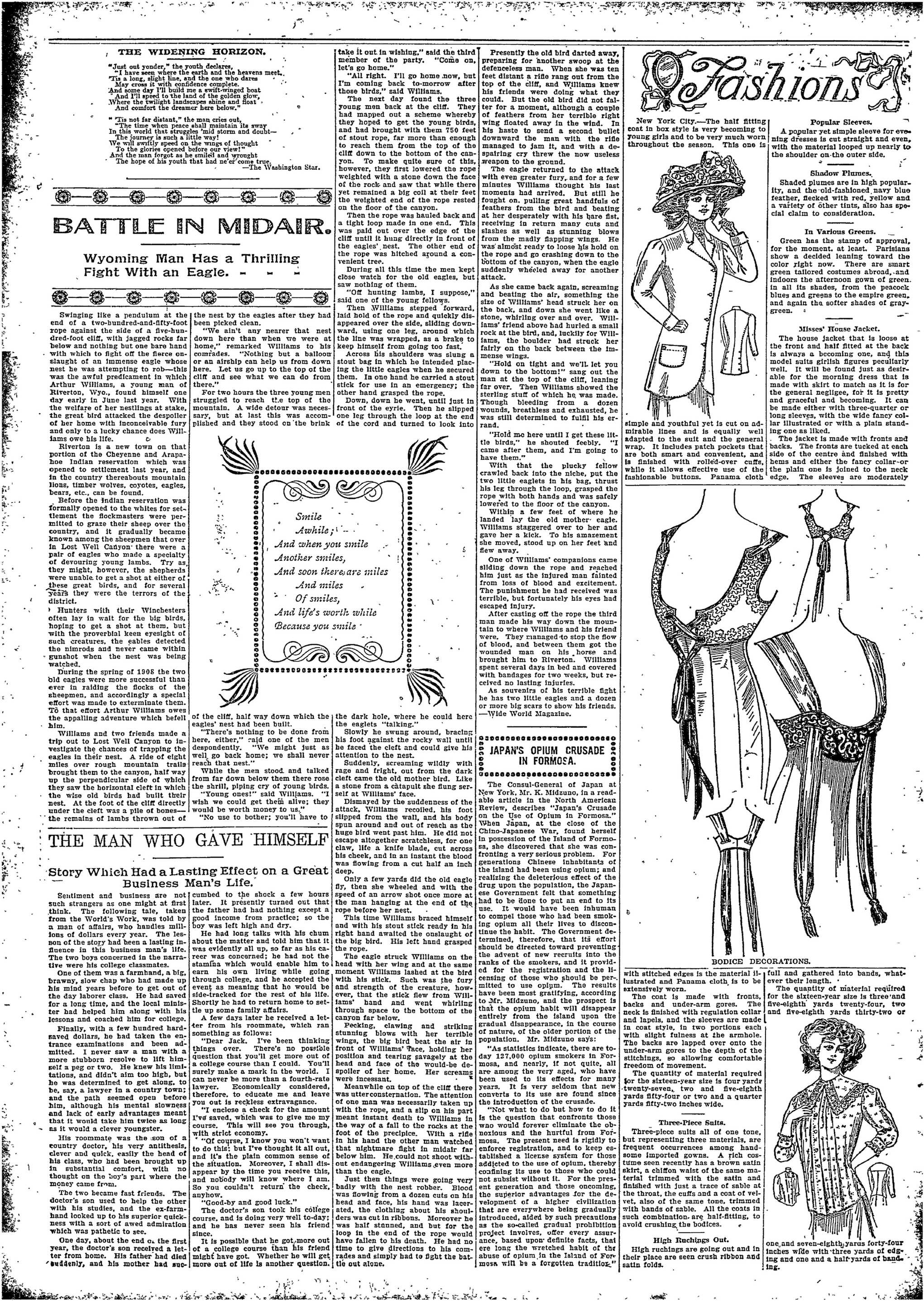
Fashions
BODICE DECORATIONS.
New York City.—The half fitting coat in box style is very becoming to young girls and to be very much worn throughout the season. This one is
SINGLE BREASTED COAT
simple and youthful yet is cut on admirable lines and is equally well adapted to the suit and the general wrap. It includes patch pockets that are both smart and convenient, and is finished with rolled-over cuffs, while it allows effective use of the fashionable buttons. Panama cloth
BODICE DEC
with stitched edges is the material illustrated and Panama cloth is to be extensively worn. The coat is made with fronts, backs and under-arm gores. The neck is finished with regulation collar and lapels, and the sleeves are made in coat style, in two portions each with slight fulness at the armhole. The backs are lapped over onto the under-arm gores to the depth of the stitchings, so allowing comfortable freedom of movement. The quantity of material required for the sixteen-year size is four yards twenty-seven, two and five-eighth yards fifty-four or two and a quarter yards fifty-two inches wide.
Three-Piece Suits.
Three-piece suits all of one tone, but representing three materials, are frequent occurrences among handsome imported gowns. A rich costume seen recently has a brown satin skirt, a chiffon waist of the same material trimmed with the satin and finished with just a trace of sable at the throat, the cuffs and a coat of velvet, also of the same tone, trimmed with bands of sable. All the coats in such combination are half-fitting, to avoid crushing the bodices.
High Ruchings Out.
High ruchings are going out and in their place are seen crush ribbon and satin folds.
A popular yet simple sleeve for evening dresses is cut straight and even, with the material looped up nearly to the shoulder on the outer side.
Shadow Plumes.
Shaded plumes are in high popularity, and the-old-fashioned navy blue feather, flecked with red, yellow and a variety of other tints, also has special claim to consideration.
In Various Greens.
Green has the stamp of approval, for the moment, at least. Parisians show a decided leaning toward the color right now. There are smart green tailored costumes abroad, and indoors the afternoon gown of green in all its shades, from the peacock blues and greens to the empire green, and again the softer shades of gray-green.
Misses' House Jacket.
The house jacket that is loose at the front and half fitted at the back is always a becoming one, and this model suits girlish figures peculiarly well. It will be found just as desirable for the morning dress that is made with skirt to match as it is for the general negligee, for it is pretty and graceful and becoming. It can be made either with three-quarter or long sleeves, with the wide fancy collar illustrated or with a plain standing one as liked.
The jacket is made with fronts and backs. The fronts are tucked at each side of the centre and finished with hems and either the fancy collar-or the plain one is joined to the neck edge. The sleeves are moderately
CORATIONS.
full and gathered into bands, whatever their length. The quantity of material required for the sixteen-year size is three and five-eighth yards twenty-four, two and five-eighth yards thirty-two or
1
one and seven-eighth yards forty-four inches wide with three yards of edging and one and a half yards of banding.
L. B. WILLIAMS, President.
L. B. WILLIAMS, President. P. EDWARD PERRY, Vice President.
The Guaranty Aid an
SOL. C. JOHNSON, Supt. of Ageno.
Treasury of State of Georgia
The undesignated Treasures of the State of Georgia, hereby acknowledge, to have received from the following desirers:
Dear Regent and Trustee of Elizabethtown, Georgia (Perry County, Georgia), dated January 17, 1920, in advance, due 1920-
L. E. Williams
P. Edward Perris
Walter B. Scott
Sel. C. Johnson
This company requirements of the strict that the strict
Its affairs are character and community. The fairs of the first themselves with
By comparing liberal inducement pany in this bu
That we pay
being in total Two Thousand Dollars; and which are held by the State of Georgia, by authority and under the provisions of an Act of the General Assembly, approved October 22d, 1887, and amended December 20th, 1879.
R. E. Parsi
Treasurer of the State of Georgia.
Treasurer of the State of Georgia.
P. B. RAY.
The Life of Love, and What It Depends On
DRY AND STEAM CLEANING. LADIES' WORK A SPECIALTY. HATS CLEANED AND REBLOCKED BELL PHONE 2050. JEFFERSON AND BERRIEN STS SAVANNAH, GA.
EY Beatrice Fairfax OVE is the one thing in which every human being is interested. Scientists are interested in science, artists in art, moneymakers in money, but to greater or less degree they one and all are interested in love.
GROCERIES, WOOD AND COAL
621 Oglethorpe Avenue, East
518----PHONES----Bell 50
You may be a disgruntled, sour old man or woman, but at some time in your life your heart has beaten quicker at the thought of some one person.
Or, you may be a dreaming schoolgirl, or a rough and tumble boy with a boy's hearty contempt for sentiment; but
Masonic Books &
Regalias.
Love is the one thing that makes the whole world kill. Through all the millions of years, men and women have loved; and through all the millions of years to come, they will go on loving.
LODGE SEALS,
FINANCIAL CARDS and
BLANKS of every description.
The strange thing about it is that the most wonderful thing in all the world should be regarded as such a commonplace thing.
world should be regarded as such a commonplace thing. Hundreds of wise men and women nave written solemn discourses and sentimental poetry on love, and yet today love is just as gossamer and intangible a thing as it was at the beginning.
be a thing as it was at the beginning. It is at once the longest lived and the shortest lived thing in the world. It is deep and it is shallow.
Publizers' and Manufacturers' Prices Liberal Discounts Will Be Arranged
It is kind and it is cruel.
It is kind and it is cruel. It thrives under neglect, and, again, it withers under kindness. It is a garden rose, and an orchid.
It is ennobling, and it is degrading.
BOL. C. JOHNSON. Savannah, Ga.
It is embodying, and it is degrading. It is a thing apart from all other emotions, and it holds the whole world in the hollow of its hand.
People continually ask me: "Miss Fairfax, what is love?"
People continually ask me: Miss Farrax, what is love?
That is a hard question to answer, because no one person can explain to another just what love is.
SOL. C. JOHNSON Notary Public.
All people love differently. My way of loving might not be yours, nor yours mine; and yet in her own way, each might love well.
But I have seen much of love. I have seen it thrive, and I have seen it die; and about that I can tell you.
I have seen men and women kill love, inch by inch. Some have cloyed it to death with sweets, others have killed it with bitterness.
Sometimes it has died hard; sometimes it has drooped and died at the first blow.
Deeds, Contracts, Wills and Other Legal Forms Prepared and Attested.
There are many different ways of killing love. Perhaps you have killed love. Perhaps some one has killed it for you. Sometimes love goes limping along in a half-hearted way that is sadder than death.
119 West St Julian Street
All those who would hold love must make up their minds to one thing, and that is: That love must be all paramount; it must be the biggest, most important thing in their lives.
Bill Calls For Government
Owned Railway Ontfitt.
It does not shut out all other interests, but it must come first. In the articles to follow this you may recognize your own method of killing love, or of keeping it alive.—From the New York Evening Journal.
Washington, D. C. If a bill introduced by Representative Dwight, of New York, becomes a law the United States will own a complete railway train, consisting of a baggage car, a sleeping car and a private car, for the exclusive use of the President on his travels.
YOU NEED IT WE DO IT
JOB PRINTING
NEAT WORK LOW PRICES
The sum of $60,000, to be expended by the Secretary of War, is provided, and he is authorized annually to enter into contracts with railway companies for hauling the train.
The Way the Boy Took It.
A boy, having been sent by his mother for some rock and rye, entered the nearest drug store and astonished the clerk by saying: "My mother wants ten cents' worth of your rotten rye."—Lippincott's.
and Relief Society
HOME OFFICE
WEST BROAD STREET,
SAVANNAH, GEORGIA.
Phone 1193. Ga. Phone 2029.
Directors.
L. E. Williams.
P. Edward Perry.
Walter S. Scott.
Col. C. Johnson.
W. R. Fields.
J. H. Deveaux
L. M. Pollard.
W. H. Burgum.
J. H. Bugz, M. D.
J. M. Ferrebee.
This company is duly chartered under the laws of the State of Georgia, and has compiled with all requirements of the State Insurance department, therefore all policy holders are protected with all the safeguards that the strict insurance laws of this State seek to protect its citizens.
Its affairs are directed and managed by Negro men of the city of Savannah of leading standing, and whose character and reputation are of such as to command the respect and confidence of all the people of that community. The same men that manage this Society are the ones that organized and are conducting the affairs of the first successful Negro Savings Bank in this state, therefore we can readily see that by connecting themselves with this Insurance company their interest will be in safe hands.
By comparing our rules and benefits with other first class companies it will be seen that we offer the most liberal inducements with the largest sick, accident and death benefits to our members than any other company in this business.
That we pay our claims promptly can be testified to by the thousands of our satisfied members.
The Savannah Tribune
with the superb FREE OFFERS of PARIS MODES, a w
azine; or THE SOUTHERN RURALIST; a splendid agric
; or TALKS FROM FARMERS TO FARMERS, an epitome
on wisdom, worth its weight in gold. All for only
Tri-Weekly Constitution
Monday, Wednesday, Frida
times a week. The newsie
nt, and biggest Southern Newspaper.
a Daily, yet at the price of a Weekly.
One Dollar a Y
Weekly Constitution—once a week, with each of the above (exce
Weekly Constitution is substituted for the Tri-Weekly)—all for one year for one
Tri-Weekly Constitution presents at one sweeping view the whole area of even
of the country, state, nation, and the world is given in each complete issue. Ea
departments of Farm and Farmers, Woman's Kingdom, Great Agricultural South
ation, Rural Free Delivery, Poultry and others of wide interest, edited by
directly to those addressed.
Weekly Constitution contains all these special features and the difference bet
the Tri-Weekly is that the one is issued once a week (on Monday only) a
three times a week—Monday, Wednesday and Friday.
I want the Constitution alone, without any clubbing offers, you can get the Tri-
tution at $1 per year, or The Weekly at 50c per year, by addressing The Cons
, Ga. One sample copy sent free on request, giving with it six of your neigh
together with the superb FREE OFFERS of PARIS MODES, a woman's magazine; or THE SOUTHERN RURALIST; a splendid agricultural paper; or TALKS FROM FARMERS TO FARMERS, an epitome of farm wisdom, worth its weight in gold. All for only $1.75
brightest, and biggest Southern Newspaper. Almost a Daily, yet at the price of a Weekly. or The Weekly Constitution—once a week, with each of the above (except that The Weekly Constitution is substituted for the Tri-Weekly)—all for one year for only $1.40 The Tri-Weekly Constitution presents at one sweeping view the whole area of events. The news of the country, state, nation, and the world is given in each complete issue. Each week the departments of Farm and Farmers, Woman's Kingdom, Great'Agricultural South, Farmers' Union, Rural Free Delivery, Poultry and others of wide interest, edited by experts, appeal directly to those addressed. The Weekly Constitution contains all these special features and the difference between it and The Tri-Weekly is that the one is issued once a week (on Monday only) and the other three times a week—Monday, Wednesday and Friday. If you want the Constitution alone, without any clubbing offers, you can get the Tri-Weekly Constitution at $1 per year, or The Weekly at 50c per year, by addressing The Constitution, Atlanta, Ga. One sample copy sent free on request, giving with it six of your neighbors.
THE CONSTITUTION IS THE PAPER FOR RURAL FREE DELIVERY ROUTES
of 40 or 50 or more will keep an R. F. D. route above the minimum average daily mail service. It is the great news purveyor of the whole Southland, as part of states as on the Atlantic seaboard. Subbed with The Atlanta Constitution, we have the superb FREE OFFERS which you may make your choice of one:
Talks From Farmers to Farmers, a symposium of Southern farm knowledge, be in the hands of every practical farmer, young or old. The articles have been in Tri-Weekly Constitution under same title and made one of the greatest feast and friend farmers' paper. It will be mailed to you immediately upon receipt of one. The Southern Ruralist, one of the best agricultural papers in the south. Monthly edited by a farmer on his own farm, and is intensely practical and he Paris Modes, a woman's magazine, monthly. There are fashions in it, as these, and they are right up to date. Do not think they are all of the sylph-like, spin styles of the extreme devotees of the changeable flirt called "Fashion." Pretty and becoming and up to date, so that the ladies may feel well-dressed, he who follow them. But you get more than mere fashions. There are stories, lives, incidents of travel, seasonable articles for entertainments, home keeping, of the person, sanitation and hygiene, plant culture and all the rest that go to truly feast for the busy woman who reads as she works, who relaxes from one to warm in the ever-varying features of woman's work that is said to be never
A club of 40 or 50 or more will keep an R. F. D. route above the minimum average required for daily mail service. It is the great news purveyor of the whole Southland, as good in the gulf states as on the Atlantic seaboard. Clubbed with The Atlanta Constitution, we have the superb FREE OFFERS shown from which you may make your choice of one: (1) Talks From Farmers to Farmers, a symposium of Southern farm knowledge, that should be in the hands of every practical farmer, young or old. The articles have all appeared in Tri-Weekly Constitution under same title and made one of the greatest features of this splendid farmers' paper. It will be mailed to you immediately upon receipt of order. (2) The Southern Ruralist, one of the best agricultural papers in the south. It is a semi-monthly edited by a farmer on his own farm, and is intensely practical and helpful.
semi-monthly edited by a farmer on his own farm, and is intensely practical and helpful. (3) Paris Modes, a woman's magazine, monthly. There are fashions in it, as the titles indicates, and they are right up to date. Do not think they are all of the sylph-like, hipless, clothes-pin styles of the extreme devotees of the changeable flirt called "Fashion." They are-all pretty and becoming and up to date, so that the ladies may feel well-dressed and in the-style who follow them. But you get more than mere fashions. There are-stories, poems, storyettes, incidents of travel, seasonable articles for entertainments, home keeping, cookery, care of the person, sanitation and hygiene, plant culture and all the rest that go to-make up a monthly feast for the busy woman who reads as she works, who relaxes from one task and finds charm in the ever-varying features of woman's work that is said to be never done.
OUR GREAT PROPOSITION
Remember, our paper one year, and THE TRI-WEEKLY CONSTITUTION, on Wednesday and Friday, three times a week, for one year, and your selection of the three alternate free offers, all for $1.75; or the whole combination (except the Constitution is substituted for the Tri-Weekly) for only... and at once. Get right on. Don't miss a copy. Address all orders for above
Remember, our paper one year, and THE TRI-WEEKLY CONSTITUTION, Monday, Wednesday and Friday, three times a week, for one year, and your selection of one from the three alternate free offers, all for $1.75; or the whole combination (except that The Weekly Constitution is substituted for the Tri-Weekly) for only... $1.40
Send at once. Get right on. Don't miss a copy. Address all orders for above combination to
THE SAVANNAH TRIBUNE, Savannah, Ga.
THE SAVANNAH TRIBUNE
PUBLISHED EVERY SATURDAY BY
THE TRIBUNE PUBLISHING CO.
462 West Broad Street,
Bell Phone 2171
Entered at the Post Office at Savannah,
Gz. as Second-Class mail matter.
SATURDAY, MAY 8, 1909
WITHIN the past few weeks there have been several reports of shooting of colored men by policemen, etc., one by a white man, and a stabbing by a white man. In each of these cases, from reports, the would be life takers were not justified. In the cases where the policemen are concerned especially, the investigation should be thorough and the guilty made to suffer.
DR. BRUNNER has rendered his annual report, and in a practical way he scored the high death rate among our people in the city, and recommends the appointment of a non-prejudiced, and non-partisan commission to investigate, the same. We would welcome any plan for the bettering of the health conditions among our people. But even before the commission is acted upon, if city council would pass an ordinance compelling property owners to raise the large number of unsanitary shacks in the several localities, preventing tenants from living in unsanitary basements and outhouses, and compelling landlords to erect houses more commodious than many of the "coops" now being erected, and the preaching to our people the need of more air and light in the homes with clean yards, etc., the rate among us would dwindle to appreciable extent.
Sometime ago the removal of the Georgia Infirmary from its present site was agitated, but without avail. The tornado on Saturday having damaged the building somewhat, has caused a renewal of the agitation. Some of our white friends have gone so far as to state that the leading colored citizens are in favor of its removal. This assertion is untrue. The colored citizens as a whole are entirely satisfied with the present location, deplore the agitation and would resent the removal. The hospital was placed at its present site when it was considered "far" from the city proper, and it would be unjust now, to remove it to a less well located section. The hospital in its present locality has not retard improvement around it, in fact it is all well built up as any other locality in the southern section of the city. THE TRIBUNE in behalf of the colored citizens appeal to the trustees of the institution to pay no attention whatever to those who are agitating the question, but arrange to improve the present site in such a manner as to make it among the most modern.
In another column is printed an article from a member of the race who is intensely interested in the securing of a new school site for our children. This writer contributes the sum of one dollar which we have deposited in the bank for a school site for colored children. This amount may seem small to many, but the intent of the contributor is great, and if followed by one tenth of our colored population, a site second to none in the city could be procured. This can be done easily if the matter be agitated by the churches, lodges, societies and individuals who are interested in the educational welfare of the thousands of boys and girls who are roaming the streets for want of school facilities. It seems as if the board of education is not desirous of helping the colored children to this extent. Now let the colored citizens get together and purchase a desirable and spacious lot, and present to the board for the erection of a new school building. On this question THE TRIBUNE opens its columns, inviting suggestions, pro and con. Every colored man and woman should be interested in it and give some expression. Let us hear from you through our columns.
Can't Employ Labor to Repay Obligation.
The employment of farm labor under contract to repay obligations of the employee to the employer is declared by the court of appeals, in a decision handed down Tuesday, to be repugnant to the federal constitution and a violation of the state peonage laws.
The decision is handed down in the case of Wells vs. the state. The decision says that Wells was
employed us a farm laborer at $16 a month to repay $30.85 that had been advanced by the employer. Wells is alleged to have worked for three and a half months after which he left employment. At the time he is said to have owed the entire amount of $30.85 and an additional $15 for "supplies advanced."
His employer alleged cheating and swindling in the carrying out of the employee's part of the contract.
In the opinion of the court of appeals the defendant "could have lived to the ripest old age and gone down to his grave, with his contract still unperformed."
A. C. Porter visited Savannah last week and incidentally dropped in THE TRIBUNE, where Editor Sol. C. Johnson and his force were making things hum. They were all working overtime, trying to catch up their work which was pleasing to the Standard man, to see that office so largely patronized. Well Editor Johnson is a prosperous young man and his influence is far reaching. His position in business circles, secret orders, and the social world speaks volumes for him.—Florida Standard, Jacksonville.
APlan for Raising School Funds
Savannah, Ga., May 5, 1909
Editor TRIBUNE:
Please allow me space in your valuable paper to express my endorsement of the timely editorial in last week's issue, stating that you will welcome any movement and will also contribute to any fund looking forward to the obtaining of more schools for our children. Now I most heartily agree with the thought put forward by you, and I suggest that we raise a fund for said purpose by subscription, that is, let all of the churches, societies and individuals contribute thereto, and that a board of representative citizens who are familiar with the educational needs, be organized to handle the movement. Enclosed please find $1.00. Hoping for success I am respectfully.
41st Anniversary Hampton Institute,
Hampton, Va., April 30, 1909.
At the forty-first Anniversary of the Hampton Institute which was held here Thursday April 29th., Dr. Booker T Washington, Judge Terrrell, Messrs Robert C Ogden, Geo F Peabody, Ray S Baker, and many other distinguished persons were present. At the anniversary exercise, which were held in the Auditorium on the afternoon of the twenty-ninth. Mr Washington delivered a stirring address to an audience of three thousand white and colored people, among whom were a party of a hundred northerners, who accompanied Mr Ogden, and nearly three hundred southern white people from Richmond and Norfolk.
Mr Washington showed in a most striking manner, made plain by pithy anecdotes, how it was absolutely necessary for the intellectual, moral, and economic welfare of the South, that the Negro be educated; and educated by the co-operation of the people in the South. When he showed how the Negro women as laundress, as cook, and as the nurse of the white infant is, ignorant a contaminating agency in the Southern white man's home, and how, if educated the clothes will not be endangered by germs, whether tuberculosis or what not how indigestion or typhoid fever could be checked; and how the children's morality could be sustained; he received an ovation that came not from an impulse audience, but from calm, resolve, deliberate people, who sought, and welcomed the truth. Mr Washington concluded by stating that the Negro deserves praise for his virtues as well as blame for his short comings.
The writer, as a Savannahian, also delivered an address titled "A Plea for the Southern city" in which she set forth for the educational and moral deficiencies of the Negroes in the Southern cities and a call for some of the properly educated Negro youths to go to their aid, Bovine R. Ganton, 99.
F. A. B. Church.
Sunday last marked a day of much impressiveness at each service. Amidst the balleljahts though entwined a bit of sadness keenly left by the members and friends present. At the 11 o'clock service the pastor Rev W L Jones prescheduled an able and genuine baptismal sermon be fore a vast audience, in his new robe, along the edge of the waiting waters of the open baptismal pool; in front of which sat thirty one candidates. The sermon was indeed edifying and doctrinal, and the candidates especially fensted to know that they were about to follow the way of the blessed Master. At 3 o'clock the funeral of Rev Edward C. Johnson took place, officiated by the pastor and many of the ministers of the city. Immediately after the funeral the, communion service was held. As the hand of fellowship was being extended the candidates, the spirited and animating songs of Zion, suddenly broke the monotony of sadness, and what might be considered a happy festival day was now in evidence. The pastor was ably assisted by visiting ministers who were welcomed. At the evening service the pastor was ably assisted by visiting ministers, who were welcomed. At the evening service the pastor preached another arousing sermon, after which he introduced Miss Josephine Stragha a Missionary for the Foreign Mission Board, and formerly of Getorgetown, British Guiana, S.A. Miss Stragha made a very fine and explanatory talk of the work of the Foreign Board, injecting occasionally her experience and life in the Missionary work, which equalized a splendid sermon, and after the church's collection of $165.00 for the day was raised, $0.60 was taken up for her. On Monday night the members and friends of the church turned out in large
numbers at the parish church honor of its re-opening, and quite what sum was realized from the sale of refreshments and 10 cents admission at the door. In all the gathering was one of a happy family meeting. The pastor and his family made everything most pleasant and expressed a delight in entertaining the members and friends from other churches Deacon Thos R Williams the wide awake deacon and chairman of this affair deserves credit. also the ladies that served on the committee, who made possible this most enjoyable evening. Miss Josephine Stragn and Rev. Cooper Burmer pastor of Central Baptist Church Augusta, Ga were several of the distinguished guests. Rev Cooper is now identified at the head of the Missionary work of the Second District of Ga. The pastor have taken great pleasure in introducing him in our community. The members are urgently asked to be present at the 11 o'clock service on tomorrow morning and bring an extra contribution of 10 cents to meet a demand. The pastor visited a number of the churches during the week. The older houses are doing good work, and the leaders are elated over the good spirit that is seemingly brooding over them. Sister Abbie L Jones have called together the number of candidates, that were baptized Sunday, to organize a club which the pastor bids fair to operate a good financial system the in the contribution to church. God bless all efforts on the part of those who labor for the unity, peace and prosperity of the church.
Second Baptist Church
Second Baptist Church
Rev Anthony of Jacksonville, Fla.
preached at both hours Sunday as Rev
May was out of the city. Remember the
baptismal rites will be administered to
tomorrow morning immediately after
preaching. Everybody invited. The big
excursion to Beaufort, SU is being
announced and a great crowd is going to go.
The general health in our ranks is compar
atively good; less sickness than at anytime
in two years. The pastor will preach
tomorrow; he will be assisted by several,
of the city pastors at the communion hour.
Sunday School at 2:30 p.m, Supt Edwards
and Mrs. Edwards. The pastor Rogers
having been ordained to the ministry
resigned his deaconship here in con-
ference Monday night. Rev Rogers serve-
ed as deacon here with credit and
honor for more than a quarter of a century.
We highly recommend him into the
gospel ministry. He is an everlasting
Bible student. Remember baptism to-
morrow.
F. B. B. Church Dots.
F. B. B. Church Dots.
On Sunday morning Rev. Isaac Anderson preached a very instructive sermon. Quite a number was present to hear him. At night Rev. Wright read for the lesson Matt 7:1-14. His text was from Acts 10:31. The subject was "Faith in Salvation." In a short while, he preached a sermon that sank deep in the hearts of all as was shown by the attention given. At its close the choir very sweetly sang "Praise ye the Lord." Rev. Wright led the hymn "Jesus Thou art a sinner's friend." This was sung in a very sweet tune and when it ended there were very few who were christians standing. The interest in the revival is deeper at every service. Large numbers are being added to the church. A collection of $0.00 was taken for a poor, sick, needy brother. Do not fail to hear Rev. Wright's "Thanksgiving sermon" to the Odd Follows and Households of Ruth on Sunday afternoon.
St Paul Dets
Last Sunday was a great day at St Paul U M E Church. The services were grand, the choir rendered most excellent music such as none but the ect Paul choir can make, and he who want to hear good singing come out and hear our choir. Rev W T Toomer preached three able sermons. He is a great preacher, everybody should hear him. The people of St Paul have just closed a successful revival, during which many souls were converted. Rev Moore, Mrs E U Payne, Mrs Katie Pinkney and Miss Gertrude Wallace have just returned from Willacoochee, Ga where they went to attend the district W H M S Convention. They report a pleasant trip. The W H M S will render an excellent program on next Sunday at 4:30 p.m. Everybody is invited to hear this program, you will be made welcome. Dont fail to come out.
St. Philip Dots.
Last Sunday was to reunion Sunday and the attendance and the breakfast, every pew being occupied each time. Rev John A-Cappus preached, 11 a m and his discourse to those who were recently converted and candidates for baptism was wery touching and if heeded will be a lamp and guide for them through life's journey. After preaching there were six children and five adults baptized and eleven gave the right of fellowship. We are glad to note that Prof J H Baldwin is improving somewhat, he is very much missed from our Sunday school. Look out for St. Phillip's Sunday school, excursion and picnic to Bluffton, S C en June 39 1909. Bro Jasin Binyard was appointed a steward in place of A H Holbrook who has removed from the city. Our love feast on Friday night of last week was one of the best that we have experienced for years; every member was spiritually allye. The testimonies given and the many religious songs gave vent to how each member is trying to work out their soul's salvation. On Tuesday night, quite a number of our young men of last year's converts were appointed assistant class leaders to various classes. The following services will be held on tomorrow: Prayer meeting at 5:30 a m, preaching at 3 a m, Sunday school at 3 p m, A CEL 4:30, preaching at 8 p m, Strangers are cordially invited.
St. Phillip Monumental.
Sunday was "sweet Sunday" with the children. At 9:30 a.m. when Superintendent W O Sherman handed the opening bell, hundreds of little kids were in the seats to see what "sweet Sunday" was. Many new scholars were invited. At eleven a.m. the pastor prescribed an instructive sermon, text Isa. 25:1. "I will praise thy name for those hast done wonderful things." At 3 p.m text, He6:13:10 "We have an altar where they have no right to eat which tastes the tabernacle." Theme "Christ the Altar. At 8 p.m, text, 2 Cor. 6:16, "Thanks be unto God for His unspeakable gift." Theme, "Christ the unspeakable gift," Dr. Townsley, has never been heard to better advantage; and the people were carried away with these three sermons. At night he crowded all, nearly 900 communed; 8 persons joined the church during the day; 2 infants, were baptized, accessions during these five months. 167. The church is proud of Dr Townsley as their pastor, his plans, sermons and everything is new.
inspiring and elevating. The ten nights bazaar is on and is largely attended. Dr. R V Branch, P E. Atlanta district, preached Thursday and Friday nights for us. The members and friends were glad to see him. He stopped with the pastor. The Sunday school picnic will be at Daufuskie Monday June 14. Steamer Clifton will carry them.
St. Benedict's Church. Gaston and East Broad streets.
Gastell and East broad streets.
Sunday M 9th, fourth Sunday after Easter, First Mass at 7 a.m with a short instruction. High Mass and sermon at 10:30 a.m. Rev J A Dahlent will celebrate the High Mass with a preach the sermon, which will be on the Sunday School immediately after High Mass. Evening devotions at 8 p.m. Rosary sermon (by Very Rev Ignatius Lissner) and benediction of the most blessed sacrament. After the evening service there will be a meeting of St Mary's Aid Society. The May Procession of last Sunday was certainly one of the prettiest sights ever seen in St Benedict's Church. A beautiful shrine tastefully decorated with flowers and candles had been erected in the sanctuary by the Franciscan Sisters. About 160 children took part in the Procession; amongst them were over a hundred girls, all dressed in white, with veils and wreaths on their heads. Slowly they walked through the church, singing the hymn to the blessed Virgin. At the head walked six altar boys with cross and lighted candles, then came the boys dressed in black; one of them carried the Banner of St Antony, followed all the girls of St Benedict's school with a beautiful banner of the Immaculate Conception and the children of St Francis Home with another banner of Mary; finally came 15 altar boys in red caskocks amongst whom walked the celebrant. Very Rev Ignatius Lissner dressed with a grand white Cope. miriads of light were burning everywhere in the church and brightened a most touching spectacle. The little church was packed with an immense congregation. Proud fathers and mother, wanted to witness the joy and happiness of their little ones on that beautiful May Sunday; the faces of these parents were leaning with delight when they saw along with girls and girls as they walked with joy in the warmness. Inspiring with deep devotions the music, rendered by the children of the Home under the direction of a Franciscan Sister. It may be mentioned that many non-Catholic children took part in the procession. Father Dahlent made a short address, in which he explained the meaning of that May celebration. Only those who know the teaching of the Catholic Church can understand the reason of great and loving manifestation in honor of the blessed Virgin. For us, said the Rev. Preacher, it is a most sacred dogma of faith that that Mary was the mother of God Great was her dignity on earth; great is her glory in heaven. Mary is also our mother, given to us by Jesus on the cross. We love her as a good mother, and we show our affection and our veneration by exterior manifestations. Never could we do too much for the mother of our Saviour and for our own spiritual mother. We honor and love her statues and her pictures, which keep alive in our hearts the remembrance of one dear to us. Absurd is the old calmyn that we adore Mary or her statues. No, we pray to her that she may intercede for us in heaven. We cherish her picture as we cherish the pictures of our earthly mothers"
The same procession will take place in the Church of St. Church on the last Sunday of May.
Ministers Union
The Baptist Ministers Union held its regular session, Rev W M Gray president, Rev F J Streeter conducted the devotions, After the approval of the minutes of the previous meeting, Rev F J Streeter was given the hand of fellowship by the president, Revs A R Cohen and Cooper of Augusta were present and made some remarks. Rev Cooper is a State Missionary and an able speaker. Rev F J Streeter was a non-Sister Strong of South America who is connected with the Foreign Mission work was introduced and asked the pastors for dates to meet their people. Sarmonic reports, Rev W A Daughry, Matt 4:17, Rev E Sandford, Joshua 4:17
The Evangelical Missions Union met on Tuesday with Dr Lindsay presiding. Devotional services were conducted by Rev B J Ross "There is a fountain filled with blood" was sung and after prayer the 8th chapter of Roman was read. The Union joined in chanting "O for a heart, to praise my God" Rev Ross asked for more time for his paper. The same was granted. Sermonic reports were taken up. Rev M Bembry, Dr R H Singleton, Rev J S Jenkins, gave the Union some splend d outlines in which the Union as a whole offered commendation. Dr R V Branch, P E of the Atlanta District, visited the Union and gave a timely address. This city knows Dr Branch's ability and the Union wishes him much success. Rev W T Moore, responded to Dr Branch and he was as eloquent as a Cicero. Come out next Tuesday, Dr E D Giddens will have a big paper. Visitors always welcome.
See McFall before ordering your Ice Cream and Sherbets, he can please you. Phone 4038 05-15
A. L: Cannal,
CONFECTIONERY
AND QUICK LUNCH
Ice Cream and Cakes, Wholesale
a. Specialty.
525 WEST BOLTON STREET,
Open Late. Sayannah, Ga.
E. E. Cooper,
CONFECTIONARY
and ICE CREAM
Soda Water and all kinds of
Soft Drinks.
630 Grapevine Avenue.
05-15
When you want to refresh yourself
Stop at
MRS. M. SINGLETON'S
RESTAURANT
ON THE BAY
The leading Restaurant in Beaufort
Also Rooms.
Whereas, It has pleased the Supreme Architect of the Universe to remove from our midst our late friend and associate Henry Alexander Houston; and,
Whereas, The relations long held by our deceased friend with the members of this Set render it proper that we should place on record our appreciation to the Set. Set, Set, Set, high esteem in which he was held by each member; therefore be it
Resolved, By the Newport Set, that while we bow with humble submission to the will of the Most High we do not the least mourn for our friend who has been called from labor to rest. Resolved, That in the death of Henry Alexander Houston the Set loses a member who has always entered with heart and hand into every movement that tended towards the uplift and advancement of the Set; an honest and upright man, whose virtues endeared him not only to the members of the Set but to all his fellow citizens. Resolved, That the Set tender its heartfelt sympathy to the family and relatives of our deceased friend and associate in this their sad affliction. Resolved, That these resolutions be entered upon the minutes of the Set, and a copy be sent to the family of our deceased friend. Respectfully submitted,
St. Stephen's Episcopal Church.
Habersham and Harris Streets
Services:
Sunday school 9:45 a.m.
Sundays, 11 a.m. and 8:15 p.m.
Wednesdays, 8:15 p.m.
Stage Star Poster Pictures.
A series of poster pictures in colors in sets of six will be given with The Sunday World Magazine, beginning May 16. A new set of six actors and actresses each week. These pictures are suitable for passepartoutting, cozy corner decorations and for the walls, and screens of summer rooms. All of your favorite actors and actresses will be represented. Begin May 16 and get the first set of six and follow it up for six weeks. No extra charge. All free with The New York Sunday World:
You Don't Know a Good Thing until you try one of those LUNCHES OR MEALS
THAT ISAAC SANDERS HANDS OUT Around the corner on West street, BEAUFORT.
The Most Popular Resort in BEAUFORT is Singleton's CAEE You can't miss it. Ask any hackman. "Nuf Sed." Miss ANNA BROWN, Manager.
in Savannah O LUSTRE
Made in CAN-SO For Cleaning Knives. Forks, Utensils.
Knives. Spoons, Gold, Brass, Furniture, Forks, Windows, Silver, Nickel, Kitchen Utensils. IT BEATS THE "DUTCH"
Ask your dealer certainly good.
HARMS'
Staple and Fa
622-624 Bolto
dealer about it, for its good. At all stores. S' GROCERY Fancy Groceries
Ask your dealer about it, for its certainly good. At all stores.
HARMS' GROCERY Staple and Fancy Groceries
622-624 Bolton Street, east.
Reptuation as East Side T
The Mechanics Inv
(Authorized O
Maintains a Savings Department
drawal on demand. Will L
Rates on Real Estate or any A
vestigation. Open a Saving A
you will increase it.
See US on Your Gu
Officers and Directors—S. P. Lloyd,
E. F. Degrenner, See & Trees
Reptuation as East Side Tea and Coffee Store
The Mechanics Investment Company
(Authorized Capital $25,000)
Maintains a Savings Department. Pays 5% Interest. Withdrawal on demand. Will Lend you Money at Legal Bank Rates on Real Estate or any Approved Security. We invite Investigation. Open a Saving Account with $1.00 and we know you will increase it.
See US On Your Guaranteed Investment
Officers and Directors.-S. P. Lloyd, Pres., Chas. J. Madden, V. Pres.;
E. E. Desverney, Sec. & Treas.; Robert Patrick, A. L. Tucker.
Henry Pearson, Chas. A. L. McDowell.
Office: 20 STATE ST., WEST. Savannah, Ga.
(UPER FLOOR)
SEABOARD
AIR LINE
DAILY SERVICE FROM SAVANNAH
5:00 p m Seaboard Florida Limited for New York and all Eastern cities. Daily except Sunday
9:35 a m Seaboard Florida Limited for Jacksonville, St Augustine, Palm Beach, Miami and Havana. Daily except Monday
12:50 p m Leaves for Columbia, Norfolk Richmond, Washington, New York and all Eastern Cities
11:45 p m Leaves for Garnett, Fairfax, Denmark, Columbia and intermediate stations
3:00 p m Leaves for Brunswick, Jacksonville, Ocala, Tampa and Florida points
2:50 a m Leaves for Brunswick, Jacksonville, Ocala, Tampa and Florida points
8:00 a m Leaves for Brunswick, Jacksonville, Ocala, Tampa and Florida points
1:05 p m
7:00 a m Leaves for Collins, Holena, Cordele Americus, Montgomery and all Western points
5:00 p m
Central Standard Time; given only as information; not guaranteed.
Full information at City Ticket Office, No. 78. Bull street. Phone 671-
Resolution.
Phone 3815
Men's&Women's
CLOTHING
Credit
Spring Clothes
You want the best—we
have them.
You want easiest terms
—we can give them.
You want lowest prices
for dependable qualities
—they're here.
So, when you are ready
to buy—be sure and come
to us.
Women's Suits
$15.00 to $35.00
Women's Hats
$3.50 to $10.00
Men's Suits
$15.00 to $28.00
Boys' Suits
$4.00 to $15.00
Menter & RosenbloomCo.
107 Broughton St.
Up Stairs
Open Monday Evenings
THE SAVANNAH TRIBUNE
SATURDAY, MAY 8, 1909
Miss Mamie, E.. Holmes. left on Thursday for New York.
Miss Annie Ferebee of Ridgeland, S.C. was in the city this week.
Remember that on the ground floors of Morse's Hall, still cheaper fares can be arranged for.
5 or 6 doses "666" will cureany case of Chills and Fever. Price 25c.
Mrs. Jas. M. Johnson of Augusta is here visiting her sister Mrs. Bertha Lloyd.
Messrs. Clarence Whiteman, J. Ponder, J. Miller, and T. Lowe left on Thursday for New York on their way to Seattle, Washington.
Remember that Mr. Isaiah R Allen (ike) at 540 Gordon street, cast, is the agent for Morse's Hall. Rent for balls or dances $1.
Do you wear rubbers, at Scott Bros.
Have ladies Sailors for 50 cents at Scott Bros.
The Newport Set will repeat "Followed by Fate" at the Georgia. State College Friday May 21.
Rev. R. V. Branch of Atlanta spent several days in the city this week.
Rainy weather umbrellas at Scott Bros.
I am making delicious Ice Cream and Sherbets. Can fill your order at short notice. Give me a trial I know I can please you. S. S. McFall. Phone 4038 05-15
Rev: J. P. Mitchell of St James A. M. E. Church, Blackshear, will preach the anniversary of the Odd Fellows of that place Sunday afternoon. Fred Douglass shoes at Scott Bros. Remember lodge and society halls can be arranged for almost any dates at Morse's Large Hall on Hall street, between Price and East Broad streets. Miss Edith Weston who has been teaching at Sylvania has returned home after a successful school term. Shopping bags at Scott Bros.
Miss Sadie Moultrie and Mr. Ed. Roach, were married in Beaufort and arrived in the city Tuesday en route to New York. While here they were the guests of Mr. and Mrs. A. S. Reed.
The members and friends of the Old Folks Home Association are requested to meet at the residence of Mrs. E. Richardson $14 Gwinnett street, east, Wednesday night, May 12th, at 8:30 o'clock.
A square deal to every man is A. P. Barnard, the Tailor, 310 Whitaker street. Phone 3003.
5 or 6 doses "666" will cure any case of Chills and Fever. Price 25c.
The grand rally of the First Congregational Church for the renovation of the church edifice will occur on tomorrow. The members are working earnestly for the accomplishment of the desired purpose. The Circle of young people will report at the evening services. The friends of the church and the public are cordially invited to attend and share with us the joy of giving. The choir will render special music for this occasion.
The Cantata, "Under the Palms," will be rendered at St. Stephen's Church, on Wednesday night May 19th. A cordial invitation is extended to the general public. No admission will be charged but a silver offering will be taken up.
We sell Overalls at Scott Bros.
Mrs. E. D. Seabrooks returned to the city on Monday last after a stay of several months in Chattanooga and Lookout Mountain, Tenn., as the guest of Mr. and Mrs. Robert Hill.
Mr. Alex W. Ferrebee, son of Mr. T. E. Ferrebee is expected home shortly. Mr. Ferrebee recently graduated in this year's class of the State College at Orangeburg, S. C. He stood well in his class and his friends wish him success,
The Royal Benefit Society has proven to be royal by paying the death claims of the following deceased members in a short time: C. Daniels $100.00, M. Collins $87.50 and B. Jackson $50.00.
Mrs. C. M. Brinson and little Chas. Maceo returned Sunday night from Jacksonville, Fla. where she attended the wedding of Miss Lillian Lewis. Mrs. Brinson reports an excellent time, having been very much impressed with Jacksonville.
Latest Patterns in men's dress shirts at Scott Bros.
Mrs. Robert F. Campbell of Union Town, Ala., with her daughter, little Miss Annie May are in the city visiting her aunt, C. C. Houston, on east Waldburg street. Mrs. Campbell is formerly of this city and is well known by many as Miss Alice Mulligan. Her relatives and friends are glad to extend her welcome. We want your trade at Scott Bros. Men's straw hats at Scott Bros. Mr. Robt. T. Spencer, Jr., who has been residing in San Francisco is home on a visit to his parents and friends. He is looking well. His friends were glad to see him.
Tomorrow afternoon all the Odd Fellow Lodges, Council, Patriachy, Households and Juveniles will go in a body to the F. B. B. Church where the annual thanksgiving service will take place. The sermon will be preached by Rev. Daniel Wright.
Gone to His Reward
1911
Rev. E. C. Jolinson, after a lingering illness for seven weeks passed from labor to reward. He was born in Bryan County, Ga. November 20th 1850, and died April 30 at 4 a.m., age 58 years and 5 months. His whole life was one of noble deeds, and that was proven by the number of his friends, and if he had enemies no one knew it. For thirty years he was a porter for Messrs Mohr Bros., and the length of his association with them shows his worth his integrity and his honesty. He was converted under Rev. W. J. Campbell and ordained as a minister of the gospel by the late Rev. E. K. Love, D. D. and from his ordination he ever strove to lead his people in the right way and in the fear of God. He loved his church and his members loved him. He was called to the First A. B. Church of East Savannah as its pastor and ever afterward he was always at his post. His funeral was from the First A. B. Church, Franklin Square, on May 2nd, conducted by Rev. W. L. Jones, D. D., assisted by Rev. P. M. Hunter and others. The massive edifice was filled to its capacity with mourners and five friends of the deceased. He leaves his wife Mrs. Johnson, and five children, Mrs. Idg. Mallard, Misses Sadie and Stella and Messrs J. F. and J. W. Johnson, and other relatives and many friends to mourn his death. Well it might be said "Servant of God well done,
Rest from thy love employ,
The battle fought the victory won,
Enter thy Masters joy.
Called to a Better Abode.
Called to a Better Abode
Death claimed Mrs. Ellen Bebee about the setting of the sun on Saturday last after an illness of many months. Mrs. Bebee was a member of the First Congregational Church. The members and attendants can picture in their minds a dignified lady with a spotless white handkerchief arranged neatly around her head, sitting in the front pew at every service until stricken by illness. Her fidelity to her church was great and her faith in Him whom she adored was unquestioned.
Mrs. Bebee was the oldest member of the church in point of age, being over ninety. She was born in Maryland, but has been living here since the civil war. She had no relative in the city, and during her long illness the faithful ladies of the church attended to her wants with contributions from the church and friends.
The funeral took place from the church Monday afternoon, and the tribute paid to her memory by the pastor, Rev. W. L. Cash, was in keeping with her life.
Local Dots
That Picnic Ice Cream a'Scott Bros.
Master Laurence Theus, Jr. son of Mr. and Mrs. L. W. Theus is still sick with typhoid fever and has improved but very little.
Our best cream go cents at Scott. Bros:
Mr. and Mrs. Norman Jackson have the sympathy of their many friends for the death of their little daughter, Lucile Ineze Jackson which occurred in Beaufort April 20th, while spending a few weeks with her grand mother, Mrs. Lucy Mitchell. Mr. and Mrs. Jackson returned home Saturday.
Double triangle 5 ply linen collars at Scott Bros.
On Wednesday night of last week at the residence of the bride's parents, Mr. Ben White and Miss Katie H. Carter were united in marriage bonds by Rev. J. A. Lindsay. The spacious double parlors were appropriately decorated and corresponded most elegantly to the beautiful appearance of the happy couple. Many friends were there with presents
and congratulations to bid the happy pair good luck and prosperity on the sea of life.
Best Woolens—Best trimmings—Best workmanhips—Best service and best treatment, what more can we say? A. P. Barnard, the Tailor, 310 Whitaker street. Phone 3003.
The New York Age is on sale in Savannah every week. Short items relative to social affairs, churches, business etc., will be published under "Savannah News" Such notes sent to me by Saturday of each week will appear the following Thursday. Price per year $1. 50, single copies 5 cents. Chas.
Thursday of last week Mr. Thomas Gladman and Miss Mary Lou Ducan were made husband and wife. Rev. J. A. Lindsay performed the ceremony. The happy couple left at three o'clock for their future home in Bulloch county.
Mr. Charlie, Humphries and Miss Rebertie were joined in holy wedlock by Rev. J. A. Lindsay on Thursday night of last week. Both bride and groom were attired in appropriate style and never looked better than on this occasion. Their many friends who greeted them on this happy event wish them a pleasant sail on the matrimonial sea.
Notice.
Parties who desire to rent Stiles' Park, apply to Julian Smith, 515 E. Anderson street, or drop a card and I will call to see you. Park is now open for dates.
Harris Neck, Ga.
To all colored excursionists of Savannah; I have, a fine pavilion 40 x 70 feet. Fine place for fishing. For further information write
To the friends and well wishers of the First Congregational Sunday school, We again invite you to join us on June 3rd and partake in the pleasure trip to Bluffton, S.C. Everything is arranged to make it pleasant for you. Music, base ball, foot races and jumping contests. Boat leaves foot of Bull street at 8.30. Tickets 50 and 25 cents.
Base Ball.
The Happy Kids and All Stars base ball teams have consolidated and formed a base. ball association under the name of the Colored Amateur Base Ball Association of Savannah, Ga. Spirited games will be played throughout the entire summer and the public is earnestly appealed to patronize these games. The great national game will be exhibited in professional style. The Happy Kids is the present champions and will endeavor to retain that title. The standard price of 15 cents admission and 10 cents for grand stand will be charged throughout the summer. Following are the players of Happy Kids team:
James Williams oatcher; Richard Fisher,
George Robinson, Walter Fisher. Leroy
Mainer, pitchers; Henry Bailey. 1st base;
George Brown, 2nd base; Artwell Sampson,
3rd base; Thomas Milledge. short
stop; Chas Crosby, left field; Chales
Bacon, center field; James Carey. right
field, captain; Lester Johnson, utility;
Edward A Small, manager. The club is
ready to receive all challenges.
Excursion NotIce.
Now is the time to make your dates for picnics, as the season is now on, why not use the Palace Steamer Katie? I can arrange suitable dates. See me at 622 Bolton street, west, or drop a postal card and I will call at your convenience. Beaufort, Blufton, Daufuskies St Catherine, Abercorn, around the harbor, etc. All day, afternoon or moonlight. J E KIMBALL, Excursion Agent.
PALATAL A CREAM OF CASTER OIL
A palatable, grateful, non-frillant, effective, pure Castor Oil.
Presented and endorsed by physiologists.
2
CHILDREN LICK THE SPONG
*GO-ALL DROPMENTS*--400
*PALATAL MFG.CO.
Derrt*--41 STORE N, N.Y.
AMUSEMENT COLUMN.
Coming Events in The Social World.
The Boys of Pleasure Branch will give a Grand May Hop at Masonic Temple, Wednesday night May 12th. Tickets 15 and 25 cents.
A grand masquerade ball will be given by Eorest City Fountain No. 2757 and Young Forest City 1281 U O T R at Chatham hall, Monday night May 10th. Tickets 15 and 5 cents.
Your attention is called to the spring dance given at Harris street hall by Lone Star Company U K A O K of D., Tuesday night, May 10th. Tickets 15 and 25 cents.
A grand outing will be given for the benefit of F A B Church, Bolton street at Springfield, Monday May 10th. Tickets 50 and 25 cents.
The Friendly Brother Social Club No. 1 will give a grand excursion to Bluffon Sunday May 0th. Tickets 50 and 25 cents
The East Broad Street School will give an entertainment at Masonic Temple for the benefit of the Piano Fund, Friday night May 14th. Tickets 25 cents.
The Waiters and Cooks of Hicks Restaurant will give a grand dance at Harris St hall. Wednesday night May 12th. Tickets 35 and 50 cents.
A grand musical entertainment will be given by the K of P band at Coles hall, 616 Walburg St, west, Tuesday night, May 11. Tickets 15 cents.
A grand May Hop will be given at Masonic Temple by Joshua Company B, U R K of P Monday night May 10. Tickets 15 cents.
The Macedonia, Baptist Church and Star Light Society will give a grand excursion and Barbershee to Washington Park, Springfield, Monday, May 11. Tickets 50 and 25 cents.
Remember for lodge meetings atMorse's Hall, fare per month is $3 to $2.50.
Spring and Summer Apparel
FOR
Man Woman and Child
OUR large and well selected stocks appeal to those who seek "better values for the same price." Our Easter display this season was the result of a great deal of care in our selections and every department furnishes its full quota to this exhibition of—
High Grade Merchandise at Moderate Prices
B. H. LEVY, BRO. & CO.
For toney and first-class entertainments give Mere's hall first call.
A grand excursion will be given by the Young Pilgrim Travelers Society to Bluffton, Sunday June 13th. Tickets 50 and 25 cents.
Dr. L. S. Parks,
DENTIST
240 Barnard Street,
Savannah, Ga.
Does all kind of high grade dental work of the best quality and workmanship. Gold crowns and bridge work. White Porcelain Pivot, and Gold Crowns mounted on the natural roots. Gold Fillings, Cement Fillings, and Silver or Amalgam Fillings, from nine to a full set of teeth $7.00 and $8.00. Broken places mended and teeth added to old ones for a small cost. Bell Phone 1244. Solid Gold Crowns Guaranteed 281 K Gold.
Dr. J. W. Jamerson,
Firstclass Dentist,
All Work Guaranteed.
623 WEST BROAD STREET.
Bet. Huntingdon and Hall.
Bell Phone 2098.
—Go To
Geo. Brodmann,
FOR
GROCERIES
Cigars, Tobacco and Fresh Country Eggs.
Courteous treatment to Customers
452 Jefferson Street,
SAVANNAH, - GEORGIA.
BUY YOUR
EASTER HATS FROM BUCHANAN'S.
THE COLORED MILLINERY STORE.
A complete line of Shapes, Flowers; etc., cheaper than any other millinery store in Savannah.....
WEST SIDE
RESTAURANT
461 West Broad Street,
Near Union Station
The place to get first class meals. Everything neat and clean. Meals prepared in an apetizing manner and at all hours daily. Meals 15 and 25 cents. Mrs. A. S. Scott, Proprietress.
Remember-the price for balls at Morse's Hall, plano included is $4 per night.
For First Class
Shoe Repairing
GO TO
The
Atlanta Shoe Shop
Special attention paid
to Ladies and Children Shoes. Polite attention given to all work.
103 LIBERTY ST., WEST.
J. H. WASHINGTON, Prop.
Dr.B.W.S.Daniels
PHYSICIAN & SURGEON
Office: 551 West Broughton St.
Residence: 722 Waters Ave.
Phone 4448
Hours—9 to 11 a. m.
2:30 to 4 p. m.
7 to 8 p. m.
Prompt response to all calls.
Scientific Treatment and Courteus Attention to all patrons.
1-16-09,
Garey's
Varlety Bakery
Goods delivered promptly to any part of the city ...
506 West Broad St, near Gaston.
Phone 1331 L
Take Notice
that I have opened a first-class up-to-date Dining Room for ladies and gents aside from my regular dining room. Regular meals will be served up-to-date for 25 cents. Fish, oysters, game and fine steaks of all kinds can be had at all times day or night. Give me a call at 304 St. Julian street, west, Savannah; Ga. J. H. TURNER.
P. B. RAY & CO.,
Tailoring, Dye and Steam Cleaning
Ladies and Gent's Clothes
Cleaned and Pressed.
HATS CLEANED and RE-BLOCKED.
417-Jefferson & Berrien Sts.
Ball Phone 2050. SAVANNAN, GA.
H. Jordan, R. B. Mayes, Mgrs.
My work always gives the desired satisfaction. My motto, "The best material. Prices cheap." I Buy, Sell, Exchange and repair. Phone 660 632 West Bread St., Savannah, Ga.
809 West Broad St. Prescriptions carefully compounded. Drugs Toilet Articles and Sundries. Candlez; Soda Water a d Ice Cream.
P. L. Bowen & Co.,
Where you will get the best
GROCERIES, MEAT,
GRAIN and FEED.
PHONE 1707 J
504 Gwinnett St., west.
H. C. HUGER
—DEALER IN—
Groceries, Fresh Meats, Etc.,
Cor. CUYLER & BOLTON Bta.
Only First Class Goods Kept
in Stock. Goods delivered
to any part of the city
3-8-09
F. F. JONES,
Beef·Veal·Mutton Lamb-Pork-Hams Bacon and CORNED BEEF All Kinds of GAME in Season. Goods promptly delivered to any part of the city free of charge. STALL 31 CITY MARKET
Miller's Resort
WATER'S ROAD.
The Place to get an Up-to-date
OYSTER ROAST.
Oysters in Every Styls.
Lunches of the most delicious kind.
When out for a drive, step at
this well known resort.
Facilities to entertain
PRIVATE PARTIES.
A Cordial Welcome awaits all
Patrons.
[Name]
PROFESSOR A. LAWRENCE LOWELL. The New President of Harvard; For Eight Years Professor of the Sclenoo of Government.
ROUSING THE ENGLISH RURAL MIND ON THE SUBJECT OF VOTES FOR WOMEN.
VOTES
for
MEN
The van is one of the best devices from a woken suffragist standpoint to which the agitators led by Mrs. Rawcett have yet resorted. There are dozens of the vehicles going up and down and across the country.
Improved Coffee Urn.
Any methods adopted by the owners of restaurants and cafes to hasten the service and shorten the time required to fill the customers' orders are always welcomed. The busy business man has no time to spare for his noonday meal, generally forcing
```markdown
```
it down, as quickly as possible. To facilitate matters a Philadelphia has devised and patented an ingenious attachment for coffee urns which saves a great deal of time and annoyance. This consists of an automatic cut-off attached to the spigot. There is no turning of handles. With an arm full of dishes on one side and an empty cup and saucer in the other, the waiters merely press the cup against the spigot and the coffee runs out. With each pressure on the automatic spigot only enough coffee passes to fill the cup. The time formerly consumed in depositing the cup and turning on the spigot is eliminated. The waiter simply presses the rim of the cup against the spigot and in a few seconds has a cup full of coffee, at the same time retaining the other arm full of dishes.—Washington Star.
Modern Buildings Inferior.
In modern buildings the cement and mortar are the weakest points; in the buildings which the Romans and Greeks raised thousands, of years ago the cement and mortar are the strongest points, and hold good white the very stones they bind together crumble away with age. With all our science we cannot make such cement and mortar, and, therefore, we cannot construct such buildings as the ancients raised.
They Invariable Fail.
One of the great troubles with trial marriages seems to be that they never prove to be satisfactory.—Chicago Record-Herald.
Definition of Assault in England.
An assault may be committed without the exertion of any actual force, as a case before Mr. Justice Darling this week shows. A person may be guilty of the crime by simply frightening his victim. If any form of physical contact takes place the offense rises from an "assault" to a "battery." "Assault and battery," therefore, is not a mere reduplicated phrase. To constitute the minor crime some degree of alarm must be present in the mind of the party threatened, but that in itself (not very logically) is not enough; the person guilty of the menace must have the power of carrying out his implied threat, whether the victim knows it or not. Thus it has been held that while presenting a loaded pistol at a person is certainly an assault, to point an unloaded pistol is not.—Manchester Guardian.
Electric Cream Separator.
It is now possible to separate cream from milk by the employment of electricity, the process requiring much less time than with the costly cream separators now in use. The process consists in passing an electric current through the milk to be treated, the passage of the current causing the separation of the cream from the milk. The apparatus necessary is shown in the accompanying illustration, the invention of a Kansaa, City man. The milk is poured into the funnel at the top and drops through the tub onto the inclined chutes, arranged one above the other. Current is supplied from adjacent storage batteries. On its passage down the chutes the milk will alternately be
```markdown
```
subjected to positive and negative currents, causing the rapid separation of the particles of cream. The milk and cream will finally drop into the receptacle at the bottom, the cream collecting upon the surface, whence it can be readily removed by skimming.—Washington Star.
WHAT IS JEWISH HISTORY?
What is Jewish History? Is the title of an interesting article contributed to the North American Review by Professor Abram S. Isaacs. Jewish history did not end with the fall of Jerusalem, as is commonly supposed; it really began from that date, since the Jews then lost a little strip of soil and began to gain contact with the world at large. Even before then, they had begun to wander; the Jews were found in Egypt, in Greece, in Italy, in Asia Minor. But thereafter they followed the Roman soldier along the Rhine in Gaul, in Bohemia and, on their expulsion from Spain, they went to Central Europe, Poland and Holland, emigrating from the latter country to Brazil and the West Indies, whence the first band of Jewish emigrants came to the United States. Professor Isaacs says:
"The proscriptive measures of State and Church from the early centuries had practically the aim in view attributed to a distinguished Russian official who recently died, but not the hands of an assassin. It was to drive a third of the Jews to death, a third to exile, and a third to the Church. It is possible that this computation is correct, although there are no exact statistics to confirm it. Doubtless many Jews sought security by conversion, while intermarriage had its natural effect in withdrawals from Judalism. Jewish and princely blood have often commingled, especially in Spain. No more thrilling chapter is found in Jewish history than that which records the fate of the Maranos of Spain and Portugal, the majority of whom publicly professed Christianity and yet remained Jews in private. Against them the mob was embittered more than against their former brethren, and unutterably cruel were the sufferings they had to undergo. Hundreds, nay thousands, met death at the stake rather than renounce in reality their olden faith; while as emigrants, like the Huguenots, they added to the wealth of their adopted country and became leaders in varied lines."
WISE WORD.
No man can buy peace by selling principle.
None come on happiness by hunting it alone.
The way to kill love is to count on its profits.
Repentance is always lame without restitution and reformation.
The man who brags of his humility is equally proud of his consistency.
Citizenship in heaven will not exempt you from either taxes or service here.
It's the habit of our minds never to think of thorns until we are paying for the roses.
A plate of soup may weigh as much in the universe as many a song or sermon on brotherhood.
When you get after the profits of oppression you will hear a lot about the principles of liberty.
The bigot is the man who thinks that all souls go to heaven only through his private knothole.
The fool has two extremely difficult tasks, to know himself and to keep others from doing the same.
The reformer who blows a trumpet is more anxious to astonish the natives than to surprise the enemy.
We can do nothing better than to analyze the problem of poverty and nothing worse than to stop with analysis.—From "Sentence Sermons," in the Chicago Tribune.
The Idle Foot Was Tired.
A lady was watching a potter at his work, whose one foot was kept with "never-slackening speed turning his swift wheel round," while the other rested patiently on the ground. When the lady sald to-him in a sympathetic tone, "How tired your foot must be!" the man raised his eyes and sald, "No, ma'am, it isn't the foot that works that's tired. It's the foot that stands! That's it."
If you want to keep your strength, use it. If you want to get tired, do nothing. As a matter of fact, we all know that the last man to go to for a helping hand for any new undertaking is the man who has plenty of time on his hands.
It is the man and woman who are doing most who are always willing to do a little more.—National Advocate.
Bounty For Babies.
A bounty for marriages and children has been voted by the municipal council of Nantes, France. Hereafter, any city employee of Nantes in good standing will receive $20 down on marrying and $10.a.month for each child-until the latter is fourteen years old. Should the father's own salary ever pass $600 yearly no further subsidy will be paid, as that sum is considered in France enough to support a family of eight.—New York Tribune.
A Golfer's Tools.
One of the most striking features of modern golf is the variety of clubs used to persuade the ball into the hole. As a matter of curiosity I kept count of the different putters used by my partners and opponents in the course of a fortnight's play. The total number of species observed is over twenty.—London Post.
The finest lead pencil cedar com-
from Florida
Probably not one out of every 10,000 buildings, standing, in all parts of the world and built by modern mansions will be standing 800 years hence. We do not know how to put stones and bricks together, as the ancients did, and consequently the buildings we raise nowadays are, really mere temporary structures, and will be in ruins when the ancient buildings of Greece and Egypt, built thousands of years ago, are in as good condition as they are now.
Fort Scott, Kansas.
Mr. J. T. Shuptine, Nashville, Ga.
Dear Sir--Again I am calling for the best salve I ever used. Enclosed find $2.50. Send me one-half dozen boxes of Tetterine.
Yours truly.
N. Kipp.
Tetterine cures Eczema, Tetter, Ring Worm, Ground Itch, Itching Piles, Infant's Sore Head, Pimples, Bells, Rough Scaly Patches on One Face, Old Itching Scales on One Face, Old Itching Scales, Corns, Chilblains and every form of Skin Disease. Tetterine 50c; Tetterine Soap 25c, Your druggist, or by mail from the manufacturer. The Shuptine Co., Savannah, Ga.
Sometimes a man who is putty in your hands is a convenience, and sometimes not, confesses the New York World. Putty has a disagreeable way of sticking to you.
THIS LETTER IS WORTH READING.
"Gentlemen:—For five weeks I suffered intensely from a bad case of Eczema, which covered my chest, stomach, back and both arms. After trying three physicians and one skin specialist, and by actual count twenty-nine different ointments and lotions, I accidentally learned of Hancock's Sulphur Compound and Ointment. As I was willing to try anything once, I purchased a bottle of the Liquid and Ointment. The first application gave me instant relief from that awful itching inflamed surface of my skin. I persistently used this remedy for one week and at the end of that time I had hardly a trace of the eruption on my person. If any reader questions this testimonial as not being bona-fide and absolutely unaccolled, an inquiry addressed to the address below enclosing postage, will convince any one beyond question. WAHREN G. GARES.
"108 So. Ohio Ave., Columbus, O."
Write HANOCO LIGUID SULPHUR O., Proprietore, Baltimore, Md., for Booklet.
Sold by drugrats.
In the race of life, the man who pushes along is winner.
EXCURSION RATES
To Louisville, Ky., and Return, for Southern Baptist Convention, May 13-20, 1909, Via Atlanta, Birmingham and Atlantic Ky.
Tickets will be sold May 10th to 13th inclusive with return limit May 22nd, 1909. Close connections at Atlanta and Birmingham with all lines for Louisville. See ticket agent.
The latter is only for the human derelict.
For COLDA and GBIP.
Hick's CAVUDIN is the best remedy relieves the aching and feverishness—cures the Cold and restores normal conditions. It's liquid-effects immediately. 10c. 25c. and 50c. at drug stores.
For the sane, poised mind, temptation is a word without significance.
Mrs. Winslow's Soothing Syrup for Children teething, softens the gums, reduces inflammation, allays pain, curbs wind colic, 25c a bottle.
Eat drink and be merry today, for tomorrow the bill-collector may call.
The way Hamlins Wizard Oil soothes and allays all aches, pains, soreness, swelling and inflammation is a surprise and delight to the afflicted. It is simply great to relieve all kinds of pain.
The construction of every skyscraper claims an average of at least three victims, and of the 19,000,000 industrial workers in this country 500,000 are killed or malmed every year.
Catarrh Cannot Be Cured
With LOCAL APPLICATIONS, as they cannot reach the seat of the disease, Catarrch is a blood or constitutional disease, and in order to cure it, you must take internal remedies. Hall's Catarrch Cure is taken internally, and acts directly on the blood and mucous surface. Hall's Catarrch Cure is not a quack medicine. It was prescribed by one of the best physicians in this country for years, and is a regular prescription. It is composed of the best tonics known, combined with the best blood purrifiers, acting directly on the mucous surfaces. The perfect combination of the two ingredients is what produces such durable results in curing catarrh. Send for testimonial & co. F. J. CHENYE & Co., Props. Toledo, O. Sold by druggists, price: 75c. Take Hall's Family Pills for constipation.
WORK FOR THE MAGNET.
How Its Lifting Powers Have Been Developed.
The magnet that boys of yesterday used for a toy today as men they are employing as a useful instrument in their workshops. Within the last few years particularly; as W. Frank McClure points out, it is being adapted to handle many shapes of metal, all forms of iron and steel, from iron dust to scraps, or small junk to weights of 20,000 pounds. In fact, the world's largest magnet will lift as much as 50,000 pounds.
The magnet is employed to break up imperfect castings, to hold sheets of metal in position while they are being riveted in the building of ships, to lift a "sow and pligs" at the furnaces, also as a gigantic broom to sweep both the large and small pieces of iron, and in numerous other ways.
Half a dozen kegs of nails may be seen travelling through the air, held by magnetic lines of force, despite the wooden covering of the kegs. Even two or three men are sometimes lifted from the ground, their feet resting on a metal sheet which is firmly held by the magnet.
The flat style of magnet is available for picking up metal sheets, from two to six at a time, one under the other, the number depending upon their thickness. These may be dropped by the magnet one at a time at the desire of the operator provided, he is clever, in adjusting the switch at precisely the right interval.—Chicago Tribunes.
With the funny fellow
The Directoire.
Has the Directoire come to stay—
Tell me, pray?
Will it clinch its stylish sway?
Nay.
It has gained a wide renown,
Shaping dames straight up and down,
But in time they'll cut each gown
'Tother way.
Brute.
Knicker—"When do you take the heavy meal of the day?".
Bocker—"When my wife cooks it."
—New York Sun.
Hostess—"But you're eating nothing. Mr. Flood." Mr. Flood—"Oh, I never eat much at the best of times."—Punch.
A Case For Sympathy.
Clara—"She puts a lot of feeling into her singing, doesn't she?"
Ferdy—"Yes; but it must be awful to feel that way."—Smart Set.
Remeeting at the Summer Resort.
Gerald—"Weren't we engaged last year?"
Geraldine—"I presume so, if you were here when I was."—Judge.
A Sure Means.
First New Congressman—"How did you catch the Speaker's eye?" Second New Congressman—"I borrowed a fiver from him."—New York Sun.
Business and Pleasure.
She (haughtily)—"You had no business to kiss me." He—"But it wasn't business; it was pleasure." — Detroit News-Tribune.
Exactly.
Toddling Tommy — "Where Is Slumberland, mamma?"
Wise Willie—I know. It's at the other end of Lapland."—Baltimore American.
Reducing the Grand Total.
Church—"Do you suppose they will ever get that awful smell out of the subway?" Gotham—"I don't know. I know I take a lot of it out with me every day!"—Yonkers Statesman.
Woodsheds Are Different.
"Why don't you get up and give that seat to your father, Bobby?" reprimanded the woman. "Doesn't it pain you to see him reaching for a strap?" "Not on a train," chuckled Bobby. —Philadelphia Inquirer.
Shifting the Burden.
"Don't your conscience sometimes trouble you about things you have to do in financial deals?"
"A little," answered Mr. Dustin Stax.
"What do you do in such a case?"
"I send for a lawyer."—Washington Star.
Quite Believable.
Ascum—"I understand some doctors contend that onions are good for weak nerves. Did you ever hear of that?" Dr. Bright—"No, but I can readily imagine that they'd be rather good for a weak breath."—Catholic Standard and Times.
Not His Stork
"What are you looking so happy over, old man?"
"I am rejoicing over the birth of twins."
"Great Scott! I congratulate you."
"Don't congratulate me. Go and congratulate Evans; he's the lucky man. I never did like him."—Philadelphia Inquirer.
Why Not Make It $12.
"See here," said the lady, "you told me that work would only cost me $13, and here you've sent in a bill for $14."
"Yes'm," replied the carpenter; "you see, when I came to think the thing over afterward I was afraid maybe you'd be superstitious about that 13."—Catholic Standard and Times.
Willie and the Babr.
"Hear about the queer accident at the Robinses' house? Little four-year-old Willie took an old shotgun down from the wall, poked the muzzle in the baby's face and pulled the trigger."
"Too bad! Same old story—didn't know it was loaded."
"It wasn't loaded!"—Judge.
"That's Justasgood, the druggist." "What does he want?"
"He wants to have a prohibition law passed by the next Legislature."
"But how can that benefit him?"
"Eh! Didn't I just tell you he was a druggist?"—Cleveland Plain Dealer.
The Only Thing Broken.
"Man, Sandy," exclaimed a Scotchman to his friend, as he stepped ashore at the wharf of New York. "I'm glaid to see you safe across. Hae ye had a fine passage?" "Oo, ay, capital," replied Sandy. "We hae got over safely enough; the only accident I heard o' was that the ship had broken her record."—Spare Moments.
MADE WELL AND STRONG
By Lydia E. Pinkham's Vegetable Compound
Bardstown, Ky.—"I suffered from ulceration and other female troubles for a long time. Doctors had failed to help me. Lydia E. Pinkham's Vegetable Compound was recommended, and I decided to try it. It cured my trouble and made me well and strong, so that I can do all my own work." Mrs. Joseph HALL, Bardstown, Ky.
tors had fail
help me. Lyd
Pinkham's Vele
ble Compound
recommended.
I decided to t
It cured mytre
and made me
and strong, so
I can do all my
work." Mrs.
EPH HALL, B
town, Ky.
Another Woman Cured.
Another woman, Christiana, Tenn. —"I suffered from the worst form of female trouble so that at times I thought I could not live, and my nerves were in a dreadful condition. Lydia E. Pinkham's Vegetable Compound cured me, and made me feel like a different woman. Lydia E. Pinkham's Vegetable Compound is worth its weight in gold to suffering women."—MRS. MARY WOOD, R.F.D.3. If you belong to that countless army of women who suffer from some form of female ills, don't hesitate to try Lydia E. Pinkham's Vegetable Compound, made from roots and herbs. For thirty years this famous remedy has been the standard for all forms of female ills, and has cured thousands of women who have been troubled with such alliments as displacements, fibroid tumors, ulceration, inflammation, irregularities, backache, and nervous prostration.
If you want special advice write for it to Mrs. Pinkham, Lynn, Mass. It is free and always helpful.
A new thought is not always revolutionary.
Itch cured in 30 minutes by Woolford's Sanitary Lotion. Never fails. At druggists.
The road to wealth is paved with crushed hopes.
Try Murine' Eye Remedy
For Red, Weak, Weary, Watery Eyes,
Granulation, Pink Eye and Eye Strain.
Murine Doesn't Smart; Soothes Eye Pain.
Is Compounded by Experienced Physicians;
Contains no Injurious, or Prohibited Drugs.
Try Murine For Your Eye Troubles. You
Will Like Murine. Try It in Baby's Eyes
For Weak Murine. Try It in Murine
at 50c. The Murine Murine Company Co,
Chicago, will send You Interesting Eye Books
Free.
Strong Language.
The "thees" and "thous" of Quakerdom have almost disappeared in this big city, yet there are a few families where they are still kept up and their disregard is considered almost sacrilege.
There is a West Philadelphia family where the children have been brought up by their grandparents with the Quaker peculiarities of speech greatly impressed on them from earliest youth. The old gentleman depreciates the tendency among modern Quaker descendants to disregard the old forms, and he has tried his best to keep the children in the straight and narrow path, despite the influence of their companions. One day last week the little boy of the family, aged S, was teasing the little girl, aged 6. Finally the latter was provoked beyond endurance and in a burst of rage shouted "Thee little you thee. Now go tell grandpa I swore!"—Philadelphia Record.
The difference in wages is diminishing, remarks the New York World, but the equalization process, instead of bringing women's pay up to men's, has a tendency to work both ways and to bring men's pay down to women's. There is no doubt that the putting to work of children at an early age, and the increasing employment of women and girls does tend to lower men's wages.
OLD SOAKERS
Get Saturated With Caffeine.
When a person has used coffee for a number of years and gradually declined in health, it is time the coffee should be left off in order to see whether or not that has been the cause of the trouble.
A lady in Huntsville, Ala., says she used coffee for about 40 years, and for the past 20 years was troubled with stomach trouble.
"I have been treated by many physicians, but all in vain. Everything failed to-perfect a cure. I was prostrated for some time, and came near dying. When I recovered sufficiently to partake of food and drink I tried coffee again and it soured on my stomach.
"I finally concluded coffee was the cause of my troubles and stopped using it. I tried tea and then milk in its place; but neither agreed with me, then I commenced using Postum. I had it properly made and it was very pleasing to the taste.
"I have now used it four months, and my health is so greatly improved that I can eat almost anything I want and can sleep well, whereas before I suffered for years with insomnia.
"I have found the cause of my troubles and a way to get rid of them. You can depend upon it I appreciate Postum."
"There's a Reason." Read "The Road to Wellville," in pkgs.
Ever read the above letter? A new one appears from time to time. They are genuine, true, and full of human interest.
THE PULPIT.
A SCHOLARLY SUNDAY SERMON BY DR. JOHN WESLEY HILL
New York City.—Sunday morning,
at the Metropolitan Temple, the pastor,
Dr. John Wesley Hill, preached
a sermon on "The Future Life," tak-
ing the form of a man die, shall
he live again?" Job 14:14. Among
other things, he said:
John Fiske says: "The 'track of every canoe, of every vessel that has yet disturbed the ocean, remains forever registered in the future movements of all succeeding particles which may occupy its space. In like manner, the air itself is one vast library, on whose pages are forever written all that man has ever thought or whispered." Thus we are coming to know that in the divine economy there is no such thing as waste. Geologists tell us that millions of years ago, sunlight fell upon a carboniferous period, and now in these late centuries, and now those same beams of light are bright, and warm our homes; so that in the black lump of coal there is packed away and hidden from sight the light which was first created by the flat of God. And dare we assign a broader destiny to the material than the spiritual?
We are told that these forces of nature are stern, unbending and inexorable, sweeping through all space, blinding all worlds and imperial over all creation; but they cannot bind the mind that solves the problems, declphers the hieroglyphics, utilizes gravitation, harnesses the trade winds, subsidizes the lightning and interprets the literature of the stars. Herein it is the triumph of the soul, that it subordinates matter, plays upon the keys of physical power, triumphs over the forces of nature, and becomes in a lofty though secondary sense a creator. And must heat, light, electricity and gravitation sweep on forever, and the mind, with its full orbed powers, its God-ordained attributes and boundless capacity, be shrouded in eternal night? If matter is indestructible, is not the spirit of man of more value than the gain of sand that defies all disintegrating agencies? These great principles of science are not cited as positive proof, for science cannot radically teach immortality of the soul, since it is founded upon the discoveries of the senses; but we do find in these laws of nature some striking and significant analogies, and studying them, we are comforted even by their mute testimony, and our faith is strengthened in the immortality of man. But again, this doctrine has been assailed upon the ground that it is contrary to the immutable laws of nature. This argument has no standing in court, since immortality is not under the control of natural, but spiritual laws. Paul said, "Thou fool, knowest thou not that which thou soweth is not quickened except to die?" Here is an appeal to nature, yet the Christian's faith must stand upon the Word of God rather than the laws of nature, notwithstanding nature is full of analogies to help our minds and if possible to strengthen the foundation of faith in the future life. Let us take a few glances at this question from the standpoint of nature. "The tree, though bare, though covered with the lee of winter, though there is no bursting bud to be seen, yet when the springtime returns the bud swells, the leaves reappear, the flowers crown the branches and the tree brings forth fruit after its kind." Here is an awakening, a resurrection to glorious life. And is it not an intimation that beyond the winter of death there is eternal spring, where the soul will unfold in perennial beauty, and where life shall take on immortal glory? There is the caterpillar, a loathsome thing to look upon. It falls asleep, weaves itself a winding sheet, and is semblured in its chrysalis for weeks. There is no sign of life, no indication of animation, yet suddenly the chrysalis bursts open, and instead of the loathsome worm that fell asleep, comes forth a butterfly, which enchants us with its beauty. Great is the mystery. Who can understand it? Is it not prophetic? Is it not symbolic of another resurrection? John exclaims, "It doth not yet appear what we shall be." Paul declares, "Our vile bodies shall be fashioned like unto His own glorious body." Though buried in the earth, though no block or shaft mark the resting place of the Christian, God's Word for it, he shall rise again, and if such a transformation is possible in the life of a worm, who shall attempt to the possible transformation awaiting the human body, which is the temple of the soul immortal? Surely, it shall come forth changed, sublimated and glorified. Nature does not absolutely prove this, but her striking analogies all point in that direction, and we are justified in accepting them as the revelations of God. The final evidence, however, of the doctrine of immortality no less than that of the resurrection, rests upon the resurrection of Jesus Christ. Paul declares Him to be "the first fruits of them that sleep," and again, if Christ be not risen from the dead, then there is no resurrection of the dead; but if Christ be risen from the dead, how say some among you that there be no resurrection? He was our Heaven adopted prototype. He came into the world as our federal representative, and therefore, since he assumed a human body and relied on that body changed and glorified after it had been buried for three days, a powerful argument that we also shall share in His resurrection. He met death as our taken captive, suffered Himself to be taken captive that He might "lead captivity active." He met death in his own territory, plucked out his sting, robbed him of his crown, devastated his empire, kindled the star of immortality in the night of death, and three days hence, was seen standing upon the verge of the sepulchral crowned with victory.
"Up from the grave He arose,
a mighty victor o'er His foe;
He a victor o'er the dain domain,
And He lives forever with the saints to reign.
Hallelujah! Christ arose!"
Because He lives, we shall live also.
Study to Be. Calm.
Hurry means also worry, and haste is waste. Study to be habitually calm. "A meek and quiet spirit is," in the sight of God, "of great price." The rush of modern social life is especially fatal to the prayer habit; for until the spirit is hushed and becalmed in His presence, God cannot reflect His own image in our consciousness.—J. Hudson Taylor.
Followers.
There can be no leaders unless there be others who will follow.—
Rev. J. H. McIlvaine.
You Look Prematurely Old
FITS
If you suffer from Pits, Falling Sickness, Sprains or have children, or friends that do so, my New Disc or believe them, and all you are asked to do is to send for a FILK letter to
Dr. Mays' Epileptic Care.
It has always been everything she failed. Sent tree with directions. Express repaid. Guaranteed by May Medical Laboratory, under the National Poison Damage Agency, NYM. Duration No. 1891. Please give AGE and full address.
DR. W. H. MAY.
5428 PRIRE Street, New York City.
A lie sometimes acts as a boomerang, and the surer the aim the more disastrous the results moralize the Philadelphia Record.
PAINT EVERY YEAR.
No One Wants To Do It, But Some
Paint Will Wear No Longer.
When you have a job of painting done you don't expect to have it done over again very soon, but to make a lasting job several things must be taken into consideration—the proper time to paint—the condition of the surface—the kind of materials to use, etc. All these matters are fully covered in the specifications, which can be had free by writing National Lead Company, 1902 Trinity Building, New York, and asking for Houseowners' Painting Outfit No. 49. The Outfit also includes a book of color schemes for both interior and exterior painting, and a simple instrument for detecting adulteration in the paint materials. The outfit will solve-many painting problems for every house-owner.
Meantime when buying paint see that every white lead keg bears the famous Dutch Boy Painter trademark, which is an absolute guarantee of purity and quality. If your paint dealer cannot supply you National Lead Company will see that some one else will.
Disputing the Returns.
The stork recently visited the home of a well-known politician who lives in a town up the State, and in due time the familyophysician, wearing a reassuring smile, entered the library where the anxious father was waiting.
"I congratulate you, sir," gleefully exclaimed the doctor; "you are father of triplets."
"What's that?" excitedly cried the politician, springing to his feet.
"I said that you are the father of triplets," repeated the physician.
"There is some mistake in the returns," was the startling rejoinder of the politician. "I demand a recount."
—Philadelphia Telegraph.
Rough on Rata, unbeatable exterminator.
Rough on Hen Lice, Nest Powder, 23c.
Rough on Bolbugs, Powder or Liqld, 23c.
Rough on Flea, Powder or Liquid, 23c.
Rough on Boeches, Powd, 15c, Liqld, 23c.
Rough on Moth and Ants, Powder, 23c.
Rough on Skeeters, agreeable in use, 23c.
E. S. Wells, Chemist, Jersey City, N. J.
The individual who has poor taste has really no taste at all.
H. H. GREEN'S Sons, of Atlanta, Ga., are the only successful Dropsy Specialists in the world. See their liberal offer in advertisement in another column of this paper.
The truest computation of time is by the hour's joy or woe.
RASH ALL OVER BOY'S BODY.
Awful, Crusted, Weeping Eczema on Little Sufferer—A Score of Treatments Prove Dismal Failures—Cure Achieved by Cuticura.
"My little boy had an awful rash all over his body and the doctor said it was eczema. It was terrible and used to water availily. Any place the water went it would form another sore and it would become crusted. A score cr more physicians failed utterly and dismally in their efforts to remove the trouble. Then I was told to use the Cuticura Remedies. I got a cake of Cuticura Soap, a box of Cuticura Ointment and a bottle of Cuticura Resolvent, and before we had used half the Resolvent. I could see a change in him. About two months he was entirely well. George F. Lambert, 139 West Centre St, Mahanoy City, Pa., Sept. 28 and Nov. 4, 1907."
Better Drug & Chem. Corp., Sole Props. of Cuticura Remedies, Boston, Mass.
Not one in a thousand make life an art. Most of us produce a miserable daub.
RAISED FROM SICK BED.
After All Hope Had Vanished.
Mrs. J. H. Bennett, 59 Fountain St., Gardiner, Me., says: "My back used to trouble me so severely that at last I had to give up. I took to my bed and stayed there four months, suffering, intense pain, dizziness, headache and inflammation of the bladder. Though without hope, I began using Doan's Kidney
used to trouble me so severely that at last I had to give up. I took to my bed and stayed there four months, suffering intense pain, dizziness, headache and inflammation of the bladder. Though without hope, I began using Doan's Kidney Pills, and in three months was completely cured. The trouble has never returned." Sold by all dealers. 50 cents a box. Foster-Milburn Co., Buffalo, N. Y.
"Out in Colorado, where they have full woman suffrage, only one woman has been elected to the Legislature. Public life, observes the Watertown Times, seems not to be attractive to those women whom it would be desirable to have in public life, and who, in the government of homes, really govern the nauca."
RHEUMATISM
THERE IS HOPE
I want every chronic rheumatic to throw away all medicines, all liniments, all ointments and all ointments of the PURUM TISM REMEDY a trial. No matter what your doctor may say, no matter what your friends may say, no matter how the ointments of the PURUM TISM REMEDY all serveised remedies, go at once to your drugist and get a bottle of the RHEUMATISM REMEDY. If it fails to give satisfaction, do not use it. If your ointment MAYORISM REMEDY this remedy contains no salicylic-acid, no opium cocaine, morphine or other harmful drugs. It is put up under the guarantee of the Pure Food and Drug Act.
For sale by all drugrists. Price. 25c.
Smile and you won't be lonely.
Send postcard request today to sample package of Garfield Tea. Nature's herb remedy for constipation, liver and kidney diseases. Garfield Tea Co., Brooklyn, N.Y.
Talk is cheap quotes the American Cultivator. Don't take much of it from your hired help in exchange for your good money. The man who can talk and work too is a rare creature
B.B.B.
Pimp
Cures Through the Blood
SAW
LATH
SHINGLE
MILLS
SHAFTING, PULLEVS, BELTS
LOMBARD IRON WORKS, AUGUSTA, GA.
On Rainy Days A Fish Brand Slicker will keep you dry And give you full value in comfort and long wear
$3.00
GUARANTEED WATERPROOF
Sold by first-class Retailers the country
over. Send for our Free Catalogue
A. J. TOWER CO.
BOSTON, U.S.A.
TOWER CANADIAN CO., Ltd.
TORONTO, CANADA
509
TOWERS
FISH BRAND
METALLIC
HEELS &
COUNTERS
Made of
Steel.
For Miners,
Quarrymen,
Farmers and all Men
Who Do Rough Work.
Your shoe dealer has
shoes fitted with them;
or any cobbler can put
them on; pay for themselves three times over. One-third the weight of leather; they will never wear out. They are easy to attach. They will make your old shoes good as new. Send for booklet that tells all about them. United Shoe Machinery Co. BOSTON, MASS.
This
that
every
you
MAY
1832
This Trade-mark Eliminates All Uncertainty
in the purchase of paint materials. It is an absolute guarantee of purity and quality. For your own protection, see that it is on the side of every key of white lead you buy.
NATIONAL LEAD COMPANY
1902 Trinity Building, New York
Hard work and constant application judiciously applied keeps the wheels moving.
LOW EXCURSION RATES
To. Atlanta, Ga., Account Great Musical Festival-May 4th-6th, 1909, Vla Atlanta,
Birmingham & Atlantic Hallway.
Tickets to be sold for afternoon trains May 5d and all trains May 4th and 5th, with return limit May 8th, 109.
The season will be held the largest auditorium in the South and affords an opportunity to hear the world's greatest singers. Caruso will sing each night. See the ticket agent.
Now is the time for the baseball fans to get an aeroplane and watch the home run.
FOR HEADACHE-HICKS CAPUDINE
For headache, Seuss or Nervous Troubles. Capudine will relieve you. It's liquid-pleasant to take-acts immediately. Try it, 10c., 25c. and 50c. at drug stores.
The man who is not liked by dogs or children had better reform, for there is something radically wrong with the fellow.
ook Pre
es ugly, grizzly, gray hairs. Use "LA
"What has happened to me?" asked the patient when he had recovered from the effects of the ether.
"You were in a trolley car accident," sald the nurse, "and it has been found necessary to amputate your right hand."
He sank back on the pillow, sobbing aloud.
"Cheer up," sald the nurse, patting him on the head, "you'll soon learn to get along all right with your left hand."
"Oh, it wasn't the loss of the hand itself that I was thinking of," sighed the victim. "But on the forefinger was a string that my wife tied around it to remind me to get something for her this morning. And now I'll never be able to remember what it was!"—Cleveland Plain Dealer.
Jean Jacques Rousseau once declared that to write a good love letter you ought to begin without knowing what you mean to say and to finish without knowing what you have written.
A SCIENTIFIC TREATMENT FOR Whiskey, Drugs, Cigarettes and Tobacco Habit
Also NEURASTHENIA or NERVE EXHAUSTION.
Administered by Specialists for Thirty Years, Correspondence Confidential.
THE ONLY KEELEY INSTITUTE IN GEORGIA.
229 WOODWARD AVENUE.
ATLANTA, GA.
les, Itching Humors, Rheumatism, Blood Poison, Eczema, Bone Pains.
B. B. B. Blood Balm is the only Blood remedy that kill the poison in the blood and then purifies it—sending a blood purge rich blood direct to the skin. Jones Joints and whereth a disease is coated. In this way all Sores, Ulcers, Pleures, Emptions are healed and caused of a disease, swellings subside. B. B. B completely changes the body Phloeum, healthy condition, giving the skin the rich red hue of perfect health. Z. I. B cures the worst old cases. Try it. $100 per large bottle at Drug Stores with directions for home cure. SAMPLE FREE by writing BLOOD BALM CO., Atlanta, GA.
A SCIENTIFIC TREATMENT FOR
Whiskey, Drugs, Cigarettes and Tobacco Habit
Also NEURASTHENIA or NERVE EXHAUSTION.
Administrative Security Institute, Correspondence and
Individual.
THE ONLY KEELE INSTITUTE IN GEORGIA
229 WOODVARD AVENUE.
ATLANTA, GA.
les, Itching Humors,
Poison, Eczema,
B, B, B. B. (totanto Balm) is the only lice
the blood and then purifies it—sending a flood
of surface. Bones Joints and whereas in disease
the skin is weakened. B, B, B. B. completely
swellings exude, B, B, B. completely
condition, giving the skin the rich re- hue of
worst old cases. Try it. B, B, B. 00 per large box
for home cure. SAMPLE FREE by writing B
Poison, Eczema, Bone Pains.
B. B. B. (Botanica Blood-Balm) is the only Blood remedy that kill the poison in the skin, purifies it—sending a fond of purity rich blood direct to the skin surface. Bones are coated with a moist, oily surface. Ulcers Pimples, Eruptions are healed and cures. paints and aches of Rheumatism cease, swellings subside. B. B. B. completely changes the body to clean, healthy condition, giving the skin the rich red hue of perfect health. B. I. B. cures the worst old cases. B. I. B. per her large bottle at Drug Stores with directions for home cure. SAMPLE FREE by writing BLOOD BALM CO., Atlanta, Ga.
MOTHER GRAY'S SWEET POWDERS FOR CHILDREN,
A Certain Cure for Feverishness,
Constipation, Hendrache,
Momach Troubles, Decreased Energy,
Jiggy Worms.
Tay Break up Gold Cards
30 hours.
Metal Balm FREE Address
A. S. OLSTMED, Lo Roy, N.Y.
WARLICK
Sheet Metal Manufacturer
60 W. Alabama St., ATLAN
Hot Air Furnace
METAL CORNICES, CEIL
Ventilators, Skylights,
DISTEMPER
CRAFT'S DISTINCTIVE AND COLOURFUL
Plakagen, Epicotine, Catarinella Fever,
Influenza, Nausea, Pestilence, and
are all positively protected and
quickly cured by Oran's Distemper
and Green Germs. Good pain and
wounds. Guaranteed to save. 0.06 &
at cigarettes we dripple. Vegetarian Poisons, raw beef, Fries,
Walls Medians Gas, Lakayette, Ind.
Dropsy
CURED
Giver
Quick
Relief.
Removes all swelling in 8 to 20
days; affects a permanent cure
in 30 to 60 days. Trialtreatment
goes on. Not possible be faster.
Write Dr. K. H. Green's Sons.
Specialists. Box B Atlanta, Gr.
(At-19'09)
Anti-Chilline
TRADEMARK
In every locality to sell to friends. Write at once
who will pay your representative. We love
you to find out what it is. We shall not expect
Address: ANTI-CHILLINE C
For
Sprains
Sloan's Liniment is the
and bruises.
It quiets the pain at once,
tenderest part without hurt,
to be rubbed—all you ha
lightly. It is a powerful p
instantly—relieves any infi
and reduces the swelling.
AGENTS WANTED!
In every locality to sell to friends. Write atances for special terms to first person in neighborhood who will act as our representative. We have a special proposition to make you and it will pay you to find us a representative. Address: ANT1CHILLIINE, CHEMICAL GROUP, Kirkwood, Va.
AGENTS WANTED!
may to sell to friends. Write at once for special terms to first person in neighborhood
our representative. We have a special proposition to make you and it will pay
what it is. We shall not expect you to tell your neighbors about it.
press ANTI-CHILLLINE CHEMICAL COMPANY, Richmond, Va.
It's Liniment is the best remedy for sprains
ises.
lets the pain at once, and can be applied to the
first part without hurting because it doesn't need
ubbed—all you have to do is to lay it on
It is a powerful preparation and penetrates
y—relieves any inflammation and congestion,
causes the swelling.
For
Sprains
Sloan's Liniment is the best remedy for sprains and bruises. It quets the pain at once, and can be applied to the tenderest part without hurting because it doesn't need to be rubbed—all you have to do is to lay it on lightly. It is a powerful preparation and penetrates instantly—relieves any inflammation and congestion, and reduces the swelling.
Sloan's Liniment
is an excellent antiseptic and germ killer—heals cuts, burns, wounds and contusions, and will draw the poison from sting of poisonous insects.
Price, 25c., 50c., and $1.00.
Dr. Earl S. Sloan, Boston, Mass., U.S.A.
Sloan's book on horses, cattle, sheep and poultry sent free.
turely Old
AIR RESTORER. Price, $1.00, retail.
Dr.Earl S.Sloan, Boston, Mass., U.S.A. Sloan's book on horses, cattle, sheep and poultry sent free.
maturel CREOLE" HAIR RESTORER. PRICI
Love Letter.
Keeley Cure
A
M. B. B.
acts gently yet promptly on the bowels; cleanses the system effectually; assists one in overcoming habitual constipation permanently. To get its beneficial effects.always buy the genuine. MANUFACTURED BY THE CALIFORNIA FIG SYRUP CO. SOLD BY LEADING SYRUGGISTS 50'APOTHEC
Bone Pains.
od remedy that kill the poison in pure rich blood direct to the skin is ocated. In this way all Sores, pains and aches of Rheumatism angers the body fmileclean, healthy environment. All skin diseases at Drug Sores with directions LOOD BALM CO., Atlanta, Ga.
WARLICK
Sheet Metal Manufacturing Co.,
60 W. Alabama St., ATLANTA, GA.
Hot Air Furnaces.
METAL CORNICES, CEILINGS.
Ventilators, Skylights, Roofing.
For Dysentery, Diarrhea, Summer Complaint and other stomach troubles of infants, children and adults. Put up in 50c. and 75c. bottles.
GRANDMA'S MEDICINE CO.,
P.O. B-x2163; NEW YORK.
DAISY FLY KILLER
Iced soy-herbs, the treated and bille all
E.S. Heat, clean, ormental, com-
plated, cheap, less all season.
Made of special cannot spill or up
over, will not soil or infuse any things. Guar-
medicines or all materials for 500.
HAROLD SOENS, 110 De gal Ave. Brooklyn, N.Y.
FOR CHILLS
Chronic Malaria, Typhol
and Uric Acid Polons, ex-
cellent Tono Appetiser, Liver stimulatory, lax-
tive and bowel Antiseptic. It needs only to
be introduced to sell.
GEORGIA NEWS IN PARAGRAPHS.
Survivors of the Fourth Georgia regiment of the confederate army stetly deny that this regiment lost its colors to the Fourteenth New Jersey at Spottsylvania courthouse in 1864. A press dispatch from New York stated that the New Jersey regiment was soon to return the captured standard, and members of the fourth are denying that they ever lost their colors and declaring that they will not receive any flag from the fourteenth New Jersey. A survivor of the Georgia regiment states that the fourth carried its colors throughout the war, surrendering them at Appomattox; that there was no fighting at the "Bloody Angle" on the day the colors are said to have been taken, and that the fourth never took part in any fighting at that place during the entire war.
After a cessation of nearly two years, the railroads will renew their fight on the order of the state railroad commission, as issued in the summer of 1907, by which sweeping reductions were made in passenger rates on all the important lines of Georgia. The application of the Atlanta and West Point for an injunction to restrain the enforcement of the order will be taken up on its merits before Judge Pendleton in the Fulton county superior court. The state court of appeals has decided that sublesses of convicts under the old system are liable for damages that may be sought by an estimate of the penitentiary, instead of the original contractor. The decision was made in the case of Mason vs. Hamby & Toomer.
Governor Hoke Smith granted a pardon to E. H. Almand, a Columbus young man, convicted of the alleged misappropriation of funds. Almand, who was a member of one of the most prominent Columbus families, had made his shortage good, two months before his trial. He was sentenced to four years' imprisonment, however, and has served four months of his sentence. A petition for his pardon was signed by over two thousand Columbus people, members of the state legislature and attorneys of that city. A colony of 'South Carolina farmers have just reached Americus and will settle upon farms already prepared for them near the city. The newcomers are progressive, industrious farmers and delighted with this section and surroundings. G. H. Calcation and surroundings. G. H. Waddell of Greenville had previously purchased a fine estate here and upon this the newcomers are located while others are expected to follow immediately.
Although the usual early orders were delayed at the beginning of the season, the fertilizer shipments in Georgia this year will, so it is reported, exceed those of last year by nearly one hundred thousand tons. The season has closed, but the additional orders that the being filled will bring the total far above the shipments of last season. The large increase in the tons bought comes as an indication of prosperous times for the farmers and is a forecast of a successful year of planting and harvest.
S. L. Sowell, formerly a farmer of Screven county, was arrested in Augusta by a deputy United States marshal, on a charge of counterfeiting. A search of the premises Sowell occupied revealed a mould for 25-cent pieces and, with other paraphernalia, will be used as evidence against him.
Honorable H. M. Stanley of Dublin president of the Georgia Weekly Press association, has notified the people of Douglas that the date for the press meeting, which will be held at Douglas this year, is set for July 13-14. Mr. Stanley is planning for a trip for the Georgia editors...a visit to Cuba, after the session at Douglas. He says the indications are that there will be a large attendance this year.
Governor Smith has disapproved the finding of the court martial which sat in Savannah last fall, and sentenced Musician Lamar Keller and Private J. Ward Sipple to pay fines of $25 each for firing their guns from the rear of a train, on the ground that the punishment was totally inadequate to the offense, and that to let it stand would be a "travesty on justice." These two were supposed to be the leaders among a number of members of troop A, first squadron of cavalry, who engaged in firing blank cartridges from their guns while returning to Savannah from the encampment at Chicamauga Park. The firing took place at several points between Atlanta and Macon, on the Southern Railway, and a negro track hand was wounded in the arm by one of the shots. Governor Smith, in his order, drawn in military form, approves the proceedings of the court and the finding as to the first specification and charge, to the effect that the men did the shooting. The balance of the court's finding he disapproves in toto, because he considers, in view of the gravity of the offense, that the punishment amounts to no more than a farce.
Extensive preparations are being made throughout the state by the members of the Cotton Seed Crushers' association of Georgia to attend the annual meeting of the Interstate Cotton Seed Crushers' convention to be held in Memphis on May 18, 19 and 20. Last year at the Louisville meeting the attendance from this state was larger than any other and an effort is being made to have it be equally as successful this year. Felding Wallace of Augusta, and R. G. Riley of Albany, members of the governing committee of the Interstate association, from Georgia, have secured reduced rates from all points in Georgia
to the Bluff City, and arrangements are being perfected through W. M. Hutchinson of. Atlanta for a special train to take the party on to Memphis. The Georgia delegation is to be joined in Atlanta by the Crushers' association from South Carolina under the chaperonage of B. F. Taylor of Columbia, S. C., who is one of the vice presidents of the association and picked by many to be its next president. The special train will go to Memphis, stopping at Lookout mountain for the afternoon and for dinner in Chattanooga.
Of State Troops Ended.
Atlanta, Ga.—Major Frederick L. Palmer, inspector general of state troops, declares that much improvement has been made in the National guard during the past year. He has completed his rounds for 1909, and is now preparing his reports, one of which will be for the National War department and the other for the governor.
"Some companies were found to have gone down since my visit of last year," he said, "but the majority were round to be in better shape than before. On the whole, there has been material improvement, and I will so report.
"It was found necessary to disband only one company, the one at Athens. I am in hopes that the young men of that city will get together and reorganize the commend and be readmitted into the service, which they can do at any time. As soon as we are satisfied that the company will be kept on a good footing and up to the regulations we will be glad to reinstate it."
"It seems odd that the only company that couldn't pass inspection was in one of the cities of the state, and the only one in that city. There is no reason in the world why the city of Athens couldn't have one of the best military companies in the National guard, and I am told that they once did have. As a matter of civic pride, without considering the protection it affords, the people of the town should get together and reorganize the command and put it on a sound and safe footing."
"Several towns near Athens which are much smaller have splendid companies which stood excellent inspections."
"Outside of the disbanding of the Athens company not even a suspension resulted from this year's inspections.
Dying Prisoner Chained.
Prison Commission to Investigate
Atlanta, Ga.-Steps have been taken
by the county commissioners and
the prison commission to investigate
the charge that a prisoner in the Fulton county chain gang was kept shackled until eighteen hours before his death in the hospital from a fatal complaint.
The prisoner was E. C. Hues, a young Alabama white man sent up for three years for forgery. His case came to the attention of a minister visiting the camp. It was found that the young man was slowly dying, and could not survive. He was anxious to breathe his last at home among his relatives.
The case was brought to the attention of the prison commission and the governor. The first immediately recommended and the second granted a pardon.
After the pardon had been obtained the minister went out to the camp to secure the man's release. He declares that he found the dying prisoner lying helpless on a cot, with a heavy iron shackle bound to one of his legs. It was under the stripes and could not be easily seen. It took several men to remove it, and the prisoner came near to succumbing from the exertion the removal required.
Naval Militia To Stay
Atlanta, Ga.—In the dispatches from Washington announcing the dates for the maneuvers aboard some government warship of the naval militia of the various states, it was noticed that Georgia was omitted. Georgia has one division of naval reserves at Savannah, under Lieutenant Commander Rallford Falligant. It was recently re-organized, and is considered now in pretty good $ ^{b}$ shape. The fact that Georgia reserves were to have no maneuvers this year has occasioned some little surprise. It came about through the refusal of the national navy department to pay for the subsistence of the men while on duty.
Prison Farm Will Not Be
Bought at Any Time Soon.
Atlanta, Ga.-No prison farm will be purchased during the administration of Governor Hoke Smith.
That seems certain. No steps are being taken by the prison commission to submit another recommendation to the governor, who turned down the Wimberly farm several weeks ago; the governor is occupied with other matters and has apparently dismissed the matter from his mind; and the administration passes out in a very few weeks.
Moreover, the spring is well advanced and crops are in the ground all over the state. Every one of the farms that the state would consider is now under cultivation. None of them would be sold to the state without sufficient advance in price to cover the crop growing; and the state would not consent to a purchase that would so strongly savor of a deal in futures.
Commissioner Wiley Williams returned to the offices of the prison department, after an absence of two weeks, during which he had inspected seventeen county convict camps in various parts of the state, mostly in south Georgia. Commissioner Williams was communicative enough about.camps, but was a clam on the subject of farms.
"I would rather not talk about farms," he said, dismissing all questions.
Since Governor Smith sent the Wimberly recommendation back to the commission the matter has grown cooler and cooler, till now it is almost cold.
It is known, however, that Commissioner Williams is strongly in favor of buying a farm, and that it was his purpose, just after the governor turned down the Wimberly recommendation, to jam another recommendation up to the governor as soon as possible so that the white convicts who will go to the farm could get in ahead of the spring work. But for some reason the second recommendation was not made, though Commissioner Williams had plainly declared his purpose; and now it's too late.
The goosefish is well known to Atlantic Coast fishermen by its singularly ugly appearance. The body is flat dorsoventrally and very broad across the head, from which it tapers abruptly back to a short tail. The mouth is very wide, is surrounded with a fringe of barbels, and has an enormous capacity.
Each jaw is set with a double row of teeth, which are directed backward. The dorsal fin, of six spines, has the first of these located on the snout just behind the upper jaw and bears on the tip a flagellum membrane. In color the goosefish is a mottled brown on the upper parts, with the under portions white. The average length of the adult is about three feet.
The singular appearance and habits of the goosefish have gained it numerous appellations. In Massachusetts the fishermen know it by the names goosefish, angler or fishing frog. In Maine it is the monkfish, in Rhode Island the bellows fish, in eastern Connecticut the molligut and in South Carolina all-mouth. The early Colonial writers refer to it as the greedigut. It is also known as the wide gap, kettle-maw and sea devil.
The goosefish is fairly common on both the east and west shore of the Atlantic. On the west coast it ranges from Newfoundland to Cape Hatteras, and on the east coast from the Shetland Islands to the Mediterranean Sea. It is most abundant in the northern waters.
Very little commercial use has ever been made of the goosefish. It is rarely eaten by man, although the flesh is said to be palatable and used in Italy and in certain parts of Great Britain. It is sometimes used for baiting lobster pots when other kinds of bait are not available, and it has also been used with menhaden for guano.
The food and feeding habits of this enormously voracious fish form a subject of considerable general interest. Its reputed manner of capturing prey is very curious. Lying concealed in weed on the bottom, it is said to hold erect its first dorsal spine, which is tipped with the flaglike membrane. The flag serves as a lure to attract hungry and unwary fishes, which come and nibble at the tender-looking morsel; but as soon as the flag is touched a cavern is opened and the innocent fishes are cugged between the jaws of the goosefish. New York Press.
"The King's Son."
Critical moments are not announced with flourish of trumpets. The coronation of a king is set for a far-off date and the pageant is months in preparation. The crowning of a hero is a totally different business. "Never shows the choice momentous till the judgment hath passed by." It is only the trained eye and ear and mind which discern both crisis and fitting deed. When these come together, opportunity leaps into being. E. R. Sill years ago put the whole secret of courage in a nutshell in the poem which he happily called "Opportunity." This I beheld, or dreamed it in a dream: The spread a cloud of dust along a plain. And underneath the cloud, or in it, raged A furious battle, and men yelled, and swords
Shocked upon swords and shields. A prince's banner
Wavered, then staggered backward, hemmed by foes.
A cracking hollop the battle's edge.
And thought, "Had I a sword of keener steel—
Lifted afresh, he hewed his enemy down,
And saved a great cause that heroic day.
—Youth's Companion.
The Ear-Sounding Steamboat Whistle
The Ear-Sounding Steamboat Whistle
Have you ever wondered what sounds travel the farthest? If you live in a great city you are constantly enveloped in such a multitude of noises that it is very seldom that any particular one attracts the attention unless it be unusually sharp or strident, and although piercing, such a sound is not likely to carry any great distance. The higher notes are exceedingly penetrating for a short radius, and unquestionably more startling than the lower ones, but the latter are much more far-reaching.
The ability of a sound to carry depends upon its vibrations, and any one who has listened to the deep notes of a pipe organ in a church will admit that he could almost feel the air vibrate. But probably a steamboat whistle, such as are common on the, Ohio and Mississippi packets, can be heard as far as any sound that may odinarily be met with. The deep resonance of its tones, floating steadily out into the air, seem to stretch away indefinitely into space, especially in the stillness of a night in the country. It is a sound that cannot be mistaken for any other, and when once its acquaintance has been made you will never forget it.—Harper's Weekly.
Unobservant Male Dramatists.
Unobserve make Dramasts.
Masculine dramatists are old-fashioned enough to make their women "catty." It shows a lack of observation to make the feminine character in a modern play: behave in the manner of the eleighteen-eighties.—London Sketch.
Send in your annual reports. Many of the lodges have failed-to be on time. There will be laggards. It is not to the credit of the officers of these lodges to act thusly. The Worshipful Masters who are behind in their reports-will be noted.
A CIVIL WAR EPISODE.
A CIVIL WAR EPISODE.
After the battle of Gettysburg the writer was among the boys in blue who followed Lee's army on its retreat to the Potomac. At Hagerstown, Md., we were halted for two days and were encamped about three miles north of the town. The rear guard of the confederate army, at the same time, was in camp about the same distance south of the city. Some of our men went into Hagerstown one afternoon and, upon their return to camp, informed up that the Masonic lodge was to hold its regular meeting there that evening. A number of Masons among us went in to visit the lodge, and, when they entered the room, discovered that the confederates had also received information of the meeting and were present, in number as great as our own, and an investigation showed that there was a Mason in the lodge room from every state, in or out of the union. The blue and the gray had met freely under the sheltering aegis of Masonry where all were brothers who met upon the level to part upon the square, when the lodge closed, and they went forth to again take up arms in the cause of their respective sections. Tom Baker, Tyler-Keystone.
THE ERRING BROTHER.
There is no duty fore forcibly impressed on the mind of every Master Mason, on his attainment to the Sublime Degree, than that of whispering good counsel in the ear of an erring brother, and our observation is that there is no other duty which a large majority of Masons so generally neglect to perform. It is not a pleasant or easy matter to speak to a brother of his faults; for however tenderly this may be done, there is great danger of giving offense and losing a friend; hence it is that one brother waits for another, and it becomes a case of "what is everybody's business is nobody's business," and the erring brother goes on his wa ywouth, the needed brotherly admonition. While it should not be so, we can hardly expect it to be otherwise. If all who shirk their duty in such cases would be as careful not to blazen forth the faults and infirmities of an erring brother, they would observe, at least, one duty toward him. The easy habit of speaking of one's bad qualities is much too common. Good can be said it is better to remain silent. Brethren who have not the courage to go to an erring brother and talk to him face to face, should keep a silent tongue behind his back, and especially when among those who are not Masons.—Masonic Advocate.
THE SUPERFICIAL MASON.
In his report to the Grand Commandery of Tennessee, Grand Reorder John Berry Garrett injects the following observations, which are well worthy of attention:
"It is somewhat appalling to note the utter indifference existing among so many Masons on the subject of erading, and the enormous amount of energy expended in trying to 'pass through the chairs' without learning anything. Too many Masons of the present day are Past Masters, Past High Priests and Past Commanders, and are proudly wearing the fez of the Shriner when the simplest lesson of the Entered Apprentice Degree has neved dawned upon them. What has a brother gained by passing through the chairs, in all of the bodies, who has not learned how to subdue the passions—the unruly tongue, the desire for intoxicants, the habit of gambling, the unholy words that day by day fall from his lips? A Mason who has not learned to control a sharp, cutting tongue in conversation should never be allowed to receive more than the First Degree—he would not keep the obligation of the Second if he could not keep that of the First."
Traveling in foreign countries is recommended as a means of enlarging our fund of information and broadening our view of the human family. While human nature is much alike in all places and in all ages, customs differ widely in different countries and different sections of the same country. A study of the customs and characteristics of various peoples is interesting and beneficial. It sometimes suggests particulars in which our own manners can be improved, and sweeps the cobwebs of insular prejudice and self-sufficiency from our minds.
To the Masons in search of knowledge nothing is more interesting than a survey of the customs and usages of the fraternity in other jurisdictions than his own. While actual travel not within the reach of all who are disposed to roam, travel by proxy is possible to all who know how to read. By the perusal of Masonic newspapers and the proceedings of the various Grand Lodges, we may take imaginary trips and arrive, at least approximately, at a knowledge of the peculiar merits of our brethren in different states and countries.—Masonic Standard.
There's such a thing as overdone charity, the kind that tempts the weak man to head the list by an overwhelming large contribution.
MONEY DEPOSITED WITH The Wage Earners Loan and Investment Company
18 DOUBLY SECURED BY THOUSANDS OF DOLLARS INVESTED IN
SAVANNAH REAL ESTATE.
5 PER CENT PAID ON DEPOSITS.
THE PIONEER NEGRO SAVINGS BANK OF GEORGIA. BELL PHONE 1198. 468 WEST BROAD ST. OWNED AND CONTROLLED BY SAVANNAH NEGROES.
Advertise in Your Home Paper
For the Very Best Results.
WISE WORDS FROM SIR KNIGHT
Hawkinsville, Ga., April 27, 1909.
Honorable Sol. C. Johnson, Editor
Savannah Tribune.
My Deaf Sib and Brother
I see that the woods are quite full of candidates for office at the next sitting of the Grand Lodge of Knights of Pythias, which meets in Thomasville this year. I note through the columns of your great paper some time since that our friend, Honorable E. W. Sherman has announced for Grand Vice Chancellor. The mere mention of Mr. Sherman's name means a hot fight. Sir E. W. Sherman has numerous friends about the state that will line up in his favor; while Sir G. R. Hutto is quite popular with the boys all over the state, who will stand by him to the last. I think the time has come within the ranks of the order that some effort be made to reduce the exorbitant tax that is being paid into the order from time to time. These heavy taxes are discouraging the masses and unless cut down will seriously cripple the order. There are at least two great orders in the state issuing policies to their members, for the same amount, with much less cost to its members. These other orders, with the same policies, with so much less cost, will sooner or later dwindle the K. of P. order down unless it is remedied. The thing for candidates to do, in my mind, in announcing for the great offices, within the gift of the members of the G. L., is to make reducing taxation an issue. I am sure that plan would bring the desired end, even if the aspirants get defeated. It would show the successful candidate that the thing must come. Now, I have written these things, thinking that I am right, and will continue to think so unless I am convinced otherwise.
The Tribune has become indispensable in my home. I love The Tribune from one great standpoint; it has stood by and for the people, and the uplifting of the race from every vantage; its advice has been safe and sound at all times and under all circumstances. May its great editor live long to espouse the cause of the common people, is my prayer. I shall join the great editor if God permits me at the Grand Lodge of the A. F. and A. M. to be pulled off at Americus in June.
As ever, Yours for the best interest of the people.
Savannah, Ga., April 26, 1999.
Editor Savannah Tribune — Dear Sir: Please permit me, through the columns of your paper, to reply to a circular sent out by authority of the executive committee of Odd Fellows, and dated, April 14th, 1909, entitled, "Be Warned, Subordinate Lodges." The circular reads as follows—see circular:
The gentlemen, say they wish to inform you against the professional credential hunters now sending out letters asking you to let them represent you at Albany free of charge. Replying, we would like to know whether any member of the executive committee has any more divine right to represent credentials other than his own lodge than any one else?
They warned all lodges in the jurisdiction against giving their credentials to bushybodies and credential hunters. Does it not seem that the gentlemen are credential-hunting themselves? Why, certainly it does!
Why should they try to corner the whole credential market? Is it not for some specific reason? Let's see what the reason is:
First, they realized the danger of losing their jobs:
Second, if they can procure the credentials that they are now advertising for they may be able to withstay defeat;
Third, the D. G. S. knows to what good effect these credentials can be used. Had it not been for these artificial delegates, such as the one mentioned in his circular, who kept the next B. M. C. from meeting in Atlanta, he would not have been elected grand treasurer of Amprica, nor enjoy the distinguished honor of being a member of the S. C. of M.
To you, gentlemen of the executive board, if you would stop for a moment and attend to the duties of your offices, and quit dabbling into the affairs of private lodges, and allow the lodges in the rural districts to follow the dictates of their own consciences in selecting delegates to the D. G. L, the jurisdiction would be much better off.
Fourth, you say to the lodges if one of the busy bodies writes you and asks for your credential, ask him why don't he represent his own lodge? To you, sir, do you not see that you are placing yourself in the limelight of a busybody and a professional credential hunter by asking the lodges to send all credentials to the office of the D. G. S. that he might share the spoils among his friends and use them in his own defense against free-thinking delegates and fair legislation.
Fifth, if we understand the circular sent out by the authority of the executive board, warning lodges against selling their credentials for a miserable dollar, then the above nam; ed board must have a better price for all credentials sent to that office and thereby cornering the whole credential market.
Now, Brother B. J. Dayis, our grand secretaire, threatens all lodges that credentials bought by professionals and busybodies will not be filed; as much as to say, I will file all credentials bought in by the executive board, but no other.
Now, to the Brotherhood, let me put you on notice that there is no law within the gift of our order that requires you to send your credential to the office of D. G. S. other than your own elected delegates. We would cheerfully support a proposed law prohibiting any lodge from giving credentials to any one other than its own member. Will the executive committee do likewise?
I remain, Fraternally,
R. B. HEGGS.
No. 817 Broad Street.
PROMINENT PEOPLE.
Henry D. Macdonna, a noted lawyer, died at Scarsdale.
Ex-President Castro spoke bitterly at Paris of the American Government's attitude toward him.
Mr. Roosevelt killed two wildebeests and a gazelle on his first shooting trip near Kapit Plains.
At Paris, Captain William S. Gulgnard, the American Military Attache, will be succeeded by Major T. Bentley Mott.
Richard Croker said he was more interested in his entries for the Derby than in New York City Mayoralty candidates.
Heinrich Conried, former manager of the Metropolitan Opera House in New York City, died at Meran, Austrian Tyrol.
President Taft, Theodore Roosevelt and Admiral Dewey became honorary presidents of the American Peace and Arbitration Society.
Former Vice-President C. W. Fairbanks attended a session of the Hawaiian Legislature and delivered an address to the members.
Despite the opposition to Louis A. Helinsheimer's will, the $1,000,000 he left for the benefit of six Jewish charities will be used for them.
G. P. Bowler, millionaire, who has figured in many sensational court trials in Boston, was sued by Angelina G. Stevens to recover $250,000 on notes.
Captain Lauren Walters, of the Nova Scotian schooner Adda and Beatrice, his wife and six of the crew arrived in New York City after shipwreck on an uninhabited island in the Bahamas.
A fire in the Battery Park Hotel at Asheville, N. C., drove about two hundred guests, including Mrs. Augustus H. Van Wyck Mrs. James Goborne and Mme. Olive Fremstad, from the building.
Isn't It So?
"Mamma," asked the little boy who had been allowed to stay up and take dinner with company, "mamma, Is this dessert bad for me, or is there enough to go around?"—Lippincott's.
Every man on deck is supposed to be fit for hard work.. "The others ought to go overboard.
a
eee
==
SSE
=
ris:
es
ne