Savannah Tribune
Saturday, May 29, 1909
Savannah, Georgia
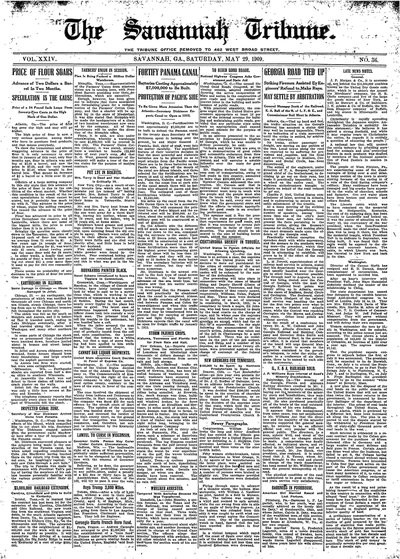
Page text (machine-generated)
VOL. XXIV.
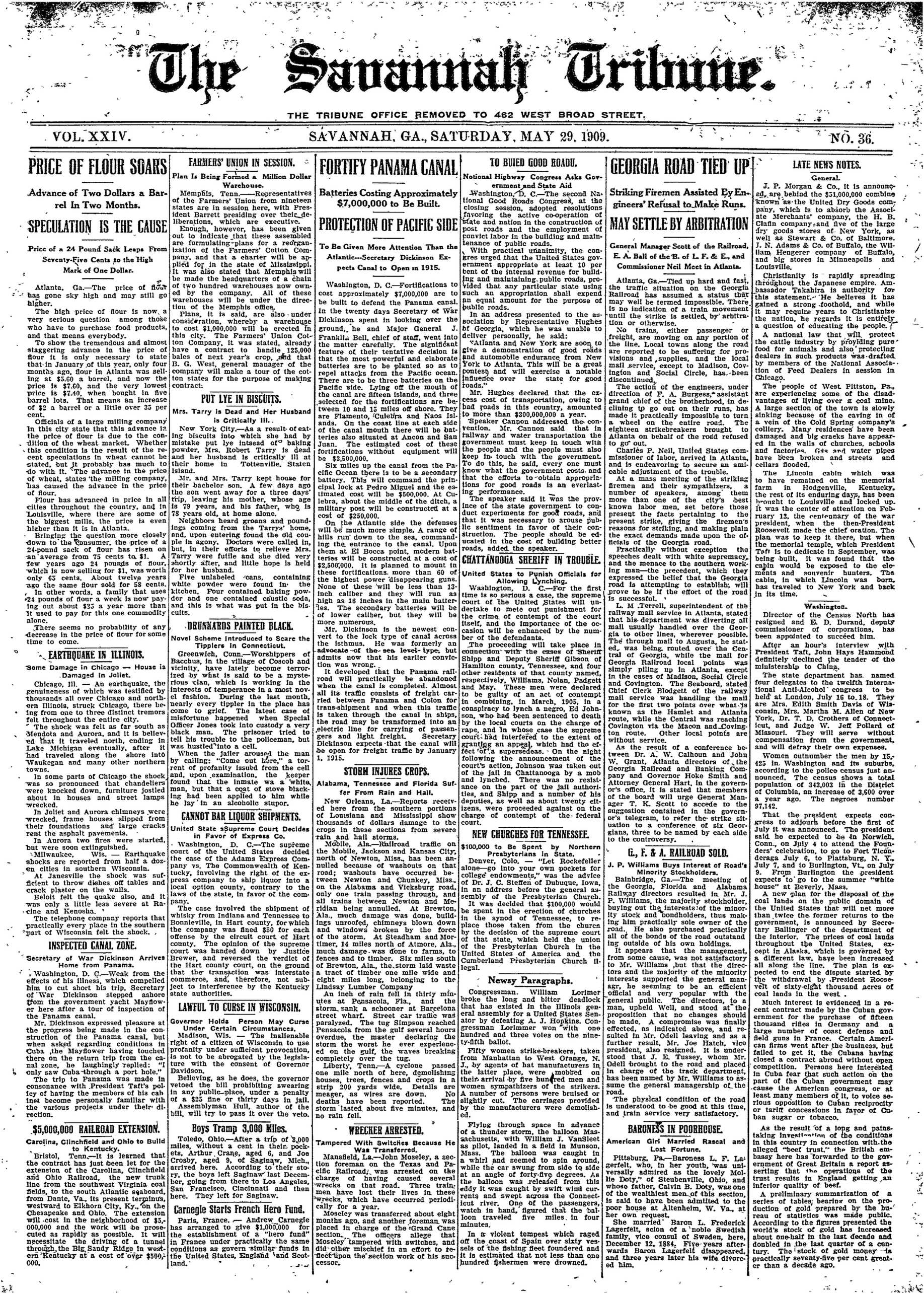
PRICE OF FLOUR SOARS
Advance of Two Dollars a Barrel In Two Months.
SPECULATION IS THE CAUSE
Price of a 24 Pound Sack Leapa From
Seventy-Five Cents to the High
Mark of One Dollar.
Atlanta, Ga.—The price of flour
has gone sky high and may still go
higher.
The high price of flour is now, a
very serious question among those
who have to purchase food products,
and that means everybody.
To show the tremendous and almost
staggering advance in the price of
flour it is only necessary to state
that in January of this year, only four
months ago, flour in Atlanta was selling
at $5.60 a barrel, and now the
price is $7.60, and the very lowest
price is $7.40, when bought in five
barrel lots. That means an increase
of $2 a barrel or a little over 35 per
cent.
Officials of a large milling company. In this city state that this advance in the price of flour is due to the condition of the wheat market. Whether this condition is the result of the recent speculations in wheat cannot be stated, but it probably has much to do with it. The advance in the price of wheat, states 'the milling company, has caused the advance in the price of flour. Flour has advanced in price in all cities throughout the country, and in Louisville, where there are some of the biggest mills, the price is even bigger than it is in Atlanta.
Bringing the question more closely down to the Consumer, the price of a 24-pound sack of flour has risen on an average from 75 cents to $1. A few years ago 24 pounds of flour, which is now selling for $1, was worth only 65 cents. About twelve years ago the same flour sold for 58 cents. In other words, a family that uses 24 pounds of flour a week is now paying out about $25 a year more than it used to pay for this one commodity alone. There seems no probability of any decrease in the price of flour for some time to come.
EARTHQUAKE IN ILLINOIS.
Some Damage in Chicago — House is
Damaged in Joliet
Chicago, Ill. — An earthquake, the genuineness of which was testified by thousands all over Chicago and northern Illinois, struck Chicago, there being from one to three distinct tremors felt throughout the entire city. The shock was felt as far south as Mendota and Aurora, and it is believed that it traveled north, ending in Lake Michigan eventually, after it had traveled along the shore into Waukegan and many other northern towns. In some parts of Chicago the shock was so pronounced that chandeliers were knocked down, furniture jostled about in houses and street lamps wrecked. In Jollet and Aurora chimneys were wrecked, frame houses slipped from their foundations and large cracks rent the asphalt pavements. In Aurora two fires were started, but were soon extinguished.
Milwaukee, Wis. — Earthquake shocks are reported from half a dozen cities in southern Wisconsin. At Jamesville the shock was sufficient to throw dishes on tables and crack plaster on the walls. Belolt felt the quake also, and it was only a little less severe at Racine and Kenosha. The telephone company reports that practically every place in the southern part of Wisconsin felt the shock.
INSPECTED CANAL ZONE.
Secretary of War Dickinson Arrives Home from Panama.
Washington, D. C.—Weak from the effects of his illness, which compelled him to cut short his trip, Secretary of War Dickinson stepped ashore from the government yacht Mayflower here after a tour of inspection of the Panama canal.
Mr. Dickinson expressed pleasure at the progress being made in the construction of the Panama canal, but when asked regarding conditions in Cuba, the Mayflower having touched there on the return trip from the canal zone, he laughingly replied: "I only saw Cuba-a through a port hole."
The trip to Panama was made in consonance with President Taft's policy of having the members of his cabin become personally familiar with the various projects under their direction.
$5,000,000 BAILROAD EXTENSION.
Carolina, Clinchfield and Ohio to Build to Kentucky.
Bristol, Tenn.—It is learned that the contract has just been let for the extension of the Carolina, Clinchfield and Ohio Railroad, the new trunk line from the southwest Virginia coal fields, to the south Atlantic seaboard, from Dante, Va., its present terminus, westward to Elkhorn City, Ky., on the Chesapeake and Ohio. The extension will cost in the neighborhood of $5,000,000 and the work will be prosecuted as rapidly as possible. It will necessitate the driving of a tunnel through the Big Sandy Ridge in western Kentucky at a cost of over $500,000.
FARMERS' UNION IN SESSION.
Plan Is Being Formed a Million Dollar Warehouse.
Memphis, Tennessee—Representatives of the Farmers' Union from nineteen states are in session here, with President Barrett presiding over their deliberations, which are executive. Enough, however, has been given out to indicate that these assembled are formulating-plans for a reorganization of the Farmers' Cotton Company, and that a charter will be applied for in the state of Mississippi. It was also stated that Memphis will be made the headquarters of a chain of two hundred warehouses now owned by the company. All of these warehouses will be under the direction of the Memphis office. Plans, it is said, are also under consideration, whereby a warehouse to cost $1,000,000 will be erected in this city. The Farmers' Union Cotton Company, it was stated, already have a contract to handle 125,000 bales of next year's crop, and that B. G. West, general manager of the company will make a tour of the cotton states for the purpose of making contract.
PUT LYE IN BISCUITS.
Mrs. Tarry is Dead and Her Husband is Critically Ill.
New York City—As a result of eating biscuits into which she had by mistake put lye instead of $^{\circ}$ baking powder, Mrs. Robert Tarry is dead and her husband is critically ill at their home in Tottenville, Staten Island.
Mr. and Mrs. Tarry kept house for their bachelor son. A few days ago the son went away for a three days' trip, leaving his mother, whose age is 79 years, and his father, who is 78 years old, at home alone.
Neighbors heard groans and poundings coming from the Tarrys' home, and, upon entering found the old couple in agony. Doctors were called in, but, in their efforts to relieve Mrs. Tarry were futile and she died very shortly after, and little hope is held for her husband.
Five unlabeled cans, containing white powder were found in the kitchen. Four contained baking powder and one contained caustic soda, and this is what was put in the biscuits.
DRUNKARDS PAINTED BLACK.
Novel Scheme introduced to Scare the Tipplers In Connecticut.
Greenwleth, Conn.—Worshippers of Bacchus, in the village of Cocobac and vicinity, have lately become terrorized by what is said to be a mysterious clan, which is working in the interests of temperance in a most novel fashion. During the last month, nearly every tipper in the place has come to grief. The latest case of misfortune happened when Special Officer Jones took into custody a very black man. The prisoner tried to tell his trouble to the policeman, but was hustled"into a cell.
When the jailer aroused the man by calling: "Come out here," a torrent of profanity issued from the cell, upon examination, the keeper found that the inmate was a white man, but that a coat of stove blacking had been applied to him while he lay in an alcoholic stunner.
CANNOT BAR LIQUOR SHIPMENTS.
United State Supreme Court Decides in Favor of Express Co.
Washington, D. C.—The supreme court of the United States decided the case of the Adams Express Company vs. The Commonwealth of Kentucky, involving the right of the express company to ship liquor into a local option county, contrary to the laws of the state, in favor of the company.
The case involved the shipment of whisky from Indiana and Tennessee to Bonnilleville, in Hart county, for which the company was fined $50 for each offense by the circuit court of Hart county. The opinion of the supreme court was handed down by Justice Brewer, and reversed the verdict of the Hart county court, on the ground that the transaction was interstate commerce, and, therefore, not subject to interference by the Kentucky state authorities.
LAWFUL TO CURSE IN WISCONSIN.
Governor Holds Person May Curse
Under Certain Circumstances
Madison, Wis. — The indefenable right of a citizen of Wisconsin to use profanity under sufficient provocation, is not to be abrogated by the legislature with the consent of Governor Davidson. Believing, as he does, the governor vetoed the bill prohibiting swearing in any public-place, under a penalty of a $25 fine or thirty days in jail. Assemblyman Hull, author of the bill, will try to pass it over the veto.
Boys Tramp 3,000 Miles.
Toledo, Ohio.—After a trip of 2,000 miles, without a cent in their pockets, Arthur Crane, aged 6, and Joe Crosby, aged 9, of Saginaw, Mich., arrived here. According to their story, the boys left Saginaw last December, going from there to Los Angeles, San Francisco, Cincinnati and then here. They left for Saginaw.
Carnenle Starts French Hero Fund.
Paris, France. — Andrew Carnegie has arranged to give $1,000,000 for the establishment of a "hero fund" in France under practically the same conditions as govern similar funds in the United States, England and Scotland.
THE TRIBUNE OFFICE REMOVED TO 462 WEST BROAD STREET. SAVANNAH, GA., SATURDAY, MAY 29, 1909.
FORTIFY PANAMA CANAL
Batteries Costing Approximately
$7,000,000 to Be Built.
PROTECTION OF PACIFIC SIDE
To Be Given More Attention Than the Atlantic---Secretary Dickinson Expects Canal to Open in 1915.
Washington, D. C.—Fortifications to cost approximately $7,000,000 are to be built to defend the Panama canal. In the twenty days Secretary of War Dickinson spent in looking over the ground, he and Major General J. Franklin Bell, chief of staff, went into the matter carefully. The significant feature of their tentative decision is that the most powerful and elaborate batteries are to be planted so as to repel attacks from the Pacific ocean. There are to be three batteries on the Pacific side. Lying off the mouth of the canal are fifteen islands, and three selected for the fortifications are between 10 and 15 miles off shore. They are Flamengo, Culebra and Naos islands. On the coast line at each side of the canal mouth there will be batteries also situated at Ancon and San Juan. The estimated cost of these fortifications without equipment will be $3,500,000.
Six miles up the canal from the Pacific Ocean there is to be a secondary battery. This will command the principal lock at Pedro Miguel and the estimated cost will be $500,000. At Culebra, about the middle of the ditch, a military post will be constructed at a cost of $250,000.
On the Atlantic side the defenses will be much more simple. A range of hills run down to the sea, commanding the entrance to the canal. Upon them at El Bocca point, modern batteries will be constructed at a cost of $2,500,000. It is planned to mount in these fortifications more than 60 of the highest power disappearing guns. None of these will be less than 13-inch caliber and they will run as high as 16 inches in the main batteries. The secondary batteries will be of lower caliber, but they will be more numerous.
Mr. Dickinson is the newest convert to the lock type of canal across the lstmsh. He was formerly an advocate-of-the sea level-type, but admits now that his earlier conviction was wrong.
It developed that the Panama railroad will practically be abandoned when the canal is completed. Almost all its traffic consists of freight carried between Panama and Colon for trans-shipment and when this traffic is taken through the canal in ships, the road may be transformed into an electric line for carrying of passengers and light freight. Secretary Dickinson expects that the canal will be open for freight traffic by January 1, 1915.
STORM INJURES CROPS.
Alabama, Tennessee and Florida Suffer From Rain and Hall.
New Orleans, La.-Repora received here from the southern portions of Louisiana and Mississippi show thousands of dollars damage to the crops in these sections from severe rain and hall storms.
Mobile, Ala.-Rhilroad traffic on the Mobile, Jackson and Kansas City; north of Newton, Miss., has been annulled because of washouts on that road; washouts have occurred between Newton and Chunkey, Miss., on the Alabama and Vicksburg road, only one train passing through, and all trains between Newton and Meridian being annulled. At Brewton, Ala., much damage was done, buildings unroofed, chimneys blown down and windows broken by the force of the storm. At Steadham and Mortimer, 14 miles north of Atmore, Ala., much damage was done to farms, to fences and to timber. Six miles south of Brewton, Ala., the storm laid waste a tract of timber one mile wide and eight miles long, belonging to the Lindsay Lumber Company
An inch of rain fell in thirty minutes at Pensacola, Fla., and the storm, sank a schooner at Barcelona street wharf. Street car traffic was paralyzed. The tug Simpson reached Pensacola from the gulf several hours overdue, the master declaring the storm the worst he ever experienced on the gulf, the waves breaking completely over the tug. Liberty, Tenn.—A cyclone passed one mile north of here, demolishing houses, trees, fences and crops in a strip 200 yards wide. Details are meager, as wires are down. No deaths have been reported. The storm lasted about five minutes, and no rain fell.
WRECKER ABRESTED.
Tampered With Switches Because He Was Transfered.
Mansfield, Lk.-John Moseley, a section foreman on the Texas and Pacific Railroad, was arrested on the charge of having caused several wrecks on that road. Three traintmen have lost their lives in these wrecks, which have occurred periodically for a year.
Moseley was transferred about eight months ago, and another foreman was placed in charge of the Grand Cane section. The officers allege that Moseley 'tampered with switches, and did 'other mischief in an effort to reflect upon the section work of his successor.
TO BUIED GOOD ROAD.
Notional Highway Congress Asks Government and State Aid
Washington, D. C.—The second National Good Roads Congress, at the closing session, adopted resolutions favoring the active co-operation of state and nation in the construction of post roads and the employment of convict labor in the building and maintenance of public roads.
With practical unanimity, the congress urged that the United States government appropriate at least 10 percent of the internal revenue for building and maintaining. public roads, provided that any particular state using such an appropriation shall expend an equal amount for the purpose of public roads.
In an address presented to the association by Representative Hughes of Georgia, which he was unable to deliver personally, he said:
"Atlanta and New York are soon to give a demonstration of good roads and automobile endurance from New York to Atlanta. This will be a great contest and will exercise a notable influence over the state for good roads."
Mr. Hughes declared that the excess cost of transportation, owing to bad roads in this country, amounted to more than $300,000,000 a year.
"Speaker Cannon addressed the convention. Mr. Cannon said that in railway and water transportation the government must keep in touch with the people and the people must also keep in touch with the government. To do this, he said, every one must know what the government costs and that the efforts to obtain appropriations for good roads is an everlasting performance.
The speaker said it was the province of the state government to conduct experiments for good roads, and that it was necessary to arouse public sentiment in favor of their construction. The people should be educated in the cost of building better roads, added the speaker.
CHATTANOOGA SHERIFF IN TROUBLE.
United States to Punish Officials for Allowing Lynching
Washington, D. C.-For the first time is so serious a case, the supreme court of the United States will undertake to mete out punishment for the crime, of contempt of the court itself, and the importance of the occasion will be enhanced by the number of the defendants.
The proceeding will take place in connection with the cases of Sheriff Shipp and Deputy Sheriff Gibson of Hamilton county, Tennessee, and four other residents of that county named, respectively, Williams, Nolan, Padgett and May. These men were declared to be guilty of an act of contempt in combining, in March, 1905, in a conspiracy to lynch a negro, Ed Johnson, who had been sentenced to death by the local courts on the charge of rape, and in whose case the supreme court had interfered to the extent of granting an appeal, which had the effect of 'a supersedeas. On the night following the announcement of the court's action, Johnson was taken out of the jail in Chattanooga by a mob and lynched. There was no resistance on the part of the jail authorities, and Shipp and a number of his deputies, as well as about twenty citizens, were proceeded against on the charge of contempt of the federal court.
NEW CHURCHES FOR TENNESSEE.
$100,000 to Be Spent by Northern
Districtships in State
Presbyterians in State. Denver, Colo. — "Let Rockefeller alone—go into your own pockets for college endowments," was the advice of Dr. J. C. Steffen of Dubuque, Iowa. In an address before the general assembly presbyterian Church, it was decided 1000 students be spent in the erection of churches in the synod of Tennessee, to replace those taken from the churca by the decision of the supreme court of that state, which held the union of the Presbyterian Church in the United States of America and the Cumberland Presbyterian Church illegal.
Newsy Paragraphs.
Congressman. William Lorimer broke the long and bitter deadlock that has existed in the Illinois general assembly for a United States Senator by defeating A. J. Hopkins. Congressman Lorimmer won with one hundred and three votes on the ninety-fifth ballot. Fifty women strike-breakers, taken from Manhattan to West Orange, N. J., by agents of hut manufacturers in the latter place, were mobbed on their arrival by five hundred men and women sympathizers of the strikers. A number of persons were bruised or slightly cut. The carriages provided by the manufacturers were demolished.
Flying through space in advance of a thunder storm, the balloon Massachusetts, with William J. VanSleeet as pilot, landed in a field in Munson, Mass. The balloon was caught in a whirl and seemed to spin around, while the car swung from side to side at an angle of forty-five degrees. As the balloon was released from this eddy it was caught by swift wind currents and swept across the Connecticut river. One of the passengers, watch in hand, figured that the balloon traveled five miles in four minutes. In a violent tempest which raged off the coast of Spain over sixty vessels of the fishing fleet foundered and it is estimated that not less than one hundred fishermen were drowned.
GEORGIA ROAD TIED UP
General Manager Scott of the Railroad,
E. A. Ball of the B. of L. F. & E., and
Commissioner Neil Meet in Atlanta.
Atlanta, Ga.—Tled up hard and fast,
the traffic situation on the Georgia
Railroad has assumed a status that
may well be termed impossible. There
is no indication of a train movement
until the strike is settled, by arbitration
or otherwise.
No trains, either passenger or
freight, are moving on any portion of
the line. Local towns along the road
are reported to be suffering for
provisions and supplies, and the local
mall service, except to Madison, Covington and Social Circle, has...been discontinued.
The action of the engineers, under direction of F. A. Burgess,"assistant grand chief of the brotherhood, in declining to go out on their runs, has made it practically impossible to turn a wheel on the entire road. The eighteen strikebreakers brought to Atlanta on behalf of the road refused to go out. Charles P. Nell, United States commissioner of labor, arrived in Atlanta, and is endeavoring to secure an amicable adjustment of the trouble. At a mass meeting of the striking firemen and their sympathizers, a number of speakers, among them more than one of the city's best known labor men, set before those present the facts pertaining to the present strike, giving the firemen's reasons for striking, and making plain the exact demands made upon the officials of the Georgia road.
Practically without exception the speeches dealt with white supremacy, and the menace to the southern working man—the precedent, which they expressed the belief that the Georgia road is attempting to establish, will prove to be if the effort of the road is successful.
L. M. Terrell, superintendent of the railway mail service in Atlanta, stated that his department was diverting all mail usually handled over the Georgia to other lines, wherever possible. The through mail to Augusta, he stated, was being routed over the Central of Georgia, while the mail for Georgia Railroad local points was simply plilling up in Atlanta, except in the cases of Madison, Social Circle and Covington. The Seaboard, stated Chief Clerk Bloedgett of the railway mail service was handling the mail for the first two points over whatJs known as the Hamlet and Atlanta route, while the Central was reaching Covington via the Macon and Covington route. Other local points are without service.
As the result of a conference between Dr. A. W. Calhoun and John W. Grant, Atlanta directors of the Georgia Railroad and Banking Company and Governor Hoke Smith and Attorney General Hart, in the governor's office, it is stated that members of the board will urge General Manager T. K. Scott to accede to the suggestion contained in the governor's telegram, to refer the strike situation to a conference of six Georgians, three to be named by each side to the controversy.
G., F. & A. RAILROAD SOLD.
J. P. Williams Buys Interest of Road's Minority Stockholders.
Bainbridge, Ga.-The meeting of the Georgia, Florida and Alabama Railway directors resulted in Mr. J. P. Williams, the majority stockholder, buying out the interests of the minority stock and bondholders, thus making him practically sole owner of the road. He also purchased practically all of the bonds of the road outstanding outside of his own holdings.
It appears that the management, from some cause, was not satisfactory to Mr. Williams, but that the directors and the majority of the minority interests supported the general manager, he seeming to be an efficient official and very popular with the general public. The directors, to a man, upheld Well, and stood at the proposition that no changes should be made. A compromise was finally effected, as indicated above, and resulted in Mr. Odell leaving and as a further result, Mr. Joe Hatch, vice president, also resigned. It is understood that J. E. Tussey, whom Mr. Odell brought to the road and placed in charge of the track department, has been named by Mr. Williams to assume the general management of the road.
The physical condition of the road is understood to be good at this time, and train service very satisfactory.
BARONESS IN POORHOUSE
American Girl Married Rascal and Lost Fortune.
Pittsburg, Pa.—Baroness L. F. Lagerfeit, who, in her youth, was universally admired as the lovely Mollie Dot," of Steubenville, Ohio, and whose father, Calvin B. Doty, was one of the wealthiest men of this section, is said to have been admitted to the poor house at Altenheim, W. Va., at her own request.
She married Baron L. Frederick Lagerfeit, son of a noble Swedish family, vice consul of Sweden, here, December 12, 1884. Five years afterwards Baron Lagerfeit disappeared, and three years later his wife divorced him.
LATE NEWS NOTES.
J. P. Morgan & Co. it is announced, are behind the $51,000,000 combine known as the United Dry Goods company, which is to absorb the Associate Merchants' company, the H. B. Claflin company and five of the large dry goods stores of New York, as well as Stewart & Co. of Baltimore. J. N. Adams & Co. of Buffalo, the William Hengerer company of Buffalo, and big stores in Minneapolis and Louisville.
Christianity is rapidly spreading throughout the Japanese empire. Ambassador Takahira is authority for this statement. He believes it has gained a strong foothold, and while it may require years to Christianize the nation, he regards it is entirely a question of educating the people.
A national law that will, protect the cattle industry by providing pure food for animals and also protecting dealers in such products was drafted by members of the National Association of Feed Dealers in session in Chicago.
The people of West Pittston, Pa. are experiencing some of the disadvantages of lying over a coal mine. A large section of the town is slowly sinking because of the caving in of a vein of the Cold Spring company's collery. Many residences have been damaged and big cracks have appeared in the walls of churches, schools and factories. Gas and water pipes have been broken and streets and cellars flooded.
The Lincoln cabin which was to have remained on the memorial farm in Hodgenville, Kentucky, the rest of its enduring days, has been brought to Louisville and locked up. it was the center of attention on February 12, the centenary of the war president, when the then-President Roosevelt made the chief oration. The plan was to keep it there, but when the memorial temple, which President Tett Is to dedicate in September, was being built, it was found that the cabin would be exposed to the elements and souvenir hunters. The cabin, in which Lincoln was born, has traveled to New York and back in its time.
Washington.
Director of the Census North has resigned and E. D. Durand, deputy commissioner of corporations, has been appointed to succeed him.
After an hour's interview with President Taft, John Hays Hammond definitely declined the tender of the ministership to China.
The state department has named four delegates to the twelfth International Anti-Alcohol congress to be held at London, July 16 to 18. They are Mrs. Edith Smith Davis of Wisconsin, Mrs. Martha M. Allen of New York, Dr. T. D. Crothers of Connecticut, and Judge W. Jeff Pollard of Missouri. They will serve without compensation from the government, and will defray their own expenses.
Women outnumber the men by 15-425 in Washington and its suburbs, according to the police census just announced. The census shows a total population of 343,003 in the District of Columbia, an increase of 3,600 over a year ago. The negroes number 97,142.
That the president expects congress to adjourn before the first of July it was announced. The president said he expected to be in Norwich, Conn., on July 4 to attend the Founders' celebration, to go to Fort Ticonderoga July 6, to Plattsburg, N. Y., July 7, and to Burlington, Vt., on July 9. From Burlington the president expects to go to the summer "white house" at Beverly, Mass.
A new plan for the disposal of the coal lands on the public domain of the United States that will net more than twice the former returns to the government, is announced by Secretary Ballinger of the department of the interior. The prices of coal lands throughout the United States, except in Alaska, which is governed by a different law, have been increased all along the line. The plan is expected to end the dispute started by the withdrawal by President Roosevelt of sixty-eight thousand acres of coal lands in the west.
Much interest is evidenced in a recent contract made by the Cuban government for the purchase of fifteen thousand rifles in Germany and a large number of coast defense and field guns in France. Certain American firms went after the business, but failed to get it, the Cubans having closed a contract abroad without open competition. Persons here interested in Cuba fear that such action on the part of the Cuban government may cause the American congress, or at least many members of it, to voice serious opposition to Cuban reciprocity or tariff concessions in favor of Cuban sugar or tobacco.
As the result of a long and painstaking investigation of the conditions in this country in connection with the alleged "beef trust," the British embassy here has forwarded to the government of Great Britain a report asserting that the operations of the trust results in England getting an inferior quality of beef.
A preliminary summarization of a series of tables; bearing on the production of gold prepared by the bureau of statistics was made public. According to the figures presented the world's stock of gold has increased about one-half in the last decade and doubled in the last quarter of a century. The 'stock of gold money' is practically seventy-five per cent greater than a decade ago.
Pluck and Adventure
SPEARING A BEAR
"Twice in my chase of braun I have made use of a bear spear as my weapon of attack," writes Count Erie von Rosen, "and I may take this opportunity to maintain that the use of a spear entails no greater cruelty than any other mode of attack, and that every hunter should be armed with one in reserve, since these powerful beasts have a vitality that triumphs over a stray bullet or more, unless lodged in a vital region, and when wounded their retaliation is dedoubtable and easily fatal. In Karella, Finland, the bear is yet regarded as a noxious horror. The great black-haired 'slagbjorn,' or killing bear, is still rampant there, and a couple of winter's back I was able to wreak justifiable vengeance on some beasts that bed killed over a score of cows and nine horses. News had been brought me that some of these racsals were hibernating on a small marsh-bound island.
"We found no difficulty in locating their laft, and I took up my post at the entrance to it, armed only with my spear. I may explain that a bear spear consists of an ash staff some two yards long and about a couple of inches in diameter; there is a blade of steel about twelve inches in length, and the shaft is copper-cased as a prevention against the teeth of bruin. As soon as my gentleman appeared I tried to stick him in the throat, but he parried adroitly and I missed; I made another lunge and succeeded in driving my spear point through his breast.
"He started roaring furiously and snapped at my copper-cased staff, then made an attempt to strike at my arm with his huge forepaw, so that I might drop, my weapon. The powerful brute hung on to my spear at the one end, while I as grimly held at on the other end. His blites went through the copper plate and he started shredding the wood beneath. Strenuously I checked his further advances and gradually, for his wounds began to tell, his resistance weakened, and he dropped at last over the aperture of his den.
"I pulled out the spear, but so much strength still remained in him that he seized the blade and bit it with a force that left deep indentations in the steel. My companion then finished him off with his own weapon. This struggle from start to finish covered five minutes."—Chicago Daily News.
THE DOMINANT ELEPHANT
In exploring the Mungo River, a tributary of the Congo, in Africa, one expedition in 1885 was actually stopped and broken up by attacks of elephants. Sir Harry Johnston, in his book, "George Grenfell and the Congo," says that twenty years ago there were regions to the north of the Kamerun Mountains actually dominated by elephants, which were so hostile to human invasion that they attacked individuals or small companies of men who attempted to make their way through the woodland.
During the rainy season, between April and October, the elephants were wont to pass in enormous numbers from the inundated swamps and morasses to the hill-country. It might occur in a single night that a herd of elephants trampled down or otherwise destroyed the cultivated food crops belonging to a whole tribe.
In the drier season of the year they resorted to mud pools near rivers and swamps, where they rolled about until they caked their hides with a sufficient coating of mud to serve as a protection against the elephant fly, an insect which lays its eggs in their hides, and sometimes inflicts on them serious pain and disease.
At night, when the files retired to rest, the elephants made for great rivers, in which they bathed themselves and swam about until the mud coating was washed off.
To such an extent at this season did they use the waterways that the natives refused to travel at night by boat or canoe, owing to the attacks on them which the elephants would make out of sheer mischief.
In 1885 the natives usually obtained their ivory from the elephants that became entangled in bogs and marshes; for the elephants of the Kamerun interior were so wily and savage that the native who tried to kill the thm. was as likely as not killed in the attempt.
The present writer, when he ascended the Kamerun River in 1886, was told by the Wurl and Bonken people that large numbers of elephants became entombed in the treacherous bogs of the Kamerun River valley. They were constantly searching after places in which to wallow in the mud, and would sometimes plunge into a bog too deep and tenacious. Here they were either suffocated, or could be safely attacked by the natives when abandoned by their companions. The ground which might be too soft for the passage of an elephant would still afford a firm footing for men.—Youth's Companion.
BATTLE WITH WILD SWAN.
While coming up the bay to Baltimore More Friday night the steamer Avalon ran into a flock of wild swans off Thomas Point, and a swan was captured by the lookout, W. T. Whitely, who was on the forward deck, after a thrilling experience. The steamer was running at a live-ly clip when Whitely heard a fluttering, and a few minutes later saw a flock of swans directly in front of the
boat. They circled around a few times, then lit in the water on the port side. He notified First Officer Corkran, who turned on the searchlight. That seemed to frighten them and they all arose from the water. There appeared to be about 100, and all flew over the pilothouse except one, which struck the port side of the steamer with a crash. A passenger in stateroom 45, which was damaged, thought there had been a collision and got out of bed.
"When I saw the swan strike the boat I rushed up to it, expecting to pick it up with case," said Whitely, speaking of his experience. "To my surprise the thing turned on me and gave me several blows with its wings which nearly knocked me down. Then I grabbed at it again, only to be pecked with its big bill, making my hands bleed.
"At first I did not know what kind of bird it was, but I was determined to capture it. The wings beat me back, but I kept on the battle until Mr. Corkran arrived and we tied the bird. Even after pinioning its wings it was hard to hold it, as its strength was great." We finally got a piece of rope and tied the legs together. Later a coop was made and we placed the bird in it."
Shortly after the steamer docked at Light street the swan was sent to the office of Assistant General Manager A. H. Seth of the company. The office force was attracted by the big bird, and when it was measured it was found to be eighty-nine inches from tip to tip of its wings and it stood fifty-five inches high. Mr. Seth presented the bird to the zoo at Drudg Hill Park.-Baltimore Sun.
AMERICAN HORSEMANSHIP
Before Mr. Koosevelt left the White House he made a ninety-eight-mile ride in seventeen hours as an example of what might be expected of a good horseman, and to demonstrate that our army officers are not put to an over-severe test in their practice rides. No one wishes to discredit the prowess of the ex-President when in the saddle, but his performance appears exceedingly tame when compared with the stories told of the riders of the Pony Express between St. Joe, the old Westernfrontier post, and the Pacific Coast. The exploits of these horsemen, as recounted by a man who withholds his name, but claims intimate knowledge with the facts, were truly wonderful:
"Bob Haslam made a regular daily trip from Fort Churchill to Smith's Creek (120 miles). On one occasion he rode from Virginia City to Smith's Creek (185 miles), and after an hour's sleep rode the return trip, covering 370 miles with only one hour out of the saddle, and made the round ride on schedule time.
"Johnny Moore rode between Muddy Station in Western Nebraska and Julesburg. On one occasion he finished this ride, and finding at Julesburg an important Government dispatch, rested seven minutes, then flung himself upon a horse and was away. He arrived at Muddy Station, having ridden the round trip of 280 miles in precisely fourteen hours and forty minutes.
"Bill Cody's (Buffalo Bill) daily ride was from Red Butte on the Platte to Three Crossings on the Sweetwater, and his schedule required him to ride fifteen miles an hour. Cody once rode from Three Crossings to Red Butte, and, there being no rider at the latter place to take the budget on, he continued for another eighty-five miles, and then rode back to Three Crossings, covering a total distance of 322 miles on schedule time and without being out of the saddle except to change mounts."—Harper's Weekly.
SPREAD OUT.
The man was working on the side of a steeply sloping roof. All of a sudden his foot slipped on a patch of ice, and with a groan he began to slide slowly toward the edge.
As he slid, he clutched with tense fingers at the tinn. But it was smooth. It offered him no hold. And his speed gradually but surely increased.
As, in a sitting posture like a toboganer, the man continued his deadly slide, he began to pray in a loud, anguished voice.
Memory, as if in answer to his prayer, fashed across his brain the words:
"Spread out."
The man instantly lay flat on his back, spreading arms and legs to their widest angle, making himself as much as possible like a starfish. And his speed at once decreased. The additional friction surface acted like a brake. A few feet from the edge of the roof he came to anchor.
"Help!" he then shouted.
But the slight movement of shouting acted like a push, and he slipped down a few inches more.
"Help!" And again he slid a little.
But this time help came, a rope was thrown and the man climbed back to safety.
He wiped the dews of terror from his brow.
"My boss in my apprentice days," he said, "told me if I ever started sliding down a roof slope to spread out and it would stop me. I didn't belleve him, but, by jingo, he was right."
The man smiled and sighed, musing on his long-dead boss. Then he crawled back to his dangerous work on the steep slope of the roof.—Philadelphia Bulletin.
A Harmless Affair.
· "To-morrow is ladies' day at our club."
· "Why do you have a ladies' day?"
· "Oh, just to show how wicked we aren't."-Louisville Courrier-Journal.
POPULAR SCIENCE
Experiments with ostrich farming in Australia, the eggs being hatched by artificial incubation, are successful.
Up to a certain point exposure to radium rays stimulates the germination of seeds, but if that point be passed the growth is stopped.
In a recent issue of a zoological periodical L'Plate describes the curulous habit of a new species of fish from the Bahamas. This fish spends parts of its time in the shell of a large species of strombus. Probably it finds the shell a convenient shelter and place of retreat from its enemies. Its presence does not appear to be of any advantage to the mollusk.
Attention is seldom called to a remarkable and curious characteristic of the olive tree. After many years of growth the different large branches of the trees separate gradually from the trunk until they are quite divided from one another down to the roots. These then slowly move apart and in some instances six or seven distinct trees stand in the area which before surrounded the main tree, and they will sometimes be as much as twenty feet apart.
Dr. Schlick's apparatus for preventing ships from rolling at sea has lately given fresh proof of its ability. One of his gyroscopes has been fitted on board the mall steamer Lochleil. While the vessel was rolling sixteen and a half degrees on each side, through a total angle of thirty-three degrees, the gyroscope was started, and immediately decreased the total angle of roll to three degrees. The apparatus is driven electrically and requires little attention.
一
Tests are being made at the Springfield armory of an invention which illuminates the sights of a rifle at night. Even though the light employed did not shine directly into the soldier's eyes, it might interfere with his aim by producing a glare that would make the target invisible. If no such result follows, the device ought to be extremely serviceable.
Ernest DeKoven Leffingwell left Pasadena, Cal., recently for Seattle, where he will begin preparations for his tour of two years into the Alaskan territory in the interest of the University of Chicago and the hydrographic office of the United States Government. He will outfit his steamer, the Argo, and with four assistants start up the coast May 1 to Bering Straits, thence to Point Barrow and Flaxman Island, the headquarters for his prospective trips of exploration into the wilds of the northern country.
Reflections of Uncle Ezra.
By BOX K. MOULTON.
It is seldom that a man dies at one hundred and ten years that we don't hear he has chawed and smoked tobacker and drank forty-rod whisky all his life.
There was a swap social at the Hard Shell meetin' house the other night, and every woman was supposed to take something she didn't need. Mrs. Hod Peters took Hod.
Owin' to the passenger rate war, it is said to be cheaper to go to Europe than to stay hum, but there are a few American helresses who will hardly agree with this.
William Tibblits has refused to pay his taxes because an astrologer said the world is comin' to an end January first, and William wants to save the money. When William shaves, he lathers his face with the end of his whiskers to save buyn' a brush.
Hank Tumms wouldn't be no hand to work in a powder magazine because he has got inflammatory rheumatiz.—From Judge.
Unanswerable.
"Victious circle" is a term often used in the medical world. An example of its psychological use applied to argument may be found in Joseph A. Scoville's book, "Old Merchants of New York City." Tom, the son of a wealthy man, was a great favorite with all who knew him, but he heartily detested business. A merchant of New York had hired him as a bookkeeper at a high salary. Nevertheless, Tom got into the habit of reaching the office later and later, until finally he got there about two in the afternoon. When this state of affairs had gone on for a week, the merchant remonstrated.
"But my dear sir," returned Tom, "how can I come any earlier? I don't get my breakfast until one."
"But get your breakfast earlier."
"How can I? I don't get up till twelve."
"Then get up earlier."
"How can I," pleaded Tom, "when I don't go to bed until daylight?"
In the face of such convincing argument there was nothing to be said.
Warmth and Illumination Needed.
Warmth and Illumination Needed.
A philosophy without heart and a faith without intellect are abstractions from the true life and being of knowledge and faith. The man whom philosophy leaves cold, and the man whom real faith does not illumine, may be assured that the fault lies in themselves, not in knowledge and faith. The former is still an alien from philosophy, the latter an alien from faith.—Hegel.
FOR THE FARMER AND STOCKMAN. Feed For the Dairy Cow. pounds in winter I think it is good
- Cottonseed meal, flaxseed meal, shorts, bran or other feeds rich in protein are necessary for a full flow of milk. Clover or alfalfa hay are rough feeds rich in protein. Corn, rich in starch, produces heat, energy and fat, but little milk. Silage and green roots furnish water and are good appetizers and promoters of general health for winter feeding. Bran and flaxseed meal are good bowel regulators.—Farmers' Home Journal.
Over Half the Crop Saved.
The Year Book of the Department of Agriculture for 1907 has a most instructive article by Professor A. L. Qualnance, in which he urges the need and wisdom of spraying, and cites a number of convincing results of demonstration sprayings of last year. An orchard at Bentonville, Ark., showed that fifty-one per cent. of the fruit was/saved through spraying; another one at Fordland, Mo., where it was actually necessary to show the neighbors, developed forty-six per cent. saved through spraying; one at Afton, Va., showed seventy-two per cent. saved; one at Owensville, Ohio, forty-eight per cent. saved; one at Mt. Pisgah, Ohio, forty-one per cent. saved, and one at North East, Pa., showed sixty-nine per cent. of the fruit saved through spraying. The exact average for these five orchards was 54.54 per cent. saved, or more than half the crop. "An orchardist," says Professor Qualnance, "by thorough work can do as well or better."
Alfalfa Hog Feeder
Hogs are very fond of alfalfa, and they will eat a good deal of it if given a chance. They will also waste a whole lot unless you stand and feed it to them a handful at a time. A rack with a swinging front works very well, says a writer in the Farm Press. The punching the hogs give it will work the hay down within reach until the rack is empty. The openings in front should be large
Front View.
enough to let a hog's head through, but not much larger. The rack may be any length and should be about four feet high, and from three feet to three and a half feet wide at the top. Make it strong or they will soon punch it to pieces. Make the floor tight to hold chaff and lay a floor in front to keep the hogs out of the mud. Brood sows fed all the good alfalfa hay and clean water they want will winter well if given one good ear of corn each day.
Why I Raise Sheep.
Sheep are more prolific than other animals and raise their young on the most inexpensive feed with the least care.
Their flesh costs the least to produce and brings more on the market than any other. Besides, it is the most healthful food for man.
They grow annually from six to ten per cent. of their normal live weight in wool, which sells for more than three times as much as the flesh of any animal and furnishes a splendid covering for the body in winter, as well as gives employment to thousands of skilled laborers to convert it into fabrics for the use of man.
They return more and better fertility to enrich the soil and distribute the same more evenly than any other animal.
They keep the land free from weeds and convert the same into a valuable commodity. They are the most easily managed animals and do not tramp a field and lot like others, and one can turn them into fields to pick up waste where other animals could not be tolerated, and thus save a vast and otherwise actual loss. They can be retained in inclosures which would not hold any other animal. They thrive and fatten on a pasture without grain, but do not thrive on a pasture without grass. Sheep give on an average more pounds of meat per bushel of grain than either hogs or cattle. The last bunch raised and fattened was a bunch of seventy-five yearling wethers and six ewes from two to six years old, in all eighty-one head.
Their average weight when I commenced feeding in December was 131 pounds and in March when shipped was 165 pounds. They made a gain of thirty-seven pounds per head in seventy-seven days. They were fed three bushels of corn per day and what clover hay they wanted, and occasionally a feed of oats, straw or corn fodder instead. They ate in seventy-six days 231 bushels of corn and gained 2618 pounds, an average of eleven and one-third pounds per bushel. My cattle have never done that well on dry feed and not often on grass or corn. When they make seven
pounds in-winter I think it is good; eight is fine, more than eight surprises me. Nor will my hogs do it by three pounds. They do as well and often better in early summer on clover or good grass, but then the sheep will do the same with little or no corn.—Jacob Zelgler, in the Indiana Farmer,
Building Corncribs
While there have been many improvements made in farm buildings, I think there is one that should remain just as it was originally. Like the umbrella, which is said to be the same shape it was in the time of the flood, and not to be improved on, so is the corncrib.
Men have built them with straight sides, set them on the ground, built them air tight, or nearly so, built them with windows, and adorned them with pleasing things to the eye, but after they had tested them they found out they had made a great mistake and had damaged corn to show for it.
Of course if one doesn't harvest his corn until cold weather, when it is dry and hard, it will keep in any kind of a building, but where one wants to harvest the crop early while the fodder is good, it is best to have a proper building to cure it in.
We built our last crib the old model, set it up on stone posts about three feet high, had movable steps that we turned away from the building when pot in use, and we have never seen a rat in this crib, while the old one we had built near the ground was always overrun with them. We built the sides with plenty of floor and open slats, the ends were shingled; floor under bins was laid with narrow boards open about quarter inch in seams. This lets the air draw up through the corn fine, and with good weather corn will cure as well as out doors.—J. A. S., in the American Cultivator.
Making Cement Posts.
I have before me the contribution of Mr. M. W. Williams, of Lawrence County, on cement posts. His testimony is helpful indeed. It will be valuable to post seeking farmers. We would like to hear from still
We would like to hear from still other cement farmers.
Mr. adjoining neighbor uses one my adjoining neighbor uses one I use the same formula, but line the molds with paper to save them from leaking. Posts should be made in a building that can be closed in windy weather. We sift out the robin egg sized gravel. We line the molds to prevent not only leakage of strength but to make smoother and more durable outsides and corners and prevent cement from sticking to molds; we line the molds with old newspapers. A better way to line the molds is to buy cheap paper in rolls, just wide enough to cover the bottom and sides of molds from end to end. Take care to work the paper down on the bottom and corners and avoid wrinkles. Pour in the cement, well mixed and wet, almost running. As Mr. Williams says, let the cement set twenty-four to forty-eight hours, then take away the sides and ends and pull off the paper lining while wet.
We let the posts remain on the bottom boards three days at least; then remove them very carefully, with the board under, to where you desire to pile or stand them up. Some recommend standing so as to wet them every day for a while. The staples Mr. Williams sets in the posts will just suit the most of post makers, and is a good thing. We punch holes down through the centre of the soft cement posts from two to three hours after filling the molds. Three or four hours after first punching the holes, we repunch them to be sure they are open clear through.
You need to make a pattern to either set in staples or make holes by. If you make holes to fasten your fence to posts, you can cut six or seven-inch long wire; bend a loop or hook at one end, hook it over the horizontal wires of your already stretched fence, put it through the holes of the posts and bend it on the back side of the post to make it hold up the fence.
You can make a hole or set a staple for every wire of your woven fence, or every other wire, or every third wire, as you choose.
If you make holes, punch them with a one-fourth, inch or three-eighths inch iron to make them plenty large.
I use a narrow strip of lath or board, marked off on it just where you want the holes or staples; lay it on the posts in the molds and make the holes uniform distances apart.
Be sure you get the best cement. Remember that the iron rods Mr. Williams spoke of make the strength and durability of your posts. I put four heavy rods in our corner posts.—Isaac Beebe, in the Indiana Farmer.
How Posters Got Their Name
Posters took their name from the fact that in former times, the footways of London streets were separated from the drives by a line of posts, on which advertisements were displayed.
Autos Wear Out Roads.
The increased use of automobiles in New York State has so worn out the 1800 miles of good roads already completed that the new State Highway Commission will not award this year any more contracts for good roads construction. The commission has determined to devote its efforts during the coming year to the 500 miles additional of good roads work now under contract and to repairing the 1800 miles of road completed since the good roads project was started in this State ten years ago.
The commission has asked the Legislature for an appropriation of $1,500,000 to repair these 1800 miles of good roads. It developed at a hearing before the Senate Internal Affairs Committee to-day on the Alds-Hamm automobile bill that the stone macadam roads which have been built by the State will not stand the strain of the automobiles, and the Highway Commission is experimenting with an asphalt cement which is to be utilized in covering all of the stone macadam roads so far constructed. Meanwhile the commission is investigating the question with a view of revolutionizing road construction in this State so as to produce a road which will successfully meet the wear and tear of the automobile.
The farmers up the State are aroused over the bad condition; the good roads are in because of the destruction which follows their use by the automobilists, and the situation has become so acute that the Highway Commission fears the good roads work will be checked unless something is done to ally this feeling.
F. N. Godfrey, the master of the State Grange, and the members of the legislative committee of, the grange appeared before the committee this afternoon and insisted that the Allds-Hamm bill should be passed. The purpose of this bill is to tax the automobiles sufficiently to raise nearly enough money to repair the damage they do to the good roads. It is estimated that this bill would bring an annual revenue into the State treasury of $600,000. It imposes a tax of $5 on automobiles weighing 1500 pounds or less; $10 on machines weighing from 1500 to 2500 pounds, and an additional $5 for each 500 pounds of weight over 2500 pounds. The owners must register with the Secretary of State. The chauffeurs must be licensed and pay a fee of $1.
Probably the most important provision in the bill is that all speed limits are abolished, and it is provided that the automobilist must operate his car with due regard for the safety of the public at all times. His speed is left to his own discretion, but the burden of responsibility is placed on him, no matter at what rate of speed his machine is being operated.
On country roads where the highways are clear the automobilists would have the speed limit lifted and be permitted to run their machines in their own discretion. They would not be kept in fear of the country justice who gets the automobilists and their fines by his speed trap system.
Charles T. Terry, of New York City; George H. Stillwell, of Syracuse, and George C. Diehl, of Buffalo, representing the automobile associations, insisted that if the automobiles were to be taxed, other vehicles using the road should also be taxed proportionately, pointing out that otherwise the automobile tax would be unconstitutional. They insisted that the penalty provisions were too drastic, especially the one permitting imprisonment for a first offense against speeding.
Alfred Ely, representing the Automobile Club of America, said that the automobilists were willing to pay their share of road maintenance, and that they favored the provision in the bill providing that justices of the peace should turn over all fines to the State treasury, to be used in repairing roads, although he thought the penalties provided in the bill were too severe.
Senator Jothan P. Allds, chairman of the Senate Finance Committee, said that if some new scheme of taxation to meet the cost of repairing the good roads was not devised, the whole scheme of good roads construction was likely to fall. He pointed out that it was demonstrated in Massachusetts that automobiles cause fifty-two per cent. of the destruction of roads there and insisted that they should be taxed accordingly to meet the expenses of repair here. Senator Allds and the representatives of the automobile associations had an interesting colloquy on this question, the representatives of the automobiles finally declaring that the taxes imposed in the bill would raise much more than $600,000, and that they might not object to a reduced tax which would raise about that amount each year for road repairs without questioning the constitutionality of such a tax.—New York Sun,
Curing by Sympathetic Magic.
"A friend of mine came across a native sitting in the veranda of a house from which groans proceeded." Mr. E. Thurston stated at the Royal Society of Arts in a lecture on the natives of Southern India. "He learned that the man's wife was sitting on a swing studded with sharp nails in order to cure him by sympathetic magic of some trifling aliment."—London Evening Standard.
More than one quarter of the tobacco consumed by the Spanish nation comes from the United States.
PUBLISHED EVERY SATURDAY BY
THE TRIBUNE PUBLISHING CO.
402 West Broad Street,
SUBSCRIPTION RATES:
One Year.....$1.25
Six Months.....75
Three Months.....50
Remittance must be made by Express
or Post Office Money Order, or Registered
Letter. Advertising rates given on
application.
An aftermarth of the Ed Johnson lynching in Chattanooga four years ago has happened. Sheriff Shipp and several others have been found guilty by the Supreme Court of the United States for contempt in making no effort to save Johnson from the mob. Next week the ex-sheriff will be sentenced. It is a pity that many more sheriffs who are direlict to the duty in this respect can not be brought to an accounting.
Memorial Day.
Monday will be observed as memorial day. A large number of excursionists will leave here tomorrow night for Beaufort. Adjutant Edward Wallace of David Hunter post has issued his orders for the exercises which will be in keeping with the occasion.
Commencement Season.
BEACH COMMENCEMENT.
BEACH CORRECTION:
The commencement exercises of Beach Institute took place on Wednesday night, last at Second Baptist Church. The edifice was crowded and the program was excellently carried out. Each number elicited applause. The address by Rev. W. L. Cash was a gem. Following is the program:
Invocation
Greeting, Graduating Class
Declamation, Horatius at the Bridge, George I King
Class History, Eleanor L Jones
Chorus, Come to the gay feast of song
Normal Classes
Recitation, The fiddle told, Pearlena Smith.
Essay, A page from History, Carrie Beile Coles Quartette, When life is brightest, Misses Coles, Houston, Lee and Smith Recitation, The Parson's Daughter, Josephine V Houston
Essay, There is a tide in the affairs of men, Theresa H Perkins
Reestation. The Baren's last banquet,
Wilhelmina H Taylor
wilhminha Ta,托
song song, Merry June, Girls of
the Normal Classes
Essay Ideals. Ella T Madden
Essay, Ideas, Ella T Madden
Re-ittion, Howhesaved St. Michaels
Floren :: E Moore
Rose, Ideas, Oubliac Lac
Duct, Morn Rise. Ophelia Lee and Pearlena Smith
Declamation. Toussaint L'Ouverture, James Shedrick
Class Song, Graduates' Farewell,
Graduating Class
Benediction, Rev. P W Greatheart.
The graduates are Misses Frances
Rebecca Brown, Carrie Belle
Coles, Rosalie Thurman Cole, Jennie
Elizabeth Delaware, Jennie Lee
Hill, Josephine Viola Houston,
Esther Lorene Jefferson, Eleanor
Lavinia Jones, Frances McLeogd
Jones, Ophelia Holly Lee, Ella
Theresa Madden, Florence Elizabeth
Moore, Theresa Harriet Perkins,
Pearlena Smith, Wilhelmina
Houston Taylor; Messrs. George
Isaac King and James Shedrick.
The Beach is more popular with the citizens than ever. The work done during the year showed marked improvement. The industrial department, etc., place the institute among the leading ones of the country. From time to time these features will be made effective. Principal B. W. Weld and his corps of teachers have need to feel commended for the excellency of their work during the year.
STATE COLLEGE
The commencement exercises of the Georgia State College take place on Wednesday. Special exercises will be held on Monday and Tuesday nights. The public is urged to attend these exercises.
HAVEN HOME.
Baccaulaurate sermen tomorrow morning by Rev. I. L. Thomas. Commencement exercises Monday night.
ATLANTA UNIVERSITY.
Savannah furnished about one fourth of the graduates of Atlanta University this year, among them being Mr. Albert J. Williams from the college course, and from the normal Misses L. Leonie Ashton, Florence A. Callen, Alma M. Davis, Mabel A. Durden, Ulicia F. Pollard, Ada L. Scott, Annie E. Scott, Anna T. Tucker. Savannah receives other honors too the selecting of Mr. Williams as president of the class and Miss Scott as treasurer. The A. U. is a favorite in Savannah. The commencement exercises took place on Thursday.
KNOX INSTITUTE.
The commencement exercises of
Knox Institute, Prof. L. S. Clark, principal, took place yesterday Prior to the commencement exercises examinations in the various departments were held. Under Prof. Clark, the institute is showing marked improvement in every respect.
TOPEKA INSTITUTE
From Principal Wm. R Carter, of the Industrial and Educational Institute, Topeka, Kan., we received an invitation to the commencement exercises from May 28 to June 2. Mr. Carter is a Georgian and is making good in the west.
Anent Pecullarities.
Speech of the
Dungeness, Ga., May 24, 1909.
For example, we are sick.
And tricks which are vain.
The heathen Chinese is peculiar
Says Brett Harte. But will not
these lines fit into the lives of
individuals of other races as well? I
should think, yes, plus. And
though the influences of civilization
amid different environments
may minimize their prominence,
the fact will remain unmoved by
argument or polish, that these
peculiarities really exist.
Peculiarities not only exist among men of different racas, but, also, among animals of different species. It is a noticeable fact that a frightened sheep will hide its head so as not to be able to see, and failing thus to see, thinks he is not seen. There are human beings guilty of the same falacious reasoning, and this class of individuals is not confined to any specific race. I know it to be a fact that if the leader of a flock of sheep rushes into direct danger the entire flock will almost invariably fall victim to the fate of the leader. This trait is not without holdings among humanity. There are men who follow blindly where the majority rushes, without stopping to hark to the sepulchral voice of the sainted Watts who said:
Broad is the road that leads to death
And thousands walk together there.
But wisdom shows a narrow path,
With here and there, a traveller.
The monstrous selfishness exhibited in the life and conduct of many among us, is so prominent, that, truly, 'his pittiable. This is a characteristic not found in the sheep. If it were and was discoverable, I opine that this innocent creature would, for this cause, also hide its face from itself and weep bitterly.
How different be this to the conduct of humanity! Too often we live so long and persistently in the embrace of selfishness that we convince ourselves that it is a special privilege handed down to us and that other people must construe it to be righteousness. We become case-hardened victims of our own dogmatic ideas and dying, go to the devil singing psalms, to-the delight of his majesty's imps "Twere wise the gifts the gods neer'i us
Twere wise the gifts the gods neer'g i us "To see ourselves as others see us." I have watched the capricious "Billy Goat" as he plays about precipices. I have watched him calculate, apparently, the width of an abyss, comparing his capacity therewith and testing the agility of each leg by a significant shake. Then, with a confident bound, he takes to air, and with a signal peculiar to a goat, lands clearly upon the other side.
I have watched the caprices of humanity, they play with veritable dynamics. I have watched them calculate, apparently, their deadly propensity, figuring out the fatality to life of its combustible contents. I have seen them fall victims of their foolish but peculiar folly, and I have heard the dying explanation from palid lips, "I didn't know it was loaded." The goat seldom misses his calculation (?) and when he dies as the result of error or otherwise, he is heard in boistrous rebellion.
Some creatures, including human being, are taciturn—a natural peculiarity or trait. But by an exterior observation, you cannot generalize, rationally, as to the harmony within. I watched a boy mount a bronco. The animal stood perfectly still and then he stood. His attention was perfectly calm and lamblike. He finally decided to move. Like a contortionist performing in a cyclone, being aided by its terrific fury, he touched the ground only in high places and in those places but a fractional part of a second. Like a lightening stroke with legs and tail and head, he played anties which might have "flung" the hair from his back. The rider was off, plus. This creature was a thing of calmness without but a veritable vesuvius within, subject either to momentary or periodical eruptions according, as he willed. And then the harmless, modest demeanor is again on and people judge and misjudge, but the same people, never. There are human broncos, you cannot judge of their interior by their exterior.
"Young eyes that last-year smiled in Now point the rifle barrel; [ours,
flowers,
Bear redder stains of quarrel:
And then there are eyes that smile in ours continuously, but the "rifle" is not visible to our ken, and hands though "stained with fruit and flowers" have hidden the dagger in the bosom, and its blade, it has been sharpened, just for you. But we are discussing peculiarities and this is one Silent moving magazines of more-or-less power constantly move among us and, an explosion is ever eminent. The explosion reveals the quality or nature of the interior.
I know you have watched the antics of a hen with a brood of chicks. They are too frivolous to be called peculiarities if they were. Frantically she steps around all bristling, clucking to her brood, and finally, stands squarcey on the head of one chick and kills it in her effort to protect. This and many more oddities of her henship, have coined the expression "As crazy as a hen." Not only have the plain people fallen into use of it but the dialectician has immortalized it. For instance:—
Ever sense yer her Ize bin "crazy as er hin." * * * There are human beings whose actions border on those of her henship. They will burn a barn to catch the rat that destroys the corn. To kill the enemy they destroy the possibility of warding off future depredations. At doing real good to the greatest number of individuals and neighbors, they are too slow to go fast to sleep. But for "clucking" and "scratching" and making useless noise, they establish a world record for rapid transit. In their own eyes these peculiarities are charming prerequisites of devoutest Christianity and they pray loud and strong fooled by their own foolishness. But to this blatant hypocrazy there is an end. Another peculiarity of Nature this time.
There is a little creature with two antennae, a probosis, pro, meta and messo-thorax, two wings (translucent), covered by two crustaceous shields which work like hinges from the part of the body near which the wings are attached. The little creature has six legs and two coomposit eyes. I really opine that an entomologist from this irregular description, would without seeing the little creature, properly classify it. Mayhap he would not, though, unless a peculiarity of it were mentioned. So I will mention one. The little creature feigns death when attacked. This is its "modus, defendi." There is a little creature with vertibrae, of the human kind that apes the actions of this cowardly thing. Like the mock-avenger of imaginary wrongs committed by an innocent subject of an ollegaric realm, they use for their defense a sword thirty feet long and hand their opponents one two feet in length, and order them to protect themselves. "Dj immortales!" What and where is the limit of selfishness! Men do question able reasoning and defend themselves by saying, "I have my own individual opinions and I think it reasonable to adhere to them." But they think that other men have no opinions; if so they should be subjective, dependently upon logic born of the fetted bowels of selfishness, which ooze out a nauseous stench that is the product of a billious system.
Questions for Odd Fellows
fo Answer
Savannah, Ga., May 26, 1909.
Editor SAVANNAN TRIBUNE:
Sir:—In a previous communication I referred to a circular that had been mailed to certain Fellow Lodges in Georghia over the names of the members of the District Executive Committee. To my surprise and amazement the brother who should make haste to withdraw his circular seeks a convenient hole and effects to believe that the Editor of THE TRIBUNE had taken refuge under an assumed name to say in that wise that which he would not say editorially Perhaps it was presumed that in as much as editorial bush-whacking had for years been the method of warfare engaged in by the editor of a certain other paper that it was possible for THE TRIBUNE to descend to such level.
However, I beg to advise all persons concerned that these articles are genuine, and that in due time the name of the writer will appear. He is now endeavoring in his own feeble way to secure information for himself and for other members of the order, who, like himself are-perhaps persona non gratia to our servants whom we pay to serve and not to boss us, and who appear to have elevated themselves to positions of our "lords and masters"? Because of this and other conditions just as intolerable and too numerous to mention in a brief article, a few of us are trying the "smoking
for information:
1 Why should the District Grand Lodge elect a Deputy District Grand Master, and tell us that he is named to succeed to the District Grand Master's office in case the D. G. M. should for any reason become disqualified. if our very able District Executive Committee even by and with the adjoice and approval of the "District Grand Attorney," can set aside the law, and the Deputy District Grand Master as well, and elevate another brother to the exalted position? Mark you, that question does not presuppose that Grand Master Wilson was legally kicked out or that Deputy Grand Master Singleton was legally kicked down.
2 By what authority did our District Executive Committee of itself enact "New Laws" as appear in "Part 8" page 11 in the book containing the minutes of the last Grand Lodge session? This question is asked for the reason that the reading of the minutes does not show, unless we overlooked it, that any such authority was ever delegated. If I am in error I shall be thankful to the brother who may be able to set me right. 3 Has a brother who acts as a "District Deputy," who aids in working up a new lodge the right to appropriate to his own personal use every dollar left after the expenses as provided for by the law have been paid, and especially when the amount taken be nearly $300.00 and not a cent left in the new lodge treasury?
There is a "heap of" of talkand some scandal development in this matter, and something ought to be done to set the matter right. If the-brother is entitled to the "swag" the other brothers ought to let him alone; if he is not entitled to it under the law, he ought to be made to disgorge. Sometimes ago brother Needham, Grand Secretary, acting for the S. C. M., sent out a circular in which it is stated that after paying all expenses, the balance of the funds belongs to the new lodge and should remain in its treasury.
I learn that the "District Deputy" has exhibited a letter from our D. G. S., telling him to "pocket the balance," but there surely must be some mistake here, surely! I have asked the above questions in good faith, and for the good of all the brethren concerned, and because I want the information. I have dared to ask these questions and purpose asking a number of others, notwithstanding an ex-D. G. M., who made a record as such, has threatened dire consequences to any brother who may refuse to become "dumb driven cattle" in the Order. Its a game for two or more brother.
Hearty Odd Fellow.
Ministers' Union.
The Evangelical Ministers' Union met Rev. L B Shellam conducted the deyonation. Dr. G R II Singleton addressed the throne of grace, the 11th chapter of Hebrew was read for the lesson. Rev. J S Jankins read a paper, subject, "Has the Negro properly improved his opportunity if not so, in what respect he failed." The paper was discussed for two hours. Drs. P W Greatheart, R H Singleton and the President made speeches equal to that of Cicero. A vote of thanks was tendered the writer; he responded and thanked the Union. Look out for Dr. E D Giddins' paper next Thursday.
The Baptist Ministers' Union held their regular meeting on Monday. Rev. D Wannon conducted the devotions, scripture lesson 1st Ctr. 13th chapter. Prayer by Rev Cannon, hyma, "Fadé fade each earthly joy" was sung. A very delicate matter was discussed at length and was not settled at time for adjournment. The order of the day was posoned until next Monday. All the members are requested to be present. Prof. L B, Thompson of G S T A visited the Union and invited the brethren to attend the closing exercise
St. Benedict's Church.
Gaston and East Broad Streets.
Sunday May 30th. Feast of Pentecost or
Whitsunday Pentecost is one of the
greatest feast days in the Catholic church
We celebrate on that day the great event
of the coming of the Holy Ghost on the
Apostles. This event is beautifully de-
scribed by St. Luke in the Acts - of the
Apostles-ch. I-o. Pentecost Sunday is
the joyful anniversary of the foundation
of the Catholic Church. It is nearly 1900
years since the Holy Ghost came on the
twelve apostles and every since that
glorious day, the divine spirit has guided
and directed the church of Christ. First
Mass at 7 a.m with a short instruction,
High Mass and Sermon at 11:30 a.m, Sunday
School immediately after high mass.
Evening devotions at 5 p.m. The morning
sermon will be preached by Rev. G
Obrecht and will be on the solemnity of
the day. In the evening Rev. J A Dahlent
will preach, the subject of the sermon will
be "The Catholic devotion to Mary."
Next Sunday evening the closing of the
month of May will take place by a grand
May-Procession in the Church. All the
children are invited to take part in this
procession. Those who witnessed the im-
pression sigh of the first May Procession
will certainly do their best not to miss
next Sunday's celebration. The children
must be dressed in white and should be
in the school rooms at 7:30 p.m.
St. Phillip Monumental.
Tomorrow is tally day and every member is endeavoring to make it a happy day.
On Friday of last week was a sad day in Monumental when the funeral services of little Moses Daniel took place.
Sermon by D Townsley. Last Sunday
The "Beauty Spot" the
Talk of New York.
Comstock & Goat's "Beauty Spot"
still hold the boards at the popular
Herald Square Theatre, Broadway, New
York. Nightly the audience greets the
song hit of the show, "He Loves a
miden Tender," with uproars of applause.
The song is attracting so much attention
that the New York Sunday World
has arranged with Jos W stern & Co,
the publishers, to give it away with next
Sunday's World, words and music complete.
Don't fail to get it.
Annual Excursion.
The annual excursion of St. Stephen's
Church will take place on Tuesday, after
noon, June 15. The steamer Pilot Boy
leaves foot, of Abercorn Street at 3:30
o'clock. Music and refreshments. Fare
50 and 25 cents.
Remember for lodge meetings at Morses's
Hall, fare per monthly is $2 to $1.50.
St. Stephen's Episcopal Church.
Habersham and Harris Streets
Services:
Sunday school 9:45 a.m.
Sundays, 11 a.m. and 8:15 p.m.
Wednesdays, 8:15 p.m.
Notice.
Parties who desire to rent Stiles' Park, apply to Julian Smith, 515 E. Anderson street, or drop a card and I will call to see you. Park is now open for dates.
Labor and sorrow cease,
And life long warfare closed at last.
His soul is found in peace.
Soldier of Christ, well done,
Praise be thy new employ,
And while stern ages roll
Rest lay thy Master's joy
Rest here blest sait,
Some day when the toil of life is'ser,
We shall meet thee.
Where parting shall be no more.
Vife, SALLIE MAXWELL,
Daughter, ANNA MAXWELL
The Bryan Mutual Aid Hall, corner Margaret and Lumber streets, a commoulious two-story frame building, suitable for meetings and entertainments, or can be converted into a paying apartment house. Price reasonable. Apply to E. WICKS,
6-12 612 West Bolton street.
Tuesday, May 25th 1909
Cheap rates. Apply early and
secure your state-room.
C. A. TURNER,
1615 Vine St.
You Don't Know a Good Thing
until you try one of those
LUNCHES on MEALS
THAT
ISAAC SANDERS HANDS OUT
Around the corner on West street,
BEAUFORT.
The Most Popular, Resort in
BEAUFORT is
Singleton's CAFE
You can't miss it. Ask any hack-
man. "Nuf Sed."
Miss ANNA BROWN,
Manager.
You Can Get the
BEST ICE CREAM
AT E. E. COOPER'S
630 Grapevine avenue.
Vanilla per qt 45c Lemon per qt 25c
Strawberry per qt 25c
Orange per pt 35c Pineapple per qt 35c
You can be served at short notice.
ROSY CHEEKED CHILDREN
Tuesday night, June 8th, 1909
At Harris Street Hall
Music by Apollo Orchestra.
Admission 25 cents
The committee reserves the right to reject the holder of any ticket.
Made in Savannah
CAN-SO LU
For Cleaning
Knives, Spoons, Go
Forks, Windows, St
Utensils.
IT BEATS THE "DUTCH
Ask your dealer about
Made in Sayannah CAN-SO LUSTRE
For Cleaning Knives, Spoons, Gold, Brass, Furniture, Forks, Windows, Silver, Nickel, Kitchen Utensils.
Ask your dealer about it, for its certainly good. At all stores.
The Mechanics Investment Company
(Authorized Capital $25,000)
Maintains a Savings Department. Pays 5% Interest. Withdrawal on demand. Will Lend you Money at Legal Bank Rates on Real Estate or any Approved Security. We invite Investigation. Open a Saving Account with $1.00 and we know you will increase it.
See US On Your Guaranteed Investment Officers and Directors—S. P. Lloyd, Pres., Chas. J. Madden, V. Pres.; E. E. Desverney, Sec. & Treas.; Robert Patrick, A. L. Tucker. Henry Pearson, Chas. A. L. McDowell.
Office: 20 STATE ST., WEST, Savannah, Ga. (upper floor)
SEABOARD
AIR LINE
DAILY SERVICE FROM SAVANNAH
12:50 p m Leaves for Columbia, Norfolk Rich-
mond, Washington, New York and
all Eastern Cities
11:45 p m Leaves for Garnett, Fairfax, Den-
mark, Columbia and intermediate
stations
6:30 a m Leaves for Garnett, Fairfax, Den-
mark, Columbia and intermediate
stations
2:50 a m Leaves for Brunswick, Jacksonville,
Ocala, Tampa and Florida points
8:00 a m Leaves for Brunswick, Jacksonville,
Ocala, Tampa and Florida points
1:15 p m Leaves for Collins, Helena, Cordela
Americus, Montgomery and all
Western points
5:00 p m Leaves for Collins, Helena, Cordela
Americus, Montgomery and all
Western points
Central Standard Time; given only as information; not guaranteed.
Full information at City Ticket Office, No. 7 Full street, Phane 671.
Sunday school was well attended. The Sunday school continues to add new features. Last Sunday six aims added, every one present, on time, with his own bible, a liberal contribution, a good lesson, ready to learn. The eleven o'clock services were conducted by the pastor Dr L A Townsley who preached an able sermon from the subject 'The beauty of christians' At S o'clock services were conducted by Rev Brother R Brady, and Rev Savidge preached Tuesday night one hundred and eighty members were present in class meeting. The pastor made a business trip to Atlanta Sunday evening returning Tuesday. 122 members have joined the church up to Tuesday night since we had our new pastor. The Sunday school picnic has been changed from June 14th to June 21st. Public is cordially invited.
Memoriam.
In loving remembrance of my dear friend,
MADELINE
who departed this life. May 27, 1907.
I loved Mandeline, yes I love her,
But angels loved her best.
And they have sweetly called her
To an eternal rest.
The golden gate was open,
A gentle voice said come.
And with farewell spoken,
She calmly entered home,
Her sincere friend.
MARIA
In loving memory of my dear husband,
JOSEPH C. MAXWELL
who departed this life May 24th, 1905,
Wednesday morning at twelve o'clock.
The golden bowl was broken. The pitcher broken at the fountain, the wheel
broken at the cistern and the spirit return to God who gave it.
The pains of death are past.
Faithful Workers Picnic at Clipp's Villa Monday evening June 7, 1900. I take great pleasure in announcing our festival and will endeavor to make it an enjoyable affair. No pains will be spared to accomplish the same. The refreshments will be of the best, and all other arrangements will be under competent management. Admission rocents Yourrs truly Mrs. Henrietta Richardson, Reception Committee.
Our motto "a square deal for every man" A. P. Barnard the Tailor. 310 Whitaker street Phone 3003.
A Joyful Event in St. Benedict's Church.
A joyful event-will take place in St. Benedict's church next Wednesday-day, June 2, at 7 p.m. Miss Josephine R Campbell will unite in holy matrimony to Mr. Joseph F. King. As both are very popular and have many friends in the city there will certainly be an immense crowd, in the church to witness the joyful and solemn event. According to the old Catholic custom, the bans of marriage of two Catholic persons must be published in the church. During the last three Sundays the engagement of Mr. Joseph King to Miss Josephine Campbell has been solemnly announced from the altar.
Closing Exercise of the
APOLLO
DANCING
ACADEMY*
Tuesday night, June 8th, 1909
a. At Harris Street Hall
Music by Apollo Orchestra.
Admission 25 cents
The committee reserves the right to reject the holder of any ticket.
Annual Excursion.
For Sale.
EXCURSION Savannah to New York
future kite. It also had to give them
but mature kite. It also had to give
bathculture, too. They love it.
PALATAL Cream OF
CAPIOR OIL
LOSES CURLS IN
CHILDREN LICK THE SHOW
252 ALL DRESSES, OR BY MAIL
PALATAL MIFG CO.
45 STONE ST, N.Y.
THE SAVANNAH TRIBUNE
SATURDAY, MAY 29, 1909
Have ladies Sailors for 50 cents at Scott Bros.
Mrs. Lizzie Hill went to New York on Tuesday for the summer.
Our best cream 90 cents per gallon wholesale. at Scott Bros.
Dr. I. L. Thomas will speak at Asbury M. E. Chagch on Tuesday night. The public is invited.
Men's straw hats at Scott Bros.
Mrs. Jennie DeLyons Houston, left on Tuesday for Brooklyn, N. Y., where she will spend the summer.
Go with St. Philip A M E Sunday School, West Broad and Charles Streets, June 3, to Daufuskie.
Dr. I. L. Thomas will speak at the Sunday Club tomorrow afternoon. There will be solos by Misses M. Richardson and R. Jones.
Remember that on the ground floors of Morse's Hall, still cheaper fares can be arranged for.
See our figured "Lawn at Scott Bros."
After thirteen years in the shoe business, Mr. R. W. Washington is now in the employ of the wholesale firm of Jos. Rosenheim & Co. Go with St. Philip A M E Sunday School, West Broad and Charles Streets, June 3, to Daufuskie. Do you wear ruthers, at Scott Bros. 5 or 6 doses "666" will cureany case of Chills and Fever. Price 25c.
Mr. Chus. A. Fort, chief cook of the New Pulaski and Mr. Wm. Girardeau, the chief baker left last week to take charge of Hotel Tybee.
Go with St. Philip A M E Sunday School, West Broad and Charles streets June 3. to Daufuskie.
Miss Eloise M. Williams returned home on yesterday much to the delight of her family and many friends after having spent a successful term in Atlanta University.
Fred Douglass shoes at Scott Bros.
Mrs. W. D. Savage of Hawkinsville spent a week in the city the guest of Mr. and Mrs. E. W. Shermrn on East Waldburg street. Mrs. Savage has a number of friends in the city who are always glad to see her.
First Class catering can be had by calling on Mrs. M. Lockett Small, 522 West Bolton street. For ice cream, salads, picnic boxes and desserts for Sunday dinner. Catering of all kinds.
5 or 6 doses "666" will cure any case of Chills and Fever. Price 25c.
Mr. A. T. Myers, of Heidelberg, Miss., was in the city the past week as a commissioner at the Presbyterian Assembly. While here he was the guest of Rev. W. L. Cash. Mr. Myers is one of the substantial men of the race of his state and was very much impressed with our city.
Rainy weather umbrellas at Scott Bros.
We stand behind every fabric, we show to our absolute guarantee as to its high grade and wearing quality. Call around and let us show you our samples. A. P. Barnard the Tailor 310 Whitaker street. Phone 3003.
Mr. Andrew Patterson, left on Monday night for Washington, D. C., where he attended the commencement of Howard University at which time the degree of M. D., will be conferred upon his brother-in-law, Mr. Edward J. Smith. Mr. Smith is well-known here, having spent his boy-hood days in this city. He is a brother of Mrs. Carrie Smith Patterson and Mrs. Maggie Coleman. Remember lodge and society halls can be arranged for almost any dates at Morse's Large Hall on Hall street, between Price and East Broad streets.
Mrs. James West, formerly of this city but now of New York city, after having visited Philadelphia, Baltimore and Washington is now in the city the guest of her cousins Mr. S. J. Brannen and sister, and her aunt Mrs. Grace Turnbull. She has been circulating among old friends all of whom were glad to see her, and are endeavoring to make her stay a pleasant one. She will leave for New York next week.
That Picnic Ice Cream at Scott Bros.
Remember to see Mr. I R Allen or Prot Morse on the grounds.
Dr. J. H. May, pastor Second Baptist Church here, because of urgent business, declined an invitation to speak at the commencement exercises of Roger Williams University, Nashville, Tenn. It was at this school that Dr. May took his theological course.
Latest Patterns in men's dress shirts at Scott Bros.
Everybody is getting ready for St. James Sunday school picnic at Daufuskie, Tuesday June 8th. Tomorrow makes it one year since Rev. P. W. Greatheart has been with us; it will be anniversary day with us. Preaching at 11 a. m., Sunday school 3 p. m. At 8 p. m. Rev. Greathart will preach his anniversary sermon.
Local Dots
Rev. J. S. Moody, R. W. G. D. left the city Friday for Valdosta, Ga. and will be away for about two weeks.
Remember that Mr. Isalah R Allen (Ike) at 540 Gordon street, east, is the agent for Morse's Hall. Rent for balls or dances $1.
The New York Age is on sale in Savannah every week. Short items relative to social affairs, churches, business etc, will be published under "Savannah News" Such notes sent to me by Saturday of each week will appear the following Thursday. Price per year $1. 50, single copies 5 cents. Chas.
The Sayannah Colored Dramatic Club and Ladies Exchange held its regular meeting. Tuesday evening of last week at the residence of Miss Adelin J. Spring, 310 W. Huningdon St. The meeting was very interesting. A short address was delivered by the president which was well received. After meeting adjourned a delightful menu was served.
Shopping bags at Scott Bros'
A new Household of Ruth was organized April 16th by Household No. 118, at Duffy street hall; officers as follows: Mrs. Rachel B Williams worthy recorder; Mrs. Florie Perry, worthy treasurer; Mrs. Katie Logan, worth prelatt; Robert A Edmondson, counsel; Mrs. Eliza Powers, Mrs. Laura Powers and Mrs. Rachel Ann Low, trustees' Mrs. Viola Black, noble governor; Mrs. Sarah Robinson, right noble governor; Mrs. Mary J. Hills, most noble governor; Mrs. Carrie Logan, past most noble governor; Mrs. Lula Gracen' worthy chamberlain, Mrs. Julia Ward, worthy shepherd, Mrs. Lillie Wilder, worthy usher; Mrs. Clara Rainey, right senior steward, Mrs. Magnolia Oliver, left senior steward; Mrs. Lucinda Simmons, right junior steward; Mrs. Manie Pleasant left junior steward; Mrs. H L. Logan, Mrs. Mamie E Knight and Mrs., Perlena J Jones, auditing committee. Mrs. R L Barnes, District Grand Most Noble Governor did the work.
4. We want your trade at Scott Bros.
The Baptist High School closed its first year's work Monday night at St. Johns Baptist Church. The occasion was an interesting one. All of the children did well, and showed that they had been well trained. There cannot be to much praise given to the teachers and president, Rev. N. H. Whitmire and those who helped make the concert so interesting. There was a large crowd present to witness the closing, and was entertained from beginning to end by the little ones. Rev. N. H. Whitmire, the president has worked hard for the success of the work and if he was supported more liberally by his friends, the result would have been greater.
We sell Overalls at Scott Bros.
Memorial Day Exercises.
The First Congregational Church, Rev. W. L. Cash, pastor.
Preaching by the pastor at 11 a.
m., and 8:15 p. m. Memorial Day exercises will be held. The program will consist of anthems, solos, jubilee songs and an address. You are cordially invited to attend these services. A special invitation is extended to all old veterans of the Grand Army.
Excursion and Base Bail.
Next Thursday, June 3rd will be a holiday with the public schools and the talk among the children is the excursion to Bluffton under the auspices of the First Congregational Sunday School and the game of base ball between teams from this school and St. Stephen's Sunday School. The friends of each team are confident that their team will win and the interest is at fever heat. The day is anxiously awaited and from out looks with fair weather the boat will carry a large crowd. Steamer leaves at 8:30 o'clock from foot of Bull street rain or shine.
The colors of the Congregational team are white blue, and orange and St. Stephen's white and purple. The line-up of the teams are as follows:
St. Stephens Congregational
Nat Branham catcher C Smith
I McDowell pitcher W Jefferson
E Habersham 1st b S Lucas
C Parks 2nd b J Pickens
R Dowse 3rd b M Tucker
H Lewis ss H Tolbert
Fred Jones l f M Callen
J Habersham c f Fred Taylor
Fred Skipper r f E Taylor
Valdore Giles manager M W Bryan
sub S T Smith and
S H Harvey
The game is for the championship and an official bat and two base balls will be given to the winner. Friends of the teams are asked to wear the colors.
St. James Dots.
Last Sunday was an unusually busy day with St James. At 11 a m the pulpit was filled by one of our local preachers Rey J T Williams 'His sermon was received with much enthusiasm and reflected credit. At 2 p m the Sunday school had a large attendance, at 3 o'clock the Thanksgiving services of the A O K of Dacr Courts of Hermion, commence with about five hundred members present. The program was one which will long be remembered. Rev P W Greatheart's text was from from Isiah 26-10 "Let favour be shewed to the wicked" He dwelt upon the great subject at length and showed his hearers what it ment to be a christian. The Damons donated to the church, pastor, chaire and sister see no
F. B. B. Church Dots.
The weather on Sunday was fine. All day the church was packed and in the morning standing room was at a premium The baptism though very large was exceedingly orderly. The communication was well attended. Several ministers were present. The revival ended after a rich harvest. There were 235 added to the church. 117 of that number were converted during the revival. At night Rev Wright read for the lesson Eph., 4. The text was from 1 Sam., 12:24. "Only fear the Lord and serve Him in truth with all your heart for consider how great things He has done for you." The sermon was a beautiful lesson as to how we should serve God truthfully both privately and publicly There is no place where we can hide from Him. The choir sang sweetly "Let Him in." Key Wright led the hymn "That awful day will surely come." He asked/those who felt the need of prayer to come foward. Quite a number came. Prayer was offered in their behalf. The collection all day. were very fine. Sunday is children's day. Attend the services of the Sunday school in the morning.
F. A. B. Church.
To-morrow will be Missionary day. The pastor, Rev W L Jones, will preach a special sermon to the Sunday school in the afternoon. Visitors are cordially invited to each service. The exercises of the Sunday school will be at night. Quite a spicy program is arranged. Members are asked to turn in their envelopes with one dollar to-morrow for mission. The pastor will deliver the address at the Ga., State Industrial College on Monday evening at 8:30 o'clock. Our members are expected to turn out in large numbers. Deacon B H Maxwell was elected at the special conference as a delegate, to accompany the pastor to the Convention which meets at Bainbridge, Ga., June 8 to 12. The church feet that she will be ably represented through these two delegates.
Second Baptist Church
Second Baptist Church
Our excursion has been posponed till
Thursday June 17th; let all remember
this. The General Assembly of Presbytarian here supplied our pulpit at both hours Sunday. Rev W J Caldwell, D D,
of Birmingham. Ala, preached at 11 o'clock
and Rev John Little of Louisville, Ky,
preached at night; both were excellent
sermons. Beach Institute held its closing
exercises here Wednesday night, and the
exercises were fine. Mrs Leander Cowes,
(one of our members) now residing at
Portland, Oregon, is in our city visiting
her people for a two month's stay. The
sick list is much decreased this week.
Attend Sunday school tomorrow at 4 p.m.
and get the new methods. New features
in song the song service will be inaugurated soon here. One funeral this week. A special meeting of all the members is called for by the pastor, immediately after eleven o'clock services tomorrow, it is business of importance. Usual services at both hours.
Base Ball.
The Happy Kids, champions, will play three games of base ball at Bolton Street Park, Monday, Tuesday and Wednesday. They being the 1908 champions will endeavor to retain that title through the year. Spirited contests are promised and the public is earnestly asked to attend these games and witness clean, professional colored base ball. The Happy Kids will be opposed as follows next week: Mail Carriers, Monday May 31st; Mohawka, Tuesday June 1st, Brownsville Specials, Wednesday June 2nd. Admission 15c, grand stand 10c extra. Ladies will only be charged for grand stand.
Notice to Delegates:
Savannah, Ga., May 29, 1909
To the Delegates. Efect to the 26th session of the D.G.L. No 18, G. U. O. of O. F., jurisdiction of Georgia and Life Members of the said Grand Lodge:
You are hereby requested to meet at 817 West Broad street, Sunday June 6th at 12:30 o'clock p., m. Business of importance
R. B. HEGGS Delegate.
Our Excursion.
To the friends and well wishers of the First Congrégational Sunday school, We again invite you to join us on June 3rd and partake in the pleasure trip to Bluffton, S.C. Everything is arranged to make it pleasant for you, Music, base ball, foot races and jumping contests. Boat leaves foot of Bull street at 8.30. Tickets 50 and 25 cents.
AMUSEMENT COLUMN.
Coming Events in The Social World.
Attend the Sunday School picnic of the Beth Eden Sunday school at Styles Park Thursday June 3rd. Tickets 15 cents. The Hotel Writers will give their first Outing of the season to Lincoln Park Monday May 31st. Tickets 15 cents. A grand concert will be given by the Swangin's Private School Monday May 31, at Coles Hall 614 Walburg St., W. Tickets 10 cents. St James and Bethel A M E Church Sunday school will be out of the city on Tuesday June 8th, at Daufuskie. Boat leaves foot of Whitaker street at 10 a m Tickets 25 and 50 cents. Wait and go with St James and Bethel Sunday school Tuesday June 8th.
Come and go with St James and Bethel Sunday school, there will be a day of pleasure spent at Daufuskie. June 8th. If you want a pleasant day outing get your ticket for Daufuskie Tuesday June 8th. We invite all our friends to come and go with us on Tuesday June 8th, and enjoy your self at Daufuskie. St James and Bethel Sunday school. The Independent Pleasure Club will give their first moonlight excursion of the season, Monday, May 31st. Tickets 35 cents. There will be a grand picnic given by Labor Union 168.10 Springfield on Brisbon railroad, Monday May 31st. 'Tickets 50 cents. A grand excursion to the decoration at Beaufort will be given by the Bell of S C Club No 17, leaving Sunday night May 20th. Tickets so and 25 cents.
The old reliable Mutual Club will run their annual excursion to Beaufort, Sunday night, May 30th. Tickets 75 cents. A grand picnic will be given at Lincoln Park by the Laundrymen A and S Club, Tuesday June 1st. Tickets 15 cents. Attend the excursion of the First Congregational Sunday School to Bluffton Thursday June 3rd. Tickets 50 and 25 cents. The annual spring social of the Maple Street School will take place at Masonic Temple, Friday night June 4th. Tickets
Spring and Summer Apparel
FOR
Man Woman and Child
OUR large and well selected stocks appeal to those who seek "better values for the same price." Our Easter display this season was the result of a great deal of care in our selections and every department furnishes its full quota to this exhibition of—
High Grade Merchandise at Moderate Prices
B. H. LEVY, BRO. & CO.
For toney and first-class entertainments give More's hall first call.
A grand excursion will be given by the Young Pilgrim Travelers Society to Bluffton, Sunday June 13th. Tickets 50 and 25 cents
Dr. L. S. Parks,
DENTIST
240 Barnard Street,
Savannah, Ga.
Does all kind of high grade dental work of the best quality and workmanship. Gold crowns and bridge work-White Porcelain Pivot, and Gold Crowns mounted on the natural roots. Gold Fillings, Cement Fillings, and Silver or Amalgam, Fillings, from nine to a full set of teeth $7.00 and $8.00. Broken places mended and teeth added to old ones for a small cost. Bell Phone 1244, Solid Gold Crowns Guaranteed 23½ K Gold.
Dr. J.-W. Jamerson, Firstclass Dentist,
All Work Guaranteed.
623 WEST BROAD STREET.
Bet. Huntingdon and Hall.
Bell Phone 2098.
—Go To—
Geo. Brodmann,
FOR
GROCERIES
Cigars, Tobacco and Fresh Country Eggs.
Courteous treatment to Customers
452 Jefferson Street,
SAVANNAH, - GEORGIA.
BUY YOUR
EASTER HATS FROM BUCHANAN'S
THE COLORED MILLINERY STORE.
A complete line of Shapes, Flowers; etc., cheaper than any other millinery store in Sayannah.....
WEST SIDE
RESTAURANT
The place to get first class meals. Everything neat and clean. Meals prepared in an apetizing manner and at all hours daily.
Atlanta Shoe Shop
Special attention paid
to Ladies and Child-
ren Shoes. Polite
attention given to all
work.
103 LIBERTY ST., WEST.
J. H. WASHINGTON, Prop.
Dr.B.W.S.Daniels
PHYSICIAN & SURGEON
Office: 551 West Broughton St.
Residence: 722 Waters Ave.
Phone 4448
Hours—9 to 11 a. m.
2:30 to 4 p. m.
7 to $ p. m.
Prompt response to all calls.
Scientific Treatment and Cour
teous Attention to all patrons.
1-16-09.
Garey's Variety Bakery
Goods delivered promptly to any part of the city ..
506 West Broad St, near Gaston.
Phone 1331 L
Take Notice
Take Notice
that I have opened a first-class up-to-data Dining Room for ladies and gents aside from my regular dining room. Regular meals will be served up-to-data for 25 cents. Fish, oysters, game and fine steaks of all kinds can be had at all times day or night. Give me a call at 304 St; Julian street, west, Savannah, Ga. J. H. TURNER.
When you want to refresh yourself
Stop at
MRS. M. SINGLETON'S
RESTAURANT
ON THE BAY
The leading Restaurant in Beaufort
Also Rooms.
A. L. Cannal,
CONFECTIONERY
AND CHOICE FRUITS
Ice Cream and Cakes, Wholesale
a Specialty.
525 WEST BOLTON STREET,
Open Late. Savannah, Ga.
A New Pharmacy The People's Pharmacy
809 West Broad St. Prescriptions carefully compounded. Drugs Toilet Articles and Sundries. Candles; Soda Water a d Ice Cream. J. F. Ford. Prop.
P. L. Bowen & Co.,
Where you will get the best
GROCERIES, MEAT,
GRAIN and FEED.
PHONE 1707 J
504 Gwinnett St.. west.
H. C. HUGER
—DEALER IN—
Groceries, Fresh Meats, Ete.,
Cor. CUYLER & BOLTON Sta.
Only First Class Goods Kept
in Stock. Goods dilivered
to any part of the city
3-6-09
F. F. JONES,
Beef - Veal - Mutten Lamb-Pork-Hams Bacon and CORNED BEEF All Kinds of GAME in Season. Goods promptly delivered to any part of the city free of charge. STALI 31 CITY MARKET
Miller's Resort
Miller's Resort
WATER'S ROAD.
The Place to get an Up-to-date
OYSTER ROAST.
Oysters in Every Style.
Lunches of the most delicious kind.
When out for a drive, stop at
this well known resort.
Facilities to entertain
PRIVATE PARTIES.
A Cordial Welcome awaits all
POULTRY CULTURE.
NUMBER OF HENS IN A FLOCK.
The Subject Discussed From the Single Point of Utility.
By M. Ray Dawley.
There is considerable controversy over the subject of the size of the flock. In the Australian laying contest six hens are kept together. Some breeders even keep hens in individual pens. Laying aside the matter of breeding and considering only the utility points, we want to know what size a flock should be to make the most prof. Sometimes thirty hens will lay as many eggs as fifty hens in the same pen. The reason for this is that, with fifty in the flock they were too crowded. By reducing the number we better the conditions. Supposing a house eight-stem feet to be large enough for twenty hens, we give each hen the privilege of eighty square feet of floor space, while if the house were built sixteen by twenty feet, each hen would have $20 square feet to roam over, or four times the room. The latter house should be large enough for eighty hens. The former house would cost about $25 and the latter one some $80. That is to say, it costs $1.25 to house a hen in the small flocks, while in the large flocks $1 pays for the house.
So we have a double advantage for the hen by building the house large. Moreover, the sunlight and ventilation in the large house are better; hence, it is easier to keep dry and healthy.
A factor of as much importance as the above is the amount of labor required. In having only one water pan to fill, one place to feed, one place to gather eggs and one roost to clean, instead of four roosts, the work can be done in much less time, and therefore the profits are more and the cost of equipment less.
On the other hand, a large house cannot be drawn about like a colony house. It has to stay in one place.
The hens have to come out on the same ground, and so find less green food and forage than the hens scattered about in small flocks. Diseases are very contagious, and so the risk is greater in the large house.
I have had splendid results, keeping two hundred hens in one flock in a house sixteen by fifty feet with a yard 100 by 300 feet. Part of the yard is in lnd and part is plowed and sowed to oats or wheat twice each reason:
The poultry-man has some trouble to get a drinking vessel to fill the bill. Here is our favorite. You can see how handy it is. It is made of galvanized iron, and three gallons is about the proper size, though suit yourself on that. Our first one cost $1.50.
FIG. 1
FIG. 2
Fig. I.—To Carry and Fill. Fig. II.—In Position For Service.
The home tinner made us one dozen for $6—$12 saved.
Advantages.—Need not, fill every day; easily filled and carried; holds large quantity water; does not stop out; keeps clean and sweet; cannot burst from freezing; chickens cannot drown in it; water runs into trough only as used and does not freeze, so quickly.
Caution.—Do not use acid preparations in metal vessels. Serve them in earthenware. Clean and disinfect with one of the many coal tar preparations. Weekly Witness.
Poultry Yard Notes.
Charcoal is essential to the good health of the chickens.
Plow at least part of the chicken yard up, spread a little lime over it and sow thickly with clover seed.
The bulk of poultry comes from the farm and not the fancier, but the best poultry usually comes from the fancier or small farmer.3
A house '812 is a very convenient alize for a small flock of fowls. If a large flock 'is to be housed two or
Dry Pick and Save the Feathers Until You Have Enough to Sell.
Tons of feathers are probably lost each year in small amounts because farmers and poultrymen do not think it worth to save the few ounces plucked from birds used at home and for local market. Another reason probably is that the prices are thought to be too small to make saving these few feathers seem worth while.
If a few minutes be taken when plucking is done to separate the various grades and to practice the best methods of curing them, there is no reason why a nice little sum could not be saved in each case, and the agregate make a considerable advance in the annual returns from poultry.
Chicken and duck, as well as goose feathers, are always in-demand and should be saved, but ought to be kept separate, and the larger feathers placed by themselves. In no case should chicken and turkey feathers be scalded, because the hot water removes the animal oil and reduces the grade very greatly. Such feathers scalded command only a fraction of the price paid for dry picked ones. Another good point is to keep the white separate from the colored feathers, because white stock brings a higher price than dark. After plucking, the feathers should be spread out until the moisture is thoroughly dried out. During this time they should be turned daily if they are spread at all thickly. Turkey body feathers, while too large as they come from the bird, are often chopped and used in cheap pillows.
A leading dealer writes that hen and turkey body feathers have only saving value, when dry picked, says the Orange Judd Farmer. They should be laid out on the floor and forked over daily, and should be in a marketable condition in three days, when they can be shipped in burlap bags. These grades are worth in mid-autumn between four and five cents a pound. Chicken quilts should be thrown away, never mixed with softer body feathers, because they spoil the grade. Turkey quilts should be graded; the long tail placed in one box, those from the first two joints of the wings in another, those from the last joint in a third. The shorter quilts and those from the rump; ranging from five to eight inches, placed in a burlap bag. After a thorough airing they may be packed for shipment. Moisture allowed to remain in them rots the quilts quickly and thus reduces the grade.
This form of chicken house is used a good deal in the South, but is well adapted to the North, particularly if the lower part of the scratching shed be made of glass. No nests should be placed in a house of this kind, as it is useful mainly for confining fowls in bad weather.
Feeding For Eggs.
To produce a number of eggs in winter I feed the fowls at daylight a light feed of mixed grains, about four quarts to each 100 fowls. As soon as they have their first meal the vessels are filled with warm water, and these vessels should be kept free from ice by adding boiling water when necessary during the coldest weather. At 9 in the morning the fowls should be given all they will eat of a warm mash that has been steamed over night in a covered mixing box. The last feed should be given them at 3 o'clock in the afternoon, and made up of mixed grain thrown in the litter. To increase the egg production a cut of raw fresh bone and meat should be given the fowls twice a week during cold weather. — A. C. Hawkins, Worcester County, Mass., in Cultivator.
Set Eight at a Time.
It is best to set at least eight hens at a time. Start them on china eggs, and if they settle down well put in good eggs the next night. When supplying the eggs dust the hens and eggs with insect powder and apply the powder twice again before hatching. Test the eggs about the eighth day, put the good eggs under fewer hens, and reset the other hens. Do not be discouraged if some of the hens leave the eggs many hours at a time. The eggs will hatch, although a little later than if they had not been neglected. Sometimes eggs will hatch when left without the hen for thirty-six hours if the weather is warm. Fifteen chickens is the limit that one hen should care for. More than that will not do so well—Mrs. W. H. Marsh, Tolland County, Conn., in American Cultivator.
more small ones would be better than very large houses.
One rooster is sufficient for ten or twelve hens or pullets.
If you force your utility hens to mount early, you will be sure of a good supply of eggs in the winter when prices are high.
The incubator is always on the job, never has to leave the eggs for feed or water, and requires less time and care than the average busy-old sitting hens.
THIS WAS THE "MEASURE-MILE-DRUM-CARRIAGE" OF THE CHINESE-SIXTEEN HUNDRED YEARS AGO.
NEW CAPITOL TO BE ERECTED IN PORTO RICO.
```markdown
```
We are accustomed to regard the taxicab as an invention of recent years, but the idea dates back more than 1600 years, and originated in China. Professor Giles, of Cambridge, has discovered in the dynastic histories of the Celestial Empire a
THIS WAS THE MEASURE-MILE
NESE-SIXTEEN HU
full specification of a taxicab of the year 265 A. D., and the accompanying photograph shows a model of the chassis made by Professor Hopkinson. This history describes the vehicle as follows:
"The measure-mile-drum-carriage is drawn by four horses. In the middle of it there is a wooden figure of a man holding a drumstick toward a drum. At the completion of every 'll' (the Chinese mile) the -man strikes a blow on the drum."
Other records, covering the Chinese reigns from A. D. 815 to 937, further discuss the appearance of the "taxicabs:"
"They are painted red, with pictures of flowers and birds on the four sides, and are in two stories, handsomely adorned with carvings. At the completion of every 'll the wooden figure of a man in the lower story strikes a drum, and at the completion of every ten 'll a man in the upper story strikes a bell. There is a pole with a phoenixlike head, and a team of four horses. Formerly the charlot held eighteen soldiers, which number was increased to thirty by the Emperor T'sl-Tsung." The popularity of this peculiar carriage, even as late as the fourteenth century, is attested by a poem entitled "Ode to a Taxicab."—Harper's Weekly.
Animated False Face.
A novel animated false face is the recent invention of a Pittsburgh man. As shown in the illustration below, the mask has openings in the positions of the features. In each opening is a flexible and extensible bag, formed to simulate that feature. Also within the mask is a rubber pipe, by which air can be blown into
```markdown
```
the Sargs, forcing the features in this way to protrude through the holes in the mask.
The effect thus produced by the wearer of the mask is said to be extremely funny. He can at will force the tongue and nose to stick out and the other features to contract or relax, the rubber hose through which air is supplied connecting with his mouth. In addition, he can also manipulate the pupils of his eyes. The latter are attached to a string, which is operated by the hand of the wearer.
Frank E. Perkins, of No. 1133 Broadway, acting as agent for Lawrence H. Grahame, Commissioner of the Interior of Porto Rico, received a cable dispatch from Mr. Grahame saying the contract for the building of the Porto Rican Capitol had been awarded to the Gestera Company, of San Juan. The bid was $314,000. The total costs of the Capitol when complised will be $500,000.
The Senate, House of Representatives and Supreme Court will occupy the Capitol. Work will begin at once. Three schooner loads of cement will be shipped to San Juan from New York, for its construction. The building is of Greek design. Speaking of the construction of the building, Mr. Perkins, who received the American contractors' blids, said:
"The Capitol will be erected with
For Resceting Chairs
An ingenious device by which chairs can be resecuted at a fraction of the time formerly required, and by a person of no experience in such work, has been patented by a Massachusetts man. This is a form of adjustable clip, which is so simple that a man with no mechanical ability at
E-DRUM-CARRIAGE" OF THE CHI-
NDRED YEARS AGO.
all can put a new bottom in a chair in a few minutes, or as long as it will take to hammer four of the clips into place. These clips consist of pieces of metal bent so as to form an offset, or elbow, and having their holding side pointed so that they can be driven into the bottom frame. The body of the clip has a slot for the
```markdown
```
holding screws and a holding nib at the rear end. All that is necessary is to screw a clip at each corner of the seat close to the edge, place the seat on the bottom frame and drive the pointed ends of the clips into the frame. This makes a firm and strong support.
A Gruelling Ride.
When, some time ago, former President Roosevelt succeeded in making a military ride of ninety-six miles in a single day he was justly regarded as having performed no ordinary feat. President Roosevelt is still a comparatively young man, and it was hardly to be expected that any but a young man would be able to equal or surpass him in long-distance riding. However, a sixty-five-year-old gentleman, Dr. J. A. Throckmorton, of Sidney, O., has far outdone our famous and strenuous retired Executive. Dr. Throckmorton in one day rode three horses in relays from Sidney, through Plqua, to Troy, O., twenty-one miles and return, three times, or 126 miles in all. The actual time in the saddle was twelve hours and thirty-six minutes. On the day of his long ride, Dr. Throckmorton welghed 130 pounds. Before starting on it, he prayed for protection and guidance, and to this he attributes his success. The doctor was born with the instinct to be a soldier, and takes much interest in cavalry affairs. When a mere boy he served as a scout for the Union Army in the Civil War—Leslie's Weekly.
The Doctor—"Ah, yes; very nervous, irregular pulse, palpitation" of the heart and feverish. Let me see your tongue." "There's nothing the matter with me, sr. I just come to ask for your daughter's hand."—From Life.
the possibility of earthquake in view. The large dome in the centre of the building will be of reinforced concrete, as will, practically, the whole structure. Buildings in Porto Rico must be erected to withstand earth shocks. A slight one was recently felt on the island. The work of con-
struction will begin at once. Only $300,000 has been appropriated by the Porto Rican Council to date, but before this session of the body is over another $100,000 appropriation is expected. Most of the building materials will be bought in the United States. Although the lowest bid, that of the Gestaer Company, of San Juan, is more than the first appropriation, at the direction of the Commissioner of the Interior of Porto Rico certain things may be eliminated, and thus bring the bid down to the $300,000.—New York Tribune.
Chicago children infected with tuberculosis will go to school in the open air if it's request to be made by the Chicago Tuberculosis institute granted by the Board of Education.
STATE OF OHIO, CITY OF TOLENO, SA.
LUCAS COUNTY.
MANE J. CHENEY makes cash that is senior partner of the firm of P. J. CHENEY & CO., doing business in the City of Toledo, County and State aforeseen, and that said firm will pay the sum of ONE HUNDRED DOLLARS for each 'and' every case of, CATARRH that cannot be cured by the use of HALL'S CATARRH CURE. FRANK J. CHENEY.
Sworn to before me and subscribed in my
m presence, this 6th day of December, A. J.
1888. A. W. GLEASON,
AAL. Nestle Public.
Hall's Catarrh Notecary eminently, and
act directly on the blood and faucous
surface of the mouth. Send for ammonia,
free.
F. J. CHENRY & Co., Toledo, O.
Sold by all libraries, 75c.
A SOCIAL SURPRISE
"So the reception interested you?" "Yes," answered Mr. Meekton. "I'm glad my wife took me. It was a novel experience to find everybody talking at once" instead of listening to Horietta's opinions."—Washington Star.
Weston, Ocean-to-Ocean Walker.
Said recently: "When you feel down and out, feel there is no use living, just take your bad thoughts with you and walk them off. Before you have walked a mike things will look rosy. Just try it." Have you noticed the increase in walking of late in every community! Many attribute it to the comfort, which Allen's Foot-kease, the antiseptic powder to be shaken into the shoes, gives to the millions now using it. As Weston has said, "It has real merit. 30,000 testimonies of walking feet while you walk to-day of any Drugist and a 25c. package get you have feet. A trial package of Allen's Foot-Esse sent Freuz. Address Allen S. Olmsted, Le Roy, N. X.
Defuddled person—Doesh thish student belong here?
Landlady. (coldly)—No, all my students were brought home an hour ago.—Wisconsin Sphinx.
Nearly 45 per cent of all the imports to China last year paid duty at Shanghai.
Automobilists, Read This.
At the end of the trip when the eyes are stiff and inflamed from wind and dust there is nothing quite so soothing as Doctor Mitchell's Eye Salve. Just a little particle rubbed along the eye lashes brings instant relief. At all drug or general stores or by mail. Price 25c. Hall & Ruckel, N. Y. City.
A BROKEN WILL
Dyer—Did his widow succeed in
breaking his will?
Duell—Yes; long before he died.
TOWER'S FISH'BRAND
WATERPROOF
OILED
CLOTHING
will give you full value
for every dollar spent
and keep you dry in
the wettest weather.
SUITTS $320
SLICKERS $320
POMMEL SLICKERS
$320
SOLE EVERYWHERE
CATALOG FREE
A.J. TOWER CO. BOSTON, U.S.A.
TOWER CANADIAN CO. LIMITED TORONTO, CAN.
The difference
remember this
it may save your life. Cathartics
bird shot and cannon ball pills—tea
spoon doses of cathartic medicines
all depend on irritation of the bowels
until they sweat enough to move. Cascarets strengthen the bowel-muscles
so they creep and crawl naturally.
This means a cure and only through
Cascarets can you get it quickly and
naturally.
Cascarets-10c box-week's treat-
ment in the world-million buys a month.
A THRIVING NATURE CLUB.
Eight Years Old—So Are Some of Its Members—Others Are-Eighty.
The Nature Club of Battle Creek, Mich., is an example of what may be accomplished in any community. Any person interested in natural history is eligible and welcome to join. Common interests cement the group, and have held it together for eight years. There is no constitution or bylaws. The club has fifty members, who range in age from 8 years to 80. There is a membership fee of 50 cents. This pays the rents of the hall where meetings are held once a week during the four winter months. Each meeting begins with a talk on some subject of interest and it is followed by a general discussion.
The club meetings are held out of doors from spring till fall. The region is full of natural beauty, but not anything spectacular. Often small groups go after different things, the club dividing into botanical, geological and bird sections. Often a general meeting is made memorable by a picnic supper around a campfire. At one such supper the chef was a banker, his first assistant a Judge, says Country Life in America. The president; who is now serving his eighth term; is the editor of a daily paper; one of the keenest of the younger men is a letter carrier. One of the older men is a veteran bee hunter of the region and skilled in all woodcraft.
A feature of the informal after dinner programme on this occasion was a demonstration, of the methods of the bee hunter. He had his honey, and apparatus, and he succeeded in getting a line to a bee tree.
AFTER SUFFERING ONE YEAR
Cured by Lydia E. Pinkham's Vegetable Compound
Milwaukee, Wis. — "Lydia E. Pinkham's Vegetable Compound has made me a well woman, and I would like to tell the whole world of it. I suffered from female trouble and fearful pains in my back. I had the best doctors and they all decided that I had a tumor in addition to my female trouble, and advised an opera-
A. J. H.
Pinkham's Vegetable Compound made me a well woman and I have no more backache. I hope I can help others by telling them what Lydia E. Pinkham's Vegetable Compound has done for me."—MRS. EMMA IMSE, 833 First St., Milwaukee, Wis.
The above is only one of the thousands of grateful letters which are constantly being received by the Pinkham Medicino Company of Lynn, Mass, which prove beyond a doubt that Lydia E. Pinkham's Vegetable Compound, made from roots and herbs, actually does cure these obstinate, diseases of women after all other means have failed, and that every such suffering woman owes it to herself to at least give Lydia E. Pinkham's Vegetable Compound a trial before submitting to an operation, or giving up hope of recovery.
Mrs. Pinkham, of Lynn, Mass, invites all sick women to write her for advice. She has guided thousands to health and her advice is free.
CLASSIFIED ADVERTIGEMENTS
LEACHEBS: Write for free booklet, "A Plan showing how we help you secure a better future." Paying $30,000 monthly. Schools supplied with teachers. Ours the largest Southern Agency. SOUTHERN TEACHERS' AGENCY, Columbia, S. O.
This is a year of king's troubles.
FOR COLDS and GRIP.
Hick's Carpentry is the best remedy—
relieves the aching and feverishness—curse
restores normal conditions. 19% liquid-
softened, immediately. 10%, 20%, 40%,
60% stdrug stores.
A COLONIAL CITY.
I wish you could all come to Kingston and see the fine old things here. It is called the Colonial City because it was settled in the old Colonial days, 'way back in 1661, but it was called Wiltwick then; so you can see it is very old. There are many old houses here. The oldest one is called the Seneca House.
When the British burned our city in the Revolutionary War all the houses were burned except the Senate House. Let me tell you something about this house. It was built in 1767, and George Washington had his headquarters here once. It was also the first, capitol of New York state. It is two stories high and is made of old stone. It is in good condition, and many people visit it to view the old relics kept there. The last time I went there I saw a spinning wheel, some of George Washington's clothes, old-fashioned kitchen utensils, and many other things. There was a cracker over two hundred years old—Samuel H. Gross, in the New York Tribune.
WHY INDEED?
You marked up the price on the Christmas present you bought her. "I did."
"Why did you do that?"
"Because I knew the price would interest her more than anything else. Why should I deprive her of one lota of joy?"—Louisville Courier-Journal.
THINK HARD
It Pays to Think About Food.
The unthinking life some people lead often causes trouble and sickness, illustrated in the experience of a lady in Fond Du Lac, Wls.
"About four years ago I suffered dreadfully from indigestion, always having eaten whatever I liked, not thinking of the digestible qualities. This indigestion caused palpitation of the heart so badly I could not walk up a flight of stairs without sitting down once or twice to regain breath and strength.
"I became alarmed and tried dicking, wore my clothes very loose, and many other remedies, but found no relief.
"Hearing of the virtues of Grape-Nuts and Postum, I commenced using them in place of my usual breakfast of coffee, cakes, or hot biscuit, and in one week's time I was relieved of sour stomach and other ill attending indigestion. In a month's time my heart was performing its functions naturally, and I could climb stairs and hills and walk long distances." "I gained ten pounds in this short time, and my skin became clear and I completely regained my health and strength. I continued to unear Grape-Nuts and Postum, for I feel, that I owe my good health entirely to their use. "There's a Reason." "I like the delicious flavor of Grape-Nuts, and by making Postum according to directions it tastes similar to mild high grade coffee."
Read "The Road to Wellville." An
pkgs.
Ever read the above letter: "A
new one appears from time to time.
They are genuine, true, and full of
human interest."
STREET CITY
Cartoon by W. A. Rogers, in the New York Herald.
BRISK REVIVAL IN ALL LINE Reports From Corporation Long Since Passed-De Steel, Copper and
ALL LINES OF TRADE AND INDUSTRY Corporations Show the Turning Point Passed-Decided Increase Shown in Upper and Electric Supplies.
BRISK REVIVAL IN ALL LINES OF TRADE AND INDUSTRY
Reports From Corporations Show the Turning Point Long Since Passed—Decided Increase Shown in Steel, Copper and Electric Supplies.
New York City.—In an article on the improved industrial situation the Wall Street Journal summarizes as follows:
"W. E. Corey, president of the United States Steel Corporation, says the corporation is operating about seventy per cent. of normal capacity and that indications are for a continued improvement in prices as well as production.
"A representative of the Standard Oil Company says the business of the company is normal.
"Representatives of the Pennsylvania Steel Company and the Cambria Steel Company report a satisfactory increase in business.
"The Allis-Chalmers Company reports improving business.
"Westinghouse representatives report more men at work than at any time since the panic.
"The American Steel and Wire Company states that record breaking orders have been received over the last two weeks. At times they have run as high as 20,000 tons in a single
"A representative of the General Electric Company says the corporation since February has been receiving orders at the rate of between $51,000,000 and the $33,000,000 a year and that orders in the current fiscal year are likely to reach $60,000,000, or equal to the boom year.
"John A. Toppling, chairman of the Republic Iron and Steel Company, says all the blast furnace capacity of the corporation is operating and seventy-five per cent. of the finishing capacity.
"The equipment companies report an improvement in business, although orders are not coming in as rapidly as in the case of many other industries.
"The Western Electric Company shows a large gain in business.
1910 TO BE A P Harvesting Machinery Ma Very Pr
BE A PROSPERITY YEAR.
nery Manager Says the Outlook Is Very Promising.
1910 TO BE A PROSPERITY YEAR.
Harvesting Machinery Manager Says the Outlook is Very Promising.
New York City.-Edwin D. Metcalfe, vice-president and general manager of a large firm dealing in harvesting machinery, who is attending the annual convention of the Manufacturers' Association at the Waldorf, talked about the return of prosperity.
"It seems to me now," he said, "to depend on the harvest. If it is good, and at present there are no reasons why it should not be, I look for a very big year in 1910. But, however well the crops turn out, the farmers will not be getting their money till next spring, and so it is likely to be next year before there is a return to the conditions which prevailed in 1906 and 1907.
"At the present moment there is, however, one hopeful sign. Large buyers have arrived at the conclusion that prices have about reached bottom, and are looking around to place large orders. Thus I heard of the United States Government the other
TE FOR FULL RECOVERY. Climate on the Progress of Trade Revival.
THE DATE FOR A Pittsburg Estimate on Rev
Pittsburg, Pa.—Opinion differs as to when the country's business activity will be such as to pronounce it fully recovered from the after-panic reaction. Increased producing capacity, as compared with 1907, in the steel trade especially, naturally raises the level on which conditions must now be judged. A few weeks ago it was estimated that it will be the end of 1911 before full capacity would be engaged. Several things have since come in sight to affect the prediction. If good crops are harvested this year, trade authorities now predict that the first half of 1910 will see a remarkable expansion in demand for iron and steel, as compared with the present situation, and they believe sufficient business is at hand to keep eight-five to ninety per cent.
GOVERNMENT DETECTS
Immigrants Are Coming
Internal Reven
DETECTS RETURN OF PROSPERITY Coming Back and Customs and Real Revenue Increasing.
GOVERNMENT DETECTS RETURN OF PROSPERITY
Immigrants Are Coming Back and Customs and Internal Revenue Increasing.
Washington, D. C.—While President Taft isn't bragging about it, two departments, Treasury and Commerce and Labor, are pointing with pride to signs of the return of prosperity. Commerce and Labor has charge of the immigration work, and it is stated there that the first tangible evidence of panic was the departure of foreigners with the money that they had earned in America. Now, the department announces, the immigrants are coming back. Washington has not yet the detailed figures from the Immigration Commissioner at New York, but it has the assurance that the tide has turned and that the immigrant station at Ellis Island again is the busy place, that it always is in prosperous times.
At the Treasury Department the first indication that the American people become hard up was in the falling off in internal revenue receipts and in receipts from the customs. These two failures in the great revenue raising means of the Government accounted for the tremendous deficiency that promises to confront Uncle Sam at the end of the fiscal year, June 30.
With increasing receipts and decreasing deficit the Treasury Department is optimistic.
zines of Vessels 500 Miles Away.
New, Orleans, La.—That a wireless operator in a station five hundred miles away may explode magazines in battleships of any navy with the aid of his invention, is the claim of H. A. Folk, who has taken up the matter with the United States Government.
Folk has been experimenting with wireless telegraphy since Marconi proved its successful utility. He refuses to divulge details until the Government acts on the proposition.
Claims He Can Explode Maga-
"Representatives of the Pennsylvania Steel Company and the Cambria Steel Company report a satisfactory increase in business.
"The Allis-Chalmers Company reports improving business.
"Westinghouse representatives report more men at work than at any time since the panic.
"The American Steel and Wire Company states that record breaking orders have been received over the last two weeks. At times they have run as high as 20,000 tons in a single day.
"The United States Rubber Company reports that sufficient business is on the books to assure steady operations for the rest of the year.
"Representatives of the American Cotton Oll Company and the Chemical and Fertilizers companies report prosperous conditions.
"Representatives of the Amalgamated Copper Company report large sales of copper at advancing prices and a heavy shrinkage in stocks.
"The International Harvester Company is doing a normal business.
"It is evident from the above that the turning point for the better, so far as industrial conditions are concerned, has been reached and passed."
day advertising for a year's supply of a certain class of goods. On the other hand, the manufacturers are not anxious to sign contracts a long way ahead. They are expecting a rise in prices and are unwilling to bind themselves down. Business is just waiting for buyers and sellers to get together, and when that has been accomplished prosperity will be back. "Of course the manufacturers are hanging back to see what the tariff will be. It does not matter so much whether it is the Payne bill or the Aldrich bill. Once the question is settled business will accommodate itself to the new rates.
"I don't see why we should not have good crops.' All the reports of winter wheat are good, and although in some parts of the Northwest spring sowing has been delayed by cold, there is still time to make it up. Anyhow, with the prices of cereals what they are, there is sure to be an increase in the acreage sown."
FULL RECOVERY.
Revival.
rers as practic-
ce it
omatic
capac-
cation
the raises
must go
the end
would
have
pre-
pre-
will
de-
de-
they
hand
cent.
of the capacity of the country in oper-
ation. As compared with 1906 and
1907, this would be equivalent to
about 100 per cent.
One thing that must be reckoned
with next year, providing the tariff
is not revised to the liking of the
country. is the Congressional ect-
tions. The speeches made by Sen-
tators Cummings, Dolliver, Bristow
and others have been overlooked as
possible factors in the near future. A
Democratic House of Representatives
elected next year, and convening in
December, 1911, might affect bus-
ness conditions considerably. Farsighted manufacturers desire that the question be settled definitely, even if they must give up a larger proportion
of their protection than was antici-
pated.
that the immigrant station at Ellis Island again is the busy place, that it always is in prosperous times. At the Treasury Department the first indication that the American people were becoming hard up was in the falling off in internal revenue receipts and in receipts from the customs. These two failures in the great revenue raising means of the Government accounted for the tremendous deficiency that promises to confront Uncle Sam at the end of the fiscal year, June 30. With increasing receipts and decreasing deficit the Treasury Department is optimistic.
Biggest Boom Ever Expected as
Soon as Tariff Bill is Signed.
Cincinnati, Ohio:—Frank A. Vanderlip, president of the National City Bank, of New York, said at a dinner given here to financiers from the East who have been inspecting the Chesapeake and Ohio Railroad, and the Commercial Club of this city, that this country was on the verge of the greatest industrial boom it has ever known.
He said that "this boom would start the minute that President Taft signed the new tariff schedule."
You Look Prematurely Old Because of those ugly, grizzly, gray hairs. Use "LA CREOLE" HAIR RESTORER. Price $1.00, retail.
One of the most humorous inn signs is "The Man Loaded With Mischief," which is found about a mile from Cambride, on the Madingley road. The original "Mischief" was designed by Hogarth for a public house in Oxford street.
It is needless to say that the signboard and even the name have long ago disappeared from the busy London thoroughfare, but the quiet device must have been extensively copied by country sign painters. There is a "Mischief" at Wallingford and a "Load of Mischief" at Norwich. The inn on the Madingley road exhibits the sign in its original form. Though the colors are much taded from exposure to the weather, traces of Hogarthian humor can be detected. A man is staggering under the weight of a woman, who is on his back. She is holding a glass of gin in her hand, a chain and padlock are around the man's neck, labelled "Wedlock." On the right-hand side is the shop of "S. Gripe, Pawnbroker," and a carpenter is just going in to pledge his tools. Strand Magazine.
"Dearest, be mine!" said the Mexican lad,
As he knelt on the desert sand;
"Be mine and make my poor heart glad—
Senorita, give me your hand!"
"Oh, wait for a while," teased the dark-eyed belle,
Cried the frenzied youth: "I can't!"
If I kneel any longer I know I shall yell—
My knee's on a cactus plant!"
—New York Globa
Tetterine Cures Piles.
*One application of Tetterpe cured me
on a case of itching piles I had for five
days.*
Baynard Benton, Walterboro, S. C. Tetterine cures Eczema, Tetter, Ring Worm, Ground Itch, Itching Piles, Infant's Sore Head, Pimples, Bolls, Reach Scaly Patches on the Face, Old Itching Skin druff, Cankered Scalp, Bumps, Corns, Chilblains and every form of Skin Disease. Tetterine 50c; Tetterine Soap 25c. Your druggist, or by mail from the manufacturer, The Shuptrine Co., Savannah, Ga.
Orders have been given for the establishment at Amoy China, of a branch of the American Marine Hospital, Surgeon A. D. Foster will be in charge.
Duties paid on Manila imports of opium fortunately decreased from $294,381 in 1905 to $64,891 in 1908.
INSTANTLY RELIEVES THE ITCHING
Don't suffer a moment longer from Eczema, or any form of skin trouble. Don't scratch or rub the skin. Just apply Hancock's Sulphur Compound to the affected spot and it will stop the itching at once. A preparation that soothes, heals, and cures all skin and scalp troubles. Druggists sell it. Write Hancock Liquid Sulphur Co., Baltimore, for booklet. H. C. Berry, of Baltimore, writes: — "Hancock's Sulphur Compound has cured me completely. I am never without it, for it is the most delightful adjunct to a bath that was ever gotten up. I cannot speak too highly of its benefit to
LUCK.
"Pa, is there such a thing as luck?"
Of course, there is, my boy. It is always luck when a batsman on the opposing team makes a home run."—Detroit Free Press. -
Dr. Bievers Knickleberry Cordial
Dr. Biggers Huckleberry Cordial
Cures Children Teething, Dilirrhea, Dys-
ach and Thoracobus and Flux, all Stomach
and Troubles. At Drugletts 235
and 500 per bottle.
NOTHING LEFT.
"What are you going to give up for the New Year?"
"Not much. I gave up about all I had for Christmas."—Louisville Courler-Journal.
MATTER OF TASTE.
"I like to visit there. They have three lovely children."
"I'd rather visit at a place where they have a lovely cook."—Louisville Courler-Journal.
Relieved by Murine Eye Remedy.
Compounded by, Experienced Physicians.
Conforms to: Pure Food and Drug: Laws.
Murine Doesn't Smart: Soothes Eye Pain
ONE THEORY.
"Pandora's box caused a deal of disturbance."
"I wonder what was in it?" "I presume a lot of people who wanted to talk during the opera."—Louisville Courler-Journal.
There is no need to suffer with soreness and stiffness of joints and muscles. A little Hamlin's Wizard Oil rubbed in will limber them up immediately.
READY FOR THE DOLLAR
Marjorie, aged nine, had not been having very satisfactory reports from school. Her father finally, said, "Marjorie, for the first hundred you get I'll give you a dollar." Time went on, the reward could not be claimed. One day the child was taken violently ill. Her mother sent for the doctor. When he had gone, Marjorie said, "Mama, am I very ill?" "No, dear, your temperature is a little over a hundred, but the doctor thinks you will be all right in a day or so." Smiles broke through Marjorie's tears. Now, mama, I can have my dollar. Papa said he would give it to me if I could get a hundred in anything."—Bee Hive.
There Is Hope
MUNYON'S DYSPEPSIA REMEDY
MUNYON. DISEASE RELATED
seta almost immediately on the stomach and strength to digest almost everything that has been put into it. It soothes sore and irritated stomachs that have been impaired by physic and injunctive drugs. We cannot treat them all well from any of the following symptoms to try this remedy: Distress after eating, bloating of the stomach, Riding of the food, Water brash. Bour Stomach, Heart failure of upper chest, Distress, Failure of Pelitation of the heart, Shortness of breath, and all affections of the heart caused by indigestion. We want every discouraged and dependent sufferer Dyspnea. We want all other medicine and give this remedy a trial. If it fails to give satisfaction I will refund your money.
MUNYON.
For sale by all drugstores. Price, Inc.
SAW LATH SHINGLE MILLS
SHAFTING, PULLEYS, BELTS
LOMBARD IRON WORKS, AUGUSTA, GA
COTTAGE BUILDING LOT
AT MERIWETHER WHITE
SULPHUR SPRINGS,
The Queen of Georgia Resorts.
The company has already spent seventy thousand dollars in improvements,
and propose selling a few shares of guaranteed 6 per cent stock. To facilitate its sale, they are giving with each share of stock a cottage building lot, 60x150, and the free use of the Springs.
Make application at once, they will not last long, over one-half of them already taken. Write at once.
Room 100 Marion Hotel, Atlanta, Ga.
PECULAR TO ISSUE.
"What does the baseball reporter do in winter?"
"Nothing," answered the editor.
"We can't use his line of language for anything except baseball."—Louisville Courrier-Journal.
The Atlanta, Birmingham & Atlantic Railroad
Will sell excursion tickets at reduced rates for the following occasions:
American Association of Opticians, At-
American Association of Opticians, Atlanta, Ga., June 21st-24th, 1909.
Georgia Educational Association, Cumberland Island, Ga., June 23rd-25th, 1909.
Annual Session Ancient Arabic Order Nobles of the Mystic Bhrine, Louisville, Ky., June 5th-29th, 1909.
Convention Oil Mill Superintendents' Association, New Orleans, La., June 2nd-4th, 1909.
National Association T. P. A., Ashville, N. C., May 21st-June 5th, 1909.
National Baptist Convention, Portland, Ore., June 25th-July 2nd, 1909.
Independent Order of Odd Fellows, Seattle, Wash., September 20th-28th, 1909.
There are other occasions for which reduced rates will be announced. For further information apply to tickets agent or communicate with.
W. H. LEAHY.
General Passenger Agt, Atlanta, Ga.
ONLY!
Yabsley—"Miss Passay seemed offended with you last evening. What did you say?"
Mudge—"Can't think. I only asked her if she didn't dread having to wear crinolines again."—New York Journal.
Rough on Rats, upbeatable exterminator;
Rough on Hen Lice, Nest Powder, 25c.
Rough on Bedbugs, Powder or Liq'd, 25c.
Rough on Fleas, Powder or Liquid, 25c.
Rough on Roaches, Pow'd, 15c, Liq'd, 25c.
Rough on Moth and Ants, Powder, 25c.
Rough on Skeeters, agreeable in use, 25c.
E. S. Wells, Chemist, Jersey City, N. J.
SAD STORY.
Kind Lady—What drove you from home, my poor man—housecleaning?
Sandy Pikes—No, Mum, me wifebought one of dem new-fangleddresses wid 500 buttons.—Chicago Daily News.
FOR HEADACHE—Hicks' CAPUDINE
Whether from Cold, Heat, Stomach or Nervous Troubles, Capudine will relieve you. If he liquid-pleasant to take-acts immediately, try it, 18c., 25c, and 50c at drugstores.
YOU'SE DRESSED UP.
Grandma's guest was elegantly but simply dressed in black chiffon volle handsomely trimmed with silk overlace. Little Birdle, aged four, climbed on her lap and patted the many gray hairs and smoothed the soft lace and silk, then peered lovingly into her face and said: "You's dressed up good enough to be killed, ain't you?"—Bee Hive.
Mrs. Winslow's Soothing Syrup for Children teething, softens the gums, reduces inflammation, allays pain, cures wound cold, 25c a bottle
A GOOD REASON.
When a Scotsman answers a question he settles the matter in disputes once for all. On a certain occasion the question was asked:
"Why was Mary Queen of Scota born at Linlithgow?"
Sandy Kerr promptly answered:
"Because her mother was staying there"; and there actually seemed to be nothing more to be said on the subject—Tit-Bits.
Woman's Friend
Nearly all women suffer at times from female ailments. Some women suffer more acutely and more constantly than others. But whether you have little pain or whether you suffer intensely, you should take Wine of Cardui and get relief. Cardui is a safe, natural medicine, for women, prepared scientifically from harmless vegetable ingredients. It acts easily on the female organs and gives strength and tone to the whole system.
The Woman's Tonic
Mrs. Verna Wallace, of Sang
"Cardui has done more for me tha
was taken with female inflamma
no avail, so I took Cardui, and in
my housework. Since then my tr
AT ALL DE
Stokely Bu
Mrs. Verna Wallace, of Sanger, Tex., tried Cardui. She writes: "Cardui has done more for me than I can describe. Last spring I was taken with female inflammation and consulted a doctor, but to no avail, so I took Cardui, and inside of three days, I was able to do my housework. Since then my trouble has never returned." Try it.
BLOOD POISON We solicit the most obstinate cases. We cure to stay cured. Write for information P. O. Box 91, Atlanta, Ga.
WARLICK
Sheet Metal Manufacturing Co.,
60 W. Alabama, St. ATLANTA, GA.
Hot Air Furnaces.
METAL CORNICES, CEILINGS,
Ventilators, Skylights, Roofing.
SACRIFICE SALE OF
Town Property
AT
Milltown, Georgia.
To meet our subscription on two new
railway enterprises coming to our town
with other factory enterprises, we are offering
200 choice lots close in at the low price of
$35.00 each, payable $10 cash, balance $5
monthly. This is the greatest sacrifice ever
offered in-Real Estate, as our town has
nearly 2,000 people now, and with convict
abor law rains out of our town, a $50,000
Baptist College completed. two more rail-
ways headed this way, with several factory
enterprises, we cannot help doubling our
population in another year.
This is a snap; write quick, as they cannot last long. No delays. No waiting. You get deed the day payments are completed. South Georgia Land & Industrial Co. Box 29, Milltown, Ga. Libby's Food Products
Liked By The Whole Family
You will never be disappointed if you use Libby's Pickles and Ondidiments on your table. Libby's have the right taste, which is always uniform, and you can depend upon Libby's as being absolutely pure. Try these:
Mixed Pickles
Fancy Olives
Salad Dressing
Strawberry Prosarves
Current Jolly
Evaporated Milk
Libby's foods are the best because they are made from the best fruits and vegetables, by the best methods in Libby's Great Enamelod White Kitchens.
Insist on Libby's, and you can depend upon it that you will get food products which are the most satisfactory from the standpoint of taste and purity.
DESCRIPTIVE BOOKLET FREE
er, Tex., tried Cardui. She writes: man I can describe. Last spring I ion and consulted a doctor, but to side of three days, I was able to do double has never returned." Try it. BUG STORES
business College
GAINESVILLE, GA.
THE DIXIE
TELEGRAPH INSTITUTE
Offer a complete course in TELEGRAPHY at half
price during the months of May and June. Do a
little work for us in your locality, helping us adver-
tise and we will sell your treasured booklet
enter any time after Sept. 1st. Write quick, we need
you. R. R. RUDD, Manager, Abbeville, Ga.
Has Your Dog Distemper?
A pure and positive cure for this disease is ER. CAREST STATISTICS AND CURES CRIEL. Removes all symptoms. Core to
the body. At druggings or, send us for it. 30s and 50s. Send for our free booklet.
WELLS MEDICINE CO.
Lafayette, Indiana
United Confederate Veterans' Reunion
At Memphis, Tennessee, June 8-10, 1909.
The Atlanta, Birmingham & Atlanta alliances will
provide training for a smooth return trip at certain
Singapore will be allowed on return trip at certain
Point. Rates are based on about one cent per mile
traveled.
FARES FROM PRINCIPAL STATIONS:
Worcester, Ga., 12.30
Tittaw, Ga., 11.40
Thomasville, Ga., 11.40
Ferguson, Ga., 11.40
Cordale, Ga., 10.60
Brunswick, Ga., 15.85
Birmingham, Ga., 8.45
Corresponding rates from other points. This affords an opportunity to visit one of the greatest offices in the Mississippi Valley and enjoy the great Beaumont at small cost. W.H. LEAHY. CHAS. PATTON. General Passenger Art. Traveling Passenger Art. Atlanta, Ga.
MILLIONS
THE GREATEST LOOK
Cuticura
Cuticura
SOAP
MEDICINAL
TOILET
PRICE / CENTS
OFWOMEN
Regard Cuticura Soap and Cuticura Ointment as unrivaled for Preserving, Purifying and Beautifying the Skin, Scalp, Hair and Hands, for Sanative, Antiseptic Cleansing and for the Nursery.
Sold throughout the world. Depots: London, 27, Charterhouse 8q; Paris, 6, Rue de la Paix, Apt. 1, N.Y.C., 10016; Calcutta, China, Hong Kong Drugs Co., Japan, Maruya, Ltd. Tokyo, Russia, Ferrem, Hoseev; So. Africa, Lennon, Ltd., Cape Town, etc.; U.S.A. Portland, Tenn., Colorado, Fargo, Houston, New York Post, Cuticura Booklet on the Skin
If afflicted with weak
cure, Hao Thompson's EyeWater
(At-22 09)
y Old
h, $1.00, rotall.
GAINESVILLE, GA
IN THE WORLD OF SPORTS
The All-Southern College Baseball team of 1999 as picked by J. W. Helsman is as follows: Catchers and captains, Buchanan, Tech.; Gantt, Trinity; pitchers, Tucker, Alabama; Mayer, Tech. first base, McCoy, Auburn; second base, Derrick, Georgia; shortstop, Pratt, Alabama; third base, W. West, Trinity; Cochran, Clemson; outfielders, W. Baker, Tennessee; Goldnamer, Vanderbilt. Utility, Smith, Auburn.
Montgomery park in Memphis for thirty years and more the scene of many of the greatest running races in the country, has been dedicated as a race track for trotters and pacers. Ed Geers and other famous trainers now in Memphis pronounce it as fast as any track in the country. Adverse legislation in regard to bookmaking was the cause of the change from running to harness racing.
Tommy Burns says he now knows how Jack Johnson fights, and can beat him in a return go. No one doubts the first assertion.
Because of the poor showing made by the team this year Manager Babb of the Memphis Southern league club announces a general shake-up. Walivers are out for Cobb, the rightfielder, who will be sold. Lindsay, the shortstop, has gone to New Orleans, and Shields, the Memphis pitcher, will be transferred. It is understood that Pitcher Fritz of the New Orleans club has been secured by Babb and Rudolph Schwenk, last year's successful pitcher, will join the team at once. Alfred Shrubb, the English middle distance champion, proved his ability to go farther than fifteen miles in winning style by defeating Henry St. Yves, the Marathon champion from France in their twenty-mile race on the Montreal Amateur Athletic association grounds.. Shrubb won by about 640 yards in the fast time of 1:54:25. St. Yves finished out the race in 1:56:24.
Shamrock III, Sir Thomas Lipton's cutter, which carried the hopes of Great Britain in the international yacht races and was defeated decisively by the Rellance in 1903, has been condemned and will be sold for junk. After being defeated by the Rellance, the Shamrock III was taken out of the water at Erle basin and has been high and dry for six years. Word has reached New York that Sir Thomas has sold the famous racer and that its own owners will break it up for the material it contains.
Jack Johnson, the big colored heavy-weight champion, failed to win over Jack O'Brien, the Philadelphia light-weight, in a six round bout. The fight was even and the consensus of opinion was that it should have been a draw had a decision been permissible. O'Brien's marvelously fast foot-work and his superior blocking saved him from danger in several close mixes, and three times he was forced to his knees by the negro's great strength and weight. It was a fast fight. O'Brien doing the most heading. Johnson was slow on his feet and appeared not to be in good condition. Repeatedly the champion rushed his smaller antagonist, but seldom landed effectively. A right-hand counter in the fifth cut O'Brien's right eye and this was the sum total of the damage done in the six rounds. O'Brien was in and out a flash in nearly every round, etabbing Johnson on the face, but the blows forced force and had no effect other than to make the big black man grin and wave his hand at the crowd.
It is a hard matter to keep up with the many changes made by President Jones of the South Atlantic league on his staff of umpires, as the name of a new arbitrator has appeared, almost every day recently in the official scores. Since the season started, the South Atlantic league has had no less than thirteen umpires. Of the thirteen the following have departed for the league: Leland, Horner, Smith, Butter and Howe. Daly has not officiated lately and it is presumed that he has got his release. The present staff is reported to be composed of Westervelt, Martin, Lewis, Gilford and Van Sycl.
On behalf of George B. Dove, president of the Boston National league team, Senator Lodge of Massachusetts presented to President Taft a special pass to the games of that club in Boston this summer. The pass is engraved on a silver plate and is good for the president and his family. The president thought he would avail himself of the privilege while spending the summer on the Massachusetts coast.
The Western Carolina league, including Asheville, Hendersonville, Waynesville and Canton, has been organized and will play its first games June 15. The season will last three months. Charles Bryant of Asheville is president of the league. Other towns may come in.
James J. Jeffries has jumped on the scales in public for the first time since he came out of retirement, and in the presence of a few interested persons in Chicago tipped the beam at 243 pounds. Jeffries announced he would weigh again before he left Chicago, and would show, whether or not he was reducing his weight. He said his best fighting weight was 220.
Baseball teams have been organized in South Carolina at the cotton mills at Laurens, Newberry and Clinton, and a league formed, and games will be played at the several mills during the summer. There are four teams in this league, one at the Newberry Cotton mill; one at the Watts mill, at Laurens, one at the Clinton mill, at Clinton, and one at the Lydia mill, at Clinton.
A novel situation has arisen in Chicago baseball circles, according to President Charles A. Comiskey of the Chicago Americans. "These members of my team are-playing such poor baseball that they are as ashamed to ask me for their salary checks," said Comiskey. Last Saturday was pay day, but there are still three checks uncalled for in my office. From the manner in which the team is golg at present, I can easily understand their timidity in asking for money. Usually a ball player is on time long before the checks are ready, so I am greatly surprised but not alarmed.
There will be no special investigation of the salary limit of the Chattanooga club, as asked for by the Columbia franchise owners. President W. A. Jones of the South Atlantic league says there is no need of such an investigation, and the agitation of the Columbia people is the result of a misapprehension.
Bobby Gilks has resigned from the North as manager of the Savannah South Atlantic league baseball team and in his stead Ernie Howard, outfielder of the team is at the steering wheel for the present. It is probable that had Gilks remained longer in charge of the team the knocking, or "efforts for the good of the team," would have given him the can. He retired gracefully, in a nice letter to the ownership and received a nice letter in reply. The Savannah players explain by saying "Gilks is a nice fellow, but he's too easy on us." Howard hasn't that sort of a reputation, except the first part of it, and will be given a month's trial. The Savannah fans were demanding a change and it had to come, regardless of Gilks' ability. The team was, and maybe yet's, on the chute and some sort of brakes had to be applied to soothe the fans.
Apparently desperate in their attempts to successfully back the Memphis team with so-called whisper wagers in violation of the Southern league constitution, which prohibits taming on the grounds, the gambling fraternity who have always been more or less a source of evil to the Memphis Baseball association, are making life miserable for the Turtles by caustic criticism hurled from the bleachers and stands during the frequent defeats.
Tom O'Brien, scout for the Cleveland American league team, was in Chattanooga looking over the Chattanooga, South Atlantic league players. It is said that he is particularly anxious to get a line on Pitchers Gaskill and McKenzie, Outfielder Reldy and First Baseman Johnston.
The Jacksonville club has purchased Pitcher A. Weaver from Nashville; has traded infielder John Burkotte to Augusta for infielder Fred Bierman; and has secured pitcher Girrd from the Little Rock club.
President W. A. Jones of the South Atlantic league has ruled that the home team can require visiting clubs to play off the games.
Pitcher Miller, the southpaw tried by Cleveland American league team, and released by the local club, has signed up with Columbia of the South Atlantic.
Cicotte, a former Augusta twirler, has developed into one of the foremost pitchers, in the American league.
Ruby Schwenck, one of the mainstays of the Memphis team last season, and who has held out for a couple of months this year, has reported.
Herbert Smith, the catcher who was turned over to Augusta during the spring by the Atlanta team, has been turned back to Atlanta and released outright by the latter.
Manager Mique Finn of the Little Rock team has announced the sale of Pitcher Girard to Jacksonville, in the South Atlantic League.
Martin J. Shridan, the Irish-American Athletic club world's champion disc thrower, sent the newly-adopted disc from a seven-foot circle at the Pastime Athletic club's oval in New York city for a new word's record of 138 feet 11 3-4 inches. The former record of 132 feet 11 inches was held by M. F. Horr.
The veteran, Theo. Breltstein, New Orleans' leading pitcher, declares he will never pitch again on Sunday. Not on account of religious scruples, but he believes the day is a Jonah to him. He has not won a Sunday game several years, and rarely loses on week days.
Pitcher Bill Hart, who started in Chattanooga in 1885, then to the big league, retiring two different times, re-entering playing with Little Rock this season, has won three games already—two being from New Orleans. The work in all three games was of a high order.
The bill before the Tennessee legislature legalizing Sunday baseball was lost in the committee room. Games at Memphis on the Sabbath will be continued.
De Bault, pitcher, and Manush, third baseman of Montgomery have been sold to Jacksonville and Savannah, respectively.
The veteran, Jack O'Connor, has taken on a new lease of life down at Little Rock and is playing and coaching like a gingery youngster.
Clyde Engle, the hard-hitting outfielder of the New York Americans began his baseball career in Nashville as a pitcher, in 1902. He was subsequently released to Columbia, S.C., in the South Atlantic league.
Notwithstanding Memphis is at the tail end, she has asked for waivers on Pitcher Willis and Catcher Dalley, bringing her down to the fifteen-men limit.
Catcher Jack Hardy, given by Nashville to mobile gratis, is proving to be the batting sensation of the league. He broke up three games last week with long drives.
Three of the Southern league's umpires, Rudderham, Carpenter and Moran, have had big league experience. They are absolute masters of every game in which they officiate.
Of the players who have played ten games or more, Ralfs of Birmingham leads the Southern league in batting with a percentage of .375, followed by Henline, Robertson and Daley.
The Columbia club has released Second Baseman Fred Valdols and Outfielder Goodman; and has signed Infielder Boyd late of Charleston.
President Mathews of Charleston says he expects to secure Outfielder Edmonston from Washington and Infielder Eddle Collins from the Philadelphia athletics in the near future.
Pitcher Syfert, who was sent to Macon by the Nashville club, has been given his release. Although he won the only two game pitched by him, his showing was not altogether satisfactory.
With the Funny Fellow
Woman.
Oh, woman, you are charming,
And poets long have sung
Their sweetest verses to you
In every written tongue;
But none of them has ever
Told why it is that you
Will always leave a street-car
at dne gnorW
-W. J. Lampton, in Success Magazine.
A Correction.
"I'm living in Providence now." "Are you?"
"No; R. I."—Princeton Tiger.
At the Zoo. Small boy offering the elephant a bun. Fond Parent (warningly)—"Mind 'e don't sting yer, Willie'"—Tit-Bits.
The Weary Medic.
"Going up to hear that lecture on appendicitis to-day?" "Naw, I'm tired of these organ recitals."—Cornell Widow.
"Vot's the difference between capital unt labor?" "Capital don't haf ter labor, unt labor don't haf der capital."—Cleveland Plain Dealer.
Not Deceived.
"Never in my life have I deceived my wife."
"Same here. Mine only pretends to believe the yarns I tell."—Washington Herald.
He—"That fellow over there cheated me out of a cool fifty thousand."
She—"How could he?"
He—"Wouldn't let me marry his daughter."—New York Journal.
Determined on Disturbance.
"Since local option prevailed you have been drinking ice cream soda."
"Yes," answered Colonel Stilwell;
"if I can't have a headache I'll buy
a stomach-ache."—Washington Star.
It Seldom Rains.
Blobbs—"Bugtighs says he believes in putting something by for a rainy day." Slobbs—"Yes, and his wife spends most of her time praying for rain."—Philadelphia Record.
"She's a very clever woman."
"Is that so?"
"Yes, she can keep her husband at home evenings without resorting to any of the tricks"suggested by the women's magazines."—Detroit Free Press.
Rapid Progress.
"Has the son you sent away to college got his degree yet?" "I should say so. Why he wrote last week that the faculty had called him in and given him the third degree. That boy's ambitious."—Philadelphia Ledger.
Diagnosis.
Fond Mother (to eye specialist)—"Doctor, one of Ralph's eyes is ever so much stronger than the other. How do you account for that?" Specialist—"Knothole in the baseball fence last summer, madam."—Circle Magazine.
A Clear Conscience.
"Do, you ever abuse that mule of yours?" asked the kind-hearted woman. "Lan' sakes, miss," answered Mr. Erastus Pinkley. "I should say not. Dat mule has had me on de defensive foh de las' six years."—Washington Star.
"Why don't you write something that will live?" asked the critical friend.
"Don't display your ignorance," replied the self-satisfied author. "Don't you know that most of the works that lived were originally accounted among the worst sellers?"—Washington Star.
Doorkeeper (at bum play)—"Don't you want to come back?"
Victim—"Nb!"
Doorkeeper—"Well, take this pass check anyway. You can hand it, to some one outside."
Victim—"My dear fellow, I haven't an enemy in the world."—Kansas City Journal.
Annoving
"Why does your Excellency look so annoyed?"
"News of a revolution has just reached the palace," replied the President of Colombia.
"Pooh, that will be over by noon."
"I suppose so," snapped the President, petulantly, "but there's a bull fight scheduled for this morning."—Philadelphia Ledger.
His Sure Cure.
"Yes," he said thoughtfully, "when I get too bumphious and haughty, and puffed up with the consciousness that I am a citizen of the most progressive nation that ever existed I have an admirable way of bringing myself back to earth again."
"What do you do?" "I go to New York and look at the horse cars." Cleveland Plain Dealer.
Among the Masons.
As a Mason you must keep abreast of the time. Keep well-informed and, above all, practice fully the principles of the order. The only method of keeping informed is to either converse with well informed brothers or else read the leading Masonic literature and books.
There should be nothing mercenary in Masonry. We do not need those in the order who simply join for the financial benefit. Their place is in some other institution.
Let the delegates to the Grand Lodge keep in mind that we have secured reduced rate for the Grand Lodge communication. In purchasing tickets be sure to secure from the agent a certificate, which will induce each delegate to return at one-third fare, after such certificate has been properly signed by the Grand Secretary.
"A number of the lodges have failed to forward annual reports and fees. These lodges are among the ones that give the grand officers the most trouble. Their failure to report shows that the officers care naught about the regulations. The lodges have no excuse for not reporting on time. The officers have had since the last Grand Lodge communication to prepare this report, and they should send same in on time. Members must not tolerate a set of officers who fail to obey the regulations.
The Blazing Star
The Holy Bible is a Masonic symbol. Without its presence there—and open—the oldge canon pursue its labors. The opening and closing of the Book opens and closes the lodge of which its form and contents is the symbol.
But the presence of the square and compasses—and properly arranged on the open page—is also indispensable.
No lawful labor can be performed until all of the Great Lights have been properly displayed. And here we would again remind you that we are enblade to Masonically behold the Great Lights only by the aid of the representatives.
The square and compasses, when properly arranged upon the open page of the Bible, form the imperfect outline of a five pointed star, and thus forms another symbol that is known as The Blazing Star. A star, certainly—but why blazing? For one reason, because of its irregular and imperfect outline, since no blazing object presents a regular and perfect outline. But there is another and far more important reason why this symbol is called "the blazing star."
Among our 'ancient brethren, the Egyptians, the five-pointed star was a symbol of the doctrine or reincarnation, a doctrine which was based on a belief in the immortality of the human soul. Among the Chaldeans, it was a symbol of destiny—of that destiny which is the manifested operation of the Supreme Will. Among the Hebrews it was the symbol of regeneration, or the regenerating fire, and so we come to the origin of the word, "blazing," as applied to the star—The New Age.
In the Lodge Room
When you enter the lodge room, leave all your feaulousies, hard feelings and animosities behind you. They are out of place where brotherly love is taught and hides the refugient light which shines from the luminous east and the sacred altar. You cannot meet upon the level, even upon the checkered pavement as long as your harbor feelings of resentment toward any brother. By those feelings you lose all the pleasure and benefit of being a Mason. When you go out of the lodge room leave all of its secrets there. They lose all their importance, all their beauty and all of their beneficial effect when exposed to the gaze of the curious outside world. The secrets of the lodge room "are to distinguish you from the rest of the community and mark your consequence among Masons." They are to stimulate you to "nobler deeds, higher thoughts and greater achievements." The feeling of brotherly love should be constantly in your heart. You can take it into the lodge room and carry it away with you, made stronger and more potent by the pleasant intercourse with your brethren. It adorns the counting room, the store and the shop, lightens the burdens of toll and sheds sunshine in the home.—W. J. Duncan, in The Harlem Argus.
What is Masonry?
Brother T. W. Harrison, in the New Age, says of Freemasonry:
"In it operative history it was devoted to structural work, and as the most important part of that labor was with mortar and stone—stone masonry—it came to be known as Masonry, and its members as Masons and Builders.
"As its operative features ceased it was devoted to the teachings of philosophical truths and the building of character, and its members retained the name of Masons, or Builders of the Brotherhood of Men.
"It is not a religion nor a substitute for religion. It has no controversy with any man's religion that is governed upon a firm and fixed belief in the existence of an Infinite God, Creator and Ruler of all things."
"It is called a fraternity, and so it is. But it is more than a fraternity. Masonry reaches the inner life and touches the harts of men."
We practice frau den ourselves if
Chicago Branch of Howard Polish Company,
HOWARD'S SHOE POLLUT
LEADING STORES
The Only Polish Invented and Manufactured by a Colored Man.
Every package is put up by colored people. The merit of the Howard Polish has won its way into the largest stores, in the world and can be found in the following stores in Savannah:
Scott Brothers' Store, West Broad and Gwinnett streets.
D. Mandell, 450 West Broad street.
M. L. Berendt, Shoe Factory, 344 W. Broad street.
Max Wengrow, Shoe Store, 451 W. Broad street.
J. Goldberg's Shoe Store, 203 West Broad street.
M. Willensky, 28 Broughton street, east.
L. Lamas, 44 Bull street.
A. Medin, Shoes, 234 West Bryan street.
S. M. Rubenstein, Shoes, 230 West Bryan street.
The A. C. Howard Polish Co.,
205 Waters Street, New York City..
MONEY DEPO
The Wage Earner
vestment
10 DOUBLY SECURED BY THOUSA
SAVANNAH
5 PER CENT F
The Wage Earners Lo
THE PIONEER NEGRO &
BELL PHONE 1198.
OWNED AND CONTROLLE
MONEY DEPOSITED WITH The Wage Earners Loan and Investment Company
10 DOUBLY SECURED BY THOUSANDS OF DOLLARS INVESTED
SAVANNAH REAL ESTATE.
5 PER CENT PAID ON DEPOSITS.
we think we know the lessons and teachings of the Order of the Eastern Star simply by going over the min our initiation. No truth is ours until we have lived it. Every day brings its opportunity to live the lessons that should adorn our lives—Mary B. Rathbun, P. G. M., Iowa. Canton, Kans., is to have a new building which will be a city hall, opera house and Masonic Temple all in one. In Nairobi, a new railroad town in British East Africa, there is a hotel called the "Masonic." A Commandery of Knights Templar has been organized in the City of Mexico. Chicago has 98 Masonic lodges and New York City 236.
Work is today the greatest blessing that mankind enjoys—good, hearty, honest work. It does not matter very much what particular vent this labor takes. It may be that of the doctor who reduces our lills, but increases our bills; it may be the farmer who toils early and late that his work may show up in ears of corn and heads of wheat; it may be the logman who skillfully guides his rats from stream to stream; it may be the clerk who gives his employer the benefit of his quick brain and active body; it may be the newsboy defying wind and weather; it may be the merchant striving with all his keen sagacity and alert perception to add another dollar or so to his pile, but whatever it is, it is work, and sure salvation for the person engaged.
Look at the men who will not work! What are they? To what do they amount? Dwadlings, weaklings, incompetents, parasites, burdens, who spend their days afieldly and throw to the winds the accumulations of hardworking fathers and over-sympathetic mothers.
Work brings its own reward. What sleep is so sweet and refreshing as that which comes after a day of hard work? What satisfaction is as complete as that which comes from honest toll, honestly done? What money as highly prized and as judiciously spent as that earned from faithful endeavors?
Work.
Stein Brothers' Shoe Store, 406 W. Broad street.
Eugene M. Baker, Druggist, Bryan and West Broad streets.
H. A. Manzo, 145 West Broad street.
H. Friedman, Shoe Dealer, 107 West Broad street.
R. J. Dukes, Druggist, 18 West Broad street.
Smith's Pharmacy, 7 Farm street.
Don't be persuaded to take a substitute for HOWARD'S POLISH, prices 5 and 10 cents each. Howard's Polish won the first prize at Paris Exposition and first prize at Jamestown Exposition. Satisfaction guaranteed or money back.
Thanking the citizens of Savannah in advance, to call at above stores when in need of shoe polish, we are, Respectfully yours.
POSITED WITH
Pers Loan and In-
Company
BANDS OF DOLLARS INVESTED IN
REAL ESTATE.
PAID ON DEPOSITS.
Loan & Investment Co.,
SAVINGS BANK OF GEORGIA.
468 WEST BROAD ST.
ED BY SAVANNAH NEGROES.
True, it is not often recognized or appreciated and the worker feels that he works fruitlessly (as he is never told that he is worthy of his hire), but the honorable employee will never let that stand between him and his employer's interests.
You often hear people say that time is a most merciful healer and softens every grief, but time is not to be compared with the work, the world's greatest balm.
It is work that helps a man bear his misfortunes; it is work that dries a woman's tears over the death or her devoted husband; it is work which spurs on the youngster whose sweetheart has given him assurances of a happy future; it is work that makes the young woman forget that her heart has been half broken by some man's nerdy.
Yes, work is all right; it hurts no one, and little as they deserve pity, the most miserable men today are those wretched ones who lounging in their enforced idleness with their crimes staring them in the face are forbidden to forget them by working. There is constant need among us of persons who can kindle up admiration and enthusiasm; who can awaken the sense of duty and necessity; who can break up the habits of corrupt associations and happy idleness and breathe a generous and welcome soul into our people. To the work must come men of mind and action; men of experience and foresight; men who can point to the rising generations the paths of virtue, morality, industry, self-respect, intellectual attainments, social refinement and financial exchange.
On each of us alike is laid the mightiest mission of any age, viz.: to educate rightly.
This is a work worthy of our consideration; our culture, our devotion to Christian citizenship; to spend all with a hope of a people redeemed to God.
I. M. JACKSON.
To clean kid shoes put in a saucer; a half ounce of strong ammonia, dip in a clean flannel and rub it on castile soap. Then rub the shoes with this, changing the flannel when it becomes soiled.
There are many heroic things done every day in this every-day world which get no gold medal awards.
eee ea
=
Se