Savannah Tribune
Saturday, June 5, 1909
Savannah, Georgia
Page text (machine-generated)
VOL. XXIV.
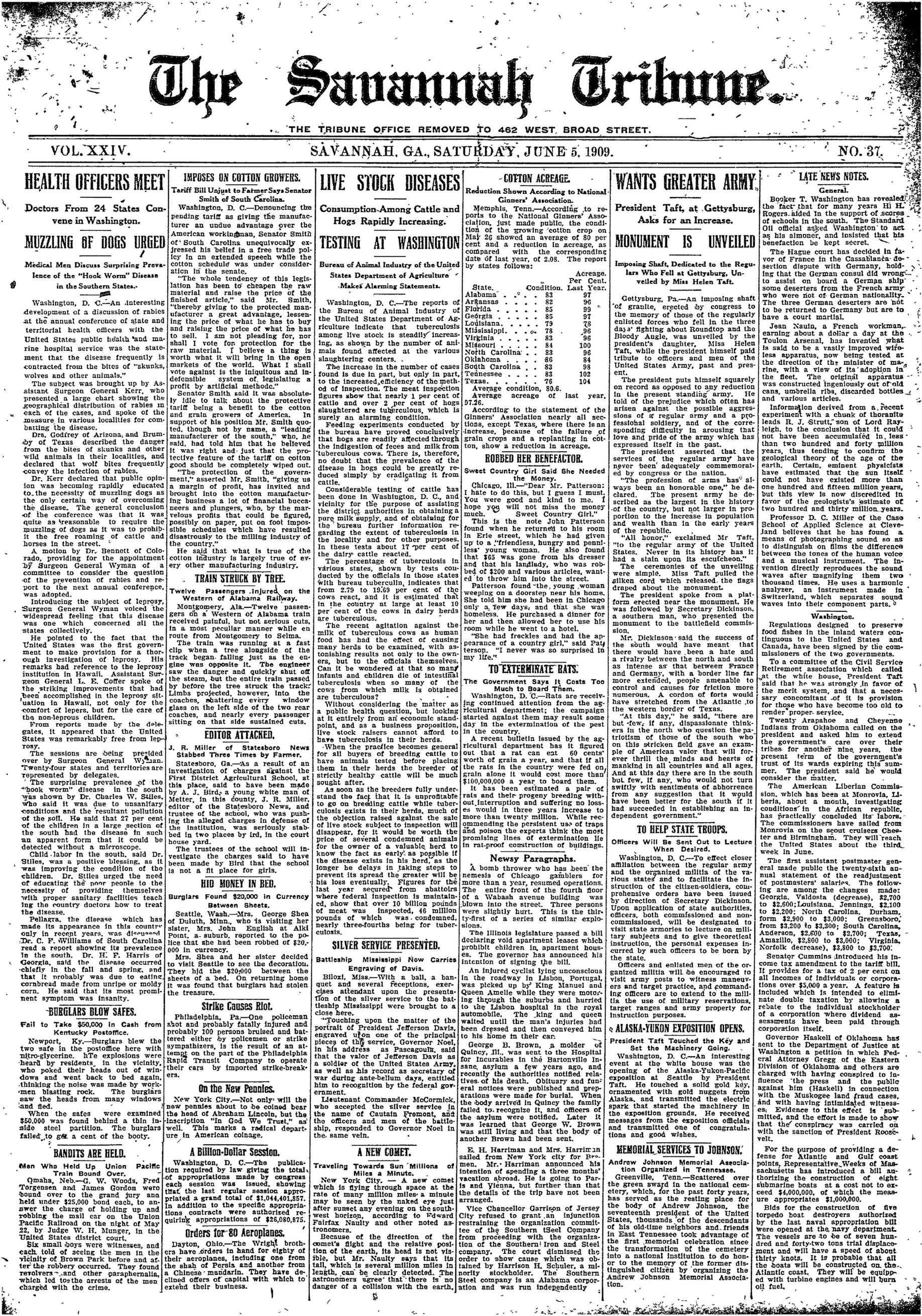
HEALTH OFFICERS MEET
Doctors From 24 States Convene in Washington.
MUZZLING OF DOGS URGED
Medical Men Discuss Surprising Preva lence of the "Hook Worm" Disease
Washington, D. C.—An interesting development of a discussion of rabies at the annual conference of state and territorial health officers with the United States public health and marine hospital service was the statement that the disease frequently is contracted from the bites of "skunks, wolves and other animals." The subject was brought up by Assistant Surgeon General Kerr, who presented a large chart showing the geographical distribution of rabies in each of the cases, and spoke of the measure in various localities for combating the disease. Drs. Godfrey of Arizona, and Brumby of Texas described the danger from the bites of skunks and other wild animals in their localities, and declared that wolf bites frequently convey the infection of rabies.
Dr. Kerr declared that public opinion was becoming rapidly educated to the necessity of muzzling dogs as the only certain way of overcoming the disease. The general conclusion of the conference was that it was quite as reasonable to require the muzzling of dogs as it was to prohibit the free roaming of cattle and horses in the street.
A motion by Dr. Bennett of Colorado, providing for the appointment by Surgeon General Wyman of a committee to consider the question of the prevention of rabies and report to the next annual conference, was adopted.
Introducing the subject of leprosy, Surgeon General Wyman voiced the widespread feeling that this disease was one which concerned all the states collectively.
He pointed to the fact that the United States was the first government to make provision for a thorough investigation of leprosy. His remarks had reference to the leprosy institution in Hawaii. Assistant Surgeon General L. E. Coffer spoke of the striking improvements that had been accomplished in the leprosy situation in Hawaii, not only for the comfort of lepers, but for the care of the non-leprous children. From reports made by the delegates, it appeared that the United States was remarkably free from leprosy. The sessions are being presided over by Surgeon General W. Waan. Twenty-four states and territories are represented by delegates.
The surprising prevalence of the "hook worm" disease in the south was shown by Dr. Charles W. Stiles, who said it was due to unsanitary conditions and the resultant pollution of the soft. He said that 27 per cent of the children in a large section of the south had the disease in such an apparent form that it could be detected without a microscope.
Child labor in the south, said Dr. Stiles, was a positive blessing, as it was improving the condition of the children. Dr. Stiles urged the need of educating the poor people to the necessity of providing themselves with proper sanitary facilities teaching the country doctors how to treat the disease.
Pellagra, the disease which has made its appearance in this country only in recent years, was discussed Dr. C. F. Williams of South Carolina read a report showing its prevalence in the south. Dr. H. F. Harris of Georgia, said the disease occurred chiefly in the fall and spring, and that it probably was due to eating cornbread made from unripe or molly corn. He said that its most prominent symptom was insanity.
BURGLARS BLOW SAFES.
Fail to Take $50,000 in Cash from Kentucky Postoffice.
Newport, Ky.—Burglaries blew the two safe in the postoffice here with nitro-glycerine. hTe explosions were heard by residents in the vicinity, who poked their heads out of windows and went back to bed again, thinking the noise was made by workmen blasting rock. The burglaries saw the heads from many windows and fled.
When the safes were examined $50,000 was found behind a thin inside steel partition. The burglaries failed to get a cent of the booty.
BANDITS ARE HELD.
Men Who Held Up Union Pacific Train Bound Over.
Qmaha, Neb.-G. W. Woods, Freed Torgensen and James Gordon were bound over to the grand jury and held under $25,000 bond each, to answer the charge of holding up and robbing the mail car on the Union Pacific Railroad on the night of May 22, by Judge W. H. Munger, in the United States district court.
Six small boys were witnesses, and each told of seeing the men in the vicinity of Brown Park before and after the robbery occurred. They found revolvers and other paraphernalia, which led to the arrests of the men charged with the crime.
THE TRIBUNE OFFICE REMOVED TO 462 WEST, BROAD STREET.
The
IMPOSES ON COTTON GROWERS.
Tariff Bill Unjust to Farmer Says Senator
Smith of South Carolina.
Washington, D. C.—Denouncing the pending tariff as giving the manufacturer an undue advantage over the American workingman, Senator Smith of* South Carolina unequivocally expressed his belief in a free trade policy in an extended speech while the cotton schedule was under consideration in the senate.
"The whole tendency of this legislation has been to cheapen the raw material and raise the price of the finished article," said Mr. Smith, "thereby giving to the protected manufacturer a great advantage, lessening the price of what he has to buy and raising the price of what he has to sell. I am not pleading for, nor shall I vote for protection for the raw material. I believe a thing is worth what it will bring in the open markets of the world. What I shall vote against is the iniquitous and defensible system of, legislating a profit by artificial method."
Senator Smith said it was absolutely idle to talk about the protective tariff being a benefit to the cotton and grain growers of America. In support of his position Mr. Smith quoted, though not by name, a "leading manufacturer of the south," who he said, had told him that he believed it was right and just that the protective feature of the tariff on cotton good should be completely wiped out. "The protection of the government," asserted Mr. Smith, "giving us a margin of profit, has invited and brought into the cotton manufacturing business a lot of financial buccaneers and plungers, who, by the marvelous profits that could be figured, possibly on paper, put on foot impossible schedules which have resulted disastrously to the milling industry of the country."
He said that what is true of the cotton industry is largely true of every other manufacturing industry.
TRAIN STRUCK BY TREE.
Twelve Passengers Injured on the Western of Alabama Railway.
Montgomery, Ala.—Twelve passengers on a Western of Alabama train received painful, but not serious cuts, in a most peculiar manner while en route from Montgomery to Selma.
The train was running at a fast clip when a tree alongside of the track began falling just as the engine was opposite it. The engineer saw the danger and quickly shut off the steam, but the entire train passed by before the tree struck the track: Limbs projected, however, into the coaches, shattering every window glass on the left side of the two rear coaches, and nearly every passenger sitting on that side sustained cuts.
EDITOR ATTACKED.
J. R. Miller of Statesboro News Stabbed Three Times by Farmer.
Statesboro, Ga.-As a result of an investigation of charges against the First District Agricultural School, at this place, said to have been made by A. J. Bird, a young white man of Metter, in this county, J. R. Miller, editor of the Statesboro News, and trustee of the school, who was pushing the alleged charges in defense of the institution, was seriously stabbed in two places by ird, in the court house yard.
The trustees of the school will investigate the charges said to have been made by Bird that the school is not a fit place for girls.
HID MONEY IN BED.
Burglaries Found $20,000 in Currency Between Sheets.
Seattle, Wash.—Mrs. George Shea of Duluth, Minn., who is visiting her sister, Mrs. John English at Alkp Point, a suburb, reported to the police that she had been robbed of $20,000 in currency.
Mrs. Shea and her sister decided to visit Seattle to see the decoration. They bid the $20,000 between the sheets of a bed. On returning home it was found that burglars had stolen the treasure.
Strike Causes Blot
Philadelphia, Pa.—One policeman shot and probably fatally injured and probably 100 persons bruised and battered either by policemen or strike sympathizers, is the result of an attempt on the part of the Philadelphia Rapid Transit Company to operate their cars by imported strike-breakers.
On the New Pennies
New York City...Not only will the new pennies about to be coined bear the head of Abraham Lincoln, but the inscription "In God We Trust," as well. This marks a radical departure in American colnage.
A Billion-Dollar Session
Washington, D. C.-The publication required by law giving the total of appropriations made by congress each session was issued, showing that the last regular session appropriated a grand total of $1,044,401,857. In addition to the specific appropriations contracts were authorized requiring appropriations of $26,080,875.
Orders for 80 Aeroplanes.
Dayton, Ohio.—The Wright brothers have orders in hand for eighty of their aeroplanes, including one from the shah of Persia and another from a Chinese mandarin. They have declined offers of capital with which to extend their business.
SAVANNAH, GA., SATURDAY, JUNE 5, 1909.
LIVE STOCK DISEASES
Consumption Among Cattle and Hogs Rapidly Increasing.
TESTING AT WASHINGTON
Bureau of Animal Industry of the United States Department of Agriculture Makes Alarming Statements.
Washington, D. C.—The reports of the Bureau of Animal Industry of the United States Department of Agriculture indicate that tuberculosis among live stock is steadily increasing, as shown by the number of animals found affected at the various slaughtering centers.
The increase in the number of cases found is due in part, but only in part, to the increased, efficiency of the method of inspection. The meat inspection figures show that nearly 1 per cent of cattle and over 2 per cent of hogs slaughtered are tuberculous, which is surely an alarming condition.
Feeding experiments conducted by the bureau have proved conclusively that hogs are readily affected through the indigestion of feces and milk from tuberculous cows. There is, therefore, no doubt that the prevalence of the disease in hogs could be greatly reduced simply by cradling it from cattle. Considerable testing of cattle has been done in Washington, D. C., and vicinity for the purpose of assisting the district authorities in obtaining a pure milk supply, and of obtaining for the bureau further information regarding the extent of tuberculosis in the locality and for other purposes. In these tests about 17 per cent of the dairy cattle reacted. The percentage of tuberculosis in various states, shown by tests conducted by the officials in those states with bureau tuberculosis, indicates that from 2.79 to 19.59 per cent of the cows react, and it is estimated that in the country at large at least 10 per cent of the cows in dairy herds are tuberculous.
The recent agitation against the milk of tuberculous cows as human food has had the effect of causing many herds to be examined, with astonishing results not only to the owners, but to the officials themselves. Can it be wondered at that so many infants and children die of intestinal tuberculosis when so many of the cows from which milk is obtained are tuberculous? Without considering the matter as a public health question, but looking at it entirely from an economic standpoint, and as a business proposition, live stock raisers cannot afford to have tuberculosis in their herds. When the practice becomes general for all buyers of breeding cattle to have animals tested before placing them in their herds the breeder of strictly healthy cattle will be much sought after.
As soon as the breeders fully understand the fact that it is unprofitable to go on breeding cattle while tuberculosis exists in their herds, much of the objection raised against the sale of live stock subject to inspection will disappear, for it would be worth the price of several condemned animals for the owner of a valuable herd to know the fact as early as possible if the disease exists in his herd, as the longer he delays in taking steps to prevent its spread the greater will be his loss eventually. Figures for the last year secured from abattoirs where federal inspection is maintained, show that over 10 billion pounds of meat was inspected, 46 million pounds of which was condemned, nearly three-fourths being for tuberculosis.
SILVER SERVICE PRESENTED
Battleship Mississippi Now Carries Engraving of Davis.
Biloxi, Miss.—With a ball, a banquet and several feceptions, exercises attendant upon the presentation of the silver service to the battleship Mississippi were brought to a close here.
"Touching upon the matter of the portrait of President Jefferson Davis, engraved upon one of the principal pieces of the service, Governor Noel, in his address as Pascagoula, said that the valor of Jefferson Davis as a soldier of the United States Army, as well as his record as secretary of war during ante-bellum days, entitled him to recognition by the federal government.
Lieutenant Commander McCormick, who accepted the silver service in the name of Cautain Fremont, and the officers and men of the battleship, responded to Governor Noel in the same vein.
A NEW COMET.
Traveling Towards Sun 'Millions of Miles a Minute.
New York City. — A new comet which is flying through space at the rate of many million miles a minute may be seen by the naked eye just after sunset any evening on the southwest horizon, according to Pdward Fairfax Nauity and other noted astronomers.
Because of the direction of the comet's flight and the relative position of the earth, its head is not visible, but Mr. Nauity says that its tail, which is several million miles in length, can be clearly detected. The astronomers agree that 'there is no danger of a collision with the earth.
COTTON ACREAGE
Reduction Shown According to National Ginners' Association
Memphis, Tennessee.—According to reports to the National Ginners' Association, just made public, the condition of the growing cotton crop on May 26 showed an average of 80 per cent and a reduction in acreage, as compared with the corresponding date of last year, of 2.08. The report by states follows:
| State | Condition | Last Year |
| :--- | :--- | :--- |
| Alabama | 83 | 97 |
| Arkansas | 82 | 96 |
| Florida | 85 | 99 |
| Georgia | 85 | 97 |
| Louisiana | 79 | 78 |
| Mississippi | 78 | 96 |
| Virginia | 83 | 96 |
| Missouri | 84 | 100 |
| North Carolina | 83 | 96 |
| Oklahoma | 86 | 84 |
| South Carolina | 83 | 98 |
| Tennessee | 83 | 102 |
| Texas | 76 | 104 |
Average condition, 80.6.
Average acreage of last year,
Average acreage of last year, 97.26. According to the statement of the Ginners' Association nearly all sections, except Texas, where there is an increase, because of the failure of grain crops and a replanting in cotton, show a reduction in acreage.
ROBBED HER BENEFACTOR.
Sweet Country Girl Said She Needed the Money.
Chicago, Ill.—"Dear Mr. Patterson: I hate to do this, but I guess I must. You were good and kind to me. I hope you will not miss the money much. Sweet Country Girl."
This is the note John Patterson found when he returned to his room in Erie street, which he had given up to a "friendless, hungry and penniless" young woman. He also found that $65 was gone from his dresser and that his landlady, who was robbed of $200 and various articles, wanted to throw him into the street.
Patterson found the, young woman weeping on a doorstep near his home. She told him she had been in Chicago only a few days, and that she was homeless. He purchased a dinner for her and then allowed her to use his room while he went to a hotel.
"She had freckles and had the appearance of a country girl," said Patterson. "I never was so surprised in my life."
TO EXTERMINATE RATS.
The Government Says It Costs Too Much to Board Them
Washington, D. C.—Rats are receiving continued attention from the agricultural department; the campaign started against them may result some day in the extermination of the pest in the country.
A recent bulletin issued by the agricultural department has it figured out that a rat can eat 60 cents' worth of grain a year, and that if all the rats in the country were fed on grain alone it would cost more than $100,000,000 a year to board them.
It has been estimated a pair of rats and their progeny breeding without, interruption and suffering no losses would in three years increase to more than twenty million. While recommending the persistent use of traps and poison the experts think the most promising lines of extermination lie in rat-proof construction of buildings.
Newsy Paragraphs.
A bomb thrower who has been the nemesis of Chicago gamblers for more than a year, resumed operations. The entire front of the fourth floor of a Wabash avenue building was blown into the street. Three persons were slightly hurt. This is the thirty-first of a series of similar explosions. The Illinois legislature passed a bill declaring void apartment leases which prohibit children in apartment houses. The governor has announced his intention of signing the bill. An injured cyclist lying unconscious in the roadway in Lisbon, Portugal, was picked up by King Manuel and Queen Amelle while they were motoring through the suburbs and hurried to the Lisbon hospital in the royal automobile. The king and queen waited until the man's injuries had been dressed and then conveyed him to his home in their car.
George B. Brown, a molder of Quincy, Ill., was sent to the Hospital for Incurables in the Bartonville Insane asylum a few years ago, and recently the authorities notified relatives of his death. Obituary and funeral notices were published and preparations were made for burial. When the body arrived in Quincy the family failed to recognize it, and officers of the asylum were notified. Later it was learned that George W. Brown was still living and that the body of another Brown had been sent.
E. H. Harriman and Mrs. Harriman sailed from New York city for Bromen. Mr. Harriman announced his intention of spending a three months' vacation abroad. He is going to Paris and Ylenna, but further than that the details of the trip have not been arranged.
Vice Chancellor Garrison of Jersey City refused to grant an injunction restraining the organization committee of the Southern Steel Company from proceeding with the organization of the Southern Iron and Steel company. The court dismissed the order to show cause which was obtained by Harrison H. Schuler, a minority stockholder. The Southern Steel company is an Alabama corporation and was run independently
WANTS GREATER ARMY
President Taft, at Gettysburg, Asks for an Increase.
MONUMENT IS UNVEILED
Imposing Shaft, Dedicated to the Regulars Who Fell at Gettysburg, Unveiled by Miss Helen Taft.
Gettysburg, Pa.—An imposing shaft of granite, erected by congress to the memory of those of the regularly enlisted forces who fell in the three days' fighting about Roundtop and the Bloody Angle, was unveiled by the president's daughter, Miss Helen Taft, while the president himself paid tribute to officers and men of the United States Army, past and present.
The president puts himself squarely on record as opposed to any reduction in the present standing army. He told of the prejudice which often has arisen against the possible aggressions of *α* regular army and a professional soldiery, and of the corresponding difficulty in arousing that love and pride of the army which has expressed itself in the past.
The president asserted that the services of the regular army have never been adequately commemorated by congress or the nation.
"The profession of arms has always been an honorable one," he declared. The present army he described as the largest in the history of the country, but not larger in proportion to the increase in population and wealth than in the early years of the republic.
"All honor," exclaimed Mr Taft, "to the regular army of the United States. Never in its history has it; had a stain upon its escutcheon."
The ceremonies of the unveiling were simple. Miss Taft pulled the silken cord which released the flags draped about the monument.
The president spoke from a platform erected near the monument. He was followed by Secretary Dickinson, a southern man, who presented the monument to the battlefield commission.
Mr. Dickinson said the success of the south would have meant that there would have been a hate and a rivalry between the north and south as intense as that between France and Germany, with a border line far more extended, people amenable to control and causes for friction more numerous. A cordon of forts would have stretched from the Atlantic, to the western border of Texas.
"At this day," he said, "there are but few, if any, dispassionate thinkers in the north who question the patriotism of those of the south who on this stricken field gave an example of American valor that will forever thrill the minds and hearts of mankind in all countries and all ages. And at this day there are in the south but few, if any, who would not turn swiftly with sentiments of abhorrence from any suggestion that it would have been better for the south if it had succeeded in establishing an independent government."
TO HELP STATE TROOPS.
Officers Will Be Sent Out to Lecture When Desired.
Washington, D. C.-To effect closer affiliation between the regular army and the organized militia of the various states and to facilitate the instruction of the citizen-soldiers, comprehensive orders have been issued by direction of Secretary Dickinson. Upon application of state authorities, officers, both commissioned and noncommissioned, will be designated to visit state armories to lecture on military subjects and to give theoretical instruction, the personal expenses incurred by such officers to be born by the state.
Officers and enlisted men of the organized militia will be encouraged to visit army posts to witness maneuvers and target practice, and commanding officers are to extend to the militia the use of military reservations, target ranges and army property for instruction purposes.
ALASKA-YUKON EXPOSITION OPENS.
President Taft Touched the Key and Set the Machinery Going. Washington, D. C.-An interesting event at the white house was the opening of the Alaska-Yukon-Pacific exposition at Seattle by President Taft. He touched a solid gold key, ornamented with gold nuggets from Alaska, and transmitted the electric spark that started the machinery in the exposition grounds. He received messages from the exposition officials and transmitted one of congratulations and good wishes.
MEMORIAL SERVICES TO JOHNSON
Andrew Johnson Memorial Association Organized in Tennessee.
Greenville, Tenn.—Scattered over the green sward in the national cemetery, which, for the past forty years, has served as the resting place for the body of Andrew Johnson, the seventeenth president of the United States, thousands of the descendants of his old-time neighbors and, friends in East Tennessee took advantage of the first memorial celebration since the transformation of the cemetery into a national institution to do honor to the memory of the former distinguished citizen by organizing the Andrew Johnson Memorial Association.
LATE NEWS NOTES.
General.
Booker T. Washington has revealed the fact that for many years Hil H. Rogers aided in the support of scores of schools in the south. The Standard Oil official asked Washington to act as his almoner, and insisted that his benefaction be kept secret.
The Hague court has decided in favor of France in the Cassablanca desertion dispute with Germany, holding that the German consul did wrong to assist on board a German ship some deserters from the French army who were not of German nationality. The three German deserters are not to be returned to Germany but are to have a court martial.
Jean Naulin, a French workman, earning about a dollar a day at the Toulon Arsenal, has invented what is said to be a vastly improved wireless apparatus, now being tested at the direction of the minister of marine, with a view of its adoption in the fleet. The original apparatus was constructed ingeniously out of old cans, umbrella ribs, discarded bottles and various articles.
Information derived from a recent experiment with a chunk of thoronite leads R. J. Strutt's son of Lord Rayleigh, to the conclusion that it could not have been accumulated in, less than two hundred and forty million years, thus tending to confirm the geological theory of the age of the earth. Certain, eminent physicists have estimated that the sun itself could not have existed more than one hundred and fifteen million years, but this view is now discredited in favor of the geologist's estimate of two hundred and thirty million years.
Professor D. C. Miller of the Case School of Applied Science at Cleveland believes that he has found a means of photographing sound so as to distinguish on films the difference between the tones of the human voice and a musical instrument. The invention directly reproduces the sound waves after magnifying them two thousand times. He uses a harmonic analyzer, an instrument made in Switzerland, which separates sound waves into their component parts. $ ^{b} $
Washington.
Regulations designed to preserve food fishes in the inland waters contiguous to the United States and Canada, have been signed by the commissioners of the two governments.
To a committee of the Civil Service Retirement association which called at the white house, President Taft said that he was strongly in favor of the merit system, and that a necessary concomitant of it is provision for those who have become too old to render proper service.
Twenty Arapahoe and Cheyenne Indians from Oklahoma called on the president and asked him to extend the government's care over their tribes for another nine years, the present term of the government's trust of its wards expiring this summer. The president said he would consider the matter.
The American Liberian Commission, which has been at Monrovia, Liberia, about a month, investigating conditions in the African republic, has practically concluded its labors. The commissioners have sailed from Monrovia on the scout cruisers Chester and Birmingham. They will reach the United States about the third week in June.
The first assistant postmaster general made public the twenty-sixth annual statement of the readjustment of postmasters' salaries. The following are among the changes made: Georgia, Valdosta (decrease), $2,700 to $2,600; Louisiana, Jennings, $2,100 to $2,200; North Carolina, Durham, form $2,900 to $3,000; Greensboro, from $2,200 to $3,300; South Carolina, Anderson, $2,600 to $2,700; Texas, Amazillo, $2,800 to $3,000; Virginia, Norfolk decrease). $3,800 to $3,700:
Senator Cummins introduced his income tax amendment to the tariff bill. It provides for a tax of 2 per cent on all incomes of individuals or corporations over $5,000 a year. A feature is included which is intended to eliminate double taxation by allowing a rebate to the individual stockholder of a corporation where dividend assessments have been paid through corporation itself.
Governor Haskell of Oklahoma has sent to the Department of Justice at Washington a petition in which Federal Attorney Gregg of the Eastern Division of Oklahoma and others are charged with having conspired to influence the press and the public against him (Haskell) in connection with the Muskogee land fraud cases, and with having intimidated witnesses. Evidence to this effect is submitted, and the effort is made to show that the conspiracy was carried on with the sanction of President Roosevelt.
For the purpose of providing a defense for Atlantic and Gulf coast points, Representative. Weeks of Massachusetts has introduced a bill authorizing the construction of eight submarine boats at a cost not to exceed $4,000,000, of which the measure appropriates $1,000,000. Bids for the construction of five torpedo boat destroyers authorized by the last naval appropriation bill were opened at the navy department. The vessels are to be of seven hundred and forty-two tons trial displacement and will have a speed of about thirty knots. It is probable that all the boats will be constructed on the Atlantic coast. They will be equipped with turbine engines and will burn oil fuel.
P. EDWARD PERRY, Vice President.
canty Aid and
ON, Supt. of Agenotes.
of Georgia.
JAN 17 1908 190
Georgia hereby acknowledges
ing described in the will:
L. B. Williams.
P. Edward Perry.
Walter S. Scott.
Sel. C. Johnson.
This company requires of the that the strict in
Its affairs are of character and re community. The fairs of the first themselves with
By comparing of liberal inducement company in this busi
That we pay o
The undisputed Treasurer of the State of Georgia, hereby acknowledges is here excited for the following description :
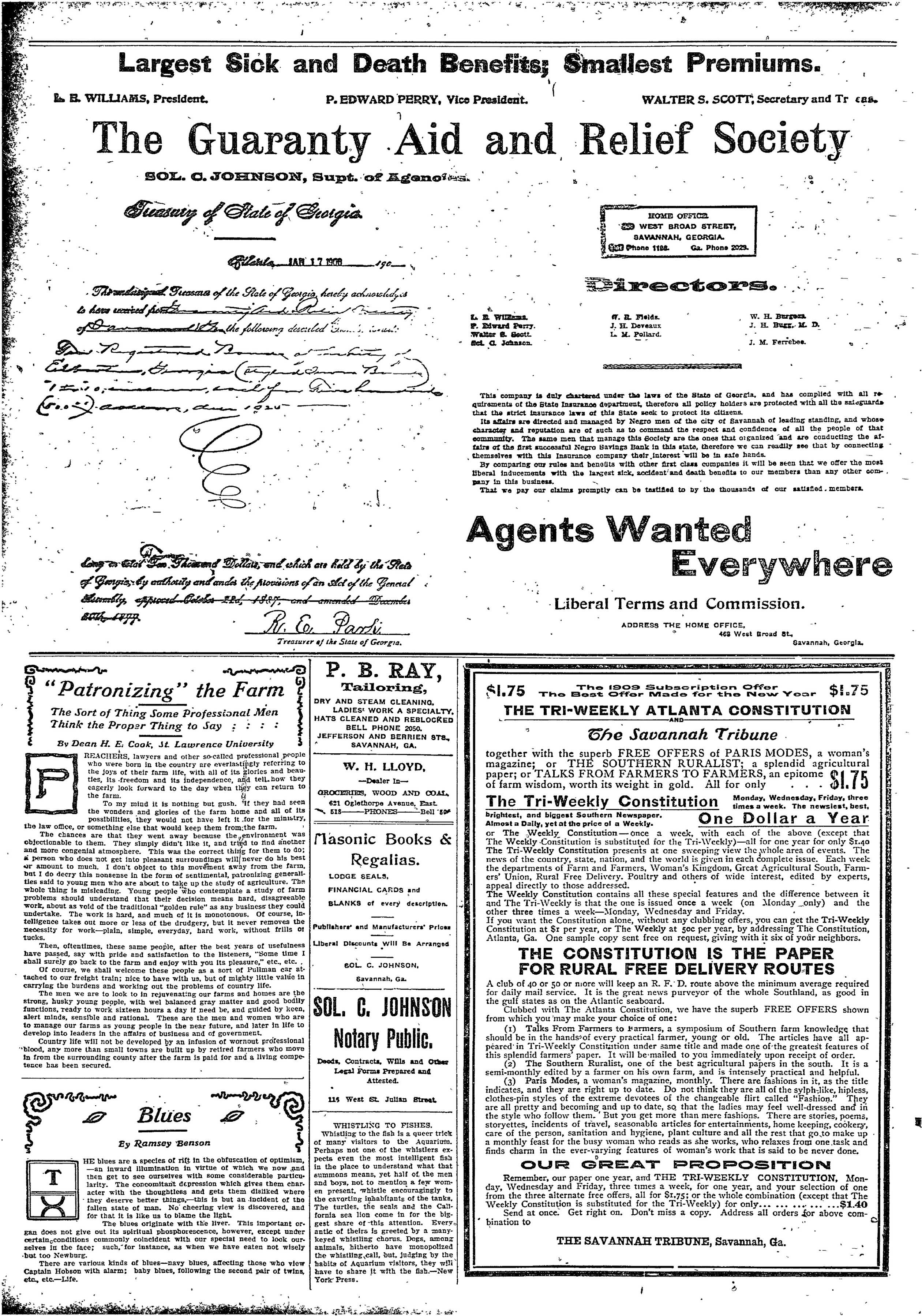
This company is duly chartered under the laws of the State of Georgia, and has complied with all requirements of the State Insurance department, therefore all policy holders are protected with all the safeguards that the strict insurance laws of this State seek to protect its citizens.
Its affairs are directed and managed by Negro men of the city of Savannah of leading standing, and whose character and reputation are of such as to command the respect and confidence of all the people of that community. The same men that manage this Society are the ones that organized and are conducting the affairs of the first successful Negro Savings Bank in this state, therefore we can readily see that by connecting themselves with this Insurance company their interest will be in safe hands.
By comparing our rules and benefits with other first class companies it will be seen that we offer the most liberal inducements with the largest sick, accident and death benefits to our members than any other company in this business.
That we pay our claims promptly can be testified to by the thousands of our satisfied members.
Long as at Ten Thousand Dollars, and which are held by the State of Georgia, by authority and under the provisions of an Act of the General Assembly, approved October 22d, 1887, and amended December 8th, 1897.
R. E. Parsi.
Treasurer of the State of Georgia.
P. B. RAY,
DRY AND STEAM CLEANING.
LADIES' WORK A SPECIALTY.
HATS CLEANED AND REBLOCKED
BELL PHONE 2050.
JEFFERSON AND BERRIEN STS.
SAVANNAH, GA.
together with the superb FREE OFFERS of PARIS MODES, a woman's magazine; or THE SOUTHERN RURALIST; a splendid agricultural paper; or TALKS FROM FARMERS TO FARMERS, an epitome of farm wisdom, worth its weight in gold. All for only $1.75
W. H. LLOYD,
—Dealer In—
GROCERIES, WOOD AND COAL,
621 Oglethorpe Avenue, East
518 PHONES Bell 50
brightest, and biggest Southern Newspaper. Almost a Daily, yet at the price of a Weekly. or The Weekly Constitution once a week, with each of the above (except that The Weekly Constitution is substituted for the Tri-Weekly) all for one year for only $1.40 The Tri-Weekly Constitution presents at one sweeping view the whole area of events. The news of the country, state, nation, and the world is given in each complete issue. Each week the departments of Farm and Farmers, Woman's Kingdom, Great Agricultural South, Farmers' Union, Rural Free Delivery. Poultry and others of wide interest, edited by experts appeal directly to those addressed.
Masonic Books &
LODGE SEALS.
FINANCIAL CARDS and
BLANKS of every description.
The Weekly Constitution contains all these special features and the difference between it and The Tri-Weekly is that the one is issued once a week (on Monday only) and the other three times a week—Monday, Wednesday and Friday. If you want the Constitution alone, without any clubbing offers, you can get the Tri-Weekly Constitution at $1 per year, or The Weekly at 50c per year, by addressing The Constitution, Atlanta, Ga. One sample copy sent free on request, giving with it six of your neighbors.
Publisher's and Manufacturers' Prices
Liberal Discounts Will Be Arranged
SOL. C. JOHNSON,
Savannah, Ga.
A club of 40 or 50 or more will keep an R. F. D. route above the minimum average required for daily mail service. It is the great news purveyor of the whole Southland, as good in the gulf states as on the Atlantic seaboard.
SOL. C. JOHNSON Notary Public.
Clubbed with The Atlanta Constitution, we have the superb FREE OFFERS shown from which you may make your choice of one:
(1) Talks From Farmers to Farmers, a symposium of Southern farm knowledge that should be in the hands of every practical farmer, young or old. The articles have all appeared in Tri-Weekly Constitution under same title and made one of the greatest features of this splendid farmers' paper. It will be mailed to you immediately upon receipt of order.
Doodz, Contracts, Wills and Other Legal Forms Prepared and Attested.
(2) The Southern Ruralist, one of the best agricultural papers in the south. It is a semi-monthly edited by a farmer on his own farm, and is intensely practical and helpful.
(3) Paris Modes, a woman's magazine, monthly. There are fashions in it, as the title indicates, and they are right up to date. Do not think they are all of the sylph-like, hipless, clothes-pin styles of the extreme devotees of the changeable flirt called "Fashion." They are all pretty and becoming and up to date, so that the ladies may feel well-dressed and in the style who follow them. But you get more than mere fashions. There are stories, poems, storyettes, incidents of travel, seasonable articles for entertainments, home keeping, cookery, care of the person, sanitation and hygiene, plant culture and all the rest that go to make up a monthly feast for the busy woman who reads as she works, who relaxes from one task and finds charm in the ever-varying features of woman's work that is said to be never done.
111 West St. Julian Street
Whistling to the fish is a queer trick of many visitors to the Aquarium. Perhaps not one of the whistlers expects even the most intelligent fish in the place to understand what that summons means, yet half of the men and boys, not to mention a few women present, whistle encouragingly to the cavorting inhabitants of the tanks. The turtles, the seals and the California sea lion come in for the biggest share of this attention. Every antic of theirs is greeted by a many-keyed whistling chorus. Dogs, among animals, hitherto have monopolized the whistling, call, but, judging by the habits of Aquarium visitors, they will have to share it with the fish.—New York Press.
Remember, our paper one year, and THE TRI-WEEKLY CONSTITUTION, Monday, Wednesday and Friday, three times a week, for one year, and your selection of one from the three alternate free offers, all for $1.75; or the whole combination (except that The Weekly Constitution is substituted for the Tri-Weekly) for only..... $1.40 Send at once. Get right on. Don't miss a copy. Address all orders for above combination to
The Sort of Thing Some Professional Men Think the Proper Thing to Say : : : :
By Dean H. E. Cook, St. Lawrence University
REACHERS, lawyers and other so-called professional people who were born in the country are everlastingly referring to the joys of their farm life, with all of its glories and beauties, its freedom and its independence, and tell how they eagerly look forward to the day when they can return to the farm.
P
To my mind it is nothing but gush. If they had seen the wonders and glories of the farm home and all of its possibilities, they would not have left it for the ministry, the law office, or something else that would keep them from the farm.
The chances are that they went away because the environment was objectionable to them. They simply didn't like it, and tried to find another and more congenial atmosphere. This was the correct thing for them to do; a person who does not get into pleasant surroundings will never do his best or amount to much. I don't object to this movement away from the farm, but I do decry this nonsense in the form of sentimental, patronizing generalities said to young men who are about to take up the study of agriculture. The whole thing is misleading. Young people who contemplate a study of farm problems should understand that their decision means hard, disagreeable work, about as void of the traditional "golden rule" as any business they could undertake. The work is hard, and much of it is monotonous. Of course, intelligence takes out more or less of the drudgery, but it never removes the necessity for work—plain, simple, everyday, hard work, without frills of tucks.
Then, oftentimes, these same people, after the best years of usefulness have passed, say with pride and satisfaction to the listeners, "Some time I shall surely go back to the farm and enjoy with you its pleasure," etc., etc. Of course, we shall welcome these people as a sort of Pullman car attached to our freight train; nice to have with us, but of mighty little value in carrying the burdens and working out the problems of country life.
The men we are to look to in rejuvenating our farms and homes are the strong, husky young people, with wel balanced gray matter and good bodily functions, ready to work sixteen hours a day if need be, and guided by keen, alert minds, sensible and rational. These are the men and women who are to manage our farms as young people in the near future, and later in life to develop into leaders in the affairs of business and of government.
Country life will not be developed by an infusion of wornout professional blood, any more than small towns are built up by retired farmers who move in from the surrounding county after the farm is paid for and a living competence has been secured.
Blues
Ey Ramsey Benson
HE blues are a species of rift in the obfuscation of optimism,
—an inward illumination in virtue of which we now and then get to see ourselves with some considerable particularity. The concomitant depression which gives them character with the thoughtless and gets them disliked where they deserve better things,—this is but an incident of the fallen state of man. No cheering view is discovered, and for that it is like us to blame the light.
HE blues are a species of rift in the obfuscation of optimism,—an inward illumination in virtue of which we now and then get to see ourselves with some considerable particularity. The concomitant depression which gives them character with the thoughtless and gets them disliked where they deserve better things,—this is but an incident of the fallen state of man. No cheering view is discovered, and for that it is like us to blame the light.
The blues originate with the liver. This important organ does not give out its spiritual phosphorescence, however, except under certain conditions commonly coincident with our special need to look ourselves in the face; such, for instance, as when we have eaten not wisely but too Newburg.
There are various kinds of blues—navy blues, affecting those who view Captain Hobson with alarm; baby blues, following the second pair of twins, etc. etc—Life.
L. B. WILKINS
P. Edward Perry
Walker B. Scott
Sel C. Johnson
60L. C. JOHNSON,
Savannah, Ga.
Liberal Terms and Commission.
ADDRESS THE HOME OFFICE,
463 West Broad St,
Gavannah,
5 The 1909 Subscription Offer
The Best Offer Made for the New Year
THE TRI-WEEKLY ATLANTA CONSTITUTION
AND
The Savannah Tribune
other with the superb FREE OFFERS of PARIS MODES, a w
mine; or THE SOUTHERN RURALIST; a splendid agriculture;
or TALKS FROM FARMERS TO FARMERS, an epitome of
wisdom, worth its weight in gold. All for only
Tri-Weekly Constitution Monday, Wednesday, Friday
times a week. The newsie
st, and biggest Southern Newspaper.
a Daily, yet at the price of a Weekly.
One Dollar a Y
Weekly Constitution—once a week, with each of the above (except
Weekly Constitution is substituted for the Tri-Weekly)—all for one year for one
Tri-Weekly Constitution presents at one sweeping view the whole area of even
of the country, state, nation, and the world is given in each complete issue. Ea
departments of Farm and Farmers, Woman's Kingdom, Great Agricultural South
ation, Rural Free Delivery. Poultry and others of wide interest, edited by
directly to those addressed.
Weekly Constitution contains all these special features and the difference bet
the Tri-Weekly is that the one is issued once a week (on Monday only) a
three times a week—Monday, Wednesday and Friday.
I want the Constitution alone, without any clubbing offers, you can get the Tri-
dution at $r per year, or The Weekly at 50c per year, by addressing The Cons
, Ga. One sample copy sent free on request, giving with it six of your neigh
THE CONSTITUTION IS THE PAPER FOR RURAL FREE DELIVERY ROUTES
of 40 or 50 or more will keep an R. F. D. route above the minimum average daily mail service. It is the great news purveyor of the whole Southland, as well as states as on the Atlantic seaboard. Subbed with The Atlanta Constitution, we have the superb FREE OFFERS which you may make your choice of one:
Talks From Farmers to Farmers, a symposium of Southern farm knowledge, be in the hands of every practical farmer, young or old. The articles have been in Tri-Weekly Constitution under same title and made one of the greatest feasts and kind farmers' paper. It will be mailed to you immediately upon receipt of one. The Southern Ruralist, one of the best agricultural papers in the south, monthly edited by a farmer on his own farm, and is intensely practical and humorous. Paris Modes, a woman's magazine, monthly. There are fashions in it, as dates, and they are right up to date. Do not think they are all of the sylph-like spin styles of the extreme devotees of the changeable flirt called "Fashion." Pretty and becoming and up to date, so that the ladies may feel well-dressed, she who follow them. But you get more than mere fashions. There are stories, incidents of travel, seasonable articles for entertainments, home keeping, of the person, sanitation and hygiene, plant culture and all the rest that go to truly feast for the busy woman who reads as she works, who relaxes from one, charm in the ever-varying features of woman's work that is said to be never
OUR GREAT PROPOSITION
Remember, our paper one year, and THE TRI-WEEKLY CONSTITUTION is on Wednesday and Friday, three times a week, for one year, and your selection of the three alternate free offers, all for $1.75; or the whole combination (except the Constitution is substituted for the Tri-Weekly) for only... and at once. Get right on. Don't miss a copy. Address all orders for above to
THE SAVANNAH TRIBUNE, Savannah, Ga.
1
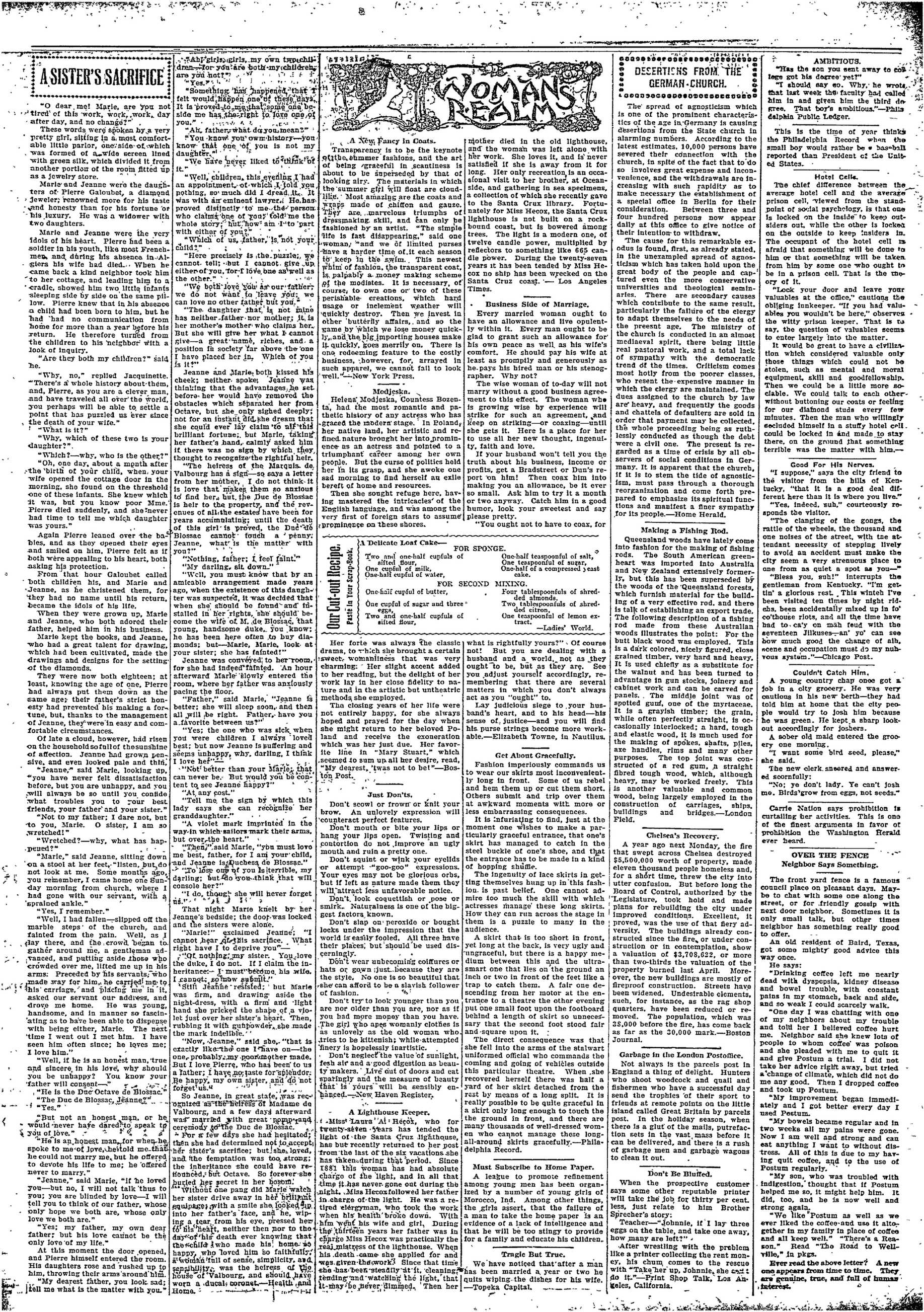
"O dear me! Marie, are you not tired of this work, work, work, day after day, and no change?"
These words were spoken by a very pretty girl, slitting in a most comfortable little parlor, one side of which was formed of a wide screen lined with green silk, which divided it from another portion of the room fitted up as a jewelry store.
Marie and Jeanne were the daughters of Pierre Galoubet, a diamond Jeweler, renowned more for his taste and honesty than for his fortune or his luxury. He was a widower with two daughters.
Marie and Jeanne were the very idols of his heart. Pierre had been a soldier in his youth, like most Frenchmen, and during his absence in Algiers his wife had died. When he came back a kind neighbor took him to her cottage, and leading him to a cradle, showed him two little infants
sleeping side by side on the same pillow. Pierre knew that in his absence a child had been born to him, but he had 'had no communication from home for more than a year before his return. He therefore turned from the children to his neighbor with a look of inquiry.
"Are they both my children?" said he.
"Why, no," replied Jacquinette.
"There's a whole history about them, and, Pierre, as you are a clever man, and have traveled all over the world, you perhaps will be able to settle a point that has puzzled us ever since the death of your wife."
"What is it?"
"Why, which of these two is your daughter?"
"Which?—why, who is the other?"
"Oh, one day, about a month after the birth of your child, when your wife opened the cottage door in the morning, she found on the threshold one of these infants. She knew which it was, but you know poor Mme. Pierre died suddenly, and she never had time to tell me which daughter was yours."
Again Pierre leaned over the bables, and as they opened their eyes and smiled on him, Pierre felt as if both were appealing to his heart, both asking his protection.
From that hour Galoubet called both children his, and Marie and Jeanne, as he christened them, for they had no name until his return, became the idols of his life.
When they were grown up, Marie and Jeanne, who both adored their father, helped him in his business.
Marle kept the books, and Jeanne, who had a great talent for drawing, which had been cultivated, made the drawings and designs for the setting of the diamonds.
They were now both eighteen; at loast, knowing the age of one, Pierre had always put them down as the same age; their father's strict honesty had prevented his making a fortune, but, thanks to the management of Jeanne, they were in easy and comfortable circumstances.
Of late a cloud, however, had risen on the household so full of the sunshine of affection. Jeanne had grown pensive, and even looked pale and thitl.
"Jeanne," said Marle, looking up, "you have never felt dissatisfaction before, but you are unhappy, and you will always be so until you conide what troubles you to your best friends, your father and your sister."
"Not to my father; I dare not, but to you, Marile. O sister, I am so wretched!"
"Wretched?—why, what has happened?"
"Marile," said Jeanne, sitting down on a stool at her feet, "listen, but do not look at me. Some months ago, you remember, I came home one Sunday morning from church, where I had gone with our servant, with a sprained ankle."
"Yes, I remember."
"Well, I had fallen—slipped off the marble steps' of the church, and fainted from the pain. Well, as I lay there, and the crowd began to gather around me, a gentleman advanced, and putting aside those who crowded over me, lifted me up in his arms. Preceded by his servants, who made way for him, he carried me to his carriage, and plucking me in it, asked our servant our address, and drove me home. He was young, handsome, and in manner so fascinating as to have been able to dispense with being either, Marte. The next time I went out I met him. I have seen him often since; he loves me; I love him."
"Well, if he is an honest man, true and sincere in his love, why should you be unhappy? You know your father will consent—"
"He is the Duc Octave de Blossac"
"The Duc de Blossac, Jeanne?"
"Yes."
"But not an honest man, or he would never have dared to speak to you of love."
"He is an honest man, for when he spoke to me of love, he told me that he could not marry me, but he offered to devote his life to me; he offered never to marry."
"Jeanne, said Marie, "if he loved you—but no, I will not talk thus to you; you are blinded by love—I will tell you to think of our father, whose only hope we both are, whose only love we both are."
"Yes; my father, my own dear father; but his love cannot be the only love of my life."
At this moment the door opened, and Pierre himself entered the room. His daughters rose and rushed up to him, throwing their arms around him.
"My dearest father, you look sad; tell me what is the matter with you."
"Ah, girls, girls, my own twin, childrens—for you are both my children, are you not?"
"Yes."
"Something has happened, that I felt would happen one of these days. It is proved to me that, some one beside me has the right to love one of you."
"Ah, father, what do you mean?"
"You know you own history—you know that one of you is not my daughter."
"We have never liked to think of it."
"Well, children, this evening I had an appointment of which I told you pothing, so much did I dread it. It was with an eminent lawyer, He has proved distinctly to me the person who claims one of you; told me the whole story; but how am I to part with either of you?"
"Which of us, father, is not your child?"
"Here precisely is the puzzle, we cannot tell; but I cannot give up either of you, for I love one as well as the other."
"We both love you as our father; we do not want to leave you; we can love no other father but you."
"The daughter that is not mine has neither father-nor mother; it is her mother's mother who claims her. But she will give her what I cannot give—a great name, riches, and a position in society far above the one I have placed her in. Which of you is it?" Jeanne and Marle, both kissed his cheek; neither spoke; Jeanne was thinking that the advantages, he set before her would have removed the obstacles which separated her from Octave, but she only sighed deeply; not for an instant did she dream that she could ever lay claim to all this brilliant fortune; but Marle, taking her father's hand, calmly asked him if there was no sign by which they thought to recognize the rightful heir.
"The heleness of the Marquis de Valbourg has a sign—so says a letter from her mother. I do not think it is love that makes them so anxious to find her, but the Duc de Blossac is helr to the property, and the revenues of all the estates have been for years accumulating; until the death of this girl is proved, the Duc de Blossac cannot touch a 'penny; Jeanne, what is the matter with you?"
"Nothing, father; I feel faint."
"My darling, sit down."
"Well, you must know that by an amicable arrangement made years ago, when the existence of this daughter was suspected, it was decided that when she should be found and installed in her rights, she should become the wife of M. de Blossac, that young, handsome duke, you know; he has been here often to buy diamonds; but—Marie, Marle, look at your sister; she has fainted!"
Jeanne was convoyed, to her room, for she had indeed fainted. An hour afterward Marle slowly entered the room, where her father was anxiously pacing the floor.
"Father," said Marle, "Jeanne is better; she will sleep soon, and then all will be right. Father, have you a favorite between us?" "Yes; the one who was sick when you were children I always loved best; but now Jeanne is suffering and seems unhappy, why, darling, I think I love her."
"Not better than your Marie; that can never be. But you would be content to see Jeanne happy?"
"At any cost."
"Tell me the sign by which this lady says she can recognize her granddaughter."
"A violet mark imprinted in the way in which sailors mark their arms, but over the heart."
"Then," said Marie, "you must love me best, father, for I am your child, and Jeanne is Duchess de Blossae."
"To lose one of you is terrible, my darling; but do you think that will console her?"
"I do, though she will never forget us."
That night Marie knelt by her Jeanne's bedside; the door was locked and the sisters were alone.
"Marie!" exclaimed Jeanne; "I cannot hear or this sacrifice. What right have I to deprive you"—
"Of nothing, my sister. You love the duke, I do not. If I claim the inheritance-- I must' become, his wife. I cannot, so now submit." Still Jeanne resisted; but Marie was firm, and drawing aside the night-dress, with a firm and light hand she pricked the shape of a violet just over her sister's heart. Then, rubbing it with guhpowder, she made the mark Indelible. "Now, Jeanne," said she, "that is exactly like the one I have on—the one, probably, my poor mother made. But I love Pierre, who has been to us a father; I have no taste for splendor; He happy, my own sister, and do not forget us." So Jeanne, in great state, was recognized as the helpless of Madame de Valbourg, and a few days afterward was married with great happiness and ceremony to the Duc de Blossac.
For a few days she had hesitated; then she had determined not to accept her sister's sacrifice; but she loved, and the temptation was too strong; the inheritance she could have refounded; but Octave. So forever she hurled her secret in her hosom.
Without one pang did Marle watch her sister drive away in her brilliant guilpage; with a smile she looked up into her father's face, and he, wiping a tear from his eye, pressed her to his heart, neither then nor to the day of his death ever knowing that the child who made his home so happy, who loved him so faithfully, a woman full of sense, simplicity, and sensitivity, was the heiress of the house of Valbourg, and should have worn a ducal coronet—Health and Home.
WOMANS REALM
Our Cut-out Recipe.
Paste in Your Scrap Book.
A Delicate Loaf Cake— FOR SPONGE.
Two and one-half cupfuls of sifted flour,
One cupful of milk,
One-half cupful of water,
One-half teaspoonful of salt,
One teaspoonful of sugar,
One-half of a compressed yeast cake.
FOR SECOND MIXING.
One-half cupful of butter,
One cupful of sugar and three eggs,
Two and one-half cupfuls of sifted flour,
Four tablespoonfuls of shredded almonds.
Two tablespoonfuls of shredded citron.
One teaspoonful of lemon extract.
—Ladies' World.
A New Fancy in Coats.
Transparency is to be the keynote of the shimmer fashions, and the art of being graceful in scantiness is about to be superseded by that of looking ally. The materials in which the summer gfi will float are cloud-like. Most amazing are the coats and wraps made of chiffon and gauze. They are, marvelous triumphs of dressmaking skill, and can only be fashioned by an artist. "The simple life is fast disappearing," said one woman; "and we of limited pursues have a harder time of it. each season to keep in the swim. This newest whim of fashion, the transparent coat, is palpably a money making scheme of the modistes. It is necessary, of course, to own one or two of these perishable creations, which hard usage or inclement weather will quickly destroy. Then we invest in other buttery affairs, and so the game by which we lose money quickly, and the big importing houses make it quickly, goes marrily on. There is one redeeming feature to the costly business, however, for, arrayed in such apparel, we cannot fall to look well."—New York Press.
Modieske
Heleng Modjeska, Countess Bozena, had the most romantic and pathetic history of any actress who has graced the modern stage. In Poland, her native land, her artistic and refined nature brought her into prominence as an actress and pointed to a trumpphant career among her own people. But the curse of politics held her in its grasp, and she awoke one sad morning to find herself an exile bereft of home and resources. Then she sought refuge here, having mastered the intricacies' of the English language, and was among the very first of foreign stars to assume prominence on these shores.
Her forte was always the classic drama, to which she brought a certain sweet, womanliness that was very charming. Her slight accent added to her reading, but the delight of her work lay in her close fidelity to nature and in the artistic but untheatrical methods she employed.
The closing years of her life were not entirely happy, for she always hoped and prayed for the day when she might return to her beloved Poland and receive the exoneration which was her just due. Her favorite line in "Mary Stuart," which seemed to sum up all her desire, read, "My dearest, 'twas not to be!'"—Boston Post.
Just Don'ts.
Don't scowl or frown or knit your brow. An unlovely expression will counteract perfect features.
Don't mouth or bite your lips or hang your lips open. Twisting and contortion do not improve an ugly mouth and ruin a pretty one.
Don't squint or wink your eyelids or attempt "goo-goo" expressions. Your eyes may not be glorious orbs, but if left as nature made them they will attract less unfavorable notice.
Don't look coquettish or pose or smirk. Naturalness is one of the biggest factors known.
Don't slap on peroxide or bought locks under the impression that the world is easily fooled. All three have their places; but should be used discerningly.
Don't wear unbecoming colfures or hats or gown just because they are the style. No one is so beautiful that she can afford to be a slavish follower of fashion.
Don't try to look younger than you are nor older than you are, nor as if you had more money than you have. The girl) who apes womanly clothes is as unlovely as the old woman who tries to be kittenish; while attempted finery is hopelessly inartistic. Don't neglected the value of sunlight, fresh air and a good digestion as beauty makers. Live out of doors and eat sparingly and the measure of beauty that is yours will be sensibly enhanced.—New Haven Register.
A Lighthouse Keeper.
Miss Laura Al Hecox, who for twenty-seven years has tended the light of the Santa Cruz lighthouse, has but recently returned to her post from the last of the six vacations she has taken during that period. Since 1881 this woman has had absolute charge of the light, and in all that time it has never gone out during the night. Miss Hecox followed her father in charge of the light. He was a retired elergyman, who took the work when his health broke down. With him wight his wife and girl. During the thirteen years her father was in charge Miss Hecox was practically the real mistress of the lighthouse. When his death came she applied for and was given the work. Since that time she has been steadily at it, cleaning, tending and watching the light, that it may be never dimmed. Then her
mother died in the old lighthouse, and the woman was left alone with her work. She loves it, and is never satisfied if she is away from it for long. Her only recreation is an occasional visit to her brother, at Oceanside, and gathering in sea specimens, a collection of which she recently gave to the Santa Cruz library. Fortunately for Miss Hecox, the Santa Cruz lighthouse is not built on a rockbound coast, but is bowered among trees. The light is a modern one, of twelve candle power, multiplied by reflectors to something like 665 candle power. During the twenty-seven years it has been tended by Miss Hecox no ship has been wrecked on the Santa Cruz coast. — Los Angeles Times.
- Business Side of Marriage.
Every married woman ought to have an allowance and live opulently within it. Every man ought to be glad to grant such an allowance for his own peace as well as his wife's comfort. He should pay his wife at least as promptly and generously as he-pays his hired man or his stenographer. Why not?
The wise woman of to-day will not marry without a good business agreement to this effect. The woman who is growing wise by experience will strike for such an agreement, and keep on striking—or coaxing—until she gets it. Here is a place for her to use all her new thought, ingenuity, faith and love.
If your husband won't tell you the truth about his business, income or profits, get a Bradstreet or Dun's report on him! Then coax him into making you an allowance, be it ever so small. Ask him to try it a month or two anyway. Catch him in a good humor, look your sweetest and say please pretty.
"You ought not to have to coax, for
what is rightfully yours?" Of course not! But you are dealing with a husband and a world, not as they ought to be, but as they are. See you adjust yourself accordingly, remembering that there are several matters in which you don't always act as you "ought" to. Lay judicious siege to your husband's heart, and to his head—his sense of, justice—and you will find his purse strings become more workable. Elizabeth Towne, in Nautilus,
Get About Gracefully.
Fashion imperiously commands us to wear our skirts most inconveniently long in front. Some of us rebel and hem them up or cut them short. Others submit and trip over them at awkward moments with more or less embarrassing consequences.
It is infuriating to find, just at the moment one wishes to make a particularly graceful entrance, that one's skirt has managed to catch in the steel buckle of one's shoe, and that the entrance has to be made in a kind of hopping shuffle.
The ingenuity of lace skirts in getting themselves hung up in this fashion is past belief. One cannot admire too much the skill with which actresses manage these long skirts. How they can run across the stage in them is a puzzle to many in the audience.
A skirt that is too short in front, yet long at the back, is very ugly and ungraceful, but there is a happy medium between this and the ultrasmart one that lies on the ground an inch or two in front of the feet like a trap to catch them. A fair one descending from her motor at the entrance to a theatre the other evening put one small foot upon the footboard behind a length of skirt so unnecessary that the second foot stood fair and square upon it.
The direct consequence was that she fell into the arms of the stalwart uniformed official who commands the coming and going of vehicles outside this particular theatre. When she recovered herself there was half a yard of her skirt detached from the rest by means of a long split. It is really possible to be quite graceful in a skirt only long enough to touch the ground in front, and there are many thousands of well-dressed women who cannot manage these long-all-around skirts gracefully.—Philadelphia Record.
Must Subscribe to Home Paper.
A league to promote refinement among young men has been organized by a number of young girls of Morocco, Ind. Among other things, the girls assert, that the failure of a man to take the home paper is an evidence of a lack of intelligence and that he will be too stingy to provide for a family and educate his children.
Tragle But True.
We have noticed that after a man has been married a year or two he quits wiping the dishes for his wife. Topeka Capital.
The chief difference between the average hotel cell and the average prison cell, viewed from the standpoint of social psychology, is that one is locked on the inside to keep outsiders out, while the other is locked on the outside to keep insiders in. The occupant of the hotel cell is afraid that something will be done to him or that something will be taken from him by some one who ought to be in a prison cell. That is the theory of it.
"Lock your door and leave your valuables at the office," cautions the obliging inkeeper. "If you had valuables you wouldn't be here," observes the witty prison keeper. That is to say, the question of valuables seems to enter largely into the matter.
It would be great to have a civilization which considered valuable only those things which could not be stolen, such as mental and moral equipment, skill and good fellowship. Then we could be a little more sociable. We could talk to each other without buttoning our coats or feeling for our diamond studs every few minutes. Then the man who willingly excluded himself in a stuffy hotel cell could be locked in and made, to stay there, on the ground that something terrible was the matter with him.
Good For His Nerves.
"I suppose," says the city friend to the visitor from the hills of Kentucky, "that it is a good deal different here than it is where you live."
"Yes, indeed, suh," courteously responds the visitor.
"The clanging of the gongs, the rattle of the wheels, the thousand and one noises of the street, with the attendant necessity of stepping lively to avoid an accident must make the city seem a very strenuous place to one from as quiet a spot as you—" "Bless you, suh!" interrupts the gentleman from Kentucky. "I'm gettin' a glorious rest. This winch I've been visited ten times by night rides, been accidentally mixed up in to co'cohouse riots, and all the time have had to carry on mah feud with the seventeen Jikuses—an yo' can see how much good the change of alh, scene and occupation must do my nuhvous system."—Chicago Post.
A young country chap once got a job in a city grocery. He was very cautions in his new berth—they had told him at home that the city people would try to josh him because he was green. He kept a sharp look-out accordingly for joshers.
A sober old maid entered the grocery one morning.
"I want some bird seed, please," she said.
The new clerk sneered and answered sooonfully:
"No; ye don't lady. Ye can't josh me. Birds'grow from eggs, not seeds."
Carrie Nation says prohibition is curtailing her activities. This is one of the finest arguments in favor of prohibition the Washington Herald ever heard.
The front yard fence is a famous council place on pleasant days. May be to chat with some one along the street, or for friendly gossip with next door neighbor. Sometimes it is only small talk, but other times neighbor has something really good to offer.
An old resident of Baird, Texas, got some mighty good advice this way once.
He says:
"Drinking coffee left me nearly dead with dyspepsia, kidney disease and bowel trouble, with constant pains in my stomach, back and side, and so weak I could scarcely walk.
"One day I was chatting with one of my neighbors about my trouble and told her I believed coffee hurt me. Neighbor said she knew lots of people to whom coffee was poison and she pleaded with me to quit it and give Postum a trial. I did not take her advice right away, but tried a change of climate, which did not do me any good. Then I dropped coffee and took up Postum.
"My improvement began immediately and I got better every day I used Postum.
"My bowels became regular and in two weeks all my pains were gone. Now I am well and strong and can eat anything I want to without distress. All of this is due to my having quit coffee, and to the use of Postum regularly.
"My son, who was troubled with indigestion, thought that if Postum helped me so, it might help him. It did, too, and he is now well and strong again.
"We like Postum as well as we ever liked the coffee-and use it altogether in my family in place of coffee and all keep well." "There's a Reason." Read "The Road to Wellville," in pkgs.
Ever read the above letter? A new one appears from time to time. They are genuine, true, and full of human interest.
DESERTIONS FROM THE
GERMAN-CHURCH.
```markdown
```
The spread of agnosticism which is one of the prominent characteristics of the age in Germany is causing desertions from the State church in alarming numbers. According to the latest estimates, 10,000 persons have severed their connection with the church, in spite of the fact that to do so involves great expense and inconvenience, and the withdrawals are increasing with such rapidity as to make necessary the establishment of a special office in Berlin for their consideration. Between three and four hundred persons now appear daily at this office to give notice of their intention to withdraw.
The cause for this remarkable exodus is found, first, as already stated, in the unexampled spread of agnosticism which has taken hold upon the great body of the people and captured even the more conservative universities and theological seminaries. There are secondary causes which contribute to the same result, particularly the failure of the clergy to adapt themselves to the needs of the present age. The ministry of the church is conducted in an almost medieval spirit, there being little real pastoral work, and a total lack of sympathy with the democratic trend of the times. Criticism comes most hotly from the poorer classes, who resent the expensive manner in which the clergy are maintained. The dues assigned to the church by law are heavy, and frequently the goods and chattels of defaulters are sold in order that payment may be collected, the whole proceeding being ruthlessly conducted as though the debt were a civil one. The present is regarded as a time of crisis by all observers of social conditions in Germany. It is apparent that the church, if it is to stem the tide of agnosticism, must pass through a thorough reorganization and come forth prepared to emphasize its spiritual functions and manifest a finer sympathy for its people—Home Herald.
Making a Fishing Rod.
Queensland woods have lately come into fashion for the making of fishing rods. The South American greenheart was imported into Australia and New Zealand extensively formerly, but this has been superseded by the woods of the Queensland forests, which furnish material for the building of a very effective rod, and there is talk of establishing an export trade. The following description of a fishing rod made from these Australian woods illustrates the point: For the butt black wood was employed. This is a dark colored, nicely figured, close grained timber, very hard and heavy. It is used chiefly as a substitute for the walnut and has been turned to advantage in gun stocks, joinery and cabinet work and can be carved for panels. The middle joint was of spotted gun, one of the myrtaceae. It is a grayish timber; the grain, while often perfectly straight, is occasionally interlocked; a hard, tough and elastic wood, it is much used for the making of spokes, shafts, piles, axe handles, rims and many other purposes. The top joint was constructed of a red gum, a straight fibred tough wood, which, although heavy, may be worked freely. This is another valuable and common wood, being largely employed in the construction of carriages, ships, buildings and bridges.—London Field.
Chelsea's Recovery.
A year ago next Monday, the fire that swept across Chelsea destroyed $5,500,000 worth of property, made eleven thousand people homeless and, for a short time, threw the city into utter confusion. But before long the Board of Control, authorized by the Legislature, took hold and made plans for rebuilding the city under improved conditions. Excellent, it proved, was the use of that fiery adversity. The buildings already constructed since the fire, or under construction or in contemplation, show a valuation of $3,708,622, or more than two-thirds the valuation of the property burned last April. Moreover, the new buildings are mostly of fireproof construction. Streets have been widened. Undesirable elements, such, for instance, as the rag shop quarters, have been reduced or removed. The population, which was 38,000 before the fire, has come back as far as the 30,000 mark.—Boston Journal.
Garbage in the London Postoffice
Not always is the parcels post in England a thing of delight. Hunters who shoot woodcock and quall and fishermen who have a successful day send the trophies of their sport to friends at remote points on the little island called Great Britain by parcels post. In the holiday season, when there is a glut of the mails, putrefaction sets in the vast mass before it can be delivered, and there is a rush of garbage men and garbage wagons to clean it out.
Don't Be Bluffed.
When the prospective customer says some other reputable printer will take the job for thirty per cent. less, just relate to him Brother Sprecher's story:
Teacher—"Johnnie, if I lay three eggs on the table, and take one away, how many are left?"
After wrestling with the problem like a printer collecting the rent money, his chum comes to the rescue with "Take her up, Johnnie, she can't do it."—Print Shop Talk, Los Angeles, California.
AMBITIOUS
"Has the son you sent away to college got his degree yet?"
"I should say so. Why; he wrote that last week the faculty had called him in and given him the third degree. That boy's ambitious."—Philis dalpin Public Ledger.
This is the time of year thinks the Philadelphia Record when the small boy would rather be a baseball reported than President of the United States.
Hotel Cells
Good For Hls Nerves.
Couldn't Catch Him.
OVER THE FENCE Neighbor Says Something.
He says:
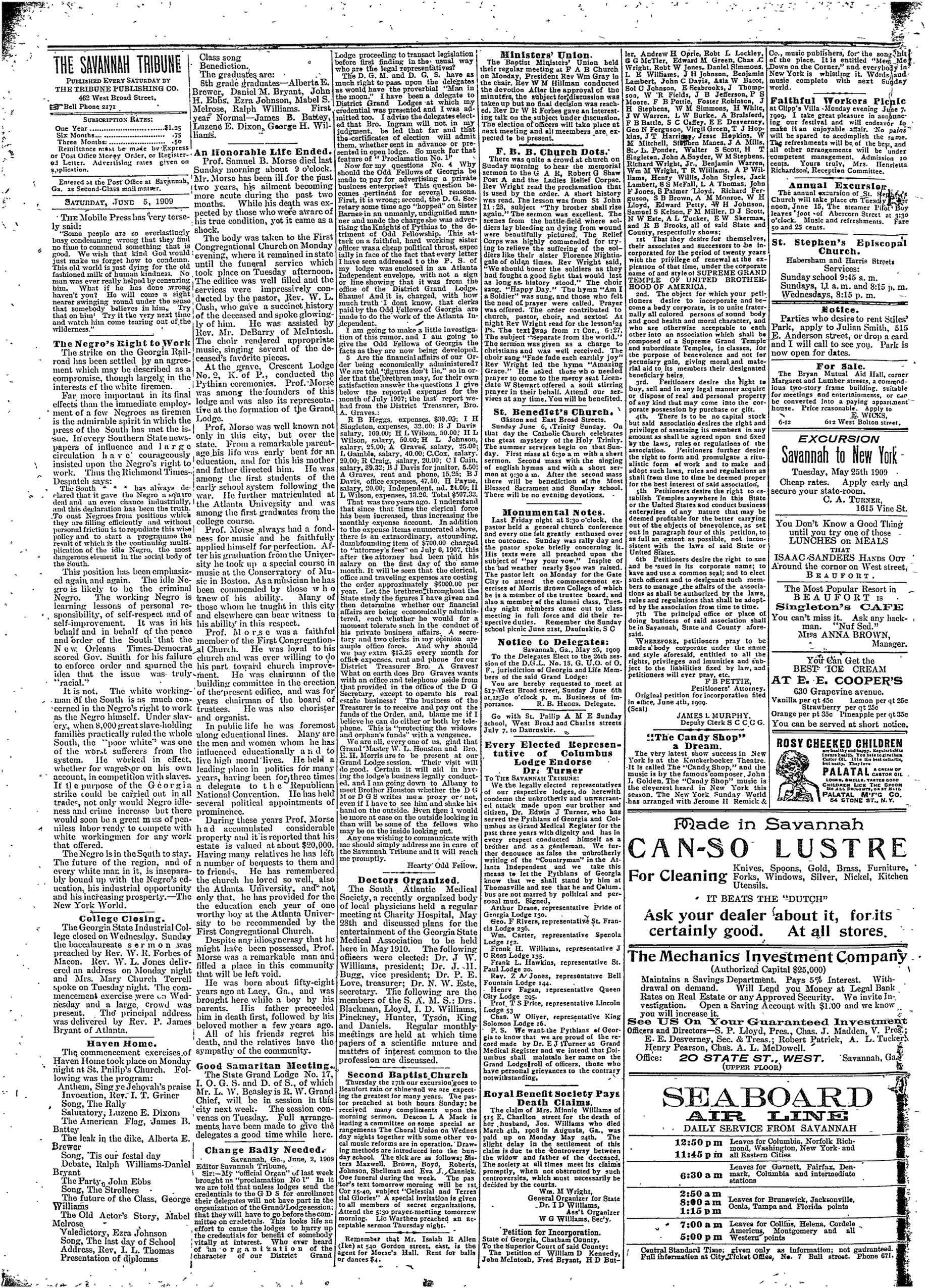
THE SAVANNAH TRIBUNE
THE SAVANNAH TRIBUNE
PUBLISHED EVERY SATURDAY BY
THE TRIBUNE PUBLISHING CO.
462 West Broad Street,
SUBSCRIPTION INITIATE:
One Year.....$1.25
Six Months.....-75
Three Months.....-50
Remittance must be made by Express
or Post Office Money Order, or Registered
Letter. Advertising rates given on
application.
Entered at the Post Office at Savannah,
Ga. as Second-Glass mail matter.
SATURDAY, JUNE 5, 1909
THE Mobile Press has very terse-
ly said:
"Some people are so everlastingly busy condemning wrong that they find no time to commend something that is good. We wish that kind God would just make us forget how to condemn. This old world is just dying for the old fashioned milk of human kindness. The man was ever revered helped by burning him if he has done wrong haven't you? He will come a sight nearer swinging round under the sense that somebody believes in him. Try that on him! Try it the very next time and watch him come tearing out of the wilderness."
The Negro's Right to Work
The Negro's right to work
The strike on the Georgia Railroad has been settled by an agreement which may be described as a compromise, though largely, in the interests of the white firemen.
Far more important in its final effects than the immediate employment of a few Negroes as firemen is the admirable spirit in which the press of the South has met the issue. In every Southern State newspapers of influence and large circulation have courageously insisted upon the Negro's right to work. Thus the Richmond Times-Despatch says:
The South * ** * * has always declared that it gave the Negro a equo deal and an even chance industrially, and this declaration has been the truth. To oust Negroes from positions which they are filling efficiently and without personal friction is to repudiate this wise policy and to start a programme the result of which is the continuing multiplication of the idle Negro, the most dangerous element in the social body of the South.
This position has been emphasized again and again. The idle Negro is likely to be the criminal Negro. The working Negro is learning lessons of personal responsibility, of self-respect and of self-improvement. It was in his behalf and in behalf of the peace and order of the South that the New Orleans Times-Democrat scored Gov. Smith for his failure to enforce order and spurned the idea that the issue was truly "racial."
It is not. The white working man of the South is as much concerned in the Negro's right to work as the Negro himself. Under slavery, when 8,000 great slave-holding families practically ruled the whole South, the "poor white" was one of the worst sufferers from the system. He worked in effect, whether for wages or on his own account, in competition with slaves. If the purpose of the Georgian strike could be carried out in all trades, not only would Negro idleness and crime increase but there would soon be a great mass of peniless labor ready to compete with white workingmen for any work that offered.
The Negro is in the South to stay. The future of the region, and of every white man in it, is inseparably bound up with the Negro's education, his industrial opportunity and his increasing prosperity.—The New York World.
College Closing.
The Georgia State Industrial College closed on Wednesday. Sunday the baccalaureate sermon was preached by Rev. W. R. Forbes of Macon. Rev. W. L. Jones delivered an address on Monday night and Mrs. Mary Church Terrell spoke on Tuesday night. The commencement exercise were on Wednesday and a large, crowd was present. The principal address was delivered by Rev. P. James Bryant of Atlanta.
Haven Home.
The commencement exercises of
Haven Home took place on Monday
night at St. Philip's Church. Following was the program:
Anthem, Sing ye Jehovah's praise
Invocation, Rev. I. T. Griner
Song, The Rally
Salutatory, Luzene E. Dixon
The American Flag, James B.
Battey
The leak in the dike, Alberta E.
Brewer
Song, Tis our festal day
Debate, Ralph Williams-Daniel
Bryant
The future of the Class, George Williams
The Old Actor's Story, Mabel Melrose Valedictory, Ezra Johnson Song, The last day of School Address, Rev, I. L. Thomas Presentation of diplomas
The graduates are:
8th grade graduates—Alberta E.
Brewer, Daniel M. Bryant, John
E. Ebbs, Ezra Johnson, Mabel S.
Melrose, Ralph Williams. First
year Normal—James B. Battey,
Luzene E. Dixon, George H. Willi-
兰is.
An Honorable Life Ended.
An Honorable Life Ended.
Prof. Samuel B. Morse died last Sunday morning about 9 o'clock.
Mr. Morse has been ill for the past two years, his ailment becoming more acute during the past two months. While his death was expected by those who wore aware of his true condition, yet it came as a shock.
The body was taken to the First Congregational Church on Monday evening, where it remained in state until the funeral service which took place on Tuesday afternoon. The edifice was well filled and the services were impressively conducted by the pastor, Rev. W. L. Cash, who gave a succinct history of the deceased and spoke glowingly of him. He was assisted by Rev. Mr. DeBarry of McIntosh. The choir rendered appropriate music, singing several of the deceased's favorite pieces. At the grave, Crescent Lodge No. 2, K of P., conducted the Pythian ceremonies. Prof. Morse was among the founders of this lodge and was also its representative at the formation of the Grand Lodge.
Prof. Morse was well known not only in this city, but over the state. From a remarkable parentage his life was early bent for an education, and for this his mother and father directed him. He was among the first students of the early school system following the war. He further matriculated at the Atlanta University and was among the first graduates from the college course.
Prof. Morse always had a fondness for music and he faithfully applied himself for perfection. After his graduation from the University he took up a special course in music at the Conservatory of Music in Boston. As a musician he has been commended by those who knew of his ability. Many of those whom he taught in this city and elsewhere can bear witness to his ability in this respect. Prof. Morse was a faithful member of the First Congregational Church. He was loyal to his church and was ever willing to do his part toward church improvement. He was chairman of the building committee in the erection of the present edifice, and was for years chairman of the board of trustees. He was also chorister and organist.
In public life he was foremost along educational lines. Many are the men and women whom he has influenced educationally and to live high moral lives. He held a leading place in politics for many years, having been for three times a delegate to the~Republican National Convention. He has held several political appointments of prominence.
During these years Prof. Morse had accumulated considerable property and it is reported that his estate is valued at about $20,000. Having many relatives he has left a number of bequests to them and to friends. He has remembered the church he loved so well, also the Atlanta University, and not only that, he has provided for the education each year of one worthy boy at the Atlanta University to be recommended by the First Congregational Church. Despite any idiosyncrasy that he might have been possessed, Prof. Morse was a remarkable man and filled a place in this community that will be left void.
He was born about fifty-eight years ago at Lacy, Ga., and was brought here while a boy by his parents. His father preceeded him in death first, followed by his beloved mother a few years ago. All of his friends regret his death, and the relatives have the sympathy of the community.
Good Samaritan Meeting.
The State Grand Lodge No. 17, I. O. G. S. and D. of S., of which Mr. L. W. Beatsley is R. W. Grand Chief, will be in session in this city next week. The session convenes on Tuesday. Full arrangements have been made to give the delegates a good time while here.
Change Badly Needed.
Savannah, Gn., June, 2, 1909
Editor Savannah, Trilune
Editor Savannah Tribune,
Sir.-Mir. "official Organ" of last week brought us "proclamation No I." In it we are told that unless lodges send the credentials to the G D S for enrolment their delegates will not have part in the organization of the GrandLodge session; that they will have to go before the committee on credentials. This looks life an effort to cause the lodges to hurry up the credentials for benefit of some vitally at interest. Who ever heard of an organization of the character of our District Grand
Lodge proceeding to transact legislation before first finding in the usual way who are the legal representatives?
The D. G. M. and D. G. S. have as much right to pass upon the delegates as would have the proverbial "Man in the moon." I have been a delegate to District Grand Lodges at which my credential was presented and I was admitted too. I advise the delegates that Bro. Ingrae insisted on my jigging before that far and that the certificates of election will admit them, whether sent in advance or presented in open lodge. So much for that feature of "Proclamation No. 1."
Now for my questions No. 4 Why should the Odd Fellows of Georgia be made to pay for advertising a private business enterprise? This question becomes pertinent for several reasons. First, it is wrong; second, the D. G. Secretary some time ago "hopped" on Sister Barnes in an unmanly, undignified manner and made the charge she was advertising the Knights of Pythias to the detriment of Odd Fellowship. This attack on a faithful, hard working sister officer was a cheap political thrust, especially in face of the fact that every letter I have seen addressed to the P. S. of my lodge was enclosed in an Atlanta Independent envelope, with not a sign or line showing that it was from the office of the District Grand Lodge. Shame! And it is, charged, with how much truth I don't know, that clerks paid by the Odd Fellows of Georgia are made to do the work of the Atlanta Independent. I am going to make a little investigation of this rumor, and I am going to give the Odd Fellows of Georgia the facts as they are now being developed.
5 Are the financial affairs of our Order boeing economically administered? We are told "figures don't lie," so in order that the brethren may, for their own satisfaction answer the questions we have asked for the month of July 1907; the last report we had from the District Treasurer, Bro. A. Graves:
R B Heggs, expenses, $30.03; I H
Singleton, expenses, 32.00; B J Davis
salary, 100.00; H L Wilson, 50.00; H L
Wilson, salary, 50.00; H L Johnson,
salary, 25.00; A Graves, salary, 25.00;
L Gamble, salary, 40.00; C Cox, salary,
20.00; R Craig, salary, 20.00; C I Cain,
salary, $3.22; B J Davis for janitor, 5.50;
A Graves, rent and phone, 15.25; B J
B Davis, office expenses, 47.50. H Payne,
salary, 20.00; Independent. ad. 24.00; H
L Wilson, expenses, 12.62. Total $507.33.
That was two years ago. I understand that since that time the clerical force has been increased, thus increasing the monthly expense account. In addition to the expense items enumerated above, there is an extraordinary, astounding, dumbfounding item of $700.00 charged to "attorney's fees" on July 6, 1907, this after the attorney had been paid his salary on the first day of the same month. It will be seen that the clerical, office and traveling expenses are costing the order approximately $5000.00 per year. Let the brethren throughout the State study the figures I have given and then determine whether our financial affairs are being economically administered, each whether he would for a moment tolerate such in the conduct of his private business affairs. A secretary and two clerks in my opinion are ample office force. And why should we pay extra $13.25 every month for office expenses, rent and phone for our office Treasurer. A treasurer I want to work at. What is on my Bro Gives wives with an office and telephone aside from that provided in the office of the D G Secretary, except to operate his real estate business? The business of the Treasurer is to receive and pay out the funds of the Order, and, blame me if I believe he can do either or both by telephone. This is "protecting the widows and orphan's funds" with a vengeance.
We are ul, every one of us, glad that Grand-Master W. L. Houston and Bro. E. H. Morris are to be present at our Grand Lodge session. Their visit will do good. Certain it will aid in having the lodge's business legally conducted, and I am going down to Albany to meet Brother Houston whether the D G M or D G S writes me a proxy or not, even if I have to see him and shake his hand on the outside. Even then I would be more at ease on the outside looking in than will be some of the fellows who may be on the inside looking out. Any one wishing to communicate with me should simply address me in care of the Savannah Tribune and it will reach me promptly.
Doctors Organized
Doctors Organized. The South Atlantic Medical Society, a recently organized body of local physicians held a regular meeting at Charity Hospital, May 28th and discussed plans for the entertainment of the Georgia State Medical Association to be held here in May 1910. The following officers were elected: Dr. J W. Williams, president; Dr. J. H. Bugg, vice president; Dr. P. E. Love, treasurer; Dr. N. W. Este, secretary. The following are the members of the S. A. M. S.; Drs. Blackman, Lloyd, I. D. Williams, Pinckney, Hunter, Tyson, King and Daniels. Regular monthly meetings are held at which time papers of a scientific nature and matters of interest common to the profession are discussed.
Second Baptist Church
Second Baptist Church
Thursday the 17th our excursion goes to Beaufort rain or shine and we are expecting the greatest for many years. The pastor preached at both hours Sunday; he received many compliments upon the morning sermon, Deacon L A Mack is leading a committee on some special arangements The Choral Union on Wednesdays night together with some other vocal music reforms are in operation. Drawing methods are introduced into the bunnday school. The sick are as follows: Sisters Maxwell, Brown, Boyd, Roberts, Johnson, Shellman and Eva J. Cannick. One funeral during the week. The pastor's text tomorrow morning will be 1st Cor 15-40, subject "Celestial and Terrestrial Glories" A special invitation is given to all members of secret organizations. Attend the 5:30 prayer meeting tomorrow morning. Lie Warthen preached an acceptable sermon Thursday night.
Remember that Mr. Isaiah R Allen (ike) at 540 Gordon street, east, is the agent for Morse's Hall. Rent for balls or dances $4.
Ministers' Union.
Ministers' Union.
The Baptist Ministers' Union held their regular meeting at F A B Church on Monday, President Rev Wm Gray in the Imam Imam Imam the devotion. After the approval of the ministers, the subject for discussion was taken up but no final decision was reached. Rev Dr W R Forbes gave an interesting talk on the subject under discussion. The election of officers will take place at next meeting and all meembers are expected to be present.
F. B. B. Church Dots.
St. Benedict's Church.
Gaston and East Broad Streets.
Sunday June 6, Trinity Sunday.
On that day the Catholic Church celebrates the great mystery of the Holy Trinity.
The summer services begin on that Sunday.
First mass at 6:30 a.m with a short sermon. Second mass with the singing of English hymns and with a short sermon at 9:30 a.m. After the second mass there will be benediction of the Most Blessed Sacrament and Sunday school. There will be no evening devotions.
Monumental Notes.
Last Friday night at 5:30 o'clock, the pastor held a general church conference and every one felt greatly enthused over the outcome. Sunday was rally day and the pastor spoke briefly concerning it. His texts were all preached upon the subject of "pay your vow." Inspite of the bad weather nearly $500 was raised. The pastor left on Monday for the Gate City to attend the commencement exercises of Morris Brown College of which he is a member of the trustee board, and all members of the Gate City day night members came out to class meeting in full force and did their respective duties. Remember the Sunday school picnic June 21st, Daufuskie, S C
Notice to Delegates:
Savannah, Ga., May 25, 1909
To the Delegates Elect to the 26th session of the D.G.L. No. 18, G. U.O. of O. F., jurisdiction of Georgia and Life Members of the said Grand Lodge: to meet at 817-West Broad street Sunday June 6th at 12:30 o'clock p. m. Business of importance. R. B. HEGGS. Delegate.
Go with St. Philip A M E Sunday school, West Broad and Charles streets July 7, to Dauraskie.
Every Elected Representative of Columbus Lodge Endorse
Dr. Turner
TO THE SAVANNAH TRIBUNE:
We the legally elected representatives of our respective lodges, do herewith condemn the unbrotherly and unwarranted attack made upon our brother and citizen, Dr. Edwin J Turner, who has served the Pythians of Georgia and Columbus as Grand Medical Register for the past three years with dignity and has in every respect conducted himself as a brother and as a gentleman. We further denounce as false the unbrotherly writing of the "Countryman" in the Atlanta Independent and we take this means to let the Pythians of Georgia know that we shall stand by him at Thomasville and see that he and Calumbus are not marred by political and personal mud. Signed.
Arthur Drane, representative Pride of Georgia Lodge 130.
Geo. F Rivers, representative St. Francis Lodge 236.
Wm. Carter, representative Spenola Lodge 162.
Frank H. Williams, representative J C Ross Lodge 135.
Frank L. Hawkins, representative St.
Paul Lodge 20.
Rev. Z A/Jones, representative Bell
Fountain Lodge 144.
Henry Fagan, representative Queen
City Lodge 205.
Prof. T S Price, representative Lincoln
Lodge 53.
Chas. W Oliyer, representative King
Solomon Lodge 16.
P. S. We want the Pythians of Georgia
to know that we are proud of the
record made by Dr. E J I Turner as Grand
Medical Register and we intend that Columbus shall maintain her name on the
Grand Lodge/roll of officers, those who
have personal grievances to the contrary
notwithstanding.
Royal Benefit Society Pays Death Claim.
The claim of Mrs. Minnie Williams of 515 E. Charlton street for the death of her husband, Jos. Williams who died March 4th, 1908 in Augusta, Ga., was paid up on Monday May 24th. The slight delay in the settlement of this claim is due to the controversy between the widow and father of the deceased. The society at all times meets its claims promptly, when not obstructed by such controversies, which must necessarily be decided by the courts. Wm. M Wright, General Organizer for State Dr. I D Williams, Ass't Organizer WG W Williams, Sec'y.
Petition for Incorporation. State of Georgia, Chatham County. To the Superior Court of said County: The petition of William D Kennedy, John McIntosh, Fred Bryant, HD But-
Co., music publishers, for the song title of the piece. It is entitled "Meet Me Down on the Corner," and everybody in New York is whistling it. Words, and music complete with next Sunday world.
ler, Andrew H Opire, Bob L Lockley, G McTier, Edward M Green, Chas C Wright, Robt W Jones, Daniel Simmons. L E Williams, J H Johnson, Benjamin Lambert, John C Davis, Atia W Bacot, Sol C Johnson, E seabrooks, J Thompson, W R Fields, J B Jefferson, P S Moore, B F Bette, Foster Robinson, J H Stephens, W M Simmons, H White, J W Warren, L W Burke, A Bralford, B Battle, S C Caffey, E E Desverney, Geo N Ferguson, Virgil Green, T J Hopkins, J T Harrison, Jesse Hopkins, W M Mitchell, Stephen Manes, A J Mills, S. L Ponder, Walter S Scott, H T Slogtenge, John A Sayder, W M Stephens, Richard Wright, Jr, Benjamin Parren, Wm M Wright, Willis, John Williams, Jack Lambeet, S McFall, L A Thomas, John F Kennis, P Salmer Lloyd, Richard Ferguson, S B Brown, A M Monroe, W H Lloyd, Edward Petty, W H Johnson, Samuel S Kelson, F M Miller, D J Scott, W N Easte, A L Tucker, E W Skermann, and R B Brooks, all of said State and County, respectfully shows:
Faithful Workers Plpcle
at Clipp's Villa - Monday evening June 7,
1909. I take great pleasure in announcing
our festival and will endeavor to
make it an enjoyable affair. No pains
will be spared to accomplish the same.
The refreshments will be of the best, and
all other arrangements will be under
competent management. Admission 10
ecents. Yours truly, Mrs. Henrietta
Richardson, Reception Committee.
Annual Excursion
The annual excursion of St. Stephen's Church will take place on Tuesday, noon, June 15. The steamer Pilot Bay leaves 'foot of Abercorn Street at 3:30 o'clock. Music and refreshments. Fare so and 25 cents.
1st That they desire for themselves, their associates and successors to be incorporated for the period of twenty years with the privilege of renewal at the expiration of that time, under the corporate name of and style of SUPREME GRAND TEMPLE OF UNITED BROTHERHOOD OF AMERICA.
St. Stephen's Episcopal Church.
Habersham and Harris Streets
Services:
Sunday school 9:45 a. m.
Sundays, 11 a. m. and 8:15 p. m.
Wednesdays, 8:15 p. m.
2nd. The object for which your petitioners desire to incorporate and become a body corporate, is to unite fraternally all colored persons of sound body and good health and moral character, and who are otherwise acceptable to each other into an association which shall be composed of a Supreme Grand Temple and subordinate Temples, in classes, for the purpose of providing pecuniary gain, giving moral and material aid to its members their designated beneficiary hairs.
Notice.
Parties who desire to rent Stiles? Park, apply to Julian Smith, 515 E. Anderson street, or drop a card and I will call to see you. Park is now open for dates.
For sale.
For Sale.
The Bryan Mutual Aid Hall, corner Margaret and Lumber streets, a commodious two-story frame building, suitable for meetings and entertainments, or can be converted into a paying apartment house. Price reasonable. Apply to E. WICKS,
W. WICKS.
3rd. Petitioners desire the right to buy, sell and in any legal manner acquire or dispose of real and personal property of any kind that may come into the corporate possession by purchase or gift.
4th. There is to be no capital stock but said association desires the right and privilege of assessing its members in any amount as shall be agreed upon and fixed by the laws, rules or regulations of the association. Petitioners further desire the right to form and promulgate a ritualistic form of work and to make and adopt such laws, rules and regulations as shall from time to time be deemed proper for the best interest of said association.
Tuesday, May 25th 1909
Cheap rates. Apply early and
secure your state-room.
C. A. TURNER,
1615 Vine St.
5th Petitioners desire the right to establish Temples anywhere in this State or the United States and conduct business enterprises of any nature that may be deemed profitable for the better carrying out of the objects of benevolence, as set out in paragraph four of this petition, to as full an extent as possible, not inconsistent with the laws of said State or United States.
You Don't Know a Good Thing until you try one of those LUNCHES on MEALS THAT ISAAC-SANDERS HANDS OUT Around the corner on West street, BEAUFORT.
6th Petitioners desire the right to sue and be 'sued in its corporate name; to have and to use a common seal; and to elect such officers and to designate such members to manage the affairs of the associations as shall be authorized by the laws, rules and regulations that shall be adopted by the association from time to time.
The Most Popular Resort in BEAUFORT is Singleton's CAFE You can't miss it. Ask any hack man. "Nuf Sed." Miss ANNA BROWN, Manager.
7th The principal office or place of doing business of said association shall be in Sayannah, State and County aforesaid.
WHEREFORE, petitioners pray to be made a body corporate under the name and style aforesaid, entitled to all the rights, privileges and imunities and subject to the liabilities fixed by law, and petitioners will ever pray, etc.
FB PETTLE,
P petitioners' Attorney,
Original petition for incorporation filed in office, June 4th, 1909.
(Seal)
630 Grapevine avenue.
Vanilla per qt 45c Lemon per qt 25c
Strawberry per qt 25c
Orange per pt 35c Pineapple per qt 35c
You can be served at short notice.
JAMES L MURPHY,
Deputy Clerk S C C C G.
"The Candy Shop" a Dream
ROSY CHEEKED CHILDREN
The very latest show success in New York is at the Knickerbocker Theatre. It is called The "Candy Shop," and the music is by the famous composer, John J. Golden. The "Candy Shop" music is the cleverest heard in New York this season. The New York Sunday World has arranged with Jerome H Remick &
F
Made in Savannah CAN-SO LUSTRE
For Cleaning Knives, Spoons, Gold, Brass, Furniture, Forks, Windows, Silver, Nickel, Kitchen Utensils.
IT BEATS THE "DUTCH"
Ask your dealer about it, for its certainly good. At all stores.
The Mechanics Investment Company
(Authorized Capital $25,000)
Maintains a Savings Department. Pays 5% Interest. Withdrawal on demand. Will Lend you Money at Legal Bank Rates on Real Estate or any Approved Security. We invite Investigation. Open a Saving Account with $1.00 and we know you will increase it.
See US On Your Guaranteed Investment Officers and Directors.-S. P. Lloyd, Pres.; Chas. J. Madden, V. Pres.; E. E. Dosverney, Sec. & Treas.; Robert Patrick, A. L. Tucker Henry Pearson, Chas. A. L. McDowell. Office: 20 STATE ST., WEST. Savannah, Ga (UPPER FLOOR)
SEABOARD
AIR LINE
DAILY SERVICE FROM SAVANNAH
12:50 p m Leaves for Columbia, Norfolk Rich-
mond, Washington, New York and
all Eastern Cities
11:45 p m Leaves for Garnett, Fairfax, Den-
mark, Columbia and intermediate
stations
6:30 a m Leaves for Brunswick, Jacksonville,
Ocala, Tampa and Florida points
2:50 a m Leaves for Brunswick, Jacksonville,
Ocala, Tampa and Florida points
8:00 a m Leaves for Brunswick, Jacksonville,
Ocala, Tampa and Florida points
1:15 p m
7:00 a m Leaves for Collins, Helena, Cordele
Americus, Montgomery and all
Western points
5:00 p m
Central Standard Time; given only as information; not guaranteed.
Full information at City Ticket Office, No. 7.8 Street. Phone 671.
THE SAVANNAH TRIBUNE
SATURDAY, JUNE 5, 1909
Mrs. Naomi J. Reed is visiting friends in Beaufort.
Have ladies Sailors for 50 cents at Scott Bros.
Mr. Israel Silas left for Cleveland, O. on business and likely to Chicago before returning to the city.
Our best cream 90 cents per gallon wholesale, at Scott Bros.
Mrs. Wm. Dezon sailed on the Steamship City of Columbus Tuesday for New York where she will join Mr. Dezon. While away she will take up ladies tailoring.
Mrs. Mary Ward Wallace of Philadelphia is in the city visiting her parents Mr. and Mrs. C. H. Ward. Her many friends are glad to see her.
Shopping bags at Scott Bros
We want your trade at Scott Bros.
5 or 6 doses "666" will cure any case of Chills and Fever. Price 25c.
Miss Virginia Sherman accompanied by her mother, Mrs. J. V. Sherman, returned Friday from Atlanta, Ga., where she has been attending Morris Brown College.
Fred Douglass shoes at Scott Bros.
The many friends of Miss Rosalie Cole were pained to hear of her recent illness but are proud to hear that she is now convalescing.
First Class catering can be had by calling on Mrs. M. Lockett Small, 522 West Bolton street. For ice cream, salads, picnic boxes and desserts for Sunday dinner. Catering of all kinds. Go with St. (Philip A M E Sunday school, West Bread and Charles streets July 7, to Daufuskie.
We sell Overalls at Scott Bros.
Remember that on the ground floors of Morse's Hall, still cheaper fares can be arranged for.
Died Monday May 17th at 11 p. m., Mrs. Lizzie Middleton, beloved mother of Mrs. Sadie E. (Middleton) Martin, formerly of this city but recently of Brooklyn, New York, after a short illness due to apoplexy. Mrs. Middleton leaves one daughter, a son-in-law, George M. Martin, and three grand children besides a host of friends. Interment Evergreen cemetery, Brooklyn, New York.
See our figured lawn at Scott Bros.
See our figured Lawn at Scott Bros.
Do you wear rubbers, at Scott Bros.
Mrs. Kachel A. May, mother of
Dr. J. H. May, pastor of the
Second Baptist Church, left for
her home, Nashville, Tenn., Thurs
day morning carrying with her
little William H. and Lula May,
lier two grandchildren. They will
make a short stop in Montgomery
Ala., the guest of Dr. and Mrs. A.
J. Stokes of the First Baptist
Church. Mrs. May has been here
since early in January.
Remember for lodge meetings atMorse's
Hall, fare per month is $3 to $2.50.
The graduating class of Beach Institute 1009 regretted so much not having with them on the night of the closing their friend and classmate, Miss Rosalie Cole, on account of her recent illness, but we were proud indeed that she had finished all her work before having to remain at home, hence received her diploma along with the class. 5 or 6 doses "666" will cure any case of Chills and Fever. Price 25c. Latest Patterns in men's dress shirts at Scott Bros.
Miss Pearlena Smith was greatly surprised on Monday evening last with a social, given in her honor as a graduate of Beach Institute by her sister Miss Albertina Smith. Quite a number of her friends were present and a most delightful evening was spent. We hope Miss Pearlena will ever follow her class Motto "Vestigia Nulla Restrosum" (no steps backwards.") Rainy weather umbrellas at Scott Bros.
Mr. Calvin A. Turner has made a successful season as head bellman at the DeSoto Hotel and only had one week for a vacation. He and Mrs. Turner were enjoyably entertained by friends. They paid a visit to Fort Screven and took tea with Mr. and Mrs. Jos. Sullivan and were entertained at dinner by Mr. and Mrs. J. H. Lark. Mr. and Mrs. Frank Bensen entertained them at tea on Monday evening They sailed on the City of Savannah for New York on Tuesday of last week. Their many friends wish them a happy summer vacation. Mr. Turner carried a lively crowd of excursionists with him. He will be the head bellman at the VictoriaHotel. Mr. Turner is an excellent young man. His friends look forward with pleasure for his return.
Remember lodge and society halls can be arranged for almost any dates at Morse's Large Hall on Hall street, between Price and East Broad streets.
Remember to see Mr. I R Allen or Profj
Morse on the grounds.
Go with St. Philip A M E Sunday
school, West Broad and Charles' streets
July 7, to Daufuskie.
On June 2nd, the marriage of Mr. Joseph T. King and Miss Josephine R. Campbell took place in St. Benedict's Church. It was a most solemn and joyful event, which was witnessed by an immense crowd of people. The little church was tastefully decorated with plants and flowers. Father Dahlent officiated and made a delicate and touching address. The bride's dress was most beautiful and excited the curiosity and the admiration of all the ladies. The young bride certainly looked charming, when she marched through the middle aisle to the sanctuary. Miss M. Robinson was bride's maid and she also wore a beautiful dress. Mr. Duncan J. Scott was the best man. Mr. James Dowse and Mr. C. Lewis acted as ushers. Most impressive was the meeting of the bride and of the groom in the sanctuary of church; the former had entered through the middle aisle and the latter through the vestry. Mrs. Clobilde Lewis presided at the organ and played two inspiring wedding marches. After the religious services a reception was given in Morse's hall, where the happy couple received the best wishes of their numerous friends. They also received many beautiful and useful presents. Long years of joy and happiness to Mr. and Mrs. King.
Entertains in Honor of Their Daughter.
The home Capt. and Mrs. F. F. Jones, Henry Street, east, was the scene of a brilliant reception, Tuesday evening June 1st. On this occasion they introduced their daughter, Miss Eleanor Jones to a large circle of friends. The reception rooms were tastily decorated with bamboo vines around the border of the ceiling, harmonizing with the flowered wall paper. Pink and yellow roses with numerous potted plants appropriately placed throughout the rooms, hall and the veranda, illuminated with Japanese lanterns made an attractive scene. Behind the receiving party were blooming plants and flowers; favors of the guests. The veranda was screened with green bamboo vines. Here the older set, loured and chatted to the strains of the Middleton's orchestra, while the young folks enjoyed dancing in the large parlors.
Miss Emmie Moore received very gracefully at the door and Mrs. P. E. Perry presented the guests to Mr. F. F. Jones who introduced his daughter, Miss Eleauor Jones. Mrs. F. F. Jones and Mrs. C. C. Devcaux then welcomed the guests.
Miss Eleanor Jones was becomingly gowned in a white princess dress trimmed with lace and she made a very charming impression on the assemblied guests. Miss Jones held a beautiful bouquet made up of a rose from each bouquet presented her. Mrs Jones wore a black silk dress and Mrs. C. C. Deveaux was attired in wisteria silk. The gowns of the other ladies as well, attracted considerable attention, and made the scene one long to be remembered.
The evening was royally spent, each guest leaving with only pleasant thoughts of this very unique affair, being the first of its kind in some time.
Among those invited were Rev. Richard Bright, Col. and Mrs. J. H. Deveaux, Mr. and Mrs. G. C. Deveaux, Mr. and Mrs. L. M. Pollard, Mr. and Mrs. J. R. Davis, Mr. and Mrs. A. M. Steele, Mr. and Mrs. R. T. Spencer, Mr. and Mrs. P. A. Denegall, Mr. and Mrs. P. E. Perry, Mr. and Mrs. Eugene Edwards, Mr. and Mrs. J. H. C. Butler, Mr. and Mrs. A. L. Tucker, Mr. and Mrs. J. W. Habersham, Mr. and Mrs. M. B. Branham, Mr. and Mrs. A. M. Monroe, Mr. and Mrs. F. F. Heffron, Rev. and Mrs. M. M. Weston, Mr. and Mrs. F. A. Curtright, Prof. and Mrs: McLester, Mr. and Mrs. L. S. Reed, Mr. and Mrs. Frank Dilworth, Mrs. Agatha Spaulding, Mrs. Theodocia Middleton, Mrs. Annie E. Edwards, Prof. and Mrs. Pearson, Mrs. Alethia Armstrong, Mrs. Susie M. Scott, Mrs. Jennie C. Houstoun, Mrs. Claudia Sykes, Mrs. Cecile Dingle, Mrs. Missouri Butler, Mrs. Marion Tolbert, Mrs. Jessie Grant Butler; Misses Emmie Moore, Rosabel Edwards, Dollie Price Fannie Deveaux, Anna Tucker, Annie Scott, Susie Scott, Annie Stiles, Esther Smith, Lorene Jefferson, Theodocia Stiles, Rosa Jones, Hattie Jones, Frances Jones, Clinton Dingle, Florence Moore, Clifford Allen, Rebecca Houston, Essie Monroe, Rosa Brown, Ethel Wilson, Sophronia Pinkie Gaston, Madeline Shivery, Rosa Ashton, Emily McDonald, Annie Grant, Rowena Houstoun, Sallie Houstoun, Henrietta Houstoun, Maud Spencer, Adfa Spencer;
Drs. W. C. Blackman, S. P. Lloyd, L. S. Parks; Messrs. Sol. C. Johnson, P. Denegall, Marion Johnson, Walter Scott, Duncan Scott, Matthew Jones, Robert Scott, John Carr, Stephen Sykes, Harry Reid, George King, Valdore Gies and others.
Death of Mrs. Emma Sabatti.
With great regret we announce the death of Mrs. Emma Sabatti. She died in the Charity Hospital on Thursday morning at 10 a.m., after a most serious operation. At her dying hour she was surrounded by her husband, her mother and a few intimate friends. Father Eah lent also was present and said the last prayers of the dying. Mrs. Sabatti died in the most admirable dispositions of resignation unto God's holy will. She was a grand and beautiful soul; her gentle dispositions gained her an immense number of friends who will lament her untimely death. Mrs. Sabatti was a faithful member of St. Benedict's Church in which her funeral will took place yesterday. May her gentle soul in rest peace.
St. James Dots.
Prayer meeting were held at our usual hour 5 a.m and ofcourse the was on hand. We had a grand time at 11 a.m. Preaching by the pastor Rev P W Greatheart, his discourse was the parable of the sower Mark 4-8 verse the attendance at 8:30 was encouaugled considering the weather. Tomorrow services, prayer meeting at our usual hour; Preaching at 11 o'clock; Sunday school at 2 p.m; Communion at 3:30; Allen Christian Endeavor League at 5:30 Preaching 2t 830 p m Don't forget our grand combination picnic St James and Bethel A M E, at Daufuske June 8th.
That Phone Ice Cream at Scott Bros.
The New York Age is on sale in Savannah every week. Short items relative to social affairs, churches, business etc. will be published under "Savannah News" Such notes sent to me by Saturday of each week will appear the following Thursday. Price per year $1.50, single copies 5 cents. \ Chas.
The committee reserves the right to reject the holder of any ticket.
Coming Events in The Social World.
St James and Bethel A M E Church
Sunday school will be out of the city on
Tuesday June 8th, at Daufuskie. Boat
leaves foot of Bull street at 10 a m
Tickets 25 and 50 cents.
We invite all our friends to come and
go with us on Tuesday June 8th, and enjoy
your self at Daufuskie. St James and
Bethel Sunday school.
The independent Pleasure Club will
give their first moonlight excursion of the
season, Monday, June 7th. Tickets 35
cents.
Wait and go with St James and Bethel
Sunday school Tuesday June 8th.
The grand United Benevolent Society
will give a grand excursion to Washington
Park. Springfield, on Brinson railroad.
Monday June 7th. Tickets 50
cents.
A grand excursion will be given around
the harbor under the auspices of the com-
mittee entertaining the Grand Ledge No
17, 1 O of G S and D a f S., Thursday,
June 10th Tickets 25 cents. Also a
banquet at Masonic Temple that night.
Tickets 25 cents.
A grand combination picnic will begiven
by Bethel and St James A M E Sunday
schools at Daufuskie, Tuesday June 8th.
Tickets 50 and 25-cents.
Come and go with St James and Bethel
Sunday school, there will be a day of
pleasure spent at Daufuskie. June 8th.
The Tinners will give a big outing at
Miller's Pavilion, Waters Road, Monday
June 7th. Tickets 15 cents.
Middleton's Band will give their second excursion around the harbor stopping at Daufuskie Wednesday afternoon, June 9th, 1909. Tickets 25 cents.
The 13th anniversary of the Golden Harvest Society will take place at Chatham Hall Monday night, June 7th. Tickets 15 and 10 cents.
The Jerusalem Travelers Association will give a grand excursion to Beaufort, Monday June-7th. Tickets 50 and 25 cents.
If you want a pleasant day outing get your ticket for Daufuskie Tuesday June 8th.
The annual afternoon excursion of St Stephen's Church will take place on Tuesday afternoon, June 15th. Boat leave at foot of Abercorn street, at 3 o'clock. Music, refreshments dancing.
A grand excursion will be given to Beaufort by Sayannah Lodge No. 2892 G U Q O F, Monday June 14. Tickets 50 cents.
The Young Imperial A and S Club will give a grand excursion to Daufuskie Mon day June 7th. Tickets 50 and 35 cents. A grand picnic will be given by Imperial Glee Club for the benefit of F A B Church, West Broad street, Wednesday June 9th at Styles Park. Tickets 25 cents.
St Paul C M E Church, and Sunday school will give their annual picnic at Springfield, Tuesday June 8th. Tickets 50 cents.
A three nights lecture course will be given at Central Baptist Church, Thunderbolt, June 9, 10 and 11. Tickets 10 and 25 cents.
A grand excursion to Harris Neck will be given by Mt. Tabor Baptist Church, Tuesday, June 8th. Tickets 50 cents.
A grand picnic will be given to Lincoln Park by Advance Lodge No. 166 K of P, Monday June 7th. Tickets 15 cents. A swell dance will be given by the Violet Blues at Masonic Temple, Monday night, June 7th. Tickets 35 and 60 cents. A dime party will be given at Alley Hall, Reynolds street, for the benefit of the National Mutual Benefit Society Tuesday night June 8th.
A grand picnic will be given by Savannah Division U. O T R at Lincoln Park Monday June 12th. Tickets 15 cents.
Spring and Summer Apparel
FOR
Man Woman and Child
OUR large and well selected stocks appeal to those who seek "better values for the same price." Our Easter display this season was the result of a great deal of care in our selections and every department furnishes its full quota to this exhibition of—
High Grade Merchandise at Moderate Prices
B. H. LEVY, BRO. & CO.
for toney and first-class entertainments give More's hall first call.
A grand excursion will be given by the Young Pilgrim Travelers Society to Bluffton, Sunday June 13th. Tickets 50 and 25 cents.
Dr. L. S. Parks,
DENTIST
240 Barnard Street,
Savannah, Ga.
Does all kind of high grade dental work of the best quality and workmanship. Gold crowns and bridge work. White Percelain Pivot, and Gold Crowns mounted on the natural roots. Gold Fillings, Cement Fillings, and Silver or Amalgam Fillings, from nine to a full set of teeth $7.00 and $8.00. Broken places mended and teeth added to old ones for a small cost. Bell Phone 1244. Solid Gold Crowns Guaranteed 23½ K Gold.
Dr. J. W. Jamerson, Firstclass Dentist,
623 WEST BROAD STREET
Bet. Huntingdon and Hall..
Bell Phone 2088.
-Go To-
Geo. Brodmann,
FOR
GROCERIES
Cigars, Tobacco and Fresh Country Eggs.
Courteous treatment to Customers
452 Jefferson Street,
SAVANNAH, - GEORGIA.
BUY YOUR
SUMMER HATS
FROM
· BUCHANAN'S ·
THE COLORED MILLINERY
STORE.
A complete line of Shapes, Flowers; etc., cheaper than any other millinery store in Savannah.... Removed to Williams Building West Broad Minis and Streets.
WEST SIDE
RESTAURANT
461 West Broad Street,
Near Union Station
The place to get first class meals.
Everything neat and clean. Meals prepared in an apetizing manner and at all hours daily.
Meals 15 and 25 cents.
Mrs. A. S. Scott, Proprietress.
Atlanta Shoe Shop
Special attention paid
to Ladies and Children
Shoes. Polite
attention given to all
work. . . .
103 LIBERTY ST., WEST.
J. H. WASHINGTON, Prop.
Dr.B.W.S.Daniels
PHYSICIAN & SURGEON
Office: 551 West Broughton St.
Residence: 722 Waters Ave.
Phone 4448
Hours—9 to 11 a. m.
2:30 to 4 p. m.
7 to 8 p. m.
Prompt response to all calls.
Scientific Treatment and Courteous Attention to all patrons.
1-16-09.
Garey's Varlety Bakery
Goods delivered promptly to any part of the city ..
506 West Broad St, near Gaston.
Phone 1$31 L
Take Notice
that I have opened a first-class up-to-date Dining Room for ladies and gents aside from my regular dining room. Regular meals will be served up-to-date for 25 cents. Fish, oysters, game and fine steaks of all kinds can be had at all times day or night. Give me a call at 304 St. Julian street, west, Savannah, Ga. J. H. TURNER.
When you want to refresh yourself
Stop at
Mrs. M. SINGLETON'S
RESTAURANT
ON THE BAY
The leading Restaurant in Beaufort
Also Rooms.
A. L. Cannal,
CONFECTIONERY
AND CHOICE FRUITS
Ice Cream and Cakes, Wholesale
a Specialty.
525 WEST BOLTON STREET,
Open Late. Savannah, Ga.
A New Pharmacy The People's Pharmacy
309 West Broad St.
Prescriptions carefully compounded.
Drugs Toilet Articles and Sundries.
Candles; Soda Water a d Ice Cream.
J. F. Ford, Prop.
P. L. Bowen & Co.,
Where you will get the best
GROCERIES, MEAT,
GRAIN and FEED:
PHONE 1707 J
504 Gwinnett St., west.
H. C. HUGER
—DEALER IN—
Groceries, Fresh Meats, Ete,
Cor. CUYLER & BOLTON Sts.
Only First Class Goods Kept
in Stock. Goods dilivered
to any part of the city
3-6-209
F. F. JONES.
DEALER IN
Beef - Veal - Mutton
Lamb-Pork-Hams
Bacon and
CORNED BEEF
All Kinds of GAME in Season.
Goods promptly delivered to
any part of the city free of
charge.
STALL 31 CITY MARKET
Miller's Resort WATER'S ROAD. The Place to get an Up-to-date OYSTER ROAST.
Oysters in Every Style.
Lunches of the most delicious kind.
When out for a drive, step at this well known resort.
Facilities to entertain
PRIVATE PARTIES.
A Cordial Welcome awaits all
Patrons.
Teach the Lambs.
It may be more trouble at first, but it is better to teach babies orphan lambs to drink out of a basin than from a bottle, as it will be less trouble as they grow older. The milk should be blood warm and fresh from the cow for the first few days; if any is spilled on their wool it should be wiped off, as the odor of stale milk is unwholesome and disagreeable. Farmers' Home Journal.
dexterine, glucose, corn-bran, oil, cake, gluten meal, gluten feed, milk, less making, substitute for and rubber and various other purposes. The corncob is used for pipes a for making flavoring extracts, and the stalk is used for a dozen uses. The finest use is as a substitute for wood pulp in making writing paper. "Some 'years' ago corn was a stranger," said Professor Hopkis
Sheep and Tobacco.
A correspondent in the northern part of Indiana writes that he has had good results with using tobacco to prevent parasite, and stomach worm troubles with sheep. He says that he began using distilled tobacco last season, mixing it with salt, one part of tobacco dust to five parts of salt, thoroughly mixed. The sheep that had access to it all did well, while many of the lambs of his neighbors died.-Indiana Farmer.
Succession of Crops.
Plan a succession of crops from the earliest to the latest of all the varieties that are best liked in the household and then there can be something on the table from this well cared for plot during the many weeks of the season besides furnishing an abundant supply of the standard sorts of vegetables for winter. Do not forget the garden, but make it the most productive, profitable and attractive part of the farm.—Farmers' Home Journal.
What to Do With Sparrows.
As to the pesky sparrows, could they be held in check or destroyed by feeding them real strong salted food, bread or wheat, anything with salt enough to kill, and it does not take much to kill a hen. Let the farmers try it and report their success in the Farmer.—Charles Mitchell.
We doubt if the sparrows will eat highly salted food, but let the plan be tried. Then try alcohol to make them boozy and catch them.—Indiana Farmer.
Trimmed Too Much.
Trees should not be trimmed too much. They may be ruined in this way. The branches should not be trimmed high as in that case the lower limbs will die out, and so the tree will continue to grow unward. Such trees are expensive to spread and to harvest the crop. Climbing into the tree for picking fruit should be avoided, as injury often comes from the bark being bruised by the shoes. This is at times quite serious. Farmers Home Journal.
Fattening Poultry.
An excellent mixture for fattening poultry is made as follows. One hundred pounds finely ground barley, 100 pounds finely ground corn, 100 pounds finely ground oats (with shells sliced out), 10 which mixture is added, thirty pounds of beef scraps, buttermilk or skim milk is used for mixing, the former being preferred. The birds are fed twice a day at intervals of twelve hours, and are kept on this diet for three weeks. Crate or machine fattening should be adopted. Another ration is made as follows: One hundred pounds ground oats, 100 pounds ground corn, fifty pounds flour, four pounds tallow.—Indiana Farmer.
"It is encouraging to note the falling since the line of adulterated seeds since the line of work reported upon by the Department of Agriculture was begun. The importation of yellow trefoil seed and its subsequent use as all adulterant, of red clover and alfalfa seed has practically ceased; 214,000 pounds being imported in the three fiscal years'1905-1907, and only 10,000 pounds in the fiscal year 1908.
"Only one-half as many lots of orchard grass seed were found in 1905, when the last collection of orchard grass-seed was made.
In 1905 only thirty-nine samples of Kentucky bluegrass seed were found to be adulterated or misbranded, as contrasted with 110 samples in 1907.
"The department will examine and report promptly as to the presence of adulterants and dodder in any samples of seed submitted for that purpose."
The average crop of corn in the United States is twenty-seven bushels to the acre; the average in the corn belt of Illinois is forty-five bushels to the acre. But Dr. Hopkins asserts that it is possible to increase this average not only to seventy-two, but to eighty bushels an acre. Many scientific farmers raise eighty bushels to the acre, and even 110 bushels by increasing the nourishment in the soil which the corn plants require for their development. The soil of the cornfield, Professor Hopkins says, needs much phosphorous, nitrogen and more potassium in order to do its best. The proportions of these several plant foods should be regulated, according to the purpose for which the corn is to be used. Corn is used for hundreds of purposes.
dexterine, glucose, corn-bran, oil, oil cake, gluten meal, gluten-fed juices, juice, making, substitute for India rubber and various other purposes. The corncob is used for pipes and for making flavoring extracts, and the stalk is used for a dozen useful trinkets. The largest is as a substitute for wood pulp in making wrapping paper.
"Some years ago" corn was a stranger," said Professor Hopkins. "We found it there when we came—a native of the country, yet, until fifteen years ago we took it for granted. Then a close study of its individuality and peculiar characteristics demonstrated that it was possible to breed on corn just as we improve animals, although the plant not learned how to control the male parthenia. The importance of this may be appreciated when we remember that the corn crop of the country is worth a billion and a half of dollars every year—2,250,000,000 bushels. We are trying to get one ear of corn to the stalk. That is what we are working for, because some stalks make barren. We doh enough fervid people have affluous theories, but they have not been conceived."
"Take a hundred ears of corn, plant them exactly alike, three kernels to the hill, the kernals from each ear. In a row by themselves in the same exactly soil, cultivate them the same way, and the yield will vary a hundred per cent. We cannot account for that variation. It is impossible titus far to determine why some corn will grow and other corn will not, but in planting, a farmer should always use the seed from the best, ears, because that is likely to yield more than the poor, ears. But every ear of seed corn should be tested by a germinating pan during the winter. This is a new thing, but it is being introduced rapidly, and seed men and the better class of farmers are taking this precaution. None of the big corn planters will use any but tested seed.
"We are teaching these methods to our students by practical experiments continually five different counties of the State of Illinois, as well as on the campus of the university. The results have been most satisfactory and they are appreciated by the farmers. We have a corn breeders' association in this State composed of twenty-five seed growers, and they are all working earnestly with us in breeding up the corn of Illinois to the very highest quality and the greatest possible yield."
The Hotbed
The hotbed must be located in some well-drained place. A sandy hill or knoll makes the most desirable position. The earth is excavated, making a trench five or six feet wide, two and a half feet deep, and as long as will be necessary to accommodate the plants to be grown. The trench should extend east and west, so as to make it possible to get as much of the sunlight as can be had. If the ground has a tendency to cave in it will be more satisfactory to line the inside of the excavation with boards which can be fastened to posts at the cotters and at intervals along the side. These boards should reach about ten inches above the ground level on the south side and about two feet on the other side, so as to give a saint to the sash. The soil that was thrown out can be banked against these boards, when you will have completed all that is necessary to do at this season.
The sashes, which can be constructed indoors during the winter, are usually made across the top of the bed allowing a few inches for projection on both sides. Bars are run lengthwise of each sash far enough apart to receive the panes of glass, which are fastened on with the ends of the panes, flush, against each other. If the bars have a ridge running lengthwise on the upper surface, like the cross bars of an ordinary window sash; only more substantial, it will aid materially in properly securing the glass. These sashes can be stored away and brought out when needed.
mature in making the best material for filling the bed. It should be piled conveniently near the bed and gotten in shape by being forked over until it is heating evenly throughout, when it is ready for the bed. In filling the bed trample the manure well about two feet deep in the trench. Upon the manure is then placed four or five inches of rich, sandy soil, which has been kept where it will, not freeze. The bed thus prepared is allowed to stand in few days, until the temperature of the soil falls below ninety degrees F., as indicated by a thermometer, when the seed is sown.
It must be remembered that the manure must be spoken of is not prepared until about the last of February and other practices follow in orders. If no sandy, well-drained spot can be had, the manure can be spread on top of the ground and the frame built around it. The heat cannot be so well conserved by this method he cause of the increased radiation, but where the manure is plantitic this can be overcome by increasing the bulk. The radiation can be hindered to a certain extent by banking earth against the frame.
The small farmer has most of the materials about him for the construction of a hotbox, and as the time in which he can work it comes when there is little else to do; the expense, is an amount hardly to be compared with the satisfaction received from products gathered therefrom. Russell Widders
(it has refoiled in its peculiar angle for many years.)
THE SHIP OF THE DESERT GOING OUT TO SEA.
JANUARY
NOVEMBER
DECEMBER
JANUARY
NOVEMBER
DECEMBER
THE QUAINTEST HOUSE IN ENGLAND
By Howard B. Nowman
While cycling recently in England, through what is called the "Black Country," near Dudley, a turn in the road brought out addendum before one of the strange specimens of architecture in the world, ritaled only by the famous tower of Pisa, Italy.
It was the Glynne Arms, a roadside public house in the quaint little town of Hinley. Locally it is known as the Siden House—Siden" is a corruption of "all asiden"—from the fact that it leans as far out of the perpendicular saa is possible for a house to lean without tumbling over altogether.
It has rejoiced in its peculiar angle for many years, but it is daily quilty recently that the public curiosity has been aroused in it. Now it is the centre of attraction for miles, around, and a favorite place for a drive on holidays. It is about three miles
100
from Dudley and about the same distance from Wolverhampton and is near Himley Hall, the Stamfordshire seat of the Earl of Dudley. The working of the Himley collieries is responsible for the extraordinary attitude of the Glyne Arms. In fact, the mining subsidence have played strange tricks with house property in the BlacksCountry. It is said the house owes its name to the late Mr. Gladstone and his brother-in-law, Mr. Stephen Glyne, who jointly carried on in years gone by an important ironworks, in the neighborhood.
The house itself is of a very unpretentious character, and is built of red brick. One end is supported by large stone-bottles. Entering at the front door, the visitor ascends a pair of stone steps into a somewhat wide passage, where the fun begins; for this passage has been rendered so uneven that he who traverses it lurches about from side to side like a ladishman on board ship in a storm.
After a struggle the coffee-room is reached, and here the visitor is still more bewildered. The laws of gravitation seems to be an unknown quantity. A table stands by the window, apparently at a great slant, yet a marble placed upon it at the lower end runs rapidly up the table and falls over the higher side. A clock upon the table stands at an angle to its support, but it ticks comfortably, the pendulum swings regularly, and the hands show the correct time. A table in the taproom seems to lean at an angle of many degrees toward the kitchen door, where place a marble upon the centre of it, and it stands there quite stationary. There is a legend that relates how a beggar who was laboriously propelling himself along the road with a
THE SHIP OF THE DESER
Banding a camel at Berbera for the operations against the Somali Mullah. After him, dormant for five years, the Somali Mullah—who, after the severe lesson we thought him in 1902, had agreed to keep the peace—has broken out, again, and has been raiding tribes who are undemur pro-tectives. He is said to have 70,000 men under him, and against this force, we have till the country some 4600 men, including the Sixth Bat-
pair of crutches uttered a loud and dismal shriek upon coming in sight of the house and, throwing away his crutches, stamped across the Black Country as fast as his good sound legs could carry him. Whether that sight of the exceeding crookedness of the inn had effected a miraculous cure, or whether the cure was due to a guilty conscience, remains an open question.
Made a Mistake.
The tube car gave a lurch. The young man who had just risen from his seat lost his balance. The tube car stopped with a jerk. The young man sat down automatically in the fashionable lady's lap. She began to shriek in this wise:
"You contemptible pup! .J. wish you to understand that I am not, a lamppost or a piece of furniture to be clung to for support! You, have no, right to crowd in and tear other, people to pieces with your big, clumsy hands! You pitiful clown, you!
(it has rejoiced in its peculiar angle for many years."
You aren't fit to be allowed among nice, quiet, well dressed people! You unmannerly bumpkin, you deserve to be"—
"Excuse me, madam," broke in the young man, "you have made a mistake."
"A mistake?" demanded the lady, her eyes flashing with anger. "What do you mean?"
"This ma'am," replied the young man. "I am not your husband!"—
Tit-Bits.
GERONIMO.
```markdown
```
The Noted Apache Chief, Who Died Recently.
India's rice crop is a failure. Burmis rice is going there weekly in shipments of 2000 tons.
RT GOING OUT TO SEA.
tailon of the Kings' Artifician Rifles, and an Indian contingent, who are garrisoning the British posts, one of which, Burao, is eighty miles inland. Other troops are being rapidly hurried to the spot, and in the meantime the British cruiser Philoimer has shelled some of the Mullah's followers who have been harassing friendly tribes. "Our photograph" shows "a transport camel in process of being transported at Berbera." The Graphic "
Appetite Calls
For food which promotes a prompt flow of the digestive juices in addition to supplying nourishment.
Post Toasties
Is a most delicious answer to appetite.
It is, at the same time, full of the food-goodness of White Corn, and toasted to a crisp, delicious brown.
"The Taste Lingers."
Popular pkg 10c; Large Family size 15c.
All Who Would Enjoy
good health, with its blessings, must understand quite clearly, that it involves the question of right living with all the term implies. With proper knowledge of what is best, each hour of recreation, of enjoyment, of contemplation and of effort may be made to contribute to living right. Then the use of medicines may be dispensed with to advantage, but, under ordinary conditions in many instances a simple, wholesome remedy may be invaluable it taken at the proper time and the California Fig Syrup Co. holds that it is alike important to present the subject truthfully and to supply, the one perfect laxative to those desiring it.
Consequently, the Company's Syrup of Fjigs and Elixir of Sema gives general satisfaction. To get it beneficial effects buy this, genuine, manufactured by the California Fig Syrup Co. only, and for sale by all leading druggists.
You Indoor People
must give the bowels help. Your choice, must lie between harsh physic, and candy Cascarets. Harshness makes the bowels callous, so you need increasing doses. Cascarets dojust as much, but in a gentle way. Vest-pocket box 20 cents—al drugstore. Each tablet of the cream is marked Cascarets.
TEACHERS: Write for free booklet "A Plan"
I. showing how we will help you secure a better
school. Plan for your child, paying $30-$150 monthly. Schools supplied with
teachers. Our the largest Southern Agency,
SOUTHEAST TEACHERS' AGENCY. Columbia, S.C.
We learn from our rural exchanges,
states the Atlanta Constitution, "that
the woods are full of candidates, but
as tall timber they would be reje-
ced by the saw mills.
Over fifty years of public confidence and
popularity. That is, the record of Hamlin's
Wizard Oil, the world's standard, remedy
for aches and pains. There's a reason, and
only one merit.
ANOTHER STAR.
Student of Astronomy—I have dis-
covered a new star, professor.
Professor—What's she playing in,
my boy—Harvard, Lamipoo.
Hotel Cells.
The chief difference between the average hotel cell and the average prison cell, viewed from the standpoint of social psychology, is that one is locked on the inside to keep outsiders out while the other is locked on the outside to keep insiders in. The occupant of the hotel cell is afraid that something will be done to him or that something will be taken from him by some one, who ought to be in a prison cell. That is the theory of it.
"Lock your door and leave, your valuables at the office" cautions the obliging keeper. "If you had valuables you wouldn't be here," observes the witty prison keeper. That is to say, the question of valuables seems to enter largely into the matter.
It would be great to have a civilization which considered valuable only those things which could not be stolen, such as mental and moral equipment, skill and good fellowship. Then we could be a little more sociable. We could talk to each other without buttoning our coats or feeling for our diamond studs every few minutes. Then the man who willingly sccluded himself in a stuffy hotel cell could be locked, in and made to stay there, on the ground that something terrible was the matter with him.—Success Magazine.
Regret is the stepping stone to man's final salvation.
DISTEMPER
GRAFFITI
DISTEMPER
GRAFFITI
Bakerry Episcopic, Cateral For-
ward, Infrared, and Lighting
powered and equally powered and
gently owed by Graffit Distemper
and equally owned and used. Guaranteed to sore. 60 & 81 at drippings or dripped peel. Warranty. Warranty. Well Medicated Ou, Lanyette, Inc.
WARLICK
SheetMetal Manufacturing Co.,
60 - W. Alabama St., ATLANTA, GA.
Hot Air Furnaces.
METAL CORNICES, UILINGS,
Ventilators, Skylights, Roofing.
LOW EXCURSION RATES
TO THE
United Confederate Veterans' Reunion
At Mt. Humphrey, Tenn., June 8-10, 1909.
The Humphrey high school will sell
sell round trip tickets from June 5th to 8th. Inclu-
sion: Stippee will be allowed canoeers trip at certain
sites are based on about one cent per mile
travel.
Corresponding rakes from other points.
The most important point is one of the
great cities in the innshop/palley and enjoy
the great Bounty at small cost.
MAIL, PATTON.
General Passenger Art.
Traveling Passenger Art.
Atlanta, Ga.
Pantine
TOILET ANTISEPTIC
NOTHING LIKE IT FOR
THE TEETH Pantine excels any dentifrice
in cleaning, whitening and
removing tartar from the teeth, besides destroying
all germs of decay and disease which ordinary
tooth preparations cannot do.
THE MOUTH Pantine used as a mouth
wash diminishes the mouth
and throat, purifies the breath, and kills the germs
which collect in the mouth, causing sore throat,
bad teeth, bad breath, gripe, and much sickness.
THE EYES when inflamed, tired, ache
and burn, may be instantly
believed and strengthened by Pantine.
CATARRH Pantine will destroy the germ that cause catarrh, the in-fammation and stop the discharge. It is a sure remedy for uterine catarrh.
Pantine is a harmless yet powerful germicide, disinfectant and deodorizer. Used in bathing destroys odors and leaves the 'body antiseptically clean.
FOR SALE AT DRUG STORES, SOC.
PAXINE
OR, POSTPAID BY MAIL.
LARGE SAMPLE FREE!
THE PAXTON TOILET CO., BOSTON, MABB.
Many a man who has no show thinks he is the whole menagerie.
FOR HEADACHE-Hicks' CAPUDINE
Whether from Colds, Heat, Stomach or Norvous Troubles, Capudine will relieve you. It's quite pleasurable, and backacks immediately. Try 14, 10c., 8c., and 6c. at drug stores.
THE AESTHETIC OYSTERMAN.
Shocked by the Manner in Which Two Boys Were Opening Oysters.
"You know," said an oysterman, "an oyster is to me something choice and to be handled with care and tenderness, a delicacy, a fine fruit of the sea, and I hate to see 'em opened dunglingly, and so you can imagined how I telt when I saw two boys this morning trying to open oysters by smashing them.
"The two boys had, I fancy, swiped these two oysters, one each, from the baskets standing in front of some restaurant, and now they wanted to eat them, but they had no knife with which to open them, and they found no loose stones lying about with which to crack them, and how do you suppose they did go about opening them?
"They stood off on the sidewalk in front of some stone steps leading up to a house and threw the oysters against the stone risings of those steps. When I came along they had already in this way broken the shells of the oysters enough to let the juices out of them, and there were big wet splatters on the steps showing where the oysters had been thrown!
"Fancy mangling an oyster in that manner! I only hope the boys didn't choke themselves when they came to eat them on splinters of the shells."
*New York Sun.*
Fashions
1
New York City.—Such a negligee as this one will appeal to every woman who likes a tasteful and
1
becoming yet thoroughly comfortable morning garment. The slightly open neck and the short
1
sleeves are delightful to the wearer and are really graceful and attractive as well. The negligee can with equal propriety be utilized as a separate garment to be worn over any skirt or be made with skirt to match for mornings at home. It will be found suited to all the pretty simple washable materials, but as illustrated it is made of dimity with bands of plain colored material finishing the edges. The negligee is made with the fronts, back and sleeves. It is tucked over the shoulders and the front edges are tucked on distinctly novel lines. The sleeves in place of being seamed under the arms are overlapped at their upper portions and cut after the same manner. Shirrings at the waist line regulate the fulness and over these shirrings the ribbon is arranged.
The quantity of material required for the medium size is three and one-fourth yards twenty-four or thirty-two and one-eighth yards forty-four inches wide, five and seven-eighth yards of banding, two and one-half yards of ribbon.
For Tailored Garments:
There are several silk-and-wool dress fabrics that resemble the allsilk but are more desirable for tailored garments because they have more body, yet they drape just as softly.
Good Combination.
A black broadcloth skirt, black velvet, satin or ottoman coat with Napoleonic collar and cuffs, embroidered with gold and the inevitable pleated jabot and high neck ruche with the towering hat, nodding with rich feathers, strike the high water mark of this season's styles.
Starchless Lingerie.
Those who have begun again to wear dainty lingerie have it laundered without starching.
Salin coats are to have a big run for coats that are unlined or that have bright, thin silk linings. The pongee coat for traveling is as popular as ever. In natural color with black satin or more collar and cuffs, and sometimes revers, the black piped with a bright color, often red, many such coats are shown in the ready-to-wear departments.
Types of Gowns.
The dress ideas of the moment are carried out in two entirely different types of gowns. One is the ultraprincess dress—more often the latter than the former, for the divided bodice and skirt permit the introduction of the high waistline. The other type is the draped dress made in soft, limp, bodyless materials.
Five Gored Walking Skirt.
The plain gored skirt is always a satisfactory one, and just now it is in the height of style. It is especially well adapted to walking and it is especially to be commended for the street costume and for the odd skirt. This one can be made with inverted pleats or habit back and is shaped to give snug fit over the hips, with the slight flare at the lower edge that is required by the latest fashion. The side gores are fitted by means of darts and the skirt will be found an admirable one for the heavier wash-
S
able materials, as well as for those of wool and silk.
The quantity of material required for the medium size is six and one-half yards twenty-four or twenty-
```markdown
```
seven, three and three-fourth yards forty-four or fifty-two inches wide. The width of the skirt at the lower edge is three and three-eighth yards.
Skirt Tendencies.
Some changes in the skirt lines and the length of the skirts are reported from Paris, but these are incidental, rather than radical changes, which will not materially affect the style of the skirt.
Daytime Jewelry.
A good rule to follow in the wearing of jewelry during the day is to wear only so much as is necessary to proper gowning
You Look Prematurely Old Because of those ugly, grizzly, gray haire. Use "LA CREOLE" HAIR RESTORER. Price $1.00, retail.
Harpooned While Asleep—Young Hippos Caught by Stratagem.
There is a vast difference between the hunter who kills for pleasure and the hunter whose business it is to capture his quarry alive. Carl Hagerbeck, the famous animal dealer, has reduced his method of capturing wild beasts to a science. The method of securing live hippopotamil is particularly interesting.
The so-called Hawati, or water hunters, of the Sudan, all of whom are excellent and daring swimmers, harpoon their victims at the noon hour, when they are sunk in deep slumber. Then, according to the Wide World Magazine, they pull them to the bank by means of a cord attached to the harpoon and make them fast.
The hunters use for this a special kind of harpcon, made in such a way that it does not make a deep wound. Fully three-quarters of the hippopotamil exhibited in Europe have been captured in this way.
Hippopotamus hunts are also conducted on land. There advantage is taken of the fact that the female hippopotamus makes her young walk in front of her. The reason for this is that the beast, being well protected, in the rear by her abnormally thick skin, prefers to have her offspring in front, where she can guard them better against danger.
In spite of her affection for her children, the hippo has no particular desire to meet danger when it comes. So the hunters dig large pits in the forest, cover them over until they are fully concealed, and then lie in wait near by.
Presently a female hippopotamus comes along with her child trotting before her. Suddenly, without warning, the young hippo disappears before its mother's eyes. This is too much for the old animal. She dashes away, leaving the little fellow at the mercy of its enemies.
Entirely Well of Eczema—Tetterline Did the Work.
"I had eczema on my chest for seven years, and it looked like a piece of rusty iron; the torture was almost unbearable. One of your salesmen offered to pay for Tetterline if it did not cure me. I used less than three boxes and am entirely well."
Clem Kinard, Ruffin, S. C.
Tetterline curses Eczema, Tetter, Ring
Worm Ground Itch, Inchings Plages,
Infant's Sore Head, Pimples, Bolls, Rough
Scaly Patches on the Face, Old Itching
Sores, Dandruff, Cankered Scalp, Bunns,
Corns, Churned Scalps and ears,
Dissertion, Distance, 50c; Tetterline
Soap 25c. Your druggist, or by mail from
the manufacturer, The Shuprine Co., Savannah, Ga.'
Ink for rubber stamps is made of
aniline dye mixed with glycerine. The
dyes can be obtained at druggists'
shops.
INSTANTLY RELIEVES THE ITCHING
Don't suffer a moment longer from Eczema, or any form of skin trouble. Don't scratch or rub the skin. Just apply Hancock's Sulphur Compound to the affected spot and it will stop the itching at once. A preparation that soothes, heals, and cures all skin and scalp troubles. Druggists sell it. Write Hancock Liquid Sulphur Co., Baltimore, for booklet. H. C. Berry, Baltimore, writes: — "Hancock's Sulphur Compound has cured me completely. I am never without it, for it is the most del'giftful adjunct to a bath that was ever gotten up. I cannot speak too highly of its benefit to me." While one man dies from hunger a thousand die from over-eating. Very little food is enough, declares the Epitomist. Enough is much better than a feast.
A Donatine Kye Remedy Compounded by Experienced Physicians Compounded by Experienced Physicians Wins Friends Wherever Used. Ask Druggists for Murine Eye Remedy. Try Murine.
Trout for British Colonies.
Britishers are the first colonizing race and the most resolute sportsmen in the world so that it was natural that British colonial waters should have been the first scenes of experiment in artificial propagation of fish. Trout have been established in the streams of Kashmir, the Nilgheries and Ceylon, and of New Zealand. Fishing Gazette.
TORE HIS SKIN OFF IN SHREDS
Itching Was Intense—Sleep Was Often Impossible—Cured by Cuticura in Three Weeks.
"At first an eruption of small pustules commenced on my hands. These spread later to other parts of my body, and the itching at times was intense, so much so that I literally tore the skin off in shreds in seeking relief. The awful itching interfered with my work considerably, and also kept me awake nights. I tried several doctors and also used a number of different ointments and lotions but received practically no benefit.' Finally I settled down to the use of Cuticura Soap, Cuticura Ointment and Cuticura Pills, with the result that in a few days all itching had ceased and in about three weeks' time all traces of my eruption had disappeared. I have had no trouble of this kind since. H. A. Krutskoff, 5714 Wabash Ave., Chicago, Ill., November 18 and 23, 1907."
Potter Drug & Chem, Corp., Sole Props,
of Cuticura Remedies, Boston, Mass.
LIVED HAPPY EVER AFTER.
"Yes, my friend. I was about to
marry the countess, when I/suddenly
learned that she spent more than fifty
thousand marks a year on her dress-
maker."
"Then what did you do?"
OPERATION HER ONLY CHANCE
WasCuredbyLydiaE.Pinkham'sVegetableCompound Adrian, Ga.—"I suffered untold misery from a female weakness and disease, and I could not stand more than a minute at a
than a minute at a time. My doctor said an operation was the only chance I had, and I dreaded it almost as much as death. One day I was reading how other women had been cured by Lydia E. Pinkham's Vegetable Compound, and decided to try
time. My doctor said an operation was the only chance I had, and I dreaded it almost as much as death. One day I was reading how other women had been cured by Lydia E. Pinkham's Vegetable Compound, and decided to try it. Before I had taken one bottle I was better, and now I am completely cured."—LENA V. HENRY, Route No. 3, Adrian, Ga.
Why will women take chances with an operation or drag out a sickly, half-hearted existence, missing three-fourths of the joy of living, when they can find health in Lydia E. Pinkham's Vegetable Compound?
For thirty years it has been the standard remedy for female ills, and has cured thousands of women who have been troubled with such ailments as displacements, inflammation, ulceration, fibroid tumors, irregularities, periodic pains, backache, indigestion, and nervous prostration.
If you have the slightest doubt that Lydia E. Pinkham's Vegetable Compound will help you, write to Mrs. Pinkham at Lynn, Mass., for advice. Your letter will be absolutely confidential, and the advice free.
High Time.
I wish I could," sighed the Well-Read Man.
"Wish you could what?"
"Divorce them."
"Whom?"
"Nobody. Just those adjectives."
"What adjectives?"
"I am so tired of seeing, them together. Honestly, in nine cases out of ten that one of them is used the other trails along, too. It's absurd!" "What two adjectives do you mean?" "Drawn and haggard."—New York Times.
B.B.B. Pimp
Cures Through the Blood
Cures Through the Blood
Races have come and gone, but the baseball is just beginning to fly.
For COLDS and GRIP.
Hick's CAPUDINE is the best remedy
relieves the aching and feverishness—cures
the Cold and restores normal conditions. It's
liquid-effects immediately. 10c., 25c. and
50c. at drug stores.
The man who can meet himself
face to face without blushing must
be a pretty decent sort of fellow.
Mrs. Winnlow's Soothing Syrup for Children
teething, softens the gums, reduces inflammation,
allays pain, cures wind colic, 25c a bottle.
THE ATTIC STRETCHER.
Procustes was fitting all comers to
his bed.
"The 1909 fashion woman exactly
fits," he cried. "She is a slat."
Herewith the style was vindicated.
—New York Sun.
Rough on Rata, unbeatable exterminator.
Rough on Hen Lice, Neet Powder, 25c.
Rough on Bedbugs, Powder or Liq'd, 25c.
Rough on Flea, Powder or Liquid, 25c.
Rough on Roacha, Powder, 15c, Liq'd, 25c.
Rough on Moth and Ants, Powder, 25c.
Rough on Skeaters, agreeable in use, 25c.
E. S. Wells, Chemist, Jersey City, N. J.
"Words are inadequate." I "see. And kisses are insanitary. It's a tough world."—Washington Herald.
Dysentery, Chloramorbus Cured By a trial of Dr. Biggers Huckleberry Cordial. At Druggists 250 and 500 per bottle.
Strength of character is far better than muscular strength.
The Atlanta, Birmingham & Atlantic Railroad
Will sell excursion tickets at reduced rates for the following occasions:
American Association of Opticians, Atlanta, Ga., June 21st-24th, 1899.
Georgia Educational Association, Cumberland Island, Ga., June 23rd-25th, 1899.
Annual Session Ancient Arabic Order Notable by Nysty Abrine, Louisville, Ky., June 5th-8th, 1899.
Convention Oil Mill Superintendents' Association, New Orleans, La., June 2nd-4th, 1899.
National Association T. P. A., Asheville, N. C. May 31st-June 5th, 1909.
National Baptist Convention, Portland, Ore., June 21st-July 2nd, 1909.
Independent Order of Odd Fellows, Seattle, Wash., September 20th-21st, 1909.
There are other occasions for which reduced rates will be announced. For further information apply to tickets agent or communicate with:
W. H. LEAHY.
General Passenger Agt., Atlanta, Ga.
Kicking against fate doesn't help ever in the great moral uplift.
A SCIENTIFIC TREATMENT FOR
Whiskey, Drugs, Cigarettes and Tobacco Habit
Also NEURASTHENIA or NERVE EXHAUSTION.
Administration: Speech, for稚童, Korn, Correspondence, Confidential.
THE ONLY KELELEY INSTITUTE IN GEORGIA.
229 WOODWARD AVENUE.
ATLANTA, GA.
We are pleased to announce that our school will continue under the same successful management. We place our students in well pacing positions and exercise just as much care in the placing of students as in the preparation. Unaccredited corps of trained instructors. By permission we refer to the clergy of Macon. Starting RIGHT MEANS ENDING RIGHT. Send for catalog Number 2.
Poison, Eczema, Bone Pains.
B, B, B. (Botanic Blood Balm is the only Blood remedy that kill the poison in the blood and then purifies it—sending a blood of pure rich blood direct to the skin surface, Bones Joints and whereth the disease is ocated. In this way all Sores, Ulcers Pimples, Eruptions are healed and 4 cure pains and aches of Rheumatism cause, swelling subsides. B, B, B. completely changes the body to clean, healthy and strong. It is the best treatment for worst old cases. Try it. $1.00 per large bottle at Drug Stores with directions for home cure. SAMPLE FREE by writing BLOOD BALM CO. Atlanta, Ga.
What the Professor Wanted.
The professor steps into the barber's chair and assumes an attitude of deep meditation.
"Hair cut, sir?"
"Please!" The barber cuts his hair.
"Like a shampoo?"
"Um—please!" He gets the shampoo.
"Shave you. sir?"
"Um—yes!" One shave.
"Massage?" He nods assent, and consequently is massaged. The barber removes the towel, the professor arises and mechanically takes the proffered check.
"What's this?"
"Your check, sir."
"My check?"
"Certainly, sir. Haircut, shampoo, shave and massage."
The professor rubs his hand over face and head. "Did I get all that?"
"Surely, sir."
"It's queer, very queer—most extraordinarily queer! A most wonderful example of philosophical phenomena!"
"What's queer, sir?" asks the barber in dismay.
"Why, the working of the human mind. What I came in for was to get my razor honed."—From Puck.
As a means of checking the Black Hand, a little soap and water might prove effective in more ways than one, advises the Louisville Post.
THE Keeley Cure
ASCIEN
Whiskey, Drugs
Also NEURASTY
Administered by Specialist
THE ONLY KE
229 WOODWARD AVENUE
Stanley's Bldg.
MACON; GA., Announ
We are pleased to announce that our school will place our students in well paying positions and es- as in the preparation. Unsupervised course of trai- of Macon. Starting RIGHT MEANS ENDING RIGHT
THE DIXIE
TELEGRAPH INSTITUTE
Offer a complete course in TELEGRAPHY at half price during the months of May and June. Do a little work for us in your locality, help us advertise and we will give you a free scholarship, good to enter any time after Sept. 1st. Write quick, we need you. E. R. RUDD, Manager, Abbeville, Ga.
SHAFTING, PULLEYS, BELTS
LOMBARD IRON WORKS, AUGUSTA, GA.
(At-23.09)
Oles, Itching Humors,
Poison, Eczema,
B. B. (Botanic Blood Balm) in the only Blo
the blood and then purifies it—sending a flood
of surface, Bones Joints and whereth the disease
cures. Simples, Eruptions are healed an cure
case, swelling and rubbing. B. B. completes o
condition, giving the skin the rich re hue of
worst old cases. Try it. $1.00 per large box
for home cure. SAMPLE FREE by writing B
She Knew.
She Knew.
A teaher in Kansas City*Kan., asked the third grade class if any one knew the amount of the President's salary. One little girl replied: "Teacher, I know. He gets $50,000 a year and parsonage.
WONDERFUL RESULT.
Gravel and Kidney Trouble of Years' Standing Cured.
Theodore Ott, R. F. D., No. 2,
Elkton, Md., a large property owner,
says: "Six years ago a pain in the back almost toppled me over. My back got weak and, ached most of the time. Sediment in the urine changed to small grains and then gravel began to
says: "Six years ago a pain in the back almost toppled me over. My back got weak and ached most of the time. Sediment in the urine changed to small grains and then gravel began to cause terrible painful attacks. I lost 29 pounds, and as specialists did not help me I grew despondent. I thought I would try Doan's Kidney Pills, and can't express my delight at finding they helped me. I kept on until the trouble was gone, and though 79 years old I feel strong." Sold by all dealers. 50_cents a box. Foster-Milburn Co., Buffalo, N. Y.
NOT NECESSARY.
"Your husband has only one fault—he isn't polite to women."
"No-I broke him of that just as soon as we were married."—Cleveland Leader.
SACRIFICE SALE OF Town Property AT Milltown, Georgia.
To meet our subscription on two new railway enterprises coming to our town with other factory enterprises, we are offering 200 shuttle lots in at the low price of $35.00 each, payable $10 cash, balance $5 monthly. This is the greatest sacrifice ever offered in Real Estate, as our town has nearly 2,000 people now, and with convict labor driven out of our town, a $50,000 Baptist College completed, two more railways headed this way, with several factory enterprises, we cannot help doubling our population in another year.
This is a snap; write quick, as they cannot last long. No delays. No waiting. You get deed the day payments are completed.
South Georgia Land & Industrial Co.
Box 29, Milltown, Ga. mature A CREOLE" HAIR RESTORER. Price
Kidney Ailment
There Is Hope
I want every person who suffers, with any form of Kidney aliment, no matter how many remedies they have tried, no matter how many doctors they have consulted or matter how many patients they have treated. My mother's Kidney Remedy a trial. You will be astonished to see how quickly it relieves all pains in the back loins and groins caused by the kidneys. You will be surprised to see how quickly you feel well after taking it, also puffiness under the eyes, after taking a few doses of this remedy. You will be delighted to see the color returning to your cheeks and feel the thrill of pain. If it is thick or milky, if it is pale and foamy, if it contains sediments or brickwork, if it is highly colored or has an offensive smell, if you urinate frequently, you should perk up your bladder and you will not tissues disappear. We believe this remedy has cured more serious kidney aliment than all the Kidney medicines that have been compounded. Professor Munyon beamed at the terrific rate from Bright Disease and Diabetes necessary and will be greatly reduced by this remedy.
Go at once to your drugrist and purchase a bottle of Munyon's Kidney remedy. If it fails to give satisfaction I will refund your money - Munyon.
For sale by all drugrists. Price 25c.
ANTIFIC TREATMENT FOR
Cigarettes and Tobacco Habit
HENIA or NERVE EXHAUSTION.
Is for Thirty Years. Correspondence Confidential.
ELEY INSTITUTE IN GEORGIA.
ENUE.
ATLANTA, GA.
business College
uncement for 1909.
continue under the same successful management. We provide a much easier placing of stude
and instructors. By permission we refer to the olergy
IT. Send for catalogue Number 2.
Dropsy
CURED Gives Quick Relief.
Removes all swelling in 8 to 20 days; effects a permanent cure in 30 to 60 days. Trial treatment given in New York. Write Dr. H. H. Green's Son, Specialists. Box B Atlanta, Gr MOTHER GRAY'S SWEET POWDERS FOR CHILDREN, A Certain Ore for Feverishness, Constipation, Headache, Dizziness, Hairloss, Worms, and Destroy Worms. They Break up Colds 2 hours in bed. Be offered FREE. Address: A. S. OLMSTED, Le Roy, N. Y.
Mother Gray
Nurse in Children's Home
New York City
Rheumatism, Blood Bone Pains.
Food remedy that kill the poison in
pure rich blood direct to the skin
is ocated. In this way all Sores,
pains and sores of Rheumatism
changes the body into clean, healthy
perfect health. E. L. B. cures the
tittle at Drug Stores with directions
BLOOD BALM CO., Atlanta, Ga.
DAISY FLY KILLER
placed anywhere, at
neat, clean,
ornamental, con-
ditional, cheap.
Landscape made of metal,
cannot spill or tip,
made of wood or injure anything.
Guarantee that stock of all deserts or sand
prepaid for 200.
SECURE A FREE
COTTAGE BUILDING LOT
AT MERIWETHER WHITE
SULPHUR SPRINGS,
The Queen of Georgia Resorts.
The company has already spent seventy thousand dollars in improvements, and propose selling a few shares of guaranteed 6 per cent stock. To facilitate its sale, they are giving with each share of stock a cottage building lot, 60x150, and the free use of the Springs. Make application at once, they will not last long, over one-half of them already taken. Write at once.
Meriwether White Sulphur Springs Co.,
Room 100 Marion Hotel, Atlanta, Ga.
METALLIC HEELS and COUNTERS
MARK O. SHELL
For MINERS,
FARMERS,
QUARRYMEN,
and All Men who do Rough Work.
Will make your shoes last longer. They are easy to attach. Any cobbler can put them on. They will make your old shoes good as new. You can buy shoes fitted with them frots your shoe dealer.
Send for booklet that tells all about them.
United Shoe Machinery Co., BOSTON,
MAZE
y Old
, $1.00, retail.
Commissioner of Agriculture Hudson Discusses Outlook.
COTTON WILL BE LATE
South Georgia Conditions Are More Favorable Than Those of the Northern Section of the State.
Atlanta, Ga.-Georgia crop conditions are just now the subject of much interest and some little concern.
May weather conditions have been bad, particularly for cotton, and the coming crop report of the department of agriculture will be awaited with no little anxiety.
General conditions here and there over the state are pretty well known, but in the crop report the department will go into the minute details of the situation based upon averages from almost every militia district in the state.
Discussing conditions as he has seen them in going about the state, Commissioner of Agriculture T. G. Hudson said:
"The unusually cool nights which have prevailed during May have undoubtedly had the effect of stunting the growth of cotton, and this is a condition which has prevailed not alone in the higher altitudes, but throughout the entire state. Recent heavy rains, too, have caused heavy growth of grass which has materially interfered.
"Altogether there is no doubt in my mind that the cotton crop will be short this year, with better prices for the farmers. This opinion is based not alone on the weather; there are other grounds for it, chief of which is the reduced acreage as a result of the more widespread planting of grain crops. Georgia has some of the finest grain crops the state has ever known. There is no question that increased grain production has withdrawn somewhat from the attention generally given to cotton."
Discussing general conditions, Assistant Commissioner of, Agriculture R. F. Wright said:
"I am quite familiar with conditions in the northern section of the state as a result of my own observations. In the northern section the wheat is fine and the yield will be, 40 to 75 per cent more than in any recent year. Practically the same may be said of oats.
"Attention to these grain crops has resulted in a reduced cotton acreage in that section, in addition to which the weather conditions in north and middle Georgia have been quite unfavorable to the development of the cotton plant. Cool nights and rains during May have deprived the young cotton of the warmth and sunshine which it so much needs. It is now June and we have had so far only one or two favorable nights.
"The result is, cotton is from two to three weeks backward over most of the state, and the outlook is far from promising. South Georgia conditions have been somewhat more favorable on account of the absence of so much rain, but in that section, too, there has been a large increase in grain crops which is bound to have its effect."
GEORGIA MAYORS ELECT OFFICERS
Mr. W. F. Dorsey of Athens Heads Organization.
Columbus, Ga.-In the long saloon of the steamer, Three States, while gliding along the rippling waters of the Chattahoochee river, the closing session of the League of Georgia Municipalities was held. Savannah was unanimously chosen as the place for the 1910 meeting, the date of which will be left to the executive committee.
The election of officers resulted as follows:
President, W. F. Dorsey, Athens; first vice president, Rhodes Browne, Columbus; second vice president, J. D. Edmundson, LaGrange; third vice president, A. W. Evans, Sandersville; fourth vice president, J. L. Fincher, Fort Valley; secretary and treasurer, F. M. Sommerkamp, Columbus.
All the officers are mayors except Captain Sommerkamp, who is an alderman. During the boat trip a number of important resolutions were adopted, among them the recommendation that federate veterans be not exempted from municipal license for selling near beer. The good roads movement was indorsed in emphatic language. A resolution was adopted urging further railroad building in Georgia. The proposed amendment to the state constitution allowing municipalities to issue bonds on public utilities to the extent of 50 per cent of their value and also to incur indebtedness beyond the present limitation of 7 per cent was indorsed by the convention. The mayors returned from their trip, a delightful feature of which was a banquet.
TO USE OYSTER SHELLS
In Building Extension of Jokyl Creek Jetty.
Brunwick, Ga.-The awarding of a contract by the government for an extension of the jetty in Jekyl creek has brought out an interesting fact, developed by the experiments of the army engineers in charge of the harbor work. Oyster shells will be used for the extension, and, by the report of the engineers, a permanent jetty is assured, costing far less than one of stone, and equally as lasting.
J. W. CABANISS FOUND GUILTY.
Fined $500 and Given Twelve Months on Prison Farm.
Macon, Ga.-J. W. Cabaniss was found guilty of declaring dividends which the Exchange Bank had not earned." He was recommended to the mercy of the court. Judge Whipple immediately passed sentence. This was a fine of $500 and a term of 12 months on the state prison farm. His attorneys immediately asked for a new trial, and bond was made.
GEOEGIA NEWS IN PABAGRAPHS.
Comptroller General Wright has sent to Attorney General Hart three fi. fas. for collection, aggregating $55,000. Two of these were against former lessees of convicts from the state and one against the Atlanta, Birmingham and Atlantic Railroad. One of the fi. fas. is against the Foy Manufacturing Company of Effingham county, and is for $2,690.06, and is alleged to be due the state on the last quarter's rental of the convicts up to April 1, when they were placed upon the public roads. The other convict camp against which a fi. fa. has been issued is the Durham Coal and Coke Company of Dade county for $1,290, which it is alleged is owing to the state for the same period. These fi. fas. come into the public like an echo from the past. Just what steps will be taken to collect these amounts is not announced.
After being closed down for eight teen months, the Floyd cotton mills in Rome re-opened on full time. During the recent financial depression four of the five factories in Rome closed down, and of these the Floyd mills is the last to resume operations, the other three having started some time ago. The mill is one of the best equipped in the south, and gives employment to six hundred operatives in the manufacture of shoe duck, used in the lining of shoes.
Dr. Willis F. Westmoreland of Atlanta and Seaton Grantland of Griffin, two members of the committee appointed to investigate charges recently made relative to the state sanitarium, met in Atlanta and heard the statement of Dr. S. W. Arrowwood of Atlanta who stated that the body of Edgar Turner, a negro who was sent to the state sanitarium, was returned to Atlanta with his skull crushed in. He said that in his opinion the negro could not have produced the injury himself. The next meeting of the committee will probably be held in Milledgeville. The third member of this committee, the place being made vacant by the resignation of Judge Gray Lewis, has not yet been announced. Judge Lewis thought the matter might be brought into his court, which would disqualify him.
William Garrard, master in the case of the holders of third preferred income bonds of the Central railroad of Georgia, who sued for interest upon their bonds for 1907, claiming the road had earned a sufficient sum to pay a dividend, filed his report favoring the bondholders. The master found a sum exceeding $800,000, which he decides is available for interest The railroad will appeal.
The Rural Letter Carriers' association for the Fifth Georgia district convened in called session with a large representation from the sections within the district. An election of officers made L. D. King of Covington, president; A. O. Allen of Atlanta, vice president; and J. H. Williams of Atlanta, secretary-treasurer. Delegates to the state convention which meets in Cordelle July 5, were named. They are: A. O. Allen, J. L. Erwin, O. T. Head, J. L. Sawyer, L. S. Adamson, J. W. Percell, E. C. Johnson, J. H. Williams, L. D. King, L. T. Shepherd and J. L. Wallace. The question of death benefits was brought before the meeting, and Paul L. Lindsay president of the National Letter Carriers' association; J. L. Williams and J. E. Erwin were selected as a committee to investigate the existing conditions and to formulate a plan of procedure. The association unanimously adopted a resolution presented by Paul Lindsey commending the press of the state in promoting the movement looking to the establishment of good roads throughout the state.
One of the most significant chapters in the industrial history of Georgia was written in the senate chamber at Atlanta when representatives of the amalgamated Farmers' union warehouses in this state perfected organization, merging 'all subsidiary concerns, elected officers to have entire charge of the warehousing and marketing system, and adopted tentative measures for centralized selling of Georgia's cotton crop. The style of the new company will be the Union Consolidated Warehouse company. The following officers and board of directors were elected: President, W. W. Webb, of Hahira; secretary-treasurer, R. E. L. Evans of Thomson. Directors: W. T. Yonn of Telfair county, W. F. McDaniel of Rockdale, C. H. Gullat of Campbell, C. A. Newcomer of Ben Hill, and J. T. Mitchell of Walton.
S. I. Master Commissioner Samuel C. Dunlap before the courthouse door in Galenville sold the Galenville street railway to R. L. West of Atlanta, who bid it in for $104.004.
The Farmers' institutes held in the various districts of the state which have proved of such vast interest and aid to the planters of Georgia, are being resumed under the direction of Dr. A. M. Soule, president of the State Agricultural college and director of Farmers' institutes. An institute is held each year in each of the forty-four senatorial districts of Georgia, which are made the rallying places for the planters of that neighborhood. Through these means, Dr. Soule has stirred up the greatest interest in the State Agricultural college at Athens, where he is doing a wonderful work and also in applying scientific principles to practical agriculture; in addition to the best method of fertilization, rotation of crops and other interesting subjects, a great deal of attention will be given at these meetings to the subjects of cattle raising. Dr. Soule is a great believer in raising beef cattle in Georgia, and states with the climate, grass and abundance of cotton seed meal, recognized, universally, as the cheapest and best cattle feed to be had, there is no reason why cattle cannot be raised in every county in the state and at a profit, too. He has made an experiment at the State College of Agriculture at Athens, where five hundred pounds in weight have been added to a heft of beef cattle by feeding them with a ton of cotton seed oil.
AMONG THE MASONS.
One week from next Tuesday the Grand Lodge will convene in its annual communication. It is expected that each lodge in the jurisdiction will be represented. The delegates are expected to be on time at the opening.
Arrangements have been made for reduced rates. Each delegate in purchasing ticket, must ask the agent for a certificate. At the Grand Lodge these certificates are to be given the Grand Secretary who will sign and have them vised, after which same will entitle the delegates to return for one third fare.
Laggard officers are a bane to the success of the Grand Lodge. Officers of those lodges who are always on time in rendering their reports, are to be commended. We hold them up as models whom the laggard officers may profitably emulate.
St. John's day will be June,24th. Each lodge in the state must in some manner observe the day.
My conception of Masonry is that it is an absolutely necessary working force in the betterment of the world's condition—that no greater misfortune to man can be conceived than the loss of Masonic influence would be, and that in so far as it fails to make universal man better and happler, within reasonable limitations, it falls to be Masonry; and if that is true conception, we want, to increase its unity, to mass its resources and make the name of Mason mean oneness of fraternal purpose and an absolute union of fraternal effort. Our temple is ornamental. Nothing that represents all the higher graces and best attributes of the heart, as Masonry does, can fail to be that when such graces and attributes are the tracings of divinity in man.—James B. McFatrich, Chicago.
What would you think of a man who at the expense of years of study and much money secured an education, and then never read a book or wrote a letter? This is what thousands of Masons are doing in regard to Masonry in this state, and all others. They spend much money and time in acquiring degrees, and then never inform themselves as to what they paid their money for, and know nothing of, the history, or philosophy of Freemasonry. They do not take a Masonic periodical nor buy a Masonic history, and many go to lodge soeldom that were it not for some old standby they would be refused admittance, because they could not work their way in. Still you will see on them elegant bejeweled Masonic emblems and charms, to show the world that they are "way, high up" Masons—Texas Freemason.
HOW DOING GOOD IS JUSTIFIED.
An atheist is one who denies the existence of God; a godless, or self-righteous person. It is declared that such a person "once said that the world was his country, to do good his religion." Motive and sentiment are essential in doing good, and a person who is in his heart and life an atheist is devoid of love for God and has no real incentive to do good to any one. He is destitute of the divine principle of doing good, and his religion is to outwardly appear righteous by doing little acts of kindness while repudiating the source of all good gifts and graces. Lacking God's righteousness, he seeks to establish his own righteousness, and flatters himself that his religion is pure and undefiled. Having in himself no light and love of God, he has no light and love for humanity, and his religion is soulless—as dead as this planet would be if it were sunless, moonless and starless. With such a person no sincere Freemason can have any affiliation. This is so because the religion of Freemasonry is sincere faith in God and in His Word, and pure obedience to His two great commandments, which are holy, just and good, and fulfill all the divine law. Doing good is justified solely by faith in and love of God, and love of man. It is by such doing good that the Master Masón Masterbuilds—John W. Brown.
ADHERENCE TO THE LAND- MARKE.
John Quincy Adams said, truthfully, that adherence to the ancient landmarks lent an importance to the society which attracted men to the institution more than anything else, and to break down any one of them would result in the destruction of the whole. The greater Adams, John Adams, second president of the United States, though not a Mason, in a letter to the Masons of Boston in 1798, said: "I have never had the felicity to be initiated into Masonry, but I hold the institution in esteem and honor as favorable to the support of civil authority, the love of the fine arts, hospitality and devotion to humanity." In Holy Writ is the commandment: "Remove not the ancient landmark, which thy fathers have set up." Equally prohibitive is the law of Masonry, of which every Mason should take due notice and govern himself accordingly.—Charles J. Phelps, Nebraska.
NOT ASHAMED.
There are a good many Masons going around and saying, "I am not ashamed of Masonry." This certainly is a proud boast, but we would like to turn the statement around and ask, "Is Masonry ashamed of them?" A Masonic orator said recently that in the eyes of the world at large, Masonry was no better than the worst
man in it. This may be a very plain and a very broad statement, but the truth remains that the acts of one perverse man may upset and turn to naught the good actions of several men where they are all enlisted under the same banner. The only way that the world can judge of Masonry is by the conduct of those who espouse its cause. What a man does individually may be his own business, but when his acts are such as to reflect on those who are associated with him then it becomes other people's business. The man who can't live up to the principles of Masonry ought to get out of the fraternity—Illinois Freemason.
Allow me space to speak relative to the demise of one of our faithful members, Bróthe Thomas Ervin, who died at the age of one hundred and three years. He was among Liberty county's old progressive settlers. He took special pride in the members of the race, and that especially of the young. All who came in contact with him loved him. He was laid to rest from the Hutcheson A. M. E. Church. Rev. B. J. Ross, D. D., of Bethel A. M. E. Church, Savannah, Ga., formerly his pastor for two years, and by the request of all connected, preached the funeral sermon. If always found them a clean cut people,zen can say more. I was sincerely from father down, and no other citr proud' to see how the people of McInosh appreciated him. Hutcheson Station was filled to its capacity to pay his remains the homage due. Sleep on, dear friend, and take your rest. The floral decorations and casket were beautiful indeed.
SAMUEL RUSSELL.
THE NEGRO'S OPPORTUNITY.
The following paper was read before the Ministers' Evangelical Union by Rev. J. S. Jackson: "Has the Negro Properly Improved His Opportunity, If Not so, In What Respect Has He Failed?"
To the Presidents and Members of the Evangelical Ministers' Union:
Your humble servant to whom this important subject has been assigned, having gone over the Negro problem from 1863 to 1909, as a whole, can say that the Negro has improved his opportunity.
If one will look back to January 1st, 1863, and draw a picture of the Negro: He had no home, no education, no land to cultivate, no church, no school house, and no vehicle of any kind, in short he was left standing on somebody else's ground. All the words that he heard, and all that were given him was, "You are free."
It was said by one of the skiffle navigators that the man who plows the blue seas first without a compass or log, line or lighthouse must have had a heart of steel. The Negro was just the same. For a nation or a race to commence at nothing, it certainly takes manly courage. The Negro was free, not as a scholar from the college, but as a downtrodden race, and the word was in this language, "Come if you can." The opportunity was given him to beg his way back in private slavery or work and prove himself a man. With this opportunity the Negro worked.
The Negro did not only work systematically, but worked professionally, financially and elastically. The Negro showed his ability as a laborer in this. He is second to none and superior to all. In the financial world some would say he is far behind, but on the other hand, you must remember that the Negro was only working for himself for forty-six years and for the white man two hundred and ninety-eight years. The white man is just two hundred and forty-three years ahead. If one would figure time for wealth the Negro would stand head and shoulder. In the professional world the Negro produced physicians that are second to none, and as to scholarship he won't have to take the back bench, as a lawyer he is any one's equal, and as an editor he holds the equal pen, and as a preacher God kept the gospel back for the Negro to preach, for Jesus said, "I thank Thee, Holy Father, that Thou didst hide these things from wise men, and produce and revive them to babes." And the Psalmist said; "Out of the mouth of babes and sucklings has Thou attained strength." The Negro property is not conceded for in every state. The Negro owns land, homes, cattle, vehicles and churches. Over the whole United States the Negro owns property and some of the best paying business is owned and controlled by Negroes, and every county tax book has today on record many Negroes' names.
A VOICE FROM ST. SIMONS' ISLAND TO G. U'. O. OF O. F. OF GEORGIA.
Dear Brethren:
Dean Bremner.
Some time in May I received from Brothers B. S. Inuram, D. G. M.; I. H. Singleton, D. G. G. M.; B. J. Davis, D. G. S.; C. A. Graves, D. G. G.; K. H. Cobb, D. G. D.; and H. L. Johnson, D. G. Attorney, a letter praying and asking all all the lodges throughout the jurisdiction of Georgia that are not able to send delegates to send their credentials to them. I have drawn from my own conviction those names above mentioned want the credentials for their own aggrandizement and not for the benefit of the order at large. Their statements made in their letters to the lodges are not becoming gentlemen and brothers, because they have called us "profes-
Chicago Branch of Howard Polish Company,
WALL FOR
HOWARDS SHOE POLL
LEADING STORIES
The Only Polish Invented and Manufactured by a Colored Man.
Every package is put up by colored people. The merit of the Howard Polish has won its way into the largest stores in the world and can be found in the following stores in Savannah:
Scott Brothers' Store, West Broad and Gwinnett streets.
Savannah Pharmacy, 811 West Broad street.
D. Mandell, 450 West Broad street.
M. L. Berendt, Shoe Factory, 344 W. Broad street.
Max Wengrow, Shoe Store, 451 W. Broad street.
J. Goldberg's Shoe Store, 203 West Broad street.
M. Willensky, 28 Broughton street, east.
L. Lamas, 44 Bull street.
L. Lamas, 44 Bull street.
A. Medin, Shoes,-234 West Bryan street.
S. M. Rubenstein, Shoes. 230 West
Bryan street.
205 Waters Street, New York City.
MONEY DEPO
The Wage Earner
vestment
16 DOUBLY SECURED BY THOUSA
SAVANNAH
5 PER CENT F
The Wage Earners Lo
THE PIONEER NEGRO 4
BELL PHONE 1198.
OWNED AND CONTROLLE
MONEY DEPOSITED WITH The Wage Earners Loan and Investment Company
16 DOUBLY SECURED BY THOUSANDS OF DOLLARS INVESTED 18
SAVANNAH REAL ESTATE.
5 PER CENT PAID ON DEPOSITS.
THE PIONEER NEGRO SAVINGS BANK OF GEORGIA.
BELL PHONE 1198. 468 WEST BROAD ST.
OWNED AND CONTROLLED BY SAVANNAH NEGROES.
sional credential hunters." It seems to me by their statement there is no one worthy to represent these lodges except those names I have mentioned, and they are the only honest gentlemen worthy to receive credentials from lodges that are not able to send a delegate to the Grand Lodge. I have read a part in the Holy Bible stating after men have sinned heaven was searched and there was not one found worthy to die for man's redemption, but the Lamb who had taken away the sin of the world. So those brethren are the only men worthy to receive credentials to save the Odd Fellows in Georgia from beign lost. I am very sorry for-them. I will say to those lodges in Georgia that are not able to send a delegate to the District Grand Lodge, keep your credentials at home, because there may be something wrong.
It does not seem honest. It looks somewhat dark and unbecoming, gentlemen and brothers. Your credentials belong to you, it is your duty to exercise your free and just prerogative of the names mentioned. I have malice for none, but I have expressed my conviction without fear or favor. Brethren, let us go to Albany in August, 19, with one determination and that is to change the district officers who are now in office, except Ingram.
You ought to be tired of laying on one side of the mattress, let us turn it over and sun it a little while, and put the other side up and the old side down, and you will find it different when you have to lay down on it. You will rest better. A change is very needful in Georgia. District grand officers who are now presiding officers rule us as monarchs. To you, brethren in Georgia, I make this declaration and conscientiously believe all the same to be true.
Yours in Commune Bumum Quod, Petis Hic est,
P. C. JOSEPH.
P. S. of Ocean View Lodge No. 3777, St. Simons' Island, Ga. R. F. D. No. 2.
In the last eight years the three great iron countries have produced 310,300,000 tons of pig iron, of which over half has come out of the United States.
Stein Brothers' Shoe Store, 406 W. Broad street.
Eugene M. Baker, Druggist, Bryan and West Broad streets.
H. A. Manzo, 145 West Broad street.
H. Friedman, Shoe Dealer, 107 West Broad street.
R. J. Dukes, Druggist, 18 West Broad street.
Smith's Pharma, 7 Farm street.
Don't be persuaded to take a substitute for HOWARD'S POLISH, prices 5 and 10 cents each. Howard's Polish won the first prize at Paris Exposition and first prize at Jamestown Exposition. Satisfaction guaranteed or money back.
Thanking the citizens of Savannah in advance to call at above stores when in need of shoe polish, we are,
Respectfully yours.
POSITED WITH
ers Loan and In-
Company
BANDS OF DOLLARS INVESTED IN
REAL ESTATE.
PAID ON DEPOSITS.
Loan & Investment Co.,
SAVINGS BANK OF GEORGIA.
468 WEST BROAD ST.
ED BY SAVANNAH NEGROES.
PROMINENT PEOPLE.
Admiral Evans says the Malne should be raised.
Senator Borah, of Idaho, advocates an income-tax.
Nicholas II., Czar of all the Russias, is forty years old.
E. H. Gary, chairman of the Steel Corporation, defended the corporation policy at the annual meeting.
Porto Rico is the only possession of the United States not visited at one time or another by President Taft.
At St. Petersburg Former Chief of Police Lopukine was sentenced to five years' penal servitude for belonging to criminal associations.
After simple services in Fairhaven, Mass., the body of Henry H. Rogers was placed in the family tomb in Riverside Cemetery at that place.
Professor Jeremiah W, Jenks, of Cornell, defended college instructors against a charge of being influenced in their teachings by protected interests.
Oscar S. Straus characterized Theodore Roosevelt as a statesman who had revitalized the public conscience by enforcing the demand for social justice.
P. W. Maximoff, the Russian Minister Resident to Montenegro, has been appointed Minister at Large to the States of South America, in succession to M. Pogol.
Lewis Nixon urged a restoration of preferential duties and discriminatory rates in favor of American shipping. He said that the United States had become a province of Great Britain; the Pacific Ocean a Japanese lake.
A successor to Professor George A. Goodale, who recently resigned as Director of the Harvard Botanical Garden, was announced in the person of Oakes Ames, who has been an instructor and assistant professor of botany.
Little Freddle was told by the nurse one morning that the stork had visited the house during the night and left him a little baby sister, and asked if he would like to see her.
"I don't care nothing about the baby," said Freddle, "but I'd like to see the stork."—Bee Hive.
Forgiveness is the virtue which makes all other virtues active—without it, they are passive.
If you would dodge your creditors, don't become famous.
os caer |e
oe Peer ee ee Se
=f
= ==
=
Se
ae
=
ee
IE
sae
es
=