Savannah Tribune
Saturday, August 28, 1909
Savannah, Georgia
Page text (machine-generated)
The Savannah Tribune.
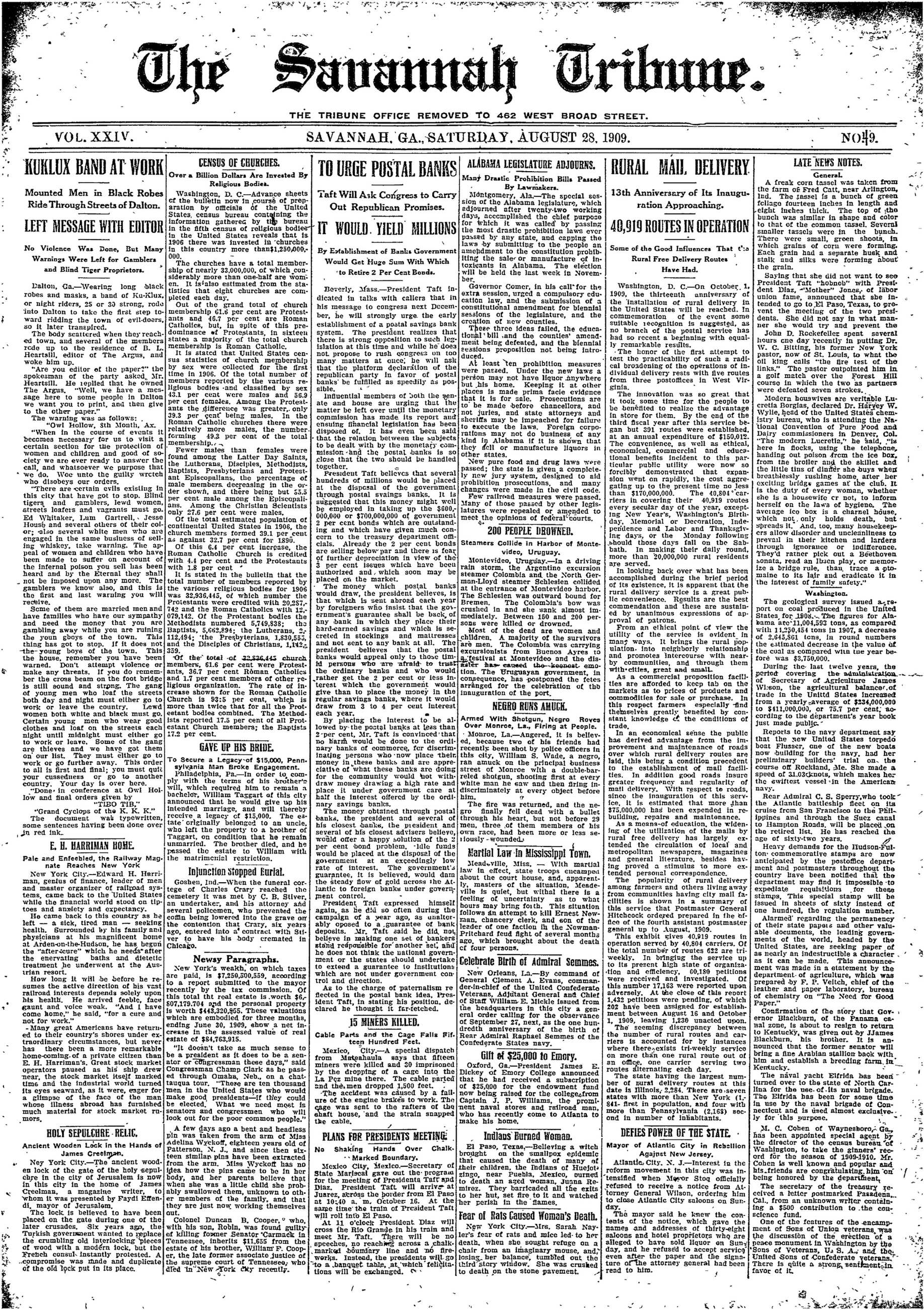
KUKLUX BAND AT WORK
Mounted Men in Black Robes Ride Through Streets of Dalton.
LEFT MESSAGE WITH EDITOR
No Violence Was Done, But Many Warnings Were Left for Gamblers and Blind Tiger Proprietors.
Dalton, Ga.—Wearing long black robes and masks, a band of Ku-Klux, or night riders, 25 or 30 strong, rode into Dalton to take the first step toward ridding the town of evil-doers, so it later transpired. The body scattered when they reached town, and several of the members rode up to the residence of B. L. Heartsill, editor of The Argus, and woke him up.
"Are you editor of the paper?" the spokesman of the party asked, Mr. Heartsill. He replied that he owned The Argus. "Well, we have a message here to some people in Dalton we want to print, and then give to the other paper."
The warning was as follows:
"Owl Hollow, 8th Month, Ax.
"When in the course of events it becomes necessary for us to visit a certain section for the protection of women and children and good of society we are ever ready to answer the call, and whatsoever we purpose that we do. Woe unto the guilty wretch who disobeys our orders.
"There are certain evils existing in this city that have got to stop. Blind tigers and gamblers, lewd women, streets loafers and vagrants must go. Ed Whitaker, Lum Gartrell, Jesse House and several others of their color; also several white men who are engaged in the same business of selling whiskey, take warning. The appeal of women and children who have been made to suffer on account of the internal poison you sell has been heard and by the Eternal they shall not be imposed upon any more. The gamblers we know also, and this is the first and last warning you will receive.
Some of them are married men and have families who have our sympathy and need the money that you are gambling away while you are ruining the youn gbows of the town. This thing has got to stop. If it does not the young boys of the town. This house, remember you have been warned. Don't attempt violence or make any threats. If you do remember the cross beam on the foot bridge is still sound and strang. The gang of young men who loaf the streets both day and night must either go to work or leave the country. Lewd women both white and black must go. Certain young men who wear good clothes and loaf on the streets each night until midnight must either go to work or leave. Some of the gang are thieves and we have got them on our list. They must either go to work or go further away. This order to all is first and final; you must quit your cussiness or go to another country. Your day is over here.
"Done in conference at Owl Hollow and final orders given by
"TIBO TIB."
"Grand Cyclops of the K. K. K."
The document wat typewritten,
some sentences having been done over
in red ink.
E. H. HARRIMAN HOME
Pale and Enfeebled, the Railway Mag
nate. Reaches New York
New York City—Edward H. Herriman, genius of finance, leader of men and master organizer of railroad systems, came back to the United States while the financial world stood on tiptoes and anxiety and expectancy. He came back to this country as he left — a sick, tired man — seeking health. Surrounded by his family and physicians at his magnificent home at Arden on the-Hudson, he has begun the "after-score" which he needs after the enervating baths and dietetic treatment he underwent at the Austrian resort. How long it will be before he resumes the active direction of his vast railroad interests depends solely upon his health. He arrived feeble, face gaunt and voice weak. "And I have come home," he said, "for a cure and not for work."
- Many great Americans have returned to their country's shores under extraordinary circumstances, but never has there been a more remarkable home-coming of a private citizen than E. H. Harriman's. Great stock market operators paused as his ship drew near, the stock market itself marked time and the industrial world turned its eyes seaward, as it were, eager for a glimpse of the face of the man whose illness abroad has furnished much material for stock market rumors.
HOLY SEPIILCHRE - RELIC.
Ancient Wooden Lock in the Hands of James Creelman.
Ney York City—The ancient wooden lock of the gate of the holy sepulchre in the city of Jerusalem is now in this city in the home of James Creelman, a magazine writer, to whom it was presented by Faydi Effendi, mayor of Jerusalem. The lock is believed to have been placed on the gate during one of the later crusades. Six years ago, the Turkish government wanted to replace the crumbling old interlocking pieces of wood with a modern lock, but the French consul instantly protested. A compromise was made and duplicate of the old lock put in its place.
CENSUS OF CHURCHES.
Washington, D. C.—Advance sheets of the bulletin now in course of preparation by officials of the United States, census bureau containing the information gathered by the bureau in the fifth census of religious bodies in the United States reveals that is 1906 there was invested in churches in this country more than $1,250,000,000.
The churches have a total membership of nearly 33,000,000, of which considerably more than one-half are women. It is also estimated from the statistics that more churches are completed each day.
Out of the grand total of church membership 61.6 per cent are Protestants and 46.7 per cent are Roman Catholic, but, in spite of this predominance of Protestants, in sixteen states a majority of the total church membership is Roman Catholic.
It is stated that United States census statistics of church membership by sex were collected for the first time in 1906. Of the total number of members reported by the various religious bodies and classified by sex 43.1 per cent were males and 56.9 per cent females. Among the Protestants the difference was greater, only 39.3 per cent being males. In the Roman Catholic churches there were relatively more males, the number forming 49.3 per cent of the total membership.
Fewer males than females were found among the Latter Day Salutes, the Lutherans, Disciples, Methodists, Baptists, Presbyterians and Protestant Episcopalians, the percentage of male members decreasing in the order shown, and there being but 55.5 per cent male among the Episcopalians. Among the Christian Scientists only 27.6 per cent were males.
Of the estimated population of continental United States in 1906, the church members formed 39.1 per cent as against 32.7 per cent for 1889.
Of this 6.4 per cent increase, the Roman Catholic Church is credited with 4.4 per cent and the Protestants with 1.8 per cent.
It is stated in the bulletin that the total number of members reported by the various religious bodies for 1906 was 22,936,445, of which number the Protestants were credited with 20,257,742 and the Roman Catholics with 12,079,142. Of the Protestant bodies the Methodists numbered 5,749,838; the Baptists, 5,662,894; the Lutherans, 2,112,494; the Presbyterians, 1,830,555; and the Disciples of Christians, 1,142,359.
Of the total of 22,226,445 church members, 61.6 per cent were Protestants, 36.7 per cent Roman Catholics and 1.7 per cent members of other religious organization. The rate of increase shown for the Roman Catholic Church is 93:5 per cent, which is more than twice that for all the Protestant bodies combined. The Methodists reported 17.5 per cent of all Protestant Church members; the Baptists 17.2 per cent.
GAVE UP HIS BRIDE
To Secure a Legacy-of $15,000, Pennsylvania Man Broke Engagement. Philadelphia, Pa.—In order to comply with the terms of his brother's will, which required him to remain a bachelor, William Taggart of this city announced that he would give up his intended marriage, and will thereby receive a legacy of $15,000. The estate originally belonged to an uncle, who left the property to a brother of Taggart, on condition that he remain unmarried. The brother died, and he passed the estate to William with the matrimonial restriction.
Injunction Stopped Eurial.
Goshen, Ind.—When the funeral cortege of Charles Crary reached the cemetery it was met by C. B. Silver, an undertaker, and his attorney and several policemen, who prevented the coffin being lowered into the grave on the contention that Crary, six years ago, entered into a contract with Silver to have his body cremated in Chicago.
Newsy Paragraphs.
New York's wealth, on which taxes are paid, is $7,259,300,559, according to a report submitted to the mayor recently by the tax commission. Of this total the real estate is worth $6,807,179,704 and the personal property is worth $433,200,855. These valuations which are embodied for three months, ending June 30, 1999, show a net increase in the assessed value of real estate of $84,763,915.
"It doesn't take as much sense to be a president as it does to be a senator or congressman these days," said Congressman Champ Clark as he passed through Omaha, Neb., on a chattauqua tour. "There are ten thousand men in the United States who would make good presidents—if they could be elected. What we need most is senators and congressmen who will look out for the poor common people."
A few days ago a bent and headless pin was taken from the arm of Miss Adelina Wyckoff, eighteen years old of Patterson, N. J., and since then sixteen similar pins have been extracted from the arm. Miss Wyckoff has no idea how the pins came to be in her body, and her parents believe that when she was a little child she probably swallowed them, unknown to other members of the family, and that they are just now working themselves out.
Colonel Duncan B. Cooper, *o* who, with his son, Robin, was found guilty of killing former Senator *Carmack* K. Tennessee, inherits $1,165 from the estate of his brother, William F. Cooper, the late former associate justice of the supreme court of Tennessee, who died in "New York City recently.
THE TRIBUNE OFFICE REMOVED TO 462 WEST BROAD STREET. SAVANNAH, GA. SATURDAY, AUGUST 28, 1909.
URGE POSTAL BANKS
Taft Will Ask Congress to Carry Out Republican Promises.
IT WOULD. YIELD MILLIONS
By Establishment of Banks Government Would Get Huge Sum With Which to Retire 2 Per Cent Bouds. Beverly, Mass.—President Taft indicated in talks with callers that in his message to congress next December, he will strongly urge the early establishment of a postal savings bank system. The president realizes that there is strong opposition to such legislation at this time and while he does not propose to rush congress on too many matters at once; he will ask that the platform declaration of the republican party in favor of postal banks be fulfilled as speedily as possible.
Influential members of both the generate and house are urging that the matter be left over until the monetary commission has made its report and ensuing financial legislation has been disposed of. It has even been said that the relation between the subjects to be dealt with by the monetary commission and the postal banks is so close that the two should be handled together.
President Taft believes that several hundreds of millions would be placed at the disposal of the government through postal savings banks. It is suggested that this money might well be employed in taking up the $600,000,000 or $700,000,000 of government 2 per cent bonds which are outstanding and which have given much concern to the treasury department officials. Already the 2 per cent bonds are selling below par and there is fear of further depreciation in view of the 3 per cent issues which have been authorized and, which soon may be placed on the market.
The money which postal banks would draw, the president believes, is that which is sent abroad each year by foreigners who insist that the government's guarantee shall be back, of any bank in which they place their hard-earned savings and which is secreted in stockings and mattresses and not sent to any bank at all. The president believes that the postal banks would appeal only to those timid persons who are afraid to trust the ordinary banks and who would rather get the 2 per cent or less interest which the government would give than to place the money in the regular savings banks, where it would draw from 3 to 4 per cent interest each year.
By placing the interest to be allowed by the postal banks at less than 2 per cent, Mr. Taft is convinced that no hard work be done to the ordinary banks of commerce, for discriminating persons who now place their money in these banks and are appreciative of what these banks are doing for the community would not withdraw money drawing a high rate and place it under government care at half the interest offered by the ordinary savings banks.
The money obtained through postal banks, the president and several of his closest banks, the president and several of his closest advisers believe, would offer a happy solution of the 2 per cent bond problem. Idle funds would be placed at the disposal of the government at an exceedingly low rate of interest. The government's guarantee, it is believed, would dam the steady flow of gold across the Atlantic to foreign banks under government control.
President Taft expressed himself again, as he did so often during the campaign of a year ago, as unalterably opposed to a guarantee of bank deposits. Mr. Taft said he did not believe in making one set of bankers stand responsible for another set, and he does not think the national government or the states should undertake to extend a guarantee to institutions which are not under government control and direction.
As to the charge of paternalism reflected in the postal bank idea, President Taft, in stating his position, declared he thought it far-reached.
15 MINERS KILLED.
Cable Parts and the Cage Falls Fifteen Hundred Feet. Mexico, City.—A special dispatch from Mategaaulaha says that fifteen miners were killed and 20 imprisoned by the dropping of a cage into the La Paz mine there. The cable parted and the men dropped 1,500 feet. The accident was caused by a failure of the engine brakes to work. The cage was sent to the rafters of the shaft house, and the strain snapped the cable.
PLANS FOR PRESIDENTS MEETING
Mexico City, Mexico—Secretary of State Marcalgale gave out the program for the meeting of Presidents Taft and Diaz. President Taft will arrive at Juarez, across the border from El Paso at 10:40 a. m. October 16. At the same time the train of President Taft will roll into El Paso. At 11 o'clock President Diaz will cross the Rio Grande in his train and meet Mr. Taft. There will be no speeches, no reaching across a chalk-marked boundary line and no fireworks. Instead, the presidents will go to a banquet table, at which felicitations will be exchanged.
ALABAMA LEGISLATURE ADJOURNS.
Many Drastic Prohibition Bills Passed
By Lawmakers
Montgomery, Ala.—The special session of the Alabama legislature, which adjourned after twenty-two working days, accomplished the chief purpose for which it was called by passing the most drastic prohibition laws ever passed by any state, and capping the laws by submitting to the people an amendment to the constitution prohibiting the sale or manufacture of intoxicants in Alabama. The election will be held the last week in November.
Governor Comer, in his call' for the extra session, urged a compulsory education law, and the submission of a constitutional amendment for biennial sessions of the legislature, and the creation of new counties.
These three ideas failed, the educational' bill and the counties' amendment being defeated, and the biennial sessions proposition not being introduced.
At least ten prohibition measures were passed. Under the new laws a person may not have liquor anywhere but his home. Keeping it at other places is made prima facie evidence that it is for sale. Prosecutions are to be made before chancellors, and not juries, and state attorneys and sheriffs may be impeached for failure to execute the laws. Foreign corporations may not do business of any kind in Alabama if it is shown that they sell or manufacture liquors in other states.
New pure food and drug laws were passed; the state is given a completely new jury system, designed to aid prohibition prosecutions, and many changes were made in the civil code.
Few railroad measures were passed. Many of those passed by other legislatures were repealed or amended to meet the opinions of federal courts.
200 PEOPLE DROWNED.
Steamers Collide in Harbor of Montevideo, Uruguay.
Montevideo, Uruguay—In a driving rain storm, the Argentine excursion steamer Colombia and the North German-Lloyd steamer Schlesien collided at the entrance of Montevideo harbor. The Schlesien was outward bound for Bremen. The Colombia's bow was crushed in and she sank almost immediately. Between 150 and 200 persons were killed or drowned. Most of the dead are women and children. A majority of the survivors are men. The Colombia was carrying excursionists from Buenos Ayres to festival at Montevideo and the disaster has caused the keenest emotion. The Uruguayan government, in consequence, has postponed the fetes arranged for the celebration of the inauguration of the port.
NEGRO RUNS AMUCK
Armed With Shotgun, Negro Roves Over Monroe, La., Firing at People.
Monroe, La.-Angered, it is believed, because two of his friends had recently been shot by police officers in this city, William S. Wade, a negro, ran amuck on the principal business street of Monroe with a double-barreled shotgun, shooting first at every white man he saw and then firing indiscriminately at every object before him.
The fire was returned, and the negro finally fell dead with a bullet through his heart, but not before 29 men, three of them members of his own race, had been more or less seriously-wounded.
Martial Law in Mississippi Town
Meadville, Miss. — With martial law in effect, state troops encamped about the court house, and, apparently, masters of the situation, Meadville is quiet, but withal there is a feeling of uncertainty as to what hours may bring forth. This situation follows an attempt to kill Ernest Newman, chancery clerk, and son of the leader of one faction in the Newman-Pritchard feud fight of several months ago, which brought about the death of four persons.
Celebrate Birth of Admiral Semmes.
New Orleans, L.A.-by command of General Clement A. Evans, commander-in-chief of the United Confederate Veterans, Adjutant General and Chief of Staff William E. Mickle issued from the headquarters in this city a general order calling for the observance of September 27, next, as the one hundredth anniversary of the birth of Rear Admiral Raphael Semmes of the Confederate States navy.
Gift of $25,000 to Emory.
Oxford, Ga.-President James E. Dickey of Emory College announced that he had received a subscription of $25,000 for the endowment fund now being raised for the college from prominent naval stores and railroad men who has recently come to Atlanta to make his home.
Indlaws Burned Woman.
El Paso, Texas,—Believing a witch brought on the smallpox epidemic that caused the death of many of their children, the Indians of Huejotzingo, near Puebla, Mexico, owed to death an aged woman, Juanna Remiroz. They barricaded all the exits to her hut, set fire to it and watched her perish in the flames.
Fear of Rats Caused Woman's Death.
New York City.—Mrs. Sarah Nayler's fear of rats and mice led to her death, when she sought refuge on a chair from an imaginary mouse, and, losing her balance, tumbled out the third story window. She was crushed to death on the stone pavement.
RURAL MAIL DELIVERY
13th Anniversary of Its Inauguration Approaching.
40,919 ROUTES IN OPERATION
Some of the Good Influences That the Rural Free Delivery Routes
Washington, D. C.-On October, 1, 1903, the thirteenth anniversary of the installation of rural delivery in the United States will be reached. In commemoration of the event some suitable recognition is suggested, as no branch of the postal service has had so recent a beginning with equally remarkable results. The honor of the first attempt to test the practicability of such a radical broadening of the operations of individual delivery rests with five routes from three postoffices in West Virginia.
The innovation was so great that it took some time for the people to be benefited to realize the advantage in store for them. By the end of the third fiscal year after this service began but 301 routes were established, at an annual expenditure of $150,012. The convenience, as well as ethical, economical, commercial and educational benefits incident to this particular public utility were now so forcibly demonstrated that expansion went on rapidly, the cost aggregating up to the present time no less than $170,000,000. The 40,804 carriers in covering their 40,919 routes every secular day of the year, excepting New Year's, Washington's Birthday, Memorial or Decoration, Independence and Labor and Thanksgiving days, or the Monday following should those days fall on the Sabbath. In making their daily round, more than 20,000,000 rural residents are served.
In looking back over what has been accomplished during the brief period of its existence, it is apparent that the rural delivery service is a great public convenience. Results are the best commendation and these are sustained by unanimous expressions of approval of patrons.
From an ethical point of view the utility of the service is evident in many ways. It brings the rural population into neighborly relationship and promotes intercourse with nearby communities, and through them with cities, great and small.
As a commercial proposition facilities are afforded to keep tab on the markets as to prices of products and commodities for sale or purchase. In this respect farmers especially find themselves greatly benefited by constant knowledge the conditions of trade.
In an economical sense the public has derived advantage from the improvement and maintenance of roads over which rural delivery routes are laid, this being a condition precedent to the establishment of mail facilities. In addition good roads insure greater frequency and regularity of delivery by diesel or resupply cars, since the inauguration of this service, it is estimated that more than $75,000,000 has been expended in rebuilding, repairs and maintenance.
As a means-of education, the widening of the utilization of the mails by rural free delivery has largely extended the circulation of local and metropolitan newspapers, magazines and general literature, besides having proved a stimulus to more extended personal correspondence. The popularity of rural delivery among farmers and others living away from communities having city mail facilities is shown in a summary of this service that Postmaster General Hitchcock ordered prepared in the office of the fourth assistant postmaster general un to August, 1909.
This exhibit sives 40,919 routes in operation served by 40,804 carriers. Of the total number of routes 622 are trivially. In bringing the service up to its present high state of organization and efficiency, 60,180 petitions were received and investigated. Of this number 17,163 were reported upon adversely. At the close of this report 1,432 petitions were pending, of which 202 have been assigned for establishment between August 16 and October 1, 1909, leaving 1,230 unacted upon. The seeming discrepancy between the number of rural routes and carriers is accounted for by instances where there exists trivially service on more than one rural route out of two routes alternating each day. The state having the largest number of rural delivery routes at this date is Illinois, 2,284. There are seven states with more than New York (1,841- first in population, and four with more than Pennsylvania (2,163) second in number of inhabitants.
DEFIES POWER OF THE STATE.
Mayor of Atlantic City in Rebellion Against New Jersey.
Atlantic City, N. J.-Interest in the reform movement in this city was intensified when Mayor Stoq officially refused to receive a notice from Attorney General Wilson, ordering him to close Atlantic City saloons on Sunday.
The mayor said he knew the contents of the notice, which gave the names and addresses of thirty-eight saloons and hotel proprietors who are alleged to have sold liquor on Sunday, and he refused to accept service even after the paper and the signature of the attorney general had been read to him.
LATE NEWS NOTES.
GeneraL
A freak corn tassel was taken from the farm of Fred Catt, near Arlington, Ind. The tassel is a bunch of green feliago fourteen inches in length and eight inches thick. The top of the bunch was similar in shape and color to that of the common tassel. Several smaller tassels were in the bunch. There were small, green shoots, in which grains of corn were forming. Each grain had a separate husk and stalk and silks were forming about the grain.
Saying that she did not want to see President Taft "hobnob" with President Dlaz, "Mother" Jones, of labor union fame, announced that she intended to go to El Paso, Texas, to prevent the meeting of the two presidents. She did not say in what manner she would try and prevent the
John D. Rockefeller spent several hours one day recently in putting Dr. W. C. Bitting, his former New York pastor, now of St. Louis, to what the oil king calls "the fire test of the links." The pastor outpointed him in a golf match over the Forest Hill course in which the two as partners were defeated seven strokes.
Modern housewives are veritable Lucretta Borglans, declared Dr. Hairyey W. Wylie, head of the United States chemistry bureau, who is attending the National Convention of Pure Food and Dairy commissioners in Denver, Col. "The modern Lucretta," he said, "is here in flocks, using the telephone, handing out poison from the ice box, from the broiler and the skillet and the little this of dinner she buys when breathlessly rushing home, after her exciting bridge games at the club. It is the duty of every woman, whether she is a housewife cr not, to inform herself on the laws of hygiene. The average ice box is a channel house, which not, only holds death, but spreads it. And, too, many housekeepers allow disorder and uncleanliness to prevalent in their kitchen and larders through ignorance or indifference. They'd rather pick out a Beethoven sonata, read an Ibsen play, or memorize a bridge rule, than trace a ptomaine to its lair and eradicate it in the interest of family safety."
Washington.
The geological survey issued a report on coal produced in the United States for 1908. The figures for Alabama are 11,004,553 tons, as compared with 11,250,454 tons in 1907, a decrease of 2,645,861 tons, in round numbers the estimated decrease in the value of the coal as compared with the year before was $3,750,000.
During the last twelve years, the period covering the administration of Secretary of Agriculture James Wilson, the agricultural balance of trade in the United States increased from a yearly average of $234,000,000 to $111,000,000, or 75.7 per cent, according to the department's year book just made public.
Reports to the navy department say that the new United States torpedo boat Flusser, one of the new boats now building for the navy, had her preliminary builders' trial on the course of Rockland, Me. She made a speed of 31.03 knots, which makes her the swiftest vessel in the American navy.
Rear Admiral C. S. Sperry,who took the Atlantic battleship fleet on its cruise from San Francisco to the Philippines and through the Suez canal to Hampton Roads, will be placed on the retired list. He has reached the age of sixty-two years. Heavy demands for the Hudson-Fulton commemorative stamps are now anticipated by the postoffice department and postmasters throughout the country have been notified that the department may find it impossible to expedite requisitions for these stamps. This special stamp will be issued in sheets of sixty instead of one hundred. the regulation number.
Alarmed regarding the permanency of their state papers and other valuable documents, the leading governments of the world, headed by the United States, are seeking paper of as nearly an indestructible a character as it can be made. This announcement was made in a statement by the department of agriculture, which was prepared by F. P. Veitch, chief of the leather and paper laboratory, bureau of chemistry on "The Need for Good Paper."
Confirmation of the story that Governor Blackburn, of the Panama canal zone, is about to resign to return to Kentucky, was given out by JJames Blackburn, his brother. It is announced that the former senator will bring a fine Arabian stallion back with him and establish a breeding farm, in Kentucky.
The naval yacht Elfrida has been turned over to the state of North Carolina for the use of its naval brigade. The Elfrida has been for some time in use by the naval brigade of Connecticut and is used almost exclusively for this purpose.
M. C. Cohen of Waynesboro, Ga., has been appointed special agent by the director of the census bureau of Washington, to take the ginners' record for the season of 1999-1910. Mr. Cohen is well known and popular and hts.friends are congratulating him on being honored by the department.
The secretary of the treasury received a letter postmarked Passadena, Cal., from an unknown writer containing a $500 contribution to the conscience fund.
One of the features of the encampment of Sons of Union veterans, was the discussion of the erection of a peace monument in Washington by the Sons of Veterans, U. S. A., and the United Sons of Confederate veterans. There is quite a strong sentiment in favor of it.
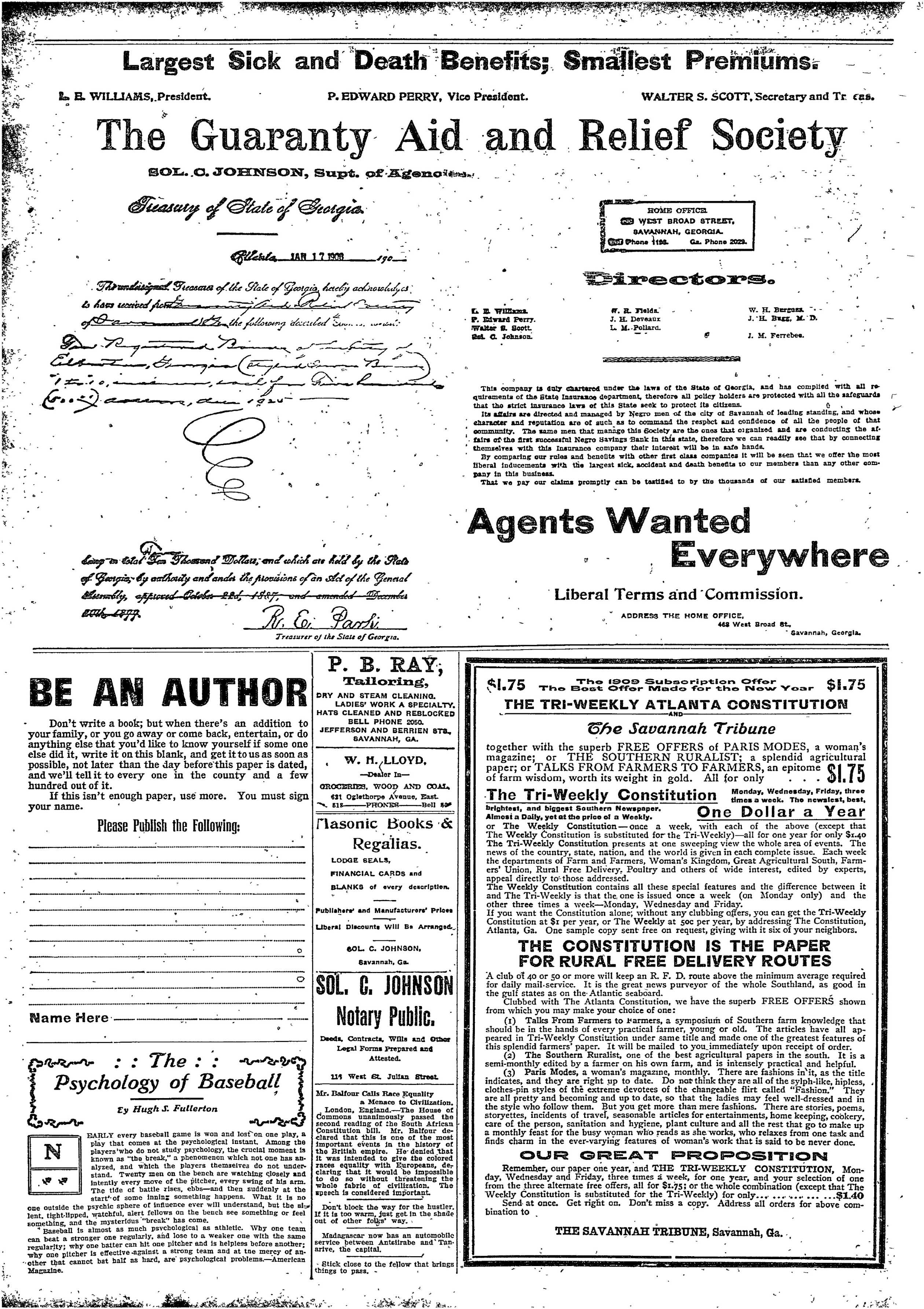
os Largest Sick and Death Benefits; Smallest Premiums: —__
" Be a. WILLIAMS, President. . P, EDWARD PERRY, Vice President. ‘WALTER S. SCOTT, Secretary and Tr. ces
Thia company ts duly chartered under the laws of the State of Georgia, and has complied with all re
quirements of the State Insurance department, therefore all policy holders are protected with all the safeguards
that tho strict insurance lews of this State seek to protect its citizens. ® .
Its affairs are directed and managed by Negro men of the city of Savannah of leading standing, and whose
eharzcter and reputation are of such as to command the respbct and confidence of all the people of that
community, The same men that manage this Gociety are the ones that organized and are conducting the af-
fairs ofthe first successfnl Negro Savings Bank in this state, therefore we can readily see that by connecting
themselves with this Insurance company their interest will be in safe hande
By comparing our reles and benefits with other first class companies It will be seen thet we offer the most
liberal inducementa with tie largest sick, accident and death benefits to our members than any other com:
pany in this business.
That we pay our claims promptly can bo tastified to by tite thousands cf our satisfed members.
- : e—_— “ ° ’
ee “3 Agents Wanted —
a dng» CEG Giant Wile; end whith on All by the Ret .- , Eve rywh ere
A Gorpiia Oy anthouly and anda the provisions ofan Let of the General ‘ a
. iermnbly, ofiprcced— Celle BB+ ERG —end—emended—Drcemba Do ‘Liberal Terms and ‘Commission. .
Letk-LEFP, . f, : . B B . a . , ADDRESS THE HOME OFFICE,
: 2 s se a 7 463 West Broad &t,
, Treasurer of the State of Georgia. - ° . P : “Hdavannahs, Seergine
Th Iso ipti Off:
S175 The Boot Stter hinds fae the Now Yoar $1.75
THE TRI-WEEKLY ATLANTA CONSTITUTION
<i
Ohe Savannah Tribune
together with the superb FREE OFFERS of PARIS MODES, a woman’s
magazine; or THE SOUTHERN RURALIST; a splendid agricultural
paper; or TALKS FROM FARMERS TO FARMERS, an epitome SI 15
of farm wisdom, worth its weight in gold. All for only + & = .
. . : Monday, Wednesday, Friday, th
The Tri-Weekly Constitution (ere The vewstest, best,
brightest, and biggest Southern Newspaper.
Aimosi a Dally, yotat the prico of = Weekly One Dollar a Year
or The Weekly Constitution—once a week, with each of the above (except that
The Weekly Constitution is substituted for the Tri-Weekly)—all for oné year for only $x.40
The Tri-Weekly Constitution presents at one sweeping view the whole area of events. The
news of the country, state, nation, and the world is given in each complete issue. Each week
the departments of Farm and Farmers, Woman’s Kingdom, Great Agricultural South, Farm-
ers’ Union, Rural Free Delivery. Poultry and others of wide interest, edited by experts,
appeal directly to‘those addressed.
The Weekly Constitution contains all these special features and the difference between it
and The Tri-Weekly is that the, one is issued once a week (on Monday only) and the
other three times a week—Monday, Wednesday and Friday.
If you want the Constitution alone, without any clubbing offers, you can get the Tri-Weekly
Constitution at $1 per year, or The Weekly at soc per year, by addressing The Constitution,
Atlanta, Ga. One sample copy sent free on request, giying with it six of your neighbors.
‘A club of 40 or 50 or more will keep an R. F. D, route above the minimum average required
for daily mail-service. It is the great news purveyor of the whole Southland, as good in
the gulf states as on the: Atlantic seaboard. c :
Clubbed with The Atlanta Constitution, we have the superb FREE OFFERS shown
from which you may make your choice of one:
(1) Talks From Farmers to Karmers, a symposium of Southern farm knowledge that
should be in the hands of every practical farmer, young or old. The articles have all ap-
peared in Tri-Weekly Constitution under same title and made one of the greatest features of
this splendid farmers’ paper. It will be mailed to you_immediately upon receipt of order.
(2) The Southern Ruralist, one of the best agricultural papers in the south. It is a
semi-monthly edited by a farmer on his own farm, and is intensely practical and helpful.
(3) Paris Modes, 2 woman’s magazine, monthly. There are fashions in‘it, as the title
indicates, and they are right up to date. Do nat think they are all of the sylph-like, hipless, .
clothes-pin styles of thé extreme devotees of the changeable flirt called “Fashion,” They
are all pretty and becoming and up to date, so that the ladies may feel well-dressed and in
the style who follow them. But you get more than mere fashions. There are stories, poems,
storyettes, incidents of travel, seasonable articles for entertainments, home keeping, cookery,
care of the person, sanitation and hygiene, plant culture and all the rest that go to make up
a monthly feast for the busy woman who reads as she works, who relaxes from one task and
finds charm in the ever-varying features of woman’s work that is said to be never done.
OUR GREAT PROPOSITION
Remember, our paper one year, and THE TRI-WEEKLY CONSTITUTION, Mon-
day, Wednesday and Friday, three times 4 week, for one year, and your selection of one |
from the three alternate free offers, all for $1.75; or the whole combination (except that The
Weekly Constitution is substituted for the Tri-Weekly) for only... 0.0050 20. ---B1.40
Send. at once. Get right on. Don’t miss a copy. Address all orders for above com-
bination to | . /
THE SAVANNAH TRIBUNE, Savannah, Ga... ‘
; = : . a _-
BE AN AUTHOR
. Don’t write a book; but when there’s an addition to
your family, or you go away or come back, entertain, or do
anything else that you'd like to know yourself if some one
else did it, write it on this blank, and get ittous as soon as
possible, not later than the day before'this paper is dated,
and we'll tellit to every one in the county and a few
hundred out of it. ,
If this isn’t enough paper, usé more. You must sign
your name. ‘
; Please Publish the Following:
; SSS
Berrie’ Her en a
purer 3: The: ere
| Psychology of Baseball
eee oe wre OE er
EARLY every baseball game is won and Jost~on one play, &
play that comes at the psychological Instant. Among the
N players'who do not study psychology, the crucial moment is
known as “the break,” a phenomenon which not one has an-
i alyzed, and which the players themselves do not under
stand. Twenty men on the bench are watching closely and
od intently every move of the pitcher, every swing of his arm.
e The tide of battle rises, ebbs—and then suddenly at the
start’of some inning something happens. What it is no
one outside the psychic sphere of influence ever will understand, but the si.»
lent, tight-lipped, watchful, alert fellows on the bench see something or feel
something, and the mysteridus “break” has come. :
* Baseball is almost as much psvchological as athletic. Why one team
can beat a stronger one regularly, ahd lose to a weaker one with the same
regularity; why one batter can hit one pitcher and is helpless before another;
why one pitcher is effective against a strong team and at tne mercy of an-
-other that cannet bat half as hard, are psychological problems.—American
Magazine.
G DB Wiliam
®. Edward Perry.
Walter 8. Scott.
Bel O. Johnson.
P. B. RAY;
Talloring,
BRY AND STEAM CLEANING.
LADIES’ WORK A SPECIALTY,
HATS CLEANED AND REBLOCKED
BELL PHONE 2050.
JEFFERSON AND BERRIEN 8TS,
SAVANNAH, GA,
tec
. W. M.LLOYD,
covet In—
631 Oglethorpe Avenue, East.
™. 518———PHONES——Bell co
Masonic Books :&
Regalias.
LODGE SEALS,
FINANCIAL CARDS and
BLANKS of every description,
Publishers’ and Manufacturers’ Prices
‘ —
Liberal Discounts WII! Be Arranged_
@0L. C. JOHNSON,
Savannah, Ga. :
(ema perenne ste emremereres *
SOL. 6. JOHNSON
Not in,
ofary Public,
Deeds, Contracts, Wills and Other
Legal Forms Prepared and
Attested.
114 West Gt. Julian Stresz
EEE SESS ESE EE eae ee
a Menace to Civilization.
London, England.—The House of
Commons unanimously passed the
second reading of the South African
Constitution bill Mr. Balfour de-
cleared that this is one of the most
important events in the history of
the British empire. He’ denied that
it was intended to give the colored
races equality with Europeans, de-
claring that it would be impossible
to do so without threatening the
whole fabric of civilization. The
wpeech is considered important.
Don’t block the way for the hustler,
If it is too warm, just get In the shade
out of other folks’ way. » °
Madagascar now has an automobile
service between Antsiirabe and‘ Tan-
arive, the capital. me
——____—__
- Stick close to the fellow that brings
things to pass, - =
HOME OFFICE
.B 83 WEST BROAD STREET, ,
SAVANNAH, GEORGIA. ae
GBD Phone tise. Ga. Phono 2022. =
2 rectors.
a Meds. W. H. Bergaen ~- -
J. H. Deveaux J.-H. Bugg, MD.
L, M.-Pollara. ‘
. id ¢ i. M. Ferrebes.
°
ae ee EE
ABDUL HAMID'S FALL A BOON TO TURKEY
Observations by the Rev. IRÅ W. HENDERSON.
Who Is Making a Tour of the Holy Land.....
(Special Correspondence.)
Jerusalem. — The Turkish empire of to-day is, especially in its official operations, a different empire from what it was three months ago. In some respects it is a different empire so far as the lives of the people are concerned. The marvelous revolution of a month ago, which secured the elevation of the fifth Mohammed to the Qttoman throne, is already producing noticeable results.
The year-old Constitution was responsible for a marked broadening of the official vision of Turkish authorities, but the most remarkable changes have come to pass since the deposition of Abdul Hamid.
It is no such trying task to-day to enter the country as it has been considered to be since the memory of man runneth. The day of discourtesy and discomfort and unnecessary scrutiny at the ports of call has evidently passed. The writer has embarked and disembarked no fewer than five times within the past three weeks at the principal ports of Palestine, Jaffa, Halifa and Belrut without experiencing any more trouble with customs officers than is usual in any European port. A friend who has been conducting parties from the States to Palestine for fifteen years asserts that it has never been so easy to go and come as now. Steamship agents tell the same story. It is the testimony of the average man one questions as one wanders through the land. Fifty times at least different men have said, "It is not like it used to be." To be sure, if one does not care to have his baggage opened he may, even now, secure immunity by the payment of
secure immunity by the payment or "backsheesh." But it does not matter much whether or not one offers a "gift." At Jaffa the writer kept his "gift" to himself. The customs agent very politely asked that the baggage be opened, and after a very courteous examination passed it. The trouble was "nil." It was not necessary even to produce a passport.
The freedom of the press is something 'heretofore unknown. The native papers are saying very nearly, if not quite, just what they think on the political problems which perplex the empire and which mean so much to millions of the subjects of the Sultan. Only the other day an editorial in a Beirut paper, published in French, criticised the lassitude and incapacity of the local municipal authorities as stringently as New York-dallies dictate to the Mayor. They even dared to suggest among other things that the city fathers should keep horses from feeding on the already inadequate sidewalks of Beirut, and that the multitude of wild-running, noisy dogs should be exorcised. These suggestions in answer to the statement of the city government that a city can not be transformed without money. Only those who are aware of the inallenable rights of Palestinian dogs and horses and donkeys can appreciate the audacity of these proposals. Humorously illustrative this is of another point of view that has heretofore had short shrift. Seriously, reform is in the air.
If it is easier to enter and leave the country than it was, it is also easier to move through Palestine, particularly, than heretofore. To go across Jordan or to such a place as Petra it was formerly necessary to ask for a permit, which as often as not was refused. To go without leave meant a fine. Those who wanted to go frequently went first and accounted for the violation of the law afterward. Then they paid a fine and the incident was closed. To-day such permits are unnecessary.
Heretofore a traveler at Haifa, Nazareth, Tiberlas, Damascus and Baalbek has been under the strictest surveillance. It has been necessary to report to the local police authorities with one's papers at once. Fees were collected for registration, and gratuities were always cheerfully received. Failure to report meant that a more
NEW RIVALS OF THE POTATO.
Southern States Growing Some Hitherto Unknown Vegetables.
Efforts have been made to introduce in the Southern States certain useful vegetables hitherto unknown to this country, which are known in tropical regions as the yautia, the dasheen and the taro. The last named is already familiar as an ornamental plant, under the name of caladium or "elephant's ear." All three are nearly related and their starchy, edible roots are highly prized in warm latitudes.
Linas. Not only are they useful by reason of their edible qualities, but their high yield of starch affords a prospect of great usefulness for them as stock food or in the production of alcohol.
The yautia seems to have been originally native to the West Indies. It was cultivated by the aborigines in those parts centuries before Columbus discovered America. Even to the present day its roots, which look
These roots, indeed, resemble the common potato in composition and in flavor. That of the yautia, for example, when properly cooked, is not easily distinguished from the "Irish" tuber. It is sometimes white, sometimes red and sometimes yellow, according to variety. So rich is it instature that it yields nearly one-third of its weight in flour, and its leaves are prepared for the table after the manner of spinach.
One reason why it is deemed desirable to introduce these plants is that they flourish in land that is too wet for ordinary crops. It has been asserted that they will grow well in this country as far north as the Caro-
or less indignant official would call upon the careless traveler at his (the officer's) earliest convenience. All that is changed; no longer are "Messieurs les voyageurs," as the French call the tourists, followed up like crooks. At Baalbek, for example, a courteous, cheery official put a smiling face through the open window of the compartment and asked the traveler for a sight of his passport and a simple statement of whence he came and whither traveling.
There are more unveiled women in Palestine than heretofore. Even now women are not conspicuous by their presence and number upon the Oriental streets of upper Egypt and Palestine, except in distinctively Christian communities, but the number of unveiled Mohammedan women seen upon the narrow thoroughfares, though relatively small and confined largely to the less wealthy classes, is large enough to compel exclamations of surprise from seasoned travelers to whom Palestine is an oft read volume.
The native who expresses any sympathy for Abdul Hamid the writer has yet to meet. To be sure, there are those who have lost office with the downfall of the old regime who would be glad to see the return of the old days of treachery and bloodshed, but the mass of the people is satisfied, if common testimony is of any certain account. The general judgment seems to be that there is no reason to mourn the fact that Abdul Hamid is a prisoner at Salonika. "He killed thousands" is the oft repeated statement. Pictures of the new Sultan, more gaudy than complimentary to the subject, are in frequent evidence.
The foundations for a regenerated empire are not all laid, and there may be trouble here and there between ignorant Mussulmans and ignorant Christians in Asia Minor.
Liberty means license to not a few and many have the lesson to learn that true liberty is the fruitage of a calm self-restraint. The pupils of some Protestant institutions are a bit unreasonable in their demands. Some of the Greek Catholics at Jerusalem are anxious to rectify the errors of administration of that communion over night. Others seem not yet to have learned that the new government is at present popular and in earnest. Still others, perhaps, will not be cultured by the executions of the ringleaders of the massacre at Adana. But the careful observer must admit that the day is better. The power of the liberal party, the backbone of which consists of Young Turks, is enlarging. The grip of that cool, commendable organization composed of the best minds, both Moslem and Christian, in the empire, upon the political life of Western Asia is as potential as it is prodigious.
The Turkish empire stands just within the threshold of a glorious era—an era that means much for Palestine. The hands of the clock of progress are now pointing toward civic and religious liberty; the Turk has his face to the future—a future fraught with possibilities, the realization of which will yet make him proud of his once despised country.—From the Brooklyn Daily Eagle.
"There is a ring around the moon to-night," remarked the young man in the porch rocker. "Do you know what that means?"
"No," replied the fair occupant of the hammock, "but I know what a ring around a girl's third finger means."
And as there was only one way out of it the y. m. went out that way—and bought the ring.—Chicago News.
The volcano of Stromboli has been known to emit flames persistently, and lava and cinders spasmodically for two thousand years.
linas. Not only are they useful by reason of their edible qualities, but their high yield of starch affords a prospect of great usefulness for them as stock food or in the production of alcohol. The yautia seems to have been originally native to the West Indies. It was cultivated by the aborigines in those parts centuries before Columbus discovered America. Even to the present day its roots, which look somewhat like sweet potatoes, are raised on the islands of that archipelago in great quantities, the production often reaching ten tons to the acre. Did the white potato not exist they would take the place of it admirably.
Aged But Efficient.
Of all the workmen employed by the Marlborough rural district council for work on the district roads ten of them average seventy years of age, their combined ages being 701 years. The district surveyor informed the council that they were all capable of earning good money at piecework-London Standard
Caught on the Rebound.
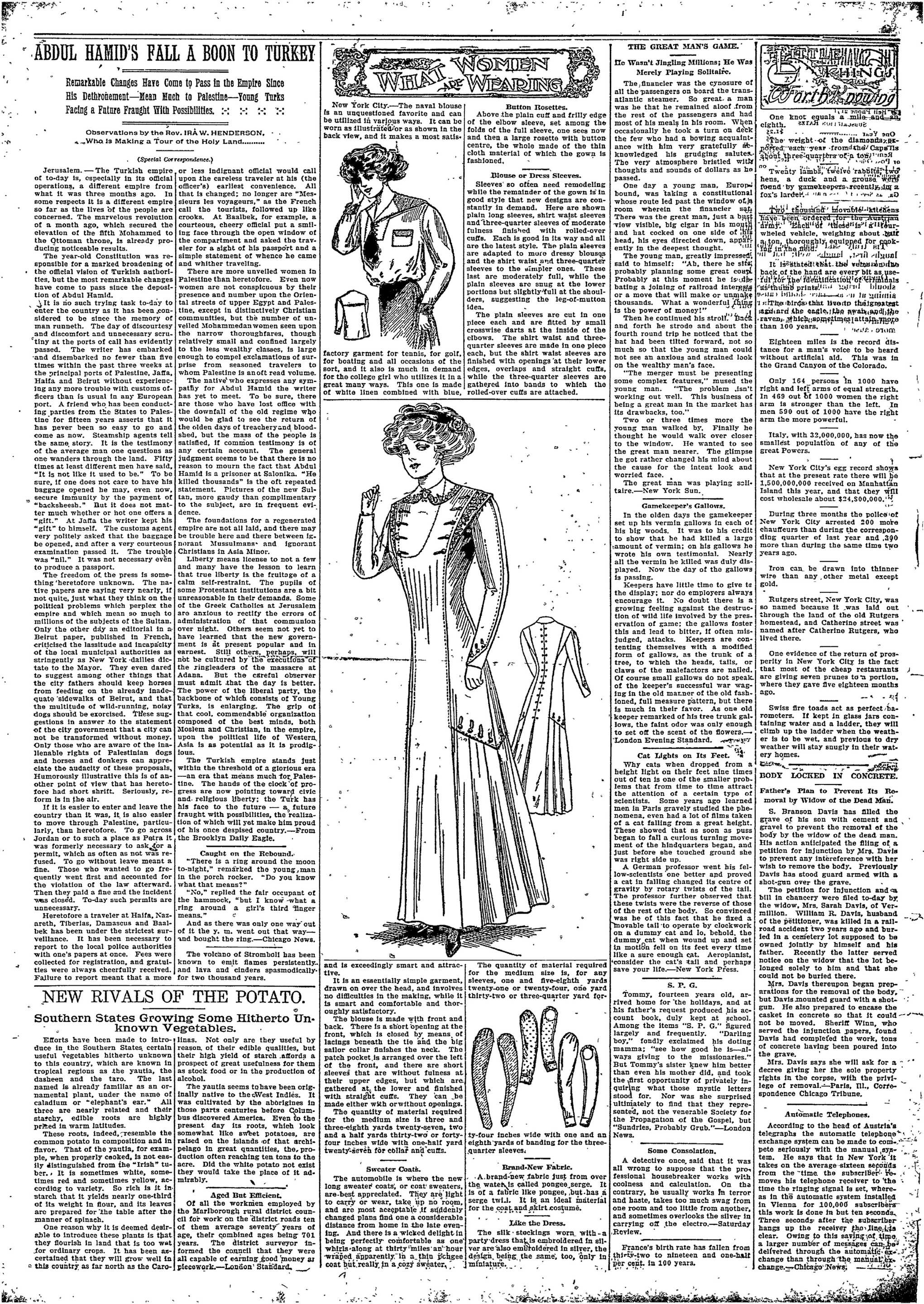
WHAT WOMEN ARE WEARING
1
New York City.—The naval blouse is an unquestioned favorite and can be utilized in various ways. It can be worn as illustrated as shown in the back view, and it makes a most satis-
A
factory garment for tennis, for golf, for boating and all occasions of the sort, and it also is much in demand for the college girl who utilizes it in a great many ways. This one is made of white linen combined with blue,
1
and is exceedingly smart and attractive.
It is an essentially simple garment, drawn on over the head, and involves no difficulties in the making, while it is smart and comfortable and thoroughly satisfactory.
The blouse is made with front and back. There is a short opening at the front, which is closed by means of lacings beneath the tie and the big sailor collar finishes the neck. The patch pocket is arranged over the left of the front, and there are short sleeves that are without fulness at their upper edges, but which are gathered at, the lower and finished with straight cuffs. They can be made either with or without openings.
The quantity of material required for the medium size is three and three-eighth yards twenty-seven, two and a half yards thirty-two or forty-four inches wide with one-half yard twenty-seven for collar and cuffs.
Swcater Coat&.
The automobile is where the new long sweater coats, or coat sweaters, are-best appreciated. They are light to carry or wear, take up no room, and are most acceptable if suddenly changed plans find one a considerable distance from home in the late evening. And there is a wicked delight in being perfectly comfortable as one whirls along at thirty"miles an hour wrapped apparently in a thin jchgee coat but really in a cozy sweater.
Button Rosettes.
Above the plain cuff and frilly edge of the elbow sleeve, set among the folds of the full sleeve, one see now and then a large rosette with button centre, the whole made of the thin cloth material of which the gown is fashioned.
Blouse or Dress Slceves.
Sleeves so often need remodeling while the remainder of the gown is in good style that new designs are constantly in demand. Here are shown plain long sleeves, shirt waist sleeves and three-quarter sleeves of moderate fulness finished with rolled-over cuffs. Each is good in its way and all are the latest style. The plain sleeves are adapted to more dressy blousqs and the shirt waist and three-quarter sleeves to the simpler ones. These last are moderately full, while the plain sleeves are snug at the lower portions but slightly full at the shoulders, suggesting the leg-of-mutton idea.
The plain sleeves are cut in one piece each and are fitted by small crosswise darts at the inside of the elbows. The shirt waist and three-quarter sleeves are made in one piece each, but the shirt waist sleeves are finished with openings at their lower edges, overlaps and straight cuffs, while the three-quarter sleeves are gathered into bands to which the rolled-over cuffs are attached.
10
The quantity of material required for the medium size is, for any sleeves, one and five-eighth yards twenty-one or twenty-four, one yard thirty-two or three-quarter yard for-
ty-four inches wide with one and an eighth yards of banding for the three-quarter sleeves.
Brand-New Fabric.
A. brand-new fabric just from over the water is called pongee, serge. It is of a fabric like pongee, but has a serge twiL. It is an ideal material for the coat and skirt costume.
Like the Dress.
The silk stockings worn with-a party dress that is embroidered in silver are also embroidered in silver, the design, being the same, too, only in miniature.
He Wasn't Jingling Millions; He Was Merely Playing Solitaire.
The financier was the cynosure of all the passengers on board the transatlantic steamer. So great a man was he that he remained aloof from the rest of the passengers and had most of his meals in his room. When occasionally he took a turn on deck the few who had a bowing acquaintance with him very gratefully acknowledged his grudging salutes. The very atmosphere bristled with thoughts and sounds of dollars as he passed.
One day a young man, Europ-
bound, was taking a constitutional
whose route led past the window of
room wherein the financier sai-
There was the great man, just a brus-
view visible, big cigar in his mount-
and hat cocked on one side of his
head, his eyes directed down, appu-
ently in the deepest thought.
The young man, greatly impressed,
said to himself: "Ah, there he sits,
probably planning some great coup.
Probably at this moment he is
bating a joining of railroad inter-
or a move that will make or unmake
thousands. What a wonderful thing
is the power of money!"
Then he continued his stroll. "Back and forth he strode and about the fourth round trip he noticed that the hat had been tilted forward, not so much so that the young man could not see an anxious and strained look on the wealthy man's face.
"The merger must be presenting some complex features," mused the young man. "The problem isn't working out well. This business of being a great man in the market has its drawbacks, too."
Two or three times more the young man walked by. Finally he thought he would walk over closer to the window. He wanted to see the great man nearer. The glimpse he got rather changed his mind about the cause for the intent look and worried face.
The great man was playing solitaire.—New York Sun.
Gamekeeper's Gallows.
In the olden days the gamekeeper set up his vermin gallows in each of his big woods. It was to his credit to show that he had killed a large amount of vermin; on his gallows he wrote his own testimonial. Nearly all the vermin he killed was duly displayed. Now the day of the gallows is passing.
Keepers have little time to give to the display; nor do employers always encourage it. No doubt there is a growing feeling against the destruction of wild life involved by the preservation of game; the gallows foster this and lead to bitter, if often misjudged, attacks. Keepers are contenting themselves with a modified form of gallows, as the trunk of a tree, to which the heads, tails, or claws of the malefactors are nailed. Of course small gallows do not speak of the keeper's successful war waging in the old manner of the old fashioned, full measure pattern, but there is much in their favor. As one old keeper remarked of his tree trunk gallows, the faint odor was only enough to set off the scent of the flowers.—London Evening Standard.
Cat Lights on Its Feet.
Why cats when dropped from a height light on their feet nine times out of ten is one of the smaller problems that from time to time attract the attention of a certain type of scientists. Some years ago learned men in Paris gravely studied the phenomena, even had a lot of films taken of a cat falling from a great height. These showed that as soon as puss began to fall a curious turning movement of the hindquarters began, and just before she touched ground she was right side up.
A German professor went his fellow-scientists one better and proved a cat in falling changed its centre of gravity by rotary twists of the tail. The professor further observed that these twists were the reverse of those of the rest of the body. So convinced was he of this fact that he fixed a movable tail to operate by clockwork on a dummy cat and lo, behold, the dummy cat when wound up and set in motion fell on its feet every time like a sure enough cat. Aeroplanist, consider the cat's tail and perhaps save your life.—New York Press.
S. P. G.
Tommy, fourteen years old, arrived home for the holidays, and at his father's request produced his account book, duly kept at school. Among the items "S. P. G." figured largely and frequently. "Darling boy," fondly exclaimed his doting mamma; "see how good he is—always giving to the missionaries." But Tommy's sister knew him better than even his mother did, and took the first opportunity of privately inquiring what those mystic letters stood for. Nor was she surprised ultimately to find that they represented, not the venerable Society for the Propagation of the Gospel, but "Sundries, Probably Grub."—London News.
Some Consolation.
A detective once, said that it was all wrong to suppose that the professional housebreaker works with coolness and calculation. On the contrary, he usually works in terror and haste, takes too much swag from one room and too little from another, and sometimes overlooks the silver in carrying off the electro.—Saturday Review.
France's birth rate has fallen from thirty-two to nineteen and one-half per cent. in 100 years.
THE HAVEN
KHINGS
FortBrowning
The weight of the diamonds reported each year from the Capitals about three quarters of a ton.
Twenty lambs, twelve rabbits, two hens, a duck and a grouse were found by gamekeepers, recently, in a fox's lardet.
Two thousand invariable kitesens have been ordered for the Austrian army. Each of these is a four-wheled vehicle, weighing about half a ton, thoroughly equipped for cooking in the mud.
It is stated that the vulture is the back of the hand are every bit as useful for the identification of criminals as hunting prints. The bird that lives in this greatest region and the eagle, the awash, and the raven, which sometimes attains more than 100 years.
Eighteen miles is the record distance for a man's voice to be heard without artificial aid. This was in the Grand Canyon of the Colorado.
Only 164 persons in 1000 have right and left arms of equal strength. In 469 out of 1000 women the right arm is stronger than the left. In men 590 out of 1000 have the right arm the more powerful.
Italy, with 32,000,000, has now the smallest population of any of the great Powers.
New York City's egg record shows that at the present rate there will be 1,500,000,000 received on Manhattan Island this year, and that they will cost wholesale about $24,$00,000.
During three months the police of New York City arrested 200 more chauffeurs than during the corresponding quarter of last year and 390 more than during the same time two years ago.
Iron can be drawn into thinner wire than any other metal except gold.
Rutgers street, New York City, was so named because it was laid out through the land of the old Rutgers homestead, and Catherine street was named after Catherine Rutgers, who lived there.
One evidence of the return of prosperity in New York City is the fact that most of the cheap restaurants are giving seven prunes to a portion, where they gave five eighteen months ago.
Swiss fire toads act as perfect barometers. If kept in glass jars containing water and a ladder, they will climb up the ladder when the weather is to be wet, and previous to dry weather will stay snugly in their watery homes.
BODY LOCKED IN CONCRETE.
Father's Plan to Prevent Its Removal by Widow of the Dead Man.
S. Branson Davis has filled the grave of his son with cement and gravel to prevent the removal of the body by the widow of the dead man. His action anticipated the filing of a petition for injunction by Mrs. Davis to prevent any interference with her wish to remove the body. Previously Davis has stood guard armed with a shot-gun over the grave.
The petition for injunction and bill in chancery were filed to-day by the widow, Mrs. Sarah Davis, of Vermillion. William R. Davis, husband of the petitioner, was killed in a railroad accident two years ago and buried in a cemetery lot supposed to be owned jointly by himself and his father. Recently the latter served notice on the widow that the lot belonged solely to him and that she could not be buried there.
Mrs. Davis thereupon began preparations for the removal of the body, but Davis mounted guard with a shotgun. He also prepared to encase the casket in concrete so that it could not be moved. Sheriff Winn, who served the injunction papers, found Davis had completed the work, tons of concrete having been poured into the grave.
Mrs. Davis says she will ask for a decree giving her the sole property rights in the corpse, with the privilege of removal.—Paris, Ill., Correspondence Chicago Tribune.
Automatic Telephones
According to the head of Austria's telegraphs the automatic telephone exchange system can be made to compete seriously with the manual system. He says that in New York it takes on the average sixteen seconds from the time the subscriber removes his telephone receiver to the time the ringing signal is set, whereas in the automatic system installed in Vienna for 100,000 subscribers this work is done in but ten seconds. Three seconds after the subscriber hangs up the receiver the line is clear. Owing to this saving of time, a larger number of messages can be delivered through the automatic exchange than through the manual exchange. Chicago News.
SUBSCRIPTION RATES:
This is not the time for bickering.
"Tis truly said that "he who laughs first, laughs well; but he who laughs last, laughs best."
OPPRESSION in every instance, should bring unity. The laws aiming at us as a race should cause us to stick more closely together and work in unity for each other welfare. Let oppressive laws the more cause us to support the enterprices of the race and the establishment of new ones.
HECTOR APOLLINAIRE is the name of a Negro who was admitted to the bar in Paris a few weeks ago. He is a native of Guadeloupe about 30 years old, tall and muscular and very black. He enjoys the distinction of being the only one of his race among the recognized lawyers of Paris.—Catholic Exchange.
MR. LEE, the census supervisor for the tenth district has made himself a stalwart by asserting that he will divide the work in his district equally between the races. It is the studied effort on the part of some to disregard the claim of colored Republicans. Should Mr. Lee carry out his assertion he will certainly occupy a large space in the good thoughts of our people and will be honored accordingly.
SAVANNAN is agitating the holding of a mammoth exposition in 1915 to commemorate the opening of the Panama canal. With a
"pull altogether" this should be made a success and our colored citizens should do their part in adding to its success. THE TRIMUNE feels that whatever benefits our white citizens, benefits us also, therefore we should aid in all movements for the city's good.
LITTLE more than a month hence the tax and registration books will be opened. At this time will come the test as to who will be able to register under the disfranchisement law. It behooves our voters all over the state to prepare for this events and by all means be ready and able to be placed on the list. Under no circumstances should our present registered number be diminished.
THE TRIBUNE and its readers noted with pleasure a few weeks ago the report by Supt. Ashmore recommending an additional school building for our children. We feel very kindly to Mr. Ashmore for this very gracious recommendation, and the hope is expressed that he will do all that he can consistently to further this recommendation and give us this much needed building. The members of our board are among our best and foremost citizens and we feel assured that they will act favorably upon the recommendation of Supt. Ashmore along this line.
"A bill has been introduced in the Georgian legislature to separate the school funds—allowing the taxes paid by the blacks to go to their schools. This seems to meet the approval of TIRS SAVANNAH TRIBUNE, as the taxes paid by the blacks would be a neat sum for school purposes. Here is another surrender to class legislation which is prohibited by law. But law is not law in Georgia unless the lawless want it so. THE TRIBUNE and other fair laws should oppose the measure on the higher grounds on constitutional law, for the final triumph of which we are all praying."
The above is clipped from the Brooklyn Eye. Our contemporary is mistaken when it says that the measure meets our approval. We simply intended to infer that should the measure become a law and the fund be justly divided, that the colored children would receive more money than they are now receiving. We agree with the Eye that such measures, even though beneficial, should be fought "on the higher grounds of constitutional law." THE TRIBUNE is among that class of race journals that endeavor to hew to the line of principle.
The loafing class not alone in this, but in other cities makes it hard for us as a race. The idle boy or man who would shirk work, should be forced to labor on the poor farm. In the vicinity of our office there are three pool rooms within "a stone's throw" of each other. From morning till mid-
night these places are infested with a loafing class of boys and young men. How they live is a mystery. These loafers "hang out" at times on the street corners using vulgar language and insulting passers-by. At times they begin fighting among themselves and cause the air to be vivid with words. Generally the places are not to be seen. Chief Aus in and his excellent force should clean out these dives and keep the loafers from infesting the street corners.
The returns of our people in this county as consolidated by Tax Reciever Baker, show that during the year they returned $621,500.00 for city real estate, land and improvements $225,670.00, and for other lands, merchandise, household goods, etc., $25,552.00, making a total of $872,722.00. This is a good showing for a people who about forty years ago were pennyless and ignorant. This much should inspire us to greater effort and next year the amount should be greatly increased especially if our young men and those of family would purchase property and homes.
We can hardly believe that we are living in a civilized country after reading the accounts of the numerous cases of lynchings throughout the country, and too, for such trivial cases. For instance in a Southern state a colored man was lynched because he had the audacity of suing a white man who killed his cow. This is the limit. Another recent case was the shooting of a colored man and the burning of his body in a town, surrounded by hundreds of people. How revolting! What's the use sending missionaries to Africa. There is sufficient work at home for them. In it all we advise our people to continue to be law-abiding and do not chafe under wrongs being inflicted upon them and laws that are oppressive.
Convict Captain
and Guard Dismissed In our last issue mention was made of the death of a convict on the chaining of this county and the suspension of the convict captain and guard who were charged with having cruelly beaten the inoffensive prisoner. The prompt action of the county commissioners in acting on the case was commended. An investigation of the facts in the case was held at the court house on Tuesday. It developed that the poor prisoner was sick, having been previously struck in the head which caused a serious wound, and that being in this condition was unable to work and was beaten and otherwise ill-treated by the captain and guard. The county commissioners decharged them. It is rumored that the case will be presented to the grand jury for indictment. Our able county commissioners need the commendation of the good citizens in this case and in their endeavor to keep up the good reputation of our county in the matter of good treatment to its councils.
Practical and Interesting Paper.
At the recent session of the Georgia State Medical Association held in Augusta, Dr. J. Walter Williams, one of our prominent physicians, read a practical and interesting paper entitled "Report of Some Abdominal Surgical Cases of Pathologic Traumatic and Freakish Origin." This excellent paper was published in full in the Journal of the National Medical Association of Tuskegee. It contains description of several cases attended by the doctor, and it is very interesting even to the laymen.
Cutton-Lewis
Our old friend Editor Walter I. Lewis of the Metropolis, elicits our congratulation on becoming a beneficent. This happy event took place on Wednesday evening last at the Ebenezer Church at Jacksonville, and the charming bride is Miss Caroline C. Cutton, one of the prominent teachers of that city.
Waste basket Food
Our friends continue to send us articles without, signing, their names and giving addresses. These articles go to the waste basket. Sign your names and send your articles in not later than Wednesday.
Big Manufacturing Drug Business Inaugurated
A large number of colored men of the "Gate City" met last week to pay honor to Dr. M. O. Lee of Albany, Ga., manager of the Artesian Drug Co. Dr. Lee is leading a great manufacturing chemical company now being launched by several prominent Negroes. The promoters will establish the home office in Athunta, Ga. The charter is for an authorized capital of $100,000.00. The following are the incorporators: D. L. Jackson.
("Ga. first bale man") , Dougherty county Ga.; Dr. U. H. Davis, Official Stenog., National Business League, Washington, D. C.; W.R. Boykin, M. D., Macon, Ga.; Dr. Moses Amos, Manager Gate City Drug Store, Atlanta, Ga.; Wm. Driskell, Manager Union Mutual Asso., Atlanta, Ga.; J. B. Long, State Supt. U. M. A., Atlanta, Ga.; M. O. Lee, Phar. D., Albany, Ga.
National Negro Business League
All things considered, the tenth annual session of the National Negro Business League, held here this week was the largest, finest and most profitable of the series which began in Boston in 1900
The citizens of Louisville had been heralded far and wide as a people noted for open-handed hospitality and general public spirit. On this occasion they not only sustained this time honored reputation, but outdid themselves in providing happy homes, a commodious auditorium for the meetings, and a program of entertainments that kept the stranger within their gates constantly on the go from the call to order at Chestnut Street C M E Church on Wednesday morning until the curtain fell upon the magnificent banquet given by the local committee on Friday night at spacious Liedorkranz hall. The Ohio Falls Metropolis more than kept every promise made
The delegates in attendance numbered upwards of five hundred, far exceeding the registration of any registration of any previous ineting. In quality as well as in quantity they measured up to the high standard set by the organization. Every conceivable phase of Negro activity in the arena of business industries and the professions were aby represented and the addresses gave evidence of careful preparation, abounded in 'practical suggestions, and made a lasting impression upon all who heard them. The Louisville convention marks a distinct step forward, for the National Negro Business League in a commercial, moral and inspirational sense, and perpetuity of the organization has been more firmly established than ever before. Through the time that the deepest interest was manifested on the part of both races and all classes of citizens and to the final day's proceedings, indicated as high, a degree of enthusiasm as that which characterized the first. At every point the magnetic influence of the personality of Dr. Booker T Washington was in evidence and at no time was there a departure from the ideals upon which the League was founded.
McBae Dots.
Miss Lila McRae and Mrs. Bertha Kershaw attended the grand session of the O. E. S., at Quitman, Ga. and reported a nice time. Mrs. Mary Foster of Waycross, is visiting her mother, Mrs. Vina Williams. Mrs. Belle McMillan has returned from Tingle, Ga., and reports a nice time. Mr. and Mrs. Isaiah Ashley are blessed with the arrival of a fine girl baby. Mrs. Eva Christian of Montgomery Ala., is visiting her mother Mrs. Swain. Mr. and Mrs. Walter Brooks attended the protracted meeting at Acord, Sunday, and enjoyed a fine sermon. Quite a large crowd from McRae attended the meeting at Acord Sunday.
The protracted meeting begun at Turner's Chapel A,M.E. Church on last night and everybody is invited to attend. Rev. Jas. E. Brown, pastor.
Celebrating the Fifthth Anniversary of Freedom
Some time ago about May 31, Principal E. L. Blackshear, of the Prarie View State Normal School for Negroes, addressed an open letter to Booker T. Washington through The New York Age calling upon the Negro people to celebrate the Fiftieth Anniversary of the freedom of the Negro people. At the same time he invited Dr. Washington to give the weight of his influence toward making such a project a success. Dr. Washington, in reply to Mr. Blackshear's suggestion, has sent him the following letter:
My Dear Mr. Blackshear:
Replying further to your communication of some weeks ago, in which you ask me to take the lead in a movement for the holding of an exposition in 1913 to celebrate the Fiftieth Anniversary of the freedom of the Negro race I would state that I am giving this, matter very careful consideration and in due time I shall hope to reach a definite decision.
In the meantime I should like to get all the information and all the opinions on the subject from as many sources as I can. The National Negro Business League, which meets in Louisville on the 18th, 19th, and 20th of August, as I understand it, is going to take up the subject for consideration. I understand that you are to be present on that occasion.
Yours very truly,
BOOKER T. WASHINGTON.
Tuskegee Institute, Ala., Aug.
12, 1909.
St. Paul Dots.
Attendance was very large at each service Sunday. Rev W T Moreau probed an excellent sermon at ra o'clock, and those present were much impressed The Woman Missionary society was well attended at a o'clock. Rev Reed addressed the society. His address was timely, uplifting and very encouraging. Too
much cannot, be said in praise of the good and noble work the Woman Missionary Society is doing and those who attend these Sunday afternoon meetings are benefited, Rev. W, T. Moore preached again at the evening service in his usual spiritual way. He drove to the heart of his hearers the soul stirring message of God On tomorrow services as usual and friends in general are invited to attend.
F. B. B. Chureh.
The baptism on last Sunday morning was preceded by a sermon on baptism by Licentiate Charlie Wright. It was much appreciated by all who heard him. The communion service was very largely attended. There were many visiting teachers, deacons and members. Rev. Wright told them to feel free and make themselves at home. Rev. Wright read for the lesson Luke 22:47-61. The text was from Luke 22:55; the subject was "Peter denied Christ" The sermon was an excellent lesson to Christians, showing that by associating with bad company we will be made to deny our Lord, you will be like a stock of corn growing among weeds, you never will amount to anything, the corn may have one ear on it with a few grains on the ear, just so your fruit will be very scant. When the bad company has reduced you to nothing they will leave you to perish and die. The choir sang "Let Him in." Rev Wright led the hymn "See in the vineyard of the Lord" He made very beautiful remarks and gave many fine illustrations while inviting sinners to the mercy seat. Prayer was offered. We are very anxious to have you attend our services and do not forget our Tuesday night prayer meeting.
F. A. B. Church.
F. A. B. Church
The palpit was filled on last Sunday by the Rev G H Howell formerly of Union Bethel Baptist Church, Jefferson County Ga, but recently connected with this church. The pastor Rev W L Jones is now on vacation and visiting it of interest in North Carolina, will be back to assume charge on the first Sunday in Sepember. The sermons preached by Rev Howell were richly enjoyed by the members and friends present. The rally which was planned by the pastor some few weeks ago resulted in a crowning success and marked much to his credit as a financier as well as pastor. Despite the dull season of the year for raising money in churches by means of rallies $662.82 represents the work of 100 per cent appointed as captain, less eleven who haven't reported up to last Sunday. When the remaining eleven will have reported no doubt the rally will reach $800 00. The most successful captains are as follows: Captain No 2 Deacon B H Maxwell raised $38.95, Captain No 32 Brother C H Johnson $37.78, Captain No 9 Trustee J H John $22.50, Captain No 26 Brother J H Saiders, $20.95, Captain No 1, the pastor figured prominently among the successful captains, but was not entered into the contest. Brother C H Johnson No 32 won the laurel for having reported the most money at the time first appointed to terminate the rally, but Deacon B H Howell was out in the extension of the work when the captain reserved credit for having raised the above figures, but space will not permit their names and amount. The wide spread enthusiasm of this rally will no doubt bring in many envelopes with dollars and coins for several months to come, as quite a number have been distributed among the membership by each captain. Tomorrow will be Missionary day. The Sunday School will have special exercises commensurate with the day at 4 o'clock in the afternoon. Supt J A Bryder and his efficient corps of teachers have been drilling the children for several weeks and quite a spicy programme will be carried out. You are invited to each service. Prayer meeting at 5 a.m. reaching 11 a.m.; Sunday school 4 p.m. preaching 8:30 p.m.
St James Happenings.
On last Sunday was rally day at St James and a large crowd contributed. The pastor preached a most interesting sermon Sunday morning. Sunday school met at its usual hour with a splendid crowd. To be sure St James came from the conventor laden with honor. Her delegates bringing back first and third prizes papers, having been read from all over the district by old and young. Master Joseph Barnes having read the best and most intelligent paper was awarded first prize. Miss Lottie Butler who had next best paper was also awarded a prize Sunday school at 3:30 o'clock, League meeting at 5 o'clock. Every body is invited to every service every Sunday.
Monumental Notes.
Sunday was trustees day and a liberal collection was raised. At 3:30 p m general class meeting was an and every body was happy. Class meetings are one of the features of "Nonumental" One hundred and fifty four members have joined the church this year. Tomorrow being the 5th Sunday it is set aside as "Dollar" money rally day. Last Sunday at 11 o'clock a m Rev J. Jenkins preached from St Mathew 11-25, and at 8:30 p m the pastor filled his pulpit and preached an excellent sermon. The choir sang beautifully, Sunday school 9:30 a m, Preaching 11 a m; Allen Christian Endeavor League Society 4:30 p m; Preaching 8:30 p m
Friendship Dots.
The Friendship Baptist Church held its services. At it a m lc E L Hoodley School. At it a m lc E L Hoodley School and preached. At $30 Rey Haywood preached. One was received foji baptism. Our pastor filled the pulpit at St Johns Church for Dr Wm Gray at it a m President John Hope was introduced to the people and he made a timely speech in the interest of the College. Miss Bessie May Randolph Miss Mattle Paschal, Mm. Willie Holloway, Bros E L Haywood. M Dickerson, D Davis and pastor attended the Sunday School Convention representing our Sunday school. The meeting was grand. Services Sunday as usual.
St Philip Dots.
On last Sunday there were quite a representative crowd out, Rev. John A Capps preached at 11 a.m. The choir and congregation sang hymn, "Let every tongue thy-goodness speak." Subject "Exhorteth to repentance." Rev. Capps drew the strict attention of his hearers. This discourse was one that every person who heard if was made to feel benefited. Rev. Lindsay, who preached at 11 a.m., was the source sure to hear this great preacher. Every sermon delivered by him put his hearers to thinking and given them spiritual food for thought. Mrs. Addle Mumphries one of St. Philip's sold and respected members were buried from] the church on
Do you want to SAVE & MAKE Money, then call or write office of
The Mechanics Investment Company
Buy Shares of their Stock, only $10.00 Each. Terms can be arranged. Large Dividends paid. They earn double the interest paid you in other companies. We ask not for all but PART only. of your DEPOSITS and BUSINESS. 5% Interest compounded quarterly paid on deposits. Loans on Real Estate or other Security promptly made at Legal Rate 8% Interest.
Officers and Directors—Dr. S. Palmer Lloyd, Pres., Chas. J. Madden, V. Pres., E. E. Desverney, Sec. & Treas.; Robert Patrick, A. L. Tucker, Henry Pearson, Chas. A. R. McDowell.
ATLANTA UNIVERSITY Atlanta, Ga.
AN UNSECTARIAN CHRISTIAN INSTITUTION WITH HIGH SCHOOL, NORMAL SCHOOL AND COLLEGE Superior Advantages in Industrial Training, Music and Printing. Home Life and Training. For catalogue and information address
President EDWARD T. WARE
SEABOARD IR LINE
DAILY SERVICE FROM SAVANNAH
12:50 p m Leaves for Columbia, Norfolk Rich-
mond, Washington, New York and all Eastern Cities
11:45 p m Leaves for Garnett, Fairfax, Den-
mark, Columbia and intermediate stations
6:30 a m
2:50 a m
8:00 a m Leaves for Brunswick, Jacksonville,
Ocala, Tampa and Florida points
1:15 p m
7:00 a m Leaves for Collins, Helena, Cordela
Americus, Montgomery and all Western points
Central Standard Time; given only as information; not guaranteed.
Full information at City Ticket Office, No. 7 Bull street. Phone 671.
Sunday afternoon. Sister Mumphlets was always at her pos. of christian duty, early and late, she was found working in the Master's Vinyard. She has gone to hear the applaud, "well done thou good and faithful servant." On-Sunday night an after collection was taken up for the sufferers in Asia Minor. Two Armenians representing that country with letters of approval from the mayor and governor of the various states of this country with their signature and seal attached showing that they were trying to help the distress of humanity. A neat sum was taken up. The monthly love feast will be held on next Friday night. Do not forget to pay your dollar money, it is now due. Pay and get it out of the way. The following services will be held on tomorrow. Prayer meeting at 5:30 a.m, preaching at 11 a.m, Sunday school at 3 p.m. A C E L at 4:30 p.m. Preaching at 8:30 p.m. Strangers are cordially invited.
St. Benedict's Church.
Brown and Guston Streets
Sunday, August 29th. Thirteenth
Sunday after Pentecost. First mass at
6:30 a.m with a short instruction. Second
mass and sermon at 9:30 a.m. Beenedication and Sunday school immediately after the last mass. Rev. Joseph A Dahlent has gone to Augusta, Gas, for a few weeks; he is the guest of Rev. E M Peter, pastor of St. Francis Xavier's Church, the Roman Catholic church for colored people in Augusta.
Second Baptist Church.
Sunday was a great service here; one of the largest crowds for many days was present to hear the 7th commandment preached by the pastor. It was a great sermon. Rev. J R Maxwell preached an excellent sermon Sunday night. Rev. J H Rogers is filling quite a list of appointment throughout the vicinity. A grand concert will be given here Wednesday night Sept. 25th by Rev. C B Collins, B D, wife and church choir. Sister Holland Jenkins of Dublin has returned to Savannah to live. The pastor is preparing for the National Baptist Convention at Columbus, Ohio; all members are requested to take a convention envelope and return it as early as possible. The series of sermons upon the Ten Commandments are still in progress and the general public is invited to be present tomorrow morning to hear the pastor discuss the law of "Social Honesty" or the Eighth Commandment, text, "Thou shalt not steal." Don't fail to hear the night sermon. Another series will be preached after the National Convention. The slick list is large. One funeral. Every member wanted at church tomorrow morning, business of importance. Sunday school at 4 p.m. every pupil and teacher wanted.
Allen League
Savannah, Ga., Aug. 23, 1909.
Allen Christian Edeavor League meet at St. Phillip Sunday afternoon last. The topic was well discussed by Rev. F. B. Bryan, Mr. W O Castleberry and Mr. Jesse Brinson. There was an excellent paper read by Miss Ethel Reed, select reading by Sophronia Gaston, paper by Miss Beatrice Porter, so I by little Frances Climes, quartette by Mrs. Martin and others. The quartette was indeed a gem and heartily enjoyed by all. Last on the program was a recitation by Master Joseph Barnes. The League sent a telegram to Governor Brown, of Atkinson, asking that he not sign the bill recently passed in the legislature pertaining to secret orders. The League then adjourned to meet on the fourth Sunday in Sept. at Galnes Chapel at 5 o'clock p. m. Mr. W O Sherman, Pres. Mr. Hannah, Sec., Mr. Jesse Brinson, Reporter.
St. Antony's Mission
St. Antony's Mission.
Rev. Martine Pileger has chosen the title of "St. Antony" for his newly established Mission on the west side of Savannah. St. Antony is a Saint much admired and is a faithful protector of the new Mission. Father Pileger is now residing on the place; the farm house has been changed into a nice little rectory "St. Antony's School" will be entirely finished in a few days; it is a nice charming building between the Augusts road and Bay street in a healthy location. The colored people who live in the neighborhood of St. Antony's Mission and who wish to send their children to the new school, are requested to make timely arrangements with the Pastor, who may
Do you want to SAVE & MAKE
The Mechanics Inv
Office: 20 STATE ST
Buy Shares of their Stock, only $ ranged. Large Dividends paid. paid you in other companies. W of your DEPOSITS and BUSINESS quarterly paid on deposits. L Security promptly made at Legal
be seen any day at his residence. Child
ren of all religious denominations will
be admitted.
St. Stephen's Episcopal
Church.
Habersham and Harris Streets
Services:
Sunday school 9:45 a.m.
Sundays, 11 a.m. and 8:15 p.m.
Wednesdays, 8:15 p.m.
Resolutions.
Savannah, Ga., Aug. 20th, 1909. Whereas, it has pleased the Almighty God to take from our midst on the 9th of June 1909, Col Jno H. Deaveux. Whereas, We feel keenly the lost of this patriotic statesman who as a director of The Wage Earners Loan and Investment Company has worked untimely for its upbuilding. We bow in submission to the will of who rules us and therefore be it Resolved, That the Board of Directors of The W. E. L. and I. Co, tender to the bereaved family its heartfelt sympathy. Be it further.
Resolved, That these resolutions be recorded upon the minutes of the company's book, a copy be sent to the bereaved family, and a copy published in THE SAVANNI TRIBUNE Respectfully.
P. Ewdard Perry
J. H. Bugg, M. D
L. M. Pollard
Committee.
Memoriam. In memoriam of
SISTER RACHEL WILLIAMS,
who departed this life July 31st, 1909.
She was a devout member of Mt. Sier
Lodge 3588. Household of Ruth.
We loved her, yes we loved her
But angels loved her more
And they have sweetly called her
To yonder's shining shore.
The golden gates were opened
A gentle voice said come.
And with farewell unspoken
She calmly entered home.
So sleep on in Jesus' bosom
All true lives there shall ere blossom
Bathed in the dew of righteousness
Kissed in the sunlight of gladness.
Some day we'll find thy place of rest
And to God we will stand the test
Crowned with stars of the brightest clime
There, each bell shall forever chime.
Whereas, The Almighty God has taken
from our midst our worthy and esteemed
sister, be it
Resolved, That this memoriam
be encouched on our minutes, a copy
given to the bereaved family, and one
for publication.
Committee,
Sister P G Jones
" Pearlena Smith
" Matilda Fields
Beach Institute Reopens
October 6th Better
Than Ever.
The Beach Institute will reopen
Wednesday October 6, with a full
corps of teachers.
An instructor specially equipped
in carpentry, cabinet work,
and wood working machinery has
been engaged for the term. The
works will be operated by electricity.
Sewing and domestic science
will be among the features for the
girls.
Tuition reasonable.
B. W. Weld,
6t
Principal.
Special Notice.
To the officer and members of the Supreme Grand Executive Board of the S. G. T. of A.
The regular meeting which was to be held on 23d inst. has been changed to Monday night August 30, at Morses hall at 8:30 p. m. Business of importance.
By order of
W. D. Kennedy, S. G. A.
Attest: E. M. Green, S. G. S.
Money, then call or write office of Investment Company
, WEST. Savannah, Ga.
$10.00 Each. Terms can be ar-
They earn double the interest
e ask not for all but PART only.
ESS. 5% Interest compounded
loans on Real Estate or other
Rate 8% Interest.
Local.Dota.
“peers,
Latest Patterns in men’s dress shirts
at Scott Bros.
Mrs. Sadie Montague left on
‘Wednesday for -Washington, D.
C. to spehd a »while.
A large number of excursionists
were here this week from Atlanta
and Anderson, S.C. ~
5 or B doses “666” will cure any
case of Chills and Fever. Price 25c.
Miss Anna Willis left this week
for Macon, Ga., where she will
spend two weeks visiting friends.
Rey. and Mrs. I. J. Yancey of
Darien were in the city attending’
the Berean Sunday School Conven-
tion. .
Fred Dougtass shoes at Scott Bros.
Mrs. Rosa Stevens of 606 Bolton
street, west, left for Jacksonville,
Fla., on last Sunday to spend one
week,
+ Mrs. Rosa McGriff of Darien
spent a few days in the city, the
guest of Rey. and Mrs. R. H Sin-
gleton.
Mr. James F. Butler who has
been on the sick.list for the past
week is reported much better at
this writing.
Remember tor lodge meetings atMorse
Halt, fare per monthly is §3 t0 $2.50.
- Mr. Warren D. Wright and Mr.
Joseph Anderson, of Thornley, S.
C., were in the city on Thursday
and spent a few pleasant hours at
our office.
Miss Lucile Clarke and Miss
Mildred Nesbitt returned to the!
city after'a yery pleasant visit to
Mr. and Mrs. Allen Jackson at
their suburban home.
Mrs. Annie Goldwire of 608 W.
Bolton street, and her neice Miss
Eya B. Lake, left for Daytona,
Fla., on last Sunday, to spend a
month or longer.
Remember that Mr. Isaiah Ro Allen
(Ike) at s40 Gordon street, east, isthe
agent for Morse’s Hall. Rent for balls
er dances 4,
Mrs. Anna E. Harper after a
pleasant stay in the city with her
mother returned to Jacksonville,
accompanied by little Willie.
Mrs. Ella Gailliard of Hawkins~
ville is spending a while in the
city, the guest of Mr. and Mrs. E.
W. Sherman, Waldburg St. , east.
We want your tra le at Scott Bros,
Mrs. Addie R. Clark, Principal
of Clark Training School, Wash-
ington, D, C., gave a Small outing
on,the Potomac river, in honor of
Mrs, I. M. Jackson, also Mrs.
Stelle gave a swell ice cream gath-
ering to which a number of ladies
were carded.
We sell Overalls at Scott Bros*
Mr. Alex. H. Gaston,Jr., anold
Savannah boy ;who now holds a
responsible, position at Asheville,
N.G., spent the week in the city
with his parents and friends.
5 or 6 doses “666” will cure any’
case of Chillsand Fever. Price 25c.
Miss Catharine Flagg after a
stay of several pleasant weeks in|
Colimbia, S. C., the guest of Gen-|
eral and Mrs. J. R. Nowell return-
ed home this week.
First Class catering can be had
by calling on Mrs. M. Lockett
Small,- 817 West Broad street.
For ice cream, salads. picnic
boxes and desserts for Sunday
dinner. Catering of all kinds,
Mrs. Corine Washington has re-
turned to the city’ after spending a
week with Mrs. Estella Simmons,
in Milledgeville and with her
mother, Mrs. Lillie Simmons. in
Macon.
Men’s straw hats a1 Srott Bros.
Mr. John H. Washington made
a flying trip in the city to visit his
relatives and friends. He return-
ed on Sunday to begin his school
term at Tuskegee, Ala. Mr. Wash-
ington reported a very pleasant
- time.
Do you weir rubbers, at Scott Bros.
Mrs. P. E. West departed this
life.on Wednesday of last week.
For four years and more she was
postmistress at Retreat, Ga., but
ill Hiealth caused her to resign, She
belonged to one of the first fami-
liesof Liberty Co. Her cheerful
De ee ag RE agi rn ae ee
Clarke, L. E. Wilson, Messrs.
James Joyce, Warren Davis of
Augusta, Green Harris, Heury
Lowe and Prince R. Butler.
Our best ere cons allon
Sarees ac
The Trustees of the Savannah
Baptist High Schcol will meet.at
the school on Wednesday, Septem-
ber 1,at4 p.m. At this meeting
teachers will be elected and all ar-
rangements for next year’s session
will be perfected.
Mrs. Pearla A. Goff, her little
daughter Mildred and Mrs, Lizzie
Oprie returned home on Sunday
after spending five weeks very
pleasantly in Charleston with rela-
tives and friends,
Have ladies ‘atlors for s0 cents at
Scott Bros,
Messrs. Willie Proctor, R. Dent,
Frank Seadrow, Sam Proctor and
others will leave St: Simons Islatid
on Sunday for Atlanta where they
have positions at College Park
School | _
Rainy weather umbrellas at Scott
Bros.
After adelightful stay of two
weeks as the:guest of Mr. and
Mrs. Chas. Allen, Miss Eliza J.
Ayers of Augusta, Ga,, returned
home on Sunday night last.
Miss Marie L, Taylor left on
Sunday night last for Augusta,
Ga., to spend awhile with friends,
We hope her a pleasant stay.
Mrs. C. S. Carey left on Sun-
day Jast for Augusta to spend
awhile with relatives and friends.
Mr. C. S, Carey left last week.
for Washington, D. C., to spend
two weeks with his son, Mr. Alex-
ander Carey. We wish him a
pleasant stay. .
Mrs, Hattie B. Muse, little
Kosalee and Wilhelmina sailed on
Tuesday last on City of Columbus
for New York. From there they
will go to their home in Spring-
field, Mass.
Mrs. M. L. Smith and Mrs. L,
Guna of Waycross are in the city
this week .as the guests of Rev.
and Mrs. D. D. Mills, West Broad
street. ,
Mr. George Dorsey, an old Say-
annah boy, but now residing in
Atlanta, spent several days in the
city. His old friends were glad to
see him.
Mr. A. B. Cooper left. on Tues-
day last for New York on his va-
cation. Mr, Cooper is one of the
best tailors in the state and being
steadily employed at his business
has well earned his vacation which
his friends hope he will enjoy. .
Miss Mattie Yarboroagh of Col-
umbus, Ga., spent last week very
pleasantly in the city as the guest
of Mr. and Mrs. Sam’l Pinckney
on Daffy street, west. Miss Yar-
borough has a number of friends
in the city.
Mrs. Hannah Mickey of Char-
leston, arrived in the city on Wed-
nesday to spend a while as the
guest of Mr. and Mrs. J. E. Wes-
ton, on E. Waldburg street. Mrs.
Mickey is a member of oneof the
oldest families in Charleston and
her friends here will endeavor to
make her stay a pleasant one.
On last Saturday evening Mr.
and Mrs. D, B. Bryant entertain-
ed most delightfully some of their
friends with a party in honor of
Miss Eliza Ayers of Augusta, Ga.,
the guest of Mrs, Claudia C,
Allen. Games were enjoyed after
which refreshments were served.
Those who enjoyed the evening
were Miss Eliza Ayers, Mrs.
Millie Lee, Mr. and Mrs, C. An-
drews, Mr. and Mrs, C. Allen.
Mr. and Mrs. James Searles, Mr.
and Mrs. D, B. Bryant.
A party was given in_ honor
of Mr, J. W. Williams of Durham
N.C.; on last Wennesday evening
at the home of Mr. C, E. Hard-
wick, 2020 Bullock St., by the Sa-
vannah colony of Hampton students
Messrs C, E. and C, R, Hardwick,
R.M., I.S,, E. G. Bryant, T.
Riley, Joe Green, Andrew Mon-
roe, Miss Hardwicks, Invited
ee ee. ae ee ee ae
Prof. ,.-\, -§suht of-the Ga.
Stafe Ind College, has--returned
home fron: Columbia University,
New York City, after having taken
‘@ summer course in Psychology
‘and English. Judging by the re-
gords brought with him, the work,
done by him while thers, was of.a
yery creditable and gratifying na-
ture. In point of numbers and at-
tendance, Mr. Grant reports this.
as being the record year for the
school, and he himself seem in
every way benefited‘ for having
tuken the trip. We are always glad
to note and to record the advance-
ment of Savannah’s progressive
young men, and feel proud of the
class Prof. Grant represents.
A sacred concert will be given at First
Shiloh Baptist Church, tomorrow night,
under the auspices of the choir for the
benefit of the church. An interesting
program will be rendered; many promi-
nent persons taking a part. The program
will commence promptly at 8:30 o'clock
and all the members and friends of the
chuich are requested to gttend. There:
will be no charge for adin{ssion. but a
collection will be taken up for the bene-
fit of the Church.
Archie Gunn Stage Beau-
ty Serles of Pietures.
Here are some ‘of the color portraits
the New York Sunday World is giving
with its magazine section, at the rate of
six each week: Maxine Elliott, Marie
Doro, Elsie Janis, Hattie Williams,
Mary Mannering, Lillian Russell, Doris
Keane, Constance Collier, Pauling Fred-
erick, Julia Marlowe, Marie Boott: Rus-
sell, Ethe) Barrymore and forty others.
Get the set—six week for ten weeks-
Just the thing for home decoration,
Formal Opening.
A formal opening of the Apollo
Dancing Academy, Labor Day,
September 6th, matinee and night
Matinee 3:30 to 7:30, night from
8:30 to2a m, =
AMUSEMENT COLUHIN.
Ceming Events in:The So-
cial World.
_“ grand € ilertainment will be given at
Harris street hall by Ga, Company No 1
UR K of Don the night of Labor Day
Sept 6th Tickets 25 and 4o cents.
A grand excursion willbe given to
Beaufort by Local Union 419 Lumber
and Timber Handlers Monday August
goth Tickets 50 céats,
Agtand Moonlight excursion to Dau-
fusiae.will be given by Friendly Brothers
Social Club Noi Monday night August
goth. Tickets 25 cems.
‘The second annual barbecue of Local
Union No ts Operative Flnsterers Inter-
national Associatfon will take place at
Stiles Park on Labor Day. Tickets 15¢.
‘An up-to-date picnic will be giren by
the Fountain Cfty A aud § Club and its
Branch at Liocola Park, Tuesday Aug
3. Tiekts r5c.
A joiat picnic will be given at Stiles’
Parks by Juvenile Societies No. 113 @
UO of O F andyRosebud Nurséries Nos,
xe75 and 1086. UOTR, Tuesday Aug.
3t._ Tickets 25 and 2octs.
The frst autum ball of the West End
Pleasure Club will be given at Masonic
Temple Monday night September 6th.
Tickets-15 and 25.
Middleton's Orchestra will give thelr
last moonlight excursion to Daufuskle on
Wednesday aight Sept. 1 Tickets 25c.
‘Do you wish to havea day of pleasure?
Then go with the Mutual Club to St.
Helena Island Bunday night Sept sth to
spend Labor Day. Fare 50 cents.
A grand Labor Day excursion will be
given by Sheba, Ruth and Golden Link
Lodges 10 G S'ard D of Sto Daufuskle
Sept. oth. Tickets 35 cents
‘A three night autumn entertainment
will be given by a special committee of
‘Mt. Tabor Baptist Church at Masonic
Temple Monday night Aug. 3oth, Sept.
ist and 3rd. Tickets 10 cents.
There will be a grand entertaiamert
given at Masonic Temple Monday after-
noon August zoth 1909 by Ladies Pro-
gressive Association, Plenty enjoyment
forall who attend. Choice refreshments
will be on hand. Admission 5 ‘cents,
A grand eld folks concert and minstrel
will be given by the Happy Kids B B
ieam at Morse’s hall, Monday night Au
gust goth. Tickets 15 and 25 cents.
A grand picnic will be given ‘by Mt
Olive Baptist Church to Montgomery,
Monday Aug. jotkh. Cars leaye Union
Station gam. Tickers 25 and 15 cents.
‘A grand open air festival will be given
at 719 Waldburg street, west, Monday
night, Aug, oth. Tickets 1o cents.
Patriarchy No.38 GUO of O F will
give their moonlight excursion Tuesday
night Aug. 3tst. Tickets 35 cents
‘The F BB Sunday school will give
their second excursion ta Bluffton Tues-
day Aug. ‘Ist. Tickets 6t»and 25 cents,
‘The Gyild of 1 Augustine Episcopai
Church will give trotley riie to Scott's
Pavillion Tuesday night Seot. 14th, Cars
leave Union Station g oclock. Fare
round trip 25 cents
‘The Y MC A will give their second
trolley ride Wednesday night Sept. 8th.
Cars leave Union Stationg o'clock, Liber-
ty and East Broadat 9:30 p m. Tickets
chicane
ATTEND THE
Up-to-date Picnic
Given by the
Fountain City A. and
S. Club and Branch,
AT LINCOLN PARK
In honor of its Third Anniversary
Turspax, Avoust 31,1909
. Tickets 15 cents.
H. Wright, Chairman. 7
- _. “Mrs. M. Black, Chairlady.
E. W. Searles, President. -
Mrs. S. B. Johnson, Ex-officio.
B. A. Wright
Dealers in Men’s Suits
and Pants {also - Ladies’
Dre& -Goods on Easy,-
Payments. ~~! 7
, O¢BRYAN‘STREET, Wear. -
rll
i) B, H. LEVY BRO. & Co, i
Dont Miss the Opportunities Afforded 8
i) = — Oe
7 yy ‘ ‘
' THE BIG “4” SALE #
é : , © or . 4
# Men's and Youth’s Clothing
i 1—$7.50—SUITS IN THIS LOT ORIGINALLY $15 TO Sis f
») 7 2—$10.00—SUITS IN THIS LOT ORIGINALLY $18 TO $25 : s
SS Stuns iy tus Lor omioreatiy ayo ou
i In many instances the prices are Ri
ANKE eee THan 1
4 AND LESS THAN 4
Some of our Finest Suits of this seis make from Hart, seine
and Marx and our other leading makers included in this sale «
STRAW HATS REDUCED _
} BH.LEVY,.BRO. & CO.
FRESE RENIN SRO CRTISOC
| Don't fall to attend the Bakers Prize
Picnic at Lincoln Park Monday August
goth ‘Tickets 15 and 10 ceafs,
For toney and first-class entertainments
glve More’s hall first call, ’
Remember that on the ground floors of
Morse’s Hall, alll cheaper fares can be
arranged for. \
Dr. L. S, Parks,
z DENTIST
240 Barnard Street,
Savannah, Ga.
“Does all kind of high gradedental
aoe Je ‘best sents Sneereraea:
ship. Gold crowns and bridgswork.
‘White Porcelain Pivot, and Gold
Crowns mounted on the natural roots.
Gold - Fillings, Cement Fillinge, and
Silvor or Amalgam Fillings, from nine
toa full set of tecth $7.00 and $8.00,
Broken places mended and teeth added
to old ones for @amail cost. Bell Phone
1244, Solid Gold Crowns Guaranteed
934 K Gold
Dr. J. W. Jamerson,
Firstelass Dentist,
All Work Guaranteed.
623 WEST BROAD’ STREET.
-Bat, Huntingdon and Hall.
Bell Phone 2008. j
—————————
BUY YOUR
SUMMER HATS
FROM
. BUCHANAN’S -,
THE COLORED MILLINERY
-BTORE.
A complete line of Shapes, Flow-
ers; ete., cheaper than any other
millinery store in Savannah....
Removed to Williams Building
‘West Broad Minis and Streets.
WEST SIDE
a RESTAURANT
461 West Broad Street,
‘Near Union Station
The place to get firstclass meals.
Everything neat and clean. Meals
prepared in an apetizing manner
and stall hours daily. ~
i Meals 15 and 25 cents.
Mrs. A. S. Scorr. Proprietress.
WHILE DOWN TOWN
Drop in at
W. P. TUCKER'S
ICE CREAM PARLOR
Ice Cream, Soda Water and
Soft Drinks.
_ _ Everything. Firstclass.
7° 22,State Street, west.
For First Class
Shoe Repairing
go TO
The
Atlanta Shoe Shop
Special attention paid
MD Eedies and cilia
ren Shoes _ Polite
attention given to all-
work. . gt
— 108 Ligerry Sr., wxsr.
| J. H. WASHINGTON, Prop-
Dr.B. W.S. Daniels
PHYSICIAN & SURGEON,
Office: 551 West Broughton St.
Residence: 722 Waters Ave.
Phorie 4448
Hours—9 to 11 a. m,
2:30 to 4 p. m.
7 to 8 p. m.
Prompt response to all calls,
Scientific Treatment and Cour-
teous Attention to all patrons.
1-16-09,
Garey’s
Varlety Bakery
Goods delivered promptly
to any part of the city .*.
506 West Broad St, near Gaston.
Phone 1331 L
. Take Notice
that I have opened a first-class up-
to-date Dining Room for ladies
and gents aside from my regular
dining room. Regular meals will
beserved up-to-date for 25 cents.
Fish, oysters, game and@ fine steaks
of all kirds can be had at all times
dayornight. Giveme a'‘call at304
St. Julian street, west, Savannah,
Ga. J. H. Turner,
Notice.
Parties who desire to rent Stiles’
Park, apply to Julian Smith, 515
E.-Andergon street, or drop a card
and I will call to sea you. Park is
now open for dates. -
ee
—GoTo- +
Geo. Brodmann,
FOR iz
| GROCERIES
Cigars, Tobaccé and Fresh Coun-
. + otry Eggs.
Courteous treatment to Customers
(3452 Jefferson Street,
SAVANNAH. - GEORGIA.
A New Pharmacy
The People’s Pharmacy
809 West Broad St.
Prescriptions. carefully "com
P° Braga te Articles and Sun-
Condon, Sous Water » @
5 Ice ream.
J. F. Ford, Prop.
| H.C. HUGER
! —DEALER IN—
Groceries, Fresh Meats, Ftc,
Cor. CUYLER & BOLTON Sts.
Only First Class Goods Kept
inStock. Goods dilivered
to any vartof the sity
3-609
FF. JONES,
—DEALER In— ¢
Beef - Veul - Mutton
Lamb-Pork-Hams
,, Bacon and_.
CORNED BEBF
All Kinds of GAME in Season.
Goods promptly delivered to
any partof the city free of
chargé.
STAL] 31 UITY MARKET
=
Miller’s Resort
e WATER’S ROAD.
The Place to get.an Up-to-date
OYSTER ROAST.
Oysters in Every Style.
Lunches of the most delicious kind.
When out for a drive, stop at
this well known resort.
Facilitics to entertain
PRIVATE PARTIES.
A Cordial Welcome awaits all
. Patrons.
eS
fg3 ESS
ah PALATAL ditoncn.
DW, LOSKS, SMELLS. TASTES ©OOD
aR CHiuprcn Lick THe Se0on
Sa) REREE Basositre, Sune mane
| g PALATAL, MEG OO.
hs, 64 STONE BT. NY
TR ae) Sk SH
Oe SR Ses ie
Cen CAE ii : ae
H A OB Ne tay
"3 EF A 5
To Prevent Gapes. ‘eggs will bring an advance price
Frequent rains are Ikely to make| the fancy trade, but still much 1
gapes among young chicks more pre- tha® their real value. For instan
valent than usual. It is important,|1f twelve-fo-the-pound eggs fe
therefore, to use preventives instead | twenty-five cents a dozen, seven-
of waiting until the disease appears|the-pound eggs should bring for
and then try,to cure it. One diet| three cents a dozen, The stone
which {s recommended a3 a preven-|f the weight method of egg sell
tive is the us2 of pounded garlic with | Would probably .do more than a
the usual food (one garlic bulb to| thing else to obliterate the scrub b
ten‘ chicks dily).—Farmers’ Hore — .
Journal. Mating Breeders. ”
a 3 ee The subject of mating the bre
* aie os a Weat-| I pew would doubtless attract m
Is re -| ready attention in a “fancfers’ Jo
ern fruit recelving firm is more or| nal than In a farm paper, but nev
less appropriate for shippers in this] theless it {s a matter that is,dese
section: “Do not load over-ripe stock | ing of more attentiontthan ‘ft &
4n crates, it will quickly deprectate | trom the farming class. .
the value of your good stuff. Ship] ye do not mean by this thattt
to arrive the fore part of the week | tarmer should go out into his poul
4f possible and always use standard] yara with an ‘American Standard
erates. Use extra sleepers in alll Perfection" tu his hand and carefu
erates so as to prevent the smashing | pick out only those birds, of the hi
of the fruit, having strips running] est “fancy” quality, although this
lengthwise on all crates instead of] good thing. But by all means t
crosswise. Early shippers will real-|armer should breed from his f
ize a good price, but clings are hard| pest birds rather than indiscrim
to sell.—American Cultivator. ately from the whole bunch of go
‘ —=— bad and indifferent fowls runnl
® ‘est Suvteorstor.. Sree ere ee a
Pure, fresh air fs the best Invigor-
ator on carth. It is necessary in the
poultry house, the incubator room
and the brooder house. The old
fowls must have it, the eggs require
it, and without it the chicks will die.
Care must be used in supplying it,
however. So arrange the ventilation
that there will be no direct drafts,
but an easy, free circulation, carry-
ing gut the polsoned air and sup-
planting it with fresh, sweet, .pure
air that the Creator has so hounti-
fully furnished for man, beast, bird
and repfite-—Farmers' Home Jour-
nal.
Self-Adjusting Flood Gate.
‘A flood-gate that is self sustaining
4s pretty handy upon the farm where
large creeks pass through and much
stock is kept in proximity to them.
‘Take a good-sized sound dak log and
fashion it at each end like a windlass,
having the log long enough to reach
across the gap in the creek. At cach
side of the creek bank set a good
heavy post deep enough into the
ground that it will not wash away.
At the bottom of-each of these posts
fasten just at the surface of “the
creek bed the windlass-headded log,
by using two clips made of heavy
tire-iron. Into this log bore a num-
ber of holes and place upright into
each hole a good stout oak stake and
oy it
FI ‘| q
A v HHH
Li | | Thor
EEL F a
WS i Ty
¥ {)}—=—==F 3}
- 3,5 <acen G5] dorrond NE 5
2 BY, Ir ay
“2 TF ge
fasten with a heavy nail. In the up?
stream side of the log mortise a piece
of 4x4 material Into the log securing
at with a spike nail. This latter piece
-serves as a weight, in case of high-
water when the rubbish,etc,, will pass
over the gate with the force of the
water and as the water subsides the
weight brings the gate back Into po-
sition again. This gate if made
properly, is conventent, long lasting,
cannot be washed away and is posi-
.tive proof against all kinds of stock,
as well as hogs.—Geo. W. Brown, in
the Epltomist. Sw bs
. i
; i a ae
- In poultry, as well as in butter and
milk, the farmer's wife can establish
a reputation for having the best. Let
her sce to it that eggs over a week
old are never marketed, and when
she Kills and markets birds let them
be in prime condition—well-fattened
and carefully dressed and cleaned.
‘There are people in every city and
fa nearly every village who want
such products a little better than the
common run of only half-decent qual-
ity, and these people are always will-
ing to pay 2 good price for good art!-
cles. They want eggs to be absolute-
ly fresh and cleansed from filth and
{mpurities which do not make the
egg appear appetizing, and they want
thelr fowls to be fat and carefully
prepared for the table. Particular
patrons are always willing to pay for
the extra care and labor required to
ring about these conditions, and it
is a profitable fleld of work which
should recelve more attention than ft
does.—R. B. Sando, in the Epltomist.
Food Stuffs by Weights.
Doctor Wiley, the chemist of the
Department of Agriculture, Is push-
ing the campaign to Induce the sale
of food stuffs to the consumer by
weight instead of volume, The doc-
tor severely arraigns the manufac-
turers who have steadily opposed
Representative Mann's amendment to
the Pure Food’ Law to compel the
sale of foods by welghts. Egg-sellins
by the dozen instead of by weight,
for instance, fs a relic of ploneer days
when people had nefther scale or
measure. If there fs any food prod-
‘uct which should be sold by weight it
isi eggs. Scrub-hen eggs will run
eleven, twelye, or, thirteen to the
pound, Leghorns will run nine or
ten, Minoreas seven and a half to
elght,and Brahmas sometimes as
heavy as.seven to the pound. These
figures vary considerably with differ:
-qu2 flocks. And yet as a rule all sel
‘tor the same price. Large, selected
eggs will bring an advance price to
the fancy trade, but still much less
thai their real value. For instance,
If twelve-fo-the-pound eggs fetch
twenty-five cents a dozen, seven-to-
the-poynd eggs should bring forty-
three cents a dozen, The seontes
of the weisht method of egg selling
would probably .do more than any-
thing else to obliterate the scrub hen.
Matinz Breeders. ~
The subject of mating the breed-
ing pen would doubtless attract more
ready attention in a “fanciers? jour-
nal” than in a farm paper, but never-
theless it {s a matter that 1s,deserv,
ing of more attentiontthan ft getS
trom the farming class.
We do not mean by this thateen
farmer should go out into his poultry
yard with an “American Standard of
Perfection” in his hand and carefully
pick out only those birdg of the bigh-
est “fancy” quailty, although this ts
a good thing. But by all means the
farmer should breed from his fé¥
best birds rather than indiscrimin-
ately from the whole bunch of good,
bad and indifferent fowls running
around In his barnyard.
The fancler who gets to the top 1s
the one who carefully and cldsely
picks out each year only big very
choicest specimens and breeds trom
these exclusively. As a natural re-
sult, his flocks become better and bet?
ter each year? Following out this
same practi¢al idea, the farmer who
is breeding for heavy egg-production
stonld pick out his very best layers
to be used as breeders, aid in the
course of a few generations the habit
of prolificacy will become firmly es-
tablished in this famity.
In the same way the man who fs
breeding: for srea* size and good
market points in bis fowls should an-
nually pick out his largest and best
developed specimens and breed only
from these. It Will not be long until
this man will have a reputation for
marketing the ‘biggest and best
chickens in all the neighborhood and
he will get better prices than his un;
progressive nelghbor. Not only this,
but when one markets, say, one -hune
dred chickens at ten cents per pound.
ft Is at once clear that the lot that
averages elght pounds each will bring
$80, while the lot that averages five
pounds each will bring only $50.
‘The difference in welght 1s not un-
common between the carefully se-
lected flock and the unculled one,
and the difference of $30 represents
an amount obviously worth looking
aftef.—R. B. Sando, in the Eplto-
mist,
Care of Poults.
Poor little turkeys; how they
shorten their necks and cry “thelr
hungry note. You, say they~ have
plenty to eat, but won't eat much.
If this is so, elther tho feed doesn’t
sult, or else they are lousy.
None on thelr heads or necks yoy
say, Perhaps not, but geutly spread
their°wing into a fan and look close-
‘ly between the quills, and the
chances are that the grooves Will be
full of Hce, mostly tiny, and Mkely
some are spilling over the grooves.
If there are few or many, or even
should there be none, sprinkle thick-
ly with insect powder, and with the
finger, rub Into the grooves.
-This, if repeated belie or if very
badly infested, repeated every three
days, will rout the lice and- prevent
them from coming. ae
Poults dearly love and thrive’ on
milk curd. I always made it as for
table use, scalded the clabber milk
to sweéten it, then squeezed or
pressed the curd dry, seasoned with
salt and pepper until palatable.
Feed on a sanded pan or board.
How they will eat; they.can hardly
get enough to satisfy them.
Save all the tops (green part) of
the onions, to chop for the poults.
‘This fs very healthful for them, and
it they do not eat heartily of it fed
alone, mix in with the curd.
‘Make their bread, whether wheat
or corn, quite hot with black pepper.
‘As we never had enough curdttor
the poults, we fed it, with the-cnion
salad, for thelr breakfast, and gave
bread through the rest of the day.
Sand was never mixed In «with the
feed as for. ducklings, but at least
one feed a day was givén on sanded
pans.
No sloppy feed was given it the
bread was hard, after sottening’ in
clean water, It was squeezed dry: be-
fore being fed. :
Poults require lots of clean water,
in clean vessels, Remember, they
are the aristocrats of the. poultry
yard, ducklings aré” plebians, while
chicks are just common folk. , | |
Nothing will cause disease quitKer
in the flock of poults than impure
drinking water.
‘Their quarters must be kept clean
too, and more care’‘taiteh of them
while young, than one: gives»: thd
chick, especially as regards clean
feed and impure alr; .but I love ,to
grow them; besides they are quite;a
money maker. . ek
‘We had a pen or yard .of-boards,
built around each brood coop, made
high enough to prevent the poults fly-
ing over the tops. .Poults are so silly
they ,wilf follow, after. anything, and
besides a rain or dew bath results
tn stunting them, or elée they le in
a few days, ‘Attend the retl/shdws br
their heads, they are the hardlest o!
poultry.—E. C., in this Indiana Farm.
er. ‘
‘The Salvation Army is established
in fifty-two countries, 2°“ # fiw
TENT COLONY FOR CONSUMPTIVES, SANTA FE, NEW MEXICO
iS SE re PE
pow Ne gayle eae
Bs creek, ies gee es
er Ea Roe ors
Se By
ve. x).
EGAN ek a 8. See aac ee
ewes e tet tee Sark ree re
Geometrical Problems. > ye Retreat? WNerer!
It may interest readers to know
that the problem of the square and
frlonel Peat ee dolvédNvery easity if
the requiréd dumber of pleces !s-five,
Jnsteadiotifonr. {| Thdse who ‘do- not
know that solution may Uke to try
for it. 2
Here is something that is going to
make trouble, sure as fate. "The
thing 1s not so much to find the an-
swer as to prove it. » a 5
y Blectrictans pte ystially pretty .1ib-
eral, with thelr; wire, jput:just to edu-
cate his assistant a bit ‘one of them
took the boy into a, room which -was
forty. féet-long, fourteen feet wido
and twelve feet high. There were no
openings or offsets on the two ends
or on one side. Here Is the way it
looked:
a
. = 8)
<r
= he i
A
lFtasras tet ©
A wire bad been tapped at #, one
foot from, the floor, and exactly ,in
the middie of that side of the room—
aeyen fest, frpm each wll. It was
nécessayy to farry a wire trom there
tothe’ point<B, which was exactly in
the middie of the opposite wall,
seveh feet from each side, gut two
feet from the celling.
This wire-might be run along tho
floor, the walls or the cefling. What
was fhe shortest cut the wire could
take frorh A to B, and how do you
‘prove It? In your answer. ff you
cannot draw, call tho possible I9ca-
tidus fdr the rire; the floor, the side
wall, the A wall, ‘the B wall and tho
celling. The wire must pass over
some of thoee five.—New "York Sun.
As it happened, the boss wis talk-
ing to a customer when a boy'’came
fn, ‘Thinking he wanted to buy
something, he etcused himself, and
going over to the boy asked him
what he could do for him. The boy
told ‘him that he came in answer to
his advertisement and asked-for the
Job.
‘Well, of course, the boss got mad
by being disturbed while he was talk-
ing to a customer. He sald to the
boy. “You go outside and walk a
Dlock. If I call you back, why, I
‘will hire you; {f I -don't, why, you
ust keep right on walking.”
‘The boy;did as. he was told, but
going otit/he' picked up a shovel thet
was standing near the door, put {f
on his back and started down the
street.
Before he, had gone ten feet away
the did man was after him, yelling:
“Come back! Come back!”
The boy came back, took off his
coat, asked ‘where, he wanted him to
Work—downstairs or upstatrs, or
where.
The man took one good look at
him and said: “I guess I'll hire you.
Never mind putting your coat on.
Start right In.”"—Judge.
Subdred Sabbath Break'ng.
Of,Sabbath breaking north of the
‘Tweed there fs ‘the story of the Scot
and his wheelbarrow, which has been
fathered -uppn ‘Siz Archibald Geikte.
Donald ‘was’ hammeriig: away at the
bottom of bis garden when his wife
came to the door,
“Mon,” she said, “yo're making
much clatter, What wull the nee-
ours say?”
“Drat the neebours,” said the busy
one, “I maun get ma’ barra mendit.”
“Oh, but Donal, it’s vera wrang
to work ,on, Sapbath,” expostulated
the good wite;* “ye‘ought to use
nerews."—San Francisco Argonaut,
‘The longest %iqck] padulum in the
world Is at St. Chad's, Shrewsburg,
England. ' It:fs-tweénty-two feet in
length and the pall, weighs 200
‘eannie
va A MATTER OF FORM.
2 . = . ©
pon aff ;
Neews oe ade? .
wearer a = sh °
EN ’ Se .
ea oat oo ed Sead i
A tele fees Ht 5
Ne, has we fy F 1 a
of Y OC! te yy :
hfe oy * Z
i wahfo x 7 we °
y how sy
4a
Ke pis hin } SX o> |
| * hy i
LN GA, D> REPU ERT e q
| fhe af Ro ae
pera Y fre int : ,
Y. Spaz * i ’ is * : 7
oe ep te te Sih oe
“Frou Blaming, where do you-getsyour frock made? ~ You alwas:
Clever Boy.
Retreat? Nerer!
In an Irish garrison town a theat-
rieal company was giving perforni-
ances, and some roldiers from. the
local barracks were engaged to act as
supers. Their duties included the
waging of a fierce fight In which, af-
ter a stirring struggle, one army was
defeated on a given signal. from the
prompter. For a few nights all went
Well, but on the Friday evening a
special performance of the piece was
to be given understhe patronage of
the Colonel and other officers of the
garrison. The two armies met as
usunl at the end of the second act,
when they foughtandfought and kept
on fighting, regardless of the agon-
ized glare in the eye of their (actor)
general, who hoarsely ordered the
proper army to “Retreat, copfound
you!" But the fight still went on,
and soon the horrified manager saw
the wrong army being driven slowly
off the stage, still fighting desperate-
ly. Down came the curtain amid
roars of laughter, and the taming
manager hastened to ask the delin-
quents why they bad failed to retreat
on hearing the stgnal.
“Retraite,” roared a burly fustiier,
whoso visage had been badly bat-
tered, ‘and Is it retraite ye'd have us:
wid. the colonel and all the officers ip
the boxes?"—Tit=Bits.
Maine's Flag Giventothe Government
One of the flags which had been
flown {n Havana harbor by the ill-
fated Matne has Just: boen presented
to the Government by an American
resident in Havana, and bas just
me aii : '
a : A
eae
a Roe
fy cao oa
es at
é as te
a - Pests
‘The Maine's Union Jack.
Deen placed among the relics of the
[Navy Department at Washington. «
‘Among the otherthings savéd from
the wrecx of the battleship 1s an an+
iene tee eos
Regs
| TRE RR dt Sate
pee am Sires
Reca, daviaas eas
Petes RR See
ee AI No
ea ae ee
pe aed a SG
AM ae a
Ree Breese *
‘The Malne’s Anchor.
chor. This has been placed in the
National Cemetery at Arlington, Va.,
to mark the spot where a number of
the bedles of the men of the Maine
are burled.—From Harper's Weekly.
Retort Courteous.
“Work pf art! "exclaimed the critic.
“Say, If ‘Sut daub is a work of @rt,
then I'm an idiot.”
“The latter partof your statement,”
rejoined the artist calmly, “would
seem to furnish conclusive proof that
it Is a work of art."—Chicago News.
‘The Salvation Army of Europe has
‘an anti-tobacco league of 55,000 per-
anne:
at SPA Ose
fecops aes pos
Spee emer
Bets Baer pte atte gers Bo poe STS ae Air eae og
of rock, shell or other similar mate-
rial. For this reason hard surface
roads In Florida are a luxury In most
counties except Dade, and here there
are more miles of rock road than in
any other county In the State of Flor-
1da. To those unfamiliar with the
subject this {s probably a surprising
statement, but to all good roads en-
thusfasts ft will appear familar.
At the present time there are some
200 miles of hard, rock roads in Dade
County, other than the paved streets
of cities and towns, and the present
Board of County Commissioners have
other roads in course of construction
and are anticipating the building of
fifty miles more of new roads outside
of the 200 miles already bullt, and
‘the new roads in course of construc-
‘tion and contemplated.
| The city of Mlamt and the city of
West Palm Beath, are thoroughly
“paved and are an example of city road
‘building, having.practically the best
‘Paved streats In the Sonth. These
roads are constructed of the lime
rock that is quarried at the lower
part of Dade County, principally in
‘the neighborhood of the town of Ojus.
This rqck has begn given the name
of Miami rock, and it is seldom re-
ferred to as Dade County or Florida
rock. It 1s white, limelike in sub-
stance and hardens with exposure.
At Atlantic Beach, Mr. H. E. Bemis,
“manager of the Hotel Continental,
also of the Royal Poinciaza at Palm
Beach, and tho Colonial at Nassau,
made a valuable experiment in road
building by first puttingdown a heavy
layer of cinders, covering’this with a
coating of five to elght inches of
Mlaml rockyfbe result being that the
rains percolated through the cinders
and the exposure to the air cemented
the whole mass into a solid macadam.
‘This method of road building {s
now being carried out on the Okee-
chobee road extending from West
Palm Beach across the marsh lands
to the farming and fruit growing
gpuntry that is now being developed.
About ninety miles of the county
roads wxtend in a north and south di-
rection, 2 part of-the main trunk line
of the so-called Appian Way that ts
expected eventually will connect
through ‘from the Homestead coun-
try, south of Miaml, to Jacksonville;
this ninety miles extends from one-
halt mile south of West Palm Beach.
The distance between West Palm
Beach and Milam! is about seventy-
six miles, and south of Mlamt to one-
halt mile below Perrine the distance
ts about eighteen miles, which makes
up the entire main lne, except the
connecting link between Homestead
and Redlands, of about four miles.
Running to this main line there are
in the neighborhood of 110 miles of
rock road, these laterals being largely
in the Miami district, while a portfon
are in the district lying to the north
and south of Miami.
Owing to the rocky nature of the
land around Miami, a great many
roads have been built by private sub-
scriptions, as the parties in clearing
thelr land were able to put the rock
where tho roads were required, and
with the private subscriptions the
county roller and other machinery se-
cured to complete the road.
Among the best of these lateral
roads running out from Miamt {s the
stretch to the Orange Glade section,
five and one-half ‘miles {n length. To
General Samuel C. Lawrence's grape
frult grove three and one-half miles
of the best rock road in the State is
Duilt, and is a favorite thoroughfare
tor farmers, visitors and home people.
‘At West Palm Beach there is un-
der construction the femous Okee-
chobeo road, a little over four miles
In length at the present time. a road
that opens to settlement some of the
finest truck and vegetable lands in
Dade County. These are practically,
all the laterals in the northern por-
tion of the county, except a few small
stretches of road at Stuart, Delray,
Boynton and other towns. ,
‘While some of the best lands in the
county are in its northern part, owing
to adverse circumstances the northern
part has not been favored by the
county commisstoners in road build-
ing, and it was ‘also practically im-
possible for privkte individuals to
build roads because of the lack of
rock with which to build without pay-
ing heavy transportation charges
from the quarries near Miami, as the
Jands that are being opened west of
‘West Palm Beach, and, in fact, all
the land in dhe northern end of the
county from Stuart to Deerfield are
free from surface rock. While this
makes it inespenstve for the settler
in clearing and preparing his land it
makes it a Uttle harder for road
building.
In the southern portion of the
During Change of Life,
says Mrs. Chas. Barclay
Graniteville, Vt. —‘*I was passing
through the Changeof Life andsuffere
Same scr] from rervousness,
CaP ae Se 7-] andother annoyin,
eee s | symptoms, and €
Sia oo fruly ony that
i 4 LydiaE.Pinkham's
RS exetable Com,
3] pound bas. proved
ie Ee | worth *mountains
BSc] of gold to me, anit
e 4 P..s..j restored my health
ie S24 and strength. I
i Se S| never forget to tell
Discs) ny friends what
— ieee T odiak Pinkham’s
Pray gS SHARAN Babee el aphtatidhabenter np
a a Se | andother annoying
eee] symptoms, and
Sia oo traly ony that
ss i Lydia. Pinkham’s
seep egetable Com,
| pound has. proved
ie <a S{ worth "mountains
Saad of gold to me, asit
b Sadi... Testored my health
ees ee S24 and strength. I
Se S| never forget to tell
Deas) ny friends what
a an Jgaiak Pinkbsso's
Vegetable Compound has done for me
during this trying period. Complete
restoration to health means so much
to me that for the sake. of other suffer-
ing women Tam willing to make my
trouble, public so you may publis
this letter.” —Mns. Cras. Bancray,
R.E.D.,Graniteville, Vt.
‘No other medicine for woman's ills
has recelved uch wide-spread and un-
qualified endorsement. No other med-
{eine we know of has such a record
of cures of female ills as has Lydia E.
Pinkham’'s Vegetable Compound.
‘For more than 30 years it has been
curing female complaints such a3
inflammation, ulceration, local weak-
nesses, fibroid tumors, irregularities,
periodic pains, backache, indigestion
and nervous ‘prostration, and it is
unequalled for carrying women safely
through the period of chango of fe.
It costs but little to try Lydia E.
Pinkham's Vegetable Compound, and,
as Mrs. Barclaysays.itis “worth moun-
tains of gdld” to suilering women.
fear of public opinion holds mary
a scoundrel in the straight path.
For CULDS ana GRIP.
gallaves the stunting ond teverienpennetas
ig aching and. feve
-Hho Cold and restores normal conditions, Tee
Hguid—etfects lmmmediately. “loc, S50 ana
toe, atdrag stores
‘The tide of human happiness goes.
‘on despite undercurrents of evil.
Get what you ask.for—don't let any drug ¢
clerx dictate. When you want Paininiler,re-
,member Perry Davis’ is the only genuine.
Insect Stings. ‘
Stings and bites of insécts are ex-
tremcyy dangerous at all times, and,
especially when the system fs not in
a conditfon to“ resist the polson in-
fected. In many fnsects the-nature
of the poison has not been ascertain-
ed. While in most of them it is of
an acid, irritant nature, in others it
may contain a powerful cardiac seda-
tive and deptessart, and ta still oth-
ers organisms pure or mized cultures
may be introduced with the sting or
dite. Apart from the natural poison
used by insects, It should not be for-
gotten that files and other Insects that
live on carrion may easily carry con
tagion and {noculate. the persons
whom they bite or sting, says Health.
In the case of ordinary bites and
stings the chemical antidote is a
strong solution of bicarbonate of soda
or potash, which counteracts the acid
of tho sting. Suction at the wound
jn all these varieties of stings and
bites will draw out some of the poison,
and unti) some antitoxin treatment
can be found which will prove an’
antidote to the bacterlal poison intro-
duced little can be done beyond the
stimulating and supporting treatment,
mith sftention to symptoms—New
York World. :
We ee oe
Guest—Mercy! What's that awful
profanity downstairs? a"
Hostess—My husband bas come in
late and fallen over the new Persian
prayer rug.—Cleveland Leader. :
THREE REASONS
‘Each With Two Legs and Ten Fine
gers.
A Boston woman,who'is a ford
mother writes an amusing article
‘about her experience feeding - her.
boys. -
Among other things she says:
“Three chubby, rosy-cheeked ‘boys,
Rob, Jack and Dick, aged 6, 4 and 2
years respectively, are three of our
reasons for-using’ and recommending
the food, Grape-Nuts, for these,
youngsters have been fed on Grapo-
Nuts since tnfancy, and often bes
tween meals when other children
would have been given candy.
“I gave a package of Grape-Nuts to
a nelghbor whose 3-year-old child
‘was a weazened little thing, {11 half
the time. The little tot ate tho
Grape-Nuts and cream greedily, and
the mother continued the. good work,
and it was not long before a truly
wondertal change manifested itselt,
in the child's taco and body. The re-
sults were remarkable, even for
Grape-Nuts.
“Both husband and I use Grape-
Nuts every ‘day and keep strong and:
Welland have thred of the finest,’
heaithiest boys you can find ina day's
march.” P
‘Many mothers instead of destroy-
ing the children’s stomachs With can-,
dy and cake give the youngsters “a.
handful of Grape-Nuts when they are’
begging for something i the way of
sweets. The result is soon shown in.
greatly increased health, strongth.
and mental activity. ‘
“There'aa Reason” =,
_ Look jn pkgs. for the famous little
book, “Tbe Road to Wellvilfe.""" ~~
* Ever read theabove letter? ‘A nett
one appears from time.to time. They
gre gunuihe, true, and {alt of humazi
interest. 28 oe oe
. 4APPLE-LAND. o4
Apples along the highway strewn,
yer morning Denne. ‘all her doors;
‘The cawing rook. the distant tran,
‘The valley with its misty floors;
The hillside hung with woods and dreams,
Soft gleams of gossamer and dew,
From cockerow to the rising moon
‘The rainbowed road for me and you.
‘Along the highway all the day a“
‘The wagons filled with apples go,
‘And golden pumpkins and ripe corn,
“And all the ruddy overffovr, '
From autumn’s apron, as she goes
‘About her orchards and her helds, ~~
‘And gathers into etack and barn
‘The treasure that the summer yieldg.
‘A singing heart, a langhing road, ”
‘With salatations all the way—
The gossip dog, the hidden bird,
‘The pig that grunts a gruff good-day;
‘The appletadder in the trees,
A, friendly voige amid the boughs,
‘The'farmer driving home his team,
‘The ducks, the geese, the uddered cows;
‘The silver babble of the creck, .
The willow-whisper—the day’s end,
With murmur of the village street.
‘A called good-night, an Unseen friend,
—Richard Le Galllente, in The Delineator
.
.
88
32
Yates’ Ranch.
By HERO STRONG.
SOSCOGOCOOOOOOSCOSSCOCSOSS
“Stranger hereabouts, I reckon?”
said the driver, inquiringly, as he
pulled up his horsés on the plateau to
get their wind, before beginning the
descent into the gulch, through which
the perilous mountain road ran in a
narrow track of white dust, fringed
by wild sagebrush and chapparral,
“Reckoned everybody knowed the
story of Yates’ Ranch?”
I reminded the driver that for four
years I had been In Europe, and that
this‘was my first trip overland to Cal-
fornia. It was In '49, long before a
Pullman car had been -dreamed of,
and while the great railway, which
now stretches from sea to sea, was a
magnificent scheme yet unborn In the
dusy brains of its projectors, who at
that time were carcless schoolboys,
doubtless, intent on tops and balls,
and kites with stupendous tails.
Every traveler of that time knows
the dismal track which had to be
crossed in the overland journey—
mostly on the backs of mules, but
sometimes for a little distance on the
top of lumbering cogches, every lurch
of which seemed to wrench body and
soul apart, to say nothing of the im-
minent risk of broken backs and necks
by-being hurled over some yawning
precipice. *
. Yates’ Ranch was one of the very
few human habitations we had passed
during the last three days, but no
smoke ascended from its chimney,
and the wild mountain bushes grew
on the rude doorstep. It was evident-
ly uninhabited. For want of some-
thing better to say I had suggested as
much to old Saunders, the driver. I
knew by the expression on Wis face
that there was a story. I passed my
pipe along to him. Nothing ltke the
influence of tobacco to loosen a man’s
tongue.
“Come, old fellow,” sald I, “let's
hear the whole of it.” | *
Saunders drew a meditative whiff
or two, and started his horses.
“Stiddy there, Digby,” said he.
“Whoa, Satan. Drat the critter, he
allers shies at that heap of stones, and
no wonder, for that’s the grave of a
murderer, stranger.”
Here Saunders blew outa mouthful
of smoke in my face, whipped in his
Jeaders and regarded the distant
snow-clad peaks of the Sferras with a
contemplative eye. 7
“Reckon we'll have snow afore
many days, stranger. The’ air shaves
like a razor.”
“But about the murderer's grave,
old fellow?”
“On! ah! wall, it's a niceish sort of
a place for a feller of that kind to put
hisself under. Good lookout, if he
should fancy to rise up and takeoa
squint around. Snug, too, with
bushes all around, and doosed handy
to where she’s buried, tdo, if that’s
any object.”
Saunders took a slight pull at a
flask which he carried in his pocket,
and after tendering the vile smelling
stuff to me, and smiling with evident
satisfaction at my refusal, he began
his story.
“Five years ago last June Tom
‘Yates cum here from New. York. His
wife was along with him. None of
your second class trash about them.
Both of ’em was upper crust clean
through. The woman, she was as
handsome as a picter, with a red on
her cheeks that made a feller think of
the clouds about sundown, and a
flash in her eyes that no diamonds 1
ever seed could’ begin to hold e candle
io. She was a regeler high stepper—
like that off leader there—jest the
kind of woman for women folks to
hate like pisen, and for men to go
crazy pver. She had piles of dresses
and jewels, and I’ve seen her, dressed
lke a queen,: cooking Yates’ supper
of hominy and venison, and never los-
ing her dignity 2 particle.
“Yates he was one of them quiet,
still tongued chaps that a body can’t
find out much about, but he loved his
wife to distraction, and couldn't
skeercely bear her out of his sight.
His eyes follered her all the time, and
he'd fly to help her about anything he
"could do, jest as if he was her lover
instid of her husband, And he was a
mighty handy man about a house.
“He had a claim back there on that
yer hill that we've passed—a sort of
a rich ’un, too; and as it was more’n
he could work he staked some of it
off and sold {t out in lots to other
parties. So that at one time there
Was quite a smartish’ little village
Xates’ Ranch.
ADE & lew Gays at rates, tor he was a
charitable fellow, and I had neither
‘ith nor kin, I couldn't move hand }
nor foot for the cussed pain, ‘but I
‘could seo and hear sharp enuff. The
two strangers came in and throwed
‘off their wet coats. Mrs. Yates was a
stooping over the fire baking the ban-
‘nocks for supper, when they came in.
| She riz up slowlyand ‘looked at them!
Never shall I forget the way that sun-
set red went out of her face. She
growed as-pale as a corpse, throwed
her arms up in a wild, crazy way and
started to rush out of the room. One
ot the men—the one she had been
looking at—grabbed her by the arm
savagely, and his yolce sounded like
the hiss of a rattlesnake.
“‘T have found you!” said he. ‘And
now, Elizabeth Osgood, I will have
my revenge! also wife! heartless
mother! you shall die!”
“He drew a pistol and pointed it at
her head.
“Yates sprang upon him fiercely,
but the woman laid her white hand
on his arm.and held him quiet while
she spoke to the stranger.
“John Osgood,’ said she, in a cold,
hard tone, that made my aching bones
[shake with terror, ‘I am no wife of
‘yours! You won me by a lie! You
told me that Tom was talse—was
married to another—and I, fool that
I was, believed the words of a tongue
which had never spoken anything but
Mes. And out of pique I married you!
You knew I hated you, for did I not
tell you so? Afterward Tom came!
I loved him! In heaven's sight I
was his wife—what did I care how
the world thought? I fied with hin
to this wild solitude, and I will never
leave him! You may kill bim if you
ke—my corpse you can carry with
you—but my living body—never!’
“How her eyes sparkled, and her
cheeks flamed with crimson! She
looked like a giantess, but she was a
Uttle woman, and as she stood there
In her rage, her shining brown head
would not have reached above my
shoulder. For a moment Osgood
fell back, and I thought he was going
to back out, but the next Instant he
sprang forward. Yates closed with
him, There wasa dreadful struggle.
Both used knives, and the blood was
red all over the floor.
“I groaned and cussed because 1
was obliged to lay there’and not lift
a finger, and the other man was hold-
ing the woman. Yates was getting
the better of Osgood. for he was a
strong wiry man, and he had a tem-
per like a tiger. Osgood realized it,
so did the other stranger.
“‘Curse him! shoot him, Osgood,
and have'done with it!’ eried he.
“There was a sharp click of a pis-
tol, and the sound of the shot almost
together, and Yates fell over in a
heap on the floor. I knowed he was
done for, and I shrieked like a fiend
my rage at being so helpless,
“Tam finished, Lizzle,’ said the
poor feller. ‘Good-bye, darling—
good-bye!” :
“She broke away from the man
who held her, and flung herseif on
the dying Yates, I heard her words
distinctly.
““Kill me, Tom!’ she cried.
‘Quick, before he seizes me again!
Your pistol—where Is it? Here fs
my heart! Oh, Tom! Tom! thank
heaven, we shalt dic together!"
“Then the sharp report of a pistol
shattered the air. I saw the ‘smoke
cloud for a moment Yates and his
love, then his arms were wound round
her and hers round him, and they
were dead. Stranger, rhumatiz was
powerless to keep me there any long-
er. I leaped to my feet and out into
the night I went, rousing-the miners
from their beds and stirring them up
to vengeance.
“Already Osgood and his friend
were mounting their horses, but they
never stirred ten steps from that
ranch up yonder.
“In them days we didn’t wait for
no judges nor juries. Before two
hours had gone by we had Osgood
snugly buried under the pile of rocks
T showed ye, and t’other chap had
been sot adrift as naked as he cum
into the world, and as good a cost of
tar on him as could be spread. The
feathers we had to leave out, because
we had none,
“T reckon come folks'll say that Os-
good had a right to claim his wife,
but we fellers didn’t think so, under
the sarcumstances, and besides, our
blood was up, and there's no knowing
what a miner'll do when that’s the
case, .
“Yes, stranger, the ranch fs
haunted, and I couldn't drive them
leaders of mine past there after dark
if I was to whip ’em thi! they dropped.
Hosses {gs nigh about humar, stran-
‘pak and adie OF ‘em & Jette bevend.
Downright Lazincss.
George Washington crew @ long
sigh and sald: “Ah wish Ah had a
hundred watermillions.” »
Disie’s eyes lighted. “Hum!”
Dat would suttenly be fine! An’ ef
yo? had a hundred watermillions
would yo’ gib me fifty?” .
“No, Ah wouldn't.”
“Wouldn't yo’ gib me twenty-
five?" 7
“No, Ah wouldn't gib yo twenty-
five.”* ©
Dixie gazed with reproachful eyes
at his close-fisted friend. “Seems to
me, you's powahful sting}, George
Washington,” he sald, and then con-
tinued in. a heartbroken votlée,
“Wouldn't yo’g!b me one?”
“No, Ab -wouldn't gib yo’ one.
Look a-heah, niggah! Are yo’ so
good for nuffen lazy Wat yo" cahn't
wish fo’ you’ own watermillans?”—~
Young’s Magazine, . nee
hae
MUNYON'S EMINENT RS AT
YOUR sunvice gee
—_—
Not a Penny to Pay For the Fullest
Medical Examination.
If you are in doubt as to the cause
of your disease mail us a postal re-
questing a medical examinationblank,
which you will fil out and return to
‘s. Our doctors will carefully diag-
mose your case, and {if you can be
cured you will be told so; if you can-
not be-cured you will be told so. You
are net obligated to us,in any way, for
this advice is absolutely free; you are
at Uberty to take our:advice r not’as
you see fit. Sond to-day-for a medi-
cal examination blank, fll out and
Teturn to us as promptly as possible,
and our eminent doctors will diagnose
your case thoroughly absolutely free.
Munyon’s, 58d and Jefferson Sts.,
Philadelphia, Pa_
TAKING A MEAN ADVANTASE.
“Have you confessed all your sins?”
asked the preacher, solemmly.
“[ guest I've about cleaned up,”
was the feeble response of the sick
parishioner. 7 ,
“How about those fish stories you
are go noted for?” continued the pas-
tor. ‘Were they all true?”
The sufferer’s face took on & look
of anguish and disgust. “Parson,” he
muttered, “that’s a mighty mean ad-
vantage to take of a ‘dying man!”—
Cleyeland Leader.
A Severe Case of Eczema,
Garland, N. C.
Mr. J. T. Shuptrine, Savannah. Ga.
Dear Sir:—Last winter my mother had
eczema all over her. Could not rest, day
or night for the stinging, burning, ttch-
ing. She tried various Kinds of ‘salves
and ointments but they did her no good
at all. She happened to see Tetterine
Sdvertised. We ordered one box and tried
it on her arm. “It did her so much good
we showed it to our doctor. He imme-
Gately ordered one-half dozen. She used
it aa directed twice a day. It did her
go much good we ordered one dozen
more. After using it several weeks sho
‘as “completely cured. “I can’ certainly
Fecommend Tettorine as it 1 a sure cure
for eczema, I.really Delleve it saved my
mother's life. * Yours truly,
Miss Minnie Cromartie.
Tetterine cures Eczema, Tetter, Ring
Worm, Ground Itch, itehing Piles, In-
fant's "Sore, Head, Pimples, Bolts, Trough
Bealy Patches on the Face, Old Itzutng
Sores, Dandruff. cankered Scalp, 83n-
fons, Corns, Chilblains and every form uf
Skin Disease.” Totterine C0c; Tetterine
Boap 26e. Your druggist, or by mail from
ths manufacturer, The Shuptrine Co.,
Savannah, Ga.
Firing For Cloars.
During the army manoeuvres the
subject of rifle shooting often crop
ped up in the officers’ mess.
“IM bet any one here a box of
cigars,” sald Lieutenant A., “that 1
fan fire twenty, ehote at 200 yards
and tell, without waiting for the
marker, the result of each one cor.
rectly.”
“Done!” cried Major B. And the
whole mess turned out the next morn-
ing to witness the experiment.
The Ltoutenant fred.
“Miss! he announced calmly.
Another shot
“Miss! he repeated.
A third shot, - ~ .
“Mise!”
“Here, hold on!” put in Major R.
“What are you trying to do? You're
not firing for the target!”
“Of course not!” was the cool re-
sponse. “I'm firing for those’clgars!”
And he got them—New York Jour:
nal.
Lame back and Lumbaro make a young
maa feel old. Hamlizs Wizard Oil makes
an old _man feel young, Absolutely noth-
ing like it for the relief of all pain.
No Whistlina.
‘Worcester, Mass., has under con-
sideration an ordinance against whist-
ling. One of the features of it Is
that If a man thinks he can't get
along without making alleged music
he can indulge himself .by' taking out
a license. The Boston Joyraal, Jeer-
ing at the proposed enactment,’ says
that a tax for sidewalk coriversation
will be the next on the list. It also
suggests a fine for all persons who
do not wear rubber heels.
Mrs. Winslow's Soothing Syrup for Children
teething, softens the gums, reduces inflamma-
tion, alleys pain, cureswind colic, 25¢ a tottla
Be a philanthropist, then go ahead
with your money.
Wisdom is not to be bought, but
neither {5 it to be sold.
MUST BELLEVE [T.
7 ——
Every Reader Will Concede the Trath
of This Statement.
One who suffers with backache or
eny form of kidney trouble wants a
cure, not merely tem-
porary benefit. Rev.
Maxwell &. Rowland,
of Toms River, N. J.,
makes a statement in
this connection that
1s worth attention.
Says he: “I was sud-
denly taken with an
attack of kidney
trouble, had severe
pains in my back
and loins and was
generally ‘run down.
Doctors were not
helping me, so I be-
gan using Doan's
fa Sah Ss ee
oe porary benefit. Rev.
[\yF Maxwell 8. Rowland,
La\ of Toms River, N. J.,
SAPS) [7] ) makes a statement in
4y this connection that
PY 2 ell is worth attention.
“ | Says be: “I was sud-
Z denly taken with an
dj Y attack of kidney
trouble, had severe
> pains in my back
‘and loins and was
generally ‘run down.
P Doctors were not
(eh, helping me, 20 I be-
gaa using Doan's
Kidney Pili, They brought me
prompt relief, and as I continued tak-
ing them the pains in my back disap~
peared and the kidneys were restored
to normal condition.”
Sold by all dealers. 60 cents a box.
Foster-Milburn Co., Buffalo, N. Y.
VERY CHILLING.
“what ia hauteur?”
“That's what rome salesladies dis-
play when you ask to ses something
cheaper,”"—Louisville Courler-Journal
. MADE FROM OUR
French Opera Tea
. ts dolicious and cooling, It Is economical because one
pound will make 280 cups. ms pound, In sealed cans,
French Opera Coffee
Is always the same—ALWAYS GOOD,
| ANERICAN COFFEE COMPANY,
| OF NEW ORLBSANG, Ltd.
GOHNS For, TED APERSes
67 oS? _DISTEMT ERT ee io
G; bo} ja) eee are aes
aX CM Lo) ae tha Pon aen eeeaereeee
eee? Spectal agents wanted.
E' SPOHN HEDICAL (0, Chemists ana GOSHEN IND. U.S.A
CARESS: £996 00) ae
As @ result of the labors of trained
explorers of the ureay of plant in.
dustry in China the forest service bas
been furnished with a supply of seeds
of the plstacia chinesls, an oriental
tree resembilng somewhat the Call:
fornia pepper tree. These seeds were
gathered from trees growing in the
province of Shantung, China, where
some of them have reached large pro-
portions,
A tree etanding at the grave of
Confacius has a diameter of over four
feet.
They are well adapted to dry reg.
fons and are very long lived. It {s
hoped the trees grown from this seed
will serve as a stock of the pistachio
nut of commerce.
‘The seeds will be planted at the
Lytle creek nursery station in south-
ern California, and {f the plantations
are successful they will be grown ex:
tensively for reforestation purposes.
—San Francisco Call.
* PAINT BEAUTY 5
Assured of durability the next
thought in painting is beauty — the
‘complete alm being durable beauty,
or beautiful durability.
National Lead Company here again
offer you the co-operation of their
paint experts—this time in the linc
of color schemes, artistic, harmonious
and appropriate. You have only to
write National Lead' Company, 1902
Trinity Bullding, New York City, for
“Houseowners’ Painting~ Outfit No.
49," and you will promptly receive
what is really a complete guide to
painting, including a book of color-
schemes for either exterior or interlor
painting (as you may request), a
book of specifications, and also an in-
strument for detecting adulteration
in paint materials, This outat 1s sent
free, and, to say the least, Is well
worth writing for.
HE MISUNDERSTOOD.
Percy Pickle—Aw—I thousht 1
heard you tell Miss Wese that you
were never kissed by a man?
Stiss Tabasco—So I did.
Percy Pickle—But—aw—pawdon
me; I kissed you lawst night.
Miss Tabasco—I said a man—Phii-
adelphta Bulletin.
Rough on Rats, unbeatable exterminator.
Rough on Hen Lico, Nest Powder, 5c.
Bough on Bedbugs, Powder or Liq’, 25¢.
Rough on Fleas, Powder or Liquid, 25c.
Rough on Roaches, Pow’d, LSc.,Liq’d, 250.
Rough on Moth and Ante, Powder, 25c.
Bough on Skeeters, agreeable in use, 25c.
§.8, Wellx Chemist. Jorsey City, N. J.
Wireless Weather.
One of the principal problems con-
sidered by the International Meteoro-
logical Conference in London last
week was the question. of wireless
marine weather reports. Professor
Willis L. Moore, representing the
United States, urged the necessity of
adopting regulations that will compel
a ship beyond a certain tonnage to
carry wireless Instruments and opera-
tors and to take at noon, Greenwich
time, a.daily observation of the weath-
er. Observations received by a ship
would be transmitted to other ves-
sels, so that by means ‘of suoh relays
the weather conditions over the en-
tire ocean would in a few minutes
reach the central meteorological of-
fices In the United States, England,
France, Germany and other interest-
ed nations, Forecasts could then be
made and distributed to the vessels
dy Wireless telegraphy. It is believed
that a universal system such as this
vould be a great factor in saving life
and property both on lahd and at
sea. The conference, has adopted an
international weather sigtial code.
Heretofore American vessels have
used flags by day and lights by night
to convey storm warnings, while other
nations have used balls and cones.
Now any one will be able to read the
weather signals, no matter what-his
nationality may be—Scientific Amert-
can.
TO COVER A LARGE HOLE.
“Walter, get me a newspaper so I
can hide my yawns; this concert is so
stupid.”
“Yes, miss; I'l bring the largest I
can find.”"—Fliegende Blaetter.
If you are going to ask a man to
take your part, warns the Chicago
News, be sure he doesn’t take ali
you have.
For HEADACHE—Hicks' CAPUDINE
‘Whether from Colds, Heat, Stomach or
Fisrrges roubles, Cepuidine, will relleve yon.
26 cult plossin’ ‘to takeracts irameds-
Try ae and soc. at drug
Kick at all times and about every-
thing and you will become known
in time as a high authority and a
great critic—A. M. Gillam.
EE wae
Faw cat) guile;
SHAFTING, PULLEYS, BELTS
LOMBARD IRON WORKS, AUGUSTA, GA.
py iD) FASE
es
RES Sam
Ea
WA ad
Rey
we q
£3
{ aa _ ak
Py ae Sa
Ss ab DS
Bee BebyMeaicin®
Cures Constipation, Diarrhoea. Convulsions,
ostic, Sour Slomsacby elec It Deztiys Worms
Rilave Fevesishnesy ase coltse Tt Ride bless:
tion. It Makes Ter-tuinc Easy. Promotes Cheer-
Fete Tt Makes Tenraneo easy, re
” Se CURED
a Gives
Oe we Quick
| Relief.
AGS, Removes all swelling in 8to70
days; effects a permanent cure
A Php, insets So dare, Praltreatment
Ch 20 tiven free, Nothingean befairer
OSES Wine Br. HH. Grean's Sone
ASME GeaSpeclaliats. Box’ Atianta. Gr
PAYS for oar FULL ROOKICFED-
ING COURSE SCHOLARSHIP if
you write within 5 dass, and stato
Where sou saw this ad. Regular
price 1s$10. Hooks and. stationers:
free. Ifnotresds now, wiite aud have one
reserved and we will fet you pay when sou en-
Yer. Can also veach you by mailif sou prefer.
BUSINESS COLLEGE. Dept. 809 Louisville,Ky.
’ Laxative:
acts on the bowels just as some
foods act. Cascarets thus aid
the bowels just as Nature would.
Harsh cathartics act like pepper
in the nostrifs. Soon the bowels
grow so calloused that one must
multiply the dose. os
‘Vest-pocket box, 10 cents—at drog-stores.
Each tablet of the genuine is mazked C CC.
a BOOKLETS!
For a beautiful illustrated resort book
Jet, issued by Atlanta, Birmingham and
Atlantic Railroad, entitled “Seashore
and Mountain,” with up-to-date resort
map, send two cents in postage to W.
H. Leahy, Gen'l Passenger Agt, A. B.
&ARR. Atlanta.Go
4 ge This Trademark
4 ee
\\ in Eliminates All
| \ See Uncertainty
SEMA, in the purchtse of
5 en int materials.
BEY is an abeolute
Fog guarantee of pase
gy iy and quality.
f KGS For your own
F==/ protection, see
that it is on the side of
every keg of white lead
a > you buy.
D>? tunorcoo comm
907 Trintty Faktlog. Kew Tek
é&
TITUTE
[ GLENDALE, KENTUCKY
A. N. HOLLIS, A. B., President,
Best Preparators School in Kentucky- Both
town end country advantages, Free trout,
temptation. Beautifal and healthfal locations
NO MALARIA. 15-acre campus. Stesmbeat.
Gas Ught. All modern equipments. Newly
farnished in home stsle. A cultured home for
bors and girls 24 courses of instruction In
Academy. Specials in Muste and Elocutioa
Work accepted by best colleges and univers
sities. Boarding and teaching under same
roof. Christin watchcare. Send for Cata-
logue. ALL EXPENSES FOR A YEAR 86
HEELS AND
COUNTERS
a Res
_ Mado of Steel.
For Miners, Quarrymen, Farmers,
and All Men who do Rough Work.
Sateen eeatiin tes
dew choes fited wih them. They will nevee
wear out. Lighter than leather, ey to
tiach,, Any cobbler can pi them oo.
‘Write for booklet that tells all about them-
UNITED SHOE MACHINERY CO.,
BOSTON, MASS.
a a on nr rs 2 a
“AVL
* N
[fis TTI
LY -s sR
0zR, SS
Poss
aan : NS: ;
wee
- ie
oe '
f - ~ LN.
Po
i
2 i|
= J)
—~—. = i
SX ee — \
Most grateful and comforting is
a warm bath with Cuticura Soap
and gentle anointings with Cuti-
cura. This pure, sweet, econom-
ical treatment brings immediate
relief and refreshing sleep to skin-
tortured and disfigured little ones
and rest to tired, fretted mothers.
For eczemas, rashes, itchings,
irritations and chafings, Cuticura
Soap and Cuticura Ointment are,
worth their weight in gold.
+ Golf throughout the world. Depots: London. 27,
Bo'kMiat tesa, tka "Caperrewn, es trea
Be Abie. Loreen, [a6 , Cave Tews, 10s SA
nore a
—— NOTHING LIKE IT FOR——
fine excel dentifric
THE TEETH oicsssce wincone tod
remoting tartar a teeth, besides destroying
all germs of decay and disease which ordinary
ines kegs
THE MOUTH Pseipenpess
and throat, purifies the breath, and kills the germs
which collect in the mouth, causing sore throat,
bad teeth, bed breath, grippe, and much sickness.
hen inflam i chi
THE EYES vis, stest oot se
relieved and strexgthened by Pastine.
CATARRH ten gr ba ee
remedy for aterine catarrh. Aa
Pantine in harmless yet powerful =
pees lec deedoe, Sea
eed in bathing it destroys odors and PNG
leaves the body antiseptically clean, [eae
FOR SALE AT DRUG STORES,50c.
sepceenussranse = |
LARGE SAMPLE FREE! w
‘THE PAXTON TOILET CO. BOSTON, MASO.
OPPRESSED LIBERIA. °
An Unlucky Little Nation That Has Stuck
It Ont.
crisis, and as usual the little negro re-
public finds itself between the upper
and the nether millstones of aboriginal
_African savagery, which it kzs never
been able to control, and selfishly in-
terested European civilization impose
upon Africa in the form of coloniat
establishments. When “sLiberia was
founded now nearly a century ago by
the optimistic advocates. of coloniza-
tion as the solution of our own Afrigan
problem, Sierra Leone, a little Satish
colony of fugitive slaves from various
places, was the-only region near at
hand under Evropean control. Few
Persons tken forsaw the partition of
Africa by the whites and the coming
international struggle for spheres of
influence. The earliest immigrants
were sent out by the Colonization So-
clety, organized with so much hope in
1817 with Bushrod Washington 2s
‘president, and afterward patronized in
all sincerity by James Monroe. They
tried at first to find homes in Slerr1
Leone, but driven forth by the suspie-
fons of the British and their black
colonists, they went further down the
coast to a singularly unhealthy dis-
trict. .Msany died, some returned to the
United States and just. when the col-
ony was ready to give up its plan Eh-
jah Johnson, ‘a colored man of courage
@ vigor, announced that he had vainly
sougkt a home for two years and that
having found one he now intended to
keep %t Johnson thus saved the col-
ony from immediate and ignominious
Zallure. <
This was in 1822 when the handful
of colonists was at length settled up-
‘on part of the coast region that-Liberia
now occupies. Other colonists were
sent out and friends of the negro in
Maryland established hard by an in-
‘dependent colony of their own which
vas named for the state. After fric-
‘tion and some war “Maryland” was in-
corporated with Liberia and it now
constitutes one of the feur countles
of the republic. At first and for twen-
ty-five years the Colonization society
managed the affairs of the colony from
this side of tho world, and then in
1847 It was organized as an Independ-
ent republic with a ‘constitution large-
Jy modelled upon our own. Only Col-
ored jandowners ‘could vete, art there
waska property qualification for most
Smportant offices. The government of
he United States was extremely cau-
slows about taking any oficial ye
sponsibility for Liberia, and these nfost
important offices. The government
“of the United States was extremely
+cautious about takig any official re-
:sponsibility for Liberia, and thes mest
Umportant European countries’ recog-
nized the little republic fifteen yéars
before we accorded it that grace. We
id so in 1962, whereas the first pres-
ident-of the republic with his octoroon
Wife ad been received by Queen Vic-
torla, Louls Napoleon and the rulers
of Holland, Belgium and Prussia in the
late "40s or early-’30s. The president's
widow was still living a few years
since not far from Battersea Park in
London. Queen Victoria took a gen-
ulneeinterest in Liberia and her por-
trait is still to be seen In hundreds
‘of Liberian homes. Some English phil:
\anthropists contributed the money
with which Liberia nearly fifty years
go boight a large area of the hinter.
land, which the British Governmen|
afterward with lttle ceremony and lee:
show of right’ snatehed from the re:
public. Louis Napoleon in his days
of splendor geve Liberia a small gun
boat and accoutrements for 1000 men
‘This gunbeat was used in helping the
colony of Maryland to coerce the sav:
age natives.
Liberia at her largest, when white:
In America and Europe were watchin:
her experiment with sympathy anc¢
. unselfish interest, had an area of abou
50,000 square miles. Unhappily fo
her, however, her coast line is import
ant strategically and in me she foun
herself hemmed in between Sierra Le.
“one and the French ivory coast an:
at the back in her wide widdernes:
ordered by French West Africa. Li
‘berla had had trouble from the begin
ning with the native wild tribes. The:
are supposed to number between 1,500,
000 and 2,000,000 souls. Some have :
‘strong admixture of Caucasian blood
not immediately of European orisit
‘but the result of contact with Afri
can whites from the east and north
“These peoples have arts and a sort 0
elvifization, but they have not beet
friendly to the blacks and mutattoe
from America. Some peoples af the in
terlor were and still are cannibals
while on the coast were flerce wil
tripes who refused the law of thi
newcomers. When ships were wrecke
on the coast these savages plundere:
the crew and passengers and then th
European nation from which sucl
‘ships hailed would demand satisfactio:
end nach memoria af Liheria. A nav
kinds and an interesting flora. -
It was the old story over again; here
was the hustling and curious European
restlessl¥ in search of adventure and
conquest, and Liberia lay between the
French and the English on the coast
with that tempting area bigger “than
many European states, and that stra-
tegie coast line. . Naturally “delimit-
aticn” began, England took the first
slice in the naine of a scientific fron-
tier, and five or six years ago France
found excuse for a new rectification
of boundaries which gives her 2000
square miles of what was Liberian ter-
ritory.
Travelers had already begun to tell
impleasant tales of Liberia.-Burton of
Arabiah Nights fame naturally scorned
it. His young acquaintance, Winwood
Reade, who died at 24, gave a more
cheerful account of the matter. Others
wrote on one side or the other, but
thirty years ago there was in Europo
and America 2 pessimistic _ feeling
about Liberla. As evidence that the
the attempt of the blacks at self-gov-
ernment was a failure the ill condition
of Liberian finances was adduced. Her
paper currency was in a pitiful con-
dition, and European traders reguiar-
ly insisted after-they had taken it at
a discount upon paying it for customs
duties of {ts face value. Europeans had
obligingly lent Tiberia a few hundred
| heusana dollars at the pleasant rate
of 7 percent, and Liberia neglected to
jPay interest until the debt was “re-
adjusted,” as Virginians used to say,
and the rate of interest cut in two. At
last accounts arrears of interest had
again piled up even at the reduced Tate
and to the foreign devt must be added
a domestic debt of about $135,000 and
a floating debt of $200,000, so that In
[all the republic's obligations are about
$800,000. - J
Perhaps this dees not seem a great
debt for a gountry of 2,000,000 inhabi-
tants and 43,000 square miles, but’ it
is enough to welgh in the scale along
with other things and the present in-
ternal dissensions against the right of
Liberia to Hye as an independent
state. The truth is that all but about
40,000 of the inhabitants dwelling in-
rand are savages utterly unable to de-
velop the natural riches of the country
and unwilling that Liberla’s elvillzed
remnant should develop them. As to
the ctvilized remnant, it consists of
12,000 persons of Afro-American orig-
in, and say 30,000 Christianized natives
of indigenous origin. Confessedly thus
far the Afro-Americans have not been
able to cope with the problem of thelr
savage brethren plus that of the eager
colonizing European and, occasional
domestic political quarrels. Liberla’s
army of 700 organized militia, with one
brigadier-general at $43 a month and
“found,” and eight or ten colonels at
$38 a month and “found,” cannot ex-
plore that wild hinterland or police the
frontier. France or England could. do
in two or three years what Liberia bas
not done in fifty, ard hence the threat
to Liberian autonomy.
All things considered, however, Lib-
eria has not been a failure from the
point of view of civilization. The col-
onists and their descendants have not
reverted to savagery and dark super-
|stition, As a matter of fact they are
[fairly educated, with 100 government
| public schools, a government college
{and many other schools, elementary
jand higher, maintained by — several
|ehurch organizations. They have far
outdone Hayti and Santo Domingo, and
[under worse difficulties. A sympa-
{thetic English writer who has lived
much in Africa says that Liberian
|towns are as well built as those of
.|most European colonies In West Af-
'|rica, He finds the Liberlans rather
painfully religious, strict Sabbatarians.
|New England Purltans of the elgh-
|teenth century in their ‘general bellef
||and practice, sficklers for the proprie-
|| ties of European costume and prudish-
[iy modest in outward manners. He
‘says that the well placed always gd
'|to churvh and make calls in bigh hats
|and frock coats and that despite a
Inormal temperature 75 to 105 degrees
i the shade,
| Liberia has some well educated men
.|and has producedha few scholars, one
|| of them a man who had mastered Lat-
lin, Greek, Arabic and several European
‘Ilanguages. The towns are shabby, but
-|they are not barbaric. The people as
.[a whole are polite and kind to the
;}last degree. They tend to abuse alco-
hol, end this friendly critic finds thelr
,|most trying characteristic a slavish
[| |imitation of Anglo-Saxon ideals, and
| especiatly American ideals, They are
|| given to flamboyant oratory, and they
| | do love politics, though public disorder
»|is not frequent. Meanwhile the sal-
_laries of officials of all ranks are rid-
; | cutousty smalJ, so that the temptation
-lto peculation in office ix. éonstant
Among the Masons.
. Our lodges and members of the-ju
rigdiction are mygh concerned about
the recent enactment of the law rel
ative tO the secret societies of the
state. We have received several let-
ters trom Drethren relative to the
same. Ouf brethren are_advised to
continue their meetings, collect their
dues and forward all reports as here
tofore. As Masons we are taught to
be law-abiding, and it i3 the intention
of the grand officers to obey every
enacted law, The recent law is sald
not to affect the Masons. How far
this goes*we are not now able to say,
but assure’ each, member that In due
time they will be advised, Our breth
ren must not become discouraged, but
stand more solidly together and labor
for the organization that we have
jointly helped to bulla_up 50 strong:
ly, In the meantime Iet every broth-
er be careful of his every word and
action, Calm in speech and respect-
ful ‘Yn bearing will win much for our
The | indaes concerned will soon re-
ceive from the Relief Association no-
tice of delingyency of members “to
this department, * &
Last week the Grand Chapter Or-
der Eastern Star met jn Quitman.
There was a large gathering of dele-
gates from many parts of the state.
The meeting was a very successful
one. Harmony was the keynote, and
the ladies attended to their business
in a manner that would do credit to
many male organizations. The re-
ports were all commendable, espec-
Sally those of the grand officers. The
Grand Chapter {sin a healthy condi-
tion, and much good is being done
for the betterment of the Rite, Hun-
dreds of dollars haye been raised and
expended for sitk and death denefits,
and a neat sum «vas raised for the
support of the orphan home in Ameri-
cus, The next session will be held
in Americus? .
Following are the officers for the
years’ 3.
Sol C, Johnson, R. G. P.
Mrs. V. E. Hart, R. G. M.
cMrs, J. C. Miller, G. A. 3
Mrs, M, L, Ayers, Grand Secretary.
Mrs. Nellie Hardy, Grand Treasur-
er.
‘Mrs. Droa Cooper, R.'G. C.
Mrs, Mattie Freeman, R. G, A. C.
Drs. Katle Dudley, R. G. It .
__ Miss Bessie E. Foster and Rey. A.
'S. Stalling, Auditors. 7
Mr. S. S. Mincey, R. G. A. P.
Rev, A. J. Gould, G. P.
| Miss Lila McRae, G. W.
| Mrs, Willie Strong, R. G. H.
Mrs, L. H, Burdell, G. T.
Miss Olga Moody, G.»T.
Mrs. Anna Robinson, G. W. °
‘Mrs. W. M, Wright, G. C.
Mrs. W. M. Williams, M. in E.
Mr, J. W: Wetson, M. in W.
Mr. Charles H- Lindsay, G. S.
A MAGNIFICENT HIGH SCHOOL
FOR COLORED GIRLS IN THE
3 SOUTH.
For some years a very quiet, and
yet, a very distinctive and forceful
work in the educational field has been
developing in the St, Francis de Sales
Institute for Colored Girls, Rock Cas:
ue; Va, % ee
The school was erected in 1899 by
Mother Katherine Drexel, and placed
under the persbnal supervision of her
own sisterhood, the Sisters of the
Blessed Sacrament. No effort was
spared to make the building and
equipment as nearly perfect as possi.
‘ble, and the writers who has visited
‘many of the colored and white educa,
tional institutions of the" southland,
can state without hesitation or flat
tery, that he found it equalled by
very few and surpassed by none.
Traveling on the Cincinnati and Ohic
railroad west from Richmond, rollow:
ing the graceful curves and windings
of the historic James for forty miles,
cne sees on an eminence, about a
quarter of a mile south-of. the river,
a large brick building .with, granite
trimmings, the modified type of Eliza
bethan architecture. The main build
ing looks down upon the Janes
while the two ‘annex wings face Deer
Creek on one side and Lick Creek ox
the other. The situation is idea? fo
carnest' study. Beautiful nature 1:
pre-eminent,’ while distractions and
noises of a busy city are’ remote.
It may be of interest to know that
the Sisters of the Blessed Sacrament
under whoge direction the school {
mainttainéd,' were instituted some
twenty years ago, for the educatior
and advancement of the colored and
Indian races, These earnest, self-sac
rifcing women make a specialty o!
their work and are always seeking
to have the best and to give the best
to the two races to whom they excla
Bively devote themselves, The Sis
ters believe that faith in God, and
reverence and love ‘for His teaching
should form the basic element of all
training; that Teligion and sclence
should go hand in hand; that the one
should always uphold and strengther
the other. :
While St. Francis de Sales is con
ducted by a sisterhood of the Catho
Uc Church, a cordial welcome is ex
tended to all colored”people, regard
less of creed, to send thelr daughter
to erfjoy the privileges held out bs
this institute, and no attempt is made
to force the faith upon, nor interfere
with, the religious: convictions of the
students. : ase
-. It is the aint of the sisters to edu
cate thelr puplls physically, mentally
and morally;’ to form them Into tral;
noble, whole-souled women, and thus
makezof each Indivfdual.a potent fac
‘tor fn the*bettering of the whole race
‘A golden era of oppeitunity “1:
dawning-for the colored people of the
south in this seldct school, which of
fers unrivalled facilities, which the
better class’ will not be slow to recog
nize amd appreciate in thelr endeav.
ors to procure the highest advantages
of culture and education for thelr
daughters,
The purpose of the school is found
In its broad, well-rounded curriculum
It bhs been shown that a large
amount of manual work may be car-
ried on without, in the least, jeopar-
dizing the results in the fundamental
and academic branches,
The school is unique in this, that
there is no primary department. Pu-
plils must come prepared to enter the
sixth grade; that fs, must have suc-
cessfully passed fifth grade examina.
tions. ‘
There are two courses in the it
erary department—an intermediate
course and academe course. Each
course ‘tovers a period of four years.
‘The {intermediate completes the full
grainmar course and gives to the pu-
pils a-thorough education in all the
essenUal branches -of everyday life.
\Far pupils, who wish to fit them.
selves as teachers, or take up moré
advanced studies, the acadamie
course is admirably Adapted, compris-
ing a fine course in English litera-
ture, the sciences, botany, physics,
chemistry, higher mathematics, Latin,
elements of pedagogy and psychology.
A thorough course is given in do-
mestic art, beginning with a prepar-
atory class In dressmaking, finishing
same by cutting, drafting according
to a standard chart, designing and
modeling costumes,
In onder to acquire a certificate in
either intermediate or academic de-
partments, it is essential that the stu-
dents tahe this one year’s course in
domestic art, as the school feels a
woman's education is not complete
without this necessary and most de-
sirable accomplishment,
Lessons in fine needlework, lace-
making, drayn work, art embrolaery
form one “of the most attractive fea-
tures of the school. The gold medal
for the best display of needlework
was awarded the school by the James-
town exposition. Lessons in fipe art
and needlework are elective. *
Domestic science fs another special
feature, and includes a graded course
in general cooking, followed by a
course In invalid cookery and a walt-
ress course, A course of lectures and
demonsirations in home nursing fs
also given in connection with the
domestic science course, Music, both
yocal and instrumental, is given con-
Riderable attention,
A visit 10 Rock Castle would be well
worth while, if any of our readers
are in the neighborhood of Richmond.
Visitors to the,school aré usually
charmed by the kindness and courte-
sy of the sisters, and the beauty cf
the building and its environments.
The chapel, with its beautiful altars
of Sienna marble trimmed with Mex-
jean onyx, its fine statues, and, most
of all, the holy calm and peace which
pervade it bringing a sense of quiet,
help and strength from an Unseen
Power, proves irresistibly attractive
fo all, nTe classrooms, music rooms,
Ubrary, cook, school, dress making de.
partment, dormitories and infirmartes
have their own distinctive features of
interest, while the dining room and
kitchen are a chief center of interest
at given times each day.
Notwithstanding the unrivalled fa.
cilities which St. Francis de Sales of.
fers to ambitiqus and earnest students
its charges are merely normal—being
five dollars monthly for board and
ten or fifteen yearly for incidental
expenses—tuition In all departments
being furnished gratis.
‘Im the absence of a personal visit,
we would recommend our readers ap
plying to St. Francis de Sales Instl
tute, Rock Castle, Va., for this year’s
prospectus, which is admirably gotten
up, and in which more ample and-de
railed information will be found.
Macon, Ga... August 14. 1999.
Resolution of the Nocrology of Sis-
ter Lula Walker of Central City Chap-
ter, No. 46, Order Eastern Star:
Whereas, In the wisdom of Ar
mighty God Sister Lula Walker has
deen called froti the scene of this
life to a higher one, we, the members
of Central City Chapter No. 46, Order
Etstern Star, feel that Justice to the
memory of the departed and deep re-
gard for'the living, render an expres:
sion cf our love and appreciation both
timely and fitting. Therefore, be it
Resolved, That we deem the death
of Sister Lula Walker, cut off as she
has been, in thé flower of a gracious
womanhood, we feel it a severe loss
to our order for her kind words, sym-
pathy and congenial nature made us
ater for having been associated with
ker. “oy
Resolved,* That we have found her
in all relations of life as a daughter,
wife, mother and frjend, a devoted
and consistent Curtafian and a model
‘for our women. =
_ Resolved, That we deeply sympa-
‘thize with the beloved mother, bus-
‘band and; children and to the other
‘rélatives of the deceased and , offer
them our prayers that they be ‘given
etrength to bear the burden ‘infilcted
by our Creator. Be it further
Resolved, That a copy of these res-
olutions be sent to the family of the
deceased in the name of the Order
of Eastern Star, as a mark of respect
and estéem, and that a page in our
ledger be deydted "to her memory, and
alsé a copy‘be sent to the“Savaimah
Tribune, ‘the organ of the order, for
ffe Jurisdiction of Georgia, “>
SISTER G, GREENS .
SISTER MN LOWAURER:
“ ‘SISTER HOSA IMITCREEL,
I. . \ . Committee,
‘Chicago Branch of: Howard
Polish Company, . .
Y) Toye ee
P’ LEADING STORES
Bissicr Seti... aia ees
r: ee 24, aor y
NGoe Me Oe See
+ .
The Only? Polish invented and Manu-
' factured by a Colored Man.
Every package {s put up by coldred) Stein Brothers’ Shoe Store, 406 W.
people, The merit of the Howard] Broad street, ‘
Polish has won its way into the larz-| Eugene M. Baker, Druggist, Bryan
at stores In the world and can Lejand West Broad streets.
oentke the following stores in Sa- H. A. Manzo, 145 West Broad
Scott Brothers’ Store, West Broad! *treet a
and. Gwinnett streets. H. Friedman, Shoe Dealer, 107 West
Savannah Pharmacy, 811 West | Broad street. 7
Broad street. R.,J. Duses, Druggist, 18 West
D, Mandell, 430 West Broad street.| Broad street, "
M. L. Berendt, Shoe Factory, 344 W.| Smith's Pharmacy, 7 Farm street.
Broad street. , | Don't be persuaded to take o sub-
‘Max Wengrow, Shoe Store, 451 W.| stitute for HOWARD'S | POLISH.
ah na west) Prices 5 aud 10 cents,each. ‘Howard's
J. Goldberg’s Shoo Store, 203 West! polish won the first prize“at Paris
Broad. street. Exposition and first prize at Jameg-
gait: Willensky, 28 Broughton street] town Exposition, Satisfaction guar
Lobamas, 44 Ball street enaias te ade ot savas
ae Shoes, 234 West Bryan i advance, te call at above stores
'S. M, Rubenstein, Shoes. 230 West} Wen In need of shoe polish, we axe,
Bryan street. | Respectfully yours,
. The A. C. Howard Polish Co.,
205 Waters Street, New York City.
MONEY DEPOSITED WITH
The Wage Earners Loan aud -t-
YESMMER COMpAY
18 DounLY SECURED BY THOUSANDS OF DOLLARS INVESTED 1”
‘= SAVANNAH REAL ESTATE. a
ome * & PER CENT PAID ON DEPOSITS, cs
The Wage Earners Loan & Investment Co., ~
THE PIONRER NEGRO SAVINGS BANK OF GEORGIA. *
BELL PHONE 1198, 463 WEST BROAD 8T,
la OWNED AND CONTROLLED BY SAVANNAH NEGROES,
Don’t wr'te a book; but when there’s an addition 1
your family, or you go away or come back, entertain, or do
anything else‘that you’d like to know yourself if some one
else did it, write it onthis blank, and get itto us as soon as
possible, not later than the day before this paper is dated,.
ahd we'll tellit to every one in the county anid a few
hundred out of it. ,
If this isn’t enough paper, use more. You must sign
your name. z 7
~ Please Publish the Following:
. : te x :*
nnn etn ee nnn A mena
= “E :
gece ae een erenreeee eel ar eae
See epee reer pace aaperinenenernaneeratnanmneitl
po as atnannnerae F
ere rere sete teense nn ggtnentio rater aR Oe ge 7
Name Here ——————____—___—_- +
_ em Be | ees:
—eaa———— ens .
, ay SY
1S NERT TO NEWGPAPER ADVERTISING, + eo
THE BEST ANVENTIGING INTHE WORLEY. 7
We have been very fortunate ii stouriag the
services of one of the best and. Flontexpersanved
printers IN THE-STATE, and are‘ndw’able. to
exepute Jobfifinting. of svery description in all ,
the loading styles, “The class of work ,turned -
out, by’us 18. Solmovledged to-.be- the ‘FINEST,
dnd‘ PRICES the- LOWEST of any printers.‘
ae
=
ele
=e
==