Savannah Tribune
Saturday, September 4, 1909
Savannah, Georgia
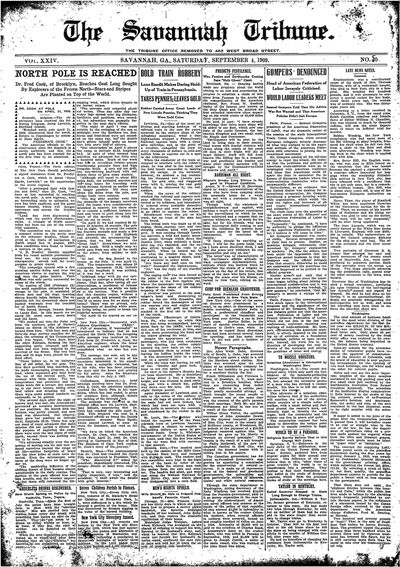
Page text (machine-generated)
The Savannah Tribune.
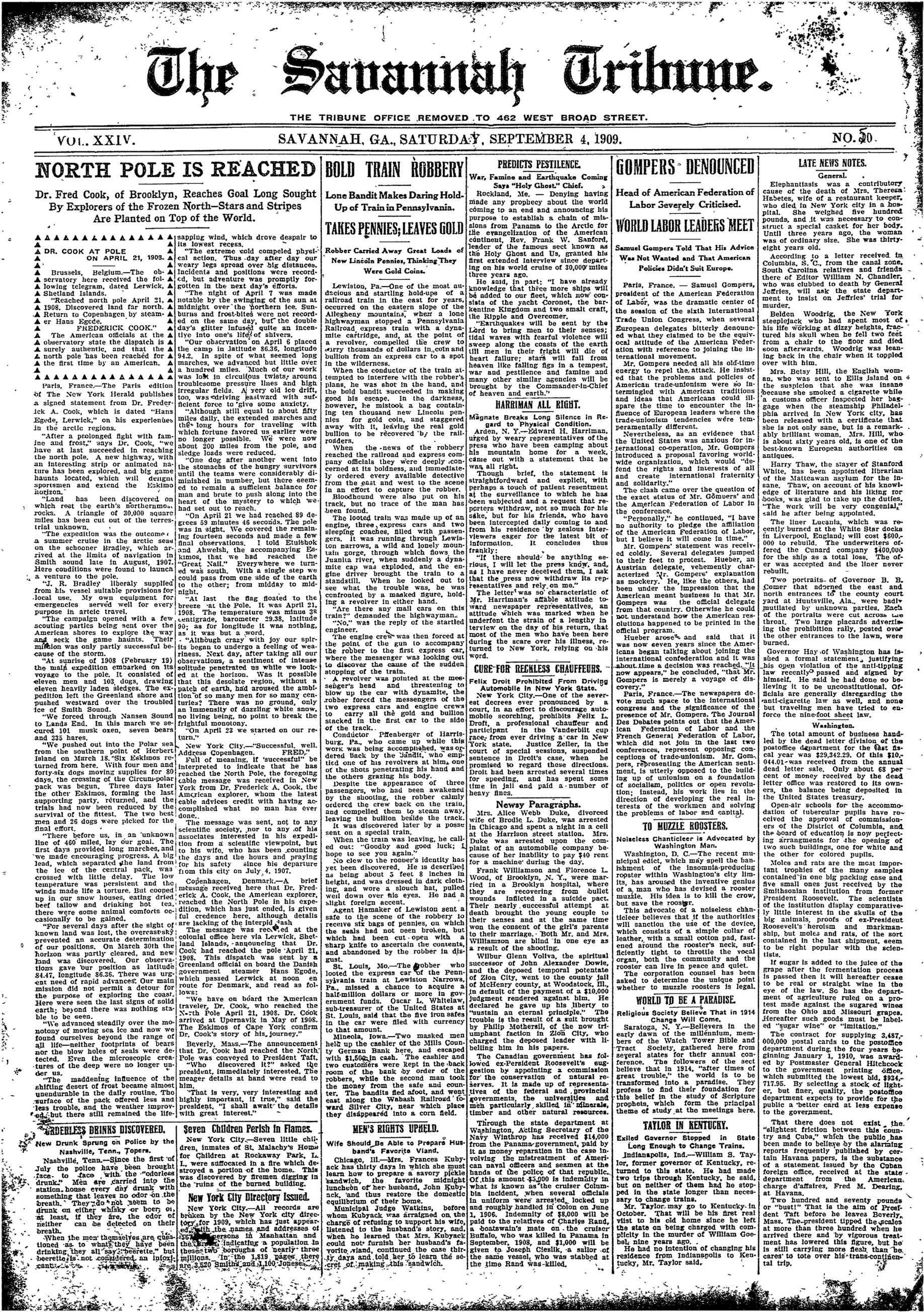
NORTH POLE IS REACHED
Dr. Fred Cook, of Brooklyn, Reaches Goal Long Sought By Explorers of the Frozen North-Stars and Stripes Are Planted on Top of the World.
VOL. XXIV.
DR. COOK AT POLE
ON APRIL 21, 1903.
Brussels, Belgium.—The observatory here received the following telegram, dated Lerwick, Shetland Islands.
"Reached north pole April 21, 1908. Discovered land far north. Return to Copenhagen by steam-er Hans Egde.
FREDERICK COOK."
The American officials at the observatory state the dispatch is surely authentic, and that the north pole has been reached for the first time by an American.
Paris, France.—The Paris edition of The New York Herald publishes a signed statement from Dr. Frederick A. Cook, which is dated "Hans Egde, Lerwick," on his experiences in the arctic regions.
"After a prolonged fight with famine and frost," says Dr. Cook, "we have at last succeeded in reaching the north pole. A new highway, with an interesting strip or animated nature has been explored, and big game haunts located, which will dengue sportsmen and extend the Eskimo horizon."
"Land has been digcovered on which rest the earth's northernmost rocks. A triangle of 30,000 square miles has been cut out of the terrestrial unknown.
"The expedition was the outcome of a summer cruise in the arctic seas on the schooner Bradley, which arrived at the limits of navigation in Smith sound late in August, 1907. Here conditions were found to launch a venture to the pole.
"J. R. Bradley liberally supplied from his vessel suitable provisions for local use. My own equipment for emergencies served well for every purpose in arctic travel."
"The campaign opened with a few scouting parties being sent over the American shores to explore the way and seek the game haunts. Their mission was only partly successful because of the storm.
"At sunrise of 1908 (February 19) the math expedition embarked on its voyage to the pole. It consisted of eleven men and 103 dogs, drawing eleven heavily laden sledges. The expedition left the Greenland shore and pushed westward over the troubled ice of Smith Sound.
"We forced through Nansen Sound to Lands End. In this march we secured 101 musk oxen, seven bears and 235 hares.
"We pushed out into the Polar sea from the southern point of Herbert Island on March 18." Six Eskimos returned from here. With four men and forty-six dogs moving supplies for 80 days, the crossing of the Circun-polar pack was begun. Three days later the other Eskimos, forming the last supporting party, returned, and the trials had now been reduced by the survival of the fittest. The two best men and 26 dogs were picked for the final effort.
"There before us, in an unknown line of 460 miles, lay our goal. The first days provided long marches, and we made encouraging progress. A big lead, which separated the land from the ice of the central pack, was crossed with little delay. The low temperature was persistent and the winds made life a torture. But cooped up in our snow houses, eating dried beef tallow and drinking hot tea, there were some animal comforts occasionally to be gained.
"For several days after the sight of known land was lost, the overcastsky prevented an accurate determination of our positions. On March 30th the horizon was partly cleared, and new land was discovered. Our observations gave our position as latitude 84.47, longitude 86.36. There was urgent need of rapid advances. Our main mission did not permit a detour for the purpose of exploring the coast. Here were seen the last signs of solid earth; beyond there was nothing stable to be seen.
"We advanced steadily over the monotony of moving sea ice and now we found ourselves beyond the range of all life—neither footprints of bears nor the blow holes of seals were detected. Even the microscopic creatures of the deep were no longer under us.
"The maddening influence of the shifting desert of frost became almost unendurable in the daily routine. The surface of the pack offered less and less trouble, and the weather improved, but there still remained the life-
ORDERLESS DRINKS DISCOVERED.
New Drunk Sprung on Police by the Nashville, Tenn., Topers.
Nashville, Tenn.-Since the first of July the police have been brought face- to face with "odorless drunk." Men are carried into the station, house every day drunk with something that leaves no odor on the breath. They do not seem to be drunk on either whisky or beer, or at least, if they are, the odor of neither can be detected on their breath.
When the men themselves are questioned as to what they have been drinking, they all say "beerette," but beerette is not considered an infolc cantr.
THE TRIBUNE OFFICE REMOVED TO 462 WEST BROAD STREET. SAVANNAH, GA. SATURDAY. SEPTEMBER 4. 1909.
sapping wind, which drove despair to its lowest recess.
"The extreme cold compelled physical action. Thus day after day our weary legs spread over big distances. Incidenta and positions were recorded, but adventure was promptly forgotten in the next day's efforts.
"The night of April 7 was made notable by the swinging of the sun at midnight over the northern ice. Sunburns and frost-bites were not recorded on the same day, but the double day's glitter infused quite an incentive into one's life of shivers.
"Our observation on April 6 placed the camp in latitude 86.36, longitude 94.2. In spite of what seemed long marches, we advanced but little over a hundred miles. Much of our work was lost in circulous twists, around troublesome pressure lines and high irregular fields. A very old ice drift, too, was driving eastward with sufficient force to give some anxiety.
"Although still equal to about fifty miles daily, the extended marches and the* long hours for travelling with which fortune favored us earlier were no longer possible. We were now about 200 miles from the pole, and sledge loads were reduced.
"One dog after another went into the stomachs of the hungry survivors until the teams were considerably diminished in number, but there seemed to remain a sufficient balance for man and brute to push along into the heart of the mystery to which we had set out to reach.
"On April 21 we had reached 89 degrees 59 minutes 46 seconds. The pole was in sight. We covered the remaining fourteen seconds and made a few observations. I told Etukshol and Ahwheel, the accompanying Eskimos, that we had reached the "Great Nall." Everywhere we turned was south. With a single step we could pass from one side of the earth to the other; from midday to midnight.
"At last the flag floated to the breeze at the Pole. It was April 21, 1908. The temperature was minus 38 centigrade, barometer 29.38, latitude 90; as for longitude it was nothing, as it was but a word.
- "Although crazy with joy our spirits began to undergo a feeling of weariness. Next day, after taking all our observations, a sentiment of intense solitude penetrated us while we looked at the horizon. Was it possible that in a region, without a touch of earth, had aroused the ambition of so many men for so many centuries? There was no ground, only an immensity of dazzling white snow, no living being, no point to break the frightful monotony.
"On April 22 we started on our return."
New York City.—"Successful, well, Address Copenhagen. FRED."
Address Copenhagen. FREED.
Full of meaning, if 'successful' be interpreted to indicate that he has reached the North Pole, the foregoing cable message was received in York from Dr. Frederick A. Cook, the new explorer, whom the latest cable devices credit with having accomplished what no man has ever done.
The message was sent, not to any scientific society, nor to any of his associates interested in his expedition from a scientific viewpoint, but to his wife, who has been counting the days and the hours and praying for his safety since his departure from this city on July 4, 1907.
Cohenhagen, Denmark. A brief message received here that Dr. Frederick A. Cook, the American explorer, reached the North Pole in his expedition, which has just ended, is given ful credence here, although details are lacking of the interpolidash
The message was recited at the colonial office here via Lerwick, Shetland Islands, announcing that Dr. Cook had reached the pole April 21, 1908. This dispatch was sent by a Greenland official on board the Danish government steamer Hans Egode, which passed Lerwick at noon en route for Denmark, and read as follows:
"We have on board the American traveler, Dr. Cook, who reached the N-th Pole April 21, 1908. Dr. Cook arrived at Upernavik in May of 1908. The Eskimos of Cape York confirm Dr. Cook's story of his journey."
Beverly, Mass.—The announcement that Dr. Cook had reached the North Pole was conveyed to President Taff, "Who discovered it?" asked the president, immediately interested. The meager details at hand were read to him.
"That is very, very interesting and highly important, if true," said the president, "I shall await the details with great interest."
Seven Children Perish In Flames.
New York City.-Seven little children, inmates of St. Malachy's Home for Children at Rockaway Park, L. I., were suffocated in a fire which destroyed a portion of the home. This was discovered by firemen digging in the ruins of the burned building.
New York City Directory Issued.
New York City.—All records are broken by the New York city directory for 1909, which has just appeared, with the names and addresses of 575 persons in Manhattan and the largest indicating a population in these two boroughs of nearly three millions. In the 1,819 pages, there are 3,520 Smiths and 1,100 Joneses.
BOLD TRAIN ROBBERY
Lone Bandit Makes Daring Hold Up of Train in Pennsylvania.
TAKES PENNIES; LEAVES GOLD
Robber Carried Away Great Loads of New Lincoln Pennies, Thinking They Were Gold Coins.
Lewiston, Pa.—One of the most audacious and startling hold-ups of a railroad train in the cast for years, occurred on the eastern slope of the Allegheny mountains, when a lone highwayman stopped a Pennsylvania Railroad express train with a dynamite cartridge, and, at the point of a revolver, compelled the crew to carry thousands of dollars in, coin and bullion from an express car to a spot in the wilderness.
When the conductor of the train attempted to intertie with the robber's plans, he was shot in the hand, and the bold bandit succeeded in making good his escape. In the darkness, however, he mistook a bag containing ten thousand new Lincoln pennies for gold coin, and staggered away with it, leaving the real gold bullion to be recovered by the railroaders.
When the news of the robbery reached the railroad and express company officials they were deeply concerned at its boldness, and immediately ordered every available detective from the east and west to the scene in an effort to capture the robber. Bloodhound were also put on his track, but no trace of the man has been found. The looted train was made up of an engine, three express cars and two sleeping coaches, filled with passengers. It was running through Lewlaton narrows, a wild and lonely mountain gorge, through which flows the Juanta river, when suddenly a dynamite cap was exploded, and the engine driver brought the car to a standstill. When he looked out to see what the trouble was, he was confronted by a masked figure, holding a revolver in either hand. "Are there any mall cars on this train?" demanded the highwayman. "No," was the reply of the startled engineer.
The engine crew was then forced at the point of the gun to accompany the robber to the first express car, where the messenger was looking out to discover the cause of the sudden stopping of the train.
A revolver was pointed at the messenger's head and threatening to blow up the car with dynamite, the robber forced the messengers of the two express cars and engine crews to carry all the gold and bullion stacked in the first car to the side of the track.
Conductor Pfefferberger of Harrisburg, Pa. who came up while this woman was being accomplished, was ordered back by the Sindft, who emptied one of his revolvers at him, one of the shots penetrating his hand and the others grazing his body.
Despite the appearance of three passengers, who had been awakened by the shooting, the robber calmly ordered the crew back on the train, and compelled them to steam away, leaving the bullion beside the track. It was discovered later by a posse sent on a special train.
When the train was leaving, he called out: "Goodbye and good luck; I hope to see you again."
No clew to the rover's identity has yet been discovered. He is described as being about 5 feet 8 inches in height, and was dressed in dark clothing, and wore a slouch hat, pulled well down over his eyes. He had a slight foreign accent.
Agent Hamaker of Lewiston sent a safe to the scene of the robbery to receive six bags of pennies, on which the seals had not been broken, but which had been cut - open with a sharp knife to ascertain the contents, and abandoned by the robber in disgust.
St. Louis, Mo.—The robber who looted the express car of the Pennsylvania train at Lewiston Narrows, Pa., missed a chance to acquire a half-million dollars or more in government funds. Oscar L. Whitelaw, sub-treasurer of the United States at St. Louis, said that the five iron safes in the car were filed with currency to that amount. Mineola, Iowa.—Two masked men held up the cashier of the Mills County German Bank here, and escaped with $1,500 in cash. The cashier and two customers were kept in the back room of the bank by order of the robbers, while the second man took the money from the safe and counter. The bandits fled afoot, and went east along the Wabash Railroad' forward Silver City, near which place they disappeared into a corn field.
MEN'S RIGHTS UPHELD.
Wife Should Be Able to Prepare Husband's Favorite Vland.
Chicago, Ill.—Mrs. Frances Kubyack has thirty days in which she must learn how to prepare a savory pickle sandwich, the favorite midnight luncheon of her husband, John Kubyack, and thus restore the domestic equilibrium of their home.
Municipal Judge Watkins, before whom Kubyack was arraigned on the charge of refusing to support his wife, listened to the husband's story, and, when he learned that Mrs. Kubyack could not furnish her husband's favorite sandwich, continued the case thirty days and told her 10 learn the secret of making this sandwich.
PREDICTS PESTILENCE
War, Famine and Earthquake Coming Says "Holy Ghost." Chief.
Says Holy Ghost Chief.
Rockland, Me. — Denying having made any prophecy about the world coming to an end and announcing his purpose to establish a chain of missions from Panama to the Arctic for the evangelization of the American continent, Rev. Frank W. Sanford, leader of the famous sect known as the Holy Ghost and Us, granted his first extended interview since departing on his world cruise of 30,000 miles three years ago.
He said, in part: "I have already learned that three more ships will be added to our fleet, which now consists of the yacht Coronet, the barkentine Kingdom and two small craft, the Ripple and Overcomer.
"Earthquakes will be sent by the Lord to bring men to their senses; tidal waves with fearful violence will sweep along the coasts of the earth till men in their fright will die of heart failure; stars will fall from heaven like falling figs in a tempest, war and pestilence and an army will plunder the monasteries will be brought by the Commander-in-Chief of heaven and earth."
HARRIMAN ALL RIGHT.
Magnate Breaks Long Silence in Re- ward to Physical Condition.
gard to Physical Condition.
Arden, N. Y.—Edward H. Harriman,
urged by weary representatives of the
press who have been camping about
his mountain home for a week,
came out with a statement that he
was all right.
Though brief, the statement is
straightfordward and explicit, with
perhaps a touch of patient resentment
at the surveillance to which he has
been subjected and a request that
reporters withdraw, not so much for his
sake, but for his friends, who have
been intercepted daily coming to and
from his residence by zealous inter-
viewers eager for the latest bit of
information. It concludes thus
frankly:
"If there should be anything serious,
I will let the press know, and,
as I have never deceived them, I ask
that the press now withdraw its
representatives and rely on me."
The letter was so characteristic of Mr. Harriman's affable attitude toward newspaper representatives, an attitude which was marked when he underfent the strain of a lengthy interview on the day of his return, that most of the men who have been here during the scare over his illness, returned to New York, relying on his word.
CURE:FOR DECKLESS CHAUFFEURS.
Felix Droit Prohibited From Driving Automobile In New York State. New York City.—One of the severest decrees ever pronounced by a court, in an effort to discourage automobile scorching, prohibits Felix L. Droft, a professional chauffeur and participant in the Vanderbilt cup race, from ever driving a car in New York state. Justice Zeller, in the special sessions suspended sentence in Droft's case, when he promised to regard those directions. Droft had been arrested several times for speeding, and has spent some time in jail and paid a number of heavy fines.
Newsv Paragraphs.
Mrs. Alice Webb Duke, divorced wife of Brodie L. Duke, was arrested in Chicago and spent a night in a cell at the Harrison street station. Mrs. Duke was arrested upon the complaint of an automobile company because of her inability to pay $40 rent for a machine during the day.
Frank Williams and Florence L. Wood, of Brooklyn, N. Y., were married in a Brooklyn hospital, where they are recovering from bullet wounds inflicted in a suicide pact. Their nearly successful attempt at death brought the young couple to their senses and at the same time won the consent of the girl's parents to their marriage. Both Mr. and Mrs. Williamson are blind in one eye as a result of the shooting.
Wilbur Glenn Vollva, the spiritual successor of John Alexander Dowle, and the deposed temporal potentate of Zion City, went to the county jail of McHenry county, at Woodstock, Ill., in default of the payment of a $10,000 judgment rendered against him. He declared he gave up his liberty to "ustain an eternal principle." The trouble is the result of a suit brought by Philip Mothersil, of the now triumphant faction in Zion City, who charged the deposed leader with libelling him in his papers.
The Canadian government has followed ex-Persident Roosevelt's suggestion by appointing a commission for the conservation of natural reserves. It is made up of representatives of the federal and provincial governments, the universities and men particularly skilled in "minarals, timber and other natural resources.
Through the state department at Washington, Acting Secretary of the Navy Winthrop has received $14,000 from the Panama-government, paid by it as money reparation in the case involving the mistreatment of American naval officers and seamen at the hands of the police of that republic. Of this amount $5,000 is indemnity in what is known as the cruiser Columbia. Incident, when several officials in uniform were arrested, locked up and roughly handled in Colon on June 1, 1906. Indemnity of $8,000 will be paid to the relatives of Charles Rand, a boatswain's mate on the cruiser Buffalo, who was killed in Panama in September, 1908, and $1,000 will be given to Joseph Cieslik, a sailor of the same vessel, who was stabbed at the time Rand was killed.
GOMPERS - DENOUNCED
Head of American Federation of Labor Severely Criticised.
WORLD LABOR LEADERS MEET
Samuel Gompers Told That His Advice Was Not Wanted and That American Policies Didn't Suit Europe.
Paris, France. — Samuel Gompers, president of the American Federation of Labor, was the dramatic center of the session of the sixth International Trade Union Congress, when several European delegates bitterly denounced what they claimed to be the equivocal attitude of the American Federation with reference to joining the international movement.
Mr. Gompers needed all his old-time energy to repel the attack. He insisted that the problems and policies of American trade-unionism were so intermingled with American traditions and ideas that Americans could ill-spare the time to encounter the influence of European leaders where the trade-unionism tendencies were temperamentally different.
Nevertheless, as an evidence that the United States was anxious for international co-operation, Mr. Gompers introduced a proposal favoring worldwide organization, which would "defend the rights and interests of all and create international fraternity and solidarity." The clash came over the question of the exact status of Mr. Gombers' and the American Federation of Labor in the conference.
"Personally," he continued, "I have no authority to pledge the affiliation of the American Federation of Labor, but I believe it will come in time."
Mr. Gompers' statement was received coldly. Several delegates jumped to their feet to protest. Hueber, an Austrian delegate, vehemently characterized Mr. Gompers' explanation as mockery. He, like the others, had been under the impression that the American meant business in that Mr. Gompers was the official delegate from that country. Otherwise he could not understand how the American resolutions happened to be printed in the official program. Otherwise, and said that it was now seven years since the Americans began talking about joining the international confederation and it was about time a decision was reached. "It now appears," he concluded, "that Mr. Gompers is merely a voyage of discovery."
Paris, France.—The newspapers devote much space to the international congress and the significance of the presence of Mr. Gompers. The Journal Des Debates points out that the American Federation of Labor and the French General Federation of Labor, which did not join in the last two conferences, represent opposing conceptions of trade-unionism. Mr. Gompers, representing the American sentiment, is utterly opposed to the building up of unionism on a foundation of socialism, politics or open revolution; instead, his work lies in the direction of developing the real interests of the workmen and solving the problems of labor and capital.
TO MUZZLE ROOSTERS.
Noiseless Chanticleer is Advocated by Washington Man.
Washington, D. C.—The recent municipal edict, which may spell the banishment of the insomnia-producing rooster within Washington's city limits, has aroused the inventive genius of a man who has devised a rooster muzzle. His idea is to kill the crow, but save the rooster.
This advocate of a noiseless chanticleer believes that if the authorities will sanction the use of the device, which consists of a simple collar of leather, with a small cotton pad, fastened around the rooster's neck, sufficiently tight to throttle the vocal organ, both the community and the rooster can live in peace and quiet.
The corporation counsel has been asked to determine the unique point whether to muzzle roosters is legal.
WORLD TO BE A PARADISE.
Religious Society Believe That in 1914 Change Will Come.
Saratoga, N. Y.-Belleyers in the early dawn of the millennium, members of the Watch Tower Bible and Tract Society, gathered here from several states for their annual conference. The followers of the sect believe that in 1914, "after times of great trouble," the world is to be transformed into a paradise. They profess to find their foundation for this belief in the study of Scripture prophets, which form the principal theme of study at the meetings here.
TAYLOR IN KENTUCKY.
Exiled Governor Stopped in State Long Enough to Change Trains.
Indianapolis, Ind.—William S. Taylor, former governor of Kentucky, returned to this state. He had made two trips through Kentucky, he said, but on neither of them had he stopped in the state longer than necessary to change trains.
Mr. Taylor may go to Kentucky in October. That will be his first real visit to his old home since he left the state on being charged with complicity in the murder of William Goebel, nine years ago.
He had no intention of changing his residence from Indianapolis to Kentucky, Mr. Taylor said.
LATE NEWS NOTES.
General.
Elephantastias was a contributory cause of the death of Mrs. Theresa Habetes, wife of a restaurant keeper, who died in New York city in a hospital. She weighed five hundred pounds, and it was necessary to construct a special casket for her body. Until three years ago, the woman was of ordinary size. She was thirty-eight years old.
According to a letter received in Columbia, S. C., from the canal zone, South Carolina relatives and friends there of Editor William N. Chandler, who was clubbed to death by General Jeffries, will ask the state department to insist on Jeffries' trial for murder.
Belden Woodrig, the New York steeplejack who had spent most of his life working at dizzy heights, fractured his skull when he fell two feet from a chair to the floor and died soon afterwards. Woodrig was leaning back in the chair when it toppled over with him.
Mrs. Betty Hill, the English woman, who was sent to Ellis island on the suspicion that she was insane because she smoked a cigarette while a customa officer inspected her baggage when the steamship Philadelphia arrived in New York city, has been released with a certificate that she is not only sane, but is a remarkably brilliant woman. Mrs. Hill, who is about sixty years old, is one of the best-known European authorities on antiques.
Harry Thaw, the stayer of Stanford White, has been appointed librarian of the Matteawan asylum for the insane. Thaw, on account of his knowledge of literature and his liking for books, was glad to take up the duties. "The work will be very congenial," said he after being appointed.
The liner Lucanla, which was recently burned at the White Star docks in Liverpool, England; will cost $600,000 to rebuild. The underwriters offered the Cunard company $400,000 for the ship as a total loss. The offer was accepted and the liner never rebuilt.
Two portraits of Governor B. B. Comer that adorned the east and north entrances to the county court yard at Huntsville, Ala., were badly mutilated by unknown parties. Each of the portraits were cut across the throat. Two large placards advertising the prohibition rally, posted over the other entrances to the lawn, were burned.
Governor Hay of Washington has issued a formal statement, justifying his open violation of the anti-tipping law recently passed and signed by himself. He said he had done so believing it to be unconstitutional. Officials are generally disregarding the anti-cigarette law as well, and none but traveling men have tried to enforce the nine-foot sheet law.
Washington.
The total amount of business handled by the dead letter division of the postoffice department for the last fiscal year was $29,324.29. Of this $10-044.01 was received from the annual dead letter sale. Only about 68 percent of money received by the dead letter office was restored to its owners, the balance being deposited in the United States treasury.
Open-air schools for the accommodation of tubercular pupils have received the approval of commissioners of the District of Columbia, and the board of education is now perfecting arrangements for the opening of two such buildings, one for white and the other for colored pupils.
Moles and rats are the most important trophies of the many samples contained in one big packing case and five small ones just received by the Smithsonian institution from former President Roosevelt. The scientists of the institution display comparatively little interest in the skulls of the big animals, proofs of ex-President Roosevelt's heroism and markmanship, but moles and rats, of the sort contained in the last shipment, seem to be right popular with the scientists.
If sugar is added to the juice of the grape after the fermentation process is passed then it will hereafter cease to be real or straight wine in the eye of the law. Sc has the department of agriculture ruled on a protest made against the sugared wines from the Ohio and Missouri grapes. Hereafter such goods must be labeled "sugar wine" or "imitation."
The contract for supplying 3,457,000,000 postal cards to the postoffice department during the four years beginning January 1, 1910, was awarded by Postmaster General Hitchcock to the government printing office, which submitted the lowest bid, $824,717.95. By selecting a stock of lighter, but finer, quality, the postoffice department expects to provide for the public a better card at less expense to the government.
That there does not exist the "almostest friction between this country and Cuba," which the public has been made to believe by the alarming reports frequently published by certain Havana papers, is the substance of a statement issued by the Cuban foreign office, received at the state department from the American charge d'affaires, Fred M. Dearing, at Havana.
Two hundred and seventy pounds or "bust!" That is the aim of Prefident Taft before he leaves Boverly, Mass. The-president tipped the scales at more than three hundred when he arrived there and by vigorous treatment has lowered this figure, but he is still carrying more flesh than he cares to tote over his trans-continental trip.
P. EDWARD PERRY, Vice President.enty Aid and ON, Supt. of Ageno
SOL. C. JOHNSON, Supt. of Ageno
Treasury of State of Georgia
The undistinguished Treasure of the State of Georgia, hereby admonishing it howsoever received from the following described Savings:
Dear Regina and Pamela of Georgia, by authority and under the provisions of an Act of the Assembly, approved October 22d, 1887, and amended 20th, 1897.
R. E. Pan
Treasurer of the State of Georgia
The Ex-Sultan ===
His Good Side
By Sydney Brooks
Georgia hereby acknowledges
described in wwwl:
L. E. Williams.
P. Edward Perry.
Walter S. Scott.
Sel. O. Johnson.
This company requires of the that the strict in
its affairs are of character and ree
community. The fairs of the first themselves with
By comparing of liberal inducement
pany in this busi
That we pay o
and which are held by the State
isions of an Act of the General
and amended December
P. E. Parsi.
The undersigned Treasure of the State of Georgia, hereby acknowledges
to have received from the Secretary of Dawson, in the following described sums, would:
Dear Regent and Procurator of the State of Georgia,
Ellen T. Gorgeson (Congressman Dawson)
17th of October, 1920,
account, due 1920.
L. E. Williams.
F. Edward Perry.
Walter S. Scott.
Bol. C. Johnson.
long or total Ten Thousand Dollars, and which are held by the Rates of Bengal by authority and under the provisions of an Act of the General Assembly, approved October 22d, 1887, and amended December 20th, 1889.
R. E. Parsi
Treasurer of the State of Georgia.
P. B. RAY,
DRY AND STEAM CLEANING.
LADIES' WORK A SPECIALTY.
HATS CLEANED AND REBLOCKED
BELL PHONE 2050.
JEFFERSON AND BERRIEN ST8.
SAVANNAH, GA.
O far from being in himself a cruel man, the testimony of all observers agrees in depicting Abdul Hamid as absolutely the reverse. "There is in Abdul Hamid," wrote a former Servian minister who knew him intimately. "a peculiar modesty, timidity and tenderness which are. quite womanly. He always looks earnest, almost sad, as if he were subdued by the consciousness of his great responsibilities. He smiles quietly, almost sadly, very often, but he hardly ever laughs loudly. He is distinctly a man of aesthetic taste.
S
W. H. LLOYD.
—Dealer In—
GROCERIES, WOOD AND COAL,
621 Oglethorpe Avenue, East.
518----PHONES----Bell 40
He is fond of flowers, of beautiful women, of fine horses, of lovely views of sea and land, of everything that is beautiful. He is an affectionate father. He can be, and is, a devoted friend to his friends. He is able to contract deep and faithful friendships. He is considerate, modest, charitable, and patient. His consciousness of his responsibility toward God makes him hesitate to punish any one severely. Certainly he was never carried away by impulsiveness. He even exaggerates in his desire to consider every question from all points. He is slow; often much too slow for the nervous and impatient sons of the West. Terribly earnest as he is and so sensitive to everything touching his personal dignity, he has much of quiet humor in him. He quickly perceives the comic feature in things and men, and in a peculiar quiet way enjoys it. His skies are generally and almost permanently covered by clouds of state anxieties and personal melancholy. But from time to time, and most unexpectedly these clouds are pierced by the sunny rays of a mild humor. Personally I could never detect in his character even the shadow of cruelty."—Harper's Weekly.
Regalias.
LODGE SEALS,
FINANCIAL CARDS and
BLANKS of every description.
Publshers' and Manufacturers' Prices
Liberal Discounts Will Be Arranged.
SOL. C. JOHNSON,
Savannah, Ga.
The Marvellous "Handy Man"
By Eugene Wood
SOL. C. JOHNSON Notary Public.
Deeds, Contracts, Wills and Other Legal Forms Prepared and Attested.
OU know the Handy Man, don't you? the fellow that makes his own fly-screens, and they fit; that knows how to give the cow castor oil, for she won't take it from a spoon like a person; that rigs up a reel for his lawn hose instead of hanging it on a hook to spring a leak; that lays his own cement walk and steps, the steps just a little out of gee, but look how little it all cost him; that builds his own mission furniture which has to be moved with a pry when they sweep; that paints everything about his place that
115 West St Julian Street
People pause to watch John Taber paint a sign whenever they get a chance. Of course there's a certain fascination about ever a common 6% sign painter at work, but this interest is increased a hundredfold when John Taber is the man on the sign painting job.
paint will stick to; that takes his clock apart to clean it instead of sousing the works into gasoline the way the fellow does that comes around to the house; that can fix the doorbell when it won't ring, and has all the locks and hinges on the place so that they pretty near work of themselves. You know the Handy Man, don't you? Well, I don't like him. I repeat I don't like the Handy Man at all. But you understand as well as I do that all my mockery of him has been an effort to get revenge for all his mockery of me and my thumbhandedness. In my heart of hearts I must own up that all our present high estate is from his handicraft.
He is one of the few ambidextrous sign painters in the business. He can paint with equal artistic effect whether it's his right or his left hand that he's using. When he gers tired using one hand he uses the other.
The erected man must first have hands that could relieve the jaws from holding things ere ever the wide-stretching mouth could shorten and contract enough to form the sounds of speech. No story writer has ever dared to make his castaway on a desert island as naked and empty-handed as were our far-off ancestors when they landed on this planet, not a penny in their pockets, and no pockets. Ready to perish were our fathers, and all the way along, from the first flaking of a flint to give it a cutting edge, to this day in which the yielding air has finally made a solid pathway for our travel, it has been the skillful hand that has created for us a world to live in—the hand of the Handy Man—Hampton's Magazine.
Sometimes when he's hurried he uses both at once, and the fact that he's dividing his attention between the two doesn't cut down the quality of his workmanship in the least.
---
and Relief Society
HOME OFFICE
WEST BROAD STREET,
SAVANNAH, GEORGIA.
Phone 1198. Ga. Phone 2029.
Directors.
W. R. Fields. W. H. Burgess.
J. H. Deveaux J. H. Bugg, M. D.
L. M. Pollard. J. M. Ferrebee.
Many is duly chartered under the laws of the State of Georgia, and has complied with all re-
quirement of the State Insurance department, therefore all policy holders are protected with all the safeguards
direct insurance laws of this State seek to protect its citizens.
Are directed and managed by Negro men of the city of Savannah of leading standing, and whose
reputation are of such as to command the respect and confidence of all the people of that
State. The same men that manage this Society are the ones that organized and are conducting the af-
firm successful Negro Savings Bank in this state, therefore we can readily see that by connecting
with this Insurance company their interest will be in safe hands.
Using our rules and benefits with other first class companies it will be seen that we offer the most
elements with the largest sick, accident and death benefits to our members than any other com-
business.
May our claims promptly can be testified to by the thousands of our satisfied members.
Gents Wanted
Everywhere
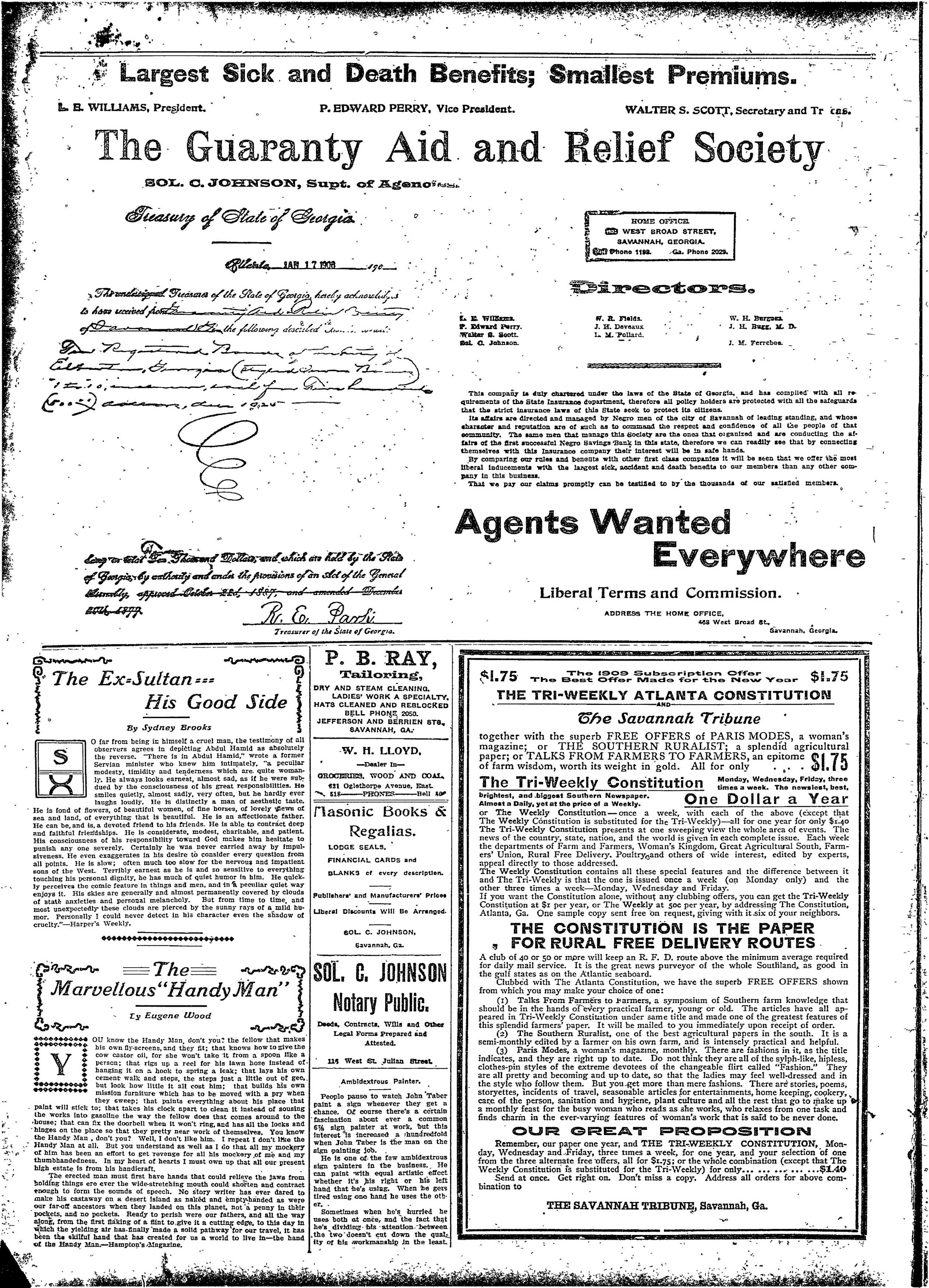
This company is duly chartered under the laws of the State of Georgia, and has complied with all requirements of the State Insurance department, therefore all policy holders are protected with all the safeguards that the strict insurance laws of this State seek to protect its citizens.
Its affairs are directed and managed by Negro men of the city of Savannah of leading standing, and whose character and reputation are of such as to command the respect and confidence of all the people of that community. The same men that manage this Society are the ones that organized and are conducting the affairs of the first successful Negro Savings Bank in this state, therefore we can readily see that by connecting themselves with this Insurance company their interest will be in safe hands.
By comparing our rules and benefits with other first class companies it will be seen that we offer the most liberal inducements with the largest sick, accident and death benefits to our members than any other company in this business.
That we pay our claims promptly can be testified to by the thousands of our satisfied members.
Liberal Terms and Commission.
ADDRESS THE HOME OFFICE,
468 West Broad St.
Gavannah, Georgia.
5 The 1909 Subscription Offer
The Best Offer Made for the New Year $1.75
HE TRI-WEEKLY ATLANTA CONSTITUTION
AND
The Savannah Tribune
with the superb FREE OFFERS of PARIS MODES, a woman's
cine; or THE SOUTHERN RURALIST; a splendid agricultural
cine; or TALKS FROM FARMERS TO FARMERS, an epitome
from wisdom, worth its weight in gold. All for only $1.75
The Tri-Weekly Constitution
Monday, Wednesday, Friday, three
times a week. The newsiest, best,
best, and biggest Southern Newspaper.
A Daily, yet at the price of a Weekly.
One Dollar a Year
The Weekly Constitution—once a week, with each of the above (except that
Weekly Constitution is substituted for the Tri-Weekly)—all for one year for only $1.40
Tri-Weekly Constitution presents at one sweeping view the whole area of events. The
of the country, state, nation, and the world is given in each complete issue. Each week
departments of Farm and Farmers, Woman's Kingdom, Great Agricultural South, Farm-
ation, Rural Free Delivery. Poultry and others of wide interest, edited by experts,
directly to those addressed.
Weekly Constitution contains all these special features and the difference between it
the Tri-Weekly is that the one is issued once a week (on Monday only) and the
three times a week—Monday, Wednesday and Friday.
We want the Constitution alone, without any clubbing offers, you can get the Tri-Weekly
Constitution at $1 per year, or The Weekly at 50c per year, by addressing The Constitution,
Ga. One sample copy sent free on request, giving with it six of your neighbors.
THE CONSTITUTION IS THE PAPER
FOR RURAL FREE DELIVERY ROUTES
of 40 or 50 or more will keep an R. F. D. route above the minimum average required
by mail service. It is the great news purveyor of the whole Southland, as good in
states as on the Atlantic seaboard.
Subbed with The Atlanta Constitution, we have the superb FREE OFFERS shown
which you may make your choice of one:
Talks From Farmers to Farmers, a symposium of Southern farm knowledge that
be in the hands of every practical farmer, young or old. The articles have all ap-
pointed Tri-Weekly Constitution under same title and made one of the greatest features of
endid farmers' paper. It will be mailed to you immediately upon receipt of order.
The Southern Ruralist, one of the best agricultural papers in the south. It is a
monthly edited by a farmer on his own farm, and is intensely practical and helpful.
Paris Modes, a woman's magazine, monthly. There are fashions in it, as the title
es, and they are right up to date. Do not think they are all of the sylph-like, hipless,
spin styles of the extreme devotees of the changeable flirt called "Fashion." They
pretty and becoming and up to date, so that the ladies may feel well-dressed and in
who follow them. But you get more than mere fashions. There are stories, poems,
tales, incidents of travel, seasonable articles for entertainments, home keeping, cookery,
the person, sanitation and hygiene, plant culture and all the rest that go to make up
only feast for the busy woman who reads as she works, who relaxes from one task and
charm in the ever-varying features of woman's work that is said to be never done.
together with the superb FREE OFFERS of PARIS MODES, a woman's magazine; or THE SOUTHERN RURALIST; a splendid agricultural paper; or TALKS FROM FARMERS TO FARMERS, an epitome of farm wisdom, worth its weight in gold. All for only $1.75
or The Weekly Constitution once a week, with each of the above (except that The Weekly Constitution is substituted for the Tri-Weekly) all for one year for only $1.40 The Tri-Weekly Constitution presents at one sweeping view the whole area of events. The news of the country, state, nation, and the world is given in each complete issue. Each week the departments of Farm and Farmers, Woman's Kingdom, Great Agricultural South, Farmers' Union, Rural Free Delivery. Poultry and others of wide interest, edited by experts, appeal directly to those addressed. The Weekly Constitution contains all these special features and the difference between it and The Tri-Weekly is that the one is issued once a week (on Monday only) and the other three times a week—Monday, Wednesday and Friday.
If you want the Constitution alone, without any clubbing offers, you can get the Tri-Weekly Constitution at $1 per year, or The Weekly at 50c per year, by addressing The Constitution, Atlanta, Ga. One sample copy sent free on request, giving with it six of your neighbors.
THE CONSTITUTION IS THE PAPER FOR RURAL FREE DELIVERY ROUTES
A club of 40 or 50 or more will keep an R. F. D. route above the minimum average required for daily mail service. It is the great news purveyor of the whole Southiland, as good in the gulf states as on the Atlantic seaboard.
Clubbed with The Atlanta Constitution, we have the superb FREE OFFERS shown from which you may make your choice of one:
(1) Talks From Farmers to Farmers, a symposium of Southern farm knowledge that should be in the hands of every practical farmer, young or old. The articles have all appeared in Tri-Weekly Constitution under same title and made one of the greatest features of this splendid farmers' paper. It will be mailed to you immediately upon receipt of order.
(2) The Southern Ruralist, one of the best agricultural papers in the south. It is a semi-monthly edited by a farmer on his own farm, and is intensely practical and helpful.
(2) The Southern Kuralist, one of the best agricultural papers in the south. It is a semi-monthly edited by a farmer on his own farm, and is intensely practical and helpful. (3) Paris Modes, a woman's magazine, monthly. There are fashions in it, as the title indicates, and they are right up to date. Do not think they are all of the sylph-like, hipless, clothes-pin styles of the extreme devotees of the changeable flirt called "Fashion." They are all pretty and becoming and up to date, so that the ladies may feel well-dressed and in the style who follow them. But you get more than mere fashions. There are stories, poems, storyettes, incidents of travel, seasonable articles for entertainments, home keeping, cookery, care of the person, sanitation and hygiene, plant culture and all the rest that go to make up a monthly feast for the busy woman who reads as she works, who relaxes from one task and finds charm in the ever-varying features of woman's work that is said to be never done.
OUR GREAT PROPOSITION
member, our paper one year, and THE TRI-WEEKLY CONSTITUTION, Mon- Wednesday and Friday, three times a week, for one year, and your selection of one three alternate free offers, all for $1.75; or the whole combination (except that The Constitution is substituted for the Tri-Weekly) for only..... $1.40 and at once. Get right on. Don't miss a copy. Address all orders for above com-
Remember, our paper one year, and THE TRI-WEEKLY CONSTITUTION, Monday, Wednesday and Friday, three times a week, for one year, and your selection of one from the three alternate free offers, all for $1.75; or the whole combination (except that The Weekly Constitution is substituted for the Tri-Weekly) for only... $1.40
Send at once. Get right on. Don't miss a copy. Address all orders for above combination to
THE SAVANNAH TRIBUNE, Savannah, Ga.
tavoreriw
a
« 3
he 1
we wd
A gh nl
"oan 4
. 4
wl |
ae “2
ye flees I
va
. he -
Bonen
2aQiee,
PEST
re i
aei3
Ss
3
_00goee:
SYACKSON'S RACE FOR THE YELLOWSTONE,
Hee ee eee eee eee ee eee eee CESS EO
._ -In.those days—it was In the year
1840-—whisky was the great factor
{sh the Indian trade,’ in spite cf the
‘act Spasseds by Congress making its
-usé, “or éven its Importation into the
‘Andian country, Wesel. In one way
‘or another {t was smuggled past the
Inspectors to the various posts, where
dt was doled out to the trappers, red
‘or white, at fabulous prices.
Silas Jackson was a fur-trapper of
the better sort. He néver touched
liquor or spent his earnings in any
of-the many ways which kept his as-
soclates penniless, if not In debt. He
‘was ambitious and frugal, and he
carried’ in his mind a picture of a
“plue-grass"” farm in a certain Ken-
stucky county, where some day he
imeant to raise blooded horses and go
to church on a Sunday in blue broad-
cloth with silver buttons.
SInce he lived straight, he was a
man of vigor and the swallow-tailed
kite was not much keener of sight.
‘The othér trappers called him lucky
‘because he went and came without
tosing a pelt or a pack and had never
had a brush with the Indians. It
was not luck, howover, that served
him so well, but sound judgment,
clear eyes and an unlmpaired body.
Even when the Blackfeet, a hostile
enough tribe when they were sup-
posed to be at peace with the whites,
openly waved the hatchet, Jackson
managed to cross their country twice
without being seen, On the third
time, however, as he was returning
trom Fort Union for the spring trap-
ping, an incident happened which
had an important bearing on the most
thrilling adventure of his life.
He was in a region thickly studded
with buttes, Three or four thin col-
‘uumns of smoke had warned him that
there were Blackfeet near, so he trav-
eled with the greatest caution. He
stepped so nolselessly that he almost
ran into a Blackfoot scout, who ‘vas
stretched on the ground at the foot
of a tall, streaked butte, drinking
from a tiny spring-hole.
‘Tho Indian had not heard him. He
Jay’ drinking greedily, with his bow
by his side, completely at Jackson's
mercy. The trapper stood motion-
less, thinking hard. He knew that
ninety-nine men out of a hundred
would have Killed the Blackfoot as
he lay. The relentless et files of In-
dian warfare did not recognize Inde-
cision or compassion. It was a case
of kill oF fly at sight on both sides
and it was too late for Jackson to fly.
Somehow he could not bring him-
self to slay the scont in cold blood,
Well as he knew the Indian would
_not have hesitated to shoot him in
the back if the chance had offered.
But it was necessary to insure his
own safety in some way.
So, drawing a full breath, he sud-
-denly sprang upon the prostrate fig-
hike, ‘and seizing the Blackfoot’s right
‘atm, ‘drew it forcibly backward. At
the same time he struck him a pow-
erful blow in the neck. ‘
‘The Blackfoot let out a cry that
was smothered by the water at his
lps. ‘The breath was knocked out of
him by the force with which Jack-
son's knees landed in the small of
his back, and the violent blow on his
netk further dazed him. Probably
he did not know at first what had at-
tacked him, whether {t was a man or
‘Some wild animal; but he was not
Jong in dqubt, Rallying his scattered
senses, he began to heave and strug-
gle frantically; but Jackson was
much the more powerful of the two,
and he had the frightened Indian at
pvdisadvantage, besides. In a few
minutes he had the scout’s hands
drawn dehind his back and bound
‘with.a spare bowstring from his own
qutyer,?
.khen Jackson let him ap, and the
Yet faced each other, panting. Al:
gough his legs were free, the Black-
foot made no attempt to. run away.
His respect for the trapper’s long
wifleg kept him motionless, but he
glared through his war-paint at Jack-
son, ready to meet death as became
a Blackfoot warrior,
Jackson guessed bis thought and
shook his head.
“No,” he sald, in the other's
tongue, “I’m not gomg td kill you.
Perhaps I'm a fool, but trapping
‘beaver and not shooting people Is my
‘Vaxiness. You let me alone and I'l!
let you alone. Understand?”
The Blackfoot apyarently could
not. That this solitary white man
sould ishow mercy to 2 scout in the
enemy's country seemed against all
Cid snles 66 waifacs. ona” eamcounc
ee eR eee mteshepce sited Tes 3°t2I 4
3 Me a THE OLD DOE! “aes een nO
TiLUs ohe, litte ong, open yourarms,, et) oT et yn de
“Now ar your wisher come true, cobie true? «+ wet tt vei
Hire ja a love witha thousand charms, | 21! sin. 1 ba me
nd seel, she is react ni Yyouls, cof ae) eames
Pat the old doll by, asleep 18 here, aie ne
‘And open your afms te welcome the mew. 7), wens
Little one, little one, play your aweet part,’ '* # vend |
“Motheriove lavishes (Rasurerumldg 7 PET. Teuel
Whisper fonds words, and close to.youe beast,” | ert
‘Your warm little heart, the neve idol enfold.=.; . ail, wt
(Tis so with us all—to worship we fall a = nat |
Before the new shrine, forgetting the ol@!) ay | fat vit!
Little one, little one, wherefore that sigh? 7 a aoe ‘
feary of in ¢ lot rough? ee bes
But there's gomething that looks like s tear in-sour eye, “fet a.
‘And your lips—why, your lips ore quivering, tool cwied
Da,t peas AcEnet Te & coming iphe . ieee et
‘And you ery for the old—souare tired of the new? | YAM
Little one, little one, old loves cre best; # *
‘And the heart still clings, though the handa'loose their hold!
‘Take the old doll back, iu Four arma she shall rest, yo
‘When you wander away to the dreamland fold. 7
(With all, even so—ere to Meep Te diy ee COA
‘The wavering heart wavers bark to the old!) "spa, 5
“Edith M. ‘Thomas, m American Homé'Monthly-
By ROBERT DORRIMAN.
sense. It was some' trick. His eye
gleamed secrntully. ies
Jaeksun walked up to biti, and put
a firger on his bare chest.!/
“’'m not going to kill you,’s He re-
peated, “or any, of your people—if
you let me alone. I'm Soe “away
off, out of your country.” ‘He pointed
‘toward the north, “Will you let me
B02" a aoa
‘The Blackfoot stared at him, and
‘the grim Mines fn his face gradually
relaxed. ax ©
“You go!" he grunted. .
“All right,” said Jackson, “‘I‘ll
trust to the word of a chfefy’t and he
walked away without a backward
Jook, :
He had plenty of backward-flying
thoughts, however. Would thé
Blackfoot repay good with evil?
How near was the band for which he
had been scouting? Would they be
down on his trafl the next day? Wor-
ried by these thoughts Jackson trav-
eled fast all that might, and spent
the next day hidden in a cup-like
hollow on the: summit of a small
butte, @ position which, defended by
is long, rifle, would have cost the
Blackfeet dear to take. * '
No Indians Game in sight, and the
following night Jackson took up tha
trail again with new courage. He
did not change bis mode of trav-
eling, however, until he had put
sixty miles bebiad him. A few more
days saw him out of the Blackfoot
He was always wounding their feelings, making sarcastic, .
or furny remarks at their expense. ° x uo :
He was cold and reserved'in his manner cranky, Zloorsy,
Pessimistic. » fo ait tip ytd!
He did not realize that friendshlp will not thrive on.seatl,,«|
ment alone; that there must be seryice to nojirish'tt.'" 9) 2 775)
He did’ not knew the value of thoughttulness “milttts 7!
things. 2 vee atl hae veal
He borrowed money from (hum, ‘ rout ay
‘He was not loyal ta them: : See ny
-He never hesitated to saérifice their reputation-for his «|
advantage. + a . Be elbeas mn bd
He was-always saying mean things aboiut them in, thely, *,
absence. eden
He measured them by’ ‘their ability to’ advarice him‘ |
—Suecess ced eee 1° ei
territory and in a compartively safe
country. 7
‘When spring. was over and the
Belts had begun to grow poor, Jack-
son began bis long march back to
Fort Union. -His pack of prime bea;
ver madé him specially anzious to
avold an encounter with the Black-
fect; but in splte of every precau”
tlon, he thet a band of them. just a’
he had begun to think the dangér
was past,
Fortunately the Blackfeet were not
mounted. They were a capocing
party that had stopped tq reste and
gat in the’ shade of ‘aj pad, Gal the
Yellowstone River. Jacksoniind the
scout posted on top of the bank saw
each other at the same instant, and
the trapper halted just long enough
to make sure that the odds against
him ‘were toa big to warrant any
show of resistance. Then he took to
his heels, running, quartering away
from the river.
‘The Blackfeet, fitteen strong, burst
through the buffalo bushes that
edged the bluff and swept after him,
howling lke wolves. - 3 ;
Jackson knew himself well enough
to be sure that no matter how swift
the Blackfeet, he could make a stern
chase a long one. He bad never met
a trapper who could outrun him, and
he ‘had entered many a foot-raca-dur-
ing the wild spring and fall gather-
ings.at the.fort. So instead et:hreak;
ing into a frantle pace gt the outset
he settled down to a tong, galculated
stride. that, wold elft! up ydistance
without greatly tiring him, He knew
that he would have to run with hit
shead as well as his feet. _ U
‘The Indians, on the contrary,
came’Gn at first at full speed, hoping
to run the trapper ddwn within 2 few
hundred yards. To, fr im Into
breakifg his Siotae tae aoa vo},
leys of’ whogps and discharged a num:
ber of arrows as they ran; but nat?
yrally thelr alm was poor, and pres.
ently they began to save both thelr
breath and thelr weapons. They sa
that they had no timid gréénhorn o
deal with) -eivd + 397 4
%. The ground was good for running,
with only an occasional low, wave-
Uke swell:té break its. level, ‘The
summey sun pad: bnyned,.thd short
grass so that it was like a wiry tat
underfoot, But racing for one’s life
Why He Lost’ His Friends.
Soveecoeec ceosesoeoeeces«é CeOSGOOCSSSeCodecGas |
EET TT A ETE TN" SES | NRRL a SLIMRLRNAT ON Gee eS NA
ig Gitterentgtiim “Asin At tof} sport!
FAgriwI johdateoydawpyter.b svhile,
ae ih greet ear spinal
Be Go) araaplicti. «leh ses
PERE us 68 SPARE Sie andrea
nide"Jheksou “was, forced’ t6 Atop hts
Brceidis" pack’ Boon "ating
CHET vawayHNwertne andlinis: deers
Sin fadxots 2d5 05+ se) 2 tue
yifThe ‘pratrie “ahead tof bimioras as
smoot, as. & floory Jackson sould
84a. Reuraviee fer buttaste Styecbim :
moment of,refuge. . He looked baci
Jovan ls cahpulder. jie. ie jeteet
wre ‘gtrdig dut in adtlog deb cf him;
solng ‘bvidentry’ ltt eal ''Hat Halt
2 {ddtele were ‘Minniig strodgiy? and
had speed to-spare: It-was apphrent
thati!theycwere! confident of+thetr
ability to tire him out. tu)
Now the real race began. With
his, hands clene! nd, .hezd, back,
peers Bet hi
SpieR SHO BAS Dyas Fader NG
feet, and WHérs:itPwas long, partéd
with a ehorp tdaring'zound! Lgatust
his ankles! Alea’: of blinnduidenty)
aprairle-dog porined {btpthis burrows
then he, saw,8, npmbst of little, tails
whisk ouk,pf sight, and hfs, heart
swelled with fear. Logs a
A stumble Would mean “his'‘death;
warrant, ‘but he did not/daré to ipake
a detour round the “town?” ‘it was
togiwide. ' + Be z
He dashed into tt, feeling thi
ground roughe® under his feet, arid
swaying utisteadily as he ran over
|the ttle mounds.,, The. sweat of
fright, poured down his lean brown
taco and at every step bis muscles
cringed lest his foot'shoufd strike
gne of the‘ burrows. ‘
«The “town” ‘was a quarter of a
iuilg wide, and Jackson was jarred
and alarmingly fatigued when he
.struck smooth ground again, A back-
ward’ 100k’ showed him that some of
the Blackfeet were out of thé ‘race,
-but that those in the léad were hear-
er to kim than before. ‘The: leading
Indian halted at, that instant,, and
discharged an arrow, which, sang
over Jackson's shoulder, but it was
almast.spent. At least, he was prac-
tically out of range. :
He began to fear, ‘however, that he
was losing #round, at every stride.
His strength, t20, was goimg. There
was a pain itke from a knife thrust
under his ribs, and his lungs were
hot and seared, The,buoyancy of
his body hdd gone. Every step
jarred him and racked his aching
head. A Nght, salty foam gathered
on-his ips, yet his mouth was burn-
dng-dry. ¢
There was no refuge onthe mer-
llessly bare :prairie, and desperately
Jhe changed ‘his ‘course toward the
Yellowstone, If he could reach It,
he was resolved’ to drown himself
Father than fall into the hands of the
Blackfeet. But could he reach it?
Fils’ eyes’ Were 'go sidzéy dnd cop-
gested "that fhe ‘couja -not-distingwish
the buffalo bushes alévg-the bank;
but hé knev in which @irection’ thd
river lay, and he tolled, sobbing .for
breath, his nose clogged ,with tritk-
Ung blood, |p thy
He was syaying like a, drunken
dm when ‘hb fait the stfit‘ bushes
Ebout his knees. Beneath him rolled
the ‘brown river, ‘éimplell’ by :the
breoze, and ‘ducking’ and swirling
rourid a great janmt af: driftwood
wedged between a sandbat«and the
shore. Ta be
Jackson fell headlong dow the
sloping bank, his face striking amons
the wet stones. * ‘The dhili of the water
révived ‘him, ‘He sctdmpled forward
on His hands-abé:/knées ‘into “the
river. The:-dani offer2d him a last
‘haven, and fortunately ther ivater.dtd
met, reach ahove his waist, He was
£00, spent to swim a stroke, but stas-
gering ang slipping, he managed to
wade the gap and crawled Under the
jumbled’ ‘nitiss of timber ike’ a
wounded muskrat. e
Stooping so that only his head was
above water; he wormed his way: to-
tward the heart bf the jum just as the
leading Blackfeet Jeapeg down. the
bank, For, p,,faw moments “they
stood, there, :talkjng i2 low ‘tones;
then Jackson Beard ‘thé ‘water ripple
and splasit'as tne Wade out toward
the Jam, , spread
PEARY, amas WP siikre
and 7the7 Whotel Haikt Békair ‘fo wall
sound Bands gtr stheritgass of inter-
laced ,fimbers, thrusting down p los
ora, OG WE olaird Lae’ pebsie
Hthrowgh the Interstites.s.\Sttie ‘with
dread, Jackson croubhed up tox tits
|throat jn the water, waiting for the
atscovely fre ¥élt stifa*thtist' conie.
+ Suddenly the -tightthat= nitésba
down, tim.aboug. was eut,off,, Iack-
fo ie, £00 ‘firmly, wedged tn , to
overtbiventhk ‘hilt Hia"neaal "ie
Jooked ¢apxand unet“thb" gazé tof! a
Blackfoot across whose face a,Jook
of savage triumph flashed and whose
barter Nps seguedasbaetonitler 3
bizthleawhoop. 711 Bathuiateddlll he
glared silently ‘at Jackson, and.@ nop-
filcting series, of expreesio assed
Serose iis -paldted ls, AER.
nolbéleddly: 42 hf had come, he glided
pte" at
Tt was the Blackfoot Jackson had
taptiited ‘and, bet freg’ that’ spring.
Whé recogaltion fad been mutual, but
Jackson hardly.dared to hope forthe
same: mercy: that he -had shown the
warrior, In an agony of apprehen-
sion he waited andlistened.
1 By and by he hédrd voices and
feduld ‘even distinguish a tew words.
Pome ne Was saying that the ‘iyer
‘myéljhave drunk up the white,nian .
wT this ithe others apparently
agteed.s; There was a, short parley,
‘followed by the sound of bodies mov-
‘ing through the water, and then ai-
lence, ex¢ppt forthe light Japnitis of
the current against the jam. *
Still, Jackson did not dare to move.
or Bi¢hbur bé-abstenc4. teartaly:
Ddiit-onlp"tte''natiral notses of the
river, watentd bé heafd, ‘Unidle to
stand the chill of the -water!‘any
joneer, whe worked,.his way‘to the
edge jog the jam, and looked:out. The
bank was deserted,, and wading
aaliore, be climbed the, ttle” biutt,
‘The’! Bikekfdet had d{sappeared:—
‘Youth's Companton. sito
, Another's Mission.”
- By 'W. T. CHILDS.
A little messenger boy, dripping
with perspiration “and covered with
heust, stepped up to the paying tell-
evstwindows af due of the larger
banks in the city, and sald: “Please,
sir, give me nickels:for this?”
The teller simply raised his eyes
and ptished back the $10 bill. The
messenger boy: thought he had not
been heard and repeated his request.
“No!" snapped the paying teller.
The messenger boy was so fright-
ened that he almost forgot his mls-
sion. He meekly picked up the $10
bill from the counter and returned to
his employer's office.
“Well, where aro the nickels?” his
employer asked, .
“He wouldn’t give them to me!”
answered the boy. ®
In less tinte. than it takes to tell,
the employer heard the whole story.
He was 4 very heavy depositcr In the
bank and also one of its directors,
and he lost no time in.making an in-
vestigation of the affair.
“I didn’t think he needed the nick-
els,” the paying teller sought to ex-
cuse hfs action.
“Of course he did not,” answered
the employer, “but did It nat occur to
you that he was on another's mls-
sion?” ~ ’
The paying teller could say noth-
ing. He acknowledged that he was
Anexcusably wrong. If the employer
had not been such a magnanimous
man he would havé exerfed his influ-
‘ence as 4 heavy depositor and direc-
tor of th bank to punish the pay-
ing teller, but he was willing to for-
give when thé paying teller assured
him that it would never occur again.
“Ah, young man,” said the em-
Floyer, “you should remember that
tae message is often greater than the
messenger," —Home Herald.
WORDS OF WIspoM.
A kick in time may also save nine,
No man wants to go to heaven bj
the aeroplane route.
‘Man wants but Ittle here below,
except the things he knows he can’t
set.
> Some of us complain that we don't
get all that's coming to us, and are
lucky at that.
Some women are such bargain
fiends that they would demand’ cut
rates for a surgleal operation.
| The people who sneer at us would
probably be very much surprised to
know what we think 6f them,
When a girl ‘thinks she has a
swanlike neck she is apt to make a
goose of herself over it.
It sometimes seems to the rest o!
us that success comes to a man in
splte of himself. - 2
‘The race is not always to the
swift? but that is no reason why <
man should emulate the tortoise.
It doesn’t make much difference
what we think so long as we don't
think out loud. :
I saw a yomen buying some. el
gars for her husband the other day.
She got them to match his stockings
and-necktles. ‘
Some men do so much talking
about being square that we naturally
eapect to see the corners sticking out
of them, 4
The man who says nothing and
saws wood miay gome day tradé that
occupation for the more agreeable
one of cutting off coupons.—From
“A Gentle Cynic,” in thé New: York
‘Times.
: .. Quite Polite,
They were slight acquaintances,
and there was*no love lost between
them. en
“Well? seald: the-‘first ‘grande
ame,’ “bye-bye. I-must.really be
setting, on. I have to make a‘cdll dn
my wiother.”. * " 7.
“The second put up her lorgactte
and drawled;
-“Really—ah—you dpn’t: mean? to
say you have a-mother Viving??
‘The first “grande dame” Ibughed
—a high, thin Jasigh; with gomethiig
biting, Hke acid, in“tt. oe
“Oh, yes,” ‘she; retorted on the on¢
who had tried to.fake her down, “my
mother fs allve, and she doesn’t look
a day» older than you do, diiassuré
you."From Tit-Bits: os
= , He Pasied.
~ Jndge—Youare a treeholdert? |
‘Talesman—"Yes; sir; Tam/*+
+ \“Married‘or stngle?"" ae
“Shfarried ‘three yeats tasé Jun8.*
~ “Haveyou" forméd" ‘6r “éxpréssed
any opinion a.” us. 3k
URGt for tires $éars, your. Bonde."
eee 7
wim? THe; ORTmdUsT. ah
ws se >
A.motor-car had run him down, , ',;
Tis leg was amputated, - ed
Bat he with ne‘er a sign of frown
Semel very mpch elated.
AtSroaden Tesi guotR he, “in Gae, ,
That Giibeatoce lie theee of mine.“
at ti ke these of mine..
Can never sulfer gout.”
Hie party at the autumn poll 5
| epee ithe aang Pee .
‘But he} bright end funny soul,
auf tats gu eroce oe a,” quoth be,
0 wrong at all,” quoth he,
With meer n tear nor si,
“Ig reatle n't be up fo pe .
Be tell the" reason hy.” e
‘When Perilla fair one'dlas fy
eee that be was jilted,
e simply. smuled al away, °
And sbowed himself Uawited
“She might have, married ‘me,” he said,
“But now she'd taken wing’ ~
lq kind Um forty bones ahead
On the engagement ring.”
And later on, when he became
0 indigestion,
He took -his troubles just the same,
‘With neither doubt tor question,
“ Tis hard,” said he, “to lose one's health
And yet how nice that I
MWill never have to squander wealth
‘On lobster broiled apd pie!™
And when at last he went to jail,
‘And found himself in Limbo,
‘He neither wept, nor turned he pale,
‘Bot, with his arms akimbo, :
Right jauntily he went his way,
“And to his labors bent,
‘Rejoicing thet for many a day
‘the Pubhe paid his rent!
"Blakeney Gray, in Harper's Weekly.
3 A
PITH AND POINT.
Patience—“She says she never for-
gets a face.” Patrice—“No wonder
sho’s subject to nightmare."—Yon-
kers Statesman.
Rebecea—Who was de bes" man
at de wedd’n, Jonsin'?” Jonsing—
“Dat’s a point what ain't setled yet,
Rebecca."—Judge.
“The artist over theway was boast-
imgto me that his work Js now being
hung on the line." “Humph! So fs
his wife's."—Balttmore American.
. “They don't pension authors in
this country.” “No, but they would
sf some of them would sign an agree-
‘ment to quit."—Atlanta Constitution,
em isl a i
Parse pile ie tate
‘The brvoke murmured down below,
‘The girl, she murmured not.
Boston Transeript.
Mrs, Bacon—“I understand your
husband is at work on a new poem?”
Mrs. Egbert—“He is. He's trying to
get some magazine to accept {t,"—
‘Yonkers Statesman.
+ “Last Sunday,” says the Philoso-
pher of Folly, “our pastor preached
-what I call a’ well-timed sermon. I
saw six men holding thelr watches on
him."—Clevelatd Leader.
Rankin—“why don’t you open a
savings account?” Fyle—“I guess
T'll have to; they've shut down on me
where I've, been running a spending
account."—Chicago Tribune.
| “Advice,” said Uncle Eben, “ts
sumpin’ like singin’, You elther gits
At free till you's tired 0° lstenin* or
else it’s so expensive you can’t afford
sca’sely any.”"—Washington Star.
“What makes the ships out there
wobble about so?” asked the summer
visitor of the old'salt. “Well, you
see, mum, they've bin soakin’ at the
‘harbor bar,” Was the old salt’s reply,
—Indge.
Little Johnny, for a frolic, *
-. Ste 2 ‘melon parabolic;
‘When the fruit arrived inside,
Little Johnny up and died,
Was the trouble snelon-colie?
Columbia Jester.
*I heard there were some’startling
developments in the Bangs family.”
“Dear me! What is the matter?”
“The eldest boy has become an, ama-
‘tour photographer."—The Baltimore
“Amétican. .
"-Meenister — “And why didna, ye
‘come,to the kirk last Sawbath?” San-
‘dy—‘I had nowt but a shilin' in miy
claes.,--That'a owen muckle siiler 40
‘pit in th’ contribution box all at ain
‘time.”—-Cleveland Leader.
Oueer Fishing.
| ‘The open season was at hand and
the anglers got thelr tackle ready
eagerly.
| *Speaking of tackle,” sald the
‘traveler, “I have fished with ducks,
‘haters, dogs.”
“Traly?” they exclaimed.
“In certain parts of Virginia," he
repiled, “duck fishing stlll goes on.
It is an antique sport, antique sport
for gentlemen. You fasten baited
umes to ducks’ legs and swim them In
a”well-stotked pond, following in. a
boat to see the fun, Many a good
stift Might ,I'vo “watched between a
dutk and old pike. The duck always
‘wins, She drags her catch on to the
bank and eats St if you not too date
for her. =
“They fish with, hammers in, the
mountain streams of Montenegro.
‘There's a kind of trout that lurks
under stones, You biff a likely stone,
tarn-dt'avef, and, the chances. are,
take up a ‘couple of Montenespin
frost na
* “it’s on the edast of Brittany, ‘out
‘Mont Sty 31{chel way, that they, fish
with dogs, In those gray, shining
sands,/of ‘Brittany the conger eels
Jove to-burrow, and dogs are trathed
to nose thenr rout, the same as pigs
are traihed-t6 nose-dat! truffles. It’s
nét bad sport: On a good day your
dog will ‘turs up fitteen Jong’ fat ¢2}s
for ‘you, “You must catcb, tha wae
ling. rastals. quickly, though,..ar
they'll be under the,éand again: be-
foré you can say Jhck Robiisor?"—
PhitadelpbiasBalletin: - aah
-Mahy @ féllow-“with st6: destie tor
canna ree
é a8 just wl
Sogiel 2o te Ab PPA Insta Wak
st
Le oveonee TEmyodnsegeo
ooD:: OADS
ovoeeee HE oSe90900
Plan to’ Neduce Read Widths.
Consul Thompson, ot Hanover, Ger-
many, contfibutex some valuable‘tom-
ments on the roads of Prussia 2s
compared" With thosé‘of the United
‘States. The German roads, h¢\says,
range from twenty to thirty téet in
width, while 1a our Middle or West-
ern States, we take land of ani aver
age value of.$100 per acre,and cut it
up with roadways sixty-six feet wide,
practically two-thirds of the same be-
ing given over to weeds, which fur-
nish an Inexhaustible Supply ‘of Seeds
for the adjolaing farm langs, Tae
farmér of Germany.who has..con-
quered the weeds on his ground need
have no thought of thelr See
again from uncultivated: of! nitdred-
for land along the roadways. Leok-
ing thto the valleys from one ‘of tho
thousands of. lookout towers"ivaich
have been placed on the summit of
nearly every high glevation in, Ger-
many, the roads Iie befora one’s, View
Uke bright white, ribbons, ;unqing
past squares of green or brown fields,
along the verges 'of eultivatéd, woods,
and binding village to village—ra, 50-
lution of the first and most impor-
tant problem of human economy and
evolution, that of transportafion.
*" One of the simplest and mést'brac-
tical measures that could be! taken
for American roads betterment wuld.
be to reduce their width to fromrdne-
third to one-half of what they are
now. Work could then be concen-
trated on the roadway and drains,
and both building and maintenance of
roads become much less expienstve.
No road can be called rgally,good
it It is bordered with weeds or. mud,
and to care for und Keep up a road
from sixty to seventy feet-in width,
not to mention the lossof land, méans
dn the long run nearly double’ the 'ex-
‘pense of a thirty or thirty-five foot
road. 7
‘The average width of the first class
highway in Prussia fs thirty {etyand
4s found to be ample for all purposes.
Reducing the width of public high-
ways in but thirteen Mississipp! Val-
fey States, aggregating 700,000 miles,
which now average sixty-six feet, to
thirty-six feet, leaving them ‘Still
much wider than the highways of
Prussia, Mr. Thompson shows would
‘give back to the farmers of'those
States for cultivation 2,500,900 acres
ef geherallyetillable land, which, at
an average valuation of $100°' per
acre would mean the restoration to
the producing values of the States
‘named of $250,000,000. This sum
has an annual interest value of-.$12,~
500,000, an amount which might be
recovered, and if applied to the pro-
‘per sclentific construction of reads in
the United States would ina"'ftew
years glvo us the most extensive and
finest country road systemi'in' the
world. G. ELM
Washington, D. C.
This might do very well but for
the autos, says tho Indiana Farmer,
though we prefer a sizty-foot fo 2
thirty-foot roadway if we can afford
the space, and the roads can be kept
clear of weeds and other’ riftibish.
But what kind of a chance woald the
| driver of a sxittish ho-se or any other
‘kind of a horse in fact but 2-worn-
out plug have, in trylag to pass albis
machine on a thirty-Zoot highway.h}So
loag as autos are allowed to use our
common roads the roads ‘should re~
main as wide as now, and. the im-
provement should extend from fepco
to fence, the outer ten feet on each-
side being made by the auto,owners.
Right Way to Figure.
Good roads will reduce the cost of
transportation by private. conveyance
one-half, so it is a measura which; {s
entitled to strong support, remarks
the Atlanta Journal. et ‘there aro
many who uso the reads very day,
who do not stop to fignrc’this ‘Way.
‘They will Ins:all a lalSbr saving ‘tia~
chine ca the farm because {t will’savo
them a little extra labor, and rerhaps
a Uttle money, but they will xot seo
that good roads are both the wrestest
Jabor saving and money caving thing
extant. The Fort Worth’ Record.ze-
cently figurad that {f good roads Were’
Universal the sating to th country
would be $250,000,000 angually, and
every farmer {a the country Would
get his portion of this saving, This
agitation for good roads in, es
should go on until every cotintty 70nd
Ja the State {s brought up é6'the high-
est standard. Jefferson Couutytbhs
mado a great start with its nw Stell
roads on all the principal highways
of tho city, but there are cross roafs
and the less traveled country: roads
that yet may be improved, aod fee
Work stould coatinue Ta ie fda
time much of the Jeffersoa Coiihty
soil {s amenable to the efforts ofthe
split log drag aig, the farmers*ot tho
country should Interest themselxes in
this implement to a pel, it
than they have yet shdivn'/ait tl om
tion to do.— Beaustont zhtefprisd
Easily Repeal, oe ee
An old Jawyer, ‘who Ta, alt,
has for a partner "atlocner lola Adee
grho is verp conservative ad@istmtt-
Jaced, Recently the wit remarked:to
pis partner. that Jt-mag adviqaifle Fo
employ a female stenosranber.in tbe
joffice, maintafaing “that ska
phers of that varlety yn Eee Bete
‘satisfactory than males, 291 oll
But the partner flan’ WES Ae
fdea. erlqoouy
“My dear fellow? nevebseetel,
“I don't thidk it woulk)be proper.
Te wonldn’t- do, wouldwtijan: ce
You seq, here L-shonlditiezincthalot-
ance eg ee 19% Tete
alone, wih the xp
eae j i
(aes NE
—New York Times. * 5h
LABOR will have its day on Monday.
Why dont the Negro institutions retaliate by depositing all of their funds in Negro savings institutions and where there are none organize and keep the money among themselves.
It is reported that Dr. Frederick A. Cook has reached and planted the flag of the United States at the North Pole. It has been the ambition of hundreds of men to reach this goal, but it was left for this intrepid American to win the honor.
THE colored K. of P. while on parade in Kansas City acted like heroes in preventing a riot. They are being commended on all sides for this act. And yet it is this fine body of men, capable of so many excellent deeds, that the white South is attempting to disorganize.
Some of the most commodious and well arranged homes of our people can be seen in almost every town in the State. Unlike our city the lots are large and for that reason there is plenty of breathing space. In this city we have a number of well arranged homes. This number should be augmented. A well arranged home speaks volumes for the occupant thereof.
"It would help some," says an Alabama contemporary, "if Tillman would cut out the everlasting racial issue." Help whom? Not Tillman. That is one of his most profitable stocks in trade. He is one of those "professional South eerners" who must bowl and rant about the Negro to attract Northern attention and secure Northern and Western chauqua engagement."—Morning News.
Not alone that, but certain Southern Democrats use the Negro question to keep them in prominence and elect them to offices. And another thing, if The Morning News and other prominent Southern journals would give less prominence to lynching bees and other cases of lawlessness these things would soon be wiped out. Despite its short coming, we are compelled to commend The News for its prodding of the one eyed sentor.
THESE words of admonition for our people in the South from Dr. Booker T. Washington, should be considered and adhered to: "But we must remember that in the South especially, hitterto, we have had a pretty free field, but in the future we must prepare for competition—competition in the field, in the shop, in the store, in the kitchen. And to hold what we have and gain more this competition must be met, not by race prejudice, but by superior usefulness."
In our county there is no place in which our old people can be cared for, and no place of upliftment where the unfortunate orphans can be reared except the home for girls conducted very acceptably by the Catholies on East Broad street. This great denomination seeing the need of the poor old unfortunate ones of our race has purchased a number of lots on the west side where will be established a home for these unfortunate ones and a school for the children of that locality. Matters not what may be said of the Catholies they are doing more real good for the upliftment of the unfortunate ones of our race than all of the other denominations combined.
THE Niagara Movement held its fifth annual meeting at Sea Isle City, N. J., August 15 to 18. Ten states were represented with fifty delegates and guests. The meetings of the Movement were held in the Metnodist Episcopal Church (white). At the Sunday morning service, (August 15), Dr. W. E. DuBois delivered an address; the object of which was to explain the purposes and aims of the Niagara Movement and to show that the cause of all submerged classes and peoples was practically the same. The annual sermon was preached by Rev. G. R. Waller, of Balto., Md., at the evening service. All who heard it agreed that it was an able exposition of the Christian of human equality and brotherhood. The chief part of the programe of
the session was a series of addresses dealing with the "methods of emancipating submerged peoples." Addresses were delivered by Mr. Isaae Rubinow of the United States Bureau of Labor, H. L. Slobodin, a native Russian, and leading Socialist of New York, and Senator Corotti of the Mexican Liberal Junta. The programme of future work adopted included the publication of a series of small tracts and an almanac or hand book, the founding of a monthly publication, and the purchase of a permanent place of meeting, where an annual Chintiqua will be held. The headquaries of the conference was at beach hotel owned by colored people.
Axing the declarations of the recent Business League are the following:
"We engnestly appeal to and urge our people in all parts of this country to acquire homes and landed estates, to enter the commercial arena and cover every phase of commerce and traffic and all other avocations which give the race wealth; becoming tax-paying citizens, the strongest and most effective force which can be employed to vouchsafe our rights of American citizenship.
"We respectfully request that in a larger measure than heretofore the Associated Press and other newspaper agencies regularly include in their special dispatches and contributed articles some articles of public interest that will include the real progress of the race.
"We believe that more thought should be given to the proper protection of Negro servant girls in all that makes for their usefulness, and that all employers should see to it that proper facilities are provided for their housing, their cleanliness and their moral safeguarding, and that all institutions and movements for the better training of servant girls should be encouraged.
"Since the year 1913 will mark the close of a half century since the proclamation of the Emancipation Proclamation, we recommend that committee, of which the President of this league shall be Chairman, be appointed at once to take into consideration a National expedition to commemorate the fifteenth anniversary of freedom, its local scope and financing."
A Negro Town
A Negro Town
Businell, Ga., Aug. 27th, 1909.
Editor: Savannah Trunney
Please allow me space in your value file paper to say to the colored value I have 100 lots in the town at Bismell, Ga., laying on the A. B. and A. R. R., which I will sell at a cheap rate on easy terms. We want only good people, we need a good colored physician, we need a good colored drug store and good school. If you will come and buy the land we can build up the town. Bushnell have four passenger trains a day, is 8 miles from Douglass, Ga., 7 miles from Broxton, Ga., 21 miles from Fitzgerald Ga., an express and freight office and you can get a anything you want. Come and rentants and buy lands open drug store, barber shops and grocery stores. We can make this place the garden spot of Coffee County, Ga. I am yours for the race.
Camden Agricultural Society.
Kingsland, Ga., 8:21, 199.
Allow me space in your valuable paper to insert the following. The organization of an agricultural society at this place took place at the F A B Church of which Rev. H Barnes is pastor, on Saturday with regular service as follows. Devotional exercise by Rev. Sip Jenkins of Woodville; opening address by Rev D J Waddell, after which brief discussion on the necessities of farming, by Rev. B J Roberts of Kintow: Messis Morris, Beneman, Jose Philip, John Bather, Sip Randolph, J H King, Rev. J H Whitaker, Supt. I H Moody, Deacon O Miller and Prof. A Tompkins of Ous Perry, Ga. The occasion met the hearty approval of the large assembly present. Officers for the ensuing year as follows: President, Rev D J Waddell; Vice President, Jake Joseph; I Master Deacon H Milton; Secretary, J Turner, clerk of F A B Church. Assist. Secty.; L W Roberts; clerk or Evergreen Baptist S S.; District Committees: Prof. A Thompkins, 32 district; jip Jenkins, 29 district; O Miller, 1600 district; Rev. B J Roberts, 31 district; M Benemain 32 district. Board of Directors: Prof A Thompkins, B J Roberts, S Jenkins and others yet to be elected at next meeting. Farming is the thing that we have long since felt was essential for the progress of our race (trusting that the God of heaven will grant us success
$ P Turner, See'y. D J Waddell, Pres.
Friends Honor'd.
Mississippi Theodosis Stiles of Savannah, Ga., and Edna Jenkins of Florida were the guests of honor at an entertainment given on Friday evening by Miss Lilian and Hattie Reynolds at their residence; 21 Culver street.
The first part of the evening was spent in playing games, which were greatly enjoyed by all, especially the Five Senses Gussing Game which seemed to have created a new interest and enthusiasm. A prize was offered to the winner of the new game and competition ran high.
The prize was finally won by C.S. Evans, who presented it to Miss Jenkins, as she was the highest lady competitor. Music followed this and continued long after twelve o'clock. Mrs. May Reynolds Jones presided at the pitno.
The guest partook liberally of a Mainty repast and expelled themselves as having a delightful time. Those present were Miss Edna Jenkins of Florida, Miss Theodosis Stiles of Savannah, Ga., Misses Hattie Conway, Lillian and Hattie Reynolds, Mrs. May R. Jones, Mrs N. M. Reynolde, of Yonkers; Messrs. Russell J. Hunt, Daniel Frasier Chas, Jackson and Chapman and R Hill of New York City, and Editor C. S. Evans and Mr. Chas, Corbin of Yonkers.
St. Mary's Dots
St. Mary's High school will began its eighth month term on Monday.
We are glad to see Prof. James M. Washington in our midst again after an absence of a few months.
Mr. and Mrs. V. R. Roberts, left this morning for Redmon, Fla., where they will make their future home.
Mrs. Clara Jordan is spending a few days at Crandall, Fla., with friends. Misses Edith Foreman, Lubertha Alberty and Miss Delia F. Belle, have returned from the S, S. Convention of Zion Association which was held at St. Simons, Ga., and report having a fine session.
St. Philip Dots.
St. Philip Church boast of having a loyal membership. It matters not what kind of weather we have they are always at their post of christian duty. The attendance at the various services on Sunday was an evidence of the above fact Rev J A Lindsay D D, preached at 11 a.m and 5:30 p.m. Both discourses were full of eloquence and beneficial spiritually as well as otherwise. Our monthly love feast was held on last night in lieu of the Holy Communion on tomorrow. Mrs Annie Bailey was buried from St Philip on Wednesday August 25th. Sister Bailey was a member of class 42 and lived a consistent christian. She has gone to her reward for stewardship here below. Our members are paying their dollar on christian rights alone. The time is approaching rapidly and there ber be up and doing. This must be the banner year of Rev Lindsay's administration. The following services will be held on tomorrow (Sunday) Prayer meeting at 5:30 p.m: Preaching at 11 a.m; Baptism of children and adults and the right hand of fellowship will be given to all members that have been taken in the church during the month Sunday School at 2 p.m. Communion at 4 p.m: Preaching at 5:30 p.m.
Second Baptist Church.
On to Buffalo september 17th is the renewed crv in our ranks. Everybody invited to go with us. The superb Brazilian concert will be given here Wednesday night Sept 15th, led by G. B Collins, B. D of South America. The sick list is exceedingly large this week with two funerals. Owing to the pastor's absence he was unable to attend the funeral of Iroo. Robinson who was one of the church's oldest members. At the funeral of Mr. Scipio Harris, pastor May was assisted by Deacons W H Lazenvud and S H Max well. In the absence of Supt. E B Edwards who is sick, Deacon R M Davis conducted Sunday school last Sunday. Uro, W W Worthen preached a nice sermon for its last Thursday night. Rev. J Gardner Ross, D. D, ex-pastor First Church Nashville, Tennessee, visited pastor May this week. Don't fail to hear the pastor's morning service tomorrow, text, "Thou shout not bear false witness against my neighbor Subject. The of truth with Church Committee. This is the fifth of the commandment series. Hear the evening sermon, subject. "The man who ran from God." All requested to turn in their National Convention envelopes tomorrow. The pastor leaves Sunday night the rath for Columbus, Ohio. Every member of the church requested to be present tomorrow morning, important business. All members wanted at conference next Monday night without fail:
St. Paul Dots.
Last Sunday was a busy day with us owing to the third quarterly conference, which was a success. Sunday School was well attended at 9:30. Presiding Elder R. L. Mitchell, preached the eleven o'clock sermon. The sermon was a timely one and was listen to by a large congregation. The sermon was one long to be remembered. The Woman Missionary Society was out in full bloom at 4 o'clock and expressed with one accord the benefits they derived from the instructive addresses, papers, solos, ole by talents that cannot be successfully surpassed. Standing room was at a premium at the evening service. This course of people was out to hear Presiding Elder T. R., Mitchell preach, who so successfully answered their hearts with his soul, siring his heart to the morning. Elder Mitchell's text was of St. John 12:26, subject "Shall we live forever?" It is useless to say that he won the attention of every one present and the impression made appeared indelible. Tomorrow is communion day with St. Paul. Usual services will be conducted. Communion at 3 o'clock. The public is cordially invited to attend.
F. B. B. Church.
Last Sunday was Children's day at our church. The exercises were taken from the lesson 13:1-13. Rev Barclay, a Missionary and Rev Wright explained the lesson so plainly that all were benefited. Seeral babies were added to the candle toll and seval adults joined the Sunday school. Rev Wright commended the teachers and superintendent highly for the great work they are doing. At night Rev Fisher of Brunswick, GA, was present and preached. He read for the lesson St John 21:22. His text was from St John 313, the subject was 'The new birth' The sermon was tall of beautiful thoughts and fine illustrations. I am sure that we all enjoyed it. The choir sang the sweet medley "Nraer my God to thee" Rev Ross of Jacksonville. Fla., was present and read the beautiful hymn "Revive ny work O Lord." He invited all who felt the need of pray to the mercy seat. Leptipae Willie Stewart prayed a sun stirring prayer. Attend our services at any time you will be benefited.
Have ladies Sailors for 50 cents at Scott Bros.
Annual Church Services. On Sunday, Sept. 12th, the Nicholsonboro Baptist Church will observe its anniversary. This occasion is always looked forward to with much interest by the friends in the city. This church is located in a prosperous community and is one of the neatest in the county. It was erected nearly twenty years ago by Rev. Alex. Harris who is still its pastor, but on account of feebleness the church is being conducted by Rev. Daniel Wright of the F. B. B. Church. Friends from the city who desire to attend the services can secure transportation on wagons.
Communion Services at First Congregational Church.
To-morrow the usual services will be held of the First Congregational Church. These services will be held at the Chapel of Beach Institute on account of the renovating of the church edifice. The pastor, Rev. W. L. Cash, who has been away on his vacation is expected to return in time to conduct the services.
Locais
Prof. J. M. Washington was in the city this week, prior to leaving for his school work at St. Mary's.
Mr. L. C. Marshall was a passenger on the City of Columbus which sailed for New York on Thursday.
Miss Minnie Atkinson Miss Mabel Clarke, Miss Lucile Clarke and Miss Mildred Nesbitt returned from Charleston after a most delightful visit to Miss Edna Clarke.
Do you wear rubber, at Scott Bros.
The friends of Mr. and Mrs. A. M. Monroe extend them sympathy in the serious illness of their daughter, Miss Amabell, and express the hope for her early recovery.
The Calanthians are all glad to greet Mrs. R. L. Barnes, their Grand Worthy Counsellor who attended the Supreme Court Session in Kansas City. She returned Wednesday night.
The fluent Mr. E. W. Sherman debated in Columbus last week for benefit of the Y. M. C. X. Hundreds of listeners applauded him. It goes without saying that the side he represented won the laurels.
Miss Sceptena Sanders of Beaufort S. C., is the guest of Mrs. Rosa Fields of 508 West 33rd street. Miss Sanders expects to leave on Monday for her home.
Dr. and Mrs. W. O. Emory of Macon, spent a few days, in the city as the guests of Miss Iona S. Coston, 508 Park Ave. east.
Mrs. Josephine Kennedy and children have returned home after a most pleasant trip to Columbia, Sumter, Camden and other parts of South Carolina where they spent two weeks with relatives and friends.
The second annual session of the Grand Lodge of the National Mutual Benefit Society was held in this city, Wednesday, Thursday and yesterday. The session were held at the F. B. B. Church, Rev. Daniel Wright, pastor.
Capt. S. A. Lockhart of Macon, spent Sunday in the city. The genial Captain has a number of friends in the city. During the days of the Georgia State Troops, colored, Capt. Lockhart commanded one of the best companies in the State.
Mr. Scipio Harris departed this life on Sunday last after an illness of several months. He leaves a wife Mrs. Julia Harris, two children, Mrs. Mary Brown and Mr. Scipio Harris, Jr., one sister Mrs. G. A. Drayton and a brother Mr. Nelson, Harris and other relatives and friends to mourn his death. St. Stephens Lodge No. 6, G U. O. of S. and D. of E., will celebrate its second anniversary by a picnic Sept. 13th. On Sunday night before the Lodge will attend the F. B. B. Church in a body when Rev. Wright will preach a special sermon to them.
Beach Institute Reopons October 6th Better
The Beach Institute will reopen Wednesday. October 6, with a full corps of teachers. An instructor specially equipped in carpentry, cabinet work, and wood working machinery has been engaged for the term. The works will be operated by electricity. Sewing and domestic science will be among the features for the girls.
The Mechanics Investment Company
Office: 20 STATE ST., WEST. Savannah, Ga.
Buy Shares of their Stock, only $10.00 Each. Terms can be arranged. Large Dividends paid. They earn double the interest paid you in other companies. We ask not for all but PART only of your DEPOSITS and BUSINESS. 5% Interest compounded quarterly paid on deposits. Loans on Real Estate or other Security promptly made at Legal Rate 8% Interest.
Officers and Directors—Dr. S. Palmer Lloyd, Pres., Chas. J. Madden, V. Pres., E. E. Desverney, Sec. & Treas.; Robert Patrick, A. L. Tucker, Henry Pearson, Chas. A. R. McDowell.
ATLANTA UNIVERSITY Atlanta, Ga.
AN UNSECTARIAN CHRISTIAN INSTITUTION WITH HIGH SCHOOL, NORMAL SCHOOL AND COLLEGE Superior Advantages in Industrial Training, Music and Printing. Home Life and Training. For catalogue and information address Pesident EDWARD T.WARE
Central Standard Time; given only as information; not guaranteed.
Full information at City Ticket Office, No. 7 Bull street. Phone 671.
JOHNSON'S Undertaking Establishment
The most complete stock of Coffins and Caskets in the South Prompt and Courteous Treatment to all our patrons W. R. Fields & L. M. Pollard, Mgrs.
To the Public
On account of being unuly criticised by some persons and several institutions on account of a recent bid let by the First Congregational Church, I am compelled to make this statement: As a member of the Board of Trustees, was not present when the bid was placed upon the meeting having been held at a time when I was about to leave the city for a few days. Had I been present my vote and voice would have been in favor of the work being done by a colored man. I condemn in the strongest term the letting of this bid, which as my friends know, is not in keeping with my attitude on questions of this kind. As strongly as Coargressman Edward is in favor of white workingmen, am I in favor of colored workingmen, and will not only say so, but act accordingly.
Very respectfully.
FARM OF THE TOWN.
The Archie Gunn series of color studies of fashion beauties being given away with the New York city has made a great success. The demand in New York city and out of town for the past two Sundays has put copies of the Sunday World at a premium. With every copy of the Sunday World Magazine there are six beautiful panel photo size color prints of famous actresses famed both for their beauty and their talent.
"C. C. C." on Every Table
Every tablet of Cascarets Candy Cathartic bears the famous C. C. C. Never sold in bulk. Look for it and accept no other. Beware of fraud. All druggists, 10c.
St. Stephen's Episcopal
Church.
Habersham and Harris Streets
Services:
Sunday school 9:45 a.m.
Sundays, 11 a.m. and 8:15 p.m.
Wednesdays, 8:15 p.m.
KILL THE COUGH
AND CURE THE LUNGS
WITH Dr. King's
New Discovery
FOR CONSUMITION
FOR 11.13 and
1.00
Price
50£ & $1.00
Free Trial.
Success and Quickest Curry for all
TERROR and LUNG TROUBLE
or MOTHER BACK.
60 YEARS' EXPERIENCE
PATENTS
TRADE MARKS
DESIGNS
Wednesday afternoon last the citizens were treated to a sight never before witnessed in this city. The occasion was the initial parade of Patriarchy No. 38, G. U. O. of O.F. Headed by a brass band the company paraded a number of the principal streets. The uniforms, with swords glittering and chapeaux bedecked with flowing feathers, added to the military bearing of the men and elicited the applause and happy comments of all who saw them. In this Patriarchy there are over forty members, twenty five of them having already received their uniform. The remaining number will be uniformed at an early date. The Patriarchy is the higher branch of Odd Fellows. While this was the first appearance of this body in uniform, yet it was organized over twenty years ago. The members of the Patriarchy are to be commended for their ardor in bringing out this branch of the Order and should strive hard to go in a body to attend the next B. M. C. at Baltimore next year.
Base Bali. /
A game of base ball will be played between the Letter Carriers and Scotland Colts, Monday, Labor's Day on King's diamond at 4 p.m. The public is invited to
Umpires, Branham and Lee.
Mrs. Walker Won by Death
The large circle of friends of Mr. and Mrs. J. A. Walker was made sad by the announcement of the death of the latter, which occurred at the family residence Thursday of last week. Mrs. Walker has been ill for some time, but with much Christian fortitude and ambition she held out till death claimed her for himself. During her illness everything possible was done for her comfort and recovery, and her devoted husband was untiring in his effort in her behalf.
Mrs. Mamie Walker was born in this city, Jan. 15, 1874. She was a member of St. Philip's Monumental Church for twenty-one years, and for twenty years she was organist. She was a graduate of the West Broad street school in the class of 1891. In 1893 she married Mr. James A. Walker, headwaiter at the DeSoto Hotel. To this union there are four children, Miss Rosa Lee, age thirteen; James age twelve; Arthur, age ten and Clarence, age five. Besides these Mrs. Walker has left a mother, three sisters and two brothers and other relatives.
The funeral services took place Sunday afternoon from St. Philip Monumental Church, and the pastor. Rev. L. A. Townsley, D. D., paid high tribute to her christian character and life. In this he was joined by Rev. R. H. Singleton, D. D., her former pastor, and Rev. J. A. Lindsay, D. D. The choirs of the Monumental and the Charles street churches furnished music during the services. The floral offerings were many, and the members of the Lily Branch Society attended in a body. The pall bearers were Messrs. Willie Moses, Charlie Jackson, F. L. Dickson, Wm. Mason, Frank Myers and C. Stephens.
Mr. Walker desires to thank friends for any form of kindness shown during Mrs. Walker's illness, death or burial.
Men's Sunday Club News: The cool September weather brings with it refreshing reminiscences of the past new life, energy and higher ideals. The management of the Sunday Club has arranged to open what promises to be its most brilliant season on Sunday Sept. 19th, 1909 with an excellent program. Dr. Williams on his trip to the west succeeded in procuring the option of the service of some of the most classy entertainers both musical and literary, which will during the season delight the Sunday Club audiences. Among some of the most prominent artists are Mme. Aneita Patti Brown a distinguished soprano of Chicago, who from among 100 competitors was chosen by the Mayor's committee to sing before an audience of 10,000 at the Lincoln centenary celebration, Chicago, and who all over the north and west has charmed thousands with her wonder song and mannerisms. Blind. Boon the soul of raphsody, although blind is master of har-
mony and technique of the pianoforte has charmed the crowned heads of Europe and the most brilliant officers of the country. These are a few of those who will render programs during the Sunday Club season of '09-10. A brilliant program will be rendered Sunday Sept. 19. All are invited. Watch THE TRINUNE for other notices.
Local Dots.
Mrs. Delphine Parker spent last Sunday in Charleston with friends.
Editor W. H. Johnson of the Brunswick Advocate was in the city this week.
Shopping tags at Scott Bros.
Dr. J. Walter Williams has returned to the city after an extended Western trip.
Fred Douglas shoes at Scott Bros.
Miss Anna B. Hooker left on Tuesday night for Tuskegee Institute where she will teach.
Mrs. Julia Ward, has been on the sick list for several weeks. Her friends are glad to know that she is improving.
Our best cream 90 cents per gallon wholesale. Scott Bros
There will be a grand entertainment given by Gardners Court Monday night Sept. 13th at 317 Gaston street west.
5 or 6 doses "666" will cure any case of Chills and Fever. Price 25c.
Miss Veronica Beasley returned from Charleston, on Sunday night last after spending two very pleasantly weeks with friends.
Mrs. Jennie Holbrook left on Saturday night last for Montgomery, Ala., and will visit Columbus Ga., before returning to Atlanta. Men's straw hats at Scott Bros.
Mr. R. B. Heggs, the popular manager of the Atlanta Mutual Insurance Co., made a trip to Atlanta on Saturday.
Miss Willie Jenkins of East Gaston street left on Sunday last to spend a fortnight in Waynesboro, Ga., the guest of Miss Georgia Lou Roundtree.
Miss Emma Walker and Mr. Adam Morrell were quietly married on Wednesday evening at the residence of Rev. J. H. May, who performed the ceremony.
Remember for lodge meetings at Moree Hall, fare per monthly is $3 to $2.50.
Mr. James Hazel, the well known painter, who has been fighting the fever for several weeks is able to be out again to the delight of his friends.
Miss Nancy E. Barnard accompanied by her cousin, Mrs. Sarah Williams spent last Sunday very pleasantly in Charleston, S. C.
Latest Patterns in men's dress shirts at Scott Bros.
Mrs. Griffin has returned to the city after a delightful stay of a week as the guest of Mr. and Mrs. S. H. Harris at their lovely home at Charleston, S. C.
Remember that Mr. Isaiah R Allen (Ike) at 540 Gordon street, east, is the agent for Morse's Hall. Rent for balls or dances 4.
Miss Ada Louise Scott returned on Sunday last after visiting relatives and friends in Jacksonville, St. Augustine and Sandford, Fla. She was royally entertained on Friday night at the home of Miss Susan James, 412 Victoria street, Jacksonville.
5 or 6 doses "666" will cure any case of Chills and Fever. Price 25c.
Miss Florida Tate is now in New York on a vacation. She will be gone until October and her friends wish her a an enjoyable time.
Miss Rebecca Mills in company with Mr. Ed Lark spent last Sunday with her parents at Grahamville, S. C. First Class catering can be had by calling on Mrs. M. Lockett Small, 817 West Broad street. For ice cream, salads, picnic boxes and desserts for Sunday dinner. Catering of all kinds.
A delightful surprise was given in honor of Miss Louise Boifeuillette Wednesday evening at her residence 2311 Harden street, by Mr. W. H. Mason. Those present were Mr. and Mrs. W. H. Mason, Mr. and Mrs. Edward Habersham, Mrs. John P. Boifeuillette, Mrs. Carrie Rivers, Mrs. Katio Willis, Miss Annie Lee Goudy, and Miss Louise Boifeuillette, Messrs. Medicus Simmons, Joseph Tropey and Adolph Brantly. The evening was delightfully spent. The quartet rendered very sweet music. After dancing refreshments were served.
Mr. and Mrs. W. L. Lee and Mr. E. J. Williams entertained very pleasantly on Friday evening of last week in honor of Miss Flora Bedingfield of Macon, Ga., at the residence 520 Bowen street. The evening was spent in music and social games. Those present were Misses Flora Bedingfield, Mamie Hartwell, Gertrude Jones, Wilhelmina Hall, Louise Temmins,
Adrie Hines, Mrs. Channie Lee, Mr. Geo. Davison, Mr. James Betts. About 11 o'clock while all were deeply engaged in merriment a surprise party drew the attention of the guests with beautiful strains of music, bringing with them a plenty of fruits and refreshments given in honor of Miss Bedingfield. Those who composed the surprise party were Messrs. Willie Williams, Frank Price, A. McKenny, Mrs. Jennie Price, Mrs. Mary A. Parker, Mrs. Gharlotte Hightower, of Atlanta, Ga., Mrs. Sallie Hicks of Atlanta, Ga., and Miss Louise Small.
We sell Overalls at Scott Bros
Memoriam.
who departed this life Sept. 4th, 1908. Ho was a loving husband and a devoted father. Gone but never forgotten. We miss thee from thy home father
We miss thee from thy place,
A shadow o'er our life is cast
We miss the sunshine of thy face.
We miss thy kind and willing hand
Thy fond and earnest care.
Our home is dark without thee
We miss thee every where
His wife
Lonisa Buter
Children.
Edward, James, Mattie and Elijah
Formal Opening.
AT MORSE'S HALL
A formal opening of the Apollo Dancing Academy, Labor Day, September 6th, matinee and night Matinee 3:30 to 7:30, night from 8:30 to 2 a.m.
NONSENSITIVE DUMMY.
Coming Events in The Social World.
A grand entertainment will be given at
Harris street hall by Ga, Company No 1
URK of D on the night of Labor Day
Sept 6th. Tickets 25 and 40 cents.
The second annual barbecue of Local
Union No 15 Operative Plasterers International Association will take place at Stiles Park on Labor Day. Tickets 15c.
The first autumn ball of the West End
Pressure Club will be given at Masonic
Temple Monday night September 6th.
Tickets 15 and 25.
Do you wish to have a day of pleasure? Then go with the Mutual Club to St. Helena Island Sunday night Sept 5th to spend Labor Day. Fare 50 cents.
A grand Labor Day excursion will be given by Sheba, Ruth and Golden Link Lodges I O G S and D of S to Daufuskie Sept. 6th. Tickets 35 cents.
The Guild of St. Augustine Episcopal Church will give trolley ride to Scott's Pavilion Tuesday night Sept. 14th. Cars leave Union Station 9 o'clock. Fare round trip 25 cents.
The Y M C A will give their second trolley ride Wednesday night Sept. 8th. Cars leave Union Station 9 o'clock, Liberty and East Broad at 9:30 p.m. Tickets 25 cents.
A fall dance will be given at Masonic Temple by the Silver Eagle A and S Club Wednesday night Sept. 22nd. Tickets 20 and 25 cents.
There will be some class to the Barbecue and Picnic given by Local Union 318 C and J of A at Scott's Pavilion on Labor day. Tickets 25 and 15 cents.
J J Campbell Lodge No. 2 will give their last excursion of the season to Springfield, Monday Sept. 6th. Tickets 50 cents
A grand fall dance will be given by Christianin Lodge No.61 I O of G S and D of S at Masonic Temple Tuesday night, September 21st Tickets 15 cents.
Young Imperial A and S Club is going to give a Moonlight excursion Tuesday night, September 14th. Tickets 25 cents.
A grand entertainment will be given at Masonic Temple by Joshua Lodge No. 60 I O of G S and D of S Monday night Sept. 13 Tickets 25c
The Eureka A and A Club, Jr., will give their first entertainment of the season at Masonic Temple, Monday night, Sept. 20th. Tickets 25 cents.
There is a reward of $25.00 if the A M E Sunday school Union fails to go to the famous old picnic ground, McIntosh, Ga. on Labor Day, via A C L Ry: Tickets 60 and 30 cents
A grand concert will be given under the auspices of Mrs. L Willis and Mrs. S L. Young for the benefit of the Beth Eden Church at Masonic Temple, Wednesday night Sept 15th. Tickets 15 cents.
A suburb concert will be given by the choir of Second Baptist Church Tuesday night Sept. 14 for the benefit of Deacon's Board, Tickets 10c.
The Second Baptist Church has postponed its excursion to Blufton to Tuesday September 14th. Tickets 50 and 25 cents.
A grand French Outing will be given by St. Stephen Ledge No. 6, G U O of S and D of E at Lincoln Park Monday Sept 13th Tickets 15 cents.
The Young Imperial A- and S Club will give a grand moonlight excursion Tuesday night Sept. 14th. Tickets 25 cents.
The Primrose A and S Club will give their first autumn dance at Masonic Temple Wednesday night Sept. 29th. Tickets 25 cents.
The first entertainment of the season will be given by the Eureka A and A Club, Jr. at Masonic Temple Monday eight Sept. 20th. Tickets 25 cents. A grand Labor day moonlight ride will be given by the Young Men Social Association, leaving at 8 o'clock. Tickets 25 cents.
E. A. Wright
Dealers in Men's Suits and Pants (also Ladies' Dress, Goods on Easy Payments
24 BRYAN STREET, WEST.
Dont Miss the Opportunities Afforded
1—$7.50—SUITS IN THIS LOT ORIGINALLY $15 TO $18
2—$10.00—SUITS IN THIS LOT ORIGINALLY $18 TO $25
3—$15.00—SUITS IN THIS LOT ORIGINALLY $20 TO $30
4—$20.00—SUITS IN THIS LOT ORIGINALLY $25 TO $40
Some of our Finest Suits of this year's make from Hart, Schaffer and Marx and our other leading makers included in this sale STRAW HATS REDUCED
For toney and first-class 'entertainments give More's hall first call.
Remember that on the ground floors of Morse's Hall, still cheaper fares can be arranged for.
Dr. L. S. Parks,
DENTIST
240 Barnard Street,
Savannah, Ga.
Does all kind of high grade dental work of the best quality and workmanship. Gold crowns and bridge work. White Porcelain Pivot, and Gold Crowns mounted on the natural roots. Gold Fillings, Cement Fillings, and Silver or Amalgam Fillings, from nine to a full set of teeth $7.00 and $8.00. Broken places mended and teeth added to old ones for a small cost. Bell Phone 1244. Solid Gold Crowns Guaranteed 234 K Gold
Dr. J. W. Jamerson, Firstclass Dentist,
623 WEST BROAD STREET.
Bet. Huntingdon and Hall.
Bell Phone 2098.
BUY YOUR
SUMMER HATS
FROM
BUCHANAN'S.
THE COLORED MILLINERY
STORE.
A complete line of Shapes, Flowers; etc., cheaper than any other millinery store in Savannah.... Removed to William's Building
West Broad Minis and Streets:
WEST SIDE RESTAURANT 461 West Broad Street, Near Union Station The place to get first class meals. Everything neat and clean. Meals prepared in an apetizing manner and at all hours daily.
Meals 15 and 25 cents.
Mrs. A. S. Scorr. Proprietress.
WHILE DOWN TOWN
Drop in at
W. P. TUCKER'S
ICE CREAM PARLOR
Ice Cream, Soda Water and
Soft Drinks.
Everything Firstclass.
22 State Street, west.
Atlanta Shoe Shop
Special attention paid
to Ladies and Child
ren Shoes Polite
attention given to all
work.
103 LIBERTY ST., WEST.
J. H. WASHINGTON, Propriet
Dr.B.W.S.Daniels
PHYSICIAN & SURGEON
Office: 551 West Broughton St.
Residence: 722 Waters Ave.
Phone 4448
Hours—9 to 11 a. m.
2:30 to 4 p. m.
7 to 8 p. m.
Prompt response to all calls.
Scientific Treatment and Courteous Attention to all patrons.
1-16-09
Garey's
Goods delivered promptly to any part of the city .. 506 West Broad St, near Gaston. Phone 1331 L.
Take Notice
that I have opened a first-class up-to-date Dining. Room for ladies and gents aside from my regular dining room. Regular meals will be served up-to-date for 25 cents. Fish, oysters, game and fine steaks of all kilds can be had at all times day or night. Give me a call at 304 St. Julian street, west, Savannah, Ga. J. H. TURNER.
Notice.
Parties who desire to rent Stiles' Park, apply to Julian Smith, 515 E. Anderson street, or drop a card and I will call to see you. Park is now open for dates.
-Go To-
Geo. Brodmann,
FOR
GROCERIES
Cigars, Tobacco and Fresh Country Eggs.
Courteous treatment to Customers
452 Jefferson Street,
SAVANNAH - GEORGIA.
A New Pharmacy The People's Pharmacy
809 West Broad St.
Prescriptions carefully compounded.
Drugs Toilet Articles and Sundries.
Candles, Soda Water and Ice Cream.
J. F. Ford, Prop.
H. C. HUGER
—DEALER IN—
Gioceries, Fresh Meats, Etc.,
Cor. CUYLER & BOLTON Sts.
Only First Class Goods Kept
in Stock. Goods dilivered
to any part of the city
3-6-709
F. F. JONES,
DEALER IN
Beef - Veal - Mutton
Lamb-Pork-Hams
Bacon and
CORNED BEEF
All Kinds of GAME in Season.
Goods promptly delivered to
any part of the city free of
charge.
STALI 31 CITY MARKET
Miller's Resort
WATER'S ROAD.
The Place to get an Up-to-date
OYSTER ROAST.
Lunches of the most delicious kind. When out for a drive, stop at this well known resort. Facilities to entertain PRIVATE PARTIES. A Cordial Welcome awaits all Patrons.
insure health. You hate to give them
Castor Oil. It is the best eathartic,
but nasty. They love
PALATAL A CRAM OF CASTOR OIL
LOOKS, UMELLS, TASTES GOOD
CHILDREN LICK THE SPCOS
250 ALB DRUGONTS, OR NY KAIL
PALATAL M'F'G CO.
G4 STONE ST., N.Y.
A strong man is strong all over. No man can be strong who is suffering from weak stomach with its consequent indigestion, or from some other disease of the stomach and its associated organs, which impairs digestion and nutrition. For when the stomach is weak or diseased, there is a loss of the putrition contained in food, which is the source of all physical strength. When a man "doesn't feel just right," when he doesn't sleep well, has an uncomfortable feeling in the stomach after eating, is languid, noryous, irritable and despondent, he is losing the nutrition needed to make strength.
Such a man should use Dr. Pierce's Golden Medical Discovery, it covers diseases of the stomach and other organs of digestion and nutrition. It chitches the blood, implorates the liver, strengthens the kidneys, nourishes the nerves, and so GIVES HEALTH AND STRENGTH TO THE WHOLE BODY.
You can't afford to accept a secret nostrum as a substitute for this non-alcoholic medicine or known composition, not even though the urgent dealer, may thereby make a little bigger profit. Ingredients printed on wrapper.
COLT DISTEMPER
Can be handled very easily. The sick are cured, and all others in the same manner. The sick are dressed in dress, disease, by using SPORN'S IQUID DISTEMPER CURA. Give on the tongue of in feed. Act on the blood and expire germs of all forms of distemper. Last remedy ever known for mares in 35 and 65 and gldones, of druggists and barnes dafters, per se expires. Paid by manufactures. Out shows how to positice thrust. Our local agents wanted. Largest selling horse remedy in ex. Local agents wanted. L.L. CO., Chemists and Bardistries. Goshen, Ith., PA.
TOWER'S
FISH BRAND
SLICKERS
wear well
and they keep you
dry while you are
wearing them
$300
EVERYWHERE
GUARANTEED WATERPROOF
CATALOG FREE
A.J. TOWER, CO. BOSTON, U.S.A.
TOWER CANADIAN CO. UNITED, TORONTO, CAL.
THE PECUNIARY STANDARD
"Do you assume to compare your-
self with the masters of literary ex-
pression?"
"Sure," answered the man with the typewriter. "I was paid more for my latest story than John Milton got for 'Paradise Lost.'"—Washington Star.
PAINT DURABILITY
The first thought in painting should, of course, be durability—and durability means simply pure paint properly applied. Pure paint is pure white lead and linseed oil (with or without tinting material).
Some years ago the paint-buyer was likely to get adulterated or counterfeit white lead if he was not familiar with brands. To day he may buy with perfect safety if he only makes sure that the Dutch Box Painter trademark As soon the packages of white lead that he buys. This trademark was adopted by National Lead Company to distinguish the pure white lead made by them from the worthless adulterated and fake goods. It is a guarantee as valuable to the house-owner as the education of a paint expert could be.
It is better to have too little confidence in yourself that to have too much in other people.
Perry Davis Painkiller for seventy years has been curing diarrhoea, dysentery and bowel complaints. Get the genuine.
It is undoubtedly, good luck, to pick up a pin, if it happens to be a diamond pin.
Rough on Rata, unbeatable exterminator.
Rough on Hen Libe, Nett Powder, 25c.
Rough on Bedbugs, Powder of Liquid, 25c.
Rough on Flea, Powder of Liquid, 25c.
Rough on Boschea, Powder of Liquid, 25c.
Rough on Moth and Anta, Powder, 25c.
Rough on Skeeters, agreeable in use, 25c.
S. S. Wells, Chemist, Jersey City, N. J.
Shake hands, with the honest man, but it won't fraight the knighters. He is a rare genius.
Do your feet ever feel tired, achy and sore at night? Rub them with a little Hannis Wizard OIL! They'll be glad in the morning, and you'll join us.
The sunshine of the morning will belief in human nature is indifferent than day.
Mrs. Winslow's Soothing Strings for Children teething, soften the gums, reduces inflammation, allays pain, cures and colds, is a little sweet.
The yongence of man, such a farce-comedy, that only clowns may try it seriously.
FOR HADACHE-HICKS GARBONS
Whether from Golds, Hats, Somethings, its liquor, placent, to take care, imagines ately. Try it, if you can, and do it, if thou can.
If must be a mistake to conclude that the "lazy dog" fishes alone in the South. Therefore, those are not known. In the North and in the East, and West, fishermen must, he many, many fish. Some where the hook, worm is carefully found at all. The men who build that Galveston wall were not so afflicted and it surely is not much in evidence in Kentucky, the home of Republican John O'Neill. Others there is always something doing from the discussion and manufacture of politics to the preservation of the tobacco crop. Indianapolis Star, April 11.
The number of burgers who went to the holy places of Islam, Islamabad and Medina this season is estimated at about 1000. BAKMAVAZ
Can be held same state disease, be on the doctor's foul. One is paid by free Book selling bo
SPOHN MEDICAL CO., CH
Those who figure in advance estimate that Greater New York's population in 1950 will be close to 15,
000,000.
Very Severe.
Samuels Gompers was talking in the smoketower of the Baltic about a recent newspaper attack on a rich corporation.
"It was a cruel attack," Mr. Gompers chuckled. "It was as cruel as the Jonesville Clarion's paragraph about old Deacon Hiram Ludlow.
"This paragraph headed the Clarion's obituary column. It said:
"Deacon Hiram Ludlow of Frisbie township, aged eighty-two, passed peacefully away on Thursday last from single blessedness to matrimonial bliss, after a short but severe attack of Maria ringgins, a blooming widow of "thirty-seven summers.""
Washington Star.
THE BEST REMEDY
For Women-Lydia E. Pinkham's Vegetable Compound Noah, Ky. — "I was passing through the Change of Life and suffered from headache, nervous pressure, pain, and hemorrhages.
1
"Lydia E. Pinkham's Vegetable Compound is the most successful remedy for, all kinds of female troubles, and I feel that I can never praise it enough."—Mrs. Luzzie HoltAmr/NpallRy. The GhanceofEllis most术tistical period of women's existence, and neglect of health at this time-invites disease, and pain. Welcome verywhere should remember that there is no other remedy known to medicine that will so successfullycarry women through this trying period as Lydia E. Pinkham's Vegetable Compound, made from native roots and berries.
For 20 years it has been curing women from the worst forms of female ill- inflammation, ulceration, displacements, fibroid tumors, irregularities, periodic pains, backache, and perineural prostration.
If you, would like special advice about your case write a confidential letter to Mrs. Pinkham, at Lynn, Mass. Her advice is free, and always helpful.
PILES
"I have suffered with piles for thirty-six years. One year ago last April I began taking Cascarets for constipation. In the course of a week I noticed the piles began to thaw appear and at the end of six weeks they did not trouble me at all. Cascarets have done wonders for me. I am entirely cured and feel like a new man." George Kryder, Napoleon, Q.
Planning to purchase Polex Potter's Taste Good! Do Good Never Slicken Weaken or Gripe. Do Good Never Suffer. You will be sold to them. You will table stamped CCCI. Guaranteed to cure of your money back.
This Trade-mark Eliminates All Uncertainty
In the purchase of
not materials.
It is absolutely
guarantee of pur-
ly and quality.
With the side of
every tree of white lead
you buy.
A NATIONAL HARD CORE MATERIAL
903 Emily Building, New York
of entitled work
with weak
wires.
```markdown
```
EiHHP haff Bug Abaln.
FOR THE FARMER AND STOCKMAN
A remarkable experiment in connection with the shell-forming mechanism of the nematode described in a recent issue of Science. A surgical operation was performed upon a hen by which the feces or excrement were made to pass through the canal where the egg or similarly receives its shell coating. In this instance the fecal matter or manure as soon as it reached the proper place was coated with a shell and then passed from the hen, showing that the shell-making operation is independent of the rest of the egg-producing process.—Farmers' Home Journal.
Enclosed you will find two plants, one of some kind of grass that is getting quite plenty; the other is some kind of thistle, that has been on the farm for about three years. In one square of about three rods we have put them down and done everything we can think of to get them deftoyed. Please name them and oblige a farmer and subscriber.—G. W. L.
Answer: The thistle is the Canada, a very bad pest. You will have to cultivate the three rods square in potatoes, or something else that will require hoeing, or working with the hand plow. The grass is orchard-grass and you won't have to get rid of it.—Indland Farmer.
On a farm often a long gate is necessary, but it is very heavy and hard to open and shut. The sketch which I send is an easy way to overcome the difficulty of handling the heavy gate. Take a piece of 2x4 about three feet long and size one end down until it will enter the hub of an old cultivator wheel. After the wheel is fastened to the end of the 2x4, fasten the latter to the gate, with two or
three strong bolts. Place the 2x4
and wheel just high enough, so the
gate will clear the ground when
swung to one side. When the gate is
shut the wheel stands between the
end of gate and the post as shown
in illustration. A child can open and
shut it without difficulty—Mrs.
Blanch Cubine, in the Epistomist.
Coordination God and Tillard
For apple orchards, in particular, some combination of sod and tillage often gives good satisfaction. While the trees are small, some hoed crop may be grown for a number of years, but this should be discontinued when it becomes difficult to properly cultivate the trees, or when the crops occupy the feeding ground of the tree roots. After that, the centre of the space between their rows of trees may be seeded to clover in June, and the stump either side of the trees cultivated for another month, when a cover crop may be sown. The next year the clover crop is turned under early spring and the lard cultivated for two or three weeks, when mamoth clover, may again be sown, in the spades tuffing at right angles to those seeded the previous year and the strips, along the tree rows, may again be cultivated.—Farmers' Home Journal.
If the right kind of stalls are provided antique bedding and enough of it is used, the mudders of the cows will be fairly free from objectionable matter, but what little interest may be found on them should be carefully brushed off, before putting the pail in place to maintain it.
I will not go into all the details of
milking until July 19. I should be
done quietly, quietly and gently.
It is better that each cow has the same
intelligence all the time and, more
than all the details from the stabling
and hardship of the cows to the drawing,
of the milk have been, correctly
and carefully attended, to there will
be no odor. "So called 'animal odor'
the odor of man—nothing more,
nothing less. Of it T. H. Hoskins,
M. D. wrote many years ago in
the Royal New York press as follows:
"Ventilate, and your cow studies, keep
yourself, and the cows clean, give
them good food and water, keep
yourself and your surroundings clean
while painting the product from the
hidden to the outside and you will
keep the trouble with the animal odor."
Another guide: Heathcote held
another article that disappeared."—
F. W. Moseley in the Parkers. Honke
Journal.
THYAOCTKKOCOFTOHHY
The thoughtful owner certainly will work with you to keep this fairy herd any way that does not show a reasonably good profit. The man that thinks for just exacting what each cow is doing with the cattle to dispose of, even now that this is now paying for what feed she is consuming, plus
the cost of caring for her and a reasonable per cent. of profit on the investment.
I must say that it is really astonishing that after this matter has been discussed at, so many different times at different places for about the last quarter of a century; that every investigation that is made by an experiment station in any State shows a great percentage of dairy cows that do not pay any profit. Still it is well known that dairymen do not keep cows for pleasure or health. The fact is they do not take time to plan, or paints to apply good business principles as they should do.
The thoughtful cow owner will not be long delayed in discovering his most profitable cows and will only use them in breeding for dairy purposes. The dairy cow that does not yield any profit should be prepared for the beef market and sold at once. She should not be bred and the owner ought not to wait for her to dry up at the end of her lactation, because if she is not giving any profit what is the use of, keeping her any longer than is necessary to get her in shape for the butcher. It is because dalrymen do not actually study out these cow problems that there are in this country to-day as many cows that are unprofitable to the men that own and care for them.—Indiana Farmer.
Vetch, Hay as Feed For Cows.
Vetch, hay as Feed For Cows. Common vetch is a great nitrogen gatherer and is used as a farm crop in many different ways. In some localities it has proved valuable as a catch crop and also as a cover crop in orchards. In France it has been grown to furnish honey-making material for bees. In the eastern United States the common vetch has not proved to be so valuable as other legumes, but in western Oregon it has become a standard stock feed and is used as hay, silage, pasture and as a soiling crop. It makes a very palatable hay, and dairy cattle prefer vetch silage to that made of red clover. On some farms vetch is replacing clover in the regular rotation. Vetch is, usually sown in the fall with wheat or rye to support the stalks, and is cut for hay when the seed begins to form in the pods. From two to four tons of hay to the acre are yielded while an acre gives from fifteen to thirty bushels of seed. From experiments made at the Oregon station, as reported to the Department of Agriculture, it was found that vetch hay and vetch silage are valuable protein feeds for dairy stock, white steaming vetch silage reduces its digestibility. "Over fifty-six per cent. of the protein in the unsteamed silage is digested," says the report, "while less than fifteen per cent. of that in the steamed silage is utilized by the animals. The average per cent. of dry matter, ash, fiber, and fat digested is from ten to fourteen per cent. lower in the steamed silage. The digestibility of the extract, or carbohydrates, is approximately the same in each." Weekly Witness.
Chickens and Garden.
Many times we read advising giving the chickens the run of the garden, after plants have made growth, in order to allow the chicks to destroy insects. A few weeks ago I read an article to this effect, saying that if the hens did scratch they would only cultivate the garden. In our garden we are planting fresh seed, or setting young plants, almost each week, until very late, so the plan of giving them the run of the garden wouldn't do here.
There might be only good from such a plan, were the garden very large, and, the chicks few, but how about the cabbage, the tomatoes and corn they would bodily eat, saying nothing of the plants they kill, or damage, by scratching? They will eat cabbage from the time one puts out the plants until all the cabbage is gone, if they are given the chance. They will also pick pea pods to pieces, jump and eat roasting ears, and pick each and every tomato as fast as they turn, even if they must jump for the tomatoes.
This is the way our chicks will do, and they are well fed with wheat, corn and table scraps, also have a good run on grass.
Turn the poultry among the berry blushes as soon as fruit is gathered; they do no damage to speak of and destroy, lots of, insecta; also give them the garden patch in late fall and winter; but through the growing season I greatly prefer. Having the chicks kept strictly out of the garden. Birds will destroy hordes of insects where-they are not scared away by cats, guns, or throwing boys, and are encouraged to build on the premises.
The amount of cabbage worms' a pair of wrens—will carry to their young through, the season is almost unbelievable. There is no damage at all from birds hunting and destroying insects in the garden. Get rid of the worthless, surplus cats, and endureage birds to live near you. C. in the Indiana farmer. Don't wait for opportunity to knock. Have the door open.
By CHARLES SOMERVILLE.
Criminalists speak of the braggarf vanity of the criminal. It is true of erotic offenders, perhaps. But the thief will tell of the number of times he has fooled the police merely by way of self-justification. He admits the premise that he was a fool ever to become a criminal, and he recounts his triumphs only to indicate to you that, at least, he is not an absolute idiot.
Also, criminologists point out the childish vanity of the criminal who bedocks his person with jewels when he is prosperous. In this the criminal is no, valuer than his honest brother. But jewels are about the only sort of property that he can safely possess, as was the case with the Jews in the old days when they were the driven race. The criminal may not with any safety become a bank depositor, and he is usually too much of a spendthrift to carry a roll of cash; but he finds that if he is arrested and can show some handsome diamond ornaments and a valuable watch, he will have no difficulty in securing a good lawyer and a bondman, and will have a fighting chance for acquittal at his trial.
But always, be it understood, the crook is peering into the windows of the House of Respectability with wistful eyes. Al Adams, with more than a million dollars, earned from his despicable policy gambling, which robbed children of their pennies and caused starvation in tenement homes, found himself an enforced hermit in a crowded city. Even his family did not live with him. In a suite of rooms at the Ansonia, with a Japanese servant who had no personal feeling for him, the man lived alone. He craved human association. Sometimes he got it on false pretenses from chance acquaintances. But he would shortly be identified, and again there was only utter loneliness for him. He shot himself dead—"How Thieves Live," in Everybody's.
Reward of Honesty.
He was a conscientious office boy and he had always been taught to emulate the great George Washington and never tell a falsehood.
"Boss," said he, timidly, as the noon hour approached, "I want to get off this afternoon."
"Oh, you do, eh?" said the old broker, peering over his glasses.
"Yes, sir, and I haven't any grand-mothers."
"Well, you are an exception, indeed."
"And I'm not sick."
"Extraordinary; very extraordinary."
"In fact, sir, I want to get off to go and see the ball game."
The old broker's face brightened.
"Well, Willie, I must say that, you are the most honest boy I ever met."
"Thank you, sir."
"Yes, and come to think of it. I want to see that game myself. I was afraid to leave the office at first, but now that I see you are such an honest boy I know my business couldn't be in safer hands. It will take some time for me to get back, so you will stay an hour or so later, Sq long, Willie; there is nothing like being honest. When I come back I'll tell you the score."—Chicago News...
Destructive Sand; Dunes.
Shifting sand dunes are causing trouble on the borders of Lake Michigan. The dunes are formed by the onshore winds, which sweep the beach sand beyond the reach of the ways. The sand accumulates in low mounds about any obstructions, such as stones or bushes; thus started the dune is sufficient cause for its own growth. The wind keeps piling the sand up from behind, the dune grows, and the sand on its crest is blown over to the leeward side of the mound, so that the dunes gradually march inland. On the east side of Lake Michigan the dry west winds have heaped up numbers of dunes, ranging in height up to 200 feet. In Indiana the dunes have moved inland across a forested area, burying and killing the trees, leaving the dead trunks as skeletons behind them in their march onward. A famous instance of dune migration is that of the Kurlische Nehrung, a long sand-bar off the coast of Germany, where a dune ridge marched over a church, burying it for thirty years, at the end of which time it was gradually uncovered by the progress of the dune.—Philadelphia Ledger.
The Sleeping Sickness.
Pere Beauchene, the missionary priest, has died at the Pasteur Institute, in Paris, of sleeping sickness, contracted in Africa. Fourteen other patients—missionaries, officials and colonials—are undergoing treatment for the same disease at the Institute. In all twenty-six cases have been under observation there, several of which have terminated fatally. The treatment has been so far, for the most part experimental. Among the remedies tried are atoxyl, a chemical preparation containing arsenide which has afforded marked, but only temporary relief. The immediate effect of atoxyl, pts to kill a large number of the trypanosomes, as the sleeping sickness microbe is called, by a sort of process of selection another species of the germ, which is refractory to the sense, rapidly developed, carrying and the patient.
Other, serums are: being, tried, but
according to experts gengaged in this
branch of research, an eventual, that
raphetic agent, against, the 'murderer'
has 'not yet beef' ufcovered. — Office
go News.
Irate Woman—These photographs you made of myself and husband are not at all satisfactory and I refuse to accept them.
Photographer—What's wrong with them?
Irate Woman—What's wrong! Why my husband looks like a baboon.
The Satire of Holmes.
The peculiarities of which Dr. Holmes found most amusing, were those which he himself shared. There is indeed an old prudential maxim, to the effect that people, who live in glass houses should not throw stones. This, in natural saying, takes for granted that we should all enjoy smashing our neighbors' glass if we could insure the safety of our own. Dr. Holmes was of a different disposition. His satire, like his charity, began at home. He was quite proud of the glass house in which he lived, and at the same time, he enjoyed throwing stones. If he broke a window now and then it was a satisfaction to think that it was his own. No one valued more highly the intellectual characteristics of Boston, but he also saw the smashing side of the local virtues. You may have watched the prestidigitate plunge his hand into spirits of ether, and then touching a match to it hold it aloft like a blazing torch. The quick evaporation of the ether formed a film of moisture sufficient to protect the hand from the thin flame. So Dr. Holmes's satire played round the New England Conscience and did not the least hurt to it. S. M. Crothers, in the Atlantic.
"Every night at 12 p. m." says a writer, in the Strand Magazine, "I wind up my watch, giving twelve turns. Should I forget to wind, the watch will run down at 6 o'clock the following morning. It occurs to me that I may be overwinding my watch, and I determine to give only ten turns each night, and commencing to do so on a Monday night. Will the watch run down, and if so, when Note; Turns in winding are all of equal value. The following is: the answer generally given, though it is incorrect; As twelve turns carries the watch for twenty-four hours, and till 6 o'clock—that is to say, for thirty hours—ten turns would carry it twenty-five hours, and therefore the watch would never run down. The correct solution is as follows: The watch, of course, always has six hours in hand. The problem starts: "Every night I wind my watch, giving twelve turns." If every night twelve turns are required/ each turn carries two hours, and therefore ten turns, on Monday night carries it for twenty hours, to 8 o'clock Tuesday evening and six hours, in hand—2 o'clock on Wednesday morning. Ten winds on Tuesday night carries to 8 o'clock Wednesday evening and two hours in hand—10 o'clock on Wednesday evening when the watch runs down.
Luxurious Bee Hives.
A schoolmaster in a small German town, being very fond of bees, resolved to build for them something novel in the way of a home. As bee hives are generally of the same size, color and shape, it is sometimes difficult for a bee to find his own particular home, so this kindhearted schoolmaster decided to give each of his hives some distinguishing mark, so the buildings represent an inn, castle, house, cottage, windmill, etc. There are also a number of animals, including an elephant, carved from wood, closely resembling their living brothers. The owner is naturally very proud of his creation, and is constantly enlarging it.—Strand Magazine.
When it's an up-hill fight, a man can only do his level best.
IT WORKS
The Laborer Eats Food That Would Wreck an Office Man.
Men who are actively engaged at hard work can sometimes, sat, food, that would wreck a man who is more closely confined.
This is illustrated in the following story:
"I was for 12 years' clerk in a side working actively and drank coffee all the time without much trouble until after I entered the telegraph service.
"There I got very little exercise and drinking strong coffee, my nerves grew unsteady and my stomach got weak and I was soon, a angry, slick man, I quit meat and tobacco, and infact, stopped eating everything which I thought might affect me except coffee, but still my condition grew worse and I was all but a wreck.
"I finally quit coffee and been
commanded to use Postumon (few years
ago, and I am speaking, the itruth,
when I say my condition commanded
to improve immediately, and to day-I
am well and can eat anything I want
without any bad effects, all due to
shifting from coffee to Postumon."
"I told my wife to day I believed I could digest it brick if I had a kidney of Fortunum to go with it."
"We, make it, according to directions, boiling it in 20 minutes, and then good rich, cream, and it is certainly delicious."
Look in pages for a copy of the fam-
ious little book "The Romance of Val-
ville."
There's a Reason, is now Luna, on
Ever read the above story. A new
one appears from time to time: They
are gentle, true, and faithful, humili-
less, interest, and hold ground.
HOUSE IN WHICH J. D. ROCKEFELLER, RICHEST MAN NOW LIVING. WAS BORN JULY 8, 1839.
Built by his father, William Avery Rockefeller, in 1835, at Harford Mills, Cortland County, New York.
TO MORROW
TO SHALL WORK
TO IT WORK
DO IT WORK
DO IT IT WORK
Both Sing and Talk.
In view of the success which is obtained by the moving picture apparatus, the idea naturally occurred to use the phonograph in connection with it, so as to hear the voice at the same time that we see the picture. Among such devices is a combined talking and picture-exhibiting machine recently devised and patented by a New York man. At the top is an opening for viewing the pictures, and adjacent thereto, where they will come in contact with the ears of the user, are sound tubes. The latter are adjustable to accommodate the many sizes of heads naturally encountered. In making the pictures for these mov-
Pictures and Music Simultaneously.
Pictures and Music Simultaneously.
ing pictures that sing and talk the actor takes his position before the camera and his movements are photographed. Coupled with the moving picture machine is a phonograph. While the latter is repeating the actor's words he goes through the necessary motions to accompany the words. The moving picture machine thus secures the photographic record of the series of gestures during the whole time that the phonograph is working. Duplicates of the pictures are then made from the original for use in the penny-in-the-slot machine, the mechanism operating the phonograph in conjunction with the moving of the pictures.—Washington Star.
Mission of a Hymn.
There is no more popular hymn in the English language than Cardinal Newman's "Lead, Kindly Light." It has soothed thousands of hearts beclouded by sorrow, and inspired hope when faith had vanished. A few days ago it once more performed its beautiful task of lifting despair.
A disastrous explosion occurred in a mine near Durham, England, imprisoning 150 miners. One of the thirty-two men recovered from the living tomb was asked how he passed the sixteen hours he was buried in its darkness. He replied that he and his companions sang a great deal. Further questioned as to the songs he answered: "Five or six hymns. I don't remember them all. There was 'Lead, Kindly Light.' We sang that a good many times. It helped to keep our spirits up."—Catholic Telegraph.
No Solliciting.
"It's against the law to solicit tips in Colorado," said the man who travels.
"What difference does that make?" asked Mr. Sirius Barker. "No waiter who knows his business solicits tips. He superciliously accepts what you may choose to give him, and lets you know by the expression of his face whether or not he is propitiated."—Washington Star.
Buenos Aires is to have an international railway and transportation exposition in 1910.
Why the Marquis Paid.
The famous surgeon Velpeau was visited one day at his home during the consultation hour by a marquis renowned for his closeness. Velpeau informed the marquis that an operation was urgent and that the fee would amount to 4000 francs. At this the marquis made a face and left. A fortnight later Dr. Velpeau, while making his rounds in the Hospital de la Charite, had his attention attracted by a face that seemed familiar to him. In answer to his inquiry it was stated that the patient was a footman of a nobleman in the Fambourg Saint Germain. The surgeon found that his case resembled in every particular the somewhat unusual one for which the marquis had consulted him a fortnight previously. He refrained, however, from making any comments. Three weeks after the operation, when the patient was about to be discharged Dr. Velpeau called him aside and exclaimed:
"Monsleur, I am extremely flattered and pleased to have been able to cure you. There is, however, a small formality with which you will have to comply before I can sign your exeat; that is, you will have to sign a check for 10,000 francs in behalf of the public charity bureau of your metropolitan district." The patient's face became livid.
"You can do what you like about it," continued the doctor; "but if you refuse all Paris will know to-morrow that the Marquis de D—— adopted the disgulse of a footman in order to secure free treatment at this hospital and to usurp the place which belongs by right to a pauper." Of course the marquis paid.—Cleveland Leader.
A House Built For Bees
In the garden of a schoolmaster who lives in a little German town stand the most remarkable beehives in the world. One of these, that rep-
"A Strange Home For Bees."
resenting a villa, is shown in the picture. Other hives are in the form of a castle, a sentry, an inn, a windmill, a lion, a bear and an elephant. The villa, in particular, which the owner calls "Honey Villa," is built with the greatest care, and can boast such sigges of human habitation as window curtains. Two and sometimes three swarms of bees live in it.
Getting a Start.
"Did you secure tickets for the play, hubby?" Inquired the New York wife. "I hear they are in demand." "They are. But I managed to get seats for two months from to-night. And, by the way"— "Well?" "You might begin to get ready now."—Kansas City Journal.
Submarine cables cost $41,000 a mile to lay and the length of their life is between thirty and forty years.
You Look Prematurely Old
Seven Drams of Radium.
Seven Drams or Radium.
A value of £4 a milliliter equivalent to £114,000 an ounce) has been placed on radium by a contract just entered into between the British metalliferous mines and Lord Iveagh and Sir Ernest Cassel for the supply of 7½ grams (rather more than a quarter of an ounce) of pure radium bromide. This very large order for radium will be supplied from the above named company's mine near Grampound road in Cornwall. In the short history of radium there has never hitherto been known any greater order than a gram. The first recolored order on a large scale will therefore be supplied from the British source from which several of the smaller orders have already been supplied. Messrs. Buchler & Co., of Brunswick, will produce the radium from the Cornish pitchblende under the superintendence of Professor Glesel, their chief chemist. The 7½ grams of radium referred to are to be presented by Lord Iveagh and Sir Ernest Cassel to the radium institute, to the information of which they have already contributed very large funds. The radium institute, which will be under the surgical direction of Sir Frederick Treves, is expected to be ready to receive patients suffering from cancer about the end of the present year—London Times.
Chase for President.
A circular, "strictly private," aligned by Senator Pomeroy, and in favor of Mr. Chase for President, has been detected and published. It will be more dangerous in its recoil than its projectile. That is, it will damage Chase more than Lincoln. The effect on the two men themselves will not be serious. Both of them desire the position, which is not surprising; it certainly is not in the President, who would be gratified with an endorsement. Were I to advise Chase, it would be not to aspire to the position, especially not as a competitor with the man who has given him his confidence, and with whom he has acted in the administration of the government at a most eventful period. The President well understands Chase's wish, and is somewhat hurt that he should press forward under the circumstances. Chase tries to have it thought that he is indifferent and scarcely cognizant of what is doing in his behalf, but no one of his partisans is so well posted as Chase himself.-Gideon Welles, in the Atlantic.
The new Chinese government arsenal at Canton now turns out rifles and quick-hiring guns, according to the latest patterns, which are almost as good as those imported from foreign countries with regard to make and finish.
MUNYON'S EMINENT DOCTORS AT YOUR SERVICE FREE.
Not a Penny to Pay For the Fullest Medical Examination.
If you are in doubt as to the cause of your disease mail us a postal requesting a medical examination blank, which you will fill out and return to us. Our doctors will carefully diagnose your case, and if you can be cured you will be told so; if you cannot be cured you will be told so. You are not obligated to us in any way, for this advice is absolutely free; you are at liberty to take our advice or not as you see, fit. Send to-day for a medical examination blank, fill out and return to us as promptly as possible, and our eminent doctors will diagnose your case thoroughly absolutely free.
Munyon's, 53d and Jefferson Sts. Philadelphia, Pa.
The students of physilognomy have not yet analyzed the-reason why some men grimice like apes.
Dr. Pierce's Pellets, small, sugar-coated, easy to take as candy, regulate and invigorate stomach, liver and bowels. Do not gripe.
Many a fellow doesn't seem to realize the difference between taking a brace and taking a bracer.
For COLDS and GRIP.
Hick's CAPPUIN is the best remedy
relieves the aching and feverishness—cures
the Cold and restores normal conditions. It's
liquid-effects immediately. 10c. 50c. and
100c. at drug stores.
The man who "won't listen to reason"
is generally thinking the same
thing of us.
RAISED FROM SICK BED
After All Hope Had Vanished.
Mrs. J. H. Bennett, 59 Fountain St. Gardiner, Me., says: "My back used to trouble me so severely that at last I had to give up. I took to my bed and stayed there four months, suffering intense pain, dizziness, headache and inflammation of the bladder. Though without hope, I began using Doan's Kidney
used to trouble me so severely that at last I had to give up. I took to my bed and stayed there four months, suffering intense pain, dizziness, headache and inflammation of the bladder. Though without hope, I began using Doan's Kidney Pills, and in three months was completely cured. The trouble has never returned."
Sold by all dealers. 50 cents a box. Foster-Milburn Co., Buffalo, N. Y.
INNOCENT.
"Clifford," asked the teacher, "who wrote the Junius letters?"
"I don't know, ma'am," answered the terrified little boy. "I didn't."
—Chicago Tribune.
White Steamers Use Kerosene as Fuel
WHITE
THE WHITE STEAMER WHICH MADE A SUCCESSFUL PUBLIC DEMONSTRATION OF KEROSENE AS FUEL ON THE RECENT 2650-MILE GLIDDEN TOUR.
The most interesting announcement ever made in connection with the automobile industry was undoubtedly that made a month or two ago to the effect that the new models of the White Steam Cars could be run on kerosene, or coal oil, instead of gasoline. Everyone at once recognized that the use of the new fuel would add materially to the advantages which the White already possessed over other types of cars. There were some people, however, who were sceptical as to whether or not the new fuel could be used with complete success and, therefore, the makers of the White Car, the White Company, of Cleveland, Ohio, determined to make a public demonstration of the new fuel in the 1909 Glidden Tour.
The complete success of the new fuel while on this 2650-mile public test and the advantages gained through its use were well described in the following dispatch which the correspondent of the New York-Sun sent to his paper at the conclusion of the tour:
"A feature of the tour which was watched with special interest was that the White Steamer used kerosene, or 'coal oil,' as fuel instead of gasoline. The new fuel worked splendidly throughout the 2650-mile journey, and all claims made in its behalf were fully proven. First of all, as regards cheapness, the White driver secured kerosene all along the route from 6 cents to 10 cents cheaper per gallon than was paid for gasoline. Secondly, the new fuel was amount of fuel used on showed that kerosene is a fifteen per cent, more efficient for gallon, than gasoline. The other respects made a most clear showing, and there was the unalry among the observers to signed to the White so that ride with the maximum fort. The only adjustment pairs charged against the car the long trip were tightening cator pipe and wiring a damage guard. These penalties were flicted until more than 200 had been completed with an aly perfect score."
A particularly interesting of the new White Steamer either kerosene or gasoline used as fuel. The necessary
From the standpoint of the public, no test more satisfactory could have been selected. First of all, the distance covered on the Glidden Tour, from Detroit to Denver and thence to Kansas City, was 2650 miles. This was certainly more than sufficient to bring out any weaknesses, if such had existed. Still more important was the fact that the car was at all times while on the road under the supervision of observers, named by those who entered other contesting cars. Therefore, it would have been impossible for the driver of the White to have even tightened a bolt without the fact being noted and a penalty inflicted. At night the cars were guarded by Pinkerton defectives and could not be approached by any one.
The Lazy Bug Again.
It must be a mistake to conclude that the "lazy bug" flourishes alone in the South. The symptoms described are not unknown in the North and in the East and West, too. There must be many parts of the South where the hook worm is scarcely found at all. The men who built Galveston wall were not so afflicted and it surely is not much in evidence in Kentucky, the home of Representative Ollie James, where there is always something doing from the discussion and manufacture of politics to the preservation of the tobacco crop—Indianapolis Star.
According to the report for 1907-08 of the London County Council Education Committee there were in the schools 882,834 elementary scholars—a decrease on the year of 7,759.
HAD SEVERE WEEPING ECZEMA
Face and Neck Were Raw—Terrible Itching, Inflammation and Soreness—All Treatments Failed—Cuticura N great Success.
"Eczema began over the top of my ear. It cracked and then began to spread. I had three different doctors and tried several things, but they did me no good. At last one side of my face and my neck were raw. The water ran out of it so that I had to wear medicated cotton, and it was so infamed and sore that I had to put a piece of cloth over my pillow to keep the water from it, and would stain the cloth a sort of yellow. The eczema itched so that it seemed as though I could tear my face all to pieces. Then I began to use the Cuticura Soap and Ointment, and it was not more than three months before it was all healed up. Miss Amy Pearson, Northfield, Vt., Dec. 19, 1907."
Potter Drug & Chem. Corp., Sole Props. of Cuticura Remedies, Boston, Mass.
High living doesn't fit one for the higher life.
SAW LATH SHINGLE MILLS
SHAFTING, PULLEYS, BELTS
LOMBARD IRON WORKS, AUGUSTA, GA.
FEED Southern
MADE IN
STOCK AND Poultry
REMEDY
Write for free booklet on treatment of Stock and Poultry. Made by Southern Physicians. THE SOUTHERN STOCK FOOD CO., ARLANIA, GA.
JWENTY DIFFERENT FOUR COLORED VIEWS OF New York, Coney Island and Manhattan. With pocket grease, novelty, denil Mage Bumps The Royal Mfg. & Dla. Co.Baltimore Md.
Established 21 years. The Oldest, Most Inclusive and Best Telegraph School in the south. Tuition reasonable: bed cheap; town healthy and pleasant. We teach TEWERITING & RAILROAD AGENCY. A school for YOUng MEN and LADIES. Instruction thorough and practical. Only 4 to 8 months required to qualify for service. Diplomas awarded. Graduate GUARANTEED good positions. They begin on $85 to $65 per month; rapid promotion; steady employment. Constant demand for today for our 1990 handsomely illustrated users. Uplanders about Telegraphy and our School and will fully convince you that the S.B.T. is the BEST. It is FREE and will be mailed promptly on request. You can't afford to miss it. It will encourage and inspire you.
The complete success of the new fuel while on this 2650-mile public test and the advantages gained through its use were well described in the following dispatch which the correspondent of the. New York-Sun sent to his paper at the conclusion of the tour:
"A feature of the tour which was watched with special interest was that the White Steamer used kerosene, or 'coal oil,' as fuel instead of gasoline. The new fuel worked splendidly throughout the 2650-mile journey, and all claims made in its behalf were fully proven. First of all, as regards cheapness, the White driver secured kerosene all along the route from 6 cents to 10 cents cheaper per gallon than was paid for gasoline. Secondly, the new fuel was handled without any precautions, and it was not unusual to see kerosene being poured into the fuel tank while the crew of the car and an interested crowd stood by with lighted cigars and cigarettes. At the finish of the tour, the White was the only car permitted by the authorities to enter Convention Hall, where the technical examination took place, without draining its fuel tank. Thirdly, the new fuel proved to be absolutely without smoke or smell. Fourthly, kerosene could be purchased at whatever part of the route was most convenient, and not once during the trip through the ten States of the Middle West was there found a grocery store where kerosene was not readily and cheaply obtainable. Finally, the
ICED
MADE F
French O
is delicious and cooling. It
pound will make 250 cups.
French Op
is always the sa
AMERICAN COR
OF NEW OP
Diner flavor, greater
weight are insu
Cabbage and
by adding Potash to the com-
these crops. It produces so-
much improved flavor, and ma-
Potash
Increase your commercial fe-
cors at Potash for Cabbage
Orions. Two lbs. of Potash to
fertilizer increase the Potash t
Send for Literature about soli-
and fertilizer-compiled by an
on request-Free
GERMAN KAI WORKS, Atlanta, Ga.
Chicago, Monadnock Stock, New Y
SOUTHERN SCHOOL
NEWNA
Established 21 years. The Oldest, Most
in the south. Tuition reasonable: board ch
TELEGRAPHY, TYPEWRITING & RAILI
AND LADIES. Open year round. Students a-
ment; instruction thorough and practical.
service. Diplomas awarded. Graduates GU.
85 to 98 years round promotion; s
Telegramners. Telegramry is the only tra-
today for our 100 handsome illustrated
uplars about Telegraphy and our School and
the BEST. It is FREE and will be mailed pro-
it. It will encourage and inspire you.
SOUTHERN SCHOOL OF T
Free lunch is often food for thought. mature A CREOLE" HAIR RESTORER. Price
amount of fuel used on the trip showed that kerosene is at least fifteen per cent. more efficient, gallon for gallon, than gasoline. The car-in other respects made a most creditable showing, and there was the usual rivalry among the observers to be assigned to the White so that they could ride with the maximum of comfort. The only adjustments or repairs charged against the car during the long trip were tightening a lubricator pipe and wiring a damaged mud guard. These penalties were not inflicted until more than 2000 miles had been completed with an absolutely perfect score."
A particularly interesting feature of the new White Steamers is that either kerosene or gasoline may be used as fuel. The necessary adjustments so that the fuel may be changed from kerosene to gasoline, or vice versa, may be made in a couple of minutes; but so completely successful has kerosene proven to be, that it is not believed, that any purchasers will care to use gasoline.
The White Company report that the demands for their new steam cars—both the $2000-model and the $4000-model—exceed their most sanguine expectations. It is evident that the combination of steam—the power which everyone understands and has confidence in—with kerosene—the fuel which everyone has on hand and can handle without any danger—is thoroughly appreciated by up-to-date purchasers of automobiles.
ALL TAX RETURNS IN
GAIN IS OVER $20,000,000
Total Taxable Values in Georgia Reach
$725,867,404---Railroads and Corporations Not Included.
Atlanta, Ga.—Twenty million two hundred and forty-one thousand nine hundred and seventy-nine dollars is the exact gain upon the county digests in the taxable property of the state as compared with 1908.
The last of the digests have been received, and the result was promptly made up by Captain "Tip" Harrison.
The last digests received, each of which showed a gain of the amount stated, were the following: Dooley, $70,240; Richmond, $121,553; Bartow, $191,554; Washington, $187,187.
Owing to some slight errors in addition a new digest is being made for Butts county, but that will not change the result more than a few dollars either way.
The foregoing does not include the gain in railroad and corporation property returned to the comptroller general, which was approximately $243,000.
This makes the total taxable values in Georgia for 1909 $725,867,404.
ANTI-BLACK ROOT COTTON.
State Entomologist Has Produced Variety Which is a Resistant.
Henty Which is a Resistant.
Atlanta, Ga.,—Prof. A. C. Lewis, Assistant state entomologist of Georgia in charge of cotton culture, has succeeded in raising a resistant variety of cotton which promises to entirely eradicate black root in this state.
At the last session of the general assembly of this state, that body appropriated $10,000 with which to carry on the work to fight this dreaded disease, which State Entomologist E. J. Worsham estimates is costing the planters of Georgia $250,000 annually, and through the medium of this resistant variety, which will be disseminated throughout the infected territory, it is believed that the black root disease will be entirely destroyed by the time this appropriation is used up.
The resistant variety of cotton is now being grown in Sumter county, and so far has been successful in warding off the ravages of this disease. The planters of Georgia are watching this fight with a great deal of interest, for the black root disease kills the cotton entirely, so that not only the lint, but the seed are lost.
STATE RIFLE TEAM RETURNS.
Georgia Men Shot at Wrong Target at Camp Perry.
Atlanta, Ga.—Somewhat disconsolate over their failure to make a better showing, but determined to "do better next time," the rifle team representing Georgia in the national shooting-match at Camp Perry, Ohio, returned to Atlanta.
The team ranked third in Class C, being led by Texas and Alabama. One of the reasons why they failed to make a better showing was that they got tangled up on one occasion with the wrong target and altho they shot it to pieces the score did not count.
In spite of the fact that the team did, not make the showing that was thought possible, the men did very fine individual shooting and Major M. E. Laird, who was in charge, feels that the team worked under several unfavorable conditions and he is confident that at the next annual match Georgia will give a good account of herself.
R. R. COMMISSION ELECTS OFFICERS.
Joseph P. Gray, The New Member, Sworn In.
Atlanta, Ga.-H. Warner. Hill was unanimously elected chairman of the Georgia R. R. Commission to succeed S. G. McLendon. It will be remembered that Mr. Hill was chairman of the old board before reorganization under the Candler law. He has been a member of the commission for six years, a longer term of service than any other member of the board.
On the nomination of Murphey Candler, Judge George Hillyer was re-elected vice-chairman. Both chairman and vice chairman are elected for a term of two years.
It was with "fear and trembling" that he accepted the office, Mr. Hill declared, in a brief speech to the board after his election. It is not known whether he had in mind the fates of two of his predecessors or no*
There was a full board present, including Joseph P. Gray, the new Savannah member, who took his seat for the first time. In addition to holding the office of railroad commissioner, Mr. Gray will retain his position as fourth vice president and chairman of the executive committee of the Savannah Chamber of Commerce. The question of whether or not Mr. Gray could serve as commissioner and at the same time act in an official capacity for the Chamber of Commerce aroused considerable speculation.
No opinion on this point has been secured from Attorney General Hart because he is out of the city, but at a conference between the governor, Mr. Gray, and J. Randolph Anderson, of Savannah, the conclusion was reached that he could serve in the double capacity with absolute propriety.
Object Lesson For Visiting Con-
gressmen in San Francisco Bay San Francisco, Cal.—The condition of the merchant marine in the Pacific Ocean was illustrated for the benefit of the Congressional party en route to Hawaii when the twenty-three Representatives made a tour of San Francisco Bay, where scores of idle vessels lay at anchor.
California Congressmen and officers of civic organizations impressed upon the visitors the necessity for action if any portion of the trans-Pacific traffic was to be preserved.
GEORGIA NEWS IN PARAGRAPHS.
Former Chairman S. Guyton McLendon of the railroad commission, through W. D. Thomson of the Atlanta law firm of Candler, Thomson & Hirsch, filed before. Judge Walter G. Charlton in Chatham superior court, a quo warranto suit in which he seeks to establish his title to the office of railroad commissioner and to oust therefrom Joseph F. Gray recently appointed from Savannah by Governor Brown. After reading the petition for leave to file, and the quo warranto suit accompanying it, Judge Charlton signed an older, or rule nisl, directing the defendant, Joseph F. Gray, to show cause before him on October 14 why the petition for leave to file the writ of quo warranto should not be granted.
The Americus shops of the Seaboard railway, employing nearly one hundred operatives and laborers, has restored the 9-hour day schedule, working six full days weekly. The restoration of time brings greatest satisfaction to the machinists and employees generally, who previously have been working eight hours and only five days weekly. It is expected the newly established time schedule will continue permanently.
Atlanta and incidentally the automobile race course at Hapeville will have the largest flag in the world. Some time ago Pittsburg raised the largest flag on earth. It was 180 feet long and 62 feet wide. This fact was published far and wife, and Mr. Shepard wrote the mayor of Pittsburg and offered to buy the flag. The mayor, through his secretary, replied to Mr. Shepard. He took a pardonable pride in the flag, but said it wasn't for sale, Mr. Shepard accordingly decided to have one made for himself. His flag will be 200 feet long and 68 feet wide, and will be the largest in the world, including Pittsburg's. He will have it made in New York. Pittsburg's refusal to sell her flag will cause her the loss of the distinction of having the largest one.
Postmasters of the first, second and third classes in the state of Georgia have been granted leave of absence by the postmaster general for as many days, not exceeding six, as may be necessary to enable them to attend the convention of the National Association of Postmasters to be held at Galnesville, Ga., September 8, 9 and 10, 1908.
Reports from Floyd county state that the condition of the cotton crop is off 30 per cent from what it appeared to be ten days ago. The last two weeks have been very warm and dry. Although the cotton has a good stalk, the boll has not developed as had been expected. In addition to the damage by the heat and drought, a fly or bug has made its appearance that has infected the boll, causing it to rot off the stalk.
At a meeting of the chamber of commerce of Elberton, it was decided to set Thursday, October 7, "King Cotton Day," in Elberton. A free barbecue will be spread for all who come to Elberton on that day. A brass band will be employed and other amusements obtained. The chamber of commerce subscribed $100 to a fund for the barbecue and amusements and the council and business men have subscriber $400. Other subscriptions will swell the fund to $700. Cotton buyers will be invited from other towns and the day will be "open market day" for the fleecy staple. This is intended to show to prospective cotton sellers and buyers of merchandise what Elberton can do for them. It is expected that fully 1,500 bales of cotton will be sold here on October 7.
A jury in the superior court decided that the Rev. J. C. Atkinson of Jonesboro did not call Mrs. Saddle A. Bean a "devil incarnate" or that if he did it was all right. Neither side knows what the jury meant by its verdict in favor of the pastor of Jonesboro Methodist Church in the suit for $20,000 libel brought by Mrs. Bean. It was last September that Rev. Atkinson preached a sermon on those who, sowed dissensions in the church and termed them "devils incarnate." Mrs. Bean, a member of the flock, thought the pastor referred to her and filed the suit. The pastor denied that he meant her particularly, but he frankly averred that he considered her a very disturbing element.
J. B. Craft of Gaines district, Elbert county, has a field of eight acres planted in corn which will average 40 bushels to the acra. On many of the stalks are eight well formed ears and one stalk contains fourteen. Mr. Craft believes in and practices the doctrine of the diversification of crops. Atlanta will entertain no less than 100,000 visitors during Automobile Week in Atlanta," stated President Asa G. Candler of the Atlanta Chamber of Commerce, in discussing the outlook for the coming auto-show, the Georgia good roads contest, New York to Atlanta road contest and automobile races at the Autodrome. "Automobile Week," as it is destined to be known, will be from Saturday, November 6, through Saturday, November 13.
Preparations are on foot for the reunion of the Georgia division of Confederate veterans to be held in Athens September 28, 29 and 30. More than a thousand of "the boys who wore the gray" are expected to attend the reunion and the Classic City is going to give them a good time during their stay. The citizens are taking great interest in the approaching reunion and committee have been appointed to arrange for the entertainment of the veterans
Experiments With Gas Give
Promise of Smokeless-Warship
Washington, D. C.—As a result of investigations recently made in Wisconsin and Indiana, officials of the Navy Department are convinced that the time is not far distant when the American battleship fleet will be propelled through the water by means of gas engines. If the expectations of the experts are realized it will mean an increase in the fighting efficiency of the modern man-of-war and a great saving to the Government for the maintenance of its fleet.
Among the Masons.
One of the main reasons why the white citizens of the state approve the work of the colored Masons is because of the maintenance of a home for our widows and orphans. 'This shows that our unselfish work is being commended in a quarter that we did not know of. This, too, should cause every member in the jurisdiction to do his unstinted duty toward the support of our home in Americus. It costs each member only fifty cents a year, and who should begrudge giving this small amount for such a benign institution? Our brethren are reminded that the first payment for this home is now due and should be paid to their lodge in order that the lodge can make prompt report to the treasurer of the home department.
It is very gratifying to note the interest in which the ladies of the O. E. S. have evinced in the home by their liberal contribution at the last grand communication. Keep up the good work, sisters.
Present conditions will compel the officers and members of our jurisdiction to be very careful in their action. We should avoid demonstrative meetings, or that which will attract undue public attention. The Grand Master has always urged, and the time now demands, that each lodge should have very short meetings. One hour is sufficient for any meeting except in the event of work. Let every master be mindful of this fact, and be sure to have their meetings very short and quiet.
We have always urged our members to be model citizens in their several communities. This admonition has borne fruit, for we are told that wherever our lodges are located the members have the best wishes of the white citizens. Continue to cultivate this friendship, brethren.
The Gavel.
Another of the most ordinary working tools is the gavel. It is employed by the operative Mason to break off the corners of rough stones, and thus to reduce them to proper form for the purposes of the bulder. In speculative Masonry, it is, like the gauge, one of the working tools appropriated to the degree of the entered apprentice, and symbolizes the necessity of removing, even although by means somewhat severe and painful, the irregularities which unfit a man for his place in that glorious building, the spiritual temple of God. It teaches very impressively the imperfection of our nature, and calls us to earnest exertion for spiritual and moral improvement. In this, also, we are to be helpful to each other; and those who have made the greatest progress themselves, are best able to render kind assistance to their brethren. This is especially the duty of those who, because of their merit, have been advanced to the highest offices, and therefore the gavel is placed in the hands of the worshipful master, as a symbol of his authority to maintain order in the lodge. It is significant of his duty to remove asperities, to prevent abutilions of violent temper, and to restrain frivolity, that every assembly of the lodge may serve to make its members more perfect, and more worthy of their place as spiritual stones in that temple which it represents.
The master's gavel is sometimes called a Hiram, from the name of Hiram Abiff, to whom Solomon gave the chief charge of the construction of the temple at Jerusalem. The name gavel is derived from the German, gipfel, a peak, from which also comes the same term applied to the end of a house, the gavel or gable, running up to a point at the summit, the form in the one case and in the other being somewhat similar. The mallet is sometimes used by masters of lodges instead of the gavel. The sight of the gavel may well remind the Mason of that text of Scripture: "Put off all these—anger, wrath, malice, blasphemy, filthy communication out of your mouth."—Col, 3:8
Is it easy to "put off" all these? Ho who has tried can, tell. He who has not tried is but the rough ashlar as yet, unprepared for a place in the walls of the spiritual temple. The mere outward things it may seem comparatively easy to put off, but it is not so as to those which are more of the heart, "anger, wrath malice." It is a great attainment, indeed, to be able to quench and subdue these passions in any considerable measure, so that they may not break forth in word or deed, but the true believer, or the good and worthy Mason, is bound to labor continually for the suppression of them even in his heart.
Respect the gavel, brethren, nor forget
That 'tis but wielded by a master-hand.
And gavel down each harsh, ignoble deed
That otherwise would rank dissension breed
St. Simons Island, Ga., Aug. 28, 1909.
To the Brethren of the Grand United,
Order of Odd Fellows, Jurisdiction
of Georgia:
I saw an article published in the Atlanta Independent, mentioned my name as being in Joe Watson's caucus meeting. That is untrue, because I do not know Brother Joe Watson when I see him; and I have not been in a caucus meeting in Albany.
All the differences between Brother B. J. Davis and myself had been settled in an amicable way before the opening of the District Grand Lodge, with satisfaction to both of us, although with all intention of voting against the whole administration, except Ingram, as I have stated in the past.
One of the executive committee asked me in Albany if I am in favor for re-election. I told him no. He asked me why. I told him because you should give the honor to some one else after you have been honored, but you want it for your own benefit, not for the honor. I do not blame you to run for it again, but as for myself, if any one else is nominated, I will vote against you. As for myself, I do not know of any corruption of the executive committee in person, but, at the same time, I disagree with them in taking the widows' and orphans' money to purchase twenty-two thousand dollars lots in a place like Atlanta.
Before many days, it is my opinion, the white people of upper Georgia will drive every Negro from their town except their servants. Any farthinking man who has any manhood and looks at the condition of our people nowadays in the state of Georgia, or in the southern states, will not advise any society to build headquarters on a twenty-two thousand dollar lot with the widows' and orphans' fund.
Remember, it was only about four years ago that the white people tried to kill every Negro in Atlanta in a little riot. That should be a warning to them.
In the next two years to come, if we should erect a proper building in Atlanta, suitable as headquarters for the order, that will be prima facie evidence of the Negro running from Atlanta to the salt water coast for protection!
You will find our race now is under the same condition of the Jewish nation in the past. We are hated by almost all nations and prejudices are entertained against us now.
Yours in F., L. and T.,
P. C. JOSEPH.
THE·NATIONAL GAME.
Hugh Jennings is cantering about for a good first baseman for his Tigers.
When Tom Hughes is right he is one of the most successful pitchers in the league.
Among pitchers who can stand lots of work Arellanes, of the Boston Red Sox, looms up.
The Cincinnati Club has purchased pitcher Stanley from the Hutchinson (Kansas League) Club.
The Cleveland are the quietest lot of players in either major league. They seldom kick at decisions.
The Cleveland Club has purchased outfielders Callahan and Cosgrove from the Springfield (I. I. I. League) Club.
Pitcher Joe Wood, the Boston boy wonder, is only nineteen years old. He is one of the most promising pitchers on the Red Sox staff.
The time of the year has come when likely pennant winners take pencil and paper nightly and figure out their chances from every angle.
Three of the best young players of the year happen to be second basemen—Collins, of the Athletics; Egan, of the Cincinnatis, and Miller, of the Pittsburgs.
Why is it that a batter takes an unholy delight in swatting a slow ball for a base hit? Probably for the same reason that a pitcher delights in fooling the batter with a slow ball.
Manager-captain and shortstop Michael McCormick, of the Hölyoke team, of the Connecticut League, has been traded to the Boston Nationals for shortstop Dahlen and pitcher Lindaman.
Money and Chairs for Aviation.
M. Basil Zakaroff has given 700,000 francs for the foundation of a chair of aviation in the faculty of sciences of the university.
M. Henry Deutsch has given 500,000 francs, and promises in addition an annual grant of 15,000 francs, toward the creation of an aero-technical institute in the University of Paris.
The Osiris prize ($20,000) is awarded by the Institute of France every third year for the most remarkable contribution to the course of progress. This year it goes to Bleriot and Volsin, aviators.—Science.
The New Haven Register rises to say: The Young Turks may be an improvement over the old Turks in some ways, but they are very Turkish, nevertheless. Turkey will not be a good summer resort for those who cannot subscribe to the doctrine that Allah is great and Mohammed is his prophet.
Temperance in all things, excepting those a fellow likes too well to give up.
- When the motor boat is weak, the skipped of a dory is great.
Chicago Branch of Howard Polish Company,
HOWARD'S POLICE LEADING STORES
Stein Brothers' Shoe Store, 406 W. Broad street.
Eugene M. Baker, Druggist, Bryan and West Broad streets.
H. A. Manzo, 145 West Broad street.
H. Friedman, Shoe Dealer, 107 West Broad street.
R. J. Dukes, Druggist, 18 West Broad street.
Smith's Pharmacy, 7 Farm street.
Don't be persuaded to take a substitute for HOWARD'S POLISH, prices 5 and 10 cents each. Howard's Polish won the first prize at Paris Exposition and first prize at Jamestown Exposition. Satisfaction guaranteed or money back.
Thanking the citizens of Savannah in advance to call at above stores when in need of shoe polish, we are, Respectfully yours.
The A. C. Howard Polish
205 Waters Street, New York City.
MONEY DEPOSITED WITH
The Wage Earners Loan &
Investment Company
18 DOUBLY SECURED BY THOUSANDS OF DOLLARS
SAVANNAH REAL ESTATE.
5 PER CENT PAID ON DEPOSITS.
The Wage Earners Loan & Investment
THE PIONEER NEGRO SAVINGS BANK OF GE
BELL PHONE 1198.
468 WE
OWNED AND CONTROLLED BY SAVANNAH NE
BE AN AUTHOR
Don't write a book; but when there's an
your family, or you go away or come back, ent
anything else that you'd like to know yourself
else did it, write it on this blank, and get it to
possible, not later than the day before this paper
and we'll tell it to every one in the county
hundred out of it.
If this isn't enough paper, use more. You
your name.
Bard Polish Co.,
St. New York City.
POSITED WITH
Mrs Loan and In-
Company
BANDS OF DOLLARS INVESTED IN
REAL ESTATE.
PAID ON DEPOSITS.
Loan & Investment Co.,
SAVINGS BANK OF GEORGIA.
468 WEST BROAD ST.
D BY SAVANNAH NEGROES.
AUTHOR
when there's an addition to
or come back, entertain, or do
to know yourself if some one
bank, and get it to us as soon as
may before this paper is dated,
in the county and a few
use more. You must sign
MONEY DEPOSITED WITH The Wage Earners Loan and Investment Company
18 DOUBLY SECURED BY THOUSANDS OF DOLLARS INVESTED 18
SAVANNAH REAL ESTATE.
5 PER CENT PAID ON DEPOSITS.
The Wage Earners Loan & Investment Co.,
THE PIONEER NEGRO SAVINGS BANK OF GEORGIA.
BELL PHONE 1198. 468 WEST BROAD ST.
OWNED AND CONTROLLED BY SAVANNAH NEGROES.
BE AN AUTHOR
BE AN AUTHOR
Don't write a book; but when there's an addition to your family, or you go away or come back, entertain, or do anything else that you'd like to know yourself if some one else did it, write it on this blank, and get it to us as soon as possible, not later. than the day before this paper is dated, and we'll tell it to every one in the county and a few hundred out of it.
If this isn't enough paper, use more. You must sign your name.
Please Publish the Following:
---
ING
JOB PRINTING
IS NEXT TO NEWSPAPER ADVERTISING
THE BEST ADVERTISING IN THE WORLD
We have been very fortunate in securing services of one of the best and most expert printers IN THE STATE, and are now execute Job Printing of every description the leading styles. The class of work out by us is acknowledged to be the FI and PRICES the LOWEST of any print
nunate in securing the best and most experienced E, and are now able to every description in all the class of work turned need to be the FINEST EST of any printers.
We have been very fortunate in securing the services of one of the best and most experienced printers IN THE STATE, and are now able to execute Job Printing of every description in all the leading styles. The class of work turned out by us is acknowledged to be the FINEST and PRICES the LOWEST of any printers.
Every package is put up by colored people. The merit of the Howard Polish has won its way into the largest stores in the world and can be found in the following stores in Savannah:
Name Here