Savannah Tribune
Saturday, November 6, 1909
Savannah, Georgia
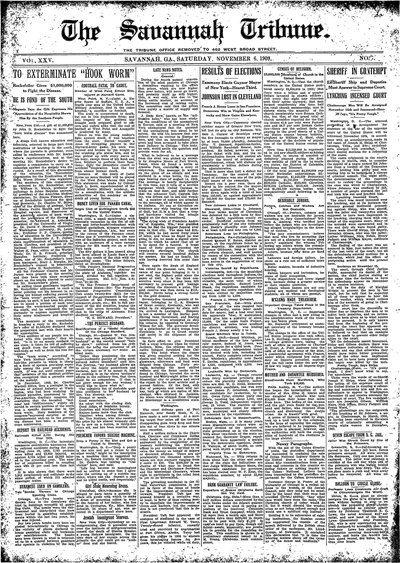
Page text (machine-generated)
The
TO EXTERMINATE "HOOK WORM"
Washington, D. C.-The interstate commerce commission announces that by railroad accidents during the year ending June 30, 1909, 2,791 persons were killed and 6,920 injured, as against 3,764 killed and 68,989 injured in the preceding year. The number of employees killed in coupling cars wits 32 per cent less than last year. It is also shown that there were 2,912 derailments and collisions in the same period, of which 272 affected passenger trains.
Chicago, Ill.—Two bombs were thrown here in the downtown district in buildings occupied by gambling clubs. The bombs were the thirty-second and thirty-third that have been hurled in gambling establishments within the last two years. No one was injured.
For two years bombs have been exploded intermittently in Chicago in the vicinity of places declared to house gambling clubs and bookmakers' establishments. The bombs have been thrown in what is believed-to be a quarrel between gamblers who operate in violation of the law,
VOL. XXV.
Rockefeller Gives $1,000,000 to Fight the Disease.
HE IS FOND OF THE SOUTH
Magnate Says the Gift Expresses His "Appreciation of the Hospitality Shown Him By the Southern People.
New.York Citil.—A gift of $1,000,000 by John D. Rockefeller to fight the "hook worm disease" was announced here.
A dozen well known educators and scientists, selected in large part from institutions of learning in the south, where the parasite is prevalent, were called in conference with Mr. Rockefeller's representatives, and at that meeting Mr. Rockefeller's desire to organize a commission to carry on a campaign against the malady was discussed. As a result of this discussion of the situation, the "Rockefeller Commission for the Eradication of the Hook Worm Disease" was organized.
The members of this commission, as selected by Mr. Rockefeller, are: Dr. William H. Welch, professor of pathology in Johns Hopkins university, president of the American Medical association; Dr. Simon Flexner, director of Rockefeller Institute for Medical Research; Dr. Charles W. Stiles, chief of the Division of zoology, Unit States Public Health and Marine Hospital service, and discoverer of the American species of hook worm, and the prevalence of the disease in America; Dr. Edward A. Alderman, president of the University of Virginia; Dr. David F. Houston, chancellor of Washington university, St. Louis, Mo.; Professor P. P. Claxon, professor of education in the University of Tennessee; Honorable J. Y. Joyner, state superintendent of education, North Carolina, and president of the National Educational association; Walter H. Page, editor of World's Work; Dr. H. B. Frissell, principal Hampton Institute; Frederick T. Gates, one of Mr. Rockefeller's business managers; Starr J. Murphy, Mr. Rockefeller's counsel in benevolent matters; John D. Rockefeller, Jr.
All but Professor Claxton and Mr. Joyner were present at the meeting and they have both since accepted places on the boards elected to carry out Mr. Rockefeller's plans.
In calling these gentlemen together Mr. Rockefeller addressed to each letter pointing out his interest in relieving the human suffering caused by the "hook worm" parasite, especially because, he said, it had been his pleasure to spend a portion of each year among the warm-hearted people of the south, and he welcomed the opportunity to express appreciation their many kindnesses and hospitalities.
The members of the commission in framing a reply to Mr. Rockefeller's offer of $1,000,000 declared that the proposition met with their heartiest approbation.
"Two millions of our people are infected with this parasite," they added, "it is by no means confined to one class; it takes its toll of suffering and death from the intelligent and well-to-do as well as from the less fortunate."
The "hook worm," according to New York Medical authorities, is a hair-like parasite to which is charged a form of apemia prevalent especially among the poor people of the south. It was not until recent years that members of the medical profession recognized that a parasite caused the malady. In December, 1902, Dr. Charles Wardell Stiles, then a zoologist in the Bureau of Animal Industry at Washington, who had been studying intestinal parasites, announced to the Pan-American Sanitary congress his conviction that the so-called "laziness" and "shiftlessness," widely observed in certain portions of the south was a specific disease due to the hook worm. Many members of the congress expressed surprise at the announcement and up to the present the disease has been a matter of some controversy.
REPORT ON RAILROAD ACCIDENTS.
DYNAMITE USED ON GAMBLERS.
FOOTBALL FATAL TO GADET,
Member of West Point Eleven Dies.
Injured in Harvard Game.
West Point, N. Y. - Cadet A. Eugene Byrne of Buffalo, U. S. A., a 69-year-old t the United States Military academy died in the cadet hospital, a sacrifice to football.
The army is accustomed to death, but not in this deplorable form; and this tragedy of the gridiron has brought such poignant grief to officers and cadets alike that the end of football at West Point and Annapolis is predicted by many.
Brave as was the young soldier's fight against death, it was hopeless from the start. Buried beneath a mass of struggling players in the Harvard-Army game, his neck was twisted and broken by the weight of the crushing pile above him, and he was picked up with every nerve of his body, except those of his head and face, helpless to perform their functions. Only the immediate resort to artificial respiration kept the boy from almost instant death. Because of the death of Cadet Byrne no more football will be played by the West Point eleven this year. This statement was made by Colonel Hugh L. Scott, superintendent of the United States Military Academy, after a consultation with the athletic authorities of the academy on the death of young Byrne.
MONEY GIVEN FOR PANAMA CANAL
Negro Club of Birmingham Sends $50 to the United States.
Washington, D. C. Under a sixword title, a small membership with alternate vacancies in the list of officers and letter-heads redundant with Biblical quotations, a negro organization at Birmingham, Ala., has come to the rescue of the Panama canal. Twice has it contributed to the success of the lathmian project, each time with an enclosure of a sure enough cheque for $25 made out on a New York bank.
The fifty dollars it has passed along has been placed in Lance Sam's coffers to the credit of the club with the eademan name. The letter follows, dated at Birmingham;
"The People's National Progressive Consolidated Club, under charter of the state of Alabama, together we stand, divided we fall together, interest, concern. Mal. 2:7; Hos. 4:6; Deut. 31:25:28.
"To the Treasury Department of the United States—Sir: The People's National Progressive Consolidated Club sends twenty-five ($25) for the support of the government in the construction of the Panama canal, for commerce, trade, etc.; $25 in full payment. The Panama canal building contract will prove favorable to this club in the state of Alabama. Your obedient servant."
- THE PEREECT HUSBAND.
Qualifications of a "Model Husband"
Of the Chicago Standard,
Chicago, Ill.-Samuel W. Van Nostram, who was adjudged the "model husband" at the second annual "hubby show," received from his wife credit for being the possessor of all the virtues necessary to make an ideal mate.
"Other than possessing the most super-husbandly quality of being good-natured before breakfast," said Mrs. Van Nostran, "my husband allows me to carry the family pocketbook and declares, just as if he meant it, that my cooking is so far above 'mother's' efforts in the culinary line, that there could be no comparison. If that is not glory enough for one woman, I would like to know what is."
The complete list of desirable qualities attributed to her husband by Mrs. Van Nostran are:
Prompt at meals.
Good entertainer.
An adept with the chafing dish.
Good judge, of feminine beauty.
Generous and kind-hearted.
Enjoys home more than the club.
Happiest when among friends.
Mr. Van Nostran, who also received the prize for his almost womanly ability to sew on a button, is thirty-five years old, and has been married nine years.
PREACHER FAVORS SUICIDE MACHINE.
Drop a Penny in the Slot and Get a Ticket to Eternity.
Washington, D. C.—"Drop a penny in the slot and get a ticket to the other world," might be the inscription on a machine that is suggested by Rev. Dr. Donald Guthrie of Baltimore.
Dr. Guthrie was talking on "Calvinism" here, and said: "Life has become so meaningless and so useless to some that I advocate the setting up of a suicide machine, where one can deposit a cent and be killed easily, and respectably."
Girl Stole Mourning Dress.
Cincinnati, Ohio. Because she is alleged to have taken a quantity of black silk goods with which to make a dress of mourning colors to wear at the funeral of her father, who lies dead in Covington, Ky., Miss Mamie Schmidt, 26 years of age, was arrested in a department store here.
Jewish Immigrant Starves.
New York City—Orthodoxy so uncompromising that it prevailed even over the instincts of self-preservation caused the death of Gisella Brilen, a young Hebrew immigrant. On the nine days of her voyage across the Atlantic the girl could get no "kosher" food and she fasted.
THE TRIBUNE OFFICE REMOVED TO 462 WEST BROAD STREET.
SAVANNAH, GA., SATURDAY, NOVEMBER 6, 1909.
LATE NEWS NOTES.
General.
During the fourth annual convention of the meat packers at Chicago a committee reported to the effect that prices, which are now higher than ever before, will never go lower, and probably must go still higher. This, it was said, was due to the rising cattle market, on account of the increased cost of raising cattle. The committee said that the prices were purely a matter of supply and demand.
J. Eads How, known as the "millionaire hog," who has been studying the conditions of the unemployed in Europe, said at a meeting of the unemployed that the question of the unemployed was about to be solved. He told his hearers that conditions were as serious in Europe as here, and that an international congress had been arranged to take place next January in Chicago. This body, he said, would settle the question and provide work for all.
What is believed to be a message from the dead was picked up recently by Meagher Moore of Fort Worth, Texas, when he found a bottle at Aranas Pass, containing a story of shipwreck. The message is written on the piece of an oilskin and was enclosed in a wine bottle, the message bearing date of August 14, 1903. The message is bearly decipherable at this time, but it tells of a terrible hurricane which visited Cayman islands on that date, and adds further that the schooner Gull, Captain Betley, was driven out to sea and wrecked. A number of names are attached to the message, all of which appear to be Italian. No one at Galveston remembers any ship bearing the name of Gull, but it is a fact that a tropical hurricane visited the islands named on the date mentioned.
The dying wish of Francisco Andréola of Kenposh, Wls., was gratified when he had the biggest funeral ever seen in that city. The man had $12,200, which he had saved from years of labor, and when he found he was going to die, he made a signed statement in which he asked that all of it he spent for a funeral. A brass band of forty pieces preceded the twenty-six carriages. The church will receive several hundred dollars for massees. He had no family, his wife having deserted him some time ago.
Once again the Bank of England has raised its discount rate, the advance of one point bringing it to 5 per cent, the highest point since the panic of 1907. It is the third consecutive week since it has been felt necessary to prevent gold leakage by raising the discount a point. The gold reserve was then down to $110,000,000. Berlin being a strong factor in the gold demand.
Seventy-five thousand pounds of tobacco, belonging to C. A. Simpson of Grant county, Kentucky, who was aided in its shipment by state militia, arrived in Lexington. Simpson is not a member of the Burley pool. Having been threatened, and fearing interference if he attempted to ship his tobacco, he appealed to Governor Wilson for aid. The governor detailed a detachment of state troops from Cynthiana to go to Grant county and assist in the shipment of the tobacco.
In their effort to give President Taft a royal welcome when he visited Jackson, Miss., the citizens had an entire banquet furnished from Chicago. The hotel where the dinner was given supplied nothing but the chairs and the tables. Linen, china, glassware, silverware and food were shipped from Chicago. Forty servants, including the most skilled waiters and the finest cooks to be found in Chicago, traveled the seven hundred and thirty-eight miles to the Mississippi city to prepare dinner for the artistic and paved fashion. Of the food, only fillet of pompano and roast wild turkey, both of which are native of Mississippi, were obtained in Jackson. No wines were shipped from Chicago as Mississippi is a prohibition state.
Washington.
The coast defense guns at Fort Hancock, near Sandy Hook, N. J., have made a new record. At a moving target four miles off the ten-inch disappearing guns wert fired and four hits out of four shots in one minute were recorded.
Half a million dollars in the Cheroise, Choctaw and Chickasaw Indian tribal funds is involved in a decision announced by the comptroller of the treasury authorizing the disbursing officer to pay claimants entitled to receive the money on behalf of miprons or deceased allotees. There are approximately ten thousand minors to whom are due amounts ranging from 3 cents to $50. The $500,000 is exclusive of what may be found due the Choctaw and Chickasaw freedmen and the Mississippi Choctaws, whose right to participate in the tribal fund is yet to be determined.
The prevailing sentiment in the inland waterways commission is not yet in favor of the issue of bonds for the improvement of internal waterways. President Taft has expressed himself in a tentative way, at least, in favor of thus raising money to expedite the improvements of rivers and harbors, but the commission is not convinced that this is desirable. President Taft has approved the sentence of dismissal in the case of First Lieutenant Edward W. Terry, Twenty-second infantry, recently tried and convicted by courtmartial at Fort Gibbon, Alaska. Terry had given his plunge in 1906 to abstain from intoxicating liquors for five years, this he violated while on duty,
RESULTS OF ELECTIONS
Tammany Elects Gaynor Mayor of New York—Hearst Third.
JOHNSON LOST IN CLEVELAND
Francis J. Honey Lues in San Francisco, Democrats Win in Virginia and Kentucky and Show Gains Elsewhere.
New York City.—Tammany elected another mayor of Greater New York, but lost its grip on city finances. William J. Gaynor of Brooklyn swept the five boroughs to victory as mayor by at least 70,000 plurality, defeating Otto T. Bannard, republican-fusion, and William Randolph Hearst, independent. He failed, however, to carry his ticket with him, and the republican-fusion forces will control absolutely the board of estimate and apportionment, which will disbuse approximately a billion dollars during the administration.
This is more than half a defeat for Tammany, for the control of the board of estimate was one of the principal issues of the campaign.
Hearst ran a poor race. Once defeated in his contest for the mayoralty against McCillan in 1905, he went down again with a total of less than 50,000, as against approximate 245,000 for Gaynor and 245,000 for Banquard.
Tom Johnson Loses in Cleveland.
Cleveland, Ohio—Tom L. Johnson, for four terms mayor of Cleveland, was defeated for a fifth term by Herman C. Baehr, republican county recorder. Unofficial returns from approximately half of the city indicated that Baehr's plurality over Johnson is at least 4,000 and may run to 6,000.
Reformers Lose Int Philadelphia.
Philadelphia, Pa.-Philadelphia reelected Samuel P. Rotan, district attorney, on the republican ticket by a large majority. His opponent was D. Clarence Gibboney, long a leader of the reform element, and well known by reason of his connection with the Law and Order Society, which has been active in the suppression of vice in this city.
Victories Scored by Republicans.
Indianapolis, Ind.—In the municipal elections held throughout Indiana, the republicans scored several important victories, the most vital of which was in Indianapolis. Samuel Lewis Shank, the republican candidate for mayor, and the entire republican ticket were elected by majorities ranging from 1,000 to 1,500.
Francis J. Heney Defeated.
San Francisco, Cal.-With about one-third of the vote counted late P. H. McCarthy, union labor candidate for mayor, had a lead over both his opponents 'that, if maintained, would give him a pimilarity of about 10,000. On the same basis Fickert, republican and union labor nominee for district attorney, was leading Francis J. Heney nearly 2 to 1.
Brand Whitlock Won in Toledo.
Toledo, Ohio.—Brand Whitlock, political successor of the late "golden rule" mayor, Samuel M. Jones, was elected mayor for a third term. Practically the entire independent ticket was elected with him, including the council. Fairly complete returns show that Whitlock's plurality over David T. Davies, republican, is approximately 4,500, compared with 6,500 two years ago.
Louisville Won by Democrats.
Louisville, Ky. — Though returns from thirty scattered precincts may reduce the plurality slightly, indications are that W. O. Head, democratic mayorally candidate, has won over Mayor James F. Grinstead, republican candidate for re-election, by 2,000. Owen Tyler, citizens party candidate, received but about 1,000, and George D. Todd, independent republican, 26 votes. The election of the entire democratic ticket for councilmen, municipal and county officers is conceded by the republicans.
Democratic Gain in Massachusetts.
Boston, Mass. — It is many years since Massachusetts voters were so evenly divided on the question of state government as in the election. With about two-thirds of the state accounted for, Governor Draper, republican, will have apparently a margin over his democratic opponent, James H. Vaheym, of about 10,000, as compared with 60,000 a year ago.
Virginia True to Democracy.
Richmond, Va. — With returns in from about half the cities and counties of the state the indications are that Judge William Hodges Mann, the democratic candidate for governor, has been elected over W. P. Kent, the republican nominee, by about 23,000 majorit-
BANK GUARANTY LAW FAILURE
Depositors of Broken Oklahoma Bank Not Yet Pald.
Oklahoma City, Oklahoma - More than a half million dollars contributed by the state banks under the deposit guarantee law has been used in paying depositors of the insolvent Columbia Bank and Trust Company, which failed more than a month ago, and there remains more than $400,000 in deposits to be paid with only $1,123 in cash on hand to pay them, though sufficient-assets, apparently, are available to provide for the remaining deposits. This condition is shown in a preliminary statement issued by A.M. Young, Oklahoma bank commissioner.
CENSUS OF RELIGION.
Washington, D. C.—That the church members in the United States numbered nearly 33,000,000 in 1906; that there were a billion and a quarter dollars invested in church edifices; that every day.eight new churches sent their spires skyward; that men formed considerably less than half the total church membership; that in sixteen states the majority of the church membership were Roman Catholics, but that of the grand total of church members reported for the United States 61.6 per cent were Protestants and 36.7 per cent Roman Catholics—these are the salient facts appearing in the proof sheets of a United States census' bureau bulletin, prepared by William C. Hunt, chief statistician of the division of population of the United States census bureau.
More than $13,000,000 is represented in 444 new church edifices as having been built, in course of erection or definitely planned during the first nine months of 1909 in the 14 southern states, the District of Columbia, Oklahoma and Missouri.
• Of the total amount $4,396,000 represent Methodist undertakings, $2,708,500 Baptist, $1,840,500 Protestant Episcopal, $1,161,000 Presbyterian, $330,000 Catholic, $569,000 Christian, $270,500 Lutheran, $210,400 Jewish, and $1,066,700 various bodies with comparatively small following in the south.
DESIRABLE JURORS.
Porters, Cabmen and Waiters Are Not Desirable
Chicago, Ill.—Porters, cabmen and waiters are not desirable for jurors, according to Jury Commissioner William A. Amberg, who testified before the judges who are investigating alleged irregularities in the drawing of venires.
"The jury commissioners 'believe that men who live by accepting tips are not of a character to make good jurors," explained the witness, "Following are others whom the commissioners ignore in selecting veniremen: Actors, because they have no fixed abode.
Laborers and foreign tailors, because as a rule not of sufficient intelligence.
Boiler makers, because of defective hearing.
Saloon keepers and bartenders, because of their occupation.
Train dispatchers and tower signal men, because doing a greater service at their regular positions. Others whose names are not considered are medical and theological students, all of whom are exempt.
M'CLUNG MADE TREASURER.
Important Change Takes Place in the Treasury Department.
Washington, D. C. — Important changes in office and a new swing in the administrative work of the treasury has taken place.
Mr. Reynolds' retirement as assistant secretary of the treasury became effective.
The change in the office of the United States treasurer also took effect, Leo S. McClung, once conspicuous as a college gridron hero, taking the oath of office as successor to Charles H. Treat, A. Platt Andrews took the oath of office as director of the mint. A commercial agreement with France, under which reciprocal low rates of duty on imports prevailed, expired, and the full rates under the new tariff law will lapply on all imports from France.
MOTHER AND DAUGHTER MURDERED.
Perth Amboy, N. Y.-The authorities began the investigation of the murder of Mrs. Sifas H. Marks and her daughter by robbers who took $16,600 from their home four miles from here. The bodies of the woman and the girl were found by the husband and father, who returned from church and discovered the double crime. He is frantic with grief. A posse of farmers, alided by dogs, took up a traill left by the criminals, in the hope of capturing the culprits, who are believed to be yeggmen. The countryside is alarmed, however, and the authorities will have the co-operation of hundreds of the residents in the large district.
Newsy Paragraphs.
With the aid of the Cuban director of posts, the postoffice department has succeeded in confining the sale of Cuban National Lottery tickets in the United States to a minimum. About fifty communications from persons and concerns in this country ordering tickets or making inquiry to the Cuban National Lottery have been transmitted to the postoffice department by the Cuban government.
Professor George B. Foster, of the University of Chicago in a recent address to the women, of the Jewish Council, said they need not be sensitive to the taunt that their race had crucified Christ, adding: "Any other race would have done the same. The Christian church of today would do it, but it would discard the wooden cross as not being refined enough and would use a spiritual one instead."
Holding it to be subversive of existing institutions, the Russian censor has suppressed the reports of the speech delivered by the British chancellor of the exchequer, Mr. Lloyd-George, at Newcastle. It contained this declaration that "it is time the laboring masses shook off the tyranny of the dukes and landlords."
Chattanooga Men Will Be Arraigned November 15th and Sentenced-Sheriff Say, "It's Pretty Tough."
Washington, D. C.-The unusual proceeding of the arraignment for sentence at the bar of the supreme court of the United States will be witnessed November 15th. In accordance with an announcement made in the cases of Joseph H. Shipp of Chattanooga, Tehn, and five co-defendants, charged with contempt. The court denied motions for a rehearing of the cases.
The cases originated in the court's deciding in March, 1906, to consider the appeal of a negro named Ed Johnson from a verdict of the Tennessee courts, holding him guilty and sentencing him to be hanged on a charge of criminal assault. The night after, the determination of the supreme court to review the proceedings in the case was wired to Chattanooga, where Johnson was confined in jail, a number of people stormed the jail and took him out and lynched him.
Lynching incensed. The court was much incensed over the lynching, and at its instance the attorney general instituted proceeding against Shipp, who was sheriff, and the jailer and twenty-five others, supposed to have been implicated in the lynching, charging them with contempt of the court and supreme court. Many of the accused were exonerated and in the second only six were found guilty. There were Sheriff Shipp, his deputy, Jeremiah Gibson, who was the jailer; Luther Williams, Nick Nolan, Henry Padgett and William Mayes, residents of Chattanooga. The finding of the court was announced in May, just before the close of the last term of the court; but all the defendants entered motions for a rehearing, which had the effect of postponing action until the present term.
Sentence on November 15.
The court, through Chief Justice Fuller, announced its denial of the motion, the chief justice stating at the same time the decision to have the defendants appear on November 15 to receive sentence.
It will be the duty of Marshal Wright to present the men in the court, but he said that he expected all of them to appear to hear the court's verdict, which would relieve him of the necessity of going to Chattanooga after them.
The court has the discretion to either fine or imprison the men or to inflict both penalties, and no intimation has been given as to what course may be pursued. It is only known that from the beginning of the proceeding the court has appeared exceptionally interested in the case, and is believed to feel that an example must be made to prevent other indignities to the court.
"All the defendants assert innocence. Shipp and Gibson declare there was no advance indication of violence to Johnson and say that otherwise they would have taken better precaution. Most of the other men implicated claim not to have been present when the negro was killed by the mob. Pretty tough, Says Shipp. Chattanooga, Tenn. — "It's pretty tough. I don't know what to say, I'm speechless." These were the words of ex-Sheriff Joseph F. Shipp, when informed of the action of the supreme court of the United States in denying a rehearing and summoning him and five co-defendants to appear in Washington. November 15 and receive sentence for contempt of court. The five co-defendants are Jeremiah Gibson, Wilfiam Mays, Nick Nolan, Henry Padget and Frank Ward."
"The proceedings are the outgrowth of the lynching of Ed Johnson, a negro, in Chattanooga, in March, 1906, he having been convicted in the state courts of criminally assaulting a young white woman in December, 1905.
SEVEN ESCAPE FROM S. C. JAIL
Jailer Was Struck Down by One of the Prisoners.
Greenville, S. C—Jail-breaking occurred in the county jail here. Seven prisoners escaped. All were serving life sentences. Only one has been captured. The jailer was entering, a corridor of the cell tier when one of the prisoners who was hiding behind the doof, struck him down. The others then made a rush and were away before he recovered. All were negroes.
BALLOON TO CIRCLE GLOBE.
Professor Lowe Constructs Air-Craft to Circumnavigate the World. Union, S. C.—A plant to circumnavigate the globe in a dirigible balloon without having to stop to replenish the propelling power—hydrogen—is regarded as entirely practicable by Professor Thaddeus. S. C. Lowe, the noted aeronaut and scientist, and now head of the Mount Lowe Observatory near Pasadena, Cal., who is now constructing an aircraft designed to accomplish that feat. Professor Lowe has experience in aeronautics covering more than half century, and holds the world's balloon speed record, 800 miles, in less than nine hours.
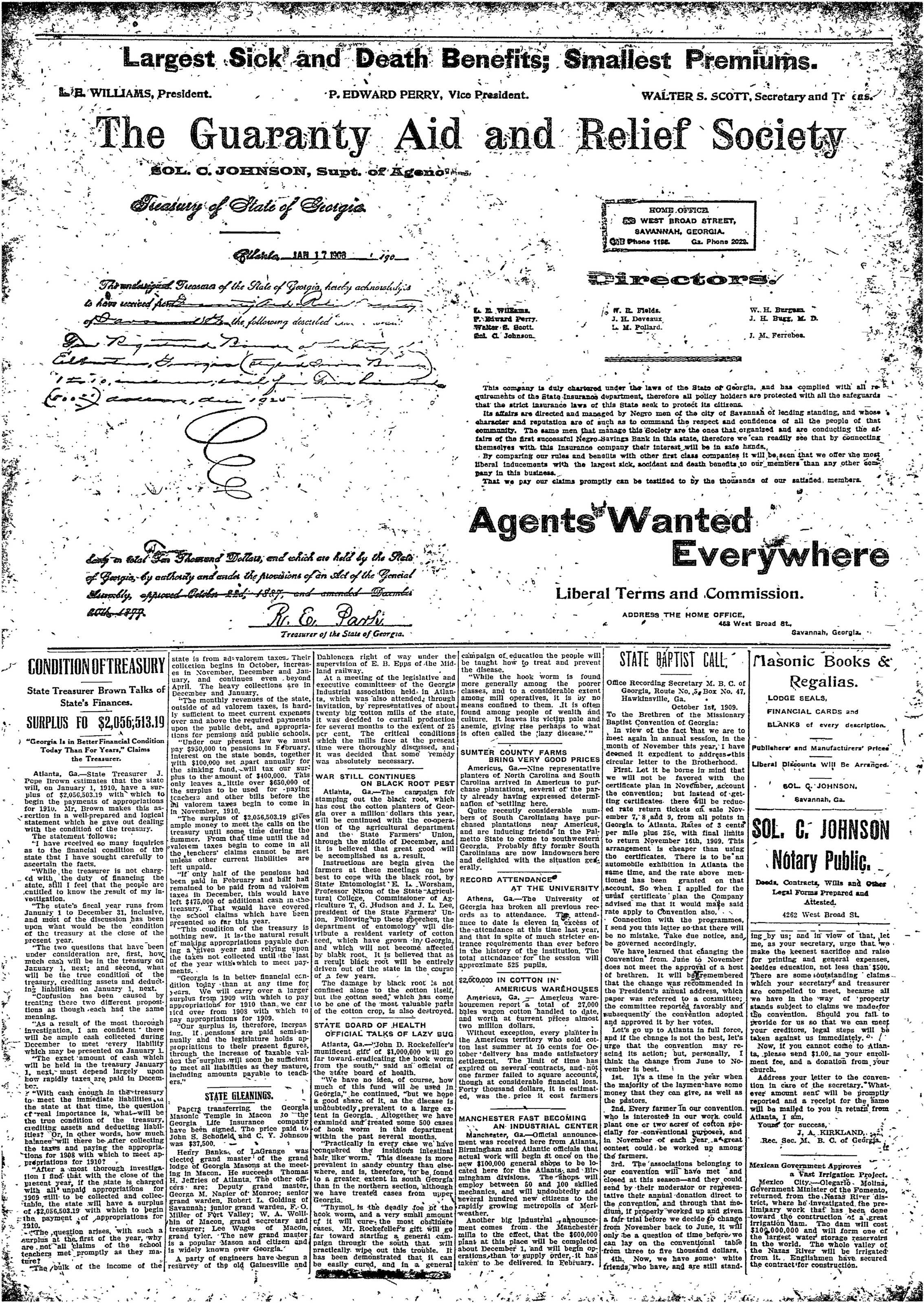
duly in total Ten Thousand Dollars , and which are held by the State of Georgia , by authority and under the provisions of an Act of the General Assembly , approved October 25d , 1887 , and amended December 20th , 1897 .
R. E. Parsi .
CONDITION OF TREASURY
State Treasurer Brown Talks of State's Finances.
SURPLUS FO $2,056;513.19
"Georgia Is in Better Financial Condition Today Than For Years," Claims the Treasurer.
Atlanta, Ga.-State Treasurer J. Pope Brown estimates that the state will, on January 1, 1910, have a surplus of $2,056,503.19 with which to begin the payments of appropriations for 1910. Mr. Brown makes this assertion in a well-prepared and logical statement which he gave out dealing with the condition of the treasury.
The statement follows:
"I have received so many inquiries as to the financial condition of the state that I have sought carefully to ascertain the facts.
"While the treasurer is not charged with the duty of financing the state, still I feel that the people are entitled to know the result of my investigation.
"The state's fiscal year runs from January 1 to December 31, inclusive, and most of the discussion has been upon what would be the condition of the treasury at the close of the present year.
"The two questions that have been under consideration are, first, how much cash will be in the treasury on January 1, next; and second, what will be the true condition of the treasury, crediting assets and deducting liabilities on January 1, next.
"Confusion has been caused by treating these two different propositions as though each had the same meaning.
"As a result of the most thorough investigation, I am confident there will be ample cash collected during December to meet every liability which may be presented on January 1.
"The exact amount of cash which will be held in the treasury January 1, next, must depend largely upon how rapidly taxes are, paid in December."
"With cash enough in the treasury to meet the immediate liabilities of the state at that time, the question of real importance is, what-will be the true condition of the treasury, crediting assets and deducting liabilities? Or, in other words, how much balance will there be after collecting the taxes and paying the appropriations for 1908 with which to meet appropriations for 1910?
"After a most thorough investigation I find that with the close of the present year, if the state is charged with all unpaid appropriations for 1909 still to be collected and collectable, the state will have a surplus of $2,056,503.19 with which to begin the payment of appropriations for 1910
The question arises, with such a surplus at the first of the year, why are not all claims of the school teachers met promptly as they mature?
the bulk of the income of the
Treasurer of the State of Georgia.
state is from ad valorem taxes. Their collection begins in October, increases in November, December and January, and continues even beyond April. The heavy collections are in December and January.
"The monthly revenues of the state, outside of ad valorem taxes, is hardly sufficient to meet current expenses over and above the required payments upon the public debt, and appropriations for pensions and public schools.
"Under our present law we must pay $950,000 to pensions in February. Interest on the state bonds, together with $100,000 set apart annually for the sinking fund, will tax our surplus to the amount of $400,000. This only leaves a little over $650,000 of the surplus to be used for paying teachers and other bills before the ad valorem taxes begin to come in in November, 1910.
"The surplus of $2,056,503.19 gives ample money to meet the calls on the treasury until some time during the summer. From that time until the ad valoem taxes begin to come in all the teachers' claims cannot be met unless other current liabilities are left unpaid.
"If only half of the pensions had been paid in February and half half remained to be paid from ad valoem taxes in December, this would have left $475,000 of additional cash in the treasury. That would have covered the school claims which have been presented so far this year.
"This condition of the treasury is nothing new. It is the natural result of making appropriations payable during a given year and relying upon the taxes not collected until the last of the year with which to meet payments.
"Georgia is in better financial condition today than at any time for years. We will carry over a larger surplus from 1909 with which to pay appropriations for 1910 than we carried over from 1908 with which to pay appropriations for 1909.
"Our surplus is, therefore, increas ing. If pensions are paid semi-annually and the legislature holds appropriations to their present figures, through the increase of taxable values the surplus will soon be sufficient to meet all liabilities as they mature, including amounts payable to teachers."
STATE GLEANINGS.
Paperc transferring the Georgia Masonic Temple in Macon to the Georgia Life Insurance company have been signed. The price paid to John S. Schofield and C. Y. Johnson was $37,500.
Heinry Banks, of LaGrange was elected grand master of the grand lodge of Georgia Masons at the meeting in Macon. He succeeds Thomas H. Jeffries of Atlanta. The other officers are: Deputy grand master, Georgia M. Napier of Monroe; senior grand warden, Robert L. Golding of Savannah; junior grand warden, F. O. Mullin of Fqrt Valley; W. A. Wollhlin of Macon, grand secretary and treasurer; Lee Wages of Macon, grand tyler. The new grand master is a popular Mason and citizen and is widely known over Georgia.
A party of engineers have begun a resurvey of the old Gainesville and
Dahlonega right of way under the supervision of E. B. Epps of the Midland railway.
At a meeting of the legislative and executive committees of the Georgia Industrial association held in Atlanta, which was also attended, through invitation, by representatives of about twenty big cotton mills of the state, it was decided to curtail production for several months to the extent of 25 per cent. The critical conditions which the mills face at the present time were thoroughly discussed, and it was decided that some remedy was absolutely necessary.
WAR STILL CONTINUES
Atlanta, Ga.-The campaign for stamping out the black root, which has cost the cotton planters of Georgia over a million dollars this year, will be continued with the co-operation of the agricultural department and the State Farmers' Union, through the middle of December, and it is believed that great good will be accomplished as a result.
Instructions are begin given the farmers at these meetings on how best to cope with the black root, by State Entomologist E. L. Worsham, Professor Nixon of the State-Agricultural College, Commissioner of Agriculture T. G. Hudson and J. L. Lee, president of the State Farmers' Union. Following up these speeches, the department of entomology will distribute a resident variety of cotton seed, which have grown in Georgia, and which will not become affected by black root. It is believed that as a result black root will be entirely driven out of the state in the course of a few years. The damage by black root is not confined alone to the cotton itself, but the cotton seed, which has come to be one of the most valuable parts of the cotton crop, is also destroyed.
STATE BOARD OF HEALTH
OFFICIAL TALKS OF LAZY BUG
Atlanta, Ga.—"John D. Rockefeller's munificent gift of $1,000,000 will go far toward-eradicating the hook worm from the south," said an official of the state board of health.
"We have no idea, of course, how much of this fund will be used in Georgia," he continued, "but we hope a good share of it, as the disease is undoubtedly prevalent to a large extent in Georgia. Altogether we have examined and treated some 500 cases of hook worm in this department within the past several months.
"Practically in every case we have conquered the insidious intestinal hair like worm. This disease is more prevalent in sandy country than elsewhere, and is, therefore, to be found to a greater extent in south Georgia than in the northern section, although we have treated cases from upper Georgia. "Thymol is the deadly foe of the hook worm, and a very small amount of it will cure the most obstinate cases. Mr. Rockefeller's gift will go far toward starting a general campaign through the south that will practically wipe out this trouble. It has been demonstrated that it can be easily cured, and in a general
This company is duly chartered under the laws of the State of Georgia, and has complied with all requirements of the State Insurance department, therefore all policy holders are protected with all the safeguards that the strict insurance laws of this State seek to protect its citizens.
Its affairs are directed and managed by Negro men of the city of Savannah of leading standing, and whose character and reputation are of such as to command the respect and confidence of all the people of that community. The same men that manage this Society are the ones that organized and are conducting the affairs of the first successful Negro-Savings Bank in this state, therefore we can readily see that by connecting themselves with this Insurance company their interest will be in safe hands.
By comparing our rules and benefits with other first class companies it will be seen that we offer the most liberal inducements with the largest sick, accident and death benefits to our members than any other company in this business.
That we pay our claims promptly can be testified to by the thousands of our satisfied members.
campaign of education the people will be taught how to treat and prevent the disease.
"While the hook worm is found more generally among the poorer classes, and to a considerable extent among mill operatives, it is by no means confined to them. It is often found among people of wealth and culture. It leaves its victim pale and anemic, giving rise perhaps to what is often called the 'lazy disease.'"
SUMTER COUNTY FARMS
BRING VERY GOOD PRICES
Americus, Ga.—Nine representative planters of North Carolina and South Carolina arrived in Americus to purchase plantations, several of the party already having expressed determination of settling here.
Quite recently considerable numbers of South Carolinians have purchased plantations near Americus, and are inducing friends in the Palmetto State to come to southwestern Georgia. Probably fifty former South Carolinians are now landowners here and delighted with the situation generally.
RECORD ATTENDANCE
AT THE UNIVERSITY
Athens, Ga.—The University of Georgia has broken all previous records as to attendance. The attendance to date is eleven in excess of the attendance at this time last year, and that in spite of much stricter entrance requirements than ever before in the history of the institution. The total attendance for the session will approximate 525 pupils.
$2,000,000 IN COTTON IN'
AMERICUS WAREHOUSES
Americus, Ga. Americus warehousemen report a total of 27,000 bales wagon cotton handled to date, and worth at current prices almost two million dollars.
Without exception, every planner in the Americus territory who sold cotton last summer at 10 cents for October delivery has made satisfactory settlement. The limit of time has expired on several contracts, and not one farmer failed to square accounts, though at considerable financial loss. Forty thousand dollars, it is estimated, was the price it cost farmers
MANCHESTER FAST BECOMING
Manchester, Ga.—Official announcement was received here from Atlanta, Birmingham and Atlantic officials that actual work will begin at once on the new $100,000 general shops to be located here for the Atlanta, and Birmingham divisions. The shops will employ between 50 and 100 skilled mechanics, and will undoubtedly add several hundred new citizens to the rapidly growing metropolis of Merlweather. Another big industrial announcement comes from the Manchester mills to the effect, that the $600,000 plant at this place will be completed about December 1, and will begin operations, than to supply order, it has taken to be delivered in February.
STATE BAPTIST CALL.
Office Recording Secretary M. B. C. of Georgia, Route No. 5, Box No. 47, Hawkinsville, Ga. October 1st, 1909. To the Brethren of the Missionary Baptist Convention of Georgia: In view of the fact that we are to meet again in annual session, in the month of November this year, I have deemed it expedient to address this circular letter to the Brotherhood.
First. Let it be borne in mind that we will not be favored with the certificate plan in November, account the convention; but instead of getting certificates there will be reduced rate return tickets on sale November 7, 8 and 9, from all points in Georgia to Atlanta. Rates of 3 cents per mile plus 25c, with final limits to return November 16th, 1909. This arrangement is cheaper than using the certificates. There is to be an automobile exhibition in Atlanta the same time, and the rate above mentioned has been granted on that account. So when I applied for the usual certificate plan the Company advised me that it would make said rate apply to Convention also.
Connection with the programmes, I send you this letter so that there will be no mistake. Take due notice, and be governed accordingly.
We have learned that changing the Convention from June to November does not meet the approval of a host of brethren. It will be remembered that the change was recommended in the President's annual address, which paper was referred to a committee; the committee reported favorably and subsequently the convention adopted and approved it by her votes.
Let's go up to Atlanta in full force, and if the change is not the best, let's urge that the convention may rescind its action; but, personally, I think the change from June to November is best.
1st. It's a time in the year when the majority of the laymen have some money that they can give, as well as the pastors. 2nd. Every farmer in our convention who is interested in our work could plant one or two acres of cotton specially for conventional purposes, and in November of each year a great contest could be worked up among the farmers.
3rd. The associations belonging to our convention will have met and closed at this season—and they could send by their moderator or representative their annual donation direct to the convention, and through that medium. If properly worked up and given a fair trial before we decide to change from November back to June, it will only be a question of time before we can lay on the conventional table from three to five thousand dollars. 4th. Now, we have some white friends who have, and are still stand-
Dooda, Contracts, Wills and Other
Legal Forms Prepared and
Attested.
4262 West Broad St.
ing by us; and in view of that, let me, as your secretary, urge that we make the keenest sacrifice and raise for printing and general expenses, besides education, not less than $500. There are some outstanding claims which your secretary and treasurer are compelled to meet, because all we have in the way of property stands subject to claims we made for the convention. Should you fall to provide for us so that we can meet your creditors, legal steps will be taken against us immediately. Now, if you cannot come to Atlanta, please send $1.00 as your enrollment fee, and a donation from your church.
Address your letter to the convention in care of the secretary. Whatever amount sent will be promptly reported and a receipt for the same will be mailed to you in return from Atlanta, I am,
Young for success,
J. A. KIRKLAND,
Rec. Sec. M. B. C. of Georgia
Mexican Government Approves
a Vast Irrigation Project
Mexico City...Olegario...Molina.
Government Minister of the Fomento,
returned from the Nazas River district,
where he investigated the preliminary work that has been done toward the construction of a great irrigation dam. The dam will cost $100,000,000 and will form one of the largest water storage reservoirs in the world. The whole valley of the Nazas River will be irrigated from it. Englishmen have secured the contract for construction.
They blew and blew their Paper Bag,
They blew with all their might,
Tall suddenly their Bag blew up,
And vanished out of sight.
And then the Windy Thing was gone,
Nor could a trace be seen.
For not a single shred was left
Of what he was but
Brand Whilock, in Life.
THE ENLIGHTENMENT OF MRS. TUPPINS By GEORGE WESTON.
Curiously enough, Mrs. Tuppins hated the country and Mr. Tuppins hated the city. They could not agree — at least Mrs. Tuppins could not, for it happened, that the Tuppinses lived in the country, on the old Tuppins farm; and although this was an arrangement that suited Mr. Tuppins to a T, it did not suit Mrs. Tuppins to any alphabetical designation whatever.
Mrs. Tuppins was city born and bred, while as for Mr. William S. Tuppins, I need only say that S stood for Sillas. At the age of twenty-nine Mr. William S. Tuppins had left the farm to sek his fortune in the city; at the age of thirty he had returned to the farm, bearing no other fortune than Mrs. Tuppins. And as for his experience in the city, I will say no more than this: the morning after William returned to the farm, which the hired man and his wife had been running on shares, he went to his work whistling for the first time in a year, and when with a stick he scratched the backs of the little black pigs, and listen* to their grunts of ecstasy, it seemed to him that sweeter music moral never heard.
But as for Mrs. Tuppins, it did not seem that way to her at all. She looked with a sigh of regret at her high-heeled shoes and her long silk gloves, which were never intended for walking over bottom meadows or picking blackberries out of the brers. She missed the c owds and the lights and the shops and the cars. In short, she grew to hate the country; and she did not hide her feelings, either, as William soon found out. "Well," he said one evening, "the potatoes are all in."
Mrs. Tuppins sniffed.
"And the beets," he continued.
Mrs. Tuppins sniffed again.
"Too cold out here?" asked Mr.
Tuppins.
"Shall I fetch you a shawl
or something?"
"No," said Mrs. Tuppins, distinctly,
"I'm not cold."
"To-morrow," said William,
"I think I'll start them putting a new
lining in the upper spring."
Mrs. Tuppins sniffed again, and
when William looked at her he saw
that her clifted little nose was point-
ed most disdainfully at the poor old
country moon.
"Why, what's the matter?" asked
William.
"William," she said "you know
the way you like the country?"
"Yes."
"The pigs, the chickens, the cows, the horses, the hay, the corn, and the barn, and the pond, and the ducks, and everything—you know the way you like them all?"
"Yes."
"Well—that's the way I like the city."
That was how the difficulty began. William in vain argued that he was not worth his salt in the city; in vain he enumerated all the advantages of country life—the fresh fruit and eggs, the fresh air, and the milk and the cream and the vegetables, to say nothing of the freedom from worldly cares.
To all these eloquent arguments Mrs. Tuppins had a simple question: "William, you know the way you like the country?" To which William could only miserably answer, "Yes."
"Well, then," said Mrs. Tuppins, "that's the way I like the city."
Now among the fowls which chucked about the Tuppins farm-yard there was a certain speckled hen known as Old Spotty, and whether or not it was because she took offense at this familiarity I do not know, but the fact remains that Old Spotty began to sulk and keep to herself.
"I can't make out what's the matter with her," said My. Tuppins, one morning, seeking for a subject of conversation that would be pleasing to Mrs. Tuppins. "Doesn't seem to take any interest in life at all. Just mopes round all day and pecks the other hens when they come near her." Somehow Mrs. Tuppins felt interested for the first time since she had become a member of the farming population. As soon as breakfast was over, she went out and looked at the disconsolate fowl.
Old Spotty looked back at her disconsolately enough, and Mrs. Tuppins at once sought the advice of the hired man; and began to pamper the hen.
Now, even if one wished to do so, one could not single out a hen from a flock and pamper that particular one—the other hens would see that no favoritism was shown. You could not, for instance, throw a handful of green stuff at one hen and expect all the other fowls to stand off at a respectful distance and watch the favored one with an envious eye. That is not the nature of poultry.
So it happened that Mrs. Tuppins, striving to alleviate Old Spotty's disconsolation, pampered all the hens, with the result that they scampered toward her, clucking in friendly excitement, whenever she showed herself in the yard. This secretly tickled Mrs. Tuppins, although she pretended the contrary.
And here is another thing; one cannot keep going into a barn to get corn for the chickens without patting the horses and saying "So boss," to the cows.
It is an utter impossibility, as every one knows who has tried it. And from patting a horse's back it is only a step to patting his nose, and of course one cannot at a horse's nose long before one begins to pass a carrot or two, and from that to lumps of sugar is the shortest of distances.
So every morning that Mrs. Tuppins went into the barn for corn wherewith to pamper the hens, there was such a whinnying and stamping of feet as you never heard; and when Mrs. Tuppins came out at last with her pan of corn—and was at once assailed by her faithful but riotous hens—her face was as rosy as could be, and her eyes were as bright as diamonds.
Another thing, too: one cannot keep going into a garden for carrots and greens without notting things. One cannot enter a garden for instance, with closed eyes and grope round to the carrots and come out the same way; and especially is this true if there are six hives of bees in the garden!
So by degrees Mrs. Tuppins began to notice the tomatoes, the plumtrees, the parsnips, the currants, the flower borders, the beans, the lettuce, the raspberries, and all the other delights that lay just back of the house. And when one gets so far, one pulls a few weeds, perhaps, or waters the flowers, or eats a few raspberries while wondering if the plums will soon be ripe.
When one is as bucolic as all that, it is distinctly irritating to be set at naught by a cross old hen that keeps growing cranklery and crankler, and refuses to respond to scientific agricultural treatment.
Old Spotty remained obdurate. She seemed to think that they wanted her to set, and she would not go near the coop. Then she apparently considered that they were trying to keep her out of the chicken-house, and she refused to come off the nest. Still trying to pamper her, Mrs. Tuppins slipped a dozen eggs under her, and in due course of time Old Spotty was leading ten little chicks around, clucking at them peevishly, pecking at them for nothing at all, and look-at them as if she had more trouble than enough.
Now one night, when this foolish fowl had been covered up in her little triangular pen, the same being placed near a similar pen which another-den occupied with her five little chicks, there suddenly rose such a commotion that Mrs. Tuppins ran out to see. All of Old Spotty's chicks had deserted their peevish and pecking mother, and the other hen, whose family had suddenly grown from five to fifteen, was so puffed up with conceit that she looked double her natural size, and could only with great difficulty see out of her eyes.
And they were the merriest fifteen little chicks that ever peeped—playing tag beneath the conceited hen's wings, playing blind man's buff and puss-in-the-corner and hide-and-seek and similar games, putting their heads out from time to time, as if to take the air, and popping back in again, as if they had suddenly remembered a most urgent and delightful appointment! But as for Old Spotty, imprisoned in her coop and seeing the error of her ways now that it was too late, she was almost frantic. Such squawking! Such clucking! Such terrible threats to the puffed-up hen! Such anxious calls to the merry little chicks!
Finally one little fellow, that perhaps had not found a comfortable place, or had been "it" in the games too often to suit him, tumbled out of his new quarters and scampered back, beneath Old Spotty's wings. And if you had seen and heard the rejoicing of that happy mother and the gentle way she cuddled him with her wing, and the tender way she clucked at him, it would have touched you as it touched Mrs. Tuppins as she went slowly back to the house.
"William," she said, after eating a very silent supper, "you know the way you love the cows and the horses and the chickens and the garden and the bees and the woods and, everything?"
"Yes," said William, miserably, once more.
"Well," said Mrs. Tuppins, with cheeks that put the roses to shame, and eyes that left the diamonds simply nowhere; "well—so do I!"—Youth's Companion.
And He Suffered.
Little Willie, suffering from an attack of toothache, had paid his first visit to the dentist, accompanied by his mother. Father, on his return from the office that evening, was naturally much interested.
"Didn't it hurt?" asked father.
"Sure, it hurt," replied Willie.
"Weren't you scared when the dentist put you in that big chair and started all those zizz-zizz-zizz things?"
"Oh, not so much."
"That was a brave boy. But, surely, you suffered?"
"Of course I suffered. But I just kept repeating over and over the golden text we had in Sunday-school last Sunday."
"The golden text? What was it?" "Why, 'Suffer little children to come unto Me,'" replied Willie, glibly. "I kept saying that over and over to myself, and the first thing I knew it didn't hurt any more."—New York Times.
The revenue of the Commonwealth of Australia for the last financial year was $71,750,000, a decrease of $3,325,000.
Is the American Man Not Interesting to Woman?
By David F. St. Clair.
There are cultured American women who are finding serious fault with the average educated man in this country. They tell us that he is not interesting to woman. He has lost many of his old romantic emotions, and is therefore a dull, poor love-maker. He is so ignorant on many of the subjects that absorb modern women's minds that he is socially dumb and stupid. But, worst of all, he lacks something more than mere knowledge and development; he lacks temperament. He lacks a state of mind and consciousness, that woman is hungering more and more for in man. It is a psychic state of mind; a spiritual intelligence; a comprehension and sympathy; an appreciation and patience that know how to speak and, above all, how to inspire.
No, the American man does not interest and charm woman as man does in most of the countries of Europe, notably in France and Italy. But why does he not? There are acute foreign observers who visit us and declare that American life has evolved a man and a woman who live in two separate worlds. Our men and women are fast becoming complete strangers to each other. They actually know less of each other and enter less into each other's innermost life than men and women in those lands where woman goes veldled or communicates with man by means of a fan in church, or steals a glance at him through a window. The familiarity and equality of the two sexes in America have built a stupendous wall of ignorance between their souls. Woman has become commonplace to man. He thinks he knows her only too well. While to woman man has lost all the mystery of his power. He is a thing of clay, and most inferior clay at that. Therefore, man prefers to associate with man and woman with woman. In no other country in the world are there so many exclusively men's and exclusively women's clubs.
These two distinct worlds of the American man and woman are separated by walls of adamant in education, in business and in society. Woman in the middle and upper classes goes her way with her leisure for culture, her charities, her clubs and guilds and society. She investigates history and science, and she writes and reads. Her mind becomes critical and analytical. She is restless, she travels.
Man, on the other hand, flings himself with all his mind and soul into that modern maelstrom — business. In this world he forgets woman's heart, for it is a world without sentiment, without romance, without love. It is a world of producers and acculators. The American business news, in his mental state, like a ship leaving port. His mind is always going out. His occupation, his complete absorption in the things before him, and his general attitude of mind carry him as far away from woman's world or in opposition to woman's world as the east is from the west. He loves business as a gambler loves his game or a miser his bag. He soon neither knows nor cares for anything else.
There are innumerable exceptions, but this is the tendency and spirit of business. When man steps into woman's world, it is like a whale floundering on the shore or an elephant wading into the deep. He is timid, and his timidity is that of conscious ignorance, and it is often mingled with a feeling of repulsion toward himself. He perceives at a glance that his own spirit has tended to harden and make artificial woman's spirit.
The late Mrs. Astor said of the modern American man, "Socially, he does not interest or please woman because he is not socially developed." He has no leisure for society, and that caste organization called society is in too chaotic a condition in most places in this country to develop him if he had the leisure. The American of importance is, as a rule, not at home in an assembly of women. He is a poor listener to things that do not directly appeal to him, and he looks impatient and bored on formal social occasions. His range of knowledge outside of his own profession is astonishingly limited. Ten representative men—politicians, business men, manufacturers, lawyers, bankers, insurance officers, brokers, etc.—were asked the question, "Are the men you meet and know interesting?" The instant reply was, "Outside of their own work—no."
The raconteur of extraordinary gifts abounds in this country, but good story-telling is not conversation. The French, the finest conversationists in the world, do not, in what they call their chamber-music talks, allow protracted anecdote. Conversation, according to the French art, is rapid, animated, lightly tripping and turning speech without argument, without difference of opinion in the company of about a dozen aptly selected men and women. In one of these companies a Frenchman is an near heaven as he ever expects to get on this earth. Seldom do men and women in our own country have a real taste of this rare social and intellectual experience. In levee conversation, in which Napoleon, Victor Hugo and Gladstone shone like stars, and in which the present German Chancellor is at times an adent; the American makes
a rather poor showing. The levees at the White House are generally crushes, and bon mots are absent. The President is delighted to see everybody, but we have had in no modern President a brilliant talker, and there are no three men in our public life to-day who have the breadth of culture of Mr. Balfour, Mr. Bryce and Mr. John Morley. A New York business man packed his son off to Harvard, and the last instructions he gave him were that he should try to be "sociable." But the boy protested that he did not care for society. His only passion was athletics. When he had been at the university a few months the father visited him, and saw in his room the pictures of a number of beautiful women and slippers and sofa pillows that had come from scores of feminine admirers.
"Well," said the millionaire, looking around, "they seem to have found out who father is."
The young man smiled with just the slightest suggestion of derision and said:
"Don't know. I have not informed any one, and I have never visited any of these women. These pictures and other things have come to me because these women have seen me win on the gridiron."
The millionaire father reflected for a moment, and then said:
"My son, what I see and what you tell me reveal to me a great truth. If you had made a million dollars in Wall Street the fact never would have produced this evidence of woman's admiration. Plenty of women would like to have your money, but not one would think the more of you for having the money."
And in this age of money-making that is the chief virtue of athletics, Woman to love man requires, as a rule, the exhibition of the heroic in him.
In Europe educated men live more within themselves than we do, and they have constantly evolved from the inner spirit a world of thought and art that renews life. They are sustained-by a tradition and history, in whose rich, mysterious atmosphere we behold them as far more interesting than ourselves. They endow language and speech with an esoteric meaning that is absent from the written and spoken words of America. Woman is not herself a creative artist, but she does create art through the soul of man; and she does in turn breathe the interpretation of it physically into the hearts of men.
The majority of women are not by nature democrats, and Europe still possesses those ranks, distinctions and spectacular shows of royalty and nobility that appeal to the feminine heart. European courts have a glamour for certain of our women that is not to be found in anything else. The throne is a social power and centre, such as no republic could or would ever build. "Don't ask me," remarked a patriotic, intelligent American woman, "which I had rather do—ride with the President of the United States to his inauguration or with the King of England to his coronation. I fear that I might confess something that would greatly shock you."
Nor are the striking virtues of the American man attractive to woman. He possesses great common sense, he loves facts and direct motion; and, above all, he loves good-humor and humor. He is a servant in the house. He is the most indulgent of men alive. He will let his daughter read the story of his bankruptcy and financial disgrace in the newspapers before he will cut off one dollar of her remittance. Woman admires his virtues and generosity, but they do not command her soul. To her there is nothing heroic in them. They do not dazzle her.' Her thirst of curiosity in man remains unquenched. She will fall in love with a stranger disguised across the footlights, or she will elope with her father's coachman in her efforts to satisfy this curiosity.—Harper's Weekly.
WILES OF A SPECULATOR.
Daniel Drew, a Wali Street speculator, was at one time (1865) the richest man in the United States, worth it is said, $13,000,000. Drew began life as a cattle drover, never altered his attire, but still dressed in the slovenly clothes of his cattle droving dress. Like Vanderbilt, Drew was absolutely uneducated. He pronounced the word shares "sheers," and Vanderbilt spelt boiler "boyler." Neither man believed in books, keeping all their gigantic accounts in their heads, and Drew's speculations were colossal. Of the methods of making money the following anecdote will afford an excellent idea:
One evening he entered a club in which were a number of men of the financial world. Old Daniel ran in, as it to look for some important stock broker, and then ran out again. "Guess Dan'l has some points," said one. "He's on the scoop," said a second. "It would be worth a few million dollars to know what's in Uncle Daniel's head," said a third. Drew re-entered the room more excited than he left it. Carelessly pulling a large pocket handkerchief out
Quaint and Curious
The microphone makes the footsteps of a fly plainly audible.
New York City and its immediate suburbs have 450,000 telephones.
A project is on foot to found a social clubhouse for the girl students of Boston.
It is estimated that the total production of sugar throughout the world is about 2,600,000.tons per annum.
Nearly all the vines in Europe were killed by frost in 891 and 893. On midsummer's day, 1033, in England, there was a frost so severe that it destroyed fruits.
The Japanese have no use for buttons, buckles or hooks and eyes. Cord serves every purpose of fastening and furnishes artistic possibilities seemingly without end.
Breaking into houses where funerals have just taken place and plundering them is spoken of by the Berliner Tageblatt as the latest trick of the thieves of that city.
Rev. James E. Cassiday, of St. Mary's Catholic Church, Fall River, Mass., who was one of the leaders of the successful no license fight in that city, has served notice that in his parish at least the new prohibitory law is not going to be a dead letter.
The swastika is the oldest known symbol, having its origin in the cross and circle. The swastika is now held in common acceptance to be significant of good luck.
Emerson was a notable sufferer from the vagaries of memory.
The ideal meal consists of bread, butter and cheese, according to Dr. J. E. Squire.
The increased cost of living in India generally and in Calcutta particularly is severely felt not only by Europeans, but also by Indians.
Lincoln's ancestry has been traced to Samuel Lincoln, who lived in Norwich, England. Emigrating to America, he settled at Hingham, Mass., in 1638.
In an English village an official notice reads as follows: "The public are warned against using the well for domestic purposes unless previously boiled."
Rev. Dr. John H. DeForest, a veteran Congregational missionary at Senday, Japan, has been decorated by the imperial government with the Order of the Rising Sun.
The California Club, the largest civic club in San Francisco, has succeeded in getting the birthday of Luther Burbank set aside as bird and arbor day for the State.
What He Meant.
"That was the year," said Mr. Jesse Sparhawk to the little group of listeners who had gathered to hear his reminiscences of war times, "that was the very year that my cellar was so unmercifully overflowed."
"What do you mean by 'unmercifully overflowed,' I'd like to know?" demanded Mr. Potts, the town trial, from the outskirts of the group. "I don't gather your sense."
- "I mean," said Mr. Sparhawk, after a glare at the offender who had thus arrested him in the full tide'of recollection, "that there was too much water for walking, an' not enough for boating. I sh'd think 'twas plain enough."
Lightning kills one-knif of those it strikes, while a few of the survivors are rendered blind, deaf, dumb or partially paralyzed.
Drew Fooled All Wall Street.
of his pocket to wipe his fevered brow, he.drew with it a small piece of white paper, which fluttered to the floor, apparently unseen by him. Then he hurriedly departed. A rush was made for the slip of paper, on which was written, in his own hand-writing, the following ominous words: "Buy me all the Oshkish stock you can, at any price you can get it, below par."
Here was news indeed. All thought that particular stock was already too high; this accidental discovery clearly showed they were wrong. Some new move was no doubt imminent; not a moment was to be lost. All those present joined, and the first thing the following morning purchased 30,000 shares from a broker whom old Drew had in wait for them, and he scooped in an enormous profit — Strand Magazine.
J. Pierpont Morgan belongs to thirty-five clubs and his membership dues figure over $7000 annually. August Belmont is a member of thirty-four and Chauncey M. Depew belongs to thirty-two.
If you're waking, call me early, call me early, Mother dear,
I think at 4 o'clock m. the circus will be here;
If it was any other day 'twould take an awful me from my little bed before quite 8 o'clock;
You needn't mind my breakfast, for I'll be in dreadful haste.
And if I see the cars unload I'll have no money.
Perhaps they'll wash the cages, Ma, and I'll be there to see.
The men take off the sideboards from the whole menagerie.
If you're waking, call me early, call me early, Mother dear,
Because the place where it unloads is full two miles from here;
I'd faint without my breakfast if 'twas any other day,
But I will be loud enough, I think, to run quite all the way;
The boys I know will all be there; 'twil be a wondrous sight
To see the elephants led out before it's hardly light;
And the elephants roar, which makes goose pimples when you hear
If you're waking, call me early, call me early, Mother dear.
If you're waking, call me early, call me early, Mother dear,
No matter if you whisper it I'll be quite sure to hear;
If I was being waked to turn the wringer it would be
A good hour for job, of course, for you to waken me;
But I will leave my stockings on and put my shirt in place;
And if I was rushed for time I will not need to wash my face;
And I will be morning light you'll see me leaving here
About three minutes after four, so call me, Mother dear.
If you're waking, call me early, call me early, Mother dear;
I will not yawn and rub my eyes and ask if morning's here;
I will not pull the covers up as I have done before;
And ask you if cannot sleep just half an hour more;
I'll jump right out of bed as soon as ever you may call;
And be all dressed and down the stairs and gone out through the hall.
Before you can stick Robinson—the circus will be here.
At 4 o'clock, so call me early, early, Mother dear!
—J. W. Foley, in the New York Times.
FLASHES OF EVEN
Mr. Newed—"Well, dearest, you can't say I ever contracted bad habits." Mrs. Newed—"No George, you generally expand them."—Judge.
"So you think you'll go to the mountains next year?" "Yes; too much breeze of the seashore. Always blowing the cards on the bridge tables."—Louisville Courter-Journal.
When perspiration pours and pours
Adown each cheek and down each limb,
How nice to be at the seashore
Teaching some maiden how to swim.
At the Summer Resort.—"What did she say when you asked her to marry you?" "Told me to ask her, again next week, when the man she is engaged to at present will have gone back to work."—Detroit Free Press.
She—"So they do not live very, happily together, you say?" He—"No. It's the eternal struggle between religion and society. He is as straight-backed as she is straight-front."—Puck.
Clarabel — "It was while I was wearing this bewitching hat that my husband first became acquainted with me." Isabel — "And do you never fear that he may bring suit against your milliner for damages?"—Life.
"What gives that funny man across the street, so strange and steps because. He took his whisky straight."
"I thought, Senator," said the beautiful girl, "you were in favor of an income tax." "I was until it began to appear that there might be a chance to get a constitutional amendment permitting it," the statesman gravely replied. — Chicago Record-Herald.
Vicar's Wife—"There! I knew it would be wet—simply because I arranged to have my garden party today." Vicar (embarrassed; but constrained to supply a more satisfactory reason)—"Well, my dear, you know we had the prayer for rain on Sunday, week."—Punch.
Compared With Chinawarc.
Dr. Dick Woods, a physician of this city, has it, is said, more good stories "up his sleeve" than any other doctor in town, and the latest of these was told by the doctor a day or so ago at a club of which he is a member.
"Heard a good one this morning," he said. "A little girl and her mother were walking down the street, when they came to a place where straw had been spread over the pavement to deaden the noise because of the illness of a woman living in that square.
"Oh, jook, mamma," cried, the little girl. "What's all the hay dohn' out in the street?"
"That' s because Mrs. E. — has a tiny baby, which God just sent her," said her mother, gently, and after a moment's pause the little girl said slowly:
"Gwyacious, she must have been packed. well." — Philadelphia Times.
No Help For It.
The young heenect was experiencing his first trouble. "My wife," he said, "is so exceedingly nervous at night. She scarcely sleeps." "Burglar's?" queried the old married man. "Yes." "Well, you have to expect that. My wife was that way. Every time she heard a noise downstairs she'd rout me and chase me down to investigate. After a time, however, I convinced her that if a burglar ever did get into the house he wouldn't make any noise at all." "Clever! I'll try that." "Don't do it," pleaded the old one, "for if you wife's anything, like mine shall, turn right about and worry, every time she doesn't hear a noise downstairs."—Catholic Standard and Times.
Established 1876 .
By JOHN H. DEVEAUX,” -,
“~~ Puntisugp Evany SATuRDAY
462 West Broad Street,
(Bell Phone 2171 |
=e
‘SusscniPrion BATES: :
Qne Year vvsepeserseeeenseseen seen BEe25 ~
SIX Months vscsseeceeerseseesnnsee -75
Three Mouths. cvccscceeesseceeereese, +50
Remittance must be made by Express
ox Post Office Movey Order, or Register-
wed Letter. Advertising rates given on
application,
Entered at the Post Office at Savannab,
Ga_as Second-Class mail matter.
SsxrIsHNEss . has caused the
downfall of many a business” en-
terprise.
Ove peoplein this city should
become more public spirited. Let
the other parts of the county know
woareon the map by doing things
that will help. 7
Tux colored State fair of South
Carolina opens Monday. Rey. R-
Garrol is at the head of the. move-
ment and it surely spells success.
Tt will be held at Batesburg.
A rew weeks ago in Emanuel
County a white man was conyict-
ed and sentenced to the peniten-
tiary for life for the murder of a
colored man. Wonders never
cease. All honor to Emanuel
County for this much justice,
Last Tuesday election was held
ina number of states, Thp most
important was the killing, of the
disfranchisement bill in Maryland.
This bill was hard fought. The
majority against it may reach 20,-
000, We rejoice with our people
in Maryland in its defeat.
In one of the interior towns re-
cently the sheriff of the county
was said to be drunk and creating
2 disturbance. The town mar-
shal attempted to arrest him, but
received a bullet for his efforts.
This speaks wel for the guardians
of the peace in this state, and it
shows too, how many inngcent, col-
ored persons are accused ‘of alleg-
ed crimes by the class of officers
who imbibe too freely.
‘Tae poople in the North and
West are busy agitating the
white slave question. ‘The busi-
ness is indeed a despicable one.
There is also a question that con-
front us asa race, and that is the
horde of irresponsible young
women from the South who flock
North and East each summer. Re-
ports coming from many of them
are not very complimentary and
should not be allowed to continue.
The leaders of thought and the
pulpit in every southern city
should take up this matter.
A wire business man, of the
prejudice class, said during the
week that the “white folks pay
for the cbming of the airships, but
the colored people are enjoying
the sights” Well, suppose it is
a fact, do not the colored citizens
ina way pay their part for the
fun. If it were not for the patron-
age of thecolored citizens at least
seventy-five percent of the retail
stores in the city would be opt of
business. How about that?
Again if the white committees
would call on coloréd business men
for aid in such undertaking their
donations would be. liberal.
ALL of our readers are ac-
quainted with the lynching of the
colored man, Yo. sobneos at Chat-
tanooga about ayear or so ago
and the chargeof contempt made
against Sheriff Shipp for conniv-
ing atthe same. He was found
guilty in the Supreme Court of
the United Ssates. A ‘rehearing
was requested. This much the hon-
orable court has denied it and or-
dered the sheriff slong with other
guilty ones to appear within two
weeks to be sentence’ for con-
tempt of court. Every possible
influence has been brought to bear
in order to thawrt the findings of
the court, but this was impossible.
Every lover of law and order ap-
plaud the decisich of the court
in denying the roearing. ‘Loo
many times especially in this sec-
tion, have the courts been treated
with contempt by the lynchers.
Many of our young men have
great opportunties of doing much
good for themselves and those
around them if: they would only
grasp these sprormunicies by im-
proving themselves in their posi-
tions, husband their earnings, se-
eure homes and making safe in-
vestments. It is not the fact bé-
eause you haye an humble posi-
tion with a very small salary that
you cannot improve yourselves.
The men who haye made the great-
est progress in life in this country
had bumble surroundings and in
poverty. *Our own Fred Douglass
was compelled form the rigors, of
the Maryland winters to warm him-
self by keeping his feet in the
warm ashes of the fire place at
nights. Our great-Booker Wash-
ington was born an ordinary slave.|
but what?is their fame to day?
Qur young men an conjure their
aspiration from the lives of these!
two noted Americans. Recently
a publication selected one thous-
and names from various lines of
industry, of men who have succeed
ed and found their early chance in
life 4s follows: 300 were sons of
farmers, 200 were messenger boys,
200 were newspaper carriers and
sellers, 100 were apprentices to
printers, 100 were apprentices to
‘mechanics, etc., 50 were car coup-
lers and switchmen. And 50 were
sons of wealthy parents. The
above is food for our young men.
Let them labor, Jet them learn, let
them Save, let them invest, keep
clean the conscience and above all
let them be men.
|. ‘Ture “good time” young man,
who are not inclined to save a
part of his earnings have no place
around the homes where there are
young Jadies, ,
| Freepmay’s day vill soon be
here. As yc no arrangements
are being made to celebrate it.
Why not invite a man of national
reputation to speak for us. Hon.
Judson W. Lyons for instance.
‘Tue Trrsune congrasulates Dr.
White and The Georgia Baptist
on_ its very creditable Women’s
edition of last week. Dr. White
is the nestor of journalists in the
state and Tie Trmuse is always
glad to honor him.
as
One of the causes of the non-
success of colored business men is
their failure to adyertise. The
man who owns a business and do
not let the people know about it
through the columns of the news-
paper stands in his own light, and
will soon be a failure. Use print-
er’s inks freely and success - will
surely come.
Our women should beware of
the hair straightener. Be more
loyal to the race than attempting
to ape the hair of another races.
No fault can be found in the at-
tempt to beautify the hair, but
make no attempt to change its
texte. | Tae Tripone has ever
decried the hair straightening and
color*changing business, an
yroull not permit ads of that na
ture in its columns. We have but
little respect for the man or wo-
man who attempts to get, away
from the race by the color ‘chang:
ing or hair straightening routes.
Venr often we ate approached
by business folks who accuse us
of not sending our paper eontain-
ing their ads, etc., saying that
they had contracted for same.
On investigation it is always found
that the contract was given to an.
other paper but same was intend-
ed for Tue Trmune. Again
other business men importune us
to insert sds at the samo rate as
some other papers, this we can-
not do. Our space is too yalu-
able, and again it is not business
like to fill the paper with ads at
ruinous rates. Tue Trmoxe is
too well aad long* established to
indulge in such. .
|, Last week Toe Trinone pub-
lished an interesting interview with
the Hon. Judson W. Lyons. on
the Freedman’s Bank question.
He gave us a succinct history of
the institution and what is neces-
sary to be done in order to interest
congress in the reimbursement. of
the depositors. This matter
should be taken up by our people
all over the country and letters
and petitions should be sent to
every representative. It is not too
carly to begin as congress’ meets
next month. The reimbufsement
of these depositors means much to
our old people, many of them be-
ing helpless.
Oxz of the able and practical
women of the race is Miss-Nannie
Burroughs. In a recent address
she gave utterance to thoughtsthut
should he eagerly digested by those
of us who are thusinterested. Miss
Burroughs said:
“We might as well learn this year as
next, that it is no,glisgrace to be a well
trained servant, bitt it is rather a shame
anda crime to bea makeshift. No wo-
man who wants to make dresses thinks
it an eternal disgrace to prepare herself
forthe work, ‘Then, why should a wo-
man who feels it her calling to wash and
iron, or keep house, or cook, turn up her
nose when some one tells her to go toa
training school and learn How to do her
work well.
“If the Negro woman doesn't watch
her job and do her work better than any
qnoelse she will find that it has been
taken by the woman of the same nation-
alities that took the barber business, the
boot-black business, and the whitewash
business from the Negro men.”
Ix this community there are
about five institutions alleging to
be homes for orphans and old
folks. Not one of them is being
supported by the people. One of
the main reasons why the public;
refrain from giving unstinted
supported in that there are ,too
wany of them and apparently too,
without any systematic organiza-.
sien ‘Tne Trievne suggests that
the best thing for all of these in-
stitutions to do is to get together
and form one streng organization
with a board of officers composed
of citizens of unquestioned stand-
ing and integrity. Unless this be
done, spasmodic work of the ex-
isting institutions will be of no
avail, and those who are intended
to be ‘the beneficiaries will con-
‘tinue to suffer. It is time for the
leading citizens to take a hand in
thid matter and do nof allow con-
ditions to continue as they are for
as’ such, they will be a blot on all
of us.
Georgia’s Leading Finan-
cial Institution. 7
On Monday night the stockhold-
ers of The Wage Earners Loan and
Investment Company held their
annual meeting at which time the
officers rendered their reports and
directors were elected. The meet-
fing was well, attended, and_ the
stockholders felt gratified on the
excellent showing of the company
during the year. ‘The report of
President Williams was concise
and showed at a glance how the
‘business was conducted, its growth
and its future prospects of ad-
vancement. Mr. W. 5. Scott, the
efficient secretary and treasurer,
backed up the statement of the
president by the presentation of
figures that were more convincing.
The growth of The Wage Earn-
ers has been phenominal and clicits
the favorable comment of all who
keep up with its affairs. Its say-
ings department is the depository
of a number of the leading institu-
tions in the city and the state, also
haying several hundred findividual
accounts. 2
The Wage Earners since its or-
ganization has erected homes for
nearly four hundred familics in
this community and is destined to
be of greater benefit to our people.
The directors elected were
Messrs. L. E. Milttarns, W. R.
Fields, W. 8. Scott. L. M. Pollard,
Pp. E. Perry, W. H. Burgess, R.
B. Brooks, W. J. Williams, J. G.
Garey, Geo. S. Williams, Wm.
Wrght, Sol. C. Johnson.”
‘The stockholders and directors
are determined to make the ensu-
ing year a banner one for the com-
nas
The Sailors Banquetted.
Last week Tun Tripone an-
nounted the coming of the colored
sailors on the torpedo boats. Im-
mediately Rev. W. L. Jones, D.
D., the popular pastor of F. A. B.
Church and other public spirited
citizens met and arranged to tender
them a banquet, This was done
‘at the church on Wednesday night.
It\was a sticcess in every respect,
nhd proved to the boys of the feet
that there are some public spirited
men in Savannah. Dr. Jones is
‘commended for his lead in the
matter. ”
Death of an Old Savan-
ah ca
Judge W. H. Matthews, one of Nrans:
wick's oldest and best known citizens,
departel this life october 2. at 11:36
‘p. m., after an iliness of several weeks
In the death of Tadge Matthews the
race loses a statesman aud pattiarch,
the wife a devoted husband, his daugh-
ters, akind father, the church a con-
sistent. Christian and his brethren
true friend. During his life’ be held
offices of public trust in this state and
for the government of the United States
and waswell known throughout the
state. He was member of the K. of
P's and was funeralized at the First A.
B, Church last Sunday with very. in:
Posing ceremonies. Rev John Wil.
ams officiated. Mr. John Byrd, under.
taker —Adyocate.
Our citizens were pained to
hear of the death of Judge Mat-
thews. He is an old Sayannahian,
but for about twenty years resid-
ed in Brunswick. The Judge was
well and favorably known here.
In politicg, in church, and frater:
nally, he held promiinent places.
Tue Truss and the citizens
here condole ‘with the family in
their bereayement. .
Mr. T. B. Kelly Dead.
Aitter being in bad health for
some time, Mr. T. B. Kelly of
Atlanta died on Thursday of last
week and was buried from Big
Bethel last Sunday, The funeral
was largely attended. Mr. Kelly
wae a Mason and one time Grand
Secretary of the Odd Fellows, He
was a gentleman well liked by
many. His friends all over the
State will be sorry to hear of his
death.
Second Baptist Church.
Sunday was much enjoyed here: Rev 8
EGriggs, Educational Secretary of the
National Baptist Convention preached an
excellent sermon ut eleven o'clock, . The
church donated him $20.00 The’ paitor
‘elng sick, the Rey C B Co'lins filled. the
pulpit at night and prearhed an accept-
‘able sermon. Reys Hills, Wright and
others preached in the meeting this week.
Dr May and people will commune with
First A B Church tomorrow afternoon; 1n
turn that chareli and pastor will commune
with ug the second Sunday afternooa.
Reva Wright, Blair, Irby, Boyatoa
Whitmire and’ their churches will com-
muce with us same Sunday. Athirty min-
utes prayer and praise service will be led
by Deacons Muchersoa of Bryao Church
and Gilmore, of the First A B Church.
The Deacon's Unlon will also be with ps.
Don’t fallto hear the chole Sunday ‘at
See Ae Le eeiee eS me. Seite,
both boura, they willcharm you Indeed, y
Sanday school at 3:30 tomorrow. -The
slek list ls comparatively smail this ‘*
week. One faceral, ‘The pastor will Th iS
preach tomorrow. Rey T JBtreeter will 1
Assist In the revival next week, The roll 7
call will be resumed tomorrow morning: :
A New School for Colored #
, Children is being Erect- |_ .
ed by the Catholic iby
Priecte. grea:
Very Rev. Ignatius Lissner has glyen
out a contract for the construction of 9
new school for our colored children. It
will be erected on Gwinnett street west,
near the water works. It is a alce local-
ity and probably soon a colony of good
colored people will settle down in the
district, “Therefore, Father Liesner has
accured a few lote,on which he will
build a school and’ later on a little
cburch.+ The schcol will be ready b
Tan Ist, toto; ft will be connected with
Bt. Benedict's Church and uader the care
and management of the priests. This
will be the fourth schoul erected by the
Priests of the African Mission
Society; the principal one is St.
Benedict’s school, Gaston and East
Broad streets with x30 children and, the
Franciscan Sisters as teachers. On ‘Oct.
1st, two new schools were opened. St.
Antony's, West Savannah and St. Peter
Chiaver's’ at the Chatham hall. About
200 children frequent these two’ schools,
one hundred in each; 4 lay teachers arc
employed In them. Children of all de.
nominations are admitted: their religion
is not interferred with, but every day
Christian doctrine 1s being taught during
half an hour, convinced as we are that
education without good principles of re-
ligion and morality is a failure, Our
first ambition is to give to our colored
children an education which will make
them good citizens and christian men and
christian women,
In St. Benedict's school, six grades are
taught and the fee is ro cents per week;
the two other schools are practically
tree, 23 oly the nominal fee of 5 cents
per week Is being charged; very poor
children are-admitted gratituously. We
had the intention of having these nem
schools entirely free, but 28 the number
of children is, so great we had to engage
an agsistant teacher; and we asked the
parents to pay the saiary of this second
teacher, a request to which they cheer-
fully consented.
The expenses conuected with these
schools are very large; we had to buy
the lots, to erect two nice school build:
ings. 10 buy first class. school desks, to
reat the Chatham hall, without mention:
ing many secondary expenses. But we
shun no pecuniary sacrifices in order tc
carry out our nob'e work af the educatios
and the uplifting of the colored people is
Georgia ‘Too much credit capaot. be
given to Very Rev, Ignatius Lissner, the
Superior of the Aftican Mission Society,
on whose shoulders is laid the heavy
burden of providing the means of realiz
ing our dearest projects,
Unfortunately there fs still much pre
judice and even bitterness against the
Catholics amongst our —non-Cathoiic
brethren Many colored people also
suspect the sincerity and good intention:
of the Catholic Priests, because they are
white. | We are still very much mis
understood, But our work will speal
for itgeif, We lefe our home and our
country to contiuue the work of Christ,
the divine friend of the poor, amonst the
weglected children of the colored race
‘and whosoever Is steeped in ignorance or
bigotry in such 8 grade as to suspect the
sincerity of our inteations is doing us a
cruel injustice. :
Your noble commént about the Catho-
Yes ia one of the last issues of your
paper, Dear Editor, was highly appre
clated, and every sincere and fair minded
man will admit it in all truth, “Matters
not,” you say, ‘what may be said of the
Catholice, they are doing more.real good
for the uplifting of the unfortunate ones
of our race than all of the other denomi
nations combined.”
Joseph A Dahlent.
Sacred Concert a Success.
Last Sunday evening the sacred con-
cort.at Beach Chapel under anspices of
the First Congregational Chareh choi
was well attended and a success in
every particolar. ‘The well arranged pro-
gram as published was carried out and
gach number was enjoyed. Mrs. J; ©.
Houstoun who has charged of the choir
worked hard tomake it a success, and
with the officers and members af the
church desire to thank the participants
and algo the friends who attended.
services tomorrow as usual. Sunday
school at 10% m.; preaching by the
pastor Rev. W. L Cash at ll a.m
Reception of new members and celebra-
tion of the Holy Communion at 8 p, m.
At this service a free will offering will
be taken for the benefit of the poor.
Visitors and strangers always wel-
comed.
Monumental Notes.
Last Sunday was dollar money rally
day and every delinquent one preseat
paid. Toc members want Monumental to
to lead the state in every respect, because
she has the pastor to lead her to success,
She is the mother and she is compelled to
The pattor preached two excellent ser-
mons Suaday, and the choir sang beauti-
fully. All of the boards are workiog hard
tohelp the pastor offto conference, ‘Faith
is the victory.”
F BB Charch.
Thoee who attendes church on Sun-
day morning were much pleased to note
the progress that the Sunday School is
making, TheSS choir with Mrs J C
Woadruif as chorister and Mrs E Dennis
sa organist, rendered, some very. swect
selections. The collection from each class
was presented by a pupil reciting a pas.
sage of scripture and telling the number
of pupils and amount of collection. The
amount of collection and the number of
puplis were placed on the blackboard by
Miss Mabel Hemby. Rey Wright com-
mended the teachers highly for the great
work that they are doing Rev Wright
read for the lesson 24 Ps. His text was
fromPs 24:11. The subject was “Faith.’s
The sermon was exclient and plain not
only for the older ones but to the chil-
dren for whom it was especially intend
ed as it was ‘Children’s Day.” Rey
‘Wright drew a beautiful leseon from the
faith of Abraham and Isaac. God told
Abraham to offer Isaac as sacrifice, when
all was ready Abraham drew his knife
ana wasin the act of slaying his only
800, a voice called and told him to look
in the thicket where he saw a lamb that
God had prepared for bim to sacrifice.
God means for us tohave faith in Him
and look in the thickets, said Rev
Wrieht Sunday night Rev Wright read
for the lesson 23 Ps. Rev 8 E Griggs of
Nashville, Tena, was Introduced by the
pastor in’ plowsng terms. Rev Griggs’
introductory remarks were grend es
YOU CAN GET IT.FREE, >
e eo eo o 2
This: is the Age of Saftey Razors
tefl ane * Do You Own One?
ae Even if you do.not—Here’s a chance‘
iis to secure FREE one of the EASIEST
o a © and SMOOTHEST SHAVING safety -
ye: razors in the market, with a ~
ié ys fh y ‘
S Five Years’ Guarantee
:h or by the Manufacturers. a
: . Tne frame aud holder is:silver plat-
3 ed and is made all in ONE PART,
a ing 7 which makes it EASY TO CLEANand .
aa STRICTLY SANITARY. ———=
yas The blades are made of the BEST
7 SHEFFIELD RAZOR STEEL, each
® blade heing inrpected under a micro-
7 7 scope before leaving the factory, thus
om insuring perfection.
This new style Hamilton Spiral Spring Egg Beater.
Cream Whip and Meyonnaise Mixer is the latest and most | ,
useful kitehen utensil on the market. AD =
It is operated with only One Hand by ashort up end} alts
down stroke of the handle and is practically automatic. ed &
‘There are no wheels, or cranks or cogs to get outof order, SN!
but everything is perfectly simple aud simply perfect. Jt fy see
will beat eggs, whip cream or mix mayonnaise dressing # ae
much better ihan the old style egg beater and in one-Imlf feWeves
the time. It will do everything all other beaters and mix- (VEN S(a
ers will do and a whole lot they will not do. FE Py
How you can get this handsome and praetical RAZOR [fi Ee
and AUTOMATIC EGG BEATER F' Ie fois — Hk TERS a
Send one subscription. for Tne Savanwan Trmone for MERA
one year, or two (2) for six months at the regular price of CIA
1.25 a year, or, if your own subscription has expired, we —"“@OP=
will ffiail you the Razor or Egg Beater, postuge prepaid, on receipt 0
$1.25 for your renewal for a year, We do not furish this razor o
egg beater as a premium with subscriptions received through agents
or in combination with other publicrtions.
Send all orders to Tue Savanna TrmuNE, 462 West Broad St.
Savainah, Ga. =
pecially bis many compliments to Rev
Wright and the members. His text was
Luke 23:39. The subject was -“The
power of an exampie.”” Sve al felt, that
jt was good to be here, The excellent
sermon was filed with good instructions
and advice. The choir rendered many
sweet selections. Rey Wright led the
hyma “Am I a soldier.” He invited
those who needed prayer to the mercy
seat. The [nvitation was accepted by 2
large crowd and prayer was offered in
their behalf. A large collection was
given Rev Griggs to assist in education
‘Altend our services at any time you will
be benefitted.
- §t. Benedict’s Church.
Gaston and East Broad atreets
Bunday Nov, 7, 23rd Sunday after
Pentecost. Ficst ‘mass at 7a mwith
Short irstruction. Second mass at$ a
‘m. High mass and sermon at 10:30 a m,
Sunday school at 4pm. Rosary sermon
‘acd benediction of the Most Blessed
Sacranent at 8pm. In the morning
Rev. Gustave Obrecht will preach on the
Gospel of the Day: In “the evening
Father Dablent will contioue the course
of instructions on the Apostles’ Cree,
‘subject, ‘Birth and Infancy of the Sa-
viour.” The services of all Saints’ Day
‘and of all Souls’ Day were more impres-
‘sive, and were attended by a good crows
‘of devout worshippers. It was conco'-
ing to see so many of our people receive
Holy Communion on these days. On
Sunday Nov. 14, the great solemnity of
the Forty Hours’ Devotions will take
place in St. Benedict's Church. During
three days the Blessed Sacrament will be
exposed on a beaatifully decorated altar
Inthe morning and In the evening spe-
cial services will be held. ‘The best
preachers in the city will give speciar
discourses on the Blessed Eucharist
Right Rev. Bishop Keiley will probably
preside at,the closing services on Tues-
day Nov. 16h. Further particulars wit
be given next woek. r
—Hymes K. and B, Pills, try them for
Kidoey complaints.
Eemoval Notice of The
| Union Mutual Asso-
aaa
After November ist, 1909, the branch
office of The Union Mutual Association
will be in rooms 105, 106 and 107 Wil-
liams Building, 509 West Broad _strovt.
"The reports taicen from the books of the
Insurance Commissioner's for the first
6 months in this year ending Juno 30th,
1000, showed that this great company
had paid back to their members in sel
accident and death benefits $19.462.21
and invested assets $14,313.12 and had x
volume of business in force $813,681.50.
‘They also keep on deposit in State trea-
sary $5,000 for the protection of their
members Call one of their agents and
take a policy today, :
Ee
; Capt, Fd Hilton
Col. BJ Nixon
3H Baldwin
Miss JV Wallace, Sec,
WH FT a sa fs
‘i inpt. of Agen:
JC Lindsay,
Dist. Manager,
Phone 1470, 10-30-09
F F. JONES,
—DEALER IN—
Beef - Veal - Mutton
Lamb-Pork-Hams
Bacon and
- CORNED BEEF
All Kinds of GAME in Season.
Goods promptly delivered to
any partof the city free of
charyre.
STAT 31 “ITY MARKET
Something New °
. :
In TRIBUNE Premiums | |
Automatic Egg Beater. |
THIS OFFER OF THE TRIGUNE WILL
ESPECIALLY APPEAL TO WOMEN.
This new style Hamilton Spiral Spring Egg Beater.
m Whip and Meyonnaise Mixer is the latest and most | ,
ul kitehen utensil on the niarket. A =
is operated with only One Hand by ashort upend| AWS
n stroke of the handle and is practically automatic. ed &
e are no wheels, or eranks or cogs to get outof onder, (ENE!
everything is perfectly simple aud simply perfect. Ji SeHES
beat eggs, whip cream or mix mayonnaise dressing = aa
h better ihan the old style egg beater and in one-Imlf AseNe ks
ime. It will do everything all other beaters and mix- @itGys
vill do and a whole lot they will not. do. FE ey
How you can get this handsome and prattical RAZOR [fi Ee
AUTOMATIC EGG BEATER Ike Foie — He SS
nd one subscription. for Tne Savanxan Traps for | RANEY
year, or two (2) for six months at the regular price of WIAA
5 a year, or, if your own subscription has expired, we “202
ffiail you the Razor or Egg Beater, postage prepaid, on receipt of
5 for your renewal for a year, We do not furvish this razor or
beater as a premium with subscriptions received through agents,
2 combination with other publiertions,
Send all orders to Tie Savaxwant Trimoxe, 462 West Broad St,
iGnah, Ga.
——=aESESESSaaaasasasasasasaaaaaaaaaaaaaaaeae
FOX's .
Antique Shoppe
. 212 Whitaker street.
We pay high cash prices for old
Mahogany Furniture, Brass Fend-
ers, Dog Irons, Old Clocks,
Blue China and Old Before
the war Curios.
Re Te
Baty 5
Af
EST
et
S
Opening §
SATURDAY
i@ OCTOBER 9th
fe Morning, Afternoon, Evening
Ladies’ Suits,
Hats, Coats,
Waists, Skirts,
Men’s Suits, §
OVERCOATS §
4 Hats, Shoes |
‘Boys’ and Children’s ff
SUITS Be
B Be Sore And Come,
You're Invited. *
@ SOUVEMRS
Menter &
RosenbloomCo.
107 Broughton St.
Up Stairs
Open Monday Evening:
Ss
—
Author and Lecturer. Our city was honored during the past wnek with a visit from Rev. Sutton E. Griggs, A. M., B. D., of Nashville, Tenn. Dr. Griggs is the author of a number of popular books. The leading ones being "Imperium in Imperio," "Overshadowed," "Unfettered," "The Hindered Hand," "The One Great Question." "Pointing the Way," "Wisdom's Call," etc. Dr. Griggs while here preached at several of the Baptist churches, and easily captured his audiences and gained many admirers. Before returning home he will visit a number of places in this and other states. Dr. Griggs will find a royal welcome whenever he comes to our city.
Sunday Club's Memorial.
The memorial in honor of Dr. S. P. Lloyd, late president of the Men's Sunday Club, will be held tomorrow, at 4:15 p. m., at Masonic Temple. Following is the program: Song, The Lord is my Shepherd Invocation by the Chaplain, Rev. J C Allen
Song, Lead me gently home Father
Solo, Miss H C Houstoun
Remarks, The President, Prof. S A
Grant
Song. Will there be any stars in my crown.
Rector Eighteen Years. At St. Stephen's Church, tomorrow, the eighteenth anniversary of the Rev. R. Bright as rector of the Church, will be observed. There will be special services with the accompanying excellent music by the choir. Rev. Bright has rendered effective service at St. Stephen's since his rectorship and has raised a standard of Church work that many others could profitably imitate. He has made St. Stephen's an independent, or self supporting parish and is building up a loyal parish. Rev. Bright is well liked by the citizens. His interest in the unfortunate ones is well known by those who are very near him. Unostentatiously he works and possibly he does more good in this respect than many others. Rev. Bright was the first person in the city some years ago to have printed and distributed circulars on the tuberculosis question.
Some time ago he was honored by being appointed Archdeacon of the Diocese of Georgia, a position never before held in the State by one of our race. THE TRIBUTE commends Rev. Bright for his earnest and effective work and congratulate him on his eighteenth anniversary as rector. A cordial invitation is extended to friends to attend the services tomorrow.
Memorial Service.
The Supreme Grand Temple of the United Brotherhood of America and Brotherhood Temple No. 3 will conduct memorial service in honor of the late Dr. S. Palmer Lloyd at St John's Baptist Church on Sunday Nov. 14, at 8:30. An appropriate program has been arranged. The public is invited to attend. At this service the death claim of Dr. Lloyd will also be paid. The Brotherhood is a young institution, but destined to be among the giants.
Local Happenings During the Week.
Hundreds of visitors were in the city this week.
The merchants on Broughton street intend making a white way from East to West Broad streets. The merchants on West Broad street will have to follow suit in order to retain the retail trade.
Savannah saw its first air ship during the week. There were sailings twice each day.
The torpedo boats attracted big crowds during the week
The milk audience went into effect on Monday. It means purer milk and less flies in the city; yet the poor widow has to suffer.
A colored man was found dead at River Lane and Barnard serect last Sunday morning.
Sunday
A colored woman, Miss Lucinda
Graham, was shot at a dime party at
Woodville on Tuesday night. It is
alleged that Arthur Berrien did the
shooting. It is said that the victim is
in a serious condition. Berrien is
under arrest.
The firemen and police parade at
traisted much attention on Tuesday.
A white woman swolled poison after
quarrelling with her sweetheart on
Tuesday night.
Judge Charlton in his decision in the
Gray McLendon case decided in favor of
the latter. McLendon is the railroad
commissioner fired by Hoke Smith.
Savan nah sports have offered $30,000 for the Johnson-Jeffries fight Mr. Geo. Schwartz the broom maker and bar-room keeper died on Tuesday.
To The Public.
The N w York World has made aran. em nts whereby part of its Sunday edit on can reach this town and be placed on sale in advance. If you are not already a regular reader, please give your newsletter an order at once, and he will deliver advance reading matter before Sunday, together with an exchange check. On placing your order,
he will inform you of the plan for furnishing you with the regular- news, part of the paper on presentation of exchange check
Local Dots.
Hymes K. and B. Pills, try, them for Kidney complaints.
Mrs. Mary Williams of Americus, mother of Mr. L. E. Williams spent the week in the city.
Rev. L. A. Townsley made a flying trip to Atlanta this week. He returned with the madame.
Capt. and Mrs. Benj. Myers of Beaufort spent Wednesday in the city. They left for home on Thursday.
Mr. Elvin Izzard of Beaufort, were among the visitors to the city on Wednesday; he enjoyed his stay very much.
Lieut. J. S. Bloeker of Beaufort come in with looks of cheerfulness on Wednesday and circulated among friends.
Miss Lillian Gray returned home on last Friday after spending three months in New York visiting her sister.
Miss Cassie Grant who was called to the city on account of the death of her brother returned on Thursday to New York.
Friends of Mr. and Mrs. I. M. Jackson and Mrs. S. T. Emery extend them sympathy in the death of little I. M.-Jackson, Jr.
88 Tonic cures Chill and Fever.
Rev. S. E. Griggs, the National Baptist Educational Secretary who has spent ten days in the city left Thursday for Darien and Brunswick
Capt. W. D. Armstrong has been on the sick list, but is now improving slightly. His friends will be glad to know of his recovery.
Mrs. Alvin Miller died Thursday of last week and was buried on Sunday from Asbury M. E. Church. The funeral was well attended. Mrs. Miller leaves a husband and several children.
First Class catering can be had by calling on Mrs. M. Lockett Small, 817 West Broad street. For ice cream, salads, picnic boxes and desserts for Sunday dinner. Catering of all kinds.
Little Earnestine, daughter of Mr. and Mrs. J. H. Ulmer will be christened at St. Philip Monumental Church tomorrow afternoon at 3 o'clock. Mr. and Mrs. Wm. McCrady will be sponsors.
Married on Thursday evening last Mrs. Laura C. Bradford and Mr. John A. Mungin, by Rev. B. Molett, no cards. Mr. and Mrs. Mungin are residing at 2109 Florence street.
Why not let A. P. Barnard, the tailor make your winter clothes. He will be sure to please you or you get your money back if they do not fit. Let him take your measure today. 310 Whitaker St. Phone 3003.
Miss Elizabeth C. Ausley and Mr. James M. Ferreebee were happily wedded on Wednesday "night, Rev. W. L. Cash, officiating. The couple is well known in the city, Mr. Ferreebee being one of our most popular young men. The bride has been residing north during the past few years.
The Old Folks Home has been reorganized and taking on new life. They are now headed by Rev. N. H. Whitmire, and with the new board of officers it is expected that a new home will be erected. The meetings are now held every first and third Wednesday evenings. The new officers are as follows: Rev. N. H. Whitmire, president; Mrs. G. A. Simmons, vice president; Mrs. Ellen Richardson, treasurer; Mrs. A. E. Orner, secretary and Mrs. Frances Walker, assistant secretary.
88 Tonic cures Chill and Fever.
Mrs. L. B. Reid and her sister, Miss Niola Walker, have returned to the city after spending five months very pleasantly in Saratoga Springs, N. Y. On returning home they spent a few days in Jersey City, N. J. where they were delightfully entertained as guests of Mr. and Mr. E. C. Jones formerly of this city.
"Kilimarnock" "Kilimarnock"
"Kilimarnock," the "Kilimarnock Scotch Novelty is something great something new and they are all pure wool. Come and see them. Pay a deposit today and A. P. Barnard the tailor will do the rest. 310 Whitaker St., Phone 3003.
Mr. R. D. Cornish of Bushnell, Ga., was in the city to see us this week. Mr. Connish is one of the prosperous farmers of Coffee county. He owns considerable property at Bushnell and interested in having a large number of his people to settle in that section, where they will not be molested and have good schools. Mr. Cornish is one of our old friends whom we are always glad to see. Mr. R. B. Heggs left. on Monday for Athens where he was or-
dered as a witness against B. J. Davis in the United States Court. It is said that there are seven indictments against Davis for alleged stealing while a government gauger. The case was postponed on account of Davis illness. Col. M. C. Parker of Ice, Ga., was in the city on Wednesday on business. Col. Parker is among the most prosperous farmers in this state, raising his own supplies and plenty for the market. He is noted among the most sustantial men of Pierce County.
The interdenominational ministers Union will meet at Beth-Eden Baptist Church, instead of at First Congregational Church, next Tuesday the 9th, at eleven o'clock. Business of importance. Every preacher in the city is urgently requested to be present.
Mrs. Horton's Private School.
Mrs. Georgia A Horton will reopen her private school Monday Oct. 4th 1909 at Burroughs and 32nd streets. A school where moral as well as intellectual training is given. Sewing lessons for girls and special care is given to little children. A special class for dinner boys, Course of instruction, Primary, Intermediate and Grammar. -Terms reasonable. ex. 12 25
The Equitable Relief Association of America.
Sickness and accidents $10.00 per week and death benefit $100.00 after six months membership paid in and $100.00 dollars every year for five years. The following members who received benefits this week.
Mr. J C Williams ..... $ 10 oo
Mr. Richard Simmon ..... 10 oo
Mr. B J Walker ..... 20 oo
Mrs. Willis Grubbs ..... 10 oo
Mrs. Mary F Chaney ..... 10 oo
F. B. Gadsden. Organizer.
AMUSEMENT COLUMN.
Coming Events in The Social World.
A grand entertainment will be given by Browns Mantle Fountain No 2304 U O T R, at the Masonio Temple, Friday night, November 12th, Tickets 15 and 25 cents. The Imperial A and S Club Branch will give their first Fall dance at Hairls street Hall Monday night November 8th. Tickets 15 and 25 cents.
Willing Workers Fountain No 2304 U O T R will give a grand entertainment at Masonic Temple Thursday night Nov 11th
Tickets 15 and 25 cents.
Young G E A and Club will be given at Harris Street Hall, Wednesday night, Nov 10th. Tickets 25 and 50 cens.
Starks Lodge No 502 K of P will give their first fall entertainment at Masonic Temple Wednesday night Nov 10th. Tickets 25 cents.
A Singing Contest will be given by Tribe of Issacher for the benefit of F A B Church, Bolton and West Broad St, Monday night, Nov 8th. Tickets 10 cents.
Crescent Temple No 2 U B A will give an introductory Fall Social at Harris Street Hall, Friday night November 12th. Tickets 25 and 40 cents!
A grand fall entertainment will be given by the P W C Union O O O at Masonic Temple Tuesday night November 9th. Tickets 15 cents.
A fall entertainment will be given by Savannah Lodge No 2892, G U O of O F at Harris street Hall, Tuesday night Nov. o. Tickets 35 and 50 cents.
A masquerade ball will be given by the Primose A and S Club at the Masenic Temple Monday night Nov. 8th. Tickets 25 cents.
A grand concert will be given by the Auxiliary Board of St Philip Monumental A M E Church, Monday night Nov. 8th, at 8 oclock, under the auspices of Prof W Howard of Montgomery, Ala. Tickets 10 cents.
The LBS Club and and Branch will give a grand entertainment at Duffy street Hall, Monday night November 8th. Tickets 15 and 25 cents.
The Broads A and S Club will give a five nights autumn fair at Harris street from November 15th, to 19th, inclusive* Tickets 10 and 35 cents.
A donkey party will be given by the Social Advisory Club at residence, corner Duffy and Burroughs streets, Monday night Nov. 8th* Tickets 5 cents.
Mt Seir Lodge No GU O of O F will give a grand banquet at Duffy street hall, Thursday night, Nov 25th Tickets 75 and 50 cents.
The Seventh annual Souyenir Ball of Progressive Lodge No 97 K of P will be given at Harris street Hall. Friday night November 26th. Tickets 50 and 75 cents. Local Union No 15, operative Plasters I A will give an oyster roast and fish fry at Styles Park on Thanksgiving Day. Tickets 15 cents.
Japanese Festival.
There will be a grand Japanese festival given by the Fountain City Branch and G E Branch Club at the residence of Mrs. S B Johnson 510 Huntingdon street beginning Monday, Nov. 15, 1909, at 6 p.m. Friends of the clubs are cordially invited to participate with them, games and refreshments will be on for the evening,
Does all kind of high grade dental work of the best quality and workmanship. Gold crowns and bridge work. White Porcelain Pivot, and Gold Crowns mounted on the natural roots. Gold Fillings, Cement Fillings, and Silver or Amalgam Fillings, from nine to a full set of teeth $7.00 and $8.00. Broken places mended and teeth added to old ones for a small cost. Bell Phone 1244. Solid 'Gold Crowns Guaranteed 291 K Gold
506 West Broad St. near Gaston. Phone 1331 L
Good Quality in Merchandise is a Valuable Means of Teaching Economy
There is a great difference between economy and low price. Clothes to hold their shape must be made of PURE WOOL, that's what we offer you; that, and a fit that is right, a style that is world-wide, linings, and the hidden parts, the best-that the money can buy.
Suits and Overcoats $15 to $50
We are proud of our clothes and so will you be when you wear them
Manhattan Shirts E. & W Collars Stetson Hats
B. H. LEVY, BRO. & CO.
Hymes K. and B. Pills, try them for Kldney complaints.
GEORGIA Co. No. I, U. R. Knights of Damon
At Harris Street Hall,
THURSDAY NIGHT. Nov. 25, 1909
Music will be furnished by Prof. Middletoh's Brass Band and Orchestra.
Doors open at 7:30, dancing at 8:30, supper served at 12:30. Home, sweet home at 2:30.
Admission;
Single 50 cents. Double $1.00
Norman Williams, Chairman.
Capt. John J. Ward, Ex-officio.
For the benefit of the Visitors and
Friends of the
Apollo Dancing Academy
We have arranged an excellent Program for Thanksgiving Day
1st, We have secured a concert grnd piano with other music.
2nd, Refreshments will be served in abundance Free.
3rd, We will introduce our new dances viz: Portland Yorke, Summer Dream Schottische and Virginia Reel
4th, The admission will be only 15c All rights reserved to reject.
FIRST-CLASS RESTAURANT
524 WEST BROAD ST.
Good Meals
Quick Lunches
Served by Competent Help
Open DAY and NIGHT
Doc Mórdecai,
Proprietor.
WEST SIDE
RESTAURANT
461 West Broad Street,
Near Union Station
The place to get first class meals. Everything neat and clean. Meals prepared in an apetizing manner and at all hours daily. Meals 15 and 25 cents. Mrs. A. S. Scott, Proprietress.
MONEY SAVED
IN HOME MADE SOAP.
Send me 25 cents in currency or
27 cents in stamps and I will send
you a receipt how to make 100 lbs
of Soap at a cost of only 75 cents
to you. Address
J.-O. McWHITE,
11-30-09
Pineland, S. C.
ATTENTION!!
SCOTT BROS.,
Beginning Our Seventh Year In The Dry Goods Business We wish to thank the public for the patronage in the past and express our appreciation for the same. We make it our business to show every consideration possible to please our costumers. Give us your business and you will profit by our low prices. We have an increased STOCK of Underwear, Hosiery, Hats, Ging
12:50 p m Leaves for Columbia, Norfolk Rich-
mond, Washington, New York and
all Eastern Cities
11:45 p m Leaves for, Garnett, Fairfax, Den-
mark; Columbia and intermediate
stations
6:30 a m
2:50 a m
8:00 a m Leaves for Brunswick, Jacksonville,
Ocala, Tampa and Florida points
1:15 p m
7:00 a m Leaves for Collins, Helena, Cordele
Americus, Montgomery and 'all
Western points
5:00 p m
Central Standard Time.
Full information at City Ticket Office, No. 7 Bull street. Phone 671.
C. W. Small, C. P. & T. A. W. P. Scruggs, T. P. A.
R. H. Stansell, A. G. P. A. C. B. Ryan, G. P. A.
· BUCHANAN'S ·
THE COLORED MILLINERY STORE. A complete line of Shapes, Flowers; etc., cheaper than any other millinery store in Savannah.... Removed to Williams Building West Broad Minis and Streets.
The Apollo Orchestra pleased to notify their patrons that they are ready to fill all engagements. New, up to date, catchy music. Be quick to make your dates or others will be ahead of you. John A. Moglin, Manager.
Dr. J. W. Jamerson, Firstclass Dentist,
All Work Guaranteed.
623 WEST BROAD STREET.
Bet. Huntingdon and Hall.
Bell Phone 2098.
NEW YORK AS A MISSION FIELD.
DIAGRAM showing the proportion of Roman Catholics, Jews and Protestants in New York City.
THE KAISER AS A PLAIN CITIZEN
M.
The Kaiser, Germany's war lord, without his war clothes. This unusual photograph of the German Emperor caught him scowling in a manner more familiar to his ministers than to the admiring general public. From the Sphere.
Mother—"You were a long time in the conservatory with Mr. Willing last night, my child. What was going on?" Daughter—"Did you ever sit in the conservatory with papa before you married him?"
Mother—"I suppose I did."
Daughter—"Well, mamma, it's the same old world."—Boston Transcript.
"Does your son know the value of a dollar?"
"Yes," answered Mr. Cumrox, "he has some idea of it. He knows better than to invite the scorn of the waiter at whose table he dines by offering him one as a tip."—Richmond Evening Star.
Japan in 1908 made 260,000,000 pounds of paper and imported 48,-000,000 pounds, a consumption of 308,000,000 pounds, or 6.3 pounds per capita of the population.
THE GUARD.
THE COURTS
"How-Iong has your wife taken to going in the kitchen?"
"Since she has become jealous of the cook."—From Legende Blaette
"How-Iong has your wife taken to going in the kitchen?"
"Since she has become jealous of the cook."—From Legende Blaette
Enough Said.
METROCITY
PROCISAL
45,873
BRISTOL
38,590
PROCISAL
43,720
LATTERMAN
# 1,034
41,834
PROTESTANT
PROCISAL
90,997
CORPORATE, &
227,493 POPULATION
Churchless
PROTESTANTS
1,071,901
1904
1,065,921
Diagram showing the division of
the Protestant population of New
York City in the year 1905.
From the Home Herald
A. Greyhound's Gravestone.
A gravestone has been erected in Newall in memory of Malsee, a greyhound owned for many years by General Houton, of Portland. The dog had a famous pedigree and was born in 1894, and died in 1908. This dog was a direct descendant of the great Master McGrath, which was regarded as the greatest greyhound which ever lived. He was owned by Lord Lurgan, of Ireland, and it said there was scarcely an Irishman in the country who did not know of this famous dog. Malsee was born at Fort Keogh, Mont., and accompanied the General through his army life during fourteen years. He was at Chickamauga during the Spanish War, and many Maine soldiers will remember the dog. The stone which his master has erected to his pet is inscribed:
General Houton's Faithful · Greyhound,
Born in Montana, 1894,
Died 1908.
With First Regiment at Chickamauga
in Spanish War.
—Kennebec Journal.
Novel Medicine Chest.
One of the most ingenious of inventions is the medicine chest designed by an Arkansas man. With this chest there is no excuse for a person not taking his medicine on time or for getting the medicines mixed. The cabinet consists of a stand with two little drawers at the upper corners and a desk portion on top. In front of the desk portion is a little door, just about wide enough to admit a bottle, and inside is a series of revolving trays. One of these trays is provided with numbers indicating minutes, another with numbers indicating the hours of the day, and a third with ordinals indicating the hours of the day and night. Each tray is divided into little compartments at each hour, so that at a certain hour a bottle in that compartment will be waiting at the door.
12
This is brought about by a clock mechanism which operates the trays, all of which are connected to a shaft and moved by the clock, the face of which is visible in the front of the stand. It now remains for the inventor to add an alarm attachment and it will be practically impossible to miss medicine time. — Washington Star.
For the Congo a smelting plant to treat 1000 tons of copper ore daily has been ordered from the United States.
---
Syrup of Figs and Elixir of Senna
acts gently yet promptly on the bowels; cleanses the system effectually; assists one in overcoming habitual constipation permanently. To get its beneficial effects, always buy the genuine. MANUFACTURED BY THE CALIFORNIA FIG SYRUP CO. SOLD BY LEADING DRUGGISTS 50' A BOTTLE
Sold by first-class Retailers the country
over. Send for our Free Catalogue
A. J. TOWER CO. TOWERS
BORTON, U. S. A.
TOWER CANADIAN CO., L.L.
TORONTO, CANADA
BOD
"Money is the root of all evil," and
grafting doesn't improve the fruit.
For HEADACHE - Hickey'S CAPUDNE
Whether from Golds, Heat, Stomach or
other, your medicine will relieve you.
It's liquid-pleasing to take as it
immediately. Try it. 100c, 120c, and 160c
at drug stores.
AUSTRIA'S WAR ON SNAKES.
New Additions to the Empire Overrun With Rentiles.
Austria's new territory is undesirably rich in snakes, mostly of the poisonous varleties, and the Government is taking vigorous measures to exterminate them.
In the ten years from 1896 to 1905 the average yearly death roll from snake bites in Bosnia and Herzegovina was thirteen persons, and 1,333 head of cattle, horses and domestic animals. Besides this, hundreds of persons were bitten by snakes, but recovered.
Since 1906 the provincial authorities have given money premiums for the killing of snakes. In that year 30,056 dead snakes were brought in, of which 25,433 were poisonous. Next year, when the official reward system became more generally known, these figures increased enormously, no fewer than 280,718 snakes being killed, including 271,635 poisonous.
Last year's figures were very nearly the same, and it will be, some years before the work of extermination can be anything like completed. But at the same time the number of persons reported bitten by poisonous snakes seems to be steadily decelerating—206 in 1907 and 140 last year. Sarajevo correspondent in Pall Mall Gazette.
Allimony alleviates the alliments attendant upon altered attachments.
Universal Ownership.
"I am a Socialist," said the man with a large voice. "I believe in universal ownership in which a man's needs and his ability to use shall take precedence over our preconceived notions of arbitrary proprietorship." "That system is now being tried," answered Miss Cayenne, "with most unsatisfactory results."
"In what way?"
"With umbrellas."—Washington Star.
THE DIFFERENCE
Coffee Usually Means Sickness but Postum Always Means Health.
Those who have never tried the experiment of leaving off coffee and drinking Postum in its place and in this way regaining health and happiness can learn much from the experience of others who have made the trial.
One who knows says: "I drank coffee for breakfast every morning until I had terrible attacks of indigestion producing days of discomfort and nights of sleeplessness. I tried to give up the use of coffee entirely but found it hard to go from hot coffee to a glass of water. Then I tried Postum.
"It was good and the effect was so pleasant that I soon learned to love it and have used it for several years. I improved immediately after. I left off coffee and took on Postum and am now entirely cured of my indigestion and other troubles, all of which were due to coffee. I am now well and contented and all because I changed from coffee to Postum.
"Postum is much easier to make right every time than coffee for it is so even and always reliable. We never use coffee now in our family. We use Postum and are always well."
"There's a reason" and it is proved by trial.
Look in pkgs. for a copy of the famous little book, "The Road to Wellville."
Ever read the above letter? A new one appears from time to time. They are gentle, true, and full of human interest.
GOOD ROADS
False Economy.
In a township in Vermont, the people recently undertook to build a road in imitation of modern highway methods. They did not seek expert advice as to wearing and binding qualities of stones, but used marble chips from a nearby quarry for the metalling and as a roller is a roller, and no other being "handy," they used an ordinary farm roller to compact the marble screenings. This roller, the report says, was so light that when it accidentally ran over a dog in the street the dog was not injured. Soon after the road was completed, it is needless to say, it proved an utter failure, and the time and cost expended upon it went for naught. The people of that community in this attempt to get a good thing at less than cost have proven again the old, old fact that cheap material combined with cheap workmanship has never, and can never, produce satisfactory results.
There will be always people who will patronize bargain counters and who can be induced to accept, instead of the standard article, one which is "just-as-good" if it is sold at a little less price. The idea is that of getting something for nothing. It is speculative instead of business-like, and more money is lost than is made in such ventures.
It is important, for localities to have good roads, but, in road building it is more important to use the good sense of requiring the best materials obtainable and the best kind of workmanship in placing the materials. Sometimes, of course, it is wise economy to use the material at hand, even though a little inferior, than to import it at excessive expense, but the work of making the road, especially with such material, should never be slighted to save expense.
The cost per mile of building an improved road in the country districts usually strikes the farmers, at first thought, as prohibitive—they may not have their respective shares of the tax on hand or in the bank that they feel they can spare for such a purpose, and though the work of seeding and planting rests for its results on greater uncertainties than almost any other kind of business, the farmers, as a class, are most conservative about investing money without a demonstration that value will be returned.
There are two ways of purchasing things, either by paying "cash down," or by deferred payments, and both are considered legitimate business methods. Many men buy farms and give a mortgage in part payment for them, because they believe they can make the farm support their families and pay the mortgage; and many men in business borrow money at the banks, believing that they can make it pay a profit. On this same principle, if it is not possible to pay the cost of building a good road in one payment, it is possible and it is wise for a community to issue bonds to supply the money to pay the cost, for a good road—if it is a good road—will always pay for itself by increasing the value of the real estate and by adding to the comfort and convenience of the inhabitants.—Good Road Magazine.
Don't Waste Road Money.
Our road building must be done by road men. If a schoolhouse is to built in a ward, no one ever thinks of telling the police juror from that ward to take the money and build the schoolhouse. If a courthouse is to be built, the police jury never thinks of telling the member from the county seat ward to take the money and build the courthouse. In both instances competent architects are employed, who draw plans and specifications and competent builders are selected to follow the plans of the architects. Yet, in road building, the average police jury appropriates so much money and puts it at the disposal of the police juror from each ward, who is, neither by education nor training, a practical road builder, and it is expected that the money to be spent by inexperienced hands on the installment plan will ultimately result in a permanent system of highways. The result is inevitable that the money, no matter how honestly spent, falls to realize the results anticipated. In order to have good roads you must build them just like you would build a courthouse or schoolhouse or bridge. You must first get a competent engineer to survey the ground and lay off the road and then secure the services of an expert road builder to see that the specifications of the engineer are carried out. Road building to-day is a profession and a trade combined. You employ an architect to draw the plans for a house and a carpenter to build it and a mason to do the brickwork. You must put the same trained mind and hand to work on your public road if you desire results; men trained to do this work, men who know how to do it, men who will spend the money, not only honestly, but efficiently.—Governor Sanders, of Louisiana.
Not to Be Deceived.
The cheap statesmen who attempted to defeat good roads laws last winter on the theory that it would be a popular campaign issue are finding—to the great credit of Kansas—that the farmers are not opposed to the payment of taxes employed in such public improvements as permanent roads.—Kansas City Star.
Petticoated and wearing women's hats, six ponachers appeared on grouses shooting lands in County Derry (Ireland), and shot freely all day.
After The Grippe
"I am much pleased, to be able to write and thank you for what Cardui has done for me," writes Mrs. Sarah J. Gilliland, of Siler City, N. C.
"Last February, I had the Grippe, which left me in bad shape. Before that, I had been bothered with female trouble, for ten years, and nothing seemed to cure it.
"At last, I began to take Cardui. I have taken only three bottles, but it has done me more good than all the doctors or than any other medicine I ever took."
TAKE CARDUI
The Woman's Tonic
For the after-effects of any serious Grip, Cardui is the best tonic you can use. It builds strength, steadies the nerve appetite, regulates irregularities and natural glow of health. Cardui is your best friend, if you think of the thousands of ladies helped! What could possibly prevent you? Remember you cannot get the best ingredients in any other medicine, for the in any drug store except in the Cardui.
Write to: Ladies' Advisory Dept., Chattanooga Medical for Special Instructions, and 64-page book, "Home Treatment
Buy Your Coffees in Sealed Cases
Insist on getting
French Oat
BRAND
No chance for Dust and Dirt to go. It is clean, full weight and whole. Packed by
AMERICAN COFFEE
OF NEW ORLEANS, L.
HAMLINS WIZARD CO
THE OIL THAT PENETRATES
FACTORY RE-BUILT AND TYPEWRITER
Of all "STANDARD" Makes, at Atlanta Typewriter Exchange
For the after-effects of any serious illness, Cardui is the best tonic you can use. Builds strength, steadies the nerves, improves, regulates irregularities and helps bring the glow of health. Cardui is your best friend, if you only knew it. Think of the thousands of ladies whom Cardui What could possibly prevent it from helping you cannot get the benefit of the items in any other medicine, for they are not drug store except in the Cardui bottle. Try Ladies' Advisory Dept, Chattanooga Medicine Co., Chattanooga Instructions, and 64-page book, "Home Treatment for Women."
Your Coffees & in Sealed Cans.
Insist on getting French Open BRAND
ance for Dust and Dirt to get in it. Clean, full weight and wholesome. Ed by AMERICAN COFFEE COMPANY OF NEW ORLEANS, Ltd.
WIZARD OIL THE OIL THAT PENETRATES
FACTORY RE-BUILT AND SECOND-HYDROTYPEWRITE
Of all "STANDARD" Makes, at Prices from $15.00 Atlanta Typewriter Exchange, Y. M. C. ATLANTA
of any serious illness, like the tonic you can use.
steadies the nerves, improves the regularities and helps bring back the friend, if you only knew it.
sands of ladies whom Cardui has possibly prevent it from helping you?
not get the benefit of the Cardui medicine, for they are not for sale in the Cardui bottle. Try Cardui.
pt., Chattanooga Medicine Co., Chattanooga, Tenn.
book, "Home Treatment for Women," sent free.
Coffees & Teas
called Cans.
st on getting
th Opera
BRAND
and Dirt to get in it.
ht and wholesome.
COFFEE COMPANY
NEW ORLEANS, Ltd.
ARD OIL GREAT FOR PAIN
THAT PENETRATES
RE-BUILT AND SECOND-HAND
PEWRITERS
ARD' Makes, at Prices from $12.50 and up.
writer Exchange,
Y. M. C. A. Bulling,
ATLANTA, GA.
For the after-effects of any serious illness, like the Grip, Cardui is the best tonic you can use.
It builds strength, steadies the nerves, improves the appetite, regulates irregularities and helps bring back the natural glow of health.
Cardui is your best friend, if you only knew it.
Think of the thousands of ladies whom Cardui has helped! What could possibly prevent it from helping you?
Remember you cannot get the benefit of the Cardui ingredients in any other medicine, for they are not for sale in any drug store except in the Cardui bottle. Try Cardui.
Write to: Ladies' Advisory Dept., Chattanooga Medicine Co., Chattanooga, Teen, for Special Instructions, and 64-page book, "Home Treatment for Women," sent free.
FrenchOpera
No chance for Dust and Dirt to get in it. It is clean, full weight and wholesome. Packed by
HAMLINS WIZARD OIL GREAT FOR PAIN THE OIL THAT PENETRATES
FACTORY RE-BUILT AND SECOND-HAND
TYPEWRITERS
Of all "STANDARD" Makes, at Prices from $12.50 and up.
Atlanta Typewriter Exchange,
Y. M. C. A. Building,
ATLANTA, GA.
The Right Way
Way
Of 'All Horses, Brood Mares, Colts, Stallions, is to
On their tongues or in the feed put Spohn's Liquid Compound. Give the remedy to all of them. It acts on the throat. It will not harm the throat. It will not spelling the disease germs. It wards off the trouble, no matter how they are "exposed." Absolutely free from the germs. It is safe for children, adults, tots, and $1.99 up and the dozen. Sold by druggists, harass dealers, or sent, express paid, by the manufacturers.
Special Agents Wanted.
SPOHN MEDICAL CO.,
Chemists and Bacteriologists.
GOSHEN, IND., U. S. A.
Emergencies
For the chilly mornings and evenings of early Fall and Spring or the more bitter days of Winter in the house, in the bungalow, any place where heat is needed in a hurry, the
B
PERFECTION
Oil Heater (Equipped with Smokeless Device) fully meets the emergency never smokes-never goes wrong-in a class all by itself.
been taken to make it perfect. Smokeless Device or low there's no smell—the auto-prevents it—no smoke either—just burns nine hours—indicator on us at a glance. The ONE PERI- oous styles and finishes. Not at Yours, Write for Descriptive Circula Nearst Agency of the
Infinite pains have been taken to Automatic Smokeless Turn the wick high or low there's matic smokeless device prevents it—r a steady glowing heat. Requires little care—burns nine brass font shows contents at a glance FECT Oil Heater. Various styles are Every Dealer Everywhere. If Not at Yours, Write to the Nearest Agency of th
wite pains have been taken to make it per automatic Smokeless Device at the wick high or low there's no smell—Smokeless device prevents it—no smoke eir glowing heat. iires little care—burns nine hours—in it shows contents at a glance. The ON oil Heater. Various styles and finishes. Dealer Everywhere. If Not at Yours, Write for Descriptive Co to the Nearest Agency of the
Infinite pains have been taken to make it perfect.
Turn the wick high or low there's no smell—the automatic smokeless device prevents it—no smoke either—just a steady glowing heat.
Requires little care—burns nine hours—indicator on brass font shows contents at a glance. The ONE-PERFECT Oil Heater. Various styles and finishes.
Every Dealer Everywhere. If Not at Yours, Write for Descriptive Circulas to the Nearest Agency of the
STANDARD OIL COMPANY
(Incorporated)
---
---
```markdown
```
eee es ee eS ee, UC a CG UU Se Ge ee 8 SLE Med ten Pi TE ee. PS
Bee PRA ag ey oF Pe of < a eg Jo Mtge. 8 ae! oS aig eg eee pete Oe Boge
we 7 _ a en ot * M oS eee
= So eae se ti : 5 en ee ee ee ee
gE es aie,” F-FRGEKs_F 27] MUNYON'S EMINENT DOOTOHS'AT | —=——-Pilaner's Beer. errr a
Ng E Sy f°; XOUR:SERVICH FREE. Tho question as to wheter veer! AVOot Sisters 7 %
. (ARS FOR. THE: gt, g a bearing the name of a city must be. ‘ :
Sees - ; 224 Not a‘Penny to Pay For the Fullest | produced there was docided at Bar-| Now and agsin you see two women pase- .
ree b a Bn BEG AD Medical Examination, In last month. A brewery in that ing down the street who look like sisters, SO ans ae
é eee. 2 pees St ere If you are in doubt as to the cause | Dlace manufactured beer which was Xee ore seg antges ee lear hat ther ans fi ee
Een AND LID 5 of sour disease mall ug a postal re- | Placed on the market under the name | pete ol ee ee ee Y a ,
, eo ois bee : Pm ote Guesting amedical examination blank, | Pilsner,” the contention of tho Drew-| ther faest and fairest, Why art it so? % 7 a
. Ea Oo K'M At e eee i which you will fill out and return to |ers being that the namo applicd to! — The general health of woman is so in- Be
Re aay Re . . we us. Our doctors will carefully diag-|# certain kind of beer, which might j timafely associated with the local health sf 4
7 8 ox <a en “ nose your case, and if you can be is brewed sng whore, Tn the sudge's | of the sssqntially (fzaiaine, organs thet \W % .
’. + PERS oe EO. \¥e. 4 cured you will be told so; if you can- | decision, the complainant, represent- ere can be no red cl and round ou f;
CS PRES TO Fe Zot be cured yon will be told so. -You | ing the brewors of Pilsea, Bohemla, | ffi where thero ix femalo weakness. \ SGI
te. oe & are not obligated to us in any way; | Was upheld, and the defendant wais| _ Women who havo suffered from \ Mi y
Slings Fur Beet Cattle, seeso we havo, but the breed 1s com| this advice ts absolutely free; you aro | fnstructed, to discontinue | the name this trouble bave found prompt Sz dg
Sb we one reason the silo has not | Peralively Maideced one of “te boat | Bt Hberty-to take our advice or not as aloe ‘Brauhaus,” and as a further relief and cure in the uso of Dr. .
o. Bemhgeteo largely upon the Pee | for trrsiag on the larger breede for] Za Cesatoationbayky Al gut aga | business was suypgaded. ">| Ergren* Prevorie Pectsrinons Ue goes witty Sn Wauens ie
canes beet market purposes. rs ais-astprbiidtly"ae pot ———— ans of wn ae
5 Gabe mes Bare, ot SHren se] Geese are very fond of thelr mates| tnd or smfasntoctors wl dabrons cur BONOT axes and reddens the checks.
3 Ee have used sllage ip the produe- | 284 it Js dificult to break up a mating) your.case thoroughly absolutely free. | He—Why don't you have a dip? ~ No alcohol, or habit-forming drugs is contained in ‘Favorite. Prescription”,
- Hon of Beet are universally in favor | Without removing the male bird es-] stunyon's, 534, anz Jefferson Sts.,| She—Ob Di too od tow. enter shed Speen ea consete De. Flere ty ete, Sees Det ee =
us ely out of hearing. ie re i a should bathe for?—Meggen | - oe eee eee jas pls Ope.
0 OF IE proves a progiable, addition | iets advipablo to attend to the mating | Y»ustelvhiey Pas, Blatter. ret | “Mori's Diepensery Medial Associaton, De, RV. Perea, Prot ley Note
+ -ment station tests have presented re- ee te Oe i ney robes S CLIMBING BIRD. Wer ESS SS
sulla which stand suf, plomtuently | Sif aycouoseltiog of ezes and haten| err Seholrer—I em trying te It was In this very cottage In Brookside, 15 miles do an
in favor of silage for beef feeding. | them out, but It given a grain ration| @&X0 your perrot talk, dut he won't | | from Birmingham, Ala., that three Itallans nearly = (3
THe oe eat, Gridence | from this /in connectfon with the pasture two| Newly saighted | Tarvonu An. he! | dled of Fever. They had been sick 3 months. Jofin- ah .
tion, where a series of practical | OF, three settings may be ‘expected, li ree Buttes ne SOM son’s Tonk dtheni r —— 4]
Hon, where a series, of practical Goose sheds should be pravided with | —Mfeseendorter, Hatter. ‘onic cured them quickly—readletterbelow: § ass= =a
beet pleeding experiments are being | ptenty of straw during the laying sed-| yx Gonsranr wonTuRE. |f{ | Brookside, Ale, May 4, 1908 Gen RecN bed Ramer BI a
Engines For Farm Power.
»:"y Some farms have steam boflers and
engines, but for ordinary use they are
too expensive to buy and too corpl!-
seated to run. If a person only needs
2 five Or ten horse power engine he
don't want to bother with a steam en-
gine. It.takes too long to get up
steam and too niuch attention when
running. What he needs is a gasoline
engine. ais
‘The newer patterns of gasoline en-
,Bines are practically automatic. You
‘ean start one after breakfast in the
|morning and it will'run steadily until
‘noon without attention, They start
‘quickly, inmp right into full power
‘and rin-at less expense than any oth-
er farm motor power except wind-
vmills, and these are unreliable, ‘be-
cause they are subject to the whims
and fancies of the winds.
One mistake often made in buying
‘a farm gasoline engine is in getting
{3t too small. You need a little re-
iserve-power. If you need two horse
spower buy a four horse power en-
{gine. It don’t cost any more to run
'4t to do two horse power worth Ot
;Work, then you hare the extra powen
jWhen yOu need it.” The cost of a size
jlarger fs not a great deal when com-
Ipared with the additional service it
‘will render.—The Epitomist.
i —
Supplying the Soil With Plant Food,
In fertilizing ant crop the needs of
the soll upon which the crop 1s to be
grown are usually the leading consid-
eration. A soil which had recently
been well manured, or had a clover
sod plowed undér, would likely be
pretty well provided with nitrogen,
and accordingly the mineral constit-'
uents would be the principal concern.
‘A heavy clay soil would not need the
potash that a sandy or muck .soil
Vwouldsrequire. The nega for phos-
phorle acid is more genbral. After.
the soll, the needs of the crop may be
“considered. For instance, a 200-
Dushel-to-the-acre crop of potatoes
will carry from the soil thirty-three
pounds of nitrogen, twenty poundé of
Phosphoric-acid and sixty-two ‘pounds
of potash: a thirty bushel crop of
wheat, sixty-two pounds of nitrogen,
twenty pounds phosphorle acid and
twenty-six pounds of potash. For
use upon the same sort of soil, then,
the potato erop would call for a fer-
tilizer richer In potash than would
qwheat, if the store of plant food in
ithe soll is to be maintained. It
‘night be possible to omit the nitro-
“gen for the potatoes, since the latter
are usually closer to.the clover sod or
manure or+both fn the rotation than
jwheat.—Farmers’ Home Journal. *
Geese For Brecdinc.
‘\A goose farm should have a run-
ning stream of pure water so Attuated
that the fields may be laid out on
Doth sides of the stream. The fields
should consist of good pasture with a
variety of grasses and of sufficient
size to support a ganger and three
seese with their growlis-goslings.
One gander and three geese to a
pen are often better than any other
number for breeding purposes. A
shed on the north’ side of the field
opening to the south is all the protec-
tion the geese require except in the
extreme north. In the middle sec-
tions of the United States geese sel-
dom will use the shed except during
‘the laying and ‘hatching seasons or
‘on extremely cold days in winter. ‘The
-sheds consequently need not be very
Jarge ‘nor expensive. But the root
should be thoroughly waterproof ‘and
the bottom provided with a foot or
more of straw. . ‘
Toulouse, Embden and Chinese are
the three ‘varieties usually ralsed.
“The Cinese lay more eggs than the
others, but the birds are not so valu-
able, consequently the larger varieties
are“jikely to pay the best, Stock
@Irds do not require to be renewed
like other kinds of poultry, as_geese
are long-lived and the eggs are much
better for hatching aftér geese have
obtained full maturity. Breeding
stock is at best from five to*twelve
years of age. This ts especially true
of geese. Sometimes it is advisable
to renew ganders after six or-seven
‘Years. Geese eighteen and twenty
years of age have been known to lay
as well as. ever, and their eggs to
hatch satisfactorily, but Yhese of
course are exceptional cases.
- The Embden_and Toulouse varieties
are large-framed birds, with long,
eep bodies. They probably, average
about fifteen pounds in weight, but
,the ganders often weigh ag mucha:
"twenty pounds or more. The Browa
;C@hinése probably are the best Jooktrz
geese we have, but the breed is com
paratively small. This variety, how-
ever, 1s considered one of the best
for crossing on the larger breeds for
market purposes.
Geese are very fond of thel mates
and it {s difficult to break up a mating
without removing the male bird en-
tirely outot hearing. For this reason
it Is advisable to attend to the mating
problem in the fall. If geese are
kept on grass alone ‘they probably
will lay. one setting of eggs and hatch
them out, but If given a grain ration
in connection with the pasture two
or three settings may be ‘expecteds
Goose sheds should be provided with
plenty of straw during the laying sea-
son. They will then make their own
nests near the ground and the mols-
ture problem will be -taken care of
naturally.—Epitomist.
oth ne .
A Little Turkey Talk.
After ‘successfully raising turkeys
for a number of years, I am able to
give a few practical and useful hints
on the subject which cannot fail to be
of great benefit to the beginner, or
perhaps to the ones who have been
trying to raise turkeys, with but poor
success.
Turkeys, asxwe all know, are con-
sidered more difficult to raise than
chickens, on account of their being
more sensitive to the damp and cold
of epring, and for this reason many
do not try to raise them at all.
I find that {f turkeys are not
hatched before the first of May, it is
less trouble to care for them, and
they are more apt to live.
‘The ‘common brown turkey is the
most profitable. I once tried the
white species, but found them poor
layers, and not so hardy.
It pays best to start with a small
flock. Never keep over winter more
than three hens and a gobbler. Right
here let me say, be sure to get your
gobbler and hens of different flocks
in starting, dnd if you have your own,
trade with some one, so that they will
not be related to the hens. =~
Inbreeding is very frequently the
cause of blindness. I have seen in-
quiries in many farm papers as to
th@ probable cause of blindness, and
experience has taught me that this
4s the sole cause.
It fs unwise to set the old turkey
the fifst time she gets broody, but
break her up to lay more eggs, and
set a hen or two in her place.
When c hen is set, never ise more
than eight or ten eggs, and even then
select a large hen. “
Give her a warm place to sit, and
saturate the nest well with sulphur
to keep away vermin. Use sulphur
oa the hen, also.
A hen that is to sit for four weeks
raust be well fed and.cared for. Give
her plenty of fresh water and exer-
cise,'and a small ration of corn meal
wet with milk once each day.
When a brood of little turkeys are
first hatched they are weakly, and
should not be-taken from the nest
for at least twelve hours.
‘Warm, waterproof coops should be
provided for them. Larg dry-goods
boxes, such as can be bought for
about twenty-five cents, make excel-
lent cdops.
Turn these on. thelr sides, with
blocks under the corners to keep them
off the ground. Nail strips.of board
over every crack. The top of the box
forms the ffont of the coop. Nail,
laths across the front so close to-
gether ,that the little ones -cannot’
crawl through, and make a little door,,
at one end, through which to feed
and water them. .
I feed tem on bread and milk for
a few days, and then give them corn
meal wet with sweet milk, a pinch
pt salt.and some clean sand. ss
= Dutch cheese ts also good for a
change. They are very fond of lt,
and it aids digestion.‘ Give them-
plenty of water, but do not leave it
where they can tumble into it,"a8 a
wetting is almost certain to be the
death of a little turkey.3
When they are a few days old I
take a lath front the front of the
coop and let them run out, after the
dew is off. If the nights ate chilly,
of ‘the weather should be damp, cover.
a well with a warm blanket.
e last year I raised turkeys 1.
learned something very helpful. I
put the coop under’a large tree where :
there was shade'‘in the afternoon, and.
found that the Uttle “turks” never.
left the shade, and did not run of |
into the grass and weeds and get lost, |
as they had formerly done. They
cannot endure the hot sun.
If you have hens with little chicks,
do nots put the coops near the’ ones
where there afe little turkeys, as a
hen with chicks will kill, little tur-
keys. Aen with turkeys will like-
wise kill the chickens.
‘When the olf turkey hens are set
later on, I take the same method with
them as with the hen mother and,
brood,. and take care to provide a
large coop.
‘When little “turks” are six to eight
weeks old they can be let out with
their mothers 2 short time each day‘
if the ‘weather Is good, and by the
time they are half-grown they can get
their own living, by gleaning in the
ficlds, and wiltmake'no more ¢zoble.
The last year I raised turkeys 1
ea ck Chien ak bakeae ee, sea
You Look Prematurely Old |
MUNXON'S EMINENT DOCTOHS AT
- XOUR-SERVICE FREE. '
Not a“Penny to Pay For the Fullest
‘Medical Examination.
a ee
If you are in doubt as to the cause
of your disease mall uj postal re-
questing amedical examination blank,
which you will fill out and return to
us. Our doctors will carefully diag-
nose your case, and if you can be
cured you will be told £0; if you can-
not be cured you will be told so. -You
are not obligated to us in any way;
this advice 1s absolutely free; you are
at liberty-to take our advice or not as
you neeufit, Send to-day for a medl-
cal examination blank, fll ont ‘and
‘return to-tis‘as;promptiy'as possible,
and our eminentdoctors will dlagnoso
your.case thoroughly absolutely free.
_Munyon’s, 534 and Jafférson Sts.,
Philadelphia, Pa.
a
. SLIMBING BIRD.
Herr Gehulzer—I am trying te
make your parrot talk, but he won't
Newly kiighted arvenu—ah, he
‘won't talk to ordinary people now.
\—Moggondorfer, Blatter.
‘IN CONSTANT TORTURE.
How a Sovere Case of Kidney Disease
‘Was Conquered.
Mra. Sherman Youngs, Behoharle,
N. ¥., says: “Doan's Kidney Pills
sayed my Ife after years of suffering
thet:sen see dawn ta ee & den
of weakness that I
could do no work,
and the pains I suf-
fered would throw
me into spasms. I
was dizzy, worn and
sleepless, my back
ached terribly, I had
Se aoe eee cee
E CS WOaenegs ame 2
z . contd do no work,
and the pains I suf-
fered would threw
me into spasms. I
was dizzy, worn and
AES ~ sleepless,’ my back
NGY_F ached terribly, r had
~7"" rheumatism and was
nervous and sil uystrung: 1 thought
tried every- known medicine, but it
was not until I began using Doan’s
Kidney Pills that-I began to get help.
The pains slowly disappeared, the
Addney secretions cleared up and in-a
few weeks my atrerigth returned so
that I could work about the house
again. Its three years since then
and Doan’s Kidney Pills have kept
me well.”
Remember the name—Doan’s. Sold
by all dealers. 50 cents a box. Fos-
ter-Milburn Co., Butfalo, N.Y. ,
. A GRAND RUSH.
"I e'pose the discovery of thé pole
will put an end to Arctic explora.
tion?” 5 :
-“Looks to me Ike it might stimu-
late it"—Loutsville Courier-Journal,
RASH ALL OVER BOY'S BODY.
Awful, Crested, Weeping Eczema on
Little Sufferer—A Score of Treat-
ments Prove Dismal Failures—
Gate Achtaved te Gutlencs,
“My little boy bad an awful rash all over
his body: and the doctor said it was eczema.
‘It was terrible and used to water awfully:
‘Any place the water went it would form
another sore and it would become crusted.
A score cr more physicians failed utterly
‘ond disnially in their efforts to remove the
trouble. Then I was told to use the Cuti-
cura Remedies. I got a cake of Cuticura
Soap, a box of Cuticura Ointment and a
bottle of Cuticura Resolvent, and before
we hed used half the Resolvent I could
see a thange in him. In about two months
he was entirely well. George F. Lambert,
130 West Centre St., Mahanoy City, Pa,
Sept. 26 and- Nov. 4, 1907.” "4
_“Poiter Drug & Chem. Corp., Sole Props.
of Cuticura Remedies, Boston, Mass.
Censtant exposure of mirrors to the
Giroct rays of the sun is apt to cry-
stallize the amalgum and destroy the
brilllancy.
Dr. Pierce's Pleasant Pellets late and
invigorate en liver and bowels,
Sugar-coated, tiny granules, easy to take
ex candy. ;
Count a day: lost wher no friend
has smiled on you or when you have
not smiled upon a friend,
en's Lung’ Balsam, with its freedom
a Ue Baal senels Gor ae.
dren. “Mothers should keep it on hand.
The clever man gives only occa-
sional peeps at his unknown = re-
sfrves.
red in G_maiutes by Woolford’s
PR sti paddy Calera a ac race
A-mad bull—A broker who sees the
market Wecline when’ he wants it to
advance,
For COLDS aad GRIP,
Tick’s Caropixe ts the best remedy—
relleves the aching and feverishness—cores
Heuldmetecws immediately, “Were ahd
(tic., atdrag stores. y
' It Is not the song of the siren that
does the damage, but the ears that
hear it. «
Perry Davis’ Painkiller has no, substi-
fute. ‘No other remedy is so effective for
Theynatism. lumbazo,or cold of any sort.
The real hero is he who can bear
his own troubles as stoically as he
does those’ of sis, friends. a
‘Mrs. Winslow's Soothing Syrup for Children
teething, softens the ums, reduces inSlamma-
Aon, allayepain,cureswind cole se a ote
es
Steet Lifting, Magnets.
Lifting magnets have demonstrated
their value in certain special Unes
of work and are now in dally use
in many places. An aggregate weight
of fifteen tons of ‘rails is handled by,
magnets at thé works of the United’
States steel plant at Gary, Ind. This
comprises the “lock sectfon” of a, pile
of rails which conbists of ‘a layer of
track with alternate rails” inverted
go that the mass will hold together, *
pe = mer fon Shaler connec mntteame ti Muactialdso 42n.. - &
It was In this very cottage In Brookside, 15 miles =a
from Birmingham, Ala., that three liallans nearly SEE= \
died of Fever. They had been sick 3 months. John- —— 4)
son’s Tonic cured them quickly—readletterbelow: <2=== =a i Mt +
a]. talearla
: Brooksklo, Ala, May 4, 1908, | ee ae NES
‘The two physiclans herehad 8 very obstinate cases of continued Malarial Fever. Alt |Led ABS REPA RR Sa Brg i
were Italians and lived on a creek 60 yards from my store. Thesocases were ot three ae ee °
monthsstanding, thelr temperaturoranging from 100 to 101. ‘The doctors had tried every-' | >1T— Wit aa se
thinginvain, Iperquaded thera to let mo try Johnson's Tonle, Tremoved all the print- fiCS4 gral teen ell aes Oe
ed matter and let the medicine go out ina plain bottioasa regular prescription. Thoet. CRU RSS saes rs
fect in all three cases wasimmodinte and permanent They recovered rapidly and thera =" realm 2
was no recurrence of the Fever. ‘SR. GHIFLETT. . P
Write to THE JOHNSON'S CHILL & FEVER TONIC CO., Savannah, Ga.
PUTNAM FADELESS DYES
Golor more goods brighter and faster colors than any other dye One 10s package colors all Abert. They dye in cold water better than any other dre. You
‘Pilsner’s Beer.
‘The question .as to whether beer
bearing the name of a city must ‘be
produced there was docided at Ber-
lin last month. A brewery in that
place manufactured beer which was
placed on the market under the name
“Pilsner,” the contention of tho brew-
erg being that the namo applied to
a certain kind of beer, which might
be brewed anywhere. In the judge's
decision, the complainant, represent-
ing the brewors of Pilsen, Bohemla,
was upheld, and the defendant wais
Snstructed to discontinue the name
“Pltaner Brauhaus,” and as a further
‘punishment the firm's leenso to do
business was suspended. .
UL BONO? t.
He—Why don’t you have = dip? ~
She—Ob, (in too old now. Whom
should I bathe for?—Moggendorfer
‘Blatter.
. ‘The Mazarin Bible.
‘The first Bible printed from mov-
ablo metal types was issued by Gut-
tenberg’ at Mainz in 1452, It is some-
timer called the "Mazarin Bible,” be-
cause tho copy that first attracted
the attention of biblicgraphers was
found some three hundrud years lat
‘er among the books of Cardinal Maz-
arin, It was discovered by Depure
a hundred years after the death of
Mazarin, which occurred in 1661.
* A Quite Natural Hesltancy.
Mr. Grown, looking tof” bis -wife,
asked the cook: :
“Bridget, can you tell me of aty
‘wife's whereabouts?”
Bridget, evidently embarrassed,
hesitated ‘before replying, “I think
they are in the wast, sorr.”—Success
Magazine. .
+
By Lydia E. Pinkham’s
Vegetable Compound
Ionisville, Ky.— “Lydia EB. Pink-
‘ham’s Vegetable Compound has cer-
‘World of goot and
world of good and
T eannot praiso it
enough. 1 suffered
fromirregularities,
dizziness, nervous-
ness, and a severe
female trouble.
LydiaE-Pinkbam’s
Vegetable Com-
pound has restored
me to perfect
health and kept me
ea aS as ee
wy NN a enn ace
* ea tc'4 world of good and
‘cd ry I cannot praise it
oS Bjenough. 1 suffered
_ q fromirtegularities,
Rossa dizziness, nervous.
ss a, ness, and a severo
ies female trouble.
Agee SSveee| Lydiab.Pinkbam’s
eerste | Vegetable Com-
Vaes: hase Sei] pound has restored
Sat me to perfect
eae m4 ealth ant me
SAE MEM from the opemting
table. I will never be without this
medicine in the house.”—Mrs. SAM’L
Lex, 8523 Fourth 8t, Louisville, Ky.
Another Operation Avoided.
Adrian, Ga.—"I | suffered untold
misery from female troubles, and my
doctor sald an operation was’ my only
chance, and I dreaded it almost. 35
much as death. Lydia E. Pinkham’s
‘Vegetable Compound completely cured
ine Without an operation.” — LENA V.
Henny, R..F. D-3. ‘
‘Thirty years of unparalleled~suc-
ess contime the power of Lydia E
Pinkham’s Vegetable Compound to
cure femalo diseases. The great vol-
ume of unsolicited testimony constant-
ly pouring in proves conclusively that
iia B. Pinkham’s ‘Vegefable Com.
gound iga remarkable remedy for those
tressing feminine ills from which
zo many women suffer, i
5 i li
“Thave used your valuable Cascarets
and I find them perfect. Couldn't do
without them. -I have used them for
some time for sani and biliousness
and am now compictely cured. , Recom-
mend them to everyone.’ Once thied, you
will_never be without them ‘in the
fatbily.”"—Edward A. Marx, Albany,'N.Y¥.
Fieatanh Patatshie, Potent, Taste Good
Bivgtot, Beatebie, Pons cate Sond
Re Tecegniae eae
ap EE Ceuta
eaters pec is
__euoryenrmeneypace
Paper-Hangers & Painters
een eae Bae as
wletatty, and to the ust’ “applicant willend
Seu te Ss Sees ae eee anes
Sees Sera ity Waters sae
Eecespersestis ee weserr nag ee
fae teg aero pa
Not Sisters “y 2
Now and again you sce two women pass .
Bag dows tho stecet who look like sttcre; ff ru emma
‘You are astonished to learn that they ars /f ie
mother and daughter, and you realize that + a i
2 woman at forty or forty-five ought to bo Jae g
at her finest and fairest. Why ian’t it soP Y q .
‘The general health of woman is so ine x
timafely associated with the focal health z
of the essentially feminine organs that \\t f.
there can be na red cheeks and romd \\\ : j
forni where there ix femalo weakness. \ BEGINS
_ Women who have snffered from Ne g
this trouble bave fond prompt Ze LS
relief and curo in the uso of Dr.
Pieroo’s Favorite Prescription. It gives vigor and vitality to tho’
orgens of worenhood. It cloars the complexion, brightens tho
ores and reddens the checks.
No aleohol, or habit-forming drugs is contaiied in ‘Favorite: Prescriptica,'”,
Any sick women iney consult Dr. Pieroo by letter, free. Every letter ia-, -
‘beld ox sacredly confideatial, and easwered in s plain envelope, Addresst
‘World's Dispensary Medical Asdociation, Dr. R.V. Pierce, Prea., Butialo, NoYe
BSB gsekeBaektks#s
Makes Marvelous Cures in Blood Poison, Rheumatism and Sorofala,
P. P. P. purifies the blood, builds up the weak and debilitated, gives °
strange to weakened nerves, expels discaso, giving, the patient~health and
happiness, where sickness, gloomy feelings and lassitude first prevailed.
TP blood poison, mercurial poison, malaria, ayepepsia, aud in all bloot
and skin diseases, like blotches, pimples, old chronic ulcers, tetter, scald
head, we say without fear of contradiction that P. P, P. is the best blood
puriffer in the world.
Ladies whose systems are poisoned and whose blood is in an impure con—
dition due, to menstraal irregularities, aro pecalisry benofitted by the wone —
erful tonic and blood cleansing properties of P. P. P., Prickly Ash, Poko
Root and Potassium. ©.
. Ee v. LUPppmaANn. SAVANNAH. ca.
Bright and Stead
bri y
SS ‘A bright and steady Tight depends upon the
onstruction of the lamp. | Y= +
‘The best skill has put forth its best effort in
perfecting the Rayo Lamp.
fees As the air is fed to the flame—s6 does the light
= = «tum. The casy-flowing current of aif through
\j Ff. the airstube of the Rayo Lamp secures a pniform
a, Jight, with never a flicker or flare. ‘
he * The ideal family lamp. Made of brass through-.
(ain out and beastifully nickeled.
Ke wil ‘The Rayo is a low-priced lamp, but you cannot=
— get a better lamp at any price. -,
a Once a Rayo user, always one , *
yaa Brey Dealer, Bveryabere. If, Not at Yours, Write fos-
a> ipuive Cicolag to the Neafest Agency cf tbe)
, ae THE STANDARD OIL COMPANY -
- (acorporated)
PIPE-VALVES FITTING AND
SHAFTING, PULLEYS, BELTS.
LOHMBARDIRON WORKS, *°caz7*-
<3 Hew Book on
eed Consumption
Maw FREE TO ALL
RERA og)el oo sciatica li ta nisin,
HBAS cece setae
Sram sete fay. toe Hook i aio
Se a ESSE. eae
HE
(re apr
DOW WIRE & IRON WKS. LOUISVILLE KY.
F mas
e=@G TRAPPERS 2
: ony often traders HOE
Soxy leenierasest eae
ee chant ee a cae ates Sethu
ESPSLOaNRS SOpaaaS eam rk an
PUR CO. dente tothe Coe
ne Gives
od Qalck
G 3 - Relief.
\- Aiglo removes all swelting fa 81020
N\A Teyslo ee days Trslcentsrent
ESR nah arson”
SRR eeBsceclatate: Box a Atlanta. Gr
9,
Don’t Cough!--Use
J so’
:. “CURE
‘TRE BEST NEDICNE FOR Gucasn Gis
‘Will instantly relieve your aching
throst. There is nothing like‘tfor_
-Aathma, Bronchitis, and lung
troubles.~ Contsins no opiates.
Very pleasent to take.
All Drucrisis, 25 cents.
MINERAL METERS {2% teestine izes
MINERAL METERS Fes Sepia
SaNEr ees a Sacee
BH WoBuy _ea et ten
IFURS Sopa
Hidesand =) PES
q Wool as
Feathory, Tallow, Bocewaz, Clasenz, WY
Golden Seal (YelowRoul May Apote,
Pte ar ee,
Be cublihed in 1856—“Over baNacmtaryin
i Louierill”—and can do better for you then
fee ee
any Bask in Louisville, Write for weekly
(price stand shiping tase,
Ti. Sabol & Sons, i
227. Market St, LOUISVILLE, KY.
Lge DD fo
AS ae A) j
2 ex
% & HEE LSanp!
\.. “SCOUNTERS
Ea Lae? Mato’
eS of Staci
ay
SS, For Miners, Qrerrmmen,
Farmers and All Men Who Do Rough Werk,
Support the ankle. They will make
Jour old shoes as good as new.
Easy to attach. Any'cobbler can
ce da ee
are lighter than leather, bot wil
never wear out, Send for booklet
, that tells all about them.
UNITED SHOE MACHINERY CO,
BOSTON, MASS, .
EES
(At-45°09)
1
That citizen is most esteemed, who is felt most in the community-life, who benefits the community in which he lives, because by thrift and economy he lifts himself out of the burden class that bears so heavily upon the municipal life and makes of himself a power, an adjunct to the very strength of the community, and as such aids in propelling its machinery. To be esteemed most highly among the people who make up a community, one must, necessarily, do something and be somebody. He cannot hope to be reckoned of as a potent factor in the municipal equation unless he can contribute in some substantial way towards the establishment and maintenance of the equality thereof. For the municipality is made up of units and each unit has a part to perform, a place to fill in the municipal life and thought. Each unit benefits from its prosperity in proportion to the contributions made in the interest of its progress. But each unit does not benefit equally. It benefits according as it contributes: Hence it is that every one should strive honestly and mightily to establish—himself as a profitable factor of the community in which he lives.
That man is great, wise and independent that unshackles from, himself the fetters of want and dependence. For truly has it been said that "wealth makes the man—the want of it the fellow." In the divine origin of things, men and not fellows were created—man, the mightiest of God's handicraft. For his benefit, directly or indirectly, all other things were created. But to come into possession of the things most needful, man must strive. He must dig out of a fruitful soil those things which make for the betterment of his condition as a man—those things which are necessary in the make-up of a useful citizen. This is in accordance with the divine order, and unless man does it, he falls short not alone of what is divinely required of him, but also of the demands of the state and the nation.
Those facts have been seized upon by George Francis Thomas of Hawkinsville, Pulaski county, Georgia, and the results are visible and potent. Possessed of a remarkable foresight and a keen business sagacity and a conservatism that placed him upon vantage ground among his neighbors, he has forged his way to the forefront in various undertakings. As a farmer, progressive and successful, he is known throughout the state. His credit is good in the community in which he lives because it is known that he has the wherewith to back it up. By carefulness and economy, he has raised himself in the estimate of his neighbors to that extent, that to attempt to challenge his honesty would be as unwise as to assail Glbaltar. His farm is a model one, with comfortable houses scattered here and there, which are always occupied by good tenants. His home house, in the midst, is spacious and modern, with outhouses, barns and the like for the storing of his produce and the housing of his live stock. His fields are not of the scantily attended variety, so noticeable in middle and southwest Georgia. But even the naked stalks of corn and cotton show that labor has been expended and an abundant yield, as a consequence, has been harvested.
If you should visit his farm when the summer solstice tempers the air, when the fragrance from blooming fields and woods is waffted to you, the situation would appeal to you as a vritable Eden. Dark fields of waving corn to the right of you and to the left large fields of cotton, laden with pink and yellow blossoms, would break upon the ken. Walst deep in emerald bliss, harking to the mystic warblings of the woodland orchestra, with now and then a snatch o fa native ditty in the voice of the ploughmen, loud but harmonious, one realizes the pelasure there is "to be a farmer's boy." Mr. Thomas may not have taught schools, but he has wrought rules
which are as necessary to an active, economic existence as the work of the teacher. He has demonstrated the fact that the farm is a blessing rather than a bane and that to be a "big man" does not necessitate the leaving of the farm to live in the city. Upon his farm, he has continually kept abreast of the times and improved every moment. He has, by his own effort, gained for himself a liberal education, through the medium of current literature, while, at the same time, giving his children a practical education. He is interesting in conversation upon any and all topics, a sound logician and a forceful debater. But his real power is his wonderful ability to force the greatest and most profitable yield from the smallest acreage. And herein may be found some of the rules he has wrought out. And here, also, may be discovered his intrinsic value to the community in which he lives. Alert to every modern means of facilitating and accelerating farm work, he has taught others, both by precept and example, that there is in labor real pleasure as well as profit.
He condemns laziness and a, fellow possessed of the hook worm variety of it, finds his time limited upon the farm of Mr. Thomas. Not that drastic means are employed to force his exit, but that he is compelled to "hike" or be run over by other trained employees. Hence you see that push and not Thomas forces him "down and out." What Mr. Thomas has done all men may try to do, and though they may not succeed as he has, they will fall with the reputation of having tried. He will leave to real products of his labor a good example and a well-worked field and the fellow who follows in the trend of these will reap the reward.
Mr. Thomas is a Christian gentleman and a Master Mason, a past chancellor of the K. of P. and a P. M. F. of the Odd Fellows. He is also a member of Court of Calanthe, the Household of Ruth and the Eastern Star. In his church and in the various secret orders to which he belongs; he is a prime factor—a power for the justice and equity of their management.
"Unpracticed he to fawn and seek for power,
By doctrines fashioned to the varying hour"—
but, to the contrary, with no fear of punishment, nor hope of reward, his doctrine, clear and unequivocal in the defense of right. "There can be no middle ground in the consideration of the justice of a cause. A man's stand is either the right stand or the wrong one." This diction characterizes the life of Mr. Thomas and in field and on the forum or in fraternal discussions even amidst the fiercest forensic controversies he generally wins out.
His life is one worthy of emulation and the entire Negro race would benefit if it should carefully study the life and character of this successful farmer, gentleman and Christian.
Among the Masons.
DUE DELIBERATION.
Nothing is more inconsistent with the conservative character of the Masonic institution than hasty action, particularly, in the matter, of the reception of new members. Haste in such cases is not only undignified, but dangerous, since the occasional mistakes which are almost Inseparable from precipitate action can only be rectified with difficulty and never without damage.
The principles which govern our universal institution are the same the world over, and so we are not surprised to read in the address of the Grand Master of New Zealand, at the Annual Communication of the Grand Lodge in that faraway land held last
May, the familiar reference to "quality not quantity," which flows so glibly from the lips of our Worshipful Masters when they welcome the District Deputy, assuring him that they are doing things just right, exercising every caution and still growing like a house afire. The antipodal Grand Master was evidently sincere in his darning to the brethren that rapid growth is not safe rule for measuring prosperity.
"A lodge of forty carefully chosen brethren is far better than one of one hundred and forty, in which forty turn out to be of little credit to our order," he said.—Masonic Standard.
Amid financial turmoil and financial stress, Masonry pursues the even tenor of its way, fulfilling its grand mission of uplifting humanity.
Grand Master Strickler, of West Virginia, expressed an unusual view of the purposes of the Grand Lodge communication when he said, in his annual address: "Brethren, we have assembled here to correct the errors and irregularities of the grand officers of this Grand Lodge and subordinate lodges in this grand jurisdiction during the past year, and lay our plans for the future." In the opinion of the average Grand Master, the Grand Lodge meets to ratify his acts.—Florida Masonite Journal.
It is often sand that business and Masonry should never be mixed. It is our vew of Masonry that business and pleasure, and every part and incident of life should be mixed with Masonry, for Masonry should never be lost sight of in whatever we do or think of, the principles of the order being eminently applicable to every phase and condition of life.—Texas Freemason.
The fact that one occupies a Masonic office well up the line in grade is no proof of merit. The end of the term will determine whether the trust has been carefully conserved or otherwise.—Canadian Craftsman.
As soon as quarrels and bickerings dominate a lodge, our boasted Masonic harmony and brotherly love become a farce; disgrace and reproach are brought upon our sacred cause; and, reversing the beautiful language of our ritual, those are kept at a perpetual distance, whom true friendship would have otherwise united.—Fletcher S. Turrell, Grand Master, Michigan.
THE WAY TO DO IT.
The only way to build up a Masonic lodge is to make it so attractive on the inside that those on the outside will want to come in. Every newly elected Master will be imbued with the desire that his year shall be a successful one with enough work to keep the officers and members busy. He knows full well that he can not proselyte for candidates, but must wait for men to come of their own free will and accord. But if the Master will give his time and attention to his lodge and will be careful of the many little details which, go to make a successful lodge he will at once create an interest and enthusiasm among the members and officers which will become contagious and will spread outside the lodge. Whenever the public realizes that any society or body is active and is accomplishing some good in the world, there will always be found men who wish to affiliate with work of this class. This is the principle on which Masonry Works, and at the beginning of his year of service every Master should make a start in the right direction and strive to make his lodge attractive and interesting—The Illinois Freemason.
EASTERN STAR POINTS.
The Essence of Masonry.
Springing from Masonry, its principles founded upon the same divine truths, the Order of the Eastern Star has still been termed the "Flower of Masonry;" not an offshoot, a branch, or even a clinging vine, but the very essence of Masonry, the bloom itself. True, its first unfolded petals were of fragile, delicate fiber; it had a struggle for existence; it had been planted in the hard and darkened soil of prejudice, and the forcing process required both skill and practice. But there were brave hearts, strong and determined natures, guarding it with zealous care, tenderly nourishing its every tiny bud, till now it bursts forth in all the richness and beauty of a full and perfect blossom, its texture of the finest, its color the surest, its fragrance sublime. What Mason once opining his heart to receive this blossom, once inhaling its perfume, would seek to uproot it? The answer some back with strong and reverberating echo. Not one! To a tried and trusted few do we owe this debt of gratitude, that today we have an order os elevating, so ennobling in its aims and purposes that Masons throughout the land are proud to pay its homage and among fraternal bodies it shines among heavenly orbs, while its divines influence permeates the heart of every member.—Clafra E. Elridge, Mich.
A Permanent Thing.
"You have stated," said the badgering lawyer to a witness, "that you were born in 1886. Now you say you were born in 1887. An incriminating discrepancy, though, perhaps, you may be able to 'explain it.'
"Certainly I can 'explain it" retorted
"the witness. 'There's no 'incongruity'
therg. I was,born in 1886, albeit
just stayed born. Why, I'm born yet."
Fellows
B b b b in His Bonnet.
Oh, Tradesman, in thine hour of e e e e,
If on this paper you should e e e c,
Take our advice and now be y y y y,
Go straight ahead and advert i i i i.
You'll find the project of some u u u u,
Neglect can offer no ex q q q q,
Be wise at once, prolong your d a a u a,
A silent business soon de k k k k.
—Success Magazine.
A Gift Cigar.
"Cohen's ill in bed, I hear." "Yes. He smoked a cigar from the wrong pocket."—London Opinion.
\ So I Understand.
Many a mah will say, "Yes, I understand," when he thinks you don't know what you're talking about.— Life.
Sympathy.
The Poet—"Poets are born, not made."
The Girl—"I know. I wasn't blaming you."—Boston Transcript.
His Malady.
Bridget—"An' did th' doether say yez had any pronounced 'dis'ase?" Pat—"Shure an' he did, but, begorrah, Ol couldn't pronounce it!"— Judge.
Very Fine.
"What do you think of the view from the hotel veranda?"
"Magnificent! I can see four heir-esses right from where I sit."—Louisville Courier-Journal.
A New Twist.
"Please, sir, me grandmudder—"
"Tell a new one, Johnny."
"Promised to take me to de game to-day if you'll lemme off."
He got off.—Pittsburg Post.
His Method.
"Do 'you always keep a-smiling about your daily duties?"
"Naw; I look grouchy. Then I ain't asked to do no extra work."—Louisville Courier-Journal.
Essence of Sport.
"How does your husband manage
In the winter when the automobile
season is over?"
"Fine. He takes up bowling and
tries to kill the pin boys."—Puck.
Afraid of Consequences.
Dog Hater (tremulously) — "See here, sir, will that dog bite me?"
Dog Owner (scornfully)—"Do you suppose he has no instinct of self-preservation?"—Baltimore American.
Hardly in Keeping.
"So you think these parlor Socialists do not,live up to their creed?" "I never saw one of them that wouldn't monopolize the conversation if he could." — Louisville Courier-Journal.
A Mountain Colloquy.
"Did your husband get that terrible red nose working out in the sunshine?" asked one woman.
"No," answered the other. "That ain't sunshine. That's moonshine."
—Washington Star.
An Important Use.
"Has any use been discovered for the vermiform appendix?" asked one student.
"Yes," replied the other. "It has helped many deserving physicians to attain a good income."—Washington Star.
Time's Rayages.
"It is not so many years since people were laughing at the telephone," said the earnest inventor.
"That's true," answered Mr. Sirius Barker. "Now, instead of laughing at it we lose our tempers."—Washington Star.
Somd Souvenirs
"Did your wife bring many souvenirs back from Europe?"
"I should say she did. Sixteen spoons, a silver sugar and creamer, a dessert fork and eight wine glasses, all from different hotels, too."—Detroit Free Press.
---
Kind Old Lady (talking to a tramp)—"Have you ever. made an effort to get work?" Tramp—"Yes, ma'am. Last month I got work. for two members of my family, but neither of them would take it."—Human Life.
She Lost Out.
"I'd rather waltz than eat!" con-fed the summer girl.
"Then we'll have another dance instead of going to that fashionable restaurant." remarked the thrifty swain.
"And," he added mentally, "that's $6 saved."—Kansas City Journal.
Sphurhan Amenities
Little Girl—"Papa would like to borrow your lawn-mower." Subbubs — "Tell your father I'm sorry, but I've made a rule never to let it go off my premises. But if he'd like to use it on our own lawn, it's at his disposal at any time." —Boston Transcript.
LEADING STORIES
Invented and Manufactured by a Colored Man.
The A. C. Howard Polish Co., 205 Waters Street, New York City.
MONEY DEPOSITED WITH The Wage Earners Loan and Investment Company
18 DOUBLY SECURED BY THOUSANDS OF DOLLARS INVESTED
SAVANNAH REAL ESTATE.
5 PER CENT PAID ON DEPOSITS.
The Wage Earners Loan & Investment Co.,
THE PIONNER NEGRO SAVINGS BANK OF GEORGIA.
BELL PHONE 1198. 468 WEST BROAD ST.
OWNED AND CONTROLLED BY SAVANNAH NEGROES.
---
Job Printing
IS NEXT TO NEWSPAPER ADVERTISING. THE BEST ADVERTISING IN THE WORLD.
We have been very fortunate in securing the services of one of the best and most experienced printers in the state, and are now able to execute Job Printing of every description in all leading styles. The class of work turned out by us is acknowledged to be the finest and the prices the lowest of any printers anywhere.
PUBLISH A NEWSPAPER
PUBLISH A NEWSPAPER
Not necessary to own a printing office or be a printer to publish a newspaper. Write your locals and advertisements and send the copy to us. We print the paper complete and send to you ready for mailing, filling all blank space free of charge. Hundreds of papers now being successfully published by our plan. Religious papers containing suitable reading matter a specialty. Orders filled promptly for weekly, semimonthly or monthly newspapers, in all standard sizes, at reasonable rates. Address BOX 327, ATLANTA, GA.
Every package is put up by colored people. The merit of the Howard Polish has won its way into the largest stores in the world and can be found in the following stores in Savannah:
Scott Brothers' Store, West Broad and Gwinnett streets.
Savannah Pharmacy, 811 West Broad street.
D. Mandell, 450 West Broad street.
M. L. Berendt, Shoe Factory, 344 W. Broad street.
Max Wengrow, Shoe Store, 451 W. Broad street.
J. Goldberg's Shoe Store, 203 West Broad street.
M. Willensky, 28 Broughton street, east.
L. Lamas, 44 Bull street.
A. Medin, Shoes, 234 West Bryan street.
S. M. Rubenstein, Shoes. 230 West Bryan street.
First. W. F. Reid, East Broad and Oglethorpe avenue.
T. Freeman, 466 Montgomery street. Duncan Pringle, 602 East Henry street.
Stein Brothers' Shoe Store, 406 W. Broad street.
Eugene M. Baker, Druggist, Bryan and West Broad streets.
H. A. Manzo, 145 West Broad street.
H. Friedman, Shoe Dealer, 107 West Broad street.
R. J. Dukes, Druggist, 18 West Broad street.
Smith's Pharmacy, 7 Farm street.
Don't be persuaded to take a substitute for HOWARD'S POLISH, prices 5 and 10 cents each. Howard's Polish won the first prize at Paris Exposition and first prize at Jamestown Exposition. Satisfaction guaranteed or money back.
Thanking the citizens of Savannah in advance to call at above stores when in need of shoe polish, we are,
Pigman's Drug Store, opposite Union Station.
Pate's Drug Store, West Broad and Hall.
E. Gutman, 802 Ott street.
W. H. Johnson, Duffy and Cuyler streets. McDOWELL, Agent'yours,
Hard Polish Co.,