Savannah Tribune
Saturday, January 1, 1910
Savannah, Georgia
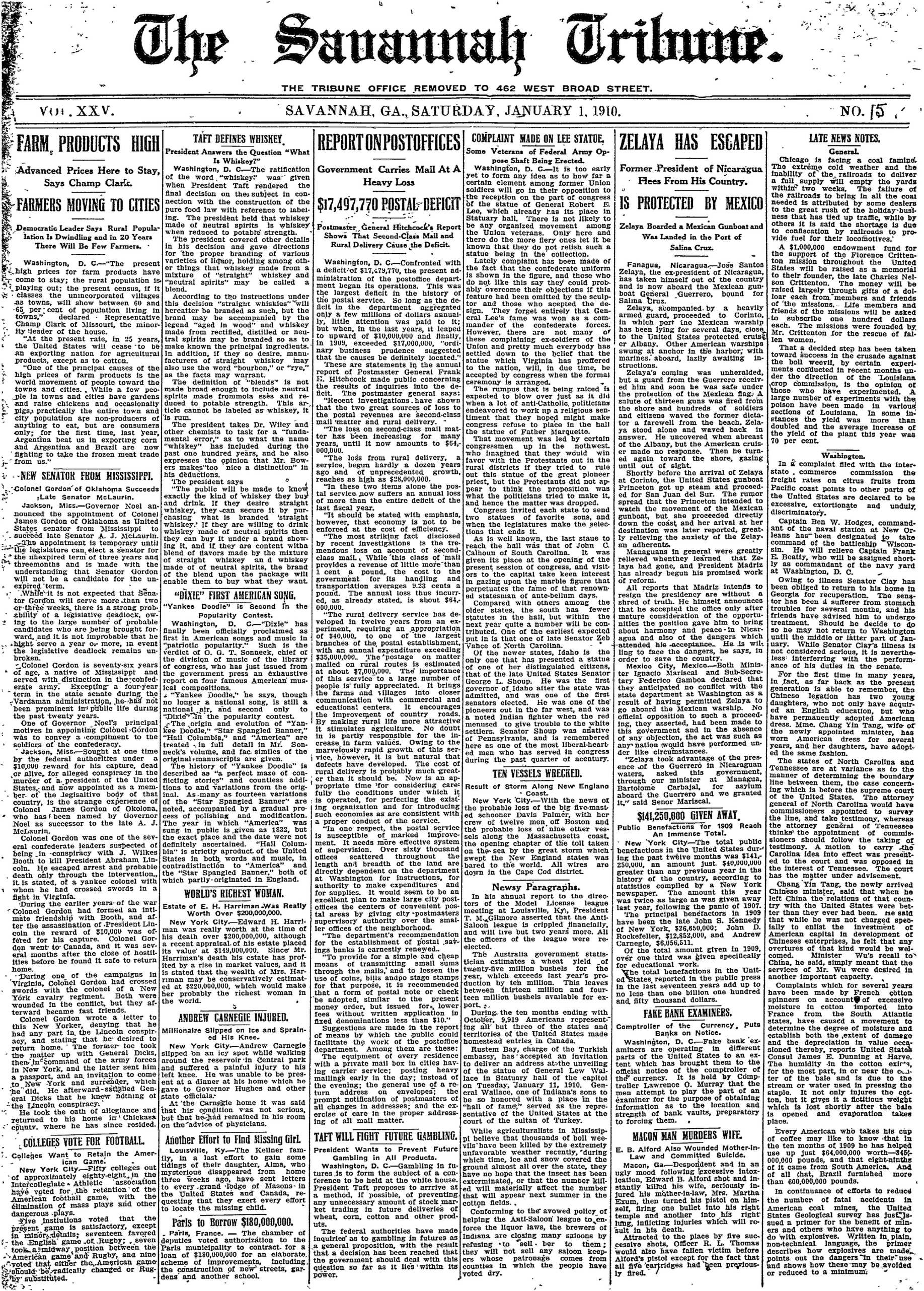
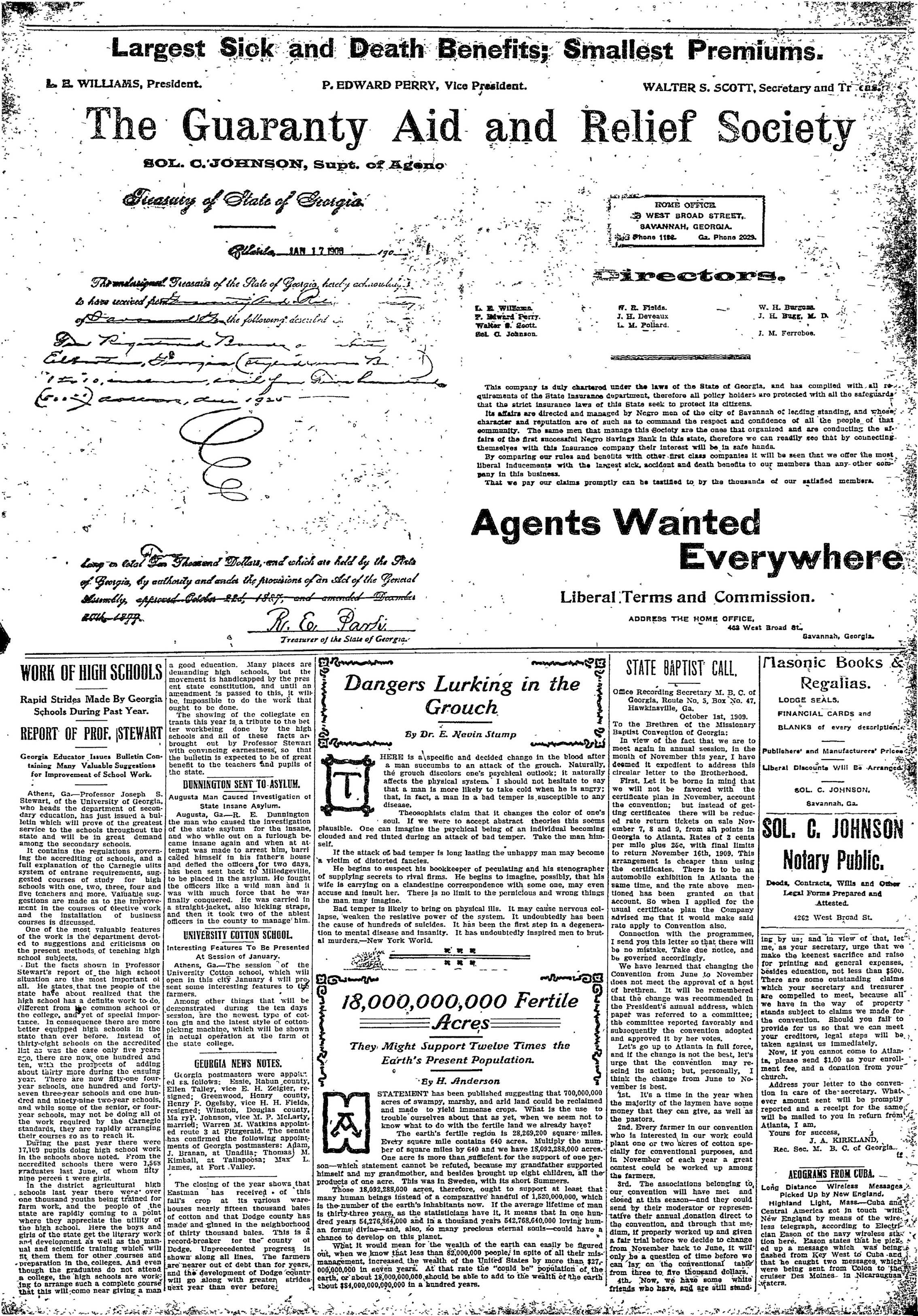
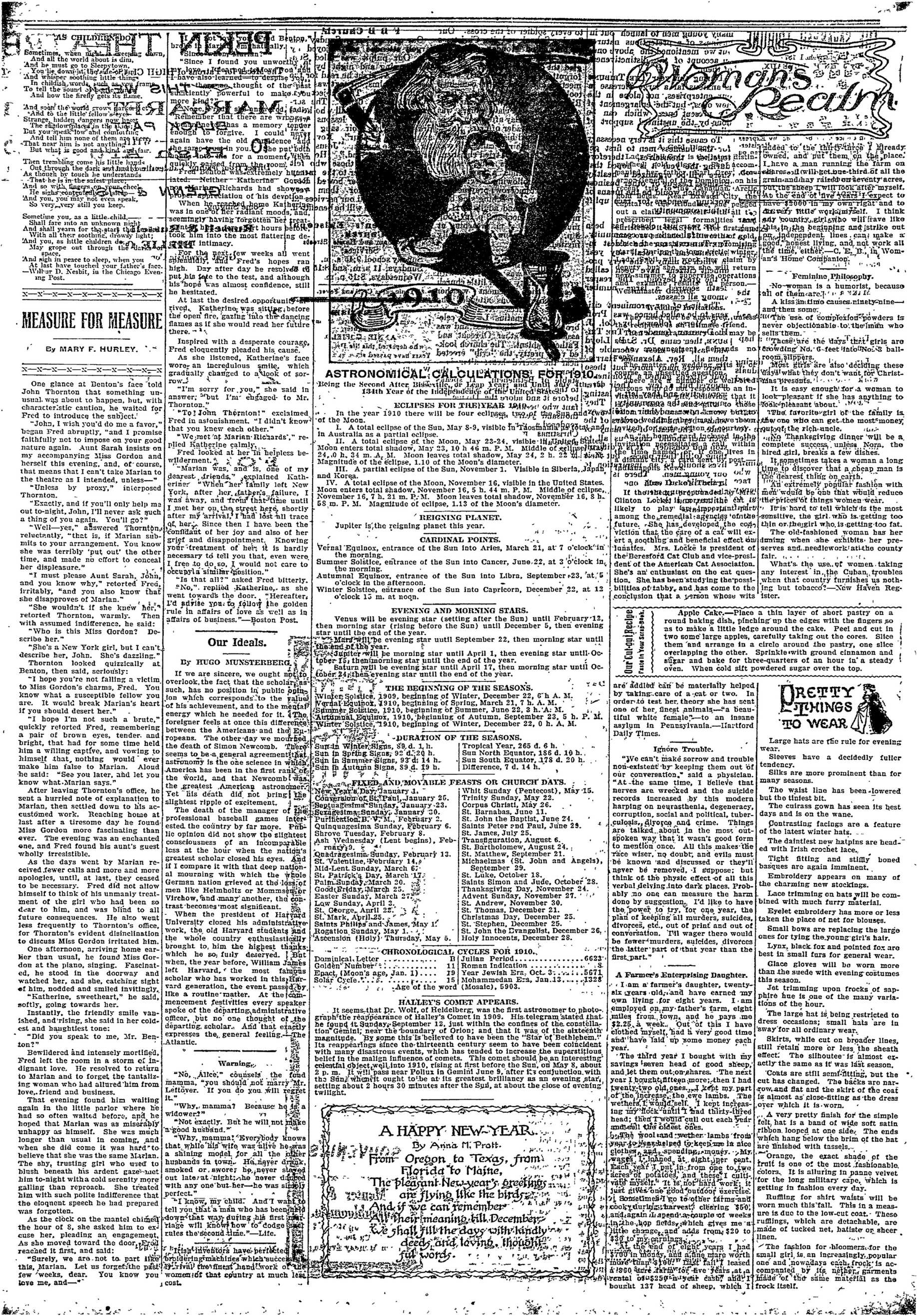
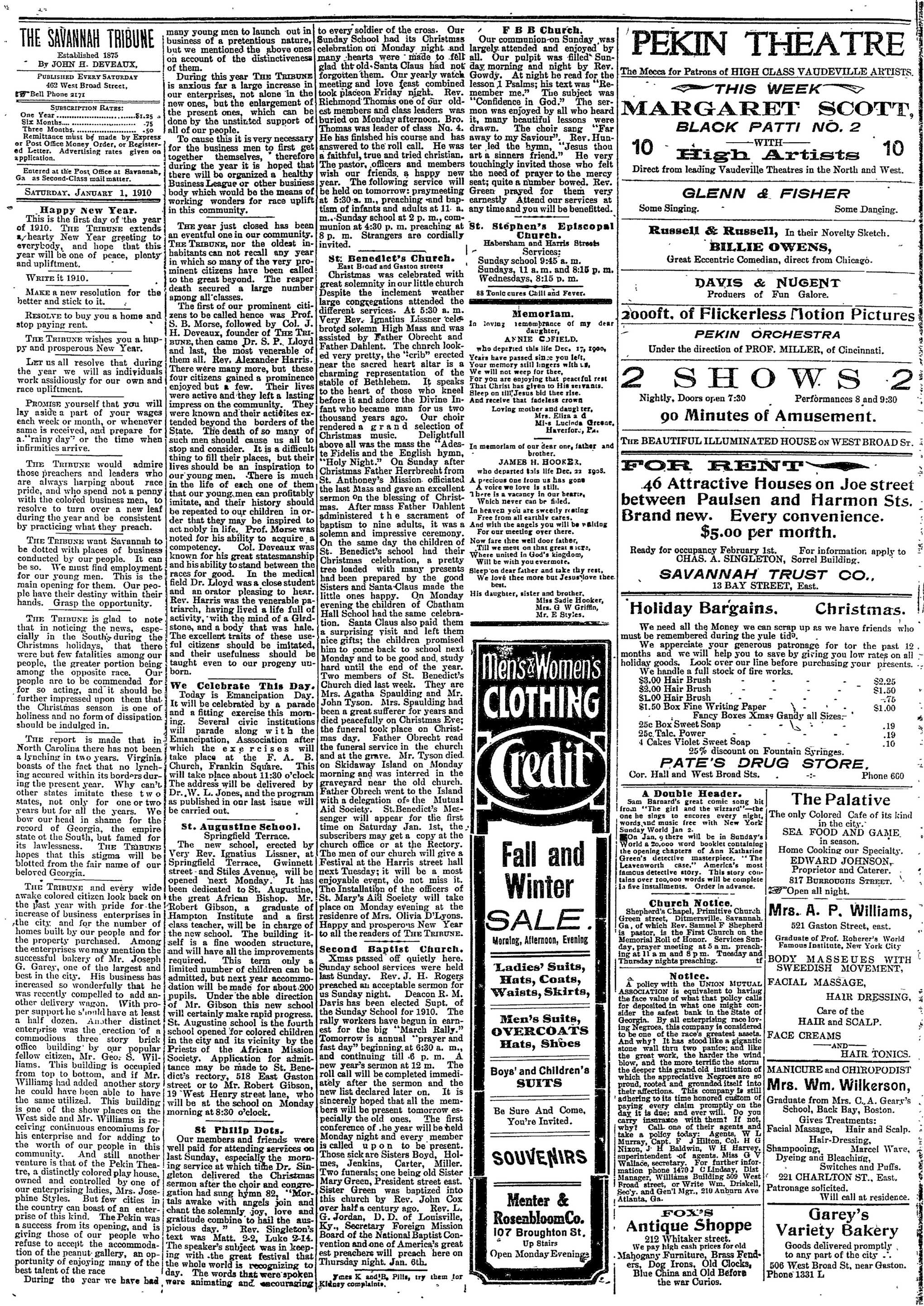
Page text (machine-generated)
V(0) . XXV.
FARM PRODUCTS HIGH
Advanced Prices Here to Stay, Says Champ Clark.
FARMERS MOVING TO CITIES
Democratic Leader Says Rural Population Is Dwindling and in 20 Years There Will Be Few Farmers.
Washington, D. C.—"The present high prices for farm products have come to stay; the rural population is playing out; the present census, if it classes the unincorporated villages as towns, will show between 60 and 65 per cent of population living in towns," declared Representative Champ Clark of Missouri, the minority leader of the house.
"At the present rate, in 25 years, the United States will cease to be an exporting nation for agricultural products, except as to cotton.
"One of the principal causes of the high prices of farm products is the world movement of people toward the towns and cities. While a few people in towns and cities have gardens and raise chickens and occasionally plugs, practically the entire town and city population are non-producers of anything to eat, but are consumers only; for the first time, last year, Argentina beat us in exporting corn and Argentina and Brazil are now fighting to take the frozen meat trade from us."
--NEW SENATOR FROM MISSISSIPPI.
Colonel Gordon of Oklahoma Succeeds
Late Senator McLaurin.
Jackson, Miss.-Governor Noel
announced the appointment of Colonel
James Gordon of Oklahoma as United
States senator from Mississippi to
succeed late Senator A. J. McLaurin.
The appointment is temporary until
the legislature can elect a senator for
the unexpired term of three years and
three months and is made with the
understanding that Senator Gordon
will not be a candidate for the un-
expired term.
While it is not expected that Senator Gordon will serve more than two or three weeks, there is a strong probability of a legislative deadlock, owing to the large number of probable candidates who are being brought forward, and it is not improbable that he might serve a year or more, in event the legislative deadlock remains unbroken. Colonel Gordon is seventy-six years of age, a native of Mississippi and served with distinction in the confederate army. Excepting a four-year term in the state senate during the Vardaman administration, he has not been prominent in public life during the past twenty years.
One of Governor Noel's principal motives in appointing Colonel Gordon was to convey a compliment to the soldiers of the confederacy.
Jackson, Miss.—Sought at one time by the federal authoritates under a $10,000 reward for his capture, dead or alive, for alleged conspiracy in the murder of a president of the United States, and now appointed as a member of the legislative body of that country, is the strange experience of Colonel James Gordon of Okolona, who has been named by Governor Noel as successor to the late A. J. McLaurin.
Colonel Gordon was one of the several confederate leaders suspected of being in-conspiracy with J. Wilkes Booth to kill President Abraham Lincoln. He escaped arrest and probable death only through the intervention, it is stated, of a yankee colonel with whom he had crossed swords in a fight in Virginia.
During the earlier years of the war Colonel Gordon had formed an intimate friendship with Booth, and after the assassination of President Lincoln the reward of $10,000 was offered for his capture. Colonel Gordon went to Canada, and it was several months after the close of hostilities before he found it safe to return home. During one of the campaigns in Virginia, Colonel Gordon had crossed swords with the colonel of a New York cavalry regiment. Both were wounded in the conflict, but they afterward became fast friends.
Colonel Gordon wrote a letter to this New Yorker, denying that he had any part in the Lincoln conspiracy, and stating that he desired to return home. The former toe took the matter up with General Dicks, then in command of the army forces in New York, and the latter sent him a passport, and an invitation to come to New York and surrender, which he did. He afterward satished General Dicks that he knew nothing of the Lincoln conspiracy.
He took the oath of allegiance and returned to his home in Chickasaw county, where he has since resided.
COLLEGES VOTE FOR FOOTBALL.
Colleges Want to Retain the American Game.
New York City—Fifty colleges out of approximately eighty-eight in the Intercollegiate Athletic association have voted for the retention of the American football game, with the elimination of mass plays and other dangerous plays.
Five institutions voted that the present game is satisfactory, except in minor details; seventeen favored the English game of Rugby; seven took a midway position between the American game and Rugby, and nine voted that either the American game should be radically changed or Rugby substituted.
The Savannah Tribune.
THE TRIBUNE OFFICE REMOVED TO 462 WEST BROAD STREET.
TAFT DEFINES WHISKEY
Washington, D. C.—The ratification of the word "whiskey" was given when President Taft rendered the final decision on the subject in connection with the construction of the pure food law with reference to labeling. The president held that whiskey made of neutral spirits is whiskey when reduced to potable strength.
The president covered other details in his decision and gave directions for the proper branding of various varieties of liquor, holding among other things that whiskey made from a mixture of "straight" whiskey and "neutral spirits" may be called a blend. According to the instructions under this decision "straight whiskies" "will hereafter be branded as such, but the brand may be accompanied by the legend "aged in wood" and whiskey made from rectified, distilled or neutral spirits may be branded so as to make known the principal ingredients. In addition, if they so desire, manufacturers of straight whiskey may also use the word "hourbon," or "rye," as the facts may warrant. The definition of "blends" is not made broad enough to include neutral spirits made from mola ssès and reduced to potable strength. This article cannot be labeled as whiskey, it is rum.
The president takes Dr. Wiley and other chemists to task for a "fundamental error," as to what the name "whiskey" has included during the past one hundred years, and he also expresses the opinion that Mr. Bowers makes "too nice a distinction" in his deductions.
The president says
"The public will be made to know exactly the kind of whiskey they buy and drink. If they desire straight whiskey, they can secure it by purchasing what is branded 'straight whiskey'. If they are willing to drink whiskey made of neutral spirits then they can buy it under a brand showing it, and if they are content with blend of flavors made by the mixture of straight whiskey and d whiskey made of of neutral spirits, the brand of the blend upon the package will enable them to buy what they want.
"DIXIE" FIRST AMERICAN SONG.
Washington, D. G.—"Dixie" has finally been officially proclaimed as first in American songs and music in "patriotic popularity." Such is the verdict of O. G. T. Sonneck, chief of the division of music of the library of congress, who has just issued from the government press an exhaustive report on four famous American musical compositions.
"Yankee Doodle," he says, though no longer a national song, is still a national air, and second only to "Dixie" in the popularity contest.
The origin and evolution of "Yankee Doodle," "Star Spangled Banner," "Hall Columbia," and "America" are treated in full detail in Mr. Sonneck's volume, and fac similes of the original manuscripts are given.
The history of "Yankee Doodle" is described as "a perfect maze of conflicting stories" and countless additions to and variations from the original. As many as fourteen variations of the "Star Spangled Banner" are noted, accompanied by a gradual process of polishing and modification. The year in which "America" was sung in public is, given as 1832, but the exact place and the date were not definitely ascertained. "Hall Columbia" is strictly a product of the United States in both words and music, in contradistinction to "America" and the "Star Spangled Banner," both of which partly-originated in England.
WORLD'S BICHEST WOMAN.
Estate of E. H. Harriman - Was Really Worth Over $200,000,000.
New York City - Edward H. Harriman was really worth at the time of his death over $200,000,000, although a recent appraisal of his estate placed its value at $149,000,000. Since Mr. Harriman's death his estate has profited by a rise in market values, and it is stated that the wealth of Mrs. Harriman may be conservatively estimated at $220,000,000, which would make her probably the richest woman in the world.
ANDREW CARNEGIE INJURED.
Millionaire Slipped on Ice and Sprained His Knee.
New York City—Andrew Carnegie slipped on an icy spot while walking around the reservoir in Central park and suffered a painful injury to his left knee. He was unable to be present at a dinner at his home which he gave to Governor Hughes and other state officials.
At the Carnegie home it was said that his condition was not serious, but that he had remained in his room on the advice of physicians.
Another Effort to Find Missing GlrL
Louisville, Ky.-The Kellner family, in a last effort to gain some tidings of their daughter, Alma, who mysterious disappeared from home three weeks ago, have sent letters to every grand lodge of Masons-in the United States and Canada, requesting that they exert every effort to locate the missing child.
Paris to Borrow $180,000,000.
- Paris, France. — The chamber of deputies voted authorization to the Paris municipality to contract for a loan of $180,000,000 for an elaborate scheme of improvements, including the construction of new streets, gardens and another school.
SAVANNAH, GA., SATURDAY, JANUARY 1, 1910.
REPORT ON POSTOFFICES
$17,497,770 POSTAL DEFICIT
Postmaster, General Hitchcock's Report Shows That Second-Class Mail and Rural Delivery Cause the Deficit.
Washington, D. C.—Confronted with a deficit of $17,479,770, the present administration of the postoffice department began its operations. This was the largest deficit in the history of the postal service. So long as the deficit in the department aggregated only a few millions of dollars annually, little attention was paid to it; but when, in the last years, it leaped to upward of $10,000,000 and finally, in 1909, exceeded $17,000,000, "ordinary business prudence suggested that the causes be definitely located." These are statements in the annual report of Postmaster General Frank E. Hitchcock made public concerning the results of inquiries into the deficit. The postmaster general says:
"Recent investigations have shown that the two great sources of loss to the postal revenues are second-class mail matter and rural delivery.
"The loss on second-class mail matter has been increasing for many years, until it now amounts to $54,000,000.
"The loss from rural delivery, a service, begin hardly a dozen years ago and of unprecedented growth, reaches as high as $28,000,000.
"In these two items alone the postal service now suffers an annual loss of more than the entire deficit of the last fiscal year.
"It should be stated with emphasis, however, that economy is not to be enforced at the cost of efficiency.
"The most striking fact disclosed by recent investigations is the tremendous loss on account of second-class mail. While this class of mail provides a revenue of little more than 1 cent a pound, the cost to the government for its handling and transportation averages 9.23 cents a pound. The annual loss thus incurred, as already stated, is about $64,000,000.
"The rural delivery service has developed in twelve years from an experiment, requiring an appropriation of $40,000, to one of the largest branches of the postal establishment, with an annual expenditure exceeding $35,000,000. The postage on matter mailed on rural routes is estimated at about $7,000,000. The importance of this service to a large number of people is fully appreciated. It brings the farms and villages into closer communication with commercial and educational centers. It encourages the improvement of country roads. By making rural life more attractive it stimulates agriculture. No doubt in is partly responsible for the increase in farm values. Owing to the marvelously rapid growth of this service, however, it is but natural that defects have developed. The cost of rural delivery is probably much greater than it should be. Now is an appropriate time for considering carefully the conditions under which it is operated, for perfecting the existing organization and for introducing such economies as are consistent with a proper conduct of the service.
"In one respect, the postal service is susceptible of marked improvement. It needs more effective system of supervision. Over sixty thousand offices scattered throughout the length and breadth of the land are directly dependent on the department at Washington for instructions, for authority to make expenditures and for supplies. It would seem to be an excellent plan to make large city post-offices the centers of convenient postal areas by giving city-postmasters supervisory authority over the smaller offices of the neighborhood.
"The department's recommendation for the establishment of postal savings banks is carnestly renewed...
"To provide for a simple and cheap means of transmitting small sums through the mails', and to lessen the use of coins, bills andpo stage stamps for that purpose, it is recommended that a form of postal note or check be adopted, similar to the present money order, but issued for, lower fees without written application in fixed denominations less than $10."
Suggestions are made in the report of means by which the public could facilitate the work of the postoffice department. Among them are these: The equipment of every residence with a private mail box in cities having carrier service; posting heavy mallings early in the day; instead of the evening; the general use of a return address on envelopes; the prompt notification of postmasters of all changes in addresses; and the exercise of care in the proper addressing of all mail matter.
TAFT WILL FIGHT FUTURE GAMBLING.
President Wants to Prevent Future Gambling in All Products. Washington, D. C.-Gambling in futures is to form the subject of a conference to be held at the white house. President Taft proposes to arrive at a method, if possible, of preventing any unnecessary amount of stock market trading in future deliveries of wheat, corn, cotton and other products. The federal authorities have made inquiries as to gambling in futures as a general proposition, with the result that a decision has been reached that the government should deal with this question so far as it lies within its power.
COMPLAINT MADE ON LEE STATUE.
Washington, D. C.-It is too early yet to form any idea as to how far a certain element among former Union soldiers will go in their opposition to the reception on the part of congress of the statue of General Robert E. Lee, which already has its place in Statuary hall. There is not likely to be any organized movement among the Union veterans. Only here and there do the more fiery ones let it be known that they do not relish such a statue being in the collection.
Lately complaint has been made of the fact that the confederate uniform is shown in the figure, and those who do not like this say they could probably overcome their objections if this feature had been omitted by the sculptor and those who accepted the design. They forget entirely that General Lee's fame was won as a commander of the confederate forces. However, there are not many of these complaining ex-soldiers of the Union and pretty much everybody has settled down to the belief that the statue which Virginia has proffered to the nation, will, in due time, be accepted by congress when the formal ceremony is arranged.
The rumpus that is being raided is expected to blow over just as it did when a lot of anti-Catholic politicians endeavored to work up a religious sentiment that they hoped might make congress refuse to place in the hall the statue of Father Marquette. That movement was led by certain congressmen up in the nothwest, who imagined that they would win favor with the Protestants out in the rural districts if they tried to rule out this statue of the great pioneer priest, but the Protestants did not appear to think the proposition was what the politicians tried to make it, and hence the matter was dropped. Congress invited each state to send two statues of favorite sons, and when the legislatures make the selections that ends it.
As is well known, the last stue to reach the hall was that of John C. Calhoun of South Carolina. It was given its place at the opening of the present session of congress, and visitors to the capital take keen interest in gazing upon the marble figure that perpetuates the fame of that renowned statesman of ante-bellum days. Compared with others among the older states, the south has fewer statutes in the hall, but within the next year quite a number will be contributed. One of the earliest expected put in is that one of late Senator Zeb Vance of North Carolina.
Of the newer states, Idaho is the only one that has presented a statue of one of her distinguished citizens, that of the late United States Senator George L. Shoup. He was the first governor of Idaho after the state was admitted, and was one of the first senators elected. He was one of the ploneers out in the far west, and was a noted Indian fighter when the red memused to give trouble to the white settlers. Senator Shoup was native of Pennsylvania, and is remembered here as one of the most liberal-hearted men who has served in congress during the past quarter of acerency.
TEN VESSELS WRECKED.
Recruit of Storm Along New England Coast.
New York City.—With the news of the probable loss of the big five-masted Davis Palmer, with her crew of twelve men off Boston and the probable loss of nine other vessels along the Massachusetts coast, the opening chapter of the toll taken on the sea by the great storm which swept the New England states was bared to the world. All wires are down in the Cape Cod district.
Newsy Paragraphs.
In his annual report to the directors of the Model License league meeting at Louisville, Ky., President T. M. Gilmore asserted that the Anti-Saloon league is crippled financially, and will live but two years more. All the officers of the league were reelected.
The Australia government statistician estimates a wheat yield of twenty-five million bushels for the year, which exceeds last year's production by ten million. This leaves between thirteen million and fourteen million bushels available for export.
During the ten months ending with October, 9,919 Americans representing all but three of the states and territories of the United States made homestead entries in Canada.
Rustem Bay, charge of the Turkish embassy, has accepted an invitation to deliver an address at the unveiling of the statue of General Lew Wallace in Statuary hall of the capitol on Tuesday, January 11, 1910. General Wallace, one of Indiana's sons to be so honored with a place in the "hall of fame," served as the representative of the United States at the court of the sultan of Turkey.
While agriculturalists in Mississippi believe that thousands of boll weevils have been killed by the extremely unfavorable weather recently, "during which time, ice and snow covered the ground almost all over the state, they have no hope that the insect has been exterminated, or that the number killed will materially affect the number that will appear next summer in the cotton fields.
Conforming to the avowed policy of helping the Anti-Saloon league to enforce the liquor laws, the brewers of Indiana are closing many saloons by refusing to sell ber to them; they will not sell any saloon keepers whose patronage comes from counties in which the people have voted dry.
ZELAYA HAS ESCAPED
IS PROTECTED BY MEXICO
Fanagua, Nicaragua—Jose Santos Zelaya, the ex-president of Nicaragua, has taken himself out of the country and is now aboard the Mexican gunboat General Guerrero, bound for Salina Cruz. Zelaya, accompanied by a heavily armed guard, proceeded to Corinto, in which port the Mexican warship has been lying for several days, close to the United States protected cruiser Albany. Other American warships swung at anchor in the harbor, with marines, aboard, lazily awaiting instructions.
Zelaya's coming was unheralded, but a guard from the Guerrero received him and soon he was safe under the protection of the Mexican flag. A salute of thirteen guns was fired from the shore and hundreds of soldiers and citizens waved the former dictator a farewell from the beach. Zelaya stood alone and waved back in answer. He uncovered when abreast of the Albany, but the American cruiser made no response. Then he turned again toward the shore, gazing until out of sight.
Shortly before the arrival of Zelaya at Corinto, the United States gunboat Princeton got up steam and proceeded for San Juan del Sur. The rumor spread that the Princeton intended to watch the movement of the Mexican gunboat, but she proceeded directly down the coast, and her arrival at her destination was later reported, greatly relieving the anxiety of the Zelayan adherents.
Managuans in general were greatly relieved whenthey learned that Zelaya had gone, and President Madriz has already begun his promised work of reform.
All reports that Madriz intends to resign the presidency are without a shred of truth. He himself announces that he accepted the office only after mature consideration of the opportunities the position gave him to bring about harmony and peace in Nicaragua and also of the dangers which attended his acceptance. He is willing to face the dangers, he says, in order to save the country. Mexico City, Mexico—Both Minister Ignacio Mariscal and Sub-Secretary Federico Gamboa declared that they anticipated no conflict with the state department at Washington as a result of having permitted Zelaya to go aboard the Mexican warship. No official opposition to such a proceeding, they asserted, had been made to this government and in the absence of any objection, the act was such as any nation would have performed under like circumstances.
"Zelaya took advantage of the presence of the Guerrero in Nicaraguan waters, asked this government, through our minister at Managua, Bartolome Carbajal, for asylum aboard the Guerrero and we granted it." said Senor Mariscal.
$141,250,000 GIVEN AWAY
Public Benefactions for 1909 Reach An Immense Total.
New York City—The total public benefactions in the United States during the past twelve months was $141,250,000, an amount just $40,000,000 greater than any previous year in the history of the country, according to statistics compiled by a New York newspaper. The amount this year was twice as large as was given away last year, following the panic of 1907. The principal benefactors in 1909 have been the late John S. Kennedy of New York, $26,650,000; John D. Rockefeller, $12,852,000, and Andrew Carnegie, $6,056,511. Of the total amount given in 1909, over one third was given specifically for educational work.
The total benefactions in the United States reported in the public press in the last seventeen years add up to no less than one billion one hundred and fifty thousand dollars.
FAKE BANK EXAMINERS.
Comptroller of the Currency, Puts Banks on Notice.
Washington, D. C.—Fake bank examiners are operating in different parts of the United States to an extent which has brought them to the official notice of the comptroller of the currency. It is held by Comptroller Lawrence O. Murray that the men attempt to play the part of an examiner for the purpose of obtaining information as to the location and strength of bank vaults, preparatory to forcing them.
MACON MAN MURDERS WIFE.
E. B. Alford Also Wounded Mother-In-Law and Committed Suicide.
Macon, Ga—Despondent and in an ugly mood following excessive intoxication, Edward B. Alford shot and instantly killed his wife, seriously injured his mother-in-law, Mrs. Martha Exum, then turned his pistol on himself, firing one bullet into his right temple and another into his right lung, inflicting injuries which will result in his death.
Attracted to the place by five successive shots, Officer R. L. Thomas would also have fallen victim before Alford's pistol except for the fact that all five cartridges had been previously fired.
---
LATE NEWS NOTES.
General
Chicago is facing a coal famild.
The extreme cold weather and the inability of the railroads to deliver a full supply will empty the yards within two weeks. The failure of the railroads to bring in all the coal needed is attributed by some dealers to the great rush of the holiday-business that has tied up traffic, while by others it is said the shortage is due to confiscation by railroads to provide fuel for their locomotives.
A $1,000,000 endowment fund for the support of the Florence Crittenton mission throughout the United States will be raised as a memorial to their founder, the late Charles Nelson Crittenton. The money will be raised largely through gifts of a dollar each from members and friends of the missions. Life members and friends of the missions will be asked to subscribe one hundred dollars each. The missions were founded by Mr. Crittenton for the rescue of fallen women.
That a decided step has been taken toward success in the crusade against the boll weevil, by certain experiments conducted in recent months under the direction of the Louisiana crop commission, is the opinion of those who have experimented. A large number of experiments with the poison have been made in various sections of Louisiana. In some instances the yield was more than doubled and the average increase of the yield of the plant this year was 70 per cent.
Washington
In a complaint filed with the interstate commerce commission the freight rates on citrus fruits from Pacific coast points to other parts of the United States are declared to be excessive, extortionate and unduly discriminatory.
Captain Ben W. Hodges, commandant of the naval station at New Orleans has been designated to take command of the battleship Wisconsin. He will relieve Captain Frank E. Beatty, who will be assigned shortly as commandant of the navy yard at Washington, D. C.
Owing to illness Senator Clay has been obliged to return to his home in Georgia for recuperation. The senator has been a sufferer from stomach troubles for several months, and his friends have advised him to undergo treatment. Should he decide to do so he may not return to Washington until the middle or latter part of January. While Senator Clay's illness is not considered serious, it is nevertheless interfering with the performance of his duties in the senate.
For the first time in many years, in fact, as far back as the present generation is able to remember, the Chinese legation has two young daughters, who not only have acquired an English education, but who have permanently adopted American dress. Mme. Chang Yin Tang, wife of the newly appointed minister, has worn American dress for several years, and her daughters, have adopted the same fashion.
The states of North Carolina and Tennessee are at variance as to the manner of determining the boundary line between them, the case concerning which is before the supreme court of the United States. The attorney general of North Carolina would have commissioners appointed to survey the line, and take testimony, whereas the attorney general of Tennessee thinks the appointment of commissioners should follow the taking of testimony. A motion to carry the Carolina idea into effect was presented to the court and was opposed in the interest of Tennessee. The court has the matter under advisement.
Chang Yin Tang, the newly arrived Chinese minister, said that when he left China the relations of that country with the United States were better than they ever had been. He said that while he was not charged specially to enlist the investment of American capital in development of Chinese enterprises, he felt that any overtures of that kind would be welcomed. Minister Wu's recall to China, he said, simply meant that the services of Mr. Wu were desired in another important capacity.
Complaints which for several years have been made by French cotton spinners on account of excessive moisture in cotton imported into France from the South Atlantic states, have caused a movement to determine the degree of moisture and establish both the extent of damage and the depreciation in value occasioned thereby, reports United States Consul James E. Dunning at Harve. The humidity in the cotton exits, for the most part, in or near the center of the bale and is due to the stream or water used in pressing the staple. It not only injures the cotton, but it gives it a fictitious weight which is lost shortly after the bale is opened and evaporation takes place.
Every American who takes his cup of coffee may like to know that in the ten months of 1909 he has helped use up just $64,000,000 worth—$450,000,000 pounds, and that eight-ninths of it came from South America. And of all that, Brazil furnished more than 600,000,000 pounds.
In continuance of efforts to reduce the number of fatal accidents in American coal mines, the United States Geological survey has just issued a primer for the benefit of miners and others who have anything to do with explosives. Written in plain, non-technical language, the primer describes how explosives are made, points out the dangers in their use and shows how these may be avoided or reduced to a minimum;
Largest Sick and Death Benefits; Smallest Premiums.
The Guaranty Aid and Relief Society
Treasury of State of Georgia
Illinois, JAN 17 1908 190
The undersigned Treasurer of the State of Georgia, hereby acknowledges
to how received from the Secretary of State of Georgia the following described:
Dear Reginald R. R.,
Elizabeth, Christopher (Signature)
1740, 10, unsealed, seal from D. H. Hammond
(Signature)
long in total Ten Thousand Dollars, and which are held by the State
of Georgia, by authority and under the provisions of an Act of the General
Assembly, approved October 22d, 1887, and amended December
20th, 1897.
R. E. Parti
Treasurer of the State of Georgia
Rapid Strides Made By Georgia Schools During Past Year.
REPORT OF PROF. STEWART
Georgia Educator Issues Bulletin Containing Many Valuable Suggestions for Improvement of School Work.
Athens, Ga—Professor Joseph S. Stewart, of the University of Georgia, who heads the department of secondary education, has just issued a bulletin which will prove of the greatest service to the schools throughout the state and will be in great demand among the secondary schools.
It contains the regulations governing the accrediting of schools, and a full explanation of the Carnegie ulits system of entrance requirements, suggested courses of study for high schools with one, two, three, four and five teachers and more. Valuable suggestions are made as to the improvement in the courses of elective work and the installation of business courses is discussed.
One of the most valuable features of the work is the department devoted to suggestions and criticisms on the present methods, of teaching high school subjects.
But the facts shown in Professor Stewart's report of the high school situation are the most important of all. He states that the people of the state have about realized that the high school has a definite work to do, different from the common school or the college, and yet of special importance. In consequence there are more better equipped high schools in the state than ever before. Instead of thirty-eight schools on the accredited list as was the case only five years ago, there are now one hundred and ten, with the prospects of adding about thirty more during the ensuing year. There are now fifty-one four-year schools, one hundred and forty-seven three-year schools and one hundred and ninety-nine two-year schools, and whils some of the senior, or four-year schools, may not be doing all of the work required by the Carnegie standards, they are rapidly arranging their courses so as to reach it.
During the past year there were 17,109 pupils doing high school work in the schools above noted. From the accredited schools there were 1,568 graduates last June, of whom fifty nine percent were girls.
In the district agricultural high schools last year there were over one thousand youths being trained for farm work, and the people of the state are rapidly coming to a point where they appreciate the utility of the high school. Here the boys and girls of the state get the literary work and development as well as the manual and scientific training which will fit them them for other courses and preparation in the colleges. And even though the graduates do not attend a college, the high schools are working to arrange such a complete course that this will come near giving a man
P. EDWARD PERRY, Vice President.
BOL. C.JOHNSON, Supt. of Ageno
plausible. One can imagine the psychical being of an individual becoming clouded and red tinted during an attack of bad temper. Take the man himself.
If the attack of bad temper is long lasting the unhappy man may become a victim of distorted fancies.
He begins to suspect his bookkeeper of peculating and his stenographer of supplying secrets to rival firms. He begins to imagine, possibly, that his wife is carrying on a clandestine correspondence with some one, may even accuse and insult her. There is no limit to the pernicious and wrong things the man may imagine.
Bad temper is likely to bring on physical illis. It may cause nervous collapse, weaken the resistive power of the system. It undoubtedly has been the cause of hundreds of suicides. It has been the first step in a degeneration to mental disease and insanity. It has undoubtedly inspired men to brutal murders.—New York World.
son—which statement cannot be refuted, because my grandfather supported himself and my grandmother, and besides brought up eight children, all the products of one acre. This was in Sweden, with its short Summers.
Those 18,092,288,000 acres, therefore, ought to support at least that many human beings instead of a comparative handful of 1,520,000,000, which is the number of the earth's inhabitants now. If the average lifetime of man is thirty-three years, as the statisticians have it, it means that in one hundred years 54,276,864,000 and in a thousand years 542,768,640,000 loving human forms; divine—and, also, so many precious eternal souls—could have a chance to develop on this planet.
What it would mean for the wealth of the earth can easily be figured out, when we know that less than 82,000,000 people, in spite of all their mismanagement, increased the wealth of the United States by more than $27,000,000,000 in seven years. At that rate the "could be" population of the earth, or about 18,000,000,000 should be able to add to the wealth of the earth about $84,000,000,000 in a hundred years.
a good education. Many places are demanding high schools, but the movement is handicapped by the present state constitution, and until an amendment is passed to this, it will be impossible to do the work that ought to be done. The showing of the collegiate entrants this year is a tribute to the better workbeing done by the high schools and all of these facts are brought out by Professor Stewart with convincing earnestness, so that the bulletin is expected to be of great benefit to the teachers and pupils of the state.
T
DUNNINGTON SENT TO-ASYLUM.
Augusta Man Caused Investigation of State Insane Asylum. Augusta, Ga.-R. E. Dunnington the man who caused the investigation of the state asylum for the insane, and who while out on a furlough became insane again and when at attempt was made to arrest him, barricaded himself in his father's house and defied the officers for two days, has been sent back to Milledgeville, to be placed in the asylum. He fought the officers like a wild man and it was with much force that he was finally conquered. He was carried in a straight-jacket, also kicking straps, and then it took two of the ablest officers in the county to manage him.
UNIVERSITY COTTON SCHOOL
Interesting Features To Be Presented At Session of January. Athens, Ga.-The session of the University Cotton school, which will open in this city January 4 will present some interesting features to the farmers. Among other things that will be demonstrated during the ten days session, are the newest type of cotton gin and the latest style of cotton-picking machine, which will be shown in actual operation at the farm of the state college.
GEORGIA NEWS NOTES.
Georgia postmasters were appointed as follows: Essie, Habun county, Ellen Talley, vice E. H. Zelgler, resigned; Greenwood, Honry county, Henry P. Ogelsby, vice H. H. Fields, resigned; Winston, Douglas county, Ma ryP. Johnson, vice M. P. McLarty, married; Warren M. Watkins appointed route 3 at Fitzgerald. The senate has confirmed the following appointments of Georgia postmasters: Adam, J. Branan, at Unadila; Thomas M. Kimball, at Tallapoosa; Max L. James, at Fort Valley.
A
The closing of the year shows that Eastman has received of this fall's crop at its various warehouses nearly fifteen thousand bales of cotton and that Dodge county has made and ginned in the neighborhood of thirty thousand bales. This is a record-breaker for the county of Dodge. Unprecedented progress is shown along all lines. The farmers are nearer out of debt than for years, and the development of Dodge county will go along with greater strides next year than ever before.
Directors.
L. E. Williams.
P. Edward Perry.
Walter S. Scott.
Sel. C. Johnson.
W. R. Fields.
J. H. Deveaux
L. M. Pollard.
W. H. Burgess
J. H. Bugg, M. D.
J. M. Ferrobee.
This company is duly chartered under the laws of the State of Georgia, and has complied with all requirements of the State Insurance department, therefore all policy holders are protected with all the safeguards that the strict insurance laws of this State seek to protect its citizens.
Its affairs are directed and managed by Negro men of the city of Savannah of leading standing, and whose character and reputation are of such as to command the respect and confidence of all the people of that community. The same men that manage this Society are the ones that organized and are conducting the affairs of the first successful Negro Savings Bank in this state, therefore we can readily see that by connecting themselves with this Insurance company their interest will be in safe hands.
By comparing our rules and benefits with other first class companies it will be seen that we offer the most liberal inducements with the largest sick, accident and death benefits to our members than any other company in this business.
That we pay our claims promptly can be testified to by the thousands of our satisfied members.
Agents Wanted Everywhere
Dangers Lurking in the Grouch
By Dr. E. Nevin Stump
It is a specific and decided change that succumbs to an attack of grouch discolors one's psychical acts the physical system. I show a man is more likely to take on in fact, a man in a bad temperance. Theosophists claim that it changes if we were to accept abstract imagine the psychical being of a during an attack of bad temper. Bad temper is long lasting the unlikelihoods. Select his bookkeeper of peculating to rival firms. He begins to imitate clandestine correspondence with There is no limit to the perniciously to bring on physical ills. It is destructive power of the system. It of suicides. It has been the first and insanity. It has undoubted World.
0,000,000 Acres
Right Support Twelve Thousand's Present Population
HERE is a specific and decided change in the blood after a man succumbs to an attack of the grouch. Naturally, the grouch discolors one's psychical outlook; it naturally affects the physical system. I should not hesitate to say that a man is more likely to take cold when he is angry; that, in fact, a man in a bad temper is susceptible to any disease.
Theosophists claim that it changes the color of one's soul. If we were to accept abstract theories this seems
Ey H. Anderson
EMENT has been published sug of swampy, marshy, and arid la made to yield immense crops. he ourselves about that as yet, what to do with the fertile lan the earth's fertile region is 28
STATEMENT has been published suggesting that 700,000,000 acres of swampy, marshy, and arid land could be reclaimed and made to yleld immense crops. What is the use to trouble ourselves about that as yet, when we seem not to know what to do with the fertile land we already have?
Liberal Terms and Commission. ADDRESS THE HOME OFFICE. 463 West Broad St.
SOL. C. JOHNSON Notary Public.
Deeds, Contracts, Wills and Other Legal Forms Prepared and Attested.
ing by us; and in view of that, let me, as your secretary, urge that we make the keenest sacrifice and raise for printing and general expenses, besides education, not less than $500. There are some outstanding claims which your secretary and treasurer are compelled to meet, because all we have in the way of property stands subject to claims we made for the convention. Should you fail to provide for us so that we can meet your creditors, legal steps will be taken against us immediately. Now, if you cannot come to Atlanta, please send $1.00 as your enrollment fee, and a donation from your church.
Address your letter to the convention in care of the secretary. Whatever amount sent will be promptly reported and a receipt for the same will be mailed to you in return from Atlanta. I am.
Long Distance Wireless Messages Picked Up by New England. Highland Light, Mass—Cuba and Central America got in touch with New England by means of the wireless telegraph, according to Electrician Eason of the navy wireless station here. Eason states that he picked up a message which was being flashed from Key West to Cuba and that he caught two messages which were being sent from Colon to the cruiser Des Moines in Nicaraguan waters.
STATE BAPTIST CALL
Office Recording Secretary M. B. C. of Georgia, Route No. 5, Box No. 47, Hawkinsville, Ga.
October 1st, 1909.
To the Brethren of the Missionary Baptist Convention of Georgia:
In view of the fact that we are to meet again in annual session, in the month of November this year, I have deemed it expedient to address this circular letter to the Brotherhood.
First. Let it be borne in mind that we will not be favored with the certificate plan in November, account the convention; but instead of getting certificates there will be reduced rate return tickets on sale November 7, 8 and 9, from all points in Georgia to Atlanta. Rates of 3 cents per mile plus 25c, with final limits to return November 16th, 1909. This arrangement is cheaper than using the certificates. There is to be an automobile exhibition in Atlanta the same time, and the rate above mentioned has been granted on that account. So when I applied for the usual certificate plan the Company advised me that it would make said rate apply to Convention also.
Connection with the programmes, I send you this letter so that there will be no mistake. Take due notice, and be governed accordingly.
We have learned that changing the Convention from June to November does not meet the approval of a host of brethren. It will be remembered that the change was recommended in the President's annual address, which paper was referred to a committee; the committee reported favorably and subsequently the convention adopted and approved it by her votes.
Let's go up to Atlanta in full force, and if the change is not the best, let's urge that the convention may rescind its action; but, personally, I think the change from June to November is best.
1st. It's a time in the year when the majority of the laymen have some money that they can give, as well as the pastors. 2nd. Every farmer in our convention who is interested in our work could plant one or two acres of cotton specially for conventional purposes, and in November of each year a great contest could be worked up among the farmers.
3rd. The associations belonging to our convention will have met and closed at this season—and they could send by their moderator or representative their annual donation direct to the convention, and through that medium, if properly worked up and given a fair trial before we decide to change from November back to June, it will only be a question of time before we can lay on the conventional table from three to five thousand dollars. 4th. Now, we have some white
4th. Now, we have some white friends who have, and are still stand-
Yours for success,
J. A. KIRKLAND,
Rec. Sec. M. B. C. of Georgia.
AEOGRAMS FROM CUBA.
Masonic Installation:
The following officers of the Masonic Lodges were installed last Monday night at Masonic Temple, by the Grand Secretary of the Order, assisted by Past Master E. B. Roberts, Sr. A short talk was made by P. G. M., J. M. Simms. The installation was public and a number of ladies were present. A sumptuous repast was served after the ceremony:
Eureka No. 1—G. L. Binyard, W. M.; J. A. Monroe, S. W.; J. W. Reed, J. W.; H. B. Wright, Treas.; Sol. C. Johnson, Sec.; G. W. Stewart, Chap.; Jno. F. Andrews, S. D.; M. Bedgood, J. D.; Jas. McClennon, S. S.; Benj. Scott, J. S.; Robt. Neal, Mar.; R. S. Smith, Tyler.
Hilton No. 2—N. H. Thompson, W. M.; P. Y. Giles, S. W.; J. B. Brown, J. W.; M. G. Robertson, Treas.; S. S. Grayson, Sec.; Wm. Mitchell, Chap.; Theodore Shemetella, S. D.; S. T. Johnson, J. D.; Wm. Allen, S. S.; Richard Parker, J. S.; R. B. Bryant, Mar.; Geo. Adams, Tyler.
Pythagoras No. 11—S. T. Redd, W. M.; T. J. Byrd, S. W.; Wm. Brister; J. W.; E. B. Roberts, Treas.; F. M. Cohen, Sec.; A. G. McDowell, Chap.; P. A. Denegall, S. D.; Jno. H. Jackson, J. D.; Rev. L. L. Blair, S. S.; Thos. Roberts, J. S.; F. B. Pettie, Mar.; I. Johnson, Tyler.
Mt. Moriah No. 15—W. H. Burgess, W. M.; Fred Richardson, S. W.; W. Gerrideau, J. W.; E. L. Martin, Treas.; G. F. Clark, Sec.; Rev. P. M. Hunter, Chap.; J. P. Garnett, S. D.; J. W. Small, J. D.; S. L. Sereven, S. S.; A. G. Clark, J. S.; J. Ferguson, Mar.; Samuel Cade, Tyler.
S. Nctorum No. 22—D. Pringle, W. M.; G. M. Manigo, S. W.; J. Long, J. W.; G. L. Bowen, Treas.; R. R. Simmons, Sec.; L. Tyson, Chap.; Elijah A. Brabham, S. D.; H. Quice, J. D.; John Brown, S. S.; Isaiah Ancrum, J. S.; Geo. Eddy, Mar.; Jno. Woods, Tyler. Solomon Temple No. 24—W. D. Kennedy, W. M.; H. T. Singleton, S. W.; Geo. N. Ferguson, J. W.; R. C. Gilbert, Treas.; R. A. Harper, Sec.; T. M. Holly, Chap.; Be.J. Lambert, S. D.; Dr. J. W. Jamerson. J. D.; Foster Robinson, S. S.; M. Simmons, J. S.; Randolph Maxwell. Mar.; R. W. Hbuston, Tyler.
The following officers of Electa Chapter No.1, O.E. S. were elected and installed last week: Mrs. H. B. Sales. R. M.; J. F. Andrews, R. P.; Mrs. Mary Binyard, A. M.; Mrs. A. L. Johnson, Treasurer; Miss Mae Stewart, Sec'y.; Mrs. Janie Turner. Conductress; Mrs. R. E. Williams, A. Conductress; Mrs. Lula Brown, Herald; Mrs. B. Chisolm, Faith; Miss E. Harden. Truth; Mrs. M. Brown, Charity; Mrs. L. Quarterman, Wisdom; Mrs. R. E. Stevens, Warder; Jas. Wilson, Sentinel.
The following are the officers of Mt. Moriah Chapter No. 37, O. E. S.; Mrs. R. L. Barnes, R. M.; Mrs. Bessie McTyre, A. M.; Mrs. Currie L. White, Secretary; Mrs. Margaret Roberts, Treasurer; Duncan Pringle, R. P.; Mrs. Jennie Lee Hill, Conductress; Mrs. Gertie Roberts, A. C.; Mrs. Catharine Davis, Herald; Mrs. Elsie Hill, Truth; Mrs. Lucile Roberts, Faith; Mrs. Amie East, Wisdom; Mrs. Elizabeth Turner, Warder; E. A. Braham, Sentinel; Miss Margaret McTier, M. E.; Miss C. I. Branch, M. W. the officers were installed by P. St Patron G. L. Binyard.
Men's Sunday Club.
The regular Emancipation exercises under the auspices of the Men's Sunday Club will take place at the Masonic Temple on tomorrow afternoon at 4:30 o'clock. The public is cordially invited. The following is the program: Doxology
Invocation, Rev. J. C. Allen Solo, Miss Agnes Proctor
Reading of Emancipation Proclamation, Miss Geraldine Parkhurst
Quartette, Dr. Ford, Messrs. Chas Anderson and others
Introductory remarks by the President, Prof. S. A. Grant
Address, Prof. Henry Pearson
Solo, Miss Nettie A. Houston
Announcements, etc.
Music, Quartette
Benediction
Reopening Services. The re-opening services of the First Congregational Church, Rev. W. L. Cash, pastor, will be held on Sunday, January 2nd at 11 a.m. and 6 p.m. The church edifice has been recently renovated at a cost of about eight hundred dollars. Electric lights have also been installed. The church is now in excellent condition and presents a very beautiful appearance. Appropriate music for this occasion will be rendered by the choir and a special offering will be made. At the evening wor
ship, celebration of the Holy Communion and reception of new members. A free-will offering will also be taken for the benefit of the poor.
The week of prayer will be observed by the church beginning Monday night, January 3rd. and continuing until Friday night, January 6th. Among those who deliver addresses or sermons will be Prof. L. E. Walters, Rev. R. H. Singleton, D. D., Rev. W. Moore Scott and Rev. S. T. Redd. The services will begin promptly at 8 o'clock. The pastor and congregation extend you, your family and friends a cordial invitation to anyone or all of these services. Strangers and visitors are always welcome.
Local Dots.
Hymes K. and B. Pills, try them for Kidney complaints.
Mr. C. M. Hankerson, made a flying trip to New York last week to remain only a few days.
Mrs. Annie Simmons of Moultrie, Ga., is in the city spending the holidays with Mr. and Mrs. S. Simmons.
Mrs. Willie Hurley of Macon, Ga., is spending the holidays in this city as the guest of Miss Julia Davis.
Mrs. Addie L. Jenks of Stilson spent a few days in the city last week, returning home in time for Christmas.
88 Tonic cures Chill and Fever.
Miss E. L. Williams, who is residing in Chicago, is in the city spending the holidays with her cousin, Mrs. M. M. Mills on West Broad street.
Prof. J. H. W. Lee of Tuskegee, was in the city Friday of last week. Prof. Lee is among those of our educators who are doing unselfish work for race uplift.
Miss Marion L. Hunter, after spending the summer in New York with her sister, Mrs. Miles returned to the city on the 24th of December much to the delight of her friends.
The Interdenominational Ministers Union will meet next Tuesday at 11 a. m., at Beth-Eden Church. Business of importance, also election of officers will take place.
Mrs. A. L. Reed left this morning for Charleston, S C., where she will spend two weeks and, after which she will join her husband in Jacksonville, Fla., before returning.
Mr. G. H. Bowen of Waycross representative of the Standard Life Insmrance Co., is spending a few days in the city in the interest of his company, and is meeting with deserved success.
First Class catering can be had by calling on Mrs. M. Lockett Small, 817 West Broad street. For ice cream, salads, picnic boxes and desserts for Sunday dinner. Catering of all kinds. Don't fail to attend the grand literary and musical entertainment to be given by the Men's Sunday Club at Masonic Temple on Friday evening January 7. A fine orchestra will be in attendance. Dancing and refreshments afterwards.
On Wednesday evening, Rev. L.J. Jordan, Corresponding Secretary of the Foreign Mission Board will hold a meeting at the F.A.B. Church, Franklin square, in the interest of this work. The pastor wishes to extend an invitation to the public A special program will be carried out in connection with a lecture.
Mr. and Mrs. George Lyman of Marietta spent the holidays in the city, the guests of Mr. and Mrs. Zeb. Clark. This is their first trip to the city and they enjoyed it hugely. Mr. Lyman returned bome, Wednesday, but the madam will remain longer, and her friends will endeavor to make her stay very pleasant. 88 Tonic cures Chill and Fever. Mrs. Lavinia Guerard and Mrs. Gertie Thorpe of New York City, formerly of Savannah are in the city for a few days, spending a while with relatives and friends.
The 13th annual meeting of the Ladies Union Branch was held on Sunday evening last, at which time the officers for the ensuing year were installed by Messrs. L. A. Washington and J. F. Andrews; J. S. Quarterman, president; Mrs. Hannah Martin, vice president; Mrs. E. B. S. Whitefield, F. S.; Mrs. Mary A. Fludd, R. S.; Mrs. L. Quarterman, treasurer; Mrs. C. Gilmore, C. of F.; Mrs. M. A. Johnson, C. of H.; Mrs. Frances Proctor, C. of I.; Mrs. E. A. D. Seabrooks; C. W. and M.; Lee Gilmore, Chaplain: S. Mallard, C. of O.
Allen Christian Endeavor Union League met at St. Philip Monumental Church last Sunday. The meeting was very successful considering the cold weather. The subject or topic for discussion was "Mission." Those-speaking on the
subject were Mrs. A. B. Securdy, Miss S. Gaston, Mr. F. B. Bryant and others. There was a quartette by Miss Mimmstand others. Select reading by Miss S. Gaston. Solo by Prof. B. S. Reed. Every one seemed delighted with this solo. The paper read by Miss H. Carswell was indeed excellent. Solo by Miss L. Golden. Rev. E. B. Brown of Gaines Chapel and R. H. Singleton of St. Philip were introduced to the League. After the collection was taken the League adjourned to nect at St. Philip the third Sunday in January.
Mr. Thos. Blake of Fernandina, Fla., spent Christmas day very pleasantly in the city with his daughter and son-in-law Mr. and Mrs. H. F. Benson. Quite an enjoyable afternoon was spent in meeting friends. At 6 o'clock dinner was served. Those present were Mr. and Mrs.' H. F. Benson, Mr. Thos, Blake of Fernandina; Mr. and Mrs. J. W. Lewis of Fort Screven, Ga.; Mr. Mrs. J. T. Blake Blake, Mr. and Mrs. Jos. Sullivan and Miss Sarah Hazel.
A large number of persons witnessed the foot ball game between the Young Imperial and the Old Imperial Christmas day in Jones Park, foot of Jackson street. Both teams played hard. President A. W. Wright did all that he could to win for the Old Imperial, but Clark's drive through the center won the game for the young men.
By L. S. BING.
Young people all attention give.
Obey, the gospel sound,
Ere Gabriel with his silvery trump
Shall shake the solid ground,
At sin Jehovah will not wink
The time is drawing near,
When all the whole creation round
That awful trump shall hear.
Then be you reconciled to God,
And set yourselves aright.
Or you will sink beneath His frown
To everlasting night.
Repent, believe and be baptized
Is Jesus' great command,
Be numbered with that bloodwashed
throng,
To dwell at His right hand.
Your joys on earth will soon be gone,
It all will pass away,
Your body laid beneath the ground,
To dwell with fellow clay.
AMUSEMENT COLUMN.
A new year festival will be given by the Catholic Mutual Aid Society at Harris street Hall, Tuesday night January 4th Tickets 25 cents.
A grand New Year Hop will be given by the Porters Benevolent Association at Harris Street Hall, Wednesday night January 5th. Tickets 15 cents.
Adamant Lodge No 7862, GU O of O F will give their first anniversary at Harris street hall, Monday night January 10, Tickets 35 and 50 cents.
The third annual dance of the Colored Railway Trainmen will be given at Masonic Temple, Wednesday night January 5th. Tickets 25 cents.
Attend the second New Year entertainment given by Georgina Company No. 1, U.R K of D at Harris street hall, Monday night January 3rd. Tickets 25 and 40 cents.
The Y G E A and S Club will give their 12th annual entertainment at Harris street hall, Monday night January 17th. Tickets 25 and 50 cents.
A Mid-winter entertainment will be given by White Rose Court No. 72, O O at Masonic Temple Friday night, January 21st. Tickets 15 cents.
The Arlington A and S Club No 142 will give their first annual ball at Masonic Temple Monday night January 17th Tickets 25 and 40 cents.
The annual mid-winter entertainment of Diamond Court 257 O. O C. will take place at Masonic Temple Friday night January 14th. Tickets 15 cents.
The L. B. S. Club will give their first New Year dance at Masonic Temple, Monday night January 10th. Tickets 25 cents.
The Twilight Reapers A. and S. O will give a grand new year dance at Masonic Temple Monday night January 3rd. Tickets 25 cents.
A grand mid-winter entertainment will be given at Masonic Temple by Willing Workers Fountain No 2799 U. O. T. R. Monday night January 31st. Tickets 25 and 25 cents.
The West End Pleasure Club will give their third annual hop of the season at Masonic Temple, Wednesday night January 19. Tickets 25 cents.
The annual mid-winter entertainment of Diamond Court No. 257 O O O will take place at Masonic Temple, Friday night January 14. Tickets 15c.
The G U B Society will give their silver Anniversary at Masonic Temple Monday night January 24; Ticket 15 and 25 cents.
A grand literary and musical, entertainment will be given by Men's Sunday Club at Masonic Temple, Friday night January 7. Tickets 26 20 ts
A grand pink ribbon party will be given by the Mission Club of B. B Church at Masonic Temple Tuesday afternoon January 11. Tickets 5 cents
Does all kind of high grade dental work of the best quality and workmanship. Gold crowns and bridge work. White Porcelain Pivot, and Gold Crowns mounted on the natural roots. Gold Fillings, Cement Fillings, and Silver or Amalgam Fillings, from mine to a full set of teeth $7.00 and $8.00. Broken places mended and teeth added to old ones for a small cost. Bell Phone 1244. Solid Gold Crowns Guaranteed 234 K Gold.
Let Us Help You
FOR MEN—Sterling sets Ebay
Housekerchief
Shaving and Wash
FOR WOMEN—Sterling complex
Holder
Hand dressed Scar
down
Bogs,
FOR GIRLS
Fur Sets, Coats, Drill
Silver Novelties
kerchiefs
EXQUISITE
JAPANESE POTTERY
B. H. L.
Have you seen the 100 New Year
Presents to be given away by
Apollo Dancing Academy
Select your Xmas present crowed with the most stable for holiday gifts; for in the South to select for want here without was.
FOR MEN—Sterling and Art Silvers sets Ebony Military Bags, House Robes, Smoking kerchiefs, Gloves, Neck Shaving Outfits. Suits and Walking Canes.
FOR WOMEN—Sterling and Art Silvers complete sets. Sterling Holders, Mesh Bags and Hand Bags and Gremal ded Scarfs, Silk and W down Robes and Sack Bogs, Silk Petticaots.
FOR GIRLS
Fur Sets, Coats, Dresses Gloves, Silver Novelties, Handkerchiefs.
FOR
The prettiest Novelties
EXQUISITE JAPANESE POTTERY
B. H. LEVY
seen the 100 New Year to be given away by dancing Academy
FOR WOMEN—Sterling and Art Silver Toilet Arsicles—odd pieces and complete sets. Sterling Silver Picture Frames, Hatpin Holders, Mesh Bags and exquisite odd pieces. Leather Hand Bags and Greman Silver Mesh Bags. Silver Studded Scarfs, Silk and Wool Shawl, Faney Linens. Eiderdown Robes and Sacques and Silk Kimonas. Opera Bogs, Silk Petticaots and Furs.
Monday afternoon Jan. 3, 1910, at Morse's hall. If not see Mr. Young's window in Williams' building, West Broad, near Minis St., and be convinced that they are the grandest souvenirs ever given away in this city. Music and classic dancing will be the duco plac of the entertainment. Admission 15c
Visit the Apollo Dancing Academy Monday, Wednesday and Friday after noons, Tuesday and Thursday nights. All rights reserved to reject.
FIRST-CLASS RESTAURANT
524 WEST BROAD ST.
Good Meals
Quick Lunches
Served by Competent-Help
Open DAY and NIGHT
Doc Mordecai,
Proprietor.
BEST BROAD ST.
Food Meals
K Lunches
by Competent-Help
DAY and NIGHT
Mordecai,
Proprietor.
We wish to
express our app
show every con
your business a
We have an in-
hams, Out
Just p
Give Us A C
F. F. JONES,
DEALER IN
Beef - Veal - Mutton
Lamb-Pork-Hams
Bacon and
CORNED BEEF
All Kinds of GAME in Season.
Goods promptly delivered to
any part of the city free of
charge.
STALL 31 CITY MARKET
WEST SIDE
RESTAURANT
461 West Broad Street,
Near Union Station
DEALER IN
Veal - Mutton
Pork-Hams
Scon and
NED BEEF
of GAME in Season,
promptly delivered to
of the city free of
CITY MARKET
EAST SIDE
TAURANT
West Broad Street,
ear Union Station
The place to get first class meals. Everything neat and clean. Meals prepared in an apetizing manner and at all hours daily. Meals 15 and 25 cents. Mrs. A: S. Scorr, Proprietress.
R. B. Brooks,
Antique Shop and Furniture Repairing, Upholsterer. and Cabinet Maker.
Dealer in Novelties of all kinds such as Brass, Silver, Sheffield Plate, Old Coins, Bills, &c, Runs, Pistols, Swords and Jewelry.
Chipandale, Heplewhite and Colonial Furniture Bought and Sold. Call or Address
444 Drayton St., Corner Gordon Lane, Savannah, Ga.
your Xmas present our counters with the most sightly and artistic holiday gifts, forming the most south to select from. You can see there without waste of valuable time.
Ling and Art Silver Military Brushes, Tony Military Brushes and complete Robes, Smoking Jackets and Bathrobes, Gloves, Neckwear, Suspenders, Outfits. Suit Cases, Traveling Hiking Canes.
Ling and Art Silver Toilet Arsicles—set sets, Sterling Silver Picture Kits, Mesh Bags and exquisite odd pendants and Greman Silver Mesh Bags, Arfs, Silk and Wool Shawl, Faney Kite Robes and Sacques and Silk Kite Silk Petticaots and Furs.
RLS FOR
Messes Gloves,
Kite, Hand-
Neckwear, Lager,
kerchiefs,
Hats
FOR BABY
The prettiest line of Celluloid Novelties ever sewn this city
EVY, BROOK
Drug Store
We advertise in THE REACHES every Colored we want to let you know patronage. You are the Store. We carry a full are always just right. Let Live!
Pate's D
Phone 660 Corner
SCOTT
West Broad and
Beginning Our Seventh Year
We wish to thank the public express our appreciation for the show every consideration possible your business and you will profit.
We have an increased STOCK of the hams, Outings, Overalls, Colts. Just placed in stock a line Give Us A Call.
SCOTT
West Broad
REMEMBER—We furnish Ice as well as
SEABO AIR
DAILY SERVICE
12:50 pm Leaves for mond, Wash all Eastern
11:45 pm Leaves for mark, Co stations
4:30 am Leaves for Ocala, Tampa
2:50 am Leaves for Americas, Western
8:00 am
1:15 pm
7:00 am Leaves for Americas, Western
5:00 pm
Central Standard Time. Full information at City Ticket Office
C. W. Small, C. P. & T. A
R. H. Stansell, A. G. P. A.
BUY YOUR FALL HATS
FROM BUCHANAN'S
We wish to thank the public for the patronage in the past and express our appreciation for the same. We make it our business to show every consideration possible to please our costumers. Give us your business and you will profit by our low prices. We have an increased STOCK of Underwear. Hats. Gifts.
Central Standard Time.
Full information at City Ticket Office, No. 7 Bull street. Phone 671.
C. W. Small, C. P. & T. A W. P. Scruggs, T. P. A.
R. H. Stansell, A. G. P. A. C. B. Ryan, G. P. A.
THE COLORED MILLINERY STORE.
A complete line of Shapes, Flowers; etc., cheaper than any other millinery stbre in Savannah.... Removed to Williams Building West Brook? Minis and Streets:
MAIL ORDERS RECEIVE
PROMPT ATTENTION
BRO. & CO.
Big Store Talk New
Advertise in THE TRIBUNE because
every Colored home in Savannah
it to let you know we appreciate
age. You are always welcome.
We carry a full stock and our
may just right. Our motto: "I
e."
State's Drug Store
Corner Hall and West Hall
SCOTT BRO.
West Broad and Gwinnett Sts.
Our Seventh Year In The Dry, G
bank the public for the patronage
iation for the same. We make
ration possible to please our c
you will profit by our low price
used STOCK of Underwear, Hos-
s, Overalls, Collars, Ribbons,
ed in stock a line of Solid Leather.
We Are Anxious
SCOTT BRO.
West Broad and Gwinnett.
We furnish Ice Cream in any
as well as Summer.
CABOARD
KIR LINE
BILLY SERVICE FROM SAVANNA
pm Leaves for Columbia, Norfolk
mond, Washington, New York
all Eastern Cities
pm Leaves for Garnett, Fairfax
mark, Columbia and inter-
stations
am Leaves for Brunswick, Jacks
Ocala, Tampa and Florida
pm Leaves for Collins, Helena,
Americas, Montgomery and
Western points
Time.
At City Ticket Office, No. 7 Bull
& T. A.
W. P.
G. P. A.
Drug Store Talk No. 1.
We advertise in THE TRIBUNE because this reaches every Colored home in Savannah, and we want to let you know we appreciate your patronage. You are always welcome to our Store. We carry a full stock and our prices are always just right. Our motto: "Live and Let Live."
Talk No. 1.
TRIBUNE because this home in Savannah, and we appreciate your always welcome to our stock and our prices. Our motto: "Live and Drug Store,
Hall and West Broad Streets
BROS.,
Gwinnett Sts.
In The Dry, Goods Business
For the patronage in the past and time. We make it our business to please our costumers. Give us any low prices.
Underwear, Hosery, Hats, Gingers, Ribbons, and Neckwear.
Of Solid Leather SHOES.
We Are Anxious To Serve You.
BROS. and Gwinnett.
Cream in any quantity, Winter Summer.
OARD LINE
FROM SAVANNAH
Columbia, Norfolk Richington, New York and Cities
Garnett, Fairfax, Denbighia and intermediate
Brunswick, Jacksonville,ppa and Florida points
Collins, Helena, Cordele Montgomery and all points
e, No. 7 Bull street. Phone 671.
W. P. Scruggs, T. P. A.
C. B. Ryan, G. P. A.
The Apollo Orchestra is pleased to uplify their patrons that they are ready to fill all engagements. New, up to date, catchy music. Be quick to make your dances or others will be ahead of you.
Dr. J. W. Jamerson, Firstclass Dentist,
All.Work Guaranteed.
623 WEST BROAD STREET
Beth Buntingdon and Hall.
Bell Phone 2008
FOR THE
FARMER
AND
STOCKMAN
A cheap substitute for the milch cow has been discovered by the Japanese in the form of a tiny bean, states the Farmers' Home Journal. The milch, which is extracted by a special process from the bean, is said to be an excellent vegetable milk, the properties of which render it highly suitable for use in tropical countries. The preparation is obtained from the Sola bean, which is a popular article of food among the poorer classes of Chinese and Japanese. In making the vegetable milk the beans are first of all softened by skimming and indulged in water. The resultant liquid, activity similar to cow's milk in appearance, but is entirely different in its composition.
An experienced breeder has discovered that equal parts of ground oats and corn make an excellent ration for young horses. Others add bran to make a well balanced ration to produce a symmetrical growth of bone muscle and fat in young horses. The bran is rich in protein and phosphorus, which build up bone and muscular development, and being mildly cathartic prevents constipation. Clover hay and alfalfa are excellent roughage for young horses, as they are rich in the elements of bone and muscle growth. Commercial horses now must have heavy bone as a foundation of stable endurance, and breeders should develop their young horses on those rations which will promote the growth of bone, the elements of which are contained in oats, bran, alfalfa and clover.—Indiana Farmer.
Restraining a Horse.
An old horseman gave the way of restraining a fractions horse killed answers the purpose in good shape. It then strap from the foreleg a little above the knee, to the halter and fastened with buckles at each end. The
1.
strap is two, feet long, or about right
to hold the head, nearly level. The
contrivance makes unruly action very
difficult and unpleasant for the horse,
and he finally learns to behave without
its aid. — I. A. L. Middlesex County,
Connecticut.
A shortage in the Big Crop, all
The American Swineherder, says:
From the general tenor of letters re-
ceived from breeders in the different
parts of the country two are left to be
believe that the pig crop will be demon-
strated a short one. The fact is we
have been getting into this condition
for eightteen months, or more. High-
priced grain and pork below a com-
parative price of grain, caused people
to mark their hogs close and to save
fewer sows. As one man said in the
office it is very hard, to convince a
farmer, when he can get seventy
cents, cash a bushel for his corn at
his town elevator, that it was not his
duty to cash it in there instead of
feeding it to hogs, or any other ani-
mals. The shortage is showing in
the number of hogs that are being
marketed, as they are, below, previous
years, while the number of consumers
are constantly increasing."
Quality of Milk
A great many persons have help the mistaken notion that with certain kinds of feeding the corn will increase the per cent. of butter fat. An English dryman after/maker experience says:
"The quality of the milk, yielded by a cow depends more upon the individuality of the cow than upon any other factory, and that a cow is not merely a machine fitted which one can put a certain amount of food, of known composition with the sure knowledge that one will get milk of equally known composition. A cow is a machine certainly, but one whose idiosyncrasies, as, expressed, in the quality of the milk she produces, can only be ascertained by actual testing. Hence the need for testing cows for the quality, as well as the quantity of their milk is brought out. By such a processing and by breeding only from these cows which give milk rich in
fat, the dairy, herds of this country
poul, the undoubtedly, he, greatly, im-
proved, but our methods are altogether
too thin, hazard for such, ideal
ever to be realized. In the meantime,
and so so long as, legal limit for
withthin thrush per cent. of fat exists
must be contain with showing
that it lasts number of individual
cows do undoubtedly fall below that
limit in the course of every year;
while with equal certainty the mixed
milk of many herds undoubtedly does
appear though (with) just frequently than
that of individuals, the relative fre-
quency with which the herds do so will depend on the number of such individual offenders, and the only safe way to avoid the threat of one, small falling below the limit of three percent, of butterfat is to find out and get rid of the worst offenders."
Now is the time to feed the early hatched turkeys liberally and have them ready for the Thanksgiving market. In turn, pays to hold them for the holiday market. The Thanksgiving market is nearly always the bear. And birkers take oh fat, better now, than they will later when cold, snowy, weather comes. Corn is the national fattening grain, for the national birds and the most available feed with most of us. We like to give them all the corn they will eat these days for their evening ration, and oats soaked over night in water for the morning meal. Another thing very essential while feeding turkeys nearly is coarse sharp grit. And plenty of milk to drink is an ald in falloping turkeys. How their bodies plump up after a few weeks of good feeding. It won't do to rush them off to market regardless of flesh. The returns from a lean lot of birds are sure to be discouraging. When well hattened their plumage is smooth and glossy. The experienced buxier can tell by the appearance of the plumage whether they are well fattened or not.
In England, I am told, they confine turkeys during the fattening period with good results. We have tried shutting them up while fattening with poor success. They are such liberty loving birds. In our experiences it won't do to confine them very long at any time in their lives.
Don't think it will pay to keep enough turkey hens so you will have eggs to spare your friends and neighbors? They will willingly pay you a good price. I have a neighbor who keeps a dozen turkey hens and she sells all the eggs to her neighbors at $1 a setting. She considers this the surest way of getting money out of turkeys. One nice thing about selling turkey eggs for hatching is that it is no trouble to sell them near home. This lady I have been telling you about gets orders for her eggs over the phone, and they are all spoken for long before the laying season. One doffin for eleven eggs doesn't seem like a very big price, but it amounts to a big little sum at the end of the season, and this party is at no expense to sell her eggs. Whether we sell the eggs or set them ourselves we should be careful in selecting breeding birds and holding onto them. Selling off older hens we know to be good layers and breeders and keeping young ones for breeding is a mistake. Up to their fifth year turkeys are profitable as breeders. And they are not fully mature until two years old, and at three years a hen is at her best. Fannie M. Wood, in the Indiana partner.
Tomass required with lime. Many farmers have an idea that lime will unlock the stores of insoluble potash in the soil and make it available for plant food. But when you ask for their reasons you will find them very uncertain and unable to substantiate their opinions either with the results of experiment station work or practical experiments on their own farms. Properly used lime is one of the most valuable alds to successful farming, but when without fertilizer it will impoverish the soil, as shown by the old English proverb: "Lime without manure will make the farm and the farmer poor." There is nothing gained by making extravagant claims for the use of lime, and that it makes any of the potash in the soil available is very doubtful and not supported by experiments so far as can learn. In fact my experience is that an application of potash will give much better results with lime than the case if the lime made any quantity of potash available. In addition to its effect in sweetening the soil, all four materials, life, nitrogen, phosphoric acid and growth. No one element will answer the purpose without the other, but all are necessary to obtain the best results. An experiment conducted with fertilizers, the Ohio experiments station, shows the increased yield of clover in the hay crop in a rotation of corn, oats, wheat, clover and timothy, the lime being applied to the corn trough. Acid phosphate and lime gave an increase of 1847 pounds; acid phosphate, potash and lime gave an increase of 2521 pounds; a gain of 674 pounds for the use of potash with the lime and phosphoric acid, and this in a soil that the authorities say is very deficient in phosphoric acid and lime and supposed to have a fair amount of potashxr The weight of evidence goes to show that the use of potash and lime should not be in hand. Still, the farmer should not follow any experiment blindly, but rather test his soil for himself and find out the properties of lime; phosphoric acid, nitrogen and potash, which will give the best results on his own farm, and use the results of the experiment stations simply as a guide.—G. M. Marshii in Practical Farmer.
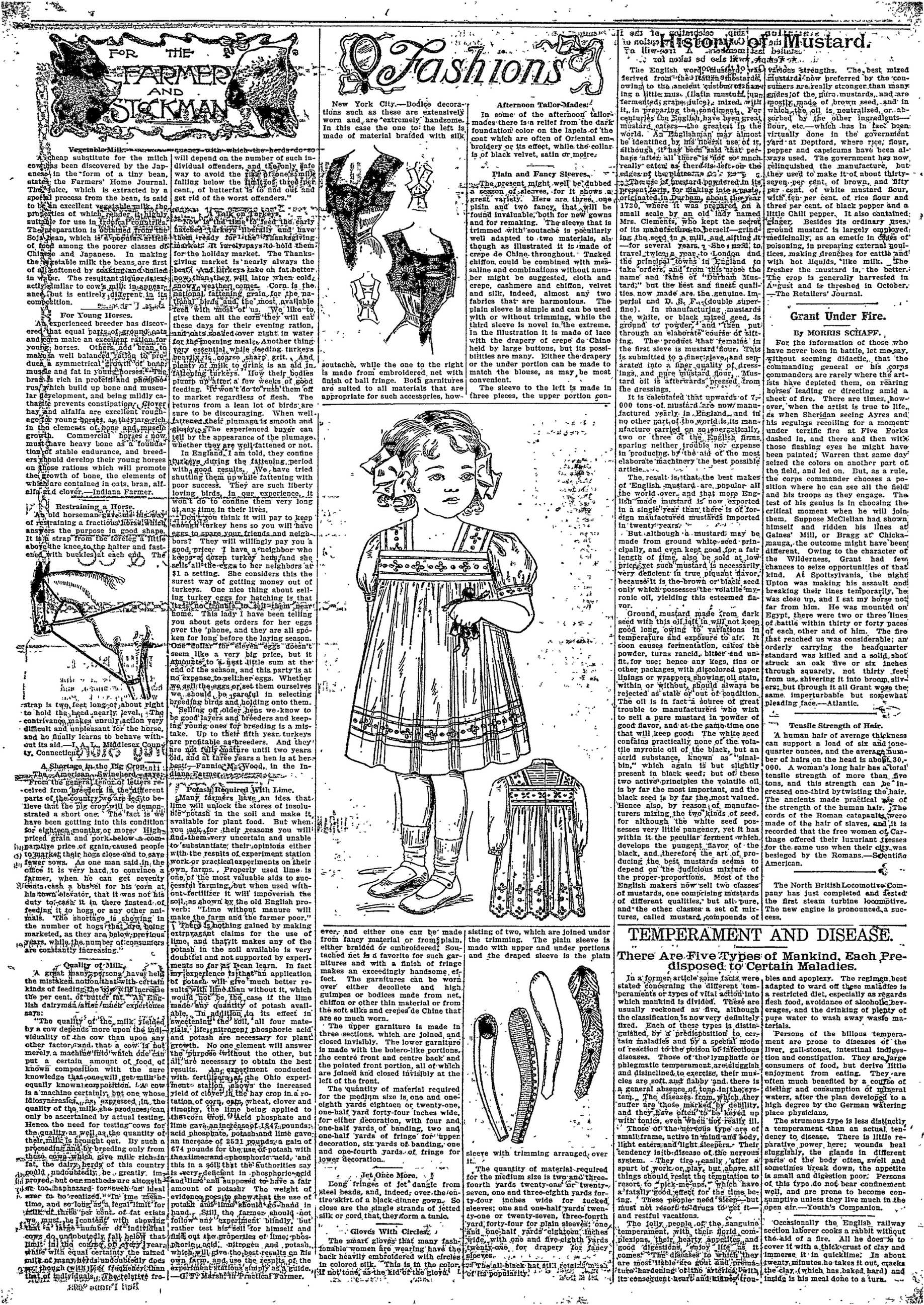
Fashions
10
New York City.—Bodice decorations such as these are extensively worn and are 'extremely handsome. In this case the one to the left is made of material braided with silk
CORSETS
soutache, while the one to the right is made from embroidered, net with finish of ball fringe. Both garnitures are suited to all materials that are appropriate for such accessories, how-
```markdown
```
ever, and either one can be made from fancy material or from plain, either braided or embroidered! Soutached net is a favorite for such garnitures and with a finish of fringe makes an exceedingly handsome, effect. The garnitures can be worn over either decollete and high gulpmes or bodices made from net, chiffon or other thin material or from the soft silks and crepes of Chine that are so much worn.
The upper garniture is made in three sections, which are joined, and closed invisibly. The lower garniture is made with the bolero-like portions, the centre front and centre back and the pointed front portion, all of which are joined and closed invisibly at the left of the front.
The quantity of material required for the medium size is one and one-eighth yards eighteen or twenty-one, one-half yard forty-four inches wide, for either decoration, with four and one-half yards of banding, two and one-half yards of fringe for upper decoration, six yards of banding, one and one-fourth yards of fringe for lower decoration.
Jet Once More.
Long fringes of jet dangle from steel beads, and, indeed, over the entire skirt of a black-dinner gown. So close are the single strands of jetted silk or cord that they form a tunic.
Gloves With Circles.
The smart gloves that many fashionable women are wearing have the back heavily embroidered with circles in colored silk. This is in the color if not tone, as the kid of the glove.
Afternoon Tailor-Mades:
In some of the afternoon tailor- mades there is a relief from the dark foundation color on the lapels of the coat which are often of Oriental embroidery or its effect, while the collar- s of black velvet, satin or moire.
The present might well be dubbed a season of sleeves, for it shows a great variety. Here are three, one plain and two fancy, that will be found invaluable, both for new gowns and for remaking. The sleeve that is trimmed with soutache is peculiarly well adapted to two materials, although as illustrated it is made of crepe de Chine, throughout. Tacked chiffon, could be combined with messaline and combinations without number might be suggested, cloth and crepe, cashmere and chiffon, velvet and silk, indeed, almost any two fabrics that are harmonious. The plain sleeve is simple and can be used with or without trimming, while the third sleeve is novel in the extreme. In the illustration it is made of lace with the drapery of crepe de Chine held by large buttons, but its possibilities are many. Either the drapery or the under portion can be made to match the blouse, as may be most convenient.
The sleeve to the left is made in three pieces, the upper portion con-
100
slisting of two, which are joined under the trimming. The plain sleeve is made with upper and under portions and the draped sleeve is the plain
sleeve with trimming arranged, over it.
sleeve with trimming arranged, over it.
The quantity of material required for the medium size is two and three-fourth yards twenty-one or twenty-seven, one and three-eighth yards forty-four inches wide for tucked sleeves; one and one-half yards twenty-one or twenty-seven, three-fourth yard, forty-four for plain sleeves; one and one-half yards eighteen inches wide, with one and five-eighth yards twenty-one for drapery for fancy sleeves.
The all-black hat still retains off its popularity.
History of Mustard.
TEMPERAMENT AND DISEASE.
There Are Five Types of Mankind. Each Predisposed to Certain Maladies.
The English word mustard was derived from the Italian mustardstick, owing to the ancient custom of dressing a little musc. (Italian mustard unfermented, grape, juice), mixed with it, in preparing the condiment. For centuries the English have been great mustard caters—the greatest in the world. An Englishman may almost be identified by his moral use of it, although, it has been said that perhaps after, all there is not so much really eaten as there is left on the edges of the plates. The use of mustard powdered in its present form for making into a paste, originated in Durham, about the year 1720 where it was prepared on a small scale by an old lady named Mrs. Clements, who kept the secret of its manufacture to herself—grinding the seed in a mill, and sitting it—for several years. She used to travel twice a year to London and the principal towns in England to take orders, and from thisrose the name and name of "Dirham Mustard;" but the best and finest qualities now made are the genuine, Imperial and D. S. (double superfine). In manufacturing mustard the white, or black mixed seed, is ground to powder, and then put through an elaborate course of sifting. The product that remains in the first sieve is mustard flour. This is submitted to a finer sieve, and separated into a finer quality of dressings, and pure mustard flour. Mustard oil is afterwards pressed, from the dressings.
It is calculated that upwards of 7,000 tons of mustard are now manufactured yearly. In England, and in no other part of the world, is its manufacture carried on so energetically, two or three of the English firms sparing neither trouble nor expense in producing, by the aid of the most elaborate machinery the best possible article.
The result is, that the best makes of English mustard are, popular all the world over, and that more English made mustard is now exported in a single year than there is of foreign manufactured mustards imported in twenty years.
But although it mustard may be made from ground white-seed principally, and even kept good for a fair length of time, also be sold at low prices yet such mustard is necessarily very deficient in true piquant flavor, because it is the brown or black seed only which possesses the volatile myronic oil, yielding this esteemed flavor.
Ground mustard made from dark seed with this oil left in will not keep good long, owing to variations in temperature and exposure to air. It soon causes fermentation, cakes the powder, turns rancid, bitter and unfit, for use; hence any kegs, tins or other packages with discolored paper linings or wrappers showing oil stain, within or without, should always be rejected as stale or out of condition. The oil is in fact a source of great trouble to manufacturers who wish to sell a pure mustard in powder of good flavor, and at the same time one that will keep good. The white seed contains practically none of the volatile myriacol oil of the black, but an acrid substance, known as "sinalbin", which again is but slightly present in black seed; but of these two active principles the volatile oil is by far the most important, and the black seed is by far the most valued. Hence also, by reason of manufacturers mixing the two kinds of seed, for although the white seed possesses very little pungency, yet it has within it the peculiar ferment which develops the pungent flavor of the black, and therefore the art of, producing the best mustards semen to depend on the judicious mixture of the proper-proportions. Most of the English makers now sell two classes of mustards, one comprising mustards of different qualities, but all pure, and the other classes a set of mixtures, called mustard compounds of
In a former article some facts were stated concerning the different temperaments or types of vital action into which mankind is divided. These are usually reckoned as five, although the classification is now very definitely fixed. Each of these types is distinguished, by a predilection to certain maladies and by a special mode of reaction to the poison of infectious diseases. Those of the lymphatic or phlegmatic temperament are sluggish and disinclined, to exercise, their muscles are soft, and flabby, and there is a general absence of tone in the system. The diseases, from which they suffer are those marked by debility, and they have often to be keyed up with tonics, even when not really ill. Those of the nervous type are of small frame, active in mind and body, light eaters and light sleepers. Their tendency is to disease of the nervous system. They tire, easily, after a spurt of work or play, but move all things should resist the temptation to resort to 'pick-me-ups', which have a fatally good effect for the time being. These people need 'sleep'—but must not resort to drugs to get it—and restful vacations.
The jolly people of the sanguine temperament, with their floral complexions, their hearty appetites, and good digestions, enjoy life as it comes. The diseases to which they are most liable are gout and premature hardening of the arteries, with its consequent heart and kidney troubles.
various strengths. The best mixed mustard now preferred by the consumers are really stronger than many grades of the mire mustards, and are mostly made of brown seed, and in which the oil is neutralized, or absorbed by the other ingredients—four, etc.—which has in fact been virtually done in the government yard at Deptford, where rice; flour, pepper and capsicum have been always used. The government has now relinquished the manufacture, but they used to make it of about thirty-seven per cent. of brown, and fifty per cent. of white mustard flour, with ten per cent. of rice flour and three per cent. of black pepper and a little Chill pepper. It also contained sugar. Besides its ordinary uses, ground mustard is largely employed medically, as an emetic in cases of poisoning, in preparing external poultices, making drenches for cattle and with hot liquids, like milk. The fresher the mustard is, the better. The crop is generally harvested in August and is threshed in October. —The Retailers' Journal.
By MORRIS SCHAFF.
For the information of those who have never been in battle, let me say, without seeming didactic, that the commanding general or his corps commanders are rarely where the artists have depicted them, on rearing horses' leading or directing amid a sheet of fire. There are times, however, when the artist is true to life, as when Sheridan seeing Ayres and his regulus recoiling for a moment under terrific fire at Five Forks dashed in, and there and then wits those fushing eyes he might have been painted; Warren that same day selzed the colors on another part of the field, and led on. But, as a rule, the corps commander chooses a position where he can see all the field and his troops as they engage. The test of his genius is in choosing the critical moment when he will join them. Suppose McClellan had shown himself and ridden his lines at Galnes' Mill, or Bragg at Chickamauga, the outcome might have different. Owing to the character of the Wilderness, Grant had few chances to seize opportunities of that kind. At Spottsylvania, the night Upton was making his assault and breaking their lines temporarily, he was close up, and I sat my horse not far from him. He was mounted on Egypt, there were two or three lines of battle within thirty or forty paces of each other and of him. The fire that reached us was considerable; an orderly carrying the headquarter standard was killed and a solid shot struck an oak five or six inches through squarely, not thirty feet from us, shivering it into bloom, silvers, but through it all Grant wore the same imperturbable but somewhat pleading face—Atlantic.
Tensile Strength of Heir.
A human hair of average thickness can support a load of six and one-quarter ounces, and the average number of hairs on the head is about 30,000. A woman's long hair has a total tensile strength of more than five tons, and this strength can be increased one-third by twisting the hair. The ancients made practical use of the strength of the human hair. The cords of the Roman catapults were made of the hair of slaves, and it is recorded that the free women of Carthage offered their luxurant dresses for the same use when their city was besieged by the Romans.—Scientific American.
The North British Locomotive Company has just completed and tested the first steam turbine locomotive. The new engine is pronounced a success.
bles and apoplexy. The regimen best adapted to ward off these maladies is a restricted diet, especially as regards flesh food, avoidance of alcoholic beverages, and the drinking of plenty of pure water to wash away waste materials. Persons of the billious temperament are prone to diseases of the liver, gall-stones, intestinal indigestion and constipation. They are large consumers of food, but derive little enjoyment from eating. They are often much benefited by a course of dieting and consumption of mineral waters, after the plan developed to a high degree by the German watering place physicians.
The sturulous type is less disinclinacy a temperament than an actual tendency to disease. There is little reparative power here; wounds heal sluggishly, the glands in different parts of the body often swell and sometimes break down, the appetite is small and digestion poor. Persons of this type do not bear confinement well, and are prone to become consumptive unless they live much in the open air.—Youth's Companion.
Occasionally the English railway section laborer cooks a rabbit with the aid of a fire. All he does is to cover it with a thick crust of clay and immerse it in quicklime. In about twenty minutes he takes it out, cracks the clay, (which has baked hard) and inside is his meal done to a turn.
- . oo oo. . eee ee a oS cibies eee
HARRIMAN’S WIDOW, THE WORLD'S RICHEST WOMAN, | (@2tercetemepmcnteeg | 4 StAvArHome woman, | Qo ee
er are ae >>
5 Cg Ae
Bees a a
Rea ee ade iL eee
Bern Bons Tne bed pees aes 4 Eset
es Wt Seg LO ae e ES
pee eae a ee ad baa
es YS ome | Mae
pees aed Pk: Ee h Ee pees ee
cee oF Fe
ee Se 36 EOS aS Se ESS
Beh Teen ee Sear
a 2 ei eee Soe Rey, me
Be ee oe sea Prcckesce ex
a? ees ees eo
Ge oR Seas ee eS one ce
Bey eee Wee
aes SRS Sasha 8 Fee one
i iS — ene Eee BS |
i Bye 2S eee ene ¥ SDE RS Se Seta: me
WE OSS Be Ge 2 ee
ee PEC N GY ycetard Pees ees
oe CE ES at eats aie’
eae NENG aa ae
eee Bend Sakic 5 2 ee
See Ero
The “Dreadnought” Drum.
London enjoyed a musical joke re-
cently, when Mr. Graves’ and Sir
Charles V. Stanford’s amusing “Ode
to Discord” was played for the first
time at Queen’s Hall by the New
Symphony Orchestra. Its success
‘was so great that it had to be re-
Cee
Pees Gees
mo Hee sings EAC
eae ay Sse
Paha tree di biF
StF ce eae
PS NON Say
ee eee
| ES cn a ea
RS SOR Ss BE SoS
Beanie ae
eae eee ||
Pewee ae ee
fe: oS es 2,
Pa] Bree Taek Be
rend eso Pe i eo]
ERE = ge
Sele Seen eee,
RRR AG aretha a
Sd eaene eee on
EP ete ou RRA 5 pee eal
peated, One of the effective instru-
ments used to produce the desired
effect was the so-called “Dread-
nought” drum, which is shown here
as {t was photographed on the way
to the hall_—Philadelphia Record.
Baths For Cold Feet.
Those who suffer from habitual
cold feet should take an alternate hot
and cold foot bath morning and even-
iug. Soak the feet in hot water at a
temperature of about 108 degrees or
110 degrees for two or three minutes,
then dip them In cold water for half
a minute, then back into the hot wat-
er for another two or three minutes,
and continue alternating five or six
umes, finally drying the feet from the
cold water,
‘This will stimulate the circulation
ang produce a glow of warmth in the
feet that will be maintained for hours
afterward.—Good Health.
THE SHORT PARENT.
(sa) | |
il q i Soy = m9
ell Wha
paw oie f) il A Pits
Py [ veils oh Sas S
SA a
NO ay |
yr
“> Bless you, my children."—-From Fitegende Blietter. =; 9,
Wild Dogs in Georgia.
E. M. Willingham, at Southerland,
the old home of General John B. Gor-
don, reports that the wild dogs made
a rald on bls place a few nights ago
and killed eight fine hogs, two cats,
all of his chickens and several large
turkeys. =
The dogs have been roaming about
the neighborhood for several weeks.
They appear to gather at night, Just
lke a pack of wolves, and make raids
on farms and truck gardens where
there Is poultry or live stock. Steps
are being taken to hunt the dogs and
kill them.—Atlanta Constitution.
Handy Pocket Box.
One of the most complete combina-
tlon articles ever put on the market
is the pocket box designed by a Penn-
sylvania man. This compact and as-
tonishing little device includes a penv
knife, pencil sharpener, notebook,
pincushion, nail clip and several other
necessary things. The contrivance
is about the size and shape of a large
match box. In u slide along one side
{s a knife blade, which, by means of
a projection extending through the
slot, may be thrust out when needed
and replaced when not in use. Part
of the box is a lid, on the bottom of
SS
which is fastened leaves of blank pa-
per, forming a writing pad or note-
book, Beneath this ld is a padded
surface for pins, needles, etc. At one
end of the box fs an opening largo
enough to admit a lead pencil and
equipped with a sharpening knife in-
side, while the nail clip is operated
by the Ild of the box, which works on
a spring. With a change of linen
and undergarments and one of these
boxes a man might travel around the
world.—Washington Star.
Florida is the centre of the tur-
nentine industry.
ULL LAND Wf THE roOR he aE A PAN PAY]
pee AEE ASE
aa aye) |
eG as 4 3
mf ees Bio
si iy a
(( Nei
AF tHe Sronn at MONT
BN BET ee
é RA
Cs Sa cer
b AA oy
ra 4 ue
VAL SIRS |
el, Ea
Yo reeme a
TRIALS of zfeNEEDEMS
acunvonte Have Paw Vilte coax tho iver into
Seresbed “Hees tetany eon We
Bek Bes WaT car oansree eres aT te
Honuntmuar’ aaaeqani ieeviguacs est ol coe
Pils coun eoeniotee ps MPatania
Ens sincinhsg Rertaireahareoetning: Basu
BiSulieg is noe eacah erage ts Joga
IGS ate eae RRS
53d nnd JeffersouNts., Uslindelphia, ra.
Manyon's Cold Remedy cures a co’d in one day.
PASeBe? Gas RAP SLL Saeeg 92 008 oar,
pre erento repr Ara
eer ‘Now Book on
ines Consumption
Sucscam@ REE TO ALL |
ABBAS cd on Satan wens tapi,
en £y Hopialantungehow conramptiog
Fee Seta laceuas her eee
ERT TOM Cite” coday. The Bool we abso
‘ Bim Wee. wae
K
Yormala;fron, for the Mood: Arsene, fer dle
SSRs Re ee Sices
Hester bie feonitey Scheie sides
Boas age ee aden aoe te ore taste
SOTDY aitin booklet
eThe Southern Stock Food Go..
ATLANTA, GA.
A French Scholar.
As William bent over her fair face
he whispered “Darling, if I should
ask you in French if I might kiss you,
what would you answer?
She, calling up her-scanty knowl
edge of the French language, exclaim.
Piles Cured in 6 to 14 Days,
Pazo Uintment {s guarenteed to cure any
casoo!Ttching, Blind Bleeding orProtrading,
Piles in 6 to 14 daysormoneyretunded. 0c
What Every Financler Knows.
‘That dignity is an asset.
‘That a dividend in the hand is
worth two on the books.
‘That Barnum was right nhen he
sald the publig Iiked to be bum
bugged.
That respectability often consists
fn not being exposed.
‘That financiers are cursed n ge:
eral, but courted in sparticular.
That, stocks are worth all the pub-
Me can be induced to pay for them.
—New York Times.
Rheumatism Cured in a Day,
Dr. Detchon's Relief for Rheumatism and
Neuralgia radically cures in 1 tod dass. Its
action ‘is remarkable, Removes the cause
and disease quickly disay ~ First dose
greatly benefits, 7c. and si. All drugsista.
It ls sald that the Chicago Wom
an’s Club fs forced to spend $1,500
for a new cloakroom on account of
the present extravagart size of hats.
Allen’s Lang Balsam has for years cored
deep-seated coughs, colds and. bronchitis.
$eepbody should know about it.
‘The man who, uses religion as o
cloak, warns the Boston Transcript,
1s bound for a climate where no
vloaks are needed.
For COLDS ana GRIP.
Hick'’s Carconm is the best remecy—
relloves the aching and feverishnesr—cures
Sie Cold and restores perma! conditions. Jy
Basigeaoces immedincaly. “ttc. 222° and
‘ores,
Hnter Caught in Bear Trap.
While he was bunting in the “ket
tle” of Seven Mountains, in Snyder
county, recently George S. Schoch of
this pace was caught in a dear trap
under a clump of bushes.
He was found a prisoner after dark
seven hours later asleep from fa-
tlgue by his brother, John A. ‘S.
Schoch, and Donald Spanagle of Lew-
istown, and he was extricated with
difficulty. His thick hunting leggings
minimized injuries that were bad at
the best—Selinsgrove correspondent
Philadelphia Record.
Afra. Winslow's Soo!
rh pet ide rilpcet all dey ening |
ton, allaya pain, cureswind colic, 250 a tottla |
Emphatic.
Recognition of the work thls sea
son of Coy Yale's brilflant ull back
and Captain, has been so great as to
find expression at times in.ways some
what derogatory. to his teammates, Re
cently somebody, Just returned from
the Yale-Princeton game at‘New Ha
yen, sat down among a group of
friends, eager to hear ‘news from the
front, and remarked:
“Well, the Yale team and ten other
men ceftainly did trounce the Tigers!”
—New_York Times.
_ Bank notes were frst issu
China 2697 B. & jemed, in
‘A STAY-AT-HOME WOMAN.
Spent a Night Away.
Ainerican women have the reputa.
tion of, being restless gadzbouts, not
oerhaps without having given grounds
for the accusatlon; but there's one
American woman ‘who is a home
stayer of the most chronic type.
Mrs, Kate Walker has lived In the
Mghthouse on Robbins reef for twen-
ty-three years, and the number doesn’t
have any mystic significance tmply-
ing an Impending departure either.
For fourteen of those years, ever
since her busband’s death, she her-
self has been keoper-of the light.
Robbing reef ts 2 ledge a mile or
So north of ‘Staten Island on the’ gort
side as you sail up the bay. You
reach Mrs, Walker’s home by scram
bling up an fron ladder after yon
have reached the spot—that Is all it
1s, a spot—by boat, As that Is the
only means of reaching Sirs. Walker's
establishment it 1s easy to understand
that it isn't a rush of visitors that
keeps her at home. 7
‘She not only has the light té main-
tain—and she has never once failed
in that—ut there are also a siren
‘run by an engine and a fog tell, both
of which must be kept going in thick
weather. Mrs. Walkér takes a long
map in the afternoon sd as to keep
‘on the alert at night. The machinery
regulating the light, which {s a re-
‘volving one, has to be wound every
five Lours. She says that the light
is never off her mind at night, and
that even when she sleeps she wakes
up every hour.
Befora her husband dled she went
to the Catskill once; but since she
became keeper of the light she has
never been farther than across the
bay. Her front yard—and back and
side yards, too—is a narrow-railed
platform; beyond that only water on
all sides.—Harpef’s Weekly.
Honor For a Girl.
__An eighteen-year-old Irish girl, the
Honorable Mary Westenra, has Just
deen made master of the ‘Monaghan
Hunt at Rossmore, Ireland. The
young aay, who fs pretty and a so
¢lal favorite, seems quite capable of
filling the position.
As an example of the strenuous
Mfe sho leads It Is related In, the
Queen that she hunted all a hard
day with the Pytchley last winter,
got babk after it to her aunt's houso
in Market Harborough, changed, had
a bit of dinner, travelled all that night
to her home (Rossmore), had break-
fast on arrival, then {nto a habit again
and hunted all that day with thd
Monaghan Harrlers, and the next day
hag a horse running in each of the
“three races of the Hunt Point to Poiut
and won all threel—a falrly good ner
formance for an cighteen’yéar-old girl.
‘Shg loves dancing and music, rides
well, hunts, plays temnls, gélf and oth-
er games. ‘The young M. H., seems to
have earned her honors.
Itch cured in 30 muutes by Woolford's
Sanitary Lotion. Never fails. At druggists.
FOUND IN POMPEN.
Recent Discoveries in Burled City of
Great Importance,
A discovery of great interest was
made not long since at Pompel!, where
the excavation work 1s being steadily
carried on. Under the ash deposits,
says The Sclentific American, there
was found an extensive villa of a
handsome construction and ornament-
ed with very fine hag er ‘The villa
contains statues and other works of
sculpture doth Greek and Roman, be-
sides very rich furniture which {s
‘well ornamented andalso many vases
of different kinds. There were also
found coffers filled with gold and sil-
ver money. In the basement. are
great amphorae which were used for
storage purposes, and In the triclin-
jum the tables were prepared for a
banquet of thirty persons.” An abund-
ance of silverware is one of the fea-
turds of the discovery, and it fs sald
‘to be equal In weight and artistic
character to the ‘sllverware discover-
ed In,the villa of Boscoreale and now
possessed by the Louvre. Some of the
silver pieces. seem to have been tak-
en out at a previous epoch, for there
are traces of clandestine search
which was made at a former date.
SEES Goecmair doce Be
Pierce's Pleasant Pellets, Ono a laxative,
three for cathartic.
Wireless System In Russia.
‘The Military Department at St
Petersburg is taking considerable In-
terest In a new system of” wireless
telegraphy which has been invented
by a Russian student It is claimed
that messages have been sent from
St. Petersburg to Sevastopol and re-
ceived, accurately. One of the prin-
cipal-deatures of the new system is
that messages cannot be tapped by
outside stations, and ft is intended to
build a station In the Ural Mfountains
to connect with a similar station to
e built in Viadivostok, The station
will be built by the amilitary engi-
neers at a cost of about $50,000 gold.
—Daily Consular Reports.
t a ‘itute for Perry Davis”
atailics Nathing an good for Pheu
tism, neuralgia similar troubles.
In deyeral of the more northern
countries cf Europe it fs the custom
tg charg@ worsen half rated at the
tq. cha
Wecome Worps To WoMEN
‘Women who suffer with disorders peculiar to their an
sex should write to Dr. Pierce and receive frec'tho
advice of a physician of over 40 years’ expericaco &) 2
—a skilled end successful epecislist in the diseases 2 Aan
of women, Every letter of this sort haa the most fa wl
careful consideration and is regarded os sacredly F ®
confidential. Many sensitively modest women writo yy
ally to Dr. Pierce what they would shrink from 4 as e
telling to their local physician. The local physician a > ey
3s pretty sure to say that ho.cannot do anything i a
without “‘an examination.’” Dr. Pierce holds thet ie mE
these’ distasteful examinations are generally need-
less, and that no woman, except in rere cases, should submit to them.
Dr. Pierce's treatment will cure you right in the privacy of
‘your own home. Bis ** Favorite Prescription” has cured
hundreds of thousands, some of them the worst of cases.
It is the only medicine of its kind that is the product of a regularly gradaated
hysician. The only one good enough that its makers dare to print its every
Jogredient on its outside wrapper. There’s no secrecv. It will bear exemina-
tion, No alcohol and no habit-forming drogs are found init, Some tuscrup-
‘alous medicine dealers may offer you a substitute. Don’t take it, Don’t trifle
with your heslth, Write to World’s Dispensary Medical Association, Dr. R.
V. Pierce, President, Buffalo, N. ¥.,—take the advice received and be well.
FACTORY RE-BUILT AND SECOND-HAND
= Of all “STANDARD” Makes, at Prices from $12.50 and up.
¥.M.C. A, Building,
Atlanta Typewriter Exchange, ArLAsiTA. GAs”
SOUTHERN SCHOOL OF. TELEGRAPHY’S
GREAT SPECIAL OFFER 7 YOUNG MEN 48° LADIES
Now open to thoge wishing to learn TELEGRAPHY, TYPEWRITING
and RAILROAD AGENCY. Tuition reduced to $45, and $2.50 of stu-
dents’ railroad fare paid. Excellent board at low rates. Students qual-
ify in4toG months. Ourgraduates POSITIVELY GUARANTEED posi-
tions paying $45 to $65 per month to start on. Diplomas awarded. Great
demand for Telegraphers. Write todey for Free G4-page illustrated
catalogue which gives ‘full particulars.
SOUTHERN SGHOOL OF TELEGRAPHY,
jeox2720 = NEWNAN, ‘GA.
TS 00 2c 0) | Peano
A ] vA 1 F FOR
. [ane Ol THAT CENETRATES MM me a@ EMS
Attempt at a Joke. | a CURED
“They tolerate such things as this Gives
in St. Louis, where the Glone-beme: f Balok
sat {s printed:It was the univer: ‘ -
sal opinfon st the opening of the| \- Qa zesevesall wating 81020
flower show recentiy that the ex| 4 AD 5 indais adap, Pustertsect
bition is a blooming success.’ Would | 4g J iarives free. Nothingcas,
ft not have been better to leaf ft out?” ts << saci: gar opus Be
—Burllngton Hawkeye. i
wae TRS Ee Pa The New Pulaski
ke Laxative Bromo Quinine Tablets. SAVANNAH, GA.
Drugeisis refund money if it fails to eure.| aus siene vtod of ee ie
HW Groves siguatury ison stele be Se.) Mi ote gimeoe balset pabone
Stew Dlaerenk, ageis among the people who appreciate
A party of ladies were taking din-
ner together at a «well-known Italian
restaurant the other evening, and at
a table half across the room sat a man
whose singular conduct was attract
ing considerable attention. Said one
of the Jadfes in a mysterious and con-
fidential undertone to the «waiter;
“Garcon, patlezvouz Francaise?”
“Oui, Madame,” was the quick re
spouse.
a erben* she continued eagerly, re
suming her ordinary tone of volce and
with ft her English, “What's the mat-
ter with that man over there?"—Now
York Times.
* Skin Humor Lasted 25 Years,
“Cuticura did wonders for me. For
twenty-five years 1 suffered agony
from a terrible humor, completely
covering my head, neck and shoul-
ders, so even to my wite, 1 became an
object of dread. At large expense L
consulted the most able doctors, tar
and near. Their treatment was of no
avail, nor was that of the —— Hos-
pital, during six months’ efforts. 1
suffered on and concluded there was
no help for me this stde of the grave.
Then I heard of somo one who had
been cured by Cuticura Remedies and
thought that a trial could do no harm.
Mis surprisingly short time I was
completely cured. 8. P. Keyes, 147
Congress St, ‘Boston, Mass., October
12, 09."
Face Covered With Pimples.
“I congratulate Cuticura upon my
speedy recovery from pimples which
covered my face. I used Cutieura
Soap, Ointment and Resolvent for ten
days and my face cleared and 1 am
perfectly well. 1 hdd tried doctors
for several months but got no results.
Wm. J. Sadlier, 4614 Susquehanna
Ave., Philadelphia, May 1, 1909."
“Let Gol”
Skipper (purple with rage)—why
had never been to sea before)—Let
go that for‘ard rope.
Deck hand makes no sign.
Skipper—Let go that rope, I say.
| Deck hand is still motioniess,
| Skipper (pudple with rage)—Why
don’t you let. go that for’ard rope, ye
swab?
Deck Hand (in aggrieved tone)—
Who's touching yer rope? I ain't
For HEADACHE—Wickw CAPUDING
Whether from Colds, West, Stomach oz
HS "Hone plonsiae as wake ees ene:
ately, “Dre it idc., tc, mad Soc at Grae
wares -
what Every Valet Knows.
That he covers a muifituce of Si™
Tht he knows more than tbe fa-
ther «onfessor.
‘That money has.a great deal to
do with making the man.
‘That a man on the street 1s worth
two in the boudoir.
‘That a swelled head is not always
the result of pride. ~
That, in spite of clothes. man ts
still very apt to de @ human -being.—
f men sVork, TIPS.
mt CURED
_ Given
Qalok-
ce '§ Rollef.
\ Bf bereits Tremanest ase
Ope Si seeaes
SERB sorclatint. Oar Alana. fe
The New Pulaski
SAVANNAH, GA.
‘The right kind of accommodations at the
right kind ofa price The Pulaski patron-
ageis among the people who appreciate
Bea tae
STUBBS & KEEN, Props. .
3; e ‘
Don’t Wait -
Till Night |
‘The moment you need help, take 3,
candy, Cascaret, Thenheadaches
vanish, dullness disappears. The
results are natural, gentle, prompt—
No harsher physic does more:
good, and all harsh physics injure-
Corrmeovz, mail it with your address toe
Sterling Remedy Company, Chicago, IL,and re--
ceivoa handsome souvenir gold Ban Bon Farr.
MANUFACTURERS,
INVESTORS AND FARMERS!
It will pay to Investigate the tere
tory traversed by the
Atlanta, Birmingham & Atfantle Ralltoad
This tine penctrates the Garden Spot
of the South. Landes are low In price,
very fertile and adaptable to the wid-
est range of crops. Reports show that
the crop yield of this section for this
year Ie phenomenal. The territory ie
attracting attention throughout the
country, and those destring to Invest
or locate, will do well to communt
cate early.
Inquiries are Invited, and {iterature
treating fully with the population, ¢oll
conditions, schools and churches, et
cetera, will be promptly mailed,
W. H. LEAHY,
General Passenger Agent, ‘Attente, Oa,
QUICKEST WITH SAFETY
WHE BEST REDICNE TOR GucesusGins
For the baby often means rest for
if bothmotherand child. Lite ones if
if like it oo—i's so palatable totake. |p
if Free from opiates. ij
Rca reais 28 crt ee
WeBuy _eviiey ‘
FURS GoSo8
& Hides and eee
Wool a
Faathers, Tallow, Beeswax, Ginsens, YP
Golden Seal,(Ydlow Rot), May Apple,
‘Wild Ginger, ete. We am deslera;
wtablahed in 1856—"Over ball » cxatary in
Lesieie"—and ca do better fee you than
agents or cocominion merchants.” Reference,
any Bank in Louisville, Write for weekly
paice Bet and shipping toge
M. Sabel & Sons,
P27 Market St. LOUISVILES, KY,
{At5309) cs
YOUNG PEOPLE
Hudson's Cat.
"This night our cat ranne crying from one side of the ship to the other, looking overboard, which made us to wonder; but we saw nothing." -Juet's Journal.
What did you see, O pussy-cat-mew, Pet of the Half-moon's tumbulent crew? Who taught them mew-thiny? Wasn't it you?
Juet kept journal of storm and fog And the mermaid that set them all agog. But what has become of the cat-a-log?
Henry Hudson, the master sage, Writ large his name on history's page. But you, you, too, were a purr-sonage! Shall the tale slight you, whose tail was a-quiver As you and Hudson sailed up the river Made only his by Time the giver?
Why did you take to adventuring, Puss-illanimous fireside thing? What was the cargo you hoped to bring?
Did you dream of multitudinous mice Running about the Isles of Spice In a paradoxical Paradise?
Were you not homesick where monsters swam,
Dolorous dolphin anl clamorous clam,
For your sunny stoop in Amsterdam?
Months at sea, while the billows roared,
And the Milky Way not a cupful poured;
No wonder Tabby looked over-bored.
You had your feelin', as felimes go,
Poor little puss! What scared you so?
O stupid sailors that didn't know!
Was it a dogfish struck the spark
From your sea-green eyes with the quaint
remark
That you were sailing upon a bark?
Millions of happy pussles fall
Into oblivlv; still you call
From the top of your ancient cater-wall.
Call on the centuries to concur
In praise of Tabby the Mariner,
Who discovered the Catskills, named for her
- Katharine Lee Bates, in Christian Endeavor World.
Cross-Eyed Needle.
"Mamma," said little Ethel, who has been vainly trying to make the preliminary preparation with a needle and thread, "I do believe this needle is cross-eyed."-Good Housekeeping.
- Undress the Chicken.
One morning mamma was dressing a chicken for the next day's dinner. It was cold in the kitchen, and grandma called Arthur to come in and stay with her, as she was afraid he would get cold.
"Oh, no," he said. "I want to stay and see mamma dress,"—and then with a twinkle in his eye. "no, undress this chicken." "The Youth's Companion.
Digalng for Gold.
I am going to tell you about a game we played at my party. Mamma filled a tub full of sand and wrote some fortunes on slips of paper, and wrapped them up in pieces of gold paper and buried them in the sand. Then she told us we could go in the parlor and dig for gold. Then we all had little shovels and dug for the fortunes.—Betty Kellogg, in the Medford Tribune.
Queer Happenings.
WhackL, whack! went the blows of the axe on the cherry tree.
"Does the cherry tree feel it, father?" Charley asked.
Charley sat on the plaza steps at a safe distance from the flying chips. Charley was a boy who often asked queer questions.
"I guess this tree is too nearly dead to feel angthing;" Mr. Baker answered, and Charley was glad it couldn't feel. Mrs. Baker had said the tree must come down; for it didn't yield a quart of cherries in a summer, and its withered branches spolled the looks of her front yard.
Then something that was really very queer happened—something that made Mr. Baker cry out, "Goodness! I never saw the like before!" For out of the tree, dislodged by the blows, which by good luck didn't touch them, there dropped a nest of five young red squirrels. Four of them skipped away as if they had learned how long ago, though maybe this was the first time tey had ever tried; but the fifth one seemed to be hurt by the fall to the ground. In fact, Mr. Baker thought it was dead, so he picked it up and tossed it to Madam Pussy Cat, who was watching curiously a few feet away. Charley supposed she would pounce on it as if it were a mouse, but what she did was really more queer than anything that had happened yet. She came up, smelled of it, then very gently lifted it as if it had been a kitten, and walked off with it to the barn.
You may be sure Charley followed her. Pretty soon he came back, with eyes wide open.
"Why, father," he said, "Madam Pussy Cat has put the squirrel to bed with her own family. 'Tient dead—I saw it squirm. You—you won't let the squirrel get lost, will you, father?' Charley knew that kittens with little blind eyes had a way of going off, and never, never finding the path back. Mr. Baker laughed. "No, Charley," he promised, "We'll wait and see what pussy does with it."
Well, the queer things kept piling up, for Master Red Squirrel, as Charley had said, wasn't dead at all, only a bit stunned at first; and Madam Pussy Cat mothered him until he became very frisky indeed,—so frisky that one day Mr. Baker made a little cage for him, to stay in until he became used to a station in life which he wasn't born into.
Charley fed him every day, so that he grew quite tame, and it was safe to
let him out, because he would always come home again. Madam Pussy Cat acted very proud of her adopted child, and they were great friends.
One night when Charley had been thinking a long while—as much as five minutes—he nestled up to his mother and whispered, "I think, mother, that Madam Pussy Cat must be a Christian cat the way she treated Ruddy."
Mrs. Baker smiled, but she wondered to herself, "What will that boy say next!"—Helen O. Hawley, in Sunday School Times.
A Bangor Bear Story.
At Pasadumkeag, Me., where black bears once owned the land and all upon it, and where to this day their fondness for mutton and honey is sadly realized, the wise man, the historian and the boss hunter of the village foregathered on the bench outside the post office "to talk of many things." Uncle Penny, the wise man, said that beasts of the forests had no real courage—that they fought against desperate odds merely through ignorance. Sim Betts, the historian, pondered deeply to take up some instance that would contradict, this theory. Before he could recall or invent anything Pelodiah Jones, the boss hunter, declared that, while no bigger fool than the bull moose ever stalked the earth, bears had on the average, more brains than men. And he proceeded to prove it.
"Now," said Jones, "you don't ever hear of 'bair-a-buckin' injines on the railroad, do ye? Sartainly not. Moose does, all' allers gits the wust of it. Naturally, injines can make hash outen any critter that walks. Moose ain't got brains enuff to know it. bars has.
'Spose.all you fellers recollect that mess of old junk I helped haul 'up to the station' last summer? Well, that was what was left of one of them automobiles after a good, bright 'b'ar had a whack at it. Happened down here couple miles below Passadunny. 'Twas an old she 'b'ar that had two cubs, and one day when the family of them was a 'crossin' the road to get to a better berry patch a big steam waggin come along an' run over one of the cubs an' laid it out cold. The old 'b'ar an' t'other cub got acrost all right, an' stood at the edge of the road a'looking' kinder dazed. I was close enuff to drop the two of them, but I'd no gun with me, so I just sot there an' watched.
"Pretty soon the old b'ar come out an' sniffed at the carcass of the dead cub, rollin' it over with her paw and gruntin' around as though she expected to wake it up. Seeing that the cub laid there stiff an' still, the old one hustled off into the bushes with t'other cub taggin' behind. I s'posed that was the last of it—but that's where I had something new to larn 'bout b'ar. "Jest a few rods up from where the old b'ar went into the bushes, an' standin' clost to the road, was a big spruce, with an old stub (dead trunk) lodged again' it. The stub was two feet through an' jest. barely caught on the spruce, so's the least jolt would bring it down. Well, str; that old b'ar she foundered up to that stub an' puttin' her shoulder ag' in it, brought it down, slam bang, right across the road.
"Well, sir, I never see the like, an' for some time I sot there, wonderin' what the old b'ar was up to. Then, grajerly, it begun to leak through me and that she was after revenge on the sports that killed her cub. She was a-blockin' of the road ag'in the time they'd come back.
"Well," I says to myself, says I, "There's no tellin' when the feller 'll come back; it may be a week—and so, havin' other fish to fry an' it bein' none of my mess anyway, I kept on. I was gone a couple of hours, an' when I come back along, cuss me if that old b'ar an' her cub wasn't a-settin' there in the edge of the bushes as though they expected comp'ny. When I went past they never budged, an' havin' no gun I come right along an' Jeff them to tend to their own b'isness.
"I hadn't got more'n ten rods further along towards the village, when I heard the great tootin' an' lookin' ahead I see the steam waggin' a streak-in' down the road.
"Now, says I to myself, 'now, that there masheen must 'a cost $1,000, an' with all respect to the b'ar's feelings, 't would be a cussed shame to see it go to smash again' an did stub not wuth 10 cents', so I hollered for the sports to hold up, but I guess they didn't hear me, for they flew past in a cloud of dust.
"Here,' say I, 'is where the old b'ar get square,' and I hustled back after them down the road. It's thick growth along there, an' hard to see anythin' 'cept in broad daylight, so 'fore the sports knew it, they were right onto that big stub. I was jest near enuff to see what happened without, getttin' hit with any of the wreck. First I heard a yell, then a bump, an' then came a smashin' an' crashin' like breakin' a jam on the west branch. That mashenec just riz up like a buttean on a rock, an' in a minute the air was full of it. The sports, they'd shot out ahead an' landed face down in the road. It was the completest wreck I ever see of anythin' an' you could smell benzine a mile away.
"Jest as I come up I could hear a crashin' away in the berry patch. It was the old/b'ar an' her cub, goin' off satisfied,' I'posso, at havin' done a good job an' got square."—St. Louis Republic.
HER WINNING WAYS.
I met her down by the seashore
On a sunny day in June;
We sat together on the beach,
Where the wavelets played a June,
She spoke about her mansion
And her very place so fair;
About her string instruments
And conservatories there.
She said she kept three motor cars,
Had a fortune in the banks,
And kept champagne always on tap
In gold and ivory tanks.
Then she hinted she was single
And my heart just throbbed with bliss,
And if I'd been worth a million
I'd have handed her a kiss.
I suspected I could win her—
"Twas the one best chance of life—
And had not been busted
I'd have coped a wife.
But I could not linger longer
By he sad, romantic shore;
I knew my ticket would expire
And my dream would soon be o'er;
So I packed my bag and baggage,
Started for my home next day.
Left my million-heress weeping
Where the wavelets gayly play.
Twas last June that all this happened.
But don't think that I am sore.
For today I saw that malden
Clerking in a ten-cent store.
SHEAR NONSENSE
"May's new hat is perfectly hide. ours," "It isn't a bit more hideous than mine. You're always saying nice things about May."—Philadelphia Ledger.
Barker—"Say, you talk to me as if you thought I was an idiot!" Parker—"Pardon me, old man. I'm always giving myself away."—Chicago Daily News.
"Of course, I admit your son is extravagant. But you must make allowances—he's young." "That's all right? But the more allowances I make the quicker he blows 'em."—Judge.
She (after a long silence)—"Did I hear anything fall?" He (timidly)—"Why, no." She (with a yawn)—"Oh, excuse me, I thought you dropped a remark."—Baltimore "American.
"Why are you sore at Miss Skreacher?" "When she was urged to sing something, at the party last night, she said, 'Oh, I can't sing!'" "Well?" "Well, she went ahead and proved it."—Cleveland Leader.
Teacher—"Your little brother was all right when he left the house with you, and yet you say he's sick and won't be in school?" The Kid—"Sure! Didn't I give him the seegar wid me own hands?"—Puck.
"Uncle George, we are studying synonyms in school, and I want to know the difference between 'cute' and 'sneaky.'" "According to your mother, it is the difference between what you do and what Mrs. Jones' little boy does."—Puck.
"When you are angry," said the man of gentle instincts, "stop and count a hundred." "A hundred!" echoed Mr. Sirus Barker. "If I could stop at a hundred in counting up, my wife's milliners' bills I wouldn't be angry." —Washington Star.
"You say you are an expert accountant, and can begin at once on this muddled set of books?" "Yes., sir." "Have you any recommendations?" "Well, sir, I worked out the set of problems my ten-year-old boy brought home from school last night." —Cleveland Leader.
Mrs. Chugwater—Josiah. what is a 'swastika?' Mr. Chugwater (momentarily at a loss) "Do you mean to say you don't know what a swastika is? I swastika is—why, blame it, Swastika is the name of the Eskimo that helped Cook discover the North Pole!" —Chicago Tribune.
Just after a severe electrical storm, a timid patron of a rural telephone system, aware that the telephones were not equipped with lightning arresters, called up central and asked: "Can I talk with safety now?" "There is no such person on the line," replied the new girl at central—Judge.
"Of course," said the, sentimentalist, "knowledge is power. But the heart is more important than the head." "Very true," answered Miss Cayenne. "If as many people died of head failure as Me of heart failure the country would lose an enormous element of its population."—Washington Star.
Seeking Information.
"Is there a preacher on this train?" asked a large, dark-visaged man as he passed from one sleeper to another. At last, after he had loudly repeated his query for the fifth or sixth time, a grave-looking gentleman laid aside a book and rose up from a seat near one end of the car. "I have the privilege of being a minister of the gospel, sir," he said. "Can I be of any service to you?" "Yes," said the large passenger. "A fellow back in the dining car has bet me $5 that it wasn't Lot's wife who got Joseph into trouble, and I thought you might have a Bible with you, so I could prove he was wrong and get the money."—Chicago Record-Herald.
Gross Misstatement.
Irate Caller—Your paper accused me this morning of running over a man, with my motorcycle. It isn't true. It was an automobile. Editor—Well, what's the difference Irate Caller—The difference About $550!—Chicago Tribune.
Magistrate (discharging prisoner)
—Now, then, I would advise you to keep away from bad company.
Prisoner (feelingly)—Thank you, slr. You won't see me here again—Lippincott's.
Among the Masons
Among the Masons
The Tribune extends to our beloved and indestructible Grand Master his efficient corps of officers; the officers and members of every subordination lodge in the jurisdiction, a hearty "Happy New Year" greeting, wishing them all abundant success in every respect for good during the year, and that all of us may labor assiduously and loyally for the upbuilding of Masonry in the state and the betterment of each other.
The makers of nations have been great men. Freemasonry claims her share of those eminent souls. If we read carefully the world's history for the past two hundred years, we will find that most of the great men (makers of history) were Masons, and they were of that type who did not care if the world knew them to be of the mystical brotherhood. The two leading nations in civilization are Britain and the United States, and had it not been for Freemasons, those nations would not be of the high standing that they now, are—Masonic Sun.
Masonry is tradition. Men easily learn to love history, to revere the past, to have regard for tradition. Indeed, the noblest part of our present lives is largely due to reverence for traditions, because tradition gives us the wisdom of the past—the accumulated experiences of those who have gone from us. Our lives are what they are because men have enriched the world by their deeds and experiences, by kindness, gentleness and love, which are handed down to us by tradition. Our noblest hopes are in the memory of these traditions, our greatest future will depend upon our keeping the traditions of a noble past alive and present with us. In these purblind days of business interests and commercial activity, there is a great danger that the ideal may be blotted from our lives, that the spiritual part of our nature may die within us, that a blind holding on to high motives may be regarded as folly, that a crushing materialism may overwhelm us.—Charles T. Dunlap, Kansas.
"What is a Masonic lodge to you and to me? Is it an excuse for absence from home? Is it an institution for rotation in office so as to confer official honors upon one after another? Is it merely a convenient passageway of escape from the cold world into the Ethiopia of the higher degrees of the Utopia of the Mystic Shrine, where all cares are forgotten and where frivolity reigns supreme? It should be more than this. It should be a place to devise ways and means for a systematic study and promulgation, and conduct of brothers in the daily walks of life. The ideals of Masonry are so lofty that frail humanity, struggling to live up to its teaching will meet with many obstacles and may fall short, but if our intentions are honest, if our faith, is well founded, and our trust is placed in God we will triumph in the end, and be raised by the power of His Majesty."—Clipped.
CAUSE OF LOSS OF INTEREST. In Iowa the Grafd Master in his address directed attention "to the large number who have fallen by the wayside; that is, have been suspended or dimitted." This suggested the inquiry whether it was not the fault of the officers of the lodges. Possibly carelessness in work, or, if you please, too much work may be to a certain extent responsible. We incline to the view that, the loss of interest arises from the neglect to cultivate true brotherly fellowship, from too much ritualistic work and too little practical charity, from a lack of family association, and because the energies of the brethren are not directed toward some objective channel of usefulness. We think that many non-affiliates could be induced to again resume their membership in lodges by fraternal persuasion but we do not believe they could be forced to do so—Anthony, New York.
PURPOSE AND OFFICE OF MA-SONRY.
The soft, pure aid of Masonry does not age its devotee—it only ripens to rounded maturity those who follow its precepts.
The individual citizen can accomplish very little at best in life's great battle, no matter with what favor fortune may smile upon him, but here in the hallowed temple of Solomon, victories are won and triumphs celebrated, which make the battle-field of civic glory pale into insignificance and the valor of civil strife look like wasted opportunity.
To fill the heart with true affection; to move among your fellows with kindly sympathy; to steady the faltering, encourage the weak, revive the disconsolate, reanimate with honest vigor the palsied soul stung with adversity, and flush with new life the silent citadel of God is the purpose and office of Masonry. No man so high as to be unwilling to acknowledge its precepts; none so low as to forget its beautiful lessons.—William Alden Smith, Michigan.
Representative Hardy of Texas in addressing the house in support of his resolution asking for the investigation of printed charges of corruption of members of congress and of the subsidizing of the public press in connection with the ship subsidy, vigorously assailed the papers which he said had printed the charges. He said he had no idea that any member of congress had been bribed in the ship subsidy legislation, but he thought congress ought not to allow leach to be "despattered" without investigating the subject.
READING STORIES
BY THE A.C. HONAL CO.
Invented and Manufactured by a Colored Man.
MONEY DEPOSITED WITH The Wage Earners Loan and Investment Company
18 DOUBLY SECURED BY THOUSANDS OF DOLLARS INVESTED
SAVANNAH REAL ESTATE.
5 PER CENT PAID ON DEPOSITS.
Job Printing
IB NEXT TO NEWSPAPER ADVERTISING. THE BEST ADVERTISING IN THE WORLD. We have been very fortunate in securing the services of one of the best and most experienced printers in the state, and are now able to execute Job Printing of every description in all leading styles. The class of work turned out by us is acknowledged to be the finest and the prices the lowest of any printers anywhere.
PUBLISH A NEWSPAPER
Not necessary to own a printing office or be a printer to publish a newspaper. Write your locals and advertisements and send the copy to us. We print the paper complete and send to you ready for mailing, filling all blank space free of charge. Hundreds of papers now being successfully published by our plan. Religious papers containing suitable reading matter a specialty. Orders filled promptly for weekly, semi-monthly or monthly newspapers, in all standard sizes, at reasonable rates. Address BOX 327 ATLANTA, GA.
Every package is put up by colored people. The merit of the Howard Polish has won its way into the largest stores in the world, and can be found in the following stores in Safennh:
Smith's Pharmacy, 7 Farm street.
Don't be persuaded to take a sub-situte for HOWARD'S POLISH, prices 5 and 10, cents each. Howard's Polish won the first prize at James-town Exposition. Satisfaction guild anteed or money-back.
Thanking the citizens of Savannah in advance to call at above stores when in need of shoe polish, we are.
Pigman's Drug Store, opposite Union Station.
Pate's Drug Store, West Broad and Hall.
E. Gutman, 802 Ott street.
W. H. Johnson, Duty, and Guyler streets.
McDOWELL, Agent.