Savannah Tribune
Saturday, March 26, 1910
Savannah, Georgia

Page text (machine-generated)
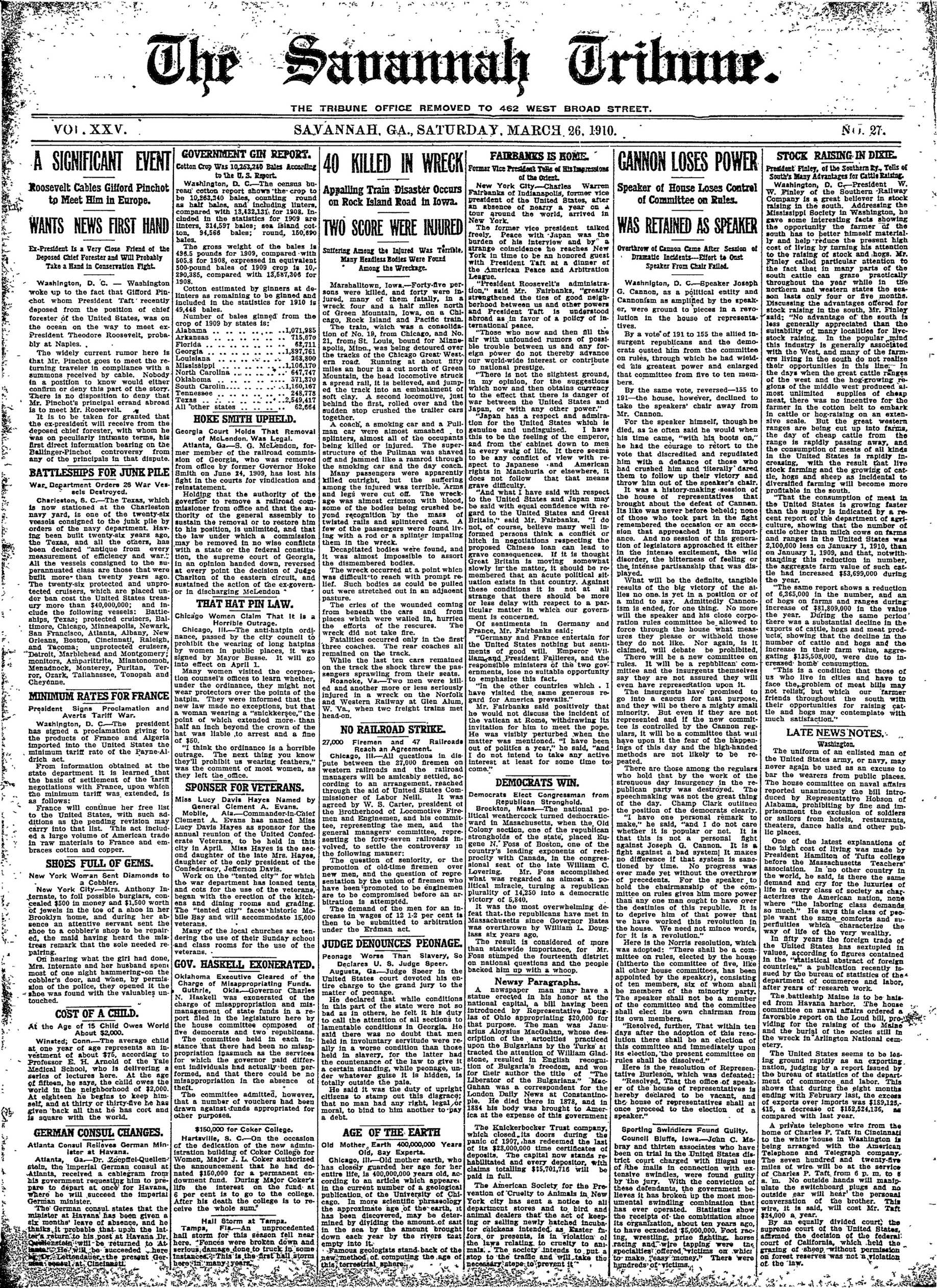
Roosevelt Cables Gifford Pinchot to Meet Him in Europe.
WANTS NEWS FIRST HAND
Ex-President Is a Very Close Friend of the Deposed Chief Forester and Will Probably Take a Hand in Conservation Fight.
Washington, D. C. — Washington woke up to the fact that Gifford Pinchot whom President Taft recently deposed from the position of chief forester of the United States, was on the ocean on the way to meet ex-President Theodore Roosevelt, probably at Naples.
The widely current rumor here is that Mr. Pinchot goes to meet the returning traveler in compliance with a summons received by cable. Nobody in a position to know would either confirm or deny this part of the story. There is no disposition to deny that Mr. Pinchot's principal errand abroad is to meet Mr. Roosevelt.
It is to be taken for granted that the ex-president will receive from the deposed chief forester, with whom he was on peculiarly intimate terms, his first direct information bearing on the Ballinger-Pinchot controversy from any of the principals in that dispute.
BATTLESHIPS FOR JUNK PILE
War. Department Orders 26 War Vessels Destroyed.
Charleston, S. C.—The Texas, which is now stationed at the Charleston navy yard, is one of the twenty-six vessels consigned to the junk pile by orders of the navy department. Having been built twenty-six years ago, the Texas, and all the others, has been declared "antique from every measurement of efficiency and war." All the vessels consigned to the superannuated class are those that were built more than twenty years ago. The twenty-six protected and unprotected cruisers, which are placed under ban cost the United States treasury more than 400,000, and hold down vessels: Battleships, Texas; protected cruisers, Baltimore, Chicago, Minneapolis, Newark, San Francisco, Atlanta, Albany, New Orleans, Boston, Cincinnati, Raleigh, and Tacoma; unprotected cruisers, Detroit, Marblehead and Montgomery; monitors, Amparitrite, Miantonomoh, Menadnock, Monterey, Puritan, Terror, Ozark, Tallahassee, Tonopah and Cheyenne.
MINIMUM RATES FOR FRANCE
President Signs Proclamation and Averts Tariff War.
Washington, D. C.-The president has signed a proclamation giving to the products of France and Algeria imported into the United States the minimum tariff rate of the Payne-Aldrich act.
From information obtained at the state department it is learned that the basis of settlement of the tariff negotiations with France, upon which the minimum tariff was extended, is as follows:
France will continue her free list to the United States, with such additions as the pending revision may carry into that list. This act included a large volume of American trade in raw materials to France and embraces cotton and copper.
SHOES FULL OF GEMS.
New York Woman Sent Diamonds to a Cobbler.
New York City—Mrs. Anthony Internate, to foll possible bargains, concealed $500 in money and $1,500 worth of jewels in the toe of a shoe in her Brooklyn home, and during her absence an attentive servant sent the shoe to a cobbler's shop to be repaired, the maid having heard the mistress remark that the sole needed repairing.
Ouparing what the girl had done, Mrs. Internate and her husband spent most of one night hammering-on the cobbler's door, and when, by permission of the police, they opened it the shoe was found with the valuables untouched.
COST OF A CHILD.
At the Age of 15 Child Owes World About $2,000.
Winsted; Conn—The average child at one year of age represents an investment of about $75, according to Professor E. H. Arnold of the Yale Medical School, who is delivering a series of lectures here. At the age of fifteen, he says, the child owes the world in the neighborhood of $2,000. At eleventh he begins to keep himself, and at thirty or thirty-five he has given back all that he has cort and is square with the world.
GERMAN CONSUL CHANGES.
Atlanta Consul Relieves German Minister at Havana.
Atlanta, Ga.—Dr. Zoepfel-Quellenstein, the Imperial German consul at Atlanta, received a cablegram from his government requesting him to prepare to depart at once for Havana, where he will succeed the imperial German minister.
The German consul states that the minister at Havana has been given a six months' leave of absence, and he thinks it probable that upon the latter's return to his post at Havana Dr. Quellenstein will be returned to Atlanta. He will be succeeded here by Dr. Dettendauer, the present German minister at Havana.
Cotton Crop Was 10,263,240 Bales According to the U.S. Report.
Washington, D. C.—The census bureau cotton report shows the crop to be 10,263,240 bales, counting round as half bales, and including linters, compared with 13,432,131 for 1908. Included in the statistics for 1909 are linters, 314,597 bales; sea island cotton, 94,566 bales; round, 150,690 bales.
The gross weight of the bales is 496.5 pounds for 1909, compared with 505.8 for 1908, expressed in equivalent 500-pound bales of 1909 crop is 10,290,385, compared with 13,587,306 for 1908.
Cotton estimated by ginners at delinters as remaining to be ginned and included in the statistics for 1910 is 494.48 bales.
Number of bales ginned from the crop of 1909 by states is:
Alabama 1,071,985
Arkansas 715,670
Florida 62,711
Georgia 1,897,761
Louisiana 268,800
Mississippi 1,106,170
North Carolina 647,747
Oklahoma 571,370
South Carolin 1,160,167
Tennessee 248,778
Texas 2,549,417
All other states 62,664
HOKE SMITH UPHELD.
Georgia Court Holds That Removal of McLendon. Was Legal.
Atlanta, Ga.-S. G. McLendon, former member of the railroad commission of Georgia, who was removed from office by former Governor Hoke Smith on June 24, 1909, has lost his fight in the courts for vindication and reinstatement. Holding that the authority of the governor to remove a railroad commissioner from office and that the authority of the general assembly to sustain the removal or to restore him to his position, is unlimited, and that the law under which a commission may be removed in no wise conflicts with a state or the federal constitution, the supreme court of Georgia, in an opinion handed down, reversed at every point the decision of Judge Charlton of the eastern circuit, and sustained the action of the ex-governor in discharging McLendon
THAT HAT PIN LAW.
Chicago Women Claim That it is a Horrible Outrage.
Chicago, III.—The anti-hatpin ordinance, passed by the city council to prohibit the wearing of long hatpins by women in public places, it was signed by Mayor Busse. It will go into effect on April 1.
Many women visited the corporation counsel's offices to learn whether, under the ordinance, they might not wear protectors over the points of the hatpin. They were informed that the new law made no exceptions, but that a woman wearing a "snickkergee," the point of which extended more than half an inch beyond the crown of the hat was liable to arrest and a fine of $50.
"I think the ordinance is a horrible outrage. The next thing you know they'll prohibit us wearing feathers," was the comment of most women, as they left the office.
SPONSER FOR VETERANS.
Miss Lucy Davis Hayes Named by General Clement A. Evans.
Mobile, Ala.-Commander-in-Coat Clement A. Evans has named Miss Lucy Davis Hayes as sponsor for the annual reunion of the United Confederate Veterans, to be held in this city in April. Miss Hayes is the second daughter of the late Mrs. Hayes, daughter of the only president of the Confederacy, Jefferson Davis.
Work on the "tented city" for which the war department has loaned tents and costs for the use of the veterans, began the construction of the kitchens and dining rooms and grading.
The "tented city" faces historic Mobile Bay and will accommodate 15,000 veterans.
Many of the local churches are tendering the use of their Sunday school and class rooms for the use of the veterans.
GOV. HASKELL EXONERATED.
Oklahoma Executive Cleared of the Charge of Misappropriating Funds. Guthrie, Okla.—Governor Charles N. Haskell was exonerated of the charge of misappropriation and mismanagement of state funds in a report filed in the legislature here by the house committee composed of five democrats and two republicans. The committee held in each instance that there had been misappropriation inasmuch as the services for which the governor paid different individuals had actually been performed, and that there could be no misappropriation in the absence of theft. The committee admitted, however, that a number of vouchers had been drawn against funds appropriated for other purposes.
$150,000 for Coker College.
Hartsville, S. C.—On the occasion of the dedication of the new administration building of Coker College for Women, Major J. L. Coker authorized the announcement that he had donated $150,000 for a permanent employee fund during the college's lifetime. The interest on the fund at 6 per cent is to go to the college. After his death the college is to receive the whole sum.
Hall Storm at Tampa.
Tampa, Fla.—An unprecedented hall storm for this season fell near here. Fences were broken down and serious damage done to truck in some instances. This is the first hall storm here in many years.
THE TRIBUNE OFFICE REMOVED TO 462 WEST BROAD STREET. SAVANNAH, GA., SATURDAY, MARCH 26, 1910.
40 KILLED IN WRECK
Appalling Train Disaster Occurs on Rock Island Road in Iowa.
TWO SCORE WERE INJURED
Suffering Among the Injured Was Terrible. Many Headless Bodies Were Found Among the Wreckage.
Marshalltown, Iowa.—Forty-five persons were killed, and forty were injured, many of them fatally, in a wreck four and a half miles north of Green Mountain, Iowa, on a Chicago, Rock Island and Pacific train. The train, which was a consolidation of No. 18, from Chicago, and No. 21, from St. Louis, bound for Napelops, Minn., was being detoured over the tracks of the Chicago Great Western road. Running at about fifty miles an hour in a cut north of Green Mountain the high locomotive struck the rail, it is believed, and jumped the track into an embankment of soft clay. A second locomotive, just behind the first, rolled over and the sudden stop crushed the trailer cars together.
A coach, a smoking car and a Pullman car were almost smashed to splinters, almost all of the occupants being killed or injured. The superstructure of the Pullman was shaved off and jammed like a ramrod through the smoking car and the day coach. Many passengers were apparently killed outright, but the suffering among the injured was terrible. Arms and legs were cut off. The wreckage was almost crimson with blood, some of the bodies being crushed beyond recognition by the mass of twisted rails and splintered cars. A few of the passengers were found living with a rod or a splinter impaling them in the wreck. Decapitated bodies were found, and it was almost impossible to assort the dismembered bodies. The wreck occurred at a point which was difficult to reach with prompt relief. Such bodies as could be pulled out were stretched out in an adjacent pasture.
The cries of the wounded coming from beneath the cars and from places which were walled in, hurried the efforts of the rescues. The wreck did not take fire. Fatalities occurred only in the first three coaches. The rear coaches all remained on the track. While the last ten cars remained on the track the shock threw the passengers sprawling from their seats. Vole. Two men were killed and another more or less seriously injured in a wreck on the Norfolk and Western Railway at Glen Alum, W. Va., when two freight trains met head-on.
NO RAILROAD STRIKE
27,000 Firemen and 47 Railroads Reach an Agreement.
Chicago, IL—All questions in dispute between the 27,000 firemen on western railroads and the railroad managers will be amicably settled, according to an arrangement, reached through the aid of United States Commissioner of Labor Neill. It was agreed by W. S. Carter, president of the Brotherhood of Locomotive Firemen and Enginemen, and his committee, representing the men, and the general managers' committee, representing the forty-seven railroads involved, to settle the controversy in the following manner:
The question of seniority, or the promotion of old-time firemen over new men, and the question of representation by the union of firemen who have been promoted to be enginemen are to be compromised before an arbitration is attempted.
The demand of the men for an increase in wages of 12 1-2 per cent is then to be submitted to arbitration under the Erdman act.
JUDGE DENOUNCES PEONAGE.
Peonage Worse Than Slavery, So Declares U. S. Judge Speer, Augusta, Ga—Judge Speer in the United States court devoted his entire charge to the grand jury to the matter of peonage. He declared that while conditions in this part of the state were not so bad as in others, he felt it his duty to call the attention of all sections toamentable conditions in Georgia. He said there was no doubt that men held in involuntary servitude were really in a worse condition than those held in slavery, for the latter had the countenance of the law to give it a certain standing, while peonage, under whatever guise it is hidden, is totally outside the pale. He said it was the duty of upright citizens to stamp out this disgrace; that no man had any right, legal, or moral, to bind to him another to pay a debt.
AGE OF THE EARTH
Old Mother, Earth 400,000,000 Years Old, Say Experts.
Chicago, ill.-Old mother earth, who has closely guarded her age for her entire life, is 400,000,000 years old, according to an article which appeared in the current number of a geological publication, of the University of Chicago. In more scientific phraseology the approximate age of the earth, it has been discovered, may be determined by dividing the amount of salt in the sea by the amount brought down each year by the rivers that empty into it.
Famous geologists stand back of the new method of computing the age of this terrestrial sphere.
FAIRBANKS IS HOME.
Former Vice President Tells of His Impressions of the Orient.
New York City—Charles Warren Fairbanks of Indianapolis, former vice president of the United States, after an absence of nearly a year on a tour around the world, arrived in New York. The former vice president talked freely, Peace with Japan was the burden of his interview and by" a strange coincidence he reaches New York in time to be an honored guest with President Taft at a dinner of the American Peace and Arbitration League.
"President Roosevelt's administration," said Mr. Fairbanks, "greatly strengthened the ties of good neighborhood between us and other powers President Taft is understood abroad. Favor of a policy of international peace.
"Those who now and then fill the air with unfounded rumors of possible trouble between us and any foreign power do not thereby advance our world-wide interest or contribute to national prestice.
"There is not the slightest ground, in my opinion, for the suggestions which now and then obtains currency to the effect that there is danger of war between the United States and Japan, or with any other power." "Japan has a respect and admiration for the United States which is genuine and undisguised. I have this to be the feeling of the emperor, and from the cabinet down to men every life. If there seems to be any conflict of view with respect to Japanese and American rights in Manchuria or elsewhere, it does not follow that that means grave difficulty.
"And what I have said with respect to the United States and Japan may be said with equal confidence with regard to the United States and Great Britain," said Mr. Falkbanks. "I do not, of course, believe many well informed persons think a conflict or hitch in negotiations respecting the proposed Chinese loan can lead to grave consequences. If it is thought Great Britain is moving economically badly, it ought to be remembered that an acute political situation exists in that country. Against these conditions it is not at all strange that there should be more or less delay with respect to a particular matter in which our government is concerned.
Of sentiments in Germany and France, Mr. Fairbanks said: "Germany and France entertain for the United States nothing but sentiments of good will. Emperor William and President Fallieres, and the responsible ministers of the two governments, lose no suitable opportunity to emphasize this fact. "In the other countries which I have visited the same generous regard for America prevails."
Mr. Fairbanks said positively that he would not discuss the incident of the vatican at Rome, withdrawing its invitation for him to meet the pope. He was visibly perturbed when the matter was mentioned. "I have been out of politics a year," he said, "and I do not intend to take any active interest at least for some time to come."
DEMOCRATS WIN.
Democrats Elect Congressman from Republican Stronghold.
Brockton, Mass.—The national political weathercock turned democraticward in Massachusetts, when the Old Colony section, one of the republican strongholds of the state, placed Eugene N. Foss of Boston, one of the country's leading exponents of reck-procity with Canada, in the congressional seat of the late William C. Lovering. Mr. Foss accomplished what was regarded as almost a political miracle, turning a republican plurality of 14,250 into a democratic victory of 5,840.
It was the most overwhelming defeat that the republicans have met in Massachusetts since Governor Bates was overthrown by William L. Douglass six years ago.
The result is considered of more than statewide importance, for Mr. Foss stumped the fourteenth district on national questions and the people backed him up with a whoop.
Newsy Paragraphs.
A newspaper man may have a statue erected in his honor at the national capital, a bill having been introduced by Representative Douglas of Ohio appropriating $20,000 for that purpose. The man was Januarius Aloysius MacGahan, whose description of the artocites practiced upon the Bulgarians by the Turks atracted the attention of William Gladstone, resulted in English recognition of Bulgaria's freedom, and won for their author the title of "The Liberator of the Bulgarians." MacGahan was a correspondent for the London Daily News at Constantinople. He died there in 1878, and in 1884 his body was brought to America at the expense of this government
The Knickerbocker Trust company, which closed its doors during the panic of 1907, has redeemed the last of its $28,000,000 time certificates of deposits. The capital now stands rehabilitated and every depositor, with claims totalling $55,701,716 will be paid in full.
The American Society for the Prevention of Cruelty to Animals in New York city has sent a notice to all department stores and to bird and animal dealers that the act of keeping or selling newly hatched incubator cickens intended, as Easter favors, or presents, is in violation of the laws relating to cruelty to animals. The society intends to put a stop to the traffic and will take the necessary steps to prevent it.
GANNON LOSES POWER
Speaker of House Loses Control of Committee on Rules.
WAS RETAINED AS SPEAKER
Overthrow of Cannon Came After Session of Dramatic Incidents—Effort to Oust Speaker From Chair Failed.
Washington, D. C.—Speaker Joseph G. Cannon, as a political entity and Cannonism as amplified by the speaker, were ground to pieces in a revolution in the house of representatives.
By a vote' of 191 to 155 the allied insurgent republicans and the democrats ousted him from the committee on rules, through which he had wielded his greatest power and enlarged that committee from five to ten members.
By the same vote, reversed—155 to 191—the house, however, declined to take the speakers' chair away from Mr. Cannon.
For the speaker himself, though he died, as he often said he would when his time came, "with his boots on," he had the courage to retort to the vote that discredited and repudiated him with a defiance of those who had crushed him and literally dared them to follow up their victory and throw him out of the speaker's chair. It was a history-making session of the house of representatives that brought about the defeat of Cannon. If he knew was never before behold; now of the fact he knew that he had remembered the occasion or an occasion that approached it in importance. And no session of this generation of legislators approached it either in the intense excitement, the wild disorder, the bitterness of feeling or the intense partisanship that was displayed.
What will be the definite, tangible results of the big victory of the allies no one is yet in a position or of a mind to say. Admittedly Cannonism is ended, for one thing. No more will the speaker and his close corporation rules committee be allowed to force through the house what measures they please or withhold those they do not like. Nor again, is it claimed, will debate be prohibited. There will be a new committee on rules. It will be a republican committee and the insurgents themselves say they are not assured they will even have representation upon it. The insurgents have promised to go to war against the mighty small minority. But even if they are not represented and if the new committee is controlled by the Cannon regulars, it will be a committee that will have upon it the fear of the happenings of this day and the high-handed methods are not likely to be repeated.
There are those among the regulars who hold that by the work of the strenuous day insurgency in the republican party was destroyed. The speechmaking was not the great thing of the day. Champ Clark outlined the position of the democrats clearly. "I have one personal remark to make," he said, and I do not care whether it is popular or not. It is that this is not a personal fight against Joseph G. Cannon. It is a fight against a bad system] it makes no difference if that system is sanctioned by time. No progress was ever made yet without the overthrow of the deputies. For the speaker hold the chairmanship of the committee on rules gives him more power than any one man ought to have over the destinies of this republic. It is to deprive him of that power that we have worked this revolution in the house. We need not mince words, for it is a revolution."
Here is the Norris resolution, which was adopted: "There shall be a committee on rules, elected by the house (hitherto the committee of five, like all other house committees, has been appointed by the speaker), consisting of ten members, six of whom shall be members of the minority party. The speaker shall not be a member of the committee and the committee shall elect its own chairman from its own members.
"Resolved, further, That within ten days after the adoption of this resolution there shall be an election of this committee and immediately upon its election, the present committee on rules shall be dissolved."
Here is the resolution of Representative Burleson, which was defeated: "Resolved, That the office of speaker of the house of representatives is hereby declared to be vacant, and the house of representatives shall at once proceed to the election of a speaker."
Sporing Gwinnett Found guilty.
Council Bluffs, Iowa—John C. Mabray and thirteen associates who have been on trial in the United States district court charged with illegal use of the malls in connection with extensive swindles, were found guilty by the jury. With the conviction of these defendants, the government believes it has broken up the most monumental swindling combination that has ever operated. Statistics show the receipts of the combination since its organization, about ten years ago, to have exceeded $5,000,000. Foot racing, wrestling, prize fighting, horse racing and wire tapping were the specialists offered, victims on which to make, "easy money." There were hundreds of victims.
STOCK RAISING IN DIXIE
President Finley, of the Southern R. Teils of South's Many Advantages for Cattle Raising.
South's many advantages in the railway
Washington, D. C.-President W. W. Finley of the Southern Railway
Company is a great believer in stock
raising in the south. Addressing the
Mississippi Society in Washington, he
gave some interesting fact having the
opportunity to pastor farmer of the
south to pastor himself materially and help-reduce the present high
cost of living by turning his attention
to the raising of stock and hogs. Mr. Finley called particular attention to the fact that in many parts of the
south cattle can graze practically
throughout the year while in the
northern and western states the seas
season lasts only four or five months.
Discussing the advantages offered for
stock raising in the south, Mr. Finley
said: "No advantage of the south is
less generally appreciated than the
suitability of many localities for liv-
stock raising. In the popular mind
this industry is generally associated
with the West, and many of the
farmers living in the south do not realize
their opportunities in this line. In
the days when the great cattle ranges
of the west and the hog-growing
regions of the middle west produced almost
unlimited supplies of cheap
meat, there was no incentive for the
farm in the cotton belt to embark
on the hog-growing and
silvage scale. But the great western
ranges are being cut up into farms,
the day of cheap cattle from the
range is rapidly passing away, and
the consumption of meats of all kinds
in the United States is rapidly
increasing, with the result that live
stock farming and the growing of cattle,
hogs and sheep as incidental to
diversified farming will become more
profitable in the south.
"That the consumption of meat in the United States is growing faster than the supply is indicated by a recent report of the department of agriculture, showing that the number of cattle other than milch cows on farms and ranges in the United States was 2,100,000 less on January 1, 1910, than on January 1, 1909, and that, notwithstanding this reduction in number, the aggregate farm value of such cattle had increased $3,639,000 during the year. This same report shows a reduction of 6,265,000 in the number, and an of hogs on farms and ranges during increase of $1,819,000, in the value the year. During the same period there was a substantial decline in the exports of cattle, hogs and meat products, showing that the decline in the number of cattle and hogs and the increase in their farm value, aggregating $135,503,000, were due to increased home consumption.
"This is a condition that those of us who live in cities and have to face the problem of meat bills may not relish, but which our farmer friends throughout the south with their opportunities for raising cattle and hogs may contemplate with much satisfaction."
LATE NEWS NOTES
The uniform of an enlisted man of the United States army, or navy, may never again be used as an excuse to bar the wearers from public places. The house committee on naval affairs reported unanimously the bill introduced by Representative Hobson of Alabama, prohibiting by fine and imprisonment the exclusion of soldiers from hotels, restaurants, theaters, dance halls and other public places. One of the latest explanations of the high cost of living was made by President Hamilton of Tufts college before the Massachusetts Teachers' association. In no other country in the world, he felt it is there the same demand and cry for the luxuries of life in every class of society as characterizes the American society, none where "the laboring class demands so much." He says this class of people want the same comforts and superfutures which characterize the way of life of the very wealthy.
In fifty years the foreign trade of the United States has sextupled in values, according to figures contained in the "statistical abstract of foreign countries," a publication recently issued by the bureau of statistics of the department of commerce and labor, after years of research work.
The battleship Maine is to be hailed from Havana harbor. The house committee on naval affairs ordered a favorable report on the Loud bill, providing for the raising of the Maine and the burial of the bodies still in the wreck in Arlington National cemetery.
The United States seems to be losing ground rapidly as an exporting nation, judging by a report issued by the bureau of statistics of the department of commerce and labor. This shows that during the eight months ending with February last, the excess of exports over imports was $193,125,415, a decrease of $152,524,136, compared with last year.
A private telephone wire from the home of Charles P. Taft in Cincinnati to the white 'house in Washington is being arranged with the American Telephone and Telegraph company. The seven hundred and twenty-five miles of wire will be at the service of Charles P. Taft from 6 p. m. to 8 a. m. No outside hands will manipulate the switchboard plugs and no outside car will hear the personal conversation of the brother. This wire, it is said, will cost Mr. Taft $24,000 a year.
By an equally divided court, the supreme court of the United States, affirmed the decision of the federal court of California, which held the grazing of sheep, without permission on forest reserves was not a violation of the law.
---
MORE SO
The undersigned to have received份
Dear Regent,
Elevation,
17th, 18th, 19th
long as atal Fence of Georgia by an assembly, approved 20th, 1899.
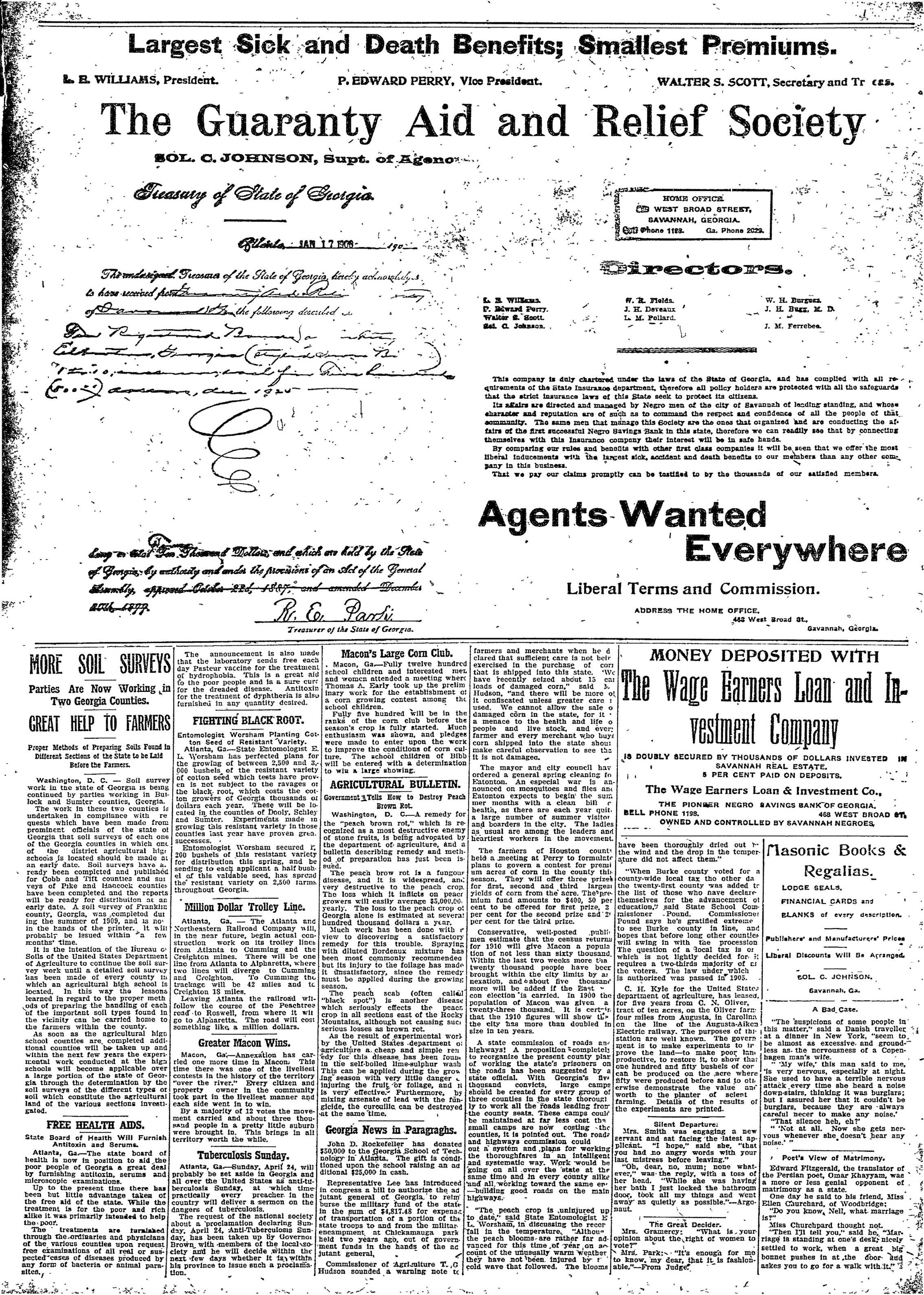
The Guaranty Aid
SOL. C. JOHNSON, Supt. of Ageno
Treasury of State of Georgia
Illinois, JAN 17 1809
The undersigned Treasurer of the State of Georgia, hereby acknowledges
to have received from the following described:
Dear Regina, Dear Sir,
Elsie, Eugene (Signature)
17:00, amends the provisions of an Act of the General Assembly, approved October 22d, 1887, and amended December 27th, 1897.
R. E. Parsi
Parties Are Now Working in Two Georgia Counties.
GREAT HELP TO FARMERS
Proper Methods of Preparing Soils Found in Different Sections of the State to be Laid Before the Farmers.
Washington, D. C. - Soil survey work in the state of Georgia is being continued by parties working in Bullock and Sumter counties, Georgia.
The work in these two counties is undertaken in compliance with requests which have been made from prominent officials of the state of Georgia that soil surveys of each one of the Georgia counties in which one of the district agricultural high schools is located should be made at an early date. Soil surveys have already been completed and published for Cobb and Tift counties and surveys of Pike and Hancock counties have been completed and the reports will be ready for distribution at an early date. A soil survey of Franklin county, Georgia, was completed during the summer of 1909, and is now in the hands of the printer. It will probably be issued within a few months' time.
It is the intention of the Bureau of Soils of the United States Department of Agriculture to continue the soil survey work until a detailed soil survey has been made of every county in which an agricultural high school is located. In this way the lessons learned in regard to the proper methods of preparing the handling of each of the important soil types found in the vicinity can be carried home to the farmers within the county.
As soon as the agricultural high school counties are completed additional counties will be taken up and within the next few years the experimental work conducted at the high schools will become applicable over a large portion of the state of Georgia through the determination by the soil surveys of the different types of soil which constitute the agricultural land of the various sections investigated.
FREE HEALTH AIDS.
State Board of Health Will Furnish Antitoxin and Serums.
Atlanta, Ga—The state board of health is now in position to aid the poor people of Georgia a great deal by furnishing antitoxin, serums and microscopic examinations.
Up to the present time there has been but little advantage taken of the free aid of the state. While the treatment is for the poor and rich alike it was primarily intended to help the poor.
The treatments are furnished through the ordinaries and physicians of the various counties upon request free examinations of all real or suspected cases of diseases produced by any form of bacteria or animal parasites.
Treasurer of the State of Georgia.
The announcement is also made that the laboratory sends free each day Pasteur vaccine for the treatment of hydrophobia. This is a great aid to the poor people and is a sure cure for the dreaded disease. Antitoxin for the treatment of dyphtheria is also furnished in any quantity desired.
FIGHTING BLACK ROOT.
Entomologist Worsham Planting Cotton Seed of Resistant Variety. Atlanta, Ga.—State Entomologist E. L. Worsham has perfected plans for the growing of between 2,500 and 3,000 bushels of the resistant variety of cotton seed which tests have proven is not subject to the ravages or the black, root, which costs the cotton growers of Georgia thousands of dollars each year. These will be located in the counties of Dooly, Schley and Sumter. Experiments made in growing this resistant variety in those counties last year have proven great successes.
Entomologist Worsham secured I, 200 bushels of this resistant variety for distribution this spring, and be sending to each applicant a half bushel of this valuable seed, has spread the resistant variety on 2,500 farms throughout Georgia.
Million Dollar Trolley Line.
Atlanta, Ga. — The Atlanta and Northeastern Railroad Company will, in the near future, begin actual construction work on its trolley lines from Atlanta to Cumming and the Creighton mines. There will be one line from Atlanta to Alpharetta, where two lines will diverge to Cumming and Creighton. To Cumming the trackage will be 42 miles and to Creighton 18 miles. Leaving Atlanta the railroad will follow the course of the Peachtree road to Roswell, from where it will go to Alpharetta. The road will cost something like a million dollars.
Greater Macon Wins.
Macon, Ga.—Annexation has carried one more time in Macon. This time there was one of the liveliest contests in the history of the territory "over the river." Every citizen and property owner in the community took part in the liveliest manner and each side went in to win. By a majority of 12 votes the movement carried and about three thousand people in a pretty little suburb were brought in. This brings in all territory worth the while.
Tuberculosis Sunday.
Atlanta, Ga—Sunday, April 24, will probably be set aside in Georgia and all over the United States as anti-tuberculosis Sunday, at which time practically every preacher. In the country will deliver a sermon on the dangers of tuberculosis. The request of the national society about a proclamation declaring Sunday, April 24, Anti-Tuberculosis Sunday, has been taken up by Governor Brown with members of the local society and he will decide within the next few days whether it is, within his province to issue such a proclamation.
Macon's Large Corn Club.
Macon, Ga.—Fully twelve hundred school children and interested men and women attended a meeting where Thomas A. Early took up the preliminary work for the establishment of a corn growing contest among the school children. Fully five hundred will be in the ranks of the corn club before the season's crop is fully started. Much enthusiasm was shown, and pledges were made to enter upon the work to improve the conditions of corn culture. The school children of Bibb will be entered with a determination to win a large showing.
AGRICULTURAL BULLETIN.
Washington, D. C.—A remedy for the "peach brown rot," which is recognized as a most destructive enemy of stone fruits, is being advocated by the department of agriculture, and a bulletin describing remedy and method of preparation has just been issued. The peach brow rot is a fungous disease, and it is widespread, and very destructive to the peach crop. The loss which it inflicts on peach growers will easily average $5,000,000 yearly. The loss to the peach crop of Georgia alone is estimated at several hundred thousand dollars a year.
Much work has been done with a view to discovering a satisfactory remedy for this trouble. Spraying with diluted Bordenaux mixture has been most commonly recommended but its injury to the foliage has made it unsatisfactory, since the remedy must be applied during the growing season. The peach scab (often called "black spot") is another disease which seriously effects the peach crop in all sections east of the Rocky Mountains, although not causing such serious losses as brown rot.
As the result of experimental work by the United States department of agriculture a cheap and simple remedy for this disease has been found in the self-boiled lime-sulphur wash This can be applied during the growing season with very little danger in injuring the fruit or foliage, and it is very effective. Furthermore, by mixing arsenate of lead with the fungicide, the curcullic can be destroyed at the same time.
Georgia News in Paragraghs.
John D. Rockefeller has donated $50,000 to the Georgia School of Technology in Atlanta. The gift is conditioned upon the school raising an additional $25,000 in cash.
Representative Lee has introduced in congress a bill to authorize the ad jutant general of Georgia, to reimburse the military fund of the state in the sum of $4,817.48 for expense of transportation of a portion of the state troops to and from the militarencampment, at Chickamauga park held two years ago, out of government funds in the hands of the ad jutant general,
Commissioner of Agriculture T. G Hudson sounded a warning note to
HOME OFFICE
O.B. WEST BROAD STREET,
SAVANNAH, GEORGIA.
Call Phone 1169. Gz. Phone 2029.
Directors.
L. B. Williams.
P. Edward Perry.
Walter S. Scott.
Sel. C. Johnson.
W. R. Fields.
J. H. Deveaux
L. M. Pollard.
W. H. Burgers.
J. H. Bugs, M. D.
J. M. Ferrebee.
This company is duly chartered under the laws of the State of Georgia, and has complied with all requirements of the State Insurance department, therefore all policy holders are protected with all the safeguards that the strict insurance laws of this State seek to protect its citizens.
Its affairs are directed and managed by Negro men of the city of Savannah of leading standing, and whose character and reputation are of such as to command the respect and confidence of all the people of that community. The same men that manage this Society are the ones that organized and are conducting the affairs of the first successful Negro Savings Bank in this state, therefore we can readily see that by connecting themselves with this Insurance company their interest will be in safe hands.
By comparing our rules and benefits with other first class companies it will be seen that we offer the most liberal inducements with the largest sick, accident and death benefits to our members than any other company in this business.
That we pay our claims promptly can be tastified to by the thousands of our satisfied members.
Agents Wanted Everywhere
Liberal Terms and Commission.
farmers and merchants when he declared that sufficient care is not being exercised in the purchase of corn that is shipped into this state. 'We have recently selzed about 15 car loads of damaged corn," said H. Hudson, "and there will be more of it confiscated unless greater care is used. We cannot allow the sale of damaged corn in the state, for it a menace to the health and life of people and live stock, and every farmer and every merchant who buys corn shipped into the state should make careful observation to see that it is not damaged.
The mayor and city council have ordered a general spring cleaning for Eatonton. An especial war is an nounced on mosquitoes and files and Eatonton expects to begin the summer months with a clean bill of health, as there are each year quite a large number of summer visitors and boarders in the city. The ladies as usual are among the leaders and heartiest workers in the movement.
The farmers of Houston county held a meeting at Perry to formulate plans to govern a contest for premium acres of corn in the county this season. They will offer three prizes for first, second and third largest yields of corn from the acre. The premium fund amounts to $400, 50 per cent to be offered for first prize, 3 per cent for the second prize and 20 per cent for the third prize.
Conservative, well-posted public men estimate that the census returns for 1910 will give Macon a population of not less than sixty thousand. Within the last two weeks more than twenty thousand people have been brought within the city limits by an exeation, and about five thousand more will be added if the East con election is carried. In 1900 the population of Macon was given a twenty-three thousand. It is certain that the 1910 figures will show that the city has more than doubled in size in ten years.
A state commission of roads and highways! A proposition completely to reorganize the present county plan of working the state's prisoners on the roads has been suggested by a state official. With Georgia's five thousand convicts, large camps should be created for every group of three counties in the state thoroughly to work all the roads leading from the county seats. These camps could be maintained at far less cost than small camps are now costing the counties, it is pointed out. The roads and highways commission could out a system and plans for working the thoroughfares in an intelligent and systematic way. Work would be going on all over the state at the same time and in every county alike and all working toward the same end-building good roads on the main highways.
"The peach crop is uninjured up to date," said State Entomologist E L. Worsham, in discussing the recor fall in the temperature. "Although the peach blooms are rather far advanced for this time of year on account of the unusually warm weather they have not been injured by cold wave that followed. The blooms
MONEY DEPOSITED WITH The Wage Earners Loan and Investment Company
15 DOUBLY SECURED BY THOUSANDS OF DOLLARS INVESTED
SAVANNAH REAL ESTATE.
5 PER CENT PAID ON DEPOSITS.
THE PIONEER NEGRO SAVINGS BANK OF GEORGIA. BELL PHONE 1198. 468 WEST BROAD OWNED AND CONTROLLED BY SAVANNAH NEGROES have been thoroughly dried out the wind and the drop in the temperature did not affect them." Masonic Books &
"When Burke county voted for a county-wide local tax the other day the twenty-first county was added to the list of those who have declare themselves for the advancement of education," said State School Commissioner Pound. Commissioner Pound says he's gratified extreme to see Burke county in line, and hopes that before long other counties will swing in with the procession The question of a local tax is on which is not lightly decided for: it requires a two-thirds majority of the voters. The law under which is authorized was passed in 1905.
C. H. Kyle for the United States department of agriculture, has leased, for five years from C. N. Oliver, tract of ten acres, on the Oliver farm four miles from Augusta, in Carolina on the line of the Augusta-Aiken Electric railway. The purposes of this station are well known. The government is to make experiments to improve the land—to make poor land productive, to restore it, to show that one hundred and fifty bushels of corn can be produced on the acre where fifty were produced before and to otherwise demonstrate the value and worth to the planter of solent farming. Details of the results of the experiments are printed.
Silent Departure
Mrs. Smith was engaging a new servant and sat facing the latest applicant. "I hope," said she, "that you had no angry words with your last mistress before leaving."
"Oh, dear, no, mum; none whatever," was the reply, with a toss of her head. "While she was having her bath I just locked the bathroom door, took all my things and went away as quietly as possible."—Argonaut
Mrs. Gramercy: "What is your opinion about the right of women to vote?"
Mrs. Park: "It's enough for me to know, my dear, that it is fashionable."—From Judge
1
premiums.
T, Secretary and Tr.
ociety
W. H. Burgera.
J. H. Bugg, M. D.
J. M. Ferrebee.
gia, and has complied with all re-
annah of leading standing, and whose
confidence of all the people of that
organized and are conducting the af-
he can readily see that by connecting
handsa.
It will be seen that we offer the most
to our members than any other com-
ands of our satisfied members.
everywhere
mission.
West Broad St.
Gavannah, Georgia.
POSITED WITH
BANDS OF DOLLARS INVESTED IN
REAL ESTATE.
PAID ON DEPOSITS.
Loan & Investment Co.,
SAVINGS BANK OF GEORGIA.
468 WEST BROAD ST.
ED BY SAVANNAH NEGROES.
Masonic Books &
LODGE SEALS.
FINANCIAL CARDS and
BLANKS of every description.
Publishers' and Manufacturers' Prices
Liberal Discounts Will Be Arranged.
BOL. C. JOHNSON.
Gavannah, Ga.
A Bad Case.
A Bad Case.
"The suspicions of some people in this matter," said a Danish traveller at a dinner in New York, "seem to be almost as excessive and groundless as the nervousness of a Copenhagen man's wife.
"My wife," this man said to me, "is very nervous, especially at night. She used to have a terrible nervous attack every time she heard a noise down-stairs, thinking it was burglar; but I assured her that it couldn't be burglar, because they are always careful necer to make any noise."
"That silence heh, eh?"
"Not at all. Now she gets nervous whenever she doesn't hear any noise."
Poet's View of Matrimony.
Edward Fitzgerald, the translator of the Persian poet, Omar Khayyam, was a more or less genial opponent of matrimony as a state.
One day he said to his friend, Miss Ellen Churchard, of Woodbridge:
"Do you know, Nell, what marriage is?"
Miss Churchard thought not.
"Then I'll tell you," said he, "Marriage is standing at one's desk; nicely settled to work, when a great big bonnet pushes in at the door and asks you to go for a walk with it."
BY LETTIE S. BIGELOW.
Of the hard and weary loads
Neath which we bend and fall.
The troubles that do not come
Are the heaviest ques of all.
For grief that cuts like a knife
There's oil of comfort and cure,
And the Hand which binds the weight
Brings strength and grace to endure.
But to phantoms of pain and woe
The lips of Pity are dumb,
And there's never oil or wine
For troubles that do not come.
There's a song to lighten the toil,
And a stuff to climbing the height,
But never an Alpine stock
For the hills that are out of sight.
There are bitter herbs enough
In the brimming cup of to-day,
Without the sprig of rue
From to-morrow's unknown way.
An Unexpected Reconciliation.
"The perversity of fate," he thought as he gravely offered his arm to her and followed the other guests to the dining room. He felt a shade of resentment against Mrs. Willoughby for making such an unfortunate pairing for the table, but his sense of justice told him that Mrs. Willoughby, his hostess, could not possibly have known that only in the previous week had occurred the misunderstanding that ended the quiet engagement between him and the girl whose hand now rested lightly on his arm.
It was embarrassing to her, he knew, but how well she bore herself under circumstances painful to both. She had accepted the situation with so much case that he found himself admiring her for it. He almost wished—but no! He was quite right in the affair and matters had gone too far to allow him to recede. Besides, she had never really loved him. The quarrel was foolish and his suggestion that their engagement be ended was not meant to be taken seriously. Her quiet acceptance of his view simply meant that her affection had never been deep.
As he seated her and heard her faintly audible "Thank you," the old familiar perfume was watted to him and he recalled the many times he had told her it was more intoxicating to him than wine. How pretty she was! He would admit that. Of course, her beauty was for some other man, he told himself with resignation, and it would be wasted upon some dull fellow who could not appreciate her. No man but himself could understand the dear, delightful little subtleties of her nature or the various lights and shades of her character.
He caught himself stealing a furtive look at her. After all, she was the prettiest girl he know. The soft color came and went in her cheek, her eyes had in them a mingled look of tenderness and sadness, and as his glance wandered from the curl that clung wilfully to her neck to her white shoulders, her beautifully rounded arms and slender white hands, he regretted that all his wonderful "castles in Spain" had crumbled, that all the plans for the future, the discussion of which had filled so many happy hours for them, had come to naught. Oh, well! It was too late now. And why had she worn her pink gown, the very one he had told her was so becoming? Was it to tantaize him with what was his no longer?
The girl sat restlessly during the early courses, answering in a preoccupied manner the occasional remarks of her other neighbor. She wondered whether her hand had trembled upon the man's arm or whether she had given any outward sign of her perturbation. His quiet dignity, the grace with which he had carried the situation brought to her recollection all those qualities she most admired in men, and the possession of which had made, him seem to her the man of all men.
He had turned to answer a question addressed to him and it gave her an opportunity of looking in his direction. His clean-cut profile and strong chin indicated determination and firmness, and she liked these attributes.
An involuntary sigh escaped her, and whether or not the man heard it, he turned quickly, his eyes meeting hers before she could look away.
"You were at the Carltons' dance last week?" she said in a tone of polite inquiry.
"Yes," he answered, "there was no escape. No man may be a hermit if he has a resolute sister, so I changed the role of recluse to that of martyr." "Edith Blake told me she had seen you there," she replied, "but she said nothing of your martyrdom."
"Miss Blake was good enough to sit out two dances with me," he said.
"She told me of all your good qualifies, adding to those I knew one or two I had not fully realized. I am indebted to her to that extent, at least." He realized instantly his mistake, for the girl's color rose.
"You were a martyr after all," she answered quickly. "Edith must have become imaginative lately to make a description of my few good qualities last through two whole dances."
"She seemed to believe I had a special interest in them," he continued.
"Perhaps it was heroic treatment. You know, salt on a wound used to
be a favorite method of stopping the bleeding."
"Edith was thoughtless," the girl said. "You have my sympathy."
"Well," he said, reflectively, "I could not explain the situation, so I listened. Besides, I must confess having been interested. There were days in the past, you know, the memory of which cannot be taken from me, if I am robbed of all else."
"By the way," she volunteered, with a show of interest, "I met Rutledge Morton yesterday."
"Rut is a fine fellow; one of the best," he went on. "I should like you to grow fond of him."
"He persists in making you the sole topic of conversation," said the girl.
"Rut; like all men, has his uninteresting moments," he repiled, with a trace of bitterness in his tone.
"It is odd," the girl remarked, as she toyed with her fork, "that our mania acquaintances seem to have a mania for talking of us."
"Reversing Scripture," he said, smiling at her. "It's a case of 'For deliver us from our friend.'"
"It is a monomanta with them she answered. There was a wistfulness in her voice that did not escap him.
The spell of the girl's beauty seemed to overpower him. He leanced forward and whispered as he touched her hand beneath the table. "Couldn't we return to our own old monomania, dear? I am sorry; it was all my fault!"
"No," she answered, as she slipped her hand into his, "it was mine, I was too hasty. Forive me!"
"Hero to Rutledge Morton," he said, as he held up his glass.
"And here's to Edith Blake," he said, as he held up his glass.
"And here's to Edith Blake," she laughed gaily, as she raised her own.
—Boston Post.
GETTING AROUND POLL TAX.
Mark Twain's Cousin Circumvents Ill-Advised Statute.
In the years gone by Topela regularly had turbulent times over the payment of a $3 poll tax annually by every man of voting age. For a long time the matter was the subject of a great deal of controversy. G. C. Clemens, the well known Topela lawyer and a cousin of Mark Twain, really put the law out of business. He made it look foolish one year, and the next year he knocked it out through the courts.
The law held that when a man failed to put up his $3 he had to appear on the streets and work two days at $1.50 a day. Clemens did not pay his tax and received a notice that it was due, and that he would have to work on the streets to make up for his negligence.
"Bring with you a pick and shovel," read the notice.
"Clem" appeared on the appointed day and reported ready for work.
"Where is your pick and shovel?" demanded the street commissioner.
"Here they are," he replied, and diving down into his vest pocket he produced a pick and shovel, the kind that are about two inches long, and that you buy at a toy store for children.
"What are you giving me?" snorted the commissioner. "You can't do anything with those tools."
"The notice didn't say a word," replied Clemens, "about the size of the tools which I was to bring. So I brought what I wanted to. Come on, now assign me to work. I want to get to work, and don't care to lose any time."
The street commissioner walked away in disgust. Clemens waited for about an hour, and still no assignment. So he went to his office and put in the day at work on his law cases. The next morning he turned up for work again. The street commissioner again didn't give him an assignment, so he went back to his office, and declared he had fulfilled the letter of the law. He said it was not his fault that he had not been directed to work.
The next year he sent the law sky high through the courts.—Kansas City Journal.
Through His Nose.
Clear speaking bears a close relation to clear thinking, too, and there is a moral effect in vocal utterance which influences the hearer probably more than most of us are aware: When the late Tom Reed was the —well, let us say the Speaker of the Fifty-first Congress, he once got into a controversy on the floor of the House with Judge McMahon, of Dayton, O. Reed lost his temper, thereby breaking one important law of good form in speech to start with, and shouted in his usual nasal tone:
"The trouble with you is that you don't want to hear the TE-RUTH!"
"Well," retorted the Judge, witheringly, "I don't want to hear the TE-RUTH through your nose."—New York World.
Lost His Slight.
Professor E. D. Campbell, director of the chemical laboratories in the University of Michigan, lost his sight eighteen years ago through an accident. In spite of his affliction he has taken a high plate in education and has made original researches of much value, especially in the chemistry of iron and cement.
No Doubles.
"Thin people very seldom have doubles," says a photographer. "In my business I meet many pairs of people who look alike. In every case the most extraordinary resemblances are between persons who are stout."
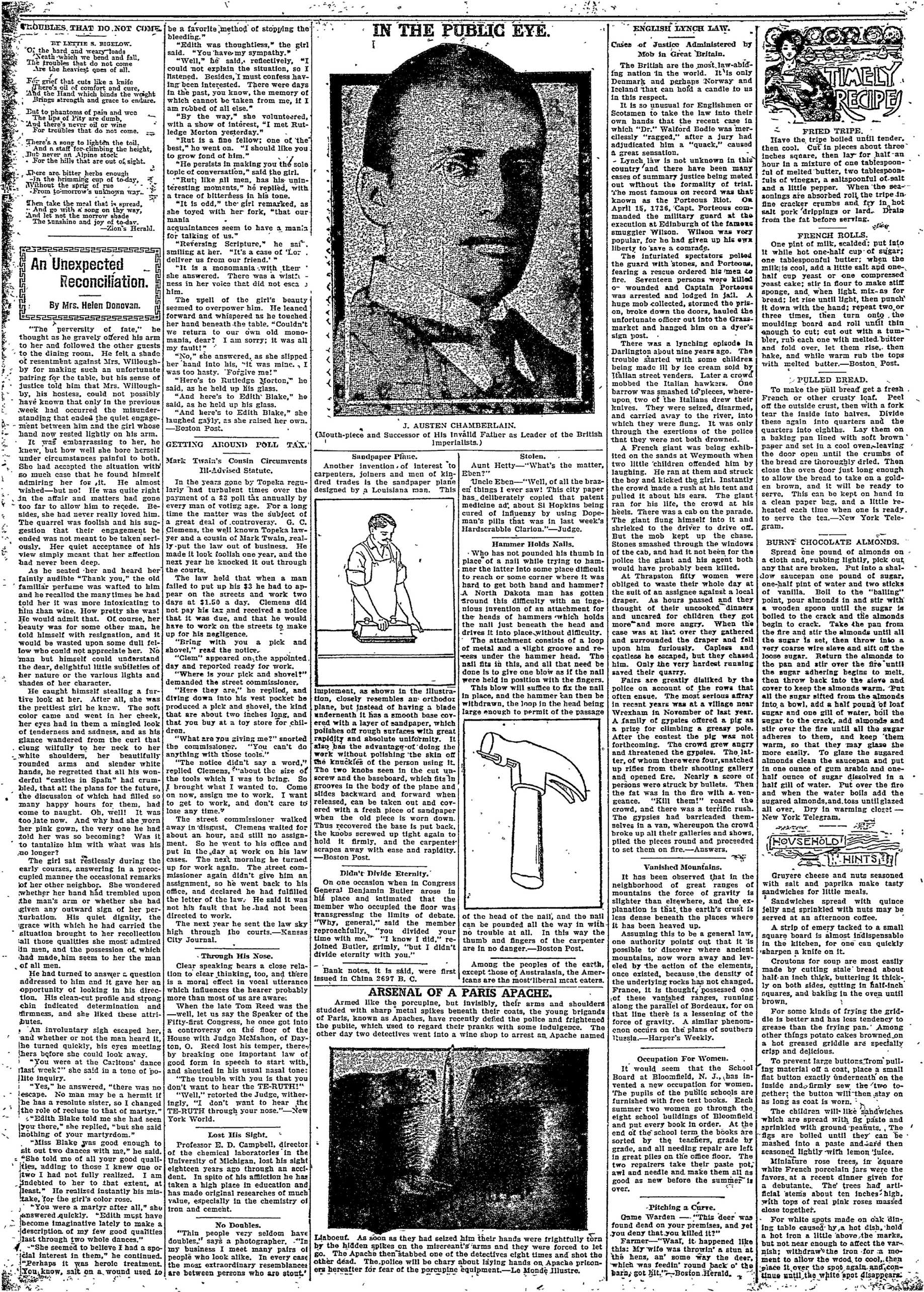
[Portrait of a man in formal attire with a bow tie and a high-collared shirt. The background is plain white. The portrait is framed with a black border.]]
Sandpaper Plate.
Another invention of interest to carpenters, joiners and men of kindred trades is the sandpaper plane designed by a Louisiana man. This
1
implement, as shown in the illustration, closely resembles an orthodon plane, but instead of having a blade underneath it has a smooth base covered with a layer of sandpaper, which polishes off rough surfaces with great rapidity and absolute uniformity. It also has the advantage of doing the work without polishing the skin off the knuckles of the person using it. The two knobs seen in the cut unscrew and the baseboard, which fits in grooves in the body of the plane and slides backward and forward when released, can be taken out and covered with a fresh piece of sandpaper when the old piece is worn down. Thus recovered the base is put back, the knobs screwed up tight again to hold it firmly, and the carpenter scrapes away with ease and rapidity. —Boston Post
Didn't Divide Eternity.
On one occasion when in Congress General Benjamin Butler arose in his place and intimated that the member who occupied the floor was transgressing the limits of debate. "Why, general," said the member reproachfully, "you divided your time with me." "I know I did," rejoined Butler, grimly, "but I didn't divide eternity with you."
Bank notes, it is said, were first issued in China 2697 B. C.
ARSENAL OF A PARIS APACHE.
Armed like the porcupine, but invisibly, their arms and shoulders studded with sharp metal spikes beneath their coats, the young brigands of Paris, known as Apaches, have recently defied the police and frightened the public, which used to regard their pranks with some indulgence. The other day two detectives went into a wine shop to arrest an Apache named
10.000
Llabaeout. As soon as they had selzed him their hands were frightfully torn by the hidden spikes on the miscreant's arms and they were forced to let go. The Apache then stabbed one of the detectives eight times and shot the other dead. The.police will be chary about laying hands on Apache prisoners hereafter for fear of the porcupine equipment.—Le Monde Illustre.
Llabaeout. As soon as they had selzed him their hands were frightfully torn by the hidden spikes on the miscreant's arms and they were forced to let go. The Apache then stabbed one of the detectives eight times and shot the other dead. The.police will be chary about laying hands on Apache prisoners hereafter for fear of the porcupine equipment.—Le Monde Illustre.
Aunt Hetty—"What's the matter, Eben?"
"Uncle Eben—"Well, of all the brazen things I ever saw! This city paper has deliberately copied that patent medicine ad', about SI Hopkins being cured of Influenza by using Dopeman's pills that was in last week's Hardscraper Clarion."—Judge.
Hammer Holds Nalls.
Who has not pounded his thumb in place of a nail while trying to hammer the latter into some place difficult to reach or some corner where it was hard to get both hand and hammer? A North Dakota man has gotten around this difficulty with an ingenious invention of an attachment for the heads of hammers which holds the nail just beneath the head and drives it into place without difficulty. The attachment consists of a loop of metal and a slight groove and recess under the hammer head. The nail fits in this, and all that need be done is to give one blow as if the nail were held in position with the fingers. This blow will suffice to fix the nail in place, and the hammer can then be withdrawn, the loop in the head being large enough to permit of the passage
1
of the head of the nail, and the nail can be pounded all the way in with no trouble at all. In this way the thumb and fingers of the carpenter are in no danger.—Boston Post.
Among the peoples of the earth, except those of Australasia, the Americans are the most liberal meat eaters.
Stolen.
Cases of Justice Administered by Mob in Great Britain.
The British are the most law-abiding nation in the world. It's only Denmark and perhaps Norway and Iceland that can hold a candle to us in this respect.
It is so unusual for Englishmen or Scotsmen to take the law into their own hands that the recent case in which "Dr." Walford Bodle was mercilessly "rugged," after a jury had adjudicated him a "quack," caused a great sensation.
- Lynch law is not unknown in this country and there have been many cases of summary justice being meted out without the formality of trial. The most famous on record was that known as the Porteous Riot. On April 15, 1736, Capt. Porteous commanded the military guard at the execution at Edinburgh of the famous smuggler Wilson. Wilson was very popular, for he had given up his own liberty to save a comrade. The infuriated spectators pelted the guard with stones, and Porteous, fearing a rescue ordered his men to fire. Seventeen persons were killed o' wounded and Captain Porteous was arrested and stormed in jail. A huge mob collected, stormed the prison, broke down the doors, hauled the unfortunate officer out into the Grassmarket and hanged him on a dyer's sign post.
There was a lynching episode in Darlington about nine years ago. The trouble started with some children being made ill by ice cream sold by Italian street vendors. Later a crowd mobbed the Italian hawkers. One barrow was smashed to pieces, upon two of the Italians drew their knives. They were seized, disarmed, and carried away to the river, into which they were flung. It was only through the exertions of the police that they were not both drowned.
A French giant was being exhibited on the sands at Weymouth when two little children offended him by laughing. He ran at them and struck the boy and kicked the girl. Instantly the crowd made a rush at his tent and pulled it about his ears. The giant ran for his life, the crowd at his heels. There was a cab on the parade. The giant flung himself into it and shrieked to the driver to drive off. But the mob kept up the chase. Stones smashed through the windows of the cab, and had it not been for the police the giant and his agent both would have probably been killed.
At Thrapston fifty women were obliged to waste their whole day at the suit of an assignee against a local draper. As hours passed and they thought of their uncooked dinners and uncared for children they got more and more angry. When the case was at last over they gathered and surrounded the draper and fell upon him furiously. Capless and coatless he escaped, but they chased him. Only the very hardest running saved their quarry.
Fairs are greatly disliked by the police on account of the rows that often ensue. The most serious affray in recent years was at a village near Wrexham in November of last year. A family of gypsies offered a pig an a prize for climbing a greasy pole. After the contest the pig was not forthcoming. The crowd grew angry and threatened the gypsies. The latter, of whom there were four, snatched up rifles from their shooting gallery and opened fire. Nearly a score of persons were struck by bullets. Then the fat was in the fire with a vengeance. "Kill them!" roared the crowd, and there was a terrific rush. The gypsies had barricaded themselves in a van, whereupon the crowd broke up all their galleries and shows, piled the pieces round and proceeded to set them on fire.—Answers.
Vanished Mountains.
It has been observed that in the neighborhood of great ranges of mountains the force of gravity is slighter than elsewhere, and the explanation is that, the earth's crust is less dense beneath the places where it has been heaved up.
Assuming this to be a general law, one authority points out that it is possible to discover where ancient mountains, now worn away and leveled by the action of the elements, once existed, because the density of the underlying rocks has not changed. France, it is thought, possessed one of these vanished ranges, running along the parallel of Bordeaux, for on that line there is a lessening of the force of gravity. A similar phenomenon occurs on the plans of southern Russia.—Harper's Weekly.
Occupation For Women.
It would seem that the School Board at Bloomfield, N. J., has invented a new occupation for women. The pupils of the public schools are furnished with free text books. Each summer two women go through the eight school buildings of Bloomfield and put every book in order. At the end of the school term the books are sorted by the teachers, grade by grade, and all needing repair are left in great piles on the office floor. The two repairers take their paste pot, awl and needle and make them all as good as new before the summer is over.
Pitching a Curve.
Game Warden — "This deer was found dead on your premises, and yet you deny that you killed it?" Farmer — "Waa! it happened like this: My wife was throwin' a stun at the hens, an' some way the deer, which was feedin' round back o' the barn; got lilt." —Boston Herald.
TIMELY RECIPE
Have the tripe boiled until tender,
then cool. Cut in pieces about three
inches square, then lay for half-an
hour in a mixture of one tablespoonful
of melted butter, two tablespoonfuls
of vinegar, a saltspoonful of salt
and a little pepper. When the seasonings
are absorbed roll the tripe in
cracker crumbs and fry in hot
salt pork drippings or lard. Drain
from the fat before serving.
FRENCH ROLLS.
One pint of milk, scalded; put into it while hot one-half cup of sugar; one tablespoonful butter; when the milk is cool, add a little salt and one-half cup yeast or one compressed yeast cake; stir in flour to make stiff sponge, and when light, mix-as for bread; let rise until light, then punch it down with the hand; repeat two, or three times, then turn onto the moulding board and roll until thin enough to cut; cut out with a tumbler, rub each one with melted butter and fold over, let them rise, then bake, and while warm rub the tops with melted butter.—Boston Post.
PULLED BREAD.
To make the pull bread get a fresh French or other crusty loaf. Peel off the outside crust, then with a fork tear the inside into halves. Divide these again into quarters and the quarters into eighths. Lay them on a baking pan lined with soft brown paper and set in a cool oven-leaving the door open until the crumbs of the bread are thoroughly dried. Then close the oven door just long enough to allow the bread to take on a golden brown, and it will be ready to serve. This can be kept on hand in a clean paper bag, and a little reheated each time when one is ready to serve the tea.—New York Telegram.
BURNT CHOCOLATE ALMONDS.
Spread one pound of almonds on a cloth and, rubbing lightly, pick out any that are broken. Put into a shallow saucepan one pound of sugar, one-half pint of water and two sticks of vanilla. Boil to the "balling" point, pour almonds in and stir with a wooden spoon until the sugar is boiled to the crack and the almonds begin to crack. Take the pan from the fire and stir the almonds until all the sugar is set, then throw into a very coarse wire sleeve and sift off the loose sugar. Return the almonds to the pan and stir over the fire until the sugar adhering begins to melt, then throw back into the sleeve and cover to keep the almonds warm. Put all the sugar sifted from the almonds into a bowl, add a half pound of loaf sugar and one gill of water, boil the sugar to the crack, add almonds and stir over the fire until all the sugar adheres to them, and keep 'them warm, so that they may glaze the more easily. To glaze the sugared almonds clean the saucepan and put in one ounce of gum arabic and one-half ounce of sugar dissolved in a half gill of water. Put over the fire and when the water boils add the sugared almonds, and toss until glazed all over. Dry in warming closet — New York Telegram.
Gruyere cheese and nuts seasoned with salt and paprika make tasty sandwiches for little meals.
Sandwiches spread with quince jelly and sprinkled with nuts may be served at an afternoon coffee.
A strip of emery tacked to a small square board is almost indispensable in the kitchen, for one can quickly sharpen a knife on it.
Croutons for soup are most easily made by cutting stale bread about half an inch thick, buttering it thickly on both sides, cutting in half-inch squares, and baking in the oven until brown.
For some kinds of frying the griddle is better and has less tendency to grease than the frying pan. Among other things potato cakes browned on a hot greased griddle are specially crisp and delicious.
To prevent large buttons from pulling material off a coat, place a small flat button exactly underneath on the inside and firmly sew the two together; the button will then stay on as long as coat is worn.
The children will like sandwiches which are spread with fig paste and sprinkled with ground peanuts. The figs are bolled until they can be mashed into a paste and sard then seasoned lightly with lemon juice.
Miniature rose trees, in square white French porcelain jars were the favors, at a recent dinner given for a debutante. The trees had artificial stems about ten inches high, with tops of real pink roses massed close together.
For white spots made on oak dining table caused by a hot dish, hold a hot iron a little above the marks, but not near enough to affect the varnish; withdraw the iron for a moment to allow the wood to cool, then place it over the spot again, and continue until the white spot disappears.
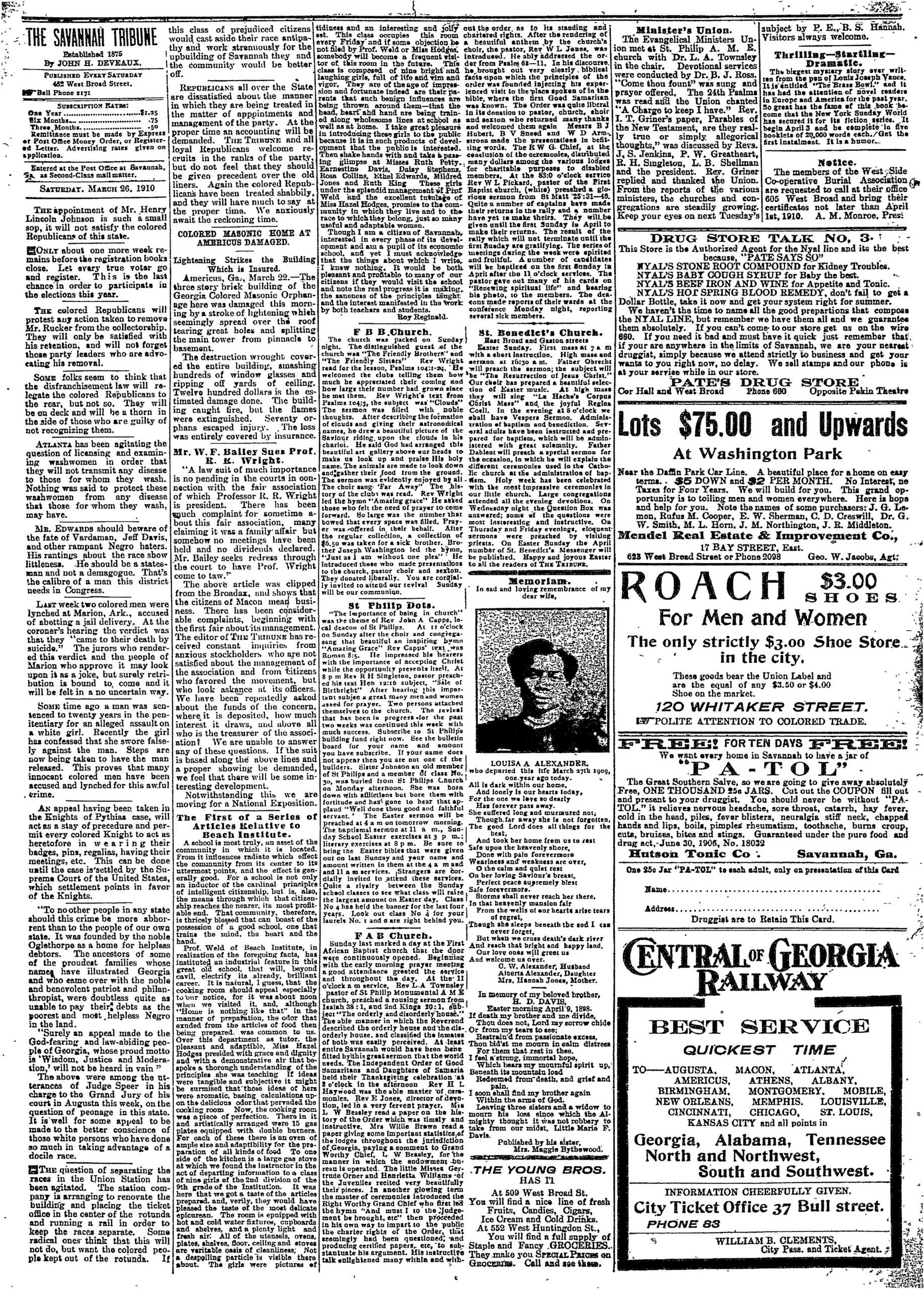
THE SAVANNAH TRIBUNE
Remittance must be made by Express or Post Office Money Order, or Registered Letter. Advertising rates given on application.
Entered at the Post Office at Savannah, as Second-Class mail matter.
SATURDAY. MARCH 26, 1910
The appointment of Mr. Henry Lincoln Johnson is such a small sop, it will not satisfy the colored Republicans of this state.
ONLY about one more week remains before the registration books close. Let every true voter go and register. This is the last chance in order to participate in the elections this year.
The colored Republicans will protest any action taken to remove Mr. Rucker from the collectorship. They will only be satisfied with his retention, and will not forget those party leaders who are advocating his removal.
Some folks seem to think that the disfranchisement law will relegate the colored Republicans to the rear, but not so. They will be on deck and will be a thorn in the side of those who are guilty of not recognizing them.
ATLANTA has been agitating the question of licensing and examining washwomen in order that they will not transmit any disease to those for whom they wash. Nothing was said to protect these washwomen from any disease that those for whom they wash, may have.
MR. EDWARDS should beware of the fate of Vardaman, Jeff Davis, and other rampant Negro haters. His rantings about the race show littleness. He should be a statesman and not a demagogue. That's the calibre of a man this district needs in Congress.
LAST week two colored men were lynched at Marion, Ark., accused of abetting a jail delivery. At the coroner's hearing the verdict was that they "came to their death by suicide." The jurors who rendered this verdict and the people of Marion who approve it may look upon it as a joke, but surely retribution is bound to come and it will be felt in a no uncertain way.
Some time ago a man was sentenced to twenty years in the penitentiary for an alleged assault on a white girl. Recently the girl has confessed that she swore falsely against the man. Steps are now being taken to have the man released. This proves that many innocent colored men have been accused and lynched for this awful crime.
AN appeal having been taken in the Knights of Pythias case, will act as a stay of procedure and permit every colored Knight to act as heretofore in wearing their badges, pins, regalias, having their meetings, etc. This can be done until the case is settled by the Supreme Court of the United States, which settlement points in favor of the Knights.
"To no other people in any state should this crime be more abhorrent than to the people of our own state. It was founded by the noble Oglethorpe as a home for helpless debtors. The ancestors of some of the proudest families whose names have illustrated Georgia and who came over with the noble and benevolent patriot and philanthropist, were doubtless quite as unable to pay their debts as the poorest and most helpless Negro in the land.
"Surely an appeal made to the God-fearing and law-abiding people of Georgia, whose proud motto is Wisdom, Justice and Moderation," will not be heard in vain."
The above were among the utterances of Judge Speer in his charge to the Grand Jury of his court in Augusta this week, on the question of peonage in this state. It is well for some appeal to be made to the better conscience of those white persons who have done so much in taking advantage of a docile race.
The question of separating the races in the Union Station has been agitated. The station company is arranging to renovate the building and placing the ticket office in the center of the rotunda and running a rail in order to keep the races separate. Some radical ones think that this will not do, but want the colored people kept out of the rotunda. If
this class of prejudiced citizens would cast aside their race antipathy and work strenuously for the upbuilding of Savannah they and the community would be better off.
REPUBLICANS all over the State are dissatisfied about the manner in which they are being treated in the matter of appointments and management of the party. At the proper time an accounting will be demanded. THE TRIBUNE and all loyal Republicans welcome recruits in the ranks of the party, but do not feel that they should be given precedent over the old liners. Again the colored Republicans have been treated shabbily, and they will have much to say at the proper time. We anxiously await the reckoning time.
COLORED MASONIC HOME AT AMERICUS DAMAGED.
Lightening Strikes the Building Which is Incurred
Americus, Ga., March 22. The three story briek building of the Georgia Colored Masonic Orphanage here was damaged this morning by a stroke of lightening which seemingly spread over the roof tearing great holes and splitting the main tower from pinnacle to basement. The destruction wrought covered the entire building, smashing hundreds of window glasses and ripping off yards of ceiling. Twelve hundred dollars is the estimated damage done. The building caught fire, but the flames were extinguished. Seventy orphans escaped injury. The loss was entirely covered by insurance.
Mr. W. F. Baller Sues Prof.
R. F. Wright.
"A law suit of much importance is no pending in the courts in connection with the fair association of which Professor R. R. Wright is president. There has been much complaint for sometime about this fair association, many claiming it was a family affair but somehow no meetings have been held and no dividends declared. Mr. Bailey seeks redress through the court to have Prof. Wright come to taw."
The above article was clipped from the Broadax, and shows that the citizens of Macon mead business. There has been considerable complaints, beginning with the first fair about its management. The editor of THE TUNNUE has received constant inquiries from anxious stockholders who are not satisfied about the management of the association and from Citizens who favored the movement, but who look askance at its officers. We have been repeatedly asked about the funds of the concern, where it is deposited, how much interest it draws, and above all who is the treasurer of the association? We are unable to answer any of these questions. If the suit is based along the above lines and a proper showing be demanded, we feel that there will be some interesting development.
Notwithstanding this we are moving for a National Exposition.
The First of a Series of Articles Relative to Beach Institute.
A school is most truly, an asset of the community in which it is located. From it influences radiato which effect the community from its center to its uttermost points, and the effect is generally good. For a school is not only an inductor of the cardinal principles of intelligent citizenship, but is, also, the means through which that citizenship reaches the nearer, its most profitable end. That community, therefore, is thrice blessed that can boast of the possession of a good school, one that trains the mind, the heart and the hand.
Prof. Weld of Beach Institute, in realization of the foregoing facts, has instituted an industrial feature in this great old school, that will, beyond cavil, electrify its already, brilliant career. It is natural, I guess, that the cooking room should appeal especially to our notice, for it was about noon when we visited it, and, although "House is nothing like that" in the manner of preparation, the odor that exuded from the articles of food then being prepared was common to us. Over this department as tutor, the pleasant and adaptible, Miss Hazel Hodges presided with grace and dignity and with a demonstrative air that bespoke a thorough understanding of the principles she was teaching. If ideas were tangible and subjective it might be surmised that those ideas of hers were aromatic, basing calculations upon the delicious odor that pervaded the cooking room. Now, the cooking room was a piece of perfection. There in it and artistically arranged were 15 gas plates equipped with double burners. For each of these there is an oven of sample size and adaptability for the preparation of all kinds of food. To one side of the kitchen is a large gas store at which we found the instructor in the act of departing information to a class of nine girls of the 2nd division of the 9th grade of the Institution. It was here that we got a taste of the articles prepared, and, verily, they would have pleased the taste of the most delicate epicurean. The room is equipped with hot and cold water fixtures, cupboards and shelves, and a plenty light and fresh air. All of the utensils, ovens, plates, shelves, floor, ceiling and stoves are variable casis of cleniness. Not a despilling particle is visible there about. The girls were pictures of
tidiness and an interesting and jolly set. This class occupies this room every Friday and if some objection be not filed by Prof. Weld or Miss Hodges, somebody will become a frequent visitor of this room in the future. This class is composed of mins bright and laughing girls, full of life and vim and vigor. They are of the age of impression and fortunate indeed are their parents that such benign influences are being thrown around them—that the head, heart and hand are being trained along wholesome lines at school as well at home. I take great pleasure in introducing these girls to the public because it is in such products of development that the public is interested. Then shake hands with and take a passing glimpse at Misses Ruth Petty, Earnestine Davis, Daisy Stephens, Rosa Collins, Ethel Edwards, Mildred Jones and Ruth King. These girls under the splendid management of Pint Weld and the excellent tutelage of Miss Hazel Hodges, promise to the community in which they live and to the race to which they belong, just so many useful and adaptable women.
Though I am a citizen of Savannah, interested in every phase of its development and an aunt of its economic school, and yet I must acknowledge that the things about which I write, I knew nothing. It would be both pleasant and profitable to many of our citizens if they would visit the school and note the real progress it is making, the saneness of the principles taught and the interest manifested in the work by both teachers and students.
F B B Church.
The church was packed on Sunday night. The distinguished guest of the church was "The Friendly Browthers" and "The Friendly Sisters" Rev Wright read for the lesson, Psalms 104:12, 24. He welcomed the clubs telling them how much he appreciated their coming and how large their number had grown since he met them. Rev Wright's text from Psalms 104:35, the subject was "Clouds" The sermon was filled with noble thoughts. After describing the formation of clouds and giving their astronomical names, he drew a beautiful picture of the Saviour riding, upon the clouds in his charitot. He said God had arranged this beautiful art gallery above our heads to make us look up and praise His holy name. The animals are made to look down and gather their food from the ground. The sermon was evidently enjoyed by all the choir sang. "Far Away" The history of the clubs was read. Rev Wright led the hymn "Amazing grace" He asked those who felt the need of prayer to come forward. So large was the number that bowed that every space was filled. Prayer was offered in their beahalf. After the regular collection, a collection of $6.50 was taken for a sick brother, Brother Joseph Washington led the lymph, "Just as I am without one plea". He introduced those who made presentations to the church, church choir and sexton. They donated liberally. You are cordially invited to attend our revival Sunday will be our communi-
St Philip Dots.
"The importance of being in church" was the theme of Rev John A Cuppa, local deacon of St Phillips. At 11 o'clock on Sunday after the choir and congregaion that beautiful an inspiring bwmn "Amazing Grace" Rev Cuppa's text, was Roman 8:5. He impressed his hearers with the importance of accepting Christ while the opportunity presents itself. At 8 p.m Rev R H Singleton, pastor pastored his text Heb 12:26 subject, "Sale of Birthright". After hearing this important subject a great many men and women asked for prayer. Two persons attached themselves to the church. The revival that has been is progress for the past two weeks was continued this week with much success. Subserve to St Phillips building fund right now. See the bulletin board for your name and amount you have subscribe. If your name does not appear then you are not one of the builders. Sister Johnson an old member of St Phillips and a member of class No. 30 was buried from St Phillips Church on Monday afternoon. She was born down with afflictions but bore them with fortitude and has gone to hear that applaud "Well done thou good and faithful servant." The Easter sermon will be preached at 4 a.m on tomorrow morning. The baptismal sermon at 1 a.m., Sunday School Easter exercises at 3 p.m., literary exercises at 8 p.m. Be sure to bring the Easter bibles that were given out on last Sunday and your name and amount written in them at the 4 a.m and 11 a.m services. Strangers are cordially invited to attend these services. Quite a rivalry between the Sunday school classes to see what class will raise the largest amount on Easter day. Class No 4 has held the banner for the last four years. Look out class No 4 for your laurels No. 1 and a are right behind you.
F A B Church.
Sunday last marked a day at the First African Baptist church that the door were continuously opened. Beginning with the early morning prayer meeting a good attendance greeted the service and throughout the day. At the 11 o'clock a m service, Rev L A Townsley pastor of St Philip McLain A M E church, presched a roaming sermon from Isaiah 38: 1, and 2nd Kings 20: 1, subject "The orderly and disorderly house." The able manner in which the Reverend described the orderly house and the disorderly house, and classified the inmates of both was easily perceived. At least entire Savannah would have been bene fitted by this great sermon that the world needs. The Independent Order of Good Samaritans and Daughters of Samaria held their Thanksgiving celebration at 8 o'clock in the afternoon Rev H L Haywood was the able master of ceremonies. Rev E Jones, director of devotion, led in a very servant prayer. Ms L W Beasley read a paper on the history of the Order which was timely and instructive. Mrs Willie Braun read a paper giving some important statistics of the lodges throughout the jurisdiction of Georgia, paying a comment to Worthy Chief, L W Beasley, for the manner in which the endowment bureau is operated. The little Misses Gertrude Orner and Hannaletta Williams of the Juveniles recited very beautifully their pieces. In another glowing term the master of ceremonies introduced the Right Worthy Grand Chief who first led the hymn "And must I to the Judgment be brought, etc" then proceeded in his own way to impart to the public the charter rights of the Order, that seemingly are questioned, producing certified papers, etc, to substantiate his argument. His instructive talk enlightened many within and with-
out the order, as to its standing and a chartered rights. After the rendering of a beautiful anthem by the church's choir, the pastor, Rev W L Lewis, was introduced. He easily addressed the order from Psalm 68—11. In his discourse, he brought out very clearly, biblical facts upon which the principles of the order was founded injecting his experienced visit to the place spoken of in the bible, where the first Good Samaritan was known. The Order was quite liberal in its donation to pastor, church, shoir and sexton who returned many thanks and welcomed them again. Messrs B J Hubert, B V Sneed and W D Armstrong made the presentations in befitting words. The R W G. Chief, at the conclusion of the ceremonies, distributed many dollars among the various lodges for charitable purposes to disabled members. At the 8:30 o'clock service Rev W L Pickard, pastor of the First Baptist church, (white) preshred a glorious sermon from St MtT '25:31—46. Quite a number of captains have made their returns in the rally and a number have yet to make theirs. They will be given until the first Sunday in April to make their returns. The result of the rally which will not terminate until the first Sunday are gratifying. The series of meetings during the week were spirted and fruitful. A number of candidates will be baptized on the first Sunday in April after the 11 o'clock service. The pastor gave out many of his cards on "Renewing spiritual life" and bearing his photo, to the members. The deacons made reports of their wards at the conference Monday night, reporting several slick members.
St. Benedict's Church.
East Broad and Gaston streets.
Easter Sunday. First mass at 7 a.m with a abort instruction. High mass and sermon at 16:30 a.m. Father Obrecht will preach the sermon; the subject will be "The Resurrection of Jesus Christ." Our chair has prepared a beautiful selection of Easter music. At high mass they will sing "La Hache's Corpus Christ Mass" and the joyful Regina Coell. In the evening at 8 o'clock we shall have Vespera Sermon. Administration of baptism and benediction. Several adults have been instructed and prepared for baptism, which will be administered with great solemnity. Father Dahlent will preach a special sermon for the occasion, in which he will explain the different ceremonies used in the Catholic church at the administration of baptism. Holy week has been celebrated with the most impressive ceremonies in our little church. Large congregations attended all the evening devotions. On Wednesday night the Question Box was answered; some of the questions were most interesting and instructive. On Thursday and Friday evenings, eloquent sermons were preached by visiting priests. On Easter Sunday the April number of St. Benedict's Messenger will be published. Happy and joyous Easter to all the readers of THE TRIBUNE.
Memoriam.
In sad and loving remembrance of my dear wife,
LOUISA A. ALEXANDER.
who departed this life March 27th 1909,
one year ago today.
All is dark within our home.
And lonely is our hearts today.
For the one we love so dearly
Has forever pass away.
She suffered long and murmured not;
Though far away she is not forgotten.
The good Lord does all things for the
beat,
And took her home from us to rest
Safe upon the heavenly shore,
Done with pain forevermore
Weariness and weakness are over,
O the calm and quiet rest
On her lovling Saviour's breast,
Perfect peace supremely blest
Safe forevermore.
Storms shall never reach her there.
In that heavenly mansion fair
From the wells of our hearts arise tears
of regret,
Though she sleeps beneath the sod I can
never forget,
But when we cross death's dark river
And reach that bright and happy land,
Our love ones will greet us
And welcome us over.
O. W. Alexander, Husband
Alberta Alexander, Daughter
Mrs. Hannah Jones, Mother.
In memory of my beloved brother,
H. D. DAVIS.
Easter morning April 9, 1898.
If death my brother and me divide,
Thou does not, Lord my sorrow chide
Or from my tears to see;
Leaving three sisters and a widow to
mourn his loss since which the Almighty
thought it was not robbery to
take from our midst, Little Marie F.
Davis.
Published by his sister,
Mrs. Maggie Bythewood.
THE YOUNG BROS.
HAS TI
At 509 West Broad St.
You will find a nice line of fresh
Fruits, Candies, Cigars,
Ice Cream and Cold Drinks.
At 552 West Huntingdon St.
You will find a full supply of
Staple and Fancy GROCERIES.
They make you SPECIAL PRICES on
GROCERIES. Call and see them.
Minister's Union.
The Evangelical Ministers Union met at St. Philip A. M. E. church with Dr. L. A. Townsley in the chair. Devotional services were conducted by Dr. B. J. Ross. "Come then fount" was sung and prayer offered. The 24th Psalm was read and the Union chanted "A Charge to keep I have." Rev. I. T. Griner's paper, Parables of the New Testament, are they really true or simply allegorical thoughts," was discussed by Revs. J. S. Jenkins, P. W. Greatheart, R. H. Singleton, L. B. Shellman and the president. Rev. Griner replied and thanked the Union. From the reports of the various ministers, the churches and congregations are steadily growing. Keep your eyes on next Tuesday's
DRUG STORE
This Store is the Authorized Agent
because, "PA
NYAL'S STONE ROOT CO
NYAL'S BABY COUGH SY
NYAL'S BEEF IRON AND
NYAL'S HOT SPRING BLO
Dollar Bottle, take it now and get
We haven't the time to name all
the NYAL LINE, but remember we
them absolutely. If you can't con-
680. If you need it bad and must
if your are anywhere in the limits,
druggist, simply because we atten-
wants to you right now, no delay.
at your service while in our store.
PATE'S DR
Cor Hall and West Broad Phone
Lots $75.00
At Washing
Near the Daffin Park Car Line. A
terms. $5 DOWN and $2
Taxes for Four Years. We w
portunity is to toiling men and
and help for you. Note the n
mon, Rufus M. Cooper, E. W
W. Smith, M. L. Horn, J. M.
Mendel Real Estate
17 BAY STRE
623 West Broad Street or Phone
ROAC
For Men a
The only strictly
in the
DRUG STORE TALK NOW
is the Authorized Agent for the Nyal line
because, "PATE SAYS SO"
IS STONE ROOT COMPOUND for Kids
IS BABY COUGH SYRUP for Baby the
IS BEEF IRON AND WINE for Appetite
IS HOT SPRING BLOOD REMEDY, or
take it now and get your system right
it the time to name all the good prepara-
LINE, but remember we have them all a
likely. If you can't come to our store
need it bad and must have it quick just
anywhere in the limits of Savannah, we
apply because we attend strictly to busi-
right now, no delay. We sell stamps
only while in our store.
PATE'S DRUG STORE
West Broad Phone 680 Opponent
$75.00 and U
At Washington Park
Finn Park Car Line. A beautiful place for
$5 DOWN and $2 PER MONTH.
For Four Years. We will build for you.
is to toiling men and women everyw
for you. Note the names of some pur-
nus M. Cooper, E. W. Sherman, C. D.
th, M. L. Horn, J. M. Northington, J.
Real Estate & Improved
17 BAY STREET, East.
Broad Street or Phone 2098 Geo.
DACH $ SH
For Men and Wom
only strictly $3.00 Sh
in the city.
DRUG STORE TALK NO. 3. This Store is the Authorized Agent for the Nyal line and its the best because, "PATE SAYS SO"
NYAL'S STONE ROOT COMPOUND for Kidney Troubles.
NYAL'S BABY COUGH SYRUP for Baby the best.
NYAL'S BEEF IRON AND WINE for Appetite and Tonic.
NYAL'S HOT SPRING BLOOD REMEDY, don't fail to get a Dollar Bottle, take it now and get your system right for summer.
We haven't the time to name all the good preparations that compose the NYAL LINE, but remember we have them all and we guarantee them absolutely. If you can't come to our store get us on the wire 660. If you need it bad and must have it quick just remember that if your are anywhere in the limits of Savannah, we are your nearest druggist, simply because we attend strictly to business and get your wants to you right now, no delay. We sell stamps and our phone is at your service while in our store.
PATE'S DRUG STORE
Cor Hall and West Broad Phone 680 Opposite Pekin Theatre
Lots $75.00 and Upwards
Near the Daffin Park Car Line. A beautiful place for a home on easy terms. $5 DOWN and $2 PER MONTH. No Interest, no Taxes for Four Years. We will build for you. This grand opportunity is to toiling men and women everywhere. Here is hops and help for you. Note the names of some purchasers: J. G. Lemon, Rufus M. Cooper, E. W. Sherman, C. D. Creswill, Dr. G. W. Smith, M. L. Horn, J. M. Northington, J. R. Middleton.
Mendel Real Estate & Improvement Co.,
17 BAY STREET, East.
623 West Broad Street or Phone 2098 Geo. W. Jacobs, Agt:
ROACH $3.00 SHOES For Men and Women
The only strictly $3.00 Shoe Store in the city.
These goods bear the Union Label and are the equal of any $3.50 or $4.00 Shoe on the market.
120 WHITAKER STREET.
POLITE ATTENTION TO COLORED TRADE.
FREE! FOR TEN DAYS FREE
We want every home in Savannah to have a jar of "PA-TOL"
The Great Southern Salve, so we are going to give away absolutely Free, ONE THOUSAND 25c JARS. Cut out the COUPON fill out
20 WHITAKER STREET
LITE ATTENTION TO COLORED T
EE! FOR TEN DAYS F
we want every home in Savannah to have
PA-TOL
Southern Salve, so we are going to give
THOUSAND 25c JARS. Cut out the
120 WHITAKER STREET POLITE ATTENTION TO COLORED TRADE.
The Great Southern Salve, so we are going to give away absolutely Free, ONE THOUSAND 25e JARS. Cut out the COUPON fill out and present to your druggist. You should never be without "PA-TOL." it relieves nervous headache, sore throat, catarrh, hay fever, cold in the head, piles, fever blisters, neuralgia stiff neck, chapped hands and lips, boils, pimples rheumatism, toothache, burns croup, cuts, bruises, bites and stings. Guaranteed under the pure food and drug act. June 30, 1906, No. 18032
Hutson Tonic Co. Savannah, Ga.
One 25e Jar "PA-TOL" to each adult, only on presentation of this Card
CENTRAL OF GEORGIA RAILWAY
TO----AUGUSTA. MACON. ATLANTA. AMERICUS. ATHENS. ALBANY. BIRMINGHAM. MONTGOMERY. MOBILE. NEW ORLEANS. MEMPHIS. LOUISVILLE. CINCINNATI. CHICAGO. ST. LOUIS. KANSAS CITY and all points in Georgia, Alabama, Tennessee North and Northwest, South and Southwest.
City Ticket Office 37 Bull street. PHONE 83
subject by P. E., B. S. Hannah.
Visitors always welcome.
Thrilling—Starling— Dramatic.
The biggest mystery story over written from the pen of Louis Joseph Vance. It is entitled "The Brass Bowl" and it has had the attention of novel readers in Europe and America for the past year. So great has the fame of this book become that the New York Sunday World has secured it for its fiction series. It begin April 3 and be complete in five booklets of 20,000 words each./Get the first installment. It is a humor.
The members of the West Side Co-operative Burial Association are requested to call at their office 605 West Broad and bring their certificates not later than April 1st, 1910. A. M. Monroe, Presi
TALK NO. 3.
Want for the Nyal line and its best
STE SAYS SO"
AMPOUND for Kidney Troubles.
RUP for Baby the best.
WINE for Appetite and Tonic.
BOD REMEDY, don't fail to get a
your system right for summer.
The good preparations that compose
we have them all and we guarantee
one to our store get us on the wire
have it quick just remember that
of Savannah, we are your nearest
and strictly to business and get your
We sell stamps and our phone is
RUG STORE
Phone 680 Opposite Pekin Theatre
and Upwards
Bington Park
A beautiful place for a home on easy
2 PER MONTH. No Interest, no
will build for you. This grand op-
ed women everywhere. Here is hope
games of some purchasers: J. G. Le-
V. Sherman, C. D. Craswill, Dr. G.
Northington, J. R. Middleton.
& Improvement Co.,
SET, East.
2098 Geo. W. Jacobs, Agt.
H $3.00
SHOES
and Women
$3.00 Shoe Store
the city.
ER STREET.
TO COLORED TRADE.
EN DAYS FREE!
Savannah to have a jar of
TOL"
we are going to give away absolutely
RS. Cut out the COUPON fill out
Notice.
Her Death Regretted.
Mrs Lelia Jones Davis died on Thursday of last week after an illness of some length. The funeral took place on Saturday afternoon from the Second Baptist Church of which she was a member. Rev. J. H. May and Rev. Greatheart conducted the ceremony. The funeral was attended by a number of friends of the deceased. Mrs. Davis has been residing at Hampton, Va., but returned home last December thinking that her health would improve. Besides an eighteen months old baby, she leaves a husband, Mr. R. M. Davis, Jr., a sister, Mrs. M. V. Washington of New York, and other relatives and many friends to mourn her death.
Dled in New York.
Mrs. Floretta Fleming Glover, after an illness of several months, died in New York on Tuesday March 15. She was buried in Brooklyn. Mrs. Glover with her mother, Mrs. Charity Fleming, left here some time ago for New York and they would have returned here ere this if it was not for the illness of the deceased. She left a mother and two sisters. Mrs. Glover was a member of the First Congregational Chureh.
Mr. Henry Jackson formerly of this city departed this life Monday afternoon, of last week after a brief illness. He was buried on Wednesday from his late residence 66 West 134th St., New York City. The funeral service was conducted by the Rev. A. Clayton Powell of the Abyssinia Baptist church. He delivered a very touching address upon the uncertainties of life and the inavitableness of death. After the services the remains were intered in St. Michaels cemetary on Long Island. Mr. Jackson was a shoemaker by trade and continued at same up to his last illaen. His funeral was largely attended and his grave was liberally covered with floral offerings. The following young men acted as pall-bearers: Messrs. A. L. Jackson P. H. Bias, F. J. Scott, W. H. Logan, C. R. Hankinson, L. Marshal.
Men's Sunday Club.
At the Men's Sunday Club on last Sunday, quite an interesting and entertaining program was carried out. The vocal solo by Miss May Stewart and the violin solo by Mr. A. J. Elkins were great successes thus eliciting much applause and favorable comment. The papers on the Negro Press and Lessons from Life and Works of Dunbar by Messrs. H. Hymes and E. W. Sherman respectively, showed much previous thought and preparation on the part of the authors. Many valuable suggestions were given the audience by these gentlemen.
Tomorrow's program consists of special solos and quartettes and also a special Easter address by Dr. Loy Warwick, pastor of the South Side Methodist Church.
At the First Congregational Church, Rev. W. L. Cash, pastor, special Easter services will be held tomorrow. At 11 o'clock the pastor will preach on the resurrection. The choir will render appropriate music. At the evening service the Sunday School, Mr. M. W. Bryant, Supt., will render its Easter Cantata. To each of these services the public is cordially invited.
The monthly session of the A. C.E. U. League was held last Sunday at Bethel A. M. E. Church. Service began by singing "Pass me not," then prayer was offered. The scripture lesson was then read. The subject was "Money a curse or a blessing." The topic was then offered for discussion. After many had spoken on the subject and the verdict was rendered, not guilty, but the use of money proved to be either a curse or a blessing, all was happy again. The literary part of the program was taken up, the renditions of which were good throughout. Prof. B. S. Reed's solo was enthusiastically received. Collection $2.05. Adjournment.
Pythian Period.
Tomorrow all of the K. of P. Lodges, Uniform ranks, Courts of Calanthe and Juveniles will hold thanksgiving services at St. Philip's Monumental Church. The usual program has been arranged and the services will be as interesting and well attractive as ever.
Notice
Ladies, whose husbands are Odd Fellows and daughters and sisters, who are eligible, who desire to join the Household of Ruth, are requested to meet at my residence, 774 Waldburg St. E., on Monday afternoon March 28, at 4 o'clock.
M. E. Sherman.
Local Dots.
Hymes K. and B. Pills, try them for Kidney complaints.
Mr. James Dorssey, the well-known undertaker, died on Wednesday. He was buried yesterday.
Mrs. Rosa C. Russell returned to Chicago on Sunday evening after an enjoyable visit to relatives and friends.
Cards are out announcing the weddding of Miss Emily Veneeta McDonald to Mr. Abraham B. Stevens at St. John's church, Inwood, Darien, Ga., Wednesday evening April 6.
Mrs. M. V. Washington who is residing in New York has been in the city a few days, being called here on account of the illness of her sister who died last week. She returns to New York next Tuesday.
A Literary and Musical Melange will be given at Masonic Temple on Tuesday evening April 26, for benefit of First Congregational Church. Some of the best musical and literary talent will take parts. Admission 15 cents.
The many friends of Mrs. M. Lockett Smalls regret and sympathize with her in the death of her daughter Miss Louisa Lockett which occurred on the 19th inst., after an illness of several months. The funeral was held on Monday, at St. Augustine's Mission.
33 Toils cures Chill and Fever.
Hymes K and 15 Pills, try them for Dr. A. F. Beard, senior secretary of the American Missionary Association was in the city this week. He visited Beach Institute and is highly gratified over the work of the institution here. Dr. Beard is favorably known by many of the citizens.
Mrs. Henrietta Williams wife of Rev. P. W. Williams died on Thursday night March 17, and was buried from St. Philip's Church Sunday afternoon. She left a husband, two children and other relatives. The funeral was largely attended.
Mr. and Mrs. Joseph McConnell was called to McIntosh, Ga., to the bedside of Mrs. Grace McConnell, the mother of Mr. McConnell who died on March 18th. Mrs. McConnell liged a consistent christian life and died in the triumph of faith. She leaves two sons and other relatives to mourn her death. On March 15th the Fox Club installed the following officers: T. A. Milledge, president; J. W. Jones, vice-president; C. Thad Toomer, financial secretary; James McIntosh, recording secretary; C. B. Smith, treasurer; Sam Taylor, advocate. After the installation, refreshments were in order and the boys had a good time.
First Class catering can be had by calling on Mrs. M. Lockett Small, 317 West Broad street. For ice cream, salads, picnic boxes and desserts for Sunday dinner. Catering of all kinds.
The Ladies Social Circle celebrated its third annual at Morse's hall on Wednesday evening of last week. Officers were installed by Rev. W. L. Jones, assisted by Deacon W. H. Ward as follows: Mrs. Loudriska Williams, Pres.; Mrs. Julia Barnard, vice-president; Mrs. Julia A.' Ward, Secretary; Mrs. Anna Voss, treasurer; Mrs. Adrianna Boyd, assistant treasurer; Mrs. Mamie Sampson, chairman of finance; Mrs. Catherine Thomas, chairman of health; Mrs. A. E. Owen, chairman of investigation; Mrs. Luzina Willis, clerk of order, Mrs. Sarah L. Young, chaplain.
The annual Easter concert of the Second Baptist Sunday school will be held at the church Sunday evening March 27th, 1910 at 8:30 The following is the program: Chorus, King Ye Bella, by Geibel, school; Responsive Scripture Reading, Supt and school; Invocation; Chorus, Shine Forth, School, Address of welcome, Pastor, Chorus, Ye Lingering Shadows, School, Recitation, An Easter Story Miss A E Cannon, Duett, Send the Tidings Onward, by Kohlmaa, David M and Chas F Waters, Chorus, Glory to the Risen King, School, Exercise—"For the whole World," nine pupils of Miss C B Hendrickson's class. Chorus, the dawn of the Glad Easter Day, School, Recitation, The Easter Story, Master Walter S Chester, Exercise—"The Butterflies," Six pupils of Mra M M Monroe's class, Solo, The Angels Easter Song by Schnecker, Peace, Miss Amabel I Monroe, Chorus, A Song of Trumph Rings, School, Exercise—"The Lily's Message," Four pupils, Quartett, The Lilies, Four pupils of Mra M Monroe's class, Duett and Mrs Dark, Dark the Night, Misses Lottie Roundfield Earnestine McTier and school Recitation, "How Did you Know?" Master John W Roberts, Chorus, Seek not. Tom King, School, Easter offering. Chorus, Crown Him King, School, Exercise, Joy Cometh in the morning, characters, Mary Magdalene, Miss Phills Singleton, Night, Miss Agnes Donglass, Heralds, Masters Allen and Ernest Manor, Stars, Miss Viola and Sally Grover, Eareh, Miss Anna Rogers, Cross, Miss Josephine Houston, Easter, Miss Leola Graham, Quartett in the Distant, Misses Nancy E Barnard Romena Gallard, Messrs Chas E Dobson Nathaniel Sampson conducted by Chas F Waters. Coronation with Benediction to all of which you are cordially invited. Mr R M Davis, Supt, Rev J H May, Pastor, Miss A I Monroe, Accompanist. Mr Chas F Waters, Musical Director.
phen's at Church;
The services at St. Stephen's Episcopal Church, Harris and Hebersham streets will be up to the usual standard. The first service will be at a m at which time Prof. McDowell and his well trained choristers will render a fine musical program. It goes without saying that St. Stephen's choir possess some of the most charming soloists in the city, and it is said by persons in a position to know that their singing is the "talk of the town." Lovers of good music then, will find a treat in store for them on Sunday morning; at this service there'll also be a celebration of the Holy Communion and a sermon appropriate to the day which is the great Festival of the Resurrection of Christ. The Sunday shool concert and festival will take place at night, beginning promptly at 8 o'clock. The carols are the prettiest heard in many years and persons, who are fond of hearing children sing and speak little pieces, all being done in an orderly and reverent manner would do well to be present. Whatever misgivings may have existed in the minds of some persons as to the treatment method out to strangers at St. Stephen's, they were undoubtedly dispelled by the reception accorded them at the Confirmation services last Sunday night when a solid mass of four hundred and fifty people of all shades and of every station in life invaded the church. All though extra seats were provided, and the gallery was full, there were many standing in the church, and fully a hundred were outside on the side walk unable to get in. A large number of white churchmen were present, and the whole science was symbolic of the ideal church in which all the nations and races of the earth shall be gathered as children of one father. Sixteen persons were presented for confirmation. The Rev. M W. Weston of St. Augustine's Mission assisted in the services. After the candidates were confirmed Bishop Rosse made a brief address to them and afterwards preached. Thus ended another chapter in the history of the St. Stephen's, one long to be remembered. A cordial invitation is extended to the general public to the services not only on special occasions, but throughout the year.
Second Baptist Church.
Sunday services were well attended here, and the rally was a success, though several clubs are yet to report, therefore the rally was continued till tomorrow. The revival will begin next Tuesday night, and Rev May will be assisted by Dr McD. Spencer of Valdosta, Ga. Dr Spencer is one of the greatest revivalists in the South. The Easter exercises will take place tomorrow night at 8 o'clock. A number of members on the sick list, among whom are Elaters McGowan, Jenkins, Maxwell, Hannah Early, Margret Roberts, Brothers James Elmore and Isaiah Harris are very sick. Three funerals during the week. The Women's Mission Society will meet tomorrow after morning service. A pastor's Aid Society will be organized at an early date. The pastor will preach tomorrow morning The public is invited to hear him. Your presence will be appreciated. Every member of the church is called to be present the first Sunday morning; business of importance that concerns each member.
For Over Fifty Years.
Mrs. Winslows' Soothing Syrup has been guarded for over Fifty YEARS by MILLIONS of Mothers for their CHILDREN WHILE TREATING. with PERFECT SUCCESS! It Soothes the CHILD, Softens the GUMS, ALLAYS all PAIN; CURSES WIND COLIC, and is the best remedy for DIARRHORA. Sold by Druggist in every part of the world. Be sure to ask for "Mrs. Winslows' Soothing Syrup," and take no other, kind. age a bottle.
Mias LULA CULBREATH.
Hair Dresser and Straightening. She sells her own hair grower, grease which will grow hair on any bald head Shampoo the hair and massage the face. She makes you beautiful. Give me a call ladies and I will dress your hair and face in any style. Miss Lula Culbreath, 554 Stewart Culbreath.
AMUSEMENT COLUMN.
Coming Events in The Social World.
A Calanthian Medal contest will be given at Harris street hall, Wednesday night March 30th by Opal Court No. 41, O O C. Tickets 15 cents.
The first anniversary Hall of Bright Star of the East Loving Association will be given at Masonic Temple Tuesday night March 29th. Tickets 20 and 35c.
Chatham Lodge 7604 G U O of O F will give their first annual banquet at Masonic Temple, Wednesday night March 30th. Tickets 20 and 75 cents.
A grand Easter Festival will be given at Harris street hall for the benefit of St Benedict's Church Tuesday night March 29th. Tickets 25 cents.
A grand excursion will be given to Springfield on Easter Monday March 28th. Tickets 50 cents.
A grand Easter ball will be given by the Ocean Progress Branch at Masonic Temple Monday night March 28th. Tickets 15 cents.
A grand Easter and Pythian Period Entertainment will be given by 'Crecent Lodge No 2 K of P at Harris street Hall on Monday night March 28th. Ticket 25 cents.
An egg banquet will be given by the congregation of St Augustine's Episcopal Church, Easter Monday night, March 28th, in the School hall. Admission 10 cents. All friends are cordially invited to attend.
The S and D of Ellijah will give their 10th annual entertainment at Masonic Temple Monday night April 4th. Tickets 35 and 50 cents.
A grand opening plenic will be given at Llocoln Park by Georgia Company No. 1 U R K of D Easter Monday March 28th. Tickets 15 cents.
Does all kind of high grade dental work of the best quality and workmanship. Gold crowns and bridge work. White Porcelain Pivot, and Gold Crowns mounted on the natural roots. Gold Fillings, Cement Fillings, and Silver or Amalgam Fillings, from nine to a full set of teeth $7.00 perl $8.00. Broken places mended and teeth added to old ones for a small cost. Ball Phone 1344. Solid Gold Crowns Guaranteed $24 Gold.
Articles for Girls and Ladies Men's Suits $15.00 to $35.00 Boys' Suits $3.50 to $15.00 Latest Cuts at Reasonable Prices
COLORED PEOPLE OF SAVANNAH HOMESTEAD PARK
RIGHT AT SANDFLY STATION
LOTS $30. $2 DOWN. $2 A MONTH.
THIS is your opportunity—don't delay. Come down Saturday, Sunday or early next weak and look over this property. 50 foot streets are now built and other attractive improvements made. Take Isle of Hope car and get off at Sandfly Station. Your car fare from any part of the city refunded, if you bring this advertisement with you.
THE F. C. BECKER REALTY CO. HOMESTEAD PARK OFFICE MAIN OFFICE AT SANDFLY STATION 50 CHURCH ST. NEW YORK CITY
Insurance Talk
Don't mean a great deal when the people are not familiar with the Company the agent wishes to represent. But the insuring public are fully acquainted with the
Union Mutual Association
The pioneer Negre Insurance Company of the country, now paying over 800 claims daily. Do you carry insurance with them? If not, phone the local manager to-day and he will have an agent call on you and explain their contract to you, which is absolutely safe by test, or write
WM. DRISKELL,
Secretary and Gen'l Manager,
210 Auburn Ave., Atlanta, Ga.
J. C. LINDSAY,
District Manager,
509 West Broad Street,
Savannah, Ga.
Phone 1470
Garey's Variety Bakery
Goods delivered promptly
to any part of the city ..
506 West Broad St, near Gaston.
Phone 1531 L
Lots Are Selling
Make Them At
Sales for Girls and Ladies Suits $15.00 to $30.00 ' Suits $3.50 to $15.00 Cuts at Reasonable
EVY, BRO.
Church Notice.
Shepherd's Chapel, Primitive Church Green street, Ditmerville, Savannah Ga., of which Rev. Samuel F. Shepherd is pastor, is the First Church on the Memorial Roll of Honor. Services Sunday, prayer meeting at 5 a.m. preaching at 11 a.m and 8 p.m. Tuesday and Thursday nights preaching.
The Palative
The only Colored Cafe of its kind in the city.
SEA FOOD AND GAME in season.
Home Cooking a Specialty.
EDWARD JOHNSON, Proprietor and Caterer.
817 Burroughs Street.
Open all night.
CRECEUS
Horse Shoeing & Clipping Shop
Conveniently located. Horses sent
for and returned. Quick and
satisfactory work.
Horses Clipped on short notice.
330 JEFFERSON ST.
Phone 2509
F F. JONES.
DEALER IN
Beef - Veal - Mutton
Lamb-Pork-Hams
Bacon and
CORNED BEEF
All Kinds of GAME in Season.
Goods promptly delivered to
any part of the city free of
charge.
STALL 31 CITY MARKET
WEST SIDE
RESTAURANT
461 West Broad Street
Near Union Station
The place to get first class meals.
Everything neat and clean. Meals prepared in an apetizing manner and at all hours daily.
Meals 15 and 25 cents.
Mrs. A. S. Scott. Proprietress.
Dr. J. W. Jamerson,
Firstclass Dentist,
All Work Guaranteed.
623 WEST BROAD STREET.
Bet. Buntingdon and Hall.
Bell Phone 2098.
did New Surburb
FOR THE
FARMER
AND
STOCKMAN
When going to town with the heavy farm wagon, it is often desirable to take a few eggs, apples or some other article that is easily damaged by the holting of the wagon, and I will tell the readers of the Agricultural Epitomist of a device that I made to meet this requirement, which works admirably. I took some cast off bed springs attached to boards, and made a little platform large enough to set three bushel crates on. This I place in the bottom of the wagon box, then place the egg crate or whatever else I wish to carry that requires careful handling, and it rides safely.—F. H. Dow, Steuben County, N. Y.
Ferilizing Corn.
Tests made with Tennessee finely ground phosphoric rock, twenty-eight per cent. phosphoric acid, 1000 pounds per acre, on my farm, gave results as follows:
Where no phosphoric rock was used the corn averaged 48.97 bushels per acre. Where 1000 pounds phosphoric rock was used the corn averaged 65.32 bushels per acre, making a gain of 16.85 bushels per acre over the untreated soil. The soil was thin where tests were made.
The 16.85 bushel gain used 10.11 pounds of phosphoric acid, leaving 128.89 pounds of phosphoric acid for the coming crops. The phosphoric acid becomes available much faster after the second year.
Stall manure, with which 100 pounds phosphoric rock was mixed at time of hauling, made a gain of 17:49 bushels per acre over untreated manure. The manure was used at the rate of nine spreader loads per acre. By getting the supply of phosphoric acid in this way it is a saving of more than half. The soil is very deficient in this element of plant food.—Ira E. Deer, in the Indiana Farmer.
Foods Rich in Protein..
Besides alfalfa, clover, soy beans, cowpeas and some other legumes which we grow on the farm, wheat bran, linseed meal, cottonseed meal, germ meal, tankage, gluten meal, which is a corn product, and some other concentrates are rich in the nitrogenous element of food so essential to young and growing live stock. When corn is high, the by-products of corn will be high. If oats are cheap, its by-products will be cheap, and so along the line. In buying any of these feeds, figure the number of pounds of proteln in a ton, and then, knowing the price asked per ton, it can be readily learned what a pound of proteln costs. In this way you know which food is the cheapest source of protein.
Most of the grains that go to produce this list of by-products are rich in carbohydrates, but as the manufacturer wishes this particular part of the grain to make his product, he returns the grain better than when sold to him; that is, better for producing milk or growth. He not only does this, but he grinds and cooks these foods and makes them very palatable.—Indiana Farmer.
How to Thaw a Frozen Stock Pump.
At this time of severe cold weather the farmer and his family are often much inconvenienced by finding the stock pump frozen up solid in the morning, and all efforts to thaw it with salt or hot water are slow and oftimes wholly ineffective, as the hot water runs out at the spot, while that below in contact, with the ice soon becomes cold, doing no work. The pump must finally be taken out and thawed in the kitchen. It may be worth something to know that, with a small tool costing but a few pennies, the most stubborn case of frozen pump can be thawed out just as easily and pleasantly as to cut the kindling.
Get a piece of quarter-inch gas pipe about five feet long, with a coupling on one end, and tie a piece of blender twine, or other string about a yard long, underneath the coupling, and you are prepared. Slip the pipe down along the sucker rod, till the lower end rests on the ice. By means of a small funnel pour hot water in above, and the pipe will sink a hole down through the ice as fast as an auger would bore. Hold to the string and keep your eye on the pipe. When it drops through, hold it there and pour in more hot water, which will be delivered below the ice and will thaw out all the rest, running out cold at the spout contrary as would otherwise. One application will pay for itself, and convince you that it is just as easy to thaw the pump as feed the thickens or sweep the walks: F. W. Shuls, in the Indiana Farmer.
Testing the Cow
There is much variation in the yield and quality of milk from the cows and no farmer can have a herd uniform unless he breeds for uniformity by adhering to one breed; it may even be necessary, rarely on some particular family, of the selected breed. Even then close and careful culling of the herd will be necessary to secure uniformity in richness of milk. Have measures and scales, learn how much difference there is in the yield of the
cows, then have milk from each cow tested for butter fat and figure out the most profitable cows. Do not take some other man's word for it, but do it yourself.
The percentar. of fat in milk from a single cow may vary, one day giving different results from the next. In an experiment with a choice Jersey cow the milk was found to range from 4.45 per cent. to 5.83 per cent. A single test with a cow may, therefore, be of no value, as in the one case more milk would be required to make a pound of butter than in the other, as was shown in the variation of fat with the above experiment.
Let the calf stay with the cow a few hours, only, then milk the cow in a few hours after removing the calf and put the bucket of warm milk to the calf's nose so as to touch it, and in a minute or two it will drink, and the work is done. The calf will thus have learned to drink like other animals, and all trouble of feeding milk to it will be over. The mistake usually made is in allowing the young calf to run with the cow several days, and having learned to suck, it is hard to teach it any other way.—Epitomist.
Feeding Fat Into Milk.
Dairymen have been divided in their opinion as to whether or not it is possible to increase the fat content of milk by different methods of feeding, and particularly by the feeding of an increased amount of fat in the food. The experiment stations long since proved that it was not possible to feed fat into milk, but some dairymen have been slow to accept the facts in the case.
Professor Jordan, of the Geneva (New York) Experiment Station, has completed a test that is conclusive. He sent 1000 pounds chopped hay and 1500 pounds of cornmeal and ground oats to a linseed oil company, and had this company extract all the fat from the feed. This company makes linseed meal by extracting the oil or fat from the flax seed, and they are therefore prepared to extract all the fat, or at least their process leaves only a trace of fat in the material treated.
A Jersey cow, young and vigorous, was chosen for the trial. She was thin in flesh and four months after calving. At first this cow was given a normal ration, consisting of untreated timothy hay, cornmeal, ground oats and wheat gluten. Her milk yield and butter fat content of milk for this period are carefully recorded.
Then her food was changed, and she was fed the prepared feeds, free from fat. If the cow must derive her milk fat from the fat in the feed, something unusual must happen, because there is not sufficient fat in the feed to account for the large amount of fat in the milk. The cow gave the normal amount of milk and fat, and gained in weight on the fat free feed. Professor Jordan found that the cow produced sixty-three pounds, of fat, and her feed only contained twelve pounds of fat, of which she digested only six pounds. The cow gained in flesh and grew somewhat fatter during the trial.
We naturally ask them from whence comes the fat. Professor Jordan determined the amount of protein in the feeds, and the amount that was digested, and the amount that appeared in the casein and albumen of the milk, and after deducting all these amounts of protein, he found that only a very small part of the fat in the milk could have been derived from the protein part of the feed, and he believes that practically none of the fat is derived from this source. The protein part of the ration is needed, however, to furnish the protein part of the milk, and to build up the protein parts of the body, and protein acts as a stimulant and rejuvenator to the system.
By elimination we are driven to the conclusion that practically all of the fat/in the milk is derived from other parts of the feeds than the fat and protein. These-other-constituents of feeds are starches, sugars and woody fibre, all three of which constituents we call carbohydrates, and these same constituents build up the sugars in the milk, and give heat and energy to the animal. This cow ate several hundred pounds of carbohydrates.
The cow, then, derives a very large part of the fat, if not all of it, from the carbohydrates. The fats are made up of the three chemical elements, carbon, hydrogen and oxygen, and the carbohydrates contain the same identical elements, or component parts, except that they are arranged a little differently in the mixture. The cow has the ability to take one form of the mixture and change the relation of the parts somewhat and thus produce fat.
Professor Jordan is a patient, palmstaking investigator, and we owe him a debt of gratitude for proving so convincingly that the source of the fat in the milk is the carbohydrate part of the feed.—Inland Farmer.
A. Poor Excuse.
The worst thing about a poor excuse is that it saddom serves the purpose for which it was intended. Chicago Record-Herald.
PRETTY THINGS TO WEAR
A girl in a coat and bonnet holds a balloon.
New York City. — Simple aprons that are attractive at the same time are the best possible ones for busy women. Here are two that are different in style, but both of which serve their purpose admirably well. The
one to the left is somewhat simpler and is extended to cover the back of the skirt as well as the front, consequently it keeps the skirt protected at the back as well as the front. The apron to the right includes a frill and
THE BALLOON
somewhat more elaborate pockets. It is held by ties also and is attractive as well as practical. In the illustration the plain apron is made of sateen, but the apron with the frill is made of white lawn.
The plain apron is cut in one piece. It is circular and finished with a belt. The bib is separate and attached to the belt, and the pockets are arranged on indicated lines. The fancy apron also is circular, but is finished with a frill and is gathered at its upper edge to make a slight fulness. It is finished with a belt to which ties are attached.
The quantity of material required is, for plain apron, two and a half yards twenty-four, one and three-quarter yards thirty-six or one and a half yards forty-four inches wide; for the fancy apron two and three-eighth yards twenty-four, one and five-eighth yards thirty-six, one and three-eighth yards forty-four inches wide.
Universally Becoming.
A novelty which is becoming to nearly all women is the, guimpe of palest rose tulle or mousselline. It is less trying than that of cream or white, and gives sufficient brightness near the face.
Bead Trimming.
As trimming on daytime dresses and evening, robes, beads are used with great success. They are seen in all colors.
The Short Coat.
The re-entry of the short coat is making one of the-most entertaining features of the styles. Paris has out and out taken us stand for it, but here it is still tentative. The vogue of the short wrap is, however, well assured for the coming season.
The new scarfs this years are wide, perfectly flat and very long, many reaching to below the knees in front.
While the short coat has little vogue now it is predicted that it will be the leader in the styles next season.
Skirts With Tucked Over Drapery.
Walking skirts with short drapery giving an apron effect are new and smart. This one includes a full length box pleat at the back, which is graceful and will be found adapted to all skirting and suiting materials. In the illustration it is made of broadcloth finished with stitching, but it is just as well adapted to thinner materials; it will be charming made from linen or cotton poplin or anything of the kind.
'The skirt is made with a gored foundation that fits perfectly over the hips, and, to this foundation, the straight pleated portion is attached. The tucked drapery is circular, and it and the box pleat are arranged over the foundation. Either the high or
D. W. H.
natural waist line can be used as preferred.
The quantity of material required
for the medium size is seven and
three-quarter yards twenty-four or
```markdown
```
twenty-seven, four and, seven-eighth yard forty-four or fifty-two inches wide; width of skirt at lower edge four and a half yards.
The deep horn of velvet is a pleasant change in the trimming line and is quite novel, its predecessor of the nineties being much narrower? The 1910 hem, extends to the knees or even above. Breitzschwanz, caracul, plush and seal musquash, as well as velvet, are utilized for such hems.
Turbons Are Large.
New turbans are all large, and generally are simply trimmed.
Suffered Misery
"I suffered miserably," writes Mrs. Mattie L. Bishop, of Waverly, Va. "Very often I would have to go to bed until it wore off. Everything I ate made me miserable and I could not even wash the dishes after a meal. My husband begged me to try CARDUI, but I had tried so many medicines I didn't want to. However, for his sake I tried CARDUI and before I had taken one bottle I felt all right. I can now do all my work and recommend CARDUI to every woman."
Are you one of the thousands of women who suffer as Mrs. Bishop suffered? Don't be discouraged—
TAKE CARDUI
The Woman's Tonic
It has relieved thousand owe it to yourself to try able to believe it will help others.
Cardui is a purely drugs, and therefore pe old. It acts gently on t no bad after effects.
Try CARDUI—it At all druggists.
severed thousands, when other remedies have fr
yourself to try this great remedy, for it is o
bieve it will help you, too, since it has benefi
tai is a purely vegetable tonic, containing m
and therefore perfectly harmless and good for
tists gently on the delicate female constitution
er effects.
CARDUI—it can't harm you—it will surely
uggists.
It has relieved thousands, when other remedies have failed. You owe it to yourself to try this great remedy, for it is only reasonable to believe it will help you, too, since it has benefited so many others. Cardui is a purely vegetable tonic, containing no injurious drugs, and therefore perfectly harmless and good for young and old. It acts gently on the delicate female constitution and leaves no bad after effects. Try CARDUI—it can't harm you—it will surely help you. At all druggists.
---
The "JOE
The Hoe Wit
q Requires one
q Never skins
q CUTS inste
required for the cotte
q More than 12
as many will be use
When you b
"John Relly" hoe.
MANUFACTURED.
ASK YOUR
THE JOHN RE
"John Reily" Hoe With Keen Cutting Co
FOR DISTEMPER Pink Eye, Rispootic
Shopping Power
Sure cure and positive preventive, no matter how benign or any age are infected or "exposed." Lignite, given on the bony surface on the Blood and Glands, expels the pollenous germs from the body. Cresus Dumareau in Dogs and Cats expels the pollenous germs from the body. Le Grappie among human beings and is a fine kidney poison. 90, and if it a bottle 65 and gills a dozen. Cut this ewt. Keep it. Shaw in your drugstore, who will get it for you. For Free Booklet, "Distemper, Cram and Cure." Spoons are available. SPOHN MEDICAL CO. Chemists and GOSHEN IND. U.S.A.
SPA
SPOHN'S
DISTEMPER CURE
when other remedies have failed. You
this great remedy, for it is only reason-
up you, too, since it has benefited so many
vegetable tonic, containing no injurious
fectly harmless and good for young and
the delicate female constitution and leaves
can't harm you—it will surely help you.
YOU CAN GET THIS NEW LABOR-SAVING DOUBLE-ACTION HOE IN ANY OF YOUR FAVORITE SIZES AND PATTERNS. John Reily" Hoe Keep Cutting Corners
DON'T NEGLECT YOUR KIDNEYS.
PE-RU-NA
FOR KIDNEY
TROUBLE
CATARRH OF KIDNEYS
BABY EASE
TRADE MARK
THE
Worlds
Best Baby Medicine
Cures Constipation, Diarrhea, Convulsions, Doll, Sore Stomach, etc. It Destroys Worms, Aids Digestion, Aids Digestion. It Makes TERRITING Easy, Promotes Cheerfulness and Produces Natural Sleep.
Cures Constipation, Diarrhea, Convulsions, Doll, Sore Stomach, etc. It Destroys Worms, Aids Digestion, Aids Digestion. It Makes TERRITING Easy, Promotes Cheerfulness and Produces Natural Sleep.
St. Edmund's Hall.
St. Edmund's Hall, Oxford, the independence of which seems threatened by neighboring Queen's College, is now the sole survivor of the original "halls" from which university life arose at Oxford. It bears the name not of the martyred Saxon monarch but of Archbishop Edmund Rich, who possibly about 1219 delivered near this spot the first Oxford lectures. on Aristotle. This legend once enabled the present principal to retort that if Dante really visited Oxford he might conceivably have studied at St. Edmund's Hall, but not at Queen's College, which did not then exist—Westminster Gazette.
Psionera Released to Work.
In one of the Basque provinces of Spain there is a prison which opens the doors every morning and the prisoners go into the town for housework, gardening or some trade. Some act as commissioners. In the evening they quietly return at the appointed time to the prison, and the jailer most carefully identifies them before withdrawing the bolts for their admission. Once a prisoner ventured to present himself at the gates of the prison in a state of inebriety, and the jailer refused to admit him. "To punish you," he said, "you will to-night sleep out of doors." And the prisoner. It is recorded, in spite of tears and entreaties, was condemned to pass the night outside.
Great Fire Loss.
The fire losses of the United States and Canada for the calendar year of 1908 aggregated the sum of $238,562,250, which is exceeded only by the years 1904 and 1906, when the yearly totals were swelled by the confraginations at San Francisco and Baltimore. During that year there was no great number of large fires excepting the one at Chelsea. Mass., but there was an unusual number of small ones.
A LITTLE THING
Coffee blots out the sunshine from many a home by making the mother, or some other member of the household, dyspeptic, nervous and irritable. There are thousands of cases where the proof is absolutely undeniable. Here is one.
A Wis. mother writes:
"I was taught to drink coffee at an early age, and also at an early age became a victim to headaches, and as I grew to womanhood these headaches became a part of me, as I was scarcely ever free from them.
"About five years ago a friend urged me to try Postum. I made the trial and the result was so satisfactory that we have used it ever since.
"My husband and little daughter were subject to billious attacks, but they have both been entirely free from them since we began using Postum instead of coffee. I no longer have headaches and my health is perfect."
If some of these nervous, tired, irritable women would only leave off coffee absolutely and try Postum they would find a wonderful change in their life. It would then be filled with sunshine and happiness rather than weariness and discontent. And think what an effect it would have on the family, for the mood of the mother is largely responsible for the temper of the children.
Read "The Road to Wellville," in pkgs. "There's a Reason."
Ever read the above letter? A new one appears from time to time. They are genuine, true, and full of human interest.
Good Work of Autoists
At the last general assembly of the French Touring Club the president revised the tremendous work accomplished by the association in the last year and the increasing support it receives from all sides. The membership since the last meeting shows an increase of 4000, which leaves the society with a sum of 400,000 francs to be spent with State and other aid on the construction of the big Alpine road (which will connect the lake of Geneva and the Mediterranean in an unbroken line of 600 kilometers) and different other great highways, besides improving the roads leading out of Paris and in the neighborhood of the city.
The Touring Club has already spent 2,000,000 francs on the roads of France and 120,000 francs on steam and motor boat services. The T. C. F. has also done a great deal to encourage sport and travel among the youth of France; and the formation of excursion societies, comprising some 2000 members among the pupils of the lycees and boarding schools, is due to its agency. Its most recent developments are the creation of a committee in aerial navigation and one, for bringing the French colonies of Algeria, Senegal, Madagascar, Indo-China and in the Atlantic more prominently forward as pleasure and health resorts.
For its intervention with regard to preserving the character of an island to Mont St. Michel it deserves the gratitude of the country, says the Queen, as also for its work in favor of the forests by saving them from destruction in some cases and having them replanted in others, while making every effort by appeals of all kinds to propagate knowledge in schools and among the general public on the value and importance of trees and rivers.
By opening out bitherto unexplored districts for winter sports, training guides in ski running and generally by its work in favor of alpine sports it deserves the greatest praise and gratitude from the populations in isolated districts. Thus the Vosges, the Cevannes, the Jura, the Pyrenees and the French Alps have become accessible as winter resorts to the great benefit of the native population and the advantage of French and foreign pleasure and health seekers. It is quite impossible to estimate here all the T. C. F. has achieved to encourage this industry by organizing meetings and competitions, distributing skis and tobogans, etc., so as to make their use familiar in France.
Progress in Roadmaking.
Director Page, of the Federal Bureau of Public Roads, has issued a review of the year's work under his supervision which conveys the impression that he is somewhat discouraged with the progress of the good roads movement. He points out that while more money was spent in road construction and improvement in 1909 than in any former year, we are nevertheless making poor headway in such work as compared with various countries in Europe. He holds, in fact, that, considering area, population and wealth, we are virtually where we were thirty years ago in the matter of outlay for road-making.
According to a careful census there are now about 2,155,000 miles of public road in the United States. In 1904 the total expenditures on roads in the entire country amounted to a little more than $79,000,000, or about $1.05 per capita. Applying the same ratio, the expenditures in 1900 would amount to approximately $90,000,000. But as against that amount sent on 2,155,000 miles of road, England spends about $80,000,000 a year on 150,000 miles, or say fourteen times as much per mile as we do. We have only about 40,000 miles of stone-surfaced road, according to Mr. Page's report, or something like two per cent. of the total mileage, and our total expenditures for roadmaking during the thirty-year period extending from 1870 to 1900 aggregated no less than $1,800,000,000. It is probably true, as Mr. Page remarks, that much of that money was wasted in mistaken enterprises, but it is equally true that the whole business of road development is steadily improving and that every year witnesses better results from the money so invested.
Director Page's survey of the situation would doubtless present a far more satisfactory view if it were supplemented with a summary of the work accomplished by State and local projects of roadmaking. Nearly every State of the Union has instituted undertakings of that character, and while some are rather limited in scope the results taken altogether would probably convinc candid observers that the country's progress in highway development is decidedly more satisfactory than Mr. Page appears to believe.—New York Mall.
Looking Out For Himself.
A Kansan sat on the beach at At-Intiantic City watching a fair and very fat bather disporting herself in the surf. He knew nothing of tides, and he did not notice that each succeeding wave came a little closer to his feet. At last an extra big wave washed over his shoe-tops.
"Hey, there!" he yelled at the fair, fat bather. "Quit yer jumph' up and down! D'ye want to drown me?"
You Look Prematurely Old
TRIALS of the NEEDEMS
TAKE AWAY THESE INDigestible BISCUITS
SUCH STUFF IS NOT FIT TO EAT
WHY JOHN YOU ALWAYS
LINKED THEM YOU MUST
BE LOSEING YOUR AP
PETE TRAVE A
PAW PAW PILL
TO NIGHT
SOME MORE OF THOSE BISCUITS
KNNAH WONDERFUL ROW THOSE
PAW PAW PILLS GIVE ONE
AN APPETITE
THERE IS HOPE
RESOLVED THAT INDigestion Makes A MAN
CRANKY AND UNFIT TO LIVE WITH MUNYONS
AND A MAN WHO LIVE WITH BROING HEALTH
AND GOOD CARE TO PUT.
Munyon's Paw Paw Paw Plus coax the liver into activity by gentle methods. They do not scour, gripe or weaken. They are n nocturnal, and they require an invigorate instead of weaken. They enrich the blood_and enable the stomach to get all the nourishment from food that is put into it. These pills contain no calorie, no sugar, no fat, no preservatives, for sale by all drugglobals in 10c and 20c sizes. If you need medical advice, write MUNyon's Doctors. They will prescribe the medication lately free of Charge. MUNyon'S. 58d and Jefferson Siz. Philadelphia, Pa.
BROWN'S
BRONCHIAL TROCHES
A convenient and effective remedy for Coughs and Hoarseness. Available in Beechbiah and Ling Tea倍士 and to Singers and Speakers for clearing the voice. Entirely free from opiates or any harmful ingredient. Sample mailed on request.
Loss of Lineage.
Of the destruction of Messina a byresult is the loss of lineage and all trace of family. Many children, too young to know their surnames or to pronounce them intelligently, were rescued, and their names, fortunes, titles, descents and origin have absolutely cut off. They can tell no more than that they are "Blimbo" or "Bambina," "Nino" or "Nina." Many were obviously children whom women of rank have borne and loved and nurses tended. Italian's take root in their provincial cities and it often happens that a family has no connection beyond the walls. Even if distant uncles and aunts exist, they can not recognize children so young. Documents exist to attest the civil standing of many rescued adults, but the young children begin the world without genealogy or rights.
WOMEN OF MIDDLE AGE
Need Lydia E. Pinkham's Vegetable Compound
may expect nature to bring on them the Change of Life. I got a bottle of Lydia E. Pinkham's Vegetable Compound and it made me feel much better, and I have continued its use. I am very grateful to you for the good health I am now enjoying."—Mrs. SARAH LOUISIGNONT, 414 S. Livingston Street, Brookfield, Mo.
The Change of Life is the most critical period of a woman's existence, and neglect of health at this time invites disease and pain.
Women everywhere should remember that there is no other remedy known to medicine that will so successfully carry women through this trying period as Lydia E. Pinkham's Vegetable Compound, made from native roots and herbs.
For 80 years it has been curing women from the worst forms of female ills—inflammation, ulceration, displacements, fibroid tumors, irregularities, periodic pains, backache, and nervous prostration.
If you would like special advice about your case write a confidential letter to Mrs. Pinkham, at Lynn, Mass. Her advice is free, and always helpful.
Without treasure, without friend.
Dr. Pierce's Pellets, small, sugar-coated, easy to take as candy, regulate and invigorate stomach, liver and bowels. Do not grip.
Character is better than wealth.
To Cure a Cold in One Day
Take Laxative Bromo Quinine Tablets.
Drugs refind money if it fails to cure. E.W.Grove's signature is on each box. 25c.
Learning is the desire of the wise.
For COLDS and GRIP.
Hick's Caviprops is the best remedy-
relieves the aching and feverishness-cures
the Cold and restores normal conditions. It's
liquid-effects immediately. 10c. 25c. and
66c. at drug stores.
POTASH
Harvest Time, whether it's corn, cotton, or any other crop, will show you your profit from the liberal amount of Potash
you put in your commercial fertilizer this Spring, or drill, or broadcast to follow manuring.
No crop can be a success without a balanced "feed ration." See that there's enough Potash in the fertilizer you feed your crops—from 6 to 12 per cent according to the crop and soil.
Potash Pays
Urge your fertilizer dealer to carry Potash Salts in stock. He will have no trouble in buying them if he will write to us about it.
GERMAN KALI WORKS
Castlecastle Eldg., Baltimore, M.D.
CURES CONSTIPATION, BILIOUSNESS, RHEUMATISM, STOMACH AND LIVER COMPLAINT
GET A 25c BOX ALL DRUGGISTS
Nature's Remedy EASY—SURE TO ACT
BETTER THAN PILLS FOR LIVER ILLS
A.M. LEWIS MEDICINE CO., ST. LOUIS, MO.
Kitchen Martyr's
Even the kitchen can boast its martyrs. Chiof among these was Vatel, the chief cook of Conde, who ran himself through the heart with a sword because the fish had not arrived in time for a banquet which his master was giving Louis XIV. Vatel's panegyric is to be found in the concluding volume of the "Almanach des Gourmands": "So noble a death insures you, venerable shade, the most glorious immortality! You have proved that the fanaticism of honor can exist in the kitchen as well as in the camp and that the suit and the saucepan have also their Catos and their Declues."
The First Auto.
There arrived at Bagdad the other day the first postal automobile and it filled the minds of the natives with wonder and awe. The car carrier the mails, hitherto borne on camels' backs, from Aleppo, a distance of 625 miles, in sixty hours. This can hardly be called a speed record, but when it is remembered that the roads are rough camel tracks loading through the deep sands of the Syrian desert and the stony plains of Mesopotamia the journey at the rate of little more than ten miles an hour appears quite a creditable performance: The Moslems of these regions, hitherto steeped in the fiercest fanaticism, now gladly intrust parcels and missives to this new ship of the desert. A barking, hacking, rasping cough can be quickly broken up by Allen's Lung Balsam. Proved reliable by over 40 years' use.
The poet's trust could never be made to stand on its measures.
Mrs. Winslow's Soothing Syrup for Children teething, softens thegums, reducesinflammation, allays pain, cures wind colic, 25ca bottles
To brave disaster with apparent calm is already to override it.
PUTNAM
Dolor more goods brighter and faster colors than any
ven dye any garment without ripping apart. Write
POT
you
Spr
man
No crop
"feed ration
Potash in
crops—from 6 t
crop and soil.
Pot
Urge your fertilizer
Salts in stock. He
buying them if he wi
GEM
CURES CONSTIPA
ATISM, ST
GET A
25c BOX
ALL
DRUGGISTS
BETTER THAN
A. H. LEWIS
The man who's too easy generally deteriorates into a has-been.
Because of its delicate, emollient, sanative, antiseptic properties derived from Cuticura Ointment, united with the purest of cleansing ingredients and most refreshing of flower odors, Cuticura Soap is unrivaled for preserving, purifying and beautifying the skin, scalp, hair and hands, and, assisted by Cuticura Ointment, for dispelling itching, irritation and inflammation and preventing clogging of the pores, the cause of many disfiguring facial eruptions. All who delight in a clear skin, soft, white hands, a clean, wholesome scalp and live, glossy hair, will find that Cuticura Soap and Cuticura Ointment realize every expectation. Cuticura Remedies are sold throughout the world. Potter Drug & Chem, Corp., sole proprietors, Boston, Mass. Send to them for the latest Cuticura Book, an authority on the best care of the skin, scalp and hair. It is malled free on request.
Don't "hunt frouble; it will come.
Piles Curd in 6 to 14 Days.
Piles Cured in 6 to 14 Days.
Pazo Ointment is guaranteed to cure any use of itching, Blind, Bleeding or Protruding Piles in 6 to 14 days more tendered. Eoc Small souls are easily satisfied.
Head, back and legs ache? Throat sore, with chills? That is a gripe. Take Perry Davis' Pinkiller at once.
Sincerity shows noble character.
Iched in 30 minutes by Woolford's Sanitary Lotion. Never fails. At druggists.
Have faith in yourself.
What Alls You?
If you are afflicted with rheumatism or any blood disease, you should take Rheumacide. It sweeps the poisons out of the system and regulates the bowels and the kidneys. Rheumacide removes the cane and stops the pain quickly. Your driest sells and recommends Rheumacide. Put up in liquid form, also tablets. Trial bottle tablets by mail. 25c. Booklet free. Bobbitt Chemical Co., Baltimore, Md.
Honesty is the best policy for the man only.
use ugly, grizzly, gray hairs. Use "LA
STOMACH LIVER LUNGS
weakest organ. If there is weakness of stomach, liver or lungs, there is a weak link in the chain of life which may snap at any time. Often this so-called "weakness" is caused by lack of nutrition, the result of weakness or disease of the stomach and other organs of digestion and nutrition. Diseases and weaknesses of the stomach and its allied organs are cured by the use of Dr. Pierce's Golden Medical Discovery. When the weak or diseased stomach is cured, diseases of other organs which seem remote from the stomach but which have their origin in a diseased condition of the stomach and other organs of digestion and nutrition.
less of stomach, liver or lungs, there is a may snap at any time. Often this so-called nutrition, the result of weakness or disease of digestion and nutrition. Diseases and allied organs are cured by the use of Dr. When the weak or diseased stomach is seen remote from the stomach but which
The strong man has a strong stomach.
Take the above recommended "Discovery" and you may have a strong stomach and a strong body.
GIVEN AWAY—Dr. Pierce's Common Sense Medical Ad
new revised Edition, is sent free on receipt of stamps,
expense of mailing only.
Send 21 one-cent stamps to
book in paper covers, or 31 stamps for the cloth-bound
ume. Address Dr. R. V. Pierce, Buffalo, N. Y.
MR. GINNER!
Have you ever seen the LUI
GIVEN AWAY.—Dr. Pierce's Common Sense Medical Adviser, new revised Edition, is sent free on receipt of stamps to pay expense of mailing only. Send 21 one-cent stamps for the book in paper covers, or 31 stamps for the cloth-bound volume. Address Dr. R. Y. Pierce, Buffalo, N. Y.
LUMMUS
AIR BLAST GIN SYSTEM?
Do you want to increase your profits and at the same time lessen your labor?
We have spent 40 years perfecting a gin system that would meet the actual requirements, and now we've got it.
Your name and address on a post card
SULPHUR COMPOUND
TABLETS
Pav Table (50 tablets) 300. Results are
in. Surprising, for use! Acid Corrective,
Purifying the Blood, Toning the Skin
to meet most indications of INDIGESTION, Dyspnea, Lumbago, Caratart, Rheumatism, Gout,
Kephalecine Colic, Stone in the Skin, Liver and Smooth Aliments.
A MAGIC WONDER for Hemorrhoids, Piles, Spots,
Parta, Burma, Brushes, Sprains, etc. Try
LIQUID SULPHUR CO. Baltimore, Md.
Mail or express, prepaid. Write for booklet on Sulphur
CSS DYES
They dye in cold water better than any other dye. You
Color. MONROE, DIAG CO., Quincy, Illinois.
FADELESS
other dye. One 100 package colors all fibers. They dye in cold water for free booklet—How to Dye, Bleach and Mix Colors. MONHOLL.
TASH PI
Harvest Time, whether it's corn, cotton, or any other crop, will show you your profit from the liberal amount of Potash
You put in your commercial fertilizer this spring, or drill, or broadcast to followuring.
Can be a success without a balanced nutrition." See that there's enough in the fertilizer you feed your to 12 per cent according to the Potash Pays
A dealer to carry Potash
Will have no trouble in will write to us about it.
GERMAN KALI WORKS
Cedilineal Bldg., Baltimore, Md.
PATION, BILIOUSNESS, RHEUM-ATOMACH AND LIVER COMPLAINT
Trees Remedy
MADREIS, N.R.
EASY--
SURE TO ACT
PILLS FOR LIVER ILLS
B MEDICINE CO., ST. LOUIS, MO.
PISO'S
is the word to remember
when you need a remedy
for COUCHS & COLDS
Dropsy
CURED
GIVEN
Quick
Relief
Removes all swelling in 8 to 20 days; effects a permanent cure in 30 to 60 days. Trial treatment given feet. Naillycan be taken. Write Dr. H. H. Green's Soap, Specialists, Box B Atlanta.
For
Lame
Back
Sloan's Liniment
Mr. J. P. EVANS, of Mt. Ary, GA says: "After being an injured for three years, I was stained, injured, and was stained sound, and well, and am glad to say I haven't been injured. My leg was badly swollen from my hip to my knee. One half a bottle took the
(At-12:10)
ly Old
e, $1.00, retailL
maturely CREOLEX HAIR RESTORER. Price, $1.00, retail
CENTRAL MACHINE COMPANY
LIQUID
LARGE, $10.00, SMALL $5.00,
Piglet Oak, Insects and etc. All skin Eruptions,
and Scalp Allergens.
You must not go to the Sulphur Hath and Involving fonic
drink.
OINTMENT
LARGE $4.00, SMALL $2.00
Splendid for the Complication; keeps the skin sort
for Sale by Drugtress. Man'd by HANCOCK
Bad Breath
"For months I had great trouble with my stomach and used all kinds of medicines. My tongue has been actually as green as grass, my breath having a bad odor. Two weeks ago a friend recommended Cascarita and after using them I can willingly and cheerfully say that they have entirely cured me. I therefore let you know that I shall recommend them to any one suffering from such troubles."—Chas. H. Helpern, 114 R. 7th St., New York, N. Y. Pleasant, Palatable, Potent, Taste Good, Weaken or Gribe, 10c, 25c, 30c. Never sold to anyone in a tablet stamped C.C. Guaranteed to cure or your money back. 923
Not every flatterer is a friend.
For HEADACHE-Hick's CAPUDINH
for Cold, to stomach or
Nervous System will will
it's liquid-pleasant to take-acts immedi-
ally. Try it. 10c., 20c., and 60c. at drug
stores.
A child's memory is long.
Nothing More Dangerous
Than a neglected cough, is what Dr. J. P. Hammond, professor in the Eclectic Medical College says, "and as a preventative remedy and a caustic agent, I cheerfully recommend Taylor's Cherokee Remedy of Sweet Gum and Mullein." Tested 50 years. Nothing better for whooping cough, croup or consumption. As drugglers, 25, 60 and 60.
It pays to laugh.
Free to Our Readers.
Write Murine Eye Remedy Co. Chicago, for 48-page illustrated Eye Book Free. Write all about Your Eye Trouble and they will advise as to the Proper Application of the Murine Eye Remedies in Your Special Case. Your Druggist will tell you What Kind of Eye Rashes, Strengthens Weak Eyes, Doesn't Scream Eyes Pain, and sella for 50c. Try It in Your Eyes and in Baby's Eyes, for Scaly Eyelids and Granulation.
Count the cost.
In Winter Use Allen's Foot-Ease
The antiseptic powder. Your feet feel un-
comfortable, nervous so often cold and
sweaty, and need soaking store feet or
tight shoes, try Allen's Foot-Ease. Sold by
all druggists and shoe stores, 25 cents.
Sample sent free. Address Allen S. Olm-
sted, Le Roy, N. Y.
Narrow no trouble.
Each of the chief organs of the body is a link in the Chain of Life. A thin is no stronger than its weakest link, the body no stronger than its
#
HANGOCK
An aching back is instantly relieved by an application of Sloan's Liniment. This liniment takes the place of massage and is better than sticky plasters. It penetrates—without rubbing—through the skin and muscular tissue right to the bone, quickens the blood, relieves congestion, and gives permanent as well as temporary relief.
Here's the Proof:
Here's the Proof.
Ms. J. Kearney, 8th St.
S.E. Washington, D.C., writing: "Thirty years ago I fell from a scaffold and serried at times; from a small back at times; from a small of my back all around my stomach was just as if I were a plaster. Every plaster I could get with no relief. Sloan's Almine took the pain right away. Every plaster I could work as my man in the show, thanks to
MADRID
BOTTLE
MADRID
BOTTLE
C. O. J. H. C. M. S.
"ALLELUIA! HE IS RISEN! CHRIST THE LORD IS RISEN TO-DAY!"
A True Egg Story
by Bertha E. Byrne
"O father, father, the soldiers are coming after you. They will drag you away to the torture. Oh, what can we do?"
Olaerchen, the little daughter of Brentius of Wurtemberg, burst into the room where her father sat bending over the old black-letter Bible, her eyes wide and staring and her face as white as chalk.
Her father rose quietly without haste or apparent fear. He closed the great Bible carefully and lifted it back to its place.
"Thrust the hay through with your bayonets," commanded the captain savagely. "If Brentius is hidden he that will reveal him, for he will squeal like a stuck plg. If he is here there is no use of wasting more time."
They rammed the hay up and down with their bayonets, but strange enough did not touch the man huddle beneath it. Quite convinced that
"My daughter, do not be so troubled," he said. "I have known for a long time that this might happen to me. I am in the Lord's hands. He will care for me."
"O father; father; hurry, hurry! You must not be found here. Run down the secret stairs and get away. I will tell them that you went into the country yesterday."
"Tell nothing that is untrue, my daughter. What does the word of God say: 'Lie not one to another.' I would rather be taken and put to the torture than to have my dear little daughter do a thing that is wrong."
"O father," cried Claechen in agony. "Do not stop to talk. They may be here in five minutes. Go! Go! And yet—how can I let you go. No one will dare to help you now that the soldiers are after you. If they do not take you, I fear you will starve to death."
"God will take of me, Claerchen. I shall fear no evil. Whether I live or die, it is His will. Now I am going, Claerchen. Pray for me and pray for yourself, too, and be a good girl till I see you again."
A tremendous knocking on the castle gate sounded even as he spoke. The holders had arrived with their warrant. But Brentius of Wurtemberg was not hurried or disconcerted. He calmly bent and kissed the white, agonized face upturned to him and even stopped to drop a kiss on the soft hair.
"God will take care, of us. Do not be disturbed, my daughter," he said, and in a second he was gone. It was none too soon, for that very minute the soldiers came bursting in. Claerchen was safe, for even the inquisition did not persecute children; but her father must fly for his life, for the sake of the faith which he would not give up.
They searched the castle from top to bottom, but they did not find its master. By the time the search was ended he was far away, plodding across the fields in the dress of peasant. But his danger was not over. On all sides were enemies watching for him. He dared not ask for food or shelter of his friends for that would have brought the terrors of the inquisition upon them. He traveled
By Guido Reni.
all night long; and at daybreak, faint and weak for want of food, he crept into a hayloft and burrowed down in the hay.
Before the sun was an hour high his enemies were searching for him there. But the hard ground left no trace of his footsteps. He could not be seen, and weary as they were after the labor of the long night, the soldiers were not in a mood for continued searching.
1
"Thrust the hay through with your bayonets," commanded the captain savagely. "If Brentius is hidden here that will reveal him, for he will squeal like a stuck plg. If he is not here there is no use of wasting more time." They rammed the hay up and down with their bayonets, but strangely enough did not touch the man hidden beneath it. Quite convinced that he
CHRIST AND HIS
could not be there, they went away with surly oaths. Brentius was weak with hunger, for it had been twenty-four hours since he had tasted food, yet he was still undisturbed. "The God Who fed Elijah will feed me when the time comes," he said, and he closed his eyes and dropped to sleep as peacefully as if he had been in his own bed. He was awakened by a subdued cackle. The yellow beams of sunlight lay like gold before his eyes. The dusty hailoylo was full of splendor and, standing there beside a new-made nest, was a motherly hen who turned her bright eyes sidewise as if to say, "See what I have left for you." There is the nest was a new-lald egg. Never did the richest mastor from a king's table taste so delicious as that egg did to hungry Brentius.
"God is caring for me," he said devoutly. "He has given me food for the body and time to meditate upon His goodness."
The long hours hidden in the hay were not even weary hours to him. Every morning for fourteen days the hen came and laid an egg. On the fifteenth day she did not come.
"Now I perceive of a truth that the Lord hath removed mine enemies," said the old Protestant. "As the manna ceased of old when there was no longer need for it, so now has my daily supply ceased. Trusting in this leading of the Lord, I will now go forth from my place of concealment."
In the darkness of the night he clambered down from the loft. Not a dog barked; not a fowl stirred. In perfect silence and quite unmarked, he made his way to the home of a friend whom he knew to be faithful. He found that the soldiers who had been watching for him had left the town that very day. He was easily hidden by his friend until he could make his escape to a province where the Protestants were not persecuted; and after a while better days came
X
to Germany and he went back to his home and his little daughter. There they lived happily all the rest of their lives, worshiping God according to the dictates of their own consciences.
This is not a made-up story, but a true incident of the Reformation. It will be good for our girls to think of it as they rejoice in their many colored Easter eggs, and to remember how God has cared for those who trusted Him in the midst of every danger.
Flowers Appropriate to Easter.
Apart from its religious significance, Easter is the spring festival, and the real flowers of early spring, the tulip, the daffodil, the wild arbutus, are its more appropriate floral symbols. We derive our name for it from Ostara, the Saxon goddess of the East and the dawn. In Latin countries they cling to variants of the Aramic "pesach" (passover) as pascua, pasqua, paques. If there is such a flower as "the Resurrection illy," it must be the small purple lily of Palestine.
As a matter of fact, when the lily is mentioned in other seasons, we never think of Easter. "Consider the illies of the field." Solomon, in all his glory, was not so arrayed. Flowers gorgeous in color are brought to mind. To paint them, cries Sallbury, in "King John," were "wasteful and ridiculous excess." The fleur de lys of France is blue. The tiger lily, the panther lily, the red lily are as common in botany, if not in Bermuda and the Eastern markets, as the big white lily.
The Easter Lily.
The big white lily, grown in profusion in Bermuda and elsewhere to meet the annual demand for floral symbols of Easter, is not essentially an Eastern flower, and its recent association with the commemoration of the Resurrection has no historical significance. White lilies, to be sure, figure in some of the early religious portraiture. The little white lily of the woods, a flower of early summer, has long been associated by the poets, including Shakespeare, Keats and Tennyson, with modesty and purity. But the big Bermuda lily is not a symbol of modesty and has inspired no poet.
DISCIPLES AT THE
Hot Cross Buns.
The day for hot cross buns will soon be here, and this is how to make them: Put two and a half pounds of flour into a wooden bowl and set it before the fire to warm; then add half a pound of sifted sugar, some coriander seed, cinnamon and mace powdered fine; melt half a pound of butter in half a pint of milk; when it is as warm as it can bear the finger mix with it three tablespoons of very thick yeast and a little salt; put it to the flour, mix it to a paste and make the buns; put them on a tin, set before the fire for a quarter of an hour; cover over with a flannel, then brush them with very warm milk; put a cross on the top and bake them till a nice brown in a moderate oven.
Pagan in Origin.
Most of the popular observances of the day which the church partly adopted by introducing them into its Easter services are clearly of pagan origin. Eastertide, long before Boniface brought the Gospel to the Germans, was a period of joy and jubilation. Spring had arrived. Ostara, the bright and victorious divinity, had conquered. Brighter and warmer days assured the rejuvenation of nature. Man's hope and activity revived. Like the Ushas of their Hindu cousins in far-off Asia, Ostara, the youthful goddess, danced for joy, a symbolical belief which the church adopted in the legend that the lamb was seen on Eastern Sunday frisking in the rays of the rising sun at dawn.
According to Chinese law, a wifel who is too talkative may be divorced.
X
Life and Light.
Across the east a new-born day
Drifts in with golden glow;
The night has cleared the clouds away,
And hearts with joy o'erflow.
It is the spring of souls to-day,
When light and life shine.
When every voice is raised in praise,
And every heart is bright.
The bellybells bells now sweetly chime
From spires against the sky,
And Easter comes in radiant beams
Most hallowed from on high.
Sweet, pure voices far away,
At Heaven's high altar singing:
Rejoiced Rejoiced! Lord is here!
The ever-living King:
—Louise L. Matthews
The Easter Blossoms.
Every florist that grows her own illies and other plants for the Easter festival should be giving some active thought and attention to that phase of floriculture now. Easter will be here almost before we know it, and no one wants to be without a few decorative plants for that occasion. Those who have made practically no preparation can get a supply of the quickly maturing bulbs from the nearest florist and begin work with them with the assurance that they will furnish blossoms in time for the purposes intended, says the Woman's Magazine. It depends much upon the condition in which the illies have been kept as to what treatment should be given them, but it is probably none too early to begin forcing them a little and getting them in good shape and active readiness for blossoming at the time blossoms are wanted. Easter is a floral occasion and there is little excuse for any one being without flowers when that time arrives.
"Bright Day."
In the East Easter is still known as the "Bright Day." It has also been designated the holiday of hope, as Christmas has been styled the festival of faith and Pentecost that of love. Like the seasons in which these
E LAST SUPPER.
By E. von Gebhardt.
three great church feasts fall, each has its own peculiar atmosphere and character. The celebration of the birth of Christ, occurring about the darkest period of winter, bears more of a domestic character and is chiefly kept and appreciated at the hearthside and in the family. It claims the individual and his faith. Easter Day, as a feast more generally celebrated by congregational and eucharistic observances, gathers the church members in their unity, and upon the event it celebrates the church bases its hope. While Christmas is primarily a family feast, Easter is of a more general and, as has been well said, of national importance. Pentecost, in its symbolical aspect, exhibiting international and cosmopolitan features, for it unites all mankind as one brotherhood in the spirit of love and charity.
An Easter Day.
The hens are cackling loud and long,
They sing a most triumphant song;
And I suppose that's why we say,
That every minstrel has a 'Play'.
-Washington Star
Washington Bar.
HVB SHOES
Look good at best glance
Service prunes they ARE
Every HUB Shoe
shows character
in fit and finish
They show quality in every line, and their
style is correct in every detail.
They wear as well as they look. We sell "The
pick of the stock."
HUB Shoes
For Women
HELEN HUNT, Dress Shoe; built for Service; $2.50
QUEEN ROSALIND, An Flegant, Flexible
Dress Shoe; $3.00
HUB Shoes
For Men
RIGHT ROYAL, A Royal Shoe—Tried and True; $3.50
CHARACTER, BEST MADE—THE TRUMPH OF SKILL; $3.00
For Children {Any HUB Brand Shoe} for Children
FOR SALE BY
Scott Bros.
DRY GOODS STORE,
Gwinnett and West Broad Sts.
rather, the favor thus bestowed.—John W. Brown.
Masonry may be rightly defined as the science of right living, and right living means service to God and your fellow men. Already the world is beginning to recover from its money-mind craze. We are commencing to realize that the possession of great wealth does not bring that contentment and peace of mind which is the greatest fortune any man can possess. Man's mission upon earth is one of service. This is the lesson that Freemasonry has been trying to impress through all these years. The true Mason will so live that when he reaches the summit of life well spent and the knowledge that he has done his duty to his God, his family, his neighbor and himself.—Illinois Freemason.
Love's sweetest meanings are unspoken; the full heart knows no rhetoric of words.
A GREAT DAY AT DR. WILSON'S CHURCH AT ARCADIA, GA.
Dear Editor:
Permit me to say a few words about what I saw while visiting friends in Arcadia a few days ago. Being the guest of Mrs. Cecelia Johnson and family for a week, I had the pleasure of accompanying them to church on Sunday, February 7th, 1910. I met a vast crowd of people, both white and black, from all parts of the country to witness the organization of a Presbyterian Church. I commission from the presbytery of Knox, composing Rev. S. T. Redd of our city, J. D. Taylor of Darden, Ga. S. F. Frazier, S. J. Davis and Elder Felix Frazier of Arcadia were there and organized the church of 107 members, two elders and four deacons. Rev. Redd presided; Rev. Taylor preached a powerful sermon from 1 Kings, 6, 7. Themer The Power of Silent Building. My friend, Mr. B. W. Byrd, was ordained a deacon; four members were received into the newly organized Church and three were baptized by Rev. Redd. Elder Frazer offered an inspiring prayer, which set the house on fire. The church was named Day Memorial Presbyterian Church and the venerable A. R. Wilson, D. D., was made pastor of it.
From 1 p. m. to 1:30, dinner, and, oh, the feast the ladies of the church gave us.
At 1:30 p. m., we reassembled to listen to addresses. Professor C. M. Stevens, principal of Dorchester Academy, delivered an eloquent address, and made a proposition to be one of seven men to furnish paint and paint the edifice at once.
Rev. S. T. Redd pledged his churca, the Butler Memorial Presbyterian Church, to furnish a chandelier and seats for the church. Revs. Dan Williams and S. J. David also made very brief addresses.
Day Memorial and Ebernezer choirs vied with each other in furnishing inspiring music for the occasion. Dr. Wilson thanked all for their presence and help and all went home happy.
Edward Fitzgerald, the translator of the Persian poet, Omar Khayyam, was a more or less genial opponent of matrimony as a state.
One day he said to his friend, Miss Ellen Churchard, of Woodbridge:
"Do you know, Nell, what marriage is?"
Miss Churchard thought not.
"Then I'll tell you," said he, "Mariage is standing at one's desk, nicely settled to work, when a great big bounter pushes in at the door and asks you to go for a walk with it."
On Wednesday night of last week, the members of Eureka Lodge No. — observed the forty-fourth anniversary of the Lodge. A large number of the members was out and many of them made expressions of their Masonic experience and love for the order. Worshipful Master G. L. Binyard, who has been the faithful head of the Lodge for the last number of years led off in spirited manner followed by the others. During this part, Grand Treasurer G. L. Bowens presided, and the members were proud to have him present. By request the Secretary of the Lodge prepared a history of the Lodge, and gave facts that but a very few Masons in the State are acquainted with. He started with the organization of the convention, to the setting up of the Lodge, its membership with the Prince Hall Grand Lodge, the formation of the other two Lodges that afterward united into the organization of the Grand Lodge. From this point we showed the progress of the Lodge to the present, naming its Worshipful Masters and years served. These historical facts were well received by the brothers, who ordered same printed in pamphlet form for the information of everybody. After the many good things were said the brethren were invited to the lower floor, where a faithful set of brethren had prepared abundant refreshments. All who attended went away full of inspiration and a determination to do more than ever for the upbuilding of Masonry, and continuing the work begun by the Mother Lodge in Georgia.
ORPHAN HOME DAMAGED.
About 8:30 o'clock Monday morning, lightening struck the Orphan Home building in Americus and damaged it to the extent of about $2,000. This intelligence will be received with great regret by the brethren who have labored so hard for the upbuilding of this institution. But this can not be helped. We have had worse calamities than this, and have survived them. This is the time now for every Mason to rally and do everything possible for the repairing of the great damage, and do, not allow our unfortunate orphans to be without a place of refuge training. No doubt the Grand Master will issue an appeal to all of the Lodges, and if so, the brethren must prepare to do their very best even if they are compelled to make sacrifices to do so.
The call has been issued for the communication of the Grand Lodge at Americus on Tuesday June 14. A copy of this call *and all necessary blanks have been forwarded to each Lodge in that order that reports can be rendered by May first. We do not want the Lodges to send any money to the Grand Lodge this year, but to the Grand Secretary before May first so that a complete report can be rendered thus giving the craft full information as to the standing of the order in the State in every respect. In event that a Lodge has not receive these blanks, write the Grand Secretary for same. If you have no blanks will be no excuse whatever for the not rendering of this report on time. Let every officer take full notice of this and act accordingly.
The coming communication of the Grand Lodge is expected to be the grandest in the history of the Jurisdiction. The Grand Master expect each Lodge to be represented, and a full report submitted on time to every department.
AVOID SHORT-CUTS.
Freemasonry is under no necessity of accommodating itself to the caprices of individuals who wish to attain its honors and preferments by short-cuts. It is not honored by the accession of a man who, in some way, has become noted, nor by one who waits until he is ready for a voyage, or a change of residence and business, and then applies for initiation into its mysteries. Better never make such men. Masons than to so lower the Institution as to make it subservient to their convenience and caprices, for they never will appreciate the honor conferred, or,
Poet's View of Matrimony.
Ss ee
aa
ae
Se
ae
Se
ans
ee
=
SE
=a
“lee
Se