Savannah Tribune
Saturday, May 28, 1910
Savannah, Georgia
Page text (machine-generated)
V(0). XXV.
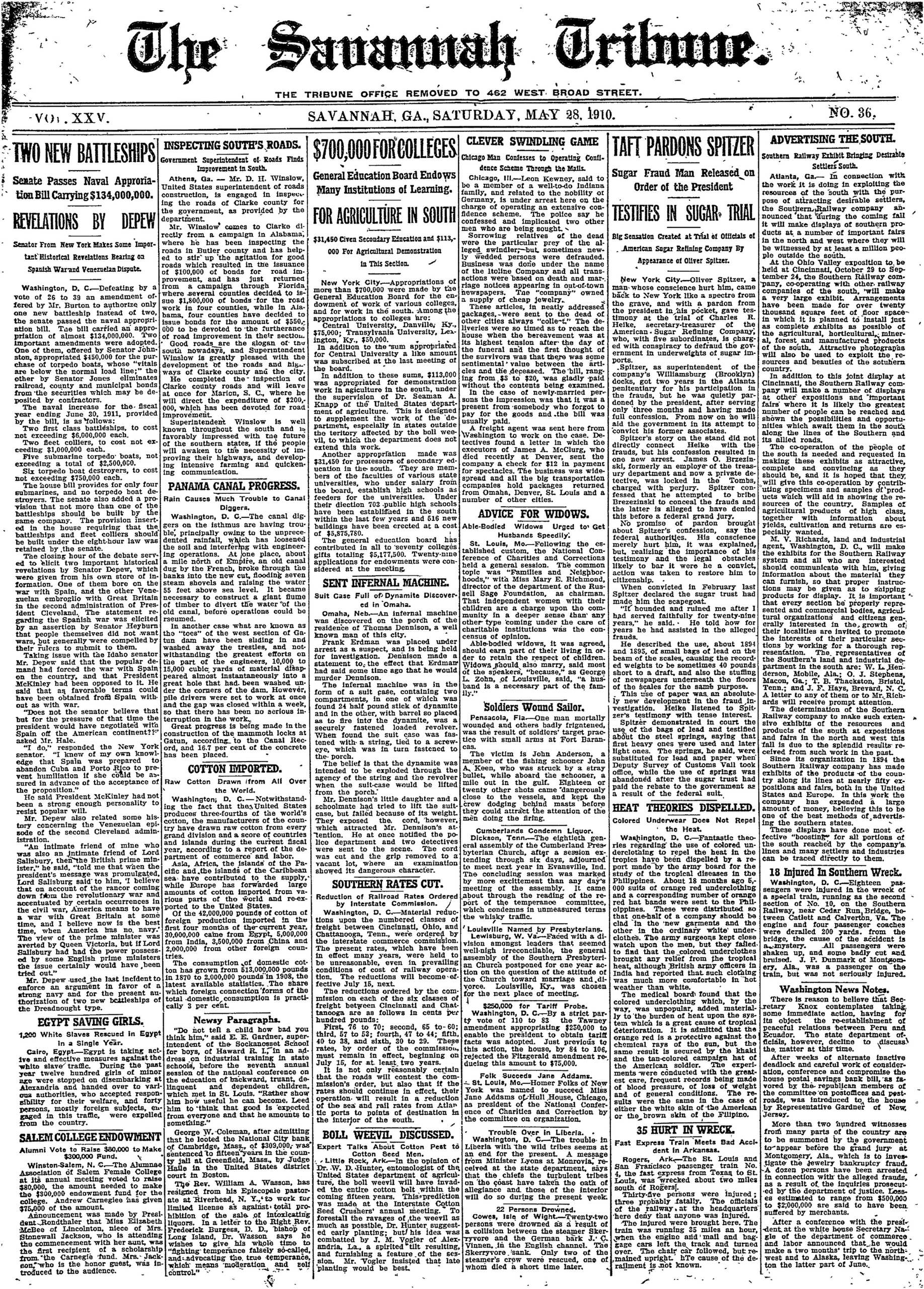
TWO NEW BATTLESHIPS
Senator From New York Makes Some Important Historical Revelations Bearing on Spanish War and Venezuelan Dispute.
Washington, D. C.—Defeating by a vote of 26 to 39 an amendment offered by Mr. Burton to authorize only one new battleship instead of two, the senate passed the naval appropriation bill. The bill carried an appropriation of almost $134,000,000. Two important amendments were adopted. One of them, offered by Senator Johnston, appropriated $150,000 for the purchase of torpedo boats, whose "vitals are below the normal load line;" the other by Senator Jones eliminates railroad, county and municipal bonds from the securities which may be deposited by contractors.
The naval increase for the fiscal year ending June 30, 1911, provided by the bill, is as follows:
Two first class battleships, to cost not exceeding $6,000,000 each.
Two fleet collers, to cost not exceeding $1,000,000 each.
Five submarine torpedo boats, not exceeding a total of $2,500,000.
Six torpedo boat destroyers, to cost not exceeding $750,000 each.
The house bill provides for only four submarines, and no torpedo boat destroyers. The senate also added a provision that not more than one of the battleships should be built by the same company. The provision inserted in the house requiring that the battleships and fleet collers should be built under the eight-hour law was retained by the senate.
The closing hour of the debate served to elicit two important historical revelations by Senator Depew, which were given from his own store of information. One of them bore on the war with Spain, and the other Venezuelan embroglie with Great Britain in the second administration of President Cleveland. The statement regarding the Spanish war was elicited by an assertion by Senator Heyburn that people themselves did not want wars, but generally were compelled by their rulers to submit to them.
Taking issue with the Idaho senator Mr. Depew said that the popular demand had forced the war with Spain on the country, and that President McKinley had been opposed to it. He said that as favorable terms could have been obtained from Spain without as with war.
"Does not the senator believe that but for the pressure of that time the president would have negotiated with Spain off the American continent?" asked Hale.
"I do," responded the New York senator. "I knew of my own knowledge that Spain was prepared to abandon Cuba and Porto Rico to prevent humiliation if she could be assured in advance of the acceptance of the proposition."
He said President McKinley had not been a strong enough personality to resist popular will.
Mr. Depew also related some history concerning the Venezuelan episode of the second Cleveland administration.
"An intimate friend of mine who was also an intimate friend of Lord Salisbury, then the British prime minister," he said, "told me that when the president's message was promulgated, Lord Salisbury said to him, 'I believe that on account of the rancor coming down from the revolutionary war and accentuated by certain occurrences in the civil war, America means to have a war with Great Britain at some time, and I believe now is the best time, when America has no navy.' The view of the prime minister was averted by Queen Victoria, but if Lord Salisbury had had the power possessed by some English prime ministers the issue certainly would have been tried out."
Mr. Depew used the last incident to enforce an argument in favor of a strong navy and for the present authorization of two new battleships of the Dreadnought type.
EGYPT SAVING GIRLS.
1,200 White Slaves Rescued in Egypt In a Single Year.
Cairo, Egypt—Egypt is taking active and effective measures against the white slave traffic. During the past year twelve hundred girls of minor age were stopped on disembarking at Alexandra and handed over to various authorities, who accepted responsibility for their welfare, and forty persons, mostly foreign subjects, engaged in this traffic, were expelled from the country.
SALEM COLLEGE ENDOWMENT
Alumni Vote to Raise $30,000 to Make $300,000 Fund.
Winston-Salem, N. G.—The Alumnae Association of Salem Female College at its annual meeting voted to raise $80,000, the amount needed to make the $300,000 endowment fund for the college. Andrew Carnegiee has given $75,000 of the amount.
Announcement was made by President_Rondhalter that Miss Elizabeth McBee of Lincolnton, niece of Mrs. Stinnewall Jackson, who is attending the commencement with her aunt, was the first recipient of a scholarship from 'the Carnegiee fund. Mrs. Jackson-who is the honor guest, was introduced to the audience.
THE TRIBUNE OFFICE REMOVED TO 462 WEST BROAD STREET.
INSPECTING SOUTH'S ROADS.
Government Superintendent of Roads Finds Improvement in South.
Athens, Ga. — Mr. D. H. Winslow, United States superintendent of roads construction, is engaged in inspecting the roads of Clarke county for the government, as provided by the department.
Mr. Winslow comes to Clarke directly from a campaign in Alabama; where he has been inspecting the roads in Butler county and has helped to stir up the agitation for good roads which resulted in the issuance of $100,000 of bonds for road improvement, and has just returned from a campaign through Florida where several counties decided to issue $1,800,000 of bonds for the road work in four counties, while in Alabama, four counties have decided to issue bonds for the amount of $550,000 to be devoted to the furtherance of road improvement in their section. Good roads are the slogan of the south nowadays, and Superintendent Winslow is greatly pleased with the development of the roads and highways of Clarke county and the city.
He completed the inspection of Clarke county roads and will leave at once for Marion, S. C., where he will direct the expenditure of $200,000, which has been devoted for road improvement. Superintendent Winslow is well known throughout the south and is favorably impressed with the future of the southern states, if the people will awaken to the necessity of improving their highways, and developing intensive farming and quickening communication.
PANAMA CANAL PROGRESS.
Rain Causes Much Trouble to Canal Diggers.
Washington, D. C.—The canal diggers on the isthmus are having trouble, principally owing to the unprecedented rainfall, which has loosened the soil and interfering with engineering operations. At jone place, about a mile north of Empile, an old canal dug by the French, broke through the banks into the new cut, flooding seven steam shovels and raising the water 55 feet above sea level. It became necessary to construct a giant flume of timber to divert the water of the old canal, before operations could be resumed.
In another case what are known as the "tocs" of the west section of Gatun dam have been sliding in and washed away the trestles, and notwithstanding the greatest efforts on the part of the engineers, 10,000 to 15,000 cubic yards of material disappeared almost instantaneously into a great hole that had been washed under the corners of the dam. However, pile drivers were set to work at once and the gap was closed within a week, so that there has been no serious interruption in the work.
Great progress is being made in the construction of the mammoth locks at Gatun, according to the Canal Record, and 16.7 per cent of the concrete has been placed.
COTTON IMPORTED.
Raw Cotton Drawn from All Over
the World.
Washington; D. C.—Notwithstanding the fact that the United States produces three-fourths of the world's cotton, the manufacturers of the country have drawn raw cotton from every grand division and a score of countries and islands during the current fiscal year, according to a report of the department of commerce and labor. Asia, Africa, the islands of the Pacific and the islands of the Caribbean sea have contributed to the supply, while Europe has forwarded large amounts of cotton imported from various parts of the world and re-exported to the United States. Of the 42,000,000 pounds of cotton of foreign production imported in the first four months of the current year, 30,000,000 came from Egypt, 5,000,000 from India, 3,500,000 from China and 2,000,000 from other foreign countries.
The consumption of domestic cotton has grown from 513,000,000 pounds in 1870 to 2,000,000 pounds in 1908, the latest available statistics. The share which foreign connection forms of the total domestic consumption is practically 3 per cent.
Newsy Paragraphs.
"Do not tell a child how bad you think him," said E. E. Gardner, superintendent of the Sockanoset School for boys, of Haward R. L. in an address on industrial training in state schools, before the seventh annual session of the national conference on the education of backward, truant, delinquent and dependent children, which met in St. Louis. "Rather show him how useful he can become. Leed him to think that good is expected from everyone and that he amounts to something." George W. Coleman, after admitting that he located the National City bank of Cambridge, Mass., of $309,000, was sentenced to fifteen years in the county jail at Greenfield, Mass., by Judge Halle in the United States district court in Boston.
The Rev. William A. Wasson, has resigned from his Episcopal pastorate at Riverhead, N. Y., to work for limited license as against total prohibition of the sale of intoxicating liquors. In a letter to the Right Rev. Frederick Burgess, D. D., bishop of Long Island, Dr. Wasson says he wishes to give his whole time to "fighting temperance falsely so-called, and advocating the true temperance, which means moderation and self control."
SAVANNAH, GA., SATURDAY, MAY 28, 1910.
$700,000FORCOLLEGES
New York City—Appropriations of more than $700,000 were made by the General Education Board for the endowment of work of various colleges, and for work in the south. Among the appropriations to colleges are: Central University, Danville, Ky., $75,000; Transylvania University, Lexington, Ky., $50,000.
In addition to the sum appropriated for Central University a like amount was subscribed at the last meeting of the board.
In addition to these sums, $113,000 was appropriated for demonstration work in agriculture in the south, under the supervision of Dr. Seaman A. Knapp of the United States department of agriculture. This is designed to supplement the work of the department, especially in states outside the territory affected by the boll weevil, to which the department does not extend this work.
Another appropriation made was $31,450 for professors of secondary education in the south. They are members of the faculties of various state universities, who under salary from the board, establish high schools as feeders for the universities. Under their direction 703 public high schools have been established in the south within the last few years and 515 new buildings have been erected at a cost of $,875,780. The general education board has contributed in all to seventy colleges gifts totaling $,177,500. Twenty-nine applications for endowments were considered at the meeting.
SENT INFERNAL MACHINE.
Suit Case Full of Dynamite Discovered in Omaha.
Omaha, Neb.—An infernal machine was discovered on the porch of the residence of Thomas Dennison, a well known man of this city.
Frank Erdman was placed under arrest as a suspect, and is being held for investigation. Dennison made a statement to the effect that Erdman had said some time ago that he would murder Dennison.
The infernal machine was in the form of a suit case, containing two compartments, in one of which was found 24 half pound stick of dynamite and in the other, with barrel so placed as to fire into the dynamite, was a securely fastened loaded revolver. When found the suit case was fastened with a string, tied to a screw-eye, which was in turn fastened to the porch.
The belief is that the dynamite was intended to be exploded through the agency of the string and the revolver when the suit-case would be lifted from the porch.
Mr. Dennison's little daughter and a schoolmate had tried to lift the suitcase, but failed because of its weight. They exposed the cord, however, which attracted Mr. Dennison's attention. He at once notified the police department and two detectives were sent to the scene. The cord was cut and the grip removed to a vacant lot, where an examination showed its dangerous character.
SOUTHERN RATES CUT.
Reduction of Railroad Rates Ordered by Interstate Commission. Washington, D. C.—Material reductions upon the numbered classes of freight between Cincinnati, Ohio, and Chattanooga, Tenn., were ordered by the interstate commerce commission. The present rates, which have been in effect many years, were held to be unreasonable, even in prevailing conditions of cost of railway operation. The reductions will become effective July 15, next. The reductions ordered by the commission on each of the six classes of freight between Cincinnati and Chattanooga are as follows in cents per hundred pounds: First, 76 to 70; second, 65 to 60; third, 57 to 53; fourth, 47 to 44; fifth, 40 to 38, and sixth, 30 to 29. These rates, by order of the commission, must remain in effect, beginning on July 15, for at least two years.
It is not only reasonably certain that the roads will contest the commission's order, but also that if the rates should continue in effect, their operation will result in a reduction of the sea and rail rates from Atlantic ports to points of destination in the interior of the south.
BOLL WEEVIL DISCUSSED.
Expert Talks About Cotton Pest to Cotton Seed Men.
Little Rock, Ark—In the opinion of Dr. W. D. Hunter, entomologist of the United States department of agriculture, the boll weevil will have invaded the entire cotton belt within the coming fifteen years. This prediction was made at the Interstate Cotton Seed Crushers' annual meeting. To forestall the ravages of the weevil as much as possible, Dr. Hunter suggested early planting; but his idea was combated by J. M. Vogler of Alexandria, La., a spirited tilt resulting, and furnishing a feature of the session. Mr. Vogler insisted that late planting would be best.
CLEVER SWINDLING GAME
Chicago Man Confesses to Operating Confidence Scheme Through the Mails.
Chicago, Ill—Leon Kewney, said to be a member of a well-to-do Indiana family, and related to the nobility of Germany, is under arrest on the charge of operating an extensive confidence scheme. The police say he confessed and implicated two other men who are being sought.
Sorrowing relatives of the dead were the particular prey of the alleged swindler—but sometimes newly wedded persons were defrauded. Business was done under the name of the itoline Company and all transactions were based on death and marriage notices appearing in out-of-town newspapers. The "company" owned a supply of cheap jewelry.
These articles, in neatly addressed packages, -were sent to the dead of other cities always "colle-t." The deliveries were so timed as to reach the house when the bereavement was at its highest tension after the day of the funeral and the first thought of the survivors was that there was some sentimental value between the articles and the deceased. The bill, ranging from $5 to $20, was gladly paid without the contents being examined. In the case of newly-married persons the impression was that it was a present from somebody who forgot to pay for the goods and .the bill was usually paid.
A freight agent was sent here from Washington to work on the case. Detectives found a letter in which the executors of James A. McClurg, who died recently at Denver, sent the company a check for $12 in payment for spectacles. The business was widespread and all the big transportation companies hold packages returned from Omaha, Denver, St. Louis and a number of other cities.
ADVICE FOR WIDOWS.
Able-Bodied Wildows Urged to Get Husbands Speedily.
St. Louis, Mo.-Following the established custom, the National Conference of Charities and Corrections held a general session. The common topic was "Families and Neighbors," with Miss Mary E. Richmond, director of the department of the Russell Sage Foundation, as chairman. That independent women with their children are a charge upon the community in a deeper sense than any other type coming under the care of charitable institutions was the consensus of opinion.
Able-bodied widows, it was agreed, should earn part of their living in order to retain the respect of children. Widows should also marry, said most of the speakers, "because," as George L. Zohn, of Louisville, said, "a husband is a necessary part of the family."
Soldiers Wound Sailor.
Pensacola, Fla.—One man mortally wounded and others badly frightened, was the result of soldiers' target practice with small arms at Fort Barancas. The victim is John Anderson, a member of the fishing schooner John A. Keen, who was struck by a stray bullet, while aboard the schooner, a mile out in the gulf. Eighteen or twenty other shots came "dangerously close to the vessels, and kept the crew dodging behind masts before they could attract the attention of the men doing the firing.
Cumberlands Condemn Liquor.
Dickson, Tenn.-The eightth general assembly of the Cumberland Presbyterian Church, after a session extending through six days, adjourned to meet next year in Evansville, Ind. The concluding session was marked by more excitement than any day's meeting of the assembly. It came about through the reading of the report of the temperance committee, which condemns in unmeasured terms the whiskey traffic.
'Louisville Named by Presbyterian Lewisburg, W. Va.-Faced with a division amongst leaders that seemed well-nigh irreconcilable, the general assembly of the Southern Presbyterian Church postponed for one year action on the question of the attitude of the Church toward marriage and divorce. Louisville, Ky., was chosen for the next place of meeting.
$250,000 for Tariff Probe.
Washington, D. C.—By a strict party vote of 110 to 83 the Tawney amendment appropriating $250,000 to enable the president to obtain tariff facts was adopted. Just previous to this action, the house, by 84 to 106, rejected the Fitzgerald amendment reducing this amount to $75,000.
Folk Succeds Jane Addams.
St. Louis, Mo.—Homer Folks of New York was named to succeed Miss Jane Addams of Hull House, Chicago, as president of the National Conference of Charities and Correction by the committee on organization.
Trouble Over In Liberal
Trouble Over in Liberia.
Washington, D. C.—The trouble in Liberia with the wild tribes seems at an end for the present. A message from Minister Lyons at Monrovia, received at the state department, says that the chiefs the turbulent tribes on the coast have taken the oath of allegiance and those of the interior will do so during the present week
22 Persona Drowned.
Cowes, Isle of Wight—Twenty-two persons were drowned as a result of a collision between the steamer Skerryvore and the German bark J. C. Vinnen, in the English channel. The Skerryvore's bank. Only two of the steamer's crew were rescued, one of whom died a short time later.
TAFT PARDONS SPITZER
Big Sensation Created at Trial of Officials of American Sugar Refining Company By Appearance of Oliver Spitzer.
New York City—Oliver Spitzer, a man-whose conscience hurt him, came back to New York like a spectre from the grave, and with a pardon from the president in his pocket, gave testimony at the trial of Charles R. Heke, secretary-treasurer of the American - Sugar Refining Company, who, with five subordinates, is charged with conspiracy to defraud the government in underweights of sugar imports.
Spitzer, as superintendent of the company's Williamsburg (Brooklyn) docks, got two years in the Atlanta penitentiary for his participation in the frauds, but he was quietly pardoned by the president, after serving only three months and having made full confession. From now on he will aid the government in its attempt to convict his former associates. Spitzer's story on the stand did not directly connect Helke with the frauds, but his confession resulted in one new arrest. James O. Brzezinski, formerly an employee of the treasury department and now a private detective, was locked in the Tombs, charged with perjury. Spitzer confessed that he attempted to bribe Brezensinski to conceal the frauds and the latter is alleged to have denied this before a federal grand jury.
No promise of pardon brought about Spitzer's confession, say the federal authorities. His conscience merely hurt him, it was explained, but, realizing the importance of his testimony and the legal obstacles likely to bar it were he a convict, action was taken to restore him to citizenship.
When convicted in February last Spitzer declared the sugar trust had made him the scapegoat.
"If hounded and ruined me after I had served faithfully for twenty-nine years," he said. He told how for years he had assisted in the alleged frauds.
He described the use, about 1894 and 1895, of small bags of lead on the beam of the scales, causing the recorded weights to be sometimes 40 pounds short to a draft, and also the stuffing of newspapers underneath the floors of the scales for the same purpose.
This use of paper was an absolutely new development in the fraud investigation. Heke listened to Spitzer's testimony with tense interest.
Spitzer demonstrated in court the use of the bags of lead and testified about the steel springs, saying that first heavy ones were used and later light ones. The springs, he said, were substituted for lead and paper when Deputy Survey of Customs Vault took office, while the use of springs was abandoned after the sugar trust had paid the rebate to the government as a result of the federal suit.
HEAT THEORIES DISPELLED.
Colored Underwear Does Not Repel
the Heat.
Washington, D. C.—Fantastic theories regarding the use of colored underclothing to repel the heat in the tropics have been dispelled by a report made by the army board for the study of the tropical diseases in the Philippines. About 18 months ago 5,000 suits of orange red underclothing and a corresponding number of orange red hat bands were sent to the Philippines. These were distributed so that one-half of a company should be clad in the 'new garments and the other in the ordinary white underclothes. The army surgeons kept close watch upon the men, but they failed to find that the colored underclothes brought any relief from the tropical heat, although British army officers in India had reported that such clothing was much more comfortable in 'hot weather than white.
The medical board found that the colored underclothing which, by the way, was unpopular, added materially to the burden of heat upon the system which is a great cause of tropical deterioration. It is admitted that the orange red is a protective against the chemical rays of the sun, but the same result is secured by the khaki and the tan-colored campaign hat of the American soldier. The experiments were conducted with the greatest care, frequent records being made of blood pressure, of loss of weight and of general conditions. The results were the same in the case of either the white skin of the American or the brown skin of the Fillipino.
35 HURT IN WRECK.
Fast Express Train Meets Bad Accident in Arkansas.
Rogers, Ark—The St. Louis and San Francisco passenger train No. 4, the fast express from Texas to St. Louis, was wrecked about two miles south of Rogers.
Thirty-five persons were injured; three probably fatally. The officials of the railway, at the headquarters here deny that anyone was injured.
The injured were brought here. The train was running 35 miles an hour, when the engine and mail and baggage cars left the track and turned over. The chair car followed, but remained upright. hTc cause of the derailment is not known.
ADVERTISING THE SOUTH.
Southern Railway Exhibit Bringing Destruis
Settlers South.
Atlanta, Ga.—In connection with the work it is doing in exploiting the resources of the south with the purpose of attracting desirable settlers, the Southern Railway company announced that during the coming fall it will make displays of southern products at a number of important fairs in the north and west where they will be witnessed by at least a million people outside the south.
At the Ohio Valley exposition to be held at Cincinnati, October 29 to September 24, the Southern Railway company, co-operating with other railway companies of the south, will make a very large exhibit. Arrangements have been made for over twenty thousand square feet of floor space in which it is planned to install just as complete exhibits as possible of the agricultural, horticultural, mineral, forest and manufactured products of the south. Attractive photographs will also be used to exploit the resources and beauties of the southern country.
In addition to this joint display at Cincinnati, the Southern Railway company will make a number of displays at other expositions and important fairs where it is likely the greatest number of people can be reached and shown the possibilities and opportunities which await them in the south along the lines of the Southern and its allied roads.
The co-operation of the people of the south is needed and requested in making these exhibits as attractive, complete and convincing as they should be, and it is hoped that they will give this co-operation by contributing specimens and samples of products which will aid in showing the resources of the country. Samples of agricultural products of high class, together with information about yields, cultivation and returns are especially wanted.
M. V. Richards, land and industrial agent, Washington, D. C., will make the exhibits for the Southern Railway system and all who are interested should communicate with him, giving information about the material they can furnish, so that proper instructions may be given as to scipping products for display. It is important that every section be properly represented and commercial bodies, agricultural organizations and citizens generally interested in the, growth of their localities are invited to promote the interests of their particular sections by working for a thorough representation. The representatives of the Southern's land and industrial department in the south are: W. L. Henderson, Mobile, Ala.; O. J. Stephens, Macon, Ga.; T. B. Thackston, Bristol, Tenn.; and J. F. Hays, Brevard, N. C. A letter to any of them or to Mr. Richards will receive prompt attention.
The determination of the Southern Railway company to make such extensive exhibits of the resources and products of the south at expositions and fairs in the north and west this fall is due to the splendid results received from such work in the past. Since its organization in 1894 the Southern Railway company has made exhibits of the products of the country along its lines at nearly fifty expositions and fairs, both in the United States and Europe. In this work the company has expended a large amount of money, believing this to be one of the best methods of advertising the southern states. These displays have done most effective "boosting" for all portions of the south reached by the company's lines and many settlers and industries can be traced directly to them.
18 Injured In Southern Wreck.
Washington, D. C.—Eighteen passengers were injured in the wreck of a special train, running as the second section of No. 10, on the Southern Railway, near Cedar Run, Bridge, between Cattlett and Calverbyn, Va. The engine and four passenger coaches were drenalled 200 yards, from the bridge, the cause of the accident is a mystery. All passengers were shaken up, and some badly cut and bruised. J. P. Dunmark of Montgomery, Ala., was a passenger on the train, but was not seriously injured.
Washington News Notea.
There is reason to believe that Secretary Knox contemplates taking some immediate action, having for its object the re-establishment of peaceful relations between Peru and Ecuador. The state department officials, however, decline to discuss the matter at this time.
After weeks of alternate inactive deadlock and careful work of consideration, conference and compromise the house postal savings bank bill, as favored by the republican members of the committee on postoffices and postroads, was introduced to the house by Representative Gardner of New Jersey.
More than two hundred witnesses from many parts of the country are to be summoned by the government to appear before the grand jury at Montgomery, Ala., which is to investigate the jewelry bankruptcy fraud. A dozen persons have been arrested in connection with the alleged frauds, as a result of the inquiries prosecuted by the department of justice. Losses estimated to range from $500,000 to $2,000,000 are said to have been suffered by merchants.
After a conference with the president at the white house Secretary Nagle of the department of commerce and labor announced that he would make a two months' trip to the northwest and to Alaska, leaving Washington the latter part of June.
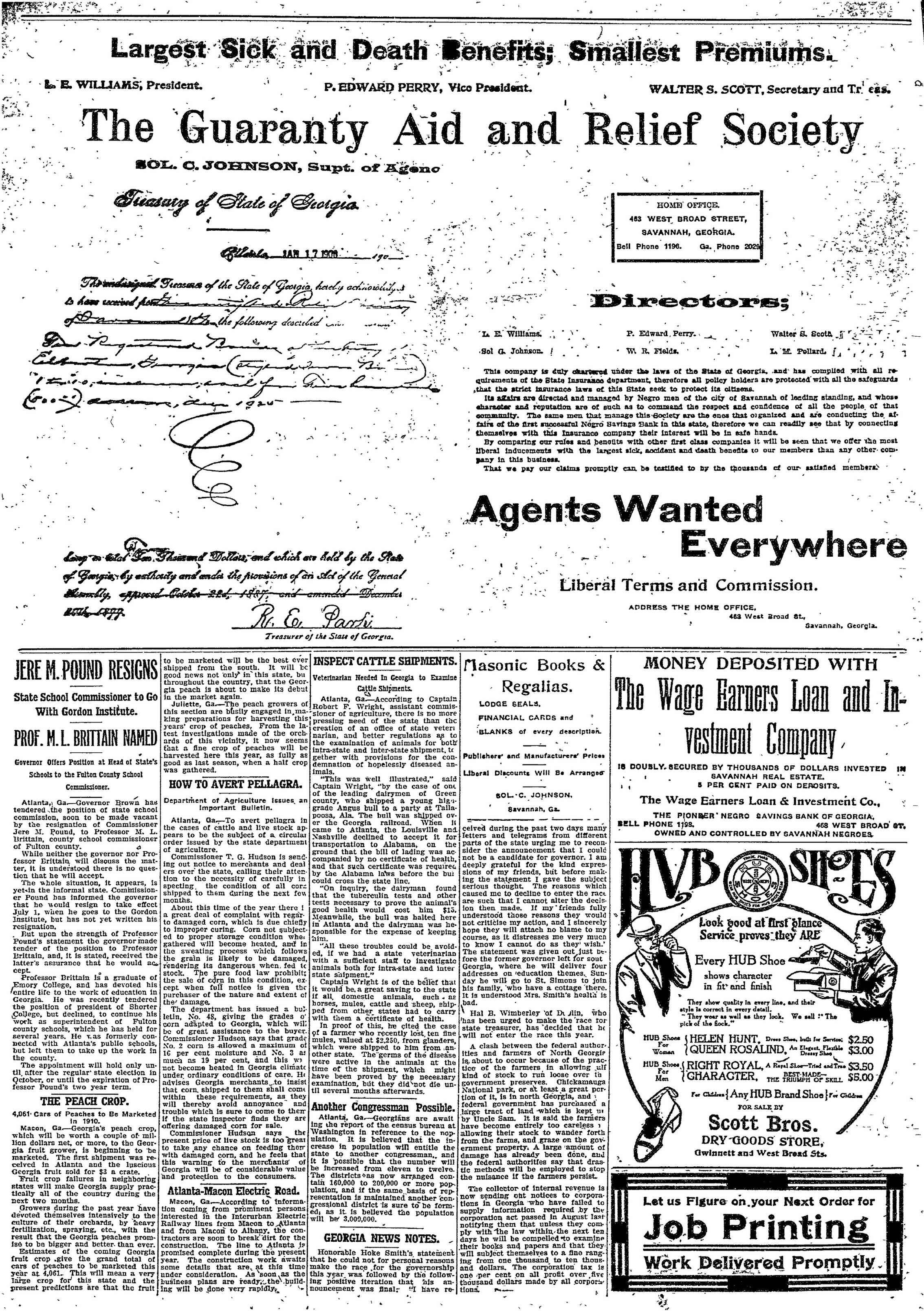
Treasury of State of Georgia
Florida JAN 17 1908 190
The undersigned Treasurer of the State of Georgia, hereby acknowledges
is have received from the Secretary of the State of Georgia the following described:
Dear Regina and Dear Emily,
Excuse me, I am writing to you from the State of Georgia, and to inform you of the provisions of an Act of the General Assembly, approved October 22d, 1887, and amended December 25th, 1897.
R. E. Paoli
Treasurer of the State of Georgia.
State School Commissioner to Go With Gordon Institute.
PROF. M.L. BRITTAIN NAMED
Governor Offers Position at Head of State's Schools to the Fulton County School
Commissioner.
Atlanta, Ga Governor Brown has tendered the position of state school commission, soon to be made vacant by the resignation of Commissioner Jere M. Pound, to Professor M. L. Brittain, county school commissioner of Fulton county. While neither the governor nor Professor Brittain will discuss the matter, it is understood there is no question that he will accept. The whole situation, it appears, is yet-in the informal state. Commissioner Pound has informed the governor that he would resign to take effect July 1, when he goes to the Gordon Institute, but has not yet written his resignation.
But upon the strength of Professor Pound's statement the governor made tender of the position to Professor Brittain, and, it is stated, received the latter's assurance that he would accept.
Professor Brittain is a graduate of Emory College, and has devoted his entire life to the work of education in Georgia. He was recently tendered the position of president of Shorter College, but declined, to continue his work as superintendent of Fulton county schools, which he has held for several years. He was formerly connected with Atlanta's public schools, but left them to take up the work in the county.
The appointment will hold only until, after the regular state election in October, or until the expiration of Professor Pound's two year term.
THE PEACH CROP.
4,061 Cars of Peaches to Be Marketed in 1910. Macon, Ga—Georgia's peach crop, which will be worth a couple of million dollars net, or more, to the Georgia fruit grower, is beginning to be marketed. The first shipment was received in Atlanta and the luscious Georgia fruit sold for $3 a crate. Fruit crop failures in neighboring states will make Georgia supply practically all of the country during the next two months. Growers during the past year have devoted themselves intensively to the culture of their orchards, by heavy fertilization, spraying, etc., with the result that the Georgia peaches promise to be bigger and better than ever.
Estimates of the coming Georgia fruit crop give the grand total of cars of peaches to be marketed this year at 4,061. This will mean a very large crop for this state and the present predictions are that the fruit
to be marketed will be the best ever shipped from the south. It will be good news not only in this state, but throughout the country, that the Georgia peach is about to make its debut in the market again.
Juliette, Ga—The peach growers of this section are busily engaged in, making preparations for harvesting this years' crop of peaches. From the latest investigations made of the orchards of this vicinity, it now seems that a fine crop of peaches will be harvested here this year, as fully as good as last season, when a half crop was gathered.
HOW TO AVERT PELLAGRA.
Department of Agriculture Issues an Important Bulletin.
Atlanta, Ga-To avert pellagra in the cases of cattle and live stock appears to be the subject of a circular order issued by the state department of agriculture.
Commissioner T. G. Hudson is sending out notice to merchants and dealers over the state, calling their attention to the necessity of carefully in specting the condition of all corps shipped to them during the next few months.
About this time of the year there is a great deal of complaint with regard to damaged corn, which is due chiefly to improper curing. Corn not subjected to proper storage condition when gathered will become heated, and in the sweating process which follows the grain is likely to be damaged, rendering its dangerous when, fed to stock. The pure food law prohibits the sale of corn in this condition, except when full notice is given the purchaser of the nature and extent of the damage.
The department has issued a bulletin, No. 48, giving the grades of corn adapted to Georgia, which will be of great assistance to the buyer. Commissioner Hudson says that grade No. 2 corn is allowed a maximum of 16 per cent moisture and No. 3 as much as 19 per cent, and this will not become heated in Georgia climate under ordinary conditions of care. He advises Georgia merchants to insist that corn shipped to them shall come within these requirements, as they will thereby avoid annoyance and trouble which is sure to come to them if the state inspector finds they are offering damaged corn for sale.
Commissioner Hudson says the present price of live stock is too great to take any chance on feeding them with damaged corn, and he feels that this warning to the merchants of Georgia will be of considerable value and protection to the consumers.
Atlanta-Macon Electric Road.
Macon, Ga.—According to information coming from prominent persons interested in the Interurban Electric Railway lines from Macon to Atlanta and from Macon to Albany, the contractors are soon to break dirt for the construction. The line to Atlanta is promised complete during the present year. The construction work awaits some details that are, at this time under consideration. As soon as the business plans are ready, the building will be done very rapidly.
P. EDWARD PERRY, Vico President.
INSPECT CATTLE SHIPMENTS.
Atlanta, Ga-According to Captain Robert F. Wright, assistant commissioner of agriculture, there is no more pressing need of the state than the creation of an office of state veterinarian, and better regulations as to the examination of animals for both intra-state and inter-state shipment, together with provisions for the condemnation of hopelessly diseased animals.
"This was well illustrated," said Captain Wright, "by the case of one of the leading dairymen of Green county, who shipped a young high-grade Angus bull to a party at Tallapoosa, Ala. The bull was shipped over the Georgia railroad. When it came to Atlanta, the Louisville and Nashville declined to accept it for transportation to Alabama, on the ground that the bill of lading was accompanied by no certificate of health, and that such certificate was required by the Alabama laws before the bull could cross the state line.
"On inquiry, the dairyman found that the tuberculin tests and other tests necessary to prove the animal's good health would cost him $15. Meanwhile, the bull was halted here in Atlanta and the dairyman was responsible for the expense of keeping him.
"All these troubles could be avoided, if we had a state veterinarian with a sufficient staff to investigate animals both for intra-state and interstate shipment."
Captain Wright is of the belief that it would be, a great saving to the state if all domestic animals, such as horses, mules, cattle and sheep, shipped from other states had to carry with them a certificate of health.
In proof of this, he cited the case of a farmer who recently lost, ten fine mules, valued at $2,250, from glanders, which were shipped to him from another state. The germs of the disease were active in the animals at the time of the shipment, which might have been proved by the necessary examination, but they did not die until several months afterwards.
Another Congressman Possible.
Atlanta, Ga.—Georgians are await ing the report of the census bureau at Washington in reference to the nopulation. It is believed that the increase in population will entitle the state to another congressman, and it is possible that the number will be increased from eleven to twelve. The districts as now arranged contain 160,000 to 200,000 or more population, and if the same basis of representation is maintained another congressional district is sure to be formed, as it is believed the population will be 3,000,000.
GEORGIA NEWS NOTES.
Honorable Hoke Smith's statement that he could not for personal reasons make the race for the governorship this year was followed by the following positive iteration that his announcement was final: "I have re-
WALTER S. SCOTT, Secretary and Tr. eas.
HOME OFFICE.
483 WEST BROAD STREET,
SAVANNAH, GEORGIA.
Bell Phone 1196. Ga. Phone 2029
Directors;
L. E. Williams.
P. Edward Perry.
Walter S. Scott.
Sol G. Johnson.
W. R. Fields.
L. M. Pollard.
This company is duty chartered under the laws of the State of Georgia, and has complied with all requirements of the State Insurance department, therefore all policy holders are protected with all the safeguards that the strict insurance laws of this State seek to protect its citizens.
Its affairs are directed and managed by Negro men of the city of Savannah of leading standing, and whose character and reputation are of such as to command the respect and confidence of all the people of that community. The same men that manage this Society are the ones that organized and are conducting the affairs of the first successful Negro Savings Bank in this state, therefore we can readily see that by connecting themselves with this Insurance company their interest will be in safe hands.
By comparing our rules and benefits with other first class companies it will be seen that we offer the most liberal inducements with the largest sick, accident and death benefits to our members than any other company in this business.
That we pay our claims promptly can be testified to by the thousands of our satisfied members
Liberal Terms and Commission.
MONEY DEPOSITED WITH The Wage Earners Loan and Investment Company
16 DOUBLY. SECURED BY THOUSANDS OF DOLLARS INVESTED
SAVANNAH REAL ESTATE.
5 PER CENT PAID ON DEROSITS.
THE PIONER'NEGRO SAVINGS BANK OF GEORGIA. BELL PHONE 1198. 468 WEST BROAD ST. OWNED AND CONTROLLED BY SAVANNAH NEGROES.
celved during the past two days many letters and telegrams from different parts of the state urging me to reconsider the announcement that I could not be a candidate for governor. I am deeply grateful for the kind expressions of my friends, but before making the statement I gave the subject serious thought. The reasons which caused me to decline to enter the race are such that I cannot alter the decision then made. If my friends fully understood those reasons they would not criticise my action, and I sincerely hope they will attach no blame to my course, as it distresses me very much to know I cannot do as they wish.' The statement was given out just before the former governor left for sout Georgin, where he will deliver four addresses on education themes. Sunday he will go to St. Simons to join his family, 'who have a cottage there. It is understood Mrs. Smith's health is bad.
HUB SHOES
Look good at first glance
Service proves they ARE
Every HUB Shoe
shows character
in fit and finish
They show quality in every line, and their
style is correct in every detail.
They wear as well as they look. We sell: "The
pick of the stock."
HUB Shoes
For Women
HELEN HUNT. Dress Shoe, built for Service: $2.50
QUEEN ROSALIND. An Elegant, Flexible
Dressy Shoe: $3.00
HUB Shoes
For Men
RIGHT ROYAL. A Royal Shoe—Tried and True: $3.50
CHARACTER. BEST-MADE—
THE TRIUMPH OF SKILL: $5.00
For Children
Any HUB Brand Shoe: For Children
FOR SALE BY
Scott Bros.
DRY GOODS STORE,
Gwinnett and West Broad Sts.
Let us Figure on your Next Order for
Job Printing
Work Delivered Promptly
Hal B. Wimberley of Dullin, who has been urged to make the race tor state treasurer, has decided that he will not enter the race this year.
A clash between the federal authorities and farmers of North Georgia is about to occur because of the practice of the farmers in allowing all kind of stock to run loose over the government preserves. Chickamauga National park, or at least a great portion of it, is in north Georgia, and federal government has purchased a large tract of land which is kept by Uncle Sam. It is said the farmers have become entirely too careless allowing their stock to wander forth from the farms, and graze on the government property. A large amount of damage has already been done, and the federal authorities say that drastic methods will be employed to stop the nuisance if the farmers persist.
The collector of internal revenue is now sending cnt notices to corporations in Georgia who have failed to supply information required by the corporation act passed in August last notifying them that unless they comply with the law within the next ten days he will be compelled to examine their books and papers and that they will subject themselves to a fine ranging from one thousand to ten thousand dollars. The corporation tax is one per cent on all profit over five thousand dollars made by all corporations.
How John Larned's Daughter Came to Take Richard Cortland to the Church Supper.
The telephone bell rang sharply. The sender young woman put down her book and answered the call.
In a moment she turned from the 'phone.
"Mother," she called, "it's father. He wants to talk to you."
The mother came from an inner room and took the receiver.
In a moment or two she hung up the instrument and looked around at her daughter. Her face wore a worried expression.
"Norma," she said, "your father is going to bring a guest to dinner."
"I couldn't quite catch what your father said. I think the man must have been there close to him while he talked. His "name is Cortland, I think."
"I know," said the girl, "It's Professor Cortland. Father has talked so much about him, you know. He was in the faculty when father was in college. He must be quite old now. I suppose he is here attending the sociological convention. How glad father must have been to see him. Of course he'll stay all night."
The mother sighed.
"I was just wondering about the dinner," she said. "Olga thinks she feels a little better, but she can't be expected to wait on the table. It will be all she can do to look after the kitchen. And your father is so particuar about having everything nice when there's company."
The girl suddenly laughed.
"Don't worry, mummy. I'll wait on the table and do my best to keep Olga in good spirits, too. The professor won't object." The mother's face brightened.
"You must explain it to him some way. Here, I'll do it myself." She ran to the 'phone and rang up her father's office. "Is that you, daddy?" she asked. "Now listen, daddy, and betray no surprise. Olga is having one of her attacks of bad feelings. You know how she is—homesick and melancholy and talks of sailing for Denmark tomorrow. If we're going to have a dinner tonight it will be necessary to give her a lot of encouragement—do you get that? So I'll be in the kitchen as much as possible, and I am going to wait on the table and you are to express no surprise. You mustn't be surprised either when I open the door for you. And if the professor asks after me—which he will forget to do—tell him I'm attending a rehearsal for our church supper. That's all. Only don't be surprised. Good-by."
She hung up the receiver and turned to her mother.
"Now to set the table," she said.
When John Larned and his guest stepped into the hall an hour later they were confronted by a very trim maid in a coquettish apron and a coquettish cap, who waited demurely by the door as they passed in.
She caught a frowning glance from John Larned's spectacled eyes and let one of her own eyelids droop ever so little in response.
And then a shade of dismay crossed her face as she caught sight of the guest.
This couldn't be the professor. Not unless the old experimenter had discovered the elixir of youth. This was a man of 30, erect, dark, keen eyed. Norma knew he was keen eyed because he threw a quick glance at her as he passed. She flushed a little.
"Come up to my den," said Norma's father. "Yes, they let me have a den. You can leave your coat and hat up there and I'll show you an old keepake of your uncle's." He looked over his shoulder. "Tell your mistress wa will be down in a few moments," he said to his daughter.
"Yes, sir," said Norma, and again the guest threw a quick glance at her. The girl looked just a little displeased when she joined her mother in the dining room where that good lady was putting the finishing touches to the table.
"It isn't the professor at all, mother," she said.
"Somebody came. I think he's the professor's nephew. And I'm to tell you, ma'am, that they are here."
The mother laughed.
"It's like a little play, isn't it?" she said.
"Only in plays they don't have real food and trouble in the kitchen."
"Nor such nice make-believe waitresses. You look much too, good to be true, my dear."
Norma blushed.
"Perhaps I've found my mission,
mummy. But there, all will go well if
papa doesn't forget his part, Hush,
they are coming down."
Ten minutes later Norma appeared
in the doorway.
"Dinner is served, ma'am."
---
said in tones that bore just an infinitesimal Celtic flavor.
Her father looked up suddenly.
Then he looked at her mother. The guest looked at the spot that Norma promptly vacated.
Then the three moved out to the dining room. The guest gave a quick glance around as he took the chair at the lady's right. The waitress had vanished.
"I think you said you had a daughter?" remarked the guest.
"Yes," replied Norma's father. He looked at Norma's mother. "She is rehearsing."
"For a church supper," Norma's mother added.
The door opened and Norma entered with the soup. The young man looked up.
"I have attended performances of that sort," he said with an effort, "but never a hehearsal. No doubt the children greatly enjoy the fun they find in the drilling. Of course, there can be no rehearsals for the supper patrons."
"They all laughed at this whimsical idea—all except Norma, who passed the guest's soup before him and passed along with an air of dignified indifference.
"Norma makes herself very useful," said Norma's mother.
"At least she makes the attempt," added her father.
The young man-nodded.
"Oh, well," he said, "she is only a child. I suppose that was her portrait I saw up stairs. She seemed a cute little thing."
Norma's father suddenly put his napkin to his mouth. He didn't look at Norma as she took away his plate.
"That portrait was taken several years ago," said Norma's mother, with a reproving look at the host.
"They are still cuter when they are a year or two older," said the guest.
"Like all parents, I know you dread to think that she will grow taller and taller and have thoughts of beaux and parties and long frocks and insist upon staying up until 9 o'clock.
Norma passed from the room with the soup plates.
"You have a sentimental taint that I hadn't credited you with possessing," said Norma's father. "Perhaps you can see how that little work picture of yours is affecting Mrs. Larned."
The face of Norma's mother was at least very red and it grew a shade redder as Norma entered with the roast. The young man seemed to breathe with a slight difficulty.
"My uncle, the professor, wrote to me concerning your little girl," he said, and Norma set the roast down in front of her father with some suddenness. "This suggested a little present for her. I have it here. It is an ivory Annambese rattle box—at least that is what it would be called in English. I bought it at, a bazar in Ponkipung. Of course, as a plaything it is a little young for your daughter, but perhaps she will like the carvings—and by holding it thus it can be made into a Tibetan prayer machine. See?"
He passed it to Norma's mother, who admired it and handed it to Norma's father—while Norma stood demurely by.
"What intricate work," said Norma's father. "You'd better put this away, mother, until Norma is old enough to properly appreciate it."
Norma took the water pitcher and quietly left the room.
The soup had been good, the roast and its concomitants were excellent and there was no question regarding the satisfactory character of the service.
"The guest was in excellent spirits."
The guest was in excellent spirits. "When a man has knocked about the world as much as I have he begins to get the right perception of the real value of a home," he said. "I'm 30 and not yet across the border line of nomadic indifference. In fact, I fondly hope to have a home of my own some blessed day." He suddenly smiled. "Perhaps the home maker of my dreams is even now on her flower-strewn way."
He stopped short, Norma "was coming in with the salad.
Richard Cortland permitted his gaze to follow the young woman as she moved about the table. Then he suddenly was aware of the fact that his host and hostess were watching him.
"For a man who has hunted elephants and shot tigers on the wing," said John Larned, "you certainly claim a surprising amount of domestic tameness."
Richard Cortland started.
"Domestic tameness, of course," he said. "That is, if domestic tameness spills: happiness." Then he noticed, that his hostess was looking at him with a very singular expression.
"I beg your pardon," he said, but his eyes followed Norma as she gatherped up the plates.
"Are you Richard Cortland, the traveler?" the hostess asked.
"I am Richard Cortland," he answered. "And I am something of a traveler."
"But I mean the Richard Cortland who has written the new book of travels that is said to be more fascinating than any novel, the book that exhausted the first edition in a week?"
"The young man stirred uneasily.
"I have written a book," he replied.
The lady gave her husband a reproachful look.
"John," she murmured, "why didn't you tell me? Everybody is talking about Mr. Cortland's book.
"My dear hostess," said the young man, "John Larned thinks well of me because I am the nephew of my uncle, the professor. That fact outweighs a thousand books. And I think well of him because my good old uncle loved him and praised him and bade me seek him out and ask his friendship. And now I see I'm going to think well of you all on your own account, dear friends—if you will let me. And I want to know the little girl, too, and win her regard and who knows what may happen?"
And he laughed merrily, a laugh that was broken by a sudden crash on the table. Norma had dropped a plate.
"Why, my dear!" cried Norma's father.
Perhaps in the momentary confusion that followed the mishap this term of endearment was missed by the guest. Anyway he carefully refrained from glancing toward the scene of disaster, but kept up a lively dialogue with the hostess until Norma had passed from the room.
But the new waltress didn't lack courage. She was back presently with the dessert, her pretty head held high and her air of indifference more pronounced than before.
When she had brought in the after-dinner coffee and passed out, the hostess turned to the guest with a little sigh of relief.
"As an old friend of the family," she said, "I will confess that this dinner has worried me a little."
"How could it?" te guest demanded. "It was excellent and so nicely served."
"Yet it did," persisted the hostess,
"Our maid—I mean the cook—has a spell of homesickness. She longs for a sight of a Danish face and the sound of the Danish tongue—and when she has these attacks it is almost impossible to hope for any help fro her. Perhaps you noticed my uneasiness?"
"No, madam," replied Richard Cortland.
"There would appear to have been no cause for it."
They arose and passed into the library and Richard's spirits appeared to rise with each passing moment.
"I hope," he said, "that you are both fully prepared to accept me as a friend—a privileged character?"
"Of course we are," responded the hostess.
"Of course," echoed John Larned.
"And I am to consider myself entirely at home?"
He looked at the hostess quizzically.
"What is the name of the homesick cook?" he suddenly asked.
"Olga."
He arose.
"I am going to test the depth of your friendship," he laughingly said. "I am going out to your kitchen to see if I can't cure your suffering domestic. We will soon know if my year in the University of Copenhagen was wasted. Don't move, please."
Before the startled hostess could utter a word the guest was on his way to the kitchen.
John Larned stared at his wife.
"Think of Norma!" she gasped.
"Yes," said John's wife, quite unmoved. "He's a splendid fellow."
Then she suddenly sat up very straight.
"Hark!" she whispered.
They could hear a murmur of voices from the kitchen. Then one voice arose loud and clear. It seemed to be declaiming. Suddenly someone laughed and laughed again.
"That's Olga," whispered Mrs. John. "First dose highly effective," murmured John Larned.
Then the clear voice ran into a quaint old song—a college song, they thought. The words were in an unknown tongue, but there was a merry lift to the tune and quite without warning a second voice broke in and the two voices blended very fairly.
"That's Olga again," said John's wife.
"Second dose equally effective," said John.
The two voices sang the song through together. Then they stopped with a merry laugh.
The masculine voice went on with the declamation.
"He must be talking Danish," said John's wife.
"No doubt of it, my dear. I've seen it stated somewhere that Richard Cortland had mastered nine languages. The guest seemed to be telling a story. From time to time the delightful cook loudly chuckled and at the claim she roared with delight.
"There's no questioning that treatment," murmured John.
"I wonder, where Norma is?" whispered Norma's mother.
"I wonder," repeated Norma's father.
Norma's mother put her finger to her lips and stood up.
"Come," she said.
John Larned arose and followed his wife.
Their way led them through the dining room and into the china closet. They moved with great care and canion.
When they were in the dark closet they could look through the glass in the door into the kitchen. The culinary department looked, as usual, quite as clean as wax. Leaning back against the kitchen table stood Richard Cortland. He was talking rapidly in a foreign tongue and gesticulating freely. In front of him sat the light-haired Danish girl, the homeslok Olga. She was looking at him eagerly, a bright smile on her face as she drank in his words. Mrs. John clutched her husband's arm and pointed across the room. Norma was sitting against the wall looking with a calm disdain at the cook and the stranger. She sat bolt upright, her dainty little cap still on her head. John Larned suddenly put his hand over his mouth, and his wife gently shook him.
And now Richard was finishing his story. He stepped forward and made Olga a very low bow. And Olga rising and spreading her skirts courtesed almost to the floor.
Then the girl's merry laughter rang out again.
But she checked it and pointed to Norma. Whereupon the guest bowed low to the smart young waitress.
But Norma, with nose in the air, received this salutation haughtily and inclined her head very slightly.
Again John Larned covered his mouth with his hand and his wife, fearing further consequences, drew him away and they retraced their steps to the library.
Scarcely were they seated when Richard entered the room.
And Norma demurely followed. Richard was laughing, but Norma's face wore a look that was meant for offended dignity.
"Dear friends," said Richard, "I'm glad to report that the cure is complete—only I mustn't be far away in case of a relapse. And I met your little girl coming from the rehearsal and have returned her to the bosom of her family."
And he gracefully waved his hand toward the pouting Norma.
"Olga gave me away," cried that young woman.
"Let us not blame Olga too severely," said Richard Cortland. "I knew there was something unusual in the details of that recent feast. It was an impolite suspicion, but I must admit it. As a waitress the young Lady in the coquettish cap and the cunning apron altogether too good to be true."
"I told you so," cried Norma's mother.
"Mother!" cried Norma.
"I am sorry for something," said Richard contritely. "It was too bad that the rudeness of the guest of honor should cause the young woman to drop a plate."
Norma's face reddened.
"Then you heard what father called me?"
"How could I help it," he replied.
"Haven't I been in the secret service of the ameer? Miss Norma, will you let me be present at that supper on one condition—that I pay for it by talking to the good people about some queer feasts I've seen in strange lands with no reference to unusual waltresses?"
"Oh, will you?" cried Norma.
"Gladly."
She gave him a beautiful look.
"I must telephone Dr. Harley at once," she cried.
"One moment, waitress," he said. "I haven't given my final order. We are now about to take the Nepal oath of fidelity. See, it's like the child's game. We put our hands in a little pile, palm to back, and then say 'Here's to a better and closer friendship.'" And Norma's face flushed again.
JEWS AND MIXED MARRIAGES.
Rabbis Oppose—But What About an Extra 150,000 Jewish Men?
The Jewish rabbis who participated in the recent Jewish conference in this city had a good deal to say on the subject of mixed marriages. To the Jew a "mixed marriage" means a union between a Jew and a "non-Jew."
Apparently without exception the rabbits oppose such marriages; but the American Hebrew, while not advocating the mixed marriage, presents some interesting facts which have a bearing on the question.
"Between 1884 and 1905," says this authority, "342,000 Jewish men arrived in this country, as compared with 220,000, Jewish women, an excess of 120,000 men over women. The same proportion has doubtless prevailed in the immigration of the last four years, so that it is almost certain that there is an excess of 150,000 men in the Jewish population of the niteUd States.
"Whom are these to marry? That is a practical aspect of the problem of intermarriage which will press itself more and more on attention as time goes on. There are several obvious conclusions to be drawn from this somewhat startling fact. Jewish girls ought to find little trouble in obtaining suitable spouses; they can pick and choose. If the excess of men is, not to be lost to Judaism steps must be taken before, long to render systematic the proselytizing of their wives and their training in the Jewish law and custom."
"I should think it would be a simple matter to induce a woman to get ready in time to attend an evening performance."
"What's your scheme?"
"Ask her to go to the matinee!"—Louisville: Courier-Journal.
The first record of Halley's comet was B. C. 240.
Her Special Realm
Small Expenses.
Never throw up another person's small expenses as an example that you are ever so careful yourself. You don't smoke cigars as your flance does, but your unconsidered trifles come to far more money week by week than his tobacco. If you wish to query expenses, put down every penny you spend on small items, get your flance or husband to do the same, and you may find yourself on the wrong side of the ledger.—Home Notes.
Etiquette of Visiting Cards.
If the theory of the interchange visiting cards is once understood, woman need not puzzle about how she should acknowledge invitations toceptions, teas, weddings, or weddings, wedding announcements any other kind, such as births deaths. All of these are engraved a are written in the third person.
Here again is another fundamen rule of polite society:—An invitation is always to be answered in the sa
Home For Southerners.
The proposed home for indigent southern women in New York has met with such generous support on the part of northern women that the plan has been changed and widened. Instead of building the home in Virginia, as was at first proposed, it has now been determined to erect it near New York and to open it to both northern and southern women. It is planned to conduct it along the lines of the Louise home in Washington, where President Tyler's daughter spent her last days. The only restrictions will be that the inmates shall be of gentle birth and respectable. Mrs. Le Roy Broun is at the head of the committee which is raising the necessary funds.—New York Sun.
Being Agreeable
It requires tact and judgment, as we all know, to decide when it is best to talk and when to listen. In the presence of men and women of superior talents and accomplishments, or of wide experience of the world, we must be wary and not let our vanity run away with us. To such persons we may not be able to afford intellectual stimulus, and therefore it will be well to avoid giving our opinions at length, unless these are called fcr. With men and women of small talent and accomplishment we must also be on our guard, lest they find us didactic and wearisome. It is with our intellectual equals, or with persons of a generous disposition who like to draw out the talents of others, that we feel the greatest freedom and attain the happiest results.—Harper's Bazar.
Late Comers
"The practice of coming to the theater late is now observed in America to a greater extent than it ever was in Europe," says the Berliner Tageblatt, "especially in those circles where the theater is only an excuse for the display of costly costumes and jewels, which become more conspicuous when the wearer comes late. The abuse has increased to such an extent that first acts are usually lost." The writer then tells that the city council of Cleveland has passed an ordinance compelling the "managers of theaters to pay $100 fine for every person allowed to enter the auditorium after a performance has begun," and adds that this laudable resolution on the part of the city fathers of Cleveland will hear good results, but wonders whether an American director will give offense to his public, even when supported by the law.—New York Sun.
Miss Havemeyer Outdoors Lover. Miss Havemeyer is an adept in all out-of-doors sports and is a particularly accomplished horsewoman, always riding astride. The Webb estate in Shelburne Fails, known as Shelburne Farms, is almost a community in itself. It comprises more than 3,000 acres of pasture and woodland, rising 200 to 300 feet above Lake Champlain and offering superb views both of the lake and of the distant Adirondack mountains. The main establishment is the Queen Anne house, which is on a site said to be unsurpassed for beauty by any other building east of the Rockies. It contains seventy rooms, and adjoining it are a group of cottages, each fitted up sumptuously and fully as desirable for the accommodation of overflow parties as the main house itself. The barn, so-called, is an enormous structure and much more luxuriously equipped than many comfortable homes. New York Press.
Fashionable Millinery.
No one can say with positiveness what the season will do in the way of developing new twists to women's apparel, but in millinery, at present all the indications point to loose straws; soft, crushable effects in braided straws, with their opposites, of very fine and costly ones. They will come in (principally so far as new shades are considered) magenta, which will rise in shade almost to a crushed raspberry; in blues, from a "raven's-wing" tone to a pale gray-blue, and include many of the Egyptian shades which have been seen within the last weeks on the Riviera and in Paris.
Fabric hats will be strongly represented, but in odd materials. - Very few lingeries, and many printed gauzes. Whether these will go in America immediately is, of course, a question. Later, they will. The immediate styles of fabric hats show wide brims, turned up at one side, flat and fastened with a feather pompon (ostrich or a made disk) covered with shot moire. This is the newest of the moire fabrics. It is stretched on; or a model here and there shows a finely pleated brim, the pleats running either upward from the under brim, or circular, when the material, of course, is cut. Velvet-faced and color-faced brims, will be the note, and quantities of black hats will be seen in tulle, in nets and in chiffon.-Harner's Bazaar.
If the theory of the interchange of visiting cards is once understood, a woman need not puzzle about how she should acknowledge invitations to receptions, teas, weddings, or wedding receptions, wedding announcements of any other kind, such as births or deaths. All of these are engraved and are written in the third person.
Here again is another fundamental rule of polite society:—An invitation is always to be answered in the same form in which it is sent. Consequently a card is to be acknowledged by a card; a note by a note; a formal invitation in the third person requires the third person in the return answer. A woman who will bear in mind to answer in similar form will never make an error in responding.
To return to cards. On the basis of the second rule just propounded a card of any sort is to be acknowledged by a card. Therefore wedding announcements and others take a visiting card from those receiving notices.
Now, the rule on which all visiting cards are sent or given at the door is this: Each person in the house, who is in society, is entitled to a card, providing the person calling is acquainted with all the members. If she is not, her card is left for those she does know. A part of this rule is that a woman does not leave her card for a man, as, according to etiquette, women do not call upon men. This is the reason why one married woman, calling upon another who is married, leaves one of her own and two of her husband's pasteboardes. The woman only calls upon the other woman, but the man calls upon the woman and the other man. An unmarried woman calling upon a married woman leaves only one card, for she, of course, does not call upon the woman's husband. But a man calls upon a married woman, any sons she possesses who are grown and whom he knows, upon the grown daughters, whether or not he has met them. Perhaps any doubt of the number of cards to be left by a woman is disbelieved. If she remembers that she leaves one of each of hers for each woman of the family, and her husband leaves a card for each woman and man.
This is the rule for an afternoon call or for teas. An afternoon reception is nothing more than an announcement that the hostess will be in that afternoon to see her friends. It is taken for granted that any of the hostess' daughters who are old enough to be in society will assist, and whoever calls leaves cards for the whole family, even though the husband's name does not appear on the "at home" card.
In acknowledging wedding announcements, cards are sent to those who make the announcements, but not to those whose marriage has just taken place. The bride and bridegroom are not to have cards unless they have sent "at homes," and then one either calls or sends cards through the mail.
Cards in response to an announcement, if made by a mother and father, should number two of the man's and one of the woman's, and are addressed to the Mr. and Mrs. who make the announcement. If a single woman makes the announcement only one of the man's cards is required with that of his wife's. When a single man sends the wedding notice a married woman returns her card with that of her husband's, for it is the most formal way of saying "thank you," for the courtesy of being, remembered.—Rosanna Schuyler in the New York Telegram.
Fashion Notes.
As regard material and colors black reigns supreme. Small hats are predicted, but none are yet in sight.
Nothing masculine is now fashionable in the feminine outfit.
Rather new are the sailor collars found on long separate coats.
There has been some abatement in the use of buttons on dresses.
There is an ever-increasing tendency toward the skirt that is draped.
Street suits are to continue much as they have been in general design.
Net is a material in great favor with Frenchwomen for tea gowns.
Fine grasses and big vivid-colored wheat groups are used on the new hats.
Maillots or tights are modish made of Jersey or of silk or woolen woven goods.
Figured swisses are in vogue again.
Many evening costumes are built on tea gown lines.
The turban worn by young women is a much larger, unfair, than that intended for more elderly ones. Sometimes the foundation of the gown matches the net. Agalg a colored net will be draped over black or white.
The big, slender, old-fashioned bugle has come back to us again and is seen in white, black and amber, employed for embroidering the plain brussels net trimming, exactly as was worn many years ago.
The new trimmings are almost barbaric in their brilliancy of coloring. All and every kind of metallic effects, head embroideries and gorgeous pasementeries are to be used upon evening gowns for the coming season.
SUBSCRIPTION RATES:
One Year .....$1.25
Six Months ......75
Three Months ......50
Remittance must be made by Express
or Post Office Money Order, or Registered
Letter. Advertising rates given on
application.
Entered at the Post Office at Savannah,
Ga as Second-Class mail matter.
THE commencement season is upon us and thousands of our boys and girls begin a life new to them, one of responsibility and self help. The training in their alma mater should stand them in excellent stead in bravely battling for life's success.
The sixth World's Sunday School Convention was held in Washington during the past week. The local committee is being roasted for preventing colored delegates participating in the mammoth parade. This act proves their christian feeling. The convention redeemed itself somewhat by voting a thousand dollars in order to give Booker T. Washington a life membership. A Kentucky colonel participated in the raising of this fund.
It is pleasing to note the light that the Atlanta Constitution and a few other state journals are making against lawlessness in the state, especially the carrying of concealed weapons. They all agree that crimes in the state drives away capitol and settlers. Well, Georgia is only reaping what its lawless element has been sowing in lynching and otherwise mistreating colored people within its boarders. The lawless whites have become so imbued with the idea of crimes until they are now taking out their spleen on each other. But a hearty sentiment should be raised all over the State against crimes of all kind. As soon as this be done and so understood Georgia's wealth and population would be notably increased.
LAST month the House of Representatives held memorial services in honor of the late Congressman Griggs of this state. The member from this district, Chas. G Edwards, delivered one of the eulogies. From the printed report of his address we glean that the Congressman in an uncalled for manner spoke disparagingly of a part of our respectable citizens. Speaking of some kindness that the late Congressman paid him he said: "shortly after my election to the Sixtieth Congress a committee of insolent Negroes in an insulting way demanded of me a private conference, which I declined." This is the part of our representative's eulogy to which we offer objection The fact in the case is simply this: A committee was appointed from the Letter Carriers Association to confer with Congressman Edwards concerning the bill pending before Congress to reimburse them for services rendered. The committee sent a polite letter to the Congressman asking for the conference. The committee of course was composed of colored carriers, the oldest in the service and respected by everybody. The curt reply of the Congressman was that he would not confer with Negroes, and afterward intimated that if a committee of white carriers was appointed he would meet them. It cannot be proven that the carriers' request for the conference was insulting, nor can it be proven that they were ever insolent in their manner. In fact at the time a number of the leading white citizens attested to their courteous demeanor and respectability. But our Congressman cares naught for these things, all that he wanted was to "make a point." But in his language in the same eulogy we assert that "Right prevails always, but not until great injury has been done" Yes and in this case right will prevail, and we hope that the Congressman will live long enough and become sufficiently matured to understand it, "For God rules and He never forsakes His own."
Aftermath.
Delight, gratification, bliss, ecstasy express mildly, so they say, the state of enjoyment to the members of the State Medical Association of Colored Physicians, Dentists and Pharmacists at their 17th annual in Savannah, the beautiful city by the sea. It is better to give than to receive. The local committee have nothing but thanks and praise for their hosts, the part participants took and the citizens in general for their loyal support in extending the cordial
and hospitable hand to their guests during the convention. As was expected this was the most successfull of all-the previous meetings. The sessions were all well attended. If the first public meeting was an overwhelming success at First A. B. Church, it would be hard to say which of the two was the more so, that at St Philips Monumental Church Wednesday night, or the first meeting at Franklin Square. The first night was indeed ostentious but the second was no less enthusiastic.
Regular session was called to order by Dr. G. N. Stoney the president. Song "All hail the power of Jesus name" by convention, Dr. Loring B. Palmer presiding at the organ, prayer by Rev. R. H. Singleton, and the convention was declared opened for business. Minutes of the last meeting were read and adopted, Dr. F. H. Slater Secretary. The history of the Association by the historian Dr. H. R. Butler was interesting in detail. The annual address by Dr. G. N. Stoney was delivered in that peculiarly becoming way as is befitting only Dr. Stoney. Setting forth the accomplishments seen in the retrospect and the achievements that will be strenuously sought in the future by all branches of the profession. Dr. Corwin's paper was one which delt originally with the subject in hand and discussed at length. Dr Howels paper was sent but on account of press for time was not read. Dr. R. C. Williams' paper was deferred to the Wednesday night public meeting on account of his absence. Dr. S. H. Williams was also absent. A very acceptable and original paper on treatment of pneumonia which was given high place among all was read by Dr W. H. Harris, Athens, common consent noted his paper a useful creation. Dr. L. B. Palmer was unique and brand new, demonstrating useful landmarks in the diagnosis and treatment of hook worm not a new disease but a new thesis in pathology.
The convention held an adjourned-session at State College, where they were served an appetizing lunch by Prof. R. R. Wright and the faculty. The principal speaker of the session was Dr. G. D. Hubbard; Dean of the Meharry Medical College, Nashville, subject, X Ray and Radium. During this session Dr. J. Walter Williams presented two cases in the same family of tabes medulery spinalis, hereditary. These cases were interesting, presenting character symptoms of this disease. The shortness of time hindered this session the execution of a part of the program.
Thursday morning session was opened at St. Philip church, West Broad St. Invocation, Rev. S. T. Redd, etc. Dr. S. S. Johnson's paper was interesting and discussed at length. Dr. Boddies' paper was read and discussed by Dr. J. B. Strous. Dr. Turner's paper which was on for this time had been read the previous session at the State College. Dr. W. C. Blackman's paper on report of original cases of Charity Hospital was extremely interesting and was discussed generally. Pellagra, a very obscure and dangerous disease with which Dr. T. H. Slater dealt, was masterful and enjoyed by all, and was a classic.
The election of officers consumed the last half hour of the session and the following officers were elected for the ensuing year: Dr. J. Walter Williams, Savannah, Pres.; Dr. W. H. Harris, Athens, Vice Pres.; Dr. T. H. Slater, Atlanta, Secy.; Dr. J. W. Madison, of Atlanta, Treas.
Of the Dental branch, Dr. I. H. Burney, Athens, Pres.; Dr. W. E. Braswell, Macon, Secy. and Dr. J. W. Porter, Atlanta, Treasurer.
Of the Pharmaceutical branch, Dr. O. M. Lee was elected president.
Athens was voted the next place of meeting by a unanimous consent.
The local committee stood solidly for the advancement of this organization.
Dr. C. V. Roman, the specialist did several operations at Charity Hospital, on the nose, throat and eyes. These operations were all skillful and have proven successful. Beside this a number of patients consulted him for defects of the eyes. Other operation of the major kind were performed at Charity Hospital by the local and visiting surgeons. Dental Clinics were held at Drs. Park's and Jamerson's offices respectively and all were largely attended and successful. The local committee wishes to thank the H. H. Ruth and the Courts of Calanthe for their magnificent entertainment to the doctors, and to all the songsters, speakers and other participants they freestinitely grateful.
A. U. Commencement.
The commencement of Atlanta University took place on Thurs-
day. Following are the graduates:
College class: Edwin Arthur Gibson,
Jennie May King, Nellie Barriet Watts, Pearl Amanda Wimberly, Fleming Deveaux Barrow Tucker. Normal Class:
Clifford M. Allen, Nellie Elizabeth Askew, Leila E. Baker, Irene V. Brown, Rebecca R. Dickerson, Clinton B. Dingle, Mildred E. Gaines, Estelle B. Cassett, Zephyr L. Green, Irene L. Ball, Oziebel Hart, Ada C. Miller, Hattie M. Houston, Harriett B. Jones, Belle V. McQueen, E. Louise Rayford, Nellie B. Simmons, Annie L Thompson. Annie Belle Tuggle, Anna M. Williams, Georgia Williams, Lilly Willis, Ruby Wise.
College Commencement.
College Commencement. From announcements the commencement exercises at the Georgia State Industrial College will be more interesting than ever. Tomorrow morning at 11 o'clock, the Rev. Richard Bright of St. Stephen's Episcopal church, Archdeacon of this diocese, will preach the baccalaureate sermon. It is assured that this will be a treat and will be heard by a large number of people. Monday night Prof. Suggs will address the Y. M. C. A.
Tuesday night the Literery Association will have their exercises at the F.A.B. church, Franklin square. It is announced that Prof. William Piekenis will deliver the main address. Prof. Pickens is one of the brilliant young men of the race and should be heard by our citizens. The commencement exercises takes place on Wednesday. The address will be delivered by Prof. Kelly Miller of Washington, one of the foremost educators and lecturers of the race. To all of these exercises our citizens should attend in large numbers.
F B B Church.
On Sunday morning Licentia Walker preached a very instructive sermon from John 9:7. The subject was "Wash and be clean" The choir sang "Walt and murmur not." Rev J. V Maxwell led the hymn "Amazing sight the Saviour stands." He invited all who felt the need of prayer to the mercy seat, quite a number bowed and prayer was offered. Rev Wright led "Whosoever will let him come." He invited those who wish to unite with the church to come forward. Several united. There was a very large crowd at the baptism and a large number was baptized among the candidates there was a very old man long past sixty years old. Rev Wright spoke very touchingly of him and said "That though the old man was fast approaching the night in his life he decided to come to Jesus". The church was packed for communion. At night Rev Wright read for the lesson Matt 5:17:23. His text was from Matt 5:20. The subject was "E righteousness." The sermon though short was filled with excellent thoughts and advice which will greatly aid us in life. The choir sang "Somewhere" Rev Wright led the hymn "Am I a soldier of the cross." He invited those who felt the need of prayer to the mercy seat. A very large crowd bowed. Prayer was offered. Rev Wright introduced Mrs. Hattie Harris of Atlanta, one of the vice presidents of the National Baptist Convention. She sang "Why should we feel discouraged." She spoke of the great work that the convention is trying to do and asked the aid of the church. A collection of $6.50 was given her. You are invited to attend our church at any time. The services will certainly do you good.
St. Phllin Dots.
Sunday was a great day at St. Phillips, every member of the friend that is interested in the New St Phillips Building fund was a stir from early morning to late in evening. Singleton preached at the evening. His discourse was timely and in keeping with the occasion. If every subscriber to the building fund were present and after hearing that discourse, would have resolved at once to pay their part in the rally and the tale would have been quite different. At 3 P. M., there was a Union rally compounded of all the Methodist churches of the city, and it was very interesting. Rev. B. J. Ross, of Bethel A M Church preached. At the conclusion of the sermon there were a table for each church's respective collection. St. Philip Monumental church led, Rev. Townsley is a financier, and he knows his business to perfection. The other churches did well considering their membership. Not half of the subscribers paid anything on their subscription, but will pay later on. On to-morrow (Sunday) the Haven Home school will have their baccalaureate sermon preached to them, at 11 A.M. and on Monday night their graduating excuses at St. Phillips. Remember that every friend of St. Phillips is invited to go to Beaufort S. C., on Tuesday, June 7th.
Amount Paid $50 Rev RH Singleton,
$25 Dr J H King, Mrs R H Singleton,
Mrs R L Barnes; $15, R W Rogers; $18
Mr Elijah Smith; $12.50, Messr S J Howard,
B J Jackson, J B Quarterman, W J
Williams, Julius C K Capt, W D
Armstrong, Rev N Bemby, P E, R
Barnes, W L Love, Carter Murray, J M
Northington, W C Middleton, Mesdames
A L Reeves, L A Newton, Aurelia Allen,
Laura Noland, N Seabrooks, $12 Mr R
Sweet; $11, R W Cole; $10, Messr J H
Law, B W Buncombe, B S Reed, P A J
M Dowell, F L Nixon, $6.90 Mr S D
Terrell; $9, Mr T Y Simmons; $25, Mrs
J S K Waring; $7.50 Mr P H Beaton;
$6.25 Messrs Rb Mason, R W Fields,
J B Montrie, Henry Frazier, Jos C
Hamilton, F J Hilton, W B Prothro,
W Meedames C Middleton, Ahisha Johnson,
A B G Carr, Surah E Scott, Anna
Murray, Louisa, Holder, Lillian Smith,
Amelia Jackson, C B Rivers, Martha
Brown, Julia White, C A Frazier, R A
Love, Hattie Alston Not $1 M Aphenx,
Corintha Levett, Sarah Lawrence, P H
Beaten, Louisa Lane, G L White,
Cornelia Stevens; $6. Mr W H Russell,
Meedames Amanda Jackson, J Hud-
F.A. B. Church.
The pastor preached an excellent sermon on last Sunday morning from Joel S: 13, the subject was "What will the Harvest Be." At night he preached from the Eightieth Palms, third verse, subject, "A Renewal by Burning." The E K Love Benevolent Association attended in a body and was addressed by the pastor. In addressing the association he paid a glowing tribute to the life of the late Rev. E K *Love*, whose memory they perpetuate, and commended them for their excellent showing made since they were organized, both in the material aid to their members, and to Central City College in its educational work. Mr. Lee Gillmore, who has presided over the association since its organization, presented their donations to the pastor, church, choir and the sexton in a unique manner, which were thankfully received. Several fallen members were reclaimed during the past few weeks, which evidences a fact that conditions of affairs are favorable, and that the gospel is finding a successful lodging in the hearts of members, who have heretofore neglected their Christian duties for years. The pastor left on Tuesday last for Macon, Georgia to attend a call meeting of the "Trustee Board" of Central City College. Deacon B. H. Maxwell who is also a member of the board, was unable to attend, therefore the church voted to send his assessment fee, to retain his membership on the board, by a proxy. Deacon Lee Gilmore another one of our stallwart deacons is a member of the board, and attended the meeting. Supt. J. A. Snyder left on Wednesday morning last to attend the National Baptist Sunday School Congress and BYP U Chataqun, at Atlanta. The pastor will address another society on to-morrow night.
Second Baptist Church.
The pastor preached two acceptable sermons Sunday. The sick list is smaller this week, the one new addition to the sick list is Sister McAlister. One funeral this week. The church voted last Sunday to have all the windows fixed anew, and Mrs. E A Dempsey, the chairman of the deaconess board volunteered to lead a club to raise fifty dollars of the amount necessary. The Sunday School's move to repair the basement is in excellent shape. Deaconess Selena Anderson, the unitting worker, is leading a club to carpet the church. The interpid deacon, W R Fields, who is chairman of the excursion committee announces our excursion to Beaufort Tuesday July 12th. Johnny Roberts Jr., had his leg broken last week. Johnny Adam Jrs., returned from Atlanta Baptist College last week. Usual services tomorrow throughout the day.
St. James Dots.
Each service was well attended on last Sunday. The pastor preached at 11 A.M. and also at 8:30 P.M. On last Sunday afternoon Rev. P.W Greatheart preached the baccalaureate sermon at the Beach Institute. On tomorrow the following services will be held; preaching at 11 A.M. and at 8:30 P.M. Sunday School at 3 P.M. and A C E League at 5 P.M. We urge upon the old as well as the young people to attend the Sunday School and the A O E League. Don't forget the church and Sunday School picnic, which will be given on June 20th, to Blufton. Come and go with us.
Ministers Union.
The Evangelical Ministers Union met with Doctor L A Townsley in the chair, Devotional services were conducted by Rev. W E Farmer, "Let every Tongue Thy Goodness speak," was sung, then the first Palms was read, then the union chanted, "Come Thou Fount at every Blessing." Rev. A H Levant from South Carolina was introduced and gave a short address, which was enjoyed. A paper was read by Rev. J S Jenkins, subject "Water and Its Use," and it, was
Cures Chills, Fever, La Grippe, Colds in the Head and gives you fine appetite, get all the Malaria out of your system and takes the ache out of yeu.
SOLD BY ALL DRUGGISTS. 25c and 50 A BOTTLE.
SPRINGTIME
Is here at last and we are happy but we will not be happy long if we neglect ourselves. First your system is full of malaria, your bones ache, your back aches, your appetite is bad, your blood is not pure; take our advice and save a doctor's bill.
We can get you right and in good shape for $1.00. Come to us and get one bottle of
NYAL'S HOT SPRING BLOOD REMEDY,
It is best because PATE says so.
PATE'S DRUG STORE
Cor Hall and West Broad Phone 660 Opposite Pekin Theatre
Do you own your home, if not, why not?
We are now giving you this great opportunity to secure a home at WASHINGTON PARK near Dale avenue, just beyond the Granger tract. When your lot is paid for, if you desire we will build for you. The following names are some of the few who have purchased lots from us and are going to build: M. L. Horne, Edward Boozer, Mary E. Sherman, Duncan Pringle, Dr. Geo. W. Smith; C. D. Creswill, Macon, Ga.; Weston B. Butler, J. M. Northington, J. R. Middleton, S. F. H. Phillips, J. G. Lemon, R. M. Cooper, H. F. Skipper, R. L. Maxwell, J. G. Geter, Lawrence Sales, Chas. Glover, Janie McGriff, G. B. Ferguson, Frances Smith, Sarah Chisholm, Harry Akins, Annie Deas; Otis Brown, Rachell Brown, Jacksonville, Fla.: Thos. Simmons, Julia Edwards, M. J. Larke, Jas. Patterson, R. W. Bryant, Edward J. Bryant, Nellie Harden, Edward Grant, Mamie Sales, Noah McGriff, Ella Brown. Let our agent take you out to the property. You will find it to be just what you have been looking for. This is your opportunity.
WASHINGTON PARK COMPANY,
17 BAY STREET, East.
Geo. W. Jacobs, Agt. 623 West Broad Street or Phone 2098
ROACH $3.00 SHOES For Men and Women The only strictly $3.00 Shoe Store in the city.
These goods bear the Union Label and are the equal of any $3.50 or $4.00 Shoe on the market. 120 WHITAKER STREET. POLITE ATTENTION TO COLORED TRADE.
then lengthily discussed by the Union and a vote of thanks was tendered the writer who then thanked the Union. Dr. Singleton thanked the Union for last Sunday's rally. Seventy dollars was paid. Dr. B J Ross' rally comes off Sunday May 20th. Rev. I T Grinner was appointed to preach at Bethel A M E Church Sunday at 4 o'clock. Come out next Tuesday, visitors always welcome.
St. Stephen's Episcopal Church.
Habersham and Harris Streets
Services:
Sunday school 9:45 a.m.
Sundays, 11 a.m. and 8:15 p.m.
Wednesdays, 8:15 p.m.
St. Benedict's Church.
Sunday, May 29th Second Sunday after Pentecost. First mass at 6:30 A.M. Second mass at 7:30 A.M. Last mass, and sermon at 9:30 A.M. Benediction of the Blessed Sacrament, and Sunday School immediately after the last mass. Evening devotions at 8 P.M. consisting of Rosary, Sermon, May Procession and Benediction. The month of May will be closed by the procession of the children. On the first day of May over one hundred and fifty children took part in the procession and presented a beautiful spectacle. It was expected that the same pretty sight will be renewed next Sunday and many children will walk in honor of Mary, the mother of Jesus. St. Benedict's choir will go out to St. Antony's Mission on Sunday morning and sing the High Mass at 10:15 A.M. The children of St. Francis Home will sing in the church.
APOLLO
Dancing
Academy
Dancing Monday, Wednesday and
Friday Afternoons and
Every Friday Night
AT MASONIC TEMPLE
Music by Apollo Orchestra.
Admission 10 and 15 ceuts.
"Now I HUTSON'S Cures Chills, Fever, La Gripp
Headquarters Supreme Grand Temple of the U B of A. Inc.
ple of the U B of A. Inc.
Office of W. D. Kennedy B. G. A. By virtue of authority in me vested by the action of the Sub. Supreme Ex Board in a regular monthly meeting held on Monday night, May 16th, 1910.
A reward of twenty-five dollars ($25) is hereby offered to any one who will furnish this office with positive information leading to the discovery of a body or person of Henry White, late charter member of the Supreme Grand Temple, aud of Adamant Temple No. 4 with mysteriously disappeared from his home on Tybe Island on Friday May 7. Done by the Order of the Sub. Ex Board, this 18th day of May 1910.
W. D. Kennedy, S. G. A. and E. M. Greene, S. G. S.
Rent, Sale and Want.
For rent houses. Brand new houses on Joe Street and Joe St lane, between Harmon and Paulsen Sts. Water in each yard, running closets, fireplaces in each room. $5.00 per month. Apply at 848 Joe St or to Savannah Trust Company, 13 Bay, east.
Nicely furnished rooms can be had at 320 East Jones St., for gentlemen.
Mrs Earah Washington.
I have fourteen new houses on East Boundary street just north of Brongen, which I can rent to respectable colored peole in one, two or three rooms each. Electric lights in the yard. J. H. PURVIS, 24 West Bryan St. Telephone 2823. 4t
For Over Fifty Years. Mrs. Winslow's Soothing Syrup has been used for over Fifty YEARS by MILLIONS of MOTHERS for their CHILDREN WHILE TEETHING, with PERFECT SUCCESS. It SOOThes the CHILD, SOFTENS the GUMS, ALLAYS all PAINT, CURES WIND COLIC, and is the best remedy for DIARRHOEA. Sold by Druggist in every part of the world. Be sure to ask for "Mrs. Winslow's Soothing Syrup," and take no other kind. 25c a bottle.
Dr. J. W. Jamerson,
Firstclass Dentist,
All Work Guaranteed.
623 WEST BROAD STREET.
Bet. Buntingdon and Hall.
Bell Phone 2098.
Garey's Variety Bakery
Goods delivered promptly
to any part of the city ..
506 West Broad St, near Gaston.
Phone 1331 L
Listen",
88 TONIC
e, Colds in the Head and gives
Wage Earners Mass Meeting.
A Beautiful Souvenir will be given every one who attend the Mass Meeting under the auspices of The Wage Earners Loan and Investment Company, at the Masonic Temple, Wednesday night, June 8th at 8:30 o'clock. You, your friends and the public are invited to attend. Program as follows:
Invocation. Introductory remarks by chairman. Solo Miss Rosa Jones. Address. What the Wage Earners has done for the Race since its Organization, by president, Mr. L. E. Williams. Duet, Miss Nettie Houston and Mrs. Florence H. Robinson. Address. What should be the attitude of the Negro toward such an Organization. Reg. R. H. Single-
Organization, Rev. R. H. Singleton. Recitation, Miss Sallie Lambert. Selection, Appollo Orchestra, of New York. Address, What should We first seek to know-before patronizing any Organization, Mr. D. J. Scott. Solo Miss Leona Ashton. Address Is the Wage Earners doing the good that it might do? If not, why not. Mr. W. S. Scott Secy and Treas. Selection, Quartette. Solo, Instrumental, Miss Georgia Johnson. The Necessity for patronizing Negro business, General discussion led by Messrs R. N. Rutledge, Jake Wright and Prof. Thos. Taylor. Selection, Apollo Orchestra. Presentation of Souvenirs.
Men's Sunday Club.
On last Sunday the Club was addressed by Dr D W Cannon of Beth Eden Baptist church, who spoke on the subject "Our Highest Mission." The address was so much enjoyed by the audience that it gave to the speaker a complimentary vote and also requested of him a repetition of his address in the near future. The request was garnted. The violin solos by Mr Verdery was also well received. On tomorrow there will be an unveiling ceremony at which time a large life size portrait of Dr. S. Palmer Lloyd the late president of the Men's Sunday Club, will be unveiled. In keeping with the occasion, the program committee has arranged an excellent program. There will be a number of musical selections by some of the city's best talents. The following subjects will also be discussed: Eminent Negroes of Our Time by Mr. G. S. Loguen of Syracuse N. Y., and Some Essential Elements in Race Advancement by Mr. W. W. Hill of Greensboro, N. C. Mrs. Dewey will render a piano solo and there will be vocal solos by Misses G A Hurd and Rosa Jones also a violin solo by Mr. Verdery. The public is invited to attend. Come promptly at 5 p.m.
Planter Will Be Here.
Steamer Planter is engaged for the decoration day excursion, to Beaufort, by Middleton's Military Band. It is rumored that the boat will not reach the city in time for the trip, but this is denied. The Steamer will arrive this morning and be prepared to carry the large number of people, who will go with this popular band. Steamer leaves foot of Bull street, at 10 o'clock.
Annual Picnic.
Friday June 3, is a holiday. The First Congregational Sunday school and its friends will go on an outing to Bluffton. Steamer Pilot Boy will leave foot of Abercorn street at 9 o'clock. The feature of the trip will be a game of base ball between St. Stephen's and the Congregational. Last year the result was tie. Each side is confident of success. To succeed St. Stephen's will be compelled to have Capt. Davis to coach its team.
Clond and Sunshine or the Pillar of Fire.
The above is the title of a beautiful Cantata which will be rendered by the Sunday school and choir of St. Stephen's Episcopal Church on Wednesday evening June 1st at 8:30 sharp.
It illustrates the return of the Jews from slavery in Egypt to the Promised Land, and depicts vividly the dramatic incidents connected with it, from Moses pleading with Pharaoh to the moment that they set foot once more in their fatherland. The greatest pains have been taken in training the children and all who are fond of good music would do well to be present. A cordial invitation is extended to the public at large. All the seats are free and ushers will be in attendance to conduct visitors to seats. No admission fee is charged but a silver offering will be taken up which will give the friends of St. Stephen's an opportunity of showing their liberality to this church which stands for the real uplift of humanity.
Local Dots.
The friends of Mrs. Precilla Jones will be pained to hear of her death which occurred at the residence of her neice, Mrs. J. M. Boston, at the College, last Monday at 1:20 p. m. She was sick about a month and the last two weeks of her illness, she was at the
home of her neice: She was a devoted christian and a loving character and was liked by all who knew her. She was 67 years, old and had lived at Thunderbolt for a number of years. The funeral was conducted at the Central Baptist church on Tuesday afternoon by Rev. R. H. Thomas assisted by Rev. H. Maxwell. She is survived by her husband, Mr. J. H. Jones and a loving and devoted neice, Mrs. J. M. Roston.
Mr. J M Mooney will leave today for Providence R. I. where he will spend the summer.
Mr. and Mrs. A. S. Reed are rejoicing over the arrival of a fine boy on 26th. inst.
McFall's Ice Cream Parlor. Pure fruit Ice Creams and Sherbet by the quart or gallon. Oysters in season. Hot and Cold Lunches. Fish suppers on short notice. Phone 4038. Orders promptly filled, 815 East Broad St.. Savannah, Ga.
Services will be held as usual tomorrow at the First Congregational Church. In the morning at 11 o'clock Rev. S. T. Redd will preach. Services at night 8 o'clock.
Attend the Mass meeting at Masonic Temple, June 8, under the auspices of the Wage Earners Bank. Pretty souvenirs will be given away.
The Afternoon Excursion of the Baptist High School has been postponed on account of the inclementy of the weather, to Thursday, June 2nd.
First Class catering can be had by calling on Mrs. M. Lockett Small, 817 West Broad street. For ice cream, salads, picnic boxes and desserts for Sunday dinner. Catering of all kinds.
The pastor and congregation of St James A M E Church and Sunday school cordially invite all of their friends and well wishers to take a day of pleasure with them on Monday June 20th, at Blufton S C. Boat leaves foot of Bull street at 10 a.m. Tickets 50 and 25 cent
Mrs. Lizzie Milton left on Sunday last to attend the District Convention of the J. R. Giddings and Jollifee Union, in Norfolk, Va. She is a representative of White Rose Tent No. 171. She has done much for the advancement of the Tents in our city. We wish her a pleasant stay.
Rev. W. L. Cash of the First Congregational church, will preach the baccalaurea sermon tomorrow of the Allen Normal and Industrial Institute, Thomasville, Ga. He will also deliver the address at the commencement exercises on Tuesday. Allen is one of the largest educational institutions in southwest Georgia.
85 Tome cures Child and Fever.
Hymes K. and B. Pills, try them for
Kidney complaints.
Mrs. Alice Ferguson and Miss
Madaline Furguson are spending
the summer in New York City
with their sister Mrs. Katie A.
Lewis, formerly of this city. Mrs.
Furguson, after a very painful
operation, is now improving nicely.
Monday June 20th will be very hot and
disagreeable in the city, but oh! how cool
and pleasant it will be at Bluffton, S.C.
St James A M E Ohchurch and Sunday
School will be there.
Mrs Hattie Hickman of New
York city arrived on Sunday and
is停着 with Mr and Mrs Geo.
S Williams, 507 West Broad St.
Miss Nettie R Bisard and Miss Lucile Lucas graduated yesterday as dressmakers from the Clark Training School at Washington D.C. On July first they will leave Washington for Thousand Islands, N. Y.
The Porters Benevolent Association entertained Mr. Robert McIntosh with a smoker on Monday evening last. He sailed for New York on Tuesday. Mr McIntosh was secretary of the Association for twelve years.
Be sure your ticket reads Bluffton, SC. Monday June 20th, boat leaves foot of Bull street at 10 a.m. St James A M E Church and Sunday School.
Mrs. Estelle B. Hamilton left this week for New York city to visit her cousin Mr. and Mrs. I H Porter, formerly of this city. During her stay she will visit relatives and friends in Jersey City. McFall's Ice Cream Parlor Pure fruit Ice Creams and sherbet by the quart or gallon. Oysters in season. Hot and Cold Lunches. Fish suppers on short notice. Phone 4038 Orders promptly filled. 815 East Broad St., Savannah, Ga.
Tomorrow night all of the steamers will leave with excursionists for Beaufort. The G rand Army has the Pilot Boy, the Mutual Club the Cilvedon, Middleton's Band the Planter and also the Louise is engaged. THE TERBUNE's job department did the printing for each of these boats. St James choir has arranged for a musical program and some of the best talent will be at Bluffton Monday June 20th.
The closing exercises of St. Peter Claver's School, Chatham hall, on Montgomery street, will take place next Tuesday, May 31st, at the Masonic Temple. At 8 p. m. the exercises will begin: the children of the kindergarten and of the three first grades will render-the
first part of the program. Extra features will be given by some volunteers.
"Send for a Policeman. "
That is the name, of the typical English music hall song which George Lashwood, the famous English comedian, is now singing in vaudeville, over here. The song is humorous and catchy, and every one will be singing it soon. The complete words and music of "Send for a Policeman" will be published in next Sunday's New York World.
AMUSEMENT COLUMN.
Coming Events in The Social World.
You will be welcome to go with the First Congregational Sunday School, 10 Bluffton, Friday, June 3rd. Tickets 50 cents and 25 cents.
The closing exercises, concert and festival of Peter Claver school will take place at Masonic Temple, Tuesday evening, May 31st. Tickets 15 cents.
A cantata entitled "The Jolly Picnic Party" will be rendered at the Masonic Temple by the pupils of the Savannah Baptist High School. Monday night, June 6th, tickets 15 and 25 cents.
A grand old folks concert will be given by the Cottrell club for the benefit of St Paul C M E Church at Masonic Temple Wednesday night June 1, 1901. Tickets 10 cents.
The Devine Bros S C No 224 and Branch will give their annual ball at Harris street Hall Monday night June 6th. Tickets 15 cents
The old reliable Mutual Club will give their annual decoration day excursion to Beaufort Sunday night May 29th. Tickets 50 cents.
Middleton's Band will give a grand decoration day excursion to Beaufort, Sunday night May 29th. Ticket 50 cents.
The Bright Star of the East Loving Association will give their first excursion to Beaufort Monday June 6th. Tickets 50 and 25 cents.
The annual afternoon excursion of St Stephen's Church will be held at Dauphinville Tuesday June 21st. Steamer leaves foot of Abercorn street at 3:30 sharp. Returning leaves the island at 10 o'clock by moonlight. Dancing and refreshments. Tickets adults 50 cents. Children under 12, 25 cents.
R G Shaw Post No 8 G A R will run their annual decoration trip to Beaufort leaving Sunday night May 29th, 11 o'clock Tickets 75 and 50 cents.
An old folks concert will be given at Masonic Temple for the benefit of St Paul C M E Church by Cottrell Club No 5 Wednesday night June 1st. Tickets 10 cents.
The annual picnic of Second Baptist Sunday-school will take place at Styles Park Friday June 3rd. Cars leave Habsheram and Gwinnett 9:30 a.m. Tickets 20 and 25 cents.
Savannah Nahod Lodge No 2892 G U O of O F will give their first annual excursion to Beaufort Monday June 6th. Ticket 25c and 50 cents.
A neck tie and apron entertainment will be given by the G U O of A K will be given at Freeman's Hall, Monday night May 30th. Tickets 15 and 25 cents.
of you It is the business of the Savannah Home Association to see that you enjoy yourselves at their Souvenir picnic at Lincoln Park, Monday, June 6th. Tickets 25 cents.
A Joint picnic will be given to Daufuskie by Eureka Clubs Wednesday June 8th. Tickets 50 and 25 cents.
Wait for the two boat excursion to Beautort given by Armenia Lodge No 1030 G U O of O F Tuesday June 23th. Tickets 50 and 35 cents.
The closing exercises of St Benedict's School will take place at Beach Institute Wednesday night, June 15th. Tickets 25 cents.
The annual excursion to Daufuskie of St Benedict's Church will take place Tuesday July 12th Tickets 50 and 25 cents.
The annual Outing of the Letter Carriers Association will take place at Lincoln Park, Tuesday June 7th. Tickets 25 cents.
Zerah Lodge No 168 I O of G S and D of H will give an excursion to Beaufort Sunday June 19th. Tickets 50 and 25 cents.
A grand excursion will be given to Beaufort by P L Dunbar Lodge No 11 and Hermilon Temple No 1 A O K of D Tuesday June 7th. Tickets 50 and 25 cents.
A Joint excursion to Beaufort will be given by the Imperial A and B Club and Branch, Tuesday June 29th. Tickets 50 and 35 cents.
A grand Concert will be given by the private School of Mrs E R Dennis at Central R M E Church on Mill street near West Boundary, Wednesday night June 1st. Tickets 10 cents.
The Brotherhood and Ladles Union will give a grand excursion to Beaufort Tuesday June 14th. Tickets 50 and 50 cents.
A grand excursion will be given to Beaufort for the benefit of St Phillip's Building fund Tuesday June 7th. Ticket 50 and 35 cent.
A joint excursion to Beaufort will be
Savannah Patrarchy 38 P G M Council
60 G U O of O F. Monday June 20th.
Tickets 50 cents.
A grand excursion to Beaufort by the E C A and S C Monday June 27th.
Tickets 50 and 25 cents.
A grand festival will be given at Culberts hall in Louisville by Building Laborers Union 168 Monday night June 6th.
Tickets 15 cents.
The Young People's Guild of St Augustine's Church will give a grand picnic at Styles Park Monday June 6th. Tickets 25 cents.
A grand picnic will be given at the Damon Hall at Thunderbolt, Monday night June 6th. Tickets 15 and 25 cents.
A grand May-Hop will be given at Masonic Temple, Monday night May 30th, by the Allen Starr Club. Tickets 15 cents.
"A trip to Halleys Comet" trolley ride will be given by Asbury Literary and Piano Club Monday night May 30th. Cars leave Gwinnett and West Broad at 8 o'clock. Tickets 25 cents.
Myrtle Lodge 7663 G U O of O F will give their first excursion of the season to Beaufort Monday June 27th. Tickets 50 and 35 cents.
The Doves will give their first afternoon outing to Danfuskie Island Tuesday June 14th. Tickets 50 and 25 cents. White Rose Juvenile No 7 will give their 4th annual picnic to Lincoln Park June 16th. Tickets 15 cents.
A trolley ride will be given by First Shilloh Baptist Sunday school on June 20th. Tickets 25 cents.
B. H. LEVY BRO. & CO.
Savannah, Georgia.
A·Line of
Men's Suits
On Sale at
$10.00
All Sizes,
Regulars, Leans
and Stouts.
B. H. LEVY, BRO. & CO.
Does all kind of high grade dental work of the best quality and workmanship. Gold crowns and bridge work. White Porcelain Pivot, and Gold Crowns mounted on the natural roots. Gold Fillings, Cement Fillings, and Silver or Amalgam Fillings, from nine to a full set of teeth $7.00 and $8.00. Broken places mended and teeth added to old ones for a small cost. Bell Phone 1344, Gold Gold Crowns Guaranteed 234'K Gold
The West End
TAILORS.
S.E.-Cor. Berrien & Jefferson Sts.
Ladies and Gents Tailor-made Suits to order
Clothes Dyed, Cleaned, Pressed and Repaired.
Club members spacial rates.
J. H. GATHERS, Prop.
The Palative
The only Colored Cafe of its kind in the city.
SEA FOOD AND GAME in season.
Home Cooking a Specialty.
EDWARD JOHNSON,
Proprietor and Caterer.
817 BURROUGHS STREET.
Open all night.
At 509 West Broad St.
You will find a nice line of fresh
Fruits, Candies, Cigars,
Ice Cream and Cold Drinks.
At 552 West Huntingdon St.,
You will find a full supply of
Staple and Fancy GROCERIES.
They make you SPECIAL PRICES on
GROCERIES. Call and see them.
Cold Wave
Freezing Every Day
W. H. Johnson
The Real Ice Cream Man Phone 2685-J Ice cream served free to ladies every Friday from 6 to 7 pm
Church Notice.
Shepherd's Chapel, Primitive Church
Green street, Ditmersville, Savannah,
Ga., of which Rev. Samuel F Shepherd
is pastor, is the First Church on the
Memorial Roll of Honor. Services Sunday,
prayer meeting at 5 a.m. preaching
at 11 a.m and 8 p.m. Tuesday and
Thursday nights preaching.
SECURETY
Means Protection, Safety etc. Because of the protection the
Union Mutual Association has guaranteed to the many thousands of their well pleased and highly satisfied members, they (the members) in turn, as all appreciative persons might be expected to do, are telling others of the BENEFITS to be derived from carrying INSURANCE with this the PIONEER NEGRO INSURANCE Co. of the country. Phone the local manager and take a policy to-day.
W.M. DRISKELL,
Secretary and Gen'l Manager,
210 Auburn Ave., Atlanta, Ga.
J. C. LINDSAY,
District Manager,
509 West Broad Street,
Savannah, Ga.
Phone 1470
CENTRAL OF
RAILS
BEST SITE
QUICKEST
TO—AUGUSTA, MACOON
AMERICUS, ATTICA
BIRMINGHAM, MOUNTAIN
NEW ORLEANS, MISSISSippi
CINCINNATI, CHICAGO
KANSAS CITY a
Georgia, Alabama
North and North
South a
INFORMATION CHEX
City Ticket Office
PHONE 83
AL OF GEORGIA RAILWAY
T SERVICE
CKEST TIME
MACON, ATLANTA,
US, ATHENS, ALBANY,
AM, MONTGOMERY, MOBILE,
ANS, MEMPHIS. LOUISVILLE,
ATI, CHICAGO, ST. LOUIS,
AS CITY and all points in
Alabama, Tennessee
and Northwest,
South and Southwest.
ACTION CHEERFULLY GIVEN.
Post Office 37 Bull street.
CENTRAL OF GEORGIA RAILWAY
TO----AUGUSTA, MACON, ATLANTA, AMERICUS, ATHENS, ALBANY, BIRMINGHAM, MONTGOMERY, MOBILE, NEW ORLEANS, MEMPHIS. LOUISVILLE, CINCINNATI, CHICAGO, ST. LOUIS, KANSAS CITY and all points in Georgia, Alabama, Tennessee North and Northwest, South and Southwest.
WILLIAM B. CLEMENTS. City Pasa. and Ticket Agent.
F. F. JONES,
Beef - Veal - Mutton Lamb-Pork-Hams Bacon and CORNED BEEF All Kinds of GAME in Season. Goods promptly delivered to any part of the city free of charge. STALL 31 CITY MARKET
CRECEUS Horse Shoeing & Clipping Shop
Conveniently located. Horses sent for and returned. Quick and satisfactory work. Horses Clipped on short notice. 380 JEFFERSON ST. Phone 3509 NELSON CUYLER, The Expert Horse Shoer. Manager.
GARDEN, FARM and CROPS
SUGGESTIONS
FOR THE
UP-TO-DATE
AGRICULTURIST
Do not attempt to save your own seeds unless you have used every precaution necessary to prevent cross-fertilization. Plants often mix without the knowledge of the grower. A melon, it is claimed, may be fertilized by a pumpkin, and, though the fruit of this season may be apparently genuine, yet the seed of such, if used the next season, may cause a failure of the crop or destroy the quality.
Ideal Live Stock Food.
The value of palatability and succu-
lency in the character of live stock
foods are well illustrated by the domi-
estic animal grazing the pastures.
The cow cannot thrive on dry feed as
the horse does. Of course ideal and
balanced food for cattle is bluegrass
pasture, but for a large part of the
year green pasture is not available.
The best substitutes to furnish this
succulent feed during this period are
root crops and corn silage. Corn yields
about twice as much dry matter per
acre as do root crops. As root crops
require much more labor, silage is by
far the most economical for those
where corn cannot be grown.—Indiana
Farmer.
A Question for the Farmer.
Mr. Farmer: Sit up and look at what has happened you! You are boycotted! What on? Your hogs, your cattle, your butter and your eggs. Who by? By the Government's Grandpapa, the millionaire; by the government itself; by the press; by the cities; by the unions and I dare say by the churches and the ministers!
Who of you ever knew of the farmers attempting to boycott the above classes when they (the farmer) was receiving only 45c or 50c for wheat, 23-4c or 3 for hogs, 2c to 4c for cattle, 3c to 10c for butter, and from 5c to 10c for eggs, all of which prices were below the cost of production from one-third to one-half?
Furthermore, who of you ever heard of the President asking congress to investigate "what was the matter with the people that they didn't eat more and make prices better for the farmers?" Who of you ever knew of a Federal grand jury to investigate the manufactories to see why they sold fertilizers. Give your farm a much needed rest from cultivation and you will be benefited by it. Arrange to swap work with your neighbor for such as you haven't got and this will give those manufacturers a rest and time to attend the ball parks, theaters and other places of amusement without going on Sunday. Then listen and hear what the next cry will be. J. T. Polson, in the Indian Farmer.
Breeding Profitable Hens.
It is a well-known fact that there are some hens as well as some cows that are not paying well for the feed they consume. It is the star boarder of cows that are bills of expense above what they return in milk or butter that should be weeded out of the dairy herds. It is the hens that begin to lay late in the season and lay only a short period of time and only partially pay for what they eat that one should get rid of and breed a class of hens that have the inherent characteristic of laying while young and continuing to do so for a long time both in winter and summer.
In breeding chicks on the farm the system of selecting the eggs for hatching is likely to be faulty. The early laying pullets generally begin to lay their first course of eggs before the eggs are saved for hatching. Then when the eggs are selected they come from the late-laying pullets and hens. It will be seen that in many cases the characteristics of the short-period hens are being bred along instead of those of the long-period hens. This may be the factor that decides whether the flock of hens kept are bred to pay well or do not pay well. Careful poultry breeders consider this point and devise means by which the eggs set are gathered from the best-laying pullets.
One point should be kept in mind: There should be as much or more attention paid to the individual characteristics of the hens as there is to the breed. One hen of a breed may be a good producer and another of the same breed be a poor producer and an unprofitable servant. When we select eggs from the poor layer we are breeding in the wrong direction.
I have a case that illustrates the importance of securing eggs from the long-period hens. Last September, I instructed a young man who had an incubator to secure for me some eggs from a pure-bred White Leghorn flock. I felt sure that the short-period hens would not be laying then. The eggs were hatched and I came into possession of them in a short time. Those poullets were given a good chance, both as to feed and comfortable quarters. By the middle of the winter they began to lay, an dhaven be persistent workers since, making good returns for their feed.
I have known of instances where poullets that were of good laying strains would lay from in the fall on through the winter, even when the conditions
---
were not ideal. The pullets having an equally good chance would_not begin to lay_until_up to_or past the middle of the winter. It is the persistent layers that yield the profits worth noticing. Select the eggs for hatching from them.-Indianapolis News.
Feeding Calves.
A bulletin gives the results of calf feeding at the Cornell, New York station that will be found interesting to those who are raising calves in the dairy herds:
The feeds compared were skimmilk, skimmilk powder, and three commercial calf meals. The calves were fed all the dry grain they would eat up clean. This grain was a mixture, made up as follows: 5 pounds of corn and oats, ground half and half by weight, 3 pounds of wheat bran and 1 pound of oil meal. The cost of the mixture was $29.55 per ton. A mixed hay with a good percentage of clover was kept before the calves at all times.
It was found that a tablespoonful of soluble blood meal mixed with each feed kept the bowels of the calves in good condition at a small expense.
Only one of the commercial calf meals used gave satisfactory results from the standpoint of cost, and even that gave an average cost per pound of gain of 8 to 9 cents. The results for the two years are summarized in part as follows:
1. It is evident from the results of these experiments and those elsewhere, that good, strong, healthy calves can be raised without skimmed milk or milk of any kind after the first thirty days.
2. Skimmed milk, hay, and grain make the best substitute for whole milk in raising calves. A calf fed on skimmed milk should reach a weight of 300 pounds at five months of age, and the gain should be made at the rate of 11-2 pounds per day, at a cost of less than 5 cents per pound.
3. If skimmed milk is not at hand, the best substitute for it seems to be third-grade dried skimmed milk powder. The average gains made in this experiment were not so large as with the skimmed milk, but were good. A calf fed on this food should reach a weight of 250 to 260 pounds at five months of age, making an average gain of 1.25 pounds per day at a cost of less than 6 1-2 cents per pound.
Professor Dean, of the Ontario Agricultural College, tried a decoction of cocoa shells as substitute for skimmed milk and obtained satisfactory results; 0.25 pound of the cocoa shells was boiled in 2 gallons of water and 1.5 to 2 gallons of the decoction were fed daily together with some grain and green feed. While the galns were not as large as with skimmilk, the conclusion was drawn that this decoction "appears to be a very good substitute for skimmilk and is worthy of a trial by those farmers who wish to wear calves and have little or no skimmilk to feed."
The subject of artificial feeds for calves has been and still is being studied by many foreign investigators.
Cod-liver oil has been fed successfully as a substitute for the butter fat taken out by the separator, according to reports of Scotch and Irish' experiments; it was fed at the rate of 2 ounces to 10 pounds of separator milk. It was found that the calves fed this combination did not gain quite as much as those fed whole milk up to the time of weaning, but after that the oil-fed calves made greater gains than the others. The cost of the combination ration was about half that of whole milk.
Notes.
No crop in an orchard should be planted so near the trees as to rob them of moisture.
Hand-picking and spraying with Bordeaux is required to get rid of rose bugs on grapes.
Hogs need comfortable quarters in cold weather more than horses, and cattle, because their hair is coarser and thinner.
The price of good milk, cream or butter is not always calculated in dollars and cents. Economical and sanitary ways of handling must be considered.
The number of sheep in the United States is decreasing, while the consumption of mutton is increasing, and as a result we find sheep commanding a high price.
The sooner farmers recognize the fact that poultry raising should be as carefully and thoroughly conducted as the dairy business, the quicker a good many dollars will be added to the family, income.
The man who sells his eggs at the country store will not for the present receive very much encouragement to produce strictly high grade eggs. Try some good, reliable commission firm in some large city and let your grocery man rest.
A dict of whole corn will help the hens with plenty of heat to resist cold weather, but the trouble is, most farmers feed to much corn. A half ration of corn is a great plenty, and if cracked before feeding will cause the hen, to take plenty of exercise.
MANY USES OF SUGAR MAPLE
- Blessed above all other trees of the American woodland, the sugar maple is now beginning to yield the most delicious sweet that nature knows. Even the honeycomb can not compare with the golden syrup made from the sap of the sugar- or-rock-maple, the acer saccharum of the scientists. But this is not all. The tree makes the best of lumber, yielding a marvelous rich, curled grained wood, which can not be surpassed for cabinet making. Indeed, in Roman times curly maple lumber obtained from the slopes of the Alps was of priceless value. One of the Ptolemya had a table made of this wood, scarcely three feet in diameter for which he paid the equivalent of $60,000, which is undoubtedly the record price in history for a wood table.
Invaluable as a shade tree, the sugar maples set out years ago by the farsighted farmers and others, are today of inestimable value, not alone as shade, but for the production of the delicious sweet, and finally, for lumber for various purposes.
A great many species of maple are found in the forests of the American continent, but only the silver maple and the rock or sugar maple need concern one now, since they are the only ones which yield a sap of sufficient saccharine quality to make sugar. All through the Northern partion of the country these, trees are found and where they are growing more or less maple sugar is made.
The sap is obtained by boring a hole about three-fourths of an inch in diameter into the tree perhaps an inch and a half deep. This is through the bark and into the white or sap wood, which surrounds the heart. In that sap wood circulates the sap which is boiled into syrup. The peculiarities which govern the circulation of the sap must be understood to obtain the most liberal returns. For instance, the bucket must be hung on the south of east side of the tree. It should be hung preferably on one of those swellings which extend up the side of the tree from the roots. In those swellings the sap seems to circulate most freely and the returns will be greater.
Then, too, the sap will not run excepting after a freeze or before a rain, or just before a light snow. Hence a light snow in the spring is called a sugar snow in the appearance of the sugar maker. The sap itself is a clear, crystalline liquid, bearing only a small proportion of saccharine matter, yielding a few ounces of dry sugar to the gallon of sap. But because of its peculiar flavor, the like of which does not exist elsewhere in nature, almost any expense is resorted to in procuring it, and the value after the sugar is made is frequently whatever* the seller chooses to ask.
The sap is collected in large tanks or holders prepared for the purpose, conveyed to the boiling house, where it is run into an evaporator and boiled until it becomes the consistency of syrup, weighing ten or eleven pounds to the gallon. Then it is run into cans which are hermetically sealed and it is ready for the market. These cans are usually of tin, are square and hold a gallon. If the syrup is boiled sufficiently it will grain and become sugar, which sells for various prices, depending upon its color. The lighter the color the higher the price.
Some states are noted for their maple sugar. For example, it is a regular business in Vermont in spring and fully 20,000,000 pounds are produced annually, which is shipped to all parts of the country. It is probable that the bulk of this product goes to those who have been at one time residents of Vermont and have acquired a taste for the sugar which comes from the trees growing upon those rocky hillsides. Wherever the Vermonter goes there the sugar made in his native state follows him, and the dealers are benefited accordingly. Of course, others buy maple sugar, but it has been said by those who have investigated the subject that the buy of the business is with former Vermonters, and inasmuch as they are scattered all over the country the increased trade here and there has an obvious source.
Adulterations has crept in and in some cities more maple sugar is sold or so-called Vermont maple sugar, than is made in Vermont in a year. The pure food law has checked this to some extent but there is undoubtedly much sold still which never came from a maple tree.
In the old days, the golden days of yore to which the middle-aged and the venerable are always referring, the sap was boiled in an open pan placed upon a brick or stone arch. The fierce boiling made music and the clouds of steam rising like the clouds of a summer sunset, floated away and disappeared in the clear spring air. The woods were redolent with the return of spring and squirrels, and early spring birds were the sugar makers' companions. In the long nights of watching there were visits from owls which dashed into the fire sometimes blinded by its light. Then, in the morning, there was the gathering or the sap which had accumulated through the night and a score of other features which were pleasant, even though the work was hard. It was a portion of the farm work in which all could take part, the oldest as well as the youngest, and each felt some responsibility for the successful result.
Then there was the sugaring off, the bolling down 'down' the syrup, until it grained into sugar. Once 'squre' twice each season a party was made and the
---
neighbors were invited. 'And there were games; and other amusements to make bright the evening hours. Many a troth has been plighted at such a gathering, and many a hopeful future outlined.
Ah, well, as the returning spring brings back the sugar and the syrup from the maple one's thoughts wander back through the years and see a low, red farmhouse, with all its hurry and bustle. Again there is the bolling place in the huge grove under the hill and the voices which shall ever more be silent. Only two are left of a large family who gathered there years ago. The rest are sleeping where the returning spring interests them not and the memories of the happy hours which passed then will anuse them no more. —Newark Call.
QUAINT AND CURIOUS:
The number of emigrants from Norway last year was 25,188.
There is no tide at New Orleans! At Eastport, Me., it is 18 feet.
Dentists say that damp weather increases their business 50 percent.
It is estimated that one crow will destroy 700,000 insects every year.
King Edward does not allow his secretaries to keep private diaries.
A web two and a quarter miles long has been taken from the body of a spider.
The area of South America is slightly greater than that of North America.
The fishing industry of the United States and its possessions is valued at about $77,000,000.
British military commanders are beginning to prohibit excessive cigarette smoking by young soldiers.
Ecudaro's last cocoa crop was worth $4,383,497, and the cocoa industry there is only in its infancy.
In 1908 the value of American commerce passing over the Mexican Tehuantepec route was nearly $60,000,000 gold.
There are about 170,000 oil producing wells in the United States, representing directly and indirectly an outlay of about $700,000,000.
According to the Pekin Daily News, the Chinese Ministry of the Interior intends to make investigations concerning the prohibition of early marriages, which it considers to be attended with evil results. The age may be fixed at 20.
In point of commercial value the silver product of the United States last year was the smallest since 1871. Mint bureau figures gave the gold value of the 53,849,000 ounces fine produced in 1909 as $28,010,100, making the price 52.016 cents an ounce.
In times past a fashion lasted, with slight modification, for years. Much the same fashion continued through the long reign of Louis XIV., and another through that of Louis XV., while the ladies of the Middle Ages never thought of varying their costumes.
Among West Indian ladies a lemon bath is almost a daily luxury. Several limes or lemons are sliced into the water and allowed to lie for half an hour in order that the juice may be extracted. A remarkable sense of freshness and cleanliness is given to the skin.
Plongastel-Daoulas is a little Breton community in which marriages are celebrated but twice a year, on "the day of the kings" and "the day of the great indulgences." On Jan. 11, 28 couples wearing the costumes of their ancestors were married at a single ceremony by a venerable priest.
A Street Fifty-Six Inches Wide.
Great Yarmouth contains what is said to be the narrowest street in the world. It is known as Kitty Witches Row, and its greatest width is 58 inches. Its entrance would seriously inconvenience a 'stout person' trying to pass through it. Twenty-nine inches from wall to wall is all the room that can be spared in this part. Yarmouth is a quaint old town, containing many streets, like Kitty-Witches Row. They are all called "rows," and are more picturesque than convenient. One hundred and forty-seven of these narrow streets, of a length of over seven miles in all, are to be found in the town—Dundee. Advertiser.
Smoking In Church.
It has come, at last. Smoking by men is to be allowed in a church at Dayton, Ohio: Efforts to popularize the church, in these days are advancing so rapidly that the church may soon become the most formidable competitor of the club as a, place to go to, have a good time.—St. Louis Globe-Democrat.
St. Louis has a concrete building 57 feet 'high, which is entirely without windows. The illumination is by means of skylights in the roof.
Answer This Question
When shown positive and reliable proof that a certain remedy had cured numerous cases of female ills, wouldn't any sensible woman conclude that the same remedy would also benefit her if suffering with the same trouble?
Here are two letters which prove the efficiency of Lydia E. Pinkham's Vegetable Compound.
Fitchville, Ohio.—"My daughter was all run down, suffered from pains in her side, head and limbs, and could walk but a short distance at a time. She came very near having nervous prostration, had begun to cough a good deal, and seemed melancholy by spells. She tried two doctors but got little help. Since taking Lydia E. Pinkham's Vegetable Compound, Blood Purifier and Liver Pills she has improved so much that she feels and looks like another girl."—Mrs. C. Colo, Fitchville, Ohio.
Irasburg, Vermont.—"I feel it my duty, to say a few words in praise of your medicine. When I began taking it I had been very sick with kidney and bladder troubles and nervous prostration. I am now taking the sixth bottle of Lydia E. Pinkham's Vegetable Compound and find myself greatly improved. My friends who call to see me have noticed a great change."—Mrs. A. H. Sanborn, Irasburg, Vermont.
say a few words in praise of your medicine taking it I had been very sick with kidney blies and nervous prostration. I am now tle of Lydia E. Pinkham's Vegetable Comp greatly improved. My friends who call to a great change."—Mrs. A. H. Sanborn, Irv We will pay a handsome reward to a prove to us that these letters are not go or that either of these women were their testimonials, or that the letters are their permission, or that the original le not come to us entirely unsolicited.
We will pay a handsome reward to any person who will prove to us that these letters are not genuine and truthful or that either of these women were paid in any way for their testimonials, or that the letters are published without their permission, or that the original letter from each did not come to us entirely unsolicited. What more proof can any one ask?
For 30 years Lydia E. Pinkham's Vegetal Compound has been the standard remedy, female ills. No sick woman does justice herself who will not try this famous medicine. Made exclusively from roots and herbs, has thousands of cures to its credit.
Mrs. Pinkham invites all sick women to write her for advice. She guided thousands to health free of charm. Address Mrs. Pinkham, Lynn, M.
BUY "BATTLE AXE"
A CERTAIN CURE FOR SORE, WEAK & MITCHELL'S
MAKES THE USE OF DRUGS UNNECESSARY.
For 30 years Lydia E. Pinkham's Vegetable Compound has been the standard remedy for female ill. No sick woman does justice to herself who will not try this famous medicine. Made exclusively from roots and herbs, and has thousands of cures to its credit.
Mrs. Pinkham invites all sick women to write her for advice. She has guided thousands to health free of charge. Address Mrs. Pinkham, Lynn, Mass.
AXE" SHOES
WEAK & INFLAMED EYES.
SALVE
SSARY. Price, 25 Cents. Dressists.
BUY "BATTLE AXE" SHOES
A CERTAIN CURE FOR SORE, WEAK & INFLAMED EYES.
MITCHELL'S SALVE
MAKES THE USE OF DRUGS UNNECESSARY. Price: 25 Cents. Druggists.
```markdown
```
Bishop G. K. Nelson, of Georgia, writes from Abingdon Ga. April 16, 1915, expressly expresses my appreciation of the work of the Georgia, Alabama Bai es college, and Macon, Ga. from which I apprentice in church home, as Macon have recently been equipped for an honorable and successful live-in school. We have supplied this college most generous in its dealings, and I am convinced that its work is thorough."
BUY "BATTLE AXE" SHOES
TEACHERS WANTED $4,220 monthly. Thousands hands receive listed, licensed, and trained teachers. TRUSTEES SUPPLIED with competent teacher, as charge. Southern Teachers' Agency, Columbia, S. C.
Two martin houses located in Waynesboro were taken-possession of by a colony of English sparrows last fall when the martins vacated them for their winter sojourn in the sunny South. The martins returned on Saturday last and engaged in a pitched battle for possession of their former nesting place. Although the martins were outnumbered they made up the deficiency in aviolrupois, and this made the fight all the more interesting. The conflict not only waxed warm in body blows but the noose made was almost defending themselves and attracted many persons in the neighborhood to the scene of trouble. The martins won out in the contention and regained possession of their homes—Philadelphia Record.
P
Whistler's Friendships.
That Whistler, the man of famous enemies, had faithful friends, is renalled by Ford Madox Hueffer, writing of the Pre-Raphaelites, in Harper's Magazine. Madox Brown had a circular printed drawing the attention of all his old patrons to the merits of Whistler's etchings, and begging them in the most urgent terms to make purchases because Whistler was in indigent circumstances. The story is that upon one occasion Madox Brown, going to a tea-party at the Whistlers' in Chelsea, was met in the hall by Mrs. Whistler, who begged him to go to the poulterer's and purchase a pound of butter. The bread was cut, but there was nothing to put upon it. There was no money in the house, the poulterer had cut off his credit, and Mrs. Whistler said she "dared not send her husband, for he would certainly punch the tradesman's head."
Secretary Meyer's idea of using oil instead of coal fuel on battle ships * * * would probably raise the steaming radius, give more room aboard ship, reduce crews, cut off smoke, and save time. Many of the big new freighters, arrives the Boston Record, are using oil as fuel, and the battle ships are being equipped with auxiliary oil burning apparatus. It would not take much to establish it as a final fuel.
One of the most unfriendly acts is to tell your troubles to a friend.
A Breakfast
Joy—
Sweet, Crisp,
Golden-Brown
Post
Toasties
Ready to serve from the
package with cream—no
cooking necessary.
"The Memory Lingers"
Pkg. 10c and 15c.
POSTUM CEREAL CO., LTD.
Battle Creek, Mich.
LYDA PINKMAN
Martins and Sparrows.
PERSPIRATION.
The eye of a little Washington girl was attracted by the sparkle of dawn at early morning. "Mamma," she exclaimed, "it's hottern I thought it was."
"What do you mean?"
"Look here, the grass is all covered with perspiration!"—Baptist: Commonwealth.
FAMOUS DOCTOR'S
PRESCRIPTION.
PE·RU·NA
FOR
DYSPEPSIA
CATARRH OF STOMACH
Says the Boston Herald: It must be recognized that the concessions made are comparatively unimportant. What is important is that a basis of direct negotiation of tariff differences has been reached, and that a way has been opened for further bargaining to the mutual advantage of the nations. An important step toward reciprocal trade relations has been taken.
In the Suburbs.
"Are you going to have a garden this summer?"
"I think not."
"Aren't you going to try to raise anything?"
"Oh, yes; I'm trying to raise the mortgage."
Remedy.
Said the bibulous gentleman who had been reading birth and death statistics: "Do you know, James, every time I breathe a man dies?"
"Then," said James, "why don't you
A Brute.
"What objection would you have to your wife's voting?" "None whatever," replied Mr. Groucher, "if she wouldn't keep me awake nights trying to explain to her what she is voting about."
A LIFESAVER'S REWARD.
What a Swiss Gatekeeper Received for Preventing a Wreck.
During the heavy rains and floods in the cantons of Geneva and Vaud at the end of last January a Swiss railway gatekeeper at level crossing named Allaman, hearing an unusual missing sound walked along the lines, having a presentment that there was something wrong. He found that a stream flowing from the Jura Mountains into Lake Geneva had become a torrent, and overflowing its banks had swept away about thirty yards of the permanent way, leaving the rails suspended in the air.
As the Geneva-Lausanne express traveling at sixty miles an hour was due in a few minutes and would be precipitated into the torrent with its sixty passengers Allaman ran to his little house for a red flag and stopped the express fifty yards from the suspended rails and then returned home pleased with the fact that he had prevented a terrible accident. Some days ago the news of the affair arrived at the Bern headquarters of the Federal Railway Company and the Swiss managers thought that such an act on the part of a gate-keeper should be rewarded.
Allaman received his reward recently for saving the express and its sixty travelers from destruction. The reward was 8s., which works out at 13d. a life.
The Swiss press is indignant at the ridiculous reward for a great service, and several papers state that if the accident had occurred the Federal Railway Company would have been oblived to pay between £5,000 and £10,000 damages—Geneva correspondence London Chronicle.
Going Back on His Colors
A Harvard football player after the recent unfortunate encounter with Yale thought he would escape the public eye by cutting across the fields. A big bull, which looked as if it could do good work in a mass play, bobbed up and cast an evil eye upon the jersey of the Harvard crimson. "Why didn't I take my father's advice," the young man reflected, "and go to Yale! This is no place for a Harvard man."—Success Magazine.
There is a reason
Why Grape-Nuts does correct
A weak, physical, or a!
Sluggish mental condition.
The food is highly nutritious
And is partially pre-digested,
So that it helps the organs of
the stomach!
the stomach!
To digest other food.
It is also rich in the
Vital phosphates that go
Directly to make up
The delicate gray matter
Of brain and nerve centres.
Read "The Road to Wellville"
In pkgs., "There's a Reason."
[POSTUM CEREAL COMPANY, LTD.]
BANKS WITH 8 HOUR SHIFTS. A Pac
Plenty of Work to Keep Them Busy the Whole 24 Hours.
Four big banks in the Wall Street district resemble the great gold mines of the West in one striking feature. They have three eight hour shifts of tollers and the work never stops. One set takes up the routine where the other leaves off.
All night long, Sundays and holidays a staff of men in each of these banks is busy opening thousands of letters, sorting and listing innumerable checks and drafts that represent fabulous sums of money. These they get ready for the day force, which is the only one the public comes in contact with or ever hears about. If this work were not carried on incessantly the banks would soon be overwhelmed with a mountainous accumulation of detail.
Two shifts—the "scouting force," as they call themselves—work between 5 in the afternoon and 9 the next morning. Each bank has a big drawer in the General Post Office. Messengers clear this of its letters every hour all night long.
"Three thousand letters a day is the average mall of one of these large banks. Two-thirds of it comes in during the night. These letters, in the case of one of the biggest of these banks, contain from 35,000 to 40,000 checks and drafts. At times these enclosures represent as much as $20,000,000. Rarely does the total fall below $20,000,000.
The letters are opened as fast as they are received, the checks are counted and the totals verified with the footings of the lists. The letters are then stamped, which shows that they have been "proven in" as the banks, call it. After that they are turned over to the clerks who send out the formal acknowledgments of the remittances they contain.
The various checks are assorted according to the numbers of the books in which they are to be entered and otherwise. The sight drafts are grouped according to the routes of the bank's messengers and all is made ready for turning the night's accumulation over to the day force, so it may be handled by it as expeditiously as possible.
Each of these shifts of night workers at the banks consists of from twelve to twenty men. Some banks get along with but one extra set of clerks at night. These come on duty at midnight and leave at 8 a.m. This plan of working all night long in order to keep up with the tremendous amount of business that comes in by mail was inaugurated about five years ago. The first bank that tried it found that so much valuable daytime was saved that one institution after another took it up, until now there are four that have these three eight-hour shifts of clerks and several who work only a part of the night—New York Sun.
A Tame Gull.
Vincent S. Stevens, in the Christian Advocate, says that birds do not become tame nearly so readily as most other animals, and then relates the story of an exception which he noticed when living in the coast country. Looking over my neighbor's fence one day, I was surprised to see on his door-step these queer companions, a beautiful white 'sea-gull and my neighbor's pet cat, slitting quietly together. Becoming interested, I jumped the fence, and asked 'Jones about his feathered pet. He told me that some boys had shot the gull a few days before and broken its wing, and as they were passing his house he noticed the poor suffering thing and bought it. He bandaged the broken wing, and the gull, seeming to understand his kind intention, became quite tame and nestled its pretty head against his hand.
Jones entertained me by showing how the gull usually took its meals. Bringing a plate of dysters and a fork he called, "Goosey, goosey, goosey!" and the bird came running to him. Then he held out an oyster on the fork, and the gull seized it quickly with its yellow bill and ate it as demurely as if oysters had been served to it in this way all its days. The oddest thing occurred one day when my neighbor gave the gull some small pieces of meat for dinner. He placed the meat on the ground near the gull, but the gull, espying a pan of water near by, took the meat piece by piece, and walking over, dropped it into the water. Then, true to its nature, it began fishing for its dinner. It is my neighbor's intention, as soon as the gull's broken wing is healed, to take it back to its native ocean beach and leave it there to rejoin its wild companions.
Capturing Wild Horses In Nevada.
By an agreement with the government C. P. Barnum and Charles Allison are clearing the forest reserve of the Tolyabe range of wild horses. The first nine days they secured seventy-six head and a week later captured ninety more. They have erected corrals of woven wire near water holes and drive the horses into them. There are thousands of wild horses in that section which destroy the range. A year ago the government authorities decided to have the animal shot, which caused such a strong protest from all sections that the matter was reconsidered—Ely Record.
Up to Fate.
"He puts a notch on the crank of his automobile for every man he kills."—Trenton True Amagor
You Look Prematurely Old Because of those ugly, grizzly, gray hairs. Use "LA CREOLE" HAIR RESTORER. Price, $1.00, retail.
A Package Mailed Free on Request of
MUNYON'S PAW-PAWPILLS
The best Stomach and Liver Pills known and a positive and speedy cure for Constipation, Indigestion, Jaundice, Billiousness, Sour Stomach, Headache, and all ailments arising from a disordered stomach or sluggish liver. They contain in concentrated form all the
The Best Stomach and Liver Pills known and a positive and speedy cure for Constipation, Indigestion, Jaundice, Billiousness, Sour Stomach, Headache, and all ailments arising from a disordered stomach or sluggish liver. They contain in concentrated form all the virtues and values of Munyon's Paw-Paw tonic and are made from the juice of the Paw-Paw fruit. I unhesitatingly recommend these pills as being the best laxative and cathartic ever compounded. Send us postal or letter, requesting a free package of Munyon's Celebrated Paw-Paw Laxative Pills, and we will mall same free of charge. MUNyon'S HOMOEOPATHIC HOME REMEDY CO., 533 and Jefferson St., Philadelphia, Pa.
BABY EASE
TRADE MARK
The Worlds
Best Baby Medicine
Cures Constipation, Diarrhoea, Convulsions,
Colic, Sour Stomach, etc. It Destroys Worms,
Allays Feverlight and Colds. It Aids Digestion.
It Makes TERRIFING Easy, Promotes Chew-
liness and Produces Natural Sleep.
remember this—
it may save your life. Cathartics, bird shot and cannon ball pills—tea spoon doses of cathartic medicines all depend on irritation of the bowels until they sweat enough to move. Cascards strengthen the bowel muscles so they creep and crawl naturally. This means a cure and only through Cascards can you get it quickly and naturally.
Cascards—its box weak's fresh moisture. All druptrees. Biggest seller at the world—million boxes a month.
to represent us in every town, best selling household necessities. Large demand for goods. Success guaranteed. Write at coco. BRENNAN & CO., New Orleans, La.
It is just being realized that the Trans-Siberian Railroad was a poor job from an engineering standpoint.
Buy "BATTLE AXE" SHOES.
Nothing troubles a handsome man like the loss of his good looks, confesses the Boston Post.
A GRATEFUL WOMAN.
Has Only One Kidney, But is Sound and Well.
Mrs. L. Wick, 287 Dewey Ave., Pittsfield, Mass., says: "I rah down in health until I only weighed 95 pounds. Finally a consultation of doctors was held. They decided I had a fibroid kidney and said it must be removed. I had the operation and came out of the hospital as slick as ever. At last it was my good for-
pounds, finally a consultation of doctors was held. They decided I had a fibroid kidney and said it must be removed. I had the operation and came out of the hospital as sick as ever. At last it was my good fortune to begin using Doan's Kidney Pills. They strengthened the remaining kidney and increased my weight to 121 pounds. I have no more trouble."
Remember the name—Doan's. For sale by all dealers. 50 cents a box. Foster-Milburn Co., Buffalo, N. Y.
The International Anti-Cigaret League has 87,000 members, who are pledged to abstain from tobacco until they are 21 years of age.
Cut This Out
And mail to the A. H. Lewis Medicine Co. St. Louis, Mo., and they will send you free a 10 day treatment of Nature's Remedy (NR tablets). Guaranteed for Rheumatism, Constipation, Sick Headache, Liver, Kidney, and Blood Diseases. Sold by all Druggists. Better than Pills for Liver Ills. It's free to you. Write to day.
THUMP! THUMP! THUMP!
Mrs. Heck—Your carpets are so fresh and bright looking. What do you use to clean them?
Mrs. Peck—My husband.
FOR HEADACHE—Hickey CAPUDINE
Whether from Colds, Heat, Stomach or Nervous Troubles, Capudine will relieve you. It's liquid—pleasant to take—acts immediately. Try it to, Ec., and so as drunken.
A fast pace in marriages was set in New York lately, relates the Baltimore American, when Clerk Speed issued a license to Mr. Swift to marry Miss Hurry. Miss Hurry's father was a business partner of Mr. Gallop. If there is anything, in a name, this couple ought to be in the running.
Buy "BATTLE AXE" SHOES. In these latter days candor is considered impoliteness.
One of the weakest points in the Chinese imperial government has been its management of the finances, asserts the New York Tribune. There has been a deplorable lack of enlightened system, and, according to confident report, a still more deplorable excess of "squeezing" and other forms of disobesty. It was therefore to be desired that fiscal reforms should occupy a large place in the reorganization of the government on a constitutional basis, and it is now gratifying and encouraging to observe that such is the case. Various imperial decrees have emphasized the necessity of fiscal reform and have indicated on general lines the manner in which it is to be effected, and there is ground for hoping that these will be observed as the other decree relating to constitutional matters have been.
* The smoke from the bowl of one's pipe is blue because, coming direct from the red-hut tobacco, it is very highly oxidized, but the smoke from one's lips is gray, because it is highly watered and hydrocarbonized.
Unsightly Complexions.
The constant use of Cuticula Soap, assisted by Cuticula Ointment, for toilet, bath and nursery purposes not only preserves, purifies and beautifies the skin, scalp, hair and hands, but prevents inflammation, irrigation and clogging of the pores, the common cause of pimples, blackheads, redness and roughness, yellow, oily, mothy and other unwholesome conditions of the complexion and skin. All who delight in a clean skin, soft, white hands, a clear, wholesome scalp and live, glossy hair, will find Cuticula Soap most successful in realizing every expectation.
Cuticura Soap and Ointment are admirably adapted to preserve the health of the skin and scalp of infants and children, and to prevent minor blemishes or inherited skin humors becoming chronic, and may be used from the hour of birth. Cuticura Remedies are sold throughout the civilized world. Send to Potter Drug & Chem. Corp., sole proprietors, for their free. Cuticura Book, 32 pages of invaluable advice on care and treatment of the skin; scalp and hair.
One of the times' when patience needs to have her perfect work, explains Ram's Horn, is when the walter sticks his thumb into the soun.
Don't Risk Your Life
By neglecting Constipation. It leads to autotoxemia. There is just one right remedy for Constipation, that is Nature's Remedy (NR tablets). It is different from all others because it is through, it corrects the entire digestive system and the kidneys, cures Dyspepsia and Themaismus, night-you'll feel better in the morning. Get a 25c. Box. All Drugsists. The A. H. Lewis Medicine Co., St. Louis, Mo.
OUR BOYS
Irate Father—Look at young Brown. He saved money at college. What did you save
Son—I saved my braine, slr.—Boston Transcript.
Mrs. Winslow's Soothing Syrup for Children teething, softens thegums, reddoesinfarmation, allays pain, cures wind colic, 25ca bottle
DESERTS EGGS FOR KITTENS.
Miss Minnie Thayer, of Clifford, Ind. owns a hen which deserted a setting of high priced eggs and gave her entire time and attention to caring for three kittens that were in a box near her nest. The hen can not be induced to return to the nest. The mother cat and hen get along well together and divide the time between them of caring for the kittens.
Buy "BATTLE AXE" SHOES.
Baby Nina had learned what it is to sharpen a pencil, so when mamma trimmed her nails after a bath, she called it "sharpening baby's toes." The first brush she learned the use of was the blacking-brush, so she talks about "blacking papa's hat," "blacking baby's dess," and "blacking mamma's teeth." —Youth's Companion.
Try Murino Eye Remedy For Red, Weak, Weary, Watery Eyes and Granulated Eyelids. If Soothes Eye Pain. Murine Eye Remedy Liquid, 25c. and 50c. Murine Eye Salve, 25c. and $1.00.
While driving to the church in her automobile to be wedded a young woman in New York was arrested for speeding. They should not blame her, urges the Charleston News and Courier, for being in a hurry to get married.
Success For 70 Years—The record of Pain-killer (Ferry Davis). The remedy for diarrhea, dysentery and all bowel complaints.
Boasts the Quebec Chronicle: The best news of all, perhaps, in connection with the new regulations for the deportation of undesirables, is that Quebec will have in future a Board of Inquiry of its own for the summary determination of all cases involving the removal of unsuitable settlers.
Constipation causes many serious diseases. It is thoroughly cured by Dr. Pierce's Pleasant Pellets. One a laxative, three for cathartic.
In a turbine steamer the rhythmic thumping of the pitsons disappears; and instead the engines give out a thin, soprano song that rises or falls in key with the speed, sometimes suggesting a continuous squeal.
The instinct of modesty natural to every woman is often a great hindrance to the cure of womanly diseases. Women shrink from the personal questions of the local physician which seem indelicate. The thought of examination is abhorrent, to them, and so they endure in silence a condition of disease which surely progresses from bad to worse.
Dr. Pierce's Favorite Prescription restores and regulates the womenly functions, abolishes pain and builds up and puts the finishing touch of health on every weak woman who gives it a fair trial.
You can't afford to accept a secret nostrum as a substitute for this non-alcoholic medicine or known composition.
Silence
The instinct of modesty natural to every great hindrance to the cure of woman shrink, from the personal questions of which seem indelicate. The thought to horrent, to them, and so they endure in of disease which surely progresses from it has been Dr. Pierce's priest great many women who have for modesty in his offer of Potion by letter. All correspond as sacredly confidential. Add Pierce, Buffalo, N. Y.
Dr. Pierce's Fayorite Prescription resumes the womanly functions, abolishes pain puts the finishing touch of health on who gives it a fair trial.
It Makes Weak Women
Sick Women W
You can't afford to accept a secret not for this non-alcoholic medicine OF KNOW
TERRIBLE PICTURE
OF SUFFERING
A Terrible Picture of Suffering Drawn by Mrs. McElroy of Clinton, Ky., Points Its Own Moral.
Clinton, Ky.—"I was a sufferer for six years from female troubles. I could not eat and could not stand on my feet without suffering great pain.
"I tried three of the best doctors in the State of Kentucky and they said I was in a critical condition and going down hill.
"I had lost all hope of ever being better. I was so weak I had to be helped up and down. I had neuralgia, dragging sensations and such awful hurting, low down in my right side, I could hardly bear it.
"After using Cardui, for one week, I found I was getting better, so I continued to take it and in four months time I felt better than I had in six years.
"I advise all suffering women to take Cardui. I got more benefit from $3 worth of Cardui than from $100 worth of doctors' medicines."
The only way you can get the benefit of the genuine Cardui herbs, is by buying a bottle of Cardui at your drugist's. He does not keep the crude drug, as it is not in the pharmacopoeia.
Fifty years' of proof of its merit, in actual practice, has convinced us, and those who have tested it, of the value of Cardui, in female weakness and disease.
Why not test it for yourself?
Man without imagination never feels sure where he is going to land.
For COLD5 and GRIP.
Bick's CAPPUIN is the best remedy relieves the aching and feverishness-cures the Cold and restores normal conditions. It's liquid-effect immediately. Icc. Ecc. and etc. at drug stores.
Those who see some good in all things know what real happiness is.
Libby's
Food
Products
Because the utmost care is taken by Libby's Chefs to select only the choicest materials and prepare them in the same careful manner every time. You are thus assured of uniform goodness, and this is the reason that the use of Libby's gives such general satisfaction to every housewife.
Dried Beef Mexican Tamales Ham Loaf Chili con Carne Vienna Sausage Evaporated Milk For luncheon, spreads or everyday meals they are just the thing. Keep a supply in the house. You never can tell when they will come in handy. Ask for Libby's and be sure you get Libby's.
in handy. Ask for Libby's and be sure you get Libby's.
Libby, McNeill
& Libby
Chicago
mature
LA CREOLE" HAIR RESTORER, Pric
SHE WAS A WOMAN
AVERY & CO.
51-53 South Forsyth St., Atlanta, Ga.
MACHINERY
Reliable Frick Engines, Boilers, all Street
Wheat Separators.
BEST IMPROVED SAW MILL ON EARTH
Large Engines and Bollers supplied
promptly, Shingle Mills, Corn Mills, Circular Saws, Saw Teeth, Patent Dogs, Steam Governors. Full line Engines & Mill Supplies. Send for free Catalogue.
from Lombard Iron Works, Augusta
Ga. Make money saving, neighbor's timber when gin engine is idle
after the crops are laid by.
DAISY FLY, KILLER
Placed anywhere, all
New, close, commum-
bil coil, chromium, copper,
Made of metal, copper
of the type, made of metal, copper
of the type, made of metal, copper
Concentrate effective
of the type, made of metal, copper
paid for 20 cents.
WHERE IS DALTON, Ga.
Epiphany, N. J.
国花
16-OUNCE BOTTLE FREE ON APPROX. A full 23 day treatment. Containing probiotics and MAINITIN to contain no habit forming drug. Try it at our risk-you to be the sole judge. Manine Co.256 Manine Bldg. St. Louis, Mo.
MOTHER GRAY'S SWEET POWDERS FOR CHILDREN:
A Certain Care for Poverty in Constipation. Hodgkin's Disease. Idiopathic Disease. Idiopathic Disease. Worms. The Break up Colds. Nurses in Child. Sample mailed FREE. Adverse reactions. A. S. OLSTMED, Lo Roy, N.
Mother Gray
Nurse in Child-
hood
New York City
PETER H.
Millions of men wear W. L. Douglas shoes because they are the low-priced shoes most men wear, sided, in the world. Made upon honor, of the best leather, by the skill and skill of all in all the latest fashions. W. L. Douglas $5.00 and $4.00 shoes equal Custom Bench Work coating $5.00 to $8.00. Boy's Shoes, $3.25.00 or $2. W. L. Douglas guarantees their value by stamping him with price on the bottom. Look for it at Taken New York Shoes. Ask your dealer for W. L. Douglas shoes. If not, call W. L. Douglas for an order Catalog showing how to order by mail. Shoes from factory delivered free. W. L. Douglas, Brooklyn, Mass.
FREE Send postal for Free Package of Paxtine. Better and more economical than liquid antiseptics FOR ALL TOILET USES.
PAXTINE
TOILET ANTISEPTIC
Gives one a sweet breathy clean, white, germ-free teeth—antiseptically clean mouth and throat—purifies the breath after smoking—displays all disagreeable perspiration and body odors—much appreciated by dainty women. A quick remedy for sore eyes and catarrh.
A little Paxtine powder dissolved in a glass of hot water makes a delightful antiseptic solution, possessing extraordinary cleaning, germicidal and healing power, and absolutely harmless. Try a Sample. 50c. a large box at druggists or mail.
DAXINF
(At-21'10)
FROM GENERATION TO GENERATION.
—Cartoon by C. R. Macauley, in the New York World.
ASSERTS NO CITY CAN BE "CLOSED."
Mayor Whitlock, in Remarkable Letter, Discusses Law Enforcement—He Answers Church Inquiry About Laws.
Toledo, Ohio—Contending that practically all crime is the result of involuntary poverty and that the enforcement of laws not backed up by public sentiment is little short of impossible, Mayor Brand Whitlock, in a letter to several representatives of the Federation of Churches, defends his administration in this city. He asserts that no city can be really "closed up." Although the Mayor's defense is in epistolary form, it is in reality an elaborate essay in which the history of human institutions has been traced to earliest days and for which has been assimilated the wisdom of Cato, Demosthenes, Kant, Jeremy, Bentham, Savigny, Blackstone, Ralph Waldo Emerson and William Dean Howells.
and indifferent, whose wishes are crystallized in what is called public sentiment.
"Crusades" against violators of unpopular laws have always failed, says Toledo's Mayor. In proof of this he cites as one historical example in the United States the operations of the "underground railroad" before the Civil War, by means of which and in defiance of the fugitive slave law thousands of bondmen were smuggled from the South to Canada by anti-slavery workers, to whom principle formed a higher law than mere statutory enactment.
In his letter Mr. Whitlock speaks sadly of the women of the streets, pointing out that the problem is as old as humanity, as old as sin. "They
Mayor Whitlock tells why he believes the poor people are driven by economic pressure to "shatter to bits everywhere the little minor laws, restricting their enjoyments on Sundays;" he tells why "women are driven on to the street and into dives;" he tells why "gambling in saloons will always persist while bridge whist parties flourish in other quarters," and while stock gambling, too, "is practiced so brazenly everywhere on the country;" he tells why people dared after a long week's work, "have a right to their entertainment at the theatre and at the ball game on Sunday," and he even tells why saloons are permitted to operate on Sunday, quietly and behind curtains, so as not to offend those otherwise inclined.
He asks what he is to do with the women on the streets, and answers his own question with two more—are they to be driven into the brothel or into the river, or out of this town into another, or will the good people who want them chastened and driven out and punished take them into their own homes, or actually do something to help them? Mayor Whitlock seemingly is satisfied that there women will not reform or go to work unless society, which condemns them, is willing to help them. He asks what right Toledo has to foist its bad people on its sister cities.
Enforcement of those laws dealing with acts that are wrong merely because prohibited and which do not offend the universal conscience, Mr. Whitlock says, involves disorder—even riot—and begets bitter hatreds. Gambling will go on in saloons and other resorts, he asserts, while bridge whist is permitted in society. There will be drinking over bars as long as wine is served in the homes of the rich. There will be Sunday baseball and other forms of outdoor sport as long as those who assail them most bitterly themselves demand and conflate at such violation of Sunday labor and other laws that serve their own selfish purposes. Unfortunate women will flock the streets' of the cities, the Mayor believes, as long as they are barred from honest means of livelihood—in fact, as long as women are kept in a state of economic dependence upon man.
Hits "City Slanderers."
Among the most evil forces in a city Mayor Whitlock place the "cowardly and indiscriminate" slanders of a city's good name. "He asserts that in Toledo certain classes which have feared the loss of unjust privileges have tried to darken the issue by charging that the city was "wide open" and that vice here was on the increase. This is denied in almost the same breath in which it is asserted that neither this city nor any other, on this side of the millennium, ever will attain the purity and excellence the academic reformers demand.
"A Mayor is not a beadle, nor a public mentor, nor a censor of the morals, acts and opinions of others," says Mr. Whitlock. "Nor is he to constitute himself a spy and go peeping and prying about violations of the law." The administration is not for the best people alone, he says, nor for the wisest, but for good, bad
He is Charged With Stealing, Columbus, Ohio. In making the arrest of Wilmer Pratt, a painter, on a charge of horse stealing, the police discovered, that he had used hair dye to color, the white spots on the horses he acquired a golden brown—and thus disguised, the animals. The, horse Pratt had when arrested he got from a local liverman two weeks ago and had since been driving, it about the city with impunity, while its owner and the police authorities were searching for it.
and indifferent, whose wishes are crystallized in what is called public sentiment.
"Crusades" against violators of unpopular laws have always failed, says Toledo's Mayor. In proof of this he cites as one historical example in the United States the operations of the "underground railroad" before the Civil War, by means of which and in defiance of the fugitive slave law thousands of bondmen were smuggled from the South to Canada by anti-slavery workers, to whom principle formed a higher law than mere statutory enactment.
In his letter Mr. Whitlock speaks sadly of the women of the streets, pointing out that the problem is as old as humanity, as old as sin. "They cannot be driven into the river," he says, "or put to death at least any, faster than society itself drives them into the river and puts them to death."
As to the prevalence of gambling, the Mayor says:
"Gambling, which is just one expression of the spirit of speculation that is rife in our land, is not a vice of those who live off the labor of others, those who are engaged in productive toll. It is indulged in rather by those who do not earn money, but merely gather or appropriate, often by the subtle processes of the law, the money that has been earned by others. Gambling is essentially a vice of the Idle.
"This spirit leads a certain few to imagine that government is made for them and their personal interest, and that it should give them the privilege to exploit the labor of the many—to take from them what they produce. It expresses itself in speculative operations in stocks and bonds, and in grain and produce, just as it expresses itself in the gambling that goes on in the clubs, in private homes, at the whist table, at the poker table and on the Stock Exchange.
"All of these forms of gambling are abhorrent to me as they are to you, and I am tryling as best I can to do away with them all by seeing to it that the law shall cease giving privileges to the few in the way of franchises for street railways, gas companies, electric light companies, exorbitant tariffs, exemptions and the like. These processes represent gambling on an immense and sinister scale, and are far more dangerous than any other kind."
Attacks the Pharisee.
In closing his letter, Mr. Whittock says:
"What I am trying to make clear is that a statute cannot be fully enforced in a community where the public sentiment is opposed to it and that where it is attempted to enforce it there oftentimes results more evil than good, more harm than benefit, and that all kinds of disorders and difficulties are brought upon us by that attempt. 'Law and order' is a fine phrase, beloved by the pharisee; law and order indeed are loving sisters who present a beautiful spectacle of harmony, but statute and order are not always synonymous, nor indeed compatible. The law in any community is the will of that community, and according to my reason and conscience and my principles I deem it my duty to be guided by the will of the people whom I represent."
Members of the Church Federation who signed the communication to which the Mayor's letter was a reply say they have learned much-as to the history, theory and purposes of law.
Actors' Fair Opened.
President Tail opened the Actors' Fund Fair in New York City and then went to Passalc, N. J., where he spoke at the Board of Trade dinner, outlining the legislation he expects Congress to pass.
Federal Court Unholds
Des Molnes, Iowa.—Judge Smith McPherson, in the Federal Court, dismissed the complaint of the Shawnee Milling Company, of Kansas, and Updike Milling Company, of Omaha, brought in behalf of the Western Milling Company, asking that the United States-District Attorney, M. L. Temple, of Iowa, be enjoined from seizing, bleached flour shipped into Iowa.
This poem is an abstract composed by Miss Mae Durden from a story told by Rev. G. S. Klippattick in connection with a sermon preached at St. Paul Baptist Church, Girrad, Ga. She is a successful school teacher, principal of Girrad County School.
A MOTHER'S PRAYER.
(By Miss Mao L. Durden.)
Once within an ancient city
Lived a family of three:
A mother, father and their daughter,
And they were happy as could be.
There they lived in sweet contentment,
Till that girl left her childhood day;
Her companions were not good ones,
So she left home and went her way.
Oh! the anguish of that mother,
No one but a mother knows,
Who has had an erring daughter
That has caused her many woes.
But this mother's heart was earnest,
She a spotless Christian dear,
And she prayed her heart's desire
Earnestly, without fear.
Every day she brought down blessing
Upon that little cottage there;
Comfort to the gray-haired father,
Who had loved his daughter, dear.
She would pray and never falter,
Knowing God would hear her prayer
And they would some day be answered
Then her darling would appear.
She had faith and God would hear her
When she went to bed at night,
Her door was left unguarded
And the light left burning bright
Lest her darling should come home-
ward,
As she felt she would some day—
Caused, she asked, our Heavenly Fa-
ther
To lead her back the narrow way.
And she prayed. That dear old moth-
er
Left the door unlocked each night,
Hoping that her wicked daughter
Would come home and do the right.
One day to that very city
Came sisters of the faith to build
A hall to save girls from destruction
And wanted the hall with pictures
filled.
Pictures of dear salted Christians—
This mother placed hers on the
wall:
And prayed to God to send her daughter
To this dedicated hall.
This precious mother's prayer was answered;
Her daughter went into this hall.
And found her dear old mother's picture,
With others placed upon the wall.
And as she stood and gazed upon it,
Her heart grew full—her eyes grew dim.
With tears. That erring daughter
Fell on her knees and prayed to Him.
And then that mother's prayer was answered;
The girl arose and went back home.
She tried to ask of them forgiveness
But they were too glad she's come.
She told how she had prayed and waited
And left the door unlocked at nights:
Who guided that erring child to right.
Among the Masons.
The Masons of Sayannah were proud to have Grand Master Butler with them last week. They never fire doing him honor. Only about two more weeks before the Grand Lodge meets. It is expected that each lodge in the jurisdiction will be represented.
There will be laggards in everything, and unfortunately we have a number of laggard lodges, many of them having obeyed the Grand Lodge edicts fully. Now, there is no reason whatever for the failure of these lodges in not reporting on time. Their annual report should have been rendered since May first. Yet it is now May 28th. There is no place in Masonry for laggards. The members of these lodges should not tolerate lazy officers. If they are not able on willing to render these required reports on time, they should step down and out, and give other willing ones a chance.
It is an honorable thing to be a Mason. Our brothers should appreciate this fact, and endeavor to act well their parts.
The Grand Master speaks appreciatively of the donations thus far being made for the rebuilding of the Home. All of the lodges should readily respond, and as many of the brethren as are able should do likewise. The brethren should not allow the sisters of the Eastern Star to be more loyal to the Home than they are. Already several of the Eastern Star Chapters have contributed more money than some of the lodges have.
"Grand Matron Mrs. Hart has a let-
ter appealing to the Chapters to respond to the aid of the Home. It is hoped that each chapter that has not done so will liberally respond by sending the amount to Grand Master H. R. Brûler, 184 Auburn avenue, Atlanta, Ga.
Breath of Masonic Life:
The breath of Masonic life is felt in every part of Christendom, and its magnetic existence proves a gentle but all-constraining bond, which causes us to forget all else for the present, and to think only of the good we may do each other, in making the weak strong and the strong just; to encourage the intellectual culture, and to promote the moral which enriches the individual man—David G. Chase, P. G. M., Idaho.
The writer asked a certain Mason the other day why his lodge had turned down its Senior Warden at the last election, and was told that the brother in question was so profane that the lodge felt that he was not the proper person to be elevated to the mastership. This certainly is a healthy, sign and indicates a moral stride in the right direction. It goes to prove that the time is coming when men who occupy responsible places in the work of Masonry will have to be a little more circumspect in their habits.
There is no greater reflection on our ancient craft than the promiscuous use of profanity on the part of those who acknowledge the square and compass. The whole system of reverence for the one true God. A candidate no more than crosses the threshold of Masonry than upon bended knee he acknowledges his reverence for God. How inconsistent then, to leave the lodge room and immediately pour forth a flood of profanity shocking to all men of refined sensibilities. But the remedy lies in the hands of the lodges themselves by refusing to elevate any profane Mason to office.—Ex.
To the Eastern Star Chapter.
Americus, Ga., May 19, 1310.
Dear Sisters:
Some days ago an appeal from Grand Master Butler came to me for aid from the sisters for the Widows' and Orphans' Home. You are aware of the great disaster to the Home by lightning. I at once wrote Brother Johnson, R. G. P., and he issued a call for help. Now, I have just received a communication from G. M. Butler, with the list of Chapters who have responded, and the amount given. I was indeed glad to see the list of loyal Chapters that responded.
All the Chapters have not donated to this cause. It cannot be that you doubt the statement of the great misfortune to the Home, for it cannot be misrepresented. We are glad no lives were lost, while great damage was done to the home. Dear sisters, a little aid from each of you would soon help to recover the great loss. Now, I have said why other Chapters have not donated is, they have not received our plea for help, or they have not had a meeting. Let each Chapter do something for the Home; it is ours, and we must help bear the burden of sorrow.
I hope, in the next few days, I will receive a communication from the Grand Master that 113 Chapters have come to the rescue. Not one chapter can feel they are truly adopted and fail to come to the rescue of the noble Masons who have done more than any order for their orphans and widows.
Trusting Providence for an increase of treasury.
Yours in F. A. T. A. L.
VIOLA E. HART.
Royal Grand Matron.
FEMININE NEWS NOTES.
A Paterson (N. J.) woman sued for divorce because her husband stutters. Mrs. Alice Le Plongeon, archaeologist, arrived in New York City from Liverpool. Mayor Gaynor's daughter Helen found a little, lost girl, in a Brooklyn street and took care of her. Mrs. Charles G. Ames was elected president of the School Voters League, which has just been organized in Boston. Miss Hedwig Dyphog, of New York City, for hours could not remember her name or home. The mental attack came in a subway train. The perplexing question of precedence of sovereigns at King Edward's funeral was settled by King George, guided by his mother's advice. Gussie Hobler, seventeen, and engaged to be married, returned to school rather than be imprisoned by a magistrate in New York City.
Miss Margaret Lennon, principal of the McKinley School, in St. Paul, Minn., has the first if not the only good manners class in the world.
Miss Jane B. Halnes has opened a school of agriculture for women at Ambler, Pa. The school is modeled after the famous school at Swansea, England.
Alderman Drescher, addressing a suffragist meeting in East New York, said that nearly half the men in his district failed to vote, and he did not see why the women who wanted the ballot should not have it.
Mrs. Fannie C. Brothers, of Brooklyn, who was pressed into jury service, sat in the box fifteen minutes and was challenged because she was a lawyer, declared she wanted to act in the case to establish a precedent for women.
Something New.
"The stomach is not a vital organ," said a doctor at an inquest. "A 'person can get on quite well without one."
The New Bug.
The rug that's by the hall,
Was never meant for me at all
And yet it doesn't seem to be
A grown-up rug, at all, to me.
It's colored red, and yellow, too.
With bits of brown and bits of blue.
And things that are so bright and gay
Are meant for children, I should say.
And then, besides, it has some queer
Small animals, like little deer.
A walking couch it in thing.
And children like that sort of thing.
And yet it's by the parlor door
Perhaps the grown folks like to see
These funny things as well as we.
—Doris Webb.
The Way of the World.
Four-year-old James awakened early one morning and found his father dressing by lamplight and asked why he was up so early. "To earn potatoes for you, my lad," was his father's reply. Presently James slowly climbed out of bed, and his father asked why he got up so early. "Why, to eat the potatoes," came the answer."—The Dellmeator.
The Loan Excels.
As a diver the loon excels, and naturally, for it is his sole means of livelihood. Not only is he marvelously quick, but he can remain under water for a seemingly endless time. In swimming under water he uses both wings and feet, and can go for several hundred yards in the fashion. The loon, like many other water fowls, sleeps on the water with his head tucked under his wing—St. Nicholas.
Would Have Enough.
"Willie Johnson," said the teacher,
"if you had five doughnuts, and your mother were to give you four more, how many would you have?"
Willie twisted the corners of his jacket, moved his lips, and tried to think, but he couldn't.
"Don't count 'em. up." said the teacher; "tell me right off."
"I 'should have—a—a—a—a—"
"Well, how many?"
"Huh—I sh'd have 'nough, I guess!" said Willie, grinning broadly.—Washington Post.
Johnny.
Perhaps you will be surprised when I tell you that Johnny is a squirrel. I room with my sister on the third floor of our house. On one side of the room are three windows, and outside of them is a small balcony. We put nuts out on the balcony, and every morning about 6 o'clock Johnny comes and eats them. The other night we laid the nuts on our bureau, intending to put them out on the balcony in the morning. The window was open and as soon as we woke up we beheld Johnny sitting on our bureau, calmly eating the nuts. We kept quiet, but he soon discovered that we were awake and scampered away. Barbara Lincoln in the New York Tribune.
Saw the Comet
Recently I returned home from an interesting trip to the Bermuda islands. It, takes two days and two nights to get there. I will not say anything of my trip there, except that I was very seasick all of the time. Life on board was pretty dull until we came in sight of land; then things began to come to life on board. The mall was taken off, the health officers inspected the boat and we all were busy fixing our trunks until the boat landed. Then our trunks were inspected by the customs officers. After that we drove to our hotel, in which we had our first full meal since we left New York.
At noon we went for a twenty-five mile drive across the country to a small city called St. George. On our way we stopped at the "Devil's Hole," a hole of unknown depth, filled with water, in which hundreds of fish were swimming around. Fish of all kinds and colors can be seen. One kind while eating, turns black. The woods are lined with beautiful red flowers called oleanders. About 4 o'clock we arrived at St. George. It is an odd little city. The streets are only wide enough for one wagon to pass through. The houses are one story high. About seven-eighths of all the population of St. George are negroes.
The next day we visited a large lighthouse: It is said to be the second highest in the world. From the top of it we could see all over the islands. Among the other places of interest that we visited were the Angel's Grotto, the aquarium and the reefs, where we went out in glass-bottom boats, through which we looked at the fish and coral formations at the bottom of the ocean. We had many other trips, but I will have to stop here, as I am making this a long journey. Maybe some readers would be interested in hearing that I saw the comet from the deck of the Bermudian on my way home.-William F. Savale in the New York Tribune.
The Frogs' New Home.
"As the spring came along Mr. and Mrs. Frog decided to move into a new home," said Ethel's father one night.
"I have been thinking over this matter of moving for quite a long time," said Mrs. Frog"to her husband one morning. It seems to me that this house is very crowded and kind of cooped up. Let's see if we cannot get a house where we will have plenty of cold water running all the time, and that will have nice damp floors and damp walls. Besides, those boys of ours" are getting big enough-to have each of them a room for himself.
"I should say so," said Mr. Frog.
"That boy Jill of ours has quite a good deal of taste, and I know that if he has a room of his, own he will fix it up nicely with some leaves around the walls, and maybe he will paint a picture or two on the ceiling. I saw him the other day drawing a butterfly with a little stick in the mud. It was great."
"That's nothing," said Mrs. Frog. "I saw Jack making a little butterfly out of the sand so that it looked almost ready to fly."
"We certainly have bright children," said Mrs. Frog, wiping his forehead and cleaning his glasses with his handkerchief. "What day do you think we ought to move."
"I guess tomorrow will do, his good wife replied.
"I wonder why we couldn't get Mr. Treetoad to help us. He is very strong and perhaps he can get some of the furniture down a good deal easier than I could."
"That's all right," said Mrs. Mrog, "but for goodness sake make him keep that boy Willie of his at home."
"I think we had better not tell our boys we are going to move tomorrow, as they might get up to some mischief."
"All right," said her husband. "Just, as you say. I will put on my hat and coat and go and see about this moving business."—Farmer Smith in the New York Globe.
The Horsehair Snake.
The spring had come and the Boy was very, very happy. Once more the birds sang and the green fields beckoned and the bright flowing streams tempted him away from dusty books and the close-shut house. How good it was to go out and find live things again, and to hear all the funny stories and secrets Father had to tell about them.
"What do you say to a trip to The Bronx, Boy?" said Father one morning when spring sunshine and the very thought of woods made you feel like skipping.
"O dad, that'll be great!" said Boy, with a whoop of delight.
So to The Bronx they all went. After they had made the rounds of the bear cages and the lion house and looked at the small mammals and the deer, it was lunch time by the clock and by the sun, and they were more than ready for jit. On the high, rocky bank of the Bronx River they found a comfortable place to camp down for sandwiches and devilled eggs, and, lunch over, they wandered down by the river, idly hoping to find something new and interesting. Suddenly the Boy pointed excitedly out toward the water.
"I say, dad, what's that?" Father looked, and then he, too, grew a bit excited.
"Boy, there's just the specimen I want! Hurry! Bring me the water net!"
Boy opened the bag and adjusted the long handle to the coarse cloth net used for bagging water life. Father reached out over the stream and brought in a queer little beetle which had been floating along jazily on the surface of the water, with what appeared to be a long hair hanging from his side.
"Herc, Boy," he said, "is something I want you to look at, for it is a rare eight to see in nature. Just what is happening to this beetle now you can read about in the books, but to see it, Boy—that is much better, and really a rare treat."
"But, dad, what is it? I see only a little bug with a hair stuck to him."
"Yes, Boy, but this 'hair,' as you call it, is really a horsehair snake, just coming out of the body of this beetle in which he has been sleeping for a long time. Did you ever near people say that if you put a horsehair in the water and left it for a certain length of time it would turn into a snake?"
"If I did," said the Boy, whose scientific training makes him a bit sketical. "I shouldn't believe it."
"Well," answered his Father, "the real way it happens is this: The snake lays its eggs on a blade of grass and then the grass is eaten by a grasshopper or a beetle and the egg, finds a snug, warm little nest in the body of the bug. The egg develops into a baby horsehair snake and, then bursts through the body wall of the beetle, just as this fellow is doing here. The snake's coming out does not bother the beetle at all. They part company with no ill feeling on either side, and the little snake goes on his way to lay more eggs to be hatched in the same way again."
"Whatever put it into people's heads about horsehairs, anyway?" asked the Boy.
"Well, some one put horsehairs into water and after a time came back and found these tiny, threadlike snakes, and jumped to the conclusion that the hairs had turned into snakes. But the real story of the horsehair snake is much more wonderful than this ancient tale.
"I am going to keep this fine specimen just as he is. We'll put these chaps in the poison bottle and let them go to sleep just as they are; and then we'll take their picture."
This was done, and in the picture you could plainly see the snake coming out of the beetle's body.—Helen, Schoonhoven in the New York Tribune.
The origin of the egg plant is India, that of the broad bean is unknown, as also that of the lentil, the pea, cheek pea, and haricot. The last named appears to have come originally. From America.
oe Epesbesiareserrn es
2
ce
= ees
ee
eens Puen:
ae le a Pfs
=
Ee
Se
ee
se
5
i
=