Savannah Tribune
Saturday, June 18, 1910
Savannah, Georgia
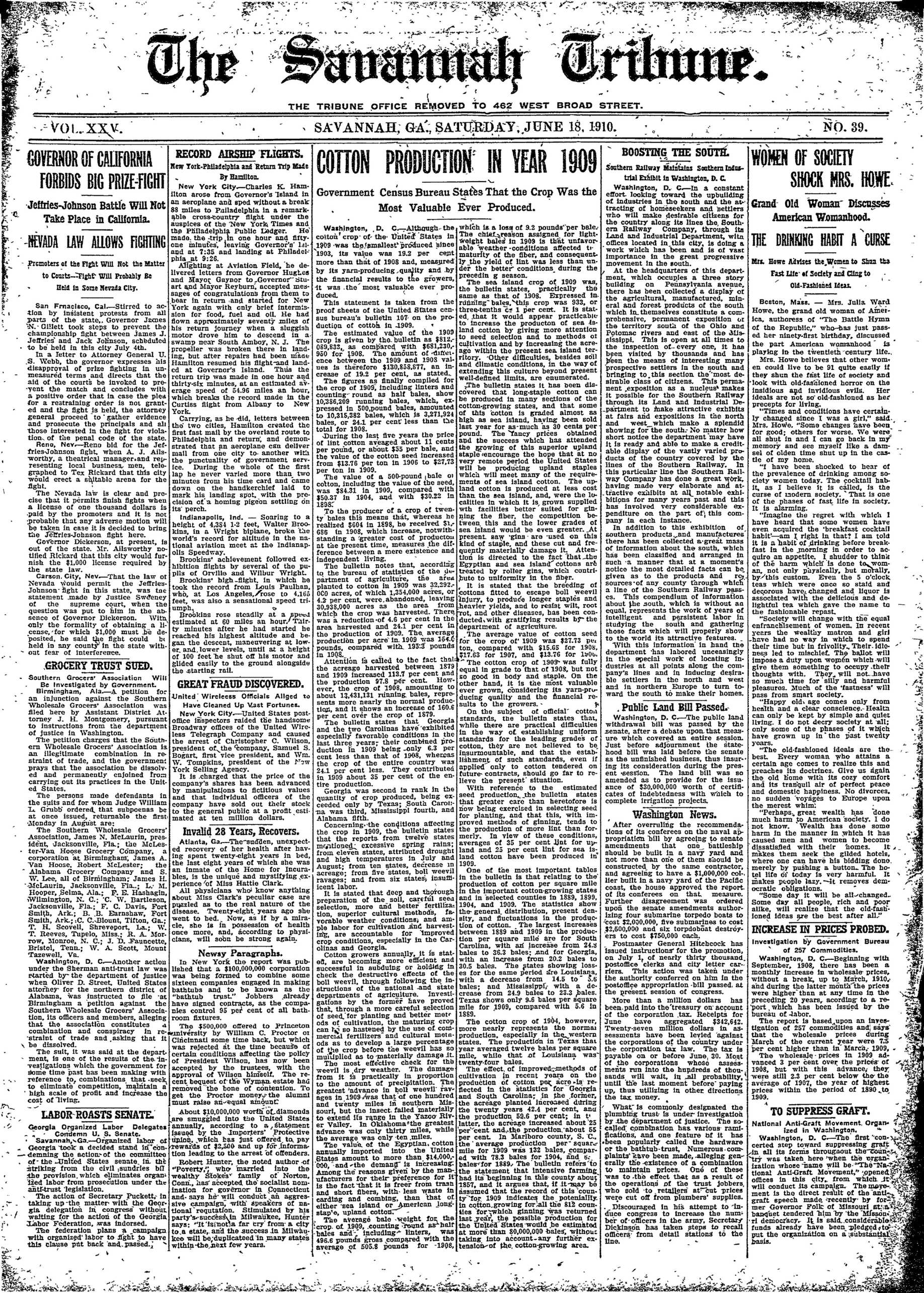

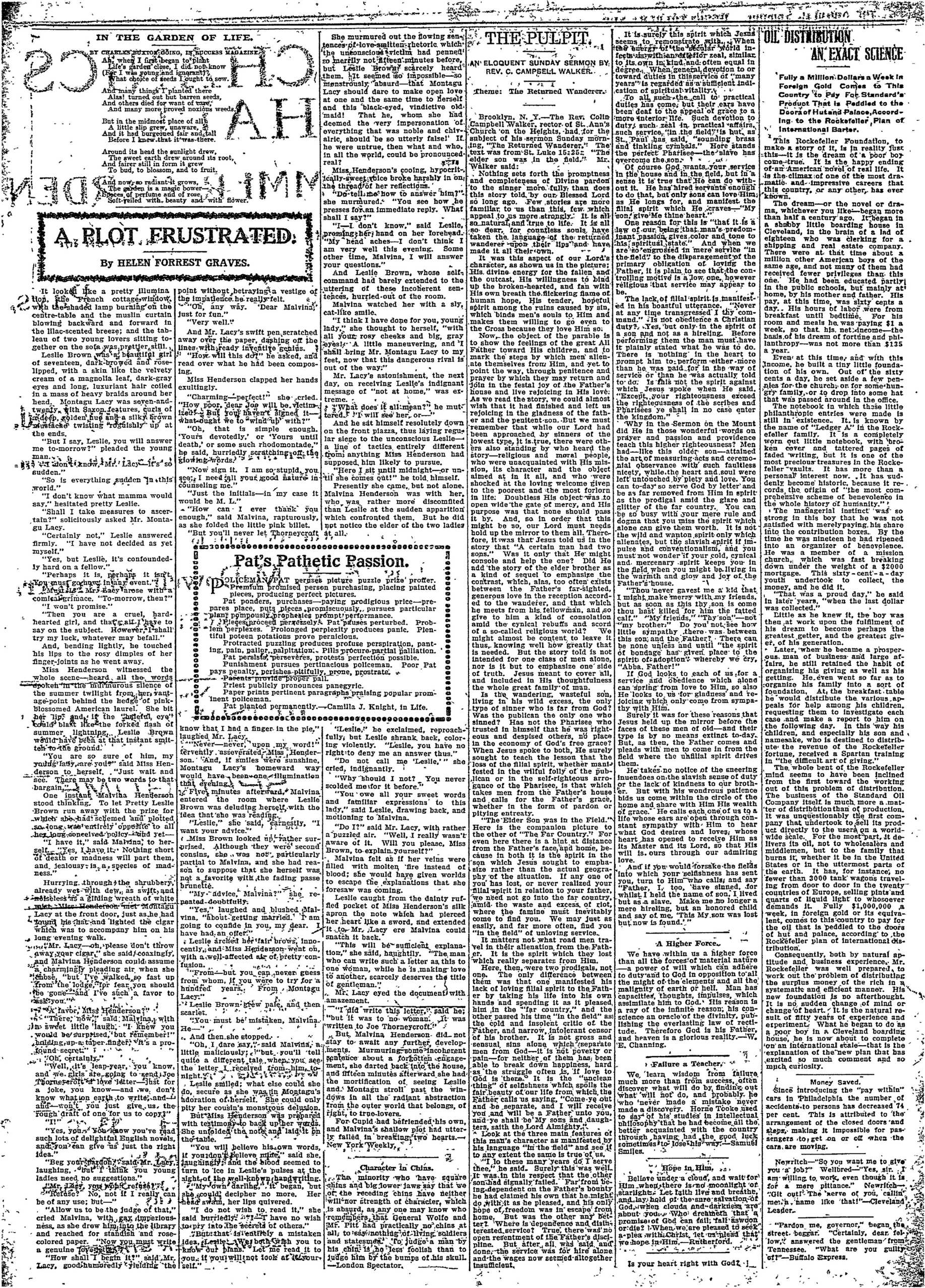
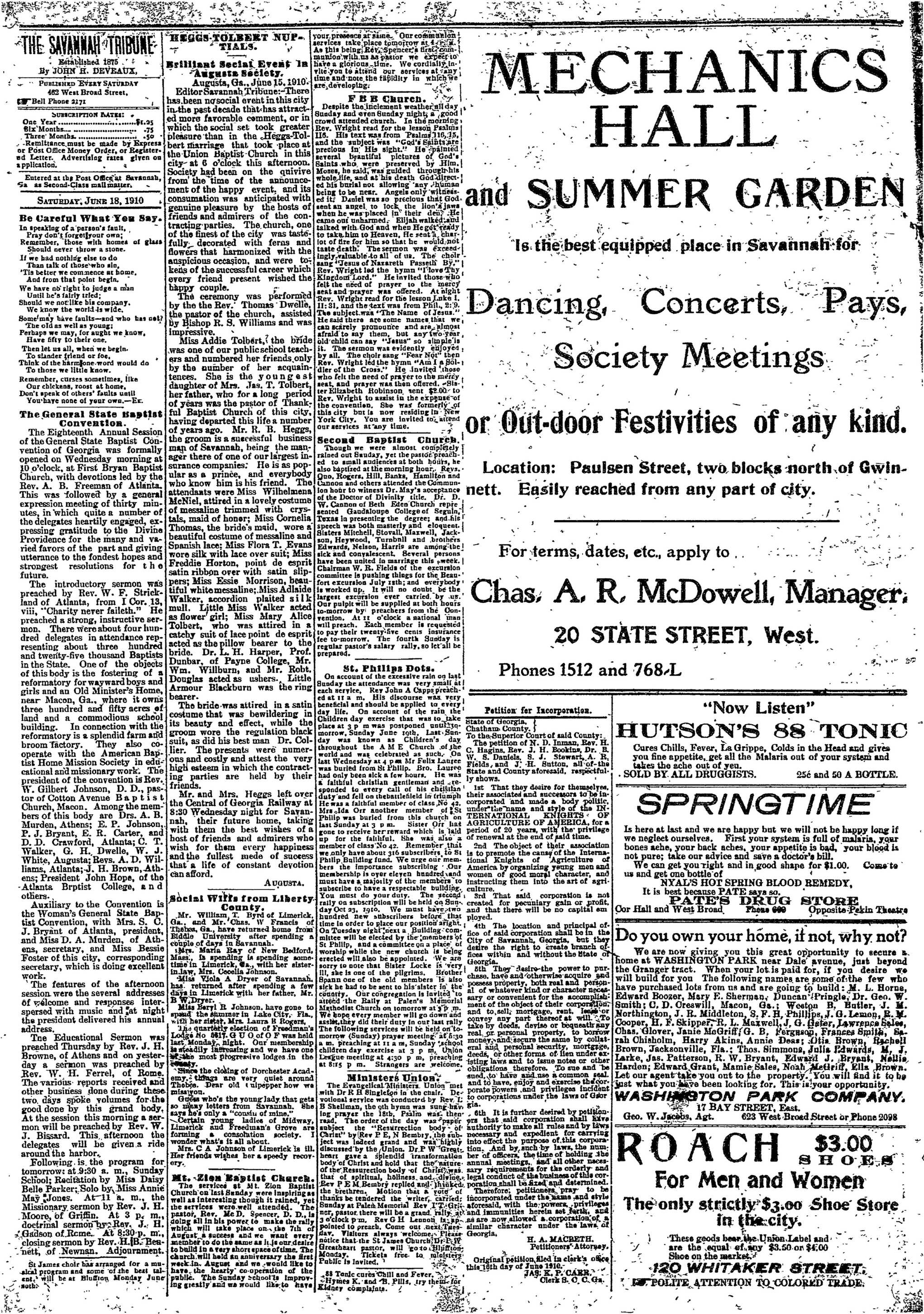
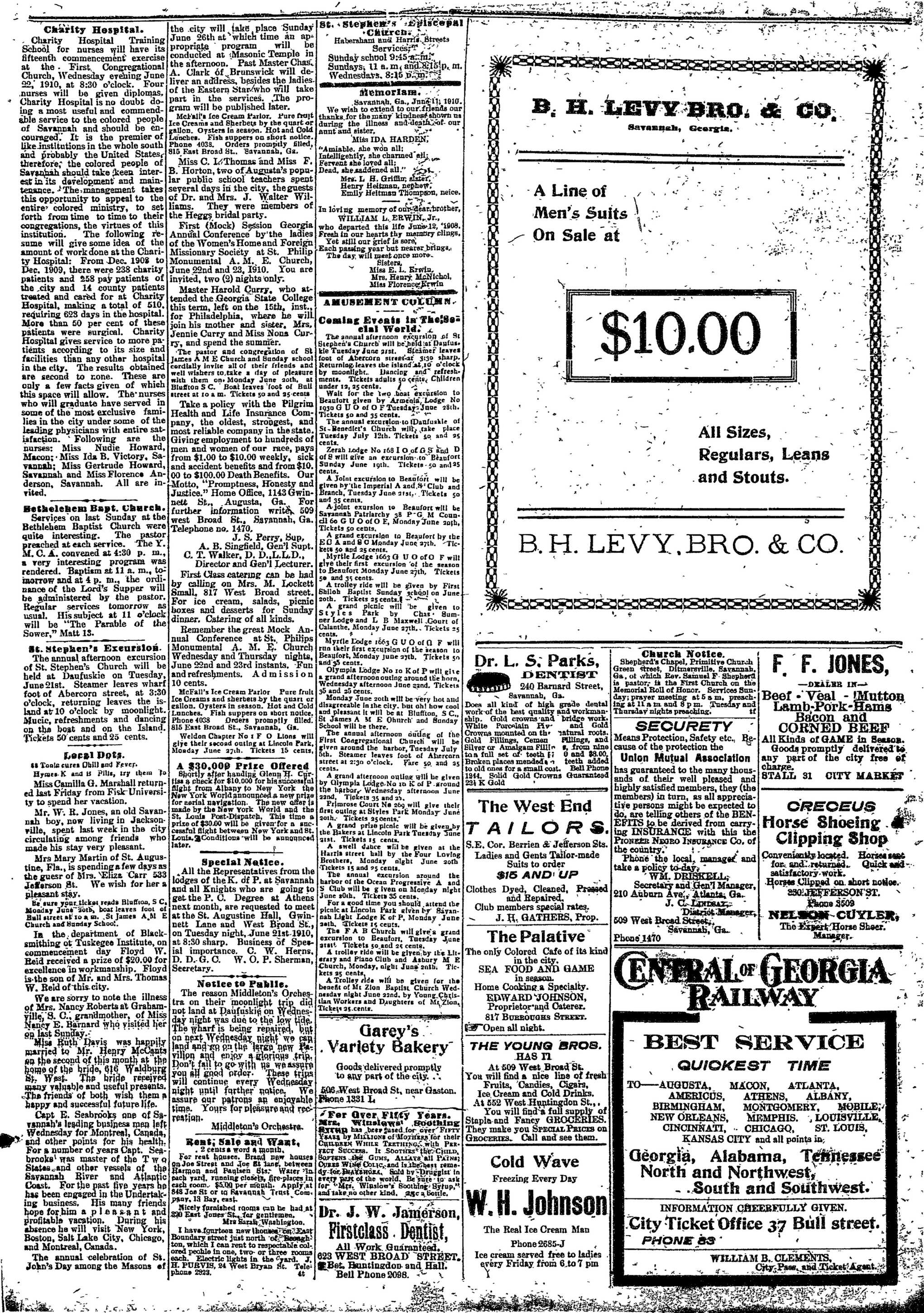
Page text (machine-generated)
Jeffries-Johnson Battle Will Not Take Place in California.
NEVADA LAW ALLOWS FIGHTING
Promoters of the Fight Will Not the Matter to Courts—Fight Will Probably Be Held in Some Nevada City.
San Franciisco, Cal.-Stirred to action by insistent protests from all parts of the state, Governor James N. Gillett took steps to prevent the championship fight between James J. Jeffries and Jack Johnson, scheduled to be held in this city July 4th.
In a letter to Attorney General U. S. Webb, the governor expresses his disapproval of prize fighting in unmeasured terms and directs that the aid of the courts be invoked to prevent the match and concludes with a positive order that in case the plea for a restraining order is not granted and the fight is held, the attorney general proceed to gather evidence and prosecute the principals and all those interested in the fight for violation of the penal code of the state
Reno, Nev.-Reno bld for the Jeffries-Johnson fight, when A. J. Allsworthy, a theatrical manager and representing local business, men, telegraphed to Tex Rickard that this city would erect a sittable arena for the fight.
The Nevada law is clear and precise that it permits fight sights when a license of one thousand dollars is paid by the promoters and it is not probable that any adverse motion will be enacted because it is decided to bring the Jeffries-Johnson fight here.
Governor Dickerson, at present, is out of the state. Mr. Allsworthy notified Rickard that this city would furnish the $1,000 license required by the state law.
Carson City, Nev.—That the law of Nevada would permit the Jeffries-Johnson fight in this state, was the statement made by Justice Sweney of the supreme court, when the question was put to him in the absence of Governor Dickerson. With only the formality of obtaining a license, for which $1,000 must be deposited, he said the fight could be held in any county in the state without fear of interference.
GROCERY TRUST SUED.
Southern Grocers' Association Will Be Investigated by Government.
Birmingham, Ala.—A petition for an injunction against the Southern Wholesale Grocers' Association was filed here by Assistant District Attorney J. H. Montgomery, pursuant to instructions from the department of justice in Washington.
The petition charges that the Southern Wholesale Grocers' Association is an illegitimate combination in restraint of trade, and the government prays that the association be dissolved and permanently enjoined from carrying out its practices in the United States.
The persons made defendants in the suits and for whom Judge William L. Grubb ordered that subpoenaes be at once issued, returnable the first Monday in August.
The Southern Wholesale Grocers' Association, James N. M. McLaurin, president, Jacksonville, Fla.; the McLester-Van Hoose Hoose Grocery Company, a corporation at Birmingham, James A. Van Hoose, Robert McLester; the Alabama Grocery Company and S. W. Lee, all of Birmingham; James H. McLaurin, Jacksonville, Fla.; L. M. Hooper, Selma, Ala.; F. E. Hashagin, Wilmington, N. C.; C' W. Bartleson, Jacksonville, Fla.; F. C. Davis, Fort Smith, KS.; B. E. Jarrawsh, Fort Smith, Ark.; C. C. Blount, G. T. H. Scovell, Shreewport, La.; W. T. Reeves, Tuelope, M. R. A. Morrow, Monroe, N. C.; J. D. Fauntcee, Bristol, Teenn; W. A. Scott, Mount Tazewell, Va.
Washington, D. C.—Another action under the Sherman anti-trust law was started by the department of justice when Oliver D. Street, United States attorney for the northern district of Alabama, was instructed to file at Birmingham a petition against the Southern Wholesale Grocers' Association, its officers and members, alleging that the association constitutes a combination and conspiracy in restraint of trade and asking that it be resolved. The suit, it was said at the department, is one of the results of the investigations which the government for some time past has been making with reference to, combinations that seek to eliminate competition, maintain a high scale of profit and increase the cost of living.
LABOR ROASTS SENATE
Georgia Organized Labor Delegates
Condemn U. S. Senate.
Condemnn U. S. Senate,
Savannah, Ga.-Organized labor of
Georgia took a decided stand in con-
demning the action of the committee
of the United States senate, in the
striking from the civil sundries bill
the provision, which eliminates organiz-
ed labor from prosecution under the
ant-trust legislation.
The action of Secretary Puckett, in
taking with the Georgia delegation in congress without
waiting for the action of the Georgia
Labor Federation, was indorsed.
The federation plans a campaign
with organized labor to fight to have
this clause put back and passed;
Savannah
New York City—Charles K. Hamilton arose from Governor's Island in an airplane and sped without a break 83 miles to Philadelphia in a remarkable cross-country flight under the auspices of the New York Times and the Philadelphia Public Ledger. He made the trip in one hour and fifty-one minutes, leaving Governor's Island at 7:35 and landing at Philadelphia at 9:26.
Alighting at Aviation Field, he delivered letters from Governor Hughes and Mayor Gaynor to Governor Stuart and Mayor Reyburn, accepted messages of congratulations from them to bear in return and started for New York again with only brief intermission for food, fuel and oil. He had flown approximately seventy miles of his return journey when a sluggish motor drove him to descend in a swamp near South Amboy, N. J. The propeller was broken there in landing, but after repairs had been made Hamilton resumed his flight and landed at Governor's island. Thus the return trip was made in one hour and thirty-six minutes, at an estimated average speed of 54.96 miles an hour, which breaks the record made in the Curtiss flight from Albany to New York.
Carrying, as he did, letters between the two cities, Hamilton created the first fast mail by the overland route to Philadelphia and return, and demonstrated that an aeroplane can deliver mail from one city to another with the punctuality of government service. During the whole of the first lap he never varied more than two minutes from his time card and came down on the handkerchief laid to mark his landing spot, with the precision of a homing pigeon settling on its perch. Indianapolis, Ind. — Soaring to a height of 4,334 1-2 feet, Walter Brookins, in a Wright biplane, broke the world's record for altitude in the national aviation meet at the Indianapolis Speedway. Brookins' achievement followed exhibition flights by several of the pupils of Orville and Wilbur Wright. Brookins' high-flight, in which he took the record from Louis Paulhan, who, at Los Angeles, rose to 4,165 feet, was also a sensational speed triumph.
Brookins rose steadily at a speed estimated at 60 miles an hour. Tairtary minutes after he had started he reached his highest altitude and began the descent, maneuvering in a height of 100 feet he shut off his motor and glided easily to the ground alongside the starting rail.
GREAT FRAUD DISCOVERED.
United Wireless Officials Allied to Have Cleaned Up Vast Fortunes.
New York City—United States postoffice inspectors raided the handsome Broadway offices of the United Wireless Telegraph Company and caused the arrest of Christopher C. Wilson, president of the company, Samuel S. Bogart, first vice president, and Wm. W. Tompkins, president of the New York Selling Agency.
It is charged that the price of the company's shares has been advanced by manipulations to fictitious values and that individual officers of the company have sold out their stock to the general public at a profit estimated at ten million dollars.
Invalid 28 Years. Recovers.
Atlanta, Ga.—The sudden, unexpected recovery of her health after having spent twenty-eight years in bed, the last eight years of which she was an inmate of the Home for Incurables, is the unique and mystifying experience of Miss Hattie Clark. All physicians who know anything about Miss Clark's health are puzzled by the real nature of the disease. Twenty-eight years ago she went to bed. Now, as if by a miracle, she is in possession of health once more, and, according to physicians, will soen be strong again.
Newsv Paragraphs.
In New York the report was published that a $100,000,000 corporation was being formed to combine some sixteen companies engaged in making bathtubs and to be known as the "bathtub trust." Jobbers already have signed contracts, as the companies control 95 per cent of all bathroom fixtures.
The $500,000 offered to Princeton university by William C. Proctor or Nichinnai some time back, but which was rejected at the time because of certain conditions affecting the policy of President Wilson, has now been accepted by the trustees, with the approval of Wilson himself. The recent bequest of the Wyman estate had removed the bone of contention. To get the Proctor money, the alumni must raise an equal amount.
About $100,000,000 worth of diamonds are smuggled into the United States annually, according to a statement issued by the Importers' Protective union, which has just offered to pay rewards of $2,500 and up for information leading to the arrest of offenders.
Robert Hunter, the noted author of "Poverty," who married into the wealthy Stokes' family of Norton, Conn., has accepted the socialist nomination for governor in Connecticut and says he will conduct an aggressive campaign, with speakers of national requituation. Stimulated by his party's success in Milwaukee, Hunter says: "It is notna far cry from a city to a state, and the success in Milwaukee will be duplicated in many states within the next few years.
THE TRIBUNE OFFICE REMOVED TO 462 WEST BROAD STREET. SAVANNAH, GA., SATURDAY, JUNE 18, 1910.
COTTON PRODUCTION IN YEAR 1909
COTTON PRODUCTION IN YEAR 1909
Government Census Bureau States That the Crop Was the Most Valuable Ever Produced.
Washington, D. C. Although the cotton crop of the United States in 1909 was the smallest produced since 1903, its value was 19.2 per cent more than that of 1908 and, measured by its yarn-producing quality and by the financial results to the growers, it was the most valuable ever produced.
This statement is taken from the proof sheets of the United States census bureau's bulletin 107 on the production of cotton in 1909.
The estimated value of the 1909 crop is given by the bulletin as $812,089,833, as compared with $681,230,950 for 1908. The amount of difference between the 1909 and 1908 values is therefore $130,858,877, an increase of 19.2 per cent, as stated.
which is a loss of 9.2 pounds per bale. The chief reason assigned for lightweight bales in 1909 is that unfavorable weather conditions affected maturity of the fiber, and consequently the yield of lint was less than under the better conditions during the preceding g season.
The sea island crop of 1909 was the bulletin states, practically the same as that of 1908. Expressed in running bales, this crop was 933, or three-tenths c 1 per cent. It is stated that it would appear practicable to increase the production of sea island cotton by giving more attention to seed selection and to methods of cultivation and by increasing the acreage within the present sea island territory. Other difficulties, besides soil and climatic conditions, in the way of extending this culture beyond present
The figures as finally compiled for the crop of 1909, including linters and counting-round as half bales, show 10,386,209 running bales, which, expressed in 500, pound bales, amounted to 10,315,382 bales, which is 3,271,924 bales, or 24.1 per cent less than the total for 1908.
During the last five years the price of lint cotton aveaged about 11 cents per pound, or about $5 per bale, and the value of the cotton seed increased from $13.76 per ton in 1906 to $27.73 per ton in 1909.
The value of a 500-pound bale of cotton, including the value of the seed, was $84.31 in 1909, compared with $500.7 in 1904, and with $30.22 in 1908.
To the producer of a crop of twenty bales this means that, whereas he realized $604 in 1898, he received $1,686 in 1908, which increase, notwithstanding a greater cost of production at the present time, measures the difference between a mere existence and independent living.
The bulletin notes that, according to the bureau of statistics of the department of agriculture, the area planted to cotton in 1909 was 32,292,000 acres, of which 1,354,000 acres, or 4.2 per cent, were abandoned, leaving 30,938,000 acres as the area from which the crop was harvested. There was a reduction of 4.6 per cent in the area harvested and 24.1 per cent in the production of 1909. The average production per acre in 1909 was 164.6 pounds, compared with 195.3 pounds in 1908.
Attention is called to the fact that the acreage harvested between 1879 and 1909 increased 113.7 per cent and the production 97.8 per cent. However, the crop of 1908, amounting to about 13,431,131 running bales, represents more nearly the normal production, and it shows an increase of 160.6 per cent over the crop of 1879. The bulletin states that Georgia and the two Carolinas have exhibited especially favorable conditions in the last three years, their combined production in 1909 being only 6.3 per cent less than that of 1908, whereas the crop of the entire country was 24.1 per cent less. They contributed in 1909 about 35 per cent of the entire production.
Georgia was second in rank in the quantity of crop produced, being exceeded only by Texas; South Carolina was third, Mississippi fourth, and Alabama fifth.
Concerning the conditions affecting the crop in 1909, the bulletin states that the reports from twelve states mentioned excessive spring rains; from eleven states, and drought and rainfall; from ten states, decrease in acreage; from five states, boll weevil ravages; and from six states, insufficient labor.
It is stated that deep and thorough preparation of the soil, careful seed selection, more and better fertilization, superior cultural methods, favorable weather conditions, and labor for cultivation and harvesting, are accountable for improved conditions, especially in the Carolina and Georgia.
Cotton growers annually, it is stated, are becoming more efficient and successful in subduing or holding in check the destructive effects of the boll weevil, through following the instructions of the national and state departments of agriculture. Investigations by the former have proved that, through a more careful selection of seed for planting and better methods of cultivation, the maturing crop can be hastened by the use of commercial fertilizers and cultural methods as to develop a large percentage of the crop before the weevil has so multiplied as to materially damage it.
The most effective check for the weevil is dry weather. The damage from it is practically in proportion to the amount of precipitation. The greatest advance in holl weevil ravages in 1909 was that of one hundred and twenty miles in southern Missouri, but the insect failed materially to extend its range in the Yazoo River Valley. In Oklahoma the greatest advance was only thirty miles, while the average was only ten miles. The value of the Egyptian cotton annually imported into the United States amount to more than $14,000,000, and the demand is increasing. Among the reasons given by the manufacturers for their preference for it is the fact that it is freer from tran and short fibers, with less waste in carding and combing, than that of either sea island or American long-stap'e, upland cotton. The average bale weight for the crop of 1909, counting round as half bales and including linters, was 496.6 pounds gross compared with the average of 505.8 pounds for 1908.
which is a loss of 9.2 pounds per bale. The chief reason assigned for lightweight bales in 1909 is that unfavorable weather conditions affected maturity of the fiber, and consequently the yield of lint was less than under the better conditions during the precedin g season. The sea island crop of 1909 was the bulletin states, practically the same as that of 1908. Expressed in running bales, this crop was 933, or three-tenths c 1 per cent. It is stated, that it would appear practicable to increase the productor of sea island cotton by giving more attention to seed selection and to methods of cultivation and by increasing the content of fertilizer in the sea island territory. Other difficulties, besides soil and dilmatic conditions, in the way of extending this culture beyond present welldefined limits, are enumerated.
The bulletin states it has been discovered that long-staple cotton can be produced in many sections of the cotton-growing states, and that some of this cotton is graded almost as high as sea island, having been sold last year for as much as 30 cents per pound. The Yancy prices obtained and the success which has attended the growing of this superior upland staple encourage the hope that at no very remote period the United States will be producing upland staples which will meet many of the requirements of sea island cotton. The upland cotton is produced at less cost than the sea island, and, were the localities in which it is grown supplied with facilities better suited to gins, ginger or corn oil, between this and the lower grades of sea island would be even greater. At present saw gins are used on this kind of staple, and these cut and frequently materially damage it. Attention is directed to the fact that the Egyptian and sea island cotton are treated by roller gins, which contribute to uniformity in the fiber.
It is stated that the breeding of cotton fitted to escape boll weevil injury, to produce longer staples and heavier yields, and to resist wilt, root, and other diseases, has been conducted, with gratifying results by the department of agriculture.
The average value of cotton seed for the crop of 1909 was $27.73 per ton, compared with $15.65 for 1908, $17.63 for 1907, and $13.76 for 1908.
The cotton crop of 1909 was fully equal in grade to that of 1908, but not so good in body and staple. On the other hand, it is the most valuable ever grown, considering its yarn-producing quality and the financial results to the growers.
On the subject of official cotton standards, the bulletin states that, while there are practical difficulties in the way of establishing uniform standards for the leading grades of cotton, they are not believed to be insurmountable, and that the establishment of such standards, even if applied only to cotton tendered on future-contracts, should go far to relieve the present' situation.
With reference to the estimated seed production, the bulletin states that greater care than heretofore is now being exercised in selecting seed for planting, and that this, with proper methods of ginning, tends to the production of more lint than formerly.
In view of these conditions, averages of 35 per cent lint for upland and 25 per cent lint for sea island cotton have been produced in 1909.
One of the most important tables in the bulletin is that relating to the production of cotton per square mile in the important cotton-growing states and in selected counties in 1889, 1899, 1904, and 1909. The statistics show the general distribution, present density, and fluctuations in the production of cotton. The largest increases between 1889 and 1909 in the production per square mile are for South Carolina, with an increase from 24.3 bales to 36.3 bales; and for Georgia, with an increase from 20.2 bales to 30.5 bales. The states showing losses for the same period are Louisiana, with a decrease from 14.5 to 3.6 bales; and Mississippi, with an increase from 24.9 bales to 23.3 bales. Texas shows only 9.6 bales per square mile for 1909, compared with 5.6 in 1889. The cotton crop of 1904, however, more nearly represents the normal production, especially in the western states. The production in Texas that year averaged twelve bales per square mile, while that of Louisiana was twenty-four bales.
The effect of improved methods of cultivation in recent years on the production of cotton per acre is reflected in the statistics for Georgia and South Carolina; in the former, the acreage planted increased during the twenty years 42.4 per cent, and the production 59.6 per cent; in the latter, the acreage increased about 25 per cent and the production about 55 per cent. In Marlboro county, S. C., the average cotton yield was 1909 was 132 bales, compared with 78.3 bales for 1904, and 6 bales for 1889. The bulletin refers to the statement that intensive farming had its beginning in this county about 1857, and it argues that, if it may be assumed that the record of this county for 1909 indicates the potentiality in cotton, growing for all the 812 counties for which ginning was returned last year, the possible production for the United States would be estimated at more than 80,000 bales, without taking into account any further extension of the cotton-growing area.
BOOSTING THE SOUTH
Southern Railway Maintains Southern Industrial Exhibit in Washington, D. C.
Washington, D. C.—In a constant effort looking toward the upbuilding of industries in the south and the attracting of homeseekers and settlers who will make desirable citizens for the country along its lines the Southern Railway Company, through its Land and Industrial Department, with offices located in this city, is doing a work which has been and is of vast importance in the great progressive movement in the south.
At the headquarters of this department, which occupies a three story building on Pennsylvania avenue, there has been collected a display of the agricultural, manufactured, mineral and forest products of the south which in themselves constitute a comprehensive, permanent exposition on the territory south of the Ohio and Potomac rivers and east of the Mississippi. This is open at all times to the inspection of every one, it has been visited by thousands and has been the means of interesting many prospective settlers in the south and bringing to this section the most desirable class of citizens. This permanent exposition as a nucleus makes it possible for the Southern Railway through its Land and Industrial Department to make attractive exhibits at fairs and expositions in the north and west, which make a splendid showing of the south. This matter how short notice the department may have it is ready and able to make a creditable display of the vastly varied products of the country covered by the lines of the Southern Railway. In this particular line the Southern Railway Company has done a great work, having made very elaborate and attractive exhibits at all notable exhibitions for many years past and this has involved very considerable expenditure on the part of) this company in each instance.
In addition to this exhibition of southern products, and manufactures there has been collected a great mass of information about the south, which has been classified and arranged in such a manner that at a moment's notice the most detailed facts can be given as to the products and resources of any county through which a line of the Southern Railway passes. This compendium of information about the south, which is without an equal respects to the presents the intelligent and persistent labor in studying the south and gathering those facts which will properly show to the world its attractive features.
With this information in hand the department has labored unceasingly in the special work of locating industries at all points along the company's lines and in inducing desirable settlers in the north and west and in northern Europe to turn toward the south to make their homes.
Public Land Bill Passed.
Washington, D. C. The public land withdrawal bill was passed by the senate, after a debate upon that measure which covered an entire session. Just before adjournment the statehood bill was laid before the senate as the unfinished business, thus insuring its consideration during the present session. The land bill was so amended as to provide for the issuance of $30,000,000 worth of certificates of indebtedness with which to complete irrigation projects.
Washington News.
After overruling the recommendations of its conferences on the naval appropriation bill by agreeing to senate amendments that one battleship should be built in a navy yard and not more than one of them should be constructed by the same contractor, and agreeing to have a $1,000,000 collier built in a navy yard of the Pacific coast, the house approved the report of its conferences on that measure. Further disagreement was ordered upon the senate amendments authorizing four submarine torpedo boats to cost $2,000,000, five submarines to cost $2,500,000 and six torpedo boat destroyers to cost $700,000 each. Postmaster General Hickhock has issued instructions for the promotion, issued of nearly thirty thousand postoffice clerks and city letter carriers. This action was taken under the authority conferred on him in the postoffice appropriation bill passed at the present session of congress.
More than a million dollars has been paid into the treasury on account of the corporation tax. Receipts for June have aggregated $342,642. Twenty-seven million dollars in assessments have been levied against the corporations of the country under the corporation tax law. The tax is payable on or before June, 30. Most of the corporations whose assessments have been funded sands will wait, in all probability, until the last moment before paying up, thus utilizing in other directions the tax money.
What is commonly designated the plumbing trust is under investigation by the department of justice. The so-called combination has various ramifications, and one feature of it has been popularly called the hardware or the bathtub-trust. Numerous complaints have been made, alleging generally the existence of a combination to maintain prices. One of these was to the effect that as a result of the operations of the trust jobbers who sold to retailers at cut prices were cut off from plumbers' supplies. Discouraged in his attempt to induce congress to increase the number of officers in the army, Secretary Dickinson has taken steps to recall officers from detail stations to the line.
Mrs. Howe Advises the Women to Shun the Fast Life of Society and Cling to Old-Fashioned Ideas.
Boston, Mass. — Mrs. Julia Ward Howe, the grand old woman of America, authoress of "The Battle Hymn of the Republic," who has just passed her ninety-first birthday, discussed the part American womanhood is playing in the twentieth century life.
Mrs. Howe believes that other women could live to be 91 quite easily if they shun the fast life of society and look with old-fashioned horror on the insidious and invidious evils. Her ideals are not so old-fashioned as her precepts for living.
"Times and conditions have certainly changed since I was a girl," said Mrs. Howe. "Some changes have been for good; others for worse. We were all shut in and I can go back in my memory and see myself like a damsel of olden time shut up in the castle of my home.
"I have been shocked to hear of the prevalence of drinking among society women today. The cocktail habit, as I believe it is called, is the curse of modern society." That is one of the phases of fast life in society. It is alarming.
"Iimagine the regret with which I have heard that some women have even acquired the 'breakfast cocktail habit'—am I right in that? I am told it is a habit of drinking before breakfast in the morning in order to acquire an appetite. I shudder to think of the harm which is done to woman, not only physically, but morally, by this custom. Even the 5 o'clock teas which were once so staid and decorous have, changed and liquor is associated with the delicious and delightful tea which gave the name to the fashionable repast.
"Society will change with the equal enfranchisement of women. In recent years the wealthy matron and girl have had no way in which to spend their time but in frivolity. Their idleness led to mischief. The ballot will impose a duty upon women which will give them something to occupy their thoughts with. They will not have so much time for silly and harmful pleasures. Much of the 'fastness' will pass from smart society.
"Happy old age comes only from health and a clear conscience. Health can only be kept by simple and quiet living. I do not decry society at all; only some of the phases of it which have grown up in the past twenty years.
"The old-fashioned ideals are the best. Every woman who attains a certain age comes to realize this and preaches its doctrines. Give us again the old home with its cozy comfort and its tranquil air of perfect peace and domestic happiness. No divorces, no sudden voyages to Europe upon the merest whim;
"Perhaps, great wealth has done much harm to American society. I do not know. Wealth has done some harm in the manner in which it has caused men and women to become dissatisfied with their homes. It makes them seek the gilded hotels, where one can have his bidding done merely by pushing a button. The hotel life of today is very harmful. It makes people lazy. -It removes democratic obligations.
"Some day it will be all-changed. Some day all people, rich and poor alike, will realize that the old-fashioned ideas are the best after all."
INCREASE IN PRICES PROBED.
Investigation by Government Bureau of 257 Commodities.
Washington, D. C.-Beginning with September, 1908, there has been a monthly increase in wholesale prices, without a break, up to March, 1910, and during the latter month the prices were higher than at any time in the preceding 20 years, according to a report, which has been issued by the bureau of labor.
The report is based upon an investigation of 257 commodities and says that the wholesale prices during March of the current year were 7.5 per cent higher than in March, 1909. The wholesale prices in 1909 advanced 3 per cent over the prices of 1908, but with this advance, they were still 2.3 per cent below the average of 1907, the year of highest prices within the period of 1890 to 1909.
TO SUPPRESS GRAFT.
National Anti-Graft Movement, Organized in Washington. Washington, D. C.—The first concerted step toward suppressing graft in all its forms throughout the country was taken here when the organization whose name will be 'The National Anti-Graft Movement,' opened offices in this city, from which it will conduct its campaign. The movement is the direct result of the anti-graft speech made recently by former Governor Fols of Missouri at banquet tendered him by the Missouri democracy. It is said, considerable funds already have been pledged to put the organization on a substantial basis.
TO ADVERTISE GEORGIA
Trades Boards Join in Move to Boost This State.
GREAT MEETING IN ATLANTA
Half a Hundred Georgia Towns Were Represented at Organization Meeting—Plans Outlined and Officers Elected.
Atlanta, Ga—Thoroughly aroused to the fact that the south and particularly Georgia is not receiving the notice throughout the country to which her natural resources, her climate and her natural development entitle her, more than 100 men representing more than half a hundred Georgia towns, met in Atlanta and inaugurated a movement by which it is planned to exploit throughout the width and breadth of the country the almost matchless opportunities and unrivaled attractions which the state offers, both to homeseekers and capitalists.
Preliminary plans for the organization of a federation of the commercial bodies of Georgia were made, a president and vice presidents elected, and provisions made for the appointment of an executive committee, which will, in the immediate future, begin the work of perfecting the permanent organization. As soon as the organization can be completed an active advertising campaign, embracing in its scope practically every part of the country, will be inaugurated, with a view of making known to the world what Georgia has to offer to the prospective home-seeker or capitalist.
The meeting was marked by unbounded enthusiasm. Many of those present had traveled a considerable distance to attend the meeting, and it was plain that they were thoroughly in earnest about the matters for the discussion of which the meeting had been called. Many of them had already had opportunities to see the vast benefits to be derived from even a most limited advertising campaign and, as a result, were eager for more. Those from towns which have, not up until this time taken any steps looking to the exploitation of the particular advantages which their own sections offer, seemed also to have caught the enthusiasm and apparently were seeking to know only the best method of getting into line.
W. C. Vereen, president of the Moultrie Chamber of Commerce, was elected president by a unanimous vote. One vice president from each of the judicial circuits of the state was elected.
A motion carrying with it the endorsement of the body of the bill of H. A. Alexander of Fulton, which provides that a city or town may spend any part of its funds for advertising, was passed. This bill will come up for its third reading and final action at the next meeting of the legislature.
Another motion endorsing the work now being done by the Southern Commercial Congress at Washington, D.C., was adopted, as was one instructing the executive committee to at tempt to secure from the legislature permission to carry to Cincinnati the state mineral exhibit to be used there during the coming Ohio Valley exposition.
The convention also passed a resolution to the effect that the members of the association use their best efforts in behalf of securing for New Orleans the Panama Exposition in 1915. The work now being done by the Georgia Conservation Association was also promised support in a resolution adopted.
A number of short talks along the line of the benefits to be derived from advertising Georgia's advantages, were listened to, $ ^{4}$
Mayor Maddox of Atlanta made a talk which was one of the features of the meeting. He stated that he recently made a tour through the northwest and was told that within the past four years more than 250,000 residents of the United States had moved into Canada because the farming lands in that portion of the United States had become so high that farming was no longer profitable. Hundreds of these, the speaker said, might have been brought to Georgia had the state been advertised as it might.
Roll call showed that 105 members, representing 51 Georgia towns and cities and every section of the state, were present at the meeting.
MUCH BAD CORN.
Inspector Methvin Condemned 22,000 Bushels in Month of May.
Atlanta, Ga.—No less than 22,000 bushels of corn were condemned during the month of May by State Pure Food Inspector P. A. Methvin, because it was found to be unfit for the market; and had not been labeled, "Corn for hogs only," in accordance with the pure food law.
This is an indication, states Mr. Methvin, of the vast amount of corn being shipped into the state in violation of the law, despite the vigilance of the inspectors. He finds that frequent attempts are made to evade and violate the law by "spiking" corn, which merely is 'to mix a little good corn with much bad corn.
At present Mr. Methvin is at work on a case at Savannah, ad the violators will be prosecuted as soon as possible. Stock raisers and dairymen throughout the state are abandoning corn as a food, it is stated, on account of the frequent violations.
Prize For Farmer Boys.
Elberton, Ga.-The Georgia Bankers' Association has offered a prize of a free trip to Washington, D. C., with all expenses paid for a week to the Georgia boy who grows the best acre of corn this year. The prize was offered as the result of a resolution by H. P. Hunter, cashier of the First National Bank, Elberton, and $100 was appropriated for the purpose. The Georgia Boys' Corn Club is interested, and it is said three thousand youngsters will compete for the prize.
DEPOSIT THIS IN OUR SAVINGS DEPARTMENT. BUT DON'T NEGLECT TO SAVE. THIS MONEY WILL COME HANDY TO YOU SOME DAY—INDEED IT WILL
You get 5 per cent interest compounded quarterly.
Mechanics Investment Co.
20 STATE STREET, W EST. PHONE-1512.
New Railroad Planned.
Swainboro, Ga—The Hickson Lumber Company of Cheraw, S. C., which recently purchased large bodies of timber in this county, anticipate at an early day constructing a railroad line to cross the Georgia and Florida at Summit, and intersecting the Central of Georgia at Midville and the Savannah, Statesboro and Northern eight miles above Summit. This line will run through the timber above Summit and below Summit will cross the Bruton and Pinora branch of the Central near Metter and run to the coast at Darlen or Brunswick.
GEORGIA CROP REPORT. The Agricultural Department Gives Out Estimates of the State's Crops.
Atlanta, Ga—From answers to about one thousand letters mailed into every county in the state, the agricultural department has compiled the crop report for May, 1910.
Taking one hundred as the percentage for the crop last year, the report indicates that the cotton crop is per cent less in acreage as compared with last year, or 99 per cent for 1916. It is estimated that 24 per cent the cotton crop was replanted on account of damage done by wet and cold weather. It is estimated that the cotton crop for the state will average about thirteen days later than usual. The percentage of corn acreage is rated at 102 as compared with last year and the crop will be from twelve to fifteen days late. The percentage of a full crop of fruit as now indicated is as follows: Peaches, 86; apples, 73; pears, 80; grapes, 89.
"Crops are somewhat backward in most localities," says the report, "on account of an unusually wet April and dry May, with generally prevalent cold weather. There are, however, very few complaints on insect pests, and corn and cotton are generally free from grass.
"Considerable damage was done by hail in many sections in the early part of April.
"There has been a marked improve ment over last year in the fruit crops
HOME OFFICE
463 WEST BROAD STREET,
SAVANNAH, GEORGIA.
Bell Phone 1196. Ga. Phone 2022
Directors;
L. E. Williams
Sol G. Johnson
P. Edward Perry
M. R. Fields
Walter S. Scott
L. M. Follard
This company is duly chartered under the laws of the State of Georgia, and has complied with all requirements of the State Insurance department, therefore all policy holders are protected with all the safeguards that the strict insurance laws of this State seek to protect its citizens.
Its affairs are directed and managed by Negro men of the city of Savannah of leading standing, and whose character and reputation are of such as to command the respect and confidence of all the people of that community. The same men that manage this Society are the ones that organized and are conducting the affairs of the first successful Negro Savings Bank in this state, therefore we can readily see that by connecting themselves with this Insurance company their interest will be in safe hands.
By comparing our rules and benefits with other first class companies it will be seen that we offer the most liberal inducements with the largest sick, accident and death benefits to our members than any other company in this business.
MONEY DEPOSITED WITH The Wage Earners Loan and In- vestment Company
18. DOUBLY SECURED BY THOUSANDS OF DOLLARS INVESTED SAVANNAH REAL ESTATE. 5 PER CENT PAID ON DEPOSITS.
of Georgia. This improved condition exists in every section, but to a greater degree in middle and south Georgia.
HUB SHOES
Look good at first glance
Service proves they ARE
Every HUB Shoe
shows character
in fit and finish
They show quality in every line, and their
style is correct in every detail.
They wear as well as they look. We sell "The
pick of the sock."
HUB Shoes
For Women
HELEN HUNT, Dress Shoe; built for Service; $2.50
QUEEN ROSALIND, An Elegant, Flexible
Dressy Shoe $3.00
HUB Shoes
For Men
RIGHT ROYAL, A Royal Shoe—Tried and True $3.50
CHARAGTER, BEST MADE—
THE TRIUMPH OF SKILL $5.00
For Children
Any HUB Brand Shoe For Children
FOR SALE BY
Scott Bros.
DRY GOODS STORE,
Gwlnnett and West Bread Sts.
"Professor Worsham, the state entomologist, reports that more attention than ever before is being paid to the proper care of orchards and to picking, packing and marketing fruit, all of which means that the standard of Georgia fruit is higher than in an previous year in the history of this important industry. It will requiifour thousand five hundred cars to move Georgia's peach crop this year. Although many trees were cut down a year ago, there are still in Georgia's peach orchards some sixteen million trees, of which Professor Worsham reports thirteen million in fine condition.
"There has been an increase of something over 20 per cent of apple trees in Georgia since the census report of 1900, which means about three million in our apple orchards.
"These are our leading fruit crops in Georgia.
"There is a falling off in the number and extent of our vineyards, but to what extent we are not prepared to say. There is an increase of scuppernongs, but a falling off in the classes of grapes that require more careful attention.
"Georgia is certainly blessed this year in the prospect of a splendid peach crop."
IN THE GARDEN OF LIFE.
BY CHARLES BUXTON DOING, IN BUSCESS MAGAZINE
Ah, when I first began to plant
Life's garden close, I did not know
(for I was young and ignorant).
What choice of seeds I ought to sow.
And many things I planted there
Alas! turned out but barren seeds,
And others died for want of tea.
And many more proved noxious weeds.
But in the midmost place of all
A little slip grew, unaware,
And it had burgeoned fair and tall
Before I knew that it was there.
Around its head the sunlight drew,
The sweet earth drew around its root,
And fairer still in form it grew
To bud, to blossom, and to fruit.
And now, so radiant it grows,
The sweet is a mantle bower.
Species of perfume and of rose,
Soft-weled with, beauty and with flower.
A PLOT FRUSTRATED.
By HELEN FORREST GRAVES.
It looked like a pretty illumina-
tion, like French cottage-window,
with the shaded lamp burning on the
centre-table and the muslin curtain
blowing backward and forward in
the illac-scented breeze; and the tableau of two young lovers sitting
together on the sofa was prettier, sitti.
Leslie Brown was a beautiful girl of seventeen, dark-browed and rose-lipped, with a skin like the velvety cream of a magnolia leaf, dark-gray eyes and long, luxuriant hair coiled in a mass of heavy braids around her head. Montagu Lacy was seven-and-twenty, with Saxon features, curls of
"But I say, Leslie, you will answer me to-morrow?" pleaded the young man. "I don't know, Mr. Lacy, it's so sudden."
"So is everything sudden in this world."
"I don't know what mamma would say," hesitated pretty Leslie.
"Shall I take measures to ascertain?" solicitously asked Mr. Montagu Lacy.
"Certainly not," Leslie answered firmly. "I have not decided as yet myself."
"Yes, but Leslie, it's confoundedly hard on a fellow."
"Perhaps it is, perhaps it isn't. You must go now in any event."
"Must I tell Mrs. Lacy vorse with a comical grimace." "To-morrow, then?" "I won't promise."
"Then you are a cruel, hard-hearted girl, and thats all I have to say on the subject. However, I shall try my luck, whatever may befall."
And, bending lightly, he touched his lips to the rosy dimples of her finger-joints as he went away.
Miss Henderson witnessed the whole scene—heard all the words spoken in the multinurious silence of the summer twilight from her, vantage-point behind the hedge of pink-blossomed American laurel. She bit her lip and, if the "beautiful eye" could blast like the forked flash of summer, lightning, Leslie Brown would have been at that instant smite-tech to the ground.
"You are so sure of him, my young lady, are you?" said Miss Henderson to herself. "Just wait and see. There may be two words to that bargain."
One instant Mavina Henderson stood thinking. To let Pretty Leslie Brown run away with the prize for which she had schemed and plotted so long, was entirely 'opposite' to all her long one-sided policy - and yet - "I have it," said Mavina, to herself. "Yes, I have it. Nothing short of death or madness will part them, and jealousy is a species of madness."
Hurrying through the shrubbery, already wet with dew, as swift, and wholesome as a gliding wreath of white mist. Wise Henderson met Montagu Lacy at the front door, just as he had found his hat and lighted the clair which was to accompany him on his long evening walk.
Mr. Lacy—oh, please don't throw away your cigar," she said coaxingly, and Malvina Henderson could assume a charmingly pleasing air when she chiseb, "but I've walked so fast up from the lodge for fear, you should be gone—and I've such a favor to ask you."
"A favor, Miss Henderson!"
"There, now," said Malvina, with an sweet little laugh, "I knew you would be surpassed, but remember! building up a taper finger, it's a profound secret."
"Oh, certainly."
"Well, it's leap-year, you know, and we girls are going to send Joe Thornegeroff to love latter—just for a joke, you know—and we don't know what earth to write, and—and won't you just give us, the rough draft of one for us to copy?"
"Yes, you, you know you've read such lots of delightful English novels, and you can give us just the right idea."
"Beg your pardon," said Mr. Larry, laughing, "but I think you young ladies need no suggestions."
"Mr. Larry, you should refuse," "Rutase? No, not if I really can be of any use; but—"
"Allow us to be the judge of that," cried Malvina, with gay impersonalness, as she drew him into the library and reached for standish and rose-colored paper. "Now you must write a genuine love letter."
"How shall I bern it!" said Mr. Lacy, good hunbredly yielding 'the
point without, betraying a vestige of the impatience he really felt.
"Oh, any way. 'Dear Malvina, just for fun.'"
"Very well."
And Mr. Lacy's swift pen, scratched away over the paper, dashing off the lines, with ready inventive genius.
"How will this do?" he asked, and read over what he had been composing.
Miss Henderson clapped her hands exultingly.
"Charming—perfect!" she cried.
"How poor, dear Joe will be, victimized." But you haven't signed it—what ought we to wind-up with?"
"Oh, that is simple enough. 'Yours devotedly,' or 'Yours until death,' or some such rhodomontade," he said, hurriedly scratching off the glowing words.
"Now sign it. I am so stupid, you see. I need tell your good nature in counseling me."
"Just the initials—in my case it would be M. L."
- "How can I ever thank you enough," said Malvina, rapturously, as she folded the little pink billet.
But you'll never let Thorneycroft
Pat's Pather
POLICEMAN/PAT peruses
Premium promised perse-
pieces, producing perfect
Pat ponders, purchases—
pares place, puts pieces, pro-
plant pompously propheleses
Pieces proceed perseely
tem perplexes. Prolonged per-
tiful poeen potations prove p
Protracted puzzling produc-
ing, pain, pallor, palpitation.
Pat persists, perseveres, pr
Punishment pursues perti-
pays penalty, persishes plitfully.
Presents provide proper pat.
Pristest publicly pronounces
Paper prints pertinent para-
inent policeman.
Pat plants permanently.
know that I had a finger in the pie," laughed Mr. Lacy.
"Never—never, upon my word!" fervently asseverated Miss Henderson. "And, if smiles were sunshine, Montagu Lacy's homeward way would have been one illumination that evening.
Flye minutes afterward, Malvina entered the room where Leslie Brown was deluding herself, with the idea that she was reading.
"Leslie," she said, earnestly, "I want your advice."
Miss Brown looked up rather surprised. Although they were second consuls, she was not, particularly partial to Malvina, and she had reason to suppose that she herself was not a favorite with the fading passe brunette.
"My advice, Malvina?" she repeated doubtfully.
"Yes," laughed and blushed Malvina. "About getting married." I am going to confide in you, my dear. I have had, an offer."
Leslie archied her fair brows, innocently, and Miss Henderson went on, with a well-affected air of pretty confusion.
"From—but you can never guess from whom, if you were to try for a hundred years." From Montagu Lacy."
1 Leslie Brown: grew pale, and then scarlet.
"Oh, I dare say," said Malwina, a little maliciously, "but you'll tell quite a different tale, when you see the letter I received from him, tonight.
Leslie smiled; what else could she do, secure as she was in Montagu's adoration of herself. She could only pity her cousin's monstrous delusion. But Miss Henderson was prepared with testimony to back up her words. She unfolded the note and laid it on the table.
"You will believe his own words, if youdon't believe mine," said she, laughingly, and the blood seemed to turn to ice in Leslie's pulses at the sight of the well-known handwriting. "My own darling," it began, but she could decipher no more. Her head swam, her lips quivered.
"I do not wish to read it," she said hurriedly. "I have no wish to spy into the secret of others."
"But that is entirely a mistaken idea, leslie. We both wish you to know our plans. Let me read it to you. If you will not look at yourself."
She murmured out the flowing sentences of love-milten-the rhetoric which the unconscious victim had penned so marilily not fifteen minutes before, but Leslie Brown scarcely heard them. It seemed so impossible—so unmistakably 'absurd—that Montagua Lucy should dare to make open love at one and the same time to herself and this 'black-eyed, vindictive old maid!' That he, whom she had deemed the very impersonation of everything that was noble and chivalric, should be so utterly false! If he were untrue, then what and who, in all the world, could be pronounced real?
Miss Henderson's cooling, hypocritically-sweet voice broke harshly in on the thread of her reflections.
"Do tell me how to answer him?" she murmured. "You see how he presses for an immediate reply. What shall I say?"
"I—I don't know," said Leslie, pressing her hand on her forehead. "My head aches—I don't think I am very well this evening. Some other time, Malvina, I will answer your questions."
And Leslie Brown, whose self-command had barely extended to the uttering of these incoherent sentences, hurried out of the room. Malvina watched her with a sly, cat-like smile.
"I think I have done for you, young lady," she thought to herself, "with all your rosy cheeks and big, gray eyes!" A little maneuvering, and I shall bring Mr. Montagu Lacy to my feet, now that this dangerous rival is out of the way."
Mr. Lacy's astonishment, the next day, on receiving Leslie's indignant message of "not at home," was extreme.
"What does it all mean?" he muttered. "I will see her, or—"
And he sat himself resolutely down on the front piazza, thus laying regular slege to the unconscious Leslie—a line of tactics entirely different from anything Miss Henderson had supposed him likely to pursue.
"Here I sit until midnight—or until she comes out!" he told himself.
Presently she came, but not alone. Malvina Henderson was with her, who, was rather more discomfited than Leslie at the sudden apparition which confronted them. But he did not notice the elder of the two ladies at all.
Artic Passion.
is picture puzzle prize proffer.
on purchasing, placing painted
at pictures.
-paying prodigious price—pre-
miscusously, pursues particular
prompt performance.
is Pat pictures perturbed. Prob-
plexity produces panic. Plen-
periorious.
suces profuse perspiration, pant-
Pills procure-partial palliation.
protests perfection possible.
inaculous policeman. Poor Pat
y, prone, prostrate.
all.
is panegyric.
agraphs praising popular prom-
—Camilla J. Knight, in Life.
"Leslie," he exclaimed, reproachfully, but Leslie shrank back, coloring violently. "Leslie, you have no right to deny me an answer thus." "Do not call me 'Leslie,'" she cried, indignantly.
"Why should I not? You never scolded me讽它 before."
"You owe all your sweet words and familiar expressions' to this lady," said Leslie, drawing back, and motioning to Malvina.
"Do?!" said Mr. Lacy, with rather a puzzled air. "Well, I really wasn't aware of it. Will you please, Miss Brown, to explain yourself?"
Malvina felt as if her veins were filled with molten fire instead of blood; she would have given worlds to escape the explanations that she foresaw was coming.
Leslie caught from the dainty ruffled pocket of Miss Henderson's silk apron the note which had pierced her heart like a sword, and extended it to Mr. Lacy are Malvina could snatch it back.
"This will be sufficient explanation," she said, haughtily. "The man who can write such a letter as this to one woman, while he is making love to another, scarcely deserves the title of gentleman."
Mr. Lacy eyed the document with amazement.
But, Malvina Henderson did not stay to await any further developments. Murmuring some incoherent sentence about a forgotten engagement, she darted back into the house, and fifteen minutes afterward she had the mortification of seeing Leslie and Montagura stroll past the windows in all the radiant abstraction from the outer world that belongs, of right, to true-lovers.
For Cupid had befriended his own, and Malvina's shallow plot had utterly failed in breaking two hearts.—New York Weekly.
Character in Chins.
The minority who have square chins and big lower jaws say that we of the receding chins have neither will nor strength of character, which is absurd, as any one may know who remembers that General Wolfo and Mr. Pitt had practically no chins at all; to say nothing of living soldiers and statesmen. To judge a man by his chin is no less foolish than to judge him by the bumps of his skull.—London Spectator.
AN' ELOQUENT SUNDAY SERMON BY
REV. C, CAMPELL WALKER.
Brooklyn, N. Y.—The Rev. Colin Campbell Walker, rector of St. Ann's Church on the Heights, had, for the subject of his sermon Sunday morning, "The Returned Wanderer." The text was from St. Luke 15:25; "The elder son was in the field," Mr. Walker said:
Nothing sets forth the promptness and completeness of Divine pardon to the slinner more fully, than does this story told, by our Blessed Lord so long ago. Few stories are more familiar, to us than this, few which appeal to us more strongly. It is all so natural, and true to life. It is all so dear, for countless souls, have taken the language of the returned wanderer upon their lips and have made it all their own.
It was this aspect of our Lord's character, as shown us in the picture; His divine energy for the fallen and the outcast. His willingness to bind up the broken-hearted, and fan with His own breath the flickering name of hope. His tender, hopeful spirit amuse the men, who spirit which binds men's souls to Him and makes them willing to go even to the Cross because they love Him so:
Now, the object of the parable is to show the feelings of the great All Father toward His children, and to mark the steps by which men alliate themselves from Him, and yet to point the way, through penitence and prayer by which they may return and join in the festal joy of the Father's house and live rejoicing in His love. As we read the story, we could almost wish that it had finished and left us rejoicing in the gladness of the father and the penitent-son. But we must remember that while our Lord had been approached by sinners of the lowest type, it is true, there were others also standing by who heard the story—religious and moral people, who were unacquainted with His mission, its character and the object aimed at in it all, and who were shocked at the loving welcome given to the poorest and the most forlorn in life. Doubtless His object was to open wide the gate of mercy, and his purpose was that none should pass it by. And, so in order that this might be so, our Lord must needs hold up the mirror to them all. Therefore, it was that Jesus told us in the story that "A certain man had two sons." Was it only that He might console and help the one? Did He add the story of the elder brother as a kind of sequel to emphasize the contrast, which, alas, too often exists between the Father's far-slighted, generous love in the reception accorded to the wanderer, and that which he meets from his fellowman, and so give to him a kind of consolation amid the cynical rebuffs and scorn of a so-called religious world? We might almost be content to leave it thus, knowing well how greatly that is needed. But the story told is not intended for one class of men alone, nor is it but to emphasize one side of truth. Jesus meant to cover all, and included in His thoughtfulness the whole great family of man.
Is the wandering, wasteful son, living in his wild excess, the only type of sinner who is far from God? Was the publican the only one who sinned? Has not the Pharisee who trusted in himself that he was righteous and despised others, no place in the economy of God's free grace? When Jesus spoke to both, He surely sought to teach the lesson that the loss of the filial spirit, whether manifested in the wilful folly of the publican or in the self-righteous arrogance of the Pharisee, is that which takes men from the Father's house and calls for the Father's grace, whether in the form of pardon or putting entreaty.
"The Elder Son was in the Field." Here is the companion picture to the other of "The Far Country." For even here there is a hint at distance from the Father's face and home, because in both it is the spirit in the son which Jesus sought to emphasize rather than the actual geography of the situation. If any one of you has lost, or never realized your filial spirit in relation to your father, we need not go into the far country, amid the waste and excess of riot, where the famine must inevitably end and you. And you, easily, and far more often, find you "in the field" of unloving service. It matters not what road men travel in their alienation from the Father. It is the spirit which they lost which really separates from Him.
Here, then, were two prodigals, not one. The only difference between them was that one manifested his lack of loving filial spirit to the Father by taking his life into his own hands and spending it as it pleased, him in the "far country," and the other passed his time "in the field" as the cold and insolent critie of the Father, and narrow, infarent censor of his brother. It is not gross and sensual, sins alone which "separate men from God—it is not poverty or pain—for neither of them has been able to break down happiness, hard as the struggle often is, if love to God is 'there.' It is the "unclean thing" of selfishness which spoils the fair beauty of our life from which the Father calls us saying, "Come ye out and be separate, and I will receive you and will be a Father unto you, and ye shall be 'My sons and daughters, saith the Lord Almighty."
Look at the three main features of this man's character as manifested by his language "in the field" and see if to any extent the same is true of us. "I lo these many years do I serve thee," he said. Surely this was well. It was in this respect that the other son had signally failed. Far from being dependent on the Father's bounty he had claimed his own that he.might do with it as he pleased, and his only hope of freedom was in escape from home. But was the other any better? Where is dependence and disinterested service? True, there was no open resentment of the Father's discipline. But after, all, was said, and done, the service was for hire alone and the wages now seemed altogether insufficient.
It is surely this spirit which Jesus seems to, remonstrate with. When the energy of the "regular world infects with mankind after zeal, similar to its own in kind, and often equal in degree, when general devotion to or toward duties in this service of "many years" is regarded as a sufficient indication of spiritual vitality.
To all such the 'call to' practical duties has come; but their ears have been deaf to the appeal of grace to a more interior life. Such devotion to duty, such zeal in practical affairs, such service, 'in the field'* it but as St. Paul has said, 'sounding brass and tinkling cymbals'. Here stands the perfect Pharisee—the slave has overcome the son.
Of course *wants*, *your*, *service* in the house and in the field, but in *a sense* it is *true* that *He* can do without it. He has *hired servants* enough to do that, but only sons can love Him as he longs for, and manifest the full spirit which *He* *craves*—"My son, give *Me* thine heart."
One reason for this is "that it is a law of our, being that, man's predomant passion gives, color and tone to his spiritual state." And when we are so engrossed in mere service "in the field?" to the disparagement of the primary obligation of man, we can see that the controlling motive is a jow, one, however religious that service may appear to be.
The lack, of filial spirit is manifested in his boastful utterance. "Never at any time transgressed I thy command." Is not obedience a Christian duty? Yes, but only in the spirit of a son and not as a hireling. Before performing them the man must have it plainly stated what he was to do. There is nothing in the heart to prompt him to perform either more than he was paid for in the way of service or than he was actually told to do. Is this not the spirit against which Jesus spoke when He said, "Except, your righteousness exceed the righteousness of the scribes and Pharisees ye shall in no case enter the kingdom."
Why in the Sermon on the Mount did He in those wonderful words on prayer and passion and providence teach this higher righteousness? Men had—like this older son—attained the art of measuring acts and ceremonial observance with such faultless nicety, while the heart and soul were left untouched by plety and love. You can to-day so serve God by letter and be as far removed from Him in spirit as the prodigal amid the glare and glitter of the far country. You can be so busy with your mere rule and dogma that you miss the spirit which alone can give them worth. It is not the wild and wanton spirit only which alienates, but the slavish spirit if impulse and conventionalism, and you must not wonder if your cold, cynical and mercenary spirit keeps you in the field when you might be living in the warmth and glow and joy of the Father's house.
"Thou never gavest me a kid that I might, make merry with my friends, but as soon as this thy son is come thou hast killed for him the fatted calf. "My friends," "Thy son"—not "my brother." Do you not, see how little sympathy there was between this son and the Father? There can be none unless and until "the spirit of bondage has given place to the spirit of adoption" whereby we dry, "Abba, Father!"
If God looks to each of us for a service and obedience which alone can spring from love to Him, so also He looks to us for gladness and rejoicing which only come from sympathy with Him.
Surely it was for these reasons that Jesus held up the mirror before the faces of these men of old—and their type is by no means extinct to-day. But, as then, the Father comes and pleads with men to come in from the field where the unfallful spirit drives them.
He takes no notice of the sneering innuendoes on the slavish sense of duty or the lack of kindness to our brother. But with his wondrous patience bids us come within the circle of the home and share with Him His wealth of grace. He calls each one of us to a life whose ears are open through constant sympathy with Him to hear what God desires and loves, whose heart has opened to receive Him as its Master and its Lord, so that His will is ours through our admiring love.
And if you would forsake the fields into which your selfishness has sent you, turn to Him who calls, and say "Father, I, too, have sinned, for whilst I held the name of son, I lived but as a slave. Make me no longer a mere hirling, but an honored child and say of me. "This My son was lost but now is found."
A Higher Force.
We have within us a higher force than all the forces' of material nature — a power of will which can adhere to duty and to God in opposition to all the might of the elements and all the malignity of earth or hell. Man has capacities, thoughts, impulses, which assimilate him to God. His reason is a ray of the infinite reason; his conscience an oracle of the divinity, publishing the everlasting law of rectitude. Therefore God is his Father, and heaven is a glorious reality.—W. E. Channing.
We learn wisdom from failure much more than from success, often discover what will do by finding out what will not do, and probably he who never made a mistake never made a discovery. Horne Tooke used to say of his studies in intellectual philosophy that he had become all the better acquainted with the country through having had the good luck sometimes to lose his way.—Samuel Smiles.
Believe under a cloud, and wait for Him, when there is no moonlight or starlight. Let faith live and breathe, and lay, hold of the sure salvation of God, when clouds and darkness are about you. Who dreadth that a promise of God can fall; fall asuwgon or die?」When we are pleased to seek a plea with Christ, let us plead that we hope in Him. —Rutherford.
Fully a Million Dollars a Week in Foreign Gold Comes to This Country to Pdy For Standard's Product That Is Pledd to the Doors of Hutand Palace, According to the Rockefeller Plan of International Barter.
This Rockefeller Foundation, to make a story of it, is in reality just this—it is the dream of a poor boy come-true. It is the happy ending of an American novel of real life. It is the climax of one of the most dramatic and impressive careers that this country, or any other, has ever known.
The dream—or the novel or drama, whichever you like—began more than half a century ago. It began in a shabby little boarding house in Cleveland, in the brain of a lad of eleven who was clerking for a shipping and real estate company. There were at that time about a million other American boys of the same age, and not many of them had received fewer privileges than this one. He had been educated partly in the public schools, but mainly at home, by his mother and father. His pay, at this time, was sixty cents a day. His hours of labor were from breakfast until bedtime. For his room and meals he was paying $1 a week, so that his net income—the basis of his dream of fortune and philanthropy—was not more than $135 a year.
Even at this time, and with this income, he built a tiny little foundation of his own. Out of the sixty cents a day, he set aside a few pennies for the church, or for some hungry family, or to drop into some hat that was passed around in the office. The notebook in which these little philanthropic entries were made is still in existence. It is known by the name of "Ledger A" in the Rockefeller family. It is a completely worn out little notebook, with broken cover and tattered pages of faded writing, but it is one of the most precious treasures in the Rockefeller vaults. It has more than a personal interest now. It has suddenly become historic, because it records the origin of "the most comprehensive scheme of benevolence in the whole history of humanity."
The maffagerial instinct was so strong in this boy that he was not satisfied with merely paying his share into the contribution boxes. By the time he was nineteen he had ripened into an organizer of benvolence. He was a member of a mission church, which was fast breaking down under the weight of a $2000 mortgage. This sixty-cent-a-day youth undertook to collect, the money, and he did it. "That was a proud day," he said in later years, "when the last dollar was collected."
Little as he knew it, the boy was then at work upon the fulfilment of his dream to become perhaps the greatest getter, and the greatest giver, of his generation.
Later, when he became a prosperous man of business and large affairs, he still retained the habit of organizing his giving as well as his getting. He even went so far as to organize his family into a sort of foundation. At, the breakfast table he would distribute the various appeals for help among his children, requesting them to investigate each other and the following day. In this way his children, and especially his son and namesake, who is destined to distribute the revenue of the Rockefeller fortune, received a Spartan training in "the difficult art of giving."
The whole bent of the Rockefeller mind seems to have been inclined from the first toward the working out of this problem of distribution. The business of the Standard Oil Company itself is much more a matter of distribution than of production. It was unquestionably the first company that undertook to sell its product directly to the user on a worldwide scale. For the most part, it delivers its oil, not to wholesalers and middlemen, but to the family that burns it, whether it be in the United States or in the uttermost parts of the earth. It has, for instance, no fewer than 300,000 travelers from door to door in the countries of Europe, selling pints and quarts of liquid light to whoever demands it. Fully $1,000,000 a week, in foreign gold or its equivalent, comes to this country to pay for the oil that is pledded to the doors of hut and palace, according to the Rockefeller plan of international distribution.
Consequently, both by natural aptitude and business experience, Mr. Rocketteller was well prepared, to work out the problem of distributing the surplus money of the rich in a systematic and efficient manner. His new foundation is no afterthought. It is no sudden change of mind or change of heart. It is the natural result of fifty years of experience and experiment. What he began to do as a poor boy in a Cleveland boarding house, he is now about to complete 'on an international scale'—that is the explanation of the new plan that has excited so much comment and so much curiosity.
Money Saved.
Since introducing the "pay within" cars in Philadelphia the number of accidents to persons has decreased 74 per cent. This is attributed to the arrangement of the closed doors and slips, making it impossible for passengers to get on or off when the cars are moving.
Newritch—"So you want me to give you a job?" Wellbred—"Yes, sir. I am willing to work, even though it is for a mere pittance." Newritch—"Git out! The 'serve of you, callin' me,' name like 'that!'"—Cleveland Leader.
"Pardon me, governor," began the street. beggar. "Certainly, dear fellow," answered the gentleman from Tennessee. "What are you guilty of?"—Buffalo Express.
SUBSCRIPTION RATES:
One Year.....$1.25
Six Months.....75
Three Months.....50
Remittance must be made by Express or Post Office Money Order, or Registered Letter. Advertising rates given on application.
Be Careful What You Say.
In speaking of a person's fault,
Pray don't forget your own;
Remember, those with homes of glass
Should never throw a stone.
If we had nothing else to do
Than talk of those who sin,
'Tis better we commence at home,
And from that point begin.
We have no right to judge a man
Until he's fairly tried;
Should we not like his company.
We know the world is wide.
Some may have faults—and who has not?
The old as well as young;
Perhaps we may, for aught we know,
Have fifty to their one.
Then let us all, when we begin.
To slander friend or foe.
Think of the harm one-word would do
To those we little know.
Remember, curses sometimes, like
Our chickens, roost at home.
Don't speak of others' faults until
You have none of your own.—Er.
The General State Baptist Convention.
The Eighteenth Annual Session of the General State Baptist Convention of Georgia was formally opened on Wednesday morning at 10 o'clock, at First Bryan Baptist Church, with devotions led by the Rev. A. B. Freeman of Atlanta. This was followed by a general expression meeting of thirty minutes, in which quite a number of the delegates heartily engaged, expressing gratitude to the Divine Providence for the many and varied favors of the part and giving utterance to the fondest hopes and strongest resolutions for the future.
The introductory sermon was preached by Rev. W. F. Strickland of Atlanta, from I Cor. 13, viii, "Charity never faileth." He preached a strong, instructive sermon. There were about four hundred delegates in attendance representing about three hundred and twenty-five thousand Baptists in the State. One of the objects of this body is the fostering of a reformatory for wayward boys and girls and an Old Minister's Home, near Macon, Ga., where it owns three hundred and fifty acres of land and a commodious school building. In connection with the reformatory is a splendid farm and broom factory. They also cooperate with the American Baptist Home Mission Society in educational and missionary work. The president of the convention is Rev. W. Gilbert Johnson, D. D., pastor of Cotton Avenue Baptist Church, Macon. Among the members of this body are Drs. A. B. Murden, Athens; E. P. Johnson, P. J. Bryant, E. R. Carter, and D. D. Crawford, Atlanta; C. T. Walker, G. H. Dwelle, W. J. White, Augusta; Revs. A. D. Williams, Atlanta; J. H. Brown, Athens; President John Hope, of the Atlanta Brptist College, and others.
Auxiliary to the Convention is the Woman's General State Baptist Convention, with Mrs. S. C. J. Bryant of Atlanta, president, and Miss D. A. Murden, of Athens, secretary, and Miss Bessie Foster of this city, corresponding secretary, which is doing excellent work. The features of the afternoon session were the several addresses of welcome and responses interspersed with music and at night the president delivered his annual address.
The Educational Sermon was preached Thursday by Rev. J. H. Browne, of Athens and on yesterday a sermon was preached by Rev. W. H. Ferrel, of Rome. The various reports received and other business done during these two days spoke volumes for the good done by this grand body. At the session this morning a sermon will be preached by Rev. W. J. Bissard. This afternoon the delegates will be given a ride around the harbor.
Following is the program for tomorrow: at 9:30 a. m., Sunday School; Recitation by Miss Daisy Belle Parker; Solo by, Miss Annie May Jones. At 11 a. m., the Missionary sermon by Rev. J. H. Moore, of Griffin. At 3 p. m., doctrinal sermon by Rev. J. H. Gadson of Rcme. At 8:30 p. m., closing sermon by Rev. H. B. Bennett, of Newnan. Adjournment.
St James choir has arranged for a musical program and some of the best talent will be at Blufton Monday June noth.
HEGGS-TOLBERT NUP-TIALS. Brilliant Social Event In Augusta Society.
Augusta, Ga., June 15, 1910. Editor Savannah Tribune: There has been no social event in this city in the past decade that has attracted more favorable comment, or in which the social set took greater pleasure than in the Hegga-Tolbert marriage that took place at the Union Baptist Church in this city at 6 o'clock this afternoon. Society had been on the quivive from the time of the announcement of the happy event, and its consumption was anticipated with genuine pleasure by the hosts of friends and admirers of the contracting parties. The church, one of the finest of the city was tastefully, decorated with ferns and flowers that harmonized with the auspicious occasion, and were tokens of the successful career which every friend present wished the happy couple.
The ceremony was performed by the the Rev. Thomas Dwelle, the pastor of the church, assisted by Bishop R. S. Williams and was impressive.
Miss Addie Tolbert, the bride was one of our public school teachers and numbered her friends only by the number of her acquaintences. She is the youngest daughter of Mrs. Jas. T. Tolbert, her father, who for a long period of years was the pastor of Thankful Baptist Church of this city, having departed this life a number of years ago. Mr. R. B. Heggs, the groom is a successful business man of Savannah, being the manager there of one of our largest insurance companies: He is as popular as a prince, and everybody who know him is his friend. The attendants were Miss Wilhelmena McNiel, attired in a lovely costume of messaline trimmed with crystals, maid of honor; Miss Cornelia Thomas, the bride's maid, wore a beautiful costume of messaline and Spanish lace; Miss Flora T. Evans wore silk with lace over suit; Miss Freddie Horton, point de esprit satin ribbon over with satin slippers; Miss Essie Morrison, beautiful white messaline; Miss Adlaide Walker, accordion plaited silk mull. Little Miss Walker acted as flower girl; Miss Mary Alice Tolbert, who was attired in a catchy suit of lace point de esprit acted as the pillow bearer to the bride. Dr. L. H. Harper, Prof. Dunbar, of Payne College, Mr. Wm. Willburn, and Mr. Robt. Douglas acted as ushers. Little Armour Blackburn was the ring bearer.
The bride was attired in a satin costume that was bewildering in its beauty and effect, while the groom wore the regulation black suit, as did his best man Dr. Collier. The presents were numerous and costly and attest the very high esteem in which the contracting parties are held by their friends.
Mr. and Mrs. Heggs left over the Central of Georgia Railway at 8:30 Wednesday night for Savannah, their future home, taking with them the best wishes of a host of friends and admirers who wish for them every happiness and the fullest mode of success that a life of constant devotion can afford.
Mr. William T. Byrd of Limorick, Ga., and Mr. Chas. W Francis of Thebes, Ga., have returned home from Biddle University after spending a couple of days in Savannah.
Mrs. Maria Ray of New Bedford, Mass., is spending is spending sometime in Limerick, Ga., with her sister in law, Mrs. Cecelia Johnson.
Miss Viola A Dryer of Savannah, has returned after spending a few days in Limerick with her father, Mr. B W Dryer.
Miss Beryl B Johnson, have gone to spend the summer in Lake City, Fla., with her sister, Mrs. Laura B Rogers. The quarterly election of Freedman's Lodge No 6817. G U O of O F was held last Monday, night. Our membership is steadily increasing and we have one of the most progressive lodges in the county.
Since the clothing of Dorchester Academy, things are very quiet around Thebbs. Dear old tulpepper how we miss you. Guess who's the young lady that gets so many letters from Savannah. She says he's only a "consi of mine."
Mrs. C A Johnson of Limerick is ill. Her friends wishes her a speedy recovery.
Mt. Zion Baptist Church.
The services at Mt. Zion Baptist Church on last Sunday were inspiring as well as interesting though it rained, yet the services were well attended. The pastor, Rev. Me D. Spencer, D. D., is doing all in his power to make the rally which will take place on the 7th of August, a success and we want every member to do the same as it is our desire to build in a very short space of time. The church will hold an anniversary the first week in. August and we would like to have the hearty co-operation of the public. The Sunday school is improving greatly and we would like to have
your presence at same. Our communication services take place tomorrow at 4:30. As this being, Kev, Spencer's first communion with us as pastor we expect to have a glorious time. We cordially invite you to attend our services at any time and note the facility in which we are developing.
F B B Church.
Despite the inclement weather all day Sunday and even Sunday night, a good crowd attended church. In the morning Rev. Wright read for the lesson Psalms 116. His text was from Psalms 116, 15, and the subject was "God's Saints are precious in His sight." He painted several beautiful pictures of God's Saints who were preserved by Him, Moses, he said, was guided through his whole life, and at his death God directed his burial not allowing any human being to be near. Angels only witnessed it. Daniel was so precious that God sent an angel, to lock the lion's jaws when he was placed in their deh. He came out unharmed. Elijah walked and talked with God and when He got ready to take him to Heaven, He sent a charlot of fire for him so that he would not taste death. The sermon was exceedingly valuable to all of us. The choir sang "Jesus of Nazareth Passeth by." Rev. Wright led the hymn "I Love Thy Kingdom Lord." He invited those who felt the need of prayer to the mercy seat and prayer was offered. At night Rev. Wright read for the lesson Luke 11:31, and the text was from Phil. 2:9. The subject was "The Name of Jesus." He said there are some names that we can scarely pronounce and are almost afraid to say them, but any two-year old child can say "Jesus" so simple is it. The sermon was evidently enjoyed by all. The choir sang "Fear Not" then Rev. Wright led the hymn "Am I a Soldier of the Cross." He invited those who felt the need of prayer to the mercy seat, and prayer was then offered. Sister Elizabeth Robinson sent $2.00 to Rev. Wright to assist in the expense of the convention. She was formerly of this city but is now residing in New York City. You are invited to attend our services at any time.
Second Baptist Church.
Though we were almost completely rained out Sunday, yet the pastor preached to small audiences at both hours, he also baptized at the morning hour, Reys, Quo, Rogers, Hill, Banks, Hamilton and Cannon and others attended the Communion hour to witness Dr. May's acceptance of the Doctor of Divinity title, Dr. D. W. Cannon of Beth Eden Church represented Gaudaloupe College of Seguln, Texas in presenting the degree; and his speech was both masterly and eloquent. Sisters Mitchell, Stovall, Maxwell, Jackson, Heywood, Turnbull and brothers Edwards, Nelson, Harris are among the sick and conyacentes. Several persons have been united in marriage this week. Chairman W. R. Fields of the excursion committee is pushing things for the Beaufort excursion July 12th; and everybody is worked up. It will no doubt be the largest excursion ever carried. by us. Our pulpit will be supplied at both hours to-morrow by preachers from the Convention. At 11 o'clock a national man will preach. Each member is requested to pay their twenty-five cents insurance fee to-morrow. The fourth Sunday is regular pastor's salary rally, so let all be prepared.
St. Phillips Dots.
On account of the excessive rain on last Sunday the attendance was very small at each service, Rey John A Cappus preached at 11 a m. His discourse was very beneficial and should be applied to every day life. On account of the rain the Children day exercise that was to take place at 3 p m was postponed until tomorrow, Sunday June 19th. Last Sunday was known as Children's day throughout the A M E Church of the world and was celebrated as such. On last Wednesday at 4 p m Mr Felix Lauree was buried from St Philip. Bro. Lauree had only been sick a few hours. He was a faithful Christian gentleman and responded to every call of his christian duty and fell on the battlefield in triumph. He was a faithful member of class No 42. Mrs Ida Orr another member of St Philip was buried from this church on last Sunday at 3 p m. Sister Orr had gone to receive her reward which is laid up for the faithful. She was also a member of class No 42. Remember that we only have about 316 subscribers to St Philip Building fund. We urge our members the importance subscribing. Our membership is over eleven hundred and must have a majority of the members to subscribe to have a respectable building. You must do your duty. The second rally on subscription will be on Sunday Oct 23, 1910. We must have two hundred new subscribers before that time in order to place our position right. On Tuesday night next a Building committee will be elected by the members of St Philip, and a committee on a place of worship while the new church is being erected will also be appointed. We are sorry to note that Sister Locke is very ill, she is one of the old pilgrims. Brother Spann one of the old members is also sick he had to be sent to his sister in the country. Our congregation is invited to attend the Bally at Palen's Memorial Methodist Church on tomorrow at 9 p m. We hope every member will go down and assist, they did their duty in our last rally The following services will be held on tomorrow (Sunday) prayer meeting at 8:30 a m. preaching at 11 a m. Sunday school children day exercise at 3 p m. Union League meeting at 4:30 p m. preaching at 8:15 p m. Strangers are welcome.
Ministers Union
The Evangelical Ministers. Union met with Dr R H Singleton in the chair. Devotional service was conducted by Rev L B Shellman, the oth吟 was sung having prayer the 18th, Psalm was then read. The order of the day was papar subject the "Resurrection body of Christ" by (Rev P E, N Bembry, the subject was indeed grand and was highly discussed by the Union. Dr P W Great, heart gave a splendid transformation body of Christ and hold that the nature of the Resurrection body of Christ was that of spiritual, holliness and, divine. Rev P E M Bembry replied and thinked the brethren. Motion that a vote of thanks be tendered the writer, carried; Sunday at Paleen Memorial Rev T T Griner, pastor, there will be a grand rally, at 3 o'clock p.m. Rev G H Lennon is appointed to preach. Come out next Tuesday. Visitors always welcome. Please notice that the St James Church Dr P W Greathaart pastor, will go to Huffington Public is invited.
88 Tonic curas Chill and Fever.
Hymes K. and B. Pills, try them for
Kidney complaints.
MECHANICS HALL
Location: Paulsen Street, two blocks north of Gwinnett. Easily reached from any part of city.
Phones 1512 and 768-L
HUTSON'S 88 TONIC Cures Chills, Fever, La Grippe, Colds in the Head and gives you fine appetite, get all the Malaria out of your system and takes the ache out of yeu. SOLD BY. ALL DRUGGISTS. 25c and 50 A BOTTLE.
To the Superior Court of said County:
The petition of N. D. Inman, Rev. H.
C. Hagins, Rev. J. H. Bookins, Dr. R.
W. S. Daniels, S. J. Stewart, A. R.
Fields, and J. H. Sutton, all-of-the
State and County aforesaid, respectfully
shows.
1st That they desire for themselves,
their associated and successors to be
incorporated and made a body politic,
under the name and style of the INTERNATIONAL ENIGHTS OF
AGRICULTURE OF AMERICA, for a period of 20 years, with the privilege
of renewal at the end of said time.
SPRINGTIME
Is here at last and we are happy but we will not be happy long if we neglect ourselves. First your system is full of malaria, your bones ache, your back aches, your appetite is bad, your blood is not pure; take our advice and save a doctor's bill.
2nd The object of their association is to promote the cause of the International Knights of Agriculture of America by organizing young men and women of good moral character, and instructing them into the art of agriculture.
3rd That said corporation is not created for pecuniary gain or profit, and that there will be no capital em ployed. 4th The location and principal office of said corporation shall be in the City of Savannah, Georgia, but they desire the right to create branch offices within and without the State of Georgia.
Do you own your home, if not, why not?
We are now giving you this great opportunity to secure a home at WASHINGTON PARK near Dale avenue, just beyond the Granger tract. When your lot is paid for, if you desire we will build for you. The following names are some of the few who have purchased lots from us and are going to build: M. L. Horne, Edward Boozer, Mary E. Sherman, Duncan Pringle, Dr. Geo. W. Smith; C. D. Creswill, Macon, Ga.; Weston B. Butler, J. M. Northington, J. R. Middleton, S. F. H. Phillips, J. G. Lemon, E. M. Cooper, H. F. Skipper, R. L. Maxwell, J. G. Geter, Lawrence Sales, Chas Glover, Janie McGriff, G. B. Ferguson, Frances Smith, Sarah Chisholm, Harry Akins, Annie Deas; Otia Brown, Rachel Brown, Jacksonville, Fla.; Thos. Simmons, Julia Edwards, M, J. Larke, Jas. Patterson, R. W. Bryant, Edward J. Bryant, Nellie Harden; Edward Grant, Mamie Sales, Noah McGriff, Ella Brown. Let our agent take you out to the property. You will find it to be just what you have been looking for. This is your opportunity.
5th They desire the power to purchase, have and otherwise acquire and possess property, both real and personal of whatever kind or character necessary or convenient for the accomplishment of the object of their corporation, and to sell, mortgage, rent, lease or convey any part thereof at will. To take by deeds, devise or bequeath any real, or personal property, to borrow money, and assure the same by collateral and personal security, mortgage, deeds, or other forms of lien under existing laws and to issue notes or other obligations therefore. To sue and be obligated, to have and use a common seal, and to have, enjoy and exercise the corporate powers, and privileges incident to corporations under the laws of Georgia.
6th It is further desired by petitioners that said corporation shall have authority to make all rules and by laws necessary and expedient for carrying into effect the purpose of this corporation. And by such by laws, the number of officers, the time of holding the annual meetings, and all other necessary requirements for the orderly and legal conduct of the business of this corporation shall be fixed and determined.
Geo. W. Jacobs, Agt. 623 West Broad Street or Phone 2098
Therefore, petitioners, pray to be incorporated under the name and style aforesaid, with the powers, privileges and immunities herein set forth, and as are now allowed a corporation of a similar character under the laws of Georgia.
H. A. MACBETH.
Petitioners' Attorney.
Original petition filed in clerk's office this 16th day of June 1910.
JAS: K. P. CAEB.
Clerk S. C. C. Ga.
Charity Hospital Training School for nurses will have its fifteenth commencement exercise at the First, Congregational Church, Wednesday evening June 22, 1910, at 8:30 o'clock. Four nurses will be given diplomas, Charity Hospital is no doubt doing a most useful and commendable service to the colored people of Savannah and should be encouraged. It is the premier of like institutions in the whole south and probably the United States; therefore, the colored people of Savannah should take keen interest in its development and maintenance. The management takes this opportunity to appeal to the entire colored ministry, to set forth from time to time to their congregations, the virtues of this institution. The following resume will give some idea of the amount of work done at the Charity Hospital: From Dec. 1908 to Dec. 1909, there were 238 charity patients and 258 pay patients of the city and 14 county patients treated and cared for at Charity Hospital, making a total of 510, requiring 623 days in the hospital. More than 50 per cent of these patients were surgical. Charity Hospital gives service to more patients according to its size and facilities than any other hospital in the city. The results obtained are second to none. These are only a few facts given of which this space will allow. The nurses who will graduate have served in some of the most exclusive families in the city under some of the leading physicians with entire satisfaction. Following are the nurses: Miss Nudie Howard, Macon; Miss Ida B. Victory, Savannah; Miss Gertrude Howard, Savannah and Miss Florence Anderson, Savannah. All are invited.
Bethelehem Bapt. Church. Services on last Sunday at the Bethlehem Baptist Church were quite interesting. The pastor preached at each service. The Y. M. C. A. convened at 4:30 p. m., a very interesting program was rendered. Baptism at 11 a. m., to morrow and at 4 p. m., the ordinance of the Lord's Supper will be administered by the pastor. Regular services tomorrow as usual. His subject at 11 o'clock will be "The Parable of the Sower," Matt 13.
The annual afternoon excursion of St. Stephen's Church will be held at Daufuskie on Tuesday, June 21st. Steamer leaves wharf foot of Abercorn street, at 3:30 o'clock, returning leaves the island at 10 o'clock by moonlight. Mucic, refreshments and dancing on the boat and on the Island. Tickets 50 cents and 25 cents.
Local Dots.
68 Tonle cures Ohlill and Fever.
Hymes K and Pills, try them to
Miss Camilla G. Marshall returned
last Friday from Fisk University
to spend her vacation.
Mr. W. R. Jones, an old Savannah boy, now living in Jacksonville, spent last week in the city circulating among friends who made his stay very pleasant.
Mrs Mary Martin of St. Augustine, Fla., is spending a few days as the guess of Mrs. Eliza Carr 533 Jefferson St. We wish for her a pleasant stay.
Be sure your ticket reads Bluffton, S.C.
Monday June 20th, boat leaves foot of Ball street at 10 a.m. St James A.M. E Church and Sunday School.
In the department of Blacksmithing of Tuskegee Institute, on commencement day Floyd W. Reid received a prize of $20.00 for excellence in workmanship. Floyd is the son of Mr. and Mrs. Thomas W. Reid of this city.
We are sorry to note the illness of Mrs. Nancy Roberts at Grahamville, S. C., grandmother, of Miss Nancy E. Barnard who visited her on last Sunday.
Miss Ruth Davis was happily married to Mr. Henry McCants on the second of this month at the home of the bride, 616 Waldburg St. West. The bride received many valuable and useful presents. The friends of both wish them a happy and successful future life.
Capt E. Seabrooks one of Savannah's leading business men left Wednesday for Montreal, Canada, and other points for his health. For a number of years Capt. Seabrooks was master of the Two States and other vessels of the Savannah River and Atlantic Coast. For the past five years he has been engaged in the Undertaking business. His many friends hope for him a pleasant and profitable vacation. During his absence he will visit New York, Boston, Salt Lake City, Chicago, and Montreal, Canada. The annual celebration of St. John's Day among the Masons of
the city will take place Sunday June 26th at which time an appropriate program will be conducted at Masonic Temple in the afternoon. Past Master Chas. A. Clark of Brunswick will deliver an address, besides the ladies of the Eastern Star/who will take part in the services. The program will be published later. McKall's Ice Cream Parlor. Pure fruit Ice Creams and Sherbets by the quart or gallon. Oysters in season. Hot and Cold Lunches. Fish suppers on short notice. Phone 4038. Orders promptly filled. 815 East Broad St., Savannah, Ga.
Miss C. L. Thomas and Miss F. B. Horton, two of Augusta's popular public school teachers spent several days in the city, the guests of Dr. and Mrs. J. Walter Williams. They were members of the Heggy bridal party. First (Mock) Session Georgia Annual Conference by the ladies of the Women's Home and Foreign Missionary Society at St. Philip Monumental A. M. E. Church, June 22nd and 23, 1910. You are invited, two (2) nights only.
Master Harold Curry, who attended the Georgia State College this term, left on the 15th, inst., for Philadelphia, where he will join his mother and sister. Mrs. Jennie Curry and Miss Nona Curry, and spend the summer.
The pastor and congregation of St James A M E Church and Sunday school cordially invite all of their friends and well wishers to take a day of pleasure with them on Monday June 20th, at Blufton S C. 'Boat leaves foot of Bull street at 10 a.m. Tickets so and 25 cents
Take a policy with the Pilgrim Health and Life Insurance Company, the oldest, strongest, and most reliable company in the state. Giving employment to hundreds of men and women of our race, pays from $1.00 to $10.00 weekly, sick and accident benefits and from $10.00 to $100.00 Death Benefits. Our Motto, "Promptness, Honesty and Justice." Home Office, 1143 Gwinnett St., Augusta, Ga. For further information write, 509 west Broad St., Savannah, Ga. Telephone no. 1470. J. S. Perry, Sup. A. B. Singfield, Gen'l Supt. C. T. Walker, D. D., L.L.D.
Director and Gen'l Lecturer. First Class catering can be had by calling on Mrs. M. Lockett Small, 817 West Broad street. For ice cream, salads, picnic boxes and desserts for Sunday dinner. Catering of all kinds. Remember the great Mock Annual Conference at St. Philips Monumental A. M. E. Church Wednesday and Thursday nights, June 22nd and 23rd instants. Fun and refreshments. Admission 10 cents. McFall's Ice Cream Parlor Pure fruit Ice Creams and sherbet by the quart or gallon. Oysters in season. Hot and Cold Lunches. Fish suppers on short notice. Phone 4033 Orders promptly filled. 815 East Broad St., Sayannah, Ga.
Weldon Chapter No 1 F O Lions will give their second outing at Lincoln Park, Monday June 27th. Tickets 15 cents.
A $30,000 Prize Offered
Shortly after handing Glenm H. Curtis a check for $10,000 for his successful flight from Albany to New York the New York World announced a new prize for serial navigation. The new offer is made by the New York World and the St. Louis Post-Dispatch. This time a prize of $20.00 will be given for a successful flight between New York and St. Louis. Conditions will be announced later.
Special Notice.
All the Representatives from the lodges of the K. of P. at Savannah and all Knights who are going to get the P. C. Degree at Athens next month, are requested to meet at the St. Augustine Hall, Gwinnett Lane and West Broad St., on Tuesday night, June 21st, 1910, at 8:30 sharp. Business of Special importance. C. W. Herns. D. D. G. C. W. O. P. Sherman, Secretary.
Notice to Public.
The reason Middleton's Orchestra on their moonlight trip did not land at Daufuskie on Wednesday night was due to the low tide. The wharf is being repaired, but on next Wednesday night we can land and go on the large new Pavilion and enjoy a glorious trip. Don't fail to go with us we assure you all good order. These trips will continue every Wednesday night until further notice. We assure our patrons an enjoyable time. Yours for pleasure and recreation.
Middleton's Orchestra.
Rent; Sale and Want.
2 cents a word a month.
For rest houses. Brand new houses on Joe Street and Joe St lane, between Harmon and Panslens Sts. Water in each yard, running closets, fire-places in each room. $5.00 per month. Apply at 848 Joe St or in Savannah Trust Company, 19 Bay, east.
Nicely furnished rooms can be had at 320 East Jones St. for gentlemen. Mrs Sarah Washington. I have igfurteen new thousands at East Boundary street just north of Boundington, which I can rent to respectable colored phone in one, two or three rooms each. Electric lights in the yard. J. H. PURVIS, 24 West Bryan St. Telephone 2923. 4t
St. Stephen's Episcopal
Church
Habersham and Harris Streets
Services;
Sunday school 9:45 a.m.
Sundays, 11 a.m. and 8:15 p.m.
Wednesdays, 8:15 p.m.
Memoriam.
Savantah, Ga., June 11, 1910. We wish to extend to our friends our thanks, for the many kindness shown us during the illness and death of our aunt and sister.
Miss IDA HARDEN,
"Amiable, she won all;
Intelligently, she charmed all;
Fervent she loved all;
Dead, she saddened all."
Mrs. L. H. Griffin, sister,
Henry Heltman, nephew,
Emily Heltman Thompson, neice.
In loving memory of our dear brother,
WILLIAM L. ERWIN, Jr.,
who departed this life June 12, 1908,
Fresh in our hearts thy memory clings.
Yet still our grief is sore.
Each passing year but nearer brings.
The day, will meet once more.
Sistera,
Miss E. l. Erwin,
Mrs. Henry McNichol,
Mias Florence Erwin
AMUSEMENT COLUMN.
Coming Events in The Second World
The annual afternoon excursion of St Stephen's Church will be held at Daufuske Tuesday June 21st. Steamer leaves foot of Abercorn street at 1330 sharp. Returning leaves the island at 10 o'clock by moonlight. Dancing and refreshments. Tickets adults 50 cents, Children under 12, 25 cents.
Walt for the two boat excursion to Beaufort given by Armenia Lodge No 1930 G UO of OF Tuesday June 28th. Tickets 50 and 25 cents.
The annual excursion to Daufuske of St. Benedict's Church will take place Tuesday July 12th. Tickets 50 and 25 cents.
Zerah lodge No 168 I O of GS and D of S will give an excursion to Beaufort Sunday June 19th. Tickets 50 and 25 cents.
A Joint excursion to Beaufort will be given by the Imperial A and S Club and Branch, Tuesday June 21st. Tickets 50 and 25 cents.
A joint excursion to Beaufort will be Savannah Patriarchy 38 P·G M Council 60 G U O of O E, Monday June 20th, Tickets 50 cents.
A grand excursion to Beaufort by the EO A and BO Monday June 27th, Tickets 50 and 25 cents.
Myrtle Lodge 1663 G U O of O F will give their first excursion of the season to Beaufort Monday June 27th, Tickets 50 and 35 cents.
A trolley ride will be given by First Shiloh Baptist Sunday school on June 20th. Tickets 25 cents.
A grand picnic will be given to Styles Park by Chas Summer Lodge and L B Maxwell Court of Calanthe, Monday June 27th, Tickets 25 cents.
Myrtle Lodge 1663 G U O of O F will run their first excursion of the season to Beaufort, Monday June 27th, Tickets 50 and 35 cents.
Olympia Lodge No 10 K of P will give a grand afternoon outing around the horn, Wednesday afternoon June 24th. Tickets 35 and 25 cents.
Monday June 20th will be very hot and disagreeable in the city, but oh! how cool and pleasant it will be at Bluffton, S.C., St James A M E Church and Sunday School will be there.
The annual afternoon outing of the First Congregational Church will be given around the harbor, Tuesday July 5th. Steamer leaves foot of Abercorn street at 2:30 o'clock. Fare 50 and 25 cents.
A grand afternoon outing will be given by Olympia Lodge. No 10 K of P around the harbor, Wednesday afternoon June 24th. Tickets 35 and 25.
Primrose Court No 269 will give their first outing at Styles Park Monday June 20th. Tickets 25 cents.
A grand prize plenle will be given by the Bakers at Lincoln Park Tuesday June 21st. Tickets 15 cents.
A swell dance will be given at the Harris street hall by the Four Loving Brothers, Monday night June 20th. Tickets 15 and 25 cents. The annual excursion around the harbor of the Ocean Progressive A and S Club will be given on Monday night June 20th. Tickets 35 cents. For a good time you should attend the picnic at Lincoln Park given by Sayannah Light Lodge K of P, Monday June 20th. Tickets 15 cents.
The F A B Church will give a grand excursion to Beaulort, Tuesday June 1st. Tickets 50 and 25 cents.
A trolley ride will be given by the Library and Piano Club and Asbury M E Church, Monday, night June 20th. Tickets are 25 cents. A Trolley ride will be given for the benefit of Mt Zlon Baptist Church Wednesday night June 22nd, by Young Christian Workers and Daughters of Mt Zlon. Tickets are 25 cents.
Garey's Variety Bakery
Goods delivered promptly
to any part of the city.
506 West Broad St, near Gaston.
Phone 1331 L
For Over Fifty Years.
Mrs. Winslow's Soothing
Bryspu has been used for over Fifty
Years by Millions of Workers for their
CHILDREN WHILE TEETHING, with PERFECT
SUCCESS. It Soothes the CHILD,
Softens the Gums, Allays all Pain;
Ours Wine Colic, and is the best remedy
for BRACHURA. Sold by Druggist in
every part of the world. Be sure to ask
for "Mrs. Winslow's Soothing Bryspu,"
and take no other kind, age a bottle.
Dr. J. W. Jamerson.
All Work. Guaranteed.
623 WEST BROAD STREET.
Bet. Buntingdon and Hall.
Bell Phone 2088.
B. H. LEVY BRO. & CO.
Savannah, Georgia.
A Line of
Men's Suits
On Sale at
$10.00
All Sizes,
Regulars, Leans
and Stouts.
B. H. LEVY, BRO. & CO.
Dr. L. S. Parks,
Does all kind of high grade dental work of the best quality and workmanship. Gold crowns and bridge work. White Porcelain Piv and Gold Crowns mounted on the natural roots. Gold Fillings, Cemen Fillings, and Silver or Amalgam Fillings, from nine to a full set of teeth: 0 and $8.00. Broken places mended teeth added to old ones for a small cost. Bell Phone 1844. Solid Gold Crowns Guaranteed 234 K Gold
The West End
S.E. Cor. Berrien & Jefferson Sts. Ladies and Gents Tailor-made Suits to order $15 AND UP Clothes Dyed, Cleaned, Pressed and Repaired. Club members special rates. J. H. GATHERS, Prop.
The Palative
The only Colored Cafe of its kind in the city.
SEA FOOD AND GAME in season.
Home Cooking a Specialty.
EDWARD JOHNSON,
Proprietor and Caterer.
817 BURROUGHS STREET.
Open all night.
THE YOUNG BROS. HAS II
At 509 West Broad St. You will find a nice line of fresh Fruits, Candies, Cigars, Ice Cream and Cold Drinks. At 552 West Huntingdon St...
You will find a full supply of Staple and Fancy GROCERIES. They make you SPECIAL PRICES on GROCERIES. Call and see them.
Cold Wave
Freezing Every Day
W. H. Johnson
The Real Ice Cream Man
Phone 2685-J
Ice cream served free to ladies every Friday from 6 to 7 pm
BEST SERVICE
Church Notice.
Shepherd's Chapel, Primitive Church
Green street, Ditmarville, Savannah,
Ga. of which Rev. Samuel F. Shepherd
is pastor; is the First Church on the
Memorial Roll of Honor. Services Sunday;
prayer meeting at 5 a.m. preaching at 11 a.m and 8 p.m. Tuesday and
Thursday nights preaching. ff
SECURETY
Union Mutual Association has guaranteed to the many thousands of their well pleased and highly satisfied members, they (the members) in turn, as all appreciative persons might be expected to do, are telling others of the BENEFITS to be derived from carrying INSURANCE with this the PIONEER NEGRO INSURANCE Co. of the country.
Phone the local, manager and take a policy to day.
WM. DRISKELL,
Secretary and Gen'l Manager,
210 Auburn Ave., Atlanta, Ga.
J. C. LINESAX
District Manager,
509 West Broad Street,
Savannah, Ga.
Phone 1470
F. F. JONES,
DEALER IN
Beef - Veal - Mutton
Lamb-Pork-Hams
Bacon and
CORNED BEEF
All Kinds of GAME in Season.
Goods promptly delivered to
any part of the city free of
charge.
STALL 31 CITY MARKET
CRECEUS
Horse Shoeing Clipping Shop
Conveniently located. Horses sent for and returned. Quick and satisfactory work.
Horses Clipped on short notice.
830 JEFFERSON ST.
Phone 3509
NELSON CUYLER,
The Expert Horse Sheer.
Manager.
GEORGIA
CLEANSES THE SYSTEM EFFECTUALLY; DISPELS COLDS. AND HEADACHES DUE TO CONSTIPATION BEST FOR MEN, WOMEN AND CHILDREN-YOUNG AND OLD. TO GET ITS-BENEFICIAL EFFECTS-ALWAYS BUY
SOLD BY ALL LEADING DRUGGISTS
ONE SIZE ONLY. REGULAR PRICE 50% A BOTTLE
WE BUY
WOOL
HIDES AND FURS
Being Dealer,
we can do
better for you than agents or commission merchants.
Referrect any bank in Louisville. We Jewish
Wool Bake Free to our shippers. Write for price list.
M. SABEL & SONS Established in 1842 Louisville, Ky.
Hotel Patten
Chattanooga, Tenn.
Absolutely Fireproof
Enrapze, $1.50 Upwards.
Tensile Firequartars.
Stopover Privileges On All Through Tickets.
DAISY FLY KILLER placed anywhere, and tractant/killed all the Next, clean, or on the last one, and the common, cheap taste all these on a坑底 of metal, cannon and other over, will be sold on or in less an hour. Go out of the house or the house's, or on a market or the market for 20 cents.
This is the recipe for a happy morning!
Two small children, boys or girls:
Be sure that they are good ones!
Two wooden pails.
Two shovels of wood or metal.
One sea.
One sandy beach, with not too many pebbles.
One dozen clam shells (more or less).
One sun.
Two sunbunnets or broad-brimmed hats.
One mother or nurse within calling distance.
Sparrow and sea-urchins to taste.
Make the shovels, with the sandy beach and season well, with starfish.
Add the sunbunnets to the children, and when thoroughly united, add the wooden pails. Spread the sun and the sea on the beach, and sprinkle thoroughly with sea-urchins and clam shells. Add the children, mix thoroughly, and bake as long as advisable.
N.B. Do not add the mother-at-all except in case of necessity! - Laura E. Richards
Fashionable Mice.
A royal man of fashion and pleasure observes decency; at least, neither borrow nor affects pieces; and if he unfortunately has any, he gratifies them with choice - delicacy and secrecy. I have not mentioned theasures of the mind (which are the solid and permanent ones); because they do not come under the head of what people commonly call pleasures; which they seem to confine to the senses. The pleasure of virtue, of charity and of learning, is true, and lasting pleasures which I hope you will be well and long acquainted with Adley Lord Chesterfield's Letters to His Son.
The first record of Halley's comet
was B. O. 240.
A Happy Day
Follows a breakfast that is pleasing and heathful.
Post Toasties
A pleasing and healthful, and bring smiles of satisfaction to the whole family.
"The Memory Lingers"
Order Pkg. 10c.
Family size. 15c.
Cerium Cereal Co., Ltd.
Battle Creek, Mich.
When the hogs get to gnawing the woodwork of their pens you may be sure they need something different to gnaw from what you are feeding them. Look into it and see if you are giving them variety, enough. Farmers' Home Journal.
Don't Be Afraid.
Don't be a cheap farmer. Do not be afraid to exercise, your-manhood. Nor afraid to be dubbed by some of your "boughtless neighbors" "a progressive farmer," as the title contains an unintentional compliment and is well worth earning.—Farmers' Home Journal.
Hard Milkers.
We are requested by some of our readers to re-publish the following, by Dr. David Roberts, the State Veterinarian, of Madison, Wisconsin, who is good authority on the subject. He says:
This trouble is due to an abnormal contraction of the sphincter muscles at the teat, and oftentimes reduces the value of what might have otherwise been a valuable cow, as no one wishes to purchase or own what is termed as a hard milker, but if stock owners knew how easily this trouble could be overcome, they would never think of disposing of a hard milker at a sacrilege, as is now being done by many.
The mere fact that a cow is a hard milker, does, not indicate, that she is not a good milker, but owing to the fact that she is a hard milker she is oftentimes neglected at milking time by a disgusted milker, who leaves a large quantity of the milk in her udder that should have been drawn out.
Stockmen who know how to handle such cases oftentimes buy valuable cows, owing to the fact that they are hard milkers, and by the use of a teat-plug and a few treatments for hard milking, cause them to become splendid, easy milkers, thereby increasing their value many more times than the cost of the treatment. A milking tube should never be used in such cases as there is too much danger of infection and the results are not as good as from the use of the teat plug.
Staking Tomatoes.
The nicest way I have found to raise tomatoes is to tie them up to strong stakes. Drive in the stakes solidly and set the plants beside them. Keep them tied up, as they grow, and keep a good part of the side shoots trimmed off. I leave four or five of the lower branches and allow them to lie on the ground. This is some work, but it pays. It gives a chance to go among the vines to hoe and water, and you can have your garden as neat in the time of ripe tomatoes, as any other time in the summer. And when you want the ripe tomatoes, you can see at a glance where they are, and every tired woman knows what a convenience that is. I seldom see a rotten tomato on the vines that are tied up. The stakes, however, must be strong and firmly set, for you will often see a peck of tomatoes on the vines. One day a lady friend said: "I'll never tie up tomatoes again; it don't pay, for whenever the tops get heavy, over they go." When I walked into her garden, behold, she had procured a lot of elder branches to tie her carations up to, and the largest of these she used for her tomatoes. Another friend decided to use the banana crates which were discarded, at the nearest grocery. The result was very unsatisfactory, as the tomatoes were enclosed and the pieces were so closely fitted that you could hardly get the hand between the latter, to pick the tomatoes.
A good kind of early plant is the "Matchless." Early plants are "best raised in tin cans that have been melted apart, bend them in shape, set them closely, together in the hot bed, fill with good soil and plant three or four seeds in each one. Thin the plants out as they grow until you have only one plant in each can.
When you want to transplant to the garden lift can and all set in the hill prepared for the plant and carefully take off the can, fill in the soil and water and your plant will never know it was disturbed. G. E. E., in the Indiana Farmer.
When to Market LAMBS
Many farmers who are beginning in the sheep business have lambs coming in March and April, and it is well to consider just how to handle these lambs in order to make the greatest profit.
The owe lambs will, for the most part, be kept over for breeding purposes. The wether lambs will all be sold within twelve months. The problem is whether to push these forward and sell them on the early market, say June, July or August, or to keep them through till Christmas, January or February, and sell them for about the same number of dollars per head that can be secured in mid summer.
Which of these methods should be adopted, will depend on the possibility of selling them in carload lots, or to sell them to men who make up carload lots.
In a community where there are a great many 'sheep' breeders, and where it is possible for shippers to put carloads of lambs as they do of hogs, I have no hesitation in saying that the best way is to have the lambs oats and corn as early as
possibly give them free access to it at all times in clean troughs, allow them the milk of their dams, and sell them at seventy to ninety pounds before weaning.
Where one is so largely engaged in the sheep business that he can handle a carload of wethers at any time, this is certainly the way to make quick and easy money.
My experience has been that by having the lambs come in March and April and pushing them forward in this way, I could get as many dollars for them in July and August as I could in January and February. In the meantime they have consumed far less grain, the risk of disease has been reduced to a minimum and money is quickly turned.
Where, however, one must depend on the local butcher for his market for jams; it is quite as well to finish them off at about 100 pounds at nine, ten or eleven months. If anyone will compare the weights and prices of lambs on the city market, say Chicago, in July and August with the weights and prices in January and February, he will find that the lamb sells for as many dollars in the first mentioned months as in the last.
One of the main advantages in selling early is that the risks from disease, especially the stomach worm, are reduced to the minimum.
Lambs fed, generously from the first are seldom injured by these worms, even when kept on Infected pastures; but when kept on Infected pastures and given only the milk of their dams they are very likely to succumb to the disease along in August and September.—W. H. Underwood, in the Indiana Farmer.
A friend said to the writer the other day:
"Geer, what do you know, about the Rhode Island Reds, where did they come from anyhow, and, where did they get the drag they have on the poultry fraternity?" Our reply to one section of his compound question was prompt:
"Rhode Island, of course, up there in Yankeeeland where they made the Barred Plymouth Rocks, dressed down the Legtorns, Brown, White and Black, and struck out of a piece of marble the beautiful White Wyandotte."
In general, however, his question perplexed us, for we do not know as much about the Rhode Island Reds as we should like to know. But we do know that in the matter of color it is necessary to breed very closely to the standard in order to make advancement in a fixed red color for the breed. It will not, do, if one wants to raise clear red birds, to breed from fowls with white or smut in their plumage, nor from hens which in their second and third year show too much of the light; greany color. And, our observation is that a pullet that is really a good, dark even shade of red, with no white, and no smut, will not fade to the lighter color as she advances in age, like one that is less, clearly red, or one, that has defects in the way of smut, etc.
In fact, in breeding Reds, we should select the pullet that shows no snut adown the back in the under feathers, and which has no tendency to light blefles in the heavier feathers. One that is a good, clear red to the skin, with a glowing, clear red cast in the sunshine. This kind of a pullet will, when she gets older, still have a well-defined reddish cast to her plumage, and will not run to a lighter, creamy color, with darker neckhickle. And such a female, mated with a cock, bird that is likewise free of snut and, white, with good "red" undercolor, and a good strong red in his surface color, will throw chickens, that will take the breeding line away up, in the way of flies, truly red breed.
In points of utility the Rhode Island and Reds are all right. The hens do get broody to an aggravation sometimes if we are not looking for that characteristic; but they may be easily broken up by simply dropping them in a small bare pen with an active cockrel for a few days. They lay well, and keep it up in the cold season, too. A friend of ours who has reds, Rocks and White: Plymouth Rocks, let the two latter, breeds go, because he always got more eggs from his Reds than from either of the other breeds. The Reds are hearty, and the chicks grow fast and mature early. It's a good breed and one that will stay with us, settling down eventually along the line of utility with the Barred Plymouth Rocks, the S. C. Brown and White Leghorns, and the Wyandottes. H. B. Geer, in the Indiana Farmer.
Glasgow a Sober City.
The Glasgow Chief Constable in a report issued last night comments upon the remarkable increase of sobriety in the city. Apprehensions for drinkenness, totalled 14,167, a decrease of considerably over 4000. While lack of money has no doubt contributed to increased sobriety, the Chief Constable states that the growth of temperance has been, a great factor. A great deal of money has been spent on amuctions, which was 1647s as dryable for spending in drinken. Compared with two years ago the apprehensions for drinkenness showed a decrease of nearly 7000.—London Daily Mail.
The earth's fertile area is estimated at 22,269,200 square miles.
THE BELL
A MODEL OF THE COLUMNUS STATUE BY LORADO TAFT, WHICH IS
TURNED INTO A NEW
TOWER DROP AT WASHINGTON
NEW DETENTION-HOME AND JUVENILE COURT BUILDING, MILWAUKEE
Showing the possibilities in a city that is willing to meet the situation fully. This building is to cost $80,000.—The Survey.
THE COLUMBUS STATUE AT: WASHINGTON
Forei pirs, have often commented on the absence from Washington City, where, statues of heroes and near heroes occupy almost every available space, of any monument to Columbus — throughout the entire United States of Columbus, like those of a certain ancient Roman, are conspicuous by their absence. On the other hand, throughout Latin America statues of Columbus' in bronze and marble are numerous and of great beauty.
At last, however, the great discoverer is to be honored, an Act of Congress approved March 4, 1907, providing for the erection of a statue in a suitable location, one hundred thousand dollars having been appropriated for the purpose, and a committee named to select the design. At the time the bill was enacted, President Taft was Secretary of War and chairman of the committee.
It has been decided that this memorial shall be placed in the plaza of the new Union Depot. This building, which cost eleven million dollars, is regarded as the finest structure of its kind in the world. It is not inappropriate that the statue should stand at this noble gateway to the national capital.
- In response to the invitation of the committee, 'twenty-one models' were submitted by sculptors of international reputation, though only two or three were submitted by foreigners. So uniformly high was the merit of
A MODEL OF THE COLUMBUS STATE
TO STAND IN THE P
UNION DEPOT AT
these designs that the work of selection was extremely difficult; but the design finally chosen, the work of Lorado Taft, of Chicago, meets with general approval. It was selected on account of its simplicity, combined with an effective harmonization with its setting in front of the great station building. The model shows a grasp of the architectural problems involved, and besides presents a fine characterization of Columbus himself, who, incidentally a sailor and soldier, was primarily a great thinker. Mr. Taft will receive the contract for erecting the statue, which is to form part of the scheme for a central fountain dominating the plaza and facing the Capitol Building.
Other designs of especial merit were submitted by Philip Martiny, of New York, who received a prize of five hundred dollars; Augustin Querol, of Madrid, Spain, who was given third honors and a prize of five hundred dollars; Henry Hering, of New York; T. Otto Schwegel, of Philadelphia; Louis Weingartner, of Bromsgrove, England; and Pierre Feltu, of New York. — Harper's Weekly.
"All Off."
A. W. Warner, the Beloit aviator, was praising his Curtiss aerosplane. "It goes as well," he said smiling, "as Harkness on the slide." "Harkness, you know, slipped on a slide one day and began to sall down a long hill on his back. "Half way down Harkness ran into a woman with an armful of bundles. She fell forward on his chest; and the swift glide continued, with the woman on top.
"At the bottom of the hill the woman, kicked, and struggled, trying in vain to rise. Harkness underneath her, waited patently for about a minute; then he said in a smothered voice:
"Pardon me, madame, but you'll have to get on here. This is as far as I go." —Philadelphia Bulletin
Lettuce as a food plant has a record of being eaten by Persian kings more than two thousand years ago
NEW DETENTION HOME AND JUVENILE
Showing the possibilities in a city that fully. This building is to
Norel Clothespin.
'Now' the old-fashioned 'wooden clothespin' that has done its humble work so well for many, many years may have to go. 'It has a rival, designed by a Texas man, which is much more artistic and is said to be cleaner. The new clothespin is made of wire, galvanized iron or aluminum wire' of good quality and is guaran-
I
text to do so to tie the clothes. The whole device shown in the illustration is 'made of one piece of wire, twisted and intertwisted to form pin and chain. The 'wavy pieces of iron shown form a sort of 'spring. The pin is hooked over a garment between the outward flaring end-of the Loop and the lower part of the spring
TUE BY LORADO TAFT, WHICH IS
PLAZA OF THE NEW
WASHINGTON.
section. By the depending chain the pin is then given a downward tug and the resistance of the spring and the spring collars at the topholds the whole firmly on the clothesline, which fits into the concave part of the spring end. There is no danger of such a pin coming loose and allowing the clothes to drop.—Washington Star.
The Least Shrinking of Living Ladies. Mrs. Hebert Henry Asquith, wife of the British Prime Minister, stands for that type of female character which is antithetical to the reserved
THE WORLD'S FINEST FASHION
and demure English woman of the Victorian period. Chatty, self-possessed and daring, Mrs. Asquith, in her personal qualities, incarnates the new Englishwoman.
Nearly three and a quarter million tons of potatoes were raised in Ireland last year.
MILE COURT BUILDING, MILWAUKEE.
that is willing to meet the situation cost $80,000. The Survey.
Mierobel Cause's Lockjaw.
Lockjaw, known to medical men as tetanus, is one of those terrific maladies which occasion great suffering and battle the best-attempts of the profession to successfully treat them. Commencing with stiffness of the jaw muscles, tetanus quickly goes on to produce violent convulsions, which utterly exhaust its veltin's strength, while preventing him from taking food, owing to his being unable to open his mouth; hence its more popular designation of "lockjaw." Investigations have shown that this dreadful disease is due to a microbe which commonly exists in ordinary soil and the surface mud of the streets, which habit explains the reason why tetanus frequently attacks persons who have been injured in street accidents and had their wounds contaminated with refuse and dust from the roadway. Although no certain cure for tetanus is yet known, progress in being made with injections of "anti-tetanin serum"—London Telegraph.
When telegraphs were first employed the speed of transmission was only four to five words a minute.
If you but knew what harsh cathartics do, you'd always use Cascareta Candy tablets, vegetable and mild. Yet just as effective as sal's and calomel. Take one when you need it. Stop the trouble promptly. Never wait till night.
"I'm in a horrible predicament," What's the matter? "The young man who has been calling on me, the census taker for this district, and it shall have to tell him my age. Detroit Free Press."
Libby's
SOUPS
Tomato
Chicken
Vegetable
and ten other kinds. Delightful natural flavor and made from the very best materials, with the care of experienced chefs, in the great White Enamelled Kitchens.
Libby's Soups are ready for immediate use by adding an equal portion of hot water
Ash your grocer
for Libby's Soups
Libby, McNeill
& Libby
Chicago
BUY "BATTLE AXE" SHOES
Natural and Supernatural:
The strict meaning of the word "supernatural" is "over or above," the natural; but where the natural ends, and the supernatural begins in a matter that is still in the court. The wisest minds of the race have been debating the question for ten thousand years or more, and the subject is; still far from being settled. The best definition of nature known to us is, to be found in John Stuart Mills, "Three Essays, on Religion, and is as follows: "Nature is a collective name for all facts, actual and possible; or a name for the Mole, partly known to us and partly unknown, in which all things take places." It will be observed from this definition that in Mills' opinion nature is all, the so-called supernatural being but the "unknown" side of the natural.
ORDER. TO SUSIE.
Susie had tried her teacher's patience sorely, and when the latter looked up and saw the little girl chewing candy, with her feet sprinkling all over the floor, she said:
"Susie Jones, take that candy out of your mouth, and put your feet in!"—Home Notes.
THE DALAI LAMA.
The Office Only 250 Years Old and Early Under Chinese Control
An article by Dr. L. A. Waddell on "The Grand Lamas of Tibet," in the current number of the Royal Ascetic Society's Journal, is full of interest at the present time. In it he gives a translation of the decree of the Chinese Emperor Chif-ching, which is inscribed on four stone tablets "at the left side of the door of the great Jo-Kan temple" of Lhasa, and which is dated as late as 1808. In this the regulations for the appointment of the Dalai Lama are set out, together with a kind of history of the institution, which leaves it clear that the institution is not earlier than 1640, and was the invention of the priest-king Lo-bzhan Gya-into, chief abbot of the Yellow-bat Lamas, after he had seized the temporal sovereignty at about that date.
The dual arrangement by which one Grand Lama reigns at Tashi-lhunpo in western Tibet as the Tashi Lama, without infringing the supremacy of the Dalai Lama of Lhasa, seems to have been in the first instance an artifice practised by the same priest Lobzan, who appointed his tutor, the abbot of the Ghidan monastery near Lhasa, the first Tashi Lama, while reserving the real headship of the State for himself and forging, like some other parvenus, a kind of pedigree for the institution, whereby it appeared that he was the fifth Dalai Lama, instead of, as was the fact, the first.
The decree also makes, it plain that the Chinese early interfered in the working of the election and insisted upon what was called the "Ordeal of the Golden Urn," which really meant the drawing of lots for the office in the presence of the Chinese Amban or Resident, who manipulated the whole affair. It was time, for the second, third and fourth Dalal Lamas, seem from the decree to have been most disreputable people, while the death of the first was successfully concealed for eighteen years. Dr. Waddell also tells us that the Dalal Lamas is supposed to be the ination not, as is sometimes said, of Buddha himself but of Avalokita, "the Compassionate Lord" or "God of Mercy," the most popular of all the Buddhist divinities—From the Athenoeum.
CITRON CUSTARD.
Citron custard is good served hot or cold. First beat until very light 2 eggs, add a pinch of salt, 1-3 cup of sugar, 2 cups of milk and a sprinkle of nutmeg; line a baking dish or individual cups with thin-slices of citron, pour in the custard and bake in a dish set in boiling water; leave in the oven about 20 minutes, but test before taking out by inserting in the middle the blade of a silver knife; when done the blade will come out clean instead of coated—Mrs. N. G. Hawley in the Boston Post.
This Is Awful.
Mrs. Blank (reading)—John, dear, what is a canard?
Blank—Is it possible you don't know what a canard is? Why, the word explains itself.
Mrs. Blank—Well, I can't see it. What does it mean, anyway?
Blank—A canard is a story one canardly believes. See?—Peoria Journal.
Citizen—"Yes, the city is going to spend three millions in improving our parks." Stranger—"Indeed? What is the scheme?" Citizen—"We are going to remodel them to look like the souvenir postals of them."—Puck.
"Do you read Dickens or Thackeray?" "No," replied the best-seller author. "I know. I'd enjoy them, and some time I'm going to read their books. But at present I can't take a chance on spoiling my style."—Washington Star.
A DOCTOR'S EXPERIENCE
It is hard to convince some people that coffee does them an injury! They lay their bad feelings to almost every cause but the true and unsuspected one.
But the doctor knows. His wide experience has proven to him that, to some systems, coffee is an insidious poison that undermines the health.
Ask the doctor if coffee is the cause of constipation, stomach and nervous troubles.
"I have been a coffee drinker all my life. I am now 42 years old and when taken sick two years ago with nervous prostration, the doctor said that my nervous system was broken down and that I would have to give up coffee.
"I got so weak and shaky I could not work, and reading your advertisement of Postum, I asked my grocer if he had any of it. He said, 'Yes,' and that he used it in his family and it was all it claimed to be.
"So I quit coffee and commenced to use Postum steadily and found in about two weeks' time I could sleep soundly at night and get up in the morning feeling fresh. In about two months I began to gain flesh. I weighed only 146 pounds when I commenced on Postum and now I weigh 167 and feel better than I did at 20 years, of age.
"I am working every day and sleep well at night. My two children were great coffee drinkers, but they have not drank any since Postum came into the house, and are far more healthy than they were before."
Read "The Road to Wellville," found in pkgs. "There's a Reason."
Ever read the above letter? A new one appears from time to time. They are, genuine, true, and full of human interest.
Good Roads
```markdown
```
Importance of Good Roads.
We have received a copy of the report by the Senate Committee on Agriculture recommending the enactment of Senate Bill No. 6931, providing for an appropriation of $500,000 for the extension of the work of the U. S. Office of Public Roads in aiding in the improvement of the public highways. Senator J. H. Bankhead, of Alabama, in his speech on the bill said:
The national Governments of all the principal nations of the world except the United States actively aid and encourage the building and maintenance of public roads. France has the most super system of roads in the world, completed at a total cost of $612,775,000. The effect of these roads upon the material prosperity of the French people is indicated in the following extract from a report by Francis R. Loomis,'commercial agent at St. Etienne, France, dated April 23, 1891:
"The road system of France has been of far greater value to the country as a means of raising the value of lands and of putting the small peasant proprietors in easy communication with their markets than have the railways. It is the opinion of well-informed Frenchmen who have made a practical study of economic problems that the super roads of France have been one of the most steady and potent contributions to the material development and marvelous financial elasticity of the country. The farreaching and splendidly maintained road system has distinctly favored the success of the small landed proprietors, and in their prosperity and in the ensuing distribution of wealth lies the key to the secret of the wonderful vitality and solid prosperity of the French nation."
As a result of the improved condition of the roads in these countries, their farmers haul produce to market at an average cost of only ten cents per ton per mile, and in some cases it is as low as seven cents; while, as a result of the bad conditions of American roads, our farmers are forced to pay an average expense of twenty-three cents per ton per mile on every ton of produce hauled to market or shipping point. —Indiana Farmer.
Improving the Roads.
Of New York State's 80,000 miles of public highways, running through her 30,476,800 acres, 3000 are State roads, maintained by the State. The remainder are under the care of county or town. On January 1, 1909, when the new State Highway Commission was created, there were practically 2000 miles of highway macadamized; now 2400 miles are improved. This year the commission hopes to increase the miles improved by perhaps 500, and to increase each year until the total per year will amount to 800 or 1000 miles.
Thus far this year 120 contracts for improved roads have been let by the commission, and more contracts will be awarded. This will be the last until fall or winter, enabling the successful bidders to get ready for work early next spring.
Under the law some work must be done in all counties whose roads are to be improved at the same time. The 120 contracts awarded this year call for the building of 430 miles of highway, at a total cost of $5,600,000. Of this total the State will pay about $4,500,000 and the counties and towns the remainder.
Of the work contracted for 158 miles are State trunk lines and about 272 miles county roads. The State pays the entire cost of the trunk lines, while the State, county and town's share the cost of the county roads. The contracts to be awarded will amount to about $500,000, bringing the total outlay for the season to more than $6,000,000.
The trunk lines will traverse the State from east to west and from south to north. One trunk line will run from New York City to Plattsburg, on Lake Champlain. From Plattsburg the trunk line will proceed westerly through Ogdensburg, Watertown and Oswego to Syracuse, where it will join the main artery, extending through the centre of the State from Albany to Buffalo. This central artery will pass through Amsterdam, Utica, Syracuse and Rochester.
A third east and west trunk line will run through the southern tier of counties, and will pass through the cities of Binghamton, Elmira, Corning, Olean and Jamestown. There will be several trunks extending north and south, which will connect the trunks along the southern tier with that from Albany to Buffalo—New York Times.
Three Telegrams.
William S. Blanks, New York.
'All right. Am economizing. Have
forwarded. bills by freight. Cheaper
than express. Love to mother
A Package Mailed Free on Request of
The best Stomach and Liver Pills known and a positive and speedy cure for Constipation, Indigestion, Jaundice, Billioness, Sour Stomach, Headache, and all hiliments arising from a disordered stomach or sluggish liver. They contain in concentrated form all the
The best Stomach and Liver Pills known and a positive and speedy cure for Constipation, Indigestion, 'Jaundice, Billiouness, Sour Stomach, Headache, and all ulcers arising from a disordered stomach or sluggish liver. They contain in concentrated form all the virtues and values of Munyon's Paw Paw tonic and are made from the juice of the Paw-Paw fruit. I unhesitatingly recommend these pills as being the best laxative and cathartic ever compounded. Send us postal or letter, requesting a free package of Munyon's Celebrated Paw-Paw Laxative Pills, and we will sam same free of charge. MUNYON'S HOMOEOPATHIC-HOME REMEDY CO., $30 and Jefferson Sts., Philadelphia, Pa.
High Price of Living—The Marketer—"Aren't you wasting a good deal of that steak in trimming it?" The Butcher—"No, ma'am. I weighed it first."—Cleveland Leader.
A PRACTICING PHYSICIAN
Gives Valuable Advice to Kidney Sufferers.
Dr. R. Frasher, M. D., of Fort Gay, W. Va., has used Doan's Kidney Pills personally and prescribes them in his practice. . Says he: "I consider Doan's Kidney Pills the finest remedy on earth for diseases of the kidneys and bladder. I have prescribed this medicine in many cases, and at the present time
practice. . says he: "I consider Doan's Kidney Pills the finest remedy on earth for diseases of the kidneys and bladder. I have prescribed this medicine in many cases, and at the present time several of my patients are using it with excellent results. I have taken Doan's Kidney Pills personally with entire satisfaction." Remember the name—Doan's. For sale by all dealers. 50 cents a box. Foster-Milburn Co., Buffalo, N. Y.
"Look here, Ben, what did you shoot at me for? I ain't got no quarrel with you." "You had a feud with Jim Wombat, didn't ye? "I did; but Jim's dead." "I'm his executor."—Louisville Courier-Journal.
Saved Old Lady's Hair.
"My mother used to have a very bad humor on her head which the doctors called an oczema, and for it I had two different doctors. Her head was very sore and her hair nearly all fell out in spite of what they both did. One day her niece came in and they were speaking of how her hair was falling out and the doctors did it no good. She says, 'Aunt, why don't you try Cuticura Soap and Cuticura Ointment?' Mother did, and they helped her. In six months' time the itching, burning and scaling of her head was over and her hair began growing. To-day she feels much in debt to Cuticura Soap and Ointment for the fine head of hair she has for an old lady of seventy-four.
"My own case was an eczema in my feet. As soon as the cold weather came my feet would itch and burn and then they would crack open and bleed. Then I thought I would flee to my mother's friends, Cuticura Soap and Cuticura Ointment. I did for four or five winters, and now my feet are as smooth as any one's. Ellsworth Dunham, Hiram, Me., Sept. 30, 1909."
There is always room at the top, but success is a good bit like a greased pole—James R. McAleer.
For COLDS and GRIP
Hick's CAPFONDS is the best remedy
relieves the aching and feverishness—cures
the cold and normal conditions. It is
liquid-effects immediately. Ic. Ec. and
too. at drug stores.
The favorite song of the distiller is
"Drink to me only with your eyes.
—Frank Lane.
Buy "BATTLE AXE" SHOES.
The pen is only mightier than the
sword when it has the ink to help it
out.—J. Ed Grillo.
For Red, Icing Eyelids, Cysts, Styes.
Falling Eyelashes and All Eyes That Need
Care, Try Murine Eye Salve. Aseptic
Tubes, Trial Size, 25c. Ask Your Drugust
or Write Murine Eye Remedy Co., Chicago.
One swallow doesn't make a Summer,
but on the other hand don't forget
that every little bit helps.—John Kling.
"I tried Allen's Foot-Ease, the Antiseptic Powder, and have just bought another supply. It has cured my corns, and the hot, itching and itching sensation in my feet which is almost unreliable. I would not be without it now—W. J. Walker, Camden, N. J." Sold by all Druggists, 25c.
One touch of nature faking makes the whole world skim—John E. Quin.
Buy "BATTLE AXE" SHOES.
If you are acquainted with Happiness introduce him to your neighbor.
Perry, Daris' Paintkiller, the best remedy for cramps, colic, diarrhea, as well as for wounds, sprains, 25c, 35c, 50c.
Keep your word and your word will keep you.
Dr. Pierre's. Pellets, small, sugar-coated, easy to take as candy, regulate and invigorate stomach, liver and bowels and cure constipation.
It is better to make a few mistakes than to do nothing at all.
Woman as a Writer of Fiction
Meredith's point in the "Essay on Comedy" that only the equal association of men and women makes possible the comedy of life, or of fiction, is sustained in the Study article in Harper's. The latter eighteenth century in England having permitted men and women to come together in intellectual recreation, says Mr. Alden, made possible the social novel as launched by Fanny Burney, whose "Evelina" was an "epoch-making surprise," praised by Dr. Johnson Burke and Sir Joshua Reynolds, Susan Ferrier, whom Scott greeted as an "aister" in fiction, and Marina Edgeworth, who, he said, had inspired him in the Waverley novels, were also influential. It was the society novels of Richardson, Fielding and Scott that opened the way for such work "Woman's admiration, generously appcored to this masculine fiction, must have had its reserves. She certainly must have felt," says Mr. Alden, "the inadequacy of man's attempt to interpret the impulses of a woman's heart."
CURED GIVES QUICK RELief.
Dropsy
Removes all swelling in 8 to 20 days' effect a person may experience in 6 to 6 days. Trial treatment given free. Nothing can be fajer
Write Dr. H. H. Green's Soap.
Specialists. Box B Atlanta, GA.
IllustratedBookletSent Upon
Application.
W. H. LEANT, General Passenger Agent, Albastia, Ga.
After an exchange of hot words a
coolness is sure to set in.
Buy "BATTLE AXE" SHOES.
CREAM OF ONION SOUP.
Peel and slice four Bermuda onions or their equivalent in home grown white or yellow onions, cover with boiling water and let simmer for eight minutes; then drain dry. Put a tablespoonful of butter in a saucepan, and when hot add the onions and cook about fifteen minutes until softened, but not colored. Add a pint of hot water and simmer gently for an hour, or until tender. Mash through a purée sieve, add one cupful milk, one tablespoonful flour stirred smooth with a tablespoonful of butter, and stir until thickened. Add salt and pepper to season, and just before serving heat in one cupful cream into which has been put one egg yolk—New York Telegram.
When it is as broad as it's long it must be the square thing.
MOTHERS WHO HAVE DAUGHTERS
Find Help in Lydia E. Pinkham's Vegetable Compound Hudson, Ohio.—"If mothers realized the good your remedies would do delicate girls I believe there would be
P
gives new ambition and life from the first dose."—Mrs. GEORGE STRICKLER, Hudson, Ohio, R. No. 5, Box 82. Hundreds of subb letters from mothers expressing their gratitude for what Lydia E. Pinkham's Vegetable Compound has accomplished for them have been received by the Lydia, E. Pinkham Medicine Company, Lynn, Mass.
Young Girls. Heed This.
Girls who are troubled with painful or irregular periods, backache, headache, dragging-down sensations, fainting spells or indigestion, should take immediate action to ward off the serious consequences and be restored to health by Lydia E. Pinkham's Vegetable Compound. Thousands have been restored to health by its use.
If you would like special advice about your case write a confidential letter to Mrs. Pinkham, at Lynn, Mass. Her advice is free, and always helpful.
The spark of love is usually kindled before there is a match.
For HEADACHE—Hickey CAPUDINE
Wish you from Golds Heat. Stomach or Nervous Troubles. Capudine will relieve you. Its liquid-plessants to take-acts immediately. Try it ifc. See and do it at drug stores.
Say not always what you know, but always what you say.
A man who has a weak and impaired stomach and who does not properly digest his food, will soon find that his blood has become weak and impoverished, and that his whole body is improperly and insufficiently nourished.
DR. PIERCE'S GOLDEN MEDICAL DISCOVERY makes the stomach strong, promotes the flow of digestive juices, restores the lost appetite, makes assimilation perfect, invigorates the liver and purifies and enriches the blood. It is the great blood-maker, flesh-binder and restorative nerve tonic. It makes men strong in body, active in mind and cool in judgement.
This "Discovery" is a pure, glyceric extract of American medical roots, absolutely free from alcohol and all injurious, habit-forming drugs. All its ingredients are printed on its wrappers. It has no relationship with secret nostrums. Its every ingredient is endorsed by the leaders in all the schools of medicine. Don't accept a secret nostrum as a substitute for this time-proven remedy or known composition. Ask your neighbors. They must know of many cures made by it during past 40 years, right in your own neighborhood.
World's Dispensary Medical Association, Dr. R. V. Pierce, Pres., Buffalo, N. X.
A Good Tonic
For shattered nerves, for loss of appetite, for constant headache, for all the ills from which women suffer, we recommend Cardui, the woman's tonic. Cardui relieves by acting on the cause of the trouble, thus restoring to health. We have testimony of many women, covering a period of more than 50 years, showing that for most forms of female trouble, Cardui is a certain relief. It's a good medicine to have on hand, as a tonic to build strength, and at trying times to give relief from pain and distress.
TAKE CARDUI
The Woman's Tonic
Miss C. L. Fuquay, of Springfield, -Tenn., was very sick in September at my sister's house up too soon and came home, which threw me. I was not sick with pain, but was without eitc or appetite. I grew worse and took to my under a physician's treatment for over a month relief. My mother bought me a bottle of Cardui it was gone I was eating heartily. Before 4 b taken I was entirely well."
Springfield, Tenn., writes: "I er at my sister's home. I got me, which threw me into chills. but was without either energy me and took to my bed, being sent for over a month, without me a bottle of Cardui and before heartily. Before 4 bottles were
Miss C. L. Fuquay, of Springfield, -Tenn., writes: "I was very sick in September at my sister's home. I got up too soon and came home, which threw me into chills. I was not sick with pain, but was without either energy or appetite. I grew worse and took to my bed, being under a physician's treatment for over a month, without relief. My mother bought me a bottle of Cardui and before it was gone I was eating heartily. Before 4 bottles were taken I was entirely well."
Try Cardui. Your druggist sells it.
Perfect Cooking
Cool Kitchen—Perfect Cooking
The housewife with years of experience—the woman who knows how to cook—finds, after practical tests and hard trials, the New Perfection Oil Cook-Stove is her idea of what a good cook-stove really ought to be.
She finds it requires less attention, costs less to operate, and cooks, all food better than any other stove she has ever tried.
She finds the New Perfection oven bakes and roasts perfectly. The
New Perfective
WICK BLUE FLAMES
Oil Cook-stove
has a Cabinet Top with a shelf for keeping plates.
There are drop shelves for coffee pot or saucepans, and nickel
It has long turquoise-blue enamel chimneys. The nickel
bright blue of the chipneys, makes the stove ornamental
Made with 1, 2 and 3 burners; the 2 and 3-burner stoves can
without Cabinet.
CAUTIONARY NOTE: Be sure you get this stove—see that the name-plate reads "Every dealer everywhere; if not at yours, write for Descriptive to the nearest agency of the
PERFECTION
QUE FLAME
k-stove
of for keeping plates and food hot
hot or saucepans, and nickeled towel racks.
chimneys. The nickel finish, with the
stove ornamental and attractive.
and 3-burner stoves can be had with or
see that the name-plate reads "NEW PERFECTION."
yours, write for Descriptive Circular
agency of the
New Perfection
WICK BLUE FLAME
Oil Cook-stove
has a Cabinet Top with a shelf for keeping plates and food hot.
There are drop shelves for coffee pot or saucepans, and nickeled towel racks.
It has long turquoise-blue enamel chimneys. The nickel finish, with the bright blue of the chimneys, makes the stove ornamental and attractive.
Made with 1,2 and 3 burners, the 2 and 3-burner stove can be had with or without Cabinet.
CAUTIONARY NOTES: Be sure you get this stove—see that the name-plate reads "NEW PERFECTION."
Every dealer everywhere; if not at yours, write for Descriptive Circular
to the nearest agency of the
Standard Oil Company
(Incorporated)
WINTERSMITH
Oldest and Best Tonic; for Malaria
A splendid general tonic; 40 years' no arsenic or other poisons. Unil no bad effects. Take no a book of wonders.
NO CURE NO PAY
CHILL TO
BUY "BATTLE AXE"
A new broom sweeps clean.
SMITH'S
Best Tonic; for Malaria and Debility.
Did generation; 40 years old; Certainty
no or other poisons. Unlike quinine, it leaves
no bad affects. Take no substitute. FREE—
maturely Oi CREOLE" HAIR RESTORER, Price, $1.00, retail
```markdown
```
Mrs. Windows' Soothing Syrup for Children
teething, softens the gums, reduces inflammation
allays pain, curbs wind colic, 28ca bottle
Where ignorance is bliss 'tis jolly to be nice
```markdown
```
FULTON---CURTISS.
1807. 1910.
—Cartoon by C. R. Macaulley, in the New York World.
EVENTS THAT HAVE MARKED THE ART OF AIR-FLIGHT.
May 29, 1910—Record speed of 54.07 miles an hour from Albany to New York, 137 miles, made by Glenn H. Curtiss in a Curtiss biplane.
April 23, 1910—Longest continuous flight, 117 miles, from Litchfield to Manchester; made by Louis Paulhan in a Farman biplane.
January 12, 1910—Record height, 4165 feet, reached by Louis Paulhan at Los Angeles in a Farman biplane.
November 3, 1909 - Longest continuous time in air, 4 hours 4 minutes 25 seconds, made by Henri Farman at Chalons, France, in a Farman biplane.
October 27, 1909 - First woman to make an aeroplane flight, Mrs. R. H: Van Deman, of Washington, with Wilbur Wright in Wright biplane in College Park, Kentucky, on August 29, 1909 - Longest continuous sight in a dirigible balloon, 450 miles, from Friedrichsafen to Berlin, Germany, by Count Zeppelin in Zeppelin III.
July 25, 1909 - First flight across the English Channel, from Calais to Dover, made by Louis Bleriot in 23 minutes in a Bleriot monoplane.
October 6, 1908—Longest time spent in air by a heavier-than-air machine with two occupants, 1 hour 4 minutes 2 seconds; made by Wilbur Wright and a passenger at Le Man, France.
July I. 1908 - Longest continuous time in air in a dirigible balloon, 12 hours, spent by Count Zeppelin in a Zeppelin airship above Lake Constance.
CURTISS CRAFT WAS SMALLEST EVER USED.
Biplane Measures Only 30 Feet Fore and Aft and From Side to Side—Weight Only 1004 Pounds—Fifty Horse-Power Water-Cooled Motor Drives Seven-Foot Propeller at 1000 Revolutions a Minute.
New York City.—The machine with which Glenn H. Curtiss made his flight from Albany to New York is not only the smallest ever employed in an important aerial trip, but aviators say is the smallest which ever has been utilized in a cross-country journey. It is what is known as the biplane type. It measures from extreme front to extreme rear just thirty feet one inch, and it is thirty feet wide. The two wings are four and one-half feet apart, the two and half feet wide. They are made of the fine rubber-silk cloth which is Captain Thomas Baldwin's contribution to aviation.
The planes and wings of the Curtiss machine are concave but rigid, in which they differ from the Wright machine in that its wings may be warped through Lover controls operated by the rider. Instead of warping his wing tips Curtiss employs an alleron on each side of the machine. These allerons are four feet long and two and one-half feet wide, and are fastened at each end of the machine to two of the upright rods at the front edges of the planes. The uses to which these allerons are put are identical with those accorded by the warping wings of the Wright machine.
By a system of wires and pulleys, acting on the rearedges of the alterrons (and on the Wright machine on the rear of the wings), the alteron on one side is pulled up when the other side is pulled down. This is necessary to give stability and prevent drift and overturning. If, in straightaway flight, for instance, the aeroplane drops toward the right, the degree of the, angle of incidence of that side of the planes is increased, thereby adding to the resistance of the air of that side, which tends to make that end of the machine rise, and the angle of incidence of the upward end is decreased, pulling it down and bringing the aeroplane back to a normal position.
The elevating plane or deflector at the front of the machine which Curtius used is larger than any other hitherto has employed. It measures about two feet more in width than the one he had on his Governors Island "June Bug" type of biplane. The rear rudder is of the customary Curtius manufacture, consisting of a vertical and a horizontal plane which intersect each other at the centre lines.
At the very centre of the lower plane and on a strong wooden bed is the eight-cylinder, V-type, fifty-horse power motor, which drives the single seven-foot propeller at a thousand revolutions per minute. This exerts a 350-pound pressure on the air, and thereby propels the machine The cylinders, which are cast singly, and are water jacketed to an extent rather less than is the custom with automobile cylinders, are square, measuring four by four inches. They are cast of gray iron, with finely wrought mistons.
The oil tank, holding two gallons, is located under the aluminum crank case. The lubricant is forced upward through two one-sixteenth inch pipes to the chrome-nickel steel crankshaft by means of a small, gear-driven
United States and Mexico Take
Steps to Control Airships.
Washington, D.C.—The advance in aerial navigation has led the United States and Mexico to take the initial step in the direction of regulating international traffic in the nlr. A treaty between the two countries is now being negotiated by Secretary Knox and Senor de la Barra.
It is pointed out that in carrying flight weight and valuable packages, the airship, with an unrestricted method of operation, could do a profitable smuggling business.
pump. The crankshaft is hollow and the oil runs through it to the bearings, overflowing from there to the case. A system of overflow tubes keeps the oil in the crankcase at a constant level. The radiator, which is of four-gallons capacity, is located to the right of the engine, looking forward, and the water is forced by a gear-driven pump through the packing of the cylinders. This is the largest engine that Curtiss has yet built, and marks his discarding of the air-cooled type for the water-cooling system. Under the framework to which the front wheel is attached Curtiss, before his flight, affixed a silk air-bag whose own piece of finely selected spruce reinforced by a layer of rubber silk to make that side of the bag airtight. This was intended to have the effect of a hydroplane in the event that Curtiss was compelled to come down on the water at any time during his flight.
New York City.—The aeroplane would not endanger New York in the event of war, in the opinion of Brigadier-General Walter Howe, commanding the Department of the East, with headquarters on Governors Island. General Howe pointed out that there is no telling what the aeroplane of the future might do, and wished it understood that his opinion applied to the aeroplane as it is. High in the air and traveling at a great speed, General Howe said the aviator would find his task a very hard one if he attempted to drop explosives on vessels at a distance descended to an altitude where he could top explosives with any degree of accuracy the land forces would wreck his machine with shrapnel. "General Howe responded to a question put by a reporter, the question being what, in his opinion, was the military lesson to be drawn from the Curtiss flight from Albany.
"In my opinion," General Howe said, "the only military lesson is that there will come a time when the aeroplane will be of great value as an agent of warfare. This is shown by the fact that two years ago none of us believed that the development of the aeroplane on a scale such as was shown by the Curtiss flight was possible. When we remember this we can only conjecture how great will be the progress in the development the next few years will bring.
"At the present time the aviator in an aeroplane may be able to carry dynamite or other high explosive, but, owing to the height at which he would fly, I do not think his presence would endanger to any appreciable extent vessels or fortifications, or even cities and towns, above which he flew. If he flew high he would probably have a hard time hitting us, while if he came low we would have very little trouble in getting his range."
General Howe expressed the opinion that the Government would not engage extensively in the development of the aeroplane, but would continue as in the past, to leave that largely in the hands of individuals.
America is Bound to Take
Lead in Science of the Air.
Milwaukee. Wis.—"This is only a beginning of American progress in the science of the air," declared Dean J. G. Davis, of the College of Engineering, of Marquette University, speaking of Curtiss' great achievement in aeronautics. "America is bound to take the lead sooner or later in this great-new science, and I think that the next few years will see Curtiss' achievement-regarded, in the same 'light as the Fulton steamboat trip of 1807."
ball near the seam. Then deliver the ball with a side arm or overhand delivery in such a manner that the ball will be rotating in that is, have it twisting toward the inside corner of the plate. The speed of the ball will carry it straight until it almost reaches the batter. Then it will swerve quickly close to the hitter. In the big leagues, there is much discussion as to whether the ball should be thrown sideways or with an overhand motion. The popular belief is that it should be thrown overhand, providing the pitcher throws his other curves overhand. There is no doubt, however, that the sidearm or underhand motion is decidedly effective if used by a pitcher who varies his delivery. When a pitcher delivers a ball, underhand or half-under, half-sideways and shoots it upward and inward (that is, if the slapman is a right-hander) it is extremely difficult for the batter. If he is a right-hander, to connect with it. This is due to the fact that the ball looks like a straight one and just as he swings at it the curve breaks, probably not more than six inches, but sufficient to make the best of sluggers perforate the atmosphere. While the overhand delivery is not as deceptive if the batter outguesses you to the great truth that your drop rise just what the batter is thrown unhappy. The batter is thrown unhappy to tail just what the principal reason why it is so effective. Another reason is that it can be thrown over that it seems to be coming over the plate, but jerk to a sudden that the batter invariably is deceived into supposedly it to be a "peach" and naturally swings at it. Now, the ball looks spitballs. The other three generally are what is, commonly known as incurses. When I signal or receive a signal for an in' I make a bluff at splitting on the ball. I do not wet the sphere in the least, however, as this would spoil the effect of the curve. The batter, expecting a spitball, which is nothing more than a quick-breaking drop, is completely baffled when the ball falls to drop an inch, but which swerves rapidly inward close to the handle of his bat. I've slipped the third strike over in this manner time and time again."
```markdown
```
In the pressure of business before congress a more important measure might have been introduced than that for which Representative Smith of Iowa is sponsor. A prize fight is scheduled to take place in California this summer, and if Mr. Smith's bill is passed, no intelligence of that event can be legally sent beyond the state where it occurs. Nows of that kind is not uplifting. Neither are reports of lynchings or other acts of brutality and violence, and the public is but poorly served by having the details dealt out to them in sensational form; but they constitute a part of the happenings of the time and the repression of all reports of them is narrow within the proper province of the law.
A A
The concensus of opinion seems to be that a "baseball story in unimpeachable English would be odd enough to be interesting, but that as a steady diet it would soon pall upon the "tans," who have become accustomed to that slang which is so distinctively a part of the atmosphere of the game. It conveys more to their minds to say that a man at the plate slapped the peletist for four bags than gravely to announce that the batter knocked a ball which enabled him to score a home run. The "hunt" and the "bush leaguer" have become intimately interwoven with the speech of today. The nicknames of the teams have practically superseded the names of the towns whose tags they bear, and lend life and color to the descriptive story. This so-called slang, when it is spontaneous; makes for brevity. It presents a picture in a word.
A A
With all possible respect to President Taft's -baseball knowledge and ability, we doubt if he could beat out a bunt.
A A
Coach J. W. Heisman of Tech is going to establish a system of football by correspondence this fall, sending weekly letters of instruction on salient points of the game to teams that have not got a coach. He proposes to send ten letters a season, mapping out plays, both offensive and defensive. This should be a big success.
A A
There is only one blue spot in the Southern league now—that is dangerously blue—and that's Mobile. Somebody has got to be the goat and why shouldn't it be Mobile as well as anybody else? Every other team in the league has a look-in for that rag and not one city of the seven has a just right to knock the work that its team is doing.
```markdown
```
Predictions made 'at Athens, Ga.,
in March that Russel Ford of the
Highlanders would 'develop, into one
of the best pitchers, in the American
league appear to have been not far
out of the way.
AA
Joe Jackson, who played with the Savannah club in the South Atlantic league last season, and who is destined to become one of the greatest ball players ever produced by the south Ty Cobb not excepted, is leading the Southern league in batting.
The Neated discussion relative to a proposed division "downward" of the present football rules has provoked George Ade to the following solution of the problem: Football Selection of Play A. La Geo. Ade. the eleven oliver coaches
players, constituting the team shall be selected by the factual, and the student who has received, the highest grade in Greek anthology shall be captain of the team. No student shall be eligible for the team unless he is up in his class work and has an established reputation for plenty. Preliminaries—When a team appears on a field for a contest it shall greet the opposing team with the Chautauqua salute, which consists of waving his handkerchief. After this a few friendly chats concerning books and writers may precede the opening of the game. Substitutes for the Toss—Instead of tossing a coin to determine which side gets the ball, the two captains shall be called, upon to extract the cube root of a number, provided by the professor of mathematics. The captain, who is first to hand in the correct, solution gets the ball. Advancing the Ball—The ball having been placed in the center of the field, the umpire, who must be a professor of geology, exhibits to the team having possession of the ball a fossil. All members of the team who think that they can name the geological period in their right hand. The umpire selects a player to name the team. If the answers correctly he advances, the ball two yards. In addition, he gives the scientific name of the fossil he advances the ball five yards. If no member of the team can answer the proposition propounded by the umpire the opposing team shall be given a trial. Rotation of Umpires—After each touchdown there shall be a change of umpires, so that the questions asked of a team may, in the course of a long and exciting game, cover the class work in zoology, applied metaphysics, veterinary science, Sanskrit, and other useful studies. Offside Plays—Any player who makes a grammatical error, mispronounces a word, or seeks assistance from a fellow-student shall be deemed guilty of an offside play, and his side shall be penalized at least five yards. Substitute for Kicking Goal—After a touchdown has been made the team making it shall be credited with five points, and the captain of the team shall translate five hundred words of Caesar's Commentaries. If he does so without an error, his team is given an additional point, the same as if a goal was kicked. If he falls the ball goes to the opposing team on the twenty-five-yard line."
Tyrus Cobb seems to suffer no falling off in his work this season, even though he has been reported badly bruised and battered through the ex-
Ty Cobb Going Good.
base, "knives" first. Tyrus today is leading the league in three departments and is third in batting. He is a trifle below his hitting average of last season, but L352 looks rather tempting to most managers, coupled with the fact that T. Raymond is leading the extra base sluggers. This wonderful baseball machine has stolen more bases, has hit for a greater total of bases, than any other player, and has the best percentage of runs scored per game. In the meanwhile the great Hank Aggerner is alightly off his stride. He will come again at the close, but, as last year, he will doubleless suffer by actual comparison with Cobb, in the attacking element of play. One man teams are not popularly supposed to have an existence in fact, but indirectly they have. For one man, who is a rock to anchorage, to playing the same in the team's good and bad hounds alike, is a nucleus to build around. With one department of the club going well, the spirit of the whole team changes, and from a loser a club may become a winner—all through the advent of one man Hughey Jennings can tell you about that. One man brought his club up from a lowly berth to three-time pennant winner, which speaks for itself.
A A
Apropos to President Tatt's protest against the exploitation of his visit to Forbes field; here is a tip to other cities where the President may agree to see a professional ball game; Comment upon it in the papers, but do not circus him. If this advice is disregarded he will become disgusted, with the cheap notoriety and eschew the great national and highly useful amusement which he is unconsciously advancing so much in public esteem every time he enters a baseball grand stand.
△ △
Evidently Kid Collier, the "Boy wonder" of the, Yellow Jackets, has the Red and Black batters' goat. At least it looks so, when it is reded that for thirty-two innings the Red and Black team have been unable to score a single tally off of his delivery. Last season he defeated Georgia in Athens three to nothing. This year he blanked them again one to nothing in the Classic City, and last week the hurled fourteen more rounds without allowing them to score. That is some hurling, and certainly stamps Collier as the first choice for the All-Southern college team.
A A
A *press*, report, a joker, was sent out from New Orleans the other day to the effect that the Southern would be cut down to a six-town league, leaving out Montgomery and Chattanooga. President Kavanaugh characterized it as a report which was "disgraceful to progressive baseball."
A A
Macon, in the South Atlantic league, claims to have brought forth a contest in young Bennet, the twirling. This young man who has seen nineteen summers, is being sought after by almost all of the big league clubs, the latest offer being quoted in 34,000. Percival—The Pirates are not really buccasers, and never sailed, the raging seas in search of treasure, troya They are called Pirates because they live on ple.
MODES
THAT BLOSSOM
THIS SEASON
THE LADY'S DRESS
New York City.—The pretty dressy blouse that closes at the front makes one of the features of the season, and is so practical and desirable that every woman welcomes it. Here is a model-that is closed invisibly and that is worn with a separate shield.
1
and this shield can be made with a Dutch neck, or with a collar as liked. Scotch gingham with trimming and shield of plain lawn makes this waist and the material is to be greatly in vogue, but the model is equally appropriate for voile and for marquette, for silk and for linen, indeed, for all seasonable materials. Buff linen with trimming, portion and shield of white would be exceedingly smart and exceedingly handsome. One of the beautiful foulards or pretty striped cotton volles would be charming made with trimming of plain colored material, and as the blouse is equally well adapted to the separate waist and to the gown, its uses are almost without limit.
The blouse is made with fronts and back, which are tucked on becoming lines. The sleeves are in one piece each and gathered into bands. The front edges form box pleats, and the collar is joined to the neck edge. The shield is quite separate and closed at the back, while the waist closes invisibly at the left of the front.
The quantity of material required for the medium size is three and a half yards twenty-one or twenty-four, three yards thirty-two or one and seven-eighth yards forty-four inches wide with seven-eighth yard twenty-seven inches wide for the trimming.
Foulard Silk Uses.
Foulard makes the new separate blouses (one-piece affairs) which Paris is smiling so sweetly upon just now. And great bows of it trim rolling straw sailor hats. It lines serge top coats and tailored suits. Taffeta dresses in plain colors show it in quaint trimming schemes. The delicately printed foreign foulards make lovely shoulder scars. And its fashionableness for morning and afternoon, street and house gowns goes without saying.
A
A novelty chiffon marquisette of rose color is used here as an overdress for a lingerie gown.
Gray Chiffon Drapery.
Each week finds it more fashionable to put a loose drapery of smoked gray chiffon over a colored satin gown. This drapery may be in the form of a tunic or in one of the popular decollete coats that do not meet in front, but drop from shoulder to knees.
Less Turned Hats.
Hats that are turned down are less in evidence.
A Silk Revival
The old-fashioned surah is once more in vogue. It is not so stiff as it was formerly. And it comes from across the Atlantic. You may have it in the new changeable effect if you like. There are plain colors, too. It is very elegant, indeed. It is 'very wide and rather expensive as well, so that it is not, likely to become common.'
Jewel Shades.
These jewel-shades in rich silken fabrics have not been equaled in anything shown before. Burnt toopaz is a remarkable shade of deep rich yellow, Ruby is the deep red of the popular dinner gown. Amethyst in these soft qualities of wonderful dress silk is more pale than purple. The turquoise is a heavenly shade and aqua marine is an indescribable pale green.
Child's Tucked Guimpe.
The simple little gulmpé that is tucked to form its own yoke is always a pretty one for the younger children. This season it is being made from dotted, embroidered and cross-barred muslins as well as from plain, but it is always the same simple little garment. This one is made with moderately full sleeves that are gathered into bands, and they can be made either to the wrists or to the elbows as liked. It can be finished with a collar or in Dutch style, so that it allows considerable variation at the same time that it is absolutely simple. The model is made of mercerized batiste, with collar and cuffs of lace banding, but embroidery could be used for these last or they could be scalloped or embroidered with little lids, such finish being very fashionable and very dainty as well as durable. The gulmpé is made with front and back portions. The sleeves are in
1
one piece each, gathered into bands.
The closing is made at the back by means of buttons and buttonholes.
The quantity of material required for the medium size (four_years) is one and seven-eighth yards twenty-one or twenty-four, one and a half yards thirty-six or one-and a quarter yards forty-four inches wide, with one yard of banding and three-quarter yard of edging.
THE LADY OF THE TOWN
Navy blue marquisette trimmed in white foulard, thickly dotted with navy blue.
With Princess Dresses...
Select an undervest of good quality and make a skirt of muslin or hamburg the desired length and sew on bottom of vest. By stretching the vest and holding the muslin on will make fullness enough. Can be trimmed any fancyful way; fit perfectly and stays in place.
High Collars. Worn.
Collars are as high as they have ever been.
eens eee sess
-
SSiSSe
SoEe
See
rea
vas
ae
EE:
=