Savannah Tribune
Saturday, July 9, 1910
Savannah, Georgia
Page text (machine-generated)
VOL. XXV.
Forest Reserves, Merchant Marine, Regulating Injunctions and Federal Incorporation of Railroads Await Action.
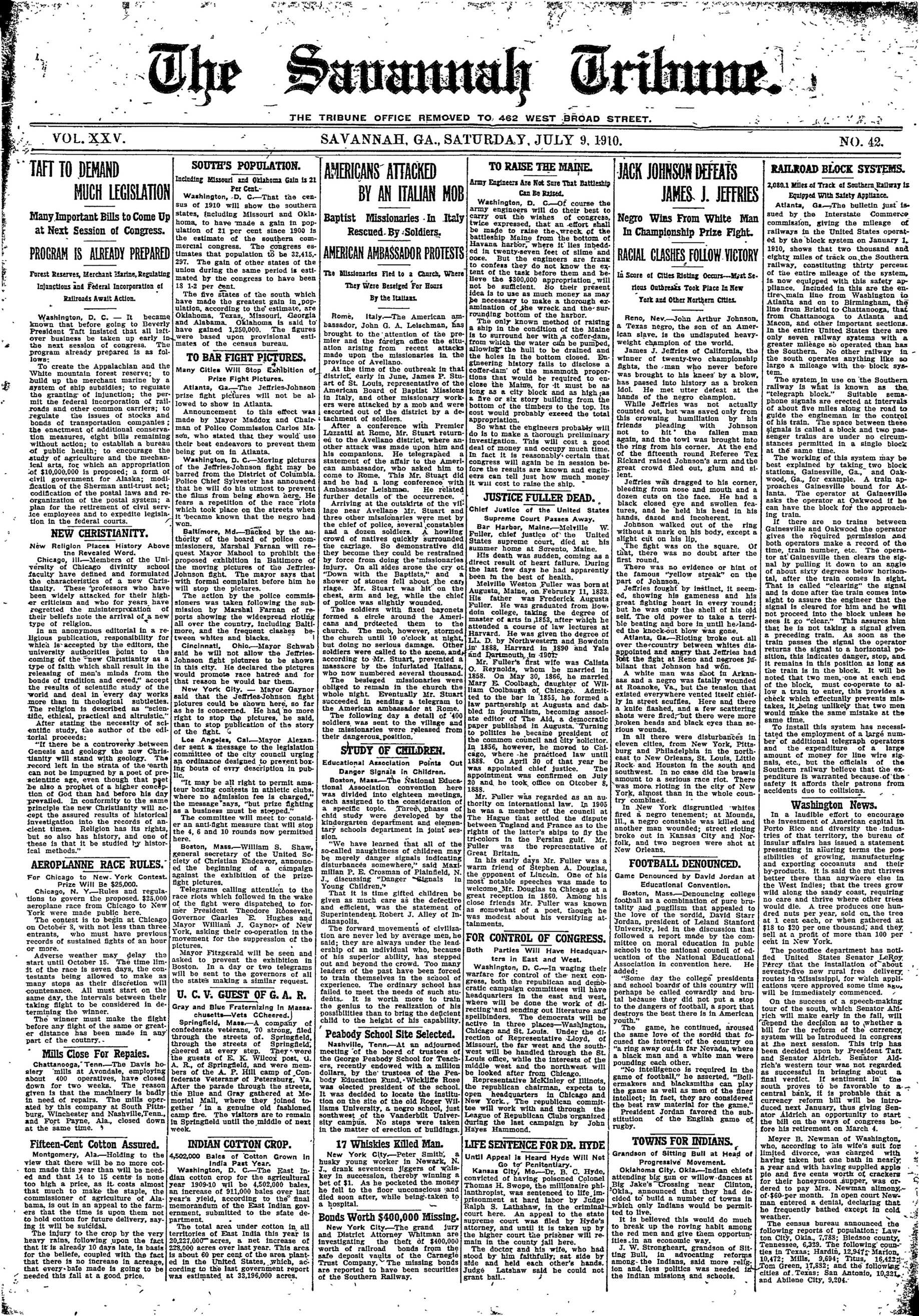
Washington, D. C. — It became known that before going to Beverly President Taft insisted that all left-over business be taken up early in the next session of congress. The program already prepared is as follows:
To create the Appalachian and the White mountain forest reserve; to build up the merchant marine by a system of ship subsidies; to regulate the granting of injunction; the permit the federal incorporation of railroads and other common carriers; to regulate the issues of stocks and bonds of transportation companies; the enactment of additional conservation measures, eight bills remaining without action; to establish a bureau of public health; to encourage the study of agriculture and the mechanical arts, for which an appropriation of $10,000,000 is proposed; a form of civil government for Alaska; modification of the Sherman anti-trust act; codification of the postal laws and reorganization of the postal system; a plan for the retirement of civil service employees and to expedite legislation in the federal courts.
NEW CHRISTIANITY.
New Religion Places History Above the Revealed Word.
Chicago, ill—Members of the University of Chicago divinity school faculty have defined and formulated the characteristics of a new Christianity. These professors who have been widely attacked for their higher criticism and who for years have regretted the misinterpretation of their beliefs note the arrival of a new type of religion.
In an anonymous editorial in a religious publication, responsibility for which is accepted by the editors, the university authorities point to the coming of the "new Christianity as a type of faith which shall result in the releasing of men's minds from the bonds of tradition and creed," accept the results of scientific study of the world and deal in every day works more than in theological subtleties. The religion is described as "scientific, ethical, practical and altruistic." After stating the necessity of scientific study, the author of the edi-
After stating the necessity of scientific study, the author of the editorial proceeds:
"If there be a controversy between Genesis and geology the new Christianity will stand with geology. The record left in the strata of the earth can not be impugned by a poet of prescientific age, even though that poet be also a prophet of a higher conception of God than had before his day prevailed. In conformity to the same principle the new Christianity will accept the assured results of historical investigation into the records of ancient times. Religion has its rights, but so also has history, and one of these is that it be studied by historical methods."
AEROPLANNE RACE RULES.
For Chicago to New York Contest
Prize Will Be $25,000.
Chicago, N. Y. -Rules and regulations to govern the proposed. $25,000 aeroplane race from Chicago to New York were made public here.
The contest is to begin at Chicago on October 8, with not less than three entrants, who must have previous records of sustained fights of an hour or more.
Adverse weather may delay the start until October 15. The time limit of the race is seven days, the contestants being allowed to make as many stops as their discretion will countenance. All must start on the same day, the intervals between their taking flight to be considered in determining the winner.
The winner must make the flight before any flight of the same or greater distance has been made in any part of the country.
Mills Close For Repales.
Chattanooga, "Tenn—The Davis hoalery 'mills at Avondale, employing about 400 operatives, have closed down for two weeks. The reason given is that the machinery is badly in need of repairs. The mills operated by this company at South Pittsburg, Winchester and Nashville,Tenn., and Fort Payne, Ala., closed down at the same time.
Fifteen-Cent Cotton Assured.
Montgomery, Ala.-Holding to the view that there will be no more cotton made this year than will be needed and that 14 to 15 cents is none too high a price, as it costs almost that much to make the staple, the commissioner of agriculture of Alabama, is out in an appeal to the farmers that the time is upon them not to hold cotton for future delivery, saying it will be suicidal.
The injury to the crop by the very heavy rains, following upon the fact that it is already 10 days late, is basis for the believe, coupled with the fact that there is no increase in acreage, that every-bale made is going to be needed this fall at a good price.
THE TRIBUNE OFFICE REMOVED TO, 462 WEST BROAD STREET.
SOUTH'S POPULATION.
Including Missouri and Oklahoma Gain is 21 Per Cent
Washington, D. C.-That the census of 1910 will show the southern states, including Missouri and Oklahoma, to have made a gain in population of 21 per cent since 1900 is the estimate of the southern commercial congress. The congress estimates that population to be 32,415,297. The gain of other states of the union during the same period is estimated by the congress to have been 13 1-2 per cent.
The five states of the south which have made the greatest gain in population, according to the estimate, are Oklahoma, Texas, Missouri, Georgia and Alabama. Oklahoma is said to have gained 1,250,000. The figures were based upon provisional estimates of the census bureau.
TO BAR FIGHT PICTURES.
Many Cities Will Stop Exhibition of Prize Fight Pictures.
Atlanta, Ga.-The Jeffries-Johnson prize fight pictures will not be allowed to show in Atlanta.
Announcement to this effect was made by Mayor Maddox and Chairman of Police Commission Carlos Mason, who stated that they would use their best endeavors to prevent them being put on in Atlanta.
Washington, D. C.-Moving pictures of the Jeffries-Johnson fight may be barred from the District of Columbia.
Police Chief Sylvester has announced that he will do his utmost to prevent the films from being shown here. He fears a repetition of the race riots which took place on the streets when it became known that the negro had won.
Baltimore, Md.-Backed by the authority of the board of police commissioners, Marshal Farnan will request Mayor Mahool to prohibit the proposed exhibition in Baltimore of the moving pictures of the Jeffries-Johnson fight. The mayor says that with formal complaint before him he will stop the pictures.
The action by the police commissioners was taken following the submission by Marshal Farnan of reports showing the widespread rioting all over the country, including Baltimore, and the frequent clashes between whites and blacks.
Cincinnati, Ohio.-Mayor Schwab said he will not allow the Jeffries-Johnson fight pictures to be shown in this city. He declared the pictures would promote race hatred and for that reason he would bar them.
New York City. — Mayor Gaynor said that the Jeffries-Johnson fight pictures could be shown here, so far as he is concerned. He had no more right to stop the pictures, he said, than to stop publication of the story of the fight.
Los Angeles, Cal.—Mayer Alexander sent a message to the legislation committee of the city council urging an ordinance designed to prevent boxing bouts of every description in public.
"It may be all right to permit amateur boxing contests in athletic clubs, where no admission fee is charged," the message says, "but prize fighting as a business must be stopped."
The committee will meet to consider an anti-fight measure that will stop the 4, 6 and 10 rounds now permitted here.
Boston, Mass.—William S. Shaw, general secretary of the United Society of Christian Endeavor, announced the beginning of a campaign against the exhibition of the prize-fight pictures.
Telegrams calling attention to the race riots which followed in the wake of the fight were dispatched to former President Theodore Roosevelt, Governor Charles E. Hughes and Mayor William J. Gaynor of New York, asking their co-operation in the movement for the suppression of the pictures. Mayor Fitzgerald will be seen and asked to prevent the exhibition in Boston. In a day or two telegrams will be sent to the governors of all the states making a similar request.
U. C. V. GUEST OF G. A. R.
Gray and Blue Fraternizing In Massa-
chussette-Vets, GCheered
Springfield, Mass.—A company of confederate veterans, 70 of whom fled through the streets of Springfield, through the streets of Springfield, cheered at every step. They were the guests of E. K. Wilcox post, A. R. of Springfield, and were members of the A. P. Hill camp of Confederate Veterans of Petersburg, Va. After the parade through the streets, the Blue and Gray gathered at Memorial Mall, where they joined together in a genuine old fashioned camp fire. The visitors are to remain in Springfield until the middle of next week.
INDIAN COTTON CROP.
4,502,000 Bales of Cotton Grown in India Past Year.
Washington, D. C.-The East Indian cotton crop for the agricultural year 1909-10 will be 4,502,000 bales, an increase of 911,000 bales over last year's yield, according to the final memorandum of the East Indian government, submitted to the state department.
The total area under cotton in all territories of East India this year is 20,227,000 acres, a net increase of 228,000 acres over last year. This area is about 60 per cent of the area planted in the United States, which, according to the last government report was estimated at 33,196,000 acres.
SAVANNAH, GA., SATURDAY, JULY 9, 1910.
AMERICANS ATTACKED
BY AN ITALIAN MOB
Baptist Missionaries . In Italy Rescued By Soldiers.
AMERICAN AMBASSADOR PROTESTS
The Missionaries Fled to a Church, Where They Were Beselged For Hours
Rome, Italy—The American ambassador, John G. A. Leischman, has brought to the attention of the premier and the foreign office the situation arising from recent attacks made upon the missionaries in the province of Avellano.
At the time of the outbreak in that district, early in June, James P. Stuart of St. Louis, representative of the American Board of Baptist Missions in Italy, and other missionary workers were attacked by a mob and were detached from the district by a detachment of soldiers.
After a conference with Premier Luzzatti at Rome, Mr. Stuart returned to the Avellano district, where another attack was made upon him and his companions. He telegraphed a statement of the affair to the American ambassador, who asked him to come to Rome. This Mr. Stuart did and he had a long conference with Ambassador Leischman. He related further details of the occurrence.
Arriving at the outskirts of the village near Avellane Mr. Stuart and three other missionaries were met by the chief of police, several constables and a dozen soldiers. A howling crowd of natives quickly surrounded the carriage. So demonstrative did they become they could be restrained by force from doing the missionaries' injury. On all sides arose the cry of "Down with the Baptists," and a shower of stones fell about the carriage. Mr. Stuart was hit on the chest, arm and leg, while the chief of police was slightly wounded. The soldiers with fixed bayonets formed a circle around the Americans and protected them to the church. The mob, however, stormed the church until 10 o'clock at night, but doing no serious damage. Other soldiers were called to the scene, and, according to Mr. Stuart, prevented a massacre by the infuriated Italians, who now numbered several thousand.
The besieged missionaries were obliged to remain in the church the whole night. Eventually Mr. Stuart succeeded in sending a telegram to the American ambassador at Rome. The following day a detail of 400 soldiers was sent to the village and the missionaries were released from their dangerous position.
STUDY OF CHILDREN.
Educational Association Points Out Danger Signals in Children.
Boston, Mass—The National Educational Association convention here was divided into eighteen meetings, each assigned to the consideration of a specific topic. Three phases of child study were developed by the kindergarten department and elementary schools department in joint session.
"We have learned that all of the so-called naughtiness of children may be merely danger signals indicating disturbances somewhere," said Maximillian P. E. Crosman of Plainfield, N. J., discussing "Danger Signals in Young Children."
That it is time gifted children be given as much care as the defective and efficient, was the statement of Superintendent Robert J. Alley of Indianapolis.
The forward movements of civilization are never led by average men, he said; they are always under the leadership of an individual who, because of his superior ability, has stepped out and beyond the crowd. Too many leaders of the past have been forced to train themselves in the school of experience. The ordinary school has failed to meet the needs of such students. It is worth more to train the genius to the realization of his possibilities than to bring the deficient child to the height of his capability.
Peabody School Site Selected.
Nashville, Tenn.-At an adjourned meeting of the board of trustees of the George Peabody School for Teachers, recently endowed with a million dollars, by the trustees of the Peabody Education Fund,-Wickliffe Rose was elected president of the school. It was decided to locate the institution on the site of the old Roger Williams University, a negro school, just southwest of the Vanderbilt University campus. No steps were taken in the matter of greeding of buildings.
17 Whiskies Killed Man.
New York City—Peter Smith, a husky young worker in Newark, N. J., drank seventeen jiggers of whiskey in succession, thereby winning a bet of $1. As he pocketed the money he fell to the floor unconscious and dled soon after, while being-taken to a hospital.
Bonds Worth $400,000 Missing.
New York City—The grand jury and District Attorney Whitman are investigating the theft of $400,000 worth of railroad bonds from the safe deposit vaults of the Carnegie Trust Company. The missing bonds are reported to have been securities of the Southern Railway.
TO RAISE THE MAINE.
Army Engineers Are Not Sure That Battleship Can Be Raised.
Washington, D. C. Of course the army engineers will do their best to carry out the wishes of congress, twice expressed, that an effort shall be made to raise the wreck of the battleship Maine from the bottom of Havana harbor, where it lies inbedded in twenty-seven feet of silime and ooze. But the engineers are frank to confess they do not know the extent of the task before them and believe the $300,000 appropriation will not be sufficient. So their present idea is to use as much money as may be necessary to make a thorough examination of the wreck and the surrounding bottom of the harbor.
The only known method of raising a ship in the condition of the Maine is to surround her with a coffer-dam, from which the water can be pumped, allowing the hull to be drained and the holes in the bottom closed. Engineering history fails to disclose a coffer-dam of the mammoth proportions that would be required to enclose the Maine, for it must be as long as a city block and as high as a five or six story building from the bottom of the timbers to the top. Its cost would probably exceed the total appropriation.
So what the engineers probably will do is to make a thorough preliminary investigation. Tails will cost a good deal of money and occupy much time. In fact it is reasonably certain that congress will again be in session before the results are known and engineers can tell just how much money it will cost to raise the ship.
JUSTICE FULLER DEAD.
Chief Justice of the United States Supreme Court Passes Away.
Bar Harbor, Maline—Melville W. Fuller, chief justice of the United States supreme court, died at his summer home at Sorento, Maline.
His death was sudden, coming as a direct result of heart failure. During the last few days he had apparently been in the best of health.
Melville Weston Fuller was born at Augusta, Maline, on February 11, 1833.
His father was Frederick Augusta Fuller. He was graduated from Bowdoin college, taking the degree of master of arts in 1853, after which he attended a course of law lectures at Harvard. He was given the degree of LL. D. by Northwestern and Bowdoin in 1888, Harvard in 1890 and Yale and Dartmouth in 1907.
Mr. Fuller's first wife was Calista O. Reynolds, whom he married in 1858. On May 30, 1866, he married Mary E. Coolbaugh, daughter of William Coolbaugh of Chicago. Admitted to the bar in 1855, he formed a law partnership at Augusta and dabbed in journalism, becoming associate editor of The Aid, a democratic paper published in Augusta. Turning to politics he became president of the common council and city solicitor. In 1856, however, he moved to Chicago, where he practiced law until 1888. On April 30 of that year he was appointed chief justice. The appointment was confirmed on July 20 and he took office on October 8, 1888.
Mr. Fuller was regarded as an authority on international law. In 1905 he was a member of the council at The Hague that settled the dispute between Tagland and France as to the rights of the latter's ships to fly the tricolors in the Persian gulf. Mr. Fuller was the representative of Great Britain.
In his early days Mr. Fuller was a warm friend of Stephen A. Douglas, the opponent of Lincoln. One of his most notable speeches was made to welcome Mr. Douglas to Chicago at a great reception in 1860. Among his close friends Mr. Fuller was known as somewhat of a poet, though he was modest about his versifying attalnments.
FOR CONTROL OF CONGRESS.
Both Parties Will Have Headquarters in East and West.
Washington, D. C. In waging their warfare for control of the next congress, both the republican and democratic campaign committees will have headquarters in the east and west, where will be done the work of directing and sending out literature and spellbinders. The electors will be active in three places—Washington, Chicago and St. Louis. Under the direction of Representative Lloyd of Missouri, the far west and the southwest will be handled through the St. Louis office, while the interests of the middle west and the northwest will be looked after from Chicago.
Representative McKinley of Illinois, the republican chairman, expects to open headquarters in Chicago and New York. The republican committee will work with and through the League of Republican Clubs organized during the last campaign by John Hayes Hammond.
LIFE SENTENCE FOR DR. HYDE
Until Appeal is Heard Hyde Will Not Go to Penitentiary.
Kansas City, Mo—Dr. B. C. Hyde, convicted of having poisoned Colonel Thomas H. Swope, the millionaire philanthropist, was sentenced to life imprisonment at hard labor by Judge Ralph S. Lathshaw, in the criminal court here. An appeal to the state supreme court was filed by Hyde's attorney, and until it is taken up by the higher court the prisoner will remain in the county jail here. The doctor and his wife, who had stood by him faithfully, sat side by side and held each other's hands. Judge Latshaw said he could not grant ball.
In Score of Cities Rioting Occurs—Most Serious Outbreaks Took Place in New York and Other Northern Cities.
Reno, Nev.—John Arthur Johnson, a Texas negro, the son of an American slave, is the undisputed heavyweight champion of the world.
James J. Jeffries of California, the winner of twenty-two championship fights, the man who never before was brought to his knees' by a blow, has passed into history as a broken idol. He met utter defeat at the hands of the negro champion.
While Jeffries was not actually counted out, but was saved only from this crowning humiliation by his friends pleading with Johnson not to hit the fallen man again, and the towl was brought into the ring from his corner. At the end of the fifteenth round Referee Tex Rickard raised Johnson's arm and the great crowd filed out, glum and silent.
Jeffries was dragged to his corner, bleeding from nose and mouth and a dozen cuts on the face. He had a black closed eye and swollen features, and he held his head in his hands, dazed and incoherent.
Johnson walked out of the ring without a mark on his body, except a slight cut on his lip.
The fight was on the square. Of that, there was no doubt after the first round.
There was no evidence or hint of the famous "yellow streak" on the part of Johnson.
Jeffries fought by instinct, it seemed, showing his gameness and his great fighting heart in every round; but he was only the shell of his old self. The old power to take a terrible beating and bore in until he landed the knock-out blow was gone.
Atlanta, Ga.—Rioting broke out all over the country between whites disappointed and angry that Jeffries had lost the fight at Reno and negroes jubilant that Johnson had won.
A white man was shot in Arkansas and a negro was fatally wounded at Roanoke, Va., but the tension that existed everywhere vented itself chiefly in street scuffles. Here and there a knife flashed, and a few scattering shots were fired; but there were more broken heads and black eyes than serious wounds.
In all there were disturbances in eleven cities, from New York, Pittsburgh and Philadelphia in the northeast to New Orleans, St. Louis, Little Rock, and Houston in the south and southwest. In no case did the brawls amount to a serious race riot. There was more rioting in the city of New York, almost than in the whole country combined. In New York disgruntled whites fired a negro tenement; at Mounds, ill., a negro constable was killed and another man wounded; street rioting broke out in Kansas City and Norfolk, and two negroes were shot at New Orleans.
FOOTBALL DENOUNCED.
Game Denounced by David Jordan at Educational Convention.
Boston, Mass.—Denouncing college football as a combination of pure brutality and pugilism that appealed to the love of the sordid, David Starr Jordan, president of Leland Stanford University, led in the discussion that followed a report made by the committee on moral education in public schools to the national council of education of the National Educational Association in convention here. He added:
"Some day the college presidents and school boards of this country will perhaps be called cowardly and brutal because they did not put a stop to the dangers of football, a sport that destroys the best there is in American youth."
The game, he continued, aroused the same love of the sordid that focused the interest of the country on "a ring away out in far Nevada, where a black man and a white man were pounding each other.
President Jordan favored the substitution of the English game of rugby.
TOWNS FOR INDIANS.
Grandson of Sitting Bull at Head of Progressive Movement. Oklahoma City, Okla.—Indian chiefs attending big gun or willow dances at Big Jake's Crossing near Clinton, Okla., announced that they had decided to build a number of towns in which only Indians would be permitted to live. It is believed this would do much to break up the roving habit among the red men and give them opportunities in an economic way. J. W. Strongheart, grandson of Sitting Bull, in advocating reforms among the Indians, said more religion and less politics was needed in the Indian missions and schools.
RAILROAD BLOCK SYSTEMS.
2,080.1 Miles of Track of Southern Railway is Equipped With Safety Appliance.
Atlanta, Ga.—The bulletin just issued by the Interstate Commerce commission, giving the mileage of railways in the United States operated by the block system on January 1, 1910, shows that two thousand and eighty miles of track on the Southern railway, constituting thirty percent of the entire mileage of the system, is now equipped with this safety appliance. Included in this are the entire main line from Washington to Atlanta and on to Birmingham, the line from Bristol to Chattanooga, that from Chattanooga to Atlanta and Macon, and other important sections. In the entire United States there are only seven railway systems with a greater mileage so operated than has the Southern. No other railway in the south operates anything like so large a mileage with the block system.
The system in use on the Southern railway is what is known as the "telegraph block." Suitable semaphore signals are erected at intervals of about five miles along the road to guide the engineman in the control of his train. The space between these signals is called a block and two passenger trains are under no circumstances permitted in a single block at the same time. The working of this system may be best explained by taking two block stations, Gainesville, Ga., and Oakwood, Ga., for example. A train approaches Gainesville bound for Atlanta. The operator at Gainesville asks the operator at Oakwood if he can have the block for the approaching train.
If there are no trains between Galenville and Oakwood the operator gives the required permission and both operators make a record of the time, train number, etc. The operator at Galenville then clears the signal by pulling it down to an angle of about sixty degrees below horizontal, after the train comes in sight. That is called "clearing" the signal and is done after the train comes into sight to assure the engineer that the signal is cleared for him and he will not proceed into the block unless he sees it go "clear." This ensures him that he is not taking a signal given a preceding train. As soon as the train passes the signal the operator returns the signal to a horizontal position, this indicates danger, stop, and it remains in this position as long as the train is in the block. It will be noted that two men, one at each end of the block, must co-operate to allow a train to enter, this provides a check which effectually prevents mistakes, it being unlikely that two men would make the same mistake at the same time.
To install this system has necessitated the employment of a large number of additional telegraph operators and the expenditure of a large amount of money for line wire signals, etc., but the officials of the Southern railway believe that the expenditure is warranted because of the safety it affords their patrons from accidents due to collisions.
Washington News.
In a laudible effort to encourage the investment of American capital in Porto Rico and diversity the industries of that territory, the bureau of insular affairs has issued a statement presenting in ailuring terms the possibilities of growing, manufacturing and exporting coconuts and their by-products. It is said the nut thrives better there than anywhere else in the West Indies; that the trees grow wild along the sandy coast, requiring no care and thrive where other trees would die. A tree produces one hundred nuts per year, sold on the tree at 1 cent each, or when gathered at $18 to $20 per one thousand; and they sell at a profit of more than 100 per cent in New York.
The postoffice department has notified United States Senator LeRoy Percy that the installation of about seventy-five new rural free delivery, routes in Mississippi, for which applications were approved some time ago, will be immediately commenced.
On the success of a speech-making tour of the south, which Senator Aldrich will make early in the fall, will depend the decision as to whether a bill for the reform of the currency system will be Introduced in congress at the next session. This trip has been decided upon by President Taft and Senator Aldrich. Senator Aldrich's western tour was not regarded as successful in bringing about a final verdict. If sentiment in the south proves to be favorable to a central bank, it is probable that a currency reform bill will be introduced next January, thus giving Senator Aldrich an opportunity to start the bill on the ways of congress before his retirement on March 4.
Meyer B. Newman of Washington, who, according to his wife's suit for limited divorce, was caarged with having taken but one bath in nearly a year and with having supplied apple ple and five cents worth of crackers for their honeymoon supper, was ordered to pay Mrs. Newman almony, of $60-per month. In open court Newman entered a denial, declaring that he frequently bathed except in cold weather.
The census bureau announced the following reports of population: Lawton City, Okla, 7,783; Bledsoe county, Tennessee, 6,229. The following counties in Texas: Hardin, 12,947; Marlon, 10,472; Mills, 9,694; Titus, 16,422; Tom Green, 17,832; and the following cities of Texas: San Antonio, 10,321; and Abilene City, 9,204.
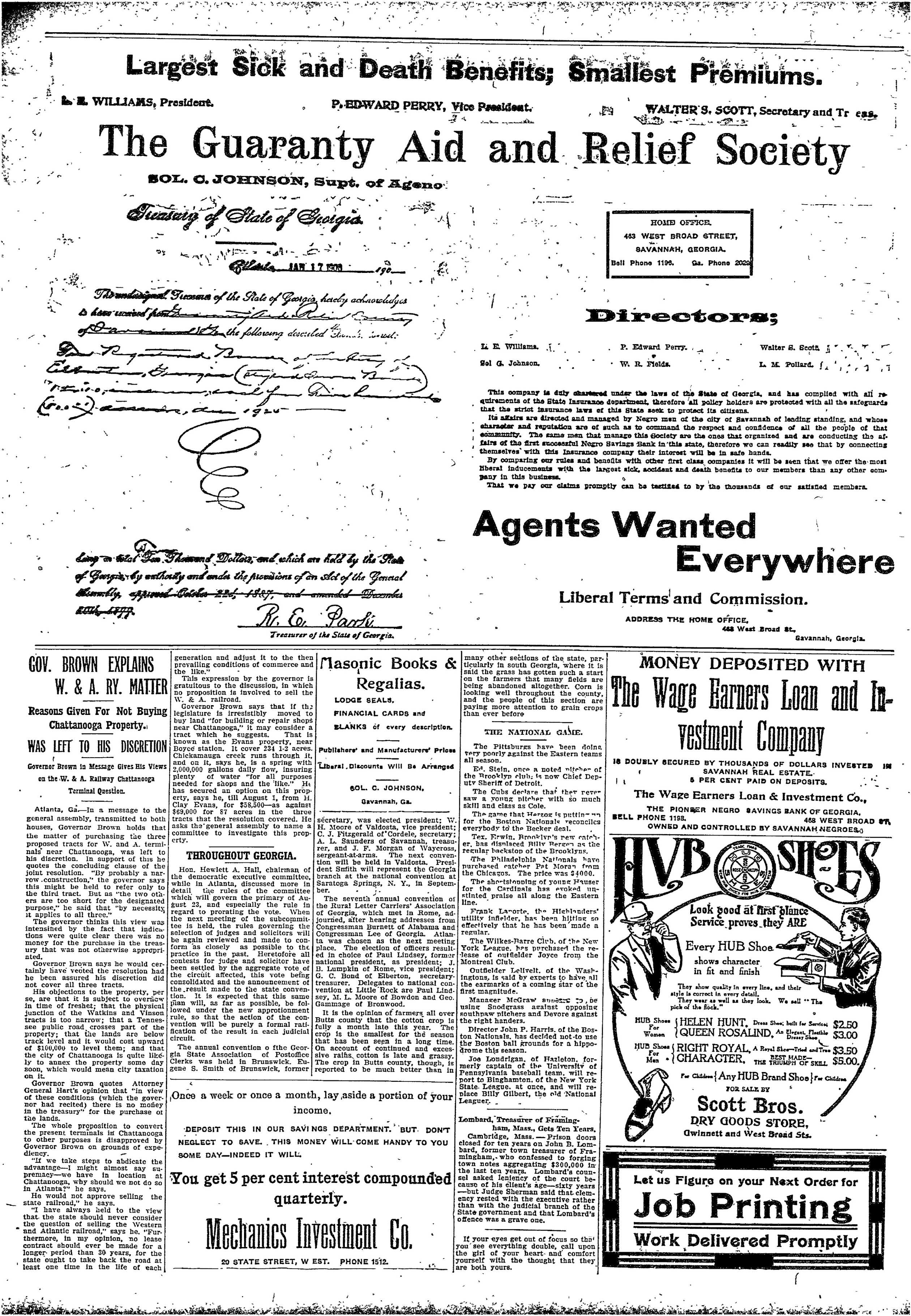
Largest Sick and Death Benefits; Smallest Premiums.
BOL. C. JOHNSON, Supt. of Ageno
Treasury of State of Georgia
Charles JAN 17 1900 — 190
The undersigned Treasurer of the State of Georgia, hereby acknowledged
& has received both
of the following described渤海郡,
Long on total Tax Thousand Dollars, and which are held by the State
of Georgia by authority and under the provisions of an Act of the General
Thousand, approved October 22nd, 1887, and amended December
22th, 1887.
R. E. Paoliti
Treasurer of the State of Georgia.
Reasons Given For Not Buying Chattanooga Property.
WAS LEFT TO HIS DISCRETION
Governor Brown in Message Gives His Views
Atlanta, Ga—In a message to the general assembly, transmitted to both houses, Governor Brown holds that the matter of purchasing the three proposed tracts for W. and A. terminals near Chattanooga, was left to his discretion. In support of this he quotes the concluding clause of the joint resolution. "By probably a narrow construction," the governor says this might be held to refer only to the third tract. But as "the two others are too short for the designated purpose," he said that "by necessity, it applies to all three."
The governor thinks this view was intensified by the fact that indications were quite clear there was no money for the purchase in the treasury that was not otherwise appropriated. Governor Brown says he would certainly have vested the resolution had he been assured his discretion did not cover all three tracts.
His objections to the property, per se, are that it is subject to overnew in time of freshet; that the physical junction of the Watkins and Vinson tracts is too narrow; that a Tennessee public road crosses part of the property; that the lands are below track level and it would cost upward of $100,000 to level them; and that the city of Chattanooga is quite likely to annex the property some day soon, which would mean city taxation on it.
Governor Brown quotes Attorney General Hart's opinion that "in view of these conditions (which the governor had recited) there is no money in the treasury" for the purchase of the lands.
The whole proposition to convert the present terminals in Chattanooga to other purposes is disapproved by Governor Brown on grounds of expediency.
"If we take steps to abdicate the advantage—I might almost say supremacy—we have in location at Chattanooga, why should we not do so in Atlanta?" he says.
He would not approve selling the state railroad," he says.
"I have always held to the view that the state should never consider the question of selling the Western and Atlantic railroad," says he. "Furthermore, in my opinion, no lease contract should ever be made for a longer period than 30 years, for the state ought to take back the road at least one time in the life of each
generation and adjust it to the then prevailing conditions of commerce and the like." This expression by the governor is gratuitous to the discussion, in which no proposition is involved to sell the W. & A. railroad.
Governor Brown says that if the legislature is irresistibly moved to buy land "for building or repair shops near Chattanooga," it may consider a tract which he suggests. That is known as the Evans property, near Boyce station. It cover 234 1-2 acres. Chickamauga creek runs through it, and on it, says he, is a spring with 2,000,000 gallons daily flow, insuring plenty of water "for all purposes needed for shops and the like." He has secured an option on this property, says he, till August 1, from H. Clay Evans, for $58,500—as against $69,000 for 87 acres in the three tracts that the resolution covered. He asks the general assembly to name a committee to investigate this property.
THROUGHOUT GEORGIA.
Hon. Hewlett A. Hall, chairman of the democratic executive committee, while in Atlanta, discussed more in detail the rules of the committee which will govern the primary of August 23, and especially the rule in regard to prorating the vote. When the next meeting of the subcommittee is held, the rules governing the selection of judges and solicitors will be again reviewed and made to conform as closely as possible to the practice in the past. Heretofore all contests for judge and solicitor have been settled by the aggregate vote of the circuit affected, this vote being consolidated and the announcement of the result made to the state convention. It is expected that this same plan will, as far as possible, be followed under the new approortion rule, so that the action of the convention will be purely a formal ratification of the result in each judicial circuit.
The annual convention o fthe Georgia State Association of Postoffice Clerks was held in Brunswick. Eugene S. Smith of Brunswick, former
Once a week or once a month inco
DEPOSIT THIS IN OUR SAVING NEGLECT TO SAVE. THIS MON
SOME DAY—INDEED IT WILL.
You get 5 per cent in
quart
Mechanics In
Once a week or once a month, lay aside a portion of your income.
DEPOSIT THIS IN OUR SAVINGS DEPARTMENT. BUT DON'T NEGLECT TO SAVE. THIS MONEY WILL COME HANDY TO YOU SOME DAY—INDEED IT WILL.
You get 5 per cent interest compounded quarterly.
20 STATE STREET, W EST. PHONE 1512.
Liberal. Discounts Will Be Arranged
SOL. C. JOHNSON,
Gavannah, Ga.
secretary, was elected president; W.
H. Moore of Valdosta, vice president;
C. J. Fitzgerald of Cordele, secretary;
A. L. Saunders of Savannah, treasurer, and J. F. Morgan of Waycross, sergeant-at-arms. The next convention will be held in Valdosta. President Smith will represent the Georgia branch at the national convention at Saratoga Springs, N. Y., in September.
The seventh annual convention of the Rural Letter Carriers' Association of Georgia, which met in Rome, adjourned, after hearing addresses from Congressman Burnett of Alabama and Congressman Lee of Georgia. Atlanta was chosen as the next meeting place. The election of officers resulted in choice of Paul Lindsey, former national president, as president; J. B. Lumpkin of Rome, vice president; G. C. Bond of Elberton, secretary-treasurer. Delegates to national convention at Little Rock are Paul Lindsey, M. L. Moore of Bowdon and Geo. Gammage of Bronwood.
It is the opinion of farmers all over Butts county that the cotton crop is fully a month late this year. The crop is the smallest for the season that has been seen in a long time. On account of continued and excessive rails, cotton is late and grassy. The crop in Butts county, though, is reported to be much better than in
h, lay aside a portion of your home.
NGS DEPARTMENT. BUT DON'T
NEY WILL COME HANDY TO YOU
interest compounded
likely.
Investment Co.
---
HOMEOFFICE
463 WEST BROAD STREET,
SAVANNAH, GEORGIA.
Bell Phone 1196. Ga. Phone 2029
Directors;
L. E. Williams.
Sol G. Johnson.
P. Edward Perry.
W. R. Fields.
Walter S. Scott
L. M. Pollard.
This company is duly chartered under the laws of the State of Georgia, and has complied with all requirements of the State Insurance department, therefore all policy holders are protected with all the safeguards that the strict insurance laws of this State seek to protect its citizens.
Its affairs are directed and managed by Negro men of the city of Savannah of leading standing, and whose character and reputation are of such as to command the respect and confidence of all the people of that community. The same men that manage this Society are the ones that organized and are conducting the affairs of the first successful Negro Savings Bank in this state, therefore we can readily see that by connecting themselves with this Insurance company their interest will be in safe hands.
By comparing our rules and benefits with other first class companies it will be seen that we offer the most liberal inducements with the largest sick, accident and death benefits to our members than any other company in this business.
That we pay our claims promptly can be testified to by the thousands of our satisfied members.
Agents Wanted Everywhere
Liberal Terms and Commission.
many other sections of the state, particularly in south Georgia, where it is said the grass has gotten such a start on the farmers that many fields are being abandoned altogether. Corn is looking well throughout the county, and the people of this section are paying more attention to grain crops than ever before
MONEY DEPOSITED WITH The Wage Earners Loan and Investment Company
THE NATIONAL GAME.
The Pittsburgse have been doing very poorly against the Eastern teams all season.
18 DOUBLY SECURED BY THOUSANDS OF DOLLARS INVESTED SAVANNAH REAL ESTATE. 8 PER CENT PAID ON DEPOSITS.
Ed. Stein, once a noted pitcher of the Brooklyn club, is now Chief Deputy Sheriff of Detroit.
The Cubs declare that they revers saw a young pitcher with so much skill and class as Cole.
The game that Herzog is putting up for the Boston Nationals reconciles everybody to the Becker deal.
Tex. Erwin, Brooklyn's new catcher, has dislaced Billy Bergen as the regular backstop of the Brooklyn.
HUB SHOES
Look good at first glance
Service proves they ARE
Every HUB Shoe
shows character
in fit and finish
They show quality in every line, and their
style is correct in every detail.
They wear as well as they look. We sell **The
pick of the stock."
HUB Shoes
For Women
HELEN HUNT. Dress Shoe; built for Services $2.50
QUEEN ROSALIND, An Elegant, Flexible Dressy Shoe $3.00
HUB Shoes
For Men
RIGHT ROYAL, A Royal Shoe—Tried and True $3.50
CHARACTER, BEST MADE—THE TRIUMPH OF SKILL $5.00.
For Children
Any HUB Brand Shoe For Children
FOR SALE BY
Scott Bros.
DRY GOODS STORE,
Gwinnett and West Broad Sts.
Let us Figure on your Next Order for
Job Printing
Work Delivered Promptly
The Philadelphia Nationals have purchased catcher Pat Moran from the Chicago. The price was $4000.
The shortstopning of young Hauser for the Cardinals has evoked unstinted praise all along the Eastern line.
Frank Lamorte, the Highlanders' utility infielder, has been hitting so effectively that he has been made a regular.
The Wilkes-Barre Club. of the New York League. has purchased the release of outfielder Joyce from the Montreal Club.
Outfielder Lelivelt. of the Washington, is said by experts to have all the earmarks of a coming star of the first magnitude.
Manager McGraw announces to, be using Snodgrass against opposing southpaw pitchers and Devore against the right handers.
Director John P. Harris, of the Boston Nationals, has decided not-to use the Boston ball grounds for a hippodrome this season.
Joe Londrigan, of Hazleton, formerly captain of the University of Pennsylvania baseball team, will report to Binghamton, of the New York State League, at once, and will replace Billy Gilbert, the old National Leaguer.
Lombard, Treasurer of Framing-
ham, Mass., Gets Ten Years, Cambridge, Mass. — Prison doors closed for ten years on John B. Lombard, former town treasurer of Framingham, who confessed to forging town notes aggregating $300,000 in the last ten years. Lombard's counsel asked lenency of the court because of his client's age—sixty years—but Judge Sherman said that clemency rested with the executive rather than with the judicial branch of the State government and that Lombard's offence was a grave one.
If your eyes get out of focus so that you see everything double, call upon the girl of your heart and comfort yourself with the thought that they are both yours.
Rules For Prolonging
The Farmer Likely to Be the Ultimate Loser, Whatever Happens.
F. G. S. (Springfield, Vt.): Some time ago the papers published rules formulated by famous physicians for prolonging life to one hundred years. Could you give me those rules? Although this earth is "a valley of tears," the number of men and women anxious to prolong their abode on it is very considerable. These people do not deal with logic too seriously. If you ask them about the joys of existence they will tell you that it has none whatever, that life is not worth living, that "to shuffle off this mortal coll" was "a consumption devoutly to be wished," but in the next moment, upon learning of the discovery of the means of prolonging life to one hundred years at least, they will eagerly seek to get hold of the marvellous specific in order to prolong their so much depleted existence.
As a matter of fact, there *As no mortal that does not envy Methusaleh*, who, as is known, reached the age of 960 years, although such a desire would be perfectly irrational, for in the long run the spectacle of this world must become very tiresome, as is proved by the indifference manifested by old people to everything that interests and agitates the men of forty. But what's the use preaching in the wilderness? Rather let us see how paying the debt to nature may by some ingenious method be delayed for a good number of years.
Lord Wemyss, the well known member of the English Parliament, the other day celebrated the anniversary of his ninetieth birthday, and on that occasion gave some good advice to those who would like to reach the same age. To this end, says our authority, we must be temperate; sleep eight hours, and this so by night only; eat well and rich food, and be given to sporting. So far the lord does not tell us anything new. He, however, adds naively that all this will be of no avail if we have not been careful in the selection of our parents. To reach his age we are furthermore told we must remain all our life in the habitual milieu where we were born and raised, and in the same conditions, for then only we are not subject to changes that wear out alike body and mind. It must be said that the lord himself little changed his habits. For sixty-seven bears he sat in Parliament, for fifty bears he was engaged in forming a volunteer corps, and for eighty years long he had every morning for his breakfast tea, ham and eggs and fresh salads. It is obvious that a common mortal not having Lord Wemyss' annual income of £20,000 or so cannot profit much by his well meant advice.
Much simpler and easier to follow are the rules for prolonging life recommended by the famous French hygienist, Payes. They are: First, be chaise. Second, take much exercise; eat, but a light breakfast; have for your dinner fresh salads, potatoes and rare roast; go early to bed and sleep long. This method is not much complicated, and, with the exception of the roast, the very poorest can follow this diet. As regards its value from the point of view of longevity, there is nothing in particular to either recommend or refute. Besides, we do not depend on it alone, and have in this matter rather the embarrassment of choice. The secrets of long life abound, and the persistence of a certain average rate of mortality must be attributed to people's bestest of profiting thereby.
Thus, for instance, two or three years ago an English physician of Birmingham, Sir James Sawyer, probably repenting for having launched some of his patients too quickly on the great voyage, wanted to make amends for his involuntary wrongs by publishing an infallible method of reaching a very old age. It is summed up in the following rules: 1. Eight hours' sleep. 2. Sleep on your right side. 3. Keep the windows of your bedroom open all night. 4. Do not have your bedstead against the wall. 5. No cold tub in the morning, but a bath at the temperature of the body. 6. Take exercise before breakfast. 7. Eat but little meat and
Since the beginning of the present unwarranted agitation regarding the cost of living city papers have been inquiring "Who gets the money?" While this may be a fair and logical question it is being answered in a manner decidedly unfair to the producer. The farmer is accused not only of pocketing the big end of the increase, but also of demanding prices but of all proportion to the expense involved in production. In both instances the accusers are wrong, and because of inexcusable ignorance of conditions. While the farmer may be receiving higher prices for his products than formerly he is entitled to them. The cost of production on the farm has not been standing still while that of the shop and factory have increased. These same conditions have existed upon the farm, and in some respects to even a higher degree than in the case of other manufactories.
The farmer is yet receiving no more than his due. But if he was it would be no more than right considering that he is the man who always suffers most from agitations concerning economic problems. Every time these sensational crushes occur, whether it be on the cost of living, an intended
see to it that it be well cooked. 8. (For adults.) Drink no milk. 9. Eat plenty of fat, to feed the cells which destroy the germs of disease, and avoid intoxicants, which destroy those cells. 10. Daily exercise in the open air. 11. Allow no pet animals in your living room; they are liable to carry disease germs. 12. Live in the country if you can. 13. Have frequent change of occupation. 14. Take frequent and short holidays. 15. Limit your ambitions, and, 16. keep your temper.
It is evident that the Birmingham physician was a friend of mankind and inspired by the best motives, but it is also true that his recipe can only be applied to the well-to-do. The method proposed by another physician, Dr. Bullison, of Toledo, will better suit those poor devils who have nothing to eat, as its principal feature consists in frequent and prolonged fasts. Dr. Bullison assures us that up to the age of fifteen man has eaten sufficient so. as to enable him to live for a hundred years on his own organism, and that hunger was a disease that we ourselves cultivated by our bad habits. Dr. Bullison himself takes but one repast every twenty-four hours, and lives exclusively, on fruits and vegetables; but as he considers even this alimentation too excessive, he tries to counteract its sad effects by fasting from time to time for a couple of weeks, feeding only on water and fresh air. His happiness would be perfect if our social laws were less severe against those who are fond of the costume worn by—Adam. Nevertheless, he finds comfort in the thoughts that there is no law to prevent him from dressing in his own house in the fashion popular in the Garden of Eden. Although Dr. Sawyer, Dr. Bullison and other inventors of methods of living as long as Methusaleh are equally convinced of the superiority of their respective modes of living, it is not likely that they will find many limitators. All these theories are ultimately not worth more than the advice given by some wit who said:
"You want to live more than a hundred years? Nothing easier. Buy a parrot and wait for his death. This animal lives more than a century."
As a matter of fact, while empliricism offers us hundreds of methods of prolonging life to the age of Methuselah, science so far has failed to find a means of adding a considerable number of years to our terrestrial career, though it does not deny the possibility of ultimately accomplishing this feat. As said only the other day by Professor Metchnikoff in an interview on this subject: "There is no doubt that the man of the future will be able to prolong his life. To attain this end, however, we must first know all the causes of aging. These causes are not yet perfectly determined. We try to find them out, and mankind, for the time being, must content itself with hoping." . .
But we must not in this respect allow hope to get the better of reason by expecting the unrealizable. Long-gevity is intimately bound with three kinds of circumstances. Some spring from heredity, others from social hygiene and others again from individual hygiene. There are families who live long, others who die young. As we cannot chose our parents, there is no means of escaping the fatal consequences of heredity. It is, however, certain that in the better organized societies of the future the number of epidemic diseases will diminish. Phthisis, typhoid fever, cholera and eruptive fevers will, owing to general hygiene, become less fatal. Finally individual hygiene, which consists in living an active physical life, will facilitate the individual to avoid the causes that tend to shorten existence. Beyond these principles there are but ingenious theories which we should be careful not to take for verified truths.—New York Tribune.
More than 20,000 twenty-candle power incandescent lamp filaments can be made from a single pound of tantalum.
prosecution of the packers or what not, the farmer must foot the bills. It is his business that suffers most—not that of the food distributor and retailers. As a result of the recent agitation the price of live meat animals took an unexpected tumble of from four to fifteen per cent. Such a drop was precipitated all along the line in the short space of but a few days. The decline comes without warning and the producer is caught. He pays the bill which by rights should fall to the irresponsible calamity howler, the professional agitator and the backers of yellow journalism.—The Farmer's Review.
Enough Said.
Irascible Old Gent (to school girl who has collided with him)—"When you run into people like that you should say, 'I beg your pardon.'" Girl—"There won't no need. I heard what you said."—Sydney Bulletin.
In many German factories the female employees are forbidden to wear corsets during working hours.
A Mode Which is Unusually Popular
This Season.
Fancy Blouse.
Closing Invisibly at the Left of tho
Front.
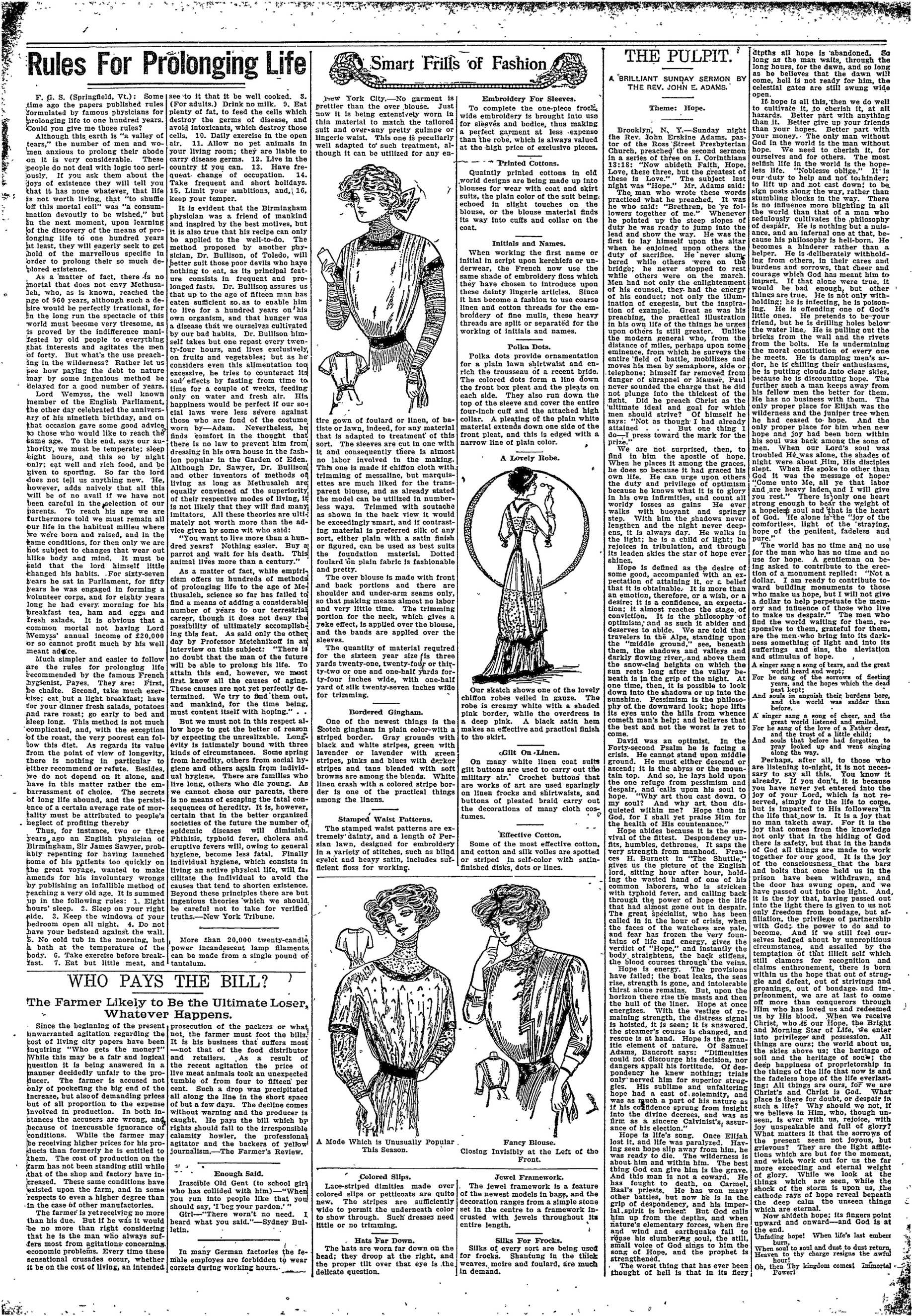
New York City.—No garment is prettier than the over blouse. Just now it is being extensively worn in thin material to match the tallored suit and over-any pretty gulmpe or lingerie waist. This one is peculiarly well adapted to such treatment, although it can be utilized for any en-
5
tire gown of foulard or linen, of bastire or lawn, indeed, for any material that is adapted to treatment of this sort. The sleeves are cut in one with it and consequently there is almost no labor involved in the making. This one is made if chiffon cloth with trimming of messaline, but marquisettes are much liked for the transparent blouse, and as already stated the model can be utilized in numberless ways. Trimmed with soutache as shown in the back view it would be exceedingly smart, and if contrasting material is preferred silk of any sort, either plain with a satin finish or figured, can be used as best suits the foundation material. Dotted foulard on plain fabric is fashionable and pretty.
The over blouse is made with front and back portions and there are shoulder and under-arm seams only, so that making means almost no labor and very little time. The trimming portion for the neck, which gives a yeke effect, is applied over the blouse, and the bands are applied over the sleeves. The quantity of material required for the sixteen year size is three yards twenty-one, twenty-four or thirty-two or one and one-half yards forty-four inches wide, with one-half yard of silk twenty-seven inches wide for trimming.
Bordered Gingham.
One of the newest things is the Scotch gingham in plain color-with a striped border. Gray grounds with black and white stripes, green with lavender or lavender with green stripes, pinks and blues with decker stripes and tans blended with soft browns are among the blends. White linen crash with a colored stripe border is one of the practical things among the linens.
Stamped Waist Patterns.
The stamped waist patterns are extremely daly, and a length of Persian lawn, designed for embroidery in a variety of stitches, such as blind eyelet and heavy satin, includes sufficient floss for working.
SINGLE BREASTED DRESS
A Mode Which is Unusually Popular This Season.
Colored Slips.
Lace-striped dimities made over colored slips or petticoats are quite new. The stripes are sufficiently wide to permit the underneath color to show through. Such dresses need little or no trimming.
Hats Far Down.
The hats are worn far down on the head; they droop at the right, and the proper tilt over that eye is the delicate question.
Embroidery For Sleeves.
To complete the one-piece frock, wide embroidery is brought into use for sleeves and bodice, thus making a perfect garment at less expense than the robe, which is always valued at the high price of exclusive pieces.
Printed Cottons.
Quaintly printed cottonls in old world designs are being made up into blouses for wear with coat and skirt suits, the plain color of the suit being echoed in slight touches on the blouse, or the blouse material finds its way into cuffs and collar on the coat.
Initials and Names.
When working the first name or initial in script upon kerchiefs or underwear, the French now use the same shade of embroidery floss which they have chosen to introduce upon these dainty lingerie articles. Since it has become a fashion to use coarse linen and cotton threads for the embroidery of fine mulls, these heavy threads are split or separated for the working of initials and names.
Polka Dots.
Polka dots provide ornamentation for a plain lawn shirtwaist and enrich the trousseau of a recent bride. The colored dots form a line down the front box pleat and the pleats on each side. They also run down the top of the sleeve and cover the entire four-inch cuff and the attached high collar. A pleating of the plain white material extends down one side of the front pleat, and this is edged with a narrow line of plain color.
A Lovely Robe.
Our sketch shows one of the lovely chiffon robes veiled in gauze. The robe is creamy white with a shaded pink border, while the overdress is a deep pink. A black satin hem makes an effective and practical finish to the skirt.
<Gilt On <Linen.
On many white linen coat suits gilt buttons are used to carry out the military air.' Crochet buttons that are works of art are used sparingly on linen frocks and shirtwaists, and buttons of pleated braid carry out the decorations of many cloth costumes.
Effective Cotton.
Some of the most effective cotton, and cotton and silk volles are spotted or striped in self-color with satin-finished disks. dots or lines.
L.
Fancy Blouse.
Closing Invisibly at the Left of tho Front.
Jewel Framework.
The jewel framework is a feature of the newest models in bags, and the decoration ranges from a simple stone set in the centre to a framework incrusted with jewels throughout its entire length.
Silks For Frocks.
Silks of every sort are being used for frocks. Shantung in the thick weaves, moire and foulard, are much in demand.
THE PULPIT.
A BRILLIANT SUNDAY SERMON BY THE REV. JOHN E. ADAMS.
Theme: Hope.
Brooklyn, N. Y.—Sunday night the Rev. John Erkens Adams, pastor of the Ross Street Presbyterian Church, preached the second sermon in a series of three on I. Corinthians 13:18: "Now abideth Faith, Hope, and Love." These are these the Love." The subject last night was "Hone." Mr. Adams said:
The man who wrote these words practiced what he preached. It was he who said: "Brethren, he ye followers together of me." Whenever he pointed up the steep slopes of duty he was ready to jump into the lead and show the way. He was the first to lay himself upon the altar when he enjoined upon others the duty of sacrifice. He never slumbered while others were on the bridge; he never stopped to rest while others were on the march. Men had not only the enlightenment of his counsel, they had the energy of his conduct; not only the illumination of exegesis, but the inspiration of example. Great as was his preaching, the practical illustration in his own life of the things he urges upon others is still greater. Unlike the modern general who, from the distance of miles, perhaps upon some eminence, from which he surveys the entire field of battle, mobilizes and moves his men by semaphore, alde or telephone; himself far removed from danger of strapnel or Mauser. Paul never sounded the charge that he did not plunge into the thickest of the fight. Did he preach Christ as the ultimate ideal and goal for which men should strive? Of himself he says: "Not as though I had already attained . . . But one thing I do—I press toward the mark for the prize."
We are not surprised, then, to find in him the apostle of hope. When he places it among the graces, he does so because it had graced his own life. He can urge upon others the duty and privilege of optimism because he knows what it is to glory in his own infirmities, and count all worldly losses as gains. He ever walks with buoyant and springy step. With him the shadows never lengthen and the night never deepens, it is always day. He walks in the light; he is a child of light; he rejoices in tribulation, and through its leaden skies the star of hope ever shines.
Hope is defined as the desire of some good, accompanied with an expectation of attaining it, or $z$ belief that it is obtainable. It is more than an emotion, therefore, or a wish, or a desire; it is a confidence, an expectation; it almost reaches the stage of conviction. It is the philosophy of optimism; and as such it abides and deserves to abide. We are told that travelers in the Alps, standing upon the "middle ground," see, beneath them, the shadows and vallers and darkly flowing river, and above them the snow-clay heights on which the sun rests long after the valley beneath them, it is possible to sight one time, then it is possible to look down into the shadows or up into the sunshine. Pessimism is the philosophy of the downward look; hope lifts its eyes unto the hills from whence cometh man's help; and believes that the best and not the worst is yet to come.
David was an optimist. In the Forty-second Psalm he is facing a crisis. He cannot stand upon middle ground. He must either descend or ascend; it is the abyss or the mountain top. And so, he lays hold upon the one refuge from pessimism and despair, and calls upon his soul to throw it beyond its cost toward my soul? And why art thou disguised within me? Hope thou thou in God, for I shall yet praise Him for the health of His countenance."
Hope ablides because it is the survival of the fittest. Despondency unifies, humbles, dethrones. It saps the very strength from manhood. Frances H. Burnett in "The Shuttle," gives us the picture of the English lord, sitting hour after hour, holding the wasted hand of one of his common laborers, who is stricken with typhoid fever, and calling back through the power of hope the life that had almost gone out in despair. The great specialist, who has been called in in the hour of crisis, when the faces of the watchers are pale, and fear has frozen the very fountains of life and energy, gives the verdict of "Hope," and instantly the body straightens, the back stiffens, the blood courses through the veins.
Hope is energy. The provisions have failed; the boat leaks, the seas rise, strength is gone, and intolerable thirst alone remains. But, upon the horizon there rise the masts and then the hull of the liner. Hope at once energizes. With the vestige of remaining strength, the distress signal is hoisted, it is seen; it is answered, the steamer's course is changed, and rescue is at hand. Hope is the granitic element of nature. Of Samuel Adams, Bancroft says: "Difficulties could not discourage his decision, nor dangers appall his fortitude. Of despondency he knew nothing; trials only nerved him for superior struggles. His sublime and unfaltering hope had a cast of solemnity, and was as much a part of his nature as if his confidence sprung from insight into the divine decrees, and was as firm as a sincere Calvinist's $f_{i}$ assurance of his election."
Hope is life's song. Once Elliah lost it, and life was paralyzed. Having seen seen slip away from him, he was ready to die. The wilderness is about him and within him. The best thing God can give him is the grave. And this man is not a coward. He has fought to death, on Carmel, Baal's priests. He has won many other battles, but now he is in the grief of despondency, and his imperious spirit is broken. But God calls him from the depths, and when nature's elementary forces, when the wind and earthquake fall to rouse his slumbering soul, the still, small voice of God sings to him the song of Hope, and the prophet is strengthened.
The worst thing that has ever been thought of hell is that in its fiery
dtpths all hope is 'abandoned. So long as the man waits, through the long hours, for the dawn, and so long as he believes that the dawn will come, hell is not ready for him, the celestial gates are still swung wide open.
If hope is all this, then we do well to cultivate it, to cherish it, at all hazards. Better part with anything than it. Better give up your friends than your hopes. Better part with your money. The only man without God in the world is the man without hope. We need to cherish it, for ourselves and for others. The most selfish life in the world is the hopeless life. "Noblesse oblige." It is our duty to help and not to hinder; to lift up and not cast down; to be sign posts along the way, rather than stumbling blocks in the way. There is no influence more blighting in all the world than that of a man who sedulously cultivates the philosophy of despair. He is nothing but a nuisance, and an infernal one at that, because his philosophy is hell-born. He becomes a hinderer rather than a helper. He is-delliberately withholding from others, in their cares and burdens and sorrows, that cheer and themselves which God has meant him to impart. If that alone were true, it be bad enough, but other things are true. he is offending one of God's little ones. he pretends to be his friend, but he is drilling holes below the water line. he is pulling the bricks from the wall and the rivets from the bolts. He is undermining the moral constitution of every one he meets. He is damping men's ardor, he is chilling their enthusiasm, he is putting clouds into clear skies, because he is discounting hope. The further such a man keeps away from his fellow men the better for them. He has no business with them. The only proper place for Elijah was the wilderness and the junius tree when he had ceased to hope. And the only proper place for him when new hope and joy had been born within his soul was back among the sons of men. When our Lord's soul was troubled He was alone, the shades of night were about Him. His disciples slept. When He spoke to other than God it was the message of hope: "Come unto Me, all ye that labor and are heavy laden, and I will give you rest." There is only one heart strong enough to bear the weight of a hopeless soul and that is the heart of God. He alone is the "joy of the comfortless, light of the 'straying, hope of the penitent, fadeless and pure."
The world has no time and no use for the man who has no time and no use for hope. A gentleman on being asked to contribute to the erection of a monument replied: "Not a dollar. I am ready to contribute toward building monuments to those who make us hope, but I will not give a dollar to help perpetuate the memory and influence of those who live to make us despair." The men who find the world waiting for them, responsive to them, grateful for them, are the men who bring into its darkness something of light and into its sufferings and sins, the aleviation and stimulus of hope.
A singer sang a song of tears, and the great world heart and weep. For he was of great powers of fleeting years, and the hopes which the dead past kept;
And souls in anguish their burdens bore, and the world was sadder than before.
A singer sang a song of cheer, and the great world listened and smiled.
For he sang of the love of a Father dear,
For he sang of the love of a Father dear,
and the trust of a little child;
and the trust or a little child;
And souls that before had forgotten to
pray looked up and went singing
along the way.
Perhaps, after all, to those who are listening to-night, it is not necessary to say all this. You know it already. If you don't, it is because you have never yet entered into the joy of your Lord, which is not reserved, simply for the life to come, but is imparted to His followers in the life that now is. It is a joy that you tinket away. For it is the joy that comes from the knowledge not only that in the hiding of God there is safety, but that in the hands of God all things are made to work together for our good. It is the joy of the consciousness that the bars and bolts that once held us in the prison have been withdrawn, and the door has swung open, and we have passed out into the light. And it is the joy that, having passed out into the light there is given to us not only freedom from bondage, but affiliation, the privilege of partnership with God; the power to do and to become. And if we still feel ourselves hedged about by unproptious circumstance, and assailed by the temptation of that illicit self which still clamors for recognition and claims enthancement, that is born within us the hope that out of struggle and defeat, out of strivings and groanings, out of bondage and imprisonment, we are than conquests to come Him who has loved us and redeemed us by His blood. When we receive Christ, who of our Hope, the Bright and Morning Star of Life, we enter into privilege and possession. All things are ours; the world about us, the skies above us; the heritage of soil and the heritage of soul; the deep happiness of proprietorship in the things of the life that now is and the fadeless hope of the life everlasting: All things are ours, for we are Christ's and Christ is God. What place is there for doubt, or despair in such a life? Why should we not, if we believe in Him, who, though unseen, is ever with us, rejoice, with joy unspeakable and full of glory? What matters it that the sorrows of the present seem not joyous, but grievous? They are the light afflictions which are but for the moment, and which work out for us the far more exceeding and eternal weight of glory. While we look at the things which are seen, while the shock of the storm is upon us, the cathode rays of hope reveal beneath the deep calm the unseen things which are eternal.
Now abideth hope; its fingers point upward and onward—and God is at the end.
Unfading hope! When life's last embers burn.
When soul to soul and dust to dust return.
Heaven to thy charge resigns the awful hour!
Ob, then Thy kingdom comes! Immortal Power!
---
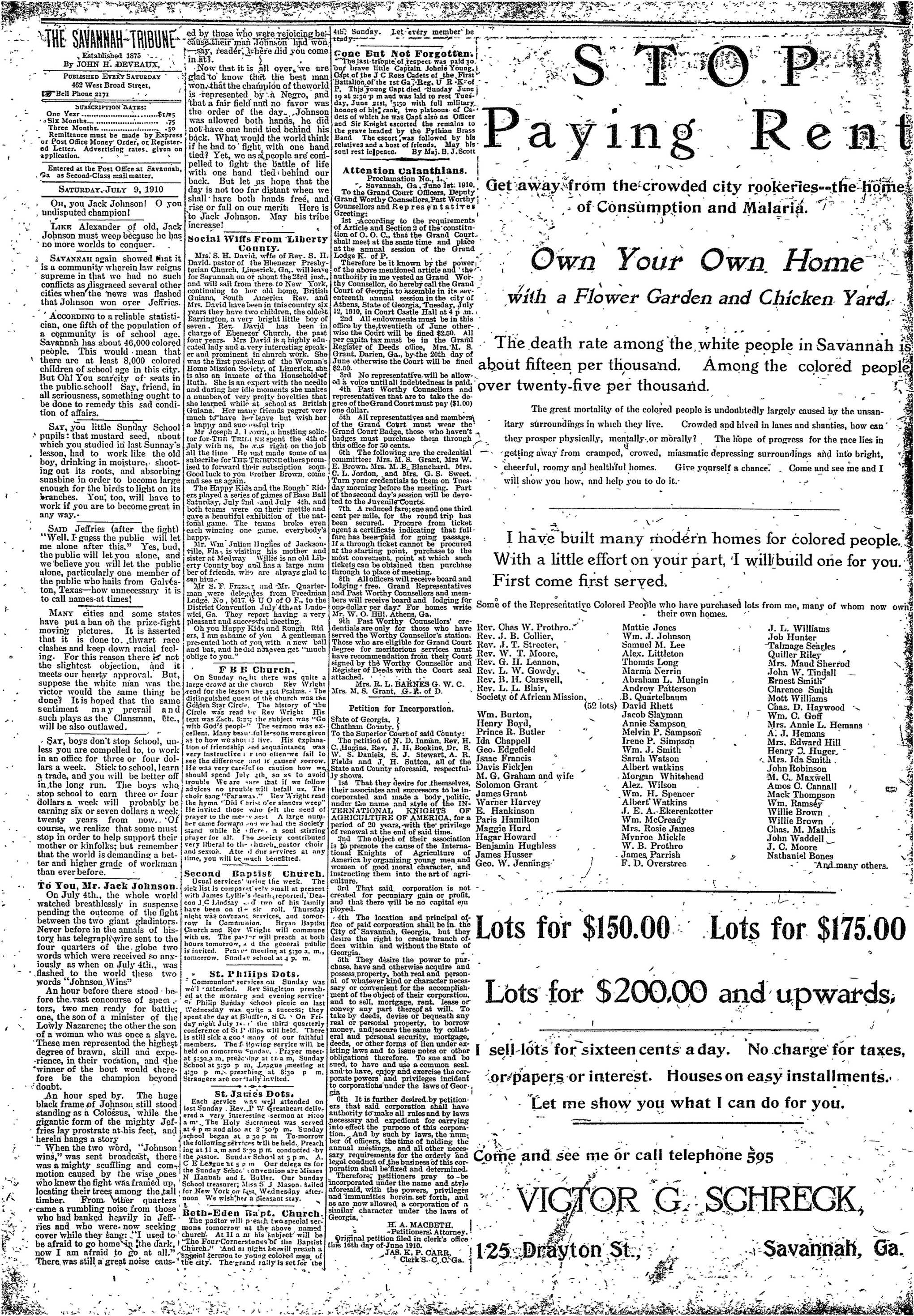
Oh, you Jack Johnson! O you undisputed champion!
LIKE Alexander of old, Jack Johnson must weep because he has no more worlds to conquer.
SAVANNAH again showed that it is a community wherein law reigns supreme in that we had no such conflicts as disgraced several other cities when the news was flashed that Johnson won over Jeffries.
According to a reliable statistician, one fifth of the population of a community is of school age. Savannah has about 46,000 colored people. This would mean that there are at least 8,000 colored children of school age in this city. But Oh! You scarcity of seats in the public school! Say, friend, in all seriousness, something ought to be done to remedy this sad condition of affairs.
SAY, you little Sunday School pupils: that mustard seed, about which you studied in last Sunnay's lesson, had to work like the old boy, drinking in moisture, shooting out its roots, and absorbing sunshine in order to become large enough for the birds to light on its branches. You, too, will have to work if you are to become great in any way.
SAID Jeffries (after the fight) "Well, I guess the public will let me alone after this." Yes, bud, the public will let you alone, and we believe you will let the public alone, particularly one member of the public who hails from Galveston, Texas—how unnecessary it is to call names-at times!
MANY cities and some states have put a ban on the prize-fight moving pictures. It is asserted that it is done to, thwart race clashes and keep down racial feeling. For this reason there is not the slightest objection, and it meets our hearty approval. But, suppose the white man was the victor would the same thing be done? It is hoped that the same sentiment may prevail and such plays as the Clansman, etc., will be also outlawed.
Say, boys don't stop school, unless you are compelled to, to work in an office for three or four dollars a week. Stick to school, learn a trade, and you will be better off in the long run. The boys who stop school to earn three or four dollars a week will probably be earning six or seven dollars a week twenty years from now. Of course, we realize that some must stop in order to help support their mother or kinfolks; but remember that the world is demanding a better and higher grade of workman than ever before.
To You. Mr. Jack Johnson.
On July 4th., the whole world watched breathlessly in suspense pending the outcome of the fight between the two giant gladiators. Never before in the annals of history has telegraph wire sent to the four quarters of the globe two words which were received so anxiously as when on July 4th., was flashed to the world these two words "Johnson Wins"
An hour before there stood before the vast concourse of spectators, two men ready for battle; one, the son of a minister of the Lowly Nazarene; the other the son of a woman who was once a slave. These men represented the highest degree of brawn, skill and experience, in their vocation, and the winner of the bout would therefore be the champion beyond doubt.
An hour sped by. The huge black frame of Johnson still stood standing as a Colossus, while the gigantic form of the mighty Jeffries lay prostrate at his feet, and herein hangs a story
When the two word, "Johnson wins," was sent broadcast, there was a mighty scuffling and commotion caused by the wise ones who knew the fight was framed up, locating their trees among the tall timber. From other quarters came a rumbling noise from those who had banked heavily in Jeffries and who were now seeking cover while they sang: "I used to be afraid to go home in the dark, now I am afraid to go at all." There was still a great noise caus-
ed by those who were rejoicing because their man Johnson had won,
say, reader, where did you come in at?
Now that it is all over, we are glad to know that the best man won, that the champion of the world is represented by a Negro, and that a fair field and no favor was the order of the day. Johnson was allowed both hands, he did not have one hand tied behind his back. What would the world think if he had to fight with one hand tied? Yet, we as a people are compelled to fight the battle of life with one hand tied behind our back. But let us hope that the day is not too far distant when we shall have both hands free, and rise or fall on our merit. Here is to Jack Johnson. May his tribe increase!
Social Wills From Liberty County.
Mrs. S. H. David, wife of Rev. S. H. David, pastor of the Ebenezer Presbyterian Church, Limerick, Ga., will leave for Sarannah on or about the 23rd inst., and will sail from there to New York, continuing to her old home, British Guiana, South America Rev. and Mrs. David have been in this country six years they have two children, the oldest Barrington, a very bright little boy of seven. Rev. David has been in charge of Ebenezer Church, the past four years. Mrs. David is a highly educated lady and a very interesting speaker and prominent in church work. She was the first president of the Woman's Home Mission Society, of Limerick, she is also an inmate of the Household of Ruth. She is an expert with the needle and during her idle moments she makes a number of very pretty novelties that she learned while at school at British Guiana. Her many friends regret very much to have her leave but wish her a happy and successful trip
Mr Joseph J. Brown, a hustling solicitor for THE TRIBUNE spent the 4th of July with us, he was right on the job all the time. He just made some of us subscribe for THE TRIBUNE others promised to forward their subscription sooG! Good luck to you Brother Brown, come and see us again.
The Happy Kids and the Rough Riders played a series of games of Base Ball Saturday, July 2nd, and July 4th, and both teams were on their mettle and gave a beautiful exhibition of the national game. The teams broke even each winning one game, everybody's happy.
Mr. Wm Julian Huglies of Jacksonville, Fla. is visiting his mother and sister at Medway. Willie is an old Liberty County boy and has a large number of friends, who are always glad to see him.
Mr S. F. Frazier and Mr. Quarterman were delegates from Freedman Lodge, No. 5617. G U O of O F., to the District Convention July 4th at Ludowici, Ga. They report having a very pleasant and successful meeting.
Oh you Happy Kids and Rough Riders, I am ashame of you. A gentleman presented both of you with a new ball and bat, and he did not even get "much oblige to you."
F B B Church.
On Sunday night there was quite a large crowd at the church Rev Wright read for the lesson the ast Psalms. The distinguished guest of the church was the Golden Star Circle. The history of the Circle was read by Rev Wright His text was Zach. Sizzy the subject was "Go with God's people." The sermon was excellent. Many beautiful lessons were given as to how we should live. His explanation of friendship and acquaintance was very instructive or too often we fail to see the difference and if causes sorrow. He was very careful to caution how we should spend July 4th, so as to avoid trouble. We are sure that if we follow advices no trouble will befall us. The choir sang "Faraway." Rev Wright read the hymn "Did Christ or sinners weep" He invited those who felt the need of prayer to the mercy sect. A large number came forward and we had the Society stand while he offered a soul stirring prayer for all. The society contributed very liberal to the church, pastor choir and sexion. Attend our services at any time, you will be much benefited.
Second Baptist Church.
Usual services during the week. The sick list is comparatively small at present with James Lindsay's death reported, Deacon J.C. Lindsay and two of his family have been on the siric roll. Thursday night was covenant services, and tomorrow is Communion. Bryan Baptist Church and Rev Wright will commune with us. The pastor will preach at both hours tomorrow, a d the general public is invited. Praise meeting at 5:30 a. m., tomorrow. Sunday school at 4 p. m.
St. Philips Dots.
Communion services on Sunday was
well attended. Rev Singleton preach-
ed at the morning and evening service;
St Philip Sunday school picnic on last
Wednesday was quite a success; they
spent the day at Stuffton, S.C. On Friday
night July 16, the third quarterly
conference of St Philips will held. There
is still sick a good many of our faithful
members. The following service will be
held on tomorrow Sunday. Prayer meet-
at 5:30 a.m. preaching at 12 a.m. Sunday
School at 3:30 p.m. League meeting at
4:30 p.m. preaching at 8:30 p.m.
Strangers are certainly invited.
St. Janice Dots.
Each service was well attended on last Sunday. Rev. P W Greatheart delivered a very interesting sermon at 9 o'clock a.m. The Holy Sacrament was served at 4 p.m and also at 8:30 p.m. Sunday school began at 2:30 p.m. To-morrow the following services will be held. Preach at 11 a.m and 8:30 p.m. conducted by the pastor. Sunday School at 3 p.m. A C E League at 5 p.m. Our delegates for the Sunday School convention are Misses N Hannah and L Butler. Our Sunday School treasurer, Miss S J Mason. Sailed for New York on last Wednesday afternoon. We wish her a pleasant stay.
Beth-Eden Bapt. Church.
The pastor will preach two special sermons tomorrow at the above named church. At 11 a.m his subject will be "The Four Cornerstones of the Baptist Church." And at night he will preach a special sermon to young colored men of the city. The grand rally is set for the
Cone Eut Not Forgotten:
The last tribute of respect was paid to
our brave little Captain Johnie Young,
Capt. of the J C Ross Cadets of the First
Battalion of the 1st Ga.'Beg. U R K-Of
P. This Young Capt died Sunday June
19 at 2:30 p.m and was laid to rest
Tuesday, June 21st, 3:30 with full military
honors of his, bank, two platoons of Cadets
of which he was Capt also an Officer
and Sir Knight escorted the remains to
the grave headed by the Pythian Brass
Band. The escort was followed by his
relatives and a host of friends. May his
soul rest in peace. By Maj. B. J. Scott
Attention Calanthians. Proclamation No., 1.
Savannah, Ga., June 1st, 1910.
To the Grand Court Officers, Deputy Grand Worthy Counsellors, Past Worthy Counsellors and Representatives
Greeting:
1st. According to the requirements of Article and Section 2 of the constitution of O. O. C., that the Grand Court shall meet at the same time and place at the annual session of the Grand Lodge K. of P.
Therefore be it known by the power of the above mentioned article and the authority in me vested as Grand Worthy Counsellor, do hereby call the Grand Court of Georgia to assemble in its seventeenth annual session in the city of Athens, State of Georgia, Tuesday, July 12, 1910, in Court Castle Hall at 4 p.m. 2nd all endowments must be in this office by the twentieth of June otherwise the Court will be fined $2.50. All per capita tax must be in the Grand Register of Deeds office, Mrs. M. S. Grant, Darien, Ga., by the 20th day of June otherwise the Court will be fined $2.50.
The death rate among the white people in Savannah about fifteen per thousand. Among the colored peop over twenty-five per thousand.
3rd No representative, will be allowed a voice until all indebtedness is paid.
4th Past Worthy Counsellors and representatives that are to take the degree of the Grand Court must pay ($1.00) one dollar.
The great mortality of the colored people is undoubtedly largely caused by the unsanitary surroundings in which they live. Crowded and hived in lanes and shanties, how can they prosper physically, mentally or morally? The hope of progress for the race lies in getting away from cramped, crowed, miasmatic depressing surroundings and into bright, cheerful, roomy and healthful homes. Give yourself a chance. Come and see me and I will show you how, and help you to do it.
5th All representatives and members of the Grand Court must wear the Grand Court Badge, those who haven't badges must purchase them through this office for 50 cents.
6th The following are the credential committee: Mrs. M. S. Grant, Mrs. W. E. Brown, Mrs. M. B. Blanchard, Mrs. C. L. Jordon, and Mrs. G. S. Sweet. Turn your credentials to them on Tuesday morning before the meeting. Part of the second day's session will be devoted to the Juvenile Courts.
7th A reduced fare; one and one third cent per mile, for the round trip has been secured. Procure from ticket agent a certificate indicating that full fare has been paid for going passage. If a through ticket cannot be procured at the starting point, purchase to the most convenient, point at which such tickets can be obtained then purchase through to place of meeting.
I have built many modern homes for colored people. With a little effort on your part, I will build one for you. First come first served.
8th All officers will receive board and lodging free. Grand Representatives and Past Worthy Counsellors and members will receive board and lodging for one dollar per day. For homes write Mr. W. O. Hill, Athens, Ga.
Some of the Representative Colored People who have purchased lots from me, many of whom now own their own homes.
9th Past Worthy Counsellors' credentials are only for those who have served the Worthy Counsellor's station. Those who are eligible for Grand Court degree for meritorious services must have recommendation from their Court signed by the Worthy Counsellor and register of Deeds with the Court seal attached.
Mrs. R. L. BARNES G. W. C.
Mrs. M. S. Grant, G. R. of D.
Petition for Incorporation.
State of Georgia. } Chatham County. }
To the Superior Court of said County:
The petition of N. D. Inman, Rev. H.
C. Hargins, Rev. J. H. Bookins, Dr. R.
W. S. Daniels, S. J. Stewart, A. R.
Fields and J. H. Sutton, all of the
State and County aforesaid, respectfully
shows.
1st That they desire for themselves,
their associates and successors to be
incorporated and made a body politic,
under the name and style of the IN-
TERNATIONAL KNIGHTS OF
AGRICULTURE OF AMERICA, for a period of 20 years, with the privilege
of renewal at the end of said time.
2nd The object of their association is to promote the cause of the International Knights of Agriculture of America by organizing young men and
women of good moral character, and instructing them into the art of agriculture.
3rd That said corporation is not created for pecuniary gain or profit, and that there will be no capital employed.
Lots for $150.00 Lots for $175.00
4th The location and principal office of said corporation shall be in the City of Savannah, Georgia, but they desire the right to create branch offices within and without the State of Georgia.
5th They desire the power to purchase, have and otherwise acquire and possess property, both real and personal of whatever kind or character necessary or convenient for the accomplishment of the object of their corporation, and to sell, mortgage, rent, lease or convey any part thereof at will. To take by deeds, devise or bequeath any real or personal property, to borrow money, and secure the same by collateral and personal security, mortgage, deeds, or other forms of lien under existing laws and to issue notes or other obligations therefore. To sue and be sued, to have and use a common seal. and to have, enjoy and exercise the corporate powers and privileges incident to corporations under the laws of Georgia.
I sell lots for sixteen cents a day. No charge for taxes or papers or interest. Houses on easy installments. Let me show you what I can do for you.
6th It is further desired by petitioners that said corporation shall have authority to make all rules and by laws necessary and expedient for carrying into effect the purpose of this corporation. And by such by laws, the number of officers, the time of holding the annual meetings, and all other necessary requirements for the orderly and legal conduct of the business of this corporation shall be fixed and determined. Therefore, petitioners pray to be incorporated under the name and style aforesaid, with the powers, privileges and immunities herein set forth, and as are now allowed, a corporation of a similar character under the laws of Georgia.
H. A. MACBETH.
Petitioners' Attorney.
Original petition filed in clerk's office this 16th day of June 1910.
Men's Sunday Club At the Men's Sunday Club on to-morrow, there will be an address by Dr. W. E. Farmer, D. D. pastor of St. Paul C. M. E. Church. Violin solo by Mr. Verdery. The committee appointed to work in connection with the Associated Charities will make a report. The public is cordially invited to be present.
Supreme Temple Session The annual meeting of the Supreme Temple U. B. A., will be held next week. Tomorrow afternoon an interesting program will be carried out at the F B B Church at o'clock, when Supreme Architect W. D. Kennedy will deliver the annual address and Rev. Daniel Wright will preach a special sermon. The program will be replete with music, responses, etc. The session next week will be legislative, and the officers will render their reports, which will show the marvelous growth of the order since its organization. The session will be largely attended and much business of an important nature will be transacted.
Consult Mr. Schreck. We call attention to the advertisement of Mr. V. G. Schreck in this issue. We take pleasure in recommending Mr. Schreck to any of our readers interested in home building. He is perfectly reliable and will do what he promises. Patronize those who help to support your paper.
On to Athens.
Next Monday morning a special train will leave the city at 6:45 bound for Athens, Ga., where the Grand Lodge K. of P. and the Grand Court of Calanthe will be in session. Hundreds of Knights and Calanthes from all over the state will be in attendance.
Everything points to a harmonious session and the unanimous reelection of Grand Chancellor Creswell and Grand Worthy Counsellor Mrs. Barnes. Each of these officers are indefatigable and efficient, and much liked by all of their members. All of the other important officers of both branches will be re-elected. One of the features of the gathering will be the Uniformed department. Savannah will be well represented.
Jolly Hoppers At Mechanic Hall.
Perhaps the best work ever been done by amateur performers in Savannah, was that of the Jolly Hopper Boys at several performances to large crowds, last weeks at the Mechanic Hall and Summer Garden. On Friday night, July 15th, they will put on an entirely new bill, new songs and new dances and electrical effects. Special features by Easton 'and Ruth, Austin and Binyard. Ingram and Chisholm and the Imperial Quartette. Prof. John Bryan Musical Director. There will be dancing after the preformance and the sirtiest order will be maintained. Price of admission 15 cents, couple 22 cents. Don't forget the date July 15th, at the Mechanics Hall and Summer Garden, the coolest place in town. Chas. A. R. McDowell Manager.
Monumental Notes.
Dr. Townsley preached three able sermons last Sunday. As it was communion Sunday, as usual the spirit was in the church and everyone present enjoyed his sermons. The ushers handled the immense crowd in an excellent manner, and they also furnished the members and friends with the "Monumental Guide," their semi monthly church paper. The choir was at its best. The early morning prayer meeting was the means in which the Holy Spirit was drawn into the church, under the leadership of Brother A Garrison. The Sunday School was largely attended and the collections were excellent. The superintendent, Mr. Sherman, and his officials were at their post, and the lessons were discussed briefly. The Pulpit Aid Board will give a grand concert Monday, night, at the church, admission 10, cents.
Butler Presbyterian Church
Services every Sunday at 11 a. m. and 8:30 p. m., Sunday School at 4 p. m. Prayer meeting every Thursday evening. 8:30 p. m., baptism and communion, next Sunday, July 10. The public cordially invited. Ilev. S. T. Redd, pastor.
Local Dots
88 Tonic cures Chill and Fever.
Hymes K. and B. Pills, try them for
Kidney complaints.
Savannah, has the honor of having in her territory two distinguished visitors in the persons of Mrs. B. S. Ingram, of Macon, Ga., wife of the Grandmaster of the G. U. O. of O. F., of the State of Georgia, and Miss Mattie Hubbard, one of the proficient teachers of the city of Macon. They are stopping while in the city at the home of Capt. W. D. Armstrong, No., 519 Bolton St., West. The first district Division of the G. U. O. of O. F., held their Convention at Ludowici, on Monday last, and some very good work was done for the good of the order. It was largely attended by delegates from this District and also adjoining districts. All those who attended, were proud of the enlightenment they gained by attending the same. Capt. W. D. Armstrong, though ill was on the job.
On Monday night, June 2nd, the following officers, of the Lone-Star Ladies Branch, was installed by Messrs J. F. Andrews and P. A. J. McDowell: J. S. Quarterman, president; J. B. Willis, vice-president; L. A. Washington, financial secretary; Mrs. R. E. Jackson, recording secretary; Mrs. E. B. Anderson, chairlady of finance; Mrs. L. Quarterman, treasurer; Mrs. F. Proctor, chairlady of examinations, Mrs. M. A. Johnson, chairlady of health, J. E. Grate, clerk of order.
Mrs. Sophia Wilson Aaron will sail on Monday for Providence, R. I. to spend three months with herdaughter Mrs. Sam S. Walker. Mrs. Viola Berkstine, of Guyton, is keeping house at 608 Bolton street, W. Little Emmie Lee Blue of Brunswick, Ga., is the guest of her aunt, Miss Evelyn Dallas for the summer. Mr. A. W. Bacote spent last Sunday very pleasantly in Charleston, S. C. Miss Louisa Shields will spend a week in Beaufort, the guest of Miss Lucy Mitchell,
The Frances Harper Literary and Social Circle complimented its friends with an enjoyable trip to Beaufort, yesterday.
On returning from the G. S. Grand Lodge at Washington, Ga., Mrs. Mamie Hardee and Mrs. Isabell Bluespent last Saturday with Miss Evelyn Dallas. They left for Brunswick on Sunday.
Mrs. Lottie Chappell and Mr. J. Frasier of Tampa, Fla, were quietly married, Tuesday evening last at the residence of Rev. Daniel Wright, who officiafed. Jacksonville and New York papers please copy.
The friends of Mrs. Josephine Waldburg and Mr. C. W. Alexander were quite surprised to learn of their marriage on Wednesday evening, of last week. They were married by Rey. W. L. Jones. The bride and groom are now receiving the congratulation of their many friends at their residence 547 Perry street, East.
McKull's Ice Cream Parlor. Pure fruit Ice Creams and Sherbets by the quart or gallon. Oysters in season. Hot and Cold Lunches. Fish suppers on short notice. Phone 403.8. Orders promptly filled, $15 East Broad St., Savannah, Ga.
Capt. W. D. Armstrong is convalescing and expects to be out in a few days.
Mr. C. C. Middleton returned home on Tuesday from Ann Arbor, Michigan to spend his vacation His many friends are glad to welcome him home.
Little Luellà daughter of Dr. and Mrs. J. H. May has been ill with measles for a week but is convalescent.
Mr. J.C. Lindsay's eldest daughter has joined the family from Anniston, Ala., where she has been attending school.
Miss Mattie C. James and her little niece of Jacksonville, Fla. are the guests of Mr. and Mrs. Chas. Allen 608 Park Ave. west.
McKall's Ice Cream Parlor Pure fruit Ice Cream and sherbet by the quart or gallon. Oysters in season. Hot and Cold Lunches. Fish suppers on short notice. Phone 4058. Orders promptly filled. 815 East Broad St., Savannah, Ga. The Joint picnic of Household of Ruth No438 and the Juvenile 113 takes place at Styles Park, Monday, July 18th. The members of the committee from the Juvenile are Masters John McIntosh Clarence Houston, Misses Lesser Miller, Jennie Cradle, president.
Princetta, the infant daughter of Mr. and Mrs. P. B. Butler was christened at the home of her parents Chapman Ave., Tuesday afternoon by Rev. R. H. Singleton, D. D., in the presence of a large number of friends. A luncheon was served. Those present were Mesdames Lizzie Green, Mary Wright, Nora Browne, Letitia Preston, Dora Tolbert, Irene Spencer, Bertha Browne, Anne Boyd, Cora Meyers, Minnie Lee, Rosa Webster, Georgia Whitehead Rebecca Wadkins, Mrs. Paul of Jacksonville, Mrs. Emma Watson, God-mother.
Mrs. Annie Goldwire of 608 Bolstreet, West, left on Wednesday for an extended trip to Washington, D. C., Philadelphia, Pa., New York and several other important cities. She will be at the wedding of her brother, the Rev. Curtis T. Weichster, of, Sharon Hill, Pa,
An interesting program will be rendered at Mt. Tabor Baptist Church, Henry, and East Broad streets, at 5 o'clock, Sunday afternoon. The proceeds of which will go for the Old Folks Home. Program: Solo, Miss Rosa Jones; Paper, The need of a home, Mr. W. O. P. Sherman, Jr., Duet, Misses Gertrude E. and Rosa A. Holmes; Music by the choir; Address Rev. R. H. Singleton. The public is cordially invited. Mrs. M. L. Ayers and Rev. W. D. Johnson, D. D., Auditors for the Grand Court of Calanthe, were in the city during the week. They audited the accounts of Mrs. B. D.
Barnes, the G. W. C. that of Mrs. M. S. Grant, G. R. of D., and Mrs. Willie Hill, G. R. of Deposits. The report of the Auditors will be a glowing one.
Miss Rosa B. Smith of Jacksonville is in the city-spending a few days very pleasantly with Mr. and Mrs. Wilkins on Montgomery street.
Mrs. Joe. Hunt left Saturday last for Salisbury N. C., where she will spend awhile with her mother. Before returning she will visit Thomasville, N. C.
Mrs. Julia T. Whitfield left via Central of Georgia June 26th for Chicago, her stay will be indefinite.
Prof./ J. W. Gilbert and E. J. Mathews were in city this week auditing the books of the Secretary Treasurer of the K. of P. Endowment department.
The Seminole Indian Club will give a Big Noise at Lincoln Park on Tuesday July 12 from 2 p.m. to 2 a.m. The Big Indian Chief will be in charge and promises a very enjoyable time to all who will attend. The Big Noise means fun and pleasure for everybody.
The Interdenominational Ministers Union met at the First Congregational Church on Tuesday last.
Mt. Moriah Lodge No 15, A. F. and A, M. will hold an interesting meeting on July 15th, when Mr. Willis Gerrideau, the Junior Warden, will deliver a lecture on the subject, "Why the Temple was erected."
Miss Jessie Webster, who is now residing in Jacksonville, spent the past week very pleasantly in the city.
Mrs. W. R. Jones of Jacksonville was in the city last Saturday enroute to Augusta. Her many friends made it pleasant for her while here.
St. Stephen's Episcopal Church.
Old Soldiers, Attention!
If there is any colored soldiers living in Sayannah or other city who enlisted in Co. I, 103D Regiment in the year 1865 who remember one by the name of Allen Blunt, would confer quite a favor by leaving their name and address with Mr. Sol C Johnson, Tribune office or Mrs. Mattie D Stiles, Milledgeville, Gal St Ient Mulligan acted captain
Respectfully Allen Blunt
Notice.
Zion Missionary Baptist Association,
convenes with Enterprise Baptist
Church, Colesburg, Camden Co., Ga.
July 14, 1910, at 10 o'clock A.M. Delegates
from Savannah and vicinity leave
on 8 o'clock train, Wednesday the 13th.
Special coach obtained over Seaboard
Air Line R. R. Rev. N. H. Whitmire in
Command. Respectfully.
(Rev.)-F. C. Daniels, Clerk Z. B. A.
AMUSEMENT COLUMN.
Coming Events in The Social World.
The annual excursion to Daftuskie of
St Benedict's Church will take place
Tuesday July 12th. Tickets 50 and 25
cents.
The annual excursion of Second Baptist
Church will be given to Beaufort Tues-
day July 12th. Tickets 50 and 25 cents.
A grand excursion will be given to
Beaufort by Success Lodge No 2 A O K
of D Monday July 11th. Tickets 50 and
25 cents.
A grand moonlight excursion will be
given around the harbor by Local Union
No 318 G and J of A. Tuesday night
July 12th. Tickets 25 cents.
A grand picnic will be given by Gardner
Lodge 205 K of P to Styles Park Monday
July 11th. Cars leave 2, 4, 6 and 8:30 p.
m. Tickets 25 cents.
A prize entertainment will be given at
Scott's Pavilion Monday July 11 by the
Grand Atlantic Pleasure Club. Tickets
15 and 25 cents.
The U B of A will give an afternoon
excursion around the harbor Tuesday
July 12th. Tickets 50 and 25 cents.
A grand excursion will be given by Local 419 Lumber Handlers to Beaufort Monday July 11th. Tickets 50 and 25 cents.
The Eureka Clubs will give their second outing to Daufuskie Thursday July 11th. Tickets 50 and 25 cents.
A trolley ride will be given by the YMCA, Thursday night, July 14th. Tickets 25 cents.
The YG E A and S Club will their second picnic and prize waltz of the season to Lincoln Park Monday July 11. Tickets 15 cents.
Forest City Light Fountain U.S.O.T. E will give a grand outing to Beaufort Monday July 11th. Tickets 50 and 25 cents.
Thanksgiving Proclamation
Headquarters of the Supreme Grand Temple of the U. B. of A. Supreme Architect's Office.
To the members of the Jurisdiction
Greeting:
Under and by virtue of the authority
in me vested, I do hereby issue the following proclamation:
That all members of the Brotherhood assemble at some place of worship to offer prayer and thanksgiving to the Almighty God for His many blessings during the year now closing.
The members of the Seyahann District will celebrate at the First Bryan Baptist Church. Bryan members will assemble at West Broad and Gwinnett at 2:30 o'clock. Female and children will assemble at the church at 3 o'clock. Members and friends are cordially invited to attend By order of W. D. Kennedy, S. G. A. H. T. Stickland, A. G. S. G.
A SALE OF
250 Men's Fine Summer Suits
At a Marked Reduction
WE will have on sale about 250 of our Men's Fine Summer Suits, composed of lots that are broken in sizes, but selected from our regular stock and representing our usual leading makes, which we are going to offer at a
Great Big Reduction in Price
The regular prices of these Suits range from $25.00 to $30.00,
1. But we have consolidated the entire 250 Suits into two lots and offer them at
$15 and $18 Net
All Sizes Regulars, Stouts, Slims
B. H. LEVY, BRO. & CO.
Does all kind of high grade dental work of the best quality and workmanship. Gold crowns and bridge work. White Porcelain Piy and Gold Crowns mounted on the natural roots. Gold Fillings, Cemen Fillings, and Silver or Amalgam Fillings, from nine to a full set of teeth 1; 0 and $ 800. Broken places mended a teeth added to old ones for a small cost. Bell Phone 1244, Solid Gold Crowns Guaranteed. 234 K Gold
K. 01 P. Official Route
The Rights of Pythias Uniform Ranks
and the colonists have selected the central of georgia as its official route to the grand lodge and Grand Court which will meet in Athens July 12. The special train will leave central Depot monday morning July 11 at 6:45 o'clock, and will stop along the line in order to pick up other delegates Fare for round trip from Savannah $7.65. To avoid the rush secure, your tickets in advance at the city, ticket office, Gemanla Bank
For Over Fifty Years.
Mrs. Winslows' Soothing Syrup has been used for over Fifty YEARS by MILLIONS OF MOTHERS for their CHILDREN WHILE TEETHING, with PERFECT SUCCESS. It Soothes the CHILD, SOFTEN the GUMS, ALLAYS all PAINS; CURSES WIND COLIC, and is the best remedy for DIARRHOHA. Sold by Druggist in every part of the world. Be sure to ask for "Mrs. Winslow's Soothing Syrup," and take no other kind. 25c a bottle.
Girles—'Twenty All Under Twenty.'
This is the "heading" on Frederick Thompson's twenty-four sheet posters advertising the new summer slow row on at New York's prettiest theater, the New Amsterdam The Music in "Girlies" is just great, and the The World will give two or three songs from, the show during the summer. Next Sunday's World will contain one of the very best, words and music complete. Try it on your piano.
Wait for the 26 Glorious Annual Excursion To Beaufort, S. C. Ga, Co, No, 1, U, R, K, of D. Tuesday July 26
3 Boats: Steamers x Planter, Pilot Boy and Clivedon. Brass Band Boots leave wharf at 7 am.
Capt. Jno. J. Ward. Ex-ocioio.
The annual outing of Asbury M E
Sunday School will be given to [Styles
Park Wednesday July 19th. Tickets 25
and 16 cents.
Church Notice.
Shepherd's Chapel, Primitive Church
Green street, Ditmersyille, Savannah,
Ga., of which Rev. Samuel F. Shepherd
is pastor, is the First-Church on the
Memorial Roll of Honor. Services Sunday,
prayer meeting at 5 a.m. preaching at
11 a.m and 8 p.m. Tuesday and
Thursday nights preaching. tf
SECURETY
Union Mutual Association has guaranteed to the many thousands of their well pleased and highly satisfied members, they (the members) in turn, as all appreciative persons might be expected to do, are telling others of the BENEFITS to be derived from carrying INSURANCE with this the PIONEER NEGRO INSURANCE Co. of the country.
Phone the local manager and take a policy to-day,
WM. DRISKELL,
Secretary and Gen'l Manager,
210 Auburn Ave., Atlanta, Ga.
J. C. LINDSAY,
District Manager,
509 West Broad Street,
Savannah, Ga.
Phone 1470
Garey's Variety Bakery
Goods delivered promptly to any part of the city ...
506 West Broad St, near Gaston.
Phone 1331 L
The Palative
The only Colored Cafe of its kind in the city.
SEA FOOD AND GAME in season.
Home Cooking a Specialty.
EDWARD JOHNSON,
Proprietor and Caterer.
817 BURROUGHS STREET.
Open all night.
PATE H
But Good Things Never Last W
and Save Money on Face O
ToothPowders, Soaps,
Syringes and Preso-
F. F. JONES,
DEALER IN
Beef - Veal - Mutton
Lamb-Pork-Hams
Bacon and
CORNED BEEF
All Kinds of GAME in Season.
Goods promptly delivered to
any part of the city free of
charge.
STALL 31 CITY MARKET
CRECEUS
Horse Shoeing & Clipping Shop
Conveniently located. Horses sent for and returned. Quick and satisfactory work.
Horses Clipped on short notice.
330 JEFFERSON ST.
Phone 3509
NELSON CUYLER,
The Expert Horse Shoeer.
Manager.
FIRSTCLASS Boarding and Lodging
At 120 CANNON ST.. WEST.
Charleston, S. C.
A nice cool spot. Your patronage-solicited
One block from the Belt Line
Mrs. P. C. Burgess, Proprietress.
One and all attend the
Metropolitan Dancing School
Every Friday night at the
Masonic Temple
ROY B. HILL, Manager.
HAS IT!
Very Long So See Us, Today
Dreams, Talcum Powders,
Box Paper, Fountain
Nippons. Perfume
FOR THE FARMER AND STOCKMAN
I have received several letters from parties asking as to my plan to control automobiles, control of roads, etc. My plan is to form civic leagues and enforce the present laws, patrol all roads and compel all parties to comply with our existing laws. I mean all travelers, be they autolists or farmers, and I mean all travel. If you or any other man in Indiana can suggest anything better or more just write me. This has been my reply to all private letters.—J. J. New.
If the people are satisfied with the present laws, and if they can be induced to organize, as you suggest, your plan may work, but these are big its. We don't believe either of them can be compassed. But let us mean from others on this subject.—Indiana Farmer.
7 Bushel of Corn and Butter.
Cows of fair quality only, such as 'will make 250 to 300 pounds of butter per year, when properly fed make three pounds of butter each bushel of corn or oats, when the two grains are ground together and fed. Surely that is a better market for corn than when, sold as grain is sold on the market. Referring to this matter Hoards' Dairman says:
"There never was a time when it paid as good a profit as it does to-day to feed a cow well. Think of it. Three pounds of butter in a bushel of corn. That is nearly $1 worth of butter. What kind of a farmer must a man be that will not turn grain into butter at that price? One great trouble is that these farmers have not taken palms, to breed good cows that it will pay a big profit to feed well. If ever a farmer fed well he should do it now."
The Sow in Farrow.
Nothing is so certain to produce a small and unprofitable litter of pigs as to have the sow in farrow to share her lot or bed with a pen of half grown shoats or with other sows. In summer she will go off to some secluded spot to make her bed and thus escape the danger of crowding. In winter or early spring, however, she cannot overcome the habit of huddling up with the lot even up to her time and thus endangering her offspring.
The thrifty farmer will provide separate pens, or lots, and plenty—not too much—of straw and shelter from rain. After the pigs are a week old two or three sows may be run together. Of course, it takes more time to water and feed the sows separated this way, but it pays to do it.
It is a great disappointment and a real loss of time and feed to have your promising brood sow turn up with only one or two plugs. If it is your fahit you cannot make it up this season, and by another the golden opportunity may have passed. Farmers' Home Journal.
Prevention of Disease.
One of the greatest causes of disease among fowls is from lice and not disinfecting the poultry houses properly. I have never had a contagious disease among my fowls. Eighteen
years ago I lost quite a number from
lumber neck. I did not know the
cause then, but by sad experience
learned a lesson that has been worth
a great deal to me. I never allow
any dead chickens or any other kind
of flesh to lay about where the chickens go. It is sure death to them if they get maggots from any kind of flesh.
For destroying lice and mites I fumigate my poultry houses with tobacco and sulphur, usually do this on damp days, and is better if done once a week. We not only believe it is good for the fowls, but for people. We have not had a spell of fever since we have been fumigating with tobacco, while so many of our neighbors have fever every year. This promises to be the greatest year in poultry business, yet in my experience have never known eggs as high as they were last winter. I have never had, such a demand for eggs and chickens, can't near supply the orders for the last five or six weeks. If you want every mail to bring in orders and inquiries advertise in Farmers' Home Journal and you will have all the work 'you are' looking for.—Mrs. Emily Gibson, in the Farmers' Home Journal.
Cleanliness in Hog Feeding.
The hog responds as readily to cleanliness and care as any other animal on the farm. Not long since I was greatly impressed with the lack of sanitary conditions around the yards and houses of a man who has been growing hogs more or less successfully for ten years. His feeding troughs were foul with decayed food, the floors were damp and full of mudholes that good drainage would have prevented. All fixtures in a hog house should be movable. It is advantageous to have the troughs where they may be washed or scalded out twice each week at least. It should be born in mind that foul troughs are good breeding places for parasites that may be taken into the stomach and con-
verted into worms. Damp floors may be overcome if the house is well alred and windows enough, are, in it to let the sunshine in on the floors.
It is never best to allow dust to accumulate on the partitions and in pens used for feed. If is always injurious to the health of the hogs.
Those who are in the habit of feeding their hogs grain scattered in the mud or dust of a dry yard should build a feeding floor and use it. Go into any herd that is fed in the dust from thrown-down grain and much wheezing and coughing will be heard. This is bad on all hogs, and especially those kept for breeding unnoses.
In building afeeding floor it should be set off the ground four-to six inches and built solidly of good timber. A two by four piece should be nailed around the whole edge, which will prevent lots of shelled or ear corn-being pushed off into the dirt and dust. The floor should be swept off each time before feeding.—W. H. Underwood, in the Indiana Farmer.
Scrub Cows Don't Pay.
If any of the great throng of farmers who are blindly adhering to scrub cow breeding were asked why he does not keep pure breds he would reply that it cost too much to start, and that the purchase of a new bull every two years would eat up a good share of the profits. Here are two fallacies that require some attention. There are many farmers who will not allow themselves to think beyond the first cost of a pair of registered calves. They can not "see" $100 in a helper, calf, and wonder how any one can be so foolish as to "throw away" so much money on a calf that the butcher would think dear at $10. But the buyer of such a calf is not viewing the question from the butcher's standpoint. He does not propose to make meat of a registered helper, but he looks ahead to the time when he will have a whole herd of registered cows, any one of which will be worth more than double as much as the scrub, whether for dairy purposes or to sell.
This question of beginning right is a very important one in all walks of life, but especially to the breeder of live stock, as the increase in the herd soon grows by leaps and bounds and the first outlay is anything compared to the increased returns in the not distant future. The writer knows a dairy farmer who figured out a dead loss from scrub cows—practical experience and no guess work. He made a study of the official butter records of the different dairy breeds, and on the strength of that knowledge he invested $700 in three heifers that were closely related to the best cows of the breed, and that averaged less than thirteen months old. That was less than five years ago, and he now has a nice little herd of pure bred cows. His cream checks are opening the eyes of his neighbors, and he has sold more than $800 worth of registered stock at prices very much lower than he paid to get his start. He is booking orders for heifer calves before they are born at $75 each, and future prospects are bright for nice profits from cream and calves.
He reminds his friends that the man who pays $150 for an ideal ear of corn is not expecting to feed it to the pigs, but that he coolly computes its worth as a breeder of high-class corn, and he is far-sighted enough to see its influence on future crops. Doubtless there are many farmers who take a similar view of the grain and live stock problem. They are thoroughly convinced that it pays to have the best, but they are just too timid to make the start. They may be brave soldiers, they may be heroes in many places of danger; but they have yet to learn that there is such a thing as cool, business bravery. There are places for brave men besides upon battle fields. This is not a plea for the reckless expenditure of money with one's eyes shut, but for a judicious expenditure after carefully considering the probable returns, not within six months but within a reasonable time.
Regarding the outlay for bulls, there are some wrong views entertained. It is not always necessary to buy a new one every two years. If he is of good vitality and free from undesirable qualities, his choice selfers may be bred back to him with no fear of bad results. When the time comes to dispose of him, he will bring enough from the butcher, if in proper condition, to pay for a bull calf; so that the total cost of bulls may be figured in advance to the price paid for the first one plus the cost of feed thereafter. This may be reduced by the service fees from the neighbors who are willing to pay for the use of a good bull.
This cost of bulls may be altogether eliminated by breeding to a neighbor's bull if, there should be one of the right breed and value within convenient reach. Community breeding, that is, all the people in one region deciding upon one breed, will vary materially lesson expenses; but this is too large a problem to consider here.—W. H. Underwood, in this Indiana Farmer.
1
GENERAL D. PORFIRIO DIAZ. PRESIDENT OF MEXICO.
THE NEW SKIRT AND THE POETRY OF MOTION.
Edith (breaking into, a hop) — "Hurry up, Mabel; you'll never catch the train if you keep on trying to run." — From Punch.
Edith (breaking into, a hop) — "Hurry up, Mabel; you'll never catch the train if you keep on trying to run." — From Punch.
Calculating Rule and Pencil Holder. For the benefit of the engineer and draftsman who is required to make hasty calculations, a combined pencil holder and calculating rule has recently been devised. The calculat-
Calculating Rule and Pencil Holder.
ing rule is of tubular form, and is fitted with a slide indicator, formed in the shape of a cuff. One part of the tube comprising the rule is provided with a slide member, which is graduated and used in the manner of the ordinary slide of a calculating rule. Within the tube a pencil may be fitted. By thus combining the rule and pencil, the danger of mislaying the rule is avoided, and the combined instrument is of convenient form to carry in the vest pocket.—Scientific American.
A Plant-Watering Scheme.
Persons engaged in rearing household plants are often in a quarantary when it is desired to leave the house temporarily without neglecting the plants.
An arrangement can be readily rigged up so that the necessary water will be supplied to the soil automatically. Take a bowl of water and raise it well above the level of the plant to be watered by means of a box or a pile of books. Twist several strands of common darning wool together to form a long thread and soak them in the water. If one end be hung over the bowl and the other end left in the water a steady drip, drip will commence and continue until the bowl is empty.—London Globe.
The Vicious Circle.
When Donald came in from school his face showed unmistakable signs of tears, and at the first symptoms of maternal affection, they started to flow again.
"Now, Donald, boy, tell mother all about it. What's the matter?"
"Ze teacher she scolded me."
"Well, we'll try and forget that, won't we? Never mind."
"But, muzzer, zat's jes' what she scolded me 'bout. She said I never did mind!"—Youth's Companion.
In spite of the fact that Vincent J. Thompson, a young boltermaker, arrested on a charge of moving mortgaged property from Michigan City to Gary, was opposed at his trial by two of the ablest members of the bar at Hammond, Ind., he pleaded his own case so well and baffled the prosecution without the aid of a lawyer that a jury in Judge Ames' court found him not guilty. Thompson compelled one witness to swear that he did not, know the difference between a kitchen table and a cabinet. All the oratory of the lawyers availed nothing against Thompson's clever cross-questioning.
A Loveometer.
Science is slowly killing romance. The latest invention is an instrument called a plethysmograph, for scientifically testing the warmth of lovers' affections. The person whose feelings are to be weighed in the balance puts his or her arm into a rubber bag, which is then drawn tight and filled with water. Names of young men or young women, as the case may be, are introduced, and if the name stirs the heart the pulse rises and the indicator mounts up. If the name leaves the subject unmoved the pulse remains stationary.—Gentlewoman.
Book-Marking System
Among the recent inventions is a very ingenious book-marking system designed for use by teachers, students and others who have occasion to read from or consult different parts of a book. The scheme consists of a series of target-shaped cards of graduating width and of sufficient length to rest across the page and protrude from the edges of the leaves. The extending end of this is marked with figure, letter or other note suiting the convenience of the one having occasion to consult the book. The other end of the slip is fitted with a rubber band, which is of sufficient proportions to fit around the volume from top to bottom. The function of this is to hold the marker in place and to permit of an arrangement of markers in such a way that one will not overlap another and hide it from
view. For a lecturer having occasion to refer frequently to the different parts of a book during the course of his remarks the convenience of this scheme will be readily appreciated. Washington Star.
HOUSEHOLD MATTERS
Cuts or Wounds:
A wound-produced by a sharp cutting instrument will heal without trouble when the edges are nicely brought together and left so, without putting on any salve, provided the access of air is shut off and 'the person possesses a good constitution. If the wound is produced by a rusty nail or a similar cause, so as to be jagged, it will soon become very infamed, and in such a case it is recommended to smoke the wound with burning wool or woolen cloth, says Woman's Life. Twenty minutes in the smoke of wool will take the pain out of the worst wound, and if repeated once or twice will allay the worst case of inflammation.
Lavender Disinfectant.
The following directions were given once upon a time in a sick room for a disinfectant. If was there discovered to be so agreeable that it has ever since that time been employed in the same household to disguise the smell of food in the kitchen. Every one knows the value of burning coffee for the like purpose, but that is so identified with the use that one thinks at once, when sniffing its odor, of the smell which it is covering up. To make the lavender disinfectant, soak sheets of common brown wrapping paper in satpetre and water, then set them away to dry till wanted. When brought into play, throw on one of these leaves of paper some flowers of lavender and burn them on a shovel, as in the case of the coffee.—Woman's Life.
For Stained Fingers.
The days of preserving bring stained fingers. Have you ever tried using a weak solution of oxalic acid after preparing berries or discoloring vegetables? It is a quick stain remover.
As the acid is a poison, label the bottle plainly and keep away from children. Where stains are under fingernails wrap a bjt of absorbent cotton on the end of an orangewood stick and dip in the solution.
For minor stains lemon juice is helpful. Run ends of fingers into half a cnt. Lemon.
Tomatoes will also remove stains, especially those of paring potatoes or other allyl discolorations. A tomato is a whitener and softens the hands.
—New York Times.
How to Serve Watermelon.
"Watermelons are especially cooling and refreshing on a hot day because of quantiles of deliciously flavored juice which they contain," says Faunle Merritt Farmer, in Women's Home Companion. "The edible portion is sometimes chilled, cut in small cubes (removing seeds), sprinkled with powdered sugar, and arranged in coupe glasses for the first course at Iuncheon or dinner. For family use it is most attractively served in one of the following ways: Cut a section three or four inches in thickness from the centre of a chilled watermelon. With a sharp knife cut out a circle of the pink pulp (the edible portion) and place upon a chilled serving dish of correct size. Serve in pie-shaped pieces on chilled plates, or cut off a thick slice from both ends of the melon (that the halves may stand level) and cut in halves crosswise. Arrange on a serving dish on a bed of green leaves, if any are at hand."
Recipes
Coffee Souffle—One and a half cups strong coffee, one-half cup milk, one tablespoon granulated gelatine, two-thirds cup sugar, yolks of three eggs. Cook in a double boiler till it begins to thicken, then add the whites of three eggs beaten to a stiff froth; mould, and serve with cream and sponge drops.
Soft Ginger Cake.—Beat two egg light, one half-cupful sour cream, one of molasses and three cupfuls flour sifted twice, with a level teaspoonful soda, a level tablespoonful ginger and a saltspoonful of salt. Mix well, add a half cup seeded raisins cut in halves, and dredged with flour, and bake in a moderate oven.
Snow Custard.—Boll eight eggs, leaving out the whites of four; and them one quart of milk and five ounces of sugar; have a shallow pan of hot water in the oven; set the dish into it and bake till the custard is thick; then set away to cool; beat remaining whites very light; and half a teaspoonful of lemon juice; when the custard is cold lay the whites over the top in heaps, but do not let them touch.
Dutch Apple Cake.—Make a biscuit dough, using cream instead of butter and milk. Make the dough a little too soft to roll and spread about half an inch thick in a pan. Pare and core tart apples and cut into eighths. Stick the pieces in the top of the dough in regular rows, core side down. Sprinkle on top as much sugar as necessary to sweeten the apples, with grated cinnamon and bits of butter, and bake until the apples are thoroughly done.
An electric machine has been made to wash and purify the air in any room.
"What made Agatha quit being a suffragette candidate—the attack on her past life in "The Dally Knocker?" "No, it wasn't that. She's fearless." "Was it the caricatures of her in 'The Morning Pitchfork?'" "No—she is reckless of her appearance. But 'The Weekly Ladies' Magazine' said that her Paris gown looked as if it were made of 8-cent callco by the village dressmaker."—Cloverland Leader.
Heading Off Old Age Pensions.
The Massachusetts State Savings Bank Insurance League is going about its enterprise in a businesslike way. It is attempting to furnish safe and good insurance at low cost, and is stimulating a discriminating knowledge of what it has for sale. Cheap safe insurance, providing for the wage earner's declining years, is a necessity in every industrial community. In place of the German pension system, which divides the burden among the state, the employer and the employee, and which means compulsion, and instead of the English scheme of old age pensions borne by general taxation, which may mean charity. Massachusetts has set up a working plan by which her wage earners may provide their own old age annuities—a characteristic American plan which means independence. The Survey.
Foll's Irish Supporters.
The great baritone, Signor Foll, when singing in grand opera in his native city, Cork, had to sing one of his songs from a stage balcony. The arrangements were not very perfect, and the manager, fearing the carpenter had not made the balcony strong enough to sustain the weight of the big man, told two of his assistants to hold it up from beneath. The lengthy signor was only half through his song when one man said to the other:
"Be jabers, Mike, this Ottallian is moftly heavy!"
"Let's drop him, Pat; he's only an Ottallian, ather all!"
Voice from the signor above: "Will ye, ye divils, will ye?"
"Tara-an-ouns! Pat, but he's an Orlisman; should him up for the hoife of yez."—Strand Magazine.
In Corfu.
Cortu, where a magnificent marble palace belonging to the German Emperor has just been purchased by an American millionaire, can boast of the most peculiar land laws in the world. The landlords are nearly all absentees, and their tenants hold the land on a perpetual lease in return for rent payable in kind and fixed at a certain proportion of the produce. Such a tenant is considered a co-owner of the soil, and he cannot be expelled, except for non-payment of rent, bad culture, or the transfer of his lease without the landlord's consent; neither can his rent be raised without his permission. Attempts have been made to alter the law, but both landlords and tenants are apparently satisfied with a system that dates back to the time of Homer.—Tr.Bits.
Back to the Farm.
With the wheat harvest only a few weeks away, the usual grist of harvest stories are being put on the boards. This rather new one is circulating around Kansas just now, though it is a safe bet that it was written by some Atlantic seaboard funny man for a New England magazine. A college lad came to a Kansas farmer and got a job. About 3 o'clock a.m. he was aroused and told to get up. About half an hour later he came down, fully dressed, and his packed suitcase in his hand.
"You don't need to take your valise out into the fields," said the farmer, seeking to give encouragement.
"I'm not going to the fields," he replied, "I'm going out to find a place to spend the night."—Kansas City Journal.
After His Day of Practice.
"Do you believe in Sunday baseball?" asked the bookkeeper of the shipping clerk. The latter tragically held aloft a puffy forefinger with a distorted second joint. "I believe," he answered, "that if Sunday baseball is played at all it should be confined exclusively to professionals."—Cleveland, Plain Dealer.
A Pleasing Combination Post Toasties [with Cream and Sugar]
Adding strawberries or any kind of fresh or stewed fruit makes a delicious summer dish!
The crisp, golden-brown bits have a most delightful flavour—a fascination that appeals to the appetite.
'FOSTUM CEREALE CO., LTD.
Battle Creek, Mich.
TUMOR OF YEARS GROWTH
Removed by Lydia E. Pinkham's Vegetable Compound Holly Springs, Miss. — "Words are inadequate for me to express what you wonderfulmed.
A. B. C. D. E. F. G. H. I. J. K. L. M. N. O. P. Q. R. S. T. U. V. W. X. Y. Z.
james have done for me. The doctors said I had a tumor, and I had an operation, but was soon as bad againsear Iwrote yououtadvice,and I E. Pinkham's Veg. etable Compound as you told me to do. I am glad to say that now I look
and feel so well that my friends keep asking me what has helped me so much, and I gladly recommend your Vegetable Compound."—Mrs. WILLIE EDWARDS, Holly Springs, Miss.
One of the greatest triumphs of Lydia E. Pinkham's Vegetable Compound is the conquering of woman's dread enemy—tumor. If you have mysterious pains, inflammation, ulceration or displacement, don't wait for time to confirm your fears and go through the horrors of a hospital operation, but try Lydia E. Pinkham's Vegetable compound at once.
For thirty years Lydia E. Pinkham's Vegetable Compound, made from roots and vegetable is the垦ardremedy for female it is, and such unquestionable testimony above proves the value of this famous remedy, and should give everyone confidence.
If you would like special advice about your case write a confidential letter to Mrs. Pinkham, at Lynn, Mass. Her advice is free, and always helpful.
Kept Quiet.
A man who had purchased a fine-looking mare discovered after driving the animal for a week that she was blind. Shortly afterward he succeeded in disposing of her, as the defect did not lessen her speed or detract from her general appearance. The next day the owner of the mare appeared.
"I say, you know that mare you sold me?" he began. "She's stone blind."
"I know it," replied her last owner, with an easy air.
"You didn't say anything to me about it," said the purchaser, his face flushed with anger.
"Well, you see," replied the other, "the man who sold her to me didn't tell me about it, and I thought, perhaps, he didn't want it known."—Tit Bits.
The Nature of Germs
Ordinary air is by no means air proper, but contains a number. of impurities, and the air of all cities always contains a quantity of almost measurable particles of dirt. With this dirt we are sure that small particles of living matter are associated. These small bodies, coming into a fluid rich in nutrient matter, grow up in it and at its expense. To these small bodies it is now the universal custom to attach the name "germs." What these destroyers are we do not, of course, know. We only know that they exist, and that they commit the most deadly ravages, wherever they get the chance. The great problem of present day science is to learn more about them, that the ravages may be reduced, if not eliminated.
For those who know the pleasure and satisfaction there is in a glass of
Make it as usual, dark and rich—boil it thoroughly to bring out the distinctive flavour and food value.
Cool with cracked ice, and add sugar and lemon; also a little cream if desired.
Postum is really a food-drink with the nutritive elements of the field grains. Ice it, and you have a pleasant, safe, cooling drink for summer days—an agreeable surprise for those who have never tried it.
"There's a Reason" for
Postum Cerral Co., Limited,
Battle Creek, Mich.
Good Roads
```markdown
```
"Castle and City Builders—Road-Makers."
In his recent address upon "The World Movement," at the University of Berlin, Theodore Roosevelt analyzed in the following striking phrase the activities of those early rulers upon whom devolved the task of laying the foundation for the civilization of Germany as well as Western Europe:
"They were castle-builders, city-founders—road-makers."
To-day the first two qualifications have been modified into commercial and industrial variants.
The last is absolutely unchanged. Road-making underlies the sheer existence, in an intensified degree the progress, of the entire social fabric of our day, as decisively as it did the first faint stirrings of civilization in Western Europe or the splendid structures reared by the Greeks and the Romans—still further back, the Egyptians. At every stage wherein humanity has recorded an advancement, whether in the stone-age or in the twentieth century, road-making has walked hand in hand with the trail-blazers, hand in hand with those that followed in their steps and amplified the work begun by their endeavors. Europe has not been slow in realizing and materializing the principle.
The highways of practically every old-world country are the delight and the envy of the American tourist, who watches the swift touring car glide by the wagon in which the peasant is transporting his product to the city market.
That is one radical respect in which Europe takes precedence of the lusty and intelligent new world.
The small and large farmer of the old countries pays no ruinous tire tax, no exorbitant tribute to mud and the god of delay.
His products, measure for measure, are worth often twice as much as those of the American farmer, because—
He can get them to the buyer, or to the railroad, at expense beside which the similar item in America is mountainous.
In another direction, also, the good roads wisdom of Europe has given its people superiority over America.
With negligible exceptions, the old world is thickly settled. There are few waste places. Every arable inch, figuratively speaking, is occupied. There are few wide, vacant, fertile areas clamoring valently for the hoe and the plow and the reaper. The reason is elemental. Good roads is a paramount issue in Europe. They take it as a matter of course, as they do the government, or the coming of Sunday, or the necessity of buying coal and clothing and food. Trunk lines bisect kingdom and empire, republic and ducky. Good roads and their building is a fine science in Europe. It has been so since civilization unfurled its pennants. War, pestilence, famine, panic have, not been allowed to interfere with its steady maintenance, for the reason that the people and their leaders knew that the issue was the lifeblood of any people, any country, any system.
The ripened wisdom of Europe reproaches the short-sighted neglect of America, and calls to us for revolutionary change.
In America, our forefathers built stunically the foundations of civilization. Since then we have strengthened each separate stone, but one—Until recently we have ignored good roads!
To-day, in every American State, the whole population, farmer and city man, pay blackmail to mud, to ruts, to impassability—to no roads at all!
We enhance the cost of living, we paralyze development, we perpetuate the waste places and stunt the national wealth by making highway construction dependent upon haphazard and casual practices, rather than systematic, generous and continual appropriations and methods.
In Georgia, we have recorded an awakening. But we are yet a long way, here and throughout the Nation, from what that mature philosophy which gives stability to the civilization of Europe and which rebukes our own boasted supremacy.—Atlanta Constitution.
To Avoid as Well as Care
The crusade against consumption is not undertaken chiefly to save consumptives—that must come later, but to prevent youth, infancy, ignorance, poverty and to prevent you and yours and me and mine from catching it. The burnt child dreads the fire, but if most children did not get slightly burnt, and so learn the teachments of the law of natural consequences, then they would be burning up themselves and everything around them all the time. The day draweth nigh when no man can say, as so many-now can, "Ignorance of this disease destroyed me, ate; me, consumed me, burnt me up alive." "Certainly, physicians, for all their knowledge, catch consumption and other diseases and die of them," some will say, "so what's the use?" But considering how much they are exposed, they fare far better than doctors formerly did,—Tip, in the New York Press.
Wash Day Monday.
Scott—"It is really a problem when to change one's winter underwear." Mott—"Once a week, I should say."—Boston Transcript.
You Look Prematurely Old
A Package.Marked Free on Request st
MUNYON'S
PAW-PAWPILLS
The best Stomach and Liver Pills known and a positive and speedy cure for Constipation, Indigestion, Jaundice, Billiousness, Sour Stomach, Headache, and all ailments arising from a disordered stomach or sluggish liver. They contain in concen-
The best Stomach and Liver Pills known and a positive and speedy cure for Constipation, Indigestion, Jaundice, Billioness, Sour Stomach, Headache, and all ailments arising from a disordered stomach or sluggish liver. They contain in concentrated form all the virtues and values of Munyon's Paw Paw tonic and are made from the juice of the Paw-Paw fruit. I unhesitatingly recommend these pills as being the best laxative and cathartic ever compounded. Send us postal or letter, requesting a free package of Munyon's Celebrated Paw-Paw Laxative Pills, and we will mail same free of charge. MUNyon'S HOMOEOPATHIC HOME REMEDY CO., 53d and Jefferson Stu. Philadelphia, Pa.
Some people, notes the Louisville Courfer-Journal, are always throwing a scare into themselves.
Tetterine Cures Itching Piles.
Fort Scott, Kansas.
Again I am calling for the best salve I ever used. Enclosed find the Send me one-half dozen boxes of Tetterine.
N. J. Kipp.
Tetterine Cures Eczema. Tetter, Ring Worm, Bolls, Rough Scaly Patches on the Face, Old Itching, Old Itching, Canker Soap, Chlabials, Corns, and every form of Scalp and Skin Disease.
Tetterine 50c; Tetterine Soap 25c. Your druggist or by mail from the manufacturer. The Shuptrine Co., Saxannah, Ga. With every mail order for Tetterine give a box of Shuptrine's 10c Liver Pills free.
DOMESTIC AMENITIES.
"Hubby, I gave your light pants to a poor tramp."
"And what am I going to wear this summer? Kilts?"—Louisville Courien Journal.
If You Are a Trifle Sensitive
About the size of your shoes, many people wear smaller shoes by using Allen's Foot-Ease, the antiseptic powder to shake in water. It causes Fired, Swollen Sweat in Feet. Just the thing for Breaking in new shoes. Sold everywhere, 22c. Sample FREE. Address A.S. Olimated, LeBoy, N.X.
FOR AWHILE.
"He vows he is tired of living."
"Well?"
"I must restrain him from doing anything rash."
"Why restrain him? Let him go to boarding if he wants to."—Louisville Courter Journal.
For COLDS and GRIP.
Hick's Carpentry is the best remedy relieves the aching and feverishness—cures normal conditions. It's liquid-effects immediately. Ice, gel and ice-dry stores.
Knocked Out.
"What made Agatha quit being a surrender candidate—the attack on her past life in-'The Dally Knocker?'"
"No, it wasn't that. She's fearless."
"Was it the caricatures of her in The Morning Pitchfork?" "No—she is reckless of her appearance. But The Weekly Ladies' Magazine' said that her Parls gown looked as if it were made of 8-cent calco by the village dressmaker."—Cleveland Leader.
Try Murine Eye Remedy For Red, Weak, Weary, Watery Eyes and Granulated Eyelids. It Soothes Eye Pain. Murine Eye Remedy Liquid, 25c. and 50c. Murine Eye Salve, 25c. and $1.00.
A SERIOUS BLUNDER.
"Yes," said the drug clerk. "I am called up occasionally to compound prescriptions at night."
"Isn't a man apt to make mistakes working in semi-darkness?"
"You bet he is. I took-in a plugged quarter once."—Louisville Courrier Journal.
Mrs. Winslow's Soothing Syrup for Children toothing, softens thegums, reduces inflammation, allays pain, curces wind cold, c30a bottles
EXPERT INDORSEMENT.
"Yes," said young Mrs. Torkins, "I am sure our garden is going to be a success."
"So Soon?"
"Yes, the chickens have tasted everything and they are perfectly enthusiastic."—Washington Star.
Dr. Pierce's Pleasant Pellets, regulate and invigorate stomach, liver and bowels. Suggrate, tiny granules, easy to take a srand.
The Chief Crime.
The minister's class at the Kirk of Tobermory hed been reading the story of Joseph and his brethren, and the minister was asking the boys a few questions in review. Their replies had all been quick, concise and correct, such as: "What great crime did these sons of Jacob commit?" "They sold their brother Joseph." "Quite correct. And for how much did they sell him?" "Twenty pieces of silver."
Many pieces of silver.
"And what added to the cruelty and wickedness of these brothers?" A praise. "What made their treachery even more detestable and behoused."
Then a bright little Highlander stretched out an eager hand. "Well, my man."
"Please, sir, they selt him ower cheap."—The Housekeeper.
Some people, notes the Louisville Courier-Journal, are always throwing a scare into themselves.
The two physicians here had 3 very obstinate cases of continued Malarial Fever. All were Italians and lived on a creek 50 yards from my store. These cases were of three months standing, their temperature ranging from 100 to 104. The doctors had tried everything in vain. I persuaded them to let me try Johnson's Tonic. I removed all the printed matter and let the medicine go out in a plain bottle as a regular prescription. The effect in all three cases was immediate and permanent. They recovered rapidly and there was no recurrence of the Fever.
Write to THE JOHNSON'S CHILL & FEVER TONIC CO., Savannah, Ga.
Why He Wouldn't Shoot,
A deputation of three soldiers once
came to the late Dr. Lueger to-make
some kind of a request in their be-
half. The burgomaster of Vienna
turned to one of the soldiers with the
following inquiry; "What would you do
if the Kaiser commanded you to shoot
the burgomaster?"
"I would shoot him," said the soldier.
"So!" exclaimed Dr. Lueger, "and
what is your religion?"
"I am a Protestant."
Dr. Lueger spoke "to the second
soldier.
"What would you do if the Kaiser
commanded you to shoot the burgomaster?"
"Then I would shoot him," said the
soldier,
"And what is your religion?"
The burgomaster turned to the third soldier.
"Would you have shot me, if the Kalser commanded you to do so?"
"No," said the soldier.
"And what is your religion?"
"I am a Jew," he answered.
"What!" exclaimed the burgomaster,
"Don't you know that I am the greatest anti-Semit in Austria? Tell me, why would you not have shot me?"
"Because I have no rifle; I am the drummer of the regiment."—Jewish Chronicle.
CHEER UP.
"Well, the good things also arrive in clusters, occasionally; shad and strawberries for instance."—Louisville Courrier-Journal
Noise proves nothing. Often a hen who has merely laid an egg cackles as if she had laid an asteroid.
Boy Tortured by Eczema.
"When my boy was six years old, he suffered terrify with eczema. He could neither sit still nor lie quietly in bed, for the itching was dreadful. He would irritate spots by scratching with his nails and that only made them worse. A doctor treated him and we tried almost everything, but the eczema seemed to spread. It started in a small place on the lower extremities and spread for two years until it very nearly covered the back part of his leg to the knee.
"Finally I got Cuticura Soap, Cuticura Ointment and Cuticura Pills and gave them according to directions. I used them in the morning and that evening, before I put my boy to bed, I used them again and the improvement even in those few hours: was surprising, the inflammation seemed to be so much less. I used two boxes of Cuticura Ointment, the same of the Pills and the Soap and my boy was cured. My son is now in his seventeenth year and he has never had a return of the eczema.
"I took care of a friend's child that had eczema on its face and 'lumbs and I used the Cuticura Soap and Ointment. They acted on the child just as they did on my son and it has never returned. I would recommend the Cuticura Remedies to anyone. Mrs. A. J. Cochran, 1823 Columbia Ave., Philadelphia, Pa., Oct. 20, 1909."
Habit is habit, and not to be flung out of the window by any man, but coaxed downstairs a step at a time.
FOR HEADACHE - Hickey CAPUDINE
Whether from Colds, Heat, stomach or Nervous Troubles, Capudine will relieve you. I liquid-pleasant to take—acts immediately. Try it, lc., Kc, and Kc as drug stores.
If your stomach goes back on you turn around and walk the other way five miles each day and you will soon catch up with it again.
SCREAMED WITH PAIN.
Rochester, N. Y., Woman's Terrible Suffering From Kidney Trouble.
Mrs. F. M. Carnnike, 130 Allen St., Rochester, N. Y., says: "My kidneys and bladder were in terrible condition. My ankles and wrists swelled and puffy sacks appeared beneath my eyes. The pain when passing the kidney secretions was often so great as to make me scream. I was treated by a physician,
tion. My ankles and wrists swelled and puffy sacks appeared beneath my eyes. The pain when passing the kidney secretions was often so great as to make me scream. I was treated by a physician, but he did not help me. For months I was laid up and did not walk a step. At last I began using Doan's Kidney Pills and all my troubles disappeared. In a few weeks I was so changed my friends could hardly believe it." Remember the name—Doan's. For sale by all dealers. 50 cents a box Foster-Milburn Co., Buffalo, N. Y.
A CONCLUSION.
"Her husband doesn't smoke, drink, chew, swear or play cards."
"Introduce me; wildows are my specialty."—Houston Post.
Women who suffer with disorders peculiar to their sex should write to Dr. Pierce and receive free the advice of a physician of over 40 years' experience—a skilled and successful specialist in the diseases of women. Every letter of this sort has the most careful consideration and is regarded as a sacredly confidential. Many sensitively modest women write fully to Dr. Pierce what they would shrink from telling to their local physician. The local physician is not a doctor, but something without "an examination." Dr. Pierce holds these distasteful examinations are generally needless, and that no woman, except in rare cases.
rare cases, should submit to them. Do you right in the privacy of Write Prescription" has cured of them the worst of cases. Is the product of a regularly graduated that its makers dare to print its every re's no secrecy. It will bear examine drugs are found in it. Some unscrup substitute. Don't take it. Don't trink dispensary Medical Association, Dr. R. take the advice received and be well.
EYE-SALVE 25¢
SMITH'S
first Tonic; for Malaria and Debilitty; general tonic; 40 years' success. Contains or other poisons. Unlike quinine, it leaves no bad effects. Take no substitute. FREE book of puzzles sent to any address.
AUTHOR PETER & CO., LONDON, LONDON.
Dr. Pierce's treatment will cure you right your own home. His "Favorite Preserves hundreds of thousands, some of them the
It is the only medicine of its kind that is the product physician. The only one good cough that its make ingredient on its outside wrapper. There's no secretion. 'No alcohol end no habit-forming drugs are forulous medicine dealers may offer you a substitute. To with your health. Write to World's Dispensary M. V. Pierce, President, Buffalo, N. Y.—take the advice
MITCHELL'S EYE-S
WINTERSM
Oldest and Best Tonic; for
A splendid general tonic no arsenic or other poisons no bad effects.
NO CURE NO PAY
age in Brookside, 15 miles that three Itallans nearly been sick 3 months. John-quickly—read letter below:
Brookside, Ala., May 4, 1903. Private cases of continued Malarial Fever. All birds from my store. These cases were of three ing from 100 to 104. The doctors had tried every try Johnson's Tonic. I removed all the print-plain bottle as a regular prescription. The effermanent. They recovered rapidly and there S. R. SHIFLETT.
& FEVER TONIC CO., Savannah, Ga.
Dr. Pierce's treatment will cure you right in the privacy of your own home. His "Favorite Prescription" has cured hundreds of thousands, some of them the worst of cases.
It is the only medicine of its kind that is the product of a regularly graduated physician. The only one good enough that its makers date to print it every ingredient on its outside wrapper. There's no secrecy. It will bear examination. No alcohol and no habit-forming drugs are found in it. Some misapprehension, medicine dealers may offer you a substitute. Don't take it. Don't take with your health. Write to World's Dispensary Medical Association, Dr. R. V. Pierce, President, Buffalo, N. Y.—take the advice received and be well.
Morphine
16-OUNCE BOTTLE FREE ON APPROVAL.
A full 30 day treatment. Convincing proof that
Manine will permanently cure any drug that
Guaranteed to contain no baba forming drug. Try
it as an risk-you to be the sole Judge. Address
Manine Co.256 Manine Bldg. St. Louis, Mo.
No Matter
Attractive Excursion Rates
A. B. & A. R. R. TO SEASHORE and SPRING Resorts
WE BUY
WOOL
HIDES AND FURS
Priig Dalkr.
AVERY & CO.
81-83 South Foreyth St., Atlantis, Ga.
MACHINERY
PAXTINE TOILET ANTISEPTIC
Gives one a sweet breath; clean, white, germ-free tooth—antiseptically clean mouth and throat—purifies the breath after smoking—dispels all disagreeable perspiration and body odor—much appreciated by dainty women. A quick remedy for sore eyes and catarrh.
A kite Paxton powder dissolved in a glass of hot-water makes a delightful antiseptic solution, possessing extraordinary cleaning, germicidal and healing power, and absolutely harmless. Try a Sample, 50c. a large box at druggists or by mail. THE PAXTON TOILET CO., BOSTON, MASS.
(At 27'10)
y Old
$1.00, retail.
maturely A CREDLE HAIR RESTORER. Price, $1.90, re
WELCOME WORDS TO WOMEN
This famous theory, which centres in the idea that "population tends to outstrip the means of subsistence," was long ago exploded, and need give no one the least bit of alarm. Subsistence comes primarily from the earth, "the beggar's nurse and Caesars," and one of the crowning glories of the past quarter century is the practical demonstration in all quarters of the world that the soi. is capable of an almost limitless improvement in its returns to the husband-man's call. For instance, the average yield per acre of corn is about fifteen bushels of shelled grain. Last year the Legislature of North Carolina offered a cash premium for the largest yield on a single acre of corn land, and a Wake County farmer succeeded in raising on a single acre of 283 bushels of shelled corn. He did this on land which the year before had produced less than ten bushels of shelled corn.
Cut Off In Infancy.
Mrs. Jones had been reading of herm laden banknotes,
"Goodness gracious!", she exclaimed.
"George, do you know how deadly dangerous money really is!"
"I should say I do," replied her husband.
"Look at the number of bills it has killed at Albany alone!"—Puck.
Trial Bottle-Free By Mail
FITS
If you suffer from Epilepsy, Fits, Falling Sickness, Sprains, or have children that do so, my New Dispensary will help them and all you need to do is send for a Free Trial @ Bottle of Dr. May's FITS Ours
It has cured thousands where everything else failed. Guaranteed by May Medical Laboratory Under Pure Food and Drugs Act, June 20th, 1908 Guaranteed by May Medical Laboratory Under Pure Food and Drugs Act, June 20th, 1908 Nice Nice Bottle and give AGE and complete address DR. W. H. MAY, 548 Pearl Street, New York GET A SAW MILL from Lombard Iron Works, Augusta, Ga. Make money sawing neighbor's timber when gun engine is idle after the crops are laid by.
Reliable Frick Engine, Builders, all Sizes. Wheat Separators. BEST IMPROVED Saw Mill or EARTH
BEST IMPROVED SAW MILL ON EARTH
Large Engines and Bollera supplied
for heavy duty sawmills. Saw circular Saws, Saw Teeth, Patent Dogs, Steam Governors. Full line Engines & Mill Supplies. Send for free Catalogue.
If affixed with weak eruces, use Thompson's Eye Water
2
```markdown
```
what Liver or Bowel medicine you are using, stop it now. Get a like box—week's treatment—of CAS-CAREBTS today from your dreggist and learn how easily, naturally and delightfully your liver can be made to work, and your bowels move every day. There's new life in every box. CAS-CAREBTS are nature's helper. You will see the difference!
IllustratedBookletSent Upon Application.
W. H. LEAHY, General Passenger Agent, Atlanta, Ga.
better for you than agents or commission merchants.
Reference any bank in Louisville. We furnish
Wool Bags Free to our shippers. Write for price first.
M. SABEL & SONS
Louisville, Ky.
FREE Send postal for Free Package of Paxtine. Better and more economical than Liquid antiseptics FOR ALL TOILET USES.
restriction, either side of receiving quarterback or man receiving the ball from the snapperback, in running. Seven men on the line of scrimmage. (Which particular men to be decided on at the present meeting.) Absolute prohibition of the flying tackle. (Penalty and just how to limit it, to be determined later.) Four periods of play instead of two halves, as before, with a brief intermission between the first and second and third and the fourth periods and the usual intermission between the second and the third. Adoption of a stringent rule against pushing or pulling the player running with the ball, with a limitation in the use of the, hands by his team mates, as now applies to opponents. Modification of the onside kick, providing for the ball to go at least twenty yards beyond the line of scrimmage before the attacking players, are on side.
- Organized baseball for the larger towns of south Georgia is a topic that is again being talked seriously
South Georgia May Have A A Real League.
league, with six or eight members.
Ever since the Georgia State League's season a few years ago, cities of south Georgia have been wanting professional baseball, but for lack of concentrated efforts nothing was done. The growth of the larger, towns has been such as to furnish a group within easy reach of each other, and steps looking to the forming of a league will undoubtedly be taken this fall. Waycross' present mayor, J. M. Cox, headed the Georgia State league most of the season, and may be induced to take part in the perfection of a six-team league to open in 1911. Bainbridge, Albany, Quitman, Moultrie, Thomasville and Americus have all had teams in the field this season, and at least four of the six could have representation in the proposed league. Waycross, Brunswick and Walosta or Cordelle would complete the organization.
Sustaining the contention of the defendants that the law passed by the Florida legislature legalized bookmaking at the race Bookmaking Legal tracks, Judge In Florida. John S. Maxwell has practically instructed a criminal court jury in Jacksonville to bring in a verdict of acquittal in favor of the Florida Live Stock and Fair Association, under the auspices of which the winter race meeting at Moncrief Park, Jacksonville, was held. Bookmakers arrested during the meeting were not present, by reason of which the racing association alone answered the charge of violating the anti-gambling laws. Within six minutes after hearing Judge Maxwell's charge the jury returned a verdict of acquittal. This means that bookmaking in connection with the coming winter meetings in Jacksonville and Tampa will be allowed. The low, however, prohibits bookmaking after 1911.
Cainsville, Mo.
yard mark, with
the eleventh
annual. grand Am-
erican hand-
cap, with
a perfect score
Shooting Record
By Atlanta Man
of 100, at the grounds of the Chicago
Gam Club. The result marked a new
record for the event, the best previ-
ous score being the 99 of R. R. Bar-
bour of Pauline, Iowa, at Indianapo-
lis in 1905. Thompson's record was
not the only one. Squad No. 3 on
trap No. 4, broke 100 straight target-
s, all experts shooting from the 25
yard mark. They were Jay Graham,
Ingleside, Ill.; J. W. Garrett of Colorado Springs, and H. D. Freeman of Atlanta, Ga.; Harvey Dixon of Joplin, Mo., and Fred Elllett of Keithsburg,
Ill. A great many of the contestants
finished well above the 90 mark.
Charles Spencer of St. Louis and Mrs.
Toppperwein of San Antonio, Texas,
each broke 96.
A A
The nuisance of women's hats at ball games will soon be the subject of legislation if the present demand for their removal does not die down. More man is rising in his wrath and insisting that the fair young tails shall not block his view of a game by planting a huge mass of shapeless flowers and feathers in front of him. It is a funny thing about women that even the best and most unselfish of them seldom show the faintest recognition of the rights of spectators in public places. The bigger, wider and more expansive the top piece the more difficult it is to get her to doff it. It required a state law to persuade women that buyers of seats in the theater are entitled to a view of the stage instead of a huge hunk of millinery and it looks as if legislation would have to be adopted on the subject to protect the patrons of games from the sad case of having their view completely blocked by "creations."
▼ ▼
The inshoot is caused by the speed on the ball thrown with two fingers held close together. The outshoot or curve is caused by throwing the ball over the two fingers.
A A
Athletics at the University of Georgia should take on a new life from now on. Frank Anderson has been engaged to coach the Georgia baseball team again next season, while Coach Cunningham, who has been at Barnesville, but, was recently signed by the university, will handle the football team in the fall. With these two competent men at the head of the two important branches of athletics next year, Georgia should be well represented on both the gridiron and the diamond, and should make all the teams look to their laurels.
Bail Players
Get Fabulous
Salaries.
Hans Wagner, of the world's champion Pirates, no one knows what the nightly swatter draws down on pay day. Ty Cobb is accredited with getting $3,000 per season, but whether these are the exact figures or not, is not definitely known. He may get more; undoubtedly he doesn't get less. There are men in the United States senate who do not make as much money as a 'big league baseball player figuring on $3,000 for seven months' work. Carried out on the ratio a Ty Cobb or a Hans Wagner would make nearly $20,000 per year. Frank Chance, the leader of the Chicago-Cubs, gets a round $10,000 a season and so does Christy Mathewson of the Giants. In Matthewson's case his reward is 'greater than most of the others, for he receives this vast pay for pitching in from twenty-five games a year. Larry LeJole of Cleveland always has been a big money-maker since being with the Naps. His actual reward is shrouded in mystery, but it's a safe wager that it is not below $8,000 annually, and perhaps much more. There are scores of men who get from $3,000 to $4,500 a season. This is far higher than the vast major eminent minister's earnings. When 'baseball was young Comiskey, Hudson, White, Anson, Williamson and Ewing were in their early twenties, salaries were not large as compared, to those of today. Many stars were lucky to get $150 a month. Each player in the world's championship games in 1886 between Anson's Colts and Comiskey's St. Louis Browns, got about $41 for their 'take-off' of the receipts. Just imagine Hans Wagner and Ty Cobb smiling at $41 each during the late series between the Tigers and the Pirates.
Explained.
Ty Cobb's
Great Slide
perhaps spiked more players last season than any other three men in his league. Because of his well known ability, because of the high position occupied by the Detroit club in the race, because of the fact that in several cases the men spiked by Cobb were members of teams regarded as Detroit's most dangerous rivals; it was openly stated that Cobb had intentionally spiked these men in order to weaken the Tigers' strongest opponents. But this is not so. While it may often look from the stand as if Cobb is deliberate in his attempts to injure, yet there are few players, if really asked for an honest opinion during the off season, when they are not all excited over the pennant race, who would swear that Cobb tried to put different players out of the running by the use of his steel spurs. Cobb has a slide peculiarly his own. Unlike most others, Cobb doesn't slow down before starting to slide, but hits the turf at almost his full speed. One of his legs is thrown in the direction of the bag, the other usually high in the air, while his body is thrown in the other words' when Cobb goes into the runner has to touch. Thus the spikes on the runner has to touch. Is the feat of touching Cobb is a rather difficult as well as dangerous task. Then, again, there are many basemen who don't, and quite often in trying to safely position them in trying to safely the spot that makes the play dangerous. Cobb's fadeaway slide is the work of an artist. It takes an artist in the art of artistry to the runner to show up Cobb's slide, just as Cobb's slide shows up basemen, who rather fear touching him in order to avoid possible injury. It is always a treat to watch Cobb try to steal third with Bobby Wallace of the St. Louis Brows playing the bar or see him attempt to piller second with Wallace as shortstop taking the throw from the catcher. There are any number of American league infielders who are very clever at touching a base runner, but no one has anything on Bobby Wallace. He is an adept at handling a thrown ball with one hand, and unless the catcher happens to, make a throw that is right on the runner there isn't a chance for Wallace to be spiked. Cobb goes into Wallace with terrific speed. The latter takes the throw in his gloved hand: hooks the ball under Cobb's foot and starts him off in some direction other than the bag. Cobb has often missed the bag at least a foot after being touched out.
As is generally known throughout fandom, an automobile of one of the standard makes will be presented to the champion batsman of the world at the close of the current baseball season. In other words, the player who hits for the highest percentage in the National and American leagues, collectively will get the benzine cart, Cobb, Speaker, Wagner and Lajoie are practically sure to be fighting at the finish, although Wagner is at present hitting like an amateur.
A. A
Say what you please, but the Sally race is the most interesting race published just at present. The three first the second teams are well within the running.
Because he picked the St. Louis Browns as possible pennant winners in the American league a prominent Detroit business man has been placed in a retreat by his relatives. He had been acting strangely for some time, but it was not until he wanted to bet a group of friends $10 each that the Browns would cop the bunting, that the certainty of its mind being unhinged 'impressed itself' on his associates. The Browns played in Detroit recently and their exhibition, was such that no, same, man would, have offered to bet on their finishing higher than eighth.
A few months before the Grand Lodge session the Grand Master sent out a request for donations for the repairing of the Home. This request was sent to every lodge in the jurisdiction. Many of the lodges responded liberally, but the others paid no attention to the request. To these delinquent lodges, it is urged that they act at once in order that when the work of repairs is finished, the contractor can be paid in full.
Since the Grand Lodge session several dispensations have been granted for the opening of new lodges. There should be a Masonic Lodge in every prosperous community in the state.
The Eastern Star Grand Chapte-meets August 16th in Americus. It is expected that every chapter in the state will be represented.
Every Masonic Lodge should collect and preserve material for a history of itself.—Masonic Sun.
A very good way to find out what kind of a Mason a man is is to inquire what his wife thinks about Masonry.—Square and Compass.
There are no "short cuts" in Masonry. Every candidate should be regulated to receive the degrees in the usual manner, and after thorough instruction.—Masonic Herald.
Masonry is one of the links in the great chain of human existence. Its influence, upon the hearts of the men who have come within its dominion and who have come under the warm sunlight of its affection is among the most benign offered to mankind it has been a source of light to all men in all countries, and its teachings the most rational and intelligent in aiding to create the highest order of moral ethics. Man's highest duty is to family, his country, and God, and these Masonry has always championed. The one important thought among the craft should be the moral influence it exerts upon the community, and the great body politic. We should be proud that we occupy so enviable a place in the hearts of our fellowmen and our fealty in the future to society and God will depend upon our devotion to all the tenets and precepts of our beloved fraternity. Edwin J. Farr, G. M. of Wisconsin.
If Masonry is to be of any benefit to us and attract other men we must live up to its teaching which is to help us to live better lives, have nobler thoughts and creates in us an ideal toward which we must strive to attain. To act on the square in all our dealings, to be real friends to all in need, to bind our brothers so close to us that they and we ourselves will be needed in our long-to make it a pillar of strength and an influence for great-good. Let us strive to maintain those Masonic virtues brotherly love relief and truth and remember that we belong to the great brotherhood of man—Masonic Bullein (Des Molines, Iowa.)
BROTHERHOOD.
I have heard and read a great deal about brotherhood, but, have seen very little of it. That things are not as they ought to be. is because we have not yet comprehended the meaning of the word "brother." What is needed, today, more than expansion of Knowledge, commerce, missionary work, is the expansion of the word "brother," the expansion of the word "affection." One word we need today more than any other is the word "broaden." Narrowness still lives—the besetting sin of the church. We are weighed down, kept down by dogma. We dub this man Protestant, that man Catholic and that man Jew, until we fail to recognize in him a son of God and a brother of our own. We do a great deal of preaching of the brotherhood of man and the fatherhood of God, but we see little of it. I am glad to be able to say that there is one body of men where this broadening spirit is found—the fraternity of Masons. There, upon a common platform, all men are accepted, greeted and aided as brethren—Rabbi Joseph Krauskopf.
GOOD SAMARITAN GRAND LODGE.
State Grand Lodge No. 17, L. O. G. S. and D. of S., held its annual session week before last in Washington, Ga. A large number of delegates were present and the good people of Washington did everything possi- to make it pleasant for the visitors. Right Worthy Grand Chief, L. W. Beasley of this city presided in his own inimitable manner, and could be found always on the side of the law, and was able to call everybody down who was not within its pale. Much legislation was done for the good of the order. The endowment department was found to be in excellent condition. A large amount of money was paid out during the year for death claims, and there is on bond a neat balance.
Mrs. Mary Hardde, P. G. P. D.
During the year Grand Chief Beasley expects every officer and lodge to do full duty, and he is already at work reminding them of their duty.
- 8. MARK'S LODGE, NO. 59.
The banner lodge of the state celebrated St. John's Day, with the pastor and members of Atoc. A. M. E. Church, Dawson, Ga., June 26th.
At 11 o'clock a. m. Dr. T. P. Parks our esteemed marshal, had over one hundred and eighty Masons in line marching with steady step and undaunted courage towards the designated place of worship. When we arrived at the church we were greeted by the pastor, Rev. J. H. Hall, and a large congregation who were anxiously awaiting our arrival. We can never forget the melodious sonnets sang by that very efficient choir, which added much to the glorious meeting. When the craftmen were all seated the marshal turned them over to that master-builder, J. W. Weston, W. M., who introduced the speaker of the day in the person of Rev. A. J. Wilkinson, Presiding Elder of the Rome District, who captivated the entire audience with one of his masterly sermons. He is truly a man of God. If all of our preachers and leaders were such men as Elder Wilkinson who preaches the gospel of Christ, unadulterated, teaches truth and honesty to all men and practiced it, we would soon take the world for Christ. The Sisters of the O. E. S., with their presence and several good papers, added much to the occasion. Always remember, brethren, that the woman must be in it, or else our way will be gloomy.
Fraternally, WILLIAM MARSHALL
EXCURSION RÂTES VIA CENTRAL
OF GEORGIA RAWAY.
TO ATLANTIC CITY, N. J., account G. A. R., to be held September 19-24, 1910.
TO ATHENS GA., account United Grand Lodge, Knights of Pythias, (Colored), to be held July 12-15, 1910.
TO ATHENS, GA., account Summer School, University of Georgia, to be held June 27-July 29, 1910.
TO BLUE RIDGE, GA., account Georgia Baptist Assembly, to be held August 7-21, 1910. Excursion fares apply from points in Georgia.
TO BALTIMORE, MD., account the B. M. C. of the G. U. O. of O. F. (Colored), to be held September 12-17, 1910.
TO BLACK MOUNTAIN, N. C., account Montreat Chautauqua and Religious Assemblies, to be held July 8-September 1, 1910.
TO CHATTANOOGA, TENN., account National League of Postmasters, to be held October 12-14, 1910.
TO CINCINNATI, OHIO., account Ohio Valley Exposition, to be held August 28-September 14, 1910.
TO CINCINNATI, OHIO., account General Assembly of the Episcopal Church, to be held October 5-26, 1910.
EO CHICAGO, ILL., account Triennial Conclave Knights Templar, to be held August 8-13, 1910.
TO DETROIT, MICH., account Grand Lodge B. P. O. E., to be held July 11-17, 1910.
DURHAM, N. C., account National Religious Training School and Chautauqua, (Colored), to be held July 5-August 31, 1910. Fares apply from selected points.
FLOVILLA, GA., account Annual Indian Springs Holiness Camp Meeting, to be held August 11-21, 1910.
TO MILWAUKEE, WIS., account Biennial Encampment and Convention of Supreme Lodge Knights of Pythias, to be held August 1-10, 1910.
TO MONTEAGLE AND SEWANEE, TENN., account Bible School, to be held July 15-25, 1910.
TO MONTEAGLE AND SEWANEE, TENN., account Opening Week, to be held July 17, 1910.
TO PENSACOLA, FLA., account National Colored Primitive Baptists, to be held July 20-24, 1910.
TO SARATOGA SPRINGS, N. Y., account International Convention B. Y. P. U., of America, to be held July 7-10, 1910.
TO UNION CITY, GA., account Annual Convention Farmers' Union, to be held July 18-22, 1910. Fares apply from points in Georgia.
J. C. HAILLE,
General Passenger Agent,
F. J. ROBINSON,
Assistant General Passenger Agent
ST, JOHN'S DAY AT PELHAM.
Cotton Bloom Lodge had its annual sermon preached June 26th, by Rev. R. A. Jackson of Atlantic City, N. J. Amelia Chapter No. 14 also turned out with the brothers. The sermon was fine. Music furnished by Miss R. E. Roberts. Collection $7.35. We are glad to say that our chapter and lodge both are still alive and we shall ever go on with God's help. We have been blessed, we are glad to say death has not visited our lodge nor chapter. MAGGIE McCOY.
Atlanta, Ga., April 1, 1910. Some time last fall one D. L. Benton, colored, five feet and ten inches in height; weight about one hundred and seventy-five pounds; his color was light brown, ran away from Sylvester, Ga., after making away with money entrusted to him by the colored Masonic lodge there. Being left without means, we are not able to offer a reward, but if any person or persons know of his whereabouts they would confer a favor upon Green Mountain, Lodge, Sylvester, Ga., and justice of the state of Georgia, by letting L. W. Woodard, Sylvester, Ga., box 14, know. All weekly papers please copy and assist us in breaking these lodge thieves.
Very talkative, inclined to boast;
head pretty bald, eye tooth crowned.
A native of Steward county, Georgia,
round shoulders, space between front
upper teeth.
Send to the Savannah Tribune.
Parties furnishing proper information
will be compensated for their
trouble.
The third annual convention of the National Association of Colored Graduate Nurses will be held in Phiadelphia, Pa., August 16, 17, 18, 1910; at St. Peter Claver's auditorium, Twelfth and Lombard streets.
Nurses throughout the country are earnestly requested to attend this meeting. Matters of importance to the profession at large and all others interested in the bettering of conditions are to be ventilated. Plans for immediately beginning active work in the tuberculosis crusade are to be presented and lit is sincerely hoped that the support of the public and the hearty co-operation of all-nurses will be given this great and good movement.
All information pertaining to board and lodging can be obtained from Mrs. M. R. Tucker, R. N., President, Philadelphia. For further details write:
Miss Martha M. Franklin, R. N.
President, 61 Dixwell avenue, New
Haven, Conn.
Miss A. Lottle Marlin, R. N. Corres-
ponding Secretary, 66 West One Hundred and Thirty-fourth street, New York City.
HINTS.
A cheap disinfectant to use in scrubbing or washing utensils in a sick room is made by adding a teaspoonful of turpentine to every bucket of hot water. Turpentine is a powerful disinfectant and will dispel all bad odors. Hair-brushes and clothes-brushes are instantly cleaned by dipping the bristles up and down in gasoline, and they are not softened or yellowed as they are when washed in water. Stand on end in the fresh air to dry. In filling reading lamps a small funnel which fits down into the opening is a great-saving of time and patience to the busy house mother. The oil can then be poured without danger of spilling and half the bother of lamp filling averted.
Coffee stains on a woollen blouse may be removed by the use of glycerine. Rub it over the stain, and then wash the place with lukewarm water and iron the material on the wrong side till it is dry.
To clean gold lace buy some rock ammonia, pound it finely and apply it with a piece of clean flannel to the lace, rubbing briskly. After thorough brushing the lace will look as good as new.
Very attractive covers for the baby carriages are made of white linen or crash, with figures of children and animals stenciled or cut from cloth and appliqued into place.
The embroidery hoop will be as useful to the mender as to the more dainty fancy worker.
To clean match marks from paint- wood, rub the spot with a cut lemon. Then, to prevent more from being made, rub a little vaseline on the places most likely to be used for striking matches. Rub in well and then rub off with a cloth. An easy way to bake potatoes for one, doing light housekeeping or getting an occasional lunch in her room: Place an asbestos mat on top of an oil stove or heater. Put on the potatoes--covered closely with a basin and allow from 40 to 60 minutes for baking; turning once or twice.
Cut the tripe into small pieces. Slice two onions and brown lightly in a tablespoonful butter. Add the tripe, cover with broth and stew gently until tender. Put one teaspoonful of flour in a basin with a tablespoonful curry powder, then stir in slowly one-half cupful cream and a scant cupful broth. When quite smooth stir the curry in with the tripe, boil a few moments longer, until thickened; turn out on a hot dish, garnish with toast points or fried croustons and serve.—Emma Paddock Telford.
How shall American millionaires avoid buying counterfeit works of the Old Masters? The only safe way, answers the Christian Register, is to avoid buying old pictures.
Washington
President Tatt lost no time in ap-
pointing the members of the Fine
Arts Commission. The members are
Daniel H. Burnham, an architect.
Thomas Hastings, architect, of New York; Daniel C. French, sculptor, of New York; Frank D. Miller, painter, of New York; Cass Gilbert, architect, of New York, and Charles Moore, of Detroit. Colonel Spencer Cosby, Superintendent of Public Buildings and Grounds, has been appointed secretary. In view of the opposition of Speaker Cannon the creation of this commission is regarded as a triumph for the President. Such a commission has been needed. It is to be an advisory body, to serve without compensation, and will serve the officials in Washington in everything pertaining to architecture, the improvement of the city and other affairs which call for artistic judgment.
2 ★ ★ ★
Were an epidemic of such character as to necessitate the amputation of one or both iaws, to inflict untold suffering and to be characterized by an almost intolerable odor
try, every resource of money, science and legislation would be taxed to check it. The causes would be exploited in the press, the agonies of the sufferers depicted ingraphic form and the severest condemnation would be visited on any who willfully militated against its eradication. And yet just these things, men, women, women and even children, are both poisoned after incalculable suffering, having their jaws amputated, and even when healed are going through life frightfully disfigured, and all because a lethargic Congress cannot be induced to regulate the manufacture of matches, and the compelling forces of competition drive the manufacturers to use a poison which produces these horrible conditions, which could be easily avoided by an increase of five per cent. in the cost of production.
☆ ☆ ☆
The passage by the Senate of the sundry civil bill without amending: the provision for the Tariff Board, which carries an appropriation of $250,000, insures the InThe Tariff vestigation desired by the Board. President. One of the subjects which will be most carefully investigated will be the method of the German Government in determining the costs of production. In accordance with the wishes of the President the cost of producing woollen, cotton and other textile fabrics will receive special attention as the President suspects that the duties on these products have not been accurately adjusted, especially in connection with the President's instructions to the members of the Tariff Board are to conduct their investigations without regard for the results, and to present to him the most definite and unequivocal information which can be gathered.
* * *
Senator Briggs secured the passage by the Senate of the House bill providing for the erection of a status of President James A. Gardell at Long Branch, N. J., which car A Gardell ries an appropriation of Statue. $10,000 for the purpose. This sum will not be available until the Gardell Memorial Association shall have raised a like amount, the whole to be devoted to the erection of a suitable statue, the design to be approved by the Secretary of War. The Gardell Memorial Association has almost completed a granite memorial, and has secured for the site Ocean Park, facing Ocean Boulevard. The memorial, when completed, inclosed and parked, will represent an outlay of $25,000. The cornerstone was laid on September 19, 1907.
With the wisdom of Solomon the Committee on Foreign Affairs extircated itself from an embarrassing position and avoided any show of
The Panama Exposition.
exposition. There has been sharp division in the House, and members have lobbed unceasingly in favor of one or the other city. The question came sharply before the committee through the reference to it of two resolutions, one inviting the nations of the earth to take part in an exposition at San Francisco, the other in an exposition at New Orleans. Reluctant to take sides between the rival camps, the committee decided to place both cities on their mettle, and in case both should qualify in accordance with the decision reached the child will be divided. The committee decided that any city which shall raise $7,500,000 may hold an exposition to celebrate the opening of the Panama Canal, and if both San Francisco and New Orleans reach this goal they two resolutions will be reported inviting the nations to take part in each exposition. The members of the committee are congratulating themselves on their agility, and some of them confidently expect to go down in history as in the Solomon class.
Resolution Introduced in House
Provides For Steel Trust Inquiry
Washington, D. C. — A wholesale
investigation to ascertain whether the
Government has prosecuted all violations
of the Anti-Trust, Interstate
Commerce and Banking law, especially directed at the United States Steel Corporation, is provided for in a resolution introduced by Represen-
tative Stanley.
The measure proposes the creation
of a committee of nine members of
Congress to investigate whether there
have been violations of the law.
gS Sees Seea ee Saas a
=o tce ee
i arene eae
=
nae
=
Bete
a
SEs
ae
i=
sae
ee
fos