Savannah Tribune
Saturday, July 23, 1910
Savannah, Georgia
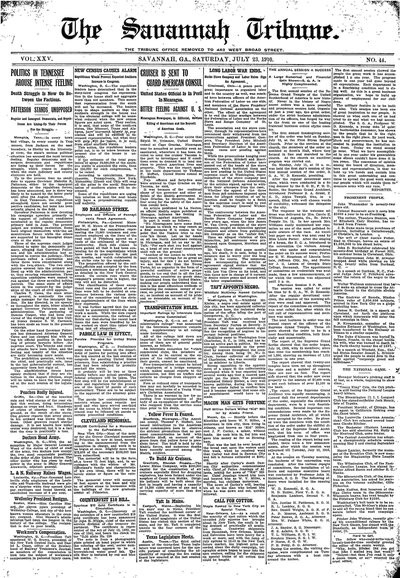
Page text (machine-generated)
VOL: XXV.
POLITIGS IN TENNESSEE AROUSE INTENSE FEELING
Death Struggle Is Now On Between the Factions.
PATTERSON STANDS, UNOPPOSED
Regular and Insurgent Democrats, and Republicans Are Lining-Up Their Forces
For the Struggle
Memphis, Tenn.—In every town and village, in every county in Tennessee, from Jackson on the east boundary, to Shelby on the Mississippi river, the state's serious political situation has aroused the most intense feeling. Regular democrats and insurgent democrats and republicans are lining up their forces for the struggle, which comes in August, when the state judiciary and county elections are held.
Up to the present time no candidate to oppose Governor Malcolm R. Patterson, either by the insurgent democrats or the republican forces, has been announced, nor is there any likely to be named by the latter party until after the August election.
In East Tennessee, the republican stronghold, there are several prospective candidates, but none has been actually placed in the field.
Governor Patterson is now devoting his campaign speeches primarily to the support of judiciary candidates nominated at the regular democratic primary held in June. The present judges are seeking re-election. Some have aligned themselves with the administration forces while the others are supported by the insurgent democrats of the state.
Three of the supreme court judges declined to enter the democratic primary, alleging that Governor Patterson and his administration had attempted to coerce the judiciary. Their partisans called a convention and these three were renominated along with the two others. The two other justice entered into the primary and lined up with the administration party, thus securing renomination. Three opposition candidates were named to run against the three so-called bolting justices. The same state of affairs exists in the contest for the judgements of the court of civil appeals.
Charles T. Cates, the state attorney general, is nominally the campaign manager for the insurgent faction. He has directed, in his speeches throughout the state, bitter attacks against Governor Patterson and his administration. The pardoning of Duncan Cooper, who had been convicted of the slaying of the late United States Senator E. W. Carmack, has been made an issue in the present campaign.
On the other hand Governor Patterson has denounced Attorney General Cates and has charged him with using his official position in the handling of private lawsuits before, the supreme court. The attacks and counter attacks have been bitter, and the feeling and tension of the situation are daily becoming more acute.
The prohibition question, which was the chief, and practically sole, issue in the last gubernatorial contest, has apparently been lost sight of.
The administration forces have openly declared that if they are victorious in the August election, steps will be taken to have the law repealed at the next session of the legislature.
Peaches Badly Injured.
Griffin, Ga.—One of the heaviest rain and wind storms of the year visited this section, doing tremendous damage, to crops and fruit. Hundreds of crates of elbertas are on the ground, as the result of the storm. One grower reports that every peace in his orchard was blown from the trees. Other growers report similar damage. It is not known how many crates were destroyed, but it is a fact that the crop is practically a loss.
Doctors Head Army.
Washington, D. C.—With the assumption by Major General Leonard Wood of the duties of chief of staff of the army, two doctors now occupy the, two most responsible positions in the army of the United States. The other doctor who has risen to such power in the army is Major General Alnsworth, adjutant general.
L. & N. Railway Raises Wages.
Louisville, Ky.—Four thousand Louisville invites you to Nashville Railroad were given a 'surprise when they opened their pay, envelopes and found therein an unsolicited increase of 6 per cent.
Wellesfey President Resigns.
Boston, Mass.—Miss Caroline Hazard, for eleven years president of Weishels-College, and one of the best known women educators in the country, resigned. Miss Hazard's administration had been the longest in the history of the college. The resignation is due to poor health.
Workmen's Compensation.
Washington, D. C.-President Taft appointed W. G. Brown, president of the New York Central lines, and Daniel L. Cease, editor of the Brotherhood of Railway Trainmen's Journal, as members of the commission to look into the subject of workmen's compensation in personal injury cases.
The Savannah Tribune.
THE TRIBUNE OFFICE REMOVED TO 462 WEST BROAD STREET.
NEW CENSUS CAUSES ALARM
Republicans Would Prevent Expected Southern Increase in Congress.
Washington, D. C.—The republican leaders have determined that in the sixty-third congress the representation in the house shall not aggregate more than 410 members. This means that representation from the south will not be increased. The leaders hope to shape matters so that the southern strength in the house and in the electoral college will be somewhat reduced when the new census figures are acted upon. They realize, it is said, that some of the southern states, like Missouri, Texas and Alabama, have increased largely in population and will be entitled to increased representation, but what they will gain will be taken, it is said, from other southern states.
This action, the republican leaders point out, is to be taken because the present size of the house is unwieldy.
If the estimate of the total population of about 29,000,000 of the southern states is exceeded the ratio, fixed at 220,000 for each congressman, to be raised.
According to calculations, Massachusetts, Pennsylvania, New York, Minnesota, Illinois and Ohio will reap all the gains in the north. Representation of southern states will be decreased.
Some of the republicans are urging this solution so that the next house will have a preponderating republic can majority.
NO RAILROAD STRIKE.
Employees and Officials of Pennsylvania Reach Agreement.
Philadelphia, Pa—General Manager W. H. Myers of the Pennsylvania Railroad and the committee representing the 15,000 trainmen and conductors employed on the lines of the road east of Pittsburgh agreed on a basis of the settlement of the wage controversy. Each side claims to have gained all that it had been contending for in the negotiations which have been in progress for the past six months, and watch culminated in the strike vote by the employees.
The proposition offered by the railroad, officials and accepted by the men includes a minimum day of ten hours, as detailed in the New York Central award. On certain runs where the company's present rate is higher, the rate will not be disturbed.
The classification of these exceptional runs and the question of overtime were left to be decided at conferences between the various members of the committee and the division suprindents of the lines which they represent.
It was further agreed that the men would be guaranteed twenty-six days' work a month. While the men regard this as a concession, the railroad officials say that during the recent hard times the men were benefited by being worked on short time rather than being laid off altogether.
PAROLE LAW IN EFFECT.
Paroles Provided for United States Prisoners.
Washington, D<sup>C</sup> G. — Preliminary steps have been taken at the department of justice for putting into effect the law enacted at the last session of congress for paroling United States prisoners, thus establishing a practice that had been adopted by probably one-half the states.
It probably will be two or three months before any actual paroling of federal prisoners will be taken. The first step will be the establishment of rules and regulations for the procedure of the board of parole of each penitentiary. These are to be subject to the approval of the attorney general.
The parole law contemplates that convicts whose prison records are good and who have served one-third of the terms to which they were sentenced may be released on parole in certain prescribed conditions.
CLEVELAND MEMORIAL.
$100,000 Contributed for a Monument to the ExPresident.
New York City—Most of the money for the Grover Cleveland memorial at Princeton is now at hand, according to the announcement from the committee in charge, and work is to be begun at once. Slightly more than $73,000 of the necessary $100,000 has been subscribed.
The memorial will be in the form of a tower 75 feet high, and, in accordance with the wishes of Mr. Cliffeland's family and characteristic of his own ideas, there will be no heroic statue or figure on the exterior.
The memorial tower will measure 40 feet square at the base and will be of silver stone to harmonize with the buildings of the new graduate school at Princeton.
COUNTERFEIT $10 BILL.
Spurious $10 Gold Certificate is in Circulation.
Washington, D. C.-Discovery of the existence of a new counterfeit $10 gold certificate has been announced by John E. Wilkie, chief of the secret service division of the treasury department. The certificate is represented of the act of July 12, 1882, series of 1901, and bears the check letter "D,55 plate No. 150.
The note is from a photographic plate printed on bond paper in which the coloring of the seal, series numbers and back appears to be a brownish-red water proof ink. The silk fiber is imitated by red and blue ink marks.
SAVANNAH, GA., SATURDAY, JULY 23, 1910.
CRUISER IS SENT TO GUARD AMERICAN CONSUL
BITTER FEELING AGAINST U. S.
Washington, D. C.—Fear exists that Edwin W. Trimmer, United States consul at Cape Gracias, Nicaragua, may be assaulted or possibly even assassinated, wherefore it has been decided to send the cruiser Tacoma to the port to investigate and if conditions seem to demand it to land marines to protect American lives and property. This was the report made at the state department by Thomas P. Moffatt, United States consul at Bluefields.
Two officers and forty-five men were ordered to Cape Gracias on the Tacoma, he said.
It was because of the continual abuse of the governor and other officials of the Madrid government at Cape Gracias, he declares, that the fear arose for the safety of the American consul here.
An article published in La Naclon, an official Madrid organ published at Managua, indicates the feeling in Nicaragua against Americans.
"We Nicaraguans have some limited means to which we may resort as a final recourse if it comes to the point that the Yankee tries to execute his threat. Let us lay hands on all the North Americans residing in Nicaragua, and let us say to Mr. Taft: "For each shot you hurl against us, a head of one of your countrymen shall roll on the ground." "Another of the means to which we may resort in revenge for so great an injury, and for this I do not believe we are less able than the Young Turks, let us organize in the form of a powerful coalition of active propaganda, to tie end that in all the Latin-American countries no goods shall be purchased from the United States; making our people understand that in this is the most efficacious methods of combating the common enemy of our race, so proud on account of its power; so insolent on account of its pride and so detestable, on account of its, insolence."
TRANSPORTATION RULES
Important Rulings by 'Interstate Commerce Commission.
Washington, D. C.—A set of "administrative rulings" was announced by the interstate commerce commission, supplementary to all rulings made heretofore.
All of the rulings laid down are important to interstate carriers and some of them are of general public interest, as follows:
An interstate excursion for *britain commercial clubs*, the members of which are to be carried at the expense of the railroad companies as their guests, cannot be sanctioned.
Free transportation cannot be issued to employees of a bridge company, which makes annual reports to the commission, but files no traffics and collects no charges from shippers or carriers.
Free or reduced rates of transportation may not lawfully be accorded to traveling secretaries of a Young Woman's Christian Association.
There is no warrant in law for according free transportation of the body of an ex-employee of the carrier who resigned from the service some time prior to his death.
Yellow Fever Is Feared.
Bluefields, Nicaragua.—The American consul, Thomas P. Moffatt, has issued instructions to the American naval commanders here to observe the strictest precautions that no personal communication be held with Bluefields Bluff, on account of the grave fears that yellow fever is prevalent there. The bluff is held by the Madriz forces, and numerous deaths have recently occurred among the Madriz soldiers.
- To Build Air Cruisers.
Graefrath, Rhenish Prussia—The Lower Rhine Company, with $500,000 capital for the construction of air cruisers especially fitted for dropping explosives, has been formed under the auspices of Count von Moltke. Dirigible balloons will be built about 390 feet in length and having a capacity of 14,300 cubic meters of gas and a carrying capacity of more than five tons.
Taft In Maine.
Eastport, Maine.—Beginning his ten days' stay in Maine, President Taft reached the northeast corner of the United States. It was the first time a chief magistrate of the United States has visited this section of the state, and for Mr. Taft it completed travels to the four corners of the country.
Texas Legislature Meets.
Austin, Texas—The third called session of the thirty-first Texas legislature was convened here for the specific purpose of considering the advisability of repealing the fire rating board law enacted at the last session of the legislature.
LONG LABOR WAR ENDS.
Bucks Stove Company and Labor Union Sign
An Agreement.
Cincinnati, Ohio.—A peace pact of great importance to organized labor and to the country as well, was reached here between officers of the American Federation of Labor on one side, and members of the Stove Founders' National Defense Association on the other. The effect of the agreement is to end the bitter warfare between the Federation of Labor and the Bucks Stove and Range Company of St. Louis.
The association and the stove company, through its representatives here announced their withdrawal from the prosecutions against President Gompers, Vice President John Mitchell and Secretary Morrison of the American Federation of Labor in the contempt cases now pending against them.
While the prosecutions hanging over Messrs. Gompers, Mitchell and Morrison of the Federation of Labor have passed out of the hands of the stove company, which instituted them and are now pending in the United States supreme court at Washington, representatives of the stove company and of the National Defense Association, by the articles signed, agreed to withdraw their attorneys from the case. Whether the appeal of the three men from jail sentences imposed upon them for alleged violation of an injunction shall be fought to a finish in the supreme court is said to rest now with Attorney General Wickerham.
The controversy between the American Federation of Labor and the Bucks Stove Company began about two years ago, when the late James W. Van Cleve, president of the stove company, sought an injunction against Gompers and others from publishing his company as on the "unfair list."
Upon an alleged violation of this injunction, jail sentences were pronounced upon Gompers, Morrison and Mitchell.
Mr. Van Cleve died some months ago, his death, it is said, being in a measure due to worry over the long fight in the courts. The memorandum accompanying the articles of agreement signed declare that the company was recently reorganized, with Lee Van Cleve as its head, and that those now in charge of it earnestly desire entire peace and accord with the labor organizations.
TAFT APPOINTS NEGRO.
Whitfield McKinley Named Collector of Customs at Washington.
Washington, D. C.—Whitfield McKinley, a negro real estate agent of this city, has been appointed collector of customs here, the technical designation of the office being the port of Georgetown, D. C.
News of McKinley's selection by President Taft was received here from Secretary Norton at Beverly. It sl stated that the appointment signifies the recognition of negroes in important federal positions.
McKinley came to Washington from Charlesion, S. C., in 1884, and has taken an active part in politics. He was strongly recommended to the president by negroes throughout the country, among them being Dr. W. D. Crum, former collector of the port of Charlesion, who was recently named as minister to Liberia.
Strong opposition to the appointment of a negro to the collectorship developed when it was reported here several weeks ago that a coorred man might get the place. The president nominated Sidney Bieber, a very well known politician, during the winter, but the senate failed to confirm him and it became apparent that some other appointment would have to be made.
MACON MAN GETS FORTUNE
Half Million Dollars Willed "Kid" Miller by Alaska Friend.
Macon, Ga. — Shortly before the Klondike gold boom W. V. Miller, a motorman in this city, then living in Atlanta, and known as "Kid" Miller, met J. F. Curley, a miner, without funds. He took him in, fed him and gave him money as far as Birmingham.
That was the last he ever heard of the bread cast upon the waters until this week, when he received word that Curley had died in Dawson City and left a fortune estimated at $500,000.
Shortly after Curley's death Dawson City authorities communicated with Chief of Police Jennings of Atlanta, asking for news of "Kid" Miller. Chief Jennings traced him here and located him as W. V. Miller, a married, but childless motorman.
The news of Curley's will, leaving his all to the man who helped him when he was down and out, quickly followed.
CALL FOR COTTON.
Staple Rushed to New York City on Special Trains.
New-Orleans, La—As a result of the scarcity of spot cotton which the so-called July squeeze has brought about in New York, the south is being drained of practically all available cotton. Coastwise shipments from Savannah, New Orleans, Mobile and Galveston have been heavy for a week or more, and with the jump of July options to 16.53 in the New York future market, the highest price recorded since the Sully campaign, telegraphic orders began to pour into the spot centers, calling for the shipment on special trains of all cotton that could be bought.
THE ANNUAL SESSION A SUCCESS
The first annual session of the Supreme Grand Temple of the United Brotherhood of America is now history. Never in the history of Negro secret orders was a more peaceful and prosperous session held. Organized just a year ago, the great order, under the strict business administration of its officers, has forged its way to the front as one of the leading fraternal business orders of the country.
The first annual thanksgiving service of the order was held on Sunday, July 10, at the First Bryan Baptist Church. Prior to the services at the church, the members of the order assembled at Scott's Hall, where they formed in line and marched to the church. At the church an excellent program was carried out.
On Monday, July 11, at 10 a.m., was held the first day's session of the first annual session of the order, S. G. A., W. D. Kennedy, presiding.
After the regular devotional exercises, which were conducted in a fitting manner by the S. G. H., P. H. D., Butler, the Supreme Grand Architect, introduced Professor S. A. Grant, P. G. D. Alpha Temple, who, in a speech, filled with well chosen words of cordiality, welcomed the delegates to the city.
The response to the welcome address was delivered by Mrs. Carrie E. Williams of Augusta, Ga., St. John's Temple No. 18. In her speech Mrs. Williams easily maintained her reputation as one of the most polished female orators of the race. An excellent paper on work was next read by Miss Lizzie Porter. After the singing of a hymn, the S. G. A. introduced to the convention the visitors. Among those who spoke and congratulated the order on its success were: Professor E. W. Houstoun of Lincoln Institute. Jefferson City, Mo., and Professor J. G. Lemon of Georgia State College, Savannah. The appointment of committee on credentials was next made, then a few announcements, after which the session was adjourned until 3 p. m.
Afternoon Session 3 P. M.
The session was called to order 'on time by S. G. A., W. D. Kennedy. After the regular devotional exercises, the minutes of the morning session were read and approved. The report of the committee on credentials was next called for, after which the roll call of representatives and members was made. The next business in order was the annual report of the officers of the Supreme Grand Temple. These reports showed the order to be in a most flourishing condition, both financially and numerically. The report of the Supreme Grand Scribe showed that the order began, July 16, 1909, with 85 members; since that time the membership has reached 1,300, showing an increase of 1,215 members in one year.
The report showed that twenty-one temples have been set up throughout the state and a number of conventions are now on foot. The report also showed that the order now owns property to the amount of $7,000 with a net cash balance of over $1,100 in the bank.
The report of the Supreme Grand Architect was equally encouraging. It showed that the several departments of the order, especially the children's department, were in a very flourishing condition. Several important recommendations were made by the Supreme Grand Architect, all of which were accepted by the order. So pleased were the members with the condition of the order under the skillful direction of the Supreme Grand Architect, that his term of office was lengthened from one to four years.
The reading of the report being concluded, there were a few announcements, after which the session was adjourned till Tuesday, July 12, 1916, at 9 a. m.
At the session on Tuesday morning, the business of the convention was concluded. After the various reports of committees, the installation of officers and supreme executive board was conducted by Professor John M. McIntosh, S. G. D. The following officers were installed for the ensuing year:
W. D. Kennedy, S. G. A.
H. D. Butler, First V., S. G. A.
Benjamin Lambert, Second V. S. G. A.
Mrs. Justine H. Patterson, S. G. M.
R. L. Lockley, S. G. S.
F. B. Petty, S: G. Attorney. During the session, the visiting delegates were complimented on Tuesday afternoon with a boat ride around the harbor.
The first annual session showed the people the great work it has accomplished in one year. The progress made in one year has gone beyond all expectations. Each department is in a flourishing condition and is doing well. As this is a great business organization, we hope to build up places of employment for our children.
The military feature is to be built up also. This session has been one of great inspiration to our people. It showed us what each one of us had tried to do and what we had accomplished. The S. G. A., Professor W. D. Kennedy, a young man of quiet but businesslike demeanor, has shown to the people that he is the right man in the right place. By hard work, pluck and perseverance, he has succeeded in pushing the institution to the front. Today we stand second to none. What we have accomplished in one year under his generalship some others couldn't have done it in ten years. The concensus of opinion among the board of directors, members and representatives, is that we hold up his hands and sustain him in this great undertaking and continue to spread the good work among our people which will enable them to measure arms with any race.
REPORTER
PROMINENT PEOPLE.
John Wanamaker is seventy-two years old.
Colonel Roosevelt says it costs him $5000 a year to be ex-President.
The author, Theodore Stanton, son of Elizabeth Cady Stanton, has returned from France.
J. B. Duke made large purchases of pictures, including a Gainsborough, at Christie's, in London.
The will of Chief Justice Fuller, filed in Chicago, leaves an estate of $1,000,000 to his direct heirs.
John D. Rockefeller celebrated his seventy-first birthday at Forest Hill, his summer home in Cleveland, Ohio.
Ex-Congressman John M. Atwater dropped dead while plowing on his farm, twenty miles from Durham, N. C.
In a speech at Durham, N. C., Federal Judge Jeter C. Pritchard advocated the return of the negro to the farm.
Walter Wellman announced that he will make an attempt to cross the Atlantic Ocean in the dirigible airship America.
The Gaekwar of Baroda, Hindoo Prince, ruler of 3,000,000 subjects, arrived in New York City on a globe encircling tour.
James R. Garfield, in a speech at Cleveland, set forth the platform upon which insurgents will enter the fall campaign in Ohio.
B. Kroupensky, conseller of the Russian Embassy at Washington, has been transferred to the Embassy at Vienna in a similar capacity.
The Duke d'Alencon was buried In Orleans, France, in the chapel beside his wife, who was burned to death in the Paris charity bazaar fire of 1897.
In a speech at Winfield, Kan., United States Senator Joseph L. Bristow urged the people to stand firm in the fight against "corporate greed and selfishness."
THE NATIONAL GAME.
Manager McGraw's pitching staff is at last, as a whole, beginning to show class.
"Young King" Cole, the Cub pitcher, is still fooling the National League heavy hitters.
The Bloomington (I. I. I. League) Club has signed outfielder Jack Henry, late of Topeka.
President Murphy, of Chicago, has an agent in California looking over the Coast talent.
The Louisville (American Association) Club has released second baseman Claude Ritchey.
The Rochester (Eastern League) Club has sold shortstop Ed. Holly to the Montreal Club, same league.
The Central Association has adopted a championship schedule season opening May 5 and closing September 18.
Harry Lumley, formerly the manager of the Brooklyn Club, is now managing the Binghamton State League team.
The Wilmington Club, of the Eastern Carolina League, has signed infielder Alfred Bacon and pitcher E. C. Hanks.
The Minneapolis Club, of the American Association, has asked for waivers on the veteran outfielder, Willee Plekering.
John Kadling, first baseman of the Eau Claire team in the Minnesota-Wisconsin league, has been bought by the Pittsburg Club for $1500.
Washington's ball team is to be reconstructed. "Jim McAleer's plans are to add all the young blood that he can secure before the next campaign opens.
Pitcher Jake Welmer, recently given his unconditional release by the New York Giants, has signed with the Standards, an independent team at Joliet, Ill.
Hard to Get.
The fellow who could-write 'em if he only had-the-time cordially greeted the editor of the comic weekly.
"Why, hello, Blinks! Did you get that joke I malled you last week?" Joyce but then I've read it only a doodle times, or so!" retorted the cruel editor.
Largest Sick and Death Benefits; Smallest Premiums.
The Guaranty Aid and Relief Society
Treasury of State of Georgia
Attorney General Quits Race For Governorship of Georgia.
Judge Hart Utters a Solemn Warning as to The Financial Condition of the State of Georgia.
Atlanta, Ga.—Judge John C. Hart has retired from the race for governor.
Three weeks after his announcement and on the very day his resignation from the office of attorney general of Georgia took effect and his successor was sworn in, he is sued a formal statement announcing his withdrawal.
This practically leaves the field to Governor Joseph M. Brown and Hoke Smith, who will fight over the campaign of two years ago.
Likewise its effect will be to make unnecessary the application of the primary prorating rule and to remove that rule as an issue in the campaign, since Brown or Smith is almost sure to receive a majority in every county. Almost as abrupt and unexpected as his entrance into the race was Judge Hart's retirement. He practically admits that he misjudged the present temper of the people of the state; that instead of wanting peace, they want war. His signed statement giving his reasons for retiring is free from bitterness; it is candid and sincere, and almost as unbiased as an opinion affecting the actions and political future of someone other than the author.
Judge Hart admit that his plea for peace has fallen on deaf ears; that his candidacy has failed of accomplishing its desired purpose. As proof of his sincerity that he desired peace and not strife, he has retired and declined to permit his candidacy to further foment strife between the two contending factions.
But Judge Hart does not yield one jot or tittle of the principles which he formerly championed. He warns the state against strife and factionalism; against the crisis which faces the state treasury; against the disgrace into which embittered partisanship may plunge the state by seriously jeopardizing her fair name and credit.
In discussing the state's finances, he says: "Georgia is now face to face with a crisis. It should alarm the patriotic men of this state. Her appropriations are in excess of her income, and the same rule applies to the state as applies to an individual who spends more than his income. Georgia has already been forced to the humiliating confession that there was not enough money in her treasury to enable her to buy property which the legislature thought, whether wisely or unwisely, her best interests demanded."
SOL. C. JOHNSON, Supt. of Ageno
Treasurer of the State of Georgia.
Masonic Books
Regalias.
LODGE SEALS.
FINANCIAL CARDS and
BLANKS of every description.
Publilahere' and Manufacturers' Prices
Liberal Discounts Will Be Arranged.
GOL. C. JOHNSON,
Gavannah, Ga.
He speaks feelingly of the dangers which threaten the state from strife, and says the only purpose of his candidacy was to prevent that strife which he believed was working harm
The state of Georgia spent last year on public roads the sum of $2,506,980, or an average of $1.08 per inhabitant, according to a report just issued by S. W. McCallie, the state geologist.
This figure represents all the cost, including an estimate of $450,000 as the value of the free labor employed by the state. The estimated milage of public roads is $2,182. Of this total mileage 4,533 miles of road were surfaced with stones, shells, gravel and sand-clay mixtures. This constitutes about 5 per cent of the total road mileage.
Fulton leads the list in the matter of improved roads. This county has 300 miles of road surfaced with stone or shells and 25 miles that are otherwise improved, leaving 75 miles of road in this county unimproved. Chatham county has 105 miles of road surfaced with shell and the cost was $3,500 per mile. Walker county has 234 miles of road surfaced with chert or gravel. Richmond has 100 miles surfaced with stone and 80 miles surfaced with sand-clay mixture. The cost to Richmond county was $1,600. Washington county has 200 miles of sand-clay roads, and Burke has 400 miles.
As to the subject of total expenditures for roads and bridges the following figures are given: Fulton county $218,000, Richmond $64,900, Sumter $50,000, Bibb $49,152, Chatham $40,000, Washington $38,50, Appling $35,875, Coweta $37,593.
Those counties which have spent as much as $30,000 and less than $35,000 are Bartow, Ben Hill, Carroll, Cobb, Coweta, Gwinnett and Jackson.
The report of Mr. McCallie acknowledges indebtedness to the prison commission and to Captain Goodloe Yancey of the commission.
Of the 146 counties of the state, 104 employ convicts and 39 use statuté or hired labor, the total number of convicts employed being 4,579.
THROUGHOUT GEORGIA.
Gordon county's tax returns receiv-
P. EDWARD PERRY, Vice President.
ed by the comptroller general show an increase in the taxable values of the county at $175,157, as compared to the returns of last year. The total figures are $3,542,138. Gordon county returns 1,081 dogs for taxation.
Within the next sixty days construction work will begin on the Atlanta and Carolina railway, interurban electric railway, which, in addition to 8 miles of railroad in the streets of Atlanta, will build a direct line to August by way of Athens, and a branch line to College Park. Authority has been received by the company from the railroad commission of Georgia for a capitalization of $5,000,000, and for a bond issue of $6,000,000. All the necessary franchises have been secured and practically all the rights of way.
Much damage is resulting in the Commerce section from continuous rains. Many farmers did no work in fifteen days. On many farms, the grass is spreading and cannot be subdued. Wheat and oats are sprouting and rotting in the fields. It is thought that at least half of the fine grain crop will be lost. High waters have washed away much small grain. Fruit is rotting on the trees. The roads are almost as bad as at any time during the past winter. The upland corn, however, is by all odds the finest ever grown in Jackson county. Corn on lowlands is a complete failure.
THE NATIONAL GAME.
The Pittsburg Club has given infielder Abbaticchio his release.
The St. Louis Club has refused to waive on Pitcher Clicotte, of Boston.
Bonesetter Reese broke a resolution not to treat any more ball players and fixed up Overail's arm.
Billy Merritt, an old National League player, has been engaged as a scout for the Boston Nationals.
The Sloux City Club, of the Western League, has signed pitcher Sam Houston, a college lad not yet twenty-one years old.
The St. Louis Club has sold pitcher Rankin Johnson, just returned by Memphis, to the Dallas Club, of the Texas League.
Messrs. Babe Adams and three fingered Brown are collaborating in a poem entitled "The Mutability of Diamond Greatness." Bobby Wallace manipulates his hands as cleanly on ground hits as a brassy picking up a golf ball. In easy naturalness he can't be beat. The St. Paul Club has secured the release of third baseman David Brain from the Buffalo Club, of the Eastern League. He will be used as substitute. The Scranton (New York League) Club has released pitcher Kellogg to make room for southpaw Scanlon, purchased from the Philadelphia National Club.
Time is not in accord with the wonderful human mind; it is too slow or too fast—have you ever noticed that?
HOME OFFICE.
463 WEST BROAD STREET,
SAVANNAH, GEORGIA.
Bell Phone 1196. Ga. Phone 2029
Directors;
L. E. Williams.
P. Edward Perry.
Walter S. Scott.
Sol G. Johnson.
W. R. Folds.
L. M. Pollard.
This company is duly chartered under the laws of the State of Georgia, and has complied with all requirements of the state Insurance department, therefore all policy holders are protected with all the safeguards that the strict insurance laws of this State seek to protect its citizens.
Its affairs are directed and managed by Negro men of the city of Savannah of leading standing, and whose character and reputation are of such as to command the respect and confidence of all the people of that community. The same men that manage this Society are the ones that organized and are conducting the affairs of the first successful Negro Savings Bank in this state, therefore we can readily see that by connecting themselves with this Insurance company their interest will be in safe hands.
By comparing our rules and benefits with other first class companies it will be seen that we offer the most liberal inducements with the largest sick, accident and death benefits to our members than any other company in this business.
That we pay our claims promptly can be testified to by the thousands of our satisfied members.
Agents Wanted Everywhere
Liberal Terms and Commission.
NOTICE.
Atlanta, Ga., April 1, 1910. Some time last fall one D. L. Benton, colored, five feet and ten inches in height; weight about one hundred and seventy-five pounds; his color was light brown, ran away from Sylvester, Ga., after making away with money entrusted to him by the colored Masonic lodge there. Being left without means, we are not able to offer a reward, but if any person or persons know of his whereabouts they would confer a favor upon Green Mountain Lodge, Sylvester, Ga., and justice of the state of Georgia, by letting L. W. Woodard, Sylvester, Ga., box 14, know. All weekly papers please copy and assist us in breaking these lodge thieves.
Done by order of the Grand Master this 1st day of April, 1910.
Very talkative, inclined to boast,
head pretty, bald, eye tooth crowned.
A native of Steward county, Georgia,
round shoulders, space between front
upper teeth.
Send to the Savannah Tribune.
Parties furnishing proper information will be compensated for their trouble.
L. W. WOODARD,
tf Sylvester, Ga., Box 14.
NATIONAL ASSOCIATION OF COL-
ORED GRADUATED NURSES.
The third annual convention of the National Association of Colored Graduate Nurses will be held in P. adelphia, Pa., August 16, 17, 18, 1910, at St. Peter Claver's auditorium Twelfth and Lombard streets.
Nurses throughout the country are earnestly requested to attend this meeting. Matters of importance to the profession at large and all others interested in the bettering of conditions are to be ventilated. Plans for immediately beginning active work in the tuberculosis crusade are to be presented and lit is sincerely hoped that the support of the public and the hearty co-operation of all nurses will be given this great and good movement. All information pertaining to board and lodging can be obtained from Mrs. M. R. Tucker, R. N., President, Philadelphia. For further details write:
Miss Martha M. Franklin, R. N. President, 61 Dixwell avenue, New Haven, Conn.
Miss A. Lottle Marin, R. N. Corresponding Secretary, 66 West One Hundred and Thirty-fourth street, New York City.
To a man who has no ear for music, a frog orchestra comes much cheaper.
The web of a fraud surrounds him at every turn.
WALTER S. SCOTT, Secretary and Tr eas.
HERE was never a time in the history of mankind when there was so much danger of universal war, such gigantic proportion and such deadly machinery. For many years the countries of Europe have been armed camps, and at present seem to have reached their limit. Germany today keeps constantly under arms one million men and has on a war footing four million, with the necessary establishment to put them in the field on notice.
France, Austria, Russia and Italy maintain armies and navies on a scarcely less formidable basis. Russia is trying to reinstate herself to a position held before the Japanese war, and our own country since it has attained the position of a world power has become inflated with the mania. Our Secretary of the Navy has called for a navy equal to the greatest and Congress is meeting his demand.
The picture is not complete without a glance at the other side of the globe, Japan has demonstrated that every able bodied male is a fighting man ready to obey the Mikado, and its large navy is still being increased. The Chinese Minister to Germany has hastened home to assume the duty of putting China on a war footing.
We have reached a time in the world's affairs when intelligent men are ignoring the principles of right and justice and are inclined to rest on brute force, but a new force is come into the world to bring about universal peace when the organized workmen of the world decide that they will no longer go out to shoot down their fellow workmen to satisfy the greed and ambition of rulers.
Farm Warns the City
Economic Adjustment and Closer Relations Demanded
Ey Senator McCumber
Y what law, God-given or man-created, have the denizens of cities a greater right to the comforts, the luxuries, the pleasures of life than have the tillers of the soil? The wonderful prosperity of the last dozen years has developed a life of reckless extravagance in this country. The great number of wealthy people now present in every large city has set a pace of high living with which the less fortunate are trying to keep up. Econdmy and self-denial seem almost to have become a lost art.
Y what law, God-given or man-created, have the denizens of cities a greater right to the comforts, the luxuries, the pleasures of life than have the tillers of the soil? The wonderful prosperity of the last dozen years has developed a life of reckless extravagance in this country. The great number of wealthy people now present in every large city has set a pace of high living with which the less fortunate are trying to keep up. Econbmy and self-denial seem almost to have become a lost art.
The city gait is entirely out of relation and proportion to the more rigid econbmy practiced by the rural population. There must and should be an economic adjustment upon a plane of closer equality, and this means that we must eliminate some of our most extravagant habits; that we may not satisfy all of our expensive desires.
We make living expensive because we submit to excessive charges rather than deny ourselves some useless luxury. Let us begin our economy at the right point. Let those men who need some expression for their excessive boycott spirit turn it against the $5 to $25 a day rooms at their hotels. Let those ladies direct it toward the $25 to $50 hat that has not $4 worth of actual material on it.
When they have done that they will have accomplished a double good—they will have brought these and kindred articles down to a reasonable basis, and they will have saved sufficient means to pay the farmer and the retailer fair and honest compensation for their foodstuffs. They will have given new strength and power to the principle of "live and let live."—Columbian Magazine.
AWAKENING OF KNOWLEDGE.
Wunce me an henry beamus stopt, befoar
The big frunt windo uv a dirigoods store
Awl fickens with hansum thigs to fetch the
Welty wimmen when theres goon bi
An henry saw a hat hat made uv lace
With buries on fore sum fare laders face
Markt aten dollars an he heevd a si
An sel that wimmens cleas are offie hi
Becaus when u b hats u are not dun
With wimmens cloas but onley just begin.
An henry saw an ostrich ploom mark
down
To twenty dollers an a hansum gown.
Fore mnety sicks an shooze fore ate an
tenm
An glause forsick an sed no wunder men
Are ap too get discurrend when they tri
To say a littul munney too an bi
The things thares wives an dotters want
Felt in his trowers pockt just to see
Wot he kood bian when he tell he-sed
The unlity wood be'a apool uw thred!
An after henry lookt heez offie bloo
An naut taen he when he...
Thare chance uget getmen padded offim
An sed she did not nede to wate for him
Az she had promist too not known she
Wood proov to be so grate a luckshury.
An henry sed purphis if not for this
He mite uw been az igormunt az bliss
An naut taen when he...
That marridge was a simp thing in no
PERILS OF BOYHOOD.
BY RFV. A. MELROY WYLIE.
Our childhood was spent in the midst of an old fashioned family. There were seven sons and five daughters, and we knew nothing of that dainty care which surrounds the families in many of our present house holds. Our parents held a great city in horror. As for them, their children must be brought up in the country. Thirty acres about the house, within walking distance of the village, and an outlying farm, a large portion of it covered with the primeval forest, was thought to be little enough to furnish scope and right conditions for the sturdy development of the sons and daughters.
Work there was in abundance, and it must be done—such work as had to be met with ax, and spade, and shovel, and rake, and hoe, with horses and wagons, and plows, and harrows, and all the implements known and needed in a large garden or on a large farm.
The lighted candles and lamps anticipated the day by several half hours in the winter, and in the summer the early sun was the signal call to the early labors. Such a life, too, was not without its perils; colts were wild, and sometimes had to be broken, and horses would sometimes run away, and there was scarce a boy of seven who did not bear marks of the mishaps he had had with animals on the place.
But it was not all work. Our father knew how to recognize a boy's impressible demand for recreation and fun; so he permitted us to have dogs and guns outdoors, and musical instruments and some games for indoor life.
All work, he well know, makes the jout and degrades to the level of a machine—turns a man's character into a hard and bare skeleton; while fun and recreation, in due proportion with work, clothe the bony structure with muscle and flesh, and puts the flash in the eye, and the roses in the cheek.
If the work was well done through the week, school faithfully attended and lessons learned, Saturday afternoon was our own. How those closing hours of the week glowed in our anticipations, and the prospect brightened our animal spirits over the entire six days' tasks.
There was the hunting party for that afternoon, or the ball club, or the riding match, or the long excursion to the magnificent forests which approached to within a mile or two of the village. Or, at least, but often the best in the summer, was the party for a long tramp to the distant water, which was deep enough to challenge the skill of those lucky youths who had learned to swim.
With what profound admiration we looked on those boys who had come from a distance to attend the institution of learning in the village, and who told of the great rivers and lakes near their homes, and what wonderful feats in swimming, and diving, and floating they could perform. To our youthful minds, that had never seen a river or lake, these beings were looked upon as little short of supernatural. At the least they loomed up into the majesty of real heroes. We owe it to one of these river reared boys that we are here now to pen this incident.
Indeed, we owe all we have done in life to that sturdy swimmer who had learned his strokes in the Ohio. That Saturday afternoon stands most conspicuous in our memory, and is as yesterday, though it passed, with its incident, far back in the past.
The long looked for afternoon had come; our patty was formed, for a walking excursion some four miles to a splendid forest, where ran a clear, deep stream. It was a hot afternoon in July. Many were the walking challenges given and taken on the way, and many were the stones-shed at the birds, and great was the excitement when a seven foot blacksnake made his appearance, and the party surrounded the creature and gave it battle to the death.
Of course, we were all in a red hot, glow when we arrived at the bank of the far away stream. The knowing ones warned us we must not plunge into the water while we were so much overheated. What fun in a summer swim beneath the overhanging trees! The run over the more crowded bank
the high leap into the air, the upright position, arms laid close to the sides, the compressed lips, the closed eyes, the shooting into the flood, the snuffing out of human voices, the gurgling of the waters, the refreshing coldness of the plunge to the bottom, the strokes downward, the wonderful spring upward, the buoyancy of the waters and the lightness of the body all produce tides of sensation which fill to the overflow the boy's cup of joy.
But nearly all this we had to learn afterward, and subsequent to the peril of that day.
The Ohio and Mississippi trained boys disdaind such a stream as that, and swam from side to side swiftly as ducks across a barnyard pond. But poor we were as helpless chicks, but ashamed of our fear and ashamed of our ignorance of the life preserving art. We moved shy of these good swimmers for fear they would drag us into the deeper water and half drown us.
They went off to chase each other on the bank at a distance. Now was the time to do a little practicing in safely shallow water. It seems no trouble for a duck to swim, and not much more for a man. Those strokes seem so natural, so easy, surely all one needs to do is to strike, just so with the hands, and just so with the feet.
We move out bravely and are amazingly encouraged. How the confidence keeps up when one knows he can drop his feet down and stand on solid ground with his head above water! But who can describe the sensations of one who cannot swim, when he finds himself suddenly beyond his depth! Instantly the bottom drops out of his confidence, all his deliberation vanishes, and all order of movement merges into the wildest beating and splashing of the waters. You gasp for air and swallow a mouthful of water. The body turns to lead, and the more desperate the movement the more helpless one seems. You cry for help and the water fills your mouth and lungs. A whirlwind of confusion sweeps through your brain; you are sinking and all hope is vanishing. In an instant the sensations and thoughts change in view of the certainty of death. New impressions seize the mind. It runs with lightning swiftness through the entire past life. Every doubtful and every evil act starts forth with more distinctness, than the magnified, pictures on the illuminated canvas.
That act of disobedience which resulted in the horse running away and breaking your arm is now more benign than it was then, and the ache in the conscience now hurts more than the ache did in the arm when it was broken. That mean act of revenge returns to give greater pain than the boy suffered when you thought yourself "even with him." The school quarrels are all pictured on that canvas in lurid light, and even the little tricks to cheat the teacher all reappear to mock at you in that awful moment. You have gone down the second time, and now are sinking for the third time. A great horror of darkness drops on the mind and the senses. You have a faint impression that the crisis has come, and there is a clutching at the hair of your head—all then sinks into darkness.
The next is the awakening. You are lying on the bank and faintly, through a rift in the eyelid, you see boys as trees walking around you, and amid the terrible roaring in the ears you begin to hear tones you recognize.
"He's all right," shouts the Ohio boy.
You open your eyes, and you are thankful beyond words that you landed on this side the dark river, and not on the other.
That afternoon dates one of the most impressive of the writer's life, and it has never been for a day lost from his conscience. Saved! for what! For, good and not for evil. It would be base and criminal beyond estimate to turn from the right into the wrong after such a signal token of mercy.
Newspapers and Public Confidence.
One of the magazines is advertising a series of articles on "The Decline of Public Confidence in the Newspaper Press." If memory serves us well it was Betsey Prig who said of Salrey Gamp's off-quoted, but rather mythical friend, Mrs. Harris, "I don't believe there's no sigh person." We don't believe there's no sigh a thing as "the decline of public confidence in the newspaper press." There may be a decline of confidence in some journals that have forfeited their claim to public respect by slovenliness in gathering and presenting the news, or by vacillation of insincerity in their support of the ideals for which they profess to stand, or by pandering to debased tastes; but the press as a whole is holding its ground. Individual backsiders may be readily detected by that reliable indicator, the volume and character of their advertising patronage. When a newspaper loses public confidence the reputable advertisers are the first to find it out. When it gains in public esteem they are likewise early discoverers of the fact.
Good Newspaper. Good Town.
The Gaffney (S. C.) Ledger remarks: "A good newspaper cannot be made these days without good advertisers." But what is of more general concern is the broad fact that a good town cannot be made in these days without a good newspaper. It costs money to make a good town, it costs money to make a good newspaper.
Fashion Notes
1910
New York City.—Bathing suits always follow the general trend of fashion and the one that is made with sleeves and blouse in one is among the smartest. Hergs is a model that includes that feature and which is made with a skirt that is full enough for comfort yet falls in the fashionable straight close lines. The model is made of natural colored pongee with trimming of brown, but brilliantine
1
is a favorite material for bathing suits, salt water silk is much used and a great many women like the warmer flannel and serge, while for trimming bands of any contrasting material are appropriate. Dotted foulard is being used and is liked, braid is correct, and braiding with soutache is employed on many of the handsover suits. The bloomers accompanying the costume are close fitting over the hips, consequently mean no bulk, yet they are loose and comfortable at the knees.
The suit is made with the blouse and skirt and the bloomers. The blouse is laid in a tuck over each shoulder and in the tucks at the back edges and the skirt is laid in inverted pleats at front, back and sides, and these pleats meet over narrow panels. The two are joined by a belt and the closing is made invisibly at the back. A pretty shaped collar finishes the neck. The bloomers are finished with hems and elastics at the knees and under faced at the upper edge. The quantity of material required for the medium size (sixteen years) is seven and one-half years, twenty-seven, four and three-quarter yards forty-four or four and one-half yards fifty-two inches wide, one and one-half yards twenty-seven inches wide for trimming.
The Hat Tilt.
There is danger of a ridiculous extreme in the hat tilt, and there is the possibility of a most fetching piquancy. A hat must be placed upon the head before the mirror and experimented with until the correct adjustment becomes second nature; then one can wear the tilted brim with the saving grace of knowing that the best has been made of the new line.
SINGLE BREASTED BLOUSE
Negligee With Fancy Collar—To be made with pointed elbow or long plain sleeves. The negligee that is made with a big fancy collar is always a becoming and attractive one.
Frillings in Demand.
"Chantecler" and other frillings are in great demand to use as side jabots on waists and gowns or silk or fine.tub.goods. They also are in high favor with mothers who love to have the little ones daintily dressed.
Ribbon Sashes.
The sash or girdle of ribbons, or even of slik by the yard, is as much a fashion for the child as for the grown-ups.
Matching Accessories.
With the violet hued suit there must be a gold chain hued with a tiny purse of gold fastened to the outside of the purse. Or, if my lady prefer to adopt the latest fad in dress, she will have a bag of violet silk with a little gold chain for change fastened to the outside. She can keep her coin in the tiny little purse while her vanities are carried in the big silk wrist bag.
Ornamental Pockets.
Pockets are proving an inexhaustible mine for displaying trimming of various kinds. There are the large square' shapes that are ornamented with braid, embroidery or buttons, giving the decorative 'plastron so much in vogue. Then, again, there are the pointed shapes that are frequently used when the lines of a coat are built on the sharp slanting scheme. Stitched flaps are placed on the tailored suits of severe cut; even lace is used on the linen costumes for ornament rather than for use, for it must be remembered that the perfection of line must not be destroyed by the contents.
Auto or Steamer Bonnet.
Traveling, whether by motor or by steamer, brings about the necessity for just such head covering as this. A bonnet of some sort is really essential both as protection against the wind and to keep the hair smooth and tidy. The one illustrated is charming and attractive and becoming as well as practical, and easily made withal. In the illustration silk is the material and the trimming is rosettes of ribbon, while the ties are of soft ribbon, but chiffon is often used for ties and the trimming could be ahy preferred one. Pongee, chif-
A
fon cloth and all materials that are used for bonnets of the sort are appropriate. If liked the brim could be of one material and the crown of another.
The bonnet is made with crown and brim and foundation brim. The brim is laid in folds but the foundation's smooth and plain. The crown is gathered at the front edge and joined to the brim and is shirred at the neck edge to form a little frill while these shirrings are held by means of a stay.
The quantity of material required is one and one-half yards twenty-seven, or one yard forty-four inches wide with three yards of ribbon two inches wide for rosettes, two and one-half yards of ribbon six inches wide or one and one-half yards of chiffon for ties.
1
Tuck Pleated Blouse—With elbow or long sleeves, with Dutch collar or neck-band. The blouse that is laid in tucks that are stitched to give a flat effect is a smart and fashionable one.
Harmonies.
One of the loveliest gowns I have seen for some time is a velvet in a most exquisite soft shade of saxe blue with more than a hint of mauve in the high lights, with introductions of heavy purple silk net almost hidden beneath embroideries of blue, mauve and purple, quite impossible to describe properly in mere words, and a beautiful jabot of old Flanders polit held by a magnificent buckle of amethyst paste.
ANOTHER KNOCKOUT.
SAFE AND SANE
CANNON CRACKER
—Cartoon by Macanley, in the New York World.
SAFE AND SANE FOURTH A SUCCESS.
WOULD ABOLISH FOOTBALL.
David Starr Jordon 'Ranks Game With Pugilism--Declares Before the National Educational Association That No Intelligence is Required to Excel at Such Sport--Favors the English Football Game.
IF YOU FLIRT ON THE STREET IN BALTIMORE YOU WILL HEAR FROM THE ASSISTANT LADY POLICEMAN
Chicago.—The value of a sensible and restrained observance of the Fourth has again been demonstrated by the casualty list of this year's celebration. In almost every city and town where the sale and explosion of fireworks were prohibited or restricted there has been a decided falling off in the number of deaths and injured, compared with previous years. This year's list of dead throughout the country, so far as reported, is 24. Last year the total was 44. The whole hymn of injured last year was 2361. This year there were only 1294. These figures show enormous conservation, not only in human life, but less injuries to arms, ears and
WOULD ABOLI
David Starr Jordon Ranks Game W
National Educational Association
to Excel at Such Sport---Favo
Boston.—David Star Jordan, president of Leland Stanford University, declared in an address before the American Educational Association that football as played by the athletes of American universities is a combination of the elements of pure brutality and pugilism. He said that the worst feature of the athletic life of the modern college is the love of the sordid, the same love of the sordid, he said, that compelled the interest of nearly the entire country to focus itself upon a ring away out in far Nevada, where a black man and a white man were pounding each other.
"Some day," said President Jordan, "the college presidents and school heads of this country will perhaps be called cowardly and brutal because they did not put a stop to the dangers of football, a sport that de-
IF YOU FLIRT ON THE STREET WILL HEAR FROM THE
Baltimore, Md.—The Woman Suffrage Club, of Baltimore, intends to put an end to all street flirtations, to keep many of the young people who swarm the streets at night at home, and to prevent any behavior that is not decorous and mannerly-by older men and women.
The committee from the club called upon the State's Attorney and asked his advice and co-operation.
The State's Attorney will be appealed to particularly to discover if it is possible to appoint women assistants to the police officers at the sighurban resorts and on the downtown streets, whose duty will be to look after street morals.
When the suffragists appealed to the police board recently to secure the appointment of women policemen at the resorts the board declared such action not within its power, as the resorts were outside of the city limits.
Plans to Be Taken Up With President Taft at Beverly.
Washington, D. C.—Such meetings of the Board of Trustees of the projected postal savings banks as are held during the summer will take place at Beverly. This has been agreed upon by the three members, Postmaster-General Hitchcock, Secretary of the Treasury MacVeagh and Attorney-General Wickersham.
The organization of postal banks has been informally discussed by members of the board, but no plans will be made for putting them into operation until the board has had an opportunity to talk over the matter with the President. It is not believed that the first of the postal banks can be opened this year.
Will Abandon "Biblical Fables."
Chicago.—The rise of a new type of Christianity is heralded in the current number of the Biblical World, organ of the University of Chicago Divinity School. It will be ethical, scientific, social and altruistic. Biblical fables and stories that conflict with scientific truth are to be abandoned.
His Broken Neck Set by
Columbus, Ohio.—By a bloodless surgical operation Jack Eowens, a coal miner, of Nelsonville, O., was relieved of an injury to his neck involving both dislocation: of vertebrae and fracture, suffered three-weeks ago. Under an anaesthetic, the vertebrae were restored to their proper relations by hand. manupulation and the head strapped rigidly in a normal position. Bowers stood the operation well and an hour later was talking and laughing.
eyes, which are so frequently the battered targets of destructible explosives.
Casualties in Chicago and its suburbs showed a remarkable diminution from the number a year ago. One death, due to the accidental discharge of a pistol, was reported, although the day's celebration must also be debilitated with a second death that resulted June 21 last from a rifle wound, self-inflicted, while a boy was cleaning a small rifle.
Of the injured this year 650 were hurt by fireworks, 108 by cannon, 173 by firearms, 59 by torpedoes and 97 by toy pistols.
The fire loss was $317,815.
ISH FOOTBALL.
With Pugilism—Declares Before the Man That No Intelligence is Required
forors the English Football Game.
stroys the best there is in American youth.
"No intelligence is required in the game of football. Blacksmiths and bollermakers can play the game as well as men of finer intellect; in fact, blacksmiths and bollermakers are considered the best raw material for the game."
The remarks of President Jordan were called forth by the preceding address delivered by Clark W. Hetherington, physical director of the University of Missouri and himself a Stanford graduate, who had delivered an eloquent appeal for the extension of athletics in American colleges and had defended football as the greatest of intercollegiate sports.
Dr. Jordan favored the entire abolition of football as played and the substitution of the English game.
IN BALTIMORE YOU
THE ASSISTANT LADY POLICEMAN
Now State's Attorney Owens will be asked for aid, and if he declares that the appointments are impossible the women will wait until the next legislative session, when a bill will be framed providing for the appointment of the women assistants to the police.
Meanwhile many of the suffragists will appoint themselves unofficial policemen and will look out for the conduct of the people on the streets.
Mrs. Emma Maddox Funk, the president of the club, says:
"We are not planning this campaign because we feel that the policemen are lax in their duty, but we think that there is much to be done for morality that the police have not time to bother about. If we succeed in getting women assistants to the police to do duty on the downtown streets and at the resorts then we will feel that we have accomplished something worth while."
BOY AND GIRL DROWNED.
In Rowboat at Midnight When It Capsized Near Stony Brook.
Stony Brook, L. I. The capsizing of a rowboat at midnight caused the death by drowning of Miss Eugenia Fitzgibbons, twenty, and Leroy Norton, eighteen. Two other young men who were with them in the boat struggled ashore.
Miss Fitzgibbons was the daughter of Mr. and Mrs. John Fitzgibbons, Norton was the son of Mrs. Winfield Norton, a widow. The two young men who saved themselves hurried to where some guests still lingered at a beach party given by Miss Bessie Hawkins and gave the alarm. Many hurried to the creek and after repeated efforts recovered the body of Norton.
Government to Run Model Farm
Washington, D. C.—Modern methods of handling dairy products will be exemplified by the Department of Agriculture on a farm of 475 acres, near Beltsville, Md., a few miles north of this city. It is stated that a herd of milch goats will be bred on the farm, besides other dairy stock.
Aviator Crawls Out From Under
Pittsburg, Kan.—Arch Moxsey, in a Wright biplane, dived almost straight downyard from a height of a hundred feet here after his engine had gone dead. The machine was demolished, but Moxsey crawled from a mass of planes and wires unhurt. Moxsey was soaring along evenly at a height of 500 feet when his motor stopped. Moxsey tilted his planes and floated down. When one of the plane stays gave way the machine crashed to earth.
Br re ye ‘ "oe et Fe ag? Sg? Ps * ga a: % i: ' “ - whee
= a wet . ‘ a . «* “4 . ,
ea , . oO ° E * % ‘ , “
vo ; ww So -
% : , a 8 — en 3 _ * oe hows some te et fe
6 . < Se” “a oe " ~ rete ae icicic acanioerhomieenrtacniieoaemctamdenmeneneyp mental
_ = = 7 : - ; : Fe ay s ys . , :
THE SWAMMAI TRIBUNE | YES wo weemens teams,” |S a ag ss
= , . BETTER ? Fae BO RS eg PB = le
Ps Established 1875 mo fe z ; * Zn 3 :
_ 7 _ By JOHN H. DEVEAUX, = | 7 . . ; ‘ = gi bate
. Pouptisep EVERY SATURDAY - Negro Criminals Pay Chatham County - + < Ro .
_— owes Broad Stréet, $50,000 Annually! Savannah Needs ® e 7 a 4
7 *
i ee ees A Cleaning Out. . 27 ‘ - ’
SUBSCRIPTION HATES: " . . o 2 <, e ‘
One Year vavoreenreermereeregeeeebte25 | ‘The burning question which ‘confronts the better class of Negroes|_ > > . = 16
eects meee 75 in Chatham County is: “What are we going to do with that criminal e >
Remittance must be made by Express | class of Negroes who are gnawing and sapping the very vitals of all - :
or Post Office Money Order, or Register-|that is high, elevating, and progressive in our community?” Tue 7 o* 2 :
ed deter Advertising rates given on | TRIBUNE is not utopian, and freely admits thad there has been, is how, . ”
APPH cao manus _ and always will be a criminal class; but after reading day after day in \ : :
. Entered at the Post Office at Bavannah, | the daily papers of the large number oi Negregs being sent to the gang,
" Ga as Second-Clasa mail matter. there is but one conclusion to reach, and chat is that there are too ~ 4 # : °
” Ss ~~ F910 | Many good-for-nothing Negroes in Savannah, and the sooner a good Get, away from the crowded city rookeries--the home
. SATURDAY, JULY 23, 1910 Ae cs ROE a Rea ORR eet Ee re ee eee ee ee by °
Go where you will in this coun-
try you will find some colared per-
son making good.
‘Tux volume of business done by
the coloredjman in this city is
very encourageing. There is a lit-
tle crop of J. P. Morgan’s already.
‘Tau best bargains on the market
are to buy some people for what
they are worth, and sell them for
what they think they are worth.
Now is the time for the Negroes
to get together to secure another
school. There is nota race loving
man but would not contribute
ome-thing to such a cause.
Disacnee with a certain calibre
xf men on one question, and they
will hold you a morta) enemy there-
after.
Tur “good time” young men
should mend their ways, look on
the practical side of life and com-
mence lo save for a time when sick-
ness and old age will set in.
ee:
AcotorrpD man, Will Kelly,
was compelled to serve in the pen-
itentary of this State ov er fire
yeary, accused of being an escaped
tonvict. It has since been ascer-
tianed that he was an innocent
man. During this time the State
received from the leessees for his
hire $1,434.80. To recover this
amonnta bill was introduced in
the legislature. ‘Ihe bill wasa just
_one, not calling for a penny more
‘than what the unfortunate man
earned as received’ by the State:
yet the committe, to which it was
referred turned it down. Another
effort should be made in behalf of
Kelly in order to reimburse him
-for being unjustly imprisoned.
Men’s Sunviay Club
The address by Rey. W. L.
Cash, of the Congregational church
ut the club on last Sunday was re-
plete with many valuable sugges-
tions and words of advice. The
mausie was also good. The solo by
Misses Nettie A. Houston and
Catherine Alexander and the selec-
tion by the Congregational choir
under the direction of Mrs. Hous-
tcun being greatly enjoyed. Onto
morrow the club will be addressed
on an educational subject by Prof.
E. C. Williams, of Lane College,
Jackson, Tenn. Definite actions
will alsobe taken on the proposed
move for inereased school _faeili-
tives. All loversof education are
urged to be present and give their
aid in this great movement.
He Is Not a Factional
Leader
Editor Trirune:
In the last issue of the paper
published by Bro. Harris,at Wash-
ington, Ga., he accused our able
Grand Worthy Chief-L. W. Beas-
Jey asa leader of the delegates
from the southern.part of the state.
We want the writer to understand
that we appreciate our Grand Chief
asa leader, but he is not a leader
of any certain section, but of the
entire State. In his rulings he
does not favor one section any
more than hedoes the other. If
the writer is a loyal Samaritan he
would not write such articles about
our Grand Chief. We love “him
in this section and so does the en-
tire state. as evidenced, by his long
service,
Yours
es SaManiran,
St. James Notes
After attending the Grand Lodge
K. of I’, and Grand’Court of Ca-
lanthe session which was held_in
Athens, Iast week, Rev. P. W.
Greatheart made a flying trip to
Americus, Ga. The service was
conducted by Deacon A Lenard
on last Sunday morning. At 8:30
p. m.. Rey. Savage delivered 32
able sermon. Tomorrow the fol-
lowing services will be held:
>Preaching at 11 a. m., Sunday
School at 3 p.m., A.C. E. League
at’S p: m., and preaching at 8:30
p.m. Visitors and strangers are
always welcome, s
WHEN WILL NEGROES LEARN,
BETTER '? Pi
Negro Criminals Pay Chatham County
$50,000 Annually! Savannah Needs
A Cleaning Gut.
_ The burning question which ‘confronts the better class of Negroes
in Chatham County is: “‘What are we going todo with that criminal
class of Negroes who are gnawing and sapping the very vitals of all
‘that is high, elevating, and progressive in our community?” Tue
Tripune is not utopian, and freely admits that there has been, is how,
and always will be a criminal class; but after reading day after day in
the daily papers of the large number ot Negregs being sent to the gang,
there is but one conclusion to reach, and chat is that there are too
many good-for-nothing Negroes in Savannah, and the sooner a good
dose of purgative is given the city, the better it will be for all.
There is a class among us which tries to live by its wit. This class
will not work, and what’s the result? We read or hear of some big
fellow, (big enough to get in thering with Johnson) being arrested and
sent to the gang for twelve months for stealing an old pair of pants;
or a rotten apple; or a fifty-cent cap. Another crazy fellow will get in
a quarrel with some one, and in the twinkling of an eye, he has carved
enough’ meat off his adversary to feed all the dogs in town, then the
law gets him good and hard. Some other-fool ‘Negro will break into
a house and come off witha man’s old shoes and perhaps x lady's
powder rag for which rich prizes he is sent up for twelve months, It
would be a blessing if the community were rid of‘that class.
One of the worst features about these cases is that when it comes to
paying the fines, in a very large number of instances, friends have to
pay out of their pockets to keep these worthless folks from being sent
to the gang. A fair estimate of the money and Jabor given Chatham
County and Savannah by these good-for-nothing fellows is $50,000
annually. This sum is sufticient to build a school, operate some busi-
ness or work wonders alorig charitable lines. This criminal class has
paid enough fines and labor in the last ten years to run Hampton or
‘Tuskegee two years, Atlanta or Fisk eight years.
That these Negroes are capable of good work can be attested to by
the very excellent vegetables, etc., which they raise on the farm; by
the many fine roads, ditches, ete,, which they construct. Rather than
work themselves and be free men, it seems as if they prefer to he
‘worked and De slaves.
But,*friends, as sad as are those conditions, still sadder ones will
stare us in the face when we realize the fact that there are thous
ands of our children.who are growing up without educational advan-
tages; without proper protection, without even being thougt about,and
and who are destined to swell the ranks of the gang as surely as the
sun shines. Even now, there are at least 4,000 children who are’ get-
ting their schooling hanging around dives, loafing on the street
corners. These are but candidates for the “BACK TO THE FARM”
‘movement That hackneyéd expression: “*Back to the farm” evidently
seemed to hare been misunderstood around this city, while. the slogan
is ‘Back to the farm,” it does not and ought not mean *‘Back to the
county farm.” J
Well, we do not know if the poor devils.deserve such a cursing out,
for it does seem that in Savannah, proud city by the sea, that their
chance for an education ought to have been better, Someone is re-
sponsible for their ignorance besides themselves. There is no, use
wasting time on tlic hardened criminal, but our efforts dugnt fo be
centered on the thousands of children who are without ‘educational
advantages.
Notice To Fishermen
There is no use going lishing for
the next two weeks, because all the
fish in the rivers have been caught
by Messrs Paul Perry, James
Davis and Mannie Houstoun. It
is still an openquestion between
Messrs Perry and Davisas to which
one caught the more fish. It will
never be settled however, as the
number of fish which escaped out
of Mr. Perry’s fish cart, varies di-
rectly.as the number Mr. Davis
was supposed tohavecaught. Mr.
Houstoun caughta fish by the
neck. He is thinking of a method
by wrhiel fish ean be caught by the
tail.
Happy Kids On The Go.
Sanford Fla.. Jnly 20th 1910.
The Happy Kids, Sayannah’s
strong base ball club is on a short
trip through Florida. The Kids
are made up of some of the boys
of our best families, and they have
a strong team on the road, consist-
ing of the following players: John
Taytor, catcher; Leroy Maynor,
and Armond Clark, pitchers; James
Carey, first base; Henry Bailey,
second base, Henry Howell, third
base and pitch; Thomas Milledge,
short stop, John Devaughn, utility
and pitch; Charles Crosby, left
fields Benjamin Johnson, center
field; Artwell Sampson, right field;
Richard Fisher, utility; and E. A.
Small, manager. ‘The Kids lost to
Jacksonville by the scores of 6 to
0, Gto4,and2to0. They won
at DeLand, Fla., by the scores ‘of
2to0, 11 to 6, and 4to 0, and at
Sanford, Fla., they won Monday
3to 1 and lost Tuesday 1 to 0.
They will finish the week at San-
ford and DeLand, and will come
home next week to play the Atlan-
ta basé ball club on August Ist.
We ask the patronage of the peo-
ple of the city to our games, prom-
ising a first class exhibition of the
great national game.
Very respectfully,
Happy Kids Base Ball Club.
E. -A. Small manager®
Ministers Union.
The Evangelical Ministers Union mei
with DrLA Townsley in the chair. De:
votional service was conducted by Rev J
S Jenkins. *O For a Heart to Praise My
God” was sung. Having prayer the srs
Psalm was read. The Union joined ir
chanting ‘In the Cleft O Rock of Ages”
The question of the Charity Hospltal
after some discussion it was decided
that the fifth Sunday in October be set
apart asa union rally day for the above
Institution, Dr W %Y Farmer’s paper
was defered until some tuture day, Ser-
monic report was given by Rev Griner.
The sermon was discussed by Rev J 8
Jenkins, L B Shellman, P E., B S Hannah
Rev Griner thanked the Union for friend-
ly criticism and commendation. Come
out Next Tuesday. Visitors always wel-
come. ” ‘
Second ‘Baptist Cnurch.
Usual services were held last ‘Sunday,
Rev May preached at the morning hour,
and, Rev Reader of Newberry, South
Carolina preached at night. The Sick lis
is large this week with one funeral. Rev
Wm Gray, D D of St John attended a fu-
neral for us, as Rey May was out of the
city. The trolley ride 18 the general talk
here this week. The windows are nearly
completed and the church looks much
better. Usual services tomorrow begic
sing five o’clock prayér services and the
pulpit will be supplied by a visiting
preacher as the pastor 1s at the Berean
Association of which he is Vice-President;
he will also represent the State Missiona.
ry there. Little Willlam Henry son of
Pastor and Mrs May is quite sick with
measles.
St Philip’s Dots
The third’ quarterly conference of St
Philips church wag} held on last Friday
night, Owing'to the illness of presiding
elder Bembry’s mother, at Fitzeralu,
Ga., he could not be present and Rev.
KU Singleton was deputized to hold
the.quarter. Taking all things as a
whole it was one of the most, successful
quarters eyer held at St. Philips, The
reports from the various departments
were excellent, every department shows
that everybody .is workiug and also
showed good balance in treasury,
On Spniey Rev. Singleton preached at
ILa.m., and at 8p. m. Those who
failed toattend these services certainly
missed a treat. The two subjects dis-
cussed at each service kept the audience
epeil-bound. Tue theme of discussion
atlla.m., was “God’s ways in the
Sanctuary,” and at 8 p. m., the subject
was "Thou art weighed 1m the Balance
and then found wanting." We are sor-
ry to notethe death of Bishop Edward
‘W. Lampton which occurred at Petoskey,
Mich., on July 16th. Bishop Lampton
wads one-of the foremost bishops of the
AlMEchurch. His diocese composed
‘the states of Mississippi and Louisiana,
He was elected bishop at the last Gene-
ral Conference, two years ago, at Nor-
folk, Va, There will be a sacred con-
cert given at St. Philips on Sunday
night July 3ist, at 8:50 p.m, under the
auspices of Mra, L.A, Newton. On ac-
couutlof the extreme hot weather we are
having, St. Philip will give a big trolley
tide on Wednesday night, July 27th
Come and enjoy the fine sea breeze.
Proceeds go to the building fund.
Don't forget the great contest hetween
the Blues and the Gruys on Sunday July
3lst. Every member and friend is aak-
edto attend the Grand Barbecue on
Monday evening July 25st, at the resi-
denceof Mr. Henry Willis, under the
management of Mrs. Carrie B Fivere,
Harden, Stree, Brownsville. The pro-
ceeds for the benefit of the building
fund, Admission 10 cents, The Sun-
day: School convention of West Savan-
nab District will convene at Bethel A M
Eckurch East Broad street next week.
Much business will be transacted and a
fine literary program will be rendered.
The following services will be held on
to-morrow, (Sunday.) Prayer-meeting
at 5:308. m., preaching at 11'2.m, Sus-
day School at 3 p,m.,A C Lat 4p. m.,
preaching st § p. m.
SAVANNAH PHARMACY CO,
Prescriptiohs called for
and delivered. . . .
81 W. Broad-St.
Phone 3570 SAVANNAH, GA
42 . wo ‘ . fs
a S T | O P ace
Pp | ' | | g - R : | t
N .
| Get, away from the crowded city rookeries--the home
| Las met ‘
| _ of Consumption and Malaria.
| :
y , om t?
with a Garden and Chicken Yard *.
Thedeath rate among the white people in Savannah is
about fifteen per thousand. Among the colored people
over twenty-five per thousand. os
° The great mortality of the colored people is undoubtedly largely caused by the unsan-
jlary surroundings in which they live. Crowded and hived in lanes and shanties, how can - .
they prosper physically, mentally or morally? The hope of progress for the race lies in
. getting away from cramped, crowed, miasmatic depressing surrourifings and into bright,
cheerful, roomy and healthful homes. Give yourself a chance. Come and see me and I
will show you how, and help you to do it. =u ‘
I have built many modern homes for colored people.
With a little effort on your part, I will build one for you.
First come, first served. a
sme of the Representative Colored People who have purchased lots from me, enc ot hed bre own
Lots for $150.00 Lots for $175.00
Lots for $200,00 and upwards,
1 sell lots for sixteen cents aday. No charge for —
‘or papers or interest. Houseson easy installments.
- *. Let me show you what Lean dofor you. =
Come and see mie or call telephone 5905 .
VIGTOR G..SGHRECK, —
125 Drayton St, -. ~~‘ Savannah, Ga.
, ae =e ederveanate.. . dawidi 2 4,
Rey. Chas W. Prothro.
Rey. J. B. Collier,
Rev. J.T. Streeter,
Rev. W. 'T’. Moore,.
Rey. G. H. Lennon,
Rev. L. W. Gowdy, .
Rev, B. HI. Carswell,
Rev. L. L. Blair,.
Society of African Mission,
(52 lots)
Wm. Burton,
Henry Boyd,
Prince R. Butler *
Ida Chappell
Goo. Edgefield ;
Isaac Francis *
Davis Ficklen . “
M. G. Graham and wife
Solomon Grant
James Grant sO
Warner Harrey . .
E. Hankinson
Paris Hamilton 7
Maggie Hurd *
Hagar Howard
Benjamin Hughless
James Husser 7
Geo. W. Jennings .
Mattie Jones ,
Wm. J.'Johnson
Samuel M. Lee
Alex. Littleton é
Thomas Long
Marma Nerrin
Abraham L. Mungin -
Andrew Patterson
B. Quatelbaum :
David Rhett
Jacob Slayman
Annie Sampson
Melvin P. Sampson
Trene P. Simpson
Wn. J. Smith
Sarah Watson
Albert Watkins
Morgan Whitehead
Alex. Wilson
Wm. H. Spencer
Albert Watkins
J. E. A. Eikerenkotter
Wm. McCready
Mrs. Rosie James
Munroe Mickle ~
W. B. Prothro .
dames Parrish
F. D. Overstree
J. L. Williams .
Job Hunter
Talmage Searles as x 2
Quiller Riley :
Mrs, Maud Sherrod ~ -_*
John W. Tindall
Ernest Smith -
Clarence Smith -
Mott Williams -
Chas. D, Haywood
Wm. C. Goff oe
Mrs. Annie L. Hemans
A. J. Hemans . °
Mrs, Edward Hill oo.
Henry C. Huger ~
Mrs, Ida Smith a»
JSobn Robjnson e 4
M. C. Maxwell --
Amos C, Cannall Sp
Mack Thompson - *
Wn. Ramsey ™
Gillie Brown o
Chas. M. Mathis -
John Waddell
J. C. Moore
Nathaniel Bones 1 ;
And many others.- ~
Local Dots
Capt. J. R. Nowell, of Columbia, S. C., was in the city last Sunday.
Mrs. Frances Mason is still on the sick list. Her many friends wish for her a speedy recovery.
Mr. L. A. Powers a prosperous contractor of Wallace, N. C., passed through the city on Monday and stopped in to see us.
Mr. Joseph Parker is spending the week in Charleston, with his friends.
Miss Veronica Beasley left on Sunday last to spend a week in the city by the sea.
Mr. and Mrs. C. A. Turner are spending the summer very delightfully, at one of the popular springs of New York.
83 Tonic cures Chill and Fever.
Hymes K. and B. Pills, try them for
Kidney complaints.
Go with Crescent Lodge on
Monday to Beaufort. Steamer
leaves at 9 o'clock foot of Abercorn Street.
The Berean Baptist Association
is holding its annual session at
White Oak Baptist Church, Monteith,
about ten miles from the city.
Mrs. F. M. Cohen, accompanied
by Master Merritt Cohen left
Wednesday morning. for Macon,
Ga., where the summer will be
spent.
McFall's Ice Cream Parlor. Pure irrit Ice Creams and Sherbet by the quart on gallon. Oysters in season. Hot and Cold Lunches. Fish suppers on short notice. Phone 4038. Orders promptly filled, 815 East Broad St., Savannah, Ga.
Mr. and Mrs. Andrew G. McDowell announce the engagement of their daughter Laura to Mr. Walter Sanford Scott, the wedding to take place during the early winter.
Mrs. N. M. Reynolds left New York Saturday on the Steamer Plymouth for Rye Beach N. H., where she will spend the summer visiting her daughter Miss Harriet Reynolds.
Prof. and Mrs. H. Stuart Dunbar and their little daughter Louise of Payne College, Augusta, Ga., are delightfully spending their week-end trip in the city with relatives and friends. 88 Tonic cures Chill and Fever.
HymesK and B Pills, try them for Kidney complaint
The friends of Mr. Henry Fields are glad to see him out again after an accident of three weeks. His mother desires to thank the friends and Morning News carriers for their liberal donation.
Miss Susie Nowell, of Columbia S. C., is in the city spending awhile, the guest of Miss Catherine Flagg. Her friends here will make her stay very pleasant.
First Class catering can be had by calling on Mrs. M. Lockett Small, 817 West Broad street. For ice cream, salads, picnic boxes and desserts for Sunday dinner. Catering of all kinds.
The F. A. B. Church, Bolton Street, will give a Grand Excursion to Augusta via S. A. L., leaving Union Station Tuesday August 2 nd at 7 a. m. o'clock. Fare round trip $2.50. McFall's ice Cream Parlor Pure fruit Ice Creams and sherbet by the quart or gallon, Oysters in season. Hot and Cold Lunches. Fish suppers on short notice. Phone 4038 [Orders promptly filled. 815 East Broad St., Savannah, Ga. Mr. E. G. Harleston of the firm of Harleston & Co., prominent undertakers of Charleston, S. C., is spending a pleasant week in the city, the guest of Mr. and Mrs. J. W. Weston, East Waldburg street.
Miss Rosalie May Porter spent a few days in the city as the guest of Mrs. Celia Holmes. Miss Porter is en-route for Yonkers, N. Y., where she will spend the summer with her cousins Mrs. M. R. Jones and Miss Lillian Reynolds.
Mrs. Hattie Ralph was called home last Wednesday from Tallulah Fall, Ga., to attend the funeral of her two brothers Messrs. Eddie and Handy Hubbert who died only a week a part. Mr. Ed, Hubbert spent the summer here with his sister, Mrs.'Ralph, 'year before last.
Miss Rosa Bell Lindsay, of Atlanta, Ga., is spending a few weeks in this city as the guest of her sister Mrs. M. E. Campbell at 555 Berrien, St. Miss Lindsay is a very intimate friend of Misses Pearlena and Albertena Smith who endeavoring to make her stay a very pleasant one.
On Friday night July, 15th, a social was given in honor of Miss Ruby E. Lovett, of Waynesboro, by her cousin, Mrs. Sadie Montague, at her residence 544 East Gaston St. A number of guests-were present, among whom were Misses Edith Allen, Erma Smalls, Ida Tucker, Anna Rogers, Ethel Erwin and Willie Jenkins, Messrs John P. Lawton, Earl Parks, Troy Newkirk, Douglass Graham, Halbert Riley, Freddie Taylor, James C. Hills, and James Whiteman.
Mr. J. H. Collins, of Houston, Texas, is a visitor to the city, and circulating among his old friends. Mr. Collins is a former resident of our city, but left here twenty-one years ago and has since resided in Houston where he is a cotton shipper and successful truck farmer and real estate owner. Mr. Collins has "madé good" and his success should inspire some of our young men in the same direction.
Theatre Box Party
Wednesday night, Mrs W. M. Joseph Van Hoozer chaperoned a party of the younger set, in honor of Miss Ruby Lovett, of Waynesboro, who is visiting Miss Willie Jenkins. Her guests including Miss Ruby Lovett were Misses Anna Rogers, Willie Geneva Jenkins and Messrs John P. Lawton, of Darien, Fred M. Taylor, and Gladys McNeil Williams.
A. C. E. U. League.
The monthly meeting of the Union League was held at St Thomas A M E Church on Sunday last at 4:30 o'clock. Song by the choir and prayer was offered by Mr J S Daniels. The President, Mr Sherman in a few chosen words announced the meeting open. Many scripture verses were read also the scripture lesson. The topic was thoroughly discussed. Rev R J Jefferson the pastor led the discussion and many others followed him, rendering the subject quite interesting. The installation of officers for the newly organized league at the above church took place conducted by Rev L A Townsley. Mr Lanes the president officiated He made some very interesting and timely remarks. We were then favored by a solo from Mrs C P Franks. A paper from Mr.C P Perry and Mr L C Irvin were read, all of which were well received A collection of $4.00 was raised and the meeting adjourned to meet again August 1st, at St Phillips A M E Church, West Broad and Charles street.
Monumental Notes.
Dr R S Hannah, P E held his third quarterly meeting Friday night July 15th It was one of the best witnessed. $1,173 was raised during the quarter. Every secretary had a good report, Mr Joseph Daniels Jr., read the reports for the Sunday School and the Usher's Association, he being secretary of both. The good Presiding Elder prescheid two able sermons Sunday. Dr Townsley the pastor is shoving things to the front. Three hundred and eight. have joined the church since he was pastor. He is the man for the people. Sunday night Dr Hannah presented the gold badges to the class leaders raising the largest amount. Mr J S Daniels Sr., was presented his badge for the fourth time. He is still the banner class leader. Brother R Brady received his for the second time as leader of class No 2. The choir was at its best and sang sweetly. Mrs Lizzie Daniels was elected as reporter for the conference. Watch for the Ushers they are going to do something after awhile; they will treat you right whenever you come to Monumental.
Mt. Zion Baptist Church
Though the rain fell in torrents on last Sunday, yet it took no very serious effect upon our services for they were well attended. At our communion services, Rev. Daniel Wright and quite a number of his members and visiting friends were with us and witnessed the glorious time spent around the sacramental table. We are still struggling hard and putting every effort forth for the purpose of building a brick structure. To the members of Mt Zion, the pastor, Rev. McD. Spencer, wish to extend to you many thanks for your surprising gift which met his hearty approval, and was very much appreciated. Don't forget our rally days, beginning with the anniversary, Aug., 1st and ending Aug. 8th. All who wish for Mt Zion's success, give us your prayers, your help and your attendance. You are welcome at all time.
F B B Church.
On Thursday night July 14th, Rev. Wright read for the lesson Deut., 32: 11-15. The text was from Deut., 32: 11 and the subject was "The Eagle stirred her nest." The sermon was well prepared and filled with many beautiful lessons. Rev. Wright led the hymn "Amazing Grace" and very touchingly invited those who felt the need of prayer to the mercy seat and quite a number bowed, then prayer was offered. On Friday night July 15th, Rev. Wright preached at St. John Baptist Church of which Rev. William Gray is pastor, and he read for the lesson I Cor., 16, 1:10. His text was from I Cor., 16, 13, and his subject being "Be Strong." The church was packed and he held his hearers spellbound throughout the sermon. The choir then sang "Onward." On Sunday morning at our church Lie, 1. Her preached, having read the lesson, his text was from Heb., 1, 12, and the subject was "God is not the God of the dead." The choir then sang "Sower of Blessings;" then Rev. Wright led the hymn "More like Jesus would I be" and invited those who felt the need of prayer to the mercy seat, and then prayer was offered on Sunday night Rev. Wright read for the lesson the 103rd Psalms and his text was from Gen. 1, 5, the subject being "Trees." After giving the history, uses and benefits of trees, he drew many beautiful lessons and made striking application of the many beautiful trees that grew in the garden of Eden. The church was packed, the guest of honor being the Sons and Daughters of John Wesley. After reading the history of the society, Rev. Wright gave a short history of the life of John Wesley. The choir sang very sweetly, "Rock of Ages," then Rev. Wright led the hymn "Amazing Grace" and very touchingly invited those who felt the need of prayer to the mercy seat, and a very large crowd bowed. He offered a soul-stirring prayer. The society contributed very liberally to the church, pastor, choir and sexton. We invite you to come at any time.
Church Notice.
Shepherd's Chapel, Primitive Church Green street, Dittmerville. Savannah, Ga., of which Rev. Samuel F. Shepherd is pastor, is the First Church on the Memorial Roll of Honor. Services Sunday; prayer meeting at 5 a.m. preaching at 11 a.m and 8 p.m. Tuesday and Thursday nights preaching. tf
A Song From "The Follies of 1910."
The big roof garden show this summer is atop of the New York Theatre, overlooking famous-Long Acre Square. They are singing a song there this summer that has got New York going. The New York World has arranged to give this song hit, words and music complete, free with next Sunday's issue.
In Memoriam
In loving remembrance of my dear sister EMMA L. DYER
Who departed this life July 13th 1905.
Five years ago this day I lay aside our affectionate sister, a loving friend and devoted christian, in God's garden she lay, not dead, only sleeping and resting from her toil and strife in God's dear keeping.
All labor done; all pains and sorrows o'er.
Waiting the glorious hour, that opens the Eternal Gate.
A life so short, so brief, so full of God's deeds done.
Faithful, loving, kind and true gone o'er, yet begun.
Though tears may fall and hearts be sad,
With grief we thank Thee, dear Father.
For that loving life so brief, and we leave her at rest.
In God's loving keeping,
Till the dawn of the day.
When we awake from our sleeping.
Dear sister gone but not forgotten.
So after your loving song.
Dream sweetly at the Pearly gates,
I miss you but it is God's will and it must be done.
Though we may forget your looks,
But ne'er forget your song.
Sleep on dear sister, a precious one from us has gone.
A voice we loved, and a place is vacant in our home.
Which ne'er can be filled, yet again.
I hope to meet you, when the day of life has fled.
Then in heaven with joy to greet you.
Where no farewell tear is shed.
Sleep on dear sister though your body is resting and your soul is safe in heaven.
Her loving and devoted sister.
Mary E, Dudley, 623 W. Duffy St.
St. Stephen's Episcopal Church
Habersham and Harris Streets
Services:
Sunday school 9:45 a. m.
Sundays, 11 a. m. and 8:15 p. m.
Wednesdays, 8:15 p. m.
St. Stephen's Kindergarten and Primary School
The Kindergarten is for children between the ages of four and seven. The Primary.Department is for older pupils and extends to the third grade inclusive. Our aim is THOROUGHNESS. QUALITY not quantity. St. Stephen's pupils ALWAYS lead. Ask any impartial public school teacher in Savannah. For particulars, apply to the REV. R. BRIGHT. 313 East Harris street.
AMUSEMENT COLUMN.
Coming Events in The Social World.
Queen Ester Lodge G U O of A K of A will give a trolley ride Tuesday night, July 26th, Tickets 25 cents.
A trolley ride will be given by the Carpet Club of the Second Baptist Church, Monday night July 25th, Tickets 25 cts.
The annual excursion of Knowledge Lodge and Leona Court K of P will be given to Beaufort Monday July 25th, Tickets 50 and 35 cents.
A grand excursion to Daufuskie will be given by the F B B Sunday School, Monday, August 8th, Tickets 25 and 50 cents.
A grand outing will be given to Daufuskie by the S S City of Savannah Social Club, Wednesday, August 10, Tickets 50 cents.
The annual excursion to Beaufort, of Armour Lodge 1884 G U O of O F will take place, Tuesday, August 16th, Tickets 50 and 35 cents.
A Joint excursion to Beafont will be given by Armstrong Lodge 8084 G U O of O F and the Ladles Auxiliary, Mqnday, August 1st. Tickets 50 and 45 cents.
The Samaritans Jubilee excursion to Beaufort will be given Monday, August 8th, Tickets 50 and 35 cents.
The Young Imperials will give an excursion to Beaufort, Monday August 1st, Tickets 50 cents.
A grand excursion given by Evergreen and Union Baptist Churches to Beaufort Tuesday August 9th. Tickets 50 and 35 cents.
Go with the Savannah Pearls Fountain U O T R to Styles Park, Monday August 1st, Tickets 25 cents.
The First A B Church will give their second annual outing of the season to St, Catherine Island, Monday Augnsf 5th Tickets 50 cents.
The annual outing of Tomochichi Lodg 7972 G U O of O F will take place at Lincoln Park, Monday July 25th. Tickets 15 cents.
The 21st annual excursion to Beaufort of Crescent Lodge No 2 K of P will be given Monday July 25th. Tickets 50 and 25 cents.
The P C Club of Asbury M. E. Church will give a trolley ride Monday night July 25th. Tickets 25 cents.
The Dove will give their second water outing to Daufuskie Tuesday August 2nd. Tickets 50 and 25 cents.
A grand excursion to Beaufort will by given by Light Inheritance Lodge 133 I O of G'S and D of S, Monday August 22. Tickets 50 and 25 cents.
MECHANIC HALL and SUMMER GARDEN THE
Jolly Hopper Boys
Special performance Monday July 29th and every Friday night as usual. Admission 15c. Dancing after Show Prince Moore, Gen. Mgr. Sidney Easton, Stage Mgr.
A SALE OF
250 Men’s Fine Summer Suits
At a Marked Reduction
WE will have on sale about 250 of our Men’s Fine Summer Suits, composed of lots that are broken in sizes, but selected from our regular stock and representing our usual leading makes, which we are going to offer at a
Great Big Reduction in Price
The regular prices of these Suits range from $25.00 to $30.00,
But we have consolidated the entire 250 Suits into two lots and offer them at
$15 and $18 Net
All Sizes, Regulars, Stouts, Slims
B. H. LEVY, BRO. & CO.
Second annual excursion of Ga No 1 U
R K of D to Beaufort will take place
Tuesday July 26th. Tickets 50 and 25
cents.
The Crescent A and S Club will give a grand picnic to Styles Park Monday July 25th. Ticket 25 cents.
Dr. L. S. Parks,
DENTIST
240 Barnard Street,
Savannah, Ga.
Does all kind of high grade dental work of the best quality and workmanship. Gold crowns and bridge work. White Porcelain Paint and Gold Crowns mounted on the natural roots. Gold Fillings, Cement Fillings, and Silver or Amalgam Fillings, from nine to a full set of teeth 0 and $8.00. Broken places mended on teeth added to old ones for a small cost. Bell Phone 1244. Solid Gold Crowns Guaranteed 234 K Gold
COLE & DUNCAN
After being in the employ of Mr.
A. Kent for 20 years and the
firm having gone out of
business, we have
opened a first class and up-to date
BLACKSMITH,
WHEELWRIGHT and
HORSESHOEING SHOP
Where we will be prepared to do allkind
of work and guarantee satisfaction.
WEST BROAD & THIRTY-FIRST STS.
Around the Corner.
C. H. Braswell
DEALER IN GROCERIES, FRUITS, AND COLD DRINKS BARBER SHOP
For Over Fifty Years.
Mrs. Winslow's Soothing Syrup has been used for over Fifty YEARS by MILLIONS of MOTHERS for their CHILDREN WHILE TEETHING, with PERFECT SUCCESS. It SOOThes the CHILD, SOFTENS the GUNS, ALLAYS all PAINS; CURES WIND COLIC, and is the best remedy for DIARRHORA. Sold by Druggist in every part of the world. Be sure to ask for "Mrs. Winslow's Soothing Syrup," and take no other kind. 25c a bottle.
Chickens, Ducks,
Turkeys, Etc.
Live and Dressed Poultry. All
kinds of games in season All
orders properly attended
to and delivered free.
Young Bros.
Stall 12 City Market. Phone 1587
R. H. O. YOUNG, Mgr.
ROACH $3.00 SHOES For Men and Women
120 WHITAKER STREET. POLITE ATTENTION TO COLORED TRADE.
Dr. J. W. Jamerson, Firstclass Dentist.
All Work Guaranteed. 623 WEST BROAD STREET. Bet. Huntingdon and Hall. Bell Phone 2098.
SECURETY
Means Protection, Safety etc. Because of the protection the Union Mutual Association has guaranteed to the many thousands of their well pleased and highly satisfied members, they (the members) in turn, as all appreciative persons might be expected to do, are telling, others of the BEN-EFITS to be derived from carrying INSURANCE with this the PIONEER NEGRO INSURANCE Co. of the country.
Phone the local manager, and take a policy to-day.
F. F. JONES,
DEALER IN
Beef - Veal - Mutton
Lamb-Pork-Hams
Bacon and
CORNED BEEF
All Kinds of GAME in Season.
Goods promptly delivered to
any part of the city free of
charge.
STALL 31 CITY MARKET
FIRSTCLASS
Boarding and Lodging
At 120 CANNON ST.. WEST.
Charleston, S. C.
A nice cool spot. Your patronage solicited
One block from the Belt Line
Mrs. P. C. Burgess, Proprietress.
One and all attend the
Metropolitan Dancing School
Every Friday night at the Masonic Temple
Thos. G. Young
THE SHOE REPAIRER
143 DRAYTON STEEET
Firstclass workmanship and best
white oak leather used.
Half soled and heeled, nailed 50c
Half soled & heeled, handsewed 85c
Rubber heels. 35c and.50c
Work sent for and delivered to all
parts of the city. Phone 2034
H $3.00
SHOES
nd Women
eS Rn Be Oe Ee = | BRE’R BRONTOSAPRUS A REALITY? “|. PROBABLY.
So . THE: eek SF p | With the Funny : . Mistress Seen ae husband,
s rN Sat We ee TH s . § “ Re EE A LOE ETE] «+ | Bridget, is a colonel in the, militia.
ete.5 sik _ — | terns Siete seine PaO rae sae Dridget—t thoveht as iauch, ma‘émm,
fo eS. . 2 | LAG\ Fellotos SEER TE SA SO RTE Ri divicqa. ntl gal cyuis|. . | Sure, Vs tht foe malicious look hé
a SS SPAR er ay “| ag Beets Pag eee th cagteus lo gperR oor ZoRtybvigi| | | Ms maven tite
# , i { Co PC mame es REE LEE ORO bee ee GE
aye ay AND f SES 5 Ase Gan Wiese oe AES Ss Sift 3th URE THR COMMANDERTN-OMIER,
PEE eee PAE Be IY 4 % oad Calg cope aoe tant Pet FEDS “What distinguished forelgner as-
j Seay ‘ a AES PSA ON Lake Aes os Nepean thee its £72] y | sisted the colonles “in the American
Wey” a . eae if 6 ui OO ae en Oe EBS SED Studs. Fes Revolution?” asked an Ohio teacher.
BER OSC Be, > =. een TSR. ye ao Re eee ence aia een nea ahd | “God,” answered Tommy promptly.
SS) ELS Py) SS SSS : tA, \ Wess. ‘ SPREE Bret isi pier, —Erverybody's. a
es 2a ‘ : : se ¢ g © ‘ FESSOR eh GET Lots a :
é \Gabbace’For Ponutiry. - 1 = Trap Nest-For Laying Hens. -os- . —* £s Ba E, AE Ne pee oe RD ct oe reese & _ AN ADDED ATTRACTION. .
The Yést vegetable for feeding hens
fs cabbage, for {t is succulent and
containg the largest amount of ash
and pratein of all vegetables.
‘We hang them up just so the hens
can pick them clean to the;stump.
‘The greatest difficulty“ia In ‘keepme
cabbages in good Condition’ through
the winfer. Few methods have been
successful with us. We. have. tried
piling fa-the barn and covering with
hay, but they sweat so easily that rot
soon begins. Burying in a trench in
the gatden was only partially a sue-
cess. ;A,cool cellar with the cabbage
‘on shelves or hung from the joist has
given "ts the best results. The. jate
flat Dutth gives the most feed and re-
quires: the least work to raise.—f.
E. Chapman, in the Weekly Witriess,
Senttae Kove wt.
Concerning the ailment of. pigs 1
say this: I have had a‘l{ke’experience,
and the cause I found was In feeding
‘the sow too rich a feed when pigs
cwere small. It will cause them to be-
‘come £6 fat they will die in the nest
‘at times. Sometimes jt will give
‘them the thumps, and sometimes the
‘scours. ‘The safest feed when the
pigs are young that I hare ever tried
‘is simply wheat bran, not a very
atrong-feed you may say, but if you
ive a*moderate sufficiency it will fur-
vnish nillk, and the pigs don’t seem to
get too“Iat, neither thump nor scour.
“The pigs will not be as plump as when
‘sow ig fed a richer ration, but they
are more-likely to live after they get
‘startedi Begin on the richer feed
slowlyand gradually.—Correspond-
entor the Indian Farmer,
+, SVork Horses and Their Feed.
Bulletin 109 of the Iowa Station
says that it has been found that oats
‘re too expensive to feed in large
quantities, and that the ration may
be greatly cheapened by substituting
il meal, cotton seed meal, or gluten
feed. AThe health, spirit and endur-
ance of the horses was the same when
fed corn in combination with one of
these feeds as when oats were fed.
‘These experiments show that ofl meal
mnay be worth as much as $60 a ton
for horse feeding, and cottonseed
meal a little more. The horses did
4 hard summer's work on these feeds
‘without any considerable loss in flesh.
‘These-experiments are of great value
fo farmers everywhere, as the ques-
tion of feeding the work horses cheap-
ty, and at:the same time in such a
‘way as to keep them in good flesh, is
san importantone. .
&-- —>
“Remedy For Hoven or Bleat.
The season for hoven or bloat in
cattle.approaches. We_see in your
columns many different remedies
given, and all may be good (it time
could be given them to meet the re-
quirements of nature), but as we all
‘know, this Is a malady which requires
‘tmmediate relief, or death will claim
‘the animal. I have had a large ex-
=perience in this, as a clover and cat-
tle raiser, apd ‘use but one remedy
alone which has never failed to work
succemstully, and I am sure, in some
cae in esd than five minutes the
animal would haye died if it hed not
been given relief.
+ Tinsert’ my hand into the mouth
and take a firm hold upon the tongue,
and in pulling. it out as far as possi-
ble, the gas ‘will escape at once. It
may" ndt’‘alt at once, but continue
ggain ad again if nevessary until all
Snee-been removed. -This does not in
‘any way distress the animal nor in.
Sure the mouth or tongue. Most all
vother remedies are more or less pain.
ful aid some even dangerous. The
stjoking with a knife is about as muct
rikkjas ithe dfsease—E, Trumbo, fr
Obio Farmer. oe ty
7 — i>
Fr ‘The Egg-Eating Habit.
Egg eating is usually aided or
caused by-softeshelled eggs. To pre-
vent- this, -have a supply of Ime, or
lime plaster, before,the fowls where
they tan eastiy-get at it and give the
feed-ia suct's mariner that the, Hens
Yivdscompélied.to vexereiso for:thelr
feed.
If oncé your fowls get Into the
thabit'of eating eggs; a rethedy which
(have found to auswer better than
any other, is to give,the hens.a supply
of egg-shells far a few days. Infertile
eggs ‘that ‘hdve been set upon by
brood} Hens or that have been re-
moved: from the incubator, wil! an-
swear, for purpose; or egg-sheils ob-
tained from the bakers or other busi.
ness houses where eggs are largely
used, The shells must be riven as
whole as yoxsible, not broken, ,and
the dirdsinust be allowed to Surfelt
themselyes with them.
After-several days of this the fow)s
will not touch eggs again, and, the
cure will bé‘complete tBat there
must be a large and continuous sup:
ply while it lasts, so that the shell
arefipbis, about the’ peri’ all-the time
To use a nest with a false botton
Ys anvther way of preventing egg:
eating, so that the eggs when lalf¢
Alsappear down an inclined board {nt
gin underneath receptacts, out o
wreach of the thief.—Farmers’ Hom
‘Journal.
| = Trap Nest For Laying Hens.
| “THe larger illustration shown gives
atatr idea of a trap nest that anybody
pan make in a little while with only
a hammer and a saw for tools. Of
course, if you have many hens you
Will have to make several nests to ae-
commodate all, -and then all other
“ests must be closed or torn up.
"The trap nest has been quite an im-
poytant factor in building up strains
of heavy layers among most of the
popular breeds to-day. Using it, the
breeder, by 2 process of elimination
and culling each year, breeds from
only the best layers in his flock. The
‘small fancier has been more success-
ful along this line, as he has bad only
a few Hens ahd had more time and
cared more for his little flock.
The nest is made in two compart-
ments, The box proper is fifteen
inches square by thirty-two to thirty-
six inches long. The hole or opening
between the compa:tments need not
be round as pictured unless you care
to make it so, but it should be just
large enough for a hen to pass
through easily, and’no larger. The
size of the opening will depend wpon
whether you are raising a large ¥a-
riety or a small variety. A large
stiff wire is bent in the shape indi-
cated, and the part passing over the
opening is made ‘to work freely up
and down like a lever and under wire
staples, When the hen starts to pass
a
——
oar >
os
<a l
a LE.
Nest Box.
under the wire to get into the nest
proper she lifts the wire arm up with
her back and thus the other wire arm
back from beneath the door, where it
has been held up upder the lid of the
box, letting it drop in place. Blocks
are fastened in front of the door so
that the door can not be pushed out
and the hen can not escape. no mat-
ter how hard she tries, The lld on
top may be made of two separate lids
or as one piece, as you please. With
a little experimenting on your part
/you can’ bend the wire just at the
Tight angle so that it will work per-
fectly each time. The wire arm over
the opening should be placed high
enough so thet the hen will naturally
want, to pass under it instead of try-
Ing to step over it.
‘The first, compartment should be
from ‘tour fo siz inches longer than
the drop door is high, so the door will
not strike the hen on the back as it is
released,
Each hen should have an aluminum
or copper leg band on one of her legs
with a number on ft. Then as‘you re-
Jease the hen you can put the-'egs
down to her credit if she-has laid’ one
in,the nest. Sometimes the hens Will
enter the nest frori,curjosity, and. es-
‘pecially is this true when the system
is frst installed, but, after they be-
come used to it they will seldom enter
except to lay. To get the hens ac:
quainted with the nest the door may
| be propped up for several days,
‘The trap nest is“excellent for sit
ting hens—you can release the her
to get her feed and trap the door, anc
then after she goes back on the nest
she shuts the door after her and othe
hens can not enter to botker her o1
break her eggs. You can easily catct
the hen that is an egg eater with th«
trap nest, as some of the broken eg
will be found in the nest with her.
The, other illustratfon above is 1
| double nest box for sitting hens; th
method of fastening the door 1
| shown ‘by the ‘L-shaped catch. Yor
| will notice that the nest 1s made quit
| deep, but does not bave to be as lon
Ws the trap nest.—Indlanapolis News
Investigate. -
Congress: might accomplish a pop-
ular thing by appointing an Investi-
gating cpmmittee to discover why the
hhome team does not always win.—
St Joseph Gazette, a
With the Funny
ee -
Daeg (ee Kellotos
ge Ce
pee
PP SI 7428
Wed) iN
Cai
Ca
¢: a, \ Vass.
; ok E
- 4 wom gy
: Stow But Sure. ‘ *
“Ely with me!” her lover pleadéas
‘As he pressed her to elope; -
But his wishes went unheeded, *
For she calmly answered: “Nope!,
‘N6t while ‘aeros,’ as,at present. —
Are 69 apt to phinge and balk; -
But," paid se, “the ‘weather's pleasant;
‘Don't-you think wed better walk?”
“Nixon Watermaz, in Lippincott’s.
In Quiet Company.
Aunt Martha, the short-sighted
(after a five hours’ wait by the side
of the tailor’s dummies)—“ Well, if
this theatre doesn’t open soon, I shall
go somewhere else."”—Sketch,
at" whe Boom.
“That's a fine pair of vases, What
are they made out of—bronze or cop-
per?”
“T made those out of rubber, my
boy!""—London Opinion.
,' ™ © sean nepends. _
_.“Dosdrummers really get business
by telling funny stories?”
“Depends altogether upon the cus-
tomer,” replied the traveling sales-
man. “Sometimes I tell funny stories
and.sometimes I abuse the trusts."—
Pittsburg Post.
The Limit.
Fw =| I IK =i
x $3
‘| DY |
dD q fat %
i { K Gp
ki ig
rw ¢ i
Be | ffs RE
| Be te) VK
re A! Le D
7 in cd j
ee
Visttor—*So this town Is strongly
opposed to corporal punishment?”
-Waiter—“Yes, sir. Why, mister,
dey don’t even let us serve whipped
cream."—New York Evening Tele-
gram.
— a
‘Three Acts and an Injunction. ~
“Has Mullet secured a copyright on
his frisky comedy?"
“He gets the fnjanction first.”
“What injunction?”
“The injunction to prevent the po-
ice from stopping the performance.”
—Cleveland Pisin Dealer.
Had Yachts of Their Own. *
McCarthy was boasting of the
prominence of hig family fm bygone
ages. “But there were no McCarthys
in Noah's Ark,” sald O'Brien.
‘No,” sald McCatthy, “our family
was very exciusive in those days and
had yachts of their own.”—National
Monthly.
4 Great Help.
“I look forward to having a great
garden this year.”
“You do? Bought some new vart-
eties or seeds?” *
“No, but I've found a man In the
neighborhood who owns a wheelbar-
row, and that will bé a great help." —
Detroit Free Press.
Observation.
“Don’t you think a man ought to
admit it when he Is wrong?”
“as-a matter of theory,”’ replied
Senator-Sorghum, “Ido. But Ive ob-
‘served at baseball contests that the
public would rather see the game go
‘ahead than wait for the umpire to
straighten out a poor decision."
‘Washington Star.
Metaphorioally Speaking.
“What do you think of these new
palaces I have been rearing?”, asked
MrfDustin Stax» 1+. 0% :
-‘Magnificent,’! replied the cynic, &
“Yet,” he proceeded, with a visible
effort to be modest, “this early pomp
reminds me that all. the world fs a
stage.”
“Right. And the modern tendency
ig to make up with fine scenery. for
| bad acting.” a
we * The Simple Life. -—
A traveler in Georgia, observed a
big negro leaning heavily against a
fonce-in the shade of a cottonwood
tree. Drawing rein, he inquired:
“Tired, George?”
The negro showed disgust.
“Tiahed? Who, me? No, sun Ah'm
not tiahed. Ah'm a hoein’ this yere
patch of co’n, an’ Ah'm waiting, fob
the sun to git down so’s Ah’ kin go
‘home."—Cirele.
| 2 ee fs Oe ieee ott
“Soiyou Jost your watch., Did you
report it to the detectives?” asks the
friend. = # +a
“Yes, Just came from headquar-
ters,” answers the man.
“Got any suspicions as to whé took
str" . :
“J didn’t have until after the ser-
geant got through questioning me
about it, Now J suspect «myse}f of
atealivg it."—Chicago Post —~
BRE’R BRONTOSAURUS A REALITY?
Tees baer snake Leeper oat ean O SAEs SES coe 2s
ee Eee oy ad dug ite da meol a x agisS
SLR eR eee See Behioed Sot sehr egy
WROTE BE GAS BS SE NE Load ge RS Oh Eg ers
eo ea oo See ts,
+ Bhartle: a tag Sohal ines tinh? S Mii oS To
Pe Mieg hes thd wh Ee gg Pig OLE EOI Dont noes
| Soe | te
BEE SAN ECE Ca SS ae GMMR 1S bias
octet RE EA ES Rea bel Som OE road eae 4
Pega Sar absent ogetanateny HS NS ree
Psaa tM So LUE Ig Se
Bae een ee Seca es ares
PRs WAC Ss Pe OC RY iit - 1 :
Wink oo eee
een ae ca ee a
gre pce aes hia. ree aie
eo gees peo ee Eee
eg gh ee SR
BA eo eee ree)
Eee ey oe ee eee ERR
ape a RR
Sila SE CA a aCe, CRI DORE © 2
Wie ee
Fea ia Sa ae ek gr ape SER earn
SGI REG tee peste oso
Sa eee eee eee Te
Bere CO aa BRD Val (i
Nc Sees Samy Gs
ola He BFihe A 8
WD iy: FEE SR Re RO a GL
Oe SE Se ee y
re a ea jae eel ee ORR RS
gs “ye Ae age Ae ba Es
} Aon ae -
a ee ee
” ‘This nifty specimen of the amphibian Js satd still to exist in tae swamp:
of Northerst Rhudesia. Tho drawing (from The Sphere) was made {:9u
mattwa Anaceinitons: v
In compliance with a request, I am
showing you substitutes for cotton,
both in the yarn and in plain and
dyed piece goods, and also In combin-
ation with worsted. This is made
from spruce wood pulp by a process
{nvented by a Frenchman, and ar-
rangements are being made for its
extensive production both in England
and on the continent, but I under-
stand St 1s not as yet" manufactured
in this country.
Although {t fs termed a substitute
for cotton the samples will Indleate
that It does not have the {dentical
effect, as it takes on dyes, bleaching
and finishing more brilliantly than
the cotton fiber. It will resist boit-
Ing in water or caustic potash solu-
tion for some minutes without change
and Its combustibility is certainly not
more rapid than that of cotton. The
cost of its manufacture is much lower
than the market price of cotton, The
fiber can be made of any length, as
in the case of artificial silk, which ft
does not resemble in other character-
istics, being, as was stated above,
highly resistant to solutions. .
The strength of the yarn apparent
ly exceeds that of cotton, although I
have not any comparative tests.—
Cotton.
Here is Mr. Pediculoides Ventricosus.
& }
xy Ae
SE
OG ..
WO MF
Se
ee ee
s BA LAN WE.
aE A Gt
Sa ve ¢ Sb
AS - [i
< Tey
. a He
Ne
EER:
1S ud)
cn / Vex Vit
b Ys
x aN
The bite of this microscopic insect.
whose Nfe ‘history has just been
learned, produces in man several of
the symptoms of smallpox. The
sketch shows It rreatly marnified.
TYPICAL CHILDREN’S COURT.
Mao. a EOS
bas Eca: : iieaee ae 3
a Pe iieani ha to ane
fe a
Ea eee mar a ch
; leat. can ae ct ae ad
! Sat eee eSBD\ FLED
ee ey
7 asst ay aed
3 eine th Rane eS ah; ey ran ;
ot . in re eee ge on Ei
THE COURT! ROOM IS LESS FORMAL THAN BEFORE.
The Columbus, Ohip, gourt roots, showing how “the conventional
bench has given way to a desk or table so arranged as to permit the, judge
fa come into close personal touch with ‘the child."—-From The Survey.
Concrete Mold.
Concrete being the accepted form
of building material at present, any
apparatus having to do with concrete
construction fs of interest to the gen-
eral public, as well‘as to contractors.
Lm”
i
| Wey
th
ih
i
i LACEAT ath
fl I Pr |
tl
SSS !
The mold here shown and Invented
ty a Kansas man fs one of the great-
est helps to builders using this ma-
terlaL Heretofore, when a wall of
concrete was to be erected, it was
necessary first to put up a wooden
form to pour the eoncrete-into and
remove the framework later. This
required a large amount of lumber
and a great deal of unnecessary Inbor.
‘The machine here shown {s a big im-
provement over this method. A
frame support rums on tracks along
the site of the wall. At one side of
this support is a mold in whick 2 core
guide moves up and down on pulleys,
at the top of the support. The con-
crete is poured into the mold through
the core guide and the latter with-
drawn. After the mixture has set
the mold is moved along and another
block poured out.—Washington Star.
Characteristic Expressiens,
“Blood will tell,” said the man
who shaved himself and didn’t want
people to know ft.
“The alder 1 grow the stronger I
get,” remarked the well-used pipe.
“The game fs up,” sald the hungry
diner noting the advance in price on
the menu.
“Anything for a change,” observed
the chorus girl as she applied the
‘peroxide to her locks.
“It's time to get dressed for din-
ner,” sald the lobster as the cook
took it from the refrigerator.
“It doesn’t bother me if food Is
high,” sald the giraffe as he nibbled
away at a tree top.—Boston Tran-
gcript. *
A Substitate For Cotton.
COURT.
+, PROBABLY, |
Mistress (prokdty}—My husband,
Bridget, {s a colonel in tho, militia.
Brtdget—I thought zs much, ma’ém.
Sure, il’s th’ folne malicious look ha
has, ma’ani—tife,
THR COMMANDERIN-OHIEP,
“What distinguished forelgner as-
sisted the colonies"in the American
Revolution?” ,asked an Oblo teacher.
“God,” answered Tommy promptly,
—Erverybody’s. Le
AN ADDED ATTRACTION. |
“You say the church attendance ir
improving?” so
“Yes; a fashionable milliner, has
‘opened next door, with a fing. dis.
= o
| ‘The Peruvian“Indians are credited
with having the’ greate:< range-, of
‘vision of all races, cases having been
recorded of their distinguishing ~hu-
man beings 13 miles away.
THR LEADER. 7.
Sister—Why, Jimmie, who, taught
you to swear Ike that? a
Tough One—Taught me to swear?
Why, it's_me what teaches the other
boys!—Medern Society. ~ os
There was a pecullar disturbance:
in the alr wayes one day last weelr
which our “Professors” in the Port:
could not readily account for. Fin.
ally one, of the Port's vwireless ex-
perts, after a gread deal of trouble,
got a) message something like this:
“Miss Alice Counsell, one of our
school teachers, is engaged to Rev.
‘T. D. Allison, formerly of Port Wash-
ington. It’s a secret so ‘don't: tell.”
‘That's all the information that ‘could
be gained. Perhaps we will have
some more later. ,
Honor and Color.
Nathan Moore was a negré in the
employ of the Westmoreland Club of:
Richménd, Va. For several years he
had been head doorkeeper. Thirty~
one'years he had served the club, and
he wore on his left arm six gold
stripes, one for every five years of
‘service. When he grew ill the club
still carried him on its pay roll, for,
many mon{hs. ‘Then he died, ~ *
There was an impressive funeral.
The members of this oldest and most
aristocratic club of Richmond assem-
bled and marched in a.body ta the
Second Beptist Church, colored, ta
attend the service. Such honor had
fnever been paid to a member of tho
club. :
The negro still inspires, in tho
hearts of Southern men other setitt:
ments than those of lynching bees.
In this case both the servant and tho
clubmen were honored by their ic-
tion, The Southern gentlemen recog:
nized that character has nothing -to
do ‘with color, and that there 1s no-
bility in faithful service—Cleveland,
Plain Dealer.
——— So -
Gis ae Ck Made:
A baby tent used fa Chicago ts of
hospital style, say, twelve by sixtlon’
feet, with double roof, board floor and:
sides, ‘and screen aides above the:
chair rails, Each tent holds elzht,
fron beds, hammock, electric lights,
two electric fans and a telephone, An
annex tent fs used for examinations,
bathing and other care ofbaby. Open
July 1 and closed September 15. In
‘hottest weather tents are open Sun~
days, so as to block “biue Mondey,”
for Monday is the worst day of, the
week, There {s one nurse yith one.
or two- assistants, and, sometimes a
young physician epends a whole day
at a tent. A miflk depot is at each
tent, and little besides milk commia-
sion ig used, Only ‘babies of the poor
are taken and none over two years,
because older ones cannot-be kept’ in
bed.—Tip in the New York Press.
pte ia la
HARD TO PLEASE ‘
Regarding the Morning Cup. *
“Ob, how hard Lt was to part with
‘coffas,.put the continued trouble with,
constipation and ,belching was such
‘that I finally brought myself to leave
ft off. ; .
“Then the question was, whdt
should we use for the morning drink?
Tea was worse for us‘thar coffee:
chocolate and cocoa ‘were son -tired,
of; milk was not Iked vary well,,and_
hot water we could notendure. | |
“About two years ago we struck
upon Postum and have never been’
‘without ft since. ee
“We have seven children. Otr
baby, now eighteen months old, would
not, take milk, so we tried Postum,,
and found she Mked it and it-agreed |
with her perfectly. She is to-day,
and hag been, one of the hedlthtést*
babtes In, the State. 7 me
“{ use Abouttwo-thirds Postum and
oné-third milk and a teaspoon ‘of’ su>
gar, and put ‘it into her bottles: If
you could have seen her eyes:sparkle’
and hear her say ‘good’ to-day, when I
gave it to her, you would belfeve me
that she likes it.
“If T was matron of an infants’
home, every chilé would be raised on
Postum, Many of my friends say,
*You are looking so well!’ I reply, ‘I
am well; I drink Postum. I have, no-
more trouble with constipation, and
know that I owe my good health«to
God and Postum.’
“Iam writing this letter because I
want to tell you how. much good Pos-
tum has done for us, but if you knew
how I shrink from publicity you would
not publish this letter, at least not,
over my name.”
_ Read the little book, “The Réad to
Wellville,” in pkgs.’ “Theré’s Rea:
ison,’" i
Ever read the above Jetter?, “A’neiw
one appears from time to time. They’
tare genuing,-trae, agd:foll of human
linterest: - dae
Leeks fer the Insfdes.
Leeks, when welt grown and bleach.
bd, are ‘good for the insides. Baked
leeks are fine, as ara leeks in soup.
For leeks to grow to their best and
de well blanched ft in high time now
that plants should be put in trenches,
Some gardeners sow under glass in
February, transplant into bores and
are now putting plants into trenches.
A leek trench 18 like a celery trench,
only not so wide and deep. Put in a
few inches of good ripe manure and
mix it up with the soll. It is usually
better to have the trenches ready
some time before planting, ag alr
ing the soll helps. Set them eleht
{inches apart, and do not press the
soll very@drmly around the stem. Most
leeks come into market not well
Dlancher, and the high-priced places
pay about double for long, fat white
ones, there belng just as much dif-
ference between green and blanched
leeks as there is between green and
blanched celery.—Tip in the New
York Press.
A BAD THING TO NEGLECT.
Don’t neglect the kidneys when
you lack control over the secretions,
Passages become ‘too frequent or
discolored and sedi-
ment appears. No
medicine for such
troubles like Doan’s
Kidney Pills. They:
quickly remove ktdy
ney disorders.
Mrs. Mary Wag-
ner, 1367 Kossuth
St., Bridgeport,
Comn., says: “Phy-
sictan’ were unable
Blea Oe es gone aan
Bleak. t ment appears. No
Loe |} medicine for such
Pata | troubles like Doan’s
Lae i || Kidney Pills. They:
hy, } Fy quickly remove ktdy
ae | | ney disorders.
3 V4 Mrs. Mary Wag-
i | ner, 1367 Kossuth
Bey \| St-. Bridgeport,
a Conn., says: “Phy-
[PL Sictan’ were unable
to relieve my kid-
ney trouble and for five weeks I was
confined to bed. The kidney secre-
tfons caused me untold annoyance
and I suffered from bearing-down
pains In my back. When almost in
despair I began using Doan’s Kidney
Pills and soon felt better. Continued
use cured me and for five years I
have enjoyed excellent health.”
Remember the name—Doan’s. For
sale by all dealers. 50 cents a box
Foster-Milburn Co., Buffalo, N. ¥.
Lesson For Soldiers.
No, the. Wild Man of Borneo isn’t
the most wonderful feature of the
circus; hor the Bearded Lady, nor
the Performing Seals. it is the mar
velously perfect system that pervades
the organization, from manager to
roustabout; the system that makes
a city rise anti vanish all within the
compass of a few hours.
“I never fail té study the arrival
and departure of one of your big Am-
eriean circuses,” safd the military at-
tache to a certain foretgn legation
here. “It is a revelation even to a
traned soldier, that frictionless ex-
Pedition with which order is brought
out of a roariug chaos of man, beast
and material. It works with all the
swift precision of a machine.
“When Barnum & Bailey's circus
was in Berlin some years ago the
German emperor detailed forty of
the best engineer officers from his
army to study the details of its camp
construction and transportation ser
vice. There's not much difference,
xou kmow, between moving a big gir-
affe and a big gun. The results of
these observations were embodied in
coplous reports, and from these all
available methods were adopted by
the {mperial army, greatly to its
henefit—Washington Star.
THE SWEET GIRL GRADUATE.
Standing with reluctant feet
Where the brook’ and river meet,
Sce the saveet girl graduate
‘Waiting, watching for her fate; i
See her bright and eager eyes
Searching for her future prize, -
For the prize that comes to her
‘As the world’s best mintster—
‘Will she take and run one man,
Or will she, by another plan,
Consider that she has been sent
To run the whole darn government?
—W. J. Lampton, in the New York
Times.
WIFEY’S IDEA.
‘Wifey (at the hotel offce)—The
clerk says they don't take pets, Algy,
so I suppose Fido and you will have
to put up In the basement.—Life.
Ee =
A Dream
of Ease—
| ;
‘Pos?
- Toasti
NO COOKING!
An economical hot weather
luxury—food, that pleases
and satisfies at any‘meal. So
good you'll want more.
Served right from the
package with cream or milk.
Especially pleasing with fresh |
berries,
| “The Memory Lingers’” |
PRgs. 10c. and 5c.
Sold by Grocers.)
Postum Cereal Co., Limited,’ |
Battle Creek, Mich,
ERENT EO ere? d
yoon Joxns
SSO NE
t=. RoR
iNT eli
> Eyom the Pulnit.
eee Tee ee ae ge cee
Hon of a Missouri county obtained
good roads will be pf especial interest
In Georgia, with sentiment for that
Issue at floodtide.
It fs not often that the afd of the
pulpit is invoked in the cause of
highway improvement, but that agen-
cy has set Setferson Township, in No-
daway County,-to unusual activity,
according to'the Kansas City Star.
For several years Rev. Father F. P.
Placid, pastor of the Catholic church
at the Benedictine monastery, near
Conception, Mo., preached to his peo-|
ple that the building of good roads
constituted not only a civic, but =
Christian duty. => 7
He pointed out in a serfes of ser-
mons that bad or impassable thor;
oughfares caused farmers to stay at.
home on Sundays, which militated
strongly against the uniform observ-
ance of-their religious duties. -
He ‘dia not, however, confine his
efforts'to oral argument, And this Is
how our contemporary describes the
manner in which the monastery with
which he was afillated set the near-
by farmers a practical object lesson:
“The monastery owns a section of
fine land and several fine draft horses,
‘The fathers didn’t purpose to hate
their horses struggle along bad roads
every time they desired to drive to
town or to market in the rainy sea-
son, or just after a rain in any sea-
son. The fathers began by grading’
the road from the monastery, Old
Conception, to Conception, a distance
of three miles. Then they chained
two pieces of railroad iron together,
and after a rain they dragged the
road several times. That was several
Years ago. They have kept it up con-
sistently ever since. The result is a
road as smooth as a boulevard. There
have been heavy rains in that sectidg,
for a week; the erecks and branchag
are out of thelr banks and it is not
possible for a horse to wade through
the mud in some sections of that
county or township. It is different
with the three miles of road leading
from the monastery to Conception.
The week’s rain, the heaviest of the
year, has had lttle.etfect on the road,
and it {s possible for a team of horses
palling a loaded wagon to trot along
this superfor thoroughfare.”
Such initiative on part of the mon-
astery had its logical effect upon the
landowners of the surrounding terri-
tory.
The roads are now dragged on an
everage of ten times a year, at a:tri-
fing expense after the first operation.
‘The deadly rut has disappeared and
from year's end to year’s end the
highways are passable to heavy loads
hauled by one or two mules. Tho
farmers view the movement as one of
the best investments in their exper-
fence and the fever “has spread to
other sections of the county.
Substantially, the Interest cf the
clergy of Georgia in good roads fs
equal to that of theclergy of MissourA,
Already many preachers of various
denominations in this State have spo-
ken a good word for the crusade that
has so wonderfully Inspired the in-
dustry of all classes of Georgians.
Persistent agitation in this direction
would not only exert a salutary influ-
ence on religious phases of commu-
nity life; it would, a3 well, be reflect~
ed in ccmmerclal and industrial as-
pects,
And the preachers are citizens as
well as—preachers.—Atlanta Consti-
tution, ‘
-. Cost of Neglect.
It costs for transporting wheat by
steamer from New York to Lf{verpoo!,
3100 miles, one-sixth less per bushel
than it costs the farmer to haul his
wheat 9.4 miles. These facts and flg-
ures show the vast importance of
road improvement and justify the
Government of the United States in
experimenting with a view to improv-
ing the roads of the country and
stimulating the interest of farmers in
the work.—Rochester Democrat and
Chronicle.
—— %
State Control Favored. *
State control of highway building,
the making of surveys, establishing
grades and maintaining a uniform
system of roads; the power to enforce
the building of highways {n certain
localities, and the authority to actu-
ally build them where the whole State
would be equally benefited,are among
the twentieth century requirements of
State governments in the movement
for good roads.—Kansas City Star.
‘Automobiles Gave Stimulus.
The automobile is an established
fact, and it must be treated as a fact
and provision made for it. It has giv-
en the present great impulse to road
improvement in the United States,
and this fs a debt that the farmer, the
chief enemy of the automobile, owes
to it Baltimore Sun.
Savages and Talking Machines.
Bishop Stinger, whose feld is far
up in the ice fields of the Yukon, has
many Indians in his diocese, and
while enteftaining them witha lec-
ture had 2 talking méchine as a part
of the lecture equipment. This inter-
ested the aborigines mightily, and one
chief, after listening to it in silence
for awbfle, marched up, placed his
hand on the horn and in guttural
notes sald: “Ugh! Cauie? 12.20"
Boston Record.
A Package Malled Free on Request of
MUNYON’S
PAW-PAW PILLS
‘The best Stomach and.
: Liver Pills known and
‘ a positive and speedy
Piya cure for Constipation,
gee Indizestion, Jaundice,
Silousceet, See Som:
os yi ach, Headache, and’ al
UNMET atiments artsing trom a
WeFVme/-UM disordered stomach or
foiyeswwe slugcisk liver. They
: - contain in concen-
LSS” trated form all the
virtues and values of Munyon’s Paw-
Paw tonle and are made from the
juice of the Paw-Paw fruit. I un-
hesitatingly recommend these pills as
being the best laxative and cathartic
ever compounded. Send us postal or
letter, requesting a free packago of
Munyon’s Celeurated Paw-Paw Laxa-
tive Pills, and we will-mail samo free
of charge. MUNYON'S HOMOEO-
PATHIC HOME REMEDY CO., 53d
and Jefferson Sts.. Philadelphia, Pa.
‘The final settlement of litigation
affecting the estate of Thomas M.
Evans, the American dentist, who
“was an eccentric figure in the second
empire and a friend of Napoleon If,
and the hapless Eugenie, will add
another to the splendid educational
resources of Philadelphia. Although
he amassed his fortune, in Paris and
Berlin, applying American methods
of dentisty to royal and nobillary
mouths, Dr. Evans left virtually bis
entire estate to the care of his native
clty, Philadelphia, for the establisb-
ment of institutions that should de-
velop his profession. Consequently
nearly one and a half million of dol-
Jars will be applied to the realization
of the dentist’s dream of a Thomas
‘W. Evans Museum and Dental Inst!-
tute. Philadelphia, which !s already
a world center of related medical edu-
cation, will attain thereby, if it does
not already possess, supremacy in the
field of dental education. It already
has halt a dozen famed dental’ col-
leges and ranks first in the manufac-
ture of false teeth and dental, sup
plies—-Philadelphia Telegraph. *
It is {mpossible to raise a child on
cow's milk without serlous trouble,
always with a touch of rickets, to say
the least. Fresh goat's milk or ass’s
milk is better than cow's, and best
ft sucked trom the animal itself. An
old Western doctor in the mountain
heights, where women yield little or
no milk, sald he had been compelled
to put nurselings to burros, goats and
even, like Romulus, to man’s best
friend, the “domesticated wolf,” and
these infants did best of all. In China
they are aetually canning and selling
women’s milk for Chink ‘ables,’ but
most of {t is for the very aged, for
there woman’s milk {s believed to
assure long, long life.
pa cin
Dr. Pierce's Pleasant Pellete regulate andl
invigorate stomach, liver and bowels.
Bugarcoated, tiny granules. Easy to take
as candy.
INVARIABLY.
“When I looked over my mail,” said
one young author, “there was noth-
ing in {t excepting bills. or rejected
manuscripts."
“I know,” replied the other; “It’s
always elther something duo or noth:
ing doing."—Washington Star.
‘Mra, Winslow's Soothing Byrupfor Children
teothing,softens thogums,reducesinflamma-
tion. alla ys pain, cures wind colic, 25cabottla
, Should auld acquaintance be for-
got, and changed for a new brand?
Should auld acquaintance’ be forgot,
and a sidewalk covered with sand.
From the sidewalk on Main street,
my dear, from the sidewalk on Main
street, would they'd take a shovél
and shovel the sand, from the side
walk on Main street.
Murine Eye Remed;
For Red, Werk, Weary, Watery Eyes and
CE eile Bia aed Ss
ino E; :
Murine Eye Stive, 25e.e-d $1.00.
HIS TASK,
“Did you do much sight-seeing
when you went abroad?”
“No,” answered Mr. Cumrox. “Doth-
er and the girls did tho sight-seeing.
Thad to put in my time finding the
places where they cash letters of
credit."—Wasp.
For NEADACHE_HIcK» CAPUDINE
“Whether from Co'ds. Heat, Stomach or
Wer ead ope tanh ee
atelts “try fe toc, 250, endo cents at druc
Stores,
cimry.
A negro was arrested in Atlanta
on a charge of vagrancy and brought
before Judge Broyles. \ *
“Why, Sam, is this you? What
have they arrested you for?”
“Nothin’. Jedre. ‘ceptin’ fragrancy.”.
“hee seteg Allens Poth a: oe aie ee eee ee een en Fee Been ee ee een ee natneey | EE eee. Moe Sere Cree mae Senne
septic Powder, and can truly aay Would not | with trailing vines —Chicago ‘Tri-| fibrold tumors, irregularitles, periodic A little Paxtine powder ¢
have beer without it 80 long, had 1 knowa | pune, pains, backache, that bearingdown | f == solved in a gon ‘ol bot. we
the relief it would give my ching feet. L —————— feeling, indigestion, dizeiness, ned nes. | | SaseeM <OeS Mahler sens
fhiok ft « sare good, thing for sory Swen’ | =. SOMETHING SWELL. Yous prostration. It costs but a trifle | | POUNMM lution, ‘poucsing extracrdin
Jpg or, tired feet Ara. Slatilde Holiwert, | “ ygr, pigheart—Wigains, old boy, we | to try it, and the result is worth mil- | | Peed cleansing, germicidal and be
i have raised fifty dollars to get the | "on to many suffering women. | a Fxg power, and sbeolutcly ba
MAKING PROGRESS. boss a Christmas present, and Wo | Sessse=pe ee aeeeeREreEEEERnaREDD SBF les. Try a Sample. 50:
Welgler—How 1s your son, the|-want something that will make a large box at druggits or by m
young surgeon, getting on? show for the money—something that GET A S AW MILL THE PAXTON TOILET CO., Boston, Ma
Gausler—First rate. He's improv-| will look blg, you know. Can't you
ing every day. He recently operated | suggest something? from Lombard [roa Works, Augas- |S ovccca 5 js
on his tenth patient and the man| Wiggins—Sure. Buy fitty dollara’ |B [a Gs., Make money sawing negh- gn" Thompson’ sEyeWa
lived for nearly twenty hours—Chi- | mrorth of rice and boll it—Men and|M ster the crops are laid by. SS —
cago News. ‘Women. x : . (At29"10)
c 5 =i a % a
Fi os ‘ re, oe
= * x a d 4 a : e i
A Be an 4 g as
©. i - \ . " 2 te
Becauss.of thooe ugly, arluzly, gray halre..Use “LA CREOLE” HAIR RESTORER, Price, $1.00, retail.
peat rg canaries |
Liver Pills known end
a positive and speedy
cure for Constipation,
Indigestion, Jaundice,
Bitlousness, Sour Stom-
ach, Headache, and’ all
aflments artsing from a
disordered stomach or
sluggish liver. They
contain in concen-
Seated fork atk the
A Dental Genter.
Seam Varlous Sources.
INVARIABLY.
HIS TASK.
GUILTY.
A Tiare Good ‘Thine.
MAKING PROGRESS.
FLASHY LODGE REGALIA: —
Colors Most In Demand—Getting More
Elaborate and Expensive.
Millions of dollars are spent every
year in the United States for lodge
Tegalla. The costumes are made up
in almost every color, dut the de-
signs generally are flasby, Red is the
favorite, yellow and dlue run neck
and neck for second honors.
‘Tho combinations are not supposed
to blend, the idea being to sive a
dazzling effect which will inspire the
‘wearer with a commanding spirit and
instil in the neophyte respectful hum.
ality.
One Kansas City firm fesues 250
catalogues describing its different
Yodge and fraternity paraphernalia.
“We all Ilke to be dressed up now
and then,” said the manager of the
firm, which selis $3,000,000 worth of
lodge, equipment eath year. This frm
recently manufactured a nickel stud-
ded uniform for a Kansas lodge officer.
Tho uniform alone weighed twenty
pounds. The helmet which was, ex-
tra, weighed threo pounds. The unt-
form is almost = duplicate of one &
Kansas City lodge man has deen wear.
thg one night in every month for ten
years.
Regalia and uniforms are expensive,
'The money spent for the costume of
the chief officer of almost any frater-
nal chapter would pay for three or
four good sults of clothes. Three
sample outfits,.ezch worth more than
$200, are on display~in tho offices of 8
Kansas City novelty company.- The
dealers say lodge officers are demand-
Ing more elaborate “and more expen-
sive costumes than ever before—Kan-
sas City Star.
SOFT, WHITE HANDS
May Be Obtained in One Night.
For preserving the hands as well
as for preventing redness, roaghness,,
and chapplpg, and {mparting that vel-
vety softness and whiteness much de-
sired by women Cuticura Soap, ass!st-
ed by Cuticura Ointment, is believed
to be superior to all other skin soaps.
For those who work n corrosive
lquids, or at occupations which tend
to injure tho hands, it 1s Invaluable.
Treatment—Batho and soak the
hands on retiring in a strong, hot,
creamy lather of Cuticura Soap. Dry
and anoint froely with Cuticura Oint-
ment, and in scvere cases epread the
Cuticura Ointment on thin pieces of
old linen or cotton. Wear during tho
night old, loose. gloves, or a light
‘bandage of old cotton or linen to pro-
tect the clothing from stain. For red,
rough, and chapped hands, dry, fis-
sured, itching, feverish palms, and
shapeless nails with painful finger
ends, this treatment {a most effective.
Cuticura Remedies are sold through-
out the world, Potter Drug & Chem.
Corp., sole’ proprietors, Boston, Mass.
WHAT HE WISHED TO KNOW.
“Here is an article in this maga-
zine entitled ‘How to Meet Trouble,'”
sald Mrs. Wedderly, “Shall I read
it to you?”
“No, thank you,” replied his wifo's
husband, “How to dodge trouble fa
the brand of information I'm looking
for.”"—Chicago News.
For COLDS and GRIP
Hicks’ Carupinz fs, tha best remedy—re-
Moves the sching and tevertshness—cures the
Cold ‘and restores normal couditions. Ive
Naald—ettects tmmediately. 0c, 25¢- a0 Sdc
Atdrag stores,
HOMES IN TREE STUMPS,
Hollow Out the Stump, Cut Holes for
Doors and Windows.
The fine firs of the Pacific north-
west are so colossal that atter the
trees are hewed down the stumps are
used for children’s playgrounds,
houses for famflfes to lve in or for
dancing platforms.
To make a stump house the ma-
terfal from the interior fs removed,
leaving only enough to form walls
of sultable thickness. A roof of
boards or shingles fs put over the
top of the stump, holes are cut for
windows and doors, and a family of
five can and often does make it their
dwelling. The stump, houses are
sometimes. used by settlers until they
can build larzer and more conventent
homes.
After tho stump home has been va-
cated it 1s turned into a stable for
the horses or sometimes into an en-
closure for chickens or hogs.
Next to the big tree of California
the fir or sequofa of Wash{zgton-and
Oregon has the largest diameter. As
they decay rapidly the hollowing out
4s easy. Sometimes they are used
for dance platforms, some of them ac-
commodating as many as four cou-
ples.
Another custom is to tum the big
stumps into playgrounds for the chil-
dren. The children reach the top by
pieces of wood nailed against the
aides or by ladders. A beautiful use
of tho large stumps 1s making them
into flower beds and covered over
‘with trailing vines—Chicago Tri-
ee
- SOMETHING SWELL.
Mr, Bigheart—Wiggins, old boy, we
have raised fifty dollars to get the
boss a Christmas present, and we
want something that will make a
show for the money—something that
will look big, you know. Can't you
suggest something?
Wiggins—Sure. Buy fitty dollars’
orth of rice and boll it—Men and
‘Women:
Strong Healthy Women
‘If a woman is strong and healthy in a womanly way, moth-
erthood means to her but little suffering. Ths trouble lies
in the fact that the many womey suffer from weakness and ;
disease of the distinctly feminine organism end aro unStted
for motherbood. This cen be remedied,
Dr. Pietce’s Favorite Prescription i
‘Cares the weaknesses and disorders of women,
It acts directly on tho delicate and important
organs concerned in motherhood, making them —
Kealthy, strong, vigorous, virile and clastic. Mr
‘Favorite Prescription’* banishes the indispositions of tho :
period of expectency and makes bavy’s advent easy and 7
almost painless. It quickens and vitalizes the feminine
organs, and insures @ healthy end robust baby. Thousands of women have,
testified to its marvelous merits.
dt Makes Weak Women Strong. It Makes Sick Women Weil.
Honest druggists do not offer substitutes, ahd urge them upon you ax ‘just
a good.”” Accept no secret nostrum in place of this won-secret remedy. It
contains not a drop of alcohol and not a grain of babit-forming or injurious
drugs. Is @ pure glyceric extract of bealing, native American roots,
WINTERSMITHS.
CHILL Tonic
eS MITCHELU'S FYE-SALVE “AN!
| Motor Cars Equal More Doctors.,
‘The increasing number of motors
is leading to the rapid diminishment
of physicians, for one doctor now can
see more patients in a day than two
could ten years ago. Good news.
papers are doing their part by teach-
ing the people 80 to live as to require
fawer ‘doctors. Catching disease
causing insanity ts sadly on the in-
crease {n Europe, as is especially
shown by the numbers of Insane pa-
tients suffering from general paralysis
admitted into the Prussian lunatic as-
yiuma; theso daring 1888-90 were 995
males and 222 females, while during
the year 1908 alone the number: of
cases Tose to 2,270 males and, 660 fe
males. Something dreadfully wrong
in the rest of Europe when such ter-
rible numbers happen in Prussia, the
‘dest run part of Europe. Immigration
examiners would better keep their
eyes skinned to see whose skin slips.
Dr. Blaschko collected statistics from
“sick olubs,” and found in a “clerk's
sick club” 16 per cent. had ft In a
workingman’s club it was only 4 per
cent. dna club of veterinary students,
25 per cent—Tip, in the New York
Press.
NATURAL.
“And did your wife die a natural
death?”
“Ob, yes. She was talking when
the end came.”—Cleveland Leader,
Added to the Long List dre
to This Famous Remedy.
Oronogo, Mo.—“I was simply a ner-
‘yous wreck. I could not walk across
rere tthe floor without
2 gi: imy heart fluttering
pies ® jand f couldnot even
BT 4 = p ireceive a letter.
o p {Every month I had
aa P-jsuch 4 bearing down.
cs ’-.|sensation, as if the
“eat “Slower parts would
> fo [fall out. Lydia E.
+ & :|Pinkham’s Vegeta.
= SELAG>|ble Compound has
E “ce Swe done my iBerres 9
“GBB LE |great deal of goo
[SG qie [great deal of good
ig Sis eee Be ee Vacca eee
CS gio: my heart fluttering
‘ize © jand I could not even
igp” me jreceive a letter.
5 p {Every month I had
a P jsuch a bearing down
= F.{sensation, as if the
hal “sflower parts would
a js [eall out. | Lydia ©
AS :|Pinkham’s Vegeta.
OA Ges |ble Compound has
Peer ey ee jaone, my nerves a
2663 % ae reat deal o! 101
oR OOF TT Masslvoslicyed
tho bearing down. I recommended it
to some friends and two of tuem have
been greatly benefited by it” —Mczs.
Maz McKxtonz, Oronogo, Bio.
Another Grateful Woman.
St. Louis, Mo.—“I was bothered
terribly with a female weakness and
had backache, bearing down pains and
sins in lower parts. J began taking
Tydia 1 Pinkiiam’s Vegetable Con
‘pound regularly and used the Sanative
Wash and now I have no more troubles
that way.”"— Mrs. Av. Herzoa, 6722
Prescott Ave., St. Louis, Mo.
Because your case isa difficult ono,
doctors having done you no good.
do not continue to éuffer without
giving Lydia E. Pinkham’s Vegetable
Compound atrial. It surely has cured
many cases of female fils, such as in-
famimation, ulceration, displacements,
fibroid tumors, irregularities, periodic
pains, backache, that bearingdown
feeling, indigestion, dizziness, and ner-
Yous prostration. It costs but a trifle
to try it, and the result Is worth mil-
Nope to many suffe-ing women.
SET ASAW MILL
| Eaoeter beng append
Saltsand Castor
Oi stuff—never cure,
AH only makes bowels move be-
canse it imitates and sweats them,
like poking fingerin youreye. The best
Bowel Medicine is Cascarets.
Every Salts and Castor Oil user should
get a box of CASCARETS and uy
them just once. You'll see. =
AVERY & CO.
MACHINERY
Ga es :
<n a
{eee Ss
\ Sone (Cosa
Reliable Frick Engines, Boilers, all Stren,
Wheat Sepiratore:
BEST IMPROVED SAW HILL ON EARTS
Large Engines and Boilers. suppfieg
promistty. “Shingle Milts, Gorn Mille Cire
Soran ewer Saw Peeth Patent tb
Steam Governors, Full tine Engines a
Hig ustlere Send te Hee Cael
Attractive Excursion Rates
via
A.B. &A.R.R.
+0
SEASHORE and
SPRINC Resorts
MlustratedBookletSent Upon
Application. 3
W. H. LEAN, Genel Pasasager Agest, Alerts, Ba,
“WOOL
HIDES@NoEURS/
_ eee pp
Bsr ae nati Locale We fee
‘Woo! Bags Free to wxz shippers. Write for prise list)
HCSABEL & SONS "US" Laie Ky J
Send postal for |
E Free Package
of Paxtine. J
Better and more economical
than Nquld antiseptics
i FOR ALL TOILET USES.
p SEs aailes
Gives one a aweet breath; clean, white,
germ-free teeth—antiseptically clean
mouth and throat—purifies tho breath
after smoking—dispels all disagroeable
perspiration and body odors—much ap-_
preciated by dainty women. A quick
Femedy for sore eyes and catarrh.
A Title Paxtine powder dis.
> seiyed in.» glas of ot veatez
fase ake « dela antiep: o-
SPD Cesating, germicidal snd ey
a kB ing power, and absolutely harm
SB ies. Try a Sample. 50c. 5
Tange box at drug or by mrad
A rue Paxton ToILeT Co., Borron, Mass.
eT
Fe amicceg * ;
sass Thompson’sEyeWater
lai aaa
(At29"10)
coe SHASTA
Supreme: Opportunity
- ~The opptortunity . for every homeless colored
‘ man is at the GREAT SALE of lots at
_ Thursday, August 4th, at 3:30 P. M.
Lots $75 to $150.00
Terms $5 Down, $2 Per Month.
= “No taxes. Titles absolutely perfect. Free tickets on cars and bus.
. FREE REFRESHMENTS. . |
‘| Just think of your struggle to pay rent. Save up $5 and start to buy
: your freedom. You area SLAVE and you AMOUNT TO NOTHING un- .
" less you are a home owner. HIGH, DRY AND HEALTHY! In easy
“* reach of the city. The city limits will soon be there and beyond. The
Negro’s chance to own Iand is swiftly passing. You can’t make a mis-
take. THE CREATOR IS MAKING NO MORE LAND.
Get tickets of J. G. Lemon and S. A. Grant, 623 W. Broad St., and
start to become free and independent.
| 12. BAY STREET, East.
Among the- Masons.
We will be glad to receive from the
brethren short and well written
articles concerning the progress of
the lodges. To insure its publication
‘in the current week’s issue such ar-
ticles must reach us by Tuesday morn-
ing. Articles must be plainly, writ-
ten, on one side, of the paper, and
qnust be short.
“The Grand Chapter, 0. B. S. mects
-August 16th at Americus, Ga. Each
Chapter must be fully represented.
If the Mason who does not read
cand realize what a pitiful exhibi-
‘sion of Ignorance he makes in any
company where current Masonic to-
pies are discussed, he would speedily
subscribe for a Masonic paper—Ma-
sonic Standard. im
Whoever joins the Masonic fra-
ternity must neither expect nor aim
rat external benefits; his sole en-
‘@envor should be only tae ‘moral im-
provement of his character in order
to gain the most valuable gift of life;
truth, charity and beauty forming the
standard of self-perfection. — Illinois
Freemason.
IGNORANT MASONS.
A man may bear the nde of a
“Mason and yet have little or no in-
formation pertaining to the Masonic
-system and organization. There are
Craftsmen who have taken many steps
in the way of advancement tarough
successive degrees, to whom the
symbolism tae rituals, and the bis-
“tory of the Royal Art are as a sealed
‘book. The smaller the number of
such a class the better it ts for the
Fraternity.
FTOUALITY OF CHANCE.
Opportunity is all the true man
asks, equality of chance with the
boundless futuro before im, limited
nly by his capacity to do and to be.
“This privilege will not he denied while
‘the humble and mighty meet around
‘the Masonic board,as equal guests,
and know and feel that prosperity is
doubled, adversity halved, by sharing
with one’s fellowmen—Chester Ww.
Barrows, Rhode Island.
———-.
‘Ban has come out of barbarism, out
of ignorance, out of love of cruelty as
his greatest pleasure, out of idolatry.
Tt has been a hard struggle for aim to
wot where he is, in an age of budding
brotherhood, of a conception of the
jtrue God, of school houses and
eGhurches and hospitals, and it is some-
‘thing of a struggle for him to remain
Yn bis present development, for he ts
full of savage instincts, Masonry -is
the product of iis better thoughts, his
divine aspirations, his pure nature.
He gathered together vital truths and
eternal principles, a description of his
duty to himself, his fellows and his
God, and made them into a Mosaic.
He called it Masonry. — J. B. Me-
Fatrich.
INTELLIGENCE AND CHARACTER.
Intelligence and character are the
greatest factors of modern civilization,
and hand in hand with faith they
must proceed to suppress ignorance
and superstition, prejudice and vice,
corruption and crime, wherever, they
may be found in our social and
political fabric,’ not like Alexander
stopping at the sea, but ever onward,
‘diffusing the sunlight of hope and
liberty, until it shall enjoy the bless-
ings of right and freedom, and through
undying ages, when empires hare
| crumbled and diadems faded, be united
in one great brotherhood wita equal
Jepportunities for all—a. O, Eberhart,
Minnesota.
ANOTHER SORT OF COMMENCE-
MENT. 7
Booker Washington’s commence-
ment day is a revelation. It is indus-
trialism brought to the front. It dis-
penses with all the old ceremonies,
and, as might be expected, it Is di-
vorced of the frivolities which have
become ‘associated with the classical
commencement. It was the twenty:
ninth annual exercise of Tuskegee
Institute, and President Washington
was equal to the occasion, The cheap
and rather tiresome routine of pa-
rades, smokers, addresses, gowns—as
The Literary Digest expresses it, “the
antic’—of the ordinary commence-
ment, were not in sight. They would
certainly have been out of place, as
much so as a sea shell fncasing 2
land animal. Our great trouble is
that in educational matters we have
not been willing to let “the dead past
bury its own dead.” :
The program, allowing for racial
taste and power, gave music as a
‘strong feature—a modicum of classic
music, but mostly folklore songs.
There was nothing trivial or nonsen-
sical about the singing as has come
to be the way so frequently with col-
lege songs; but there were melodies
that came from the heart and went
to the heart. So far it was the Ne-
gro race at its best. It remained to
see whether the Negro race could
come out as distinctly in the rest of
the program.
The platform made no show of ti-
tled dignitaries, but it was covered
from end to end with symbols of the
work done by tae graduates. At one
end of the platform a fireplace was
built df, brick and “mortar and tiling.
Then came a section of a house, un-
finished, but exhibiting the construct-
ive skill of the pupils. Engines and
turning lathes came next, and after
them a milk separator, and whatever
else indicates scientific dairying. Hor-
ticulture had full illustration; and
housekeeping. =
One might almost imagine himself
at a first class agricultural fair, when
his eyes fell upon groups af splendid
vegetables and fruit plants grown by
the students themselves—and way
not? This had been the work of these
boys and girls, and they were to grad.
uate into the world as-industrial citi-
zens. In the afternoon the stage was
reset with machinery and appliances
for working the trades taught by the
institute. A blacksmith’s forge and
anvil were accompanied by a shoe-
maker’s bench, and some of ais work.
The girls made an exhibit of their
skill in dressmaking and mattressmak:
ing. :
At the whistle of the steam engine,
which was on the stage, there was an
exhibition of the. different industries.
There were a few speeches; one ol
them, the salutatory, being a plain,
‘Straigatforward talk about how to
‘Manage a dairy. The salutatorian ap.
peared in his business uniform, and
while he analyzed milk, illustrating
the most approved methods of steriliz.
ing and buttermaking, he talked in a
‘straightforward way’ that everybody
could understand. A young woman
‘discussed the growing of flowers as
‘an éccupation, and she, too, was dress:
ed in the very clothes she would use
in the greenhouse or garden, This
‘was tae style of the oratorical side
of the program.
| The baccalaureate boiled into a five
minute straight-from-the-shoulder talk
from President Washington, gave plain
and simple advice, directing his grad-
uates into a practical and practicable
method of making themselves useful
and successful. =
We are not offering this commence-
ment at Tuskegee as an entire novel-
ty. Something very similar has oc-
curred in conection with our agri-
cultural colleges for the last ten years
or more. It seems to fit to modern
life, thought and néeds; and we do
mot see that the absence of gowns
and degrees and orations will be se
verely felt by the people. If the ob-
ject, of commencement is to. show
what the graduates have learned, is
not this the right way? Why not
have a modernized commencement?
—Editorial: New York Independent,
June 30th. .
The man who wants to change the
existing order of things ‘as no
change coming to him,
A smail.package—any man who is
wrapped up in himself.
‘WEST SIDE -
_ RESTAURANT
461 West Hroad Street,
Near Union Station.
The place to get first-class meals.
Everything neat and clean. Meals
prepared in an appetizing manner
and at all hours daily. -
Meals 16 and 25 cents.
MRS. A; S. SCOTT, Proprictress,
SS
GAREY’S.
- Variety Bakery.
Goods delivered promptly to any
part of the city. 5
506 West Broad Street, Near Gaston,
Phone 1331-4
The West End
Southeast Corner Berrien and Jeffer-
son Streets.
Ladies’ and Gents’ Tailor-Made
Suits to Order. .
' $15 AND UP
Clothes Dyed, Cleaned, Pressed
and Repaired. : =
Club members special rate.
J. H. GATHERS, ‘Proprietor.
| WE EMPLOY. - |
‘ ONLY . ,
IN BUSINESS AS MAKE BANKING INSTITUTIONS ° OF POSITIVE
VALUE. THE MANAGEMENT OF THIS INSTITUTION BELIEVES
THAT ABOVE EVERYTHING ELSE, STABILITY AND FAITHFUL.
NESS ON OUR PART IS DEMANDED, AND UPON THIS BASIS WE
INVITE YOUR PATRONAGE. SIX PER CENT PAID ON TIME DE
PosiTs.
s
Mechanic Investment Co.,
20 STATE STREET, WEST.
Central of Georgia
~ 1
a ’
- BRailway-
- B =
Best Service
QUICKEST TIME
. TO AUGUSTA, MACON, ATLANTA, AMERICUS, ATHENS, ALBANY,
BIRMINGHAM, MONTGOMERY, MOBILE, NEW ORLEANS, MEM-
PHIS, LOUISVILLE, CINCINNATI,CHICAGO, “ST. LOUIS, KANSAS
. CITY AND ALL POINTS IN _
Georgia, Alabama, Tennessee, North
and Northwest, South and
; Southwest.
INFORMATION CHEERFULLY GIVEN. ae 2
- City Ticket Office 37 Bull Street.
PHONE 83. . .
WILLIAM B. CLEMENTS,
# City Passenger and Ticket Agent.
The Palative
The only Colored Cafe of its kind
in the city.
SEA FOOD AND GAME
in season,
Home cooking a specialty.
EDWARD JOHNSON,
Proprietor and Caterer.
817 Burroughs Street.
Open all night.
THE YOUNG BROS.
Has IT. 7
At 509 West Broad Street.
You will find a nice line of fresh
Fruits, Candies, Cigars, Ice Cream
and Cold Drinks, at 552 West Hunt
ingdon street.
You will find a full supply of sta-
ple and fancy GROCERIES. They
make you special prices on Grocer-
jes. Call and see them,
. MONEY DEPOSITED WITH
6 sank SECURED BY THOUSANDS OF DOLLARS INVESTED Ma
' SAVANNAH REAL ESTATE. v gis
eed 6 PER CENT PAID ON DEPOSITS. om. &
- The Wage Earners Loan & Investment,Ce.,
THE PIONRER NEGRO SAVINGS BANK OF GEORGIA,
BELL PHONE 1198. 468 WEST BROAD Of,
> OWNED AND GONTROLLED BY SAVANNAH NEGROES,
Freezing Everv Day.
The Reat Ice Cream Man.
Phone 2685-J.
Ice Cream served free to ladies ev-
ery Friday from 6 to 7 p. m.
CBECEUS
Horse Shoeing &
Clipping Shop
Conveniently located, Horses sent
for and returned. Quick and satisfao
tory work.
Horses cliaped on short notice.
330 Jefferson Street.
- Phare 3509.
NELSON CUYLER,
The Expert Horse Shoer,
Manager.
wim -:™. qy “y
rl LF (Os) PA ~
4 OOS EA
ee ow
i (_» go Look pood at first laa. fF
AA - Service proves they ARES Li
RG Re ZB
N N Every HUB Shoe = SA
N \\ SS in Bt and finish —is| I ;
: WEE Ther show quality in every line, and thetr us ASS
NS atyle Is correct in every detail. si
ie ari" as they look. 7 sell ** The .
i. HUB Shoes ( HELEN HUN‘T, Dress Stoo, bath fae Series $2.50 3
Were {QUEEN ROSALIND, ** presfes $3.00
. mn se | RIGHT ROYAL, A Rent ster—tied atte $3.50 i
Me (CHARACTER, nu SEU Fo $5.00 f
RM GR tw citine{ Any HUB Brand Shoo }r« citéon
i) FOR SALE BY f i
of) Scott Bros. # |
A DRY GOODS STORE, .~
|g Gwinnett and West Broad Sts. :
is
STRAIGHTENS THE HAIR
Salesmen Wanted Everywhere. mei
ee .
caa-E ae Ra a n —_
foe eae F TION
fe nl :
Fe eirereeseeege, 18 WONDERFUL VENTION
cage He THON pam SHRNIERYS CIA ER
eee cin a ae Tasy Seler, Lae Profd Deen and Sdesmen
WER | oDui2 vrs Serk Segeotag ts Boe
LEME «= Taylor Cylinder Comb Compauy,
; enue pat) 514 Austell Bullding, Atlanta, Ga,
| Advertise in Your Home Paper
: For the Very Best Results. j
SPORTING BREVITIES.
Jack Johnson say$ he refused to
“sell” the fight.
Johnson in his pros «rity remem-
bered old associates with gifts.
Owing to the injury of Francis
Grenfell the international pold match
is off for this year.
J. A. Drexel broke the British aero-
plane record for height by ascending
2493 feet at Bournemouth.
“Stick a pin In the prediction that
the Futurity will be run at Sheeps-
head Bay,” said a well posted racing
man. + .
Sam Langford, through his mana-
ger, Joseph Woodman, intends to
place Johnson on record regarding a
Hight for the latter's title,
“Bud” Goodwin, of the New York
A. C., retained his title as 440-yard
swimming champion of the Metropoll-
tan Assocfation of the A. A, U. at Tra-
vers Island.
Jeffries was knocked out to all in-
tents and purposes, but, as a matter
of fact, the-fight wasawarded to John-
gon on the technical- disqualification
of his opponent.
The much talked of and keenly an-
ticipated international polo match for
the cup, brought back to this country
Jast by the Meadowbrook team, has
been declared off.
Johnson does not qualify the state-
ment that his most formidable rival
is Al Kaufman. ‘He's a young fel-
low, macBampronrer, more active and
a harder hitter than Jeffries,” says
the big negro champion.
Miss Turle, of “Brooklyn, suceesc-
folly defended, at Atlanta, her title
of Southern woman tennis champion
by defeating Miss Sullivan, of Bir-
mingham, 6—3, 4—6, 7-5.” The in-
tense heat caused Miss Sullivan to
faint at the conclusion of the match.
April 1. This is, the day upon
which we are reminded of-what we
are-on the other three, hundred and
sixty-four.