Savannah Tribune
Saturday, April 29, 1911
Savannah, Georgia
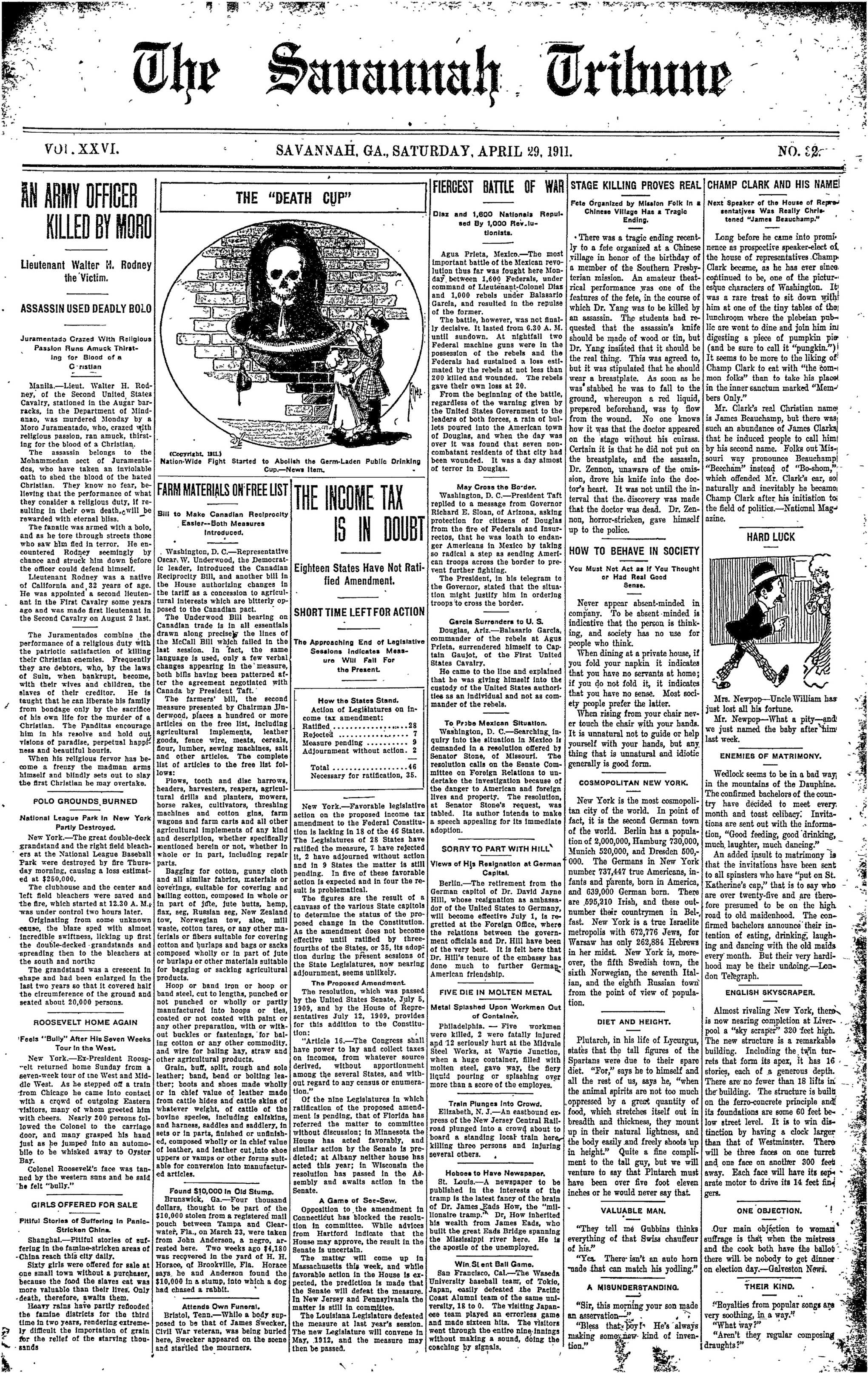
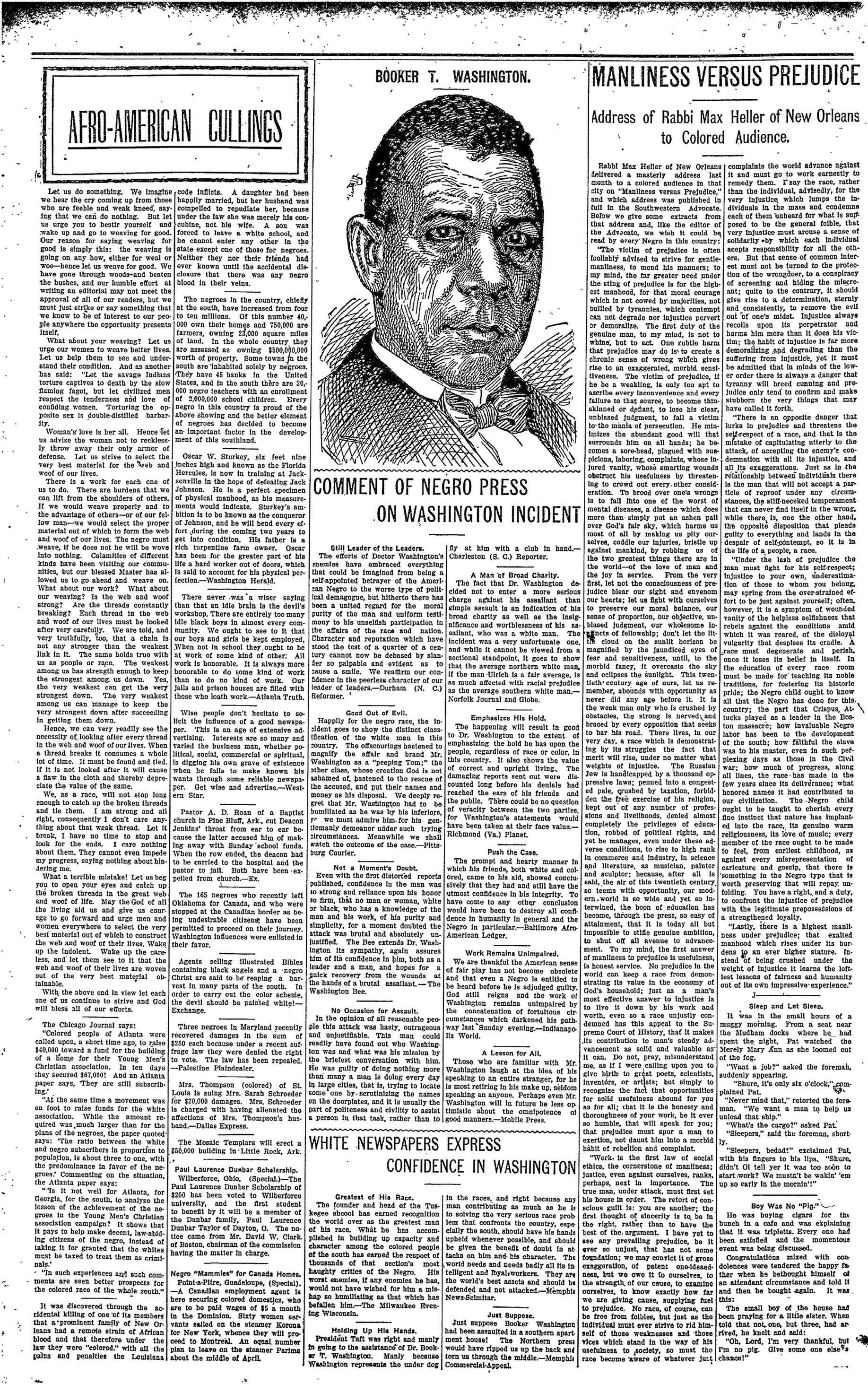
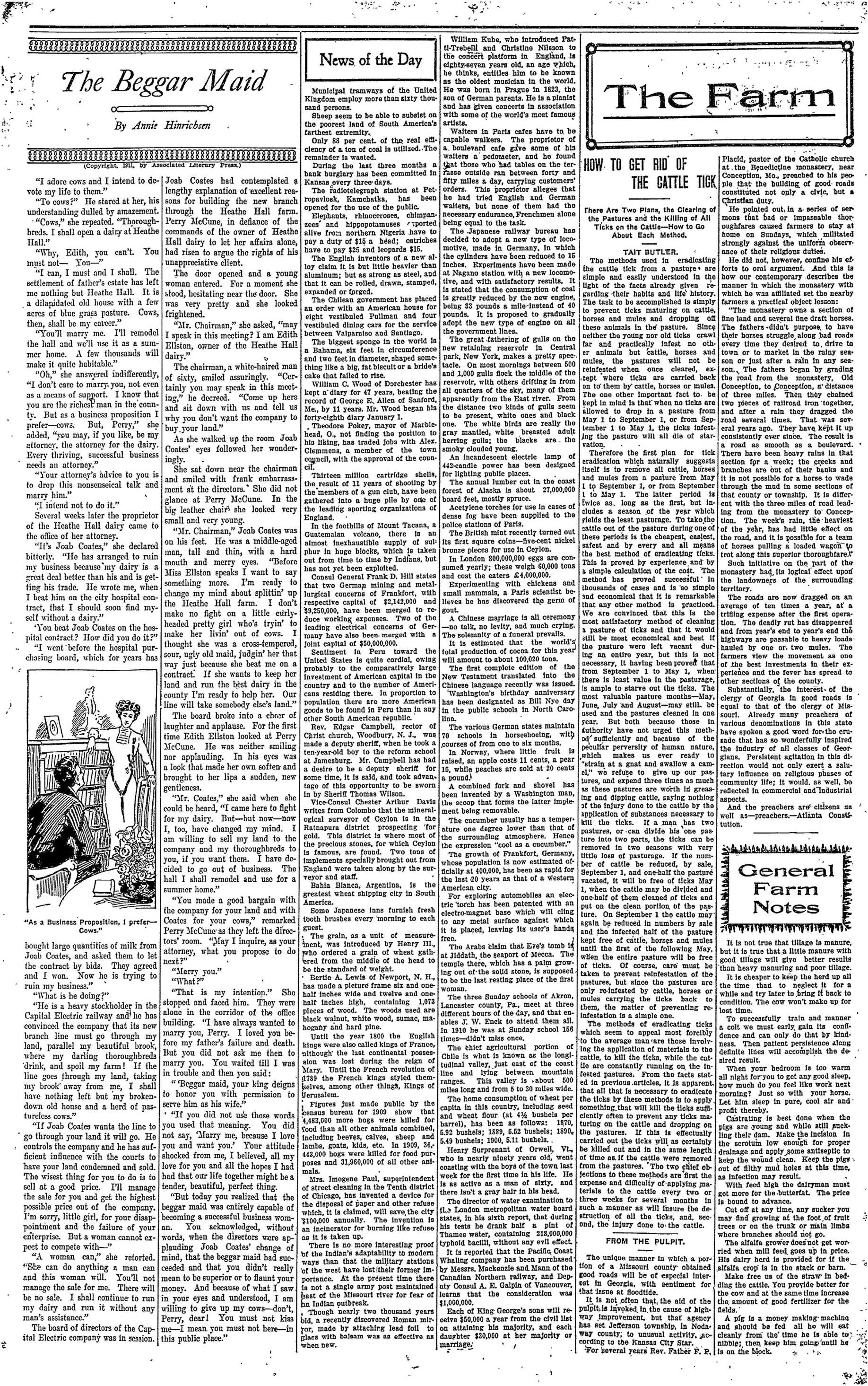
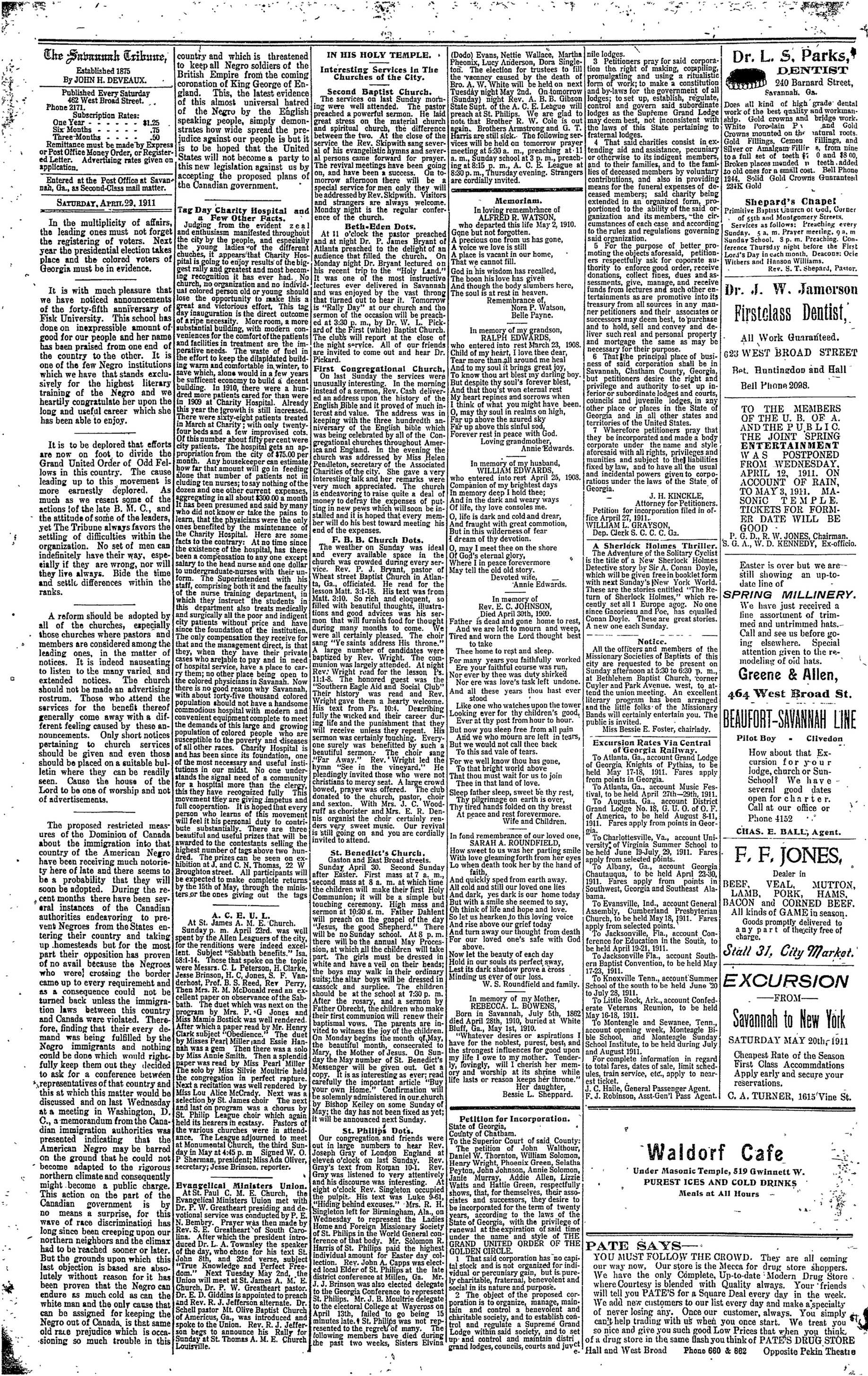
Page text (machine-generated)
The Savannah Tribune
VOL. XXVI.
AN ARMY OFFICER KILLED BY MORO
AN ARMY OFFICER KILLED BY MORO
Lleutenant Walter H. Rodney the Victim.
ASSASSIN USED DEADLY BOLO
Juramentado Crazed With Religious Passion Runs Amuck Thirsting for Blood of a Christian
Manila.—Lieut. Walter H. Rodney, of the Second United States Cavalry, stationed in the Augar barracks, in the Department of Mindanao, was murdered Monday by a Moro Juramentado, who, crazed with religious passion, ran amuck, thirsting for the blood of a Christian.
The assassin belongs to the Mohammedan sect of Juramentados, who have taken an inviolable oath to shed the blood of the hated Christian. They know no fear, believing that the performance of what they consider a religious duty, if resulting in their own death, will be rewarded with eternal bliss.
The fanatic was armed with a bolo, and as he tore through streets those who saw him fled in terror. He encountered Rodney seemingly by chance and struck him down before the officer could defend himself.
Lieutenant Rodney was a native of California and, 32 years of age. He was appointed a second lieutenant in the First Cavalry some years ago and was made first lieutenant in the Second Cavalry on August 2 last.
The Juramentados combine the performance of a religious duty with the patriotic satisfaction of killing their Christian enemies. Frequently they are debtors, who, by the laws of Sulta, when bankrupt, become, with their wives and children, the slaves of their creditor. He is taught that he can liberate his family from bondage only by the sacrifice of his own life for the murder of a Christian. The Panditas encourage him in his resolve and hold out visions of paradise, perpetual happiness and beautiful hours. When his religious fervor has become a frenzy the madman arms himself and blindly sets out to slay the first Christian he may overtake.
POLO GROUNDS BURNED
National League Park in New York Partly Destroved.
New York.—The great double-deck grandstand and the right field bleachers at the National League Baseball Park were destroyed by fire Thursday morning, causing a loss estimated at $250,000.
The clubhouse and the center and left field bleachers were saved and the fire, which started at 12.30 A. M. was under control two hours later.
Originating from some unknown cause, the blaze sped with almost incredible swiftness, licking up first the double-decked grandstands and spreading then to the bleachers at the south and north;
The grandstand was a crescent in shape and had been enlarged in the last two years so that it covered half the circumference of the ground and seated about 20,000 persons.
ROOSEVELT HOME AGAIN
Feels "Bully" After His Seven Weeks Tour In the West.
New York.—Ex-President Roosgelt returned home Sunday from a seven-week tour of the West and Middle West. As he stepped off a train from Chicago he came into contact with a crowd of outgoing Eastern visitors, many of whom greeted him with cheers. Nearly 200 persons followed the Colonel to the carriage door, and many grasped his hand just as he jumped into an automobile to be whisked away to Oyster Bay.
Colonel Roosevelt's face was tanned by the western suns and he said he felt "bully."
GIRLS OFFERED FOR SALE
Pitiful Stories of Suffering in Panic-
Stricken China.
Shanghai.-Pitiful stories of suffer-
ing in the famine-stricken areas of
China reach this city daily.
Sixty girls were offered for sale at
one small town without a purchaser,
because the food the slaves eat was
more valuable than their lives. Only
death, therefore, awaits them.
Heavy rains have partly re flooded
the famine districts for the third
time in two years, rendering extremely
difficult the importation of grain
for the relief of the starving thou-
sands
THE "DEATH CUP"
(Copyright, 1911)
Nation-Wide Fight Started to Abol
Cup.—M
THE FIRE
FARM MATERIALS ON FREE LIST
Bill to Make Canadian Reciprocity
Easler--Both Measures
Introduced.
Washington, D. C.—Representative
Oscar, W. Underwood, the Democratic
leader, introduced the Canadian
Reciprocity Bill, and another bill in
the House authorizing changes in
the tariff as a concession to agricultural interests which are bitterly opposed to the Canadian pact.
The Underwood Bill bearing on Canadian trade is in all essentials drawn along precisely the lines of the McCall Bill which failed in the last session. In fact, the same language is used, only a few verbal changes appearing in the measure, both bills having been patterned after the agreement negotiated with Canada by President Taft.
The farmers' bill, the second measure presented by Chairman Junderwood, places a hundred or more articles on the free list, including agricultural implements, leather goods, fence wire, meats, cereals, flour, lumber, sewing machines, salt and other articles. The complete list of articles to the free list follows:
Plows, tooth and disc harrows, headers, harvesters, reapers, agricultural drills and planters, mowers, horse rakes, cultivators, threshing machines and cotton gins, farm wagons and farm carts and all other agricultural implements of any kind and description, whether specifically mentioned herein or not, whether in whole or in part, including repair parts.
Bagging for cotton, gunny cloth and all similar fabrics, materials or coverings, suitable for covering and balling cotton, composed in whole or in part of jute, jute butts, hemp, flax, seg, Russian seg, New Zealand tow, Norwegian tow, aloe, mill waste, cotton tares, or any other materials or fibers suitable for covering cotton and burlaps and bags or sacks composed wholly or in part of jute or burlaps or other materials suitable for bagging or sacking agricultural products.
Hoop or band iron or hoop or band steel, cut to lengths, punched or not punched or wholly or partly manufactured into hoops or ties, coated or not coated with paint or any other preparation, with or without buckles or fastenings, for baling cotton or any other commodity, and wire for baling hay, straw and other agricultural products.
Grain, buff, split, rough and sole leather; band, bend or bolting leather; boots and shoes made wholly or in chief value of leather made from cattle hides and cattle skins of whatever weight, of cattle of the bovine species, including calfskins, and harness, saddles and saddlery, in sets or in parts, finished or unfinished, composed wholly or in chief value of leather, and leather cut, into shoe uppers or vamps or other forms suitable for conversion into manufactured articles.
Found $10,000 In Old Stump
Brunswick, Ga.—Four thousand dollars, thought to be part of the $10,000 stolen from a registered mail pouch between Tampa and Clearwater, Fla., on March 23, were taken from John Anderson, a negro, arrested here. Two weeks ago $4,180 was recovered in the yard of H. H. Horace, of Brookville, Fla. Horace says, he and Anderson found the $10,000 in a stump, into which a dog had chased a rabbit.
Attends Own Funeral.
Bristol, Tenn.—While a body supposed to be that of James Swecker, Civil War veteran, was being buried here, Swecker appeared on the scene and startled the mourners.
SAVANNAH, GA., SATURDAY, APRIL 29, 1911.
lish the Germ-Laden Public Drinking News Item.
THE INCOME TAX IS IN DOUBT
Eighteen States Have Not Ratified Amendment.
SHORT TIME LEFT FOR ACTION
The Approaching End of Legislative Sessions Indicates Measure Will Fall For the Present.
How the States Stand.
Action of Legislatures on income tax amendment:
Ratified ..... 28
Refected ..... 7
Measure pending ..... 9
Adjournment without action. 2
Total ..... 46
Necessary for ratification, 35.
New York.—Favorable legislative action on the proposed income tax amendment to the Federal Constitution is lacking in 18 of the 46 States. The Legislatures of 28 States have ratified the measure, 7 have rejected it, 2 have adjourned without action and in 9 States the matter is still pending. In five of these favorable action is expected and in four the result is problematical.
The figures are the result of a canvass of the various State capitols to determine the status of the proposed change in the Constitution. As the amendment does not become effective until ratified by three-fourths of the States, or 35, its adoption during the present sessions of the State Legislatures, now nearing adjournment, seems unlikely.
The Proposed Amendment.
The resolution, which was passed by the United States Senate, July 5, 1909, and by the House of Representatives July 12, 1909, provides for this addition to the Constitution:
"Article 16.—The Congress shall have power to lay and collect taxes on incomes, from whatever source derived, without apportionment among the several States, and without regard to any census or enumeration."
Of the nine Legislatures in which ratification of the proposed amendment is pending, that of Florida has referred the matter to committee without discussion; in Minnesota the House has acted favorably, and similar action by the Senate is predicted; at Albany neither house has acted this year; in Wisconsin the resolution has passed in the Assembly and awalts action in the Senate.
A Game of Sec-Saw.
Opposition to the amendment in Connecticut has blocked the resolution in committee. While advices from Hartford indicate that the House may approve, the result in the Senate is uncertain.
The matter will come up in Massachusetts this week, and while favorable action in the House is expected, the prediction is made that the Senate will defeat the measure. In New Jersey and Pennsylvania the matter is still in committee.
The Louisiana Legislature defeated the measure at last year's session. The new Legislature will convene in May, 1912, and the measure may then be passed.
FIERGEST BATTLE OF WAR
Dlaz and 1,600 Nationals Repulsed By 1,000 Revolu tionists.
Agua Prleta, Mexico.—The most important battle of the Mexican revolution thus far was fought here Monday between 1,600 Federals, under command of Lieutenant-Colonel Dlaz and 1,000 rebels under Balasario Garcia, and resulted in the repulse of the former.
The battle, however, was not finally decisive. It lasted from 6.30 A.M. until sundown. At nightfall two Federal machine guns were in the possession of the rebels and the Federals had sustained a loss estimated by the rebels at not less than 200 killed and wounded. The rebels gave their own loss at 20.
From the beginning of the battle, regardless of the warning given by the United States Government to the leaders of both forces, a rain of bullets poured into the American town of Douglas, and when the day was over it was found that seven noncombatant residents of that city had been wounded. It was a day almost of terror in Douglas.
May Cross the Border.
Washington, D. C.—President Taft replied to a message from Governor Richard E. Sloan, of Arizona, asking protection for citizens of Douglas from the fire of Federals and Insurrectos, that he was loath to endanger Americans in Mexico by taking so radical a step as sending American troops across the border to prevent further fighting.
The President, in his telegram to the Governor, stated that the situation might justify him in ordering troops to cross the border.
Garcia Surrenders to U. S.
Douglas, Ariz.—Balasario Garcia, commander of the rebels at Agus Prieta, surrendered himself to Captain Gaujot, of the First United States Cavalry.
He came to the line and explained that he was giving himself into the custody of the United States authorities as an individual and not as commander of the rebels.
To Probe Mexican Situation.
Washington, D. C.—Searching inquiry into the situation in Mexico is demanded in a resolution offered by Senator Stone, of Missouri. The resolution calls on the Senate Committee on Foreign Relations to undertake the investigation because of the danger to American and foreign lives and property. The resolution, at Senator Stone's request, was tabled. Its author intends to make a speech appealing for its immediate adoption.
SORRY TO PART WITH HILL
Views of Hjs Resignation at German Capital.
Berlin.—The retirement from the German capitol of Dr. David Jayne Hill, whose resignation as ambassador of the United States to Germany, will become effective July 1, is regretted at the Foreign Office, where the relations between the government officials and Dr. Hill have been of the very best. It is felt here that Dr. Hill's tenure of the embassy has done much to further German-American friendship.
FIVE DIE IN MOLTEN METAL
Metal Splashed Upon Workmen Out of Container.
Philadelphia. — Five workmen were killed, 2 were fatally injured and 12 seriously hurt at the Midvale Steel Works, at Wayne Junction, when a huge container, filled with molten steel, gave way, the flery liquid pouring or splashing over more than a score of the employees.
Train Plunges Into Crowd
Ellizabeth, N. J.—An eastbound express of the New Jersey Central Railroad plunged into a crowd about to board a standing local train here, killing three persons and injuring several others.
Hoboes to Have Newspaper.
St. Louis.—A newspaper to be published in the interests of the tramp is the latest fancy of the brain of Dr. James Eads How, the "millionaire tramp." Dr. How inherited his wealth from James Eads, who built the great Eads Bridge spanning the Mississippi river here. He is the apostle of the unemployed.
Win Silent Ball Game.
San Francisco, Cal.-The Waseda University baseball team, of Tokyo, Japan, easily defeated the Pacific Coast Alumni team of the same university, 18 to 0. The visiting Japanese team played an errorless game and made sixteen hits. The visitors went through the entire nine innings without making a sound, doing the coaching by signals.
STAGE KILLING PROVES REAL Fete Organized by Mission Folk In a Chinese Village Has a Tragic Ending
There was a tragic ending recently to a fete organized at a Chinese village in honor of the birthday of a member of the Southern Presbyterian mission. An amateur theatrical performance was one of the features of the fete, in the course of which Dr. Yang was to be killed by an assassin. The students had requested that the assassin's knife should be made of wood or tin, but Dr. Yang insisted that it should be the real thing. This was agreed to, but it was stipulated that he should wear a breastplate. As soon as he was stabbed he was to fall to the ground, whereupon a red liquid, prepared beforehand, was to flow from the wound. No one knows how it was that the doctor appeared on the stage without his cuirass. Certain it is that he did not put on the breastplate, and the assassin, Dr. Zennon, unaware of the omission, drove his knife into the doctor's heart. It was not until the interval that the discovery was made that the doctor was dead. Dr. Zennon, horror-stricken, gave himself up to the police.
HOW TO BEHAVE IN SOCIETY
You Must Not Act as If You Thought or Had Real Good Sense.
Never appear absent-minded in company. To be absent-minded is indicative that the person is thinking, and society has no use for people who think.
When dining at a private house, if you fold your napkin it indicates that you have no servants at home; if you do not fold it, it indicates that you have no sense. Most society people prefer the latter.
When rising from your chair never touch the chair with your hands. It is unnatural not to guide or help yourself with your hands, but any thing that is unnatural and idiotic generally is good form.
COSMOPOLITAN NEW YORK.
New York is the most cosmopolitan city of the world. In point of fact, it is the second German town of the world. Berlin has a population of 2,000,000, Hamburg 730,000, Munich 520,000, and Dresden 500,000. The Germans in New York number 737,447 true Americans, infants and parents, born in America, and 639,000 German born. There are 595,210 Irish, and these outnumber their countrymen in Belfast. New York is a true Israelite metropolis with 672,776 Jews, for Warsaw has only 262,884 Hebrews in her midst. New York is, moreover, the fifth Swedish town, the sixth Norwegian, the seventh Italian, and the eighth Russian town from the point of view of population.
DIET AND HEIGHT.
Plutarch, in his life of Lycurgus, states that the tall figures of the Spartans were due to their spare diet. "For," says he to himself and all the rest of us, says he, "when the animal spirits are not too much oppressed by a great quantity of food, which stretches itself out in breadth and thickness, they mount up in their natural lightness, and the body easily and freely shoots up in height." Quite a fine compliment to the tall guy, but we will venture to say that Plutarch must have been over five foot eleven inches or he would never say that.
VALUABLE MAN.
"They tell me Gubbins thinks everything of that Swiss chauffeur of his."
"Yes. There isn't an auto horn made that can match his vodling."
A MISUNDERSTANDING.
"Sir, this morning your son made an asservation—"
"Bless that boy! He's always making some new kind of invention."
---
NO. 82.
CHAMP CLARK AND HIS NAME
Next Speaker of the House of Representatives Was Really Christened "James Beauchamp."
Long before he came into prominence as prospective speaker-elect of the house of representatives. Champ Clark became, as he has ever since, continued to be, one of the picturesque characters of Washington. It was a rare treat to sit down with him at one of the tiny tables of the lunchroom where the plebeian public are wont to dine and join him in digesting a piece of pumpkin pie (and be sure to call it "pungkin.") It seems to be more to the liking of Champ Clark to eat with "the common folks" than to take his place in the inner sanctum marked "Members Only."
Mr. Clark's real Christian name is James Beauchamp, but there was such an abundance of James Clarks that he induced people to call him by his second name. Folks out Missouri way pronounce Beauchamp "Beecham" instead of "Bo-shom," which offended Mr. Clark's ear, so naturally and inevitably he became Champ Clark after his initiation to the field of politics.—National Magazine.
HARD LUCK
Mrs. Newpop—Uncle William has just lost all his fortune.
Mr. Newpop—What a pity—and we just named the baby after him last week.
ENEMIES OF MATRIMONY.
Wedlock seems to be in a bad way in the mountains of the Dauphine. The confirmed bachelors of the country have decided to meet every month and toast celibacy. Invitations are sent out with the information, "Good feeding, good drinking, much laughter, much dancing."
An added insult to matrimony is that the invitations have been sent to all spinsters who have "put on St. Katherine's cap," that is to say who are over twenty-five and are therefore presumed to be on the high road to old maidenhood. The confirmed bachelors announce their intention of eating, drinking, laughing and dancing with the old maids every month. But their very hardihood may be their undoing.—London Telegraph.
ENGLISH SKYSCRAPER.
Almost rivaling New York, there is now nearing completion at Liverpool a "sky scraper" 320 feet high. The new structure is a remarkable building. Including the twin turrets that form its apex, it has 16 stories, each of a generous depth. There are no fewer than 18 lifts in the building. The structure is built on the ferro-concrete principle and its foundations are some 60 feet below street level. It is to win distinction by having a clock larger than that of Westminster. There will be three faces on one turret and one face on another 300 feet away. Each face will have its separate motor to drive its 14 feet fingers.
ONE OBJECTION.
Our main objection to woman suffrage is that when the mistress and the cook both have the ballot there will be nobody to get dinner on election day.—Galveston News.
THEIR KIND.
"Royalties from popular songs are very soothing, in a way."
"What way?"
"Aren't they regular composing draughts?"
AFRO-AMERICAN CULLINGS
Let us do something. We imagine we hear the cry coming up from those who are feeble and weak kneed, saying that we can do nothing. But let us urge you to bestir yourself and wake up and go to weaving for good. Our reason for saying weaving for good is simply this: the weaving is going on any how, either for weal or woe—hence let us weave for good. We have gone through woods—and beaten the bushes, and our humble effort at writing an editorial may not meet the approval of all of our readers, but we must just strike or say something that we know to be of interest to our people anywhere the opportunity presents itself.
What about your weaving? Let us urge our women to weave better lives. Let us help them to see and understand their condition. And as another has said: "Let the savage Indians torture captives to death by the slow flaming fagot, but let civilized men respect the tenderness and love of confiding women. Torturing the opposite sex is double-distilled barbarity. Woman's love is her all. Hence let us advise the woman not to recklessly throw away their only arm of defense. Let us strive to select the very best material for the web and woof of our lives.
There is a work for each one of us to do. There are burdens that we can lift from the shoulders of others. If we would weave properly and to the advantage of others—or of our fellow man—we would select the proper material out of which to form the web and wool of our lives. The negro must weave, if he does not he will be wove into nothing. Calamities of different kinds have been visiting our communities, but our blessed Master has allowed us to go ahead and weave on. What about our work? What about our weaving? Is the web and wool strong? Are the threads constantly breaking? Each thread in the web and wool of our lives must be looked after very carefully. We are told, and very truthfully, too, that a chain is not any stronger than the weakest link in it. The same holds true with us as people or race. The weakest among us has strength enough to keep the strongest among us down. Yes, the very weakest can get the very strongest down. The very weakest among us can manage to keep the very strongest down after succeeding in getting them down.
Hence, we can very readily see the necessity of looking after every thread in the web and woof of our lives. When a thread breaks it consumes a whole lot of time. It must be found and tied. If it is not looked after it will cause a flaw in the cloth and thereby depreciate the value of the same.
We, as a race, will not stop long enough to catch up the broken threads and tie them. I am strong and all right, consequently I don't care anything about that weak thread. Let it break, I have no time to stop and look for the ends. I care nothing about them. They cannot even impede my progress, saying nothing about hindering me.
What a terrible mistake! Let us beg you to open your eyes and catch up the broken threads in the great web and woof of life. May the God of all the living aid us and give us courage to go forward and urge men and women everywhere to select the very best material out of which to construct the web and woof of their lives. Wake up the indolent. Wake up the careless, and let them see to it that the web and woof of their lives are woven out of the very best material obtainable.
With the above end in view let each one of us continue to strive and God will bless all of our efforts.
The Chicago Journal says:
"Colored people of Atlanta were called upon, a short time ago, to raise $40,000 toward a fund for the building of a home for their Young Men's Christian association. In ten days they secured $67,000! And an Atlanta paper says, 'They are still subscribing.'
"At the same time a movement was on foot to raise funds for the white association. While the amount required was much larger than for the plans of the negroes, the paper quoted says: 'The ratio between the white and negro subscribers in proportion to population, is about three to one, with the predominance in favor of the negroes.' Commenting on the situation, the Atlanta paper says:
"Is it not well for Atlanta, for Georgia, for the south, to analyze the lesson of the achievement of the negroes in the Young Men's Christian association campaign? It shows that it pays to help make decent, law-abiding citizens of the negro, instead of taking it for granted that the whites must be taxed to treat them as criminals.'
"In such experiences and such comments are seen better prospects for the colored race of the whole south."
It was discovered through the accidental killing of one of its members that a prominent family of New Orleans had a remote strain of African blood and that therefore under the law they were "colored." with all the palms and penalties the Louisiana
code inflicts. A daughter had been happily married, but her husband was compelled to repudiate her, because under the law she was merely his concubine, not his wife. A son was forced to leave a white school, and he cannot enter any other in the state except one of those for negroes. Neither they nor their friends had ever known until the accidental disclosure that there was any negro blood in their veins.
The negroes in the country, chiefly at the south, have increased from four to ten millions. Of this number 40,000 own their homes and 750,000 are farmers, owning 23,000 square miles of land. In the whole country they are assessed as owning $500,000,000 worth of property. Some towns in the south are inhabited solely by negroes. They have 45 banks in the United States, and in the south there are 30,000 negro teachers with an enrollment of 2,000,000 school children. Every negro in this country is proud of the above showing and the better element of negroes has decided to become an important factor in the development of this southland.
Oscar W. Sturkey, six feet nine inches high and known as the Florida Hercules, is now in training at Jacksonville in the hope of defeating Jack Johnson. He is a perfect specimen of physical manhood, as his measurements would indicate. Sturkey's ambition is to be known as the conqueror of Johnson, and he will bend every effort during the coming two years to get into condition. His father is a rich turpentine farm owner. Oscar has been for the greater part of his life a hard worker out of doors, which is said to account for his physical perfection.—Washington Herald.
There never was a wiser saying than that an idle brain is the devil's workshop. There are entirely too many idle black boys in almost every community. We ought to see to it that our boys and girls be kept employed. When not in school they ought to be at work of some kind of other. All work is honorable. It is always more honorable to do some kind of work than to do no kind of work. Our jails and prison houses are filled with those who loath work -Attanta Truth.
Wise people don't hesitate to solicit the influence of a good newspaper. This is an age of extensive advertising. Interests are so many and varied the business man, whether political, social, commercial or spiritual, is digging his own grave of existence when he falls to make known his wants through some reliable newspaper. Get wise and advertise.—Western Star.
Pastor A. D. Roan of a Baptist church in Pine Bluff, Ark., cut Deacon Jenkins' throat from ear to ear because the latter accused him of making away with Sunday school funds. When the row ended, the deacon had to be carried to the hospital and the pastor to jail. Both have been expelled from church.—Ex.
The 165 negroes who recently left Oklahoma for Canada, and who were stopped at the Canadian border as being undesirable citizens, have been permitted to proceed on their journey. Washington Influences were enlisted in their favor.
Agents selling illustrated Bibles containing black angels and a negro Christ are said to be reaping a harvest in many parts of the south. In order to carry out the color scheme, the devil should be painted white!—Exchange.
Three negroes in Maryland recently recovered damages in the sum of $250 each because under a recent suffrage law they were denied the right to vote. The law has been repealed.—Palestine Plaindealer.
Mrs. Thompson (colored) of St. Louis is suing Mrs. Sarah Schroeder for $20,000 damages. Mrs. Schroeder is charged with having alienated the affections of Mrs. Thompson's husband.—Dallas Express.
The Mosaic Templars will erect a $50,000 building in Little Rock, Ark.
Paul Laurence Dunbar Scholarship. Wilberforce, Ohio, (Special.)—The Paul Laurence Dunbar Scholarship of $200 has been voted to Wilberforce university, and the first student to benefit by it will be a member of the Dunbar family, Paul Laurence Dunbar Taylor of Dayton, O. The notice came from Mr. David W. Clark of Boston, chairman of the commission having the matter in charge.
Negro "Mammies" for Canada Homes.
Point-a-Pitre, Guadeloupe, (Special).
—A Canadian employment agent is here securing colored domestics, who are to be paid wages of $5 a month in the Dominion. Sixty women servants sailed on the steamer Korona for New York, whence they will proceed to Montreal. An equal number plan to leave on the steamer Parima about the middle of April.
BOUZAZ, IV. WASHINGTON
COMMENT OF NEGRO PRESS ON WASHINGTON INCIDENT
WHITE NEWSPAPERS EXPRESS CONFIDENCE IN WASHINGTON
The efforts of Doctor Washington's enemies have embraced everything that could be imagined from being a self-appointed betrayer of the American Negro to the worse type of political demagogue, but hitherto there has been a united regard for the moral purity of the man and uniform testimony to his unselfish participation in the affairs of the race and nation. Character and reputation which have stood the test of a quarter of a century cannot now be debased by slander so palpable and evident as to cause a smile. We reaffirm our confidence in the peerless character of our leader of leaders.—Durham (N. C.) Reformer.
Good Out of Evil.
Happily for the negro race, the incident goes to show the distinct classification of the white man in this country. The offcourings hastened to magnify the affair and brand Mr. Washington as a "peeping Tom;" the other class, whose creation God is not ashamed of, hastened to the rescue of the accused, and put their names and money as his disposal. We deeply regret that Mr. Washington had to be humiliated as he was by his inferiors, we must admire him for his gentlemanly demeanor under such trying circumstances. Meanwhile we shall watch the outcome of the case—Pittsburgh Courler.
Not a Moment's Doubt
Even with the first distorted reports published, confidence in the man was so strong and reliance upon his honor so firm, that no man or woman, white or black, who has a knowledge of the man and his work, of his purity and simplicity, for a moment doubted the attack was brutal and absolutely unjustified. The Bee extends Dr. Washington its sympathy, again assures him of its confidence in him, both as a leader and a man, and hopes for a quick recovery from the wounds at the hands of a brutal assailant. — The Washington Bee.
No Occasion for Assault.
In the opinion of all reasonable people this attack was hasty, outrageous and unjustifiable. This man could readily have found out who Washington was and what was his mission by the briefest conversation with him. He was guilty of doing nothing more than many a man is doing every day in large cities, that is, trying to locate some one by scrutinizing the names on the doorplates, and it is usually the part of politeness and civility to assist a person in that task, rather than to
Greatest of His Race
The founder and head of the Tuskegee shool has earned recognition the world over as the greatest man of his race. What he has accomplished in building up capacity and character among the colored people of the south has earned the respect of thousands of that section's most haughty critics of the Negro. His worst enemies, if any enemies he has, would not have wished for him a mishap so humiliating as that which has befallen him.-The Milwaukee Evening Wisconsin.
Holding Up His Hands.
President Taft was right and manly in going to the assistance of Dr. Booker T. Washington. Manly because Washington represents the under dog
fly at him with a club in hand.—Charleston (S. C.) Reporter.
A Man of Broad Charity.
The fact that Dr. Washington decided not to enter a more serious charge against his assailant than simple assault is an indication of his broad charity as well as the insignificance and worthlessness of his assailant, who was a white man. The incident was a very unfortunate one, and while it cannot be viewed from a sectional standpoint, it goes to show that the average northern white man, if the man Ulrich is a fair average, is as much affected with racial prejudice as the average southern white man. Norfolk Journal and Globe.
Emphasize Hls Hold.
The happening will result in good to Dr. Washington to the extent of emphasizing the hold he has upon the people, regardless of race or color, in this country. It also shows the value of correct and upright living. The damaging reports sent out were discounted long before his denials had reached the ears of his friends and the public. There could be no question of veracity between the two parties, for Washington's statements would have been taken at their face value.—Richmond (Va.) Planet.
Push the Case.
The prompt and hearty manner in which his friends, both white and colored, came to his aid, showed conclusively that they had and still have the utmost confidence in his integrity. To have come to any other conclusion would have been to destroy all confidence in humanity in general and the Negro in particular.—Baltimore Afro-American Ledger.
Work Remains Unimpalred.
We are thankful the American sense of fair play has not become obsolete and that even a Negro is entitled to be heard before he is adjudged guilty. God still reigns and the work of Washington remains unimpaired by the concatenation of fortuitous circumstances which darkened his pathway last Sunday evening.-Indianapolis World.
A Lesson for All
Those who are familiar with Mr. Washington laugh at the idea of his speaking to an entire stranger, for he is most retiring in his make up, seldom speaking an anyone. Perhaps even Mr. Washington will in future be less op timistle about the omnipotence of good manners.—Mobile Press.
EXPRESS
NCE IN WASHINGTON
in the races, and right because any man contributing as much as he is to solving the very serious race problem that confronts the country, especially the south, should have his hands upheld whenever possible, and should be given the benefit of doubt in attacks on him and his character. The world needs and needs badly all its intelligent and royal workers. They are the world's best assets and should be defended and not attacked—Memphis News-Scimitar.
Just Suppose
Just suppose Booker Washington had been assaulted in a southern apartment house! The Northern press would have ripped us up the back and tern us through the middle.—Memphis Commercial-Appeal.
MANLINESS VERSUS PREJUDICE
Address of Rabbi Max Heller of New Orleans to Colored Audience.
Rabbl Max Heller of New Orleans delivered a masterly address last month to a colored audience in that city on "Manliness versus Prejudice", and which address was published in full in the Southwestern Advocate. Below we give some extracts from that address and, like the editor of the Advocate, we wish it could be by every Negro in this country: "The victim of prejudice is often foolishly advised to strive for gentle manliness, to mend his manners; to my mind, the far greater need under the sting of prejudice is for the highest manhood, for that moral courage which is not cowed by majorities, not bullied by tyrannies, which contempt can not degrade nor injustice pervert or demoralize. The first duty of the genuine man, to my mind, is not to whine, but to act. One rubble harm that prejudice may do is to create a chronic sense of wrong which gives rise to an exaggerated, morbid sensitiveness. The victim of prejudice, if he be a weakling, is only too apt to ascribe every inconvenience and every failure to that source, to become thin-skinned or defiant, to lose his clear, unbased judgment, to fall a victim to the mania of persecution. He minimizes the abundant good will that surrounds him on all hands; he becomes a sore-head, plagued with suspicions, laboring, complains, whose injured vanity, whose smarting wounds obstruct his usefulness by threatening to crowd out every other consideration. To brood over one's wrongs is to fall into one of the worst of mental diseases, a disease which does more than simply put an ashen pall over God's fair sky, which harms us most of all by making us pity ourselves, coddle our injuries, bristle up against mankind, by robbing us of the two greatest things there are in the world—of the love of man and the joy in service. From the very first, let not the consciousness of prejudice blear our sight and envenom our hearts; let us fight with ourselves to preserve our moral balance, our sense of proportion, our objective, unbiased judgment, our wholesome instincts of fellowship; don't let the little cloud on the sunlit horizon be magnified by the jaundiced eyes of fear and sensitiveness, until, to the morbid fancy, it overcasts the sky and eclipses the sunlight. This twentieth-century age of ours, let us remember, abounds with opportunity as never did any age before it. It is the weak man only who is crushed by obstacles, the strong is nerved and braced by every opposition that seeks to bar his road. There lives, in our very day, a race which is demonstrating by its struggles the fact that merit will rise, under no matter what weights of injustice. The Russian Jew is handicapped by a thousand oppressive laws; penned into a congested pale, crushed by taxation, forbidden the free exercise of his religion, kept out of any number of professions and livelihoods, denied almost completely the privileges of education, robbed of political rights, and yet he manages, even under these adverse conditions, to rise to high rank in commerce and industry, in science and literature, as musician, painter and sculptor; because, after all is sald, the air of this twentieth century, so teams with opportunity, our modern world is so wide and yet so interwined, the boon of education has become, through the press, so easy of attainment, that it is today all but impossible to stifle genuine ambition, to shut off all avenue to advancement. To my mind, the first answer of manliness to prejudice is usefulness, is honest service. No prejudice in the world can keep a race from demonstrating its value in the economy of God's house; just as a man's most effective answer to injustice is to live it down by his work and worth, even so a race unjustly condemned has this appeal to the Supreme Court of History, that it makes its contribution to man's steady advancement as solid and valuable as it can. Do not, pray, misunderstand me, as if I were calling upon you to give birth to great poets, scientists, inventors, or artists; but simply to recognize the fact that opportunities for solid usefulness abound for you as for all; that it is the honesty and thoroughness of your work, be it ever so humble, that will speak for you; that prejudice must spur a man to exertion, not daunt him into a morbid habit of rebellion and complaint.
"Work is the first law of social ethics, the cornerstone of manliness; justice, even against ourselves, ranks, perhaps, next in importance. The true man, under attack, must first set his house in order. The retort of conscious guilt is: you are another; the first thought of sincerity is to be in the right, rather than to have the best of the argument. I have yet to see any prevailing prejudice, be it ever so unjust, that has not some foundation; we may convict it of gross exaggeration, of patent one-idealness, but we owe it to ourselves, to the strength of our cause, to examine ourselves, to know exactly how far we are giving cause, supplying fuel to prejudice. No race, of course, can be free from folles, but just as the individual must ever strive to rid himself of those weaknesses and those vices which stand in the way of his usefulness to society, so must the race become aware of whatever just
complaints the world advance against it and must go to work earnestly to remedy them. I say the race, rather than the individual, advisely, for the very injustice which lumps the individuals in the mass and condemns each of them unheard for what is supposed to be the general foible, that very injustice must arouse a sense of solidarity by which each individual accepts responsibility for all the others. But that sense of common interest must not be turned to the protection of the wrongdoer, to a conspiracy of screening and hiding the miscreant; quite to the contrary, it should give rise to a determination, sternly and consistently, to remove the evil out of one's midst. Injustice always recolls upon its perpetrator and harms him more than it does his victim; the habit of injustice is far more demoralizing and degrading than the suffering from injustice, yet it must be admitted that in minds of the lower order there is always a danger that tyranny will breed cunning and prejudice only tend to confirm and make stubborn the very things that may have called it forth.
"There is an opposite danger that lurks in prejudice and threatens the self-respect of a race, and that is the mistake of capitulating utterly to the attack, of accepting the enemy's condemnation with all its injustice, and all its exaggerations. Just as in the relationship between individuals there is the man that will not accept a particle of reproof under any circumstances, the stiff-necked temperament that can never find itself in the wrong, while there is, one the other hand, the opposite disposition that pleads guilty to everything and lands in the despair of self-contempt, so it is in the life of a people, a race.
"Under the lash of prejudice the man must fight for his self-respect; injustice to your own, understimation of those to whom you belong may spring from the over-strained effort to be just against yourself; often, however, it is a symptom of wounded vanity of the helpless selfishness that rebels against the conditions amid which it was reared, of the disloyal vulgarity that despises its cradle. A race must degenerate and perish, once it loses its belief in itself. In the education of every race room must be made for teaching its noble traditions, for fostering its historic pride; the Negro child ought to know all that the Negro has done for this country; the part that Crispus, Attucks played as a leader in the Boston massacre; how invaluable Negro labor has been to the development of the south; how faithful the slave was to his master, even in such perplexing days as those in the Civil war; how much of progress, along all lines, the race has made in the few years since its deliverance; what honored names it had contributed to our civilization. The Negro child ought to be taught to cherish every fine instinct that nature has implanted into the race, its genuine warm religiousness, its love of music; every member of the race ought to be made to feel, from earliest childhood, as against every misrepresentation of caricature and gossip, that there is something in the Negro type that is worth preserving that will repay unfolding. You have a right, and a duty, to confront the injustice of prejudice with the legitimate prepossessions of a strengthened loyalty.
"Lastly, there is a highest manliness under prejudice; that exalted manhood which rises under its burdens to an ever higher stature. Instead of being crushed under the weight of injustice it learns the loftest lessons of fairness and humanity out of its own impressive experience."
Sleep and Let Sleen-
It was in the small hours of a muggy morning. From a seat near the Mudham docks where he had spent the night, Pat watched the Merely Mary Ann as she loomed out of the fog.
"Want a job?" asked the foreman, suddenly appearing.
"Shure, it's only six o'clock," complained Pat.
"Never mind that," retorted the foreman. "We want a man to help us unload that ship."
"What's the cargo?" asked Pat.
"Sleepers," said the foreman, shortly.
"Sleepers, bedad!" exclaimed Pat, with his fingers to his lips. "Shure, didn't Ol tell yer it was too soon to start work? We mustn't be wakin' 'em up so early in the morning!"
Boy Was No "Plg."
He was buying cigars for the bunch in a cafe and was explaining that it was triplets. Every one had been satisfied and the momentous event was being discussed.
Congratulations mixed with condolences were tendered the happy father when he hebought himself of an attendant circumstance and told it and then he bought again. It was this:
The small boy of the house had been praying for a little sister. When told that not one, but three, had arrived, he knelt and said:
"Oh, Lord, I'm very thankful, but I'm no pig. Give some one else's chance!"
The Beggar Maid
By Annie Hinrichsen
"I adore cows and I intend to devote my life to them."
"To cows?" He stared at her, his understanding dulled by amazement. "Cows," she repeated. "Thoroughbreds. I shall open a dairy at Heathe Hall."
"Why, Edith, you can't. You must not—You—"
"I can, I must and I shall. The settlement of father's estate has left me nothing but Heathe Hall. It is a dilapidated old house with a few acres of blue grass pasture. Cows, then, shall be my career."
Joab Coates had contemplated a lengthy explanation of excellent reasons for building the new branch through the Heathe Hall farm. Perry McCune, in defiance of the commands of the owner of Heathe Hall dairy to let her affairs alone, had risen to argue the rights of his unappreciative client.
The door opened and a young woman entered. For a moment she stood, hesitating near the door. She was very pretty and she looked frightened.
"Mr. Chairman," she asked, "may
"You'll marry me. I'll remodel the hall and we'll use it as a summer home. A few thousands will make it quite habitable."
"Oh," she answered indifferently, "I don't care to marry you, not even as a means of support. I know that you are the richest man in the county. But as a business proposition I prefer—cows. But, Perry," she added, "you may, if you like, be my attorney, the attorney for the dairy. Every thriving, successful business needs an attorney."
"Your attorney's advice to you is to drop this nonsenseical talk and marry him."
Several weeks later the proprietor of the Heathe Hall dairy came to the office of her attorney.
"It's Joab Coates," she declared bitterly. "He has arranged to ruin my business because my dairy is a great deal better than his and is getting his trade. He wrote me, when I beat him on the city hospital contract, that I should soon find myself without a dairy."
"You beat Joab Coates on the hospital contract? How did you do it?"
"I went before the hospital purchasing board, which for years has
A woman stands on a bookshelf, holding a book and a suitcase, while a man sits in a chair, looking up at her.
"As a Business Proposition, I prefer Cows."
bought large quantities of milk from Joab Coates, and asked them to let the contract by bids. They agreed and I won. Now he is trying to ruin my business."
"He is a heavy stockholder in the Capital Electric railway and' he has convinced the company that its new branch line must go through my land, parallel my beautiful brook, where my darling thoroughbreds drink, and spoil my farm! If the line goes through my land, taking my brook' away from me, I shall have nothing left but my broken-down old house and a herd of pastureless cows."
"If Joab Coates wants the line to go through your land it will go. He controls the company and he has sufficient influence with the courts to have your land condemned and sold. The wisest thing for you to do is to sell at a good price. I'll manage the sale for you and get the highest possible price out of the company. I'm sorry, little girl, for your disappointment and the failure of your enterprise. But a woman cannot expect to compete with—"
"A woman can," she retorted. "She can do anything a man can and this woman will. You'll not manage the sale for me. There will be no sale. I shall continue to run my dairy and run it without any man's assistance." The board of directors of the Capital Electric company was in session.
"I intend not to do it."
"What is he doing?"
Joab Coates had contemplated a lengthy explanation of excellent reasons for building the new branch through the Heathe Hall farm. Perry McCune, in defiance of the commands of the owner of Heathe Hall dairy to let her affairs alone, had risen to argue the rights of his unappreciative client.
The door opened and a young woman entered. For a moment she stood, hesitating near the door. She was very pretty and she looked frightened.
"Mr. Chairman," she asked, "may I speak in this meeting? I am Edith Ellston, owner of the Heathe Hall dairy."
The chairman, a white-haired man of sixty, smiled assuringly. "Certainly you may speak in this meeting," he decreed. "Come up hers and sit down with us and tell us why you don't want the company to buy your land."
As she walked up the room Joab Coates' eyes followed her wonderingly.
She sat down near the chairman and smiled with frank embarrassment at the directors. She did not glance at Perry McCune. In the big leather chair she looked very small and very young.
"Mr. Chairman," Joab Coates was on his feet. He was a middle-aged man, tall and thin, with a hard mouth and merry eyes. "Before Miss Ellston speaks I want to say something more. I'm ready to change my mind about splittin' up the Heathe Hall farm. I don't make no fight on a little curly-headed pretty girl who's tryin' to make her livin' out of cows. I thought she was a cross-tempered, sour, ugly old maid, judgin' her that way just because she beat me on a contract. If she wants to keep her land and run the best dairy in the county I'm ready to help her. Our line will take somebody else's land."
The board broke into a chor of laughter and applause. For the first time Edith Ellston looked at Perry McCune. He was neither smiling nor applauding. In his eyes was a look that made her own soften and brought to her lips a sudden, new gentleness.
"Mr. Coates," she said when she could be heard, "I came here to fight for my dairy. But—but now—now I, too, have changed my mind. I am willing to sell my land to the company and my thoroughbreds to you, if you want them. I have decided to go out of business. The hall I shall remodel and use for a summer home."
"You made a good bargain with the company for your land and with Coates for your cows," remarked Perry McCune as they left the directors' room. "May I inquire, as your attorney, what you propose to do next?"
"Marry you."
"What?"
"That is my intention." She stopped and faced him. They were alone in the corridor of the office building. "I have always wanted to marry you, Perry. I loved you before my father's failure and death. But you did not ask me then to marry you. You waited till I was in trouble and then you said:
"Beggar maid, your king deigns to honor you with permission to serve him as his wife."
"If you did not use those words you used that meaning. You did not say, 'Marry me, because I love you and want you.' Your attitude shocked from me, I believed, all my love for you and all the hopes I had had that our life together might be a tender, beautiful, perfect thing.
"But today you realized that the beggar maid was entirely capable of becoming a successful business woman. You acknowledged, without words, when the directors were applauding Joab Coates' change of mind, that the beggar maid had succeeded and that you didn't really mean to be superior or to flaunt your money. And because of what I saw in your eyes and understood, I am willing to give up my cows—don't, Perry, dear! You must not kiss me—I mean you must not here—in this public place."
News of the Day
Municipal tramways of the United Kingdom employ more than sixty thousand persons.
Sheep seem to be able to subsist on the poorest land of South America's farthest extremity.
Only 88 per cent. of the real efficiency of a ton of coal is utilized. The remainder is wasted.
During the last three months a bank burglary has been committed in Kansas every three days.
The radiotelegraph station at Petropavlosk, Kamchatka, has been opened for the use of the public.
Elephants, rhinoceroses, chimpanzees and hippopotamuses reported alive from northern Nigeria have to pay a duty of $15 a head; ostriches have to pay $25 and leopards $15.
The English inventors of a new alloy claim it is but little heavier than aluminum; but as strong as steel, and that it can be rolled, drawn, stamped, expanded or forged. The Chilean government has placed an order with an American house for eight vestibulated Pullman and four vestibulated dining cars for the service between Valparaiso and Santiago. The biggest sponge in the world is a Bahama, six feet in circumference and two feet in diameter, shaped something like a big, fat biscuit or a bride's cake that failed to rise. William C. Wood of Dorchester has kept a diary for 47 years, beating the record of George E. Allen of Sanford, Me, by 11 years. Mr. Wood began his forty-eighth diary January 1.
Theodore Pokey, mayor of Marblehead, O., not finding the position to his liking, has traded jobs with Alex Clemmens, a member of the town council, with the approval of the council.
Thirteen million cartridge shells, the result of 11 years of shooting by the members of a gun club, have been gathered into a huge pile by one of the leading sporting organizations of England.
In the foothills of Mount Tacana, a Guatemalan volcano, there is an almost inexhaustible supply of sulphur in huge blocks, which is taken out from time to time by Indians, but has not yet been exploited.
Consul General Frank D. Hill states that two German mining and metallurgical concerns of Frankfort, with respective capital of $2,142,000 and $9,250,000, have been merged to reduce working expenses. Two of the leading electrical concerns of Germany have also been merged with a joint capital of $50,000,000.
Sentiment in Peru toward the United States is quite cordial, owing probably to the comparatively large investment of American capital in the country and to the number of Americans residing there. In proportion to population there are more American goods to be found in Peru than in any other South American republic.
Rev. Edgar Campbell, rector of Christ church, Woodbury, N. J., was made a deputy sheriff, when he took a ten-year-old boy to the reform school at Jamesburg. Mr. Campbell has had a desire to be a deputy sheriff for some time, it is said, and took advantage of this opportunity to be sworn in by Sheriff Thomas Wilson.
Vice-Consul Chester Arthur Davis writes from Colombo that the mineralogical surveyor of Ceylon is in the Ratnapura district prospecting for gold. This district is where most of the precious stones, for which Ceylon is famous, are found. Two tons of implements specially brought out from England were taken along by the surveyor and staff.
Bahia Blanca, Argentina, is the greatest wheat shipping city in South America.
Some Japanese inns furnish fresh tooth brushes every morning to each guest.
The grain, as a unit of measurement, was introduced by Henry III., who ordered a grain of wheat gathered from the middle of the head to be the standard of weight.
Bertie A. Lewis of Newport, N. H., has made a picture frame six and one half inches wide and twelve and one half inches high, containing 1,073 pieces of wood. The woods used are black walnut, white wood, sumac, mahogany and hard pine.
Until the year 1800 the English kings were also called kings of France, although the last continental possession was lost during the reign of Mary. Until the French revolution of 1789 the French kings styled themselves, among other things, Kings of Jerusalem.
Figures just made public by the census bureau for 1909 show that 4,483,000 more hogs were killed for food than all other animals combined, including beeves, calves, sheep and lambs, goats, kids, etc. In 1909, 36,443,000 hogs were killed for food purposes and 31,960,000 of all other animals.
Mrs. Imogene Paul, superintendent of street cleaning in the Tenth district of Chicago, has invented a device for the disposal of paper and other refuse which, it is claimed, will save, the city $100,000 annually. The invention is an incinerator for burning like refuse as it is taken up. There is no more interesting proof of the Indian's adaptability to modern ways than that the military stations of the west have lost their former importance. At the present time there is not a single army post maintained east of the Missouri river for fear of an Indian outbreak. Though nearly two thousand years bid, a recently discovered Roman mirror, made by attaching lead foll to glass with balsam was as effective as when new.
William Kuhe, who introduced Patti-Trebell and Christine Nilsson to the concert platform in England, is eighty-seven years old, an age which, he thinks, entitles him to be known as the oldest musician in the world. He was born in Prague in 1623, the son of German parents. He is a pianist and has given concerts in association with some of the world's most famous artists.
Waiters in Paris cafes have to be capable walkers. The proprietor of a boulevard cafe gave some of his waiters a pedometer, and he found that those who had tables on the terrace outside ran between forty and fifty miles a day, carrying customers' orders. This proprietor alleges that he had tried English and German waiters, but none of them had the necessary endurance, Frenchmen alone being equal to the task.
The Japanese railway bureau has decided to adopt a new type of locomotive, made in Germany, in which the cylinders have been reduced to 15 inches. Experiments have been made at Nagano station with a new locomotive, and with satisfactory results. It is stated that the consumption of coal is greatly reduced by the new engine, being 33 pounds a mile-instead of 40 pounds. It is proposed to gradually adopt the new type of engine on all the government lines.
The great fathering of gulls on the new retaining reservoir in Central park, New York, makes a pretty spectacle. On most mornings between 500 and 1,000 gulls flock the middle of the reservoir, with others drifting in from all quarters of the sky, many of them apparently from the East river. From the distance two kinds of gulls seem to be present, white ones and black one. The white birds are really the gray mantled, white breasted adult herring gulls; the blacks are the smoky clouded young.
An incandescent electric lamp of 442-candle power has been designed for lighting public places.
The annual lumber cut in the coast forest of Alaska is about 27,000,000 board feet, mostly spruce.
Acetylene torches for use in cases of dense fog have been supplied to the police stations of Paris.
The British mint recently turned out its first square coins—five-cent nickel bronze pieces for use in Ceylon.
In London 800,000,000 eggs are consumed yearly; these weigh 60,000 tons and cost the eaters £4,000,000.
Experimenting with chickens and small mammals, a Paris scientist believes he has discovered the germ of gout.
A Chinese marriage is all ceremony—no talk, no levity, and much crying.
The solemnity of a funeral prevails.
It is estimated that the world's total production of cocoa for this year will amount to about 100,020 tons.
The first complete edition of the New Testament translated into the Chinese language recently was issued.
Washington's birthday anniversary has been designated as Bill Nye day in the public schools in North Carolina.
The various German states maintain 70 schools in horseshoeing, with courses of from one to six months.
In Norway, where little fruit is raised, an apple costs 11 cents, a pear 15, while peaches are sold at 20 cents a pound!
A combined fork and shovel has been invented by a Washington man, the scoop that forms the latter implement being removable.
The cucumber usually has a temperature one degree lower than that of the surrounding atmosphere. Hence the expression "cool as a cucumber."
The growth of Frankfort, Germany, whose population is now estimated officially at 400,000, has been as rapid for the last 20 years as that of a western American city. For exploring automobiles an electric torch has been patented with an electro-magnet base which will cling to any metal surface against which it is placed, leaving its user's hands free. The Arabs claim that Eve's tomb is at Jilddah, the seaport of Mecca. The temple there, which has a palm growing out of the solid stone, is supposed to be the last resting place of the first woman.
The three Sunday schools of Akron, Lancaster county, Pa., meet at three different hours of the day, and that enables J. W. Enck to attend them all. In 1910 he was at Sunday school 156 times—didn't miss once.
The chief agricultural portion of Chile is what is known as the longitudinal valley, just east of the coast line and lying between mountain ranges. This valley is about 500 miles long and from 5 to 30 miles wide.
The home consumption of wheat per capita in this country, including seed and wheat flour (at $4\frac{1}{2}$ bushels per barrel), has been as follows: 1870, 5.92 bushels; 1889, 5.52 bushels; 1890, 5.49 bushels; 1900, 5.11 bushels.
Henry Surprenant of Orwell, Vt., who is nearly ninety years old, went coasting with the boys of the town last week for the first time in his life. He is as active as a man of sixty, and there isn't a gray hair in his head. The director of water examination to the London metropolitan water board states, in his sixth report, that during his tests he drank half a pint of Thames water, containing 218,000,000 typhoid bacilli, without any evil effect. It is reported that the Pacific Coast Whaling company has been purchased by Messrs. Mackenzie and Mann of the Canadian Northern railway, and Deputy Consul A. E. Galpin of Vancouver, learns that the consideration was $1,000,000.
Each of King George's sons will receive $50,000 a year from the civil list on attaining his majority, and each daughter $30,000 at her majority or marriage.
The Farm
HOW TO GET RID OF THE CATTLE TICK
There Are Two Plans, the Clearing of the Pastures and the Killing of All Ticks on the Cattle-How to Go About Each Method.
TAIT BUTLER.
The methods used in eradicating the cattle tick from a pasture are simple and easily understood in the light of the facts already given regarding their habits and life history. The task to be accomplished is simply to prevent ticks maturing on cattle, horses and mules and dropping off these animals in the pasture. Since neither the young nor old ticks crawl far and practically infest no other animals but cattle, horses and mules, the pastures will not be reinfested when once cleared, except where ticks are carried back on to them by cattle, horses or mules. The one other important fact to be kept in mind is that when no ticks are allowed to drop in a pasture from May 1 to September 1, or from September 1 to May 1, the ticks infesting the pasture will all die of starvation.
Therefore the first plan for tick eradication which naturally suggests itself is to remove all cattle, horses and mules from a pasture from May 1 to September 1, or from September 1 to May 1. The latter period is twice as long as the first, but includes a season of the year which yields the least pasturage. To take the cattle out of the pasture during one of these periods is the cheapest, easiest, safest and by every and all means the best method of eradicating ticks. This is proved by experience, and by a simple calculation of the cost. The method has proved successful in thousands of cases and is so simple and economical that it is remarkable that any other method is practiced. We are convinced that this is the most satisfactory method of cleaning a pasture of ticks and that it would still be most economical and best if the pasture were left vacant during an entire year, but this is not necessary, it having been proved that from September 1 to May 1, when there is least value in the pasturage, is ample to starve out the ticks. The most valuable pasture months—May, June, July and August—may still be used and the pastures cleaned in one year. But both because those in authority have not urged this method sufficiently and because of the peculiar perversity of human nature, which makes us ever ready to "strain at a gnat and swallow a camel," we refuse to give up our pastures, and expend three times as much as these pastures are worth in greasing and dipping cattle, saying nothing of the injury done to the cattle by the application of substances necessary to kill the ticks. If a man has two pastures, or can divide his one pasture into two parts, the ticks can be removed in two seasons with very little loss of pasturage. If the number of cattle be reduced, by sale, September 1, and one-half the pasture vacated, it will be free of ticks May 1, when the cattle may be divided and one-half of them cleaned of ticks and put on the clean portion of the pasture. On September 1 the cattle may again be reduced in numbers by sale and the infected half of the pasture kept free of cattle, horses and mules until the first of the following May, when the entire pasture will be free of ticks. Of course, care must be taken to prevent reinfestation of the pastures, but since the pastures are only re-infested by cattle, horses or mules carrying the ticks back to them, the matter of preventing reinfestation is a simple one.
The methods of eradicating ticks which seem to appeal most forcibly to the average man are those involving the application of materials to the cattle, to kill the ticks, while the cattle are constantly running on the infested pastures. From the facts stated in previous articles, it is apparent that all that is necessary to eradicate the ticks by these methods is to apply something, that will kill the ticks sufficiently often to prevent any ticks maturing on the cattle and dropping on the pastures. If this is effectually carried out the ticks will as certainly be killed out and in the same length of time as, if the cattle were removed from the pastures. The two chief objections to these methods are first the expense and difficulty of applying materials to the cattle every two or three weeks for several months in such a manner as will insure the destruction of all the ticks, and, second, the injury done to the cattle.
FROM THE PULPIT.
The unique manner in which a portion of a Missouri county obtained good roads will be of especial interest in Georgia, with sentiment for that issue at floodtide. It is not often that, the aid of the pulpit, is invoked in the cause of highway improvement, but that agency has set Jefferson township, in Nodaway county; to unusual activity, according to the Kansas City Star.
For several years Rev. Father F. P.
Placid, pastor of the Catholic church at the Benedictine monastery, near Conception, Mo., preached to his people that the building of good roads constituted not only a civic, but a Christian duty.
He pointed out, in a series of sermons that bad or impassable thoroughfares caused farmers to stay at home on Sundays, which militated strongly against the uniform observance of their religious duties.
He did not, however, confine his efforts to oral argument. And this is how our contemporary describes the manner in which the monastery with which he was affiliated set the nearby farmers a practical object lesson:
"The monastery owns a section of fine land and several fine draft horses. The fathers didn't purpose, to have their horses struggle, along bad roads every time they desired to drive to town or to market in the rainy season or just after a rain in any season. The fathers began by grading the road from the monastery, Old Conception, to Conception, or distance of three miles. Then they chained two pieces of railroad iron together, and after a rain they dragged the road several times. That was several years ago. They have kept it up consistently ever since. The result is a road as smooth as a boulevard. There have been heavy rains in that section for a week; the creeks and branches are out of their banks and it is not possible for a horse to wade through the mud in some sections of that county or township. It is different with the three miles of road leading from the monastery to Conception. The week's rain, the heaviest of the year, has had little effect on the road, and it is possible for a team of horses pulling a loaded wagon to trot along this superior thoroughfare."
Such initiative on the part of the monastery had its logical effect upon the landowners of the surrounding territory. The roads are now dragged on an average of ten times a year, at a trifling expense after the first operation. The deadly rut has disappeared and from year's end to year's end the highways are passable to heavy loads hauled by one or two mules. The farmers view the movement as one of the best investments in their experience and the fever has spread to other sections of the county.
Substantially, the interest of the clergy of Georgia in good roads is equal to that of the clergy of Missouri. Already many preachers of various denominations in this state have spoken a good word for the cruse that has so wonderfully inspired the industry of all classes of Georgians. Persistent agitation in this direction would not only exert a salutary influence on religious phases of community life; it would, as well, be reflected in commercial and Industrial aspects.
And the preachers are citizens as well as—preachers.—Atlanta Constitution.
General Farm Notes
It is not true that tillage is manure, but it is true that a little manure with good tillage will give better results than heavy manuring and poor tillage. It is cheaper to keep the herd up all the time than to neglect it for a while and try later to bring it back to condition. The cow won't make up for lost time.
To successfully train and manner a colt we must early gain its confidence and can only do that by kindness. Then patient persistence along definite lines will accomplish the desired result.
When your bedroom is too warm all night for you to get any good sleep, how much do you feel like work next morning? Just so with your horse. Let him sleep in pure, cool air and profit thereby.
Castrating is best done when the pigs are young and while still suckling their dam. Make the incision in the scrotum low enough for proper drainage and apply some antiseptic to keep the wound clean. Keep the pigs out of filth mud holes at this time, as infection may result.
With feed high the dairyman must get more for the butterfat. The price is bound to advance.
Cut off at any time, any sucker you may find growing at the foot of fruit trees or on the trunk or main limbs where branches should not go.
The alfalfa grower does not get worried when mill feed goes up in price. His dairy herd is provided for if the alfalfa crop is in the stack or barn.
Make free us of the straw in bedding the cattle. You provide better for the cow and at the same time increase the amount of good fertilizer for the fields.
A pig is a money making machining and should be fed all he will eat cleanly from the time he is able to nibble; then keep him going until he is on the block.
Entered at the Post Office at Savannah, Ga., as Second-Class mail matter.
SATURDAY, APRIL 29, 1911
In the multiplicity of affairs, the leading ones must not forget the registering of voters. Next year the presidential election takes place and the colored voters of Georgia must be in evidence.
It is with much pleasure that we have noticed announcements of the forty-fifth anniversary of Fisk University. This school has done on inexpressible amount of good for our people and her name has been praised from one end of the country to the other. It is one of the few Negro institutions which we have that stands exclusively for the highest literary training of the Negro and we heartily congratulate her upon the long and useful career which she has been able to enjoy.
It is to be deplored that efforts are now on foot to divide the Grand United Order of Odd Fellows in this country. The cause leading up to this movement is more earnestly deplored. As much as we resent some of the actions of the late B. M. C., and the attitude of some of the leaders, yet The Tribune always favors the settling of difficulties within the organization. No set of men can indefinitely have their way, especially if they are wrong, nor will they live always. Bide the time and settle differences within the ranks.
A reform should be adopted by all of the churches, especially those churches where pastors and members are considered among the leading ones, in the matter of notices. It is indeed nauseating to listen to the many varied and extended notices. The church should not be made an advertising rostrum. Those who attend the services for the benefit thereof generally come away with a different feeling caused by these announcements. Only short notices pertaining to church services should be given and even those should be placed on a suitable bulletin where they can be readily seen. Cause the house of the Lord to be one of worship and not of advertisements.
The proposed restricted measures of the Dominion of Canada about the immigration into that country of the American Negro have been receiving much notoriety here of late and there seems to be a probability that they will soon be adopted. During the recent months there have been several instances of the Canadian authorities endeavoring to prevent Negroes from the States entering their country and taking up homesteads but for the most part their opposition has proven of no avail because the Negroes who were crossing the border came up to every requirement and as a consequence could not be turned back unless the immigration laws between this country and Canada were violated. Therefore, finding that their every demand was being fulfilled by the Negro immigrants and nothing could be done which would rightfully keep them out they decided to ask for a conference between representatives of that country and this at which this matter would be discussed and on last Wednesday at a meeting in Washington, D.C., a memorandum from the Canadian immigration authorities was presented indicating that the American Negro may be barred on the ground that he could not become adapted to the rigorous northern climate and consequently might become a public charge. This action on the part of the Canadian government is by no means a surprise, for this wave of race discrimination has long since been creeping upon our northern neighbors and the climax had to be reached sooner or later. But the grounds upon which this last objection is based are absolutely without reason for it has been proven that the Negro can endure as much cold as can the white man and the only cause that can be assigned for keeping the Negro out of Canada, is that same old race prejudice which is occasioning so much trouble in this
country and which is threatened to keep all Negro soldiers of the British Empire from the coming coronation of King George of England. This, the latest evidence of this almost universal hatred of the Negro by the English speaking people, simply demonstrates how wide spread the prejudice against our people is but it is to be hoped that the United States will not become a party to this new legislation against us by accepting the proposed plans of the Canadian government.
a Few Other Facts.
Judging from the evident zeal and enthusiasm manifested throughout the city by the people, and especially the young ladies of the different chuches, it appears that Charity Hospital is going to enjoy results of the biggest rally and greatest and most becoming recognition it has ever had. No church, no organization and no individual colored person old or young should lose the opportunity to make this a great and victorious effort. This tag day inauguration is the direct outcome of a ripe necessity. More room, a more substantial building, with modern conveniences for the comfort of the patients and facilities in treatment are the imperative needs. The waste of fuel in the effort to keep the dilapidated building warm and comfortable in winter, to save which, alone would in a few years be sufficient economy to build a decent building. In 1910, there were a hundred more patients cared for than were in 1909 at Charity Hospital. Already this year the growth is still increased. There were sixty-eight patients treated in March at Charity; with only twenty-four beds and a few improvised cots. Of this number about fifty per cent were city patients. The hospital gets an appropriation from the city of $75.00 per month. Any housekeeper can estimate how far that amount will go in feeding alone that number of patients not in cluding ten nurses; to say nothing of the dozen and one other current expenses, aggregating in all about $300.00 a month. It has been presumed and said by many who did not know or take the pains to learn, that the physicians were the only ones benefited by the maintenance of the Charity Hospital. Here are some facts to the contrary: At no time since the existence of the hospital, has there been a compensation to any one except salary to the head nurse and one dollar to undergraduate-nurses with their uniform. The Superintendent with his staff, comprising both it and the faculty of the nurse training department, in which they instruct the students in this department also treats medically and surgically all the poor and indigent city patients without price and have since the foundation of the institution. The only compensation they receive for that and the management direct, is that they, when they have their private cases who are任能 to pay and in need of hospital service, have a place to carry; no other place being open to the colored physicians in Savannah. Now there is no good reason why Savannah, with about forty-five thousand colored population should not have a handsome commodious hospital with modern and convenient equipment complete to meet the demands of this large and growing population of colored people who are susceptible to the poverty and diseases of all other races. Charity Hospital is and has been since its foundation, one of the most necessary and useful institutions in our midst. No one understands the signal need of a community for a hospital more than the clergy, this they have recognized fully. This movement they are giving impetus and full cooperation. It is hoped that every person who learns of this movement will feel it his personal duty to contribute substantially. There are three beautiful and useful prizes that will be awarded to the contestants selling the highest number of tags above two hundred. The prizes can be seen on exhibition at J. and C. N. Thomas, 22 W Broughton street. All participants will be expected to make complete returns by the 15th of May, through the ministers or the ones giving out the tags
A. C. E. U. L.
At St. James A. M. E. Church.
Sunday p. m. April 23rd was well spent by the Allen Leaguers of the city, for the renditions were indeed excellent. Subject "Sabbath benefits." Isa. 51:14. Those that spoke on the topic were Messrs. C. L Peterson, H. Clarke, Jesse Brinson, H. C. Jones, S. F. Vanderhost, Prof. B. S. Reed, Rev Perry, Then Mrs. R. M. McDonald read an excellent paper on observance of the Sabbath. The duet which was next on the program by Mrs. P. <G Jones and Miss Mamie Bostick was well rendered. After which a paper read by Mr. Henry Clark subject "Obedience." The duet by Miss Pearl Miller and Essie Hannah was a gem. Then there was a solo by Miss Annie Smith. Then a splendid paper was read by Miss Pearl Miller. The solo by Miss Silive Moultrie held the congregation in perfect rapture. Next a recitation was well rendered by Miss Lou Alice McCrady. Next was a selection by St. James choir. The next and last on program was a chorus by St. Philip League choir which again held its hearers in ecstasy. Pastors of the various churches were in attendance. The League adjourned to meet at Monumental Church, the third Sunday in May at 4:45 p. m. Signed W. O. P Sherman, president; Miss Ada Oliver, secretary; Jesse Brinson, reporter.
Evangelical Ministers Union.
At St. Paul C. M. E. Church, the
Evangelical Ministers Union met with
Dr. P. W. Greatheart presiding and
devotional service was conducted by P. E.
N. Bembry. Prayer was then made by
Rev. S. E. Greatheart of South Carolina.
After which the president introduced
Dr. L. A. Townsley the speaker
of the day, who chose for his text St.
John 8th, and 32nd verse, subject
"True Knowledge and Perfect Freedom."
Next Tuesday May 2nd, the
union will meet at St. James A. M. E.
E Church, Dr. P. W. Greatheart pastor.
Dr. E. D. Giddins is appointed to preach
and Rev. R. J. Jefferson alternate. Dr.
Schell pastor Mt. Olive Baptist Church
of Americus, Ga., was introduced and
spoke to the Union. Rev. R. J. Jefferson
begs to announce his Rally for
Sunday at St. Thomas A. M. E. Church
Louisville.
IN HIS HOLY TEMPLE.
Interesting Services in The Churches of the City.
Second Baptist Church.
Second Baptist Church. The services on last Sunday morning were well attended. The pastor preached a powerful sermon. He laid great stress on the material church and spiritual church, the difference between the two. At the close of the service the Rev. Skipwith sang several of his evangelistic hymns and several persons came forward for prayer. The revival meetings have been going on, and have been a success. On tomorrow afternoon there will be a special service for men only they will be addressed by Rev. Skipwith. Visitors and strangers are always welcome. Monday night is the regular conference of the church.
Beth-Eden Dots.
At 11 o'clock the pastor preached and at night Dr. P. James Bryant of Atlanta preached to the delight of an audience that filled the church. On Monday night Dr. Bryant lectured on his recent trip to the "Holy Land." It was one of the most instructive lectures ever delivered in Savannah and was enjoyed by the vast throng that turned out to hear it. Tomorrow is "Rally Day" at our church and the sermon of the occasion will be preached at 3:30 p. m., by Dr. W. L. Pickard of the First (white) Baptist Church. The clubs will report at the close of the night service. All of our friends are invited to come out and hear Dr. Pickard.
First Congregational Church. On last Sunday the services were unusually interesting. In the morning instead of a sermon, Rev. Cash delivered an address upon the history of the English Bible and it proved of much interest and value. The address was in keeping with the three hundredth anniversary of the English bible which was being celebrated by all of the Congregational churches throughout America and England. In the evening the church was addressed by Miss Helen Pendleton, secretary of the Associated Charities of the city. She gave a very interesting talk and her remarks were very much appreciated. The church is endeavoring to raise quite a deal of money to defray the expenses of putting in new pews which will soon be installed and it is hoped that every member will do his best toward meeting his end of the expenses.
F. B. B. Church Dots.
F. B. B. Church Dots.
The weather on Sunday was ideal and every available space in the church was crowded during every service. Rev. P. J. Bryant, pastor of Wheat street Baptist Church in Atlanta, Ga., officiated. He read for the lesson Matt. 3:1-18. His text was from Matt. 3:10. So rich and eloquent, so filled with beautiful thoughts, illustrations and good advices was his sermon that will furnish food for thought during many months to come. We were all certainly pleased. The choir sang "Ye saints address His throne." A large number of candidates were baptized by Rev. Wright. The communion was largely attended. At night Rev. Wright read for the lesson Ps. 11:1-8. The honored guest was the "Southern Eagle Aid and Social Club" Their history was read and Rev. Wright gave them a hearty welcome. His text from Ps. 10:4. Describing fully the wicked and their career during life and the punishment that they will receive unless they repent. His sermon was certainly touching. Everyone surely was benefitted by such a beautiful sermon. The choir sang "Far Away." Rev. Wright led the hymn "See in the vineyard." He pleadingly invited those who were not Christians to mercy seat. A large crowd bowed, prayer was offered. The club donated to the church, pastor, choir and sexton. With Mrs. J. C. Woodruff as christier and Mrs. E. R. Dennis organist the choir certainly renders very sweet music. Our revival is still going on and you are cordially invited to attend.
St. Benedict's Church.
Gaston and East Broad streets.
Sunday April 30. Second Sunday after Easter. First mass at 7 a. m., second mass at 8 a. m. at which time the children will make their first Holy Communion; it will be a simple but touching ceremony. High mass and sermon at 10:30 a. m. Father Dahlent will preach on the gospel of the day "Jesus, the good Shepherd." There will be no Sunday school. At 8 p. m. there will be the annual May Procession, at which all the children will take part. The girls must be dressed in white and have a veil on their heads; the boys may walk in their ordinary suits; the altar boys will be dressed in caskock and surplice. The children should be at the school at 7:30 p. m. After the rosary, and a sermon by Father Obrecht, the children who make their first communion will renew their baptismal vows. The parents are invited to witness the joy of the children. On Monday begins the month of May, the beautiful month, consecrated to Mary, the Mother of Jesus. On Sunday the May number of St. Benedict's Messenger will be given out. Get a copy. It is as interesting as ever; read carefully the important article "Buy your own Home." Confirmation will be solemnly administered in our.church by Bishop Keeley on some Sunday of May; the day has not been fixed as yet; it will be announced next Sunday.
St. Phillips Dots.
Our congregation, and friends were out in large numbers to hear Rev. Joseph Gray of London England at eleven o'clock on last Sunday. Rev. Gray's text from Roman 10-1. Rev. Gray was listened to very attentively and his discourse was interesting. At eight o'clock Rev. Singleton occupied the pulpit. His text was Luke 9-61, "Hiding behind excuses." Mrs. R. H. Singleton left for Birmingham, Ala, on Wednesday to represent the Ladies Home and Foreign Missionary Society of St. Philips in the World General conference of that body. Mr. Solomon R. Harris of St. Philips paid the highest individual amount for Easter day collection. Rev. John A. Cappus was elected local Elder of St. Philips at the late district conference at Millen, Ga. Mr. J. J. Brinson was also elected delegate to the Georgia Conference to represent St. Philips. Mr. J. B. Moultrie delegate to the electoral College at Waycross on April 13th, failed to go being 15 minutes late. St. Philips was not represented to the regress of many. The following members have died during the past two weeks, Sisters Elvina
(Dodo) Evans, Nettie Wallace, Martha Pheonix, Lucy Anderson, Dora Singleton. The election for trustees to fill the vacancy caused by the death of Bro. A. W. White will be held on next Tuesday night May 2nd. On tomorrow (Sunday) night Rev. A. B. B. Gibson State Supt. of the A. C. E. League will preach at St. Philips. We are glad to note that Brother R. W. Cole is out again. Brothers Armstrong and G. T. Harris are still sick. The following services will be held on tomorrow prayer meeting at 5:30 a. m., preaching at 11 a. m., Sunday school at 3 p. m., preaching at 8:15 p. m., A. C. E. League at 8:30 p. m., Thursday evening. Strangers are cordially invited.
Memoriam.
In loving remembrance of
ALFRED R. WATSON,
who departed this life May 2, 1910.
Gone but not forgotten.
A precious one from us has gone,
A voice we love is still
A place is vacant in our home,
That we cannot fill.
God in his wisdom has recalled,
The boon his love has given
And though the body slumbers here,
The soul is at rest in heaven.
Remembrance of,
Nora P. Watson,
Belle Payne.
In memory of my grandson,
RALPH EDWARDS,
who entered into rest March 23, 1908.
Child of my heart, I love thee dear,
Tear more than all around me heal
And to my soul it brings great joy,
To know thou art blest my darling boy.
But despite thy soul's forever blest,
And that thou st' won eternal rest
My heart repines and sorrows when
I think of what you might have been.
O, may thy soul in realms on high,
Far up above the azured sky
Far up above this sinful sod,
Forever rest in peace with God.
Loving grandmother.
In memory of my husband,
WILLIAM EDWARDS,
who entered into rest April 25, 1903
Companion of my brightest days
In memory deep I hold thee;
And in the dark and weary ways
Of life, thy love consoles me.
O, life is dark and cold and drear,
And fraught with great commotion,
But in this wilderness of fear
I dream of thy devotion.
O, may I meet thee on the shore
Of God's eternal glory,
Where I in peace forevermore
May tell the old old story.
Devoted wife,
Father is dead and gone home to rest,
And we are left to mourn and weep,
Tired and worn the Lord thought best
to take
Thee home to rest and sleep.
For many years you faithfully worked
Ere your faithful course was run,
Nor ever by thee was duty shirked
Nor ere was love's task left undone.
And all these years thou hast ever
stood
Like one who watches upon the tower
Looking ever for thy children's good,
Ever at thy post from hour to hour.
But now you sleep free from all pain
And we who mourn are left in tears,
But we would not call thee back
To this sad vale of tears.
For we well know thou has gone,
To that bright world above
That thou must wait for us to join
Thee in that land of love.
Sleep father sleep, sweet be thy rest,
Thy pilgrimage on earth is over,
Thy tired hands folded on thy breast
At peace and rest forevermore.
Wife and Children.
SAKAH A. ROUNDFIELD,
How sweet to us was her parting smile
With love gleaming forth from her eyes
Lo what death took her by the hand of
faith
talm.
And quickly sped from earth away.
All cold and still our loved one lies
And dark, yes dark is our home today
But with a smile she seemed to say,
Oh think of life and hope and love.
So let us hearten to this loving voice
And rise above our grief today
And turn away our thought from death
For our loved one's safe with God
above
above. Now let the beauty of each day Hold in our souls its perfect sway, Lest its dark shadow prove a cross Minding us ever of our loss.
REBECCA. L. BOWENS,
Born in Savannah, July 5th, 1862
died April 28th, 1910, buried at White
Bluff, Ga., May 1st, 1910.
"Whatever desires or aspirations I
have for the noblest, purest, best, and
the strongest influences for good upon
my life I owe to my mother. Tenderly,
f lovingly, will I cherish her memory
and worship at its shrine while life lasts or reason keeps her throne."
Her daughter,
Bessie L. Sheppard.
Petition for Incorporation.
State of Georgia,
County of Chatham.
To the Superior Court of said County:
The petition of John Walthour,
Daniel W. Thornton, William Solomon,
Henry Wright, Phoenix Green, Selatha
Peyton, John Johnson, Annie Solomon,
Janie Murray, Addie Allen, Lizzie
Watts and Hattie Green, respectfully
shows, that, for themselves, their associates and successors, they desire to be incorporated for the term of twenty
years, according to the laws of the
State of Georgia, with the privilege of
renewal at the expiration of said time
under the name and style of THE
GRAND UNITED ORDER OF THE
GOLDEN CIRCLE.
1 That said corporation has no capital stock and is not organized for individual or percuinary gain, but is purely charitable, fraternal, benevolent and social in its nature and purpose.
2 The object of the proposed corporation is to organize, manage, maintain and control a benevolent and charitable society, and to establish control and regulate a Supreme Grand Lodge within said society, and to set up and control and maintain district grand lodges, councils, courts and juvett
Under Masonic Temple, 519 Gwinnett W. PUREST ICES AND COLD DRINKS Menls at All Hours
YOU MUST FOLLOW THE CROWD. They are all coming our way now. Our store is the Mecca for drug store shoppers. We have the only Complete, Up-to-date Modern Drug Store where Courtesy is blended with Quality always. Your friends will tell you PATE'S for a Square Deal every day in the week. We add new customers to our list every day and make a specialty of never losing any. Once our customer, always. You simply can't help trading with us when you once start. We treat you so nice and give you such good Low Prices that when you think of a drug store in the same flash you think of PATE'S DRUG STORE Hall and West Broad Phone 660 & 802 Opposite Pakin Theat
3 Petitioners pray for said corporation the right of making, compiling, promulgating and using a ritualistic form of work; to make a constitution and by-laws for the government of all lodges; to set up, establish, regulate, control and govern said subordinate lodges as the Supreme Grand Lodge may deem best, not inconsistent with the laws of this State pertaining to fraternal lodges.
4 That said charities consist in extending aid and assistance, pecuniary or otherwise to its indigent members, and to their families, and to the families of deceased members by voluntary contributions, and also in providing means for the funeral expenses of deceased members; said charity being extended in an organized form, proportioned to the ability of the said organization and its members, the circumstances of each case and according to the rules and regulations governing said organization.
5 For the purpose of better promoting the objects aforesaid, petitioners respectfully ask for corporate authority to enforce good order, receive donations, collect fines, dues and assessments, give, manage, and receive funds from lectures and such other entertainments as are promotive into its treasury from all sources in any manner petitioners and their associates or successors may deem best, to purchase and to hold, sell and convey and deliver such real and personal property and mortgage the same as may be necessary for their purpose.
6 That the principal place of business of said corporation shall be in Savannah, Chatham County, Georgia, but petitioners desire the right and privilege and authority to set up inferior or subordinate lodges and courts, councils and juvenile lodges, in any other place or places in the State of Georgia and in all other states and territories of the United States.
7 Wherefore petitioners pray that they be incorporated and made a body corporate under the name and style aforesaid with all rights, privileges and munities and subject to the liabilities fixed by law, and to have all the usual and incidental powers given to corporations under the laws of the State of Georgia.
J. H. KINCKLE,
Attorney for Petitioners.
Petition for incorporation filed in office April 27, 1911.
WILLIAM L. GRAYSON,
Dep. Clerk S. C. C. C. Ga.
A Sherlock Holmes Thriller.
The Adventure of the Solitary Cyclist is the title of a New Sherlock Holmes Detective story by Sir A. Conan Doyle, which will be given free in booklet form with next Sunday's New York World. These are the stories entitled "The Return of Sherlock Holmes," which recently set all 1 Europe agog. No one since Gacorieuau and Poe, has equalled Conan Doyle. These are great stories. A new one each Sunday.
Notice.
All the officers and members of the Missionary Societies of Baptists of this city are requested to be present on Sunday afternoon at 5:30 to 6:30 p. m., at Bethlehem Baptist Church, corner Cuyler and Park Avenue, west, to attend the union meeting. An excellent literary program has been arranged and the little folks of the Missionary Bands will certainly entertain you. The public is invited.
Miss Bessie E. Foster, chairlady.
Excursion Rates Via Central of Georgia Railway.
To Atlanta, Ga., account Grand Lodge of Georgia Knights of Pythias, to be held May 17-18, 1911. Fares apply from points in Georgia.
To Atlanta, Ga., account Music Festival, to be held April 27th—29th, 1911.
To Augusta, Ga., account District Grand Lodge No. 18, G. U. O. of O. F. of America, to be held August 8-11, 1911. Fares apply from points in Georgia.
To Charlottesville, Va., account University of Virginia Summer School to be held June 19-July 29, 1911. Fares apply from selected points.
To Albany, Ga., account Georgia Chautauqua, to be held April 23-30, 1911. Fares apply from points in Southwest, Georgia and Southeast Alabama.
To Evansville, Ind., account General Assembly, Cumberland Presbyterian Church, to be held May 18, 1911. Fares apply from selected points.
To Jacksonville, Fla., account Conference for Education in the South, to be held April 19-21, 1911.
To Jacksonville Fla., account Southern Baptist Convention, to be held May 17-23, 1911.
To Knoxville Tenn., account Summer School of the south to be held June 20 to July 28, 1911.
To Little Rock, Ark., account Confederate Veterans Reunion, to be held May 16-18, 1911.
To Monteagle and Sewanee, Tenn., account opening week, Monteagle Bible School, and Monteagle Sunday School Institute, to be held during July and August 1911.
For complete information in regard to total fares, dates of sale, limit schedules, train service, etc., apply to nearest ticket. J. C. Haile, General Passenger Agent. J. F. Robinson, Asst-Gen'l Pass Agent.
PATE SAYS—
grade* dental and workman-
bridge work,
and Gold natural roots,
fillings, and
s, from nine
and $ 8,000
teeth, added
Bell Phone
s Gunranteed
Does all kind of high
work of the best quality a
ship. Gold crowns and
White Porcelain P
Crowns mounted on the
Gold Fillings. Cemen
Silver or Amalgam Fillir
to a full set of teeth
Broken places mended
to old ones for a small cost.
1244. Solid Gold Crowns
234K Gold
of 55th and Montgomery Streets.
Services as follows: Preaching every Sunday, 5 a.m. Prayer meeting, 9 a.m. Sunday School, 8 p.m. Preaching, Conference Thursday night before the First Lord's Day In each month, Deacons: Ocle Withers and Hanson Williams.
Rev. S. T. Shepard, Pastor.
Dr. J. W. Jamerson Firstclass Dentist,
All Work Guaranteed.
623 WEST BROAD STREET
TO THE MEMBERS OF THE U. B. OF A. AND THE P U B L I C. THE JOINT SPRING ENTERTAINMENT WAS POSTPONED FROM WEDNESDAY, APRIL 12, 1911. ON ACCOUNT OF RAIN, TO MAY 3, 1911. MASONIC TEMPLE. TICKETS FOR FORMER DATE WILL BE GOOD
P. G. D., R. W. JONES, Chairman.
S. G. A., W. D. KENNEDY, Ex-officio.
Easter is over but we are still showing an up-to-date line of
SPRING MILLINERY.
We have just received a fine assortment of trimmed and untrimmed hats.
Call and see us before going elsewhere. Special attention given to the remodeling of oid hats.
Greene & Allen.
BEAUFORT-SAVANNAH LINE
Pilot Boy - Clivedon
How about that Excursion for your lodge, church or Sun-School? We have several good dates open for charter. Call at our office or Phone 4152
CHAS. E. BALL; Agent.
F. F. JONES,
DEALER in
BEEF, VEAL, MUTTON,
LAMB, PORK, HAMS,
BACON and CORNED BEEF.
All kinds of GAME in season.
Goods promptly delivered to
any part of the city free of
charge.
Stall 31, City Market.
Savannah to New York
SATURDAY MAY 20th,1911 Cheapest Rate of the Season First Class Accommodations Apply early and secure your reservations. C. A. TURNER, 1615'Vine St.
Men’s Sunday Club.
The program at the club tomorrow
preciices to be interesting. Students
from the Beach Institute will partici-
pate, The meeting nerine promptly at
Satelock. Public cordially invited.
Bishop of Seote.
ees ‘May 2nd, at th Furst African
Pee Church, at 11 a. m., the Rt. Rev.
F. F, Reese, Bishop of Georgia will ad-
dress ‘a meeting of colored ministers
and members of their churches. Minis-
ters please notify their congregations
and urge them ‘to attend. ‘This is a
special effort. Every minister is asked
to urge a large attendance of members.
———- =
U. R. K. of P. in Beaufort.
The Uniform Rank K of P., and a
small but orderly erowd of friends spent
Wednesday in Beaufort, S C, where
they were royally entettained by the
members of Co, E, of Beaufort, S. C.
Headquarters for the day was at the Au-
ditorium, a handsome two story brick
building owned and built by the colored
citizens of Beaufort The day was very
pleasantly spent, the only Alsagreesble
feature was the near game of Base ball
played between a pickednine from S. C
and Ga., for which-several hundred peo-
eae many of whom were ladies and
Fildren were forced to pay admission.
‘The grand prize contest Grill did not
materializes
\ Atay ten St. Anthony’s
A treat is ,id store forall who will
assemble at $t. Anthony's Mission on
May 16th. From 3 p, m,to 7 p. m.
there will be special attractions for the
children. Peanut hunting, grabbing,
fishing, guessing contests, etc. A cor-
dial invitation is tendered to the chil-
dren’ of the other schools. In the
evening a big time is promised to all
young men and ladies who like to par-
take in ahop, this event, which some
new and ‘unique features will make a
surprise to every visitor, will be the
Second formal dance given at St. An-
thony’s school hall, for the benefit of
St. Anthony's Mission. The commit-
tee in charge is sparing neither time
or labor totmake this affair a grand
soeial success. Middleton's Orchestra
all afternoon and night. Admission to
children’s day 5 cents May hop 15
cents. Choice refreshments.
Second Sunday after Easter Service
10a.m., high massandsermon, 3p m
‘Sunday shoal, 4 p.m, rosary, sermon,
evening prayers and benediction
Pekin Dot«.
Stage manager J. H. Campbell is not
only an excellent actor but a very able
producer and is tireless in his efforts to
put on something good, clean and
catehy every week. Edward and Ed-
ward a team of high class vocalists more
than made good this week singing
“Down by the old mill stream” They
both have* sweet voices that blend
harmoniously together “When you
know the gil loves. you," a very
catchy little song is weil rendered by
Mr, J. H Campbell, Robinson and
‘Robinson a roller skate team are the
/real hits of the show and their clever-
ness is highly appreciated. Mrs Rob-
inson deserves no little credit for her
skill and gracefulness The simplicity
of her a‘tire and the unusual degree o}
good taste she manifests in refrain:
Ing from‘ the use of an undue
amount of rouge and othes
acial preparations may well be copied
by others. Manager Campbell pre-
sents as a novelty this week a genuine
cake walk by 4 couples. Here's where
Robinson and Robinson “shine,” again
some of their steps might not be con:
sidered legitimate in a real cake walk,
but the team works well together and
never failsto bring down the house
Lovers of good music can not fail td
apprscinne the playing of the Pekin Or-
chestra one of the many classy pices
they are playing this week is “Call the
King of Clubs” Manager Styles is stil
after new people. Several teams have
been booked and are expected in time
for yh opening performance next
week. .
Scott-Styles Nuptials.
One of the most interesting events of
the season was the wedding of Mr
Robert E Scott. and Miss Annie E.
Styles which took place Tuesday night
April Zth, eight o'clock at Saint
Stephen’sEpiscopal Church. The cere-
mony was impressive and was conduct-
ed by Arch Deacon Richard Bright,
The church was beautifully decorated
with palms and bamboo and was woll
filled with admiring friends and ac-
quaintances. The bride wore a beau-
tiful gown of crepe meteor trimmed
with pearls and crystals and real lace
The effect of the dress was Grecian.
The bridal veil was tulle caught up with
pearl pins and a spray of orange. blos-
soms, while the bridesmaids, Misses
Geneva and Theodosia Styles and Miss
Dolly Price were attired in dresses of
white messaline silk trimmed with sil
ver passementerie. Miss Theodosia
Styles acted as maid of honor while the
bride was given away by Mr. Howard
Styles. The groomsmen were Messrs
Duncan Scott, Valdore Giles and John
Carr, with Mr. Duncan Scott as\ best
man. The ushers were Messrs. L, M
Pollard, W. S Scott, M, Johnson and
M. Jones. ‘Miss Alice Ellis rendered
the wedding march. The many beau-
tiful and useful presents which were
given the happy couple attest, their
Ropularity | ar and Mrs. Scott ate
domiciled in their own home at 222
Park Ave., east.
Myers-Gordon Nuptial.
A host of relatives and friends* at-
tended the beautiful home wedding of
Miss Louise B. Gordon and Mr. Step-
ney B. Myers, Jr., on Wednesday even-
ing April 19th, which was solemnized
by Rev. Daniel Laas The bride
came in on the arm of her father and
wore 8 charming, gown of chiffon over
white satin. e veil was held in place
by a wreath offipcange blossoms. The
bridesmaid MWMGertrude Powells of
Beaufort, S.' ore a handsome
dress of crea.esatin trimmed in Irish
we. Miss Geneva Hamilton the flow-
gil wore a pretty dress of ribbon
lace. The best man was Mr, P. A.
megore. They receive many beautiful
and useful presents.
On May Ist, every man, woman and
child must be prepared to wear a
Charity Hospital tag. Only ten cents,
thats all,
Tenthe_
_ Mrs. Mary Bynum the beloved wit
of Mr. Edward Bynum, departed this
life on Tuesday after an’illness of some
length. The funeral took place on
Thursday and was attended. Friend:
extend their sympathy to the bereaved
one.
-Mr. Richard W. Moore died March 12,
at his late residence No 5891-2 Lafayette
Ave., Brooklyn, N. Y. He leaves a wiie
Mrs. Henrietta Moore nee Immen, two
daudhters, four sons and a number of
relatives and friends to mourn his loss,
On last Wednesday the funeral of Mr.
William F. McNiel took place in this
cy. The deceased-had been living in
New York City for same time and his
death occurred there last Sunday, the
body being Lrought here by his mother,
Mrs. Martha McNiel, who was with ‘him,
during the last stages of his illness.
Mr. ‘MeNiel was born here thirty nine
years ago where he spent the greater
partof his life. He is survived by a
mother, sister, wife and son. |
———
Locals.
passed through the city this week. _
Miss Minnie Sanders of Augusta is in
the city for two weeks,
Mr, Alex Johnson, of Beaufort, S. C.,
was in the city last week. Z
Miss Susie Miller of Atlanta is in’ the
city for a couple weeks.
Mr. J. E. Zealey, of Port Royal, Ss. C,
dropped into the city this week on busi-
ness.
For Ice Cream, ring up McFall, Phone
4038.
Lodgings for men in quiet family,
clean and neat. Jefferson and Hunting-
don streets.
Only twenty thousand tags will be
used ty Charity Hospital on May Ist.
For first class shoe repairing see J.
H. Washington, 309 Whitaker street
Give mea chance at repairing your
old shoes, J. H. Washiigton “309
Whitaker.
.,Mr. M. G. Robertson who has been
dSnfined -at home for the past two
| weeks by sickness is improving,
: Mrs. S.G. Taylor of 612 3ist street
west, who has been ill for the past nine
weeks is improving. :
Mr. A-F- Herndon, president of the
Atlanta Mutual Iusuranee Co., paid a
flying visit to the city last week.
‘Mrs. Florence Robinson of 506 Har-
tridge street has been indisposed for
the past week. :
Mr. A. F. Herndon, of Atlanta was In
the city Wednesday tosttend the funer-
al of Mr. William F, McNiel. —
Miss Ada Hill of Columbus, Ga.,tis in
the city for a short stay visiting friends
and relatives. -
Mrs, Georgia Harris of Augusta, Ga.,
| passed through the city this week en:
tps ty
|Toute to Fernandina, Fla.
Mrs. Zeba Butler formerly of Savan-
nah, byt now of New York city who has
Nicely furnished room in a private
family for gentleman only. deaf local-
ity. Apply 536 Gaston street east,
jin the city for a week. Mr, Price is
| enroute to Boston, Mass, .
| My tailors are skilled in their art.
They know how to needle Style into the
| shoulders, lapels, collars and sleeves of
Ja coat. How to make trousers that
{look and iiang Right. How to assem-
{ble in perfect harmony. the carefully
ent pieees of any garment. All my gar-
‘ments are tailored by hand and 1 de-
‘|liver promptly on time as promised.
|| 4. P. Barnard, the Tailor, 310 \Vhitaker
'|St. Phone 3003,
|| been recently [confined to her bed is
able to be again,
|” Mrs. Phoebe Pinkney of New York
arrived in the city last week from Beau.
.|fort where she was called on account of
‘ithe death of her brother.
| Mr Stepheny Drayton late of Hall
‘Istrect east, was buried on Thursday.
'|He was an’ old citizens and was wel
|liked by all who knew him,
Mrs. R. L. Barnes, and Mr. F. M.
Cohen, made a trip to Aiken, S. G., on
Monday where they organized a Gran¢
Court of Calanthes of South Carolina.
| ,Dr-J.T. Gant, Phar D. of Yonkers
New York arrived in the city last week
to take charge of the Savannah Pharm.
Jacy.
| Mr. ©. W. Alexander and little Alber
_| ta’ left on last Tuesday for Mears, Ga.,
|to attend the funeral of Mrs, Hannah
| Jones, who died on last Monday evening
|| Miss Anna Molson, of Anniston, Ala.,
}; Who has been the sy visiting friends
ae relativss returned home fast Sun-
| day.
|| Miss Josephine Riley.of Waynesboro
who has been spending a month with
Miss Anna Johnson of Duffy street west
| left for home last Tuesday.
‘| Mrs. Anna Demerit gen a few days
{pleasantly at Delmes, Ga., as the ques
J of Mrs, S. D. Ray and Mrs. Susan Hen:
derson,
| Mr. J.C, Grant, Jr. formerly of this
city, but now of ‘New York, is in the
{city enroute to New York from Cuba as
ie get of Mr. Gadsden of W. Dufty
street.
‘The cornerstone of Jerusalem Baptis
Church will be laid May 7, 1911. ‘The
introductory sermon will be preachec
by Rev. McD Spencer, Rev. Wm. Gray
alternate.
but not enough to make you unea3}
about ordering. Its up to me, let_me
show you. A. P. Bamard, the Tailor,
310 Whitaker, St, Phone 3003.
Mending shoes is sometimes as im.
portant as making them. It requires
expert work to do it right. My shoe
shop is the most modern and perfectly
|gquipped in town. | J, H. Washington,
| 309 Whitaker street. %
Just a small amount from eyery
| body. placed in the collection baskets
at the special collections to be taken
[up by all churches on’ the” last Sun-
{day in the month for the Carnegie
| Library site will go a long ‘way to:
ward raising the six thousand dollars
needed.
| Miss Mamie Tweedy” who has been
| nursing in Augusta all winter, left last
Bucetay for 4 ip north. She will be
gone for an indefinite time. We all
wish her a pleasant stay,
Mrs. Katie F. Logan after spending a
while in Saluda, S.C., has returned to
thecity and is ‘engaged in her work,
dressmaking. She will be glad to have
her friends stop in to see her, at 318
Lorch street.
Mrs. Florence L. Hadley left on Wed
nesday for Bijinfagham, Ala., where
she goes to attend the Quadrentiial
Convention of the W, H, and F. M, So-
ciety of the A.M. E. Church. She is
Connectional Secretary.
Col. M. C. Parker has returned to
Blackshear after having had a very suc-
cessful operation during the week. He
is feeling like himself again and will
continue to lead Pierce county as its
most successful farmer. .
| Mesdames S. A. Townsley an J. V.
)Sherman of the Monumental left for
Birmingham Ala,, Wednesday morning
to attend the Quadrennial session of the
W. H. and Foreign‘ Missionary Conven-
tion which convenes April 27th, to May,
Ist, prox. fs .
An entertainment given by Circles
No. 3and4 of which Miss Essie Ham
and Mr. Fred Taylor are leaders for the
benefit of First Congregational church
at 529 East Huntingdon street, Tuesday
evening May 2nd. Admission 10 cents.
FOR SALE—Two story residence 215
Park Avenue; east, southern frontage.
Ideal residential section. Small cash
fgment and balance as rent.
ti W. S. Scott, 468 West Broad St.
FLAT FOR RENT, 220 E. Park Ave.,
5 rooms and bath, $12.00. Apply 218 E.
Park Ave.
have at all times a wide assortment:
of all pure wool fabrics and unusual’
patterns and weaves, ready for your
inspection and chaice. A. P, Barnard,
oe Tailor, 310 Whitaker, St. Phone
Miss May Roston, dauphier of Prof.
and Mrs. aM. Roston, of the State Col-
lege, Rpemusier on, Thursday at the
Nurse Training Sched ‘of Lincoln Hos-
pital, New York, with, high “honors.
iiss Roston’s many friends will be
glad to note her success.
Rev, Joseph Gray of London England
will lecture on saniay night at St.
Philips Monumental A. M.E. Church,
Hull street, subject Hames and Scenes,
in Slum land.” This ‘lecture is very
popular and is being highly appreciated
A hearty invitation to all,
Mr. Mott C. Wood was married to
Miss Corine-D. Nell of Charleston, S. C.
April 16, 1911. He and his bride passed
through Savannah enroute to. their
future home, 475 Lenox Avenue, N. Y.,
and stopped a few minutes at his cousin
Mrs, M. A, Phoenix 707 Jefferson street.
They received many congralations
from their friends in Savannah.
My styles are in keeping with the
Tailors of upper Fifth Avenue, New
York, where fashion is born. That's a
great point for-you to consider. You
can’t do better han to order Ea next
clothes of me. Icharge merély enough
for them to ensure your satisfaction
Mrs. Mary Jane Howard left the city
on April 15th for Faglemen, Arkansas
to spend the summer with her sister,
Mrs. Howard spent Easter Sunday in
Memphis, Tenn, before leaving she
visited Avery Chapel A. M. E. Church
which is now being pastored by her
former pastor, Rev. d. A.Lindsey. Her
friends in Savannah hope her an enjoy-
able trip. °
Mr Lee and Mr. Bryan of Philadelph-
ia, Pa., who have been in our city for
about ten davs the guests of Mrs, L. H.
Griffin, 635 Walker street. left the city
fast week. Mr Lee and Mr.lBryan were
well pleased with our elty and doubtless
will ever cherish the memories of the
pleasant time they had here.
Miss Elizabeth Thompson, of No,
507 Bowen street, Savannah, Ga., is in
the city, and will remain during the
summer. She arrived over a week ago
from Beaufort, S. C., where she has
been visiting her sister. Her many
friends in Savannah and Beaufort will
be pleased to know that she is enjoying
her stay here. She is stopping with
Mrs. James A, Smith, No. 519 West Bea-
| ver street—Florida Times Union.
WE DO
JOB PRINTING
AMUSEMENT COLUMN.
Coming Events in the Sacial
World.
NOTICE—Articles in this column one
cent per word,
Grand May’ Hop will be given by
Weldon Lodge No. 26, I. P. O° E. of W.
at Masonic ‘Temple Tuesday night May
2nd. Tickets 35 and 50 cents,
Savannah Co, No.3 A.0.K., of D.,
sill give their Second annual dance a
Harris strect hall, Monday rilght May 8.
Tickets 25 and 40 cents,
A Sand pleale will be given at Lin
coln Park Monday May, Ist by Brya
Mutual Aid Assoclation. Music and ‘re
feeiments on hand. Admission 1:
cents.
Attend the repeated Ball of. the
Messengers at Harris street Hall, Non
day ai it May, 3rd. Tickets 25 and 4(
cents.
‘The Headlight Social Club wiil giv
an evening outing, on Monday May
8th. Tickets 3 cents.
The Young Aseiphis 2: and S. C, is
going, to rv a May, Hee at Masonic
‘emple Monday night May Ist. Tic
kets 25 and 40 cents,
‘An entertainment will be given by
Circles Nos. 3 and 4, of which Miss
Essie Horn and Bir, Fred Taylor are
leaders for the benefit of First Con:
gregational, at 529 East Huntingdon
street, Tuesday qvening May 2nd
Admission 10 cents.
Attend Chatham Lodge 7864 G. U. O.
of O. F. outing at Styles Park Monday
May ‘th, Fare 25 cents,
‘he Broads Aid and Social Club wil
ive a grand May hop at Harris street
fall, Wednesday night May 10th. Tic
kets 25 and 40 cents.
A Shirt Waist Entertainment wil
be given for the bénefit of FA. B
‘Church at 512 Hariricee street, Monday
afternoon and night May 15th. Tickets
‘5 and 10 cents.
A May Festival given by Past Worthy
Counsellors Union at Masonic Temple,
Friday night May 12th, Tickets. 18
cents, ,
The, Violet Ald 3nd Séeial Club, wil
give their first outing at Lincoln Parl
Fonday May 15h. Adanissian 15 cents
A May Hop will be given at St. An-
thony’s' Mission hall, “West Savannah,
Taeeay night May 16th, Tickets 15
cents.
‘The Morning Star Baptist church will
give a grand excursion to Beaufort S. C.
on Monday May 15th. Tickets-50 and
25 cents.
The Doves will give their third waer
outing to Daufuskie on Monday after.
noon May 25th. Tickets 50 cents,
‘The Original Royal Roosters will give
a shirt sleeve puting to Daufuskie,
Monday June 12th. ‘Tickets 50 and 35
cents. ‘ E
.The Ladies Union Social Club will
fire a Moon Light Picnic to Daufuskie
lay Ist. Tickets 25 cents.
A May Party will be given at Masonic
Temple by Destin No, 11 First Congre-
gational church, Monday May Ist. “Ad-
dmission 5 cents. Fram 4 to7 o'clock.
The Devine Brothers Aid and Social
Club will give their second annual Ball
at Masonic, Temple Monday night, May
Ist. Tickets 20 cents.
The Berean Academy will give an
afternoon Outing around the harbor
Tuesday May 10h, ‘Tickets 40 and 35
cents. <
"A. P. BARNARD
THE TAILOR - -
BEFORE BUYING YOUR SPRING AND SUMMER SUITS AND
- LET ‘HIN, SHOW YOU THE LATEST FOR THIS SEASON
Phone 3003 : 310 Whitaker St.
WHY NOT CHARTER A CAR AND GIVE A PICNIC
.FOR LESS THAN HALF THE COST OF A :
RIVER EXCURSION. AT a
Woodlawn Park *°pesnie*
» People. _
Situated on the ISLE of HOPE linea few steps from Sand -
Fly Station. The salt and pine breeze is most delightful -
as well as healthful.. We will be glad to hear from you at”
your earliest convenience.
JOHN R. STYLES, AGENT.
ANDERSON and EAST BROADSTS.
The public is invited out Sunday for inspection of Park. ~
P.S. ‘he place’ is ideal for Churches, Lodges, Clubs and '
Sunday Sbhools,
Confederate Reunion. —
Special train to Little Rock, Ark,
via Central St Geneeia Ralleray account
U.C. Y. reunion, May 16-18, 1911.
For the accommodation ‘of Con fed
erate Veterans, their friends aud the
public generally, we have arranged to
petals Specs train through from
Macon to Little Rock on the following
schedule:
Leave Macon via. C. of G.1:05 p.m.
May 15th. i
Leave Columbus via Os of G. 4:05 p.
m. May 15th.
Arrive Birmingham via C. of G. 9:30
p.m, May 15th. oe
Leave Birmingham via Frisco Sys-
tem 9:45 p,m, May 15th.
‘Arrive Memphis via Frisco “System
5:30 a. m. May 16th.
Leave Mechs via C, R. I. & P. 6:00
a. m. May 16th,
Arrive Little via C. R. 1. &P. 10:00
a.m. May iéth, —_
This train will wd through sleep-
ing cars, coaches and commissary car
from Macon. It will also cary through
sleeping car from Savannah, which
car will leave Savannah at 6:45 a, m.
May Toth.
‘or further information in regard to
rates, limits, schedule, service, etc.,
apply to nearest ticket agent, or com-
municate with John W, Blount, Dis-
trict Passenger Agent, Macon, Ga.
qocncnanseneesceensncassnenessssscssesaoancHensses:
: POPULAR PRICED
= 0 (§ SHOES ,
- ; .
NICHOLS, |
: . THE SHOE MAN ae
© 20 W. BROUGHTON ST. |
o WEAW ENG REDE Mies ROL EW aN euRUn aE AER GuaeSaCTERDEEAA:
Pekin Theatre
THIS WEEK
SHOES HATS UNDERWEAR
High and Low Cut — Splendid line of «Summer weight |.
All solidleather for Straws for Balbriggan end nainsook
Men, Women and Men and Children for Men long or short
Children length.
LAWNS CORSETS MEN’S DRESS SHIRTS
White and Colored, — 25cfo $1.50 Negligeo
Betole | White, colored 50c to $100.
TRIANGLE BRAND COLLARS 5 ply each. Each ply linen, 15¢
2 for 25c.
RIBBONS, SUSPENDERS, OVERALLS, RUCRING,
HOSIERY, Tan or Black also Colors, 10c to 50c.
Phone 2829 WEST: BROAL) & GWINNETT ST
_. PROGRAM:
A—Overture :
B—PEKINSCOPE—New Views.
C—JNO. MOORE, .
Character Artist
D—LEE & LEE
Eccentric Dancers and Stagers
E-—GUSSIE HOLT,
Singing and Dancing Soubrette
“PEKIN STOCK COMPANY”
in” Holidays in Dixieland”
by J. H, Campbell, Tom Scott,
Bert Houze, John Moore,Edna
Campbell, Carrie Houze, Lila
Moore, Gussie Holt, Emma Lee
dno. Leo
Remember Two Shows Nightly.
New Acts. - New Faces.
New Pictures.
Matinees Monday and Thursday at
3:30 p.m., 10 cents for all seats.
Children 5 cents.
Every night, 8 and 9:30,
10 and 20 cents.
““PEKIN STOCK COMPANY”
will appear every Sunday at LIN-
COLN PARK, Matinee and Night.
Afternoon at 3:30 p. m. evening:
at and 8 9:30.
PATE SAYS
. We arb prepared to give our patrons some wonderful bar-
gnins for the next few days only after that we will charge the
regular price. Elegant half gallon Fountain Syringe, price
$1.00 going at 63 cts, One pound boxes of 25¢ size finest
grade ‘Talcum powder at 14c, Remember only one to each
customer and only for a limited time. Weare now carrying
afullline of both SAFETY and OLD STYLE RAZORS,
Strops, Horns, ete.
OF COURSE—Yoy,know by now that OUR STORE isthe one
, place in town where the COLORED MAN always get.a
square deal, so what is the use of spending yeur money with
a man who does not fully appreciate it, WE DO and weshow
i by giving you the lowest price for the best the market
alfords, =
Call early and get one of those SYRINGES and a pound of
¢ TALCUM. |
PATE'’S DRUG STORE
Phones 660 and 862 * HALL and WEST BROAD STS,
oe Opnosite The Pekin Theatre.
ouR——
ee * '
Dixie Policy
WILL COST YOU $1.25
Vays for SICKNESS or, ACCI-
DENT from one day to six
Months also for natural _
death,
For further paticulars call or ad-
dress
. d.1.C,Montgomery,
819 Paulsen street,
AMERIOAN LIFE AOOI-
DENT INSURANOE 00,
7
Wictoria Theatre
WEST BROAD, Opposite MAPLE STREET.
Continuous performance 7:30 to 11 p. Mm, -
ENTIRE CHANGE OF PROGRAM DAILY. ~
* ———PROGRAM—— o
WILD WEST ‘i fo x :
LATEST COMIC PICTURES
UP-TO-DATE DRAMAS
FIRST CLASS PERFORMANCE THROUGHOUT .
Admission 5 and to cents.
Na
The Aeme Bile Store
K, HALPERN, Proprietor,
463 West Broad St.
Dealer in new and second handed
a Hepsiring sad vul-
“Tires and Sundries”
Phone 1340.
Opened--LINCOLN PARK
SUNDAY APRIL 16, 1911
The Place of Real Enjoyment and Pleasure for the Colored Peo-
ple will be in fall bloom; Swings, Merry-Go-Rounds, and other
attractions. A first’class restaurant and refreshments of all kinds
Big Vandeville Show on Sunday Afternoon and Eveaing
Have the following concessions for rent: Knife Raek, Cane Rack;
Doll Rack, Candy Wheel, Bird Wheel, Fish Wheel, Japanese
Bowling Alley, Shooting Gallery and Photograph Gallery. FREE
DANCING every Wednesday and Friday Evenings, all other:
dates open for charter. For information call at PEKIN THEA-
TRE, 625 West Broad St. W. J. STILES, Mgnager.
bh 60 YEAR
iY EXPERIENCE
Pa sss
<fopnney seeder cama
Goa er anes
ae eee eer et.
“Seietitic Amerie
sone meee
Withee Nata
36 1Bromteay,
ya su. F te som: New Yate
REAL ESTATE FOR SALE ©
Lot 35 feet front on Anderson street, near East Broad St., $25 cash payment
ana $10 per month on balance. .
1613-1616 Burroughs street. 4 spartments renting for $32.00, $300.00 eash
and belanee in easy monthly installments.
tots aud improvements Known as 15121614 Vine street, Ideal toestion.
$100 eash and balance like rent.
Lots on Sith street near Paulsen St. $10 cash and $5 per month on balance,
ise 8toom cottages on Sith St near Waters Rod. City water and eat
service. Small payment and balance like rent. . _
2 lots with two 3 room houses 37th St., near Waters Road’ and overloakiz’
the Granger tract. $100 cash and balance in small monthly payments. -
Ths Wage Earners Loan and Investmént'Co.,
Phepe i963 = 468 WEST BROQDIST.
Fashion Notes
Of Interest to Our Women
The old patterns but new textures are being exploited in brocades for spring. These are so supple that they form exquisite drapery in wraps and gowns. The colors are lovely, and even an iridescent effect is given to many.
These materials are used for trimming dresses of transparent goods, such as a band around the skirt, an edging for corsage and sleeves, sashes of the soft fabric and even slippers of brocade.
Hats covered with brocade are excellent for early spring before you decide on a straw shape. They are light weight, can be of any shade desired and the shape can be decided by you before covering the frame.
For bridesmales this type of hat is extremely modish.
Little bags of brocade silk are carded by many women in the evening.
ided by many women in the evening. One commendable feature of broaches is that the design can be used as a background for headwork. The lower forms can be outlined or worked in solid beads; the touch of gold or silver thread can be added in outline stitch here and there. Innumerable are the suggestions for the use of brocade. From trimmings to entire rows there is wide scope, and any clever effort cannot but meet with success.
FINE MILLINERY FOR MODERATE PURSES.
In order to bring within reach of the average woman the styles and manacles of the smartest foreign millers, whose prices only the rich can consider, a large firm of feather and plume importers on Thirty-fourth street, not far from Fifth avenue, has hit upon a novel plan. In a luxuriously appointed exhibition room it has set out a great variety of the very latest creations and all that pertains to the making of the daintest feminine headgear arranged in such a way as to allow any visitor to make a careful,isurely examination, assisted by a trained demonstrator instructed to give advice as to suitable selections rather than to induce purchases. A shape having been chosen, attention can then be given to the accessories of the model hat—so much for a plume or feather, so much for so many yards of ribbon, the cost of straw cloth and silk facing, trimming, etc.—until the whole scheme of hat making is unfolded—astonishing, bewildering to the unlitated, for the sum total of cost hardly approaches one-half the toil generally exacted by the sprightly madame in the gilded establishment with the French name.
NEWEST EVENING FROCKS.
From London comes the idea of the newest evening frocks. They have broken all records this year, for the decollete gowns are practically without backs, so narrow is the line of the bodice seen at each side. A favorite style is the deep V-opening, the point of the V not finishing until it reaches the waist. Another style is to
FOR THE INVALID.
An acceptable gift for the invalid is a white canton flannel cover for the hot water bag. Sometimes they are simply large bags with cotton tape drawstrings in which the rubber bags can be incased.
A daintly embroidered white handkerchief linen pillow cover to slip over a small pillow of hops, pine needles or down is a welcome addition to the invalid's store of comforts. This could be embroidered simply in white, and if ribbon decorations are desired they should be small bows of wash ribbon; for anything that cannot be freely laundered is out of place in the invalid's room. Short tapes should fasten the slip cover on the pillow. Buttons are not so secure and, besides, they are lumpy.
The following dressing sacque to slip on for extra warmth or for dalty appearance is the simplest and easiest kind for the invalid to adjust and wear. It can be made in many varieties of materials—heavy elderdown, outing flannel, French flannel or fennelette, wash silk of many kinds, muslin, dimity or lawn, and silk or cotton crane.
To make it cut a piece of the desired material about a yard square. Cut an opening from one point to the center of the square. In the center cut out a circle seven or eight inches in diameter for the neck. The straight edges can be neatly hemmed, the blas edges and the neck opening faced with the same material or all the edges can be bound with wash ribbon. An especially 'dainty garment for cold weather wear might be made of pale pink elderdown with white ribbon. The sack is worn with one point over each arm, one in the back and the opened point fastening in front.
have the corsage cut U-shaped, displaying the minimum of bodice and maximum of back. With these gowns the decolletage in front is proportionately low, and in many cases not a vestige of sleeve is to be seen. As gloves are very often discarded, the result is quite startling. One of the favorite decorations of some of the new evening frocks is a simple huge rose of plant, sheeny velvet. This is big enough to cover the front of the corsage completely and repeat the colorings of the gown.
BLACK AND WHITE PETTICOAT.
An attractive garment of black and white striped chiffon taffeta has a flounce of stripes of black Venetian lace sewed together lengthwise, the broadened effect at the bottom being obtained by small triangular shaped pieces of the silk inserted between the lace. A ruche of pinked black taffeta gave the desired finishing touch.
One odd-looking petticoat for the girl who goes for fads was a peculiar shimmery shade of green like the sheen on natural coque feathers. At intervals in the flounce were hand embroidered chanticles in red and green.
Among the prettiest, and what promises to be the most popular styles that have lately come into vogue are sun-pleated petticoats.
The sun-pleats are quite broad at the bottom, graduating to plainness just below the hips. Messalline or crepe are the favorite materials, and for the lingerie dress there are models in China and Japanese silk. A wreath of woven-in flowers or a conventional border, in the favorite color, or a shade to match or contrast with the gown is one of the attractive possibilities of the sunpleated skirt. It is snug, clinging and comfortable and with its tiny silk, chiffon or lace ruche around the bottom, it cannot fail to occupy a prominent place in the summer girl's wardrobe.
ELABORATE NEW HOSIERY.
The newest hoslery shows many charming effects. Stockings beaded across the instep and up the ankles are perhaps the most novel, while others embroidered in vinelike designs appear more graceful than those with the pattern scattered indiscriminately in an all-over or loose pattern.
A design describing a circle just above the instep is new, and there are innumerable drop-stitch weaves. The colors are unusually varied and can be found to match any gown. Some are of a most beautiful changeable effect in silk, while others are so closely embroidered that they have a two-toned effect without being actually woven in that way.
Plain stockings of lisle, silk or gauze, still hold their popularity with women of conservative taste for all except elaborate occasions or for home use with dainty house gowns or lounging robes.
Ribbons can be fastened on the four straight edges, about ten inches from the sleeve points, to tie under the arms.
Among the appropriate things in the shops for the invalid are flower holders. These can be fastened to the foot of the bed and are large enough to hold three or four carnations or roses, generally all that are to be allowed in the sickroom. Another acceptable gift is a dainty piece of china—a flower bordered plate, a gruek bowl of eggshell thinness, or a fragile cup and saucer of delicate design. Never mind if these things are likely to break with their first tumble; because of their beauty they will give enough pleasure, perhaps real benefit to make their possible short existence well worth while—Lucile Daudet.
Buttermilk Salmon.
Baked Can Salmon With Butter milk. One can salmon, two eggs, two tablespoonfuls melted butter or cot tolene, one cup buttermilk with one half teaspoonful soda stirred into it Salt and pepper to taste; one-half cupful corn meal and two soda crackers crumbled down. Mix all to gether, put in greased pudding dish and bake half an hour. This is a delicious dish and as light as a feather Enough for five people.
Carrot Conserve.
Wash and scrape half dozen firm carrots, put through meat chopper and cut as small as peas. Bofl half hour in slightly salted water, then drain, and to each pint add two cups of light brown sugar and the juice and half the grated rind of one lemon. Cook slowly until clear, about 1½ hours. This is an agreeable novelty with a decided foreign flavor.
A NEW SOLUTION FOR THE RACE PROBLEM
It remained for Secretary of War J. M. Dickinson in a speech before the Southern Commercial congress to offer another to the many methods already proposed for the solution of the race problem. President Taft, Col. Roosevelt and others during the week of the congress made direct reference to the Negroes, presence in the south and they followed in the well worn ruts of character building and industrial education. Mr. Dickinson did not travel so well frequented a path but came forward with a suggestion not often made. His words of warning against mobs and his characterization of the mob as the worst criminal in the south—his repugnance to the criminal black or white, raplist or otherwise, expressed in strong and clear terms left none in doubt as to his position.
Speaking of the Negro the honorable secretary of war thought that the mass of young Negroes who would be intelligent and self respecting would voluntarily offer to go to some country under the protection of the United States but apart. Continuing along this line he said: "When they grow in wealth and education, and still find themselves confined in their aspirations by insurmountable barriers which bar their social and political progress and deny them the opportunities of citizenship open to all others, an ambition to free themselves from such conditions may, if sustained by a liberal governmental policy, lead to such a movement."
This be thinks would solve the vexed problem. Do you agree with the learned secretary? If the progressive Negroes go of their own accord what will become of the nonprogressive, the shiftless and vagrant class? Now here is the real problem. If given a man's chance, and what other should be expected in these United States with our boasted constitution, the young Negroes of the better class above mentioned will solve their own problem.
Say what you may, but it needs only a little study to know that this progressive, restless and aspiring class is the salvation of the race and a sort of safety valve for the country's race problem. They are the ones who hold the vicious and irresponsible in check. 'Tis true they are most often criticised and slandered for their ambition but with them out of the country the white south would have its hands full of the insolent and worthless.
Of course they may go somewhere some day, but when they go Oliver Goldsmith's deserted village will have a counterpart not far away. Where will this Negro Protectorate be established? How will it be governed? Will the white American let us alone in it? Questions like these are in order. Why not permit this aspiring class of Negroes to work out their future right here as individuals? Every Negro who can buy property should find it possible to do so. Every Negro who desires an education should be greeted by an open school room. Every Negro who can qualify under the law should be encouraged to register and vote. An open door is all any American demands and this the Negro expects.—Star of Zion.
RESOLUTIONS FOR
ANY DAY OF ANY YEAR
RESOLUTIONS FOR
For the well that they may keep well!
For the sick that they may get well!
Resolved:
That I will take better care of my body.
Resolved:
That I will seek to know more about my body and so be better able to give it proper care.
Resolved:
That I will try to aid others that they may take better care of their bodies.
Resolved:
That I will plan to learn more about the conditions which affect the physical well-being of others.
Resolved:
That I will give particular attention, as occasion makes possible, to conditions affecting the health of the poor, the ignorant and the neglected.
Resolved:
That in school, church, club, lodge, union or society I will encourage the discussion of health topics and the suggestion of plans toward better health conditions in the community.
Resolved:
That I will endeavor, every day of every year to
"Sleep in the fresh alr."
"Work in the fresh alr."
"Play in the fresh alr."
"Live in the fresh alr."
Resolved:
That I will present these resolutions if possible, to every class and society to which I belong.
Sensitive.
"What made that prima-donna'd mand your discharge?"
"I wrote an article," replied the press agent, "saying that she sings like an angel. She said she saw no reason for complimentary reference to anybody's singing except her own."
—TitBits.
The Surest Known.
"Say, pa, what is an endurance test?" "Living in the suburbs, my son."—Harper's Bazar.
Says'a contemporary in Current Literature: "Mexico may not go the way of Texas in our day, but it must become United States territory before the end of the century." Here we have another evidence of the insatiable cupidity of the Anglo-Saxon. His right is ever "right of might"—he comes, he sees, he conquers. It will indeed be a sad day for the darker races when he is in a position to make this prophecy a realization, for wherever he goes he takes his hydra-headed monster of prejudice with him. At Harvard university, some ten years ago, there were about a thousand Cubans brought here by the government to take courses in English. When these people first came, they apparently knew nothing of any such thing as color distinctions, but they had hardly been here a month before the white people of Cambridge had impressed on their minds the fact that the blacker ones among them ought not to be treated as were the others. There is no virtue in the color of the skin, however anxious the pale brother may be to have the world accept the assurance to the contrary—black men have won too many triumphs in the study and the workshop by the side of the so-called favored race to render tenable any such proposition. Here's hoping that Mexico will continue to be Mexico "forever and a day."
I would be a peculiar turn of fate indeed, if the feud between William O'Brien and John Redmond in the house of commons indirectly led to the extinction of the house of lords. The Irish have suffered much at the hands of the English. Just as true as Holy Writ is the law which penalizes a nation for the deliberate oppression of a weaker one. Sclpfo gazing on the ruin of ravaged Carthage, remarked sadly: "The day will come when thou too, Imperial Troy, must bend; while Spear-bearing Priam, and the territory over which he rules, must perish all."
Says the Buffalo Express: "The appeal to Europe, signed by 32 negro Americans, recites the long and familiar list of negro wrongs—political disfranchisement, the denial of education in some states, the discriminations in public places, the forcing into menial occupations, the hostility of trades unions, the attempts at segregation laws, the insults to negro women, etc." "The fact that this is an appeal to Europe against the people of the United States will arouse fresh antagonism to the negro in some quarters, but on the whole it will do good. For shame's sake, if not for that of justice, it may arouse us to do our duty. The opinion of the civilized world must have some effect on the most calloused American official conscience, and it is our governing class, our men and women of light and leading, that need to be aroused on this question." Now listen to this reader, from another contemporary, the Raleigh News: "It is hard to tell which is the worst enemy of the negro race, the brute who incites lynching by the basest of crimes, or the social-equality-hunting fellow who slanders his country. Fortunately for the peaceable and industrious negroes in the south, the world does not judge them by either, and helps them and is in sympathy with their efforts to better their condition." There is evidently the same wide divergence of opinion among our white conferences as among ourselves as to "which is what." Says yet another: "There are obstacles in the path of the Afro-American, even the most intelligent and aspiring, of which the meanest white man can hardly form an adequate conception; the only thing the negro can do is to make the best of hard conditions, and do his utmost by his individual achievements to make the handicap of his color forgotten."
It is a pleasure to quote the following from a little pamphlet called "Race Prejudice," by Melville E. Stone, who recently addressed the Quill club at New York on that subject. He asks: "How long will the 6,000 soldiers we have in the Philippines be able to keep our flag afloat among the 8,000,000 natives? How long will the 75,000 English soldiers in India be able to maintain British sovereignty over 300,000,000 of Asians? I would not be an alarmist, and yet I would have feel that Macaulay's suggestion of the New Zealander on a broken arch of London bridge, sketching the ruins of St. Paul, has come to be more than a extravagant figure of speech. And I am convinced that there is real danger awaiting us unless we mend our ways. It is not the Asian who needs educating; it is the European. I am not worrying half so much about the heathen in his blindness as I am about the Christian in his blindness." "We shall never meet the problems growing out of our relation with the far east unless we, once for all, put away race prejudice. I believe the European snob in Asia is distinctly the enemy of the civilized west. And this coadjutor in this country is a fitting criminal-jew-fellow." "From Bombay to Yokohama there is not a social club at any port or treaty where a native, whatever his culture or refinement, will be admitted." "The beating of native servants and work-
men in India, is a daily and hourly occurrence. It was formerly so at Hong-Kong and Shanghai, but Mr. Sprague, the representative of the Standard Oil company told me that, since the Russo-Japanese war, the natives would not stand it, and that all beating of them by Europeans had ceased." Continuing the writer says: "They are all saying to us: Stop cheating us, stop swindling us, stop your treating us as your inferiors; who are to be beaten and robbed." Japan is crying out, "Treat us fairly and we will go more than half way. Leave to us the question whether Japanese laborers shall go to America to annoy you, and we will stop them. But do not say that you will admit the lazaroni of Italy and Hungary and Russia, simply because they are white, and shut us out because we are yellow." "In smug complacency you may close your doors which look toward Asia, while you open wide those which look toward Europe; you may refuse the Oriental admission to your schools, while you accord the privilege to the child of the European; you may pile import duties mountain high, and raise our standard of living to any pitch of extravagance; you may build warships without limit, and you may continue to treat the Asian as legitimate prey—but I am confident that it will not avail. 'As a soldier at Omdurman, in the Soudan, or on 203 metre hill, at Port Arthur, Petersburg and San Juan, the man of color has shown himself a right good fighting man; in commerce he has, by his industry, perseverance, ingenuity and frugality, given us pause; and before the eternal throne his temporal and his spiritual welfare are worth as much as yours, or mine."
THE NEGRO OR THE FOREIGNER
FOR THE SOUTH?
The unrestricted coming of immigrants into America keeps down the wage standard and the standard of living for the American laborer, and imperils the condition of employment. It is also startling to be told that 35 per cent. of those who come to our shores are illiterate as compared with less than 3 per cent. of the old immigrant class. We are raising money to convert the far away heathen—when the far away heathen—untutored, uncultivated, unwashed, unsaved—are coming in focks to our country.
There were 1,041,000 allens, representing forty races, that came into America during the last year. At this rate imagine how many have rolled in upon America through the past years. Of the 92,000,000 people in the United States 41,000,000 are either immigrants or born of foreign parentage, leaving only 41,000,000 whites born of native white parents. The 10,000,000 Negroes give the numerical dominance in America of people who are not white people of American parentage. There are about 3,000,000 foreigners now in the south, and 50,000 came here last year; a large majority of these foreigners are ignorant, and only a few are members of a Christian denomination. If they are not Christianized they will heathenize the south.
Let the foreigners come into the south in large numbers and the white people of this southland will have more than a Negro problem on their hands. If the foreigner comes in large numbers in the south the Negro will leave. This the southern people do not want in a sense, for they cannot use the foreigner in their business as a servant like they can the Negro. So they really prefer the Negro to the foreigner as a laborer.—Memphis (Tenn.) News.
Testing an Egg.
"Really, Jane," remonstrated her mistresses "you must learn to be more careful and test the eggs before you mix them in the pudding! Now, a good way of testing is to take an egg in your hand, swing it around a few times and then place it to your ear. If it gives out a pleasant, murmuring sound you may then be quite sure that it is fresh and good."
Like a dulful cook Jane promised in future to obey her mistress' instructions, and that same night there was hot baked custard for dinner.
At least there was to have been hot baked custard. But at the crucial moment Jane appeared upon the scene with nothing to show but a tearstained face.
"Well, Jane," anxiously inquired her mistress.
"Please, mum," gasped the saddened servant "there's a little something gone wrong. I was a-testin' the egg, as you told me, and a-swingin' it round, when it slipped out of my hand, and blessed if it didn't biff the police man in the eye as he was watchin' me through the window. An' please mum," concluded the cook, breaking down utterly, "I think it was a good egg, too, for I listened and I heard a murmurin'—oh, quite a loud murmurin', mum!"—Tit-Bits.
Mathematical Snakes
Gazing at a collection of serpents at the zoo, the rural visitor observed, "My gracious! those snakes must multiply rapidly!" With a twinkle in his eye, the keeper replied: "Some kinds do; but these particular ones are adders."—Judge.
POETRY
of and by Our People
Words are lighter than the cloud foam
Of the restless ocean spray,
Vather than the trembling shadow
That the next hour steals away.
By the fall of summer rain drops
Is the air as deeply stirred;
And the rose leaf that we tread on
Will outlive a word.
Yet, on the dull silence breaking
Wifft a lightning flash, a word,
Bearing endless desolation
On its bightling wings, I heard;
Earth can forge no keener weapon,
Dealing surer death and pain,
And the cruel echo answered
Through long years, again.
I have known one word hang star-like
O'er a dreary waste of years.
And it only shone the brighter
Looked as through a mist of tears;
While a weary wanderer gathered
Hope and heart on life's dark way,
By its faithful promise shining
Clearer day by day.
I have known a spirit, calmer,
Than the chinest lake, and clear
As the heavens that gazed upon it,
With no wave of hope or ear;
But a storm had swept across it,
And its deepest depths were stirred
(Never, never more to slumber),
Only by a word.
I have known a word more gentle,
Than the breath of summer air;
In a listening heart it nestled,
And it lived forever there.
Not the beating of its prison
Stirred it ever, night or day.
Only with the heart's last throbbing
Could it tade away.
Words are mighty, words are living
Serpents with their venomous stings,
Or bright angels crowding round us,
With heaven's light upon their wings!
Every word has its own spirit,
True or false, that never dies;
Every word man's lips have uttered
Echoes in God's skies.
OH. STRONG DESIRESI
Oh, strong desires that hurt the heart
With useless strife of blunted wings,
I weary of your travelings,
Why must you always surge and start
When I am nearest happiness?
Across the freedom of the sky
Like dazzling phantom gods you fly,
And seeing you my joy is less.
When sometimes by an April brook,
Beneath the birch buds I kneel,
And, almost turned a dryad, feel
The thrill of that green life which shook
Old woodlands that the Hellenes knew—
When every breath is rare and good,
There sweeps a shudder down the wood—
Wild-hearted wonders pierce me through.
Or when beside the hearth I file
And listen to the liquid flame,
Whole tone I love most speaks my name
And in that peace my dreams all die—
Then from the shadow-pools beyond
Our small red-circled joy, there leap
Tall shapes, fantastical as sleep.
To call us mortal, helpless, fond;
And blind my eyes with yisions—vain,
Enormous, never known on earth—
A longing for immortal mirth
That mortal lips may never stain.
Oh strong desires! Oh wortless wings!
Star-reachings, heaven-fallings, why
Will you remind me I must die
To taste the utmost joyful things?
-Fannie Stearns Davis, in Harper's Magazine.
A SONG OF GLADNESS.
"Life is a precious,
A beautiful thing?"
Hark to the anthem
Its glad voices sing!
Praise for the treasures
God's love bringeth forth;
For glory and beauty
O'ermantling the earth!
Storms may have marred it,
The wind in its might
Has shaken and left
'A wreck in a night;
But lo! on the morrow
repetition
Each hour reveals blessings,
Each day some delight;
Each love's benediction
Brings "songs in the night;"
Each morn wakens incense
From tree and from flower
The rivers run singing!
Joy is earth's dower!
What's life but reflection
Of God's light and peace!
Its inflow and outflow.
Its blessed increase!
Then unceasing praises
May trusting hearts sing.
For "life is a precious,
A beautiful thing!"
WHOSE LEG IS IT?
(A strange and petrified and very, long leg, not unlike those of prehistoric lizards, has been found in Gladstone, N. J. Some scientists think it belonged to an octopus. -News.)
Oh, leg, oh, mighty leg; Long, long grown cold; What pantaloon, I beg, Knew thee of old? No squamate saurian Lies in this mold.
Oh, leg, oh, lengthy leg, Pulled out of shape; Craft is an awful plague, Nursed by Red Tape; No squamate saurian Mixed in this scrape.
Oh, leg, elastic leg, Stretched by the boys; Some magistrate lost a peg, Also his pulse; No squamate saurian Blooding annoys.
Oh, leg, eccentric leg,
Now, at his work,
Some magistrate wears a peg
Fashioned of cork; *
Jersey's trust-lizards are
Born in New York!
"DON'T YOU BE LATE, LIL' LADY."
Sweet l'll Lady, dar's a rose at de gate;
Don't you be late!
Don't you be late!
Yander, in de gyardian de violets'll
walk!
Don't you be late, l'll lady!
NEW YORK NEGROES
EXPRESS FAITH IN
THEIR LEADER
LEADING MEN OF waSHineton
HAVE CONFIDENCE IN BOOK.
ER T. WASHINGTON.
PRAISE FOR PRESIDENT TAFT
Bane and Coneervative Speeches
Made at Big Mass Meeting in
New York City.
New York City (Special).—Bethel
A.M. E. church in West Twenty-fifth
street, between Seventh ané~Eighth
avenues, was filled with members of
the race who were present to pledge
their faith in the leadership of Dr.
Booker T. Washington and to express
ypublicly their unbounded confidence
Im his integrity as a Zeader. The meet-
ing was characterize by the sane and
temperate remarks of the speakers.
Almost every speaker expressed the
Giislon bat the brutal attack made
@n‘Booker T. Washington had done
more to bring the race together than
any other incident in many years;
that negroes of the north, east, south
and west, Irrespective of religious be-
lief, political affiliations and opinions
on educational matters, etc, bad
shown thelr great loyalty for the
race by forgetting all difference and
presenting ‘a solid phalanx in extend-
ing their sympathy to the natton's
leading negro and one of its most
prominent citizens.
President Taft came in for a great
deal of praise, and the popularity of
the chief executive has grown to
larger proportions since he wrote Dr.
Washington the letter last week pay-
Ing him such a high tribute.
Resolutions Adopted by Standing
Vote.
Resolutions deploring the assault
on the race’s leader and promising to
stand by him were adopted by a
standing vote.
The resolutfons:
Whereas, Dr. Booker T. Washing-
ton, the beloved leader, and inspired
teacher of our race, an American
philanthropist and educator, whose
sympathies and services are recog-
afzed world-wide, has met with a paln-
(ul and unfortunate fncident in our"
city.
Resolved, First, that the colored
citizens of New York are deeply grate
Tul for the public sentiment of the
ommunity as expressed by the press
and leading citizens in condemnation
and regret that so good and useful a
citizen should have ben made the vic
Um of an assault upon his person and
reputation.
Second, We appreciate the thou-
sands of messages of sympathy and
zonfidence which have come to Dr.
Washington from all parts of our
zountry, from white and colored peo-
ple alike, north and south. They show
how far the rate has progressed; that
even a black man’s character fs at
onee his sword and shield.
Third, We thank the President of
the United States for his prompt and
splendid letter recognizing Dr. Wash-
ington's great character and services
to his country and expressing his un-
-bounded and abiding faith fn his in-
segrity and honor. |
Fourth, We desire Dr. Washington |
to know by this meeting and these
resolutions that we, the members of |
his race, for whom he has done so
much not alone by his services but by
his person and character, to give
standing among the races of men,
that we deeply deplore this incident
In his life, and that our hearts go out
to him in his hour of trial and sor
row, that we are standing by him, be-
Weve in him and feel that out of his
adversity, In God's way, wlll come
even greater usefulness and service-
for God, for race and country.
Here and There
‘Thé last enumeration of mission:
anes In China gives thelr number as
3,270. The native church is doubling
about every seven years and the mis.
slonary force every ten years,
Thomas M. Bonham, who died at
Hunlocks, Pa. recently, was probably
the smallest constable in the country.
He was 48% inches tall and welghed
GO pounds. He was fifty-nine years
old.
Mrs. Harriet M. Martin of Neweas
tle, N. H., who {s ninety-three years
old, is the oldest “office girl” in the
world, it is believed. For many years
she has been In charge of a doctor's
office in that- town.
‘A penal reform league has been es-
tablished in England to obtain and clr-
culate accurate information concern-
Ing criminals and thelr treatment and
to promote a sound public opinion on
the subject.
Florentine Goodwin, pretty and four-
teen years old, Js perhaps the young-
est officer g£.a corporation in the west.
She is secimry-treasurer of the Good-
win Inv and Mining company
of Denvel “WW. with a capital of $50,-
4000.
j_Czerny, the great German cancer
ES says skin cancer has dimin-
sBhed 50 per cent. at least in the last
50 years. He thinks soap did the
Diessed business, so if some of the
truly philanthrople want a world’s re
form let them begin with soap.
. vee whee « oe wren weet te = oe ake oe * al e 3
Current Notes
Deis atkichics at Ie to adele lee
back. We ghall’see what we shall
see—St. Petersburg Independent.
“Look to the future!” says a preach-
er. We did, brother, and we saw
housecleaning time loom up. ‘Then
we closed our eyes.—Allentown Demo-
crat.
Considering the slight amount of
work dona by this sessfon of congress,
it 4s high tlme to pay our statesmen
by the plece instead of by the ‘day.—
Gainesville Sun.
It 4g stated that the people of the
United States are much more {nter-
ested in gallinaceous products than In
the Galapagos Islands. Do you doubt
{t?—Butfalo Times.
In tho event we have reciprocity
with Cacada, It fs to be hoped it will
include trading last year's Christmas
presents to the Canucks for something
different—Dayton News,
There's a touch of spring in these
éays, with the sun running higher,
though snow does cover the ground.
For the snow and its dust laying
work, much thanks—Worcester Ga
zette.
A convict who escape from the pen-
Stentary more than two years ago has
returned voluntarily to serve out his
unfinished sentence. Has ho found
the cost of living outside of the pen
too high?—Durham Sun.
The whipping post for wife beaters
fn Maryland fs a success. But the
‘worst of.{t all 1s that the wives are
always interfering to save the hus-
bands from punishment. No man can
tell what a woman will do, and he
oughtn't to try.—Philadelphia In-
quirer.
“Nice medicine,” says Dr. Taft a3
he pours the Jap treaty mixture down
the pacific throat; “it's good for you
and absolutely harmless.”—Gainsville
Sun.
Mrs. 0. H. P. Belmont is teaching
20 New York girls to ‘farm. If they
look like dairymaids one sees at the
opera, we don’t buy any of their tur-
nips.—Gatnesville Sun. i
“Will bathing skirts be ‘haremed?"”
asks the Griffin News and Sun. -Joe,
by all means, yes, for don’t you know
that all skirts have to be haremed to
be in the swim?—Columbus Ledger.
‘Woodrow Wilson complains that no-
body ever calls him by his Christian
name. It fs too long for common use,
but surely some of his intimates might
indulge in “Wood” or “Woody."—Chat-
tanooga Times.
An Atlanta, Ga, woman talked all
day In court trying to prove that she |
was not insane, The condition of
judge and jury at the close of her
harangue has not been reported—Bra-
dentown Journal.
‘A Washington preacher has agreed
to paint a boat rather than have the
owner do {t on Sunday. If anybody
has a back fence he was thinking of
whitewashing some Sabbath afternoon
now is the time to speak.—Washing-
ton Post.
Great Britain has appropriated $495.
000 for the purchase of aeroplanes for
the war department, while our con-
gress allowed only $125,000. Evidence
that England will try to conduct her
wars on a higher plane than the
United States—Los Angeles Herald.
Among the questions put on one oc
casion by the teacher of a Sunday
school class n Trenton, N. J., was
this: “Why did Elijah put water In
the sacrifice?” Ater some hesitation
an answer was forthcoming from a lit-
tle girl in front, who said: “To make
the gravy, ma’am.”—Spartanburg Jour-
aS
~ An Italian woman was asked in
court if she had any musical Instra-
ments‘in her house.
“No, signor,” she replied, “nothing
but rackets.”
“What?” queried the lawyer.
“Rackets—the things you put on
graphophones.”
The court roared, Every one .had
heard those rackets—Boston Record.
S
Race
Progress
‘As Reported by the Natlonal Negro
Business League,
Se
Firman C. Brown, Charleston, West
Virginia, has recently received notice
of ‘allowance of patent: on his food-
warmer and will now introduce an
emergency service. Cooked meals can
be sent out any distance from one
block to two miles, hot and in a sant-
tary condition at destination, The
warmer will take up space of an ordi-
nary grip and can be easily carried in
street car without inconventence to
passengers,
Mr. Brown, the inventor, has given
twenty years as head walter In the
leading hotels north and south and has
observed the need of service as above
named.
‘Tontative efforts will probably be
made to arrange for a “National Negro
Bustness League Special” for the elev-
enth annual meeting In Little Rock,
Ark., August 16-18.
The plan ts to have the business
men from the clties in the east to
gather at Baltfmore, starting out in
special Pullmans from that point; they
could proceed west to Pittsburg, Cleve.
land, Chicago, then to St. Louls, final-
ly reaching their destination, Little
Rock, .
Delegates from cffles nearby could
Join “the special” at these principal
places. 7
"The Cleveland Journal makes the
above practical suggestion, which Is
‘at least worthy of consfderation.
as
| ‘The’ Negro Business league of Bir-
mingham, Ala., has a rare opportunity
to render valuable and substantial
service to the members of the race in
that community by urging the practice
of frugality, in strengthening tho busl-
nesses already established and in the
encouraging the starting of new ones,
where there is a prospect of support
and success.
‘This opportunity 1s present by rea-
son of the fact that over one million
($1,000,000) dollars every month is
paid to negro wage earners in the
mines, the mills and factories in that
district.
‘The greater portion of this vast sum
of money fs spent with the various
merchants of the city.
It follows then that, if a fair portion
of these people's trade does not go to
the negro merchant, the white man
camot be justly held responsible for
it
“It may not be generally known, but
nevertheless It 1s a fact that a colored
man presides at the throttle of an én-
gine tliat“ pulls one of the fastest
trains on the Pennsylvania lines west
of Pittsburg. His name is Wm. G.
Burnes of Indlanapolls, Ind. He runs
between that efty and Columbus, O.
Mr. Burnes has been In the employ of
the company for over thirty-flve years.
He began as a section band and was
advanced from one grade of service to
another as he increased in skill and
efficiency until he was promoted to a
passenger engineer about twenty years
ag.
It {s sald that some of the most suc-
cessful white engineers of today owe
thelr training to the careful teaching
of this man, Moreover, he has the
reputation of being quite a student
and Is well Informed on subjects of
general interest.
‘Mr, Burnes is a citizen of Indlan-
apolls and he owns considerable prop-
erty as well as being interested in
some good investments.
SOME GOOD THINGS
TO HAVE 1H SHURGH
A preacher liberal enough to be ex:
pressive and conservative enough to
be safe,
‘A preacher who has something to
say and knows how to'say ft.
‘A preacher who knows when he
has sald all he needs to say on the oc-
caston.
A preacher who belfeves In God's
divine word as the {infallible gulde.
A preacher who knows Jesus Christ
and will point men, to him.
A pastor ‘who will call on his people,
but not bore them with his presence.
‘A pastor who thinks more of the
flock than he does of the fleece.
A choir that will sing from the
heart and sit still during the ser-
mon.
The sunny, cheerful folk who ar-
rive on time and take part in the
service.
‘A sexton' who watches the ther-
mometer and the ventilation.
: A sexton who fs willing to lsten
to the suggestions of the preacher.
} An usher who can show you to your
seat without parading himself before
the audience.
\ People willing to watch, work and
$rait and who do not prove their sal-
Yation by nolse.
1A treasurer who can keep his ac-
‘ounts stralght and pay-bills promptly,
i A man who fs willing to do
‘small jobs out of stght of the crowd.
, Young men who do riot fes! humlli-
ated if found in the act of worship.
Parents who bellevo {n tho salve-
‘tion of thelr children and who pray
for It.
|, Members who erncity themselves
pr the glory of God and the good of
Mis canse.
* People who know that they have
\assed from death unto Mfe because
they love the brethren. 7
‘WIT AND HUMOR
Beauty Treatments.
“BI” Snyder, the famoys head keep.
er of the New York zoo, was deserib
ling to a reporter the 201-gallon oll
baths that he gave the elephants in
the autumn, when tho harsh beasts
begin to chap their hides,
“These ofl baths improve’ the ele
phants’ looks,” he sald. “The ele
phants know {t, too. The females
especially know it They take to these
pete: treatments the same as
women.”
‘The head keeper chuckle sardon-
feally.
“Women, though, go a step too far,”
he sald, “A young man from the lion
house told me that at a ball the other
night he sald to his hostess:
“Who 1s that pretty little blonde
eating Jobster salad, ma'am?”
““Why, don’t you know her?’ his
hostess cried. ‘Sho's the pretty little
brunette you filrted with last week.'”
<p ' Gotinet Chanttene.
A chauffeur who had just returned
to the garage after taking the state’
examination to determine his fitness
to be licensed, was asked by a fellow.
worker what the quostions were.
“One of them was about meeting 2
skittish horse," he replied. “They
asked what I would do if 1 approached
a horse which showed signs of being
afraid of the car and its driver held up
his hand to me.”
“What's the answer?” asked a by-
stander.
“Ob, I had that all right,” the chauf-
feur replied. ‘I told ‘em I'd stop the
car, take it apart and hide the pieces
in the grass.”
Somewhat Cold.
Charles W. Barnard, a New England
salesman, known to his frlends as
“Windy,” tells a story of its being
cold in Wells River. Once when he
was there {t was so cold that ‘as soon
as he spoke a word It was frozen and
dropped to the floor of his room. In
the middle of the night it grow warm-
er and he was awakened by some one
talking, The sound seemed to coma
from the floor, He got up, lit the light
and found that the frozen words wore
melting and returning the conversa-
tion that he had had the evening be-
fore.
The Puff Personal.
“You ate evidently very fond of
books, sir,” said an old gentfeman to
a young man in a tram car. “May I
ask you whom you consider the best
novelist of the day?”
“Jenkins, undoubtedly,” sald tho
young tian, “There's nobody can
write Ike Jenkins. Why, sir, the clr-
culating library can't supply his nov-
els fast enough!”
‘At this moment another man en-
tered the tram car and addressed the
young man.
“Hallo, Jenkins!” he sald. “How are
you today?”
Methaphorically Speaking.
“What do you think of these new
palaces I have been rearing?” asked
Mr. Dustin Stax.
“Magnificent,” replied the synic.
“Yes,” he proceeded, with a visible
effort to be modest, “this early pomp
reminds me that all the world {s a
stage.”
“Right. And the modern tendency
fs to make up with fine scenery for
bad acting.”
Bully.
An Irishman and hts English friends
were out rabbit shooting. They had
‘been very unsuccessful and were re-
turning downheartd when they saw
a hare dart out of the hedge.
Mike, in amazement, falled to shoot,
and the hare escaped.
“Why didn't you shoot it?”’ asked
the Englishman.
“Shure,” sald Mike, “I didn't see it
till It was out of sight.”
Slow but Sure.
“Fly with me! her lover pleaded,
‘As he pressed her to elope;
But his' wishes went unheeded,
For she calmly answered: “Nope!
Not whole ‘areos,’ as at present,
Are so apt to plunge and balk;
But,” safd she, “the weather's pleas-
ant;
Don’t you think we'd better walk?”
—Nixon Waterman, In Lippincott’s.
Observation.
“Don't you think a man ought to
admit {t when he {s wrong?”
“As a matten of theory,” replied
Senator Sorghum, “I do. But T've ob-
served at baseball contests that the
public would rather see the game go
ahead than walt for the umpire to
straighten out a pcor decisfon.”—
Washincton Star.
i Had Yachts of Thelr Own. — ,
‘McCarthy was boasting of tho
prominence of his famlly in bygone
ages, “But thera were no McCarthys
{n Noah's ark,” sald O'Brien,
“No,” said McCarthy, “our family
was very exclusive in those days -and
had yachts of their own.”—National
Monthly.
A Great Help.
“I look forward to having a great
garden this year.” 7
“You do? Bought some new vart
eties or ceeds?”
“No, but I've found 2 man fn the
nelghborkood who owns a wheelbar
row, and that will be a great help.”—
Detroit Free Press. ;
HE WANTS BROADER
EDUCATION FOR
THE NEGRO
ee ee ee ee
are entirely too many of our people
who seem not fo know what they don’t
know, and the preacher, teacher and
other capable persons among us who
can help the masses of this child race
to a sensible and practical conception
ot a good and serviceable life may
render our race the greatest of all
services.”
The foregoing statement was the
keynote of an interesting address by
the Rey. Richard D. Stinson of At
lanf before the Colored Men’s Sun-
day Clyb at the Masonic Temple. The
speaker appealed for a closer and
mbre interested attention to the educa.
tion pf the negroes. Hé sald the
school house that offers education that
tends toward a good character .and
love for honest toil and home life is
the greatest asset of the race.
| Among other things Rev. Stinson
sald:
“I am not unmindful of the disad-
vantages under which many of the
good men and women of our race Ia-
bor, and yet I am not {gnorant ofthe
many good things that ald us in mak-
Ing the best of our opportunities, and
for these and other resasons I am an-
xlous lest the young negro men and
women of a rising generation may not
measure up to a full comprehension
and sense of their duty. Surely in this
day ‘Iron sharpeneth Iron,’ and the
young negro who would be self-re-
specting and successful 1s duly con-
sclous of these facts,
“We live fo new times and under
new circumstances and we should
awake to these conditions. I want to
urge the young men and women to
adjust themselves to thelr conditions
with which you are surrounded. To
make, permanent sucoess in the com-
munities where we live we want to
see things, often, as our neighbors
see them; for there are problems that
must be solved in the south by the
negro seeing things as his white
neighbor sees them. It is next to Im-
possible for the white man to do any-
thing in the south that will prove frutt-
ful to the negro that will not, also, in
one way or ancther prove hurtful to
himself. *
“Much that is thought to be dissatis-
faction to the' white man and negro
of the south {s often but misunder-
standing. A proof of my statement Is
that the negroes, in Georgia alone,
have beautiful homes, own farms, live
stock, some of the most valuable
school and church property and pay
taxes on a grand total of $28,000,000
worth of property annually. This Is a
spiendid showing for a race that set
out but yesterday; and yet this Is
nothing about which we can afford to
boast. Our struggles for the future
are far greater than any we have wit-
nessed in the past.
“The leadership of a race like ours,
whose school advantages have been 60
imited, make the whole fabric the
more difficult, and yet we are making
rapld headway, and when practical ed-
ucation and a decent home life among
the masses and a commonsense pulpit
ta every community shall have had a
chance, it bas not yet appeared what
we shall be.
“{ want to commend with all my
heart the managers of this club that
may mean so much to the youth of
the negro race in Savannah,
“Tm thé last few months I have tray-
eled extensively In Oklahoma, Arkan-
sas, Mississippi, Louisiana, Texas, Ala-
bama and South Carolina and I know
what {t means to have a capable, un-
selfish class of men to direct our peo-
Jackson's Wife at Dalton.
|, Dalton, Ga—(Speclal.)—The wife
‘of Peter Jackson, one of the world’
greatest pugilists, paid a visit tc
Cleyeland, Tenn., near this city a short
time ago. The young woman fs a de
scendant of slaves belonging to the
Hardwick family, of Bradley county,
and when she appeared at the resl
dence of Mrs, C. L. Hardwick she ex
plained that she just wantedsto stop
over and see her home town and find
out all about her “folks.” Jackson's
wife had on elegant clothing and wore
many trophies won by the big fight
er. She was on her way west to join
Jackson, he having arrived from Aue-
tralia. 3
The Latest News,
Two of the larger newsboys were
about to settle thelr difficulty by the
test of physical endurance.
No officer being in sight, a ring was
quickly formed. Just as hostilities
were about to begin a younger dealer
tn newspapers improved his oppdrtun!-
ty by shouting to the gathering pass-
ersby: “Latest papers; get the big
fight extra.”
He caught many sales-Boston
Cutting Profits.
“Where did you get your fur over
coat, doctor?” asked one of his pa
tlents. “I got this when Mr. Burrows
bad appendicitis,” the doctor replied.
WHERE ARE OUR GIRLS
TO GET HUSBANDS 2
On hearing a speech mad py one oF
the prominent colored doctors of this
city, my mind has been- haunted by.
those facts he uttered, ever since. He
spoke\on the scarcity of Negro hus-
bands for Negro girls, and brought out
some interesting and acute facts that
should be given due and just consider-
ation by every Negro- boy and girl-
The doctér exemplified the refined
wife with the unpolished husband, the
lack of interest taken by young men
in social affairs, where the intermin-
gling of the two sexes were required.
Also, he spoke of the girl who fe
tlassed high, that associates with the
young man‘ who has been ostracised!
from soclety circles for some immoral!
act, then being an associate of our
best girls. The doctor made some
timely remarks.
The girl, on a whole, is being edu-
cated and trained for the various es-
sentials of life, while the boy with
the same chances, is neglecting his.
In the many colleges and public
schools of the United States for Ne-
groes, the girl outnumbers the boy al~
most 8 to 1.
The boy of today varies greatly
from those of yesterday. He ts no
longer the chaste and almost unde-
filed being of the past, but his senses
have turned (just a few good ones)
to rowdiness, bad assoclates, unclean
habits, that are shortening his life,
ruining him morally, mentally and
physiesily. What sort of a husband
would one of these inert, insignificant
beings make for a husband for ode of
our best girls? This grave question
stares everyone In the face,
Today we see boys’ who should be
in school, lounging around saloons,
pool halls, roving the slums and at-
taching themselves to the very worst
habits. What sort of husbands will
they be?
There should be as much interest:
taken in the boy as there is in the
girl, for in thelr union the outcome-
may be regretted. We should use ev-
ery effort {n persuading the young:
man to toe the mark, socially with the
girl, for social intermingling will be
one of the primary factors In alding
the young man to realize the required
qualities to enter upon marriage life.
It does not take the seer to see the:
outcome of this murky social condi-
tlon that Is now existing. We must.
spring a remedy or the worst ‘will re-
main at hand.—Palestine.(Tex:) Plain~
deater,
THE -JAMAIGA NEGRO
It fs noteworthy that the colored
people who comes to the United,
States from Jamalca, almost without
exception, are very intelligent, so far
as the*book goes. It ts well known
that in the Island of Jamaica the ne-
groes are provided with first-class
schools, that they suffer under little
or no raclal discrimination. Since
they have good school facilities, equal
civil and political rights with the
white man, why Js ft that they leave
a country where they enjoy the same
opportunity to get an education that.
‘the white man enjoys, and the same
opportunity to use all the convenfences
of travel, hotel accommodations, ete...
without discrimination? :
Under these clreumstances, we dsic
why do the negroes every year come
to the United States in so large num-
bers from Jamaica, and why !s it that
those who do come to America fall to.
return except in rare cases? The an-
swer, in our opinion, is easy: Along
with education, civil and politleat
rights there must go economic and in-
dustrial development such as the ne~
grd in Jamatca 18 not surrounded by-
‘The negro In the United States labors
under disadvantages, but the advan-
tage that he enjoys in the way of
economic opportunity and in the way
of industrial and technical education
overbalances his disadvantages ta
such a degree that the negroés leave
a country where they enjoy all the:
other privileges that some of our peo~
ple talk a good deal about in this
country and come to a country where
the negro has the highest opportu-
nity to economic development and upf
todate education, including industriat
and technical training.
The West Indian negro, who talks
very loudly and {s easily excited, has
found his heaven on earth under the
American flag.—New York Age,
| Cannibals Ald Hunt for Specimens.
| New York.—(Special.) — Herbert
| Lang, head of the American Museum
| of Natural History's Congo expedition
fin search of mammal and ineverte
| brate specimens, has sent President
| Henry Fairfield Osborn of the muse-
um a complete record of the expedl-
tion down to a few months ago, {n-
cluding the successful hunt of the
rare okapi, which Is to be one of the
museum's most valuable exhibits as
soon as the skin and accessories are.
received here from Africa,
‘Mr. Lang writes that he hes been.
and is employizig nearly 3,500 natives,
many of them cannibals,
Colored Pythians Restrained.
‘Montgomery, Ala. (Spectal.)—Negro
Pythians of Alabama, numbering
about 15,000 or 20,000, must discon-
tinue the use of the Pythian name,
emblems, bannera and rituals, accord-
ing to a decree from the Chancerp
Court of Montgomery, upholding a bil
filed last May by the Grand Lodge,
Knights of Pythias of Alabama (white)
against the Knights of Pythias of
Europe, Asia, Afriea and North and
South America (Negro). J
th * - 8
SHER KNOWLEDGE WAS SMALL
Aalden Greatly Interested In-Mecham
t Ics, but She Knew Little About
4 a Boat.
" She had just graduated from the
“high school and Harold, who had
tfallen before her charms, not the
fleast of which to him was her in-
‘terest in mechanics, was laying con-
stant-siege. As soon as his new mo-
itor boat was launched he forthwith
§nvited Phyllis for a trial spin down
‘the Potomac. As she sat-beside him,
‘jauntily clad in a brand new yacht-
ing suit, she turned upon the swain
a rapid-fire battery of questions, ask-
ing him everything imaginable about
the boat and filling him with fond
joy. At length her eye lit upon a
circular life buoy fastened to the
rail that ran around the stern.
o“What’s that for, Harold?” she
asked after gazing awhilé in deep
study.
“Thats in case of accident,” re-
plied Harold.
For a long ttme the maiden pon-
dered in deep thought. Then her
face lit up with a satisfied intelli-
gence.
“Q, I see now,” she exclaimed,
beaming on Harold. “You were
afraid you might have an accident
while 1 was with you and brought
along that extra tire like papa car-
ries on the automobile. It was aw-
fully thoughtful of you!”
HOW CHICLE IS GATHERED
Natives of Yucatan Collect the Chew.
Ing Gum From the Lofty
: Sapota Trees.
* In Yucatan the gathering of the
chicle chewing gumsis an industry
that employs the services of consid-
erable bands of natives known as
“chicleros.” They go into the deep
‘forests, under experienced leaders,
armed with heavy knives of special
make and pails and ladles for the
‘sap, and each one is provided with
‘a strong rope, more than 80 feet
Tong, to be used in climbing the
ofty sapota trees from which the
gum is procured.
The sap flows from gashes cut in
the bark. A camp of chicleros,
where the sap is boiled, resembles in
some respects an American maple su-
gar'camp. After months of work
the chicleros return from the forests
laden with brick-like blocks of aro-
matic gum. The finest gum is col-
Tected from the fruit of the sapota,
tmuostly by the native womex; and it
is said that it is seldom exported, be-
cause it is too well liked at home—
Harper’s Weekly.
PORTUGAL'S RAT CAMPAIGN.
Rats appear to be thicker in Por-
‘tugal than in any other country in
the world and the new government
thas undertaken a campaign to drive
rats out of that country. There are
‘prizes to be given for the largest
nnumber of rats killed in a given
‘time by a given man, and substan-
tial aid has been placed in the hands
of the anti-rat associations. All the
uew buildings used for stores and
warehouses must be rat proof. Some
of the cities of Portugal have the
highest death rate of any towns in
Europe and the scientists say this
Dad state of health is due to diseases
caused by rats——New York Press.
PLEASURE FOR SMALL BOYS.
Small boys and people of poor di-
gestion, if the bulletin of the Iowa
experiment station is to be believed,
need no longer curb their appetite
for ice cream, for the more lacto
they eat the healthier they will be-
come, Lacto is a new frozen dairy
product invented by the station. It
Ys made of loppered whole or skim
milk, with the addition of eggs, su-
gar, lemons and flavoring material.
It has 2 very pleasant flavor, and it
supplies the body with lactic ‘acid
bacteria, which eminent scientists
say is a means of improving health
cand ‘prolonging life. 3
a ecg
‘ ITS CONDITION.
“Why is it that Jinks’ telling of e
‘story seems never welcome to any-
body?” .
“I suppose because’ it is a poor
rélation”
ITS TRUE NATURE.
” “What do you think of that ter-
rible electrical storm?”
“Something of a reigning sensa-
tion, wasn’t it?”
, ITS KIND.
" ‘“T here is one very peculiarly con-
tradictory -thing about dry’ rumor.”
: “What.is that?” - «
| “The.wayspeople drink it in”
AMONG THE MASONS
2 Eee oe ee
Lodge is nearer than we think, and
the first of May ig upon us. Many
of the lodges have pald no attention
to the sending in of the annual re-
ports and fees to the Grand Secretary.
It fs too bad that we as Masons pay
sucht ttle attention to the require:
ments of the Grand Lodge.
Death Is constantly visiting us. Last
week among the ones garnered fs
our beloved Brother Jerry Moore of
Atlanta, Ga. Brother Moore is favor-
ably known especially by the. older
members of the Grand Lodge, He
was beloved by us all. He fived a
truly Masonic Hfe, one that our young
brothers can profitably imitate. May
he enjoy the rest.that is prepared
for all of us who prove faithful to the
end. +
Reading makes bright Masons; only
bright Masons become enthusiastic,
and only enthusiastic Masons make
-useful and working members,
If operative Masons were as care-
Jess as to the character of their wotk
as some speculative Masons are the
building department would get after
them.—Standard,
In the vigor and strength of early
life, we are prone to drive away
thoughts of death, and to account the
“grim messenger” as a foe to bo
dreaded; but as we approach, the al-
lotted years of man we find it true.
that “we all do fade as a leaf.” How
‘many of us call to, mind the fact that
long before the leaves begin to fall in
the autumn nature has been prepar-
ing the tree for the separation until,
the process being completed, the leat
is severed and falls. So in age there
comes to us the thought that altef, all
death is a natural process for which,
in God’s good way, we are being pre-
pared, and then we fall Ilke autumn
leaves to enrich our mother earth,
and so, instead of dreading our de-
parture, we patiently, hopefully wait
the change—Bro. J. Thomas Pryor,
Wisconsin. .
7 am Silisfied, however, that ther®
Is a general, distinct, and increasing
wave of feeling towards making Ma-
sonry in this territory far more than
a mere fraternal, social, and charltable
,organization. Much greater care is
now being exercised in ascertaining
@ candidate's character before adinit-
ting him Within the porch, the re-
proach that our social evenings gave
the Me to the principles we profess
ed, can but seldom now be made, and
the number of young Masons who are
not content with accepting Freema-
sonry merely “as a peculfar system of
morality velled in allegory and il-
lustrated by symbols,” but who are
proud to think of it as a means to-
wards living a just and upright Ife,
bound to others by the, cement of
brotherly love, self-discipline and self-
sacrifice, is a most hopeful sign for
our future usefulness—Lord Plunkett,
Grand Master, New Zealand.
What Masonry Teaches.
Masonry teaches men to think less
selfishly of themselves and more for
others; it shows them why they were
sent into the world, and develops the
instincts of benevlence and charity.
‘The fraternizing of men whose rellg-
fous or political opinions may widely
differ is a reformation which Freema-
sonry largely promotes, and the in-
fluence of which {fs incalculable. Man
is a social being! it is right that after
serlous work {a the lodge room, there
should be that rational enjoyment
which we call’ good-fellowship.—J.
Ramsden Riley.
The Harmony of Grace,
Love is the greatest of all graces,
but not to the exclusion of any grace.
‘Eaith,and obedience still have thelr
worth, We do not despise the stars
because the sun is in the sky with a
radiance that swallows up thelr les-
ser Nght; they are all there still. The
diamond, most splendid of all gems,
is sometimes set with other stones,
and it adds to thelr beauty, So doe>
love touch and beautify all other grae-
es of body and mind with its lNght.
Beauty is more beautiful, knowledgs
more vital, and geniug more splendid
when they have heart put into them
Indeed other virtues can not flourish
without it, Without love, faith be
comes bigoted and intolerant, knowl
ledge becomes cold and conceited,
and hope becomes dreamy and im-
practicable. The world cpuld do with-
put philosophers, but not without
lovers. We could spare all the or-
ators, poets, artists and heroes bet-
‘sr than we could our mothers. Love
‘outranks all gifts, without it they are
nothing.—Great Thoughts. S
‘The Mosaic pavement may justly
Ke Asamed the heautiful fidoringe by
Ww. E:. BIONT,
_ ;
WHOLESALE AND RETAIL
° ee
Fruit and Commission Merchant
234 ST. JULIAN ST., WEST, 235 BRYAN ST; WEST. * Phone 2968.
SAVANNAH, GEORGIA, _
——$$
TAKE NOTICE THAT— 7
The Turner Restaurant
Has Moved to 109 JEFFERSON ST.
In adldtion first class rodms, barber shop, hot and cold baths and au-
tomobjle service at any hour, day or night. In all of our departments
we give first class accommodation. Call and see our rooms while visit-
ing the city at 109 Jefferson street, just a halt block from Broughton St.,
car line.golng south on Jefferson. Ask any hackman.
J, H. TURNER, Proprietor.
“PRACTICAL
Horseshoer, Blacksmith
. And Wheelwright
‘Rubber Tiring a Specialty. PHONE 250
408 JONES ST., WEST, Residence 1115 Waldburg St, East.
Phone 2001, |
| THE UP-TO-DATE TAILORS
COOPER & ODREZIN
Stop in and see our full line of
SPRING and SUMMER GOODS
218 Wh Broad, St.
- Between Hull and Oglethorpe Ave. :
- First Class Workmanship Guaranteed.
It you hesitate to wear Shoes that have béen repaired, you don’?
know our kind of repairing. We do everything needed to footwear in
first class condition—rebutton, straighten, or alter heels, sew up rips, re
pair breaks, put on rubber heels or soles.
“Soa us before golng elsewhere. a,
J. H. WASHINGTON,
SHOEMAKER,
309 WHITAKER ST.
Take a ‘Policy With The ~
Pilgrim Health-and
Life Insurance Co.
The Oldest, Strongest and Mast
Rellable Company In the State.
Givea employement to hundreds of
men and women of our race,
Pays from $1 to §10 weekly sick and
accident benefits and from $10 to $100
death benefits. Our Motto: “Prompt-
ness, Honesty and Justice.”
. Home Office: ,
$143 Gwinnett St. Augusta, Ga.
For further information write 509
West Broad St, Savannah, Ga,
J. & Perry, Supt.
A. B. Singfeld, Gen. Supt. ‘
_ ©, T, Walker, D. D,, Ll D,
Director and General Lacturer.
sci ee
Their Ideal Realized
For more than a dozen years the
dream of the Manager of the
UNION MUTUAL ASSOCIATION
Has been to inspire Confidence in, and
bring respectability to
Negro indusetrial Snsurance,
which does not only cause this Cam-
pany to handle more than a million
dollars annually, but they have made
jt possible for other similar concerns
operated by our people in the South
to doa successful business, which
was once controlled absoltely by an-
other race,
: For these and other sane Teasons,
‘ve urge that you, take aut a policy to-
aay, f
} Call ore of their agents or phone
tthe local manager of the Savanngh
latstrict, -
J. C. LINDSAY,
Branch Office 509 West Broad St,
Phone 1470, Savannah, Ga.
or WM, DRISKELL,
Secretary and General Manager,
210 Auburn Ave., Atlanta, Ga.
Just received & new and
Upto-date- Hine of Spring
~ Goods “at ~ reasonable
prices
Satisfaction Guaranteed
Come and place your on
der goon
At 321 Broughton St. East
Next door to Red Cross ©
Pharmacy. :
' GAREY’S
-Variety Bukery.
“Goods delivered promptly to amy
pert of the city.
503 Weet Broad Street, Near Gastes,
Phone W3tle
(|
Daily Copstitution
12 months for
Only $3.00
or
$4.50
On Rural Routes,
Cash In Advance,
Offer good til! April 30th, |
Take advantage of this special of.
for immediately to subscribe for the
South’s Greatest Dally. Those now
taking the Daily Constitution and are
in arrears may take advantage 0°
‘this special rate by paying the amoun
due to date at the regular rate c
$5 for Dally and $7 for the Dail:
and Sunday. This fs a special cas}
fn advance offer and good only on rv
ral routes and small inland towns
Nothing less than 12 months at this
special rate. AGENTS ‘wanted.
Send your remittances and subscrip-
tion today and address
THE DAILY CONSTITUTION,
Atlanta, Ga.
The Tribuve will be given with
either the Daily and Sunday or the
Daily for the price named. You
thereby get the two papers for just
the price of one. This offer 1s also
allowed for renewals on R. F. D.
routes,
Graduate Prof. Rohrer’s School,
New York.
Hairdressing Parlor
51 Gaston Street, East,
‘Telephone 2328
Wigs, Switches and Pompadours
Made frome Renwal Hair,
Combings Made Up, Shampooing and
Hair Straightening a Specialty.
Face and Electric Massage. Dyeing
and Matching Hair.
ORIENTAL HAIR GROWER,
An excellent: preparation, will pro-
duce a heaytiful growth ‘of hair, Dis
rections on each boX., .For‘sale, prite
25 cents per box.
EDWARD E RANKIN,
Traveling Agent For.
THE J. E. McBRADY C0.
Manufacturers and Jobbers pf
Soaps, Perfumes, Flavoring Extracts,
Baking Powders, Teas, Coffees,
+ Spices, Grocery Special-
tes and Candies, :
Wishes to appoint local agents in
Southeast Georgia for handling the
above goods. A Hberal commission of
50 per cent, given_on all tollét arti
cles, 30 per cent. on Candies and
Groceries, - =
ra further particulars, write
«EDWARD 'E, RANKIN, |
VIBALIA,. .... + « . GEORGIA,
Johnson Undértaking Establishment
‘ —COMBINE D WITE—— . = |
The Royal Undertaking Company ,
(Inoor porated.) &
Funeral Directors and Embalmers
Finest Une of Coffins, Caskets and Robes, White and black ‘funeral
are, Office and warerooms 325-331 Jefferson street
1 ‘W. R. FIELDS, Manager. ,
Bestéonce Phono 2033. Ltvery Btable Atinched, Office Phone 8
v E . 9
Dealers in STATIONERY and NEWS. Any book desired. Pictures of
all kinds. Manufacturers of Frames in all sizes, Enlarging Portraits
a specialty. A beautiful Easel Free with each cash order, Agents
wanted In and out of the city. Liberal commission, Call on or write
W. W. HILL,
Phone 108+. 513 West Broad Street, SAVANNAH, GA,
Palm Shaving Palace <
alm Shaving Palace :
FINEST IN THE CITY. rr
Expert Hair Cutting, Electric Massage and-Shampooing a Specialty. All
Work Done by’ Experienced Workmen, Courteous attention to all. SHIN-
ING PARLOR ‘ATTACHED. -"
soe 4
‘ a oS
a
PERRY R. WRIGHT, Proprietor,
617 WEST BROAD ST. — — — —-—————— SAVANNAH, GA,
;
(ENTRAL® GEORGIA.
RATLWAY
GEORGIA- ALABAMA
The North and Northwest
the West and Southwest
Our Standards Are |
Reliability, Comfort, Safety.
ror ae" ey a sre |
“Brie ' 37 Bull Street wash
WILLIAM B. CLEMENTS, City Pass. & Ticket Ages
The Palative
Tho only Colored Cafe of its kind
fa the city,
SHA FOOD AND GANS
in season,
Wome cooking a specialty.
EDWARD JOHNSON,
Proprietor and Caterer.
817 Burrougha Strost
Opea all night.
fiasonic Books &
Regalias.
LODGE SEALS,
FINANSIAL CARDS and
BLANKS of every description
Pabilshere and Manefasturers’ Prices
Libera! Discounts WII! Ba “Arranged.
@0L. C. JOHNSON, :
Savannah, Ga
CHICKENS, DUCKS, i
TURKEYS, ETC,
G. B. Young & Sons
Wholesale and retail deaers in Live
and Dressed Poultry, All kinds of
games in season. All orders properly
attended to and delivered free.
Stall 12, City Market, Phone 8738
R, H. YOUNG, Manager.
$$$
Go TO—
Young Bros.
For your ~
TOBACCO, CIGARS and FRUITS
Of all kinds.
€09 West ‘Broad Street,
Sa __ Se
5 ——4
FIRST-CLASS ©
At 120 Caanon St, Weet,
Charleston, 8. C. ‘
A aise cool spot; your patronsga
sollelted. :
Ono block from the Belt Line, *
Mrs, P, 0. Burgess, Proprietrees,
et
WEST SIDE. a
RESTAURANTS
461 fest Broad Street, *
Near Uolon Station.
‘The place to got eae reed
Yrerything neat and Gjean.
prepared in an amas a in|
and at all hours daily.
Meals 16 and 25 cents.
MRg, A 8. SCOTT, Propristreag,
LIBERAL
806 Cuyler Street, ’
CLOTHES CLEANED, PRESSED
AND TAKEN CARE OF l
way BY SKILLED
wets WORKMEN. af
Minor repair and buttons put ot
without extra clarge to menibers
Special attention to Ladies’ Garments
A trial fs all I ask. a
C. D. BROWN, Proprietor,"
Phone 2585. 806 Cuyler St
McFALL’S
Ice Cream Parlor
Ice Cream and Sherbets in
largo and small quantities,
Special prices to Churches
and Societies. Also Hot
and Cold Lunches. Fish
Suppers prepared to order,
Phone 4038. Order’ very
promptly filled. : : 3 : 2
815 East Broad St, Savannah, Ga
4 SSS Se
Smee
= ee
Oe
=
==
,
=
re
EReE
ste