Savannah Tribune
Saturday, May 6, 1911
Savannah, Georgia
Page text (machine-generated)
Se ma nm raion
7 , j p . UAHA I . J rT wer 2
; : ; a | 5 Poe i. . -@
. . . ‘ ¥ ‘ . Sy +
ee - 7 . - 3 -* . z = ap a °
VouelLXXve . SAVANNAH, GA., SATURDAY, MAY 6, 1911. : NO. 33,
ane ee rere ee eee meaner s
1 3 , WOULD’ ABOLISH THE SENATE |GREATER NAVY FOR CHINA|HAD CINEMATOGRAPH PARTY?
TARTS SPEECH AN EPIDEMIC OF SPRING FEVER MTHE“SERATE jovearem evr —— =
x - ig Program for Its’ Expansion Includes | That fs the Latest Amusement In Ber
5 SS ee Victor Berger, Socialist, Introdusss | the Building of Many Battleships, lin Society and Affords tho
* 1 PHBL ISHERS . pss we zZ Sy ~ |g ‘Resolution In the 3 Crulsers and Gunboats, __ Guests Much Pleasure,
ar + ae gh i HL ~ 5, ee The composition of the Chinese| Cinematograph parties are the lat
mers r Bhs ‘ g 3 ey > Wasington, D. C.—Victor Berger, | Davy a present is as follows: One be amusement in Berlin society.
‘= , 3 = ae ilw » the S i i
Print Put Lenin Ques CON A ee ()) |e Seca ela te to byt ee cei
tions in a Clear Light. An ee oe ee alee] | duced in the House, not only pro | ronboats, 20 torpedo bosta; total, |of themselves riding and welking-or
HE FLAYS ANNEXATION TALK.
Unied States Has All It Can At-
tend to With the Terri-
tory it Is Now
* Governing.
Now York—Reciprocity with Can-
ada must be adopted now or never
and must stand or fall by its own
terms. Amid tremendous applause
and the waving of handkerchiefs so
declared President Taft in an ad-
dress at the Waldorf-Astoria at the
fourth annual joint banquet of the
Associated Press and tho American
Publishers’ Association. His address
was the first of a series in which he
plans to evoke public sentiment in
support of his policies, and he ap-
pealed to the.company of editors and
newspaper owners, gathered from the
length andthe breadth of the land
to impress in the public mind that
reciprocity should stand alone, and
“ought not to be affected in any re-
gard by other amendments to the
tariff law.” His recommendations
wero warmly cheered.
All talk of annexation he-charac-
terized as “bosh” and ssid that the
United States has all {t can attend
to with the territory IP is now gov-
erning. He praised the House of Rep-
resentatives for {ts passage of the
agreement; declared that it would
not injure the farmer nor any special
class, answered in detail tho objec-
tions that have-been ralsed to reci-
procity and begged for at least “a
Kind of test” to dispel the ghosts “ex-
hibited te frighten the agricultural
classes.”
“I have said that this was a critl-
cal time in the solution of the ques-
tion of reciprocity,” concluded the
President. “It fs critical because un-
Jess it is now decided favorably to
reciprocity it s exceedingly probable
that no such opportunity will ever
again come to the United States. The
forces which are at work in England
and in Canoda * *°* will derive an
{mpetus- from the rejection of this
treaty and If we would have reciproc-
{ty with all the advantages that I
have described and that I earnestly
and sincerely believe will follow Its
adoption, we must take it now or give
it up forever.” 3
WORLD OWES U. S. $441,000,000
On'y Once Did Balance of Trade
Exceed This Amount.
Washington, D. C.—Thé world
owes the United States $41,000,000
for food, clothing and raw materials
sold abroad. Only once has the bal-
ance of trade peen higher in favor
of this country, according to Gov*
ernment figures. That was in 1908,
when it was more than $55,000,000.
Closo observers of finance and
trade predict a record-breaking fis-
cal year {f the favorable condition
continues until June.
While opinion is divided over the
significance of the’fact that the bal-
ance for March was less than half
the size of that of previous months,
some point out that March a year
ago produced a balance entlrely in
the other direction, with an excess
of imports of more than $19,000,~
000.
$65.750.000 Fer Railways.
Berlin—The Government has fald
before the Diet a bill appropriating
263,000,000 marks ($65,750,000)
for the building of secondary rail-
ways, double tracking some of the
éxisting roads, continuing the elec-
trifcation of the lines between Mag-
deburg, Halle and Leipsic, beginning
the electrification of the lines in the
Silesian mountains and providing
new rolling stock.
Two Men Perish In Fire,
Middletown, N. ¥.—Two men are
believed to have perished In a fire
that burned the factory of the New
York Piano Key Company. The finan-
cial loss is estimated at approx-
imately $130,000.
+ Poorhouse Has Blind Tiger,
Chicago.—Investigation shows that
one of the inmates of the Cook Coun-
ty Poorhouse has been running a
“blind tiger” and that other inmates
got drunk nearly every night.
€60 000 Sent to Chins.
Washington, D. C.—The American
Natlonal Red Cross Society has sent
In all $60,000 to China to relieve
the distress among the starving peo.
ple there. _
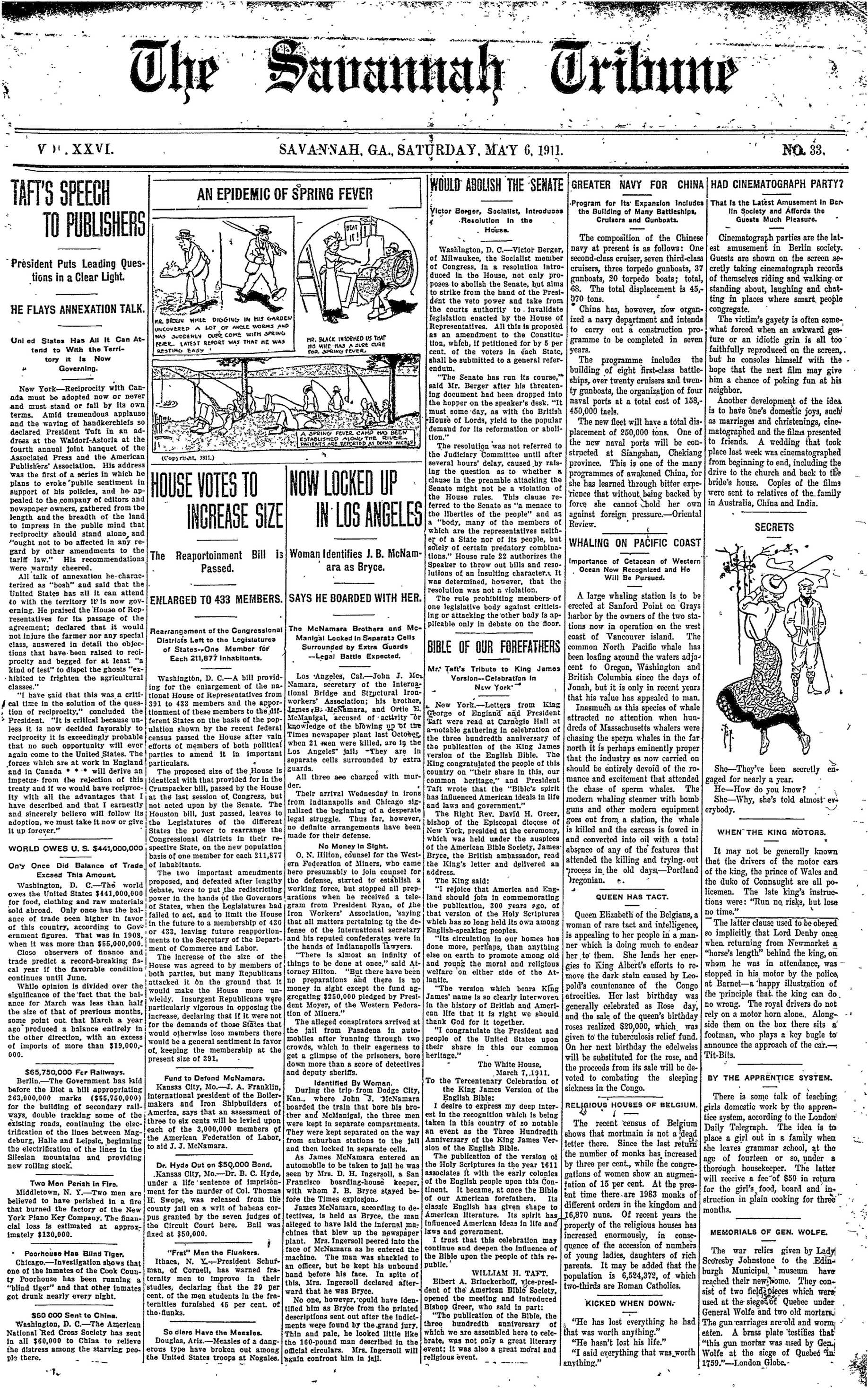
AN EPIDEMIC OF SPRING FEVER =
, 7 ies <= -
Sg n
| tan | Be" en
fs 7 [\ EAL By
' a oe ey
BR ores o~yws. BES yo
Pe a) Sling? Wi <
see onony wus ence! iififs che
modpghegerre ts
NAS SUDDENLY QUES COME WITH SPRING
FAER. LATEST REPORT WAS THAT HE WAS HH, BLACK INFORMED US THAT
RESTING EASY | . Ll id oye y cure
oN eae arse 7 ER a
> aes ton
a
vo Serr mien aes oa » a —
HOUSE VOTES 10
INGREAGE SIZE
ENLARGED TO 433 MEMBERS.
Rearrangement of the Congressional
Districts Left to the Legistaturcs
of States-rOne Member for
Each 211,877 Inhabitants.
Washington, D. C.—A bill provid.
ing for the enlargement of the na-
tional House of Representatives from
391 to 433 members and the appor-
tionment of these members to the Aif-
ferent States on the basis of the pop-
ulation shown by the recent federal
census passed the House after vain
efforts of members of both political
parties to amend it in important
particulars. s
The proposed size of the House is
identical with that provided for in the
Crumpacker bill, passed by the House
at thé last session of, Congress, but
not acted upon by the Senate, The
Houston bill, just passed, leaves tc
the Legislatures of tho different
States the power to rearrange the
Congressional districts in their re-
spective State, on the new population
basis of one member for each 211,877
of inhabitants.
The two important amendments
proposed, and defeated after lengthy
debate, were to put the redistricting
power in the hands of the Governor:
of States, when the Legislatures had
falled to act, and to limit the House
in the future to a membership of 430
or 433, leaving future reapportion-
ments to the Secretary of the Depart.
ment of Commerce and Labor.
The Increase of the size of the
House was agreed to by members of
both parties, but many Republicans
attacked it On tho ground that it
would make the House more un-
wieldy. Insurgent Republicans were
particularly vigorous in opposing the
increase, declaring that {f it were not
for the demands of those States that
would otherwise loso members there
would be a general sentiment In favor
of, keeping the membership at the
present size of 391, *
Fund to Defond McNamara,
Kanses City, Mo—J. A. Franklin,
International president of the Boller-
makers and Iron Shipbuilders of
America, says that an assessment of
three to six cents will be levied upon
Jeach of the 3,000,000 members of
ithe American Federation of Labor,
to aid J.J. McNamara.
Dr. Hyde Out on $5Q,000 Bond,
-Kansas City, Mo.—Dr. B. C. Hyde,
under a life ‘sentence of imprison-
ment for the murder of Col. Thomas
H. Swope, was released from the
county jail on a writ of habeas cor-
pus granted by the seven judges of
the Circuit Court here, Bail was
fixed at $50,000.
————— ?
“Frat!” Men the Flunkers,
Ithaca, N. W--President Schur-
man, of Cornell, has warned fra-
ternity men to improve in thelr
‘studles, declaring that the 29 per
cent, of the men students in the fra-
ternitles furnished 45 per cent. of
the-flunks.
Ban dinsa Have the Bawales.
Douglas, Ariz.—Measles of a dang-
erous type have broken out among
the United States troops at Nogales.
NOW LOCKED UP
WLS ANGELES
SAYS HE BOARDED WITH HER.
The McNamara Brothers and Mc-
Mantgal Locked In Separate Cells
Surrounded by Extra Guards
Legal Battle Expected. *
Los Angeles, Cal—John J. Me:
Namara, secretary of the Interna:
‘tlonal Bridge and Stryctural Iron
workers’ Asseclation; his brother
dames ;B;-MeNimara, and Ortie ©
McManigal, ‘accused of «activity ~1
knowledge of the blowing up Uf tir
Times newspaper plant last October,
when 21 men were killed, are ig the
Los AngeleS* jails -They are in
separate cells surrounded by extra
guards, *
All three aro charged with mur.
der, ‘
Their arrival Wednesday In {rons
from Indianapolis and Chicago sig:
nalized the beginning of a desperate
legal struggle. Thus far, however,
‘no definite arrangements have deen
made for their defense.
No Money In Sight.
0, .N. Hilton, counsel for the West-
ern Federation of Miners, who came
here presumably to join counsel for
the defense, started to’ establish a
working force, but stopped all prep-
arations when he received a tele-
gram from President Ryan, of the
Tron Workers’ Association, ‘saying
that all matters pertaining tg the de-
fense of the International secretary
and his reputed confederates were in
the hands of Indianapolls lawyers.
“There is almost an infinity of
things to be done at once,” sald At-
torney Hilton. “But there have been
np preparations and there Is no
money in sight except the fund ag-
gregating $250,000 pledged by Pres!-
dent Moyer, of the Western Federa-
tion of Miners.”
The alleged conspirators arrived at
the jail from Pasadena in auto-
mobiles after running through two
crowds, which in thelr eagerness to
get a glimpse of the prisoners, bore
down more than a score of detectives
and deputy sheriffs.
Identified By Woman.
During the trip-from Dodge City,
Kan., where John J, “McNamara
boarded the train that bore his bro-
ther and McManigal, the three men
were kept in separate compartments.
They were kept separated on the way
from suburban stations to the jail
and then locked In separate cells.
As James McNamara entered an
automobile to be taken to jail he was
seen by Mrs. D, H. Ingersoll, a San
Francisco boarding-housé keeper,
with whom J. B. Bryce stayed be-
fore the Times explosjon..
James McNamara, according to de-
tectives, is held as Bryce, the man
alleged to have lald the infernal ma-
chines that blew up the newspaper
plant. Mrs. Ingersoll peered Into the
face of McNamara as he entered the
machine. The man was shackled to
an officer, but he kept his unbound
hand kefore his face. In spite of
this, Mrs. Ingersoll declared atter-
ward that he was Bryce. :
No one, however, could have Iden-
tified him as Bryce from the printed
deseriptfons sent out after the indict-
ments were found by the.grand jury.
Thin and pale, he looked little ike
the 160-pound man described In the
pficiat efrculars. Mrs. Ingersoll will
again confront him In fail. |
WOULD ABOLISH THE “SERATE
Votor Revise, .Senanst, Introduces:
£ ‘Resolution In the 3
Washington, D. C.—Victor Berger,
of Milwaukee, the Soclallst member
of Congress, in a resolution intro-
duced In the House, not only pro-
poses to abolish the Senate, hut aims
to strike from the hand of the Presl-
dent the veto power and take from
the courts authority to . invalidate
Tegislation enacted by the House of
Representatives. All thie is proposéd
gs an amendment to the Constitu-
tlon, whfch, if petitioned for by 5 per
cent. of the voters in éach State,
shall be submitted to a general refer-
endum,
“The Senate has run its course,”
said Mr. Berger after his threaten-
ing document had been dropped into
the hopper on the speaker's desk. “It
must someday, as with the British
House of Lords, yield to the popular
demand for its reformation or aboli-
tion.” .
The resolutign was not referred to
the Judiciary Committee until after
several hours’ delay, caused by rals-
ing the question as to whether a
clause in the preamble attacking the
Senate might not be a violation of
the House rules. This clause re-
ferred to the Senate as “a menace to
the Hbertles of the people’ and as
a “body, many of the members of
which sre the representatives neith-
er of a State nor of its people, but
sdlely of certain predatory combina-
tions.” House rule 22 authorizes the
Speaker to throw out bills and reso-
lutions of an insulting character... It
was determined, however, that the
resolution was not a violation,
The rule prohibiting members of
‘one legislative body against eriticis-
‘Ing or attacking the other bady fs ap-
plicable only in debate on the floor.
BIBLE OF OUR FOREFATHERS
- acai In -
>» ACW xOrk.——Letters trom AURs
George of England aiid President
Taft were read at Carnegie Hall at
a-notable gathering in celebration of
the three hundredth anniversary of
‘the Publication of the King James
version of the English Bible. The
‘King congratulated the people of this
country on “their share in this, our
common heritage,” and President
Taft wrote that the “Bible's spirit
‘has influenced American ideals in life
‘and laws and government.”
| The Right Rey. David H. Greer,
‘bishop of the Episcopal diocese of
New York, presided at the ceremony,
which was held under the auspices
of the American Bible Society, James
Bryce, the British ambassador, read
the King’s letter and delivered an
address. .
‘The King sald:
“I rejoice that Amorica and Eng-
land should join in commemorating
the publication, 300 years go, of
that version of the Holy Scriptures
whieh has so long held its owa among
English-speaklag peoples.
“Its clreuetion In our homes has
done more, pertlaps, than anything
else on earth to promote among old
and young the moral and religious
welfare ‘on elther side of the At-
lantic,
“The version which bears King
James’ name Is so clearly Interwoven
in the history of British and Ameri-
can life that it fs right we should
thank God for It together.
“I congratulate the President and
people of the United States upon
their share in this our common
herltage.”” ie
: Tho White House,
-Mareh 7,,1911,
To the Tercentenary Celebration of
the King James Version of the
English Bible:
I desire to express my deep inter-
est In the recognition which is being
taken In this country of so notable
an event as the Three Hundredth
Anniversary of the King James Ver-
sion of the English Bible.
‘The publication of the version of
the Holy Scriptures in the year 1611
assoclates it with the early colonies
of the English people upon this Con-
tinent. It became, at once the Bible
of our American forefathers. Its
classic English has given share to
American Iterature, Its spirit hag
Influenced American Ideas in life and
laws and goverament.
I trust that this celebration may
continue and deepen the influence of
the Bible upon the people of this re-
public.’
WILLIAM H. TAFT.
Elbert A. Brinckerhoff, ylce-pres!-
dent of the American Biblo Society,
opened the meeting and Introduced
Bishop Greer, who sald ia part:
“The publication of the Bible, the
three hundredth anniversary of
which we aro assembled here to cele-
brate, was not oniy a grcat literary
event; {t was also a great moral and
religious event.
an NAVY FOR CHINA
‘Program for Its’ Expansion Includes
"the Bullding of Many Battleships,
Crulsers and Gunboats.
The composition of the Chinese
navy at present is as follows: One
second-class cruiser, seven third-clasa
cruisers, three torpedo gunboats, 37
gunboats, 20 torpedo boats; total,
£8, The total displacement is 45,-
270 tons. .
China has, however, now organ-
ized a navy department and intends
to carry out a construction pro-
gramme to be completed in seven
years.
The programme includes the
building of eight first-class battle-
ships, over twenty cruisers and twen-
ty gunboats, the organization of four
naval ports at a total cost of 158,-
450,000 taels.
The new fleet will have a total dis-
placement of 250,000 tons. One of
the new naval porte will be con-
structed at Siangshan, Chekiang
province, This is one of the many
programmes of awakened China, for
she has learned through bitter expe-
rience that without being backed by
foree she cannot chold her own
against foreign pressure—Oriental
Review. 7 -
WHALING ON PACIFIC COAST
Importance of Cetacean of Western
| Ocean Now Recognized and He
Will Be Pursued.
A large whaling station is to be
erected at Sanford Point on Grays
harbor by the owners of the two sta-
tions now in operation on the wes
coast of Vancouver island. ‘The
common North Pacific whale ha:
been loafing around the waters adja-
cent to Oregon, Washington and
British Columbia since the days of
Jonah, but it is only in recent years
that his value has appealed to man.
Inasmuch as this species of whale
attracted no attention when hun-
reds of Massachusetts whalers were
chasing the sperm whales in the far
‘north it is perhaps eminently proper
that the industry as now carried on
should be entirely devoid of the ro-
mance and excitement that attended
the chase of sperm whales. The
modern whaling steamer with bomb
guns and other modern equipment
goes out from a station, the whale
is killed and the carcass is fowed in
and converted into oil with a total
absence of any of the features that
attended the killing and trying- out
roeess in the old days—Portland
jreconian. f&. -
QUEEN HAS TACT.
Queen Ekizabetli of the Belgians, a
woman of rare tact and intelligence,
is appealing to her people in a man-
ner which is doing much to endear
her to’ them. She lends her ener-
gies to King Albert’s efforts to re-
move the dark stain caused by Leo-
pold’s countenance of the Congo
atrocitics. Her last birthday was
ene celebrated as Rose day,
and the sale of the queen’s birthday
ee realized $20,000, which. was
given to the tuberculosis relief fund.
On her next birthday the edelweiss
‘will be substituted for the rose, and
the proceeds from its sale will be de-
voted to combating the sleeping
sickness in the Congo.
RELIGIOUS HOUSES OF BELGIUM.
The recent census of Belgian
shows that mortmain is not a dead
etter there. Since the last retutr
the number of monks has, increased
by three per cent., while the congre.
gations of women show an augmen-
tation of 15 per cent. At the pres.
tnt time there.are 1983 monks of
different orders in the kingdom and
16,870 nuns. Of recent years the
property of the religious houses has
increased enormously, in conse
quence of the accession of numbers
of young ladies, daughters of rich
parents. It may be added that the
population is 6,524,372, of which
two-thirds are Roman Catholics.
KICKED WHEN DOWN;
; “He has lost everything he had
that was worth anything.”
“He hasn’t lost his life.”
“T said everything that was worth
enything.”
HAD CINEMATOGRAPH PARTY?
- Is the Latest Amusement In Bere
lin Society and Affords tho
Guests Much Pleasure. = *
Cinematograph parties are the lat-
est amusement in Berlin society.
Guests are shown on the screen se
cretly taking cinematograph records
of themselves riding and walking: or
standing about, langhing and chat-
ting in places where smart, people
congregate, =”
The victim’s gayety is often some-
what forced when an awkward ges-
ture or an idiotic grin is all too
faithfully reproduced on the screen,
but he consoles himself with the
hope that the next film may give
him a chance of poking fun at his
neighbor.
Another development of the idea.
is to hate one’s domestic joys, such!
as marriages and christenings, cine
matographed and the films presented
to friends. A wedding that took
Place last week was cinematographed
from beginning to end, including the
drive to the church and back to the
bride’s house. Copies of the films
were sent to relatives of the family
in Australia, China and India.
SECRETS
™ Ky kn
aes .
3) a 9 =
© Os =F
. SN
Hi.
it
AVN ! \
yy
NOs] siz
ye 4 \.
Oe Fe
es SALON
rey
= S
She—They’re been secretly ea-
gaged for nearly a year. :
He—How do you know? ° ,
She—Why, she’s told almost" ev
erybody. Vv
WHEN THE KING MOTORS.
It may not be generally known
that the drivers of the motor cars
of the king, the prince of Wales and
the duke of Connaught are all po-
Yicemen. The late king’s instruc
tions were: “Run no, risks, but lose
no time.” ‘
~The latter clause used to be obeyed
so implicitly that Lord Denby once
when returning from Newmarket a
“horse’s length” behind the king, on.
whom he was in attendance, was
stopped in his motor by the police,
at Barnct—a ‘happy illustration of
the principle that, the king can do
no wrong. The royal drivers do not
rely on a motor horn alone. Along-
side them on the box there sits a
footman, who plays a key bugle to’
announce the approach of the car.—
Tit-Bits.
2
BY THE APPRENTICE SYSTEM.
There is some talk of teaching:
girls domestic work by tho appren=
tice system, according to the Landon!
Daily Telegraph. The idea is to
place a girl out in a family when
she leaves grammar school, at the
age of fourteen or so, under a
‘thoréugh honsekeeper. The latter
will receive a fee“of $50 in return
for the girl’s food, board and in-
etruction in plain cooking for three’
months,
MEMORIALS OF GEN. WOLFE.
The war relies given by Lady(
Scoresby Johnstone to the Edin~
burgh Municipal, ‘museum have
reached their newsWome, ‘hey con-
sist of two ficl@ipieces which were:
used at the: Heglet’ Guebes under
General Wolfe and two old mortars.i
The gun-carriages are-old and worm;
eaten. A brass plate ‘testifies that
“this gun morter was used by Genj
Wolfe at the siege of Quebeé Gn:
1739.”—Tondon Globe.- »
TO ACQUIRE A GRACEFUL GAIT.
A woman who carries herself well, no matter if she is not blessed with regular features, can always claim some attention. A graceful gait usually goes with a good figure. A good figure, however, is really the outcome of bodily polise, and every girl should endeavor to obtain both.
It is difficult to convey to the minds of most young women and girls the importance of walking and standing correctly. In some way, when standing incorrectly, one is throwing more than the requisite weight of the body on some delicate internal organ; and after years of incorrect standing and sitting one need not wonder at the various afflictions and complaints which are bound to follow. Learn to have a free, well-polished carriage. Hold your body erect. Get the feeling of freedom.
To gain this sense of freedom there are various exercises which will loosen the muscles and help you to a feeling of graceful ease and poise.
Here are some rules which will prove beneficial to follow:
Don't keep your eyes on the ground when walking. Keep them on a level. Don't walk with the weight on the heels. Walk so that the weight falls on the balls of the feet. Don't wear high heels for walking. Wear low heels, which leave the body in its natural position. Don't walk with the body inclined forward. Bend neither forward nor backward, but keep the spine erect. Don't hold the chest so inflated that it becomes an effort. Don't wear your clothing so tight that it interferes with your breathing. Don't sit on the base of your spine. Don't sit with your knees apart. They should always touch.
SEWING.
An important thing to remember in running a sewing machine is to have a chair of exactly the right height. The neglect of this detail has been the means of giving a bad name to many a willing thing of steel and iron, for if the seat is too low the operator not only gets very tired, but the machine runs-nollsily and heavily.
All the stores now carry packages of embroidery. The package or big envelope contains the material for the article already stamped and the cotton or silk for working it. This allows a great saving of time, since the purchaser does not have to buy material, hunt up a pattern, order it stamped and then select the silk. The packages are inexpensive, many of the nainsook corset covers costing but 25 cents. Among the articles which these packages contain are corset covers, drawers, aprons, baby's caps, sofa pillows, etc.
PETTICOATS AND COTTON MILLS.
"I'm very old-fashioned," said the charming young matron. "I wear petticoats and love my husband." It is those who do not wear petticoats who are charged with ruining the dry goods trade.
It was an able distributor of white cotton goods who was talking at the Seltwyn. "Formerly," he said, "a woman would year two or three articles of cotton underwear. Now she wears the fig leaf with one silk or near-silk petticoat and one hobble skirt. A modern fashion woman is sure leaving cotton cloth to the heathen. Figure it up if you like and see what it all means. There are about 30,000,000 women and girls in the United States. Curtail their consumption of cotton goods by five yards apiece. This average is not too much, I think. It means leaving 150,000,000 yards of cotton goods on the merchants' counter." "My wife," continued the orator, "don't use as much petticoat stuff as she used to by 40 or 50 yards a year. We will men and dry goods distributors must pray for the return of the good old way where wives love their husbands and wear petticoats."—Charlotte Chronicle.
MILLINERY NOTES.
Large and small turbans of supply straw, handmade, are being shown in the shops. The crows are high and the trimmings make them more so. Black and white combinations for early spring are very pronounced. In both straws and trimming this is good. Black and white lace is used for huge bows or for surface coverings on large shapes. Ribbon in black-and-white checks and stripes is used on plain shapes for wear.with tailored suits. Pliable hoods for motoring are of flexible hemp, silk or straw, and are combined with suede and chamois or satin.
Small bonnets of silk are being shown. They are of the early Victorian shape. The brim is "scoped" and very close-fitting. Draped crowns projecting toward the back are used. These full, soft-crowns allow for the present mode of hairdressing. Large flowers are used as extensively as small ones. Black and white poppies, of silk and velvet are being shown. Wings, quills and gorgeous plumes are used as trimming. The hatbirds in most of the new spring models turn up from the face. Last of all, fashion is lenient, suiting all types.
COCOA FUDGE.
This is prepared as follows; Put one-fourth of a coffeecupful of milk and a teaspoonful and a half of butter in a sancepan and, when the butter has melted, add a heaping coffeecupful of powdered sugar, exactly nine teaspoonfuls of cocoa and a pinch of salt. Cook, stirring constantly until the ingredients have blended, then, with only occasional stirring, continue to cook about eight minutes, or a trifle longer, if necessary. As soon as the syrup "strings," remove it from the fire, add vanilla to taste; set the saucepan into cold water and beat—not too hard—until it begins to thicken perceptibly. Cool in buttered tins. When half cold mark in squares. If desired, nut meats or candied fruits may be chopped and added to this "fudge" at the same time that the flavoring extract is introduced.
HIGHWAY TO HAPPINESS.
To be calm when others about you are troubled; to dream and yet not be mastered by them; to think and yet not make thoughts an end; to meet triumph without pride and disaster without being embittered; to walk with the many and keep virtuous; to hold converse with the mighty and yet not lose the common touch; to be influenced neither by the criticism ofoes nor the flattery of friends; to endeavor to be of service and helpfulness to others; to keep in mind the transiticons of life's experiences; to love humanity and to trust in God—these are guideposts on the highway to happiness.—A. T. Fowler.
FAITHFULNESS COUNTS.
The man who is always doing things with a view of making a reputation, succeeds only in obtaining nooriety; while he who never thinks of anything but duty secures a reputation without being aware of it. A young man who shunned publicity and who did his work as he thought, out of sight of the world, recently passed away. In his last illness he was surprised to learn of crowds who came to express their sympathy—many of them people of whom he had never heard. They had quietly watched his quiet work, and knew him not by the efforts to make himself known, but by his efforts to be faithful.
HOUSEHOLD HINTS
A delicious salad may be made from the young sprouts of oyster plant. It is best served with French dressing.
Figs soaked over night in claret and then cooked in the wine until tender are delicous served cold with whipped cream.
Shredded cabbage and diced celery in equal parts made a fine salad combination, served with either mayonnaise or boiled dressing.
Offentimes the crepe paper which is used to cover the unsightly flower pot becomes stained when the plant is watered. An excellent way to prevent this is to first wrap the pot with paraffin paper or a piece of table oil-cloth.
A tasty salad is served in pepper shells. Slice off the top and the bottom of sweet green peppers; stuff them with diced chicken or veal dressed with mayonnaise. Serve on a bed of lettuce with a strip of the green paper, stuffed olives, chives and celery for a garnish. Pour mayonnaise over all.
Cold chicken or turkey is the basis of a tasty dish. Put thinly cut slices of the meat in a dish together with a little cooked sphagetti, a few mushrooms, a little grated cheese, the whole moltened with cream sauce and covered with bread crumbs. The dish is set in the oven till the crumbs are well browned.
When soup is poor try the addition of grated cheese. It will give richness and flavor.
If when cooking bacon one is careful not to let the fat-burn it may be kept for frying, and for fish will answer as well as the bacon itself.
A tasty way of using left-over boiled rice is to put a piece of butter in the frying pan and adding the rice when the butter sizzles. Fry until brown.
To bake potatoes quickly, boll them in salted water for ten minutes, then put them in the oven. The boiling water will heat them through and they will cook in a short time.
Don't stitch skirt seams all in one direction; the blas side should be held under the straight edge, which means that the seams of half the skirt should be stitched from top to bottom and the other half from bottom to top.
Warm bread or cake, and, in fact, warm food of any kind, should never be put away in a covered tn or dish. The steam makes molding certain. Vegetables become soggy and unfit for food when treated in this careless manner. To wash a piece of chamols put in tepid water with soap, pearline or borax, rinse well in clear water, and while drying puil frequently from all les, make it soft and pliable.
Ought not Christ to have suffered these
things, and go to enter into His Glory-2
73
The prophets of Israel had foretold and Christ himself had predicted that the son of man shall go up to Jerusalem, be betrayed into the hands of men, be put to death and the third day rise again. His apostles did not understand this necessity upon which their master so often spoke and by which he must establish his kingdom through suffering and death. Their minds, owing to their Judahic ideas about the Messiah, were filled with visions of wondrous wealth, mighty thrones and earthly greatness, and they looked forward to a glorious earthly kingdom. His undoing by the great men of their nation, who had conceived for him hatred and bitterness, meant for them the dashing aside of the high hopes aroused in them of the powerful kingdom which was to lead the people in triumph over their persecutors and oppressors. They seemed unable to comprehend that all the grandeur and magnificence of his life, all the usefulness and benefits of his works; all the grace and truth to come to men through him, were impossible without the accomplishment of the prophecies and predictions concerning his death and resurrection.
But we see it now. "Christ is the same today as he was yesterday and will remain the same forever"—he is imperishable, because he was put to death and rose again the third day. His religion has made itself a living and active factor in the world's history and events; it has effected and does effect wondrous transformations in human lives; it has obtained a commanding position of influence and confidence from which it has exercised undoubted control over manifold directions of human industry and activity; it has led civil government, social customs, relations international and private, in a plain and ever-constant moral progress, because it has borne aloft the image of Christ crucified, and his religion has centered in and around his sacrifice on Calvary. The kingdom of God has won and drawn countless into its fold, proving a home to them amid the world's coldness and heartlessness, a sure refuge from numerous conflicts around them, a safe haven in the midst of afflictions, sorrows and toll; it has been the sphere in which men and women have been led to seek first and foremost his kingdom and its justice, to throw aside the service of mammon, to give up all things and to follow Christ, yielding and opening their souls to the quickening of the holy spirit—walking in his footsteps and taking upon themselves his yoke, to feel the inflowing of his very life into theirs. It inspired the breaking with all that could fetter the soul in its upward soaring, a complete self-committal to the highest the soul could see and the concentration of inmost powers toward a divine union; and all this was possible only because the cross of Christ was planted deep in the world and in human hearts and became the irresistible force drawing all things to him.
When that great man of destiny, Napoleon, who had overawed Europe by the force of his genius and the terror of his name, conquered huge armies and destroyed formidable combinations, enthroned kings and created emperors, established monarchies and set up principalities, whose name was a synonym of force, audacity, genius, warlike spirit and martial enterprise, was asked why he had not established a new religion, and as he had changed the face of Europe politically, so also changed its religion and made his own ideas and spirit prevail in the religious life of the country, he answered that: it would have been necessary for him to have been crucified and to rise again the third day.
St. Paul long before had seen in the crucified Jesus of Nazareth an intensity and unspent fullness, a power of redemption and salvation, of regeneration and upbuilding, a fertility for the holiest advancement and the most prolific endeavor, and he threw his whole soul with all his talents and energy into the propagation of the knowledge of him "who being consummated became to all who obeyed him the cause of eternal salvation." He boasted: "I judge not myself to know anything among you but Jesus Christ and him crucified." We preach Jesus Christ crucified, to the Jews a stumbling-block, and to the Gentiles foolishness, but to them who are called the power of God and the wisdom of God."
Were it not for the accomplishment of what had been foretold by the prophets and predicted by Christ regarding his passion and death, the fame of Jesus would not have passed the boundaries of his native town or extended beyond the confines of his own nation; the supernatural character of his deeds, the divine spirit of his life, would not and could not have been recognized, and his name would now be but a remote memory, or a far-distant dream. His glory, which is imperishable; his institutions, which are indestructible; his words, which preserve undying vitality and potency, owe it all to his exaltation on the cross. He himself whenever he referred to his approaching agony and sorrows indicated that such would be the result. For in that connection he always said;
"The hour count's when the Son of Man shall be glorified."- And the night before his death he began his solemn prayer by reminding his Father that the hour is come and saying: "Glorify thy Son that thy Son may glorify thee."
His actual demise was a miracle. It occurred at the moment in the manner and amid the circumstances he willed. It was an act of perfect: submission to God; but it was more—it was an act of his own will. He kept himself alive on the cross for three hours because he willed it so. When the hour had passed and death at last overcame him, it was simply because he wished it so. He never lost command of his powers, and he gave up the ghost free, entirely and supremely to his own Master. He had said: "No man taketh away from me my life. I lay it down myself. And I have power to lay it down, and I have power to take it up again." The evangelists are careful to write, not that he died by a passive action which he could not control, but that he gave up the ghost—he expired. Hence St. Augustine remarks: "The spirit of the Mediator left not his body against his will, but because of it, when he willed and as he willed it; for man was blended with the word of God."
The most tremendous mystery of all history is this event of our Saviour's passion, and is incomprehensible unless we see in it title to honor and reverence and the foundation of his influence and power through which he has reached and touched the deepest possibilities of character and achievement.
These are days when all true Christians should ponder on the Saviour's dolorous but glorious passion, not so much in sorrow as in sympathy and love; rendering thanks giving and glory to God, who therein commendeth his charity toward us that "when we were sinners according to the time Christ died for us because he loved us and delivered himself for us."
THE TRAGEDY
In Edward Sheldon's "The Nigger" (Macmillan), the proud governor finde out that he has a drop of African blood. A white man, long a friend to colored people, gives the following advice to the fallen idol:
All you've got t' do, son, is fall in line. Theah's no good tryin' to stop a 'big ocean wave, you know, an' you might jus' as well do that as stan' up against democracy an' humanity an' civilization—an' a lot of othah good things with long names. . . . Ev'y niggah's a man. You and me have had mo' time t' push ahead—that's the only difference between us! We're all men an' we're all doin' the same thing—stumblin' and fallin' t' gethah, on our jou'n' t' God. So theah's no use sayin' the las' ranks ain't got no business t' go wheah the fiist are leadin' 'em. I reckon, suh, that ain't square play! . . . Try an' like like the nfgahas. That don't mean sayin' they 'ah's good as you—it's one to a 'million they ain't! But hatin's the ol' way o' gettin' roun' the folks that bothah ye- likin's up-to-date! So crack a smile, sonny, an' stick out yo' han's, an', all pull t' gethah—top an' bottom—rch an' po' black an' white!
The governor resigns his office and gives up his still faithful flansee, and accepts the situation:
Heah is our American people an' they've done a big, wrong thing—stealin' the niggahs from Africa an' bringin' en' ovah heah fo' theah own selfish use—an' a thing like that couldn't help endin'—as it has ended—in bloody to'ment! We're a-sufferin' it now, but d'you think it's goin' l'last? D'you think we're not a-goin' trise up from it a strongah an' a wisah an' kindah people? D'you think it's not wo'n a thousand times ovah!—what would be the use o'strugglin' an' lirvin' any longah? Why shouldn't evry one get rid of it all by takin' a headah right into the dak?
Spolled In the Making.
Behold when a man on a trolley car removed his hat the other day little Willie observed that he was bald—yes, very bald, for not a single hirsute rambler trailed over his shining pate. But when it came to whiskers the bald party was right there with the iliacs. He had whiskers in bundles, whiskers in stacks; in fact, he bad enough whiskers to start a rat factory and make a fortune.
"Say, mamma," finally remarked Willie, turning to his mother, "just look at that man there."
"Hush, dear!" returned mamma; "he will hear you. What's the matter with him?"
"Everything is the 'matter with him," replied the youngster. "When the angels made him they put his head on inside down."
A Conservative Estimate.
One can't tell the name of the real estate agent about whom this story is written: for one thing, we are his debtor for a long automobile ride, and for another thing, he's a modest violet, except when he's trying to sell suburban property. His prospective customer was asking: "Do you have absolute faith* in the future of this section?"
"Sir," he answered, "let me tell you how much faith I have. I have studied conditions, in every part of Guyana county, and I would be willing to stake my professional reputation—yes, and any amount of money—that the future of this particular section is well-night inexhaustible!"
Not Always Desirable.
"Shall we advertise for a man with experience?"
"Well, I don't know. The last man had so much 'experience that we couldn't teach him anything."
SAVANNAH, GEORGIA, TO HAVE SCHOOL PATTERNED AFTER TUSKEGEE INSTITUTE.
TRACT FOR SITE DONATED
Institution for Industrial Instruction Will Have Ample Financial
Savannah, Ga. (Special).—An industrial school for negroes, to be patterned after Booker T. Washington's institute at Tuskegee, Ala., will be established in Savannah by next September, if the plans of prominent negro educators and ministers do not miscarry.
A tract of twenty-two and a half acres located in Central Park, two miles on the White Bluff road, has been donated for this purpose, there being a proviso in the donation calling for the erection of a school building not to cost less than $3,000. The negro ministers of the Methodist church here have undertaken the task of carrying out the provisions of the gift.
Rev. Richard D. Stinson, principal of the Atlanta Normal and Industrial Institute for Negroes of Atlanta, is in Savannah for the purpose of looking over the situation here. He has been urged to take the principalship of the proposed new school, and his inspection of the tract of land and investigation of the possibilities today will determine his acceptance or refusal of the proffered position.
In the event of his refusal to accept the place he has promised to secure an efficient and capable man. The Atlanta school of which he is now heed is a strong one and is doing very effective work. It is doubtful if he would want to give up that school to become principal of the one here. He has confidence, however, that the new school in Savannah would prove a success, and he will closely identify himself with its organization whether or not he decides to become its principal. Reverend Stinson is one of the best trained and most prominent negro educators in the south, and the Savannah ministers who are behind the proposition feel they could not get a better man to launch the new school.
That no difficulty will be experienced in raising sufficient money with which to erect school buildings on the donated tract is the opinion of Reverend Stinson. The school buildings will be modern in all lines, and will be especially adapted to the teaching of industrial vocations. No efforts will be made to teach literary or scientific subjects. The main aim of the school will be to elevate the negro race in this section industrially. The school will not be opened with less than 250 students, and a faculty large enough to teach this number the various industrial subjects will be employed.
No better location for the new school could be obtained than the one in Central Park, in the opinion of those who are booming the proposition. The tract of twenty-two and a half acres is ample for all needs and for the future growth of the institution. The land was donated by a few months ago. R. H. Singleton and P. W. Greatheart, two Savanah ministers of the colored Methodist church, compose the committee which is directly in charge of the plans for the new school.
NEGROES OF PALESTINE, TEXAS. ARE PROGRESSIVE
Ten years have brought about a great change in Negro business enterprise of Palestine. More of the Negroes are owning homes, operating business houses, accumulating property and real estate and investing in various commercial projects. They have been awakened by the alarm industry, the new age that is being widely developed in the entire race. We have good, law-abiding citizens among us, that we know are appreciated by the best white citizens of this place on account of the favors received of them by the best Negro citizens.
Grocery stores, dry goods stores, bank, printing offices, real estate business, all of which are thriving, owned and operated by Negroes, have made their appearance in this city within ten years. The white man in business has given the Negro in business assistance in various ways, and they bartar with each other in perfect tranquillity. -Palestine (Tex.) Plaindealer.
THE LAW OF THY MOTHER.
John Ruskin, in counting up the blessings of his childhood, reckoned these three for first goods Peace—he had been taught the meaning of peace in thought, act, and word; had never heard father's or mother's voice once raised in any dispute, not seen an angry glance in the eyes of either, nor had ever seen a moment's trouble or disorder in any household matter. Next to this he estimates obedience—he obeyed word or lifted finger or father or mother as a ship her helm, without an idea of resistance. Lastly, faith—nothing was ever promised him that was not given; nothing ever threatened him that was not inflicted, and nothing ever told him that was not true.—Standard.
SPEAKERS URGE NEED OF INDUSTRIAL EDUCATION FOR COL- ORED YOUNG PEOPLE.
Charleston, S. C. (Special)—An education mass meeting was held in Morris Brown A. M. E. church, in the interest of the Atlanta Normal and Industrial institute, Atlanta, Ga. Rev. L. R. Nichols, pastor, presided. He read a carefully prepared paper, setting forth the object of the meeting and stating that he was rapidly becoming an advocate of practical education for the masses of his race. He spoke of conditions that exist among a class that is becoming more detrimental to the other negroes' best interests wherever they live in large numbers. He commended the work of the Stinson school at Atlanta, that is being directed by prominent southern white men.
Rev. H. W. B. Bennett discussed "The Many Ways by Which the Negro Can and Is Helping Himself." He pleaded for trained hands, a good character and a respectable home life.
Rev. Randall Kemp discussed "The Necessity of Having Colored Teachers Train Colored Children." He said no person can so completely win a negro child as to improve his life and character as the negro instructor who enters his home, teaches him in the Sunday school, worships in the church with him and calls upon him when he is sick.
Rev. M. M. Mouzon talked about "Southern Negroes Making the Best of Their Opportunities." He declared that while individuals had done and are now doing well and are a credit to the communities where they live, he was not at all satisfied with that large army of idlers in the streets, pool rooms, dives and places of sin and ignorance.
The Rev. D. J. Jenkins pleaded with his race to help to care for the orphans. He said from among them have come some of the best men and women.
The Rev. Richard D. Stinson, head of the Atlanta Normal and Industrial Institute, delivered the principal speech of the evening, pointing out the great need for practical education among the masses of the negroes and condemning the corruption which he said existed among certain negro preachers and teachers.
The contribution was liberal. C. C. Leslie sent his check for $25; Mr. Wilson G. Harvey, $10, C. M. English $5, others giving smaller amounts. The $80 or $90 persons present appeared to enjoy the occasion. Benediction was pronounced by the Rev. J. S. Morgant.
RAGE FEELING IN RELIGION
The Crisis furnishes this bit of interesting news relative to the Salvation Army's attitude toward the negro: Race feeling which developed among the southern delegates to the Salvation Army conference held in Washington recently resulted in the abandonment for the time being of the army's plans for the organization of a movement among the colored people of the United States.
A storm of protest went up from the officers from the south when a northern delegate proposed that white officers be required to conduct meetings among the colored people. They virtually declared they would not assume such duties, with the result that the committee appointed at the same meeting to draft a plan for the new work was discharged before it had time to commence work.
Commander Evangeline Booth, head of the American Salvation Army, said before leaving for New York that if necessary a Salvation Army with colored leaders to conduct the meetings will be organized.
"We thought it better to drop the matter temporarily," said Miss Booth, "owing to the feeling among our southern officers.
"They have worked amid a vast colored population for years, and I presume they know more about the colored people than the rest of us. I have no criticism to make against them. Our plans were never matured. I think the matter was never formally discussed among us before.
"There are practically no colored people engaged in Salvation Army work in this country. In India we have native officers in command, and I suppose it would be just as well, if not better, to have colored officers here. I am confident we shall accomplish a great deal for the general welfare."
Nothing probably has been a greater handicap to the missionary efforts of the Christian church, especially the Protestant branches of it, than race prejudice. Just why Christianity should be more affected by questions of race and color than other religious is strange. Jesus Christ himself preached a religion of individual acceptance "unto all" was his command, and Peter found that God was no respecter of persons, but in every nation they that fear him and keep his commandments are acceptable. Why wonder at the unchecked dominance of Islam and why attempt to preach the gospel of Christ while wearing a robe of racial conceit and color prejudice? Asia and Africa will never yield until the true Christ spirit rules in the Christian churches everywhere. Speaking of the Salvation Army and the negro reminds us how surprised we were to meet three uniformed members of the "Army" of negro extraction last year in Louisville, Ky. While we had heard that in a few cities they were to be found, that was our first sight of them.—Star of Zion.
AFRO-AMERICAN CULLINGS
The poor colored man and the gadabout negro woman should "go slow" on the excursion this year. Suppose we "cut out" the excursion altogether. Times are tight, and we need the little money we have to pay our debts, and to meet our expenses. The Light respectfully urges negro pastors, preachers and race leaders to use their influence to keep the negroes from wasting their money on excursions. Many negroes borrow money from the money lenders (pawning all their household goods) simply to ride on an excursion and have a "big time" for two or three days. They come home and it takes many of them a year or more of hard work to pay the money lender back for the money borrowed for two or three days so-called pleasure trips. Again we say let us "cut out" the excursion, save our money, pay our debts, educate our children, buy homes, start dry goods stores, shoe stores and other business enterprises like the white people. We have not the time or the money to waste on excursions. Let us "cut them out." Not until we do can we look for the sunlight of prosperity and happiness.—Vicksburg (Miss.) Light.
Unless some moral issue is at hand, it has been the conviction of the writer that no preacher has a right to dabble in politics. In recent years politics have attracted some of our preachers more so than religion and therefore they have almost turned down the church and now concentrate all their efforts towards pushing the claim of some office seeker. He even heads political leagues, and gives three-fourths of his time pushing the claims of his party rather than giving this time to God and the saving of wicked men and women. No preacher however great his literary attainments may be should be elevated to high offices in our churches if he has a disposition to dabble in politics.
These political preachers have proven to be detrimental to the church with which they are connected, because by them, politics have been even carried into the church, and is the leading topic for discussion wherever they are in evidence. We need preachers in this day and generation to preach the Gospel of Jesus Christ. There is a sufficient number of men of the race in other vocations to take care of the political end.—Mississippi Odd Fellow.
一
There are at least two ways of looking at most natures. Some negroes were discussing the death of a small darkey. The cause of the catastrophe was clear enough to one of the men. "De po' chile died fum eatin' too much watahmillion," he explained. One of the others looked his doubts. "Huh!" he grunted. scornfully. "Dar ain't no such thing as too much watahmillion." "Well, den," remarked the first, "dar wasn't enough boy."—Dallas (Tex.) Express.
We are distressed over the behavior of the negro soldiers at San Antonio, Tex. We are lost for words in such a catastrophe. Have not the negro soldiers of this country yet learned a lesson from the discharge of the soldiers by ex-President Roosevelt? Have they not yet learned that as soldiers they must contend for peace and happiness between the two races? Have they not been taught that the white man is the ruling power and they must submit or get out? Then why should they continue raising strife and confusion, with the United States stripes on? If experience has no efficacy or bearing upon the negro of this country, he must make up his mind to be relegated to the desert.
What the mischievous white soldiers do, gives no authority to the negro. It looks to us that the negro soldiers are getting into the shiftless wage earner, and there should be no pity for them when they wilfully bring about confusion without a cause.—Charleston (S. C.) Messenger.
Bibles with colored angels are said to be going big down in Alabama. It is being said that the books thus illustrated are disposed of at $10 each on installments. Special designs always come high. The story is meant to be humorous as well as true, the sign is by no means a bad one. It means race pride, and much of it, if the purchasers are still content to be negroes in the hereafter, in the face of the inconvenience here, owing to the fact.
A fool and his money soon part, and
if Jack Johnson ain't a fool with his
car he should take down his sign. It
makes no difference what is said about
Jack, he is boss of the whole world
from the fist. We love the old friend
because we won on him when he
showed his negro ability in Reno.
Jack is now in San Francisco, Cal.,
living thirty days in a week, being
put in jail, and fined heavily.—Pensacola (Fla.) Brotherhood.
These warm days are hatching excursion going negroes, who will soon be heard above the rumble and rat- tle of the trains upon which they ride.—Western Star.
No one who has kept trend with current affairs for the last forty years would deny for one moment that the negro people have made great progress along many lines. They have abler educated ministers who preach the gospel in its highest and best sense. They compare very favorably in that respect with any other people. But it must be admitted that this number is in the minority rather than in the majority. There are far too many who do not do anything but rant and beat the air. And the Dispatch regrets to say that these have a greater following than the intelligent God-sent ministers. It is a case "where ignorance is bliss, 'tis folly to be wise." They drag down rather than build up. But there is a large minority who do credit to any race anywhere, and the Dispatch is glad to note that that number is greatly increasing. They are not those who believe that all you have to do is to open your mouth and it will be filled by some miraculous power, but that you must prepare by hard study in some theological seminary or college. And they are making it less popular for the ignorant ministers who put their hands in their ears and whoop and holler and imagine they have preached a good sermon. Then, too, the younger race is being educated and are growing intelligent and will not have that kind of stuff. And hence it is only a question of time before that kind of ignorant and superstitious jargon must give way for truth and spirituality. For those who worship God must do so in spirit and in truth.
Quite a crop of doctors and some lawyers are being turned out yearly, and many of them are doing good work for their race and the community in which they live. They do not belong to the criminal class; very seldom you hear of any of this class of Negroes committing any crime. They are self-respecting, and, therefore, law-abiding. The only thing we find to criticize is their lack of unity among themselves. But we believe they are improving along this line. The Dispatch notes that since it spoke of their division last year, there seems to be a better understanding among them. They seem to understand one another, and work for the highest good of their patients.
As to what the Negro editors are doing, we only refer to the address delivered by Dr. Booker T. Washington in New York before the Negro National Business league. He told the truth when he said, "that no people had made a greater sacrifice, are doing, more good than the Negro editors." And he said that they, of all people, "ought to receive the patronage of our people." He said: "Without these papers, Negro enterprises never could have made the progress which they have."
The true Negro paper not only serves its own race, but both races. For it cements the friendship between them. Of course there are exceptions. There are those that are calamity howlers, that always see the dark side rather than the bright. But the Dispatch is an optimist, and believes in the future of the race. It further believes that the law-abiding and God-fearing among our white neighbors want us to succeed; and notwithstanding the rabid talks of the politician, we believe that the best white people wish us well and that we will secure every right guaranteed us by the state and federal constitutions.
The Dispatch further believes that industrious, law-abiding and God-fearing as many of our people are, need have any fear of their future. Let us not then be discouraged when things don't come our way at all times.
一
Not every colored man who is heard indorsing Negro enterprise, practices what he preaches, with his pocket-book. We know of many instances in this city where these big-mouth blatant hypocrites really annoy honest men with their clatter about race pride, whose every act belies their words. They will not buy five cents worth of ice from a Negro, and yet they are always singing the song of race enterprise. While this lip service is everywhere desecrating the sacred altar of self-help, the colored youth is leaving college with his head full of education and his heads full of emptiness. Outside of a few decent barbershops, restaurants and other enterprises of doubtful success, there's nothing doing, in the way of offering employment for the Negro by the Negro. Let these double-dealing creatures give their tongues a rest. Let us see something done and less talk—Western Star.
一
Wagino City, a town designated exclusively for Negroes, is being platted near Althelmier, Ark. A local paper says it is believed a village of at least 500 population will be built up there within a year. Lots will be reserved for schools, churches, lodge halls, depot and other public buildings. Adjoining the town site a half-mile race track is being graded and a grand stand and other buildings will be erected to hold an annual fair—Exchange.
Current Notes
By 1940 the population of New York city will probably reach 8,000,000. Compared with 1870 pauperism in London has decreased by 50 per cent. All patents in Korea have to be registered in the Japanese patent bureau. The world's product of gold since the discovery of America is estimated at $130,000,000,000. Exports of manufactures from the United States will, this year, for the first time, exceed $800,000,000 in value. Forty years ago the paper making industry of Finland was in its infancy. Now it is worth $900,000 a year.
Turin's international exposition will be opened April 29 by the king' and queen of Italy in the presence of other members of the royal family and the government. A one-wheeled jinricksha, on the monocycle principle, is being introduced among the Chinese of the Malay states. It is said to be safe and to have many advantages over the old fashioned vehicle. The principal telephone company of Spain, with stations in Madrid, Barcelona, and 17 other cities, has only 3,705 subscribers. The city of San Sebastian has a municipal telephone service.
The Bible contains 3,566,480 letters, 810,697 words, 31,175 verses, 1,159 chapters and 65 books. The longest chapter is the 119th Psalm; the shortest and middle chapter the 117th Psalm. The middle verse is the 8th of the 117th Psalm. The longest name is in the 8th Chapter of Isaiah. Princess August Wilhelm, wife of the kaiser's fourth son, has set herself the task of reviving one of Germany's oldest customs, that according to which newly wedded couples immediately after the marriage ceremony plant a couple of oak saplings side by side in a park or by a roadside of their native town.
Queen Mary has a black carpet in one of the rooms of Buckingham palace, and in consequence there is much interest in the artistic possibilities of such color of carpet. The carpet will, however, not be very popular, as it must have gilt or some other light furniture, and it will not wear well, showing every dust mark.
The forest resources of Queensland are extensive, amounting to 40,000,000 acres, or 9.32 per cent. of the whole area of the state, while 3,836,191 acres, or 0.83 per cent., is specially reserved by the government for timber. The forests of Queensland yield a great variety of woods noted for strength, durability and beauty.
Miss Anna Rogstad is about to become a member of the Norwegian parliament. Miss Rogstad was chosen an alternate member for Gen. Brattle, who has since been chosen president of the storthing. He is now obliged to give up his seat for a while to take part in reorganizing the army. Miss Rogstad as his alternate will have to fill his place as a member, though it is said she will not act as president. The census of 1910 gives 204,354 as the population of Arizona territory. Immigration to the Salt River valley and other agricultural sections continues to increase. The Salt river lands are being subdivided into small holdings. Homestead entries increase, not only for irrigated lands, but also in dry farming regions.
The most costly medicine a few years ago was metallic gallium, which sold for $150,000 a pound, but radium is now the priceless gem of the mineral world, selling for more than that price an ounce. Charles H. Johnson, the new Democratic United States senator from Maine, is fifty-two years of age, and the length of his active service in the councils of his party is indicated by the fact that he was its candidate for governor 20 years ago.
M. Jean Brailhe, just appointed notary at Saint-Sauvvy, in the Gers department, in succession to his father, who has resigned, is the eleventh member of the same family, the members of which have succeeded one another from father to son for 315 years. The royal ordinance which appointed Blaise Brailhe first on this long line of men of law is dated Pau, December 23, 1696, and signed by Catherine, sister of Henry IV.
In Cawnpore, India, with American machinery, they are making shoes so cheaply that the manufacturers of Lynn can no longer compete with them. The cotton and silks which we one time sent to Asia are now made in Japan and China.
Mrs. Potter Palmer is going into the wholesale fruit business. A milesquare tract on the Florida west coast, at Sarasota, 50 miles north of Tampa, is the site chosen by Mrs. Palmer for her venture, and she is there now looking over the ground.
Havana imports its granite paving blocks from Norway, getting them cheaper than it can from any American port. It is said that the low Norwegian rates, combined with the low cost of material, prevent competition.
English was in 1906 the sole language of worship in 181,393 religious organizations, with 23,648,267 members, or 85.6 per cent of the total number of the organizations and 71.8 per cent. of the total membership in Continental United States.
M. A. Nayland, seventy-one, of Kansas City, who gave $60,000 to charity last week and then went into seclusion to escape praise, reappeared at his home afterward. Asked why he gave three-fourths of his fortune away, he said: "I had a little money. I saw so many people worse off than I that I wanted to help them a little. That's all."
Mrs. A. J. Hoffman of Green Creek, Idaho county, Wash., defeated her husband in the last election for the offices of constable and justice of the peace. Mrs. Hoffman's name was not on the original ballot, but some of Hoffman's friends suggested to several others that they write her name in and votes for her. The joke took so well that Mrs. Hoffman received nearly two votes to her husband's one. She declines to accept either office.
The oldest student attending a university in the United States is said to be Rev. David Jordan Higgins, a nonagenarian preacher and former colonial in the United States army, who is attending the classes in philosophy conducted by Prof. J. H. Hoose of the College of Liberal Arts, University of Southern California. The incident of an octogenarian teaching a nonagenarian probably has no parallel in the world. Rev. Mr. Higgins was born in Maine in 1817.
Alaska's fishing industry, next in importance to mining, gives employment to 12,538 persons, of whom 2,823 are natives.
The flowers of many trees, like the oak, elm and hickory, are so inconspicuous that they are popularly supposed to be altogether lacking.
Speaking of the uses of the X-ray, Dr. J. Hall Edwards, a famous Birmingham, England, physician, says that it might be employed to determine it oysters contain pearls. This would obviate the necessity of destroying the bivalve in the hope of finding a pearl inside.
Born in 1864, M. Henri de Regnier, the symbolist poet and novelist, one of the new French academicians, is among the youngest members of the academy. The youngest of all is still M. Rostand, who is four years M. de Regnier's junior and had the rare distinction of being elected an academician when he was only thirty-nour. The doyen of the academy is Napoleon III.'s old war minister, M. Emile Ollivier, who is eighty-five and still actively writing.
One of the most ludicrous enactments to be found in the acts of parliament is the statute for the rebuilding of a certain jail. The bill as originally drafted provided that prisoners should be confined in the old jail until the new one was built; but in committee a clause was added to the effect that the new prison should be constructed out of the materials of the old, and the bill became a law before anybody detected the absurdity. It has been shown in South Africa that, contrary to an old tradition, as much dew forms on a cloudy night as under a clear sky, unless there be a wind. Gusts of wind invariably check the formation of dew.
A German astronomer says that starlight does not account for all the brightness of a moonless night. He attributes a part of the brightness to "earth light," which he thinks may be a permanent aurora surrounding the earth.
Because he had forgotten his "climbers" C. E. Ordish, Montana lion hunter, had to walk back five miles after them through the snow to Libby, Mont., before he could climb a tree, rope and capture a lion which his dogs had tracked.
Sir George Clarke, the governor of Bombay, in inaugurating a scheme to supply Bombay with 30,000 horse power from a storage of reservoirs in the western Ghats, protested against the ignorant croakers who belittled Indian progress and enterprise.
Congressman Edwin Denby of the First Michigan district, who has just been-elected for a third term, is engaged to wed Miss Marlon B. Thurber, a daughter of the late Henry T. Thurber, who was President Cleveland's private secretary in the latter's second term.
George Spoor, aged eighty-six, living in Glendale, Mass., claims to be the champion veteran-wood-chopper of Hampton county. Last week he cut, chopped and split 14 cords of kindlings, and on Saturday afternoon devoted all his time in pilling the wood in his barn.
One-third of the Londoners who present themselves for enlistment in the territorial force have defects of vision, and ophthalmic specialists are considering whether there be any particular cause of this high per cent. It may be found that the insularity of the English people is due to the structure of the eye.
Melvin A. Halstead, ninety years od, founder of Lowell, Ind., has proved up 320 acres of land near Harrison, Neb. He did all the work himself.
Mr. Halstead is a "forty-niner" and a Civil war veteran. He homesteaded in lake county, Indiana, when Chicago was Fort Dearborn and ran the first grist mill in the state.
The municipal art commission of New York is reported to be turning its attention to the letter boxes, and is said to have a plan for having the boxes removed from lamp poles and fixed on pedestals of their own. A more attractive design is to be sought and also a uniform plan of placing the boxes throughout the city.
In Albany, Mo., the town committee promised more than free transportation for voters on election day. Their advertisement contained the following invitation: "A free lunch, consisting of hot coffee, meat sandwiches and pumpkin pie, will be served on election day. All voters are invited to call and partake as often as they desire."
A Michigan millionaire, who is not a Mason, has presented to the Grand Masonic lodge of that state a fine property, to be used as a Masonic home. The building was designed as a sanitarium in the milionaire's town. All the equipment of the sanitarium are included in the gift, which is valued at $300,000. The gift was made without conditions.
SOCIAL EQUALITY NOT WANTED
SOCIAL EQUALITY NOT WANTED
Ithaca, N. Y. (Special.)—Miss Rosa Vassar and Miss Pauline A. Ray, the young colored women who have provoked a race issue at Cornell among the coeds, due to their efforts to secure rooms in Sage college, have issued a statement denying that they are seeking social equality. They declare that it is immaterial to them whether they meet the white girls on the same social plane or not.
Miss Vassar, whose home is in Lyachburg, Va., is a junior in the College of Arts and Sciences. Miss Ray, who comes from Genova, N. Y., is a sophomore in the same college. Both are good students. In their statement they deny that they have consulted with any other negro student or taken advice as to their course of action and are not trying to force the race question to an issue.
They say that-the first application to have rooms assigned to them in Sage college was made over a year ago. At that time Mrs. Gertrude A. Martin, the adviser of women of the university and the general supervisor of the coeds, told them that she had taken the matter up with Emmons Williams, the treasurer of the university, and they had decided that it would not be expedient to have the girls room in Sage college, which is the only woman's dormitory.
The girls put in another application some time ago. They were moved to do so because they wanted to live nearer and in a more convenient place. The rooms they are occupying now are about a mile and a half from the university. It is understood that if they could not get rooms in the Sage dormitory they would not be able to get near the campus, as it would be hard to find accommodations in the nearby rooming houses.
"We are not seeking social equality," they said. "We would live in Sage college; as far as convenience and comfort go we would be as one with the rest of the girls, but in all things social we would be as separate as two fingers on one hand. We leave it to the trustees and believe they will give us justice, but we know that Henry W. Sage would give us justice where he alive."
Henry W. Sage gave Sage college to the university. The trustees will meet here within a week or so and they will have to decide this question, as a petition protesting against allowing the two girls to room in Sage college has been filed with them. The petition has been signed by over 200 co-eds, a majority of the number in the university.
MINISTER'S ANNIVERSARY CELEBRATED
DR. R. H. W. LEAKE HAS BEEN
PASTOR OF ST. PAUL A. M. E.
Z. CHURCH 37 YEARS.
Durham, N. C. (Special).—One of the greatest events of late years among the followers of African Methodist Episcopallans in North Carolina was the 37th anniversary of the ministerial career of Rev. Dr. R. H. W. Leake, held at St. Paul A. M. E. church, Chapel Hill, Tuesday evening. April 11. Dr. Leake is one of the most conspicuous characters of the A. M. E. church. He is the founder of Kittrell college, which is among the leading schools of the race; vice-president of the present trustee board of this college; presiding elder of the Durham district; chairman board of incorporators of Western North Carolina conference; member of church extension board; bulld the St. Paul church, Raleigh, which is among the most magnificent church edifices In the race; for two years manager of the A. M. E. book concern, and for many years delegate to the quadrennial conferences of his church.
Among the prominent speakers were Prof. John R. Hawkins, secretary of education of the A. M. E. church; Dr. J. E. Jackson, Drs. A. J. Wilson, J. W. Walker, C. H. King, Geo. D. Carnes, A. Stroud; Hon. John Merrick, president of the North Carolina Mutual and Provident association, the largest company of its kind in the race, president of the Farmers' and Mechanics' Savings bank, Durham; Dr. G. W. Adams, cashier Farmers and Mechanics' Savings bank; Prof. J. M. Avery, assistant manager of the North Carolina Mutual & Provident association; Dr. Jas. B. Dudley, president North Carolina State A. & M. college for the colored race, Greensboro. Dr. Leake, who has been a patent factor in the development of the Afro-Americans, especially in North Carolina, was paid a high tribute by each speaker. His activities for the conservation of the elements which will make the negro a productive element in this country were eloquently narrated by the speakers. Every section of North Carolina was represented by men who had become prominent because of their achievements. This anniversary will act as a stimulus to people of Negroid descent in the state.
GEO. F. KING.
Rather Harah.
Hather Harsh.
"A female Judas, I call her."
"How now, girlf"
"Pretends to like me, yet always tries to kiss my powder off."
POETRY
of and by Our People
ALL TO THE POINT.
By Arthur G. Burgoyne.
Like Bonaparte upon his island rock,
A lonely figure, full of bitterness.
Jack Johnson mourns and languishes in
hoe
Because the laws he ventured to trans-
gress.
The law! Just think, that mortals
should possess
The pow' by mere enactment to confine
The world's "champeen" in durance like
wilde.
Footsie or yeggman. O ye Muses nise,
Aldus to execute in proper style.
This crowning outrage wrought by magis-
tterial guille.
What was his crime? Did he strike down
in wrath
Some helpless weakling? Did he over-
throw
The social fabric? Did he cut a swath
Too loud with Extra Dry or Veuve
Clicquot?
Did he, like Robin, wreck a bank? Oh,
no.
His sole ambition was to give a jar.
To sleepy Frisco by cavorting through
Her streets like sixty in his motor car.
Whereat a public menial garbed in blue
Nabbed him and rudely seized his devil,
wagon, too.
And now the King of all the Sluggera
pines
Behind the bars. Bereft of all his state.
He humbly calisomines the prison walls
And feeds the chickens. What a shame-
ful fate
For him whose deeds whole nations cele-
brate!
O California, are you not ashamed
To treat a sovereign in this fashion base.
And let his fate to all men be proclaimed!
Ah, Mistah Johnsling, trust the human'
race
To know that worse than yours is
Frisco's fall from grace.
OVER THE HILLS.
Over the hills and far away
An old man lingers at close of day:
Now that his journey is almost done,
His battles fought and his victories won—
The old-time honesty and truth,
The truthfulness and the friends of youth
Home and mother—where are they?
Over the hills and far away—
Over the hills and far away!
What to Wear.
Married in white.
You've chosen all right.
Married in black.
You'll wish yourself back.
Married in red.
You'd better be dead.
Married in green.
Ashamed to be seen.
Married in blue.
You'll always be true.
Married in pearl.
You'll live in a whirl.
Married in yellow.
Ashamed of the fellow.
Married in brown.
You'll live in a town.
Married in pink.
Your spirits will sink.
—Milwaukee, Wisconsin.
THE FIELD CAPTAIN.
Ain't layin' down the law there, where the politicians roam;
Ain't raisin' Calin in congress; he's hooeln corn at home.
He's where the-furrow's Runnin' straight
Up to the harvest's Golden gate.
No orator—campaigner, a-ravin' round about;
The seed is in the soil—there, an' he's coaxing of it out.
He's where the home road's Leadin' straight
Up to the harvest's Golden gate.
—Frank Stanton.
```markdown
```
A VICTORY SONG.
Oh, the time we spend in scheming
And in hoping and in dreaming.
And the time we spend in waiting for
the ships that never come.
All our fond illusions scattered
And our fairy castles shattered
By the buffets of a cruel fate that star-
tle and benumb.
Till our hearts are weary, weary
And the world is dreary, dreary
And we lost the lilt that charmed us
in the happy days of yore.
But a brave heart will endeavor
To push on and on forever—
When the obstacles are greater, still
contending all the more!
MY POEMS.
O songs of mine! Like rivers flow.
Forever broadening as you wend!
Consoling in the times of woe-
The hearts and souls that anguish know.
And those who mount as who descend.
May eagles, scornful of the rures,
Their beaks plunge in your waves of
words;
And in the murmurs of your lyres
The hymns of all the angel choirs
Mix with the songs of all the birds!
-Verses of Victor Hugo recently brought
to light.
Entered at the Post Office at Savannah, Ga, as Second-Class mail matter.
SATURDAY, MAY 6, 1911
The other day leisurely passing down one of our principal thorough fares were two distinguished colored gentlemen. They both were men of exceptional educational ability and engaged in the same work, teaching. The one attracted attention on account of his immaculate appearance while the other was attired in a shabby suit, wore an unpolished pair of shoes, a celluloid collar and a hat which should have been passed its usefulness to a man whose station in life was far below the one in question and should have been discarded by him seasons ago. The former of these two distinguished gentlemen would command attention and respect in any gathering while the other would at no time be taken for one who has under his supervision in the school room every day from forty to fifty of our young men and women and to whom he is supposed to be an example. Of these two men there is nothing but contrast noticeable except that they are of one and the same book learning but by no means of the same influence in their communities. The one is shun-ned, laughed at and criticised because of his untidy appearance while the other is respected and honored as a man of good taste, high character and one worthy of the best association. The difference between the two men is one of personal appearance and it shows what a premium is generally placed upon it. In some things it is the face value of the thing that we take into consideration and in the matter of appearance this is undeniably the case. It is absolutely necessary that men both in public and private life make a good appearance for it is upon the outward show of a man that the majority of us make our estimate. A man should dress in keeping with his profession and there is nothing which is so unbecoming as a shabbily attired person whose standing in life calls for neatness and cleanliness in dress. A man should be a living, or better, a walking example of his profession when seen on the streets and there is no better way of the public in general judging a man than by the way he appears on the streets. It is not necessary for one to be a walking fashion sheet but it is demanded of our public men that they make a respectable showing If they wish to command respect. It costs but very little to be careful of our appearance but even this little is neglected too often by those who are held up to our young men and women as pro-
they make a respectable showing If they wish to command respect. It costs but very little to be careful of our appearance but even this little is neglected too often by those who are held up to our young men and women as proper examples to follow and there is no better place for neatness and cleanliness in personal appearance to be practiced than in the school room where the character of our boys and girls is molded.
It has been claimed both by some of our native born citizens and those who have migrated here from surrounding towns that Savannah affords more sources of pleasure and entertainment than any other city in the state. In one way of thinking the truthfulness of this statement cannot be denied. If by pleasure and entertainment we mean picnics, excursions, trolley rides, dances, and balls we heartily agree with those who sing Savannah's praises so high but when it comes to entertainments of a higher order, such as musical festivals, lectures and the more elevating form of entertainments weare far behind many other towns of the state. The character of the entertainments which we have given for the most part has been very mediocre and so much so that upon one or two occasions when we have had the privilege of listening to some thing high, elevating and pleasing we were really found wanting of appreciation. We have so often and so long satisfied ourselves with entertainments which were little more than make shifts that our tastes for something of a high order have really been lacking.
A short while ago a certain artist upon her appearance here rendered a very catchy little song which called for strict attention and close following. It was a witty little ballad but it was something like a minute or two after the song had
been finished that the majority of those present were able to catch the full meaning of the song and then they broke into raptuous applause, a rather delayed response and a very strong example of our dull sense of comprehension. But this condition of affairs may be easily remedied if we would but bestir ourselfs and endeavor to secure the services of our leading artists more often. There are many colored entertainers of a high order that we could have among us if we only get together and offer the proper inducements and it is well worth our time that we do this once in a while instead of allowing ourselves to be contented with so many entertainments of the same character.
Charity Hospital Tag Day-Its Future Usefulness.
Editor
Editor Tribute.
Dear Sir: I welcome heartily the article "Tag Day, Charity Hospital and a few other facts" in last week's issue of The Tribune. Taking it for granted that the facts given must have come from the superintendent of the hospital I, too, should like to lay bare a few facts and ask a few questions. Being a friend of the institution from its establishment, giving of my own means and inducing others to do likewise, it may not be amiss for me to question the manner in which some movements are forwarded and to offer some suggestions. I observe that the "staff," the "medical staff" is alluded to, frequently in your column recently. It couldn't be a hospital without medical men, but in spite of that they must have trustees or directors whose hearty cooperation they must have in order to make the plans succeed. An old proverb says: "Plan your work then work your plan." I think that the superintendent of Charity Hospital needs to take this to heart seriously so that all the movements launched in its behalf may be fraught with success. I doubt very much whether the "enthusiasm" referred to in last week's article was visible. Why? because in my humble judgment, the "Tag Day" movement was not planned properly. The getting up of successful entertainments for the benefit of institutions is a science, and no amount of medical skill and popularity (?) can augur success where you have "bum fungled" at the initial step.
Monday of this week was the day set apart for "Tag Day" yet prior to that time I saw a few tags here and there. Although I was all over town on Monday—it was an ideal day for "tagging"—I saw no workers anywhere. I went out thinking that some lovely maiden would "hold me up" but I went in vain. The proper way should have been to have talked the matter over with the trustees of the hospital and with representative citizens, I understand that all of the ministers were consulted sdt as to work things up to "fever heat" by the real "Tag Day." Now, while there is nothing improper in the "Medical Staff" the "Faculty" or whatever the physicians connected with the institution term themselves, getting up entertainments for it I debut whether it is courteous and proper and just-that movements of any magnitude such as "Tag Day" should be gotten up without the knowledge and hearty cooperation of the Board of Trustees, a body connected with all sorts of institutions, and who stand at the back of the president, superintendent and other officials.
I think I speak truly when I say that I don't believe that the Trustees of the Hospital were taken into counsel in this matter, hence the action is not only wrong but discourteous to those of us who has worked like "dogs" to keep it going.
When it is considered that so many of our institutions have "gone to the bad" because of lack of harmony in action, and because of the "bullheadedness of some of our so-called "leading men" is it not true to profit by their disasters and not only to have due and courteous regard for our coworkers, but to inform them of our plans and invite them to meet with us and offer suggestions. Persons affected with the "Big Head" don't want suggestions from anybody, but the greatest and wisest and most successful men today are those who invite and crave the opinion of their associates. Secercy is alright in a way but in matters pertaining to the welfare of an institution dependent for the most part on the liberality of the public both trustees and the public at large need to be taken into the confidence of the physicians so that there'll be united action and success.
It is said that "Truth is stronger then fiction" therefore I am aware that the few truths in this article may be questioned, but they are nevertheless true. I enjoy the friendship of a woman, a trustee of one of the largest colored hospitals in the country. She is what you'd call a "strong man." Her influence with both races is remarkable. She has been the "bone and sinew" of the institution. In speaking with her recently I asked her how the hospital was coming on, but she skillfully evaded all my questions, until at last she told me that the superintendent and other officials had been pursuing the wrong policy, hence her interest had waned.
The next thing that shocked me was putting a price on the "tags." In all my observation I've never heard of such a thing. The amount is usually left to the generosity of the people. There are lots of grown people and children who will be anxious and glad to help but will be unable for want of a dime. Then while there are some people who may give more the general run will give what is asked for—simply that "and nothing more." The writer has been "tagged" again and again; in no case has any set price been demanded; it has always been "give what you please, Sir."
There are few men in the medical profession who didn't work in hotels during the summer-to assist them in earning their term's tuition. Some of them were members of glee clubs that got up concerts for the guests. Did they charge any admission fee? You bet they didn't. They passed around "the hat" after the concert and in this way got ten or fifteen times more than if they had charged an admission fee. It is said of the late H. H. Rogers of the
Standard "Oil Co." that on one occasion he want to and in the interests of Tuskegee, at which as was natural, Booker Washington spoke. As no contributions were taken up at the meeting he sent for Mr. Washington the next day and in the course of conversation said to him: See here I was waiting for you to pass around the hat last night but since you didn't here's some change for you, and he handed him twenty, one thousand dollar bills. The next feature in the "Médical Staff "Tag Day" are the prizes offered and which must have cost some money. I am neither an old foussl nor a "back number" even if my head is a bit white. It is perfectly legitimate and is common in some quaters, to offer prizes; and while there are those who delight in enfering contests and winning them they have enough soul left to regard them in this instance as an extravagant and unnecessary expenditure.
On one occasion I was accosted in a distant city by two beautiful Savannah girls—mother and daughter who "tagged" me for a certain hospital. There was not a particle of reward in it. And if our Savannah girls can work gratuitously in hospitals in other cities it seems like a reflection on them to offer them prizes at home.
If I understand rightly this "Tag Day" is for the purpose of raising money to extend the hospital, to make it larger and more serviceable. It a praiseworthy object indeed. But is it not wiser by far to liquidate first of all, the debt of several hundred dollars which has been dragging for years, than to press forward in other directions? Those of us who know what good medical attention means value to Charity Hospital highly and are ever ready to do all in our power for its progress and prosperity. But it can neither progress nor prosper if the superintendent ignores the trustees and other good friends who have always assisted the institution from its earliest days.
The fact that patients and nurses have been fed on $75 a month prove that whoever is in charge of the commissary department at the hospital must be an excellent manager, and neither wasteful hor extravagant. I wish to call special attention to this paragraph in last weeks's article: "It has been presumed and said by many who did not know or take the pains to know that the physicians were the only ones benefited by the maintenance of Charity Hospital." I doubt whether the superintendent would really welcome the "pains" that I and some others would take to "find-out" the truth about some things. Speaking to an educated young woman in a neighboring city, who wished to take up nursing training, she asked me if I knew whether all the lectures were delivered regularly by all the physicians; if there was a regular "Clinic" where out door patients are treated daily; if the "house surgeon" when taking his round of duty scrubulously visits and treats the city patients. She also asked me if I knew anything of the methods by which private patients paid their fees for being a patient in a hospital, once she had paid the necessary fees to her physician who had pocketed the money instead of turning it over to the institution. Here's a chance for the superintendent to tell the whole truth to one who has taken "pains" to ask for it.
The physicians may not receive any financial compensation for their services save from their private patients, but they are in inposition to secure what even money cannot buy—invaluable experience in medicine and surgery. Mention is made of the "salary" of the head nurse and the one dollar and the uniform given to under graduate nurses as though they were principally. I doubt whether the head nurse gets the compensation she deserves when it is considered that she is matron as well, and perhaps "orderly" too, for all I know. Most hospitals have one person for each of these positions. I fully agree with the writer of the article that "there is no good reason why Savannah with about forty five thousand colored population should not have a handsome, commodious hospital" but I disagree with him on the way in which he sets out to secure this "commodious" institution. The "medical staff" should do their best to work in perfect harmony with all the officials of the hospital so that it may "grow from strength to strength" and each year be a greater power for good in the community. "United" we stand, divided, we fall." I am sir.
Yours truly,
Dit Mers Ville.
IN HIS HOLY TEMPLE.
Interesting Services in The
Churches of the City.
Palen Dots.
On last Sunday the pastor was away attending* the Epworth League and SundaySchool Convention. Our local preachers conducted the services with satisfaction. Rev. Griner reports a splendid time and delightful trip. Tomorrow the following services will be conducted: Sunday School at 10 o'clock, preaching at 11 o'clock, Sacrament administered to the faculty and students and as many members as can be there at night. At 7:30 the Epworth League, preaching at 8:30 p. m. Don't forget the Union Rally at Palen the third Sunday night.
Beth-Eden Dots. $ ^{2} $
The Rally last Sunday was a success far beyond the expectation of most of us. We appreciate most highly the help rendered at the afternoon service by our many friends of all denominations. The sermon of Dr. W. L. Pickard was really inspiring to the fairly good audience which heard him. There were three additions to the membership at the services of Sunday for which we praise the Lord. We will have communion tomorrow at 4 p. m., and all members and friends are invited to be present: At 11 o'clock the pastor will preach on "The Peace of God" and at night his subject will be "The blessed Invitation." Good music and polite ushers.
Second Bantist Church.
Second Baptist Church. The services on last Sunday were well attended. On Sunday morning Rev. Skipwith preached a powerful sermon from the text Roman 1:16 The sermon was very instructive from beginning to end. In the afternoon at 4 p. m., a service for men only was held and which several hundred men attended. They were addressed by Rev Reid and those who were not present missed a great thing. Tomorrow afternoon at 4 p. m., a sermon for women only. At night the pastor preached a
soul stirring sermon. The revival sermons are a success. In every way, the attendance each night during the week was good. On tomorrow morning after the 11 o'clock service, there will be baptism. Strangers and visitors are always welcome.
F. B. B. Church Dots.
Sunday was children's day. In the morning Rev Lee, of Bluffton S C., preached a very instructive sermon. The school read the lesson. The text was from Rev. 2:10. The music was furnished by the school. At night Rev, Wright read for the Lesson Matt, 22:1:45, the text was from Matt. 22:11, subject "The Wedding Garment." The sermon was so clear and beautiful that all could easily understand it. The choir sang "Be ready when He comes." Rev. Wright led "Nearer my God to thee." A very large crowd bowed at the mercy seat for prayer. Do not forget the revival. You are welcome at any time.
Monumental Notes.
Last Sunday morning at 11 o'clock
Rey. A. B. B. Gibson, State Supk. of
the A. C. B. League preached a
wonderful sermon. The Sunday-School
was well attended his Sunday morning.
A large amount was also raised. At 8
p. m. o'clock Sunday night Rev. Joseph
Gray of London, England, preached an
able sermon. Quite a number was
out at class meeting Tuesday night
last. The pastor called all the converts
out Wednesday night, for the purpose [of organizing a Juvenile
Christian Association, and a Home Mission
Board. The pastor is full of life
and vigor and is always trying to help
the young folks. The teachers and
officers of the Sunday School held a
glorious meeting Wednesday night.
The Ushers held their semi-monthly
meeting Thursday night. A large number
was out to love feast last night.
Read the Guide tomorrow. Services
tomorrow, Sunday, school (9:30 a. m.
preaching 11 a. m., Holy Eucharist 3
and 8 p. m.
St. Benedict's Church.
Gaston and East Broad streets.
Sunday May 7th, third Sunday after Easter. First Mass at 7 a.m., at which the members of the Catholic Mutual Aid Society will receive Holy Communion in a body. Second Mass at 8 a.m. High Mass and Sermon at 8, 10:30 a.m. Sunday school at 4 p.m. Rosary sermon and benediction at 8 p.m. Father Herrbrecht will preach the morning sermon; the subject will be taken from the gospel of the day: "Joy after Sorrow" John (XVI) On Sunday is also the Feast of the patronage of St. Joseph. After benediction there will be the meeting of Perpetual Help Society. Last Sunday was a beautiful day in our church. In the morning the children made their first Holy Communion at the 8 o'clock Mass. The parents and friends of the little ones were present and witnessed the happiness of the children. In the evening we had the impressive May Processions; over a hundred children took part in it. The boys in red cassock and white surplices walked in front, followed by a large crowd of girls, dressed in white and wearing veils and wreaths on their heads; it was a pretty sight and the large congregation which was present seemed to be deeply impressed. The same procession will take place the last Sunday of the month. The whole month of May is consecrated by the Catholic Church to Mary, the mother of God, to whom every true Catholic has a great devotion.
St. Philips Dots.
Rev. C. B. Collins preached at 11 a.m., on last Sunday. His text was G. Paul's Letter to Galatian subject, "The Stigma." It is a pleasure to hear Rev. Collins. His discourses are full of good thoughts. Rev. A. B. B. Gibson, State Supt. of the A. C. E. League preached at 8:30 p.m. This is Rev. Gibson's first visit to St. Philips. The congregation was very much impressed with his sermon. A collection was taken for the Library Association on last Sunday. On account of some other matters it was not as large as we desired it to be. Quite a large crowd was out Wednesday night of last week to hear the Poetical and Dramatic reading by Prof. McGirt. We are sorry to note the death of Mrs. Bynum who was buried from St. Philips on Thursday of last week. Our monthly love feast was held on last Friday night. One hundred captives were appointed on Tuesday night last to organize clubs for our next rally which will be on Sunday May 28th. Every member must become a member of one of these clubs. Each club is expected to raise $25.00 each. There must be a president, vice-president and a secretary for each club. Get busy, the time is fast approaching. Dr. C. B. Tyson was elected a trustee in the place of Brother A. W. White on Tuesday night. The various clubs of our church are having entertainments of various kinds. The public is invited to patronize these clubs. The proceeds go for the benefit of the the Building fund. Mrs. R. I. Singleton returned from the Womans Home and Foreign Missionary General Conference which was held in Birmingham, Ala. Mrs. Singleton made a glowing report from that great body of women and the great interest that is being taken in mission work. The following services will be held on tomorrow, Sunday; prayer meeting at 5:30 a.m., preaching at 11 a.m., baptism of children and adults, 2:45 p.m., Sunday School, 4 p.m., Communion, 8:15 preaching, A. C. E. L. at 8:30 p.m., Thursday. Strangers are cordially itied.
The Priory School Mystery.
Such is the theme of the Sherlock Holmes complete detective story to be given, in booklet form, free with copies of next Sunday's New York World.
Those who have have been reading the preceding stories of this fascinating series being given with the Sunday World will surely get this one and the eight others to follow, a complete narrative each week for eight consecutive Sundays.
You will remember Sherlock Holmes as the great detective character made famous the world over by the great English author, Sir A. Conan Doyle.
These are his newest and best stories. Order your Sunday World in advance.
BEST AND HEALTH TO MOTHER AND CHILD
To the Officers and Members of the Various Fountains of the Savannah Division Kountain, U O.T.R. Greeting:
It is with joy that we announce to you that on Wednesday, April 26, 1911, Col. Joseph Button, the Insurance Commissioner of the State of Virginia, removed the suspension of the license of the Grand Fountain and gave on order that we may go as before and take in new members
Restoring Old Member We find that there are many Fountains that have been waiting to see if the license would be restored and while doing so members have gotten behind and unbenefited. At a meeting of the Board of Directors, Wednesday, April 26th, it was decided that any unbenefited member who is in good health can return to the organization and be marked benefited by paying the amount due to the Grand Fountain, that is 30c or 35c a month according to the month's due. For the months of October, November, December and January there will be paid 35 cents and for each of the other months 30 cents. Members must pay up in full at the rates above and the Secretary will forward it immediately to the Grand Secretary on the monthly report sheets
Class Members All Class Members who pay up between this and July 1st, 1911, may do so without paying any fines that may be due
Rosebud Members Unbenefited Rosebud members may be reinstated by paying the amount due to the Grand Fountain of six cents a month. They must each be in good health.
New Members A dispensation for four months has been granted and during that time new members may be admitted on the payment of three dollars from sixteen years of age to forty four years. Persons above forty four years of age will pay the regular joining fee
For further information call on or write B E WILLIAMS, State Deputy of Georgia, 765 Bolton street, east, Savannah, Ga.
IF YOU DON'T CATCH BIRTHDAYS
COME BACK TO
Help THE APOLLO DANCING CLASS
Wrap Their May Pole
Wednesday Afternoon and Night May 10th
AT MASONIC TEMPLE
Admission, Afternoon 5 cents, Night 25 Cents.
Refreshments in the Cafe downstairs.
YOU MUST FOLLOW THE CROWD. They are all coming our way now. Our store is the Mecca for drug store shoppers. We have the only Complete, Up-to-date Modern Drug Store where Courtesy is blended with Quality always. Your friends will tell you PATE'S for a Square Deal every day in the week. We add new customers to our list every day and make a specialty of never losing any. Once our customer, always. You simply can't help trading with us when you once start. We treat you so nice and give you such good Low Prices that when you think of a drug store in the same flash you think of PATE'S DRUG STOR Hall and West Broad Phone 660 & 862 Opposite Pekin Theat
There will be a meeting of the graduates and under graduates of Atlanta University tomorrow 12:45 at First Congregational Church.
Petition for Incorporation.
State of Georgia,
County of Chatham.
To the Superior Court of said County:
the petition of John Walthburh,
Daniel W. Thornton, William Solomon,
Peyton Wright, Phoenix Green, Selahia Peyton, John Johnson, Annie Solomon,
Jay Murray, Addie Allen, Lizzie Watts, anittaittititit, respectively shows, that, for themselves, their associates, and successors, they desire to be incorporated for the term of twenty years, according to the laws of the State of Georgia, with the privilege of renewal at the expiration of said time under the name and style of THE GRAND UNITED ORDER OF THE GOLDEN CIRCLE.
1 That said corporation has no capital stock and is not organized for individual or percuciary gain, but is purely charitable, fraternal, benevolent and social in its nature and purpose.
2 The object of the proposed corporation is to organize, manage, maintain and control a benevolent and charitable society, and to establish control and regulate a Supreme Grand Lodge within said society, and to set up and control and maintain district grand lodges, councils, courts and juvenile lodges.
3 Pettitioners pray for said corporation the right of making, compiling, promulgating and using a ritualistic form of work; to make a constitution and by-laws for the government of all lodges; to set up, establish, regulate, control and govern said subordinate lodges as the Supreme Grand Lodge may deem best, not inconsistent with the laws of this State pertaining to fraternal lodges.
4 That said charities consist in extending aid and assistance, pecuniary or otherwise to its indigent members, and to their families, and to the families of deceased members by voluntary contributions, and also in providing means for the funeral expenses of deceased members; said charity being extended in an organized form, proportioned to the ability of the said organization and its members, the circumstances of each case and according to the rules and regulations governing said organization.
5 For the purpose of better promoting the objects aforesaid, petitioners respectfully ask for corporate authority to enforce good order, receive donations, collect fines, dues and assessments, give, manage, and receive funds from lectures and such other entertainments as are promotive into its treasury from all sources in any manner petitioners and their associates or successors may deem best, to purchase and to hold, sell and convey and deliver such real and personal property and mortgage the same as may be necessary for their purpose.
6 That the principal place of business of said corporation shall be in Savannah, Chatham County, Georgia, but petitioners desire the right and privilege and authority to set up inferior or subordinate lodges and courts, councils and juvenile lodges, in any other place or places in the State of Georgia and in all other states and territories of the United States.
7 Wherefore petitioners pray that they be incorporated and made a body corporate under the name and style aforesaid with all rights, privileges and munities and subject to the liabilities fixed by law, and to have all the usual and incidental powers given to corporations under the laws of the State of Georgia.
J. H. KINCKLE,
Attorney for Petitioners.
Petition for incorporation filed in office April 27, 1911.
WILLIAM L. GRAYSON,
Den. Clerk S. C. C. Ga.
SAVANNAH DIVISION
GRAND FOUNTAIN LICENSE RESTORED.
To the Officers and Members of the
Division Fountain, U O.T.R. Greeting.
It is with joy that we announce to you
Col. Joseph Button, the Insurance Coun-
moved the suspension of the license of the
that we may go as before and take in new
Restoring Old Member We will
have been waiting to see if the license
members have gotten behind and unben-
Directors, Wednesday. April 26th, if
fitted member who is in good health can be
benefited by paying the amount due to
350 a month according to the month
November, December and January there
the other months 30 cents. Members may
the Secretary will forward it immediately
report sheets
Class Members All Class Member
1st, 1911, may do so without paying any
Rosebud Members Unbenefited
by paying the amount due to the Grand
must each be in good health.
New Members A dispensation for
during that time now members may be
from sixteen years of age to forty four yr
of age will pay the regular joining fee.
For further information call on or w
Georgia, 765 Bolton street, east. Savann.
HEY YOU DON'T WANT
Help THE APOLLO
Wrap Their
Wednesday Afternoon
AT MASONI
Admission, Afternoon 5 c
Refreshments in the Cafe downstairs.
PATE SAYS—
YOU MUST FOLLOW THE O
our way now. Our store is the
We have the only Complete,
where Courtesy is blended with
will tell you PATE'S for a Squar
We add new customers to our list
of never losing any. Once our
can't help trading with us when
so nice and give you such good L
of a drug store, in the same flash yo
Hall and West Broad Phone 660
Information Desired
Savannah, Ga., M. 3, 1911. Edward Brinson died about four months ago leaving a policy worth $300.00 to This Daughtry brother and to Otis Daughtry nephew. If any one knows of the whereabouts of either or both of the beneficiaries we will thank you in advance to advise
W. Smith,
468 West Broad Streets
Savannah, Ga
Odd-Fellows Attention:
You are hereby ordered to assemble at Duffy street hall on Sunday May 14th, at 1.33 o'clock for the purpose of attending our annual Thanksgiving service to be held at St. Philips Monumental Church. Inmates of the Households and Juveniles are requested to assemble at the church. Male members failing to attend without a legal excuse is subject to a fine of $2.03; female $1.09.
By order
E. A. Fields, D. G. D., Chairman.
W. O. P. Sherman, Jr., Secretary.
MAY 29TH
Wait, wait, and attend the grand
EXCURSION to BEAUFORT
given by Capt John J. Ward on
Monday Night May 29th, 1911.
You and your best behaved friends
are cordially invited to attend.
You will have with you on this
grand trip, the Famous Ga. Co.
1. K. of D. Savannah Co. 2 and the
Imperial A. & S. C. Prof. Middleton's Brass Band will furnish
music for the occasion. Steamer
Planter will leave foot of Bull St.
at 11:30 p. m. Fare for round
trip 75 cents, Children 50 cents
Ed. A. Franklin, Chairman.
Capt John W. Ward, Mgr.
Confederate Reunion.
Special train to Little Rock, Ark.,
via Central of Georgia Railway account
U. C. V. reunion, May 16-18, 1911.
For the accommodation of Confederate
Veterans, their friends and the
public generally, we have arranged to
operate special train through from
Macon to Little Rock on the following
schedule:
Leave Macon via C. of G. 1:05 p. m.
May 15th.
Leave Columbus via C. of G. 4:05 p.
m. May 15th.
Arrive Birmingham via C. of G. 9:30 p. m. May 15th.
Leave Birmingham via Frisco System
1:45 p. m. May 15th.
Arrive Memphis via Frisco System
5:30 a. m. May 16th.
Leave Memphis via C. R. I.' & P. 6:00
m. m. May 16th.
Arrive Little via C. R. I. & P. 10:00 a.m. M. May 16th. This train will carry through sleeping cars, coaches and commissary car from Macon. It will also carry through sleeping car from Savannah, which car will leave Savannah at 0:45 a.m. M. May 15th. For further information in regard to rates, limits, schedule, service, etc., apply to nearest ticket agent, or communicate with John W. Blount, District Passenger Agent, Macon, Ga.
Dr. L. S. Parks,
DENTIST
240 Barnard Street.
Mahathi, OK.
Does all kind of high grade dental work of the best quality and workmanhip.
Gold crowns and bridge work.
White Porcelain crowns.
Gold Crowns mounted on the natural rods.
Gold Fillings, Cement Fillings, and Silver or Amalgam Fillings, from nine to a full set of teeth $ 1 0 $ and $ 1 8 $.
Broken places mended $ teeth added to old ones for a small cost. Bell Phone 1314, Solid Gold Crowns Guaranteed 231K Gold
For Ice Cream, ring up McFall, Phone
4033.
Capt. Alex. Brown, of St. Helena was in the city this week.
Mr. Henry Merrill of Spartanburg S. C., arrived in the city Sunday.
Mr. Arthur Harris, of Philadelphia, is in the city for a few days.
Mr. Niel Jordan of Atlanta is in the city visiting friends.
Miss Sadie Blodgett, of Rome, Ga., is spending a short while with Miss Allen of Gwinnett, street west
Miss Ida Woodson of Cleveland, O. is the guest of Mrs. Chas. P. Harris' of Oak street
Mrs. Arthur Price of Milledgeville, who has been visiting in Savannah for two weeks returnen home Monday.
All returns from "Tag Day" are requested to be in by the 15th of this month.
Mrs. A E East wishes to thank the many friends for their kindness shown her in her bereavement.
Mr. William Stovall, sailed on Thursday afternoon for New York, enroute to Los Angeles, Cal.
FOR RENT—Nearly furnished rooms for gentlemen also single couples with the use of kitchen and parlor, all conveniences. Apply 320 E Jones St.
Miss Madeline E. Victory left on Wednesday for Philadelphia, Pa., where she will spend her vacation with her brother and sister, Mr. and Mrs. Geo. M. Victory.
For Ice Cream, ring up McFall, Phone 4038.
Lodgings for men in quiet family, clean and neat. Jefferson and Huntingdon streets.
Mrs. Annie Goldwire left for Chicago, Ill, on Tuesday accompanied by Mrs. Mattie Broom. Mrs. Goldwire is expecting to make a visit to Tremont, Canada to see her oldest sister.
Mrs. R. B. Anderson, 218 Waldburg street east, who has been confined to her bed with scarlet fever is improving nicely and will be able to be out soon.
Mrs. Laura A. Jones, of 106 West Savannah has been very ill at her home more than three weeks, she is now improving and is expected to be up and out again on her mission in a few days
Mrs. Martha A. McNeil of Atlanta, Ga. extends her thanks to her friends in this city for their sympathy toward her in the loss of her son, William F. Niel who was buried here last Wednesday.
Rev G. G. McTier, of Bamberg, S. C. spent several days in the city this week and left Thursday for Charleston to attend the Baptist State Convention.
Rev. P. W. Greatheart, left on Wednesday night for Austin Texas, where he delivers to-morrow, the baccalaureate sermon at the Samuel Houston College, which is connected with the A. M. E. Church. Prof. R. S. Lovinggood, a former Atlanta Georgian and editor of the late Times, is president of this college. The friends of Dr Greatheart feel that he will "make good."
A Word to the Wise.
Dear Bro. Johnson: Every now and then you give the ministers some hard raps about preparing themselves by diligent study for their sacred calling as well as about being strictly moral men. That's all right Bro. Johnson, we admire you for your manly and courageous stand. But I want to remind you that there's another class of professional men that need prodding a little—doctors; what about their conduct? Does the practice of their profession give them the license to disregard all sense of decency and morality.
Years ago in this city, there was a young colored physician. He wore a silk hat and drove a splendid pair of horses' butt fast women and drink sent him to the devil.
I rejoice that in our midst there are some real gentlemanly and decent practitioners I fear that this cannot be said of all. Bro. Johnson I hope that this "word to the wise is sufficient."
TRUE REFORMERS' LICENSE
RENEWED
Biggest Colored Order in Country Allowed to Resume Its Business.
IS SAVED BY ITS MEMBERS
Extra Assessments Cheerfully
Paid—Enormous Business
Done by Organization
Many thousand Negro families, scattered throughout the length and breadth of this country, will rejoice at the announcement made April 6th by State Insurance Commissioner Joseph Button of Virginia, that he had determined to renew the license of the United Order of True Reformers which has been suspended since last October.
Considering the embarrassments of the organization, the members of the True Reformers have been loyal to it in a manner which is actually touching. They have recently raised ($40,000) forty thousand dollars which will be used to pay off the accumulated death claims. It is calculated that within a year all claims will have been paid, and the order will be again on its feet. The failure of the bank and the suspension of our licence were hard blows, and it would be unreasonable for us not. to expect some of our members to be discouraged, but we implore the loyal members of Savannah Division to take fresh courage and do all in their power to rebuild the organization. Let us put down now and always the sentiment of strife, discord and dissension and be fixed in our purpose to perpetuate this institution and to carry out the will and instructions of our lamented founder W. W. Browne.
Yours: for the redemption of the Savannah Division,
B. E. Williams, Chief.
Evangelical Ministers Union.
At St. James A. M. E. Church, Dr.
W. E. Farmer D. D., presided. Devotional service was conducted by Rev.
J. S. Jenkins assisted by Dr. B. J. Ross.
Prayer by P. E., B. S. Hannah. The chairman then introduced the speaker Rev. R. J. Jefferson. His text was St. John 16th, chapter 32nd, verse, subject, "Peace." The sermon was indeed grand. Prayer by Rev. J. J. Smith. A collection was taken up and presented to the president as a gift on his way to Texas. Dr. A. D. Gibson State Supt. at the Allen University was introduced. Rev. W. L. McMillen of Valdosta, Ga., was also present. Next Tuesday the Union will meet at St. Philip Church, Charles and West Broad. Come out business of importance. Every member is expected to be present.
Card of Thanks
Mrs David Hammock, 520 Bolton W.
wishes to thank the many friends for
their sympathy extended to her in her
bereavement over the loss of her husband,
David Hammock.
Criticism for.Good.
Mr. Editor: I am very fond of music hence I seize every opportunity of attending our first class entertainments.
I was one of the few who greeted Mme. Anita Patti Brown n' al her recer concert in the lecture room of the Second Baptist Church, was charmed with her singing, but disgusted thoroughly so, with the "Master of Ceremonies" who during the entire concert as he announced the selections chewed wax like an ox chewing its cud. We are often taken to task and justly so in some instances for our indifferences in these affairs. But is it fair to expect our people of refined tastes who patronize these concerts to be subjected to an indignity like the one in question. If the "Master of Ceremonies" lacked skill to "doctor" himself for indigestion I believe that that is no excuse commonly given by some who use the "wax". He could have taken some "Hope's Mixture" some cooking soda or even a stiff drink of good Jamaica rum either of which would have reached the difficulty and afforded himself relief.
Memoriam.
TO MY MOTHER
Darien Ga.
Just awakened from grief to realize the fact that my dear mother was taken from us by the One that giveth, and that He taketh nothing but His own; on Monday April 3rd, Mrs. Lillie G. Leake the sister of the late Rev. L. B. Maxwell, age 53 years, the mother of eight living children slept away in realms of everlasting day.
Dearest mother, thou hast left us,
And our loss we deeply feel,
But 'tis God that has bereft us,
He can all our sorrows heal.
Yet again we hope to meet thee
When the day of life is fled,
Where in Heaven in joy to greet thee
Where no farewell tear is sited.
We miss thee from our midst dear mother
We miss thee from thy place,
A shadow o'er our life is cast
We miss the sunshine of thy face
We miss thy kind and willing hand,
Thy fond and earnest care,
Our home is dark without,
We miss thee everywhere.
Lonely the house, and sad the hours
Since you dear mother have gone.
But oh I brighter home than ours,
In Heaven is now your own,
Her Loving daughter,
Cassie Leake.
In memory my Beloved Father
CHAS. W. WALKER
who departed this life May 1, 1910
Darling Father, in slumber seeming,
Far away in happy dreaming,
Still and breathless is thy sleeping
Heedless of my watch and weeping.
While my heart with grief was broken
Thou to heavenly joy awake.
In his bosom gently hold thee And my feet in mercy guiding Bring me where thou art abiding. Carrie L. White.
who entered into rest March 23, 1909
Child of my heart, I love thee dear,
Far more than all around me here
And to my soul it brings great joy,
To know thou art blest my darling boy.
But despite thy soul's forever blest,
And that thou's won eternal rest
My heart repines and sorrows when
I think of what you might have been.
O, may thy soul in realms on high,
Far up above the azzure sky
Far up above this sinful sod,
Forever rest in peace with God.
In memory of my Husband, WILLIAM EDWARDS
who entered into rest April 25, 1909.
Companion of my brightest days
In memory deep I hold thee;
And in the dark and weary ways
Of life, thy love consoles me.
O, life is dark and cold and drear,
And fraught with great commotion,
But in this wilderness of fear
I dream of thy devotion.
O, may I meet thee on the shore
Of God's eternal glory,
Where I in peace forevermore
May tell the old old story.
Devoted wife,
Annie Edwards.
In memory of
LENA SCRIVEN
who died May 1, 1910 and who was born
Feb. 17, 1882.
It almost broke our heart to losa you
Yet we knew twas God's own will
And we look with prayerful eyes.
The B. Y. P. U. of Zion Baptist Association will meet at Mt. Tabor Baptist Church May 18th.
May Hop at St. Anthony's Mission.
A treat is in store for all who will assemble at St. Anthony's Mission on May 16th. From 3 p. m., to 7 p. m. there will be speical attractions for the children. Peanut hunting, grabbing, fishing, guessing contests, etc. A cordial invitation is tendered to the children of the other schools. In the evening a big time is promised to all young men and ladies who like to partake in a hop, this feast, with some new and unique features will make a surprise to every visitor, will be the second formal dance given at St. Anthony's school hall, for the benefit of St. Anthony's Mission. The committee in charge is sparing neither time or lalor to make this affair a grand social success. Middleton's Orchestra all afternoon and night. Admission to children's day 5 cents. May hop 15 cents. Choice refreshments.
Third Sunday after Easter. Service
10 a.m., high mass and sermon. 3 p.m.
Sunday school, 4 p. m. rosary sermon,
evening pravers and benediction.
Members.
The 11 a. m. services at the First Congregational Church tomorrow will be very Interesting. Rev. W. L. Cash, the pastor, will preach as usual, one of his able sermons. One of the features of the services will the contrato solo, entitled "O Rest in the Lord," from Mendelssohn, by Miss M. A. Barrows of Beach Institute. After the services there will be baptism by immersion. At the evening services at 8 o'clock, there will also be baptism and reception of members. It is expected that more than twenty-five persons will be received. A special offering will be taken for the poor at the evening service. The choir will render special music at both services. The public is is cordially invited.
Deaths.
After a short illness of two weeks Mr. Stepheny Drayton departed this life on Monday of last week. He leaves a wife, daughter and a host of friends to mourn his death.
Mr. Benjamin Walker died Sunday evening last, and was buried Tuesday afternoon from his late residence, Stewart street. Mr. Walker is survived by one daughter, Mrs. Mary L. Davis a son, Mr. Ben, Walker and a grand-daughter Mrs. Carrie L. White, and others who have the sympathy of their friends.
On last Sunday at Darien, Ga., Mr E. D. Hicks, the only brother of Mr. David Campbell died after a long illness. Mr. Hicks was born in the dark days of slavery in February 1853. He was a member of the First African Baptist Church, Rev. Carter, pastor and was highly respected by all who knew him.
Mr. Alonzo E. died on last week at Mildegozeville. His remains were at once sent for and brought to this city and were buried on Sunday afternoon by the Eureka Lodge, No. I, A. F. and A. M. Mr. East was 57 years old, a native of Edgefield, S. C., came to this city twenty years ago and was employed by the Edison Electric Light Co., as foreman, married Mrs. Anna P East nee Foster in 1898, was a devoted husband and loving father to the time of his affection two years and six months ago. He leaves a wife, a daughter, a son and other relatives and friends to mourn his loss
Mrs. Georgia Drayton and Miss Josephine Drayton also wish to thank their friends for their kindness during his sickness
Entertainment by the graduating class of Beach Institute, Friday May 12th, beginning at 8 p.m. Among the numbers will be Aunt Jerusalem's family Album, music etc. Exhibition of sewing and cooking departments and refreshments on sale at the close. Tickets 10 cents.
AMUSEMENT COLUMN.
Coming Events in the Social World.
NOTICE—Articles in this column one cent per word.
Savannah Co. No. 3 A. O. K., of D., will give their Second annual dance at Harris street hall, Monday night May 8. Tickets 25 and 40 cents.
The Headlight Social Club will give an evening outing, on Monday May 8th. Tickets 35 cents.
Attend Chatham Lodge 7864 G. U. O. of O. F. outing at Styles Park Monday May 15th. Fare 25 cents.
The Broads Aid and Social Club will give a grand May hop at Harris street Hall, Wednesday night May 10th. Tickets 25 and 40 cents.
A Shirt Waist Entertainment will be given for the benefit of F. A. B. Church at 512 Hartridge street, Monday afternoon and night May 15th. Tickets 5 and 10 cents.
A May Festival given by Past Worthy Counsellors Union at Masonic Temple, Friday night May 12th. Tickets 15 cents.
The Violet Aid and Social Club will give their first outing at Lincoln Park, Monday May 15th. Admission 15 cents.
A May Hop will be given at St. Anthony's Mission hall, West Savannah, Tuesday night May 16th. Tickets 15 cents.
The Morning Star Baptist church will give a grand excursion to Beaufort S. C. on Monday May 15th. Tickets 50 and 25 cents.
The Doves will give their third waer outing to Daufuskie on Monday afternoon May 25th. Tickets 50 cents.
The Original Royal Roosters will give a shirt sleeve outing to Daufuskie, Monday June-12th. Tickets 50 and 35 cents.
The Berean Academy will give an afternoon Outing around the harbor Tuesday May 16th. Tickets 40 and 35 cents.
Circle No. 12 of the First Congregational Church will give a Lemon Squeeze at the residence of Mrs. S. C. Houstoun, 303 E. Waldburg street, Monday May 8th. Tickets $ 5 Cents.
Local Union No. 318, will give their first picnic at Lincoln Park, Monday May 22nd. Tickets 15 Cents.
Run with the Fox to Daufuskie, Tuesday afternoon May 23. Tickets 50 and 25 cents.
'Circle No. 10 will entertain for the benefit of First Congregational church at Masonic Temple, Friday afternoon May 12th. Tickets 5 cents.'
An Orange Tea Party will be given for benefit of F. A. B. Church at the residence of Mrs. Hester Haines, Duffy and Burroughs, Sts, Monday Night May 8th. Tickets 10 cents.
Musical Concert, at the F. A: B. Church, West Broad and Bolton Sts., Monday night May 15th. Tickets 10 cents.
Yum Um Trolley ride will be given by the Christian Young Club to Montgomery, Monday May 15th, Tickets 25 and 40 cents.
An Entertainment will be given by the Russian Club of St. Philip Monumental Church Monday night 8lb, Tickets 10 Cents.
Grand Hobble Skirt Dance given by Western Lilly Lodge No 161, I. O. of G. S. and D. of S. at Masonic Temple Monday night May 8th. Tickets 15 Cents.
The Y. L. and G S.C., will give an excursion to Daufuske, Monday June 5th. Tickets 50 and 25 cents. Go with Joshua Co. B. U. R., K. of P. to Woodlawn Park Monday May 16th. Tickets 15 cents. Musical Concert for the benefit of F. A. B. Church, West Broad and Bolton Sts, by Miss Florence Aiken, Monday Night May 8th. Tickets 10 cents. Attend the Spring Picnic given by the Twilight Reapers Aid and Social Club at Lincoln Park Tuesday May 16th. Tickets 15 and 25 cents.
A-Overture
B-PEKINSCOPE—New Views.
C-JNO. MOORE.
Singing and Dancing Soubrette "PEKIN STOCK COMPANY" in "Holidays in Dixieland" by J. H. Campbell, Tom Scott, Bert Houze, John Moore, Edna Campbell, Carrie Houze, Lila Moore, Gussie Holt, Emma Lee Jno. Lee Remember Two Shows Nightly. New Acts. New Faces. New Pictures. Matinees Monday and Thursday at 3:30 p.m. 10 cents for all seats. Children 5 cents. Every night, 8 and 9:30.
10 and 20 cents.
"PEKIN STOCK COMPANY"
will appear every Sunday at LINCOLN PARK, Matinee and Night.
Afternoon, at 3:30 p. m. evenings
at and 8 9:30.
Dixie Policy
WILL COST YOU $1.25
Pays for SICKNESS or ACCIDENT from one day to six Months also for natural death.
For further paticulars call or address
J. I. C. Montgomery,
819 Paulsen street,
AME NICAN LIFE ACCIDENT INSURANCE CO.
The Acme Bicycle Store
K. HALPERN, Proprietor,
463 West Broad St.
Dealer in new and second handed
bicycles, Repairing and vulcanizing a specialty.
Tires and Sundries.
Phone 1340.
EXCURSION
FROM
Savannah to New York
SATURDÀY MAY 20th, 1911
Cheapest Rate of the Season
First Class Accommodations
Apply early and secure your
reservations.
C. A. TURNER, 1615 Vine St.
F. F. JONES
Dealer in BEEF, VEAL, MUTTON, LAMB, PORK, HAMS, BACON and CORNED BEEF. All kinds of GAME in season. Goods promptly delivered to any part of the city free of charge. Stall 31, City Market.
BEAUFORT-SAVANNAH LINE
Pilot Boy Clivedon
How about that. Excursion for your lodge, church or Sun-
School? We have several good dates open for charter.
Call at our office or Phone 4152
CHAS. E. BALL, Agent.
Easter is over but we are still showing an up-to-date line of
SPRING MILLINERY.
We have just received a fine assortment of trimmed and untrimmed hats. Call and see us before going elsewhere. Special attention given to the remodeling of oid hats.
Greene & Allen,
464 West Broad St.
BEFORE BUYING YOUR SPRING AND SUMMER SUITS AND LET HIM SHOW YOU THE LATEST FOR THIS SEASON
WHY NOT CHARTER
FOR LESS THAN
RIV
Woodlawn
Situated on the ISLE of
Fly Station. The site
as well as healthful.
your earliest conven
JOHN R.
A
The public is invited
P. S. The place is idle
Sunday Sbhools.
POPUL
SH
NIC
THE
20 W. BR
SCOTT
SHOES H
High and Low Cut Splee
All solid leather for Stra
Men, Women and Men
Children
LAWNS CO
White and Colored, 25c
5c to 10c
TRIANGLE BRAND CO
RIBBONS, SUSPEN
HOSIERY, Tan
Phone 2829 WEST
WHY NOT CHARTER A CAR AND GIVE A PICNIG FOR LESS THAN HALF THE COST OF A RIVER EXCURSION AT
Situated on the ISLE of HOPE line a few steps from Sand Fly Station. The salt and pine breeze is most delightful as well as healthful.. We will be glad to hear from you at your earliest convenience.
JOHN R. STYLES, AGENT.
ANDERSON and EAST BROAD STS. The public is invited out Sunday for inspection of Park. P.S. The place is ideal for Churches, Lodges, Clubs and Sunday Sbhools.
RIBBONS, SUSPENDERS, OVERALLS, RUCHING, HOSIERY, Tan or Black also Colors, 10c to 50c.
PATE SAYS
We are prepared to gains for the next few regular price. Elegs $1.00 going at 63 ct grade Talcum powder customer and only for a full line of both $ Strops, Horns, etc.
We are prepared to give our patrons some wonderful bargains for the next few days only after that we will charge the regular price. Elegant half gallon Fountain Syringe, price $1.00 going at 63 cts. One pound boxes of 25c size finest grade Talcum powder at 14c. Remember only one to each customer and only for a limited time. We are now carrying a full line of both SAFETY and OLD STYLE RAZORS, Strops, Horns, etc.
OF COURSE—You know by now that OUR STORE is the one place in town where the COLORED MAN always get a square deal, so what is the use of spending your money with a man who does not fully appreciate it. WE DO and we show it by giving you the lowest price for the best the market affords.
Call early and get one of those SYRINGES and a pound of TALCUM.
PATE'S DRUG STORE Phones 660 and 862 HALL and WEST BROAD STS. Opposite The Pekin Theatre.
Victoria Theatre
WEST BROAD, Opposite MAPLE STREET.
Continuous performance 7:30 to 11 p. m.
ENTIRE CHANGE OF PROGRAM DAILY.
PROGRAM
WILD WEST
LATEST COMIC PICTURES
UP-TO-DATE DRAMAS
FIRST CLASS PERFORMANCE THROUGHOUT
Admission 5 and 10 cents.
Opened--LINCOLN PARK
The Place of Real Enjoyment and Pleasure for the Colored People will be in full bloom; Swings, Merry-Go-Rounds, and other attractions. A first class restaurant and refreshments of all kinds Big Vaudeville Show on Sunday Afternoon and Evening Have the following concessions for rent: Knife Rack, Cane Rack, Doll Rack, Candy Wheel, Bird Wheel, Fish Wheel, Japanese Bowling Alley, Shooting Gallery and Photograph Gallery. FREE DANCING every Wednesday and Friday Evenings, all other dates open for charter. For information call at PEKIN THEATRE, 625 West Broad. St. W.J. STILES, Manager.
REAL ESTATE FOR SALE
Lot 35 feet front on Anderson street, near East Broad St., $25 cash payment and $10 per month on balance.
1613-1615 Burroughs street. 4 apartments renting for $32.00. $300.00 cash and balance in easy monthly installments.
2 lots and improvements known as 1512-1514 Vine street. Ideal location. $100 cash and balance like rent.
Lots on 37th street near Paulsen St. $10 cash and $5 per month on balance.
Nice 5 room cottages on 37th St., near Waters Road. City water and ear service. Small cash payment and balance like rent.
2 lots with two 3 room houses 37th St., near Waters Road and overlooking the Granger tract. $100 cash and balance in small monthly payments.
The Wage Earners Loan and Investment Co.
Phone 1198 468 WES BROAD ST.
Phone 3003
HATS Splendid line of Straws for Men and Children
UNDERWEAR
Summer weight
Balbriggan and nainsook
for Men long or short
length.
MEN'S DRESS SHIRTS
Negligee
White, colored 50c to $100
each. Each ply linen, 15c
LYON IS APPOINTED LIBERIAN MINISTER
HEGRO STATESMAN WILL REPRESENT THE AFRICAN REPUBLIC IN WASHINGTON.
Tender of Office Indication of High Regard in Which Doctor Lyon is Held.
Washington.—(Special.)—Rev. Dr. Ernest Lyon, who served as United States minister and consul general at Monrovia, Liberla, from the spring of 1903 until last June, has been tendered the appointment as consul general of Liberla at Washington. The offer is rendered the more important as an indication of the high regard the Liberians have for Doctor Lyon has taken shape in their asking him to represent them with a nation of which he was formerly the accredited diplomatic representative.
The commission, which was signed by President Arthur Barclay and Secretary of State F. E. R. Johnson, is already in Doctor Lyon's hands. In a letter notifying Doctor Lyon of the unusual appointment, Secretary Johnson writes:
"I have the honor to send you here with a commission appointing you consul general of the republic of Liberia at Washington, U. S. A. In performing this pleasant duty I avail myself of the opportunity to congratulate you on your appointment to this important post in which you can do much for the promotion and the advancement of the people of this country. The interest manifested by you during your stay here in the welfare of the republic convinces me that his excellency, the president, made no mistake in electing you for the post. I am confident that you will do all in your power to enhance Liberia's welfare and that your relations with the department will be of the most harmonious and cordial character."
Dr. Lyon is a man of ability. He received his education at the New Orleans university and the Union Theological seminary of New York. He also has been an instructor in his alm mater and at Morgan college, Baltimore. Among the prominent churches he has pastored are St. Mark's, New York, and the John Wesley M. E. churches, Baltimore. It was while serving at the latter charge that President Roosevelt appointed him to the Liberian mission. While in that country he made an exhaustive study of the political material resources. He succeeded in having the United States send a commission, composed of Roland P. Faulkner, Emmett J. Scott and George Sale, to that country in order that conditions might be investigated at first hand. The commission aroused much interest in the welfare of the Little West African republic and efforts are now being made to place it upon a firm financial footing. The efforts of Dr. Lyon for the republic of Liberia and the general estimate there of the man may be best judged by the following extract from a letter that Bishop J. B. Hartzell sent to Dr. Lyon a few weeks ago:
"In the success of your work as the diplomatic representative of the United States to Liberia you have fulfilled, and more than fulfilled the anticipations of your friends; and in social standing, Christian character, intellectual vigor and successful diplomatic administration your record will stand out as one of the brightest pages. In the history of Liberia, and as in every way worthy of the great nation of which you were the representative."
THE LACK OF LOYALTY
MEGROES ARE LACKING IN THIS ESSENTIAL OF PROGRESSIVENESS.
On account of the Negro's past condition in servitude and his present situation relative to rights and equality in this country, a good number have become discouraged, and the lack of loyalty is practiced in many cases by them. This is a step most detrimental to a race, contending and striving for a place of respect and equality among the superior. Every effort should be used in stamping out this evil of disloyalty, through the Negro press, pulpit and organizer. The white man has been in the same condition, but it took many years to unfold those precious bounties that were laid up for him—citizenship and freedom.
Abide by the laws, do not uphold or protect those who voluntarily, maliciously and without a just cause, disobey them. Go ahead and say nothing, and the end will work out all right. Loyalty to one another is needed more by the Negro than any existing race. They are scattered and will not eling together in many instances. And as long as they fall apart, the chances are slim for a powerful race of black men in America.
As a rule the Negro will not support his own enterprises, he'd rather support those of other races, and he seeks to overthrow the Negro in business by disseminating improper and untrue remarks among the people, that are in most cases emphatically impressed upon their minds. You must wipe out this grudge and prejudice among yourselves. You must deal with one another as other races do, and be loyal.
A FARMING COMMUNITY
DURHAM, NORTH CAROLINA, HAS MANY NEGRO ENTERPRISES.
An article by Principal Washington entitled, "Durham, North Carolina, a City of Negro Enterprises." appears in the Independent. We quote here-with a few paragraphs.
For a number of years I have made what I have called "Educational Pilgrimages" through various southern states, including Arkansas, Oklahoma, Mississippi, South Carolina, Tennessee, Virginia, Delaware and North Carolina. These tours have been undertaken for the purpose of seeing for myself something of the progress being made by the Negro people of these various states, the actual relations existing between the races, and also for the purpose of saying whatever I can to help cement friendly relations between the races. Both races in the south suffer at the hands of public opinion, because the outside world hears of its disgrace, its crimes, its mobs and lynchings. But it does not hear very much about the many evidences of racial friendship and good will which exist in the majority of the communities of the south. I do not believe that one can find another section of the globe where two races which are dissimilar in many respects dwell in so large numbers where they get on better in all the affairs of life than they do in our southern states.
The last of these trips was made through the state of North Carolina during the fall of 1910. I was unusually impressed with the general prosperity of the colored people in the rural villages and smaller towns. Farms, truck farms, well-kept grocery stores, thriving drug stores, insurance houses, and beautiful though modest homes greeted me continually. Again and again I expressed to the Negro business men in charge of my trip that here were in many ways the most encouraging signs of Negro development that I had seen. But again and again, as often as I said this there would come back from several members of the party the answer, "Walt till you get to Durham."
Now, Durham is one of the large cities of North Carolina, and knowing from my early experiences something of the superficial and hand-to-mouth living of the average city Negro, I became more and more curious to see what Durham had in store for me.
In addition to many prosperous doctors, lawyers, preachers and men of other professions, I found some of the most flourishing drug stores, grocery and dry goods stores I had ever seen anywhere among Negroes. I found here the largest Negro insurance company in the world, with assets amounting to $100,000 owning its building, a large three-story structure, and being operated with nothing but Negro clerks and agents. Here is located the Durham Textile and the Whitted Wood Working Company, manufacturers of doors, window frames, mantels and all kinds of building materials. Here, too, is the Union Iron Works Company, a Negro company which manufactures general foundry products, turning out plows, plow castings, laundry heaters, grates and castings for domestic purposes, and it was refreshing to learn that in this enterprise as in others that I shall mention there was no evidence of the color line drawn on the part of purchase. Each groceryman, each textile manufacturer, each tailor, in fact, all the Negro tradesmen and business men, numbered many white customers among their most substantial purchasers.
I began by this time to believe that Durham was a city of Negro enterprises, and quite convinced now, I was ready to go home, but they wanted to show me one more successful Negro plant. This was the plant known as the Durham Textile Mill, the only hosiery mill in the world entirely owned and operated by Negroes. Regularly incorporated, they operate eighteen knitting machines of the latest pattern, working regularly twelve women and two men and turning out seventy-five dozen pairs of hose each day. The goods so far are standing the test in the market, being equal in every way to other hose of the same price. They are sold mainly by white salesmen, who travel mostly in North Carolina, New York, Indiana, Georgia, South Carolina and Alabama, and again, so far as I have heard, there has been no man to raise the color question when he put on a pair of these hose made by Negroes.
Aside from these flourishing enterprises Durham had many, individuals, such as tradesmen and contractors, who were shining examples of what a colored man may become when he is proficient and industrious."
A JULIET CAP IN LACE.
Among the new Irish crochet concelts are jabots of the lace combined with net, which gives a filmy effect not possible with linen.
A charming little "Jullet" cap was of the lace with big outstanding roses crocheted in the web. Beneath the scallops a full ruche of pink tulle was fastened and a dainty wreath of pale blue forget-me-nots and pink rose buds was caught just above the scallops, with a knot of the flowers and drooping buds just behind the left ear.
* Half sleeves of the lace, crocheted to fit the arm from elbow to wrist, with yoke and collar in one to match, are all the trimmings needed on a silk gown and give it an air of distinction not obtainable by elaborate adornment.
Whole waists and coats in all lengths are among the handsome developments of the Irish crochet fad.
WHERE JOHN D. ROCKEFELLER
HIDES BULK OF HIS
IMMENSE TREASURE
New York.—The long and closely guarded secret as to where John D. Roskeffell preserves his stacks of stocks and bonds has been disclosed at last. The bulk of his immense treasure of collateral, estimated at $200,000,000, is in a specially constructed bomb, burglar and fire proof vault built under the northeast corner of the New York Produce exchange. Entrance to it is gained from Beaver street, a stone's throw from the Standard Oil headquarters, at 26 Broadway.
Between the street opposite and the respositories of the Rockefeller fortune are ten locks varied in character. Once in front of the iron vault, the largest of its kind in the world devoted to collecting the properties of a single person, there is on view a cage not at all unlike that in which Captain Dreyfus was confined at Devil's island.
Two of the locks are padlocks, one upon each of the two combination locks visible from the exterior from the closed door of the vault. These two padlocks she usually opened with a key in the hands of President William H. Person of the safe deposit company, which turning, releases the dial of each of the common locks, and permits the latter to be set by two men from Mr. Rockefeller's private office.
One of the two is Mr. Rockefeller's financial secretary, while the other is a man he trusts equally as well. Each has a different combination to the lock. There are six tumblers on each lock. The numbers run from 1 to 100, which makes each lock susceptible to one or many changes. The only way to change the numbers of Mr. Rockefeller's vault is to know the old numbers. As for the men who open the upper and the lower combination lock, neither of the two can set his part of the bolts of the iron door until the padlocks have been released by the third. It is impossible for anybody to pick these combination locks.
The door of the vault is moved by hand and it opens easily, owing to its swinging upon a compound double goose crane hinge, which is carefully balanced on ball and roller bearings, made of the finest hardened tool steel. This permits the door to swing lightly, although it has the weight of nine tons.
The interior of the vault is nine feet wide, nine feet high and fifteen feet deep. The wall of the vault has a thickness of forty inches. In the center of 36 inches of concrete are 30-pound steel rails, set six inches apart in double rows, interlocked so as to be practically three inches apart. The remaining four inches of the wall are four inches thickness of solid steel.
Looking towards the interior of the vault there are arranged upon either side numerous compartments of small safes. There are from fifteen to twenty of these varying in sizes. Two combination locks guard each. Having swung back the steel door of one of the inner chests, there are revealed small sheet steel boxes of a thickness of one-sixteenth of an inch. There are four of these, as a rule, in each chest. They are equipped with a hinge and lid and key box. The last turn of the key opens one of the sheet steel boxes. In one of these inner side compartments is a card index which registers the bonds with their dates of maturity and the months when the coupons come off.
THE FIRST THIMBLE.
The thimble is a Dutch invention and was first brought to England by one John Lofting, who began its manufacture at Islington, in 1695. Its name was derived from the words "thumb" and "bell." Originally it was called "thumbell," then "thumble" and finally "thimble." It is recorded that thimbles were first worn on the thumb, but we can scarcely conceive how they could be of much service so used. Formerly thimbles were made of brass and iron only, but now they are shown in gold, silver, steel, horn, ivory and even glass. There is a thimble owned by the queen of Siam that is shaped like a lotus bud, the royal flower. It is of gold, thickly studded with diamonds, and is held to be the most costly article of the kind in the world. In Naples very pretty thimbles, composed of lava from Mount Vesuvius, are occasionally sold, but rather as curiosities than as articles of real utility, being, by reason of the extreme brittleness of the lava, very easily broken.
LOBSTER NEWBURG.
Cut the meat of a two-pound lobster into one-inch cubes and put them on the stove in a small, shallow stewpan. Add to it a gill of dry sherry, a quarter of a level teaspoonful of salt, as much red pepper as may be taken up on the point of a penknife, and a few grains of grated nutmeg. Slimmer gently for three minutes. Then add two eggs very well beaten with a cupful of cream. Stir continuously until the sauce coats the spoon. Remove from the stove immediately, pour it into a small tureen, made hot for the purpose, and send to the table.
TO WASH BOTTLES.
To wash water bottles or any vase having a long neck, fill with clear, hot water and tiny bits of torn paper. Shake well and rinse in clear water.
PESSIMISM IS PRACTICALLY AN UNKNOWN, FORCE AMONG AFRO-AMERICANS.
The Prairie View Standard says in a recent issue:
"The negro pessimist has long been with us, though he has not known himself by that name. The negro pessimist has no faith in any undertaking of his own race; he is always criticising or denouncing the preachers and the churches of his race, because it is a safe thing to do. He never takes stock in any negro enterprise. He never subscribes for a negro newspaper. When any enterprise is started he immediately predicts its failure, and does all he can make it fall. But the influence of the negro pessimist is waning."
Commenting upon this, State Press of the Dallas News says:
"This is a new view of the negro. It has been generally understood heretofore, at least among the white folks, that there were no negro pessimists. Optimism has been the colored man's best asset, according to the Caucasian idea. Through drought and flood, through fire and famine, the black man has gone his way, serenely confident of the future, to all appearances, and wholly contented with the present. Many men of the other color have envied the Afro-American, his easy mental attitude in times of stress. Millionaires in gilded carriages have looked through their French plate glass at the happy black man welding a pick in the streets and wished that the laborer's fine freedom from carping care might be transplanted into their own bosoms. The mistress of many a palatial home has longed for the restful philosophy that characterized the 'black mammy' in the kitchen. If the negro is beginning to be a pessimist, then he is losing his birthright."
Pessimism is practically an unknown force among negroes.
The Standard evidently mistakes criticism for pessimism. During the past few years—a good many things, long regarded as too sacred for adverse comment, have been subjected to fearless but well-intentioned criticism among negroes. Here and there, it will be admitted we have a few—a very few—preachers who have had no more preparation for their work than a mule, and who make up in clatter for what they lack in matter, who substitute sound for sense—thunder for lightning, and under whose teaching the race is not getting anywhere morally, spiritually or intellectually—and somebody has had the hardlhood to say so. Here and there a few men of God have shown more eagerness for the dollar than for souls—and somebody has said so. Here and there a colored man has gone into business and hoped to succeed by virtue of his color. He has been urged to revise his business creed and to get in the game, leaving his color out of the question. That's the sort of pessimism that is now prevalent.
Thinking men have seen that the race is long on church building, but is decidedly short on factory building. And somebody has said so. Here and there a few secret orders, useful in themselves, have been used by designing men to enrich themselves at the expense of the many—and somebody has had the nerve to say so.
Here and there people have thought that when men organize a bank or other commercial enterprise and bid for public support, the organizers ought to have some money, some business capacity and some—honesty. These things have been voiced by fearless critics who who were looking for no office and who were indifferent alike to applause or blame. That's the kind of pessimism that our contemporary has in mind, and it is as different from the real article as night is from day.
The negro is not losing his optimism. He's more of an optimist now than ever, because he needs to be. But along with that optimism he's becoming sufficiently keen sighted to know that every sermon is not "great;" every speech is not "grand;" every enterprise or scheme originated by negroes is not necessarily founded on strict business principles; every public uplifier is not necessarily an angel, and that every appeal made in the name of "race pride" is not necessarily unselfish. The critics who have been radiating this sort of "peasantism" have been making conditions better for every negro of brains and worth, and for every honest enterprise an dendeavor struggling for recognition and a foundation upon which to stand. They have simply tried
"To prune the luxuriant, the uncouth refine,
But show no mercy to an empty mind,"
and still less to the fellow who regards the race as his particular and lawful prey.
The atmosphere is becoming less and less favorable to the fellow whose chief ability is to blunder and to plunder. And that's the result of the "pessimism" that is now frightening our honest contemporary. What? The negro is so much of an optimist that he looks for the best, and when he gets the worst, he doesn't believe it!—"Old Hickory" in Dallas Express.
How He Broke It Off.
Mrs. Coyne—Did you tell Ethel that you would distinherit her if she married that broken-down nobleman?
Mr. Coyne—No. I told the broken-down nobleman.
The Sunday School Lesson
UZZIAH, KING OF JUDAH, HUMBLED.
Sunday School Lesson for May 7, 1911.
(Specially Arranged for This Paper.)
Golden Text—"Pride goeth before destruction, and an haughty spirit before a fall." Prov. 16: 18:
2 Chron. 26: 8-21. Commit vs. 19, 20.
Lesson Text—2 Chronicles 26. Memory verses 19, 20.
Time—Uzziah's reign extended (Beecher) from B. C. 806 to B. C. 755; (Hastings) B. C. 801 to 749. Uzziah may have become a leper about B. C. 768. Jotham being the regent from that time. Place—The Temple in Jerusalem. Kings—In Israel, Jeroboam II. In Assyria, Shalmanezer III.
Prophets—Amos, Hosea, Isaiah, the
Zoebariah of our lesson.
Uzzlah's Trust in God and Consequent Glory, 8:5. For the major part of it Uzzlah's long reign of 52 years was one of the most brilliant in the history of Judah. In some respects it bears a striking resemblance to the reign of Solomon. Old time and dangerous enemies of Judah became subject to him (v. 8, cf. ch. 20:1). His fame spread far and wide even to the borders of Egypt (v. 8). He "waxed exceeding strong." The secret of his prosperity is found in v. 5, "He sought God...and as long as he sought the Lord, God made him to prosper." It was by the help of God that he won his victories (v. 7, cf. Ps. 27:1-3; Rom. 8:31). He realized the dangers with which he was encompassed and fortified himself against them (vs. 9, 10). He was a man of affairs, as well as a successful warrior (v. 10, cf. vs. 6, 7). The description of his agricultural undertakings suggests that of Solomon's efforts in the same direction (v. 10, cf. 1 Ch. 27:25-31). "He loved husbandry" and encouraged agriculture. Nevertheless he was a warrior (vs. 11:15). His father, Amaziah, in the early days of his reign had also had a large and conquering army (ch. 25:5-12), but in his later years suffered defeat (ch. 25:14-26). Uzzlah brought the army to a higher point of efficiency than it had reached in the best days (v. 14) and fortified Jerusalem (v. 15). His fame spread far and wide because God was with him (v. 15). The whole secret of it lay in the fact that he was "marvelously helped." Each one of us can have the same marvelous help from the same source and upon the same conditions, namely, that we seek the Lord (v. 5, cf. Eph. 6:10; Phil. 4:13).
The story of Ahaz reinforces the warning that comes to us from the story of Uzziah. The pride of Ahaz was pride of opinion; that of Uzziah was pride in accomplishment. Pride may spring from good looks, fine clothes, plenty of money, a keen intellect, distinguished social position. A boy may be vain of his ball playing and a girl of her white hands. Whatever may be the source of it, pride is always a terrible danger.
Uzzlah's Fall and Shame, 16-21. Here we read one of the saddest stories of man's failure in all history. Uzzlah's strength became his ruin. Like many another, "when he was strong his heart was lifted up." Prosperity has been the ruin of countless men and women (cf. ch. 25:19; 32:25). Very few men, even in Christian work, can stand great prosperity. God marvelously helps many a preacher and many an evangelist and many a personal worker, then he becomes puffed up and God is forced to set him aside. In the very dawn of Israel's history Jehovah warned them that their prosperity would lead to their ruin (Deu. 8:11:17; 32:13:15). Uzzlah's pride consequent upon God's help, led to his destruction (v. 16, cf. Prov. 16:18). Pride consequent upon a God-given prosperity has led to many a man's destruction. Forgetting the source of his power and becoming filled with self-sufficiency, "he transgressed against the Lord his God." God had appointed him to be a king, but he took upon himself the office of a priest and violated the plain instructions of God's law (v. 16, cf. Num. 16:40; 18:7; 16:1, 7, 18, 35; 1 Kings 12:33; 13:14. Heb. 5.4). Azarah was a faithful and fearless priest and was followed by a company of men like-minded (v. 17). Uzzlah was king, but they did not hesitate to withstand him when Uzzlah withstood God (cf. 2 Ch. 16:79; 19:2; Jer. 13:18; Matt. 10:18-28; Mark 6:18). There is great need today of servants of God who do not hesitate to rebuke those high in authority for their sin. How strangely it must have sounded in the ears of the all-conquering king to hear one of his humble subjects saying, "Go out of the sanctuary, for thou hast trespassed." No honor ever comes from disobeying God (v. 18; cf. 1 Sam. 2:30; Dan. 4:37). Uzzlah was not great enough to tolerate rebuke, even from a God-sent messenger (v. 19; cf. ch. 16:10; 25:16). How many kings are? Uzzlah's wrath was of short duration, for God took him in hand and thoroughly humbled him. The stoutest hearted king soon willen the God deals with him. The leprosy was the direct infliction from God (v. 20; cf. Deu. 28:22-25; Num. 12:10; 2 Kings 5:27). The doctrine that God never sends sickness has no warrant in the word of God. The all-conquering king became a leper to the day of his death, unclean and separated from people—what a sad ending to a brilliant reign, and all because "his heart was lifted up to his destruction."
Experience of the Pennsylvania Congressman When He Was a Reporter in Philadelphia.
When Congressman J. Hampton Moore was a reporter in Philadelphia he was assigned one night to go out and get a human interest story about a woman who had died at the age of eighty-eight, leaving a twin sister, with whom she had lived for 50 years, as a sole survivor of an old family. The house stood opposite a cemetery at the outskirts of town and Moore wished, as he pulled aside the crape to ring the bell, that his city editor wouldn't be so fertile with his ideas of human interest stories. A woman friend of the aged sister opened the door and ushered J. Hampton into the parlor, over in one corner of which rested the dead sister in her coffin. The neighbor seemed to feel that it was up to her to entertain the reporter while he was waiting for the other sister to drag herself in for the interview. By way of small talk the woman motioned with her thumb in the direction of the coffin and remarked: "That's the lady that died." "I suspected as much," replied Moore.
GSP
Joe—I hear dat Tom Smiff done got cut wid a razor.
Sam—Yes, he were gittin' shaved and he were tryin' to get his hands in de barber's pocket and de razor slipped.
MEERSCHAUM SUPPLY FAILING.
The valuable material from which meerschaum pipes are made is continually getting scarcer and in the large industry which has flourished in Vienna, Budapest, Nuremburg, Paris and in the Thuringian town of Ruhia, seems endangered. The manufacture of meerschaum pipes is much more important than is generally supposed. The town of Ruhia alone has been exporting, in round figures, pipes to the value of about $1,500,000 annually. The finest grade of meerschaum is found near Eski-Schelir, in Anatolia, Asia Minor, in a hollow, which in early days was a lake, in which the meerschaum was precipitated. Meerschaum is also found in other places, including Thebes, Egypt, the Bosnian mountains in the neighborhood of Brubschitz, and Nunendorff in Moravia, and in some sections of Spain and Portugal.
WENT THROUGH THE FLOOR.
An auctioneer has had an extraor-experience at Old Corwyn. As he entered a room where a sale was to take place he was astonished to see the people in it, about forty in number, as well as the furniture, all vanish through the floor before his eyes. When he realized what had happened he perceived that people and the furniture had fallen into the cellar, ten feet below, owing to the giving way of the floor. No one, however, was seriously injured, though there was a good deal of alarm. A stepladder was procured and the people ascended it amid considerable merriment. —Cardiff (Wales) Mail.
SOMEWHAT INVOLVED.
"Do you believe in luck or in opportunity?"
"Oh, in opportunity when you are lucky enough to get one."
PARADOXICAL REFORM.
"I hear that Jaggsby is in exceptional health and is full of spirits."
"Full of spirits? That's odd. I head he was on the water wagon."
A THIN ALLOWANCE.
"Muggs has comewhat of a spare figure, hasn't he?"
"I don't know as I would call it that. He hasn't much of it to spare."
The Farm
CABBAGE FOR POULTRY.
The best vegetable for feeding hens is cabbage, for it is succulent and contains the largest amount of ash and protein of all vegetables.
FEEDING YOUNG PIGS.
Concerning the alliment of pigs I say this: I have had a like experience, and the cause I found was in feeding the sow too rich a feed when pigs
We hang them up just so the hens can pick them clean to the stump. The greatest difficulty is in keeping cabbages in good condition through the winter. Few methods have been successful with us. We have tried pilling in the barn and covering with hay, but they sweat so easily that roon begins. Burying in a trench in the garden was only partially a success. A cool cellar with vabbage on shelves or hung from the joist has given us the best results. The late flat Dutch gives the most feed and requires the least work to raise.—M. E. Chapman, in the Weekly Witness.
POULTRY IN WINTER.
The main factor in securing success with poultry in winter lies in the hen house being perfectly dry and warm, sufficient light and ventilation. Beware of providing too much ventilation, for in winter that means frozen combs, colds and kindred evils. Have all cracks and crannies closed, as drafts are to be avoided. Do not overcrowd if you would obtain best results. If too many fowls are kept in a small inclosure, the younger and weaker ones do not get sufficient food, and consequently they do not lay, are in poor condition and liable to disease.—Kansas Farmer.
COST OF NEGLECT.
It costs for transporting wheat by steamer from New York to Liverpool, 3,100 miles, one-sixth less per bushel than it costs the farmer to haul his wheat 9.4 miles. These facts and figures show the vast importance of road improvement and justify the government of the United States in experimenting with a view to improving the roads of the country and stimulating the interest of farmers in the work.-Rochester Democrat and Chronicle.
General Farm Notes
Exercise will help make the streak of lean and streak of fat that is desired.
Bright oat straw makes very good roughage for horses not working hard during the winter months.
Do the pigs squeal because they are hungry or cold? Find out; there is no profit in either condition.
Cold pressed cottonseed cake should be fed at the rate of about one pound to nine pounds of corn.
There is a growing demand for good bacon. Rangy breeds, with tender, lean, juicy meat are the ones to bring profit.
The large Pekin ducks are profitable to raise. The small common ducks do not weigh enough to make them profitable.
Farm manure always has been and probably always will be the most important and most abundant material for soil improvement.
Do not always be fussing with the setting hens. Feed and water them regularly and dust twice a week with insect powder, but otherwise let them alone.
The proper time to begin milking a heifer or any other cow is when the udder becomes painfully distended with milk, and no ill effects should follow from such milking.
Some men have cleared 100 per cent. on their money in sheep for years; but these are the real shepherds. Not every man has the shepherd instinct; but we may all do better than we do.
Fed regularly and properly the calf nurtured on skim-milk will grow as rapidly as a calf fed upon whole milk.
If you want to know what green feed will do for hogs, just divide yours into two pens, one with plenty of grass and the other one with none.
Hot days and no shade will make the sheep grow thin. Get them into a pasture where there will be some shelter from the rays of the sun, if you can.
One good brood sow will bring you in as much clean money as the best cow on the farm, but you must know how to keep, feed and otherwise deal with that sow.
Flaxseed fed carefully will keep the colt's coat in fine condition, bowels free, and will promote an even development to the muscles of the legs and the whole body.
Where ticks are found on cattle, a sure way to get rid of them is to go over the cattle with a sponge well moistened with crude petroleum; repeat when necessary until all ticks are destroyed.
The greater the capacity for food the better the milker. A cow cannot produce a large quantity of milk if she does not have the capacity for food that makes milk.
Concerning the alliment of pigs I say this: I have had a like experience, and the cause I found was in feeding the sow too rich a feed when pigs were small. It will cause them to become so fat they will die in the nest at times. Sometimes it will give them the thumps, and sometimes the scours. The safest feed when the pigs are young that I have ever tried is simply wheat bran, but if you give a moderate sufficiency it will furnish milk, and the pigs don't seem to get too fat, neither thump nor scour. The pigs will not be as plump as when sow is fed $ a_{3} $ richer ration, but they are more likely to live after they get started. Begin on the richer feed slowly and gradually.-Correspondent of the Indian Farmer.
STATE CONTROL FAVORED.
State control of highway building, the making of surveys, establishing grades and, maintaining a uniform system of roads; the power to enforce the building of highways in certain localities, and the authority to actually build them where the whole state would be equally benefited, are among the twentieth century requirements of state governments in the movement for good roads.—Kansas City Star.
AUTOMOBILES GIVE STIMULUS.
The automobile is an established fact, and it must be treated as a fact and provision made for it. It has given the present great impulse to road improvement in the United States, and this is a debt that the farmer, the chief enemy of the automobile, owes to it—Baltimore Sun.
POULTRY NOTES.
Don't overcrowd.
Don't allow the pullets to crowd in a corner the first few nights they are moved from winter roosts; teach them what the roosts are for.
This is a god time to plan the next season's business. Be regular in caring for and feeding the poultry; regularity counts for more than many think.
Don't allow a scrap to be wasted; fresh scraps of meat mean increased number of eggs; the cracklings, when well pressed, are good to feed hens, in limited quantity.
Many families will make no use of the livers at all; it would pay to secure these and save to feed hens. Much better give to the poultry than to leave for stray dogs and cats.
If the weather is too warm for the cold storage plan, then the meat must be cooked; one of the kettles in which the lard was rendered will be the handiest for a cooking vessel. Salt just enough to keep from souring.
In freezing weather all that is necessary is to put dressed poultry in cold storage, out of the reach of cats and dogs; it will keep just as long as it remains frozen; of course it will be necessary to thaw the mess before feeding.
When selecting a new site for the poultry yards, remember a southern slope is best, and a loose, rich soil, containing enough gravel or sand to allow of rains soon soaking in, is the best. The southern slope gives the maximum share of the sunshine.
In order to secure the good green growth, it is much better to have two yards, or a partition fence through the yard, thus enabling the green growth, rye or oats, or whatever is grown for forage, to get a good start, while the poultry is confined to the other part.
If there is a north or northwest window in the poultry house, close it up today as tight as possible. While at it close all the cracks; tar paper is good for this if nailed closely.
The size of the yard will depend quite a good deal upon the care taken of it, and the way it is managed. If green growth is kept upon it most, or all through the growing season the yard need not be so large; if bare, it should be regularly and thoroughly cleaned of all refuse once each month.
A WASTED CLEW.
"I lost a pocketbook with a roll of bills in it, a few weeks ago," Charlie Gibson told us. "I didn't make a fuss about it and tell the papers, but it was more than I could afford to lose. So I put a detective on it. He asked a lot of questions, looked wise and said he'd report in a day or two. Well, about three days later I found that pocketbook where I had mislaid it. I rejoiced exceedingly, and then I called up the detective to confess. The sleuth seemed disgusted.
"Mighty careless of you, he said, 'And I'd just found a good clew, too!'"
M. J. B.
CHARLES BANKS
AN INTERESTING DESCRIPTION OF CHARLES BANKS, THE LEADING FIGURE IN THE LIFE OF MOUND BAYOU, MISS.
AN INTERESTING DESCRIPTION OF CHARLES BANKS, THE LEADING FIGURE IN THE LIFE OF MOUND BAYOU, MISS.
In the American Magazine, Booker T. Washington, in the section devoted to "Interesting People," describes Mr. Charles Banks, the leading figure in the life of Mound Bayou, Mississippi, Mr. Washington says:
"Down in the rich delta land of the Mississippi valley, midway between Memphis and Vicksburg, is a little town owned and controlled solely by negroes. Even to the aspiring black man himself there is something shockingly reverse to receive mail from the hands of a black postmaster, to purchase tickets from a black ticket agent, and to have laws made and enforced by a black mayor, alided by a black council and a black marshal.
Mound Bayou, Mississippi, the town to which I refer, was established some twenty-five years ago by an ex-slave, and ever since the landing of the negro pioneers the pulse of the village has beaten steadily with progress and gain. As you alight from the train you see nothing about you but black faces, there being exceedingly few who are even fair enough to "pass for white." Should you have reason to make any inquiries, whatsoever, and especially touching any business or town politics, you will invariably be answered. "See Banks."
And to see Banks you have merely to look around you. A tall, big-bodied man of pure African blood, with a small round head and quick, snapping eyes, in general build the very pattern of Jack Johnson, will be seen busily directing the loading of cotton, settling a dispute or hurrying away to the big cotton gin or the oll mill, a $100,000 plant,' now nearing completion under his direction—always busy, always ubiquitous, always brief, settling disputes as it were by a single stroke.
As you meet Banks and talk with him, I think you are struck chiefly with the air of readiness about the man. Sparing, even stingy, with words, he nevertheless seems to know every moment just what is to be done in any given crisis. His easy, informal manner of wearing his clothes seems to suggest at a glance a readiness to settle a fray or matters of more deliberative consequence; and as I review him now, after several years of work with him in all parts of the country and under many different circumstances, I cannot recall that he ever in any way seemed at a less or in the slightest degree puzzled as to what to do in a crisis.
As I have already indicated, Banks is the moving spirit of Mound Bayou. It was the task of Isalah T. Montgomery, the ex-slave of Jeff Davis's brother, to blaze the way in the forests and begin this prosperous settlement, but it has been left for Charles Banks to clear the village of debt, to extend the boundaries of the town several hundred acres, and to give the whole community a genuine business character. He seems to be one of the few negro college graduates to apply himself to business in its larger sense. A banker, a cotton broker, a dealer in real estate, and a farmer, he seems to have mastered thoroughly the financier's secret that money increases itself and makes for service by frequent turning over.
The printing press of the town, the schools the battling factory, the score of various business houses, the cotton
gin, the sawmill, the churches, the oil mill, all radiate from the little brick banking house of Charles Banks, and whenever there is trouble in any of the business enterprises hereabouts you will hear once more the laconic order. "See Banks."
In point of wealth among negroes, Mississippi far outstrips any other state in the country. Every city worth the name boasts of its negro bankers and substantial business concerns among negroes. Clarksdale, Columbus, Meridian, Greenyville, Yazoo City, Jackson, Vicksburg, and a half score of others will point to a flourishing bank and many substantial dry goods and grocery mechants. And yet; apply to an aggregation of these men at any time for a leader, and a burst like that of a political nomination will rend the air with "Banks! Banks!" To many it is difficult to understand this; for, among negro leaders at least, a man of fewer words never tired.
I never saw a member of my race who so conscientiously shunned the attempt at oratory and confined himself to a few short, simple words and sentences. Whether presiding over thousands of colored people at our National Negro Business league, or over hundreds at his own state league, he insists upon the barest informal statement of the purpose of the gathering, and nothing more. While in no way seeming timid, he yet brushes aside all the glitter of the president's office, the opening address, the labored introductories and the like.
Maybe it is this striking novelty that has gained him the unanimous confidence of the negroes of his state and of a large portion of the negroes throughout the country. He has for several years in succession been elected first vice-president of the National Negro Business league, an organization that comprises practically all the negro business men of the country. In like manner, he has for a number of years been president of his state league, and last year he was, almost as it were by state acclamation, elected secretary and treasurer of the Masonic Fraternity of Mississippi, an-order that at its last yearly report had paid out $195,000, and contained a balance in cash of $80,000; one of the largest negro orders of the kind in the state, in money, influence and reliability.
The peculiar conditions in the south render it urgent that whoever aspires to prominence in any direction 'must reckon with the good will of both he cannot be wholly white unto himself or wholly black unto himself. This is emphatically true where the question of money is involved. A negro who would be a banker cannot be a very large one without in some way rubbing elbows with white men in the same business. In this respect, it is highly to Charles Banks' credit that he very early established correspondence wherever he needed it, and the Bank of Mound Bayou now enjoys correspondence with banks in Memphis, in Louisville and in Vicksburg, with the National Reserve bank of the city of New York and with the National Bank of Commerce in St. Louis. Regarding the bank in St. Louis, it is singular enough that a letter of just a few days' ago from one of its officers, Mr. Eugene Snowden, lies before me. Mr. Snowden writes me: "It has been our pleasure to lend them" (referring races. Paradoxical as it may seem, to another negro bank in the same connection) "$30,000 each year, and their business has been handled to our entire satisfaction." When it is considered that Mr. Snowden is a southerner living right here near us, it can be seen how much a man like Charles Banks contributes toward the softening down of prejudice and the establishing of genuine confidence between the races.
WITHOUT DISSENTING NOTE
COLORED RELIGIOUS PAPERS
SUSTAIN WASHINGTON
WITHOUT DISSENTING NOTE
COLORED RELIGIOUS PAPERS
SUSTAIN WASHINGTON
NOT THE SLIGHTEST WRONG.
Of course Dr. Washington is not guilty of the slightest wrongdoing in the whole affair and happily for him and his race he has lived for more than half a century a life unspotted from the world. Mr. Washington's policy of carefulness would indicate him, to say nothing of his Christian character. Dr. Washington is conscious of his place in the eye of the public. He is therefore exceedingly careful not only as to what he does but what he says. No one who has engaged him in a conversation but knows that he weighs every word before he speaks. He is the most careful man in this regard we have ever met. He is always on his guard. This rule has become his second nature and accounts for his unbounded success.
It will be of interest to our readers to know that representatives of our church were the first to inform the Tuskegee people by long distance phone of the unfortunate affair and offer sympathy. One of the first telegrams received by Dr. Booker T. Washington at New York expressing "confidence and sympathy" was signed by I. G. Penn, J. W. E. Bowen, C. J. Jacobs, W. W. Lucas, M. W. Dogan, J. P. Wragg, J. A. Rush and R. E. Jones. These men represented the attitude of our great church. That attitude is reaffirmed.—Southwestern Christian Advocate (M. E.)
TRUTHFUL UPON ITS FACE.
We remember that long years ago a certain king prayed to be delivered from his friends. It seems to us to be a good time for our good friend, Booker T. Washington, to offer just such a prayer. The thing which happened to Professor Washington in one of our northern cities was no unusual thing, his explanation as to his presence at the place where he was assaulted, has upon its face the truth. There is no need of further explaining by Mr. Washington's friends. They would be more likely to do harm than good, more apt to injure Mr. Washington than to help him. Mr. Washington will outlive the incident and it will pass out.—Georgia Baptist.
BEAFFIRMS CONFIDENCE.
The Star of Zion reaffirms its confidence in Dr. Booker T. Washington and unites with the press of the race in denouncing the brutal assault. While doing this we cannot refrain from remarking that what is needed north and south is a higher value upon the life and character of a negro as a man, be he Dr. Washington or Jim Jones. Here is a striking refutation of the fallacy that a decent and orderly negro has nothing to fear. So long as a negro is discriminated against because he is negro; so long all negroes may keep on the lookout for the hoodlums who lie in wait to molest them.—Star of Zion (A. M. E. Z.)
STILL THE PEERLESS LEADER.
The American people were greatly shocked and stunned when the news was flashed over the country that Dr. Booker T. Washington, the peerless leader of his race, had been brutally assaulted in New York city. Not withstanding the effort on the part of yellow journalism to use the unfortunate affair to ruin the usefulness of this great man and destroy his influence, his friends, and, they are legion, came to his rescue, and bravely stood by him until truth could get a hearing and sober judgment could voice a decision. No reasonable mind that knew Mr. Washington could be made to believe the vicious statement which was advanced provoking the assault. Mr. Washington has heretofore proven himself every inch a gentleman, a man of the highest ideals and character, and because of this confidence so universally sustained, Mr. Washington still holds his exalted station as the peerless leader of his people.—Raleigh Baptist Sentinel.
CLEAN AND IRREPROACHABLE.
Dr. Washington's life has been so clean, so irreproachable, so big and inspiring with practical usefulness, that any attempt to make capital of this episode in which he figures as the result of an assault will meet with the just contempt of all fair-minded men that it will richly deserve. The most credent ear will not allow itself to be abused by any effort to associate Dr. Washington's presence in the locality where he was assailed with some sinister or discreditable motive. Muckraking in his case-falls flat; it is preposterous, and dies a-boring—that's all.—Union Review, organ National Convention.
CONFIDENCE IN HIS INTEGRITY.
The unprovoked assault upon Dr. Booker T. Washington in New York city last week by a white man named Ulrich has aroused an unusual interest in and sympathy for Dr. Washington and brought down severe condemnation upon his assailant. There was absolutely no provocation for the assault and the only excuse was that some colored man had been seen acting suspicious around the premises where Dr. Washington had gone on
business and he was mistaken for this individual.
The man who made the assault was arrested and unless Dr. Washington's proverbial generosity saves him he will be punished. Dr. Washington received prompt medical treatment and is now filling his engagements. This unfortunate affair has brought out the fact that the great masses of the people have unbounded confidence in the integrity and moral worth of Dr. Washington and did not attribute any wrong to his conduct and at once tendered their sympathy and confidence. The words of sympathy and commendation came not only from the lowly and middle classes but from the most prominent men of both races and show the esteem in which he is held by the people.—Louisville American Baptist.
CONFIDENCE AND SYMPATHY.
President Taft expresses the sentiment of every unprejudiced American in his warm letter to Booker T. Washington. No one who knows Mr. Washington's life, character and nobility of mind and heart can hesitate to come to his side in his hour of trial.
He was clearly the victim of a most unfortunate misunderstanding. The latest facts concerning the man Ulrich who attacked him so savagely and the woman who instigated the attack leave nothing unexplained in the painful incident.
The woman, it appears, whose name is Alvarez, not Ulrich, is separated from her husband, and the latter had threatened to kidnap their child, a girl of 6, who lives with her mother. On one occasion the husband came with a Negro to the apartment house and spoke of dragging the child away. When Mr. Washington was seen by the woman in the vestibule, stooping and looking for the name of the accountant he was trying to find, she mistook him for "the same Negro" who had acted as her husband's accomplice, and excitedly raised the alarm which resulted in the ferocious assault.
Mr. Washington's word would have been sufficient in any case, but these facts should be generally known. As the president and thousands of other friends of Mr. Washington and his great work feel, it would be a national calamity if the incident were in any degree to impair the high usefulness and moral power and influence of the pure, modest, inspiring leader of the black men of the United States. Such a calamity should be averted by prompt and unqualified expressions of absolute confidence of fair-minded men and women in Mr. Washington's nobility and integrity.-Editorial: Chicago Record Herald.
Those Who Know Him.
Those who know Mr. Washington, those who know of him, his friends and admirers, refuse to entertain any other view than the one given out by him. His friends have rallied to him, expressing unbounded confidence in all respects. We are not different to them, seeing in the distinguished leader and educator all that has been said of him from time to time.—Indianapolis Freeman.
Ridiculous, Absurd, Preposterous! The idea that Dr. Washington would insult any woman is unbelievable, and that he should wander into a strange neighborhood and call a strange white woman "sweetheart" is ridiculous, absurd, preposterous!—Cincinnati Union.
Washington Cannot Be Harmed.
Washington Cannot Be Harmed.
The unfortunate Booker Washington incident in New York simply serves to show the fallacy of hastily taking the law into one's own hands. The "Wizard" cannot be harmed by the episode—Florida Sentinel.
Scraps
Glad rags are often sorry payments.
The love of speed makes the world go round.
A serene soul always has strength behind it.
This is the day of the automobile by the ocean.
A good husband is one who has not been found out.
Some fellows are constant in love only out of timidity.
No hen coop is impossible to your natural born teacher.
Never be too sure of anything, especially if it's a sure thing.
The sensitiveness of a conceited fellow is too raw to word it.
When the gods wish a little fun, they make some fool woman jealous.
While we wait for fortune, we might as well carpet the stairs for her.
The only day some men believe in the sacredness of work is payday.
Patience is always worth while, provided you reinforce it with energy.
Namby-pambyism is only a warning; it was never meant for an example.
Long shots have made short shrill of many a promising young fellow.
It does the world a lot of good to see a guy smile his cares away, and it ready to help blot them out.
AMONG THE MASONS.
As true Masons we are loath to discuss in the newspapers the affairs of the order. There is always a proper place for this, and we should always learn to pay no attention whatever to the sayings of men who have a desire to keep in the lime light by having contentions.
Many of the loyal lodges have sent in encouraging reports which prove the jurisdiction to be in a healthy condition.
What is the matter with the laggard lodges? No report from them as yet, and the first of May has passed. Masonry teaches promptness and obedience to edicts.
It is not proper to call the bogus organizations that have infested this and some other states York Rite Masons. They are Compacters and nothing else.
The National Compact.
The years prior to 1878, our Masonic fathers thought it wise to foster a National Grand Lodge, calling it the National Compact. This was done more for the protection of the small and very weak Grand Jurisdictions throughout the United States. Our fathers afterwards becoming more learned in the mysteries and organization of the Order, found out that it was illegal to foster a National Grand Lodge, and therefore in 1878, it was decided to disband the National Compact and whatever moneys, etc., that were on hand were divided among the several Grand Jurisdictions. This was the last meeting of the National Compact as a legal organization. Soon afterwards some men seeing the commercial side of it, attempted to continue the organization, and one of them styled himself as National Grand Master and went out to devour what he could. The re-
out to devour what he could. The result being the pollution of Masonry by the initiating of men for a few dollars, and that is why, mainly, that the Compacters have its present membership.
Has any one ever heard of a National Grand Master of Masons, except the position now held by a colored man in this country? As long as Masonry lasts there can never be a National organization. There is no such organization among the white Masons, and there is no doubt about them knowing something about the workings of the Order. In Masonry, each Grand Jurisdiction is sovereign. The Masons, white and colored, in this country, are governed by Mackey's says that "A Grand Lodge is the supreme Masonic authority of the jurisdiction in which it is situated and faithful allegiance and implicit obedience is due to it from all the Lodges and Mascens residing therein. Its functions and prorgatives are therefore of the most extensive and important nature." It further gives the functions of the Grand Lodge as legislative, judicial and executive. If Mackey is right, and all legal Masons believe that he is right, then there is no place in Masonry for a National Grand Lodge or a National Grand Master. Now, what's the use arguing with the bogus Compacters who are seeking popularity at the expense of truth and justice.
The burial honors of today differ from those of earlier days. At the time of Washington's death, for instance, the words which accompanied the significant motions of the arms were: "Alas! my brother! we have knelt with thee in prayer, we have pressed thee to our bosoms, we will meet thee in heaven!"
The way to kill Masonry is to "improve" the simplicity out of it. Modern Masonic "progress" tends in that direction, and the institution grows weaker as it waxes in size and becomes more cumbersome and elaborate.—Standard.
"Your life cannot be good if your teaching is bad. You may profess to believe a good many things, but in reality what you believe is the very substance and inspiration of your character."
As the plumb, the level and the square are essential to the most experienced and skillful architect in the construction of an edifice, so is an observance of rules essential to the erection of Masonic character.
It cheapens Masonry to permit profanes to loiter in the anterooms awaiting the result of a ballot. No one should request the attendance of a candidate until he has been elected and then only by the Secretary.—The Masonic Sun.
To judge the character of a Lodge by the size of its membership is like judging a church by the height of its steeple.—Standard.
Peary, it appears, walked fifty-five miles in fifteen hours. Pooh! - Cook must have done twice as well, at least. Otherwise he would never have reached the pole. — Cleveland Plain Dealer.
GAREY'S
Variety Bakery.
Goods delivered promptly to any part of the city.
506 West Broad Street, Near Gaston
Phenom 1831-L
HIGH ART TAILORS
HIGH ART TAILORS
321 BROUGHTON STREET, EAST. Next Door to Red Cross Pharmacy THE UP-TO-DATE TAILORS. Special Prices Given for Thirty Days. A full line of Latest
Dealers in STATIONERY and NEWS. Any book desired. Pictures of all kinds. Manufacturers of Frames in all sizes. Enlarging Portraitza specialty. A beautiful Easel Free with each cash order. Agents wanted in and out of the city. Liberal commission. Call on or write W. W. HILL.
Palm Shaving Palace
Expert Hair Cutting, Electric Massage and Shampooing a Specialty. All Work Done by Experienced Workmen. Courteous attention to all. SHINING PARLOR ATTACHED.
517 WEST BROAD ST., --- --- --- --- SAVANNAH. GA.
CENTRAL OF GEORGIA RAILWAY
Traverses with its own rails the best portions—and reaches by excellent Schedules the important Cities and Towns of
GEORGIA=ALABAMA
AND THROUGH ITS CONNECTIONS
The North a the West an
The North and Northwest the West and Southwest
Our Standards Are
Reliability, C
Whenever you contemplate a short your tickets. Information cheerful ure to answer questions."
City Ticket Office 37 Bu
WILLIAM B. CLEMENT
Whenever you contemplate a short trip or long journey let us arrange your tickets. Information cheerfully furnished. "It is always a pleasure to answer questions."
City Ticket Office 37 Bull Street Phone No. 83
WILLIAM B. CLEMENTS, City Pass. & Ticket Agt.
LIBERAL
PRESSING CLUB
806 Cuyler Street.
CLOTHES CLEANED, PRESSED
AND TAKEN CARE OF
BY SKILLED
WORKMEN.
Minor repair and buttons put on
without extra charge to members.
Special attention to Ladies' Garments.
A trial is all I ask.
C. D. BROWN, Proprietor,
Phone 2585. 806 Cuyler St
McFALL'S
Ice Cream Parlor
Ice Cream and Sherbets in large and small quantities. Special prices to Churches and Societies. Also Hot and Cold Lunches. Fish Suppers prepared to order. Phone 4038. Orders very promptly filled. : : : : : East Broad St., Savannah, G
WEST SIDE
461 West Broad Street. Near Union Station. The place to get first-class meals Everything neat and clean. Meals prepared in an appetizing manner and at all hours daily. Meals 15 and 25 cents. MRS. A. S. SCOTT, Proprietress.
Masonic Books &
Regalias.
LODGE SEALS
FINANCIAL CARDS and
BLANKS of every description
Publishers' and Manufacturers' Press
Liberal Discounts Will Be Arranged
SOL. C. JOHNSON,
Savannah, Ga.
nd Northwest d Southwest
comfort, Safety
trip or long journey let us arrange
y furnished. "It is always a pleas.
All Street Phone
No. 83
S, City Pass. & Ticket Agt.
MADAME FLORENCE E. WILLIAMS
Graduate Prof. Rohrer's School,
New York.
Hairdressing Parlor
51 Gaston Street, East,
Telephone 2328
Wigs, Switches and Pompadours
Made from Natural Hair.
Combings Made Up. Shampooing and
Hair Straightening a Specialty.
Face and Electric Massage. Dyeing
and Matching Hair.
ORIENTAL HAIR GROWER,
An excellent preparation, will produce a beautiful growth of hair. Directions on each box. For sale, price
25 cents per box.
EDWARD E RANKIN,
Traveling Agent For
Manufacturers and Jobbers of Soaps, Perfumes, Flavoring Extracts, Baking Powders, Teas, Coffees, Spices, Grocery Specialties and Candies. Wishes to appoint local agents in Southeast Georgia for handling the above goods. A liberal commission of 50 per cent. given on all toilet articles, 30 per cent. on Candies and Groceries. For further particulars, write EDWARD E. RANKIN, VIDALIA, . . . . . GEORGIA.
The Palative
The only Colored Cafe of its kind in the city.
SEA FOOD AND GAME in season.
Home cooking a specialty.
EDWARD JOHNSON,
Proprietor and Caterer.
817 Burfoughs Street
Open all night.
GO TO—
Young Bros.
For your TOBACCO, CIGARS and-FRUITS Of all kinds. 609 West Broad Street.
Now for your name on our list under the 1911 Subscription Offer.
THE TRI-WEEKLY ATLANTA CONSTITUTION
THE SAVANNAH TRIBUNE
ITH THESE you may order any one of the alternate free magazine offers of Human Life, of Boston, Mass.; McCall's Magazine, of New York, or Southern Ruralist, of Atlanta, Ga., or "Talks from Farmers to Farmers," a 16-page folio of farm wisdom. Your choice of only one and both newspapers for only $1.75.
The Tri-Weekly Constitution Monday, Wednesday, Friday--Three Times a week. The newsiest, best, brightest and biggest newspaper. Almost a daily, yet at the price of a weekly
One Dollar a Year
The Tri-Weekly Constitution presents, at one sweeping view, the whole area of events. The news of the county, state, nation and the world is given in each complete issue. Each week the departments of Farm and Farmers, Woman's Kingdom, Rural Free Delivery, Poultry and others of wide interest, edited by experts, appeal directly to those addressed.
If you want The Tri-Weekly Constitution alone, without any clubbing offers, you can get it at $1.00 per year by addressing The Constitution, Atlanta, Ga. One sample copy sent free on request, giving with it the names and addresses of six of your neighbors.
The Constitution Is the Paper For Rural Free Delivery Route
A club of 40 or 50, or more, will keep a R. F. D. route above the minimum average required for daily mail service. It is the great news purveyor of the whole Southland, as good in the gulf states as on the Atlantic se aboard.
Clubbed with The Atlanta Constitution, we have the superb FREE OFFERS shown from which you may make your choice of one:
(1) "TALKS FROM FARMERS TO FARMERS," a symposium of Southern farm knowledge that should be in the hands of every practical farmer, young or old. The articles have all appeared in Tri-Weekly Constitution under same title and made one of the great est features of this splendid farmers' paper. It will be mailed to you immediately upon receipt of order.
(2) THE SOUTHERN BURALIST, one of the best agricultural papers in the South. It is a semi-monthly, edited by a farmer on his own farm, and in intensely practical and helpful.
(4) McCALL'S MAGAZINE, of New York, the queen of the home fashion monthlies, very helpful to the mother and the homekeeper. It is just what you want.
Remember, our own paper one year and THE TRI-WEEKLY CONSTITUTION, Monday, Wednesday and Friday, three times a week, for one year, and your selection of one from the alternate free offers, all for $1.75.
Life Insurance Co.
The Oldest, Strongest and Most Reliable Company in the State. Gires employment to hundreds of men and women of our race.
Pays from $1 to $10 weekly sick and accident benefits and from $10 to $100 death benefits. Our Motto: "Promptness, Honesty and Justice."
Home Office:
2143 Gwinnett St. Augusta, Ga.
For further information write 509 West Broad St., Savannah, Ga.
J. S. Perry, Supt.
A. B. Slingfield, Gen. Supt.
C. T. Walker, D. D., LL. D.
Director and General Lecturer.
Their Ideal Realized
dream of the Manager of the UNION MUTUAL ASSOCIATION Has been to inspire Confidence in, and bring respectability to Negro Industrial Insurance, which does not only cause this Company to handle more than a million dollars annually, but they have made it possible for other similar concerns operated by our people in the South to do a successful business, which was once controlled absolutely by another race. For these and other sane reasons, we urge that you take out a policy today.
Call one of their agents or phone the local manager of the Savannah district.
or WM. DRISKELL,
Secretary and General Manager,
210 Auburn Ave., Atlanta, Ga.
FIRST-CLASS
Boarding & Lodging
At 120 Cannon St., West,
Charleston, S. C.
A nice cool spot; your patronage
solicited.
One block from the Belt Line.
Mrs. P. C. Burgess, Proprietress.
CHICKENS
DUCKS
TURKEYS
R. H. O. YOUNG
Wholesale and retail dealer in Live and Dressed Poultry. Game in Season. Special attention given to picnic orders. All orders delivered free of charge. Stall 12 City Market. Phone 2733.
$1.75 Now
THE TRI-WEE
THE SA
WITH THESE yo
Human Life, of
Ruralist, of Atla
W
236 ST. JULIAN ST., WEST, 235 BRYAN ST., WEST.
SAVANNAH, GEORGIA.
Has Moved to 109 JEFFERSON In adiettion first class rooms, barber shop, hot and cold baths and automobile service at any hour, day or night. In all of our departments we give first class accommodation. Call and see our rooms while visiting the city at 109 Jefferson street, just a half block from Broughton St. car line going south on Jefferson Ask any hackman.
JOHNNIE WOODWARD
Rubber Tiring a Specialty. PHONE 250
468 JONES ST., WEST, Residence 1115 Waldburg St., East.
Phone 2001.
Johnson Undertaking Establishment
COMBINE WITH
The Royal Undertaking Company
(Incorporated.)
Funeral Directors and Embalmers
Finest Hue of Coffins, Caskets and Robes. White and black funeral
cars. Office and warerooms 325-331 Jefferson street.
W. R. FIELDS, Manager.
Residence Phone 2032. Livery Stable Attached. Office Phone 670
218 West Broad St., Between Hull and Oglethorpe Ave.
The latest patterns in Spring and Summer Goods. First class workmanship guaranteed. Prices always satisfactory.
If you hesitate to wear Shoes that have been repaired, you don't know our kind of repairing. We do everything needed to footwear in first class condition—rebutton, straighten, or alter heels, sew up rips, repair breaks, put on rubber heels or soles.
See us before going elsewhere.
SHOEMAKER
309 WHITAKER ST.
Now for your name on our list under the 1911 Subscription Offer.
WEEKLY ATLANTA CONSTITUTION
and
AVANNAH TRIBUNE
If you may order any one of the alternate forms of Boston, Mass.; McCall's Magazine, of New York; Atlanta, Ga., or Talks from Farmers to Farmers. Your choice of only one and both news.
Weekly Constitution Monday, Wednesday, Three Times the highest and biggest newspaper. Set at the price of a weekly One Dollar.
Constitution presents, at one sweeping view of the county, state, nation and the world is give departments of Farm and Farmers, Woman's Owns of wide interest, edited by experts, applaud.
Tri-Weekly Constitution alone, without any clear by addressing The Constitution, Atlanta, giving with it the names and addresses of some of the Farmers to Farmers, or more, will keep a R. F. D. route above service. It is the great news purveyor of the news on the Atlantic se aboard.
The Atlanta Constitution, we have heard from which you may make your own.
FARMERS TO FARMERS," a symposium of Southern agricultural farmer, young or old. The articles have all been made one of the greatest features of this splendidly upon receipt of order.
BURALIST, one of the best agricultural papers on his own farm, and is intensely practical and he has Boston, Mass., giving current and interesting biography now—that you want to know something about.
RAZINE, of New York, the queen of the home fast keeper. It is just what you want.
on our list under
Description Offer.
SANTA CONSTITUTE
AHA TRIBUNE
one of the alternate free magazine
Call's Magazine, of New York,
from Farmers to Farmers," a 16-
only one and both newspapers for
Station Monday, Wednesday,
Three Times a week
newspaper. One Dollar a
weekly
s, at one sweeping view, the w
on and the world is given in each
and Farmers, Woman's Kingdom
edited by experts, appeal directly
station alone, without any clubbing
Constitution, Atlanta, Ga. One
times and addresses of six of your
For Rural Free Delivery
R. F. D. route above the mini-
tat news purveyor of the whole
board.
Station, we have the sup-
u may make your choice
"a symposium of Southern farm knowl-
ld. The articles have all appeared in
best features of this splendid farmers'
the best agricultural papers in the South
intensely practical and helpful.
current and interesting biography. It it
to know something about. It has not
the queen of the home fashion monthl
you want.
OUR GREAT PROPOSITION
own paper one year and THE TRI-WEEK and Friday, three times a week, for one year free offers, all for $1.75. Get right on. Don't miss a copy. Addres THE SAVANNAH TRIBUNE, Savan
and THE TRI-WEEKLY CONSUL
a week, for one year., and you
miss a copy. Address all order
TRIBUNE, Savannah, Ga.
$1.75