Savannah Tribune
Saturday, May 20, 1911
Savannah, Georgia
Page text (machine-generated)
> s+ 7 - seni - = ~ “we * UNS ge
* oe , ~ a — 2 - ve 7
‘ 7 ~ ae - q = “y%
3 uf - +0 Fes . *¢. te gre ws me eon!
aan ny. * r zs tt ey d 4 : : y é : Lo
eh. 7" fm 1 * an a © E : ' J Y . =
— : j ‘ ‘ % al atta : J T it >
5 ss i . . . “ . . =
, : e &*
: @ ‘ ‘ '
- . —_—_—_— = a ————
s . ‘ re eee
VO XXVIL ; é SAVANNAH, GA. SATURDAY, MAY 20, 1911. _ NO. 35,
SS SN ————————————————
WEEN bate * REGGE EE RE EEE EES] CO, Mrs. RM. Williams and PA Ro-lLaurens, 8.0. |. ax
SWEEPS 0 T THE “COFFIN NAILS” # . ¥I per. t Grand Lecturer—Mrs, Clara C. Han
oF Re hauie + AMONG THE MASONS. ~! No, 9, Silver Star, Walterboro, S,|ris, Laurens, S. C.
. i = ¥/C., Mrs, Rebecca Holmes. Grand Medical Regisier—None ta
a i Ao VPEEEE EERE TEE Ew! No, 351, Lily of the Valley, Greeg-}serve as yet.
: si rst | A i wood, S. C., Mrs, M. L, Walker, Mrs.] These officers were duly elected and
‘ i . re a } . +] | . Every lodge should be represented} Nancy Klugh, Rev, ©. S. Franklin, | installed.
eee | a Le iy ee at the coming communtcztion of the) No, 358, Hyacinth, Monke Cormer,] The committee on lays was ap
an ae i es vy § -}- | Grand Lodge. g 8, C, Sir James Van Wright, pointed to serve till the. next Sessfoa
: inister- i yy ro ee Bee fl Let;the delegates keep in mind tho} No, 372, Pride of the West, Ander-/of the Grand Court in 1912 “at ‘the
: Dr. Gomez Minister- of Foreign (i ely Vary Z| . securing of a certificate inorder to] son, S, C., Mrs, Mary J. Davis, time and place of the next Grand
Relations. Hag am teal | | | 2B get the reduced rate returning. = | No. 373, Rose Bud, Bonneau, S. C,{Lodge in 1912. 3
THE CITY-IN GOOD ORDER.
Provisiorial Government Becomes a
Fact With the Captured
City of Jaurez as tho
Capital.
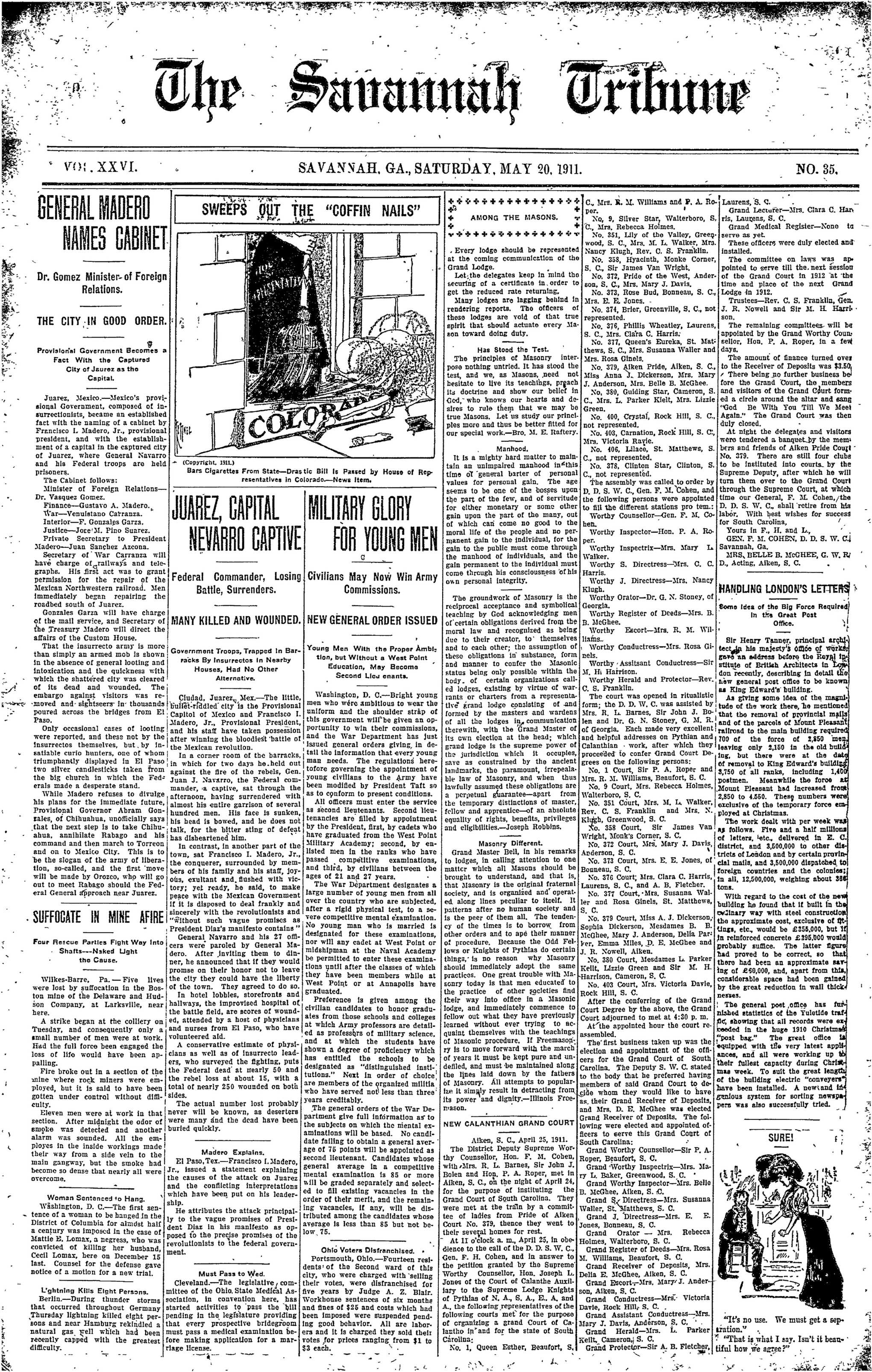
Juarez, Mexico.—Mexico’s provi,
sional Government, composed of in
surrectionists, became an establishec
fact with the naming of a cabinet by
Frencisco I. Madero, Jr., provisiona!
president, and with the establish.
ment of a capital in the captured city
of Juarez, where General Navarre
and his Federal troops are helt
prisoners.
The Cabinet follows:
Minister of Foreign Relations—
Dr. Vasquez Gomez.
Finance—Gustavo A. Madero.
War—Venuistano Catranza.
Interlor—F. Gonzales Garza,
Justice—Jore'M. Pino Suarez.
Private Secretary to President
Madero—Juan Sanchez Azcona.
Secretary of War Carranza will
have charge of_railways and tele.
graphs. His first act was to grant
permission for the repair of the
Mexican Northwestern railroad. Men
immediately began repairing the
roadbed south of Juarez.
Gonzales Garza will have charge
of the mail service, and Secretary of
the Treasury Madero will direct the
affairs of the Custom House.
That the insurrecto army is more
than simply an armed mob is shown
in the absence of general looting and
intoxication and the quickness with
which the shattered city was cleared
of its dead and wounded. The
embargo against visitors was re-
‘moved and- sightseers in- thousands
poured across the bridges from El
Paso.
Only occasional cases of looting
were reported, and these not by the
{nsurrectos themselves, but. by !n-
satiable curio hunters, one of whom
triumphantly displayed In El Paso
two silver candlesticks taken from
the big church in which the Fed-
erals made a desperate stand.
While Madero refuses to divulge
his plans for the immediate future,
Provisional Governor Abram Gon-
rales, of Chihuahua, unofiicially says
.that the next step Is to take Chihu-
ahua, annihilate Rabago and his
command and then march to Torreon
and on to Mexico City. This is to
‘be the slogan of the army of Ibera-
tlon, so-called, and the first ‘move
will be made by Orozco, who will go
out to meet Rabago should the Fed-
eral General ¢pproach near Juarez.
SUFFOCATE TW MIKE AFIRE
~ee
Wilkes-Barre, Pa.— Five lives
were lost by suffocation in the Bos.
ton mine of the Delaware and Hud-
Son Company, at Larksville, near
here.
A strike began at the colliery on
Tuesday, and consequently only a
small number of men were at work.
Had the full force been engaged the
loss of life would have been ap-
palling.
Fire broke out in a section of the
amine where rock miners were em-
ployed, but it is sald to have been
gotten under contral without difi-
culty.
Eleven men were at work in that
section, After midnight the odor of
smoke was detected and another
alarm was sounded. All the em-
Ployes in the inside workings made
their way from a side vein to the
main gangway, but the smoke had
become so dense that nearly all were
overcome,
—_—_—__—
Woman Sentencedto Hana. *
Washington, D. C.—The first sen-
tence of 2 woman to be hanged in the
District of Columbia for almdst half
@ century was imposcd in the case of
Mattie E. Lomax, a negress, who was
convicted of killing her husband,
Cecil Lomax, here on December 15
last. Counsel for the defense gave
notice of a motion for a new trial,
Ughtning Kills Eight Persons.
Berlin—During thunder storms
that occurred throughout Germany
‘Thursday lightning killed elght per-
sons and near Hamburg rekindled a
natural gas yell which had been
recently capped with the greatest
difficulty. -
‘SWEEPS QUT THE “COFFIN NAILS”
(esses | ba La
“i Rommel ||a
ti" Css A y} 7 7
Geet aes | | | 74 f
| PY ica é ie a
C { ; 8,
| i <I, UM gga ey
a iia Sigh ae
Ra LOY: Be a A Beene
pee REA ey
3 a, to > ume
ie | RCOLOE == @&
oF og
» (Copyright, 191L) = >
Bars Cigarettes From State—Drastic Bill Is Passed by House of Rep-
JUAREZ, CAPITAL
NEMARO CAPE
MANY KILLED AND WOUNDED.
Government Troops, Trapped In Bar-
racks By Insurrectos In Nearby
Houses, Had No Other
Alternative.
,, Cludad, Juarez, Mex.—The Httle,
Bulfét-riddied city is the Provisional
Capitol of Mexico and Francisco I.
Madero, Jr., Provisional President,
and his staff have taken possession
after winning the bloodiest ‘battle of
the Mexican revolution.
In a corner room of the barracks,
in which for two days he.held out
against the fire of the rebels, Gen.
Juan J. Navarro, the Federal com-
mander, 'a captive, sat through the
afternoon, having surrendered with
almost his entire garrison of several
hundred men. His face is sunken,
his head is bowed, and he does not
talk, for the bitter sting of defeat
has disheartened him. .
In contrast, In another part of the
town, sat Francisco I. Madero, Jr.,
the conquerer, surrounded by mem-
bers of his family and his staff, joy-
ots, exultant and, flushed with vic-
tory; yet ready, he said, to make
peace with the Mexican Government
if it is disposed to deal frankly and
sincerely with the revolutionists and
“@ithout such vague promises as
President Diaz’s manifesto contains ”
General Navarro and his 27 offi-
cers were paroled by General Ma-
dero. After inviting them to din-
ner, he announced that if they would
Promse on thelr honor not to leave
the city they could have the Nberty
of the town. They agreed to do s0.
In hotel lobbles, storefronts and
hallways, the improvised hospital of
the battle field, are scores of wound-
ed, attended by a host of physicians
and nurses from El Paso, who have
volunteered ald.
A conservative estimate of phys!-
clans as well as of Insurrecto lead-
ers, who surveyed the fighting, puts
the Federal dead’ at mearly 50 and
the rebel loss at about 15, with a
total of nearly 250 wounded on botir
sides.
The actual number lost probably
never will be known, as deserters
were many dnd the dead have been
buried quickly.
| Madero Explains.
El Paso, Tex.—Francisco [. Madero,
Jr., issued a statement explaining
the causes of the attack on Juarez
and the confilcting interpretations
}which have been put on his leader-
ship.
He attributes the attack principal-
ly to the vague promises of Pres!-
dent Diaz in his manifesto as op-
posed fo the precise promises of the
revolutionists to the federal govern-
ment. .
Must Pass to Wed.
Cleveland.—The legislative , com-
mittee of the Ohio, State Medfcal As-
sociation, in convention here, has
started activities to pass the “pill
pending in the legislature providing
that every prospective bridegroom
must pass a medical examination be-
fore making application for a mar-
tiage license.
MILITARY GLORY
FR YOUNG WEN
NEW GENERAL ORDER ISSUED
Young Men With the Proper Ambi-
tion, but Without a West Point
Education, May Become”
Second Licu enants.
Washington, D, C.—Bright young
men who wére ambitlous to wear the
uniform and the shoulder strap of
this government willbe given an op-
poranity to win their commissions,
and the War Department has just
‘issued general orders giving, in de-
tail tho information that every young
| man needs. The regulations here-
tofore governing the appointment of
young clvillans to the Army have
been modified by President Taft so
as to conform to present conditions.
All officers must enter the service
ag second Heutenants. Second Heu-
tenancles are filled by appointment
| by the President, first, by cadets who
have graduated from the West Polat
Military Academy; second, by en-
Usted men {n the ranks who have
passed competitive examinations,
and third, by civillans between the
ages of 21 and 27 years. .
The War Department designates a
large number of young men from all
over the country who are subjected,
after a rigid physical test, to a se-
vere competitive mental e'xam{nation.
No young man who is married is
designated for these examinations,
nor will any cadet at West Point or
‘midshipman at the Naval Academy
be permitted to enter these examina-
tions yntil after the classes of which
they have been members while at
West Point or at Annapolis have
graduated.
Preference is given among the
ctyillan candidates to honor gradu-
ates from those schools and colleges
at which Army professors are detail-
ed as professdrs of military sclence,
and at which the students have
shown a degree of proficiency which
has entitled the schools to be
designated as “distinguished inst!-
tutions.” Next In order of choice!
are members of the greenized militia
who have served not! less than threo’
years creditably.
‘The general orders of the War De-
partment give full information as to
the subjects on which the niental ex-
aminatlons will be based. No candi-
date failing to obtain a general aver- |
age of 75 points will be appointed as
second Meutenant. Candidates whose
general average in a competitive
mental examination is 85 or more
will be graded separately and select-
ed to fill existing vacancies in the
order of thelr merit, and the remain-
ing vacancies, If any, will be dis-
tributed among the candidates whose
average Is less than 85 but not be-
low. 75.
Ohio Voters Disfranchised. +
Portsmouth, Ohio.—Fourteen res!-
dents‘of the Second ward of this
city, who were charged with ‘selling
their votes, were disfranchised for
five years by Judge A. 2. Blair.
Workhouse sentences of six months
and fines of $25 and costs which had
been imposed were suspended pend-
Ing good behavior. All are labor-
ers and it {s charged they sold their
votes for prices ranging from $1 to
29 pach. * sy
SECHPEPEEEPREEEEY
e +
+ AMONG THE MASONS, *
+. +
VEREDSEVEPETEDLEUY
«Every lodge should be represented
at the coming communtcetion of the
Grand Lodge. ‘
Let:the delegates keep In mind tho
securing of a certificate in. order to
get the reduced rate returning,
Many lodges are lagging behind in
rendering reports. Tho officers of
these lodges are yold of that true
spirit that should actuate erery Ma-
son toward doing duty.
. Has Stood the Test. *
The principles cf Masonry inter.
pose nothing untried. It has stood the
test, and we, as Masons, need not
hesitate to live its teachihgs, prgach
its doctrine and show our bellef in
Ged, who knows our hearts and de-
sires to rule them that we may be
true Masons, Let us study our prine!-
ples more and thus be better fitted for
cur special work.—Bro, M. E. Raftery.
: Manhood,
It Is a mighty hard matter to main-
taln an unimpaired manhood in*this
time of ‘general barter of personal
values for personal gain, The age
seems to be one of the bosses upon
the part of the few, and of servitude
for either monetary or some other
gain upon the part of the many, out
of which can come no good to the
moral life of the people and no per-
manent gain to the individual, for the
gain to the public must come through
the manhood of individuals, and the
gain permanent to the individual must
come thrcugh his consciousness ‘of his
own personal integrity,
The groundwork of Masonry is the
reciprocal acceptance and symbolical
teaching by God acknowledging men
of’certain obligations derived from the
moral law and recognized as being
due to their creator, to’ themselves
and to cach other; the assumption of
these obligations in substance, form
and manner to confer the Masonic
status belng only possible within the
body. of certain organizations call-
ed lodges, existing by virtue of war-
rants or charters from a representa-
tive’ grand lodge consisting of and
formed by the masters and wardens
of all the lodges in, communication
therewith, with the Grand Master of
its cwn election at the head; which
grand lodge {s the supreme power of
the jurisdiction which it occupies,
saye as constrained by the ancient
landmarks, the paramount, irrepeala-
ble law of Masonry, and when thus
lawfully assumed these obligations are
a perpetual euarantee—apart from
the temporary distinctions of master,
fellow and apprentice—of an absolute
equality of rights, benefits, privileges
and eligibilities—Joseph Robbins,
Masonry Different.
Grand Master Bell, in his remarks
to lodges, in calling attention to one
matter which all Masons should be
brought to understand, and that is,
that Masonry is the original fraternal
society, and is organized and’ operat.
ed along lines peculiar to itself, It
patterns after no human society and
is the peer of them all, The tenden.
cy of the times is to borrow from
other orders and to apé their manner
of procedure, Because the Odd Fel-
lows or Knights of Pythias do certain
things,-1s no reason why Masonry
should immediately adopt the same
practices. One great trouble with Ma-
sonry today is that men educated to
the practice of other societies find
thelr way Into office in a Masonic
lodge, and immediately commence to
fellow out what they have previcusly
learned without ever trying to ac-
quaint themselves with the teachings
of Masonic procedure. Jf Freemason:
ry is to move forward with the march
of years it must be kept pure and un-
defiled, and must be maintained along
the Ijnes lafd down by the fathers
of Masonry. All attempts to popular-
ize it simaly Tesult in detracting from
its power and dignity.—INinois Free-
mason. 2 7
NEW CALANTHIAN GRAND COURT
Aiken, S. C., April 25, 1911.
The District Deputy Supreme Wor-
thy Counsellor, Hon. F. M. Cohen,
with /Mrs. R. L. Barnes, Sir John J.
Bolen and Hon, P, A. Roper, met in
‘Aiken, S, C., on the night of April 24,
for the purpose of instituting the
Grand Court of South Carolina. They
were met at the trdiln by a commit-
tee of ladies from Pride of Aiken
Court No. 379, thence they went to
their sevetal homes for rest.
" At IT o'clock a. m., April 25, In obe-
Glence to the call of the D. D.S. W.C.,
Gen, F. H. Cohen, and in answer to
the petition granted by the Supreme
Worthy Counsellor, Hon, Joseph L.
Jones of the Court of Calanthe Auxil-
jary to the Supreme Lodge Knights
of Pythias of N, A, S, A, E., A, and
A, the following representatives of the
following courts met for the purpose
of organizing a grand Court of Ca-
lantho in”and for the state of South
Carolina:
No, 1, Queen Esther, Beaufort, S,
ee
No, 9, Silver Star, Walterboro, S
C., Mrs, Rebecca Holmes.
No, 351, Lily of the Valley, Greeg
wood, S.C, Mrs, M. L, Walker, 3fra
Nancy Klugh, Rev. C. S. Franklin,
No, 358, Hyacinth, Monke Corner
5, C., Sir James Van Wright,
No, 372, Pride of the West, Ander
son, S, C., Mrs. Mary J. Davis,
No. 373, Rose Bud, Bonneau, S. C.
Mrs. EB. E. Jones. -
No. 374, Brier, Greenville, 3, C,, not
represented.
No, 376, Phillis Wheatley, Laurens
8. C., Mrs. Clara C. Harris:
No. 377, Queen’s Eureka, St. Mat
thews, S, C., Mrs, Susanna Waller and
Mrs. Rosa Ginels,
No, 379, ae Pride, Alken, S. C,
Miss Anna J. Dickerson, Mrs, Mary
J, Anderson, Mrs. Belle B. McGhee.
No, 380, Guiding Star, Cameron, S.
C., Mrs. L, Parker Kielt, Mrs. Lizzie
Green, .
No. 400, Crystal, Rock Hill, S. C,
not represented, 7
No, 403, Carnation, Rock Hill, S. C,,
Mrs. Victoria Rayle.
No, 406, Lilace, St. Matthews, S.
C., not represented,
| No. 378, Clinton Star, Clinton, S,
Ga not represented.
‘The assembly was called to order by
D, D.S. W. C., Gen. F. M. Cohen, and
the following persons were appointed
to fill the different stations pro tem.:
Worthy Counsellor—Gen. F. M, Co-
hen.
Worthy Inspector—Hon. P. A, Ro-
per.
Worthy Inspectrix—Mrs. Mary lL
Walker,
Worthy S. Directress—Mrs. C. C.
Harris.
Worthy J. Directress—Mrs, Nancy
Klugh.
Worthy Orator—Dr, G. N. Stoney, of
Georgia.
Worthy Register of Deeds—Mrs. B.
B. McGhee.
Worthy Escort—Mrs, R. M. Wil-
Nains.,
| Worthy Conductress—Mrs. Rosa Gi-
nels.
Worthy -Assitsant Conductress—Sit
M, Hi Hafrison.
Worthy Herald and Protector—Rev.
C. S, Franklin.
The court was opened in ritualistic
form; the D. D. W, C. was assisted by
Mrs. R, L. Barnes, Sir John J. Bo-
Jen and Dr. G. N. Stoney, G. M. R.
of Georgia. Each made very excellent
and helpful addresses on Pythian and
Calanthian - work, after which they
proceeded to confer Grand Court De-
grees on the following persons:
No, 1 Court, Sir P. A, Roper and
Mrs. R. M. Williams, Beaufort, 5. C.
No. 9 Court, Mrs, Rebecca Holmes,
Walterboro, S, C.
No, 351 Court, Mrs, M, L, Walker,
Rey. C. S. Franklin and Mrs. N.
on Greenwood, 3. C.
No. 358 Court, Sir James Van:
Wright, Monk's Corner, 3. C.
No, 372 Court, Mrs, Mary J. Davis,
Anderson, S, C. *
No. 373 Court, Mrs. E. E. Jones, of
Bonneau, S. C, |
No. 376 Court; Mrs. Clara C. Harris,
Laurens, 9, C., and A. B, Fletcher.
No, 377 Court,-Mrs, Susanna Wal-
ler and Rosa Ginels, St. Matthews,
S.C.
No, 379 Court, Miss A. J. Dickerson,,
Sophia Dickerson, Mesdames B. B.
McGhee, Mary J. Anderson, Della Par:
ker, Emma Miles, D. E, McGhee and
J. R. Nowell, Aiken.
No. 380 Court, Mesdames L. Parker
Kellt, Lizzie Green and Sir M. H.
Harrison, Cameron, 8. C.
No. 403 Court, Mrs. Victoria Davie,
Rock Hill, S. C.
After the conferring of the Grand
Court Degree by the above, the Grand
Court adjourned to met at 4:30 p. m.
At’the appointed hour the court re-
assembled.
‘The’ first business taken up was the
election and appointment of the offi-
cers for the Grand Court of South
Carolina, The Deputy S. W. C. stated
fo the body that he preferred having
members of safd Grand Court to de
fde whom they would like to have
as. their Grand Receiver of Deposits,
and Mrs, D. E, McGhee was elected
Grand Receiver of Deposits. The fol-
lowing were elected and appointed of-
cers to cerve this Grand Court of
South Carolina: ff
Cee ae a a gs
yLaurens,$.G. - .
Grand Lectufer—Mrs, Clara C. Han
ris, Laurens, S. C.
Grand Medical Register—None ta
serve as yet.
These officers were duly elected and
installed.
The committee on lays was 2p
polnted to serve till the. next Session
of the Grand Court in 1912 “at ‘the
time and place of the next Grand
Lodge in 1912, -
Trustees—Rev. C. S, Franklin, Gen.
J. R, Nowell and Sir M. H Harrk
son,
The remaining committees. will ba
appointed by the Grand Worthy Coun:
sellor, Hon, P, A, Roper, in a few
aya, .
The amount of finance turned over
to the Receiver of Deposits was $3.50,
7 There being no further business bel
fore the Grand Court, the members
and visitors of the Grand Curt form
ed a circle around the altar and sang
“God Be With You Till We Meet
|Again.” The Grand Court was then
‘duly closed, :
At night the delegates and visitors
‘were tendered a banquet_by the mem)
bers and friends of Alken Pride Couyt
No, 379. There are still four clubs
to be instituted into courts. by the
Supreme Deputy, after which he will
turn them over to the Grand Coyrt
through the Supreme Court, at which
time our General, F. M. Cohen,/the
D. D. S. W. C,, shall ‘retire from hia
labor, With best wishes for success
for South Carolina, a
Yours In F., H, and L, °
GEN. F. M. COHEN, D. D. S. W. Cj
Savannah, Ga,
MRS, BELLE B. McGHEE, G, W,
D., Acting, Aiken, S. C. .
HANDLING LONDON’S LETTERS
fome Idea of the Big Force Required)
In tha Great Post i
: Office. yf
Sir Henry Tanner, principal arght-}
tectgge his majesty's Ofie of worksy
gard an address before the Royal tp
stitute of British Architects in Low
}don recently, describing 1a detail the
new general post office to be known|
es King Edward's building.
Aa giving some Idea of the magni
‘tude of the work there, he mentioned]
that the removal of provincial malls
and of the parcels of Mount Pleasan\
‘tallroad to the main building requil
200 of the force of 2,850 me:
leaving only 2,150 in the old bulli
ing, but there were at the a
of removal to King Edward's buil
3,750 of all ranks, including 1,40
‘postmen. Meanwhile the force
Mount Pleasant bad increased front}
2,850 to 4.650. Thesg numbers w
exclusive of the temporary force
ployed at Christmas.
The work dealt with per week
ag follows. Five and a half millions}
of letters, ‘etc, delivered in E. C,
district, and 3,600,000 to other
tricts of Leadon and by certain provi
cial mails, and 3,500,000 dispatched to|
forelgn countries and the colonies;
in all, 12,500,000, weighing about a
tons.
‘With regard to the cost of the ne’
building he found that if built in th
oviinary way with steel constructi
tho approximate cost, exclusive of fit
Ungs, etc, would be £255,000, but 1
in reinforced concrete £295,000 would|
probably suffice. The latter
ad proved to be correct, so thal
there had been an approximate sav-
ing of £50,000, and, apart from this,}
considerable space had been gained)
by the great reduction in wall thick:
nesses.
| The general post office has fur}
nished statistics of the Yuletide traf-
fic, showing that all records were ex;
weeded in the huge 1910 Christm
“post bag.” The great office
equipped with tile very latest app!
ances, and all were working up
thelr fullest capacity during Chri:
mas week. To suit the great I
of the bullding electric “conveyers'’
have been installed. A new\and
genious system for sorting news}
pers was also successfully tried. —
oR
ce, .t
a ser.
Wee it
ik ae lis
hiwee ei
TE A EAN VE
ee | ee
fees \4 ies!)
iq
ee /,, a
prem (f= ||
Nl)? j— | By
fiery er ecco
a 4 Des Fa
oe ie
{ Gri: @
eS te fl
“Its no use. We must get a sep-
tration.”
? “That ig what I say. Isn’t it beans *
tiful how we agree?” . -
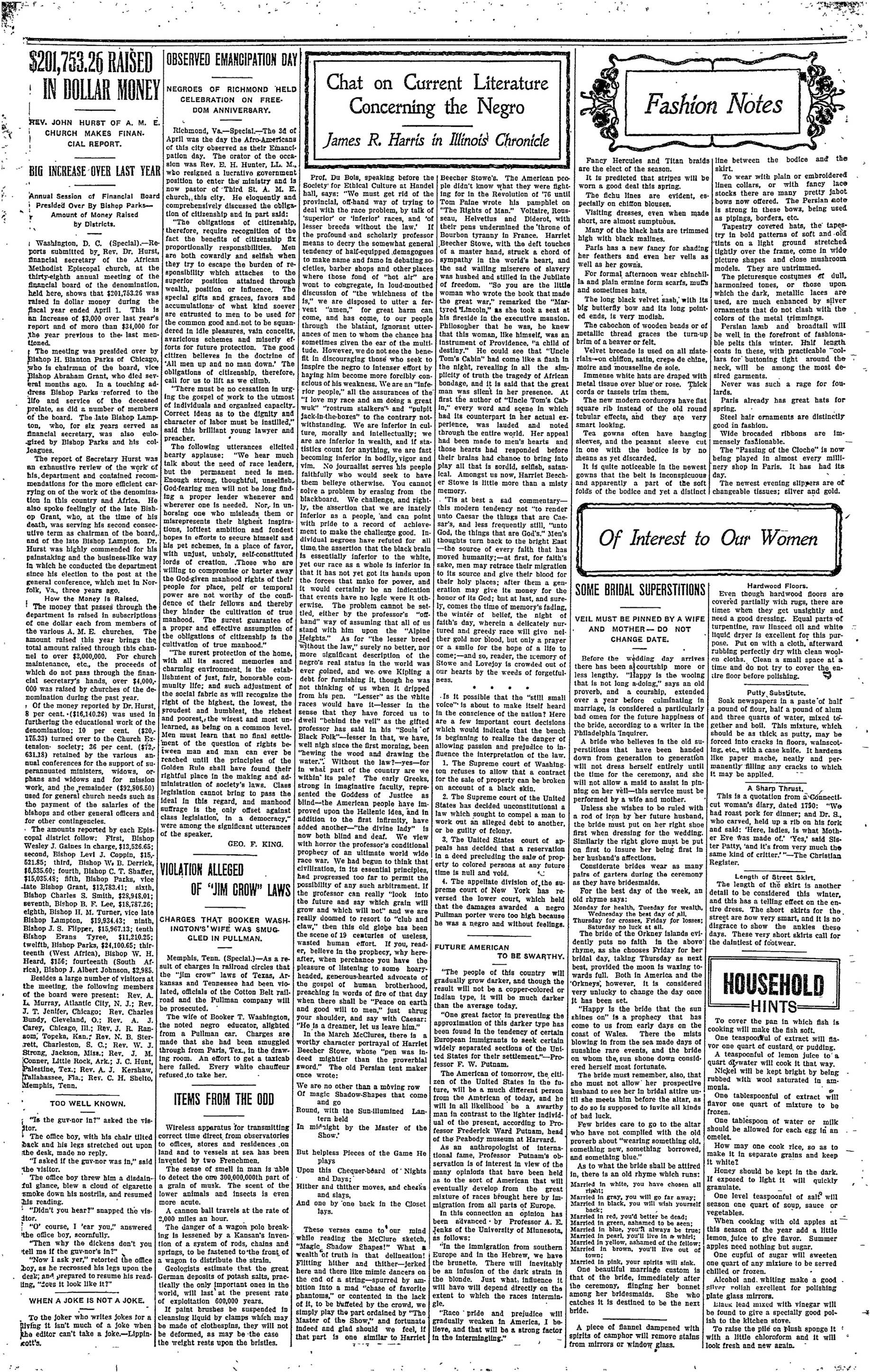
$201,753.26 RAISED IN DOLLAR MONEY
REV. JOHN HURST OF A. M. E.
CHURCH MAKES FINAN-
CIAL REPORT.
BIG INCREASE OVER LAST YEAR
Annual Session of Financial Board
Presided Over By Bishop Parks
Amount of Money Raised
by Districts.
Washington, D. C. (Special).—Reports submitted by Rev. Dr. Hurst,
financial secretary of the African Methodist Episcopal church, at the thirty-eighth annual meeting of the
financial board of the denomination,
held here, shows that $201,753.26 was
raised in dollar money during the
fiscal year ended April 1. This is
an increase of $3,000 over last year's
report and of more than $34,000 for
the year previous to the last men-
tioned.
The meeting was presided over by Bishop H. Blanton Parks of Chicago, who is chairman of the board, vice Bishop Abraham Grant, who died several months ago. In a touching address Bishop Parks referred to the life and service of the deceased prelate, as did a number of members of the board. The late Bishop Lampton, who, for six years served as financial secretary, was also eulogized by Bishop Parks and his colleagues.
The report of Secretary Hurst was an exhaustive review of the work of his, department and contained recommendations for the more efficient carrying on of the work of the denomination in this country and Africa. He also spoke feelingly of the late Bishop Grant, who, at the time of his death, was serving his second consecutive term as chairman of the board, and of the late Bishop Lampton. Dr. Hurst was highly commended for his palmstaking and the business-like way in which he conducted the department since his election to the post at the general conference, which met in Norfolk, Va., three years ago.
How the Money Is Raised.
The money that passes through the department is raised in subscriptions of one dollar each from members of the various A. M. E. churches. The amount raised this year brings the total amount raised through this channel to over $3,000,000. For church maintenance, etc., the proceeds of which do not pass through the financial secretary's hands, over $4,000,000 was raised by churches of the denomination during the past year.
Of the money reported by Dr. Hurst, 8 per cent. ($16,140.26) was used in furthering the educational work of the denomination; 10 per cent. ($20,175.33) turned over to the Church Extension- society; 36 per cent. ($72,631.18) retained by the various annual conferences for the support of superannuated ministers, widows, orphans and widows and for mission work, and the remainder ($92,806.50) used for general church needs such as the payment of the salaries of the bishops and other general officers and for other contingencies.
The amounts reported by each Episcopal district follow: First, Bishop Wesley J. Gaines in charge, $13,526.65; second, Bishop Levi J. Coppin, $15,521.85; third, Bishop W. B. Derrick, $6,535.60; fourth, Bishop C. T. Shaffer, $15,035.48; fifth, Bishop Parks, vice late Bishop Grant, $13,783.41; sixth, Bishop Charles S. Smith, $28,948.01; seventh, Bishop B. F. Lee, $18,787.26; eighth, Bishop H. M. Turner, vice late Bishop Lampton, $19,934.43; ninth, Bishop J. S. Flipper, $15,967.13; tenth Bishop Evans Tyre, $11,210.25; twelfth, Bishop Parks, $24,100.65; thirteenth (West Africa), Bishop W. H. Heard, $156; fourteenth (South Africa), Bishop J. Albert Johnson, $2,985.
Besides a large number of visitors at the meeting, the following members of the board were present: Rev. A. L. Murray, Atlantic City, N. J.; Rev. J. T. Jenifer, Chicago; Rev. Charles Bundy, Cleveland, O.; Rev. A. J. Carey, Chicago, Ill.; Rev. J. R. Ransom, Topka, Kan.; Rev. N. B. Sterrett, Charleston, S. C.; Rev. W. J. Strong, Jackson, Miss.; Rev. J. M. Conner, Little Rock, Ark.; J. C. Hunt, Palestine, Tex.; Rev. A. J. Kershaw, Tallahassee, Fla.; Rev. C. H. Shelto, Memphis, Tenn.
TOO WELL KNOWN.
"Is the guv-nor in?" asked the visitor.
The office boy, with his chair tilted back and his legs stretched out upon the desk, made no reply.
"I asked if the guv-nor was in," said the visitor.
The office boy threw him a disdainful glance, blew a cloud of cigarette smoke down his nostrils, and resumed his reading.
"Didn't you hear?" snapped the visitor.
"O' course, I 'ear you," answered the office boy, scornfully.
"Then why the dickens don't you tell me if the guv-nor's retorted the office boy, as he recrossed his legs upon the desk, and prepared to resume his reading, "Does it look like it?"
WHEN A JOKE IS NOT A JOKE.
To the joker who writes jokes for a living it isn't much of a joke when the editor can't take a joke.—Lippin-gott's.
OBSERVED EMANCIPATION DAY
NEGROES OF RICHMOND HELD CELEBRATION ON FREE-DOM ANNIVERSARY.
Richmond, Va.—Special.—The 3d of April was the day the Afro-Americans of this city observed as their Emancipation day. The orator of the occasion was Rev. E. H. Hunter, LL. M., who resigned a lucrative government position to enter the ministry and is now pastor of Third St. A. M. E. church, this city. He eloquently and comprehensively discussed the obligation of citizenship and in part said:
"The obligations of citizenship, therefore, require recognition of the fact the benefits of citizenship fix proportionally responsibilities. Men are both cowardly and selfish when they try to escape the burden of responsibility which attaches to the superior position attained through wealth, position or influence. The special gifts and graces, favors and accumulations of what kind soever are entrusted to men to be used for the common good and not to be squandered in idle pleasures, vain conceits, avaricious schemes and miserly efforts for future protection. The good citizen believes in the doctrine of 'All men up and no man down.' The obligations of citizenship, therefore, call for us to lift as we climb.
"There must be no cessation in urging the gospel of work to the utmost of individuals and organized capacity. Correct ideas as to the dignity and character of labor must be instilled," said this brilliant young lawyer and preacher.
The following utterances elicited hearty applause: "We hear much talk about the need of race leaders, but the permanent need is men. Enough strong, thoughtful, unselfish, God-fearing men will not be long finding a proper leader whenever and wherever one is needed. Nor, in unhorsing one who misleads them or misrepresents their highest inspirations, loftest ambition and fondest hopes in efforts to secure himself and his pet schemes, in a place of favor, with unjust, unholy, self-constituted lords of creation. Those who are willing to compromise or barter away the God-given manhood rights of their people for place, pelf or temporal power are not worthy of the confidence of their fellows and thereby they hinder the cultivation of true manhood. The surest guarantee of a proper and effective assumption of the obligations of citizenship is the cultivation of true manhood."
"The surest protection of the home, with all its sacred memories and charming environment, is the establishment of just, fair, honorable community life; and such adjustment of the social fabric as will recognize the right of the highest, the lowest, the proudest and humblest, the richest and poorest, the wisest and most unlearned, as being on a common level. Men must learn that no final settlement of the question of rights between man and man can ever be reached until the principles of the Golden Rule shall have found their rightful place in the making and administration of society's laws. Class legislation cannot bring to pass the ideal in this regard, and manhood suffrage is the only offset against class legislation, in a democracy," were among the significant utterances of the speaker.
GEO. F. KING.
VIOLATION ALLEGED OF "JIM CROW" LAWS
CHARGES THAT BOOKER WASHINGTON'S' WIFE WAS SMUGGLED IN PULLMAN.
Memphis, Tenn. (Special.)—As a result of charges in railroad circles that the "jim crow" laws of Texas, Arkansas and Tennessee had been violated, officials of the Cotton Belt railroad and the Pullman company will be prosecuted.
The wife of Booker T. Washington, the noted negro educator, alighted from a Pullman car. Charges are made that she had been smuggled through from Paris, Tex., in the drawing room. An effort to get a taxicab here failed. Every white chauffeur refused to take her.
ITEMS FROM THE ODD
Wireless apparatus for transmitting correct time direct from observatories to offices, stores and residences on land and to vessels at sea has been invented by two Frenchmen.
The sense of smell in man is able to detect the one 300,000,000th part of a grain of musk. The scent of the lower animals and insects is even more acute.
A cannon ball travels at the rate of 2,000 miles an hour.
The danger of a wagon pole breaking is lessened by a Kansan's invention of a system of rods, chains and springs, to be fastened to the front of a wagon to distribute the strain.
Geologists estimate that the great German deposits of potash salts, practically the only important ones in the world, will last at the present rate of exploitation 600,000 years. If paint brushes be suspended in cleansing liquid by clamps which may be made of clothespins, they will not be deformed, as may be the case the weight rests upon the bristles.
Chat on Current Literature Concerning the Negro
Prof. Du Bols, speaking before the Society for Ethical Culture at Hander hall, says: "We must get rid of the provincial, off-hand way of trying to deal with the race problem, by talk of 'superior' or 'inferior' races, and of lesser breeds without the law." If the profound and scholarly professor means to decry the somewhat general tendency of half-equipped demagogues to make name and fame in debating soleties, barber shops and other places where those fond of "hot air" are wont to congregate, in loud-mouthed discussion of "the whichness of the is," we are disposed to utter a fervent "amen," for great harm can come, and has come, to our people through the blatant, ignorant utterances of men to whom the chance has sometimes given the ear of the multitude. However, we do not see the benefit in discouraging those who seek to inspire the negro to intenser effort by having him become more forcibly conscious of his weakness. We are an "inferior people," all the assurances of the "I love my race and am doing a great wk" "rostrum stalkers" and "pulpit jack-in-the-boxes" to the contrary notwithstanding. We are inferior in culture, morally and intellectually; we are inferior in wealth, and if statistics count for anything, we are fast becoming inferior in bodily, vigor and vim. No journalist serves his people faithfully who would seek to have them believe otherwise. You cannot solve a problem by erasing from the blackboard. We challenge, and rightly, the assertion that we are inately inferior as a people, and can point with pride to a record of achievement to make the challenge good. Individual negroes have refuted for all time the assertion that the black brain is essentially inferior to the white, yet our race as a whole is inferior in that it has not yet got its hands upon the forces that make for power, and it would certainly be an indication that events have no logic were it otherwise. The problem cannot be settled, either by the professor's "off-hand" way of assuming that all of us stand with him upon the "Alpine Heights." As for "the lesser breed without the law," surely no better, nor more significant description of the negro's real status in the world was ever coined, and we owe Kipling a debt for furnishing it, though he was not thinking of us when it dripped from his pen. "Lesser" as the white races would have it—lesser in the sense that they have forced us to dwell "behind the veil" as the gifted professor has said in his "Souls of Black Folk"—lesser in that, we have, well nigh since the first morning, been "hewing the wood and drawing the water." Without the law?—yes—for in what part of the country are we within its pale? The early Greeks, strong in imaginative faculty, represented the Goddess of Justice as blind—the American people have improved upon the Hellenic idea, and in addition to the first infirmity, have added another—"the divine lady" is now both blind and deaf. We view with horror the professor's conditional prophecy of an ultimate world wide race war. We had begun to think that civilization, in its essential principles, had progressed too far to permit the possibility of any such arbitrament. If the professor can really "look into the future and say which grain will grow and which will not" and we are really doomed to resort to "club and claw," then this old globe has been the scene of 19 centuries of useless, wasted human effort. If you, reader, believe in the prophecy, why hereafter, when perchance you have the pleasure of listening to some hoary-headed, generous-hearted advocate of the gospel of human brotherhood, preaching in words of fire of that day when there shall be "Peace on earth and good will to men," just shrug your shoulder, and say with Caesar: "He is a dreamer, let us leave him."
In the March McClures, there is a worthy character portrayal of Harriet Beecher Stowe, whose "pen was indeed mightier than the proverbal sword." The old Persian tent maker once wrote:
We are no other than a moving row
Of magic Shadow-Shapes that come and go
Round, with the Sun-illumined Lantern held
In midnight by the Master of the Show.
But helpless Pieces of the Game He plays
Upon this Chequer-board of Nights and Days;
Hither and thither moves, and cheeks and slays.
And one by one back in the Closet lays.
These verses came to our mind while reading the McClure sketch, "Magic Shadow Shapes!" What a wealth of truth in that delineation! Flitting hither and thither—jerked here and there like mimic dancers on the end of a string—spurred by ambition into a mad "chase of favorite phantoms," or contented in the lack of it, to be buffeted by the crowd, we simply play the part ordained by "The Master of the Show," and fortunate indeed and glad should we feel, if that part is one similar to Harriet
Beecher Stowe's. The American people didn't know what they were fighting for in the Revolution of 76 until Tom Palne wrote his pamphlet on "The Rights of Man." Voltaire, Rousseau, Helvetius and Diderot, with their pens underminded the throne of Bourbon tyranny in France. Harriet Beecher Stowe, with the deft touches of a master hand, struck a chord of sympathy in the world's heart, and the sad wailing miserere of slavery was hushed and stilled in the Jubilee of freedom. "So you are the little woman who wrote the book that made the great war," remarked the "Martyred Lincoln," as she took a seat at his fireside in the executive mansion. Philosopher that he was, he knew that this woman, like himself, was an instrument of Providence, "a child of destiny." He could see that "Uncle Tom's Cabin" had come like a flash in the night, revealing in all the simplicity of truth the tragedy of African bondage, and it is said that the great man was silent in her presence. At first the author of "Uncle Tom's Cabin," every word and scene in which had its counterpart in her actual experience, was lauded and noted through the entire world. Her appeal had been made to men's hearts and those hearts had responded before their brains had chance to bring into play all that is sordid, selfish, satirical. Amongst us now, Harriet Beecher Stowe is little more than a misty memory.
"Tis at best a sad commentary—this modern tendency not "to render unto Caesar the things that are Caesar's, and less frequently still, "unto God, the things that are God's." Men's thoughts turn back to the bright East—the source of every faith that has moved humanity;—at first, for faith's sake, men may retrace their migration to its source and give their blood for their holy places; after them a generation may give its money for the honor of its God; but at last, and surely, comes the time of memory's fading, the winter of belief, the night of faith's day, wherein a delicately nurtured and greedy race will give nelther gold nor blood, but only a prayer or a smile for the hope of a life to come;—and so, reader, the memory of Stowe and Lovejoy is crowded out of our hearts by the weeds of forgetfulness.
---
Is it possible that the "still small voice" is about to make itself heard in the conscience of the nation? Here are a few important court decisions which would indicate that the bench is beginning to realize the danger of allowing passion and prejudice to influence the interpretation of the law.
1. The Supreme court of Washington refuses to allow that a contract for the sale of property can be broken on account of a black skin.
2. The Supreme court of the United States has decided unconstitutional a law which sought to compel a man to work out an alleged debt to another, or be guilty of felony.
3. The United States court of appeals has decided that a reservation in a deed precluding the sale of property to colored persons at any future time is null and void.
4. The appellate division of the supreme court of New York has reversed the lower court, which held that the damages awarded a negro Pullman porter were too high because he was a negro and without feelings.
FUTURE AMERICAN TO BE SWARTHY.
"The people of this country will gradually grow darker, and though the result will not be a copper-colored or Indian type, it will be much darker than the average today.
"One great factor in preventing the approximation of this darker type has been found in the tendency of certain European immigrants to seek certain widely separated sections of the United States for their settlement."—Professor F. W. Putnam.
The American of tomorrow, the citizen of the United States in the future, will be a much different person from the American of today, and he will in all likelihood be a swarthy man in contrast to the lighter individual of the present, according to Professor Frederick Ward Putnam, head of the Peabody museum at Harvard.
As an anthropologist of international fame, Professor Putnam's observation is of interest in view of the many opinions that have been held as to the sort of American that will eventually develop from the great mixture of races brought here by immigration from all parts of Europe. In this connection an opinion has been advanced by Professor A. E. Jenks of the University of Minnesota, as follows:
"In the immigration from southern Europe and in the Hebrew, we have the brunette. There will inevitably be an infusion of the dark strain in the blonde. Just what, influence it will have will depend directly on the extent to which the races intermingle.
"Race pride and prejudice will gradually weaken in America, I believe, and that will be a strong factor in the intermingling."
Fashion Notes
Fancy Hercules and Titan braids are the elect of the season.
It is predicted that stripes will be worn a good deal this spring.
The fichu lines are evident, especially on chiffon blouses.
Visiting dresses, even when made short, are almost sumptuous.
line between the bodice and the skirt.
To wear with plain or embroidered linen collars, or with fancy lace stocks there are many pretty jabot bows now offered. The Persian note is strong in these bows, being used as piplings, borders, etc.
Many of the black hats are trimmed high with black malines.
Parls has a new fancy for shading her feathers and even her vells as well as her gowns.
For formal afternoon wear chinchilla and plain ermine form scarfs, muffs and sometimes hats.
The long black velvet sash, with its big butterfly bow and its long pointed ends, is very modish.
The cabochon of wooden beads or of metallic thread graces the turn-up brim of a beaver or felt.
Velvet brocade is used on all materials—on chiffon, satin, crepe de chine, moire and moussele de sole.
Immense white hats are draped with metal tissue over blue' or rose. Thick cords or tassels trim them.
The new modern corduroys have flat square rib instead of the old round tubular effects, and they are very smart looking.
Tea gowns often have hanging sleeves, and the peasant sleeve cut in one with the bodice is by no means as yet discarded.
It is quite noticeable in the newest gowns that the belt is inconspicuous and apparently a part of the soft folds of the bodice and yet a distinct
SOME BRIDAL SUPERSTITIONS
VEIL MUST BE PINNED BY A WIFE AND MOTHER—DO NOT CHANGE DATE.
Before the wedding day arrives there has been a courtship more or less lengthy. "Happy is the wooling that is not long a-doing," says an old proverb, and a course, extended over a year before culminating in marriage, is considered a particularly bad omen for the future happiness of the bride, according to a writer in the Philadelphia Inquirer.
A bride who believes in the old superstitions that have been handed down from generation to generation will not dress herself entirely until the time for the ceremony, and she will not allow a maid to assist in pinning on her vell—this service must be performed by a wife and mother.
Unless she wishes to be ruled with a rod of iron by her future husband, the bride must put on her right shoe first when dressing for the wedding. Similarly the right glove must be put on first to insure her being first in her husband's affections.
Considerate brides wear as many pairs of garters during the ceremony as they have bridesmales.
For the best day of the week, an old rhyme says:
Thursday for crosses, Friday for losses;
Saturday no luck at all.
The bride of the Orkney islands evidently puts no faith in the above rhyme, as she chooses Friday for her bridal day, taking Thursday as next best, provided the moon is waxing towards full. Both in America and the Orkneys, however, it is considered very unlucky to change the day once it has been set.
"Happy is the bride that the sun shines on" is a prophecy that has come to us from early days on the coast of Wales. There the mists blowing in from the sea made days of sunshine rare events, and the bride on whom the sun shone down considered herself most fortunate.
The bride must remember, also, that she must not allow her prospective husband to see her in bridal attire until she meets him before the altar, as to do so is supposed to invite all kinds of bad luck.
Few brides care to go to the altar who have not complied with the old proverb about "wearing something old, something new, something borrowed, and something blue."
As to what the bride shall be attired in, there is an old rhyme which runs:
Married in white, you have chosen all right;
Married in gray, you will go far away;
Married in black, you will wish yourself back;
Married in red, you'd better be dead;
Married in green, ashamed to be seen;
Married in blue, you'll always be true;
Married in pearl, you'll live in a whirl;
Married in yellow, ashamed of the fellow;
Married in brown, you'll live out of town;
Married in pink, your spirits will sink.
One beautiful marriage custom is that of the bride, immediately after the ceremony, flinging her bonnet among her bridesmales. She who catches it is destined to be the next bride.
A piece of flannel dampened with spirits of camphor will remove stains from mirrors or window glass.
line between the bodice and the skirt.
To wear with plain or embroidered linen collars, or with fancy lace stocks there are many pretty jabot bows now offered. The Persian note is strong in these bows, being used as piplings, borders, etc.
Tapestry covered hats, the tapestry in bold patterns of soft and old tints on a light ground stretched tightly over the frame, come in wide picture shapes and close mushroom models. They are untrimmed.
The picturesque costumes et dull, harmonized tones, or those upon which the dark, metallic laces are used, are much enhanced by silver ornaments that do not clash with the colors of the metal trimmings.
Persian lamb and broadtail will be well in the forefront of fashionable pelts this winter. Half length coats in these, with practicable collars for buttonting tight around the neck, will be among the most desired garments.
Never was such a rage for foulards.
Paris already has great hats for spring.
Steel hair ornaments are distinctly good in fashion.
Wide brocaded ribbons are immensely fashionable.
The "Passing of the Cloche" is now being played in almost every millinery shop in Paris. It has had its day.
The newest evening slippers are of changeable tissues; silver and gold.
Hardwood Floors.
Even though hardwood floors are covered partially with rugs, there are times when they get unslightly and need a good dressing. Equal parts of turpentine, raw linsseed oil and white liquid dryer is excellent for this purpose. Put on with a cloth, afterward rubbing perfectly dry with clean woolen cloths. Clean a small space at a time and do not try to cover the entire floor before polishing.
Putty Substitute.
Soak newspapers in a paste of half a pound of flour, half a pound of alum and three quarts of water, mixed together and boil. This mixture, which should be as thick as putty, may be forced into cracks in floors, walnscoting, etc., with a case knife. It hardens like paper mache, neatly and permanently filling any cracks to which it may be applied.
A Sharn Thrust
This is a quotation from a Connecticut-cut woman's diary, dated 1750: "We had roast pork for dinner; and Dr. S., who carved, held up a rib on his fork and sald: 'Here, ladies, is what Mother Eve was made of.' 'Yes,' said Sister Patty, 'and it's from very much the same kind of critter.'"—The Christian Register.
Length of Street Skirt
The length of the skirt is another detail to be considered this winter, and this has a telling effect on the entire dress. The short skirts for the street are now very smart, and it is no disgrace to show the ankles these days. These very short skirts call for the daintest of footwear.
HOUSEHOLD HINTS
To cover the pan in which fish is cooking will make the fish soft.
One teaspoonful of extract will flavor one quart of custard or pudding.
A teaspoonful of lemon juice to a quart of water will cook it that way.
Nickel will be kept bright by being rubbed with wool saturated in ammonia.
One tablespoonful of extract will flavor one quart of mixture to be frozen.
One tablespoon of water or milk should be allowed for each egg in an omelet.
How may one cook rice, so as to make it in separate grains and keep it white?
Honey should be kept in the dark.
If exposed to light it will quickly granulate.
One level teaspoonful of salt will season one quart of soup, sauce or vegetables.
When cooking with old apples at this season of the year add a little lemon, juice to give flavor. Summer apples need nothing but sugar.
One cupful of sugar will sweeten one quart of any mixture to be served chilled or frozen.
Alcohol and whiting make a good silver polish excellent for polishing plate glass mirrors.
Black lead mixed with vinegar will be found to give a specially good polish to the kitchen stove.
To raise the plie on plush sponge it with a little chloroform and it will look fresh and new again.
Entered at the Post Office at Savannah, Ga., as Second-Class mail matter.
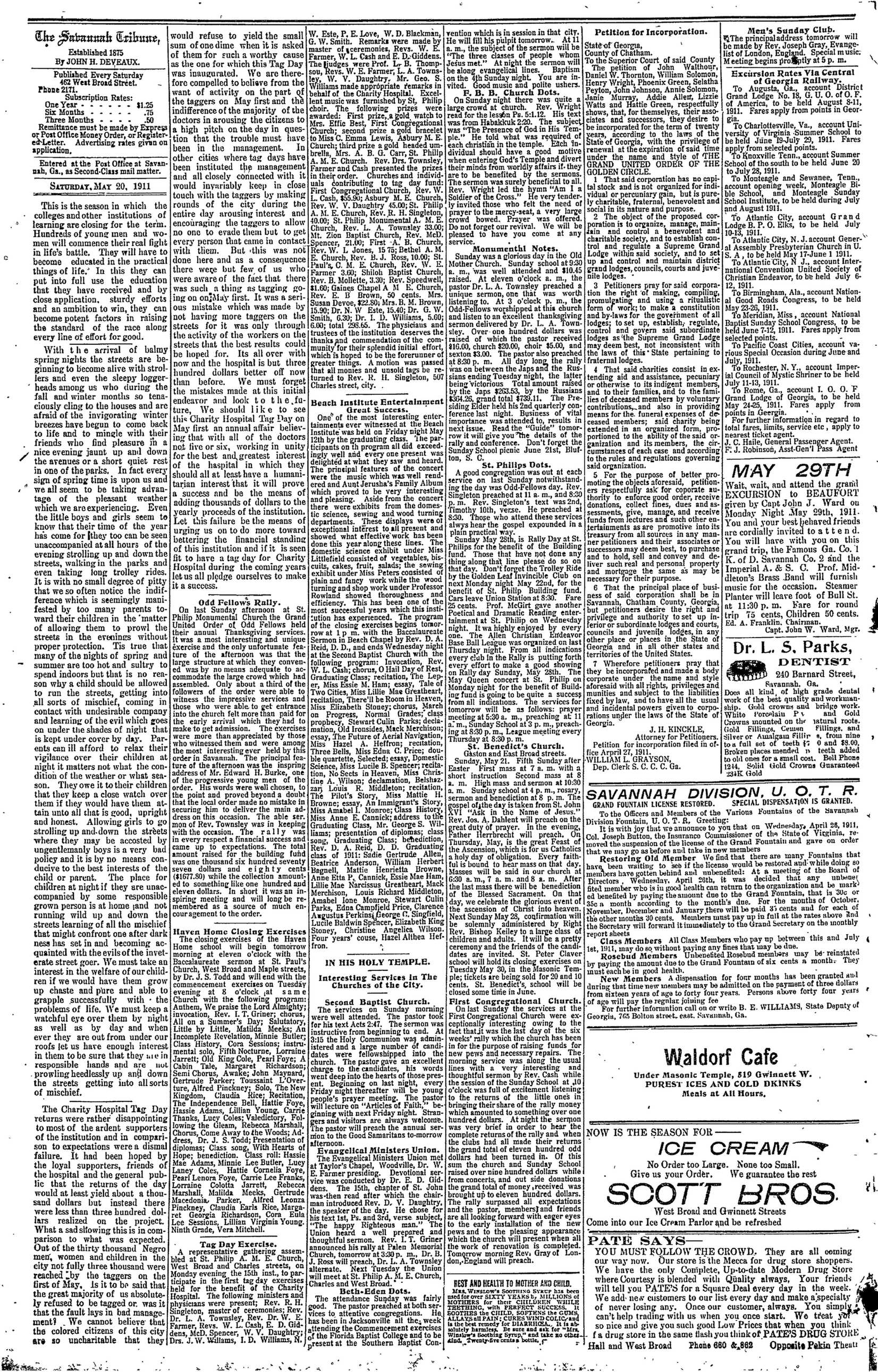
This is the season in which the colleges and other institutions of learning are closing for the term. Hundreds of young men and women will commence their real fight in life's battle. They will have to become educated in the practical things of life. In this they can put into full use the education that they have received and by close application, sturdy efforts and an ambition to win, they can become potent factors in raising the standard of the race along every line of effort for good.
With the arrival of balmy spring nights the streets are beginning to become alive with strollers and even the sleepy loggerheads among us who during the fall and winter months so tenaciously cling to the houses and are afraid of the invigorating winter breezes have begun to come back to life and to mingle with their friends who find pleasure in a nice evening jaunt up and down the avenues or a short quiet rest in one of the parks. In fact every sign of spring time is upon us and we all seem to be taking advantage of the pleasant weather which we are experiencing. Even the little boys and girls seem to know that their time of the year has come for they too can be seen unaccompanied at all hours of the evening strolling up and down the streets, walking in the parks and even taking long trolley rides. It is with no small degree of pitty that we so often notice the indifference which is seemingly manifested by too many parents toward their children in the matter of allowing them to prowl the streets in the evenings without proper protection. Tis true that many of the nights of spring and summer are too hot and sultry to spend indoors but that is no reason why a child should be allowed to run the streets, getting into all sorts of mischief, coming in contact with undesirable company and learning of the evil which goes on under the shades of night that is kept under cover by day. Parents can ill afford to relax their vigilance over their children at night it matters not what the condition of the weather or what season. They owe it to their children that they keep a close watch over them if they would have them attain unto all that is good, upright and honest. Allowing girls to go strolling up and down the streets where they may be accosted by ungentlemanly boys is a very bad policy and it is by no means conducive to the best interests of the child or parent. The place for children at night if they are unaccompanied by some responsible grown person is at home and not running wild up and down the streets learning of all the mischief that might confront one after dark ness has set in and becoming acquainted with the evils of the inveterate street goer. We must take an interest in the welfare of our children if we would have them grow up chaste and pure and able to grapple successfully with the problems of life. We must keep a watchful eye over them by night as well as by day and when ever they are out from under our roofs let us have enough interest in them to be sure that they are in responsible hands and are not prowling heedlessly up and down the streets getting into all sorts of mischief.
The Charity Hospital Tag Day returns were rather disappointing to most of the ardent supporters of the institution and in comparison to expectations were a dismal failure. It had been hoped by the loyal supporters, friends of the hospital and the general public that the returns of the day would at least yield about a thousand dollars but instead there were less than three hundred dollars realized on the project. What a sad slowing this is in comparison to what was expected. Out of the thirty thousand Negro men, women and children in the city not fully three thousand were reached by the taggers on the first of May. Is it to be said that the great majority of us absolutely refused to be tagged or was it that the fault lays in bad management? We cannot believe that the colored citizens of this city are so uncharitable that they
would refuse to yield the small sum of one dime when it is asked of them for such a worthy cause as the one for which this Tag Day was inaugurated. We are therefore compelled to believe from the want of activity on the part of the taggers on May first and the indifference of the majority of the doctors in arousing the citizens to a high pitch on the day in question that the trouble must have been in the management. In other cities where tag days have been instituted the management and all closely connected with it would invariably keep in close touch with the taggers by making rounds of the city during the entire day arousing interest and encouraging the taggers to allow no one to evade them but to get every person that came in contact with them. But this was not done here and as a consequence there were but few of us who were aware of the fact that there was such a thing as tagging going on on May first. It was a serious mistake which was made by not having more taggers on the streets for it was only through the activity of the workers on the streets that the best results could be hoped for. Its all over with now and the hospital is but three hundred dollars better off now than before. We must forget the mistakes made at this initial endeavor and look to the future. We should like to see this Charity Hospital Tag Day on May first an annual affair believing that with all of the doctors not five or six, working in unity for the best and greatest interest of the hospital in which they should all at least have a humanitarian interest that it will prove a success and be the means of adding thousands of dollars to the yearly proceeds of the institution. Let this failure be the means of urging us on to do more toward bettering the financial standing of this institution and if it is seen fit to have a tag day for Charity Hospital during the coming years let us all pledge ourselves to make it a success.
Odd Fellow's Rally.
Odd Fellows Rally.
On last Sunday afternoon at St. Philip Monumental Church the Grand United Order of Odd Fellows held their annual Thanksgiving services. It was a most interesting and unique exercise and the only unfortunate feature of the afternoon was that the large structure at which they convened was by no means adequate to accommodate the large crowd which had assembled. Only about a third of the followers of the order were able to witness the impressive services and those who were able to get entrance into the church felt more than pale the early afternoon and were able to make to get admission. The exercises who witnessed them and were among the most interesting ever held by this order in Savannah. The principal feature of the afternoon was the inspiring address of Mr. Edward H. Burke, one of the progressive young men of the order. His words were well chosen, to the point and proved beyond a doubt that the local order made no mistake in securing him to deliver the main address on this occasion. The able ser. mon of Rev. Townsley was in keeping with the occasion. The rally was in every respect a financial success and came up to expectations. The total amount raised for the building fund was one thousand six hundred seventy seven dollars and eighty cents ($1677.80) while the collection amounted to something like one hundred and eleven dollars. In short it was an inspiring meeting and will long be remembered as a source of much encouragement to the order.
Haven Home Closing Exercises
The closing exercises of the Haven Home school will begin tomorrow morning at eleven o'clock with the Baccalaureate sermon at St. Paul's Church, West Broad and Maple streets, by Dr. J. S. Todd and will end with the commencement exercises on Tuesday evening at 8 o'clock at a same Church with the following programs Anthem, We praise the Lord Almighty; invocation, Rev. I. T. Griner; chorus, All on a Summer's Day; Salutatory, Little by Little, Matilda Meeks; An Incomplete Revelation, Minnie Butler; Class History, Cora Sessions; instrumental solo, Fifth Nocturne, Lorraine Jarrett; Old King Cole, Pearl Foye; A Cabin Tale, Margaret Richardson; Semi Chorus, Awake; John Maynard, Gertrude Parker; Toussaint L'Overture, Alfred Pinkney; Solo, The New Kingdom, Claudia Rice; Recitation, The Independence Bell, Hattie Foye, Hassie Adams, Dillian Young, Carrie Thanks, Lucy Coles; Valedictory, Following the Gleam, Rebecca Marshall, Chorus, Come Away to the Woods; Address, Dr. J. S. Todd; Presentation of diplomas; Class song, With Hearts of Hope; benediction. Class roll: Hassie Ma Adams, Minnie Lee Butler, Lucy Laney Coles, Hattie Cornelia Foye, Pearl Lenora Foye, Carrie Lee Frankes, Lorraine Colotta Jarrett, Rebecca Marshall, Malida Meeks, Gertrude Macedonia, Parker, Alfred Leonza Pinckney, Claudia Earls Rice, Margaret Georgia Richardson, Cora Eula Lee Sessions, Lillian Virginia Young, Ninth Grade, Vera Mitchell.
Tag Day Exercise.
A representative gathering assembled at St. Philip A. M. E. Church, West Broad and Charles streets, on Monday evening the 15th inst., to participate in the first tag day exercises held for the benefit of the Charity Hospital. The following ministers and physicians were present; Rev. R. H. Singleton, master of ceremonies; Rev. Dr. L. A. Townsley, Rev. Dr. W. E. Farmer, Rev. W. L. Cash, E. D. Giddens, McD. Spencer, W. V. Daughtry; Drs. J. W. Walls, I. D. Williams, N.
Beach Institute Entertainment
Great Success.
IN HIS HOLY TEMPLE.
Interesting Services in The Churches of the City.
Second Baptist Church.
Evangelical Ministers Union.
The Evangelical Ministers Union met at Taylor's Chapel, Woodville, Dr. W. E. Farmer presiding. Devotional service was conducted by Dr. E. D. Giddens. The 15th, chapter of St. John was then read after which the chairman introduced Rev. D. V. Daugherty, the speaker of the day. He chose for his text 1st Ps. and 3rd V. verse subject, "The happy Righteous man." The Union heard a well prepared and thoughtful sermon. Rev. I. T. Griner announced his rally at Palen Memorial Church, tomorrow at 3:30 p. m., Dr. B. J. Ross will preach, Dr. L. A. Townsley alternate. Next Tuesday the Union will meet at St. Philip A. M. E. Church, Charles and West Broad.*
Beth-Eden Dots.
The attendance Sunday was fairly good. The pastor preached at both services to attentive congregations. He has been in Jacksonville all the week attending the Commencement exercises of the Florida Baptist College and to be present at the Southern Baptist Con-
vention which is in session in that city. He will fill his pupil tomorrow. At 11 a. m., the subject of the sermon will be "The three classes of people whom Jesus met." At night the sermon will be along evangelical lines. Baptism on the 4th Sunday night. You are invited. Good music and polite ushers.
P. B. B. Church Dots.
On Sunday night there was quite a large crowd at church. Rev. Wright read for the lesson Fs. 5.1-12. His subject was from Habakkuk 2:20. The subject was The Presence of God in His Temple." Adds Wright was required of each church in the temple. Each individual should have a good motive in entering God's Temple and divert their minds from worldly affairs if they are to be benefited by the sermons. The sermon was surely beneficial to all. Rev. Wright led the hymn "Am I a Soldier of the Cross." He very tenderly invited those who felt the need of prayer to the mercy-seat, a very large crowd bowed. Prayer was offered. Do not forget our revival. We will be pleased to have you come at any service.
Monumental Notes.
Monumental Notes.
Sunday was a glorious day in the Old Mother Church. Sunday school at 9:30 a.m., was well attended and $10.45 raised. At eleven o'clock a.m., the pastor Dr. L. A. Townsley preached a unique sermon, one that was worth listening to. At 3 o'clock p. m., the Odd-Fellows worshipped at this church and listen to an excellent thanksgiving sermon delivered by Dr. Townsley. Over one hundred dollars was raised by the pastor received $13,450 church $20.00, choir $5.00, and exon $3.00. The pastor also preached at 8:20 p. m. All day long the rally was on between the Japs and the Russians ending Tuesday night, the latter being victorious. Total amount raised by the Japs $63.53, by the Russians $64.26, grand total $739.11. The Presiding Elden held his 2nd quarterly conference last night. Business of vital importance was attended to, results in next issue. Read the "Guide" tomorrow it will give you the details of the rally and conference. Don't forget the Sunday School picnic June 21st, Blufton, S. C.
St. Philips Dots.
A good congregation was out at each service on last Sunday notwithstanding the day was Odd-Fellows day. Rev. Singleton preached at 11 a.m., and 8:30 p.m. Rev. Singleton's text was 2nd, Timothy 10th, verse. He preached at 8:30. Those who attend these services always hear the gospel expounded in a plain practical way.
Sunday May 28th, is Rally Day at St. Philips for the benefit of the Building fund. Those that have not done any thing along that line please do so on that day. Don't forget the Trolley Ride by the Golden Leaf Invincible Club on next Monday night May 22nd, for the benefit of St. Philips Building fund, Cars leave Union Station at 8:30. Fare 25 cents. Prof. McGirt gave another Poetical and Dramatic Reading entertainment at St. Philip on Wednesday night. It was highly enjoyed by every one. The Allen Christian Endeavor Base Ball League was organized on last Thursday night. From all indications every club in the Rally is putting forth every effort to make a good showing on Rally day Sunday, May 28th. The May Queen concert at St. Philip on Monday night for the benefit of Building fund is going to be quite a success from all indications. The services for tomorrow will be as follows: prayer meeting at 5:20 a.m. preaching at 11 a.m., Sunday School at 3 p.m. preaching at 8:30 p.m., League meeting every Thursday at 8:30 p.m.
St. Benedict's Church,
Church and First Broadstreet
Gaston and East Broad Street
Sunday, May 21. Fifth Sunday after
Easter First mass at 7 a.m. with a
short instruction Second mass at 8 a.m. High mass and sermon at 10 a.m. Munday school at 4 p.m. m., m., m., sermon at 10 a.m. Munday school at 4 p.m. m., m., m., the XVI "Ask in the Name of Jesus." Rev. Jos. A. Dahlent will preach on the great duty of prayer. In the evening, Father Herrbrecht will preach. On Thursday, May, is the great Feast of the Ascension, which is for us Catholica holy day of obligation. Every faithful is bound to hear mass on that day. Masses will be said in our church at 6:30 a.m. m. 7 a.m. and 8 a.m. After the last mass there will be benediction of the Blessed Sacrament. On that day, we celebrate the glorious event of the ascension of Christ into heaven. Next Sunday May 28, confirmation will be solemnly administered by Right Rev. Bishop Keiley to a large class of children and adults. It will be a pretty ceremony and the friends of the candidates are invited. St. Peter Claver school will hold its closing exercises on Tuesday May 30, in the Masonic Temple; tickets are being sold for 20 and 10 cents. St. Benedict's school will be closed some time in June.
First Congregational Church.
On last Sunday the services at the First Congregational Church were exceptionally interesting owing to the fact that it was the last day of the six weeks' rally which the church has been in for the purpose of raising funds for new pews and necessary repairs. The morning service was along the usual lines with a very interesting and thoughtful sermon by Rev. Cash while the session of the Sunday School at 10 o'clock was full of excitement listening to the returns of the little ones in bringing their share of the rally money which amounted to something over one hundred dollars. At night the sermon was very brief in order to hear the complete returns of the rally and when the clubs had all made their returns the grand total of eleven hundred odd dollars had been turned in. Of this sum the church and Sunday School raised over nine hundred dollars while from concerts, and out side donations the grand total of money, received was brought up to eleven hundred dollars. The rally surpassed all expectations and the pastor, members] and friends are all looking forward with eager eyes to the early installation of the new pews and to the pleasing appearance which the church will present when all the work of renovation is completed. Tomorrow morning Rev. Gray of London, England will preach.
BEST AND HEALTH TO MOTHER AND CHILD
Miss. Winslow's Soothing Syrup has been used for over Sixty YEARS by MILLIONS of people. It is the perfect BEST SUCCESS SOOTHES the CHILD, SOFTENS the GUMS, ALLIAS all PAIN; CURSES WIND COLIC and is the best remedy for DIARRHIA. It is abrasive, soothes the skin, and Winslow's Soothing Syrup" and take no other fuss. Twenty-five cans a bottle.
SAVANNAH DIVISION, U. O. T. R.
GRAND EQUINOX LICENSE RESTORED. SPECIAL DISPENSATION IS GRANTED.
To the Officers and Members of the Various Fountains of the Savannah Division Kountain, U. O. T. R., Greeting:
Division
I will with joy that we announce to you that on Wednesday, April 26, 1911,
Col. Joseph Button, the Insurance Commissioner of the State of Virginia,
removed the suspension of the license of the Grand Fountain and gave on order
that we may go as before and take in new members
Restoring Old Member We find that there are many Fountains that have been waiting to see if the license would be restored and while doing so members have gotten behind and unbenefited: At a meeting of the Board of Directors, Wednesday, April 26th, it was decided that any unbenefited member who is in good health can return to the organization and be marked benefited by paying the amount due to the Grand Fountain, that is 30c or 35c a month according to the month's due. For the months of October, November, December and January there will be paid 35 cents and for each of the other months 30 cents. Members must pay up in full at the rates above and the Secretary will forward it immediately to the Grand Secretary on the monthly report sheets
Class Members All Class Members who pay up between this and July 1st, 1911, may do so without paying any fines that may be due.
Rosebud Members Unbenefited Rosebud members may be reinstated by paying the amount due to the Grand Fountain of six cents a month. They must each be in good health.
New Members A dispensation for four months has been granted and during that time new members may be admitted on the payment of three dollars from sixteen years of age to forty four years. Persons above forty four years of age will pay the repurchase fee
For further information call on or write B. E. WILLIAMS, State Deputy of Georgia, 765 Bolton street, east, Savannah, Ga.
Waldorf Cafe
Under Masonic Temple, 519 Gwinnett W.
PUREST ICES AND COLD DKINKS
Meals at All Hours.
NOW IS THE SEASON FOR
ICE CREAM
No Order too Large. None too Small.
Give us your Order. We guarantee the rest
SCOTT BROS.
West Broad and Gwinnett Streets
Come into our Ice Cream Parlor and be refreshed
YOU MUST FOLLOW THE CROWD. They are all coming our way now. Our store is the Mecca for drug store shoppers. We have the only Complete, Up-to-date Modern Drug Store where Courtesy is blended with Quality always. Your friends will tell you PATES for a Square Deal every day in the week. We add new customers to our list every day and make a specialty of never losing any. Once our customer, always. You simply can't help trading with us when you once start. We treat you so nice and give you such good Low Prices that when you think f a drug store in the same flash you think of PATES DRUG STOR
Hall and West Broad Phone 660 & 862 Opposite Pekin Theatt
To the Superior Court of said County
the petition of John Walthour,
Daniel W. Thornton, William Solomon,
Henry Wright, Phoenix Green, Selatha
Peyton, John Johnson, Annie Solomon,
Janie Murray, Addie Aller, Lizzie
Watts and Hattie Green, respectfully
shows, that, for themselves, their
associates and successors, they desire to
be incorporated for the term of twenty
years, according to the laws of the
State of Georgia, with the privilege of
renewal at the expiration of said time
under the name and style of THE
GRAND UNITED ORDER OF THE
GOLDEN CIRCLE.
1 That said corporation has no capital stock and is not organized for individual or percurrency gain, but is purely charitable, fraternal, benevolent and social in its nature and purpose.
2 The object of the proposed corporation is to organize, manage, maintain and control a benevolent and charitable society, and to establish control and regulate a Supreme Grand Lodge within said society, and to set up and control and maintain district grand lodges, councils, courts and juvenile lodges.
3 Pettitioners pray for said corporation the right of making, compiling, promulgating and using a ritualistic form of work; to make a constitution and by-laws for the government of all lodges; to set up, establish, regulate, control and govern said subordinate lodges as the Supreme Grand Lodge may deem best, not inconsistent with the laws of this State pertaining to fraternal lodges.
4 That said charities consist in extending aid and assistance, pecuniary or otherwise to its indigent members, and to their families, and to the families of deceased members by voluntary contributions, and also in providing means for the funeral expenses of deceased members; said charity being extended in an organized form, proportioned to the ability of the said organization and its members, the circumstances of each case and according to the rules and regulations governing said organization.
5 For the purpose of better promoting the objects aforesaid, petitioners respectfully ask for corporate authority to enforce good order, receive donations, collect dues, dues and assessments, give, manage, and receive funds from lectures and such other entertainments as are promotive into its treasury from all sources in any manner petitioners and their associates or successors may deem best, to purchase and to hold, sell and convey and deliver such real and personal property and mortgage the same as may be necessary for their purpose.
6 That the principal place of business of said corporation shall be in Savannah, Chatham County, Georgia, but petitioners desire the right and privilege and authority to set up inferior or subordinate lodges and courts, councils and juvenile lodges, in any other place or places in the State of Georgia and in all other states and territories of the United States.
7 Wherefore petitioners pray that they be incorporated and made a body corporate under the name and style aforesaid with all rights, privileges and munities and subject to the liabilities fixed by law, and to have all the usual and incidental powers given to corporations under the laws of the State of Georgia.
J. H. H. KINCKLE,
Attorney for Petitioners.
Petition for incorporation filed in office April 27, 1911.
WILLIAM L. GRAYSON.
Dep. Clerk L. C. C. C. Ga.
Men's Sunday Club.
The principal address tomorrow will be made by Rev. Joseph Gray, Evangelist of London, England. Special music. Meeting begins promptly at 5 p. m.
Excursion Routes Vla Central
Google Railway
To Augusta, Ga., account District Grand Lodge No. 18, G. U. O. of O.F. of America, to be held August 8-11, 1911. Fares apply from points in Georgia.
To Charlottesville, Va., account University of Virginia Summer School to be held June 19-July 29, 1911. Fares apply from selected points.
To Knoxville Tenn., account Summer School of the south to be held June 20 to July 29, 1911.
To Monteagle and Sewanee, Tenn., account opening week, Monteagle Bible School, and Monteagle Sunday School Institute, to be held during July and August 1911.
To Atlantic City, account Grand Lodge B. P. O. Elks, to be held July 10-13, 1911.
To Atlantic City, N. J. account Gener- at Assembly Presbyterian Church in U. S. A., to be held May 17-June 1 1911. To Atlantic City, N J., account International Convention United Society of Christian Endeavor, to be held July 6- 12, 1911. To Birmingham, Ala., account National Good Roads Congress, to be held May 23-26, 1911.
To Meridian, Miss, account National Baptist Sunday School Congress, to be held June 7-12, 1911. Fares apply from selected points.
To Pacific Coast Cities, account various Special Occasion during June and July, 1911.
To Rochester, N. Y., account Imperial Council of Mystic Shriner to be held July 11-13, 1911.
To Rome, Ga., account I. O. O. F. Grand Lodge of Georgia, to be held May 24-25, 1911. Fares apply from points in Georgia.
For further information in regard to total fares, limits, service etc., apply to nearest ticket agent.
J. C. Haile, General Passenger Agent. F. J. Robinson, Assst-Gen'l Pass Agent
MAY 29TH
Wait, wait, and attend the grand
EXCURSION to BEAUFORT
given by Capt John J. Ward on
Monday Night May 29th, 1911.
You and your best behaved friends
are cordially invited to attend d.
You will have with you on this
grand trip, the Famous Ga. Co. 1
K. of D. Savannah Co. 2 and the
Imperial A. & S. C. Prof. Middleton's Brass Band will furnish
music for the occasion. Steamer
Planter will leave foot of Bull St.
at 11:30 p. m. Fare for round
trip 75 cents. Children 50 cents.
Ed. A. Franklin, Chairman.
Navahah, GI.
Does all kind, of high grade dental work of the best quality and workmanship. Gold crowns and bridge work. White porcelain. Gold crowns on the natural roots. Gold Crowns. Cement Fillings, and Silver or Amalgam Fillings, from nine to a full set of teeth $7.00 and $8.00. Broken places mended $ teeth added to old ones for a small cost. Bell Phone 1214. Solid Gold Crowns Guaranteed 34K Gold
Locals.
Ice Gream, ring up McFall, Phone
Te ne Oy Oe ee
Mr. Henry A. Newton who has been
ill for a long time is out again. ;
Miss Georgia Smiley of Joilet Ul., is
in the city for a shortstay,
Miss Janie Mulligan of Waycross, Ga.,
who was taken ill here last week left
for home Monday.
‘Miss Judie Smith of Columbus, O. is
the guest of Miss Sarah Brown, Wald-
burg street, west.
Mr. William A. Morrison of Macon,
Ga,, is in the city the guest of Mr. and
Mrs. Henry Anderson, Park Ave., W.
Mrs. Annie Smalls formerly of this
~city but recently of Philadelpha, Pa., is
in the city for a short stay. .
Miss Maria Williams, of Augusta is
visiting Mr. and Mrs. Geoge Hardaway
of Oak street.
Ask Pate's Drug Store about the
Nyall Line.
For Ice Cream, ring up McFall, Phone
4038.
Mr. F.S. Frazier, the popular post-
master of Limerick, Ga., spent several
days in the city on business.
Mr. M, A. Cassels of Dorchester spent
several yery pleasant days in the city
visiting relatives. .
Mr. Uuefre C. Torres, Orbento Porto
Rico, a graduate of Tuskegee wasin the
city this week enroute to New York,
‘Mrs. Alice L. Huggins, of Jacksonville
Fla, is in the city the guest of Mrs.
Nora Harris, 443 Guerard street.
Miss Marie Tolbert who has been at-
tending Haines Institute Augusta, has
returned to the city.
‘Mending shoes is sometimes as im-S
portant as ‘making them, it reqnire
expert work todo it right. ‘J. H. Wash-
ington. 3u9 Whitaker street. .
aMiss Annie Jones, formerly of this
city but now of Houston Tex., is visit-
ing friends and relatives.
Mr. Harry Jenkins and Mr. George
Jackson, leit for New York Monday af-
ternoon. oe
‘Lodgings for men in quiet family,
clean and neat. Jefferson and Hunting:
don streets. 7
‘Ask Pate's Drug Storé about the
Nyall Line.
‘Miss Willie Smith of Cuthbert, Ga.,
who has been in the eily for the past
two weeks left for home Wednesday.
Miss Addie Clark, of Darien, Ga., is
in the city the guest of Mrs. John Miller
West Duify street.
‘Mrs. Florence A. Este, with little
Marie left last week for Fitzgerald to
visit Rey. and Mrs. J. H. Este.
‘Mrs. H.F. Benson, who has been
very ill1s much improved, to the de-
light of her many friends.
‘Twenty years practical experience
has made me the equal of any shoe
muker in town. J. H. Washington
uy Whitaker street.
‘Mrs. Mary Singfield leaves to-day for
Augusta, where she will spend two
months with her mother, sister, and
other relatives and friends.
FOR RENT—Neatly furnished rooms
for gentlemen algo single couples with
the use cf kitchen and gee, all. con.
veniences. Apply 329 3. Jones St
Go to Pate’s Drug Store, West Broad
and Hall streets.
Misses Roberta Anderson and Vic.
toria Allen accompanied by Mrs. Ada
Morse departed for Boston, Mass., last
Tuesday.
‘Miss Rosa Holmes the accomplishgd
daughter of Mr. and Mrs. John ota
graduated this week from the Fort
Valley High School. a
Rev. J. K, Rogers of Waycross and
Mr. U. Theus were in the city yesterday.
~In company with Rev. McD. Spencer,
they gave us a pleasant call.
Mrs. Eliza Jones arrived from Jack-
sonville, Fla., on Tuesday to spend the
summer with her daughter Mrs. Lizzie
Gadson, Duffy street west.
Thave a fine line of fancy woolen for
you to look over, Call around and see
me and let me show to you A. P_ Barn:
ard, The Tailor 310 Whitaker Street.
Phone 3003. =
Miss May Ellen Williams, the District
Secretary of the Ga, Mutual Insurance
Co., is again at her post of duty after 3
<7 pleasant vacation spent in the
city.
: ‘The waiting room of my shoe repair
ing department is entirely reserved sc
that any lady or gentleman can sit an¢
wait for small jobs. J. H. Washington
309 Whitaker street.
_Mrs.——Williams, of Statesboro,
sister of Mr.J.M_ Ferrebee, is in the
city spending awhile with Mr, and Mrs
Ferreebee at their cozy home, Mont
gomery street.
On last Sunday May 14th, Mr. W. L.
Jones and Mrs. Lillie Threet formerly
of Savannah were married at Pattersor:
Ga., by Rev. G. W. Jenkins, Pastor
Woods Chapel A. M. E- Church.
Go to Pate’s Drug Store, West Broa
and Hall streets.
Friends of Mrs. Willie Lawson Pierce
of Augusta, will regret to hear of the
death of her infant son little Everet
Pierce, he was the God-son of Mrs. Leo:
Ja J. Wright of this ait
The trimmings that ! putin my cloth-
es excell any clothes that are put up by
the rest of the so-called tailors aronnd
here. Letmeshow you A.P. Barn-
ard. The Tailor, $10 Whitaker St.
Phone 3003.
Ars. Julia Fergerson leaves today for
Wilmington, N.C, ahere ‘she will at
tend the Grand Lodge session of the
Tents. After this session she willspend
the summer with relatives and friends
Physicians and Dentists and Pharma
ceuists which convened in Athens, Ga,
this week. Dr. Williams is presiden
of the convention and is one of the as
sociation’s most ardent workers,
Mr. Chas, A. Clark, of Brunswid
spent Wednesday in the city among
friends. He is always royally receivec
here by his host of triends. Mr. Clark
igya forminable candidate for Granc
Chancellor of the Knights of Fythias
oat from reports received throughout
ey state, he will easily lead in this
fight.
lis Bina Quarterman sled on SS,
City of Savannah on last Tuesday for
New York City where she will spend
four days, leaving on Thursday 25th,
inst., for Shousand Island Park, where
she will be the guest of Mrs. Emma
VanBramery of the Catskill Mt. Stand.
ford, N. Y. "A grand reception was giv-
en in honor of Aiss Quarterman by Air.
and Mrs. Chapelle. :
‘A delightful surprise social was giv-
enin honor of Miss Mae Johnson of
Boston, Mass,, and Miss Claudia C.
Allen of Savannah, Ga., at the_resi-
dence of Mr. James Harrison 1012 Eu-
clid Avenue Philadelphia, Pa. May
5th, on the eve of their departure from
the Quaker clty. Music was rendered
by Defou's Orchestra, dancing and
games were indulged inuntil a late hour
after which x lignt menu was served.
Those present were Mr and Mrs George
Griffin, Mr. and Mrs. A. Scott, Mr. and
Mrs. J. Harrison, Mrs. Claudia C Allen
of Savannah, Ga.; Mrs. Cornelia Adams
of Columbus, Ohio; Miss Mae John-
son of Boston, Mass.; Misses Cecil Har-
rison, Edna ‘Jackson, Messrs. Chas.
Harrison, Sidney Harrison, M. Jones,
Chas, Harvey.
St. Stephens Excursion.
The annua! afternoon excursion of
the Parish Aid Society will be held at
Daufuskie, on Tuesday June 20th.
Boat leaves foot of Abercorn street at
3 p.m, Music, dancing and refresh-
ments. Tickets 50 cents. Children
under 12 years of age 25 cents.
Schools Closing.
We have received invitations to the
closing of the following schools. Haines
Institute, Augusta, Ga.; Morris Brown
College, Atlanta, Ga,; Howard Univer-
sity; Washington, D. C.; Christianburg
Industrial Institute, Christianburg, Va.
and Georgia State Industria! College.
‘Musical Concert.
A grand Musical Recital will be held
at St PhilipA. M. E. Church, May 26th,
8:30 p. m., benefit of St, Philip Build:
ing fund, by Mrs. Leola Jordan Wright.
Program: Selection, Orchestra; Vocal
solo, Mrs. Maggie Hartaway; Piano solo,
Miss Jennie Aiken; Bass solo, Mr. A. K.
Willis, Trombone solo, Mr. Charlie Royal;
Soprano solo, Miss Mae Steward; Piano
duet, Misses Jennie Aiken and Geneva
Green; Quartette, Eureka, Violin solo,
Mr. Sam Mathews; Vocal solo_ Mr.
Charlie Waters; Duet, Miss’ Mae Stew-
ard and Mrs. Leola Wright; Cornet
solo, Mr. James Thomas; Vocal solo,
Mrs. Leola Jordan Wright; Violin solo,
Mr. R. W. Green; Cornet solo, Mr. J. J.
Hart: Selection, Orchestra.
Tuskegee Meeting Great Suc-
cess. i
On last Wednesday night at St. Pau!
A.M,E. Church there was a rousing
meeting in the interest of Tuskegee In
stitute. The principal features of the
meeting were addresses by Prof. S. A.
Gant of the Georgia State Industrial
College and by Prof Cicero Simmons,
traveling representative of the institu
tion. ‘There was a good sized audience
out and all present seemed to have
been well pleased with the many good
things they heard about, this great in
stitution, Mr. Simmons’ talk was con-
vincing and he proved to the satisfac
tion of all present that Tuskegee is de
serving of all the good things whict
ars said of her. ‘The meeting will
probably result in much activity among
the‘graduates and under graduates o}
the school in this city.
Information , Desircd aE
Savannah, Ga., May'3, 1911. Edward
Brinson died about four months ago
leaving’a policy worth $300.00 to Thos
Daughtry brother and to Otis Daughtry
nephew. If any one knows of the
whereabouts of either or both of the
beneficiaries we will thank you in ad
vance to advise.
W. Smith,
408 West Broad Street,
Savannah, Ga.
A Dalen Dotc_
Our pulpit was filled both morning
and eueuing by our worthy District
Supt: E.D. Giddens. | He presched t
the delight of all who heard him. His
lecture to the Beworll League was in:
deeda treat. Tomorrow the following
services will be conducted: 10 a. m.,
Sunday School, 112. m., preaching bj
the pastor Rev. I. T, Griner; 4 p. m.,
the. Evangelical Mfnisters Union will
meet here in one of their Union rallies.
Dr. B. J. Ross, pastor of Bethel A. M.
E. Church was appointed by the Union
to preach for us at 7:30 p.m. The Ep.
worth League at 8:30. The public is
invited to attend these services. _
Mr. W. L. M. Pierce of this city,
whose pleasant manners and fine de
portment have won for him a host of
riends was highly gratified on the
evening of May sth {0 recelve a. visit
from his brother Mr. Franklin J.
Pierce of Saratogo Springs, N. Y.,
whom he had not seen for twenty five
years. We would fail to do our duty
ad we negleeted to say a word for our
friend whose gentlemanly bearing and
physical culture show to the most
Serutinizing eye that Mr. F. J. Pierce
had treated himself in a way that
Drought to him good health and also ar
enviable fortune since their absence
From each other. But with sad regret
he left us on the evening of the ilth to
visit Mr. A. L. Pierce, another brother
whom he has not seen in 21 years,
Franklin came from a long line of great
people whose memory will never die.
Welesrned ‘that before Mr. Pierce re-
turns to his home he will visit Mr.
James Pierce professor of mathematics,
State school, Orangeburg, S. C., after
which he will continue his journey
homeward kindly thinking of those
seen in the familiar words. “How
dear fo my heart are the scenes of my
childhood, when fond recollection pre:
sents them to view; the orchard the
meadow the deep tangle wildwood, and
every love spot that my infancy knew.”
We hope for you Franklin along and
rosperous life and hope you will think
Eindly of us in dear old Chatham, espe:
cially when i Shall have taken to
yourself your better half.
2 #6 YW. Bivens Denson.
Announcements.
Mr. and Mrs. W. H. Harvey. an
nounce the marriage of their daughte:
Miss Sarah B. part to Mr. Henry G.
Williams, Jacksonville, Fla, May isth,
by Rev. A. Jackson, pastor St.Paul
A.M. E.Chureb, Tampa, Fla.
Mrs. Rosa Jones wishes to announce
the marriage of her daughter, Maude
A. Jones to Mr. Wm. A. Davis of Atlan-
tic, City N. J., formerly of Savannah,
Ga., June Ist, 1911. at her residence
8 Pearl street west. * *
Pekin Dots. ~
Popular prices are on at the Pekir
and the patrons are showingtheir ap
preciations by their liberal attendance
at cach performance, stage manage!
Campbell presents this week the “Rur
away slaves” with Edwards and Ed
wards in the leading role. The follow
ing musical numbers are well rendere¢
during the play and between the acts:
“That was me” by Campbell and Scott
“If drerms ‘are true” Lee and Lee ;
“Stop, Stop Stop,” Mrs. B. E. Edwards,
and “There is no place like the old
folks after all” by Mrs, Edna Campbell.
“Seymore the dancing kid” is making
good taking several encores nightly.
‘The motion pictures this week was un-
usually good, shdwing ex-President
Roosevelt on his hunting trip in Africa
and his return to America: By special
request they will be repeated on next
Monday matinee and night.
Grent Mystery Solved.
The exciting details relative to ‘The
Adventure of Charles queens Milver-
ton.” the cold blooded crime that
startled all England, have been printed
in book form, and will be gigen free as
aspecial supplement with every, com
of next Sunday’s New York World. ft
isin.this story that Sherlock Holmes
added lustre to his already great name
is the world’s most clever detector of
crime. This is a ee no man or
ggoman should miss reading. | It is by
Sar Arthur Confin Doyle, the mos
famous writer of detective stories in
the world. Remember, the booklet is
free with next, Sunday’s New York
World. Order your copy in advance ¢
—_—_————_—
AMUSEMENT COLUMN,
Coming Events ix the Social
Wee
wv Ord,
NOTICE—Articles in this column one
cent per word.
The Original Royal Roosters will give
a shirt sleeve outing to. Dautuskie,
Monday June 12th. Tickets 50 and 33
cents.
Local Union No. 318, will five their
first picni¢ at Lincoln Park Monday
May 22nd. Tickets 15 Cents.
Run with tho Fox to Daufuskie, Tues-
day afternoon May 23. Tickets 50 aud
% cents,
The Y. L.andG S.C. will give an
excursion to Daufuskie,’ Monday June
‘Sth. Tickets 50 and 25-cents.
Monday May 22nd, The Ladies Circle
of Truth Branch.of U. L, Houston Be-
nevolent Society picnic at Woodlawn
Park. Admission 15 cents,
Montey fight nay 2nd, Primrose A.
and S. Club May Pole dance at Masonic
Temple, Tickets 15 and 25 cents,
Monday May 20th, Capt. John J. Ward
excursion to Beaufort S. C., Tickets
73 and 50 cents.
Monday May 29th, Mutual Club ex-
cursion to Beaufort S. C. Tickets 75
cents. :
Tuesday May 30th, Pekin and Appolo
Orchestra picnic at Lincoln Park. Tic-
kets 15 cents.
Monday May 20th, Bakers Indepen-
dent Clubs picnic at Lincoln Park.
Tickets 15 cents. :
Monday night June Sth, Imperial A.
and S. Club Shirtand Shirt waist dance
at Harris street Hall. Tickets 50 and
Teents.
Monday night May 22nd, Supreme
Lodge A. O. K. of D_ entertainment at
Harris street Hall, Tickets 25 cents.
Monday May 22nd, Cresent A. and
S. Club picnic at Baker’sCrossins, Ad-
mission 10 Cents.
enter Sune Sth, ¥. G. E.A, & S.C,
Blue Ribbon Outing at Daufuskie. ‘Tic-
kets 50 and 25 cents.
Monday ae May 29th, Grand Army
of the Republic excursion to Beaufort
Fare 75 and 50 cents.
Monday June 6th, Weldon Lodge No.
261. B.P_O.E. of W. outing at Dau-
fuskie. Tickets 50 and 25 cents
acoder Nay 23, Fox Outing at Dau-
fuskie. Tickets 50 Cents. 4
May 22nd, Monday. Concert at Beth
lehem Baptist Church by Swangin's
private school. Tickets 10 cents.
June Sth, Monday. Picnic at Lincoln
Park, by Japs Club of F. A. B. Church,
‘Tickets 15 cents.
May 22nd, Moutey: Entertainment
at Our Hall, by School Committee of
Mi. Tabor Baptist Church. Tickets 15
cents, :
dune 12th, Monday. Dance at Harris
street Hall by Ocean Progressive A.
and S.C. Tickets 15 cents.
"dune 3rd, Saturday. First Congregay
tional Sunday School excursion to Dau!
fuskie. Tickets 50 and 25 cents.
June 19th, Monday. Picnic ‘at Lin
coln Park by Gardner Lodge No. 205 K.
of P. Tickets 15 cents.
dune 6th, Tuesday. Moonlight picdic.
to Daufuskie by the Willing Workers
Pleasure Club. Tickets 25 cents.
May 24th, Wednesday, Musical Con+
cert and prelonatne at St, Philip A. M.
E. Church. Tickets 10 cents.
June 5th, Monday. Barbecue at
Styles Park’ by Independent Bros. of
Jacob. Fare 25 cents.
ee Wednesday. Good Samari-
tans Banquet by Light of Inheritance
Lodge No. 1331, 0. of G.S. and D. of
S._ Tickets 20 and 35 cents.
May 22nd, Monday. May party at
Masonic Temple, by Maple Street
School. Admission 6 cents.
May 22nd, Monday. Peanut Hunt
by Mrs. Anna Murry at 618 Orchard
street. Admission 5 gents.
: say 26th, Friday. } Musical Recital
benefit of St. Philip A. M. E. Church.
Tieketa Ne erate. ” |
june 27th, Tuesday. Spring enter-
tafbiment at Freeman's Hall by Porters
Bensyolent Association, Admission 15
cents, *
June Sth, Monday. Picnic to Wash-
ington Park Springfield, Ga, by Beulah
Bape Gos . Fare 50 cents.
rune 12th, Monday. Water Outing
to Daufuskie by Western Lily. Lodge.
No. 161 1. 0. of G. 8, and D. of 8, U.S,
Dr. J. W. Jamerson
Firstelass Dentist
All Work Guarinteed.
623 W EST BROAD STREET
Bet, Huntingdon and Hall ,
Bell Phone 2098.
A. P, BARNARD.
oo THE TAILOR
BEFORE BUYING YOUR SPRING AND SUMMEK SUITS AND
LET HIM SHOW YOU THE LATEST FOR THIS SEASON
Phone 3003 310 Whitaker St.
I
WHY NOT CHARTER A CAR AND GIVE A PICNIC
FOR LESS THAN HALF THE COST OF 4
RIVER EXCURSION AT Ye
Woodlawn Prak *°peccte*
Woe People .
Situated on the ISLE of HOPE line a few steps from Sand
. Fly Stain. The salt and pine breeze is most “delightful
as well as healthful... We will be glad to hear from you_at
7 your earliest convenience. r .
JOHN R. STYLES, AGENT.
ANDERSON and EAST BROADSTS.
‘The public is invited out Sunday for inspection of Parle.
P.S. The place is ideal for Churches, Lodges, Clubs and _
Sunday Sbhools.
& 7
Pekin Theatre
Summer Prices
BEGINNING
‘Monday May 15
The following prices will go in-
to effect: 2
BOX SEATS 90
ORCHESTRA 10
BALCONY 5 °
NEW FACES
NEW SONG ;
SPECIAL FEATURES
Performance starts at 8 o'clock.
Come and stay as long you like.
" Matinees Mondays and ‘Thurs-
days. .
5 POEM ER ASSES ESSERE RES SRE LAER RAEN Eee cea
3 «= | POPULAR PRICED
| SHOES ,
.. NICHOLS, |
; THE SHOE MAN :
3 20 W. BROUGHTON ST. }
SOO OOS ONDE OS SS ROOUSS OE OORSHEO COONAN SSSERSREEREROGG:
ouR——
ee °
Dixie Policy
WILL COST YOU $1.26
Pays for SICKNESS or ACCI-
DENT from one day to six
Months also for natural
death,
For further paticulars call or ad-
dress
J. 1. C. Montgomery,
- 819 Paulsen street,
AMERICAN LIFE ACOI-
DENT INSURANCE CO.
y ~~
PATE SAYS
You must listen to him this week for he brings you good
pews. We handle Petermans bed bug killer 15 and 25 cents
-also Petermans roach powder 15 cents, this kills them be-
cause Pate says so. Japanese Honeysuckle talcum power 25
cents, finest perfumes made from the flower'$1.00 the ounce.
Call for a sample of the Blocki Japanese sachet powder.
Special reduction on Combs and Brushes also Fountain Sy-
ringes. Your doctor tells you to bring your prescriptions
. to us because we are comepetent, fill them properly and
promptly and less than the other fellow. Ask us about the
- NYAL LINE we are the agents and they are all good. Buy
your stamps from us we do not make any profit on them but
are glsd to accommodate our trade just the same. See us be-
fore purchasing anything in the Drug line. :
me
PATE'S DRUG. STORE.
Phones 660 and 862 HALL and WEST BROAD STS.
ite Opposite The Pekin Theatre.
ay? Ay
The Acme Bicycle Store
K, IIALPERN, Proprietor,
463 West Broad St.
Déaler in new and second handed
bicycles. | Repairing and yul-
“res fo Sonics”
. Phone 1340.
FOLLOW THE CROWD TO SUCCESSFUL
10,000 pyle visited Lincoln Park Easter Sunday and 12,500 pn Easter Monday.
A place of real pleasure and amusement. There are swings, merry go rounds,
cirele wayes anda real dodging monkey that can dodge a ball as good as a boy-
can abrick. A large pavilion where you can dance or skate as you like. Plen
of choice refreshments. The Pekin Stock Company will entertain every
‘unday afternoon and night. The Park is open for engagements and we want
every one to go with us this summer, All churches have the pleasure of ob-
taining the park ata very low figure. Sunday schools may haveevery Wed-
nesday or Friday, music free, also the public and private schools the same. It
will cost you nothing to givé the little ones a day's outing. We. will gladly
give them any Wednesday or Friday with music free of charge. The park can
je had this summer at 2 very low figure with a full orchestra. Lincoln Park
the ideal place for picnics, Tt can be reached at any hour of the day, any min-
ute in the hour, Manager Stiles wishes the public to know that he is only inter-
ested in Lincoln Park and the Pekin. Theatre. Commencing May 15, summer
rates. Box seats 20 cents, orchestra 10 cents, balcony Scents. Stay as long as
you like. Big show this week, Uncle Tom’s Cabin and new faces.
For Qpen Dates apply st the PEKIN THEATRE, 625 West Brosd street,
Manager Stiles will gladly vive any information desired.
EXCURSION
—FROM—
Savannah to New York
SATURDAY MAY 20th, 1911
Cheapest Rate of the Season
First Class Accommdations
Apply early and secure your
reservations,
CG. A. TURNER, 1615 Vine St.
Nie
Scott Bros. 3 Scott Bros.
For Comfortable Paris Dress
SHOES Wine ea Stdp SHIRTS
ey
STRAW HATS Ww i FLAXON LAWNS .
‘ynion Made ' APRON CHECKS
OVERALLS WAY, 7
: AN } Men’s aid Women’s
‘Triangle Brand” if HOSIERY
COLLARS HAN
. ny Men and Women
Howard's . d a AA FURNISHINGS
SHOE POLISH Re i
v We invite you to call
AMERICAN BEAUTY Sle teziat our store and see
Phone 2829 ‘Waramazca Corset Oo. Makers what we are doing.
WEST BROAL) & QWINNETT ST
:
_F, F, JONES, .
Dealer in
BEEF, VEAL, MUTTON,
LAMB, PORK, HAMS,
BACON and CORNED BEEF.
All kinds of GAME in season.
Goods promptly delivered to
any part of the city free of
charge.
Stall 31, City Market.
Pilot Boy « Ctivedon
How about that Ex-
cursion for your
lodge, church or Sun-
School? We hare
several good dates
open forcharter.
Call at our office or
Phone 4152
CHAS. E. BALL, Agent.
° e < .
.
Wictoria Theatre
WEST BROAD, Opposite MAPLE STREBY. ,
Continuous performance 7:30 to il p. m,
ENTIRE CHANGE OF PROGRAM DAILY. :
Se ——PROGRABM———
WILD WEST,
. LATEST COMIC PICTURES
UP-TO-DATE DRAMAS .
FIRST CLASS PERFORMANCE THROUGHOUT
Admission 5 and to cents.
Easter is over but we are
still showing an up-to-
date line of :
SPRING MILLINERY.
We have just received a
fine assortment df trim-
med and untrimmed hats.
Call and see'us before yo-
ing elsewhere. Special
attention given to the re- ©
modeling of oid hats.
Greene .& Allen,
464 West Broad St.
REAL ESTATE FOR SALE
Lot 35 feet front on Anderson street, near East Broad St., $25 exsh payment
and $10 Be month on balance. =
1613-1619 Burroughs street. sane rertting for $32.00, $300.00 eash
and balance in easy monthly installments. .
2 Jots and improvements Seow as 1512-1514 Vine street, Ideal loeation.
$100 cash and balance like rent. + %
Lots on 37th street near Paulsen St. $10 cash and $5 per month on balance.
Nice 5 room cottages on 37th St., near-Waters Road. City water and esr
service. Small cash payment and balance like rent. .
2 Jots with two 3 room houses 37th St., near Waters Road and overlooking ~
the Granger tract. $100 cash and balance in small monthly payments.
Thé Wage Earners Loan and Investment Co.,~
Phene 1198 468 WEST BROAD 8ST. ’
Phene 1198 so 468 WEST BROAD #®.
We Do Job Printing
A. P. BARNARD
THE TELLOS
TO BE REYIZING YOUR SPARK AND SUMMER CITY AND
THE HI HI SHOW YOU T HE LAST FOR THE SEASON
310 Wiltaker St
bitumen. It is said to cost less than the appropriations made by the ditmacadam and to be good for at least different states for improved roads have littened. Waian experiment may have been wasted to a very large extent. shown by the will stand wear near New York has built about 650 miles and wet better than any other state. improved highway Pennsylvania may perhaps one-third of mutilt. And neither state nor any other so far has made proper provision for their malntenance. Heres when it comes to more mil-
Muchas government legislatures, roads we need permanent culverts more, says W. S. Gearhart, state highway engineer of Kansas, more important that all the curverts and culverts be in good condition than all the roads be kept, in first class design, if the road is to be used at all the culverts that bridges must be kept run. It is not often that a road gets so bad that it is impassable, but this is a common occurrence with culverts and bridges. The old food is a thing of the past and almost with no trace of the worst places in the road are at the culvert sites. They generally are three to ten inches more of the low the road surface and often have much hole on either side, and are in such wretched condition we would glayly drive around them if we could and often have to do so. And many of the stone and concrete culverts are only covered sufficiently to them in place. They are like a series of barrel half buried in the pavement being made to build approaches to shamrock. Different state highway commissions have defined culverts as structures having spans of less than four feet to ten feet. In this discussion I assume that all structures undernot feet and culverts:
At the present hold practically all culverts in Kansas, topmost, to carry the water that comes to it. The matter of the required area is one that has been given very little information.
Good Stone lait in cement mortar is very satisfactory if in earthen, flat top stone construction for culverts. It slabs are applied, in column: client stones would require that they flagging should lie, swale inches the slits. Slit is close to the safe maximum span for the flat top stone culvert. Many times stone culverts are built as a reinforced pavement placed on top which gives a very satisfactory structure.
In the arch construction the base of the foundation should be sufficiently wide to resist overturning and be stable under an axial load without any consideration for the earth falls.
make obstructive damage to the foundation, so double the beige material along the front wall of each form. The arch is definitely objectionable in this country because it is found necessary in orders and gets a sympathetic amount of writing pay to make it rise in the road wall in many cases, for very advantage in the case of the flat top bridge. The required width can be obtained by angling the other span without making anything fit the road which hum would in most cases reside in a muddy or eroded area. Where the foundations are not firm and there is danger of the structure settling, the flat top also to be prepared so the foundations are all vertical and the top as supporting. The abutments do settle the top can be readily adjusted, while in the arch form there is a very little that can be done to repair injury by settlement.
DURABLE AND DUSTLESS.
A durable) and dustless road pavement is claimed by Francis Woods, British engineer, in a combination of two inch granite with Trinidad stone bitumen. It is said to cost less than macadam and to be good for at least fifteen years. Various experiment have shown that it will stand wear and wet better than any other material ever tested.
FARM NOTES
12 TTEWWE
Never let a prompt horse work with a lazy driver. Fire the driver on top of the horse. Fire the coach to have a pair of well fitted mares to make up the extra farm team. The light spray. The colts dropped after fly time are 'clear gain'. 01110505
Rock away, raise up, suspend, feed for hogs in piles, or are greatly relished. Sugar beets or manherts should be stored on the brood soaps and fall plugs. Make up your mind that you will keep the calves get stunted. Keep them growing. They will be buried down and heats cow hair so that we are all working for them. Hogs should show strength, and heats can be kept with the herd. Never a good plum to discard. Global viewing animal must be kept in an area that is not too young. Roots are indispensable to digging holes to economise feeding on sheep. They should be put through a root trencher to prevent smoking. The ground and soil should be laid flat together.
then milk the remainder if it did not
infiltr the cow. "There it is! none
the cow resists giving up the last of
the milk, and does not tolerate itself.
Now little bran or other grain fed to
the heifers will distract their minds
from their trespasses and gives, they let
down all the milk readily. Take time,
peep and handle the heifers very gently.
Rubbing and kneeding the udder will often
help to induce the milk flow.
Keep patiently at all times the milk is
all taken from the udder. "These are
the days of the unhappy, springtime
when the feeding will have to be
looked after with care to prevent fall-
brows. Cold rains and snows are not
conducive to milk now.—Denver Field
and Farm.
NEW KANSAS ROAD BILL
A new road bill is being considered by the Kansas legislature. It provides for a state highway commission consist of the regents of the agricultural college. This commission is to appoint state engineers who will pass on all bridges and road improvements.
The highway fund is to be provided by the treasury of motor cars, dealers and manufacturers. The state engineer is to receive a salary fixed by the Commission. The motive derives from the stating of motor vehicles; its expenses has the highway commission's offices has been paid, is to be turned over to the county treasurers in proportion to the amount each county has paid.
POTATO ROOT
Potato root according to official authorities, is the direct cause of the侵害 of a disease known as "potato fungus." It also potato is infected with this disease, germs, do not take very long to spread to other potatoes if they are in the same cell. The German agriculturists, have suggested a remedy for this which is said to be very effective. A solution of chloride of time is made by taking one pound to twenty-five gallons of water. The potatoes are then treated out and treated with a broom. After one has been treated with this solution they are treated thoroughly and then hand threshed. The threshed bean has been found that that effectively destroys the potato fungus which causes the Journal of Agricultural Science.
ZARRING SHELL ROADS
A study experiment is being made on Street Commissioner Gary of St. Paul's Street, with the intention on the street surface to be restored. The surface of the street is restored so that it is properly, safely, and may solve the problem of making the shell movement during shelling. Six hundred square yards were treated at a cost of 42 cents a yard. The surface was then scaffolded and then graded to a crown. While the shell was in this loose condition gas was applied, and the street was then rolled with the street roller. Every indication that the effect will now shed the water better and that the easterly act is a blender, preventing the shell from
grinding up and blowing away,
small town
A ROAD WASTE! (1)
The appropriations made by the different states for improved roads have been wasted to a very large extent. New York has built about 650 miles of improved highways in Pennsylvania, perhaps one third of mutual. And neither state nor any other so far has now made proper provisions for their maintenance. Here is when they come in. More millions will be wanted unless some plan or keeping status roads in repair is put into operation soon. No seize in, putting costly traps and the letting them so to piece up the vast amount at the right time.
(1) must-not be forgotten that food flavors the flesh well enough.
(2) texture free range, have good yard for exercise and have this yard limed and plowed at least once a year.
(3) natural nutritious asserts that the use of non-dried gritle with the fruit foods has been made to completely eradicate the gapes among pheasants in Europe.
REAL ESTATE
no notice necessary. Jo. I
consolled no more than 99 of the
negotiations in the ground and that frost
this latter activity ground and that she should
be given no more than water doubled.
Draughts and draughts are not required. Pro-
prietary work should be done throughout the season.
The ground should be lined with the
streets and the road with cowl diw zol's
and draughts that whistle may obscure
leaves the ground. It will freeze.
On occasion 995 W 991
Do not drag a drif road.
884
2011 3007
SONG OF THE VINEYARD (TEM
PERANCE LESSON)
Isa. 5:22.
Isa. 5:22 Comm. of the Time—760 B. C. Place—Jerusalem. Exposition. The Song of the Vineyard 1-7. The "Well-beloved" of the Song is Jehovah in other instances he is the Song of Sol. 2:16; 5:22; 6:16; 6:3). The figure of the vineyard is a tolite guard in the little ch. 27:2, 3; Ps. 80:8; Jer. 2:21; c)lyus, in his teaching, refers, in this parable (Matt. 21:33, and following). The vineyard is the House of Israel (v. 7). Israel is also the vine (cf. Ps. 80:8). In the New Testament application, the vineyard is the kingdom (Matt. 23:41, 43). The true vine is Christ himself (John 1:51). We need not force the details of what Jehovah did for the vineyard, the thought is he did everything that could be done (v. 4). Just the fence on street, about it (v. 4), is primarily, the law, it is this that separated Israel from other nations (Ebh. 21:45); but Jehovah himself was also a fence about his people (Ex. 33:16). They were a separated people. Jehovah looked for fruit from a vineyard for which he had done so much. The fruit that he looked for was specifically juicy, and brightness (v. 7). But instead of sweet grapes Israel only brought forth fruit today from his vineyard the church the truth of the Spirit (Gail 5:22; 23:3). God is constantly disappointed in man. God is constantly appealing to men to judge, harm, hurt and themselves (v. 5; cf. Jer. 2:45; Miech. 2:3; Matt. 21:40, 41). One of the incredible things of history is the unbounded way in which men return the boundless mercies of God (John 15:23). Merely abused will, some day, be withdrawn (v. 5; cf. Lev. 21:35; and 28:19.5). The prophecies made in 5, 6, were fulfilled to the very letter 2 Ch. 30:4-10; 20:2-3; Ps. 74:11; 80:12-14; and being with fulfilled to the very letter 21:24-17. The best explanation of present-day conditions is found in Jebbly prophecy. The land was laid utterly waste. The prophecy of the withholding of rain is especially surprised. This is apart of the original withholding of Jehovah if they should prove untrue to him (Bob. 28:25, 24), and we see the fulfilment of the prophecy in the Holy land today, a manance marvellously fruitful, a desolate because of the withholding of rain. In Israel and Judah, Jehovah looked for judgment, but found only oppression; for righteousness, but found only the cry of the downtrodden. He is looking for designation of the church today, but how often he finds only oppression; for righteousness, but how often hears only the cry of the wronged.
21. Wife to husband, who is impartial at 12. In this respect, follow, we find the wooful consequences of the impression that 'God is law. God pronounced his six woes upon his people because of them (rs. 822). The first woe, is pronounced upon the green, monopollus (rs. 822). This is a form of intemperance, that needs to be as sternly rebuked as intemperance in 'strong drink' Were it gives & very graphic picture of a large class among us today who point themselves happy, but, upon whom, devilish pronances woe. More and more will this be true as time passes, even still came to pass (Jerusalem). The greatest houses and estates that men point building will some day be desolate and without inhabitant. The second woe, is pronounced upon those who live for the
him, so he burning the candle both ends and will soon burn if out. It is a general instruction what after speaking in general terms the rule of Judah (v. 10) must precedent references are made to the wisdom. It is clear that the prophet, Isaiah (as well as other prophets considered Judah's, talmud, israeli, as due largely to intemperance (cf. ch. 28:11, 7; Hos. 7:5; the object of wine is intolerance, the stomach and blood and eyes and brain, the viles and fiercest passions of the soul, Judah's hearts of fire of hell) that foolish wine is fooling with a fire that causes the young prostrate man to ever known. In verse 12 we have pictured their selfless or and refine themselves with both wrath and sack to cover their beastiness. Muslims constantly practiced so, because the servant, beastiness, Mylab these ancient, sinners, asks themselves, over to aesthetic and sensual intelligence, they forgot the work of the Lord (cf. Job, 18:18, almost once; one of the most serious evils of the use of the most terrible leads may be Jesus God. The consequences of their intemperance and forgetting God was that Gods people had gone into into
Pauline The
Suffragette
Miss Pauline Darrow was so much a favorite with every one that she was always referred to as "daily." But she could tell the exact moment that and "decided" it. "I should gather the baby good to sleep thinking of a darling young man named Talbot, and the promises she had given him an evening, or two, previous, and as she was losing consciousness, she felt that the world was all right and that it was a good place to lie in.
When Miss Palinie awoke with a sudden alarm it was exactly five minutes and two minutes seconds after one clock ticked the morning. The clock was right there in front of her and there could be no mistake: it was a clock on which she could depend. She awoke to realize that among the thousands or more wrong things in the old world was the fact that women were defined the ballot. She had heard and read something of this before, but that made her interest in the subject now a constant upon her with overpowering force. It was almost personal matter that she should start-out and secure an agreement to the constitution without necessary fees. Her mother, her grandmother, her great grandmother and several great grandmothers beyond that glacier, held, in bed, in the glacier, the glass. She was being held now: with nail tines, the sheath of her and was adding new padlocks. My mother must coffee and revolutions should come. Having decided this point, the young lady fell back into her bed and slept again.
New wovening there was an announcement at the breakfast table that collided with shake the earlful the milky around. It was.
"Pursue and manning I have decided."
sum in mental arithmetic,
wess replied the mother, with the
same interest as if Pauly had declared
she was going back to tag dolls, and
playshouses. The earth had refused to
shake. Some girls would have, been
disturbed and let the man train him
right along passing all the bushills, and
doing all the battling, but Philly was
only upset for a moment.
As soon as breakfast was finished she went over to see Mrs. Dashford, Mrs. Dashford called Kronn "great, strong woman of the town—strong in her opinions on the marriage question. She advocated cold polite" she and the shuttgun "necessary" he second woman "right," it was, to be expounded that she would give the new recruit a warm welcome, that she, disappointed her/ caller.
other photo. I am so fortunate by
her miracles, expected with her breezy
gentle air, and so glad to have had one
with so beautiful hands that she was
amazed by the gentle touch of her
the presidents, her heart, her smile,
claims, and so many other things of
others. Unfitness for the profession.
Miss. Pauline Amalal, 2000, 2001,
home. It was exactly the month of
o'clock when she stood in the door
of the sitting room and thundered.
Mamah. I am so sorry to hear
Noelle was so angry, she was
I was just two, maybe, after
when the girl got the control over the
wire and telephone to Mr. Talbot:
LESSONS FROM THE ASSAULT UPON DR. BOOKER T. WASHINGTON
BY A. W. PULLER, D. D., LL. D.
TUSKEGEE, ALABAMA.
"Woodman spare that tree,
Touch not its aged bough;
In youth it sheltered me,
And I'll protect it now."
Thus sung one of our sweetest poets not many years ago, and thus thought every race-loving Negro on the 20th of March, when the news of the dreadful assault upon Dr. Booker T. Washington of the night before was published in the newspapers. Millions of his admirers offered him every assistance which Christian ethics would endorse. Cruel, heartless and heavy were the blows which prostrated him upon the ground, but the blows inflicted upon his body, heavy as they were, were light compared to the blows inflicted upon his character; if the blows inflicted upon his body had done him no more physical harm than the untrue insinuations did him moral harm, he would never have needed a doctor or a hospital. Speaking to the editor of the Pittsburg Dispatch on the evening after this occurrence, I said, for the life of me I cannot see what good can come out of this affair. But, calmly looking it all over, we can see many lessons of value to the American Negro coming out of this unprovoked attack upon Tuskegee's spotless chieftain who has never been false to a friend nor cruel to a foe. May God guide us while we try to make these lessons plain to our readers.
1. The first lesson which we learn from this occurrence is that the only storm-proof refuge in the hours of adversity is an upright life. The news of this dreadful affair filled our sky with midnight darkness. But one thing made twelve million Negroes feel that somehow "good would be the final goal of ill," and that was the upright life of the man. For twenty-nine years he had moved among all grades of both races in this country; he had had under his direct charge over thirty thousand students; ten thousand of these had been females, with these he had sustained the most intimate relations, yet in all of his more than fatherly dealings and associations with them, the breath of scandal had never touched his skirts; he had been tempted and tried, yet he stood out as the great high priest of true gentility with his garments pure and unsullied. These facts cheered us all amid the varied rumors and fastly flying reports. When all men were disturbed and confused, Dr. Washington stood, self-soiled him in the country. Securely housed within the fortress of his past life, he simply waited. Leading lawyers of the north and south, gentlemen who have graced the supreme courts of southern and northern states, telegraphed him their services to defend him. He courteously declined them all. He had a lawyer who would plead his cause at the bar of public opinion more eloquently than could any of them. That lawyer was his past life and consecration to duty. And now his case has been pleaded, the verdict has been rendered. He has come forth from his refuge, physically weaker but influentially stronger than ever he was in all his life. God grant that all this mighty race for which Dr. Washington is toiling may build for themselves the same kind of a refuge, so that when the storms of adversity come swooping down upon us we may find the same shelter he found and come out after the storm unharmed and congratulated as he did.
2. The second lesson which we learn from this epoch-making occurrence is the equal value to every progressive, self-respecting Negro, is that the Mason and Dixon line has nothing to do with the respect which this country shows to an upright, useful Negro. Every section of the great country, north, south, east and west; men of every political faith, religious creed, social standing, vied with each other in assuring this Christian gentleman of their continued confidence in him. The telegraph companies made a small fortune sending the telegrams that came to him from all parts of the country. The humble man in his cabin on the plains, the college professors in our leading institutions of learning, philanthropists, journalists, statesmen, churchmen and even the president in his seat in the White House—these all sent words of assurance and offers of assistance to this man, whose worth and greatness shall never be fully realized until the smoke and clouds of life's battlefield shall have passed away and he shall be seen in the distance. We repeat that this shall indeed be an epoch in the history of this country and a turning point in the history of the American Negro. From Dr. Washington's misfortune every struggling Negro may know that he will be loved and respected for being a man no matter how black his skin, if his heart and purposes are white.
But let none of us expect this love and respect in the hours of perils and danger unless we are made of the same stuff that brought it to Dr. B. T. Washington—Christian manhood. 3. A third lesson which we learn from this divinely overruled misfortune is useful lives are not easily destroyed. Napoleon when being lectured for exposing himself to so
many dangers, said: "As long as my life is of any service to humanity, God will not allow it to be taken." And when we think of Dr. Washington alone and unarmed, and murderously attacked by that misguided man, twice struck down with a deadly weapon, and then rising by almost superhuman strength and rushing out just at the time when an officer came by, the only reason we can give for him being alive today is because his work was not done and this country was not ready to spare him. No, his work is not done. Thirty years ago God showed him the true condition of our race. He beheld us, dehumanized by slavery, enthralled by ignorance, the victims of superstition and the slaves of passion. He took from God's hand the task of rehumanizing this race and of undoing the effects of two hundred and fifty years of servitude. His task was far greater than that of Moses, the deliverer of the Jewish race. For Moses led his people out of slavery and was satisfied to stop there. But Dr. B. T. Washington was not content to see his race out of slavery. He wanted to get slavery out of the race. He looked at our many shortcomings as the tops of great mountains of vice and ignorance beneath the surface of the sea of life, which must be removed before we could enter the promised land of Christian manhood. He said to God, by Thy help and that of the best in both races, I will undertake to make out of this downtrodden people a race that shall be the boast of the Twentieth century and the glory of all eternity. His task was great, his burdens many. But he faltered not nor fainted. He braved all dangers. He laughed at discouragement, he harnessed up opposition and made even contrary winds carry him and his race toward the desired haven.
On bended knee, he told God the needs of his race. And the very heavens rained down gold and silver to carry forward his God-given task. He walked across the school grounds and shed tears until his eyes were red and blood-shotten, thinking of the downtrodden condition of the race for which he has always been ready to die and for which he was laying down his life every day. I believe that the hardships which he suffered in the childhood days of Tuskegee turned the hairs of his faithful brother gray and hastened his first wife on her way to the grave and heaven. What that man has suffered and borne God alone knows. Yet he went forward. Before his glance vice and immorality vanished. Before his genial spirit, the swamps and deserts of Alabama flourished and blossomed as a rose. Where his tears and sweat fell and his prayers went up, buildings, the grandest in the world, have sprung up as if by magic. These buildings are the moral, industrial and religious military schools in which the black race is being trained to fight the battles of life. From these buildings thousands have gone out to enrich and bless the world with the lessons learned therein. Tuskegee institute has become the golden gate to the promised land of Christian manhood. It and its founder constitute the eighth wonder of the world. But his work is not yet complete. His school is not yet self-supporting. His plans have not yet been generally accepted by the very race to which God sent him. Men of his own race, who have never advanced a single plan that has bettered the condition of our race, have opposed and derided his plans. And yet, the oldest civilizations of Asia, the leading civilizations of Europe and the newest civilizations of America have accepted these very plans and incorporated them into their educational systems. Touched by the bleeding hand of Jesus Christ, the slumbering nations of antiquity have at last started out for the judgment seat. But they have stopped on their march to the judgment seat of God to get this God-made leader to teach them how to get ready for the general review of the world and the final judgment day. This wonder working man has done more to reduce the friction between the two races in this country than any race leader since the war. He has done more to show the white man the real good in the black man and to show the black man the real love and friendship in the white man than all the other race leaders in the Negro race. This is not child talk. It is rothing but cold, stubborn facts. To stand beneath the shadow of such a man is a privilege which any man would enjoy who does not think more of himself than he does of the progress of his race. This man's work is not yet finished and we trust that God will not take him from us until he shall bring forth the headstone of this great work and angels small cry, "Grace, grace be unto it."
It may be true that the good that men do is oft interred with their bones, but we believe that the good which Dr. Washington has done and is doing shall live on in the hearts of the immortal beings whom he is building up when shining worlds shall cease to move.
4. The last lesson which we learn from this misunderstood and misinterpreted occurrence is the one that will make us all rejoice. It is this: Tuskegee institute is here to stay. When this affair occurred many of us saw visions that made our hearts sick. We saw Tuskegee wiped from the maps. We saw our orphanized, race weeping over the grave of a loving father. We were ready to speak in the language of William Cowper: "Men on the dubious waves of error
His ship half foundered and his compass lossed."
But, when the white men right at Tuskegee and from every corner of
the habitable globe sent words of assurance to him and to us, we sang "Praise God from whom all blessings flow." Tuskegee is the work of God. So is Dr. Washington and so is the Negro race. The storm that struck her chlieftain on the night of March 19 was the worst that has ever struck her. She stands forth today fairer and stronger than ever. He who has been with dear old Tuskegee in the storms of the past will guide her in the days to come. And when our Dr. B. T. Washington shall have leaped from the highest seat occupied by a human being in the hearts of the Christian world and been elevated to his richly deserved place on the throne of God, Tuskegee shall still live on until the last chain of ignorance and sin shall have been stricken from the black race and God and angels and good men shall have completed their work of leading the human family back to Eden.
"What Our Young Women Owe to Themselves" was the subject of a most interesting and instructive address delivered by Mrs. M. C. Lawton to the members and visitors at a meeting of the Lexington avenue branch of the Young Women's Christian association in Brooklyn recently. Mrs. Lawton spoke in part as follows:
In a great city like this, with its teeming millions of inhabitants, composed, as it is, of every nationality, every kindred, tongue and tribe, there must naturally arise various conditions for our immediate consideration. The constant inflow from all parts of the world to this, the metropolis of the United States, the ever increasing demand for efficient service, together with the opposition which confronts the working girl of the colored race, give rise to a problem whose complexity is almost insoluble. Although institutions for the advancement and promotion of our girls have been established through which thousands of them have been saved to the race and to the glory of womanhood, there are still phases of this situation, discouraging though they may be, that must be reckoned with. As long as time lasts there will be working girls, but just what position they will occupy they alone must determine.
It is evident, however, that their value will increase in proportion to the efficiency of their efforts, and their position or rank will be computed according to the dignity they inject into their character. Nobody is going to rate you higher than you rate yourselves. If you place a small estimate on yourselves others will do likewise, but if you feel yourselves the equal of those filling the same position you will be rated accordingly. Now, what is the cause of this lack of confidence? It is due to the fact that you have not made the necessary preparation for your life's work. Working people are the bone and sinew of every race. Degradation comes not in the kind of labor you perform, but the quality of service you give.
Live in an atmosphere of self respect whether you are accorded those rights which others enjoy or not. Be honest, conscientious and upright in your dealings with your fellow man. The peace of conscience you will enjoy will repay you for the effort you put forth, and, besides, this course is the first step toward union, toward organization, both of which are absolutely indispensable to racial progress and advancement. We are living in the formative, constructive or historic period of our race. We have just about cleared the forest and begun the foundation upon which future generations of our race must build the superstructure. Those of us who are thus engaged are the brick masons, stonecutters, hodcarriers, carpenters, etc., in the erection of this racial structure, and our work must be well done if it is to stand the storms of antagonism, the cyclonic winds of prejudice and the thunderbolts of injustice which will attack us.
CONUNDRUMS.
When is a lawyer like a horse? When drawing a conveyance. What is that which you can keep after giving to some one else? Your word. To what church did Eve belong? Adam thought her Ev(e)angelical. Why is a woman lucky at cards an agreeable person? Because she has winning ways. What tree bears the most fruit to market? The axletree.
Why is a pretty girl like a fine mirror? She is a good looking lass.
What affections do landlords most appreciate? Parental (pay-rental). Why are nose and chin like quarrelsome children? Because words are always passing between them. Why is a person with his eyes closed like a poor teacher? He keeps his pupils in darkness. Why is beef suitable for holiday dinner? Meet for rejoicing.
IN DOUBLE HARNESS.
Sarcasim in double harness is worse than a growing canker. Charity for one another is one of the gifts which can be perpetually interchanged. Some men appreciate a woman who doesn't care how much they smoke up the best curtains. When young folks, realize that love and duty are twins, it's a big step toward permanent happiness.
COTTQN PICKING MACHINE SHOULD HELP THE NEGRO LABORERI
COTTQN PICKING MACHINE SHOULD HELP THE NEGRO LABORERI
Booker T. Washington declares that the new cotton picking machine, designed to replace 50 laborers, and expected to cause a revolution in methods pursued in the cotton fields, affecting particularly the south, will be an aid to the negro as the cotton gin has been.
According to Mr. Washington, it will enable the negro to devote more time to the cultivation of the fields for food products. Moorfield Story, on the other hand, finds considerable to question in Mr. Washington's conclusions. Both were speakers on this subject at a dinner to textile manufacturers and bankers given in Boston by Theodore H. Price of New York, the financial backer of the new invention, and in connection with the annual meeting of the National Association of Cotton Manufacturers. About 200 attended. While the courses were being served, motion cotton picking pictures were displayed showing the old style of hand picking by negroes and the new method by the machine.
Mr. Price remarked that in the future it will be possible to do for $20,000,000 what it now costs $200,-000,000 to do in harvesting cotton.
Mr. Story said the interesting question is "Who gets the odd $180,000,-000 and who loses it?" If such a change is to be brought about at once an enormous number of human beings will find themselves without a livelihood, he said.
The tendency has been to close the black man all opportunity for labor, save in the cotton field, he added, and if the negroes are to remain citizens of this country and if machinery deprives them of their labor, he asked what is to become of them.
Mr. Washington said the black man welcomes every labor-saving device as a means of progress in civilization. Whenever a white man in the south gets a dollar, he said, a negro gets a part of it at least, and whatever helps the prosperity of the whites is for the benefit of the negroes. That has been the case with the cotton gin, he asserted.
The negroes are obliged to devote themselves so much to the cotton crop that they can do nothing else, and are obliged to send nearly all their money to other parts of the country for food products. With the mechanical cotton picker, he said, they can have plenty of time to raise most of their farm products.
"Men of my race will welcome any improvement in industrial life. Labor is seeking the man in the south, and some men have hard work to escape the job. Colored labor is in great demand. Southern industries have increased wonderfully, but population has not kept proper pace." "When this invention is introduced, care must be taken to provide other employment for the colored people who are now picking cotton with their hands."
NEGRO IN THE WEST INDIES.
Seemingly instantaneous, West Indian emancipation was in reality gradual. Colonies which neglected to prepare for it as long as fifty years before were at great disadvantage, so far as racial adjustment was concerned. Insisting on an apprenticeship system in place of immediate emancipation, they reaped their reward in the shape of fierce outbreaks, which came from black men determined to be free indeed or die for liberty. As was said before, this vast social change was foreseen almost fifty years before it occurred, and was carefully provided for by men who followed the English custom of undertaking and accomplishing constitutional and social reforms ahead of time, and not in a few brief years of violence and civil strife. It was not adopted as a measure of political expediency nor from the necessities of war. Hence the basis for "the very kindly relations between the races" in the West Indies stretches far back into the past. The southerner In the United States may view with increasing concern, the widening chasm between his son and the son of the black man with whom he played in childhood. He knows that where sympathy and affection are wanting and race instinct strong, cruelty and might become dominant, and that these two hurt the oppressor as much as the oppressed. The West Indian white man has no such fear. He has his prejudices; equally strong are those of the black man. For this reason the one race respects the other's prejudices, both feeling that on the broad field of industry, of education, of good citizenship, and of manhood, there is room enough for both, white and black.—S. B. Jones in the Southern Workman.
UNDYING CHARM.
Nora had lived as parlor mald in an artistic family for six months. It seemed to Miss Aurelia only natural that Norah should have developed some love of art in that time. One day she discovered the little maid, dust cloth in hand, gazing at the Venus of Milo.
"Do you like her best of all, Norah?" asked Miss Aurelia.
"Sure, an' I do, miss," said Norah, warmly.
"She may not look quite so nate wild her arrms gone, but she's so alfy to doost, I fair-love her!" Youth's Companion.
MACON-COUNTY, ALABAMA, A MODEL SECTION FOR THE NEGRO
MACON-COUNTY, ALABAMA, A MODEL SECTION FOR THE NEGRO
In a recent number of The World's Work, Booker T. Washington concludes the series of articles entitled, "Chapters From My Experience." We quote below a short extract.
"I have long been of the opinion that the persons in charge of the Negro colleges do not realize the extent to which it is possible to create in every part of the south a friendly sentiment toward Negro education, provided it can be shown that this education has actually benefited and helped in some practical way the masses of the Negro people, with whom the white man in the south come, most in contact. We should not forget that as a rule in the south it is not the educated Negro, but the masses of the people, the farmers, laborers and servants, with whom the white people come into daily contact. If the higher education which is given to the few does not in some way directly or indirectly reach and help the masses, very little will be done toward making Negro education popular in the south or toward securing from the different states the means to carry it on.
On the other hand, just so soon as the southern white man can see for himself the effects of Negro education in the better service he receives from the laborer on the farm or in the shop; just so soon as the white merchant finds that education is giving the Negro not only more wants but more money with which to satisfy these wants, thus making him a better customer; when the white people generally discover that Negro education lessens crime and disease and makes the Negro in every way a better citizen, then the white taxpayer will not look upon the money spent for Negro education as a mere sop to the Negro race, or perhaps as money entirely thrown away.
I said something like this some years ago to the late Mr. H. H. Rogers and together we devised a plan for giving the matter a fair test. He proposed that we take two or three counties for the purpose of the experiment, give them good schools and see what would be the result.
We agreed that it would be of no use to build these schools and give them outright to the people, but determined rather to use a certain amount of money to stimulate and encourage the colored people in these counties to help themselves. The experiment was started first of all, in Macon county, Ala., in the fall of 1905. Before it was completed Mr. Rogers died, but members of his family kindly consented to carry on the work to the end of the term that we had agreed upon, that is to say, to October, 1910.
As a result of this work 46 new school buildings were erected at an average cost of $700 each; school terms were lengthened from three and four to eight and nine months at an average cost to the people themselves of $3,600 per year. Altogether about $20,000 were raised by the people in the course of this five-year period. Similar work on less extensive scale was done in four other counties. As a result we now have in Macon county a model public school system supported in part by the County Board of Education, and in part by the contributions of the people themselves.
As soon as we had begun with help of the colored people in the different country communities to erect these model schools throughout the county, C. J. Calloway, who had charge of the experiment, began advertising in colored papers throughout the south that in Macon county it was possible for a Negro farmer to buy land in small or large tracts near eight-months' schools. Before long the Negro farmers not only adjoining counties but from Georgia and the neighboring states began to make inquiries. A good many farmers who were not able to buy land but wanted to be near a good school, began to move into the county in order to go to work on the farms. Others who already had property in other parts of the south sold out and bought land in Macon county. Mr. Calloway informs me that during the past five years he alone has sold land in this county to something like 50 families at a cost of $49,740. He sold during the year 1910, 1,450 acres at a cost of $21,335.
I do not think that any of us realized the full value of this immigration into Macon county until the census of 1910 revealed the extent to which the dislocation of the farming population has been going on in other parts of the state. The census shows, for example, that a majority of the Black Belt counties in Alabama instead of increasing have lost population during the past ten years. It is in the black belt counties which have no large cities that this decrease has taken place. Macon county although it has no large cities is an exception, for instead of losing population it shows an increase of more than 10 per cent.
I think that there are two reasons for this. In the first place there is very little Negro crime and no mob violence in Macon county. The liquor law is enforced and there are few Negroes in Macon county who do not co-operate with the officers of the law in the effort to get rid of the criminal element.
In the second place Macon county is provided not only with the schools that I have described, but with teachers who instruct their pupils in regard to things that will help them and their parents to improve their homes, their
stock, and their land, and help them in other ways to earn a better living. When the facts brought out by the census were published in Alabama they were the subject of considerable discussion among the large planters and in the public press generally. In the course of the discussion I called attention, in a letter to the Montgomery Advertiser, to the facts to which I have referred. In commenting upon this letter the editor of the Advertiser said:
"The State of Alabama makes liberal appropriations for education, and it is part of the system for the benefit to reach both white and black children. It must be admitted that there are many difficulties in properly spending the money and properly utilizing, which will take time and the legislature to correct. The matter complained of in the Washington letter could not be easily remedied by the various county superintendents, and it is their duty to see that the causes for such complaint are speedily removed. Negro fathers and mothers have shown intense interest in the education of their children and if they cannot secure what they want at present, residences they will as soon as possible seek it elsewhere. We commend Booker T. Washington's letter on this subject to the careful consideration of all school officials and to all citizens of Alabama."
The value of the experiment made in Macon county is in my opinion less in the actual good that has been done to the 26,000 people, white and black who live there, than it is in the showing by actual experiment what a proper system of Negro education can do in a country district toward solving the racial problem.
We have no race problem in Macon county; there is no friction between the races; agriculture is improving; the county is growing in wealth. In talking with the sheriff recently he told me that there is so little crime in this county that he scarcely finds enough to keep him busy. Furthermore, I think I am perfectly safe in saying that the white people in this county are convinced that negro education pays.
What is true of Macon county may, in my opinion, be true of every other county in the south. Much will be accomplished in bringing this about if those schools which are principally engaged in preparing teachers should turn about and face in the direction of the south, where their work lies. My own experience convinces me that the easiest way to get money for any good work is to show that you are willing and able to perform the work for which the money is given. The best illustration of this is, perhaps, the success, in spite of difficulties and with almost no outside aid, of the best of the negro medical colleges. These colleges, although very largely dependent upon the fees of their students for support, have been successful because they have prepared their students for a kind of service for which there was a real need.
GENERAL BUTLER FRIEND C
NEGRO.
Read this statement related on the floor of congress and then say whether Butler was a friend of the colored people:
"There it became my painful duty, sir, to follow in the track of that charging column and there, in a space not wider than the clerk's desk and three hundred yards long, lay the dead bodies of five hundred and forty-three of my colored comrades, fallen in defense of the country, who had offered up their lives to uphold its flag and its honor, as a willing sacrifice; and as I rode along among them guilding my horse this way and that way less he should profane with his hoofs what seemed to me the sacred dead, and as I looked on their bronzed faces upturned in the shining sun to heaven, as in mute appeal against the wrongs of the country for which they had given their lives, and whose flag had only been to them a flag of stripes, on which no star of glory has ever shown for them—feeling that I had wronged them in the past, and believing what was the future of my country to them, among my dead comrades there I swore to myself a solemn oath. 'May my right hand forget its cunning and my tongue cleave to the roof of my mouth if I ever fail to defend the rights of these men who have given their blood for me and my country this day and for their race forever, and God helping me, I will keep my oath."—Gen. Benjamin F. Butler, in the house of representatives, on the charge at Fort Harrison in '64.
THE BIG NEGRO NOT A FACTOR.
The big negro, that is, one who has an inflated conception of his or her importance in society, is absolutely of no benefit to race enterprises. If he patronizes a colored institution at all it is only to the extent of the credit allowed him; then he goes back to the white shops with his tale of woe. The average big negro will not even support a colored newspaper, but will get all the white newspapers he can on credit. The churches, too, suffer from these vultures, who prey upon the good graces of the Christian element and yield no returns whatever. Down with this class of cattle, who are proving an impediment in the path of progress.
HER IDEA.
"What is your idea of a satisfied wife?"
"There is no such thing."
"Oh, yes, there is."
"What is it, I'd like to know?"
"A widow."
One of the interesting exhibits of these parlous days of discontent is the exodus of Negroes from Oklahoma to Canada. For several months past colonization agents have been working among the Negro population of Oklahoma, painting in glowing colors the attractiveness of the Canadian provinces, in the northwest and the fortunes to be won from their fertile soil. The fruits of these labors became apparent a week or two ago when the first party of emigrants, numbering ninety families, or about 500 Negroes in all, started on the long journey to the newly opened region of the northwest. They sold all their property in Oklahoma, much of it at a great sacrifice, intending to homestead quarter section claims in Canada. Many other Negroes are preparing to follow their example with the prospect that there will be a heavy exodus. According to the reports of the colonization agents, the next party will number over 1,000 families. Preparations have been completed to move this party in the spring. A treaty provision admits them to Canada if they have $5 each in cash. These emigrants, as a rule, are fairly well educated, many having been taught in the government schools for Indians in the old Indian territory.
The causes of the exodus are not hard to find. Aside from the advantages which they have been told Canada possesses, there is general discontent among the Negroes on account of adverse legislation in Oklahoma. "Jim Crow" coach and depot laws, the "grandfather clause" act which prohibits them from voting, separate school laws and other oppressive measures have filled their cup of bitterness to overflowing. The exodus has been bitterly opposed by a large per cent. of the white population of the Canadian provinces, but the Canadian government has decided that there is no law against their admission, and the exodus will probably continue until the heavy Negro population of Oklahoma is largely depleted.
There is something sad about this movement. It seems an anomaly that the Negro should be driven by hard circumstance to leave the genial climate of Oklahoma to build a new home in the bleak, icy northwest. The Negro is a creature of tropical sunshine. It is difficult to associate him with a land of frost and snow. By nature and inheritance he belongs to the land of cotton. The Negroes who compose hts exodus are going among a hostile population in a strange land—a people with foreign ways, customs and laws, the opposite of those they have hitherto known. It is more than likely that the change will be an unhappy one, and it is not improbable that most of these immigrants will find their way back across the border before the snows of many Canadian winters have chilled their toes.—Kansas City Journal.
A COLD DAY IN CHURCH.
In vain the tenor pleaded that he had caught a cold in his head, in consequence of an accident that had delayed the cold street car in which he had ridden to church. The leader of the choir insisted that he must sing his usual solo, but relented so far as to give him a simple hymn, and this is the way he sang it:
The bordig light is breakig,
The darkdess disappears;
The suds of earth are wakig
To peditedtial tears
Each breeze that sweeps the ocead
Brigs tidigs frob afar.
Prepared for Ziud's war:
The preacher gave out his text as follows:
"Add Jacob sald to Rebekah his brother, Behold, Esay by brother is a hairy bad, add I ah a smooth bad."
Later, whed the collectoid was taked, it was foudd to codsist bostly of peddies, dickles, add dibes.
PERT PARAGRAPHS.
The day the caller stays late is the one upon which John cones home hurriedly and wants dinner 15 minutes earlier.
When a man gets sore at himself his children and the cat know enough to stand from under.
The woman who makes over her old gown so successfully that she doesn't need a new one is considered by her friends an enemy to her sex.
The artistic temperament is appreciated by those who know how to transmute it into coin of the republic.
We don't care about our sins finding us out. It is the neighbors that worry us.
A woman may not know how to cook, but she will never admit it. Many a girl feels that desolation has swept over her and that life holds nothing for her when it is only a matter of too many chocolate creams. The man who can's trace his ancestry beyond his grandfather always considers pride of birth un-American. Some men never discover that they have any vanity until they find a bald spot sprouting.
Smith has a lovely baby girl,
The stork left her with a flutter.
Smith named her Oleomargarine.
For he hadn't any but her.
—Judge.
HIGH ART TAILORS
321 BROUGHTON STREET, EAST. Next Door to Red Cross Pharmacy.
Dealers in STATIONERY and NEWS. Any book desired. Pictures of all kinds. Manufacturers of Frames in all sizes. Enlarging Portraits a specialty. A beautiful Easel Free with each cash order. Agents wanted in and out of the city. Liberal commission. Call on or write
Palm Shaving Palace
Expert Hair Cutting, Electric Message and Shampooing a Specialty. All Work Done by Experienced Workmen. Courteous attention to all. SHINING PARLOR ATTACHED. PERRY, R. WRIGHT, Proprietor
Traverses with its own rails the best portions—and reaches by excellent Schedules the Important Cities and Towns of .
AND THROUGH ITS CONNECTIONS
The North a the West an
North and North West and South
The North and Northwest the West and Southwest
Our Standards Are
Reliability, C
Whenever you contemplate a short your tickets. Information cheerful ure to answer questions."
City Ticket Office 37 Bu
WILLIAM B. CLEMENT
ility, Comfort,
contemplate a short trip or long Journey
Information cheerfully furnished. "It is a
questions."
37 Bull Street
B. CLEMENTS, City Pass. &
Reliability, Comfort, Safety
Whenever you contemplate a short trip or long journey let us arrange your tickets. Information cheerfully furnished. "It is always a pleasure to answer questions."
WILLIAM B. CLEMENTS, City Pass. & Ticket Agt.
LIBERAL
PRESSING CLUB
806 Cuyler Street.
CLOTHES CLEANED, PRESSED
AND TAKEN CARE OF
BY SKILLED
WORKMEN.
Minor repair and buttons put on
without extra charge to members.
Special attention to Ladles' Garments.
A trial is all I ask.
C. D. BROWN, Proprietor,
Phone 2585. 806 Cuyler St
McFALL'S
Ice Cream Parlor
Ice Cream and Sherbets in large and small quantities. Special prices to Churches and Societies. Also Hot and Cold Lunches. Fish Suppers prepared to order. Phone 4038. Orders very promptly filled. : : : : : 15 East Broad St., Savannah, Ga
WEST SIDE RESTAURANT
The place to get first-class meals Everything neat and clean. Meals prepared in an appetizing manner and at all hours daily. Meals 15 and 26 cents. MRS. A. S. SCOTT, Proprietroza
Masonic Books &
Regalias.
LODGE SEALS,
FINANCIAL CARDS and
BLANKS of every description
Publishers' and Manufacturers' Prices
Liberal Discounts Will Be Arranged
BOL. G. JOHNSON.
ARD3 and every description. manufacturer's Price Will Be Arranged GO TO Young For you
nd Northwest d Southwest
comfort, Safety
trip or long journey let us arrange
ly furnished. "It is always a pleas
All Street Phone No. 83
S, City Pass. & Ticket Agt
MADAME FLORENCE E. WILLIAMS
Graduate Prof. Rohrer's School,
New York.
Hairdressing Parlor
Gaston Street, East,
Telephone 2323
Wigs, Switches and Pompadours
.Made from Natural Hair.
Combings Made Up. Shampooling and
Hair Straightening a Specialty.
Face and Electric Massage. Dyeing
and Matching Hair.
ORIENTAL HAIR GROWER,
An excellent preparation, will produce a beautiful growth of hair. Directions on each box. For sale, price 25 cents per box.
EDWARD E RANKIN,
Traveling Agent For
THE J. E. McBRADY CO.
Manufacturers and Jobbers of
Soaps, Perfumes, Flavoring Extracts,
Baking Powders, Teas, Coffees,
Splices, Grocery Specialties and Candies,
Wishes to appoint local agents in Southeast Georgia for handling the above goods. A liberal commission of 50 per cent. given on all toilet articles, 30 per cent. on Candies and Groceries.
For further particulars, write
EDWARD E. RANKIN,
VIDALIA, . . . . . GEORGIA.
The Palative
The only Colored Cafe of its kind in the city.
SEA FOOD AND GAME in season.
Home cooking a specialty.
EDWARD JOHNSON.
Proprietor and Caterer.
917 Burroughs Street.
Open all night.
GO TO—
Young Bros.
For your
TOBACCO, CIGARS and FRUITS Of all kinds.
509 West Broad Street.
THE TRI-WEEKLY ATLANTA CONSTITUTION
THE SAVANNAH TRIBUNE
ITH THESE you may order any one of the alternate free magazine offers of Human Life, of Boston, Mass.; McCall's Magazine, of New York, or Southern Ruralist, of Atlanta, Ga., or "Talks from Farmers to Farmers," a 16-page folio of farm wisdom. Your choice of only one and both newspapers for only $1.75.
The Tri-Weekly Constitution Monday, Wednesday, Friday—Three Times a week. The newsiest, best, brightest and biggest newspaper. Almost a daily, yet at the price of a weekly One Dollar a Year
The Tri-Weekly Constitution presents, at one sweeping view, the whole area of events. The news of the county, state, nation and the world is given in each complete issue. Each week the departments of Farm and Farmers, Woman's Kingdom, Rural Free Delivery, Poultry and others of wide interest, edited by experts, appeal directly to those addressed.
If you want The Tri-Weekly Constitution alone, without any clubbing offers, you can get it at $1.00 per year by addressing The Constitution, Atlanta, Ga. One sample copy sent free on request, giving with it the names and addresses of six of your neighbors.
The Constitution Is the Paper For Rural Free Delivery Route
A club of 40 or 50, or more, will keep a R. F. D. route above the minimum average required for daily mail service. It is the great news purveyor of the whole Southland, as good in the gulf states as on the Atlantic se aboard.
Clubbed with The Atlanta Constitution, we have the superb FREE OFFERS shown from which you may make your choice of one:
(1) "TALKS FROM FARMERS TO FARMERS," a symposium of Southern farm knowledge that should be in the hands of every practical farmer, young or old. The articles have all appeared in Tri-Weekly Constitution under same title and made one of the greatest features of this splendid farmers' paper. It will be mailed to you immediately upon receipt of order.
(2) THE SOUTHERN RURALIST, one of the best agricultural papers in the South. It is a semi-monthly, edited by a farmer on his own farm, and is intensely practical and helpful.
(3) HUMAN LIFE, of Boston, Mass., giving current and interesting biography. It is about folks—people living in the public eye now—that you want to know something about. It has not a dull line in it.
(4) McCALL'S MAGAZINE, of New York, the queen of the home fashion monthlies, very helpful to the mother and the homekeeper. It is just what you want.
Remember, our own paper one year and THE TRI-WEEKLY CONSTITUTION Monday, Wednesday and Friday, three times a week, for one year, and your selection of one from the alternate free offers, all for $1.75. Send at once. Get right on. Don't miss a copy. Address all orders for above combination to
The Oldest, Strongest and Most
Reliable Company in the State.
Gives employment to hundreds of
men and women of our race.
Pays from $1 to $10 weekly sick and
accident benefits and from $10 to $100
death benefits. Our Motto: "Prompt-
ness, Honesty and Justice."
Home Office:
2143 Gwinnett St. Augusta, Ga.
For further information write 509,
West Broad St., Savannah, Ga.
J. S. Perry, Supt.
A. B. Singfield, Gen. Supt.
C. T. Walker, D. D., LL. D.,
Director and General Lecturer.
Their Ideal Realized
For more than a dozen years the dream of the Manager of the UNION MUTUAL ASSOCIATION Has been to Inspire Confidence in, and bring respectability to Negro Industrial Insurance, which does not only cause this Company to handle more than a million dollars annually, but they have made it possible for other similar concerns operated by our people in the South to do a successful business, which was once controlled absolutely by another race. For these and other sane reasons, we urge that you take out a policy today.
- Call one of their agents or phone the local manager of the Savannah district.
or WM. DRISKELL,
Secretary and General Manager,
210 Auburn Ave., Atlanta, Ga
FIRST-CLASS Boarding & Lodging
At 120 Cannon St., West,
Charleston, S. C.
A nice cool spot; your patronage
solicited.
One block from the Belt Line.
Mrs. P. C. Burgess, Proprietress.
CHICKENS
DUCKS
TURKEYS
Wholesale and retail dealer in Live and Dressed Poultry. Game in Season. Special attention given to picnic orders. All orders delivered free of charge. Stall 12 City Market. Phone 2733. $1.75 Now
Now for your name on our list under the 1911 Subscription Offer.
THE TRI-WEE
THE SA
WITH THESE you
Human Life, of
Ruralist of Atlan
W
OUR GREAT PROPOSITION
234 ST. JULIAN ST., WEST, 235 BRYAN ST., WEST. SAVANNAH, GEORGIA.
In addition first class rooms, barber shop, hot and cold baths and automobile service at any hour, day or night. In all of our departments we give first class accommodation. Call and see our rooms while visiting the city at 109 Jefferson street, just a half block from Broughton St., car line going south on Jefferson Ask any hackman.
JOHNNIE WOODWARD
JOHNNIE WOODWARD
Rubber Tiring a Specialty. PHONE 250
498 JONES ST., WEST, Residence 1115 Waldburg St., East.
Phone 2001.
Johnson Undertaking Establishment
COMBINE D WITH
The Royal Undertaking Company
(Incorporated.)
Funeral Directors and Embalmers
Finest line of Coffins, Caskets and Robes. White and black funeral
cars. Office' and warerooms 325-331 Jefferson street.
W. R. FIELDS, Manager.
Residence Phone 2032. Livery Stable Attached. Office Phone 966
COOPER & ODREZIN The Up-to-Date Tailors
218 West Broad St., Between Hull and Oglethorpe Ave.
The latest patterns in Spring and Summer Goods. First class workmanship guaranteed. Prices always satisfactory.
If you hesitate to wear Shoes that have been repaired, you don't know our kind of repairing. We do everything needed to footwear in first class condition—rebutton, straighten, or alter heels, sew up rips, pair breaks, put on rubber heels or soles.
See us before going elsewhere.
$1.75
THE SAVANNAH TRIBUNE, Savannah, Ga.