Savannah Tribune
Saturday, May 27, 1911
Savannah, Georgia
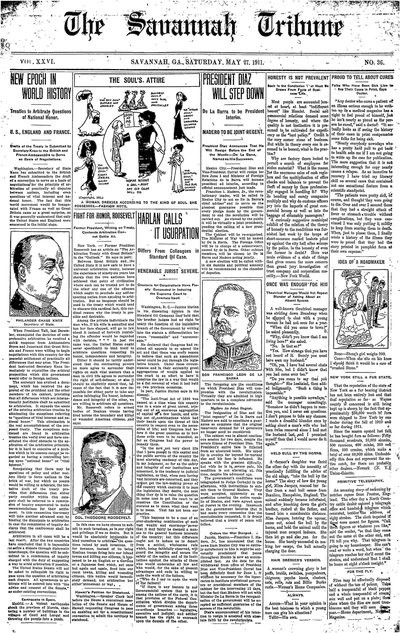
Page text (machine-generated)
V01. XXVI.
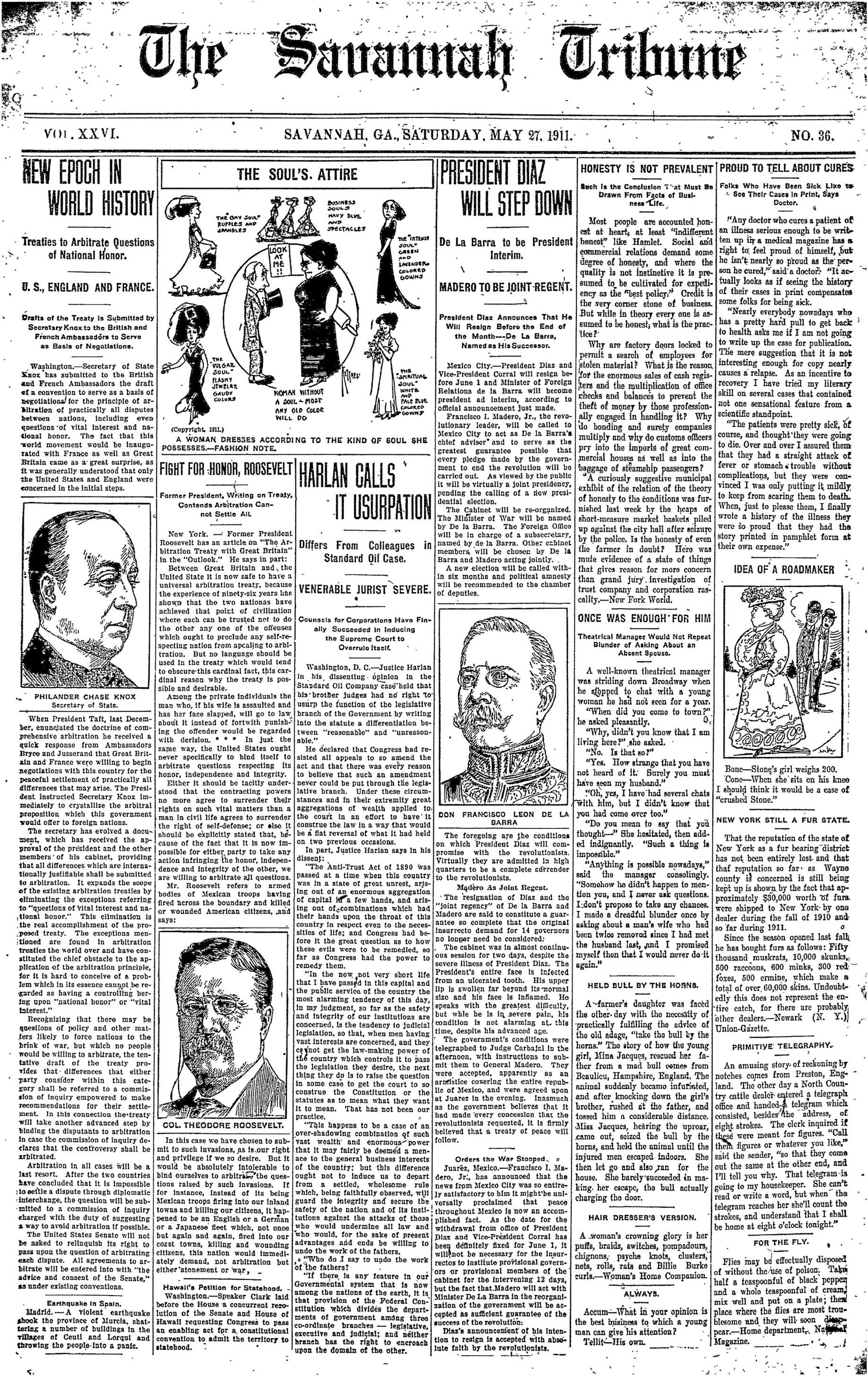
NEW EPOCH IN WORLD HISTORY
Treaties to Arbitrate Questions of National Honor.
U. S., ENGLAND AND FRANCE.
Drafts of the Treaty is Submitted by Secretary Knox to the British and French Ambassadors to Serve as Basis of Negotiations.
Washington.—Secretary of State Knox has submitted to the British and French Ambassadors the draft of a convention to serve as a basis of negotiations for the principle of arbitration of practically all disputes between nations, including even questions of vital interest and national honor. The fact that this world movement would be inaugurated with France as well as Great Britain came as a great surprise, as it was generally understood that only the United States and England were concerned in the initial steps.
P.
PHILANDER CHASE KNOX Secretary of State.
When President Taft, last December, enunciated the doctrine of comprehensive arbitration he received a quick response from Ambassadors Bryce and Jusserand that Great Britain and France were willing to begin negotiations with this country for the peaceful settlement of practically all differences that may arise. The President instructed Secretary Knox immediately to crystallize the arbitral proposition which this government would offer to foreign nations.
The secretary has evolved a document, which has received the approval of the president and the other members of his cabinet, providing that all differences which are internationally justifiable shall be submitted to arbitration. It expands the scope of the existing arbitration treaties by eliminating the exceptions referring to "questions of vital interest and national honor." This elimination is the real accomplishment of the proposed treaty. The exceptions mentioned are found in arbitration treaties the world over and have constituted the chief obstacle to the application of the arbitration principle, for it is hard to conceive of a problem which in its essence cannot be regarded as having a controlling bering upon "national honor" or "vital interest."
Recognizing that there may be questions of policy and other matters likely to force nations to the brink of war, but which no people would be willing to arbitrate, the tentative draft of the treaty provides that differences that either party consider within this category shall be referred to a commission of inquiry empowered to make recommendations for their settlement. In this connection the treaty will take another advanced step by binding the disputants to arbitration in case the commission of inquiry declares that the controversy shall be arbitrated.
Arbitration in all cases will be a last resort. After the two countries have concluded that it is impossible to settle a dispute through diplomatic interchange, the question will be submitted to a commission of inquiry charged with the duty of suggesting a way to avoid arbitration if possible. The United States Senate will not be asked to relinquish its right to pass upon the question of arbitrating each dispute. All agreements to arbitrate will be entered into with "the advice and consent of the Senate," as under existing conventions.
Earthquake In Spain.
Madrid. — A violent earthquake shook the province of Murcia, shattering a number of buildings in the villages of Ceuti and Lorquil and throwing the people into a panic.
THE SOUL'S. ATTIRE
THE DAY SOUL
RUFFLES AND
SWANGLES
LOOK
AT ME !!
THE
WULGAR
SOUL
FLASHY
JEWELRY
GAUDY
COLORS
NOMAN
A SOUL
ANY
WILL
(Copyright, 1911)
A WOMAN DRESSES ACCORDING
POSSESSES.—FASHION NOTE.
THE GAY SOUL
RUFFLES AND
SMANGLES
BUSINESS SOULS
NAVY BLUE
AND
SPECTACLES
THE INTENSE
SOUL
GREEN
AND
LAMENDER
COLORED
GOWNS
LOOK
AT
ME!!
THE
VULGAR
SOUL
FLASHY
JEWELRY
GAUDY
COLORS
NOMAN WITHOUT
A SOUL - MOST
ANY OLD COLOR
WILL DO
THE
SPIRITUAL
SOUL
WHITE
AND
PALE BLUE
COLORED
GOWNS
A WOMAN DRESSES ACCORDING TO THE KIND OF SOUL SHE POSSESSES.—FASHION NOTE.
FIGHT FOR HONOR, ROOSEVELT
Former President, Writing on Treaty,
Contends Arbitration Cannot Settle All
New York. — Former President
Roosevelt has an article on "The Arbitration Treaty with Great Britain"
in the "Outlook." He says in part:
Between Great Britain and the United State it is now safe to have a universal arbitration treaty, because the experience of ninety-six years has shown that the two nationas have achieved that point of civilization where each can be trusted not to do the other any one of the offenses which ought to preclude any self-respecting nation from apcaling to arbitration. But no language should be used in the treaty which would tend to obscure this cardinal fact, this cardinal reason why the treaty is possible and desirable.
Among the private individuals the man who, if his wife is assaulted and has her face slapped, will go to law about it instead of fortwith punishing the offender would be regarded with derision. * * * In just the same way, the United States ought never specifically to blind itself to arbitrate questions respecting its honor, independence and integrity. Either it should be tacitly understood that the contracting powers no more agree to surrender their rights on such vital matters than a man in civil life agrees to surrender the right of self-defense; or else it should be explicitly stated that, because of the fact that it is now impossible for either party to take any action infringing the honor, independence and integrity of the other, we are willing to arbitrate all questions.
Mr. Roosevelt refers to armed bodies of Mexican troops having fired across the boundary and killed or wounded American citizens, and says:
T. R.
COL. THEODORE ROOSEVELT.
In this case we have chosen to submit to such invasions, as is our right and privilege if we so desire. But it would be absolutely intolerable to blind ourselves to arbitrarily the questions raised by such invasions. If for instance, instead of its being Mexican troops firing into our inland towns and killing our citizens, it happened to be an English or a German or a Japanese fleet which, not once but again and again, fired into our coast towns, killing and wounding citizens, this nation would immediately demand, not arbitration but either atonement or war,
Hawaii's Petition for Statehood. Washington.—Speaker Clark laid before the House a concurrent resolution of the Senate and House of Hawaii requesting Congress to pass an enabling act for a constitutional convention to admit the territory to statehood.
SAVANNAH, GA., SATURDAY, MAY 27, 1911.
BUSINESS SOULS
HAVY BLUE
AND
SPECTACLES
THE INTENSE
SOUL
GREEN
AND
LAVENDER
COLORED
GOWNS
N WITHOUT
SOUL - MOST
OLD COLOR
DO
THE
"SPIRITUAL
SOUL"
WHITE
AND
PALE BLUE
COLORED
GOWNS
ING TO THE KIND OF SOUL SHE
HARLAN CALLS
IT USURPATION
Differs From Colleagues in Standard Oil Case.
VENERABLE JURIST SEVERE.
Counsels for Corporations Have Finally Succeeded in Inducing the Supreme Court to Overrule Itself.
Washington, D. C.—Justice Harlan in his dissenting opinion in the Standard Oil Company case held that his brother judges had no right to usurp the function of the legislative branch of the Government by writing into the statute a differentiation between "reasonable" and "unreasonable."
He declared that Congress had resisted all appeals to so amend the act and that there was every reason to believe that such an amendment never could be put through the legislative branch. Under these circumstances and in their extremity great aggregations of wealth applied to the court in an effort to have it construe the law in a way that would be a flat reversal of what it had held on two previous occasions.
In part, Justice Harlan says in his dissent:
"The Anti-Trust Act of 1890 was passed at a time when this country was in a state of great unrest, arising out of an enormous aggregation of capital in a few hands, and arising out of combinations which had their hands upon the throat of this country in respect even to the necessities of life; and Congress had before it the great question as to how these evils were to be remedied, so far as Congress had the power to remedy them.
"In the now, not very short life that I have passed in this capital and the public service of the country the most alarming tendency of this day, in my judgment, so far as the safety and integrity of our institutions are concerned, is the tendency to judicial legislation, so that, when men having vast interests are concerned, and they cannot get the law-making power of the country which controls it to pass the legislation they desire, the next thing they do is to raise the question in some case to get the court to so construe the Constitution or the statutes as to mean what they want it to mean. That has not been our practice.
"This happens to be a case of an over-shadowing combination of such vast wealth and enormous power that it may fairly be deemed a menace to the general business interests of the country; but this difference ought not to induce us to depart from a settled, wholesome rule which, being faithfully observed, will guard the integrity and secure the safety of the nation and of its institutions against the attacks of those who would undermine all law and who would, for the sake of present advantages and ends be willing to undo the work of the fathers.
"Who do I say to undo the work of the fathers?"
"If there is any feature in our Governmental system that is now among the nations of the earth, it is that provision of the Federal Constitution which divides the departments of government among three co-ordinate branches — legislative, executive and judicial; and neither branch has the right to encroach upon the domain of the other.
PRESIDENT DIAZ WILL STEP DOWN
PRESIDENT DIAZ WILL STEP DOWN
De La Barra to be President Interim.
President Diaz Announces That He Will Resign Before the End of the Month-De La Barra, Named as His Successor.
Mexico City- President Diaz and Vice-President Corral will resign before June 1 and Minister of Foreign Relations de la Barra will become president ad interim, according to official announcement just made.
Francisco I. Madero, Jr., the revolutionary leader, will be called to Mexico City to act as De la Barra's chief adviser and to serve as the greatest guarantee possible that every pledge made by the government to end the revolution will be carried out. As viewed by the public it will be virtually a joint presidency, pending the calling of a new presidential election.
The Cabinet will be re-organized. The Minister of War will be named by De la Barra. The Foreign Office will be in charge of a subsecretary, named by de la Barra. Other cabinet members will be chosen by De la Barra and Madero acting jointly.
A new election will be called within six months and political amnesty will be recommended to the chamber of deputies.
[Illustration of a man in a military uniform].
DON FRANCISCO LEON DE LA BARRA
The foregoing are the conditions on which President Diaz will compromise with the revolutionists. Virtually they are admitted in high quarters to be a complete surrender to the revolutionists.
Madero As Joint Regent.
The resignation of Diaz and the "joint regency" of De la Barra and Madero are said to constitute a guarantee so complete that the original insurrection demand for 14 governors no longer need be considered:
The cabinet was in almost continuous session for two days, despite the severe illness of President Diaz. The President's entire face is infected from an ulcerated tooth. His upper lip is swollen far beyond its normal size and his face is inflamed. He speaks with the greatest difficulty, but while he is in severe pain, his condition is not alarming at this time, despite his advanced age.
The government's conditions were telegraphed to Judge Carbajal in the afternoon, with instructions to submit them to General Madero. They were accepted, apparently as an armistice covering the entire republic of Mexico, and were agreed upon at Juarez in the evening. Inasmuch as the government believes that it had made every concession that the revolutionists requested, it is firmly believed that a treaty of peace will follow.
Orders the War Stooped.
Juaréz, Mexico.—Francisco I. Madero, Jr., has announced that the news from Mexico City was so entirely satisfactory to him it might be universally proclaimed that peace throughout Mexico is now an accomplished fact. As the date for the withdrawal from office of President Dlaz and Vice-President Corral has been definitely fixed for June 1, it will not be necessary for the insurrectors to institute provisional governors or provisional members of the cabinet for the intervening 12 days, but the fact that Madero will act with Minister De La Barra in the reorganization of the government will be accepted as sufficient guarantee of the success of the revolution:
Diaz's announcement of his intention to resign is accepted with absolute faith by the revolutionists.
HONESTY IS NOT PREVALENT
Such Is the Conclusion That Must Be Drawn From Facts of Business Life.
Most people are accounted honest at heart, at least "indifferent honest" like Hamlet. Social and commercial relations demand some degree of honesty, and where the quality is not instinctive it is presumed to be cultivated for expediency as the "best policy." Credit is the very corner stone of business. But while in theory every one is assumed to be honest, what is the practice?
Why are factory deors locked to permit a search of employees for stolen material? What is the reason for the enormous sales of cash registers and the multiplication of office checks and balances to prevent the theft of money by those professionally engaged in handling it? Why do bonding and surety companies multiply and why do customs officers pry into the imports of great commercial houses as well as into the baggage of steamship passengers?
A curiously suggestive municipal exhibit of the relation of the theory of honesty to the conditions was furnished last week by the heaps of short-measure market baskets piled up against the city hall after seizure by the police. Is the honesty of even the farmer in doubt? Here was mute evidence of a state of things that gives reason for more concern than grand jury. Investigation of trust company and corporation rascality.—New Fork World.
ONCE WAS ENOUGH* FOR HIM
Theatrical Manager Would Not Repeat Blunder of Asking About an Absent Spouse.
A well-known theatrical manager was striding down Broadway when he stopped to chat with a young woman he had not seen for a year.
"When did you come to town?" he asked pleasantly.
"Why, didn't you know that I am living here?" she asked.
"No. Is that so?"
"Yes. How strange that you have not heard of it. Surely you must have seen my husband."
"Oh, yes, I have had several chats with him, but I didn't know that you had come over too."
"Do you mean to say that you thought—" She hesitated, then added indignantly. "Such a thing is impossible."
"Anything is possible nowadays," said the manager consolingly. "Somehow he didn't happen to mention you, and I never ask questions. I don't propose to take any chances. I made a dreadful blunder once by asking about a man's wife who had been twice removed since I had met the husband last, and I promised myself then that I would never do it again."
HELD BULL BY THE HORNS.
A farmer's daughter was faced the other-day with the necessity of practically fulfilling the advice of the old adage, "take the bull by the horns." The story of how the young girl, Mina Jacques, rescued her father from a mad bull comes from Beaulicu, Hampshire, England. The animal suddenly became infuriated, and after knocking down the girl's brother, rushed at the father, and tossed him a considerable distance. Miss Jacques, hearing the uproar, came out, seized the bull by the horns, and held the animal until the injured men escaped indoors. She then let go and also ran for the house. She barely succeeded in making her escape, the bull actually charging the door.
HAIR DRESSER'S VERSION.
A woman's crowning glory is her puffs, braids, switches, pompadours, chignons; payche knots, clusters, nets, rolls, rats and Billie Burke curls.—Woman's Home Companion.
ALWAYS.
Accum—What in your opinion is the best business to which a young man can give his attention?
PROUD TO TELL ABOUT CURES
Folks Who Have Been Sick Like to See Their Cases in Print, Says Doctor.
"Any doctor who cures a patient of an illness serious enough to be written up in a medical magazine has a right to feel proud of himself, but he isn't nearly so proud as the person he cured," said a doctor. "It actually looks as if seeing the history of their cases in print compensates some folks for being sick.
"Nearly everybody nowadays who has a pretty hard pull to get back to health asks me if I am not going to write up the case for publication. The mere suggestion that it is not interesting enough for copy nearly causes a relapse. As an incentive to recovery I have tried my literary skill on several cases that contained not one sensational feature from a scientific standpoint.
"The patients were pretty sick, of course, and thought they were going to die. Over and over I assured them that they had a straight attack of fever or stomach trouble without complications, but they were convinced I was only putting it mildly to keep from scaring them to death. When, just to please them, I finally wrote a history of the illness they were so proud that they had the story printed in pamphlet form at their own expense."
M. K.
Bone—Stone's girl weighs 200.
Cone—When she sits on his knee
I should think it would be a case of
"crushed Stone."
NEW YORK STILL A FUR STATE.
That the reputation of the state of
New York as a fur bearing district
has not been entirely lost and that
that reputation so far as Wayne
county is concerned is still being
kept up is shown by the fact that
approximately $30,000 worth of furs
were shipped to New York-by one
dealer during the fall of 1910 and
so far during 1911.
Since the season opened last fall he has bought furs as follows: Fifty thousand muskrats, 10,000 skunks, 500 raccoons, 600 minks, 300 red foxes, 500 ermine, which make a total of over 60,000 skins. Undoubtedly this does not represent the entire catch, for there are probably other dealers.—Newark (N. Y.) Union-Gazette.
PRIMITIYE TELEGRAPHY.
An amusing story of reckoning by notches comes from Preston, England. The other day a North Country cattle dealer entered a telegraph office and handed a telegraph which consisted, besides the address, of eight strokes. The clerk inquired if these were meant for figures. "Call them figures or whatever you like," said the sender, "so that they come out the same at the other end, and I'll tell you why. That telegram is going to my housekeeper. She can't read or write a word, but when the telegram reaches her she'll count the strokes, and understand that I shall be home at eight o'clock tonight."
FOR THE FLY.
Flies may be effectually disposed of without the use of poison. Take half a teaspoonful of black pepper and a whole teaspoonful of cream, mix well and put on a plate; then place where the flies are most troublesome and they will soon disappear.—Home department, National Magazine.
POETRY
of and by Our People
"YOUR FAULTS AND MINE."
If you look for faults in others you can see
But the searchlight searches you
As well as me.
But the thing you ought to know is the thing you ought to do.
Then you'll never have the time To much ado.
If you guard your little self once a day You will find you have'a load In the way.
Burdened with many a little sin From without and from within.
Though your ways you try to mend Every day.
When you are quiet and weary worn, And you think your faults are gone; Many see.
Then if your life was then laid bare, Sins, enormous enough to scare A shield of iron you wish to wear; To be free.
When you are happy, joyous and gay
And you imagine your faults away;
They are there.
Hid beneath much merriment,
Pleasures rare and much content
In one direction your mind is bent;
The faults are there.
When you hear the church bell ring,
And you go and pray and sing;
You think you're free,
But your sins of all the week,
In the church house, you, they seek
Though you look salient, mild and meek,
They are there.
When you meet others in the way with
how-do-you.
A pleasant look to them you felgn to
show;
With a smile.
But you know in daily life.
Even if you secret strife
For your faults are much berife;
They defile.
You may try to walk a saint,
Bear your guilt without complaint;
You are known.
Upon His name, you loudly call.
Give up self, surrender all;
This you do when about to fall;
You have sown.
You may call all men your brother
You may try your faults to smother;
In this way.
But the Lamb of calvary
In His omnipotence you will see,
Depart, depart, to you will be
In Judgment day.
You can pay your earthly tithes
And sing your prayings from earth to
sky;
All is known.
But hypocrite and Pharisee, you
Praying loud about what you do,
You can neer the Narrow path pursue
For what you've done.
You may give something to the poor,
Open your heart to the very core;
That is good,
Then after you've done become mourner,
Flee from the right, become a Jonah
In Judgment day He will disown you
As He should.
You may hide your serious faults
Within your heart, a safety vault
You will be known.
You may with the public go
Whate'er they will that you do,
Your faults keep knocking at your door;
To be known.
You may say you done your duty,
Proclaimed the good, true, the beauty;
That's nothing new.
Your prayers at night do not forsake,
Pray keep me, Lord, until I wake,
Then your conscience you try to make
Play hypocrite, too.
The right is near, though turned aside
The wrong is welcome to abide,
Without dismay.
About your soul you wrap a cloak
Of sham, deceit and shameful dope,
Then cry aloud, I will not provoke
In any way.
To Satan you see partner share
You use his goods and sell his wares
As he demands.
With him you feel very much at home
When unseen, when you're alone.
Your sins are bold, to you they come
To shake glad hands.
If in life you try to reform
And pray in earnest, your sins be gone;
The struggle begins.
To you with whom they are acquainted
They flee from those whose lives are
tainted
And cling to you whose life is tainted
With much vim.
The soul that once becomes acclimated
To regions and climes both inhabited
With faults so dear,
Will find it work, too much undo
The things in life that come to you
Ere the crown be won that comes in
view,
Or Heavenly fare.
—Clarence F. Carr, in Palestine Plain-
dealer.
INDIVIDUALITY
A sculptor carved a statue fine,
And many came to see.
"It were immortal,' said his friends,
"If this or that might be."
The sculptor changed it here and there,
To suit their varied taste,
And thought: "The more the statue grows
The more the marble wastes."
And still he changed, and still his friends
Besides, it seemed anomalous,
Sans character or tone,
A thing unworthy of himself,
A bit of lifeless stone.
Then his good mallet he did take
And broke the image down,
And when he wrought another one
He let the critics frown.
And thus he learned the lesson great,
That those who toll for fame
Must be themselves, if they would win,
The laurels for their name.
-Chicago News
GEMS OF THOUGHT
Dare to be true; nothing can need
a lie;
A fault which needs it most, grows to two thereby.
—George Herbert.
Unblemism'd let me live, or die unknown;
O grant an honest fame, or grant me none. —Pope.
Beware of desperate steps. The darkest day,
Live till tomorrow, will have pass'd away. —Cowper.
There is
One great society alone on earth;
The noble living and the noble dead.
—Wordsworth.
The world goes up and the world goes down,
And the sunshine follows the rain;
And yesterday's sneer and yesterday's frown.
Can never come back again.
—Kingsley.
Let wealth and commerce, laws and learning die,
But leave us still our old nobility.
—Lord John Manners.
Truth would you teach, or save a sinking land?
All fear, none alds you, and few understand. —Alexander Pope.
Thus adorned, the two heroes, 'twixt shoulder and elbow.
Shook hands and went to it; and the word it was billow.
—John Byrom.
Vessels large may venture more,
But little boats should keep near shore.
All nature wears one universal grin.
—Fielding:
Lovellest of lovely things are they
On earth that soonest pass away,
The rose that lives its little hour
Is prized beyond the sculptured
flower. —Bryant.
But words are things, and a small drop
of ink,
Falling like dew upon a thought,
produces
That which makes thousands, per-
haps millions, think.
—Byron.
Commonly we say a judgment falls
upon a man for something in him we
cannot abide.—Selden.
For most men (till by losing rendered
sager)
Will back their own opinions by a
wager. —Byron.
Better to be despised for too
anxious apprehensions than ruined by
too confident security.—Burke.
Go forth under the open sky, and list
To Nature's teachings. —Bryant.
Music, when soft voices die.
Vibrates of the memory.
Odors, when sweet violets sicken.
Live within the sense they quicken.
Shelley.
Character must stand behold and
back up everything—the sermon, the
poem, the picture, the play. None
of them is worth a straw without it.
Holland.
Why should we faint and fear to live
alone.
Since all alone, so Heaven has willed,
we die.
Not man the tenderest heart, and next
own own.
Knows half the reasons, while we smile
and sigh.
—John Keble.
Her face is like the milky way l' the sky—
a meeting of gentle lights about a
name.
—Sir John Buckling.
That pits it onto the touch
To win or lose it all.
—Napier.
The modest frond of this small floor,
Belleve me, reader, can say no more
Than many a braver man—
"Here lea a truly honest man!"
—Richard Crashaw.
For modes of faith let graeless zealots
night.
He never be wrong whose life is In the
right.
Pope.
Forgiveness to the injured does belong.
But they neer pardon who have done the
wrong.
—Dryden.
Lovelless.
Needs not the foreign ald of ornament,
But is when unadorn'd adornment.
—Thompson.
What a strange thing is man, and what a stranger is woman!—Byron. I have learned, in whatsoever state I am, therewith to be content.—Philippians 4:11. There is no theme more plentiful to scan Than is the glorious goodly frame of man.—Du Baritas. Every man for himself and God for us all.—Cervantes.
SIDELIGHTS ON LIFE
Freakishness is the eccentricity of mediocrity; originality, that of genius.
How easy it would be for a man to remain in love with his wife if he had only married somebody else!
Referring to a woman as being on the shady side of forty is likely to ruffle her sunny disposition.
Many strings to one's beau do not always tie the matrimonial knot.
The other woman profits by the mistakes a man's wife makes.
Nowadays a referee is more in demand than a rector. Time and taximeters wait for no man—Pittsburg Dispatch.
SUPPLY EXHAUSTED.
He—Haven't you just one little kiss to spare me?
She—Well, I must admit I'm rather short of this week. I've given a whole lot away already.
The Sunday School Lesson
S. S. Lesson for May 28.
MICAH'S PICTURE OF UNIVERSAL PEACE.
(International Peace Lesson.)
Golden Text.—"Nation·shall not lift up a sword against nation, neither shall they learn war any more;"—Micah 4:3.
Micah 4:1-8. Commit vs. 2, 3.
Time—710 B. C. Place—Jerusalem. Exposition—I. The Capitol of the Great World Kingdom—Zion, 1, 2. This is a very appropriate passage for an international peace lesson. It shows very clearly how universal peace is to come—not through great peace conferences, as is now expected by those who are ignorant of the teachings of the Word, but through the coming of God's own King to rule in Zion over all nations. "The last (or latter) days" is used in the Bible as a general expression for future time, but predominately with reference to the times of the establishment of Messiah's kingdom (Gen. 40:1; Isa. 2:1-3; 48:47; Ezek. 31:6; Dan. 2:28, 44; 10:14; Hos. 3:5; Acts. 2:17; Heb. 1:2; 2 Pet. 3:3). By "the mountain of the house of the Lord" is meant Zion, where the temple or house of the Lord was located in the days of Solomon. It is difficult to say whether the words that follow mean simply that Zion shall be exalted as to power above all other mountains, or whether there is to be a literal raising of Mount Zion until it is in actual altitude higher than all mountains. There are indications elsewhere that a great physical ichchange will take place in the neighborhood of Jerusalem in the time of the final deliverance of Israel (Zech. 14:41). There are many prophetic references to Zion (e. g., ch. 3:12; Isa. 11:9; 66:20; Ezek. 43:12; Zech. 8:3). The future glory of the kingdoms of this world centers in this mountain. God has exalted no other mountain like this, but its most magnificent greatness lies in the future. It shall be exalted above all mountains and hills. All the rations of the earth shall seek this mountain (v. 1). All the people shall gather to the Messiah (Gen. 49:10), and Zion shall be the center of his kingdom. (cf. Ps. 22:27; 68:29-32; 72:7-11; 16-19; 86:9; Isa. 11:10; 27:13; 43:6; 49:6; 19-23; 60:31-48; 66:18-23; Jer. 3:17; 16:19; Zeph.3:9; 10; Zach. 2:11; 8:20-23; 14:16-21; Rom. 11:25, 26; Rev. 11:15; 15:4. Of course, this refers to the literal Zion. The attempt to apply this prophecy to the church results in utter confusion. This is one of the most fruitful sources of misinterpretation of Old Testament prophecy. In v. 2 we have a clear and profoundly significant statement of the events of those glorious coming days. We have precisely the same prophecy in Isa. 2:24, but a very significant change in Isa. 2:5 from Micah 4:5. Similar prophecies are found in Jer. 31:6; 50:4. 5; Zach. 8:20-23. These prophecies should all be studied together. Jehovah incarnate in the nation will be the teacher of all nations in that day (v. 2, cf. Isa. 54:13). All nations then will "walk in his paths."
II. Messlah's Reign. of Universal Peace and Prosperity, 3-5. Jehovah himself, incarnate in his king is to judge among the nations (v. 3, cf. 1 Sam. 2:10; Ps. 96:13; 98:9; Isa. 11:3-5; Matt. 25:31, 32; John 5:22, 23, 27-29; Acts 17:31; Rev. 19:11). He "shall reprove" the warring nations of the earth (cf. ch. 7:16, 17; Ps. 2:5-12; 110:1-5; Joel 3:2, 9-16; Zach. 14:3, 12-19; Rev. 19:17-21; 20:8, 9). After a mighty conflict, they will yield to his reproof and war shall come to an end, not through peace conferences, but through the triumph of God's king (v. 3, cf. Ps. 46:9; Isa. 2:4; 11:6-9; Ps. 72:7; Isa. 60:17, 18; 65:25). Peace conferences may accomplish much, but peace will never be thoroughly established until the prince of peace himself comes and takes the reins of government. With the establishment of peace there will be universal prosperity and security (v. 4). There was a brief anticipation of this in the reign of Solomon, who in this respect was a type of Christ (1 Kings 4:25). There shall be no more fear (v. 4, cf. Isa. 54:11; Jer. 23:5, 6). This glorious prophecy is absolutely sure of fulfillment "for the mouth of the Lord hath spoken it." At present, all people walk every one in the name of his God (v. 5, see R. V. margin), in that day, all will walk in the name of Jehovah, our God forever and ever.
III. The Regathering of Israel to Jerusalem, 6-8. Israel at present "halteth" or limpeth (cf. Gen. 32:28, 31), but a future day of glory awaits the people of God, Israel is now driven away and afflicted of God because of her sins (v. 6), but is to be regathered and exalted above the nations (cf. ch. 2:12; Jer. 31:8; Ezek. 34:13-17; 36:24; 37:21, 22; 39:25-29; Zeph. 3:19; Ps. 147:2; Isa. 30:8). In v. 7 we have mention of the saved remnant (cf. ch. 5:3, 7-8; Isa. 10:21, 22; 11:16; 49:21-23; Hos. 1:10; Zech. 9:13-17; 10:5-12; Rom. 11:5, 25-27). In that coming day, the Lord shall reign over them in Mount Zion and of his kingdom there shall be no end (v. 7, cf. Ps. 2:6; Isa. 9:6, 7; 24:23; Dan. 7:14, 27; Joel 3:17; Luke 1:33-Rev. 11:15). The dominion is to belong to Israel (v. 8). Jesus, the Christ, who is Jehovah God. (See Isa. 9:6, 7, and note v 7) is to be the king.
This is the law, when a man dies in his tent, whoever enters into his tent and everything in it shall be unclean for seven days—Numbers 19:14.
This passage shows clearly what an abhorrence the Hebrew lawgiver had of death. The term unclean conveys the idea of a blemish, of an attaint. He that was unclean was absolutely segregated for the time from the people. He was an unhallowed person. To be reinstated in religious communion he had to bring some expiatory sacrifice as a form of penance. And nothing rendered an Israelite so unclean as contact-with the dead. The priests and the Levites, representatives as they were of the people in the Hebrew hierarchy, were especially forbidden, except in rare instances, to come in contact with the dead. To the promulgators of the Hebrew faith the law was to embody a teaching of life for the living; not a religion of death for the dead.
This was in the nature of a protest against the death religion of the Egyptians, who worshipped their greatest god in the dark recesses on the grave. The mighty pyramids on the banks of the Nile, the wonder of the world for so many ages, stand mutely eloquent of a belief that made of its greatest monuments temples for the dead. So far as archaeologists have been able to discover, the greatest literary treasure of ancient Egypt is the "Book of the Dead," a manual intended for the soul in its approach to the god of the nether world. Against all this the religious legislation of the bible was an emphatic protest. What was sacred to the Egyptian was to be profane and unclean to the Israelite. Not the grave was to be his goal of aspiration, but the living world. He was not to envelop himself in the sombre shadows of superstitious fear, but he was to bathe in the light of day, full of hope and happiness, recognizing in his god a source of never-failing life.
The lawgiver here combats the pessimism which lay over all men like a pall. All biblical institutions took on the same optimistic tinge. There was the Sabbath, a day of rest and happiness; there was the spring festival, celebrating the joyousness of nature; there was the early harvest and the late harvest festivals, which celebrated the bounties of the earth, of sunshine and of life. Even the Day of Atonement, upon which it is expressly commanded "Ye shall afflict yourselves," had not always a penitential character; for we have evidence to prove that at one time it was made a day of rejoicing. So we may go through the whole body of Hebrew legislation and find it quick with the joy of life.
This was altogether new. It reveals the first decisive step toward a true conception of human life and of human worth. What characterized the heathen more than anything else was a certain abject servility with relation to the gods they created. These gods not only ruled with a remorseless vigor on earth, but revealed in the utmost cruelty in the after-life. The greatest sacrifices, therefore, were never too great for them. In the worship of Astarte women sacrificed their dearest possession; in the worship of Molocol mothers sacrificed their, babes; in the worship of Bal men sacrificed thousands of captives. Neither the Greek with all his wisdom nor the Roman with all his power could escape that debasing thrall. The Hebrew faith came with its teachings respecting a God of love and justice to release men from these abject fears. It brought with it a consciousness of the dignity of the human soul. It began to teach men to look upward. It removed the scales from their eyes and gave them visions of heaven.
It is well to know the spirit of Hebraic institutions in their beginnings because from that early day to the present it has never ceased to ennoble human life. The result is the uplift of mankind. Adapted to each age, understood variously by various peoples, the religion of the ancient Hebrews has finally transformed the world. Under one name or another the God of ancient Israel is the God of civilized mankind. Jew and Christian alike, therefore, give glory to God in the highest. The world has received its scheme of salvation. It was first announced, countless generations ago, to our lawgivers and our prophets. It was proclaimed with the force of divine law that man is made in the image of his Maker; that the eternal fire of heaven is kindled in his breast; that he has in himself the desire and the capacity to be like unto God—to strive for love, for justice, for holiness, and to attain it. It is also proclaimed as an eternal law that as a child of God man shall have the divine dignity of freedom, of choosing for himself the way he would walk—the way of good or of evil, the way of sin or saintliness, the way of life or death.
Thus out of the Egyptian darkness of superstition and dread there came a message of truth and true humanity; in the valley of the shadow of death where the human mind lay chained there dawned the light of God with the message of joy, of happiness and of life. A religion of life and of hops was given to the world, the priceless jewel that will ever adorn the human mind and heart. Of this law which our forefathers received the prophet long ago said: "It is a tree of life to them that lay hold of it and those who eling to it are accounted blossomed." C. A. RUBENSTEIN.
Congregation First Accused the Old Darky Minister and Then Found the Ham.
In connection with the inland waterways project Representative J. Hampton Moorg has been down south several times. On his last visit he encountered an old negro who had been a good guide once, when Mr. Moore weft sightseeing. The negro was a local preacher, but he was no longer working at it.
"What was the trouble, uncle?" the Philadelphia congressman asked.
"Wall, ah had some trouble wif
le congregashun. Dey brought sins
sb commission agin de ole man dat I
couldn't bar, an' Ijes had to quit.
Dey accused me of stealin' a ham—"
"But they couldn't prove that—a
thing that wasn't so."
"No, sur; no, suh. I guess you is
right, suh. They couldn't a-prove it
if de ole man hadn't a-mitted it."
"Well, why did you do that if it
wasn't true?"
"Well, suh, I kinder guess ah had
so. My conscience wouldn't let me
swade de' truf, an' when dey found
he ham undah de kitchen table Ijes
couldn't keep still."—Philadelphia
Times.
THIS MOTH DESTROYS TREES
It is of the Leopard Species and is the King of Destructive. Pests.
The destructive leopard moth has been in evidence for the past few years, but not until recently has the extent of its ravages been fully appreciated. It has killed thousands of trees of all kinds, Collier's Weekly says, and from present indications thousands more will be destroyed. It is difficult to control the pest because of its habits. Neither the moth nor the borer eats the leaves, so that arsenical poisons are useless. The borer, after entering the tree, remains two seasons, during which time it increases in size from a quarter of an inch to about three inches long and the size of a lead pencil. A small tree can be saved by carefully going over it and destroying the pest in its borings. This can be done with a wire or by injecting bisulphide of carbon into the holes and plugging them up. A large tree infested is doomed. The pest rivals in destructiveness the combined activities of both the gypsy and brown tail moths.
HER LADY8HIP'S BREEKS.
Donald dared not call his soul his own, let alone his wardrobe. His mistress supplied him with but one suit of livery—he himself had to supplement it with other garments—and he wore it only when she ordained. But there came a day when he had forgotten to take her orders, or she had forgotten to give them anent this—and there was a dinner party in prospect and the afternoon was waning. The old lady was engaged with visitors when the door opened and an agitated head was thrust in: "Is't ma ain breeks or yer ladyship's breeks I'm to pit on the nicht?" Report had it that her ladyship, without, the alteration of a muscle, decided in favor of her breeks.
TRADE SECRET8.
Uncle Sam has his trade secret—the ink employed in printing his banknotes. This ink is so valuable that the government would find it difficult to do any moneymaking without it, says Harper's Weekly. It is the only known variety that will "take" on the peculiar surface of the paper used in our currency—a paper, too, which is to a great extent a trade secret.
When the counterfeiter undertakes to imitate Uncle Sam's money he is confronted with the task of not only imitating the paper itself—a difficult enough proposition—but also of counterfeiting this unique ink as well.
NOTHING TO SAY.
The conceived young woman from West Philadelphia was discussing her lovers to her rather homely friend. The latest addition to her staff of admirers was not as flattering as the others were, and it made the conceived one feel badly.
"Now, George," she went on to explain, "always says I'm sweet as honey, but William never tells me—"
"Perhaps," the homely one cut in, "William realizes that honey attracts bees, and where bees are one is likely to be stung!"
And the conceived one said not a word—Philadelphia Times.
New York Bootblack Offered Him a Year's Free Shines as Price of Liberty.
A bold attempt to bribe a city magistrate and incidentally clog the wheels of justice happened recently in the Essex Market polico court. Just how Magistrate Harris was able to withstand the voice of the tempter in view of the fact that dusty weather is soon due is hard to understand.
"I'll shinea da shoes for you onea whole year, eef you letta me go; judge," tempted Francisco Palmetto, who had been arrested along with some forty others of his fellow bootbootblacks on complaint of the bureau of licenses for failing to have their old licenses renewed.
"You mean that you will give me free shines for a year if I let you go?" inquired Magistrate Harris. Palmetto assured the magistrate that that was exactly what he did mean and promised to come to the court every day to do the job.
The magistrate, however, after informing the bootblacks that they must procure new licenses and receiving their promises to do so, discharged them all. Palmetto wanted to give the magistrate a shine before he left, but Magistrate Harris couldn't stop the session.—New York Evening Sun.
NATURALLY.
oliver
scorer
De Quiz—Windy was a barker in a circus once, wasn't he?
De Whiz—Yes.
De Quiz—When did he give up this line of continuous talk?
De Whiz—When he married
"DOPE."
An amateur philologist in New York has unraveled the derivation of the principal word in the American vocabulary, "dope." "Dope" means ideas of any kind—predictions of results in sporting events, or a lawyer's argumentative material, or any intellectual method whatsoever. "Dope" is a contraction of the phrase, "Do you want 'ope'?" the last word of which is, in turn, an abbreviation of "opium." This used to be the question asked by the Chinese proprietor of the opium joints in San Francisco. "Dope" came to mean the fanoies that would come to the man dreaming under the influence of opium, and, finally, to mean any material—conjecture, argument or opinion.
EXERCISE FOR CHILDREN.
Exercise is absolutely necessary for children. Without it, it is impossible to keep the little ones' muscles and organs in a sound and healthy condition. Outdoor games are really the best form of exercise, as the children's interest is held while their muscles are being used, but brisk walks are good, too. But let them, also do a few simple calisthenics to strengthen the chest, as games do not provide for this. Simply stretching the arms in front and then slowly moving them from front to back and back again, and them above the head and down to the side a few times is quite enough. Teach them to breathe deeply at the same time.
LONDON'S LARGE BALLROOM
London is to have an immense ballroom, in which 8,000 persons will be able to dance. After the close of the skating season at Olympia the skating surface, which is of maple, will be scientifically treated by a Viennese expert, and the floor will be made the finest for dancing in the world.
EVEN THEN.
Captain Kidd—What's the trouble? Can't you make the prisoner walk the plank? Lieutenant—No, cap; he absolutely refuses to be a part of the spectacle unless we guarantee him a percentage of the moving picture receipts.—Puck.
The Farm
MANAGING VICIOUS BULLS.
As a rule, the wisest way of handling a bull that is inclined to be vicious is to hand him over to the butcher, as an animal of this class is never safe to trust. If he be one that has proven to be an extra good sire, and it is deemed desirable to keep him for service, the safest and simplest means of handling him is to blindfold him. He may be managed by means of ropes and pulleys, giving him room to move out of his stall when required, and bringing him back to his place; but it is a cumbersome method.
Blindfolding quietly takes all the conceit out of the blusterer. A broad bandage of double sacking securely fastened over his eyes, may serve the purpose ordinarily in the stable. This device may be used to good advantage in handling a nervous or excitable beast while being led to market or drawn in a wagon to be shipped on a train.
I remember a case of a helper received on the train being so wildly excited that she would jump at a person approaching her to untie her halter, but, by throwing a blanket over her head, and afterwards tying a sack over her eyes, she was quietly unloaded and tied behind a wagon which she followed as meekly as one could desire.
Mismanagement or lack of thought makes a great deal of trouble in the handling of stock. How often do we see men chasing pigs all over the place in the vain effort to get them into a pen, the porkers always going in the direction contrary to the one they desired to go; while, by having a pair of low light hurdles, hinged together, forming a V-shaped guide, the animals can be handled quickly, and with the use of no unseemly words.
Vicious bulls are generally made so by unwise treatment when young, giving them too much liberty, or using them cruelly. It is well to use them kindly, but they should be trusted no more than is necessary, for it sometimes happens that a bull that has been quiet, suddenly and unexpectedly becomes vicious, and malms a man for life or goes him to death. It is the part of wisdom to handle a bull with a strong staff and a safe connection with his nosering, no matter how quiet he may be—W. H. Underwood, in the Indiana Farmer.
DRESSING AND MARKETING POULTRY.
The condition of dressed poultry when sent to the market largely determines the price. Frequently poultry raisers complain of the low price they get for their chickens when in truth the specimens sent should have been used for home consumption rather than for market. g. Poultry which makes a good show always meets a ready sale and brings good profits. Poultry dressed and packed in every conceivable way without regard to appearance, seldom pays the shipper for his trouble, and, as a rule, he literally has to give it away to get it off his hands. This is wrong. A few poor birds in a crate of good ones ruin the sale of the whole lot as first-class birds, and injure the reputation of the shipper. It would be better to throw away the absolutely poor ones than to lower the price that may be realized from the sale of the good ones.
The best way to kill poultry is that way which causes instant death without disfigurement or pain. Suspend the chicken by tying the legs firmly to a pole or heavy wire across the killing room at a convenient distance from the floor. Open the fowl's beak with a sharp-pointed, narrow-bladed knife, and make an inclusion at the back of the roof of the mouth, dividing the vertibra. Another painless way of killing is to sever the veins in the neck, and leave hanging until properly bled. Keep fowls without food for at least 24 hours before killing, as full crops injure the appearance and are very likely to sour. American Cultivator.
HORSE COLLARS SHOULD FIT.
A badly fitting collar makes the young team horse troublesome. It is of the greatest importance that the collar should fit perfectly, so that it does not cause discomfort to the animal nor wring or hurt its shoulders. The shoulders often become more or less tender at first through the pressure of the collar against them, and in order to harden the skin on them it is a good plan to bathe them with a solution of salt in water (or alum in water) when the young horse has finished its work for the day. Weekly Witness.
PRUNING IS IMPORTANT.
Pruning is one of the most important factors in the production of first class fruit. While there are many methods for pruning trees, some right and some wrong, yet most of the general principles aim at the same thing to remove the surplus wood, develop a strong frame and keep the tree within the bounds of the grower. Farmers' Home Journal.
REPAIRS TO MACADAM.
Attention is called to the experiments made by the office of public roads, wherein it was shown by instantaneous photography that the damage to the roads was produced by the rear or traction wheels of motor cars, and particularly at a speed above twenty-five miles an hour. The force with which they were propelled was sufficient to cause a marked slip upon the surface of the hard roadbed, such as is often seen in an exaggerated manner on a frozen surface. The question is raised, Mr. Richardson, states, as to the policy of constructing so large an extent of macadam roads as has been done in the last few years, and as is proposed for the future, without considering a surface of bitumen, which, he says, at a reasonable additional cost, may avoid the existing conditions.
Several authorities are quoted as to cost of repairs of macadam roads under present conditions. A road near Lynn, in Massachusetts, of almost perfect macadam construction, exposed to wind, sun and high-speed automobiles, had to be resurfaced after a single year's service. W. C. Carpenter, county surveyor in Yorkshire, Eng., reported at the Paris congress that the maintenance of roads in his district was $482 per mile in 1890, and $789 in 1908. Mr. Hooley, holding the same position in Nottinghamshire, states that the maintenance cost was formerly $250 per mile; now it is $750, and he advises a resurfacing with blittuminous macadam—Good Roads Magazine.
MAKING ALFALFA HAY.
The best alfalfa hay is made by raking and cocking while fairly green and allowing to cure for several days in the cock. On account of the uncertainty of the weather, however, this method is often found impracticable and a quicker method in which the alfalfa is dried in the sunlight must be used. It is always very important that the raking and as much of the other handling of the crop as possible be done while the alfalfa is sufficiently green to retain its leaves, as the leaves are by far the best part of the plant.
A method of handling the crop which has given good satisfaction at the Maryland station is to cut the alfalfa in the morning as soon as the dew is off, allow it to remain in the swath as late in the afternoon as possible and yet get it raked before the evening dew falls and then put it in tall cocks, if it looks like rain; otherwise leave it in the winrow over night. If the next day is sunshiny the hay is scattered after the dew is off, allowed to dry until late afternoon and put in the barn. If the weather is not favorable for drying, more than two days will be required to cure the hay.
Hay put in the barn or stack when only partially cured is likely to mold or to char and be dusty, so that it is practically unsalable, and in some cases sufficient heat is generated to ignite the whole mass.—Weekly Witness.
ONE-CROP SYSTEM DON'T PAY.
A one-crop system followed year after year upon the same land tends to the breeding of insect enemies and to the development of fungous diseases peculiar to the crop which is being raised—Weekly Witness.
General Farm Notes
---
Don't forget that a wire.screen door is as beneficial in winter as in summer for the hen house.
Don't advertise yourself as a specialist or an expert if you have not exhibited your stock at the poultry shows.
The farmer generally gives less consideration to the roosts and nests than to any other part of his poultry house. This is not right.
Desiring to save labor, the roosts are nailed to the walls and the nests are so fastened as to become a part of the building itself in many cases.
Under such conditions it is impossible to thoroughly clean the poultry house and, rid it of vermin, for as long as there is a crack or crevice in which a louse can hide there will be a rapid increase of the pests, as a single female lays enough eggs in a day to furnish the foundation for a million in a week.
The perches should be built so that they do not touch the walls at any place, for the red mites or lice which do the most harm do not stay on the fowls during the daytime, but come forth at night to seek their prey.
If the perches do not touch the walls at any place, the lice will have less opportunity to hide, and then if the roosts are thoroughly wetted with coal oil once a week for a month or two little difficulty will be encountered ed with these lice.
Odds and Ends
AN UNREASONABLE FRIEND.
AN UNREASONABLE FRIEND.
Several young artists in Philadelphia are telling a story on another welder of the brush who is a fellow member in a little club. One of the rules of the club is that cach member must keep his finished paintings up to a certain number. The artist on whom the story is told is noted for his indolence. He keeps up to the requirement regarding the number, but never exceeds it. But for his distaste for work the artist probably would be very comfortably fixed financially, as he has considerable talent. As a matter of fact, he is usually on the edge of penury. Several days ago, when his exchequer was unusually low, a friend visited him in his studio. The friend looked at several of the paintings, while the artist lay on a couch, smoking a pipe.
"I like this," the friend finally said, painting to one of them. He named a good price which he was willing to pay. The artist looked at him mournfully.
"Aw, don't do that," he said. "If you do I'll have to paint another."—Philadelphia Times.
FIRESIDE FUN.
9 Place on a table a large bowl of peanuts; some six or eight feet away place an empty bowl on another table. The children must "count out," and the child who is "it" calls the name of the one he selects to go to Peanut Town. To this child he now gives a dinner knife and commands him:
Go at once to Peanut Town,
Peanut Town, Peanut Town;
Go at once to Peanut Town
And haul its peanuts down.
The child takes the knife to the bowl of peanuts, lifts as many as possible on the blade and starts with them to the empty bowl. The child who brings the largest number in three trials is the winner of the game. One child is appointed mayor of Peanut Town, and his duty is to gather the fallen nuts and return them to the bowl—Peanut Town—Philadelphia Ledger.
MARBLES.
Marbles got their name from the fact that originally little bits of marble were rolled down the hills and rounded and pounded by other stones until they became toys for the children to play with. It is said that the Dutch exported them to England. Whether they did or not makes little difference to the boys and girls of today. No matter who introduced the world to marbles as toys, they are with us and always will be. Some of you get them from other children, some of you trade postage stamps for them, but some persons originally bought them from the little store around the corner, whose owner got them from the greatest toyshop in the world—Germany. In the beginning marbles were called "bowie," and men and women played with them as well as children—Dundee Advertiser.
FIRST AID FOR A POET
John P. Irish, the San Francisco orator and office-holder, was entertaining Joaquin Miller, the poet, one night. Upon hearing a particularly funny story by the host the poet fell off his chair in a paroxysm of mirth.
Irish thought the poet had a seluce of some kind and he rushed to the sideboard, took a bottle of brandy and stuck the top of it into Miller's mouth, hoping to revive him.
Presently Miller waved his hands freely and Irish removed the bottle.
"What is it?" asked Irish solicitously.
"Remove the cork!" whispered the poet, hoarsely. "Remove the cork!"—Saturday Evening Post.
ANCIENT SUPERSTITION
A primitive notion existed among the Romans and other races that a bridge was an offense and injury to the river god, as it saved people from being drowned while fording or swimming across and robbed the deity of a certain number of victims which were his due. For many centuries in Rome propitulatory offerings of human victims were made every year to the Tiber. Men and women were drowned by being bound and flung from the wooden Sublician bridge, which, till nearly the end of the republican period, was the one and only bridge across the Tiber in Rome.
LIGHT WORK
A weather-beaten damsel somewhat over six feet in height and with a pair of shoulders proportionately broad, appeared at a back door in Wyoming and asked for light housework. She said that her name was Lizzie and explained that she had been ill with typhoid and was convalescing.
"Where did you come from, Lizzie?" inquired the woman of the house.
"Where have you been?"
"I've been workin' out on Howell's ranch," replied Lizzie, "diggin' postholes while I was gittin' my strength back."
ALLITERATED ADAGES
T is more blessed to bestow than to beget.
There's a fatality that fashions our fortunes.
A peregrinating pebble procures no profits.
The mills of the gods are poky, but they pulverize perfectly.
The pirate who purloins my portemonnaie pifers piffe—Lippincott's.
WHITE NEWSPAPER CLAIMS
NEGRO SCHOOLS ARE
VALUABLE AS NEIGHBORS
To the citizens of Radford, Va., who have raised objections against the proposed location of a negro school on the old site of St. Alban's, the Roanoke Times conveys strong reassurances. "Experience in other parts of the state," it says, "has shown that the negro education institutions are quiet and good neighbors. In one or two counties they have been of vast advantage by bringing up the negroes all around them to better standards of living and better understanding of their duties. The prejudice against negro schools is a relic of the time, now a good many years gone, when a lot of northern people came down here with their heads full of wild fancies and grotesque notions." In North Carolina experience has shown exactly the same thing. Biddle university at Charlotte, Livingstone college at Sailsbury, Shaw university at Raleigh—these, together with the State Agricultural and Mechanical College for Negroes at Greensboro, are as well-governed institutions in their relation to the public as can be found anywhere. In fact, they are admirably ordered throughout. Immediate proximity to them is free from the exuberance which neighbors of institutions for boys or young men of other races more or less good-humoredly witness at times; for the negro schools are penetrated by an exceptional sense of responsibility. They seek to deserve the respect of the white people and exert the best possible influence over members of their own race. This sentiment pervades the whole student body thoroughly.
Tuskegee Institute, Booker T. Washington's well-known school, has always maintained the best relations with its white neighbors. For purposes of specific illustration we may take an institution hero in North Carolina which is not only taught by negroes, like Tuskegee, but unlike Tuskegee, has no connection with any other parent or sustaining body not composed of negroes alone; which, still further goes to prove that the slightest element of undesirability would make itself felt. This institution is Livingstone college, already mentioned. Founded by the late Dr. J. C. Price, one of the most notable men his race has ever produced, it has been presided over since his death by Dr. W. H. Goler, a worthy successor. It is an institution for both sexes of the African Methodist Episcopal church, Zion. Immediately adjoining this college, separated only by a street, lies one of the cholest residence sections of Salisbury. The college is in no way objectionable to its immediate neighbors or to any one else. Relations with the white people of the whole community are all that could be desired. Livingstone college thus furnishes in all respects a most striking object-less.
There is no reason why Radford, Va., or any other place should object to well-conducted negro colleges or schools. They are desirable acquisitions from every standpoint.—A leading editorial, Charlotte Dally Observer, Monday, November 28, 1910.
CANADA FEARS HOOKWORM
THAT IS ONE EXCUSE FOR BEING HARD ON THE COLORED.
Edmonton, Alberta (Special).—Dr. T. H. Whitelaw, health officer, expresses alarm least the many negroes from the southern states arriving daily in Edmonton bring the hookworm with them. The influx of negroes here has been great since spring opened, several hundred having arrived during the last week. Although Dr. Whitelaw says there is not so much danger in this colder region, with higher altitude and drier atmosphere, as it is in the south, still he deems the matter of sufficient importance to make a special protest to Minister of the Interior Oliver.
ABSTRACTING THE ABSTRACT.
He was a huge man of the navvy species, and as he stood in the witness box counsel eyed him dubiously. He knew he would be a hard nut to crack—a very hard nut, indeed.
"What we want to get at," he began, "is who was the aggressor?" "Eh?" said the witness, puzzled.
"Let me illustrate my meaning," said counsel. "Supposing that I should meet you in the street and strike you in the face, I would be the aggressor." "You'd be a fool!" said the witness, with growing emphasis.
"No—no!" said counsel, with heightened color. "I was speaking only in abstract. Suppose we met, and without provocation I struck you. I should be committing an act of aggression."
The navvy hunched his huge shoulders.
"You'd be committing suicide, mister," he remarked grimly.
"You may sit down!" snapped counsel.
STRATEGY.
The tursey was not a very large one, and Mrs. Pedagog's boulders began to be a little anxious on the subject of its going around. Finally the last bit was distributed, and the Idlot, glancing at his portion, observed that he had drawn the neck and the pope's nose. "Ah, Mrs. Pedagog," said he, with a genial smile, "you are a wonder at making both ends meet"—Lipnincott's
Of Interest to Our Women
MOURNING.
Mourning may be worn for six months, or a year, for a brother or sister. In one case, a person goes into gray and lavender, etc., at the end of six months, and in the other, at the end of the year. One never goes from black to bright colors.
Three rows of ribbon at the bottom of a net veil is the kind suitable, and it is worn during the mourning period. White mull collar and cuffs are deep mourning, and so proper at any time. They should be worn during the funeral.
Plain gold jewelry is proper to wear at any time after the funeral, unless a woman wears crepe. In such a case only black jewelry is possible. Gold is not worn until crepe is given up. Pearls are worn in deep mourning.
Hemstitched white lawn collar and cuff bands may be worn in the deepest mourning. If heavy mourning has been put on, only black jewelry in good form, but if only black, without crepe, is used, plain gold jewelry is all right unless many pieces are put on at a time. The point is, a person is not supposed to go into self-decoration when wearing mourning, but a watch or eyeglass chain and a few pins may be brought under the head of requirements.
CLEOPATRA'S HOBBLE SKIRT.
Scientific research has disclosed that Cleopatra was the first woman to wear a hobble skirt. Heirolglyphics on newly excavated building blocks in Egypt show the famous queen in a gown drawn so tightly about her ankles that one wonders how she walked at all. Come to think of it, Cleopatra didn't do much walking. She accomplished most of her journeying in a barge with rugs strewn carelessly over the deck and attendants lolling about in poses that made the royal craft look like a Turkish bath turned inside out. One cannot blame the attendants, perhaps, for taking advantage of every opportunity to loll, for Antony's sweetheart was a fault-finding housekeeper, and generally kept Charmion and her other attendants on the jump. The theory that Cleopatra committed suicide because Octavia splayed a hobble skirt tighter than hers is open to debate. Anyway, Cleo created the role of the hobble—New York Press.
CALMOND MOUSSE.
Silt one pound of French chestnuts; put them in a frying pan over the fire for ten minutes, tossing them about; remove from the fire and peel. Place them in a saucepan with a quart of milk and cook them for 30 minutes, stirring constantly. When the milk is absorbed rub the chestnuts through a sieve. Return the purée to the saucepan, adding one-half pound of powdered sugar, and cook five minutes. Turn into a large mixing bowl and when cold flavor with vanilla extract. Beat in a quart of stiffly whipped cream and the whites of two eggs. Butter a fancy mold and line it with macaroons. Pour in the chestnuts and pack in ice and salt for three hours before serving. Garnish with chopped almonds, and serve with a custard cream sauce.—Boston Post.
HOT CROSS BUNS.
Mix two pounds of flour, half a pound of well washed currants, a teaspoonful of mixed spices, a half pint of warmed milk and a yeast cake dissolved in cold water. Make a batter, add a half teaspoonful of salt and set it to rise. When it ferments, add a half pound of melted butter and enough milk to make a soft paste, dust with flour and let rise again. for half an hour. Shape the dough into buns and lay them apart on buttered tin plates in rows to rise for a half hour. Press with a cross mold, and bake in a quick oven. Powdered sugar may be sprinkled over them or not, according to taste. This recipe makes two dozen buns.
FASTENING SHOE BUTTONS.
If one is unable to have the buttons on the children's shoes put on with patent fasteners the method adopted by one mother will save much labor in sewing on the buttons. With a attletto she pierces a hole through the leather, just large enough for the shank of the button to slip through; then she strings the buttons in place by running a piece of lacing through the shanks, the tag end of the lacing is then sewed firmly into place at either end. This plan followed, the buttons will likely stay in place as long as the shoes wear.
WASHABLE GLOVES ARE
REAL BOON TO WOMEN.
Washable mocha gloves will prove a boon to those women who always like to have perfectly clean gloves, which cannot be the case when kid gloves are worn. The washable mocha comes in two colors, the regulation gray and a natural yellow, which looks much like a fine chamols. Both are extremely good looking gloves, having heavy stitching on the backs in black, white and self colors.
MAKING LINGERIE TO' ORDER.
The woman who can do dainty embroidery and fine needlework has a pleasant means of livelihood at her command. This is the making of lingerie to order, with the perfect fit and hand workmanship of each garment a specialty. A clever little woman who had always taken pleasure in making her own pretty lingerie conceived the idea of adding to her pin money by fashioning equally dainty garments for her friends. Now she has so many orders that she keeps two other women busy helping her with the hand needlework, doing the embroidery of the garments and the fitting herself. It is almost impossible to obtain lingerie that fits among the French hand-made garments, yet once a woman's measurements have been taken and a set of garments fitted to her it is easy to make any quantity afterward on the same lines—and orders are sure to pour in on her who will do the pretty work.
LATEST THING IN LINGERIE.
When you see some of the soft, clingy and entirely adorable crepo lingerie which is shown in the French shops now, you will simply throw discretion to the winds, take out the bill you were fondly cherishing for something or other and have the tempress—who in this case is the little sales lady with the queer, accent—wrap up your pet piece. Then you'll hurry home to "try it on," revel in the possession of it and linger over the luxury of its dalty laces and fascinating ribbon bows.
And, really, you won't be so indiscreet, after all, especially if you are a girl without the privilege of a home, because the crepe lingerie doesn't require a laudress to be made fresh and clean. Usually it is combined with real Torchon or Irish croshet, both of which can be pulled into shape without the aid of an iron.
FILLINGS FOR OYSTER PATTIES.
Make the cream first after the following rule: Melt a large tablespoonful of butter, add to it the juice of half a lemon, and pinch of bicarbonate of soda. While it is foaming up add a cup of rich milk or part cream, in which a teaspoonful of corn starch has been dissolved. Stir carefully until it is, the proper consistency, taking care that it does not burn, then set aside to keep warm. Drain the oysters and when the edges curl in a couple of minutes they are done. Drain them carefully and add them to the hot cream, with salt and pepper to taste, and fill the pattle shell garnishing with parsley. This fills six shells.
PUMICE STONE FOR PANS.
When washing kitchen utensils, such as skillets, frying pans, etc., scour with a flat piece of pumice stone, which can be procured at any drug store for a few cents and lasts for some time. You will find it a good help in keeping such articles bright and clean.
FADS.
There is a great demand for artificial flowers for corsage bouquets. Gardenias, lilacs and camellias are displacing the popular violets.
For strictly tailored hats there are ornaments of straw, of ribbon, and the well knitted stuff that looks like the sort used in gloves and muffers.
The velled girdles are charming things. One, for instance, has a backing of dark blue silk with a "layer" of dull Persian and a velling of dark green chion.
The springtime colored blouse that matches the materials of which the tailored suit is made is an important factor in the outfit of every well-dressed woman.
Despite the continued vogue of the one-piece and one-color toned frock, separate waists of white batiste, mull, dotted swiss and eyelet embroidery are very much in evidence.
Many new mixtures of silk and cotton are offered under the titles of foulard, messaline and tussore.
Immense bags are carried with robes. They are of metallic tissues or of real lace combined with velvets.
The shadow pattern, the spider web and the cobweb designs are much wern, as are the Shetland wool vells.
Stunning belts of white plaque, with large oblong buckles to match, are suitable for the stiffly starched shirt waist.
Cotton voile and "aeronette" are used extensively for children's dresses. The trimming is usually Cluny or Irish point lace.
For outdoors there are now seen straight, flat scarfs, to be worn beneath the coats, edged with fur or marabou. There are built on the lines of knit mufflers and are made of soft silk, wadded. They can be procured in all colors.
To prevent any crocking of fur collars on evening wraps there are now being sold little flat collars of chiffon over satin. They are not for warmth, but when made in shades to match the linings of wraps they add a delightful touch of beauty and utility that few/women can resist. So soft are these new scarfs that the outer wrap fits the wearer in unwrinkled glory, the same.
The Savannah Tribune,
Established 1875
By JOHN H. DEVEAUX.
Published Every Saturday
462 West Broad Street.
Phone 2171.
Subscription Rates:
One Year - - - $1.25
Six Months - - - .75
Three Months - - - .50
Remittance must be made by Express
or Post Office Money Order, or Registered
Letter. Advertising rates given on
application.
Entered at the Post Office at Savannah, Ga., as Second-Class mail matter.
SATURDAY.MAY 27.1911
The coming meeting of the National Negro Business League in Little Rock, Ark., might well have a significant meaning to the Negro business men of this city and act as incentive for them to get together and work in harmony and unison. There is no city in which more need is felt for organization of this sort than Savannah and the quicker our men of the business world get together and formulate some plans by which they can all work together the sooner our people will become welded into one solid mass working along all lines harmoniously and for the mutual benefit of all persons concerned. Our greatest need in Savannah is some organizations which will have for its sole aim the furthering of race pride and race enterprise. We have a wonderful opportunity here and all that is needed is that we wake up and begin working together. This is a day of cooperative work and we must follow the lead of other towns and come together remembering "to together we stand, divided we fall." Let us lay aside all petty jealousies that may exist among us and once for all resolve to put self in the back ground and work for the common good of the whole people.
Last year a certain set of colored business gentlemen of Atlanta and other cities contrived the idea that a colored straight life insurance company furthered and fostered by Negroes would be an admirable thing and a good paying investment. Therefore they set to work to make soundings and after looking round carefully came to the conclusion that the time was ripe and a concern such as they would like to see established would meet with the approval of the people and be well supported. With vim, vigor and determination all parties concerned in this project, set out to arouse interest and enthusiasm. How well they wrought may be known from the fact that of the hundred thousand dollars required by the state as security sixty odd thousand were subscribed and paid in a few days prior to the expiration of the time set by the state. Forty thousand dollars more were needed before they could open their doors to the public and become a fixed institution. It was a case of "almost but not quite." This was an admirable start for the men who were behind this movement and speaks in no uncertain terms for the confidence which the public manifested in them. This same company of men are behind a similar movement this year and are working with an eye single to the successful raising of this amount of money. The Standard Life Insurance Company, we believe, will be a certainty are the expiration of the time limit rolls by for with such scrupulously honest, energetic men behind the project for a second time failure will be unknown to them. They will have this time the benefit of past experience and the people of Georgia and other states will rally to their support. Past experience is a very good guide and one which generally leads to success if we follow the proper channels and there is every reason to believe that the gentlemen who head this concern will let past endeavors be a guide to them, to profit by their failures and to continue in the methods that brought success. In the success of this project Negroes all over the country will feel proud, for it will be one of the most gigantic undertakings ever "pulled off" by our people. The Negro has shown marked ability in handling industrial insurance companies and they have prospered under his control wherever properly handled. This new enterprise is a step farther on and one which if we are able to negotiate successfully will inestimably raise us in the estimation of public opinion the country over. United efforts, coupled, with the unwavering confidence which past efforts have caused to be placed in these men, are going to carry this worthy project to a successful termination and before another year rolls by we are expecting The Standard Life to be one of our permanent institutions.
In a meeting of the teachers Normal class a short while ago the question arose as to how much money was handled by the public school children, and it seemed to be the consensus of opinion that there were many who spent as much as ten cents a day while the majority would be found with hardly any less than five cents a day. This brings us to a very serious matter and that is how much money should we allow our children to spend daily. Of course there is no way of mentioning any specific sum which we should allow them but it is certainly proper and fitting that they should not be burdened with nickels and dimes thereby training them in lavisiness and wastefulness. It is necessary for children after a hard morning's work in school to partake of some nourishment and the best way for this to be supplied is by a little lunch carried from home, for in this way parents are always aware of the kind of food their children are eating. There are some parents who are unable to furnish such lunches not on account of lack of provisions but because they have not the time to fix them up. In this case the only alternative is for the child to purchase a lunch at school or go the day through without food in which event he cannot get satisfactory results from his brain on account of lack of strength. For the brain to give most satisfactory results it must be stimulated by a well nourished body. Three or four hours' work in the school room is sufficient to tax the strength of any child and at the end of this period he not only needs recreation but a stimulant in the form of food. In some cities there is a regulation placed upon the cost of lunches sold in schools, the usual price being two cents, a sum within reach of the humblest child. In these cities not only is there a set price but the lunches supplied are passed upon by the Board of Health and the lunch stands inspected daily, kept in a perfectly sanitary condition and made inviting in appearance. Under these conditions lunches bought at school are about as appetizing as those brought from home, and some times more so, and there is but very little advantage enjoyed by either method. However allowing children to handle from five to ten cents a day for lunch is a particularly bad practice and often leads to a fondness for money which when it is denied by parents some times causes them to secure it from other sources. Two or three cents a day is enough for any child to handle for lunch and when this limit is passed we are simply encouraging our children to be wasteful and careless. Parents should have a thorough knowledge of the money handle by their children and when it is suspected that they are becoming wasteful of the pennies given them they should impress upon them the necessity of learning the value of every cent placed in their possession. They should see to it that they do not allow their children to grow up squandering every cent they get but train them to be saving, economical and careful of the little amount given them while young and when they become older they will so have imbibed the spirit of economy that it will be second nature for them to put away a certain amount each month for future usefulness.
The recent series of lynchings which have taken place in this state and in Florida have caused a shudder to run through the peaceful, law-abiding citizens of this section of the country. The total number of such depredations for the week far surpasses the record for a similar length of time in years and simply shows the evident manifestation on the part of the low and lawless class of white citizens to take the law into their own hands whenever they even so much as have a seeming grievance against a Negro. There was a time not far back when the unfortunate victim of a mob would be accorded the privilege of denying or affirming his guilt but even this mode of procedure is done away with now and he is strung up to a tree with his body as a target to be riddled with bullets with out any undue formality. This point is simply mentioned to show that mob violence now is not the exception and that the members of the mob do not any longer think it necessary to make the mock trial of the victim to establish his guilt but knowing as they do that their actions will be sustained to the extent that there will be no after result that they immediately proceed to make a clean and quick finish of him. Of the many atrocious crimes recorded in the annals, of mob violence it will be hard to find mention of a more deliberate and
ghoulish one than that which was perpetrated last week when six Negroes were taken from jail at Lake City, Florida, and put to death and in this state on last Sunday at Swainsboro when an old hoary head Negro was riddled with bullets for wounding a marshal who had gone to arrest him. These are but two of the many instances which have come to light recently where Negroes have been made to feel the effects of mob violence. There seems to be a regular wave of mob violence going the rounds of the south and 'tis more the rule than exception now to pick up a daily paper without reading of the death of some unfortunate black man from this source. There used to be a time when this sort of punishment was simply meted out for the "unpardonable crime" but now upon the mere pretext the black man is delivered to the mob and put to death. As a consequence of this series of lynchings hundreds of Negroes have been leaving the rural districts in fear of their lives and this exodus will continue until the state authorities make some disposition to put an end to unjust treatment of Negroes. With a rigid enforcement of the laws and by the proper protection guaranteed every prisoner by the law these instances of mob violence will be diminished. Protection is a thing demanded by all citizens whether white or black and whenever this is denied the only thing to be done is to depart to those sections where it is assured. The Negro is by no means a coward but he loves his life as dearly as any other race of mankind and when he finds that the doors of protection are entirely closed to him in the rural districts it him seek safety where ever it may be found. We hate to see the Negro leave the rural districts on account of the wonderful opportunities in the soil but whenever we learn of such dastardly deeds as have been committed against our people here of late then we urge them to leave the country districts where their lives are in peril and hunt for safety.
Colored: Physicians, Pharmacists and Dentists Convention in Athens Last Week
Great Success
Great Success.
In the history of the Georgia Medical Association of Colored Physicians, Dentists and Pharmacists there has been nothing to equal the eighteenth session just held at Athes, Ga., in point of enthusiasm, interest and history making. Florida, Alabama, South Carolina and Tennessee were represented in the persons of Dr. Hills, Brown, Sexton, Roman, and Wilson. Georgia having the oldest and most representative organization of medicine did herself well in creating a triumverate between Florida, Alabama and herself which will meet semi-annually from state to state. The white physicians of Athens gave liberal attendance and evidently were pleased with the meeting judging from their participation. Dr. I. M. Goss, member of Commission of Medical College Inspectors Dr. Jaudon, health officer of Athens, read very able papers before the convention which were thoroughly enjoyed and appreciated. Dr. Hills' paper, a report on a case of surgical treatment of septic peritonitis was a master piece and showed every mark of being "chipped from the wood." Dr. Wilson's paper on Parathyroidotomy was a new departure in surgery. His was an able treatise on this subject which well might be coming from a ripened scholar and surgeon. Dr. Harris of Athens was elected president of the Medical Dept. Dr. Carey of Macon, vice president. Dr. Phil G. Lee of Milledgeville, Ga., president of the Pharmaceutical Dept. and Dr. Pughsley of Americus, president of the Dental Dept. Dr. Slater of Atlanta, secretary; and Dr. Stoney of Augusta, treasurer. The lady professions in medicine, dentistry and pharmacy acquired themselves becoming. Dr. B. S. Thompson, M. D., in an address on the Treatment of Clerusiosis; Dr. I. M. Hiram, in an address on the History of Dentistry, and Dr. Glivia S. Batey, on the Possibilities of Women Pharmacists were all excellent, the latter two were so pleasing that it was voted that they should be published in full in the minutes of the association. Several interesting cases of pallagra, dental monstrosities and affections of the eye, nose and throat were exhibited in the clinics. The president, Dr. J. Walter Williams of this city was warmly congratulated from every source for the successful termination of a meeting so abundant with interest and new features. During his term of office the association has met with unparalleled success. The recommendations in the president's annual address were so heartily received that they were accepted in toto and were ordered recorded in the minutes of the Georgia Medical Association and in the Journal of the National Medical Association. The next session of the association will convene the third Wednesday in May 1912, at Macon, Ga. The Tri State Association meets in its first session at Jacksonville, Feb. 21, 1912 with Dr. J. Seth Hill of Jacksonville, Fla., president; Dr. Loring B. Palmer, Atlanta, Secretary; and Dr. A. M. Brown, of Birmingham, Ala., treasurer; officers of the temporary organization. The work done by the members of the organization showed marked improvement and great care in the preparation and presentation of the various subjects. It is well worth the sacrifice of time for the members of the profession in the state to attend these annual meetings.
Closing Exercises Beach Institute great success. On last Wednesday evening the Beach Institute held its closing exer-
cises at the Second Baptist Church amid an overwhelming crowd of friends and admirers. The program was well carried out and thoroughly enjoyed by all present. It was one of the most enjoyable commencement exercises held by this institution and standing room was at a premium. The newly decorated structure in which the exercises were held and the select crowd in attendance added greatly to the enthusiasm of the evening. The principal address of the night was delivered by Mr. Geo S. Williams who made one of the most inspiring and thoughtful addresses heard in many an evening. His discourse was well chosen, pointed and masterly presented. This exercise closed one of the most successful terms of this institution irrespective of the fact that there have occurred during the year circumstances which cast a dampening atmosphere over the school. The friends of the institution feel proud of the work this school has done and wish for her many more years of glowing success. The Baccalaureate sermon Sunday by Rev. Reid was excellent and far beyond the ordinary.
National Business League
National Business League
The National Negro Business League will hold its twelfth annual meeting at Little Rock, Ark. Wednesday, Thursday and Friday, August 16th-18th, 1911. Great interest is being manifested in this meeting all over the country and it is expected that there will be a great gathering in Little Rock on this occasion. The Governor of Arkansas is manifesting great interest in the affair and has expressed his willingness to do all in his power to make the meeting a success. The railroads have consented to make an attractive rate for the meeting and it is hoped that a large number of delegates from this section of the country will find it convenient to make the trip. These meetings are a source of great inspiration to our business interests all over the country and are doing no small degree of good in pointing out the road to success to our young men who venture out into the commercial world.
2 IN HIS HOLY TEMPLE.
Interesting Services in The Churches of the City.
First Bryan Baptist Church.
The anniversary exercises of First Bryan Baptist Church, West Bred and Waldbug Streets, will take place tomorrow.
Special preparations have been made to make the exercises interesting and pleasing. There will be special services in the morning, afternoon and night.
Mt. Tabor Baptist Church.
B. Y. P. U. Convention closed out at Mt. Tabor Baptist Church last Sunday night with the rendition of a very able sermon by Rev. M. G. Crumbler, of Register, Ga. We wish to return thanks to all and friends and ministers who filled their places so nobly on the program. A very interesting paper was rendered by Miss E. E. Jones of Ludowici, Ga., and Mr. W. H. Stikes favored us with an excellent solo. All members of the old folks home are asked to be present at Mt. Tabor Baptist Church on Tuesday night at 9:30 o'clock business of importance.
Beth-Eden Dots.
The pastor returned from the Southern Baptist Convention Saturday and filled his pulpit at both hours Sunday. Tomorrow morning the subject of the sermon will be "The Gospel a dynamic Force" and at night the subject will be "Boldness in prayer." Baptism at the close of the night service. The church is beginning to prepare for the General State Baptist Convention which meets in Atlanta next month and in which our pastor is to represent us. On the second Sunday in next month at 330 p.m., two deacons ed. the church, and the city are invited to be present and take part with us.
The services on Sunday morning were well attended. The pastor took his text Ps. 94:22 he held the attention of the audience from beginning to the end. He made several illustrations, to make his subject more clearly understood. At 2:30 p. m., the Order of Good Samaritans attended in a body and a special sermon was preached to them by the pastor. During the week the pastor has been visiting the several branches of the church, that are out of the city. The commencement exercises of the Beach Institute were held at the church on Wednesday night last, Visitors and strangers are always welcome.
St. Philips Dots.
Rev Singleton, our pastor, filled the pulpit on last Sunday. Every person that was out congratulate himself for being out to hear that eloquent and masterly sermon, 1st, Ps., 80th, verse, subject "The Blessedness of the good, not like a weed, a or sapline, but as a giant oak that is planted by the river side." At 8:30 the Sous and Daughters worshipped at St. Philip, Rev Singleton delivered an excellent discourse in keeping with the name of their institution. Every club is as busy as bees this week preparing for the Rally on tomorrow. The ministers of the Evangelical Union will take part in the Rally on tomorrow at 4:30 p. m. After services on Sunday night and after collection of 8.33 was taken up for the benefit of the Orphan Institution in Tenn., represented by Mrs. Snow. The following services will be held on tomorrow; prayer meeting at 8.30 a.m. p., peaching at 11 a. m., Sunday School at 3 p. m., Rally service at 4 p. m., by the Evangelical Union; preaching at 8:30 p. m. Rally all day at each service.
F. B. B. Church Dots.
F. B. B. Church Dots.
Large and interested crowd, attended services all day on Sunday. In the morning Rev. Wright preached from Rom. 15:1-3. The subject, "Unselfishness." The sermon was very clear and many beautiful lessons were drawn that will help all who were present. In the afternoon the Knights of Damon and Hermion Courts were the honored guests of the church. A very large crowd was present and heard a soul-stirring sermon by Rev. Wright. They contributed very liberally to the pastor, pastor, sexton, Rev. Sims and to a little orphan boy of their Order. At night Rev. Wright, read for the lesson Dan. 5:17-25 text, Dan. 5:27. "What are you in the sight of God?" The feast of Belshazzar and the writing on the wall were very vividly given. The whole sermon was beautifully delivered. Sunday morning, after 11 o'clock services there will be baptism. In the afternoon there
To the Officers and Members of the Various Fountains of the Savannah Division Fountain, U. O. T. R. Greeting:
It is with joy that we announce to you that on Wednesday, April 28, 1911, Col. Joseph Button, the Insurance Commissioner of the State of Virginia, removed the suspension of the license of the Grand Fountain and gave on order that we may go as before and take in new members
Restoring Old Member We find that there are many Fountains that have been waiting to see if the license would be restored and while doing so members have gotten behind and unbanned. At a meeting of the Board of Directors, Wednesday, April 26th, it was decided that any unbenefited member who is in good health can return to the organization and be marked benefited by paying the amount due to the Grand Fountain, that is 30c or 35c a month according to the month's due. For the months of October, November, December and January there will be paid 35 cents and for each of the other months 30 cents. Members must pay up in full at the rates above and the Secretary will forward it immediately to the Grand Secretary on the monthly report sheets
Class Members All Class Members who pay up between this and July 1st, 1911, may do without paying any fines that may be due.
Rosebud Members Unbenefited Rosebud members may be reinstated by paying the amount due to the Grand Fountain of six cents a month. They must each be in good health.
New Members A dispensation for four months has been granted and during that time new members may be admitted on the payment of three dollars from sixteen years of age to forty four years. Persons above forty four years of age will pay the regular joining fee.
For further information call on or write B. E. WILLIAMS, State Deputy of Georgia, 753 Bolton street, east, Savannah, Ga.
Waldorf Cafe
Under Masonic Temple, 519 Gwinnett W.
PUREST ICES AND COLD DKINKS
Meals at All Hours.
NOW IS THE SEASON FOR
ICE CREAM
No Order too Large. None too Small.
Give us your Order. We guarantee the rest
SCOTT BROS.
West Broad and Gwinnett Streets
Come into our Ice Cream Parlor and be refreshed
YOU MUST FOLLOW THE CROWD. They are all coming our way now. Our store is the Mecca for drug store shoppers. We have the only Complete, Up-to-date Modern Drug Store where Courtesy is blended with Quality always. Your friends will tell you PATE'S for a Square Deal every day in the week. We add new customers to our list every day and make a speciality of never losing any. Once our customer, always. You simply can't help trading with us when you once start. We treat you so nice and give you such good Low Prices that when you think a drug store in the same flash you think of PATE'S DRUG STORE Hell and West Broad Phone 660 8769 Opposite Pakin Threat
will be commission. Do not forget our revival. You are always welcome.
St. Benedict's Church,
Gaston and East Broad streets.
Sunday May 28th, Sixth-Sunday after Easter.
First Mass at 7 a.m., at which the children will receive Holy Communion, Second Mass at 8 a.m., High Mass and sermon at 10:30 a.m. Father Herrbrecht will preach the sermon. There will be no Sunday school. At 8 p.m., the great celebration of the administration of Confirmation will begin with solemn Vespers. Right Rev. Bishop Keily will preside and will be assisted by the Priests of St. Benedict's Church and St. Anthony's Mission. After Vespers the Bishop will preach a sermon and administer the Sacrament of Confirmation. It will be a pretty ceremony. A large class of children and adults will be confirmed; the friends of the candidates are invited to attend. During the week the June number of St. Benedict's Messenger, our official church paper will be published. Do not fail to get a copy; it contains interesting reading mattes.
Evangelical Ministers Union.
The Evangelical Ministers Union met with Dr. P. W. Greatheart presiding.
Devotional exercise was conducted by Rev. S. E. Mabry. Tomorrow at 3:30 p.m., Dr. R. H. Singleton's Rally will come off. Dr. W. E. Farmer will preach. Dr. L. A. Townsley, alternate.
Rev. S. E. Mabry invited the Union to his church on the second Sunday in July. Rev. Whitmire was in to see us. We are always glad to see any visitor. Come out next Tuesday.
A C E U L
Sunday May 21st, was a big day with the League at St. Philip Monumental Church. The music rendered by Monumental local League choir which is composed of young people was indeed encouraging Topic for discussion "Growing into larger work." Mark 4:26. The text was read by Bro. Jesse Brinson. The discussion of the topic was opened by Pres. W. O. P. Sherman who spoke well and to the point. Others that too part in the discussion are as follows: Rev. C. P. Perry, P. A. Roberts, Rev. Mrs. Townsley, Brothers Aaron Givins, Jesse Brinson, G. H. Stokes. The program was begun with an excellent paper by Miss Lilla Barnes, followed by a duet, by little Misses Maggie Wells and Delia Martin. This duet was enjoyed by all. Next come a paper by I Miss I. M. J. Days, subject "Distinction of Society." Miss Days deserves much credit for the very excellent manner in which the paper was rendered. This was followed by an excellent solo by Miss Edna Franks. Next was a recitation by Mrs. L. W. Lamar, which was a gem. Next was a chorus from Gaines Chapel, then a recitation by Miss J. B. Porter which was well rendered followed by a solo by Mr. Cox. After taking the contribution, the audience was favored with a solo by Prof. Prince for whom there was an after collection taken. Still a third collection was taken for an Orphanage which is located near Ocala, Fla. After the singing the League adjourned to meet Sunday p. m., June, 18th, 1911 at 4:45 o'clock, at St. Philip, West Broad and Charles streets. The public is cordially invited. W. O. P. Sherman, President; Miss Ada Oliver, Secetary; Jesse Brinson, Reporter.
Special Notice.
All the Past Chancellors, Chancellor Commanders and Vise Chancellors are requested to meet at Scott's Hall, West Broad and Gwinnett streets on Sunday afternoon May 28th at five o'clock on business of vital importance to the Pythian Order in Georgia. Short interesting speeches and final arrangements for the trip to the convention in July. Prof. R. W. Gadsche n, President. W. O. P. Sherman, See'y.
Of 55th and Montgomery Streets,
Services as follows: Preaching - every
Sunday, 5 a.m. Prayer meeting, 9 a.m.
Sunday School, 5 p.m. Pretching,
Conference Thursday night before the First
Lord's Day in each month. Deacons: Ocle
Witthers and Hanson Williims.
Rev. S. T. Sneapard, Pastor.
To Augusta, Ga., account District Grand Lodge No. 18, G. U. O. of O.F. of America, to be held August 8-11, 1911. Fares apply from points in Georgia.
To Charlottesville, Va., account University of Virginia Summer School to be held June 19-July 20, 1911. Fares apply from selected points.
To Knoxville Tenn., account Summer School of the south to be held June 20 to July 28, 1911.
To Monteagle and Sewanee, Tenn., account opening week, Monteagle Bible School, and Monteagle Sunday School Institute, to be held during July and August 1911.
To Atlantic City, account Grand Lodge B. P. O. Elks, to be held July 10-13, 1911.
To Atlantic City, N.J. account General Assembly Presbyterian Church in U.S. A., to be held May 17-19, 1911.
To Atlantic City, N.J., account International Convention United Society of Christian Endeavor, to be held July 6-12, 1911.
To Meridian, Miss., account National Baptist Sunday School Congress, to be held June 7-12, 1911. Fares apply from selected points.
Td Pacific Coast Cities, account various Special Occasion during June and July, 1911.
To Rochester, N.Y., account Imperial Council of Mystic Shriner to be held July 11-13, 1911.
For further information in regard to total fares, limits, service etc., apply to nearest ticket agent
J. C. Hale, General Passenger Agent
J. F. Robinson. Asst-Gen'l Pass Agent
MAY 29TH
Wait, wait, and attend the grand EXCURSION to BEAUFORT given by Capt John J. Ward on Monday Night May 29th, 1911. You and your best behaved friends are cordially invited to a t t e n d. You will have with you on this grand trip, the Famous Ga. Co. 1 K. of D. Savannah Co. 2 and the Imperial A. & S. C. Prof. Middleton's Brass Band will furnish music for the occasion. Steamer Planter will leave foot of Bull St. at 11:30 p. m. Fare for round trip 75 p. m. Children 50 cents. Ed. A. Franklin, Chairman. Capt. John W. Ward, Mgr.
Does all kind of high grade dental work of the best quality and workmanship. Gold crowns and bridge work. White Porcelain P, and Gold Crowns mounted on the natural roots. Gold Fillings, Cement Fillings, and Silver or Amalgam Fillers, from nine to a full set of teeth 1' and $8.00. Broken pieces mended n teeth added to old ones for a small cost. Bell Phone 1244, Solid Gold Crowns Guaranteed 234K Gold
* Qs = = a ee ee is Pee
: . & . < ¥ = - ft eee Fe nck
ee PO neni *
> Deaths. shichester, Mary Williams, F. Cochel a : ee
Locals. | Mrs. Eva Washington was called to! Mamie Burke, Lula Richardson, pha] REST AMD HEATH TO NTErR Aen . leer meal
ana isalh SIrecis,
we TeeGream, ring up McFall, Phone
‘The Fox excusionto Daufuskie Tues-
day was a great success.
“Ask Pate’s Drug Store about the
Nyall Line. « .*,
‘Mr. J. J. Bolen made a flying trip to
Charleston this week -
Mrs. Wm. Mitchell, Mrs. Howard,
‘Mrs. Virginia Walton left on“ Thursday
for New York. ee
‘Mr. Andrew Miller who has been in
Florida tor the winter returned home
this week.
Miss Ads Williams who has been at-
tending school in Charlotte N. C., ar-
rived home Thursday morning.
Miss Pearl A. Wimberly of Augusta,
Ga. passed through the city Tuesday,
en route for the North.
Mr. James Jackson, who has been
jiving in Boston, Mass. for the past five
yeaas has returned home.
Miss E. Curley who has been attend-
ing Haines Institute, Augusta, Ga., re-
turned home this week.
‘Miss Alma Davis of 2110 Bulloch St.,
who has been teaching at Cuthbert, Ga.,
is in the city for the summer. -
Dr. M.O Lee, head of the
the Lee Chemical Co.,of Albany, Ga.,
iy in the city for a few days. - 7
Miss Anna Harrison formerly of this
city is in town visiting friends and
relatives.
‘Ask Pate’s Drug Store about the
Nyall Line *
‘Mr. William McHenry, of Augusta,
Ga., who has been studying law in
Washington D.C. passéd through the
city this week en route home.
Mr. and Mrs. Arthur Johnson of W,
Gwinnett Street left on Monday night
for a month’s visit to Asheville and
Charlotte, N. C.
‘A bouncing baby girl was the new
arrival at the home of Mr. and Mrs. A.
S. Reed, 520 Minis street, on yesterday
morning. Both mother and baby doing
nicely and “Kid” Reed is all smiles.
Mrs. Jessie Whiteman returned home
from Charity Hospital much improved
and wishes to thank her many friends
for the kindnessshown her while there.
Mrs. Anna Sutton, of Newark N. J.
with her two little boys passed through
the city Monday en route to Jackson-
ville, Florida.
Mending shoes is sometimes as im-
portant as making them, it reqnires
expert work todo itright. ‘J. H. Wash-
ington. 309 Whitaker street.
ey. W. L. Cash left on Tuesday
for Macon where he delivered the Bac-
calaureate address at Ballard Normal
school Wednesday.
Miss C. Kinz, now of St. Augustine,
Fla, formerly’ of this city has been
verytsick at her home for the past
week.
Ask Pate’s Drug Store about the
Nyall Line.
‘The waiting room of my shoe repair.
ing department is eutirely reserved so
that any lady or gentleman can sit and
wait for small jobs. J. H. Washington
rs. Virginia Johnson of 105 Grape-
vine, Aye, left on Thursday of las!
week for New York She was followed
‘on last Saturday by her niece Miss
Philis Broughton. 7
I don't employ scab tailors to do my
work, but tailors that know their’ busi-
ness and turn out work that will suit
customer to A. P. Barnarnd, the tail-
or. 310 Whitaker street. Phone 3003.
Mr. Joseph E. Davis arrived on Fri-
cay from Chicago Ill, to attend the wed
ding of his brother Mr. Wm Davis.
He will be glad to meet his many
friends.
Miss Nancy Lewis of Maysville, S. C.,
the guest of Mrs. Mamie Green 1703
Reynold St., left on Tuesday last for
Charleston, S. C. to visit friends before
returning home.
Mr. anMrs. Ambrose Doley _an-
nounce their marriage which took place
at St. Benedict’s Rectory May 18, 1911
At home intormally to their friends
on Thursday evening from eight to ten
o'clock June S, 752 Gwinnett Street E.
Miss Percy May Tweedy arrived
home on Thursday from Augusta, Ga.,
where she matriculated at Paine Insti.
tute during the past term, andmade ex-
cellent marks Her friends greet her
return with pleasure.
Mrs. Leola Smith Hutchins and little
Francis Augustus, left on Tuesday for
New York where they will spend some
time visiting her sisters Mrs. Frances
Smith Williams and Mrs: Ethel Smith
Walker. .
Go to Pate’s Drug Store, West Broad
and Hall streets.
_Mrs. Mamie Baker formerly of this
city who has been visiting her mother
313 Liberty St, E. returned to New
York, May the 20th, accompained by
Mrs (Lula Richardfon of 762 Gwinnett
t.. E
The friends of Miss sosephine Ab-
bott of St. Simons Island, will be sorry
to hear of her sudden death which oc-
cured there on Sunday last. Miss Ab-
bott was a trained nurse at Charity
Hospital. .
Imake them as cheap and give better
work, that means a clean job allthe way
through and you will save money by
Jetting mo make yoursuit. A. P. Barn-
ard, the Tailor. 310 Whitaker street
Phone 3003.
Mr. William Stephens of 2007-12 St.,
N. W, Washington, D. C., is wearing a
broad smile, on account of the arrival
of a son; the little man has been named
Oliver Mc Cullough Stephens. Mother
andson are getting on nicely. Mrs.
Deaths.
Mrs. Eva Washington was called te
Waycross on account of the death of
her youngest sister, Mrs, Emma Gunn,
who died very suddenly on Friday
night. Her many friends extend to
her much sympathy.
Mrs. Georgia Andrews, 621 Duffy
street west departed this life Friday
morning after a short illness. The de-
deased is survived by a young baby,
other relatives and @ host of friends.
Mrs. Andrews was related to Mrs.
Charles H. Anderson.
Mrs. Mamie Scott Tannings, depart-
ed this life Monday evening May 8th at
a o'clock at her late residence 232
pencer street, Brooklyn, New York.
‘The remains’ were accompanied to
Garnett, S$. C., by her daughter and
laid away ia the tamily plot at Roberts-
vile, 8. C. She leayes to mourn her
death aloving daughter, Mabel Scott;
a dear mother, Mrs. Sarah Scott;
a husband, a brother, and two sisters,
Mrs, Victoria Scott Reid and Mrs. Han-
aah Bryant and a host of friends.
Knights of Damon Grand
On last Monday, ‘the Knights of
Damon held their anniversary exer-
cises and parade. It wasa very cred-
atable parade and nothing but comphi-
mentary remarks were heard on all
sides. “The Georgia Company under
Capt. Ward, and Savannah Co., under
Capt, Johnson “made a very spectacu:
jarsight. The parade reminded us of
the good old days of the colored state
pepe and we congratulate the Knights
‘of Damon on the very creditable ap-
pearance they presented.
Pekin Dots.
Monday night was gala night at the
Pekin, TheS. R. O. sign was base
out. The actors and actresses were al
in excellent voice. Themotion pictures
were the best seen for some time and
were not only enjoyed but very much
appreciated by the audience, Lee and
Lee, that clever team, opened up with
“you'll come back” and were forced to
come back severaltimes The inimitable
Scott with Miss Nettie Edwards made
the biggest kind of a hit with “Mandy
Lou,” “Without you the world don't
seem the same,"'a duet by Edwards
and Edwards was very classy. The.In-
dian Reservation, a comedy in two acts
by Mr J. H. Campbell presented the
following very patty indian songs,
“My Southern Girl” by J. H. Campbell,
“That Indian Rag” by Nettie Edwards,
*‘Ogalalla” by Mrs. Lee, “Arizona Mary
Edna Campbell, “Big chief battle ax,
Mr. Lee. Owing tothe late arrival of
Blanche Russell and Mabel Adams they
will not be put on until next week.
CRE ce Se
The closing exercises of the Haven
Home school, 'Wwill begin tomorrow
morning at eleven o'clock with. the
‘Baccalaureate sermon at St. Paul's
Church, West Broad and Maple streets,
by Dr. J.S, Todd and will end with the
commencement exercises on, Tuesday
evening at 8 o'clock at same’ Ghurch
‘The exercises of the Haven Hlome are
usually of exceptional interedt and it
expected that there will be a very large
crowd out to witness these exercises
Which will close one of the most success
ful terms the schoolhas ever experiene
ed.
/Masontc Orphan Home Exercise
‘he Hasoni@ Orphan Home ot Amer.
icus, Ga., will hold its annual exercises
at Glover’s Opera House, Tuestiay eve-
hing May 0th. ‘The chief address ol
the evening will be delivered by Rev.
3A, Martin and the program arranged
is of Unusual interest. ‘This home. is
Jone to which the order looks with pride
and these annual exercises always carry
with’them more than passing , interest.
The principal feature of the exercises
will bea play “Cinderella tin Flo w-
er land” and great preparation for the
affair has-been made to make it 1
grand success.
ner
Closing Exercises of the Chat-
ape ary i eed
Next Tuesday evening at6 p. m., the
closing exercises of St, Peter Claver
School, which oceupied the old Chat-
ham Hall during tl e year will take
place at the Masonic Temple. A fine
rogram of songs, drills and recitations
ies been prepared by the teachers and
the children, and it will be a great treat
for those who will attend. About
one hundred children of the West side
have attended the little school with 2
daily average of 70 to 80 pupils, There
were only four grades. The school was
certainly a Blessing for the children, as
most of them would not have found a
place in the over crowded public
schools, The magnificent new school
on 36th street will replace the old
next October. After the closing exer-
cises, the teachers, Misses Agnes Proc-
tor and Carrie Elliott, who ve con-
ducted the school with much great
fidelity and zeal, will-give a,festiyal to
the friends of the school.
——<
St. Stephen’s Indians ys Con-
gregational Colts, Dau.
Smette. Getactaw.
the Stephen's baseball team, known
as the Indians, has challenged the Con-
gregational Colts for game of ball a
Jaufuskie, Satuclay;*June 3rd, The
challenge has been accepted and much
interest centers in the game. St.
Stephen's has avery strong nine whil
the Congregational, team is also well
‘thought of. “The colors of the Indians
are crimson and blue and those of the
Colts orange, white andblue. The
two teams line up as follows: St.
Stephen’s,: Gordon Dingle, Freddie
‘Slipper, Edgar Habersham, | Loui
Middleton, John Habersham, “Matihew
Jones, 1. McDonald. Congregationals,
Bred Taylor, Sam Lucas, Stoves Bryan,
Mel Tucker, Houston Tolbert, Henry
Harvey, Wilie Jefferson, John Meti
tosh, Jr., Richard Irwin, Coston Smith
and Morse Callen. There will also be
agame between the Royal Giants and
the Congregational Colts and general
field day games free for all.
Off foc New York.
The wharves of the Ocean Steamship
Company presented a “gala” scene on
a Beery ences an excursion
5 of forty of Savannah's young men
Be vena harge of Mr. C. Cun
er left forNew York. The popularity of
the excursionists was iplainly’ shown by
their many friends who crowded the
wharves In their eagerness to see thei
friends off. The Tribune wishes the
party much success The party Was 23
follows: Mr. C. A, Turner, Mesdames
Eliza Chichester, Lizzie Bland, Yates E.
Roge-s, Mary A. Robinson, Marie Aiken
Florence Gordon, Lizzie Hill, Calvin
Turner, A. N. Watts, Misses Stella
Chichester, Mury Wiliams, F. Cochell,
Mamie Burke, Lula Richardson, Philis
Broughton, Martha Terrell, Hattie Wil-
liams, Lydia Collins, Amelia Starr, Lou
Handy, ‘Sarah Bowman, Stella Wash-
ington, Bessie Lee, M. E. Bryan, ‘Mar-
garet Collins, Lizzie Hudson, Messrs J.
S.'Perkins, Sam Linton, Wm. Bryan,
Fred Johnson, Wm Walker, R. C. Bene-
field, Robert Bently, Thos. Law, Chas.
Baker, Wm. Dezon, 7
Amusements.
Closing exercises of Chatham Hall
school Tuesday evening at 8 o'clock,
Admission 19 and 20 cents.
Remarkable Detective Story
Free,
Next in the series of Sherlock Holmes
Detective stories to be given free, in
booklet form, with copies of the New
York Sunday World, is entitled ‘The
pirange Adventure of the Six Napo-
jeons ”
Nearly everybody at home and abroad
knows of Sherlock Holmes, the most
famous detective character ever created
byanauthor. His masterly handling
of fra evidence. and bringing wrong-
doers to book in spite of the most
baffling circumstances places the stories
of his exedting adventures toremost in
the ranks of fascinating fiction '
see a of getting ths ecirerdl:
nary story by ‘ordering next Sunday’s
New York Word in erg next
AMUSEMENT COLUMN.
Se ee ee eee
World.
NOTICE—Articles in this column one
cent per word.
The Driginal Royal Roosters will give
‘a shirt sleeve outing to Daufuskie,
peomy, June 12th. Tlekets 50 and 35
cents. é
The Y. L.andG S.C., will give an
excursion to Daufuskle,’ Monday June
Sth. Tickets 50 and 25 cents.
Monday May 29th, Capt, John J. Ward
excursion to Beaufort S. C,, Tickets
‘7 and 50 cents.
Monday May 29th, Mutual Club ex-
cursion to Beaufort S. C. Tickets 75
cents.
Tuesday May 30th, Pekin and Appolo
Orchestra picnic at Lincoln Park. Tic-
kets 15 cents.
Monday May 29th, Bakers Indepen-
dent Clubs plenic ‘at Lincoln Park
Tickets 15 cents.
Honey bight June 5th, Imperial A.
and S. Club Shirt and Shirt waist dance
at Harris street Hall. Tickets 50 and
To cents,
Monday Jans 5th, Y. G. E.A.&S.C.
Blue Ribbon Outing at Daufuskie. Tic-
kets 50 and 25 cents. *
Monday bight May 29th, Grand Army
of the Republic excursion to Beaufort
Fare 75 and 60 cents,
Monday June 6th, Weldon iodge No.
261. B. P.O. E. of W. outing at’ Dau-
fuskie. Tickets 50 and 25 cents
June 5th, Monday. Picnic at Lincoln
Park, by Japs Club of F. A. B. Church,
Tickets 15 cents.
June 12th, Monday. Dance at Harris
street Hall 4 Ocean Progressive A.
and S.C, Tickets 15 cents.
June 3rd, Saturday. First Congrega-
tional Sunday School excursion to’ Daw-
fuskie. Tickets 50 and 25 cents.
June i9th, Monday. Picnic at Lin-
coln Park by Gardner Lodge No. 203 K.
of P. Tickets 15 cents.
dune 6th, Tuesday. Moonlight picdic
to Daufuskie by the Willing Workers
Pleasure Club.” Tickets 25 cents.
June Sth, Monday. Barbecue at
Styles Park by Independent Bros. of
Jacob, Fare 25 cents.
June Zith, Tuesday. Spring. enter.
tainment at Freeman's Hall by Porters
Benevolent Association. Admission 15
cen!
dune 5th, Monday. Picnic to Wash-
ington Park Springfield, Ga., by Beulah
Baptist Church. Fare 50 cents.
june 12th, Monday. Water Outing
to Daufuskie by Western Lily Lodge
No, 161 1. 0. of G S, and D. of S., U-8.
A. Tickets 35 and 20 cents.
June Gth, Tuesday. Picnic by Ches-
terfield Club and Apollo Dancing class
at Woodlawn Park. Round. trip 25
cents.
June 15th, Monday. Ivory ‘Leaf
Pleasure Club Trolley ‘Ride. Round
trip 2 cents, | h
june 13th. Tuesday Waltz contest
by Apollo Dancing class at Lincoln
Park. Admission 15 cent.
June 12th, Monday. Hoonligat ‘Trol-
ly Ride y Household of Ruth No. 438.
Tickets 25 cents. é
June 14, Wednesday. . Concert and
Glosing exercises of St. Renedicts
School at Beach Institute. Admission
25 cents. |
June 19th, Monday. Union Brother.
hood Early Risers first dance at, Harris
street hall, Tickets 15 and 25 cents,
pay 29th, Monday. Lawn Party bene-
fit of St. Paul C. M. E. Church, on
Gwinnett street and Springfield Dairy.
Admission 10 cents.
dune 12th, Monday. Necktie Festi-
val by third Division of the Russians,
at patty and Burroughs. Tickets 10c.
May 29th, Honday Hay Festival by
Alexander Ellis Aid Club No. 1. at 517
Taylor street east. Admission 10 cents.
he annual afternoon excursion of
the Parish Aid Society will be held at
Daufuskie, on Tuesday June 20th.
Boat leaves foot of Abercorn street at
3 p.m. Music, dancing and refresh-
ments. Tickets 50 cents. Children
under 12 years of age 25 cents.
Thehonor of your presence is
Requested at the
CAFE “The Cool Place”
Ice cream made of pure cream.
Pure fruit flavoring. Come and
make your headquarters with us
when ‘in Beaufort this summer,
“Get the Auditorium habit”
ALEXAKDER MEYERS, Propeletor
BEAUFORT, S. C
NEW SODA FOUNT
Our new sanitary Soda Foun-
tain has arrived and we are
now ready to give you the
best and cleanest service to be
. had. Call at our store and
inspect the latest improvement
in Soda Fountain manufac-
ture. ‘
‘Try a glass of cold Soda at
our “‘Iceless Fount”
SAVANNAH PHARMACY CO.,
« §1L West Broad Street
“A. P. BARNARD
" THE _ TAILOR
BEFORE BUYING YOUR SPRING AND SUMMER SUITS AND
LET HIM SHOW YOU THE LATEST FOR THIS SEASON * -
Phone 3003 310 Whitaker St.
| REST AMD HEALTH 70 BOTEZS ARD CHILD. «
Mus, Wixstow’s SoatinxG'Syarr Tas becn
sed for over SIXTY YEARS ly MILLIONS c!
MOTHERS for ther CHILOREN VIL
TRETHING, with PEREACT SUCCS.S. ‘It
SOOTHES the CHILD, SOFTHNS the GUMS,
“ALLAYSail VAIS: CULES WIND COLIC. and
ies bert remedy ton DEaURNE COS ene
Siuicip Kerrie, ‘be perce cee git 38h
Winslow's Sothing $) rip," and take to other
Siok ‘Twenyenetened bonne
a ty
Dr. J. W. Jamerson
Firstelass Dentist,
All Work Guaranteed,
623 WEST BROAD STREET
Bet, Huntingdon and Hall |
Bell Phone 2098.
WHY NOT CHARTER A CAR AND'GIVE A PICNIC -
FOR LESS THAN HALF-THE COST OF 4
RIVER EXCURSION AT .
Woodlawn Park *°pecpie
People
Situated on the ISLE of HOPE line a few steps from Sand
Fly Station. ‘The salt and pine breeze is most delightful, ?
as well as healthful.. We will be glad to hear from you at -
your earliest convenience. . .
JOHN R. STYLES, AGENT.
‘ : ANDERSON and EAST BROADSTS. ,
The public is invited out Sunday for inspection of Park.
P.S, ‘he pluce is ideal for Churches, Lodges, Clubs and
Sunday Sbhools.
Pekin Theatre
Summer Prices
BEGINNING
Monday May 15
‘The following prices will go in-
to effect:
BOX SEATS 20
ORCHESTRA 10 ° .
BALCONY 5
NEW FACES -
NEW SONG
SPECIAL FEATURES
Performance starts at 8 o'clock.
Come and stay as long you like.
Matinees Mondays and Thurs-
days, %
PMECVOOLSSHOSSSAOSHRAHSSASOSTSSHSRSS SORE PASSER SSR HC:
POPULAR PRICED |
j SHOES _ |
| NICHOLS, |
| _ THE SHOE MAN |
| 20 W. BROUGHTON ST, |
PATE SAYS—"—
You must listen to him this week for he brings you good
news, We handle Petermans bed bug killer 15 and 25 cents
also Petermans roach powder 15 cénts, this kills them be-
“cause Pate says so. Japanese Honeysuckle talcum power"25
cents, finest perfumes made from the flower $1.00 the ounce.
Call for a sample of the Blocki Japanese sachet powder.
Special reduction op Combs and Brushes also Fountain Sy-
ringes. Your doctor tells you to bring your prescriptions
to us because we are comepetent, fill them properly and
promptly and less than the other fellow. Ask us about the
NYAL LINE we are the agents and they are all good. Buy
your stamps from us we do not make any profit on them but
are gled to accommodate our trade just the same. See us be-
fore purchasing anything in'the Drug line. -
,
PATE'S DRUG STORE
Phones 660 and 862 HALL and WEST BROAD STS.
Opnosite The Pekin Theatre.
OuUR—— “
ee :
Dixie Policy
WILL COST YOU $1.25
Pays for SICKNESS or ACCI-
DEN from one way to six
Months also for natural
death.
For further paticulars call or ad-
dress
J. 1. C. Montgomery,
819 Paulsen street,
AMERIOAN LIFE AOCI-
DENT INSURANCE CO.
Ty ‘Gy
The Acme Bicycle Store
K. HALPERN, Proprietor,
463 West Broad St.
Dealer in new and second handed
bicycles. Kepairing and yul- -
canizing x specialty.
‘Tires and Sundries.
Phone 1340,
FOLLOW THE CROWD TO SUCCESSFUL
10,000 people visited Lincot Park Easter Sunday and 12,500 on Easter Monday.
A place of real pleasure and amusement. There are swings, merry go rounds
cirele waves and a real dodging monkey that can dodge a ball as good as a boy-
gan a brick. “A large pavilion where you can dance or skate as you like. Plen
y of choice refreshments. The Pekin Stock Company will-entertain every—
‘unday afternoon and night. The Park is open for engagements and we want
every one fo go with us this summer, ll churches have the pleasure of ob-
taining the-park ata very low figure. Sunday schools may haveevery Wed-
nesday or Friday, music free, also the public and private schools the same. It
will cost you nothing to give the little ‘ones a day’s outing. We will gladly
give them any Wednesday or Friday with music free of charge. The park can
be had this summer at a very low figure with a full orchestra. Lincoln Park
the ideal place for, picnics. Itcan be reached at any hour of the day, any min-
ute in the hour. Manager Stiles wishes the public.to know that he is only inter-
ested in Lincoln Park and the Pekin Theatre. Commencing May 15, summer
rates. Box seats 20 cents, orchestra 10 cents, balcony 5 cents. Stay as long as
you like. Big show this week, Uncle Tom's Cabin and new faces.
For Open Dates 20) ly stthe PEKIN THEATRE, 625 West Broad street,
Manager Stiles will gla P ‘vive any information desired.
EXCURSION
* ——FROM—
Savannah to New York
| SATURDAY MAY 20th, 1911
Cheapest Rate of the Season
First Class Accommdations
Apply early and secure your
reservations, x
C. A. TURNER, 1615 Vine St.
F, FE, JONES,
Dealer in
BEEF, VEAL, MUTTON
_ LAMB, PORK, HAMS,
BACON ‘and CORNED BEEF
All kinds of GAME in season.
Goods promptly delivered to
any part ofthecity free of
ke
Stall GP, City Market.
= Saggy PERE c
Scott Bros. 4 Scott Bros.
. ,
°, 4 Paris Dress
For Gomtarabte ea. _ SHIRTS
. ase .
STRAW HATS \ FLAXON LAWNS
Union Made i APRON CHECKS
OVERALLS a\
\ ) Men’s and Women’s
‘Triangle Brand M ' HOSIERY
COLLARS TN :
i : NIG \ Men and Women
“Howard's J Latli’ FURNISHINGS
SHOB*POLISH xn rT oe
~ iN We invite you to call
Uv AMERIOAN BEAUTY Shia 1& at our store and see
Phone 2829 naismaroo Corset Co. Makers what we ate doing,
' WEST BROAL) & GWINNETT ST
e "7
Wictoria Theatre
WEST BROAD, Opposite MAPLE STREET, =.
Continuous performance 7:30 to It p. m,.
ENTIRE CHANGE OF PROGRAM DAILY.
‘i ———PROGRAM——— -
WILD WEST -*
et > - LATEST COMIC PICTURES
oe UP-I0-DATE DRAMAS
FIRST CLASS PERFORMANCE THROUGHOUT =
Admission 5 and to cents.
Pilot Boy ~ Clivedon
The ordinance requir-
ing a lincense for ~
excursions to Beau-
fort has been revoked
Parties desiring to
/ | run excursjons they
| will please Call at
our office or Phone.
4152
CHAS. B. BALL, Agent.
Easter is over but we are.
still showing an up-to-
date line of ee
SPRING MILLINERY.
“We have just received p
fine assortment of trim-
med and untrimmed hats. _
Call and see us before go-
ing elsewhere, Special
attention given to the re-
modeling of oid hats.
Greene &.Allen,.
ae West Broad ®t..
REAL ESTATE FOR SALE“.
Lot 35 feet {ront on Anderson street, near EsstBroad St., $25 cash payment
and $10 Be month on balancé. < 7 -
1613-1615 Burroughs street. 4 sparinicats Teuting for $32.00. $300.00 cash
and’balaiée in easy Biontily inet iments. :.
2 lots aud improvements known as 1512-1514 Vine street. Ideal location,
$100 cash and balance like rent. 1
‘Lots on 37th street near Paulsen St. $10 cash and $5 per month on balance,
Nice 5 room cottages on 37th St., near Waters Road. City water. and car
service. Small cash payment and balance like rent. :
2 lots with-two 3 room houses 37th St., near Waters Road and overlooking
the Granger tract. $100 cash and balance in small monthly payments:
<7 : =
The Wage Earners Loan and ‘avestmeiit;Co,,
2 3 Bowes
‘ 468 WEST BROAQSX.
PRESIDENT WRITES OF EDUCATION
DECLARES IN LETTER THAT NEGRO SHOULD BE GIVEN AN INDUSTRIAL EDUCATION.
Fisk University Day Observed at Great Missionary Exposition-Only Leaders of Colored Race Should Be Highly Educated, Belief
Boston, Mass. (Special)—President Taft formally opened the great "World In Boston" exposition in the Mechanics' building. He turned a key at the White House, flashed a spark over the wire to illuminate the great electric star over the stage in Pageant hall. With the blazing of this star, four feet in diameter, the exposition begun. The president also sent a message of greeting from Washington.
A letter from President Taft was read, expressing his regret that he could not attend, and thanks for the invitation. An extract from a previous letter of the president was also read in which he said: "I am not one of those who believe that it is well to educate the mass of negroes with academic or university education. On the contrary, I am firmly convinced that the hope of the negro is in his industrial education throughout the south, and in teaching him to be a better farmer, a better carpenter, a better machinist, and a better blacksmith than he is now, and to make more blacksmiths and more good farmers than they are now among the negroes."
The letter added that he had also become convinced it is necessary to have a few high class negro universities for those who are to be the leaders of the race. Nothing can do so much towards establishing a real nucleus for leadership among them as the maintenance of such a university, to Flsk, he wrote in conclusion. Letters of regret were also read from Governor Woodrow Wilson of New Jersey and Gen. Frederick D. Grant.
President Gates of Fisk university said in part: "All we ask is that we, be tested by our own standard of civilization. The great national problem of today, if all the foreign nations should be asked the question, is the race problem. They would all make the same reply. In all our large cities not only are colored people the victims of prejudice, but the people of all races." He said Fisk university was educating colored people into service for their own kind.
Booker T. Washington began by saying that, when a boy, born into slavery, he was valued at $400. "If I am worth any more today to the world it is due to missionaries," he said.
If the World in Boston is reproduced in future years, he said that Fisk university would be able to help furnish people of every color. "The students there include all the colors of the rainbow," he added.
There is a crying need for Christian doctors and educated men in the south, he stated. In describing the successful raising of money for a white Y. M. C. A. building at Atlanta, Ga., and then for a colored Y. M. C. A. building, he called it a "race riot." "Both white and colored Christians worked together. But nothing was said in the northern papers about that race riot," he said.
"It pays to have the cultivated black man and woman, and in proportion as we have them there will be fewer riots in the south." In closing, Mr. Washington paid a high tribute to the work of Fisk university.
NO POLITICS FOR SCOTT
LIBERIAN COMMISSIONER IS LOOKING FOR NO JOB IN WASHINGTON.
Washington, D. C. (Special.)—Emmett J. Scott, secretary to Dr. Booker T. Washington, spent a day in the city, en route to Tuskogee. He was whirled about town in the touring car of Dr.'A. M. Curtis, making calls upon his friends.
Mr. Scott stated to your correspondent that there is absolutely no truth in the rumor circulated by the Associated Press that Dr. Washington is to purchase the International & Great Northern railroad, which is to be offered at a receiver's sale in a few days at Palestine, Tex.
"The full strength of Dr. Washington's mind, soul and body, for the remainder of his days will be given to the development of Tuckekee institute and the manifold interests that it represents," said Mr. Scott. "Dr. Washington has not the slightest intention of buying for himself or for any one else any kind of railroad, to be operated by negro or any other kind of labor. You can state, with all possible emphasis, that there is not a word of truth in the report."
Mr. Scott also denied for the one-thousandth time the rumor that he might be induced to accept high salaried federal position in Washington. "Nay, nay," said Mr. Scott with a knowing smile, "the 'simple life' at Tuckekee for me."
Ability to read, and write is now a suffrage requirement in Portugal. Miss Anna Rogstad, sixty-five years of age and a conservative in politics, made her malden speech before the Norwegian parliament on March 17 as the first woman member of that body. All of the members arose when Miss Rogstad began her speech. Official statistics recently published show that the death duties collected in France during 1909 amounted to $52,236,395. The estates concerned numbered 379,418, with an aggregate net value of $1,107,904,218, the average value per estate being about $2,900.
An official report estimates the number of Para rubber trees under cultivation in Cochin, China, at- over 1,000,000, of which about 15,000 are being tapped. Present plans contemplate the planting of 4,000,000 trees additional as soon as the work can be done. In 1910 the Cunard company carried across the Atlantic 36,148 first-class passengers, 39,511 second and 139,076 third, the respective increases over the previous year being 2,446, 800 and 13,056. The first-class passengers constitute a record for the company.
To enable a person to massage himself without assistance there has been patented, an apparatus to be fastened to a wall, adjustable to any height, in which a wheel with leather covered balls on the ends of the spokes is rotated by cranks and suitable gears. North China is noted for raising the best mules in the middle kingdom. In Peking one will see mules quite as good in every respect as the Missouri and Kentucky product. The finest are employed by Chinese officers and other wealthy men to draw their "Peking cars."
A great flying competition is being arranged by La Naclon of Buenos Ayres, in which all the aviators at present in the country will take part. A prize will be given to the aviator making the best time between Buenos Ayres and Rosarlo, two stops being allowed on the way. Baccarat, France, has the honor of producing the first glass that is unbreakable. The new process has been successfully applied to the manufacture of lamp chimneys for use in coal mines containing much fire damp. The glassmakers of Baccarat have also succeeded in Increasing the elasticity of the glass. This they accomplish by adding magnesia and oxide to the ordinary crystal glass.
About thirty million words a year pass under the sea, through cables linking British and North American ports.
The tallest soldier in the British army is said to be Private H. Barter of the First Battalion Grenadier Guards, who though but eighteen years old, stands 6 feet $8\frac{1}{4}$ inches in his stockings and is still growing. Formerly Major Oswald Ames of the Second Life Guards, who is 6 feet $7\frac{1}{2}$ inches tall, was said to be the tallest soldier in the British army.
John Hoar of Fishkill Landing, N. Y., has recently made application for first naturalization papers, though he has been voting in this country for 36 years. Hoar is sixty-one years old. Soon after he came to this country from Ireland he applied for citizenship papers, but there was some delay in getting them, and when election came round, six months later, he went to the polls and voted. He has voted every year since he says.
M. Spriddonoff, a Moscow mining magnate, to celebrate his golden wedding invited 200 guests who were agreeably surprised to find their card of invitation made of pure beaten gold, with the lettering artistically done in enamel. Each card welged two-thirds of an ounce, and the eight and a half pounds of gold used to make them came from Spriddonoff's own mines in the Ural mountains. The invitations alone cost $5,000.
Automobilists in England—they call them motorists over there—are much interested in the success of an invention known as "solid petrol," or gasoline in little bricks. Its exact composition is of course a secret. It contains 80 per cent. of ordinary gasoline, a percentage of soapy matter and 1 per cent. of a foreign substance which gives it solidity. A small block of it is said to be equal to a gallon of liquid motive power, and its inventors say that enough to propel a car 1,200 miles can be carried in a little box on the running board of the machine.
A delicacy of Australian savages is the flesh of snakes which, with the exception of the liver, is too dry and tasteless to appeal to civilized palates. Meat is usually baked in a primitive oven, made by digging a hole about a foot deep in the ground. In the hole is built a fire which is covered with stones. When the stones have become very hot the fire is extinguished and the stones are covered with green leaves, in which the meat is placed. The hole is then filled with earth and is not reopened until the time determined for the cooking of the meat has elapsed.
Chicago's recent direct primaries are said to have cost $696,000, of which the city pays one-fourth.
James F. Ride of Lincoln, Ill., is the oldest Master Mason in the state. He belongs to the Logan lodge of Masons of that city, having just been elected to membership. Mr. Ride is city treasurer and probably the oldest public official in the United States. He is more than ninety-eight years old.
RACE PROBLEM HITS CANADA
NEGRO IMMIGRATION IS MEETING WITH STRONG OPPOSITION.
TRADE BOARDS TAKE ACTION
Dominion Government May Be Forced to Adopt Restrictive Regulations Which Will Debar Settlers Who Are Leaving Our Southern States in Large Numbers—Delicate Considerations Are Involved in the Matter.
Ottawa.—(Special.)—For the first time since the United States began to supply emigrants for Canada a class of American citizens has become undesirable in the eyes of the Dominion. The large number of American negroes crossing the forty-ninth parallel and claiming homesteads in Alberta and Saskatchewan are a source of concern to the white settlers in that country.
The Edmonton board of trade has passed resolutions of protest against the continuance of this immigration. So has the Winnpeg board of trade, on the score that negroes are not adapted to the Canadian climate and conditions of life. As far north as Athabasca Landing, on the Mackenzie river, at the entrance of the Peace river country, the board of trade has recorded its opposition to negro colonization. This example is to be followed by other western organizations.
The Dominion government is feeling the pressure of public opinion more plainly every day, and as the negro immigration is said to be stimulated largely through legal disabilities placed upon negroes in Oklahoma it may become so large as to prompt the Canadian government to adopt restrictive regulations which will debar these settlers. Delicate considerations are involved, in view of the fact that although the federal government does not protect the negro from disfranchisement at the hands of the southerners, it does hold him entitled to the same rights as a white man under foreign treaties and conventions.
At present Canada does not officially discriminate against any race of immigrants, except the Chinese, who are subject to a heavy head tax. Japanese laborers are kept out. under a tacit agreement with Japan, and other Asiatics by a requirement that they have $200 each.
The Canadian immigration act, however, gives ample authority for exclusive regulation. Section 38 provides that the governor-in-council may, by proclamation or order, whenever he deems it necessary or expedient, "prohibit for a stated period, or permanently, the landing in Canada, or the landing at any specified port in Canada, of immigrants belonging to any race deemed unsuitable to the climate or requirements of Canada, or of immigrants of any specified class, occupation or character."
BIDS PRESIDENT GOOD-BY
FORMER REGISTER VERNON
TAKES LEAVE OF THE PRES
DENT AND GOES INTO
PRIVATE LIFE.
Washington, D. C. (Special).—Accompanied by Senator Curtis of Kansas, Former Register William Tecumseh Vernon called at the White House to bld President Taft "goodby." It is Dr. Vernon's intention to leave Washington shortly to take up some educational work. He feels very kindly toward the president, and harbors no resentment toward anyone because of the political exigencies that led to a change in the register's office. He stands upon his record, which was unexcelled in point of efficiency and personal deportment. The president assured Dr. Vernon that he carried with him his best wishes for success in whatever field he might find congenial, and would not forget the valuable service the Kansan had rendered at a period when the help of every patriotic citizen was needed.
Dr. Vernon makes no definite announcement of his plans at this time, but will do so in due season. For the present he will remain in the city, closing out some business interests and arranging some addresses for his numerous commencement engagements.
SAM LANGFORD ARRIVES HOME
LAUGHS AT JOHNSON'S CONFINEMENT—SAYS SAM M'VEY WAS EASY.
New York.—(Special.)—Sam Langford, the demon Boston fighter, destroyer of white men's hope and who also exploded a dark cloud in Sam McVey, arrived in the United States from a three months' trip abroad, looking in the beat of condition. When asked concerning his fights Sam said they were both easy and that he should have had the decision over McVey. When told that Johnson was in a California jail for exceeding the speed limit, Sam laughed heartily. Langford is on his way to Weymouth, N. S., where his father is ill. Langford was accompanied on his trip by Geo. Bryers' trainer.
NEGRO BUSINESS LEAGUE OF SELMA RESPONSIBLE FOR MANY MOVEMENTS THROUGHOUT ALABAMA—INSTRUMENTAL IN PUTTING COLORED PORTERS ON TWO RAILROADS—SOME OF THE MEMBERS.
Selma, Ala. (Special.)—Much of the success attending the recent session of the Alabama State league is due to the flourishing condition of the local Negro Business league of this city, of which Prof. B. R. Hudson is president.
At Selma the Negro Business league is regarded by the negroes just as any other commercial organization is regarded by the white people. The Negro Business league, under Professor Hudson's direction, has to do with all progressive movements, inaugurates many of them and sees to it that any other movement is carried to a successful culmination.
The league here has been instrumental in placing colored porters on two railroads running out of Selma and is now at work on the third one. It succeeded in securing an extension of time, when necessary, on the payment of the extra tax on a sewer system for negro citizens, and has encouraged and aided many other laudable undertakings. One sees in Selma a greater spirit of co-operation than in most towns of the size, even where there is present quite as many negro business establishments.
Among some of the leading spirits of the local league are E. W. Stone, who is a blacksmith and large planter. Mr. Stone owns a large tract of land, which has recently been included within the extended city limits, which portion has become a fashionable residence district. The land is conservatively estimated to be worth about $70,000. He is an active member of the A. M. E. church and has been a delegate to several general conferences.
No man is more popular with the masses than Duncan Irby, who, like Mr. Stone, runs a large blacksmithing establishment. Mr. Stone is a slave to his work; works night and day and as a matter of course, has reaped the attendant reward. He holds the contract for carrying the United States mall, runs a half dozen of the finest carriages in the city for public hire, and owns, right in the heart of the downtown region, a three-story brick building valued at $15,000. He has other real estate holdings running up to at least $30,000.
Prof. R. B. Hudson is the one negro living in Selma who has attained a national reputation. He is the only layman holding office under the National Baptist convention. He has been secretary of that large body for five years, his election being always accomplished by acclamation. Professor Hudson has been principal of the Clark school in Selma for 21 years, and holds the confidence of the entire people. He has valuable real estates, lives in one of the handsomest homes in the city, and is the proprietor of the only coal and wood yard managed and controlled by negroes. He is untiring in his efforts to make the Negro Business league a factor in the development of the people.
In considering the value of property downtown, it is well to call attention to another three-story brick structure owned by a negro, just across the street from the city hall. Professor Hudson owns this property, and it adjoins the stree-story structure owned by Mr. Duncan Irby. Both these buildings, at about $15,000 each, and stand rented all the time.
LARGE DONATION FOR NEGRO EDUCATION
MISSISSIPPI PLANTER GIVES LAND
WORTH SEVEN THOUSAND DOL-
LARS TO SCHOOL.
Jackson, Miss. (Special)—A negro planter in Mississippi, who does not wish his name disclosed, has just given to Campbell college, a large negro institution here, maintained by the African Methodist Episcopal church, a large tract of land in Coahoma county, valued at $7,000, the income of which is to go for the maintenance of poor but worthy students. This is probably the largest gift made by a southern negro for the education of his people. President M. M. Ponton, prominently mentioned in connection with the bishopric of his church, expresses the hope that this is but the beginning of similar liberal donations on the part of negroes who are able in some manner to contribute more to the education of their own people.
TO ERECT TRADES SCHOOL.
Washington.—(Speciall.)—The contract for the erection of the first of the trade schools of Washington has already been let with the understanding that the trade school building will be completed within five months, and will be ready for occupancy in September. The new school will be erected on the grounds of the present Cardozo building and about half of that structure will be used for the same purposes as that now being erected. A canvass among the schools to discover those who desire to enroll themselves at the new institution reveals the fact that the present plans will very shortly have to be expanded to accommodate persons who wish to learn the trades to be taught at the new institution.
The Passing of Madam Barlow
BY OLLIE HURD BRAGDON.
The "Eyrie" was well named.
The pinnacle of ledge on which the cottage was perched was well-nigh accessible; quite so, in fact, except by way of the picturesque little foot-path that crept up to it. from the group of summer houses clustered on the brow of the beach around its feet a few hundred yards below.
The path was as lazy in its meanerings up the slope as the cottagers themselves—turning aside to touch every blossoming sweet brlar-bush and showing long frequent loiterings at each rock seat along the way.
astrous turn her flagrant suicided.
Help was a and the pathing line of puffing, perspity.
The Eyrie without ceren children with the cottage.
The living by the six yy pure white an
Midsummer was at hand and the Eyrie the center of attraction to every summer young man at Spurwink Cliffs. It had been so since the barge running semi-daily from the station three miles away had deposited an even half-dozen delectable summer girls at the foot of "Eyrie Path" late one afternoon three weeks prior to the opening of the story.
Several impetuous youths—more eager than wise—scrambled up the narrow footway the morning after the arrival, with the expectation of catching a glimpse of the newcomers, and incidentally precipitating an introduction, but not only were the young ladies invisible, they found, much to their surprise, a corulent, middle-aged, dignified female sitting in the window that held the path and intently reading.
When or by what means a portly chaperon could have been smuggled into town right under the eyes of the summer colony puzzled the young men as much as her presence chagrined them, for they had already entertained visions of unlimited good times with a bevy of unchaperoned summer girls.
"No fun up here, boys; let's watch out for the girls around the rocks and the beach; that old lady won't get far from camp with all her avoiddups and this hill in the proposition, too, you mark my words," and Billy Matthews ordered his squad to "right about face" and retreat.
The story of the safely guarded Eyrie soon spread through the little community, and various tactics were devised by the boys to lure the new girls into the holiday life of this particular half-dozen summer young men. The scheme all proved more or less successful, for it transpired as Billy Matthews had predicted; the duenna, or "our chaperon," Madam Barlow, as she soon came to be facetiously called, never did attempt the difficult path, even in the discharge of an obvious duty. Nevertheless, all hints to the girls for an invitation to call at the Eyrie were ignored by them, and every attempt made by the ardent "half-dozen" to steal up uninvited resulted in confronting the obsequious Madam Barlow with the inevitable book in hand in the "watch tower," as the widow came to be called, and past which no welcoming nod ever encouraged them.
The girls proved every bit as enticing as the first sight of them had promised, and if, one by one they eventually eluded the ferret eyes of the madam and stole an hour singly or in groups on the rocks, or for a stroll in the moonlight, or a dip in the surf with these equally charming young men, it is certain no one troubled about it, and all the cottagers encouraged it from pure love of mischief, seemingly, for the exclusive "Madam" had, by medium of her young flock, absolutely declined all overtures of hospitality extended either to herself or the young ladies by the friendly disposed cottagers at the foot of her path. All day long, and day succeeding day, she sat there, reading—reading—reading, never condescending one glance even along the path up whose inhospitable way neighborly eyes were looking at her impassive face in the window. The cottagers alternately piffed and blamed her, but it showed very conclusively where the most of their sympathy was bestowed by their alding the young people in all their plans for "a lark with the Erylle girls."
As the days sped on it became evident that affairs were likely to take a serious turn among these "two half-dozens" of young people. Billy Matthews was hopelessly in love with Ethel Moses—everybody could see that—and Ralph Ingraham was developing symptoms easily diagnosed by his chums, and which he ingeniously admitted. Fred Lander and Beatrice Munroe read Omar Khayyam too assiduously for it to "go down" with any one who had previously known Fred and knew how cordially he detested poetry of all sorts, while the other individuals of the now famous "double sextet" were manifestly following closely the lead of these three couples.
As a matter of fact, Madam Barlow was not greatly to be complimented on her shrewdness or her trustworthiness as a professional chaperon. The girls metaphorically "pulled the wool over her eyes" at will, and both boys and girls went their own sweet way—the way of all lovers—during six delightful weeks; then came the denouement.
The Wavelet, a weekly folio sheet gotten out for the amusement of the summer colony, announced the engagement of four out of the six couples whose life centered about the Eyrie, and made convincing prophecies respecting the others. Only two hours later the colony was startled to the point of horror by the news of tragedy at the Eyrie. Madam Barlow (no doubt in desperation at this dis
astrous turn of affairs and realizing her flagrant breach of trust) had suicided.
Help was summoned to the Eyrie, and the pathway was quickly a wavering line of hurrying, struggling, puffing, perspiring, wild-eyed humanity.
The Eyrie door stood open and without ceremony men, women and children with hushed voices filed into the cottage.
In the living room they were met by the six young women dressed in pure white and with serious faces.
"This way, if you please," and Beatrice Munroe, acting as spokeswoman, led the way into the dining-room, where the bewildered, incredulous eyes of the people met an array of daintily spread luncheon tables ranged round the four sides of the room, while from the ceiling overhead depended a manila rope, and from the end of this rope, which passed her ample waist line, swayed the portly figure of Madam Barlow—a dummy in wax and other accessories. But one brief moment was needed for comprehension, then: "Hurrah for the passing of Madam Barlow" went up from the guests.
"And welcome to our engagement feast," responded a chorus of happy volces, while simultaneously six immaculately dressed young men stepped unblushingly out from some hidden recess of the room.—Boston Post.
THE ART OF DANCING.
By Ethel Moray.
The percentage of poor dancers among the women folks is becoming larger each year, while the opposite holds true of the men. Whether this is due to the tightness of the clothing, the decline of dancing as a pastime, plain clumsiness, or the lack of instruction, is hard to say, but it is certain that the feminine dancers are poor compared to their sisters of a few years ago.
At every dance, more especially in the auditoriums that charge admission than at private affairs, are notable examples of bad dancing to be seen. There are a hundred ways of dancing poorly, the woman who tries to drape her portly self all over her escort, going even so far as to wrap one arm around his waist; the woman who dances too close to her partner, and her sister, who tries to keep a yard or so away from him; she who takes too long steps, and does not particularly watch how she takes them; the one who takes little mincing steps, and, above all, the girl who persists in "loving" her partner to death while dancing. These are only a few of the instances of incorrect dancing.
Of course, a great many women are at a disadvantage in being of mighty girth and slow foot action, and yet even some fat women who are notoriously poor dancers have observed a few rules and bettered their terpichorean selves so that they do not feel that they are burdening a man who, out of courtesy, asks them to dance. To dance well is to dance naturally and correctly. If one is not a natural dancer, as a great many women are, the best thing to do is to try to be natural and not make work of it. There is no reason why any girl, if she observes a few restrictions, can not be rated at least a fair dancer. It is carelessness and thoughtlessness that produces a great many of the poor dancers.
First of all, learn the correct dancing position; do not hang on a man with your whole weight and make the dance seem to him like he is dragging a large sized bag of coal around with him; try to rest as lightly as possible within his arms and when dancing do not let him do all the work. Life is motion; motion is dancing. Get some life into you. Never allow a man to hold you too closely or too tightly; it is not only extremely vulgar and in bad form, but its enough to spoil the best dancer's steps. Let there be a few inches of space between partners, not too much, but enough to allow for freedom of movement. Do not dance in any but the correct positions.
MAN·MADE MAXIMO
It is true that most of the every-day maxims are men's rexims. written about men and for men, telling them how to be thrifty—"A penny saved is a penny earned." "Don't put all your eggs in one basket;" "Haste makes waste;" how to be healthy—"After dinner, sit awhile; after supper, walk a mile"—clearly not meant for the women who "walk a mile" clearing up after every meal? The maxim, "A stitch in time saves nine," would seem to be a woman's maxim; but I suspect some man invented it to accelerate the patching of his trousers.
The truly women's maxims have most to say about age, and looks, and other varieties—"Pretty is as pretty does;" "A woman is as old as she looks." Or, when they strike at vital things, the relation of woman to man is evidently in the mind of the maxim maker, rather than her relation to life. "A virtuous woman is a crown to her husband;" "A woman can throw away more with a spoon than a man bring in with a shovel;" "The more women look in their glasses, the less they look to their houses." All quite evidently man-made. I should like to come back to this world in about a hundred years, and read some women-made maxims. Emma J. Ridgway, in Dellneator.
NEGRO TRAINING SCHOOL
PLANS SUMMER CHAUTAUQUA
Durham, N. C.—Special.—That the southern white man is greatly interested in negro education is evidenced in the activities of Judge Peter O. Pritchard of the United States circuit court and ex-Governor Glenn of North Carolina, who on a recent tour in the north made a strong plea for the uplift of the negro, for the National Religious Training school, this city, Judge Prifchard is now on a northern tour and is making the tour for this institution without any charge to the school. He is chairman of the advisory committee of the school.
Never before in the history of the race has a school with the various departments which is giving this institution such a wide scope of training, become in such a short time the cynapse of the noted educators and philanthropists, as the National Religious Training school. The summer school and chautauqua, which will be held from July 5 to August 13, will be the greatest event of the year among the race. Both races will furnish some of the most prominent lecturers in the country, among them being Prof. Kelly G. Miller, Rev. Dr. D. Webster Davis, Rev. W. N. DeBerry, Rev.' E. H. Hunter, LL. M., Bishop George W. Clinton, D. D., Dr. James B. Dudley, Hon. John C. Dancy, Maj. R. R. Morton, Dr. W. Y. Chapman, one of the greatest white preachers in the country; Hon J. Y. Joyner, superintendent of public instruction of North Carolina; Prof. M. C. S. Noble, University of North Carolina; Miss Josephine Pinoy, Normal, Ala.
The faculty is composed of specialists from the best institutions of learning in the country for the race. Prof. Kelly Miller will lecture on mathematics and several other subjects. The standard of the school will cope with a number of higher educational institutions of the white race, and will reveal a great awakening on the part of the race for the kind of training which helps the race in reaching the highest plane of usefulness. By the school being on the plan of Winona Lake and other well known Bible schools, affording unusual training and inspiration for country pastors and ministers, a large number of them will attend the summer school and chautauqua this summer.
In an interview with a representative of the press, Dr. James E. Shepard, the founder and president of the school, when queried about the department preparing workers for settlement work and the basic principles of the school, in part, exclaimed: "The underlying principle of the work of this school is that character is the basis of good citizenship. That if a man's religion be sound and based on the right ideas instilled into him he will be industrious, and of his own accord do what is right and just. This school trains the leaders and the leaders go among the people to teach them. Every city should have three or more women in an organized society or club to help along this cause; to take charge of matters, interest and promotion, should we send a lecturer to that town."
GEORGE F. KING
ITEMS FROM THE ODD.
inside the newest mine rescue helmets are telephones with which a wearer, when entering a mine, can keep in touch with the outside world. Twelve parts tin, two parts zinc, one part aluminum and one per cent. chloride of sodium makes an alloy with which aluminum can be soldered easily. Sinking pipes a few inches into the ground and applying microphones at the upper ends, French scientists have located many subterranean water courses. Bronze is replacing brass for passenger car fittings on several railroads, as it is less affected by weather and local gases and is more easily kept clean.
Experts have decided that a mummy brought from Egypt to the Royal College of Surgeons in England in 1892 is the oldest known, dating at least 3000 B. C.
UNWELCOME ADVICE
"Kind friend," whined a beggar, "I'm trying to get to Glasgow, and I've got the price of a ticket all but sixpence. Will you help me out?" "No; but I can give you some excellent advice," replied the gentleman addressed. "Take the train to within a sixpenny fare of Glasgow, and then walk."—Tit-Bits.
A CLEVER RUSE.
Wife—Please match this piece of silk for me before you come home.
Husband—At the counter where the sweet little blonde works? The one with the soulful eyes, and—
Wife—No. You're too tired to shop for me when your day's work is done, dear. On second thought, I won't bother you.
HER DIPLOMACY.
"You could make my future brighter," he said, looking at her longingly. "I could say the same," she replied, looking down. "How!" he asked eagerly. "Well, an engagement ring with a diamond in it would help some," she admitted.—Boston Herald.
"IN UNION THERE IS STRENGTH"
NEGROES ARE LEARNING TO SUP PRESS NARROWNESS, ENVY AND JEALOUSY, UNITING THEIR FORCES.
The above quotation has been seen and heard by people so often until it carries very little meaning to many. But it is not merely an expression of this kind that can drive home the Idea contained therein—it is the actual accomplishment of something by the people who are to be so impressed which will awaken in them a realization that united action most often is irresistible.
There is now pouring in upon the reading public an abundance of evidence in the shape of news from various portions of the country, pointing to the fact that the Afro-American is joyously realizing by the harmonizing of forces the actual truth contained in the expression, "In union there is strength."
In the business world negroes are learning to suppress narrowness, envy and jealousy and unite their forces for larger business, less expense of operation and a stronger organization.
As well in other matters are we learning to "get together." Organic union of the great negro Methodist denominations is more and more being looked upon with favor.
Our most prosperous secret orders are beginning to realize that mighty forces are wrapped up in their organizations, as shown by the great Pythian temple in New Orleans and the one now being dedicated in Indianapolis, costing $40,000. The Odd Fellows of Georgia are moving systematically to raise $50,000 on a $100,000 office building in Atlanta.
In the colored branch of the Y. M. C. A. the powerful giant of organization, so long asleep among our people, is beginning to feel faintly the twitching of his muscles and the stir of iron in his blood. In Chicago, by a pull altogether, they are to have a building for their work to cost $150,000. Indianapolis is preparing to try her strength in a similar effort, and Atlanta has overshot the mark to raise $40,000 in ten days, by $27,000. These deserving Atlanta people are to have a $100,000 building. Let the giant of united action among the negro people arise and come into his own.
WOMAN THE VICTIM.
After watching the Easter parade one is prepared to report that recent frosts did no damage to the "peach" crop—Louisville Courier-Journal.
If a woman knows she's pretty, it's not because some other woman told her so.—Boston Transcript.
"Woman is nearer the savage state than man," declares a Harvard professor. He'll be confirmed in that opinion when the women hear what he has said.—New York Herald.
It was a woman watching the Albany capitol fire who observed: "What a pity! The Democrats are burning up everything that the Republicans didn't take." There are certainly some women who understand politics—Louisville Courier-Journal.
The St. Louis jury that has decided a man has the right to spank his wife has only partly solved the problem. How is he going to do it?—Baltimore Sun.
When the International Child Welfare congress and the Mother' congress, close-kin organizations, meet here next week, we'd like to know who's going to take care of "the babies."—Washington Times.
This suffrage movement, I'm convinced, will have to come the rage. It on the registration books.
RATS CHEWED HIS BILLS.
Chewed to small bits by rats, a bundle of bank notes was so badly mutilated that when the bills were presented for redemption at the United States sub-treasury the officials were unable to determine their domination and had to send them to Washington, where the government experts will examine them and fix their value.
Henry B. Krause, who keeps a stall in the Oxford market, presented the bills. He said he had kept them in a drawer in his desk at the market and did not know how much he had put in. He placed the bills in the drawer as a nest egg to draw upon when he needed money urgently. The other day the occasion arose and Krause went after his wad. When he opened the drawer a heap of green bits of paper-met his gaze. At first he imagined he had been robbed, but closer investigation revealed the fact that the notes had been chewed to pieces and that the rats had built a nest of them.
All the bits were carefully gathered up and taken to the sub-treasury. The officials endeavored to form a whole note out of the lot. It is expected, however, that the experts at Washington will meet with greater success. Meanwhile Krause must wait for his money.—Philadelphia Record.
BITS FROM BEST SELLERS.
"A fame that was like ice made her temple throb."
"The hound kissed the flower and thrust it in his coat lapel." "The color leaped to her cheeks like rose leaves tossed upward in a zephyr."
AFRO-AMERICAN CULLINGS
As a whole, are the cities producing any more men? Not one city in the state, or the country, could clearly or justly answer this question. The majority of our young men are going daily, blindfolded, into the pits of disease and immorality in the large cities. The life of the use-to-be'young man has been changed by the modernizing of vice in a greater form with the ways of the world. The average young negro leaves the small towns for the city; he looks to nothing but enjoyment and what he calls high living, as he has already been impressed that his small home town is not in it with the ways of the large city, where fun and sport could be had continually, something new to see daily, etc. Going in with these intentions, he continues this haphazard way of living until it is too late, then he dies, most times from the dreadful white plague. These erring belongs die without ever accomplishing anything that would be creditable to the race or himself.
Young men, you should look for brighter things in life; there is nothing in sporting and fast living. Many young men are occupants of untimely graves on account of these sins. Do your best to ward them off, for they mean the worst for you.—Pallistine (Tex.) Plaindealer.
"There are some directions in which no colored line can be drawn. Disease draws no color line; fifth draws no color line. If a negro, by reason of his ignorance of the laws of health, carries about in his body the germs of consumption, of smallpox, or of the disease known as the hook-worm, these germs will spread from his body to that of the white people by whose side he lives. Negro women prepare and serve the food of white people. Negro women launder the clothes of the white people; negro women nurse the babies of the white people. In a word, negroes touch the white man at almost every vital point in his life." If the negro is ignorant as to the laws of health she can convey disease to the white man's family through her uncleaned hands, her unwashed body, or the most deadly germs can be taken to the house of the white man by reason of the fifth of the cabin in which the white man's clothes are laundered."—Report of part of public speech by Booker T. Washington,
A recent writer, said of Henry Oasawa Tanner: "He should no longer be classed as the foremost negro painter, but rather as one of the greatest artists that America has produced." -Millwaukee Free Press.
It has taken many years for men to discover that the health and welfare of the child lifes at the foundation of national greatness. A people which deliberately allows, as most peoples have always allowed, an enormous proportion of its children to die in infancy, is criminally fatuous and shortsighted. Modern science has shown that it is feasible to save many of these little lives, and by the exercise of only simple honesty and common sense. Take the matter of pure milk for example, upon which more than upon any other one detail depends the health of young children. Yet it is only lately that the proper standards have been set and laws made to secure this necessity to infant health. The cry, Save the Children, now ringing from every quarter of our land, indicates that we are waking up to our responsibilities, and none too soon.—The Christian World.
Aunt Mirandy, the old colored mammy, says she could settle the divorce question with one hand tied behind her. And there is philosophy as well as fun in her solution. "In de just place, I'd stop hit befo hit begins. I'd make it so hard to git married dat only dem dat had taken de thirty-third degree, an' dat could prove dat dey had lovely dispositions, an' no parents nor near relations to visit 'em, and dat dey had a health certificate, an' a good business, an' dat dey was so near-sighted dat dey couldn't see no other man or woman but the one dat was right under delr nose, could git a license to tie up with another pusson, an' dat knot would stay tied."
Firman C. Brown, Charleston, W. Va., has recently received notice of allowance of patent on his food-warmer and will now introduce an emergency service. Cooked meals can be sent out any distance from one block to two miles, hot and in a sanitary condition at destination. The warmer will take up space of an ordinary grip and can be easily carried in street car without inconvenience to passengers. Mr. Brown, the inventor, has given 20 years as head waiter in the leading hotels north and south and has observed the need of service as above named.
A negro editor has a hard time trying to satisfy all the people. We are doing our best in this office to fulfill our obligations to publish the news. We should not be expected to publish advertisements free, though we are often "cussed out" because we do not. Ingratitude is a base sin—many there are who are guilty. Orangeburg (S. C.) Recorder.
The Mobile Press brings us the distressing news that colored men have been turned out of a hotel in that city and white men have been put in their places. The management of the hotel, it is reported, said that it was simply a matter of getting "satisfactory help." Which implies that the colored help was not satisfactory. We wish we could share the faith of the Press and see through the eyes of it these men returning to work within a month or two. But we cannot do that. Everywhere, in the north and in the south, with particular reference to places of service, there are too many colored men being turned in the street. No cry of prejudice can justify the Mobile happening, if there is one thing a white southern cherishes more than his "superiority," it is a colored servant—call the job by any name. There is something wrong somewhere, and those who may speak with authority ought constantly to point out the danger to reputation and to the pocketbook colored people will be called upon to sustain if there is no effort to improve the situation. Instead of a newspaper like the Press half-excusing the dismissal of colored men from good positions, it should be warning them that they must become efficient workers or else get off the field of competition—New York Age.
The "social equality bugbear" is the basest humbug that can be used as an attempt at argument to justify the curtailment of the negro's rights under the law. Every sane man knows that there can be no social intercourse and comradeship unless all parties to it are willing. The negro alone cannot fellowship with others. They, too, must be willing. The time has come when there need be no mistake in this matter. The more of self respect the negro has the less is he likely to intrude upon the privacy of others. A gentleman, be he white or be he black, will not go where he is not wanted. To hold up the scarecrow of race intermixture is no longer permissible, for all know that there is nothing to it.
So far as the negro is concerned all he asks is to be left unmolested with an opportunity to show himself deserving of a man's chance. His ignorance demands better school provision, his poverty can be overcome by economy and thrift, his vices are the result of both of these, and their decrease will mean a better era for him.—Star of Zion.
Among the vocations of men, farming is the most needed one. It stands tip-top above all, for in it is the life and subsistence of the human race. Men are becoming more independent and wealthy by farming, on a general average, than any other occupation, and we as a race need to turn our hands to this great work. On account of the increase of the dependents in the city from various sources, by posterity and those leaving the rural districts, the increase of the food producer must continue to swell, to supply their wants and needs. People are pouring, into the cities yearly, leaving their farms. This is an awkward step. You are leaving your independent homes to go and barely live in the overcrowded cities. Live on your farms, for you are looked upon by all for bread—the rich, the poor.
We see the difference between "negro" and "nigger" was defined in the district court in Albilene, Tex., recently by Judge Thomas L. Blanton, presiding, when they fined Attorney Harry Tom King $5 for the use of the word "nigger." The Carter murder case was on trial and King was defending Carter and persisted in calling negroes "niggers," despite the court's warnings not to do so. The attorney said he did not know the difference, that he supposed they were interchangeable terms. Judge Blanton said the fine would be $5 whenever that term was use in his court. Jim Carter was found not guilty of the murder of Berry Cooper.—Charleston Messenger.
Probably the most delighted man in the country over the successful outcome of the Lewis matter outside of Mr. Lewis himself, was Commissioner Emmett J. Scott, who stuck to his guns throughout the long struggle, and who was largely responsible for the good luck of the talented Bostonian. Mr. Scott has that all too rare habit of standing by his friends. Florida Sentinel.
There are a set of negro men going through the country doing what they call grafting—stealing and swindling the people out of their money, under false pretense. We are too poor to be robbed, as we need our money for other purposes. You robbers take notice and let the people live—Palestine Plaindealer.
More negroes own real estate between One Hundred and Thirty-tinted and One Hundred and Thirty-fifth streets and Fifth and Seventh avenues, in New York city, and of greater value, than in any other section of the same size any place else in the world-Charleston (S. C.) Messenger.
SUGGESTIONS WORTHY OF CONSIDERATION TO NEGROES CONSIDERING BUYING PROPERTY
Property buying among the colored people of Chicago has got beyond the experimental stage. The probable effect on property values wherever colored people may elect to purchase is now definitely known. They go down. Respectability, position in business or professional life or wealth have nothing to do with the case. Prices drop wherever a well meaning colored person seeks a permanent and improved abiding place in what are stamped desirable localities. This admits of no discussion. It simply is. Protests, appeals to a sense of justice, statement of constitutional and ethical rights, if you please, do not keep the bottom from falling out of values when colored members of the city's population obtain what at first blush appear to be better living conditions.
We believe the time is now about ripe to seek a remedy. No one is going to deal for us. The search for the best living condition must not slacken in any measure. But why not secure them at the smallest possible cost? We believe this can be done without any loss of dignity or any severe jolt to our established attitude in the matter of segregation. A joining of hands and means will solve the problem. We are not advocating a surrender of righte, social or ethical, in this instance. But experiments in the direction of property buying have cost the colored people of Chicago a big price and therefore the Chronicle feels a suggestion on the subject will not be amiss at this time.
Instead of going into neighborhoods, however desirable in the beginning, where they are not wanted, would it not be a better proposition for colored people of like means and commendable aspiration to set up communities of their own? Experiment has proven the first course almost barren of profitable result. The second course offers the advantage of sympathetic community and social relationships and thereby work out to a distinct economic gain. The common law of the land invests all Americans with the infallenable right of life, liberty and the pursuit of happiness, including that phase of happiness that impels a man to seek a desirable place in which to dwell. But it does not oblige the other fellow to live next door to you unless he wants to. Let the worthy and respectable elements among Chicago's colored citizens join hands and solve this problem of desirable living. The experiment is worth the while. The Chronicle believes it will prove profitable and be of lasting good—Illinois Chronicle.
PEARLS OF THOUGHT
For ignorance to have its uses it is necessary that some one else have it.
If there's anything a crooked individual does not want it is a square deal.
Pride keeps lots of women warm, but it won't serve in lieu of a fur coat.
The undeniable mark of a stingy man lies in his ability to keep an umbrella.
If we aren't to hurt anybody's feelings remain in a state of subservient inactivity.
A woman sometimes works too long at being young to be called exactly a success.
There may be quantities of contentment, but they are usually minus quantities.
We place the greatest value on the thing that some other fellow has, but never will tell him so.
Speaking of a dull season, what is the matter with turning the scissors grinders' union loose on it?
Sometimes a casual individual turns out to be of some use in the world, but mostly he is too casual.
GREETINGS.
American and English—How do you do.
French—How do you carry yourself?
Italian—How do you stand?
German—How do you find yourself?
Dutch—How do you fare?
Swedish—How can you?
Chinese—How is your stomach, or have you eaten your rice?
Pollish—How do you have yourself?
Russian—How do you live on?
Persian—May thy shadow never be less—Children's Star.
SOME SCIENCE NOTES.
In Russia no photographer can practice his art without license. The tobacco monopoly of France has netted the government $3,000,000,000 in 100 years. The Pennsylvania Railroad company is one of the largest holders of real estate in the city of New York. A telegraph wire strung through the country will last about four times as long as one passing through the city. It is said that all the hatracks of the New York hotels are owned by the "Tipping Trust."
THE NEGRO SHOULD BE PROUD OF HIS HISTORY
That there is no inherent differences in the races of mankind, that the black race was the father of civilization and the negro should be proud both of the history of himself and the white man were among the assertions made by Dr. Henry J. Brown in an illustrated address on "The Races of Mankind, Scientifically Illustrated," before the monthly meeting of the Ministerial Alliance at Grace Presbyterian church in Boston, Mass.
Doctor Brown has traveled all over the world and has given years of patient study to ethnology, psychology, phrenology and kindred subjects, and has lectured in this and other cities on subjects connected therewith.
The address was illuminated by scientific charts, and contained references to such writers on the negro and ethnological subjects as Herodotus, Pritchard, Pickerling, Volney, Brace, Weber, Baron von Humboldt and Sir Harry Johnston.
First Civilization Black.
"Herodotus Informs us," said the speaker, "that the Ethiopians of his day were the tallest and handsomest nation in the world, and that this branch was the Hamitic, from which the primitive Egyptian emerged, proving conclusively that black primeval civilization has been the mother of modern white civilization. Prior to this we look in vain to discover the white man who was in the jungles of Europe, clothed in savaged attire in the skins of wild beasts, living in holes in the ground, and tattooing himself. The Chinese regarded his white skin as a badge of inferiority. The primitive negro has been the molding factor in this world's eventful story.
"In analyzing the great story of the world's eventful history, from the very depths of its childhood up. to the present, what has this balloon-headed, swell-headed white man done of which to boast? Not only are his governments and his so-called reforms failures, but every effort of civilization under his management has been, up to this very hour, a most gigantic failure. In the past he has not only been enslaved himself by the millions, but he has, in turn, enslaved millions. He was for 2,000 years enslaved before black slavery began. His present status in war, conquest, plunder, subjugation, appropriation, massacre; the strong over the weak; the large swallowing up the small; the little trying to escape the grasping propensities of the big; injustice standing on the pedestal of violated natural law, destroying the innate sense of right. So accustomed has this so-called white man become in making his deceptive scheme agree with his perverted mind that he even invokes the Sacred Record to Indorse his' barbarous methods. And thus from the white man's so-called Christian civilization of the nineteenth and twentieth centuries we behold the unjust, humiliating spectacle of the whole continent of Africa appropriated between European nations just as cooly as robbing a neighbor of his pocketbook.
"The brutality of modern Saxon civilization can be only explained on the principle that the white man seems to be abnormal in his evolution.
"The black man has permitted the white man to write his history and paint it in the darkest colors, while he (the white man) writes his own in the brightest colors. We must in the future write our own history and that of the white man also. By that means we will be able to show the contrast between the two and thereby get at the truth."
PEN POINTS
By REV. J. M. STEADMAN.
The people who say that they are too tired to go to church are usually tired of the services of the sanctuary. Envy not the religions that lives in words, but is dead in deeds.
The plow of divine providence is constantly changing the position of the high and low strata of society, turning down one and turning up the other.
The "Great Physician" still practices among men.
God loves a living sacrifice far better than he does a dead one.
Satan has never been caught napping.
Talent is always buried alive.
The close of each day should find our work ready for our master's inspection.
Christian mottoes on the-walls do not constitute a Christian home. The human heart is the soil which the root of all evil grows.
HANDY ANDY.
And these, according to the examination papers in one public schoolroom, are what Andrew Carnegie is, was, and did:
Invented the mower and reaper.
Member of the president's cabinet.
A British spy.
Went to France to get help for the United States.
Best after-dinner speaker in America.
A steel magnet.
Invented wireless telegraphy.
General in the Spanish-American war.
Head of the steel trust.—Everybody's Magazine.
Open your lodge promptly and carry out your routine of business with dispatch, an dgive every member present an opportunity to say something for, the good of Masonry. Make your meetings interesting and lively. Globe.
Among the first lessons taught a candidate upon his introduction, into lodge is the existence of a supreme and personal God. He is impressed in a way never to be forgotten that He is our light in darkness, our strength in weakness, our guide in perplexity and our comfort in sorrow. It also enjoins upon us a belief in the inspiration and authority of the Bible. It is the first object that greets the eye of the initiate and the last on which that of the Master and brethren rests. The Bible may be ignored in the family, it may be scoffed at by the unbeliever, but without it a lodge of Masons cannont exist.—Kittredge Haskins, Vermont.
Banish Malice.
Malice should find no place in the heart of Masonry.
After all, revenge is but dead sea fruit.
The tenets of religion and of Masonry teach us to love our enemies. That is indeed a hard thing to do. But we can at least forget those who have injured us, and not harbor malice against them.
Life is short. We all make mistakes. None of us is perfect! Even the best of us sometimes go astray. Why, then, can we not look with charity upon the faults of others?
Masons especially should be guided by the dictates of love and forgiveness. The spirit of vengeance injures him who harbors it.
Let us, as Masons, set the example of tolerance and charity and the world will ladmile us the more.
Masonic Parodies.
The Mason who is so lost to decency as to circulate parodies on Masonic lectures or post cards that bring the institution into ridicule, thereby demonstrates that he is not fit to be a Mason. The grand lodge of Alabama expressed its emphatic disapproval of such detestable practices by passing the following resolutions: Resolved, That the ordering, soliciting, printing, circulating or distributing of and parody of the esoteric work of Masonry for advertising purposes be declared a Masonic offense, and any Master Masqu so offending shall be subject to discipline.
Resolved, That any lodge having jurisdiction of such offense which fails to take any action thereon may subject itself to discipline.—Masonic Standard.
Many have written of Masonry's mission in the world. Each writer, as a rule, has a different view of the subject.
But one thing is certain—Masonry surely has a mission in the world.
Masonry does not and should not supercede or supplant religion. That, of course, must come first. But after religion, the true mission of Masonry is to uplift mankind and alleviate human suffering.
This is indeed a great mission. Every Mason should be proud to contribute his part towards fulfilling this grand and holy task.
Therefore, it is well to impress up on the initiate from the very beginning that the ritualistic work of Masonry, beautiful and inspiring as it is, should be but the means to an end. The symbolls of the degrees, the sublime ceremonies, the social gatherings—the feeling of brotherhood—all these are but stepping stones to that higher and holier work—the regeneration of humanity.
Every Mason is a priest, set apart for this great-work. Every lodge is a sanctuary, from which shall lemanate and radiate an influence for good.
With such views, with such ideas Masonry cannot fall of its mission.—Herald.
Masonry stands for the enforcement of law. It is equally opposed to the tyranny of depotism and the lawlessness of the mob.
The greatness of the story lies in its universal theme, its elevated tone, and the extreme simplicity of its treatment. The theme is the effect of sin upon the soul that commits it—especially of secret sin, since Dimmesdale's experience makes the tale. All the characters are noble, as in a Greek story—strungly developed in then-seires, and holding high position in the community, so that their experiences are large and important, as many critics have remarked, like the heroic adventure of Attic tragedy. This resemblance of tone is increased by the sense of destiny and retribution in the romance, dark and inexorable as ever the will of the gods was imagined by ancient poets.
It is a kind of impertinence to speak of the technical greatness of such a masterpiece as "The Scarlet Letter." Yet the reader would be indeed thankless who failed to note how much of his pleasure is in the solemn, musical cadence with which the story moves. The lofty manner extended even to the dialectues, so that the varied characters speak alike in a cumber cloquence permissible in romance.—Erskine: "Leading American Novellists."
Worth of an Idea.
God bless the man with an idea. It may be visionary but it starts something. That's it's glorification.
HIGH ART TAILORS
321 BROUGHTON STREET, EAST. Next Door to Red Cross Pharmacy. THE UP-TO-DATE TAILORS. Special Prices Given for Thirty Days. A full line of Latest Spring and Summer Goods.
HYMES & HILL,
Dealers in STATIONERY and NE
all kinds. Manufacturers of Fram
a specialty. A beautiful Easel
wanted in and out of the city. L
Phone 1084-J. 513 W
Palm Shaw
FINEST IN
Expert Hair Cutting, Electric Mass
Work Done by Experienced Workmen
ING PARLOR ATTACHED.
PERRY R. WR
617 WEST BROAD ST.
CENTRAL OF
RAIL
Traverses with its own rails the
cellent Schedules the im
GEORGIA =
AND THROUGH I
The North and
the West an
STATIONERY and NEWS. Any book desired. Manufacturers of Frames in all sizes. Enlarge. A beautiful Easel Free with each cash on hand out of the city. Liberal commission. Call W. W. HILL, 513 West Broad Street, SAV.
Palm Shaving Palace
FINEST IN THE CITY.
Cutting, Electric Massage and Shampooing a Service Experienced Workmen. Courteous attention to RATTACHED.
RY R. WRIGHT, Proprietor
BROAD ST., SAV.
NTRAL OF GEORGIA RAILWAY
with its own rails the best portions—and reach excellent Schedules the important Cities and Towns.
ORGIA = ALABA
AND THROUGH ITS CONNECTIONS
North and North West and Southw
Dealers in STATIONERY and NEWS. Any book desired. Pictures of all kinds. Manufacturers of Frames in all sizes. Enlarging Portralta a specialty. A beautiful Easel Free with each cash order. Agents wanted in and out of the city. Liberal commission. Call on or write W. W. HILL.
Palm Shaving Palace
Expert Hair Cutting, Electric Massage and Shampooing a Specialty. All Work Done by Experienced Workmen. Courteous attention to all. SHINING PARLOR ATTACHED.
PERRY R. WRIGHT, Proprietor
517 WEST BROAD ST., SAVANNAH, GA.
CENTRAL OF GEORGIA RAILWAY
Traverses with its own ralls the best portions—and reaches by excellent Schedules the important Cities and Towns of
AND THROUGH ITS CONNECTIONS
The North and Northwest the West and Southwest
Our Standards Are
Reliability, C
Whenever you contemplate a short your tickets. Information cheerful ure to answer questions."
City Ticket Office 37 Bul
WILLIAM B. CLEMENTS
bility, Comfort, Sa
you contemplate a short trip or long journey let us
. Information cheerfully furnished. "It is always
er questions."
et 37 Bull Street
A B. CLEMENTS, City Pass. & Tie
Reliability, Comfort, Safety
Whenever you contemplate a short trip or long journey let us arrange your tickets. Information cheerfully furnished. "It is always a pleasure to answer questions."
City Ticket Office 37 Bull Street Phone No. 83
WILLIAM B. CLEMENTS, City Pass. & Ticket Agt.
LIBERAL
PRESSING CLUB
806 Cuyler Street.
CLOTHES CLEANED, PRESSED
AND TAKEN CARE OF
BY SKILLED
WORKMEN.
Minor repair and buttons put on
without extra charge to members.
Special attention to Ladies' Garments.
A trial is all I ask.
C. D. BROWN, Proprietor,
Phone 2585. 806 Cuyler St
McFALL'S
Ice Cream Parlor
Ice Cream and Sherbets in large and small quantities. Special prices to Churches and Societies. Also Hot and Cold Lunches. Fish Suppers prepared to order. Phone 4038. Orders very promptly filled. : : : : : 815 East Broad St., Savannah, Ga.
WEST SIDE RESTAURANT.
461 West Broad Street,
Near Union Station.
The place to get first-class meals
Everything neat and clean. Meals
prepared in an appetizing mannes
and at all hours daily.
Meals 15 and 25 cents.
MRS. A. S. SCOTT, Proprietress.
Masonic Books &
LODGE SEALS,
FINANCIAL CARDS and
BLANKS of every description.
Publishers' and Manufacturers' Prices
Liberal Discounts Will Be Arranged
BOL. C. JOHNSON,
Gavannah, Ga.
---
WS. Any book desired. Pictures of
files in all sizes. Enlarging Portralta
tree with each cash order. Agents
regal commission. Call on or write
W. W. HILL,
Great Broad Street, SAVANNAH, GA.
iving Palace
THE CITY.
age and Shampooling a Specialty. All
Courteous attention to all. SHIN.
GHT, Proprietor
SAVANNAH, GA.
GEORGIA
WAY
best portions—and reaches by ex-
portant Cities and Towns of
ALABAMA
S CONNECTIONS
and Northwest
and Southwest
mfort, Safety
rip or long journey let us arrange
furnished. "It is always a pleas-
1 Street Phone No. 83
, City Pass. & Ticket Agt.
MADAME FLORENCE E. WILLIAMS
Graduate Prof. Rohrer's School, New York.
Hairdressing Parlor
521 Gaston Street, East.
Telephone 2328
Wlgs, Switches and Pompadours
Made from Natural Hair.
Combings Made Up. Shampooing and
Hair Straightening a Specialty.
Face and Electric Massage. Dyeing
and Matching Hair.
ORIENTAL HAIR GROWER.
An excellent preparation, will produce a beautiful growth of hair. Directions on each box. For sale, price 25 cents per box.
EDWARD E RANKIN,
Traveling Agent For
Traveling Agent For
THE J. E. McBRADY CO.
Manufacturers and Jobbers of
Soaps, Perfumes, Flavoring Extracts
Baking Powders, Teas, Coffees,
Spices, Grocery Specialties and Candles,
Wishes to appoint local agents in Southeast Georgia for handling the above goods. A liberal commission of 50 per cent. given on all toilet articles, 30 per cent. on Candles and Groceries.
For further particulars, write
EDWARD E. RANKIN,
VIDALIA, . . . . . GEORGIA
The Palative
The only Colored Cafe of its kind in the city.
SEA FOOD AND GAME
In season.
Home cooking a specialty.
EDWARD JOHNSON.
Proprietor and Caterer.
817 Burroughs Street.
Open all night.
GO TO—
Young Bros.
For your
TOBACCO, CIGARS and FRUITS
Of all kinds.
509 West Broad Street.
Now for your name on our list under the 1911 Subscription Offer.
THE TRI-WEEKLY ATLANTA CONSTITUTION
THE SAVANNAH TRIBUNE
ITH THESE you may order any one of the alternate free magazine offers of Human Life, of Boston, Mass.; McCall's Magazine, of New York, or Southern Ruralist, of Atlanta, Ga., or "Talks from Farmers to Farmers," a 16-page folio of farm wisdom. Your choice of only one and both newspapers for only $1.75.
The Tri-Weekly Constitution Monday, Wednesday, Friday--Three Times a week. The newsiest, best, brightest and biggest newspaper. Almost a daily, yet at the price of a weekly One Dollar a Year
The Tri-Weekly Constitution presents, at one sweeping view, the whole area of events. The news of the county, state, nation and the world is given in each complete issue. Each week the departments of Farm and Farmers, Woman's Kingdom, Rural Free Delivery, Poultry and others of wide interest, edited by experts, appeal directly to those addressed.
If you want The Tri-Weekly Constitution alone, without any clubbing offers, you can get it at $1.00 per year by addressing The Constitution, Atlanta, Ga. One sample copy sent free on request, giving with it the names and addresses of six of your neighbors.
The Constitution Is the Paper For Rural Free Delivery Route
A club of 40 or 50, or more, will keep a R. F. D. route above the minimum average required for daily mail service. It is the great news purveyor of the whole Southland, as good in the gulf states as on the Atlantic se aboard.
Clubbed with The Atlanta Constitution, we have the superb FREE OFFERS shown from which you may make your choice of one:
(1) "TALKS FROM FARMERS TO FARMERS," a symposium of Southern farm knowledge that should be in the hands of every practical farmer, young or old. The articles have all appeared in Tri-Weekly Constitution under same title and made one of the greatest features of this splendid farmers' paper. It will be mailed to you immediately upon receipt of order.
(2) THE SOUTHERN RURALIST, one of the best agricultural papers in the South. It is a semi-monthly, edited by a farmer on his own farm, and is intensely practical and helpful.
(3) HUMAN LIFE, of Boston, Mass., giving current and interesting biography. It is about folks—people living in the public eye now—that you-want to know something about. It has not a dull line in it.
(4) McCALL'S MAGAZINE, of New York, the queen of the home fashion monthlies, very helpful to the mother and the homekeeper. It is just what you want.
Remember, our own paper one year and THE TRI-WEEKLY CONSTITUTION, Monday, Wednesday and Friday, three times a week, for one year, and your selection of one from the alternate free offers, all for $1.75.
Send at once. Get right on. Don't miss a copy. Address all orders for above combination to
THE SAVANNAH TRIBUNE, Savannah, Ga.
The Oldest, Strongest and Most Reliable Company in the State. Gives employment to hundreds of men and women of our race. Pays from $1 to $10 weekly sick and accident benefits and from $10 to $100 death benefits. Our Motto: "Promptness, Honesty and Justice." Home Office: $143 Gwinnett St. Augusta, Ga. For further information write 509 West Broad St., Savannah, Ga. J. S. Perry, Supt.
A. B. Singfield, Gen. Supt.
C. T. Walker, D. D., LL D.,
Director and General Lecturer.
Their Ideal Realized
dream of the Manager of the UNION MUTUAL ASSOCIATION Has been to inspire Confidence in, and bring respectability to Negro Industrial Insurance, which does not only cause this Company to handle more than a million dollars annually, but they have made it possible for other similar concerns cpeated by our people in the South to do a successful business, which was once controlled absolutely by another race.
For these and other sane reasons, we urge that you take out a policy today.
Call one of their agents or phone the local manager of the Savannar district,
J. C. LINDSAY,
Branch Office 509 West Broad St.,
Phone 1470, Savannah, Ga.,
or WM. DRISKELL,
Secretary and General Manager,
210 Auburn Ave., Atlanta, Ga
CHICKENS
DUCKS
TURKEYS
R. H. O. YOUNG
Wholesale and retail dealer in Live and Dressed Poultry. Game in Season. Special attention given to picnic orders. All orders delivered free of charge. Stall 12 City Market. Phone 2733.
GAREY'S
Goods delivered promptly to any part of the city.
506 West Broad Street, Near Gaston
Phone 1331-L.
$1.75 Now
THE TRI-WEE
THE SA
WITH THESE you
Human Life, of
Ruralist, of Atlan
W
COOPER & ODREZIN The Up-to-Date Tailors
218 West Broad St, Between Hull and Oglethorpe Ave
The latest patterns in Spring and Summer Goods. First
class workmanship guaranteed. Prices always satisfactory.
Johnson Undertaking Establishment
COMBINE D WITH
The Royal Undertaking Company
(Incor porated.)
Funeral Directors and Embalmers
Finest line of Coffins, Caskets and Robes. White and black funeral
cars. Office and warerooms 825-321 Jefferson street.
W. R. FIELDS, Manager.
Residence Phone 2032. Livery Stable Attached. Office Phone 6781
Fruit and Commission Merchant
234 ST. JULIAN ST., WEST, 235 BRYAN ST., WEST. Phone 2968 SAVANNAH, GEORGIA.
In addition first class rooms, barber shop, hot and cold baths and automobile service at any hour, day or night. In all of our departments we give first class accommodation. Call and see our rooms while visiting the city at 109 Jefferson street, just a half block from Broughton St. car line going south on Jefferson Ask any, hackman.
JOHNNIE WOODWARD
Rubber Tiring a Specialty. PHONE 250 408 JONES ST., WEST, Residence 1115 Waldburg St., East. Phone 2001.
If you hesitate to wear Shoes that have been repaired, you don't know our kind of repairing. We do everything needed to footwear in first class condition—rebutton, straighten, or alter heels, sew up rfps, repair breaks, put on rubber heels or soles. See us before going elsewhere.
SHOEMAKER 309 WHITAKER ST.
Now for your name on our list under the 1911 Subscription Offer.
WEEKLY ATLANTA CONSTITUTION
and
AVANNAH TRIBUNE
If you may order any one of the alternate fairs of Boston, Mass.; McCall's Magazine, of New Atlanta, Ga., or "Talks from Farmers to Farmers." Your choice of only one and both news.
Weekly Constitution Monday, Wednesday, Three Times the highest and biggest newspaper. Set at the price of a weekly One Dollar.
Constitution presents, at one sweeping visit of the county, state, nation and the world is give departments of Farm and Farmers, Woman's Owners of wide interest, edited by experts, applauded.
Tri-Weekly Constitution alone, without any year by addressing The Constitution, Atlanta, giving with it the names and addresses of some nation Is the Paper For Rural Free Dues, or more, will keep a R. F. D. route above service. It is the great news purveyor of the news on the Atlantic se aboard.
The Atlanta Constitution, we have taken from which you may make your own farmers' to farmers," a symposium of Southern agricultural farmer, young or old. The articles have all been made one of the greatest features of this splendidly upon receipt of order.
IN RURALIST, one of the best agricultural papers on his own farm, and is intensely practical and helpful. Boston, Mass., giving current and interesting biogene eye now—that you want to know something about.
AZINE, of New York, the queen of the home fast-keeper. It is just what you want.
on our list under
description Offer.
SANTA CONSTITUTE
AH TRIBUNE
one of the alternate free magazine
Call's Magazine, of New York,
from Farmers to Farmers," a 16-
only one and both newspapers for
Station Monday, Wednesday,
Three Times a weekly
newspaper. weekly One Dollar a
s, at one sweeping view, the w
ion and the world is given in each
and Farmers, Woman's Kingdom
edited by experts, appeal directly
station alone, without any clubbing
Constitution, Atlanta, Ga. One
times and addresses of six of your
For Rural Free Delivery H
R. F. D. route above the minin
great news purveyor of the whole S
board.
Station, we have the sup
you may make your choice
"a symposium of Southern farm knowle
d. The articles have all appeared in T
west features of this splendid farmers' p
the best agricultural papers in the South,
intensely practical and helpful.
current and interesting biography. It is
to know something about. It has not a
the queen of the home fashion monthli
you want.
OUR GREAT PROPOSITION
own paper one year and THE TRI-WEEK and Friday, three times a week, for one year free offers, all for $1.75. Get right on. Don't miss a copy. Addre THE SAVANNAH TRIBUNE, Savan
and THE TRI-WEEKLY CONSISTENT a week, for one year, and your miss a copy. Address all order TRIBUNE, Savannah, Ga.
$1.75
eee
Sees
_—
,
nosh
Ea
te
=e
er