Savannah Tribune
Saturday, June 3, 1911
Savannah, Georgia
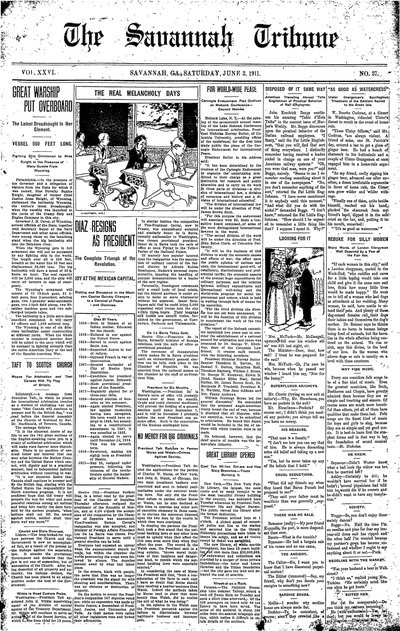
Page text (machine-generated)
The Savannah Tribune
VOL. XXVI.
GREAT WARSHIP PUT OVERBOARD
GREAT WARSHIP PUT OVERBOARD
The Latest Dreadnought in Her Element.
VESSEL 550 FEET LONG.
Fighting Ship Christened by Miss Knight in the Presence of Many Guests From Wyoming.
Philadelphia.—In the presence of the Governor and a delegation of visitors from the State for which it was named, Miss Dorothy Eunice Knight, daughter of former Chief Justice Jesse Knight, of Wyoming, christened the battleship Wyoming, the nation's latest Dreadnought, when the warship was launched at the yards of the Cramp Ship and Engine Company in this city.
Governor J. M. Carey, of Wyoming, several officials of the State, together with Secretary Meyer of the Navy Department and other naval officials, were among those on the launching stand when the big battleship slid into the Delaware river. When the Wyoming gets in full armament she will not be surpassed by any fighting ship in the world. The length over all is 550 feet, breadth at the water line 93 feet and displacement 26,000 tons. The big battleship will have a speed of 20 $ \frac{1}{2} $ knots an hour. The coal capacity will be 2,500 tons, and the ship will carry oil burners in case of emergency.
The Wyoming's armament will consist of 12 12-inch guns, 21 5-inch guns, four 3-pounders, saluting guns, two 1-pounder semi-automatic guns, two 3-inch field pieces, two 30-calliber machine guns and two submerged torpedo tubes.
The battleship is a little more than one-third completed. It will carry 54 officers and 1,030 enlisted men.
The Wyoming is one of six first-class battleships under construction at different yards. When the whole number is completed another fleet will be added to the navy which will be stronger in fighting strength than the entire American Navy at the end of the Spanish-American War.
TAFT TO SCOTCH CHURCH
Hopes For Arbitration and That Canada Will Fly Flag of Britain
Edinburgh.—A message from President Taft, in which he pleads for international arbitration treaties as a method of abolishing war and hopes "that Canada will continue to prosper and fly the British flag," was read before the General Assembly of the Church of Scotland by Rev. Dr. MacDonald, of Toronto, Canada. The message follows:
"It is the sincerest desire of my life to see the two great sections of the English-speaking races join in a treaty of unlimited arbitration which will make wars forever more improbable. There is no question of national honor nor interest that can ever arise between the Mother Country and the United States which cannot, with dignity and in a practical manner, lead to independent judicial arbitration without resorting to war.
"It is our sincerest desire that Canada shall continue to prosper and fly the British flag, sharing with the United States the responsibility for North American progress. It is my confident hope that the treaty will prepare the way for wider and more peaceful relations among all nations and bring into reality the days forefold by the ancient prophets, 'when nations shall not lift the sword against nation, neither shall they learn war any more.'"
Church and State Divorced.
Lisbon.—The long-looked-for rupture between the Church and the Government is now an accomplished fact, as a result of the protest by the bishops against the separation law. It attacks the provisional Government and declares that the law is not one of separation, but of annexation of the Church. After being despoiled of all property and authority, the bishops declare, the Church has been placed in an abject position under the heel of the Government.
Wilkle to Head Custom Probe.
Washington: President Taft appointed John E. Wilkie supervising agent of the division of special agents of the Treasury Department. Mr. Wilkie will continue to serve as acting of the Secret Service, of which K. has been chief for 13 years.
THE REAL MELANCHOLY DAYS
(Copyright, 1911.)
DIAZ RESIGNS AS PRESIDENT
The Complete Triumph of the Revolution.
JOY AT THE MEXICAN CAPITAL.
Rioting and Bloodshed in the Mexican. Capital Quickly Changes to a Carnival of Peace and Gladness.
Diaz 81 Years.
1830—Born in Oaxaca of an Indian mother. Educated for the church.
1846—Enlisted in war against the United States.
1854—Served in revolt against Santa Ana.
1858—Supported Juarez in war of reform.
1859—Opposed French in war of intervention.
1867—Secured surrender of City of Mexico from Maximillian.
1867—Candidate for president against Juarez. Defeated.
1876—Made provisional president of the Republic.
1877—Regularly elected for a three-year term.
1880—Secured election of Gonzales as his successor.
1884—Again elected President, law against re-election having been abrogated. His term would have expired in 1888, but according to a constitutional amendment in 1887, it was extended to 1892.
1904—Again elected to serve until November 20, 1910. This was his seventh term.
1910—Re-elected, making his eighth term as President of Mexico.
1911—May 26, resigned under pressure, following the victories of the revolutionists under the leadership of General Madero.
---
Mexico City.—President Porfirio Dlaz, in a letter read by the president of the Chamber of Deputies, Thursday afternoon resigned the presidency of the Republic of Mexico, and at 4:54 o'clock the acceptance of the resignation by the Chamber of Deputies was announced. Vice-President Ramon Corral's resignation was also accepted, and Minister of Foreign Affairs Francisco Leo De La Barra was chosen Provisional President to serve until a general election can be held.
Everyone had expected an uproar when the announcement should be made, but within the chamber the words announcing the event were followed by silence. The deputies seemed awed by what had taken place. In the streets, black with people, the news that Dlax was no longer the president was the signal for wild shouting and manifestations. There was no violence or destruction of property.
On the motion to accept the President's resignation 167 deputies voted aye, while no expression was made by Benito Juarez, a descendant of President Juarez, and Concepcion del Valle. As their names were called all other legislators rose and bowed their affirmation.
SAVANNAH, GA. SATURDAY, JUNE 3, 1911.
In similar fashion the resignation of Vice-President Corral, now in France, was unanimously accepted and similarly Senor de la Barra, recently ambassador to Washington, was chosen provisional president. Senor de la Barra took the oath of office at noon Friday in the Yellow Parlor of the National Palace. Of scarcely less popular interest than the resignation was the assumption of military control of the federal district by Alfredo Robles Dominguez, Madero's personal representative, insuring the handling of popular demonstrations by a leader of the new regime.
Personally, Dominguez commands only a small body of local rebels, but the federal garrison is under orders to make no move whatsoever without his approval. Senior Dominguez said that he could bring 5,000 organized rebel troops into the city within three hours. Their baggage and horses are aboard trains, furnished by the government, at Cuernavaca, Pachucia and Tlalnepantla.
De La Barro Tekes Oath.
Mexico City.—Francisco de la Barra, formerly minister of foreign relations, took the oath of office as provisional president. The ceremony of inauguration which makes De la Barra president until an extraordinary general election can be held, took place in the Chamber of Deputies. He was escorted from the national palace to the chamber by the staff of ex-President Diaz.
President for Six Months.
Washington. — President De la Barra's term of office will probably extend over at least six months. Crude and rusty, electoral machinery will prevent the holding of a general election until about September 1, and it will be December 1 probably before the next President can assume office. Such is the expectation of the Mexican contingent here.
NO MERCY FOR BIG CRIMINALS
President Taft Refuses to Pardon Morse and Walsh--Crimes Against Society.
Washington.—President Taft denied the applications for the pardon of Charles W. Morse, of New York, and John R. Walsh, of Chicago, the two most prominent bankers ever convicted and sent to federal penitentiaries under the national banking laws. Not only did the President refuse to pardon either Morse or Walsh, but he also declined at this time to exercise any other sort of executive clemency in these cases, or to shorten the sentences imposed upon the two men by the courts in which they were convicted.
In denying the pardons the President took a firm stand that the national banking laws or any other laws must be upheld when they affect the rich man even more than when they affect the poor. The record in the Walsh case, the President said in a long opinion, "shows moral turpitude of that insidious and dangerous kind, to punish which the national banking laws were especially enacted."
In considering the case of Morso the President said that, "from a consideration of the facts in each case I have no doubt that Morse should have received a heavier sentence than Walsh. Indeed the methods taken by Morse tend to show that more keenly than Walsh, did he realize the evil of what he was doing." In his opinion in the Walsh case the President protested against the failure to discriminate between legitimate business and improper gain.
FOR WORLD-WIDE PEAGE
Carnegie Endowment Plan Outlined
at Mohonk Conference--
Council Named.
Mohonk Lake, N. Y.—At the opening of the seventeenth annual meeting of the Lake Mohonk Conference on International Arbitration, President Nicholas Murray Butler, of Columbia University, presiding officer of the conference, for the first time made public the plans of the Carnegie Endowment for International Peace.
President Butler in his address said:
"It has been determined by the trustees of the Carnegie Endowment to organize the undertaking committed to their charge as a great institution for research and public education and to carry on its work in three parts or divisions—a division of international law, a division of economics and history, and a division of international education.
"The division of international law will be under the direction of Prof. James Brown Scott.
"For this purpose the endowment will associate with Dr. Scott a consultive board composed of some of the most distinguished international lawyers in the world."
"The second division of the work will be under the direction of Prof. John Bates Clark, of Columbia University.
"It will be the business of this division to study the economic causes and effects of war; the effect upon the public opinion of nations and upon the international good-will, of retaliatory, discriminatory and preferential tariffs; the economic aspects of the present huge expenditures for military purposes, and the relation between military expenditures and international well-being and the world-wide program for social improvement and reform which is held in waiting through lack of means for its execution.
"For the third division the direcfor has not yet been announced. It will be the function of this division to supplement the work of the two divisions."
The report of the Mohonk committee appointed two years ago to consider the establishment of a national council for arbitration and peace was presented by Dr. George W. Kirchwey, dean of the Columbia Law School. It creates such council, with the following members:
President Nicholas Murray Butler Senator Theodore E. Burton, Dr. Samuel T. Dutton, Hamilton Holt, Theodore Marburg, William J. Bryan, Dr. George W. Kirchwey, Edwin D. Mead, Senator Ellihu Root, Daniel Smiley, Dr. James Brown Scott, Dr. Benjamin F. Truebold, President E. D. Warfield, Miss Jane Addams and Mrs. Fanny Andrews.
William Jennings Bryan led the general discussion. He contended that the proposed Anglo-American treaty meant the end of war, because it provided that all disputes, without exception, were to be submitted to arbitration. He hoped that Japan would be included in the list of nations with which treaties were to be made.
He believed, however, that the chief source of trouble was the armor-plate industry.
GREAT LIBRARY OPENED
Cost Ten Million Dollars and Has Sixty Branches----Years
New York.-The New York Public Library, the largest, the most costly and by many thought to be the most beautiful library building in the country, was dedicated here Tuesday afternoon by President Taft, Governor Dix and Mayor Gaynor. The public viewed the library after the formal dedication.
The President arrived here at 1 o'clock. A picked squad of mounted police met him at the station and escorted him to the library. Elaborate precautions were taken to ensure his safety, and no admission except by ticket was permitted.
The new library, of white marble throughout, has been 12 years building and cost more than $10,000,000. Its endowment and collections are provided by a merger of three private foundations—the Autor and Lenox libraries and the Tilden foundation—but the city gave the land and defrayed the cost of erection.
Wreaked on a Rock.
Panama.—The National Steamship Line steamer Taboga struck a rock off Punta Mala on Tuesday and sank a short time afterward. Of the 100 passengers on board only 40 are known to have been saved. The scene of the accident is about 100 miles from the nearest telegraph station, which makes it difficult to obtain details of the accident.
DISPOSED OF IT SAME WAY American Travelling Abroad Tella Englighman of Piratical Behavior of Rall Employees.
John Kendrick Bangs continues his amusing "Table d'Hote Talks" in the current issue of Harper's Weekly. Mr. Boggs discourses upon the piratical behavior of the Italian railroad employees. "I fancy," said the Fat Little Englishman, "that you will find that sort of thing everywhere. I distinctly remember having received a leaden nickel in change on one of your American railway systems." "Oh, you were that man, were you?" said Boggs, naively. "Seems to me I remember reading something about it in one of the newspapers." "No, you don't remember anything of the sort," retorted the Fat Little Englishman. "I have never mentioned it to anybody until this moment." "And what did you do with the nickel?" demanded Boggs. "I don't know," returned the Fat Little Englishman. "How should I be expected to remember a little thing like that? I suppose I spent it. Why?"
LOOKING FOR IT
A
Mrs. McTurk—Mr. McDougall, upstairs, fell over his window sill an' was kilt last night, sir.
The Minister—Dear, dear, how sad! I trust he was prepared for the end?
Mrs. McTurk—Qh, I'm sure he wis, because when he passed oor window I heard him say, "Noo fur the bump!"
SUPERFLUOUS ADJUNCTS.
Mr. Chorte (trying on new suit at tailor's)—Why, Mr. Shearlams, you have no pockets in the suit!
Mr. Shearlams—Pockets? Of course not; I didn't think you needed any pockets; you always tell me you have no money.
HIS MEASURE.
"That man is a fanatic."
"I don't see how you can say that of him. He is always discarding some old belief and taking up a new one."
"Yes, but he never takes up any of the beliefs that I hold."
CRUEL DEDUCTIONS.
"What did my friends say when they heard that Baron Fucash had proposed to me?" "They said your father must be wealthier than was generally supposed."
THERE WAS NO SALE.
Romanse (sadly)—My poor friend Kuppulls, the poet, is more despondent than ever.
Essats—What is the trouble?
Romanse—He had a bargain sale of his verses and no one came.
TOO ANCIENT.
The Caller—Sir, I want you to know that I have discovered perpetual motion!
The Editor (unmoved)—Say, my friend, why don't you devote your energies to something new?
SARDINE BOXES.
Mellis-I wonder why sardine boxes are always made flat. Deshler-To be consistent, of course; aren't they crowded like a
Ulster Orangeman's Sacrilegious Treatment of the Emblem Sacred to the Green Isle.
W. Bourke Cochran, at a dinner in Washington, ridiculed Ulster's threat to revolt in the event of home rule.
"Those Ulster fellows," said Mr. Cockran, "are always violent. A friend of mine, one St. Patrick's day, entered a bar to get a glass of ginger beer. He had a bunch of shamrock in his buttonhole and a couple of Ulster Orangemen at once engaged him in a home-rule argument.
"As my friend, coolly sipping his ginger beer, advanced one after another, a dozen irrefutable arguments in favor of home rule, the Ulster men grew wilder and wilder with rage.
"Finally one of them, quite beside himself, reached out his hand, plucked the shamrock from my friend's lapel, dipped it in the salt cruet on the bar, and, putting it in his mouth, remarked:
"It's as good as watercress."
REBUKE FOR SILLY WOMEN
Sharp Words of London Clergyman Well Deserved by a Few of the Fair Sex.
"If each woman in this city," said a London clergyman, quoted in the Week-End, "who cuddles and cares for a little lapdog would take one child and give it the same care and love, think how many little lives would be made happy." He went on to tell of a woman who had dogs as attendants at her wedding. Many women, he said, have maids to attend their pets. And plenty of these dog-crazed females call their dogs their babies and themselves the dog's mother. Dr. Reisner says he thinks there is no harm in human beings being fond of animals, but the harm lies in the whole affection being centered on the animal. We rise or sink, says this divine, to the level of our love. So the woman who adores dogs or cats is exactly on a level with these creatures.
WHY FINE MUSIC
Every one considers folk songs to be of a fine kind of music. Even the greatest musicians, like Bach, Beethoven and Chopin, have greatly admired them because they are so simple and touching and sincere. Of course some are much more beautiful than others, yet all of them have qualities that make them last. Folk songs are the finest kind of music for boys and girls to sing, because they are so simple and yet good music. It is best-to learn first the simplest forms and in that way to lay the foundation of sound musical taste.—St. Nicholas.
HE KNEW.
Seymour—Didn't Wuster know what a bad cook the widow was before he married her?
Ashley—Certainly he did; he wouldn't have married her if he hadn't; several physicians had told him he would die if he overate and he-didn't want to have any temptation."
Woggs—So, you don't enjoy these society dances?
Boggs—No. Half the time I'm on needles and pins for fear my ten-year-old dress suit has ripped and the other half I'm worried because my partner's gown has become unfastened and whether I ought to say anything about it or not.—Puck.
MEDDLING WITH THE MARKET.
"Was your husband a bear in Wall street?
"I think so," replied young Mrs. Torkins. "He certainly acted like one when he got home."
She (at the masquerade)—Do you think my costume becoming?
He (with enthusiasm)—Yes, indeed; but you would be lovely in any disguise.—Illustrated Bits.
Of Interest to Our Women
Brwts 3. te STR on
a * ah
iyo a “ga F *
a #2? “cepeedlll dl SOR ee<*
TOAST.
“There fs nothing so rarely found as
toast that fs well made. Few cooks
"are “zuccessful with it, yet it 4s not
dificult to get right. = *
‘The chief reason of many failures
4s lack of patience, It is so much
easier to cut thick, uneven slices, not
Femove the crusts and do several
platefuls at a time that that is the
‘usual method.
Appetizing toast should be cut thin
‘without crusts, cooked over a clear
ded of coals until a delicate brown on
Doth sides, then buttered and sprinkled
Aightly with salt and put back in the
oven for 2 minute for the butter to
woak in.
Never let toast stand. Far better
wait for It than have too much cooked
atonce. If tbe family ts late in com-
ing to the table do not start to toast
until they are eating their cereal.
‘The best toast {s made over open
coals, but it can be nicely toasted in
the gaa oven {f closely watched.
Appetizing toast is nelther soggy
‘Dor so crisp that it tastes like dried
chips. The best s made from a close
grained bread a day old.
De not serve in great chunks; toast
must look well, besides being properly
cooked, to be appetizing.
“Toast that has grown cold can be
served by putting it on an old plate,
covering jt with cream, butter and salt
and allowing it to soak into the bread
4nahot oven. _
‘Where one prefers to butter toast
at a table It must be served hot in 8
folded napkin and just a few slices at
a time. -
BATHS FOR FACE VEILS. |
To give the bath, a small quantity
,of-grain, not wood, alcohol is poured
jinto a china basin and the veil Im-
mersed. It is no squeezed nor-rubbed
during the process. Drying takes only
a moment. If the alcohol appears to
bo very dirty a rinse will be required,
but this happens only when a veil
thas been used a long tlme without
cleansing,
‘The alcohol may be bottled and
used over again until it {s solled.
‘The same strictures used against
a solled veil, apply equally to tace
cloths. A woman's complexion can-
not be clear and smooth if she em-
loys sdlled agents for cleansing it,
and 2 face cloth that has been used
more than a week fs sofled, no mat-
ter’ though {t may not have that ap-
‘pearance,
g WHEN DUSTING,
After the room has been swept and
any dust there may be has settled,
the woodwork should be wiped with
a damp cloth, using a little whiting
on the cloth for dirty places in the
case of paint or turpentine on a dry
cloth for varnish.
Don't forget that the plctures need
@usting, the backs as well as the
fronts.
See that everything {s moved for
dusting. Dusty rims dround ornaments
proclaim a careless housekeeper. The
dest plan is to hare the first duster
slightly damp, and finish off with 2
dry one—New York Press.
CLEANING FOR WOODWORK.
Oak wainscoting and furniture are
apt in time toassume a greasy appear-
ance, which should be removed during
the annual housecleaning by. washing
it in warm beer. To give it a hand-
some gloss brush it over with 2 plece
of beeswax as large as a walbut.
‘When dry polish with chamols or
flannel. If oak or walnut articles are
infected with a tiny insect that bores
holes unt!l the wood crumbles into
ne powder, stop its wild career by
saturating the wood with. creosote.
‘Do not allow it to dry for several
days.—New York World,
CORN GRIDDLE CAKES.
For corn griddle cakes make a soft
amush with two oupfuls of cornmeal
and enough boiling water. When the
mush has cooled add the well beaten
yolks of four eggs and a cupful and
& half of flour, sifted with two scant
Jevel tablespoontuls of baking pow-
der. Stir in half a cupful of milk
and fold in the stiffiy beaten whites
of the four eggs. Bake at once on a
hot griddle—New York Sun.
‘TO CLEAN BRASS.
Pour strong ammonia on it, then
Scrub well with a brush, rinse in cold
water and polish with a soft, dry
loth. Lacquered brass should be
washed occasfonally with warm,
soapy water and then dried with a
soft cloth and polished with a dry
chamois skin.—New York World.
HELP BABY TO WALK.
| ‘Take an old kiteben chair with
back sawed off. Screw Into ‘the four
4égs four castors, The baby will push
4t easily around and it 1s surprising
bow quick he will think he can go
without help.
EXTRA LIFE IN UNDERWEAR,
‘To make children’s flannel vests
wear a long ‘time after they begin
to groy, thin take an old shirt, cut
‘ont worn sleeves, and let them wear
this under the thin worn fiannela
. « Ee » ™ © - “ae = Fe 2 - "S
~ _ eo 7 ne : i
+ WHEN YOU BUY RUGS,
If the white shows the least bit of
the color of the border the dyes are
aniline and the rug 1s not fit to buy.
If the white seems pure in the bor-
der, wet a plece of white cloth and
[rub the reds of the rug hard. If the
Jeast bit of color stains {t the dyes
‘arg aniline and the rug {s no better
than ‘a domestic rug.
, In colors the things to avoid is
orange. If blues are used be sure they
are turquoise. Or if it s a darker
blue test It with a damp rag, for green
is often treated with acids to make
dark blues.
Borders inside of borders make
good designs. Reds that are fine
colored are quite serviceable, but are
not considered fine, as the best red
of the orfental rug {s a soft, rather
Ught old rosa, shade.
The buying of oriental rugs may
aptly be called extravagant economy,
for even at $25 money fa much better
Invested than,the same amount spent
for a domestic rug.
PRETTY GARTERS.
So many women complain that the
patent fasteners on the garters, which
are attached to the corsets, tear out
the stocking, but there is a clever
woman who has found a way out of
the difficulty. She sews two bits of
white tape to the top of her stockings
and places them so they are each just
where the patent fasteners usually
come in contact with the stocking.
She then removes the fasteners from
the garters .and uses, in thelr stead,
little pleces of ribbon which match
the, color used In her corset cover,
When she puts on her stocking in the
morning she slips the ribbon in the
loop of the garter and then through
the tape in her stocking, . tying the
end in a neat bow.
~ Not only does this method save the
stockings and lengthen their period
of usefulness, but it makes a pretty
finish far more dainty than the pat:
ent fastener could possibly be.
CARE OF THE WASH CLOTH.
‘The fact that it has removed dust
from the face, and has not later been
carefully washed, causes it to’ con-
tain at least the possibility of germs,
if the latter have not actually devel-
oped. A face cloth must be not only
Washed orice a week, but must be
bolted then to make it antiseptically
clean. Most scrupulous attention
should be given by each person to use
only his or her own towel In the
family bath room. A skin apparently
healthy may contain elements {njuri-
ous to another, and friction fs a dl-
rect means of contagion, should there
be any.
oT
CORN MEAL MUSH. -
For old fashioned corn meal mush,
the best cereal, according to many
persons, .bring three pints of water
to a boll, add a level tablespoonful of
salt and'then sift it with one hand,
Uttle by Ittle, stirring all the time
with the other, a cupful of meal.
Boll for ten mfntites. Then turn into
the upper part of 2 double boller and
cook for at least three hours—mbre
will not hurt {t. Serve the mush hot
or cold with rich cream or with ma-
ple syrup.- Cold and sliced it Is de
lictous fried in bacon fat and. eaten
with maple syrup.—New York Sun,
STEEL ORNAMENTS
FOR THE HAIR
Steel studded hair ornaments are
much,affected this winter by both old
and Young women and the brillant
steel in combination with dark shell 1s
very beautiful and much more refined
fn effect than rhinestones similarly
set. These steel trimmed combs and
pins are wonderfully effective in dark
hair and with gray hair they are es.
peclally beautiful. For blonde-hatred
women there are steel studded orna-
ments of amber shell, but these are
not as effective as those of the dark
shell; nor is the steel ornamentation
as Deautiful ‘with blonde tressea as
With those of gray or of darker, hue.
ARTISTIC LAMPS,
Many clever women find most beaw-
tiful lamps for thelr drawing rooms or
dining rooms by buying a vase of
quaint design with a suitable recep-
tacle for ofl and having a burner fitted
to the top at some lamp establishment,
In this way one can easily find pottery
to harmonize with the furnishings of
the room and have a wider range of
choice than by making a selection at
the lamp shop—New York Journal.
BLACKBERRY MUFFINS.
Silt together a pint of flour, two
teaspoonfuls baking powder and a
half teaspoonful salt, Rub in a halt
cupful butter, or lard and butter
mixed with a teaspoonful sugar and
a beaten egg. When well mixed add
‘one cupfal berries and bake In well
greased muffin tins Jn a hot oven.—
New York Telegram.
KEEP.WATER ON REGISTER.
If you lve in a house where there
feo furnaco-always Keep a véssel of
water on the ‘register and you will al-
ways have hot-water and not have ta
nse any gas in heating it,
The Successfull
Philanthropist.
By ELIZABETH a
“Tye found her, said Pendexter.
He had fust returned to his lodgings
after a week's absence, and sat down
with bls friends to talk things over.
“Found her?” :
“Found my {deal woman,” explained
Pendexter. ~
“Now, Pendexter," warned Brent,
“you know you're always working
yourself up about ideals, and you are
always gettiag disappointed. Steer
clear of them. If you must have some
ralnous Hobby, take up philanthropy.
That at least preserves your dispost-
tion”
Pendexter overlooked this frrever-
ence. He composed himself to relate
his experlence. > + e
“She was singing in a church,” he
sald,
“Church? How happened you in a
church?” #
“That's the point,” sald Pendexter,
seriously, “I went up into the town
on Suuday morning on an errand,
and I passed this church, and hear
Ing 8 woman's yolce singing, was
somehow drawn Inside. Now I don't
care for music—don’t know one note
from another. Why should I have
gone in there unless it was to meet
my {desi2”
“She rhust have had something
wonderful in her throat to attract
you,” Brent mocked. “Did you speak
to her?”
“I did. I went to her, and not know-
Ings what else to say, I told her I
had enjoyed her singing. She looked
up just Ike a child, and sald, ‘Thank
you, sir’ in a most provinclal accent,
and tripped away.”
“Your ideal,” ead Brett, laughing,
“was neither. original nor well edu-
cated.”
“At first I own I was slightly dis-
appointed,” confessed Pendexter. “And
then I saw that no lily however fair
could grow absolutely perfect in such
poor soll. She was as beautiful as na-
ture could make her in such a place.
It was a grave, innocent kind of
beauty; too, especially captivating to
a man Ike me. Still, the twang In
that soft ‘volce and the little pro-
vinclal manner were like a flaw upon
an otherwise perfect thing, I deter
mined at once that somehow, some
way, I must remove that flaw. I
turned to a man near me and asked
her name, He sald It was Mary Hale.”
“Unromantle,” pronounced Brént.
“Romantic enough, however,” Pen-
dexter retorted, “to find her by. That
afternoon [ sought her out at her
home. I did not dare to say I wished
to have her educated in pufe accent
and a more brilliant manner, so 1
told her that I bad particularly no-
Uced her volce for what I believed to
be a rare brilliance and quality, and
that 1 would send her three years to
Europe to study.”
“Ill be banged,” ejaculated Brent
tn wonder, “What did she say?”
“She burst out crying first,” sald
Penderter. “I don't know just why.
She said it had always been the dream
of her Ife to go abroad and study.
She said music was everything in
fe to her. She sald she would reward
me by unceasing study and unfailing
pains, We shall change her idea a
Uttle, I think, later on. She shall find
another way to reward me. Brent, if
this girl comes, back, my personitied
Ideal, as’I think she will, I will make
her my wife.” ‘
Brent smiled. “She won't,” he
aald. “You'd better go In at‘the start
for philanthropy.”
Threé years later Pendexter’s pro-
tege came home, She had achleved
no mean fame abroad, and was fol-
lowing an already established repu-
tation home. Pendexter she asked, in
a delightfully grateful letter to him
some days before her arrival, not to
see her until he heard her sing at
her first concert. She sald she wanted
him to be perfectly satisfied with ner,
and thit she would sing that night
especlally for him. Later, when the
date was made, she sent bim box
seats near the stage, and Pendexter,
bristling with satisfaction, called up-
on Brent to go with him. 7
They made ttle commotion as they
took thelr seats. Brent looked down
upon the glasses levelled gt them and
smiled.
“I carry ‘my point,” he sald. “What
ever you may be when this night is
over, you are established for life as a
philanthropist. That girl has given
you all the credit due you at any
rate. Everybody has been allowed to
know that you have made her what
she Is.”
“It only she {s what I want her to
be," murmured Pendexter, “I have
hiv Saat She Oxon Cie oR ek oe
ry BFS tee 2 BE ccs imevede ratte E's:
‘hands ‘were {i Bis, Her lips were
parted in grave Smiles, 2
| “Did you think it was all right?”
she ‘asked, Brent could hardly be
Neve bis ears. Pekdexter dropped
her hands, Her accent, although her
speaking volce was charmingly mod
ulated, was careless, provincial in the
last degree. The commonplace ques
tion became almost filppant on her
grave lips. >
‘They recovered themselves'and Pen.
dexter sat down near her. «She told
them briefly of her triumphs abroad,
of bér delight In her work, and of her
gratitude to her patron. Her mis
takes In grammar were appalling, It
gradually was forced upon them that
her Improvement had been solely in
the direction in which sbe herself
had an interest. In every other way
she remafned exActly as beautiful and
as commonplace as when Pendexter
had found her. -
An hour later the friends rose to
leave her. She detained them, saying
that sho had yet something to tell
them and something todo. =”
“I always told you about every-
thing,” she sald to Pendexter, “so I
want to let you know myself that I'm
golng to get married in the spring to
Alverro the big tenor, We're golng to
sing opera in the same company.”
Pendexter said quite fervently that
he hoped she would be happy.
“You've spent about $50,000 on me,
clothes and keep and everything,
haven’t you?” she went on practical-
ly. “I'm grateful and I'm golng to pay
it now. Oh, I've got more than that,”
she added, smiling as he protested.
She wrote a check and held it toward
him. Pendexter stood looking at it a
moment with a sort of whimsical
frony. Then he took the bit of paper
and put it in his pocket,
‘They were halt way home: before
Pendexter spoke.
“Well,” he said, sighing a little, “I
am no good as an {deallst. But it’s
something in theze times to be a suc
cessful philanthropist."—Boston Post.
SUNDAY-SCHOOL CONGRESS
SUBJEGTS FOR 1911
The following subjects will be writ-
ten upon, discussed and explained dur-
ing the five days’ session of the Sun-
day school congress in Meridian, Miss.,
June 7-12:
1, Bible Study a Sunday School
‘Teacher's Requisite.
2. The Child, the Point of Contact
Between the Teacher and the Parent.
3. The Sunday School Teacher and
Higher Criticism.
4, The Superintendent's Preparation
‘Constant.
6. Practical Claséification in the
Sunday School.
6. The Right and Wroag Use of
‘Sunday School Lesson Helps.
7. Denpminational Teacher Training
Essential
§, The Influence of the Adult Class
upon the Sunday School.
9. How May Sunday School Mis-
sions Be Developed?
10. The Possibilities of the Cradle
Roll and the Home Department.
11. The Sunday School the Pastor's
Opportunity. .
12. What and How Much’ Should the
Sunday School Teacher Read? .
13. Suitable Rooms and Adequate
Appliances Great Needs in the Sunday
School,
M4. The Relation of the Sunday
School to Foreign Missions,
14. The Teacher's Experience of
Grace an Important Factor.
16—How Can the Sunday School
Teacher Contribute to the Success of
Our Denominational Schools?
17. Ideal State and District Sunday
School Conventions,
18, Interdenominational Literature
—Is It Best?
Select any subject you choose, but
be sure to send the number and sub-
Ject, together with your name and ad-
dress to the secretary of the Sunday
school congress, so that a place*can
be provided for you on the program.
HENRY A. BOYD,
Secretary Sunday School Congress,
523. Second avenue, North, Nash-
ville, Tenn. (a
9
JONSON'S RIVAL ELIMINATED
Chicago—Pretty soft for Jack
Johnson! Without the slightest ef-
fort on his part the most prominent
of the “white men’s hopes” has been
eliminated. Jim Flynn did the job
most effectively at Kansas City. Now
Jack doesn’t have to meet Al unless
he wants the money. For the public
fs not likely to “demand” that he
fight Kauffmann,
Looking at the situation calmly, it
fs hard to dope out where a white
man will knock Jack out ‘in the pres-
ent generation. Perhaps that may oc-
cur when Jack gets old and feeble,
but not much at present, Only one
man in the world {s glven any chance
at all over Johnson, and that is Sam
Langford, also a negro. They have
met once and Jack won the decision.
The tans do not believe, However, that
Sam would give Jack much trouble in
a real finish fight, So Johnson prob
ably will continue to reign as long as
he desires. Se
OKLAHOMA IMPROVING.
“The seeming unfriendly wave of ne
gro prejudice that has heen sweeping
over this state for four years has al
most, sprant its fury; and a reaction fe
now about to set in, which Indicates
a more friendly relation between the
races. Each race will finally find ite
place In the realm of public affairs,
and then all will move along smoothly
—Teft (Cila.) Tribune.
a PP RAE Re, ot ot we hee FES
BR
Be if
RS THE WILL OF GOD &
BS S
Be e
pr? re
A Sermon §
Ugo BeBe Rae Ra RoR
Be Ye Not Unwise, but Understand.
ing What the Will of the Lord
Is—Epheslans, v, 17.
SE ewe fa Saw Woes Wa eng, Oe ee
unfortunate, therefore, that It should
be the one most generally misunder
stood, Peoplo misunderstand the will
of God because of their habit of think.
ing of {t metaphysically. That {s to
say, the average person thinks of the
will of God abstractly rather than
practically; he thinks’ of {t as he
thinks it ought to be, instead of con:
sidering it as it ts. It 1s obvious, how:
ever, that we are concerned with the
will of ‘God as it 1s {n relation to our-
selves In this present world, and our
ulm should’ be to understand what It
is toward us, * 7
Starting from this point then, we
realize that because God 1s related to
us Liman belngs, in nature free Uke
himself, as a father, a judge and a
moral governor df the universe, he
has toward us what may be called a
twofold will: First, an active wish or
deste for the absolutely: good; sec:
ou a passive willingness to acqulerce
fn other conditions, less’ than per-
fect, when the {deal proves practical-
ly unattainable,
This condition can be readily un-
derstood by us, since we Who are par-
ents are related to our children in
precisely the same way. First, we
Will, or desire, that our children should
do c@tain right and proper things;
second, we will, or are willing, that
in the event of their failure to do
these appointed things they shall be
punished. Accordingly, when our chil-
dren are punished by us, it Js, as we
vainly explain, against our will—
against one side of our will, that Is.
In the same way society, composed
of ourselves, has a twofold will to-
ward its members: We will, first, that
all men should obey the law; it {s our
desire that all should do so. When,
however, a man commits murder, we
will, are willing, that he should be
hanged. Because of the constant fac-
tor of human {gnorance, weakness
and sin there ts a ceaseless conflict
of wills in the world. When the thing
we actively desire {5 not done, re
luctantly we will that ‘something else
should be done. When, however, this
secondary will {s being thus done ft
4s only because our first, deeper will
was not done, Under such conditions,
and they are constantly occurring,
What we do, or permit to be done, Is
done unwillingly, against one side of
our will, This {s as true in respect
to God's dealings with us as In re-
spect to our own dealings with one
another.’
Now, the practical value of this dis-
tinction Is that It compels us to real-
Ize the tremendous importance of dis-
tinguishing os best we can between
the things God really wills in life—
actively desires—and other things that
he does not actively wish but only pas-
sively permits—t. e,, wills In the sec-
ondary sense. To regard all that hap-
pens in life as occurring by the active,
causative will of God, as most persons,
unconsclously do, 1s gravely mislead-
ing, since a very largé part of what
happens !n life occurs under God's
secondary, permissive will, and ts not
at all, therefore, what ought to be
ideally—t. e. what God really wishes
to be.
It 4s because people in general con-
ceive of the will of God thus Indls-
eriminately, not distinguishing at all
between its two sides, that we have
come to feel that our proper attitude
In Ife toward the will of God is sim-
ple resignation, Probably most per-
sons try only to be resigned, meekly
submissive to the will of God, and
they upderstand the clause fm the
Lord's ‘Prayer “Thy will be done” to
be simply a plea for grace to ac-
qulesce {n the hard experience of life,
suffering} sorrow, death, ‘concelyed of
as constituting the divine will for
them,
As a matter of fact, an attitude of
perfect resignation, so far from being
ideal or desirable, is:really unwise and
harmful; If consistently adhered to,
which fortunately for us {s {mpossl-
ble, It would render existence intol-
erable. If it were true that all that
happens in the world were reall)
willed by God, in the sense of being
actively caused or approved by him,
resignation would Indeed be our prop-
er attitude, But inasmuch as an in-
determinately large part of what hap-
pens in life is really agatnst God's
will, contrary to his real wish or de-
sire, it follows that our attitude must
be only partly resigned and partly an
earnest effort to understand what the
will of the Lord is—and do it.
For God's will is not simply to be
accepted and submitted to by us, bis
children; that is not at all the plan or
purpose underlying human existence.
To a very large extent God’s will ig to
be discovered and performed by us, it.
eral way it may be sald that ceathy
securing uiider-humanly preventable
‘sonditions are not in seconde with
the divine will, but rather in. oppost-
YYon to it. It cannot be believed, for
example, thnt the two" hundred girls
who recently lost thelr lvés In the
horrible catastrophe In New Yoric per-
ished by the will, the wish, of God.
‘So, generally speaking, tho deaths
that occur from preventable diseases
wo cannot believe to be divinely willed
or wished, Such -deaths, broadly
speaking, are not what God desires,
but what, most reluctantly, we cannot
help feeling, he permits. Resignation,
accordingly, is not at all our proper
attitude under euch conditions, but
rather at earnest desire, and purpose
to make such conditions right, It be-
Ing broadly true, that the right ané
good and true are the things that God
bimself wills or desires, but whtch
for reasons the necessity of which we
can appreciate he will not force upon”
us,
Im our conquest of disease and our
amelioration of social conditions, in
‘every worthy effort to discover trath
and follow its leadings, we men are
‘doing the will of God, fulfilling {t, en-
‘abling it to prevail on earth as it is
done fn heaven. Is suffering, then,
‘not of God? it may be asked. Assured-
lg yes, sulfering as stich. But the
amount of suffering in the world fs
needlessly great, cruelly excessive.
‘There {s in human nature and in bu-
man, a griatence what may be termed an
irreducible minimum of suffering, sut-
ficlent for God's high and holy pur-
pose—the perfecting of character—
and this we cannot hope to reach or
remove. But nelther God nor man
needs the prodigality of pain and suf-
tering, with which existence, as wo
have made it, is full to overfiowing,
And St 1s our business, it 1s our duty,
ag intelligent, humane, religious men
and women to strive to reduce the dl-
mensions of the load of grief and pain
under which humanity through the
ages has been staggering, In endeav-
oring to do this intelligently, deyoted-
ly, unselfishly, we are working with
God, we are.doing his good and perfect
will,
* The will of God is not always, if
indeed It be ever, an easy thing to un-
derstand: - People assume that It is 2
yery simple matter, but they are in
error, Sometimes, many times, it t
extremely difiicnlt to determine what
the will of the Lord !s for ourselves or,
others. One clue to the truth Is the
fact that much that happens in life,
and therefore much in our personal
lives, Is not what God really desires,
end may therefore be’ altered by us,
tae ordinary claims of ordinary duty
permitting. And the full truta 1s con-
talned in the principle that our atti-
tude toward the will of God Js not
simple resignation or mute submis~
sion, but rather the deeper, broader, '
better thing—fulfillment—which {n-
cludes subm{ssion when submission Is
right, but which includes as well the
earnest effort to undgrstand what the
Will of the Lord is, always with the
falthful determination to perform it—
when the work to be performed Is
ours.
Prayer Made Preachers.
God’s true preachers have been. dis-
tinguished by one great feature; they
‘were men of prayer. Differing often
in many things, they have always had
one common center. They may have
started from different points, and
traveled by different roads, but they
converged to one point; they were
one in prayer. God to them was the
center of attraction, and prayer wag
the path that led to God.
These men prayed not occasionally,
not a little at regular or at odd times,
but they so prayed that thelr prayers
entered into apd shaped their charac-
ters; they eo prayed as to affect their
own lives and the lives of others;
they s0 prayed as to make the history
of the church and influence the cur-
rent of the times, They spent much
time in prayer, not because they
marked the shadow on the dial or-the
hands of the clock, but because it
whs to them so momentous and en-
gaging a business that they could
scarcely give over—E. M. Bounds, Jn
Preacher and Prayer.
Enter Not Into Temptatlon.
A reckless man in a zoological gar-
den onee seized @ venomous serpent
by the nape of-the neck and held it
up before his companions, The man
thought he had the serpent wholly in
his power, But {t began.to coll its
long body about bis arm and then
slowly tighten its grasp till the man
{n agony was obliged:to drop his hold
of his neck Quickly then it turned
and bit him, and soon the man was
dead. .
He thought he was strong enough
to play with the serpent,’ and then
thrust it from him when wearled of
the play. Many think they are strong
enough to.play with temptation of any
sort, but they find sooner or later that’
the temptation has mastered them.
“Watch and pray that ye enter not in-
to temptation,” said Christ. It is the
entering into temptation which Is’ to
be gaurded against—Morning Stare
SUCCESS TO GRADUATE,
Commencement season is at hand.
Soon thfoughout the land’ the young
folks who have tolled and hoped for;
four years will recetve the certificate,
and freedonf’which will enable them:
to take thelr places beside the think-
era and workers of the land. It {s!
& great privilege to do this. To jue
ify’ the expenditcre of tlme and mon!
ey neceseary to ‘do so will be .great!
honor to all. who do it. ‘The world:
expects tore of the graduates of the
Schools than It does of others. , They}
are marked people. We mich ghee.
all well, The harvest-in great; ae. tbe’
laborers are fev.—Amstendaim News)
321 BROUGHTON STREET, EAST. Next Door to Red Cross Pharmacy.
THE UP-TO-DATE TAILORS.
Special Prices Given for Thirty Days. A full line of Latest
Spring and Summer Goods.
HYMES & HILL.
Dealers in STATIONERY and NE
all kinds. Manufacturers of Fram
a specialty. A beautiful Easel F
wanted in and out of the city. Lib
Phone 1034J. 513 W
Palm Shaw
STATIONERY and NEWS. Any book desired. Manufacturers of Frames in all sizes. Enlarged. A beautiful Easel Free with each cash or and out of the city. Liberal commission. Call W. W. HILL; 513 West Broad Street, SAVA
Dealers in STATIONERY and NEWS. Any book desired. Pictures of all kinds. Manufacturers of Frames in all sizes. Enlarging Portraits a specialty. A beautiful Easel Free with each cash order. Agents wanted in and out of the city. Liberal commission. Call on or write W. W. HILL.
Palm Shaving Palace
FINEST IN THE CITY.
Expert Hair Cutting. -Electric Massage and Shampooing a Specialty. All
Work Done by Experienced Workmen. Courteous attention to all. SHINING PARLOR ATTACHED.
Expert Hair Cutting.-Electric Massage
Work Done by Experienced Workmen
ING PARLOR ATTACHED.
PERRY R. WRI
617 WEST BROAD ST.,
CENTRAL OF
RAILS
Traverses with its own rails the
cellent Schedules the Im
GEORGIA =
AND. THROUGH IT
The North and
the West and
CUTTING. Electric Massage and Shampooing a Sparely Experienced Workmen. Courteous attention to RATTACHED.
RY R. WRIGHT, Proprietor
BROAD ST., SAVANNA
CENTRAL OF GEORGIA RAILWAY
with its own rails the best portions—and reach excellent Schedules the Important Cities and Towns.
GEORGIA = ALABA
AND. THROUGH ITS CONNECTIONS
North and North West and Southw
PERRY R. WRIGHT, Proprietor
CENTRAL OF GEORGIA RAILWAY Traverses with Its own rails the best portlons and reaches by excellent Schedules the Important Cities and Towns of
GEORGIA=ALABAMA
AND. THROUGH ITS CONNECTIONS
The North and Northwest the West and Southwest
Our Standards Are
Reliability, Comfort,
Whenever you contemplate a short trip or long journey your tickets. Information cheerfully furnished. "It is a sure to answer questions."
City Ticket Office 37 Bull Street
WILLIAM B. CLEMENTS, City Pass. &
bility, Comfort, Sa
you contemplate a short trip or long journey let t
. Information cheerfully furnished. "It is always
ver questions."
et 37 Bull Street
M B. CLEMENTS, City Pass. & Tic
Whenever you contemplate a short trip or long journey let us arrange your tickets. Information cheerfully furnished. "It is always a pleasure to answer questions."
City Ticket Office 37 Bull Street Phone No. 83
WILLIAM B. CLEMENTS, City Pass. & Ticket Agt
LIBERAL
PRESSING CLUB
806 Cuyler Street.
CLOTHES CLEANED, PREBSED
AND TAKEN CARE OF
BY SKILLED
WORKMEN.
Minor repair and buttons put on
without extra charge to members.
Special attention to Ladies' Garments.
A trial is all I ask.
C. D. BROWN, Proprietor,
Phone 2585. 806 Cuyler St
Ice Cream Parlor
Ice Cream and Sherbets in large and small quantities. Special prices to Churches and Societies. Also Hot and Cold Lunches. Fish Suppers prepared to order. Phone 4038. Orders very promptly filled. : : : : : B15 East Broad St., Savannah, Ga.
WEST SIDE RESTAURANT
461 West Broad Street.
Near Union Station.
The place to get first-class meals.
Everything neat and clean. Meals prepared in an appetizing manner and at all hours daily.
Meals 16 and 25 cents.
MRS. A. S. SCOTT, Proprietress
Masonic Books &
LODGE DEALS,
FINANCIAL CARDS and
BLANKS of every description.
Publick and Manufacturer's Price
Liberal Discounts Will Be Arranged.
BOL. C. JOHNSON,
Savannah, Ga.
WS. Any book desired. Pictures of
books in all sizes. Enlarging Portraits
free with each cash order. Agents
oral commission. Call on or write
W. W. HILL;
Great Broad Street, SAVANNAH, GA.
and Shampooling a Specialty. All Courteous attention to all. SHIN.
RIGHT, Proprietor
SAVANNAH, QA.
GEORGIA WAY
Great portions—and reaches by ex-portant Cities and Towns of
ALABAMA
CONNECTIONS
and Northwest
and Southwest
mfort, Safety
rip or long journey let us arrange
furnished. "It is always a pleas-
l Street Phone
No. 83
City Pass. & Ticket Agt.
MADAME FLORENCE E. WILLIAMS
Graduate Prof. Rohrer's School,
New York.
Hairdressing Parlor
521 Gaston Street, East,
Telephone 2328
Wigs, Switches and Pompadours
Made from Natural Hair.
Combings Made Up. Shampooing and
Hair Straightening a Specialty.
Face and Electric Massage. Dyeing
and Matching Hair.
ORIENTAL HAIR GROWER,
An excellent preparation, will pro
duce a beautiful growth of hair. Di
rections on each box. For sale, price
25 cents per box.
EDWARD E RANKIN,
Traveling Agent For
THE J. E. McBRADY CO.
Manufacturers and Jobbers of
Soaps, Perfumes, Flavoring Extracts
Pellets Powders, Teas, Coffees
Wishes to appoint local agents in Southeast Georgia for handling the above goods. A liberal commission of 50 per cent, given on all toilet articles, 30 per cent, on Candles and Groceries.
For further particulars, write EDWARD E. RANKIN, VIDALIA, . . . . . GEORGIA
The Palative
The only Colored Cafe of its kind in the city.
SEA FOOD AND GAME in season.
Home cooking a speciality.
EDWARD JOHNSON,
Proprietor and Caterer.
$17 Burroughs Street.
Open all night.
Young Bros.
For your
TOBACCO, CIGARS and FRUITS
Of all kinds.
809 West Broad Street.
THE NEGRO IS ADVISED TO HAVE MORE CONFIDENCE IN HIMSELF
There is nothing more essential to your success in whatever you undertake in this world than having confidence in yourself. If you are jacking in confidence in your own ability to do that which you desire to do, then you are predoomed to failure. There is no other reward for your half-heartedness of efforts, based upon your non-confidence in yourself, but failure, and a failure that has no justification in any reasonable excuse.
Had Frederick Douglass doubted his ability to win his freedom he would have remained a slave and unknown until other hands should have broken his shackles. But he was a fighter, stern, sterling and unyielding, who had confidence in himself not only to break his own shackles, but to assist in severing those which bound his people. He waged, with others as dauntless as himself—Beecher, Garrison, Lovejoy, Wendell Phillips and Charles Summer—a relentless and winning struggle against slavery. He had confidence in himself and he won his way. He was a prototype of the fighting stamina of his race, and what this trait would be to them in the oncoming years.
The Negro people have men in every walk of life who have confidence in themselves and who are fighting with as grim determination to make of their race all that it should be to the limit of their power or ability to do so as did Douglass. They are fighting its battles with their minds mentally, their hands manually and industrially, and the example of their lives morally and religiously, all which bears its abundant fruitage to bless those now living and to be transmitted as a rich legacy of encouragement to posterity.
The Christian denominations, and there are many, are being led by men who have confidence in themselves based upon their faith in God's promises to help and guide, as he did Moses, Joshua or Caleb, those who are wedded to the task of leading their people out of some Egypt condition, through the wilderness of hardships, into the promised land of a higher, true and better man and womanhood. The self-confident Christian leaders in all the religious movements for the older people and the young are tirelessly engaged in their noble and uplifting work, and God will stamp his approval upon their labors and other times will sing praises.
Let every member of the race have confidence in himself and there need be no doubt about him contributing his quota or share to the sum total of racial achievements. God, through the conscience, says do your duty; if you obey, then the world will know by what you accomplish that you have confidence in yourself.—National Baptist Union-Review.
CANADA AND THE NEGRO
Canada wants reciprocity with the United States and is willing to admit on the most favorable terms almost any product of Uncle Sam's fields or manufacturing plants, but there is one possession of our glorious country on which Canada draws the line. The people of Canada do not want the southern negro or the northern negro, either. The negro is unwelcome in every sense of the word when he crosses over into the dominion.
The fact is, the Canadians are just like the people of the north so far as the negro question is concerned. They know nothing about the negro, have never come in contact with the negro in any large numbers and consequently have always judged the race problem by standards that have been anything but true. Just as soon as they face a large number of negro settlers they at once change their positions on the race question and deny the negro scores of privileges that are freely accorded him in the south.
The attempt is to be made to bar the American negro from Canada, and it is said that the United States government will enter no strenuous protest against such action, should the anti-negro sentiment in Canada be finally crystallized into law.
The negro will some day learn that the southern white people are his best friends. The southern white man deals fairly with him. He draws the social dead line over which the negro must not pass. He is open and candid with the negro as to this social question and the great majority of the negroes in the south understand him and have regard for the propriety of such a position. At long as the negro observes the social law in this section, the law that makes him a race unto himadif socially, so long is he permitted and encouraged to earn his living in scores of fields of labor, and is protected in the accumulation of property and the rights of his home.—Athens (Ga.) Forum.
SALUTED SPIRITS.
An old negro woman, who takes in washing for the support of family in Indianapolis, had a bad attack of the grip this winter. She was quite slick. Her daughter went to the house of one of her mother's patrons to do the washing and was asked how her mother was. "Oh," she replied, "she's betah, thank you. She can sit up now an' take a little whisky. Of course, though, she salutes it befo' she takes it."
Now for your name on our list under the 1911 Subscription Offer.
ITH THESE you may order any one of the alternate free magazine offers of Human Life, of Boston, Mass.; McCall's Magazine, of New York, or Southern Ruralist, of Atlanta, Ga., or "Talks from Farmers to Farmers," a 16-page folio of farm wisdom. Your choice of only one and both newspapers for only $1.75.
The Tri-Weekly Constitution Monday, Wednesday, Friday--Three Times a week. The newsiest, best, brightest and biggest newspaper. Almost a daily, yet at the price of a weekly One Dollar a Year
The Tri-Weekly Constitution presents, at one sweeping view, the whole area of events. The news of the county, state, nation and the world is given in each complete issue. Each week the departments of Farm and Farmers, Woman's Kingdom; Rural Free Delivery, Poultry and others of wide interest, edited by experts, appeal directly to those addressed.
If you want The Tri-Weekly Constitution alone, without any clubbing offers, you can get it at $1.00 per year by addressing The Constitution, Atlanta, Ga. One sample copy sent free on request, giving with it the names and addresses of six of your neighbors.
A club of 40 or 50, or more, will keep a R. F. D. route above the minimum average required for daily mail service. It is the gr eat news purveyor of the whole Southland, as good in the gulf states as on the Atlantic se aboard.
Clubbed with The Atlanta Constitution, we have the superb FREE OFFERS shown from which you may make your choice of one:
(1) "TALKS FROM FARMERS TO FARMERS," a symposium of Southern farm knowledge that should be in the hands of every practical farmer, young or old. The articles have all appeared in Tri-Weekly Constitution under same title and made one of the great est features of this splendid farmers' paper. It will be mailed to you immediately upon receipt of order.
(2) THE SOUTHERN RURALIST, one of the best agricultural papers in the South. It is a semi-monthly, edited by a farmer on his own farm, and is intensely practical and helpful.
(3) HUMAN LIFE, of Boston, Mass., giving current and interesting biography. It is about folks—people living in the public eye now—that you want to know something about. It has not a dull line in it.
(4) McCALL'S MAGAZINE, of New York, the queen of the home fashion monthlies, very helpful to the mother and the homekeeper. It is just what you want.
Remember, our own paper one year and THE TRI-WEEKLY CONSTITUTION Monday, Wednesday and Friday, three times a week, for one year, and your selection of one from the alternate free offers, all for $1.75.
Pilgrim Health and Life Insurance Co.
The Oldest, Strongest and Most Reliable Company in the State. Gives employment to hundreds of men and women of our race. Pays from $1 to $10 weekly sick and accident benefits and from $10 to $100 death benefits. Our Motto: "Promptness, Honesty and Justice." Home Office:
$143 Gwinnott St. Augusta, Ga.
For further information write 509 West Broad St., Savannah, Ga.
J. S. Perry, Supt.
A. B. Singfield, Gen. Supt.
Their Ideal Realized
For more than a dozen years the dream of the Manager of the UNION MUTUAL ASSOCIATION Has been to inspire Confidence in, and bring respectability to Negro Industrial insurance, which does not only cause this Company to handle more than a million dollars annually, but they have made it possible for other similar concerns operated by our people in the South to do a successful business, which was once controlled absolutely by another race. For these and other sane reasons, we urge that you take out a policy today. Call one of their agents or phone the local manager of the Savannah district.
J. C. LINDSAY,
Branch Office 509 West Broad St.
Phone 1470, Savannah, Ga.,
or WM. DRISKELL,
Secretary and General Manager,
910 Auburn Ave., Atlanta, Ga
CHICKENS
DUCKS
TURKEYS
R. H. O. YOUNG
Wholeale and retail dealer In Live and Dressed Poultry. Game in Season. Special attention given to picnic orders. All orders delivered free of charge. Stall 12 City Market.
GAREY'S
Goods delivered promptly to any part of the city.
599 West Broad Street, Near Gaston
Phone 1831-L
$1.75 Now
THE TRI-WEE
THE SA
W WITH THESE you
Human Life, of
Ruralist, of Atla
The latest patterns in Spring and Summer Goods. First class workmanship guaranteed. Prices always satisfactory.
Johnson Undertaking Establishment
COMBINE D WITH
The Royal Undertaking Company
(Incorporated.)
Funeral Directors and Embalmers
Finest line of Coffins, Caskets and Robes. White and black funeral
cars. Office and warerooms 825-831 Jefferson street.
W. R. FIELDS, Manager.
Residence Phone 2032. Livery Stable Attached. Office Phone 070
Fruit and Commission Merchant
234 ST. JULIAN ST., WEST, 235 BRYAN ST., WEST. Phone 2968.
BAVANNAH, GEORGIA.
In addition first class rooms, barber shop, hot and cold baths and automobile service at any hour, day or night. In all of our departments we give first class accommodation: Call and see our rooms while visiting the city at 109 Jefferson street, just a half block from Broughton St. car line going south on Jefferson. Ask any hackman.
JOHNNIE WOODWARD
Rubber Tiring a Specialty. PHONE 250.
408 JONES ST., WEST, Residence 1115 Walburg EAST.
Phone 2001.
If you hesitate to wear Shoes that have been repaired, you don't know our kind of repairing. We do everything needed to footwear in first class condition—rebutton, straighten, or alter heels, sew up rips, repair breaks, put on rubber heels or soles. See us before going elsewhere.
OUR GREAT PROPOSITION
$1.75
Subscription Rates:
One Year . . . . . . . . . $1.25
Six Months . . . . . . . . . . .75
Three Months . . . . . . . . . . .50
Remittance must be made by Express
or Post Office Money Order, or Registered
Letter. Advertising-rates given on
application.
SATURDAY, JUNE 3, 1911
From time far past it was understood that the women of the half world were only allowed to locate in the community over on the east end of Oglethorpe Avenue. Several years ago some of them migrated in the neighborhood of the Barnard street, school. After the new building was erected the police made them leave that community. Many of them then removed to the neighborhood of Burroughs street, Gwinnett and Park Ave. among some of our most respectable colored citizens, many of whom own their own homes and are rearing children. This respectable community has been broken up by those white women of the half world with their disrespectful actions. The city authorities should not allow this advantage to be taken of a class of its citizens that are humble and law abiding. There are but few sections of the city where respectable colored citizens can reside and in them they should be protected. An appeal is hereby made to the city authorities to remove these places of ill repute and give our people's chance to rear their children in an atmosphere of respectability.
The revoking of the ordinance of Beaufort, S. C., requiring a license for boat excursions to land is very gratifying to a large number of citizens of this city, who yearly make a pleasure trip over to this beautiful little South Carolina town. It is true that upon certain occasions there have been disorderly crowds of excursionists who have endeavored take possession of this city and to run things as they would like for which reason this cost of five cents per head was placed upon all excursionists landing there; yet, this was the exception and it was to be regretted that the thousands of law abiding pleasure seekers who every year take this as their only outing had to be subjected to this unjust law that was passed simply on account of the few who misbehaved themselves. A trip to Beaufort is generally a very pleasant one and very often the only chance that most of us get to go out of the city because it not only affords us a pleasant boat ride but also is usually an inexpensive trip and is within the reach of us all. And aside from this fact that a trip such as this affords the people of Savannah an enjoyable outing, it adds materially to the revenues of the merchants of Beaufort and causes their town to grow in popularity. The revoking of this ordinance was a good thing for all parties concerned and excursionists who visit Beaufort from now on may well keep in mind the fact that they are in a town of peaceable citizens where law and order prevail.
It is true that many colored persons have been convicted in the courts on account of the appeal to prejudice by lawyers of a certain calibre. Before certain judges these lawyers are permitted to say any degrading thing about a Negro, be it true or not, and they are never "called down" for doing so. It was left, though, for Judge Speer to teach Georgia's next Attorney-General a lasting lesson for the use of unnecessary terms to colored persons who were concerned in a case in the United States Court at Macon. It is hoped that what Judge Speer said to Mr. Felder may cause other judges to take note and act accordingly in having such disrespectful terms kept out of the court rooms. Following is the incident:
"Threatened with disbursement in all of the United States courts unless he moderated the language used by him in outlining his case to the jury and refrained from using the word 'nigger,' Hon. Thomas S. Felder, the next attorney general of Georgia, was severely rebuked by Judge Emory Speer. Mr. Felder is leading counsel for W. E. Chancey, Luke Dupe霖, Sheriff John Ross Rogers and Deputy Sheriff Joah Horne, the prominent Pulaski county men now on trial on peonage charges. He was addressing the jury, saying what he expected to prove, and he used language that was. very forceful, including such words as 'nigger' and "lie." He was interrupted by Judge Speer and the following highly interesting colloquy ensued.
"The Court: 'Mr Felder, don't you think the future attorney general of the state, of Georgia can spare us this, nigger, nigger, nigger?' it sounds so unworthy of a great court of justice, and so unworthy of your
own position, at the bar to be alluding to, these poor unfortunate creatures constantly in the lowest, terms of degradation." "Mr. Felder: 'Your honor, please, I think I know, my duties and rights as a lawyer, an 'American lawyer practicing in an American court.'
"The Court: 'The court thinks you are exceeding those rights, and if you continue on this line and insist upon using this language' which is nothing but an appeal to the lowest race prejudice, I am very much 'afraid I will have to sever our relations, not only in this case but in all cases in this court. I do not believe the American judiciary will 'tolerate the use of such language in the presence of a court of justice on the part of a gentleman who as a condition precedent to his admission to court, will tolerate the use of the United States Now. I do not wish to do anything of the sort, but I do beg of you to use, the language of which I know you are capable, the language of a guiltified gentleman, and save us this never-ending 'nigger, nigger, nigger.' I want you to act as becomes a lawyer in this court.'
"Mr. Felder: I submit I am doing that."
the awarding of the Vanderbilt, the Grand Prize and the Light Car races to Savannah is most gratifying for us in receiving these three races we have been able to bring here the greatest automobile races held in America. It was confidently felt that we would be able to hold the Grand Prize races here on account of the admirable way in which these races were "pulled off" last year but the selection of our city for the Vanderbilt, the classic automobile races of America, was somewhat surprising although we ourselves were aware of the fact that no other city in the country could offer better protection and roads than Chatham County. For these three events to be run in Savannah means that the whole world is going to have its eyes centered upon us during those three days in November when no doubt, there will be record after record shattered for now we have the advantage of having run the three most successful road races ever held in this country. It will be an epoch making event not only for Savannah but the entire southland for had we not been granted these races they in all probability would have gone to some northern or western town. Its the greatest advertisement we have ever had and its going to mean that the name of our fair city is to be heralded from one end of the world to another. During those three days in November Savannah is going to be the Mecca for all automobile enthusiasts who can find the time and money to visit these races. This means that we are going to be under the careful scrutinization of hundreds of thousand of visitors and we must not be found wanting in any respect. But six months stand between us and these speed demonstrations and that's just about enough time for us to remedy any faults which we might now perceive. Its going to be a time when hundreds of those who come to the races are going to look around and see what it is that gives to. Savannah such advantages over other towns. Many are coming with an eye toward making this place their future home if they can secure proper inducements and see where it is to their advantage to take up their abode with us. And among those who will be seeking new homes will be many Negroes. These Negroes are going to look us over and see what we are doing and if there is an opening for them to step in and join us in this the fairest city of the south to our people. We don't want to be caught napping and allow strangers to come in and gobble up the many opportunities which we here enjoy but are too indifferent to take advantage of. There are many things which we as a people, who have every advantage desired to make a mark in the south might do are these six months pass and if we are asleep, indifferent, self-satisfied and contented with the progress we have already made, then those of our race who may come here from afar are going to see the mistakes we are making and jump right in and grasp the wonderful chances for development which we are allowing to go unnoticed every day. They are going to look around and see the miserably few Negro enterprises we can boast of and knowing as the do the wonderful opportunities which await. proper development along this line are going to set right out and embrace these chances which we have allowed to pass without even the slightest idea of taking in. The white citizens of this town are going to work with vim and vigor to be in a position to show to the hosts of visitors who are going to be among us on this occasion that they are not asleep to their opportunities and are doing all in their power to bring Savannah into the ranks of of the leading cities of the south and if behooves the Negro to open his eyes a little and see what it
can do to make the showing of his people here one that he shall not be ashamed of. Individual action is not alone enough to bring about this change but what we must do is for all of us to work together for the common good of the people because it is. only in cooperation that we can hope to gain desired results. Let us begin now and not wait, for to-morrow may be too late and the plums may all be gathered by those who come in unnoticed. Let these races be: an inspiration to us to wake up and work and get out of that self-satisfied attitude that has been characteristic of us for so many years.
The Picnic Season.
The Picnic Season has begun. It is a time of enjoyment and pleasure; for many also it is a period beset with dangers and temptations. We like to see our people enjoy themselves and have a certain amount of amusements and pleasures. But these amusements must be of a healthy kind, healthy for body and soul. For many young people alas picnics and excursions are occasions of sin and disorder; they do more harm than good to body and soul. Those people have a strange notion of what they call "having a good or big time." Their idea of a picnic consists in induging, in sin, drunkness, and so on. We hope that none of our people are of that class. The Messenger wishes to give a bit of good advice about this picnic season. First of all let your amusements be moderate. Do not spend all your money and your little savings in excursions and outings. Some people even borrow money which they spend during the summer months; in winter they will suffer from cold and hunger. Let the number of picnics for yourselves and families be regulated according to your means. Patronize the excursions given by your church and your societies, and if your means permit, you may now and then enjoy some other pleasant outing. Do not be selfish; share your joys and pleasures with the members of your family. A man who would have a good time with strangers, and leave his wife and children at home, is a mean living.
Avoid tough and crowdy crowds; keep from objectionable places. Any respectable person and especially our Catholic people should never be found amongst a crowd or in a place, where harmony and decency are not observed.
The great temptation for men during the summer months is a strong inclination to intemperance; they forget that alcoholic drink in the hot weather is dangerous. Catholic men, do never exceed the measure; do not lower yourselves to the level of clumsy beasts; he temperate. Modesty is certainly the most beautiful virtue of women and girls. Unfortunately there is a tendency amongst the young people to set aside all restraint during picnics and outings. Many a young girl has been ruined during the picnic seasons. Girls, respect yourselves and others will respect you; you can have a good and pleasant time whilst remaining modest and pure.
We ask our Catholic people to behave well alwys and everywhere; and to be a living example to those who are not of our Faith.—Catholic Messenger.
IN HIS HOLY TEMPLE.
Interesting Services In The Churches of the City.
Mt. Zion Baptist Church
Rev. J. T. Sanders of Valdosta, Ga.
preached for Rev.MD?Spencer. D. D.
and his people at the Mt. Zion Baptist
Church Sunday night, his sermon was
logical and instructive. Mt. Zion Baptist
Church will begin a Rally week June
5th, and continue until June 12th. All
are invited to attend
Congregational Services at Beach Chapel.
Commencing with tomorrow morning the services of the First Congregational Church will be held at the Beach Chapel; on account of the preparation for the placing of the new pews in the church; Sunday School at 9:45; Church services at 11 a. m.; and 8:30 p. m. Mr. J. K. Weston was called to Qrangleburg-S. G.; on account of the serious illness of his mother.
Second Baptist Church.
Baptism jook 'place after the morning service on last Sunday. The pastor preached an excellent sermon from Acts 23:17. His discourse was a gem and there was food for thought in it. At the morning service a collection was taken up for a brother, who is on his way to Baltimore from Florida. At night the Rev. Joseph Gray of London, England preached a powerful sermon from Exodus 12:13. The main auditorium was crowded to hear this distinguished divine. The Sunday school, is progressing nicely under its present leadership and its corps of teachers. The public, is corollary invited to attend all the services. Services will be short during the summer season. Usual service tomorrow.
F. B. Church Dots.
It was impossible to find room for the exceedingly large crowd that attended church on Sunday morning and 'quite a'
large, cowboy-ish, present away because he is a boy. Rev. Wright read on, book 17:18. 18. Rev. Green presided over an instructive sermon from 18:46. He made many good points and was thus several things that only one experience could tell. The choir sang a ruler once cane! Rev. Green hymn "Come ye that love the Lord." Quite a large number, he baptized by Rev. Wright. The communion was very impressive. Several visitors were present. At night, Rev. Wright read for the lesson-Ps.133:19, text Luke 23:42, subject "The Penitent Malefactor." The sermon was beautifully illustrated, and filled with many beautiful examples. You are welcome to attend our services. The ushers are always ready to receive you.
St. Anthony Mission West Sayannah
The closing exercises of St. Anthony School, West Savannah, will take place next Sunday June 4th, at 4:30 p.m. Our little players will present "Market Day" operetta by G; V. Boardman which will certainly interest the audience on account of special musical and scenic effects. The success attending the rehearsals bids well for the coming performance. A hearty invitation is extended to all the friends of St. Anthony Mission. Admission free. Next Sunday's Pentecost Sunday. Service first Mass at 7 a.m. Second Mass which a few of our children will make first by Communion. Sermon and Berediction of the blessed Sacrament at 8:30 a.m.
Closing' of Berean Baptist Academy.
Baccalaureate sermon June 4th, at
Second Baptist Church at 3:30 p.m.
m. exercises, Monday and Tuesday: nights
at Mechanics. Hall. Graduating
exercises-Wednesday night at St. John
Baptist-Church.
Haven Home Commencement Great Success.
The Haven Home closing exercises on last Tuesday night at St. Paul G. M. E. Church Awest Broad and Maple streets were an overwhelming success. The various school participants on the program all acquitted themselves creditably and the exercises in general were up to the high standard set by this institution, years ago. The singing was exceptionally pleasing and the night was thoroughly enjoyed by the packed house that was present. This closed one of the most successful years in the history of the institution and the friends and followers of the school wish for her many more useful and prosperous years.
Closing Exercises of G. S. I. C.
The closing exercises of the Georgi
State Industrial College Wednesday
morning were among the most interesting
ever held by this school and were
attended by one of the largest crowds
in the history of the institution. The
main address of the day was delivered
by Prof. Roscoe Conkling Bruce, assistant superintendent of Education of Washington, D. C. The address was one of the most scholarly and pleasing ever heard at the college and was throughly enjoyed. The normal graduations follows: Alonzo Rhett Banks, Boston; William A. Bryant, Guyton; Perry Wadsworth, Cheney, Lumpkin; James Edward Collier, Savannah; John Gordon Dingle, Savannah; Robert Henry Fagans, Robley; Joseph Howard Griffin, Florence; Objelia Hally Lee, Savannah; Arielius Pillers, Hawkinsville; John McIntosh, Savannah; Mary Elizabeth Powell, Savannah; Mael-Teresa Tyson, Savannah; Wilhelm Houston Taylor, Savannah; John Henry Wilson, Titton; Lucilious Cicero Youngblood, Macon.
Partner Wanted
A partner wanted with a thousand dollars or more to invest in a well paying business, well established. References: unnecessary. Apply to M.B. 712 West Broad street, Sawanah. Mrs. Kiley Houston now residing in Jacksonsville with her son Mr. Alex. Houston, once on a visit last week, to spend two weeks in the city with friends. a.Mrs. Sylvia Smith, 634 Bryan streetwest.
Appeal to Reason by the Past Chancellors of Savannah. First: That the headquarters of the K. of P., jurisdiction of Georgia, shall be in the City of Macon at which place the Grand Chancellor shall reside.
Second: We deem it wise and best that the jurisdiction of Georgia should elect a man well acquainted with the laws of the order and experienced with law relative, to insurance as our Endowment Bureau is the life of the order; one who shall deyefo his undiyeld time to the upbuilding of the order. Yours in F. C. & B.,
SAVANNAH DIVISION, U. O. T.
GRAND FOUNTAIN LICENSE RESTORED. SPECIAL DISPENSATION IS GRANTED.
To the Officers and Members of the Various Fountains of the Savannah Division Fountain, I.O. T. B. Greding;
It is with joy that we announce to you that on Wednesday, April 26, 1911, Col. Joseph Button, the Insurance Commissioner of the State of Virginia, removed the suspension of the license of the Grand Fountain and gave on request that we may go as before and take up new members.
Restoring Old Member We find that there are many Fountains that have been waiting to see if the license would be restored and while doing so members have gotten behind and unbenefited. At a meeting of the Board of Directors, Wednesday, April 26th, it was decided that any unbenefited member who is in good health can return to the organization and be marked benefited by paying the amount due to the Grand Fountain; that is 30c per 35c a month according to the month's due. For the months of October, November, December and January there will be paid 35 cents and for each of the other months 30 cents. Members must pay up in full at the rates above and the Secretary will forward it immediately to the Grand Secretary on the monthly report sheets.
Class Members All Class Members who pay up between this and July 1st. 1911, may do so without paying any fines that may be due.
Rosebud Members Unbenefited Rosebud members may be reinstated by paying the amount due to the Graud-Fountain of six cents a month. They must each be fit good health.
New Members A dispensation for four months has been granted and during that time new members may be admitted on the payment of three dollars from sixteen years of age to forty four years. Persons above forty four years of age will pay the regular iduing fee.
For further information call on or write B. E. WILLIAM3, State Deputy Georgia, 765 Bolton street; east, Savannah, Ga.
Contest Waltz
By Apollo Dancing Class
AT LINCOLN PARK
Tuesday June 13, 1911. Admission 15 Cents.
NOW IS THE SEASON FOR
ICE CREAM
No Order too Large. None too Small.
Give us your Order. We guarantee the rest
SCOTT BROS.
West Broad and Gwinnett Streets
Come into our Ice Cream Parlor and be refreshed
YOU MUST FOLLOW THE CROWD. They are all coming our way now. Our store is the Mecca for drug store shoppers. We have the only Complete, Up-to-date Modern Drug Store where Courtesy is blended with Quality always. Your friends will tell you PATE'S for a Square Deal every day in the week. We add new customers to our list every day and make a special offer of never losing any. Once our customer, always. You simply can't help trading with us when you once start. We treat you so nice and give you such good Low Prices that when you think of a drug store in the same flash you think of PATE'S DRUG STORE Hall and West Broad Phone 660 & 882 Opposite Pekin Theatry
With all hotel conveniences. Hot or cold baths. Large p
with reading matter and music. Polite help. Carriage and
also telephones. If you want a hack or carriage ring up 676
the manager will see that you.get it. Rooms to-let at 25¢
MEALS AT ALL HOURS
Piano, Viola and Song Recital.
On Saturday afternoon, May 27th, some of the piano and violin pupils of Miss Alice M. Ellis gave a very interesting recital to which all of the parents were invited. Among those who played well and showed that they had made great progress were Misses Lily Alkens, Lily Mae Greatheart, Janie Alkens, Eureka Calhoun, Lily Springs, Thelma Lee, Edwina Perry and Master Joseph. Joseph played who played piano solos. Miss Spencer delighted all with several violin solos played with great skill. Another part of the program which was very much enjoyed was the singing of Miss Clara Jones of Fort Meyers, Fla., who has been principal of Speedwell Home near Savannah. Miss Jones's sang with ease showing that her voice has been well trained. Miss Jones has been studied both the piano and violin. After the program had been rendered, refreshments were served and a very pleasant time enjoyed by all.
Musical Festival
Grand musical festivals will be given at First African Baptist Church, West Broad and Broad streets; Monday June 5th at 8:20 p. m. The lores of vocal and instrumental music of this city will be glad of the opportunity to hear and see one of the best musical festivals given in this city at popular prices. Mr Frank Armstrong and his country quartette will most assuredly make you laugh until your side aches. The following is the program:
Anthem, F. A. B. Church Choir
Opening song, The Home of the Brave
by double quartette
Vocal duet
Vocal solo by Mr. J. E. Johnson
Vocal solo, Thou City Fair by Mr.
Frank Armstrong
Instrumental quartette by Mr. and Mrs.
John A. Mongin
Anthem, F. A. B. Church Choir
Quartette, Know it no more by Mrs.
Alice Armstrong, Mrs. Emma Williams,
Mr. J. C. Cross, Mr. Frank Armstrong
Vocal solo by Prof. Julius Jenkins, the
peerless baso of Savannah
Vocal solo by Miss Janie Murray, the
prima dona of Savannah
Closing song by all
There will be others to take part on
the program. Mrs. Maggie Williams,
manager; Rev. G. H. Ives, general
manager; Rev. S. W. Batchlor, pastor.
Appeal to Reason by the Parish
First: That the headquarters of the shall be in the City of Macon at which side.
Second: We deem it wise and I should elect a man well acquainted with enced with law relative, to insurance of the order; one who shall deye lying of the order.
SAVANNAH DIVISION
GRAND FOUNTAIN LICENSE RESTORED.
To the Officers and Members of the Division Fountain, U. O. T. R. Greeting.
It is with joy that we announce to you Col. Joseph Button, the Insurance Comm moved the suspension of the licenses of the that we may go as before and take in new Restoring Old Member. We find have been waiting to see if the license members have gotten behind and unbound Directors, Wednesday, April 26th. if fitted member who is in good health can relied benefited by paying the amount due to 35 a month according to the month November, December and January there the other months 30 cents. Members must the Secretary will forward it immediately report sheets
Class Members All Class Member 1st, 1911, may do so without paying any fee. Rosebud Members Unbenefited by paying the amount due to the Grand R must each be in good health.
New Members A dispensation for during that time new members may be ad from sixteen years of age to forty four years of age will pay the regular jiding fee.
For further information call on or write Georgia, 765 Bolton street east. Savannah
Contest
By Apollo Dale
AT LINCOLN
Tue's day June 13, 1911.
NOW IS THE SEASON FOR
ICE G
No Order too Large.
Give us your Order.
SCOTT
West Broad and G
Come into our Ice Cream Parlor and
PATE SAYS—
YOU MUST FOLLOW THE CRE
our way now. Our store is the M
We have the only Complete, U
where Courtesy is blended with Q
will tell you,PATE'S for a Square.
We add new customers to our list of never losing any. Once our can't help trading with us when you so nice and give you such good Love a drug store in the same flash you Hail and West Broad Phone 660
THE JOHNSON
331 JEFFERSON
With all hotel conveniences. Hot
Examination Papers Stoff
The questions to be asked at a
lege examination in England were stoff
en. Upon the detection of the robber
depended the wilming or losing of a
important scholarship.
Sheriock Holmes was called inform-
case. He had but a few vague clues to
work upon—namely, a duplice key,
some lead penil shavings, a pyramid
of black clay, the marring of a table
and a high window.
The guilty person was traced and
made to confess. The story, fascinating
and complete, will form an extra sup-
plement in next Sunday's New York
World. Order in advance
Dr. L. S. Parks,
DENTIST
240 Barnard Street
Does all kind of high grade dental
work of the best quality and workwis-
hip. Gold crowns and bridge work.
Gold Porcelain Pw-
and Go Crowns mounted on the
natural rock. Gold Fillings, Cemen
Fillings, and Silver or Amalgam Fillir
from mice to a full set of teeth $ 4.00 and $ 8.00.
Broken places mended n teeth added to
old ones for a small cost. Bell Phones
1944. Solid Gold Crowns Guarantee
234K Gold
Come and go
with the
Mr. George Annis of Anniston, Ala. is in the city visiting friends.
Ask Pate's Drug Store about the Nvall Line.
Mr. Harvey Jones and son sailed for Baltimore this week to visit relatives. Mrs Josephine Niles of Atlanta is in the city visiting relatives friends. Mrs. Susie Scott of Macon, Ga., is in the city on business. Mr. Robert Burke spent several days at Dorchester, Ga., visiting relatives. For Ice Gream, ring up McCall, Phone 4038. Mrs. Nellie Harrison of Cuthbert, Ga. who has been here for a few weeks left for home yesterday. The new two thousand dollar iceless fountain of the Savannah Pharmacy is the talk of the town. Miss Anna Tucker of 212 Park Ave E. entertained the Poinsettias Club at whist Thursday afternoon.* Mr. Albert Johnson, one of the leading colored farmers of Futon county was in the city this week on business. Go to Pate's Drug Store, West Broad and Hall streets.
Mr. Harry Johnson who was taken seriously ill in Baltimore last week arrived home Monday,
Miss Ada Smalls and Mrs. A. P. Johnson were among those to leave for New York Tuesday.
Mrs. Stella Washington who is visiting Mrs. Mamie Washington of New York city reports a very pleasant time.
Mr. Ed Bynum who has been residing at 506 Jones street, east has moved to 625 Oglethorpe, east.
Mr. John Morrison, a former Savannahian living in Macon Ga., is in the city for a few days.
Mrs. Helen Moses of Waycross, was in the city this week to attend the closing exercises of the Haven Home.
Mr. Jacob Moore who has been away for some time arrived in the city this week.
Mr. Henry Jackson of Duffy street west felt for Atlanta Tuesday to witness the closing of Atlanta University.
Misses Anna Jenkins and Susie Anderson left for New York last Monday to spend two months. Don't fail to take a peep at the new soda fountain at the Savannah Pharmacy.
Mrs. Etta Curtright and baby from Joliet, Ill., are in the city for a short stay.
Ask Pate's Drug Store about the Nyall Line.
Friends of Mr. Prince Monroe who has been very ill will be pleased to know that he is out again.
Prof J. M. Washington who has been teaching at St. Mary's Ga., is in the city for the summer.
Miss Ada Jones who has been attending Morris's Brown College, Atlanta arrived in the city Wednesday.
Mrs. Stella Washington is visiting Mrs. Manie V. Washington of New York.
Mr. M. A. J. Foye of Screven County, spent several days in the city this week.
Mr Alexander Smith of East Savannah left the city Monday for Macon, Ga.
Mrs. Emma Williams of Richmond, Va., is in the city for a stay of two months.
Mrs. Effie C. Minor of Americus, Ga., who was in the city visiting her sister left Tuesday for Jacksonville, Fla.
Mr. James Wood of Atlanta is in the city visiting his brother Mr. John Wood who is seriously ill.
Misses Edna Roche and Rebecca Habersham of Atlanta are in the city for a few days.
Mrs. Mamie Blanchard of Charleston, S C., is in the city visiting Mrs. F. Bellinger Henry street west.
Mr. George Edwards, one of the leading business men of Jacksonville, Fla., is in the city for a short stay.
Go to Pate's Drug Store, West Broad and Hall streets.
The waiting room of my she repairing department is entirely reserved so that any lady or gentleman can sit and wait for small lions. J. H. Washington
Mrs. Anna Johnson and little Edward left the city Tuesday for a two weeks' stay in Atlantic City, whence they will go to New York to spend a month.
Misses Anna Jackson, Mildred Styles and Susie Duffy students of Fort Valley Institute, passed through the city Monday.
Watch me as I grow, that will show you that I am turning out good work that suits my customers. A. P. Barnard The Tailor. 310 Whitaker street. Phone 3003.
Mr. M. C. Parker of Ice, Ga., was in the city this week attending the closing exercises of Haven Home from which his daughter graduated.
Master James E. Williams is slightly improving from a serious accident which betell him on Sunday last on the Ogeechee Road.
Mending shoes is sometimes as important as making them, it requires expert work todo it right. J. H. Washington. 309 Whitaker street.
Mr. James M. Young, one of the four mail carriers of Waycross, Ga., was in the city this week to see his daughter finish from the Haven Home.
STORES FOR RENT—Stores on Bay near Lumber, good land, ten dollars. Apply W. H. Wade, Room 9 Provident Building.
Miss Essie Scarborough of Columbia, S. C., who has been attending school in Florida passed through the city Tuesday enroute home.
Miss Ada Mitchell of Jackson, Tenn., who has been attending school in Nashville, Tenn., is in the city for a short stay.
Ask Pate's Drug Store abut the Nyall Line.
Mrs. Susie Myrick who has been teaching in the rural districts returned to the city Monday after a most successful year's work.
Miss Georgia Anderson one of the teachers of Birmingham, Ala., passed through the city Wednesday enroute to Beaufort, S. C.
Mr. Henry smalls of Macon, Ga., arrived in the city Monday. Mr. Smalls is the traveling agent for a large wholesale firm in the north.
Messrs. Joseph Granger, Eddie Hankerson and Johnnie Wilson, who have been attending Tuskegee Institute arrived in the city Monday and will leave for Boston today.
Mrs. Annie W. Wilson and her two little sons who have been spending a month in Boston, Mass., returned to the city Wednesday after a very pleasant trip.
Don't be foolish and pay from $15 to $20 for a suit that doesn't fit. Why not pay $1 or $2 more and let A. P. Barnard the tailor give you a perfect
fit. 310 Whitaker street. Phone 3003: Mr.R. H. O. Young, one of ours hustling poultry dealers has opened a new stall in the city market where he will supply his many friends and customers with the choicest vegetables and fruits of the season.
Misses Madeline L. Jones and Henrietta F. Johnson returned home on last Friday after spending two weeks in Fort Valley, Ga., visiting their dear old alma mater and friends. While there they spent one week very pleasantly at the beautiful home of Mr. and Mrs. H. J. Jordan, relatives of Miss Henrietta Johnson.
Capital and Mrs. John Starr were pleasantly surprised on Monday evening by the members of New Century Club No. 1. Mr. and Mrs. Starr were presented with a handsome token, after which there was a sumptuous repast. Music rendered by Miss H. S. Sulliyan Rev. McD. Spencer D. D., is entertaining Mrs. F. R. Marshall, Mrs. C. R. Richardson, Miss Pearlen Hugh and Mr. S. R. Marshall who are in the city attending the closing of the Georgia State College and the Haven Home where their children graduated. Rev. and Mrs. Spencer treated their friends in a royal manner.
Rev. L. A. Townsley, D. D., the energetic pastor of Monumenta Church, spent the week in Atlanta attending the Trustee Board meeting of Morris Brown College and attending to other business. He will return in time for his regular services tomorrow, and hopes to greet all of his members and friends.
Hon. Thos. E. Miller of Charleston, S. C., former President of the State Colored College at Orangeburg, and Mrs. Louisa Porter of Knoxville, Ienn., were guests Sunday of Mr. and Mrs. Cornehus Kendrick 541 Huntingdon street east. Mr. Miller stayed only a few hours but Mrs. Porter is spending a week visiting her many relatives and friends in the city. She will leave Monday for Marietta, Ga., to visit her son Mr. John Porter.
Archdeacon Richard Bright, preached the baccalaureate sermon at the Florida State College, Tallahassee, of which Prof. N. B. Young is president. The faculty was fortunate in securing Rev. Bright, and we are sure that he delivered a very fine address. He received an invitation to preach a similar sermon to an institution in North Carolina on last Sunday, but ofcourse could not accept.
Mr. and Mrs. Thomas J. Carter, Mr. and Mrs. Durden chapened a fishing party down on Turner's rock last Wednesday. The day was very pleasantly spent in fishing and sailing. After which a most enjoyable dinner was served on the beautiful Isle of palm. The trip was quite a delightful one. Among those in the party were Mr. and Mrs. Durden, Mr. and Mrs. Carter, Mrs. Florida Barren, Mrs. Katie Mungin, Mrs. Virginia Middleton, Mrs. Cornelia Griffin, Misses Wilhelmina Durden, Ethel Durden, Edith Western, Georgia Johnson, Ellen Carter, Messrs. James Durden, E. Brabbam and H. Brabbam.
Deaths.
Mr. C. P. Beasley an old Savannahian but of recent years residing in Jacksonville, Fla., departed this life Monday night at 11 o'clock. He is survived by a loving mother Mrs. Maria Beasley and a brother Mr. L. W. Beasley, both of this city.
Mr. Steven C. Green after a short illness died on Tuesday afternoon at 2 o'clock at his late residence 517 Gaston street west, and was buried, on Thursday afternoon from the First A. B. Church. He was Vice-President of Savannah Home Association and a member of Crescent Lodge K. of P., which institutions attended his funeral in a body. He leaves a wife Mrs. Lula Green, a mother Mrs. Phoebe Scott, other relatives and a host of friends to mourn his death.
Marion, the infant daughter of Mr. and Mrs. George Jenks of Stilson, Ga., died in the city Wednesday of last week and was buried here on Thursday. The friends exte dn them sympathy.
Pekin Dots.
Actors and actresses are, like children easily spoiled. A fair illustration of this was shown on Tuesday night when the "bone head" acting of one of the women of the company not only frosted one of the prettiest scenes in the show but forced a good many of the patrons to leave before the program was concluded. Mr. J. H Campbell, is to be commended for the excellent shows he has put on since he has been in charge of the stage and his able acting has added much to the success of the various plays. Despite whatever personal feelings may exist between him and the members of the company, if there be any, each member of the company should always do his best by giving the the stage manager the proper kind of support. Actors should not forget that they are obligated to the public for a livelihood. Indifferent and poor acting has caused many a house to be slimly attended. The program consisted of some very classy numbers, some new and catchy songs were introduced and well sung by some of the actors "The man who owns "Broadway" by J. H. Campbell, was the "real thing". Mr. Campbell looks very nobby in his soft clothes. "All that I ask is Love" a duet by Edwards and Edwards was well indeed. Tom Scott seems to be getting better and better every week. "Gee aint it great to meet a friend from your home town" by Mr. Lee was not only the hit of the show but the classiest piece of character singing that has been put on at the Pekin for some time. After several encores he responded with "Nothing like the crazy rag." Manager Styles is exerting every effort to book new faces. Here is hoping that he'll succeed.
Notice.
The East Georgia Primitive Baptist Association was duly organized May 22nd, 1911, by the Rev. D. V. I. Hall, D. D., National Evangelist with the following churches, ministers and delegates: Sheppards Chapel, Savannah, Ga.; St John, Arcadia, Ga.; Shady Grove, Belfast, Ga.; Peters Chapel, Burroughs, Ga.; St. Mary, Tartarbor, Ga. Ministers and delegates, Revs. R. M. Deyine, J. L. Borden, Evangelist; S. T. Sheppard; Moderator; F. Armstrong, R. T. Burton, Chair Executive Board; P. Blake, Treasurer; O. Solomon, M. Mclver; Brothers O. Witheres; M. tTurner, H. Williams, Secretary; Rev. S. T. Sheppard, parlor; D. F. Hall; D. D., National Evangelist.
To the Public and Friends.
Savannah, Ga, May 29th, 1911—The Fox Club beg to adopt this means of acknowledging, their sincere thanks and appreciation for the hearty patronage shown in running with them to Dauftuskle on May 23rd, and hope in the near future to arrange for an August run at which time we will endeavor to make it as pleasant for our friends as always. Yours all the time
John A. Battise, Chairman
AMUSEMENT COLUMN
Coming Events in the Social World.
NOTICE—Articles in this column one cent per word.
The Original Royal Roosters will give a shirt sleeve outing to Daufuskie, Monday June 12th. Tickets 50 and 35 cents.
The Y. L. and G. S. C., will give an excursion to Daufuskie, Monday June 5th. Tickets 50 and 25 cents.
Tuesday June 6th, Weldon Lodge No. 26 I. B. P. O. E. of W. outing at Daufuskie. Tickets 50 and 25 cents
June 5th, Monday. Picnic at Lincoln Park, by japs Club of F. A. B. Church
Tickets 15 cents.
June 12th, Monday. Dance at Harris street Hall by Ocean Progressive A. and S. C. Tickets 15 cents.
June 19th, Monday. Picnic at Lincoln Park by Gardner Lodge No. 205 KI of P. Tickets 15 cents.
June 6th, Tuesday. Moonlight picnic to Daufuskie by the Willing Workers Pleasure Club. Tickets 25 cents.
June 5th, Monday. Barbecue at Styles Park by Independent Bros. of Jacob. Fare 25 cents.
June 27th, Tuesday. Spring entertainment at Freeman's Hall by Porters Benyolent Association. Admission 15 cents
June 5th, Monday. Picnic to Washington Park Springfield, Ga., by Beulah Baptist Church. Fare 50 cents.
June 12th, Monday. Water Outing to Daufuskie by Western Lily Lodge No. 161 I. O. of G. S. and D. of S., U. S. A. Tickets 35 and 20 cents.
June 6th, Tuesday. Picnic by Chesterfield Club and Apollo Dancing class at Woodlawn Park. Round trip 25 cents.
June 15th, Monday. Ivory Leaf Pleasure Club Trolley Ride. Round trip 25 cents.
June 13th, Tuesday Waltz contest by Apollo Dancing class at Lincoln Park. Admission 15 cent.
June 12th, Monday. Moonlight Trolly Ride by Household of Ruth No. 438. Tickets 25 cents.
June 14, Wednesday. Concert and Closing exercises of St. Benedicts School at Beach Institute. Admission 25 cents.
June 19th, Monday. Union Brotherhood Early Risers first dance at Harris street hall. Tickets 15 and 25 cents.
June 8th, Thursday, Picnic at Lincoln Park by Pride of Savannah Council U. O I. C. Tickets. 15 cents.
June 19th, Monday, Trolley Ride by Yum Yum Club of Pleasure. Tickets 25 cents.
June 19th, Monday, Trolley Ride by Samson Lodge No. 4 K. of P., Tickets 25 cents.
June 28th, Monday, Entertainment at Harris, Street Hall, by Sons and Daughters of Gospel Messenger. Tickets 15 and 25 cents.
June 7th, Wednesday, Concert by Dennis Private School at Central M. E. Church, Tickets 10 cents.
June 19, Monday, Picnic at Styles Park by Myrtle Lodge 1663. Tickets 25 cents.
June 5th, Mounday, Musical Festival at F. A. B. Church West Broad and Bolton Streets, Tickets 10 cents.
June 26th, Monday. Doodo Party at
The annual afternoon excursion of
the Parish Aid Society will be held at
Daufuskie, on Tuesday June 20th.
Boat leaves foot of Abercorn street at
3 p.m. Music, dancing and refreshments.
Tickets 50 cents, Children
under 12 years of age 25 cents.
Masonic Temple benefit Drum Corps
Brigade. Tickets 5 cents.
June 12th, Monday. Second picnic
at Lincoln Park by Twilight Reapers.
Tickets 15 and 25 cents.
June 26th, Monday. Trolley Ride by
Warsaw Lodge No. 7 A. O. K. of D.
Tickets 25 and 15 cents.
June 19th, Monday. Excursion to
St. Catherine Island by Mt Tabor Baptist Church. Fare 50 cents.
June 7th, Wednesday. Moonlight at Daufuskie Middleton's Orchestra. Fare 25 cents.
June 12th, Monday. May Party at Mascion Temple. Tickets 5 cents. June 5th, Monday. Pleasure Picnic at Woodawn Park by Feay Co. A. and Royal Co. C. U. R., K. of P. Tickets 25 cents.
June 12th, Monday. Trolley Ride benefit Rally at Mt. Tabor Baptist Church. Tickets 25 cents.
We are calling your attention again and will soon issue—
Our New Password
Savannah Home Association
The honor of your presence is Requested at the AUDITORIUM
CAFE "The Cool Place"
Ice cream made, of pure cream.
Pure fruit flavoring. Come and
make your headquarters, with us
when in Beaufort this summer.
"Get the Auditorium habit"
ALEXANDER MEYERS, Proprietor
BEAUFORT, S. C
BEST AGE AND HEALTH AND MOTHER AND CHILD.?
Max Winston's Soothing Syrup* has been used for over SIXTY YEARS. MOTHERS for their CHILDREN WHILE TEETHING, with PERFECT SUCCESS. IN BOOTIES the CHILD, SOFTENS the GUM, CURES WIND COLLAR, and is the best remedy for a solitely hatless. Be sure and ask for "Max Winston's soothing Syrup," and take no other kind. Twenty-five cents a bottle.
Dr. J. W. Jamerson Firstclass Dentist,
All Work Guaranteed.
623 WEST BROAD STREET
Bet. Buntingdon and Hall
Bell Phone 2098.
Pekin Theatre
Summer Prices
BEGINNING
Monday May 15
The following prices will go in-
to effect:
BOX SEATS 20
ORCHESTRA 10
BALCONY 5
NEW FACES
NEW SONG
SPECIAL FEATURES
Performance starts at 8 o'clock.
Come and stay as long you like.
Matinees Mondays and Thursdays.
NEW SODA FOUNT
Our new sanitary Soda Fountain has arrived and we are now ready to give you the best and cleanest service to be had. Call at our store and inspect the latest improvement in Soda Fountain manufacture.
Try a glass of cold soda at our "Iceless Fount"
SAVANNAH PHARMACY CO.
811 West Broad Street
```markdown
```
The Acme Bicycle Store
K. HALPERN, Proprietor, 463 West Broad St.
Dealer in new and second handed bicycles. Repairing and vulcanizing a specialty. Tires and Sundries. Phone 1840. Take a pleasant drive on the cool and well paved White Bluff Road to Nicholsonboro and refresh yourself at
Williams' Resort
(Corner of the Road)
Refreshments served on short notice. Cold Drinks. Special attention to serving small parties. MRS. GEORGIA WILLIAMS R. F. D. No. 2
F. F. JONES
BEEF, VEAL, MUTTON,
LAMB, PORK, HAMS,
BACON and CORNED BEEF.
All kinds of GAME in season.
Goods promptly delivered to
any part of the city free of
charge.
Stall 31, City Market.
BEAUFORT-SAVANNAH LINE
Pilot Boy - Clivedon
The ordinance requiring a lincense for excursions to Beaufort has been revoked Parties desiring to run excursions they will please Call at our office or Phone 4152
CHAS. H. BALL, Agent.
Easter is over but we are still showing an up-to-date line of
SPRING MILLINERY
We have just received, a fine assortment of trimmed and untrimmed hats. Call and see us before going elsewhere. Special attention given to the remodeling of old hats.
Greene & Allen,
464 West Broad St.
A. P. BARNARD THE TAILOR
BEFORE BUYING YOUR SPRING AND SUMMER SUITS AND LET HIM SHOW YOU THE LATEST FOR THIS SEASON Phone 3003 310 Whitaker St. WHY NOT CHARTER A CAR AND GIVE A PIONIC FOR LESS THAN HALE THE COST OF A RIVER EXCURSION AT
Woodlawn Park
Situated on the ISLE of HOPE line
Fly Station. The salt and pine b
as well as healthful.. We will be
your earliest convenience.
JOHN R. STYLER
ANDERSON
The public is invited out Sunday
P. S. The place is ideal for Chur
Sunday Sbhools.
POPULAR P
SHOE
NICHO
THE SHOE
20 W. BROUGH
E OF HOPE line for the salt and pine brea-
nail. We will be gl
enience.
STYLES
ANDERSON and
died out Sunday for
ideal for Church
JULAR PR
HOE
CHOR
THE SHOE M
BROUGHT
him this week for
determans bed bug k
powder 15 cents
Japanese Honeysucc
made from the flea
of the Blocki Japan
Combs and Brush
tells you to bring
are competent, fill
the other fellow
the agents and the
we do not make an
late our trade just
thing in the Drug L
DRUG
HALL and
Opposite
D TO SUCCESSF
OLN I
Park Easter Sunday am
usement. There a
ang monkey that can d
where you can dance
The Pekin Stock Co
The Park is open for
summer. All church
new figure. Sunday so
also the public and
the little ones a day
Friday with music f
low figure with a
be can be reached at
ales wishes the public
the Pekin Theatre.
C orchestra 10 cents bal-
Uncle Tom's Cabin
the PEKIN THEATRE
are any information des
Situated on the ISLE of HOPE line a few steps from Saad Fly Station. The salt and pine breeze is most delightful as well as. healthful.. We will be glad to hear from you at your earliest convenience.
JOHN R. STYLES, AGENT.
ANDERSON and EAST BROAD STS. The public is invited out Sunday for inspection of Park. P. S. The place is ideal for Churches, Lodges, Clubs and Sunday Sbhools.
20 W. BROUGHTON ST.
You must listen to him this week for news. We handle Petermans bed but also Petermans roach powder 15 c cause Pate says so. Japanese Honey cents, finest perfumes made from the Call for a sample of the Blocki J Special reduction on Combs and Bru ringes. Your doctor tells you to be to us because we are comepetent, promptly and less than the other fellow NYAL LINE we are the agents and, your stamps from us we do not make are gld to accommodate our trade just for purchasing anything in the Drug PATE'S DRUG Phones 660 and 862 HALL OPEN
FOLLOW THE CROWD TO SUCCESS
LINCOLN
10,000 people visited Lincoln Park Easter Sunday. A place of real pleasure and amusement. Their circle waves and a real dodging monkey that can can a brick. A large pavilion where you can d try of choice refreshments. The Pekin Stock Sunday afternoon and night. The Park is open every one to go with us this summer. All chaining the park at a very low figure. Sunday nnesday or Friday, music free, also the public will cost you nothing to give the little ones a give them any Wednesday or Friday with music be had this summer at a very low figure with the ideal place for picnics. It can be reached in the hour. Manager Stiles wishes the pub ested in Lincoln Park and the Pekin Theatre. rates. Box seats 20 cents, orchestra 10 cents, be you like. Big show this week, Uncle Tom's Call For Open Dates apply at the PEKIN The Manager Stiles will gladly give any information.
You must listen to him this week for he brings you good news. We handle Petermans bed bug killer 15 and 25 cents also. Petermans roach powder 15 cents, this kills them because Pate says so. Japanese Honeysuckle talc power 25 cents, finest perfumes made from the flower $1.00 the ounce. Call for a sample of the Blocki Japanese sachet powder. Special reduction on Combs and Brushes also Fountain Syringes. Your doctor tells you to bring your prescriptions to us because we are comepentent, fill them properly and promptly and less than the other fellow. Ask us about the NYAL LINE we are the agents and they are all good. Buy your stamps from us we do not make any profit on them but are gld to accommodate our trade just the same. See us before purchasing anything in the Drug line.
PATE'S DRUG STORE
Phones 660 and 862
HALL and WEST BROAD STS.
Opposite The Pelkin Theatre.
FOLLOW THE CROWD TO SUCCESSFUL
10,000 people visited Lincoln-Park Easter Sunday and 12,500 on Easter Monday. A place of real pleasure and amusement. There are swings, merry go rounds, circle waves and a real dodging monkey that can dodge a ball as good as a boy can a brick. A large pavilion where you can dance or skate, as you like. Plenty of choice refreshments. The Pekin Stock Company will entertain every Sunday afternoon and night. The Park is open for engagements and we want every one to go with us this summer. All churches have the pleasure of obtaining the park at a very low figure. Sunday schools may have every Wednesday or Friday, music free, also the public and private schools the same. It will cost you nothing to give the little ones a day's outing. We will gladly give them any Wednesday or Friday with music free of charge. The park can be had this summer at a very low figure with a full orchestra. Lincoln Park the ideal place for picnics. It can be reached at any hour of the day, any minute in the hour. Manager Stiles wishes the public to know that he is only interested in Lincoln Park and the Pekin Theatre. Commencing May 15, summer rates. Box seats 20 cents, orchestra 10 cents, balcony 5 cents. Stay as long as you like. Big show this week, Uncle Tom's Cabin and new faces.
For Open Dates apply at the PEKIN THEATRE, 625 West Broad street, Manager Stiles will gladly give any information desired.
```markdown
```
AMERICAN BEAUTY Style 1612 at our store and
Ahmamaro Corset Co. Makea what we are doing.
BROAD & QWINNETT ST.
Phone 2829 AMERICAN BEAUTY Style
Annamaroe Corset Co., M
WEST BROAD & GW
Victoria T
WEST BROAD, Opposite M
Continuous performance 7:3
ENTIRE CHANGE OF PRO
PROGRAM-
AMERICAN BEAUTY STYLE 16
Maintanence Correct Co., Maker
DAL) & GWII
ia T
D, Opposite MAP
mance 7:30
RANGE OF PROGB
PROGRAM
WEST BROAD, Opposite MAPLE STREET. Continuous performance 7:30 to 11 p. m. ENTIRE CHANGE OF PROGRAM DAILY. PROGRAM WILD WEST LATEST COMIC PICTURES UP-TO-DATE DRAMAS FIRST CLASS PERFORMANCE THROUGHOUT Admission 5 and 10 cents.
Lots on 37th street near Paulsen St, $10 cash and $6 per month on balance.
Nice 5 room cottages on 37th St., near Waters. Road. City water and car service. Small payment and balance like rent.
2. lots with two-3 room houses 37th St., near Waters Road and overlooking, the Gringer tract. $100 cash and balance in small monthly payments.
PATE SAYS
Scott Bros.
STRAW HATS
Union Made
OVERALLS
Triangle Brand
COLLARS
For Colored People
few steps from Sand
ze is most delightful
and to hear from you at
AGENT.
EAST BROAD STS.
inspection of Park.
Lodges, Clubs and
NICED
S
LS,
AN
ON ST,
ne brings you good
miller 15 and 25 cents,
this kills them be-
kie tal cum power 25
power $1.00 the ounce.
nese sachet powder.
also Fountain Sy-
g your prescriptions
them properly and
Ask us about the
are all good. Buy
profit on them but
the same. See us be-
ne.
STORE
WEST BROAD STS.
The Pekin Theatre.
PARK
and 12,500 on Easter Monday.
se swings, merry go rounds,
edge a ball as good as a boy-
or skate, as you like. Plen
company will entertain every
engagements and we want
we have the pleasure of ob-
schools may have every Wed-
private schools the same. It
y's outing. We will gladly
of charge. The park can
full orchestra. Lincoln Park
hour of the day, any mile
to know that he is only inter-
commencing May 15, summer
5 cents. Stay as long as
new faces.
RE, 625 West Broad, street,
dred.
Scott Bros.
FLAXON LAWNS
APRON CHECKS
Men's and Women's
HOSIERY
Men and Women
FURNISHINGS
We invite you to sell
at our store and see
what we are doing.
ANNETT ST
theatre
LE STREET.
to 11 p. m.
Chat on Current Literature Concerning the Negro James R. Harris in Illinois Chronicle
We have on our desk a book entitled "My Brother," a series of essays and addresses by Dr. Amory H. Bradford, and one of the finest expositions of the doctrine of "human brotherhood" it has been our good fortune to see. With rare insight, the doctor talks of the dangers to society that follow a denial of equal chances in life to all men, regardless of class or race. He reproves the church for her failure to induce men to "practice in their lives what they profess with their lips," and to our mind the reproof is strictly merited. There is no trouble between the races; there is no maladjustment between the weak and the strong, which cannot be lessened by following the teaching of Confucius: "Do not unto others that you would not have them do to you," or the positive statement of the same truth by Christ: "Do unto others, that you would they should do unto you." "The university and the pulpit," he declares, "are the hope of the world." This is true. Civilized men are, after all, but cultured barbarians, and the old proverb: "Scratch a Russian and find a Tartar," is true in spirit of the great majority. We boast our enlightenment—pride ourselves upon our intellectual and moral excellence, yet in the final analysis, things are largely in the hands of the brass-buttoned gentleman who stands on the corner with a club or a black jack in his hand. True it is, that we have taken the rings out of our noses and we no longer paint (that is, most of us), yet in our treatment of the weak and the helpless we still believe in that good old rule, the simple plan:
"That they may take who have the power.
And they may keep, who can."
We have just received the third of the series of monographs being published by the American Negro Monograph company, Washington, D. C. Its theme is the life of Benjamin Banneker, the great negro mathematician, who did so much to dispel doubt of the negro's mental capacity in the eighteenth century, and who was not only a recipient of letters of admiration and encouragement from Thomas Jefferson, but also an honored guest at the executive mansion during the administration of that great man. Without any of the numerous tables and other astronomical data, which must go so far toward lessening the difficulties of such a task, Mr. Banneker compiled an almanac for the year 1732, which feat won the applause of many of the leading scientists of the day. He later sent a copy in the original manuscript to President Jefferson and accompanied it with a letter from which we quote:
"Sir—I am fully sensible of the greatness of that freedom which I now take with you on the present occasion, a liberty which seemed to me scarcely allowable, when I reflected on that distinguished and dignified station in which you stand, and the almost general prejudice and prepossession which is prevalent in the world against those of my complexion. I suppose it is a truth too well attested to you to need a proof here, that we are a race of beings who have long labored under the abuse and censure of the world; that we have long been considered as brutish rather than human and scarcely capable of mental endowments. Sir, I hope I may safely admit, in consequence of report which hath reached me, that you are a man far less inflexible in sentiments of this nature than many others; that you are measurably friendly and well disposed toward us, and that you are ready and willing to lend your aid and assistance to our relief from those many distressed and numerous calamities to which we are reduced. Sir—I suppose that your knowledge of the situation of my brethren is too extensive to need a recital here; neither shall I presume to prescribe methods by which they may be relieved, otherwise than by recommending to you and all others to wean yourselves from those narrow prejudices which you have imbled with respect to them, and as Job proposed to his friends, 'Put your souls in their souls instead,' thus shall your hearts be enlarged with kindness and benevolence toward them, and thus shall you need neither the direction of myself nor others in what manner to proceed therein. This calculation, sir, is the production of my arduous study in this my advanced stage of life; for having long had unbounded desires to become acquainted with the secrets of nature. I have had to gratify my curiosity herein through my own assiduous application to astronomical study, in which I need not to recount to you the many difficulties and disadvantages I have had to encounter." We have quoted the letter at length that the reader may get an idea of the very intelligent way in which this self-taught negro expressed himself. Banneker died in 1804, and no marble shaft marks the site of his resting Place; we mention the fact with shame. A people's character is interpreted in terms of its appreciation for its great men, and we hope the day is not far distant when our people, whose same Benjamin Banneker lived and wrought, may in some
way show their gratitude by distinguishing the spot of his burial.
The ten best-selling books in fiction for 1910 were the following: "The Rosary," "A Modern Chronicle," "When a Man Marries," "John Marvel," "Thruxton King," "The Silver Horde," "Lord Loveland Discovers America," "The Kingdom of Slender Swords," "Simon the Jester" and "Nathan Burke." It is interesting to note that of the thirty "best sellers," nineteen were written by men and eleven by women. Of course, being a "best seller" does not make a book literature, yet popularity does not imply a lack of merit and most of the above-given list will repay perusal.
---
In one of the magazines we read an article on "The New Japan," in which was expressed great concern over the rapid growth in power and prestige which the island-empire has made in the last half century. Occidental nations are justified in their speculations about Japan's future. Suppose, for instance, that she finds it possible to arouse the Chinese from their sleep of centuries, and to inspire them with their own dynamic energies—think, reader, what a power this yellow empire might become! Some idea of the enormous population of China can be formed when we remember that if we could place all the men in the world side by side in one long line, first an Englishman, then an American, etc., every fourth man would be a Chinaman. One of the sources of Oriental strength is their impenetrability—the occidental mind cannot see behind the mask, or as Klipling puts it:
"It is not good for the Christian race
To worry the Aryan brown,
For the white man riles,
And the brown man smiles,
And it weareth the Christian down;
And the end of the fight
Is a tombstone white
With the name of the late deceased,
And the epitaph clear,
"A fool lies here
Who tried to hurry the east."
Or as another writer who also
knows his subject, puts it:
"The brooding east with awe beheld
Her implious younger world;
The Roman tempest swelled and
swelled,
And on her head was hurled.
The east bow'd low before the blast;
In patient, deep disdain;
The recent magnificent showing by the negroes of Chicago in raising so great a sum of money for the Y. M. C. A. movement simply proves conclusively that in this city the brains and wealth of the race is to be found. This one incident has done more to raise our people in the estimation of the world than all the editorials ever written. A people who can in ten days secure $66,000 for any given purpose must be reckoned with. When we remember that our people are wage earners largely, and often, for policy's sake, are deterred in making large contributions to public enterprises, even when able so to do, the result of this effort is all the more commendable. We thought we were doing a great thing here in Louisville in attempting to raise $15,000, but 'we take off our hats to Chicago, promising to be in the future.
BISHOP ISAAC LANE ON RACE
STRIFE.
In his address at the dedicatory exercises of the Lane Tabernacle Colored Methodist Episcopal church in St. Louis recently Bishop Isaac Lane is reported as having said that race strife was the greatest work of the devil because it poisoned men's hearts and minds and instigated conflict. He said, however, that light was breaking through the darkness of ignorance and sin and that the dawn of a new American civilization was at hand when men would acknowledge the common brotherhood of man and the fatherhood of God.
PRIZES ARE OFFERED TO NEGRO FARMERS.
Vice-President Winburn of the Central of Georgia, in order to encourage the production of corn in the state by colored farmers, has offered to the negro producing the largest number of bushels of corn $100, and to the colored boy of eighteen or less producing the largest number of bushels per acre a scholarship in the Georgia State Industrial college for colored youths. These prizes will be presented at the colored state fair in Macon November 8 to 18.
AND GROWING EVERY DAY.
Dr. Booker T. Washington is a stronger man with the best thinking people today than ever before. His past life and behavior during all these years makes for him a record and standing that cannot be marred by false accusations made by irresponsible characters—white or black—Rock Hill (S. C.) Messenger.
HOW FEW OF US KNOW THE
VALUE OF OUR ENGLISH
BIBLE
How few of us know how to value this invaluable treasure! Sixty-six different books, forty-five different writers, kings and peasants, prophets, priests and fishermen, fifteen hundred years in completing it. Then how wonderfully Providence has guarded it down the centuries, brought the different parts, together and welded it into one portly and yet convenient volume, and placed it at a price that none need be without it.
What opposition it has encountered!
All the venom and devices of hellish hatred have been concentrated upon it. The translators have been persecuted, driven from their homes, committed to prisons, placed under torture, burned at the stake, and thrown to the wild beasts, and killed by axe and by sword, and yet it has survived, and has become the most numerously printed, and most extensively circulated of any book in the world today.
The Christian Herald says: "The Bible is today more widely read than ever. Last year the Bible societies printed and circulated 12,843,196 Bibles. More Bibles were sold than any other hundred books together. The British and Foreign Bible Society's annual output is steadily increasing, last year's being 685,000 copies in excess of the year preceding. Of what other book could anything like this be said? If you pile in a single pyramid all the copies of the Koran since Mahomet's day till now, with all the copies of the Scandinavian Zend Avesta, the Buddhist Tripitakas, and the Chinese Five Kings, and add to the pile the hundred other most famous books the world has ever known, including the "best sellers" of all the ages, the pyramid, contrasted with the thousands of millions of copies of the Bible, would be as an ant-heap to Mount Everest. Like that cloud-plercing monarch, the old Bible stands alone in its majesty, its magnitude, its altitude and its serene imperturbability, unshaken by the assaults of unbelief and pointing out to man the only way that leads to heaven and happiness."
It would be deeply interesting, if we had space, to quote what has been said by men of the greatest mind of the age, concerning this invaluable treasure that we have. Here is a multum in parvo by a lover of the Word:
"This book contains the mind of God, the state of man, the way of salvation, doom of sinners, and happiness of believers. Its doctrines are holy, its precepts are binding, its histories are true, and its decisions are immutable. Read it to be wise, believe it to be safe, and practice it to be holy. It contains light to direct you, food to support you, and comfort to cheer you. It is the traveler's way, the pilgrim's staff, the pilot's compass, the soldier's sword, and the believer's charter. There paradise is restored, heaven opened, and the gates of hell disclosed. Messiah (jesus Christ) is its grand spirit, our good its design, and the glory of God its end. It should kill the memory, rule the heart, and guide the fet. Read it slowly, frequently, prayerfully. "It is a mine of wealth, a paradise of glory, and a river of pleasure. It is given you in life, will be open at the judgment, and be remembered forever. It involves the highest responsibility, rewards the greatest labor and condemns all who trifle with its holy contents."
WIT AND HUMOR
Wilhelmina is hard on her clpthes, and not long since her patient but weary mother, wishing to impress a much-needed lesson, decreed that hereafter all aprons and dresses not worn, but torn to pieces must be patched and continued in active service the full term of their natural life. Wilhelmina, regarding one especially marked specimen of her carelessness and her mother's skill at mending, remarked sagely:
"It's almost a pity I didn't get a few more tears. Then the patches would have made me a new apron."
NOT BOT. NOR SYMPATHY.
Teacher—Willie, did your father cane you for what you did in school yesterday?
Pupil—No, ma'am; he said the licking would hurt him more than it would me
Teacher—What rot! Your father is too exaggerate!
too sympathetic.
Pupil—No, ma'am; but he's got the rheumatism in both arms.—Lippincott's.
THE WIFE'S WORK.
The man who makes his wife get up in the morning to start the fires at last saved enough money to buy an automobile. One day while going up a hill the machine stopped.
"You'll have to get out and push, Fannie," he said, "because I've got to stay here and guide it."—Lippincott.
At the tercentenary celebration in England, held in Albert hall, London, the prime minister, Mr. Asquith, said: "The Bible was the moving force of the English reformation. It opened to one and all, small and great, poor and rich, learned and ignorant, the treasure-house of the divine wisdom. It gave to each in the dull round of labor, as well as in the supreme and testing moments of life, an equal and an unstinted share of the teaching which inspires, the consolation which soothes, the faith which can move mountains, the hope which endures to the end. And if the English Bible has been to the English people an instrument of emancipation, has it not also been, and ought it not increasingly to be, the symbol and safeguard of unity? There are gathered here tonight, on this platform and in this hall, I doubt not, the representatives of many churches and communities. . . . But, by whatever ecclesiastical label we are designed, all of us have in the English Bible a common possession, a common inheritance, a common storehouse and reservoir of religious thought and teaching. This tercentenary will not have been celebrated in vain if it brings home to us, with a new emphasis, the truth that while there are diversities of operations there is one and the same spirit—a spirit whose message we have all of us read in the same familiar and yet venerable language, from the first moment that we were able to speak. May I go one step further? As I have implied more than once, the English Bible belongs not only to the subjects of the king, but to the English-speaking world. We are delighted to welcome on the platform my distinguished friend the American ambassador. His presence reminds us that across the seas our own kindred, though owing a different allegiance—some 80,000,000 or 90,000,000 of people—claim with us a share in what is to us and to them a common possession. It was John Robinson, the pastor of the Pilgrim Fathers, who on the eve of their departure declared in a memorable sentence: "The Lord has more truth yet to break forth out of His Holy Word."
Mr. Whitelaw Reid, the American ambassador, at the conclusion of his address, sald:
"The sole excuse for my presence here is that I am the bearer of a message from the great chief magistrate of a great and friendly English-speaking nation. I am commissioned to present to this great audience a message from the elect of ninety millions—the president of the United States—dated from White House, Washington, March 7th, 1911, and addressed to "The Tercentenary Celebration of the Publication of the King James Version, Royal Albert Hall, London, England." It is as follows:
"It affords me great pleasure to present, through Mr. Reid, my congratulations to those who, in the mother country, are commemorating so signal a historic event as the publication of the King James version of the English Bible. This book of books has not only reigned supreme in England for three centuries, but has bound together, as nothing else could, two great Anglo-Saxon nations, one in blod, in speech, and in a common religion. Our laws, our literature and our social life owe whatever excellence they may possess largely to the influence of our chief classic—acknowledged as such equally on both sides of the sea. Americans must, therefore, with unfeligned satisfaction, join in thanksgiving to the God of the old and the new world by so precious a tite. I can speak, I am sure, for my fellow-countrymen in congratulating you on so significant a commemoration.
"WILLIAM H. TAFT:"
FINE SCHEME.
Wife—Please match this piece of silk for me before you come home.
Husband—At the counter where the sweet little blonde works? The one with the soulful eyes and——"
Wife—No. You're too tired to shop for me when your day's work is done, dear. On second thought, I won't bother you.
HIS WURST.
The German proprietor of a Brooklyn dellicatessen store has got far enough along to pun in English. A writer in the New York Sun reports the fact. Hanging in the window of the little shop is this advertisement: "The Best You Can do is buy our Wurst."-Youth's Companion.
WOULD MAKE HIM CARE.
Juggins—Who was it that said if he could make the songs of the people he wouldn't care who made the laws? Muggins—Don't know. But if he's the chap who's making the songs-of the people nowadaya I'd just like to have the making of the laws a little while! That's all."—Red Hen.
FICKLE.
Cholly—So she threw you over?
Willie—Yes. Said she thought I wouldn't be the kind that would stick.
Cholly—Why didn't she recommend you to some other girl who wanted that kind.
The Farm
Egg eating is usually alced or caused by soft-shelled eggs. To prevent this, have a supply of lime, or lime plaster, before the fowls where they can easily get at it and give the the feed in such a manner that the hens will be compelled to exercise for their feed.
If once your fowls get into the habit of eating eggs, a remedy which I have found to answer better than any other, is to give the hens a supply of egg-shells for a few days. Infertile eggs that have been set upon by broody hens or that have been removed from the incubator, will answer for purpose; or egg-shells obtained from the bakers or other business houses where eggs are largely used. The shells must be given as whole as possible, not broken, and the birds must be allowed to surfeit themselves with them.
After several days of this the fowls will not touch eggs again, and the cure will be complete. But there must be a large and continuous supply while it lasts, so that the shells are lying about the pen all the time. To use a nest with a false bottom is another way of preventing eggcating, so that the eggs when laid disappear down an inclined board into an underneath receptacle, out of reach of the thief.—Farmers' Home Journal.
AGRICULTURE IN AFRICA.
There is little doubt but that by the end of the present century Africa will have taken its place as one of the world's greatest producers and exporters of agricultural products. Already, through the introduction of modern agricultural methods, the wealth of the people is very greatly increased and their condition very much improved. Through the building of railroads and other improvements in transportation facilities, through agricultural shows and through the newspapers, the various tribes and nations are being brought into closer contact with each other, thus obliterating tribal differences and feuds. Chiefs who formerly led their followers on marauding forays are now foremost in learning the arts of peace. They are assembling the people to hear lectures on agriculture and taking them to agricultural shows. Modern agriculture, as it is now being introduced into Negro Africa, is proving to be one of the chief factors in the redemption of the dark continent. Where was once the sound of the war drum and the wall of the captive driven into slavery, is now heard the song of the native as he peacefully tills the soil. Here, indeed, swords have been beaten into plowshares and spears into pruning-hooks.—Southern Workman.
EXPERIMENTS IN ROAD MAKING.
In Missouri the earth of about half a mile of road was taken out to a depth of twenty to twenty-four inches, and a width of twenty feet, and was heaped beside the wide and shallow trench thus made. A very heavy steam roller then rolled the bottom of this exposed soil foundation until it was deemed to be as compact as it could be made by this means.
A little at a time the earth which had been taken from the roadway was spread evenly over the bottom of the trench, and rolled as thoroughly as the foundation had been. This loose earth was well sprinkled as the rolling went on. In this way all the soil that had been so removed from the highway was returned and packed down. Then soil was taken from the sides of the roadway, put upon the driveway and sprinkled and rolled as thoroughly as the rest had been. By the time the road had been built up to the required grade ample ditches had been made by so taking the soil from the roadside.
They, who designed and executed this work believe that this road will shed water, and be hard and smooth under traffic, if care be used to keep its foundation well drained, and its surface properly dressed by frequent and timely use of the road drag. The cost of making such road was comparatively small.—Good Roads Magazine.
METHOD FOR OLD ORCHARDS
Prof. W. N. Munson recommends for treatment of old orchards to plow as early as possible in the spring, harrow at once and apply about 500 pounds of fertilizer to the acre, then harrow about once in two weeks until the middle of August, when a cover crop of rye or spring vetch should be gown. In working among the trees he finds the traceless' harness of great value. The exact time and method of tillage are not so important as to be sure that a fair amount of tillage is given-American Cultivator.
REMEDY FOR SHEEP.
Look out for stretches. The symptoms are known by the sheep spreading its legs out and stretching itself. The cause is too much dry feed. The remedy is a bran mash and an ounce of raw linseed-oil.—Farmers' Home Journal.
ECONOMY IS PRODUCTION,
Although 14 bushels of wheat is about the average yield in this country, yet our farmers have not comprehended the importance of doubling the yield. Having plenty of land they look more to the area than to the substances from which crops are grown. Millions of gallons of liquid manure are wasted every year because no adequate provision is made on the farms for preventing this loss, and farms become poorer because a portion of the products of the farms flow away with every rain that comes down upon the manure heap. The waste materials that are of no value, such as weeds and rubbish, are allowed to damage in various ways, and even the solids of the manure lose much of their value because of not being properly Kent.
This condition is found mostly on farms that have too much land in proportion to equipment. The labor that should be applied where it would prove most valuable is bestowed on too much land. The effort to raise 14 bushels of wheat on an acre is twice as costly as to double the yield, as a profit may be possible in one case and quite impossible in the other. Everything sold off the farm has value and 11 worth as much to the farmer as to the buyer of his produce. It is as important that he save and utilize his product, whether in the form of stock, crops or manure, as it is to send such to market to be sold for cash.—Epitomlist.
VALUE OF HEN MANURE.
It is claimed that a bushel of wheat contains, in round numbers, 18 pounds of nitrogen, worth 25 cents; 36-100ths of a pound of potash, worth less than two cents, and 6-10ths of a pound of phosphoric acid, worth $2\frac{1}{2}$ cents, or a total of $29\frac{1}{2}$ cents. One cannot figure on the selling price of wheat in estimating the value of the hen's manure. The only value in the manure will be the nitrogen, potash and phosphoric acid which the hen excretes, for she cannot add these substances to the food. Part of the plant food in the wheat goes to develop the hen herself and part goes into her eggs. In the ordinary flock the only manure saved is that left in the house. A fair proportion of the manure is dropped in the yard or while at range in the fields. Hen manure is more valuable, pound for pound, than any other kind because it is drier. The hen eats insects and meat, which contain more nitrogen than grain. Then, too, the liquids and solids in the hen manure are thoroughly mixed together, while with larger stock they are separated. The liquids contain the only part of the manure that is actually digested or soluble. They are easily lost, which is one reason why hen manure should be dried out at once with some soluble like plaster.
NEW ROAD PLAN FOR NEBRASKA.
Gov. A. C. Eichallenberger has outlined a good roads plan which he is reported as stating that he will recommend to the legislature. The plan involves the taxation of automobiles at the rate of one dollar per horse power per year. This the governor thinks would bring into the treasury about $150,000-per annum. In addition to this, he would have the legislature appropriate a similar sum, which would make a road fund of approximately $300,000 a year.
In the distribution of the road fund the governor says: "The road fund would be apportioned on a percentage basis among the counties willing to make local appropriations for road building, the state to furnish 20 per cent. of the amount appropriated by the county, and the building of main roads east and west through the counties accepting the provisions of the act will be provided for."—Good Roads Magazine.
DOES LIBERAL FEEDING PAY?
It has been a mooted question whether liberal feeding increases the percentage of fat in milk or merely the quantity. It is popularly supposed that it does increase the percentage of fat, but some experiments at experiment stations leave the matter in doubt. Some of the richest milk ever analyzed was from a cow that had only straw to eat, but she gave mighty little of it. At the New York station, in the case of a herd of poorly fed cows, an abundant ration, easily digested and nitrogenous in character, and continued through two years, resulted in an average increase of one-fourth to one per cent. of fat in the milk (or a percentage increase of about six per cent.) This was accompanied by an increase of about fifty per cent. in total amounts of milk and fat produced.—Weekly Witness.
FUNGUS GROWTH CURED.
It has been pretty thoroughly demonstrated that potato spraying is a high grade insurance. You may grow potatoes one year successfully without spraying, but you never know what year to select for your experiment. If, fungus growths happen to be bad that year you would lose heavily.—Farmers' Home Journal.
The Sunday School Lesson
Sunday School Lesson for June 4, 1911.
ISRAEL'S PENITENCE AND GOD'S PARDON.
Golden Text.—"Thou art a God ready to pardon, gracious and merciful, slow to anger."—Neh. 9.17.
Hosea 14. Commit vs. 4-6.
Time—725 B. C.
Place—Jerusalem.
Exposition.—I. "Return unto the Lord thy God." 1-13. "Return unto the Lord thy God," is the burden of the message of every Old Testament prophet from Samuel to Malachi (1 Sam. 7:3, 4; 2 Ch. 30:6:9; Isa. 55:6, 7; Jer. 3:12-14; 4; 1; Joel 2:12, 13; Zech. 1:3, 4). It is also the burden of much of the New Testament preaching (Matt. 3:2; 4:17; Acts 2:3S; 26:18-20). God's people are ever wandering from Him and He is ever calling them back. There was never a day when this cry more needed to be raised than now. How the professing church has wandered from God—covetousness, which is idolatry (Col. 3:5) abounds, so do other forms of idolatry, the worship of fashion, of pleasure, of learning, of self. Then there are those "whose god is their belly" (Phil. 3:19) as is evident from many "church gatherings" to say nothing of the manner of private living of many of those who profess to be servants and followers of Jesus Christ. There are also departures from the doctrine of the Lord to "another gospel." Surely the cry needs to be heard today loud and clear "Return unto Jehovah thy God." The reason that God gives why His people should return to Him is, "Thou hast fallen by thine iniquity." How high Israel had risen in the days of David and Solomon; how low Israel had fallen in the days of Hosea, and all because of his iniquity, his wandering from Jehovah. The one who follows iniquity always falls by it. There has never been in all the history of the world one sin that paid. Every sin is a colossal blunder. Every sun is a plunge downward (cf. ch. 13:9, R. V.; Jer. 2:19). The whole history of Israel and the church proves this to be true. The history of each individual also proves it true. "Why have I fallen?" many an individual, many a church, and many a nation is asking. God's answer is found in V. I. And then with wondrous tenderness, He adds, "Return unto Jehovah thy God." Verse 2 tells us how to return. All God asks us to bring is "words," words of confession (cf. Jer. 3:12, 13; John 1:9; Prov. 28:13; Job 34:13, 32), but words of confession we must bring. God is willing to receive back the vilest sinner who comes with words of confession, but He will not receive any one who comes in any other way (Luke 18:10:14; 1 John 1:8:10). The remainder of the verse tells us the words to take with us, "Say unto Him, take away all iniqui-
POETRY
of and by Our People
On the Banks of Duck River.
On the banks of Duck River,
Where waters are dancing
Like wood nymphs and seraphs
Down hill and o'er plain;
Through forest and darknes,
Through pasture and meadow
Through fields with their burden
Of forage and grain
On the banks of Duck River,
That beautiful river,
Where slickness and want
Where death comes the rarest,
And disease are unknown.
Where youngsters are fairest,
And the spirit of striving
Forever, has flown.
On the banks of Duck River,
Whose clear flowing waters,
Flow darkly in silence
Through pool and deep pond.
Now eddying shallows.
Now swift flowing rapids,
Go merrily dancing
And singing along.
On the banks of Duck River,
Beside its deep, waters.
Where fisher of all kinds
Just dare you to catch,
The sportsman's delight,
The Loy's occupation.
The angler's ambition
They're all got a "catch."
On the banks of Duck River,
Whose swift charging waters
Now wind like a thread
Round hill and o'er plain.
Now, broadening and deepening
And capped like a fury,
Now swelled to a torrent
By farce mountain rains.
On the banks of Duck River,
We're proud of Duck River,
Though it has brought destruction
And death on its waves,
Of the heroes that grew
On its banks in their childhood.
Hurrah for Duck River
We're proud!
A place where nature finds repose.
Where man forgets both friends and
foes.
Where slumber dries the eyes that weep
In the mysteries of sleep.
No one would change a bed of down
Or even straw for kingly crown.
Sleep closes tight the gates of care.
The poor man finds his palace there.
Unconsciously while there it seems
We woof the deity of dreams
ty." This is not a prayer for deliverance from sin's dominion and presence, but a prayer for pardon (2 Sam. 24:10; Job 7:21; Isa. 6:7; Rom. 11:27; Heb. 10:4). The gull of sin must first be dealt with. When the guilt of past sins has been taken away, then we are in a position to be delivered from the power of power sin. This larger deliverance and the beauty and fruitfulness that result we find further, on the chapter (vs. 5, 6, 8). When inquity is pardoned, it is as if one's filthy garments were removed and one is clothed upon with garments of beauty (Zech. 3:4-5). When this is done, then the pardoned sinner brings his offering, his sacrifice of praise (see R. V., cf. Heb. 13:15; 1 Pet. 2: 5, 9; Ps. 69:30, 31). The truly pendent. sinner turns from every creature support (v. 3). Assyria had been Israel's confidence hitherto (ch. 5; 13; 7:11; 8; 9; 12:1). But the arm of flesh had utterly failed (Jer. 17:5; 2 Ch. 16:17; Ps. 146:3). The fundamental reason for Israel's repentance was that they had found out at last the true character of God, "For in Thee the fatherless findeth mercy." How well we ought to know that and yet many even today are saying to the work of their own hands, "Ye are our gods."
II. "I will heal their backsliding. I will love them freely." 49. What a gracious promise verse 4 contains. What heavenly music it is to the backslider's heart. How many backsliders I have seen come back to God in response to these tender words. Israel's backsliding had been grevious, persistent, stubborn, monstrous, yet Jehovah crled, "Return unto Jehovah thy God." On the one condition of full and frank confession, there would be complete healing, and unstinted love. Such is ever God's attitude toward the backslider (cf. Jer. 3:12-14, 22). It is a wondrous privilege to have God's anger "turned away." It is a privilege open to every sinner and the condition is plain (vs. 1, 2) Beauty, strength, growth, fruitage walts the penitent backslider (vs. 58). Those are beautiful words in verses 5-7, and should be deeply pondered. Some of the fairest lives to day are the lives of those who were once farthest from God. They do in deed "blossom as the illy" R. V. Some of the strongest lives are the lives of those who were once deepest in sin, they do indeed "cast forth their roots as Lebanon" and their "branches spread" wide, too, and underneath many find shelter. There is also fragrance in these redeemed lives "the scent thereof is as the wine of Lebanon." There is a perennial nature in them "like the green fir tree," and fruit from God, but we must not forget that the primary reference of these words is to repentant Israel They contain the lovely picture of what Israel is to be in that glad coming day when the nation is brought to repentance as one man (Zeach. 12: 10; 13:2; 14:20; 21; Zeach. 3:14:20) Great things are in store for the people of God, "Who is wise and he shall understand these things; prudent and he shall know them." In that day the mystery of God's dealings with men shall be solved and all peoples will declare with one accord, "The ways of the Lord are right."
And wander far while taking rest
To the "fair islands of the blest."
'Tis there the iron of anguish yields
And fancy leads through flowery fields.
Its pillows those of sweet content,
Forgetfulness with rest is blent.
There loosened are the captive's chains
The slave his freedom there regains,
And ever since the world began
A friend to every friendless man—
A harbor where we anchor cast,
Unmindful of grief's derest blast,
Where lost is sense of fear and dread
In sweet unconsciousness in bed.
—Brooklyn, Eagle
The Congueror.
It's easy to laugh when the skies are blue
And the sun is shining bright;
Yes, easy to laugh when your friends are
true
And there's happiness in sight;
But when Hope has fled and the skies
are gray,
And the friends of the past have turned
away,
Ah, then indeed it's a hero's feat
To conjure a smile in the face of defeat.
It's easy to laugh when the storm in
o'er.
And your ship is safe in port;
Yes, easy to laugh when you're on the
shore.
Secure from the tempest's sport;
But when walt waves wash o'er the
storm-swept deck
And your gallant ship is a battered
wreck.
Ah, that is the time when it's well worth
while
To look in the face of defeat with a
smile.
It's easy to laugh when the battle's
fought
And you know that the victory's won
Yes, easy to laugh when the prize you
ought.
Is yours when the race is run;
But here is to the man who can laugh
when the blast.
Of adversity blows, he will conquer at
last.
For the hardest man in the world to
heat
Is the man who can laugh in the face or
defeat.
-National Magazine.
Remembering.
Fur hence in the infinite silence
How shall we learn and forget,
Know and be known and remember
Only the name of regret!
Sown in that ample quiet,
We shall break sheath and climb,
Seeds of a single desire,
In the heart of the apple time.
We shall grow wise as the flowers
And know what the blubirds sing
When the hand of the grasses unravel
The wind in the hollows of spring.
And out of the breathless summer
The aspen leaves will stir
At your low sweet laugh, to remember
The imperfect things we were.
BRIGHTER OUTLOOK FOR REFORMERS
BOARD MEETING HELD RECENTLY IN RICHMOND PRODUCTIVE OF MUCH GOOD.
SUSPENSION OF THE LICENSE OF THE ORDER RAISED BY THE VIRGINIA INSURANCE COMMISSIONER.
Richmond, Va. — (Special.) — The board of directors of the True Reformers held an important three days' session in this city and many important matters relative to the future welfare of the order were discussed. All indications point to a rehabilitation of the order, and the members are as jubilant as the officers.
State Insurance Commissioner' Joseph Button raised the suspension of the license of the order, which will be again permitted to do business under the personal direction of the insurance department of Virginia. Colonel Button notified the directors, however, that the business of the True Reformers would have to be conducted on a systematic basis and along the lines recommended by him. A promise was made that his wishes would be obeyed to the letter.
One of the important matters taken up by the board was relative to granting a special dispensation. All applicants will be permitted to join the order in the interim for $3.
Among the members of the board of directors present were Grand Master A. W. Holmes, Rev. W. L. Anderson, W. P. Burrell, Dr. John Merlweather, Rev. George E. Morris, Rev. W. T Johnson, Prof. James B. Dudley, A. Humbles, Mrs. Rosa Thompson, W. R. Griffin, Floyd Ross, Lee Trent, Dr. J. E. Dellinger and Joseph Ward.
The following was adopted by the board with reference to the capture of R. T. Hill, the missing cashier of the defunct True Reformers' Savings bank:
"Since it has come, to our knowledge that the bank receivers in charge of the savings bank, Grand Fountain United Order of True Reformers have made a partial (verbal) report to the chancery court charging the cashier with making false entries, and that on such report a warrant has been issued by the commonwealth for his arrest.
"Therefore, be it resolved, that we, the directors of the board of the Grand Fountain, U. O. T. R., join in with the commonwealth in the efforts to capture sold cashier, R. T. Hill, and offer a reward of $100 toward sald capture."
The board has announced that a number of investigations are now underway, and that the charges relative to the mismanagement of the Old Folks' Home will be looked into.
VISIT REFORMATORY
Montgomery, Ala.-Gov. and Mrs. Emmet Neal, accompanied by John V. Smith of Montgomery, visited the Mount Meigs Reformatory for Negro Boys a few days ago. The inmates of the reformatory had been apprised of the governor's visit in advance and when the chief executive of the state arrived Sunday afternoon the building and grounds were in perfect order. The governor and Mr. Smith visited the sleeping rooms of the guards, the dining hall, kitchen, the room used for chapel and school and the sleeping quarters for the boys. After looking over the large garden in front of the building the party returned to the automobile and heard a concert of plantation melodies and music by a brass band.
Governor O'Neal expressed himself as delighted with the location of the reformatory and much pleased with the manner in which the premises are kept and the order and discipline apparent. He said he favored using some of the money appropriated by the legislature in purchasing more land for the institution and sufficient mules and farming'implements.
HARD FIGHT IS COMING ON LEWIS' NOMINATION
Washington (Special).—The nomination of William H. Lewis to be an assistant attorney general has been referred to a sub-committee of the senate judiciary committee, consisting of Senators Root, Sutherland and Bacon. The name of Lewis will be reported to the whole committee by a vote of two to one and from the whole committee to the senate. Then an interesting fight will start. Many southern members are firmly resolved that Lewis shall never be elevated to the high post of one of the five assistant attorneys general. The position carries with it a handsome salary, high social position and an entree to White House functions. Whether or not Lewis would ever avail himself of these privileges, a number of southern Democrats feel that they do not want to be a party to elevating him to an aminence where such recognition would be his as a matter of official right.
SOUTH THE HOME OF NEGRO
SO J. C. NAPIER STATES AT BAN-
QUET GIVEN IN HIS HON-
OR AT WASHINGTON.
Washington, D. C., May 2.—In response to an invitation issued by Tennesseans residing in the national capital, upwards of two hundred of Washington's leading factors in the political, religious, educational and business life gathered at a festal board Monday evening at the Odd Fellows' hall to do honor to Tennessee's "favorite son," J. C. Napier, who recently assumed the post of Register of the United States treasury. The speeches were of a superior grade, abounding in ripe philosophy, sparkling wit and bright repartee. The menu was toothsome and taxed the capacity of the season's market in supplying good things for the inner man.
The guest of honor, Mr. Napler, was in fine fettle, and his address, in response to the many high compliments paid him by the speakers of the evening, was a masterpiece of eloquence, wit and refined sentiment. Joseph M. Trigg, formerly a member of the Board of Aldermen at Knoxville, Tenn. acted as toastmaster.
In his response, Mr. Napler, in replying to the high compliments paid him by the gentlemen who preceded him, stated that he felt unworthy of the honors showered upon him, but recognized the responsibility which they entailed. He had no other object in accepting the post at Washington than to serve his country and his people to the limit of his ability, that whatever influence he possessed or could bring to bear would be cheerfully extended in behalf of those who were struggling to go forward. He knew the value of co-operation when great issues are at stake; he would take counsel with his brethren; he would ask their prayers and their substantial support, to the end that the best results might be attained for all.
Mr. Napier declared himself to be an optimist. The skies may be dark today, but there is a fader tomorrow ahead. All nations and all races have their periods of depression and of obstruction. They have overcome them by keeping their hearts clean, their spirit strong and their faith unimpaired—they have never lost confidence in themselves or their future.
"The Negro has more friends at the south than he realizes," said Mr. Napier. "We must not permit ourselves to be deceived nor frightened by the noisy demonstrations of the great host of ready helpers and sturdy well-wishers among the intelligent and progressive white people of the south, who believe in the industrious and law-abiding Negro and who are willing to accord to him all that is due a citizen and a productive force in the uplift of the Southland. This element is rapidly coming back to its own in the affairs of Dixieland, and with them at the helm the ship of state will go grandly on, and the black man will go along with them. The south is the natural home of the Negro, and it is there that he will yet make his worth and power most largely felt and there he will work out his highest destiny.
The Toasts and the "Toastmasters."
The toasts were in exceedingly happy vein, and program was as follows:
py vein, and program was as follows: "The Negro in Politics," Prof. Kelly Miller; "The Negro in the Army," Gen. A. S. Burt, U. S. A.; "The Negro in Business," Thomas J. Galloway; "The Negro in the Professions," Prof. Roscoe C. Bruce; "Our Guest," Rev. A. C. Garner, D. D. Supplementary remarks were made by William N. Lewis, Assistant Attorney General of the United States, James L. Smith, chairman of the committee on arrangements, and others.
WINS LITERARY PRIZE
Ithaca, N. Y.—It has been announced that the prix d'honneur in the competition for literary prizes offered by the Society of French Professors of America has been awarded to James B. Clarke, the Cornell negro student whose article on the negro question at Cornell provoked a storm of comment. It resulted in the anti-negro petition of the coeds and brought out the statement by President Schurman that negro women had a perfect right to live in Sage college. The prize is for French essay writing, and also tor translation of the works of a French author. Clarke also won several other French prizes. Other winners were Clayton J. Buttery of Ripley and J. F. Kline. Clarke is a junior in the College of Arts and comes from the West Indies.
The annual contest for the Woodford prize in oratory, the highest public speaking prize in the gift of the university, was won by George Morris Wolfson of New York, a senior in the College of Arts and Sciences. There were six contestants, all from the senior class. Wolfson spoke on "Optimism in Literature." The prize consists of a gold medal valued at $100 and is the gift of Gen. Stewart L. Woodford.
A NEW DEFINITION.
"What is naturalization?" asked the high school teacher.
"Naturalization," said the captain of the baseball team, slowly, "why naturalization is making a person who was born somewhere else a native of the country, he's living in."—Youth's Corp nation.
News of the Day
Forty years ago the paper making industry of Finland was in its infancy. Now it is worth $9,000,000 a year.
In a beefsteak eating contest between boys' and girls' teams of the Brooks Bowling club, New York, the girls won first honors.
Singapore within a few years will have one of the greatest harbors in the world. Nearly fourteen million dollars more is to be spent on it.
Thoracograph is the name that has been given a machine which has been invented to draw diagrams of a person's chest movements during respiration.
Hamburg is importing, from Africa substitutes for ivory nuts, which, although inferior in quality, are used in the button industry because of their cheapness.
The total number of mines worked in the state of New York is forty. There are about twelve iron mines in operation, thirteen of gypsum, eight of talc, two each of salt and pyrites and three of graphite.
Mrs. Louise Nye Godfrey, whose husband commanded a warship during the blockade running in the Civil war, and whose father was captain of a ship selzed by the French pirates in 1798, died in St. Joseph, Mo., aged ninety-two years.
Mrs. George A. Curtis lives quietly in a suburb of New York and spends her time in writing a biograph of her husband. As she has had access to little-known historic documents her biograph is certain to be valuable from this point of view.
An official report estimates the number of Para rubber'trees under cultivation in Cochin China at over 1,000,000, of which about 15,000 are being tapped. Present plans contemplate the planting of 4,000,000 trees additional as soon as the work can be done.
Mrs. Susan Brennemann, proprietress of the Valley house, Lewistown, Pa., celebrated the eighty-first anniversary of her birth recently. She spent the day at her usual occupation, supervising the culinary department of the hostelry she has owned for 42 years.
The approximate number of rubber plantations in Tabasco and Northern Chilapas is about 35, representing a total acreage of 350,000 to 400,000 acres. A rough estimate of the number of rubber trees cultivated thereon is 10,000,000 to 12,000,000. A British journal announces a new rust-proofing process for iron and steel. The article is boiled in one gallon of water, to which are added four ounces of phosphoric acid' and one ounce of iron filings. A black noncorroding coating is produced.
The record price this year so far for a portrait has been paid by an American to a Swedish painter who resides in Paris. The price was $6,500; the American is the Hon. David Jayne Hill, formerly president of Rochester college and present ambassador at the court of the German emperor, and the painter is M. Zorn, who has a studio in Paris.
More than $20,000,000 of securities of the country, representing over one-sixth of its wealth, are listed in the New York Stock exchange, whose transactions, while in scope much less international than those of the London exchange, exceed in volume those of London. New York transactions amounted in 1909 to $20,429,098,660 value of stocks and bonds.
The Ontario government has recently abolished the system of prison labor contracts in that province. In future the majority of the prisoners in the penal institutions of Ontario will be employed upon farms and the making of roads in the newly-opened districts. There will, however, be a percentage of the prisoners whose health or other circumstances will prevent them from joining in this open-air work. These men will manufacture hospital supplies—beds, blankets and so forth.
Great Britain more and more sends to the United States for scientific instruments. In 1909 the British imports of such apparatus amounted to $3,965,000, of which $1,018,870 came from France and $1,056,220 from the United States. In 1910 the imports amounted to $7,585,000, of which France furnished $1,538,986 and the United States $3,804,400 worth. Mme. Lawrence Fiedler has been sent to the United States by the French government to study the school system, the fight against tuberculosis, the relations of labor and capital, our industrial training schools and the organizations of our army ang navy. Mme. Fielder thinks that she will require at least ten years to complete her task and is sure she will not be homestick during that time.
Japanese merchants concerned in the manufacture of various goods for Chinese markets, particularly merchants at Osaka, have become greatly concerned of late over the fact that their goods have been superseded in markets they formerly had by German goods of better quality and but little higher prices. A committee has been sent from Osaka to Chinese ports in the Yangtse valley to investigate the matter.
To draw an operator's hand out of the way of descending die in a stamping machine is the purpose of a series of levers invented by a Maryland man.
Miss Emily, Fanny Richmond, aged seventy-four, who for 53 years had been engaged to Rev., Charles Lord of the New Jerusalem church, died in Brockton, Mass., recently.
Three hundred thousand cocoanut trees have been planted in Florida; nearly 100,000 of them are already bearing.
One gentleman, a American citizen who operates a farm of 7,500 acres about 100 miles north of Madrid, has introduced the Campbell system of dry farming with excellent results. The soil of his farm was thought to be worn out and had been used as a pasture for 500 years, but it now produces 30 bushels of wheat to the acre.
Following the arrangement made recently with Harvard, the University of Paris has decided to send a professor to Columbia university and designated Mons. Gustave Lanson, professor of French literature, to give a course, of lectures there during the first three months of the college year of 1911-12.
Captain A. C. Grimes, a noted confederate mall carrier, pioneer river pilot and manager of hunting preserves, dled at his home in St. Louis, Mo., recently. He was seventy-six years old and had been ill for a month. His career was linked with the life of Mark Twain, the late humorist, as both were pilots and members of the same confederate company.
Blasphemy in Japan is another rude disillusionment for the credulous traveler. Prof. B. H. Chamberlain, in his "Things Japanese," remarks: "The Japanese vocabulary, though extraordinarily rich and constantly growing, is honorably deficient in terms of abuse. It affords absolutely no means of cursing and swearing." Major General William H. Carter, commanding the United States troops on the Mexican border, is in the unique position of handling an army of his own reconstruction. The legislation that made the army what it is today was of his drafting. General Carter is both a desk and a field warrior. He is a Tennesseean and a West Pointer.
The town crier of Matha, in the arondissement of St. Jean d'Angely, France, had a surprising announcement to make the other day. "The young men desirous of an early marriage place themselves at the disposition of girls of the town who are of an age to marry. The men are now at the Cafe _____, and will be pleased to give particulars to interested inquirers."
Miss Alice Thompson, the soil chemist of the Hawaiian agricultural experiment station, is taking a supplementary course in chemistry at Columbia university. Miss Thompson is a graduate of the University of California in the class of '05. After her graduation Miss Thompson acted as assistant chemist in the soil department of the university, resigning to accept the post in the islands.
Miss Margaret V. Kelley, adjuster of accounts in the office of the director of the mint, Philadelphia, and one of the highest paid women employees of the government, is now acting director of the mint, in the absence of George E. Roberts. The forests of Oregon are to be stocked with the Reeves pheasant, the largest of the pheasant family and a bird much prized by hunters. The game-warden is to distribute 100 pairs in all parts of the state, and as they increase rapidly this number is expected to make a good beginning toward filling the forests.
Henry Ude of Belleville, Ill., is said to have a hen that can swim and dive like a duck and has a hobby for catching fish. It has been trained for ten months. Ude says he will take it on his shooting trips as a decoy for ducks. The hen has not yet learned to fly, so there is no danger $ ^{o} $ shooting it by mistake. Lydia Reed Sterling, the favorite aunt of the former speaker, Thomas B. Reed, and Portland's oldest woman, died at her home at Peak's Island, aged ninety-seven years. She died in the house where the former speaker's father was born and which is 125 years old. She was a native of Peak's Island, and had lived there all her life.
Hunters are welcomed on a number of California ranches where the geese are doing great damage to growing grain. Some of the farmers have employed geese herders, and the cost of ammunition has been considerable. As an inducement, it is said that the geese are more palatable at this season than at any time during the winter.
DREAMS.
Stir not awake the ideals of the soul—let them sleep and some day they will germinate.
Who would destroy a dream that does the dreamer only good is near being a soul murderer.
The life of illusion is brief enough; engender it by every art and cultivate it as long as possible.
Dreaming one's friends to be true, one's world to be good, one's love to be noble—is it not good dreaming?
The dreamers are not the fillers; their dream is like a flicker which lights the torch to the world-wide enlightenment.
Now is the time to cut down high price of living by planting a plenty to eat of every kind, even in the front yards; leave no more land around the home that will grow a pea or sweet potato. Bread and other edibles should be cheap at all times here in this sunny land or home of the poor or man of small means, where some kind of foodstuff grows 12 months in the year. Stop complaining about high prices and get up and go to raising the real necessities of life. —Savannah Independent.
Ten more days from date, the Grand Lodge will convene in America in one of its most interesting communications. It is expected that a very large delegation will be present, and they will hear reports depicting the progress of the order during the past year. Delegates attending the Grand Lodge must not forget to secure a certificate from their starting point, which will entitle them to return for hall fare plus 50 cents. It I sappalling to think of the number of lodges that have failed to render their reports on time. As yet these laggards are behind. What poor Masons!
There is one thing especially of which we are proud, and that is the jurisdiction under which we are operating is practicing Masonry in its true form. We received it in its purity from a legal source and are still mastering it. Any other faction of Masonry is spurious and was never received from a legal source. Negro Masonry in the United States sprang from Prince Hall. The Grand Lodge of Georgia and other Grand Lodges affiliating with Georgia, are fraternally connected with the organization begun by Prince Hall. Others not so connected are bogus.
Masonry is a progressive science; otherwise, it had died long ago.
---
No advance inducements are offered men to enlist under the Masonic banner, but any worthy person who seeks of his own accord will find a welcome, regardless of his creed or nationality.
Goodness is God-like. God commands us to "overcome evil with good." Greatness dies with the death of the man, but goodness lives forever. The good do much good here, and when they are dead "their works do indeed them.
The purpose of every Masonic journal is to spread knowledge of Masonry. Right. As the physical illgifht does exist where is no brain to receive impress, so knowledge can be transmitted only to the receptive mind a mind eager to do its part by analogy and digesting whatever of value is brought to it.—Tyler Keystone.
True Masons Wanted.
The order wants Masons to serve it. It wants them to be strong, sensible and unselfish. It is crying for each men and Masons—those who are least from prejudice, hate, revenge, him and fear. Therel lived One two thousand years ago who saw the abdulity of a man's loving only his friends. eH saw that this meant friction and factions, lines of social cleavage with ultimate discord, and so he painted the truth large, declared that we should love our enemies, and be good to those who might despitefully use us. He was one with the error, the weak, the insane, the poor had he was free from prejudice and harm. He was a man set apart, because he had no competition in the matter of love! If we can imitate his divine patience, and keep thoughts of out of our lives, we, too, as Masons and as men can work such wonders within the order and without, that the world will truthfully say, Ma-
nory is indeed a grand and royal institution, and its members the true sons of God. There should be no rivalry, but patience, generosity and kindness. Be one with all; be universal. Let us put jealousy, hate and fear from us, and all good things will as ours—aye, they will flow to us. Power gravitates to those two can use it and love is the highest form of power that exists; if we gain that power, let us see to it that it is exercised in love. With every Mason converted—and many, very many of us in need of conversion—each putting earth his best endeavors to live, act and walk according to the tenets of Masonry, then indeed will a Masonic Millennium dawn upon us, and our glorious order will be once more, in deed and in truth, what its ancient founders and fathers meant it to be—a guide. Instructor an dcounsellor to all seeking the light and the truth, and a medium to draw men to the only one true God—Freemason.
GENERAL MANAGER W. S. HORNS BY OF THE PILGRIM HEALTH AND LIFE INSURANCE CO. SIGNALLY HONORED.
There was held on May 12, 1911, in the well decorated offices of the Pilgrim Health and Life Insurance company at Savannah, Ga., a very interesting meeting, the object of which was to present to Manager Hornsby a token of appreciation, which was voluntarily given by the officials, employees and well-wishers of the company throughout the statue.
A splendid program was rendered by the Savannah force. Mr. JJ. S. Perry, superintendent of Savannah, extended welcome to all visitors on behalf of the Savannah force. Mr. J. J. Johnson of Atlanta spoke on the progress and development of the northern division. Mr. F. C. Jones, superintendent, spoke on the progress and development of the southern division, and made quite a hit. One of the most admirable features of the program was a sextette, "Old Plantation Melody," by Misses H. Hemby and L. A. Randolph, the special clerks at Savannah; Messrs. M. Wallace, W. H. Johnson, S. K. Smith and J. S. Perry.
MANAGER W. S. HORNSBY.
MANAGER W. S. HORNSBY.
Mr. G. S. Williams, a landlord of Savannah, who is a strong supporter of the Pilgrim, was present and showed his interest by his timely and encouraging remarks.
Several of the officials of the company were present from different parts of the state, among whom were Hon. S. W. Walker of Atlanta, Ga., the manager of the northern division, and who is the founder of this great company, made a very encouraging and interesting speech, and, in conclusion, called upon Manager Hornsby to rise, and presented hf mthe valuable gifts, which was a complete surprise. Mr. Walker stated while standing that the presentation was on behalf of the officials, employees and well-wishers of the company throughout the state.
Mr. W. S. Hornsby of Augusta, though surprised, in a happy speech, confessed that this was one time a set of men as wel las women were successful in keeping a secret, as he was quite sure that he had not heard
GENERAL SUPERINTENDENT A. B.
MOVE
```markdown
```
anything of a token, that was being prepared for him; however, after getting himself together in a happy mood, made an eloquent speech of appreciation. Mr. Hornsby is the youngest general manager of the oldest insurance company in the state, the old reliable Pilgrim Health and Life Insurance company, which has for many years proven to be a friend to the friendless, a refuge for the sick and, in fact, a present help to our people in the time of need. Its motto is: "Promptness, Honesty and Justice."
District.
J. J. Norflett, Agent, Columbus District.
P. J. Jenkins, Agent, Columbus District.
Girlie Kimbrough, Agent, Columbus District.
H. C. Hunter, Agent, Union Point District.
A. A. Avery, Agent, Albany District
W. L. Luke, Agent, Albany District
G. H. Fuller, Agent, Waynesboro District.
George J. Winkfield, Agent, August
Col. R. P. Davis, state superintendent, of Augusta, in a very flowery speech, responded to the appreciation of the manager, on behalf of the state. Mr. G. J. Winkfield, paymaster, of Augusta, played a conspicuous part in breaking the news to the various representatives throughout Middle Georgia, and succeeded in having his men keep the transaction absolutely secret. We regret very much his inability to attend the occasion.
Col. A. B. Singfield, general superintendent, of Savannah, was the master of ceremonies. He presided with grace and dignity, and was the prime mover of the great surprise. He repeatedly expressed his gratitude to the various ones, who assisted him in bringing about a complete success, and is well pleased with the interest that was manifested in his timely appeal. The music was well rendered and well received. At the conclusion of the program, we were ushered into the manager's office, where a committee, composed of the agent body, had the second surprise for all visitors in the form of bountifully filled and heavy-laden tables, with eatables of almost every description, causing a feast that could not be surpassed.
ager were a gold watch, chain, charm and a beautiful set of cuff buttons, costing in round numbers on hundred dollars. The following are those who voluntarily responded to the appeal of the general superintendent, Col. A. B. Singfield.
Dr. C. T. Walker, Agent, Augusta District.
Mrs. E. E. McIntosh, Agent, Bain bridge District.
E. A. Robinson, Agent, Brunswick District.
Miss Lula P. Wiggins, Agent, Brunswick, District.
Rev. I. G. Glass, D. D., P. E., Bainbridge.
Dr. J. W. F. Johnson, Bainbridge.
Miss Mary E. Sutton, Bainbridge.
W. H. Irving, Bainbridge.
J. P. Hhornton, Bainbridge.
L. F. Jones, Bainbridge.
The greatness of the story lies in its universal theme, its elevated tone, and the extreme simplicity of its treatment. The theme is the effect of sin upon the soul that commits it—especially of secret sin, since Dimmesdale's experience makes the tale. All the characters are noble, as in a Greek story—strongly developed in themselves, and holding high position in the community, so that their experiences are large and important, as many critics have remarked, like the heroic adventure of Attic tragedy. This resemblance of tone is increased by the sense of destiny and retribution in the romance, dark and inexorable as ever the will of the gods was imagined by ancient poets.
It is a kind of impertinence to speak of the technical greatness of such a masterpiece as "The Scarlet Letter." Yet the reader would be indeed thankless who failed to note how much of his pleasure is in the solemn, musical cadence with which the story moves. The lofty manner extended even to the dialogues, so that the varied characters speak alike in a somber eloquence permissible in romance—Erskine: "Leading American Novelista."
. Smuggling In Italy.
Smuggling goods into Italy by aeroplane, which has led to a serious accident near, Mont Genis, will probably be extensively practiced in the future, despite the attendant risks. The Italian laws against smuggling are most severe. A peasant caught with only a pound of contraband tobacco is pretty sure to incur two years' imprisonment, besides paying a heavy fine. The customs officials, too, are authorized to shoot persons crossing the frontier who refuse to halt when challenged, and several lives are thus sacrificed every year. Still, the profits of smuggling are so great that many brave these perils. A knapsack filled with tobacco or salt, safely landed, yields a small fortune to the smuggler, so heavy are the taxes upon these.
How to Loosen a Sorew.
A rusted screw may be readily loosened if heat is applied to the head of the screw. A small bar or rod of iron, flat at the end, if reddened in the fire and applied two or three minutes to the screw, will render its withdrawal as easy as if the screw had only just been inserted.
A story told of Martin Regan had to do with the days of the old mob primary system in vogue in the politics of Kansas City in the early eighties. In the Sixth ward of those days much of the territory now known as "Little Italy," which in those days was largely inhabited by Irish, Martin's inveterate enemy was Jerry Dowd, who passed over many years ago. In one of the mob primaries in which Martin's nomination as alderman was involved, the Regan faction was the more numerous in the mass meeting at the old Tivoli garden at Independence avenue and Oak street. Regan was elected chairman and after a short speech thanking the meeting for the honor "on behalf of my friends and myself," he proceeded to ask what was the further business of the meeting: Instantly Jerry Dowd was on his feet to protest against Regan's nomination.
"Sit down, Jerry Dowd," yelled Regan. "You are out of order." "I am not," retorted Dowd, struggling with. Regan partisans who were trying to force him down. "Mr. Chairman, Mr. Chairman," he yelled, "I appeal from the decision of the chair." "Sit down, Jerry Dowd, sit down," replied the alderman. "It takes two-thirds to appeal from the decision of the chair and there's not that many here."
TYPICAL CITY OF AMERICA
Some of the Many and Great Activities of the Municipality of Modern Times.
The typical American city builds, owns and operates bridges, ferries, locks and water supply; has built subways, gives free primary, secondary and higher education to all boys and girls who apply, for which purpose it even maintains free colleges; supports libraries, museums and collections of various kinds, nautical schools and observatories, free public baths, gymnasia, play grounds and athletic fields, with free instruction in swimming, gymnastics and athletics; all this besides its prisons, reformatories, workhouses, almshouses, lodging houses, asylums, laboratories and hospitals of all sorts and kinds. Besides seeing to it that the citizen is law-abiding and moral, the city most carefully protects his health. It inspects his food and drink, attends to its quality, its measurement and weight; it watches over his home or his tenement, sees that he has enough light, air and space and that his sanitary conditions are as they should be. It assumes toward the citizen at his birth the relation of a kind and generous, if somewhat fussy, grandmother, and continues this relationship until he has passed away.—George B. McClelan, in Atlantic.
HAD HIS $ _{h} $ LAST WISH GRATIFIED.
George Cary Eggleston's "What Happened at Quasi," just published, has special interest in that it was the author's last work and consciously so. Believing that he would not recover from his illness, Mr. Eggleston in a note dictated to his son argued the publishers to hasten an advance copy that he might see the makeup before he died. He was especially anxious to see the dedicatory page, which was to bear a sketch of his little grandson. The author received complete copies of the book while he was yet able to examine them critically.
FOR BROADER COLLEGE WORK.
President Noble of Goucher college said the other day that the possibilities of college women in the way of earning a living are too limited, teaching being the only work for which the course fits them. He thought that as many women are temperamentally unfitted to teach, the course should-be broader. Library work, domestic science courses, the work of a secretary were also mentioned.
ANOTHER VIEW.
"Shakespeare was wrong in believing the world to be a stage."
"Yes, it's more on the order of a court house—full of trials, you know."
"It was in Italy that I obtained and put away the germ of my great dea—"
"Well, but wasn't your baggage uninfected at quarantine?"
Cathedral of Moscow Is Strange
Outline and Has Had a Most
Extraordinary History.
One of the most extraordinary and fantastic Christian places of worship in the world is the cathedral of Moscow, strange not only in outline, but even stranger in its history, says the Strand Magazine. No one knows the architect's name, but the story goes that the czar ordered his eyes to be put out as soon as the church was completed, so that he should never be able to surpass his work. The idea of the building was inspired by the wickedest and maddest monarch who ever sat on a throne—Ivan the Terrible of Moscow. This uncanny looking edifice has been luridly described by a well-known writer. "It is a striking memorial of a fearful era. Standing in the shadow of the Kremlin wall, on soil saturated fathoms deep with the blood of innocent martyrs, examine the building closely and call to memory the people by whom it was produced. Then, and then only, may the conception of this fungus like excrescence seem possible; and Vasili Blajenni stands revealed as an expression of inordinate vanity, uncontrolled passion and insatiate lust. Like attributes without a soul—mönstrous, horrible."
THE RISING GENERATION
A
"My boy, I'm indeed surprised to hear such profanity from you!" "Yep, ain't it great? An' I only six years old!"
DEPTH OF THE ATLANTIC.
It is now possible to assert that in but few places has the Atlantic a depth exceeding 3,000 fathoms, or three and a quarter miles. Its greatest depth is about 100 miles north of the island of St. Thomas, where it reaches 3,875 fathoms, or about four miles and a quarter. Except in the neighborhood of its coast line and in certain shallower areas, the floor of the Atlantic basin at its widest part lies at a depth of from 2,000 to 8,000 fathoms, the slopes being extremely gradual. In some parts, as for instance to the westward of Ireland, the slope is only about six feet to the mile. Were the waters removed, the bottom of the ocean would appear much more level than some people think.
EARLY OBSERVATION OF RAIN.
The rain gauge made in 1639 by Benedetto Castelli, Galileo's contemporay, has been regarded as the first, but evidence of earlier instruments has been found by Dr. Y. Wada, of the Corean Meteorological observatory at Chemulpo. From Corean records, it seems that rain gauges were regularly used as early as 1442. They were bronze vases 15 inches deep and seven inches in diameter, mounted on pillars, and King Sejo ordered -them placed at the observatory and supplied to the provinces and cantons, reports of the observations to be sent to court.
THE ARTIST AT WORK.
Two well dressed women waiting for a car at Broadway and Forty-second street the other afternoon were discussing the son of one.
"You wanted him to be a pianist, didn't you?" his mother was asked by the other woman.
"Yes," she replied. "We spent a great deal of money to that end. He had several of the finest teachers in New York."
"Did he ever do anything with his music?"
The mother smiled faintly. "Yes," she said: "he's out west now-playing a calliope in a circus-parade."—New York Telegraph.
"The Hague has done much toward promoting peace in the world." "Yes," replied Miss Chayenne, "and so has Reno."