Savannah Tribune
Saturday, June 10, 1911
Savannah, Georgia
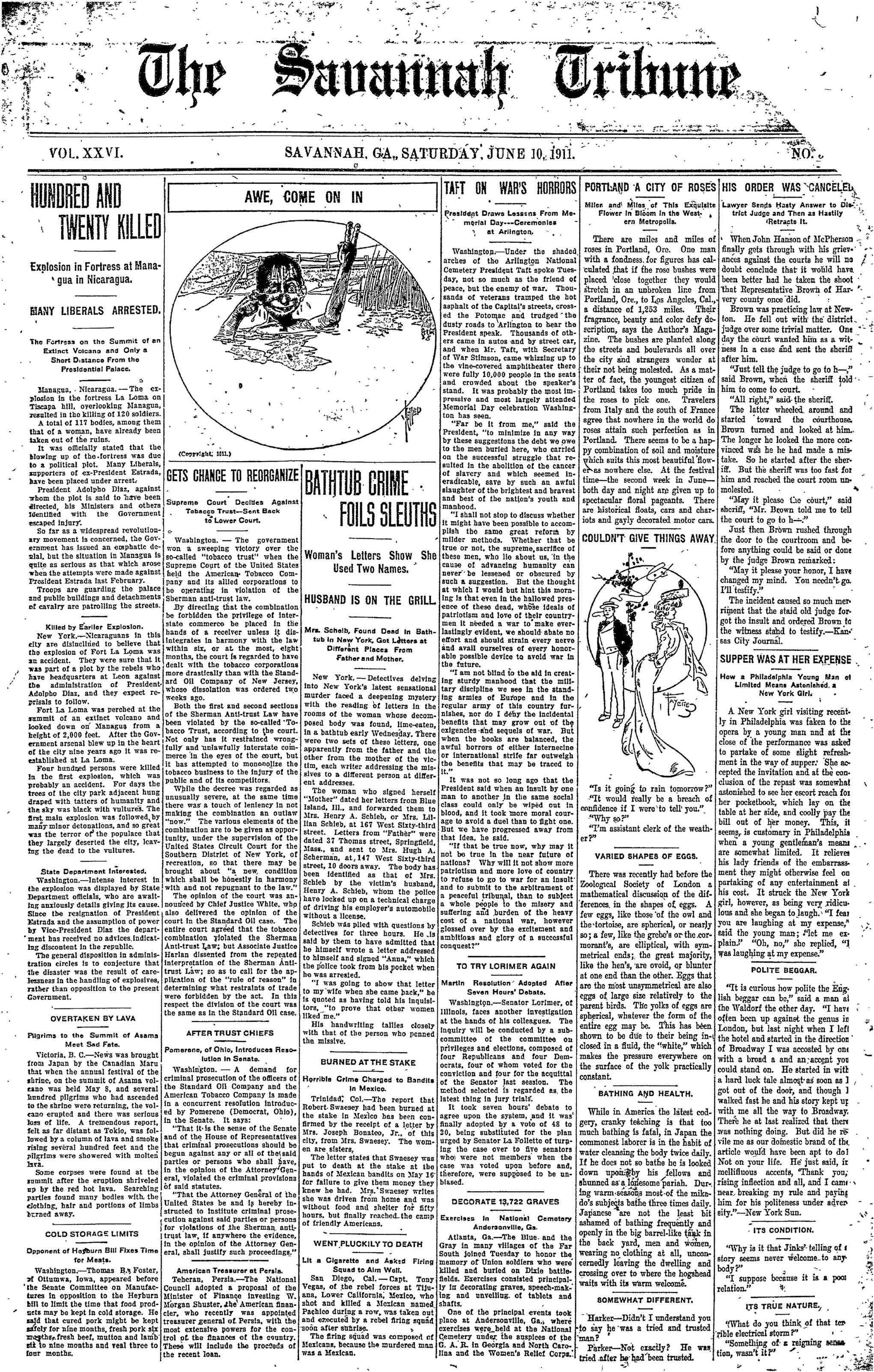
Page text (machine-generated)
VOL. XXVI.
HUNDRED AND TWENTY KILLED
Explosion in Fortress at Managua in Nicaragua.
MANY LIBERALS ARRESTED.
The Fortress on the Summit of an Extinct Volcano and Only a Short Distance From the Presidential Palace.
Managua, Nicaragua. — The explosion in the fortress La Loma on Tiscapa hill, overlooking Managua, resulted in the killing of 120 soldiers.
A total of 117 bodies, among them that of a woman, have already been taken out of the ruins.
It was officially stated that the blowing up of the fortress was due to a political plot. Many Liberals, supporters of ex-President Estrada, have been placed under arrest.
President Adolpho Diaz, against whom the plot is said to have been directed, his Ministers and others identified with the Government escaped injury.
So far as a widespread revolutionary movement is concerned, the Government has issued an emphatic denial, but the situation in Manguaia is quite as serious as that which arose when the attempts were made against President Estrada last February.
Troops are guarding the palace and public buildings and detachments of cavalry are patrolling the streets.
Killed by Earlier Explosion.
New York.—Nlearaguans in this city are disinclined to believe that the explosion of Fort La Loma was an accident. They were sure that it was part of a plot by the rebels who have headquarters at Leon against the administration of President Adolpho Diaz, and they expect reprisals to follow.
Fort La Loma was perched at the summit of an extinct volcano and looked down on Managua from a height of 2,000 feet. After the Government arsenal blew up in the heart of the city nine years ago it was reestablished at La Loma.
Four hundred persons were killed in the first explosion, which was probably an accident. For days the trees of the city park adjacent hung draped with tatters of humanity and the sky was black with vultures. The first main explosion was followed, by many minor detonations, and so great was the terror of the populace that they largely deserted the city, leaving the dead to the vultures.
State Department Interested.
Washington.—Intense Interest in the explosion was displayed by State Department officials, who are awaiting anxiously details giving its cause. Since the resignation of President Estrada and the assumption of power by Vice-President Diaz the department has received no advices, indicating discontent in the republic. The general disposition in administration circles is to conjecture that the disaster was the result of carelessness in the handling of explosives, rather than opposition to the present Government.
OVERTAKEN BY LAVA
Pilgrims to the Summit of Asama Meet Sad Fate.
Victoria, B. C.—News was brought from Japan by the Canadian Maru that when the annual festival of the shrine, on the summit of Asama volcano was held May 8, and several hundred pilgrims who had ascended to the shrine were returning, the volcano erupted and there was serious loss of life. A tremendous report, felt as far distant as Tokio, was followed by a column of lava and smoke rising several hundred feet and the pilgrims were showered with molten lava.
Some corpses were found at the summit after the eruption shriveled up by the red hot lava. Searching parties found many bodies with the clothing, hair and portions of limbs burned away.
COLD STORAGE LIMITS
Opponent of Hogburn Bill Fixes Time for Meats.
Washington.—Thomas B. Foster, of Ottumwa, Iowa, appeared before the Senate Committee on Manufactures in opposition to the Heyburn bill to limit the time that food products may be kept in cold storage. He said that cured pork might be kept safely for nine months, fresh pork six months, fresh beef, mutton and lamb six to nine months and veal three to four months.
Savannah
AWE, COME ON IN
(Copyright, 1611.)
(Copyright, 1811.)
GETS CHANGE TO REORGANIZE
Supreme Court Decides Against Tobacco Trust—Sent Back to Lower Court.
Washington. — The government won a sweeping victory over the so-called "tobacco trust" when the Supreme Court of the United States field the American Tobacco Company and its allied corporations to be operating in violation of the Sherman anti-trust law.
By directing that the combination be forbidden the privilege of interstate commerce be placed in the hands of a receiver unless it disintegrates in harmony with the law within six, or at the most, eight months, the court is regarded to have dealt with the tobacco corporations more drastically than with the Standard Oil Company of New Jersey, whose dissolution was ordered two weeks ago.
Both the first and second sections of the Sherman Anti-trust Law have been violated by the so-called Tobacco Trust, according to the court. Not only has it restrained wrongfully and unlawfully interstate commerce in the eyes of the court, but it has attempted to monologize the tobacco business to the injury of the public and of its competitors.
While the decree was regarded as unusually severe, at the same time there was a touch of lenency in not making the combination an outlaw "now." The various elements of the combination are to be given as opportunity, under the supervision of the United States Circuit Court for the Southern District of New York, of recreation, so that there may be brought about "a new, condition which shall be honestly in harmony with and not repugnant to the law."
The opinion of the court was announced by Chief Justice White, who also delivered the opinion of the court in the Standard Oil case. The entire court agreed that the tobacco combination violated the Sherman Anti-trust Law; but Associate Justice Harlan dissented from the repeated interpretation of the Sherman Anti-trust Law; so as to call for the application of the "rule of reason" in determining what restraints of trade were forbidden by the act. In this respect the division of the court was the same as in the Standard Oil case.
AFTER TRUST CHIEFS
Pomerene, of Ohio, Introduces Resolution in Senate.
Washington. — A demand for criminal prosecution of the officers of the Standard Oil Company and the American Tobacco Company is made in a concurrent resolution introduced by Pomerene (Democrat, Ohio), in the Senate. It says:
"That it is the sense of the Senate and of the House of Representatives that criminal prosecutions should be begun against any or all of the said parties or persons who shall have, in the opinion of the Attorney-General, violated the criminal provisions of said statutes.
"That the Attorney General of the United States be and is hereby instructed to institute criminal prosecution against said parties or persons for violations of the Sherman antitrust law, if anywhere the evidence, in the opinion of the Attorney General, shall justify such proceedings."
American Treasurer at Persia
Teheran, Persla.—The National Council adopted a proposal of the Minister of Finance investing W. Morgan Shuster, the American financier, who recently was appointed treasurer general of Persla, with the most extensive powers for the control of the finances of the country. These will include the proceeds of the recent loan.
SAVANNAH, GA., SATURDAY, JUNE 10, 1911.
BATHTUB CRIME
FOILS SLEUTHS
Woman's Letters Show She Used Two Names.
HUSBAND IS ON THE GRILL
Mrs. Schelb, Found Dead In Bath-tub In New York, Got Letters at Different Places From Father and Mother
New York. — Detectives delving into New York's latest sensational murder faced a deepening mystery with the reading of letters in the rooms of the woman whose decomposed body was found, lime-eaten, in a bathtub early Wednesday. There were two sets of these letters, one apparently from the father and the other from the mother of the victim, each writer addressing the missives to a different person at different addresses.
The woman who signed herself "Mother" dated her letters from Blue Island, Ill., and forwarded them to Mrs. Henry A. Schleb, or Mrs. Lillian Schleb, at 167 West Sixty-third street. Letters from "Father" were dated 37 Thomas street, Springfield, Mass., and sent to Mrs. Hugh A. Scherman, at,147 West Sixty-third street, 10 doors away. The body has been identified as that of Mrs. Schleb by the victim's husband, Henry A. Schleb, whom the police have locked up on a technical charge of driving his employer's automobile without a license.
Schleb was plied with questions by detectives for three hours. He is said by them to have admitted that he himself wrote a letter addressed to himself and signed "Anna," which the police took from his pocket when he was arrested.
"I was going to show that letter to my wife when she came back," he is quoted as having told his inquisitors, "to prove that other women liked me."
His handwriting tallies closely with that of the person who penned the missive.
BURNED AT THE STAKE
Horrible Crime Charged to Bandits in Mexico.
Trinidad, Col.—The report that Robert Swaesey had been burned at the stake in Mexico has been confirmed by the receipt of a letter by Mrs. Joseph Bonatoo, Jr., of this city, from Mrs. Swaesey. The women are sisters. The letter states that Swaesey was put to death at the stake at the hands of Mexican bandits on May 16 for failure to give them money they knew he had. Mrs. Swaesey writes she was driven from home and was without food and shelter for fifty hours, but finally reached the camp of friendly Americans.
WENT PLUCKILY TO DEATH
Lit a Cigarette and Asked Firing Squad to Aim Well.
San Diego, Cal. - Capt. Tony Vegas, of the rebel forces at Tijuana, Lower California, Mexico, who shot and killed a Mexican named Pachico during a row, was taken out and executed by a rebel firing squad soon after sunrise.
The firing squad was composed of Mexicans, because the murdered man was a Mexican.
TAFT ON WAR'S HORRORS
President Draws Lessons From Memorial Day----Ceremonies at Arlington.
Washington. Under the shaded arches of the Arlington National Cemetery President Taft spoke Tuesday, not so much as the friend of peace, but the enemy of war. Thousands of veterans tramped the hot asphalt of the Capital's streets, crossed the Potomac and trudged the dusty roads to Arlington to hear the President speak. Thousands of others came in autos and by street car, and when Mr. Taft, with Secretary of War Stilmson, came whizzing up to the vine-covered amphitheater there were fully 10,000 people in the seats and crowded about the speaker's stand. It was probably the most impressive and most largely attended Memorial Day celebration Washington has seen.
"Far be it from me," said the President, "to minimize in any way by these suggestions the debt we owe to the men burled here, who carried on the successful struggle that resulted in the abolition of the cancer of slavery and which seemed ineradicable, save by such an awful slaughter of the brightest and bravest and best of the nation's youth and manhood.
"I shall not stop to discuss whether it might have been possible to accomplish the same great reform by milder methods. Whether that be true or not, the supreme, sacrifice of these men, who lie about us, in the cause of advancing humanity can never be lessened or obscured by such a suggestion. But the thought at which I would but hint this morning is that even in the hallowed presence of these dead, whose ideals of patriotism and love of their countrymen it needed a war to make everlastingly evident, we should abate no effort and should strain every nerve and avail ourselves of every honorable possible device to avoid war in the future.
"I am not blind to the aid in creating sturdy manhood that the military discipline we see in the standing armies of Europe and in the regular army of this country furnishes, nor do I deny the incidental benefits that may grow out of the exigencies and sequels of war. But when the books are balanced, the awful horrors of either internecine or international strife far outweigh the benefits that may be traced to it."
It was not so long ago that the President said when an insult by one man to another in the same social class could only be wiped out in blood, and it took more moral courage to avoid a duel than to fight one. But we have progressed away from that idea, he said.
"If that be true now, why may it not be true in the near future of nations? Why will it not show more patriotism and more love of country to refuse to go to war for an insult and to submit to the arbitrament of a peaceful tribunal, than to subject a whole people to the misery and suffering and burden of the heavy cost of a national war, however glossed over by the excitement and ambitions and glory of a successful conquest?"
TO TRY LORIMER AGAIN
Martin Resolution Adopted After Seven Hours' Debate.
Washington.—Senator Lorimer, of Illinois, faces another investigation at the hands of his colleagues. The inquiry will be conducted by a subcommittee of the committee on privileges and elections, composed of four Republicans and four Democrats, four of whom voted for the conviction and four for the acquittal of the Senator last session. The method selected is regarded as, the latest thing in jury trials.
It took seven hours' debate to agree upon the system, and it was finally adopted by a vote of 48 to 20, being substituted for the plan urged by Senator La Follette of turning the case over to five senators who were not members when the case was voted upon before and, therefore, were supposed to be unblased.
DECORATE 13,722 GRAVES
Exercises in National Cemetery Andersonville, Ga.
Atlanta, Ga.-The Blue and the Gray in many villages of the Far South joined Tuesday to honor the memory of Union soldiers who were killed and buried on Dixie battlefields. Exercises consisted principally in decorating graves, speech-making and unveiling. of tablets and shafts.
One of the principal events took place at Andersonville, Ga., where exercises were held at the National Cemetery under the auspices of the G. A. R. in Georgia and North Carolina and the Women's Relief Corps.
Milen and Milas of This Exquisite Flower in Bloom in the Western Metropolis.
There are miles and miles of roses in Portland, Ore. One man with a fondness for figures has calculated that if the rose bushes were placed close together they would stretch in an unbroken line from Portland, Ore., to Los Angeles, Cal., a distance of 1,253 miles. Their fragrance, beauty and color defy description, says the Author's Magazine. The bushes are planted along the streets and boulevards all over the city and strangers wonder at their not being molested. As a matter of fact, the youngest citizen of Portland takes too much pride in the roses to pick one. Travelers from Italy and the south of France agree that nowhere in the world do roses attain such perfection as in Portland. There seems to be a happy combination of soil and moisture which suits this most beautiful flower as nowhere else. At the festival time—the second week in June—both day and night are given up to spectacular floral pageants. There are historical floats, cars and chariots and gayly decorated motor cars.
COULDN'T GIVE THINGS AWAY
FYCITE
"Is it going to rain tomorrow?"
"It would really be a breach of confidence if I were to tell you."
"Why so?"
"I'm assistant clerk of the weather?"
VARIED SHAPES OF EGGS.
There was recently had before the Zoological Society of London a mathematical discussion of the differences in the shapes of eggs. A few eggs, like those of the owl and the tortoise, are spherical, or nearly so; a few, like the grebo's or the cormorant's, are elliptical, with symmetrical ends; the great majority, like the hen's, are ovoid, or blunter at one end than the other. Eggs that are the most unsymmetrical are also eggs of large size relatively to the parent birds. The yolks of eggs are spherical, whatever the form of the entire egg may be. This has been shown to be due to their being inclosed in a fluid, the "white," which makes the pressure everywhere on the surface of the yolk practically constant.
BATHING AND HEALTH.
While in America the latest codgery, cranky teaching is that too much bathing is fatal, in Japan the commonest laborer is in the habit of water cleansing the body twice daily. If he does not so bathe he is looked down upon by his fellows and shunned as a lonesome pariah. During warm-seasons most of the mikado's subjects bathe three times daily. Japanese are not the least bit ashamed of bathing frequently and openly in the big barrel-like tank in the back yard, men and women, wearing no clothing at all, unconcernedly leaving the dwelling and crossing over to where the hogshead waits with its warm welcome.
SOMEWHAT DIFFERENT.
Harker—Didn't I understand you to say he was a tried and trusted man?
Parker—Not exactly? He was tried after he had been trusted.
HIS ORDER WAS CANCELED
Lawyer Sends Hasty Answer to District Judge and Then as Hastily Retracts It.
When John Hanson of McPherson finally gets through with his grievances against the courts he will no doubt conclude that it would have been better had he taken the shoot that Representative Brown of Harvery county once did.
Brown was practicing law at Newton. He fell out with the district judge over some trivial matter. One day the court wanted him as a witness in a case and sent the sheriff after him.
"Just tell the judge to go to h—," said Brown, when the sheriff told him to come to court.
"All right," said the sheriff.
The latter wheeled around and started toward the courthouse. Brown turned and looked at him. The longer he looked the more convinced was he he had made a mistake. So he started after the sheriff. But the sheriff was too fast for him and reached the court room unmolested.
"May it please the court," said sheriff, "Mr. Brown told me to tell the court to go to h--."
Just then Brown rushed through the door to the courtroom and before anything could be said or done by the judge Brown remarked:
"May it please your honor, I have changed my mind. You needn't go. I'll testify."
The incident caused so much merriment that the staid old judge forgot the insult and ordered Brown to the witness stand to testify.—Kansas City Journal.
SUPPER WAS AT HER EXPENSE
How a Philadelphia Young Man of Limited Means Astonished, a New York Girl.
A New York girl visiting recently in Philadelphia was faken to the opera by a young man and at the close of the performance was asked to partake of some slight refreshment in the way of supper. She accepted the invitation and at the conclusion of the repast was somewhat astonished to see her escort reach for her pocketbook, which lay on the table at her side, and coolly pay the bill out of her money. This, it seems, is customary in Philadelphia when a young gentleman's means are somewhat limited. It relieves his lady friends of the embarrassment they might otherwise feel on partaking of any entertainment at his cost. It struck the New York girl, however, as being very ridiculous and she began to laugh. "I fear you are laughing at my expense," said the young man; "let me explain." "Oh, no," she replied, "I was laughing at my expense."
POLITE BEGGAR.
"It is curious how polite the English beggar can be," said a man at the Waldorf the other day. "I have often been up against the genus in London, but last night when I left the hotel and started in the direction of Broadway I was accosted by one with a broad a and an accent you could stand on. He started in with a hard luck tale almost as soon as I got out of the door, and though I walked fast he and his story kept up with me all the way to Broadway. There he at last realized that there was nothing doing. But did he revile me as our domestic brand of the article would have been apt to do! Not on your life. He just said, in mellifluous accents, "Thank you, rising inflection and all, and I came near, breaking my rule and paying him for his politeness under adversity."—New York Sun.
ITS CONDITION.
"Why is it that Jinks' telling of a story seems never welcome to anybody?"
"I suppose because it is a poor relation."
ITS TRUE NATURE,
"What do you think of that terrible electrical storm?"
"Something of a reigning sensation, wasn't it?"
Of Interest to Our Women
Fashion Notes
Dainty Neckwear May Be Made at Home.
It seems unfortunate that when the truly fine and dainty collars and japots are out of reach of the purse so many women buy cheap and inexpensive imitations of the expensive trifles. And yet these costly pieces of neckwear are usually easily made at a comparatively reasonable cost, if one has skill with the needle and is willing to expend both time and patience. A very beautiful flat collar may be made from a small piece of sheer white lawn and finished with a frill of fine valenciennes. A few sprays of hand embroidered flowers will add an air of daintiness besides making it look more expensive. However, it is necessary first to purchase a pattern which fits perfectly before cutting the material.
To Wash Flannels.
Flannels should be washed in warm suds that have had a little ammonia added to them. The flannels should be rubbed between the hands, not on a board, and dipped up and down in the suds until they are free from dirt and stains. Squeeze them with the hands until as much water as possible is removed, and then rinse in water of the same temperature as that in which they were washed. Wring out again, hang in the shade and press them out on the wrong side while still damp. Flannels should never be placed in the sun to dry, or they will shrink. Special care should also be taken when rubbing the garments to see that all the dirt is removed before they are wrung out and hung up to dry.
Comic Newspaper, Favors for Children's Parties.
In many homes the Sunday newspapers are bought mainly for the sake of the children, who love the "funny sheet" and watch each week for the return of their favorites in new side-splitting adventures and antics. Now some of these funny characters have invaded favorland and are ready to cause gasps of delight on the birthday luncheon table, or as participants in the Jolly Jack Horner pie. Rhymo the Monk and Lady Bountiful, Little Nemo and others are represented as natural as life (newspaper life, that is), and of course each is provided with a receptacle for candy.
French White Sauce.
Take one small bunch of parsley, two cloves, one-half a bay leaf, one small fagot of savory herbs, salt to taste, three or four mushrooms, when obtainable, two pints of white stock, one pint of cream, one tablespoonful of arrowroot. Put the stock into a stewpan with the parsley, cloves, bay leaf, herbs and mushrooms; add a seasoning of salt, but no ground pepper, as that would give the sauce a durky appearance. A small quantity of wine, or any liquor, would very much improve the flavor of this sauce. It is usually served with bread, rice, custard, or any pudding that is not very rich.
Simple Brocks for Little Malden.
Simple Frocks for Little Malden. Shepherd plaids in black and white, and blue and white, are always good for children's frocks, when enlivened by a bit of color, and when properly handled have a delightfully childish and simple air. Some smart little models in this material have belts of patent leather, and the accompanying scarf of these dresses, which are nearly always made up in Russian or sailor effects, are either black or red.
Color In Blouses.
Although the color element in blouses is not decidedly new, the effects shown in the newest blouses are both new and smart. A little yoke or inserts of the finest cotton marquette or volle in color, a French blue or a soft pink lends the touch of color needed.
Admirable for many occasions is a dark blue silk mull dress highly mercerized. It has the air of a summer silk, but is much cooler and scarcely need be pressed the whole summer through. If this is made with a shallow yoke and under-sleeves of white mull in thread tucks, trimmed with blue batiste embroidered edging, the little gown is quite elaborate enough to be worn on semi-formal occasions, or when going to the country for the day.
A very smart little street dress was seen in the Bois. It was of blue serge trimmed with bright green satin. The latter formed a broad sash, that was knotted and dropped at the left side. Oriental embroidered was used on yoke, cuffs and the ends of the sash.
Thus for morning and general knock about wear she depends less on linen and other fabrics that wrinkle quickly than on foulards, mulls and the cotton volts, marquisettes, and even the fine French cotton crepes.
Toast, Appetizing and the Reverse.
There is nothing so rarely found as toast that is well made. Few cooks are successful with it, yet it is not difficult to get right.
The chief reason of many failures is lack of patience. It is so much easier to cut thick, uneven slices, not remove the crusts and do several platefuls at a time that that is the usual method.
Appetizing toast should be cut thin without crusts, cooked over a clear bed of coals until a delicate brown and sprinkled lightly with salt and put back in the oven for the butter to soak in.
Never let toast stand. Far better wait for it than to have too much cooked at once. If the family is late in coming to the table, do not start to toast until they are eating their cereal.
The best toast is made over open goals, but it can be nicely toasted in the gas oven if closely watched.
Appetizing toast is neither soggy, nor so crisp that it tastes like dried chips. The best is made from a close-grained bread a day old.
Do not serve in great chunks; toast must look well, besides being properly cooked, to be appetizing.
Toast that has grown cold can be served by putting it on an old plate, covering it with cream, butter and salt and allowing it to soak into the bread in a hot oven.
Where one prefers to butter toast at a table it must be served very hot in a folded napkin and just a few slices at a time.
In making milk toast use a little thickening in the milk, otherwise your toast will be soggy and thin.
To Hold Vell In Place.
A number of clever expedients have been devised to hold a vell snugly under the chin without giving it an ugly line. Here is one method which saves the vell also and involves hardly any trouble. Get the narrowest kind of round elastic, the same color as the vell (paint the white elastic with water colors for a colored vell), and whip it over the extreme edge of the vell, taking up only a single thread all around. Include any-cut edges, but afterwards pare them off neatly with a small pair of scissors. Fasten in back with a tight knot.
The vell is slightly gathered on the elastic, fits nicely under the chin and over hat, and stretches when it is raised. It seems the best solution of a vexing problem of dress.
Cabbage Salad.
Chop very fine one-half a head of cabbage. Pour on it the juice from a can of tomatoes to make it pink; add sugar, salt, vinegar and oil to taste. Do not make it too wet. Break open a head of clean lettuce carefully and spread the leaves from the center like a flower. Place a shapely oval of pink salad on each leaf.
Orange Gustard Recipe.
Boll the rind of half an orange till soft. Then beat it to a paste in a mortar, adding by degrees a spoonful of the best brandy, the strained juice of the orange, four ounces of loaf sugar and the beaten yolks of four eggs. Beat all together for ten minutes. Add a pint of boiling cream and beat until cold.
Chicken With Caper Sauce.
Clean and truss a chicken and cover with boiling water, adding a stalk of celery; let boil five minutes, then set where the water will bubble on one side of the kettle unceasingly until the chicken is tender; add salt when half cooked.
Sun Injures Mirrors.
A mirror should never be hung where the sun shines directly upon it. The mercury spread on the glass to form a looking-glass is soon ruined by exposure to rays of the sun.
Just the thing for the small allowance is one of the fashionable one-piece frocks of white marquette, white crepe or volle, that are now included in the summer trouseau for summer morning wear. They are made simply, sometimes with no trimming but tucks and stitched bands; again are decorated with Irish crochet yokes and undersleeves and big buttons; a few are trimmed with cotton ball fringe, but the lines in all are severe.
The girl who dresses on ah allowance and finds laundry bills heavy must learn to be a careful buyer. After a season or two of blowing in all her allowance on one or two frocks that she finds she has little use for, she learns wisdom and studies her needs.
Many little hats or turbans are now seen that hint of the pokebonnet of long ago. Their brims are pinched or pointed in front, and they have high puffed crowns of silk or satin.
THE PROOF OF THE PUDDING
QUALITY OF TUSKEGEE INSTITUTE MEASURED BY THE QUALITY OF STUDENTS IT TURNS OUT.
Indisputably the proof of the pudding is in the eating. Not quite so definitely can the quality of a school be measured by the quality of the pupils it turns out, and yet to a considerable degree the measure of their success is the index to the successful conduct of the school. The faulty of human nature will spoil the best efforts directed toward some people, while some pretty poor stock can be improved by devoted and well-directed attention. So the average rating of a considerable number of school pupils or of those who have been school pupils may fairly be accepted as evidence of what that school is doing.
To get at proof of the Tuskegee Institute school pudding the division of research and records has reached into the list of graduates and former students engaged in industrial work and pulled out the names of 746, investigated their history since leaving school and compiled the facts into a hahdsome looking volume done by the institute press. The Standard, in turn, has checked off the middle paragraph on every third page of the report, to see what a random selection of these people that chance has put into the book—for respect for the school compels acceptance of the statement that the 417 graduates and 329 former students investigated out of the total of 1,508 graduates and 12,000 former students are not a picked lot, but taken, as the report says, at random—will reveal.
The first person brought to light through this doubly casual method of selection is the United States demonstration agent for Mason county, Alabama, doing excellent work in instructing the farmers how to raise six ears of corn where formerly one grew. The next is a couple of people, man and wife, who are carrying on an interesting work in one of the rural schools of Macon county, Alabama, "artificating the school with every phase of the community life," managing, besides their school work, a young people's club, a mother's club, and farmers' conference. Three pages farther on is chronicled the success of a merchant and truck farmer in Alabama, who owns property there. Following the same plan of selection, we discover in turn a former student who has farmed successfully for 20 years, owning his place in Alabama; a successful merchant and farmer at Tuskegee, owning 200 acres, part of which he farms and part of which he rents, conducting the best grocery store in the town, owning a house and some house lots in Tuskegee and other land and houses in Florida; a woman teacher under the "Jeanes Foundation for the Improvement of Negro Schools," teaching sewing, dressmaking and gardening in three schools; a brick mason, working as corner man on the largest guano plant ever under course of erection in Savannah, getting $5 a day; a successful architect in Washington, designer of a variety of buildings in the south connected with negro life and work: a contractor and builder in Mississippi, averaging a hundred dollars a month; the owner of a successful shoemaking business in Kentucky; a tailor in Texas, who does his own drafting, cutting and making, and employs four men in the business; a man nurse for seven years in the United States hospital corps; a woman nurse at Hot Springs, Ark., who gets from $20 to $35 a week according to whether it is private nursing or hospital, and also does sewing when she is not nursing, earning at this from $7 to $10 a week; the woman organizer of a school in Arkansas, now having three teachers, and where she herself teaches sewing, cooking, housekeeping and gardening, visiting the mothers in their homes to interest them in the matter of dress, housekeeping and care of the children, in this way influencing 400 people; the prime mover in establishing an industrial institute in Alabama, now carried on by her husband; the man organizer of a school that had its beginning in his own log cabin in Alabama and that now has nearly 4,000 acres of land and 21 buildings, with 33 teachers.
The Tuskegee pudding goes down easily, digests readily, and proves itself satisfactorily, in this story of successful lives that have first felt the influence of Tuskegee institute.—Editorial: New Bedford (Mass.) Standard.
FOR AN UNDERGROUND TANK.
We have the assurance of the Scientific American that the best material or an underground tank is heavy black heet from thoroughly painted with iron paint said to be more durable than galvanized iron, especially in some solls and where electric currents exist.
REAL SERVICES.
And he gave it for his opinion that whoever could make two ears of corn or two blades of grass to grow upon a spot of ground where only one grew before would deserve better of mankind and do more essential service to his country than the whole race of politicians put together.—Swift.
FRINGE ON HATS.
Fringe—narrow silk fringe—is used to edge a new straw hat, and very softening it is to the face. The knees of ribbon, which are the sole trimming, are also edged with the same narrow fringe.
"The American Baptist speaks the word we have been waiting for since the silly discussion with respect to "great" Negro preachers began. Some one said that there were no preachers to compare with Beecher, Talmage, etc. Of course that was an empty speech. No preacher on the continent has ever surpassed Charles T. Walker as a Gospel preacher. There are many men who could become great preachers if they would let church politics alone. Says the American Baptist:
"An item has been going the rounds that The race has produced no preacher of real eminence." There is certainly no man among us who is to the nation what Talmage, Moody or Beecher was. Nor is there a man among us who is the undisputed Talmage or Moody or Beecher of the race. This statement has been credited to a preacher who in our opinion holds a high place in the ranks of the ministry and measures up himself among the great preachers of the race. Very few preachers among any people or race will ever attain the eminence and power attained by the three great preachers named, but that does not follow that there are no preachers which have reached the standard of learning, power, eloquence, influence and usefulness attained by these men. Conditions, environments and opportunity have much to do with the prominence reached and the record made as well as the good accomplished by men of any calling and in any work. We have heard all these great preachers, and we have heard others of both races who in our judgment are just as eloquent, just as logical, just as convincing and just as effective in presenting the story of the Gospel as either of them and who are as truly great preachers. They have not perhaps attained the prominence these great preachers have attained because they have not had the opportunity, but they are masters of the situation in their fields of labor and will become more distinguished as they have the opportunity."
A rumor is going the rounds of the press to the effect that Booker T. Washington, backed by Negro financier, of the north is going to purchase the I. & G. N. railroad and operate it with Negro labor exclusively. Some months ago, an equally foolish report was current that Negroes were going to buy out Texas and colonize it.
It would be a waste of time to try to account for the origin of such stories. Now we don't mean to say that Negroes are not able to buy and operate the I. & G. N. road, but they are not built that way. The I. & G. N. is an earthly proposition—it is wholly of this world.
If it were a heavenly proposition it might attract popular attention. Or if it could be divided up into sections, say a Baptist section, a Methodist section, a Church of God section, etc., we would fall to it without hesitation. But as it now stands it would take a 'God to induce sufficient concert of action on the part of the race to finance that affair. And until such intervention occurs we'll continue to buy the railroad by means of religious and secular excursions and other suel joy 'parties, but the ownership and increment therefrom will' continue with the white man—Old Hickory.
Rabbi Samuel Sale, president of the board of directors of the Dunbairn Normal Agricultural and Industrial Institute for Negro Boys and Girls of Missouri, received a contribution of $2,500 from Julius Rosenwald, the millionaire philanthropist of Chicago, who is taking a deep interest in the education of Negroes and has recently donated liberally toward the erection of buildings for the Negro branch of the Y. M. C. A. in several cities. The Dunbairn Normal, Agricultural and Industrial Institute, which is being promoted by Rev. W. D. A. Venerable, has an option on 1,666 acres of land near Jonesburg, Warren county, Mo., where the school is to be established. Adolphus Busch gave $1,000 toward the funds of the school last week and many St. Louis capitalists are subscribers—Dallas Express
"There is not a city, town or village in the south where an industrious negro cannot obtain employment and receive fair treatment at the hands of his white neighbors. There is not the least doubt that the relations of the two races in the south are today vastly better than they were ten years ago, and we believe it is due in large measure to the fact that the negroes are beginning to understand that those who have the kindest feeling and most sympathy for them are the white people among whom they have been born and reared."—New Orleans State.
Firman C. Brown, Charleston, W Va., has recently received notice of allowance of patent on his food warmer and will now introduce an emergency service. Cooked meals can be sent out any distance from one block to two miles, hot and in a sanitary condition at destination. The warmer will take up space of an ordinary grip and can be easily carried in street car without inconvenience to passengers.
Mr. Brown, the inventor, has given twenty years as head waiter in the leading hotels north and south and has observed the need of service as above named.
The teacher, and especially the teacher in the negro school, has a great opportunity before her of being of much help to the boys and girls under her immediate care.
Her work is more than merely hearing recitations. The formation of character and the development of thought in the child also should be the aim of the teacher. She has opportunity of moulding and shaping sentiment in them for that which is good and strong and pure. She has the opportunity of placing before them such ideals the working towards which will enrich their lives. Not only should she enrich the lives of, the boys and girls under her immediate care, but the lives of all who come in touch with her. The community in which she lives should be better and stronger because of her presence.
She should at all times be ready to lend a helping hand to every worthy cause that presents itself. So many of the homes of our people lack in the things that will make them bright and beautiful and helpful to the young. Here she has an opportunity to be of much help in giving advice and offering suggestions that will tend to make the home more attractive.
Too few of our homes know what kind of literature to give the young. Too often there is nothing there to feed the mind, and the children are left to their own resources to find such literature as they like best.
So often the charge is made that education does our young people harm. Here the teacher has an opportunity by her work to show that such charges are not based on facts.
The teacher should take the lead, or at least be found in the front ranks of all movements that are for the moral uplift and material well-being of the people in her community. In other words, the teacher should be a leader in all that the term implies.
Let not the golden opportunity pass by unheeded. Selze it while it is within your grasp, and thereby make yourself a power for good among those with whom your lot is cast—Birmingham American.
LIBERIA'S NEXT PRESIDENT
The next president of Liberia will be Daniel E. Howard, now secretary of the treasury. The vice-president will be Senator S.C. Harmon of Grand Bassa, a port town about half way down the Liberian coast. Judge Dosen, now vice-president, was an active candidate for the nomination, but his name was not presented to the convention. The Liberians elect their president in pretty much the manner that prevails in the United States, but they have only one political party and the nomination is the same as an election. All the doubt and most of the excitement precede the party convention instead of accompanying the actual polling of the votes.
Mr. Howard has served for a number of years as the chairman of his party, but he is a very quiet, gentle party boss. He has made a good secretary of the treasury and his experience in financial matters will be much to his advantage in this critical period of Liberia's history. He is American in his sympathies and has the general confidence of his people. The vicepresident to be is pre-eminently a business man. He had never held office prior to his present term as senator and his election in that instance was practically the result of pressure. He is a large and prosperous merchant and agent of the Elder-Dempster Steamship company of Liverpool. Everybody likes him and nobody has ever questioned his integrity. He is a warm friend of everything American.
Altogether the new selection augurs well for the negro republic. The new administration will be beset with international difficulties of the gravest character, and it is a matter of serious doubt whether the integrity of Liberia will long remain intact. If anybody in Liberia can preserve the independence of the little state Howard and Harmon are the men.—New York Sun.
Creamed Carrots:
Cook young carrots whole in boiling water, or, if old, cut the carrots in slices. Make a cream sauce with one and one-half level tablespoonful of flour, blended with two level tablespoonfuls of butter in a saucepan set on the fire, add half a teaspoonful of onion juice, a saltspoonful of salt and a few dashes of white pepper. Add a cup of hot cream and stir until it bolls. Add the carrots cut in small pieces, heat and serve.
Recipe for Apple Snow.
Boll six apples until done, press them through a sieve, sweeten to taste and flavor with a teaspoonful of lemon. Froth the whites of six eggs, add two tablespoonfuls of powdered sugar. Beat the apple pulp to a froth and mix with the egg whites and whisk until it looks like snow. Garnish with candied lemon peel and sliced apples and serve very cold.
An Effort to Oblige.
"Mr. Lobrow does his best to be agreeable," said the sympathetic young woman. "It's too bad he has so little tact."
"I understand that Miss Coddleyap refuses to speak to him. He sent her a box of candy, and she fed it all to her pet terrier. So he tried to be still more kind and thoughtful and sent her a box of dog biscuits.—Washington Star.
The Sunday School Lesson
HEZEKIAH'S GREAT PASSOVER.
Sunday School Lesson for June 11,
1911.
Golden Text.—"Man looketh on
the outward appearance, but the Linn
looketh on the heart."—I. Sam, 18:7.
II. Chron. 30:13-27. Commit vz.
18:20.
Time.—726 B. C. Place.—Jerusalem. Exposition. I. The feast of unleashed bread in the second month, 12:22. Step by step Hezekiah sought to bring the people back to Jehovah and complete obedience to his word. He began by reopening the house of Jehovah (ch. 29:3:7). He next cleansed the house (29:15:19); then he dedicated with offerings and sacrifices and praise (29:20:36). In this lesson he re-institutes Israel's great memorial feast wherein God's redemption through blood is set forth (cf. Ex. 12). It revealed a deep discernment on Hezekiah's part of the meaning of the Mosaic system and of redemption, that he put the Passover forward as the very heart and center of the true worship of Jehovah. Who ever understands the Passover, understands God's way of salvation (cf. Ex. 12:13, 13, I. Cor. 5:7, 8; Rom. 3:25, 26; John I. 29). When at a later date Josiah undertook the reformation of the people of God, he too emphasized the Passover (2 Ch. 35:1:19). In every true reformation the doctrine of alignment by blood comes to the front. There is a great need in the churches of America and England today that there be a reformation that gives to the blood of our Passover its proper place. Hezekiah sought to give to his reformation the widest possible scope. He did not limit his efforts to his own people of Judah, but sent to Ephraim and Manasseh as well, indeed, to all Israel (vs. 1:5). Hezekiah had the true missionary spirit. It has been said that "Hezekiah had no right to invite Hosea's subjects to repair to Jerusalem to his Passover," but it was not his Passover, it was "a Passover unto the Lord God of Israel" (v. 1). The invitation was widely accepted. Hezekiah was unable to keep the very letter of the law. They were not in a position to keep the Passover properly in the first month (v. 3), so he decided that he would come as near to that as he could and keep it in the second month. This was satisfactory to him who looketh upon the heart and its intentions and judget the outward performance in the light of that (vs. 17:20). He had moreover Scriptural warrant for keeping the Passover out of the regular time (Num. 9:9:13). Our God is full of condescension as well as compassion, and knoweth our frame and taketh account of our weaknesses. Some times our children do not do precisely what we tell them to, but we see that there is an honest effort to do it, a purpose to do it as near as possible under the circumstances, and we are satisfied and pleased, so is God under similar circumstances. But where exact obedience is possible, woe to us if we do not render it (Deu. 12:32; II. Sam. 6:37), cf. Num. 4:15; I. Chron. 15:12. 13). They put away everything that was alien to the worship of Jehovah (v. 14). Doubtless many thought they were narrow, but they knew God demanded through separation (cf II Cor. 6:14:7:1). There were many still in the congregation who were really not fit to take part in the feast (vs. 17, 18), but in their eagerness they ate the Passover not according to the strict letter of the law. They had done wrong, but Hezekiah knew what to do in the emergency, he had recourse to a pardoning God in prayer (vs. 18, 19). The intention of the heart was right, and it is the heart that God looks at (I. Sam. 16:7). Those are cheering words in v. 20, "The Lord heartened to Hezekiah." He is just as ready to hearken to us today, if we meet as Hezekiah did, the conditions of prevailing prayer (cf. John 15:7; I. John 3:22). Bible religion is a religion of "great gladness." It is also a religion of praise and a funeful religion (v. 21). The gladness and praise and song were accompanied with confession of sin. The Levites set a good example for all ministers, they "were skilled in the service of the Lord." There is great need of ministers of that type at the present hour.
II. Seven more days, 23-27. They had not kept the Passover and the days of unleavened bread for many long years (v. 5). But such a blessing came to them from keeping it that they were not satisfied with the regular seven days." They did not find this irksome. They did it "with gladness." Hezekiah and the princes were the leaders in this revival of the old time religion (v. 24). Happy is the people whose rulers take the lead in the worship of God. The revival was universal in its scope as far as Judah was concerned, and even strangers from Israel joined in (v. 25). Like all true revivals it was a time of rejoicing (vs. 25; 26). There had not been such joy in Jerusalem since the time of Solomon. A sweeping revival would bring greater joy to our land today than anything.
NO FREE-HAND DRAWING.
Son—Father, I've decided to be an artist. Have you any object?
Father—No, provided you don't draw on me.
PRESERVING HINTS
BY MRS. ZELL1COR.
The practical house mother who has been preserving fruit for years in the same way—just as her mother did when she was a child—will perhaps welcome some up-to-date methods of preparing goodies.
Currant Jelly.—This is a safe and at the same time simple recipe for the most popular of all jellies. Strain the juice of raw currants through thesecloth bags and to every cup of the clear juice you must have one cup of granulated sugar, heated in the oven. Do not allow it to melt. Boll the clear juice for about five minutes, then add the sugar and stir until thoroughly dissolved. Just before it comes to a boll remove from fire and pour into jelly glasses.
!
Ginger Pears—Take eight pounds of sard green pears, eight pounds of sugar, half a pound of green ginger root, the juice of four large lemons. Cut the outside skin off the lemons in very small pieces, but be sure to cut away the white part, leaving only the yellow outside skin. Put the ginger root to soak in a pint of lukewarm water over night, drain off the water, strain and save to put with the sugar. Scrape and cut the ginger in thin slices. Put all the ingredients together and cook nearly an hour—or until the syrup is thick.
Watermelon Rind Preserves—Buy a large, luscious melon and cut the red heart out and serve for dessert. Carefully save the white rind and peel it, and cut in rather long thick pieces about the size and thickness of a small cucumber pickle. Take the juice and the rind of two large lemons (rind cut in small pieces). Cook the latter and a piece of white ginger until tender. Take the weight of the melon fruit in sugar and enough water to dissolve it. When the syrup has cooked until it ropes, add the lemon juice, rind and fruit. Then cook all together until clear.
THE FARM MACHINIST.
The farmer should be a student of machinery until he becomes a farm machinist. Farming has now become a job with machinery from spring to fall, and the man who knows how to handle his machinery to best advantage does the best work and makes it easiest for his horses. There is even a knack in putting a sulky plow in trim.—Denver Field and Farm.
DANGEROUS LIES.
That a lie which is half a truth is ever the blackest of lies;
That lie which is all a lie may be met and fought with outright,
But a lie which is part a truth is a harder matter to fight.
—Alfred Tennyson.
THE WORST OF IT.
"I'm sorry you've got to leave Eden and go to work simply because I gave you the rest of that apple," said contrite Eve.
"Never mind," answered Adam.
"The ultimate consumer always gets the worst of it."
HOT WATER PLANTS.
In the hot springs of the Yellowstone park and in other hot spring waters water plants thrive at a temperature as high as 185 degrees—only twenty-seven degrees below the temperature of boiling water.
RICH MAN. POOR MAN.
You can easily tell a poor man from a rich one by examining his mail. The poor man's mall consists of requests for money that he owes; the rich man's for money that he doesn't owe.—Lippincott's.
STARTED AT THE BACK.
"Ive begun to read that novel you loaned me."
"The first chapter is peculiar, isn't it?"
"I haven't come to that yet."
WENT TO HER HEAD.
Extract from a young lady's letter from Venice:
"Last night I lay in a gondola in the Grand canal, drinking it all in, and life never seemed so full before." — Lippincott's.
PROGRESS.
-Spokane Spokesman-Review.
To Brighten Old Gilt
Old gilt, such as the glided frames of chairs or old picture frames and mirrors, if they do not require regliding entirely, may be brightened by using an excellent mixture of three ounces of white of egg and an ounce of chloride of potash or soda. This should be painted over the surface with a feather or a water-color paint brush.
Fowls of the Air.
"When I order poultry from you again," sald the man who quarrels with his grocer, "I don't want you to send me any of those aeroplane chickens." "What kind do you mean?" "The sort that are all wings and machinery and no meat."--Good Housekeeping.
Current Notes
When Admiral Togo arrives in this country it's dollars to doughnuts that Capt'n Hobson won't retire at night without first looking under the need to see whether there isn't a little stained-eyed man hiding there.—Allentow Democrat.
"What is a widow?" is a question raised in the courts of Washington city. Without attempting to answer, it may be remarked that a widow is very seldom a suffragette.—Columbia State.
A Boston savant claims to have discovered a method by which he can photograph thought. Politicians have long ago discovered how to catch the drift of public sentiment.—Wilmington (N. C.) Star.
An Iowa preacher has a wonderful power to put babies to sleep. Some of this section are just as wonderful in putting adults to sleep, especially if they can corral them into their churches—Orlando ReporterStar.
一
Boyce Lindsay of South Carolina was recently awarded a bronze medal and $2,000 by the Carnegie hero fund commission for an act of bravery in saving human life. Lindsay, who is sixteen years old, saved E. Reynolds from train at Spartanburg, S. C., May 26, 1910.
Mrs. Carrie Chapman Catt, our champion suffragette, has started upon a trip around the world. We hope Sister Catt will have a pleasant journey and that she may not be in such a hurry that she cannot investigate every detail of sociology in every community in every country which she may visit—Houston Post.
一
Eastern newspapers report the marriage of a man to the divorced wife of his divorced wife's brother. After trying to figure this out by algebra, and diagram it with those little dibats the grammar teacher insists upon, we have given up hope and refer that fellow's tree to Luther Burbank.—Austin Statesman.
#
The Negro Aeeds all the friends he can find, no matter to what party they say they belong. Justice and equity are not the exclusive property of any one set of men, Republicans, Democrats, Populists, Socialists, or what not. All good men look alive to us. Florida Sentinel.
一
It is quite as important to know how to condemn as to how to criticise. A word of commendation in season is often very helpful; so also is a word of criticism if offered in the right spirit. If there is no friendly word of warning, our faults and imperfections grow upon us or deepen. He who warns us in time, if done in the right way, becomes our friend, even though he be an enemy.—Savannah Independent.
---
Negro soldiers in Jamaica are said to have had serious riots recently with civilians in many parts of the country. The soldiers defended themselves heroically—with razors! The Negro and a razor have always formed a dangerous combination to tackle and the fact that these soldiers threw away, or put aside their guns, and attacked with razors shows the esteem in which the weapon is held in that quarter of the world. The following explanation has been given to show why the colored brother takes so readily to the razor when he goes on the war path. During slavery days he was not allowed to see or handle any weapon other than the razor. This weapon suited his purpose admirably in that he could inflict a wound varying from a light abrasion of the skin to one endangering life, just as suited his purpose, and hence he became an expert with it and probably always will be.—Dallas Express.
二.
The editor of the Savannah Tribune saw two school teachers standing on the corner. One was neatly dressed, the other very shabbly attired. One was, therefore, living his teachings; the other was teaching, presumably, one thing, and living another. The Tribune makes it a moral:
"It is absolutely necessary that men both in public and private life make a good appearance for it is upon the outward show of a man that the majority of us make our estimate. A man should dress in keeping with his profession and there is nothing which is so unbecoming as a shabbly attired person whose standing in life calls for neatness and cleanliness in dress. A man should be a living, or better, a walking example of his by the way he appears on the streets, and there is no better may of the public in general judging a man than by the way he appears on the streets. It is not necessary for one to be a walking fashion sheet, but it is demanded of our public men that they make a respectable showing if they wish to command respect. It costs but very little to be careful of our appearance, but even this little is neglected too often by those who are held up to our young men and women as proper examples to follow and there is no better place for neatness and cleanliness in personal appearance to be practiced than in the school room where the character of our boys and girls is molded.
When Stella Changed Her Mind.
Stella hurried through the errand which had taken her to the kitchen, and as she regained the hall leading to the front of the house, her face lost the palned look which it had worn while she had been giving instruction to the cook. For the last two years Stella never went to the rear of the house if it were possible to avoid doing so.
From childhood days she had spent long, happy hours in the spacious yard of the Tolbert house, and since the encroachment of the city had walled them in on one side and at the rear, she had been heart-broken. She loved the old yard with its great shade trees and its velvety turf. She could remember when all the other houses along the shaded streets had been of a similar sort. That was before the trolley brought the suburb within a quarter of an hour of the city.
Then fine old mansions had been razed to make room for long rows of brick houses intolerable in the monotony of their architecture. Each had its tiny lawn in front, its six-foot grass plot at one side, and another plot in the rear, but the back yards blossomed only with the Monday wash, and the great trees had been cut down because the front "lawns" were far too small to accommodate the sturdy oaks and the tall elms.
Across the street from the Tolbert house was a public park and on the other street side—was a corner lot—was another old-fashioned house, part of the Bain estate in litigation, which seemed to insure the permanency of the landmark. On the other sides the brick monstrosities reared their ugly roofs. Stella had shut up the rooms on that side and in the rear or had screened the view with stained glass windows.
From the windows of the rooms she used she could see the trees and the sort of houses to which she was accustomed, and only when necessity demanded did she venture into those rooms from which an unobstructed view of the unlovely backyards could be had.
Stella's hatred of the march of the city and its encroachments upon Castleton was fierce and unreasoning, but she had the Tolbert stubbornness and her brother Bert nor Frank Fleming could hold out against the new order of things.
The building up of Castleton had vastly increased the value of all property, and the taxes were growing heavier each year, but this was an added offense, not a reason for accepting her brother's suggestion that she sell the old mansion and purchase a house further in the country, beyond the limits of the city's probable expansion.
The home had been left to Stella as their father's business had been left to Bert. He shared the home with her, and Stella lived in dread of the day when he would marry, and move away, but she was stubborn in her refusal to find another home.
"I won't be driven out by these horrid new people," she had declared.
"The home is still pleasant enough if I live on the open side, and I won't let the real estate men have their victory.
That had become her war cry, and even when Fleming had urged her to share the new home he had purchased some five miles further out in a carefully restricted section, she had declared that when they were married he must live in the old home. Only Fleming's tactful silence at this crisis prevented, a broken engagement.
Stella, the kitchen safely behind her, ensconced herself in her favorite corner of the parlor, as far as possible from the sight of the hated, semi-detached rows. The soft closing of the front door roused her, and she called to know who had entered. At the sound of her brother's voice she ran quickly into the hall. His early appearance augured some evil.
"What has gone wrong, Bert?" she asked, breathlessly.
"Nothing wrong," he declared, trying to force his voice into natural tones. "Everything's right, in fact. I had a chance to leave the office early, and I came out, that's all."
"It isn't all," insisted Stella. "What is it, Bert?"
Bert tried to laugh, but the effort was not entirely successful. Stella followed him into the library with her hand pressed against her heart to still its rapid beating.
Once in the comfortable room, Bert sank into his favorite chair and drew his sister down upon his knee.
"I hate to give you pain, dear," he began softly. "It is only the knowledge that I am wounding you which puts me ill at ease. The fact is that Beth promised me last night that she would marry me in June. Frank is coming out this evening to dinner, and I wanted to slip home and tell you so that you could get over it before he came."
Stella sprang to her feet.
"You are going to be married?" she cried. "You are going to leave me and the dear old home and make a home somewhere else."
"It had to come sometime," he argued defensively. "You see, Beth's saint will have to go back west shortly, and that will leave the poor child without any protection. You can't ex-
pect me to remain a bachelor all my life," he added with a trace of irritation. "I think we have all been very patient with your whims, Stella. Kiss me like a good sister and wish me joy."
"I hope you will be very happy," said Stella dully, but she did not offer to kiss him and she slowly left the room.
Bert watched her go with the sense of helpless irritation a man feels when he has unwillingly hurt a woman and knows that really he is not to blame. He made no effort to stop her, and Stella slipped off to her room to fight out her battle alone.
And here a fresh shock awaited her, for as she curled up in the window she glanced across the street and was horrified to see two heavy trucks piled high with ropes and tackle stop before the house across the way.
Gilt lettering proclaimed them the property of the Metropolitan House Wrecking company, but Stella did not need the signs to tell her their purpose. All along the street within the past two years those wagons, or others like them, had stopped in front of some old house, then presently the yawning hole where the cellar had been was all that was left of the landmark. Then other wagons had brought new material and half a dozen of the hateful brick houses had risen to replace the noble mansion. So the house wreckers mowed down old homes and neighborhood pride allike. Stella hurried down the stairs and burst into the library.
"Bert," he cried, "there are the wreckers in front of the old Bain place. We must sent Robert over to tell them they are making a mistake." "There is no mistake," said Bert gently. "There was a decision in the court of appeals last month. Frank and I did not tell you because we did not want you to worry about it until you had to. They are going to put up a row of flat houses." For a moment Stella was stunned by the announcement, then she went over to her brother's chair. "Let's ask Beth out to dinner tonight," she said as she kissed him. "We'll plan for a double wedding, dear." Bert reached up and drew her down to the comfort and protection of his strong arms.
"I'm glad you're going to give in and marry Frank, even if he doesn't insist upon running away from the house wreckers," he whispered. "But it's the first time I ever saw the house wreckers act as Cupld."—American Cultivator.
·A FULL STOP.
Robert W. Chambers, the popular novelist, was talking to a reporter about the artistic temperament. "I have little patience with the artistic temperament," Mr. Chambers said: "Its synonym is selfishness. Mr. Wordsworth was right." Mr. Chambers smiled. "The poet Wordsworth," he resumed, "used to compose in bed at night. Nudging his wife in the small hours, he would say: "Maria, get up; I've thought of a good word." "And Mrs. Wordsworth would rise sleepily, light a candle, and write at her husband's dictation for ten or fifteen minutes. "A couple of hours later Wordsworth would wake her again. "Get up, Maria; I've got a good word, he would repeat.
"But one night Mrs. Wordsworth put a stop forever to this nocturnal dictation. Her husband, awakening her with the usual 'Get up—I've thought of a good word,' was startled to hear her reply:
"Oh, get up yourself! I've thought of a bad word."
FROM PEGGY'S NOTEBOOK.
Funny how you can't make a popular boy talk about his affairs with girls.
Men admire seriousness at long distance, brother says. Maybe smiles become such a habit with them.
I know a girl who keeps anything as a souvenir that he throws away. The other day it was burnt match, and it was blue-ribboned, mind you!
The men I like most are the kind who wouldn't listen very long to that "he said, and then she said" talk.
A man hardly ever falls to understand when you expect friendship from him; but some girls don't want it.
I heard a girl say she was crazy about the way a certain matinee idol tugged at his long hair when he proposed to the leading lady. I hope he never becomes bald.
HER AWFUL SECRET.
"Yes," said Little Binks, "Miss Paynter is a handsome woman, but sometimes when I look at her she seems to me like a woman who has a terrible secret."
"She has," said Whibley.
"I was sure of it," said Little Blinks. "Have you any idea what it is?"
"Yes," said Whibley. "She's forty-eight years old!"—Harper'a Weekly.
THE ATTIC. CLASSIC.
Little Binks (less heroic than when he started)—Oh—er—no—I beg your pardon. My mistake! I thought you were in the attic.
PRAISES NEGRO'S PROGRESS
BRITISH AMBASSADOR BRYCE ADDRESSES COLORED Y. M. C. A. AT WASHINGTON.
Washington.—Ambassador Bryce of Great Britain; addressing the colored Y. M. C. A., declared that the education, of the negroes of the United States and Europe is a duty that belongs to the present generation of whites, because past generations of whites were responsible for the removal of the negro from his native land.
He praised the negroes for the progress they were making as a race. Among those who participated in the meeting were United States Commissioner Anson Taylor, H. B. F. Macfarland, Dr. Gallaudet, Dr. Wilbur Thirkfield, president of Howard university, and George Otis Smith, president of the Washington branch of the Y. M. C. A. Former Commissioner Macfarland introduced Ambassador Bryce.
Beginning his remarks by reference to the association work as a whole, Mr. Bryce expressed his strong sense of the admirable services which the Y. M. C. A. was rendering all over the world. Of the value of the association as enabling young men to find congenial friends and occupations for their leisure hours, both congenial and useful, he said, it was needless to speak. The benefit was especially great to young men coming in from rural districts to great cities, where they had few or no friends, but it was great to all, and has proved one of the most useful agencies for health and enjoyment that our age had created.
The ambassador understood that among the members of the branch he
[Pictorial portrait of a man with a long white beard and a dark shirt with decorative patterns.]
AMBASSADOR BRYCE. was addressing there were a good many British subjects, natives of the West Indies, and he expressed his pleasure at meeting them and his wishes for their welfare.
In the British West Indies, he declared, the colored people have an open field and every chance of making useful careers. Here they found in Howard university and other academic and technical institutions opportunities for obtaining the higher instruction amplor than the smaller West Indian islands could provide; and they could also see and endeavor to understand a vast civilized society with all its economic and political developments which was on an incomparably grander scale than anything they had seen at home. So he had no doubt they would profit by their residence in Washington.
Addressing himself particularly to the members of the colored branch of the Y. M. C. A. here, Mr. Bryce said it was a pleasure to know how much had been done by the liberality and good will of some leading citizens who were interested in the welfare of the negro population of the city to establish this branch. It was laid upon those who had enjoyed for centuries the benefits of the gospel light by which our code of Christian morality had been created, Mr. Bryce said, to stretch out a helping hand to those whose parents had only within the last two hundred years come into the circle of Christianity and of civilization, and to help them not only by gifts of money, but in a personal way also, by taking an active and direct interest in all that could be for their benefit.
The ambassador said he was glad to know that this appeal was meeting with a response. He trusted that the young men of this branch would feel that in all they did now and in after life to improve their own capacities for intellectual progress and in every useful line of effort they were working not for themselves only, but for the race to which they belonged. That race had made remarkable advances within the last forty-six years, and hrd shown how great is the invigorating influence of freedom.
In introducing Ambassador Bryce, Mr. Macfarland spoke of his own work in the Y. M. C. A. field, saying, in part:
"When the international committee met at Silver Bay on Lake George last summer the needs of the colored department were strongly impressed upon our hearts, and afterward, at the great international convention at Toronto, the same thing happened. So that a number of us were strongly moved to pray and to work as we never had worked before.
"The advance that has been made here in Washington, a new building assured in Chicago and a new building assured in Philadelphia and promising movements elsewhere are all signs of what is coming. The publication of Dr. Wetherford's book and the
distribution of it among the young college men of the white colleges of the south, sharply calling them to their duty as southern men to the other southern men of a different color, is an equally remarkable and promising event.
"I have been particularly impressed with the patience and idelity which you of this association have shown in all the difficulties you have had. I honor you for the way in which you have held together and worked and given and sacrificed for this great cause.
"A very distinct honor is coming to you today in the presence of the ambassador of Great Britain. You are most fortunate in hearing from one who represents that great empire with all its millions and hundreds of millions of subjects, including so many more colored men than we have in this country. He represents the kingdom of India and he also represents the people of that great empire—the people that we call British, Scotch, Irish and English—and he interprets us to them and to them."
DOMESTIC TRAINING FOR GIRL
What's any more pleasing to a huthan an accomplished housewife—one that can attend to and care properly for the essentials and obligations that fall to her hand. Many a good man has been badly disappointed when he found out his wife could not come up to the mark in domestic duty around the home. Some girls cannot prepare a decent meal, mend or make a garment, which every girl should be taught. While you are training her in the sciences and arts train her well in the domestic duties. This negligence has caused many a divorce case, disagreeable living and degeneracy among our people more than anything.
There are numerous industrial schools throughout the country for negro girls to prepare them for futuro life. Every negro should take advantage of this opportunity and let his daughter receive the needed training. —Palestine Plaindealer.
WORK HORSES AND THEIR FEED.
Bulletin 109 of the Iowa station says that it has been found that oats are too expensive to feed in large quantities, and that the ration may be greatly cheapened by substituting oil meal, cotton seed meal, or gluten feed. The health, spirit and endurance of the horses was the same when fed corn in combination with one of these feeds as when oats were fed. These experiments show that oil meal may be worth as much as $60 a ton for horse feeding, and cottonseed meal a little more. The horses did a hard summer's work on these feeds without any considerable loss in flesh. These experiments are of great value to farmers everywhere, as the question of feeding the work horses cheaply, and at the same time in such a way as to keep them in good flesh, is an important one.
WORK.
If a man would eat he must work. A life of elegant leisure is the life of an unworthy citizen. The republic does not owe him a living. It is he who owes the republic a life of usefulness. Such is the republican idea.—Andrew Carnegie. The day returns and brings us the petty round of irritating concerns and duties; help us to play the man; help us to perform them with laughter and kind faces; let cheerfulness abound with industry.—R. L. Stevenson. A man must train himself for his opportunities, for a great occasion is worth to a man exactly what his antecedents have enabled him to make of it.—Matthews.
NOT A DYNAMITING RACE.
Dynamite as an element of power has never been used by the negro as it means to express his dissatisfaction with existing social or industrial conditions. He knows nothing about its manufacture and cares less. He is content to work out his own salvation by pursuing peaceful pursuits that are not inimical to the security of life or property. His presence in this country is looked upon as one of the nation's greatest problems. But when we take the negro and place him along with other great problems his lot is not so bad after all.—Indianapolis World.
WANTED TO WIN HER.
Jigson (in cheap restaurant)—There's Rigson over there. Is he economical? Wigson—No; but he's wise. What he saves by eating cheap lunches he blows in in showing Miss Millyuns a good time.
REQUIREMENTS OF THE CASE.
She—Yes, I like Ted; he is so extrayant.
travagant.
He That is hardly the best quality.
He—That is hardly the best quality for a husband, is it?
She—Of course not; I am not going to marry him.
Caper Sauce.
Melt one-fourth of a cup of butter and add one-fourth a cup of flour, with half a teaspoonful of salt and a dash of paprika; when bubbling add nearly one pint of the cooled liquid in which the fowl was cooked. When cooked add three tablespoons of capers; when ready to serve remove from the fire and stir in one egg beaten with the juice of half a lemon. This is a delightful change from the bread sauce usually served, with boiled fowl.
* wee eo 8 wees
ee
————
TTT.
Ths Dabansak Cribune,
Established 1875
By JOHN H. DEVEAUX.
Published Every Saturday
ez West Broca Street.
Phone 2171,
Subscription Rates:
QneYer= 2s 7 = $2
SieMonths 2222
‘Three Months - - - - 50
Remitiauce must be made by Express
or Por: Office Money Order, of Register-
ed Letter. Advertising rates given on
application,
Entered atthe Post Olfice at Savan-
aah, Ga, a2 Second-Class mail matter.
Sarogpar, JuNE 10, 1911
ee
; In memory of s
"| col, JOHN H. DEVEAUX |
June 9th, 1909
During the past month we have
called the attention of many of|
our delinquent subscribers to the
fact that our office is always open
to them to make straight their
accounts and, to their credit,
many of them have responded in
a manner most gratifying to us.
However, there are some who
have not yet seen fit to let us
hear - from them and’ them” we
would ask that they bestir them-
selves and send us 2 little word of
encouragement, if not the cash.
It requires no small amount of
money to run a newspaper and
we cannot afford to carry delin-
quent subscribers for any great
length of time. Our printers
cannot make ends meet by simply
8 promise to pay from us but we
must hand them every week some-
thing in thé form of cash. Our
office lights and paper must be
paid for and our incidental ex-
penses all must be promptly met
and unless our subscribers meet
their obligations to us we cannot
continue to keep them on our list.
There are some readers of The
Tribune who are as regular about
their payments as can be and to
these we are very grateful but the
vast majority are rather negligent
and need a little reminder every
now and then. There are a few
whom we have not yet been able
*to reach but in the course of a
few weeks we hope to let them
all hear from us and we trust that
they will respond with the neces-
sary amount to make their ac-
counts look a little more pleasing
to us.
‘The recent rumors ef the Jobn-
son-Jeffries fight pictures being
shown here brought forth quite a
round of protest both from minis-
terial sources and from one or
two private citizens. Some of the
objections to these pictures being
exhibited here were very inter-
esting indeed while others were
very amusing, for in some of them
could plainly be seen evidences of
race prejudice cropping out. No
one will deny the fact that prize
fight pictures, it matters not
whether the participants shown
area Negro anda white man or
two men of the same race, have
a rather damaging effect upon the
morals of the persons witnessing
them and for that reason do not
add to the moral elevation of the
people in the vicinity where they
are shown, yet it is a question
whether the country today would
have so unanimously found reason
to place 2 ban on them had it not
been that in the fight of last sum-
mer the idol of the white race
went down in defeat before a
black man. It took many years
for this and other countries to see
the danger of prize fight pictures
to the communities in which they
were shown and its a pretty good
thing for the morals of the coun-
try that the Reno fight resulted
as, it did for had it terminated in
avictory for the white man the
immoral side of the pictures of
this celebrated fight would never
have been even so much as dreamed
of. It certainly was nota fight in
which there was any undue amount
‘of blood lost and for that reason
was far from'being the fierce con-
test of many other fights which
have been presented to thousands
‘of persons by means of moving
pictures, yet this one particular
fight, a rather tame aflair for a
puglistic contest, brought forth
the wrath of the populace of this
entire country against these pic-
tures and it does seem a little fur-
fetched, to say the least, that the
beginning of the wave of criticism
should have centered upon pictures
of @ prize fight that are so devoid
of brutal seenes as the ones in
question.
Another example of the almost
universal opposition which- the
Negro is experiencing was made
manifest last Saturday overt in
London, England, where ‘the Am-
erican team to the horse show ar-
riveda little ahead of schedule yet
in time for their twenty grooms
to geta good taste of race preju-
Se cee eat lene: remem ender me NL re Sem Sp setae ay cere me we
ay tas phen Mp ey geneame = Me eases as
dice. It seems’ that the crack
American cavalry team was not
expected to arrive before the
tenth of the month and as they
reached their destination five or
six days prior to the. sppointed
time they were not provided for
and upon their arrival fempo-
ary eccommodations had to be se-
cured. These were easily found
for the riders but the question of!
securing quarters for the twenty
grooms, most of whom were Ne-
groes, Was notso easily met. It
was the original plan of the man-
agement to quarter all the visiting
grooms in the Olynspia Exhibition
Building but when it was learned
that the men who had cliarge of
the American team’s horses were:
Negroes a mighty howl of protest
wasset up against the black men
from America and they had to bé
quartered in a nearby riding acad-
emy. A plain example is this
of the spread of race feeling
against the Negro and it simply
emphasizes the fact that we are
being made the object of race
hatred both far and near. ‘This in-
cident demonstrates most con-
clusively the feelings which are
being harbored against the Negro
not for any material harm or in-
justice he has done the Caucasian
race or because his demeanor in
general has been such that he has
made himself an unwelcomed per-
son but merely because he isablack
man and in most cases unable to
resent the discriminations prac-
ticed against him and the. injustice
done him. It matters not what
station in lifea Negro may hold,
how respectable and law abiding
he may be or what fortune he may
have amassed he is never beyond
the veil of racial discrimination.
Tn the south or in the north, in
America or abroad it is ever the
same and he is made to feel the
ever present racial persecution
which it seems is getting stronger
and stronger with each succeeding
day, and is beginning to assume
world wide proportions. *
Inu recent article in the Morn-
ing News under the caption ‘'Ne-
groes Would Not Do As Police
Officers many interesting ideas
were expressed by certain mem-
bers of the local police force,
‘The unanimous opinion was that
they would be a failure for
several reasons,- namely, that
race feeling is too strong
and that Negrocs are not to be
trusted. We admit that the feel-
ing egainst Negro policemen, were
they installed, would at first be
yery acute and would probably
cause no small amount of protest
but when they were gotten used
to, just likeany thing else that
has grown old, they would be
passed on the streets with no
more comment than the white
officers now attract, The popu-
lace would have to become accus-
tomed to the sight of a black
police just as they are used to
a-white one and with the proper:
authority behind the badges they:
wear the citizens would” pretty’
soon learn to look upona Negro.
police with the same degree of
satisfaction that they view a white
officer. As to the matter of de-
pendence and trust, it has been
satisfactorily demonstrated in
other cities, notably Chicago
and Washington, that Negro
policemen are just as reliable ag
the white and some of the greatest
criminals in the history of the
police records of these towns were
apprehended by Negro officers. In
every town where Negro police-
men are employed they have prov-
en themselves the equal of any
officers on the force and when it
comes to crime in the Negro sec-
tions their success is incompara-
ble. Negro policemen ‘in dealing
with Negro criminality occupy
the same unique position which
Italian officers. hold among the
offenders of the law among their
race, They possess the knack of
getting inside information of
things which only a member of the
race concerned in the crime could
hope fosecure, ‘This fundamental
truth in criminology is ‘recognized
by all of the large cities and each
nationality of citizens has its own
distinct set of detectives who are
able to apprehend the lawless, ones
among them more easily than out-
siders. Negro officers have proven
that they were as conscientious in
the discharge of their duty as those
of ang other rationality and
have made just as commendable
records, They have been recom-
mended for special honor on ac-
count of deeds of valor and cour-
age and have proven to the satis-
faction of the cities in which they’
are employed that their seryicés.
are indispensible. As they have
been found of special value to
other cities so would they be here
for there is no just reason to be-
lieve otherwise. Thereis no way
of estimating a man’s real work
until he is tested. Negro officers
have been tested in many cities
and haye always been found valu-
Logical Gandidate Fer Bishopric.
ae oe ine ae. -:
oo a = Ee eee
CENCE ri Occ aca, Ca
Fee eRe =. See em 33 So coe
ee, |. ee cae
ES RRR ER eS AIRES
ne ie: eR © 5-5 eae
ye SS MRO I. EE
Pee Recetas: Acer See
EE BN age SE A |
fig OAR ace ee |
See ee ge Cee
Reet. comma Reta perenne
ee ee
nae R ae: rs eI Sb,
> Bete settetiot as Peat son pee ene 8
: awe ee
__ The above cut shows tothe church and nation the Rey. T.N. M. Smith
'D. D, the logical candidate for the Bishopric in Kansas City, May 1912, {
have known the-subject of this sketch for more than twenty yearsas an able
student of both the Old and New Testiment,’a preacher of no mean ability,
the greatest constructive minister to-day in Georgia and a man who can and
will sympathize with a brother at the bottom. ‘The great A. M. E, church
Will not do any violence in promoting this worthy son. Wé will pledge our-
selves afresh to renewed endeavors if the church elect him as one of the
Bishops in 1912 in Kansas City, Kansas, that Georgie will no only bring up.
one seventh of all therevenue but will bring one fifth in the four years there
ae P. W. Greatheart, D. Dy
Pastor St, James A. M. E. church and President of the
: Evangelical Ministers Union of Savannah, Ga.
: ma v. buried. For 8 years he had bees
able and as we are apart off Mri od practical Catholic, devoted
4 t
this stme Negro race and have {if church and to the Priests, ‘He wa
their same characteristics it is only | a good old man, esteeméd and love:
fair to conelude.thit Negro police} by all those who came in contact wit
| him, During five long months he wa
officers here would prove @ SUC-|iieatog hed of sickness, and bor
cess. {all his sufferings with noble resigna
——__— » [tion inte God's Holy will. | The lang
, | Jerowd of people, who attended the fu
IN HIS HOLY TEMPLE. ver at pect Simony tat tespe
Interesting Services in The |a0d love in which Mr. Mitchell wa
Churches of the City. in the community, Father Dahlen
Children’s Day at Asbury Methodist
Episcopal Church Gwinnett street west,
‘Sunday June ith, A special sermon
will be preached at 11 a.m, to parents
and children by the pastor, Rev.
Daughtry. ‘The Suhday' school will
have its Children’s Day exercises at
8:30 p.m. All are invited to be pres-
ent at both services.
‘Second Baptist Church.
The services on Sunday morning last
were well attended. The pastor preach-
ed an excellent sermon from Nehemiah
B chapter Gth, verse. It was enjoyed by
all present.’ At night the pastor
preached also, his. text was from ist,
chapter St Jobn 47-48. After the morn
ing services to morrow there will be
baptism, At3:30 the holy Communion
will be administered. Sunday School
st 230 o'clock; During the summer the
sermons are short. Night services be-
gin promptly 8:15 p.m. Visitors and
Strangers. ‘are always welcome
,.B. B, Church Dots,
On Sunday’ night the church was
crowded before the time for services.
Rey. Wright read for the Jesson Ps.
16-0, - His text was from Gen. 27,
The subject was ‘Jacob's Vision” He
gave x short history of Jacob’s life and
Of his‘parents, He told why Jacob bad
left home and was wandering around
in the wilderness where helaid down
at night to sleep with a stone for his
pillow and dreamed of the beautiful
ladder from earth to heaven. ‘The ser-
mon was striling and impressive. The
choir sang “Welcome by the Saviour”
Rev. Wright led the hymn “Did Christ
over sinners weep.” Accepting
his earnest invitation, a large crowd
knelt for prayer at the mercy seat. At-
tend our services at any time.
St. Phillp’s Dots.
Communion services were well at-
fended on last Sunday. Rev. Single-
ton preached at 11 a.m. His text was
Rey, 5-4 subject ‘The Hymn of Univer-
sal Peace.” Comiunion was celebra-
ted at 4:30 p. m. Rev, Singleton was
assisted by Revs. Collins and Capps.
Tomorrow (Sunday) is Children’s Day
at St, Philips and throughout the A. M.
E.Church. Some of the clubs in the
late Rally are still reporting. The, to-
tal sum raised up to last Tuesday night
was $1017.25, Rev. Singleton and
Brother J. M, Northington returned
from Atlanta, Ga,, on last Friday where
they were in attendance at the Com-
mencement exercises of Morris Brown
College, We are sory fo note that
Mr. Thomas Read js critically ill at his
his home On account of the incle-
ment weather Tuesday night class
meeting was poorly attended. Come
out next Tuesday «night prepared to
make up for lost time. Wait until you
hear the truth then express, Your
opinion.® United we stand, \divided we
fall, The following services will be
held on tomorrow prayer meeting at 5
a.m, preaching af 118m. parents
Jand children, Sunday School exer-
ses nt p.m, Services at 30 ps ms
‘A.C. E. League meeting Thursday at
S:h0 pin. “Strangers are cordially tn-
vited. :
St. Benedict's Church.
Gaston and East Broad Streets.
Sunday (une ith, Trinity Sunday,
‘on that ny the summer schedule will
begin. ‘The first mass will be at
6:30 a. m,, the second mass at 7:50. m.
the last mass and sermon at 9:30 8. m.
Benediction of the blessed Sacrament
jafter the last mess, during which the
choir will sing Eaplish hymns, Sun-
day school will iake place affer the
morning service about 10:30 9. m.
The people aretequested to be punc-
tual at these services during the sum-
mer months Last Monday Mr. ‘Theo?
dore Mitchell, the oldest and one of the
most faithful members of our church
ee ee tiesl Caticlan dented te
2 good practical Catholic, devoted to
his church and to the Priests, He was
agood old man, esteeméd and loved
by all those who came in contact with
hin. During five long months he was
nailedtoa bed of sickness, and bore
all his sufferings with noble resigna-
tion into God’s Holy will. ‘The large
crowd of people, who attended the fu-
era, gave testimony to the respect
and love in which Mr. Mitchell was
inthe community. Father Dahlent
aid a touching fribute ‘o the great
Fie and the happy death of the dear
oldman. His remains were buried in
the Laurel Grove Cemetery. The
Catholic Mutual Aid Society ‘attended
the funeral in 2 body and the Porters
Union sent a strong delegation. | May
his noble soul rest in peace. On Wed-
nesasy evening the closing exercises
of St. Benedict's School will take place
at the Beaeh Institute, | A splendid
rogram is being prepared for the oe-
aston, and the exercises will be as, in
teresting as they were last year. The
admission will be 25 cents, ” The other
Catholic Schools were closed at the
end of May and willreopen in October.
FB, A. B, Church.
Last Sunday marked a glorious day
at the First African Baptist Church.
Alarge attendance greeted each ser-
vice. Beotism was held at early morn-
ing and thirten candidates remaining
from the April revival were emersed.
At the 1 o'clock am. service the pas-
tor preached a wide awake gospel_ser-
mon from Ist, Cor. 1th, chapter 24th,
varse, theme, “The request, of Jesus.”
With so much power was his sermon
delivered, that exch person present
seemingly was toyched in 2 manner
indeserible. Atthe communion ser-
vic in the afternoon many visiting min
ister were present. At the 8 o'clock
'p. m, service the pastor preached
another soul-stirring sermon from \Gal,
‘Ist chapter 4th verse, subject, “What
Jesus did for us.” ‘The forcible argu.
ment produced from the text brought
sinners to the altar, with the expres-
sion’on their faces, that they too want-
ed to do something for Jesus, in so
much as He had done so much for
them, Deacon J. A. Snyder of this
church left on last Monday evening to
attend the National Baptist Sunday.
‘School Congress to be held in Meridian,
Miss., during this week to represent
the denominational schools in Savan-
nah. <As the result of a recént confer-
ence with the pastor and officers plans
were entered upon and endorsed by
fae members which have already giv.
en promise of remedying a long felt
want. $104267 have already been
collected from members and friends
voluntarily subscribin to Tauiceis the
indebtedness of the church incurred
during the past six years, by the put.
chase ofa beautiful parsonage, $400.00
re-pewing the church $3000.00, and re-
modeling the edifice at x cost of over
$2500.00. The hope of the officers are
that $2000.00 will be raised by March
1913, and if the steps of the future can
but mark time with the present, there
will be go doubt but that the unique
plan. upon which they have éntered
will tog about the desired results.
An invitation is extended to you to be
resent at each service of the church.
‘All pews are free.
‘Special Music at St. Stephen’s
“tormerrol night begining at 8:15 the
choir of St, Stephen's church will render
‘slat special musial for the season
‘Allselections entirely new. The pub-
lic is invited.
Notices
ahs, Bast Georuia: Primitive Baptist
Association, was duly organized May
Zeng, 191, by the Rev, D. L. Hall D D»
‘National Evangelist with the following
hurches, uinsters ‘and delegates
Sheppards Chapel, Savannah, Ga; St.
Joh Arcadia, Ga.; Shady Grove, ‘el
Yast,’ Ga; Peters Chapel, Burroughs,
Ga.jSt. Mary, Tarborro, Ga: Ministers
and delegates, Revs. R. M. Devine, -J.
L, Borden, Evangelist; 8.7. Sheppard,
Moderator; F, Armstrong, R. T.*Bur-
ton, Chair Executive Board; P. Blake,
Treasurer; 0. Solomon, M. Mclver.
Brothers 0. Withers, M. ftarner, HL
Williams, Secretary; Rev. §. T: Shep-
pars, pastor; D. F. Hall, D.D., Nationa
—ait = " é
Notice:
-- Contest Waltz
* By Apollo Dancing Class -
: sot -" AT LINGOLN PARK
. Tuesday June 33,1911, = Admission 15°Cents,
4 g - i 3 =
ee
NQW IS THE SEASON FOR——__, i:
| ICE CREAM—+
No Order too Large. None too Small.
Give us your Order. - We guarantee the rest
SCOTT BROS
, West Broad and Gwinnett Streets
Come into our Ice Cream Parlor and be refreshed
a
PATE SAYS— ‘ x
YOU MUST FOLLOW THE CROWD. They are all coming
our way now. ur store is the Mecca for drug store shoppers.
We havé the only. Complete, Up-to-date Modern Drug Store
where Courtesy is blended with Quality always. Your friends
will tell you PATE'S for a Square Deal évery day in the week.
We Add new customers to our list every day and make a specialty
of never losing any. Once our customer, always, You ,simply
can’t help trading with us when you once start. We treat you
so,nice and give you'such good Low Prices that when- you think
fa‘drug store in the saine flash you thinkof PATE’S DRUG STORE
Hall’snd West Broad Phone 680 & 882 Opposite Pekin Theatr
Ti Tt >
BEE JOHNSON HOTEL
. 331 JEFFERSON STREET.
With all hotel conveniences. Hot or cold baths.- Large parlor
with reading matter and-music. Polifé help. Carriage and hacks ~;
also telephones, If you want.a hack or carriage ring up 676 and ‘|
the manager will see that you get it. Rooms fo let. at 25 Cents. . 2
, MEALS AT ALL HOURS i é ”
PRINCE R, BUTLER, Manager aig Proprietor
Petition for Incorporation.
plate of ued! i 7
County-of ‘Chatham. f
To the Superior Court of said County:
‘The petition of T. R. Herring, J F.
Campbell J. R. Ready, JF. Hejring,
J. B. Beatty, C. N.| Moody, A, A.
Wright, W, M. Dukes, William 'Saund-
ers and S. E. Murphy, respectfully
shows, that for themselves, their asso-
ciates and successors, they desire to be
incorporated for the term of twenty
2 years, according to ‘the laws of the
tate of Georgia, with'the privilege of
renewal at the expiration of said time
under the name and sive of THE
AFRO-AMERICAN ASSOCIATION.
1. That said corporation has no
capital stock and is not organized. for
individual or pecuniary gain, but is
wurely charitable, fraternal, educa-
Flonaly religious and benevolent in its
purpose and meaning. a
2 That said charities consist in
extending aid and assistance pecuniary
or othervse to its site and indigeat
members and to their families and to
the families of deceased members.
3, That the fraternal, educational,
religious and benevolent features con-
sist in the meeting of its. members for
converse conference, giving of lectures
forthe benefit of it friends, to foster
and protect a course of religious edu-
cation and similar method of carrying
on ts charity.
4. That they (desire the right to or-
‘ganize subordinate lodges and courts
and maintain the same any where in
the State of Georgia; seid lodges being
directly under the supervision of the
Grand Lodge ‘and if dissolution of any
subordinate lodge shall take place for
jany, cause all properties, and effects
shall immediately revgrt to the Grand
Lodge.
5. Said corporation desires the
power to make and declare in such
menner es itdeems best the regula-
tion, qualifications and admission of its
members and the rights attaching to
membership, the designation and
duties of officers, the care of its pro-
perties and the investment of the same.
6, For the purpose of better pro-
moting the objects aforesaid, your pe-
titioners respectfully ask for corporate
authority to enforce good, order, re-
ceive donations, collect fines, dues and
assessments, give, manage, ahd receive
funds, from lectures, excursions and
such other entertainments as are pro-
motive of the objects of said associa-
tion; to preserve, and invest all monies
peid into its treasury from all sources
Jin any manner petitioners and their
jJassociates or successors may deem
'|best, to purchase and hold, sell and
convey and deliver such real and per-
{sonal property and mortgage the same
35 may be necessary for, their purpose.
Tac, dat the principal place, of busi
ness of said association shall be in the
City of Savannah, County of Chatham
fnd State of Geotpia,, but petitioners
| desire the right and privilege to set up
inferior or subordinate lodges and
‘Jcourts in other place or places in the
State of Georgia and all other states
| and territories af the United States.
8, Wherefore, petitioners pray that
| they be incorporated and made # body
'|corporate under the name and style
5 foresad, with all the rights, privileges
'|and immunities and subject to the Iia-
| bilities fixed by law and to,have all the
usual and incidental powers, given to
fgotporations under fhe laws of the
| State of Georgia.
J. H, KINCKLE, -
. Attorney for Petitioners.
| Petition for incorporation filed in
office June 7, 1911. .
| JAMES K, P. CARR,
Clerk S. C. C. C.-Ga. Si
5 Partner Wanted
A partner wanted with a thousand
dollars or niore to invest in a well pay-
ing usivess; well” established, Ret
erence unnetessary. Apply to M. B.
712 West Broad street, Savannah.
Mrs. Lucy Houston how residing in
Jacksonville with her son Mr. Alex.
Houston, came on 2 visit last week to
spend ‘two weeks. in the ity, with
friends at Mrs. Sylvia Smith, 634 Bryan
street west.
all oF ]
ste oat
ates
Evangelical ‘Ministers- Union’
The Evangelleal Ministers Unign met
withDr. B. W.,Greatheart prekiging
Devotional service was copducted 2b
Reve W. V. Daughtry. (ev. S\r
Redd led the prayer. rol. G.
Bowen from Waycross, Ga, was lotro
duced end gave atimely address. Dr.
T.NM.Smith was into seus,
the Union is always glad to see
tin and hopes to see hin elected
Bishop. Heferibg 46743, atic fa
the Savannah Morning News a few
days ago, he Chief of ‘Detective stated
‘Negroes cannot be trusted to be put on
the police force. The Evangelical
Ministers Union begs to-differ with
im, ‘The Negrojs jist zs honest and
upright in his dealings es-the white
an and f the latter i morally fit to be
the guardians of the peace. the former
is none the less capable. Elder Welch
from Waytross is reported. improving.
‘The Union's prayer is for his recovery
Come out. next Tuesday, business ot
vital importance. Visitors always wel-
come.
ee a Es
Dr. L. S. Parks,
DENTIST
240 Barnard Street,
savannah, Ua.
Door all kidd of igh grade deutal
work of the best quality and workman.
ship. Gold crowns and bridga work.
White Porcelain Py aud? Gold
Crowns mountod on th: vattiral rf§ta-
Gold Fillings, Cemen fillings, add
Silver or Aualgam fillir 8, from nine
toa fall set of testh ¢+ 0 and $8.00,
Broken places mended .r teeth added
to old ones fora small cost. Bell Phone
1244, Salid® Gold Crowns Guaranteed
281K Gold
ouR——- _
. Dixie Policy_
WILL COST YOU $1.25
Yays for SICKNESS or ACCI-
“DENT from one ‘day to six
Months also for natural
death. * \
For further'paticulars call or ad-
dress °
J. 1. C. Montgomery,
819 Paulsen street,
AMERIOAN LIFA AII(-
DENT INSURANOE CO.
Excursion Rates Via Central
‘of Georcin Railway.
To Augusta, Ga., account District”
Grand ‘Ledge No. 18, G, U. 0. of 0. F.
of America, to be held August 11,
191i. Fares apply from points in Geor-
gia. .
‘To Charlottesville, Va., account Uni-
versity of Virginia Suminer ‘School to
beheld June i9July 29, 1911. Fares,
apply from selected points. 7
°o Knoxville Tenn., account Summer
School of the south to'be held June 20
{o duly 28 181. -
‘fo Monteagie and Sewanee, Tenn.,
account opening week, Montéagle Bi
ble School, and Monteagle Sunday
‘School Institute, to be held during July
and August 1911.
To Atlantic City, account Grand
Lodge B. P. 0. EIks, to be held July
1015, 1911. 7
“To Atlantic City, N. Jx,-account Inter.
national Convention United Society of
Ghrition Endeavor, tobe held July 0-
“fo Pacifle Coast Cities, account va-
rious Special Occasion during June and
uly, 1911.
Rovhester, N. Y., account, Imper-
ial Council of Mystic Shriner to be held
Suly 11-13, 1911.
For further information in regard to
total fares, limits, service ete , apply to
nearest ticket agent
4, C. Halle, General Passenger Agent.
F.d. Robinson, Asst-Gen'l, Pass Agent '
NITROGEN BACTERIA.
+ Recent discoveries concerning the
Proper treatment of soils has raised
the question whether land can become
exhausted beyond the point when It
will yleld to proper doctoring, and
the answer seems to be in the nega
tive.
, All the leading governments in’ the
world have been busy through thelr
agriculture stations studying this sub-
fect, and much has been discovered
In the meantime, private individuals
have been working along similar lines
with gratifying ‘results. What can be
done with scentific methods 1s shown
by the following concrete example:
Five years ago a New Jersey farm-
er bought some waste or sand land at
five dollars per acre, The land had a
bad reputation, but he thovght he
would give ft a chance. After re-
peated attempts to raise alfalfa his
patience was almost exhausted, when
he heard of the nitrogen bacteria,
through the agricultural department
of New Jersey. In the meantime he
heard that there was a becterlologist
Uving in New Jersey, conducting a
laboratory for the cultivation of nitro-
gen bacteria, also for an experimental
station for testing bacteria with varl-
ous plants, ‘This bacteriologist was
Dr, George Earp-Thomag of Bloom-
field, N. J., and it was he who showed
the farmer that under suitable condi-
tlons sandy land ,could be made to
produce as much falta as land many
times Its value.
After following the. advice given
and planting a spring crop of inacu-
lated Canadian field peas and oats to
get green manure, the land was Hmed
and a good seed bed prepared for the
alfalfa. Twenty pounds of alfalfa seed
were inoculated with nitrogen bac-
terla and planted In August; notwith-
standing a protracted dry spell short-
ly after planting, the seed germinated,
and by the following November a fine
heavy stand was obtained from 2% to
3 feet in height, showing a dark green
color, and with nodules of bacteria
welt developed on the roots.
The United States agricultural de-
partment realized some years ago the
vast Importance of using nitrogen bac-
terla.in poor sols, and tried to ald the
farmers by sending out cultures, but
these cultures proved of little value,
as they were sent on cotton, with the
result that the bacteria died for the
want of moisture. These dificulties
swere overcome when Doctor Thomas
{nvented the ventilated stopper, which |
1s placed in a bottle containing a jelly, |
in which the bacteria live and mult
ply. Thus, ar food and moisture are
supplied and life sustained for several
years. All the soll of the eastern
states lacks in nitrates.and humus,
A green crop turned under supplies
humus, and nitrogen bacteria are the
mezns by which nitrates are supplied.
With new light and hope for the dis-
credited eastern farm lands, there Is
to come renewed interest in the move-
ment back to the farm, for where
there is profit there will be great num-
bers of persons eager to get it.
Care of Poultry.
Often a season's time and the loss
of quite 2 lot of poultry may be pre
vented by profiting from others’ ex
perfence.
During the winter make the coops
for use next season; secure boxes at
the stores. In our town they are
taken up s0 fast it is necessary to ask
the merchants to save them: the cost
fs small when the amount of lumber
they contain is considered. There are
three ways of making coops of them.
‘The quickest is to saw a door in éne
end, then turn the box bottom up. I
box fs tight this makes a very good
coop. The boxes may be torn apart
and remade in V-shaped coops; these
4t kept painted, will last for years,
Also a wedge shape may be sawed off
the sides; some renailing will be nec
essary with this plan. These are as
good to shed water as are the V
siape—E. C., in the Indiana Farmer.
“Pio Clubs” Formed,
Encouraged by the success that at-
tended the boys’ corn clubs through:
out the south last season, “plg clubs”
have been organized by boys in sev-
eral Loulsiana parishes. :
Several hundred dollars in prize
money has already been subscribed
in each of several parishes and hog
-shows are’ to be held by the boys
early In December.
In some of the parishes the boys
are required to raise purebred pigs,
registered or subject to registration,
while {n others they will show what
they can do with “scrubs” and razor
. backs.—Farmers’ Union Guide, Bir
smingham, Ala.
Feed For Pork. \
Experiments tried at the Ohio sta-
ton prove that tankage and lnseed
meal are about equally profitable sup-
plements to corn at the prevailing
prices of recent years. Soy beans
may be grown and used with profit in
‘pork production, though the supply of
Deans on the marRet-is sufilcient only
to satiety the demands for seed, at
seed prices. Wheat middlings and
germ ofl meal are nelther go palatable
nor so efficlent nor so profitable as
supplements to corn in pork produc-
“doa as are tankage and linseed oll
metal.
REMEDY FOR HOVEN OR BLOAT.
The season for hoven or bloat in
cattle approaches. We see in your
columns many different remedies
given, and all may be good (It time
could be given them to meet the re-
quirements of nature), but as we all
know, this Is a malady which requires
immediate relief, or death will claim
the antmal. I have had a large ex-
perience In thjs, as a clover and cat-
tle raiser,*and use but one remedy
alone which has never falled to work
successfully, and I am sure, in some
cases, in less than five minutes the
animal would have died ff it had not
been given relief.
I insert my hand into the mouth and
‘take a firm hold upon the tongue, and
in pulling it out as ‘far as possible
the gas will escape at oie. It may
not all st once, but continue again
and again if necessary until all hag
been removed. This does not in any
way distress the animal nor injure the
mouth or tongue. Most all other
remedies are more or less painful and
some even dangerous. The sticking
with a knife fs about as much riek as
the dlsease—E. Trumbo, in Ohlo
Farmer. ~ ,
yo
Our house Is bullt on a hillside, The
ell, or Kitchen roof, is but very Httle
higher than the bank where’ it was
left for walling up.
I dug back in the hill 12 feet,
Just as wide as the kitchen porch, cov-
ering the top of dugout or cellar with
aporch. The soll was tough, red clay,
and after cementing the inside, 1
used rock for front wall and the same
as for @alling up the balance. of the
dank. =
‘The top of the cellar was celled over
head and filled in with sawdust up to
the roof. A door was supplied with
@ wind6w hinged in; also, a scieen
door which could be used in the sum-
mer. A series of shelves holds the
canned fruit, Long, narrow bins hold
Potatoes, beets, etc., on one side; the
other side 1s Iinod with broad shelves,
one foot apart for apples. A sprinkle
of sand on the shelves and layers of
sand in the bins, prevent frult and
Vegetables from spoiling. Pumpkins
and squashes are set around on top
of shelves. Nothing ever freezes, and
but few vegetables rot or decay—L.
B. Phillips, in the Epltomist.
ss New Grinding min.
| It has long been known that If the
fae of millstones are placed very
close together, so as to produce fine
‘grinding, a deleterious amount of
heat 1s developed in the grain and at
the same time the force required to
drive the stones must be increased.
In the new Jackson grinding mill, re
cently Invented in England, the stones
are placed a slight distance apart,
with the result that the-power needed
1g reduced 50 per cent. and the heat
ing effect {s neatly eliminated by the
flow of air between the stones. A
system of sieves Is arranged in such
a way that particles of the grain
which have not been reduced “suff
‘ciently small to, pass through are au-
tomatically cartled back to the top
of the mill snd fed a second time -to
the stories, It fs aald that with this
mill not only is the expense of run-
ning greatly reduced, but the output
fs increaséd.
Reducing Farm Expenees,
| The farmer who begins the new
year with the intention of reducing ex-
‘penses will find many opportunities
for so doing, and will also be sur-
‘prised at the end of the year at the
my avenues for allowing the loss.
One cause of the loss is the neglect
of farm wagons and improvements.
‘An account kept of the cost of repairs
will show that quite a large sum goes
in that direction, much of which could
be saved. The use of more oll on
tools, and keeping them sharp and in
the best condition for use, will save le-
dor, which is an {tom that must be
paid for. Too many unprofitable ant-
mals, however, cause more loss than
anything else, and the farmer should
begin the new year with sufficient cour-
age to thin out the flocks and herds
sas to retain only the best and most
profitable—Epltome.
To Rid Poultry of Lice.
To rid the poultry house of lice, first
tear down the roosting poles and hold
them over a fire made from straw or
trash from’ the wood pile, then place
poles back and smoke the house with
sulphur. Be sure and close doors
tightly while smoking. Saturate roosts
with kerosene oil, clean henhouse
every day and sprinkle with Ime as
ashes. If these rules are followed you
‘will never be troubled with lice aming
the poultry,
Another Roup* Remedy.
. ‘The fowls should be placed in x
dry, warm and well ventilated hovse,
and bave plenty of fresh water and
scalded biran or other Nght food. Take
‘of finely. pulverized. fresh-burnt char-
coal and of new yeast each three parts,
of pulverized two parts, of flour one
and onehalt as much pulverized
cayenne as flour. Water enough to
mix well, and roll into balls or pills
the size of-a hazelnut; giye one thror
thoes a day. |. %
wi AND HUMOR:
‘ MISUNDERSTOOD, ‘
‘The millionaire accepted the farm-
‘er’é cordial invitation to ride, and
with much scrambling gained a seat
on top of the hay.
“My good man,” said the million-
atre, patronfMingly, “this swaying, roll-
ing, sweetscented divan ts a couch
‘upon which I could win slumber and
‘be Irresistible to the arms of Mor-
pheus whenever I courted sweet
sleep.”
The tarmer stiffened. “I'll hear no
more of your talk; I'm a respectable
married”man, an‘ I'll ask you where
you're goin’ so I can avold the place.”
Dreamily the milifonair> smiled.
‘I'm getting back to Mother Nature,
who hes been outraged and abused
by me for years; I am a broken man,
and she will forgive me and bring me
back to’ health.”
The farmer stopped the team and
pulled a threetineq pitchfork from
the brace socket—but his passenger
Was gone.—Suceess Magazine,
HIS AWFUL ANGUISH.
She had refused him, but, ‘ah! het
heart was filled with pity. Poor fel
low! How he must be suffering!
In the evening she sought her fa
ther.
“Father,” she sald, “have—have yot
seen Samuel today?”
“Yes, dear. I left blm only an hou
aor
“How was he?”
“Well, he looked a trifle worried.”
“Ob, poor, poor Sam!” cried she
who had been heartless, “He pro
posed to me this morning, father, and
I refused him. But now his great
grief haunts me’ Ob, father, I feat
he fs heartbroken. I picture him with
a bleeding soul, tossing upon a
fevered couch—”
“Yes,” interrupted her father. “He
told me about {t himself while I was
beating him at billiards down at the
club.”
SOMETHING LIKE LUNGS.
A gigantic private in the guards
‘was brought before his C. O. charged
with being disorderly In the public
street. :
“Who put this man in the guard
room?” asked the colonel.
“I did, sir,” replied a sergeant.
“I was in the town last night, wher
T heard some one bellowing and roar
ing songs about 300 yards away. |
went to the epot, and heard the ac-
cused—Private Johnson—singing at
the’ top of his voice.”
“Aud you could near Him 300 yards
away?” asked the colonel.
“Yes, sir.”
“Well, what have you to say, Pri:
yate Johnson?” continued the colonel,
turning to the accused.
“Please, sir,” sald Private Jobnson,
“I was only ‘utoming.”
A NEW. WAY TO LISTEN,
They evidently were spending thelr
first night at the concert, and the
syoung man was telling tha young lady
all about it. They talked londly, for
the young man was trying to make
an {mpression on all within a'ten-foot
radius, He 2° ays anticipated the
performers, and finafly held his band
to his mouth as he said in an under-
tone:
“Dearle, did you ever try to listen
to music with your eyes shut? It’s
heavenly.” :
Thereupon a man two rows bebind
leaned forward and said:
“Young man, try it with your mouth
shut. It'll be a rellef.”
NOT A MUSICAL CRITIC,
Eight or nine: women, assembled at
luncheon, were discussing ailments
and operations as elght or nine, o
one or two, or sixty or seventy wom
en will, The talk ran through angina
pectorls, torpld liver, tuberculosis,
and kindred happy topics.
“I thought,” commented the guest
of honor, “that I had been invited to
a luncheon, and not an organ re-
cltal."—Western Christian Advocate.
A HUMANE MISTRESS.
/ “Are, yor still rejoicing in that
splendfa cooz, Mrs. Malaprop?” In-
quired the caller.
“Well, we are and we ain't,” said
Mrs, Malaprop. “The fact is Mary
‘was so completely procrastinated by
the work of my household that I've
given her a three weeks’ vacation. I
was afrald if I'didn’t she would be
invalidated termagantly."—Harper's
Weekly.
TAKING A CHANCE.
Kind Old Lady—Well, my boy, whet
fs the matter?
Boy—Muvver sent me for tuppence
worth of soap, and I've lost the tup-
pence.
Kind Old Lady—Well, never mind,
here’s two-pence for you, How did
you loge it? A os
Boy—Playing pitch an! ..toss—
Everybody's Weekly.
A BIT DIFFERENT,
’ Miss Woodby—So Mr. Smart said
he considered me very: witty, eh?
Miss Know—Not exactly. He said
he had td/laugh every time ho saw
ema ae ee
THIS WAITER -WAS SATISFIED
OLD NEGRO RECEIVES ONE DOL-
LAR FOR EVERY CENT HE COL-
LECTED FROM WEALTHY:
MAN, io
“The shrewd walter will accept «
tp, no matter how small it {s, an¢
pretend that he {s satsisfied,” said 2
hotel manager yesterday. - “When 1
hear of persons giving extraordinarily
‘small tips ft reminds mo of aa cld ne
‘gro waiter we used to have at Palm
‘Beach a few years ago. His name
was Wiaileld Scott,
“A wealthy but eccentric New York.
‘er arrived at the hotel esrly in the
season, and Scott took charge of his
table. He took his three meals at
the same hours cach day. At the end
of the first he solemnly: handed the
walter one cent. Scott was wise, 50
he bowed and showed his teeth and
said: ‘Thank yub, sub,’ The next
meal the same thing happened, and
s0 on to the end of three months,
when the visitor was about to leave.
Scott waited on him with the great-
est punctiliousness at every meal and
never hinted that tho tip he got was
not perfectly satisfactory.
“After he had finished his last meal
the visitor sald to the waiter. ‘Scott,
how long have I been here?"
“Jes' 90 days, sub,' was the answer.
“T have glven you something after
every meal, haven't I?"
“*Yes, sub’ ;
““How much does It ambunt to?”
“Scott told him.. ‘Have you got all
those pennies? the visitor asked.
“Scott sad he had, ang the visitor
told him to bring them. Scott re-
turned with a bak of pennies and
banded them over.
“Tl, take them,’ said the man.
‘Now this {s yourn,’ and he handed
over to the waiter $90.”
: Keep Singing.
We can sing away our cares easier
than we can reason them away. The
birds are the earllest to sing in the
morning; the birds are more without
care than ahything else I know of.
Sing in the evening. Singing fs the
last thing that robins do. When they
have done their daily work, when they
have flown thefr last fight, and-picked
up thelr last morsel of food, and
cleaned thelr bills, on a napkin of a
bough, then on a top twig they sing
‘one song of praise. I know they sleep
‘sweeter for It. O, that we might sing
evening and morning, and let song
touch song all the way through! 0,
‘that we could put songs under our
burden! 0, that we could extract the
sense of sorrow by song! Then sad
things would not polson so - much.
Sing in the house; teach your children
to sing. When troubles come, go at
them with song. When griefs arise,
sing them down. Lift the voice of
praise against cares. Pralse God by
singing; that will lift you above trials
of every sort. Attempt it. They sing
in heaven, and among God's people on
earth song {s the appropriate language
of Christian feeling—Henry Ward
Beecher.
FERTILIZING THE GARDEN.
The gardener, perhaps, more than
anyone else engaged in agriculture.
should appreciate tHe value of stable
manure for enriching the soll. Ae is
perhaps known, manure, when stacked
in the yard with no covering over it,
loses its greatest quality, plant food,
by washing of rains and exposure. On
the other hand, if stored under a shed
or protected, it will steam and heat,
thus losing another most important
factor, nitrogen. The average garden-
er is in the babit of storing his ma-
nure in the open air, but a better plan
4s to pile It under a roof of some sort
and-tramp it down tight, in order that
no air may penetrate through it to
drive out the valuable nitrogen, Tho
garden soil should be well treated this
year with fresh manure, which bas
both » sufficient quantity of plant food
and nitrogen. To raise good vege-
tables, it is essentlal to plant them
in rich soil, and soll in,time loses its
fertility.
PAPRIKA PEPPER.
During the Jast year the bureau of
plant industry has placed the paprika
pepper Industry of South Carolina on
a foundation where it should stand
alone, and has given directions to co-
operators in the handling of about
fifty acres of peppers. The crop of
70,000 pounds was sold for 10% cents
per pound, resulting In a profit great-
er than that obtained. from cotton or
corn, and such results have developed
a great deal of interest In this work
among farmers and spice grinders. The
attention of the bureau will be given
to the developmers of peppers used in
fhe malting of cayenne, as the demand
Yor this type of pepper {s ten times
greater than that of paprika, for we im-
port between 4,000,000 and 5,000,000
pounds of red pepper annually.
MERCY.-
‘The quality of mercy ts not strained,
It droppeth as the gentlé rain from
heaven
Upon the place beneath. It is twice
blessed
It blesseth him that gives and him
that takes,
Shakespeare.
JUST FOR A CHANGE.
Johnny—Mamma, I wish I had a
little sister.
‘Mamma—Why do you wish that,
dear? + aise af
Johnny—'Cause I'm tired of teasin’
the oat. 7 -
Losing and
- Finding Life
‘A Sermon
‘Ho that Mndeth his life shall lose it,
and be that loseth his life for my sake
shall find {t—Matthew, 10: 29.
Our Lord uses paradoxes because
they compel thought. To lose one’s
Ife ordinarily means to dle. To find
Itfe 1s not so familiar. We speak of
finding life hard or pleasant, but In
this place'!t seems to. mean finding all
the happiness, contentment and peace
that may be bad in this world, the
‘abundance of life, of which Christ
aboke, “I came that ye might have life
and ye might have it more abundant-
ly”
Life, then, means all that we get out
of our existence In this. world; we
may get much or little; we may lead a
vegetable life, or a butterfly life, or an
fntellectual life, or a spiritual life, a
selfish or @ useful life, but whatever
it is it fs the only Iffe we have and the
continuation of {t will bo conditioned
by it as certatnly as ‘adult life Is by
the way our youth {s spent. Our
thought is, then, of life as we have it
here and now.
Men and women whose daily round
4s made up of work, care of the family,
a due amount of recreation and pleas-
ure (intellectual or otherwise); per-
sons of social instincts and like-mind-
ed friends, enjoying music and art and
‘nature according to thelr capacity, tak-
ing vacatlons of travel or holidays of
pleasure fn parks or other rescrts;
persons who belong to churches and
attend them, as many do, with little
idea of more than a certain moral up-
Mft—these persons undoubtedly find
life, So far as thelr abliity and desire
go they have got all the world has to
give. We commend such people as a
rule, They commit no crimes, they
set an example of moderation—they
live In the present.
But despite a certain amount of
chureh-going that affects the mind and
body rather than the heart, and not-
withstanding much work done for the
public good as in municipal assocta-
tons and civic ledgues, or for the bet-
tering of the physical condition of chil-
dren and the social status of working
people, or for soiving,the problems of
woman's emancipation, these - same
Itves may yet be essentially worldly
as contrasted with Christian lives.
Suppose one could actually do away
with poverty, banish unlovely sur-
roundings, cJean up municipal corrup-
tion, do away with the troubles of
labor and the worrles of capital, the
Christian ideal would yet be unreal-
fzed. The Pharisees, we recall, did
not come In for much praise, though
they had whitewashed the tombs of
the prophets and cleansed the. outside
of the cup and platter. - Goodness and
happiness do not necessarily come
srt Weati and beauty -and 3 well-
goverdled community. Leaders’ in
splendid reform movements are con-
stantly’showing the unlovely attributes
$B Scraps we
Here's rellet in sight at last. The
newest frock is called the “cocoon”
and it is nelther pinned, buttoned nor
booked, Married men will bail {t with
unfelgned joy—Tampa Tribune.
It {s proposed in Illinois to tax
bachelors, and in Wisconsin to tax
spinsters. In Kansas babies are to be
taxed. Tho next.move will be to tax
the pretty widows.—Knoxville Trib-
une,
It fe gald that seven miles above the
earth the temperature is stationary at
zero. If-that is true lots-ot' us rheu-
matic cusses had rather go “down”
than “ups’—Memphis Commercial Ap-
peal,
A fashionable tailor is advising bis
customers to select their clothes to
match thelr hair. Probably he will
let the bald-headed ones walt until
the weather {s warmer—Cleveland
Leader.
A New York banker says that mon-
ey is “distressingly easy.” That
banker ought to know how fo sympa-
thize with the doctorwwho complained
that it fs “distressingly healthy.”"—
Durham (N. 0.) Sun.
Professor Henderson of Harvard de-
clares ten cepts a day will provide
adequate notrishment for a man
weighing 165 pounds. Many here ive
on Jess than that—they board with
thg old man—Rfchmond Journal.
A sign in Buffalo reads: “Don't
Dress Until You See Us.” Wonder
what a modest mafd thinks when she
reads that sign!—Allentown Democrat,
,, Just another suggestion top brand-
Ing married men go fhey can bo told
trom unmarried variety—put them in
Helen pink harem skirts—Nashville
Tonnesseean.
. _— 2
'Perbaps it Is proof of the eternal
fitness of things that 2 woman should
purr {f you call ‘her a kitten, and
scratch if you call her a cat—Mem-
}pbis Commercial-Appeal. *
—
| Another.blow to art has just been
“administered by a Washington Judge,
who-has ruled that a stréet plano ts
a vebicle~——Key West Citizen. .
¢*
fot jexlonsy and intolerance. «Mere
kmowledge of the right and wroug
thing to do, the right and wrong way
to live, Is doubtless very helptul, but
ft fs something which experlence ‘so
quaints us with before we are very
old. Moving pictures are not golag to
reform the heart-of a child, nor aro
municipal leagues going to make peo
ple unselfish and loving.
Such Hives are not purely selfish
lives, not mean, sordid or selfeceking
livés, caring for no one outside of self
and family, and yet it is of these lives
that Christ says, “He that findeth bis
life shall lose it.” The fact {s, Christ
has little or nothing to do with thom.
Good home, social and municipal life
can be worked out on a Buddhistle
morality. Good as it all is, the funda-
mental Christian Ideal ts lacking?
‘What doea it mean, then, to lose
one’s ilfe and to find it?
if It seems to anyone to mead that
he pyust abjure all’ the pleasures of
Mife and devote himself to austerity
and prayer, then this s the monastic
and ascetic Ilfe which has been thor
oughly tried out and found wanting
as a general principle of life.
It must mean, then, finding one’s
fe as Christ -found his, in living for
‘the puspose of making other individ
‘uals better and hapofer, losing It Jn
‘the sense of self-seeking and finding
it tn the pleasure of seeing others bet-
‘ter as the result of your life.
It can mean nothing else than git-
ing yourself. It is an easy thing to
give money tf you have it; it is an
inspiring thing to study the problems
of social betterment and to give much
time to improve the condition of the
masses, This {s most necessary work,
no doubt. It involves the giving of
money, time and brains, but not the
heart, and.it is in tho heart that we
live. It fs only when you give your-
self to help other individuals, as Christ
gave himself, because they are broth-
ers, becaus they aro worth Just as
much as you are, because you love
them and want them to have every
good thing that you have, that you
know what it fs to lose your Ilfe and
to find it. Most persons would rather
do anything than come out of their
shell and try to help other men and
women. They cling to their, aloof.
ness, Anglo-Saxons have crystallized
this feeling Into a proverb of selfsh-
ness and call it “minding one's own
business.”
Christ came to teach us the true
life, to get us out of our selfishness,
to show us what the brotherhood of
mankind means. It fs not easy at first
to see the fallacy in the program of
Iife that I have sketched above. It ts
lonocent, commendable, fine, but the
trouble comes just here—that for all
such respectable persons do the other,
man or woman may go to the devil’
any way he ‘or she llkes so long a3
they aro let alone, People have not
pursued this selfish source for cen-
turles without having accumulated
some specious arguments for “mind-\
ing thelr own business,” but they all
go to pieces in the light of the divino
example. One spark of grace and love,
and you see with clearer eyes how you
have been finding your life in your
own exclusive sphere, and how you
must lose your life for Christ's sale
if you would ‘find the true life.
| “When is the best time to dlér~
‘gravely asks a contemporary. Just
you try to introduce an old friend to
jam acquaintance and can’t remember
bis name.—Cleveland Leader.
‘There's always been a row about
‘women's wear, but women have worn
what they liked. As for the trouser
erloons, they will-not go as a rule.
Women do not look well in them—
Mobile Register.
The Norwegian parliament now has
4 woman member. A woman member
of 8 legislative body will always suf
fer the disadvantage of not be(ag able
to rest with her feet on the deak—
Los Angeles Herald.
A London society woman hes com-
mitted suicide because she could net
secure a point of vantage from which
to view the coronation exercises, Ey-
{dently she bad “a perfectly killing
time” before the festivities began—
Dayton News.
‘We note the fact that a Callfornian
who lived a milk eight years has gona
insane. out elght years ago, ‘we
should say.—St, Louis Times.
| The mayor of a northern town in+
‘sists on opening the meetings of his
‘elty counell with prayer. He probab-
ly knows how badly the city council
needa {t—Lake Charlos Press,
Unitarian cathedral: what a happy
thought of Mr. Taft! Here, then, {9
‘ode answer to the ever-pressing ques
ton of the nation: How to find em
ployment for ex-presidents.—Bostaz
Transcript.
‘The superintendent of public educa
tlon of Kansas declares that’ high
schools are mere molds for snobs.
A Kansas enob, by the way, 1s a young
man who forsweara the memory of
Jerry Simpson and wears socks—
Memphis: News-Scimitar.
It has remained for a Philadelphia
doctor to discover that the game of
bageball is responsible for the spread
6t many diseases. It is very true,
and the same thing can be sald about
political meetings, church festivals,
and every line of eocial or industrial
‘activity that! brings people together ia
largé numbers. But where would the
doctors get off if all these sources of
disease propagation were eliminated?
Let the -game proceed—Nebraska
State Journal. eae
AFRO-AMERICAN CULLINGS
The exclusion of American negroes from Canada under the Canadian immigration law can perhaps be effected without giving the United States government any ground for diplomatic protest, if it is based upon the ground that the negro could not adapt himself to the "rigorous" climate of the north and consequently would be liable to become a public charge. It is a filmsy pretense, of course, that the negro in general cannot be permanently self-supporting in western Canada. It was a negro that went with Peary to the north pole. Negroes here in New England have for generations adapted themselves to severe winter weather.
But Canada might be strictly within her rights in barring negro immigrants on that ground. The Canadian law provides that the governor in council, whenever he deems it necessary or expedient, may "prohibit for a stated period, or permanently, the landing in Canada, or the landing at any-specified port in Canada, of immigrants belonging to any race deemed unsuited to the climate or requirements of Canada, or of immigrants of any specified class, occupation or character." So long as no discriminations were enforced against American immigrants as Americans, but against a particular class on grounds that are universal in their application, it may be that no official complaint by our government could be made.
We should advise the leaders of the negro race in this country, however, to demand the protection of our state department and force it to take a definite position regarding the matter, and also to push to the extreme limit in Canadian courts, by means of a test case, a denial of the Canadian government's claim that negroes are incapable of remaining economically self-supporting in the Canadian climate.-Springfield Republican.
Seemingly instantaneous, West Indian emancipation was in reality gradual. Colonies which neglected to prepare for it as long as fifty years before were at great disadvantage, so far as racial adjustment was concerned. Insisting on an apprenticeship system in place of immediate emancipation, they reaped their reward in the shape of fierce outbreaks, which came from black men determined to be free indeed or die for liberty. As was said before, this vast social change was foreseen almost fifty years before it occurred and was carefully provided for by men who followed the English custom of undertaking and accomplishing constitutional and social reforms ahead of time, and not in a few brief years of violence and civil strife. It was not adopted as a means of political expediency nor from the necessity of war. Hence the basis for "the very kindly relations between the races" in the West Indies stretches far back into the past. The southerner in the United States may view with increasing concern the widening of the chasm between his son and the son of the black man with whom he played in childhood. He knows that where sympathy and affection are wanting and race instinct strong, cruelty and might have become dominant and that these two hurt the oppressor as much as the oppressed. The West Indian white man has no such fear. He has his prejudices; equally strong are those of the black man. For this reason the one race respects the other's prejudices, both feeling that on the broad field of industry, of education, of good citizenship and of manhood there is room enough for both white and black.—The Southern Workman.
The awakened interest in the women of the colored race is as general as it is gratifying. Everywhere strong men are giving happy support to the efforts of the women themselves are putting forward in the work of progress. The Durham Reformer makes the following interesting comment:
"A race is no better than its women. The progress that colored women are making in morality and feminine attractiveness is truly remarkable. When the history of the race is considered along with the unrestricted assaults, which the law permitted and public opinion sanctioned, upon the chastity of our women, one cannot but be struck by the wonderful efforts which are being put forth to counteract the ingrained traditions of centuries. At present there are more colored women than men and in the higher walks of life this is markedly noticeable. This difference in the number and social equality of the sexes is another hindrance to the disfavor of the colored woman. There is an added difficulty in that those men who are schoolmen find that it is late in life before the marriage contract can be entered. This is also to the disadvantage of the colored woman.
"Every needful step ought to be taken to protect the virtue of our girls and boys, and it is possible that early marriages would go far toward eradicating many of the evils which at present burden the moral progress of the women and men alike."
There are those who would say that the revival is out of date, and who would minimize its importance as a factor in our religious development.
We could not hold any such view. We have our own personal experience of being one of the number of over five hundred who were, as it were, changed by a twinkling under the flery preaching and fervent praying and enthusiastic singing of devoted followers of Christ and we would not minimize the importance of this method. There is no fact more clearly impressed upon our mind than that evening of our conversation in the old way, after weeks and days at the "mourners' bench." And as we look back over the history of our religious life and the religious life of many whom we have watched we are inclined to place the criticism, not upon the revival or the revivalist method, but upon those who fail to take the opportunity which the revivalist has brought to their doors by nurturing the newly converted; by training them in the responsibilities and duties of Christian life.—Christian Recorder
There are three possibilities known as the "yellow peril." One is the swamping of the slow-multiplying, high-wage, white societies with the overflow that is bound to come when China has applied western knowledge to the saving of human life. This is real and imminent, and nothing but a concerted policy of exclusion can avert it. Another is the overmatching of the white peoples by colossal armies of well-armed and well-drilled yellow men who, under the inspiring lead of some Oriental Bonnparte, will first expel the powers from eastern Asia, and later overrun Europe. The third "yellow peril" is the possibility of an industrial conquest of the west by the orient. Contemplating the diligence, sobriety and cleverness of the Chinese, in connection with their immense numbers and their low standard of comfort, some foresee a manufacturing China, turning out great quantities of iron, steel, implements, ships, machinery and textiles at an incredibly low cost, and therewith driving our goods out of neutral markets and obliging our workingmen, after a long disastrous strike with their employers, to take a Chinese wage or starve. Against such a calamity the industrial nations will be able to protect themselves neither by immigration barriers nor by tariff walls.—Professor Edward Alsworth Ross, in Century.
Friar Tuck in the Houston Chronicle writes on "Benefting the Negro." He reviews the remarkable progress of the race and says the Negro only needs a chance. The following is an extract:
"Six generations from the jungles to a modern public school is a rapid jump. None but an intensely vigorous race could meet the terrific nerve strain involved and survive. It must be remembered that it has taken the Caucasian a vast stretch of centuries to attain its intellectual plane. The Negro has not done bad during his brief trial. It is said of him he can only imitate. That he lacks the power of initiativeness and originality, and yet to be original in this age of so many accomplished things calls for nothing short of genius.
"The genuine need of the Negro, the vast number who by modern 'education have fitted themselves for more lucrative work than that of mere physical labor, is employment that will carry them into fields of endeavor where their mettle as mon may be tested and their mentality afforded an opportunity to attain fruition. Emancipation from selfdom did not bring him this opportunity—nor will he ever realize it under the white race. He must make and create it for himself. That is what Booker T. Washington and his colleagues are doing for him."
The Roanoke Times is exactly right in bidding the Negroes to be of good courage, not to lose faith in themselves or their race, and to try to turn the failure of the True Reformers into advantage to themselves. The failure of the True Reformers was a very hardick, and it is not to be wondered at that it should have discouraged many of the Negroes, and their white friends and sympathizers as well, but, as our Roanoke contemporary says, failures of this sort are by any means peculiar to institution of a fiduciary character operated by Negroes. There was the Freedman bank years ago that was under the management of men supposed to have been trained in the art of finance, and white men at that, and there was never a more dishonest concern in the history of the country. Only a few weeks ago the Carnegie Trust company in New York closed its doors and on Wednesday it was reported that the liabilities amounted to $11,500,000, and its assets to only about $1,000,000. That was worse than the True Reformers. High finance is not confined to the colored people.—Richmond Times-Dispatch.
The Negro woman of tomorrow must excel the one of yesterday in culture, domestic economy and ability to do. Will she? Will she? Yes. She must or the race must be forever damned.-Charleston. (S. C.) Messenger.
PANAMA CANAL AS BRITISH VIEW IT
ENGLISHMAN SCENTS DANGER TO COMMERCE OF THE OLD COUNTRY.
DISTANGES TELL THE TALE
THEY ARE ELOQUENT OF, ADVANTAGES TO AMERICA OVER EUROPE.
London, England—"Piercing the Isthmus—What the Panama Canal Will Mean to Britain," is the title of an article in the London magazine by Hon. Robert P. Porter, which is attracting more than usual attention, both for the interesting matter contained in it and for some philosophical considerations which the author considers of vital interest to the country. In opening the article says:
"When the first ship passes the mighty Gatun dam, and, entering the great locks on the Atlantic side of the Isthmus of Panama, steams along the canal and out by the Pedro Miguel locks to the Pacific ocean, the culminating point of a period embracing some of the most romantic chapters in history will have been reached; and a titanic work of engineering rivalling those of the Egyptians and earlier races, which have been the wonder of the ages, will be completed."
Following this, the author goes briefly over the many projects that have been broached for building such a canal—for the idea is 400 years old—coming down to the disastrous attempt of De Lesseps and finally to the organization of the new Panama republic and the actual beginning of construction by the United States government, on June 29, 1906. After a description of the progress of the work, for which he has unstinted praise, Mr. Porter sounds a note of warning to his own country. He prints a table of pregnant figures showing how much the United States will gain in trade distances by the canal and how little Great Britain will benefit. Turning from the purely commercial side of the matter, he strongly hints at new political alignments to follow—the possible incorporation of Jamaica with the United States, and, of, far more importance, the danger of the whole of Australia being swept into the American orbit through the real or supposed menace of the newly awakened Orient.
WILL HOLD THEIR JOBS
EFFICIENT COLORED MEN IN WASHINGTON ARE TO BE RETAINED.
Washington, D. C. (Special.)—The efficient colored men at the capitol are to be retained for the most part. Henry Neal, for years messenger to the speaker, will remain with Champ Clark. He has served under Carlisle, Crisp, Reed, Henderson and Cannon, and is a valuable man to have around. Harry Parker stays with the ways and means. Charles L. Barnes is a new appointee. He is a member of the "old guard" that grew up in the palmy days of C. H. J. Taylor, "Milt" Turner and Robert C. Still. Stenographer* Joseph E. Johnson is legislated out of office and Aaron Russell's salary is cut, but it is expected that additional employees allowed will give the negroes a larger quota later on.
DR. LYCN'S APPOINTMENT
HAS RECEIVED NOTIFICATION
FROM THE STATE DEPART-
Baltimore, Md.-Rev. Dr. Ernest Lyon, former United States Minister to Liberia, who recently received an appointment from Liberia as consul general of that government at Washington, has been notified by the state department that he will be provisionally accepted by the United States until the final papers relating there to are exchanged by both governments. He also has been appointed by Liberia as a delegate from that country to the session of the International Union to Prevent the Destroying of Industrial Property, which will meet in Washington week after next.
HIS LAST EMPLOYER.
Lady—Can't you find work?
Tramp—Yessum; but, everyone wants a reference from my last employer.
Lady—Can't you get one?
Tramp—No, mum. Yer see, he's been dead twenty-eight years.
QUITE NEAT.
A new side-pleated frill has a double jabot of pleated net edged with Valenciennes lace, one frill falling at the side and the other edging it at the center of the waist. There is a high stock.
SAVING TIME.
"What show shall we take in to night, wife?" "I'll try to make up my mind between now and dinner." "Make up your complexion at the same time, will you?"
HAMPTON CELEBRATES
FORTY-THIRD ANNIVERSARY OF INSTITUTION IS FITTINGLY CELEBRATED.
Hampton, Va.—(Special.)—The forty-third anniversary of Hampton institute, an undenominational industrial school founded in 1868 by Samuel Chapman Armstrong for the training of race teachers and leaders, was fittingly celebrated by interesting exercises which were held in the large school gymnasium by the senior trade class and the graduating class of the academic department. The trade class program included several band selections, a paper on "The Value of Trade Training," a class history, a baritone solo, class and trade songs, a trades exhibit, remarks by Hampton guests and an excellent class president address by Madikane Q. Cele, Zulu prince from Natal, South Africa, who has worked his way through Hampton and become a wheelwright.
On a large, wooden revolving platform, divided into six sections, 11 sets of Hampton tradesmen carried on their customary work in full view of the enthusiastic audience of over 1,500. Some 30 out of 53 boys of the senior trade class were actively engaged in shingling a roof, nailing on weatherboards, house painting, fitting a coat and using a sewing machine, mending shoes, building a brick arch, applying white plastering, managing a printing press and a turning lathe, making a railroad hand truck and tiring a wheel, installing a bathtub and wiping lead joints, and making a picture frame.
Visitors were thus given an opportunity of seeing how thoroughly and how practically Hampton has been training young negroes and Indians for efficient service in mechanical and industrial pursuits.
Anniversary Day.
The Hampton anniversary was brought to a fitting close with public exercises in the gymnasium. Addresses were made by three members of the senior academic class, two graduates of Hampton, and several visitors. The great student chorus, led by Major R. R. Moton, commandant of cadets and a well-known race leader, sang several negro "spirituals" with "magnificent shadings," to quote the prefacement of Mr. Loudon, minister from The Netherlands.
Mr. Ogden presented to the Hampton board, of trustees the candidates for certificates and diplomas. Candidates for certificates may be classified as follows: Agriculture, 12; blacksmiths, 3; bricklayers, 10; business, 8; cabinetmakers, 2; carpenters, 9; library methods, 1; machinist, 1; painters, 2; printer, 1; shoemakers, 3; steamfitters, 4; tailors, 6; wheelwrights, 5; total, 65. The candidates for special diplomas included three in home economics and one in manual training. Thirty-two girls and twenty-six boys were presented as candidates for academic diplomas.
The programme included these addresses: "From the Sea to Hampton," W. H. Lampley, Raeford, N. C.; "Seven Years at Hampton," Grace D. George, Runnymede, Va.; "Industrial Training in the Rural Schools," Mrs. Sarah F. Diggs, "76, Franklin, Va.; "Mahnomen: The Harvesting of the Wild Rice," Mary E. Broker (a Chippewa Indian), Ponsford, Minn.; "Getting and Spreading the Hampton Thought," H. A. Johns, "0S, Harrisonburg, Va.
Mrs. Charles W. Ide of Brooklyn, N. Y., conceived and proposed the plan of organizing a "Special Hampton Trip in Honor of Robert C. Ogden." For many years Mr. Ogden has brought a large party to see the work of Hampton. This year he has been the guest of honor.
Mr. Ogden said to the Hampton students: "You go out as the forty-first battalion in the line of soldiers who are to fight the battle against ignorance and prejudice and against all the evils that tie down the human race."
Addresses were made at the trade exercises by Dr. Frissell, Dr. William J. Schleffellin, president of the New York Armstrong association; Mr. Ogden, Rev. Charles E. Parks, First Unitarian church, Boston, and Dr. Walter H. Page, editor of the World's Work. On anniversary day Mr. Ogden, Lord Eustace Percy of the British embassy, Washington, D. C.; Minister Loudon, Washington D. C.; Dr. Milton M. Smith, pastor of the Central Presbyterian church, New York, and Hon. Job Hedges of New York spoke to the Hampton school.
THE PHILOSOPHER.
It's easy to smile when the sailing is fine; but it is great to be able to grin and bear it when a windstorm threatens.
Luck is a verity for some; for others, mischance is the word; and there are a few who trace results from their own actions.
It takes a lot more cleverness to make an appearance on little than to make a disappearance with much.
Self is the highest Chinese wall we know of.
A WINNER.
Ambitious Author—Hurray! Five dollars for my latest story; 'The Call of the Lure? Fast Friend—Who' from?
Ambitious Author—The express company. They lost it,—Woman's Home-Companion.
Clever Bit of Repartee Concerning a Banker and Prominent Citizen of Washington.
Charles C. Glover, banker and prominent citizen of the national capital, is exceedingly proud of the part he has taken in developing the beauty of Washington. Not long ago he was before a congressional committee which made appropriations for that city. He was led into a lengthy description of all the things he had done for Washington, and this part of his discourse over-shadowed his argument for the project which he was then advocating.
"Mr. Glover, as I understand it," remarked Mr. Tawney, the committee chairman, "you have been one of the great powers for good in this town."
"I believe that is true," agreed Glover.
"It seems strange," continued Mr. Tawney, "that Washington has not honored you in some way, such as naming a street after you."
"That has been done," interposed another member of the committee. A pleased look lit up Mr. Glover's face.
"Is that so?" inquired Tawney. "What street is it?"
"It is," said the member solemnly, "a good street. It is T' street." —Popular Magazine.
STRANGE SPECIES OF DEER
Curious Lad Thought Animal Whose Head Adorned Wall Must Have Very Long Legs.
Just above the buffet in the dining room of a Richmond house there hangs a huge, finely mounted antlered head. This trophy of the hunter's prowess is fastened so firmly to the wall that the glistening neck seems to be coming right out through the plaster. When a little boy from the city saw this decoration for the first time he eyed with considerable curiosity and with evident uncasiness. It looked almost too lifelike for comfort. Finally the youngster asked to be excused and slipped from his chair, going into the next room. He returned to the dining room flushed with embarrassment.
"What's the matter, Harry?" asked his host.
"I wanted to see," explained the child sheepishly, "if that animal's legs were really as long as that, or if he were standing on something in the next room."—Lippincott's.
COURT OF CHANCERY.
The chincery court was originally designed to render justice complete by amending the errors and mitigating the rigor of the other courts that were bound to the more strict letter of the law. It gave relief to minors and women who otherwise might come short of their full rights, and looks after all frauds, deceits, breaches of trust and confidence for which there is no redress at common law. It was probably derived from the council of state, under which it originally acted, and of which it finally became independent. The great difficulty with proceedings in chancery is the delay that attends them, justice oftimes coming too late in the day.
MAN AND HIS MATE.
Among the questions to be discussed by a Bible class at a Brazil church the other day, was: "How long ought a man to live with his wife?" That all depends upon circumstances. He is expected to live with her just as long as she saws and splits the wood, spades the garden, prepares good steaming hot meals on time, resigns from all the women's clubs, declines to discuss the suffrage question, keeps his clothing repaired, and asks no questions when he drops in home about 2 a.m. from the "lodge." When a wife does all these, there is no limit to the length of time a man would live with such a woman.—Linton Call.
HER POPULARITY.
"They say Miss Lulu is very popular when charity banquets are in question." "So they tell me. She is a regular dinner belle."
"The second doctor Blank's family had was, in 'all respects, exactly like the first one."
"Why shouldn't he be a face simile, when they were a sick family?"
One of Them, Arguing for Abolishment of Office, Tells of His Only Concurrent Opinion.
In many of the interior counties of Pennsylvania there are lay judges who assist the law judges in disposing of miscellaneous cases. Several years ago there was introduced into the legislature a hill to abolish the office of lay judge. Judge himself a lay judge, appeared before the senate judiciary committee at Harrisburg, which was considering the matter.
His argument was this: "There is before your august body a bill to abolish the office of lay judge. I am in favor of its passage. For ten years I have been a lay judge myself, sitting day by day with a judge learned in the law. But he does all the work and I have no show. In all these years I have only once been asked for a concurrent opinion and that was last week, when, after listening to two lawyers argue an equity case for three days, my colleague turned to me and said, 'Judge, don't these gol durned long-winded lawyers give you a pain?' —Metropolitan.
GENTLE HINT
MENLY
WIDOW
THEATRE
TIME
First Actor—Yes, we had a rough time in the Gulch.
Second Actor—Really? Did the audience "hand you a lemon?"
First Actor—No, they handed us an egg.
Second Actor—What did that mean?
First Actor—They wanted us to "bent it."
WOMAN'S PECULIAR CHARM.
Mr. Richards says of his daughter, Mrs. Craigie (John Oliver Hobbes), that "one of her chief characteristics was the immediate and striking effect she had upon strangers. Few people who had met her even once ever forgot her and she had a marvelous power of attracting confidences; men who had only known her some hours would confide in her, not only their love affairs, but their religious difficulties, the whole history of their lives, with a touching assurance of her ready sympathy. It was, I suppose, to this fact that she owed her extraordinary knowledge of human nature. Men told her the truth about themselves, a confidence rarely bestowed upon any woman."
SPRINGBOARD NOSE.
There is a peculiar insect found in the Malay peninsula and called the "lantern-fly," which is remarkable for its sudden leaps, made without the aid of its wings. It was only after several specimens had been captured by European naturalists and brought west for careful examination that it was discovered that a curious projection on the front of the insect's head, a kind of nose with a crease in it, was the leaping organ. When bent back under the abdomen and suddenly released it sends the little creature flying.—Harper's Weekly.
STRANGE IT ESCAPED
"It was in Italy that I obtained and put away the germ of our great idea—"
"Well, but wasn't your baggage fumigated at quarantine?"
THEIR KIND.
"When you start in to make a monkey of that conceited fellow, do it according to all the rules of the game. You know the ropes?" "Naturally. I suppose they are guy ropes."
RIGHT TO A DOT.
"I can tell you," said he, "how much water runs over Ningara falls to a quart."
"How much?" asked she.
"Two pints."—Christian Advocath
AMONG THE MASONS.
Next Tuesday morning at 9 o'clock in the city of Americus, there will be gathered one of the finest bodies of representative colored men as this state affords. It will be the Forty-First Annual Communication of the Most Worshipful Union Grand Lodge of Georgia. Prominent Masons from all parts of Georgia will be gathered to spend two days in legislating and in a social way.
The gathering of this grand body is ever unique in that much harmony generally prevail and in the discussions the brothren are ever mindful of the feeling of each other.
The reports from the several departments will show that the Grand Old Jurisdiction is in a prosperous and harmonious condition. These reports will show that this grand body is doing more actual work to alleviate conditions among its widows and orphans than any other similar institution.
The healthy growth of the order in very respect will be shown, and the officers will prove that they have been ever on the alert in the looking after the affairs of the Grand Lodge.
The brothren of Americus have promised to more hospitable this time than ever before. The delegates may expect two days of business blended with pleasantners. The delegates must keep in mind the securing of a certificate when the ticket is purchased. This certificate after being signed by the Grand secretary, will entitle the delegates to return home for half fare, plus fifty cents. No reduced rate will be allowed if this certificate is not gotten and properly signed. Let every member of the Grand Lodge come with the main idea of harmony and legislate solely for the good of the order, casting aside all personal feeling, and act only as becomes true Masons.
The division of Masonry into rites and orders is very much like the streams which flow from one fountain head. In one stream flows the morallity of Masonry, in another the chivalry, in another the philosophy, hoary with age. These streams glide along peaceably side by side, each bearing upon its crest that which will refresh and benefit humanity. There should be neither rivalry nor antagonism for the mission of all is the same.—D. D Darrah.
It has ever been one of the strong points in Maronry and it is a feature in its organization which has recommended the Order to the favorable consideration and regard of good men every wrete that its is entirely free from sectarianism; that, within its sacred retreats, members of all nationalities may gather as members of one family. And here those of all religious faiths, and those of no especial faiths, beyond the belief in the existence of a Supreme Being, in whose august name all vows are registered, many mingle around the ealter dedicated to the welfare of humanity, and whose beacon fires are kindled by the torch of Friendship, Love and Truth.—Orphan's Friend.
The Apron.
An apron is given to an operative Mason as a real, necessary article; to a Freemason only as a symbol. If the apron of an operative Mason becomes dirty, this is mostly a sign of his praiseworthy industry; but when the Freemason does not keep himself morally pure in all his actions, he stains the pure white of his apron to his own disgrace.
Be Sociable.
The declaration is made in the lecture of the third degree that man was formed for social life. Continuous reports of work, emanating from some Chicago lodges, would indicate that the social side of Masonry is being neglected by them.
A desire for the companionship, friendship and brotherly love of good men is frequently the worthy motive which prompts men to petition for initiation into the mysteries of Masson. Unfortunately all lodges do not provide the means of speaking acquaintance among members and no attention whatever given to the furtherance of friendship. The candidate comes in contact with a few of the officers and workers during the conferring of the degrees, and is soon lost sight of by them as their attention shifts to a later applicant for enlightenment.
No Master Masons' lodge was ever instituted with the idea that it would eventually become a money-making institution or a diploma-mill. The requirement of unanimous consent for the admission of an applicant demonstrates that the institution stands for social equity, and in various other ways it is shown plainly. It would appear, therefore, that more time could be devoted profitably to the purpose of acquainting members of a lodge one with another, wherever this feature has been neglected.
Work has its time and place and is necessary, but too much work is as bad for a lodge as it is for an individual. Let the work be put aside occasionally and devote an evening to the making and renewing of acquaintances. Be sociable.—Masonic Chronicle.
With the reading of two poems of her own composition, music and refreshments, Miss Amelia Schwartz celebrated the 42d anniversary of her admission to the State Hospital for the Insano at Morris Plains, N. J.
321 BROUGHTON STREET, EAST. Next Door to Red Cross Pharmacy.
Special Prices Given for Thirty Days. A full line of Latest
Spring and Summer Goods.
Dealers in STATIONERY and NEWS. Any book desired. Pictures of all kinds. Manufacturers of Frames in all sizes. 'Enlarging' Portraits a specialty. A beautiful Easel Free with each cash order. Agents wanted in and out of the city. Liberal commission. Call on or, write W. W. HILL.
Palm Shaving Palace
Expert Hair Cutting, Electric Massage and Shampooing a Specialty. All Work Done by Experienced Workmen. Courteous attention to all. SHINING PARLOR ATTACHED.
PERRY R. WRIGHT, Proprietor.
517 WEST BROAD ST., SAVANNAH, GA.
CENTRAL OF GEORGIA
RAILWAY
Traverses with its own ralls the best portions—and reaches by excellent Schedules the important Cities and Towns of
AND THROUGH ITS CONNECTIONS
The North a the West an
The North and Northwest the West and Southwest
Our Standards Are
Reliability, Comfort,
Whenever you contemplate a short trip or long journey your tickets. Information cheerfully furnished. "It is a sure to answer questions."
City Ticket Office 37 Bull Street
WILLIAM B. CLEMENTS, City Pass. &
Reliability, Comfort, Safety
Whenever you contemplate a short trip or long journey let us arrange your tickets. Information cheerfully furnished. "It is always a pleasure to answer questions."
WILLIAM B. CLEMENTS, City Pass. & Ticket Agt.
LIBERAL
PRESSING CLUB
806 Cuyler Street,
CLOTHES CLEANED, PRESSED
AND TAKEN CARE OF
BY SKILLED
WORKMEN.
Minor repair and buttons put on
without extra charge to members.
Special attention to Ladies' Garments.
A trial is all I ask.
C. D. BROWN, Proprietor,
Phone 2555. 806 Cuyler St
McFALL'S
Ice Cream Parlor
Ice Cream and Sherbets in large and small quantities. Special prices to Churches and Societies. Also Hot and Cold Lunches. Fish Suppers prepared to order. Phone 4038. Orders very promptly filled. : : : : : 315 East Broad St., Savannah, Ga.
WEST SIDE
461 West Broad Street,
Near Union Station.
The place to get first-class meals
Everything neat and clean. Meals
prepared in an appetizing manner
and at all hours daily.
Meals 16 and 25 cents.
MRS. A. 8. SCOTT, Proprietress
Masonic Books &
Regalias.
LODGE SEALS,
FINANCIAL CARDS and
BLANKS of every description.
Publicare' and Manufacturers' Prices
Liberal Discounts Will Be Arranged
nd Northwest d Southwest
comfort, Safety
trip or long journey let us arrange
ly furnished. "It is always a pleas-
ll Street Phone
No. 83
S, City Pass. & Ticket Agt.
MADAME FLORENCE E. WILLIAMS
Graduate-Prof. Rohrer's School,
New York.
Hairdressing Parlor
521 Gaston Street, East.
Telephone 2328
Wigs, Switches and Pompadours
Made from Natural Hair.
Combings Made Up. Shampooing and
Hair Straightening a Specialty.
Face and Electric Massage. Dyeing
and Matching Hair.
ORIENTAL HAIR GROWER.
An excellent preparation, will pro
duco a beautiful growth of hair. Di
rections on each box. For sale, price
25 conts per box.
EDWARD E RANKIN,
Traveling Agent For
EDWARD E. RANKIN
Traveling Agent For
THE J. E. McBRADY CO.
Manufacturers and Jobbers of
Soaps, Perfumes, Flavoring Extracts
Baking Powders, Teas, Coffees,
Spices, Grocery Specialties and Candies,
Wishes to appoint local agents in Southeast Georgia for handling the above goods. A liberal commission of 50 per cent, given on all follot articles, 30 per cent, on Candies and Groceries.
For further particulars, write
EDWARD E. RANKIN.
519 Minls street, Savannah, Ga.
The Palative
The only Colored Cafe of its kind in the city.
SEA FOOD AND GAMES in season.
Home cooking a specialty.
EDWARD JOHNSON,
Proprietor and Caterer.
817 Burroughs Street.
Open all night.
Young Bros.
For your TOBACCO, CIGARS and FRUITS Of all kinds. 509 West Broad Street.
Now for your name on our list under the 1911 Subscription Offer.
THE SAVANNAH TRIBUNE
ITH THESE you may order any one of the alternate free magazine offers of Human Life, of Boston, Mass.; McCall's Magazine, of New York, or Southern Ruralist, of Atlanta, Ga., or "Talks from Farmers to Farmers," a 16-page folio of farm wisdom. Your choice of only one and both newspapers for only $1.75.
The Tri-Weekly Constitution Monday, Wednesday, Friday--Three Times a week. The newsiest, best, brightest and biggest newspaper. Almost a daily, yet at the price of a weekly One Dollar a Year
The Tri-Weekly Constitution presents, at one sweeping view, the whole area of events. The news of the county, state, nation and the world is given in each complete issue. Each week the departments of Farm and Farmers, Woman's Kingdom, Rural Free Delivery, Poultry and others of wide interest, edited by experts, appeal directly to those addressed.
If you want The Tri-Weekly Constitution alone, without any clubbing offers, you can get it at $1.00 per year by addressing The Constitution, Atlanta, Ga. One sample copy sent free on request, giving with it the names and addresses of six of your neighbors.
The Constitution Is the Paper For Rural Free Delivery Route
A club of 40 or 50, or more, will keep a R. F. D. route above the minimum average required for daily mail service. It is the great news purveyor of the whole Southland, as good in the gulf states as on the Atlantic seaboard.
Clubbed with The Atlanta Constitution, we have the superb FREE OFFERS shown from which you may make your choice of one:
(1) "TALKS FROM FARMERS TO FARMERS," a symposium of Southern farm knowledge that should be in the hands of every practical farmer, young or old. The articles have all appeared in Tri-Weekly Constitution under same title and made one of the greatest features of this splendid farmers' paper. It will be mailed to you immediately upon receipt of order.
(2) THE SOUTHERN RURALIST, one of the best agricultural papers in the South. It is a semi-monthly, edited by a farmer on his own farm, and is intensely practical and helpful.
(3) HUMAN LIFE, of Boston, Mass., giving current and interesting biography. It is about folks—people living in the public eye now—that you want to know something about. It has not a dull line in it.
(4) McCALL'S MAGAZINE, of New York, the queen of the home fashion monthlies, very helpful to the mother and the homekeeper. It is just what you want.
OUR GREAT PROPOSITION
Remember, our own paper one year and THE TRI-WEEKLY CONSTITUTION, Monday, Wednesday and Friday, three times a week, for one year, and your selection of one from the alternate free offers, all for $1.75.
Send at once. Get right on. Don't miss a copy. Address all orders for above combination to
THE SAVANNAH TRIBUNE, Savannah, Ga.
Life Insurance Co.
The Oldest, Strongest and Most
Rollable Company in the State.
Gives employment to hundreds of
men and women of our race.
Pays from $1 to $10 weekly sick and
accident benefits and from $10 to $100
death benefits. Our Motto: "Promptness,
Honesty and Justice."
Home Office:
1143 Gwinnett St. Augusta, Ga.
For further information write 508
West Broad St. Savannah, Ga.
J. S. Perry, Supt.
Their Ideal Realized
for more than a dozen years the dream of the Manager of the UNION MUTUAL ASSOCIATION Has been to inspire Confidence in, and bring respectability to Negro industrial insurance, which does not only cause this Company to handle more than a million dollars annually, but they have made it possible for other similar concerns operated by our people in the South to do a successful business, which was once controlled absolutely by another race. For these and other sane reasons, we urge that you take out a policy today.
Call one of their agents or phone the local manager of the Savannar district,
J. C. LINDSAY,
Branch Office 509 West Broad St.,
Phone 1470, Savannah, Ga.,
or WM. DRISKELL,
Secretary and General Manager,
210 Auburn Ave., Atlanta, Ga
CHICKENS
DUCKS
TURKEYS
Wholesale and retail dealer in Live and Dressed Poultry. Game in Season. Special attention given to picnic orders. All orders delivered free of charge. Stall 12 City Market. Phone 2733.
GAREY'S
Goods delivered promptly to any part of the city.
509 West Broad Street, Near Gastem.
Phone 1831-L.
$1.75 Now for the
THE TRI-WEEK
THE SAV
WITH THESE you m
Human Life, of Bo
Ruralist, of Atlanta,
W
COOPER & ODREZIN. The Up-to-Date Tailors
218 West Broad St. Between Hull and Oglethorpe Ave
The latest patterns in Spring and Summer Goods. First
class workmanship guaranteed. Prices always satisfactory.
Johnson Undertaking Establishment
COMBINE D WITH
The Royal Undertaking Company
(Incorporated.)
Funeral Directors and Embalmers
Finest line of Coffins, Caskets and Robes. White and black funeral
cars. Office and wafercoms S25-331 Jefferson street.
W. R. FIELDS, Manager.
Residence Phone 2032. Livery Stable Attached. Office Phone 679.
Fruit and Commission Merchant
234 ST. JULIAN ST., WEST, 235 BR YAN ST., WEST. Phone 2988
SAVANNAH. GEORGIA.
In addtion first class rooms, barber shop, hot and cold baths and automobile service at any hour, day or night. In all of our departments we give first class accommodation. Call and see our rooms while visiting the city at 109 Jefferson street, just a half block from Broughton St. car line going south on Jefferson Ask any hackman.
JOHNNIE WOODWARD
Rubber Tiring a Specialty. PHONE 250
408 JONES ST., WEST, Residence 1115 Waldburg St., East
Phone 2001.
If you hesitate to wear Shoes that have been repaired, you don't know our kind of repairing. We do everything - needed to footwear in first class condition - rebutton, straighten, or alter heels, sew up rips, repair breaks, put on rubber heels or soles.
See us before going elsewhere.
J. H. TURNER, Proprietor.
ODWARD
ksmith
heelwright
PHONE 250
1115 Waldburg St., East
have been repaired, you don't
need to footwear in
alter heels, sew up rips, re
NGTON,
ER.
$1.75 TITUTION