Savannah Tribune
Saturday, June 24, 1911
Savannah, Georgia
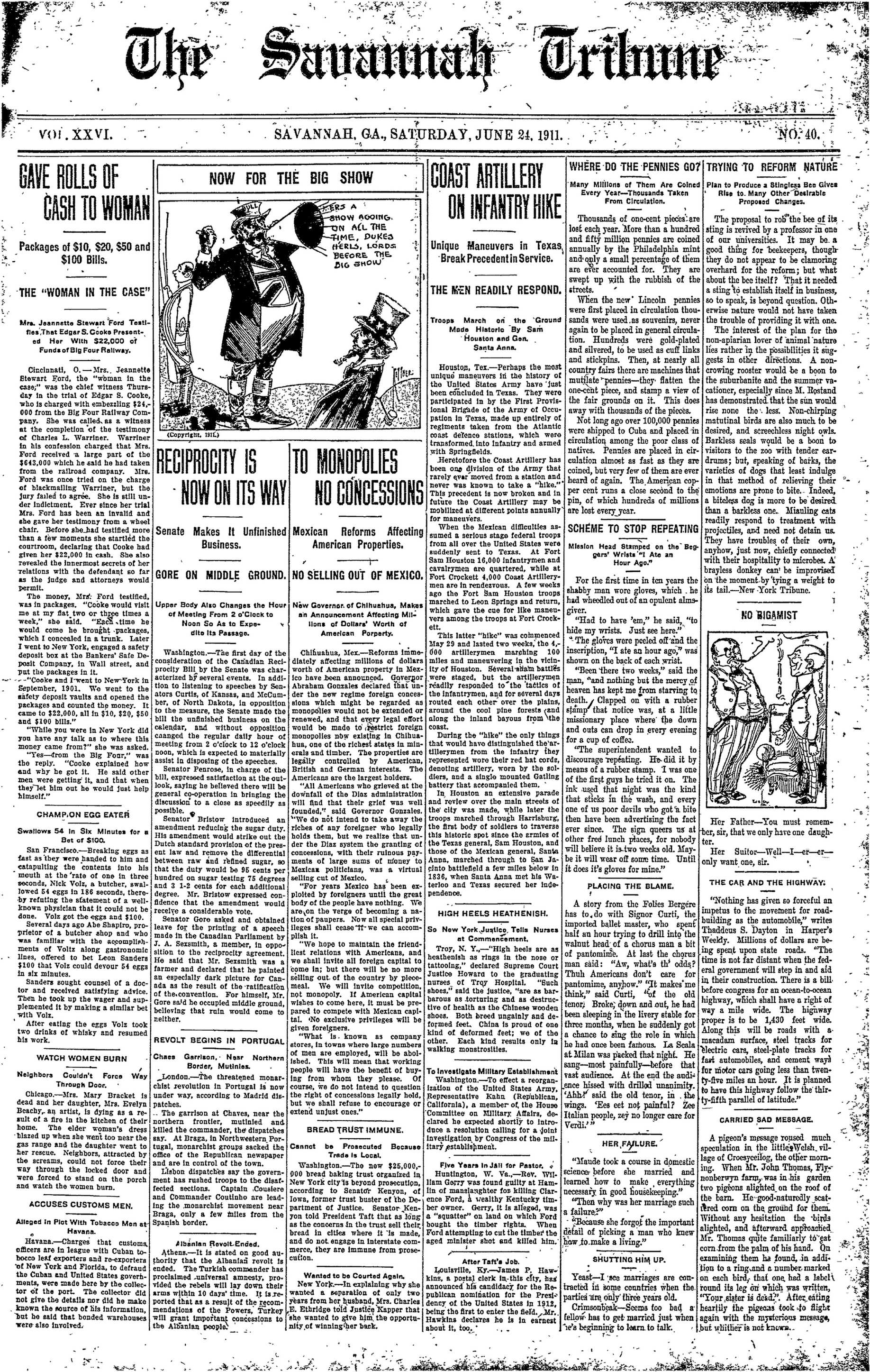
Page text (machine-generated)
Packages of $10, $20, $50 and $100 Bills.
THE "WOMAN IN THE CASE"
Mrs. Jeannette Stewart Ford Testifles.That Edgar S. Cooke Presented Her With $22,000 of Funds of Big Four Railway.
Cincinnati, O. — Mrs. Jeannette Stewart Ford, the "woman in the case;" was the chief witness Thursday in the trial of Edgar S. Cooke, who is charged with embezzling $24,000 from the Big Four Railway Company. She was called, as a witness at the completion of the testimony of Charles L. Warriner. Warriner in his confession charged that Mrs. Ford received a large part of the $643,000 which he said he had taken from the railroad company. Mrs. Ford was once tried on the charge of blackmailing Warriner, but the jury failed to agree. She is still under indictment. Ever since her trial Mrs. Ford has been an invalid and she gave her testimony from a wheel chair. Before she had testified more than a few moments she startled the courtroom, declaring that Cooke had given her $22,000 in cash. She also revealed the innermost secrets of her relations with the defendant so far as the judge and attorneys would permit.
The money, Mrs. Ford testified,
was in packages. "Cooke would visit
me at my flat two or three times a
week," she said. "Each time he
would come he brought packages,
which I concealed in a trunk. Later
I went to New York, engaged a safety
deposit box at the Bankers' Safe Deposit Company, in Wall street, and
put the packages in it.
"Cooke and I went to New York in
September, 1901. We went to the
safety deposit vaults and opened the
packages and counted the money. It
came to $22,000, all in $10, $20, $50
and $100 bills."
"While you were in New York did you have any talk as to where this money came from?" she was asked. "Yes—from the Big Four," was the reply. "Cooke explained how and why he got it. He said other men were getting it, and that when they let him out he would just help himself."
CHAMP,ON EGG EATER
Swallows 54 In Six Minutes for a
Bet of $100.
San Francisco.—Breaking eggs as fast as they were handed to him and catapulting the contents into his mouth at the rate of one in three seconds, Nick Volz, a butcher, swallowed 54 eggs in 186 seconds, thereby refuting the statement of a well-known physician that it could not be done. Volz got the eggs and $100.
Several days ago Abe Shapiro, proprietor of a butcher shop and who was familiar with the accomplishments of Voltz along gastronomic lines, offered to bet Leon Sanders $100 that Volz could devour 54 eggs in six minutes.
Sanders sought counsel of a doctor and received satisfying advice. Then he took up the wager and supplemented it by making a similar bet with Volz.
After eating the eggs Volz took two drinks of whisky and resumed his work.
Chicago.—Mrs. Mary Bracket is dead and her daughter, Mrs. Evelyn Beachy, an artist, is dying as a result of a fire in the kitchen of their home. The elder woman's dress blazed up when she went too near the gas range and the daughter went to her rescue. Neighbors, attracted by the screams, could not force their way through the locked door and were forced to stand on the porch and watch the women burn.
ACCUSES CUSTOMS MEN.
Alleged in Plot With Tobacco Men at Havana.
Havana.—Charges that customs officers are in league with Cuban tobacco leaf exporters and re-exporters of New York and Florida, to defraud the Cuban and United States governments, were made here by the collector of the port. The collector did not give the details nor did he make known the source of his information, but he said that bonded warehouses were also involved.
NOW FOR THE BIG SHOW
(Copyright, 1911.)
ERS A
SHOW AGOING.
ON ALL THE
TIME, DUKES
HERLS, LORDS
BEFORE THE
BIG SHOW
RECIPROCITY IS NOW ON ITS WAY
Senate Makes It Unfinished Business.
GORE ON MIDDLE GROUND.
Upper Body Also Changes the Hour of Meeting From 2 o'Clock to Noon So As to Expedite Its Passage.
Washington.—The first day of the consideration of the Canadian Reciprocity Bill by the Senate was characterized by several events. In addition to listening to speeches by Senators Curtis, of Kansas, and McCumber, of North Dakota, in opposition to the measure, the Senate made the bill the unfinished business on the calendar, and without opposition caigned the regular daily hour of meeting from 2 o'clock to 12 o'clock noon, which is expected to materially assist in disposing of the speeches.
Senator Penrose, in charge of the bill, expressed satisfaction at the outlook, saying he believed there will be general co-operation in bringing the discussion to a close as speedily as possible.
Senator Bristow introduced an amendment reducing the sugar duty. His amendment would strike out the Dutch standard provision of the present law and remove the differential between raw and refined sugar, so that the duty would be 95 cents per hundred on sugar testing 75 degrees and 3 1-2 cents for each additional degree. Mr. Bristow expressed confidence that the amendment would receive a considerable vote.
Senator Gore asked and obtained leave for the printing of a speech made in the Canadian Parliament by J. A. Sexsmith, a member, in opposition to the reciprocity agreement. He said that Mr. Sexsmith was a farmer and declared that he painted an especially dark picture for Canada as the result of the-ratification of the.convention. For himself, Mr. Gore said he occupied middle ground, believing that ruin would come to neither.
REVOLT BEGINS IN PORTUGAL
Chaes Garrison, Near Northern Border, Mutinies.
London.—The threatened monarchist revolution in Portugal is now under way, according to Madrid dispatches.
The garrison at Chaves, near the northern frontier, mutinied and killed the commander, the dispatches say. At Braga, in Northwestern Portugal, monarchist groups sacked the office of the Republican newspaper and are in control of the town.
Lisbon dispatches say the government has rushed troops to the disaffected sections. Captain Coussere and Commander Coutinho are leading the monarchist movement near Braga, only a few miles from the Spanish border.
Albanian Revolt Ended.
Athens.—It is stated on good authority that the Albanian revolt is ended. The Turkish commander has proclaimed universal amnesty, provided the rebels will lay down their arms within 10 days' time. It is reported that as a result of the recommendations of the Powers, Turkey will grant important concessions to the Albanian people.
SAVANNAH, GA., SATURDAY, JUNE 24, 1911.
HERS A
SHOW AGOING.
ON ALL THE
TIME, DUKES
HERLS, LORDS
BEFORE THE
BIG SHOW
TO MONOPOLIES NO CONCESSIONS
Mexican Reforms Affecting American Properties.
NO SELLING OUT OF MEXICO.
New Governor. of Chihuahua, Makes an Announcement Affecting Millions of Dollars' Worth of American Porperty.
Chihuahua, Mex.—Reforms immediately affecting millions of dollars worth of American property in Mexico have been announced. Governor Abraham Gonzales declared that under the new regime foreign concessions which might be regarded as monopolies would not be extended or renewed, and that every legal effort would be made to restrict foreign monopolies now existing in Chihuahua, one of the richest states in minerals and timber. The properties are legally controlled by American, British and German interests. The Americans are the largest holders.
"All Americans who grieved at the downfall of the Diaz administration will find that their grief was well founded," said Governor Gonzales. "We do not intend to take away the riches of any foreigner who legally holds them, but we realize that under the Diaz system the granting of concessions, with their ruinous payments of large sums of money to Mexican politicians, was a virtual selling cut of Mexico.
"For years Mexico has been exploited by foreigners until the great body of the people have nothing. We are on the verge of becoming a nation of paupers. Now all special privileges shall cease if we can accomplish it.
"We hope to maintain the friendliest relations with Americans, and we shall invite all foreign capital to come in; but there will be no more selling out of the country by piecemeal. We will invite competition, not monopoly. If American capital wishes to come here, it must be prepared to compete with Mexican capital. No exclusive privileges will be given foreigners.
"What is known as company stores, in towns where large numbers of men are employed, will be abolished. This will mean that working people will have the benefit of buying from whom they please. Of course, we do not intend to question the right of concessions legally held, but we shall refuse to encourage or extend unjust ones."
BREAD TRUST IMMUNE.
Cannot be Prosecuted Because Trade is Local.
Washington.—The new $25,000,000 bread baking trust organized in New York city's beyond prosecution, according to Senator Kenyon, of Iowa, former trust buster of the Department of Justice. Senator Kenyon told President Taft that as long as the concerns in the trust sell their bread in cities where it is made, and do not engage in interstate commerce, they are immune from prosecution.
Wanted to be Courted Again.
New York.—In explaining why she wanted a separation of only two years from her husband, Mrs. Charles E. Ethridge told Justice Kapper that she wanted to give him the opportunity of winning her back.
COAST ARTILLERY ON INFANTRY HIKE
Unique Maneuvers in Texas. Break Precedent in Service.
THE MEN READILY RESPOND.
Troops March on the Ground Made Historic By Sam Houston and Gen. Santa Anna.
Houston, Tex.—Perhaps the most unique maneuvers in the history of the United States Army have just been concluded in Texas. They were participated in by the First Provisional Brigade of the Army of Occupation in Texas, made up entirely of regiments taken from the Atlantic coast defence stations, which were transformed, into infantry and armed with Springfields.
Heretofore the Coast Artillery has been one division of the Army that rarely ever moved from a station and never was known to take a "like." This precedent is now broken and in future the Coast Artillery may be mobilized at different points annually for maneuvers.
When the Mexican difficulties assumed a serious stage federal troops from all over the United States were suddenly sent to Texas. At Fort Sam Houston 16,000 infantrymen and cavalrymen are quartered, while at Fort Crockett 4,000 Coast Artillerymen are in rendezvous. A few weeks ago the Fort Sam Houston troops marched to Leon Springs and return, which gave the cue for like maneuvers among the troops at Fort Crockett.
This latter "hike" was commenced May 29 and lasted two weeks, the 4,000 artillerymen marching 100 miles and maneuvering in the vicinity of Houston. Several sham battles were staged, but the artillerymen readily responded to the tattles of the infantrymen, and for several days routed each other over the plains, around the cool pine forests and along the inland bayous from the coast.
During the "hike" the only things that would have distinguished the artillerymen from the infantry they represented wore their red hats, denoting artillery, worn by the soldiers, and a single mounted Gatling battery that accompanied them.
In Houston an extensive parade and review over the main streets of the city was made, while later the troops marched through Harrisburg, the first body of soldiers to traverse this historic spot since the armies of the Texas general, Sam Houston, and those of the Mexican general, Santa Anna, marched through to San Jacinto battlefield a few miles below in 1836, when Santa Anna met his Waterloo and Texas secured her independence.
HIGH HEELS HEATHENISH.
So New York Justice Tells Nurses at Commencement.
Troy, N. Y.,—"High heels are as heathenish as rings in the nose or tattooing," declared Supreme Court Justice Howard to the graduating nurses of Troy Hospital. "Such shoes," said the justice, "are as barbarous as torturing and as destructive of health as the Chinese wooden shoes. Both breed ungainly and deformed feet. China is proud of one kind of deformed feet; we of the other. Each kind results only in walking monstrosities.
To Investigate Military Establishment
Washington.—To effect a reorganization of the United States Army, Representative Kahn (Republican, California), a member of the House Committee on Military Affairs, declared he expected shortly to introduce a resolution calling for a joint investigation by Congress of the military establishment.
Five Years In Jail for Pastor.
Huntington, W. Va.—Rev. William Gerry was found guilty at Hamlin of manslaughter for killing Clarence Ford, a wealthy Kentucky timber owner. Gerry, it is alleged, was a "squatter" on land on which Ford bought the timber rights. When Ford attempting to cut the timber the aged minister shot and killed him.
After Taft'a Job.
Louisville, Ky.—James P. Hawkins, a postal clerk in this city, has announced his candidacy for the Republican nomination for the Presidency of the United States in 1912, being the first to enter the field. Mr. Hawkins declares he is in earnest about it, too.
WHERE DO THE PENNIES GO?
Many Millions of Them Are Coloned Every Year—Thousands Taken From Circulation.
Thousands of one-cent pieces are lost each year. More than a hundred and fifty million pennies are coined annually by the Philadelphia mint and only a small percentage of them are ever accounted for. They are swept up with the rubbish of the streets.
When the new Lincoln pennies were first placed in circulation thousands were used as souvenirs, never again to be placed in general circulation. Hundreds were gold-plated and silvered, to be used as cuff links and stickpins. Then, at nearly all country fairs there are machines that mutilate pennies—they flatten the one-cent piece, and stamp a view of the fair grounds on it. This does away with thousands of the pieces.
Not long ago over 100,000 pennies were shipped to Cuba and placed in circulation among the poor class of natives. Pennies are placed in circulation almost as fast as they are coined, but very few of them are ever heard of again. The American copper cent runs a close second to the pin, of which hundreds of millions are lost every year.
SCHEME TO STOP REPEATING
Mission Head Stamped on the Beggars' Wrists "I Ate an Hour Ago."
For the first time in ten years the shabby man wore gloves, which he had wheedled out of an opulent alms-giver.
"Had to have 'em," he said, "to hide my wrists. Just see here."
"The gloves were peeled off and the inscription, "I ate an hour ago," was shown on the back of each wrist.
"Been there two weeks," said the man, "and nothing but the mercy of heaven has kept me from starving to death. Clapped on with a rubber stamp that notice was, at a little missionary place where' the down and outs can drop in every evening for a cup of coffee.
"The superintendent wanted to discourage repeating. He did it by means of a rubber stamp. I was one of the first guys he tricked it on. The ink used that night was the kind that sticks in the wash, and every one of us poor devils who got a bite then have been advertising the fact ever since. The sign queers us at other free lunch places, for nobody will believe it is two weeks old. Maybe it will wear off some time. Until it does it's gloves for mine."
PLACING THE BLAME
A story from the Folies Bergère has to do with Signor Curti, the imported ballet master, who spent half an hour trying to drill into the walnut head of a chorus man a bit of pantomime. At last the chorus man said: "Aw, what'a th' odds? Thuh Americans don't care for pantomime, anyhow." "It makes me think," said Curti, "of the old tenor; Broke, down and out, he had been sleeping in the livery stable for three months, when he suddenly got a chance to sing the role in which he had once been famous. La Scala at Milan was packed that night. He sang—most painfully—before that vast audience. At the end the audience hissed with drilled unanimity. 'Abh!' said the old tenor, in the wings. 'Ees eet not painful? Zee Italian people, zey no longer care for Verdi.'"
HER, FAILURE.
"Maude took a course in domestic science before she married and learned how to make everything necessary in good housekeeping." "Then why was her marriage such a failure." "Because she forgot the important detail of picking a man who knew how to make a living."
Yeast—I see marriages are contracted in some countries when the parties are only three years old. Crimsonbeak—Seems too bad a fellow has to get married just when he's beginning to learn to talk.
TRYING TO REFORM NATURE
Plan to Produce a Stingless Bee Given Rise to. Many Other Desirable Proposed Changes.
The proposal to rob the bee of its sting is revived by a professor in one of our universities. It may be a good thing for beekeepers, though they do not appear to be clamoring overhard for the reform; but what about the bee itself? That it needed a sting to establish itself in business, so to speak, is beyond question. Otherwise nature would not have taken the trouble of providing it with one.
The interest of the plan for the non-apiarian lover of animal nature lies rather in the possibilities it suggests in other directions. A non-crowing rooster would be a boon to the suburbanite and the summer vacationer, especially since M. Rostand has demonstrated that the sun would rise none the less. Non-chirping matutinal birds are also much to be desired, and screechless night owls. Barkless seals would be a boon to visitors to the zoo with tender eardrums; but, speaking of barks, the varieties of dogs that least indulge in that method of relieving their emotions are prone to bite. Indeed, a biteless dog is more to be desired than a barkless one. Miauling cats readily respond to treatment with projectiles, and need not detain us. They have troubles of their own, anyhow, just now, chiefly connected with their hospitality to microbes. A brayless donkey can be improvised on the moment by 'tying a weight to its tail.'—New York Tribune.
JULY 1865
Her Father—You must remember, sir, that we only have one daughter.
Her Suitor—Well—I—er—er—only want one, sir.
THE CAR AND THE HIGHWAY
"Nothing has given so forceful an impetus to the movement for road-building as the automobile," writes Thaddeus S. Dayton in Harper's Weekly. Millions of dollars are being spent upon state roads. "The time is not far distant when the federal government will step in and aid in their construction. There is a bill before congress for an ocean-to-ocean highway, which shall have a right of way a mile wide. The highway proper is to be 1,430 feet wide. Along this will be roads with a macadam surface, steel tracks for electric cars, steel-plate tracks for fast automobiles, and cement ways for motor cars going less than twenty-five miles an hour. It is planned to have this highway follow the thirty-fifth parallel of latitude."
CARRIED SAD MESSAGE.
A pigeon's message roused much speculation in the little Welsh village of Croesyceilog, the other morning. When Mr. John Thomas, Flynonberwyn farm, was in his garden two pigeons alighted on the roof of the barn. He good-naturedly scat-tured corn on the ground for them. Without any hesitation the birds alighted, and afterward approached Mr. Thomas quite familiarly to eat corn from the palm of his hand. On examining them he found, in addition to a ring, and a number marked on each bird, that one had a label around its leg on which was written, "Your siater is dead." After eating heartily the pigeons took to flight again with the mysterious message, but whitlier is not known.
AFRO-AMERICAN CULLINGS
The Southwestern Christian Advocate, whose brilliant editor is one of the south's most useful citizens, devotes its last issue to celebrating the accomplishments of the leading laymen of the Methodist Episcopal church, among whom are some of the important figures in present-day affairs. There are more than 300,000 colored members in the mother church, and they are there to stay, we believe. The influence of the church upon the general lives of the nation may be seen in the lives of the men pictured in the Southwestern, and many not pictured there, who have been educated on Methodist money, inspired by Methodist doctrine, and led in the way of achievements by Methodist examples of persistence. Among the number of whom Dr. Jones writes, is Emmett J. Scott, whose excellencles many men know, and whose rare service in his day is household news. Of Mr. Scott it is here written: "Emmett J. Scott is the pride of Texas, an honored son of the whole race. He is a product of Wiley university and this distinguished alumnus of this Texas institution is loved and honored, not only by the alumni of Wiley and the Methodist host of Texas and this southland, but his friends and admirers are legion the country over. He was discovered by Dr. Booker T. Washington 14 years ago when he was in Houston, the editor of the Texas Freeman, which he had founded. Previous to this time Mr. Scott had done work upon the white dalles of Houston. Mr. Scott is best known as the executive secretary of Tuskegee and the strong, right hand of Dr. Washington. He enjoys the full confidence of his chief, and because of Mr. Scott's clear thinking, devotion to the high ideals, his integrity, and his high moral character, he has not only been able to serve Dr. Washington and the great Tuskegee institute, but he has made a place of his own. It was no empty honor when President Taft appointed him one of three commissioners to the Republic of Liberia, being the first negro ever sent abroad on a warship by our government on a like mission. Emmett J. Scott is a prince."
The schools are turning them out by the thousands at this time of the year. And fortunately more opportunities are opening every year for young colored men and women. The demand does not as yet equal the output of the more scholarly classes. The masses, however, are finding employment, and which, after, all means very much to the professional people who must depend on the welfare of the masses.
The condition is not unlike that elsewhere, but of course, in a smaller and a more limited way. The white people have no sharp, abrupt, well defined gradation as between classes as the colored people have. Their societies, speaking industrially, gently merge into one another, making it more difficult to observe that the professional classes depend on the welfare of the masses.
The point is that the colored people are also approaching that plane where the well being of one class, right among themselves, aside from the same general condition, means the prosperity of other classes, thus establishing an interdependent relationship, which in the end, equals the welfare of all.
Heretofore the colored people have looked almost solely to the white race for everything. And indeed they are by no means eliminated as yet, since that same general interdependent relationship includes them. But they have reached the place where thousands depend on other thousands of the race directly for their daily bread. Here is an excellent chance to talk optimistically of the race and of the country, regardless of other conditions. Talking up the good points of the country will do more good than harm—The Freeman.
I am conscious that the Negro race is laboring under disadvantages, but I always prefer to put the emphasis on advantages. One of our advantages is this: In studying American history you will find the Negro is the only race that came to this country as the result of a special and urgent invitation.
Moreover, they were so anxious to have us that we came here without having to pay a cent of passage money.
We are gradually getting into business. Many thousands of small shops are owned by Negroes. and they can get banking facilities as easily as the whitest of the whites. Why, there are fifty-seven banks in the southern states owned and controlled by Negroes.
And always remember that from the south you hear more of our enemies than of our friends. Up north you hear of the white man who burns a Negro's house or lynches him, but you do not hear of the thousands and thousands of the quiet southern men and women who help and advise the Negro, lend him money to start and look after him. We are progresing wonderfully, and it is only by the aid of such friends as these—Booker T. Washington.
The Boston Herald has the following trenchant editorial on the Colored races as colonists of Great Britain. The infux of Negroes into the Canadian Northwest is viewed with little satisfaction by the other settlers, large numbers of whom are themselves from the United States. Parties of Colored people, evidently of a good type, well supplied with funds, have been subjected to rigid tests by the immigration authorities; but it has been found impossible to shut them out, and they have pushed on to the Peace River country. All they asked, the men said, was free land and a chance to make homes for themselves and their families.
"White settlers talk of an exclusion law. Now is the time, they say; soon it will be too late. Some argue that legislation is not needed; the government could refuse to grant homesteads. A member of the Alberta provincial cabinet favors a head tax. "Sentiment has been particularly stirred by reports from South Africa. Theré Lord Gladstone exercised the prerogative of clemency in the case of a native condemned to death for an offence which is usually followed by lynching in the southern states. Lord Gladstone gave the man the benefit of a doubt, but feeling among the white people of the colony was strongly stirred.
"Britain is also confronted with the problem of Hindu immigration in Canada and Africa. The problem is the more perplexing because the Hindus are British subjects. There is also the question of Japanese immigration in British Columbia and Australia. Altogether, the race difficulty is growing serious for England. "With regard to Negroes in the northwest, only those of the best type, physically and morally are likely to brave the rigors of that northern land. Such will not be a menace to any community. If the Negro succeeds as a pioneer, he will be able to lay claim in an equality now denied him."
The leading article in a recent number of The Outlook, "The Man Farthest Down," by Dr. Booker T. Washington, is the first of a series of six articles "based on observation abroad, comparing the living conditions of the European peasant, woman worker, and miner, with those of the American negro." Col. Rooseyelt, is one of the editors of the Outlook. In his first article Dr. Washington finds that the American negro is so much better off in every way as to make it in any way comparable to that of the white man in Europe at the bottom of the ladder. The vast number of European workmen in the United States and those who are steadily coming here indicates, he thinks, also the hard conditions of the poor in Europe. Afro-Americans should read the series of articles by Dr. Washington, as they will in that way get a vivid picture of themselves and their condition as compared with those of the least favored class in Europe. Dr. Washington's faith in his race and what it has accomplished and what it will accomplish, with its splendid opportunity for development, is one of the most hopeful assets the race has at this time. He strikes the high note of hope, and it is possible to follow that note with the faith in honest works which makes for the largest success and happiness.-Editorial: Atlantic City Messenger.
We met a selfish pastor 20 years ago who had no use for a poor struggling and fought to keep hard working, consecrated young men and women down. Today that same pastor is in rags and poverty and his church members disrespect him. It pays best to be good and sympathetic all the time. No man nor woman has ever lost anything by sympathizing with others and helping others. To be true, liberal and congenial beats the world. This advice is to children, be kind one to the other and as you leave the school room give nothing but bouquets to your schoolmates and acquaintances. Don't speak of your associates; be liberal to all and selfish to none for many have fallen in shame and disgrace because they laughed at others, and they themselves soon became a laughing stock. The last selfish girl we read of went straight down to hell when she died. Therefore it pays not to be selfish.—Charleston Messenger.
More and more, a certain amount of race pride is taking hold of the negro in the north. Every now and then, this is evidenced on State street, Chicago, when a little grocery store or some other business enterprise is opened by a member of the race. Every office, real estate firm, print shop, restaurant, millinery store, dress making department that opens up, means employment to members of the race. What colored man or woman objects to seeing members of the race making an honorable living? If you wish to encourage this sort of livelihood, rally to those that operate race institutions; it means a salvation to the educated young man and woman. It is high time we think of these things.—Illinois Chronicle.
Dr. John A. Kenney of Tuskegee Institute Is Issuing Series of Health Bulletins.
ABUNDANCE OF FLIES MEANS MUCH FILTH AND THE TWO MEAN PREVALENCE OF DISEASE
Tuskegee, Ala.—(Special.)—As a result of the tuberculosis exhibition held here a year ago much valuable education work is being done along health matters. The second of a series of sanitary bulletins, which follows, sent out by Dr. Jno. A. Kenney, physician of the school, is devoted to the fly and tells practical things which the colored people can do.
Now is the time to kill the flies. The common house fly is one of the worst enemies to health we have. He breeds in filth; such as manare heaps, unclean barn yards, stables, pigpens, toillets, garbage cans, and heaps of old rubbish. He is not very discriminating about his food. He will feed on the refuse of the above-mentioned places for a while, and then with legs, wings, and belly loaded with this filth and thousands of germs, many of which are disease-breeding, will fly away to your kitchen, or dining room, or bedchamber. There he will walk over your meat, fruit, vegetables, bread and over the sleeping baby's lips, leaving behind him a trail of this filth and these germs, many of which are deadly. Thus, he spreads diarhfoes, dysentery, typhoid fever, tuberculosis and other dangerous diseases. The fly that falls into the pitcher of milk and is thrown out has possibly had washed from his body sufficient dangerous germs to poison the entire household.
Abundance of files means much
filth. The two means prevalence of
disease. Therefore, clean up! -clean
out! keen clean!!!
Attack them in their, breeding places. Cut off their sources of supply. The female lays her eggs in accumulated filth. They hatch in about ten days. Hence, if the rubbish is disinfected and removed or destroyed once a week, we destroy a generation of files. By so doing we stop the breed and at the same time cut off their food supply. Then they will seek the interior of your homes. Screen all your doors and windows and keep them out.- Keep your kitchens and dining rooms clean. Cover up everything that is eatable. Don't let solled dishes or kitchen utensils stand for a minute. Where there are earth closets, use pails, plenty of dry earth, lime, ashes and fly proof covers. Starve out the files; then put down fly paper and fly poison and they'll flock to it. Even more essential now to take these precautions than in early summer, because the cool weather of approaching fall and winter will run them to your dwellings for shelter and food. Will you continue to furnish board and lodgings for some of your deadliest enemies? Statistics from some of the large cities prove that the above classes of diseases increase many fold in the fall months when the first cool weather drives the files in; and before it is sufficiently cold to kill them. Away with the deadly house fly! Civilization, decency and health all demand that he must go.
TENNESSEE WANTS PROPERTY OF EX-SLAVES' TO GO TO THE STATE
Memphis (Special.)—Involving the rights of property owned by ex-slaves, the state of Tennessee, through Attorney General Estes has filed a bill in chancery against the unknown heirs of Susan Ann Reilly, for sale of real estate, which it is claimed, has reverted to the state by escheat.
Susan Ann Reilly, it is said, died in 1874, owing lots in the Canovan subdivision at Briver street and Railroad avenue. The woman's husband took possession and it afterward passed through several hands, a portion being sold for taxes.
It is claimed in the bill that Susan Ann Reilly was never legally married and that all next of kin were of slave marriage and ex-slaves. It is the prayer that the property be sold and the proceeds used for churches and schools.
MEETING OF MISS888IPRI
Mound Bayou, Miss.—The Mississippi Negro Business league, of which Charles Banks of Mound Bayou, Miss., is president, has secured Prof. Kelly Miller, the famous writer and educator of Howard university, to deliver an address before the league during its annual session at Natchez, Miss., June 26 and 29.
ONE OLD BUIN.
Mr. Cleverton—You saw some old ruins in England this summer, I suppose?
Miss Struckett-Rich—Yes, and one of them wanted to marry me.—Princeton Tiger.
PRESIDENT TAFT TALKS
TO COLORED Y. M. C. A.
PRESIDENT TAFT TALKS
TO COLORED Y. M. C. A.
CHIEF EXECUTIVE TELLS WASHINGTON YOUTHS THE ADVANTAGE OF THEIR INSTITUTION.
Washington, D. C.—The series of meetings held weekly at the Howard theater in the interest of the Colored Men's branch Y. M. C. A. has attracted wide notice and comment because of the character of the speakers who have made the Sunday addresses and the large attendance which has gathered to hear the returns of the final campaign for the completion of the Washington Y. M. C. A building.
A few days ago President William H. Taft was the guest of the colored association when it became known that he had evinced a marked interest in the development of the association here and was optimistic as to the good which the organization might do for the colored men of the capital.
The president declared that the Y. M. C. A. has developed the science of taking homeless young men and offering them an attractive club in which all influences are good, in which there is nothing of the softening and enervating influences, but where everything tends to the development of a vigorous manhood. Frequently the student body of Howard university arose in their seats and interrupted the chief executive with loud and enthusiastic cheers on account of the sincere interest which he displayed.
It was announced at the meeting that only $2,000 of the $15,000 necessary for the completion of the building without debt remained to be raised. The president was escorted to the theater by Rev. J. E. Moreland, international secretary of the Y. M. C. A. On the platform were seated M. Umliffe Duval and M. J. M. Brady, deputies from the Haitian republic in the boundary dispute between that country and San Domingo.
Mr. Tall said in part: "The Young Men's Christian association is peculiarly useful in such places as Manila and Hong Kong where young men away from their American home without families, are exposed to the temptations of those far off lands, temptations which are a good deal stronger than when you are surrounded by the restraints of home and neighborhood. Now it does not need any logic for us to say that you young colored men, and all of the young colored men over this country, need that influence and that kind of influence just as much as the white men need it.
"There is a white Young Men's Christian association and a colored Young Men's Christian' association. You are more comfortable to have your own club limited to your own race, as perhaps the white young men are more comfortable in having theirs limited to their race, but they are both nevertheless all under the broad roof of charitable and uplifting Christianity and you ought to take pride, as you do, in having contributed, and labored and worked for this association and for this branch that you have here, because nowhere that I know of in all of this country do the colored people live together in such a way as to make such an organization more useful than right here among the 100,000 colored people of Washington."
COLORED BOY WINS HONORS
Boston, Mass (Special).—A new world's intercollegiate record for the mile run was set in the Stadium at the Harvard interscholastic games by J. D. MacKenzie of Exeter, who was timed at the tape in 4 minutes, 25 4-5 seconds, after a hair-raising finish of a neck-to-neck sprint to the finish with Bosworth of Worcester academy. The two other records, those in the pole vault and the high jump, also went by the board. Worcester academy had but little difficulty in winning the meet, scoring 39 points. Exeter weakened by the absence of Burns and Bingham, was second with $29\frac{1}{2}$ points while Brookline high secured third with 13 points, and Springfield high fourth with 11 points, due to the fine work of Drew, the colored spinner Whitney of Worcester was the individual star of the meet, scoring 15 points by getting first in the shot put and pole vault and second in the hammer throw. He was closely pressed however, for his honors by Drew of Springfield high school, who won both sprints in fast time and added to his points by corralling third place in the broad jump. He was in fine form and finished yards better than the second man in both century and furlong. If fact, he looked so good to those at the meet that there was the general opinion that he would have beaten the Exeter captain had the latter been in the running.
THE DEAD PAN.
Professor Brander Matthews, in one of his lectures at Columbia on the drama, said:
"Then there is the auditor of another type.
"A famous actor, at a Christmas entertainment at a parvenu's palace, rose to recite Mrs. Browning's 'Dead Pan.' As he announced his subject and prepared to begin, he heard a lady near him say distinctly:
"What is the next piece? Something funny, I hope, Oh, yes—'The Dead Pan!' Dear me, how odd! Of course it must be funny—something about bad cooking, I suppose."
LATEST IN CORSETS
More than ever we are to have corsets of elastic materials, like tricot, and made without stays.
Then some of us in Paris are wearing simply hip confiners of ribbon or elastic, about 13 inches deep, and closing with a five-inch placket, facing together at the back. A brassiere may or may not be worn with this.
Mme. Matray, who makes the corsets worn by the models at Polet's, has a new model, to be pulled down in the back, so that there is no opening over the spine.
Its measurements are: Front steel, 12½ inches; two back steels, 12½ and 17 inches (the latter broken at 11 inches to prevent stiffness); side steels, those farthest back, 16 inches; those toward the front, 13 inches; continuation below the steels, 5 inches in front, 6½ inches at the sides and 6 inches across the back.
The height of the bust above the waist line is 5 inches; below the waist line the corset averages 18 or 19 inches. Approximately, these are the measurements for the modish Parisian corset this season, though they will have to be modified somewhat for American figures.
A corset with slightly different measurements is made, more on ordinary lines, by Mme. Guillot, who first introduced boneless models in coutil, and it may be preferred by some women.
The very newest thing is the corset made in combination with culottes or knickerbockers. The culotte corset is usually finished with a brassiere top and shoulder straps, though these can be slipped off for wear with evening dress. In Paris we are wearing these in black silk tertse cloth.
BEDBUGS.
An Iowa correspondent writes: "Will you please send me a recipe for killing bedbugs? In the house into which we have just moved they seem to be in the walls and underneath the wall paper." If iron bedsteads instead of the heavy wooden kind are used, the eradication of the bedbugs is very muc much simplified. Even in the latter case, however, bedbugs may generally be completely destroyed by the following treatment:
Take gasoline, benzine or kerosene, and thoroughly apply it into every crook and cranny of the bed and woodwork. An oil can with a long, thin spout, or a syringe, helps in this work. If the bugs are behind the wall paper the best scheme is to scrape it off, apply the gasoline and repaper. The gasoline treatment should be repeated in ten days, in order to kill any bedbugs which may have hatched out from the eggs in the meantime. In cases where the bugs have gotten behind the wall paper and woodwork, the following treatment, recommended by the New York state entomologist a number of years ago, may prove more convenient:
Place in the center of the room a dish containing about four ounces of brimstone within a larger vessel, so that the possible overflowing of the burning mass may not injure the carpet or set fire to the floor. After removing from the room all such metallic surfaces as might be affected by the fumes, close every aperture, even the keyhole, and set fire to the brimstone. After four or five hours have elapsed the room may be entered and the windows opened for a thorough airing.-South Dakota Farmer.
SIMPLIFY YOUR WORK.
One woman sat down in her living room not long ago to figure this out. Her eyes rested on the walls, literally covered with pictures, banners and mottoes. They were all pleasant to look upon and helped in their memories; the sideboard was filled with cut glass and silver which needed frequent cleaning to keep it sparkling and pretty; the plate rack in the dining room was filled with plates and other plates were suspended from wire hangers; the tables held numberless bits of bric-a-brac or handsome books. All these things needed care. So she started about the house and left only a few things, just enough to keep the rooms from looking bare. She put away most of the china, cut glass and bric-a-brac. Then she drew a sigh of relief, that she would be saved so much work. Her task of simplifying was only just begun. The majority of women add to their duties by unnecessary work until the duties which should be pleasure become burdens.
DRESSED EGGS.
Boll seven eggs, 20 minutes, cool, separate whites from yolks, grate yolks and chop whites fine. Make a dressing of one cup of cream, one tablespoon flour, a small lump of butter and salt and pepper to taste. Cook the dressing until very thick and add the chopped whites to it. Put this in the dish and cover with the grated yolks.
Wide bands of lace, embroidery or self-fabrics are the distinguishing feature of the new French styles in dress trimmings.
Beaded effects, particularly in the white porcelain beads on black or dark blue net, chiffon cloth and marquilette, or on pale-colored chiffons, are also popular.
Voile is trimmed in the same way, and so are blouses of narrow-striped rose or blue and white chiffon. In the latter case the white beads are often emphasized by coral or turquoise.
Beading and embroidery are frequently combined in oriental patterns, worked in heavy mercerized cotton, outlined with colored thread. The design is followed in the white "milk" beads.
Overblouses are shown made entirely of heavy twisted silk thread, netted together in diamond design with tiny round beads. Around the low-cut neck large metal or wooden beads are introduced.
Ball fringe in the crocheted and gimp variety is seen on evening gowns and lingerie dresses. It is used with the heavy monk's cord that finishes the waist line.
Extremely wide braids in black and white are much used, whole suits being made of braid joined by narrow satin panels.
Among new buttons are crystal ones with ball centers in some vivid color, and the rim in a clear crystal, through which the fabric shows. Other crystal effects show stripes or rims in color, and the rest clear.
Buttons will match the dress in color, and black and white is as much seen here as everywhere.
Porcelain buttons are shown in ivory white, deep red, yellow and green. Many white ones have colored rims, and the same is true of white and smoked pearl buttons.
GIRL WHO EXAGGERATES.
It requires a nice discrimination to make distinctions between the one who exaggerates and the liar. Great would be the indignation of most girls if not considered truthful, yet their habit of embroidering the truth makes of it a queer fabric. Almost better it is to deal with one who frankly declared "the truth never troubles me" than with one who stretches it. The one you do not believe, and no harm is done; the other you first believe, then doubt. One exaggerates from various motives. Sometimes it is due to a vivid imagination. The girl hears something, and before long has let her imagination run riot until she actually believes her story.
Again, a girl exaggerates from a desire to be interesting. She wants to create a sensation, and if truth cannot do it she adds to it.
A too keen sense of humor often leads to exaggeration. A girl sees the funny side of a story, and to make others see it she sacrifices the strict facts.
Heedless exaggeration is common. A girl from talking superlatives thinks them. She will tell you she has seen a hundred people when she means perhaps a dozen! That a friend's new diamond is as big as a hen's egg; that some one else was "in a frightful rage," when perhaps she was slightly peevish.
No harm in all this, for the speaker is not taken seriously, but it weakens other things she says and makes her conversation without force.
Occasionally a girl exaggerates maliciously, which brings it into the class of the "lar at heart." The instant a story is willfully enlarged, it becomes quite inexcusable. ONLY SCIENTIFIC WAY
Of the reforms occurring during the last fifty years in every department of life none has been of more benefit to the housewife than the vacuum cleaner.
Where the old brooms are used the dust, dirt and germs are merely pounded into the air, and as soon as the sweeper has gone they settle back on the furniture, walls, ceiling and, on the floor.
The vacuum cleaner sucks up all the dirt and dust and deposits every particle of it in an air-tight basin, where it can be carried outside and destroyed.
SPANISH CREAM
Dissolve half a box of gelatine in a little warm water. Put one and one-half pints of milk in a double boiler, beat the yolks of three eggs with two-thirds of a cup of sugar, add to the milk and boll for a few minutes, then add the gelatine. Take from the fire and stir in the beaten whites of four eggs, and put into a mold and when cold serve with whipped cream.
70 YEARS OLD SHE WINS TWO MEDALS
Mrs. Martha Harmon Is Honored by Board of Education of New York City.
RECORD AN UNUSUAL ONE
AGED PUPIL HAS NOT MISSED A NIGHT AT SCHOOL DURING THE PAST FOUR YEARS.
New York City.—(Special.)—Up in Harlem the colored residents boast of celebrities galore, but a new one has been added to the list in the person of Mrs. Martha Harmon, seventy years old, who is also the pride of the New York board of education, and the principal and teachers of public night school No. 157. Despite her advanced years, Mrs. Harmon is now enjoying her school days, and the remarkable record she has made within the past four years has brought her fame.
A few evenings ago she was presented with two gold medals which she proudly wears on "state occasions." One of the medals was given for attendance and the other for efficiency in her studies Mrs. Harmon is considered an ideal pupil by her teachers.
At public night school No. 157, the principal and teachers often refer to their seventy-year-old pupil and her record. For four years she has been attending night school, taking an elementary course. During the four years Mrs. Harmon has never missed an evening and has been late but once. She would not have been tardy the one time had it not been for company who called on her one evening last season, and in the midst of an interesting conversation the aged pupil failed to pay attention to the clock, walking into her class room a few minutes after the teacher had called the roll.
Mrs. Harmon resides at 198 West One Hundred and Thirty-fourth street, and public night school No. 13N is located at One Hundred and Twenty-fifth street and Manhattan avenue, yet this woman, seventy years old, has walked to school every evening during the four years, braving the snow, sleet, rain and wind. Not once has she ridden to the school house. The night school term commences in October and ends in April. During the winter months school is held every week day except Friday and Saturday. In order to acquire education, Mrs. Harmon has donned her heavy coat and mittens for four years and wended her way on foot to school, defying the wintry blasts and treacherous sidewalks
Mrs. Harmon was born in Kentucky seventy years ago, and while young moved to Dayton, Ohio, where she spent most of her life. She resided for years just around the corner from Paul Lawrence Dunbar, and remembers when he was quite a lad. Some years ago she moved to New York. She is a widow and has a daughter, and a grandson.
Mrs. Harmon does not seem to think that she has done anything unusual for a woman of her age, and is not disposed to speak of her enviable record. She says the medals speak for themselves.
REVOLT AGAINST SIMON PLANNED IN JAMAICA
Kingston, Jamalca.—According to papers another revolution, directed at the administration of President Simon of Haiti, is brewing here, where Haitian exiles long resided in this city, have joined forces with their expatriated countrymen from Porto Rico and St. Thomas.
The published reports state that the revolt will be greater in scope and more relentless than any that has occurred in the republic. If it succeeds Gen. Cincinnatus Leconte, who took part in the recent rebellion, will be proclaimed president, and Gen. Anteror Firmin, who has not been allowed to return to Haiti since he left his post as minister at London without authority, will be made minister of war.
Several Cubans here are said to be ready to join the rebel ranks.
* President Simon is reported to be aware of the conspiracy and to have taken steps to cope with the new situation.
INTERESTING INVESTIGATION
COLLEGE PROFESSOR WANTS TO KNOW WHERE COLORED GIRL CAN BE TREATED FOR TUBERCULOSIS.
West Point, Miss (Special).—President Johnson of Mary J. Holmes college, has starfed an interesting investigation and one which may lead to important developments. He has requested the National Association for the Study and Prevention of Tuberculosis to inform him as to a sanitarium where a colored girl can be treated. In view of the widespread interest among the whites in reaching the increase of tuberculosis this question as to institutions for the treatment of those who ought to get well is especially significant.
2 COLORED WINNERS OVER YALE IN DUAL MEET GAMES
CABLE OF HARVARD DEFEATS YALE MEN IN HAMMER THROW JACKSQN DEFEATS YALE FRESHMEN IN LOW HURDLES GETS SECOND IN HIGH HURDLES-BROKE THE RECORD FOR FRESHMEN.
Boston, Mass. (Special.)—Theodore Cable, the colored weight thrower of Harvard, who won the hammer throw against Yale with a throw of 148 feet, 8 inches, is considered one of the best men in this event in collegiate circles this year and must be considered when the intercollegiate come around week after next. The best throw that Cable has made this spring has been 150 feet, 7 inches. This was made in the Harvard hand-cap games two weeks ago, and broke the Harvard record formerly held by Harry Kersberg.
In the Dartmouth meet the big fellow was far from being in form and was forced to take third place, being beaten by Tilley and Marden of Dartmouth, and himself throwing the weight but 136 feet. But during the past week he has received more valuable coaching and has seemed to regain his former form.
Cable is a phenomenon in one way, for he never had a hammer in his hands before coming to college from Shortridge high school at his home in Indianapolis. He was taken in hand by Coach "Bill" Quinn when a freshman a year ago, and soon became so proficient that he won the event in the freshman dual games with a throw of 117 feet. This year he has successfully mastered the triple turn and at present is able to take all three of his turns and gain the resultant momentum without any difficulty in staying within the ring. Many of those who have seen him in competition at his best predict a bright future for him in his favorite event, and Coach Quinn will have valuable material for the next two years to go after the intercollegiate record.
In addition to being a crack hammer thrower, Cable is very good as a performer in the dashes, low hurdles and broad jump. In the latter event he has done 21 feet in practice. In the Harvard-Yale freshmen annual dual track games in the Harvard stadium, A. L. Jackson was second in the high hurdles and first in the low hurdles, at 220 yards. In this he made a record for these games at 25 2-5 seconds, which was not allowed, however, as he knocked over several of the barriers as he went over them. Carl F. Johnson, a senior in the Bangor, Me., high school, was awarded the third honor in its annual gold medal essay contest. He is the only colored pupil in this school, and the first to receive such an honor.
SPREADING THE HEALTH KNOWLEDGE
COLORED CHILDREN ARE BEING EDUCATED TO FIGHT FILTH AND FLIES
Greensboro, N. C.—To show the possibility of spreading health knowledge through the children-of the colored race, President J. B. Dudley reports that in one of the public schools the principal was disappointed by the failure of a speaker to appear at the agreed time. One of the negro lads volunteered to talk and he told the children about a visit to the A. & M. C. college, where he had heard a talk about how tuberculosis is communicated by flies crawling over sputum and carried to the food. The effect upon the boy who told the story gives hope to the teachers of the A. & M. college to stress instruction upon the lines of hygiene and better care of the body. Many of the tuberculosis enemies have long agreed that the great hope for reaching the negro race is through the children who are in the public schools. During the last week of the exhibition in Greensboro, special attention was given to the colored schools and arrangements were made for them to get all possible benefit from the exhibition campaign.
NO CHOICE YET FOR
THE HAITIAN MISSION
Washington, Dd. C. (Special.)—There is no choice as yet for the Haitian mission, to be vacated in July by Minister H. W. Furniss of Indiana. The various "booms" have been working overtime this week, but the president gives no intimation as to what he intends to do about the matter. The newest entrant to the race is Mr. William T. Francis, a St. Paul attorney, who has had much experience in railroad litigation, and who is chief clerk of one of the most important divisions of a railroad company in his home city. Mr. Francis is a native of Indianapolis, Ind., but went to Minnesota as a boy thirty-odd years ago. He has the support of Senafors Clapp and Nelson and the entire Minnesota delegation in congress. It is understood that Congressman F. C. Stevens of the St. Paul district will push Mr. Francis' claims vigorously, and he expects to carry a delegation of influential Minnesotans to the White House in his interest within the fewest of days.
BUILDING THE LADDER BY WHICH WE RISE
AN EDITORIAL FROM THE SOUTH-ERN LIFE MAGAZINE.
Every individual of balanced mental powers has been guilty, times without number, of constructing before the mind's eye visions of what he hoped to see, at some future time, turned into a tangible, existing reality. It is true that in retrospect the mind's castles in the air often appear both ludicrous and forerunners of every notable achievement mankind can claim to his credit. Though a weakness common to us all, yet are they like a common vantage ground upon which we gather together our forces and maneuver them for the impending struggle after achievement. It has ever been as is expressed in the scripture: "Your old men shall dream dreams, and your young men shall see visions."
He who dreams of success as a reward for his endeavors, is unwise if he fail to weave inseparably into his life those fundamental qualifications without which no goal of real success can be reached and held. Failing to possess these, all our dreams must be at last resolved into thin air, and bitter disappointment must shroud our meditations. The untutored as well as the enlightened can readily recognize these basic principles for fruitful endeavor; and wherever success of whatever kind has been attained, to a necessary degree have these qualifications been followed.
There is no true and genuine success unaccompanied by the sanction of conscience, the outcome of honest dealing. "Honesty is the best policy" and it alone is fit to be the main one among the bottom rounds of the ladder leading upward to a career of genuine service. Practice it in dealing with others, and one will of necessity be fair with himself; and conversely, "To thine own self be true, and it must follow as the night the day—thou canst not then be false to any man." With its use one is doing unto others as he would have them do unto him. It will be the means of a man working unwatched. If generally practiced it will annihilate the ranks of the eye-servants.
Patience and faith in one's plans and in one's self are two qualifications especially needful to the person striving to make a place for himself in the affairs of the world. There is many a bright prospect spoiled by haste or impatience. To hold one's self under perfect control, especially during crucial periods; to wait with self-possession for the arrival of the psychological moment, requires the severest discipline. "Every thing comes to him who waits" while continuing to plug away, seems paradoxical, but it is nevertheless true.
And through it all one must feel absolutely sure of himself, remembering that in his wonderfully constructed brain are countless billions of brain cells, each holding therein an idea by the use of which he or she may make further progress toward the goal sought to be reached. These make up indeed an inexhaustible store of power and means for the carrying out of a purpose.
A mother seeing in her promising son an inclination to work steadily, sought to impress upon him the necessity of holding himself unswervingly to a task until he had reached its completion. She ended her motherly instruction with the oft-repeated quotation: "A man diligent in business shall stand before kings." The truism sank deep into his heart and brain. By the cultivation of this inclination, and being at all times thorough in everything he attempted, the deserving young fellow filled higher and still higher positions in his line of work until he had veritably come into touch with, and into the confidence of, some of the most prominent men of his section and time.
The gift of continuity is one found today in too few men, young or advanced in years. The majority prefer to do a little at this and a little at that, starting a new task before the one in hand is completed, turning from one to another like a will-o'-the-wisp, or a searcher for the pot of gold at the end of the rainbow.
The power of continuity will in almost every instance make up for a lack of genius. One of our country's most eminent and successful men has given it as his opinion that genius is hard work. He might have said hard work accompanied by continuity.
It is just here that the will power needs go be brought into play with all the rigor possible. Tasks often become drudgellike; the interest may lag; something seemingly more inviting may attract and tend to lure one away from a duty; but the will, like the hand at the turning lathe, must be at such times brought into play with all its force to hold the worker to his tasks as the hand holds the chisel grimly to the wood.
Patience, faith and the gift of persistence are rounds of extreme importance in the ladder by which we rise.
"Helghts by great men reached and kept.
Were not attained by sudden flight; But they, while their companions slept,
Were tolling upward in the night." Cool, certain and accurate judgment is of vast importance at this stage of the climb. It need not be enlarged upon, as its place is readily understood. With honesty, patience, faith, continuous hard work, and good judgment.
ment, astounding achievements can be attained.
But without a working knowledge of human nature, much resistance is sure to be met with which will be difficult indeed for us to overcome. There is no science of human character. The man who says he knows men, or boys, or even women, but strengthens the Biblical assertion that "all men are liars." There is no more subtle or uncertain study than that which supposedly enable us to forecast how an individual will act under given conditions. Knowledge of it cannot be obtained in logical sequence from text books. Indeed, there are none on the subject. One must read the history of the race and of nations; pore over biographies of men and women; interpret it from the literature of all ages; keep up with current human event; then study the human specimen himself. It requires a lifetime of patient and keen observation to obtain even a fairly reliable idea of human nature. Yet how important is an amount of this knowledge to him who must handle men or deal with them to a large degree in pursuing his life work. The earlier in youth the study is begun, the better the results to be obtained in steering clear of what is termed by sociologists "conflict" in the social order.
Assume that he who would climb the ladder to the submit of success, possesses all the qualifications enumerated. Yet is he a failure at last? If he has not formed such habits, upon an unassailable moral foundation, as will enable him to keep the height he has reached through long and patient struggle. "Man is a bunch of habits" says one. Let those habits be of the undesirable kind—licentiousness, extravagance, no sense of proportion and balance—and the otherwise successful person will after all come to grief. Desirable moral and economic habits will hold one to the rightful enjoyment of success. Of what good is the possession of a thing, however, valuable, that one has not the power to hold or keep? As he climbs, there must be cultivated by the climber habits of sobriety, economy and of saving which will be his mainstay at the top.
Let us, therefore, commend to the ambitious these necessary qualifications for the attainment and enjoyment of true success: Honesty, patience, faith, continuous hard work, good judgment, a knowledge of human nature, desirable habits. To the one who places in his ladder of life these essential rounds, will there come at last the joy of a life well spent—a life of usefulness to one's fellows; the joy of achievement against odds and opposition; a maintenance in old age, and the benediction of his fellows and his God. For—"Heaven is not reached at a single bound;
But we build the ladder by which we rise.
From the lowly earth to the vaulted skies,
And we mount to its summit round by round."
SPRING CLEANING.
From attic to cellar is the old-fashioned rule for spring cleaning and usage has proven its wisdom. If the home is a flat the chimney should be swept and the ceilings whitewashed before the rooms are cleaned, otherwise the careful work of the housewife in the remaining rooms will avail little and the entire apartment will look grimy.
Unless one is painting and paper-hanging spring cleaning is merely a thorough turning out of the rooms. If the housewife has put her dependence in the painter or paper hanging at the time of year when he wishes he had a dozen pairs of hands the turning out is likely to become something of a task. Unless one is moving there is little excuse for this cramping the painter for time when there is a whole year from which to choose. Besides, when he is so hurried he cannot do his best work.
Dull and dirty paint can be rejuvenated by washing it in water with a little ammonia added. When it is thoroughly dry apply a coat of good enamel. This process is not expensive. It can be done by the home worker, and the results are sure to be satisfactory. Spoiled wall paper may be dusted down thoroughly and rubbed with bread as a means of brightening it up a bit.
THE LAST DOLLAR.
Its something serious to spend your last dollar, especially foolishly. An incident a few mornings ago brings back to my memory a case of uncalled for spending money. The scene is the following: A haggard, poorly-clad, worked-to-death colored woman standing around the jail-house door seeking freedom for a worthless, good-for-nothing son, who had been arrested upon a charge, most disgraceful, that could have been avoided. Those dollars their parents spend on them to live better in their declining years instead of throwing it away for fines. Let that worthless boy go to the chain gang, several times and he will soon, learn right from wrong.—Palestine Plaindealer.
CLEAN COFFEE POTS.
Physicians claim that the unclean coffee pot is one of the worst menaces to health. Housewives often neglect to keep the inside of the coffee pot as clean as the outside. The result is a decided loss in taste and aroma. The inside of the pot should be cleaned every day with powdered knife brick or fine sand. Then, after a good scalding with boiling water, put it out for a sun and air bath.
Spiritual Growth
A Sermon
In the spiritual, as in the physical, order growth is the law of life. In the natural stato only one man—Adam—was ushered into the world complete and perfect; so, too, in the supernatural, but one man—Christ—was conceived and born in the perfection of holiness. The rest of us must attain to that perfection by measured, slow degrees—must grow, expand, develop, in soul as well as in body.
To those who observe closely the phenomena of both there is a striking parallelism between physical and spiritual growth. While there are for all of us, even the most highly favored, many ups and downs and setbacks in our course of physical growth—periods in which we seem to be at a standstill, times of sickness, loss and arrested development—yet there are types which, for the most part, grow apace with seeming ease and naturalness despite all adverse surroundings, while others, notwithstanding their superior advantages and their wishes and efforts to grow, make but little apparent advance. Of stunted growth and dwarf proportions, they never succeed in reaching the stage of perfect physical manhood. So with the progress of the spirit. Some seem to grow quite freely and naturally, with little trouble or labor. Religion and its requirements are a real pleasure, to them. Their temptations are not very strong or numerous, and their course in the spiritual life may be aptly compared to a pleasant sail on a bright summer day over the waters of a calm, unruffled lake.
Others, on the contrary, find the spiritual life a most severe and trying ordeal. In spite of their strenuous efforts to grow they seem to make but little headway. Their passions are strong and imperative; their temptations many and great. Religious restraints are galling and burdensome. Their course lies over a rough and troubled sea. Buffeted and tossed about by the howling winds and the angry waves, their frall bark is often on the very verge of shipwreck. Or (to adopt another figure) like the weary and footsore traveler climbing a steep and slippery mountain ascent, just when they have succeeded in making a little advance the foot slippers and down again they go, perhaps even lower than ever. But if, undaunted by repeated failures, they presevere manfully, determined to reach the top at all hazards, they are assuredly deserving of far more credit than the first class mentioned. The soul that has to struggle and strive in order to work out its destiny, the man who tries to do the right in spite of all the obstacles he meets with, in spite of his towering passion, his natural infirmities, his lack of opportunities, his disadvantages of birth and education and training, who struggles and pushes ahead in the face and teeth of every adverse circumstance, may be better in the sight of God, even though he fall at times, than the man who is casily and naturally good, good almost without effort; who seldom falls simply because there is little or nothing to make him fall. The poor soul everlastingly beset with difficulties may not seem to be growing very much, but it is growing nevertheless, if it is but doing its best—growing slowly, perhaps, but none the less surely and steadily.
In speaking of the superior merits of the sorely tried soul, there is no intention of discouraging or disparaging those who are, in a way, naturally good, for their condition is, in many respects, an enviable one and a subject for gratitude, enabling them, as it does, to work out their salvation with comparative ease. Nor is it intended, on the other hand, to encourage those sluggish and selfindulgent souls who are everlastingly excusing themselves on the store of their real or imaginary difficulties. To say that we couldn't help falling is virtually to accuse the Almighty of unreasonableness, and even of downright tyranny, for He is bound in justice to give us the necessary means to reach the end He proposes.
What we say is meant rather as a word of encouragement for those who are deeply in earnest, thoroughly sincere, who mean to do right, who try generally to do right, but who, in spite of their good resolutions and endeavors, sometimes fall. Through their own fault they fall, for if they made a proper use of their God-given helps they need never succumb. But, while their failures are a source of humiliation, they are not a reason for discouragement: When the benighted traveler falls by the roadside he doesn't lie there all night, unless he be a fool, but picks himself up and goes on again with greater caution, profiting by the experience. To "grow unto a perfect man" is not the work of a day. One of the most sensible and practical of spiritual writers—Thomas a. Kempis—considers it a great feat to root out one vice a year. It is only by prudent and long-continued exercise that the athlete hardens his muscles and brings himself up to the state of perfect physical manhood. And even after he has reached that stage his work is not ended. If he would remain as he is he must keep up his exercise, otherwise the muscles will eventually grow soft and flabby. So, too, with the growth of the spirit. To reach the heights of perfection constant exercise is needed—the heavy crosses, the
strong temptations, the severe afflictions that try men's souls and show the stuff they are made of. Such trials are to the soul what physical exercises is to the body. They are indispensable to its growth and maturity, and those who have not been subjected to them can scarcely be said to have arrived at any great perfection.
As "our wrestling is not against flesh and blood, but against principalities and powers, against the rulers of the world of darkness"—in plain speech, not against men like ourselves, but against invisible and superior demon-foes—we cannot reasonably hope to win out single-handed. We must have help from on high. Nor is that help ever wanting to those who ask for it. The Almighty "will never permit anyone to be tempted beyond his strength, but will always make with temptation issue that he may be able to bear it." The trouble with too many is that they expect too much from God and do too little of themselves. Grace does not do away with the necessity for personal effort. It is a help—a powerful help—but it will not do the whole work.
AN EDUCATED MINISTRY IS VERY ESSENTIAL
It is too late in the day to attempt to justify the education of the minister or indeed any other man, it matters not what his calling may be. Education is fundamental in all kinds of work. It would certainly be responsive to the needs of the people if the elementary subjects were placed within reach of all. Not only ought they be placed there, but those who are unwilling to take advantage of them ought to be forced to do so. Then this ought to be supplemented by about two years of industrial training with the design to place every man in position to make an honest living with his hands. When each has been thus equipped the state should regard its work as completed, but until it is done the state should be held responsible for at least a part of the failure of the laboring poor to make good. When it comes to higher training it is thought that this is the work of philanthropy and private enterprise. As to the education of the ministry it is the duty of the church to see that it has educated men to do its work. In the case of negro churches the demand is imperative. As a general thing the church should not attempt to do any other kind of educational work until ample facilities have been created for the education of all needful workers. Indeed it is not prepared to go into any other kind of educational work until this is done. This has an obvious reason. The minister cannot look to any other source for training while the lay people are provided, for by the state and the preparation which is made would be increased if it were found that there was an increased demand.
As to higher education the field is already more than covered. It is asserted that out of all the colleges of the state there are not ten graduates a year, and there is a corresponding lack in the number enrolled in such schools. Should we ever get to a basis of this klnd it is not going to be difficult to control the development and progress of all backward people in this country.
THE GENTLE HINT.
A north country collier, anxious to pop the question to a girl whom he honestly admired, but unable to sum up courage to ask her the question outright, adopted a method of sounding her as to her idea of matrimony.
"Jenny, ma less," he said, nervously, "Ah've insured my life."
"Has ta, lad?" said Jenny, indifferently.
"Ay, Ab'm a silly for doing so."
"How's that?"
"Why, supposin' Ah get killed 't pit where dost t' think t' money go?"
"Why, to thy feyther for sure."
"True enuf, an' it isna fair. It ought to be paid to 'ma wife."
"To thy wife? Why, tha'hasn't got one!"
"That's just it," said Bill; "but thou's a nice lass, Jenny, and I want thee to hev that money."
"Why couldn't tha say so at first! cried Jenny, joyfully—Tit-Bits.
FALLING UP OUT OF A BALLOON.
If a man falls out of a rising aeroplane or balloon he will not go toward the earth, but will continue rising into the air for an appreciable time. If the air machine were stopped in its ascent at the time it could catch the man as he came down. If the airship were ascending at the rate of 32 feet a second the man would rise 16 feet before beginning to fall toward the earth. Thus, by reducing the speed of its ascent, the vessel might keep by the side of the man and rescue him. The reason why the man rises is the same as the reason for a bullet's rising when shot from a gun into the air—both the man and the bullet are given a velocity upward, and it take some time for gravity to negative that velocity.—Harper's Weekly.
TOO WISE FOR THAT.
"Rogers, they say you've found a rich vein of gold on your plantation in the tropics. Are you' developing it?"
"I should say not! Do you suppose I want a gang of splay footed miners trampling down my young rubber trees?"
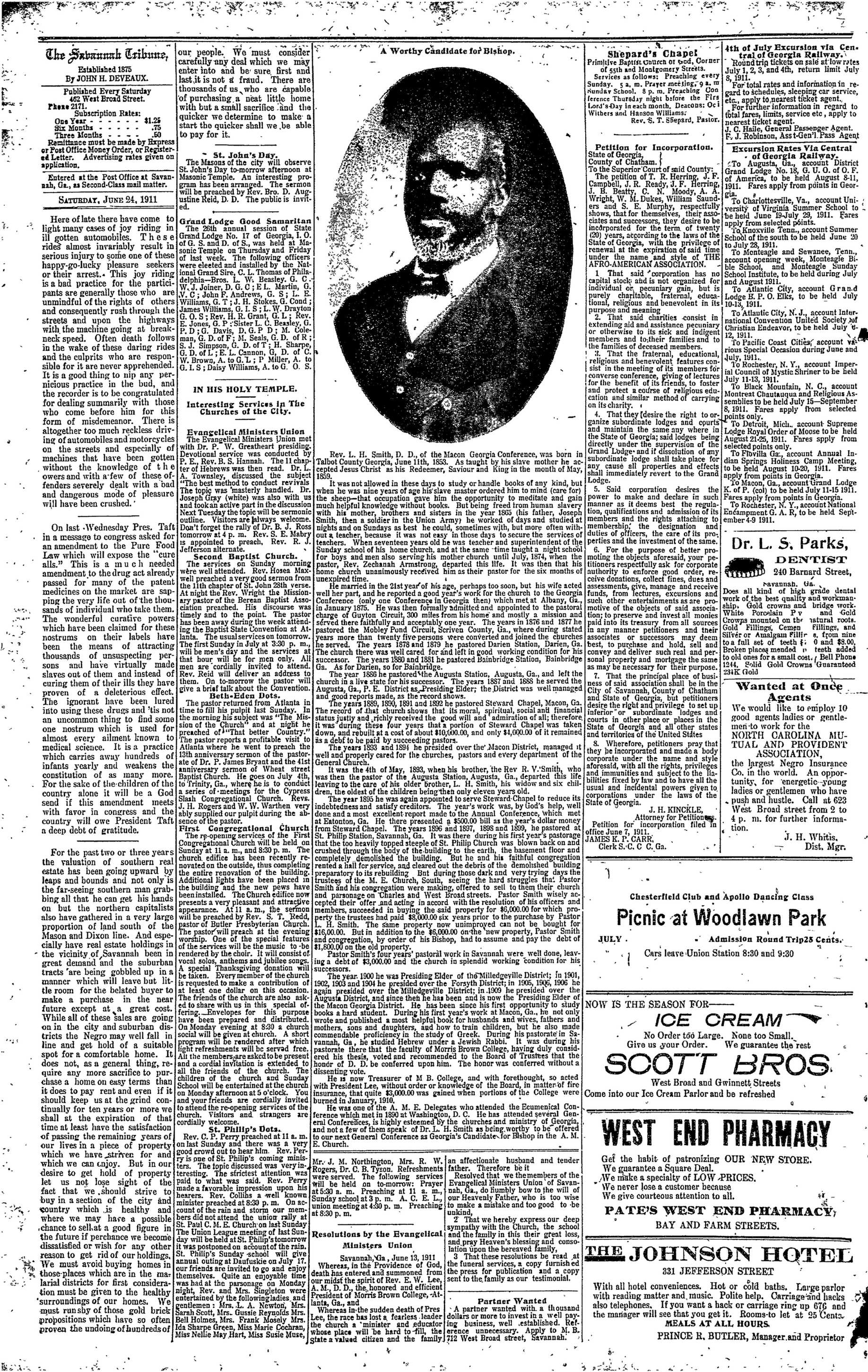
Entered at the Post Office at Savannah, Ga., as Second-Class mail matter.
Here of late there have come to light many cases of joy riding in ill gotten automobiles. These rides almost invariably result in serious injury to some one of these happy-go-lucky pleasure seekers or their arrest. This joy riding is a bad practice for the participants are generally those who are unmindful of the rights of others and consequently rush through the streets and upon the highways with the machine going at breakneck speed. Often death follows in the wake of these daring rides and the culprits who are responsible for it are never apprehended. It is a good thing to nip any pernicious practice in the bud, and the recorder is to be congratulated for dealing summarily with those who come before him for this form of misdemeanor. There is altogether too much reckless driving of automobiles and motorcycles on the streets and especially of machines that have been gotten without the knowledge of the owers and with a few of these offenders severely dealt with a bad and dangerous mode of pleasure will have been crushed.
On last Wednesday Pres. Taft in a message to congress asked for an amendment to the Pure Food Law which will expose the "cure alls." This is a much needed amendment to the drug act already passed for many of the patent medicines on the market are sapping the very life out of the thousands of individual who take them. The wonderful curative powers which have been claimed for these nostrums on their labels have been the means of attracting thousands of unsuspecting persons and have virtually made slaves out of them and instead of curing them of their ills they have proven of a deleterious effect. The ignorant have been lured into using these drugs and 'tis not an uncommon thing to find some one nostrum which is used for almost every ailment known to medical science. It is a practice which carries away hundreds of infants yearly and weakens the constitution of as many more. For the sake of the children of the country alone it will be a God send if this amendment meets with favor in congress and the country will owe President Taft a deep debt of gratitude.
For the past two or three years the valuation of southern real estate has been going upward by leaps and bounds and not only is the far-seeing southern man grabbing all that he can get his hands on but the northern capitalists also have gathered in a very large proportion of land south of the Mason and Dixon line. And especially have real estate holdings in the vicinity of Savannah been in great demand and the suburban tracts are being gobbled up in a manner which will leave but little room for the belated buyer to make a purchase in the near future except at a great cost. While all of these sales are going on in the city and suburban districts the Negro may well fall in line and get hold of a suitable spot for a comfortable home. It does not, as a general thing, require any more sacrifice to purchase it does to pay rent and even if it should keep us at the grind continually for ten years or more we shall at the expiration of that time at least have the satisfaction of passing the remaining years of our lives in a piece of property which we have striven for and which we can enjoy. But in our desire to get hold of property let us not lose sight of the fact that we should strive to buy in a section of the city and country which is healthy and where we may have a possible chance to sell at a good figure in the future if perchance we become dissatisfied or wish for any other reason to get rid of our holdings. We must avoid buying homes in those places which are in the malarial districts for first consideration must be given to the healthy surroundings of our homes. We must run shy of those gold brick propositions which have so often proven the undoing of hundreds of
our people. We must consider carefully any deal which we may enter into and be sure first and last, it is not a fraud. There are thousands of us, who are capable of purchasing a neat little home with but a small sacrifice and the quicker we determine to make a start the quicker shall we be able to pay for it.
The Masons of the city will observe St. John's Day to-morrow afternoon at Masonic Temple. An interesting program has been arranged. The sermon will be preached by Rev. Bro. D. Augustine Reid, D. D. The public is invited.
Grand Lodge Good Samuritan
The 26th annual session of State Grand Lodge No. 17 of Georgia, I. O. of G. S. and D. of S., was held at Masonic Temple on Thursday and Friday of last week. The following officers were elected and installed by the National Grand Sire, C. L. Thomas of Philadelphia—Bros. L. W. Beasley, G. C. W. J. Joiner, D. G. C; E L. Martin, G. V. C; John P. Andrews, G. S; L. E. Williams, G. T; J. H. Stokes, G. Cond; James Williams, G. I. S; L. W. Drayton G. O. S; Rev. H. R. Grant, G. L; Rev. E. Jones, G. P; Sister L. C. Beasley, G. P. D; G. Davis, G. D. P; M. Coleman, G. D. of F; M. Seals, G. D. of R; S. J. Simpson, G. D. of T; H. Sharpe, G. D. of L; E. L. Cannon, G. D. of C. W. Brown, A. to G. L; P Miller, A. to G. I. S; Daisy Williams, A. to G. O. S.
IN HIS HOLY TEMPLE.
Interesting Services in The
Churches of the City.
Evangelical Ministers Union
The Evangelical Ministers Union met with Dr. P. W. Greatheart presiding. Devotional service was conducted by P. E. Rev. B. S. Hannah. The 11 chapter of Hebrews was then read. Dr. L. A. Townsley, discussed the subject "The best method to conduct revivals. The topic was 'masterly handled. Dr. Joseph Gray (white) was also with us and took an active part in the discussion Next Tuesday the topic will be sermonic outline. Visitors are lalways welcome. Don't forget the rally of Dr. B. J. Ross tomorrow at 4 p. m. Rev. S. E. Mabry is appointed to preach, Rev. R. J. Jefferson alternate.
Second Baptist Church. The services on Sunday morning were well attended. Rev. Hosea Maxwell preached a very good sermon from the 11th chapter of St. John 28th verse. At night the Rev. Wright the Missionary pastor of the Berean Baptist Association preached. His discourse was timely and to the point. The pastor has been away during the week attending the Baptist State Convention at Atlanta. The usual services on tomorrow. The first Sunday in July at 3:30 p. m., will be men's day and the services at that hour will be for men only. All men are cordially invited to attend. Rev. Reid will deliver an address to them. On to-morrow the pastor will give a brief talk about the Convention. Beth Eden Dots.
The pastor returned from Atlanta in time to fill his pulpit last Sunday. In the morning his subject was "The Mission of the Church" and at night he preached of "That better Country." The pastor reports a profitable visit to Atlanta where he went to preach the 13th anniversary sermon of the pastorate of Dr. P. James Bryant and the 41st anniversary sermon of Wheat street Baptist Church. He goes on July 4th, to Trinity, Ga., where he is to conduct a series of meetings for the Cypress Slash Congregational Church. Revs. J. H. Rogers and W. W. Warthen very ably supplied our pulpit during the absence of the pastor.
First Congregational Church
The rp-opening services of the First Congregational Church will be held on Sunday at 11 a.m., and 8:30 p.m. The church edifice has been recently renovated on the outside, thus completing the entire renovation of the building. Additional lights have been placed in the building and the new pews have been installed. The Church edifice now presents a very pleasant and attractive appearance. At 11 a.m., the sermon will be preached by Rev. S. T. Redd, pastor of Butler Presbyterian Church. The pastor will preach at the evening worship. One of the special features of the services will be the music to be rendered by the choir. It will consist of vocal solos, anthems and jubilee songs. A special Thanksgiving donation will be taken. Every member of the church is requested to make a contribution of at least one dollar on this occasion. The friends of the church are also asked to share with us in this special offering. Envelopes for this purpose have been prepared and distributed. On Monday evening at 8:30 a church social will be given at church. A short program will be rendered after which light refreshments will be servied free. All the members are asked to be present and a cordial invitation is extended to all the friends of the church. The children of the church and Sunday School will be entertained at the church on Monday afternoon at 5 o'clock. You and your friends are cordially invited to attend the re-opening services of the church. Visitors and strangers are cordially welcome.
Rev. C. P. Perry preached at 11 a.m. on last Sunday and there was a very good crowd out to hear him. Rev. Perry is one of St. Philip's coming ministers. The topic discussed was very interesting. The strictest attention was paid to what was said. Rev. Perry made a favorable impression upon his hearers. Rev. Collihs a well known minister preached at 8:30 p.m. On account of the rain and storm our members did not attend the union rally at St. Paul C. M. E. Church on last Sunday. The Union League meeting of last Sunday will be held at St. Philip's tomorrow it was postponed on account of the rain. St. Philip's Sunday school will give annual outing at Daufuskie on July 17. our friends are invited to go and enjoy themselves. Quite an enjoyable time was had at the parsonage on Monday night, Rev. and Mrs. Singleton were entertained by the following ladies and gentlemen: Mrs. L. A. Newton, Mrs. Sarah Scott, Mrs. Gussie Reynolds Mrs. Bell Holmes, Mrs. Frank Mosely Mrs. Ida Sharpe Green, Miss Marie Cochran, Miss Nellie Green Hart, Miss Susie Muse,
[Picture of a man in a suit with a bow tie].
Rev. L. H. Smith, D. D., of the Macon Georgia Conference, was born in Talbot County Georgia, June 11th, 1853. As taught by his slave mother he accepted Jesus Christ as his Redeemer, Saviour and King in the month of May, 1859.
It was not allowed in these days to study or handle books of any kind, but when he was nine years of age his slave master ordered him to mind (care for) the sheep—that occupation gave him the opportunity to meditate and gain much helpful knowledge without books. But being freed from human slavery with his mother, brothers and sisters in the year 1855 (his father, Joseph Smith), then a soldier in the Union Army) he worked of days and studied at nights and on Sundays as best he could, sometimes with, but more often without a teacher, because it was not easy in those days to secure the services of teachers. When seventeen years old he was teacher and superintendent of the Sunday school of his home church, and at the same time taught a night school for boys and men also serving his mother church until July, 1874, when the pastor, Rev. Zechanah Armstrong, departed this life. It was then that his home church unanimously received him as their pastor for the six months of unexposed time.
He married in the 21st year of his age, perhaps too soon, but his wife acted well her part, and he reported a good year's work for the church to the Georgia Conference (only one Conference in Georgia then) which met at Albany, Ga., in January 1875. He was then formally admitted and appointed to the pastoral charge of Guyton Circuit, 300 miles from his home and mostly a mission and served there faithfully and acceptably one year. The years in 1876 and 1877 he pastored the Mobley Pond Circuit, Scriven County, Ga., where during stated years more than twenty five persons were converted and joined the churches he served. The years 1878 and 1879 he pastored Darien Station, Darien, Ga. The church there was well cared for and left in good working condition for his successor. The years 1880 and 1881 he pastored Bainbridge Station, Bainbridge Ga. As for Darien, so for Bainbridge.
The year 1886 he pastored the Augusta Station, Augusta, Ga., and left the church in a live state for his successor. The years 1887 and 1888 he served the Augusta, Ga., P. E. District as Presiding Elder; the District was well managed and good reports made, as the record shows.
The years 1889, 1890, 1891 and 1892 he pastored Steward Chapel, Macon, Ga. The record of that church shows that its moral, spiritual, social and financial status justly and richly received the good will and admiration of all; therefore it was during these four years that a portion of Steward Chapel was taken down, and rebuilt at a cost of about $10,000.00, and only $4,000.00 of it remained as a debt to be paid by succeeding pastors.
The years 1893 and 1894 he presided over the Macon District, managed it well and properly cared for the churches, pastors and every department of the General Church.
It was the 4th of May, 1893, when his brother, the Rev R. V. Smith, who was then the pastor of the Augusta Station, Augusta, Ga., departed this life leaving to the care of his older brother, L. H. Smith, his widow and six children, the oldest of the children being that only eleven years old.
The year 1895 he was again appointed to serve Steward-Chapel to reduce its indebtedness and satisfy creditors. The year's work was, by God's help, well done and a most excellent report made to the Annual Conference, which met at Eatonton, Ga. He there presented a $300.00 bill as the year's dollar money from Steward Chapel. The years 1896 and 1897, 1898 and 1899, he pastored at St. Philip Station, Savannah, Ga. It was there during his first year's pastorage that the too heavily topped steepe of St. Philip Church was blown back on and crushed through the body of the building to the earth, the basement floor and completely demolished the building. But he and his faithful congregation rented a hall for service, and cleared out the debris of the demolished building preparatory to its rebuilding. But during those dark and very trying days the trustees of the M. E. Church, South, seeing the hard struggles that Pastor Smith and his congregation were making, offered to sell to them their church and parsonage on Charles and West Broad streets. Pastor Smith wisely accepted their offer and acting in accord with the resolution of his officers and members, succeeded in buying the said property for $6,000.00 for which property the trustees had paid $8,000.00 six years prior to the purchase by Pastor L. H. Smith. The same property now unimproved can not be bought for $16,000.00. But in addition to the $6,000.00 on the new property, Pastor Smith and congregation, by order of his Bishop, had to assume and pay the debt of $1,800.00 on the old property.
Pastor Smith's four years' pastoral work in Savannah were well done, leaving a debt of $3,000.00 and the church in splendid working condition for his successors.
The year. 1900 he was Presiding Elder of the Milledgeville District; in 1901, 1902, 1903 and 1904 he presided over the Forsyth District; in 1905, 1906, 1906 he again presided over the Milledgeville District; in 1909 he presided over the Augusta District, and since then he has been and is now the Presiding Elder of the Macon Georgia District. He has been since his first opportunity to study books a hard student. During his first year's work at Macon, Ga., he not only wrote and published a most helpful book for husbands and wives, fathers and mothers, sons and daughters, and how to train children, but he also made commendable proficiency in the study of Greek. During his pastorate in Savannah, Ga, he studied Hebrew under a Jewish Rabbi. It was during his pastorate there that the faculty of Morris Brown College, having duly considered his thesis, voted and recommended to the Board of Trustees that the honor of D. D. be conferred upon him. The honor was conferred without a dissenting vote.
He is now Treasurer of M B. College, and with forethought, so acted with President Lee, without order or knowledge of the Board, in matter of fire insurance, that quite $3,000.00 was gained when portions of the College were burned in January, 1910.
He was one of the A. M. E. Delegates who attended the Ecumenical Conference which met in 1890 at Washington, D. C. He has attended several General Conferences, is highly esteemed by the churches and ministry of Georgia, and not a few of them speak of Dr. L. H. Smith as being worthy to be offered to our next General Conference as Georgia's Candidate for Bishop in the A. M. E. Church.
Mr. J. M. Northington, Mrs. R. W. Rogers, Dr. C. B. Tyson. Refreshments were served. The following services will be held on to-morrow: Prayer at 5:30 a. m. Preaching at 11 a. m., Sunday school at 3 p. m. A. C. E. L., union meeting at 4:30 p. m. Preaching at 8:30 p. m.
an affectionate husband and tender father. Therefore be it Resolved that we the members of the Evangelical Ministers Union of Savannah, Ga., do humbly bow to the will of our Heavenly Father, who is too wise to make a mistake and too good to be unkind.
Resolutions by the Evangelical Ministers Union
Savannah, Ga, June 13, 1911
Whereaz, in the Providence of God,
death has entered and summoned from
our midst the spirit of Rev. E. W. Lee,
A. M. D. D., the honored and efficient
President of Morris Brown College, Atlanta, Ga., and
Whereas in the sudden death of Pres
Lee, the race has lost a fearless. leader
the church a 'minister and educator
whose place will be hard to fill, the
state a valued citizen and the family
an affectionate husband and tender father. Therefore be it
Resolved that we the members of the Evangelical Ministers Union of Savannah, Ga., do humbly bow to the will of our Heavenly Father, who is too wise to make a mistake and too good to be unkind,
2 That we hereby express our deep sympathy with the Church, the school and the family in this their great loss, and pray Heaven's blessing and consolation upon the bereaved family,
3 That these resolutions be read at the funeral services, a copy furnished the press for publication and a copy sent to the family as our testimonial.
Partner Wanted
PARTNER WANTED
A partner wanted with a thousand dollars or more to invest in a well paying business, well established. Reference unnecessary. Apply to M. B. 712 West Broad street, Savannah.
West Broad and Gwinnett Streets Come into our Ice Cream Parlor and be refreshed
Get the habit of patronizing OUR NEW STORE. We guarantee a Square Deal. We make a specialty of LOW PRICES. We never lose a customer because We give courteous attention to all. PATE'S WEST END PHARMACY BAY AND FARM STREETS.
With all hotel conveniences. Hot or cold baths. Large parlor with reading matter and music. Polite help. Carriage and hacks also telephones. If you want a hack or carriage ring up 676 and the manager will see that you get it. Rooms-to let at 25 Centa MEALS AT ALL HOURS. PRINCE R, BUTLER, Manager, and Proprietor
Shepard's Chapel
Primitive Baptist church or good, Corner
and Mount Sinai Street
of 55th and Montgomery Streets.
Services as follows: Preaching every
Sunday, 5 a.m. Prayer meeting, 9 a.m.
Sunday School, 8 p.m. Preaching Con-
ference Thursday night before the First
Lord's Day in each month, Deacons; Oci
Witthers and Hanson Williams;
Petition for Incorporation.
State of Georgia
County of Chatham.
To the Superior Court of said County:
The petition of T. R. Herring, J. F. Campbell, J. R. Ready, J. F. Herring,
J. B. Beatty, C. N. Moody, A. A. Wright, W. M. Dukes, William Saunders
and S. E. Murphy, respectively shows, that for themselves, their associates and successors, they desire to be incorporated for the term of twenty (20) years, according to the laws of the State of Georgia, with the privilege of renewal at the expiration of said time under the name and style of THE AFRO-AMERICAN ASSOCIATION.
1 That said corporation has no capital stock and is not organized for individual or pecuniary gain, but is purely charitable, fraternal, educational, religious and benevolent in its purpose and meaning
2. That said charities consist in extending aid and assistance pecuniary or otherwise to its sick and indigent members and to their families and to the families of deceased members.
3. That the fraternal, educational, religious and benevolent features consist in the meeting of its members for converse conference, giving of lectures for the benefit of its friends, to foster and protect a course of religious education and similar method of carrying on its charity.
4. That they [desire the right to organize subordinate lodges and courts and maintain the same any where in the State of Georgia; said lodges being directly under the supervision of the Grand Lodge and if dissolution of any subordinate lodge shall take place for any cause all properties and effects shall immediately revert to the Grand Lodge.
5. Said corporation desires the power to make and declare in such manner as it deems best the regulation, qualifications and admission of its members and the rights attaching to membership; the designation and duties of officers, the care of its properties and the investment of the same.
6. For the purpose of better promoting the objects aforesaid, your petitioners respectfully ask for corporate authority to enforce good order, receive donations, collect fines, dues and assessments, give, manage and receive funds, from lectures, excursions and such other entertainments as are promotive of the objects of said association; to preserve and invest all monies paid into its treasury from all sources in any manner petitioners and their associates or successors may deem best, to purchase and hold, sell and convey and deliver such real and personal property and mortgage the same as may be necessary for their purpose.
7. That the principal place of business of said association shall be in the City of Savannah, County of Chatham and State of Georgia, but petitioners desire the right and privilege to set up inferior or subordinate lodges and courts in other place or places in the State of Georgia and all other states and territories of the United States
8. Wherefore, petitioners pray that they be incorporated and made a body corporate under the name and style aforesaid, with all the rights, privileges and immunities and subject to the liabilities fixed by law and to have all the usual and incidental powers given to corporations under the laws of the State of Georgia.
J. H. KINCKLE,
Attorney for Petitions
Petition for incorporation filed in office June 7, 1911.
JAMES K. P. CARR.
4th of July Excursion via Central of Georgia Railway.
Round trip tickets on sale at lowrates July 1, 2, 3, and 4th, return limit July 8, 1911.
For total rates and information in regard to schedules, sleeping car service, etc., apply to nearest ticket agent.
For further information in regard to total fares, limits, service etc., apply to nearest ticket agent.
J. C. Hailie, General Passenger Agent.
F. J. Robinson, Asst-Gen'l Pass Agent
Excursion Rates Via Central
of Georgia Railway.
To Augusta, Ga., account District
Grand Lodge No. 18, G. U. O. of F.
O. of America, to be held August 8-11,
1911. Fares apply from points in Georgia.
To Charlottesville, Va., account University of Virginia Summer School to be held June 19-July 29, 1911. Fares apply from selected points.
To Knoxville Tenn., account Summer School of the south to be held June 20 to July 28, 1911.
To Monteagle and Sewanee, Tenn., account opening week, Monteagle Bible School, and Monteagle Sunday School Institute, to be held during July and August 1911.
To Atlantic City, account Grand Lodge K. P. O. Elks, to be held July 10-13, 1911.
To Atlantic City, N. J., account International Convention United Society of Christian Endeavor, to be held July 12, 1911.
To Pacific Coast Cities, account various Special Ocasion during June and July, 1911.
To Rochester, N. Y., account Imperial Council of Mystic Shriner to be held July 11-13, 1911.
To Black Mountain, N. C., account Montreat Chautauqua and Religious Assemblies to be held July 15—September 8, 1911. Fares apply from selected points only.
To Detroit, Mich., account Supreme Lodge Royal Order of Moose to be held August 21-25, 1911. Fares apply from selected points only.
To Flovilla Ga., account Annual Indian Springs Holiness Camp Meeting, to be held August 10-20, 1911. Fares apply from points in Georgia.
To Macon, Ga., account Grand Lodge K. of P. (col) to be held July 11-15 1911. Fares apply from points in Georgia.
To Rochester, N. Y., account National Endcampment G. A. R, to be held September 4-9 1911.
Does all kind of high grade dental work of the best quality and workmanhip. Gold crowns and bridge work. White Porcelain Pv and Gold Crowns mounted on the natural roots. Gold Filling, Cemen fillings, and Silver or Amalgam fillers, from nine to a full set of teeth $: 0 and $8.00. Broken places mended n teeth added to old ones for a small cost. Bell Phone 1244. Solid Gold Crowns Guaranteed 231K Gold
We would like to employ 10 good agents ladies or gentlemen to work for the NORTH CAROLINA MUTUAL AND PROVIDENT ASSOCIATION
ASSOCIATION, the largest Negro Insurance Co. in the world. An opportunity, for energetic-young ladies or gentlemen who have push and hustle. Call at 623 West Broad street from 2 to 4 p.m. for further information.
J. H. Whitis.
Dist, Mgr.
Locals.
Mr. Weldon Horn, af Atlanta, Ga.,
is in the city for the summer.
Mrs. Henry P. Chisholm of Cordale, Ga., is in the city for a short stay.
Ga., is in the city for a short stay.
Ask Pate's Drug Store about the Nyall Line.
For Ice Cream, ring up McFall, Phone
4038.
Misses Sadez Smart and Louise Carter left for New York last Tuesday.
Mr. Harvey Claxton of Brooklyn, N. Y. is in the city visiting friends.
Mr. Ed Ross of Macon, spent several days in the city this week.
Mr. S. S. Mincey of Alley was in the city Wednesday.
Miss Emma Johnson of Atlanta, Ga., is in the city for a few days.
Rev. Dan. Mills of 1115 West Broad street who has been seriously ill is improving steadily.
Dr. Archibald Thompson of Tomkins, Ga. is in the city and is hoping to locate here.
Mr. W. D. DeWit of Ludowici, Ga., was in the city last week for a few days.
Mr. Henry J. Longworth, of Atlanta Ga., who has been in this city for a month left for Atlantic City, N. J.
* Mrs. Jeannet Robinson of LaGrange, Ga., is in the city, the guest of Mrs Anita Maxwell. Mrs. W.R. Fields left the city Thursday for a visit to her daughter Wilhelmma who is in Atlantic City N. J. Mrs Alma J. Jenkins of Rome, Ga. is stopping for a couple of weeks with Mrs J. J. Williams Bryan St., west. Misses Elma Roston, Janie Hammond, and Susie Anderson left for Saratoga, N. Y. on Monday afternoon.
Go to Pate's Drug Store, West Broad and Hall streets.
Don't go other places to buy your suit before seeing A. P. Barnard, The Taylor, 310 Whitaker street-Phone 3003 Mrs. Willie Mitchell Emory of Macon, Ga., is in the city the guest of Mrs. C. E.Nelson, 736 E. Waldburg street.
Mrs. A. M. Sherrill of Augusta, Ga., is in the city for a few days visiting her sister, Miss Hattie Hamilton.
Mr. Henry B. Wright, of 765 Gwinnett street E., who was on the sick list last week is out again.
Go to Savannah Pharmacy or phone your wants. Prescriptions called for glad delivered. Phone 3570
Miss Elizabeth Bynewood of Columbia, S. C. is in the city for a short stay the guest of Mrs. James H. Carpenter.
Manding shoes is sometimes as important as making them. It requires expert work to do it right. J. H. Washington, 309 Whitaker street. STORES FOR RENT—Stores on Bay near Lumber, good stand, ten dollars. Apply W. H. Wade, room 9 Provident Building. Ask Pate's Drug Store about the Nyall Line. Miss Rosalie Thurman Cole is spending the week very pleasantly in Hardeeville, S. C., the guest of Miss Nellie Cummings. Mr. Henry Jackson and Mr. George Harrison of Charleston, S. C. were among the excursionists here last Sunday. Mrs. Maimie Williams has move to 514 West Broad Street just opposite where she was. She will be pleased to haye her friends call. Miss Mabel Houstou who returned home week before last left last week for Ashville, N. C., accompanied by her sister, Miss Rowena Houstou.
Mrs. Sarah Bernard, of Augusta, Ga. who is stopping with Mrs. Helen Marshall of East Broad, St will leave tomorrow for Jacksonville, Fla.
Mrs. Lizzie Smalls now of Atlanta, Ga. formerly of this city has been down bick is but is at this writing recuperating rapidly.
Have you had a glass of soda from the new sanitary iceeless soda found at Savannah Pharmacy. Its goods and deserves your patronage.
Mrs. Essie Goodman of Vidalia, Ga., after a stay of three weeks in the city, the 'guest of Mr. and Mrs. Charles P. Henderson, left for home Tuesday.
Go to the Savannah Pharmacy to buy your drugs and toilet articles. They have the goods. West Broad and Gwinnett St. Lane.
Mr. Robert Clark of Jacksonville, Fla. and Mr. Sam Driver were in the city this week enroute to Atlantic City N.J.
Mrs Davis of Atlanta Ga., who was attending her daughter, Mrs James G. Lemon, of College, Ga, during her recent illness left for home Thursday.
Miss Anna Collins, a popular teacher at Morris Brown College, after a very successful term is spending her vacation with her mother at 513 Oak street.
Watch me as I grow, that will show you that I am turning out good work that suits my customers. A. P. Barnard The Tailor. 310 Whitaker street. Phone 3003.
Go to Pate's Drug Store, West Broad and Hall streets.
Mrs. Richard Bright and daughter, who have been living in Philadelphia, Pa., for the last few years arrived in the city last Friday to spend the summer with Rev. Bright.
Friends of Mr. B. E. Edwards the sky scraping tenor who recently filled a very successful engagement at the Pekin will be pleased to learn that he is making good at the Dixie, Charlotte N. G.
The waiting room of my shoe repairing department is entirely reserved so that any lady or gentleman can sit and wait for small jobs. J. H. Washington Miss Camilla G. Marshall, Miss Cornelia McDowell and Miss Rosa May Williams returned from Fisk University last Thursday evening to spend their summer vacation. Don't be foolish and pay from $15 to $20 for a suit that doesn't fit. Why not pay $15 or $2 more and let A. P. Barnard the tailor give you a perfect fit. 310 Whitaker street. Phone 3003 Miss Emma Gibson of Thomasville, Ga., made a flying trip to Savannah on the 7 inst., as a guest of Capt. and Mrs. Juo. Starr. She was present at the graduating exercises of Berean Baptist Academy. Mrs. Star returned home after a stay of a week in Atlanta, at the W. H. F. M. Society convention as a delegate from Second Baptist Church. She reports a very successful and inspiring meeting.
The friends of Mr. and Mrs. James M. Ferrebee sympathize with them in the sad loss which befell them Monday in the death of their newly born infant and wish Mrs. Ferrebee a speedy recovery from her illness. Mr. Euclius Bacon and Miss Marion were joined in holy wedlock on Wednesday evening of last week at the
bride's residence Mercer and Hall Sts. Rev. Daniel Wright performed the ceremony. The Rector and members of St. Stephen's Episcopal Church wish to thank their friends for the liberal patronage that was accorded them last Tuesday afternoon upon their annual outing and trust that those who were not able to be present this year will make it covenient to go next year. On Wednesday evening of last week the Fountain City Aid and Social Club entertained their Branch and a number of other guests at their meeting rooms, Coles' hall, Waldburg street west. Short talks were made in response to the toast master's call, after which they sat down to a well laden table of delicacies.
Memoriam.
In loving memory of my beloved mother,
Mrs. ELIZABETH MAY,
who entered into the life eternal June 27th, 1904.
Her devoted daughter,
Nancie M.Reynolds.
Deaths.
Mrs. Anna Butler Longwood' 419 W.
32nd street died Wednesday morning at
5:30 o'clock. She was one of the oldest
citizens of the city and was well
thought of by all who knew her. She
left a host of relatives and friends to
mourn her loss. She was buried from
First Bryan Baptist Church, West
Broad and Walburg streets.
James, the young son of Mr. and Mrs.
Geo.S. Chatters of Vancouver, B.C.,
died June 10, of spinal meningitis. Mrs.
Chatters is the daughter of Capt. and
Mrs. J. M. Roston of College. Their
many friends extend them sympathy in
the loss of the little one.
No Sunday Club.
There will be no meeting of the
Sunday Club at Masonic Temple tomorrow
on account of annual celebration of
St. John's day by the Masons.
Dee-Lighted
Wife—Dear, may I attend The Savannah Home Association Outing to Daufuskie on the afternoon of July 11th?
Husband—Why certainly. You know their Outings are usually brim full of real pleasure and I would be "Dee-Lighted" to have you attend.
---
Charter Hospital Closing
On Wednesday evening Charity Hospital held its graduation exercises at the Second Baptist Church. The exercises were very interesting and the principal address of the evening was by Rev. D. Augustine Reid. Rev. Reid's talk was to the point, timely and very ably delivered. The program was far above the ordinary and deserved a larger audience than was present.
Pekin Dots.
The Pekin Stock Company was considerably strengthened this week by the addition of three new people, namely, Ellis and Wilson and Davis. Ellis could not be fairly judged by the part he is playing this week, but Wilson and Davis are old favorites and although very good when last, they seem to have improved very much. Wilson is a born comedian. His make up and actions are so ridiculous that you can't help laughing. Miss Davis is a refined soubrette and the "team" works well together. Tom Scott is "going big" this week singing "Steam Boat Bill" taking many encores nightly. Miss Blanche Russell "the little girl with the big voice" is always good for three and tour encores. She is very clever and sings new and catchy songs but we regret to say that she was just a bit too suggestive in her actions this week.
Miss Ella Webb., that dainty little dancing soubrette is still making good. She is featuring some very classy songs this week. The program is closed with a three act melodrama in which the Campbells appear to advantage. Next week Manager Styles will present his patrons with a real treat in Ward and Smith direct from New York. This team has quite a reputation and should prove a big drawing card, and in addition will be a comedy, Silas Green, by the Pekin Company.
---
Beautiful Home Wedding
One of the prettiest weddings of the year took place when Mr. Robert Marion David, Jr., and Miss Amanda Agnes, daughter of Mr. and Mrs. Chas. H. Ward, were united in the holy bonds of wedlock at the family residence, 520 Nicoll street, last Wednesday evening, at 8:30 o'clock. To the strains of a beautiful wedding march the bridal party, with Mr. Benj. E. Handy as best man and Miss Veronica Beasley as maid of honor, entered the parlor, which had been tastefully prepared for the occasion. The bride entered, accompanied by her brother, Mr. William T. Ward. The ceremony was performed by Father Obrecht, of St. Benedict's Catholic Church, and was very impressive. After the ceremony at the home, the bridal party wended their way to Morse's Hall, where the reception was held. Refreshments and music added to the enjoyment of this feature. Many handsome presents attest the high esteem in which the bride and groom are held by their many friends. Miss Lillian Wright, daughter, of President R. R. Wright, came from Philadelphia to attend the wedding. Mr. and Mrs. Davis are at home to their friends at 789 Bolton street, east. We join with, others in wishing them a happy and successful life.
LIBERAL
PRESSING CLUB
806 Cuyler St.
Dying, Dry and Steam
Cleaning
Clothes called for and Delivered Phone 2585-J C.D. BROWN, Prop.
Proclamation No. 4.
Office of the S. G. A. of the Supreme Grand Temple of the U. B. of A. Inc.
Savannah, Ga. June 12, 1911.
To the officers and members of D. G. Temples, Subordinate Temples, Junior Temples and other Subordinate branches of Brotherhood.
Greeting:—
By virtue of the authority in me vested, and in obedience to the laws, rules, and usages of our order: the following is hereby issued.
I.
ThatjSunday July 9, 1911 be and is hereby designated as Our Annual Thanksgiving Day, and that each branch is hereby ordered to observe the same by assembling at some designated place of Public Worship.
That the Temples and other branches constituting the Savannah District observe the same at the First Bryan Baptist Church as directed by the Joint Committee.
III.
That the Annual Session of the Supreme Grand Temple will be convened on Monday July 10, 1911. 9 A. M.
IV.
That all representatives and alternates must be present promptly at the opening.
Signed and sealed this 12th day of June 1911. W. D. Kennedy, S. G. A. Attest: R. L. Lockley, S. G. S..
Notice.
Mrytle Lodge No. 1663, Armenia No. 1980, Mt. Seir No. 2441, the officers and members of the above named Lodges are requested to meet in joint session at your Lodge Room Friday Evening June 30th, for purpose of improving Building. E. A. FIELDS, Chairman C. W. ALEXANDER, Secretary
AMUSEMENT COLUMN.
Coming Events in the Social World.
June 27th, Tuesday. Spring entertainment at Freeman's Hall by Porters Benayolent Association Admission 15 cents.
June 26th, Monday. Grand annual excursion to Beaufort by Brotherhood Union A. and S. C. Tickets 50 and 25 cents.
June 26th, Monday. Outing at Lincoln park by Young Adelphia A. and S. C. Tickets 15 cents.
July 11th, Tuesday. Second annual excursion to Daufuskie by Queen Esther Lodge No. 959, S. J. A. Tickets 50 and 25 cents.
June 19th, Monday. Grand picnic at Woodlawn Park by Verbena Court. Tickets 25 cents.
July 3rd, Monday. Trolley ride by Electa Chapta No. 1, O. E. S. Tickets 25 cents.
July 25th, Monday Outing at Woodlawn Park by Russian Division No. 1 of F. A. B. Church. Tickets 25 cents.
July 4th, Tuesday. Outing at Woodlawn Park by Joshua Division Co. B., U.R.K. of P. Tickets 25 cents.
June 20th, Tuesday. "Pow Wow" at Lincoln Park by the Seminole Indian Club. Tickets 15 cents.
July 10, Monday. St. Benedict's Church Annual Excursion to Daufuskie. Tickets 50 and 25 cents.
July 11th, Tuesday. Savannah Home Association Afternoon Outing to Daufuskie. Tickets 50 cents.
June 28th, Wednesday. Trolley Ride by Asbury M. E. Church. Tickets 25 cents.
June 26th, Monday. Trolley Ride by Supreme Grand Temple U. B. of A. Tickets 25 cents.
June 27th, Tuesday Four nights Bazaar begins by Club No 2 of First Tabernacle Baptist Church. Masonic Temple. Tickets 15 and 25 cents.
July 3rd, Monday. Two boat excursion to St. Helena by the Mutual Club. Tickets 50 cents.
June 27th, Tuesday. Picnic at Lincoln Park by the L. B. S. Club. Tickets 15 cents.
July 4th, Tuesday. Outing at Stiles Park by the U. S. and D. of Gospel Travellers. Tickets 15 cents.
July 3, Monday. Trolley Ride benefit of St. Augustine Church. Tickets 25 cents.
June 26th, Monday. Trolley Ride by Bethlehem Baptist Church. Tickets 25 cents.
June 26th, Monday. Grand Ball at Palmetto Park by Willing Workers Pleasure club. Round trip 25 cents.
July 10th Monday Afternoon Outing by Friendly Brothers A and S. C.No! tickets 25 cents.
The Pass-word
To Daufuskie
WITH
Savannah Home
Association
On the afternoon of
TUESDAY JULY 11th, 1911
Boat leaves foot of Abercorn
Street at 2:30 o'clock.
Tickets 50 Cents
The honor of your presence is Requested at the
AUDITORIUM
Ice cream made of pure cream. Pure fruit flavoring. Come and make your headquarters with us when in Beaufort this summer. "Get the Auditorium habit"
ALEXANDER MEYERS, Proprietor
BEAUFORT, S. C
BEST AND HEALTH TO MOTHER AND CHILD.
Mrs. Winslow's Soothing Syrup has been used for over Sixty Years. More than MOTHERS for their CHILDREN WHILE TEETHING, with PERFECT SUCCESS. It SOOThes the CHILD, SOFTENS the GUMS, ALWAYS ALL PAINT, CURDS WITH COLIC, and is the best remedy for DIARRHOE. It is absolutely harmless. Be sure and ask for "Mrs. Winslow's Soothing Syrup," and take no other kind. Twenty-five cents a bottle.
Dr. J. W. Jamerson
Firstclass Dentist,
All Work Guaranteed.
623 WEST BROAD STREET
Bet. Huntingdon and Hall
Bell Phone 2098.
Pekin Theatre
Pekin Theatre
Summer Prices
BEGINNING
Monday May 15
The following prices will go in-
to effect:
BOX SEATS 20
ORCHESTRA 10
BALCONY 5
NEW FACES
NEW SONG
SPECIAL FEATURES
Performance starts at 8 o'clock.
Come and stay as long you like.
Matinees Mondays and. Thursdays.
NEW SODA FOUNT
Our new sanitary Soda Fountain has arrived and we are now ready to give you the best and cleanest service to be had. Call at our store and inspect the latest improvement in Soda Fountain manufacture.
Try a glass of cold soda at our "Iceless Fount"
SAVANNAH, PHARMACY CO.
811 West Broad Street
```markdown
```
The Acme Bicycle Store
K. HALPERN, Proprietor, 463 West Broad St.
Dealer in new and second handed bicycles. Repairing and vulcanizing a specialty. Tires and Sundries. Phone 1340.
Take a pleasant drive on the cool and well paved White Bluff Road to Nicholsonboro and refresh yourself at
Williams' Resort
'(Corner of the Road)
Refrshments served on short notice. Cold Drinks. Special attention to serving small parties. MRS. GEORGIA WILLIAMS R.F.D.No.2
F. F. JONES.
Dealer in
BEEF, VEAL, MUTTON,
LAMB, PORK, HAMS,
BACON and CORNED BEEF.
All kinds of GAME in season.
Goods promptly delivered to
any part of the city free of
charge.
Stall 31, City Market.
BEAUFORT-SAVANNAH LINE
Pilot Boy Clivedon
The orlinance requiring a license for excursions to Beaufort has been revoked
Parties desiring to run excursions will please Call at our office or Phone
4152
CHAS. E. BALL, Agent.
Artistic
Millinery
Our Hats are of the season's most beautiful creations, having the very latest styles from the most fashionable makers. Our prices are very reasonable. Special attention given to the remodeling of old hats.
Greene & Allen,
464 West Broad St.
BEFORE BUYING YOUR SPRING AND SUMMER SUITS AND LET HIM SHOW YOU THE LATEST FOR THIS SEASON Phone 3003 310 Whitaker St.
WOODLAWN PARK
20 W. BROUGHTON ST.
CLEARS THE COMPLEXION
Can you imagine anything more embarrassing than to have a complexion marred with blotchest
It is not only unpleasant—that isn't the worst feature—it means that the blood is impure and the longer you neglect it the more you suffer from annoyance.
Skin eruptions of any description indicate, in every instance, an impoverishment of the blood supply—it isn't pure and you cannot expect it to supply the proper amount of nourishment to the surrounding tissues.
Get at the root of the trouble cleanse the blood of impurities—stir up the circulation—tone up the digestive fluids and have your food absorbed in the proper manner.
NYAL'S HOT SPRINGS BLOOD REMEDY
NYAL'S HOT SPRINGS BLOOD REMEDY
Strengthens the blood supply—enriches it, cleanses it of impure waste material and thus supplies a foundation for the building of a permanent health.
You will notice a decided improvement with the first few doses—the appetite will be increased you will feel the blood coursing through veins and the skin will take on the glow of health.
We recommend it—$1 00 the bottle
We expect to be here in business a good many years. The only way we can do it is by treating everybody right. That's our policy.
PATE'S DRUG STORE
Phones 660 and 862
HALL and WEST BROAD STS.
Opposite The Pekin Theatre.
LINCOLN PARK
10,000 people visited Lincoln Park Easter Sunday and 12,500 on Easter Monday. A place of real pleasure and amusement. There are swings, merry go rounds, circle waves and a real dodging monkey that can dodge a hall as good as a boy can a brick. A large pavilion where you can dance or skate as you like. Pleas of choice refreshments. The Pekin Stock Company will entertain every Sunday afternoon and night. The Park is open for engagements and we want every one to go with us this summer. All churches have the pleasure of obtaining the park at a very low figure. Sunday schools may have Wednesday or Friday, music free, also the public and private schools the same. It will cost you nothing to give the little ones a day's outing. We will gladly give them any Wednesday or Friday with music free of charge. The park can be had this summer at a very low figure with a full orchestra. Lincoln Park the ideal place for picnics. It can be reached at any hour of the day, any minute in the hour. Manager Stiles wishes the public to know that he is only interested in Lincoln Park and the Pekin Theatre. Commencing May 15, summer rates. Box seats 20 cents, orchestra 10 cents, balcony 5 cents. Sty as long as you like. Big show this week, Uncle Tom's Cabin and new faces.
For Open Dates apply to the PEKIN THEATRE, 625 West Broad street, Manager Stiles will gladly give any information desired.
Phone 2829 AMERICAN BEAUTY Style I.E. at our store and see Kalamazoo Corset Co., Makers what we are doing. WEST BROAD & GWINNETT ST
Victoria Theatre
Continuous performance 7:30 to 11 p.m. ENTIRE CHANGE OF PROGRAM DAILY. PROGRAM
REAL ESTATE FOR SALE
Lot 35 feet front on Anderson street, near East Broad St., $25 cash payment and $10 per month on balance.
1613-1615 Burroughs street. 4 apartments renting for $32.00. $300.00 cash and balance in easy monthly installments.
2 lots and improvements known as 1512-1514 Vine street. Ideal location. $100 cash and balance like rent.
Lots on 37th street near Paulsen St. $10 cash and $5 per month on balance.
Nice 5 room cottages on 37th St., near Waters Road. City water and car service. Small cash payment and balance like rent.
2 lots with two 3 room houses 37th St., near Waters Road and overlooking the Granger tract. $100 cash and balance in small monthly payments.
The Wage Earners Loan and Investment Co., Phone 1198 468 WEST BROAD ST.
Scott Bros.
For Comfortable
SHOES
STRAW HATS
Union Made
OVERALLS
Triangle Brand
COLLARS
Howard's
SHOE POLISH
```markdown
```
Scott Bros.
Paris Dress
SHIRTS
FLAXON LAWNS
APRON CHECKS
Men's and Women's
HOSIERY
Men and Women
FURNISHINGS
The Farm
Thomas H. Clay and his son, Thomas H. Clay, Jr., two of the most prominent farmers in Bourbon county, Ky., and boretofere among the largest producers of tobacco, have decided to cut out the growing of tobacco for all time to come, and will engage in the growing of forage crops and handle live stock on a larger scale, according to correspondence to the Lexington Herald from Paris, Ky.
The Messrs. Clay raised only a small crop of tobacco last year and for 1911 canceled the insurance on their tobacco barns and had them re-insured as stock barns.
The depredations of night riders and the failure of farmers throughout the Burley district to agree upon a definite and fixed course to pursue have determined Mr. Clay and his son to cut out the growing of tobacco. They say the culture of tobacco drains the soil of its fertility, while the growing of forage crops to be fed to live stock, followed by clover crops to be plowed under, improves land and conserves its resources for future generations.-Inland Farmer.
A Remarkable Egg.
Eggs are still high—at least some eggs are—for the American Museum of Natural History in New York has just paid $100 for a single one. But it's a record-breaker, for it is eight inches long and 26 inches in circumference.
It isn't a hen's egg, but the egg of the now extinct epornls of Madagascar. This was a bird of the ostrich family, which stoog 7 to 12 feet in height, which could run like a deer and kick like several mules combined. The natives of the island still know the bird by the fanciful name of the "flying elephant."
As the epyornis has only been extinct 400 years or so, traditions about it are still current among the people of Madagascar. The eggs of the bird are still found occasionally, in a semi-fossil state, and are used for wine jars, etc., by the natives, who do not realize that they are worth $1,200 a dozen.
Shapes of Eggs.
There was recently had before the Zoological society of London a mathematical discussion of the differences in the shapes of eggs. A few eggs, like those of the owl and the tortoise, are spherical, or, nearly so; a few, like the greb's or the cormorant's are elliptical, with symmetrical ends; the great majority, like the hen's, are ovoid, or blunter at one end than the other. The hen's egg is always laid blunt end foremost. Eggs that are the most unsymmetrical are also eggs of large size relatively to the parent bird. The yolks of eggs are spherical, whatever the form of the entire egg may be. This has been shown to be due to their being inclosed in a fluid, the "white," which makes the pressure everywhere on the surface of the yolk practically constant.
Raising Turkeys.
The best way to raise the little turks is to give them to the turkey hen, their natural mother. She will take them farther away from home than the domestic hen, but this is what you want her to do. Turkeys that hang around the back door never amount to much. The domestic hen is sure to wean them right at a time when they, are too young to do well without a mother's care. Confine the turkey hen and her brood in a dry, clean, roomy coop in cold, wet weather. Keep them free from lice. Feed them sparingly the first two or three weeks; after that, just a little feed in the evening to keep them gentle and make them come home, and the turkey mother-will do the rest, if she is a good mother. Some hens take better care of their young than others.—Inland Farmer.
Fertilizers and Moisture.
Farmers should invest largely in commercial fertilizers. They cost something, but greatly increase the yield of crops. Water is necessary to dissolve fertilizers, for which reason they should be applied on the land early, in order that the plentiful rains of spring may prepare it for the use of plants. The failures that have occurred with fertilizers are usually due to the lack of moisture, and manure from the barnyard may be equally as useless if there is an insufficient supply of moisture in the ground.-Epitomist.
Rendering Eggs Infertile.
Mrs. M. J. G. asks for a recipe for treating eggs so they will not hatch. I raise pure-bred Rose Comb Rhode Island Reds. Before sending the surplus eggs to market I place them in a colander or sieve and turn boiling water over them, then remove at once and let, cool and dry before packing. It seals the pores and helps to keep the eggs fresh.-Missouri Valley Farmer.
All poultry are better for grit. It should form a considerable part, at least, of the contents of the gizzard. Without it, the birds cannot be in perfect health or a hen be at her best as a layer. When you consider what the functions of the gizzard are, the great advantage of permanently sharp grinders is obvious. A fowl's mastication takes place in the gizzard. Grit is the fowl's teeth, so to speak. As charcoal alds digestion, cleanses the crop, purifies the blood, regulates the bowels, it is very important that fowls, both young and old, should have it in generous quantities. Charcoal is especially prepared for poultry and does not contain any foreign matter or anything harmful whatever.
It should be powdered for mixing in soft food; fine granulated for small chicks, and coarse granulated for old fowls. By all means have it constantly before your birds.—Exchange.
Farmhouse Backyards.
It is an unpleasant truth that more back yards of farm houses suffer from neglect than those of the cities. People of the towns, who have few opportunities for the cultivation of flowers and vines, satisfy their hunger for such things as best they may by turning their narrow back yards into greenswards and covering the ugly fences and the raw, scroll-saw porches with beautiful growing things.
Seldom can there be found a farm house that could not be beautiful in a similar way. By the use of perennials, judiciously selected, the work of caring for a yard of this kind is very little. An hour now and then in the early spring spent in trimming, spraying and cultivation will, after the vines and flowers are once well grounded, keep them in fine condition and render the dirty, despised back yard a thing of constant joy.-Agricultural Epitomist.
Remedy for Mites.
Lice powder is prepared by mixing three parts of gasoline with one part of crude carbolic acid, 90-95 per cent. strength, or, if the latter cannot be obtained, with one part of cresol, and adding gradually, with stirring, enough plaster of paris to make when the liquid is uniformly distributed through the mass of plaster a dry, pinkish-brown powder having a fairly strong carbolic odor and a rather less pronounced gasoline odor. As a general rule, it will take about four quarts of plaster of paris to one quart of the liquid.
This powder is to be worked into the feathers of the birds affected with vermin. The bulk of the application should be in the fluff around the vent and on the ventral side of the body and in the fluff under the wings.
Hand-Picking Seed.
The importance of good seed cannot be too strongly urged. A grower of wheat in several years' experiments found that it paid well to hand-pick his seed wheat. The first year he planted seven and one-half pounds of hand-picked wheat on one acre in rows 18 inches apart, and at harvest he threshed out 67 bushels. The next year the yield was 72 bushels, using a little more seed. On a trial row he planted 70 extra fine kernels of wheat weighing 45 grains, and the product was ten pounds, or at the rate of 100 bushels per acre. In these experiments the rows were 18 inches apart in and the seeds 12 inches apart in the rows. A wheel hoe was used for cultivation.—Epitome.
Horse Stables.
Horse stables should be located where there is good natural drainage and have plenty of light and ventilation. The ventilation should be arranged, however, so that there will be no direct drafts on the horses, as they will induce colds, pneumonia and rheumatism. The floors should be of wood or concrete, rather than the bare ground. The stall partitions should come down to the floor, so that there will be no danger of the horses thrusting their legs under the partition and injuring themselves. Build the mangers to slant inwards, so that the horses will, not insure their knees while eating. Have plenty of clean straw bedding and clean out and disinfect the stalls at regular intervals.—Indians Farmer.
To Dislodge Bots.
Bots are difficult to dislodge until they have completed their development and pass out of their own accord. Half-ounce doses of turpentine three hours apart until three doses have been given is suggested as being a good remedy, followed with an ounce of powdered aloes as a physic. Each dose of turpentine is to be mixed with a half pint of milk and given when the animal is hungry. Do not give the aloes after each dose of turpentine, but after the three doses have been given—Field and Farm.
STANDARD OIL, THE COURTS AND THE NEGRO
The above caption with the "Standard Oil" and the Negro conjoined, certainly may look to some like trying to make oil and water mix. Be that as it may we've put it there. Had we placed Standard Oil alone, two questions may have arisen in the minds of the usual race reader: (1), "I wonder will kerosene go up?" (2), "Of what concern is the Standard Oil Co. to the Negro?" Now we hold that any big thing that happens in this country concerns the Negro; hence the editorial column must needs mention Standard Oil at this time. The Standard Oil company, one of the giant corporations of the world, has been declared a combination in restraint of trade, an "unreasonable restraint" as the majority opinion of Supreme court of the United States puts it.
In/consequence the Standard Oil company has been ordered dissolved. There are nineteen affiliated corporations involved. There are two things we wish to call the attention of the race; first, the preparedness of the Standard to handle the situation. It is said, and we believe it, for it is the part of wisdom, that the 'Standard has had lawyers at work devising ways and means of handling its great business by an organization that would meet the requirements of whatever decision the Supreme court might possibly render. Such ways and means have been worked out to the finest.details and plans are ready to be put in operation whenever high officials give the word "go."
There is in this a lesson for the race. There are forces at work to destroy whatever of political organization the race may have; or other organization, and it behooves him to have blue prints ready for something else to do the work, like Cohen of Louisiana. Second, the Negro is beginning to enter the business world on a large scale, and it is his duty to study the successful methods of large corporations and apply these methods to his own affairs.—Durham (N. C.) Reformer.
THE FASHIONABLE FRILL.
Paris has revived the lace ruffles and frills of the Georgian period, which means that this qualt and dalty fashion will be seen very shortly in New York, as the American woman invariably follows the fashions which Paris sets.
Conspicuous among the new lace assories of this period are the frills that fall over the hand.
Another striking development of the frill is seen on the boulevards of the French capital. It is a black satin ribbon folded around the neck, the ends tied in a chic bow beneath the chin. From this falls a full frill of white cambric or lace in the form of the fabot.
In the lace.frills falling over the knuckles is sounded the return of the long tight sleeve. Sleeves are of lace or are tucked, but are always right fitting and made of the one material. Frills are extremely smart with coat and skirt suits, and if ecru or cream color is selected a more artistic effect will be secured.
A LIVELY ILLUSTRATION.
Hearing a noise at midnight in one of his rooms, a gentleman tiptoed to the spot, thinking to take the burglar unawares. Sikes, however, was not to be caught "napping," and before the owner of the house fully realized what was happening he was looking down the muzzle of a revolver.
"You realize that you are at my mercy?"
"Ye—s," replied the house ower.
"And also realize that I could shoot you dead if I wished?"
Another trembling affirmative.
Another lemming animative.
"You did not hear me enter the house?"
"No."
"Well, if you had your windows fitted with one of Ketchum's new patent burglar alarms this wouldn't have happened. I am an agent for the—"
But the house owner had swooned.
—Ideas.
CUTENESS OF MADMEN.
In Sir William Butler's autobiography there is an amusing story about six insane soldiers who escaped while the corporal who had brought them on board the trooper was leaving at Durban and who mingled with the 1,800 sane men on the decks. The problem of the voyage was to find the who were the six madmen. By the time the boat reached Cape Town 26 men were officially under observation, and not one of the six was among them. In the end the crazed half dozen were identified as those who had taken an especially eager part in the Innatic hunt.
A ROAD MAP FOR THE MOTORIST.
One of the novelities displayed among our motor belongings is a road map frame of leather, which will make a splendid birthday gift for the man "who has everything." The map folds over a roll and the part for immediate use is revealed within the square leather frame under a window of isinglass. A magnifying glass in a small morocco leather case accompanies the map, and enables the chauffeur-to read the names of towns and location of landmarks easily while going at a good speed.
The Sunday School Lesson
Sunday School Lesson for June 25,
1911.
REVIEW.
GOLDEN TEXT—"What doth the Lord require of thee, but to do justify, and to love mercy, and to walk humbly with thy God?"—Micah 6:8.
The lessons of the quarter cover a period of 184 years from 894 B. C. to 710 B. C. They are not in exact chronological order as will be seen by looking at the dates given to the various lessons in the preceding notes. They are principally concerned with five prophets: Elisha, Joah, Isaiah, Mileah and Hosea; with four kings; Joash, Uziel, Hezekiah and Ahaz, and with one queen, Athaliah; two priests, Jeholada and Azarailah, and one general, Naaman, also figure prominently in the lessons. It would be well to have different scholars give an outline of the story of each prophet, king, queen, priest and general, and state the principal lessons to be learned from that life.
But the lessons can be reviewed topically, assigning to different scholars to find out what the lessons of the quarter teach about God, about sin, about salvation, about faith, about the Word of God, about worship, about backsliding, and about Jesus Christ.
The lessons have so little direct connection with one another, and the books from which they are taken have been taken up in such an apparently hit and miss sort of way, that a satisfactory historical review, or review of a book as such, is impossible. All one can do to seek to fasten the greatest truths of the quarter century in mind. The lessons are excellent in themselves, but historically, excepting that the prophets from whom some of the lessons are taken belong to the historical period from which the historical lessons are taken.
CHRIST IN US.
It is a great loss in every way that we are accustomed to speak of faith in Christ, forgiveness, and cleansing from sin as they were the crown and climax of Christianity, instead of being its outworks, its outer-courts, the staircases and corridors to its throneroom, its reparative processes preparatory to its essential life and heart. Christianity fails of its chief end in any life that it affects, unless it produces there, so far as may be possible, the life of the eternal God himself, as it is resident in Jesus Christ and communicated by the holy spirit.
In regeneration, at whatever time it takes place, and under whatever circumstances, the principle of a new life is inserted in the human spirit. As the animal has a higher life than the plant, and as man, in his moral nature, has a higher life than the animal, so the man who has been regenerated by the spirit of God has become possessed of a life to which the ordinary man can lay no claim. He has become, as the Apostle Peter puts it, "a partaker of the divine nature." Whatever be our difference as to creed or church, they are comparatively unimportant, so long as we possess within our spirits this divine life, which is Christ in us, the hope of glory. "Know ye not," said the apostle, as though it were an anomaly to be ignorant of this primal fact, "that Jesus Christ is in you, except ye be reprobates?"
The whole theme of redemption, the entire work of Jesus Christ, his birth in which he brought the divine under the condition of the human. His death by which he acquires' power to pass it on, his resurrection and ascension through which he bore it regnant and triumphant to the throne, his gift of the holy spirit by which he makes it available to all who believe—all tend to this as their flower and fruit, that he should reproduce himself in us.
And if year-by year we are not becoming more pure and strong and Christ-like, we may gravely question whether we have not deceived ourselves in thinking that we have received him into our nature.—F. B. Meyer.
YE DID IT UNTO ME.
(Mathew 25:40)
"What shall I give to Thee, O Lord?
The kings that came of old
Laid safely on Thy cradle rude
Their myrrh and gems and gold.
"Thy martyrts gave their hearts' warm blood,
Their ashes strewed Thy way;
They spurned their lives as dreams and dust
To speed Thy coming day.
"Thou knowest of sweet and precious things.
My store is scant and small.
Yet, wert Thou here in want and woe,
Lord, I would give Thee all."
There came a voice from heavenly heights;
"Unclose thine eyes and see;
Gifts to the least of those I love
Thou givest unto Me."
—Rose Terry Cooke.
THE CARNAL MIND.
The carnal mind is the embodiment of enmity—not merely at enmity—with God. Grace subjugates the carnal nature but does not destroy it. Sugar may counteract vinegar but does not change its nature. As long as the carnal mind exists 'it lights God and can not do otherwise—it is enmity and always will be. The only hope is in having it cast out. It can not be tamed nor educated; it must be destroyed—Thomas H. Nelson.
IT'S YOUR CHANCE.
Say, brother, sister, that boy or girl you are now teaching may have the best teacher he or she may ever have; and it may be that you are the only person in the world that can ever lead them to Christ. Will you not pray earnestly that the Lord may help you do your duty?—Western Methodist.
SIR WALTER AT ABBOTSFORD
This is the Centenary of Scott's Entry Into Passement of That Famous Estate.
This is a notable year in the history of Abbotsford, for it is the centenary of Sir Walter Scott's entry into possession of the lands ever afterward closely associated with his name. On May 12, 1811, he wrote to his publisher, James Ballantyre, that he had "resolved to purchase a piece of ground sufficient for a cottage and a few fields." That first purchase, which cost £4,000, was a wretched farm by the riverside, the house, says Lockhart, "small and poor, with a common kailyard on one flank and a staring barn on the other, while in front appeared a filthy pond covered with ducks and duckweed, from which the whole tenement had derived the unharmonious designation of Clarty Hole."
Scott spent £50,000 in extending and beautifying the estate, and in Abbotsford, amid the music so delicious to his car, "the gentle ripple of the Tweed over its pebbles," he breathed his last on the sunny afternoon of September 21, 1832.
THE WORM WILL, ETC.
58
Irs. Henpeck—Do you recall the day we were married?
Henpeck (bitterly)—I wish to heaven I could.
ASBESTOS.
The total production of asbestos in the United States for 1910 was the greatest yet recorded, 6,693 tons. This was an increase of 20 per cent. in quantity over the production of 1909. The United States has long held first place as a manufacturer of asbestos goods, but the raw material for that purpose was freely drawn from Canada, at present the chief source of the world's supply. Georgia and Vermont are our chief asbestos producers, the former of amphibole and the latter of chrysolite varieties, the latter being reported by manufacturers to compare favorably with that from Canada. The production in Wyoming and Idaho has advanced but in those states the industry is still in the development stage and has not become permanently established.
DEATH DREAM REALIZED.
A remarkable dream of death was mentioned the other day at a Southward, England, inquest on an infant named George McCarthy. "I had so vivid a dream that my daughter's child was dead," said Mrs. Hendry, the grandmother of the infant, "that I went early in the morning to her house. I found her in bed, and asked her what was wrong with the child. She replied, 'He is all right. What did you think was the matter with him?' I told her of my dream, and asked her to look at the baby. She looked, and the child was dead."
WAKENING THE DUKE.
The great Duke of Wellington was among those upon whom sermons have a soporific effect. A strange clergyman who was preaching at the church at Strathfieldsaye where the duke was a regular attendant was squuch surprised by the action of the verger, who at the conclusion of the sermon came up the pulpit stairs, opened the door, slammed it violently, and then reopened it for the preacher to pass out. In the vestry he inquired the meaning of this procedure. "Oh," replied the man, "we always do that to wake the duke."
THOUGHT HE'D BE FUNNY.
Wife (unpacking garden utensils)
—"And what is this long-handled brush for?"
Hubby—"Oh, that's a toothbrush I got for the garden rake."
MATTER OF TEMPERAMENT.
"Do you suffer much from the heat in summer?"
"Well, considerably more so then than at other times."
POETRY
of and by Our People
BY MARY J. S. MOORE
You have heard of the land of the ther-
v
Where the beautiful snow never falls.
Where no winter storms ever put to test
The lovers of sport or balls.
They say the orange bloom scents the air,
Its fruits so healthy and fine.
That peace and plenty, are everywhere
With song and cake and wine.
And its manufacturers boast
That everything here is made;
But should I feel inclined to give you a
toast,
I could lay the west in the shade.
I know of a place over in the east.
Where the seasons are varied and fine.
It abounds with flowers and birds and
beasts,
And that beautiful clime was mine.
Have you seen a land that seemed to you
Was dropped down from the sky?
Where human beings lived in view
Of a happy home on high?
Where the birds' sweet song and the rippling brooks
Were enjoyed the whole day long.
Where care was vanished by happy looks
As you passed the fun-loving throng.
Then you know that I speak, as I make up my rhyme.
Of the home of sweet Ella Ree.
O, how proudly I tell that home was once mine.
My beautiful fair Tennessee.
Many who are lured to the western shore
In quest of pleasure and health,
Will long to see Tennessee once more.
And pine for Tennessee's wealth.
Dear old Tennessee, the land of my heart,
Oh, why did I far, from thee roam—
How came we ever from thee to depart,
My dearest, my own native home!
Upon thy fair hills, my own blessed dead
Are sleeping and know no lilies;
And the joys and pleasure in which they lend.
With rapture my heart still thrills.
But your joys and sorrows I shall share no more,
'Tis not for me to repine.
Henceforth my abode is the western shore
And its pleasures must also be mine.
So I wave an adieu to dear Tennessee
And the friends I left behind.
May there be a thought in your hearts for me,
For you are in mine enshrined.
I could not see you all again
Even if I should come home;
For some have joined that wondrous train
And there no longer roam.
But when life's changes all are o'er,
Our tasks are all complete.
I'll meet you on that blessed shore
Where all true pilgrims meet.
O Tennessee, so richly bound,
My own, my native land.
Where is a fairer section found?
Where is a better planned?
HOT WEATHER.
This here weather's hard to beat,
Country lane, or city street;
Cotton's got an early start.
Plant that melon!
Hot sun, with perspirin' face;
Scorchin' time in every place;
But we've got amazin' grace;—
Thump that melon!
What's the use o' feelin' blue,
When a west wind's fannin' you?
Cut that red, ripe heart in two:—
Slice that melon!
-Frank Stanton-
GEMS OF THOUGHT
I slept and dreamed that life was Beauty:
I woke and found that life was Duty.
—E. S. Hooper.
Oh, the heart is a free and a fetterless thing—
A wave of the ocean, a bird on the wing.
—Thomas O. Davis.
To most men, experience is like the stern lights of a ship, which illumine only the track it has passed.—Coleridge.
Tell me what is sorrow? It is a gloomy cage.
And what is joy? It is a little bird
Whose song therein is heard.
—R. H. Stoddard.
The rose salth in the dewy morn,
I am most fair;
Yet all my loveliness is born
Upon a thorn.
—Christina G. Rosetti.
Where none admire, 'tis useless to excel;
Where none are beaux, 'tis vain to be a belle.
—Lord Lyttelton.
Fright-eyed Fancy, hov'ring o'er,
Scatters from her pictured urn.
Thoughts that breathe and words that
Corrupted freemen are the worst of slaves.—David Garrick.
Oh, many a shaft at random sent
Finds the mark the archer little
meant!
And many a word at random spoken
May soothe, or wound, a heart that's
broken.
—Scott.
'Tis not the whole of life to live.
Nor all of death to die.
—Montgomery.
THE WORLD GIVES YOU A LIVING
—IT IS YOUR DUTY TO MAKE
HER PAY.
We often hear persons say "the
world owes me a living." Well, she
owes possibly every man a living. She
is rich and able to pay, up. The world
can't plead bankruptcy, nor will any
court allow her to take the pauper's
cath.
It is universally known that old mother earth is immensely wealthy, and another thing about her is that while she may in places at times seem a little cold and indifferent and even to frown and appear rough, she is nevertheless honest, and you can get on the good side of her, and she will pay you the living she owes you. Just talk to old mother earth in the right manner and she will listen to you. Talk to her with plow, hoe, pick, shovel, cultivator, rake, reaper, and she will pay you the living she owes you in fruits, grain, vegetables, etc., or in live stock, poultry or anything else of the kind. Talk to her in the language of pick, crowbar, and dynamite if necessary, and she will pay you in coal, iron, gold, silver, etc. Talk to her in the language of drill, derrick, pipe, etc., and she will let you have oil, gas, etc., on the debt she owes. All you have todo is to address dear old mother in the proper language and she will pay every man every cent she owes him.
If you do not want to go to old mother earth directly, and collect the living she owes you you can get the living she owes you from her indirectly. Can you shoe a horse, sharpen a plow, make a wagon, or build a house? Well, do that for the fellow that can't or has not the time, while he talks to mother earth for you and himself in the manner above referred to. He will collect for you and himself also for your services to him. Can you teach school? Do that, for the people will collect your debt for you from mother earth. The good lawyer, doctor, manufacturer, electrician, bricklayer, cook, waiter, barber, bootblack, coachman, in fact everyone of whatever craft can collect by proxy the living old mother owes him. Get busy and make her pay you the living she owes you. Remember she will repudiate the debt and you may starve or be sent to jail for stealing if you sit around and fold your hands and expect mother earth to come and lay in your lap the debt of living she owes you. She is apt to let you starve ere she will come to you, simply for your whining around and complaining about the debt instead of your going to work in the right manner to collect it.—Industrial Messenger.
HYPNOTIZING LOBSTERS.
"Hypnotize lobsters? Sure thing you can," said the man in South street. "See here," he said, picking up an active one by the body behind the claws. He stroked it down the tall three or four times, and the lobster became very stiff and still. He set it on the floor against the wall, standing it up. He took four or five more lobsters and treated them the same way. "Now watch 'em for a minute," he said, looking at the row of prospective chafing dish fillers. The first lobster gradually became limp and fell on the floor with a crash. This woke the third lobster in the row, for it, too, fell forward. Then two more fell. They all started to make off, but he caught them as they tried to scuttle away. "Sure thing," raided the South street man; "it's as easy to hypnotize 'em here as on Broadway."—New York Sun.
SLEEP AND LET SLEEP.
It was in the small hours of a muggy morning. From a seat near the Mudham docks, where he had spent the night, Pat watched the Merely Mary Ann as she loomed out of the fog.
"Want a job?" asked the foreman, suddenly appearing.
"Shure, it's only 6 o'clock," complained Pat.
"Never mind that," retorted the foreman. "We want a man to help us unload that ship."
"What's the cargo?" asked Pat.
"Sleepers," said the foreman, shortly.
"Sleepers, indade!" exclaimed Pat, with his fingers to his lips. "Shure, didn't Ol tell yer it was too soon to start work? We mustn't be wakin' 'em so early in the mornin'!"—Answers.
PUTTING AWAY FURS FOR SUMMER'MONTHS.
All possible care should be exercised in packing away furs a cedar chest with a perfectly fitting lid is probably the best receptacle for these garments during the summer months, and although for some reason or other the large chest is not in favor at present, small ones in all manner of shapes are steadily gaining in popularity. Sprinkle turpentine or camphor balls in the box or chest and also saturate the paper in which the fur is to be wrapped with one of these preventives against moths.
ALL BUT THAT.
"My present patient," said the pretty nurse, "is a peevish old millionaire."
"Never mind. He may ask you to marry him."
"Yes, he may. He has about run out of other requests."
HINTS TO YOUNG PREACHERS
BY S. A. CHAMBERS—CANNON BALL.
Keep as many things from happening as possible. You will find that things are easier prevented than they are mended.
Never be too hasty in adjusting evils that you may find existing in the church. It may be too well fixed to admit of hasty action. You might break up the church before you can unseat it.
In attempting to regulate the membership of the church always keep before you the scriptural injunction relative to the worthless weeds and the good wheat growing together. Weeds and wheat will grow and flourish in the same field; and no one has, as yet, been able to prevent it.
You will find that the weeds and wheat in the church are very closely allied either by blood or marriage and when you touch the family cord there will be jingling of bell, hitherto not dreamed of, or in any way conceived. All arrows will point at you.
Christ allowed Judas to go right along with the rest. Ate and slept and communed the rest, until he broke his own neck. Judas indicated a willingness to follow him, and, although, Christ knew that he had a bad heart, he did not wish to make himself a judge of another man's conscience.
Never arrogate to yourself the right to decide who is fit or who is not fit to take communion. You don't know anything about it.
Never attack anything single handed. Others have an interest in common with you and if they are not willing to share the results of what is to be dohe you should forego action.
Never have more pluck than judgment, or more zeal than knowledge. In such a case one is ill-balanced.
Never think it degrading to say "I do not know," Children only, expect you to know everything; therefore, be careful in making this acknowledgment to them; for they will be disappointed to find that you do not know.
Be careful to retain the confidence of the lambs of your flock, and feed them on the choicest food obtainable at the spiritual market. And that will be simplicity.
You can not afford to not know. Therefore, more time should be spent in the study than in visiting. The people must do without your frequent calls, or without your information. It is up to you and them to decide which.
Never indulge in too much joking from house to house. The people can carry on enough of that among themselves. When the pastor comes in something more tangible and more weighty should be expected; and is really due.
"I did not mean any harm" will not always atone for what has been inconsiderately, said or done, out of which harm is about to come. Who knows that you meant no harm besides yourself? and who believes it after you have said it?
Never try to push your opinion ahead of everybody also. If God had intended you to do all the thinking one head would have been enough, and that head on your shoulders.
Until you can get others to see as you see it will be very dangerous to act. Many things will have to remain unadjusted for the lack of this harmony of opinion. To proceed without you will find that you have given yourself a much knottier problem to solve than the one already on your hands.
Never try to run a church by yourself. Get the official board to help you to run it.
Never go back to your text and begin to accommodate those who came in late. You and those who started with you are not responsible for their lateness. Steam ahead.
No matter if the people do congratulate you and tell you that, you have preached a great sermon if you are not satisfied there is something wrong about that sermon. You better see it before you try it again. If you are not satisfied the Holy Spirit is not satisfied, and this is his method of informing you of that fact.
Never tell the people how mean and how low you "use to be." You might raise a question in their minds as to whether or not you have completely reformed. Your past life is supposed to be a sealed book, and you gain nothing by breaking the seal and revealing what God has thrown behind his back.
Let the people consider you as they find you. Never give them the task of comparing your past badness with your present goodness. You do not know the conclusion to which they may come.
Lincolnton, N. C.
THE JAMAICA NEGRO
(The following article is from the pen of an educated West Indian.) In the midst of the chaos and confusion of the present state of affairs all over the world, I would like to assure my people that there is no special reason for us to be fearful. The gathering of the negro from all lands is going on steadily, and the meeting place is in these United States. Here the bitter association with the white man has compelled the black man to make forced marches towards a higher state of efficiency. Here we will take our bearings and compare notes. By looking up and down, the New York Age has found the keys to the Truth, locked up in the storehouses of Fact.
One seldom hears of a negro leaving the United States to become a resident of any other country. On the other hand thousands of black people from the West Indies, Africa and elsewhere are constantly flocking to the United States.
Again, it is noteworthy that the colored people who come to the United States from Jamaica, almost without exception, are very intelligent, so far as the book goes. It is well known that in the island of Jamaica the negroes are provided with first-class schools, that they suffer under little or no race discrimination. Since they have good school facilities, equal civil and political rights with the white man, why is it that they leave a country where they enjoy the same opportunity to get an education that the white man enjoys, and the same opportunity to use all the conveniences of travel? These nuggets of truth, scattered broadcast by the New York Age, will energize black men in all lands and push them on to the zone of development.
The pegroes in distant lands are not slumbering, neither does the development of their cause stand still there. The Ethiopian fathers knew for centuries that the north temperate zone, inhabited by the redmen, would come in their possession after they have passed through great tribulation. It is 73 years since freedom was conceded to the Jamaica negroes, and in the interval they have had an opportunity to evolve into a higher type. The government has been in the hands of whites, and the negroes have enjoyed a liberty of thought and action, a security from disturbing influences.
Jamaica may be taken as the best country for negro development. Some of the other countries may exhibit greater progress in certain aspects, but in none is there so complete a manifestation of all the phenomena associated with the development of a people. But notwithstanding all the great advantages in Jamaica and other countries of the tropics the still small voice is calling the Negro to the temperate zone, to be cooled down, developed, charged up with spiritual and natural energy, and then become the reserve force of the human family.
The Island of Jamaica has fulfilled her task as the temporary zone of development. The Jamaica Baptist Missionary society and other churches have done wonders for the enormous mass of black humanity in Africa for over 50 years. There are of value as a contribution to the great cause, but the American negro and all other negroes who may enter this zone, must remember that his duty to God and his fellowmen cannot be placed on somebody else. Silver and gold were offered as payment for negro freedom in the British empire. Here in these United States the blood of our fathers paid the cost for negro freedom.
The time has now arrived when this question should receive some serious consideration. On all hands difficulties are springing up in connection with the blacks. Re-enforcements are coming in daily to strengthen the whites. These people from continental Europe know nothing about the blood of our fathers in the soil of this great country, and in their ignorance they hate us without a cause. With few exceptions, the negro from other countries never reports at headquarters for service.
WE DO NOT READ ENOUGH.
During this modern age, since the invention of the printing press and the circulation of books, these accessories of knowledge have been extended throughout the world; with railroads, steamboats and other ways of travel and dispatch to facilitate these knowledge spreaders and enlighteners in reaching the most remote and secluded homes, yet there are thousands of us who are neglecting this opportunity.
A book or newspaper is not known around some of our homes—these who know nothing of the world, only that small scope in their immediate surroundings. This is a negligence that is doing much harm to the race.
WISHING THEM A SAFE VOYAGE:
"Mabel and George, after much quarrelling over the arrangements for their honeymoon, have decided to take the trip in an airship."
"Well, I trust that when they get above the clouds they won't have a falling cut!"—Widow.
TO CLEAN OIL PAINTINGS.
Oil paintings. If the surface is not badly cracked, may be cleaned by washing with a soft rag wring-damped with warm water. If badly stained a little soap may be used.
COMPENSATION IN THE NEGRO BUSINESS WORLD BANKS AND BANKERS
COMPENSATION IN THE NEGRO BUSINESS WORLD BANKS AND BANKERS
With the exercise of proper courage there will be, in the course of time, good fortune to balance the ills of misfortune,
We have in mind the suspension of the True Reformers.
Set over against the unfavorable official report and action touching the True Reformers, we have the highly complimentary statements of the examiners touching the inspection of John Mitchell's Dime Savings bank of Richmond, and Brown's Savings bank of Newport News, as reported by the Journal and Guide, and this, too, all in the state of Virginia.
These compensations in the Negro business world are striking and highly helpful; they cheer up the Negro who has said "That race financial enterprises are going to the bad."
Now, to make these compensations fully compensatory, let every race journal give fullest prominence to any favorable report that is made on any financial enterprise, even though the editor's indorsement of his friend's note was not accepted by the bank he booms.
It may be too much to ask that the negro editor give as much space to the "Rise and Progress" of a successful enterprise as was given to the "Downfall" of the True Reformers, now happily on the rise again, for we know in writing of a successful enterprise there are no sensations to spring, no jail sentences awaiting malefactors, no widows and orphans deprived of their last dollar, etc.
Nevertheless let us have a sane and healthy booming of any financial enterprise that is deserving, and whose success can be duplicated in another locality.
There is more involved than a question of a place for a negro to deposit his money, almost any of the banks of the regnant race will receive that, but it is a question of the negro's opportunity to learn something about banking methods and business generally.
It is not to be doubted that a great many of the race have learned something of business which they would not have learned had it not been for the existence of banking institutions with negro officials.
It is an inspiration to follow the reports of John Mitchell, of the Planet, who while traveling in the west as a member of the Bankers' association could unlock doors no other negro could unlock.
To further counteract the adverse effect of the True Reformer Bank trouble, are such article as the one by Dr. Washington on Mr. Banks, the banker of Mound Bayou, Miss.
As we go along let us have all sides of the financial picture, and then we will have little to fear.
The friendships one secures for one's self should be husbanded as carefully as a rare flower garden.
The knocker quite frequently suffers from his own blows.
Making both ends meet is sometimes as hard as squaring the circle.
When a man is made to eat his own words it is never a matter of taste.
No sane robber ever tackles a married man on his way down town from home.
The man who is always ready with an answer isn't always the most successful in business.
The defenders of their faiths are not those who talk the most of it.
Human sympathy is the strongest bond which remains tied the longest.
Rubbernecks never seem to catch tonsillitis.
The fault finder is often just getting rid of his self-weariness.
It's near on to peachy time for the girls of Jacksonville, and the pickers are wearing happy smiles.
Don't take a man's self-control for leniency.
The conquest of air is another aid to the man whose conversation is all gas.
If beauty is but skin deep, it is every woman's right to be beautiful in this day of skillful skin-peeling.
Some men run after pretty girls, and when they're tired they exalt the merits of the plain girls of mental ability.
They're asking us about the orange-fed girl of Joyous Jacksonville. It is now the season of peaches with us, thank you.
Science kills the blonde in our climate. Peroxido can keep them alive, only the scle-tists are going around with eyes closed.
BALTIMORE: EDITOR'S PLEA FOR DAILY NEWSPAPER
BALTIMORE: EDITOR'S PLEA FOR DAILY NEWSPAPER
WEEKLY PAPER TOO SLOW FOR MODERN STRENUOUS TIMES, SAYS MACBETH.
Hugh E. Macbeth, editor of the Baltimore (Md.) Times, is a firm believer in the necessity of a national negro daily paper. He says that the weekly paper is too slow or these strenuous times in America, and that the present circumscribed position of the Amercian negro demands that he have some organ for defense as well as to chronicle his daily happenings of an upward trend.
Mr. Macbeth has given the subject ject of a race daily much attention and expresses himself as follows:
"The absolute necessity for some great daily organ to be published by the race grows more apparent as the days pass. I am well aware of the existence of the 200 odd weekly journals among us, and I am happy to say that they have rendered the race signal service, but must insist that I believe that the weekly paper falls for the most part to meet the demands of the day when events thousands of miles away are known as soon as they occur."
After stating how the modern daily has trained the people to demand fresh news, he went on to say:
"The American negro has unconsciously been trained in this environment of quick news service. He eagerly scans his daily paper for world happenings, and his only regret is that the white press either ignores him or publishes race happenings in a blased form. In other words, the modern daily does not want to present the best side of the race."
ITEMS FROM THE ODD
Holland leads the world in the per capita consumption of tobacco, with Belgium next and the United States third.
Both salt and fresh water fish are caught in Lake Maracalbo, forming an important food supply for Venezuelans.
The island on which the Eddystone lighthouse is built is the smallest all the year around inhabited island in the world.
If a sponge be soaked several hours in buttermilk, then rinsed in clean water, it will be thoroughly cleaned and softened.
So rare is hydrophobia in Europe that less than a dozen fatal cases of the disease have been reported in the last ten years. ,
A drop of oil in the center of the top of an umbrella once in a while will prevent the ends of the ribs rusting and breaking.
REMEDIES TO SOOTHE AND COOL BURNS.
The housekeepr who numbers cooking among her many household duties is always liable to be burned when around the stove. For small scorches an application of cold cream or a greasy solution of any kind keeps the air from the raw flesh and eases the pain.
In the case of deep burns a box of bismuth ointment should be at hand, as this is cooling and healing where another application might cause intense pain. The remedy for the slight burns is really to keep the air from the raw flesh, and if salve applied is of a healing nature the new skin will form much quicker.
MAN A GRUMBLER.
There is one privilege which men will cling to long after they have given women the right to vote, and that is their own inalienable, natural born right to grumble.
The man who doesn't grumble has something radically wrong with him—no healthy-minded male ever lived who hadn't a grievance, which he vented at every opportunity.
Women are always miserable with their grievances, but men are blissfully contented over them. Give a man a good, sound grievance and comfortable chair in which to air it, and no one need fear the distraction of clubs or race courses.
EARTHQUAKE8 BAR PROGRESS.
Japan has a great number of waterfalls which would be of material value in the development of the country, but the reason these valuable sources of power are not being developed is because of the danger of earthquakes which is constantly confronting the people. More than once within recent years have steps been taken with the view of constructing dams in order that these falls might be utilized when some demonstration of the earth has given warning of the danger of such a step and the promoters have been forced to abandon or greatly modify the proposed improvement.—New York Press.
KEPT HIM BUSY.
"You have kept my nose to the grindstone, Serapta," spoke her husband, nerving himself to say, something at last, "for fifteen years." "I've done more than that, Volney," snapped Mrs. Vick-Senn, "I have made you turn the grindstone."
FOURTEEN QUALIFICATIONS OF AN EDUCATED PERSON AS COMPILED BY A CHICA-GO PROFESSOR.
A professor in the University of Chicago told his pupils that he should consider them educated when they could say "yes" to every one of fourteen questions. Here they are:
Has education given you sympathy, with all good causes and made you espouse them?
Has it made you public spirited?
Have you learned how to make friends and keep them?
Do you know what it is to be a friend yourself?
Can you look an honest man or a pure woman straight in the eye?
Do you see anything to love in a little child?
Will a lonely dog follow you in the street?
Can you be high minded and happy in the meanest drudgeries of life.
Do you think washing dishes and hoeing corn just as compatible with high thinking as plano playing or golf?
Are you good for anything to yourself?
Can you be happy alone?
Can you look out into the world and see anything except dollars and cents?
Can you look into a mud puddle by the wayside and see the clear sky?
Can you see anything in the puddle but mud?
Can you look into the sky at night and see beyond the stars?
Can your soul claim relationship to the Creator?—Philadelphia Times.
Another educator said: "We are not educated until we can bear a disappointment with fortitude."
One of the chief differences between the ignorant person and the intelligent person is that of self-control, self-mastery.
I wish very briefly to remind you of some of the things that an educated, cultured person will not do. I wish to remind you, in the first place, that among the things you are here for is to get self-mastery, control of yourself, control of your mind, your bodies, your appetites, your passion, so that you will master and not be slaves. It requires a severe course of discipline, of long, hard effort—bodily effort—to bring about that degree of self-mastery where you can rightly be placed among educated and cultured individuals, but it is possible for every one of you. Self-mastery, self-control, is one of the things we want you constantly to seek during the years you spend here.
The educated, cultured person will not attract undue attention of dress. It is the sign of the ignorant, uncultured, unlettered person to appear in loud dress, to dress so that day by day you will attract undue attention. This kind of ignorance is constantly illustrated in districts where people have not learned to blend colors, where dress is often made ridiculous because of improper colors, because of loud colors. The educated, cultured person will make a study of the proper form, the proper degree and the proper kind of dress, and while the educated person will be exquisitely dressed, finely dressed in many cases, he will not present a loud, undignified appearance, but at all times will present a becoming, a modest appearance in dress, at the same time wearing, if he or she is able to do so, that which may cost considerable money.—Booker T. Washington.
BASEBALL PITCHING
One way to fame is by Ty Cobbing.
The umpire has but one head to let fall to the cause.
The writer of the diamond gets more notice than the spring poet.
The office boy's dream of paradise is a season pass on the grandstand.
The fans are hot under the collar no matter how cool the pitcher looks.
POINTS.
If women want polite men around they must not stand for anything that is the opposite.
To allow a man to smoke without asking permission is all wrong.
To allow him to remain seated while a woman enters the room, not to remove his hat as often as he should and not help her with her chair at the table are unpardonable.
No man has any respect for the woman who allows him to treat her in this way, whether she is single or his wife.
In fact, in the latter case it is all the worse. The husband who is allowed to start on the road of discourtesy will end by being a perfect boor.
Teach your daughter to expect the most spurious treatment from the boys and the young men she knows.
SOULLESS CONTRIBUTORS.
"The congregation numbered 33 souls this morning." remarked the parson.
"Thirty souls," corrected the deacon. "We got two plugged nickels in the collection box."—Kansas City Journal.
Ball—What is silence?
Ball—What is because
Hall—The college yell of the school
of experience.—Harper's Bazar.
Take a Policy With The
Peri Health and
_ 5s
| Life Insurance Co.
i
-| The Oldest, Strongest and Most
* Rellable Compeny in the Statd.
Gtres employement to hundreds o1
man and women of our race.
j Paya from $1 to $10 weekly sick anc
‘tccident benefits and from $10 to $10;
‘death denefits. Our Motto: “Prompt:
Iness, Honesty and Justice.”
fee Home Office:
‘2143 Gwinnett St. Augusta, Ga
1 For further information write 50°
-West Broad St, Savannah, Ga,
J, 8. Perry, Supt, ‘
A. B. Slogfleld, Gen. Supt.
CT. Walker, D. D., LL. D.,
“Director and General Lecturer.
————
2 7 ae
Their Ideal Realized _
For more than a dozen years the
dréam of the Manager of the
UNION MUTUAL ASSOCIATION
as been to inspire Confidence in, and
bring respectability to
Negro Indusetrial Insurance,
jwhich does not only cause this Com:
pany to’ handle more than a million
doliars annually, but they have made
-4t possible for other similar concerns
Pperated by our people in the South
to do a successful business, whicn
‘was once controlled absoltely by an-
‘other race.
; For these and other sane reasons,
we urge that you take out a policy to-
lay. .
bow one of thelr agents or phone
the local manager of the Savannah
Histrict, .
J. C. LINDSAY,
Branch Office 509 West Broad St.,
"Phone 1470, Savanuah, Ga,
/ or WM: DRISKELL,
Secretary and General Manager,
$10 Auburn Ave., Atlanta, Ga
_ PRACTICAL
e
Horseshoer, Blacksmith
e
And Wheelwright
ri . . PHONE 250
Tee donee ake WEG, Realdence 1315° Waldburg &t, East.
Phone 2001,
If you hesitate to wear Shoes Chat ave been Tepaired, you don?
snow our kind of repairing. We do evorything needed to footwear fa
first class condition—rebutton, straighten, or alter heels, sew up tips, ro
pair breaks, put on rubber heels or soles,
See us before going elsewhere. .
J. H. WASHINGTON, -
. SHOEMAKER,
: 309 WHITAKER ST.
CHICKENS
DUCKS
TURKEYS
R. H. 0. YOUNG
Wholesale and retail dealer in Live
and Dressed Poultry. Game in Season.
Special attention given to picnic on
ders. All orders delivered free
of charge,
Btall 12 City Market, *
Phone 2733,
GAREY’S
Variety Bakery. .
* Goods delivered promptly to am
pert of the city.
566 West Broad Street, Near Gaston,
Phone 1331-L.
|>———
| $1 7 5 Now for your name on our list under 1 7 5 .
© the 1911 Subscription Offer. @
THE TRI-WEEKLY ATLANTA CONSTITUTION
——_——_———and_+_____
ITH THESE you may order any one of the alternate free magazine offers of |
W Human Life, of Boston, Mass.; McCall ’s Magazine, of New York, or Southern
_Ruralist, of Atlanta, Ga., or “Talks from Farmers to Farmers,” a 16-page folio of
== “farm wisdom. Your choice of only one and both newspapers for only $1.75.
$ st,c¢¢,.. Monday, Wednesday, Friday |
The Tri Weekly Constitution Tire times a week The
newsiest, best, brightest and biggest newspaper.
Almost a daily, yet at the price of a weekly One Dollar aYear
The Tri-Weekly Constitution presents, at one sweeping view, the whole area of
events. The news of the county, state, nation and the world is given in each complete is-
sue. Each week the departments of Farm and Farmers, Woman’s Kingdom, Rural Free
Delivery: Poultry and others of wide interest, edited by, experts, appeal directly to those ad-
ressed. =
If you want The Tri-Weekly Constitu tion alone, without any clubbing offers, you
can get it at $1.00 per year by addressing The Constitution, Atlanta,Ga. One sample copy
sent free on request, giving with it the names and addresses of six of your neighbors,
The Constitution 1s the Paper For Reral Free Delivery Route
TS
‘A club of 40 or 50, or more, will keep a R. F. D, route above the minimum average
required for daily mail service. It is the gr eat news purveyor of the whole Southland, as
good in the gulf states as on the Atlantic se aboard, .
Ciubbed with The Atlanta Constitution, we have the superb FREE
OFFERS shown from which you may make your choice of cne:
(1) “TALKS FROM FARMERS TO FARMERS,’? a symposium of Southern farm knowledge that should
be in the hands of every practical farmer, young or old. The articles have all appeared in Tri-Weekly Con-
sttution under same title and made one of the greatest features of this splendid farmerd’ paper. It will
‘de mailed to you immediately upon receipt of order. =
(2) THE SOUTHERN RUBALIST, one of the best agricultural papers in the South. It is a semi-
monthly, edited by a farmer on his own farm, ond is intensely practical and helpful.
(3) HUMAN LIFE, of Boston, Mass., giving enrrent and interesting biography. It fs about folks—
people living in the public eye now—that you want to know something about. It has not 2 dull line in it, Z
= (4) MeCALL’S MAGAZINE, of New York, the queen of the home fashion monthlite, very helpful
te the mother and the homekeeper. It is just what you want. .
OUR GREAT PROPOSITION ~~ i
Remember, our own paper one’ year ‘and THE TRI-WEEKLY CONSTITUTION,
Menday, Wednesday and Friday, three times a week, for one year, and your, selection of
one from the alternate free offers, all for $1.75. . : Z
Send at once, Get righton. Don’t miss a copy, Address all orders, for above
combination to . 5 ; u
THE SAVANNAH TRIBUNE, Savanah, Ga, - |
COOPER & ODREZIN,
. § e -
The Up-te-Date Tailors
i218 West Broad St, Between Hull and Oglethorpe Ave"
The latest - patt Ii F nanshio'*
ashen, ore alway 2 Siromer ‘= oods, First class workmanship ‘guar
eee
Johnson Undertaking Establishment
é « —COMBINE D WITH—
The Royal Undertaking Company
- (incor porated.) t
Funeral Directors and Embalmers
Finest line of Coffins, Caskets and Robes. White and‘ black funeral
cers, Office and warerooms 225-831 Jefferson strest- .
1 W. R. FIRLDS, Manager,
Resideace Phone 2033. Livery Stable Attached. Office Phone 670¢
J. H. ULMER, Residence Phone 3064,
—_—
Ww. KE. BLUNT,
WHOLESALE AND RETAIL .
. ee
Fruit and Commission Merchant
234 8T. JULIAN ST., WEST, 235 BRYAN ST., WEST. Phone 2968.
= SAVANNAH, GEORGIA, é
ee ee eS ae
TAKE NOTICE THAT— 7
The Turner Restaurant
Haa Moved to 109 JEFFERSON ST.
In adidtion first class rooms, barber shop, hot and cold baths and au-
tomobile service at any hour, day or night. In all of our departments
We give first class accommodation. Call and see our rooms while visit
ing the city at 109 Jefferson street, just a half block from Broughton St,
car lino going south on Jefferson Ask’any hackmen. .
J, H. TURNER, Proprietor. |
‘MASONS FROM MANY PARTS OF
GEORGIA GATHERED AT
AMERICUS LAST
WEEK.
on of the Most Worshipful Union
Grand Lodge, A. F. and ‘A. M, for
the State of Georgia, was held in
Americus last week, commencing on
Tuesday morning ari” closiang Wed-
nesday afternoon. It was one of the
most profitable meetings ever held by
the Grand Lodge, The note of prog-
ress was easily discerned on all sides.
The personnel of the Grand Lodge
was inspiring and the’ true Masonic
feeling was rampant. ~
‘The officers of the various depart-
ments rendered flattering reports,
Fhe report of the Grand Master was
especially fine along with that of the
secretary and treasyrer of the endow-
ment department,
It was inspiring to vote the manner
{n which the brethren legislated, and
the due respect that was shown. The
Teports from the several lodgés show-
ed great progress, not only by the
lodges, but by the Individual members
tn the matter of sayings and bome
bullding, etc.
One of the treats of the meeting
was the literaty exercises and Nght
banquet given at the home in honor
of the visitors. It was wels attended
and the following program was car-
tled out:_
Prayer by Rev, J. M, Nabrit, A. M.,
of Americus.
Solo—Miss S, M. Moton of Ameri-
cus. = *
Welcome “Eastern Star"—Mr, Wil-
Ne Strong of Americus,
Response—Dr, L, A. Townsley, Sa-
vannab,
Welcome, on behalf of the -Masons
of the city—W. Robert Mack.
Response—Dr, D, 'R. Fobbs, Coving-
ton.
Music—Masonlc Home Orchestra.
A Toast—C, A. Clark of Brunswick.
-Selections—Madam F. L. DesVerney
of Americus.
Address, Our Achlevements—M. W,
G. M., H. RY Butler, M. D., of Atlanta.
Solo—Miss A, A, Teagle of Amer-
icus. :
Our Home—Rev. A. B, McCoy, B.
D., Americus. i
Selection — Mrs, H, R. Butler of
Atlanta. 2
Music—Mesonic Home Orchestra,
Remarks—Mrs, V. E. Hart, R. G.
V. E. S., of Americus,
Each number was received with ap-
plause, especially so the renditions of
Mrs, Butler and Miss F. L. DesVer-
ney. The encore rendition of Miss
DesVerney gave her an opportunity ot
lisplaying her great ability and those
vho appreciate and are acquainted
vith such gave her unstinted praise.
All of the officers were reelected
is follows:
M. W., H. R. Butler, Grand Mas-
er."
R, W.,.A, L. Felton, Grand Senior
Varden.
R W., J. H. Walker, Grand Junior
Varden, .
R. W., G. L. Bowen, Grand Treas-
rer, ,
R. W., Sol C. Johnson, Grand Sec-
etary.
Following are the appointed offi.
ers:
R. W., G. R. Hutto, Deputy Grand |
faster. Pi
W., L. A. Townsley, D. D., Grand
haplain,
W., J: A, Grant, Grand Lecturer.
W., H. E. Bunn, Grand Senior Dea+
oD.
W., A. Ry Stalling, Grand Juntor | ,
eacon. ¢
W., J. R. Thornton, Grand Senior 7
teward.
W., E: FP. Gordon, Grand Junior k
teward,
W., M. C. Tooks,, Grand Marshal. | ~
W., Charles W. Oliver, Grand Pur-
vant,
W., Daniel Harris, Grand Sword ]
earer, 2 :
W., G. W. Rogers, Grand Tyler,
Tae officers and members left for
eir several homes with the determi
tion of doing more for the success
the Grand Lodge and Masonry dur-
g the coming year than ever be-
re.
CO ——————...
Stockton, Ga., June 14, 1911,
Hon. Sol. C. Johnson, R. W. G. S.:
This is to notify you that on June
12 at 12 o'clock the reaper, Death, calt-
ed to the great beyond Brother J. H,
Head, treasurer of Jericho Lodge No.
66 at Stockton, Ga.
He was in good standing with his
lodge and.a great worker in the or-
der. Zé
He was one of the first members
of this ‘lodge, and was beloved by
both white and black,
He was also the first deacon of the
New Prospect Baptist Church. He
leaves> to mourn his death a wife,
seven girls and three boys. He will
forever remain in the memory of all
he left behind. oo
Yours fraternaily,
J. DORTCH, W. M.
‘France {s greater than in any other
European country, with the possible
exception of Belgium, and it fs stead!
ly increasing. The principal reason
is that, in spite of the introduction of
modefn machinery, the annual individ.
‘ual ‘output has been falling off fora
number’ of years,
—____.___
‘ There are fodr languages in general
use in Switzerland, but German is
encountered to the greatest extent.
French, Itatian and Romanéch follow
la the. order given.
SEE THE eee - a q
oe Pe hg 7 3
321 BROUGHTON STREET, EAST. _ Next Door to Red Grose Pharmacy,
Special Prices Given ror “‘rntrty Days. A tull tine of Latest .
Lo co dae Bummer Goods, “OL”
—— eee
. a
~-HYMES & HILL, ©
Dealers in STATIONERY and NEWS. Avy book desired. Pictures
all kinds: Manufacturers of Frames in all ‘sizes.’ Enlarging Portr' E
a specialty. A beautiful: Easel Free wlth each ‘cash order. | A
- wanted In and out of the city, Liberal commission: \Call om or +
“8 Ww. W. HILL,
Phone 1034-J. 513 West Broad Street, SAVANNAH, GA.
Palm Shaving Palace’. .
. FINEST IN ‘THE CITY, “ ca
Expert Halr Cutting, Electric Massage and Shampooing a Specialty. ° All
Work Dong by Experienced Workmen, Courteous attention to all, SHIN: -
ING PARLOR ATTACHED. ys ,
PERRY R. WRIGHT, Proprietor : .
S17 WEST BROAD ST, — — — —— fees SAVANNAH, QA.
(ENTRAL® GEORGIA |
RAILWAY
GEORGIA- ALABAMA
The North and Northwest
the West and Southwest
, Our Statidards Are __
: ° ege . % .
Reliability, Comfort, Saiety
“gt 37 Bull Street ie
WILLIAM B. CLEMENTS, City Pass. & Ticket Agt.
- LIBERAL
806 Cuyler Street,
CLOTHES CLEANED, PRESSED
AND TAKEN CARE OF
BY SKILLED
. WORKMEN.
Minor repair and buttons put on
without extra charge to members.
Special attention to Ladies’ Garments.
A trial is all I ask,
Cc. D, BROWN, Proprictor,
Phone 2585. 806 Cuyler St
al Ieee aera
- McFALL’S
Ice Cream Parlor
Ice Cream and Sherbets in
large and small quantities.
Special prices to Churches
and Societies, Also . Hot
and Cold Lunches, Fish
Suppers prepared to order.
Phone 4088. Orders very
promptly filled. : : 2 zi:
815 East. Broad St, Savannzh, Ga.
WEST SIDE
RESTAURANT |
461 West Broad Street,
Near Union Station.
The place to est Gretcless mecia
Wrerything neat snd olson. Mealy
prepared in en sppetixing manzaf
and xt pll,hours daily,
Meals 16 and 25 cents,
MRS. A. §.: SCOTT, Proprictreaa,
Masonic Books &
Regalias.
LODEK SEAL,
PINAHCIAL CARDS ang ©
BLANKS of every Goveripitén,-
Pwblishore’ and Maneleaterorsy’ priesa
Literal Biesounte Wil Be Arranged
@0L 6. JOHNGEN,
€avennah, Qo a HE
‘ r = ‘
WADAME:TLORENGE E, WILLA
Gradidate Prof, Rohrer’s School,
ee New York.
Hairdressing Parlor
521 Gaston Street, East,
Telephone 2328
Wigs, Switches, and Pompadours
Made from Natural Hair. :
Combings Made Up, Shampocing ana |
Hair Straightening a Spectalty. *%
Face and Electric Masrage. Dyeing ~
and Matching Hair.
ORIENTAL HAIR GROWER,
An excellent preparation, will pro.
duce a beautiful growth of hair, Di
rections on each box. For sale, price
25 cents per box. .
EDWARD E RANKIN,
Traveling Agent For * ~
™It + LC WeDRPARY 7A
GAM Ce Ses Sees Ue
Manufacturers and Jobbers ofS
Scaps, Perfumes, Flavering Extracts,
Baking Powders, Teas, Coffees,”
Spices, Grocery Special.
ties and Candles, .
Wishes to appoint local agents in
Southeast Georgia for handling the
above goods. A lberal comm{ssion of
50 per cent, given on all toflet arti
cleg, 30 per cent on Candies and
Groceries, “ y 7
For further particulgrs, write
EDWARD £&, RANKIN:
“519 Minis street, Savannab, Ga
The Palative.
‘Zee only Colored Cafe of tts kiag
fa'the city, ge
SHA FOOD AND GAMB
in season, ye
Heme cooking a specizlty. A 6
EDWARD JOHNSON, - se
Proprictoy and-Caterer, 77
| 817 Burroughs Btrech «7.
Open ell night ‘ SR ids
NSS
2 = ie
20-TO— Pete pat
Young Bros;
For your > % 7
TOBACCO, CIGARS aad FRUITS # :
: Of aM kind, 6
“2 Bb West Broad Btrseh +
Z ~~ ety,
= . oT gna y
16 MRL Seas
0 NLS .
Nac
e_tes_t
amae el
ae
==
aaa
an
Se
=
a
ses
aces
Jers
ae
mone