Savannah Tribune
Saturday, July 1, 1911
Savannah, Georgia
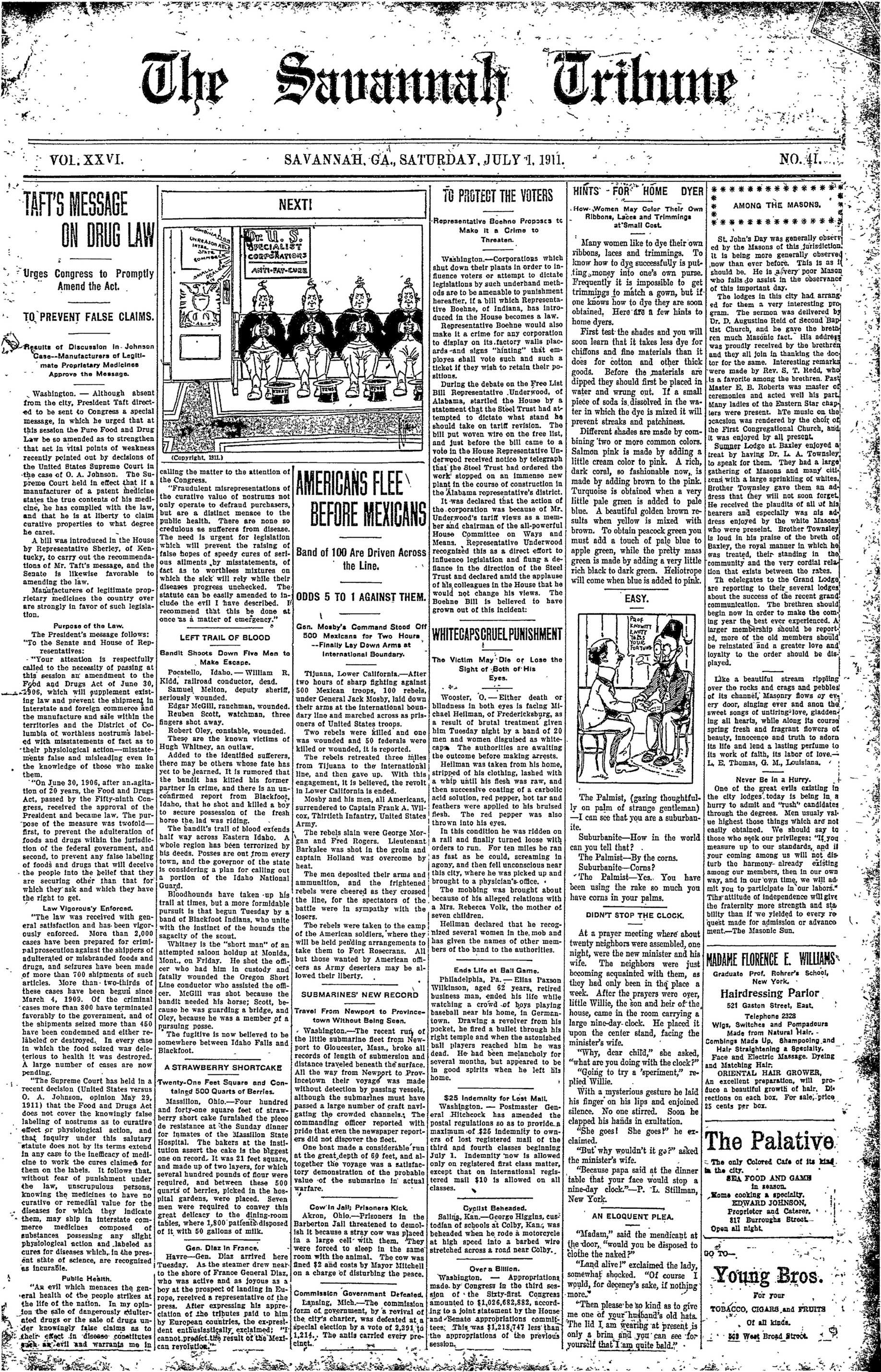
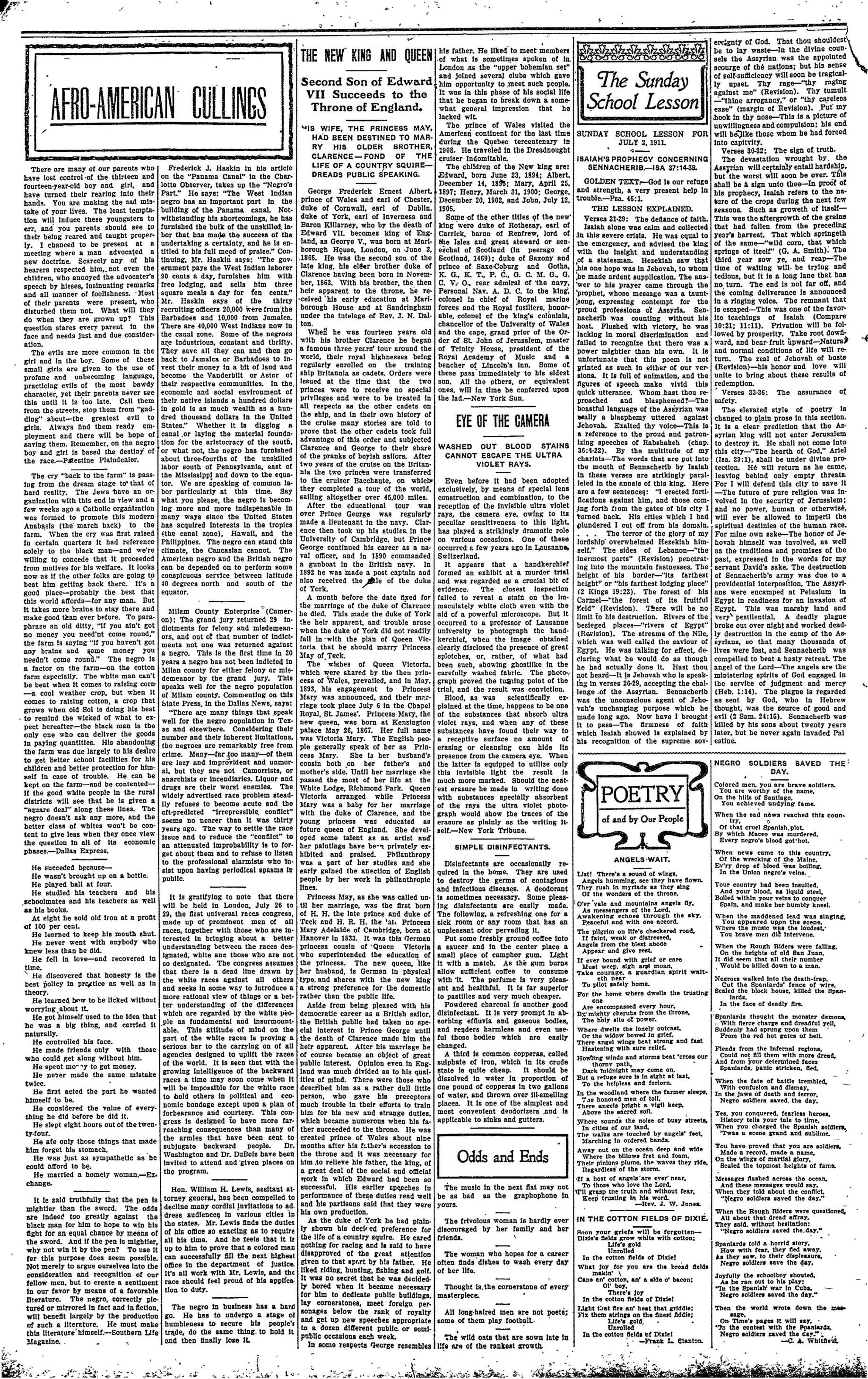
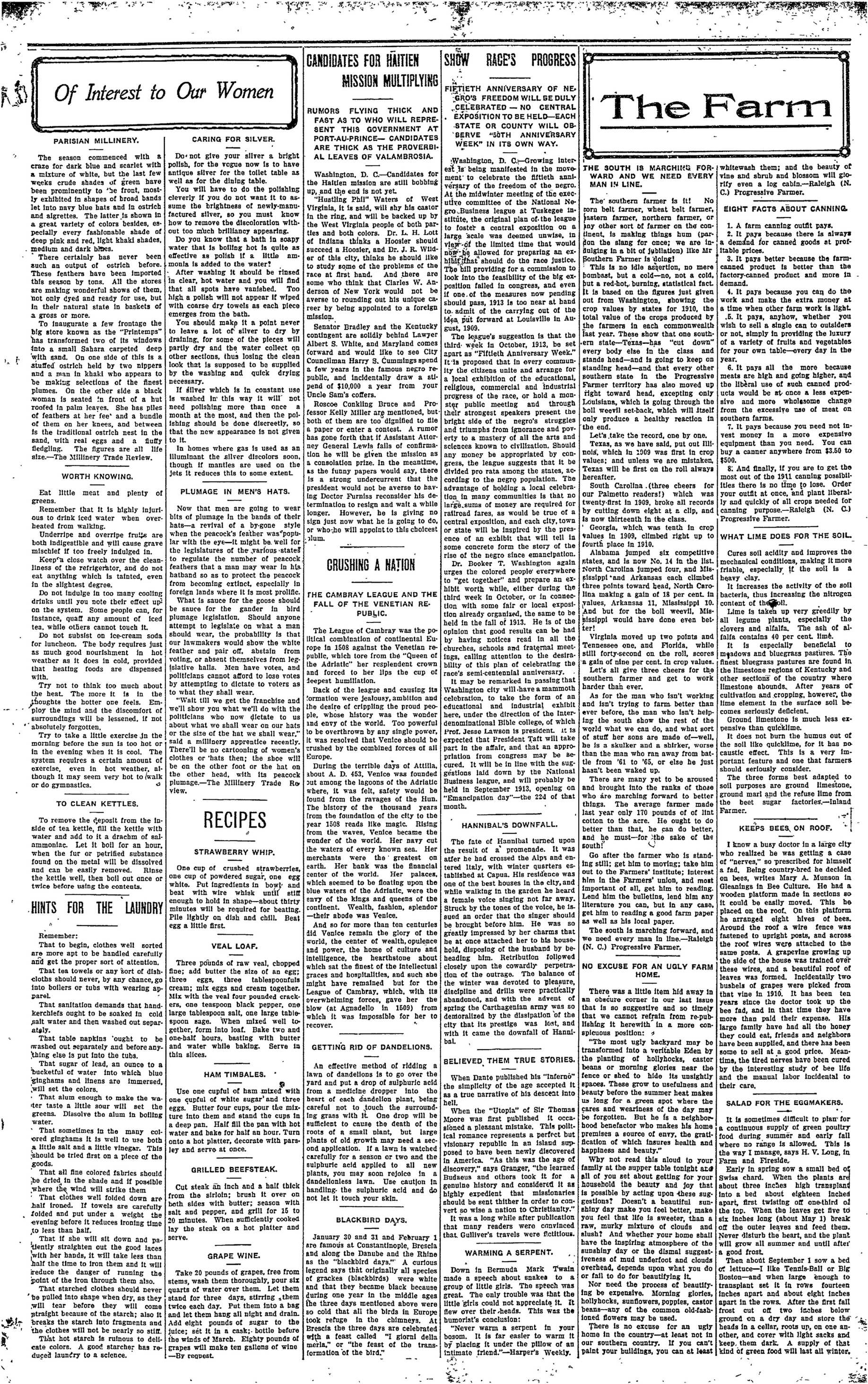
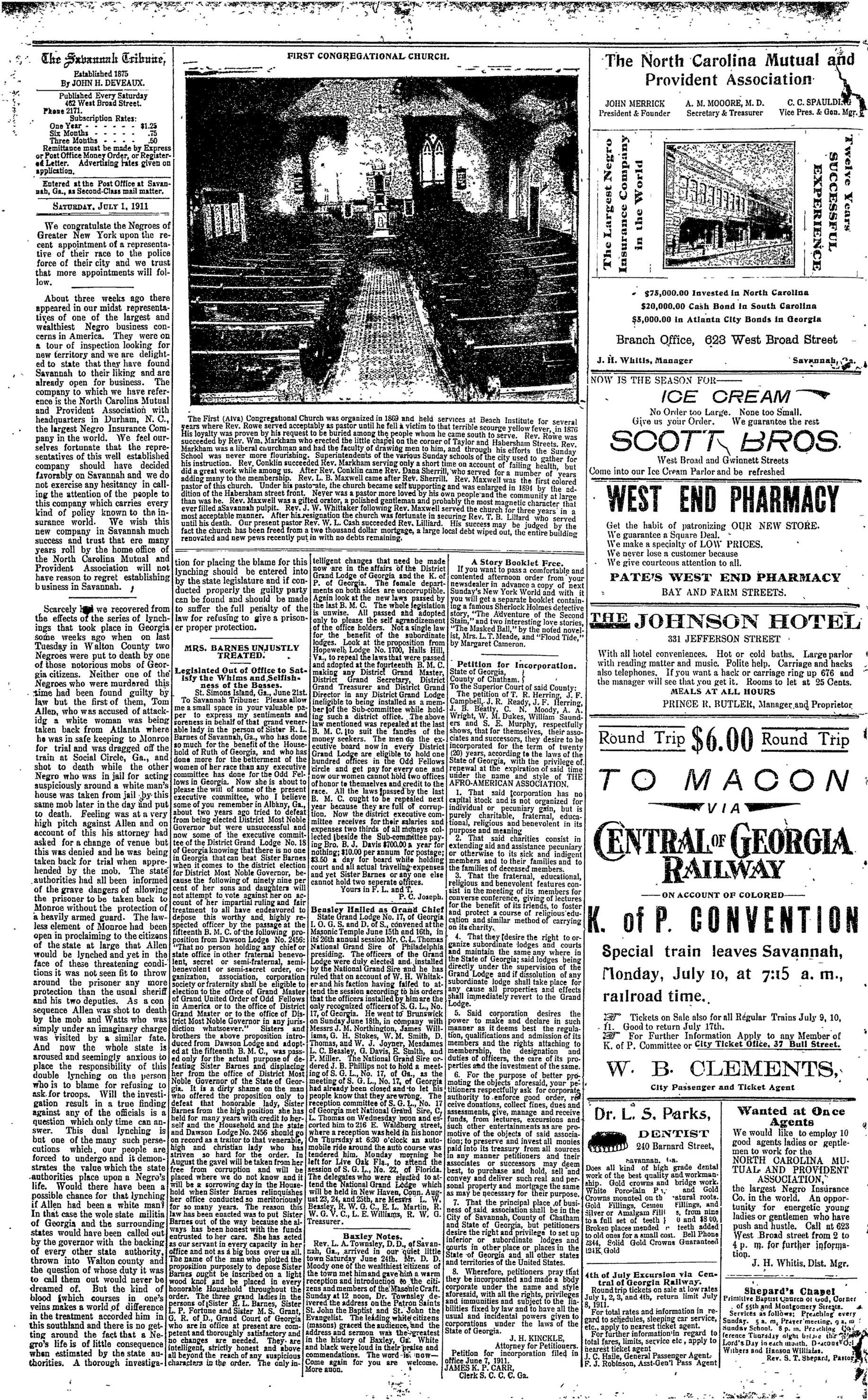
Page text (machine-generated)
The Savannah Tribune
Congress to Promptly Amend the Act.
TO, PREVENT FALSE CLAIMS.
Results of Discussion In Johnson Case--Manufacturers of Legitimate Proprietary Medicines Approve the Message.
Washington. — Although absent from the city, President Taft directed to be sent to Congress a special message, in which he urged that at this session the Pure Food and Drug Law be so amended as to strengthen
that act in vital points of weakness recently pointed out by decisions of the United States Supreme Court in the case of O. A. Johnson. The Supreme Court held in effect that if a manufacturer of a patent medicine states the true contents of his medicine, he has compiled with the law, and that he is at liberty to claim curative properties to what degree he cares. A bill was introduced in the House by Representative Sherley, of Kentucky, to carry out the recommendations of Mr. Taft's message, and the Senate is likewise favorable to amending the law. Manufacturers of legitimate proprietary medicines the country over are strongly in favor of such legislation.
Purpose of the Law.
The President's message follows:
"To the Senate and House of Representatives:
"Your attention is respectfully called to the necessity of passing at this session an amendment to the Food and Drugs Act of June 30, 1906, which will supplement existing law and prevent the shipment in interstate and foreign commerce and the manufacture and sale within the territories and the District of Columbia of worthless nostrums labeled with misstatements of fact as to their physiological action—misstatements false and misleading even in the knowledge of those who make them.
"On June 30, 1906, after an agitation of 20 years, the Food and Drugs Act, passed by the Fifty-ninth Congress, received the approval of the President and became law. The purpose of the measure was twofold—first, to prevent the adulteration of foods and drugs within the jurisdiction of the federal government, and second, to prevent any false labeling of foods and drugs that will deceive the people into the belief that they are securing other than that for which they ask and which they have the right to get.
Law Vigorous'y Enforced.
"The law was received with general satisfaction and has been vigorously enforced. More than 2,000 cases have been prepared for criminal prosecution against the shippers of adulterated or misbranded foods and drugs, and seizures have been made of more than 700 shipments of such articles. More than two-thirds of these cases have been begun since March 4, 1909. Of the criminal cases more than 800 have terminated favorably to the government, and of the shipments seized more than 450 have been condemned and either re-labeled or destroyed. In every case in which the food seized was deleterious to health it was destroyed. A large number of cases are now pending.
"The Supreme Court has held in a recent decision (United States versus O. A. Johnson, opinion May 29, 1911) that the Food and Drugs Act does not cover the knowingly false labeling of nostrums as to curative effect or physiological action, and that inquiry under this salutary statute does not by its terms extend in any case to the inefficacy of medicine to work the cures claimed for them on the labels. It follows that, without fear of punishment under the law, unscrupulous persons, knowing the medicines to have no curative or remedial value for the diseases for which they indicate them, may ship in interstate commerce medicines composed of substances possessing any slight physiological action and labeled as cures for diseases which, in the present state of science, are recognized as incurable.
Public Health.
"Ar evil which menaces the general health of the people strikes at the life of the nation. In my opinion the sale of dangerously adulterated drugs or the sale of drugs under knowingly false claims as to their effect in disease constitutes such an evil and warrants me in
NEXTI
COMBINATION
UNREASONABLE
INTERNAL
STATE
COMMERCIAL
SMALL
DEALER
FOR
DR. U. S.
SPECIALIST
CORPORATIONS
ANTI-PAY-CUBE
calling the matter to the attention of the Congress.
"Fraudulent misrepresentations of the curative value of nostrums not only operate to defraud purchasers, but are a distinct menace to the public health. There are none so credulous as sufferers from disease. The need is urgent for legislation which will prevent the raising of false hopes of speedy cures of serious ailments by misstatements, of fact as to worthless mixtures on which the slick will rely while their diseases progress unchecked. The statute can be easily amended to include the evil I have described. If recommend that this be done at once as a matter of emergency."
LEFT TRAIL OF BLOOD
Bandit Shoots Down Five Men to Make Escape. Pocatello, Idaho.—William R. Kidd, railroad conductor, dead.
Edgar McGill, ranchman, wounded. Reuben Scott, watchman, three fingers shot away. Robert Oley, constable, wounded. These are the known victims of Hugh Whitney, an outlaw.
Added to the identified sufferers, there may be others whose fate has yet to be learned. It is rumored that the bandit has killed his former partner in crime, and there is an unconfirmed report from Blackfoot, Idaho, that he shot and killed a boy to secure possession of the fresh horse the lad was riding.
The bandit's trail of blood extends half way across Eastern Idaho. A whole region has been terrorized by his deeds. Posses are out from every town, and the governor of the state is considering a plan for calling out a portion of the Idaho National Guard.
Bloodhounds have taken-up his trail at times, but a more formidable pursuit is that begun Tuesday by a band of Blackfoot Indians, who unite with the instinct of the hounds the sagacity of the scout. Whitney is the "short man" of an attempted saloon holdup at Monida, Mont., on Friday. He shot the officer who had him in custody and fatally wounded the Oregon Short Line conductor who assisted the officer. McGill was shot because the bandit needed his horse; Scott, because he was guarding a bridge, and Oley, because he was a member of a pursuing posse. The fugitive is now believed to be somewhere between Idaho Falls and Blackfoot.
A STRAWBERRY SHORTCAKE
Twenty-One Feet Square and Contained 500 Quarts of Berries. Massillon, Ohio.—Four hundred and forty-one square feet of strawberry short cake furnished the piece de resistance at the Sunday dinner for inmates of the Massillon State Hospital. The bakers at the institution assert the cake is the biggest one on record. It was 21 feet square, and made up of two layers, for which several hundred pounds of flour were required, and between these 500 quarts of berries, picked in the hospital gardens, were placed. Seven men were required to convey this great delicacy to the dining-room tables, where 1,800 patients disposed of it with 50 gallons of milk.
Gen. Diaz In France.
Havre—Gen. Diaz arrived here Tuesday. As the steamer drew near to the shore of France General Diaz, who was active and as joyous as a boy at the prospect of landing in Europe, received a representative of the press. After expressing his appreciation of the tributes paid to him by European countries, the ex-president enthusiastically exclaimed; "I cannot predict the result of the Mexican revolution."
SAVANNAH, GA., SATURDAY, JULY 1, 1911.
AMERICANS FLEE BEFORE MEXICANS
Band of 100 Are Driven Across the Line.
ODDS 5 TO 1 AGAINST THEM.
Gen. Moaby's Command Stood Off 500 Mexicana for Two Hours --Finally Lay Down Arms at International Boundary.
Tijuana, Lower California.—After two hours of sharp fighting against 500 Mexican troops, 100 rebels, under General Jack Mosby, laid down their arms at the international boundary line and marched across as prisoners of United States troops.
Two rebels were killed and one was wounded and 50 federals were killed or wounded, it is reported.
The rebels retreated three miles from Tijuana to the international line, and then gave up. With this engagement, it is believed, the revolt in Lower California is ended.
Mosby and his men, all Americans, surrendered to Captain Frank A. Wilcox, Thirtieth Infantry, United States Army.
The rebels slain were George Morgan and Fred Rogers. Lieutenant Barkalee was shot in the groin and captain Holland was overcome by heat.
The men deposited their arms and ammunition, and the frightened rebels were cheered as they crossed the line, for the spectators of the battle were in sympathy with the losers.
The rebels were taken to the camp of the American soldiers, where they will be held pending arrangements to take them to Fort Rosecrans. All but those wanted by American officers as Army deserters may be allowed their liberty.
SUBMARINES' NEW RECORD
Travel From Newport to Province-town Without Being Seen.
Washington.—The recent run of the little submarine fleet from Newport to Gloucester, Mass., broke all records of length of submersion and distance traveled beneath the surface. All the way from Newport to Provincetown their voyage was made without detection by passing vessels, although the submarines must have passed a large number of craft navigating the crowded channels. The commanding officer reported with pride that even the newspaper reporters did not discover the fleet.
One boat made a considerable run at the great depth of 60 feet, and altogether the voyage was a satisfactory demonstration of the probable value of the submarine in actual warfare.
Cow'In Jail: Prisaonara Kick
Akron, Ohio.—Prisoners in the Barberton Jail threatened to demolish it because a stray cow was placed in a large cell with them. They were forced to sleep in the same room with the animal. The cow was fined $2 and costs by Mayor Mitchell on a charge of disturbing the peace.
Commission Government Defeated.
Lansing, Mich.—The commission form of government, by a revival of the city's charter, was defeated at a special election by a vote of 2,391 to 1,214. The antis carried every pre-cinct.
TO PROTECT THE VOTERS
Representative Boehne Proposes to Make it a Crime to Threaten.
Washington—Corporations which shut down their plants in order to influence voters or attempt to dictate legislations by such underhand methods are to be amenable to punishment hereafter. If a bill which Representative Boehne, of Indiana, has introduced in the House becomes a law.
Representative Boehne would also make it a crime for any corporation to display its factory walls placards and signs "hinting" that employees shall vote such and such a ticket if they wish to retain their positions.
During the debate on the Free List Bill Representative. Underwood, of Alabama, startled the House by a statement that the Steel Trust had attempted to dictate what stand he should take on tariff revision. The bill put woven wire on the free list, and just before the bill came to a vote in the House Representative Underwood received notice by telegraph that the Steel Trust had ordered the work stopped on an immense new plant in the course of construction in the Alabama representative's district.
It was declared that the action of the corporation was because of Mr. Underwood's tariff views as a member and chairman of the all-powerful House Committee on Ways and Means. Representative Underwood recognized this as a direct effort to influence legislation and funga defiance in the direction of the Steel Trust and declared amid the applause of his colleagues in the House that he would not change his views. The Boehne Bill is believed to have grown out of this incident:
WHITECAPSCRUELPUNISHMENT
The Victim May Die or Lose the
Sight of Both of His
Wooster, O. — Either death or blindness in both eyes is facing Michael Heilman, of Frederickburg, as a result of brutal treatment given him Tuesday night by a band of 20 men and women disguised as white-cap. The authorities are awaiting the outcome before making arrests. Heilman was taken from his home, stripped of his clothing, lashed with a whip until his flesh was raw, and then successive coating of a carbolic acid solution, red pepper, hot tar and feathers were applied to his bruised flesh. The red pepper was also thrown into his eyes. In this condition he was ridden on a rail and finally turned loose with orders to run. For ten miles he ran as fast as he could, screaming in agony, and then fell unconscious near this city, where he was picked up and brought to a physician's office.
The mobbing was brought about because of his alleged relations with a Mrs. Rebecca Volk, the mother of seven children. Hellman declared that he recognized several women in the mob and has given the names of other members of the band to the authorities.
Ends Life at Ball Game
Philadelphia, Pa. — Ellas Paxson Wilkinson, aged 62 years, retired business man, ended his life while watching a crowd of boys playing baseball near his home, in German-town. Drawing a revolver from his pocket, he fired a bullet through his right temple and when the astonished ball players reached him he was dead. He had been melancholy for several months, but appeared to be in good spirits when he left his home.
$25 Indemnity for Lost Mail
Washington. — Postmaster General Hitchcock has amended the postal regulations so as to provide a maximum of $25 indemnity to owners of lost registered mall of the third and fourth classes beginning July 1. Indemnity now is allowed only on registered first class matter, except that on international registered mail $10 is allowed on all classes.
Cyclist Beheaded.
Salina, Kan.—George Higgins, custodian of schools at Colby, Kan.; was beheaded when he rode a motorcycle at high speed into a barbed wire stretched across a road near Colby.
Over a Billion.
Washington. — Appropriations made by Congress in the third session of the Sirty-first Congress amounted to $1,026,682,882, according to a joint statement by the House and Senate appropriations committees. This was $1,218,747 less than the appropriations of the previous session.
HINTS - FOR HOME DYER
How Women May Color Their Own
Ribbons, Laces and Trimmings
at Small Cost.
Many women like to dye their own
ribbons, laces and trimmings. To
know how to dye successfully is put-
ting money into one's own purse.
Frequently it is impossible to get
trimmings to match a gown, but if
one knows how to dye they are soon
obtained. Here are a few hints to
home dyers.
First test the shades and you will soon learn that it takes less dye for chiffons and fine materials than it does for cotton and other thick goods. Before the materials are dipped they should first be placed in water and wrung out. If a small piece of soda is dissolved in the water in which the dye is mixed it will prevent streaks and patchiness.
Different shades are made by combining two or more common colors. Salmon pink is made by adding a little cream color to pink. A rich, dark coral, so fashionable now, is made by adding brown to the pink. Turquoise is obtained when a very little pale green is added to pale blue. A beautiful golden brown results when yellow is mixed with brown. To obtain peacock green you must add a touch of pale blue to apple green, while the pretty mass green is made by adding a very little rich black to dark green. Heliotrope will come when blue is added to pink.
EASY.
PROF
KNOWITT
KNOTT
TALKS
YOUR
FORTUNE
The Palmist, (gazing thoughtfully on palm of strange gentleman)
—I can see that you are a suburbanite.
Suburbanite—How in the world can you tell that?
The Palmist—By the corns.
Suburbanite—Corns?
The Palmist—Yes.. You have been using the rake so much you have corns in your palms.
DIDN'T STOP THE CLOCK.
At a prayer meeting where about twenty neighbors were assembled, one night, were the new minister and his wife. The neighbors were just becoming acquainted with them, as they had only been in the place a week. After the prayers were oyer, little Willie, the son and heir of the house, came in the room carrying a large nine-day-clock. He placed it upon the center stand, facing the minister's wife.
"Why, dear child," she asked, "what are you doing with the clock?" "Going to try a 'speriment,' replied Willie.
With a mysterious gesture he laid his finger on his lips and enjoined silence. No one stirred. Soon he clapped his hands in exultation.
"She goes! She goes!" he exclaimed.
"But why wouldn't it go?" asked the minister's wife.
"Because papa said at the dinner table that your face would stop a nine-day clock."—P. L. Stillman, New York.
AN ELOQUENT PLEA
"Madam," said the mendicant at the door, "would you be disposed to cloth the naked?"
"Land alive!" exclaimed the lady, somewhat shocked. "Of course I would, for decency's sake, if nothing more."
"Then please be so kind as to give me one of your husband's old hats. The lid I am wearing at present is only a brim and you can see for yourself that I am quite bald."
St. John's Day was generally observed by the Masons of this jurisdiction. It is being more generally observed now than ever before. This is as it should be. He is a very poor Mason who fails to assist in the observance of this important day.
The lodges in this city had arranged for them a very interesting program. The sermon was delivered by Dr. D. Augustine Reid of Second Baptist Church, and he gave the brethren much Masonic fact. His address was proudly received by the brethren and they all join in thanking the doctor for the same. Interesting remarks were made by Rev. S. T. Redd, who is a favorite among the brethren. Fast Master E. B. Roberts was master of ceremonies and acted well his part. Many ladies of the Eastern Star chapters were present. hTe music on the occasion was rendered by the choir of the First Congregational Church, and it was enjoyed by all present.
Sumner Lodge at Baxley enjoyed a treat by having Dr. L. A. Townsley to speak for them. They had a large gathering of Masons and many citizens with a large sprinkling of whites. Brother Townsley gave them an address that they will not soon forget. He received the plaudits of all of his hearers and especially was his address enjoyed by the white Masons who were present. Brother Townsley is loud in his praise of the breth of Baxley, the royal manner in which he was treated, their standing in the community and the very cordial relation that exists between the rates.
Th edelegates to the Grand Lodge are reporting to their several lodges about the success of the recent grand communication. The brethren should begin now in order to make the coming year the best ever experienced. A larger membership should be reported, more of the old members should be reinstated and a greater love and loyalty to the order should be displayed.
Like a beautiful stream rippling over the rocks and crags and pebbles of its channel, Masonry flows over every door, singing ever and anon the sweet songs of untiring love, gladdening all hearts, while along its course spring fresh and fragrant flowers of beauty, innocence and truth to adorn its life and lend a lasting perfume to its work of faith, its labor of love. L, E, Thomas, G. M., Louisiana.
Never Be in a Hurry.
One of the great evils existing in the city lodges today is being in a hurry to admit and "rush" candidates through the degrees. Men usually value highest those things which are not easily obtained. We should say to those who seek our privileges: "If you measure up to our standards, and if your coming among us will not disturb the harmony-already existing among our members, then in our own way, and in our own time, we will admit you to participate in our labor." This attitude of independence will give the fraternity more strength and stability than if we yielded to every request made for admission or advancement—The Masonic Sun.
MADAME FLORENGE E. WILLIAMS
Graduate Prof. Rohrer's School,
New York.
Wigs, Switches and Pompadeurs Made from Natural Hair. Combings Made Up. Shampooing and
Hair Straightening a Specialty.
Face and Electric Massage. Dyeing
and Matching Hair.
ORIENTAL HAIR GROWER.
An excellent preparation, will produce a beautiful growth of hair. Directions on each box. For sale: price
25 cents per box.
The Palative
The only Colored Cafe of its kind in the city.
SEA FOOD AND GAMB in season.
Home cooking a specialty.
EDWARD JOHNSON,
Proprietor and Caterer.
817 Burroughs Street.
Open all night.
GO TO—
Young Bros.
For your
TOBACCO, CIGARS, and FRUITS
Of all kinds.
868 West Broad Street.
AFRO-AMERICAN CULLINGS
There are many of our parents who have lost control of the thirteen and fourteen-year-old boy and girl, and have turned their rearing into their hands. You are making the sad mistake of your lives. The least temptation will induce these youngsters to err, and you parents should see to their being reared and taught properly. I chanced to be present at a meeting where a man advocated a new doctrine. Scarcely any of his hearers respected him, not even the children, who annoyed the advocater's speech by hisses, insinuating remarks and all manner of foolishness. Most of their parents were present, who disturbed them not. What will they do when they are grown up? This question stares every parent in the face and needs just and due consideration.
The evils are more common in the girl and in the boy. Some of these small girls are given to the use of profane and unbecoming language, practicing evils of the most bawdy character, yet their parents never see this until it is too late. Call them from the streets, stop them from "gadding" about—the greatest evil to girls. Always find them ready employment and there will be hope of saving them. Remember, on the negro boy and girl is based the destiny of the race—Pastime Plaindealer.
The cry "back to the farm" is passing from the dream stage to that of hard reality. The Jews have an organization with this end in view and a few weeks ago a Catholic organization was formed to promote this modern Anabasis (the march back) to the farm. When the cry was first raised in certain quarters it had reference solely to the black man—and we're willing to concede that it proceeded from motives for his welfare. It looks now as if the other folks are going to beat him getting back there. It's a good place—probably the best that this world affords—for any man. But it takes more brains to stay there and make good than ever before. To paraphrase an old ditty, "If you ain't got no money you needn't come round," the farm is saying "If you haven't got any brains and some money you needn't come round." The negro is a factor on the farm—on the cotton farm especially. The white man can't be beat when it comes to raising corn—a cool weather crop, but when it comes to raising cotton, a crop that grows when old Sol is doing his best
to remind the wicked of what to expect hereafter—the black man is the only one who can deliver the goods in paying quantities. His abandoning the farm was due largely to his desire to get better school facilities for his children and better protection for himself in case of trouble. He can be kept on the farm—and be contented—if the good white people in the rural districts will see that he is given a "square deal" along these lines. The negro doesn't ask any more, and the better class of whites won't be content to give less when they once view the question in all of its economic phases—Dallas Express.
He succeeded because—
He wasn't brought up on a bottle.
He played ball at four.
He studied his teachers and his schoolmates and his teachers as well as his books.
At eight he sold old iron at a profit of 100 per cent.
He learned to keep his mouth shut.
He never went with anybody who knew less than he did.
He fell in love—and recovered in time.
He discovered that honesty is the best policy in practice as well as in theory.
He learned how to be licked without worrying about it.
He got himself used to the idea that he was a big thing, and carried it naturally.
He controlled his face.
He made friends only with those who could get along without him.
He spent money to get money.
He never made the same mistake twice.
He first acted the part he wanted himself to be.
He considered the value of everything he did before he did it.
He slept eight hours out of the twenty-four.
He ate only those things that made him forget his stomach.
He was just as sympathetic as he could afford to be.
He married a homely woman.—Exchange.
It is said truthfully that the pen is mightier than the sword. The odds are indeed too greatly against the black man for him to hope to win his fight for an equal chance by means of the sword. And if the pen is mightier, why not win it by the pen? To use it for this purpose does seem possible. Not merely to argue ourselves into the consideration and recognition of our fellow men, but to create a sentiment in our favor by means of a favorable literature. The negro, correctly pictured or mirrored in fact and in fiction, will benefit largely by the production of such a literature. He must make this literature himself.—Southern Life Magazine.
Frederick J. Haskin in his article on the "Panama Canal" in the Charlottesville observer, takes up the "Negro's Part." He says: "The West Indian negro has an important part in the building of the Panama canal. Notwithstanding his shortcomings, he has furnished the bulk of the unskilled labor that has made the success of the undertaking a certainty, and he is entitled to his full meed of praise." Continuing, Mr. Haskin says: "The government pays the West Indian laborer 90 cents a day, furnishes him with free lodging, and sells him three square meals a day for ten cents." Mr. Haskin says of the thirty recruiting officers 20,000 were from the Barbados and 10,000 from Jamaica. There are 40,000 West Indians now in the canal zone. Some of the negroes are industrious, constant and thrifty. They save all they can and then go back to Jamalca or Barbadoes to invest their money in a bit of land and become the Vanderbilt or Astor of their respective communities. In the economic and social environment of their native islands a hundred dollars in gold is as much wealth as a hundred thousand dollars in the United States." Whether it is digging a canal or laying the material foundation for the aristocracy of the south, or what not, the negro has furnished about three-fourths of the unskilled labor south of Pennsylvania, east of the Mississippi and down to the equator. We are speaking of common labor particularly at this time. Say what you please, the negro is becoming more and more indispensable in many ways since the United States has acquired interests in the tropics (the canal zone). Hawaii, and the Philippines. The negro can stand this climate, the Caucasian cannot. The American negro and the British negro can be depended on to perform some conspicuous service between latitude 40 degrees north and south of the equator.
Milam County Enterprise (Cameron): The grand jury returned 29 indictments for felony and misdemeanors, and out of that number of indictments not one was returned against a negro. This is the first time in 20 years a negro has not been indicted in Milam county for either felony or misdemeanor by the grand jury. This speaks well for the negro population of Milam county. Commenting on this State Press, in the Dallas News, says:
"There are many things that speak well for the negro population in Texas and elsewhere. Considering their number and their inherent limitations, the negroes are remarkably free from crime. Many—far too many—of them are lazy and improvident and unmoral, but they are not Camorrists, or anarchists or incendiaries. Liquor and drugs are their worst enemies. The widely advertised race problem steadily refuses to become acute and the cft-predicted "irrepressible conflict" seems no nearer than it was thirty years ago. The way to settle the race issue and to reduce the "conflict" to an attenuated improbability is to forget about them and to refuse to listen to the professional alarmists who insist upon having periodical apasms in public.
It is gratifying to note that there will be held in London, July 26 to 29, the first universal races congress, made up of prominent men of all races, together with those who are interested in bringing about a better understanding between the races designated, white and those who are not so designated. The congress assumes that there is a dead line drawn by the white races against all others and seeks in some way to introduce a more rational view of things or a better understanding of the differences which are regarded by the white people as fundamental and insurmountable. This attitude of mind on the part of the white races is proving a serious bar to the carrying on of all agencies designed to uplift the races of the world. It is seen that with the growing intelligence of the backward races a time may soon come when it will be impossible for the white race to hold others in political and economic bondage except upon a plan of forbearance and courtesy. This congress is designed to have more far-reaching consequences than many of the armies that have been sent to subjugate backward people. Dr. Washington and Dr. DuBofs have been invited to attend and given places on the program.
Hon. William H. Lewis, assistant attorney general, has been compelled to decline many cordial invitations to address audiences in various cities in the states. Mr. Lewis finds the duties of his office so exacting as to require all his time. And he feels that it is up to him to prove that a colored man can successfully fill the next highest office in the department of justice. It's all work with Mr. Lewis, and the race should feel proud of his application to duty.
The negro in business has a hard go. He has to undergo a stage of humbleness to secure his people's trade, do the same thing, to hold it and then finally lose it.
THE NEW KING AND QUEEN
Second Son of Edward VII Succeeds to the Throne of England.
GIR WIFE, THE PRINCESS MAY,
HAD BEEN DESTINED TO MARRY
HIS OLDER BROTHER,
CLARENCE — FOND OF THE
LIFE OF A COUNTRY SQUIRRE—
DREADS PUBLIC SPEAKING.
George Frederick Ernest Albert, prince of Wales and earl of Chester, duke of Cornwall, earl of Dublin, duke of York, earl of Inverness and Baron Killarney, who by the death of Edward VII, becomes king of England, as George V., was born at Marlborough House, London, on June 3, 1865. He was the second son of the late king, his elder brother duke of Clarence having been born in November, 1863. With his brother, the then heir apparent to the throne, he received his early education at Marlborough House and at Sandringham under the tutelage of Rev. J. N. Dalton.
When he was fourteen years old with his brother Clarence he began a famous three years' tour around the world, their royal highnesses being regularly enrolled on the training ship Britannia as cadets. Orders were issued at the time that the two princes were to receive no special privileges and were to be treated in all respects as the other cadets on the ship, and in their own history of the cruise many stories are told to prove that the other cadets took full advantage of this order and subjected Clarence and George to their share of the pranks of boyish sailors. After two years of the cruise on the Britannia the two princes were transferred to the cruiser Bacchante, on which they completed a tour of the world, sailing altogether over 45,000 miles.
After the educational tour was over Prince George was regularly made a lieutenant in the navy. Clarence then took up his studies in the University of Cambridge, but Prince George continued his career as a naval officer, and in 1890 commanded a gunboat in the British navy. In 1892 he was made a post captain and also received the title of the duke of York.
A month before the date fixed for the marriage of the duke of Clarence he died. This made the duke of York the heir apparent, and trouble arose when the duke of York did not readily fall in with the plan of Queen Victoria that he should marry Princess May of Teck.
The wishes of Queen Victoria, which were shared by the then princess of Wales, prevailed, and in May, 1893, his engagement to Princess Mary was announced, and their marriage took place July 6 in the Chapel Royal, St. James'. Princess Mary, the new queen, was born at Kensington palace May 26, 1867. Her full name was Victoria Mary. The English people generally speak of her as Princess Mary. She is her husband's cousin both on her father's and mother's side. Until her marriage she passed the most of her life at the White Lodge, Richmond Park. Queen Victoria arranged while Princess Mary was a baby for her marriage with the duke of Clarence, and the young princess was educated as future queen of England. She developed some talent as an artist and her paintings have been privately exhibited and praised. Philanthropy was a part of her studies and she early gained the anction of English people by her work in philanthropic lines.
Princess May, as she was called until her marriage, was the first born of H. H. the late prince and duke of Teck and H. R. H. the 'laut' Princess Mary Adelalde of Cambridge, born at Hanover in 1633. It was this German princess cousin of Queen Victoria who superintended the education of the princess. The new queen, like her husband, is German in physical type, and shares with the new king a strong preference for the domestic rather than the public life.
Aside from being pleased with his democratic career as a British sailor, the British public had taken no special interest in Prince George until the death of Clarence made him the heir apparent. After his marriage he of course became an object of great public interest. Opinion even in England was much divided as to his qualities of mind. There were those who described him as a rather dull little person, who gave his preceptors much trouble in their efforts to train him for his new and strange duties, which became numerous when his father succeeded to the throne. He was created prince of Wales about nine months after his father's accession to the throne and it was necessary for him to relieve his father, the king, of a great deal of the social and official work in which Edward had been so successful. His earlier speeches in performance of these duties read well and his partisans said that they were his own production.
As the duke of York he had plainly shown his decided preference for the life of a country squire. He cared nothing for racing and is said to have disapproved of the great attention given to that sport by his father. He liked riding, hunting, fishing and golf. It was no secret that he was decidedly bored when it became necessary for him to dedicate public buildings, lay cornerstones, meet foreign personages below the rank of royalty and get up new speeches appropriate to a dozen different public or semi-public occasions each week. In some respects George resembles
his father. He liked to meet members of what is sometimes spoken of in London as the "upper bohemian set" and joined several clubs which gave him opportunity to meet such people. It was in this phase of his social life that he began to break down a somewhat general impression that he lacked wit.
The prince of Wales visited the American continent for the last time during the Quebec tercentenary in 1903. He traveled in the Dreadnought cruiser Indomitable.
The children of the New king are: Edward, born June 23, 1894; Albert, December 14, 1895; Mary, April 25, 1897; Henry, March 31, 1900; George, December 20, 1902, and John, July 12, 1905.
Some of the other titles of the new king were duke of Rothesay, earl of Carrick, baron of Renfrew, lord of the Isles and great steward or seneschal of Scotland (in peerage of Scotland, 1469); duke of Saxony and prince of Saxe-Coburg and Gotha, K. G, K. T, P, C, G, C. M. G, G, G. C, V. O, rear admiral of the navy, Personal Nav. A. D. C. to the king, colonel in chief of Royal marine forces and the Royal fusilliers, honorable, colonel of the king's colonials, chancellor of the University of Wales and the cape, grand prior of the Order of St. John of Jerusalem, master of Trinity House, president of the Royal Academy of Music and a bencher of Lincoln's inn. Some of these pass immediately to his eldest son. All the others, or equivalent ones, will in time be conferred upon the lad.—New York Sun.
EYE OF THE CAMERA
WASHED OUT BLOOD STAINS CANNOT ESCAPE THE ULTRA VIOLET RAYS.
Even before it had been adopted exclusively, by means of special lens construction and combination, to the reception of the invisible ultra violet rays, the camera eye, owing to its peculiar sensitiveness to this light, has played a strikingly dramatic role on various occasions. One of these occurred a few years ago in Lausanne, Switzerland.
It appears that a handkerchief formed an exhibit at a murder trial and was regarded as a crucial bit of evidence. The closest inspection failed to reveal a stain on the immaculately white cloth even with the aid of a powerful microscope. But it occurred to a professor of Lausanne university to photograph the handkerchief, when the image obtained clearly disclosed the presence of great splatches, or, rather, of what had been such, showing ghostlike in the carefully washed fabric. The photograph proved the turning point of the trial, and the result was conviction.
Blood, as was scientifically explained at the time, happens to be one of the substances that absorb ultra violet rays, and when any of these substances have found their way to a receptive surface no amount of erasing or cleansing can hide its presence from the camera eye. When the latter is equipped to utilize only this invisible light the result is much more marked. Should the neatest erasure be made in writing done with substances specially absorbent of the rays the ultra violet photograph would show the traces of the erasure as plainly as the writing itself—New York Tribune.
SIMPLE DIBINFECTANTS.
Disinfectants are occasionally required in the home. They are used to destroy the germs of contagious and infectious diseases. A deodorant is sometimes necessary. Some pleasing disinfectants are easily made. The following, a refreshing one for a sick room or any room that has an unpleasant odor pervading it. Put some freshly ground coffee into a saucer and in the center place a small piece of camphor gum. Light it with a match. As the gum burns allow sufficient coffee to consume with it. The perfume is very pleasant and healthful. It is far superior to pastilles and very much cheaper.
Powdered charcoal is another good disinfectant. It is very prompt in absorbing effluia and gaseous bodies, and readers harmless and even useful those bodies which are easily changed. A third is common copperas, called sulphate of iron, which in its crude state is quite cheap. It should be dissolved in water in proportion of one pound of copperas in two gallons of water, and thrown over ill-smelling places. It is one of the simplest and most convenient deodorizers and is applicable to sinks and gutters.
The Sunday School Lesson
SUNDAY SCHOOL LESSON FOR
JULY 2, 1911.
ISAIAH'S PROPHECY CONCERNING
SENNACHERIB—ISA 37:14:38.
GOLDEN TEXT:—God is our refuge
and strength, a very present help in
trouble.—Psa. 46:1.
THE LESSON EXPLAINED.
Verses 21-29: The defiance of faith. Isaiah alone was calm and collected in this severe crisis. He was equal to the emergency, and advised the king with the insight and understanding of a statesman. Hezekiah saw that his one hope was in Jehovah, to whom he made ardent supplication. The answer to his prayer came through the prophet, whose message was a tauntong, expressing contempt for the proud professions of Assyria. Sennacherib was counting without his host. Flushed with victory, he was lacking in moral discrimination and failed to recognize that there was a power mightier than his own. It is unfortunate that this poem is not printed as such in either of our versions. It is full of animation, and the figures of speech make vivid this quick utterance. Whom hast thou reproached and blasphemed? The boastful language of the Assyrian was really a blasphemy uttered against Jehovah. Exalted thy voice—This is a reference to the proud and patronizing speeches of Rabshakeh (chap. 36:4-22). By the multitude of my charlots—the words that are put into the mouth of Sennacherib by Isaiah in these verses are strikingly paralleled in the annals of this king. Here are a few sentences: "I erected fortifications against him, and those coming forth from the gates of his city I turned back. His cities which I had plundered I cut off from his domain. The terror of the glory of my lordship overwhelmed Hezekiah himself." The sides of Lebanon—"the inermost parts" (Revision) penetrating into the mountain fastnesses. The height of his border—"its farthest height" or "his farthest lodging place" (2 Kings 19:23). The forest of his Carmel—"the forest of its fruitful field" (Revision). There will be no limit to his destruction. Rivers of the besieged places—"rivers of Egypt" (Revision). The streams of the Nile, which was well called the saviour of Egypt. He was talking for effect, declaring what he would do as though he had actually done it. Hast thou not heard—It is Jehovah who is speaking in verses 26-29, accepting the challenge of the Assyrian. Sennacherib was the unconscious agent of Jehovah's unchanging purpose which he made long ago. Now have I brought it to pass—The firmness of faith which Isaiah showed is explained by his recognition of the supreme sov-
POETRY
of and by Our People
ANGELS WAIT.
List! There's a sound of wings,
Angels humming, see they have flown.
They rush in my irradias as they sing
Of the wonders of the throne.
O'er vale and mountains angels fly,
As messengers of the Lord.
Awakening echoes through the sky,
Peaceful and with one accord.
The pilgrim on life's checkered road,
If faint, weak or distressed,
Angels from the blest abode
Appear and give rest.
If ever bound with grief or care
Must weep, sigh and moan.
Take courage, a guardian spirit waiteth near
To pilot safely home.
For the home where dwells the trusting one
Are encompassed every hour.
Bry mighty cherubs from the throne.
The holy site of power.
Where dwells the lonely outcast,
Or the widow bowed in grief.
There angel wings beat strong and fast
Hastening with sure relief.
Howling winds and storms beat 'cross our thermy path,
Dark midnight may come on.
But a refuge sure is in sight at last,
To the helpless and forlorn.
In the woodland where the farmer sleeps,
The honored men of toil.
There angels bright a vigil keep,
Above the sacred soil.
Where sounds the noise of busy streets,
In cities of our land.
The walks are touched by angels' feet,
Marching in ordered bands.
Away out on the ocean deep and wide
Where the billows fret and foam.
The pinions plume, the waves they ride,
Regardless of the storm.
If a host of angels are ever near,
To those who love the Lord.
I'll grasp the truth and without fear,
Keep trusting in his word.
—Rev. J. W. Jones.
IN THE COTTON FIELDS OF DIXIE.
Soon your griefs will be fergotten—
Dizie's fields grow white with cotton;
Life's gold
Unrolled
In the cotton fields of Dixie!
What joy for you are the broad fields makin' \
Cane an' cotton, an' a side o' bacon;
Ol' boy,
There's joy
In the cotton fields of Dixie!
Light that fire an' heat that griddle;
Fix them strings on the finest fiddle;
Life's gold
Unrolled
In the cotton fields of Dixie!
—Frank L. Stanton.
eregistency of God. That thou shouldest be to lay waste—In the divine counsels the Assyrian was the appointed scourge of the nations; but his sense of self-sufficiency will soon be tragically upset. Thy rage—"thy raging against me" (Revision). Thy tumult—"thine arrogancy," or "thy careless ease" (margin of Revision). Put my hook in thy nose—This is a picture of unwillingness and compulsion; his end will be like those whom he had forced into captivity. Verse 30-32: The sign of truth.
Verses 3022. The sign of war
The devastation wrought by the Assyrian will certainly entail hardship, but the worst will soon be over. This shall be a sign unto thee—In proof of his prophecy, Isaiah refers to the nature of the crops during the next few seasons. Such as growth of itself—This was the aftergrowth of the grains that had fallen from the preceding year's harvest. That which springeth of the same—"wild corn, that which springs of itself" (G. A. Smith). The third year sow ye, and reap—the time of waiting will be trying and tedious, but it is a long lane that has no turn. The end is not far off, and the coming deliverance is announced in a ringing voice. The remnant that is escaped—This was one of the favorite teachings of Isaiah (Compare 10:21; 11:11). Privation will be followed by prosperity. Take root downward, and bear fruit upward—Natura and normal conditions of life will return. The zeal of Jehovah of hosts (Revision)—his honor and love will unite to bring about these results of redemption.
Verses 33-36: The assurance of safety.
The elevated style of poetry is changed to plain prose in this section. It is a clear prediction that the Assyrian king will not enter Jerusalem to destroy it. He shall not come into this city—"The hearth of God," Ariel (Isa. 29:1), shall be under divine protection. He will return as he came, leaving behind only empty threats. For I will defend this city to save it—The future of pure religion was involved in the security of Jerusalem; and no power, human or otherwise, will ever be allowed to imperil the spiritual destinies of the human race. For mine own sake—The honor of Jehovah himself was involved, as well as the traditions and promises of the past, expressed in the words for my servant David's sake. The destruction of Sennacherib's army was due to a providential interposition. The Assyrians were encamped at Pelusium in Egypt in readiness for an invasion of Egypt. This was marshy land and very pestilential. A deadly plague broke out over night and worked deadly destruction in the camp of the Assyrians, so that many thousands of lives were lost, and Sennacherib was compelled to beat a hasty retreat. The angel of the Lord—The angels are the ministering spirits of God engaged in the service of judgment and mercy (Heb. 1:14). The plague is regarded as sent by God, who in Hebrew thought, was the source of good and evil (2 Sam. 24:15). Sennacherib was killed by his sons about twenty years later, but he never again invaded Palestine.
Of Interest to Our Women
PARISIAN MILLINERY.
The season commenced with a craze for dark blue and scarlet with a mixture of white, but the last few weeks crude shades of green have been prominently to the front, mostly exhibited in shapes of broad bands let into navy blue hats and in ostrich and algrettes. The latter is shown in a great variety of colors besides, especially every fashionable shade of deep pink and red, light khaki shades, medium and dark blues.
There certainly has never been such an output of ostrich before. These feathers have been imported this season by tons. All the stores are making wonderful shows of them, not only dyed and ready for use, but in their natural state in baskets of a gross or more.
To inaugurate a few frontage the big store known as the "Printemps" has transformed two of its windows into a small Sahara carpeted deep with sand. On one side of this is a stuffed ostrich held by two nippers and a man in khaki who appears to be making selections of the finest plumes. On the other side a black woman is seated in front of a hut roofed in palm leaves. She has piles of feathers at her fee and a bundle of them on her knees, and between is the traditional ostrich nest in the sand, with real eggs and a fluffy fledgling. The figures are all life size.—The Millinery Trade Review.
WORTH KNOWING.
Eat little meat and plenty of greens.
Remember that it is highly injurious to drink iced water when overheated from walking.
Underripe and overripe fruits are both indigestible and will cause grave mischief if too freely indulged in.
Keep a close watch over the cleanliness of the refrigerator, and do not eat anything which is tainted, even in the slightest degree.
Do not indulge in too many cooling drinks until you note their effect up on the system. Some people can, for instance, quaff any amount of iced tea, while others cannot touch it.
Do not subsist on ice-cream soda for luncheon. The body requires just as much good nourishment in hot weather as it does in cold, provided that heating foods are dispensed with.
Try not to think too much about the heat. The more it is in the thoughts the hotter one feels. Employ the mind and the discomfort of surroundings will be lessened, if not absolutely forgotten.
Try to take a little exercise in the morning before the sun is too hot or in the evening when it is cool. The system requires a certain amount of exercise, even in hot weather, although it may seem very hot to walk or do gymnastics.
TO CLEAN KETTLES.
To remove the deposit from the inside of tea kettle, fill the kettle with water and add to it a dracmh of sal-ammoniac. Let it boil for an hour, when the fur or petrified substance found on the metal will be dissolved and can be easily removed. Rinse the kettle well, then boil out once or twice before using the contents.
HINTS FOR THE LAUNDRY
Remember:
That to begin, clothes well sorted are more apt to be handled carefully and get the proper sort of attention.
That tea towels or any sort of dishcloths should never, by any chance, go into boilers or tubes with wearing apparel.
That sanitation demands that handkerchiefs ought to be soaked in cold salt water and then washed out separately.
That table napkins ought to be washed out separately and before anything else is put into the tubs.
That sugar of lead, an ounce to a bucketful of water into which blue ginghams and linens are immersed, will set the colors.
That alum enough to make the water taste a little sour will set the greens. Dissolve the alum in boiling water.
That sometimes in the many colored ginghams it is well to use both a little salt and a little vinegar. This should be tried first on a piece of the goods.
That all fine colored fabrics should be dried in the shade and if possible where the wind will strike them.
That clothes well folded down are half ironed. If towels are carefully folded and put under a weight the evening before it reduces ironing time to less than half.
That if she will sit down and padently straighten out the good laces with her hands, it will take less than half the time to iron them and it will reduce the danger of running the point of the iron through them also.
That starched clothes should never be pulled into shape when dry, as they will tear before they will come straight because of the starch; also it breaks the starch into fragments and the clothes will not be nearly so stiff.
That hot starch is runnous to delicate colors. A good starcher has reduced laundry to a science.
CARING FOR SILVER.
Do not give your silver a bright polish, for the vogue now is to have antique silver for the toilet table as well as for the dining table.
You will have to do the polishing cleverly if you do not want it to assume the brightness of newly-manufactured silver, so you must know how to remove the discoloration without too much brilliancy appearing.
Do you know that a bath in soapy water that is boiling hot is quite as effective as polish if a little ammonia is added to the water?
After washing it should be rinsed in clear, hot water and you will find that all spots have vanished. Too high a polish will not appear if wiped with coarse dry towels as each piece emerges from the bath.
You should make it a point never to leave a lot of silver to dry by draining, for some of the pieces will partly dry and the water collect on other sections, thus losing the clean look that is supposed to be supplied by the washing and quick drying necessary.
If silver which is in constant use is washed in this way it will not need polishing more than once a month at the most, and then the polishing should be done discreetly, so that the new appearance is not given to it.
In homes where gas is used as an illuminant the silver discolors soon, though if mantles are used on the jets it reduces this to some extent.
PLUMAGE IN MEN'S HATS.
Now that men are going to wear bits of plumage in the bands of their hats—a revival of a by-gone style when the peacock's feather was"popular with the eye—it might be well for the legislatures of the various states to regulate the number of peacock feathers that a man may wear in his hatband so as to protect the peacock from becoming extinct, especially in foreign lands where it is most prolific.
What is sauce for the goose should be sauce for the gander in bird plumage legislation. Should anyone attempt to legislate on what a man should wear, the probability is that our lawmakers would show the white feather and pair off, abstain from voting, or absent themselves from legislative halls. Men have votes, and politicians cannot afford to lose votes by attempting to dictate to voters as to what they shall wear.
"Walt till we get the franchise and we'll show you what we'll do with the politicians who now dictate to us about what we shall wear on our hats or the size of the hat we shall wear," said a millinery apprentice recently. There'll be no cartooning of women's clothes or hats then; the shoe will be on the other foot or the hat on the other head, with its peacock plumage.—The Millinery Trade Review.
RECIPES
STRAWBERRY WHIP.
One cup of crushed strawberries, one cup of powdered sugar, one egg white. Put ingredients in bowl and beat with wire whisk until stiff enough to hold in shape—about thirty minutes will be required for beating. Pile lightly on dish and chill. Beat egg a little first.
VEAL LOAF.
Three pounds of raw veal, chopped fine; add butter the size of an egg; three eggs, three tablespoonfuls cream; mix eggs and cream together. Mix with the veal four pounded crackers, one teaspoon black pepper, one large tablespoon salt, one large tablespoon sage. When mixed well together, form into loaf. Bake two and one-half hours, basting with butter and water while baking. Serve in thin slices.
HAM TIMBALES.
Use one cupful of ham mixed with one cupful of white sugar' and three eggs. Butter four cups, pour the mixture into them and stand the cups in a deep pan. Half fill the pan with hot water and bake for half an hour. Turn onto a hot platter, decorate with parsley and serve at once.
GRILLED BEEFSTEAK.
Cut steak an inch and a half thick from the sirloin; brush it over on both sides with butter; season with salt and pepper, and grill for 15 to 20 minutes. When sufficiently cooked lay the steak on a hot platter and serve.
GRAPE WINE.
Take 20 pounds of grapes, free from stems, wash them thoroughly, pour six quarts of water over them. Let them stand for three days, stirring them twice each day. Put them into a bag and let them hang all night and drain. Add eight pounds of sugar to the juice; set it in a cask; bottle before the winds of March. Eighty pounds of grapes will make ten gallons of wine—By request.
CANDIDATES FOR HAITIEN MISSION MULTIPLYING
RUMORS FLYING THICK AND
FAST AS TO WHO WILL REPRESENT THIS GOVERNMENT AT
PORT-AU-PRINCE—CANDIDATES
ARE THICK AS THE PROVERBIAL LEAVES OF VALAMBROSIA.
Washington, D. C.—Candidates for the Halften mission are still bobbing up, and the end is not yet.
"Hustling Phil" Waters of West Virginia, it is said, will shy his castor in the ring, and will be backed up by the West Virginia people of both parties and both colors. Dr. L. H. Lott of Indiana thinks a Hoosler should succeed a Hoosler, and Dr. J. R. Wilder of this city, thinks he should like to study some of the problems of the race at first hand. And there are some who think that Charles W. Anderson of New York would not be averse to rounding out his unique career by being appointed to a foreign mission.
Senator Bradley and the Kentucky contingent are solidly behind Lawyer Albert S. White, and Maryland comes forward and would like to see City Councilman Harry S. Cummings spend a few years in the famous negro republic, and incidentally draw a stipend of $10,000 a year from your Uncle Sam's coffers.
Roscoe Conkling Bruce and Professor Kelly Miller are mentioned, but both of them are too dignified to file a paper or enter a contest. A rumor has gone forth that if Assistant Attorney General Lewa falls of confirmation he will be given the mission as a consolation prize. In the meantime, as the funny papers would say, there is a strong undercurrent that the president would not be averse to having Doctor Furniss reconsider his determination to resign and wait a while longer. However, he is giving no sign just now what he is going to do, or who he will appoint to this choicest plum.
CRUSHING A NATION
THE CAMBRAY LEAGUE AND THE FALL OF THE VENETIAN REPUBLIC.
The League of Cambray was the political combination of continental Europe in 1508 against the Venetian republic, which tore from the "Queen of the Adriatic" her resplendent crown and forced to her lips the cup of deepest humiliation.
Back of the league and causing its formation were jealousy, ambition and the desire of crippling the proud people, whose history was the wonder and envy of the world. Too powerful to be overthrown by any single power, it was resolved that Venice should be crushed by the combined forces of all Europe.
During the terrible days of Attilla, about A. D. 453, Venice was founded out among the lagoons of the Adriatic where, it was felt, safety would be found from the ravages of the Hun. The history of the thousand years from the foundation of the city to the year 1508 reads like magic. Rising from the waves, Venice became the wonder of the world. Her navy cut the waters of every known sea. Her merchants were the greatest on earth. Her bank was the financial center of the world. Her palaces, which seemed to be floating upon the blue waters of the Adriatic, were the envy of the kings and queens of the continent. Wealth, fashion, splendor—their abode was Venice.
And so for more than ten centuries did Venice remain the glory of the world, the center of wealth, opulence and power, the home of culture and intelligence, the heartstone about which sat the finest of the intellectual graces and hospitalities, and such she might have remained but for the League of Cambray, which, with its overwhelming forces, gave her the blow (at Agnadello in 1509) from which it was impossible for her to recover.
GETTING RID OF DANDELIONS.
An effective method of ridding a lawn of dandelions is to go over the yard and put a drop of sulphuric acid from a medicine dropper into the heart of each dandelion plant, being careful not to touch the surrounding grass with it. One drop will be sufficient to cause the death of the roots of a small plant, but large plants of old growth may need a second application. If a lawn is watched carefully for a season or two and the sulphuric acid applied to all new plants, you may soon rejoice in a dandelionless lawn. Use caution in handling the sulphuric acid and do not let it touch your skin.
BLACKBIRD DAYS.
January 30 and 31 and February 1 are famous at Constantinople, Brescia and along the Danube and the Rhine as the "blackbird days." A curious legend says that originally all species of grackles (blackbirds) were white and that they became black because during one year in the middle ages the three days mentioned above were so cold that all the birds in Europe took refuge in the chimneys. At Brescia the three days are celebrated with a feast called "I giorni della merla," or "the feast of the transformation of the bird."
FIFTIETH ANNIVERSARY OF NEGRO'S FREEDOM WILL BE DULY CELEBRATED — NO CENTRAL EXPOSITION TO BE HELD—EACH STATE OR COUNTY WILL OBERVE "50TH ANNIVERSARY WEEK" IN ITS OWN WAY.
Washington, D. C.—Growing interest is being manifested in the movement to celebrate the fiftieth anniversary of the freedom of the negro. At the midwinter meeting of the executive committee of the National Negro.Business league at Tuskegee institute, the original plan of the league to foster a central exposition on a large scale was deemed unwise, in view of the limited time that would now be allowed for preparing an exhibit that should do the race justice. The bill providing for a commission to look into the feasibility of the big exposition failed in congress, and even if one of the measures now pending should pass, 1913 is too near at hand to admit of the carrying out of the idea put forward at Louisville in August, 1909.
The league's suggestion is that the third week in October, 1913, be set apart as "Fifteenth Anniversary Week." It is proposed that in every community the citizens unite and arrange for a local exhibition of the educational, religious, commercial and industrial progress of the race, or hold a monster public meeting and through their strongest speakers present the bright side of the negro's struggles and triumphs from ignorance and poverty to a mastery of all the arts and sciences known to civilization. Should any money be appropriated by congress, the league suggests that it be divided pro rata among the states, according to the negro population. The advantage of holding a local celebration in many communities is that no large sums of money are required for railroad fares, as would be true of a central exposition, and each city, town or state will be inspired by the presence of an exhibit that will tell in some concrete form the story of the rise of the negro since emancipation.
Dr. Booker T. Washington again urges the colored people everywhere to "get together" and prepare an exhibit worth while, either during the third week in October, or in connection with some fair or local exposition already organized, the same to be held in the fall of 1913. He is of the opinion that good results can be had by having notices read in all the churches, schools and fraternal meetings, calling attention to the desirability of this plan of celebrating the race's semi-centennial anniversary.
It may be remarked in passing that Washington city will have a mammoth celebration, to take the form of an educational and industrial exhibit here, under the direction of the Interdenominational Bible college, of which Prof. Jesse Lawson is president. It is expected that President Taft will take part in the affair, and that an appropriation from congress may be secured. It will be in line with the suggestions laid down by the National Business league, and will probably be held in September 1913, opening on "Emancipation day"—the 22d of that month.
HANNIBAL'S DOWNFALL.
The fate of Hannibal turned upon the result of a promenade. It was after he had crossed the Alps and entered Italy, with winter quarters established at Capua. His residence was one of the best houses in the city, and while walking in the garden he heard a female voice singing not far away. Struck by the tones of the voice, he issued an order that the singer should be brought before him. He was so greatly impressed by her charms that he at once attached her to his household, disposing of the husband by beheading him. Retribution followed closely upon the cowardly perpetration of the outrage. The balance of the winter was devoted to pleasure, discipline and drills were practically abandoned, and with the advent of spring the Carthagenian army was so demoralized by the dissipation of the city that its prestige was lost, and with it came the downfall of Hannibal.
BELIEVED THEM TRUE STORIES.
When Dante published his "Inferno" the simplicity of the age accepted it as a true narrative of his descent into hell. When the "Utopia" of Sir Thomas Moore was first published it occasioned a pleasant mistake. This political romance represents a perfect but visionary republic in an island supposed to have been newly discovered in America. "As this was the age of discovery," says Granger, "the learned Budaeus and others took it for a genuine history and considered it as highly expedient that missionaries should be sent thither in order to convert so wise a nation to Christianity." It was a long while after publication that many readers were convinced that Gulliver's travels were fictitious.
WARMING A SERPENT.
Down in Bermuda Mark Twain made a speech about snakee to a group of little girls. The speech was great. The only trouble was that the little girls could not appreciate it. It flew over their heads. This was the humorist's conclusion: "Never warm a serpent in your bosom. It is far easier to warm it by placing it under the pillow of an intimate friend."-Harper's Weekly.
The Farm
THE SOUTH IS MARCHING FOR- WARD AND WE NEED EVERY MAN IN LINE. whitewash them; and the beauty of vine and shrub and blossom will glorify even a log cabin.—Raleigh (N.
The southern farmer is it! No corn belt farmer, wheat belt farmer, eastern farmer, northern farmer, or any other sort of farmer on the continent, is making things hum (pardon the slang for once; we are indulging in a bit of jubilation) like Mr Southern Farmer is doing!
This is no idle assertion, no more bombast, but a cold—no, not a cold, but a red-hot, burning, statistical fact. It is based on the figures just given out from Washington, showing the crop values by states for 1910, the total value of the crops produced by the farmers in each commonwealth last year. These show that one southern state—Texas—has "cut down" every body else in the class and stands head—and is going to keep on standing head—and that every other southern state in the Progressive Farmer territory has also moved up right toward head, excepting only Louisiana, which is going through the boll weevil set-back, which will itself only produce a healthy reaction in the end.
Let's take the record one by one.
Let's take the record, one by one.
Texas, as we have said, put out illinois, which in 1909 was first in crop values; and unless we are mistaken, Texas will be first on the roll always hereafter.
South Carolina (three cheers for our Palmetto readers!) which was twenty-first in 1909, broke all records by cutting down elight at a clip, and is now thirteenth in the class.
Georgia, which was tenth in crop values in 1909, climbed right up to fourth place in 1910.
Alabama jumped six competitive states, and is now No. 14 in the list. North Carolina jumped four, and Mississippi and Arkansas each climbed three points toward head, North Carolina making a gain of 18 per cent. in values, Arkansas 11, Mississippi 10. And but for the boll weevil, Mississippi would have done even better!
Virginia moved up two points and Tennessee one, and Florida, while still forty-second on the roll, scores a gain of nine per cent. in crop values.
Let's all give three cheers for the southern farmer and get to work harder than ever.
As for the man who isn't working and isn't trying to farm better than ever before, the man who isn't helping the south show the rest of the world what we can do, and what sort of stuff her sons are made of—well, he is a skulker and a shriker, worse than the man who ran away from battle from '61 to '65, or else he just hasn't been waked up.
There are many yet to be aroused and brought into the ranks of those who are marching forward to better things. The average farmer made last year only 170 pounds of of lint cotton to the acre. He ought to do better than that, he can do better, and he must—for the sake of the south!
Go after the farmer who is standing still; get him to moving; take him out to the Farmers' institute; interest him in the Farmers' union, and most important of all, get him to reading. Lend him the bullets, lend him any literature you can, but in any case, get him to reading a good farm paper as well as his local paper. The south is marching forward, and we need every man in line.—Raleigh (N. C.) Progressive Farmer.
NO EXCUSE FOR AN UGLY FARM
HOME.
There was a little item hid away in an obscure corner in our last issue that is so suggestive and so timely that we cannot refrain from re-publishing it herewith in a more conspicuous position:
"The most ugly backyard may be transformed into a veritable Eden by the planting of hollyhocks, castor beans or morning glories near the fence or shed to hide its unsightly spaces. These grow to usefulness and beauty before the summer heat makes us long for a green spot where the cares and weariness of the day may be forgotten. But he is a neighborhood benefactor who makes his home premises a source of envy, the gratification of which insures health and happiness and beauty."
Why not read this aloud to your family at the supper table tonight and all of you set about getting for your household the beauty and joy that is possible by acting upon these suggestions? Doesn't a beautiful sunshiny day make you feel better, make you feel that life is sweeter, than a raw, murky mixture of clouds and slush? And whether your home shall have the inspiring atmosphere of the sunshiny day or the dismal suggestiveness of mud underfoot and clouds overhead, depends upon what you do or fail to do for beautifying it.
Nor need the process of beautifying be expensive. Morning glories, hollyhocks, sunflowers, poppies, castor beans—any of the common old-fashioned flowers may be used.
There is no excuse for an ugly home in the country-at least not in our southern country. If you can't paint your buildings, you can at least
whitewash them; and the beauty of vine and shrub and blossom will glorify even a log cabin.—Raleigh (N. C.) Progressive Farmer.
EIGHT FACTS ABOUT CANNING
1. A farm canning outfit pays.
2. It pays because there is always a demand for canned goods at profitable prices.
3. It pays better because the farm-canned product is better than the factory-canned product and more in demand.
4. It pays because you can do the work and make the extra money at a time when other farm work is light.
5. It pays, anyhow, whether you wish to sell a single can to outsiders or not, simply in providing the luxury of a variety of fruits and vegetables for your own table—every day in the year.
6. It pays all the more because meats are high and going higher, and the liberal use of such canned products would be at once a less expensive and more wholesome change from the excessive use of meat on southern farms.
7. It pays because you need not invest money in a more expensive equipment than you need. You can buy a canner anywhere from $3.50 to $500.
8. And finally, if you are to get the most out of the 1911 canning possibilities there is no time to lose. Order your outfit at once, and plant liberally and quickly of all crops needed for canning purpose—Raleigh (N. C.) Progressive Farmer.
WHAT LIME DOES FOR THE SOIL.
Cures soil acidity and improves the mechanical conditions, making it more friable, especially if the soil is a heavy clay. It increases the activity of the soil bacteria, thus increasing the nitrogen content of the soil. Lime is taken up very greedily by all legume plants, especially the clovers and alfalfa. The ash of alfalfa contains 40 per cent lime. It is especially beneficial to meadows and bluegrass pastures. The finest bluegrass pastures are found in the limestone regions of Kentucky and other sections of the country where limestone abounds. After years of cultivation and cropping, however, the lime element in the surface soil becomes seriously deficient. Ground limestone is much less expensive than quicklime.
It does not burn the humus out of the soil like quicklime, for it has no caustic effect. This is a very important feature and one that farmers should seriously consider. The three forms best adapted to soil purposes are ground limestone, ground marl and the refuse lime from the beet sugar factories.—Inland Farmer.
I know a busy doctor in a large city who realized he was getting a case of "nerves," so prescribed for himself a fad. Being country-bred he decided on bees, writes Mary A. Munson in Gleanings in Bee Culture. He had a wooden platform made in sections so it could be easily moved. This he placed on the roof. On this platform he arranged eight hives of bees. Around the roof a wire fence was fastened to upright posts, and across the roof wires were attached to the same posts. A grapevine growing up the side of the house was trained over these wires, and a beautiful roof of leaves was formed. Incidentally two bushels of grapes were picked from that vine in 1910. It has been ten years since the doctor took up the bee fad, and in that time they have more than paid their expense. His large family have had all the honey they could eat, friends and neighbors have been supplied, and there has been some to sell at a good price. Meantim, the tired nerves have been cured by the interesting study of bee life and the manual labor incidental to their care.
SALAD FOR THE EGGMAKERS.
It is sometimes difficult to plan for a continuous supply of green poultry food during summer and early fall where no range is allowed. This is the way I manage, says H. V. Long, in Farm and Fireside.
Early in spring sow a small bed of Swiss chard. When the plants are about three inches high transplant into a bed about eighteen inches apart, first twisting off one-third of the top. When the leaves get five to six inches long (about May 1) break off the outer leaves and feed them. Never disturb the heart, and the plant will grow all summer and until after a good frost.
Then about September I sow a bed or lettuce—I like Tennis-Ball or Big Boston—and when large enough to transplant set it in rows fourteen inches apart and about eight inches apart in the rows. After the first fall frost cut off two inches below ground on a dry day and store the heads in a cellar, roots up, on one another, and cover with light sacks and keep them dark. A supply of that kind of green food will last all winter,
Entered at the Post Office at Savannah, Ga., as Second-Class mail matter.
SATURDAY, JULY 1, 1911
We congratulate the Negroes of Greater New York upon the recent appointment of a representative of their race to the police force of their city and we trust that more appointments will follow.
About three weeks ago there appeared in our midst representatives of one of the largest and wealthiest Negro business concerns in America. They were on a tour of inspection looking for new territory and we are delighted to state that they have found Savannah to their liking and are already open for business. The company to which we have reference is the North Carolina Mutual and Provident Association with headquarters in Durham, N.C., the largest Negro Insurance Company in the world. We feel ourselves fortunate that the representatives of this well established company should have decided favorably on Savannah and we do not exercise any hesitancy in calling the attention of the people to this company which carries every kind of policy known to the insurance world. We wish this new company in Savannah much success and trust that are many years roll by the home office of the North Carolina Mutual and Provident Association will not have reason to regret establishing business in Savannah.
Scarcely had we recovered from the effects of the series of lynchings that took place in Georgia some weeks ago when on last Tuesday in Walton County two Negroes were put to death by one of those notorious mobs of Georgia citizens. Neither one of the Negroes who were murdered this time had been found guilty by law but the first of them, Tom Allen, who was accused of attack-idg a white woman was being taken back from Atlanta where he was in safe keeping to Monroe for trial and was dragged off the train at Social Circle, Ga., and shot to death while the other Negro who was in jail for acting suspiciously around a white man's house was taken from jail by this same mob later in the day and put to death. Feeling was at a very high pitch against Allen and on account of this his attorney had asked for a change of venue but this was denied and he was being taken back for trial when apprehended by the mob. The state authorities had all been informed of the grave dangers of allowing the prisoner to be taken back to Monroe without the protection of a heavily armed guard. The lawless element of Monroe had been open in proclaiming to the citizens of the state at large that Allen would be lynched and yet in the face of these threatening conditions it was not seen fit to throw around the prisoner any more protection than the usual sheriff and his two deputies. As a con sequence Allen was shot to death by the mob and Watts who was simply under an imaginary charge was visited by a similar fate. And now the whole state is aroused and seemingly anxious to place the responsibility of this double lynching on the person who is to blame for refusing to ask for troops. Will the investigation result in a true finding against any of the officials is a question which only time can answer. This dual lynching is but one of the many such persecutions which, our people are forced to undergo and it demonstrates the value which the state authorities place upon a Negro's life. Would there have been a possible chance for that lynching if Allen had been a white man! In that case the wole state militia of Georgia and the surrounding states would have been called out by the governor with the backing of every other state authority, thrown into Walton county and the question of whose duty it was to call them out would never be dreamed of. But the kind of blood which courses in one's veins makes a world of difference in the treatment accorded him in this southland and there is no getting around the fact that a Negro's life is of little consequence when estimated by the state authorities. A thorough investiga-
The church is a beautiful place to be. It has a large nave with high ceilings and a spacious interior. The church is surrounded by a beautiful garden with a large lawn and a few trees. The church is also surrounded by a beautiful churchyard with a large graveyard. The church is also surrounded by a beautiful churchyard with a large graveyard.
The First (Alva) Congregational Church was organized in 1869 and held services at Beach Institute for several years where Rev. Rowe served acceptably as pastor until he fell a victim to that terrible scourge yellow fever, in 1876 His loyalty was proven by his request to be buried among the people whom he came south to serve. Rev. Rowe was succeeded by Rev. Wm. Markham who erected the little chapel on the corner of Taylor and Habersham Streets. Rev. Markham was a liberal churchman and had the faculty of drawing men to him, and through his efforts the Sunday School was never more flourishing. Superintendents of the various Sunday schools of the city used to gather for his instruction. Rev. Conklin succeeded Rev. Markham serving only a short time on account of failing health, but did a great work while among us. After Rev. Conklin came Rev. Dana Sherrill, who served for a number of years adding many to the membership. Rev. L. B. Maxwell came after Rev. Sherrill. Rev. Maxwell was the first colored pastor of this church. Under his pastorate, the church became self supporting and was enlarged in 1894 by the addition of the Habersham street front. Neyer was a pastor more loved by his own people and the community at large than was he. Rev. Maxwell was a gifted orator, a polished gentleman and probably the most magnetic character that ever filled a Savannah pulpit. Rev. J. W. Whittaker following Rev. Maxwell served the church for three years in a most acceptable manner. After his resignation the church was fortunate in securing Rev. T. B. Lillard who served until his death. Our present pastor Rev. W. L. Cash succeeded Rev. Lillard. His success may be judged by the fact the church has been freed from a two thousand dollar mortgage, a large local debt wiped out, the entire building renovated and new pews recently in with no debts remaining.
tion for placing the blame for this lynching should be entered into by the state legislature and if conducted properly the guilty party can be found and should be made to suffer the full penalty of the law for refusing to give a prisoner proper protection.
MRS. BARNES UNJUSTLY
TREATED.
Legislated Out of Office to Satisfy the Whims and Selfishness of the Booses.
ness of the Bosses.
St. Simons Island, Ga., June 21st.
To Savannah Tribune: Please allow me a small space in your valuable paper to express my sentiments and soreness in behalf of that grand venerable lady in the person of Sister R. L. Barnes of Savannah, Ga., who has done so much for the benefit of the Household of Ruth of Georgia, and who has done more for the betterment of the women of her race than any executive committee has done for the Odd Fellows in Georgia. Now she is about to please the will of some of the present executive committee, who I believe some of you remember in Albany, Ga., about two years ago tried to defeat from being elected District Most Noble Governor but were unsuccessful and now some of the executive committee of the District Grand Lodge No. 18 of Georgia knowing that there is no one in Georgia that can beat Sister Barnes when it comes to the district election for District Most Noble Governor, because the following of ninety nine percent of her sons and daughters will not attempt to vote against her on account of her impartial ruling and fair treatment to all have endeavored to depose this worthy and highly respected officer by the passage at the fifteenth B. M. C. of the following proposition from Dawson Lodge No. 2456: "That no person holding any chief or state office in other fraternal benevolent, secret or semi-fraternal, semibenevolent or semi-secret order, organization, association, corporation society or fraternity shall be eligible to election to the office of Grand Master of Grand United Order of Odd Fellows in America or to the office of District Grand Master or to the office of District Most Noble Governor in any jurisdiction whatsoever." Sisters and brothers the above proposition introduced from Dawson Lodge and adopted at the fifteenth B. M. C., was passed only for the actual purpose of defeating Sister Barnes and displacing her from the office of District Most Noble Governor of the State of Georgia. It is a dirty shame on the man who offered the proposition only to defeat that honorable lady, Sister Barnes from the high position she has held for many years with credit to herself and the Household and the state and Dawson Lodge No. 2456 should go on record as a traitor to that venerable, high and christian lady who has striven so hard for the order. In August the gavel will be taken from her free from corruption and will be placed where we do not know and it will be a sorrowing day in the Household when Sister Barnes relinquished her office conducted so meritoriously for so many years. The reason this law has been enacted was to put Sister Barnes out of the way because she always has been honest with the funds entrusted to her care. She has acted as our servant in every capacity in her office and not as a big boss over us all. The name of the man who plotted the proposition purposely to depose Sister Barnes ought be inscribed on a light wood knot and be placed in every honorable Household throughout the order. The three grand ladies in the persons of Sister E. L. Barnes, Sister L. P. Fortune and Sister M. S. Grant, G. R. of D., Grand Court of Georgia who are in office at present are competent and thoroughly satisfactory and no changes are needed. They are intelligent, strictly honest and above all beyond the reach of any suspicious characters in the order. The only in-
intelligent changes that need be made now are in the affairs of the District Grand Lodge of Georgia and the K. of P. of Georgia. The female departments on both sides are uncorruptible. Again look at the new laws passed by the last B. M. C. The whole legislation is unwise. All passed and adopted only to please the self agrandizement of the office holders. Not a single law for the benefit of the subordinate lodges. Look at the proposition from Hopewell Lodge No. 1700, Halls Hill, Va., to repeal the laws that were passed and adopted at the fourteenth B. M. C. making any District Grand Master, District Grand Secretary, District Grand Treasurer and District Director in any District Grand Lodge ineligible to being installed as a member of the Sub-committee while holding such a district office. The above law mentioned was repealed at the last B. M. C. to suit the fancies of the money seekers. The men on the executive board now in every District Grand Lodge are eligible to hold one hundred offices in the Odd Fellows circle and get pay for every one and now our women cannot hold two offices of honor to themselves and credit to the race. All the laws passed by the last B. M. C. ought to be repealed next year because they are full of corruption. Now the district executive committee receives for their salaries and expenses two thirds of all moneys collected beside the Sub-committee brog. B. J. Davis $700.00 a year for nothing; $10.00 per annum for postage; $3.50 a day for board while holding court and all actual travelling expenses and yet Sister Barnes or any one else cannot hold two separate offices.
Beasley Hailed as Grand Chief
State Grand Lodge No. 17, of Georgia
I. O. G. S. and D. of S., convened at the Masonic Temple June 15th and 16th, in its 26th annual session Mr. C. L. Thomas National Grand Sire of Philadelphia presiding. The officers of the Grand Lodge were duly elected and, installed by the National Grand Sire and he has ruled that on account of W. H. Whitaker and his faction having failed to attend the session according to his orders that the officers installed by him are the only recognized officers of S. G. L., No. 17, of Georgia. He went to Brunswick on Sunday June 18, in company with Messrs J. M. Northington, James Williams, G. H. Stokes, W. M. Smith, D. Thomas, and W. J. Joyner, Mesdames L. C. Beasley, G. Davis, E. Smith, and P. Miller. The National Grand Sire ordered J. B. Phillips not to hold a meeting of S. G. L., No. 17, of Ga., as the meeting of S. G. L., No. 17, of Georgia had already been closed and to let his people know that they are wrong. The reception committee of S. G. L., No. 17 of Georgia met National Grand Sire, C. L. Thomas on Wednesday noon and escorted him to 216 E. Waldburg street, where a reception was held in his honor On Thursday at 6:30 o'clock an automobile ride around the auto course was tendered him. Monday morning he left for Live Oak Fla. to attend the session of S. G. L., No. 22, of Florida. The delegates who were elected to attend the National Grand Lodge which will be held in New Haven, Conn. August 23, 24, and 25th are Messrs L. W. Beasley, R. W. G. C., E. L. Martin, R. W. G. V. C., L. E. Williams, R. W. G. Treasurer.
Baxley Notes.
Rev. L. A. Townsley, D. D., of Savannah, Ga., arrived in our quiet little town Saturday June 24th. Mr. D. D. Moody one of the wealthiest citizens of the town met him and gave him a warm reception and introduction to the citizens and members of the Mashic Craft. Sunday at 12 noon, Dr. Townsley delivered the address on the Patron Saints St. John the Baptist and St. John the Evangelist. The leading white citizens (masons) graced the audience, and the address and sermon was the greatest in the history of Baxley, Ga. White and black were loud in their praise and commendations. The word is now—Come again for you are welcome. More auon.
A Story Booklet Free.
If you want to pass a comfortable and contented afternoon order from your news dealer in advance a copy of next Sunday's New York World and with it you will get a separate booklet containing a famous Sherlock Holmes detective story, "The Adventure of the Second Stain," and two interesting love stories, "The Masked Ball," by the noted novelist, Mrs. L. T. Meade, and "Flood Tide," by Margaret Cameron.
Petition for Incorporation.
State of Georgia,
County of Chatham.
To the Superior Court of said County: the petition of T. R. Herring, J. F. Campbell, J. R. Ready, J. F. Herring, J. B. Beatty, C. N. Moody, A. A. Wright, W. M. Dukes, William Saunders and S. E. Murphy, respectfully shows, that for themselves, their associates and successors, they desire to be incorporated for the term of twenty (20) years, according to the laws of the State of Georgia, with the privilege of renewal at the expiration of said time under the name and style of THE AFRO-AMERICAN ASSOCIATION.
1. That said corporation has no capital stock and is not organized for individual or pecuniary gain, but is purely charitable, fraternal, educational, religious and benevolent in its purpose and meaning.
2. That said charities consist in extending aid and assistance pecuniary or otherwise to its sick and indigent members and to their families and to the families of deceased members.
3. That the fraternal, educational, religious and benevolent features consist in the meeting of its, members for converse conference, giving of lectures for the benefit of its friends, to foster and protect a course of religious education and similar method of carrying on its charity.
4. That they [desire the right to organize subordinate lodges and courts and maintain the same any where in the State of Georgia; said lodges being directly under the supervision of the Grand Lodge and if dissolution of any subordinate lodge shall take place for any cause all properties and effects shall immediately revert to the Grand Lodge.
5. Said corporation desires the power to make and declare in such manner as it deems best the regulation, qualifications and admission of its members and the rights attaching to membership, the designation and duties of officers, the care of its properties and the investment of the same.
6. For the purpose of better promoting the objects aforesaid, your petitioners respectfully ask for corporate authority to enforce good order, receive donations, collect fines, dues and assessments, give, manage and receive funds, from lectures, excursions and such other entertainments as are promotive of the objects of said association; to preserve and invest all monies paid into its treasury from all sources in any manner petitioners and their associates or successors may deem best, to purchase and hold, sell and convey and deliver such real and personal property and mortgage the same as may be necessary for their purpose.
7. That the principal place, of business of said association shall be in the City of Savannah, County of Chatham and State of Georgia, but petitioners desire the right and privilege to set up inferior or subordinate lodges and courts in other place or places in the State of Georgia and all other states and territories of the United States.
8. Wherefore, petitioners pray that they be incorporated and made a body corporate under the name and style aforesaid, with all the rights, privileges and immunities and subject to the liabilities fixed by law and to have all the usual and incidental powers given to corporations under the laws of the State of Georgia.
J. H. KINGKLE,
Attorney for Petitioners.
Petition for incorporation filed in office June 7, 1911.
JAMES K. P. CARR,
The North Carolina Mutual and Provident Association
Twelve Years SUCCESSFUL EXPERIENCE The Largest Negro Insurance Company in the World
- $75,000.00 Invested in North Carolina
$20,000.00 Cash Bond in South Carolina
$5,000.00 in Atlanta City Bonds in Georgia
Branch Office, 623 West Broad Street
West Broad and Gwinnett Streets Come into our Ice Cream Parlor and be refreshed
WEST END PHARMACY
Get the habit of patronizing OUR NEW STORE. We guarantee a Square Deal. We make a specialty of LOW PRICES. We never lose a customer because We give courteous attention to all. PATE'S WEST END PHARMACY BAY AND FARM STREETS.
THE JOHNSON HOTEL 331 JEFFERSON STREET
With all hotel conveniences. Hot or cold baths. Large parlor with reading matter and music. Polite help. Carriage and hacks also telephones. If you want a hack or carriage ring up 676 and the manager will see that you get it. Rooms to let at 25 Cents. MEALS AT ALL HOURS PRINCE R, BUTLER, Manager and Proprietor
TO MACON
VIA
CENTRAL OF GEORGIA
RAILWAY
Special train leaves Savannah, Monday, July 10, at 7:15 a. m., railroad time.
Tickets on Sale also for all Regular Trains July 9, 10, 11. Good to return July 17th.
For Further Information Apply to any Member of K. of P. Committee or City Ticket Office, 37 Bull Street.
Dr. L. S. Parks,
DENTIST
240 Barnard Street,
bavannan. 1a.
Does all kind of high grade dental
work of the best quality and workman-
ship. Gold crowns and bridge work.
White Porcelain Pv. and Gold
Crowns mounted on the natural roots.
Gold Fillings, Cemen Fillings, and
Silver or Amalgam Fillings, from nine
to a full set of teeth 10 and £80.
Broken places mended or teeth added
to old ones for a small cost. Bell Phone
244, Solid Gold Crowns Guaranteed
134K Gold
4th of July Excursion via Central of Georgina Railway.
Round trip tickets on sale at low rates July 1, 2, 3, and 4th, return limit July 8, 1911.
For total rates and information in regard to schedules, sleeping car service, etc., apply to nearest ticket agent.
For further information in regard to total fares, limits, service etc., apply to nearest ticket agent
J. C. Haile, General Passenger Agent.
F. J. Robinson, Asst-Gen'l Pass Agent
Savannah.
REAM
None too Small.
We guarantee the rest
BROS.
Twinnett Streets
will be refreshed
PHARMACY
OUR NEW STORE.
PRICES.
case
mall.
ND PHARMACY
M STREETS.
ON HOTEL
ON STREET
at or cold baths. Large parlor
Polite help. Carriage and hacks
back or carriage ring up 676 and
it. Rooms to let at 25 Cents.
ALL HOURS
TLEK, Manager, and Proprietor
000 Round Trip
ACON
A
GEORGIA
WAY
OF COLORED
INVENTION
aves Savannah,
at 7:15 a. m.,
All Regular Trains July 9, 10,
Apply to any Member of
ticket Office, 37 Bull Street.
EMENTS,
and Ticket Agent
Wanted at Once
Agents
We would like to employ 10 good agents ladies or gentlemen to work for the NORTH CAROLINA MUTUAL AND PROVIDENT ASSOCIATION
ASSOCIATION,
the largest Negro Insurance
Co. in the world. An opportunity for energetic young ladies or gentlemen who have push and hustle. Call at 623 West Broad street from 2 to 4 p.m. for further information.
J. H. Whitis, Dist. Mgr.
Shepard's Chapel
Primitive Baptist Church of God, Corner of 55th and Montgomery Streets.
Services as follows: Preaching every Sunday, 5 a.m. Prayer meeting, 9 a.m. Sunday School, 8 p.m. Preaching Conference Thursday night before the Lord's Day in each month. D-account Owl, Sitters and Hanson Willilas.
Rev. S. T. Shepard, Pastor
Ask Pate's Drug Store about the Nyall Line,
Mr. Pinkens Gordon of Jacksonville, Fla., was in the city last week.
Drs. M. O. Lee and J. H. King of Albany are in the city for a short stay. For ice Cream, ring up McFall Phone 4038.
Mrs. Hattie Ande-son of Xeno, O., is in the city for a few days Mr. C.A. Shaw of Brunswick, Ga., was in the city this week. Miss Mary Williams left last Thursday for New York where she will spend the summer with her sister, Mrs. M. Griffin.
Miss Minnie Proctor has returned home after a stay of a week in Jacksonville, Fla.
Miss Willie Wooten of Eufaula, Ala, and Miss Susie Young of Dawson, Ga., are in the city this week.
Mrs. Lilly dryd and Miss Susie Anderson of Columbia, S. C; spent last Sunday in the city.
Go to Pate's Drug Store, West Broad and Hall streets.
Don't go other places to buy your suit before seeing A. P. Barnard, The Taylor, 310 Whitaker street-Phone 3003
Go to Savannah Pharmacy or phone your wants. Prescriptions called for and delivered. Phone 3570
Miss Elsie Coleman of 119 Chariton St., East, left the city last week for Marietta, Ga., where she will spend the summer.
Mrs. M. J. Hughsley and Miss Willie L. Hughsley of Rome, Ga., are in the city visiting their sister and aunt Mrs. Mrs. R M. West, 738 E Waldburg St.
Mrs. Josephine Barnes left Friday night for a trip to Chicago, Ill. She will be the guest of Mrs. Chas. E. Stevens, 6012 Ada street.
STORES FOR RENT—Stores on Bay near Lumber, good stand, ten dollars.
Apply W. H. Wade, room 9 Provident Building.
Have you had a glass of soda from the new sanitary iceless soda fount at Savannah Pharmacy. Its the goods and deserves your patronage.
Prof. W. B. Matthews and C. C. Spaulding state Agent and Vice-Pres. and Gen. Mgr., respectively of the North Carolina Mutual and Providence Association were in the city this week.
Ask Pate's Drug Store about the Nyall队
Mrs. Ethel Smith Walker and Mrs. Leola Smith Hutchins were called to the city from New York on account of the death of their sister, Mrs. Charlotte Jackson. Mrs. Walker returned to New York on Thursday of last week.
Watch me as I grow, that will show you that I am turning out good work that suits my customers. A. P. Barnard The Tailor. 310 Whitaker street. Phone 3003.
Go to the Savannah Pharmacy to buy your drugs and toilet articles. They have the goods. West Broad and Gwinnett St. Lane.
On Monday night in Jacksonville, Fla. Miss Elizabeth Thompson of this city and Mr. Jerry Edwards, Edenton, Ga., were married at the home of Mrs. James A. Smith, 519 West Beaver Street. Mrs. Viola E. Hart, of Americus, Royal Grand Matron of the O. E. S., of Ga., spent Thursday in the city the guest of Mrs. F. D. Armstrong. Her friends here are alwways glad to see her. With copies of the New York Sunday World you always get, not only the greatest newspaper printed in America, but separate and exclusive features worth alone the cost of the paper. Mr. and Mrs. R. H. Polote, of 815 Paulsen street, were the proud recipients on last Sunday evening of a bouncing baby girl. Both mother and baby are getting on nicely.
Miss Octavia Wilder Averett of New York after visiting relatives in Mobile, Ala.. spent a few days in the city the guest of Mrs. L. C. Malone. She left for New York on Tuesday of last week, Go to Pate's Drug Store, West Broad and Hall streets.
The waiting room of my shoe repairing department is entirely reserved so that any lady or gentleman can sit and wait for small jobs. J. H. Washington Don't be foolish and pay from $15 to $20 for a suit that doesn't fit. Why not pay $1 or $2 more and let A. P. Barnard the tailor give you a perfect fit. 311 Whitaker street. Phone 3003
Professor G. A. Towns, of Atlanta University, spent, this week, a few days of his vacation visiting his friends and acquaintances in Savannah. He regretted very much that his limited time prevented him from calling upon all of the graduates and former students of the University. He especially wishes to thank all of the non-graduates and friends as well as the graduates who so cheerfully joined in the efforts this year to help Atlanta University.
Mrs. M. C. Campbell and little son, Edgar, who have been visiting relatives and friends in Atlanta, Ga., returned home on Monday of last week accompanied by her sister, Miss Rosabell Lindsay. The many friends extend to little Miss Lindsay a most cordial welcome and will endeavor to make aer stay a pleasant one. Mrs. Campbell hnd Miss Lindsay are soon to be joined by their sister, Mrs. Minnie Rogers, of Atlanta, Ga.
Miss Bessie E. Foster, the Corresponding Secretary of the Woman's Auxiliary of the General State Baptist Convention, met with this body in Atlanta, Ga., in its 19th annual session from 14th to 19th. The session was a grand one in every way. This department raised $1100.00. After defraying all expenses returned $500.00 over to the convention. Miss Foster was unanimously reelected to her office. After the close of the convention, she visited Mrs. Sarah Fisher née Brown, at Newnan Ga., where she was pleasantly entertained by the hospitable people of Newnan. She returned home from Atlanta last Friday accompanied by Miss Naomi Wright who will spend a while with her.
Mrs. Frances Mason entertained on Tuesday afternoon last in honor of Mrs. Sallie Lawrence of Macon, Ga. The afternoon was pleasantly spent in song and music which were enjoyed by all. Mrs. M. L. Johnson, assisted Mrs. Mason in receiving. The dainty prepared refreshments were served on little tables by Miss Henrietta Johnson and Miss Jennie Hill. Each guest was presented a bunch of flowers. Those present were: Mcdames Sallie Lawrence, of Macon, W. L. Bignon of Augusta, E. Rivers, M. L. Johnson, Willie Dixon, C Sanders, "Amalia Cradle, Pinky Pinker, Rosa Motten, Jennie Stewart, Carrie Williams, A. L. Hall, L. A. Newton, Gussie Reynolds, P. G. Jones, Georgie Whitfield, Lucretia Bigon, Ida Terrell, Misses Henrietta Johnson, Jennie Hill.
Messrs E. W. Mills, J. R. Lovejoy and L. H. Holmes, of Greenville, Ga., were in the city this week.
Notice.
All delegates elected to go to Clyo, Ga. to the Odd-Fellows District Convention are hereby notified that said Convention will be held in Savannah, at the Duffy street hall Tuesday July 4th, at 9:30 o'clock. W. D. Armstrong, Deputy Vergie Wright, Secretary,
Death.
Mrs. Charlotte Smith Jackson after an illness of sometime died on Thursday June 15th, at her late residence 634 Bryan street west, and was buried on Sunday afternoon June 18th. She leaves a mother, Mrs. Sylvia Smith, four sisters, a brother and other relatives to mourn her death.
At the regular meeting of Tabitha's Band the following resolutions were adopted on the death of Sister M. L. Bynum:
Whereas, God in His infinite wisdom has seen fit to touch with the hand of fate thus removing from our midst our esteemed sister and co-worker Mary L. Bynum, and
Whereas, In her death there is a vacancy-created in our ranks that we feel will be difficult to fill and the loss to her relatives irreparable and to those who met her and dealt with her in the various walks of life, there will be one missing who was always ready and willing to do her share and more, therefore, be it
Resolved, That we bow our heads in humble gratitude for the fact that she once lived among us and that in so living we had her example before us, spurring us on to better and greater things and although on her death we have sustained a loss, still we are grateful for the feelings of character inculcated by her presence among us, and be it further
Resolved, That to her immediate family we, as a body of co-workers with her do tender our heartfelt sympathy, and
Resolved, That a copy of these resolutions be spread upon the minute book of Tabitha's Band that a copy of the same be sent to the bereaved family also to The Savannah Tribune for publication.
Signed,
Sister Lizzie J. Jones,
Sister Maggie Hudson,
Sister Rosa Cole,
Sister Sallie Johnson,
Chairman.
Mrs M. A. Cole, Ex-officio.
In sad but loving remembrance of my father.
SYLVESTER F. MARTIN,
who departed this life June 30th, 1910,
Milledgeville, Ga.
You have left us here to wander
In this world of deep distress
You have joined the mansions yonder
Where those that enter jind rest.
How we miss you none can tell
Since the day you bade farewell,
We'll cheer up, though we sorrow,
For there'll be an endless morrow.
Blessed Saviour thou wilt guide us
Till we reach that blissful shore
Where the angels wait to join us
With our loved ones forever more.
His devoted daughter,
Gertrude Edith Martin.
IN HIS HOLY TEMPLE.
Interesting Services in The Churches of the City.
There was a good many out at the various services on Sunday. Rev. Singleton occupied the pulpit at each service. His text at the eleven o'clock service was Ezekiel 47.9 "And everything shall live whither the river cometh." At 8:30 p. m., Rev. Singleton preached. St. Philip Sunday School is making preparations for the Sunday School Convention at Statesboro July 12. Several will compete for prizes on various subjects. Mr. James Thomas an old faithful member died on last Tuesday and was buried from St. Philip on Wednesday afternoon Bro. Thomas had been ill quite awhile at his residence on New street. Our monthly love feast was held on last night. The following services will be held on to-morrow. Prayer meeting at 5:30, preaching, Baptism of adults and children and right hand of fellowship given at 11 a. m. Sunday school at 2:45 p. m. Preaching at 8:30 p. m.
F. B. B. Church.
Sunday morning Rev. Walker read for the lesson Luke 5:1-11, text 5:5 subject "Thou shall catch them." The sermon was very appropriate. There were quite a number baptized. Among them there were two sick young men of whom Rev. Wright spoke touchingly of their persistence to be present. There was a very large crowd at communion, both members and visitors. At night, Rev. Wright read for the lesson Ps. 75., Text Gen. 32:24. The sermon was filled with beautiful thoughts showing Gods' power. The Sons and Daughters of Jacob, No. 1, were the honored guest at this service. They expressed themselves as being much pleased with the services and contributed liberally to the church, pastor choir and sexton. Attend our services at any time, you will be benefited.
Second Baptist Church
The services were well attended on Sunday morning last. Rev. Reid preached a powerful sermon from Gal. 51. The sermon was instructive from beginning to end. At night the True Reformers attended in a body at which time a sermon was preached to them by Rev. Reid. On tomorrow afternoon Rev. Reid will deliver an address to men only. There will be a choir of fifty voices under the direction of Mr. Andrew M. Monroe. The public is invited to each and any of the services. Good singing. Short services.
Evangelical Ministers Union
The Evangelical Ministers Union met with Dr. P. W. Gratheart D. D., presiding. Devotional service was conducted by Rev. J. S. Jenkins. Revs. I. J. Yancy and Rev. R. V. Sutton, both of the Baptist church were introduced and made interesting addresses. Dr. Singleton responded. Rev. S. A. McMillen of the A. M. E. Church was introduced and joined the union. Sermonic report was given by Rev. S. E. Mabry, Prof. W. B Matthews of Atlanta was also introduced and gave a very excellent address, Dr. Joseph Gray (white) also took part in these services. Rev. B. S. Hannah replied.
Men Sunday Club
Owing to the excessive heat of the summer months the Club will suspend its meeting for the months of July and August, beginning again during the month of September. Watch for announcements later.
Pekin Dots.
Silas Green from New Orleans a musical comedy brimming, full of bright sparkling and catchy music made it possible for Manager Styles to hang out the S.R.O., sign every night during the week. Miss Blanche Russell scores another hit this week with "That Paulina Rag," Butler and Butler "cleaned up" with Fussy rag" and Stop Stop, This is a Savannah team. Baltimore Rag by "Slick" Wilson was good enough for several encores "I remember you" by Davis was real classy. Miss Ida Bell Gentry made her first appearance this week. She is featuring "Swance Baby." After a most successful run of eighteen weeks stage manager J. H. Campbell and Mrs. Edna Campbell will close. Manager Campbell is an able actor and a good playwright. At a great expense Manager Styles will present next week Wm. Benbow and his Alabana Chocolate Drops, Miss Edna Landy, Jim Springglus and the Black Swan, Black Patty's only rival Miss Rebecca Kinzey.
Proclamation No. 4.
Office of the S. G. A. of the Supreme.Grand Temple of the U. B. of A. Inc.
Savannah, Ga. June 12, 1911.
To the officers and members of D. G. Temples, Subordinate Temples, Junior Temples and other Subordinate branches of Brotherhood.
Greeting:
By virtue of the authority in mevested, and in obedience to the laws, rules, and usages of our order: the following is hereby issued.
I.
That Sunday July 9, 1911 be and is hereby designated as Our Annual Thanksgiving Day, and that each branch is hereby ordered to observe the same by assembling at some designated place of Public Worship.
That the Temples and other branches constituting the Savannah District observe the same at the First Bryan Baptist Church as directed by the Joint Committee.
III.
That the Annual Session of the Supreme Grand Temple will be convened on Monday July 10, 1911. 9 A. M.
IV.
That all representatives and alternates must be present promptly at the opening.
Signed and sealed this 12th day of June 1911.
W. D. Kennedy, S. G. A.
Attest: R. L. Lockley S. G. S.,
AMUSEMENT COLUMN.
Coming Events in the Social World.
NOTICE—Articles in this column one cent per word.
July 3rd, Monday. Trolley ride by Electa Chapta No. 1, O. E. S. Tickets 25 cents.
July 25th, Monday Outing at Woodlawn Park by Russian Division No. 1 of F. A. B. Church. Tickets 25 cents.
July 4th, Tuesday. Outing at Woodlawn Park by Joshua Division Co. B., U. R. K. of P. Tickets 25 cents.
July 11th, Tuesday. Savannah Home Association Afternoon Outing to Daufuskie Tickets 50 cents.
July 3rd, Monday. Two boat excursion to St. Helena by the Mutual Club. Tickets 50 cents.
July 4th, Tuesday. Outing at Stiles Park by the U. S. and D of Gospel Travellers. Tickets 15 cents
July 3, Monday. Trolley Ride benefit of St. Augustine Church. Tickets 25 cents
July 10th Monday Afternoon Outing by Friendly Brothers A and S. C. No1 tickets 25 cents.
July 10th, Monday Third Picnic at Lincoln Park by Building Committee No. 2, of Twilight Reapers Social Club.
Tickets 15 and 25 cents.
July 17th, Monday First Excursion by
Imperial A. and S. C. to Palmetto Park
Daufuskie Tickets 35 cents.
July 10th, Monday Trolley Ride by
Imperial A. and S. C., Ladies Branch.
Tickets 25 cents.
July 17th, Monday Picnic at Lincoln Park by Ladies Venus Auxiliary. Tickets 15 cents.
July 4th, Tuesday Picnic at Lincoln Park by Ga. Co., No. 1, U. R. K. of D. Tickets 15 cents.
July 4th Tuesday Excursion to Daufuskie by Middleton's Brass Band. Tickets 35 cents.
July 3rd Monday Outing at Woodlawn Park, by Betti-Eden Sunday School. Admission 15 cents.
July 10th, Monday Prize Dance Fish Fry and Picnic at Woodlawn Park by the Palmetto Club Ticket 25 cents.
July 17th Friday Trolley Ride by Mt. Olive Baptist Sunday, School Convention Tickets 25 cents.
August 2nd, Wednesday First Family outing by Protection Lodge No. 3200, G. U. O. of F., to Daufuskie. Tickets 50 and 25 cents.
July 17th, Monday Outing at Daufuskie by St. Philip A. M. E. Sunday School. Tickets 50 and 25 cents.
The Pass-word
ZING
Davis-Jones Nuptials.
Mr. Wm. A. Davis, of Atlantic City, N.J., and Miss Maude A. Jones, of Savannah, Ga., were married on June 1 at the bride's residence by Rev. W. L. Jones, D. D. It was a most beautiful scene. Mendelssohn's Wedding March was play by Miss Perditha Ury while the bridal party marched to the parlor. Miss Helen Williams the bridesmaid enferred with Mr. Jos. E. Davis, best man Little Miss Alice Marie Williams, was flower girl. The bride entered with her uncle Mr. Elbert Scott who gave her way, then came the groom and his father, Mr. Jno. Davis. The bride wore white messaline satin trimmed in lace and ribbon. The veil was caught with orange blossoms. She carried bridal roses and ferns caught with white ribbon. The bridesmaid in white satin trimmed in lace carried a mix bouquet of white flowers and ferns. The flower girl wore a dress of lace and ribbon over silk. The groom and best man were in full dress. Many guests were present and numerous presents were received among them being many of silver, gold, linen, glass, china and furniture. The bride and groom left next day for Atlantic City. We wish them success and prosperity in their future life. The groom is one of the foremost chefs of Atlantic City N. J., and the bride [one of Savannah's well-known young women. They are domiciled at their residence No. 1407 Wabash Ave., Atlantic City N. J.
REST AND HEALTH TO MOTHER AND CHILD.
Mrs. Winslow's Soothing SYRUP has been used for over SIXTY YEARS B. MILLEONS of MRS. WINLOWS for their CHILDREN WHILE THREATENED BY HER ACCESS. IT SOOThes the CHILD, SOFTENS ALLIASALL PAINT; CURSES WIND COLIC, and is the best remedy for DIARRHIA. It is absolutely harmless. Be sure and ask for "Mrs. Winslow's Soothing Syrup", and take no other aid. Twenty-five cents a bottle.
Dr. J. W. Jamerson Firstclass Dentist,
Dr. J. W. Jamerson Firstclass Dentist,
All Work Guaranteed.
C23 WEST BROAD STREET
NEW SODA FOUNT
Our new sanitary Soda Fountain has arrived and we are now ready to give you the best and cleanest service to be had. Call at our store and inspect the latest improvement in Soda Fountain manufacture.
Try a glass of cold soda at our "Iceless Fount"
SAVANNAH PHARMACY CO..
811 West Broad Street
The Acme Bicycle Store
463 West Broad St.
Dealer in new.and.second handed
bicycles. Repairing and vul-
canizing a specialty.
Tires and Sundries.
Phone 1340.
Take a pleasant drive on the
cool and well paved White
Bluff Road to Nicholsonboro
and refresh yourself at
Williams' Resort
Refrshments served on short notice. Cold Drinks. Special attention to serving small parties.
MRS. GEORGIA WILLIAMS R. F. D. No. 2
F, F, JONES,
BEEF, VEAL, MUTTON, LAMB, PORK, HAMS, BACON and CORNED BEEF. All kinds of GAME in season. Goods promptly delivered to any part of the city free of charge.
BEAUFORT-SAVANNAH LINE
Pilot Boy Clivedon
The ordinance requiring a license for excursions to Beaufort has been revoked
Parties desiring to run excursions will please Call at our office or Phone
4152
CHAS. E. BALL, Agent.
Artistic Millinery
Our Hats are of the season's most beautiful creations, having the very latest styles from the most fashionable makers. Our prices are very reasonable. Special attention given to the remodeling of old hats.
Greene. & Allen.
464 West Bro ad St.
BEFORE BUYING YOUR SPRING AND SUMMER SUITS AND HIM SHOW YOU THE LATEST FOR THIS SEASON Phon 310 Whitaker St.
WOODLAWN PARK DANCING Every Wednesday Evening ADMISSION 15C.
POPULAR PRICED
SHOES
NICHOLS,
THE SHOE MAN
20 W. BROUGHTON ST.
CLEARS THE COMPLEXION
Can you imagine anything more embarrassing than to have a complexion marred with blotches?
It is not only unpleasant—that isn't the worst feature—it means that the blood is impure and the longer you neglect it the more you suffer from annoyance.
Skin eruptions of any description indicate, in every instance, an impoverishment of the blood supply—it isn't pure and you cannot expect it to supply the proper amount of nourishment to the surrounding tissues.
Get at the root of the trouble—cleansse the blood of impurities—stir up the circulation—tone up the digestive fluids and have your food absorbed, in the proper manner.
NYAL'S HOT SPRINGS BLOOD REMEDY
Strengthens the blood supply—enriches it, cleanses it of impure waste material and thus supplies a foundation for the building of a permanent health.
You will notice decided improvement with the first few doses—the appetite will be increased you will feel the blood coursing through veins and the skin will take on the glow of health.
We recommend it—$1 00 the bottle
We expect to be here in business a good many years.. The only way we can do it is by treating everybody right. That's our policy.
PATE'S DRUG STORE
Phones 660 and 862
HALL and WEST BROAD STS,
Opposite The Pekin Theatre.
LINCOLN PARK
10,000 people visited Lincoln Park Easter Sunday and 12,500 on Easter Monday. A place of real pleasure and amusement. There are swings, merry go rounds, circle waves and a real dodging monkey that can dodge a ball as good as a boy can a brick. A large pavilion where you can dance or skate as you like. Plenty of choice refreshments. The Pekin Stock Company will entertain every Sunday afternoon and night. The Park is open for engagements and we want every one to go with us this summer. All churches have the pleasure of obtaining the park at a very low figure. Sunday schools may have every Wednesday or Friday, music free, also the public and private schools the same. It will cost you nothing to give the little ones a day's outing. We will gladly give them any Wednesday or Friday with music free of charge. The park can be heed this summer at a very low figure with a full orchestra. Lincoln Park the ideal place for picnics. It can be reached at any hour of the day, any minute in the hour. Manager Stiles wishes the public to know that he is only interested in Lincoln Park and the Pekin Theatre. Commencing May 15, summer rates. Box seats 20 cents, orchestra 10 cents, balcony 5 cents. Stay as long as you like. Big show this week, Uncle Tom's Cabin and new faces.
For Open Dates apply st the PEKIN THEATRE, 625 West Broad street, Manager Shiles will gladly give any information desired.
$10 Cash & $10 Per Month
Will buy a FIVE ROOM HOME on one of the best residential streets in the city. Lot 30x90. City water and lights. You can occupy the house at once and save rent. Unexcelled opportunity for a man of small means to obtain a home for the rent he now pays. The Wage Earners Loan and Investment Co., Phone 1198 408 WEST BROADST
C. D. BROWN, Prop.
SEE A. P. BAY THE T
BEFORE BUYING YOUR SPRING
HIM SHOW YOU THE
Phou
WOODLAW
DANCE
Every Wednes
ADMISSION
POPULAR
SHO
NICH
THE SHO
20 W. BROU
CLEARS THE
Can you imagine anything more e-
plezion marred with blotches?
It is not only unpleasant—that isn
the blood is impure and the longer you
from annoyance.
Skin eruptions of any description
poverishment of the blood supply—i-
it to supply the proper amount of
tissues.
Get at the root of the trouble—clea-
the circulation—tone up the digestive
in the proper manner.
NYAL'S HOT SPRING
Strengthens the blood supply—en-
material ane thus supplies a foundati
health.
You will notice decided improve
appetite will be increased you will
and the skin will take on the glow of
We recommend it—$100 the bottle
We expect to be here in business a
we can do it is by treating everybody
PATE'S DR
Phones 660 and 862
FOLLOW, THE CROWD TO SUM
LINCOLN
10,000 people visited Lincoln Park Easter.
A place of real pleasure and amusement,
circle waves and a real dodging monkey
can a brick. A large pavilion where you
y of choice refreshments. The Pekin
sunday afternoon and night. The Park
every one to go with us this summer.
taining the park at a very low figure.
nnesday or Friday, music free, also the pu-
will cost you nothing to give the little
give them any Wednesday or Friday wi-
be had this summer at a very low figure
the ideal place for picnics. It can be re-
nute in the hour. Manager Stiles wishes
sested in Lincoln Park and the Pekin
Trates. Box seats 20 cents, orchestra 10 c
you like. Big show this week, Uncle T
For Open Dates apply st the PEKIN
Manager Stiles will gladly give any inform
Scott Bros.
For Comfortable
SHOES
STRAW HATS
Union Made
OVERALLS
Triangle Brand
COLLARS
Howard's
The honor of your presence is Requested at the
AUDITORIUM
CAFE "The Cool Place"
Ice cream made of pure cream.
Pure fruit flavoring. Come and
make your headquarters with us
when in Beaufort this summer.
"Get the Auditorium habit"
ALEXANDER MEYERS, Proprietor
BEAUFORT, S. C
BARNARD
TAILOR
BING AND SUMMER SUITS AND
GATEST FOR THIS SEASON
310 Whitaker St.
TOWN PARK
CING
Sunday Evening
ON 15C.
PRICED
ES
OLS,
E MAN
BRHTON ST.
COMPLEXION
arraressing than to have a com-
the worst feature—it means that
neglect it the more you suffer
dicate, in every instance, an im-
n’t pure and you cannot expect
enrichment to the surrounding
of the blood of impurities—stir up
kids and have your absorbed.
BLOOD REMEDY
does it, cleanses it of impure waste
for the building of a permanent
ment with the first few doses—the
blood coursing through veins
health.
Good many years.. The only way
right. That’s our policy.
JUG STORE
FALL and WEST BROAD STS,
Opposite The Pekin Theatre.
PRESSFUL
PARK
Sunday and 12,500 on Easter Monday.
There are swings, merry go rounds,
at can dodge a ball as good as a boy
dance or skate as you like. Plea
stock Company will entertain every
open for engagements and we want
churches have the pleasure of ob-
day schools may have every Wed-
c and private schools the same.
It is a day’s outing. We will gladly
music free of charge. The park can
with a full orchestra. Lincoln Park
bed at any hour of the day, any mi-
public to know that he is only inter-
tire. Commencing May 15, summer
balcony 5 cents. Stay as long as
Cabin and new faces.
THEATRE, 625 West Broad street,
tion desired.
Scott Bros.
Paris Dress
SHIRTS
FLAXON LAWNS
APRON CHECKS
Men's and Women's
HOSIERY
Men and Women
FURNISHINGS
We invite you to call
NEGRO NO MORE SUSCEPTIBLE TO HOOKWORM THAN OTHER RACES
REPORT OF J. A. KENNEY, M. D.
RESIDENT PHYSICIAN, TUSKE
GEE INSTITUTE, READ BE
FORE NATIONAL MEDICAL
ASSOCIATION.
Lack of both funds and time have caused me to confine my investigation to letters, and to a limited amount of work in my immediate community. Some 500 circular letters have been dispatched to physicians and health boards, both in this country and to some extent abroad. Very few of these circular letters have attracted any attention whatever from those to whom they were sent. A number of personal letters have also been written, but they have met with very little better reception than the circulars. From altogether, I have received 13 replies as follows:
One from Sherman, Tex., which reports a population of about 75,000 in the county, 10 to 15 per cent of whom are colored, and only one case of hookworm disease reported, that being a negro woman, who recently moved into the community from Georgia, and she was affected with the disease before moving into the state.
Another reply came from San Diego, Cal., in which the informant states that there are a few cases of hookworm disease in the northern part of California. The population of the county is about 42,500. No cases of hookworm. The writer has never seen a case.
From Jersey City: No hookworm present.
Portsmouth, Va.; the writer states that "the disease is said to be present," but that he has had none in his practice.
From Nashville, Tenn., the writer reports two cases in his practice, both of whom were negro students from South Carolina and Florida. Both improved under Thymol treatment. He also saw two white cases at Doctor Sules' clinic. He has heard of no deaths from the disease in the state.
From Huntsville, Ala., the writer admits limited experience with the disease, but does not believe its prevalence is marked among negroes in the south.
Opeyika, Ala.: The writer believes the disease to be prevalent among negroes of the south. Has met with few cases in his practice, but does not believe the negro is sufficiently addicted to the disease to justify negro physicians taking any special interest in the same.
Springfield, O.: "No cases reported."
Decatur, Ala.: The writer, a practitioner of about twenty years' experience has never seen a case, and says it is not present.
Little Rock, Ark.: Secretary of the Arkansas medical society assures me that he is willing to co-operate with my committee, but at present, as his work along this line has hardly begun, he is unable to give definite information.
Mr. A. H. Milne, secretary of the Liverpool School of Tropical Medicine, Liverpool, England, alvises that there is no hookworm disease in Liverpool, except amongst sailors at the Royal Southern hospital, who contracted it elsewhere.
From a circular issued by the state board of health, Georgia, we get the following: "This parasite has unquestionably existed in all of the southern portions of the United States since its first settlement by the whites, and beyond doubt is a heritage left us by the former owners of the soil. This hookworm disease is probably the most common of all the serious diseases prevalent in Georgia."
In 1903 Dr. E. D. Bondurant of Mobile, in a paper before the Alabama Medical association, reported that up to that time he had diagnosed 50 cases of hookworm disease, but mentioned no case having been found among negroes by himself. He reported, however, one case in a nineteen-year-old colored, insane patient found by Dr. G. H. Searcy of Mount Vernon, Ala.
The short space of time allotted for this part of our program will not permit me to go deeply into the historical sketch, morphology, diagnosis, prophylaxis and treatment of the disease. It seems to be pretty well agreed that the disease had its origin in the tropics, that it was known in Egypt more than three thousand years ago, and probably entered Eu-
rope by way of the Mediterranean border states, extending as far north as Belgium. Doctor Bondurant of Mobile, Ala., claims that prior to 1893 no authentic American case had been reported, and up to 1901 less than forty cases had been placed on record. It was just after the Spanish-American war in 1899, when Dr. Bailey K. Ashford, major, medical corps, United States army, detailed for duty in Porto Rica, discovered that the anemia with which 90 per cent. of the Porto Rican peasants were suffering and which caused 15 per cent. of the total deaths, was due to hookworm disease, and in 1902 the disease was found to be prevalent in the southern part of the United States.
The disease has attracted widespread attention throughout the south, especially due to the investigations of Dr. Charles W. Stiles, who estimates that there are about two million cases in the states south of the Mason and Dixon line, and that to this disease is due the backwardness and lack of
economic development so prevalent in the south.
My studies and inyestigations, which of necessity, have been very meager, have led me to the following tentative conclusions: First, that the hookworm disease is a reality; that it is widely distributed and more prevalent in warm climates; that no race of people is immune; that immunity is more of a sanitary and climatic consideration than any racial. or hereditary predisposition; that the negroes suffer from the disease, but they are no more susceptible than other races; per contra, if there is any difference, it is in the negroes' favor.
I find no evidence to the effect that the negro is a hookworm carrier. One hundred and twelve examinations of subjects from many southern states, and some of those suspected, showing worms positive in only two, is certainly against the theory.
(Dr. M. M. Waldron, resident physician of Hampton institute, Virginia, advises that Doctor Stiles spent a great portion of a day at Hampton institute examining specimens from many of the students, without finding a single case.)
That the disease is spread by unsanitary practices, of which soil pollution is the most important; that it may be prevented by correct hygienic habits, wearing of shoes especially in wet weather in infected districts, being of great importance; that the disease is curable, and Thymol is the remedy generally accepted.
Dr. W. T. Foreman of Newport News, Va., said: "Mr. Chairman, the hookworm disease is a subject in which I am very much interested. Of course there are many different beliefs in reference to the hookworm. There were three cases reported in my town this year; one colored and two white. The colored was a man about forty-five years of age. He came to me for treatment about three years ago. After making an examination, I treated him for chronic indigestion. After doctoring him for a long while, he left me and went to another physician. After doctoring with him for several months he went to another physician. He advised that he go to Johns Hopkins hospital. I went to hear the lecture of Doctor Stiles on hookworm disease. This fellow came back to me and I was thoroughly convinced that he had hookworm disease. He was a man that never liked to work. I began treating him. Gave him 10 to 15 grains of quinine. Got no results. Then I used 60 grains of Thymol. Immediately after that, he passed these worms. That has been about ten months ago. He has not lost a day's work since. He is one of the most industrious men in the place."
Dr. J. W. Walker of Asheville, N. C., said: "I enjoyed very much the report of the commission on hookworm and I have no doubt in my mind that this disease exists. I think it is not so much the existence of this disease which is especially interesting to us, but whether or not the negro is the disseminator of the disease as is claimed by Doctor Stiles. But all these worms examined by Stiles were from white patients. I had the opportunity of seeing them at a sanitarium In Asheville, N. C., and had the pleasure of talking to one of the doctors, who was a member of the commission on pellagra and hookworm. He said that the commission has found the natural habitat of the hookworm in some parts of Africa and that they supposed that the disease did not have the same effect on the negro because of his centuries of contact. It is a strange thing to me if the negro is to be accredited with scattering, this disease, why there is not more effective work done by the white people in the south when there are so many negroes who work in their homes. And it seems strange to me if we are responsible for the spread of that disease, why we have not at least one member on that commission."
Dr. H. P. Cobbs of Gordonsville, Va., said: "I commend Doctor Kenney for his report. We have been searching diligently for the hookworm for the last 12 months and as yet have been unable to find it in the white or among the colored. The report of Doctor Kenney shows research and effort put forth to investigate these diseases which are claimed to be disseminated by the negroes."
Dr. G. W. Haymen of Little Rock, Ark., said: "We are in the minority on one disease at least. It is an established fact today that the majority of physicians think that there is such a worm as hookworm and it has been brought out here today that Thymol is the cure for the disease. I agree with Doctor France that the world ought to know from this society that the negro is not the disseminator of this disease and that it is not prevalent among the negroes."
Dr. William A. Holley of Bramwell, W. Va., said: "If this body cannot get to the extent of a disease among the negroes, I do not know what body you could get that can do it, because large numbers of our people live in certain sections of the cities, counties and wards. The white physician and scientific men seldom go there for material. The investigations hardly drift in that direction. But I would just suggest that the members of this body, between now and the next meeting of the association, take it up themselves, individually, as a duty and investigate this disease and look for it in their general practice."
On motion by Doctor Williams of Chicago the discussion was closed.
WELL, HARDLY.
"Are you a friend of the bridegroom's family?" asked the usher at the church wedding.
"I think not," replied the lady addressed; "I'm the mother of the bride."
LEGLESS AND ARMLESS
LEGLESS AND ARMLESS
YET KAVANAUGH WAS A DARING RIDER AND A FAMOUS SPORTSMAN.
Far and away the most interesting member and in many ways the most remarkable man who has ever sat in the house of commons was the Right Hon. Arthur Kavanaugh, who sat for Carlow from 1869 to 1880 under conditions which would have been impossible for almost any other man.
Kavanaugh was born without arms or legs—he was, in fact, a mere trunk of a man. And yet he performed a feat from which most men with their full complement of members might well have shrunk
Strapped on to his saddle, he was one of the most- skillful and daring riders to hounds in all Ireland. On one occasion, it is said, "the saddle turned under him, and the horse trotted back to the stable yard with his master hanging under him, his hair sweeping the ground, bleeding profusely. He merely cursed the groom with emphatic volubility, had himself more safely readjusted and rode out once more." So remarkable was the sight of this pink-clad trunk perched on his big horse that a child who once saw him dashing out of a wood ran shrieking to her mother, exclaiming: "Oh, mummy, I've seen Satan himself! I've seen him sure enough!"
Kavanaugh was also an enthusiastic yachtman and was the first to assert the right of the M. P.'s to moor their craft opposite the houses of parliament. He went on a shooting expedition to Albania and published a charming book on his experiences, illustrated with admirable photographs taken by himself, while among his favorite pastimes were angling and tree felling. His most famous exploit, however, was his ride from Norway to India. Accompanied by two friends, he rode across Russia to the Casplan sea, there to Astrakhan and Astrabad and through Persia, laughing at the perils and fatigues of a journey which might well have daunted even the famous Colonel Burnaby.
Kavanaugh, who was the father of four handsome sons and daughters, all perfectly formed, was carried into the house of commons on the back of an attendant, and was certainly one of the keenest and ablest of legislators of his time—London Tit-Bits.
CHANCES OF LIFE
FIGURES THAT INDICATE YOUR
PROBABLE FUTURE IN
YEARS.
Do you ever wonder how long you are going to live? Ask an actuary, the man who figures it all out for the life insurance companies and who can tell with almost supernatural precision.
He'll tell you that if you are 20, and in good health, chances are 12 to 1 that you'll live beyond 30. For longer life he'll offer these odds: To be 40, $5\frac{1}{2}$ to 1; to be 50, 3 to 1; to be 60, 1 2 to 3. But he'll say that you have less than 1 chance in $2\frac{1}{2}$ to be 70, less than 1 in $5\frac{1}{2}$ to be 80, and only 1 chance in 100 to be 90.
Suppose you are 30. Your chances run this way: To be 40, 11 to 1; to be 50, $4\frac{1}{2}$ to 1; to be 60, $2\frac{1}{2}$ to 1; to be 70, $4\frac{1}{2}$ chances in 10; to be 80, 1 in $5\frac{1}{2}$; to be 90, 1 in 100.
Or 40 years old. Actuaries' odds are: To be 50, 8 1-3 to 1; to be 60, 2% to 1; to be 70, 5 chances out of 10; to be 80, 1 in 5% plus; to be 90, 1 in 100.
Fifty-year-olds' prospects are figured: To be 60, 4% to 1; to be 70, about 1% to 1; to be 80, only 1 in 5; to be 90, 1 in 100.
Say you are 60. It runs this way at that age: To be 70, 2 to 1; to be 80, 1 chance in 4; to be 90, 1 in 96.
If you are 70 your chances of turning the 80-year milepost are 3 to 8; to be 90, 1 in 50.
Eighty-year-old men and women have only 1 chance in 17 to stave off the funeral until after 90.
If you are 90 there's no hope for you. The actuaries have no figures.—Cincinnati Commercial Tribune.
THE SARA-KABBAH FASHION.
The Sara-Kabbaq people of central Africa adopt the hideous fashion of wearing large wooden disks in the lips, the one in the upper lip about three inches in diameter and that in the lower six inches. "These ornaments," says Mr. Karl W. Krumm in "From Hausaland to Egypt," "restrain the wearers from prolonged conversation. One of the chiefs, when I asked him the reason why they disfigured their women, informed me that their forefathers had developed this habit in order that the women might exercise no attractions for the Moslem slave raiders."
DIDN'T NEED WATCHING.
"Rutus, you old loafer, do you think it's right to leave your wife at the wastub while you pass your time fishing?"
"Yas, sah, Jedge, it's all right. Mah wife don' need no watchin'. She'll sholw jes as hard as if I was dah."—Mack's National Monthly.
TO COOL A BED.
Try slipping a folded newspaper under the back to absorb the perspiration. When one paper becomes saturated replace it with another, cool and dry
WIT AND HUMOR
MOTHER WOULD KNOW.
She and her husband were on their wedding trip and they had just reached Philadelphia. In Broad street station she drew him in the direction of the telegraph office.
"I promised mother I'd wire her when we got here," she said, "and where we are going next."
"All right," the bridegroom murmured, reaching for a telegram blank and scribbling hurriedly. "How's this?"
The bride took the paper and read it slowly.
"Are in Philadelphia. Bellevue-Stratford. Atlantic City on Monday. Will write. Ethel."
"That's fine," she applauded him. "You make them up beautifully. I never could." She reached for a pen and another sheet of paper.
"I must copy it now," she explained. "We could never send it this way. You see, mother knows that isn't my writing."
WANTED TO KNOW.
Tommy had been taken to church for the first Time, and there was much about it that intercsted him. It was just before the sermon that his curiosity got the better of his silence.
"Muvver," he whispered.
"Hush, dear," said his mother.
"Walt until church is over."
"But, muvver, I want to know sumpln," said Tommy.
"Well, you must walt, dear," said his mother.
"I'm afraid I'll fordet, muvver," he pleaded.
"Very well, then, what is it?" said the good lady, bending down to catch the little chap's words.
"What does dat minister wear his nightgown for. Ain't he got any pyjamas?" asked Tommy.—Harper's Weekly.
WHAT SPOILED THE COFFEE.
A family living in East Orange has a model servant who has proved herself the best cook they ever had, but she has insisted upon making up all her dishes strictly according to her own recipes.
"Margaret," said the mistress one day, "the coffee you are giving us is very good. What kind is it?"
"It is no kind at all, mum," was the reply. "It's a mixture."
"Well, won't you tell me how you mix it?"
"Sure, mum. I make it one-quarter Mocha, one-quarter Java and one-quarter Rio."
"Yes, but that is only three-quarters. What do you put in for the other quarter?"
"Why, I put in no other quarter at all, mum. That's where so many people spoil their coffee, mum, by puttin' in a fourth quarter, mum."—Success Magazine.
Two old settlers sat smoking in a cabin far away in the backwoods. No woman's hand desecrated that domain, and grime reigned supreme and triumphant. The conversation drifted from politics to cooking.
"Yaas," said the elder of the two, with a drawl, "I did get one of them there cookbooks wunst, but I could never do nothing with it."
"What was the hitch?" inquired the other.
"Well, every one of those recipes begun in the same way, with the same words. Every one said 'Take a clean dish'—and I never got no further."
FIELD'S FINISHING TOUCH.
Eugene Field was once visiting the house of Richard Henry Stoddard in New York. During the evening a certain well-known physician dropped in. He was a serious man and a bit pompous. The talk turned on diet.
"Doctor," said Stoddard, "I've heard that you eat two eggs at breakfast every morning the year round."
"No," said the doctor emphatically. "No. On the contrary."
"On the contrary!" cried Stoddard. "What's the contrary of eating two eggs?"
"Laying two eggs," came in deep, solemn tones from Field.
HOW IT WORKS.
Hsu Ping-Cheu, the popular Chinese consul at San Francisco, discussed at a recent dinner his country's customs,
"There is one custom," said a young girl, "that I can't understand—and that is the Chinese custom of committing suicide by eating gold leaf. I can't understand how gold leaf can kill."
"The partaker, no doubt," smiled the consul, "succumbs from a consciousness of inward guilt."
WHY MARRIAGES ARE UNHAPPY.
"Why are so many marriages unhappy?"
"Because we use no judgment," answered the caustic citizen. "For instance, a young man marries a girl because she swims beautifully and then houses her fn a flat instead of a glass tank."
News of the Day
Playing for 30 hours and 15 minutes, Lewis Thorpe, secretary of C. M. Schwab's Bothelem Steel company band, and a player in the same organization, broke all records for continuous piano playing.
The private fortunes of German subjects have increased by $12,500,000,000 within a decade. Workmen's wages throughout Germany have increased on an average of 48 per cent during the last 22 years.
C. E. Ordish, a Montana lion hunter, forgot his "climbers" and had to walk back five miles after them through the snow to Libby, Mont., before he could climb a tree, rope and capture a lion that his dogs had tracked.
Prot. C.K. Leith, head of the geology department of the University of Wisconsin, has received word that a package of notes, considered invaluable, which he lost two years ago in a shipwreck in Hudson bay, has been found. As far as the development of the glass industry in China is concerned, five factories have been erected in recent years in the neighborhood of Thiensin, two of which are in Japanese hands. Their products are mostly sold in the province of Chill. That it is never too late to work has been proved by Lou's Carpenter, age 102 years, who has applied to the Saskatoon land office for a homestead. Mr. Carpenter is strong, vigorous and active and is anxious to procure a preemption in addition.
South America bought $85,384,201 worth from the United States last year, an increase of over $16,000,000. Argentina gave us $6,600,000 of the increase, Brazil $5,000,000 and Chile $3,000,000. Ecuador contributed nearly $400,000, but Peru fell off $122,000.
Bound for the equatorial Andes, where he will spend many months studying bird life, Iguas Agassiz Fuertes, Cornell ornithologist and painter of bird life, has left Ithaca, N. Y., on a long trip. He expects to penetrate the heart of the Andes by pack-mules.
Dog fanciers realize the difficulty of separating the animals from the fleas which often inhabit them. Few of the older methods are entirely satisfactory, but a Chicagb electrical man is authority for the statement that the use of the vacuum cleaner is most efficacious.
A prominent German biologist maintains that man made a serious mistake when in his development he made a biped of himself. He contends that the backbone structure of man was designed for a horizontal position, and that many of the lills which he is subject to are due to this departure.
During 1900 the Shanghai mills shipped to the three ports, Amoy, Swatow and Foochow, about 3,000 barrels of flour, whereas, during 1909 this trade increased to 270,000 barrels. The Canton district received during 1909 its first shipments of native manufactured flour, importing 120,000 barrels from the Shanghai mills.
Consul Thomas H. Norton of Chem-nitz, writes that sawdust is an important by-product. In Saxony, where forests cover one-quarter of the surface of the kingdom. It is largely used in the manufacture of oxalic and acetic acids and in purifying illuminating gas.
In Brazil monkeys and parrots not only roost in the same trees but work for mutual benefit. The parrots gnaw the big nuts loose from the trees, let them fall in order to crack them and the monkeys tear the husks asunder, gather the nuts and divide them with the parrots.
In South America there is a plant—a species of mimosa—which feigns death for the purpose, naturalists thikh, of preventing grass-eating animals from eating it. In its natural state it is bright green, but as soon as it is touched it collapses.
According to the Co-operative Society of German Players, there are 8,000 actors and actresses in Germany compelled to live on what it calls "the truly terrible average income" of $150 a year, after paying for costumes, traveling expenses and agency fees.
Consul General John P. Bray reports the formation of a British association at Sydney, Australia, with the object of promoting trade with the mother country. The British trade commissioner, Mr. Harallton Wicks, is originating this movement in all the leading cities of Australasia.
As the Mexican laborer wears a style of clothing peculiar to the country, skintight pants, a short jacket, no vest, and a scrap of shawl as a protection against cold, the demand for ready made clothing of either American or European make is confined to the foregner and the better-class Mexican. Eyes of snakes are never closed. Sleeping or walking, alive or dead, they are always wide open. This is because they have no eyelids. Many creatures possess more than two eyes which do not see together. A leech, for example, has ten eyes on the top of its head which do not act in concert.
Almost simultaneously with the decision of Justice Marean in the Brooklyn supreme court upholding Rev. Mr. William Nichols Ackley, in his difference with the vestrymen of St. Andrew's Protestant Episcopal church, of which he was pastor, came the news of the enfeebled rector's death at his home. Consul Albert Halstead of Birmingham notes the published announcement of the invention, by a resident of the English district, of a a flameless, fireproof tamping plug, made from argillaceous or clayey shale, the use of which, it is contended, will effectually oblate blowout shots in mines.
STORES IN BUEMA
STORES IN BUEMA
YOU CAN MAKE PURCHASES IN THEM IF YOU TRY HARD ENOUGH.
You may walk through the muddy old markets of Rangoon for hours at a time or through the bazaar at Mandalay without any of the salespeople taking the slightest notice of you as a possible purchaser of their wares. The dear little ladies sit crosslegged upon long tables in front of the high cupboards containing their goods. They are placidly smoking or chatting or painting their faces or braiding their hair. They are not attending to business in the least.
If the European is conspicuously dressed or presents a figure which the Burman, with his finely trained sense of humor, considers at all ridiculous then a gay ripple of laughter passes along the stalls, and then indeed the would-be customer is noticed, but otherwise the tourist is an object of no interest whatever.
It requires a great effort to get a Burmese shopwoman (they are nearly all women) to show you her selks, and when at last she has spread her merchandise broadcast upon the table and you are reveling in the illusion that you are living in the middle of a rainbow, with a chance of holding fast to some of its colors, she will ask her price, which is seldom more than a rupee too much, and will stick to it like glue.
She is an indolent lady in many ways, who loves a quiet life, and she has determined that her most comfortable course is not to haggle in the market place. So you may make up your mind that bargaining and persuasion are useless arts to practice in Burma, however valuable they may be elsewhere.—Blackwood's Magazine.
Scraps
Foresight is the herald of success.
All the world seems to look on when a good man is guilty of some deflection.
The invidious fellow never gets far beyond estimating other people's possessions.
To sweep clean their souls is the last thing some individuals think of, though their habits may be as cleanly as anyone can expect.
Perhaps it is true that great ones make great mistakes, but if they would make too many of them, they would never attain greatness.
Some people make a religion of cheerfulness, thereby disseminating as much good among their brethren as the man with the long sermon.
Too many relatives spoil double happiness.
Very few people are agreed on what constitutes real wickedness.
What a busy world this would be were it not for wasted energy.
The charitable man forgets to overlook any little trifles which he would not think of meeting with disapproval outside.
It isn't fair to flirt with a boy fifteen years younger than yourself.
Think twice before you say yes to a man who breaks his promises.
Some boys offer you a plate of ice cream as though the dose were obnoxious to them.
The mild-mannered, man always has something up his sleeve, even though it be nothing but his arm.
I just dearly love a lord, the good American kind without a sure-enough title except the one he's earned for himself.
Frail woman was always strong on gab.
Bargain hunters always get the spoils of the hunt.
The tonic of good cheer is best liquified for many.
Comic opera has more tragedies than Macbeth with slow music.
Complexity is comparative, and it depends if it's in a woman's nature or a donkey's instinct whether you can eradicate it.
Music often starts off the savage.
The charmer is always delighted with himself.
Charity is good for Lent and practice forever after.
Lent is a good time to preserve those fish stories.
Wise men don't ask questions and seldom answer them.
Chat is the happy medium between gossip and monologue.
The epicure has busy thoughts over the price of pate de fole gras.
The sins of others shouldn't distress us as much as our very own.
Request for Special Message Against Mobs Is Turned by President.
A MATTER FOR EACH STATE
DELEGATION FROM NATIONAL ASSOCIATION FOR ADVANCEMENT OF COLORED PEOPLE HEARD BY PRESIDENT
Washington.—A committee called upon President Taft and presented to him a remonstrance against lynching. The remonstrance was formulated by the National Association for the Advancement of Colored People. The remonstrance was read by Dr. W. A. Sinclair of Philadelphia. Accompanying Doctor Sinclair were; Dr. Marcus Wheatland of Newport, R. L. Hon. Archibald H. Grimke of Boston, also Mrs. Mary Church Terrell, Mrs. Carrie A. Clifford, Rev. J. Milton Waldron, Mr. Wm. H. Harris, Mr. L. M. Hershaw, Rev. R. K. Harris, and Rev. Geo. W. Foster. Senator Curtis of Kansas accompanied the committee and introduced them to the president.
The president in his response said that, while he would mention the matter of lynching in his regular message to congress, denouncing it as vigorously as he could, yet he could not comply with the request to send a special message to congress on the matter, inasmuch as it was a matter not for federal regulation. He said, however, that the committee did right in bringing the matter to his attention and thus to the attention of the country.
The president heard them patiently, but replied that punishment for violence of this kind lay with the states where the crimes were committed and that while they had his sympathy in their desire to see the law enforced, their petitions should be addressed to the state governments.
President Taft told the negroes that he would not recommend that congress make lynching cases triable in federal instead of state courts.
THE NEW NEGRO OVERTURE THAT WAS GIVEN IN BOSTON
A "COMEDY OVERTURE IN NEGRO THEMES" PLAYED FOR FIRST TIME—H: F. GILBERT, THE COMPOSER, A BELIEVER IN AMERICAN FOLK-TUNES.
Boston, Mass.—At the symphony concerts Mr. H. F. Gilbert's "Comedy Overture in Negro Themes" was played for the first time in Boston. It put upon the programs the name of an American composer hitherto unplaced there, who has long lived and worked in and around Boston, keeping his faith in American folk-tunes—negro, Indian or of popular balladry—as the source out of which an American music could be written in American moods and to the representative stirring of American spirits. This particular overture he designed for an operetta drawn from Joel Chandler Harris' stories of "Uncle Remus." For various reasons the composition of the operetta was abandoned, and Mr. Gilbert reshaped the overture into its present form in which it has been played already in New York and Pittsburg. He describes it as follows: "The overture is not at all in the accepted form. The thematic material I have taken from various collections of negro folk-lore' lifting' a motive here and there. My 'lifting' has not been very extensive, however. The negro themes which I have employed amount altogether to but twenty measures. The whole overture is developed from this material
thee is developed from this material
"The piece opens with a light and
humorous movement. The theme was
manufactured from two-four measure
motives which I found in that-interesting
book, 'Bahama Songs and Stories,' by Charles L. Edwards. Next
comes a broad and somewhat slower
movement, the theme of which (eight
measures in length) is a wild and
mysterious sounding bit of melody.
This tune and many like it were sung
by the deckhands and 'roustabouts' on
the Mississippi steamboats in the old
days. It is the only theme which I
have used in its complete form in the
overture. It is to be found in "Slave
Songs of the United States," by W. F.
Allen and others. The original words
were as follows:
"For to see my mammy, Qh—
Ise gwine to Alabammy, Ah—
"Then comes a fugue. The theme of the fugue consists of the first four measures of the negro spiritual, 'Old Ship of Zion,' as noted by Jeannette Robinson Murphy in 'Southern Thoughts for Northern Thinker.' The fugue ends in a broad and 'quasi maestoso' statement of the theme, in augmentation. It is given out by the brass instruments and interspersed with fragments of the roustabout's song, also in augmentation. After this there is a return to the first theme and after considerable recapitulation and the development of a different ending or coda, the composition ends in an orgy of jollity and rag-time."
STINSON GIVES NEGROES ADVICE
STINSON GIVES NEGROES ADVICE
WELL-KNOWN EDUCATOR DEPRECATES WAVE OF LAWLESSNESS.
Atlanta, Ga.—Rev. Richard D. Stinson, principal of the Atlanta Normal and Industrial institute, one of the best known negro educational institutions, has written a communication deprecating lawlessness among his race and pointing out the remedy for many of the lills from which they suffer. The solution of the problem, he asserts, is education of the right sort. The card follows:
Wave of Larceny.
"Why is this wave of petty larceny, crime and indifference to work and the general rough conduct on the part of the loafing and ignorant class of our own people? Is it true that these conditions actually exist to the extent indicated? I answer yes and more. And I point out two or three reasons for them. Atlanta is a growing city and is being daily heralded to the world by her powerful and influential press. The negro masses are rushing from the farms and their humble, congenial country quarters into the city. They are not prepared to do the immense amount of work at good wages that is to be done in the cities. This unfortunate mass of humanity who don't know that they do not know is an easy prey to the low poolrooms, the dives, the red light districts, the near beer habit, the blind tiger and houses of shame. These persons can in no way permanently help the race in this sort of conduct in any part of the country. It is not a matter belonging wholly to the police department; they are too ignorant and degraded often to be permitted to the courthouse, as their just punishment in many respects serves as fuel for the political critic and the pessimistic race-right misfits who say it is race prejudice, race hate and a denial of the negro's rights.
"While I am not unmindful that these conditions do not apply to all negroes, and while I am aware that there is a class of upright, hard-working, sober-thinking, decent members of the negro race in every community, this bad class is being augmented daily. And if not checkmated by that education that the negro, almost wholly, needs; if a more correct standard is not set up in the home, if this idle class is not permanently put to work and all of this backed up by the good, honest man of God in the pulpit, the teacher in the schoolroom and driven home by the honest press of the country and the greatest sympathy shown to those who administer the laws from the humblest to the highest courts of justice, there is no telling what the end will be.
Points Out Remedy.
"There is a remedy for this damaging, dangerous class of folks in the negro race. And there is a thorough remedy for this stifling ill that promises the destruction of the best in character building of the negroes themselves. The remedy lays in the standard the negro sets up for purity, honesty, a love for honest work and especially to encourage friendly relations with all the people where he lives. Immoral, whisky-dringing political leaders among negroes, who blow hot and cold to carry their point, should be suppressed at any cost. These leaders have a private and a public, a northern and a southern way of expressing themselves. I would not be misunderstood, but the negro's real and safest leader is the man and woman of character and education who have always lived and striven to upbuild this child race in the southern states. I would recommend that the school would point out to its youth the real value of being employed each day of the week the year round. No institution among negroes today can impress this fact more strongly than the unselfish teacher in the practical schoolhouse. This instruction has almost everything to do with the negro being upright, conscientious and decent and it is next to the impossible for him to be useful without this training.
CANTON COLORED SCHOOL
CLOSES SUCCESSFUL TERM
CANTON COLORED SCHOOL
CLOSES SUCCESSFUL TERM
R. D. STINSON SPEAKS TO LARGE AUDIENCE IN THE NORTH GEORGIA TOWN.
Canton, Ga.-The negro public school closed with appropriate and practical exercises in the town theater. The board of education, F. W. Blackwell, L. A. McClure, Olin Fincher, G. B. Johnson and Doctor Coker, secured the quarters for the teacher and students, and these gentlemen were present in a body.
There were also 112 white men, women and children present.
The negroes were out in large numbers, as the exercises had been widely advertised and it had been spread abroad that one of the negro leaders of the state would deliver the address of the evening. When the school program was over the teacher introduced Rev. Richard D. Stinson of Atlanta, who thanked the board of education for what they were doing to aid the negro along educational lines. He said the large concourse of white people present was positive proof of the good relations existing in every community of the south between the races.
SUNDAY-SCHOOL TAKES MERIDIAN
Forward Sunday-School Movement Draws People from All Quarters.
GREAT ARMY OF WORKERS
EVERY PHASE OF TEACHING AND CONDUCTING A SUNDAY SCHOOL TO BE DISCUSSED—METROPOLIS OF MISSISSIPPIALIVE WITH THE SPIRIT OF CHRISTIANITY—LARGEST ATTENDANCE EVER WTNESSED AT SUCH A MEETING AMONG NEGROES.
Meridian, Miss.—Several thousand Sunday school workers crowded in the auditorium of the Baptist seminary to take part in the opening of the Sunday School congress of the Baptist National convention, which held its sixth annual session here.
When Dr. C. H. Clark, D. D., chairman, of Nashville, Tenn., called the congress to order, a chorus of 100 voices, selected from all the churches of the city, under the direction of Dr. N. H. Pius, sang "Hall the Baptist Congress," and thousands of voices enthusiastically joined in the song. A song and prayer service followed, lasting thirty minutes. Dr. Clark made a short address, outlining the work, and introduced Secretary Henry Allen Boyd of the congress, the young man who had labored hard for the success of the meeting. Mr. Boyd commended the committee that had arranged for the entertainment of the congress and visitors. He referred to the rapid growth of the organization in the past four years, declaring that it was a factor in the development of the youth of the race.
The entire time of the meeting was spent in discussing plans and methods for the advancement of Sunday school work in the several departments. In keeping with this object, a host of representatives delved into the discussions and reading of papers on Sunday school work, and the proceedings will make the most complete Sunday school book that the world has ever known. Experts in the Sunday school work whose reputations are not confined to this country assisted in shaping the future of the Negro Baptists, who have planned successfully and are rapidly erecting a splendid religious and intellectual monument for their young people.
The local committee rendered a program at the opening that was entertaining in every way. The night service on the first day was splendid. Among the distinguished visitors was the governor of the state of Mississippi, Hon. E. H. Noel, who has gained much distinction as a Sunday school worker and enthusiast. His words of admonition to the Negro Baptist Sunday school forces of the United States were received with prolonged applause.
DEPARTMENTAL MEETINGS
The following departmental meetings were held at the various churches in the city and at the high school just across the way from the church: The cradle roll and home department, the advanced and primary teachers' department, the missionary conference, the Metoka and Galeda movement under direction of the National Baptist, Bible class, the special conference of superintendents and assistant superintendents of Sunday schools.
Eighteen subjects with three special addresses made up the work of these meetings. These eighteen subjects were divided to be delivered six each day.
Every possible attention was given to the music that was rendered at the congress, under the direction of Rev. N. H. Plus, the national chorister. The songs were written, compiled and printed by members of the race and were selected from a list of eighteen different song books, and placed in the musical program. This, however, did not preclude congregational singing, which was indulged in from time to time.
The congress also observed National Children's day in the nature of a model Sunday school, held at the Baptist seminary. Messengers were sent from the congress to take charge of every Sunday school in the city, to conduct them in their own way. In order that the general idea of the spirit of the work among the young people might become well known, the rural Sunday school teachers and Sunday school superintendents were assigned to the city churches while the city Sunday school superintendents were sent to the smallest congregation to be found. The exchange of places was to better prepare the individual for the work before him.
The principal speakers of the convention were H. M. Williams, D. D., pastor of the Avenue L Baptist church, Galveston, Tex.; E. Arlington Wilson, D. D., of Kansas City, Kas., who spoke on the Metoka or young men's Sunday school class, and Mrs. L. V. Mebane, A. M., of Sumter, S. C., on the Galeda or young woman's organized class.
Among the men who have piloted the Sunday school congress so successfully for the past six years, bringing it from an insignificant gathering into one of such national prominence that it is attracting the attention of the world, are: S. H. Boyd, D. D., LLI. director of the congress, and tea
man who is responsible for this movement; C. H. Clark, D. D., LL. D., chairman; J. P. Robinson, D. D., Little Rock, Ark., vice-chairman; Rev. Henry Allen Boyd, Nashville; Tenn., general secretary; R. B. Hudson, A. M., Selma, Ala., recording secretary; J. Milton Easterling, A. M. Chattanooga, Tenn., assistant recording secretary; Wm. Beckham, D. D., superintendent of missionary conferences; W. S. Eillington, A. M. D. D., blackboard critic and arbiter; N. H. Plus, D. D., superintendent of teachers' training courses and national chorister. The Sunday school paraphernalia department was under the direction of Lovell Landers, who demonstrated the use of the cradle roll, cards and other helps that are being used in the various departments of the schools. The exhibition room attracted much attention from day to day.
The most helpful feature of the congress was the blackboard critic and arbiter's illustration of the subject. Out of one hundred and fifty papers programmed (each one confined to one of the eighteen subjects) the critic and arbiter drew interesting facts from the blackboard outline, thereby allowing each congress attendant to take notes for reference. The papers were limited to ten minutes in length, while the discussions were not over three minutes.
Another meeting was that of the conference of editors of the Baptist newspapers, which was called by Prof. J. D. Crenshaw, the editor of the official organ of the National Baptist convention. It is the plan of these editors, according to the discusions and addresses made before the meeting, to come to some understanding as to the best way they can serve the interest of their religious works. Some of the members of this conference have been constantly in the editorial chair for more than thirty years. Special mention is made of Prof. Wm. H. Steward, Louisville, Ky., editor of the American Baptist, and Wm. J. White, D. D. Augusta, Ga., editor of the Georgia Baptist.
In addition to the Sunday school congress, a meeting taking place at the same time, but not conflicting with the movement, was that of the program committee of the National Baptist convention, which was called by President E. C. Morris of Helena, Ark., and Secretary R. B. Hudson of Selma, Ala., so as to take advantage of the splendid rates given by the railroads. This committee is composed of the officials of the National Baptist convention, the chairmen and secretaries of the seven boards under this convention, with sixty-three vice-presidents. In all, about one hundred members constitute the committee.
NO RACE QUESTION,
SAYS REV. SYDES
Baltimore, Md.—"Good, clean homes, located in a moral atmosphere, mean that no oppressive laws can accomplish the extinction of the race," was the assertion made by Rev. Marion F. Sydes, in the course of the fifty-first annual sermon to the Grand United Order of Good Hope at Waters A. M. E. church. The services were attended by about 700 members of the order, headed by Grand Master William G. Price.
"There is no race problem, as we generally accept that term," he continued. The Japanese, Chinese and Russians have their internal problems. The Jews have theirs, but they are now the admitted merchants of the world. The Italian starts with his little banana stand, and later owns the corner house. We make as much money as other races placed in a similar position, but lack the frugality of some. The members of this order have a great chance to play a most important part in the uplift of the people of this community, and it is only by sticking to the fundamental virtues that this can be accomplished. We must do our duty in an economic, civic, moral and religious way if some of the things that we fondly hope for are to be actually ours."
Doctor Sydes thoroughly captivated the audience by his sermon.
HAITIENS NEED
TUSKEGEE IDEAS
PRESENT IDEAS ENTIRELY TOO IMPRACTICABLE FOR THIS VERY PRACTICAL AGE.
New York.—Dr. Jean Jacques arrived in this city a few days ago from Haiti, and hopes to raise enough funds in this country to establish a school in Haiti modeled on the lines of Hampton and Tuskegee Institutes. Dr. Booker T. Washington has given the project his hearty approval.
Just before leaving for Philadelphia, Doctor Jacques said:
"The country needs more practical education; the average Haitien alms too high and is too impractical. I am here in the interest of an educational project to be run along Tuskegee lines. The Haitiens need industrial education, and such a school would be a blessing to the republic.
He will make a general tour of the country in the interest of the project.
DOESN'T WANT TO LOOK PLEASANT.
Photographer—Try and look pleasant, please.
Short-Tempered Slitter—You get on with it. This photo is for some relatives who want to come and stay a month with me.
Thou shalt not commit adultery—
Exodus, 20:14.
The institution of marriage has come down to us from early Biblical times. Marriage has been divinely ordained for the well-being of human society. "It is not good," the Almighty says, "that man should be alone," and he created woman to be his companion and to give him the happiness he cannot find within himself. The Bible unrolls a beautiful picture of the marriage relations—man and woman are to complement one another and the union of the two makes for the perfect state. The family, then, is to be the place where the two eternal streams meet and become one. The study of human records reveals that marriage is the starting point of civilization. The ethical conduct of conjugal life at once grows out of and leads up to an intensification and refining of the feelings rooted in man's nature, the feeling of sympathy with suffering and with joy as well of affection, of rapture over the thought of identity through fellowship. Animals, too, live and increase, but in the human sense we begin to live really when we live for one another. The home fosters altruism, to live not for self alone, but also for others. The family is the foundation of the social edifice. But for its stability and wellbeing neither the state nor society could exist. The relations called forth and fostered by the family between husband and wife, between parent and child, brother and sister, are the most sacred and most enduring in life. Without a home man is like a wanderer on the face of the earth; In the higher sense his nature remains undeveloped. The importance of parental and filial love and responsibility, in the scheme of society and for the development of humanity, resides in the fact that it is the simplest expression of the highest principle of morality, the principle of human fellowship. On family love rests the continuity of feeling, which, in turn, is the surest basis for continuity of spirit.
Marrige, like the family, which springs from it, has underlying it a divine idea, and as a rule it is essential to the development of all that is best and noblest in human nature. It is true, there have been men and women who in a single life have exhibited rare beauty and strength of character, but the most of us require marriage to redeem us from selfishness and to develop self-sacrifice. The institution is, therefore, related to the supreme destiny of our race; it has a moral idea for its basis, an idea that is to be found in the special virtues and perfections which it is calculated to develop.
That the sacredness of the marriage bond must receive homage in the mutual fidelity of husband and wife is self-evident. The elementary duty is enunciated in the seventh commandment, and in the words of Malachi: "Take heed to your spirit and let none deal treacherously against the wife of his youth." These divine commandments bid us to guard the chastity of marriage, the sanctity of the home, the blessedness of the household, the preservation of society, the upbuilding of mankind. Domestic peace—nay, social well-being—is founded upon reverence for the marriage vow. The sanctity of the marriage bond is the bulwark of society, alike its basis and its bond.
Such being the sanctity of the marriage state, it behooves every one to enter upon it in a serious and solemn spirit. Certain conditions are essential to a happy union; where these are in part or altogether lacking marriage cannot possibly be happy. There must be, at the beginning, a good asset of physical and moral health, a kinship of souls determined by similarity of taste, a sense of mutual duties and responsibilities, an abiding sense of trust in a God who watches over the altars of his children. Marriage has always had its detractors. Men have exaggerated their shortcomings without taking into account the perennial good that comes from it. That marriages are oftimes commonplace is not the fault of the institution; it is the fault of those who enter upon it if they fail to develop, within the precincts of the home, the more ideal aspect of their lives. Some are irritated by conjugal and parental bonds which place upon their obligations that they look upon as an encroachment on their freedom. They wish to follow their caress; what they call freedom is nothing but license. It requires a certain amount of moral energy to enable one to bow to law and order, to recognize and respect institutions as essential to human well-being. Savagery has been receding since the dawn of human reason, because civilization, which is based upon a moral principle, has triumphed over barbarism that knows no moral restraint. Civilization appears the moment man rises to the recognition of another self, and that recognition is fostered in the home based upon fidelity, love and obligation. We must defend the home against whatever tends to weaken or impair its moral influence. This is not only a social and religious question, but a patriotic one as well.
FITTING TRAIT.
"Young Biffins' infatuation for pretty Miss Gladys is merely puppy love"
"I suppose that accounts for his dog like devotion."—Baltimore American
RURAL TELEPHONES
An Editorial From the Belton, South Carolina, Times.
There is always something being sald about good roads; there is always some movement on foot to promote the good roads of the estate, and we would not for a moment discount the value of good roads, but there are other things we ought to talk more about and devote more of our time to than we do, and one of these things is the rural telephone. Of course, good roads help, but two hundred rural telephones connected with the homes of two hundred farmers out from Belton would do more to promote the prosperity of the section of country surrounding this town, and would more closely unite the people of this section than a hundred miles of macadam road bed built out from Belton. It is a broad assertion to make and we give you the right to disagree with us until we have had a chance to prove to you that it is a fact and not merely a theory, advanced by the editor of the Belton Times; but once you see the matter in the light that we see it, and in its true light, then you will recognize the advantage of the rural telephone.
Let the farmers of the state build up their farms and improve their residences, and good roads are certain to follow. The farmers will recognize the value to them of having good public highways running by their farms and they will go to work to build the good roads. Give us a progressive section and as certain as the night follows the day, good roads are going to find a beaten pathway into that section of country. We admit that good roads are essential to a progressive people, but they just as naturally follow the lead of the progressive spirit. We have good roads and lots of them, and the really interesting and encouraging part of it is that they are growing better as the years go by. Paths and narrow road beds of a decade ago are now, public highways and the public highways of ten years ago are now becoming smooth boulevards.
We are, as yet, cut off from each other, in a sense, though, because we have not stressed enough the building of rural telephone lines. Let one hundred farmers of this section connect their homes with the exchange here in Belton and there will be one hundred farmers who have, in great measure, become citizens of the town. They have joined themselves to the town, and they have become interested in the growth and development of the place. They naturally feel a deeper interest in Belton than they did before. They can telephone their friends in town, and we who have heretofore been mere acquaintances become neighbors and close friends. They telephone into town for whatever information they want and have not got—the rural telephone will bind to the town of Belton the farmers of this entire section, if we will develop the lines running out from this exchange. This is something we have not heretofore given the attention that it has really seen due. Let's get busy; think of what we have said in this article, and see for yourself if it isn't worth your while. Every farmer ought to have his home connected with the town nearest him by telephone, and they will do it, if they are shown the advantage that such a connection would be to them. Personally, we would rather see the farms of this section connected with the telephone exchange here than the stores and business places in town. Do you agree with same? If not, say so, and at, the time, give your reasons for disagreeing with us. Our columns are always open for letters from people who are interested in the things that ought to interest the entire neighborhood.
Every farmer can have a telephone in his home and connection with the Universal Bell System at very low cost. We are ready to co-operate with farmers and with communities to develop this service. For full information address nearest Bell Telephone manager, or Southern Bell Telephone and Telegraph Company, 218 South Pryor Street, Atlanta, Ga.
CURRENT EVENTS
Ellisha Leavenworth, defeated by the Waterbury, Conn., city fathers in his purpose to perpetuate the memory of Benjamin Franklin by the erection of a monument to Franklin's memory on the public square, left $15,000 in his will for this purpose.
Improvements in the making of paper pulp from lallang grass have been invented by a planter in the Malasian State of Negri Sembilan. Consul General James T. DuBols o f Singapore states that as the lallang grass grows in great quantities in some parts of the Federated Malay States, much interest is being taken with a view to utilizing this garss as a marketable pulp.
The patent office has felt the boom in aeronautics. The applications covering various machines and methods of control come in at the rate of 90 a month or about three a day.
In "Ups and Downs of a Wandering Life," Walter Seymour, an Englishman, tells the story of his adventures in various parts of the world. He has knocked around in the Argentine, Paraguay, Italy and Palestine, Australia, Egypt, Roumania and other unfamiliar places, mixing a little business with a good deal of fun. An American living at a small Mexican town on the Yaqui river, state of Sonora, has set out over 3,000 olive trees. Consul Louis mostetter of eHrnasillo states that as is only the second year for the grove there are as yet no crops therefrom.
HIGH ART TAILORS
$21 BROUGHTON STREET, EAST. Next Door to Red Cross Pharmacy. Special Prices Given for Thirty Days. A full line of Latest Spring and Summer Goods.
HYMES & HILL,
Dealers in STATIONERY and all kinds. Manufacturers of a specialty. A beautiful Eas wanted in and out of the city.
Phone 1034-J.
CENTRAL RAIL
Traverses with its own rails cellent Schedules th
GEORGIA
in STATIONERY and NEWS. Any book desired. Us. Manufacturers of Frames in all sizes. Enlarge ally. A beautiful Easel Free with each cash on in and out of the city. Liberal commission. Call W. W. HILL, 513 West Broad Street, SAVA J.
CENTRAL OF GEORGIA RAILWAY
with its own rails the best portions—and reach cellent Schedules the Important Cities and Towns
ORGIA = ALABA
Dealers in STATIONERY and NEWS. Any book desired. Pictures of all kinds. Manufacturers of Frames in all sizes. Enlarging Portraitals a specialty. A beautiful Easel Free with each cash order. Agents wanted in and out of the city. Liberal commission. Call on or write W.W.HILL.
CENTRAL OF GEORGIA RAILWAY
CENTRAL OF GEORGIA RAILWAY
Traverses with its own rails the best portions—and reaches by excellent Schedules the Important Cities and Towns of GEORGIA = ALABAMA AND THROUGH ITS CONNECTIONS
The North the West a
North and North West and Southw Our Standards Are
Reliability,
Whenever you contemplate a shu
your tickets. Information cheer
ure to answer questions."
City Ticket
Office 37 Bu
WILLIAM B. CLEMEN
Baker &
First class shoe repairing, half
rubber heels 35 and 50 cents. A
pressed an daltered at reasonable
lar. Goods called for and deliver
715 EAST BROAD STREET, NE
Don't Buy
Save the old ones and send to
ture, Mattresses, Carpets, CARP
IALTY. Old furniture bought an
called for and delivered.
JACKSON & SLO
ability, Comfort, Sa
you contemplate a short trip or long journey let us
ents. Information cheerfully furnished. "It is always
ower questions."
market 37 Bull Street N
M B. CLEMENTS, City Pass. & Tic
maker & Mordecai
ss shoe repairing, half sole, sewed, 5 cents; nailed
als 35 and 50 cents. All work guaranteed. Clothes
daltered at reasonable prices. Two suits per month
called for and delivered. Phone 1319.
BROAD STREET, NEARSUBWAY.
Don't Buy a New One
old ones and send to us. We make them new—Sto
esses, Carpets. CARPET AND MATTING LAYING.
Old furniture bought and sold. Packing and Shipping
and delivered.
SON & SLOCUM, Upholst
Reliability, Comfort, Safety
Whenever you contemplate a short trip or long journey let us arrange your tickets. Information cheerfully furnished. "It is always a pleasure to answer questions." City Ticket Office 37 Bull Street Phone No. 83 WILLIAM B. CLEMENTS, City Pass. & Ticket Agt
Baker & Mordecai
First class shoe repairing, half sole, sewed, 5 cents; nalled, 50 cents; rubber heels 35 and 50 cents. All work guaranteed. Clothes cleaned, pressed an daltered at reasonable prices. Two suits per month one collar. Goods called for and delivered. Phone 1319. 715 EAST BROAD STREET. NEARSUBWAY.
Don't Buy a New One
Save the old ones and send to us. We make them new—Stoves, Furniture, Mattresses, Carpets. CARPET AND MATTING LAYING A SPECIALTY. Old furniture bought and sold. Packing and Shipping. Goods called for and delivered.
JACKSON & SLOCUM, Upholsterers
BOLTON AND EAST BROAD STREETS.
When Your Eye
CONSULT O
DR. M. SCH
11 BUL
FOR SAFE, COMFORTABLE AND C
Stop at M
233 BRYAN
FIRST CLASS SANITARY BARBER
TA
230 ST. JULIAN
Your Eyes Trouble CONSULT OUR OPTICIAN. M. SCHWABS' SO
When Your Eyes Trouble You CONSULT OUR OPTICIAN.
DR. M. SCHWABS' SON
11 BULL STREET.
COMFORTABLE AND CLEAN LODGING PERMANENT OR TRANS
stop at McCARTHY'S
233 BRYAN ST., WEST.
S SANITARY BARBER SHOP AND RESTAURA
TAC HED.
230 ST. JULIAN STREET, WEST.
Stop at McCARTHY'S
233 BRYAN ST., WEST.
FIRST CLASS SANITARY BARBER SHOP AND RESTAURANT AT
TACHED.
230 ST. JULIAN STREET, WEST.
TO MY FRIENDS
I wish to notify all of my old stand at Hall and Price streets, an me. Phone me at 601 for anything you promptly. ANDERSON D
notify all of my old patrons that I have purchasall and Price streets, and would be glad to have themme at 601 for anything you may want and I will ouy. Respectfully, ERSON DRUG COMPAN
I wish to notify all of my old patrons that I have purchased my old stand at Hall and Price streets, and would be glad to have them patronize me. Phone me at 601 for anything you may want and I will deliver to you promptly. Respectfully,
ANDERSON DRUG COMPANY
. TAZE L. HANDER, PROPRIETOR,
WEST SIDE RESTAURANT
The place to get first-class meals Everything neat and clean. Meals prepared in an appetizing manner and at all hours daily.
Meals 16 and 25 cents.
MRB. A. S. SCOTT, Proprietress.
McFALL'S
Ice Cream Parlor
Ice Cream and Sherbets in large and small quantities. Special prices to Churches and Societies. Also Hot and Cold Lunches. Fish Suppers prepared to order. Phone 4038. Orders very promptly filled. : : : : : :
B15 East Broad St. Gavannah, Ga.
NEWS. Any book desired. Pictures of Frames in all sizes. Enlarging Portraitel Free with each cash order. Agents Liberal commission. Call on or w. W. W. HILL, 3 West Broad Street, SAVANNAH,
OF GEORGIA LWAY
the best portlons—and reaches by ex-Important Cities and Towns of
= ALABAMA
and Northwest nd Southwest
Comfort, Safety
short trip or long journey let us arrange
fully furnished. "It is always a pleas-
Full Street Phone
No. 83
ITS, City Pass. & Ticket Ag-
Mordecai
sole, sewed, 5 cents; nailed, 50 cents
all work guaranteed. Clothes cleaned
prices. Two suits per month one co-
d. Phone 1319.
ARSUBWAY.
a New One
s. We make them new—Stoves, Furn-
T AND MATTING LAYING A SPEC
sold. Packing and Shipping. Good
OCUM, Upholsterers
Fires Trouble You
UR OPTICIAN.
IWABS' SON
STREET.
LEAN LODGING PERMANENT
OR TRANSIENT
McCARTHY'S
ST., WEST.
SHOP AND RESTAURANT AT
CHED.
STREET, WEST.
Patrons that I have purchased my old I would be glad to have them patronize you may want and I will deliver to Respectfully,
RUG COMPANY
Corner HALL and PRICE STS.
Masonic Books &
Regalias.
LODGE SEALS,
FINANCIAL CARDS and
BLANKS of every description.
Publishers' and Manufacturers' Prices
Liberal Discounts Will Be Arranged
COL. C. JOHNSON.
Savannah, Ga.
Who is the man for Cleaning and Pressing?
BAKER'S PRESSING CLUB
519 PRICE ST.
Men's Suits Pressed 40c; Pants 15c;
Men's Suits Scoured $1. Ladies' work a specialty. Give us a trial.
HE WAS CERTAINLY ELIGIBLE
Candidate for Volunteer Fire Company Lived on Farm but Slept in His Office.
There used to be a company of brave fire laddies in Albany, Ore., known as the Linn County Fire company No. 2. It was a volunteer organization and pretty near all of the best people in the city belonged to it, including United States Senator Chamberlain.
In this town was a young lawyer whose father was very rich and who had been to an eastern law school. Since his graduation he had done nothing except open an office. This young lawyer was proposed for membership in the Linn county Fire company.
"We cannot elect him," one of the members protested. "The constitution of our company says that the members of it must sleep in Albany and live here in the city; and he lives out of town on a farm and not in the city at all. He would be of no value at all in case of a fire at night. He doesn't sleep here at night." "No," replied Chamberlain, "it is true he doesn't sleep here at night, but he sleeps here in his office all day."
And they elected him on that ground.—Saturday Evening Post. DIPPING IN FOR SERMONS
KING'S ROOM
Dinks—Did you notice the flour on the crown of Rev. Nailer's hat this morning?
Winks—Yes. He must be getting pretty close to the bottom of the barrel.
The United States government is undertaking a cure for men who forget to mail their wives' letters. The post office department, as an experiment, has installed mail boxes in street cars in the city of Washington. If it works well in the capital, this aid to bad memories will be extended to other cities. The idea is that with a mail box staring him in the face while a man is on his way to his office, there is no excuse for his carrying a letter in his pocket more than three or four days. Thus far the post office has provided no relief for the wife whose husband forgets to bring home the butter or order the coal.—Success Magazine.
CONTROL OF CHILDREN.
A mother confessed recently that her infant son of seven was quite unmanageable, without realizing that this admission published her own shame. From birth she had treated him as an irresponsible plaything, and now she was reaping the fruits of her own sowing. Many an unfortunate governess has been called upon to enforce discipline among an unruly flock of youngsters totally unacquainted with the meaning of the word. In despair the parents finally send the youthful rebels off to school, where they learn the lesson of obedience in bitterness and tears—Exchange.
CAUGHT EIGHT-FOOT HALIBUT.
A gigantic halibut was delivered on the Grimsby market. It measured over eight feet in length and drew the scales at twenty-four stone. When caught on an ordinary line it gave no trouble until drawn to the surface, and then it played with the fishermen for a long time until with several great hooks under its gills and powerful lines attached it was drawn on board-by the steam winch. The monster was sold at auction for $25, which is almost a record. Westminster Gazette.
COOK'S FAVORITE.
"Mandy, are you interested in sports?"
"Indeed Ah is, suh!"
"And what is your favorite sport Mandy?"
Now for your name on our list under the 1911 Subscription Offer.
ITH THESE you may order any one of the alternate free magazine offers of Human Life, of Boston, Mass.; McCall's Magazine, of New York, or Southern Ruralist, of Atlanta, Ga., or "Talks from Farmers to Farmers," a 16-page folio of farm wisdom. Your choice of only one and both newspapers for only $1.75.
The Tri-Weekly Constitution Monday, Wednesday, Friday--Three Times a week. The newsiest, best, brightest and biggest newspaper. Almost a daily, yet at the price of a weekly One Dollar a Year
The Tri-Weekly Constitution presents, at one sweeping view, the whole area of events. The news of the county, state, nation and the world is given in each complete issue. Each week the departments of Farm and Farmers, Woman's Kingdom, Rural Free Delivery, Poultry and others of wide interest, edited by experts, appeal directly to those addressed. If you want The Tri-Weekly Constitution alone, without any clubbing offers, you can get it at $1.00 per year by addressing The Constitution, Atlanta, Ga. One sample copy sent free on request, giving with it the names and addresses of six of your neighbors.
The Constitution Is the Paper For Rural Free Delivery Route
A club of 40 or 50, or more, will keep a R. F. D. route above the minimum average required for daily mail service. It is the gr eat news purveyor of the whole Southland, as good in the gulf states as on the Atlantic se aboard.
Clubbed with The Atlanta Constitution, we have the superb FREE OFFERS shown from which you may make your choice of one:
(1) "TALKS FROM FARMERS TO FARMERS," a symposium of Southern farm knowledge that should be in the hands of every practical farmer, young or old. The articles have all appeared in Tri-Weekly Constitution under same title and made one of the great eat features of this splendid farmers' paper. It will be mailed to you immediately upon receipt of order.
(2) THE SOUTHERN RURALIST, one of the best agricultural papers in the South. It is a semi-monthly, edited by a farmer on his own farm, and is intensely practical and helpful.
(4) McCALL'S MAGAZINE, of New York, the queen of the home fashion monthlies, very helpful to the mother and the homekeeper. It is just what you want.
OUR GREAT PROPOSITION
Remember, our own paper one year and THE TRI-WEEKLY CONSTITUTION, Monday, Wednesday and Friday, three times a week, for one year, and your selection of one from the alternate free offers, all for $1.75.
Send at once. Get right on. Don't miss a copy. Address all orders for above combination to
THE SAVANNAH TRIBUNE, Savannah, Ga.
Take a Policy With The Pilgrim Health and Life Insurance Co.
The Oldest, Strongest and Most Reliable Company in the State.
Gives employment to hundreds of men and women of our race.
Pays from $1 to $10 weekly sick and accident benefits and from $10 to $100 death benefits. Our Motto: "Promptness, Honesty and Justice."
Home Office:
1143 Gwinnett St. Augusta, Ga.
For further information write 509 West Broad' St. Savannah, Ga.
J. S. Perry, Supt.
A. B. Singfield, Gen. Supt.
Their Ideal Realized
For more than a dozen years the dream of the Manager of the UNION MUTUAL ASSOCIATION Has been to inspire Confidence in, and bring respectability to Negro Industrial Insurance, which does not only cause this Company to handle more than a million dollars annually, but they have made it possible for other similar concerns operated by our people in the South to do a successful business, which was once controlled absolutely by another race. For these and other sane reasons, we urge that you take out a policy today.
Call one of their agents or phone the local manager of the Savannadistrict,
or WM. DRISKELL,
Secretary and General Manager,
210 Auburn Ave., Atlanta, Ga
CHICKENS
DUCKS
TURKEYS
Wholesale and retail dealer in Live and Dressed Poultry. Game in Season. Special attention given to picnic orders. All orders delivered free of charge. Stall 12 City Market. Phone 2733.
GAREY'S
Variety Bakery.
Goods delivered promptly to any part of the city.
506 West Broad Street, Near Gastam
Phone 1331-L.
THE TRI-WEEK
THE SAV
WITH THESE you m
Human Life, of Bost
Ruralist, of Atlanta,
W
COOPER & ODREZIN. The Up-to-Date Tailors
218 West Broad St., Between Hull and Oglethorpe Ave The latest patterns-in Summer Goods. First class workmanship guaranteed. Prices always satisfactory.
Johnson Undertaking Establishment
COMBINE D WITH
The Royal Undertaking Company
(Incorporated.)
Finest line of Coffine, Caskets and Robes. White and black funeral cars. Office and warerooms 825-331 Jefferson street. W. R. FIELDS, Manager. Residence Phone 2032. Livery Stable Attached. Office Phone 679 J. H. ULMER, Residence Phone 3064.
234 ST. JULIAN ST., WEST, 235 BRYAN ST., WEST. Phone 2968
SAVANNAH, GEORGIA.
In addition first class rooms, barber shop, hot and cold baths and automobile service at any hour, day or night. In all of our departments we give first class accommodation. Call and see our rooms while visiting the city at 109 Jefferson street, just a half block from Broughton St. car line going south on Jefferson Ask any hackman.
Palm Shaving Palace
Palm Shaving Palace
FINEST IN THE CITY.
WRIGHT,
ear Shoes that have been
ing. We do everything
button, straighten, or alter
heels or soles,
newhere.
WASHINGTON
MOEMAKER
1809 WHITAKER ST.
Your list under
on Offer.
ATA CONSTITUTE
I TRIBUTE
the alternate free magazine
Magazine, of New York
farmers to Farmers," a
and both newspapers for
Monday, Wednesday,
Three Times a week,
One Dollar.
the sweeping view, the
world is given in ear
mers, Woman's Kingdo
y experts, appeal direct
e, without any clubb
ation, Atlanta, Ga. O
addresses of six of you
General Free Delivery
D. route above the min
purveyor of the whole
we have the su
make your choice
medium of Southern farm know
articles all appeared in
of this splendid farmers
cultural papers in the South
practical and helpful.
interesting biography. It
something about. It has not
of the home fashion month
Expert, Hair Cutting, Electric Massage and Shampooing a Specialty. All Work Done by Experienced Workmen. Courteous attention to all. SHINING PARLOR ATTACHED.
PERRY R. WRIGHT, Proprietor
617 WEST 0 BROAD ST., --- --- --- SAVANNAH. QA.
If you hesitate to wear Shoes that have been repaired, you don't know our kind of repairing. We do everything needed to footwear in first class condition—rebutton, straighten, or alter heels, sew up rlps, repair, breaks, put on rubber heels or soles.
See us before going elsewhere
TRI-WEEKLY CON
for one year, and you
copy. Address all ord
NE, Savannah, Ga.
J. H. TURNER, Proprietor.
ing Palace
CITY.
Shampooling a Specialty. A
digenous attention to all. SHIN
T, Proprietor
SAVANNAH. GA
been repaired, you don't
needed to footwear in
alter heels, sew up rips, re
NGTON,
ER,
$1.75 TITUTION