Savannah Tribune
Saturday, July 8, 1911
Savannah, Georgia
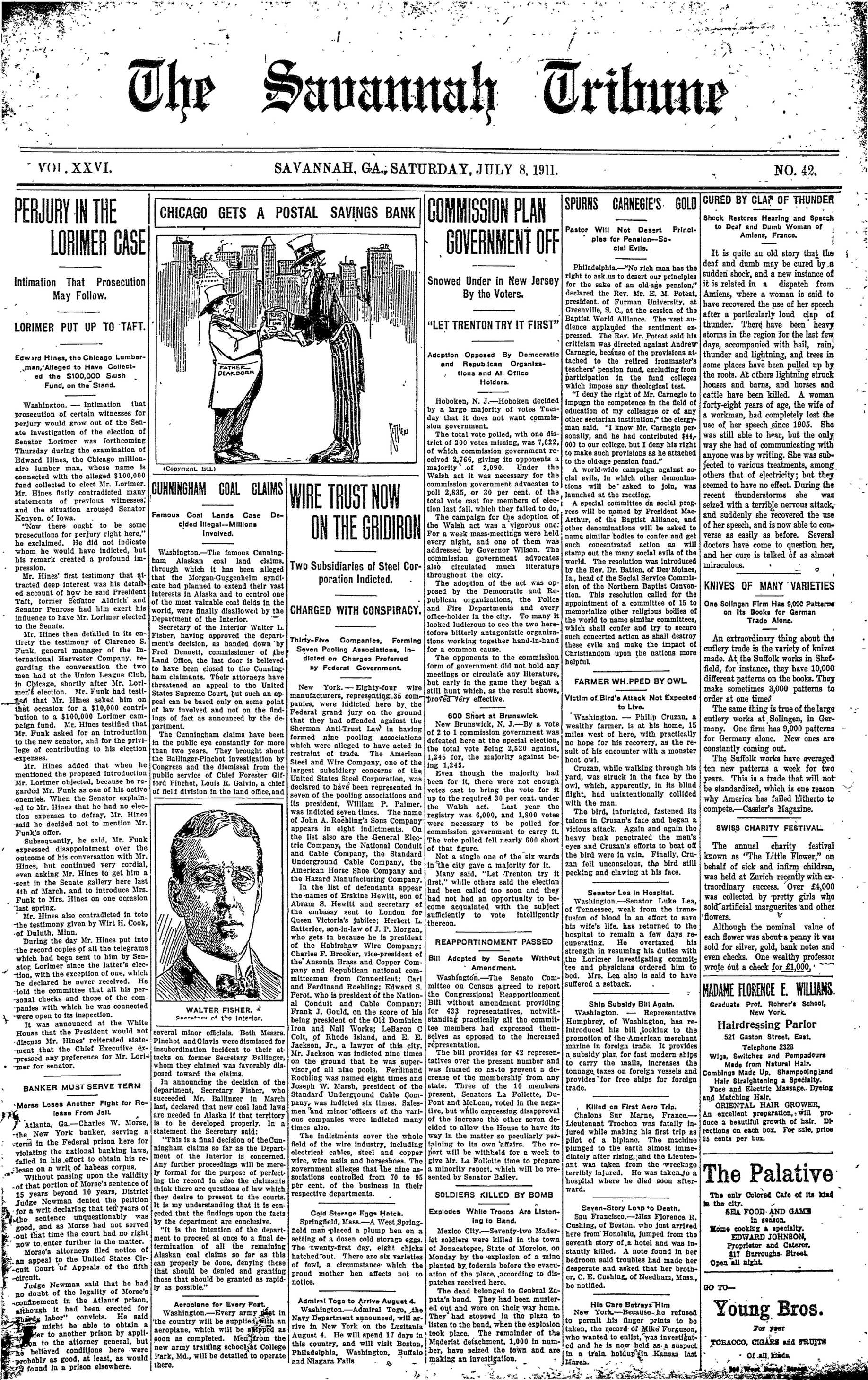
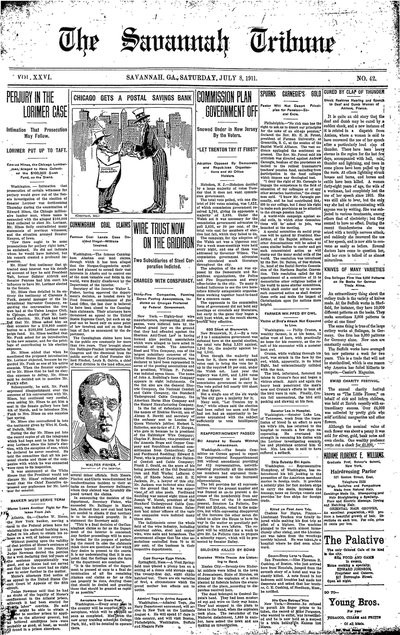
Page text (machine-generated)
The Savannah Tribune
V01. XXVI.
PERJURY IN THE LORIMER CASE
Intimation That Prosecution May Follow.
LORIMER PUT UP TO TAFT.
Edward Hines, the Chicago Lumberman, Alleged to Have Collected the $100,000 Sush Fund, on the Stand.
Washington. — Intimation that prosecution of certain witnesses for perjury would grow out of the Senate investigation of the election of Senator Lorimer was forthcoming Thursday during the examination of Edward Hines, the Chicago millionaire lumber man, whose name is connected with the alleged $100,000 fund collected to elect Mr. Lorimer. Mr. Hines flatly contradicted many statements of previous witnesses; and the situation aroused Senator Kenyon, of Iowa.
"Now there ought to be some prosecutions for perjury right here," he exclaimed. He did not indicate whom he would have indicted, but his remark created a profound impression.
Mr. Hines' first testimony that attracted deep interest was his detailed account of how he said President Taft, former Senator Aldrich and Senator Penrose had him exert his influence to have Mr. Lorimer elected to the Senate.
Mr. Hines then detailed in its entirety the testimony of Clarence S. Funk, general manager of the International Harvester Company, regarding the conversation the two men had at the Union League Club, in Chicago, shortly after Mr. Lorlmer's election. Mr. Funk had testified that Mr. Hines asked him on that occasion for a $10,000 contribution to a $100,000 Lorlmer campaign fund. Mr. Hines testified that Mr. Funk asked for an introduction to the new senator, and for the privilege of contributing to his election expenses.
Mr. Hines added that when he mentioned the proposed introduction Mr. Lorimer objected, because he regarded Mr. Funk as one of his active enemies. When the Senator explained to Mr. Hines that he had no election expenses to defray, Mr. Hines said he decided not to mention Mr. Funk's offer.
Subsequently, he said, Mr. Funk expressed disappointment over the outcome of his conversation with Mr. Hines, but continued very cordial, even asking Mr. Hines to get him a seat in the Senate gallery here last 4th of March, and to introduce Mrs. Funk to Mrs. Hines on one occasion last spring.
Mr. Hines also contradicted in toto the testimony given by Wirt H. Cook, of Duluth, Minn.
During the day Mr. Hines put into the record copies of all the telegrams which had been sent to him by Senator Lorimer since the latter's election, with the exception of one, which he declared he never received. He told the committee that all his personal checks and those of the companies with which he was connected were open to its inspection. It was announced at the White House that the President would not discuss Mr. Hines' reiterated statement that the Chief Executive expressed any preference for Mr. Lorimer for senator.
BANKER MUST SERVE TERM
Morse Loses Another Fight for Release From Jail. Atlanta, Ga.—Charles W. Morse, the New York banker, serving a term in the Federal prison here for violating the national banking laws, failed in his effort to obtain his release on a writ of habeas corpus. Without passing upon the validity of that portion of Morse's sentence of 15 years beyond 10 years, District Judge Newman denied the petition for a writ declaring that ten years of the sentence unquestionably was good, and as Morse had not served out that time the court had no right to enter further in the matter.
Morse's attorneys filed notice of an appeal to the United States Circuit Court of Appeals of the fifth circuit.
Judge Newman said that he had no doubt of the legality of Morse's confinement in the Atlanta prison, although it had been erected for "hard labor" convicts. He said it might be able to obtain a transfer to another prison by application to the attorney general, but he believed conditions here were probably as good, at least, as would be found in a prison elsewhere.
CHICAGO GETS A POSTAL SAVINGS BANK
Famous Coal Lands Case Decided Illegal--Millions Involved.
Washington.—The famous Cunningham Alaskan coal land claims, through which it has been alleged that the Morgan-Guggenheim syndicate had planned to extend their vast interests in Alaska and to control one of the most valuable coal fields in the world, were finally disallowed by the Department of the Interior.
Secretary of the Interior Walter L. Fisher, having approved the department's decision, as handed down by Fred Dennett, commissioner of the Land Office, the last door is believed to have been closed to the Cunningham claimants. Their attorneys have threatened an appeal to the United States Supreme Court, but such an appeal can be based only on some point of law involved and not on the findings of fact as announced by the department.
The Cunningham claimals have been in the public eye constantly for more than two years. They brought about the Ballinger-Pinchot investigation by Congress and the dismissal from the public service of Chief Foresster Griffon Pinchot, Louis R. Galvin, a chief of field division in the land office, and
A. H.
several minor officials. Both Messrs. Pinchot and Glavis were dismissed for insubordination incident to their attacks on former Secretary Ballinger, whom they claimed was favorably disposed toward the claims.
In announcing the decision of the department, Secretary Fisher, who succeeded Mr. Ballinger in March last, declared that new coal land laws are needed in Alaska if that territory is to be developed properly. In a statement the Secretary said:
"This is a final decision of the Cunningham claims so far as the Department of the Interior is concerned. Any further proceedings will be merely formal for the purpose of perfecting the record in case the claimants think there are questions of law which they desire to present to the courts. It is my understanding that it is conceded that the findings upon the facts by the department are conclusive.
"It is the intention of the department to proceed at once to a final determination of all the remaining Alaskan coal claims so far as this can properly be done, denying those that should be denied and granting those that should be granted as rapidly as possible."
Aeroplane for Every Post.
Washington.—Every army post in the country will be supplied with an aeroplane, which will be shipped as soon as completed. Men from the new army training school at College Park, Md., will be detailed to operate there.
SAVANNAH, GA.; SATURDAY, JULY 8, 1911.
WIRE TRUST NOW ON THE GRIDIRON
WIRE TRUST NOW ON THE GRIDIRON
Two Subsidiaries of Steel Corporation Indicted.
CHARGED WITH CONSPIRACY.
Thirty-Five Companies, Forming Seven Pooling Associations, Indicted on Charges Preferred by Federal Government.
New York. — Eighty-four wire manufacturers, representing 35 companies, were indicted here by the Federal grand jury on the ground that they had offended against the Sherman Anti-Trust Law in having formed nine pooling associations which were alleged to have acted in restraint of trade. The American Steel and Wire Company, one of the largest subsidiary concerns of the United States Steel Corporation, was declared to have been represented in seven of the pooling associations and its president, William P. Palmer, was indicted seven times. The name of John A. Roebling's Sons Company appears in eight indictments. On the list also are the General Electric Company, the National Conduit and Cable Company, the Standard Underground Cable Company, the American Horse Shoe Company and the Hazard Manufacturing Company.
In the list of defendants appear the names of Erskine Hewitt, son of Abram S. Hewitt and secretary of the embassy sent to London for Queen Victoria's jubilee; Herbert L. Satterlee, son-in-law of J. P. Morgan, who gets in because he is president of the Habirshaw Wire Company; Charles F. Brooker, vice-president of the Ansonia Brass and Copper Company and Republican national committee from Connecticut; Carl and Ferdinand Roebling; Edward S. Perot, who is president of the National Conduit and Cable Company; Frank J. Gould, on the score of his being president of the Old Dominion Iron and Nall Works; LeBaron Colt, of Rhode Island, and E. E. Jackson, Jr., a lawyer of this city. Mr. Jackson was indicted nine times on the ground that he was supervisor of all nine pools. Ferdinand Roebling was named eight times and Joseph W. Marsh, president of the Standard Underground Cable Company, was indicted six times. Salesmen and minor officers of the various companies were indicted many times also.
The indictments cover the whole field of the wire industry, including electrical cables, steel and copper wire, wire nails and horseshoes. The government alleges that the nine associations controlled from 70 to 95 per cent. of the business in their respective departments.
Cold Storage Eggs Hatch.
Springfield, Mass.—A West Springfield man placed a plump hen on a setting of a dozen cold storage eggs. The twenty-first day, eight chicks hatched out. There are six varieties of fowl, a circumstance which the proud mother hen affects not to notice.
Admiral Togo to Arrive August 4
Washington.—Admiral Togo, the Navy Department announced, will arrive in New York on the Lusitania August 4. He will spend 17 days in this country, and will visit Boston, Philadelphia, Washington, Buffalo and Nagara Falls
COMMISSION PLAN GOVERNMENT OFF
Snowed Under in New Jersey By the Voters.
"LET TRENTON TRY IT FIRST"
Adoption Opposed By Democratic and Republican Organizations and All Office Holders.
Hoboken, N. J.—Hoboken decided by a large majority of votes Tuesday that it does not want commission government.
The total vote polled, with one district of 200 votes missing, was 7,622, of which commission government received 2,766, giving its opponents a majority of 2,090. Under the Walsh act it was necessary for the commission government advocates to poll 2,835, or 30 per cent. of the total vote cast for members of election last fall, which they failed to do,
The campaign for the adoption of the Walsh act was a vigorous one. For a week mass-meetings were held every night, and one of them was addressed by Governor Wilson. The commission government advocates also circulated much literature throughout the city. The adoption of the act was opposed by the Democratic and Republican organizations, the Police and Fire Departments and every office-holder in the city. To many it looked ludicrous to see the two heretofore bitterly antagonistic organizations working together hand-in-hand for a common cause.
The opponents to the commission form of government did not hold any meetings or circulate any literature, but early in the game they began a still hunt which, as the result shows, proved very effective.
600 Short at Brunswick.
New Brunswick, N. J.-By a vote of 2 to 1 commission government was defeated here at the special election, the total vote Being 2,520 against, 1,245 for, the majority against being 1,245.
Even though the majority had been for it, there were not enough votes cast to bring the vote for it up to the required 30 per cent. under the Walsh act. Last year the registry was 6,000, and 1,800 votes were necessary to be polled for commission government to carry it. The vote polled fell nearly 600 short of that figure.
Not a single one of the six wards in the city gave a majority for it.
Many said, "Let Trenton try it first," while others said the election had been called too soon and they had not had an opportunity to become acquainted with the subject sufficiently to vote intelligently thereon.
REAPPORTINOMENT PASSED
Bill Adopted by Senate Without Amendment.
Washington.—The Senate Committee on Census agreed to report the Congressional Reapportionment Bill without amendment providing for 433 representatives, notwithstanding practically all the committee members had expressed themselves as opposed to the increased representation.
The bill provides for 42 representatives over the present number and was framed so as to prevent a decrease of the membership from any state. Three of the 10 members present, Senators La Follette, DuPont and McLean, voted in the negative, but while expressing disapproval of the increase the other seven decided to allow the House to have its way in the matter so peculiarly pertaining to its own affairs. The report will be withheld for a week to give Mr. La Follette time to prepare a minority report, which will be presented by Senator Bailey.
SOLDIERS KILLED BY BOMB
Explodes While Troops Are Listening to Band.
Mexico City.—Seventy-two Maderist soldiers were killed in the town of Jonacatepec, State of Morcelos, on Monday by the explosion of a mine planted by foders before the evacuation of the place, according to dispatches received here.
The dead belonged to General Zapata's band. They had been mustered out and wore on their way home. They had stopped in the plaza to listen to the band, when the explosion took place. The remainder of the Maderist detachment, 1,000 in number, have seized the town and are making an investigation.
It is quite an old story that the deaf and dumb may be cured by a sudden shock, and a new instance of it is related in a dispatch from Amiens, where a woman is said to have recovered the use of her speech after a particularly loud clap of thunder. There have been heavy storms in the region for the last few days, accompanied with hail, rain, thunder and lightning, and trees in some places have been pulled up by the roots. At others lightning struck houses and barns, and horses and cattle have been killed. A woman forty-eight years of age, the wife of a workman, had completely lost the use of her speech since 1905. She was still able to hear, but the only way she had of communicating with anyone was by writing. She was subjected to various treatments, among others that of electricity; but they seemed to have no effect. During the recent thunderstorms she was seized with a terrible nervous attack, and suddenly she recovered the use of her speech, and is now able to converse as easily as before. Several doctors have come to question her, and her cure is talked of as almost miraculous.
An extraordinary thing about the cutlery trade is the variety of knives made. At the Suffolk works in Sheffield, for instance, they have 10,000 different patterns on the books. They make sometimes 3,000 patterns to order at one time?
The same thing is true of the large cutlery works at Solingen, in Germany. One firm has 9,000 patterns for Germany alone. New ones are constantly coming out.
The Suffolk works have averaged ten new patterns a week for two years. This is a trade that will not be standardized, which is one reason why America has failed hitherto to compete.—Cassier's Magazine.
The annual charity festival known as "The Little Flower," on behalf of sick and infirm children, was held at Zurich recently with extraordinary success. Over £4,000 was collected by pretty girls who sold artificial marguerites and other flowers. Although the nominal value of each flower was about a penny it was sold for silver, gold, bank notes and even checks. One wealthy professor wrote out a check for £1,000.
Hairdressing Parlor
521 Gaston Street, East.
Telephone 2328
Wigs, Switches and Pompadura
Made from Natural Hair.
Comblings Made Up. Shampooing and
Hair Straightening a Specialty.
Face and Electric Massage. Dyeing
and Matching Hair.
ORIENTAL HAIR GROWER,
An excellent preparation, will
produce a beautiful growth of hair.
Directions on each box. For sale, price
25 cents per box.
Pastor Will Not Desert Principles for Pension—Social Evils.
Philadelphia.—"No rich man has the right to ask us to desert our principles for the sake of an old-age pension," declared the Rev. Mr. E. M. Poteat, president of Furman University, at Greenville, S. C., at the session of the Baptist World Alliance. The vast audience applauded the sentiment expressed. The Rev. Mr. Poteat said his criticism was directed against Andrew Carnegie, because of the provisions attached to the retired ironmaster's teachers' pension fund, excluding from participation in the fund colleges which impose any theological test.
"I deny the right of Mr. Carnegie to impugn the competence in the field of education of my colleague or of any other sectarian institution," the clergyman said. "I know Mr. Carnegie personally, and he had contributed $44,000 to our college, but I deny his right to make such provisions as he attached to the old-age pension fund."
A world-wide campaign against social evils, in which other demoninations will be asked to join, was launched at the meeting.
A special committee on social progress will be named by President MacArthur, of the Baptist Alliance, and other denominations will be asked to name similar bodies to confer and get such concentrated action as will stamp out the many social evils of the world. The resolution was introduced by the Rev. Dr. Batten, of Des Moines, Ia., head of the Social Service Commission of the Northern Baptist Convention. This resolution called for the appointment of a committee of 15 to memorialize other religious bodies of the world to name similar committees, which shall confer and try to secure such concerted action as shall destroy these evils and make the impact of Christiandom upon the nations more helpful.
FARMER WH.PPED BY OWL
Victim of Bird's Attack Not Expected to Live.
Washington. — Philip Cruzan, a wealthy farmer, is at his home, 15 miles west of here, with practically no hope for his recovery, as the result of his encounter with a monster hoot owl.
Cruzan, while walking through his yard, was struck in the face by the owl, which, apparently, in its blind flight, had unintentionally collided with the man.
The bird, infuriated, fastened its talons in Cruzan's face and began a vicious attack. Again and again the heavy beak penetrated the man's eyes and Cruzan's efforts to beat off the bird were in vain. Finally, Cruzan foll unconscious, the bird still pecking and clawing at his face.
Senator Lea In Hospital.
Washington.—Senator Luke Lea, of Tennessee, weak from the transfusion of blood in an effort to save his wife's life, has returned to the hospital to remain a few days recuperating. He overtaxed his strength in resuming his duties with the Lorimer investigating committee and physicians ordered him to bed. Mrs. Lea also is said to have suffered a setback.
Ship Subsidy Bill Again.
Washington. — Representative Humphrey, of Washington, has reintroduced his bill, looking to the promotion of the American merchant marine in foreign trade. It provides a subsidy plan for fast modern ships to carry the mails, increases the tonnage taxes on foreign vessels and provides for free ships for foreign trade.
. Killed on First Aero Trip.
Chalons Sur Marne, France.—Lieutenant Trochon was fatally injured while making his first trip as pilot of a biplane. The machine plunged to the earth almost immediately after rising, and the Lieutenant was taken from the wreckage terribly injured. He was taken to a hospital where he died soon afterward.
Seven-Story Lost to Death.
Sau Francisco.—Miss Florence R. Cushing, of Boston, who just arrived here from Honolulu, jumped from the seventh story of a hotel and was instantly killed. A note found in her bedroom said troubles had made her desperate and asked that her brother, C. E. Cushing, of Needham, Mass., be notified.
Hla Gara Betrava Him
New York.—Because he refused to permit his finger prints to be taken, the record of Mike Forguson, who wanted to enlist, was investigated and he is now hold as a suspect in a train holdup in Kansas last March.
NO. 42.
CURED BY CLAP OF THUNDER
Shock Restores Hearing and Speech to Deaf and Dumb Woman of Amlens, France.
KNIVES OF MANY VARIETIES
One Solingen Firm Has 9,000 Patterns on Its Books for German Trade Alone.
8W188 CHARITY FESTIVAL
MADAME FLORENCE E. WILLIAMS
Graduate Prof. Rohrer's School,
New York.
The Palative
The only Colored Cafe of its kind
in the city.
SEA FOOD AND GAME
in season.
Home cooking a specialty.
EDWARD JOHNSON,
Proprietor and Cateror.
817 Barroughs Street.
Open all night.
GO TO—
Young Bros.
For your TOBACCO, CIGARS and FRUITS Of all kinds.
NEGRO CHURCH LIFE
in the church life of these people. The
social philosopher who would mak
a careful study of them should by al
means have accurate knowledge 0
thelr religious organizations, and o
that inner life of the same which fur
nisbes a true perspective throug!
which the better and, therefore, th
average negro may be seen.
Apart from the state, the church
the largest organization with whiet
they have to do, it 1s the one greai
social power affecting their conduct—
and because of Sts very character {
calls forth’ the best elements fn thet:
nature. If, therefore, we consider It
{Influence upon them from the social
polut of view, we will be fully repaid;
for it seems beyond question that the
church has done more to civilize the
African than any other single agency
‘Through it the life of the negro peo
ple finds its most complete ,expres
sion; in St, that life recelves form and
direction; under {ts care the moral and
social are developed and refined, and
to it soclety owes much for what has
been accomplished, *
“There are three types of worship
which belong to three distinct pe
riods, though, in many cases, the old
er type has a strange persistence in
being and continues as a reminder of
other days. ‘This persistence ol
types furnishes data for strong gen
eralizations the truth of which we are
inclined to accept because their bases
are ever before us—the diverse forms
of worship witnessed all about us
where the negro has his churches. If
the student of economic progress de
. sires to place the results of his inves
_ tigations beyond serious question, he
makes a careful study of modern In-
dustrial life and especially of modern
machinery in action, Information ob-
tained at second hand would be unsat-
isfactory, for he knows that original
investigations made according to scl-
entific methods now in use would alone
remove many fatal objections. This
scientific spirit must be obeyed if any
satisfactory study of the social life of
the colored people Is to be made.
For the sake of clearness we may
treat the three types of worship as
represented by three periods, well de-
fined, in the church life of the Ameri-
can negro:
1. The perlod prior to 1865.
2, The transition perfod, 1865-1890,
‘or thereabouts,
3. The period of Improvement and
adjustment to modern conditions, 1890
to the present.
We are now able to comply fully
with the sclentlfic method in our study
of the earlier period and of the first
25 years of the second perlod, for it
was during the beginning of the sec-
ond period that the writer was born.
‘By extensive reading and by conver.
sation with men and women of doth
races and of various grades of intel-
Ugence, some knowledge of conditions
has been obtained.
The first period dates from the {n-
troduction of negro slavery and con-
tinues about 245 years. During these
years the Christian slave holders of
the southern states were the princl-
pal misslonarles to the African heath-
en brought to thelr doors by a fortu-
{tous course of events, They did much
to enlighten those dark and benight-
ed beings fresh from a life of sav-
agery and social degradation of the
Worst type.
Perhaps due credit has never been
given to the old-time southern people
for the great service they rendered to
clvillzation by the instruction of these
humble people in the mider arts of a
better life. Many must have been the
sacrifices made in order to teach these
untutored beings, these children of
the forests and wilds of Africa, The
thoughtful descendants of these early
blacks will not forget this great and
Christ-iike service. Not only did
this humble service affect the relig-
fous life of the southern people as a
whole, but the entire social organtza-
tion was slowly modified by it as a
step preliminary to something bet-
ter,
Whatever evil might have been as-
fociated with the earlier American
Mfe was due largely to conditions {n-
separable from the social features in-
volved; and it seems wiser to study
the circumstances of those days and
fo learn the valuable lessons they
have to teach than to spend time in
criticising unkindly a transitory type
of civilization so far removed from
our own as to make {t difficult for us
to give it full justice. We must not
forget that the task of.civilizing men
1s not au easy one, and that those
early Americans did a grand and noble
service in winning thousands of men
from the densest heathenism,
As the slaves had not forgotten the
fetichism of their native land. It was
| cuHlar to the most ignorant, Jhis is 4
survival of ruder forms of mingle¢
heathen and Christlan worship of oth
er days, and to this fact it seems thal
too little attention has been given by
some writers In treating superstitior
among southern negroes. The stran
gest forms of worship now rapidly
passing away have, In common, some
thing of the African heathen and the
American Christian. This worship
though crude, desultory and {n many
cases ineffectivo, had {ts power over
the social life of the negro, and form
ed a basis for instructing him in the
better way.
During the second period, 1865-1890,
the colored preacher arose. During the
former perlod the negroes attended
the churches of their owners, and oc
cupied, as a rule. seats In the gallery
or elsewhere especially set apart for
them. They thus enjoyed the mints.
trations of educated clergymen at a
time when this was exceedingly de-
sirable. At the downfall of the inatl-
tutlon of slavery fn 1865, when the
negroes left these ministraflons for
one or another reason, there was, for
a time, a retrogressfon in thelr forms
ot worship, and in some of thelr
ideals, This was to be expected, for
they had perhaps less than §0, moder.
ately well-trained men to minister to
the spiritual needs of more than
4,000,000 of human belngs—a mighty
host! About 1867, the varlous mission-
ary societies began the work of edu-
cating preachers and teachers for
these people—to this end schools were
established at {mportant centers, and,
by 1875, a number of men of very
moderate training entered the negro
pulpits. During the next decade a
great change was wrought {fn the
chureb iffe of the people; superstition
began to lose some of Its power, fire
chureh houses (too expensive {n many
‘cases) were erected and the member-
ship largely increased. In the midst
of much that one regrets and deplores
there 1s the excess of good over evil.
Since 1865 many improvements have
been made and for a quarter of a cen-
tury (1866-1890) the church has led
fn the development of a higher social
ideal which Is wielding great power in
transforming the life of the colored
people, Herein thete is a great force
making for industry, order and law.
To these people the weifare of the
home, the community, the state, the
entire country, fs a matter of con-
cern and interest. The spirit of altru-
ism {s not unknown and the interest
fo mankind ‘s real.
Whatever prozsess the negro has
made Is due, in a large measure, to
the power exerted over him by the
Christian church. Since the advent of
the colored preacher, though with Iim-
tted training, the race has galned in
wealth and intelligence, and to these
leaders 1s due great honor and credit
for what has been accomplished, The
northern missionary socletfes trained
the negro preachers and thus made
their great work possible. Through
the perspective years of that work of
training a class of workers seems of
Increasing {mportance and wisdom.
‘The third period may begin at soma
polnt between 1885-1895, This period
saw a number of men with better
preparation for leagership enter the
field; they were more deeply im-
pressed with the soclal significance of
Me, and labored to show that the
Christian religion was not at varlanco
with economic and clvic progress, thas
political and social philosophy weré
not hostile to a higher religious life,
Dut that these wide spheres of human
activity and fnterest should make
thefr proper contribution to the wel-
fare of men, .
As a result of this effort to lead the
negro church to ocmprehend the se
clal and economic side of Its Ilfe, and
to express this more positively tn Its,
business interes‘s and gocial Ife, in
ts relations with all men, there Js
‘marked Improvement, especlally in
‘the south. Under this leadershtp tm-
provement In the home life has been
so signal that the many generallza-
tlons made nowadays, but based upon
conditions existent 15 or 20 years ago,
are far from accurate, One must visit
a large number of typical negro homes
as they are today {n order to speak
wisely concerning them. He must re-
member that there are five millions
whose Ife bas not been reached by
the Influence of the church—five mil-
Mons who are not far removed from
barbarism, The tmprovement referred
to must be sought, therefore, among
the better class of the four millions
who have been reached by the church,
The unreached millions are a verlous
menace to the soclal order. The work
of training and Christianizing has not
‘kept pace with the Increase in popula:
aE
say that with « larger number of
trained leaders, such as our higher in-
stitutions are prevaring for the min:
istry of unselfish service, the masses
will eventually be helped, elevated.
‘The higher education of a sufficient
number of men for leaders of the vast
industrial masses throughout the
southland is a sure way of accelerat-
ing the great work of social better-
ment aniong the negroes; for, with few
exceptions these leaders direct tho
largest interests among them today.
Few men, perhaps, will be inclined
to question the.value of the church
as a social power when they reflect
upon present conditions in the light
of the past. Many organizations which
minister to the aesthetic and intel
Yectual Mfe of progressive white men
are unknown to the masses of the
black men of the south, bence the
churches and benevolent organiza-
tlons must serve many purposes, and
minister to the entire spiritual nature,
‘The large attendance of negro chil-
dren at public schools, south, is an-
other result. The trained leader
urges industry, thrift, economy, edu-
cation and righteousness upon the peo-
ple, and in this way the influence of
the church upon negro life has been
amatter of great importance. Through
Ht he has been introduced to some
phases of American Ilfe and modern
clyilizatfon, and ff a wise conserva-
tism shall avold the threatened error
of exalting the industrial type of ed-
ucation undilly at the expense of that
‘equally important type of education
under which the present economic and
social statue has been attained; if the
making of the mere breadwinner shall
not be prized above tho development
of men who will earn brend; if the
mere pumen machine shall not bo
idolized to the utter neglect of the
trained man with all the powers of in-
Itiative set free, we may expect even
greater results through that bilgher
‘type of life which fs being slowly but
surely developed in the negro
churches. >
.A more extended study of the pres-
ent economic position of the negtoes,
together with their possessions In real
and personal property would be very
instructive; indeed, {t would show
that the werk of training leaders for
these people was. very opportune.
Apart from tye merit of Christianity
per se, It sure'y Has great value as a
soclal power in the life of theee mll-
Hons, and it is to this phase ofthe
matter that we desire to give speclal
emphasis. It has done much to make
the negro more economical, thrifty,
humane and alirulstle, and it 1s a mat-
ter of common observatjon that the
social life of the churchgoers among
these people fs far atove that of their
unfortunate fellows all about us.
These facts will appeal to the consid-
erate judgment of philanthropic men
for sympathy and support In the traln-
ing of black men for le-dership. In
the “College-Bred Negro,” a publica-
tlon of the Atlanta university; 1900,
Dr. DuBols shows that the negro edu-
cated in the higher Institutions of
learning, worth and south, {s a pro-
gressive and industrious member of
soclety, and that these men are, in
nearly every case, found working for
the elevation of their fellows through-
out the southern states. They are the
advocates of peace, order and good
will to all men. It fs the poorly train-
ed men who are rash and dangerous
as leaders of @ vast multitude of, un-
reached people.
If a wise philanthropy shall see to
it that a better class of leaders shall
be supplied to meet the pressing
needs of the millions of blacks who,
because of thelr great poverty, cannot
supply them themselves; if wise and
conservative men aid women will
only see to it that higher and Indus-
trial education is wisely provided to
the end that the church may enjoy
the ministrations of broad-mintled
men, the social and economte life of
the blacks will be constantly {m+
proved through the farreaching inttu-
ence of the negro church.
Virgianfa Union University,
7 ‘Richmond, Va.
SMILES MAKE THE WORLD A BET-
: TER PLACE.
Life would be more livable if more
of us felt it a duty to be pleasant
however things might go.
An old woman once told a girl with
a Puritan conscience: “Stop worrying
so much about the right and wrong
‘of things and keép smiling, and
you ‘will make thls world a better
place.” *
‘The girl who learns to keep smiling
when she would much rather weep or
storm has gained a victory over her-
self beyond penance and fasting.
Be pleasant first from a sense of
duty, and it will soon become a habit.
If gulkiness, decelt, ill temper, nagging
can get a grip on your character, why
not pleasant ways?
It you cultivate a pleasant mapner
from no other reason, do so through
selfnterest. The girl who Is agree-
‘able never moans over the world’s
treatment. Solomon knew when he
advised the “soft ahswer" rule for
living,
A REAL LADY.
‘Among the youngsters belonging tc
a college settlement in a New Eng
land gity was one little girl who re.
turned to her-bumble home with glow.
‘ng accounts of the new teacher.
» “She's a perfect lady,” exclaimed
he enthusiastic youngster, “that's
what she ts!”
The child's mother gave her 8
éoubtful look. “How do you know!
de said. “You've only known her twc
days.”
“It's éasy enough telling,” continued
Ye child. “I know ehe’s a, perfect
acy, because she makes you feel po
_ @ oll the time."—Lippincott's.
A QUESTION ABOUT
THE SERVANT PROBLEM
NRRERAEED Seen Wat ant g PORN PENT IN TERS STE TEL
The education of the negro should
cegin where “tke education of the
white child should begin in the kin
dergarten, the most primary depart:
ment in modern educational program.
If it {6 considered necessary in
equipping the child of the superior
race, the one who bas had the ad-
vantage of social experience, to’ be
gin at the earliest period to train the
hand into usefulness along with. bis
mind, certainly such an education fs
the more necessary for the child of
the inferlor race, who ts told he must
|epend almost entirely on what his
‘hands can do, for his service as an in-
dividual,
‘The grafting on of industrial tratn-
Ing in the schools of the country has
been called one of the progressive
steps of modern education; thoughtful
men have decided this. They have de-
cided that no matter how sure a child
may be that his training for life Js
to be for a profession, an occupation
separated from ever a business ca-
reer or one that would require his
knowledge of industriat activity, that
he must nevertheless to be equipped
completely for life, have the all-round
education which calls for a training
of the hand in the elementary and
even recondary branches of educa-
ton.
Realizing that constructive activi-
tles ‘are those being called for in the
eouth today, the average thoughtful
southern man is trying: to give h{s
son the knowledge a technological
school gives, no matter what the boy
may select to do afterwards. Another
effort equally’ as significant along
practical lines fs the movement to es-
tablish In the University of Georgia a
department to teach boys business
methods, a department similar to the
department of business administra-
tlon at Harvard, because elghty per
cent. of the students who have grad-
uated from the University of Georgla,
in the last ten years, have gone Into
business activity. So stated Hon.
Harry Hodgson of the board of trus-
tees of the university, at the confer-
ence for education in the south re-
cently held in Jacksonville.
‘A Wave of Practical Work.
Now that this wave of.practicabil-
ity has found expression {n our school
systenis everywhere for white chil-
dren and they are slowly becoming
more ratfonalized—making more for
the training of men and women for
actial Ife. 1 should Itke to put the
question, what 1s being done to make
more rational the system of education
which the taxpayers of both races are
glving the negro's,
We tell the negro: “Here {s a good
school for you to go to; we want to
be just to you."
We give him in thé common schools
almost the same training which we
give the white child; he takes It re-
markably well, but when ‘he leaves
school and asks for work and ven-
tuses into the field of labor where his
natiral racial ambition ‘leads, he te
told “no, that vocation cannot be
yours, but we will give you good
wages along industrial lines, and we
need you, and are dependent upon you
for domestic eervice.”
| Now what Las the state or the local
‘school or tht rural school done to-
ward working out a system of educa-
tion which wuld be conducive to in-
custrial and comestic training?
‘There {s tf habit among southern
people who are not thoughtful and
who are not studious of conditions to
exclaim agaifét all this “higher edu-
cation of the negro which misguided
philanthropists give him.” .
‘That may be warranted in regard
to many InsGtutions which have been
handsemely endowed, but there are
many which are handsomely endowed,
and are giving practical demonstra-
tion of the very kind of education we
cleim we want the negro to have.
For instance, { mention, from a stu-
dlous investigation of the institution,
the Hampton institute, for the educa-
tion 6f the negro.
T hear the individual man or woman
here exclaim: “Yes, but did you ever
Dear of a good cook, or a good seam-
rtresn, or a good housematd coming
srom there?”
My reply isc “Hampton fs in Vir-
Mala; there have never been enough
of the many graduates each year go-
ing cut from there to fill in the state
ot Virginia alone the demand for
teachers of industrial training and do-
mestic scfence in the good system of
rural schools being established in that
state for the negro. Algo, the records
ehow that many a nice. farm Is being”
presided over by a negro housewife
who got her training for home duties
of Hampten, while her husband, tke
teachers of industrial training and do-
mestic science in the good system of
rural schools being established 1n that
state for the negro. Alto, the records
ehow that many a nice. farm Is being
presided over by a negro housewife
who got her training for home duties
of Hamptea, while her husband, Ilke-
wise trained at Hampton, fs running a
farm, elther for himgelt or for a white
employer.”
But it would require more space
than this department admits to go {n-
to the wonderful system of educa-
Yon being demonstrated at Hampton.
The point I want to make {s that as
the educational’system for the white
ebild has been found lacking, and
new and more practical methods
worked out for him, then certainly
another system should be worked cut
for the negro child, whose activities
In this section are Umited, and from
whom so much along certain Iines.are
expected,
Ionumerable communtcations have
come to this department bearing on.
the inefficteney- of the domestic negro
‘servant, and esking why. something
‘cannot be done about it. This Ineff-
‘elency has been brought about by
conditions complex, in operation for
nearly fifty years. They cannot be
~~ «© ae = ” =
eradicated in 2 day—a month—a year.
If we want the negro taught slong
industrial lines and along the lines of
domestic service we, must begin to
give him the opportunity to get that
training.
The other day in the examinations
siven out for teachers in the public
schools of Atlanta, virtually the same
examinations were given to the white
and colored teachers.
This points to the fact that the
same sysjem of training prevails in
both’ schools,
And in working out this educational
matter {n relation to the two races, it
‘must wot be forgotten that we have
to reckon with a rapldly-enlarging
element of negroes who do not have
to enter into domestic service—but
that fe subject matter for another
time, *
In this matter of the servant ques-
tion, we might as well face facts and
see what conditions are, and what
can be done to better them,
A MUMMY'S TOY.
There {a a doll In the British mu
seum that is more than 3,000 years
old. When some archaeologists were
exploring an anclent Egyptian royal
tomb they came upon a sarcophagus
containing the mummy of a little prin:
cess seven years old: She was dress:
ed and interred in a manner befitting
her rank, and in her arms was found 2
Httle wonden doll.
‘The inscription gave the name, rank
and age of the little girl and the date
of her deach, but {t sald nothing about
the quaint little wooden Egyptian doll.
This, however, told its own story. It
was so tightly clasped in the arms of
the mummy that {it was evident that
the child Had died with her beloved
doll fn’ her arms.
The doll occupies a place in a glass
case in the muceum, and there a great
many English children go to gaze
upon {t—Harper’s Weekly.
THE POINT OF THE STORY.
A mother was greatly worried bz
her small daughter's habit of running
away. Thinking to !mpress the child
with the danger of getting lost, she
told her vivid story of some children
who ran away to go nutting, Night
found them far from home and lost in
the woods. With much art the moth:
er told of a storm In the night and o!
the terrible distress of.the parents
and friends who hunted for the chil
dren until morning. She also told
about the good breakfast prepared for
the children, which they missed be
cause they did not reach home till
10 o'clock,
‘The Iittle girl Mstened silently to
every word, and the mother hoped
that the story was meking an impres-
sion, When she finfshed the child
waa silent for a few moments, as if
extecting something more. Then she
asked eagerly: “Did: they get any
nuts?”—Metropolitan Magazine,
MAKING THE CASHIER COUGH.
“But I don't know you, madam,”
the bank cashier sald to the woman
who had presented a check.
+ The woman, however, instead of
saying haughtily, “I do not wish your
acquaintance, sir,” merely replied with
an engaging smile:
“Ob, yes, you do, I think, I'm the
“red-headed -old virago’ next door to
you, whose scoundrelly little boys are
‘always reaching through the fence
‘and picking your flowers. When you
started for town this morning your
wife cald: ‘Now Henry, if you want a
dinner fit to eat this evening you'll
have to leave me a Ittle money. I
can't keep this house on plain water
and slxpence a day.’”
“Here's you movey, madam,” sald
the cashier, pushing tt toward her and
coughing loudly.—Tit-Bits.
YOUTHFUL WISDOM.
‘The other day in a New Xork school
the teacher was explaining a sum In
subtraction, which the ttle ones
found difficult to understand. “Now,”
sald she, to exemplify the proposition,
“suppose I had ten fhollare and went
into a store to spend it. Say I bought
a hat for five dollars, Then I spent
two dollars for gloves and a dollar
and fifty cents for some other things.
How much would I have left?”
For a moment there was a dead sl-
lence. Then a boy's hand went up.
“Well, Issac, what woutd I have
left?”
“Vy didn’t you count your change?”
sald Isaac In a disgusted tone.—Mack’s
National Monthly,
WILLING TO TAKE A CHANCE.
‘There was recently haled In an Ala-
bama court a little Irishman to whom
the thing was a new experlence. He
was, however, unabashed, and wore an
alr of man determined not to “get
the worst of It."
“Prisoner at the bas,” called the
clerk, “do you wish to challenge any
of the jury?”
‘Whereupon the Celt looked the men
1a the box over very carefully and
‘with a skilled eye.
“Well, I tell ye,” he finally replted,
“Ol'm not exactly in t—=in’, but OF
think 1 could pull off a round or two
with thot fat old boy in th’ corner.”
—Lippincott’s.
A SIDELIGHT ON PA.
‘Willle—Say, Pa, you ought to see
‘the men acrosse the street raise a
building on jacks.
Pa (abeently)—Impossible, Willie.
‘You can ee Jacks, but a man Is
A fool to try fo raise on them—er—]
mean {ft must have been quite a aight,
—Puck
FIRST OF ALL “INTERVIEWS”
John Stow’s Statements About the Op.
position to May Celebrations Was
Published In 1603. |
In 1603, when England hed
-passed from the sway of the Plant-.
agenets to that of the Tudors, John.
Stow, the old chronicler of London,
was actually interviewed (and this is
the oldest instance of published in-
terview I have ever found) in regard
to this ancient Maypéle of St. An-
drew-Under-Shaft, The old man
spoke of the singular opposition to
the May celebrations as follows:
“And opposite to the Church of
St. Mary Axe, is the goodly Church
of St. ,Andiew-Under-Shait. Of
churches we have fewer than of old.
As for piety, truly I see no differ-
ence, for some will always be pious,
and some prodigal and profligate. I
remember the Maypole when it hung
upon the hooks along the south wall
of the church, I never eaw it erect-
‘ed, because Evil-May-Day before I
‘was born, when the prentices rose
‘against the aliens, was the last time
when it was up. It was destroyed
in King Edward’s time (the only:
son of Henry VIII, by Jane Sey-
mour, 1537-1553) when it was,
preached at Paul’s Cross, that the
Maypole was an idol. So thespeople
brought axes and cut it up—the
goodliest Maypole that the world has
ever seen, and taller than the steeple
of the church.”—Richard H. Clarke,
in Columbian.
CHECKLESS
W rl
g | | ssp].
c 49 Z
f | 4 | J ee
Mad 3 yi
hy ye) WA
IN teresa! LP
Be
TR Zier ; A x)
WET
\ Up
Se Sat}
A] ee
Reginald—You may try to hold.
me in like you did lest year, but I°
will see that I go through my vaca
tion this summer unchecked.
His Father—That’s what you will.
Pllsee that checks to you are cut out
altogether, © Fl
TRAGEDY BROUGHT TO LIGHT.
Evidences of a bygone tragedy
have been uncarthed at Horton, a lit-
tle village in the peaceful peninsula
of Gower, Wales. A resident was
walking along the beach a ew days
ago when he stumbled against a
bone protruding from the ground.
His curiosity was araysed, and_he
procured a. spade, and eventually
dug up what proved to be human re
mains. The spot at which the grue-
some discovery was made was by the
side of a small cliff, and it is known
that the sea has encroached upon the
coastline, and the probability is that
several feet or more of ground had
been washed away and so unearthed
the hidden remains, which, however,
had evidently been flung into a hole
there over a hundred years ago.
With the remains was found an old-
fashioned dagger, encrusted with
rust, and this fact suggests tragedy.
OLD SCOTTISH BAGPIPE. _
What is doubtless the finest ex-
ample extant of the old Hightand
war bagpipe was unearthed recently
by Muirhead Moffat, Glasgow. This
rare instrument is beautifully orna-
‘mented with Celtic patterns, carved
in circular bands. On the stock are
the letters R. Of. D., below them a
galley, under which “in Roman mu-
merals the date 1409. 'The lettering
is of the Gothic form commonly
used in the fifteenth century. Tho
drones and chanter are ornamented
with bands of interlaced work, the
drone having brass ornamented fer-
rules. An old Highland dirk with
interlaced grip and unique screw
top, evidently for carrying dispatch-
es, and a large brass Celtic brooch
are included in the find.
SALESMANSHIP,
“Lm afraid these shoes will not
be big enough for me,” said the lady
customer, affer she had with muck
Uifficulty and considerable help suc
ceeded in getting one of them on.
“But sce how nicely they show off
your beautiful arched instep,” said
the clerk. .
“Ah! It feele perfectly comfort
able now. You may send them out,
please.”
AFRO-AMERICAN CULLINGS
"There a people, now forgotten, discovered while others were yet barbarians, the elements of the arts and sciences. A race of men, now rejected from society for their sable skin and frizzled hair, founded on the study of the law of nature, those civil and religious systems which still govern the universe." A statement like the foregoing would naturally draw fire from a hostile critic, and when they found that it could not be disproved, the proper course would be to ignore it, and let it fall into oblivion. That's what happened with reference to the foregoing quotation. For in the publisher's preface we read:
"A voluminous note in which standard authorities are cited, seems to prove that this statement is substantially correct, and that we are in reality indebted to the ancient Ethiopians to the fervid imagination of the persecuted and despised negro, for the various religious systems now so highly revered by the different branches of the Semitic and Aryan races. This fact may perhaps solve the question as to the origin of all religions and may even suggest a solution to the secret so long concealed beneath the flat nose, thick lips, and Nero features of the Egyptian Sphinx. It may also confirm the statement of Dloderus, that the Ethiopians conceive themselves as the Inventor of divine worship, of festivals, of solemn assemblies, of sacrifices and of every other religious practices.
"That an imaginative and superstitious race and founded in the dim obscurity of past ages, a system of religious beliefs that still enthralls the minds and clouds the intellects of the leading representatives of modern theology—that still clings to the thoughts and tinges with potential influence the literature and faith of the civilized and cultured nations of Europe and America, is indeed a strange illustration of the mad caprice of destiny of the insignificant and apparently trivial causes that oft produce the most grave and momentous results."
From the foregoing the student of psychology can readily understand why the negro is more enthusiastic about solemn religious doings than is any one else. And the reader who is still in doubt as to the correctness of these statements may consult Draper's "International Development of Europe" and learn that in spite of the rantings of demagogues, the greater part of the civilized world in matters religious, is still under African domination.
Ethiopia has already stretched forth her hands, and like the Nibbe of Nations they may be empty now, but there was a time when they were filled with blessings for the world.
It's all right to say that the negro has done nothing—say it and let it go at that. It sounds well in sermon and speech. But remember there are always some minds that look for the other side—"some blind Sampson feeling for the pillars of authority."—Old Hickory in Dallas Express.
Not very long ago President Taft, in a speech, defended the integrity and usefulness of the Jews of this country. His glowing tribute to their worth will ever live in the minds of those who believe that race prejudice is contrary to reason and equity. His speech on this occasion certainly showed that he had the moral courage to speak what he thought. Now, occasion comes for him not to speak, but to act, and when it is brought to his attention that Col. Joseph Garrard, commanding the cavalry post at Fort Meyer, disapproved Private Frank Bloom's effort for promotion because of Bloom's parentage, he immediately directs the secretary of war to investigate the matter. The colonel's indorsement was Jews were not "desirable social associates." There being no regulation in the army to prevent an officer from expressing his opinion as to the fitness of a candidate to be advanced from the ranks, Colonel Garrard escaped court-martial; but not a stinging rebuke and a warning not to repeat the endorsement. For nearly 6,000 years the Jews have been in the limelight and it may well be said they are God's chosen people. Success seems to attend their pathway, and we never see a Jew drunkard or beggar. They are not inmates of our 'almshouses and workhouses, but are our most progressive citizens. It is a mistaken idea that the Jews are all merchants; for among the world's list of great soldiers, authors, musicians, painters and philosophers, are many names of persons of this race. In this case the merits of the applicant should have been considered aside from his race, and endorsement made in accord with his service. Our sympathy goes out to the Jew, because "a fellow feeling makes us wonderous kind," and what he has done we can do. So when we add money, character, intelligence and industry to our stock in trade, we will have friends to come to our assistance. That's the way the Jew solved his problem.—Richmond Reformer.
During the summer some latitude should be shown servants in all vocations of life, especially those in the menial walks of life. There are some rights that servants have that should be respected. They should be shown some attention and kindness while at work. Reasonable hours should be prescribed for them to work, and the same for pleasure and recreation. Domestic servants in many instances are diminishing because of the painfully long hours they have to work and the poor salary attached. Reports are often heard from all parts of the country of the scarcity of unskilled labor, due largely to the fact that such labor is overworked. The housekeepers should be more lenient with their servants by giving them a reasonable amount of time for recreation and pleasure, and above all, to treat them with kindness.—Illinois Chronicle.
---
Thus far, there have been seven colored ministers to Haiti' namely: Rev. E. D. Bassett of Pennsylvania; John M. Langston of Virginia; John E. W. Thompson of New York; Frederick Douglass of New York and the District of Columbia; John S. Durham of Pennsylvania; W. F. Powell of New Jersey, and Henry W. Furniss of Indiana. George W. Williams of Ohio was nominated several years ago for the place, but failed of confirmation. Durizg Cleveland's second term, Henry S. Smythe, a white man, served as minister to Haiti. All have been men of high character, brilliant attainments and impressive personality.
A careful estimate indicates that since the foundation of Tuskegee institute, two years of training have been given to approximately 9,000 persons. The average length of time that these 9,000 persons have been out is fourteen years, during which time their estimated earnings have been $88,200,000. If they had not received an industrial training, they would have earned during the fourteen years only $12,600,000. That is, by receiving an industrial training, they have been able to earn $75,600,000 more than they would have earned had they not received this training. —Southern Letter.
The negro press of the country has lost one of its ablest exponents In the death of Editor William Bearden, managing editor of the Galveston New Idea, which occurred at the family home in Galveston, Tex. Editor Bearden was a vigorous and entertaining writer, an able and fearless advocate, and one of the most highly esteemed and courageous members that the negro race has had in a generation. Peace to his ashes.
Whether on land or sea or in thin air, the colored man and brother in comparison with his fellows of whatever race or clime has long ago decided to make a showing. In this connection it is right in place to announce that Henry Flanagan, 315 Mayflower street, Fort Worth, Tex., has invented an airship which in many respects outclasses all previous efforts at the sport of travelling on the wings of the wind.—Western Star.
CLOSING OF DURHAM INSTITUTE WAS A NOTABLE EVENT.
By Geo. F. King.
Durham, N. C.—(Special.)—With the strongest attractions ever featured by an Institution for Afro-Americans in this section of the country, the first annual commencement of the National Religious Training school, this city, was a notable event. Prominent men and women of both races from various parts of the country were present and were astounded at the effective work being done by the school and its phenomenal growth.
A great message of hope and sane doctrine for the cordial relationship between the races in the south was the baccalaureate sermon by Rev. Augustus P. Record, pastor Church of Unity, Springfield, Mass.
In addressing the literary societies Dr. W. P. Few, president of Trinity college, this city, made these significant utterances: "I am always glad to come into contact with single individuals or a whole people who have great tasks before them, especially they are willing fairly and fearlessly to confront their great tasks. Circumstances have set before your people the high task of building in a short time and under surroundings of a well developed society a worthy civilization of your own. There are features of the case that make your situation unique. There is nothing like it in all the world. Then, too, your people in Durham are making unusual efforts, with extraordinary success, to work out the problems of your destiny. And you are working out your destiny here under peculiarly favorable conditions, for I am sure that the relations existing between the white and colored races in Durham are better than what I have observed elsewhere in America. To help your race forward and to improve these good relations between the two races is an opportunity for which this institution ought to be most grateful."
The final day every Afro-American enterprise in the city was closed during the hours the exercises were held. In delivering the annual commencement address Justice Wendell Phillips Stafford, associate justice supreme court District of Columbia, in part said:
"This school was born of the realization of this deep truth, that every race must have its leaders. It is not enough to provide for the average man. You must provide likewise for the exceptional man. You must encourage leadership. You must see that those who by nature and ambition are calculated to lead shall be by education and discipline be fitted to lead wisely. Every race will have its leaders. The black race will have its own. We cannot prevent it. But we can see to it that they are well trained. We can see to it that they shall be filled with true ideals of service. The time has gone by when you could put the human mind into a dungeon. The instinct for something better is unconquerable. Men will have light. They will have their share in the fruits of the world's progress. No dead weight of opposition can ever keep down the mighty instinct of growth. As Wendell Phillips was fond of saying—The tiny weeds of a luxurant Italian summer upheave the colossal foundations of the Ceasar's palaces and leave them a mass of ruins.' Where there is life there will be growth. If you plant an acorn in a vase the acorn will die or else the vase will crack. Of all the follies that ever took possession of the human mind the supreme folly is to suppose that you can keep a man in ignorance if he wants to learn. The question is what shall he learn? Shall it be vice and crime and rebellion against society and law? Or shall it be truth and virtue and loyalty to God and to the state? That is the question. The mistake men have made so often in the past has been in supposing that the strong and prosperous held a mortgage on the weak and poor. In the world of moral it is the other way."
It is the weak who have mortgage upon the strong. It is the ignorant who have a claim upon the learned. There is no safety but in justice. God has so made his world that the rich shall dwell in fear unless they banish ignorance and crime and poverty from their borders. That is the only policy of insurance that in the long run is worth a penny. There is no safety for a state but in the intelligent loyalty of its citizens. It was fittingly said: "You can do almost anything with a bayonet except sit on it." You cannot rest a nation upon force. If that was true, and it was true, even under the old forms of government, how much more is it true under a government like ours where public sentiment is the only king, where even the law upon the statute book is a dead letter unless the good will of the community is behind it.
"Durham has become one of the most important places in the United States. This little town of 18,000 inhabitants, among the hills of North Carolina, has drawn to itself the attention of the whole country. Why? Because it has struck bedrock on this race question. Here is a community where the best elements of both races meet and work together for the good of all. Mutual helpfulness and mutual respect—these are the talismanic words that have been spoken here. We have seen a circuit judge of the United States' and a former governor of the state, traversing the country to fill the treasury of this institution. We have seen a distinguished ex-Con-
federate officer, perhaps the foremost citizen of his state, ready to become the guardian of its funds, to give it the prestige of his name and benefit of his counsel and services. And we have seen the good people of this town setting the country an example of unselfish and broad-minded hospitality to an attempt to elevate a race.
PREVENTED TOOTHACHE
THE OLD ROMAN DID IT BY DEVOURING TWO RATS A MONTH.
If it be true that ancient remedies are always the best, it may be of interest to those afflicted with dental troubles to know how the ancient Romans dealt with such lills. The Quirities recognized two types of treatment, the magical and the medical. The following are some of the prescriptions advised by the magicians:
Take the head of a dog that has died of rabies, mix the ash with oil of cyprus and inject the product into the ear of the affected side.
A water snake's vertebra will serve to scarify the gum provided that it be obtained from a white skinned snake, or for the same purpose may be used a lizard's frontal bone obtained when the moon is full, or, if that fail, a chicken bone will do, provided that it be dried in a hole in a wall and thrown away immediately, after used.
It is good treatment to inject into the aching ear oil of lemon in which have been macerated mallow bugs, even should this last give rise to itching.
A worm fed on a particular herb or a cabbage caterpillar can conveniently be placed in a hollow tooth, but it is equally simple to chew an adder's heart.
Prevention being better than cure, a sovereign preventive will be found in the eating of two rats a month. London Hospital.
ABUSING FREEDOM.
Benjamin E. Walsh, the sociologist, said of immigration in a recent lecture in Reading:
"We are all apt to abuse unwonted freedom. I know an Englishman who on his arrival in New York demanded a glass of whisky in a palatial bar.
"Now, in England your whisky is measured out to you in a small tin measure, but in our bar the Englishman, to his astonishment, had the full bottle set before him. He was given for the first time the freedom of the bottle.
"And though a rich man, he abused that freedom. He took an enormous drink. Then he rose and handed the bartender 15 cents.
"Hold on, sir," the bartender called after him. "You've forgotten your change."
"I thought the drink was 15 cents,' said the Englishman.
"Yes, that is so,' said the bartender, 'but that is the retail price. There's a reduction when you buy wholesale.'"
—Washington Star.
THE FOREMAN'S REPLY.
In local courts out west the law is not hedged about by awe, and an amusingly sociable atmosphere is frequently to be found among judge, jury, lawyers and client. A lawyer in a county court, having exhausted his eloquence in behalf of his client on trial for stealing, worked up to this climax:
"Gentlemen of the jury, after what this man has offered in evidence and what I have stated to you, is this man guilty? Can he be guilty? Is he guilty?"
The forman, with a smile, and in a genial tone, replied:
"You just wait a while, ole hoss, 'n we'll tell ye,"-Youth's Companion.
NOT IN.
There is at present serving a term in the penitentiary at Columbus a former official of the postoffice department, convicted of "graft" on many counts. The gentleman in question had always been on friendly terms with the newspaper correspondents, and when he was arrested and placed in jail there was a rush of the newspaper men to the prison, confident of securing an interview.
The accused, however, refused to be seen, and sent a characteristic message to his would-be interrogators:
"Tell them," said he to the warden, "that I am not in."—Metropolitan Magazine.
GOOD FELLOWSHIP
Biggs—"You shuld join our club, old man, if only for the good fellowship of the thing." Miggs—"I intend to. Brown, one of your members, tock.my name only last week. Hasn't he said anything about it?" Biggs—"No; we don't speak to each other." —Boston Transcript.
NOT A REQUISITE.
"And do you have to be called in the morning?" asked the lady who was about to engage a new girl.
"I don't has to be, mum," replied the applicant, "unless you happens to need me."
THE BRUTE.
"John, I listened to you for half an hour last night while you were talking in your sleep."
"Thanks, dear, for your self-re
strint."
The Sunday School Lesson
Sunday School Lesson for July 9, 1911.
THE SUFFERING SERVANT OF
JEHOVAH.
The Lesson In Palestine.
Isa. 52:13 and 52:12. Read 42:1-9;
19:1-13; 50:4-11.
Golden Text.—The Lord hath laid on
alm the iniquity of us all.—Isa. 53:6.
THE LESSON EXEMPLIFIED.
Chapter 54:13-15: The Presence of
the Servant.
This mysterious figure is impressively introduced by the prophet in a few sentences which summarize the work of the Servant. The sufferer will be crowned with glory and honor. The dignity that is in store for him in the reward of his trial and travail; it will be in marked contrast with the humiliations which he had experienced. My servant shall deal prudently—Better "shall prosper" (margin or Revision); his labors will have a successful issue. As many were astonished at thee—Those who witnessed his excessive afflictions were filled with astonishment and horror. So shall he sprinkle many nations—The attitude of amazement will be succeeded by one of admiration and reverence. Sprinkle—better, "startle," so that they will change their mind concerning the purpose of the sufferings, when they see his exaltation. In the sequel shall they consider—"understand" his motive and mission, so that a new light will fall on them. Their hasty judgments are unjust and unfair; but they will be revised in the light of the Messiah's later work.
Chapter 53:1-3: The Sorroms of the Servant.
In these and the following verses the speaker is reviewing what had already taken place. Such unparalleled behavior stirs the thought of the spectators and they see that they are guilty. Who hath believed our report?—"That which we have heard." The question implies that no one had received the message; it fell on deaf ears. The arm of the Lord is a figure of speech which means his activities in the world. The works of God, especially through his Servant, were performed before blind eyes. They had no spiritual insight and so they regarded him as having no form of comeliness—The sufferer was without attraction. He was despised and rejected of men—It was even worse; his appearance was positively repulsive, and he was severely let alone and forsaken (Matt. 26:56). The treatment which he received was marked by thoughtlessness; and this is another form of selfishness. They judged from mere appearances and were therefore mistaken. They did not even trouble to look into his case, but covered their face so as not to see him.
Verses 4-6; The Passion of the Servant.
The popular view of suffering is here condemned. It is not always a
Mildew may be removed by soaking the article in buttermilk.
Ironing calco, percale, etc., on wrong side will retain a new appearance.
Always sprinkle the clothes with hot water, using a whisk broom for that purpose.
Kerosene oil cleans all the lint, stains and grease off the rubber rollers of the wringer.
Kerosene will remove fruit stains by washing in the kerosene and then washing in the usual way.
A small quantity of kerosene in the starch, when cooking, will cause the clothes to iron better.
If any piece has been scorched in ironing, lay it where bright sun will fall upon it. It will take it out.
All new colored cottons should be soaked in salt water before washing, to set the color and prevent fading.
Laces should never be rubbed, but squeezed and well rinsed in water in which soap jelly has been dissolved.
When ironing rough drilled pieces always sit on a high stool, and if one stands on a padded rug or old quilt folded, the feet do not become so fired.
Towels should be thoroughly dry before being put away. If not thoroughly dried after ironing, a mold forms which is liable to produce skin diseases.
Put soft grease on tar, rub thoroughly with the hands, then wash out grease and tar in warm water, to which has been added a spoonful of soda.
Black hose are apt to assume a greenish tint after repeated washings; but if in the last rinsing water is put a spoonful of vinegar, the color will be preserved.
Ink stains can be removed by pouring melted tallow on the stain before washing, or by saturating with lemon juice, covering with salt and laying on the sun.
punishment for sin. The servant was indeed smitten of God and afflicted, but this humbling experience was not on account of his own sins; it was their griefs and palms that he bore (I. Pet. 2:24). He was wounded for our transgressions—"He was pierced for crimes that were ours." He was brushed for our iniquities—"He was crushed for guilt that was ours." So then he was the substitute, and he was also acceptable to God. The chastement of our peace—The discipline of pain and punishment which brought them peace was experienced by him. Not only did he endure this bitter hardship on their behalf, but he also thereby wrought and brought redemption to them. Like sheep they had foolishly gone astray, moved by selfish impulses, and had got into trouble. Every one to his own way—Sin is a fearful destroyer of unity and harmony. The guilt of us all Jehovah hath ladd on him—"Made to light upon him".
Verses 7-9: The Humiliation of the Servant.
A remarkable fact was the sinlessness of him who submitted to cruel injustice, yet he opened not his mouth—"Who, when he was reviled, reviled not again." (I. Pet. 2:23). He was taken from prison and from judgment—"By tyranny and law that was tyranny, a judicial crime" (G. A. Smith). To all appearances his case was considered according to law, but it was the merest form, for they wrested justice in condemning him. This has been a familiar experience with the prophets of God in all ages (Jer. 37). But the most signal illustration, and one to which we naturally turn, is that of Jesus at the trials before Calaphas and Pillate, the religious and civil authorities of the day. Who shall declare his generation?—The Revision makes this entire passage clear; it means that his contemporaries failed to understand that the stroke which fell on him should really have lighted on them. His grave with the wicked—Even his burial was disgraceful. The thought is repeated in the next clause, and the rich in his death—Better translate, "yoe, with the felon his tomb." This was not true of Jesus, who was laid away in the sepulchre owned by Joseph of Arimathea. But we must not try to interpret this prophecy literally, as though it were history written before the event.
Verses 10-12: The exaltation of the Servahi
Many of the allusions in this section are difficult to understand because we do not have all the facts. This is also true of the previous sections. But the general thought is clear, especially as we read it in the light of the New Testament. He shall see his seed—Those who shall be won by spiritual life and liberty, because he was made a guilt offering. The trevall of his soul—The pain and privation of his life produced results which have satisfied him. His obedience to law, shown when he bore its penalty, though righteous himself, thereby made many—justify many. His reward is worthy of his work. Therefore will I divide him a portion with the great—He is represented as a victor returning from the war, bringing back his spoil; and what can that be but the lives whom he has redeemed by the sacrifice of his life?
A cloth wet with kerosene to rub the hot iron on gives a better result than ironing wax. For rough iron's, put a handful of salt on the board and rub the iron on it.
Pour boiling water upon stains from fruit or coffee on table linen as soon as the table is cleared. Some put a pinch of salt on a stain as soon as it is made, which makes it easier to come out.
Avoid folding the tablecloth in the same creases every time it is laundered and it will last longer. Never starch table linen and iron on wrong side and it will always look new.
WASHING THE SMALL
CHILD'S STOCKINGS
Little folk's stockings wear out at a marvelous rate, but few mothers realize that washing has a great deal to do with it. They should, first of all, be well shaken in order to remove any dust, and then soaked for fifteen minutes in a lather of warm water and soap, to which a little ammonia has been added. Next make a fresh lather of soap and water, and squeeze the stockings in this. Rinse in two lots of warm water, dry, and press with a moderately hot iron before they are quite dry.
SACRIFICING THE WOMAN.
That Carlyle could contemplate with equanimity being unpraised, unmoneyed and neglected all his life, that he required neither the world's pudding nor its breath and could be happy without them, was pardonable and perhaps commendable. That he should expect another person to share this unmoneyed, puddingless and rather for-loin condition was scarcely consistent with such lofty principles. Men may sacrifice themselves, if they please, to imagined high duties and ambitions, but they have no right to marry wives and sacrifice them.—Ex change.
REMOVABLE COAT LININGS.
It is an excellent plan in making the small son or daughter's cloth coat to have the heavy, wadded lining removable. In this way the coat may be worn in milder weather than otherwise.
care
The Sxbxnnak Cribure, |
Teottibed 1875
By JOHN H. DEVEAUX.
Published Every Saturda:
482 West Broa Street. :
Phone 2171,"
Subscription Rates:
One Yesr- - - - - - $1.25
Six Months ----- 15
Three Months - - - - 0
Remittance must be made by Express
or Post Office. Money Order, or Register-
ed Letter. Advertising rates given on
application,
Entered atthe Post Office at Savan-
nah, Ga., 28 Second-Class mail matter.
Sarunpar, Jour 8, 1911
na
Just a little less personal enmity
Among us and more effective co-
operation on the part of the lead.
ing Negro citizens of the city will
goa long way toward bettering
the condition of our people here.
Suggestive illustrations and
coarse jokes in the pulpit are
ever to be condemned and it
would be highly appreciated and
much more in keeping with the
true spirit of christianity if our
ministers would refrain -from the
use of all anecdotes and illustra-
tions that might give an undigni-
lied beuring to the high calling of
their profession, Jokes and illus-
tration which are perfectly legi-
timate in other places are often
inappropriate in church meetings.
Our miaisters should realize this
and differentiate and they should
see to it that they keep their pul-
pits cleon and pure at all times,
‘The introduction Wednesday of
a bill in the {state legislature for
an anprapriation of thirty thou-
sund dollars for the purchase of
books to be used in the common
schools of Georgia should meet
with tha hearty approval of every
member of the legislature. The
bill provides that. each county
school commissioner shall receive
the books assigned to his county
and shall distribute them among
the children of that country.
This is an admirable plan and
will, if it succeeds in getting
through the legislature, be the
means of Celiminating a large
umountof illiteracy which is found
in our state. It will be a boon to
the thousands of children whose
parents are too poor to furnish
uhem with the books required and
will a-sist them in competing suc-
cessfu'ly with their more fortu-
nate brothers and sisters who are
never confronted with the embar-
rassment of being unable to se-
cure the necessary books for
starting out properly equipped
on ths first day of school. ‘This
plin of providing free books is
one «hich has found favor in al-
most all of the northern states
and many of those in the west,
and it will be a blessing for which
tlie {whole populace of the state
will sive thanks if it succeeds in
prssing the state legislature.
During the early part of the
sprifg a number of gepresentative
young men got together and de
eided to open an amusement anc
picnic park out at Sandfly. How
well they have succeeded in their
projrct ean easily be seen from
the many hand bills and_posters
mound the city advertising pic
nics at. Woodlawn Park. The
people, noticing the business like
manner in which these young met
are handling this proposition and
seeing that it is being run on an
unusually high plan, have availed
themselves of the opportunity of
securing this park and now ‘tis
more the rule than exception te
have a week pass without three or
more outings given at, Woodlawn
Park. It is- easily reached, wel
cared for and the young men dc
all in their power to give thorough
satisfaction to their patrons. But
the most highly appreciated thing
about Woodlawn Park is that it is
run without those damaging and
immoral features that are to be
found at other parks. There is
‘no drinking privilege, the man.
agement sees to it that good order
is maintained and the park in gen-
eral-is being run in a manner
which is most acceptable to the
better element of citizens. We
congratulate the young men for
the pure moral atmosphere which
surrounds Woodlawn Park and
we recommend it most highly to
the picnic-lovipg populace of
Savannah.
COMMENCEMENT AT LIN=
COLN INSTITUTE.
Lincoln, Mo.
Clese of 2 Very Prosperous Year
in the Administration of Dr.
B.F. Alles.
Large and appreciative audiences
greetad each exercise of the commenee.
ment season, marking the close of a
most prosperous ear in Lincoln Insti-
tute, Dr. BF. Allen, president. The
programs have been rich and varied.
‘Commencement, which has in reality
Deenin progress since June 7th, when &
very interesting rendition of “Julius”
was given by the Junior class, was
brawgne te 2 brilliant close on Friday
morning, June 16, st which time Mis-
souri’s famous Governor, Herbert S.
Hadley. delivered the sddress of the
day in words and sentiments that were
a source of inspiration to “all present.
‘The Baccaulaureate sermon was, ¢lo-
quently given. by the Rev. M. C. B.
Mason of the M. E. Church; sermon to
ths religious bodies by Presiding Elder,
Rev. R. L. Beal, D. D., of the A. M._E.
Church, who delivered a very practical
and acceptable sermon; the address to
the Hier? societies, by Professor J. D.
Bowser, Principal of Attucks school,
Kansas City, who spent the summer of
1910 in European travel, and who
brought to his audience delightful and
valuable reminiscences of his trip.
Professor Kelly Miller of Howard Uni
versity, guest of Dr. Allen during :
few hours of commencement week,
gave a very refreshing, talk op The
fan and the Race” to the Faculty anc
student body.
We also note the following among
the many interesting features of the
commencement season: The return o
graduates with their families; Alumn
Syening, on which occasion Dr. Aller
‘was the speaker of the evening and de
livered masterly address. on | “Thi
Lincoln Institute Spiri;” ‘the Alumni
etc,
Rev. 7. A. Harvey, one of the gra
duates bes had the good sense to make
much of his stay within a stone's throw
of a great educational institutios anc
his oration, ‘‘Sought and Found” in its
forceful statements relative to the
worth of the institution and its “match
less leader,” well demonstrated the
speaker's appreciation of that which he
had sought and found. .
‘The most interesting feature of ‘all,
however, in many senses, was the pre
sentation to Dr. Allen, on Commence
ment morning, just before the close o'
the program, ofa gold watch, beauti.
tully engraved with the buildings o
Lincoln {nstitute, the president's name,
the date, ete. This watch was the gif
of the Faculty, as a smail token of love
and esteem.
Nor should the gift of the Sopho
more class to their distinguished Presi
dent be overlooked. A pair of beauti
ii Ik Hesoate cuff batians. a
fany of the young people of the
wating clas ready ‘are supplied wit
schools and will enter upon their caree!
asteachers in September. :
. A number of the heads of depart
‘ments and teachers of Lincoln Institute
will study during the summer in sucl
school of note as University of Chica
go, Univerity of Kansas, Washburs
ollege, etc, Lincoln Institute can. al
ways be counted upon for up-to-dat
methods of teaching.
Pythian Grand Lodge, ,
The Grand Lodge Knights of Pythias
meets next weekin Macon. This wil
be the most important session ever held
by this Grand body, Many persons are
eepectiog tee ublous times. It
is hoped that the delegates and mem:
bers of the Grand Lodge will go with
sober thought andact onlyin e harmon:
fous manner for the best interest of the
pad order. There are several candi-
ites for the Grand Chancellor. May 2
safe and able sir knight be elected and
whoever he may be, let the oe
rally to his support and cause Pythian-
ism in Georgia to lead 2s of yore. The
cry of retrenchment is false unless the
endowment laws, be strengthened. By
cutting down salaries and combining
offices will not help this department
This method of retrenchment will not
pay the death claims, of five members
during the year. Strengthan the en-
dowment law is the thing. The Grand
Lodge should let ell covey alone and
elect to their respective laces Messrs
B. W, Warren, C. H. McCarthy, and F.
M. Cohen, Each of themis faithful, ef.
ficent and honest. Their services’ are
needed. As Supreme, Represeniative
Sir Knight Geo S, Williams would re-
fleet honor | to the Grand | Lodge,
and no mistake would be made in his
selection. He is indeed representative
anda ‘type of man we should put for-
ward. May this session be disappoint-
ing to those who arelooking for trouble
‘and disrupting features of the Grand
Courts of Calanthe’s,
. The Grand Couft of Calanthe meets
in Macon next week. Mrs. R. L.
Barnes, the beloved and popular Grand
Most Worthy Counsellor, will render a
report better than ever. In her de-
Eainett peace and prosperity reign.
Credit of this is due to her great execu-
tive ability and the high regard in
which she is held by all of her mem-
bers. She will be reelected unani-
mously as she deserves, and_ it is hop-
ed that her staff of officers will also be
reelected.
Correction.
Under the capa, A Worthy Candi-
date for the Bishopric, 2 write up in
The Tribune, June twenty fourth, we
failed through oversight, to call atten.
ition to Rev. LH. Smith’s four years
successful work in Eatonton, Ga., and
beg to call the public's attention to
same at this time.
Inspiring Parade.
On last Tuesday Feay Company U.
R K. of P., entertained Pluto Com:
pany of Beaufort, S. C., under com-
mand of Capt. Meyer and Lieut.
Blocker. The morning was given over
toagrand parade of the two compa-
nies headed by the Beaufort band
through the principal streets of the
city. ‘The companies presented a very
inspiring sight as they passed up the
various thoroughfares of the ty and
‘were greeted on all sides by applause.
The afternoon was consumed in games
at Mechanic hall and the visitors de-
parted for home .at dus k
; a2cerRTnY,
Sunday June 25th, was a great aay
with the League at St. a . M. E.
Church. The president Mr. W. 0. P.
Sherman was present at the opening,
conducting same in a very dignified
manner, After reciting heart verses
Rev. C. P Perry spoke somewhat at
length 6n the topic for discussion which
was Missionary journey around the
World (missions in China) 2 Cor. 11:21
28. Following Rev. Perry were Messrs
H. Hymes F/B, Bryan and Jesse Brite
son, A paper was read by Miss Pearl
Miller, subject, “Despair. The paper
was verylzood and wellrendered. Next
came a recitation by little Lilla Smith
which; wes very a, ‘This was
followed by 2 duet by little Misses Daisy
Wells and Marie Cato.- This duet was
ae ‘’ treat to all present. Miss
jlliams then read a paper subject The
duty of a Christian. The program then
closed with a recitation by little Ruth
MeDonald. After taking a collection
the League adjourned to meet at Gaines
Chapel A. M. - Church, the third Sun-
day in July at 4:45 o’clock p. m._ W. O,
P. Sherman, Jr, President; MisaJ. L.
Haynes, Secretary, protem, Jesse Brin-
“on, reporter.
A Rrilliant Gathericc.
‘Mr. and Mrs. Walter S. Scott enter-
tained in their beautiful home,,212 East
Waldburg street with cards and danc-
ing on last Tuesday afternoon and
gvening inhonor of thelr guest, Mis
Alice Watkins of Montgomery, Als.
The house was beautifully decorated for
the occasiod and a most delightful time
was experienced. The ladies were al
very daintily gowned and the distin-
guished gathering presented 2 most
pleasing aspect. , Those present were
iss Alice Watkins, of afontgomery
‘Ala; Misses Spencer and Clyde of
Charleston; Mrs Duncan S. Scott, Mr.
and Mrs C. C. DeVeaux, Capt. and Mrs.
F. F, Jones, Mr. and Mrs. L. G. Middle-
ton, ‘Mr. and Mrs. L. M. Pollard, Mr.
and Mrs. H. M. Reid,. Mr. and Mrs. J.
R. Davis, Mr. and Mrs, C. A. Lewis,
Mr. and Mrs. Robert E. Scoit, Mr. and
Mrs. P. E. Perry, Mr. and Mrs. James
H. Butler, Mr. and Mrs. D. W. Moore,
Mr. and Mrs. L. M. Campfield, Mr. and
Mrs [M. B, Branham, Mrs, C. McDonald,
Mrs, E. M. Edwards, Mrs. “A. P._Bar-
nard, Mrs, John W. Habersham, Misses
A. E. Scott, Sallie ‘C. Houstoun, Hen-
rietta Houstoun, Susle Scott, Theodocia
Stiles, Cornelia McDowell, Eleanor
Jones, Fannie Deveaux, Oraline Lewis,
Clinton Dingle, Hattie’ Jones, Raven
Garey, Ross Ashton, Alice Ellis, Helen
Ellis, ‘Emmie Moore, Messrs. "Joseph
G. Garey, Marion G. Johnson, Jobn
Carr, Duncan J. Scott, Matthew G.
Jones, Thomas Taylor, Dr. J. W.
Jemarcnn_
Parting Reception. |
Mrs. M. Frazier gave & parting re
ception last Friday une 30th, in honor
of her daughter Majorie_Blondine whe
will deport on July 10th, forDenver Col
where she will complete her musica
course at St. Bernard’s Conservatory
of Music. She has been home on & va:
cation, quite an enjoyable time was ha¢
by all present, dancing and games were
indulged, andat ten o'clock light re
freshments were served on the lawn,
Those present were: Misses Mildrec
Jones, Edna Price, Edith L.’ Gadson
Irma Curley, Fannie Sutton, Elizabett
Stoney, Lucile Tucker, Daffodil Defoe,
of Denver,.Col; Messrs Frank Stoney
Cleveland Dewey of Mastiagion D.C.
Frank Frazier, Arthur Williams, anc
others.
Ricthdev Party.
Miss Myrea Aletha Crawlord celeorat-
ed her fourteenth birthday at the home
ofher parents, Mr. and Mrs. James
Crawford 1613 Burroughs St, June 20,
with a birthday party. “The guest were
received in the parlors which were de-
corated with cut flowers and ferns
where they enjoyed themselves until
630 p. m., when Miss Amelia Johnson
played the’march, The jolly crowd was
led by Miss Lucile Andrews to the din
ing room where was there,a table deco:
ratedwith white buds andferns with the
birthday-cake in the center lighted with
fourteen’ pretty candles: Serving wih
Mrs. Crawford was. Mrs. Eliza Cohen.
Among those present were: Misses
Lucile. Anderson, Amelia Johnson,
Naomi Harlow, Mattie Johnson, Anna
Ferrell, Geneva Jackson, Janie Simms,
Gertrude Ferguson, Dora Inez Mitchell
af Bluffton, S.C., Gladys Biggins, Al-
ma Billingsten, Masters Peter Biggins,
Howard Billingslen and others.
Charity Hosvital Donation.
‘The management Of UNarity fospitat
wishes to extend thanks to the kind
friends through whose influence do.
nation of 19 glasses, 4 agate basins, ¢
cups and saucers, 12 towels, 2 trays, 22
spoons, 1 glass pitcher and several doz-
en fans were given by. the, following
young people: oretta Gadsden, Helen
aige, Anita Keyes, Anna Mitchell, Per-
cy Aiken, Eleanora Green, Mabel Gil
bert, Heiry, Thompson, Janie Grant,
Ernestine Lightburn, Ellen Kitchen,
Eliza Harrison, Jas. Morrison, Herbert
Aiken, Wm. Whiteman, Sandy Robin-
son, Agatha, Curley, "Thos. McCant,
Dewey Belcher, Eda Sutton, Mabel
Davis, Leola Pope, Mary Robinson and
Dr T.S. Anderson. We appreciate the
interest shown by the young, people
and hope that more of them will be en-
couraged to do the same charitable
‘work.
- Dotnesettias Entertained.
Miss Clinton >and fi entertained te
Poinsettias Club and friends on Thurs-
aay night with cards and Sancing
ather residence 509 Price Street an
avery plessant time was experienced.
‘Those present were: Misses Ednah
and us Spencer of Charleston, s.c,
Alice, Watkins, of | Montgomery, ‘Ala.,
Emmie Moore, Hattie Jones, Romens
Gilfiard, Anna Williams, Fannie De-
veaux, Orilene Harrison, Theodosia
Styles, Clifford Allen, Anna Tucker,
Clinton Dingle, Mrs. Anna Scott, Mrs.
Laura Scott, Messrs Matthew Jones,
Marion Johnson, Duncan Scott, Robert
Scott, John Carr, and Prof. E.C. Wil-
iams.
Corn Club of Chatham County.
Ga State College,
Savannah, Ga.
We of Chatham Coulty have decided
to giveya prize toman orboy who raised
the mést corn to the acre this year 1911.
Prize to the man $70.00, First prize to
the boy $35.00 ; second ee $15.00 ;
Third prize boy's12.50, There will be
2 committee sipeieies in this county to
encourge this this movement. I want
each and every colored person to take
hold and bed pe best whilest the light
holdsout and shines, _ This is only to
encourage the boys to be industrious.
President of this movement
Jno Derrick
Annual Picnic of St, Benedict's
Church.
The annual excursion of St. Benedict's
Chureh will take place on Monday July
1th. It is the great socisl event given
by the Catholic Church. There will
be excellent music and choice refresh-
ments during the whole day. ‘The best
of order and‘charming harmony will be
maintained so-that nothing may mar the
pleasure of the day. On fhe Island the
young people may enjoy innocent
daneing, and the children will have a
good time on the beautiful grounds
around the ee, ‘The Steamer will
leave from foot of Abercorn Street at
9a. m, and leave the Island at7 p. m.
‘The tickets are sold for 50 and 25 cents.
bar Seca Saget pak gry ner esa Mos Sacsefecnd
The Evangelical Ministers Union met
with Rev. Ps W, Greatheart, presiding.
Devotional services were conducted’by
Rev. I. T, Griner. But little business
was transacted as itwas a holiday. Vis-
itors are always welcome, Don'tforget
Rey. S.'E. Mal ys rally on to-motrow
3p.m. Dr. L. ATownsley will preach
Rev. W. V. Daughtry alternate.
“To Leave the Pastorate.
Rev. D, W. Cannon of Beth-Eden
Baptist Church has accepted the post
tioh of educational secrelary for: Geor
gid under the, American Baptist Home
Missionary Society, He will soon be-
gin duty as such.
IN HIS HOLY TEMPLE,
Interestiag Services ia The
Churches of the City.
| St. Benedict's Church,
Gaston 4nd East Broad Streets.
The; Services during the summer
months are: First Mass at 6:30a. m.,
‘with a short instruction. Second Mass
at7:30a.m. Third Mass end Sermon
at 9:30.2. m., followed by Benediction of
the Most Blessed Sacrament. Sunday
Sehool after the lastMass. The various
Societies meet in the morning after the
last services, s
Second Baptist Church,
Services on Sunday morning were
‘well attended. Rev.Sutton E Griggs of
Naskville, Tenn., preache¢ an excellent
aermon from Matt. 11:28 subject “Christ
promise of rest.” It-was enjoyed by
all present, his discourse was vey in-
structive ‘On Monday night he deliver-
ed an address to a very large audience.
On Sunday afternoon last at4p.m,
Rey. Reid delivered an address to men
only, the address was a gem and those
present enjoyed it by listening atten-
Uvely porous jout, The choir was un-
der the direction of Mr. A. M.
Monroe. Baptism after the morn-
ing service to-morrow. At4p. m., the
Holy Communion and the reception of
new members. Sunday school at 2:30
p.m. A full attendance is desired.
RB, B. B. Dots.
On Sunday night the seating capacity
of the church was taxed to the accom-
modate the reo large crowd that at-
tended. Rev. Wright read for the les-
son Ps, 148, The Sistogeished pies
of church wes the Bveniog Aid and
Sociat Club Branch. The history of the
club was read by the seeretary. Rev.
Wright's words of welcome ‘to them
were very cheerful, His text was from
Matt, 27:37, The sermon was excellent
and filled with many ot advices that
will help exch one in his home life. It
was very evident that all enjoyed it.
‘The choir sang “I will sing of my Re-
deemer.” A large crowd bowed atid
prayer was offered intheirbehalf. The
club contributed liberally to the church
pastor, choir and sexton. Attend our
services at any time, you are welcome.
__ St. Philip Dots.”
Notwithstanding the excessive hot
weather on Seoeey communion services
were well attended. Revs. Singleton
and Capps were in charge. ‘Their dis
courses were in Keeping with the day.
At4p. m., the Lord's Supper was cele.
brated. Rev. Singleton was assisted by
Revs. Capps ana Collins. The dolla
money claims for 1911, are being paid in
very rapidly, several paid their claims
on Tuesday night. Two companies
were launched out on Tuesday night for
the fall rally headed by Mr. ‘Joseph
Powell and Mr. E.L, Martin and Mrs.
P. G. Jones and Mrs. ese nine Single-
‘ton. Every member should attend the
class meeting on Tuesday night. Or
last Tuesday night ihe attendance was
very small Bemember font, obliga
tious, Do your duty. The delegates
and members of St. Philips Sunday
School will leave for Statesboro, Ga, ot
next Monday to attend the Snnday
school convention of the West Savan-
nah District. Weare glad to note that
some of the sick members are improv.
ing among them Capt, W. D. Armstrong
Don't forget St. Piiilip Sunday _ schoo
outing at Daufuskle on Monday July 17
Yeu are invited to be present. We
were giad to have with us on Tuesday
Rey. T.N. M. Smith, D. D., one of St.
Philip’ excpéstors and a, candidate for
the Bishopric from Georgia at the Gen-
eral Conference at Kansas City in 1912.
‘The following services will be held on
to-morrow Sunday prayer meeting at
5:30 a. m., preaching at 11a, m., Sun-
day school at 2:45 p. m. Preaching at
R20 +r mm.
Proclamation No. l.
Savannah, Ga, June Ist., 1911.
To the Grand Court Officers, Deputy
Geand Worthy Counsellors, Oe
Worthy Counsellors and Represen
tatives;
Greeting:
Ast. According to the requirements
of Article and Section 2 of the constitu.
tion of 0. 0, C., that the Grand Courts
shall meet at the same time ind plact
asthe annual session of the Grand
Lodge K. of P. «
‘Therefore be it known by the powel
of the above mentioned article and the
pathol in me vested as Grand Worth
Counsellor, thatI do hereby call the
Grand Court of Georgia toassemble in its
eee annual session in the city o!
facon, State of Georgia, Tuesday July
11, 1911, in Court Castle Hall at 4 p.m.
2nd _ All endowments must be in this
office by the twelfth of June otherwise
the Court will be fined $2.50. All per
capita tax must be in the Grand Regis-
ter of Deeds office, Mrs. M. S. Grant,
Darien, Ga., by the 20th a of June,
otherwise the Court-will be fined $2.00.
3rd. No representative will be al-
jones a voice until all indebtedness is
al
Palth, Past Worthy Counsellors and
representatives that are to take the de-
gree of the Grand Court must pay
($1.00) one dollar.
‘Sth. All representatives and mem-
bers of the Grand Court must wear the
Grand Court badge, those who haven't
badges must porchase them through
this office for 50 cents.
6th, The following are the creden-
tials committee: Mrs. M. A. Cotton,
Mrs. A. E. Butler, Mrs. M. J. Johnson,
Mrs. G. V. Go}dwire, Mrs. M.S. Grant.
Turn your credentials to them on Tues-
day morning before the meeting. Part
of the second day’s session will be de-
voted to the Juvenile Courts.
7th. Rstes will be given later
Hhrough the columns of the Georgia
Broad Axe. = x
8th. Allofficers will receive board
and lodging free. Grand represents.
tives and Past Worthy Counsellors and
members will receive board and lodg-
ing for one dollar Ee day. For homes
write Mrs. §. E: McCarthy, 237 Jones
street, Macon, Ga.
9th. Past Worthy” Counsellor’s cre-
dentials are only for those who have
served the Worthy Counsellors’ sta-
tion. Those who are eligible for Grand
Court degree for. meritorious services
must have recommendation from their
Court signed y the wWorlky Counsellor
and Register of Deeds with the Court
seal attached. 7
Mrs Rul. BARNES, GW. C.
Mrs. M.S Grant-G. R. of D.
The North Carolina Mutual apd
. . Provident Association Y
JOHN MERRICK A M.-MOOORE, M.D. C.C. SPAULDING"
President &Founder Secrétary & Treasurer Vice Pres. & Gen. Mgr.
So- x "— | 7 7 '
ie 2. : EERE s'
g @. SR we ‘
g : vp ORES 3
[Bee Pe, TOP ed ge
Zit ieee ae Bee
ee ee
Q 1 een uy Lar rs : 8 |
Bee [oe Bee
(425 Ear Fe
me a an Psy wee Ba
gat eek |. ae
BRE ome oe 8
setae ae eee ee
$75,000.60 Inyested in-North Carolina
$20,000.00 Cash Bond in South Carolina
$5,000.00 in Atlanta City Bonds in Georgia ~
. Branch Office, 628 West Broad Street
J. H. Whitis, Manager u Savannah, Ga. 4
NOW IS THE SEASON FOR—— '
| ‘ICE CREAM
No Order too Large. None too Small. ,
| Give us your Order. We guarantee the rest
West Broad and Gwinnett Streefs |”
Come into dur Ice Cream Parlor and be refreshed
rrr
Get the habit of patronizing OUR NEW STORE.
| We guarantee a Square Deal,
We make a specialty of LOW PRICES,
| We never lose a customer because
We give courteous attention, to all.
PATE’S WEST END PHARMACY
BAY AND FARM STREETS.
Tor
SE, JOHNSON HOTEL
331 JEFFERSON STREET 9 4
“With all hotel conveniences. Hot or cold baths. Large parlor 4
with reading matter and music. Polite help. Carriage and hacks “3
also telephones, If you want a hack or carriage ring up 676 and
the manager sill see that you get it. Rooms to let at 25 Cents. ‘
MEALS AT ALL HOURS \
. . PRINCE R, BUTLER, Manager.and Proprietor
6 * icin Oe
Round Trip $6.00 Round Trip
TO MACON
er) |
(ENTRAL” GEORGIA.
—— ON ACCOUNT OF COLORED——
Special train leaves Savannah, !
llonday, July to, at 7315 a.m., «
~ ratlroad time.
YP Tickets on Sale also forall Regular Trains July 9, 10," 4
11. Good to return July 17th.
3 For Farther Information Apply to any Member of
K. of P. Committee or City Ticket Ofice, 37_ Bull Street.
W. B CLEMENTS, :
City Passenger and Ticket Ageat!
Dr. L. S, Parks,
DENTIST
240 Barnard Street,
savanna, Ga.
Does all kind of high grade dental
work of the best quality and workman-
ship. Gold crowns and bridge work.
White Porcelain Py and Gold
Crowns mounted on th ‘atural roots.
Gold Fillings, Cemen Fillings, and
Silver or cose Filli- ¢, from nine
ton fall set of teeth { U and $3.00,
Broken places mended + teeth added
to old ones fora small cost. Bell Phone
2344, Solid Gold Crowns Guaranteed
124K Gold -
Big Newspaper’s Unusual Offer.
; By speci arrangement the New
York Sunday World is giving away fre
with every copy a seperate Fiction
Hapasise containing the famous Peter
Ruif detective stories written by E,
Phillips Oppenheim and a series of love
stories from the pens of leading novel
ists. Each Fiction Magazine will con.
tain a complete Oppenheim detective
narrative and two romanees, all com-
plete. This is an extraordinary offer,
Pod aud-the sale of the Sunday World
‘will be great. Order the paper to-day’
in advance.
‘Take a pleasant drive on the ®
cool and well paved White
Bluff Road to Nicholsonboro
and réfresh yourself at
Williams’ Resort
(Corner-of the Road) t
Refrshments served on_ short
notice. Cold Drinks. Special
atterition to servingsmall par-
ties. {
MRS, GEORGIA WILLIAMS
R. F. D. No. 2 :
F, F, JONES,
Dealer in,
BEEF, VEAL, MUTTON,
LAMB, PORK, HAMS,
BACON and CORNED BEEF.
All kinds of GAME jn season. ,
Goods promptly delivered to ¢
tany part of the city free ofj
charge. - “eh
Stall 31, City Gfarket.
Mr. Hugh Campfield of Augusta, Ga. spent last Sunday in the city. Go with St. Philip Sunday school to Daufuskie, Monday July 17. Ask Pate's Drug Store about the Nyall Line. For Ice Cream, ring up McFall Phone 4038.
Go to Savannah Pharmacy or phone your wants. Prescriptions called for and delivered. Phone 3570 Mrs. Maria Campfield of Augusta, Ga., is in the city visiting her daughter, Miss Fannie Campfield, Mr. Geo. W. Haywood of 526 Gaston, east, will leave Sunday for Jacksonville, Fla., for a stay of ten days. Capt. Novel and Lieut. Williams of Columbia, S. C., were in the city last Sunday.
Capt. Sam Miller of McIntosh County spent last week in the city circulating among his friends. Grand Chancellor G. R. Hutto was in the city on Thursday. He was cordially received Remember St. Philip's outing Monday July 17.
Go to Pate's Drug Store, West Broad and Hall streets.
Mrs. J. C. Lindsay is spending awhile with relatives at Anniston, Ala.
Misses Annie May Williams and Clifford Allen left yesterday for a few days stay in Americus.
Capt. J. I. Washington of Beaufort, spent Tuesday in the city. His friends are always glad to see him.
Our friend, Mr. J. E. Zealey of Naval Station was into see us on Tuesday.
Miss Sophronia Gaston left last Sunday for Pembroke, Ga., where she will teach during the summer.
STORES FOR RENT—Stores on Bay near Lumber, good stand, ten dollars.
Apply W II. Wade, room 9 Provident Building.
Have you had a glass of soda from the new sanitary ieless soda fount at Savannah Pharmacy. Its the goods and deserves your patronage.
Dr. and Mrs. Wallace of Atlanta, who were married Wednesday before last were in the city this week spending their honey moon.
Miss Willie Bell Barnum of Americus is in the city visiting Mr. and Mrs. Richard Wright, Jr., and Mr. and Mrs. John Woodward.
A sewing school for children will be opened on Monday July 10th. For further information apply at 710 W. Broad street.
Misses Spencer and Clyde of Charleston, S C., are the guests this week of Mrs. Anna Branham, 654 West 34th street.
Miss Alice Watkins of Montgomery, Ala., was in the city this week the guest of Mrs. Walter S. Scott, 212 E. Waldburg St.
Capt. E. Myers and Lieut. J. S. Blocker, brought Pluto Company and a big excursion of Beaufort's best people on Tuesday.
Mr. J. W. Williams of Oberlin, Ohio, was in the city Thursday. He left the same day to visit relatives in South Georgia
Do not fail to go with St. Philip on their annual outing, Monday July 17. Boat leaves 9 o'clock a. m.
Go to the Savannah Pharmacy to buy your drugs and toilet articles. They have the goods. West Broad and Gwinnett St. Laie.
Mrs. Emily E. Sye of Fernandina and her daughter, Mrs. Louisa M. Sadder, are the guests of Capt. and Mrs. John Starr. 5% Gaston street, east.
Ask Pate's Drug Store about the Nyall Line.
Mrs. M. S Grant of Darien, spent the week in the city. She leaves with the Savannah delegation for Macon on Monday.
Don't go other places to buy your suit before seeing A. P. Barnard, The Taylor, 310 Whitaker street-Phone 3003 The local force of colored physicians is now increased by the addition of Dr. G. W. P. Johnson a former Savannahian, a graduate of Meharry Medical College, who is located in Yamacraw.
Profs. J. W. Gilbert of Augusta and E. J. Matthews of Dawson were in the city this week auditing the accounts of the Pythian Endowment Department.
Misses Mayme Fisher and Vernita Bryan of Brunswick are spending a few days in the city as the guests of Mrs. W. O. Castlenerry of (62) West 31st street.
Mr. R. C. Waldburg of Brunswick, Ga., was in the city last week on his return home from Baltimore. He was the guest of Mr. Jas. H. Bryant while in the city.
Miss Hattie Hamilton, the milliner, left this week with Mrs. A. M. Sherrill, her sister, who has been visiting her, for Augusta, Ga., where she will spend her vacation.
Cards are out announcing the marriage of Miss Mabel Hemby of this city and Mr. Prince J. A. Harris to take place on Wednesday evening July 19th at 717 Waldburg street, west.
Mrs. Laura Smith with her children, wife of W. M Smith, has left to spend the summer with her brother at Varnesville, S C., and will later take a trip to the mountains before returning home.
Go to Pate's Drug Store, West Broad and Hall streets.
Mrs. C. L. Stewart and grand-daughter, Miss Catherine Alice Stewart Wil-Williams, left Tuesday for Atlantic City, N.J., and Philadelphia, Pa. Before returning they will make a short trip to Patterson, N.J.
Miss Cecilia B. Bowman, formerly of Savannah, now of New York was quietly married to Mr. William Dobson, March 1, 1911, by Rev. Samuel Mitchell, pastor of Trinity Parish, New York.
Rev. McD. Spencer, D. D., pastor of Mt. Zion Baptist Church wishes to inform his friends, acquaintances and the members of the church of the change of his residence. He now resides at No. 522 Duffy street, west.
Misses Nettie R. Bisard and Lucile Lucas left this week for New York toUTE to the Thousand Isles, where they will spend the summer. Before returning they will visit Quebec, Ontario and other Canadian cities.
Mr. Frank R. Frazier has returned to the city after spending two weeks in Washington, D. C., where he went to be with his brother who had a serious accident befall him. He will soon be off to accompany his sister, Miss Marjorie Frazier to Denver, Col. Mrs. Minnie Rogers of Atlanta, Ga.,
arrived in the city on Sunday evening last and will spend two or more weeks as the guest of her sister, Mrs M. C. Campbell of 555 Berrien street. Mrs. Rogers will probably be joined later by her husband, Mr. William Rogers, who will pansy her home.
The Pansy Club entertained at a patriotic supper at Miss Edith Jackson's residence in honor of their vice president, Miss Marjorie Frazier who will depart for Colorado and Miss Dafodil Defore of Denver, Col., and Mr. Cleveland Dewey of Washington, D.C.
Tuesday afternoon a party consisting of Mr. and Mrs. B. W. Munds, Mr. and Mrs. Aaron J. Williams, Mrs. Leonora Wright, Miss Bessie Foster, Miss Beatrice A. Foster, Miss Naomi Wright of Atlanta and Mrs. Lillian Chester of Rhinelander, Wis., spent the day around Tybee Island in a naptha launch, fishing and cruising.
On Friday morning of last week a private party composed of Mrs. Lucy W. Dreyton, Misses Bertha Lee, Ida Lee, Wilia Bell Barnum, of Americus, Ga.; Virginia Sherman, Charlotte Gray, Mrs Mamie Woodward, Mr. and Mrs. Richard Wright, Jr., Messrs. Wm. H. Bagnell, Geo. Lee and Perry R. Wright, left for a day's pleasure to Beaufort, S. C. Quite a pleasant time was had.
On Wednesday afternoon June 29th, Little Frances Sullivan, daughter of Mr. and Mrs. E. N. Sullivan, celebrated her fourth birthday at her home 523 E. Gaston St. Those present were Little Misses Baker, Hildirth Hooker, Hilder Cannon, Mattie Montgomery, Lena Ford, Sarah Reid, Jennie Allen, Rosetta Hill, Marie Este; Masters Willie Richard and Alfred Greenwood of Atlanta; Richard Montigue, Joseph Baker, Jr., Carol L. Williams.
What can be Heard.
Maud—Mabel, what are you going to wear to the Savannah Home Association Outing to Daufuskie on the afternoon of July 11?
Mable—Why I am going to wear my new muslin suit. You know its the only Outing I am going to attend this season.
This is what can be heard all around town. Wonder why everybody is waiting for the Savannah Home Association Outing on Tuesday afternoon? There's a reason. Come and see.
A devoted daughter, a devout chris
tian, a sincere friend
The Lord knoweth best,
Whatever he doeth is well,
Whether He giveth or taketh
What we from His hand receive
Suffices us to live
He taketh and giveth
But loveth us still
One of the Oldest and a Well Known Citizens Passed
Mr. William H. Morell died Tuesday evening June 6th, 1911, after an illness of some length. He was one of Savannah's oldest, well-known and popular citizens, having been born, reared and lived here all of his life. He was much loved and favorably known among his fellow men possessing a kindly disposition that would draw others to him and make friends with all that came in touch with him. He was for many years the valued porter of Mr. Alexander Thesmar in whose service he continued up to a year ago, being obliged to give up on account of feeble health. He had been sick more than a year and while his death was not unexpected it came as a surprise to his many friends. His advice was often sought among his associates, being cool and calm in all things. He was a lawabiding citizen and loved peace. He was a kind and loving father, a good husband and much devoted to home and family. His friends were numerous, to know him was to love him. He was a patient sufferer and his death was peaceful and calm being fully reconciled to the will of God he leaves to mourn his loss a wife, two daughters, two grand sons, one great grand daughter, a sister and a brother. His only son having died a year ago. His funeral was largely attended and the floral designs were numerous and beautiful.
The funeral of Mrs. Harriet Campbell, whose death occurred on last Saturday morning at her late residence East Gordon street, took place on Monday afternoon from First A. B. Church. She leaves a husband Mr. Henry Campbell, three daughters, Misses Janie Daisy and Georgia, other relatives and a host of friends to mourn her death. On last. Sunday afternoon the little daughter, Edna Rebecca, of Mr. and Mrs. Edward E. Desverney was buried. She was ill for sometime and passed away Saturday. Mr. and Mrs. Desverney have the sympathy of their many friends.
Pekin Dots.
Mr. W. M. Benbow and his "Alabama Chocolate drop" opened Monday night with "Spoony Sam" a comedy in one act and made an instantaneous hit. There are four people in the act, each one looks like a head liner. The acting of Mr. Benbow as Spoony Sam was real pleasing. He is decidedly the best "straight" man that has appeared at the Pekin for months. Among the clever songs that were introduced during this act the following ones were big hits "Tell her no, that's all" by Mose Graham was a scream, Mr. Graham is not only a good comedian, but has an exceptionally good voice and was forced to take several encores. "All that I ask is love" by Miss Rebecca Kinzy, the black swan was real good. "In the Land of Harmony" by Miss Edna Benbow was a clever and the singing of "Sugar Moon" by the Quartette was real pleasing, the voices blending very harmoniously. That clever and classy team of singers and dancers Butler and Butler is working over time taking more encores than any team that recently appeared at the Pekin. They are featuring Alabama Shuffle. Despite being somewhat handicapped Slick Wilson is making the biggest kind of hit. He is handing out a new and up-to-date line of talk that is very much enjoyed. His song "Liza" and that "Italian Kag" were examples of his clever character singing. That dainty little dancing soubrette Miss Elia Webb is playing a very small part this week but still making good. The show closes with a one act drama. "The wages of sin" that was well played. Stage Manager Wilson will present next week the Ham Tree. The motion pictures shown this week were of an usua high quality.
BEST AND HEALTH TO MOTHER AND CHILD.
Mrs. WERNER, Soothing Syrup, has been used for sixty-seven YEARS by MILLIONS of MOTHERS for their CHILDREN WHILE TREATING, with PERFECT SUCCESS. It SOOTHERS the CHILD, SOFTENS the GUMS, ALWAYS all PAIN; CURES WIND COLIC, and is the best remedy for DIARRHEA. It is absolutely harmless. Be sure and ask for "Mrs. Winnows Soothing Syrup" and take one other alld. Twenty-five cents a bottle.
Proclamation No. 4.
Office of the S. G. A. of the Supreme Grand Temple of the U. B. of A. Inc.
Savannah, Ga. June 12, 1911.
To the officers and members of D. G. Temples, Subordinate Temples, Junior Temples and other Subordinate branches of Brotherhood.
Greeting:—
By virtue of the authority in mevested, and in obedience to the laws, rules, and usages of our order: the following is hereby issued.
That Sunday July 9, 1911 be and is hereby designated as Our Annual Thanksgiving Day, and that each branch is hereby ordered to observe the same by assembling at some designated place of Public Worship. II. That the Temples and other branches constituting the Savannah District observe the same at the First Bryan Baptist Church as directed by the Joint Committee. III. That the Annual Session of the Supreme Grand Temple will be convened on Monday July 10, 1911. 9 A. M. IV. That all representatives and alternates must be present promptly at the opening.
Signed and sealed this 12th day of June 1911.
W. D. Kennedy, S. G. A.
Attest: R. L. Lockey S. G. S.
AMUSEMENT COLUMN.
Coming Events in the Social World
NOTICE—Articles in this column one cent per word.
July 25th, Monday Outing at Woodlawn Park by Russian Division No.1 of F. A. B. Church. Tickets 25 cents.
July 10, Monday. St. Benedict's Church Annual Excursion to Daufuskie. Tickets 50 and 25 cents.
July 11th, Tuesday. Savannah Home Association Afternoon Outing to Daufuskie Tickets 50 cents.
July 10th Monday Afternoon Outing by Friendly Brothers A and S. C. No1 tickets 25 cents.
July 10th, Monday Third Picnic at Lincoln Park by Building Committee No. 2, of Twilight Reapers Social Club. Tickets 15 and 25 cents.
July 17th, Monday First Excursion by Imperial A. and S. C. to Palmetto Park Daufuskie. Tickets 35 cents.
July 10th, Monday Trolley Ride by Imperial A. and S. C., Ladies Branch. Tickets 25 cents.
July 17th, Monday Picnic at Lincoln Park by Ladies Venus Auxiliary. Tickets 15 cents.
July 10th, Monday Prize Dance Fish Fry and Picnic at Wooddawn, Park by the Palmetto Club Ticket 25 cents.
August 2nd, Wednesday First Family outing by Protection Lodge No. 320, G. U. O. of F. , to Daufuskie. Tickets 50 and 25 cents.
July 17th, Monday Outing at Daufuskie by Sf Philip A. M. E. Sunday School. Tickets 50 and 25 cents.
cents.
July 24th, Monday. Outing at Lincoln Park by Young Adelphia A. and S C. Branch. Admission 15 cents.
July 11th, Tuesday Outing at Lincoln Park by Evening Call A. and S. Club. Admission 15 cents.
July 31st, Monday. Excursion to Beaufort, S. C., by Famous Headlight. Tickets 50 cents.
July 18th, Tuesday. Outing at Lincoln Park by the Velox Pleasure Club. Admission 15 cents.
July 19th, Wednesday. Picnic at Woodlawn Park by the F. A. B. Sunday School. Fare 25 cents.
July 24th, Monday. Excursion to Beaufort, S. C., by Ga., Co., No. I U. R. K. of D. Tickets 50 and 35 cents. Three Boats
July 25th, Tuesday. Afternoon Outing to Daufuskie by The Gobblers: Tickets 50 and 25 cents.
July 12th, Wednesday. Barbecue and Concert by Evergreen Baptist Church Sunday School at 617 Gwinnett street east. Admission 5 cents.
Middleton's hand will give a grand afternoon excursion at Daufuskie Island on Monday July 10th, leaving at 2:30 p. m.
July 17th Monday, Trolley Ride by
Morning Star Club of Mt. Zion Baptist
Church. Fare 28 cents.
July 17th Monday, Outing at Wood-
lawn Park, by First Shiloh Baptist
Church. Admission 15 and 10 cents.
July 10th Monday. Trolley Ride by Arnold street Baptist Church. Fare 25 cents
July 17th Monday. Trolley Ride by Sampson Lodge No. 4 K. of D. Fare 25
July 10th Monday night. Miss Mary H. Bembry, mezzo soprano of Boston, Mass., will sing at St. Philip Monumental Church. Admission 10 cents.
St. Stephen's Outing Repented.
On account of the inclemency of the weather on the day of their excursion last month St. Stephen's Episcopal Church will repeat their outing at a day which will be announced later.
The Pass-word
To Daufuskie WITH
Savannah Home Association
On the afternoon of
TUESDAY JULY 11th, 1911
Boat leaves foot of Abercorn
Street at 2:30 o'clock
Tickets 50 Cents
For Rent.
For rent two new five room cottage with a wide hallway opposite Campus Georgia State Industrial College right on car line. Apply to Charles A. R. McDowell, 623 West Broad street.
Dr. J. W. Jumerson
Firstclass Dentist.
All Work Guaranteed.
623 WEST BROAD STREET
Bat. Huntingdow and Hall
Ball Phone 9009
Pekin Theatre
THE WEEK OF
July 10th, 1911
MUSICAL EXTRAVAGANZA
The Ham Tree
IN 3 ACTS.
1930
New Songs. New Eaces. New Features.
Two Shows Nightly 8 and 9:30
A BIG SHOW FOR 10 CENTS
Matinees Mondays and Thursdays, 3:30 p. m.
You are invited to attend the
Letter Carriers
MOONLIGHT RIDE
Benefit of RELIEF FUND
TUESDAY JULY 18th, 1911
8:30 p. m.
Music, Dancing and Refreshments
FARE
Adults, 50c. Children 25c
F. S. Edwards, Pres.
J. C. Hamilton, Sec'y
L. M. Pollard, Chairman.
NEW SODA FOUNT
Our new sanitary Soda Fountain has arrived and we are now ready to give you the best and cleanest service to be had. Call at our store and inspect the latest improvement in Soda Fountain manufacture.
Try a glass of cold soda at our "Iceless Fount"
SAVANNAH PHARMACY CO.
811 West Broad Street
The Acme Bicycle Store
K. HALPERN, Proprietor,
463, West Broad St.
Dealer in new and second handed
bicycles. Repairing and vul-
canizing a specialty.
Tires and Sundries.
Phone 1340.
BEAUFORT-SAVANNAH LINE
The ordinance requiring a license flor excursions to Beaufort has been revoked Parties desiring to run excursions will please Call at our office or Phone 4152.
CHAS.H. BALL, Agent.
Artistic
Millinery
Our Hats are of the season's
most beautiful creations, hav-
ing the very latest styles from
the most fashionable makers.
Our prices are very reason-
able. Special attention given
to the remodeling of old hats.
Greene & Allen,
LIBERAL PRESSING CLUB
806 Cuyler St.
Dying, Dry and Steam
Cleaning
Clothes called for and Delivered
Phone 2585-J
C. D. BROWN, Prop.
The honor of your presence is
Requested at the
AUDITORIUM
CAF E "The Cool Place"
Ice cream made of pure cream.
Pure fruit flavoring: Come and
make your headquarters with us
when in Beaufort this summer.
"Get the Auditorium habit"
ALEXANDER MEYERS, Proprietor
BEAUFORT, S. C
BEFORE BUYING YOUR SPRING-AND SUMMER SUITS AND L SHOW YOU THE LATEST FOR THIS SEASON Pho n3 310 Whitaker St.
Every Wednesday Evening ADMISSION 15C.
POPULAR PRICED
SHOES
NICHOLS,
THE SHOE MAN
20 W. BROUGHTON ST.
CLEARS THE COMPLEXION
Can you imagine anything more embarrassing than to have a complexion marred with blotches?
It is not only unpleasant—that isn't the worst feature—it means that the blood is impure and the longer you neglect it the more you suffer from annoyance.
Skin eruptions of any description indicate, in every instance, an impoverishment of the blood supply—it isn't pure and you cannot expect it to supply the proper amount of nourishment to the surrounding tissues.
Get at the root of the trouble—cleansse the blood of impurities—stir up the circulation—tone up the digestive fluids and have your food absorbed in the proper manner.
NYAL'S HOT SPRINGS BLOOD REMEDY
Strengthens the blood supply—enriches it of impure waste material and thus supplies a foundation for the building of a permanent health.
You will notice a decided improvement with the first few doses—the appetite will be increased you will feel the blood coursing through veins and the skin will take on the glow of health.
We recommend it—$1 00 the bottle
We expect to be here in business a good many years.. The only way we can do it is by treating everybody right. That's our policy.
PATE'S DRUG STORE
Phones 660 and 862
HALL and WEST BROAD STS.
Opposite The Pelkin Theatre.
FOLLOW THE CROWD TO SUCCESSFUL
LINCOLN PARK
10,000 people visited Lincoln Park Easter Sunday and 12,500 on Easter Monday. A place of real pleasure and amusement. There are swings, merry go rounds, circle waves and a real dodging monkey that can dodge a ball as good as a boy can a brick. A large pavilion where you can dance or skate as you like. Pleas of choice refreshments. The Pekin Stock Company will entertain every Sunday afternoon and night. The Park is open for engagements and we want every one to go with us this summer. All churches have the pleasure of obtaining the park at a very low figure. Sunday schools may have every Wednesday or Friday, music free, also the public and private schools the same. It will cost you nothing to give the little ones a day's outing. We will gladly give them any Wednesday or Friday with music free of charge. The park can be had this summer at a very low figure with a full orchestra. Lincoln Park the ideal place for picnics. It can be reached at any hour of the day, any minute in the hour. Manager Stiles wishes the public to know that he is only interested in Lincoln Park and the Pekin Theatre. Commencing May 15, summer rates. Box seats 20 cents, orchestra 10 cents, balcony 5 cents. Stay as long as you like. Big show this week, Uncle Tom's Cabin and new faces.
For Open Dates apply to the PEKIN THEATRE, 625 West Broad street, Manager Siles will gladly give any information desired.
$10 Cash & $10 Per Month
Will buy a FIVEROOM HOME on one of the best residential streets in the city. Lot 30x90. City water and lights. You can occupy the house at once and save rent. Unexcelled opportunity for a man of small means to obtain a home for the rent he now pays.
The Wage Earners Loan and Investment Co.,
Phone 1198 468 WEST BROAD ST.
Scott. Bros.
A.
Scott Bros.
Normal, Agricultural and Mechanical College-in Nashville May Get Sum.
PEABODY'S DISTRIBUTION
ONE HUNDRED THOUSAND DOL
LARS WILL BE TENNESSEE
INSTITUTION'S SHARE.
Nashville, Tenn.—(Special.)—If the division of the Peabody fund is made according to the plan that was announced several weeks ago, and if a proportionate share according to the negro's population is made to the deserving youth, more than $100,000 will be set aside for the normal, agricultural and mechanical college that is located in this city. It has been found, after some investigation, that the money for the Peabody Normal school, such as has been used from time to time for that school, where only whites attend, should have been divided in proportion to the population wherever the schools were separate, between the negroes and whites, but since there was no distinctly negro school until recently, it is supposed that this accounts for the failure to divide the fund. A despatch recently appeared in the Memphis Schmitar to the effect that an agreement had been reached and that when a division of the fund, which was bequeathed to the "deserving youth of the south," is made so that the proposed Peabody Normal might not encounter any breakers in the future, something over $100,000 would be given to the negroes.
The discussion of this Peabody fund continually through the papers has brought to light the notable Slatter fund, which is another evidence of the philanthropic spirit shown by true Americans, who look to the future of the youth of the sunny south. It could not be learned whether the three men of the faculty of the school were giving any attention to these reported rumors concerning the division of the fund, but it was supposed that the superintendent of the state board would look well into the securing of whatever moneyes that belonged to the school, all of which could be used to a great advantage in the coming educational effort. With the already one hundred and fifty thousand added to the one hundred thousand or more that would come from the Peabody fund and the few thousand of dollars that is due from the Morill fund, the agricultural, normal and mechanical school for negroes will have over $300,000 to begin its career and to take its place among the educational institutions of Tennessee. This is a sufficient amount to put the young institution at the head of its class in so far as equipment of buildings is concerned. No school in Tennessee will have more backing and there are but few agricultural institutions in the south that have more land already in their possession, and none with a better location than the site already selected. The administration building is by actual measurement on an elevation within ten feet of that occupied by the state capitol. When the buildings are erected, they will, like the capitol of Tennessee, be the only buildings to be seen from every point in Nashville.
HOUSEHOLD SNAKES
GIBOIAS ARE USED AS DOMESTIC RAT CATCHERS IN BRAZIL.
In certain parts of Brazil, where the climate is intensely hot and where rats are a great nuisance, the common cat does not thrive, but is replaced by a domestic rat catcher whose presence causes a decidedly unpleasant sensation to visitors from the north when first they come in contact with the creature.
Gibolas are a species of small boa constrictor employed very generally in Brazil for the purpose above mentioned. They are not at all venomous. They sleep in the house, generally taking up their position at the foot of the stairs. When nightfall approaches they begin to wake up, and during the night they slide swiftly about the premises, looking for rats.
Gibolas are offered for sale in the markets of Bahia and Pernambuco for prices ranging $1 to $5, according to the size of the creature. It is said that they are so easily domesticated that if removed from one house to another they invariably return to the house whence they have been taken. Often when one is bargaining with a broker for the sale or lease of a residence in certain parts of Brazil the broker will expatiate with great eloquence upon the virtues and skill of the gibola that goes with it.—Harper's Weekly.
ONLY HIS PAST LIFE TAINTED.
"But why does your father object to me?" demanded the humble sutor. "Because," explained the haughty beauty of proud lineage, "papa says his ancestors have always been gentlemen of leisure, and you have to work for a living." "Well, tell him I don't expect to after we are married," replied the humble sutor.
ATLANTA NEGRO EDUCATOR DIES AT DINNER TABLE
REV. E. W. LEE, PRESIDENT OF MORRIS BROWN COLLEGE, DROPS DEAD AT XENIA, OHIO.
Xenia, Ohio.—While seated at the dinner table in Arnett hall at Wilberforce university, Rev. E. W. Lee, president of Morris Brown university, at Atlanta, Ga., dropped dead of heart failure.
Rev. Mr. Lee was one of the leading negro educators of the south and was also foremost in financial affairs of the African Methodist Episcopal church. He was re-elected president of Morris Brown college on the 1st of June and had before that held the position three years. Prior to accepting the presidency he had been treasurer of the institution for sixteen years.
He was, at the time of his death, a candidate for the bishopric and had been favorably reported upon by the board.
Rev. Mr. Lee was born in Georgia 51 years ago and was a graduate of Clark university and Gammon Theological seminary. He filled many large pastorates during his career as a minister, among these being Allen Temple and Big Bethel church, of Atlanta, and Stewart A. M. E. church of Macon. He was a presiding elder and for eight years had been a member of the church extension board, which handled all funds advanced to colored churches in need of assistance, three years a member of the financial board and at the time of his death was secretary of the auditing board.
He had hundreds of friends in Atlanta among the white people as well as the colored.
OLD TIME SCHOOLS
METHODS IN DAYS WHEN "NO
LICKIN' NO LARNIN'", WAS
THE RULE.
The schoolroom practices of a half century ago are incredible to a modern pupil. It is well that they have not been continued, but an account of them by an eye witness is often amusing. One incident from A. H. Hall's "Old Bradford"《Schooldays》 brings up a teacher who clung to the old principle, "No lickin', no larnin'". Horace Walton, at recess, climbed to the top of the highest nut tree, and, losing his hold, fell to the ground. He struck on many of the limbs in his descent. The bays were terribly frightened as he struck the ground. Just as we crowded about him to see if he still lived, our faces as white as his, the bell rang for the resumption of studies.
The last boy in was Walton, and just as he fell rather than sat down in his seat the master shouted: "Come out here instanter!" He gave him a flogging that made the fall from the tree seem the lesser of the two evils. A few years ago, meeting Walton for the first time in many years, he remarked that he, well remembered how that master at last succeeded in bringing things into routine order in the school. Each morning as the school assembled this order was observed: First bell, come to order; second bell, attention; third bell, lick Walton."
THE NAME STUCK
AND YET THE MAN WHO OWNED IT DIDN'T FEEL AT ALL FLATTERED.
They had been speaking of namesakes, and one of the group had mentioned with pride that not only were four nephews and two grandsons his namesakes, but that a business block lately built in his native town had taken its name from him.
"And I like it," he said heartily. "I consider it an honor. You know how I feel," he added, turning to one of his friends. "I hadn't been in your little town more than an hour before I saw your name at the turn of a road, 'Howard's Corner.' You must admit it's gratifying."
"May be to you," said the other man dryly, "but, as it happens, the reason that's called 'Howard's Corner' is be cause, when I was about 20 and knew more than I ever have since, I took the girl that I was courting out in a new top buggy with a livery stable horse and tried to show off how sharp a turn I could make.
"I tipped her out just as a party of summer boarders came along. The buggy was smashed up some, and the girl rode off with the boarders, mad as a hornet. There was a young man among them whom she afterward married.
"I don't begrudge her to him, for I got a finer girl later on, but when the name the boarders gave that place in the road stuck and by and by was put up on the signboard while I was out west I can't say that it ever struck me as any special cause for pride."—Youth's Companion.
THE NAPIERS MAKE A SUBSTANTIAL DONATION.
Nashville, Tenn.-Mr. and Mrs. J. C. Napier of this city have recently made a donation of $4,000 toward the American College for the Training of Religious and Moral Workers, an institution recently organized in this city for the training of social and religious workers.
CHICAGO NEGROES MAKING HEADWAY
"Black Belt" of the Windy City Is Rapidly Becoming Depopulated.
THRIFTY AND INDUSTRIUS
CHICAGO NEGROES OWN $MUCH PROPERTY AND ARE VERY PROGRESSIVE.
Chicago.—Less than a decade ago the "Black Belt" of Chicago held practically the bulk of the negro population. State street from the loop to Seventy-ninth street was the natural dividing line between the "belt" and the more favored section to the east. The hygienic and moral conditions west of State street imbued the progressive negroes with a desire to secure better environments and this found expression in the "exodus."
"East of State" became the slogan. Discussing the conditions that prevailed in the "Black Belt," Assistlain State's Attorney F. L. Barnett recently made the statement that in houses occupied by negroes in the district bounded on the north by Twenty-second street, on the east by State street, on the south by Twenty-ninth street and on the west by Wentworth avenue, a district having a population of 20,000, there were only ten bath tubs. The rooms were frequently ill lighted, poorly ventilated, overcrowded and breeding places for tuberculosis germs. In addition denizens of the red light district, driven by the police from their old haunts, found little difficulty in renting houses in the "belt." Crime grew apace. These conditions combined to make the progressive element of the negroes burst the confines of the "belt" and the exodus "east of State" began.
At the inception of this movement, according to Mrs. Ida B. Wells-Barnett, wife of the assistant state's attorney, whose indefatigable work for the uplift of her race covers a long period of years, there were not more than ten colored families east of State street. Real estate agents did not deem it advisable to rent to colored tenants. But they were often willing to sell to negroes, providing an incentive for the acquisition of property. Real estate thus sold to negroes was purchased on the installment plan. Nevertheless many of them were frequently able to pay from $100 to $500 down.
Ready industry and thrift have told their tale until at this day, once more quoting Mrs. Wells-Barnett, there is not one black east of State street that has not at least one colored family. Whole blocks on fine residential streets are now occupied by negroes. Former County Commissioner Oscar DePriest, now engaged in the real estate business, says that in the last two years, in the district between Thirty-first and Thirty-ninth street and Cottage Grove avenue and State street, he has rented houses to 150 colored families. He adds that friction between the races has been remarkable for its absence and denies that the renting of property to colored tenants caused it to deteriorate in value. Mr. DePriest, himself a colored man, owns property worth $20,000.
SENSE OF DANGER
DEVELOPED TO A MARKED DEGREE IN MEN WHO WORK IN MINES.
There is something about mines that appeals to the superstitions of mankind, writes T. Lane Carter in the Mining and Scientific Press. One of the most marked effects he has noticed in men who have spent most of their life in mining is a sense of danger that suddenly comes over them. "Some would call this faculty the sixth sense," he writes. "If you asked a miner how he knows there is something wrong he will reply that he feels it. I had a remarkable illustration of this a few years ago. "I was walking along a main drift with a mine captain, a man who had been working in mines for over forty years, having started as a lad in the mines of Cornwall. Suddenly he stopped and exclaimed that something was wrong.
"For the life of me I could not see a thing amiss. The timbers seemed solid, and the drive pillars looked secure. But the captain was not satisfied and insisted on climbing into the stope to investigate. There he found a large crack, running for hundreds of feet, indicating a movement of the strata of serious proportions.
"Had this discovery not been made in time there would have been a serious accident in the mine, with a probable loss of life. I dare say the years of experience in the mine had developed a power in him which the men called superstition, but which was really the faculty of accurate observation, which to him seemed unconscious."
. AWFUL PROSPECT.
"We got forty-eight wedding presents."
"You're lucky."
"We are not. Every one came from friends who are engaged to be married."
SENATOR BAILEY TALKS ON NEGRO PROBLEM
HE SAYS NEGRO MUST RECOGNIZE INFERIORITY IF PEACE IS TO PREVAIL
Washington.—Senator Joseph W. Bailey of Texas, addressing a gathering of Confederate veterans, declared that if the two races are to live in peace in this country it must be with the black race in constant recognition of its inferiority.
Speaking of Jefferson Davis, in observance of whose birthday the gathering was held, Senator Bailey said he was less responsible for the conflict between the states than any other man, and was the last man in all the south to abandon the hope of a reconcliliation.
"The truth of history was with the Confederate people," said the senator. "The fathers would never have formed this union if they had not believed that it could be dissolved for cause. If the southern people believed they could not remain in the union with honor and safety they had a right to secede."
There was applause when Senator Bailey presented an aged negro, James A. Jones, who had served as Mr. Davis' body servant. "He is the only man living," said Senator Bailey, "who knows where the seal of the Confederate states is, and he won't tell."
Many shook hands with the old negro, who had Jefferson Davis' cane with him.
WOMEN IN WALL STREET
THEY ARE GOOD WINNERS, BUT
DROWN THEIR LOSSES
To many brokers women are hoodoos, and some stock exchange houses refuse absolutely to have anything to do with the fair sex. The majority of brokerage firms try their best to keep women's speculative accounts out of their offices. Some houses are obliged to take women's accounts as a matter of personal friendship, but they will not open accounts for other women, no matter how well they may be introduced.
Wall street men do not have a high opinion of the average woman's business sense. Most women have an idea that one needs only to get a "tip" from some "insider" in Wall street to be sure of making "barrels of money"
—for new gowns, hats and jewelry.
The dictum of Wall street is that women are good winners, but bad losers. It is difficult to reason about money and business with an angry or weeping woman. Her view of Wall street and all its works' suddenly becomes entirely emotional, and only a broker with infinite patience can calm her. Many a time a stock exchange house has taken a woman customer's loss rather than face her tears.—Strand Magazine.
QUAIL SHOOTING
SOME OF THE DIFFICULTIES THAT CONFRONT THE MAN WITH THE GUN.
"One of the difficulties of quall shooting lies in the very fact that would apparently make his killing a simple proposition, his rising near the gun," says Charles Askla in Outing. "Let me illustrate. If a quall rose within ten feet of the gun and continued sailing around the shooter's head at a mile a minute gait the chances are that he couldn't be killed in ten shots, both the bird and the gun changing angle with a rapidly beyond the ability of the mind to calculate. In the same way a close springing bird may change his angle with regard to the gun so rapidly as to entail a long and accurate swing before he can be covered.
The nature of the quail's flight frequently makes this long swing unavoidable. The bird may rise to the north, pass to the west and be killed to the south. Had it been possible to foresee that the bird would swing about to the south before being killed the gun might have been pointed there, rendering unnecessary a complex gun movement, but meantime the quarry would probably have gone in some other direction. The quail work that calls for care and skill is cover shooting, and the only safe rule there is to point your gun as near the bird as you can when he breaks and shoot as quickly as you can get on."
LYON ON LIBERIA.
Lynchburg, Va.—Rev. Dr. Ernest Lyon, former minister resident and consul general at Monrovia, Liberia, delivered an address on "The Future of Liberia" at the Jackson Street M. E. church. He spoke eloquently of the people of the little west African republic, their struggles, their economic possibilities, and ended by predicting a hopeful future for that former asylum of colored Americans. A large audience greeted the diplomat. Dr. Lyons now enjoys the honor of being Liberian consul to this country.
A CONTRIBUTION FROM PRESIDENT DTAFT.
Tuskegee, Ala.—President William H. Tatt has just sent to Dr. Booker, T. Washington, of the Tuskegee Institute, his personal check for $100 as an contribution toward the endowment fund of the Tuskegee Normal and Industrial Institute.
Of Interest to Our Women SYSTEM IN DRESSING. EXTERMINATING FLEAS.
One of the best dressed women in Paris has a rule that she follows in choosing her clothes which has made her wardrobe the success that it is, says a writer. Perhaps some girl who is planning her summer outfit may profit by the recipe. Says the clever French woman:
"I buy only four new gowns a year, get one in the spring, one in the summer, another in the autumn and the last in the winter. In these gowns, I, I specialize. I let each represent a class. One year I will get a good tailored suit, an evening dress, a fine negligee, perhaps, and so on. Another year I will choose a morning gown, an afternoon frock, a dance dress, and, of course, if necessary, have some remodeling done to last year's wardrobe. In this way I have a good toilet for every occasion.
"Then I spend the rest of my allowance on the smartest and best neckwear, vells, gloves, stockings and other little things that I can afford. These dress et ceteras, if they are dalny and smart, count more for effect in the long run than fine dresses without them. If you can't have both, get olain or conservative suits and dresses and add chic and vary their monitoring with little things. Hats, vells, neck fixings and gloves have a lot to do with the smartness of one's appearance. An expensive suit with the wrong nut doesn't look half so well as a less costly suit with the right hat."
HOMELY FACES.
Did you ever think of your face as a picture that should be framed to bring out its beauty? No? Probably you don't. Nevertheles the face does require framing and an ambient should be former of the hair or the hat, or by clever draping of a filmy scarf over the head.
Hair that is drawn back too tightly or an overornate collar both detract from the charm of the face they frame, while a hat with a harsh outline or too vivid a color is like an ugly frame about a picture.
The Spanish women understand to the fullest this secret of making an ambient of a mantilla, with a rose thrust in behind the ear, and just so will a French woman draw out her hair lightly and add a frill of lace inside her hat to soften the lines about her face.
Collars that are too high and tight or huge bows under the chin are also unbecoming and spoil the contour of the face, and all these can so readily be avoided it seems a pity that the woman does not stop to remember them.
Fashions are chic only when they are becoming, after all, and individuality must be always introduced, so why not introduce it in the shape of your hat or the style of your collure, or the soft neck frills, so that the whole head becomes a part of a clever little beauty scheme.
CLEAN LACE VEIL WITH CORN-
MEAL.
It is quite possible to clean a lace face veil by rubbing it through white cornmeal. Often times the process must be repeated to have the veil perfectly fresh.
If, however, a veil is light colored it may need soap and water. Make a lather of pure white soap and tepid water.
Squeeze the veil through the suds but do not rub it. Rinse several times in tepid water, adding a drop of bluing to the last rinsing water. If the veil is very fine and needs a little body, rinse it after bluing in a weak gum arable water.
The veil that is washed in this way is better ironed. Lay a piece of thin muslin over the veil and press it with a moderately warm iron until quite dry.
Vells should be rolled on a tube to keep them in the best possible condition. Each vell should be kept on a separate tube.—Boston Globe.
SAVING FROCKS.
The summer frock of mull and lingerie in dainty colorings is certainly most attractive, but only so long as it is fresh. To keep gowns in this condition when away from home is a problem that a girl I know has solved. She has frocks in pink, blue and mauve. All are made with something white about the neck and lower part of the sleeves, which are separate and can be quickly laundered.
As the bottom of the skirt is apt to gather and grime, she provides hems of white, but of the same material as the dress, which she rewrites as required. The result is the girl is always attractively gowned, and the bit of white about the feet gives a kind of Frenchy touch to the toilet. The new hem can be applied in less than half an hour by hand, which any girl will be willing to give to bring about such happy results.
WIDER SKIRTS.
The new spring frocks show a develded leaning toward wider skirts. On the whole it seems safe to wager that the very narrow straight skirt has raised its heyday of popularity and will be dropped even by the extremists, the conservatives never having accepted it in its pronounced-phases.
Something over a year ago we collected all the information we could find on the subject of exterminating fleas and published it. We are reproducing herewith a number of suggestions which we gathered from different sources at that time.
"There is nothing like wool. Get pieces of wool direct from the sheep and place them in the infested room 10 feet apart. The fleas will get mixed up in the wool, thinking it is mutton, and their rough feet hold them there and they soon die."
"We had a raccoon in our basement with fleas. We used strong boiling salt water. One application, and goodbye fleas."
"Try fly paper, placing a piece of raw beefsteak in center of each sheet, and lay around on the floor."
"The only way to get rid of fleas is to put plenty of sticky fly paper around. Fleas, as you probably know, like light colors, and fly paper attracts them in the most satisfactory manner."
"Don't fail to use pennyroyal oil. If it falls, set me down with the rest of the cranks."
"Use a little sassafras oil. It may not kill them, but it will drive them away."
"After being almost eaten out of house and home we sent to the village and got some air-slaked lime, came home and at once sowed it thickly all over the barn and shed floors, and in the out-houses and hog nests, letting it reach well up the sides of every place. We sowed it along the paths leading to the house, and when we reached the house we 'stayed not our hand.' We had torn up and removed every carpet and the floors were, in consequence, all of them bare. We took the lime inside, scattering it thickly over all the floors. We used the rooms as little as possible to save our shoes, and two days after the 'seeding down' we loosely swept the lime off the floor, leaving a goodly quantity about the cracks and crevices. Then, over the floors, one at a time, we poured boiling water, and again swept it up; we did every room that way, and then we scrubbed the floors and began to use the rooms. We even relaid the carpets. Of course, the lime was unpleasant for a few days, but after we got rid of the fleas life was worth living."—Wallace's Farmer.
FOURTEEN FLY POINTERS
1. Keep the files away from the sick, especially those ill with contagious diseases. Kill every fly that strays into the slick room. His body is covered with disease germs.
2. Do not allow decaying material of any sort to accumulate on or near your premises.
3. All refuse which tends in any way to fermentation, such as bedding straw, paper waste and vegetable matter should be disposed of or covered with lime or kerosene.
4. Screen all foods.
5. Keep all receptacles for garbage covered and the cans cleaned or sprinkled with oil or lime.
6. Keep all stable manure in covered vault or pit, or use phosphate rock freely as an absorbent.
7. See that your sewerage system is in good order.
8. Pour kerosene into the drains.
9. Cover food after a meal; burn or bury all table refuse.
10. Screen all food exposed for sale.
11. Screen all windows and doors, especially the kitchen and dining room.
12. Burn pyrethrum powder in the house to kill the files.
13. Don't forget if you see files, that their breeding place is in nearby filth. It may be behind the door, under the table or in the cuspidor.
14. If there is no dirt and filth, there will be no files.-Selected
RECIPES.
Rice Biscuit.—One cup boiled rice, one egg, quarer cup sugar, pinch of salt, one tablespoon butter, half cup milk, one and one-half cups pastry flour with two teaspoons baking powder. Bake in hot gem pans.
Graham Gems Without Eggs.—Two cups graham flour, 12 cups white flour, one-third cup sugar, two cups sour milk, one teaspoon soda, one teaspoon salt. Bake 20 or 25 minutes in a very hot oven. This will make one dozen gems.
Turkish Macaroni.—Break one pound of macaroni in one-inch pieces and boll until tender; drain and rinse; add one pint tomatoes, thickened with two tablespoons each of flour and butter, salt and pepper to taste and one-half cup of blanched almonds cut in strips; simmer for 15 minutes; turn in a hot dish and serve. This dish must be sprinkled thickly with grated cheese before sending to the table.
Tomatoes and Macaroni.—Cook one-half pound of macaroni until tender in salted water. Scald one-half plot of cream. In this stir one-half pound of cheese, cut very thin, until all dissolved. Add a tablespoon, heaping, of butter, a pinch of salt and paprika. Bake in dish in which they are to be served, 6 or 7 cored, peeled tomatoes. Put the macaroni around these tomatoes, pour the cream and cheese mixture over all. Serve hot.
HOW TO LOVE GOD
A Sermon
Keep yourselves in the love of God.
—Jude, 21.
Although the Bible in many places tells us to love God, the honest Christian will acknowledge, albeit sorrowfully and reluctantly, that he does not obey. He wants to love God, and tries to love him, but he does not love him. His remissness presses him sorely: Will God own him as his child? Will God accept anyone, no matter how faithful his service, who does not feel the burning, enthusiastic love the Bible seems to command?
But how can we love God? We have never seen him, and the abstract statements that form our only description of him are inadequate to be a basis for the imagination to build on. Even when we conjure up in our minds a picture of the almighty creator of heaven and earth we are guilty of mental idolatry. The command to make no image or likeness of God was given for the very reason that our ignorance causes our best endeavor to be only a base caricature. God is so far above our thoughts, as well as our sight, that any conception of his personality, though it be the sublimest vision ever dreamed by prophet, poet or philosopher, fails so infinitely short of the reality as to be almost an insult to omnipotent greatness. Hence the Father sent the Son into the world to become a man. We are able to know Jesus and to love him. We can grasp his personality, think intelligently about him and bring him before our mind's eye as a real, tangible man capable of inspiring love. Certainly all Christians do not love Jesus in near, personal fashion; but such love is entirely possible, and the reason that some do not so love him is that their imagination is not vivid enough to put life and reality into his picture as painted in the Gospel. But the Bible tells us to love the Father also; yet if much is said about our duty of loving God, far more is said about God's love for us. The Bible is full of it. It is the burden of the whole book. The Bible would never have been written except that God loved us. His love it the excuse for the Bible, the reason for it, and the justification of it.
We must love God in return; yet as there are two kinds of love, we can love him in one way, even though we cannot love him in the other way. The two kinds of love are active love and passive love. Love is a reciprocal feeling; and of every two human lovers, be they parent and child, husband and wife, or friend and friend, one of them loves actively and gives, while the other loves passively and receives—rejoicing not so much in loving as in being loved. The parent loves the child with an active, self-sacrificing love. The dutiful child professes to love the parent; but the child's love is passive—the child receives; it trusts and depends on the parent. Since God is our Father, it is natural that he should have for us the father love, while our love for him should not be parental, but child love—the love of a trusting child that depends on its father and obeys him and respects his will and loves to lie back in the great encircling arms of his enfolding love.
God's love is active, and our love should be passive, answering back to his love, corresponding to it, fitting into it, but not like it, because it is against reason that the child should love with the same sort of love as the Father. Our love should correspond to God's love as a ball fits into the socket, or as a lock answers to its own key, or as a knife goes with a fork, or a cup with a saucer. The Father gives graciously; the child should receive gratefully.
I do not, I can not, love God just as he loves me; but when I am glad to know that he loves me, all unworthy as I am; when I rejoice to think of his care for me, his undutiful child; when I trust his providence to supply my needs; when I am entirely willing to submit myself to his unerring eye to choose my path and to guide my feet; when I still believe with unfaltering faith even though I do not clearly understand his plans for my life; when the thought of his care and his wisdom and his strength and his goodness brings comfort to my heart—why, then I am loving God. I am resting in his love as a child cuddles up in the lap of its mother. I am experiencing the emotion that, one-half the times we use the word, we call love—I am loving God. Certainly, I cannot say "Yea, I have loved thee with an everlasting love, therefore with loving kindness have I drawn thee." That expresses active love, and only God can say it. But I can say this: "I will love thee, O Lord, my strength. The Lord is my stony rock and my defense. The saviour, my God and my might, in whom I will trust; my buckler, the horn also of my salvation and my refuge."
The love that we feel for God is a responsive love, not an original love; but the answer to his love, the response of our hearts to his heart. Thus St. John says: "We love him because he first loved us;" and again, "Herein is love; not that we loved God (not actively, that is), but that he loved us." And when the text says "Keep yourselves in the love of God" it does not mean keep on loving God, but keep on believing and rejoicing that God loves you; keep on resting in God's love.
SAVING THE YOUNG MAN
Isalah Lafayette Moore.
There are many things in the mind of the Afro-American people of today, but the most important among them all is the thought of saving the young man or, in other words, saving the future political, social, religious and educational career of the negro race, all of which depends, to a very large degree, on the present generation of young men.
Not only is the negro being haunted by these thoughts, but long before now they have ravished and illuminated the hearts and minds of the thinking and intelligent classes of other races who, realizing the great responsibilities that will soon rest upon the shoulders of their young men, have made and are making special preparation for their intellectual uplift in science, in literature, in art, and in industrialism. They mean for them to go forward and gain wisdom, knowledge and understanding; to ascend the lofty heights accessible to man, and to steer the old vessel of war against sin and ignorance.
No race has ever accomplished much that lived and flourished in one generation only, and at its close disappeared from the stage of action. No race has ever accomplished much that lived, from generation to generation and overlooked the possibilities of its young men.
The race that lived and flourished in the receded generations and is still living and making progress in the world of knowledge and understanding is that race that realized the development, the future responsibilities and requirements of its young men; and until the men of our race realize, as other races have done, the indispensability of the young man, the negro race will in no wise, ever as a people, accomplish its alms in life.
It is sometimes thought that a young man ought to be a great man because he descended from a family of nobility, honor and attainment. But the world today realizes the fact that it is not propotency that makes a man, but the will and determination of a man to be a man. Around him good and uplifting environments; strong teaching and counsel of older and experienced men, all based on the teachings of the Bible together with propotency are what make a man we desire.
In looking at the acorn we can never predict the kind and value of the oak it will bring forth. This fact holds true in speaking of the young man. Many a young man from royal and good families has brought himself down in a state of shameful disgrace, all due to low ambitions and the turning of a deaf ear to the loud and thrilling cries of wisdom. The wisdom of men at the head of true, noble and honorable manhood, pleads with young men to allow wise counsel to enter into their lives. Even after they have fallen, if they will but heed such, it will wipe out all the demoralizing things of earth, and raise their heads from the slums and low places to noble, honorable and respectable individuals.
There are deducting, yet low, degrading problems that confront every young man, but that young man that has heeded mother's advice, turned in another direction, and with the placid voice of mother ringing in his ear, the love and respect for her burning in his heart, and mastering self until entirely lost in the thoughts of noble manhood overcomes attractions of temptations.
Saving the young men of today is saving the world of tomorrow. Mr. George R. Knox in his book entitled "Ready Money," says, "The world needs men—large-hearted and manly men, men who will join in the chorus and prolong the psalm of labor and of life. The age wants heroes, heroes who shall dare to struggle in the solemn ranks of truth and clutch the ministers by-the throat and bear opinion to a loftier seat; to blot the errors of oppression out and lead a universal freedom in."
In order to answer this call for men, we will have to teach our young men the demoralization in strong drink, gambling and immorality. We will have to teach them the importance of religious service in the uplift of humanity. No individual that has ever risen to a respectable height of recognition denies the power and influence of Christianity. Christ walked the avenues of young manhood and closed his mission at thirty-three years of age, conquered sin, death and the grave, in the young manhood of his life, and took back to his heavenly father these victims. Amid songs and the joys of angels, he laid them at his feet as the work of a true, loving and noble son.
THE TROUBLE.
Two old settlers sat smoking in a cabin far away in the backwoods. No woman's hand desecrated that domain, and grime reigned supreme and triumphant. The conversation drifted from politics to cooking.
"Yaa,," said the elder of the two, with a drawl, "I did get one of them there cook books wasnt, but I could never do nothing with it."
"What was the hitch?" inquired the other.
"Well, every one of those recipes began in the same way, with the same words. Every one said, 'Take a clean dish—and I never got no further.'"—Tit-Bits.
The Farm
HARROWING YOUNG CORN.
After planting, whether listed or surface planted, corn should be harrowed once or twice before it comes up, says Prof. A. M. Ten Eyck in an article in Orange Judd Farmer. Weather conditions permitting, the harrowing may be continued with good results until the corn is several inches high. With surface-planted corn the harrow may tear out some corn, and with listed corn a few plants are apt to be covered, especially if the ground is trashy.
Surface-planted corn may usually be harrowed safely before it is up, or just as it is coming up, but when the shoot is fairly out of the ground it is not best to harrow again until the corn is two or three inches high, and then preferably with a light harrow or weeder. Harrowing when the corn is very small is apt to cover or destroy considerable corn. Do not harrow corn with your eyes shut. Keep them open and if, in your judgment, the corn is being damaged more than it is benefited, do not harrow.
FIGHTING CABBAGE WORMS.
There are two methods of battling with the cabbage worm. One which is very effective is to sprinkle the heads of the cabbage with pepper when the worms are at work on them. This should be repeated two or three times in a couple of weeks and should be done immediately upon the discovery of the pest. Another method that serves the purpose well is to sprinkle unslaked lime over the head and leaves. This latter method has the advantage of being economical, which makes some difference in a case where large crops are involved. Either one of these treatments will make it tough for the cabbage worm—Agricultural Epitomist.
WOOD ASHES FOR PEAR BLIGHT.
I notice in an issue of recent date where some one says he has tried salt for blight on pear trees and thinks it helped. If so, there must have been potash in the salt. I have been experimenting for more than a year with good wood ashes on a nice young pear tree. I scraped the dirt away from the roots and put some five or six bushels of ashes around the tree, and my wife now puts most of the ashes from the cook stove around the tree. Since I commenced this practice I do not see any sign of blight on the tree. I think now that if one would use a gallon a year of murlate of potash, or more if necessary, one might be able to keep his trees free from blight.—I. M. Blakely, Greenville, S. C., in the Inland Farmer.
DRINK MILK SLOWLY.
The proper way of drinking milk is little understood. Thousands of people drink a glass of milk without removing the receptacle from their lips. No sooner does this mass of milk reach the stomach than the gastric juices curdle it and form masses of hard, tough and impenetrable curd. If the digestion is sufficiently vigorous it may be taken care of, but few have such digestion. If the milk were taken slowly, at the same time a piece of bread being taken, it would be finely divided, and the curd would be broken up and the processes of digestion would proceed rapidly. However, it is an evident rule that milk should never be taken rapidly in any considerable quantity, but should be slowly sipped or taken with a spoon, or in connection with bread or some dry cereal.
FACTS ABOUT CORN.
Corn, planted upon land which has long been in corn is likely to suffer from the attacks of corn root lice. Corn planted on land recently in sod is likely to suffer from attacks of white grubs, wire worms and cut worms. Corn must not follow corn when the corn root worm is abundant. Corn planted on clover sod, wheat stubble, oat stubble, cowpea or soybean land, unless too recently out of grass sod, is likely to be absolutely free from serious insect attack. Corn success is due in great measure to proper variety selections. Journal of Agriculture.
JOSH BILLINGS ON AGRICULTURE.
Beloved farmers, agrikultur iz the mother ov farm produce; she iz also the stepmother ov garden sass. Rize at haff pas 2 o'clock in the morning, bild up a big fire in the kitchen, burn out two pounds ov kandles, and grease yure boots. Walt pushhantly for day brake. When day duz brake, then commense to stir up the geese and worry the hogs. What iz a lawyer?—What iz a merchant?—What iz a doktor?—What iz a minister?—I answer nothing. A farmer is the nobles work of God; he rises at 2 o'clock in the morning, and burns out a haff pound ov wood and two kords of kandles, and then, goes out tew worry the geese and stir in the hogs.
CITY MEN MAKE GOOD FARMERS.
A million acres is now being put in crop by 14,000 farmers through the results of activities of the reclamation bureau, according to the statistician, today. The federal government, through its reclamation service, has been spending millions in the construction of irrigation works to reclaim arid lands in the west for homeseekers. The statistician is sending out literature giving information regarding the location of these farms now available to the settlers.
"One of the most hopeful signs in connection with the desert's reclamation is the surprisingly large number of people who have left the cities and towns to take up these farms and who have made good," says the statistician. "Notwithstanding a lack of knowledge of farming and a total unfamiliarity with conditions in an irrigated country, the percentage of failures is very small. The question, Can a merchant, mechanic, lawyer, doctor or men of others professions succeed as farmers in the west? has been answered. Given good health, a small capital to make a start and a willingness to work hard, the answer in most cases is 'Yes.'"
NEW DEMAND FOR GOAT SKINS
Goat skins, as well as calf skins, are being used by motor car makers for upholstering and with the nationwide demand for autos, growers are naturally in a pleasant mood. A Texas man who has always been satisfied with 65 cents per head for his goats before the expansion of the motor industry, is now receiving $2.50 per head. Buyers who make a specialty of his class-of stock say that the surplus in the south is being steadily reduced, and while breeders are responding to the more attractive prices that are being offered, supply is by no means ample. Five years ago a big purchase of goats could be made at almost any cross-roads, but today finds a country sparcely populated with brush-eaters.—Farmers' Home Journal.
A LESSON ON COWS.
A teacher was giving a "Lesson on the Cow." She was trying to impress on her pupil's mind the various uses of milk. Butter, cheese, etc. had been disposed of, and she wanted some bright child to tell how the farmer gave the surplus milk to the pigs. Leading up to this, she asked the question:
"Now, children, after the farmer has made all the butter and cheese he needs and uses what milk he wants for his family, what does he do with the milk that remains?"
Dead silence followed for a moment, and then one little hand waved frantically.
The teacher smiled and said: "Well Tommy?"
"He pours it back into the cow," piped Tommy.
SEEDING BROME GRASS.
The amount of brome grass seed to sow in this country depends upon a number of conditions. If the soil is not in a very good physical condition more seed should be used than if the soil is well prepared. However, we must not expect to secure a stand of brome grass on dry land unless we have a well-prepared seed bed, and, at that, it may take a year to germinate fully, and two or three seasons to thicken up. In seasons with a great deal of moisture we should use a larger amount of seed, because the excess of water would promote larger growth. Taking it on the whole, we should sow from eight to fourteen pounds the acre. A depth of from one-half to one and one-half inches will not be too deep for the seed.—Denver Field and Farm.
ADULTERATED OATS.
In one of the pure food decisions recently rendered the Pendleton Grain company of St. Louis was fined $20 and costs for shipping to Louisiana a lot of oats invoiced and sold as No. 3 white oats. It was found that these oats contained a little over 70 per cent of genuine oats, 8 per cent of barley and about 22 per cent of weed seeds and chaff. The charge was that these oats had been mixed with barley seed, weed seeds and chaff, so as to reduce, lower and injuriously affect its quality. The defendants pleaded guilty, but were let off with a nominal fine, as it was perhaps one of the first cases of the kind—Louisiana Planter.
TOOK IT FOR GRANTED.
He had been calling on her twice a week for six months, but had, not proposed. He was a wise young man and therefore didn't think it necessary. "Ethel," he said, as they were talking a moonlight stole one evening, "I—er—am going to ask you an important question." "Oh, George," she exclaimed, "this is so sudden. Why, I—" "What I want to ask you is this," he interrupted. "What date have you and your mother decided upon for a wedding?"—Chicago News.
MADE HIMSELF BLUSH
TRICK BY WHICH AN ACTOR
ACHIEVED A REALISTIC
STAGE EFFECT.
Daniel Frohman in his "Memories of a Manager" tells of a muscular trick by which Mr. F. F. Mackay achieved an astonishing stage effect. It was in Bronson Howard's "One of Our Girls." Mr. Mackay was playing the part of a French count, who, in one of the chief situations of the play, is slapped in the face with a glove by an English officer. Mr. Howard's idea was that the count should become violent and furious at the affront, but Mr. Mackay contended that as he had been shown in the play to be an expert duellist and accustomed to danger he was not likely to lose control of himself.
Mr. Howard say the point. The result was that the Frenchman received the insult without the movement of a muscle. He stood rigid. Only a flash of the eye for an instant revealed his emotion. Then the audience saw his face grow red and then pale. This was followed by the quiet announcement from the count that he would send his seconds to the Englishman. This exhibition of facial emotion betrayed by the visible rush of blood to the actor's face was frequently noted at the time. It was a muscular trick Mr. Mackay put on a tight collar for that scene and strained his neck against it until the blood came, and when he released the pressure and the blood receded the effect was reached.
PRECOCIOUS BABY.
A professor of the University of Pennsylvania, who has greatly endearled himself to the students on account of his kind-heartedness, has one particular failing—that of absent-mindedness.
He visited his married nephew a few days ago and had listened to the young wife's praise of her first born.
The gentleman felt that he must say something to give the impression that he was interested.
"Can the dear little fellow walk?" he inquired quietly.
"Walk?" shouted the mother. "Why he has been walking for five months!"
he has been walking for five months.
"Dear me!" exclaimed the professor,
lapsing again into abstraction. "What
a long way he must have got!"—
Philadelphia Times.
LAYING THE GHOST.
There are more ways than one of exorcising a ghost. Dr. Thompson, when archbishop of York, was put in to a "haunted room" to spend the night. Next morning his hostess asked eagerly, "Well, did your grace see anything last night?" "Well, yes," replied the archbishop. "At about 12 o'clock I heard a knock at the door." "Oh, that would be the ghost; that is exactly what he does. What did you do? " I said, "Come in." "And did he?" "Yes, an old sallow-looking man. I got out of bed and, went up to him. 'Do you belong to this house?' I asked. He nodded assent. "Are you a parishioner? I asked. Again he nodded assent. 'Then,' said I, I am anxious to build some new schools. Will you give me a subscription? And, my dear lady, he immediately vanished, and I saw no more of him"—London Chronicle.
A RISING FINANCIER.
The old man was perched upon a high stool figuring up the day's sales of dry goods, groceries and hardware, when his son came in with a rush.
"Say, pop," exclaimed the young man, "if I can buy a $300 horse for $150 will you take a chattel mortgage on him and help me out with the cash?"
"What kind of a hoss, my son?" inquired the father, cautiously.
"Bay, 4 years old, 16 hands high, weighs 1,000 pounds, and sound in wind, limb and bottom."
"That sounds good to me, my son, and I want to do all I can to help you along in the world," and he reached down into the safe for his roll. "How much do you want?"
"A hundred and forty-nine fifty. I've got half a dollar."
Slowly the old man shoved the roll back into the safe.
"My son," he said softly, "you are wasting time trading horses. What you ought to do is to go into the loan and trust business."—June Lippincott's.
Scraps
The best chaperon a married man can have is careless wife.
You can tell a pretty girl by the way she expects you to think so.
Gentle spring puts fierce runaway notions in the average tamed soul.
Some people's business only pleases them when it becomes public business.
Take the man with the yellow streak for what he's worth, and don't exact whiteness from him.
The simple life often leads to fierce complications.
There's weakness in despondency, and strength in hope.
The deepest reflections some women have are those of the favorite looking glass.
WIT AND HUMOR
POSSIBLY.
Mr. Briggs—"Here's an article, my dear, a very interesting article, in which a prominent doctor says that a certain cure for nervousness in women is silence—complete silence." Mrs. Briggs (promptly)—"I'll bet anything some fool of a man doctor wrote that!"—Cleveland Plain Dealer.
EASILY ATTAINED
"I am determined to live in luxurious surroundings and eat and drink the best the land affords," said the frankly selfish man.
"That ought to be easily arranged," replied Miss Cayenne. "All you have to do is to get a situation as a butler."—Washington Star.
MISUNDERSTOOD
The verger of a large church, seeing an old woman in one of the seats reserved for some important persons, beckoned to her to come out. But just at that moment the organ started playing.
The old woman, never having been in a church containing an organ, startled him and the congregation by calling out, "Ha, man! get somebody younger; ma dancing days are past!"—London Ideas.
HIS BUSINESS
"Yes," said the old lady, "now that spring is with us, business will pick up with the old man."
Asked what he did for a living, she replied:
"Well, he sells rabbit feet for watch charms, an' to stave off hoodoos, an' he does fine with rattlesnake rattles, but he makes most at selling young mockin' birds an' prayin' fer rain."
A KIND INQUIRY
"Capt. —, having been bitten by a fox terrifier chained up at the Lawrence hall, on Saturday, at about 8:15 p. m., will be much obliged if the owner will kindly inform him as to the health of the dog."—Adyt. in Civil and Military. Gazette.
This is true courtesy.—London Punch.
"Now that your son is through college, what are you going to make of him?" "Can't tell for a couple of years. He went to a coed institution, and he's booked that tar ahead to act as an usher at weddings."
Friend—I was just in the art gallery, admiring your "Napoleon after Waterloo." The fidelity of expression on Bonaparte's face is wonderful: Where did you get it?
Mr. Dobber—From life. I got my wife to pose for me the morning after she gave her first reception—Puck
TOO MUCH TO STAND
"Why did you dismiss George, Gladys? He's a good, steady fellow, doing well and would make you a fine husband."
"I know all that, but, oh, Gwendolen, I never could be happy with a man who pronounces garage as though it rhymed with carriage."
MERELY A THEORY
"A curious thing happened in one of the restaurants last night."
"What was it?"
"There was more applause for 'The Star Spangled Banner' than for 'Dixie' when the orchestra played those two pieces."
"How do you account for it?"
"I think there were only two or three people in the place' who had not been born north of South Bend."
OH. BLISS
"He swore she was all the world to him."
"Well?"
"Ten minutes later he made Atlas look like a rank amateur."
"How was that?"
"By holding the world on his knee."
A NEAT SYSTEM
"Have any trouble gettin' to the openin' game, Mickey?"
"Nope. I just goes."
"Don't th' boss fire you?"
"Sure he does. An' de boss next door fires me fren Skippy. Den Skippy takes my job an' I takes Skippy."
THEIR LIKENESS
Smart Aleck—There is one point of resemblance between aeroplanes and biplanes that's odd.
Stupid Pete—What's that?
Smart Aleck-They're both try-planes.
DIDN'T KNOW THE ADDRESS.
Beggar—Please, mister, give a poor man a dime to get a bite to eat?
Citizen—Nothing* doing, my friend.
You know charity begins at home.
*Begggr*—All right, mister. Glmme
yore address an' I'll call there this
evening after business hours.
Now for your name on our list under the 1911 Subscription Offer.
THE TRI-WEEKLY ATLANTA CONSTITUTION
THE SAVANNAH TRIBUNE
ITH THESE you may order any one of the alternate free magazine offers of Human Life, of Boston, Mass.; McCall's Magazine, of New York, or Southern Ruralist, of Atlanta, Ga., or "Talks from Farmers to Farmers," a 16-page folio of farm wisdom. Your choice of only one and both newspapers for only $1.75.
The Tri-Weekly Constitution Monday, Wednesday, Friday-- Three Times a week. The newsiest, best, brightest and biggest newspaper. Almost a daily, yet at the price of a weekly One Dollar a Year
The Tri-Weekly Constitution presents, at one sweeping view, the whole area of events. The news of the county, state, nation and the world is given in each complete issue. Each week the departments of Farm and Farmers, Woman's Kingdom, Rural Free Delivery, Poultry and others of wide interest, edited by experts, appeal directly to those addressed.
If you want The Tri-Weekly Constitution alone, without any clubbing offers, you can get it at $1.00 per year by addressing The Constitution, Atlanta, Ga. One sample copy sent free on request, giving with it the names and addresses of six of your neighbors.
The Constitution Is the Paper For Rural Free Delivery Route
'A club of 40 or 50, or more, will keep a R. F. D. route above the minimum average required for daily mail service. It is the great news purveyor of the whole Southland, as good in the gulf states as on the Atlantic se aboard.
Clubbed with The Atlanta Constitution, we have the superb FREE OFFERS shown from which you may make your choice of one:
(1) "TALKS FROM FARMERS TO FARMERS," a symposium of Southern farm knowledge that should be in the hands of every practical farmer, young or old. The articles have all appeared in Tri-Weekly Constitution under same title and made one of the great est features of this splendid farmers' paper. It will be mailed to you immediately upon receipt of order.
(2) THE SOUTHERN RURALIST, one of the best agricultural papers in the South. It is a semi-monthly, edited by a farmer on his own farm, and is intensely practical and helpful.
(3) HUMAN LIFE, of Boston, Mass., giving current and interesting biography. It is about folks—people living in the public eye now—that you want to know something about. It has not a dull line in it.
(4) McCALL'S MAGAZINE, of New York, the queen of the home fashion monthlies, very helpful to the mother and the homekeeper. It is just what you want.
Remember, our own paper one year and THE TRI-WEEKLY CONSTITUTION Monday, Wednesday and Friday, three times a week, for one year, and your selection of one from the alternate free offers, all for $1.75.
The Oldest, Strongest and Most Reliable Company in the State. Gives employment to hundreds of men and women of our race. Pays from $1 to $10 weekly sick and accident benefits and from $10 to $100 death benefits. Our Motto: "Promptness, Honesty and Justice." Home Office: 1143 Gwinnett St. Augusta, Ga. For further information write 509 West Broad St., Savannah, Ga. J. S. Perry, Supt. A. B. Singfield, Gen. Supt. C. T. Walker, D. D., LL. D., Director and General Lecturer.
Their Ideal Realized
For more than a dozen years the dream of the Manager of the UNION MUTUAL ASSOCIATION Has been to inspire Confidence in, and bring respectability to Negro Industrial Insurance, which does not only cause this Company to handle more than a million dollars annually, but they have made it possible for other similar concerns operated by cur people in the South to do a successful business, which was once controlled absolutely by an other race. For these and other sane reasons, we urge that you take out a policy today.
Call one of their agents or phone the local manager of the Savannar district.
or WM. DRISKELL,
Secretary and General Manager.
210 Auburn Ave., Atlanta, Ga
CHICKENS
DUCKS
TURKEYS
R. H. O. YOUNG
Wholesale and retail dealer in Live and Dressed Poultry. Game in Season.
Special attention given to picnic orders. All orders delivered free of charge.
Stall 12 City Market.
GAREY'S
Variety Bakery.
Goods delivered promptly to any part of the city.
500 West Broad, Street, Near Gaston
Phone 1331-L.
$1.75 Now
THE TRI-WEE
THE SA
WITH THESE you
Human Life, of
Ruralist, of Atla
Between Hull Street and Oglethorpe Avenue
Johnson Undertaking Establishment
COMBINE D WITH
The Royal Undertaking Company
(Incorporated.)
Residence Phone 2022. Livery Stable Attached. Office Phone $78 J. H. ULMER, Residence Phone 3064.
Fruit and Commission Merchant
234 ST. JULIAN ST., WEST, 235 BR YAN ST., WEST.
SAVANNAH, GEORGIA. Phone 2968.
In addition first class rooms, barber shop, hot and cold baths and automobile service at any hour, day or night. In all of our departments we give first class accommodation. Call and see our rooms while visiting the city at 109 Jefferson street, just a half block from Broughton St. car line going south on Jefferson Ask any hackman.
Palm Shaving Palace
FINEST IN THE CITY.
Expert Hair Cutting, Electric Massage and Work Done by Experienced Workmen. COURTING PARLOR ATTACHED.
PERRY R. WRIGH
617 WEST BROAD ST., — — — —
If you hesitate to wear Shoes that have know our kind of repairing. We do every first class condition—rebutton, straighten, pair breaks, put on rubber heels or soles. See us before going elsewhere.
J. H. WASHING
SHOEMAKER
309 WHITAKER S
for your name on our list under the 1911 Subscription Offer.
WEEKLY ATLANTA CONSTITUTION
and
AVANNAH TRIBE
you may order any one of the alternate from Boston, Mass.; McCall’s Magazine, of New Atlanta, Ga., or “Talks from Farmers to Farmers.” Your choice of only one and both newspapers.
Weekly Constitution Monday, Wednesday, Three Times, highest and biggest newspaper. Not at the price of a weekly One Dozen.
Constitution presents, at one sweeping view of the county, state, nation and the world is given departments of Farm and Farmers, Woman’s mothers of wide interest, edited by experts, appraisal.
Tri-Weekly Constitution alone, without any wear by addressing The Constitution, Atlanta, giving with it the names and addresses of some nation Is the Paper For Rural Free Dues, or more, will keep a R. F. D. route above service. It is the great news purveyor of the news on the Atlantic se aboard.
The Atlanta Constitution, we have from which you may make your farmers to Farmers,” a symposium of Southern agricultural farmer, young or old. The articles have all and made one of the greatest features of this splendidly upon receipt of order.
RURALIST, one of the best agricultural papers on his own farm, and is intensely practical and heath of Boston, Mass., giving current and interesting biography now—that you want to know something about.
AZINE, of New York, the queen of the home fast keeper. It is just what you want.
WRIGHT,
ear Shoes that have been being. We do everything button, straighten, or alter heels or soles.
WASHINGTON HOEMAKER ST.
Your list under on Offer.
ETA CONSTITUTE
H TRIBU
the alternate free magazine, of New York Farmers to Farmers," and both newspapers.
Monday, Wednesday, Three Times a day. One Dollar weekly.
one sweeping view. the world is given in farmers, Woman's Kingdoms by experts, appeal direct, without any club institution, Atlanta, Ga. and addresses of six of the Rural Free Deliveries.
D. route above the news purveyor of the whid.
we have the day make your choice.
Exposition of Southern farm life. the articles have all appeared features of this splendid farm.
agricultural papers in the highly practical and helpful. and interesting biography. for something about. It has seen of the home fashion man.
Expert Hair Cutting, Electric Massage and Shampooing a Specialty. All Work Done by Experienced Workmen. Courteous attention to all. SHINING PARLOR ATTACHED.
PERRY R. WRIGHT, Proprietor
517 WEST BROAD ST., --- --- --- $ \frac{c}{2} $ --- SAVANNAH. GA.
If you hesitate to wear Shoes that have been repaired, you don't know our kind of repairing. We do everything needed to footwear in first class condition—rebutton, straighten, or alter heels, sew up rips, repair breaks, put on rubber heels or soles. See us before going elsewhere.
OUR GREAT PROPOSITION
own paper one year and THE TRI-WEEK
and Friday, three times a week, for one year
free offers, all for $1.75.
Get right on. Don't miss a copy. Addre
THE SAVANNAH TRIBUNE, Savan
THE TRI-WEEKLY C
week, for one year, and
a copy. Address all
BUNE, Savannah,
THE SAVANNAH TRIBUNE, Savannah, Ga.
$1.75
UNCLE SAM POOR EMPLOYEF Public Officials Receive Small Pay In Comparison With Employees of Big Corporations.
The American people are extremely generous employers when the compensation of an expert organizer, or administrator of a great money-earning enterprise is to be decided; but they are exceedingly niggardly employers when the matter of conducting the affairs of their own government officers is involved. A salary of $50,000 is promptly voted by the directors and stockholders of an important bank or railroad and so long as the man who receives it organizes, extends and administers the property successfully and meets dividends and surplus requirements there is no breath of complaint of criticism. It is, in short, only necessary to "make good." In the government service, on the contrary, except a few men in the customs service, but three administrative officials below the rank of cabinet officer receive a salary as high as $8,000. Including the customs service, there are less than two hundred permanent administrative positions under the government which carry a salary of over $80 per week. Of course it cannot be expected that the great administrators of banks and manufacturing and public-service corporations will give favorable consideration to federal positions of uncertain tenure, carrying compensation scarcely more than family pin money.—William S. Rossiter, in the Atlantic.
LOVER'S LAMENT
Jane
The Lover—Fickleness! She's still chewing de gum I gave her an' she's forgot she knows me!
DIET FOR WARM WEATHER.
Red meats may be omitted for a fortnight if there is a tendency to skin eruptions. Lamb, fish and chicken, raw eggs and buttermilk make a nourishing spring diet when combined with fresh vegetables, oranges and grape fruit and light salad. Do not overdo physically. Get a change of air for even a few days; if not, do not fight languor to the point of not resting. Lie down in the day and go to bed earlier.
Have plenty of fresh air in your rooms, let the sunlight flood them and sit outdoors. Don't stop exercising. Take brisk walks and rest afterward.
CARRYING HIS FLY PAPER.
A seat near the radiator was the only one vacant in the waiting room of the Union depot when an old man came in carrying several packages. He laid all his bundles beside the seat, then he picked up one, a long, square package, and looked about in perplexity. "I don't dare get this near those steam pipes," he explained to the usher. "You see, it's fly paper, and the directions say to keep in a cool place.
"I got it to take with me to Mexico. I wasn't sure I could get any there, and I wanted to be prepared. Flies bother me and I like to swat my share of them."
"This slim craze has its disadvantages."
"Why do these people put-such faith in a petition to the authorities?".
"I dare say they think it is a good way to write their wrongs."
"That man is posted on every subject."
"Well, if he is posted, it is more than the letters his wife gives him are."
HIGH ART TAILORS
Special Prices Given for Thirty Days. A full line of Latest Spring and Summer Goods.
HYMES & HILL,
Dealers in STATIONERY and NE all kinds. Manufacturers of Fram a specialty. A beautiful Easel H wanted in and out of the city. Lib
STATIONERY and NEWS. Any book desired. Manufacturers of Frames in all sizes. Enlarging. A beautiful Easel Free with each cash order and out of the city. Liberal commission. Call on W. W. HILL, 513 West Broad Street, SAVANNA.
CENTRAL OF GEORGIA RAILWAY
with its own rails the best portions—and reach excellent Schedules the important Cities and Towns.
ORGIA = ALABAMA
AND THROUGH ITS CONNECTIONS
North and Northwest
West and Southwest
Our Standards Are
Stability, Comfort, Safety
you contemplate a short trip or long journey let us. Information cheerfully furnished. "It is always easier questions."
market 37 Bull Street
M B. CLEMENTS, City Pass. & Ticket
maker & Mordecai
iss shoe repairing, half sole, sewed, 85 cents; nailing 35 and 50 cents. All work guaranteed. Clothes altered at reasonable prices. Two suits per month called for and delivered. Phone 1319.
BROAD STREET, NEARSUBWAY.
Don't Buy a New One
old ones and send to us. We make them new—Stresslesses, Carpets. CARPET AND MATTING LAYING. Old furniture bought and sold. Packing and Shipping and delivered.
SON & SLOCUM, Uphols
Dealers in STATIONERY and NEWS. Any book desired. Pictures of all kinds. Manufacturers of Frames in all sizes. Enlarging Portraits a specialty. A beautiful Easel Free with each cash order. Agents wanted in and out of the city. Liberal commission. Call on or write W. W. HILL,
CENTRAL OF
RAILS
Traverses with its own rails the
cellent Schedules the in
GEORGIA =
AND THROUGH I
The North and
the West and
Our Stand
Reliability, Co
Whenever you contemplate a short
your tickets. Information cheerful
ure to answer questions."
City Ticket
Office 37 Bu
WILLIAM B. CLEMENTS
Baker &
First class shoe repairing, half s
rubber heels 35 and 50 cents. All
pressed and altered at reasonable
lar. Goods called for and delivered
715 EAST BROAD STREET, NEAR
Don't Buy
Save the old ones and send to us
ture, Mattresses, Carpets. CARPET
IALTY. Old furniture bought and
called for and delivered.
JACKSON & SLO
Traverses with its own ralls the beat portlons—and reaches by excellent Schedules the important Cities and Towns of
GEORGIA = ALABAMA
Reliability, Comfort, Safety
Whenever you contemplate a short trip or long journey let us arrange your tickets. Information cheerfully furnished. "It is always a pleasure to answer questions."
City Ticket Office 37 Bull Street Phone No. 83
WILLIAM B. CLEMENTS, City Pass. & Ticket Agt.
Baker & Mordecai
First class shoe repairing, half sole, sewed, 85 cents; nalled, 50 cents; rubber heels 35 and 50 cents. All work guaranteed. Clothes cleaned, pressed and altered at reasonable prices. Two suits per month one dollar. Goods called for and delivered. Phone 1319. 715 EAST BROAD STREET, NEARSUBWAY.
Don't Buy a New One
Save the old ones and send to us. We make them new—Stoves, Furniture, Mattresses, Carpets. CARPET AND MATTING LAYING A SPECIALTY. Old furniture bought and sold. Packing and Shipping. Goods called for and delivered.
JACKSON & SLOCUM, Upholsterers
BOLTON AND EAST BROAD STREETS.
When Your Eyes
CONSULT OU
DR. M. SCH
11 BULL
FOR SAFE, COMFORTABLE AND CL
Stop at Me
233 BRYAN
FIRST CLASS SANITARY BARBER
TAC
230 ST. JULIAN
In Your Eyes Trouble CONSULT OUR OPTICIAN. M. SCHWABS' SC 11 BULL STREET.
COMFORTABLE AND CLEAN LODGING PERMANENT OR TRANSFER STOP at McCARTHY'S 233 BRYAN ST., WEST. S SANITARY BARBER SHOP AND RESTAUR TACHED. 230 ST. JULIAN STREET, WEST.
FOR SAFE, COMFORTABLE AND CLEAN LODGING PERMANENT OR TRANSIENT
Stop at McCARTHY'S
233 BRYAN ST., WEST.
FIRST CLASS SANITARY BARBER SHOP AND RESTAURANT ATTACHED.
230 ST. JULIAN STREET, WEST.
TO MY FRIENDS
I wish to notify all of my old stand at Hall and Price streets, and me. Phone me at 601 for anything you promptly.
ANDERSON DE
TAZ L. ANDERSON, PROPRIETOR,
to notify all of my old patrons that I have purchased Hall and Price streets, and would be glad to have thee me at 601 for anything you may want and I will notly. Respectfully,
ANDERSON DRUG COMPANY
ANDERSON, PROPRIETOR, Corner HALL and
I wish to notify all of my old patrons that I have purchased my old stand at Hall and Price streets, and would be glad to have them patronize me. Phone me at 601 for anything you may want and I will deliver to you promptly. Respectfully.
ANDERSON DRUG COMPANY
WEST SIDE RESTAURANT
The place to get first-class meals Everything neat and clean. Meals prepared in an appetizing manner and at all hours daily. Meals 15 and 25 cents. MRS. A. S. SCOTT, Proprietress
McFALL'S
Ice Cream Parlor
Ice Cream and Sherbets in large and small quantities. Special prices to Churches and Societies. Also Hot and Cold Lunches. Fish Suppers prepared to order. Phone 4038. Orders very promptly filled. : : : : :
815 East Broad St. Savannah, Ga.
Phone 1034J.
Any book desired. Pictures of items in all sizes. Enlarging Portraits free with each cash order. Agents central commission. Call on or write W. W. HILL, West Broad Street, SAVANNAH, GA.
GEORGIA WAY
Best portions—and reaches by important Cities and Towns of ALABAMA
CONNECTIONS
And Northwest and Southwest Islands Are Comfort, Safety
rip or long journey let us arrange furnished. "It is always a pleas-
11 Street Phone No. 83
City Pass. & Ticket Agt.
Mordecai
Le, sewed, 85 cents; nalled, 50 cents; work guaranteed. Clothes cleaned, dresses. Two suits per month one dol-Phone 1319.
SUBWAY.
A New One
We make them new—Stoves, Furni-AND MATTING LAYING A SPEC-old. Packing and Shipping. Goods
CUM, Upholsterers
mes Trouble You
OR OPTICIAN.
WABS' SON
STREET.
AN LODGING PERMANENT
OR TRANSIENT
CARTHY'S
ST., WEST.
SHOP AND RESTAURANT AT-
TED.
STREET, WEST.
patrons that I have purchased my old would be glad to have them patronize you may want and I will deliver to Respectfully,
RUG COMPANY.
Corner HALL and PRICE STS.
Masonic Books &
Regalias.
LODGE SEALS,
FINANCIAL CARDS and
BLANKS of every description.
Publishers' and Manufacturers' Prices
Liberal Discounts Will Be Arranged.
OOL. C. JOHNSON,
Savannah, Ga.
Who is the man for Cleaning and
Pressing?
BAKER'S PRESSING CLUB
519 PRICE ST.
Men's Suits Pressed 40c; Pants 15c
Men's Suits Scoured $1. Ladies' wori
a specialty. Give us a trial.