Savannah Tribune
Saturday, July 15, 1911
Savannah, Georgia
Page text (machine-generated)
The Savannah Tribune
VOL. XXVI.
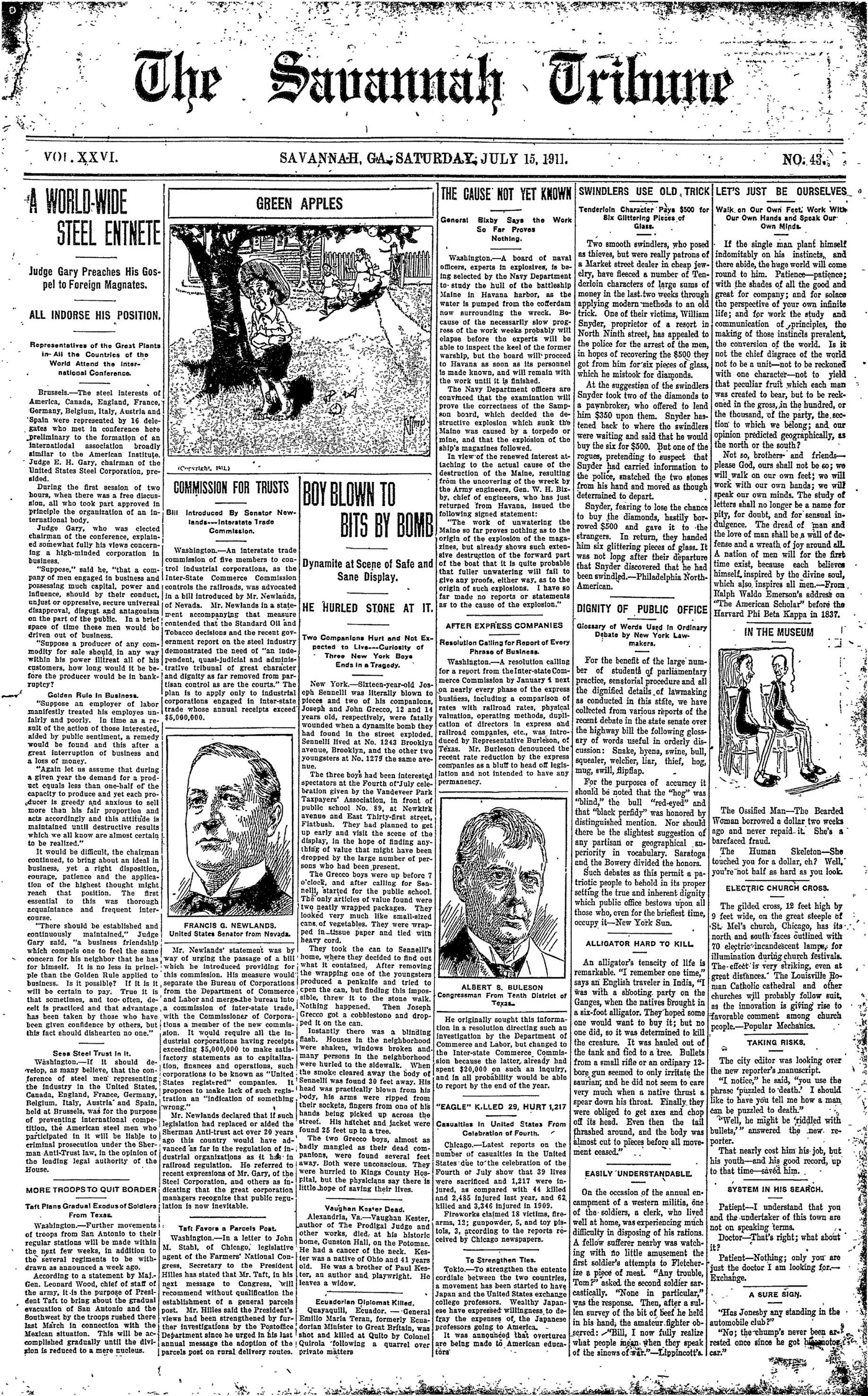
A WORLD-WIDE STEEL ENTNETE
Judge Gary Preaches His Gospel to Foreign Magnates.
ALL INDORSE HIS POSITION.
Representatives of the Great Plants in All the Countries of the World Attend the International Conference.
Brussels.—The steel interests of America, Canada, England, France, Germany, Belgium, Italy, Austria and Spain were represented by 16 delegates who met in conference here preliminary to the formation of an internationalal association broadly similar to the American Institute. Judge E. H. Gary, chairman of the United States Steel Corporation, presided.
During the first session of two hours, when there was a free discussion, all who took part approved in principle the organization of an international body.
Judge Gary, who was elected chairman of the conference, explained somewhat fully his views concerning a high-minded corporation in business.
"Suppose," said he, "that a company of men engaged in business and possessing much capital, power and influence, should by their conduct, unjust or oppressive, secure universal disapproval, disgust and antagonism on the part of the public. In a brief space of time these men would be driven out of business.
"Suppose a producer of any commodity for sale should, in any way within his power illtreat all of his customers, how long would it be before the producer would be in bankruptcy?
Golden Rule In Business.
"Suppose an employer of labor manifestly treated his employees unfairly and poorly. In time as a result of the action of those interested, aided by public sentiment, a remedy would be found and this after a great interruption of business and a loss of money.
"Again let us assume that during a given year the demand for a product equals less than one-half of the capacity to produce and yet each producer is greedy and anxious to sell more than his fair proportion and acts accordingly and this attitude is maintained until destructive results which we all know are almost certain to be realized."
It would be difficult, the chairman continued, to bring about an ideal in business, yet a right disposition, courage, patience and the application of the highest thought might reach that position. The first essential to this was thorough acquaintance and frequent intercourse.
"There should be established and continuously maintained," Judge Gary said, "a business friendship which compels one to feel the same concern for his neighbor that he has for himself. It is no less in principle than the Golden Rule applied to business. Is it possible? If it is it will be certain to pay. True it is that sometimes, and too often, deceit is practiced and that advantage has been taken by those who have been given confidence by others, but this fact should dishearten no one."
Seaa Steel Trust In It.
Washington.—If it should develop, as many believe, that the conference of steel men representing the industry in the United States, Canada, England, France, Germany, Belgium, Italy, Austria and Spain, held at Brussels, was for the purpose of preventing international competition, the American steel men who participated in it will be liable to criminal prosecution under the Sherman Anti-Trust law, in the opinion of the leading legal authority of the House.
MORE TROOPSTO QUIT BORDER
Taft Plans Gradual Exodus of Soldiers From Texas. Washington.—Further movements of troops from San Antonio to their regular stations will be made within the next few weeks, in addition to the several regiments to be withdrawn as announced a week ago. According to a statement by Maj-Gen. Leonard Wood, chief of staff of the army, it is the purpose of President Taft to bring about the gradual evacuation of San Antonio and the Southwest by the troops rushed there last March in connection with the Mexican situation. This will be accomplished gradually until the division is reduced to a mere nucleus.
GREEN APPLES
(Copyright, 191L)
它又
COMMISSION FOR TRUSTS
Bill Introduced By Senator New-lands---Interstate Trade Corporation
Washington.—An interstate trade commission of five members to control industrial corporations, as the Inter-State Commerce Commission controls the railroads, was advocated in a bill introduced by Mr. Newlands, of Nevada. Mr. Newlands in a statement accompanying that measure contended that the Standard Oil and Tobacco decisions and the recent government report on the steel industry demonstrated the need of "an independent, quasl-judicial and administrative tribunal of great character and dignity as far removed from partisan control as are the courts." The plan is to apply only to industrial corporations engaged in inter-state trade whose annual receipts exceed $5,000,000.
B. W.
FRANCIS G. NEWLANDS.
United States Senator from Nevada.
Mr. Newlands' statement was by way of urging the passage of a bill which he introduced providing for this commission. His measure would separate the Bureau of Corporations from the Department of Commerce and Labor and merge the bureau into a commission of inter-state trade, with the Commissioner of Corporations a member of the new commission. It would require all the industrial corporations having receipts exceeding $5,000,000 to make satisfactory statements as to capitalization, finances and operations, such corporations to be known as "United States registered" companies. It proposes to make lack of such registration an "indication of something wrong."
Mr. Newlands declared that if such legislation had replaced or aided the Sherman Anti-trust act over 20 years ago this country would have advanced as far in the regulation of industrial organizations as it has in railroad regulation. He referred to recent expressions of Mr. Gary, of the Steel Corporation, and others as indicating that the great corporation managers recognize that public regulation is now inevitable.
Taft Favors a Parcels Post
Washington.—In a letter to John M. Stahl, of Chicago, legislative agent of the Farmers' National Congress, Secretary to the President Hilles has stated that Mr. Taft, in his next message to Congress, will recommend without qualification the establishment of a general parcels post. Mr. Hilles said the President's views had been strengthened by further investigations by the Postoffice Department since he urged in his last annual message the adoption of the parcels post on rural delivery routes.
SAVANNAH, GA; SATURDAY; JULY 15, 1911.
Wilson
BOY BLOWN TO BITS BY BOMB
Dynamite at Scene of Safe and Sane Display.
HE HURLED STONE AT IT.
Two Companions Hurt and Not Expected to Live---Curiosity of Three New York Boys Ends in a Tragedy.
New York.—Sixteen-year-old Joseph Sennelll was literally blown to pieces and two of his companions, Joseph and John Grecco, 12 and 14 years old, respectively, were fatally wounded when a dynamite bomb they had found in the street exploded. Sennelll lived at No. 1243 Brooklyn avenue, Brooklyn, and the other two youngsters at No. 1279 the same avenue.
The three boys had been interested spectators at the Fourth of July celebration given by the Vandeveer Park Taxpayers' Association, in front of public school No. 89, at Newkirk avenue and East Thirty-first street, Flatbush. They had planned to get up early and visit the scene of the display, in the hope of finding anything of value that might have been dropped by the large number of persons who had been present. The Grecco boys were up before 7 o'clock, and after calling for Sennelli, started for the public school. The only articles of value found were two neatly wrapped packages. They looked very much like small-sized cans of vegetables. They were wrapped in tissue paper and tied with heavy cord.
They took the can to Sennell's home, where they decided to find out what it contained. After removing the wrapping one of the youngsters produced a penknife and tried to open the can, but finding this impossible, threw it to the stone walk. Nothing happened. Then Joseph Grecco got a cobblestone and dropped it on the can.
Instantly there was a blinding flash. Houses in the neighborhood were shaken, windows broken and many persons in the neighborhood were hurled to the sidewalk. When the smoke cleared away the body of Sennelll was found 30 feet away. His head was practically blown from his body, his arms were ripped from their sockets, fingers from one of his hands being picked up across the street. His hatchet and jacket were found 25 feet up in a tree. The two Grecco boys, almost as badly mangled as their dead companions, were found several feet away. Both were unconscious. They were hurried to Kings County Hospital, but the physicians say there is little hope of saving their lives.
Vaughan Koster Dead
Alexandria, Va.—Vaughan Kester, author of The Prodigal Judge and other works, died, at his historic home, Gunston Hall, on the Potomac. He had a cancer of the neck. Kester was a native of Ohio and 41 years old. He was a brother of Paul Kester, an author and playwright. He leaves a widow.
Ecuadorian Diplomat Killed
Quayaquill, Ecuador. — General Emilio Maria Teran, formerly Ecuadorian Minister to Great Britain, was shot and killed at Quito by Colonel Quirola following a quarrel over private matters
THE CAUSE NOT YET KNOWN
General Bixby Says the Work So Far Proves Nothing.
Washington.—A board of naval officers, experts in explosives, is being selected by the Navy Department to study the hull of the battleship Maine in Havana harbor, as the water is pumped from the cofferdam now surrounding the wreck. Because of the necessarily slow progress of the work weeks probably will elapse before the experts will be able to inspect the keel of the former warship, but the board will proceed to Havana as soon as its personnel is made known, and will remain with the work until it is finished.
The Navy Department officers are convinced that the examination will prove the correctness of the Sampson board, which decided the destructive explosion which sunk the Maine was caused by a torpedo or mine, and that the explosion of the ship's magazines followed.
In view of the renewed interest attaching to the actual cause of the destruction of the Maine, resulting from the uncovering of the wreck by the Army engineers, Gen. W. H. Bixby, chief of engineers, who has just returned from Havana, issued the following signed statement:
"The work of unwatering the Maine so far proves nothing as to the origin of the explosion of the magazines, but already shows such extensive destruction of the forward part of the boat that it is quite probable that fuller unwatering will fall to give any proofs, either way, as to the origin of such explosions. I have so far made no reports or statements as to the cause of the explosion."
AFTER EXPRESS COMPANIES
Resolution Calling for Report of Every Phrase of Business. Washington.—A resolution calling for a report from the Inter-state Commerce Commission by January 4 next on nearly every phase of the express business, including a comparison of rates with railroad rates, physical valuation, operating methods, duplication of directors in express and railroad companies, etc., was introduced by Representative Burlison, of Texas. Mr. Burleson denounced the recent rate reduction by the express companies as a bluff to head off legislation and not intended to have any permanency.
A.
ALBERT 8. BULESON Congressman From Tenth District of Texas.
He originally sought this information in a resolution directing such an investigation by the Department of Commerce and Labor, but changed to the Inter-state Commerce Commission because the latter, already had spent $20,000 on such an inquiry, and in all probability would be able to report by the end of the year.
"EAGLE" K.LLED 29, HURT 1,217
Casualties In United States From Celebration of Fourth. Chicago.—Latest reports on the number of casualties in the United States due to the celebration of the Fourth of July show that 39 lives were sacrificed and 1,217 were injured, as compared with 44 killed and 2,485 injured last year, and 62 killed and 3,346 injured in 1909. Fireworks claimed 18 victims, firearms, 12; gunpowder, 5, and toy pistols, 3, according to the reports received by Chicago newspapers.
To Strengthen Ties.
Tokio.—To strengthen the entente cordiale between the two countries, a movement has been started to have Japan and the United States exchange college professors. Wealthy Japanese have expressed willingness to defray the expenses of the Japanese professors going to America. It was announced that overtures are being made to American educators
Two smooth swindlers, who posed as thieves, but were really patrons of a Market street dealer in cheap jewelry, have fleeced a number of Tenderloin characters of large sums of money in the last.two weeks through applying modern methods to an old trick. One of their victims, William Snyder, proprietor of a resort in North Ninth street, has appealed to the police for the arrest of the men, in hopes of recovering the $500 they got from him for six pieces of glass, which he mistook for diamonds.
At the suggestion of the swindlers Snyder took two of the diamonds to a pawnbroker; who offered to lend him $350 upon them. Snyder hastened back to where the swindlers were waiting and said that he would buy the six for $500. But one of the rogues, pretending to suspect that Snyder had carried information to the police, snatched the two stones from his hand and moved as though determined to depart.
Snyder, fearing to lose the chance to buy the diamonds, hastily borrowed $500 and gave it to the strangers. In return, they handed him six glittering pieces of glass. It was not long after their departure that Snyder discovered that he had been swindled.—Philadelphia North-American.
DIGNITY OF PUBLIC OFFICE
Glossary of Words Used in Ordinary Debate by New York Law-makers.
For the benefit of the large number of students of parliamentary practice, senatorial procedure and all the dignified details of lawmaking as conducted in this state, we have collected from various reports of the recent debate in the state senate over the highway bill the following glossary of words useful in orderly discussion: Snake, hyena, swine, bull, squealer, welcher, liar, thief, hog, mug, swill, flipflap.
For the purposes of accuracy it should be noted that the "hog" was "blind," the bull "red-eyed" and that "black perfidy" was honored by distinguished mention. Nor should there be the slightest suggestion of any partisan or geographical superiority in vocabulary. Saratoga and the Bowery divided the honors. Such debates as this permit a patriotic people to behold in its proper setting the true and inherent dignity which public office bestows upon all those who, even for the briefest time, occupy it—New York Sun.
ALLIGATOR HARD TO KILL
An alligator's tenacity of life is remarkable. "I remember one time," says an English traveler in India, "I was with a shooting party on the Ganges, when the natives brought in a six-foot alligator. They hoped some one would want to buy it; but no one did, so it was determined to kill the creature. It was hauled out of the tank and tied to a tree. Bullets from a small rifle or an ordinary 12-bore gun seemed to only irritate the saurian; and he did not seem to care very much when a native thrust a spear down his throat. Finally they were obliged to get axes and chop off its head. Even then the tail thrashed around, and the body was almost cut to pieces before all movement ceased."
EASILY UNDERSTANDABLE
On the occasion of the annual encampment of a western militia, one of the soldiers, a clerk, who lived well at home, was experiencing much difficulty in disposing of his rations. A fellow sufferer nearby was watching with no little amusement the first soldier's attempts to Fletcherize a piece of meat. "Any trouble, Tom?" asked the second soldier sarcastically. "None in particular," was the response. Then, after a sullen survey of the bit of beef he held in his hand, the amateur fighter observed: "Bill, I now fully realize what people mean when they speak of the sinns of war."—Lippincott's.
Walk on Our Own Feet. Work With Our Own Hands and Speak Our Own Minds.
If the single man plant himself indomitably on his instincts, and there abide, the huge world will come round to him. Patience—patience; with the shades of all the good and great for company; and for solace the perspective of your own infinite life; and for work the study and communication of principles, the making of those instincts prevalent, the conversion of the world. Is it not the chief disgrace of the world not to be a unit—not to be reckoned with one character—not to yield that peculiar fruit which each man was created to bear, but to be reckoned in the gross, in the hundred, or the thousand, of the party, the section to which we belong; and our opinion predicted geographically, as the north or the south?
Not so, brothers—and friends—please God, ours shall not be so; we will walk on our own feet; we will work with our own hands; we will speak our own minds. The study of letters shall no longer be a name for pity, for doubt, and for sensual indulgence. The dread of man and the love of man shall be a wall of defense and a wreath of joy around all. A nation of men will for the first time exist, because each believes himself, inspired by the divine soul, which also inspires all men.—From Ralph Waldo Emerson's address on "The American Scholar" before the Harvard Phi Beta Kappa in 1837.
IN THE MUSEUM
The Ossified Man—The Bearded Woman borrowed a dollar two weeks ago and never repaid it. She's a barefaced fraud.
The Human Skeleton—She touched you for a dollar, eh? Well, you're not half as hard as you look.
ELECTRIC CHURCH CROSS.
The gilded cross, 12 feet high by 9 feet wide, on the great steeple of St. Mel's church, Chicago, has its north and south faces outlined with 70 electric incandescent lamps, for illumination during church festivals. The-effect is very striking, even at great distances. The Louisville Roman Catholic cathedral and other churches wjll probably follow suit, as the innovation is giving rise to favorable comment among church people.—Popular Mechanics.
TAKING RISKS.
The city editor was looking over the new reporter's manuscript.
"I notice," he said, "you use the phrase 'puzzled to death.' I should like to have you tell me how a man can be puzzled to death."
"Well, he might be 'riddled with bullets,'" answered the new reporter.
That nearly cost him his job, but his youth—and his good record, up to that time—saved him.
SYSTEM IN HIS SEARCH.
Patient—I understand that you and the undertaker of this town are not on speaking terms.
Doctor—That's right; what about it?
Patient—Nothing; only you are just the doctor I am looking for.—Exchange.
"Has Jonesby any standing in the automobile club?"
"No; the chump's never been arrested once since he got his motor car."
AFRO-AMERICAN CULLINGS
As is usual at this time of the year a large number of young men and women are coming out of the higher graded school, some of them returning to take up higher branches in the schools and some of them to look around to see just where they are going to cast their lots and start out to make a living. It would be well for these young men and women to remember that they have not received an education in the schools from which they have graduated, and received their degree; they have only received the foundation upon which an education can be built if the student so desires. The education will come later, but it will require the same amount, if not more energy to get it than was expended for the foundation in the schoolroom. There has been no change in the law that says a man must earn his bread by the sweat of his face, and if any student coming out of school is going to sit down and expect, because of his or her degree, the world is going to pour its wealth into his lap, he will wake up some day to find he is very much mistaken. Out of the thousands of youth who will make their advent upon the stage of action, none of them will find as many obstacles placed in their way as the colored young men and women, but if they succeed, and why should they not, the greater will be their reward. So while they enter the race, knowing they are handicapped from the start, there is so much more the reason why they should count the cost, and with a determination that cannot be overcome mount up and up until the pinnacle shall have been reached. Let them make up their minds that
"Honor and fame from no condition rise.
"Act well your part, therein the honor lies."
—Afro-American Ledger.
The work that the African Methodist Episcopal church is doing for foreign and domestic missions was told at the annual meeting in New York of the board of missions of the denomination, Bishop C. T. Shaffer of Chicago presided. The third annual report of the secretary of the department, Rev. Dr. W. W. Beckett, showed that the receipts for missions from various sources amounted to $35,000, over half of which was realized from the Easter Day collections. Besides making appropriations for the work of the denomination in Canada, the West Indies, South America, West and South Africa, the board passed a very flattering resolution commending Dr. Beckett's administration of the office of missionary secretary—Charleston Messenger.
In many rural communities in the south, school farms are operated in conjunction with the negro schools. The proceeds from these farm schools is used in most cases to run the school for a month or two longer than the state or county appropriation will allow. In Macon county, Alabama, alone there are 39 such farms, representing 117 acres. Last year $500 clear of expenses was made upon school farms in Macon county, which meant that much money, in addition to the county appropriation, was spent for negro education. More and more each year the negro is learning to increase the school term and improve school houses.—Southern Letter.
The Dallas Express does not advocate negroes preferring each other in business as a matter of prejudice, but in order that the negro may have employment other than that of a menial. The colored store is the hope of the colored salesman. The colored bank and trust company is the hope of the colored clerk, bookkeeper and agent. The colored school and church are the hope of the colored teacher and minister; and so goes the story from one end of the country to the other, and from ocean to ocean in all things above the range of the common laborer or household servant, with exceptions as scarce as angels.
Among the Afro-Americans, as among all other peoples, a big business enterprise of the True Reformer type occasionally fails. But such failures are few and far between. For the moment a large number of individuals may feel that no confidence can be placed in men of color to manage big undertakings. But these spells of despair soon wear out and we continue to lend aid and support to those race enterprises still in operation. Doesn't this prove that we are swinging around to a broader and saner view of life's uncertain activities?—Southern Life Magazine.
There are many hindrances in the pathway of the aspiring negro; but let it not be forgotten that there are open doors that no enemy can close. In the professions, in the church, school, home, and hundreds of industrial avenues, we have a field for our highest activities. No one can prevent the blackest man from living a clear life. No one can rob us of the fruits of a Christian character nor the sweetness of lofty ideals.—The National Union (Washington, D. C.)
John Wilson, a colored man, has been granted by the New Jersey courts the right to the old Wain estate, at Wainford, Monmouth county, N. J., after several years litigation. The property was deeded to him by his former employer, Mrs. Sarah Wain Hendrickson, a member of a socially prominent Philadelphia family, who died in March, 1907. Wilson's right to the property was challenged by Richard C. Wain and other nephews and nieces of Mrs. Hendrickson. Yesterday, however, Vice Chancelor Walker, at Trenton filed an opinion granting the colored man the rights to the property. The case will be appealed, Wilson has been in possession since his benefactress' death. In the wardrobes of Wainford are many fine specimens of old time clothing almost priceless in value.
If the division of the Peabody fund is made according to the plan that was announced several weeks ago, and if a proportionate share according to the Negro's population is made to the deserving youth, more than one hundred thousand dollars will be set aside for the Normal, Agricultural and Mechanical college that is located in Nashville. It has been found, after some investigation, that the money for the Peabody Normal school, such as has been used from time to time for that school, where only whites attend, should have been divided in proportion to the population wherever the schools were separate, between the Negroes and whites, but since there was no distinctly Negro school until recently, it is supposed that this accounts for the failure to divide the fund.
Mr. John G. Muller, a retired manufacturer, formerly of New York, living at Oneonta, N. Y., called his coachman and said: "Grover, I'm a pretty sick man, and you have always been a good boy. I am going to make out a check for $5." "Yes, slr," said Henderson and waited. When he took the check he almost fell over with astonishment when he saw that it read for $5,000. Mr. Muller was so impressed by the man's gratitude that he called Henderson back and gave him another check for $5,000. The coachman has a wife and two little children, and intends to see to it that the $10,000 shall contribute very much to their comfort and happiness. There would be very little conflict between capital and labor, if labor were always thus devoted and capital thus generous.—The Echo.
A number of the leading colored men of Memphis have secured concessions from the Tri-State Fair association and will hold a great fair and industrial exhibition in this city October 5, 6, 7. The grounds of the white fair will be used and many of the exhibits will be left intact. Farmers, business men and the schools will be important factors. There is an educational value to these exhibits. They show what the race has accomplished along all lines and serve as a stimulus and an inspiration to others. Let the progressive citizens get together and make of this one of the largest fairs ever held by our people in the south—Memphis News.
When a backward race gets far enough advanced to attract widespread attention and command a healthy opposition, no better evidence of its progress is needed. When the negro was a slave he had no opposition because he was not in competition with the white man. But 50 years of freedom have brought him to the point where he is debated on in college, written about in the magazines and newspapers, discussed in politics, preached on from the pulpit, argued about in homes and even made the subject of drama. None but a rising people could command all this attention.
The average earnings of graduates and former students from Tuskegee institute is about $700 per year. That of the average negro person is about $300 a year or less. That is to say, an individual from Tuskegee institute, in addition to the habits of thrift and industry which he has acquired, through his increased earning capacity has also much more to invest in property than the ordinary man.
The negro must learn to withstand temptation, to economize, to exercise thrift, to disregard the superficial for the real; the shadow for the substance, to be great and yet small, to grow so strong in skill and knowledge that he shall place his service in demand by reason of his intrinsic and superior worth.—The Progressive Age (Atlanta, Tex.)
The negro must continue to treat the white man with courtesy and politeness, as well as members of his own race. All white men are not negro haters. The negro has many white friends, and if the negro will treat his white friends right they will treat him right.—Little Rock Gulde.
Study not evil against your neighbor, for your enemies have bad thoughts of you.
Curse ye, Meroz, said the angel of the Lord, curse ye bitterly the inhabitants thereof; because they came not to the help of the Lord, to the help of the Lord against the mighty.—Judges 5:23.
It was the custom in ancient times to celebrate signal victories in battles with a song or ode composed for and inspired by the occasion itself. Frequently the representative women composed and led the song. On the successful passage of the Red sea by the Israelites and the overthrow of Pharaoh and his hosts, Miriam, the distinguished sister of Moses and Aaron, led the populace in the famous triumphaf ode, "The Lord Hath Triumphed Gloriously, the Horse and His Rider Hath He Thrown Into the Sea." When Saul and David returned from the slaughter of the Philistines they were met by the women, who flattered David and enraged Saul by singing, "Saul Hath Slain His Thousands and David His Tens Thousands."
On the occasion which gave us the text the Israelites, under Barak, had just gained a signal victory over Jabin, king of Canaan, and they celebrated the victory, according to custom, with a song. Jabin, the king, greatly oppressed Israel through Shera. Barak, instigated by Deborah, an influential mother in Israel, collected the Israelites against him. In this famous battle all the allies of Israel assisted except Merozites. The text is a part of the ode of triumph sung for the occasion. In it curses are pronounced upon the Merozites because of their failure to assist.
We have here for consideration the foe. This foe is called "The Mighty," and his strength and formidableness justify the characterization. The enemy was Jabin, at the head of a powerful confederacy in the northern part of Palestine. At his command was a great army, and he took special delight in harassing Israel on account of former grievances. In his employ was one of the distinguished generals of history—Sisera. That he was intrusted with the command of the army indicates his eminence. In those times kings alone were considered adequate to so important a trust. Sisera had charge of Jabin's army. His skill and success give him rank with such warriors as Joshua, Alexander, Caesar, Washington and Napoleon.
* Under him was a vast army. Joseph phus gives the number as three hundred thousand footmen, ten thousand cavalry, three hundred charlots and nine hundred iron war charlots. These last were equipped with huge iron wings and were driven, with the horses at full speed, into the ranks of the enemy, mowing them down like a scythe, or crushing them juggernautlike under their heavy wheels. This foe Barak had to face with barely ten thousand men. He needed every one that could be mustered. His call was urgent because the demands were great. Meroz failed to respond. Just so, the church today faces a formidable foe. Her enemies may appropriately be designated "The Mighty." She has to battle with:
1. Worldliness.—Worldliness, like a mighty deluge, has inundated the earth. So deeply has it submerged the society of this age that the summits of the highest mountains are scarcely visible and the tide is still rising. Instead of men turning to God and the right, they are getting farther and farther away. To vary the figure wickedness, like a mighty confession, is spreading-forest-like, over this fair land, consuming in its progress the very foundations of morals and religion. All classes are growing lax in their duties to God and the church. The old are too weak and tired to attend to religious duties; the middle-aged are too busy in quest of wealth and fame to pause to consider their souls' interests; the young are too much engaged in the pursuit of pleasure to find time for serious matters.
2. Scepticism. There is much destructive criticism abroad. Men eminent for learning and plenty are expressing blatant doubt as to the very sources of the Christian system. All this and much more the church has to face. She needs every member at his best. She calls to every one of them to come to the "help of the Lord, to the help of the Lord against the mighty," as did Barak in ancient times.
We consider next the failure of Meroz to respond. The call came; it was urgent and loud, but Meroz turned a deaf ear. Meroz was a province in the northern part of Palestine. Some of the chosen lived there. The offense of the Merozites was simply indifference and inaction. They were not open opponents of Israel; they did not take up arms against Barak and his army. They did not even give their moral support to the enemy. So far as we know, they actually sympathized with Barak, and, no doubt, secretly rejoiced when his arms were victorious. They merely stood hands off while the conflict raged. Instead of giving their aid.
Multitudes today, like the Merozites, are indifferent and inactive. While the church fights on they are inert, but when the victory comes they are glad, and it would not be unlike human nature for them to claim the credit and talk loudly about what "we" did. The position of the Merozites pos-
sibly had something to do with their attitude in this warfare. The northern part of Palestine, their home, was on the border between the enemy and their friends. Policy dictated that they be careful. If the enemy prevailed, they might need their friendship. If Israel prevailed, all would be well, and good any way they argued. They were like the steward of the parable, who made himself friendly with his master's debtors, that when he was puf out of the stewardship he might be taken in by his enemies. How like to many church members is this attitude! They want to carry the world and the church both at once. They want to be on friendly terms with both sides. They wish to maintain a position of neutrality, which is impossible. In religion there is no neutral position.
What did Morez do to merit the curse of God. Nothing. That was their crime. Their position of neutrality constituted their offense. By inaction Meroz became an opponent. When God and the church need your best and you withhold it, it is the same in effect as open hostility. According to the Master's own dictum, "He that is not with me is against me; and he that gathereth not with me scattereth abroad."
We have, in conclusion, the results of Meroz's failure to respond. "Curse ye Meroz, said the angel of the Lord, curse yet bitterly the inhabitants thereof." The curses of God are dreadful. "It is a fearful thing to fall into the hands of the living God." We have some recorded instances of God's curses. Sodom and Gomorrah. These were flourishing cities at one time. The center of population, wealth, culture, prosperity. After the curses came upon them they were no more. One of the most fertile plains on earth was changed into one of the most desolate and barren. The barren fig tree affords another instance. One day it was beautiful and flourishing, the next it was blighted and soon perished. Meroz disappeared from history. The place that once knew it knows no more. In all these cases God's curses meant total destruction. Thus the danger of Indifference is great.
VALUE OF NEW IDEAS.
Some large business firms employ a man whose sole duty it is to read every trade journal, every technical paper or pamphlet and every magazine in order to get new ideas about the conduct of their business. Such information is laid each day before the heads of the various departments, who in turn pass it down the line to men under them and see that the new idea is tested. By this means each worker is kept in touch with what other men are doing in his particular line, and so his personal efficiency is increased. Almost everything can be done in a manner a little better than the present way, and modern business demands to know and practice the best. Dlogenes carried around a cup to drink water out of till one day he saw a dog lapping water with his tongue. He threw away his cup and afterward drank water out of the palm of his hand. He got from the dog a new idea—Louisville Courier-Journal.
SYMPATHY AND THE SERVANT
PROBLEM.
Sympathy has been tried in the ever difficult servant problem and in many households it has solved the burning question. Women ought to look at life and its duties from the servant's point of view, says Home Notes. The result is often that sympathy and kindness is engendered in this way by stopping to ask: "Should I like it?" "Is it just?" "Can it be reasonably expected?" And, if the mental reply as to whether sympathy will be appreciated is in the affirmative. It will gain its reward in the good will of those to whom it is shown.
THE RETORT QUARRELSOME.
One day a distinguished notary while breakfasting with a friend at a cafe in Paris indulged in some stinging comments on the public acts of Marshal Marmont. Suddenly another gentleman, dining at another table, arose and approached them, his musache bristling with anger, "Sir," cried he tragically, "you shall give me satisfaction!" "Are you Marshal Marmont?" quietly asked the notary. "I have not that honor," was the indignant reply, "but I am his chief aid-decamp." "Give me your card, then, sir," said the notary, "I will send you my head clerk."—Exchange.
GOLD THAT BLACKENS.
Blackening of cuffs and shirt fronts by the rubbed-off gold is a matter of much annoyance to jewelers when their customers come back, thinking they have bought brass. The skin on the neck as well as on the fingers is frequently discolored by 14-carat, 18-carat and, some say, pure gold. An expert says that even in the case of pure gold this coloration of the skin is not due to any particular properties of the metal, but, rather, is the result of chemical changes in the body or, rather, in the perspiration and natural oil of the skin.—Exchange.
USE OF CANDLE SHADES.
The candle shades of paper made with a black pasteboard frame work, suggestive of the mission style, are very effective when used on an electroller. For bedroom or desk use these inexpensive shades answer admirably in place of the more expensive ones which come designed specially for the incandescent bulb.
Have you a frock of cashmere, cloth or silk that is too good to fall into disuse and too old to wear in the early spring of this year? To the clever and practical woman there comes a suggestion that is modish, nexpensive and easily carried out. It is black satin, a material that is decidedly in vogue.
When selecting this new fabric for your old gown do not choose a shiny, stiff satin. The supple liberty weaves are the ones that will most satisfactorily carry out the idea.
Satin can be used always as pipings or facings in later seasons. It is excellent for hat linings, also, when it has served its time on the outside of a frock.
If you have a checked volle or cloth dress, the first sketch shows a charming metamorphosis that will result by adding black satin. A bolero of the new material is made. It extends for a short space over the sleeves in caps. The top is round and and drops over a yoke of lace. A sash of black satin defines the waist line, tying in a flat bow at one side and hanging in two ends to below the knees. A hem, about six or eight inches in width, edges the skirt. If the material be supple, the skirt can be gathered at the waist line; otherwise, a gored model is the better.
A dark navy blue cloth is allied with black satin, as shown in the second model. A waist that needs a long shoulder line can be successfully given it by applying the band of black as shown. The pieces at the sides are placed over the shoulder seams and extend beyond the armholes. Wide bands are placed on the sleeves above the hem, and black braid is used to trim the bodice and skirt. A slightly raised line is shown at the waist. The circular skirt is trimmed with a broad satin band and a line of braid.
The new collar is shown on the striped costume worn by the central figure. It is the sailor collar in its extreme exploitation, falling over the top of each sleeve and cut to form a straight band across the front.
Cuffs and belt of satin are easily applied. The allover lace yoke is of the convenient type that can be removed. A deep hem of black finishes this chic little walking dress. Any striped material can be used to your advantage if the model be taken for your guilding star.
Last year's foulard can be made up to date by using black satin and buttons. A circular yoke extends over the shoulders and is trimmed with white buttons and an Irish lace collar. The half length sleeves are edged with straight cuffs. There is again the hem of black that will lengthen an old skirt that has become, worn at the edges and is too short if allowed to be untrimmed.
Plain serge is used in the last suggestion. The combination with black is simple and effective. It is a broad strap effect that is much used in serviceable frocks. Straight bands are placed over the shoulders, and a short connecting band crosses at the lower edge of the lace yoke. The blouse is full and gathered into a straight band of satin. Turned-back cuffs edge the three-quarter sleeves, that are made in the scanty kimono style. A band of black is inserted at the lower edge of the skirt.
Black satin is the open sesame to a stylish remodeling of an old gown. Surely the convincing array before you will lead you to emulate a mode, that has taken Paris by storm, and well deserved is the popularity of the serviceable trimming.
FASHION NOTES.
Buttons will match the dress in color.
Taffeta is much used for evening gowns.
Waist lines are high and big—no wasp waists this year.
Many of the new belt buckles imitate the buttoned effect.
Etamine is extremely popular in every degree of weave.
Plain leather belts are fashionable, especially in black and white.
An effective material for summer dresses has a border done in bead effect.
Striking is a white cotton marquisette bordered in a design of yellow wheat.
Wide colored ribbon and narrow widths of silk are used in all sorts of sash effects.
The charming narrow, detached train remains with us for at least another season.
Wide bands of lace finished with a border of ribbon are much used to trim skirts or tunics.
The sailor collar, which is very deep at the back and hardly exists at all in front, will be shown in our summer gowns.
TO GET RID OF BEDBUGS.
For mild infestations, a number of common remedies are quite effective. One of the best is a liberal use of gasoline. Pour it over the cracks in the mattress and about all the cracks and crevices of the bedstead. Do the work thoroughly and pour in sufficient to fill every crack. Wherever this fluid comes in contact with eggs or insects they will be killed. The gas is explosive, however, and must be used during the day and when there is no danger from fire in stoves, lamps, or cigar. Benzine will serve the same purpose. Kerosene will do equally well, but leaves an oily condition which is quite undesirable.
Where the insects infest cracks of the floor and walls of the room it may be necessary to resort to methods of fumigation. Brimstone burned at the rate of a pound to a thousand feet of space hgs been used with success. The vessel containing the burning brimstone should be placed in a tub of water or pall of sand to prevent the escape of fire, and the room kept closed for 24 hours. Sometimes buildings are so badly infested that it is necessary to resort to fumigation by hydro-cyanic acid gas, but this should only be undertaken by experienced persons on account of the deadly nature of the substance used.—S. Arthur Johnson, Colorado Agricultural College.
COOKING HINTS.
If cooking dishes are so unfortunate as to be burnt, soap them in soapy water, adding a little washing soda or washing powder and let stand for half an hour. Then pour off the water and wash. Aluminum dishes should not be scraped with a knife, but soaked and then washed carefully and cleaned with fine scouring soap or whiting.
Put custard cups, eggs or cheese dishes and chocolate pans to soak in cold water first. Greasy pans and kettles may be helped by wiping with paper before washing to remove all extra grease. Baking pans used only for bread and cake, or cooky sheets, are better not to be washed at all unless burnt, but wiped inside and out with a clean, dry cloth while still warm. Use the same treatment on bright tin covers.
When all the dishes are dried and out of the way, wash and dry the pan, dish mops and drainer, then wash the sink with hot water, scouring soap and a brush, rinsing it with boiling water. Leave everything dry and in their respective places, with the satisfied feeling of a task well accomplished.
ACTIVE WOMAN KEEPS YOUNG.
The longest-lived men are those engaged in healthy outdoor occupations, such as farming, simply because they lead an active, muscular life in the open air. Bodily activity keeps at bay the diseases of sedentary middle life. Gout and rheumatism lie in wait for the many who do not walk five miles in the week, who hate games and believe that golf is "waste of time." It is the active, busy woman who keeps her complexion when she is past 40 years of age, and girls 20 years her junior grow sallow and anaemic for lack of outdoor exercise, says Woman's Life.
You must live a sedentary life, you say? I don't believe it. Even if your day is spent in an office or a shop, you have the early morning for a "tub" and 20 minutes with dumbbells. You have your evenings, and you have your week-ends.
FOR A NORTH ROOM.
It is often difficult to know how to brighten a room facing north.
I first, in one of our rooms that face that way, tried banishing curtains altogether, to let the light in, but soon found that it is not only light that is needed but sunshine; so I determined that even if I couldn't have a real thing, I would get the effect of it at any rate, says Home Chat.
I had the room tinted a soft yellow shade, shading off to an almost creamy tint for the ceiling. Pretty, short, soft yellow curtains framed the window, but were not drawn over it in the least.
I put a pretty brass flower pot with a fern in it in a dark corner and it quite transformed it. Brass firelrons, candlesticks and ornaments also helped to give the room a cheery appearance, and soon the dull room was dull no longer.
COCKROACHES.
A powder made by thoroughly mixing sweet chocolate and borax is said to be very effective against cockroaches. The powder is simply spread over the pantry shelves, the roaches are attracted by the sweet chocolate, but in eating it get the borax also, and soon die. An even more effective roach food is made by mixing 1 to 2 per cent of phosphorus with flour paste and spreading the resulting paste on soft bread. The bread is scattered near where the roaches are thickest, attracts them, and kills all that eat thereof. Another remedy is to burn pyrethrum powder in infested rooms. The vapor is fatal to cockroaches.—Wallace's Farmer.
C. S. A. SEAL
REMAINS HIDDEN
At Fall of Richmond It Was Put Away by Jeff Davis' Faithful Servant.
BENT WITH AGE, JAMES JONES VOWS THAT HE IS STILL TRUE TO TRUST. IDOL WITH SOUTHERNERS
WHO PUT FAITHFUL NEGRO ON A GOOD SALARY AND GIVE HIM AN INDEFINITE LEAVE OF ABSENCE.
Washington, D. C.—Senators and congressmen, as well as students of history, are puzzled over as well as interested in the story of the great seal of the south as told by James H. Jones, once bodyguard of Jeff Davis, president of the southern Confederacy, and now, though age bends him low, an idol of the southern element that is so loud a factor in the life of the national capital. Next to a "hurrah for the gray, down with the negro" orator, the south dearly loves a colored man who calls himself a "Confed."
There are few persons in the United States today more interesting than James H. Jones, the negro who served through the Civil war as a bodyguard and personal servant to Jefferson Davis. Probably, also, there is no man who has adhered with greater tenacity to a promise than this aged man, who time after time has refused to disclose the secret of where he hid the great-Confederate seal, just before Richmond was evacuated, although museums, patriotic societies and public-spirited individuals have offered him small fortunes for his knowledge.
Made to take a solemn oath by President Davis that he would hide the seal in some spot where it could not be found and never disclose its whereabouts, Jones has been true to his trust to today, and he declares that there is not enough money in this world to tempt him to break his trust. Jones, who is part Cherokee Indian, is a stanch Confederate, probably for no other reason than Jefferson Davis was the head of the cause. Regarded highly by his employer, honored by Mrs. Davis and treated as a friend by the children of President Davis, all of whom, with one exception, he has carried to their last resting place in the family plot in Richmond, the suggestion that he give or sell the secret brings tears of righteous indignation into the old man's eyes. Bent almost double with age and barely able to walk from one end of the room to the other, and well-nigh penniless, he, however, had his reward for his loyalty in the friendship of the most prominent southerners in the United States senate today.
Through the influence of these friends he was appointed to the stationery room in the senate wing of the capitol, and although his health has prevented him from attending to his duties for over two years, he has been allowed indefinite sick leave on full salary.
Jones was born a "free" man more than eighty-two years ago. His childhood was spent in the town of his birth, Raleigh, N. C., where he lived until the death of his father, James H. Jones. Then leaving his mother, who was almost a pure-blooded Cherokee Indian, he started in to earn his own living.
While working in the old St. Charles hotel in New Orleans in 1859 Jefferson Davis took a liking to him and engaged him as personal servant and bodyguard. From the first day of his employment Mr. Davis imposed the utmost confidence in his valet, and though Jones had been called a trusty servant by many of his former employers, he never enjoyed quite so much confidence as that which Davis placed in him. It was this which brought about, he says, his great faithfulness to the Confederate leader.
From the moment that the first gun of the Civil war was fired at Fort Sumter until he was released from Fort Monroe, where he had been imprisoned with his employer, Jones never left President Davis, except on the one occasion, shortly before the fall of Richmond, when Mr. Davis sent him with Mrs. Davis and the children, together with about $13,000,000, to Charlotte, N. C. After taking Mrs. Davis and the children there, he hauled the money around in a freight car, he says, from place to place through the south until he was relieved of his charge by Capt. Parker, near Washington, Ga.
After he had been relieved of his charge in Washington, Ga., he returned with all haste to Richmond, where he helped President Davis prepare for the last flight. They fled from the fallen Confederate capital together, generally traveling by night. Mr. Davis and his servant encamped on the night of May 9, 1865, not far from Irwinsville, Ga. The next morning when breaking camp, Jones packed Davis' cane, which Davis was going to abandon, though he carried it all through the war. When they were captured in Irwinsville, May 10, Jones managed to keep the cane and
carried it with him to Fort Monroe, where both were imprisoned. When he was released from the prison Jones took the cane to Mr. Davis. He continued to visit Mr. Davis until the latter's release from Fort Monroe, about two years later. Shortly before Mr. Davis' death Jones served him for some time at his last home, in Beauvoir, Miss., leaving his service later. When President Davis' body was carried in state from Beauvoir to Richmond, Jones drove the hearse through the principal cities en route at which places services were conducted in the dead leader's honor. He also drove the hearse in Hollywood cemetery funeral at Richmond.
Shortly after the funeral Mrs. Davis presented him with the cane, which he had saved. The cane, with the handle bound with a thick silver band, bearing the inscription, "To James H. Jones, in recognition of his faithful service, from Mrs. Jefferson Davis," he still treasures.
"If I could tell the hiding place of the greater Confederate seal," said Jones, "without violating the confidence reposed in me by Mr. Davis I would be very glad to see the seal of the Confederacy in some museum in Richmond or Raleigh, N. C. No money consideration, however, could for a moment influence me in this matter. I love the memory of Mr. Davis and his family too devotedly to think of any such transaction. I am not made out of that kind of material. I have in my veins a good streak of Indian blood, and, you know an Indian detests a lilar and a thief. I would be nothing less than both did I do otherwise than I am doing. It does not matter how many offers are made, or how large the amounts, James Jones will never entertain them."
"Do you believe that you could recover the seal today?" he was asked. "I feel entirely satisfied that I can; but I never will. I never did deceive Mr. Davis, and now that he is dead I am sure I shall remain true to the implicit confidence he always placed in me, almost from the first day I entered his employ.
"I am satisfied that no duplicate was ever made of this last great seal of the Confederacy," he continued, "but there are duplicates of the one used before the last one reached Richmond from England—the one which Mr. Davis intrusted to my care. I have been told that the first seal used in the Confederacy was engraved on a piece of boxwood in Montgomery. I think that is a matter of history.
"The second seal, of which duplicates were made, was the one manufactured in either Baltimore or Washington. I assisted in unpacking the box in which it came to Richmond. There was a splendid flag in the box also. My recollection is that this was in 1862, in the early part of the year. This seal did not weigh more than one pound, and I know that while Mr. Davis and his cabinet were pleased with the workmanship, the seal did not, in some way, meet their expectations.
"The following year, 1863, the big great seal came from England, the schooner Fanny bringing it to Wilmington, from where the seal was sent to Richmond. I again was one of the men who aided in unpacking the box. The seal was in a rosewood box, something after the style used in those days for duelling pistol cases. The box was trimmed and inlaid with pearl and ivory, and the seal was an immense silver affair, weighing fully 10 pounds. It was unlike the great seal made in Washington or Baltimore, but the inscription was the same—the wreath of corn, cotton, wheat and scrolls. Our officers had a wreath for their caps almost like it."
"It was the general belief for many years that the last great seal of the Confederacy 'was captured by the northern army when it swooped down on Richmond, and that it was turned over as one of the trophies of the war to the war department' at Washington. Such was not the truth, and the fact is that the Yankees got powerful little of value in Richmond which belonged to the Confederate government.
"When Mr. Davis realized that it was but a short time until Richmond must fall, he sent me with Mrs. Davis—God bless her memory—and the children to Charlotte, N. C. I had about $13,000,000 under my care, and hauled it around in a freight car from one point to another in the south, until Captain Parker, of Newberry, S. C., relieved me of it at a point near Washington, Ga., where it was buried.
"And you will never entertain an offer to recover the seal which you bid?" he was asked finally.
"Not as long as my name is James Jones and the good Lord gives me power to know right from wrong," he declared. "No, sir; not for any consideration could I be induced to change my determination about this matter."
Everybody, however, doesn't believe the story told by Jones. The Sun suggests that the old man has forgotten, if he ever knew, what became of the great seal, and is ashamed to confess it. In the following letter printed in the Times of this city, W. McK. Darwood fatly contradicts Jones' story: In an article headed "Bailey Defends Secession," it was stated that a certain negro, James A. Jones, who served as Mr. Davis' body servant, was the only man living who 'knows where the seal of the Confederate states is, and won't tell. This is not warranted by facts. On the 2d of September, 1892, I visited Trinity Library, Cambridge, England, and was there shown 'the great seal of the southern Confederacy, presented by Judah B. Benjamin,' and I have no doubt it is there yet."
They Have a Flavor All Their Own, "the Effect of Climate."
BRANDS OF OTHER LANDS
THE BEST OF THE FRENCH BULLS ARE ACTED, NOT SPOKEN—BOME DROLL EXAMPLES OF THE ITALIAN, PORTUQUESE, DUTCH AND GERMAN.
Sir Richard Steele explained why his countrymen made bulls: "Tis the effect of the climate, sir. If an Englishman were born in Ireland he would make as many," sald he. It is not every one who knows a bull when he sees her. It may be no bull, but merely a blunder—a betise, as the French have it. To make sure that we have the true criterion let us first set down a few of the genuine, orthodox Irish kind:
He built the wall wider than it was high, so that when it fell down it should be higher than it was wide.
Two weary and footsore Irishmen come to a milestone, ten miles to Dublin. "Arrah," says one, "tis but five miles apiece."
Disputing of the date of St. Patrick's birthday, "He couldn't have had two unless he was twins."
An Irish sailor reported that in Philadelphia they copper buttomed the tops of the houses with sheet lead.
Give me the loan of a hatchet to saw an empty barrel of flour in two to make the dog a pigpen.
His estate is divided by impenetrable furze ditches made of quarried stones set on edge.
An Irishman, describing a glorious fight, said: "There was only one whole nose in the house, and that was the taypot's."
In these and in hundreds like them we have the true flavor of the Irish bull.
There are genuine bulls in French, but they are rare. The genius of the language does not lend itself to anything less than neat precision. A French bull is usually nothing more than a betise. Still, French bulls exist.
Leon, bishop and Count of Lisleux wrote to the Duchess of Brissac as follows:
"Madame, knowing how fond you are of red partridges, I send you herewith half a dozen. Three of them are gray, and one is a woodcock. You will find this letter in the bottom of the basket."
A Frenchman used a large stone jar for a pillow, explaining that it was not hard because he had stuffed it full of hay.
The very best French bulls are acted, not spoken. The Duke de St. Simon relates that a lady, lying ill, was much disturbed by the ringing of the church bells. To deaden the noise her lover had the street in front of her house laid with straw.
A spoken bull in French is apt to be something different from the Irish variety, something more like a betise, as has been said. And it is difficult to retain the flavor in translation. "Ce sont toujours les memes soldats qu'ils font tuer," says Marshal Bugeaud of his army. This loses a little when one translates, "It is always the same soldiers who get themselves killed." "En fait d'inutilites il ne faut que le necessaire" is more highly colored in the French than in its translation, "Only so many useless things are required as are strictly necessary." Here is the translation of part of an Italian letter:
"We have had a most famous earthquake. If by the mercy of God it had lasted for another half hour we should all have gone to paradise, from which may God deliver us. Whether you receive this letter or not, please advise me in either case."
Here is a Portuguese bull. In offering a reward for the recovery of the corpse of a drowned man his relatives remarked that the deceased might be identified, if found, by a slight impediment in his speech.
After much research it has been so far impossible to discover a genuine Spanish bull, but here is a Dutch bull:
"The pig had no marks on his ears except a short tail."
And here is a German bull:
"Der Zahn der Zelt, der alle Thranen trocknet, wird auch uber diese Sache Gras wachsen lassen" ("The tooth of time, that wipes away all tears, will permit grass to grow over this matter also"). Blunders in English speech are not uncommon. The orthodox hull of Ireland has scarcely crossed the channel. A fellow of the Royal society speaks of "the earthquake that had had the honor to be noticed by the Royal society."
"The West Indies will now have a future which they have never had in the past" sounds promising until one sees that its bullish quality is a mere blunder by which the word "opportunity" was omitted. There is none of the flavor of the famous definition of salt by the Irish schoolboy, "Salt is that which makes your potatoes taste nasty if you don't put it in."
Even the best of the foreign bulls in Latin tongues evoke the suspicion that they are mere translations from Irish originals. The Dutch, the Germans and perhaps the English may have the genuine article at times. No distinctively American bulls have emerged from the long research that is the foundation of these few paragraphs—New York Sun.
Now for your name on our list under the 1911 Subscription Offer.
ITH THESE you may order any one of the alternate free magazine offers of Human Life, of Boston, Mass.; McCall's Magazine, of New York, or Southern Ruralist, of Atlanta, Ga., or "Talks from Farmers to Farmers," a 16-page folio of farm wisdom. Your choice of only one and both newspapers for only $1.75.
The Tri-Weekly Constitution Monday, Wednesday, Friday--Three Times a week: The newsiest, best, brightest and biggest newspaper. Almost a daily, yet at the price of a weekly One Dollar a Year
The Tri-Weekly Constitution presents, at one sweeping view, the whole area of events. The news of the county, state, nation and the world is given in each complete issue. Each week the departments of Farm and Farmers, Woman's Kingdom, Rural Free Delivery, Poultry and others of wide interest, edited by experts, appeal directly to those addressed.
If you want The Tri-Weekly Constitution alone, without any clubbing offers, you can get it at $1.00 per year by addressing The Constitution, Atlanta, Ga. One sample copy sent free on request, giving with it the names and addresses of six of your neighbors.
A club of 40 or 50, or more, will keep a R. F. D. route above the minimum average required for daily mail service. It is the great news purveyor of the whole Southland, as good in the gulf states as on the Atlantic se aboard.
Clubbed with The Atlanta Constitution, we have the superb FREE OFFERS shown from which you may make your choice of one:
(1) "TALKS FROM FARMERS TO FARMERS," a symposium of Southern farm knowledge that should be in the hands of every practical farmer, young or old. The articles have all appeared in Tri-Weekly Constitution under same title and made one of the great est features of this splendid farmers' paper. It will be mailed to you immediately upon receipt of order.
(2) THE SOUTHERN RURALIST, one of the best agricultural papers in the South. It is a semi-monthly, edited by a farmer on his own farm, and is intensely practical and helpful.
(3) HUMAN LIFE, of Boston, Mass., giving current and interesting biography. It is about folks—people living in the public eye now—that you want to know something about. It has not a dull line in it.
(4) McCALL'S MAGAZINE, of New York, the queen of the home fashion monthlies, very helpful to the mother and the homekeeper. It is just what you want.
Remember, our own paper one year and THE TRI-WEEKLY CONSTITUTION Monday, Wednesday and Friday, three times a week, for one year, and your selection of one from the alternate free offers, all for $1.75.
The Oldest, Strongest and Most
Reliable Company in the State.
Gives employment to hundreds o
men and women of our race.
Pays from $1 to $10 weekly sick and
accident benefits and from $10 to $10
death benefits. Our Motto: "Prompt
ness, Honesty and Justice."
Home Office:
1143 Gwinnett St. Augusta, Ga.
For further information write 505
West Broad St., Savannah, Ga.
J. S. Perry, Supt.
A. B. Singfield Gen. Supt.
C. T. Walker, D. D., LL. D.
Director and General Lecturer.
Their Ideal Realized
For more than a dozen years the dream of the Manager of the
Negro Industrial Insurance, which does not only cause this Company to handle more than a million dollars annually, but they have made it possible for other similar concerns operated by our people in the South to do a successful business, which was once controlled absolutely by another race. For these and other sane reasons, we urge that you take out a policy today. Call one of their agents or phone the local manager of the Savannah district.
Secretary and General Manager 110 Auburn Ave., Atlanta, Ga
CHICKENS
DUCKS
TURKEYS
Wholesale and retail dealer in Live and Dressed Poultry Game in Season. Special attention given to picnic orders. All orders delivered free of charge. Stall 12 City Market. Phone 2733.
GAREY'S
Variety Bakery.
Goods delivered promptly to any part of the city.
100 West Broad Street, Near Gaston
Phone 1331-L.
$1.75 Now
THE TRI-WEE
THE SA
WITH THESE you
Human Life, of
Ruralist, of Atlas
W
Between Hull Street and Oglethorpe Avenue
Johnson Undertaking Establishment
COMBINE WITH
The Royal Undertaking Company
(Incorporated.)
Funeral Directors and Embalmers
Finest line of Coffins, Caskets and Robes. White and black funeral
cars. Office and warerooms 315-331 Jefferson street.
W. R. FIELDS, Manager.
Residence Phone 3032. Livery Stable Attached. Office Phone 678
J. H. ULMER, Residence Phone 3064.
234 ST. JULIAN ST., WEST, 235 BRYAN ST., WEST. Phone 2968. SAVANNAH, GEORGIA.
In addition first class rooms, barber shop, hot and cold baths and automobile service at any hour, day or night. In all of our departments we give first class accommodation. Call and see our rooms while visiting the city at 109 Jefferson street, just a half block from Broughton St. car line going south on Jefferson Ask any hackman.
Palm Shaving Palace
FINEST IN THE CITY.
Expert Hair Cutting, Electric Massage and Work Done by Experienced Workmen. COURTING PARLOR ATTACHED.
PERRY R. WRIGH
617 WEST BROAD ST., — — — —
If you hesitate to wear Shoes that have know our kind of repairing. We do every first class condition—rebutton, straighten, pair breaks, put on rubber heels or soles. See us before going elsewhere.
J. H. WASHING
SHOEMAN
309 WHITAKER
Now for your name on our list under the 1911 Subscription Offer.
WEEKLY ATLANTA CONSTITUTION
and
AVANNAH TRIBE
If you may order any one of the alternate forms of Boston, Mass.; McCall's Magazine, of New Atlanta, Ga., or "Talks from Farmers to Farmers." Your choice of only one and both news.
Weekly Constitution Monday, Wednesday, Three Times the highest and biggest newspaper. Get at the price of a weekly One Dozen.
Constitution presents, at one sweeping view of the county, state, nation and the world is give departments of Farm and Farmers, Woman's Owns of wide interest, edited by experts, app.
Tri-Weekly Constitution alone, without any year by addressing The Constitution, Atlanta, giving with it the names and addresses of some Nation Is the Paper For Rural Free Distance, or more, will keep a R. F. D. route above service. It is the great news purveyor of this as on the Atlantic se aboard.
The Atlanta Constitution, we have seen from which you may make your Farmers TO FARMERS," a symposium of Southern practical farmer, young or old. The articles have all been made one of the great est features of this splendid upon receipt of order.
N RURALIST, one of the best agricultural papers on his own farm, and is intensely practical and he of Boston, Mass., giving current and interesting biogues now—that you want to know something about.
AZINE, of New York, the queen of the home fashion keeper. It is just what you want.
WRIGHT,
ear Shoes that have been being. We do everything button, straighten, or alter heels or soles, elsewhere.
WASHINGTON HOEMAKER
309 WHITAKER ST.
your list under Offer.
TA CONSTITUTE
H TRIBU
the alternate free magazine, of New York Farmers to Farmers," and both newspapers.
Monday, Wednesday, Three Times a week. One Dollar.
one sweeping view, that the world is given in our farmers, Woman's Kingdom by experts, appeal direct, none, without any club institution, Atlanta, Ga. and addresses of six of yrs Rural Free Delivery.
D. route above the news purveyor of the whole, we have the skill make your choice.posium of Southern farm kris articles have all appeared sources of this splendid farm agricultural papers in the Society practical and helpful. and interesting biography. something about. It has man of the home fashion most.
Expert Hair Cutting, Electric Massage and Shampooing a Specialty. All Work Done by Experienced Workmen. Courteous attention to all SHINING PARLOR ATTACHED.
PERRY R. WRIGHT, Proprietor
617 WEST BROAD ST., --- --- --- SAVANNAH, GA.
If you hesitate to wear Shoes that have been repaired, you don't know our kind of repairing. We do everything needed to footwear in first class condition—rebutton, straighten, or alter heels, sew up rips, repair breaks, put on rubber heels or soles. See us before going elsewhere.
OUR GREAT PROPOSITION
own paper one year and THE TRI-WEEK and Friday, three times a week, for one year free offers, all for $1.75. Get right on. Don't miss a copy. 'Addre THE SAVANNAH TRIBUNE, Savann
E. TRI-WEEKLY CO
k, for one year, and y
copy. Address all
BUNE, Savannah, G
$1.75
The Sahawanth Tribute,
Remittance must be made by Express or Post Office Money Order, or Registered Letter. Advertising rates given on application. Entered at the Post Office at Savannah, Ga., as Second-Class mail matter.
The arrest on Wednesday of a white man for furnishing Negroes with cocaine might well be followed up with strict watchfulness by the authorities for there is no practice which is more damaging to the human system than the cocaine habit. A few years ago in a northern town this habit was found to be gradually taking hold of a large number of Negroes of the underworld and as a result scores of them were found upon investigation with undermined constitutions and on the verge of lunacy. It took years for the authorities in this town to break up the habit because they allowed it to get a strong hold, but we are pleased to note the quick suppression of the practice here and trust that the authorities will not relax their vigilance along this line.
That Mayor Tiedeman's schedule of opening certain squares of the city by a roadway for traffic along the car tracks did not receive any consideration a few days ago at the hands of council may well be looked upon with favor by the citizens of Savannah and it is hoped the members of the city council will find it inopportune for many years to come ere they decide to mar the beauty of the city by running a traffic roadway through these plots. The natural restfulness to the eyes which these squares give one as he looks upon them is well worth their preservation in their present form, aside from the fact that as they are now they are free from the many dangers which will arise if car tracks are allowed to be placed through them. Savannah in proportion to her size has a greater number of squares than any city in the country and they are a source of much admiration to the thousands of visitors who come here every year and we should not like them to see upon a return trip that we are so unappreciative of these spots of beauty as to cut them up by street car tracks. Let the squares remain as they are, a place of pleasure to the children, a source of beauty to the eye and a means of rest to the tired.
If a Negro is found guilty of any sort of crime whatever it is always published by the daily papers from one end of the country to the other but, whenever he does anything which redounds to his credit then these same papers ever maintain strict silence. It matters not what the deed may be or how insignificant the crime of which a Negro is found guilty it invariably finds place among the news items of the daily papers and is seemingly published with a view of casting reflections upon the whole rate regardless of the fact that the perpetrator of the crime is but one of the ten million odd Negroes in this country. Fairness from the columns of the average daily newspaper to a Negro is a thing which very seldoms happens. Whenever he does anything worthy of mention due credit is rarely ever recorded him. Only in cases where the Negro performs some exceptionally meritorious service and it is practically impossible for the daily papers to get around making some mention of it is credit given him but whenever there is the slightest chance to publish anything which is detrimental to the race then every opportunity is seized to herald it far and wide. We do not condone crime among our people nor do we wish to give the impression that we are wholly without crime yet, as a race, we are no more blamable nor any less so than any other people and therefore the crime of one Negro should not stigmatize the whole race any more than would the crime of one white man brand the whole white race. We regret to note this tendency on the part of the daily papers of giving so much undue notoriety to the slightest crime among our people and, on the other hand, we wish to commend the Crisis, a colored periodical, for the stand it takes in giving the widest publicity to all meritorious acts on their part. It would be advisable for all other Negro publications to adopt the same method for in so doing the youth of our race would be inspired to noble deeds and taught to hun those of opposite character
The Negro press should not forget that the high and the beautiful, the true and the noble things are the only objects, that should be held up as worthy of our highest aspirations.
We are in the midst of the picnic season and thousands of Negroes are going on outings weekly at the expense of hundred of dollars. A little recreation during the hot summer months is absolutely necessary but too frequent excursions of the kind are not conducive to the best interests of the race and call for entirely too great an outlay financially. It is a fact that excursions, picnics, balls and the like can always be made a success with but little effort, but it matters not how great the struggle for things that are worth while they are rarely ever satisfactorily accomplished. This ought not to be. We should place a higher value upon the better things of life and bend our united efforts to attain them. If half the energy expended in frolics were applied to our business and educational interests our people would stand on a higher plane as a race and could demand much greater respect. It seems to be characteristic of our people to place a premium upon the worthless things, especially is this true of Savannahians for no where else are wages higher, work more plentiful and opportunities greater and yet how little is the business activity among our people here as compared with that of other cities. We might make ourselves a power in the commonwealth if only we would unite and spend our money and energies in the proper direction. It is only a matter of time before we will be compelled to do this, as has been the case with Negroes in other places, and it would be wise not to wait until that impelling force from without asserts itself.
A Word Or Two To The Grand
Jury Of Chatham.
You have been sworn to diligently inquire and true presentment make. Now as to your inquiry: On the night of Tuesday, June 13, there was killed in Savannah, Ga. a Negro named William Wimberly. He was nothing but a Negro, but he was a human being. Murder consists in killing a human being. A coroner's jury has found this killing was a "legal homicide."
With that verdict the grand jury is not concerned and by it the grand jury is not governed. The evidence before the coroner as published by The Press may be thus stated. Wimberly, early in the afternoon, had struck another Negro, Ben Knight with a hoe. Policeman McGrath went to Wimberly's home to place him under arrest. Wimberly was found seated on his porch shot gun resting on lap apparently determined to resist arrest:
"If you come in here, I will kill you" he declared, as the policeman approached the house
McGrath telephoned headquarters and Lieutenant McCool, Detectives Murphy and Umbach responded armed with muskets and rifles. Wimberly concealed himself. The officers rushed upon the house smashing on the panel in the door. The Negro fired a shot narrowly missing Umbach. Firing then began from the outside with an occasional shot from the Negro within. Another call was sent to police headquarters and reinforcements hurried to the scene. The firing was then renewed. It was determined to drown the Negro out with water and the fire department was called upon.
The department from No. 6 station went out. Believing the result could be accomplished more rapidly by firing the house this was done, Policeman Barren threw through a broken panel of glass into the room where the Negro was confined, a lighted ball of cotton soaked in coal oil. The blaze glared up instantly; there was a scuffle in the room, with crashing of glass as Wimberly jumped through the window and fled through the back yard.
The firing was renewed at the fleeing figure and in a few minutes all was quiet. The body of the mortally wounded Negro was found upon the ground a hundred yards from the house. He died on his way to police headquarters. Whether or not these are the facts, we do not know but they are published as the evidence given before the coroner. It is the duty of the grand jury to investigate this case to have these questions answered: 1. Did McGraw have a warrant for the arrest of Wimberly?
2. Did McGraw see the assault made by Wimberly on Knight with a hoe.
by Wimberly on Knight with a hoe.
3. Was the original assault by Wimberly on Knight a felony, a misdemeanor or was it justifiable?
4. Did McGraw without a warrant and without having seen the assault, and without Wimberly seeking to escape, have any right to attempt to arrest Wimberly?
5. If McGraw had no such right, did McCool, Murphy and Umbac have such right?
6. Did McGraw, McCool, Murphy and Umbach have the right, without a warrant, at night, to break into Wimberly's house?
7. Did they have a right to attempt to kill Wimberly, with their winchester rifles, when Wimberly was in his house and was resisting arrest by police officers who had no warrant for his apprehension?
8. Did these officers have an opportunity from, say, 8 to 12 o'clock to have obtained a warrant for the arrest of Wimberly?
9. Are police officers unauthorized under the law to set fire to a man's house so as to drive him from his home, in the night, they having no warrant for his arrest.
10. Was it necessary for McGraw and McCool, Murphy and Umbach and the reinforcements or any or all of them, to kill this Negro fleeing from his burning home?
We shall make no unkind strictures. The killing may have been justifiable. We trust for the sake of these men and for the good name of Savannah that the act was justifiable. At first blush the act was murder. It may be these men are guilty of some grade of manslaughter or of illegal shooting at another. It may be that they are justifiable, but be the final result what it may the grand jury should diligently inquire into this case and a true presentment make of it. Human life is too cheap, especially that of a Negro. Wimberly may have observed his fate, but upon proof of his death by violence the presumption of murder arises and these persons who killed him should show by proper evidence that they were justified in burning a man's house at night and shooting him to death as he fled from that burning home—The Meldrim Guidon.
Grand Lodge Knights of Pythias.
The Grand Lodge Knights of Pythias met in Macon this week. It was the largest gathering ever held by the order. The interest in the meeting was intense and many were anxious especially in the election of the Grand Chancellor and other officers. The greatest contest centered over the Grand Chancellorship. Several candidates were in the field, but Prof. G. R. Hutio of Bainbridge succeeded in carrying off the honor. The other contest of interest centered over the Grand Keeper of Record and Seals. Sir Knight B.W. Warren of Americus was an easy winner. Mr. C. H. McCarthy and our Lia M. Cohen were selected as their successors. Despite his home opponents Mr. G. S. Williams, was able to rally all of his friends, especially in the other parts of the state and was selected with Dr. H. R. Butler of Atlanta, as Supreme Representative.
The Tribune in its issue of last week requested the Grand Lodge to act among certain lines especially in the selection of its officers and it was done. Mrs. R. L. Barnes in the Grand Court, held her own and is beloved more than ever by her loyal members
Mt. Olive Baptist Association
Savannah, Ga., 1911.
The Mt. Olive Baptist Association met in its thirty ninth Annual Session, July 5-9 at the First Macedonia Baptist Church, Conner Hall and Harmon Sts., Rev. J. B Miller B. D., Pastor.
The meeting was very harmonious and well attended. The Sessions were largely attended by visitors of the various denominations. The success of last year's work, has been fully assured. After the conclusion of business, the Association adjourned to meet with the First African Baptist Church, Brunswick, Ga., 1912, Rev. J. Williams, D. D. Moderator and Pastor.
The District Sunday School Convention convened on Wednesday and accomplished much good for the cause in discussing the best means of keeping the children in the fold. The women's auxiliary held a very interesting session on Friday morning. Quite a large amount was raised for educational and mission work. The following officers of the Association were elected for the ensuing year; Rev. John Williams, Moderator, Brunswick, Ga.; Rev. W. L. Jones, Vice Moderator, Savannah, Ga.; Rev. P. M. Hunter, Treasurer, Savannah, Ga.; Dea L. L. Washington, Clerk Savannah, Ga.; Miss L. B. Fields, Assistant Clerk, Brunswick, Ga.; Rev. M. D. Battles, Missionary, Savannah, Ga.; Rev. J. W. Fisher, Chairman Executive Board, Brunswick, Ga.; Officers of the District S. S. Convention; Rev. P. M. Hunter, President, Savannah, Ga.; Dea Gus. Morrison, Vice President, Brunswick, Ga. Bro. Ed. Humes, Secretary, Savannah, Ga.; Miss Bryant, Assistant Secretary, Brunswick, Ga.; Miss R. Hayes, Treasurer, Brunswick, Ga.; Miss M. Fisher, Organist, Brunswick Ga.; Officers of the Woman's Auxiliary; Mrs. M. L. White, President, Savannah, Ga.; Mrs. Annie E. Houston, Secretary, Savannah, Ga.; Mrs. J. V. Walker, Assistant Secretary, Savannah, Ga.; Mrs. M. E. Hayes, Treasurer, Brunswick, Ga.; The delegates were royally entertained by Rev. J. B. Miller and his Congregation assisted by Rev. M. D. Battles. The Sunday School gave a Trolley Ride on Friday night for the benefit of the visiting delegates which was quite a success and enjoyed by all present.
IN HIS HOLY TEMPLE.
Interesting Services in The
Churches of the City.
Mt. Zion Dots.
Sunday July 9th, Rev. J. B. Davis D. D., Secretary of the State Baptist Convention preached for us. His sermon sermon was enjoyed by all. Rev. Quo made some remarks which were in line of the sermon. His prayer was touching. They both spoke in great favor of our pastor and the work of the church. Collections were good.
Asbury M. E. Church.
Special services for Sunday July 16th, in addition to the regular services. The Evangelical Ministers Union representing all the Methodist, Presbyterian and Congregational Ministers of Savannah and their congregations will hold a Union meeting and rally at 4:30 p. m. Rev. R. H. Singleton D. D., will preach the sermon, Rev. P. W. Greatheart alternate. Music will be furnished by St. Philips A. M. L. Church choir. Everybody is invited.
St. Benedict's Church.
The Services during the summer months are: First Mass at 6:30 a. m., with a short instruction. Second Mass at 7:30 a. m. Third Mass and Sermon at 9:30 a. m., followed by Benediction of the Most Blessed Sacrament. Sunday School after the last Mass. The yarious Societies meet in the morning after the last services.
Beth-Eden Dots.
The services last Sunday were well attended and much interest was manifested in the discourses delivered. In the morning the pastor preached and at night the sermon was delivered by Rev. J. Wesley Fisher, D. D., of Brunswick, Ga. The pastor has spent the week conducting a revival for the Congregational Church at Trinity, Ga., but will fill his own pulpit at both hours tomorrow. All friends' are invited to these services. Grand rally on the 5th, Sunday. Come out and help us.
Second Baptist Church. On account of the inclemency of the weather attendance at the morning services as very small. After the morning service baptism took place. At 4 p.m., the communion services took place, the attendance was very large and sev.
eral new members were fellowshipped into the church. Rev. Reid was assisted by Rev. Rogers in administering the Lord's Supper. The fourth Sunday will be women's day. In the afternoon at 4:00 the services will be for women only. Usual services on to-morrow. The public is invited to attend all of the services: The Sundayschool excursion on Wednesday was well attended.
Monumental Notes.
Despite the inclementity of the weather Sunday morning every teacher and officer were out at Sunday School at 9:30. The lesson was discussed prietly and in such a manner that every little child, could glean some thought from it. At eleven o'clock Rev. R. Brady preached an interesting sermon. At 8:30 p.m. Rev. L. A. Townsley, the pastor, preached an able sermon. The chor rendered excellent music all day. Monday night Miss Demby of Boston, mass. one of the best known mezzo sopranos of the Negro race entertained a large crowd at this church. She was assisted by local talent, namely, Miss Rebecca Sanders, Miss Ophelia Brown, Mr. J. S. Daniels, Jr., Miss Indie Frank, Miss V. O. Sherman and Mr. A. Day and Miss Georgia Heard, accompanist. Miss Demby is stopping with Mr. and Mrs. J. W. Love on Cuyer Street 812. The work on the basement is completed. Grand reopening soon, watch this space. The Guide will not appear to-morrow. The district Sunday School convention convenes here at this church on the 25th inst. Don't forget the Sunday School Picnic Wednesday July 19th.
All day Sunday the services were excellent and large crowds attended. At 4:30 the U.B. of a attended church. They rendered a very fine program including papers, songs, and addresses. The lesson was read by a member of the order. Rev Wright's text was from Ex. 14:16. The subject was "Go Forward or the Christians Watchword" The sermon was very appropriate and well received. They contributed to pastor, church, choir and sexton. At night there were two clubs present. The Evening Call Aid and Social Club, Juvenile composed of a very large number of little boys and led by Masters. Adolphus Williams and Charlie Lyons attracted a great deal of attention because of their tender ages, and The Union Aid and Social Club Branch. Rev. Wright read for the lesson Ps. 24:1-10. An excellent history of the two clubs was read by the secretaries. Rev Wright extended them a hearty welcome. His text was from 1 Peter 54. He preached a sermon that long be remembered by those who heard it because of the beautiful thoughts, lessons and excellent advices to both young and old. Rev. Wright led the hymn "Amazing sight the Saviour stands." He pleadingly invited those who felt the need of prayer to the mercy seat. A very large crowd bowed and he offered a soul stirring prayer. Both clubs contributed liberally to the church, pastor, choir and sexton. Our services are always just what is needed. Attend at any time.
Evangelical Ministers Union.
The Evangelical Ministers Union met with Dr. W. E. Farmer presiding. Devotional service was conducted by P. E. Rev. B. S. Hannan. The 21st Chapter of St. Luke was then read. Miss M. E. Bembry, an excellent singer from Boston, Mass., rendered a few selections for the Union which were greatly enjoyed. Dr. Williams of the M. E. Church Brunswick, Ga., was introduced to the Union and made a short address. Don't forget Rev. W. V. Daughtry's Rally tomorrow at 4 p.m. Rev. R. H. Singleton, D. D., will preach. The public is invited. Come out next Tuesday, visitors always invited.
Anniversary of St. John's Baptist Church and its Pastor. The 22nd anniversary of St. John Baptist Church and the 29th, anniversary of the pastorate of Rev Wm. Gray, was observed during the week with large crowds in attendance. The following will be the services for tomorrow.
Anniversary prayer meeting at 5 a.m., conducted by all the members and friends of St. John Baptist Church with Licentiate Joshua Washington presiding At 11 o'clock General Mass meeting service with the old and new choirs of 100 voices, Sermon by Rev Daniel Wright, pastor of First Bryan Baptist Church, Baptism, Collection, Benediction. At 3:30 p. m., Sunday School Mass Meeting conducted by S. S Choir with Bro. Daniel Simmons, presiding. Bro. Jack Johnson musical director, Collection, Benediction. At 4 p. m., Communion service and all our pastors and churches are invited to take a part. Sunday night at 8 o'clock, Song service conducted by Brother O. W. Whittis, Sermon by Rev. Joseph Gray, Anthem by choir, Collection, General Remarks, Benediction.
Corn Club of Chatham County.
Ga. State College $ _{2} $
We of Chatham County have decided to give a prize to man or boy who raises the most corn to the acre this year 1911. Prize to the man $70.00. First prize to the boy $35.00; second prize to the boy $15.00; Third prize to the boy $12.50. There will be a committee appointed in this county to encourage this movement. I want each and every colored person to take hold and do your best whilst the light holds out to shine. This is only to encourage the boys to be industrious.
President of this movegent J. W. Derrick
Hampton Institute.
Examination for admission to Hampton Institute, Hampton, Va., will be held at Beach Institute, Harris and Price streets on Saturday morning at 9 o'clock July 22. Any person desiring to enter may take the examination whether previous application has been made or not. For further information address I.S. Bryant 733 E. 35th street city.
Mr. Dublin Collins after an illness or some length died on Tuesday and was buried on Thursday afternoon from his late residence 643 Berrion street. He leaves a wife, Mrs. Georgia Collins, a daughter M. s., Annie McIntosh and other creativel to mourn his death.
THE MUSEUM OF THE ARTS AND CULTURE OF THE CITY OF BOSTON
$75,000.00 Invested
$20,000.00 Cash Bills
$5,000.00 in Atlanta
Branch Office, 623
J. H. Whitis, Manager
NOW IS THE SEASON FOR
ICE Cream
No Order too Large.
Give us your Order.
SCOTT
West Broad and
Come into our Ice Cream Parlor and
WEST END
Get the habit of patronizing
We guarantee a Square Deal.
We make a specialty of LOW
We never lose a customer beet
We give courteous attention
PATE'S WEST
BAY AND F.
THE JOHNSON
331 JEFFERSON
With all hotel conveniences. B
with reading matter and music.
also telephones. If you want a
the manager will see that you g
MEALS AT
PRINCE R. B.
WOODLAWN
The highest Price
Park are only $50 X
They Have Concrete Sidewalk
Consider How Important the
some Excellent LOTS LEFT
$5.00 CASH & $10.00
NO INVESTMENT
See me quickly
local
CHAS. M
623 WEST
PHONE 2098 - J
Atlanta U.
ATLANTA.
An Unsectarian Christian Institute and
Superior advantages in Industry.
Home Life Training. Fo
000.00 Invested in North Carolina
000.00 Cash Bond in South Carolina
000 in Atlanta City Bonds in Georgia
Office, 623 West Broad
Manager
EASON FOR——
ICE CREAM
To Order too Large. None too Small
is your Order. We guarantee the
ROTT BRO
West Broad and Gwinnett Streets
Cream Parlor and be refreshed
END PHARM
of patronizing OUR NEW ST
a Square Deal.
Specialty of LOW PRICES.
We a customer because
duteous attention to all.
WEST END PHARM
BAY AND FARM STREETS.
JOHNSON M
331 JEFFERSON STREET
conveniences. Hot or cold baths,
bette and music. Polite help. Carry.
If you want a luck or carriage ri
see that you get it. Rooms to le
MEALS AT ALL HOURS
PRINCE R. BUTLER, Manager
LAWN PARK
West Price lots at W
are only $150.00 are
50 X 400
concrete Sidewalks and are Directly
Important that Transportation
at LOTS LEFT. You Pay
SH & $5.00 PER
NO INTEREST
quickly and get a
location
AS. McDOWE
2 WEST BROAD ST
1908 - J
RESIDENCE
Santa University
ATLANTA, GEORGIA
Christian Institution, High School, N
and College.
Courses in Industrial Training, Musi
Training. For catalog and inform
President EDWARD T
$75,000.00 Invested in North Carolina
$20,000.00 Cash Bond in South Carolina
$5,000.00 in Atlanta City Bonds in Georgia
Branch Office, 623 West Broad Street
J. H. Whitls, Manager Savannah, Ga.
NOW IS THE SEASON FOR
ICE CREAM
No Order too Large. None too Small.
Give us your Order. We guarantee the rest
SCOTT BROS.
West Broad and Gwinnett Streets
Come into our Ice Cream Parlor and be refreshed
WEST END PHARMACY
Get the habit of patronizing OUR NEW STORE. We guarantee a Square Deal. We make a specialty of LOW PRICES. We never lose a customer because We give courteous attention to all. PATE'S WEST END PHARMACY BAY AND FARM STREETS.
THE JOHNSON HOTEL
With all hotel conveniences. Hot or cold baths. Large parlor with reading matter and music. Polite help. Carriage and hacks also telephones. If you want a back or carriage ring up 676 and the manager will see that you get it. Rooms to let at 25 Cents. MEALS AT ALL HOURS
PRINCE R, BUTLER, Manager and Proprietor
WOODLAWN PARK LOTS
The highest Price lots at Woodlawn Park are only $150.00 and they 50 x 400 They Have Concrete Sidewalks and are Directly on Car Lines Consider How Important that Transportation Feature is. Some Excellent LOTS LEFT. You Pay
$5.00 CASH & $5.00 PER MONTH
See me quickly and get a choice location
622 WEST BROAD ST.
PHONE 2098-J RESIDENCE 1206-J.
Atlanta University
An Unsectarian Christian Institution, High School, Normal School and College. Superior advantages in Industrial Training Music and Printing. Home Life Training. For catalog and information address President EDWARD T. WARE.
Dr. L. S. Parks,
DENTIST
240 Barnard Street,
Does all kind of high grade dental
work of the best quality and workman-
ship. Gold crowns and bridge work.
White Porcelain Pv and Gold
Crowns mounted on the natural roots.
Gold Fillings, Ceuen Fillings, and
Silver or Amalgam Fillings, from nine
to a full set of teeth 10 and 48 00.
Broken places mended teeth added
to old ones for a small coin Bell Phone
234, Gold Crowns Guarantee
124K Gold
Famous Detective Story-Free
The complete story in book form that
will go with every copy of next Sunday's New York World to take the third adventure of Mr. Peter Ruff, entitled "The Demand of the Double Poir," by E. Phillips Oppenheim, unquestionably the greatest writer of detective stories this country has ever produced. There will also be two most interesting love stories in The Sunday world's fiction Magazine: "A Diabolical Experiment," by Christian Lys, and "The Other Man," by Sarah Cone Bryant. The Sunday World's Fiction Magazine is well worth the cost of the big Sunday world alone. Order your copy in advance.
JOHN MERRICK
President & Founder
In North Carolina
In South Carolina
City Bonds in Georgia
38 West Broad Street
Savannah, Ga.
CREAM
are. None too Small.
We guarantee the rest
BROS.
Gwinnett Streets
and be refreshed
PHARMACY
g OUR NEW STORE.
PRICES.
cause
to all.
END PHARMACY
FARM STREETS.
ON MOTEL
SON STREET
lot or cold baths. Large parlor
Polite help. Carriage and hacks
hack or carriage ring up 676 and
it. Rooms to let at 25 Cents.
ALL HOURS
OUTLER, Manager and Proprietor
PARK LOTS
lots at Woodlawn
$150.00 and they
400
and are Directly on Car Lines
at Transportation Feature is.
You Pay
5.00 PER MONTH
INTEREST
and get a choice
tition
McDOWELL,
BROAD ST.
RESIDENCE 1206—J.
University
GEORGIA
Union, High School, Normal School
College
Trial Training, Music and Print-
catalog and information address
Student EDWARD T. WARE.
Take a pleasant drive on the cool and well paved White Bluff Road to Nicholsonboro and refresh yourself at
(Corner of the Road)
Refreshments served on short notice. Cold Drinks. Special attention to serving small parties.
MRS. GEORGIA WILLIAMS
R. F. D. No. 2
F. F. JONES
BEEF, VEAL, MUTTON, LAMB, PORK, HAMS, BACON and CORNED BEEF, All kinds of GAME in season.
Goods promptly delivered to any part of the city free of charge.
Stall 31, City Market.
dollars ($5.00) reward is
may offered for information
onerning Mrs. M. R. Frazer,
author of an article in The
Boune last Saturday under
the caption "A Parting Reception"
and also of Marjorie
Blondine Frazer, Daffodil Defoe,
Cleveland Dewey and
Frank Frazer.
The Suvannah Tribune,
462 West Broad St.
Miss Arie Goodwin of Charleston, S. C. is in the city for a few days. Go with St. Philip Sunday school to Daufuskie, Monday July 17. Ask Pate's Drug Store about the Nvall Line.
For Ice Cream, ring up McFall Phone 4038.
Mrs. Annie E. Stark of Atlanta, Ga. is in the city for a month's stay
Col. E. W Brinkins of Tompkins, Ga., was in town Thursday.
Miss Harvey Jones of Richmond, N.J., is visiting friends
is spending awake in the city.
Lodge rooms for rent at Scott Bros.
West Broad and Gwinnett streets.
Mrs. George Cleveland of Jackson-
ville, Fla., returned home after spending
two months with Mrs. V. B. Smail.
Mrs. Sarah Belle Miller will leave
Sunday to be the guest of her sister
Mrs. D. Randolph, Tampa, Fla.
Mrs. Chanie Molett of Brunswick is
in the city the guest of Mrs. M. E.
Evers and Mrs. E. F. Sharpe.
Mr. Charles Henderson, an old Savannah,
but now of Philadelphia, Pa., is
in the city for a week
Miss Emma Smiley and Mrs. Edith
Johnson of Americus are in the city for
a few days.
Mrs. Elizabeth Taylor and son left for
New York Monday where they will
remain for the summer.
Miss Mamie Holmes was called home
from New York on account of the serious
illness of her mother.
Go to Savannah Pharmacy or phone your wants. Prescriptions called for and delivered. Phone 3570
Don't go other places to buy your suit before seeing A. P. Barnard, The Taylor, 310 Whitaker street-Phone 3003
Mr. Howard Reid of Henry St., east, leaves to day for a three weeks visit to his brother in New York city.
Prof. Lemon and family, of the Georgia State Industrial College, left for Atlanta, Ga., last Sunday.
Miss Mary Anderson of LaGrange, Ga, in the city the guest of Miss Susie Henderson.
Mr Harry Snelson who has been attending school in Philadelphia is in the city for the summer.
Ask Pate's Drug Store about the Nyall Line.
Miss Amanda Harris of Wavcross, Ga., is in the city for a few days visiting friends and relatives.
Miss Susie Hamilton of Montgomery, Ala., passed through the city Wednesday en route to Philadelphia, Pa.
Mrs. Madeline Rose of Macon, of who has been spending a month in Savannah leaves for home Monday night.
Mrs. Anna C. Arnold of Atlanta is in the city visiting her sister, Mrs Georgia Smalls of Park Ave, west.
Remember St. Philip's outing Monday July 17.
Misses Addie, Williams, Henrietta Wood and Georgia Cuyler of Columbus, Ga. are in the city spending a week. Mr Henry Jordan and his little son Willie, of Nashville, Tenn., are in the city for a few days visiting relatives. Miss Alice James of Augusta, Ga., passed through the city Monday en route to Baltimore, Md. Mr. Jerry Woods of Orangeburg, S. C., is in the city for a few days visiting friends. STORES FOR RENT—Stores on Bay near Lumber, good stand, ten dollars. Apply W. H. Wade, room 9 Provident Building. Have you had a glass of soda from the new sanitary iceeless soda fount at Savannah Pharmacy. Its the goods and deserves your patronage.
Mrs. Claudia P. Mitchell left on last Sunday for Macon, Ga., to spend a couple of weeks with her mother and friends.
Mrs. Annie McGhee of Quitman, Ga., is expected in the city today. She will be the guest of Mrs. E. F. Sharpe and Mrs. M. E. Evers.
Mrs. P. C. Scott and Miss S. L. Willis left on Saturday for Montreal, Canada and New York where they will spend the summer.
Mr. L. W. Beasley left the city Thursday to attend the Zion Baptist Association which meets in Brunswick, Ga., July 13, 16.
Mr. Geo. W. Haywood, after a ten days vacation spent very pleasantly in Jacksonville, Fla., returned home Thursday noon.
Mrs. Julia Brown sailed for New York last Tuesday where she will spend the summer with her sister. Her many friends wish her a pleasant trip.
Mr. W. B. Robinson with his daughter Miss Manie, of Cairo, Ga., is in the city the guest of his brother Mr. A. L. Moore.
Miss Susie Dent of Aiken. S. C., is in the city for a few days as the guest of Mrs. Alma Clark, Waldburg street, west.
Miss Julia Howe of Atlanta, Ga., who has been spending a few weeks in Savannah will leave for home tomorrow.
Mr. Charles Johnson who has been living for the past three years in Kansas City, Mo., is in the city again visiting his mother and other relatives.
Mr. Solomon R. Harris will leave for Philadelphia, Pa., today to visit his mother and from there will visit New York, returning in fifteen days.
Go to the Savannah Pharmacy to buy your drugs and toilet articles. They have the goods. West Broad and Gwinnett St. Lane.
Go to Pate's Drug Store, West Broad and Hall streets.
Don't be foolish and pay from $15 to $25 for a suit that doesn't fit. Why not pay $1 or $2 more and let A. P. Barnard the tailor give you a perfect it. 310 Whitaker street. Phone 3003. Mrs. Mamie Bell and Miss Maletha Basset of Tampa, Fla., are spending a few weeks in the city the guest of Mr. Mr. and Mrs. Frazier, 528 E. Taylor street.
Mrs. F. B. Thompson, nee Nellie
Mrs. F. B. Brooklyn, N. Y., formerly
of this city; was seriously ill f. the past week or so but is, now steadily improving.
Mrs. C. Myers and daughter, Miss Lena of Myrcsville, S. C. are the guests of their son and brother Mr. J O. Myers, W. 32nd St. and Mrs. Belle Robinson, W. Gwinnett St.
Mrs. Dr. I D. Williams left on Wednesday for Greensboro, N. C., Washington, D. C., and New York City where she will visit relatives and friends.
Go to Pate's Drug Store, West Broad and Hall streets.
Miss Christophine Walker the popular secretary of the Guaranty Aid and Relief Society will leave for New York next Tuesday where she will spend her vacation with her mother at 345 W. 53rd street. Her many friends wish her a pleasant stay.
Watch me as I grow, that will show you that I am turning out good work that suits my customers. A. P. Barnard The Tailor. 310 Whitaker street. Phone 3003.
Mrs. Lottie Wilder of Mobile, Ala., spent a few weeks in the city the guest of Mrs. L. C. Malone She and Mrs. Malone sailed on Thursday of last week for New York to spend the summer as guests of Miss Octavio Wilder Averett.
Little Miss Rubie Banks entertained with a party of Thursday afternoon at her parents residence West Huntingdon street, in honor of her little guest Miss Lilly Vinson of Vernando, Fla. Miss Vinson and her mother, Mrs. Alice McPherson leave tomorrow for home.
The Berean Association will convene at Nicholsonboro on Thursday July 20th 1911. Arrangements have been made to take all delegates from the city to said place for 50 cents round trip. Vehicles will leave Best and Bull streets at 9 o'clock a. m., city time. Delegates will be on time.
Professor Emanuel W. Houstoun is in the city, representing the Crisis Magazine which is edited by Dr. W. E. B. DuBois. Prof. Houstoun has taught in the State schools of Missouri and North Carolina and is a post graduate of Atlanta University and a graduate of Columbia University.—Richmond Planet.
Mr. Morris H. Anderson one of the leading contractors of this city left Tuesday morning for Atlanta, Ga., where he will spend a week with friends. From there he will go to Chicago visiting his sister. After which he will visit his brother in St. Paul Minn. He will return by way of New York.
On last Saturday afternoon, Mrs. E. R. Dennis returned from Jacksonville, Fla., after attending the third annual session of the Supreme Grand Lodge of the G. U. O. of A. K. of A. of which she was reelected as S G. A. S., and was highly complimented for her excellent workduring the year by the S.G. L. She was pleasantly entertained by Duval Lodge No. 20. The next session will meet Union Hope No. 18, Madison, Ga., first Tuesday in July 1912.
On last Monday evening a very pleasant surprise given by Miss Albertena Smith was tendered Mrs. Minnie Rogers and Miss Rosabell Lindley of Atlanta at 555 Berrien street. Various games were played and several beautiful selections were rendered by Mrs. Rogers and Miss Lindley. Those who composed the pleasant party were Misses Jennie and Mabel McLutosh, M. A. Adams, Nancy E. Barnard, Gussie Jackson, Rosa Mae Young, Albertena Smith, Messrs. Brook Ed. R. Collins, Jos. J. Brown, Henry Jones, Horace Young, Wm. Brown, J. C. Davis and Ed. H. Burke.
A delightful fishing party was given on the fourth of July, by Mrs. T. J. Carter and Mrs. Willis Durden at Turner's Rock. A most enjoyable day was spent. Crabbing and fishing were indulged in and a most appetizing repast was enjoyed at mid-day under the oaks. Those present were: Mr. and Mrs. T. J. Carter, Mrs. Willis Durden, Mr. and Mrs. Jos. Barren, Mrs. J. Williams, Mrs. E. Wright, Mrs. Branche, Miss Helen Carter, Miss E. Durden, Miss W. Durden, Miss Katte McIntosh, Miss G. Johnson, Messrs T. J. Carter, F. Brabam, W. Jones, J. Woods, Jos. Pinkney, R. Miller, Richard Calhoun, S Jnoes and others.
Card of Thanks.
The Savannah Home Association wishes to thank their many friends and followers who made it possible for us to give such an overwhelmingly successful outing on last Tuesday. We also wish to extend our sincere regret that we were not able to carry the three hundred or more friends who were left on the docks on account of lack of accommodation. The next time adequate room will be made for all.
Ed. H. Burke, President.
Ed. R. Collins, Secretary.
An Every Day Conversation.
May—Oh Jennie, have you heard of The Gobblers? They are going to Strut at Daufuskie on the afternoon of July 25th, and we will have another opportunity to enjoy an afternoon of pleasure and happy entertainment.
Jennie-Ha! ha! What a pleasure. They are a jolly set of Fellows I cannot afford to miss it.
Memoriam.
'In Memory Of Our
MOTHER
Who died July 11, 1906.
Five years have gone, we can't forget
Those words of love—We hear them
yet,
We see her still, our mother dear.
So faithful kind and true
When 'er we think of her so dear,
We feel her angel spirit near
Now the old home; vacant, has no
charms for you
One dear form is absent
Mother kind and true
Evermore she dwells where pleasure
never dies.
Oh praise the Lord for saving grace!
We'll meet up yonder face to face;
The home above together share
In answer to our mother's prayer.
Children,
Julia C. Woodruff
Thos. L. Williams.
Shepard's Chapel
Primitive Baptist Church of God, Corner
Of 55th and Montgomery Streets.
Services as follows: Precise every
Sunday, 5 a.m. Prayer morning, 9 a.m.
Sunday School, 3 p.m. Precise Grace
Reference Thursday night be for
Lord's Day in each month. Dec. 15:0
Witthers and Hanson Willis
Rev. S. T. Stepur, Pastor
REST AND HEALTH TO SHOULD BE USED
Mrs. Winston's Soothing Toothpaste has been used for over SIXTY YEARS. MOTHERS for their children. YEARLY TEETHING, with PERFECT SUCCESS. IS SOOTHER THE CHILD SOOTHERS THE GUMS, ALWAYS ALL PAIN; CURSIVE AND COLIC, and best remedy for DIARRHICA. It is absolutely sure and ask for "Mrs. Winston's Soothing Toothpaste to make no other trouble. Twenty-five cents a bottle.
AMUSEMENT COLUMN.
Coming Events in the Social World.
NOTICE—Articles in this column one cent per word.
July 25th, Monday Outing at Woodlawn Park by Russian Division No 1 of F. A. B. Church. Tickets 25 cents.
July 17th, Monday First Excursion by
Imperial A. and S. C. to Palmetto Park
Daufuskie. Tickets 35 cents.
July 17th, Monday Picnic at Lincoln
Park by Ladies Venus Auxiliary. Tickets
15 cents.
July 17th, Monday Outing at Daufuskie by St Philip A. M. E. Sunday School. Tickets 50 and 25 cents.
cents.
July 24th, Monday. Outing at Lincoln Park by Young Adelphia A. and S. C. Branch. Admission 15 cents.
July 31st, Monday. Excursion to Beaufort, S. C., by Famous Headlight. Tickets 50 cents.
July 18th, Tuesday. Outing at Lincoln Park by the Velox Pleasure Club. Admission 15 cents.
July 19th, Wednesday. Picnic at Woodlawn Park by the F. A. B. Sunday School. Fare 25 cents.
July 24th, Monday. Excursion to Beaufort, S. C., by Ga., Co., No. 1 U. R. K. of D. Tickets 50 and 35 cents. Three Boats
July 25th, Tuesday. Afternoon Outing to Daufuskie by The Gobblers. Tickets 50 and 25 cents.
July 17th Monday. Trolley Ride by Morning Star Club of Mt. Zion Baptist Church. Fare 25 cents.
July 17th Monday. Outfing at Woodlawn Park, by First Silohon Baptist Church. Admission 15 and 10 cents.
July 17th, Monday. Trolley Ride by
Sampson Lodge No. 4, K of D. Fare 25
August 7th, Monday. Seventh annual Water Outing by the Eureka Aid and Athletic Club to Dauftuskie. Tickets 50 cents.
July 24th, Monday. Picnic at Woodlawn Park by the Branch Sunday School of F. B. Church. Tickets 25 and 15 cents.
July 28th, Friday. Excursion to Newington, Ga., by the Ladies Union Social Club. Tickets $1 and 50 cents.
July 31st, Monday. Trolley ride by Evening Call A. and S. C. Branch. Tickets 25 cents.
August 1st, Tuesday The Fox at Dauftuskie. Tickets 50 and 25 cents.
July 24th, Trolley Ride by Silver Star Temple No. 16, U. B. of A. Tickets 25 cents.
August 14th, Monday Outing at Palmetto Park, Dauftuskie by Lime Kln Club. Fare 35 cents.
August 8, Tuesday. Joint Entertainment by I. O. of S. and D. of S. at Lincoln Park. Tickets 15 cents.
July 24th, Monday, Trolley Ride by Baptist Christian Association. Fare 25 cents.
July 21st, Monday. Grand excursion to Daufuskie by R.G. Shaw Post No. 8 G.A.R. Tickets 50 and 25 cents.
July 18th, Tuesday. Moonlight Ride by Letter Carriers. Tickets 50 and 25 cents.
July 31st, Monday. Excursion to Daufuskie by Central Baptist Church. Tickets 50 and 25 cents.
July 25th, Tuesday. Outing at Lincoln Park by Queen Esther Temple of Hermion Court. Admission 15 cents.
Come Strut With
Gobblers
To Daufuskie
Tuesday Afternoon
JULY 25, 1911
Boat leaves foot of Abercorn
Street at 2:30 o'clock.
Oh You Pleasure Seekers Wait For Us. Why Who?
The Young Adelphia A. and S. club
Will give their second outing of the season at
At DAUFUSKIE
On the Afternoon of
MONDAY AUGUST 14th, 1911
Yours for an evening of enjoy-
ment, The Young Adelphia
Aid and Social Club
Agents Wanted!
For the Sale of
Magic Shaving
Powder
It gives a quick shave
without the use of a
razor.
For particulars write
The Shaving Powder
Company
SAVANNAH, GEORGIA
For Rent.
For rent two new five room
cottage with a wide hallway opposite
Campus Georgia State Industrial College
right on car line. Apply to Charles A.
R McDowell, 623 West Broad street.
The Benbows are completing their second week's engagement at the Pekin and judging from the long and continued applause that greets them they are still making good: Benbow and Graham open the show with a very laughable sketch "The Recruiting Office." Shorty Graham keeps the audience in an unproof, his song "How can things be on the level when the world is not round" brought him several encores. That classy team of singers and dancers, Wilson and Davis, appeared in a very clever minstrel act. Miss Davis as conversationalist and Mr. Wilson as tambo. The Georgia Grind and Dixie Boy were both good. They are very noticeable for their originality. That popular team Butler and Butler is still "going big" they are putting on a very classy little playlet this week, in which Miss Trixie Butler does some very clever acting. Her song the "Dieing Rag" is full of emotion. "Italian Rag" by Mrs. Edna Benbow and "Meet me tonight in dreamland" by Miss Rebecca Kinsey were both rendered. The members of the Pekin Orchestra are to be commended for rendering such excellent music between the acts. Their playing is always enjoyed and appreciated. The personel of the orchestra is as follows: Prof. W. A. Robison, violinist and leader; Mr. Samuel Middleton, cornetist; Mrs. S. Middleton, pianist; Mr. Memphis Taylor, trombonist and Mr. J. A. Lane, trap drummer. Friends of Mr. J. H. Campbell, Miss Edna Bryant, and Mr. Tom Scott will be pleased to learn that they are making good in Atlanta. Miss Ella Webb the little dancing soubrette closed last week. She will join Miss Blanche Russell in Augusta. Their many friends wishe her much success.
Pekin Theatre
THE WEEK OF
July 17th, 1911
MUSICAL EXTRAVAGANZA
The Ham Tree
IN 3 ACTS.
New Songs. New Eaces. New
Features.
Two Shows Nightly-8 and -9:30
A BIG SHOW FOR 10 CENTS.
Matinees Mondays and Thursdays, 3:30 p. m.
Dr. J. W. Jamerson FIRSTCLASS DENTIST
Dr. J. W. Jamerson FIRSTCLASS DENTIST
All Work Guaranteed
623 West Broad Street
Between Huntingdon and Hall
Phone 2098
You are invited to attend the
MOONLIGHT RIDE
Benefit of RELIEF FUND
Steamer Pilot Boy
TUESDAY JULY 18th, 1911
8:30 p. m.
Music, Dancing and Refreshments
FARE
Adults 50c. Children 25c
F. S. Edwards, Pres.
J. C. Hamilton, Sect'y
L. M. Pollard, Chairman.
NEW SODA FOUNT
Our new sanitary Soda Fountain has arrived and we are now ready to give you the best and cleanest service to be had. Call at our store and inspect the latest improvement in Soda Fountain manufacture.
Try a glass of cold soda at our "Iceless Fount"
SAVANNAH PHARMACY CO.
811 West Broad Street
The Acme Bicycle Store
K. HALPERN, Proprietor,
463 West Broad St.
Dealer in new and second handed
bicycles. Repairing and vul-
canizing a specialty.
Tires and Sundries.
Phone 1340.
Artistic
Our Hats are of the season's most beautiful creations, having the very latest styles from the most fashionable makers. Our prices are very reasonable. Special attention given to the remodeling of old hats.
464 West Broad St.
LIBERAL
PRESSING CLUB
806 Cuyler St.
Dying, Dry and Steam
Cleaning
Clothes called for and Delivered
Phone 2585-J
C. D. BROWN, Prop.
SEE A. P. BAY THE T
BEFORE BUYING YOUR SPIRIT
L ELME SHOW YOU THE
Pho n3
WOODLAW
DANCE
Every Wednesday
ADMISSION
POPULAR
SHOP
NICHOLA
THE SHOP
20 W. BROU
$100.00 Reward--Lost
A man about the size of a woman of wooden shoes on, pink grey hair, the latter cut curly the a corned beef colored, overcoated lining. He had an empty coat, taining a dozen railroad looms, railroad tunnels stolen from the last seen he was following a were making their way to—PATE'S DRIVE to buy the FAMOUS NYAL'S T
We are the agents for the whole Nyal teed or your money back, ask us about buy cheap patent medicines you don't can buy something first class that will The Nyal Remedies are all good because PATE'S DRIVE
Phones 660 and 862 H
FOLLOW THE CROWD TO SUMMER
LINCOLN
10,000 people visited Lincoln Park Eastern. A place of real pleasure and amusement, circle waves and a real dodging monkey can a brick. A large pavilion where you want to choice refreshments. The Pekin Sunday afternoon and night. The Park is every one to go with us this summer. A taining the park at a very low figure.nesday or Friday, music free, also the park will cost you nothing to give the little one give them any Wednesday or Friday will be had this summer at a very low figure the ideal place for picnics. It can be rented in the hour. Manager Stiles wishes to tested in Lincoln Park and the Pekin T rates. Box seats 20 cents, orchestra 10 cents you like. Big show this week, Uncle Tom For Open Dates apply at the PEKIN Manager Stiles will gladly give any inform
BARR
THE TAIL
OUR SPRING AN
YOU THE LATEST
310
LAWN
N C I
wednesday
SSION
PULAR PR
HOE
CHO
THE SHOE M
BROUGHT
Lost, St.
size of a women, be
on, pink green eye
curly the former
overcoat with
an empty crocus s
railroad locomotive
from the Park
following a crowd o
way to—
E'S DRUG S
to buy the
NYAL'S FAMIL
the whole Nyal line the
ask us about the line
ones you don't know a
class that will do you
all good because Pate
DRUG
HALL a
Oppos
D TO SUCCESS
OOLN
Park Easter Sunday
amusement. There
something that can
in where you can dan
The Pekin Stock O
The Park is open for
summer. All chur
figure. Sunday
also the public and
the little ones a
Friday with music
low figure with a
it can be reached at
tiles wishes the public
the Pekin Theatre.
Orchestra 10 cents, ballet
Uncle Tom's Cabin
at the PEKIN THEAT
have any information do
A. P. BARNARD THE TAILOR
BEFORE BUYING YOUR SPRING AND SUMMER SUITS AND L ELME SHOW YOU THE LATEST FOR THIS SEASON Pho n3 310 Whitaker St.
Every Wednesday Evening ADMISSION 15C.
POPULAR PRICED
SHOES
NICHOLS,
THE SHOE MAN
20. W. BROUGHTON ST.
$100.00 Reward--Lost, Strayed or Stolen
A man about the size of a women, barefoofed with a pair of wooden shoes on, pink green eyes; sun set colored hair, the latter cut curly the former cut dark. He wore a corned beef colored overcoat with a sourkraut colored lining. He had an empty crocus sack on his back containing a dozen railroad locomotives and a half dozen railroad tunnels stolen from the Pacific Ocean. When last seen he was following a crowd of 500 people who were making their way to—
We are the agents for the whole Nyal line they are all good all guaranteed or your money back, ask us about the line when in pur store. Why buy cheap patent medicines you don't know anything about when you can buy something first class that will do you good for the same money. The Nyal Remedies are all good because Pates says so
PATE'S DRUG STORE
Phones 660 and 862
HALL and WEST BROAD STS.
Opposite The Pekin Theatre.
FOLLOW THE CROWD TO SUCCESSFUL
LINCOLN PARK
10,000 people visited Lincoln Park Easter Sunday and 12,500 on Easter Monday. A place of real pleasure and amusement. There are swings, merry go rounds, circle waves and a real dodging monkey that can dodge a ball as good as a boy can a brick. A large pavilion where you can dance or skate as you like. Plea of choice refreshments. The Pekin Stock Company will entertain every Sunday afternoon and night. The Park is open for engagements and we want every one to go with us this summer. All churches have the pleasure of obtaining the park at a very low figure. Sunday schools may have every Wednesday or Friday, music free, also the public and private schools the same. It will cost you nothing to give the little ones a day's outing. We will gladly give them any Wednesday or Friday with music free of charge. The park can be had this summer at a very low figure with a full orchestra. Lincoln Park the ideal place for picnics. It can be reached at any hour of the day, any minute in the hour. Manager Stiles wishes the public to know that he is only interested in Lincoln Park and the Pekin Theatre. Commencing May 15, summer rates. Box seats 20 cents, orchestra 10 cents, balcony 5 cents. Stay as long as you like. Big show this week, Uncle Tom's Cabin and new faces.
For Open Dates apply to the PEKIN THEATRE, 625 West Broad street, Manager Sliles will gladly give any information desired.
```markdown
```
For Comfortable
SHOES
STRAW HATS
Union Made
OVERALLS
Triangle Brand
COLLARS
Howard's
SHOE POLISH
AMERICAN BEAUTY STYLE S
Kilimanjaro Corset Co., Make
DAL) & QW
& $100
VEROOM HOME
streets in the city
and lights. You can
and save rent. Un-
san of small means to
now pays.
Pers Loan and
468 WEST
Will buy a EIVEROOM HOME on one of the best residential streets in the city. Lot 30x90. City water and lights. You can occupy the house at once and save rent. Unexcelled opportunity for a man of small means to obtain a home for the rent he now pays.
The Wage Earners Loan and Investment Co.,
Phone 1198 468 WEST BROAD ST.
Scott Bros.
The honor of your presence is Requested at the
CAFE "The Cool Place"
Ice cream made of pure cream. Pure fruit flavoring. Come and make your headquarters with us when in Beaufort this summer. "Get, the Auditorium habit"
ALEXANDER MEYERS, Proprietor
BEAUFORT, S. C
BERNARD
TAILOR
BING AND SUMMER SUITS AND
LATEST FOR THIS SEASON
310 Whitaker St.
TOWN PARK
CINING
Sunday Evening.
ON 15C.
PRICED
DES
OLS,
THE MAN
EIGHTON ST.
Strayed or Stolen
men, barefoofed with a pair
men eyes; sun set colored
former cut dark. He wore
with a sourkraut colored
focus sack on his back con-
motives and a half dozen
one Pacific Ocean. When
crowd of 500 people who
G STORE
FAMILY REMEDY
Line they are all good all guaran-
the line when in our store. Why
know anything about when you
do you good for the same money.
See Pates says so
WG STORE
ALL and WEST BROAD STS.
Opposite The Pekin Theatre.
UCCESSFUL
N PARK
Sunday and 12,500 on Easter Monday.
There are swings, merry go rounds,
that can dodge a ball as good as a boy
can dance or skate as you like. Plea
Stock Company will entertain every
open for engagements and we want
churches have the pleasure of ob-
bunday schools may have every Wed-
dic and private schools the same.
Itmes a day's outing. We will gladly
music free of charge. The park can
with a full orchestra. Lincoln Park
held at any hour of the day, any mi-
ne public to know that he is only inter-
tire. Commencing May 15, summer
sets, balcony 5 cents. Stay as long as
s Cabin and new faces.
THEATRE, 625 West Broad street,
station desired.
Paris Dress
SHIRTS
FLAXON LAWNS
APRON CHECKS
Men's and Women's
HOSIERY
We invite you to call
at our store and see
what we are doing.
GWINNETT ST
$10 Per Month
HOME on one of the
the city. Lot 30x90.
You can occupy the
t. Unexcelled oppor-
neans to obtain a home
and Investment Co.,
Scott Bros.
Men and Women FURNISHINGS
DR. H. M. WILLIAMS' ADDRESS TO SUNDAY SCHOOL CONGRESS.
Meridian, Miss.—Thousand of people were in the city to witness the closing of the Sunday School congress of the National Baptist convention. It is understood the executive committee will accept the invitation from Booker T. Washington to hold the next session in Tuskegee-Institute.
The speaker at the closing session was the Rev. Dr. H. M. Williams, of Galveston, Tex., who discussed "Our Assets and Liabilities." He said in part:
"In bookkeeping there are always two sides to the ledger—assets and liabilities. In order at any time to find out how your account is running each side must be added up and the difference ascertained. The same principle holds good with races and individuals. There are certain assets or items to our credit and certain liabilities or items that are against us. In discussing the liabilities and assets against the negro race, I shall simply name the items on each side of the ledger and leave it to you, to time and eternity to add and subtract.
"I shall begin with his liabilities and ask you to consider them and see if as leaders and faithful followers we cannot assist greatly in cancelling them. The items of liability are: first, his poverty. A race of paupers can never wish to measure arms with a race possessing great wealth. If the negro preacher and teachers of 25 years ago had had as much foresight in the matter of instructing the people to economize, purchase homes, own land, establish business enterprises, when the race was making money like gathering manna from the ground, we would verily have been further up the hill in material progress than we are now.
"Though late with forty years of excellent opportunity having passed, it is still not too late for the race to become active in the removal of its poverty-stricken condition from this side.
"Secondly, indolence is another great item against and weighs heavily, chiefly affecting the young negro. While it is a sad fact that the organized labor of the other race is greatly responsible for the idleness of the host of young negroes who are industrious, law-abiding, and who have large families to support, yet there are thousands of young negroes who are professional loafers; who should be loaded upon wagons or floats and hauled from the poolroom, moving picture shows, and street-corners and carried twenty miles into the country and dumped upon the turning rows of some farm and made to go to work.
"Idleness is a curse pure and simple. Our children should be taught that it is honorable to work with their hands; that is my chief reason for favoring Dr. Booker T. Washington's policy of industrial education.
"Extravagance is the next item to be named against us as a race. Living above one's means and mimicking the rich; excursions, balls and banquets consume thousands of dollars that could be far more profitably used. There are some men in our ranks assuming to be iconoclastic, who instead of bombarding against this form of extravagance are constantly hammering at the negro's religious and lodge meetings, claiming that these annual meetings are they which consume our millions. But these critics fail to see that it is these meetings in which the race shapes its policies and out of which come great results, whether in dollars and cents or otherwise. Extravagance in dress and pleasure are the things to be discouraged.
"Ignorance is our next liability. While our progress intellectually has been phenomenal, it cannot be denied that the masses of the race are still untrained. Ignorance will never rule intelligence. Intelligence will ever ride while ignorance will walk. Trained service is ever high, while drudgery is cheap. Intelligence is useful everywhere. God pity the ignorant people, a sorry lawyer, doctor, or teacher. What can an ignorant boy study but mischief?
"Non-co-operation is our next item. A very strong point with the white race is their ability to organize in the twinkling of an eye, for any laudable purpose. Lack of confidence in the members of his own race will for some hurt us in business."
"We expect too much to be done for us by the other race, is another liability. Even our Lord and Master will not do for races or individuals that which they can do for ourselves. Why should we expect another race to do for us what we can do for ourselves? We must make openings of our own boys and girls. We must not expect the other race to fill positions of honor with our boys and girls while theirs stand idly by and walk the streets. Blood will ever be thicker than water.
"The last, but not least, is hatred. The black man has no more business to hate the white man than the white man has to hate the black man. So long as the black man hates the white man because he is white, and so long as the white man hates the black man because he is black. God will reject them both. Christ's law of love must settle all problems. Love is divine—it is of God; while hatred is satanic, low and hellish, whether in one race or another.
"Having thus mentioned what I have noted as our most serious liabilities, I shall now name certain items that are in our favor.
"We have a good record. 'A record is worth much in all the walks of life. When the youthful David presented himself before Saul as being willing to go out and do battle against the giant Gollath, he was asked what he had done that led him to believe that he could combat such a formidable foe. David's only and immediate answer was 'I have slain a lion and a bear,' Saul at once consented; David went, and you know the result. I argue that my race has a good record, not as anarchist or villains. Granting that there are some ugly charges made against us, yet as a race we do not plead guilty, for in every instance where these crimes are committed the best class of negroes have condemned them in strong terms and gone so far in thousands of instances as to assist in capturing the guilty ones.
"Crime is not out record. Our record is a patriotic record. This has been shown in all the wars where the negro has been called upon to shed blood for his country from Hannibal, the mighty Carthagenian, down to the vallant Tenth Cavalry up San Juan Hill.
"Intellectually the race has proved itself at Harvard and Yale, as well as at the thousand public schools of the south capable of a high degree of development. At West Point he has shown military skill and ability. And in the commercial world, I. T. Montgomery and Charles Banks, of Mississippi, have done much to demonstrate our ability here.
"Our third asset is the religion of the Lord Jesus Christ. If God be for us, who can be against us? God is no respecter of persons, but in every race and nation they that fear and serve him are acceptable to him. Any race or individual that will love the Lord will be loved of him. The negro is truly a race of religion. It is in his very nature to love his church. He loves-religion even at the expense of money. His ideas in many instances may be crude, but as he understands it, he is a devotee to his church and to his God. See him out of his poverty, like the widow casting in her mite, sacrificing his last penny for his church, and as a result he thrives and prospers.
"If the negro will but trust in God, be honest and industrious, the final result will be that his assets will be greater than his liabilities."
OWNED BY COLORED PEOPLE.
The colored people of Zanesville are to have and own a pottery, incorporated as the Betterware Pottery company, for which $45,000 has been subscribed. In a recent issue the Advocate says:
"The city of Zanesville has a population of 29,000; of this number 3,100 are colored people. It is perhaps the greatest pottery center in the world. There are 27 potteries in the city and suburbs. All are working day and night. All started on a small scale and today the American tile works is the largest pottery in the world, with the Roseville Pottery company (with its four factories) and the Mosaic tile works close seconds, all located there. Twenty-five thousand people are supported annually by these potteries. They are all stock companies and not a colored person owns a dollar's worth of stock in any of these 27 potteries, so far as can be determined. Not a colored person is permitted to hold a position of any consequence as a mechanic potter in any of these manfactories. Out of the 12,000 people working in these potteries there are less than 50 colored people working in the 27 factories. The white people own these factories, and operate them, which is surely their privilege and instead of complaining because we are denied the right to learn the potters' trade in their shops, we should have at least one pottery of our own, managed by a competent pottery man and affording colored men and women every opportunity to learn trade that will give them lifetime employment."
A NATURAL INFERENCE.
When Congressman J. Hampton Moore was a reporter in Philadelphia he was assigned one night to go out and get a human Interest story about a woman who had died at the age of eighty-eight, leaving a twin sister, with whom she had lived for fifty years, as a sole survivor of an old family. The house stood opposite a cemetery at the outskirts of the town, and Moore wished, as he pulled aside the crape to ring the bell, that his city editor wouldn't be so fertile with his ideas of human interest stories. A woman friend of the aged sisters opened the door and ushered J. Hampton into the parlor, over in one corner of which rested the dead sister in her coffin.
The neighbor seemed to feel it was up to her to entertain the reporter while he was waiting for the other sister to drag herself in for an interview. By way of small talk the woman motioned with her thumb in the direction of the coffin and remarked: "That's the lady that dled." "I suspected as much," replied Moore.—Philadelphia Record.
CORAL COLOR DOMINATES.
Coral is flaming and glowing everywhere, in ribbons and -in velvet, on the new Paris hats. The color is so strong, however, that the vogue is bound to wear itself out in a few weeks at the most, for while a soupcon of this charming color is most pleasing when one meets it occasionally, coral everywhere, at morning, at evening and at night? soon becomes wearlouse.
CLEMENCY ASKED FOR NEGRO WOMAN
CLEMENCY ASKED FOR NEGRO WOMAN
Mattie Lenox Sentenced to Be Hanged in Washington May Be Saved.
PARDON BEING CIRCULATED
PRESIDENT TAFT WILL BE ASKED TO COMMUTE THE SENTENCE TO LIFE IMPRISONMENT.
Washington—"Shall a woman hang in Washington?" is the question uppermost in the minds of the colored people of this city this month. From the pressure that is being brought to bear upon the president of the United States to prevent such a calamity, it is likely that the question will be answered in the negative.
Last December Mrs. Mattle Lomax shot and killed her husband. She was tried, convicted of murder in the first degree, and sentenced by Judge Wright to be hanged July 31. Led by the Washington Times, the people of both races are protesting against the execution of the woman, on the ground that the hanging of a woman in the cultured and eulogised capital of a great nation would be a desigrace, placing a premium on brutality and setting a poor example to the country in that "justice that is tempered by mercy." Influential women like Mrs. Ellen Spencer Museey, Mrs. John Hay, Mrs. Thomas P. Gore, wife of the Senator from Oklahoma; Mrs. Champ Clark, Mrs. Bettle G. Francis of the 'Y. W. C. A., Mrs. Rosetta Lawson of the W. C. T U., and organizations represented by them, have adopted resolutions calling upon the president to commute Mrs. Lomax's sentence to life imprisonment.
Rev. Slimon P. W. Drew, spiritual adviser of Mrs. Lomax, has been particularly active in promoting the agitation in behalf of clemency. Acting with Hon. Caleb Powers of Kentucky, whose own life was long in jeopardy in his home state, and the attorneys for Mrs. Lomax, Dr. Drew has arranged a series of mass meetings of colored people, with the view of crystallizing sentiment and the getting up of monster petitions to be handed to the president. The first meeting was held at the Cosmopolitan Baptist church, with Mr. Powers, Col. Henry Lincoln Johnson, Attorney E. M. Hewlett, Dr. W. T. Vernon, Rev. S. P. W. Drew, and Attorneys Rheout and Truitt as speakers. Other meetings are being arranged in the various sections of the city. Every minister has called attention to the matter and large petitions were signed. The following committee has prepared the general document that will be finally submitted to President Taft for his action; Rev. Slimon P. W. Drew, chairman, Rev. L. E. B. Hesser, S. N. Brown, A. Sayles, E. S. Williams, D. W. Hayes, I. N. Ross, L. M. Deckett, M. W. Clair and C. H. Stepteau. All denominations are represented.
Columns of letters are printed daily In the Times, protesting against saddling an act of inhumanity upon the District, and all of the papers are carrying editorials in sympathy with the movement for mercy. Only one woman has been hanged here, and that was the exceptional case of Mrs. Surratt, who was convicted of complicity in the assassination of President Lincoln nearly 50 years ago. The belief is general that President Taft will commute the sentence to life imprisonment when the time comes to announce his decision.
Y. M. G. A. IN PHILADELPHIA
SOUTHWEST DIVISION FOR COL- ORED MEN AND BOYS ORGANIZED—ASSOCIATION HAS OVER TWO HUNDRED MEMBERS PERSONNEL OF COMMITTEES. Philadelphia, Pa. — The Southwest Division, Y. M. C. A., for colored men and boys, is the latest organization formed among the negroes in this city. Already the association has over 200 members, and the temporary headquarters are at 1726 Christian street.
The Southwest Division, Y. M. C. A., was organized. Among those present were W. M. Wood, general secretary of the Philadelphia association, and W. A. Hunton, secretary of the international committee. The meeting was called to order by Dr. J. W. Lee, chairman of the temporary organization, and prayer was offered by Bishop L. J. Choppin. A brief report of the temporary organization was made by Adolphus Lewis.
A. SHARP THRUST.
This is a quotation from a Connecticut woman's diary, dated 1790: "We had roast pork for dinner, and Dr. S., who carved, held up a rib on hjs fork and said: "Hero, ladies, is what Mother Eve was made of." "Yes," said Sister Patty, 'and it's from very much the same kind of critter."—Christian Register.
HIGHLY ACCOMPLISHED.
"They tell me my boy Josh is very versatlle."
"He is," replied Farmer Corntossel patiently. "I never saw anybody who could do so many fool things without repeating himself."—Washington Star.
LEWIS' APPOINTMENT
UNITED STATES SENATE ENDORSES PRESIDENT TAFT'S APPOINTMENT.
Washington.—The senate confirmed the nomination of William H. Lewis of Boston to be assistant attorney-general and a commission which entitles him to draw the salary of the office will soon be issued. The nomination has been pending'in the senate since early in April; but when it was brought up in the senate there was no opposition. No speeches were made and there was no roll call on the vote, it being viva voce.
Southern senators, such as Bacon of Georgia, Johnston of Alabama and Overman of North Carolina, yielded their own convictions about the propriety of naming a colored man for the position of assistant attorney general. Senator Lodge had argued the matter with them, and with other Democratic senators urged that Lewis was a representative colored man, and as Cleveland, when president, had nominated colored men to more important federal offices at Washington, Democratic senators could not with good grace fight the pending nomination. They gradually acceded to this view.
Lewis has had no salary yet for the three months he has been serving on a recess appointment, but he will be paid for the full term of his service.
WILBERFORCE GETS $137,720
OHIO LEGISLATURE VERY LIBERAL TOWARD COLORED UNIVERSITY
Wilberforce, O.—Coming at commencement time the news of the generosity of the Seventy-ninth general assembly of Ohio towards Wilberforce has given increased satisfaction. The campus has been thick with praise of the state solons, who did so well for negro education.
There are four edducational institutions in the state for which the legislature appropriates. Wilberforce is one. The three white colleges had their appropriations more than cut in half, while the amount asked, for Wilberforce was allowed to the last cent.
The special appropriations amount to $91,220.09; the pro rata of the general levy due Wilberforce for the two years will be $46,500. This added to the special appropriations, make for Wilberforce $137,720.89 for 1911-12.
Some of the increase follow: The appropriation for 1910 was $8,000, for 1911, $12,600; appropriation for industries, for 1910, was $4,000; for 1911 it is $6,417.85, but probably the most important increase is in the amount obtained for repairs and improvements so badly needed. The appropriation for such purposes for the two preceding years was $1,800. The amount carried by the present appropriation for such purposes is $18,000, or just ten times the amount which was available for the past two years. Many of the buildings are much in need of repair.
But the work has not all been done on the outside; every teacher who is now receiving less than $75 per month has been slated for an increase for next year. Prof. W. A. Jotner has worked hand in hand with President Scarborough to gain this appropriation.
ASSOCIATION'S REPORT
NEW YORK ASSOCIATION FOR THE PROTECTION OF COLORED WOMEN BEFRIENDED MANY COLORED WOMEN COMING DIRECT FROM THE SOUTH DURING MONTH OF MAY.
New York.—The May report of the New York Association for the Protection of Colored Women, submitted at the last meeting of the association, shows that the organization aided many colored women who come from the south during the month.
Representatives of the association have been investigating the quality of food served colored passengers who travel on steamship lines from the south to New York, and they report that the food furnished is fair. Several colored women were met before landing and had employment secured for them. There were a few instances in which passengers were found slick and were taken to New York hospitals, where medical aid was provided. Prominently identified with the association are Mrs. William H. Baldwin, Jr., chairman; Miss Ellizabedh Walton, first vice-chairman; Miss Pendleton Kennedy, secretary; Miss Mary E. Drier and Mrs. E. B. Leaf, who are members of the executive committee; Mrs. S. W. Layten, general secretary, and Miss Grace P. Campbell.
HER KNOWLEDGE.
President Caroline Hazard at a reception at Wellesley college said appropos of the girl graduate:
"May none of our graduates have said of them, absent-mindedly, such a thing as was once said of a western girl.
"This girl in taking leave of her dean murmured:
"Good-bye, professor. I am indebted to you for all I know.'
"Oh,' said the professor, 'pray don't mention such a trifle.'"—St. Louis Globe-Democrat.
The Sunday School Lesson
MANASSEH'S WICKEDNESS AND PENITENCE.
Sunday School Lesson for July 16:
Golden Text—"Cease to do evil;
learn to do well." Isa. 1:16, 17.
2 Chron. 33:1-13. Commit vs. 12, 13.
Time—697-641 B. C. Places—Jerusalem and
emblem.
Exposition—1. Manasseh's Sin, 1-10. The character of Manasseh's reign is summed up in one awful sentence, he "did that which was evil in the sight of the Lord." Very likely that which he did was not evil in the sight of his courtiers or in the sight of the world in general; but it was evil in the sight of the Lord, and this was kept up through a long and bloody reign. Manasseh began by doing "like unto the abominations of the heathen" (v. 2); he ended by doing "worse than the heathen." When a professed follower of the Lord begins by doing as the world does he usually ends by doing worse than the world. There was absolutely no excuse for Manasseh or the people. The Word of God was very plain in telling them not to do as the heathen (Lev. 18:24-10; 20:22, 23; Deut. 12:30, 31; 18:9-14). And the Word of God today is very plain for Christians regarding doing as the world does (2 Cor. 6:14, 17). He sought with all his heart to undo the work of reform that Hezekiah his father had carried on. He went so far as to build altars to the false gods in the house of Jehovah Himself. He has many imitators today, many places that are called houses of God have in them altars to fashion and wealth and worldiness. He did the very things which were most sternly condemned in the law of Moses. He adopted the hideous rite of causing his children to pass through the fire of the false god (cf. Lev. 18:21; 20:2; Deut. 13:31; 10:10; 2 K. 21:6; Ezek. 23:37,39). There are many professed Christians today who are sacrificing their children to the false gods of wealth and fashion and pleasure. He practiced augury (v. 6, R. Y.) which was sternly condemned by the Mosaic law (Lev. 19:26, R. V.; Deut. 18:10-14). These practices are closely akin to palmistry, fortune telling, etc. He practiced sorcery and dealt with them that had familiar spirits. What we call modern spiritualism is simply a resurrection of these ancient heathen practices. This is most sternly condemned in the Mosaic law (Lev. 20:6; Deut. 10:14). It was this practice which brought destruction upon King Saul (1 Ch. 10:13). "So Manasseh made Judah and the inhabitants of Israel to err," no darker record than that can be written of any one. It is bad enough to err oneself, but to become a seducer of others is the climax of villainy. But no man really errs alone. If a man sins, he is quite sure to drag others into sin. The father who sins drags down his whole family. The Sunday school teacher who sins contaminates his whole flock. The sins that Manasseh introduced were the culmination of the evil that began in the days of Solomon. The tide was resisted at times under good kings like Asa, Jehosaphat and Hezekiah, but now it swept in like a flood and led to Judah's complete overthrow (2 K. 21:10-15; 24:1-4). Even Manasseh's repentance and Josiah's godly reign could not avert the ruln he wrought (2 K. 23:24-26). "And the Lord spake to Manasseh." Note in verse 10 the result of Judah's refusing to hearken. If men will not hear, at last He will give them up to the judgment (2 Ch. 36:16, 17; Neh. 9:30).
2. Manasseh's Repentence, 10-13. Blessed be affliction; it brought even so hopeless a case as Manasseh to repentence. It has brought many another to repentance (Ps. 119:67, 71; Luke 15:16-18). This is God's purpose in affliction (Job 32:16-30). Our afflictions are a love token from God (Heb. 12:6). Manasseh did precisely what God has told us to do in affliction (Ps. 50:15), and God did precisely what he has promised to do—"deliver." But Manasseh did not merely pray. His prayer, was accompanied by that which must always accompany the prayer of a sinner if it is to be heard, self-humiliation—he "humbled himself greatly before the God of his father's" (Luke 18:10-14; Jas. 4:10; 1 Pet. 5:15, 6; 2 Ch. 32:26). God's treatment of the manasseh is one of the most encouraging things in the Bible. Manasseh was surely one of the wickedest men that ever lived on this earth, and he sinned against light, and he persisted in sin against God's gracious warning; but when Manasseh repented, God pardoned even him. David is another illustration of this boundless grace of God (Ps. 32:3-5), and Saul of Tarsus another (1 Tim. 1:15). If any man is lost it is because he will not come to Christ (John 5:40). The result of Jehovah's dealing with Manasseh was that "Manasseh knew that the Lord he was God." He brought forth works meet for repentance (Matt. 15:8). The truly repentant sinner always does. We will do what we can to undo the evil we have done. Manasseh took away the strange gods, etc., etc., and cast them out of the city," but he did not stop at that; "he repaired the altar of the Lord," etc. He not only ceased to do evil, but began to do right. "He commanded Judah to serve the Lord God of Israel" (cf. ch. 14:4). He had "made Judah and the inhabitants of Jerusalem to err," and now he seeks to make them do right.
FORMER REGISTER OF TREASURY APPOINTED ASSISTANT INSPECTOR INDIAN SCHOOLS,
Washington, D.C.—Former Register of the Treasury William T. Vernon has been named for the important post of assistant inspector of Indian schools, including those of the Five Civilized tribes and certain others that come under the act regulating schools for tribes coming under the special jurisdiction of the bureau of Indian affairs. The appointment was made upon the recommendation of Secretary of the Interior Fisher, and was arranged through the efforts of Senator Charles Curtis of Kansas, who is doing a splendid work for the colored people along numerous lines of helpfulness. Mr. Vernon will have his headquarters in Washington, instead of in Oklahoma, as erroneously given out, but will make trips to the field whenever the business of the office demands a personal inspection of the schools included in the register.
As an educator he has had simple experience. The wonderful development of the Western university at Quindaro, Kan., over which he presided for a number of years, will afford indisputable evidence of his energy and efficiency in handling difficult problems. His intimate contact with conditions in the west and knowledge of the educational requirements of the Indians and negroes render his appointment to this position peculiarly fitting at this time. Dr. Vernon takes occasion to deny the rumor that he is in favor of the annexation of Haiti to the United States and calls attention to the fact that he has frequently in public addresses lauded the valor of the Haitian hero, Tousaint L'Ouverture, and commended the patriotic fervor of the Haitians that led to the establishment and the perpetuity of the republic.
GILBERT RESIGNS
NEW PRESIDENT OF SELMA UNIVERSITY RESIGNS KNOXVILLE CHURCH, DELIVERING AS HIS FAREWELL SERMON ADMONITION TO THE RACE TO STICK TOGETHER — KNOXVILLE PAPER PRAISES HIS WORK.
Knoxville, Tenn.—The Rev. Dr. M. W. Gilbert, who was recently elected to the presidency of Selma university, has resigned the pastorate of the Mt. Zion church of this city. Dr. Gilbert's congregation gave him up with great reluctance. He preached his farewell sermon to a large congregation. His subject was "The Race Duty in Home Building, Fostering Race Enterprises, and the Necessity of Race Co-Operation."
The Knoxville News, in reviewing Dr. Gilbert's short stay here says:
Very reluctantly the people of Knoxville give up Dr. Gilbert, who was elected unanimously president of the Selma university by the trustees of that institution. Dr. Gilbert is one of the country's strongest men, and we feel that this institution has been fortunate in selecting such a leader to be the executive of this institution. He has influence with some of the leaders of both races, and that will mean much for the school. His past record has caused him to be known all over the country, which will cause patrons to attend the school from every section. In his leaving, Knoxville loses one that has been of great benefit toward the welfare and uplift of the city in all directions.
MODERN OCEAN LINERS
THEIR DOUBLE HULLS DEFY HIDDEN ROCKS AND DERELICTS.
In the hands of a skullful marine architect much more has been accomplished with steel construction than the mere economy of space. The safety of vessels at sea has been enormously increased until in the highest type of modern ocean liners the element of danger is virtually eliminated. The marvelous ingenuity displayed throughout the great fabric of steel in guarding against every possible contingency of the sea comes to the average landsman as a surprise. A great liner of 50,000 tons may be controlled by a single hand. The complicated machinery for safeguarding the ship is practically automatic.
The bottom of the great hull of the liner is doubled, the inner shell being strong enough to float the ship even if the outer hull be completely torn away. It is exceedingly unlikely that water would ever reach this inner shell through accident to the main hull, but the precaution is taken so that if it should strike a hidden object it will prove absolutely invulnerable. The shipwrecks of the past caused by running upon hidden rocks, derelicts and icebergs are thus completely eliminated.—M. B. Cea in Cassier's Magazine.
31.
FOND OF COFFEE.
"Sir," said the astonished landlady to a traveler, who had sent his cup forward for the seventh time, "you must be very fond of coffee."
"Yes, madam, I am," he replied, "or I should never have drunk so much water to get a little."—Elmwood Courier.
The Farm
CORN SMUT.
Corn smut differs in life-habits from any of the other common smuts, and methods of treatment are therefore different. The covered smuts attack the grain-plants in the seeding stage, although the smut-masses do not appear until head-out time. The loose smuts gain entrance to the kernel of grain at flowering time, and remain inside the kernel until the next spring, when the grain sprouts. The corn-smut, on the other hand, may attack the corn plant at any time, provided there is young and growing tissue. It is for this reason that it is difficult to combat.
Everyone is familiar with the large smut-masses occurring on practically any above-ground part of the cornplant. These smut-masses are made up of countless millions of very minute reproductive bodies known as spores, each one of which may infect another corn plant. These spores may be on the ground, or remain on the corn stalks which are used for fodder, thus getting into the manurepile. The spores may germinate under favorable conditions; producing, by a process of budding, a great many other spores (sporidia). These sporidia may be produced in long chains; they are very light, and may be blown long distances by the wind. If they happen to be blown to a corn plant they may infect it, causing smut. The presence of manure is especially favorable to the development of these sporidia; therefore precautions should always be taken to prevent the smut from getting into the manure pile, especially since it may live there for seven or eight years.
It is clear, then, that seed treatment would be- of slight If any value in attempting to prevent the appearance of corn smut. Whenever possible smut balls should be destroyed as soon as they appear. The smut-dust should never be allowed to get into the manure pile, either directly or by the use of smutted corn as fodder. Crop rotation, such as will remove danger of infection from spores on the previous year's corn-land, should be practiced—E. C. Stakman.
WHY POTATOES RUN OUT.
Commenting on this subject, a press bulletin issued by the Colorado Agricultural college says:
"We find that potato tubers become deep-eyed, knotty, long and unproductive because of conditions that make the whole plant tend toward going to seed. Growers of grain or alfalfa seed, under irrigation, long since learned that the withholding of water (which to a plant is partial starvation) just prior to blossoming time would tend to a heavier set, which could later be filled by giving enough water. We find that similarly diseases, early drought or close and deep cultivation make the potato plant tend toward strengthening its main stems to become seed-bearing stalks. As the tubers are swelled stems, they partake of the stem tendency, and their shape is fixed thereby; while the strength used in preparing for seed reproduction makes the vegetative or tuber growth and the yield far less.
The tubers found under these conditions have the impulse within them to bear blossoms and seed, and are not good for planting. Conversely, potato plants grown under good early conditions of food, moisture and health have in their tubers no impulse toward sexual reproduction; but given as good or better conditions another year, expand vegetatively and with yield and profit.
VALUE OF THE SIRE
We are, in most cases, compelled to rely upon the common cows of the country, and they are so miscellaneously bred without respect to hereditary qualities, that there is little certainty of any one individual animal transmitting any quality to her progeny. When we are compelled to rely upon this class of cows as foundation stock, the bull should be selected from some well-known dairy breed that possesses the best qualities and he should be a good individual. By following up the use of improved sires for three or four generations we may so improve the common cows that they will be high grades and as well adapted for all practical purposes as the best purebreds of the cross from which they originated.
W. MILTON KELLY.
HAVE COWS FRESHEN IN FALL.
It is now generally conceded that cows fresh in the fall will give considerably more milk, some say 1,000 to 1,200 pounds more, in a year than those fresh in the spring. Moreover, fall or winter calves are more economically raised because when weaned from milk they go onto grass pasture. The expense of winter feeding of the cows is not necessarily much greater since the silo furnishes a cheap, succulent winter feed and cows that have come fresh in the fall tend to keep up the flow of milk longer when put on green pasture toward the latter half of their milking period than cows fresh in the spring and put on dry feed in the fall.—Raleigh (N. C.) Progressive Farmer.
PLANTING FIVE-YEAR-OLD CORN.
Our attention has recently been called to an instance where five-year-old seed corn was used this spring for planting, resulting in practically a perfect stand. This seed gave a germination test of 94 per cent, and as said before, under ordinary field conditions a satisfactory stand resulted from its use. It is not enough, however, to say that five-year-old corn was still vital for the reason that the most important phase of the subject has not yet been mentioned. We refer to the manner in which this corn was kept. Possibly most corn growers will know before they are told that the seed was never exposed to a freezing temperature. This was exactly the condition. It was picked five years ago and stored in a furnace-heated building where the temperature possibly never reached as low as 50 degrees.
It may be difficult to make a practical application of the knowledge relating to the germinating quality of five-year-old seed, because few men would knowingly plant seed that was that old. It does show, however, that on a favorable year it might be entirely practicable to keep over a supply of seed corn that would be large enough to plant two years in succession so that in case conditions were unfavorable the second year there still would be enough seed to answer the purpose. Be it remembered, however, that the chief and most important factor is that the seed must be kept where freezing cannot take place. This means that it must be picked before the periods of frost in the fall, well dried out afterwards, and then stored where it cannot be affected by either moisture or cold—Iowa Homestead.
SAVING HEN MANURE.
One of the best methods of saving hen manure is to sprinkle the drop boards with ground phosphoric rock. This holds the nitrogen and makes a better balanced fertilizer. By mixing from fifty to sixty pounds of the ground rock with each barrel of hen manure it makes one of the best and most highly concentrated manures available for the garden, lawn and fruit orchard.
In addition to its manurial value it possesses the additional advantage of being free from weed reeds. As a fertilizer for corn this mixture is unexcelled and I have obtained excellent results by using a small amount in the hill and covering it with dirt before planting the corn.
For the corn crop I am sure that it pays to add the ground phosphoric rock to the manure. Some corn growers claim that it does not pay to fertilize the corn in the bill, but my own experience proves that it does pay and I find that this mixture hastens the maturity of the corn that I grow in my seed plot and means the difference between soft corn and a mature crop of seed that is hardened before frost. —W. M. Kelley.
HOT WEATHER FOOD.
Now that the hot weather is here, you should give more than usual attention to feeding poultry during the heated term. Common sense tells you that matured poultry should not have heating food during the summer months, and that corn, the most dangerous of this class of foods, should never be fed to adult fowls during this period of time. Many birds are killed annually by feeding corn, which produces fat, and is closely followed by apoplexy and death. There are plenty of other foods for the hens, and it seems ridiculous to tempt fate when you know better. A partial supply of cracked corn will not injure the growing stock, but fed sparingly it will do them good. But for the old birds—cut it out.
PAIRING THE BEST.
It must be evident to anyone who thinks that two very high-class birds being mated, their good properties must be in the blood of the progeny, even if they do not show outwardly. Therefore the breeder's task is to bring them out. This can best be done by pairing the best hen back to her father, the best young cock back to his mother, or pairing two of the young together. It is a hundred pounds to a penny that such mating will bring the desired success, and if followed will prove both profitable and pleasurable; whereas the constant introduction of fresh blood can end in nothing but disaster and disappointment—American Pigeon Keeper.
THE DELICIOUS SWEET PEPPERS.
Your garden ought to be well supplied with that most palatable vegetable, the Sweet Pepper. Many people imagine that all peppers are too hot to be eaten with comfort but this is a great mistake. The only hot portions are the seeds and they can be removed before the cooking.
Green peppers are cooked in a variety of ways and there is no vegetable that produces more table enjoyment than these vegetables if a little study and care is given to their growth and preparation for the table
A. AND M. COLLEGE
STRONG AND HELPFUL ADDRESSES DELIVERED BY MEMBERS OF BOTH RACES—PROF, LEWIS B. MOORE PRINCIPAL SPEAKER ON COMMENCEMENT DAY.
Greensboro, N. C.-The A. and M. college has just completed one of the most successful commencement weeks in its history. To this success not only students and teachers contributed, but also white and colored men of local and national prominence. As an illustration of the good feeling existing, between the two races it may be stated that the baccalaureate sermon was preached by Rev. E. K. McLarty, pastor of one of the prominent white M. E. churches, South, in the city of Greensboro, who urged upon the young colored students the importance of cultivating the ideal of righteousness. No less powerful was the Y. M. C. A, address the same evening by a colored Presbyterian minister of this city, Rev. Dr. J. G. Walker, who eloquently presented the Y. M. C. A. ideals of physical, intellectual and moral strength.
Strong and helpful addresses were delivered by men interested in agriculture and mechanical arts. The spacious auditorium was crowded almost to its utmost capacity. At these times President James B. Dudley took occasion to speak of the prosperous session which was then being concluded, of the liberality of the state of North Carolina in making generous appropriations, of his hope that the students who had crowded to overfilling the accommodations at the disposal of the college, would show the results of their training in increased industrial efficiency, in a better negro citizenship and in a wider and ever increasing patrolism.
At the anniversary exercises of the Agricultural Literary society, Welton Mosely delivered an oration on the "Corn Crop" and was followed by R. L. Busbee, who read a paper on "Profitable Dafrying." F. B. Williams unveiled the motto of the class of 1911, "Life Is What You Make It." The chief feature was the address of Prof. J. H. Garvin, superintendent of colored city schools, Winchester, Ky., a naturalist of some note who has done much for the furtherance of agriculture in his native state, Kentucky. His subject was "Agriculture, the Way of Success," and was admirably treated from the historical, economic, social and racial viewpoints.
When the Mechanical Literary society held its anniversary exercises, L. P. Byarm, one of the candidates for graduation, read an interesting and instructive paper on the steam engine. He was followed by M. S. Sanders, also a candidate for graduation and foreman in charge of the broom-shop, who demonstrated on the platform how brooms were made at the A. and M. college on a commercial scale, not only sizing the corn, but carrying it through every stage of its manufacture, until he ended by handing a finished broom to one of the students, who promptly swept the floor with it to show it was genuine. This demonstration elicited loud applause from the audience. The speaker of the evening was Prof. L. B. Thompson, director of mechanics of the Georgia State Industrial college, Savannah, Ga., who presented the subject of industrial education from two viewpoints—the cultural and the vocational—showing how Intellectual development may proceed hand in hand with training in the manual arts.
The work and influence of the college, was dramatically portrayed by a play, "Crusades and Crusaders," written and staged by Mrs. J. B. Dudley and performed by student actors before a crowded house. The talented and accomplished authoress made use of the ideals of self-sacrifice and devotion to a worthy cause, which the crusades inspired and the enthusiasm they generated to stimulate the modern crusaders of the A. and M. college to undertake the momentous task of an industrial and agricultural crusade to the colored people of the south. The play was well conceived and its execution left nothing to be desired.
Commencement day was the climax of this series of gatherings. Long before the hour appointed the auditorium was crowded, with white and colored friends of the school. The invocation was made by Rev. R. W. Leak, P. E., Rateigh, N. C., after which J. W. Mask of Polkton, N. C., delivered an oration on "The Negro as a Skilled Mechanic." He was followed by S. W. R. Slade with an excellent oration on "Farming as an Opportunity for the Negro." President Dudley then introduced the orator of the day, Prof. Lewis B. Moore, Ph. D., dean of Teachers' college, Howard university, Washington, D. C., in graceful and complimentary terms. Dean Moore paid a glowing tribute to the work of President Dudley and the generosity of the state in providing such excellent facilities as were to be found in the A. and M. college. In a scholarly address, replete with practical wisdom and instinct with patriotism, he made a masterly summary of the serious problems confronting this nation—problems of immigration, temperance, divorce, sanitation, race. Each and every one of these could be solved by education.
Under the direction of Prof. C. E. Stewart, director of music, the Choral club rendered several beautiful selections. Degrees of Bachelor of Agriculture
were conferred on W. H. Bryant, R. L. Busbee, W. H. Mosly, S. W. R. Slade, F. B. Williams, and degrees of Bachelor of Science in Mechanics were conferred on L. P. Byarm, M. S. Sanders and J. W. Mask. Certificates for completion of the short course in agriculture were awarded to several students, and similar certificates were also awarded in the mechanical division.
PROGRESS OF THE RACE IN VIRGINIA
A few days ago I decided to make a business trip to Virginia. I went by way of the Cape Charles route to Norfolk, stopping for a half hour at Old Point Comfort. The loading and unloading of vessels are all done by Negroes, and I am told that they earn good wages and are very expert at handling freight, etc Arriving at Norfolk, I took the train to Suffolk, a half hour away, and was met at the station by W. H. Crocker, one of the leading business men of that town.
I spoke to the Business League in the Baptist church. Suffolk's chief industries are peanuts and barrel making. In the peanut factory the employees are almost exclusively Negroes. Girls receive from $3.50 to $5. Women workers in barrel hooping receive from $8 to $12. The Negroes have a number of very attractive stores, such as gents-furnishings, shoes, dry goods and notions. They pay-taxes on about $400,000 worth of property. W. H. Crocker is the moving spirit in Negro development.
I spent three days in Norfolk as the guest of Rev. and Mrs. Chas. S. Morris, and spoke in his church at his installation services. Rev. Morris is fast winning his way into the confidence of the people, and has connected himself with all of the agencies of helpfulness. A movement is on foot to segregate the Negroes. Rev. Morris, Lawyer Brown, Dr. Byrd. Chas. G. Carter and others are exerting themselves to defeat the movement.
The Negroes of Norfolk earn much money. They get all of it from the white man and give 90 per cent. of it back to him in one way and another. Chas. G. Carter has a tailoring and gents' furnishing establishment that would fit in on Broadway. Norfolk can boast of a fine 40-room hotel, nicely furnished, with electric lights and real baths, in really clean bath tubs, and real bath towels, and a new cake of soap to each patron—something the average Negro hotel has yet to learn. The "Journal and Guide," with Mr. Young as editor and manager, has a large amount of job work. The "Century" has a good equipment also. There are three drug stores, 20 boot blacking parlors, 40 barber shops, a Y. W. C. A., a half dozen little grocery stores, 1 theater, 25 pantoriums, physicians, lawyers and dentists—Dr. Byrd leading. J. Finley Wilson, who is connected with the "Journal and Guide," is making good and is a strong factor in molding helpful sentiment.
The Negroes pay taxes on over $1,000,000 worth of property and control largely the labor market. Plans are on foot to make this labor more efficient. Portsmouth is considered largely a part of Norfolk, and the Negroes are getting on nicely.
The churches are doing a good work—some of them are preparing the people "to die." while others are doing the practical work of teaching them to live, get a bank account, get property, to support one another and keep well. I asked one old man how he felt and he replied: "Thank God, I don't feel so well." The business leagues in these communities are doing splendid work—Fred R. Moore.
INNOCENT PRAISE.
"Yes," said little? Elsie, "mamma says she is always glad to let me come to parties at your house." "It is very nice of your mamma to say that." "Cause she says you're so savin' that there's never any danger you'll give me anything that will be rich enough to hurt me."—Chicago Record-Herald.
GLOBE TROTTERS PLUS.
A number of tourists were recently looking down the crater of Vesuvius. An American gentleman said to his companion: "That looks a good deal like the infernal regions."
An English lady, overhearing the remark, sald to another:
"Good gracious, how these Americans do travel"—Lippincott's.
SHE WAS MUSCULAR.
"The Captain swam ashore," reported a country newspaper, describing a wreck, "as did also the stewardess. She was insured for $45,000, and carried 200 tons of pig iron!"—Tidbits.
HE WAS INNOCENT.
Johnny Williams had been "bad" again.
"Ah, me, Johnny!" sighed his Sunday-school teacher; "I am afraid we shall never meet in heaven."
"What have you been doin'?" asked Johnny with a grin.—Harper's Monthly.
A WOMAN OF TASTE.
"If madame will pardon me, this suit does not match her complexion as well as the other."
"The suit is all right. I want it to match a bull pup."—Washington Herald.
DIGNITY OF LABOR UPHELD
DR.J.F. FITSCHEN ADDRESSES
GRADUATING CLASS AT MARY
POTTER SCHOOL
Oxford, N. C.—"Duty and the Privilege of Service" was the subject of the address of Rev. J. F. Fitschen, Jr., of Ithaca, N. Y., at the recent graduating exercises of Mary Potter Memorial school, Dr. George C. Shaw principal. Rev. Mr. Fitschen is pastor of one of the leading Presbyterian churches in the Empire State. His presence and philosophical manner of reaching the problems which will confront any graduate first entering the world of affairs inspired his audience. He in part said:
"Work is the divine appointment and service for others the highest honor. The world doesn't owe us a living, but we owe it the best service we can render and not because we have to, but because it is our voluntary choice to qualify for such service demanding training in any line—for example, be a good farmer or a skilled mechanic. And those who had special opportunity for such training ought to pass it on to others.
"Promotion and honor come to those who are doing any present duty in the worthiest way as graduates of such an institution as this, and you will be marked men and women among your own people and your neighbors if your ideal and aim are to do your work, whatever it may be, in the best possible way and with an ambition to be of larger service, and you will know the truest success in life and your teacher and friends will never have occasion to be disappointed in you."
The annual sermon was delivered by Dr. G. Dillard of Goldsboro, N. C. This institution's curriculum is such that it prepares a student for college and a life of usefulness. Its graduates are potent examples of well rounded students, and they are found in various professions and institutions of higher education, making a record reflecting credit upon this school in the Pledged section of North Carolina.
A pertinent feature of the school is that no girl can graduate who cannot make her graduating dress. The literary department is equal to that of the best schools doing preparatory work, and every phase of training for the development of the student that is possible for the school to give is in evidence at this school. Its influence has helped white people residing in the community, and the principal is encouraged by them because it alms to make its student body a factor in the activities of life.
Dr Shaw is a graduate of Lincoln university and of Auburn Theological school, which is considered to be one of the leading schools for theologs in the Presbyterian church. This training has given him such broadness that the school is being conducted so that it will not be prescribed by any fad, but for the purpose of training a person for the work which he or she is best fitted by nature to do. The commencement week was quite an event in this section. Visitors from various states were present.
STARTLED THE BISHOP
AN UNTIMELY ROYAL LETTER AND THE MESSAGE IT CONVEVED.
One night at 3 o'clock the bishop of Orleans was roused by a royal courier who had in hot haste brought a dispatch from his majesty Louis XV. The bishop imagined that something terrible had happened. Tremblingly he opened the package and read:
"Monsteur the Bishop of Orleans—My daughters wish for some preserved Orleans quinces. Pray send some. If you have none beg that you will——"
In this part of the letter there was a drawing of a sedan chair, and underneath the chair the king's letter continued thus:
"Send immediately into your episcopal town and get them, and, monsteur the bishop, may God have you in his holy keeping. Louis."
Lower down on the page was this postscript:
"The sedan chair does not mean anything. It was drawn by my daughter on this sheet of paper, which I happened to find near me." Greatly relieved, the bishop hurried a courter into Orleans, procured the preserves and sent them to his royal master.—Thomas E. Watson in "The Story of France."
Scraps
The regal-looking girl is called a "stiff" when she doesn't bend low enough to some haughty folks.
Find out about a man from the friends who owe him nothing and to whom he owes nothing.
The experienced young fellow does the tactful thing to wed an inexperienced girl, but inexperience wears off very quickly.
The girl he called the flower before, he hardly cares to cultivate after.
If Matrimony were blind, Cupid could have his eyesight restored.
I've known of some dark eyes dream of pretty fair deer.
WIT AND HUMOR
TOPSY-TURVY HONESTY.
Two piles of apples lay upon the ground. One contained a large-sized and rosy selection; the fruit of the other was green and small.
"Large on the top, sir, and small at the bottom." Inquired the new assistant to his master as he prepared to fill a barrel.
"Certainly not!" replied the farmer virtuously. "Honesty is the best policy, my boy, and one I've always held to. Put the little apples at the top and the large ones at the bottom." The assistant complied. "His master was evidently as green as his greenest fruit." "Is the barrel full, my lad?" asked the farmer.
"Yes," answered the assistant.
"Yes," answered the assistant.
"Good!" said the farmer. "Now
turn it upside down and label it!"
Answers.
TOO HEARTY THANKS.
McClusky was the manager of a large warehouse in Glasgow, and he was aptensely disliked. One morning he announced that he had received a handsome offer from an English firm, and he had decided to give up his Glasgow job. His fellow-employees collected a purse of sovereigns and presented it to him as a thank offering.
"Weel, weel," sald McClusky, as he took the purse, "this beats a'. I niver thocht ye liket me sae weel. But no that I see ye're a' sae sorry tae lose me, I think I'll nae gang away, but just stop whaur I am."—TitBits.
NOT ALWAYS.
"If a man can eat and sleep well he may consider himself lucky, no matter what his condition in life may be."
"Is that so? I used to be turnkey in a jail, and some of the men we had locked up were the best eaters and sleepers I ever saw in my life."
"OH, YE OF LITTLE FAITH!"
Anxious Customer—Are you sure that you have that medicine mixed right?
Druggist—No, I am not, but I’ve got it mixed the way the doctor ordered it—Judge’s Library.
OF COURSE NOT.
Mrs. Powers—I will never forget the things you said to me before we were married."
Mr. Powers—Bet a hundred you won't! Had I known that you had such a good memory I wouldn't have married you."
Crimsonbeak—I gave my wife a rainbow kiss when I left the house this morning.
Yeast—What in the world is a rainbow kiss?
"One that follows a storm."—Yonkers Statesman.
DIALECT OF THE FUTURE.
"Does you little boy study spelling and grammar?"
"No," replied the cautious parent, "I don't permit him to do so. In another generation, when all these language made easy methods prevail, I don't want him to be laughed at."
AN UNKIND COMMENT.
"Travelling in all kinds of cut-of-the-way places gives a fellow nerve. I remember one time I was with a party out in a wild part of the country, and we actually sat down to rest and swap stories on the verge of a yawning chasm."
"Humph! If you were telling the stories, I don't wonder the chasm was yawning."
AN EASIER DESTINY.
"I never feel sorry for a defeated candidate," said Farmer Corntossel.
"You think he usually deserves what he gets?"
"No. But I think a man's lucky to get off with fault-findin' and abuse durin' a campaign instid o' havin' to stand 'em through a whole term of office."
LONG EXPERIENCE.
"I am quite surprised, Mr. Meeker, at your wife's knowledge of parliamentary law."
"She? Great Caesar! Hasn't she been speaker of the house for the last 15 years?"—Tit-Bits.
A LITERAL ONE.
"Brother, in all these plans you are forming for your own business gain, have you included any uplift for your fellow-creatures?"
"Sure, I have. I'm going to put in a new elevator."
A GRAFTY APPROACH.
"That fellow 'i an artist at making a touch."
"How so?"
"He'll come to you ostensibly for advice and wind up by striking you for a few dollars."
It should be the pride of every officer of subordinate lodges to see that by Masonic methods the lodge membership be increased with the right kind of timber. The officers should see that the principles of the order be taught and that there be an improvement along all lines for good. One of the great lessons for us to learn is that of obeying the laws, matters not how simple, and especially to render all required reports on time. Especially should the Worshipful Masters and Secretaries incubate the latter. The standing of many lodges has been questioned mainly on account of the delay of these officers in rendering reports to the grand officers on time.
St. John's Day was well observed by the lodges. T. A. Milledge lodge held interesting services in commemoration of the day. This took place at Dalton Grove Baptist church. Reverends Scott and Roberts and others took part in the service. A neat sum was raised by Sisters Reddick and Carter. Worshipful Master Reddick and his officers are working hard to build up this lodge.
Euclid Lodge at Folkston had a time that will long be remembered. Visitors from all of the nearby places were present. The opening address was made by Worshipful Master T. L. Jones. A response was made by Worshipful Master M. Merchant of King's Ferry. Past Master Knight also made an address. A paper was read by Sister J. H. Best. A sweet song was sung by Miss Pennie Speights. A timely address was made by Sister Bryant of Caliahan. The closing address was made by Rev. T.
It is with regret that we chronicle the death of Brother Washington McDew, late of Hazelhurst, Ga. Brother McDew was among the old Masons of the state, and was much beloved. He was born December 8, 1849, and died June 19, 1911. He was a model citizen. He was one of the founders of St. Matthew's A. M. E. Church and served alternately as trustee, steward and leader until his death. He was one of the founders of Glbeon Lodge No. 39, and was its trusted treasurer at the time of his death. Brother McDew was determined in his manner, which accounts for his great success in life. A wife and eleven children survive him. He was estimated to be worth at least $40,000. His death was our loss, but heaven's gain. The bereaved family has the sympathy of the brotherhood of the state.
The Grand Chapter Order of the Eastern Star meets in Sparta, Ga., August 15. It will be a large gathering of the Eastern Star Chapter. The genius of Masonry spans the continent with its arms of light and beneficence. It seeks to exalt man and society and to bring in a brotherhood of humanity. It is spring in the van of winter working quietly as the forces of nature, and when criticised replying not again, but going steadily forward with its humane and ennobling work in the service of God and man.—Rev. Edwin Wheclock, Vermont.
True greatness is in the character; never in the circumstances. No matter about wearing a crown; make sure that you have a head worthy of wearing a crown.—J. R. Miller.
Let us strive to maintain in a higher degree than ever "those truly Masonic ornaments, brotherly love, relief and truth." Let the volume of our sacred law be truly the great light in our profession and the guide of our lives, and let us remember that, although we are linked together by sacred and indissoluble ties, still we are members of the great brotherhood of man, and as such should be ever ready to discharge our duties toward our fellow-men.—Bro. W. A. Plummer, Grand Master, New Hampshire.
No Sick Benefits.
In our anxiety to secure candidates and confer degrees we very often overlook the fact that an explanation of the objects and purposes of Freemasonry is due each and every prospective candidate. This is an age of benefit societies and Masonry is about the only one which makes no promises and pledges in this direction. The other day a Mason died. It was his last request that he be buried by his brethren. After his demise the widow was called upon by another society to which he belonged and informed that a certain sum in sick benefits would be paid her, also a stipulated sum for funeral expenses. The widow then sent for the master of the lodge and asked him, "How much are the Masons going to pay me?" When informed nothing, unless she was an object of charity, she notified them that their services would not be required and gave the burial arrangements into the hands of the society which had promised the benefits. Masonry is based upon true charity. Sick benefits and burial benefits are not charity, but are simply purchasable commodities, and are not to be confused with that generous spirit which prompt Masons to practice the true charity—Illinois Freemason.
For the use of banks there has been invented an automatic camera which photographs checks in miniature on a roll of film at a rate of about one thousand an hour.
MADAME FLORENCE E. WILLIAMS
Graduate Prof. Rohrer's School,
New York.
Hairdressing Parlor
521 Gaston Street, East.
Telephone 2328
Wigs, Switches and Pompadours
Made from Natural Hair.
Combings Made Up. Shampooling and
Hair Straightening a Specialty.
Face and Electric Massage. Dyeing
and Matching Hair.
ORIENTAL HAIR GROWER.
An excellent preparation, will produce a beautiful growth of hair. Directions on each box. For sale, price
25 cents per box.
The Palative
The only Colored Cafe of its Kind in the city.
SEA FOOD AND GAME in season.
Home cooking a specialty.
EDWARD JOHNSON,
Proprietor and Caterer.
817 Burroughs Street.
Open all night.
GO TO—
Young Bros.
For your
TOBACCO, CIGARS and FRUITS
Of all kinds.
509 West Broad Street.
We're Opposed to
Mail Order Concerns
Because—
They, have never contributed a cent to furthering the interests of our town—
Every cent received by them from this community is a direct loss to our merchants—
In almost every case their prices can be met right here, without delay in receiving goods and the possibility of mistakes in filling orders.
But—
The natural human trait is to buy where goods are cheapest. Local pride is usually secondary in the games of life as played today.
Therefore
Mr. Merchant and Business Man, meet your competitors with their own weapons advertising.
Advertise!
The local field is yours. All you need do is to avail yourself of the opportunities offered. An advertisement in this paper will carry your message into hundreds of homes in this community. It is the surest medium of killing your greatest competitor. A space this size won't cost much. Come in and see us about it.
"LOOK OUT FOR THE CARS"
DO YOU know of anyone who is old enough to read, who has not seen that sign at a railroad crossing?
If everyone has seen it at some time or other, then why doesn't the railroad let the sign rot away? Why does the railroad company continue to keep those signs at every crossing?
Maybe you think, Mr. Merchant, "Most everybody knows my store, I don't have to advertise."
Your store and your goods need more advertising than the railroads need do to warn people to "Look Out for the Cars."
Nothing is ever completed in the advertising world.
The Department Stores are a very good example are continually advertising—and they are continually doing a good business.
If it pays to run a few ads' round about Christmas time, it certainly will pay' you to run advertisements about all the time.
It's just business, that's all, to ADVERTISE in THIS PAPER
DO IT NOW Subscribe for THIS PAPER
DDD BANQUET IN NEW YORK
Doctor Entertains Seventy-five Former Patients to Celebrate Anniversary of Cure's Discovery.
"In New York, where a really soiable man can eat at reunions and club meetings three or four times a day, the chance to get one more square meal should not attract attention," said the city salesman, "but I was invited to a dinner the other night that marked the birth of such a novel society that it is worth making a note of.
The invitation was issued by a kind of quack doctor, who cured me of an attack of rheumatism. The method of treatment was new and the doctor's own invention. Counting in myself, about seventy-five persons had been invited to the feast. The doctor had cured them all in one year and he had invited us there to celebrate the anniversary of his discovery.
"We were a funny looking bunch; young and old, rich and poor, men and women. A fashion plate that should undertake to describe the costumes worn would have to include everything from shirtwaists to spangled chiffon gowns, and from hand-me-down serge suits to brand new evening clothes. Notwithstanding our apparent incongruity we mixed as easily as the ingredients of the doctor's new medicine and had a fine time."
GLASS BOTTOMS FOR SHIPS
Scheme That, It Is Asserted, Will Increase the Speed and Save Coal Consumption.
If ships' bottoms were covered with glass, it is asserted, greater speed and a saving in coal consumption would be attained. The idea has been tried, but hitherto it has always been found impracticable to attach glass to the steel plates of a ship, as the expansion of the steel broke the glass after a very slight rise in temperature.
After many experiments a composition of rosin and linseed oil was adopted as the adhesive material and the difficulty of the expansion of the steel was overcome by the introduction of a thin layer of wood pulp under the glass. A patent has just been taken out in England covering the process. The patentee says that the cost of placing the glass plates on the sea-covered bottom will not exceed that of two coats of paint.
SCOTCH SABBATARIANISM.
Looking out of the window used to be an indictable offense on the Sabbath. In 1709 the Kirk Session of Edinburgh, "taking into consideration that the Lord's Day is profaned by people standing in the streets, vaguing in the fields and gardens, as also by idly gazing out of the windows, it is ordered that each session take its turn to watch the streets on Sabbath, and to visit each suspected house in each parish by elders and deacons with beadle and officers, and after sermon, when the day is long, to pass through the streets, and to reprove such as transgress and inform on such as do not refrain."
WHEN THE CRANE BROKE.
An astounding accident occurred at Buckie, Banffshire, Scotland, a few days ago. A thirty ton steam crane, which had been used at the harbor extension works, was swinging a fifteen-ton block of concrete into position, when it collapsed owing to the pivot pinion wheel breaking. The jib was smashed, and the crane disappeared into the sea, engine and all. The engine driver saved himself by jumping, and the divers' boat, with its crew of eight, floating alongside, had a narrow escape, both from the falling mass and from swamping by the wave sent up.
JUDGE SEES DANGER.
"Much of the judicial power has been shifted to the executive branch of the government, and the question now is not what will the courts of New York and Chicago and other places say, but what will Washington say? I say this is un-American and directly opposed to the constitution, which provides that there shall be three separate departments of government. With the balance maintained between judicial, executive and legislative branches of the government there can be no danger to the individual."—Judge Grosscup.
HIS ONE IDEA.
"He is a man of one idea."
"What is his iden?"
"That he is about the greatest man on earth."
Aged Turkoman. Taken Prisoner by Kurds, Was Brained by Woman He Had Captured:
Describing a feature of a fight between Turkomans and Kurds in Persia, a traveler says: "The Turkomans, who always fight on foot, were ultimately defeated with heavy loss, and many prisoners were taken and still more captives were released. Among the Turkoman prisoners was an old man of ninety, who said that he had joined the expedition in order to secure a new wife! The damsel in question came up during the interrogatory and brained her captor with a stone! During these raids, past and present, the Turkoman appeared to have enjoyed a great and permannent advantage, in that neither Kurd nor Persian ever carried off their women, owing to their ugliness. The Turkoman, on the other hand, preferred Persian to their own women, and thus had a keen incentive, apart from the purely commercial aspect, to engage in these forays, in which no mercy was ever shown to the aged or weary."
HER HINT
Jack—Ah! may I kiss-your hand?
Jess—A young man should have higher ambition!
THE TEA DRINKERS.
The chronic tea drinkers of this country are generally the kitchen girls and women who remain in the kitchen and in the house a great deal. The teapot is constantly on the stove and the strong stale brew full of tannic acid and bitter extractives is poured into the stomach at frequent intervals. Here we get not only the stimulation of the caffein, but the irritation of the tannin derivatives on the stomach mucous membrane. The sooner or later result is sleeplessness, and irritable fretty disposition, nervous dyspepsia, or even gastritis, and constipation. Of course, the treatment is to stop the cause, treat the insomnia, dyspepsia and constipation, and give fresh air. Tea tasters show earlier than other individuals decay of the teeth. Children up to 15 years should not drink coffee or tea regularly.—Journal of the American Medical Association.
HOW TO THINK YOUNG.
You can help to keep off sagging cheeks if you will only "think young." Never allow the cheek muscles to droop for a single instant. Pleasant thoughts help the muscles as well as the mind. At night massage the relaxed muscles back into place with a good ointment. Sleep on your back without a pillow at night, and if this does not do, tie up the chin in a chin belt. It will hold up the relaxed muscles until your cheeks return to a firmer contour. You can get one by sending to any good beauty shop.—Woman's World.
A GENTLE METHOD.
Little Edward had been visiting his uncle's ranch, where they were very much bothered by rats. When he came back he started to school, where he received the information which he gave his grandmother one day. He said:
"Grandma, do you know how to get rid of rats?"
"No, Edward. Why?"
"Why, a soft answer turneth away rats."
TEACHING THE YOUNG.
"Pa, what's tctanus?"
"Oh, he was a Roman senator or something—I forget just what. Now don't bother me any more."—Harper's Bazar.
PERHAPS.
"Mrs. Peckham boasts that her husband is as putty in her hands."
"I suppose that is accountable for the fact that he thinks she needs him."
HIGH ART
321 BROUGHTON STREET, EAST
Special Prices Given for
Spring and
HIGH ART TAILORS
321 BROUGHTON STREET, EAST. Next Door to Red Cross Pharmacy.
Special Prices Given for Thirty Days. A full line of Latest Spring and Summer Goods.
HYMES & HILL,
Dealers in STATIONERY and NE all kinds. Manufacturers of Fran a specialty. A beautiful Easel wanted in and out of the city. L
STATIONERY and NEWS. Any book desired. Manufacturers of Frames in all sizes. Enlarge W. A beautiful Easel Free with each cash on hand out of the city. Liberal commission. Call W. W. HILL, 513 West Broad Street, SAV.
NTRAL OF GEORGIA RAILWAY
with its own rails the best portions—and read excellent Schedules the Important Cities and Towns
ORGIA = ALABA
Dealers in STATIONERY and NEWS. Any book desired. Pictures of all kinds. Manufacturers of Frames in all sizes. Enlarging Portraits a specialty. A beautiful Easel Free with each cash order. Agents wanted in and out of the city. Liberal commission. Call on or write W. W. HILL,
CENTRAL OF
RAIL
Traverses with its own rails the
cellent Schedules the i
GEORGIA=
CENTRAL OF GEORGIA RAILWAY
Traverses with its own rails the best portions—and reaches by excellent Schedules the important Cities and Towns of
GEORGIA = ALABAMA
AND THROUGH ITS CONNECTIONS
The North a the West an
North and North West and Southy Our Standards Are
Reliability, C
Whenever you contemplate a short
your tickets. Information cheerful
ure to answer questions."
City Ticket Office 37 Bu
WILLIAM B. CLEMENT
Baker &
First class shoe repairing, half s
rubber heels 35 and 50 cents. All
pressed and altered at reasonable
lar. Goods called for and delivered
715 EAST BROAD STREET, NEAR
Don't Buy
Save the old ones and send to us
ture, Mattresses, Carpets, CARPET
IALTY. Old furniture bought and
called for and delivered.
JACKSON & SLO
bility, Comfort, S
you contemplate a short trip or long journey let
us. Information cheerfully furnished. "It is alwa
ver questions."
market 37 Bull Street
B. CLEMENTS, City Pass. & T
maker & Mordecai
its shoe repairing, half sole, sewed, 85 cents; nails
is 35 and 50 cents. All work guaranteed. Cloth
altered at reasonable prices. Two suits per mo
called for and delivered. Phone 1319.
BROAD STREET, NEARSUBWAY.
Don't Buy a New On
old ones and send to us. We make them new—S
esses, Carpets, CARPET AND MATTING LAYIN
d furniture bought and sold. Packing and Ship
and delivered.
SON & SLOCUM, Uphols
Reliability, Comfort, Safety
Whenever you contemplate a short trip or long journey let us arrange your tickets. Information cheerfully furnished. "It is always a pleasure to answer questions."
City Ticket Office 37 Bull Street Phone No. 83
WILLIAM B. CLEMENTS, City Pass. & Ticket Agt.
Baker & Mordecai
First class shoe repairing, half sole, sewed, 85 cents; nalled, 50 cents; rubber heels 35 and 50 cents. All work guaranteed. Clothes cleaned, pressed and altered at reasonable prices. Two suits per month one dollar. Goods called for and delivered. Phone 1219. 715 EAST BROAD STREET, NEARSUBWAY.
Don't Buy a New One
Save the old ones and send to us. We make them new-Stoves, Furniture, Mattresses, Carpets, CARPET AND MATTING LAYING A SPEC IALTY. Old furniture bought and sold. Packing and Shipping. Goods called for and delivered.
JACKSON & SLOCUM, Upholsterers
BOLTON AND EAST BROAD STREETS.
When Your Eye
CONSULT OU
DR. M. SCH
11 BULL
FOR SAFE, COMFORTABLE AND CL
Stop at Me
233 BRYAN
FIRST CLASS SANITARY BARBER
TAO
230 ST. JULIAN
TO MY
I wish to notify all of my old
stand at Hall and Price streets, and
me. Phone me at 601 for anything
you promptly.
ANDERSON DR
TAZ L. ANDERSON, PROPRIETOR,
WEST SIDE
RESTAURANT
461 West Broad Street,
Near Union Station,
In Your Eyes Troubles
CONSULT OUR OPTICIAN.
M. SCHWABS' SCH
11 BULL STREET.
COMFORTABLE AND CLEAN LODGING PERMANENT OR TRAD
stop at McCARTHY'S
233 BRYAN ST., WEST.
S SANITARY BARBER SHOP AND RESTAURANT
TACHED.
230 ST. JULIAN STREET, WEST.
TO MY FRIENDS
to notify all of my old patrons that I have purchased all and Prico streets, and would be glad to have them at 601 for anything you may want and I would. Respectfully,
DERSON DRUG COMPANY
When Your Eyes Trouble You CONSULT OUR OPTICIAN.
FOR SAFE, COMFORTABLE AND CLEAN LODGING PERMANENT OR TRANSIENT Stop at McCARTHY'S 233 BRYAN ST., WEST. FIRST CLASS SANITARY BARBER SHOP AND RESTAURANT, ATTACHED. 230 ST. JULIAN STREET, WEST.
TO MY FRIENDS
I wish to notify all of my old patrons that I have purchased my old stand at Hall and Price streets, and would be glad to have them patronize me. Phone me at 601 for anything you may want and I will deliver to you promptly. Respectfully,
ANDERSON DRUG COMPANY
The place to get first-class meals. Everything neat and clean. Meals prepared in an appetizing manner and at all hours daily. Meals 16 and 25 cents. MRS. A. S. SCOTT, Proprietress.
McFALL'S
Ice Cream Parlor
Ice Cream and Sherbets in large and small quantities. Special prices to Churches and Societies. Also Hot and Cold Lunches. Fish Suppers prepared to order. Phone 4038. Orders very promptly filled. East Broad St. Savannah.
SEE THE
Phone 1034J.
WS. Any book desired. Pictures of
files in all sizes. Enlarging Portraits
free with each cash order. Agents
general commission. Call on or write
W. W. HILL,
West Broad Street, SAVANNAH, GA.
GEORGIA
WAY
best portions—and reaches by ex-
portant Cities and Towns of
ALABAMA
nd Northwest d Southwest
comfort, Safety
trip or long journey let us arrange
y furnished. "It is always a pleas-
All Street Phone
No. 83
5, City Pass. & Ticket Agt.
Mordecai
ole, sewed, 85 cents; nalled, 50 cents;
work guaranteed. Clothes cleaned,
prices. Two suits per month one dol-
Phone 1319.
SUBWAY.
a New One
We make them new—Stoves, Furni-
LAND MATTING LAYING A SPEC-
old. Packing and Shipping. Goods
CUM, Upholsterers
mes Trouble You
OR OPTICIAN.
WABS' SON
STREET.
TEAN LODGING PERMANENT
OR TRANSIENT
SCARTHY'S
ST., WEST.
SHOP AND RESTAURANT, AT-
HED.
STREET, WEST.
FRIENDS
patrons that I have purchased my old
would be glad to have them patronize
you may want and I will deliver to
Respectfully,
DRUG COMPANY
Corner HALL and PRICE STS.
Masonic Books &
LODGE SEALS,
FINANCIAL CARDS and
BLANKS of every description.
Publichare' and Manufacturers' Prices
Liberal Discounts Will Be Arranged.
GOL. C. JOHNSON.
Savannah, Ga.
Who is the man for Cleaning and
Pressing?
BAKER'S PRESSING CLUE
.519 PRICE ST.
Men's Suits Pressed 40c; Pants 150
Men's Suits Scoured $1. Ladies' worl
a specialty. Give us a trial.
Poe Sees
cS 2 Seeeens Sars
oe
ae
ee
a
(OY LO TD
nS
Laces
Sees
eee
Be