Savannah Tribune
Saturday, July 22, 1911
Savannah, Georgia
Page text (machine-generated)
VOL. XXVI.
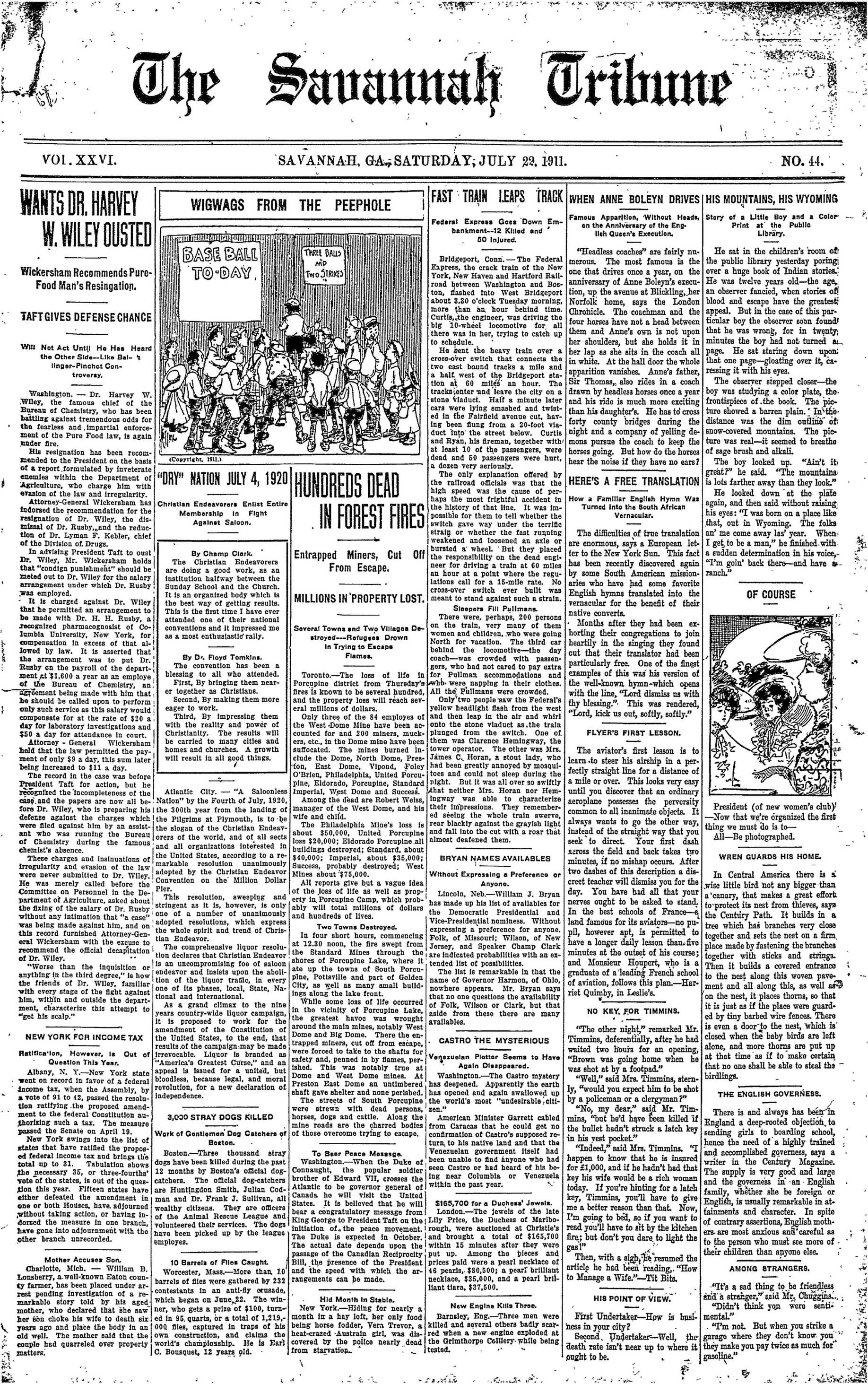
WANTS DR. HARVEY W. WILEY OUSTED
WANTS DR. HARVEY W. WILEY OUSTED
Wickersham Recommends Pure- Food Man's Resingation.
Will Not Act Until He Has Heard
the Other Side--Like Bal- %
Iinger-Pinchot Con-
Washington. — Dr. Harvey W. Wiley, the famous chief of the Bureau of Chemistry, who has been battling against tremendous odds for the fearless and impartial enforcement of the Pure Food law, is again under fire.
His resignation has been recommended to the President on the basis of a report formulated by inveterate enemies within the Department of Agriculture, who charge him with evasion of the law and irregularity.
Attorney-General Wickersham has indorsed the recommendation for the resignation of Dr. Wiley, the dismissal of Dr. Rusby, and the reduction of Dr. Lyman F. Kebler, chief of the Division of Drugs.
In advising President Taft to oust Dr. Wiley, Mr. Wickersham holds that "condign punishment" should be mated out to Dr. Wiley for the salary arrangement under which Dr. Rusby was employed.
It is charged against Dr. Wiley that he permitted an arrangement to be made with Dr. H. H. Rusby, a recognized pharmacognosist of Columbia University, New York, for compensation in excess of that allowed by law. It is asserted that the arrangement was to put Dr. Rusby on the payroll of the department at $1,600 a year as an employee of the Bureau of Chemistry, an agreement being made with him that he should be called upon to perform only such service as this salary would compensate for at the rate of $20 a day for laboratory investigations and $50 a day for attendance in court.
Attorney - General Wickersham held that the law permitted the payment of only $9 a day, this sum later being increased to $11 a day.
The record in the case was before President Taft for action, but he recognized the incompleteness of the case and the papers are now all before Dr. Wiley, who is preparing his defense against the charges which were filed against him by an assistant who was running the Bureau of Chemistry during the famous chemist's absence.
These charges and insinuations of irregularity and evasion of the law were never submitted to Dr. Wiley. He was merely called before the Committee on Personnel in the Department of Agriculture, asked about the fixing of the salary of Dr. Rusby without any intimation that "a case" was being made against him, and on this record furnished Attorney-General Wickersham with the excuse to recommend the official decapitation of Dr. Wiley.
"Worse than the inquisition or anything in the third degree," is how the friends of Dr. Wiley, familiar with every stage of the fight against him, within and outside the department, characterize this attempt to "get his scalp."
NEW YORK FOR INCOME TAX
Ratification, However, is Out of Question This Year.
Albany, N. Y.-New York state went on record in favor of a federal income tax, when the Assembly, by a vote of 91 to 42, passed the resolution ratifying the proposed amendment to the federal Constitution authorizing such a tax. The measure passed the Senate on April 19.
New York swings into the list of states that have ratified the proposed federal income tax and brings the total up to 31. Tabulation shows the necessary 35, or three-fourths' vote of the states, is out of the question this year. Fifteen states have either defeated the amendment in one or both Houses, have adjourned without taking action, or having indorsed the measure in one branch, have gone into adjournment with the other branch unrecorded.
Mother Accuses Son.
Charlotte, Mich. — William B. Lonsberry, a well-known Eaton county farmer, has been placed under arrest pending investigation of a remarkable story told by his aged mother, who declared that she saw her son choke his wife to death six years ago and place the body in an old well. The mother said that the couple had quarreled over property matters.
The Savannah
WIGWAGS FROM THE PEEPHOLE
BASE BALL
TO·DAY
THREE BALLS
AND
TWO STRIKES
"DRY" NATION JULY 4, 1920
Christian Endeavors Enlist Entire Membership In Fight Against Saloon.
By Champ Clark.
The Christian Endeavorors are doing a good work, as an institution halfway between the Sunday School and the Church. It is an organized body which is the best way of getting results. This is the first time I have ever attended one of their national conventions and it impressed me as a most enthusiastic rally.
By Dr. Floyd Tomkins.
The convention has been a blessing to all who attended. First, By bringing them nearer together as Christians. Second, By making them more eager to work. Third, By impressing them with the reality and power of Christianity. The results will be carried to many cities and homes and churches. A growth will result in all good things.
---
Atlantic City. — "A Saloonless Nation" by the Fourth of July, 1920, the 300th year from the landing of the Pilgrims at Plymouth, is to be the slogan of the Christian Endeavors of the world, and of all sects and all organizations interested in the United States, according to a remarkable resolution unanimously adopted by the Christian Endeavor Convention on the Million Dollar Pier. This resolution, sweeping and stringent as it is, however, is only one of a number of unanimously adopted resolutions, which express the whole spirit and trend of Christian Endeavor.
The comprehensive liquor resolution declares that Christian Endeavor is an uncompromising foe of saloon endeavor and insists upon the abolition of the liquor traffic, in every one of its phases, local, State, National and international.
As a grand climax to the nine years country-wide liquor campaign, it is proposed to work for the amendment of the Constitution of the United States, to the end, that results of the campaign-may be made irrevocable. Liquor is branded as "America's Greatest Curse," and an appeal is issued for a united, but bloodless, because legal, and moral revolution, for a new declaration of independence.
3,000 STRAY DOGS KILLED
Work of Gentlemen' Dog Catchers of Boston.
Boston.—Three thousand stray dogs have been killed during the past 12 months by Boston's official dog-catchers. The official dog-catchers are Huntingdon Smith, Julian Codman and Dr. Frank J. Sullivan, all wealthy citizens. They are officers of the Animal Rescue League and volunteered their services. The dogs have been picked up by the league employees.
10 Barrela of Files Caught
Worcester, Mass.—More than 10 barrels of files were gathered by 232 contestants in an anti-fly crusade, which began on June.22. The winner, who gets a prize of $100, turned in 95 quarts, or a total of 1,219,000 files, captured in traps of his own construction, and claims the world's championship. He is Earl C. Bousquet, 12 years old.
SAVANNAH, GA; SATURDAY; JULY 22, 1911.
HUNDREDS DEAD IN FOREST FIRES
Entrapped Miners, Cut Off From Escape.
MILLIONS IN PROPERTY LOST.
Several Towns and Two Villages Destroyed---Refugees Drown In Trying to Escape Flames.
Toronto.—The loss of life in Porcupine district from Thursday's fires is known to be several hundred, and the property loss will reach several millions of dollars.
Only three of the 84 employes of the West Dome Mine have been accounted for and 200 miners, muckers, etc., in the Dome mine have been suffaced. The mines burned include the Dome, North Dome, Presfon, East Dome, Vipond, Foley O'Brien, Philadelphia, United Porcupine, Eldorado, Porcupine, Standard Imperial, West Dome and Success.
Among the dead are Robert Weiss, manager of the West Dome, and his wife and child.
The Philadelphia Mine's loss is about $50,000, United Porcupine loss $20,000; Eldorado Porcupine all buildings destroyed; Standard, about $40,000; Imperial, about $35,000; Success, probably destroyed; West Mines about $75,000.
All reports give but a vague idea of the loss of life as well as property in Porcupine Camp, which probably will total millions of dollars and hundreds of lives.
Two Towns Destroyed.
In four short hours, commencing at 12.30 noon, the fire swept from the Standard Mines through the shores of Porcupine Lake, where it ate up the towns of South Porcupine, Pottsville and part of Golden City, as well as many small buildings along the lake front. While some loss of life occurred in the vicinity of Porcupine Lake, the greatest havoc was wrought around the main mines, notably West Dome and Big Dome. There the entrapped miners, cut off from escape, were forced to take to the shafts for safety and, penned in by flames, perished. This was notably true at Dome and West Dome mines. At Preston East Dome an untimbered shaft gave shelter and none perished.
The streets of South Porcupine were strewn with dead persons, horses, dogs and cattle. Along the mine roads are the charred bodies of those overcome trying to escape.
To Bear Peace Mozzage.
Washington.—When the Duke of Connaught, the popular soldier brother of Edward VII, crosses the Atlantic to be governor general of Canada he will visit the United States. It is believed that he will bear a congratulatory message from King George to President Taft on the initiation of the peace movement. The Duke is expected in October. The actual date depends upon the passage of the Canadian Reciprocity Bill, the presence of the President and the speed with which the arrangements can be made.
Hid Month In Stable.
New York.-Hiding for nearly a month in a hay loft, her only food being horse fodder, Yera Trevor, a heat-crazed Austrain girl, was discovered by the police nearly dead from starvation
FAST TRAIN LEAPS
Federal Express Goes Down Embankment--12 Killed and 50 Injured.
Bridgeport, Conn. — The Federal Express, the crack train of the New York, New Haven and Hartford Railroad between Washington and Boston, flashed into West Bridgeport about 3.30 o'clock Tuesday morning, more than an hour behind time. Curtis, the engineer, was driving the big 10-wheel locomotive for all there was in her, trying to catch up to schedule.
He sent the heavy train over a cross-over switch that connects the two east bound tracks a mile and a half west of the Bridgeport station at 60 miles an hour. The tracks enter and leave the city on a stone viaduct. Half a minute later cars were lying smashed and twisted in the Fairfield avenue cut, having been flung from a 20-foot viaduct into the street below. Curtis and Ryan, his fireman, together with at least 10 of the passengers, were dead and 50 passengers were hurt, a dozen very seriously.
The only explanation offered by the railroad officials was that the high speed was the cause of perhaps the most frightful accident in the history of that line. It was impossible for them to tell whether the switch gave way under the terrific strain or whether the fast running weakened and loosened an axle or hursted a wheel. But they placed the responsibility on the dead engineer for driving a train at 60 miles an hour at a point where the regulations call for a 15-mile rate. No cross-over switch ever built was meant to stand against such a strain.
Sleepers Fill Pullmans
There were, perhaps, 200 persons on the train, very many of them women and children, who were going North for vacation. The third car behind the locomotive—the day coach—was crowded with passengers, who had not cared to pay extra for Pullman accommodations and whb. were napping in their clothes. All the Pullmans were crowded.
Only two people saw the Federal's yellow headlight flash from the west and then leap in the air and whirl onto the stone vladuct as the train plunged from the switch. One of them was Clarence Hemingway, the tower operator. The other was Mrs. James C. Horan, a stout lady, who had been greatly annoyed by mosquitoes and could not sleep during the night. But it was all over so swiftly that neither Mrs. Horan nor Hemingway was able to characterize their impressions. They remembered seeing the whole train swerve, rear blackly against the grayish light and fall into the cut with a roar that almost deafened them.
BRYAN NAMES AVAILABLES
Without Expressing a Preference or Anyone.
Lincoln, Neb.-William J. Bryan has made up his list of availables for the Democratic Presidential and Vice-Presidential nominess. Without expressing a preference for anyone, Folk, of Missouri; Wilson, of New Jersey, and Speaker Champ Clark are indicated probabilities with an extended list of possibilities. The list is remarkable in that the name of Governor Harmon, of Ohio, nowhere appears. Mr. Bryan says that no one questions the availability of Folk, Wilson or Clark, but that aside from these there are many availables.
CASTRO THE MYSTERIOUS
Venezuelan Plotter Seems to Have Again Disappeared.
Washington—The Castro mystery has deepened. Apparently the earth has opened and again swallowed up the world's most "undesirable citizen."
American Minister Garrett cabled from Caracas that he could get no confirmation of Castro's supposed return, to his native land and that the Venezuelan government itself had been unable to find anyone who had seen Castro or had heard of his being near Columbia or Venezuela within the past year.
$165,700 for a Duchess' Jewels.
London.—The jewels of the late Lily Price, the Duchess of Marlborough, were auctioned at Christie's and brought a total of $165,700 within 15 minutes after they were put up. Among the pieces and prices paid were a pearl necklace of 46 pearls, $80,500; a pearl brilliant necklace, $35,000, and a pearl brilliant tiara, $37,500.
New Engine Killa Three.
Barnsley, Eng.—Three men were killed and several others badly scarred when a new engine exploded at the Grimthorpe Colliery while being tested.
Tribune
WHEN ANNE BOLEYN DRIVES
Famous Apparition, 'Without Heads on the Anniversary of the English Queen's Execution.
"Headless coaches" are fairly numerous. The most famous is the one that drives once a year, on the anniversary of Anne Boleyn's execution, up the avenue at Blickling, her Norfolk home, says the London Chronicle. The coachman and the four horses have not a head between them and Anne's own is not upon her shoulders, but she holds it in her lap as she sits in the coach all in white. At the hall door the whole apparition vanishes. Anne's father, Sir Thomas, also rides in a coach drawn by headless horses once a year and his ride is much more exciting than his daughter's. He has to cross forty county bridges during the night and a company of yelling demons pursue the coach to keep the horses going. But how do the horses hear the noise if they have no ears?
HERE'S A FREE TRANSLATION
How a Familiar English Hymn Was Turned Into the South African Vernacular.
The difficulties of true translation are enormous, says a European letter to the New York Sun. This fact has been recently discovered again by some South American missionaries who have had some favorite English hymns translated into the vernacular for the benefit of their native converts.
Months after they had been exhorting their congregations to join heartily in the singing they found out that their translator had been particularly free. One of the finest examples of this was his version of the well-known hymn-which opens with the line, "Lord dismiss us with thy blessing." This was rendered, "Lord, kick us out, softly, softly."
FLYER'S FIRST LESSON.
The aviator's first lesson is to learn to steer his airship in a perfectly straight line for a distance of a mile or over. This looks very easy until you discover that an ordinary aeroplane possesses the perversity common to all inanimate objects. It always wants to go the other way, instead of the straight way that you seek to direct. Your first dash across the field and back takes two minutes, if no mishap occurs. After two dashes of this description a discreet teacher will dismiss you for the day. You have had all that your nerves ought to be asked to stand. In the best schools of France—a land famous for its aviators—no pupil, however apt, is permitted to have a longer daily lesson than five minutes at the outset of his course; and Monsieur Houpert, who is a graduate of a leading French school of aviation, follows this plan.—Harriet Quimby, in Leslie's.
NO KEY. FOR TIMMINS.
"The other night," remarked Mr. Timmins, deferentially, after he had waited two hours for an opening, "Brown was going home when he was shot at by a footpad." "Well," said Mrs. Timmins, sternly, "would you expect him to be shot by a policeman or a clergyman?" "No, my dear," said Mr. Timmins, "but he'd have been killed if the bullet hadn't struck a latch key in his vest pocket."
"Indeed," said Mrs. Timmins. "I happen to know that he is insured for £1,000, and if he hadn't had that key his wife would be a rich woman today. If you're hinting for a latch key, Timmins, you'll have to give me a better reason than that. Now, I'm going to bed, so if you want to read you'll have to sit by the kitchen fire; but don't you dare to light the gas!" Then, with a sigh, he resumed the article he had been reading. "How to Manage a Wife."-Tit Bits.
First Undertaker—How is business in your city?
Second. Undertaker—Well, the death rate isn't near up to where it ought to be.
HIS MOUNTAINS, HIS WYOMING
Story of a Little Boy and a Color Print at the Public Library.
He sat in the children's room of the public library yesterday poring over a huge book of Indian stories. He was twelve years old—the age an observer fancied, when stories of blood and escape have the greatest appeal. But in the case of this particular boy the observer soon found that he was wrong, for in twenty minutes the boy had not turned a page. He sat staring down upon that one page—gloating over it, caressing it with his eyes.
The observer stepped closer—the boy was studying a color plate, the frontispiece of the book. The picture showed a barren plain. In the distance was the dim outline of snow-covered mountains. The picture was real—it seemed to breathe of sage brush and alkali. The boy looked up. "Ain't it great?" he said. "The mountains is lots farther away than they look."
He looked down at the plate again, and then said without raising his eyes: "I was born on a place like that, out in Wyoming. The folks an' me come away las' year. When I get to be a man," he finished with a sudden determination in his voice, "I'm goin' back there—and have a ranch."
0.8
President (of new women's club)'
—Now that we're organized the first
thing we must do is to—
All—Be photographed.
WREN GUARDS HIS HOME
In Central America there is a wise little bird not any bigger than a canary, that makes a great effort to protect its nest from thieves, says the Century Path. It builds in a tree which has branches very close together and sets the nest on a firm place made by fastening the branches together with sticks and strings. Then it builds a covered entrance to the nest along this woven pavement and all along this, as well as on the nest, it places thorns, so that it is just as if the place were guarded by tiny barbed wire fences. There is even a door to the nest, which is closed when the baby birds are left alone, and more thorns are put up at that time as if to make certain that no one shall be able to steal the birdlings.
THE ENGLISH GOVERNESS.
There is and always has been in England a deep-rooted objection to sending girls to boarding school, hence the need of a highly trained and accomplished governess, says a writer in the Century Magazine. The supply is very good and large and the governess in an English family, whether she be foreign or English, is usually remarkable in attainments and character. In spite of contrary assertions, English mothers are most anxious and careful as to the person who must see more of their children than anyone else.
AMONG STRANGERS.
"It's a sad thing to be friendless and a stranger," said Mr. Chuggins. "Didn't think you were sentimental." "I'm not. But when you strike a garage where they don't know you they make you pay twice as much for gasoline."
God, Man's Dwelling Place A Sermon
Lord, Thou hast been our dwelling place in all generations—Psaalm xc. 1. Home is the strongest instinct in man's nature. The psalmist has here brought God to our thought under the similitude of home. The text, viewed in this light, contains the loftiest sentiment and the purest thought that has ever blest the spirit of man. God created us for himself and so long as we are away from him there can be no rest in our spirit; neither will God be reconciled until he wins us back to peace in him. The melancholy fact of history is our home-breaking with God. Adam was the prodigal who led his race away from God. But the old longing for home is still alive in the human heart, and home remains our dearest, finest word. Gor is at the genesis of our love of dwelling place. It is citizenship in him that men seek. It may not always name itself as such, but, in its last analysis, that is its nature and its name. We are all conscious of this in our soberest moments, and as we grow older we become more and more keenly alive to the fact.
Then what are the essential ideas of home? They are locality, unity, refuge, defense, love, sympathy, sanctuary, peace, etc. These considerations are essential to the well-being of man. First, then, God adapts himself to our thought and declares himself to be a veritable, tangible locality—a habitation. In the Scriptures we read of the "Promised Land," the "City of the Great King," the "Father's House" and the "New Jerusalem." These are mere figures of speech to lead us on to something better. The psalmist here declares a great spiritual truth, and the text must be spiritually interpreted. But to the Jew everything was given in types. Abraham's bosom was the type of rest to the Hebrew. It was upon the breast of Jesus that the beloved Apostle John reclined. The bosom is conceived to be the seat of the sympathies and affections. So God is here represented to be the great Bosom—the great Home for weary children. This is his great fellowship, and nothing destroys men so long as they have great fellowship.
Again, unity is an essential element in a home. This is perfect in the Deity. Refuge was the principal thought in the mind of Moses. Its meanings are: Shelter, harbor, retreat, high-tower, buttressed house for the protection of the homeless. God was all this to the ancient Hebrews: He surrounded his prophet with horses and charriots, with angels from Heaven; he fought for them by storm and fed them with bread from the sky; he spread abroad his shield and covered the people with his
power. Christ was to them as the shadow of a great rock in a desert land. Home means resting place, and in God every idea of home is complete. It is to this thought that Moses calls us back. There are still types of God among us today. Every true home in the world is a type of God, and its true function is to keep us in memory of our "house not made with hands." The imperfect felicity of our life here often drives the heart to contemplate the life beyond in God our Saviour. Many of the world's greatest servants have been reared amid earthly bliss and ever thereafter denied the joy of perfect human love, that they might worship only God. So the imperfections of our homes here lead us toward God. We are all the while conscious that we may not make them absolutely proof against sin, disruption, dishonor, shame and dissolution, through allation. We cannot insure them against the decay of time and the throes of mortality. The charmed circle is broken; the house grows old and lonesome, and at last but a heap of stones is left. Even the memories we retain are but the reflections of those things God gave, and refused to withdraw, through all of our prodigality. Our dwelling places here are, therefore, but makeshifts till we get back to God. This is the lesson they are meant to teach—they are a cry for God.
Again, all natural religion is but man's inner heart-beat for God. Each great conquest of man has been but a search for a better dwelling place. Nothing so deeply impresses the student of world history as the fact that upon every page of it he reads the sad, tragic story of man's homeliness for God. At this very time the nations of the whole earth seem converging toward a common center. The crises of the past have lent their power to a common cause, though in many cases they have done so all unconscious of what was to be the result.
At any event, the peoples of the earth are about to discover a catholic bond by which all are to become one family, and this bond of uniting is a recognition of the true God and the unity of the human race in him. The old philosophies and religions have not satisfied and are being torn away. The nationalism of a century ago has become the internationalism of today. Federation and union of effort and life is the watchword among the Christian churches of the world. Men used to palaces, luxury, ease and pride; men of fame and learning—these have realized that restlessness and its consequent weariness are not cured by the abundance of earthly belongings. So we are on a shift. It is all in one general direction. It is the beginning of the homeward drift. We have it written upon us somehow that there is beauty, and harmony, and righteousness, and peace, somewhere in this great universe for the soul. We believe, we all, that there is a great Bosom of sympathy and love somewhere, and a light, the glory of which can never fade away. Friend, it is with thy God. Seek it there.
NATIONAL NEGRO BUSINESS LEAGUE
TWELFTH ANNUAL MEETING TO BE HELD IN LITTLE-ROCK, ARK.
For the meetings of the National Educational association to be held in San Francisco, information has been furnished as to how arrangements should be made for Pullman or tourist car parties. The same information, with variations, may be of interest and value to the members of the National Negro Business league.
Experience has shown that attendance at meetings may be largely increased by organizing Pullman or tourist car parties or special trains. Already a number of special Pullman or tourist car parties for the national Negro Business league meeting to be held at Little Rock, Ark., August 16, 17 and 18, are being organized throughout the country. All that is needed is for some one to take the initiative. The following suggestions are offered for the consideration of members of state and local Negro Business leagues and others interested:
1. Carefully canvass the matter in your own city or state. Formulate your plan of action, then select active workers in each important center to carry out the plan. In all cases make the special Pullman or tourist car party a personally conducted affair.
2. Select the most attractive route for the going trip to Little Rock to arouse interest among the delegates. Start early enough to permit stopovers at points of interest en route. The one in charge of the party should make a careful study of points of interest, etc., that he may in his correspondence, advertising and on the trip speak with authority.
3. Get the active cooperation of all the railroads and especially of the initial line in your state. When you have decided upon the route you favor, write (or better, see personally) the general passenger agent of that particular railway. Tell him you will undertake the work of securing a special car party to the Little Rock meeting, if you have positive assurance of his active cooperation on the following lines:
(a) The railroad to furnish full information to all prospective members of the parties, giving data covering itinerary and points of interest en route to Little Rock.
(b) The railroad to circulate this information and itinerary with your cooperation among the members of your local or state league.
(c) The railroad to advertise the special Pullman or tourist car party in all the negro newspapers of the state.
(d) The railroad to send instructions to its agents throughout your state to carry out the active canvass for members for the party, with your cooperation.
4. Secure headquarters for your party in Little Rock through W. M. Alexander, chairman committee on homes, $ 504 \frac{1}{2} $ West Ninth street, Little Rock, Ark.
Persons intending to organize such tourist car parties are urged to keep the corresponding secretary, Emmett J. Scott, Tuskegee Institute, Alabama, in close touch with their plans, so that he may*bring parties in the same territory together. Attention to this request will be cordially appreciated. It will facilitate the whole movement.
Tuskegee Institute, Ala.
CHEAP PERFUMES
MADE FROM MUSK SUPPLIED BY MANY VARIETIES OF
Most women who indulge freely in the use of cheap perfumes do not know of what they are compounded. The principal ingredient of low-priced perfumes is musk, animal musk, which is obtained from several creatures.
The muskrat is probably the best known of these, and a few decades ago the wives and sweethearts of men who set traps around ditches and ponds in the countryside carried proudly the bags of musk obtained from this source. As an article of commerce the musk supplied by several varieties of civet cats is probably the best known today. The odor is strong and sweet. The strength is the particularly noticeable feature and is the reason why it is the foundation of the perfumes. In the small mammal house at the zoological gardens are two sizes of civets, and any one with an investigating turn of mind may stand near the cages and catch the musky odor.
The musk is used in the cheap perfumes, as only a little is needed to give a most lasting odor to an ounce of perfumery, but the musk itself is not cheap, and it is one of the duties of the attendants of the mammal house to collect it. It is then, sold through regular channels and is one of the sources of revenue to the zoo, although a small one.—Philadelphia Record.
On the suggestion of the city forester the hyacinth has been banished from the Boston public garden. He pointed out that hyacinth bulbs poisoned the soil and that the plant often caused an irritating skin disease to those who handled it.
NEGRO WORK FOR THE NEGRO
ADDRESS DELIVERED BY E. C. MORRIS, D. D., TO THE BAPTIST-WORLD ALLIANCE AT PHILADELPHIA, PA.
'I am asked to speak upon "The Negro Work for the Negro." This theme as indicated is in plain accord with the policy of American Baptists as well as with my own ideas as to the most effective way to direct religious efforts among any people. It is not to be understood, however, that there are, or should be any color or racial lines drawn in the kingdom of grace, but rather it is my purpose to give emphasis to the fact that in undertaking any great work, the matter of adaptability must be taken into account in the employment of factors, if success is to abundantly follow the effort.
There are no examples set or commands given by the Son of God that cannot be followed with assurance of success, and in sending forth his disciples on one occasion, he said to them, "Be ye, therefore, wise as serpents, and harmless as doves," and in going forth to bear the precious message of the Gospel it is well to consider this saying of the Master so as to be fully able to overcome whatever idiosyncrasies, superstitions, jealousies and prejudices that may be encountered in the non-Christian world
Then again, I may be pardoned for saying that in the employment of agencies, an All-wise God may choose to send a Michael to a Daniel, or send him to defend a Moses against the imperialism of Satan; or he may send a Gabriel to Zacharias to convey Heaven's message as to the forerunner of the world's Redeemer, and while it is not given to men to reason why, we know that these heavenly messages were adapted to the specific duties they performed, and there is no ground for believing 'one to be inferior to the other.
Let me localize my subject for a brief moment. For a number of years following the Civil war in this country, the great heart of the Christian people north and south went out to the emancipated, and many devout white Christians came among the negro people to do missionary and educational work among them. Their efforts met with signal success. But as the negro people became educated it developed that they preferred teachers and preachers from among their own people; hence the strength of the race was turned towards educating preachers and teachers, so as to supply their schools and churches. The negroes felt, and rightly so, I think, that their ministers and teachers should associate with them, should eat and drink in their humble homes, and do by contact, by social example much that could not be done by anyone in the schoolroom or pulpit alone. Owing to the wider race distinctions, this could not become a rule with the white ministers and teachers, and the most that they could do without sacrificing their social standing among their own people was to preach, teach and baptize the negroes. The negroes as a rule were opposed to the social intermingling of the races, preferring to maintain their peculiar racial identity. Hence the demand for negro churches and negro preachers became imperative.
In the matter of separation in the church life of the people on this continent, the blacks have been the beneficiaries to a very large extent. This has enabled them in the forty-five years of their freedom to establish more than one hundred high schools and colleges, twenty-seven thousand church houses with a valuation of forty million dollars. They have also twenty-five thousand ordained ministers, and more than ten thousand well educated men and women who are teaching in schools and preaching in churches, while others are successfully following the professions of law and medicine and all other vocations. Then again, the negroes have enrolled fully fifty per cent. of the entire race in this country in Christian churches. This, in my opinion, is a showing which cannot be made by any other race in so short a time, and is due largely to the fact that the negro people regard their ministers as their God-appointed leaders, and, as a rule, accept their teaching without question.
But in speaking of "The Negro Work for the Negro," we are including a larger range of thought and territory than that which applies to the negroes of the United States, and we hope to make it plain that the negroes of the United States are the logical Christian leaders of the black people of the world.
In the beginning of the negroes' life as freemen in the United States, a wise Providence directed that the race should make as the base of its future the principles of Christianity, taking as guide that scripture which says, "Seek ye first the kingdom of God and his righteousness, and all things shall be added unto you." They believed then and believe now that whatever else is necessary to complete a well rounded Christian civilization must follow in its time.
The blacks of South America were liberated more than a score of years before freedom came to the negroes of the United States, and I mean no unfavorable criticism when I say that it appears from present conditions that the black people of South America turned their attention principally to the accumulation of wealth and secular education, which indeed are essential elements in the well being and growth of any people. But these when used as a foundation will prove
a shameful failure. Hence our South American brothers in black are lacking in those Christian graces of self-control, forbearance and perseverance and the like, which have rendered the achievements of the negro of the United States a wonder of the world. What is said of the blacks of South America may be applied with some emphasis to the black people of the West Indies and other parts of the world. It is a fact that the negroes of the United States have become the logical leaders of the black people of the whole world and are today giving the Gospel of the Son of God to those of their own race who were free many years before they were.
As further evidence on this point, and to strengthen the proposition that the negro is the most acceptable and successful ambassador to bear the message of redeeming grace to the people of his race, I submit you an official reference to the great work of the foreign mission board of the National Baptist convention. The secretary of that board in speaking of the glorious achievements of the negro Baptist among the dark races of the earth, says: "As negro Baptists we have more than sixty churches and missions in Africa, eight in the West Indies, five in South America, with between 11,000 and 12,000 baptized believers enrolled on the books."
It should be borne in mind that the negro Baptists have only been organized for foreign mission work 30 years, and when these facts are laid alongside the earnest, devout, persistent efforts of the boards among out white brethren to accomplish results among these same people, it will be clearly seen that it would have been far better if it had always been recognized that the foreign mission board of the National Baptist convention is the best medium through which to make contributions towards fostering this particular work, or to have employed negro ministers as missionaries for this work. In making this suggestion we do not assume to advise the missionary boards among our white brethren, but to earnestly invite them to consider first of all the adaptability of the agents to bear the message in the light of the distinctive characteristics to those whom the message is sent.
I think it will be readily admitted that one of the most effectual ways of spreading the gospel is found in the house to house work, and to be able to do this house to house preaching the preacher must be taken into the full confidence of the people and must be willing to put himself on race equality with the people, or they spurn the message that he brings. So long as there are any to say he has gone to be with a man that is a sinner, so long will it be necessary to employ great tact in delivering the gospel of Jesus Christ to the different types of the human family.
But, my friends, I would have you know that conditions warrant what I have here said. For I firmly believe that the time will come when there will be "neither Jew nor Greek, bond nor free," white or black, European nor American, Asiatic or African, in the kingdom of God, but all will be one in Christ Jesus. But until that time shall come, we should work along, recognizing the "metes and bounds" set by an All-Wise Creator, who will in his own time and way level the hills and mountains; and raise up the valleys, until this division of labor and distribution of tasks shall unite to promote the oneness of Christ and his cause the world over.
The system of religion which we profess should be prompted by Christian patience and evangelical diplomacy and not by person or racial selfishness or prejudice. It was said in effect by a distinguished southern churchman some years ago that "if he who is called the Prince of Peace cannot rid the gospel of every taint of selfishness, if he is not able to make all his followers one in him, and save to the uttermost all who trust in him, then he is unable to save a single being. I would add to this significant statement, that if he who is presented in Holy Writ as one going forth conquering and to conquer should pause in his triumphant march, to draw a line of distinction between his loyal followers because of race or color, then his kingdom is unfit for the habitation of men or angels, and he would be unworthy of the worship of the humblest creature on earth.
But we, lay no charge at his door, for he is the same Lord over all and to all the people, and will in his own time and way bring about that time when there will be no lines of caste among the children of the great King, but all shall be one in him. But until that time shall come, when these lines shall be broken down and the monster, race prejudice, has been dethroned and there shall be but one family recognized among men, and that, the human family. It seems to me that the logical man, the acceptable ambassador to bear the message of redeeming grace to the negro people, is the negro.
In conclusion, allow me to say, using the words of a distinguished negro preacher, that, "When the day of final reckoning shall come, and when the three sons of Noah who were separated on the plains of Shinar, shall again meet as one family to render an account of their stewardship that the sons of Ham shall not be ashamed of the report they shall be able to make."
Not only did they give shelter and protection to the infant Saviour, when Mary, his mother, and Joseph fed from the wrath of Herold, but bore the cross after him amid the jeers and derision of his wicked persecutors.
When a horse falls in the harness his natural inclination is to get up again. The shock of the fall has excited him more or less, and in his efforts to arise he may further injure himself as well as the harness.
The first action should be to sit on his head, pointing his nose upward with one hand, to keep him from struggling until the traces and all other attachments to the vehicle can be unfastened. If two persons are present this can be done without difficulty.
If a horse breaks his leg the most humane as well as the most sensible action is to shoot him on the spot. It is true that cases are on record where broken legs have been successfully treated by means of suspending the horse in a sling and pulleys, but the experiments in this direction have almost invariably met with failure. To shoot a suffering animal and kill him instantly is not so simple a matter as it at first appears, says Country Life in America. Many shots are sometimes fired before death results. How and where should a horse be shot?
In the center of every horse's forehead a little above the line of the eyes is a little swirl something like a cowlick. Three inches above this swirl is the exact spot to lodge the bullet to insure its piercing the brain. The bullet should not be of less than 38 caliber. For sprains hot or cold bandages are recommended. Fomenations promptly applied sometimes prevent permanent lameness. Spraining of the back snews is only too common and unless promptly and properly treated results in knuckling and other complications. Blistering, firing and even nerving are resorted to, but it should be borne in mind that these drastic measures are often unnecessarily taken. Rest, turning out where practicable under favorable conditions, and massage often effect a cure.
Not infrequently a horse will pick up a nail. It is unnecessary to say that the first aid is to remove the nail. If suppuration ensue poulice the wound and give the animal rest until well. It may be well to remove the shoe for a time. Great care should be taken that the nail be not broken off flush, with the sole and left there to fester. Horses are peculiarly susceptible to tetanus or lockjaw, and a nail often causes it.
LETTERS OF CONDOLENCE.
There are persons who never take notice of another's sorrow. They wait until the bereaved one is met. Sometimes this attitude is from fear of intrusion, again it is from fear of not saying the right thing, too often it is from procrastination. Whatever the reason it is a mistake. There are some few who dislike outside sympathy in sorrow, the majority are hurt if it is not given. They never quite feel the same toward the friend who they think was neglectful of their trouble. The visiting card with a few words of sympathy is sufficient, save among close friends. A married woman incloses the card of her husband.
Never make a note of condolence stilted. It should express you, and not be an essay on grief. Also be brief. A few sincere sentences count more than pages of rambling platitudes.
It is customary to send the note to the member of the family you know best, including the others in your expressions of sympathy.
GOOSEBERRY FOOL.
Put into a jar one quart of green gooseberries, with two tablespoonsful of water and two cupfuls of sugar; set the jar in a saucepan of boiling water and boil until the fruit will mash; beat to a pulp and put through a coarse sieve. To one pint of pulp add one-half pint of cream and one cupful of milk; add the milk first gradually, beating well. Serve cold.
FLASH-LIGHTS
It is said—
That if you work for a man, in heaven's name work for him. If he pays wages that supply you your bread and butter, work for him, speak well of him, think well of him, stand by him and stand by the institution he represents.
The man who is worthy of being a leader of men will never complain of the stupidity of his helpers, of the ingratitude of mankind, nor of the inappreciation of the public.
That failure is only for those that think failure.
That every man should keep a fair-sized cemetery in which to bury the faults of his friends.
That persistence has won most of the world's battles and all of its skirmishes.
That quite 70 per cent, of ambition is never realized at all, and 90 per cent, of all ambition realized is fruitless.
That to be great in our history or in any other history a man must stand for something.
That only about one man out of fifty ever thinks. The rest merely memorize and think they think.
That the devil was asleep when man was made, but he awoke before woman was completed.
AFRO-AMERICAN CULLINGS
Two hundred and fifty-nine diplomas from all the departments of Tuskegee institute were awarded to one hundred and seventy different students. The commencement sermon was preached on Sunday by the Rt. Rev. John C. Kilgo, bishop of the Methodist Episcopal Church, South. Bishop Kilgo's admonition to the senior class set the standard for the week. The young people have been reminded over and over again, as Bishop Kilgo said, that they would be put to a severer test than men and women who have not had their training.
"And it is just," he said, "that you should be tried by severer standards than men who have not had your opportunities, men who have not come into this educated circle. It is fair more should be expected of you. I would fix in your minds that you are always under fire, and it is a capital thing. You have got to justify not only your right to live as men and women, but you have got to justify your right to live as educated men and women. You cannot justify this by arrogant assumption of superiority. The fact is, genuine superiority is not conscious of itself. Real superiority is so insensible of itself that it is never compelled to sit up and nurse itself. A man sensible of his right and his social position is not compelled to sit up with it at night, or wrap it up and feed on warm tea. He can afford to let it go into the street and walk by the commonest beggar and be helpful to the commonest wretch. It is the man whose social standing is not only questionable in the community, but very questionable with himself, who cannot afford to speak to a wagon driver or a ditch cleaner. You must vindicate your educational rights in a beautiful, simple way. Simplicity is the highest virtue of genuine mastery."
This month the Universal Race congress convenes in London, England, and Prof. W. E. Burghardt Dubois has sailed for that place to represent the American negro at this convention of the foremost thinkers and students of the world. The congress will be of infinite benefit to all the races of the earth and it is expected that they will all be represented and that each representative will be prepared to furnish the congress with the kind of data from which can be drawn conclusions which will go far toward lessening the intensity of race hatred. Israel Zangwill will speak for the Jews in America. W. A. Eastman will speak for the Indian and Prof. DuBois for the negro. We are certain that our interests will be ably looked after by the great scholar and sociologist—Louisville Defender.
These saloon and dive "bullies" of our race is the element that should be looked after. They are the lawbreakers among us, they are the disturbers of the peace, the abusers of privilege and the instigators of the strife and friction that bar many good negroes from many privileges open to them. This class of negroes is undesirable. They must be peaceful or the law will do as they see fit with them. This country has built jails, penitentiaries and all manner of prisons in every quarter; they are being filled with men and boys of our race—nine-tenths of them being of the lower class. The better class of our people are not molested by the law.—Exchange.
Men have pursued their courses to topmost fame and have fallen and come again with much glow and splendor as before. But, alas, the poor woman's fall is the greater. It is unpardonable among mankind and her reward remains in the unknown beyond; no matter what change comes about to lift her from shame. Why may not she bear the respect and praise the man receives, when he has committed that which is wrong? She is a woman. Each race looks to the woman for virtue, morality and the right bidding of men. If she falls, it is fatal—Palestine Plaindealer.
One of the things that we must learn and learn speedily is that we must depend upon ourselves both as individuals and as a race. Let us stop looking for posts to lean against and stand up on our feet like men. The world gets heartily tired of loafers and leaners; one is about as bad as the other.—Savannah Outlook.
Mrs. M. G. Davis (white) of Houston, Texas, thinks the ex-slaves need meat and bread instead of monuments to the memory of their service to their masters. She favors the "black mammy" monument builders corporating and providing for the comfort of the ex-slaves while they are here, which would be a good movement.
A person who does not think as you do can hardly look like you. It is not fair therefore to blame a person-for looking so much unlike yourself when he does not live along your line of thinking—The Baptist Vanguard.
Give the negro forty-five more years and his progress will be unbounded.
We give the following extract from the Crisis taken from the Sacramento (Cal.) Union:
"In both members and moral, and mental enlightenment the race has grown with strides of which the average American has no comprehension. Is it generally known, for instance, that today there are 10,000,000 black people in the United States? Is it known, except to the investigators, that 3,700,000 are members of churches, presided over by 35,224 ordained, ministers in 35,160 houses of worship? That the total value of property owned by negroes is $56,650,000? That there are 35,000 negro Sunday schools with 1,700,000 pupils and 210,000 teachers? That the negro churches contribute annually $500,000 for education, $50,000 for foreign missions and $100,000 for the support of missionaries at home? That the negroes are themselves maintaining 175 colleges, industrial schools and academies?"
What do you think of this showing in less than half a century?
Thousands of our people are renters today, who have had the chance of owning homes, but let such opportunities pass unseen. This is a sad mistake on the part of some of our people. Many of us are rearing large families who, if you should die, would be left homeless and out of doors. These opportunities of home-buying are not always going to exist. Land is advancing in prices daily, and in a short while it will be beyond the reach of the meager wages of the common working-man. The rent some of us pay per month would make payments on homes. In many of the cities rent ranges from $10 to $20 per month, in smaller towns from $4 to $10. A home could be purchased at these monthly terms. Land is growing more precious daily, and every negro family should be the possessor of a home.—Palestine Plaindealer.
We do not believe that any large proportion of the negro race is at any time deceived as to the manner in which it is to make genuine and real progress. There is but one way for any people to make progress that will stand the test of ages, and that is through improvement along material, educational, moral and commercial lines, together with the possession and use of all of their civil rights. Unfortunately, human nature is so constituted that these possessions cannot be gotten hold of by mere passing of resolutions, cannot be secured by cursing and condemning the other fellow. They can only be gotten by constant, hard, persistent effort. The majority of the race understands what it must do to succeed and is not going to be fooled.-Memphis News.
---
Hawaii is now clamoring for statehood. A concurrent resolution of the senate and house of Hawaii has been placed before the house of representatives, asking congress to pass an enabling act for a constitutional convention, preparatory to admitting Hawaii to statehood. It is also asked that congress authorize the raising of certain funds, to encourage Caucasian immigration, and to extend educational facilities in the islands. The resolutions were referred to the committee on territories. It is a good sign if Hawaii is ambitious. Most people associate with those islands a spirit of lethargic contentment with existing conditions.—Charleston Messenger.
Palestine with over 900 negro families does not show up. well in negro enterprise support. About one-third of its families are trading with negro grocers and the two-thirds somewhere else. Every black man should enter the movement of race support and help your people. The support of over 900 families would swell the progress of our enterprise in many ways, beneficial to the people.—Palestine Plaindealer.
Bishop I. B. Scott, under difficult circumstances, and with limited resources, is doing a great work on the West Coast of Africa. He is a safe and sane leader. While many disagree with his article concerning the Methodist Episcopal church and her black members, developments may yet vindicate the bishop, and those who oppose him may be forced to accept his position.—Sam Huston College Bulletin.
Our progress in the south is, only handicapped a little by that element of white men who like to treat the negro roughly, cuff, and beat him on the streets. But he is gradually decreasing on account of the sympathy shown the negro by the better class of white men, who are always found befriending the negro.
The negro farmer must produce more, for there is a sale for his products among the whites, as well as members of his race.
Every young negro should strive to get an education. Nowadays you cannot get employment without the knowledge of reading and writing.
IN HUMOROUS·VEIN
He—Don't you think she has rather a good complexion?
She—It strikes me as being just a trifle too impressionable.—Scribner's.
Sultor—I am afraid that I am not worthy enough for your daughter.
Parent—Bosh! The point nqwadays is, Are you worth enough for her?—Judge.
Lulu was watching her mother working among the flowers. "Mamma, I know why flowers grow," she said. "They want to get out of the dirt."—Lippincott's.
Sultor—Surely your father would do something for us!
Doctor's Daughter — Indeed, he would! He said that he, would operate on you any time free of charge. —Judge.
Sometimes we interpret too literally. "I want to learn to make a jelly." said the newly-installed housewife. "Is it hard?" "Oh, Lord, no, mum!" replied the cook, with supreme pity. "It's soft." —Judge.
Landlady (smillingly)—Are you aware that you slept in a real mahogany bed last night, Mr. Howells? Howells (meanly)—Was that what it was? It felt like lignum vitae. Beaumont Enterprise.
He—So your graduation essay is to be on the absurdity of our common superstitions. Have you started it yet?
She—No; I meant to today, and then I suddenly remembered that it was Friday.—Exchange.
Willie—Mamma, will heaven be as beautiful as they say in the Sunday school books?
Mother—Certainly, my dear. Why do you ask?
Willie—Places we go to in the summer are never as nice as the circulars.—Boston Transcript.
"Blinks used to be daft on the subject of buried treasure. What's he up to now?"
"He's got up an expedition to try to find the place where Methuselah stored his birthday presents."—Toledo Blade.
Teacher—Willie, did your father cane you for what you did in school yesterday?
Pupil—No, ma'am; he said the licking would hurt him more than it would me.
Teacher—What rot! Your father is too sympathetic.
Pupil—No, ma'am; but he's got the rheumatism in both arms.—Beaumont Enterprise.
"Will you love me when I'm old?"
"Why, you precious darling, we'll be divorced long before that."—Baltimore News.
"Looking at that knob? That's my bump of caution."
"Born with it, were you?"
"Oh, no. Kicked by a mule."—Kansas City Journal.
"Has that horse any superior qualities?"
"Yep," replied Farmer Corntossel. "I'd back his appetite for any amount against all comers." — Washington Star.
Kicker—My great-grandfather carried that drum all through the Revolution.
Snicker—And whenever he sighted the enemy he beat it, I suppose—Brooklyn Life.
Meeker—This paper says that mud baths will cure rheumatism.
Seeker—Nonsense! I've run for office three or four times and it didn't do me a bit of good.—Chicago News.
"Please, sir," said the office boy.
"Well, what is it?" demanded the boss.
"Please, sir, could I get off again today. We had to postpone grandma's funeral yesterday on account of the rain."—Detroit Free Press.
Pa—I greatly disapprove of that young Smith, and one particular reason is his lack of industry in his calling.
Daughter—His calling? Why, he calls seven evenings in the week!"—Cassell's Saturday Journal.
"Dou you believe everything he says?"
"I used to until he tried to tell me the other day that he couldn't lose any more money playing dollar-limit poker than he could playing ten-cent limit."—Detroit Free Press.
"There is no use giving you a check, my dear. My bank account is overdrawn."
"Well, give it to me anyway, George. And, say, make it for $500. I want to pull it out of my shopping bag with my handkerchief at the bridge game this afternoon."—Cleveland Plain Dealer.
A man alighted from a Brooklyn Avenue car at Thirty-first street and helped a boy of seven or eight years to alight. The child looked 'glum. "Smile, child, smile," said the man, evidently its father. The boy did not cheer up, however, whereupon the father spoke again. "Smile," he said. "Smile, or I'll slap your head old."—Kansas City Times.
THE TRI-WEEKLY ATLANTA CONSTITUTION
THE SAVANNAH TRIBUNE
ITH THESE you may order any one of alternate free magazine offers of Human Life, of Boston, Mass.; McCall's Magazine, of New York, or Southern Ruralist, of Atlanta, Ga., or "Talks from Farmers to Farmers," a 16-page folio of farm wisdom. Your choice of only one and both newspapers for only $1.75.
The Tri-Weekly Constitution Monday, Wednesday, Friday--Three Times a week. The newsiest, best, brightest and biggest newspaper. Almost a daily, yet at the price of a weekly One Dollar a Year
The Tri-Weekly Constitution presents, at one sweeping view, the whole area of events. The news of the county, state, nation and the world is given in each complete issue. Each week the departments of Farm and Farmers, Woman's Kingdom, Rural Free Delivery, Poultry and others of wide interest, edited by experts, appeal directly to those addressed
If you want The Tri-Weekly Constitution alone, without any clubbing offers, you can get it at $1.00 per year by addressing The Constitution, Atlanta, Ga. One sample copy, sent free on request, giving with it the names and addresses of six of your neighbors.
The Constitution Is the Paper For Rural Free Delivery Route
'A club of 40 or 50, or more, will keep a R. F. D. route above the minimum average required for daily mail service. It is the gr eat news purveyor of the whole Southland, as good in the gulf states as on the Atlantic se aboard.
Clubbed with The Atlanta Constitution, we have the superb FREE OFFERS shown from which you may make your choice of one:
(1) "TALKS FROM FARMERS TO FARMERS," a symposium of Southern farm knowledge that should be in the hands of every practical farmer, young or old. The articles have all appeared in Tri-Weekly Constitution under same title and made one of the great est features of this splendid farmers' paper. It will be mailed to you immediately upon receipt of order.
(2) THE SOUTHERN RURALIST, one of the best agricultural papers in the South. It is a semi-monthly, edited by a farmer on his own farm, and is intensely practical and helpful.
(3) HUMAN LIFE, of Boston, Mass., giving current and interesting biography. It is about folks—people living in the public eye now—that you want to know something about. It has not a dull line in it
(4) McCALL'S MAGAZINE, of New York, the queen of the home fashion monthlies, very helpful to the mother and the homekeeper. It is just what you want.
OUR GREAT PROPOSITION
Remember, our own paper one year and THE TRI-WEEKLY CONSTITUTION, Monday, Wednesday and Friday, three times a week, for one year, and your selection of one from the alternate free offers, all for $1.75.
one from the alternate free offers, all for $1.75 Send at once. Get right on. Don't miss a copy. 'Address all orders for above combination to
THE SAVANNAH TRIBUNE, Savannah, Ga.
The Oldest, Strongest and Most
Reliable Company in the State.
Gives employment to hundreds of
men and women of our race.
Pays from $1 to $10 weekly sick and
accident benefits and from $10 to $100
death benefits. Our Motto: "Promptness,
Honesty and Justice."
Home Office:
1143 Gwinnett St. . Augusta, Ga.
For further information write 509
West Broad St., Savannah, Ga.
J. S. Perry, Supt.
Their Ideal Realized
For more than a dozen years the dream of the Manager of the UNION MUTUAL ASSOCIATION Has been to Inspire Confidence in, and bring respectability to Negro industrial insurance, which does not only cause this Company to handle more than a million dollars annually, but they have made it possible for other similar concerns operated by our people in the South to do a successful business, which was once controlled absolutely by another race. For these and other sane reasons, we urge that you take out a policy today. Call one of their agents or phone the local manager of the Savannah district,
J. C. LINDSAY,
Branch Office 509 West Broad St.,
Phone 1470, Savannah, Ga.,
or WM. DRISKELL,
Secretary and General Manager,
110 Auburn Ave. Atlanta, Ga
CHICKENS
DUCKS
TURKEYS
Wholesale and retail dealer In Live
and Dressed Poultry, Game in Season.
Special attention given to picnic or
orders. All supplies valid.
Phone 2733.
GAREY'S
Variety Bakery.
Goods delivered promptly to any part of the city. 506 West Broad Street, Near Gastem Phone 1331-L.
THE TRI-WEE
THE SA
W ITH THESE you
Human Life, of
Ruralist, of Atlan
W
COOPER & ODREZIN The Up=to=Date Tailors
218 W. Broad Street
Between Hull
Johnson Uni
The Royal
Funeral Di
Finest line of Coffins
cars. Office and ware
Residence Phone 2032.
J. H. U
W. L.
WHO
Fruit and
234 ST. JULIAN ST., WE
Hen Hull Street and Oglethorpe
Royal Undertaking Establishment
COMBINE D WITH
Royal Undertaking Company
(Incorporated.)
General Directors and Embraces
of Coffins, Caskets and Robes. Whits and warerooms 235-331 Jefferson street.
W. R. FIELDS, Manager.
Phone 2082. Livery Stable Attached.
J. H. ULMER, Residence Phone 3064.
L. BLUN
WHOLESALE AND RETAIL
and Commission Makers
AN ST., WEST, 235 BRYAN ST., WEST.
SAVANNAH, GEORGIA.
CE THAT—
The Turner Restaurant
Has Moved to 109 JEFFERSON ST.
On first class rooms, barber shop, hot and cozy service at any hour, day or night. In all of our best class accommodation. Call and see our roofer at 109 Jefferson street, just a half block from being south on Jefferson. Ask any hackman.
J. H. TURNER
Johnson Undertaking Establishment COMBINED WITH
The Royal Undertaking Company
(Incorporated.)
Funeral Directors and Embalmers
Finest line of Coffins, Caskets and Robes. White and black funeral
cars. Office and warerooms 325-331 Jefferson street.
W. R. FIELDS, Manager.
Residence Phone 2032. Livery Stable Attached. Office Phone 670
J. H. ULMER, Residence Phone 3064.
Fruit and Commission Merchant
234 ST. JULIAN ST., WEST, 235 BRYAN ST., WEST. SAVANNAH, GEORGIA
TAKE NOTICE THAT—
The Turner Restaurant
Has Moved to 109 JEFFERSON ST.
In addition first class rooms, barber shop, hot and cold baths and automobile service at any hour, day or night. In all of our departments
In addition first class rooms, barber shop, hot and cold baths and automobile service at any hour, day or night. In all of our departments we give first class accommodation. Call and see our rooms while visiting the city at 109 Jefferson street, just a half block from Broughton St. car line going south on Jefferson. Ask any hackman.
Palm Shaving Palace
Cutting, Electric Massage and Shampooing
by Experienced Workmen. Courteous attention
R ATTACHED.
RY R. WRIGHT, Prop.
BROAD ST., ---
situate to wear Shoes that have been repaired of repairing. We do everything needed in condition—rebutton, straighten, or alter heels, put on rubber heels or soles.
before going elsewhere.
H. WASHINGTON
Expert Hair Cutting, Electric Massage and Shampooing a Specialty. All
Work Done by Experienced Workmen. Courteous attention to all SHIN-
ING PARLOR ATTACHED.
PERRY R. WRIGHT, Proprietor
517 WEST BROAD ST., --- --- --- SAVANNAH, GA.
If you hesitate to wear Shoes that have been repaired, you don't know our kind of repairing. We do everything needed to footwear first class condition—rebutton, straighten, or alter heels, sew up rips, pair breaks, put on rubber heels or soles. See us before going elsewhere.
name on our list under $1. Subscription Offer.
Englethorpe Avenue
Establishment
Baking Company
and Embalmers
Whits and black fun
on street.
Manager.
Reached. Office Phone
phone 3064.
LUNT
RETAIL
Union Mercha
T., WEST. Phone
GIA.
Restaurant
BESON ST.
p, hot and cold baths an
In all of our departn
and see our rooms while'
half block from Broughton
y hackman.
J. H. TURNER, Proprietor
g Palace
CITY.
Shampooing a Specialty,
teous attention to all.
T, Proprietor
SAVANNAH
we been repaired, you
ing needed to footwe
or alter heels, sew up rip
FINEST IN THE CITY.
SHOEMAKER
309 WHITAKER ST.
$1.75
INSTITUTION
BUNE
The magazine offers of
New York, or Southern
ers," a 16-page folio of
papers for only $1.75.
Wednesday, Friday--
a week. The
Dollar a Year
w, the whole area of
in each complete is-
Kingdom, Rural Free
directly to those ad-
clubbing offers, you
cia. One sample copy,
of your neighbors.
Delivery Route
the minimum average
the whole Southland, as
the superb FREE
or choice of one:
farm knowledge that should
appeared in Tri-Weekly Con-
farmers' paper. It will
the South. It is a semi-
ful.
phy. It is about folks—
it has not a dull line in it
on monthlies, very helpful
BY CONSTITUTION,
and your selection of
all orders for above
ah, Ga.
Remittance must be made by Express or Post Office Money Order, or Registered Letter. Advertising rates given on application.
Entered at the Post Office at Savannah, Ga., as Second-Class mail matter.
SATURDAY, JULY 22, 1911
It is a source of great satisfaction to the Negroes of Savannah to note that through the efforts of the Grand Jury the ill-constructed, inconvenient, and most unsanitary toilet arrangements in the colored schools are to be replaced by more modern and improved ones. It has been practically impossible for the hundreds of Negro school children to find adequate accommodations in the present ill-arranged toilets and it has been a means of much embarrassment to them. Many of them have had to suffer the whole day for lack of accommodations. And while referring to this matter we should be pleased if the school authorities would go a step farther and see that the pupils are more comfortably seated.
A growing habit, and one which is very reprehensible, among the younger class of Negroes, is that of promiscuous and public swearing on the streets. The use of vile and profane language is entirely unnecessary and is deplorable at all times, but it is doubly offensive on the public thoroughfares where women and children are liable to hear it. After a certain hour in the evening men and boys are prone to congregate on the corners where they indulge in this offensive habit regardless of passers by even though they may be women of the highest respectability or children easily contaminated by their vulgar words. They pay no deference to age or sex. This might be expected of persons from the slums of the city but when those who have had advantage of good home training, exercise no more discretion and are guilty of such ungentlemanly conduct, it is intolerable. It would be a blessing if these young men could be brought to see how despicable their conduct is and could be induced to depart from this deplorable habit. The leaders of youth ought to feel it imperative to give this matter their serious consideration. Parents, teachers, preachers, and women in general should make every effort to discourage profanity and all sorts of vile language.
In many of the northern states and cities children under a certain age are compelled by law to attend school during a stated period each year. In places where this law is in vogue it has been found that the community in general has been benefited and that the youth as a result of this compulsory education have a more general knowledge of things than those in other sections. It is with pleasure that we have noticed that a bill has been recently introduced into the Georgia House of Representatives requiring that parents shall send children from six to eighteen years of age to school during sixty days of each school year. We feel that with compulsory education in the state much of the illiteracy which is now to be found among us will soon be eliminated and that the commonwealth in general will be greatly benefited. There are reasons upon reasons why we should all hope that this bill will successfully pass through the legislature but they are too obvious to be dwelt upon at length. Education is probably the greatest means of ridding the state of crime, for it is only through the medium of school training that we can hope to get useful and law-abiding citizens. The criminal is not often from the ranks of the educated but he is generally from that class of citizens who have paid little or no attention to their school training. Education raises a man's ideas of life thereby causing him to grasp the higher things of life. It takes the child who has not been born under the most encouraging environments and makes a man of him, and it develops a child as nothing else can do. With the passage of this bill and a strict enforcement of the compulsory law, the educational standing of Georgia will be raised and the thousands of children who are now growing up in ignorance and running wild through the streets when they should be in school will be saved.
A Powerful Minority, or How Savannah Saved the Administration
The true story of the salvation of the administration may be better understood when the information is imparted that Sir G. N. Stoney had a majority of the votes of the Grand Lodge, leaving out Savannah. Savannah's votes were for Foster B. Pettie, but this force was so organized that no power from the outside could shatter the cordon that bound them. Savannah's force was in the minority. But the forces of Sirs Stoney and Hutto were so nearly equal that it gave us the balance of power. We could not elect our candidate and we did not care to slaughter such splendid material, nor did we desire that our men go down in abject defeat under an avalanche of votes. So we skimmed for vantage ground. We attempted to treat first, with the Atlanta forces. They underestimated our strength and turned us down. We tried to treat with Augusta, they gave us the "marble heart." In the meanwhile we canvassed among the delegates by the "runner-system" and in less than six hours, knew who would vote for Stoney and who would vote for Hutto. We knew our strength. Adding the two columns, we had a reasonably correct knowledge of the votes of the Grand Lodge. Then, scanning the situation carefully, we saw that we were master of the skirmish and could defeat or elect any one of the leading candidates we chose and then, our demands were soon made. We went again to Atlanta's Augusta's headquarters. We partially from the knowledge of either such facts as might militate against us. They threw us down again, saying we had too little to offer. We knew what we had and how the entire machinery was blocked by us. We caucused again to acquaint each of our gallant supporters with the situation. These gallant fellows then had a committee appointed to confer with the forces of the administration. The administration had looked a little more carefully at conditions and hurried to cinch a bargain. We did not hurry to accept, but called another caucus and reported the result of the consultation to our braves, letting them know every move on the checker board. Our supporters were loyal, and were made more so, if possible, for the fact that they were consulted about every move we made. And this teaches, or should teach, a useful lesson. The more recognition there is given to the followers in any endeavor the stronger the ban that binds them. This little minority stood pat, though.
But twaks to do or die.
Our supporters bade us yield to partial victory rather than to abject defeat. We obeyed. Our candidate agreed and thus was the minority made the fulcrum upon which the lever of administrative power rested, to lift itself to victory. The result of the election is shown by the men elected.
Savannah's organization saved the day for the administration and elected every other man elected. We could have defeated anybody. We elected everybody. This fact is public property and it went into every nook; and cranny of the state in advance of the delegates who attended the Grand Lodge and "a crowd of witnesses around, held them in full survey."
This is the history of the contest and
This is the history of the contest and it defies contradiction.
The Second Annual Thanksgiving Service and Second Annual Session of the United Brotherhood of
America.
America.
On Sunday July 9th, 1911 the brothers of the said United Brotherhood of America, met at Scott's Hall, Gwinnett and West Broad Streets, formed a line and marched down to Bryan Baptist Church, where they were greeted by a host of royal sisters of the various Temples, and a crowd of loving members of the Junior Temples. Final preperations having been perfected, we entered the edifice, where an appreciative audience was awaiting our appearance, while the sweet music from the pipe organ filled our ears. Just here Prof. John McIntosh W. A Crescent Temple No 2, in chosen words, presented the Master of Ceremony, brother R. W. Jones, who seated the order, after which he inspired all by his very appropriate words, for having come out to witness and take part in the services; after singing "Bless be the tie that binds," the following excellent program was rendered. Invocation, Rev. N. H. Whitmire, W. Appr., Unity No 19; Solo, W. Howard, P. G. D. No. 12; Paper; "Our Work, its Past, Present, and Future," (Mrs.) Leola B. J. Lennert, S. G. M. Queen Esther No 11; Anthem; Short Historical Sketch of the Origin of the Order, Hon. R. L. Lockley S. G. S. No. 4; Oration, Prof. W. D. Kennedy, S. G. A. and Founder, No. 1; Reading of the 1st Psalm, Hon B. J. Lammert 2nd V. S. G. A. No. 16; Paper; "The Brotherhood," J. S. Perry, No. 12; Thanksgiving Giving Offer; S. G. of Finance No. 3, Past of First Bryan Baptist Church; Announcements, Presentations etc. Song; "God be with you we till meet." Benediction; Adjournment. There were many timely and encouraging remarks from the various members and officers of the brotherhood. The Oration of the S. G. A. was inspiring and sparkled with brilliancy of thought and foresight. Judging from the liberality of the congregation, when the collection was called for, we are quite sure that all enjoyed the exercises, for we realized a nice sum which was given for charitable purposes. The Second Annual Session of the United Brotherhood of America was held in St. Philips A. M. E. Church, Charles and West Broad Streets, at 10:45 Monday morning July 10th, 1911 S. G. A. Prof. W. D. Kennedy called the house to order After the devotional exercises, the Second Annual Session was in full operation. The Annual Address of S. G. A. W. D. Kennedy was instructive, timely and encouraging, and also showed that the Brotherhood is now operating in three states. Many brothers and sisters expressed their appreciation for the success of the order, and for the co-operation of the S. G. officers and pledged
willingness to go forward. The reports of the S. G. officers were grand, especially those of the S. G. S., which showed a great increase numerically and the S. G. R. of Finance which showed another great increase financially. All reports showed advancement and that each had been on duties line. After toiling Monday and Tuesday until 2 o'clock p. m. the Supreme Grand Session adjourned to meet the Fourth Monday in July One Thousand Nine hundred and Twelve. Much good legislation was enacted. Under the prevailing indications, the United Brotherhood of America will soon be one of the hannen orders of the state and country. Mr. J. S. Perry was appointed Official Stenographer of the Order. The session was harmonious throughout and the spirit of unity prevailed.
J. S. Perry, Reporter Solomon Temple No. 12.
Beginning Wednesday July, 12, 1911, the Thirteenth Annual Session of the West Savannah District of the A. M. E. church held a very excellent assembly. Much good should result from the many good things heard from the many delegates in attendance from the several churches within the district. Rev. S. E. Cruse and wife, not excepting Prof. W. L. Jones, deserves much credit for the excellent manner in which the convention was served. We found the people hospitable and kind and well prepared to care for the convention.
With P. E. Bembry in the chair the Convention was called to order and organized Wednesday before noon. The following were elected: Rev. R. H. Singleton, Vice President; Prof. W. L. Jones, Chief Secretary; Rev. J. W. Moultry, Treasurer; Prof. B. S. Reed, Chorister; Mrs. L. Holly, Organist; Jesse Brinson, Reporter to The Savannah Tribune; Miss Inez Hadley of Savannah was used as assistant organist and did most of the playing. Dr. T. N. M. Smith was in attendance as visitor a part of two days. Of course Dr. Smith is in the race for Bishop and occasionally he would have the Convention hall ringing with his eloquence. Among others that visited the convention were Rev. Dr. J. Powell of Statesboro G.; Rev. B. S. Hannak P. E. of the Savannah Dist., and Rev. and Mrs. Bellinger, also Mrs. M. William Cruse. Those winning the Prize Essay Contest are as follows, Two first prizes to Miss Nellie May Heart of St. Philips and Miss Annie Smith of Bethel, and a second prize to Miss Oneida L. Haynes of St. Philip All of Savannah.
Friay was League and Missionary Day, the following officers were elected in the League with Mrs. P. G. Jones in the chair as District Superintendent: Mrs. V. Robinson, Assistant Superintendent, Mrs. L. G. Ballard, Secretary, Mrs. Mamie Morgan, Assistant Secretary; Mrs. M. William Cruse, Treasurer; Miss Inez Hadley Organist; Prof. B. S., Reed Chorister.
With Mrs. J. W. Moultry, presiding the Missionary Society elected the following officers; Mrs. A. R. Ross, Vice; President; Mrs Robinson, Secretary-Miss Lizzie Williams, Assistant Secrete; Mrs. L. A. Newton, Treasurer, Mrs L. G. Ballard, Reporter to The Savannah Tribune. Collections as follows: from Sunday School $102.42. From the League $19.00. From Missionary Society $82.54.
There was a resolution read and adopted endorsing Dr. T. N. M. Smith as Bishop in next General Conference The Convention adjourned to meet at Metter in July 1912
IN HIS HOLY TEMPLE.
Interesting Services in The Churches of the City.
Second Baptist Church. The services on Sunday morning were largely attended. Rev. Reid preached an excellent sermon, Text 2nd, Cor. 5th, chap. 17 vs. His sermon was very instructive. On the fifth Sunday will be the carpet rally. Remember the weekly services: Tuesday night prayer meeting, Thursday night preaching, Friday night Christian Culture meetings for the young people. Visitors and strangers are always welcome.
F. B. B. Dots.
On Sunday morning, in the absence of Rev. Wright, our services were conducted by Rev. C. Walker. He read for the lesson Matt. 5:25-31. Text 2 Cor. 6:2, subject, "Be at peace with God and man." At night Rev. Wright read for the lesson Matt. 5:1-16 text Matt. 14:15, subject "Come and drink" He drew many beautiful pictures and lessons that were well received. Rev Wright led the hymn "See in the vineyard of the Lord." A large crowd accepted his invitation and knelt for prayer. Our Ushers are courteous and are always ready to give you a comfortable seat at any time, if you will only come.
A. C. U. League.
A. C. O. League.
The Union League met at Gaines Chapel A. M. E. Church last Sunday at 6 p.m. Quite a gloom was cast over the meeting when Mr. W. O. P. Sherman Jr., President, announced the death of Mr. Tom Reid, a stalwart Leaguer. The following persons were on the program: Misses Nellie Mack, Mildred Johnson, Nianzo Freeman, Mazie Wells, Beatrice Porter, Marie Cato, Mrs. M. Brown, Miss Bell Brown and Mr. J. N. Purse. Topic "Our Debts what they are, how to pay them." Rom 13:7-10 was well discussed by the members. Next session will be at Bethel third Sunday in August. Mr. W. O. P. Sherman; Jr., President; Miss Ada Oliver, Secretary.
Evangelical Ministers Union.
The Evangelical Ministers Union met with Dr. P. W. Greatheart presiding. Devotional service was conducted by P. E., Rev. E. D. Giddens. The Decalogue was then read. Rev. I. J. Yancy of the Baptist Church, was introduced, joined the Union and gave a pleasing address Rev. E. D. Davis, also of the Baptist Church was present. Sermonic report was given by Rev. J. S. Jenkins. Rev. L. A. Townsley begged to announce that the Savannah District Conference will meet at St. Philip Monumental A. M. E. Church, Thursday July 25th. Rev. R. J. Jefferson is appointed to deliver the welcome address in behalf of the Union. Come out next Tuesday. Visitors always welcome.
St. Phillips Dots.
Rev. Singleton preached two able sermons on last Sunday at 11 a.m. and 8:30 p. m. The attendance was very small. The third quarterly Conference of the St. Philips for 1911 was held on
last Friday night. The reports from all departments of the church were very good. Our Sunday School had an enjoyable day at Dauisikie on last Tuesday. Mr. Thomas W. Reid, husband of Mrs. Laura B. Reid was buried from St. Philips on last Sunday at 4:30 p. m. Mr. Reid was a faithful member of St. Philips for a number of years. Our delegates to the Statesbo-o Convention reported having a splendid session throughout. Your dollar is due from now on to December 1st. Pay up and get it out of the way. To-morrow will be Quarterly Conference at St. Philips. The following Services will be held. Sunday Prayer meeting at 5:30 a.m. Preaching at 11 a.m. Sunday School at 3 p.m. A. C. E. League every Thursday at 8:30 p.m. Strangers are cordially invited.
Monumental Notes.
Corn Club of Chatham County.
Ga. State College.
We of Chatham County have decided to give a prize to man or boy who raises the most corn to the acre this year 1911. Prize to the man $7.00. First prize to the boy $33.00; second prize to the boy $15.00; Third prize to the boy boy $12.50. There will be a committee appointed in this county to encourage this movement. I want each and every colored person to take hold and do your best whilest the light holds out to shine. This is only to encourage the boys to be industrious.
President of this move gent
J. W. Derrick
Memorium.
In loving remembrance of husband and
our father,
SCOTT SMITH,
who departed this life July 18, 1906.
Gone but not forgotten.
A precious one from us Las gone,
A voice we love is still
A place is vacant in our home
That we cannot fill.
You have never been forgotten,
Nor will you ever be
As long as life and memory last
We will remember thee.
For many years you faithfully worked,
Ere your faithful course was run
Nor ever by thee was duty shirked
Nor ever was love's task left undone,
And all these years thou has ever
stood
Like one who watches upon the tower
Looking ever for thy children's good,
Even at thy post from hour to hour.
But now you sleep free from all pain
And we who mourn are left in tears,
But we would not call thee back
To this sad vale of tears,
For we well know thou has gone
To that bright world above,
That thou must wait for us to join
Thee in that land of love.
Sleep husband, sleep, father take thy rest
Thy pilgrimage on earth is over,
Thy tired hands folded on thy breast
At peace and rest forevermore,
Wife,
Mrs. Sylvia Smith,
Children,
Miss Rainy Smith,
Mrs. Frances Williams,
and Mrs. Ethel Walker,
of New York.
Mrs. Leola Hutchins,
Mr. Elzy Smith.
Resolution.
Savannah, Ga., July 9th, 1911. Again the silent reaper has invaded the Young Men's Christian Club and borne from our midst Bro. Raiford Jones, one of our most earnest and loyal members. Whereas, Bro. Jones, by his Christian life and character, as well as by his devotion to the club and to other deserving interests, merits the highest commendation from this club, therefore, be it Resolved, That as an organization bound by ties of patriotism for a cause dear and sacred to us all, we have suffered a great loss. We shall miss the willing hands and energetic zeal of the friend who gave of his best talents to further the interests of the Christian Club. That our deepest sympathy goes out to the sorrowing home circle and pray God to sanctify this affliction to their good and His glory. Be it further
Resolved. That a page of our minutes be set apart to his memory and these resolutions inscribed thereon; that they be published in The Savannah Tribune and that a copy of them be sent the family.
Respectfully yours in Christ,
Geo H. Beckett,
Bro. P. A. Houston,
Rev. Daniel Wright,
Hot Air is Cheap
Hot Air is Cheap
Anybody can spread Hot Air but I am going to say YOU WILL SIT UP and TAKE NOTICE WHEN YOU NEE MY SHOW. A Classy Show for Classy People
Motion Pictures
that are pictures and that's the only kind I have
That's Saying Something so be There at the OPENING
JULY 24
BAKER
The MOVING PICTURE MAN
AIRDOME
Formerly VICTORIA
Hall Lane and West Broad St.
```markdown
```
$75,000.00 Invested in North Carolina
$20,000.00 Cash Bond in South Carolina
$5,000.00 in Atlanta City Bonds in Georgia
Much Office, 623 West Broad St.
Mitis, Manager
Sava
THE SEASON FOR——
ICE CREAM
No Order too Large. None too Small.
Give us your Order. We guarantee the res
SCOTT BROOK
West Broad and Gwinnett Streets
Our Ice Cream Parlor and be refreshed
FIRST END PHARMA
The habit of patronizing OUR NEW STORE
Guarantee a Square Deal.
Like a specialty of LOW PRICES.
Or lose a customer because
We courteous attention to all.
TE'S WEST END PHARMA
BAY AND FARM STREETS.
JOHNSON HOTEL
331 JEFFERSON STREET
hotel conveniences. Hot or cold baths. Laying matter and music. Polite help. Carriage phones. If you want a hack or carriage ring you will see that you get it. Rooms to let at MEALS AT ALL HOURS
PRINCE R. BUTLER, Manager and
MODLAWN PARK L
Highest Price lots at Wood
are only $150.00 and
50 x 400
Save Concrete Sidewalks and are Directly on C
or How Important that Transpotation Feat
Excellent LOTS LEFT. You Pay
CASH & $5.00 PER M
NO INTEREST
me quickly and get a ch
location
CHAS. McDOWELL
623 WEST BROAD ST.
NE 2098—J
RESIDENCE
WEST END PHARMACY
Get the habit of patronizing OUR NEW STORE. We guarantee a Square Deal. We make a specialty of LOW PRICES. We never lose a customer because We give courteous attention to all. PATE'S WEST END PHARMACY BAY AND FARM STREETS.
THE JOHNSON HOTEL
With all hotel conveniences. Hot or cold baths. Large parlor with reading matter and music. Polite help. Carriage and hacks also telephones. If you want a back or carriage ring up 616 and the manager will see that you get it. Rooms to let at 25 Cents. MEALS AT ALL HOURS PRINCE R. BUTLER. Manager and Proprietor
WOODLAWN PARK LOTS
The highest Price lots at Woodlawn Park are only $150.00 and they
They Have Concrete Sidewalks and are Directly on Car Lines Consider How Important that Transpotation Feature is. Some Excellent LOTS LEFT. You Pay
See me quickly and get a choice location
623 WEST BROAD ST.
PHONE 2098-J RESIDENCE 1206-J.
Atlanta University
ATLANTA, GEORGIA
Actarian Christian Institution. High School, Norma
and College.
For advantages in Industrial Training, Music and
Life Training. For catalog and information
President EDWARD T. W.
ROUND TRIP
TO
UGUST
An Unsectarlan Christian Institution. High School, Normal School and College. Superior advantages in Industrial Training, Music and Printing. Home Life Training. For catalog and information address President EDWARD T. WARE.
CENTRAL OF GEORGIA RAILWAY
Special Train leaves Savannah MONDAY AUGUST 7 at'6:45 a.m., R. R. time. Other trains leave Savannah daily, central time, 6:45, a.m, 2 p.m., 8 p.m.
Savannah Patriarch N.) 33 and Savannah Knights' Land will furnish plenty of music.
Tickets on Style AUG. 7th, Good Returning Until AUG. 12.
For further information apply to members of transportation committee: E. A. Fields. Chairman, W. Smith, R. N Rutledge, W. O. P. Shermin, Jr., W. Alexander, Andrew Patterson Ed. H Burke R W Williams W D Akstrong, G. L Bingard P I. Smalls, H. Freeman, J. S Causey, R L. Lrley, R Barnes, W R Fields or City Ticket Office, 37-Bull Street.
WM. B. CLEMENT, City Passenger and Ticket Agent.
Go to Pate's Drug Store, West Broad and Hall streets.
Watch me as I grow, that will show you that I am turning out good work that suits my customers. A. P. Barnard The Tailor. 310 Whitaker street. Phone 3003.
Ask Pate's Drug Store about the Nyall Line.
For Ice Cream, ring up McFall Phone 4038.
Mrs. J. C. Miller attended the Grand Court session held at Macon last week.
Among the visitors here last week
Go to Savannah Pharmacy or phone your wants. Prescriptions called for and delivered. Phone 3570
Don't go other places to buy your suit before seeing A. P. Barnard, The Taylor, 310 Whitaker street-Phone 3003
Mrs. Florida Desverney of Americus, was in the city last week and week before.
Mrs. D. E. Hammock has returned home from a visit to her daughter in Brunswick, Ga.
MIDSUMMER SALE of all our pattern trimmed has at cost prices Green and Allen, 464 West Broad St
Mr. A. P. Barnard, the tailor, spent a few days in Jacksonville, Fla., this week on business.
Mrs. Daniel Simmons of Nicolls street left last Sunday for Jacksonville, Fla., for three weeks vacation.
Ask Pate's Drug Store about the Nyall Line.
Miss Louisa Shields leaves this morning tor Myersville, S. C., where she will spend her vacation. Dr. G. Dwelle Howell, of Atlanta, Ga., is the guest of Mr. and Mrs. J. H. Kinckle, 514 Henry street, east. STORES FOR RENT—Stores on Bay near Lumber, good stand, ten dollars. Apply W. H. Wade, room 9 Provident Building. Have you had a glass of soda from the new sanitary iceless soda fount at Savannah Pharmacy. Its the goods and deserves your patronage. Mrs. Jaunie Hazzard sailed Thursday for New York where she will spend the remainder of the summer with Mrs Emmie Z Williams Wardworth Mr. E. O. Marshall of Chicago, Ill., arrived Friday morning on a visit to his parents Mr. and Mrs. L. C. Marshall, 1014 Burroughs street.
Mrs. S. J. and little Miss Nateil Williams are spending the summer with the former's daughter-Mrs Rebecca Parker in New York City.
Mrs. I. M. Jackson and children left this week for Stulson, Ga., to spend awhile with Mr. and Mrs. J. Q. Millen and family.
Mr. G. B. Patterson of Quitman, Ga., spent several days in the city the guest of his daughters Mrs. E. F. Sharpe and Mrs. E. Evers.
Go to the Savannah Pharmacy to buy your drugs and toilet articles. They have the goods. West Broad and Gwinnett St. Lane.
Mrs. Alonzo White of Daytona, Fla., is in the city on a visit to her sister Mrs. Dr. E. M. Pinckney, 544 Hall street east.
Miss Gaynell Walker of Waynesboro, Ga., is in the city visiting her friend Miss Willie Geneva Jenkins at her residence 510 E. Gaston street
Mrs. Emily Muslayha of Charleston, S. C., after a stay of ten days the guest of Mr. and Mrs. D. J. Hamilton, 908 hall street, east, has returned home.
Mrs. R. B. Coleman, formerly of Savannah, but now of New York City, returned home July 9th, after spending a delightful time with friends.
Mrs. Rena Warren of Augusta, Ga., and Mrs. Annie Proctor of Charleston S C., were in the city Sunday to at, tend the funeral of Mr. Thomas W-Reid.
Mrs. John H. Hulin of East Gwinnett street left last Saturday for a month's vacation in Concord, N. C. and Atlanta after which she will join her husband in Jacksonville, Fla.
Come and see the beautiful trimmed hats which were $6, $7 and $8 that we are now offering at $3.98, and $4 and $5 hats for $2.98 Green and Allen, 464 West Broad street.
Go to Pate's Drug Store, West Broad and Hall streets.
Mrs. Dr. P. W. Greatheart and daughter Miss Susie Mae Greatheart, let last week for Austin, Texas to spend the summer with their brother and uncle Prof. R. S. Lovinggood.
Mr. G. T. Harris of 1615 Burroughs street, after an absence of fourteen years visted Mr. Wesley Bush of Hardeeville, S. C., last week and reports conditions there as very favorable.
Sister Mary-Stanislous, O. P., and Sister Mary Consue-la, O. P., of Baltimore were entertained at dinner by Miss Olivia E. Delyons, 457 Tatnall street on Thursday.
Mrs. M. L Watson reports having a very enjoyable time while attending the Grand Court session held at Macon last week. While there she was the guest of Mr. and Mrs. Day.
Mrs. R. N. Nelson and daughter, Miss Emmie Nelson, have gone to New York to visit her sister, Mrs. A. L. Johnson, whence they will go to San Francisco, Riverside and Los Angeles, Cal.
Miss Susie Knowles of Columbia, S. C., is in the city spending a few pleasant days the guest of Miss Catherine Flagg. Miss Knowles has a number of friends in the city who are uniting in making her stay very enjoyable.
Mrs. Frances Mason who has been visiting in Macon the guest of Mrs. Sallie Lawrence has left for Fort Valley, accompanied by Mrs. Mary L. Johnson. They will be the guests of Mr and Mrs. H. J. Jordon.
Sister Mary Stanislous, O. P., and Sister Mary Consuella, O. P., of Baltimore, Md., are in the city on a visit; the guests of St. Francis Home, East Broad street. Sister Mary Stanislous is originally of this city, this being her first visit here in twenty three years, and Sister Mary Consuella is originally from Lynchburg, Va.
A Question Worth Knowing.
Lucile - Frank, what makes Tuesday
July 25th, the greatest day- of the
social events?
Frank-I can't think, will you kindly explain?
Lucile-Because The Gobblers gives their First Afternoon Outing to Daufuskie on that day. How is that for a stunner?
For Rent.
For rent two new five room cottage with a wide hallway opposite Campus Georgia State Industrial College Right on car line Apply to Charles A. R. McDowell, 623 West Broad street.
Card of Thanks.
Mrs Laura B. Reid wishes to thank
her friends for the many kindnesses to
her during the long illness of Mr. Reid.
Special Notice
The Past Chancellors are hereby notified to be present at a meeting to be held on Monday night July 31st, at Masonic Temple. Meeting to be called at 8:30. Important business to be transacted. Light refreshments to be served free.
R. W. Gadsden,
Pres. P. C. Asst.
St. Stephen's/ Excursion to Daufuski Wednesday Afternoon, Aug. 9th, 2:30.
Urged by a number of our friends to repeat our excursion as they were unable to attend last month on account of bad weather, we are gladly complying with their request and extend a cordial invitation to all. Music, Dancing, Refreshments.
The Fox Special Notice.
To the public and friends of the Fox Club. You remember our card in the columns of The Savannah Tribune, returning our sincere thanks for the splendid manner in which you patronized our Outing on May 2Srd, in which we said that we would have another run to Daufuskie Island in the near future. We are going to give our second and last run for the season to Daufuskie on Tuesday August 1st, and we hope you will be with us on this occasion. We will assure you a most pleasant time. Again thanking you for your patronage.
How To Keep Cool.
The sultry days of July make it advisable for those who can to seek some shady spot and while away the time by reading that diverts the mind. It would be difficult to find more refreshing articles, with illustrations in colors, etc., than the great galaxy of stories which are featured in the Magazine Section of next Sunday's New York World. There will be stories of mystery, love, science, art, society, etc., and the words and music of a new song hit. Order next Sunday's World from your newsdealer in advance.
Deaths.
Mr. Chas. Morse a former Savannahian died on the eighth of this month at his residence in New York.
On Wednesday of last week Mrs. Fannie Houston passed away very quietly at the residence of the late Judge Falligant, Gaston and Whitaker streets. The deceased was a faithful member of St. Philips A. M. E Church, Charles street, from where the funeral services were held. She was also a member of Household of Ruth No. 438. The remains were taken to Augusta for burial accompanied by her sister Mrs. M. Williams, daughter and husband, Mrs. F. H. Starr and Mr. W. R. Fields. Her sister has the spmpathy of her many friends.
After an illness of about six months Mr. Julius Mills passed away quietly on Thursday of last week at his late residence 525 Harris street west. His remains were taken to Grahampville, S. C. on Friday for burial. He leaves a wife, son, father and a host of other relatives to mourn his death.
Pekin Dots.
Judging from the long applause that is heard at the Pelkin this week the patrons are more than pleased with the excellent programs that are being presented. The Benbows opened with a laughable one act comedy, "Two Story" Mose Graham appeared as "Porter" and kept the audience convulsed with laughter. That "China Town Rag" by Edna Benbow was so well sung it was enced several times. "Miss Malinda" by Rebecca Kinzy and the Benbows was good. Wilson and Davis that clever train of real artists scored another hit this week. They are putting on a school room sketch that keeps the audience screaming. Mr. Amos Gilliard, trombone soloists late of the Dandy Dixie Minstrel, made his first appearance and rendered several classical pieces. He has been booked indefinitely and will be heard next week in the orchestra. Liston and Liston, a team of high class entertainers made their debut this week. This is the cleverest team of talkers that has appeared here for some time. Mr. Liston has an exceptionally good voice. They introduced, with much success, the following songs; "When the girl whose heart you long for has a heart that longs for you." "You are alright kid" and "There never was a girl like you." Manager W. J. Stiles will offer his patrons a real treat next week. The following new persons will be seen. Billie Smith and Aggie Tansel, Smith and Levy, Green, Pugh and Green. Beginning from Monday night patrons will only be entitled to one show for each ticket.
MRS. Winslow's Son-in-law has been used for over NEXT YEAR. MOTHERS for LOVE, LOVE, LOVE. LETTHING, with PRESENTS FOR LOVE. SOOTHING the COLD, MOTHERS CULMS, ALWAYS TALK, CURES SINNED COLIC, and the best remedy for LERICA. It is absolutely lately held. She is here and for Mrs. Winslow's Son-in-law. LOVE to other kind. Twenties, cents, cents.
For an Evening of Pleasure and Entertainment Attend the FIRST OUTING of the
P. G. M. COUNCIL,
No. 60, G. U. O. O. F.
AT LINCOLN PARK
TUESDAY AUG. 15, 1911
Classy music. Dainty refreshments and a good time promised to all. ADMISSION 15 CENTS.
A. J. Williams, Chairman,
J. D. Powell, G. S.
J. W. Bryant, Ex-officio.
BEAUFORT-SAVANNAH LINE
The ordinance requiring a license for excursions to Beaufort has been revoked Parfies desiring to run excursions will please Call at our office or Phone 4152 CHAS. E. BALL, Agent.
AMUSEMENT COLUMN. Coming Events in the Social World.
NOTICE—Articles in this column one cent per word.
July 25th, Monday Outing at Woodlawn Park by Russian Division No. 1 of F. A. B. Church. Tickets 25 cents.
August 2nd, Wednesday First Family outing by Protection Lodge No. 3200,
G. U. O. of O. F., to Daufuskie. Tickets 50 and 25 cents.
July 24th, Monday. Outing at Lincoln Park by Young Adelphia A. and S C. Branch. Admission 15 cents.
July 31st, Monday. Excursion to Beaufort, S. C., by Famous Headlight. Tickets 50 cents.
July 24th, Monday. Excursion to Beaufort, S. C., by Ga., Co., No. 1 U.
R K. of D. Tickets 50 and 35 cents. Three Boats.
July 25th, Tuesday. Afternoon Outing to Daufuskie by The Gobblers. Tickets 50 and 25 cents.
August 7th, Monday. Seventh annual Water Outing by the Eureka Aid and Athletic Club to Daufuskie. Tickets 50 cents.
July 24th, Monday. Picnic at Woodlawn Park by the Branch Sunday School of F. B. Church. Tickets 25 and 15 cents.
July 28th, Friday. Excursion to Newington, Ga., by the Ladies Union Social Club. Tickets $1 and 50 cents.
July 31st, Monday. Trolley ride by Evening Call A. and S. C. Branch. Tickets 25 cents.
August 1st, Tuesday. The Fox at Daufuskie. Tickets 50 and 25 cents.
July 24th, Trolley Ride by Silver Star Temple No. 16, U. B. of A. Tickets 25 cents.
August 14th, Monday Outing at Palmetto Park, Daufuskie by Lime Kiln Club. Fare 35 cents.
August 8, Tuesday, Joint Entertainment by I. O. of G. S. and D. of S. at Lincoln Park. Tickets 15 cents.
July 24th, Monday, Trolley Ride by Baptist Christian Association. Fare 25 cents.
July 31st. Monday. Grand excursion to Daufuskie by R. G Shaw Post No. 8 G. A. R. Tickets 50 and 25 cents.
July 31st, Monday. Excursion to Daufuskie by Central Baptist Church. Tickets 50 and 25 cents.
July 25th, Tuesday. Outing at Lincoln Park by Queen Esther Temple of Hermion Court. Admission 15 cents.
August 28th, Monday. Excursion to Beaufort, S. C., by Union Baptist Church. Tickets 50 cents.
August 20th Saturday Outing around the Harbor by Berean Baptist Sunday Schools Tickets 40 and 25 cents.
August 7th, Monday. Trolley Ride by Ushers Club of First Bryan Baptist Church Tickets 25 cents.
August 2nd, Wednesday. Annual Outing at Woodlawn Park by Palen M. E. Church. Tickets 25 cents.
August 15th, Tuesday. Annual Family Excursion to Beaufort, S. C., by Armour Lodge 1884 G. U. O. ol O. F. Tickets 50 cents.
August 14th, Menday. Annual Excursion to St. Cathrine Island by F. A. B. Church, Franklin Square. Tickets 10 and 25 cents.
August 7th, Monday. Picnic at Styles Park by Friendship Baptist Church Sunday School. Tickets 25 and 15 cents.
July 24th, Monday. Trolley Ride by Friendship Baptist Church. Tickets 25 cents.
July 31st. Monday. Hobble Skirt Outing and Barbecue at Woodlawn Park by Young Men's Friendly Association. Admission 15 cents. July 26th, Wednesday. Annual Outing at Woodlawn Park by Asbury M. E. Church Sunday School. Tickets' 15 cents. July 25th, Tuesday. Picnic and Fish Fry by the Young Ladies A. and S. Club. Admission 15 cents. August 8th, Tuesday. Outing at Woodlawn Park by Ladies Union Enterprising Club. Tickets 15 cents. July 31st Monday. Trolley Ride by
August 20th, Sunday. Three Days
Excursion to Charleston by Supreme
Grand Lodge A. O K of D. Fare $1.50
Come Strut With
THE TURKEY
Gobblers
To Daufuskie
Tuesday Afternoon
JULY 25, 1911
Boat leaves foot of Abercorn
Street at 2:30 o'clock.
EUREKA
TO DAUFUSKIE
On the Afternoon of
Monday Aug. 7. 1911
Bott leaves wharf foot of Abercorn street at 2:30 o'clock
Tickets 50 Cents
No. 3200, G. U. O. of O. F.
—Will give their first—
FAMILY OUTING
TO
DAUFUSKIE
Wednesday Evening
AUGUST 2nd, 1911
Steamer Pilot Boy leaves her
wharf at 2 o'clock p. m., retur-
ing leaves Daufuskie at 7 p. m.
Adult 50c Children 25c
PEKIN THEATAE
THE WEEK OF
July 25th, 1911
A BIG SHOW—NEW FACES
MILLS and TANSEL
From Chicago
SMITH and LEVI
From Cincinnati
GREEN—PUGH—GREEN
Some Act
A $1.00 SHOW for 10 Cents
Matinees Mondays and Thursdays, 3:30 p. m.
Two Shows Nightly 8 and 9:30
F. F. JONES
Dealer in
BEEF, VEAL, MUTTON,
LAMB, PORK, HAMS,
BACON and CORNED BEEF.
All kinds of GAME in season.
Goods promptly delivered to
any part of the city free of
charge.
Take a pleasant drive on the cool and well paved White Bluff Road to Nicholsonboro and refresh yourself at
Williams' Resort
Refrshments served on short notice. Cold Drinks. Special attention to serving small parties. MRS. GEORGIA WILLIAMS R.F.D.No.2
Dr, J. W. Jamerson FIRSTCLASS DENTIST
Dr, J. W. Jamerson FIRSTCLASS DENTIST
All Work Guaranteed
623 West Broad Street
Between Huntingdon and Hall
Phone 2098
You are invited to attend the
Letter Carriers
MOONLIGHT RIDE
Benefit of RELIEF FUND
During month of
August
Music, Dancing and Refreshments
FARE
Adults 50c. Children 25c
F. S. Edwards, Pres.
J. C. Hamilton, Sect'y
L. M. Pollard, Chairman.
NEW SODA FOUNT
Our new sanitary Soda Fountain has arrived and we are now ready to give you the best and cleanest service to be had. Call at our store and inspect the latest improvement in Soda Fountain manufacture.
Try a glass of cold soda at our "Iceless Fount"
SAVANNAH PHARMACY CO..
811 West Broad Street
```markdown
```
K. HALPERN, Proprietor,
463 West Broad St.
Dealer in new and second handed
bicycles. Repairing and vul-
canizing a specialty.
Tires and Sundries.
Phone 1340.
Agents Wanted!
For the Sale of
Magic Shaving
Powder
It gives a quick shave without the use of a razor.
For particulars write
The Shaving Powder Company
SAVANNAH, GEORGIA
ONLY COLORED LAUNDRY IN CITY. WORK CALLED FOR AND DELIVERED
Phone 36
MYERs and RUSSEL, Proprietors
LIBERAL
PRESSING CLUB
806 Cuyler St.
Dying, Dry and Steam
Cleaning
Clothes called for and Delivered
Phone 2585-J
C. D. BROWN, Prop.
SEE
A. P. BA
THE T
BEFORE BUYING YOUR SPRI
LET ME SHOW I YOU THE
Phone 3003
WOODLAW
DANCE
Every Wednesday
ADMISSION
POPULAR
SHOP
NICH
THE SHOP
20 W. BROU
$100.00 Reward--Lost
A man about the size of a woo
of wooden shoes on, pink gr
hair, the latter cut curly the
a corned beef colored overco
lining. He had an empty c
taining a dozen railroad lo
railroad tunnels stolen from
last seen he was following a c
were making their way to—
PATE'S DR
to buy the
FAMOUS NYAL'S M
We are the agents for the whole Nyal
teed or your money back, ask us abo
buy cheap patent medicines you don't
can buy something first class that will
The Nyal Remedies are all good beca
PATE'S DRU
Phones 660 and 862
L The
BARR
THE TAIL
OUR SPRING AND
YOU THE LATEST
310
LAWN
NCH
wednesday
MISSION
DULAR PR
HOE
CHO
SHOE M
ROUGHT
-Lost, St.
of a women, b
pink green eye
curly the former
and overcoat with
a empty crocus s
railroad locomotive
from the Pac
owing a crowd o
way to—
S DRUG S
to buy the
NYAL'S FAMIL
whole Nyal line the
ask us about the lin
s you don't know a
ass that will do you
good because Pate
DRUG
HALL a
Opnos
BEFORE BUYING YOUR SPRING AND SUMMER SUITS AND LET ME SHOW YOU THE LATEST FOR THIS SEASON Phone 3003 310 Whitaker St.
WOODLAWN PARK
POPULAR PRICED
SHOES
NICHOLS,
THE SHOE MAN
20 W. BROUGHTON ST.
$100.00 Reward--Lost, Strayed or Stolen.
A man about the size of a women, barefoofed with a pair of wooden shoes on, pink green eyes; sun set colored hair, the latter cut curly the former cut dark. He wore a corned beef colored overcoat with a sourkraut colored lining. He had an empty crocus sack on his back containing a dozen railroad locomotives and a half dozen railroad tunnels stolen from the Pacific Ocean. When last seen he was following a crowd of 500 people who were making their way to—
We are the agents for the whole Nyal line they are all good all guaranteed or your money back, ask us about the line when in our store. Why buy cheap patent medicines you don't know anything about when you can buy something first class that will do you good for the same money: The Nyal Remedies are all good because Pates says so.
PATE'S DRUG STORE
Phones 660 and 862
HALL and WEST BROAD STS.
Opposite The Pekin Theatre.
1
Phone 2829 AMERICAN BEA
manamaico Corre
WEST BROAD &
$10 Cash &
Will buy a FIVE ROOM
best residential streets in
City water and lights.
house at once and save rent
tunity for a man of small n
for the rent he now pays
The Wage Earners Loan
Phone 2829 AMERICAN BEAUTY Style Inc. at our store and see mammaro Corstet Co. Makers what we are doing. WEST BROAD & GWINNETT ST
AMERICAN BEAUTY Style Co.
Gamacco Corst Co. Make
AL & GWL
& $10
EEROOM,'HOME
streets in the city
all lights. You can
save rent. Un-
of small means to
now pays.
s Loan and
88 WEST
$10 Cash & $10 Per Month
Will buy a FIVEROOM HOME on one of the best residential streets in the city. Lot 30x90. City water and lights. You can occupy the house at once and save rent. Unexcelled opportunity for a man of small means to obtain a home. for the rent he now pays.
The Wage Earners Loan and Investment Co.,
Phone 1198 468 WEST BROAD ST.
Scott Bros.
For Comfortable
SHOES
STRAW HATS
Union Made
OVERALLS
Triangle Brand
COLLARS
Howard's
SHOE·POLISH
The honor of your presence is Requested at the
AUDITORIUM
CAFE "The Cool Place"
Ice cream made of pure cream. Pure fruit flavoring. Come and make your headquarters with us when in Beaufort this summer. "Get the Auditorium habit"
ALEXANDER MEYERS, Proprietor
BEAUFORT, S. C
BERNARD
MAILOR
WING AND SUMMER SUITS AND
LATEST FOR THIS SEASON
310 Whitaker St.
TOWN PARK
CING
Saturday Evening
ON 15C.
PRICED
DES
HOLS,
THE MAN
BIGHTON ST.
Strayed or Stolen.
men, barefoofed with a pair
en eyes; sun set colored
former cut dark. He wore
with a sourkraut colored
focus sack on his back con-
promotives and a half dozen
the Pacific Ocean. When
crowd of 500 people who
BIG STORE
FAMILY REMEDY
Line they are all good all guaran-
the line when in our store. Why
know anything about when you
do you good for the same money:
se Pates says so.
BIG STORE
ALL and WEST BROAD STS.
Opnosite The Pekin Theatre.
We invite you to call
YStyle 188 at our store and 200
Co. Makers what we are doing.
GWINNETT ST
$10 Per Month
HOME on one of the
the city. Lot 30x90.
You can occupy the
t. Unexcelled oppor-
eans to obtain a home.
Scott Bros.
Paris Dress
SHIRTS
FLAXON LAWNS
APRON CHECKS
Men's and Women's
HOSIERY
Men and Women
FURNISHINGS
Of Interest to Our Women
TIMELY TOPICS OF INTEREST TO WOMEN.
Houses and homes are one of the chief interests of men despite the fact that a great many say there is no home life today. But even these are influenced by the times, and the tastes and ideas of the present generation differ vastly from those of their parents. Homes as they used to be still exist in country districts, but life in flats and hotels seems to be the craze of today. Stern critics set this down as a sign of the times and as a proof of national decadence. But in real fact it is more a result of hard work and of the strenuous life that is lived in the twentieth century. Flats have their drawbacks. They lack space, quiet and to a certain extent privacy. On the other hand, flat life has its charms; it needs fewer servants than a house, entails less expense, and to a lone woman affords a certain protection. Also—and this counts for much—one knows the limit of one's expenses. A woman can live in comfort in a flat with her maid and a cook, who, if she had a house, would have work for at least five servants. And if her maid will consent to answer the doorbell and bring in tea in the afternoon, the little menage may be a perfect succes.
Hotel life is, of course, the best if one wishes to do away with housekeeping. And at private hotels, with a set of rooms, a fair amount of quiet can be secured. Here again the want of space may be a grievance, but the public rooms of a hotel can be used at one's good will and pleasure. This sort of life, with its freedom from petty cares, appeals to women who do much brain work. It is the fashion to say that people who live in flats or at hotels become selfish and frivolous. But a busy woman seldom frivolous, even if she is brought into touch with others less likely to be selfish than if she lived in old-world retirement. However, even now, to some the woman's house is her castle.
EVENING FLOWERS
The fact that this is to be a great flower year is foreshadowed not only by the embroideries that decorate the dresses but by the artificial blossoms that adorn so many of the trains, among them carnations, sweet peas, water lilies, geraniums and myriads of roses.
The new way with embroidery flowers is to cut the petals out of silk, satin and velvet and fix them against the train, leaving some to fall outward so that they look as if they were natural blossoms. The padded flower is also very much seen, and is employed for the embellishment of panels.
It is the opinion of the women of today that the large and heavy bouquet not only incommodes its owner but hides her frock.
QUEEN MARY'S EARRINGS.
It is because Queen Mary is never seen without earrings that so many smart women of today are wearing them. Her majesty has a really fine collection of these ornaments, some of which are of great historic interest. Many fine pairs bequeathed to the queen by her late mother, Mary, duchess of Teck, who also had a great penchant for earrings. For day wear the queen usually favors short earrings, generally of single stones which rest on the ear, but in the evening she adopts the picturequsq long shape. Her ears are pierced in old-fashioned style, and she will have nothing to do with the screw fastenings which are almost universally used today.
VEILS.
Now that the handsome lace and embroidery veils are worn so much, women who are sufficiently skilled in needlework should do the decorative part themselves and thus save money. The foundation is a plain Brussels net, the thread employed a fine embroidery silk. The pattern is placed under the net and traced with the needle and thread. The transfer papers that are sold for the ordinary embroidery will answer, but the hot iron is not necessary. Just baste net and pattern together and when complete snip the basting threads.
FLANNEL ON HEMS.
Many little annoyances incurred by the home dressmaker may be avoided by a judicious use of interlining. The filmsmess of light evening dresses may be remedied by sewing within the hem a strip of light flannel in a shade that will not change the color of the dress. This will weigh the skirt down without adding superfluous bulk.
HINTS ABOUT SERVANTS
FOR THE HE
Give your guests every attention.
Do not scold and make the maids nervous.
Arrange matters before the arrival of your guests.
Be at your ease, and thus put every one at their ease.
QUEEN MARY'S TABLEWARE.
Queen Mary's pantry at Windsor is said to contain the most valuable collection of tableware in the world. Every reign since Queen Elizabeth's has contributed to the collection, which is stored in two rooms. The walls are lined with cases made of plate glass and mahogany, with similar cases occupying the, center of each room. The most imposing thing in these two rooms is the dinner service of solid gold used only for dinners of the highest state. There is a table of solid silver three feet in length. A rosewater fountain of silver has a dome supported on columns around which are grouped horses and hounds. A silver gilt flagon almost a yard high is said to have been saved from the Armada. A pair of bellows mounted in silver and gold was once the property of Nell Gwyn. There is a massive pair of firedogs in solid silver made for Charles II. and a huge punch bowl was contributed by George IV.—New York Sun.
INGENIOUS HOSTESS.
The hostess who has experienced the confusion of seating a large number of guests at small tables will appreciate the device of one woman who accomplished it gracefully.
The guests were to be seated in several rooms at tables holding six and four. The hostess made an alphabet list of guests and hung it in the hall. Opposite the name of each woman was the number of the table and the room in which it was set. On the tables each having its separate floral piece, was a number cut from gilt paper and placed in the center of flowers so it could be quickly seen. Place cards were used, as at an ordinary luncheon.
SMALL CAKES AND LOAF CAKES.
Angel food is a popular loaf cake for ceremonious occasions, and it is a cake that is equally nice baked in small forms. A good recipe is made with a cup as a measuring base, one cupful of granulated sugar, and one of pastry flour sifted four times, one of white of eggs, one teaspoonful of cream of tartar, the same of vanilla; a pinch of salt added to eggs before beating. Beat eggs very light, then add the sugar and vanilla; fold in the flour, which has had the cream of tartar sifted in it. It is best not to stir the cake much after adding the flour.
FOR RATTLING WINDOWS.
In some houses the windows have an unpleasant habit of rattling at all times of the day and night, whenever it is the least bit windy. In such a case an ordinary clothes peg is most effective. It must be split in halves and one half inserted on either side between the framework and the window, says Home Chat. A good plan is to paint the clothes peg the same color as the window frame and secure the pieces by a cord and screw to the frame, so that they will be in readiness when needed.
SUMMER COIFFURE.
Young girls this summer are parting the hair in front, or brushing it back in a soft, unrattled pompadour and arranging the ends in a chignon of little puffs or curls at the back of the head. A broad band of black velvet or of satin ribbon in the color of the frock is then passed over the top of the head and under the chignon at the back and tied in a rosette bow just over the left ear. This classic arrangement is very becoming to a pretty face, and serves also to keep riotous locks in order on the tennis court and in the sailboat.
STRAWBERRY CARABANDE
Whip one cup of cream till very stiff and light; cut one pint of strawberries into small bits with a silver knife, and stir them lightly into the cream. Soak one tablespoonful of granulated gelatine in one-fourth cup cold water, and when soft place over the steam tea kettle till dissolved; add by degrees to cream and berries stirring and adding three tablespoonsful of powdered sugar; when the mixture begins to thicken turn it into a wetted mold and set away to cool. Serve with lady fingers and maccarons.
PLAINT OF AN EX-EMPRESS.
Ex-Empress Eugenie, widow of Napoleon III, celebrated her eighty-fifth birthday several days ago. She is reported to have said lately: "I am a poor woman who has lived much and suffered much. I am as one walking backwards, facing the horizon which he has crossed already. I have renounced the future. I live in my youth and my past. All else is but a shadow—a dark shadow.
LONG HOODS ON SHORT COATS.
There is no decrease in the popularity of long V-shaped hoods on short coats. They are made of the material itself or of satin or silk in the same color as the coat, but they are faced with a vivid silk and held down by a thick tassel.
THE OLD BATES HOUSE
THE OLD BATES HOUSE
A HOTEL THAT ONCE STARTLED INDIANAPOLIS WITH ITS INNOVATIONS.
I remember that when Indianapolis became a great railroad center and a city of enormous proportions—population from 15,000 to 20,000, according to the creative capacity of the imagination making the estimate—a wonderful hotel was built there and called the Bates house.
Its splendors were the subject of wondering comment throughout the west. It had washstands with decorated pottery on them in all its more expensive rooms so that a guest sojourning there need not go down to the common washroom for his morning ablution and dry his hands and face on a jack towel.
There were combs and brushes in the rooms, too, so that if one wanted to smooth his hair he was not obliged to resort to the appliances of that art that were hung by chains to the washroom walls.
Moreover, if a man going to the Bates house for a sojourn chose to pay a trifle extra he might have a room all to himself.
But all these subjects of wonderment shrink to nothingness by comparison when the proprietors of the Bates house printed on their breakfast bills of fare an announcement that thereafter each guest's breakfast would be cooked after his order for it was given, together with an appeal for patience on the part of the breakfastasters—a patience that the proprietors promised to reward with hot and freshly prepared dishes.
This innovation was so radical that it excited discussion hotter even than the Bates house breakfasts. Opinions differed as to the right of a hotel keeper to make his guests wait for the cooking of their breakfasts. To some minds the thing presented itself as an invasion of personal liberty and therefore of the constitutional right of the citizen.—Edward Eggleston's "Recollections."
A FRAGRANT TRAIN
CUT FLOWER LIMITED EXPRESS A UNIQUE FEATURE IN FRANCE.
Every night during the winter months a special train, popularly called the "Rapide des Fleurs"—the cut flower limited express—of ten cars, leaves Toulon for Paris over the line of the Paris, Lyons and Mediterranean railway, carrying cut flowers in baskets and cardboard boxes from all stations on the line from Nice to Toulon to the Paris markets. Certain cars are switched off to Frankfort, Berlin and Munich; others continue to Brussels and others to Calais, where their perishable freight is rushed to the markets of London and Manchester.
Certain shipments reach St. Petersburg and Vienna, and the facilities thus offered the flower growers of southern France are unique in the transportation world. A special train crew sorts these tens of thousands of parcels en route, the eight or ten sorters handling the baskets as carefully as the mails are handled. The cut flower industry of southern France began with the impetus first given by Alphonse Karr, the ecrivain jardinier, as he was known when he settled in St. Raphael in the latter part of the last century.
Today the violets of Hyeres, like the roses and carnations of Antibes and the narcissus and Roman hyacinths of Olloules, Le Pradet and Carquieranne, are found in the shops of Paris scarce eighteen hours after they were growing in the open air on the Mediterranean shores.
SHIPS THAT KICK
SEAMEN DON'T LIKE THEM AND
DODGE THEM IF THEY
When sailors join a ship almost the first question asked by each one as he takes the wheel for the first time is: "Does she kick?" Kicking, as it is called by the seamen, is due to the action of the water under the lee of the rudder when the vessel's stern, which has for a moment been borne skyward on the crest of a wave, falls back again into the trough with such terrific force as to make her tremble fore and aft and perhaps wrench the wheel from the grasp of the steersman.
Sometimes it happens that he is taken unawares and, being unable to let go in time, is flung right over the wheel to the other side of the deck, often receiving serious injuries. Sometimes a man will be pitched right overboard into the sea, and a recent case is known of a man who received a blow under the chin from one of the spokes and died a few days later from the effects. In some of the worst types of kickers kicking straps are used regularly in nearly all weathers, and many sailors refuse to go to sea in ships which are known to be confirmed kickers—London Tit-Bits.
KEROSENE. CURES.
If you can stand the odor, a bad cough can often be cured by five drops of kerosene taken on a lump of sugar. If this sounds too horrible much the same effect is achieved by swallowing vaseline.
The Sunday School Lesson
Sunday School Lesson for July 23, 1911.
JOSIAH'S DEVOTION TO GOD.
Golden Text—"Remember now thy Creator in the days of thy youth."—Eccles. 12:1.
2 Chron. 34:1-13. Commit vs. 1, 2.
Time—639-621 B. C. Place—Jerusalem.
Exposition—1. Cleansing the Land of Abominations, 1-7. Manasseh began to reign at an early age and reigned badly. Josiah began to reign at a still earlier age and reigned well. The wise man wrote, "Woe to thee, on land, when thy king is a child" (Eccles. 10:16), and this is true as a general principle, but Josiah was an exception to the rule. What the earlier influences were that led Josiah into a different line of conduct from that pursued by his wicked father and wicked grandfather, we are not told, but further on in life it was the discovery of the long-lost law of God that led to the larger reformation in the kingdom. The account of Josiah's life and reign found in 2 K. 22, 23 should be read. The prophets Jeremiah, had a large influence over Josiah. Joash began to reign a year younger than Josiah (2 Ch. 24:1) and the good part of his reign was due to the influence of Jeholada, a man of God. Of a few of Judah's kings it is said, "They did that which was right in the eyes of the Lord" (cf. ch. 14:2; 17:3; 29:2) Of many it is said, "They did that which was evil in the eyes of the Lord." Very likely what Josiah did was not right in the eyes of many of the leading politicians of the day, but that mattered not as long as it was right in the eyes of the Lord. One who would please God must not turn aside either to the right hand or the left from anything that God prescribes in his Word. Abundant blessing awaits everyone who thus obeys God (John 15:14; John 14:21, 23; Deut. 5:32; 17:11, 20; 28:14; Josh. 1:7, 8; 23:6). The trouble with the average Christian is that he seeks simply to obey God in a general way, but feels at liberty to turn to the right hand or to the left from his Word when it suits his convenience. Josiah began while still young, sixteen years of age, to seek after the God of David his father. Happy is the man who cleanses his way by taking heed thereto according to God's Word (Ps. 119:9). The time to seek God is in early youth (Eccles. 12:1; 2 Tim. 3:15). The Lord will be found of those who seek him with all the heart (1 Ch. 28:9; 2 Ch. 15:2). At twenty years of age Josiah took up right heartily the work of religious reformation. He began with his own city and nation, but carried on his work way into Manasseh, Ephraim, Simeon and even unto Naphtall. Hezekiah carried his reform into Ephraim and Manasseh (2 Ch. 30:1, 10, 11; 31:1), but Josiah carried his reformation even farther and apparently more successfully (cf. 2 Kings 23:15-20). Josiah did not return to Jerusalem until he had finished his work.
2. The Restoration of the Temple, 8-13. It apparently took some years to carry out the work of reformation in the land. At twenty-six years of age Josiah undertook the restoration of the temple. The names of the men whom Josiah appointed as leaders in this work are worth noticing. They, and their sons, and grandsons figured in the future history of Israel. Some of their sons seem to have followed in the footsteps of their fathers, but some to have departed from them, in two cases very notably (cf. 2 K. 22:3, 12, 14; Jer. 26:24; 29:3, 36:10; 39:14; 40:11; Ezek. 8:11; Jer. 21:1; 29:14, 21). No one who really loves God can endure to see the house set apart for him lying in ruin. Contributions for the work had been gathered not only from Judah, Benjamin and Jerusalem, but from Manasseh and Ephraim as well. It was a national undertaking. The godly king had associated with him the godly high priest Hiklah (v. 14, 15, 18, 20, 22. The money was handed over to the workmen (v. 10; cf. 2 K. 22:5-8). It was used rightly, to do the actual work. Altogether too often money which is given for one purpose in God's work is actually used for another purpose. Walls and rafters of the temple had been removed (v. 11, R. V.) presumably in the introduction of the false gods and images into the temple (cf. ch. 33:4-7, 22). The men did the work in the way that all who work for God ought to do their work, "faithfully," so faithfully that there was no need of any reckoning being made with them (2 Kings 22:7). They did their work as unto the Lord and not as eye-servants (cf. Eph. 6:5, 6). The overseers of the work were Levites, the family chosen out of all the families of Israel because of their faithfulness to Jehovah, when the other tribes of Israel proved faithless (Ex. 32:26-28).
HOLLYHOCKS ON HATS.
There is nothing demure about this season's millinery, as witness the fact that hollyhocks, as well as sunflowers, are the new and important flowers to go on all kinds of hats. The hollyhocks are placed in an upright stalk at the side of a high-crowned hat, in the same way we are now using straight, wired plumes.
POETRY of and by Our People
LOST AND FOUND.
Lost! a very precious thing:
A sunny little smile.
Although we've missed it but an hour,
It seems a long, long while.
The last time that we saw it
Was on Mary Josephine;
She wore it to the party,
And since then it's not been seen.
It shone just like a sunbeam
On the little malden's face.
Two merry dimples kept
The pretty thing in place.
I fear some one has stolen it;
I can't think where it's gone;
I only know without it all
The household is forlorn.
FOUND.
Oh, joy! Oh, joy! I've found it.
And you never could guess where,
For I had looked and hunted
Under sofa, bed and chair;
Had searched in every closet,
Had peered behind the screen.
And had sat me down discouraged
Next to Mary Josephine.
A frown was on her forehead,
And lier lips were pursed up tight;
I couldn't keep from sighting,
She was such a dismal sight.
When all at once from eyes and 'lips'
That precious smile peeled out!
It had been hiding all the time
Beneath that little pout!
"THE HEIRS OF THE EARTH."
By the late Col. T. W. Higginson.
From street and square, from hill and
glen.
Of this vast world beyond my door,
I hear the tread of marching men,
The patient armies of the poor.
The halo of the city's lamps
Hangs a vast torch-light in the air.
I watch it through the evening damps;
The masters of the world are there.
Not ermine' clad, nor clothed in state,
Their title deeds not yet made plain;
But waking early, tolling late,
The heirs of all the earth remain.
Some day, by laws as fixed and fair
As guide the planets in their sweep,
The children of each outcast heir
The harvest fruits of time shall reap.
The peasant's brain shall yet be wise,
The untamed pulse beat calm and
still;
The blind shall see, the lowly rise,
And work in peace time's wondrous
will.
Some day without a trumpet's call,
This news shall o'er the earth be
blown:
The heritage comes back to all;
The myriad monarchs take their own.
"AND, SO IS MAN."
The mule—he is a gentle beast;
And so is man.
He's satisfied to be the least;
And so is man.
Like man, he may be taught some tricks;
He does his work from eight to six;
The mule—when he gets mad he kicks;
And so does man.
The mille—he has a load, to pull;
And so has man.
He's happiest when he's full;
And so is man.
Like man, he holds a patient poise.
And when his work's done will rejolce.
The mule—he likes to hear his voice;
And so does man.
The mule—he has his faults, 'tis true;
And so has man.
He does some things he should not do;
And so does man.
Like man, he doesn't yearn for style,
But wants contentment all the while;
The mule—he has a lovely smile;
And so has man.
The mule is sometimes kind and good;
And so is man.
He eats all kinds of breakfast food;
And so does man.
Like man, he balks at gaudy dress
And all outlandish foolishness.
The mule's accused of mullishness;
And so is man.
—Miss Cynthia Scott, in Missouri Rural
lst.
LIFE'S JOURNEY.
What joy, what sorrow, oh, yes, what pleasure.
That we find in this dire and lonely old world.
And still we make them this life's treasure,
No book its pages can ever unfurl.
Sometimes our paths are dark and dreary,
It seems that nothing gives us joy.
Let not your waiting soul grows weary,
Nor things of life your peace annoy.
But mild our grief and joy and sorrow,
Trusting sweet relief we'll find
Bright sunshine will come tomorrow
And sever cords that sorrow blind.
There is no joy that could appease us
As the joys in heaven above.
There to dwell with our sweet Jesus,
Where there's peace and joy and love.
And when this dire old world is ended,
Our sorrows all shall be at ease.
And when our souls have all been
blended,
We'll reign in peace and joy and love
EAST AND WEST.
The day has never understood the Gloaming or the Night;
the Creation Power
Though from the self same Source they came upon the self same quest.
So deep and wide the Great Divide
Between the East and West.
But like a shadow on a screen, my eyes behold above
The yawning gulf a dim forecast of structures strong and broad;
Where caste and color prejudice, by countless feet down trod
With old traditions, crushed by Time, pave smooth the Bridge of love;
And all the creed that men shall heed,
Is Consciousness of God.
—Ella Wheeler Wilcox, in The Nautilus.
INTERESTING ITEMS
J. P. Brewer, a Neosha (Kan.) man, had to get off the water wagon in order to get married. He drives the street sprinkler.
Mayor Graham of Wichita is quoted as saying to the mayor of Tulsa: "It is hell running a prohibition city, when a majority of one's constituents have champagne appetites."
In 1910 fiscal year Germany imported $3,126,130 worth of boots and shoes and exported $3,277,734 worth. Her purchases from the United States amounted to $638,355, besides $1,183,-179 worth of "upper leather."
We imported last year $17,643,000 worth of works of art, 20 years old and over free of duty, besides $673,125 worth of art works produced abroad by Americans. We exported $998,321 worth of paintings and statuary.
The Monet (Mo.) Midgets, heretofore regarded as invincible, went over to Aurora and got trimmed. In a column obituary in the Monet Star a Midget fan explains that "they had to pitch downhill, had to field uphill and the umpire was a burglar."
An English manufacturer at Bradford is now, weaving a cloth made entirely (warp and weft) of human hair, The fabric is intended for interlinings for men's wear, and possesses the advantages of being absolutely unbreakable, unshrinkable and uncreasable.
A record-breaking teachers' assembly was recently held at the Philippine Normal school. Over 900 provincial teachers reported for duty, says the Manila Times. The study was largely of special industrial instruction and methods of teaching. Industrial education is a strong hope of the islands. Masses of the people have to be literally taught how to work.
While Paraguay offers little opportunity for foreign trade, the merchants of Ascunclon claim that business improved in 1910, a larger number of commercial sales agents having visited the country during the year, three of whom were from the United States. Our trade with Paraguay In the last three calendar years was: 1908, imports, $16,347; exports, $55,229; 1909, imports, $19,338; exports, $69,674; 1910, imports, $26,987; exports, $60,581.
Spain contains 11,597,048 acres of unproductive land.
A semi-automatic telephone system is being tried out in Amsterdam.
There are 35,000 Russians at work in Scottish iron and coal mines.
Women are now engaged in all but two of the 303 gainful occupations of the men of this country.
The French Woman Suffrage association has increased its membership 50 per cent. in the last 12 months.
There are 29 princesses, six duchesses, 72 baronesses and eight viscountesses of American birth.
James J. Hill says he doesn't want to die with his boots on, and accordingly he is preparing to retire from active business life.
Some people are so easy, a Republic county, Kansas, editor says, that a smart agent could sell them a contagious disease.
A little girl in Sabetha, Kan., is to be baptized soon, and she is proudly telling her friends that she is to be "advertised."
Recent experiments in Germany indicate that drainage waters do not take any more plant food away from fertilized soils than from unfertilized.
At the Yarmouth town council it was recently proposed that the donkeys on the sea front should not be allowed to carry persons weighing more than eight stone.
A little boy whose grandmother had just died wrote the following letter, which he duly posted: "Dear Angels —We have sent you grandma. Please give her a harp to play, as she is short-winded and cannot blow a trumpet."—Vanity Fair.
From 40,000 to 43,000 bales of raw silk a year are exported from Canton, China, to Europe and the United States. The average weight of a bale of raw silk is 106 pounds, and the average price in 1910 was $357.85 gold.
Professor Bailey calls attention in the Independent to the fact that the United States has a population of more than 91,000,000, distributed over 3,600,000 square miles of territory, while the 767,000 square miles of Mexico's area contain only about 15,000,000 population.—Indianapolis News.
The census returns showed that in Nevada there was only seven-tenths of a man to the square mile.
One hour by wireless from Glace Bay, C. B., to Dagar, on the coast of French Western Africa, is the astonishing feat accomplished by a recent message.
The asphalt deposits of Cuba, when developed, are expected to prove superior to all others throughout the world.
GREAT HARVEST WAITS REAPERS
Booker Washington, Speaking on Ohio Soil, Sends Message of Warning.
THERE 2,000 SHOE STORES, 2,000 MILLINERY STORES AND 2,000 BANKS ARE NEEDED.
Wilberforce, O.—The commencement exercises of Wilberforce University, better this year than ever before in the history of the school, came to a close with an address by Booker T. Washington that fairly took the audience off its feet. The occasion took the form of a memorial to the late Bishop Daniel A. Payne, perhaps in his lifetime Dr. Washington's closest friend in the early days of Tuskegee. More than 3,000 people were out to hear the leader talk of the character of the race's greatest churchman. Of this number almost one-third was made up of white friends from all sections of the state
Dr. Washington took as the basis of his remarks a passage from the Scriptures: "The heavens were opened and I saw visions of God." He was never more eloquent, never more effective, and himself spoke with a vision, delivering doubtless the most important address he has made since the famous Atlanta speech. He was cheered time after time.
He said in part:
I am glad to be in the State of Ohio again and at the University of Wilberforce. I am,glad to have a part in the celebration of the 100th anniversary of the late Bishop Daniel A. Payne, founder of Wilberforce University and one of the leading spirits in the establishment of the African Methodist Episcopal Church.
BISHOP PAYNE GREAT MAN.
Bishop Payne was a great man, a man of character, a man of vision. It is impossible for any individual or any race to have any large degree of success without visions, without faith in the present and faith in the future. There is little room in this world for the pessimist; for the man who has no faith in the present or future. I repeat that Bishop Payne was a man of vision. We, as a race, must follow his example, and to be a race and to possess visions, we must believe in the present and future. Without faith in his race and in his country Bishop Payne never could have laid the foundations of Wilberforce university so securely as he did.
I have little doubt but that way back in the dark days of slavery, when the foundations of this institution were laid, Bishop Payne pictured to himself even then the spacious grounds, the well-planned and well-equipped buildings, the industrial and academic departments of this institution, as they exist today in such flourishing condition. We have little doubt but that he pictured to himself that the day would come when on commencement occasions there would be gathered here thousands, as there are today, of the best types of white and black people representing the state of Ohio and nearly every section of our country. BISHOP PAYNEIS VISION
BISHOP PAYNES VISION.
I have little doubt but that Bishop Daniel A. Payne saw in a vision the time when there would be few in any part of America to rise and oppose the education of the negro, whether it be industrial education, academic education or professional education.
I sometimes fear that we, as a race, do not rightly appreciate the advantages and opportunities which we enjoy in this country. Since the great bulk of our people, 9,000,000 at least, reside in the southern states, you must excuse me if I dwell a good deal on what I shall say upon the opportunities afforded our people in the southern states; opportunities for development in material, educational, professional and religious directions.
In numbers, we constitute, as it were, a nation within ourselves. We are 10,000,000 strong. Canada has only 7,000,000 of people; Australia 4,000,000, Belgium 7,000,000 and Holland 5,000,000. The combined population of Norway, Sweden, Switzerland and Denmark is about equal to the population of the black race in America. We must learn to use the strength of numbers and improve our condition.
This means that we should cultivate in an increasing degree in every part of the country, pride of race. If there is any one human being whom I defest, it is the man or woman who is ashamed of the race to which he or she belongs; who is all the time trying to get away from the race; who would rather be a third rate white man than a first rate black man. The negro in America must learn to have as much pride in his race as the Frenchman or German or the Irishman has in his racial identity.
There is a passage in the Scripture which reads something like this: "The heavens wer opened and I saw visions of God." I believe that the heavens are just as truly open today as they were thousands of years ago; that we can see visions of God just as truly as the prophets of old thousands of years ago, and we must begin to see these visions before it is too late. Let us open our eyes and see the visions that are in the south in the direction of opportunity for material advancement.
The foreigners who are fast flocking into the southern states see these visions and the negro must see them or the time will come when he will be shut out from the many opportunities now offered him in the southland. We have a right by inheritance, a right by the labor of our forefathers to share in the riches of the south, and we must not let prejudice nor inconvenience frighten us away from sharing in this birthright of today.
Two hundred million acres, or over fifty per cent. of the total land in the south is unimproved. There are about 1,000,000 acres in Alabama, 12,000,000 in Georgia, 5,000,000 in Louisiana, 6,000,000 in South Carolina and 100,000,000 in Texas that are unimproved. That means that there are 200,000,000 acres of land waiting to be cultivated; that means that this land at the present time is comparatively cheap and can be purchased by black man or white man, but it will not remain cheap long.
In the past ten or fifteen years land values in the south have increased very rapidly. In some instances the increase has been from 100 to 500 per cent. Lands which fifteen years ago were selling at from $2.50 to $15 per acre are now selling at from $20 to $100 per acre. The wealth of the south has been increased by the rise in land values alone over $500,000,000.
WOES OF LANDLESS RACE.
While men from all parts of the world are seeing this opportunity and getting land. I want the negro to do the same thing, and I am glad to see that many of our best colored men throughout the south are seizing this opportunity and are buying large tracts of land. A landless race means a poverty-streiken race; a landless race means a dependent race with uncertain employment, one that lives by picking up odd jobs here and there; a landless race means a non-tax paying race, an unsettled race, a thriftless race. Everywhere let us encourage our people to enter into the possession of soil of this country, north and south.
Throughout the south there are numerous organizations that work every day in the form of commercial clubs, farmers' clubs, clubs to promote manufacturing and clubs to promote merchandising, that have for their object the control and the development of the immense material possessions of the south. The negro everywhere must wake up and fellow the example of these organizations.
OLD KING COTTON.
Let me be a little more specific—the price of cotton is increasing in value every year. There is only a small territory, so far found, where cotton can be profitably produced. That territory is in our southern states. The black man can get this land. He can share in the immense profits of the future, in cotton growing. Cotton is being consumed in larger quantities every year throughout the world; that means an increase in price; that also means that it will be harder in the future to get cotton producing land than it is now.
We must remember that the forces of nature draw no color line. Sunshine and rain are as helpful to the black hand that tills and owns the soil, as the white hand that tills and owns the soil. The history of the civilization of the world teaches that the people who own the soil are the people that are going to grow in independence, grow in education, grow in moral and religious strength. There are millions of acres of land in the south that can be purchased for cotton raising, for trucking, for daftrying and for fruit growing. There are millions of acres from which coal and iron can be gotten, from which lumber can be manufactured. All these are possibilities within the reach of the humblest black man in America.
200,000 FARMERS NEEDED.
I know of no one influence, no one element that would add more to the independence and the progress of the 9,000,000 of negroes in the south, than for us to have, within the next 20 years, 100,000 to 200,000 more intelligent, successful, independent farmers scattered throughout this country; and these farmers should not be composed of the ignorant element of our race, but should be composed of the educated of our race.
Our vision need not be limited to owning and cultivating the soil. There are great opportunities in the direction of manufacturing. Within the past twenty-five years, the cotton and manufacturing center of the country has moved from New England into North Carolina and South Carolina. It is not necessary for the negro to confine himself to the mere matter of cotton raising. He can advocate cotton manufacture in some form.
The negro, both in this and other countries, is a great consumer of cotton goods. On a small scale, at least, he can become a manufacturer of cotton goods. Here is another field for the energetic, capable, pushing, educated colored man. Heretofore, in too large a degree, our educated men have felt that they must either teach or preach, and not enter the field of commerce.
ON BECOMING MANUFACTURERS.
The south is full of the best lumber suited for the manufacture, of all kinds of furniture. The lumber in its use is as free to the colored man as to the white man. We are great consumers of household furniture. Why should not our educated men begin the manufacture of furniture? If we could manufacture one tenth of the household furniture that we, as a race, consume, we would give employment to thousands of our men and women and add immensely to our
wealth, improvement and usefulness.
To indicate to you to what extent the white man is taking to the fact that within ten years Arkansas has increased her horse-advantage of the natural resources of the south. I have but to refer to the fact that within ten years, Arkansas has increased her horse-power for manufacturing 214 per cent; South Carolina has increased her horse-power for manufacturing purposes 220 per cent; Texas 250 per cent; Louisiana 619 per cent. There is vast water power in the south that can be used for manufacturing purposes. Everywhere in the south people are using water power for generating electricity. Examples of this can be found near Augusta, Ga.; near Columbus, Ga., on the Tallapoosa river, and near Montgomery, Ala.
OPPORTUNITIES FOR MERCHANTS If we do not want to go into either agriculture or manufacturing there is a vast field open for the educated colored man in the direction of merchandising. With such a field open as we have in the direction of commerce in the south there is no reason why any intelligent, energetic and educated colored man need go about looking for a job. He can create a job for himself, and when one creates his own job, he gets into a position of power and independence, and is not dependent upon the whims of political parties or color prejudice. There are places in the south for 5,000 additional dry goods stores, and there are colored people enough to support these dry goods stores. In the south the negro merchant is not dependent upon the trade of his own race_alone, but throughout the south, while there is prejudice in other lines in business, the negro has little prejudice to contend with along this line. Not only the colored man trades at the colored man's dry goods store, but the best white people are not afraid to patronize a first-class dry goods store, and the same thing is true of other business enterprises owned and controlled by the colored people.
LET US BUILD CITIES.
There are openings in the south for at least 8,000 additional grocery stores, for 3,500 additional drug stores. There are openings in the south for 2,000 shoe stores, 2,000 millinery stores, and there are communities in the south where 2,000 additional negro banks can be opened and supported. Further than this, there are places in the south where, at least 75 self-governing, self-supporting and self-directing towns or cities may be established where the colored people can have their own mayor, their own board of aldermen, their own self-government from every point of view. In the last analysis, local self-government is the most precious kind of self-government.
If none of these openings suit the ambition of our educated colored men and women, there is another field that is ripe for the harvest, that of education. There are a million and a half of negro children of school age who do not enter any school in the south, and there are hundreds of thousands of others who are in school only three months out of the twelve months. We need 30,000 additional schoolhouses built in the south, and we need, at least, 20,000 additional negro school teachers. But if the vision of the educated colored man cannot be realized in any of the callings to which I have referred, there are still further openings in the south. I refer to the opportunities in professional directions. There are individual locations in the South for it least 2,500 additional doctors and 3,000 additional pharmacists, 2,000 additional dentists, and 1,000 veterinary surgeons.
DO NOT LOSE COURAGE.
DO NOT LOSSE COURAGE.
In the lines of religious activities and service, I want the young colored men and women to see the vision aside from the opportunities to preach the Gospel. Wherever in any communities there are 2,500 or more colored people they are capable of supporting a Y. M. C. A. building. There are 56 cities in the country, at least, where Y. M. C. A. buildings could be established and supported.
We must not become discouraged by racial relations. True, we have prejudice to contend with in the south, as elsewhere. The color line is often unjustly drawn throughout the country. We have to endure injustice; we have to contend with injustice, but instead of letting prejudice discourage us, we should use it as a spur to urge us on to higher efforts, to renewed enterprise.
FOUNDATION OF RACES.
All races that have achieved success have come up through ownership of the soil, through cultivating the soil, through manufacturing, through merchandise, through making themselves strong in education, and in moral and religious directions; and lastly they have come up through fighting prejudice. Out of the fight they have gained a strength and an experience that they would not have gotten except for racial prejudice.
JOHNSON TO BE PROVIDED FOR.
Washington, D. C.-Mr. Joseph E. Johnson, for many years attached to the staff of the speaker of the house of representatives as stenographer and confidential clerk, tendred his resignation to Speaker Clark. He is conceded to be one of the best in the business, and a strong effort was made by the broader-minded Democrats to have him retained on his merits. It is understood that Mr. Johnson is to be provided for handsomely under another branch of the government. He is too valuable a man to be permitted to be idle.
BOOKER T. WASHINGTON HEADS DISTINGUISHED PARTY ON PLEASANT AND INSTRUc TIVE TRIP THROUGH MACON COUNTY, ALABAMA.
Tuskegee, Ala.—Within the last two or three years Dr. Booker T. Washington has made quite a number of extended trips through various parts of Macon County, Ala., for the purpose of seeing for himself just what the colored people are doing and under what conditions they are doing it. It was just such a trip as this that Dr. Washington made through the southwestern portion of the county on Sunday, recently. He was accompanied by Judge R. H. Terrell and Hon. Whitfield McKinley, both of Washington, D. U.; Lord Eustace Percy of the British Embassy of Wahington; Mr. W. T. B. Williams, agent for the Anna Jeanes fund and Slater fund; Dr. Thomas J. Jones of the United States Census bureau, and Mr. George L. Knox, editor of the Indianapolis Freeman, as well as quite a number of the teachers and friends from Tuskegee. The first stop was made at the residence of Mr. Lott Ellington, a successful farmer, his house, yard, and garden were all inspected and found to be in almost perfect condition.
The next stop was at Fort Hull, where much to the surprise as well as to the delight of some of the members of the party, as it was generally understood that breakfast would be served at another place, Mr. Morgan Russell, a successful white farmer in that section, had prepared quite an elaborate breakfast; after eating the party then went to the little church, which was only a few paces from the tables where a very short meeting was held.
Leaving here the next stop was Mt. Andrews community: however, it might be well to mention the fact that just before reaching this community a mounted committee met the party, and one of the most unique scenes of the whole trip were the four members of the committee who were on oxen which were saddled and bridled. In the Mt. Andrews Community church was an excellent exhibit of the Farmers' Improvement club. The object of these clubs, which are scattered throughout the various communities, is to decide how they can meet the conditions that would naturally confront one living in the country. This exhibit consisted of vegetables, fruit, and several kinds of meats all grown on their land. The majority of the homes occupied by these people were all whitewashed and painted.
In the course of his remarks here Dr. Washington said that people could not go through a community without being encouraged. "Here in Macon county you have good land that will grow abundant crops. You have a good citizenship here and there is every opportunity for you to make this a little heaven right down here on earth. Therefore get some land and cultivate it."
The party then proceeded to Liberty Hill, where a brief stop was made. It might be well to mention that the people in this community own between twelve and fifteen thousand acres of land. After one or two speeches the members of the party proceeded to Mt. Pisgah. They were met by a large crowd, headed by the Farmers' Improvement club. In the schoolhouse the visitors found all kinds of vegetables and sewing, and were informed that the colored people owned over two thousand acres of land and quite a large herd of live stock. Dr. Washington urged the people to get hold of land and keep it, to do better farming, and grow something else besides cotton. He also made reference to what is known as "Draw Saturday," urging the people to get out of the habit of going to town every Saturday purposely to draw from the merchants, when they had the opportunity to draw from the soil every day such things as oorn, peas, and almost every other kind of vegetables. He laid special stress upon the importance of making the home more comfortable.
The party then set for Hardaway and found about three thousand people waiting. At this place was found one of the neatest and most up-to-date school houses in n. county. After a number of plantation melodies had been sung Dr. Washington and Judge Terrell made short addresses, both complimenting the people upon their beautiful church and schoolhouse, and also their farms and whitewashed homes.
The next stop was at Sambo where again Dr. Washington and Judge Terrell spoke. Any one who had the good fortune of going on this trip would feel safe in saying that here he found without a doubt the best farms and school in the entire county. This community had what is known as a model school, consisting of a bedroom, dining room, kitchen, and a very neat school room. The colored people of the community own about eight hundred acres of land. Sambo was the farthest point on the trip and here the return home was begun. However, before reaching home stops were made at the following places, where short speeches were delivered: Egypt, Sweet Gum, Russell Plantation and St. Mark.
This was the longest trip of its kind ever taken by Dr. Washington and in more ways than one very interesting, and it is expected that it will have great effect on all who had the pleasure of hearing him.
The Farm
SOWING AND CULTIVATING RAPE. Is washed away. In either case fairly deep plowing is to be recommended
Rape is commonly sown either broadcast or in rows, about thirty inches apart, and cultivated. I like the row system the better. When it is sown broadcast alone, it is put in at the rate of five pounds of rape seed per acre of the Dwarf Essex variety; allowed to grow until it is about fourteen inches high, and then pastured down with pigs or sheep as the grower may desire.
It is advisable to have two pasture lots of it, so that the stock can be changed to a fresh one, while the one which has been fed down until the stalks are about five inches high and no leaves remain on them can grow up again. It will take a very short while for it to throw out new leaves and be as heavy a growth as it was before it was pastured down. Where it is sown in drill rows and cultivated, three pounds of seed per acre is sufficient. It is cultivated, as corn or potatoes would be until it is so that it shades the ground completely between the rows.
Rape will stand a vast amount of stable manure and gives a surprising growth of green feed. It is excellent for growing pigs and for brood sows and their litters.
It is frequently sown in a mixture with field peas, barley and millet. It is the only one of the list of plants that will grow up after being fed the first time, it springs up and supplies a vast amount of forage after the other plants have once been fed down and while it makes a rather quick growth after it is pastured off and give it a chance to grow without being crowded. Rape is also frequently sown with the ordinary grain crops. They dwarf it down until it is very small and sickly looking until after the grain is harvested. After harvest it springs up in the stubble and supplies large amount of fall pasture. In a few wet places where the ground is very rich, it will grow up enough to be caught in the ends of the sheaves, but seldom enough to trouble the curing of the wheat in the shock.
It has a very severe bloating effect on cattle and sheep and they must be very gradually accustomed to it before they can be allowed to pasture on it as long as they would naturally do. When it is damp with dew or light rain, it causes bloating to be very much worse and to come on more quickly. They can gradually be accustomed to it as they are to clover and alfalfa, so that it will do them no harm. It causes no trouble when feeding pigs or horses on it.—J. H. Shepperd.
PLANT SOY BEANS AND COWPEAS TOGETHER.
We have tried different methods of seeding the crop and this year sowed our entire acreage in two-foot rows (where designed for hay), using eight quarts of Mammoth soy beans and the same amount of Wonderful peas per acre, drilling them with our two-row corn planter (four feet) and doubling the rows. We like this method of seeding on good soil, as the planter, being equipped with depth-regulating guards and levers, puts the seed at exactly the depth we wish it to be planted. This is important with the soy, as if the seed are planted too deep they will not come up evenly, if at all. We prepared a very fine seed-bed, planted the seed as stated above, then rolled the land with the big roller, giving no further cultivation. The soys growing upright hold the peas up off the land, making a clean job of cutting with the mower possible. By the middle of July the peas almost covered the spaces between the rows, so it was impossible for much crab-grass to grow, and what did grow was really a benefit to the hay, balancing the feed and seed more heavily than the peas and beans less troublesome. The soys sown broadcast with the peas in the corn fields make splendid pig feed, as they seed more heavily than the peas and are not so soon injured with the wet weather in the fall. No hay we have ever raised is so much relished by cattle, sheep and horses. Many a time have I seen our horses go to the hay racks for the soy bean hay before consuming their corn, and, by the way, I don't know a better or cheaper feed for work horses than this combination, corn and soy bean hay. We like to use the late-maturing peas, such as the Wonderful or Clay, to go with the Mammoth Yellow beans, as they mature together. We cut the crop when the beans in the pods are about half grown.—A. L. French, in Raleigh (N. C.) Progressive Farmer.
FALL OR SPRING PLOWING.
As to whether or not fall or spring breaking should be practiced, 'each farmer must decide this for himself after a study of his own land. Level ground or gently rolling farms may be plowed with good results in the fall. Such a practice not only allows the winter to act on the soil, but saves a great deal of time in the spring. However, lands which are rolling to hilly should not be fall plowed, because erosion takes away a great deal of the fine dirt, deep washes are cut, and the plant food which is available in late fall and early spring
Is washed away. In either case fairly deep plowing is to be recommended. On the average six inches is about right. This allows the ground to be broken-down to about the average depth of the majority of corn roots, so gives them their best chance for growth. In cases where farms have been poorly managed and shallow plowing has been practiced, it is not advisable to plow this deep all at once. Not more than one inch of unweathered soil should be turned up in a single season, but the seed bed should be deepened gradually as the rotation goes around.—Missouri Experiment Station.
THE POTATO FIELD.
There is no work on the farm that will pay larger and more certain profits than frequent cultivation of the potato field before planting time. All of the weed seeds that may have germinated will be destroyed and a better capillary attraction of moisture is established with the sub-soil. The frequent working of this soil will make considerable plant food available and the young plants will take on a more vigorous and rapid early growth.
We make a practice of rolling our potato field as soon as it is plowed and going ever lengthwise of the furrow with a light harrow so that the interspaces between the furrow may become filled with loose soil to prevent the evaporation of moisture. After the field has lain a few days the sods are cut with a disk harrow both ways and the field harrowed with a common spring tooth harrow until the seedbed is established.
Much of the subsequent labor required to care for a crop of potatoes may be avoided when the ground has thorough and careful preparation before the crop is planted.
We grow better tubers when we plant in check rows and cultivate both ways. The yield is slightly smaller, but the tubers are more uniform and will grade better when marketed. There is little real economy in planting small potatoes for seed, although some years they will produce fairly good crops of potatoes.
OATS AS A FOOD.
While corn and wheat are fed more frequently to fowls than oats, yet during the warm months and as a change of grain diet in the winter nothing is better than oats. Keep a box of oats just inside the hen house door, that the fowls may help themselves whenever disposed. Have no fear of feeding too many, for they never gorge themselves with oats as they will with corn. Sometimes they grow tired of them, though, and seem hungering for a change of food. Then remove the oats from them for a few days at a time, throw them a little wheat in the morning and whatever you deem advisable just as they are going on the roost at night, and the result of this watchfulness is a good supply of eggs. Ground oats are excellent at all times. When the hens are fat give them no grain but whole oats, and make them scratch for them.
TIME TO WATER HORSES.
Many have argued for wafering after feeding, and a larger number have been positive in teaching that the water should be given before feeding; but experiments have been sufficiently extensive to make it pretty certain that it matters but little when the horse gets his water, as related to the time of feeding. That is, he may be watered before or after feeding, as is most convenient, and it may sometimes be best to water both before and after feeding.
The two points of importance are that (1) he gets his water often enough and (2) that he gets its regularly, without sudden changes. Whatever habit of watering is established, it should be strictly adhered to—Tait Butler, in Raleigh (N. C.) Progressive Farmer.
PICKED UP IN THE ORCHARD.
The foolish man plants his orchard on low ground and the wise man seeks the hills.
Nothing grown on the farm pays better for the care bestowed upon it than the orchard.
Cut out the useless brush in your old trees and give the sun a chance to reach every part of them.
When the fruit buds come very thick most people take it as a sign of a big yield, but when fruit grows too thickly it must necessarily be very small.
As a rule sheep do no harm in the old orchard, but they should not be allowed to have access to the young trees.
Are there any old apple trees in your orchard bearing undesirable fruit? Easy to graft good varieties upon them.
We never could see the wisdom on allowing the hogs to run in the orchard unless it is in cow peas on clover pasture. Of course, the fruit must have more or less shade, but nature will take care of that after intelligent pruning has been done.
Graduate Prof. Rohrer's School,
New York.
Hairdressing Parlor
521 Gaston Street, East,
Telephone 2328
Wigs, Switches and Pompadours
Made from Natural Hair.
Comblings Made Up. Shampooing and
Hair Straightening a Specialty.
Face and Electric Massage. Dyeing
and Matching Hair.
ORIENTAL HAIR GROWER.
An excellent preparation, will produce a beautiful growth of hair. Directions on each box. For sale, price
25 cents per box.
The Palative
The only Colored Cafe of its kind in the city.
SEA FOOD AND GAME in season.
Home cooking a specialty.
EDWARD JOHNSON,
Proprietor and Caterer.
817 Burroughs Street.
Open all night.
GO TO
Young Bros.
For your TOBACCO, CIGARS and FRUITS Of all kinds. 509 West Broad Street.
We're Opposed to Mail Order Concerns Because—
They have never contributed a cent to furthering the interests of our town—
Every cent received by them from this community is a direct loss to our merchant—
In almost every case their prices can be met right here, without delay in receiving goods and the possibility of mistakes in filling orders.
The natural human trait is to buy where goods are cheapest. Local pride is usually secondary in the game of life as played today.
Mr. Merchant and Business Man, meet your competitors with their own weapons advertising.
Advertise!
The local field is yours. All you need do is to avail yourself of the opportunities offered. An advertisement in this paper will carry your message into hundreds of homes in this community. It is the sweet medium of killing your greatest competitor. A space this size won't cost much. Come in and see us about it.
LOOK OUT FOR THE CARS
DO YOU know of anyone who is old enough to read, who has not seen that sign at a railroad crossing?
If everyone has seen it at some time or other, then why doesn't the railroad let the sign rot away? Why does the railroad company continue to keep those signs at every crossing?
Maybe you think, Mr. Merchant, "Most everybody knows my store, I don't have to advertise."
Your store and your goods need more advertising than the railroads need do to warn people to "Look Out for the Cars."
Nothing is ever completed in the advertising world.
The Department Stores are a very good example they are continually advertising—and they are continually doing a good business.
If it pays to run a few ads'round about Christmas time, it certainly will pay you to run advertisements about all the time.
It's just business, that's all, to ADVERTISE in THIS PAPER
DO IT NOW Subscribe for THIS PAPER
WILDEST COUNTRY NOW LEFT Part of Arizona That Has Been Visited by Only Two or Three White Travelers.
Letters received from Zane Gray indicated that the author of "The Heritage of the Desert" had some interesting experiences ahead of him. His last letter was dated Flagstaff, Ariz., and is as follows: "I leave here tomorrow for Navajo mountain. There is only one man who knows the trail and his name is Wetherall. He lives in the Painted Desert about 200 miles out and his place is the last trading post. I have an old timer—in fact, a 'forty-niner,' to take me out to Tuba, Oraibi, Red lake and then on to Wetherall's. From there the country is exceedingly barren and wild. In fact, my guide says it is the wildest country left in the United States. Two years ago a geological survey man got a Navajo to take him to this mountain and this trip resulted in the discovery of the wonderful natural bridge that the Navajos worship. Since then only two or three travelers have undertaken the journey. So I expect a hard but wonderful trip. I hope to get out in a month or six weeks.—Harper's Weekly.
J. B. YEATS' STUDY IN BOYS
In Ireland They Like Them Bright and Send the Dull Ones to England.
To Harper's Weekly J. B. Yeats contributes a delightful article upon the Irish boy, contrasted with the Englishman's son. "The overwhelming majority of Irish families are poor, ambitious and intellectual," writes this author, "and all have the national habit, once indigenous in 'Merry England,' of much conversation. In modern England they like a dull man and so they like a dull boy. We like bright men and bright boys. When there is a dull boy we send him to England and put him into business where he may sink or swim, and he generally swims; but a bright boy is a different story. Quickly he becomes the family confident, learning all about the family necessities; with so much frank conversation it cannot be otherwise. He knows every detail in the school bills and what it will cost to put him through the university . . . as he grows older he watches, like an expert, the younger brothers coming on and is eager to advise in his young wisdom as to their prospects."
AND PROUD OF HIS FEAT?
Frank Emerson is the owner of a pair of shoes which he has had for 23 years and which are in good order at present and have been worn by him every day. There has not been a year in the twenty-three in which Mr. Emerson has not worn this remarkable pair of shoes.
He first wore the shoes on Sundays only, and even reckoning that he had worn them on Sunday only for the entire 23 years he would have worn them every day for three years and 101 days. The shoes were originally of the side elastic type, but a short time ago Mr. Emerson had them made into laced shoes.—Skowhegan Letter to the Kennebec Journal.
THE GENESIS OF O. K.
As to slang—you know, of course, the meaning of O. K., one of the many expressions of perfection. And you probably have been brought up in the belief that the initials originated with an illiterate man who marked his business accounts O. K. as meaning "Oll Korect." But a Chicago paper has found another and an American origin. During the Civil war O. Kenkall & Sons started manufacturing a very popular brand of army biscuits that were preferred to bread. As they were stamped with the firm's initials well you see the rest.
BIG HOUSEKEEPING PLANT.
Miss Emily Wayland Dinwiddie has been appointed as housekeeper of the Trinity tenements in New York. There are 334 tenements, holding 788 families, and the housekeeping is naturally a very extensive affair. She investigated the property some time ago, and the outcome of her work was that she keeps house where she had been studying the conditions.
DEPLORABLE.
"A fire escape is an architectural after thought that often fails to materialize." "And often it isn't even an afterthought."
Annie Luck's Husband Accused Her of Vagrancy Because She "Bust-ed" His Door.
The hearing room of the Front and Master streets police station was crowded with the curious the other morning when a young negro woman was hailed before Magistrate Scott.
"What is your name?" asked the magistrate.
"Annie Luck," replied the prisoner.
"Annie Luck?" repeated the judge; "and what kind of luck brings you here?"
"Bad luck," said Annie. "That's my husband. Don't know what he done it for."
The magistrate turned to the husband and asked him why he had had his wife arrested.
"Why, for vagrancy," replied the husband.
"Vagrancy? said the judge. 'How do you make that out? Does she not live with you?'
"That right, judge?" said Luck. "Excuse me, I'd done forget the right word." -Philadelphia Times.
THE REASON
J.
De Quiz—I shouldn't think you could afford to play poker if you are so unlucky at it.
De Witt—What I lose at poker my wife makes up at bridge.
BUT IT DID HIM GOOD.
Mrs. N. Beebe Hasbrouck knows a little boy whose father, after many unheeded admonitions, took the young man out into the garage—they no longer afford woodsheds in that aristocratic quarter of the town—and with an implement selected for its utility for the matter in hand impressed upon his son and heir the necessity of obedience.
It was Walter's first experience, and he was much more enraged than subdued by the fall his pride suffered in the premises. The ordeal over, he turned to his father with flashing eyes and sobbed: "All right for you, dad, but I want you distinctly to understand that you are not my mother!"
Nevertheless, a mighty change has come over him since that day.—Cleveland Leader.
EASY FOR TOKYO POLICE.
The Japanese police have an easier time than their confreses in Europe. Crime in the land of the chryanthemum is almost.limited to theft and tragedies, or serious cases of bodily harm resulting from street brawls. It is next to impossible, the chief of the Tokyo police says, for a murder to be committed without some one hearing of it at the moment. This is due to the fact that the houses are composed of paper and bamboo, so any noise in a house occasioned by robbers or assassins would not fail to attract the attention of neighbors.
WELL BROUGHT UP.
No child of parents in moderate circumstances has been brought up more simply than Miss Marguerite, the fifteen-year-old daughter of Andrew Carnegie. She has spent her time in study, with plenty of play. Her mother dresses her very simply, and in every way she has not been allowed to indulge in foolish display.
HAIR DRESSER'S VERSION.
A woman's crowning glory is her puffs, braids, switches, pompadours, chignons, psyche knots, clusters, nets, rolls, rats and Billie Burke curls.—Woman's Home Companion
ALWAY8.
Accum—What in your opinion is the best business to which a young man can give his attention? Tellit—His own
PROUD TO TELL ABOUT CURES
Folks Who Have Been Sick Like to See Their Cases in Print, Says Doctor.
"Any doctor who cures a patient of an illness serious enough to be written up in a medical magazine has a right to feel proud of himself, but he isn't nearly so proud as the person he cured," said a doctor. "It actually looks as if seeing the history of their cases in print compensates some folks for being sick.
"Nearly everybody nowadays who has a pretty hard pull to get back to health asks me if I am not going to write up the case for publication. The mere suggestion that it is not interesting enough for copy nearly causes a relapse. As an incentive to recovery I have tried my literary skill on several cases that contained not one sensational feature from a scientific standpoint.
"The patients were pretty sick, of course, and thought they were going to die. Over and over I assured them that they had a straight attack of fever or stomach trouble without complications, but they were convinced I was only putting it mildly to keep from scaring them to death. When, just to please them, I finally wrote a history of the illness they were so proud that they had the story printed in pamphlet form at their own expense."
IDEA OF A ROADMAKER
c. 1870
Cone—When she sits on his knee I should think it would be a case of "crushed Stone."
NEW YORK STILL A FUR STATE.
That the reputation of the state of New York as a fur bearing district has not been entirely lost and that that reputation so far as Wayne county is concerned is still being kept up is shown by the fact that approximately $30,000 worth of furs were shipped to New York by one dealer during the fall of 1910 and so far during 1911.
Since the season opened last fall he has bought furs as follows: Fifty thousand muskrats, 10,000 skunks, 500 raccoons, 600 minks, 300 red foxes, 500 ermine, which make a total of over 60,000 skins. Undoubtedly this does not represent the entire catch, for there are probably other dealers.—Newark (N. Y.) Union-Gazette.
PRIMITIVE TELEGRAPHY.
An amusing story of reckoning by notches comes from Preston, England. The other day a North Country cattle dealer entered a telegraph office and handed a telegraph which consisted, besides the address, of eight strokes. The clerk inquired if these were meant for figures. "Call them figures or whatever you like," said the sender, "so that they come out the same at the other end, and I'll tell you why. That telegram is going to my housekeeper. She can't read or write a word, but when the telegram reaches her she'll count the strokes, and understand that I shall be home at eight o'clock tonight."
PLEASANT COMPÂRISON.
"Bob" Davis, who is editor of Munsey's Magazine and the author of several plays, is the possessor of a sense of humor and a power of expression that is frequently picturesque. Speaking of a man who had achieved some distinction as a killjoy said: "That fellow is a great athlete. He can throw a wet blanket 200 yards in any gathering."
FOR THE FLY.
Flies may be effectually disposed of without the use of poison. Take half a teaspoonful of black pepper and a whole teaspoonful of cream, mix well and put on a plate; then place where the flies are most troublesome and they will soon disappear.—Home department, National Magazine.
HIGH AR
321 BROUGHTON STREET, EAST
Special Prices Given for T
Spring and
HYMES
Dealers in STATIONERY and N
all kinds. Manufacturers of Fr
a specialty. A beautiful Easel
wanted in and out of the city. L
Special Prices Given for Thirty Days. A full line of Latest Spring and Summer Goods.
HYMES & HILL,
Dealers in STATIONERY and NEWS. Any book desired. Pictures of all kinds. Manufacturers of Frames in all sizes. Enlarging Portraits a specialty. A beautiful Easel Free with each cash order. Agents wanted in and out of the city. Liberal commission. Call on or write W. W. HILL.
NTRAL OF GEORGIA RAILWAY with Its own rails the best portions—and reaches by excellent Schedules the Important Cities and Towns of ORGIA = ALABAMA
CENTRAL
RAI
Traverzes with Its own rails the
cellent Schedules the
GEORGIA
CENTRAL OF GEORGIA RAILWAY
Traverses with Its own rails the best portions—and reaches by excellent Schedules the Important Cities and Towns of
GEORGIA = ALABAMA
AND THROUGH ITS CONNECTIONS
The North a the West a
North and Northwest West and Southwest Our Standards Are
Reliability, O
Whenever you contemplate a short your tickets. Information cheerful to answer questions."
City Ticket Office 37 Bu
WILLIAM B. CLEMENT
The Mordecie
Two suits cleaned and pressed specialty. Goods called for and dry cleaning.
715 EAST BROAD ST.
THOMAS BA
First class SHOE REPAIRING.
50 cents; rubber heels, 35 and 5
715 EAST BROAD STREET, near S
Don't Buy
Save the old ones and send to ureature, Mattresses, Carpets, CARPET IALTY. Old furniture bought and called for and delivered.
JACKSON & SLO
BOLTON AND EAST
When Your Eye
CONSULT OU
DR. M. SCH
11 BULL
FOR SAFE, COMFORTABLE AND CL
Stop at Me
233 BRYAN
FIRST CLASS SANITARY BARBERY
TAK
230 ST. JULIAN
bility, Comfort, Safety
you contemplate a short trip or long journey let us arrange
its. Information cheerfully furnished. "It is always a pleas-
wer questions."
ket 37 Bull Street Phone No. 83
M. B. CLEMENTS, City Pass. & Ticket Agt.
Mordecie Pressing Club
cleaned and pressed per month for $1.00. Ladies' work a
Goods called for and delivered. All work guaranteed. Steam
cleaning.
BROAD ST. Phone 1319.
MAS BAKER The Shoemaker
SHOE REPAIRING. Half sole, sewed, 85 cents; nalled,
rubber heels, 35 and 50 cents. All work guaranteed.
BROAD STREET, near Subway. Phone 1319.
Don't Buy a New One
old ones and send to us. We make them new—Stoves, Furni-
lesses, Carpets. CARPET AND MATTING LAYING A SPEC
and furniture bought and sold. Packing and Shipping. Goods
and delivered.
SON & SLOCUM, Upholsterers
BOLTON AND EAST BROAD STREETS.
In Your Eyes Trouble You
CONSULT OUR OPTICIAN.
M. SCHWABS' SON
11 BULL STREET.
COMFORTABLE AND CLEAN LODGING PERMANENT
OR TRANSIENT
top at McCARTHY'S
233 BRYAN ST., WEST.
SANITARY BARBER SHOP AND RESTAURANT AT-
TACHED.
230 ST. JULIAN STREET, WEST.
Reliability, Comfort, Safety
Whenever you contemplate a short trip or long journey let us arrange your tickets. Information cheerfully furnished. "It is always a pleasure to answer questions."
City Ticket Office 37 Bull Street Phone No. 83
WILLIAM B. CLEMENTS, City Pass. & Ticket Agt
The Mordecie Pressing Club
Two suits cleaned and pressed per month for $1.00. Ladies' work a specialty. Goods called for and delivered. All work guaranteed. Steam and dry cleaning. 715 EAST BROAD ST. Phone 1319.
THOMAS BAKER The Shoemaker
First class SHOE REPAIRING. Half sole, sewed, 85 cents; nailed, 50 cents; rubber heels, 35 and 50 cents. All work guaranteed. 715 EAST BROAD STREET, near Subway. Phone 1319.
Don't Buy a New One
Save the old ones and send to us. We make them new—Stoves, Furniture, Mattresses, Carpets. CARPET AND MATTING LAYING A SPEC IALTY. Old furniture bought and sold. Packing and Shipping. Goods called for and delivered.
JACKSON & SLOCUM, Upholsterers
BOLTON AND EAST BROAD STREETS.
When Your Eyes Trouble You CONSULT OUR OPTICIAN.
DR. M. SCHWABS' SON
FOR SAFE, COMFORTABLE AND CLEAN LODGING PERMANENT OR TRANSIENT
Stop at McCARTHY'S
233 BRYAN ST., WEST.
FIRST CLASS SANITARY BARBER SHOP AND RESTAURANT AT TAC HED.
230 ST. JULIAN STREET, WEST.
TO MY FRIENDS
I wish to notify all of my old p stand at Hall and Price streets, and me. Phone me at 601 for anything you promptly.
ANDERSON DR
TAZ. L. ANDERSON, PROPRIETOR
WEST SIDE
RESTAURANT
notify all of my old patrons that I have purchased my old and Price streets, and would be glad to have them patronize me at 601 for anything you may want and I will deliver to you. Respectfully,
ERSON DRUG COMPANY
ERSON, PROPRIETOR. Corner HALL and PRICE ST.
I wish to notify all of my old patrons that I have purchased my old stand at Hall and Price streets, and would be glad to have them patronize me. Phone me at 601 for anything you may want and I will deliver to you promptly. Respectfully,
ANDERSON DRUG COMPANY
TAZ. L. ANDERSON, PROPRIETOR. Corner HALL and PRICE ST.
461 West Broad Street,
Near Union Station.
The place to get first-class meals
Everything neat and clean. Meals
prepared in an appetizing manner
and at all hours daily.
Meals 16 and 25 cent.
MRS. A. S. SCOTT, Proprietress
McFALL'S
LODGE SZALES,
FINANCIAL CARDS and
BLANKS of every description.
Publisher' and Manufacturer' Press
Liberal Discounts Will Be Arranged.
SOL. O. JOHNSON.
Ice Cream Parlor
Ice Cream and Sherbets in large and small quantities. Special prices, to Churches and Societles. Also Hot and Cold Lunches. Fish Suppers prepared to order. Phone 4038. Orders very promptly filled. : : : : : 315. East Broad 8t., Savannah.-Gaa.
SEE THE
Phone 1034-J:
McFALL'S
513 West Broad Street, SAVANNAH, GA.
Phasonic Books &
LODGE SZALS,
FINANCIAL CARD$ and
BLANKS of evanry description.
BAKER'S
519 PRICE ST.
Men's Suits Pressed 400; Pants 150;
Men's Suits Scaured $1. Ladies' work
a specialty. Give us a trial.
Ciel je hie Si 8 Saas
Oey csess = SS
suns = eee
Ss;
—
ES
INES FE
arn
Ser
=
ee
——