Savannah Tribune
Saturday, July 29, 1911
Savannah, Georgia
Page text (machine-generated)
The Savannah
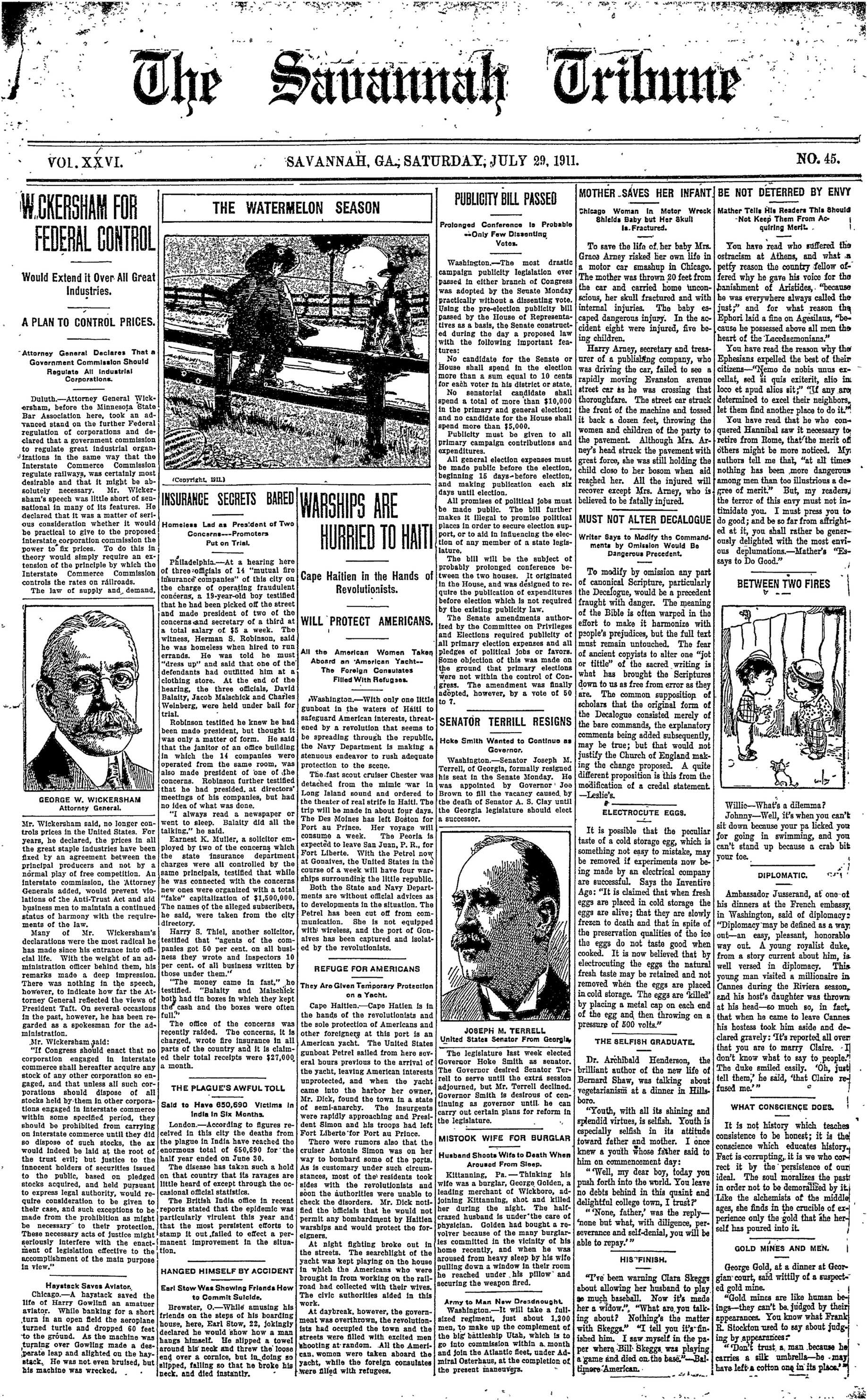
W.CKERSHAM FOR FEDERAL CONTROL
Would Extend it Over All Great Industries.
A PLAN TO CONTROL PRICES.
Attorney General Declares That a Government Commission Should Regulate All Industrial Corporations.
Duluth.—Attorney General Wickersham, before the Minnesota State Bar Association here, took an advanced stand on the further Federal regulation of corporations and declared that a government commission to regulate great industrial organizations in the same way that the Interstate Commerce Commission regulate railways, was certainly most desirable and that it might be absolutely necessary. Mr. Wickersham's speech was little short of sensational in many of its features. He declared that it was a matter of serious consideration whether it would be practical to give to the proposed interstate corporation commission the power to fix prices. To do this in theory would simply require an extension of the principle by which the Interstate Commerce Commission controls the rates on railroads.
The law of supply and demand,
J. B. H.
GEORGE W. WICKERSHAM Attorney General.
Mr. Wickersham said, no longer controls prices in the United States. For years, he declared, the prices in all the great staple industries have been fixed by an agreement between the principal producers and not by a normal play of free competition. An interstate commission, the Attorney Generals added, would prevent violations of the Anti-Trust Act and aid business men to maintain a continued status of harmony with the requirements of the law.
Many of Mr. Wickersham's declarations were the most radical he has made since his entrance into official life. With the weight of an administration officer behind them, his remarks made a deep impression. There was nothing in the speech, however, to indicate how far the Attorney General reflected the views of President Taft. On several occasions in the past, however, he has been regarded as a spokesman for the administration.
Mr. Wickersham said:
"If Congress should enact that no corporation engaged in interstate commerce shall hereafter acquire any stock of any other corporation so engaged, and that unless all such corporations should dispose of all stocks held by-them in other corporations engaged in interstate commerce within some specified period, they should be prohibited from carrying on interstate commerce until they did so dispose of such stocks, the ax would indeed be laid at the root of the trust evil; but justice to the innocent holders of securities issued to the public, based on pledged stocks acquired, and held pursuant to express legal authority, would require consideration to be given to their case, and such exceptions to be made from the prohibition as might be necessary to their protection. These necessary acts of justice might seriously interfere with the enactment of legislation effective to the accomplishment of the main purpose in view."
Haystack Saves Aviator
Chicago.—A haystack saved the life of Harry Gowling an amatuer aviator. While banking for a short turn in an open field the aeroplane turned turtle and dropped 60 feet to the ground. As the machine was turning over Gowling made a desperate leap and alighted on the haystack. He was not even bruised, but his machine was wrecked.
THE WATERMELON SEASON
```markdown
```
A boy in a hat stands on a fence, looking at two children in a field.
INSURANCE SECRETS BARED
Homeless Lad as President of Two Concerns---Promoters Put on Trial.
Philadelphia.—At a hearing here of three officials of 14 "mutual fire insurance companies" of this city on the charge of operating fraudulent concerns, a 19-year-old boy testified that he had been pickled off the street and made president of two of the concerns and secretary of a third at a total salary of $5 a week. The witness, Herman S. Robinson, said he was homeless when hired to run errands. He was told he must "dress up" and said that one of the defendants had outfitted him at a clothing store. At the end of the hearing, the three officials, David Balaty, Jacob Malschick and Charles Weinberg, were held under bail for trial.
Robinson testified he knew he had been made president, but thought it was only a matter of form. He said that the janitor of an office building in which the 14 companies were operated from the same room, was also made president of one of the concerns. Robinson further testified that he had presided, at directors' meetings of his companies, but had no idea of what was done.
"I always read a newspaper or went to sleep. Balaty did all the talking." he said.
Earnest K. Muller, a solicitor employed by two of the concerns which the state insurance department charges were all controlled by the same principals, testified that while he was connected with the concerns new ones were organized with a total "fake" capitalization of $1,500,000. The names of the alleged subscribers, he said, were taken from the city directory.
Harry S. Thiel, another solicitor, testified that "agents of the companies got 50 per cent. on all business they wrote and inspectors 10 per cent. of all business written by those under them."
"The money came in fast," he testified. "Balaity and Malschick both had tin boxes in which they kept the cash and the boxes were often full."
The office of the concerns was recently raided. The concerns, it is charged, wrote fire insurance in all parts of the country and it is claimed their total receipts were $27,000 a month.
THE PLAGUE'S AWFUL TOLL
Said to Have 650,690 Victims in India in Six Months.
London.—According to figures received in this city the deaths from the plague in India have reached the enormous total of 650,690 for the half year ended on June 30.
The disease has taken such a hold on that country that its ravages are little heard of except through the occasional official statistics.
The British India office in recent reports stated that the epidemic was particularly virulent this year and that the most persistent efforts to stamp it out, failed to effect a permanent improvement in the situation.
HANGED HIMSELF BY ACCIDENT
Earl Stow Was Showing Friends How to Commit Suicide.
Brewster, O.—While amusing his friends on the steps of his boarding house, here, Earl Stow, 22, jokingly declared he would show how a man hangs himself. He slipped a towel around his neck and threw the loose end over a cornice, but in doing so slipped, falling so that he broke his neck, and died instantly.
(Copyright 1911)
SAVANNAH, GA.; SATURDAY; JULY 29, 1911.
```markdown
```
WARSHIPS ARE HURRIED TO HAITI
Cape Haitien in the Hands of Revolutionists.
WILL PROTECT AMERICANS.
All the American Women Taken
Aboard an 'American Yacht—
The Foreign Consulates
Filled With Refuges.
Washington.—With only one little
gunboat in the waters of Haiti to
safeguard American interests, threat-
ened by a revolution that seems to
be spreading through the republic,
the Navy Department is making a
stenuous endeavor to rush adequate
protection to the scene.
The fast scout cruiser Chester was detached from the mimic war in Long Island sound and ordered to the theater of real strife in Haiti. The trip will be made in about four days. The Des Moines has left Boston for Port au Prince. Her voyage will consume a week. The Peoria is expected to leave San Juan, P. R., for Fort Liberte. With the Petrel now at Gonalves, the United States in the course of a week will have four warships surrounding the little republic. Both the State and Navy Departments are without official advices as to developments in the situation. The Petrel has been cut off from communication. She is not equipped with wireless, and the port of Gonalves has been captured and isolated by the revolutionists.
REFUGE FOR AMERICANS
They Are Given Temporary Protection on a Yacht.
Cape Haitien.—Cape Hatien is in the hands of the revolutionists and the sole protection of Americans and other foreigners at this port is an American yacht. The United States gunboat Petrel sailed from here several hours previous to the arrival of the yacht, leaving American interests unprotected, and when the yacht came into the harbor her owner, Mr. Dick, found the town in a state of semi-anarchy. The insurgents were rapidly approaching and President Simon and his troops had left Fort Liberte for Port au Prince.
There were rumors also that the cruiser Antonie Simon was on her way to bombard some of the ports. As is customary under such circumstances, most of the residents took sides with the revolutionists and soon the authorities were unable to check the disorders. Mr. Dick notified the officials that he would not permit any bombardment by Haitien warships and would protect the foreigners.
At night fighting broke out in the streets. The searchlight of the yacht was kept playing on the house in which the Americans who were brought in from working on the railroad had collected with their wives. The civic authorities aided in this work.
At daybreak, however, the government was overthrown, the revolutionists had occupied the town and the streets were filled with excited men shooting at random. All the American, women were taken aboard the yacht, while the foreign consulates were filled with refugees.
Tribune
PUBLICITY BILL PASSED
Prolonged Conference Is Probable
Only Few Dissenting
Votes.
Washington.—The most drastic campaign publicity legislation ever passed in either branch of Congress was adopted by the Senate Monday practically without a dissenting vote. Using the pre-election publicity bill passed by the House of Representatives as a basis, the Senate constructed during the day a proposed law with the following important features:
No candidate for the Senate or House shall spend in the election more than a sum equal to 10 cents for each voter in his district or state. No senatorial candidate shall spend a total of more than $10,000 in the primary and general election; and no candidate for the House shall spend more than $5,000. Publicity must be given to all primary campaign contributions and expenditures. All general election expenses must be made public before the election, beginning 15 days-before election, and making publication each six days until election.
All promises of political jobs must be made public. The bill further makes it illegal to promise political places in order to secure election support, or to aid in influencing the election of any member of a state legislature.
The bill will be the subject of probably prolonged conference between the two houses. It originated in the House, and was designed to require the publication of expenditures before election which is not required by the existing publicity law.
The Senate amendments authorized by the Committee on Privileges and Elections required publicity of all primary election expenses and all pledges of political jobs or favors. Some objection of this was made on the ground that primary elections were not within the control of Congress. The amendment was finally adopted, however, by a vote of 50 to 7.
SENATOR TERRILL RESIGNS
Hoke Smith Wanted to Continue as Governor. Washington.—Senator Joseph M. Terrell, of Georgia, formally resigned his seat in the Senate Monday. He was appointed by Governor Joe Brown to fill the vacancy caused by the death of Senator A. S. Clay until the Georgia legislature should elect a successor.
JOBEPH M. TERRELL
United States Senator From Georgia.
The legislature last week elected Governor Hoke Smith as senator. The Governor desired Senator Terrell to serve until the extra session adjourned, but Mr. Terrell declined. Governor Smith is desirous of continuing as governor until he can carry out certain plans for reform in the legislature.
MISTOOK WIFE FOR BURGLAR
Husband Shoots Wife to Death When Aroused From Sleep.
Kittanning, Pa. — Thinking his wife was a burglar, George Golden, a leading merchant of Wickboro, adjoining Kittanning, shot and killed her during the night. The half-crazed husband is under the care of physician. Golden had bought a revolver because of the many burglaries committed in the vicinity of his home recently, and when he was aroused from heavy sleep by his wife pulling down a window in their room he reached under his pillow and securing the weapon fired.
Army to Man New Dreadnought. Washington.—It will take a full-sized regiment, just about 1,200 men, to make up the complement of the big battleship Utah, which is to go into commission within a month and join the Atlantic fleet, under Admiral Osterhaus, at the completion of the present maneuvers.
MOTHER SAVES HER INFANT
Chicago Woman In Motor Wreck
Shields Baby but Her Skull
Is. Fractured.
To save the life of her baby Mrs. Grace Arney risked her own life in a motor car smashup in Chicago. The mother was thrown 20 feet from the car and carried home unconscious, her skull fractured and with internal injuries. The baby escaped dangerous injury. In the accident eight were injured, five being children.
Harry Arney, secretary and treasurer of a publishing company, who was driving the car, failed to see a rapidly moving Evanston avenue street car as he was crossing that thoroughfare. The street car struck the front of the machine and tossed it back a dozen feet, throwing the women and children of the party to the pavement. Although Mrs. Arney's head struck the pavement with great force, she was still holding the child close to her bosom when aid reached her. All the injured will recover except Mrs. Arney, who is believed to be fatally injured.
MUST NOT ALTER DECALOGUE
Writer Says to Modify the Commandments by Omission Would Be Dangerous Precedent.
To modify by omission any part of canonical Scripture, particularly the Decalogue, would be a precedent fraught with danger. The meaning of the Bible is often warped in the effort to make it harmonize with people's prejudices, but the full text must remain untouched. The fear of ancient copyists to alter one "jot or tittle" of the sacred writing is what has brought the Scriptures down to us as free from error as they are. The common supposition of scholars that the original form of the Decalogue consisted merely of the bare commands, the explanatory comments being added subsequently, may be true; but that would not justify the Church of England making the change proposed. A quite different proposition is this from the modification of a credal statement.—Leslie's.
ELECTROCUTE EGGS.
It is possible that the peculiar taste of a cold storage egg, which is something not easy to mistake, may be removed if experiments now being made by an electrical company are successful. Says the Inventive Age: "It is claimed that when fresh eggs are placed in cold storage the eggs are alive; that they are slowly frozen to death and that in spite of the preservation qualities of the ice the eggs do not taste good when cooked. It is now believed that by electrocuting the eggs the natural fresh taste may be retained and not removed when the eggs are placed in cold storage. The eggs are 'killed' by placing a metal cap on each end of the egg and then throwing on a pressure of 500 volts."
THE SELFISH GRADUATE
Dr. Archibald Henderson, the brilliant author of the new life of Bernard Shaw, was talking about vegetarianism at a dinner in Hillsboro.
"Youth, with all its shining and splendid virtues, is selfish. Youth is especially selfish in its attitude toward father and mother. I once knew a youth whose father said to him on commencement day:
"Well, my dear boy, today you push forth into the world. You leave no debts behind in this quaint and delightful college town. I trust?"
"'None, father,' was the reply—'none but what, with diligence, perseverance and self-denial, you will be able to repay.'"
HIS FINISH.
"I've been warning Clara Skeggs about allowing her husband to play so much baseball. Now it's made her a widow." "What are you talking about? Nothing's the matter with Skegga." "I tell you it's finished him. I saw myself in the paper where Bill Skegga was playing a game and died on the base."—Baltimore-American.
Mather Tells His Readera This Should Not Keep Them From Acquiring Merit.
You have read who suffered the ostracism at Athens, and what a petty reason the country fellow offered why he gave his voice for the banishment of Aristides, "because he was everywhere always called the just;" and for what reason the Ephori laid a fine on Agesilaus, "because he possessed above all men the heart of the Lacedaemonians."
You have read the reason why the Ephesians expelled the best of their citizens—"Nemo de nobis unus excellat, sed si quis exiterit, alio im loco et apud alios sit;" "If any are determined to excel their neighbors, let them find another place to do it."
You have read that he who conquered Hannibal saw it necessary to retire from Rome, that/the merit of others might be more noticed. My authors tell me that, "at all times nothing has been more dangerous among men than too illustrious a degree of merit." But, my readers, the terror of this envy must not intimidate you. I must press you to do good; and be so far from affrighted at it, you shall rather be generously delighted with the most envious deplumations.—Mather's "Essays to Do Good."
C
Johnny—Well, it's when you can't sit down because your pa licked you for going in swimming, and you can't stand up because a crab bit your toe.
DIPLOMATIC.
Ambassador Jusserand, at one of his dinners at the French embassy, in Washington, said of diplomacy: "Diplomacy may be defined as a way, out—an easy, pleasant, honorable way out. A young royalist duke, from a story current about him, is well versed in diplomacy. This young man visited a millionaire in Cannes during the Riviera season, and his host's daughter was thrown at his head—so much so, in fact, that when he came to leave Cannes his hostess took him aside and declared gravely: It's reported all over that you are to marry Claire. I don't know what to say to people." The duke smiled easily. 'Oh, just tell them,' he said, 'that Claire refused me.'"
WHAT CONSCIENCE DOES.
It is not history which teaches consistence to be honest; it is the conscience which educates history. Fact is corrupting, it is we who correct it by the persistence of our ideal. The soul moralizes the past in order not to be demoralized by it. Like the alchemists of the middle ages, she finds in the crucible of experience only the gold that she herself has poured into it.
GOLD MINES AND MEN.
George Gold, at a dinner at Georgian court, said wittily of a suspected gold mine.
"Gold mines are like human beings—they can't be judged by their appearances. You know what Frank R. Stockton used to say about judging by appearances."
"Don't trust a man because he carries a silk umbrella—he may have left a cotton one in its place."
NEGRO'S STATUS EXACT AND SURE
In Eloquent Address to Washington High School Congressman Taylor Takes High Position.
READING THE STIRRING RECORDS OF ADVANCEMENT, STATESMAN BIDS THE YOUNG TO TAKE COURAGE—DO NOT SPURN THE SOIL.
Washington, D. C.—A class of 85 was graduated this afternoon from the four-year academic course offered at the M Street High school, the exercises taking place at the Howard theater before an overflow audience which had gathered in large numbers, not only because of the inspiring spectacle, but also because the commencement address was delivered by the Hon. E. L. Taylor, at present a member of the house of representatives from Ohio, and recognized as one of the greatest friends of education effort in behalf of the negro in the country.
It had recently been made known that it was very largely through the efforts of Mr. Taylor in congress that the sum of $80,000 was appropriated for the purchase of a site for a new M Street High school for colored students, and that the congressman had exerted himself to such good purpose for two years that appropriations had been made on more than one occasion based on the ratio of colored population in Washington as compared with the white population which is nearly one-third.
The congressman was given an ovation when he stepped upon the platform and another when he had concluded his eloquent remarks. The exercises were presided over by Mrs. Mary Church Terrell, and the diplomas awarded the graduates by Rev. W. V. Tunnell, both members of the Washington board of education. Congressman Taylor's address is still the chief talk among the people.
Mr. Taylor said in part:
"I consider it a distinguished honor to have been invited here today by the officers of this school, to meet with and address for a few short minutes the graduating class and so many of the representative colored citizens of the District of Columbia. An audience like this is an inspiration to any one, and particularly-one who, unlike myself, may be inclined to be pessimistic as to the progress and future of the American citizen of negro persuasion. I am further honored by being permitted to speak to a class graduating as it does today, from the oldest high school in the city of Washington. The M Street High school has compelled my interest from the time I took up my duties as a congressman, representing as I do a district in which a large and intelligent negro population reside. I was gratified to learn that there are now more than 15,000 young colored people enrolled into the various grade schools of the District of Columbia, and more than 1,600 enrolled into the high and normal schools.
SCHOOL TYPICAL OF RACE.
SCHOOL TYPICAL OF RACE.
"The growth of the M Street school pypifies the development of the race. Starting as it did with but one teacher and forty-five pupils, today it is represented by thirty-five teachers and an enrollment of seven hundred and forty young American citizens, determined to prepare themselves properly to take up life's duties according to the bent of their individual ambitions, and this not including that splendid institution, the Armstrong Manual Training school, the outgrowth of the old business course of the M Street High school. The effects of a high school education upon your pupils seem to have been to inculcate courage, ambition and a desire to rise as educators, ministers, business men, lawyers and every other avocation to which you are individually suited. For I find that out of the class of 1910, at which time eighty young men and women graduated, 25 per cent are now pursuing a higher education in colleges or professional schools, and about 55 per cent are furthering their usefulness by a course in the normal school.
PURSUING HIGHER THINGS.
"This total of 80 per cent who, not content with the education resulting from a course in the high schools, proposes to still further fit themselves for useful lives in an effort, not only toward self-protection, but a more laudable desire to help better the conditions of others who will follow them. It has been my good fortune to have kept in close touch with the negro citizenship of my native state in particular, and having from boyhood known many of the race, both in school and in business, I have been at all times, even when others, both colored and white, were discouraged and inclined to pessimism, ardently optimistic as to the future of that portion of our citizenship, whose ancestors came to this country under the unfortunate circumstances of servitude.
EXAMPLE OF GOOD FAITH
"One has but to look back a very short cycle of time, less than half a century, to see that the negro has accepted his duties of citizenship in good faith, with true courage, and
rising above more obstacles than any other nationality, has cheerfully, and patiently progressed in education, business and other honorable pursuits rapidly as any other race was ever known to do. When we consider the evolution of the negro from a bondman to a citizen, we have a chapter in history which should stand as a beacon of encouragement to every one of us.
"You have realized as a race that education is the great solution, the basis essential, of good citizenship! Education and Christianity go hand in hand. To carry to the less fortunate the light of wisdom more than 30,000 of your people, men and women, have earnestly striven through secondary schools and colleges, to obtain a certificate which would entitle them to do their share in the splendid work of a people's uplift. I understand that practically all of the teachers in the district schools, training the minds and morals of more than 15,000 school children, are graduates of this splendid M Street High school. I have said that education leads to good citizenship. Education is the very keystone to individual success and racial advancement. You as a people, as soon as the opportunity was given you, eagerly sought the advantages of an education. The colored schools rapidly advanced from the old Freedman's Bureau to include in their number such splendid schools as Hampton and Tuskegee, Howard university, Fisk university, and other great parts of the educational machine which today throw open the door of opportunity to every colored child to receive an education fitting it to cope in every walk of life with their white neighbor.
MUST GO INTO BUSINESS.
MUST GO INTO BUSINESS. "These are only necessary incidents to successful racial progress and development. While you have more than a thousand abe lawyers practicing throughout the United States, two thousand or more physicians, and hundreds of bankers, brokers, architects, musicians and other professional men, do not for a single minute think that it is not equally honorable to go into business, into farming, into mechanics, into any honorable labor, and do it well.
"I hardly need admonish the negro of the great importance of tilling the soil. It is an acknowledged fact that the real future of this country, its very backbone, depends upon agriculture. You as a people have recognized this as readily as have the whites, and today more than 2,000,000 negroes are engaged in agricultural pursuits, and ten years ago owned over $200,000,000 worth of farms. And in the great state of Virginia, looking at a report from the auditor of the state for 1904, the negroes of the state increased the value of their property more than $1,000,000 in nine years, thus making their total property holdings in that state alone $1,950,000.
ALL SIDES NEED ATTENTION.
I fear that I weary you with these statistics, but I am trying to impress upon you the fact that I am as proud of the fact that millions are engaged as farmers, as I am that thousands are engaged in professional pursuits. Both classes of citizens are needed to properly solve the future of your race. I am proud of the fact that over 275,000 negroes are engaged in mechanical and manufacturing pursuits. Too many are prone to the mistake that education is not necessary for manual labor, agriculture, and occupations other than professional. Let me say at this point that the best teacher is the one best educated. The best lawyer, doctor, professional man or woman is the one who has the best trained mind, and this rule applies with equal force, for wherever you find an educated farmer, mechanic or laborer, there will you find the best equipped of his class.
HANDS AND BRAIN.
The hands are but the instruments of the brain, and a well developed brain will produce the more skillful manual labor. One cannot pursue any vocation successfully with his brain dormant. One can reach a high degree of proficiency in his chosen line only by a high degree of development of his mental processes. We cannot all be teachers, we cannot all be lawyers. If such were the case it would be a great calamity.
COURAGE AND FAITH.
COURAGE AND PATH.
And now the one thing that I believe we must remember most of all. It is naturally customary with young people, going out into the world as you are today, no longer gulded, instructed and aided by your preceptors, entirely dependent upon your own abilities, courage and resources, to feel that the world is at your feet, when in fact unless you clothe yourself in an abiding faith, an undying courage, and ambition that will not falter when face to face with difficulties and discouragement, you are at the feet of the world, and will be trodden upon unless there is in you the stamina which will force recognition of your merits, be those the merits of a teacher, doctor, lawyer, minister, business man, mechanic, farmer, nurse, laborer, or domestic servant. I place no one of these occupations above the other.
ALL LABOR HONORABLE.
ALL LABOR HONORABLE.
They are each equally honorable and an honest ambition to be the best of your kind will make your life a success, for success is not measured by the greatness of the individual, but if a man or woman can say that he or she is the best, or equal to the best, in their chosen life's work, their ambition is as well rounded out as is the ambition of the greatest man or woman of your race. You cannot all be leaders. One must excel the other.
The same standard applies to the colored people that applies to the white, that all work is honorable and necessary. There most be manufacturers as well as senators. There must be good business men as well as politicians. There must be fine artisans as well as litterateurs. There must be good laborers in the field as well as millionaires. And I wish to impress upon you that the success of your race, the future of your race, does not lie in the success of a chosen-few, but in the success of all. Work with the hands is just as honorable as work with the brains, and the best workman is the man who has his hands and brain both trained.
"EXCELSIOR."
A good rule to follow is to foster an undying ambition to excel all in so far as your abilities will permit, and while the men or women who constantly endeavor to excel in all things will find others who by natural ability and adaptability, pass them in the race, yet the one who strives to excel the others is certain of excelling the great majority. We are too prone to measure success by wealth. As a rule, the wealthy man is termed the successful man, and yet this is absolutely sophistry. A man whose entire success is an accumulation of money, and who has given nothing to posterity, has paid small tribute for the privilege of having existed. I do not mean that the accumulation of wealth is not a thing to be proud of. But there are other things which spell success in more brilliant letters. I believe in all persons being thrifty, but do not lose your better self in a wild race for wealth alone. We must have producers of wealth. We must have scholars, divines and thinkers.
GOLD IS NOT ALL.
The man who with his brain and the skill of hand and muscle, can contemplate a beautiful structure of which he took part in the building; the woman who can look upon hundreds of the youth of the nation, and realize that their minds and their morals have been under her control, that she has taken part in their training for a future life of usefulness, even though both draw a mere day's wage, and live in comparative obscurity, can be just as proud of their achievements as can the millionaire who gazes gloatingly upon his accumulated millions in stocks, bonds and gold. Each has been a producer. Each has contributed to the development of his country and to the betterment of his people. It is wrong for a person to willingly live in poverty simply through lack of ambition to rise above it. But a man or woman who devotes his or her life to the betterment of the people and falls to accumulate a fortune, yet industriously labors throughout his life need feel no pang if he should be counted among those who lack in wealth. On the other hand, the man or woman with talent, either undeveloped or latent, who sluggishly sits by and lets opportunity take wings, and falls to lift a hand or use his or her intellect to benefit the people, or produce something of value, is a sluggard and should be treated with utter contempt.
KNOW THYSELF.
First let me urge that you commune with yourselves. Do not foster an ambition to be that which you cannot be. Be brave enough to map out your life within the scope of your abilities. I urge an unfaltering ambition to succeed and progress, but misplaced ambition to attempt that in which you cannot succeed, is not an ambition, but a delusion. Follow the admonition of Shakespeare, "Tis vaulting ambition which oft o'erleaps itself and falls on the other side." And another old philosopher says that "He who hews above his height may have chips in his eyes." I do not say this by way of discouragement, but I have seen too many good men and women fall through misplaced effort, through thoroughly misunderstanding their own limitations, and the man and woman is assured of success who is courageous enough to analyze himself and frankly acknowledge his shortcomings. You will find much of discouragement, but that only gives to the great delight of living a successful, upright, future life.
BE PROUD OF YOUR RACE
BE PROUD OF YOUR RACE.
Let me admonish you, and I speak from the bottom of my heart, never be ashamed that you were born of colored blood. Go out into the world full of pride of race, and take not with you race prejudice and race hatred. Pride of race is proper, but one of the greatest obstructions to the progress of your race has been race hatred and prejudice, both among the whites and the negroes. You are here 'by right. You are entitled to equal rights under the law. This is guaranteed you by the Constitution.
You cannot unmake in a day sectional prejudice, but you can by patiently striving toward good citizenship, by industriously working to create something of the brain or the hand that the people want, bring about more rapidly than by any other means, a proper understanding with the people of other races and nationalities, living under the same flag. You have no cause to be ashamed of the past history of your race. The record of the last fifty years should send you forth full of encouragement and enthusiasm of the future. When you take up your life's work, do so as American citizens.
OUR EXACT STATUS.
This is your exact political and economical status in this country. Every man, woman and child born under the flag of our country, is an American citizen, and it should be your ambition, and will if I read your faces right today, to by American citizens that other American citizens, regardless of race or color, will be compelled to take pride in.
A GREAT DAY FOR FISK UNIVERSITY
Charles E. Stowe Delivered Annual Address to the Graduating Class.
MANY PROMINENT VISITORS
FIFTY-SEVEN GRADUATES RECEIVED THEIR DIPLOMAS AT THE NASHVILLE INSTITUTE.
Nashville, Tenn.—The commencement exercises at Fisk university this year were as interesting as any the famous old university ever had. Thousands attended the several celebrations, and many could not gain entrance to the hall on the day that Charles E. Stowe, son of Harriet Beecher Stowe, delivered the annual address. President Gates, who is making a determined effort to raise $300,000, needed to put the university on a good footing, was highly pleased with the enthusiasm manifested by both the visitors, students and citizens of Nashville.
Prominent Visitors
Many prominent visitors were present during the week. Booker T. Washington, who stopped over on his way to Wilberforce, occupied a seat on the platform on commencement day. Others present included Hon. J. C. Napier, register of the United States treasury; D. R. Lin Cave, who made a comment upon the address delivered by Mr. Stowe; Clinton J. Calloway, one of the commencement orators, and many of the distinguished townpeople.
Every effort will be put forward during the summer to make a successful campaign among colored people all over the country to raise a large part of the money that the school needs. Several wealthy friends of the university are willing to lend a helping hand, but they want to see what the colored people themselves will do for their greatest university. Dr. Stowe's Oration. Chief interest centered in Mr. Stowe, not only because of his relationship to Harriet Beecher Stowe, but also because he has made a first-hand investigation of conditions in the south, and has a reputation as an observant student. In the course of his address he made many interesting statements and gave altogether an address out of the ordinary.
At the conclusion of his address Mr. Stowe read two letters, one from ex-President Roosevelt and the other from President Taft. The president said after a long study of the matter he is "convinced that it is necessary to have a few high-class negro universities for those who are to be the leaders of the race," and further, that "nothing can do so much toward establishing a real nucleus for leadership among them as the maintenance of such a university as Flsk." Mr. Roosevelt sent the following letter:
"I most earnestly commend your work. You do not need to be told how emphatically I favor industrial education for the colored man, no less than for the white; but I cordially agree with Booker Washington in his support of Fisk, because it is eminently undesirable that the negro should have only a chance to get technical education in industry and agriculture.
"With the negro, as with the white, while such training is that of which there is fundamentally the greatest need for the greatest number, it is yet imperative for the sake of the race that there shall be opportunity for furnishing a different type of training for a certain proportion of the race.
"Fisk has behind it a long record of proved efficiency, and its present work is of high merit, not only from the standpoint of the colored man, but from the standpoint of the good citizen generally."
Fifty-seven graduates all told received diplomas, 23 receiving the degree of bachelor of arts, 9 the degree of bachelor of science, 20 diplomas from the normal department, 4 from the department of domestic science, and 1 from the department of music. Fisk never enjoyed a finer year.
GROWING ASPARAGUS.
Asparagus may be started from seed and come into size for table use at the third year. Seed may be planted as late as midsummer. It requires about six weeks for the seed to germinate and come up. The young plants may be cultivated in rows as other garden vegetables and set in permanent rows or beds this fall or next spring. The asparagus plant is doubly useful. The young shoots can be used for food and the foliage branches for decoration. Sprays of asparagus are equaled by few other plants for their pleasing effect in decoration. The plants are very hardy, will stand all kinds of treatment, but will respond liberally to good treatment and will thrive in one place for ten to twenty years.
NEW HAT IDEA.
A pretty trimming for a large Leghorn hat is an immense bow of handsome Persian ribbon, each loop veiled with black mallines. The edges of the loops should be wired with the finest milliner's wire in black silk.
FASHION NOTES
In hatpins baroque pearls are trumpphant.
Antique jewels are just now in high favor.
Large dots of chenille are seen on many volles.
Black braid on checked materials is quite the favorite trimming.
Tailored suits of linen or silk are showing revers of bright colors.
Some smart shoes have white buckskin tops and patent leather vamps.
French millinery shows the tendency for ribbon, silk and velvet bows.
Very pretty dresses for misses are made entirely of embroidered bandings.
One happy introduction on many tallor-made gowns is that of real pockets.
All kinds of laces are in use—very heavy ones and the daintiest and finiest.
Braid is a factor to be reckoned with in the planning of new dresses or suits.
White hats are much in vogue. They are lined with black or dark colored velvet.
Fuller skirts are talked of for the fall; also tighter and long sleeves and longer coats.
Do not forget the very important girdle and sash on your afternoon dress.
Black taffetas over dresses of some light color is one of the novel developments of the overdress. The taffetas are made to cover the under dress, which is revealed here and there by slashes or openings in the skirt or sleeves. All shades of green and blue, brown, violet, and even some of the lighter colors, such as pale bronze or pink, are used for the under part. Crocheted buttons or buttons on which a touch of the color of the under dress has been embroidered are the sole trimming of the taffetas.
One is struck by the simplicity—in fact, almost the severity of the summer frocks. If elaborate trimming is used it is certain to be flat and to follow the lines of the frock rather than develop new ones of its own. The volles and marquettes so favored by fashion lend themselves admirably to this simplicity of design and are most effective when some single oddity either in color combination or dress accessory gives them individuality. This means a skilful modiste, as it is a well known fact that extremely plain gowns are more difficult to achieve than those whose faults may be concealed beneath elaboration of trimming. The money that once went-for dress adornments must now go to the dressmaker, but the change is a worthy one, well calculated to add to the reputation for effective dressing enjoyed by the American woman.
Head fringes are a fad of the moment.
Changeable cheviot is one of the new fabrics.
Black Russia leather pumps have plain steel buckles.
There are some wonderful pretty hair nets worn, of gold and silver, and old silver is fashionable.
One of the newest sleeves is about three-quarter length and is as wide at the bottom as at the plain top.
Dressy coat sleeves end anywhere between the elbow and the wrist, and ample width is a feature of all.
The newest and largest buttons for country suits are of horn dyed to match the cloth, or of tortoise shell.
One of the most noticeable features on a large number of the new models is a sort of apronlike drapery, arranged more or less fancifully. Sometimes it is actually an apron that is hung down the front of the skirt, made, of course, of the handsomest material.
A well known matron whose brunette coloring permits her to wear orange color with success has a new evening gown in her favorite shade. It is made of satin, one sleeve being of satin and the other of white appliqué lace velled in black tulle. A panel of rich silver and pearl embroidery on vieux bleu chiffon is draped across the front of the bodice, encircling the waist, and forming a deep joint on the skirt, while a drapery of vieux bleu chiffon falls over the long pointed train of orange satin.
The touch of black or cerise on white is one of the interesting details of the season modes.
The girl who wants to have her summer frock distinctive should stencil the buttons, whether for use or decoration. The work must be done on linen or canvas before the fabric is mounted on wooden molds, and numerous designs are available, the butterfly being the most pretentious.
The Sunday School Lesson
Sunday School Lesson for July 30, 1911
THE FINDING OF THE BOOK OF
THE LAW.
Golden Text—"Thy word have I hid
in mine heart, that I might not sin
against thee."—Ps. 119:11.
2 Chron. 34:14-21. Commit v. 21.
Time—621 B. C. Place—Jerusalem.
Exposition. I. The power of the word. 14-21. The manuscript of the law of the Lord found by Hilkiah in the temple was presumably the very one written by Moses (cf. Den. 31:24-26). The supposition of the destructive critics that the so-called law of Moses was invented at this time and that it was not a discovery of the manuscript before existing is without foundation in fact. Their theory would turn Hilkiah, the great reformer, into a great liar and fraud. It speaks badly for one's own heart to be so ready to suspect every one else of falsehood. This is the constant temper of "the higher criticism." Why? There are fifteen places in the Old Testament that mention "the Law of Moses," "the Book of Moses," and only this one place which mentions the book of the law by the hand of Moses. Presumably there were other copies of the law in the land and probably Josiah had seen such copies but had never read them with any fullness of care. How "the law of God" could become a forgotten book will be very easily understood by anyone familiar with the history of the Bible in the dark ages and how it became a practically forgotten book. Jehovah had given charge that each king should have a copy of this "law" and should therein all the days of his life (Den. 17:18, 19). But the kings had forgotten both Jehovah and his word. Real prosperity and success depends upon meditating upon the word of God day and night and to observe to do according to all that is written therein (Josh. 1:8; Ps. 1:9). Ruin awaits the one who casts away "the law of the Lord of Hosts" and despises the word of the Holy One of Israel (Isa. 5:24). Hilkiah having found the law, passed it on to others and thus gave rise to a great reformation. One of the many proofs that the Bible is the word of God is the effect that a new study of it has upon religion and morals. No one has a right to keep the word of God to himself when he finds it. Every great religious reformation has arisen from a new study of the word of God. The money gathered for the house of the Lord was handled with care and appropriated to its proper use. Shaphan had an important part in the reformation by reading God's word to Josiah. There is more of wisdom in God's book than all the books of man (Ps. 119:98, 99, 130; 2 Tim. 3:14-17). The first effect of the reading of the word of God upon Josiah was to produce conviction of sin (v. 19). Having been convicted of sin by the word, Josiah next seeks to know the will of God. In those days the prophet of God was depended upon to discover and reveal the mind of the Lord (v. 22; cf. Ex. 18:15; 1 Sam. 9:9; 1 K. 22:57; Jer. 21:2; Ezek. 14:1; 20:1-7). In this dispensation it is our higher privilege to be directly taught by the Spirit through the word (John 14:26; 16:13, 14; 1 John 2:20, 27; Jas. 1:5-7). The great wrath that came upon Judah was because they did not keep the word of the Lord and had not done after "all that is written."
II. The great revival in Jerusalem and of Judah, 29-33. Having learned the will of Jehovah and the certainty of his word, the king with all his heart undertook the execution of that will. He began with the leaders of the people (v. 29) but left none out. "Both great and small" must hear the word. Josiah began his reformation where all proper and lasting reformation must begin, by teaching the whole people "all the words of the Book". What a sight! a king reading "all the words of the Book" to his assembled people. Having acquainted the people with God's law as revealed in his own word, he first of all himself made a covenant before the Lord in the presence of the people. He covenanted to do three things: (1) "To walk after the Lord." (2) "To keep his commandments and his testimonies and his statutes;" no part of the word was to be neglected. Furthermore, he agreed to do it "with all his heart and with all his soul." There was to be no half way business. (3) "To perform the words of the covenant which are written in this book." Having first got right with God himself, he caused the whole people to get right—"The inhabitants of Jerusalem did according to the covenant of God." When the rulers get right the people will soon get right. It was no new God with whom they were entering into covenant, it was with "the God of their fathers." He made a clean sweep of all abominations throughout all the countries over which he had power. That is the kind of revival that is needed today. But they not only put away sin, they went to work "to serve." True salvation is a salvation to service. The results of the revival remained as long as Josiah lived, every new generation needs a new reformation (v. 33; cf. ch. 36).
Manager—We have a boy in the office who whistles at his work.
Manager—Oh, no; you see, he's so
seldom working—Red Hen.
WIT AND HUMOR
The College of France, founded in Paris by Francis I, offers at the present day not only strictly academic instruction, but opportunities for the higher education in general. The following anecdote, from the Color of Paris, shows how far the college carries its scrupulousness. Every scientific subject, even the most abstruse, will continue to be taught there as long as one solitary individual in all Europe desires to pursue it. Certain courses are followed by two or three persons only. They tell the story of a professor of mathematics. This professor, who was extremely absent-minded, had lectured for a whole year to only one pupil.
He was perfectly satisfied that it should be so, but it occurred to him one day that he ought to congratulate his rare disciple, and he accordingly did so.
"Monsieur does not recognize me," replied the pupil. "I am monsieur's coachman, and I always, wait here until monsieur has finished his lecture." — Youth's Companion.
NO APPRECIATION.
A story from the Folles Bergere has to do with Signor Curti, the imported ballet master, who spent half an hour trying to drill into the walnut head of a chorus man a bit of pantomime. At last the chorus man said: "Aw, what's th' odds? Thuh Americans don't care for pantomime, anyhow." "It makes me think," said Curti, "of the old tenor. Broke, down and out, he had been sleeping in the livery stable for three months, when he suddenly got a chance to sing the role in which he had once been famous. La Scala at Milan was packed that night. He sang—most painfully—before that vast audience. At the end the audience hissed with drilled unanimity.
"Ah!!" said the old tenor, in the wings. "Ees eet not painful? Zee Italian people, zey no longer care for Verdi."—The Argonaut.
WERE NOT HELPED.
Rev. Dr. Aked, at a farewell dinner in New York, sald, according to the New York Times, of an overzealous missionary:
"Neither with the heathen nor with our own people does it do to advocate religion on mercenary grounds.
"I know a manufacturer who, last Easter, told all his hands that he would pay them if they went to church. Accordingly the hands all went, and a fine, brave show they made. The manufacturer, scanning their ranks from his pew, swelled with joy and pride.
"But after the service a foreman approached and sald:
"Boss, the fellers want me to ask you if we come to church again tonight do we get overtime?"
WHEN SCOTS TALK.
Dr. Abernethy, the Scotch surgeon, was a man of few words, but he once met his match—in a woman. She called at his office in Edinburgh one day, with a hand badly inflamed and swollen. The following dialogue, opened by the doctor, took place:
"Burn?"
"Bruise."
"Poultrice."
The next day the woman called and the dialogue was as follows:
"Better?"
"Worse."
"More poultrice."
Two days later the woman made another call.
"Better?"
"Well. Fee?"
"Nothing. Most sensible woman I ever saw."—Everybody's Magazine.
SPECIALIZING.
She pulled up another chair at a Chestnut street soda water fountain when her friend joined her.
"I'm in such a flurry," she imparted, gushingly. "My darling Beatrice graduates tomorrow, you know—and we are so proud of her."
"Oh, yes," said the friend. "Your daughter—to be sure; seems to me I heard she is graduating with high honors?"
"Indeed she is," said the proud mother. "She's the smartest one in the family."
"What did she specialize in?" asked the friend as she sipped her orange phosphate.
"Oh, my dear," was the eager reply, "the very sweetest pink chiffon!"—Philadelphia Times.
VALUE OF A MASK.
"George, dear, just one more question and I promise not to bother you any more during the game," she pleaded. "Well, what is it now?" asked George impatiently.
"What has that to do with it?" "Some day he might get too mad and bite the umpire, and as they don't want that to happen they muzzle him."-Detroit Free Press.
MRS WOOLEY, WORKER FOR THE NEGRO
MRS WOOLEY, WORKER FOR THE NEGRO
GOOD WORK BEING DONE BY A COLORED WOMAN IN CHICAGO, ILL.
More and more each year is the negro coming to his own through such workers as Dr. Booker T. Washington of the negro race and Mrs. Cella Parker Wooley of the white race, says the Christian Science Monitor published in Boston, Mass.
The work done by Dr. Washington in the Tuskegee school for his people is well known. No less attractive, even though in an obscure corner of a large city, is the work of Mrs. Cella Parker Wooley, who seven years ago established a settlement in the midst of the colored population of Chicago called Frederick Douglas Center. This was organized in April, 1904, by Mrs. Wooley as a practical expression of her deep interest in the race and her desire to ameliorate conditions arising from race prejudice in this country.
In 1905 the Center purchased a commodious house at 3032 Wabash avenue, its present abode, for $5,500. This is all paid for and the beneficiaries paid one-third of the cost. Mrs. Wooley says of her work: "The Frederick Douglas Center aims to individualize the colored man, to estimate him on the basis of his own real worth. It is not formed, to foster any sense of race hardship or grievance, but works constantly to ameliorate and destroy such feeling. The objects of this new movement are best defined in the second bylaws:
"To promote a just and amicable relation between the white and colored people. To remove all disabilities from which the latter suffer in their civil, political and industrial life. To encourage equal opportunity, irrespective of race, color or other arbitrary distinctions. To establish a center of friendly, helpfulness and influence in which to gather useful information and for mutual co-operation to the ends of right living and a higher citizenship."
Among the activities are a woman's club, a boy's club, a girl's club, an athletic association and a Sunday afternoon meeting which is one of the most enjoyable features of the Center. Mrs. Wooley gives her entire time to the work without remuneration. Both she and her husband, Doctor Wooley, subscribed liberally to the purchase of the house for this purpose.
Mrs. Wooley was born in Toledo, O., and is a woman of much culture. She is teaching the colored people that it is only through their individual development their problems are to be solved, and is bringing the white people to a better understanding of the meaning of the brotherhood of man.
A quotation from Booker Washington: "I am resolved that no man shall ever drag me down by causing me to hate him," is inscribed on the wall of the large parlor in the settlement house.
Roasting an Egg.
Every boy and girl down on the farm in times gone by used to roast eggs, pieces of meat and potatoes in embers in the old wood cook stove or in the big open fireplaces. Barns were searched for hens' nests, and the fine, fresh eggs were wrapped in heavy paper. The paper was dampened, and several thicknesses of it protected the eggs from scorching. You know, wet paper in a ball is hard to burn. Well, the wrapped up eggs were put on the live coals and partially covered by them. In from five to fifteen minutes the egg was roasting hot and ready to eat with salt, pepper and butter. A pin hole was made in the big end of the egg so as to let the steam escape to keep it from bursting the shell and the meats from running out. If you have never as a small boy roasted such eggs you have missed one of childhood's greatest joys.—New York Press.
HADN'T SEEN 'EM SINCE.
The young lady was painting—sunget, red, with blue streaks and green dots.
The old rustic—at a respectful distance—was watching.
"Ah," said the female artist, looking up suddenly, and pretending she hadn't known he was there all the time, "perhaps to you, too, nature has opened her sky pictures page by page? Have you seen the lambent flame of dawn leaping across the livid east; the red-stained, sulphurous islets floating in the lakes of fire in the west; the ragged clouds at midnight, black as a raven's wing, blotting out the shuddering moon?"
"No, mum," replied the rustic, shortly; "not since I give up drink."
—London Tit-Bits.
DEGREES IN HORSE TRADING.
Judge A. A. Adams of the Indiana appellate court tells a story of a man who was a good horse trader, but, through lack of mathematical education, was unable to determine his per cent. of profits.
"This man," relates Judge Adams, "made a good trade and he was anxious to know his real per cent. of profit, so he consulted a school teacher.
"I bought a horse the other day for $25 and sold it for $175; now, what was my per cent. of profit?" he asked the teacher.
"That," replied the teacher, "was not profit; it was larceny."
GOT HOME AND HEALTH
WORNOUT CITY MAN FOUND LIFE FOR FAMILY IN WORNOUT FARM.
This is an article not only for farmers, but for the tired out city man who sees nothing in the future but failure and destitution. It also shows that any one with a little capital, good common sense and practical energy can solve the problem of making the farm pay. It is condensed from a department of agriculture, bulletin prepared by Scientific Assistant John H. Arnold.
The father of a family was in in 1892 sixty years old and so worn out by the business struggle that he had to abandon all work. He had a wife and ten children, seven of them boys, all less than twenty-one years old. He had $10,000 and with it bought a 300 acre rundown farm in Pennsylvania and started the first year $8,679 in debt. Then the whole family went vigorously and intelligently to work.
After seventeen years, during which time all the children had been educated at college and a beautiful home built, the farm books at the end of 1909 showed the place to be worth $39,109 and the net income for the year $5,197,61.
The father is happy and healthy and at seventy-seven supervises every detail of the farm; the wife, who has never kept a servant, is hale and hearty; two sons are lawyers, one is a minister, one a professor, one a civil engineer and one a farmer, but the first five are putting their savings into nearby farms which they will later farm themselves.
HAIL TO THE DASHEEN
IT'S A NEW ROYAL RELATIVE OF THE POTATO AND WILL GROW ON, MARSHY LAND.
The great event in the recent annual dinner in Washington of the National Geographic society was the ushering into the gastronomic world of a new debutant, the dasheen, which was served stuffed in place of the orthodox potato. The cordial welcome given to this new arrival by the 500 guests present at the dinner has a distinct economic significance to the proprietors of lands that are too wet for anything but ducks and rice.
The dasheen is a tuber of chemical content similar to that of the potato, and it has for many centuries been a staple crop and article of food in China, Japan, the Pacific islands, Africa and the West Indies.
In appearance it resembles an undersized coconut, having a similar reddish brown color and a coating of fine, short, hairy fibers. The tubers average about the size of a duck's egg.
Here are some of the impressions overheard of the dasheen: "Artichoke flavor," "like salisfy," "sweet potato without sugar," "halfway between a sweet and a white potato," "a sort of gamy potato," "texture mucillaginous," "reminds me of a potato cooked with cheese," "decided improvement over potatoes grown on river bottom land."
The commercial prospects of the dasheen are signified by the fact that two large metropolitan hotels have entered orders for as large a portion of the 1911 crop as can be spared.
TOO SOON TO DIE.
"Sauve pul peut!" cried the heroine, for she, at least, had been educated abroad.
When the words were translated for the villain he lost no time in laughin sardonically.
"It is true," he rejoined, "that the waves run mountain high, and the ship is leaking at every seam. Likewise the captain is bellowing hoarsely through his trumpet from the bridge, ordering the boats cleared away. But these circumstances, while suggestive, are really not decisive as against the exigencies of plot and serial rights. Madame, allow me!"
And with that he reached her his hand, and with a knightly grace conducted her to the door of her stateroom.—Puck.
RUDE HASTE.
They were on their honeymoon. He had bought a catboat and had taken her out to show her how well he could handle a boat, putting her to tend the sheet. A puff of wind came, and he shouted in no uncertain tone: "Let go the sheet!" No response. Then again: "Let go that sheet, quick!" Still no movement. A few minutes after, when both were clinging to the bottom of the overturned boat, he said: "Why didn't you let go that sheet when I told you to, dear?" "I would have," said the bride, "if you had not been so rough, about it. You ought to speak more kindly to your wife."—New York Evening Post.
A UNIQUE DECLINATION.
A young woman prominent in the social set of an Ohio town tells of a young man there who had not familiarized himself with the forms of polite correspondence to the fullest extent. When, on one occasion, he found it necessary to decline an invitation he did so in the following terms:
"Mr. Henry Blank declines with pleasure Mrs. Wood's invitation for the nineteenth, and thanks her extremely for having given him the opportunity of doing so."—Lippincott's.
Now for your name on our list under the 1911 Subscription Offer.
WITH THESE you may order any one of the alternate free magazine offers of Human Life, of Boston, Mass.; McCall's Magazine, of New York, or Southern Ruralist, of Atlanta, Ga., or "Talks from Farmers to Farmers," a 16-page folio of farm wisdom. Your choice of only one and both newspapers for only $1.75.
The Tri-Weekly Constitution Monday, Wednesday, Friday--Three Times a week. The newsiest, best, brightest and biggest newspaper. Almost a daily, yet at the price of a weekly One Dollar a Year
The Tri-Weekly Constitution presents, at one sweeping view, the whole area of events. The news of the county, state, nation and the world is given in each complete issue. Each week the departments of Farm and Farmers, Woman's Kingdom, Rural Free Delivery, Poultry and others of wide interest, edited by experts, appeal directly to those addressed.
If you want The Tri-Weekly Constitution alone, without any clubbing offers, you can get it at $1.00 per year by addressing The Constitution, Atlanta, Ga. One sample copy sent free on request, giving with it the names and addresses of six of your neighbors.
The Constitution Is the Paper For Rural Free Delivery Route
'A club of 40 or 50, or more, will keep a R. F. D. route above the minimum average required for daily mail service. It is the great news purveyor of the whole Southland, as good in the gulf states as on the Atlantic se aboard.
Clubbed with The Atlanta Constitution, we have the superb FREE OFFERS shown from which you may make your choice of one:
(1) "TALKS FROM FARMERS TO FARMERS," a symposium of Southern farm knowledge that should be in the hands of every practical farmer, young or old. The articles have all appeared in Tri-Weekly Constitution under same title and made one of the great est features of this splendid farmers' paper. It will be mailed to you immediately upon receipt of order.
(2) THE SOUTHERN RUBALIST, one of the best agricultural papers in the South. It is a semi-monthly, edited by a farmer on his own farm, and is intensely practical and helpful.
(3) HUMAN LIFE, of Boston, Mass., giving current and interesting biography. It is about folks—people living in the public eye now—that you want to know something about. It has not a dull line in it.
(4) McCALL'S MAGAZINE, of New York, the queen of the home fashion months, very helpful to the mother and the homekeeper. It is just what you want.
Remember, our own paper one year and THE TRI-WEEKLY CONSTITUTION Monday, Wednesday and Friday, three times a week, for one year, and your selection of one from the alternate free offers, all for $1.75.
The Oldest, Strongest and Most Reliable Company in the State. Gives employment to hundreds of men and-women of our race. Pays from $1 to $10 weekly sick and accident benefits and from $10 to $100 death benefits. Our Motto: "Promptness, Honesty and Justice." Home Office: 1143 Gwinnett St. Augusta, Ga. For further information write 509 West Broad St. Savannah, Ga. J. S. Perry, Supt.
A. B. Singfeld, Gen. Supt.
C. T. Walker, D. D., LL. D.
D. Director and General Locurter.
Their Ideal Realized
For more than a dozen years the dream of the Manager of the UNION MUTUAL ASSOCIATION Has been to inspire Confidence in, and bring respectability to Negro Industrials Insurance, which does not only cause this Company to handle more than a million dollars annually, but they have made it possible for other similar concerns operated by our people in the South to do a successful business, which was once controlled absolutely by another race. For these and other sane reasons, we urge that you take out a policy today. Call one of their agents or phone the local manager of the Savannah district
J. C. LINDSAY,
Branch Office 509 West Broad St.
Phone 1470, Savannah, Ga.,
or WM. DRISKELL,
Secretary and General Manager.
110 Auburn Ave., Atlanta, Ga.
CHICKENS
DUCKS
TURKEYS
R. H. O. YOUNG
Wholesale and retail dealer in Live
and Dressed Poultry. Game in Season.
Special attention given to picnic or-
ders. All orders delivered free
of charge.
Stall 12 City Market.
Phone 2733.
GAREY'S
Goods delivered promptly to any part of the city.
506 West Broad Street, Near Gaston
Phone 1331-L.
$1.75 Now
THE TRI-WEE
THE SA
WITH THESE you
Human Life, of
Ruralist, of Atla
Between Hull Street and Oglethorpe Avenue
Johnson Undertaking Establishment
COMBINED WITH
The Royal Undertaking Company
(Incorporated.)
Funeral Directors and Embalmers
Finest line of Coffins, Caskets and Robes. White and black funeral
cars. Office and warrooms 325-331 Jefferson street.
W. R. FIELDS, Manager.
Residence Phone 2032. Livery Stable Attached. Office Phones 678
J. H. ULMER, Residence Phone 3064.
234 ST. JULIAN ST., WEST, 235 BRYAN ST., WEST. Phone 2958
SAVANNAH, GEORGIA.
In addition first class rooms, barber shop, hot and cold baths and automobile service at any hour, day or night. In all of our departments we give first class accommodation. Call and see our rooms while visiting the city at 109 Jefferson street, just a half block from Broughton St. car line going south on Jefferson. Ask any hackman.
Palm Shaving Palace
FINEST IN THE CITY.
Expert Hair Cutting, Electric Massage and Work Done by Experienced Workmen. COURING PARLOR ATTACHED.
PERRY R. WRIGH
517 WEST BROAD ST.
If you hesitate to wear Shoes that I know our kind of repairing. We do every first class condition—rebutton, straighten pair breaks, put on rubber heels or soles. See us before going elsewhere.
J. H. WASHINGTON
SHOEMAN
309 WHITAKER
Now for your name on our list under the 1911 Subscription Offer.
WEEKLY ATLANTA CONSTITUTION
and
AVANNAH TRIBUNE
If you may order any one of the alternate forms of Boston, Mass.; McCall’s Magazine, of Atlanta, Ga., or “Talks from Farmers to Farmers.” Your choice of only one and both news.
Weekly Constitution Monday, Wednesday and biggest newspaper. Set at the price of a weekly One Day Constitution presents, at one sweeping view of the county, state, nation and the world is given departments of Farm and Farmers, Woman’s Owners of wide interest, edited by experts, app.
Tri-Weekly Constitution alone, without any wear by addressing The Constitution, Atlanta, giving with it the names and addresses of some Nation Is the Paper For Rural Free Distance, or more, will keep a R. F. D. route above service. It is the great news purveyor of news on the Atlantic se aboard.
The Atlanta Constitution, we have from which you may make your Farmers TO FARMERS,” a symposium of Southern agricultural farmer, young or old. The articles have all and made one of the great cast features of this splendidly upon receipt of order.
NURALIST, one of the best agricultural papers on his own farm, and is intensely practical and helpful. Boston, Mass., giving current and interesting blogs now—that you want to know something about.
AZINE, of New York, the queen of the home fast-keeper. It is just what you want.
Electric Massage and Sham
ed Workmen. Courteous
D.
WRIGHT,
Dear Shoes that have be
ing. We do everything
button, straighten, or alt-
ter heels or soles.
elsewhere.
WASHING
HOEMAKER
309 WHITAKER ST.
Your list under
on Offer.
DATA CONSTITUTE
H TRIBU
the alternate free ma-
zazine, of New Y
Farmers to Farmers," a
e and both newspapers.
Monday, Wednesday
Three Times a
er. One Dollar
one sweeping view, th
the world is given in
farmers, Woman's King
by experts, appeal dir
none, without any club
institution, Atlanta, Ga.
and addresses of six of y
Rural Free Delivery
D. route above the re
news purveyor of the wh
in, we have the s
y make your ch
imposium of Southern farm k
the articles have all appeare
tures of this splendid farm
agricultural papers in the S
ply practical and helpful.
and interesting biography.
something about. It has
on of the home fashion mo
ant.
Expert Hair Cutting, Electric Massage and Shampooing a Specialty. ALL Work Done by Experienced Workmen. Courteous attention to all. SHINING PARLOR ATTACHED. PERRY R. WRIGHT, Proprietor
If you hesitate to wear Shoes that have been repaired, you don't know our kind of repairing. We do everything needed to footwear in first class condition—rebutton, straighten, or alter heels, sew up rlps, repair breaks, put on rubber heels or soles. See us before going elsewhere.
OUR GREAT PROPOSITION
own paper one year and THE TRI-WEEK and Friday, three times a week, for one year, free offers, all for $1.75. Get right on. Don't miss a copy. 'Address THE SAVANNAH TRIBUNE, Savannah
THE TRI-WEEKLY CO
week, for one year,' and
a copy. 'Address all
BUNE, Savannah, (
$1.75
The Savannah Tribune,
Established 1875
By JOHN H. DEVEAUX.
Published: Every Saturday
462 West Broad Street.
Phone 2171.
Subscription Rates:
One Year - $1.25
Six Months - 75
Three Months - 50
Remittance must be made by Express
or Post Office Money Order, or Registered
Letter. Advertising rates given on
application.
Entered at the Post Office at Savannah, Ga., as Second-Class mail matter.
SATURDAY, JULY 29, 1911
A proposed redistricting of the State, cuts out two counties of the First Congressional district, Toombs and Emanuel. They are placed in the Third district. If this measure passes before the adjournment of the legislature it will cause many new line ups in Republican politics throughout the State as, all of the districts will be affected.
Mr. Slade of Muscogee County is trying to "Out Herod Herod" by having had favorable consideration before the committee a measure amending the constitution relative to requirements for voting. If the bill passes and is ratified by the voters, in the future it will be necessary to get the recommendations of one or two "chaste white women" as to character before being allowed to register. This is among the freak laws under consideration by the Georgia legislature and if passed gaur prove a boomerang.
Justly indignant are the cooks and other female employees in the city about the unjust charge of pilfering from the larders of their employers in order to feed those dependent upon them. This charge is false and can be refuted by the employers themselves, many of whom have had in their service employees who have been with them for many years. Many of these employees enjoy the fullest confidence of their employers and are trusted to the fullest extent. Complaints of this nature do not eminate, as a rule, from families of unquestioned standing, and can be accepted simply for what they are worth, being done simply to fill space in the newspapers.
Several months ago a little Negro boy who was employed by a cleaning establishment was out on his route delivering clothes, when he was suddenly attacked by a gang of white boys and knocked unconscious with a brick bat. Again on last Saturday a crowd of white boys over in the neighbor of Liberty and Wheaton Streets were out for a "little sport" as they called it, and every Negro boy whom they would come across they would chase with sticks and bricks. They attacked one little fellow and he fought back and as he returned the fire of rocks two of the white boys whipped out revolvers and started shooting at him. Several shots were fired but they missed the boy they aimed at but one of the boy struck another little colored boy who was riding on his wheel. As he fell the boys ran and before the police arrived there was no one around who knew anything about the affair except the boy who was shot. He could give no information about the affair other than that one of the white boys fired the shot that struck him. These are but two of the many attacks which young white boys in gangs have made on Negro boys as they passed them on the streets. It is a very bad practice to be allowed to go unchecked and it is going to result in a fatal encounter some of these days if it is not stopped. It is cowardice personified for a dozen or more little white boys to jump one more Negro, and that too with sticks and rocks. There is certainly nothing courageous, brave or manly in such an attack and demonstrates the highest degree of cowardice.
```markdown
```
TAKING ADVANTAGE OF THE WOMEN OF THE HOUSE- HOLD.
St. Simons Island, Ga., July 24, 1911.
To Savannah Tribune.
Gentlemen: Please allow me space in your esteemed paper to explain the truth and nothing but the truth to the Odd-Fellows and the Households in the Jurisdiction of Georgia. Soon will be the time for Sister Barnes to turn over the gavel to some one else, to whom we do not know as yet, at the same time, I will say, when that time shall have arrived to displace Sister Barnes out of the office of the District Most Noble Governor, why not this position be filled by a sister from Savannah, Ga. Dear sisters and brothers, the reason I have come to this conclusion is because when Bro. B. J. Davis got Wilson out of the office of the District Grand Master, by his motion, he re-filled the position by Ingram. When he succeed in getting Lee out of Grand Treasurer's office, by his motion, Graves was installed and when he got Graves out of office of the District Grand Treasurer, by his motion the present Grand Treasurer was install
I am, yours truly, P.C. Joseph.
Mrs. Dennis Makes False
Statement.
To The Sewer
Allow me space to correct a circular that Mrs. Lucile Dennis is sending to the Household of Ruth of Georgia:
I wish to inform you all that I am better able to tell you or to know who Mrs. R. L. Barnes is related to in Savannah or any other part of the state than Mrs. Lucile Dennis. It is a very poor way for Mrs. Dennis to attempt to secure the sympathy of the Ruth by saying that Mrs R E Wright is related to Mrs Barnes which is without any foundation. I also noticed in her circular that Mrs. Barnes has forsaken the Ruth for the Courts because of salary. Who would stay in an order and be bossed or have the Supreme Justice and his Secretary or book-keeper to dictate to them just what to do? Mrs. Dennis claims that she had to give up being W. R. of her Household as her duties as Supervisor were so great. She has not once thought how it sounds when D. W. R. has a great deal more work trying to keep 15,000 people straight than she had with her thirty or forty people, she refers us to Chief Justice B. J Davis to save trouble. I shall let her ask him about her qualification. Mrs. Dennis claims that she gave $50 in a rally. Good for her but not thoughtful at all for a lady to give fifty dollars of her hard earnings to erect a building in Atlanta. Again, that she has given the best of her service to the order which is only five years. I have never heard of her name mentioned in the Ruth, neither could I, when this meeting will be the third time that she could meet with them. I do not mind Mrs. Dennis being D. W. R. Secretary or bookkeeper, I simply want her to write the truth when she writes about Mrs. R. L. Barnes for she is not related to Mrs Wright nor anyone in Georgia save myself and we are two sisters' children.
A Savannah Colored Directory to be Published. A New Undertaking Among Negroes in Savannah, About August 30 there will be issued from the press a Savannah Colored Directory which will be a handbook of information concerning the business, social, religious and philanthropic activities of and among our colored population. Colored Directories in other cities have met with such acceptance among business men and those interested in the Negro, and those getting up this local-Directory intend to give us a full directory. Whittier H. Wright, a very active and energetic young man, is the controlling spirit in getting up this directory. Mr. Wright has succeeded in working up this community to such an extent, that he has the sympathy and support of practically every prominent colored man in this city. The Directory
will be compiled by Mr. R. R. Wright, Jr., who was the compiler of the 1908 and 1910 Philadelphia Colored Directory. Mr. Wright was for two years Research Fellow in Sociology in the University of Pennsylvania, and received his Ph. D. degree from that famous institution. Mr. Wright is now the editor of the Christian Recorder; the oldest newspaper published in America by Negroes. The Directory will be distributed at a small price of twenty-five cents plus four cents for postage to Whittier H. Wright, Georgia State College, Savannah, Ga.
Notes From Stilson.
Stilson Ga., July 25th, 1911.
Editor of The Savannah Tribune;
Dear Sir: We are much pleased with
the reading of your paper. On Sat-
day and Sunday last the 22nd and 23rd.
we had an Educational Rally at Jerusalem church from noon until ten at night,
we had a large crowd. At night there
was a grand concert after which an address was made by Rev. S. H. Holden of Millen Ga. and Rev. J. W. Moultrie,
pastor. Sunday Morning (Mass Meeting) was a love feast. Paper by Miss Arrina Draper, "Children's duty to parents." Miss Henripta Moultrie also read a paper, subject, "Character and Character Building." Then a recitation by Miss Jessie Darper followed. After which came a solo by little Lucile Moultrie. Mr. James King made a few remarks. Miss Rosa Walker then read an excellent paper. Prof W. M James, principal of the Statesboro high School was introduced and made a few remarks, after this Rev. Holden preached the Educational sermon. The choir rendered valuable service all through the day. This was one of the greatest meetings ever held in this section of the County and will long be remembered. It has proved a source of inspiration to our people here and much praise is due the originators and prime movers of affair. Mrs. I. M. Jackson of Savannah is visiting Mr. and Mrs. J. Q. Millen. Y. Millen of the rose.
The Hemby-Harris Nuptial.
One of the prettiest marriages of the season was witnessed at the home of Mr. and Mrs C. H. Hemby Wednesday evening of last week when Miss Mable H. Hemby became the bride of Mr. Prince J. H. Harris. The home was beautifully decorated for the occasion, color scheme being white and green. The bride came in on the arm of her father, carrying a shower bouquet of carnations. She was handsomely attired in a gown of Irish lace over silk mescaline very elaborately trimmed with pearls and satin bands. The popularity of the bride and groom was shown by the great number of handsome and serviceable presents received and the large attendance. The happy couple left the next day for New York, where they will probably spend the winter. The bride was looking very charming in a coat suit of Alice blue worsted.
Quite a number of their Savannah friends accompanied them to the steamer where they again congratulated them and bade them a happy and prosperous new life.
IN HIS HOLY TEMPLE.
Second Baptist Church.
Second Baptist Church.
Rev. Reid preached on Sunday morning from the text Luke 10:33. Sunday was women's day, and the sermon was in keeping with the occasion. At night the Union Brotherhood Benevolent Association and Ladies Branch attended in a body, they donated "liberally to the pastor, church, choir and sexton. The pastor took for his text Acts 10:38. On Wednesday night next the pastor will meet all the female members of the church, both old and young. Tomorrow being the fifth Sunday is the carpet rally. Attend your weekly services. On Thursday were echoes from the Association. Usual services tomorrow.
Evangelical Ministers Union.
The Evangelical Ministers Union met with Dr. P. W. Greatheart, presiding. Devotional service was conducted by Dr. R. H. Singleton. The 2nd Psalms was then read for the lesson. The topic for the day was the Birth of Christianity, It was lengthily discussed by the union. Rev P. L. Jackson of Sylvania Ga. was with us and took part in the services. Don't forget Dr. L. A. Townsley's Rally to-morrow at 4 o'clock p. m. Rev. I. T. Grinner will preach; Prof. I. J. Yancy alternate. The public is invited. Come out next Tuesday. Visitors always welcome.
F. B. B. Dots.
On Sunday morning our services were conducted by Rev Joseph Gray of London, England. He read for the lesson Rom. g. His text was from Rom. 10:1. It was a very instructive sermon, filled with beautiful thoughts and lessons that will be helpful to all. The baptism followed these services. There was an exceedingly large crowd at the Communion services which were very impressive. At night, the church was packed. The distinguished guest was the U. R. K. of Damon. Rev. Wright preached an excellent sermon. He gave them advice that will at all times be helpful. The Knights donated to the church, pastor, choir, sexton and very generously remembered Rev Sims, and the poor saints of the church. We will welcome you at any time. Our ushers are very courteous.
St. Philios Dots.
St. Philips Dots.
Sunday was Quarterly Conference Sunday at St. Philips. Presiding Elder M. Bumbry preached two able sermons and a large congregation was out at each service. Rev. Bumbry's text at 11 a. m. St. John 8:16. Subject "Jesus Christ the measure of his love;" The text at night was Acts 3:16. Subject, "The church helpless, Divine aid." Two great Rally armies headed by Mrs. P. G. James and Mr. Joseph Powell are preparing for a great struggle at St. Philips on Sunday October 23rd. The congregation of St. Philips will attend the Rally of St. Philips Monumental on to morrow afternoon
All members that have failed to attend church, and their Leaders cannot give an account of will have to abide by the consequence. The following services will be held on to-morrow. Prayer meeting at 5:30 a.m. Preaching at 11 a.m. Sunday School at 3 p.m. Preaching at 8:30 p.m.
Monumental Notes.
The Sunday School was largely attended last Sunday. Dr. L. A. Tpwn-
sleys' class was Banner. Class in the Senior department, Mrs. H. B. Love's if the Intermediate department, Mrs. L. V. Drayton's in the Juvenile department, Miss Belle B. Brown in the General department. The sermons at 11 o'clock and at night were interesting Mrs. Hattie. Parry was received as a candidate for baptism. Two accessions during the day. The church was crowded Sunday night. The sad death of Mrs. Ida M. Williams came as a great shock to the church. The Savannah District Conference, Sunday School Convention, W. H. and F. M. Society, and A C. E. League workers held their forty third annual meetings at our church last week. The third quarterly conference was held Friday night, quarterly meeting tomorrow, the general public is invite. The addresses of welcome by Misses V. O. Shermion, Rebecca Sanders, Mr. J. S. Daniels, Jr. Mrs. S. A. Townsley, and Rev. R. J. Jefferson were indeed inspiring and cheering. The sermons delivered by the visiting ministers during the week were full of good things and they were enjoyed by the vast audiences that attended these services. The reopening of the lecture room on Monday night was a treat to the members and friends of Monumental. Come out tomorrow to Drum Corps Rally.
Corn Club of Chatham County.
Ga. State College,
Savannah, Ga.
We of Chatham County have decided to give a prize to man or boy who raises the most corn to the acre this year 1911. Prize to the man $70.00. First prize to the boy $35.00; second prize to the boy $15.00; Third prize to the boy boy $12.50. There will be a committee appointed in this county to encourage this movement. I want each and every colored person to take hold and do your best whilest the light holds out to shine. This is only to encourage the boys to be industrious.
Eva Tanguay's Song Free.
By special arrangement with the publisher's the words and music of Eva Tanguay's famous song, "I Can't Help It," will go as a feature with every copy of next Sunday's New York World.
Hereafter the Peter Ruff Detective stories that are making such a hit will be published in the Sunday's World Magazine Section.
Another interesting feature of next Sunday's World will be "Interesting Court Decisions Which Declare That the Husband Ought to be the 'Boss' in His Own Home."
Ask him to-day and your newsdealer will save you a copy of the Sunday World.
Special Notice.
Ill. Sirs and Very Dear Brothers of Ezra Consistency of the Valley of Savannah, A. and A. S. R Masons 32 degree 2 You are requested to meet Sunday July 30th, at 5 o'clock p.m., at your Castle W. Gwinnett. Business of importance.
By order of
By order of Ill., G. L. Binyard, Com. Chief.
Pekin Dots.
The bill at the Pekin this week can rightly be called an "all star bill" every member in the company seems to be an artist in his line. Liston and Liston last week's favorite talkers and singers are still "going big" Dave Liston has a voice that appeals strongly to lovers of good vocal music. Miss Liston is singing, "Chicken Reel." Just a little more care with their English will make the work of this team more pleasing. Bessie Smith the little soubrette with the big voice is "sweeping up" with "Piano Man" taking two and three encores. Smith and Levy's a "lost dog" is a contagious laugh producer. The make up and witty sayings of this team keep the audience in an uproar. Aggie Tanzel that pleasing singing soubrette and Billy Mills, the human "Phonograph" are making themselves very popular with Pekin patrons by their cleverness, "Billy" is handing out a new line of jokes that keeps the audience screaming. His song "That why they call me mime" was well rendered. Aggie Tanzel in her well-fitting and becoming stage attire is one of the biggest hits of the month. She is featuring with much success, "I've got to make love to Somebody." The program closes with a laughable one act comedy "Casey the fiddler" with Wilson and Davis in the leading role. The writer again calls the attention of Manager Styles to the need of some means where by the audience can tell the names of the various teams as they appear on the stage. The card board system is both cheap and satisfactory. The sooner this can be attended to the better, for the public is due the consideration of letting them know the names of the various performers as they pull off their stunts.
Correction.
In an article in The Savannah Tribune last week under caption Sunday School Convention at Statesboro, Ga., the name Mrs. P. G. Jones should have been Mrs. P. G. James.
AIR-DOME
Hall Lane and West Broad St. THE
SHOW SHOP
For the Entire Family CLEAN, BRIGHT, WHOLE SOME, EDUCATIONAL, REFINED.
The MOVING PICTURE MAN
JACKSONVILLE: SAVANNAN
$75,000.00 Invested in North Carolina
$20,000.00 Cash Bond in South Carolina
$5,000.00 in Atlanta City Bonds in Georgia
Branch Office, 623 West Broad Street
J. H. Whitls, Manager Savannah, Ga.
WEST END PHARMACY
Get the habit of patronizing OUR NEW STORE. We guarantee a Square Deal. We make a specialty of LOW PRICES. We never lose a customer because We give courteous attention to all. PATE'S WEST END PHARMACY BAY AND FARM STREETS.
THE JOHNSON HOTEL
With all hotel conveniences. Hot or cold baths. Large parlor with reading matter and music. Polite help. Carriage and hacks also telephones. If you want a hack or carriage ring up 676 and the manager will see that you get it. Rooms to let at 25 Cents. MEALS AT ALL HOURS PRINCE R, BUTLER, Manager and Proprietor
WOODLAWN PARK, LOTS
The highest Price lots at Woodlawn Park are only $150.00 and they 50 x 400 They Have Concrete Sidewalks and are Directly on Car Lines Consider How Important that Transpotation Feature is. Some Excellent LOTS LEFT. You Pay
See me quickly and get a choice location
CHAS. McDOWELL.
623 WEST BROAD ST.
PHONE 2098-J RESIDENCE 1206-J.
Atlanta University
An Unsectarian Christian Institution. High School, Normal School and College. Superior advantages in Industrial Training, Music and Printing. Home Life Training. For catalog and information address President EDWARD T. WARE.
CENTRAL OF GEORGIA RAILWAY
Special Train leaves Savannah MONDAY AUGUST 7 at 6:45 a.m., R. R. time. Other trains leave Savannah daily, central time, 6:45, a.m. 2 p.m., 8 p.m.
Savannah Patriarch No. 33 and Savannah Knights' 7 and will furnish plenty of music.
Tickets on Sale AUG. 7th, Good 'Returning Until AUG. 12.
For further information apply to members of transportation committee E. A. Fields, Chairman, W. Smith, R. N. Rutledge, W. O. P. Sherman, Jr. C. W. Alexander, Andrew Patterson, Ed. H Burke R. W. Williams. W. D. Aun strong, L. Binyard, P. I. Smalls, H. J. Freeman, J. S. Causey, R. L. Lockley, B. Barn es. W. R. Fields or City Ticket Office, 37-Bull Street.
WM: B. CLEMENT, City Passenger and Ticket Agent.
Dr. M. D. Loe, of Albany was for the city this week on business.
Gina Pate's Drug Store, West, Broad and Hall streets.
Mrs. Annie Murray has gone to Brunswick, Ga.
Miss Pauline Ferguson left on Tuesday of last week for New York. Mr. John Morse of Augusta, Ga., is in the city.
Mr. Scott a successful farmer of Hardeeville, S. C. was in the city last week. For Ice Cream, ring up McFall Phone 4038.
Lodge rooms for rent at Scott Bros. West Broad and Gwinnett streets. Mrs.Linton Lynes returned home on last Sunday from Jacksonville, fm., after a month's stay there.
Mrs. Corrinthias Lovett returned from a long stay at Macon, Ga., on last Sunday.
Go to Savannah Pharmacy or phone your wants. Prescriptions called for and delivered. Phone 3570
Don't go other places to buy your suit before seeing A. P. Barnard. The Taylor, 310 Whitaker street. Phone 3003
MIDSUMMER SALE of all our pattern trimmed hats at cost prices. Green and Allen, 464 West Broad St. Mrs. Bessie Rogers and children left for Bluffton, S.C., last week to be gone for quite awhile. Mrs A.E. Johnson of S19 Burroughs street sailed for New York City on Tuesday July 15th. Mrs. Laura E. Taylor and little Miss Varonica Taylor, sailed for New York on last Tuesday. Ask Pate's Drug Store 'about the Nyall Ling.
Miss Anna Pugshleu of Swainsboro, was in the city last week the guest of Miss Rebecca Burke. Mr. T. R. Walker of Lyons, spent several days in the city this week among his friends.
Mr. Thomas R. Gordon of Macon, Ga. is in the city spending the week with Mr. Philip Lovett.
Mrs. Claudia Tucker and her daughter, Miss Anna, will leave today for a two months' trip north
Mrs. Eliza Hunt, 517 Montgomery street has left the city for a six weeks stay in Manchester, Ia.
Mr. Dennis Jones sailed on last Tuesday to join his family in Spring-field, Mass., where they will reside.
STORES FOR RENT—Stores on Bay near Lunnel, good stand, ten dollars.
Apply W. H. Wade, room 9 Provident Building.
Have you had a glass of soda from the new sanitary teless soda found at Savannah Pharmacy. Its the goods and deserves your patronage.
Mrs. Capt. F. F. Jones, accompanied by her two daughters, Miss Eleanor and Mildred, left the city Tuesday for an extended trip north.
Ask Pate's Drug Store about the Nyall Line.
Mrs. Mattie McKelvey of Johnson,
S. C., is in the city visiting her son
and daughter. Mr. and Mrs. Wm. McKelvey.
Miss Nellie L. Barre of Columbus, S.
C., is in the city spending a few
enjoyably days as the guest of Miss
Catherine Flagg.
Mr. Wiley Smith, the popular Supt.
of the Guaranty Aid and Relief Society,
has been appointed special deputy, district
No. 12, G. U. O. F.
Go to the Savannah Pharmace to buy
your drugs and toilet articles. They
have the goods. West Broad and
Gwinnett St. Lane.
Mrs. Olivia Mitchell and Miss Teressa
Mitchell of Washington, D. C., former
residents of this city are spending the
rest of the summer here with relatives
and friends.
Mrs. Jennie V. Powell accompanied by Miss Antie Fleming made a flying trip to Brunswick, Ga., last Sunday visiting relatives of her husband, Mr. Jacob M. Powell.
Watch me as I grow, that will show you that I am turning out good work that suits my customers. A. P. Barnard The Tailor. 310 Whitaker street. Phone 3003.
Go to Pate's Drug Store, West Broad and Hall streets.
Miss Mattie Simkins and her niece,
Miss Emma Belle, Nix, of Edgefield,
S. C., after spending two weeks in the
city visiting her sister, Mrs. Alice
McKelvey will return home tomorrow.
Come and see the beautiful trimmed
hats which were $6, $7 and $8 that we
are now offering at $3.98, and $4 and $5
hats for $2.93 Green and Allen 464,
West Broad street.
Mrs. Lucilia Martin and little son
Willey of Elberton, who arrived in the
city last Sunday are the guests of their
Josin Mrs. L. F. Coleman, 610 Oak
street. We wish Mrs. Martin a pleasant
stay.
Last week Mrs. Emma Forest of
Charleston, S. C., spent a very pleasant
and enjoyable time at the home of
Mr. and Mrs. E. L. Martin. She was
largely entertained by the family and
friends.
Mrs. Gertrude Anderson, Mrs. Daisy F. Allen, Mrs. Maggie Richards, little Miss Loraine Anderson and Master Ambrose Anderson, left for New York last Tuesday on the City of Savannah to be gone until Oct. 1st.
Miss Valarie Anderson of Jacksonville, Fla., who has been visiting her sister, returned home rather unexpectedly, having taken ill while here. She was accompanied by her sister Miss Florence F. Anderson, who will spend a few weeks with her.
Mrs. L. C. Walkins, Misses Ole, e. Wilkins, Clide Wilkins and Miss Sinclare Brown, friends of Mr. R. McNichols who were stopping at Mrs. C. Lewis 522 Henry street after having a most pleasant stay here left on Wednesday for Griffin, Ga., their home.
The General State Sunday School and Baptist Young People's Convention held at Thompson, Ga., July 18-23 was most largely attended and very harmonious. Rev. D. W. Cannon and Mr. C. F. Waters were the delegates from here.
Mr. William M. Kirkland and Miss Gertrude A. Hughes were united in marriage on Wednesday evening July 19th at the residence of her aunt, Mrs. Sarah S. Cunningham, Tatemsville. Owing to recent bereavement only members of the family were present.
The enterprising firm of Cole and Duncan, Thirty-first and West Broad streets, wheelwrights, blacksmiths and horseshoes have just turned out a handsome truck for Mr. Clifford Hardwick, the well known drayman. This piece of work speaks well of the efficiency of Messrs. Cole and Duncan. The following officers of Olympia Lodge No. 10 K. of P., were installed on Monda night: R. B. Holmes, C. C.; P. A. Green, V. C.; C. S. Grant,
Prelate; A. M. Northington, K. of I. and S; GIGI Allem, M. F. W. J. Williams, M. E.; G. H. Stokes, M. W.; Will Thorn, M. A.
Messrs, M. A. J. Foye, J. W. Parker, G. W. Hendrix, H. K. Robinson and Henry Griffith of Scriven County were pleasant callers at an our office on Wednesday. These gentlemen were attending the conference of the West Savannah District at St. Philip Monumental Church.
Mrs. Annie McBride and little daughter Albertena McBride, of Chattanooga Tenn., are the guests of their aunt, Mrs. Pearlena Brown and Albertena Smith at 612 Oak street. Mrs. McBride will probably spend four weeks in this city and her many friends will endear to make her stay a pleasant one.
Mr. Albert Grant, one of Savannah's leading tailors, spent two weeks of his vacation in the city. He thinks that the windy city is fine. While here he met several of his old friends, among them were R. S. Abbott, M. Mapp and Sam G. Prentice. While here he was entertained by Mr. and Mrs. Mapp, 4328 Cottage Grove Avenue. He was a school and classmate. of Mr. Prentice—Chicago Defender.
On Tuesday last at the residence of Mr. and Mrs. Andrew Patterson, 24 Palm street, Mr. and Mrs. Henry Coleman entertained a host of friends in honor of the twenty-first birth-day of their son, Mr. Christopher Roundtree. The affair was one of merriment and splendor and the host and hostess and also Mr Roundtree received many congratulations for making possible such an enjoyable evening. Music that thrilled the house almost continuously added much to the pleasures. Refreshments were served continually during the affair. Mr. Roundtree was the recipient of many useful presents.
The D. W. C's Outing.
One of the most enjoyable outings of the season was the one tendered their friends by the D. W. C. Friday of last week to Beaufort. The day was a pleasant one, and about seventy-five guests had the "time of their lives." The guests voted the members of the D.W.C., as excellent entertainers.
The Baker Air-Dome
On last Monday night the Baker Air dome, West Broad and Hall Street lane was opened up and a large attendance was present. The Baker Air Dome is what used to be the Victoria but is now being operated by the Baker Amusement Company of Jacksonville Fla. The performances on last Monday night and during the week were fine and the pictures were the best ever seen by our people here. The management has made it plain that strict order will be maintained and the pictures presented will be refined, instructive and educative. The management promises to give the people of Sayannah pictures which will prove superior to any seen here by the colored people and so far they have been as good as their word. All during this week large crowds have been witnessing the pictures and have pronounced them well worth seeing.
Special Notice.
The Past Chancellors are hereby notified to be present at a meeting to be held on Monday night July 31st, at Masonic Temple. Meeting to be called at S.30. Important business to be transacted. Light refreshments to be served free.
R. W. Gadsden,
Pres. P. C. Asst.
St. Stephen's Excursion to
Daufuski Wednesday Afternoon, Aug. 9th, 2:30.
Urged by a number of our friends to repeat our excursion as they were unable to attend last month on account of badweather, we are gladly complying with their request and extend a cordial invitation to all. Music, Dancing, Refreshments.
The Fox Special Notice.
To the public and friends of the Fox Club. You remember our card in the columns of the Savannah Tribune, returning our sincere thanks for the splendid manner in which you patronized our Outing on May 23rd, in which we said that we would have another run to Daufuskie Island in the near future. We are going to give our second and last run for the season to Daufuskie on Tuesday August 1st, and we hope you will be with us on this occasion. We will assure you a most pleasant time. Again thanking you for your patronage.
We are for pleasure,
All the time. The Fox.
REST AND HEALTH TO MOTHER AND CHILD.
MRS. WINSLING'S Soothing SYRUP has been used for sixty years, MILLIONS of MOTHERS for their CHILDREN WHILE TEETHING, with PERFECT SUCCESS. It SOOTHES the CHILD, SOFTENS the GUMS, ALLEYS all PAIN; CURSES WIND COLIC, and is the best remedy for DIARRHEA. It is abused for the same purpose and ask for "Mrs. WINSLING's Soothing Syrup, and take no other and. Twenty-five centre bone.
For an Evening of Pleasure and Entertainment Attend the FIRST OUTING of the Season of the
P. G. M. COUNCIL,
No. 60, G. U. O. O. F.
AT LINCOLN PARK
TUESDAY AUG. 15, 1911
Classy music. Dainty refreshments and a good time promised to all.
ADMISSION 15 CENTS.
A. J. Williams, Chairman.
J. D. Powell, G. S.
J. W. Bryant, Ex-officio.
BEAUFORT-SAVANNAH LINE
The ordinance requiring a license for excursions to Beaufort has been revoked Parties desiring to run excursions will please Call at our office or Phone 4152 CHAS. E. BALL, Agent.
AMUSEMENT COLUMN
Coming Events in the Social
World.
NOTICE: Articles in this column one
cent per word.
August 2nd, Wednesday First Family
outing by Protection Lodge No. 320.
G. U. O. of O. F., to Daufuske. Tickets
50 and 25 cents.
July 31st, Monday. Excursion to
Beaufort, S. C., by Famous Headlight.
Tickets 50 cents.
August 7th, Monday. Seventh annual Water Outing by the Eureka Aid and Athletic Club to Daufuskie. Tickets 50 cents.
August Ist 1st Tuesday. The Fox at
Daufuskie. Tickets 50 and 25 cents.
August 14th, Monday Outing at Palmetto Park, Daufuskie by Lime Kiln Club. Fare 35 cente.
August 8th Tuesday, Joint Entertainment by I. O. of S. and D. of S. at Lincoln Park. Tickets 15 cents.
July 31st, Monday. Excursion to Daufuskie by Central Baptist Church. Tickets 50 and 25 cents.
August 28th, Monday. Excursion to Beaufort, S. C., by Union Baptist Church. Tickets 50 cents.
August 20th Saturday. Outing around the Harbor by Berean Baptist Sunday Schools. Tickets 40 and 25 cents.
August 7th, Monday. Trolley Ride by Ushers Club of First Bryan Baptist Church. Tickets 25 cents.
August 2nd, Wednesday. Annual Outing at Woodlawn Park by Palen M. E. Church. Tickets 25 cents.
August 15th, Tuesday. Annual Family Excursion to Beaufort, S. C., by Armour Lodge 1884 G. U. O. ol O. F. Tickets 50 cents.
August 14th, Menday. Annual Excursion to St. Cathrine Island by F. A. B. Church, Franklin Square. Tickets 50 and 25 cents.
August 7th, Monday. Picnic at Styles Park by Friendship Baptist Church Sunday School. Tickets 25 and 15 cents.
July 31st, Monday. Hobble Skirt Outing and Barbecue at Woodlawn Park by Young Men's Friendly Association. Admission 15 cents.
August 8th, Tuesday. Outing at Woodlawn Park by Ladies Union Enterprising Club. Tickets 15 cents.
July 31st Monday. Trolley Ride by Tabitha's Band. Tickets 25 cents.
August 15th, Tuesday. Outing at Lincoln Park by P. G. M. Council No. 60 G. U. Q. of O. F. Tickets 15 cents.
August 20th, Sunday. Three Days Excursion to Charleston to Supreme Grand Lodge A. O. K. of D. Fare $1.50
EUREKA
EUREKA
TO DAUFUSKIE
On the Afternoon of
Monday Aug. 7. 1911
Boat leaves wharf foot of Abercorn street at 2:30 o'clock
Tickets 50 Cents
No. 3200, G. U. O. of O. F.
—Will give their first
FAMILY OUTING
TO
DAUFUSKIE
Wednesday Evening
AUGUST 2nd, 1911
Steamer Pilot Boy leaves her
wharf at 2 o'clock p.m. retur-
ing leaves Daufuskie at 7 p.m.
Adult 50c Children 25c
Daufuskie
With the
BUILDING COMMITTEE Nos.
1 and 2 of the
On the afternoon of
Monday AUGUST 14th, 1911
Boat leaves foot of Abercorn St.
at 2:30 o'clock
Tickets - 50 Cents
The honor of your presence is
Requested at the
AUDITORIUM
CAFE "The Cool Place"
Ice cream made of pure cream. Pure fruit flavoring. Come and make your headquarters with us when in Beaufort this summer. "Get the Auditorium habit"
ALEXANDER MEYERS, Proprietor
BEAUFORT, S. C
Dr. L. S. Parks,
DENTIST
240 Barnard Street,
Does all kind of high grade dental work of the best quality and workmanship. Gold crowns and bridge work. White Porcelain P. and Gold Crowns mounted on the natural roots Gold Fillings, Cemen Fillings, and Silver or Amalgam Fillings, from nine to a full set of teeth. 0 and $8.00. Broken places mended n teeth added Gold ones for a small cost. Bell.Phone 114. Solid Gold Crowns Guaranteed 2K Gold
For Rent.
For rent two new, five room cottage with a wide hallway opposite Campus-Georgia State, Industrial College right on car line. Apply to Charles A. R McDowell, 623 West Broad street.
23100 200 10
THE WEEK.. CF
July 25th, 1911
A BIG SHOW—NEW FACES
MILLS and TANSEL
From Chicago
SMITH and LEVI
From Cincinnati
GREEN—PUGH—GREEN
Some Act
A $1.00 SHOW for 10 Cents
Matinees Mondays and Thursdays, 3:30 p. m.
Two Shows Nightly 8 and 9:30
F. F. JONES
BEEF, VEAL, MUTTON, LAMB, PORK, HAMS, BACON and CORNED BEEF. All kinds of GAME in season.
Goods promptly delivered to any part of the city free of charge.
Stall 31, City Market.
Take a pleasant drive on the cool and well paved White Bluff Road to Nicholsonboro and refresh yourself at
Refrshments served on short notice. Cold Drinks. Special attention to serving small parties.
MRS. GEORGIA WILLIAMS
R. F. D. No. 2
Dr, J. W. Jamerson FIRSTCLASS DENTIST
Dr, J. W. Jamerson FIRSTCLASS DENTIST
All Work Guaranteed
623 West Broad Street
Between Huntingdon and Hall
Phone 2098
You are invited to attend the
Letter Carriers
MOONLIGHT RIDE
Benefit of RELIEF FUND
WEDNESDAY
August 16th, 1911
Music, Dancing and Refreshments
FARE
Adults 50c. Children 25c
F. S. Edwards, Pres.
J. C. Hamilton, Sec'y
L. M. Pollard, Chairman.
The Acme Bicycle Store
K. HALPERN, Proprietor,
463 West Broad St.
Dealer in new and second handed
bicycles. Repairing and vul-
canizing a specialty.
Tires and Sundries.
Phone 1340.
Agents Wanted!
[For the Sale of Magic Shaving
Powder
It gives a quick shave without the use of a razor.
For particulars write
The Shaving Powder Company
SAVANNAH, GEORGIA
Artistic
Our Hats are of the season's most beautiful creations, having the very latest styles from the most fashionable makers. Our prices are very reasonable. Special attention given to the remodeling of old hats. Greene & Allen, 464. West Broad St.
PRESSING CLUB
806 Cuyler St.
Drying; Dry and Steam
Cleaning
Clothes called for and Delivered
Phone 2585-J
C.D. BROWN, Prop.
SEE
A.P. BAY
THE T
BEFORE BUYING YOUR SPIRIT
LET ME SHOW YOU THE
Phone 3003
WOODLAW
DANCE
Every Wednesday
ADMISSION
POPULAR
SHO
NICH
THE SHO
20 W. BROU
$100.00 Reward--Lost
A man about the size of a wolf
of wooden shoes on, pink gry
hair, the latter cut curly the
a corned beef colored overcoat
lining. He had an empty c
taining a dozen railroad loc
railroad tunnels stolen, from a
last seen he was following a c
were making their way to—
PATE'S DRU
P. BARNAM
THE TAILOR
BUYING YOUR SPRING AND SUMMER
SHOW [YOU THE LATEST FOR THIS
3003 310 Whita
WOODLAWN PARK
DANCING
Every Wednesday Even
OMISSION 15
POPULAR PRICED
SHOES
NICHOLS,
THE SHOE MAN
D. W. BROUGHTON S
Reward--Lost, Strayed or
about the size of a women, barefoofed with
hidden shoes on, pink green eyes; sun set
the latter cut curly the former cut dark. He
used beef colored overcoat with a sourkraut.
He had an empty crocus sack on his back
a dozen railroad locomotives and a half
tunnels stolen, from the Pacific Ocean.
He was following a crowd of 500 people
making their way to—
PATE'S DRUG STORE
to buy the
BEFORE BUYING YOUR SPRING AND SUMMER SUITS AND LET ME SHOW YOU THE LATEST FOR THIS SEASON Phone 3003 310 Whitaker St
20 W. BROUGHTON ST.
$100,00 Reward--Lost, Strayed or Stolen,
A man about the size of a women, barefoofed with a pair of wooden shoes on, pink green eyes; sun set colored hair, the latter cut curly the former cut dark. He wore a corned beef colored overcoat with a sourkraut colored lining. He had an empty crocus sack on his back containing a dozen railroad locomotives and a half dozen railroad tunnels stolen, from the Pacific Ocean. When last seen he was following a crowd of 500 people who were making their way to—
FAMOUS NYAL'S FAMILY REMEDY
We are the agents for the whole Nyal teed or your money back, ask us about buy cheap patent medicines you don't can buy something first class that will The Nyal Remedies are all good because
PATE'S DRUGS
Phones 660 and 862 H
Savannah
LEE CHEMICAL
The only NEGRO I
the C
A Full Line of DRUGS, PATENTS
Our Ice Cream, Sodas and
Prescriptions Called
PHONE 3570 811
West Broad and Gwinnett Land
agents for the whole Nyal line they are all good for your money back, ask us about the line when in our patent medicines you don't know anything about something first class that will do you good for the same remedies are all good because Pates says so.
ATE'S DRUG STORE
and 862
HALL and WEST BRIDGE
Opposite The Pekin
Wannah Pharma
LEE CHEMICAL CO. Prop.
by NEGRO DRUG STORE
the City
of DRUGS, PATENT MEDICINES and T
ur Ice Cream, Sodas and Sherbets are the best
Prescriptions Called for and Delivered
IONE 3570
811 WEST BROAD ST
and Gwinnett Lane
We are the agents for the whole Nyal line they are all good all guaranteed or your money back, ask us about the line when in our store. Why buy cheap patent medicines you don't know anything about when you can buy something first class that will do you good for the same money. The Nyal Remedies are all good because Pates says so.
PATE'S DRUG STORE
Phones 660 and 862
HALL and WEST BROAD STS.
Opposite The Pekin Theatre.
Savannah Pharmacy
A Full Line of DRUGS, PATENT MEDICINES and Toilet Articles Our Ice Cream, Sodas and Sherbets are the best Prescriptions Called for and Delivered PHONE 3570 811 WEST BROAD ST.
B.
Scott Bros.
STRAW HATS Union Made OVERALLS
Phone 2829 AMERICAN SEA
WEST BROAD &
$10 Cash &
Will buy a FIVE ROOM
best residential streets in
City water and lights.
house at once and save re
ntunity for a man of small
for the rent he now pays
The Wage Earners Loa
Phone 1198 468 W
AMERICAN BEAUTY Styles 14 at our s
kansas mo Corset Co. Makers what we s
ST BROAD & GWINNETT
Cash & $10 Per
will buy a FIVE ROOM HOME on one of the
best residential streets in the city. Lot 30x9
city water and lights. You can occupy the
house at once and save rent. Unexcelled oppor-
tunity for a man of small means to obtain a ho-
rt at the rent he now pays.
Ge Earners Loan and Investm
468 WEST BROAD
Phone 2829 AMERICAN BEAUTY Style 16 at our store and see
namarco Correct Co. Makers what we are doing.
WEST BROAD & GWINNETT ST
$10 Cash & $10 Per Month
Will buy a FIVE ROOM HOME on one of the best residential streets in the city. Lot 30x90. City water and lights. You can occupy the house at once and save rent. Unexcelled opportunity for a man of small means to obtain a home for the rent he now pays.
The Wage Earners Loan and Investment Co. Phone 1198 468 WEST BROAD ST.
For Comfortable SHOES
Triangle Brand COLLARS Howard's SHOE POLISH
ONLY COLORED LAUNDRY
IN CITY. WORK CALLED
FOR AND DELIVERED
Phone 36
MYERs and RUSSEL, Proprietors
BARNARD
TAILOR
WING AND SUMMER SUITS AND
LATEST FOR THIS SEASON
310 Whitaker St
TOWN PARK
CING
Tuesday Evening
ON 15C.
PRICED
DES
IOLS,
THE MAN
BIGHTON ST.
Strayed or Stolen,
men, barefoofed with a pair
green eyes; sun set colored
former cut dark. He wore
with a sourkraut colored
focus sack on his back con-
motives and a half dozen
the Pacific Ocean. When
crowd of 500 people who
JUG STORE
line they are all good all guaran-
t the line when in our store. Why
know anything about when you
do you good for the same money.
use Pates says so.
Drug Store
ALL and WEST BROAD STS.
Opposite The Pekin Theatre.
Pharmacy
AL CO. Prop.
Drug Store in
City
MEDICINES and Toilet Articles
and Sherbets are the best
for and Delivered
WEST BROAD ST.
Scott Bros.
FLAXON LAWNS
APRON CHECKS
We invite you to call at our store and see it Co. Makers what we are doing. GWINNETT ST $10 Per Month HOME on one of the the city. Lot 30x90. You can occupy the nt. Unexcelled oppor- means to obtain a home and Investment Co.
Men's and Women's HOSIERY
Men and Women FURNISHINGS
Of Interest to Our Women
A startling fact that is constantly revealed by the present fashions is the almost universal lack of grace in the modern girl.
The short and narrow skirt so much seen is merciless in this respect. It boldly refuses to disguise the jerky, awkward stride of the average girl, and one is more and more impressed with the rarity of the girl who knows how to walk well.
This is astonishing when one considers how much the modern girl goes in for all kinds of sport and callisthenics, yet one scarcely ever sees a girl who walks correctly, and the really graceful girl is unique. When she is seen she charms the eye and possesses an attraction that does not depend on youth or beauty.
Every girl should strive to walk well and with patience and the observance of a few rules she can soon improve her carriage. And certainly it needs improving, for the hunched shoulders and protruding chin of the modern girl borders on the grotesque.
An old-fashioned rule for attaining a graceful poise of the neck and shoulders, which many of our grandmothers practiced daily, is to walk with a book upon the head; and it should not be allowed to fall off.
The heels, shoulders and the back of the head should all be level when starting to walk and the chest well thrown out. Swinging arms are never graceful. They should hang easily, but were never intended to help propel the body along.
One should avoid the mannish stride as well as the mincing gait. There is a happy mean and the length of stride a girl can gracefully take depends, of course, upon her height and length of limb. Walk from the hip, not from the knee. Swing with steady rhythm, head well up. Don't meander aimlessly along or violently stride ahead. When you go for a walk have an object in view and pursue it steadily and emartly and you will find that your walking gains in poise and grace. Do not fall into the habit of looking down when you walk, but keep the eyes lifted and fixed steadily to the front. Looking constantly on the ground cultivates unsteadiness and insecurity.
No girl with an atom of vanity will allow herself to cave in at the back. Nothing so quickly lands one in the middle-aged class. And just as much as the back sinks so much does the abdomen protrude, and that stamps one as hopelessly graceless.
COLORS THAT LOOK WELL TOGETHER.
The combination of white and dark blue is eminently becoming—white hats trimmed with blue velvet and feathers, or blue hats similarly arranged with white, being the predominant mode of the moment. Plumes, fancy feathers, fruit and flowers, adorn the latest Parisian shapes, the hats trimmed with algrettes having completely disappeared. Wood violet and navy blue cleverly combined look well but require the taste and artistic handling of a first-class dressmaker to stand out from the crowd as did a deliciously pretty frock worn by a prominent actress at the races recently. The skirt of the dark blue volle or satin enframed the svelt figure of the wearer, the upper portion of the corsage and sleeves made of cream white mousseline de sole.
A mousse, or Japanese sash, of deep mauve moire enzoned the waist, empire fashion, a big butterfly how finishing the back, a much smaller edition in front figuring a buckle.
A quaint little Henri II. "flower-pot" hat of dark blue straw, trimmed with beautiful ostrich tips shading up from a rich dark blue to mauve, completing the plquant little lady's costume, with which a rope of pearls and long white suede gloves were worn.
NEW WATCHES.
Every year watches become more beautiful and more to be compared with the exquisite ones of the eleighteenth century. Enameling is an art which has been revived with great success, and now the most beautiful shades and blends of color can be produced. Among many old wonderfully made watches reproduced this season is a French one, very thin, its undulating edge outlined with gold leaf. The back of the watch, and almost the entire face, is covered with rich black enamel, on which are painted tiny, but very natural, roses, convolvul, and daisies with their foliage.
FASHIONABLE COMBINATIONS.
Some of the combinations of materials and trimmings in the new models are quite unusual, among which are the cotton volle, marquiselette, and various styles of lingerie dresses with footbands, girdles and sashes of velvet, black being the most seen. Chiffon in black and colors is also combined with cotton fabrics for summer wear. Charmusee and chiffon numbers in high-grade merchandise have finishing touches of fur, the most favorable for this purpose being skunk and molekin. Narrow bands are used to outline the decollette finish and touches of fur are arranged on the sleeves, waist front and girdle.
FASHION'S WHISPERS.
The popularity of the overdress continues unabated. This fad-for a dress over a dress is very evident in the new evening gowns, the soft satin draperies of which are veiled in mousseline de sole. A noticeable feature is that the skirt of the evening gowns are fuller and longer, which of course means that they are much more graceful. The handsomest models are lightly embroidered about the hem of the overdress and have touches of this same embroidery on the corsage and the sleeves. Waists are short, finished with folds of the satin caught with jeweled buckles or with long tasseled sash ends.
Among the most striking of the new evening effects are deep hems of velvet the same color as the dress. Over this velvet falls a velling which softens the bold design of beaded or silk embroidery on the velvet of the hem.
Notable among the materials for evening wear is a fine soft silk with shiny surface dotted at intervals with tiny sprays of flowers. As these flowers are in a lighter tone than the ground of the silk, they seem to stand out in relief as if they were embroidered in the fabric.
Beads continue to be exceedingly smart. One of the most wonderful of the recent French creations is a dinner gown of smoke gray chiffon over dull smoke crepe, the overdress almost solidly embroidered in glinting steel beads. A succession of jeweled peacock feathers formed the bandeaux for the plain but artistic coiffure, and the wearer carried a dainty fan of peacock feathers.
MOTHERS WITH GROWN-UP GIRLS
Does any circumstances in her life change a woman so completely as having a grown-up daughter to chaperon? To this point in her history she may have been a merry and careless being, thoroughly unconventional and happy-go-lucky, but now responsibilities are thrust upon her, and she must think for some one else as she has never done for herself.
Hitherto the best and kindest of friends, taking people for just what they are, not for what they possess, she is suddenly obliged to acquire the ungrateful knowledge of incomes and positions, as however unworldly her nature she cannot desire her girl to marry into poverty. Perhaps a childish gayety distinguished her before she was forced to study character and grow discreet, for as a mother she is rightly accounted a failure should her lamb become the prey of any wolf in sheep's clothing.
No longer either does she reign sole presiding goddess of her house to whom all comers render homage, as the younger woman will naturally resent it if she be not given her chance of winning social distinction.
Though the English mother is not put upon the shelf quite as soon as the American mother, she, too, knows the palms and abnegations of that unenviable place, which only love can render tolerable to her pride.
To be a successful mother is a totally different thing to being a successful woman, and calls forth an altogether different set of virtues.
WELL TO KNOW.
The following are different ways in which milk may be prepared for children who dislike to take milk:
Beat the yolk of an egg light, add a teaspoonful of sugar and half a teaspoonful of lemon juice; fill the cup with milk, stir well and call the mixture snow lemonade.
Heat a cupful of milk, but do not let it boll, sweeten it and flavor with a little cinnamon and pour from a tiny teapot, calling it cinnamon tea.
Put a cupful of milk and the white of one egg into a glass jar; add a little sugar, screw down the top of the jar and shake until the ingredients are thoroughly blended; flavor with orange and serve as orangeade.
Cocoa made with milk is liked by most children and is even more nutritious than the milk alone.
When the eggs come from the grocer wash them and then when the eggs are used save the shells. Place them in an oven to dry and put away in a glass jar. Just before using crumple. These are fine for clearing coffee, soup or any kind of drippings. Sandwiches may be made by saving the best and firmest of the vegetables from the dinner of the night before. Chop fine and add enough tomato cat-sup to hold together. Set in ice box to cool and spread between dalnty pieces of bread.
QUEEN MARY'S EARRINGS.
It is because Queen Mary is never seen without earrings that so many smart women of today are wearing them. Her majesty has a really-fine collection of these ornaments, some of which are of great historic interest. Many fine pairs were bequeathed to the queen by her late mother, Mary, Duchess of Teck, who also had a great penchant for earrings. For day wear the queen usually favors short earrings, generally of single stones which rest on the ear, but in the evening she adopts the picturesque long shape. Her earlace is pierced in old-fashioned style, and she will have nothing to do with the screw fastening which are almost universally used today.
A certain man made a great supper and invited many. . . . But they all began to make excuse—Luke XVI
16-18.
Our Saviour's parable or homily to which these words form the introduction commentators take as illustrative of the conduct of some people toward the church, or faith, or grace, or what is included in religion. Very many beed not the call or offer various excuses for not attending to the demands which religion makes on their time and energies. Men and women withdraw themselves from the influences which religion would exercise on their lives and from the ideals which it furnishes. They are struggling to maintain an independent attitude and trying to convince themselves that religion is a luxury which they can well do without, or is not a necessity of their being. There are, of course, individual reasons which some hold up to justify their neglect and serve as foundations for the absence of any religious element in their lives and actions. But more deep-seated and general is the lack of appreciation in them of the benefits of religion and its claims.
Religion—and by that I mean, not a mere ethical culture or moral standards, but revealed religion, a holding on to the unseen verities of the supernatural and spiritual, the substance of things hoped for and the conviction of things that appear not—is urgent and of vital interest. Even natural religion is based on what is above the senses. Though much is done to destroy belief in the traditional teachings of Christianity and the waves of agnosticism and materialism leave a sentiment noisome and disastrous, yet the soil is not swept away in which grow the ideas of God, creation, the soul, eternal life. The human race cannot all be weaned from the abiding confidence in the truth and actuality of these fundamental teachings. Mankind is immovable in the things which are written on the tablets of our hearts and indelibly imprint on our belings.
Human life is more than plant life, more than animal life, and must be led in subjection to and in dependence on the Supreme Being. For not only do we bear about us the image of the creating God, but we hug securely the anticipation and longing, for a sharing in the divine, when this mortality puts on immortality. "Thou shalt love the Lord thy God," "The Lord thy God shth thou adore and him only shth thou serve," are written in the traditions and works of every nation and tribe. It is of primary importance "to behold the power of the height of heaven, to seek the Lord who knoweth all knowledge and declareth the things that are past and the things that are to come, and revealeth the traces of hidden things; for all men are vain, in whom there is not the knowledge of God or who by the good things that are seen cannot understand him that is." This is "the highest wisdom, the vapor of the power of God, a certain pure emanation of God's glory, the brightness of eternal light, the unspotted mirror of his majesty, the image of his goodness." When we understand the nature of our own
'MOISTURE IN ORCHARD SOIL.
As water is the means of circulation of plants as well as of animals, therefore it is of prime importance that water be present in the soil, in order that the plant food in the soil may be taken up by the trees. Many orchards have sufficient available plant food, but lack water at that critical period while the tree is fruit making. If a soil lacks water some form of fertilizers are a positive detriment if they are present in abundance. The chief elements of success in preparing an orchard/soil for the best results may be summed up as:
Removing surplus water from the soil. The conservation of plenty of moisture. The judicious use of manure and cover crops. The use of potash and phosphoric acid in available forms. Cultivation to keep a mulch. Reducing the number of trees per acre. By withholding nitrogen, and increasing the amount of mineral matter. By the use of wind breaks. By mulching. By keeping the soil in the best physical condition possible. It is not wise to stick to the exclusive use of any one practice, but to employ various methods to maintain the fertility of the orchard soils.
GOOD AND BAD EGGS.
All people do not agree on the definition of a good egg, and even some do not realize the conditions that sometimes affect its quality. In order to meet any demand for first-class eggs, the eggs should weigh one and one-half pounds to the dozen, be uniform in size, naturally clean, not washed, strong shelled and fresh. A fresh egg is one that was laid by a healthy hen, is only a few days old and has been kept in desirable surroundings. A fresh egg is not one that was allowed to stay in the nest for a day or two until it became convenient to gather it, or was taken from a stolen nest, or an incubator, or from under a betting hen. Age causes an egg to become stale and shrunk, and it can never be
minds, heed the promptings of our hearts, and interpret the capacity of our own reason, we value the lesson we learned when first we opened our minds to understanding, that we are made to know God and to love him. Whatever else man is, he must be religious; whatever engages his activities, his first and all-absorbing aim must be divine adoration, worship, respect, obedience and love. And howsoever great may be his rise in other lines, his development in his relation to God must be the greatest. When we forget this, the claims of business distract us, the attractions of pleasure lure us, the just for power enthralls us, the passion of sin controls us, and we lose sight of the fact which we should constantly recognize, that unless we join in praise and prayer to the Most High and unite in adoration of His Supreme Majesty who are an anomaly to the face of the earth. For all things that exist render praise to him. What we need is more reflection; deep pondering will reveal to us the necessity of religion to give proper dignity to our lives, impulse to our endeavors, strength to our weakness and support to our sorrows. A little knowledge may lead from God, but more knowledge drives us back to him. When the thought of his sovereignty takes possession of us and we realize our dependence on him, we shall appreciate religion's claims and accult ourselves of its duties.
Some-refuse to accept and abide by the teachings of the supernatural, alleging that they are beyond the scope of human attainment, and therefore should have no abiding force. But the foundation on which those teachings rest is as sound and solid as human reason or human judgment; and faith gives play to a perfectly legitimate function or operation of the human mind. And no student of natural philosophy or earthly science proclaims the conclusions of his study or the facts of his realm with any more confidence than the truth of faith. Conviction of the truth and actually of the supernatural is possible, obligatory, indispensable and not so very difficult, and will direct and impel to earnest and loving practice of religious virtues.
Unwillingness, too, keeps many away from the church of God—unwillingness to accept and fulfill the obligations which religion imposes. For religion is a system of duties and laws as well as of inspiration and hope. It comes to us and says emphatically: Thou shalt not. It declares some human actions lawful and some desires illegitimate. It puts us under restraint and would have us exercise self-control. We have to check our passions and overcome evil tendencies. And there are standards—exact, strict and positive—according to which our conduct must be ruled. We are not allowed to think as we please or to do as we like. And we must one day render an account of our stewardship. We do not relish anything that puts us under restrain or makes it hard for us. We do not read "Rules and regulations" with pleasure, and do not spontaneously place ourselves in the way of laws and their action. We observe laws under protest. Therefore as religion may not have any immediate and present sanction for its laws and cannot secure earthly penalties the observance of its commands and injunctions, mankind takes advantage of the ease with which it can avoid the obligations, and walks away with perfect composure and indifference. Only they who are possessed by the importance and filled with the spirit of devotion will obey when religion calls and do what it directs.
classed as a fresh egg. Heat seriously affects the quality of eggs, and in warm weather they, should be gathered daily and marketed as often as possible. Moisture causes molds to develop and quickly changes the quality of the egg. Muddy weather means dirty nests, and consequently dirty eggs. Nests built upon the walls of barns and enhouses are often used as roosting places, causing filth to accumulate, resulting in dirty eggs. Dirty eggs must be handled as second grades; washed eggs are just as bad. Eggs deteriorate in quality if they are left behind the kitchen stove or are stored in damp or musty cellars.—Indiana Experiment Station.
CRACK FILLER.
We had excellent success with a crack filler made by taking some rather dry putty, moistening or softening with some of the floor varnish—a little at a time, as it hardens rather quickly—and to obtain correct shade we used yellow ochre for light floors or burnt umber for dark. Use only a small amount of color at a time and compare until the exact share is reached. We tried some of the prepared filler, but it was not as satisfactory as the homemade. Press into cracks with putty knife, and scrap off all that comes above the surface—Mrs. C. R.
MAKE OWN WATER FILTER.
A homemade filter can be made in this way: Take a large flower pot, insert in the hole in the bottom a sponge, fill the pot, with alternate layers of sand, charcoal and small pebbles. The flower pot thus filled may then be placed on jar or other convenient vessel into which the water can be received as it filters through.
STRENGTHENING PILLOW-SLIPS.
Pillow-slips made from tubing may be given a longer lease of life by reversing the end seam. Rip seam and turn half way arpound, so that the former side folds meeting in the center, and stitch up again. This gives a new surface for the heavier wear.
FOOTBALL IS DANGEROUS
IF YOU DON'T THINK SO TRY TO START A GAME IN TURKEY.
It is, or was until recently, a difficult matter to be a sportsman in Turkey. One Rechad Bey tried it, with a result weird enough to serve as a basis for a detective story or a comic opera.
The young Turk had organized a football team among his friends, together with some Greeks and Armenians, and began practicing. Not very long after, in the middle of the night, police came to his house and carried him off to Scutarl. There he was submitted to a long interrogation as to the club and the game of football.
The authorities were convinced that they had found a great plot and that the club must be a secret society. A special messenger was sent for the ball, and that was duly examined and found to be an infernal machine. The rules of the game were considered to be another piece of damning evidence, and still worse were the sweaters and colors of the club.
After long deliberation the culprit was sent to the higher police authorities in Stamboul, who went through a second long examination and came to the conclusion that the empire had been saved from disintegration by the early discovery of a great plot. They dispatched the whole matter to be inquired into at the sultan's palace at Yildis, and a special commission took the matter in hand.
After much careful thought and examination of the evidence of the crime it was decided that there might not be any thing in it, but that it must not be committed again.—Harper's Weekly.
TRAINING SCHOOL CHAUTAUQUA
HUNDREDS OF TEACHERS AT TENDING LECTURES AT DURHAM, NORTH CAROLINA.
Durham, N. C.—Special.—Hundreds of teachers from nearly every section of the country are attending the summer school and chautauqua of the National Religious Training school, this city. Men of national reputations as scholars, of both races, are here giving lectures. The excellent location of the institution with its beautiful surroundings and many features of out-door pastimes with the musical events are attractive features of the work.
A large number of ministers from several states are attending and the lectures by Rev. Dr. W. Y. Chapman, of Newark, N. J., and one of the greatest white preachers in America, are making the school the cynosure of the eyes of hundreds of white people in this section. Dr. Chapman was preceded by Dr. Jesse L. Hurlbut, who has gained the distinction of being one of the greatest authorities on the Bible in the United States. These lectures were not only attended by quite a number of negro ministers, but by a number of white ministers.
There is an appreciable amount of interest being manifested in the department of the school which will bring to the institution in a few days a number of prominent settlement workers. Because of the need of this class of workers among Afro-Americans this feature of the school work with the other work being done by this new but beneficial institution, is being encouraged by the best element of both races.
HOW IT GOT THERE.
A gamekeeper was going over his master's estate one morning, when he encountered a gentleman of the poaching class. The gamekeeper noticed that the other hat was bulging in a curious manner. After subjecting the hat to an examination he found a fine young pheasant.
"How did this get here?" the gamekeeper asked, glaring at the culprit.
"Blowed if I know," growled the poacher, gazing at the pheasant with an apparent look of great perplexity.
"The blooming thing must have crawled up my trousers' leg."—London Tit-Bits.
THE WRONG BUTT.
The last time President Taft was traveling in Texas he was invited to a dinner of bacon and boiled cabbage. The invitation was telegraphed from the citizena of a small town to the president's private car, and was received by 'Capt. Archibald W. Butt, the president's aid.' After consulting with the president, the captain telegraphed this reply:
"The president accepts your invitation, with pleasure. BUTT."
This is the way the message read when the prospective hosts received it:
"The president accepts your invitation with pleasure, but—"—Popular Magazine.
MISSED SOMETHING.
A Perthshire farmer on his way home from market one day suddenly remembered that he had forgotten something, but what he could not recall, says the National Monthly.
As he neared home the conviction increased, and three times he stopped his horse and went carefully through his pocketbook-in-a-rain endeavor to discover what he had missed. In due course he reached home and met his daughter, who looked at him surprised and asked: "Why, father, what have you done with mother?"
HONESTY IS NOT PREVALENT
Such Is the Conclusion That Must Be Drawn From Facts of Business Life.
Most people are accounted honest at heart, at least "indifferent honest" like Hamlet. Social and commercial relations demand some degree of honesty, and where the quality is not instinctive it is presumed to be cultivated for expediency as the "best policy." Credit is the very corner stone of business. But while in theory every one is assumed to be honest, what is the practice?
Why are factory doors locked to permit a search of employees for stolen material? What is the reason for the enormqus sales of cash registers and the multiplication of office checks and balances to prevent the theft of money by those professionally engaged in handling it? Why do bonding and surety companies multiply and why do customs officers pry into the imports of great commercial houses as well as into the baggage of steamship passengers?
A curiously suggestive municipal exhibit of the relation of the theory of hopesty to the conditions was furnished last week by the heaps of short-measure market baskets piled up against the city hall after seizure by the police. Is the honesty of even the farmer in doubt? Here was mute evidence of a state of things that gives reason for more concern than grand jury investigation of trust company and corporation rascality.—New Fork World.
ONCE WAS ENOUGH FOR HIM
Theatrical Manager Would Not Repeat Blunder of Asking About an Absent Spouse.
A well-known theatrical manager was striding down Broadway when he stopped to chat with a young woman he had not seen for a year. "When did-you come to town?"
"When did you come to town?" he asked pleasantly.
"Why, didn't you know that I am living here?" she asked.
"No. Is that so?"
"Yes. How strange that you have ot heard of it. Surely you must ave seen my husband."
"Oh, yes, I have had several chats with him, but I didn't know that you had come over too."
"Do you mean to say that you thought—" She hesitated, then added indignantly. "Such a thing is impossible."
"Anything is possible nowadays," said the manager consolingly. "Somehow he didn't happen to mention you, and I never ask questions. I don't propose to take any chances. I made a dreadful blunder once by asking about a man's wife who had been twice removed since I had met the husband last, and I promised myself then that I would never do it again."
HELD BULL BY THE HORNS.
A farmer's daughter was faced the other day with the necessity of practically fulfilling the advice of the old adage, "take the bull by the horns." The story of how the young girl, Mina Jacques, rescued her father from a mad bull comes from Beaulieu, Hampshire, England. The animal suddenly became infuriated, and after knocking down the girl's brother, rushed at the father, and tossed him a considerable distance. Miss Jacques, hearing the uproar, came out, seized the bull by the horns, and held the animal until the injured men escaped indoors. She then let go and also ran for the house. She barely succeeded in making her escape, the bull actually charging the door.
DELICATE IRONY.
Col. Sir Charles Hightedale had his regiment out for a practice march on the road near Dublin, Harper's Weekly says. His command had suffered several overwhelming routs in the Boer war. Meeting a drove of pigs on the way to Dublin market, Sir Charles considerately halted his regiment at the roadside, so as to let the pigs pass. "Oh, come on, colonel; come on!" cried the pig drover, saluting. "Come on, yer honor. Sure, there isn't a boar among them!"
PRACTICAL HOME WORK
The Altruist society of Montclair, N. J., has engaged Miss Clara Patterson of New York to visit homes of poor people and to give them lessons in practical economy and in making purchases for the household. She will show them how to actually save by buying good food.
WHAT TO EAT WHEN IT IS HOT
ADVICE OF DR. HARVEY WILEY
SUBSIST ON A MIXED DIET, SHUN ICE COLD DRINKS, OF COURSE, AND REDUCE YOUR RATIONS AS THE BODY NEEDS LESS FUEL.
Don't take up any food fads.
Eat whatever you want, but don't overdo it.
Subsist on a mixed diet. Ah this talk about vegetables or fruits alone being a panacea makes me sick.
Don't drink ice cold concoctions.
Full man a youth has gone to his sarcophagus
By pouring ice cold drinks adown his hot esophagus.
—Hot Weather Advice by Dr. Harvey W. Wiley, Food Expert of Department of Agriculture.
It's silly to lay down rules of diet in these days, when most folks are busy battling for mere existence, says Dr. Harvey W. Wiley, chief of the bureau of chemistry, department of agriculture, who just now is telling people how to keep comfortable in hot weather.
"Most people are obliged to eat whatever food they can get," is the encouraging message of the health expert. "Those who have any choice, however, first of all should be moderate in everything at the table. The human system was built for a mixed diet. The ages have proved that moderation in food is best for mankind, so why should we pay any attention to any of the faddists that occasionally arise to claim attention? LIKE STEAK IN SUMMER? EAT IT.
"If you have been in the habit of eating a steak now and then or a chop or a piece of roast meat in cold weather there is no reason for eliminating it from your menu simply because the weather has turned warm. Merely cut down the quantity. When the weather is hot there is no necessity for supplying so much heat to the system. We do not need so much coal to keep the human engine going, "It is really dangerous to drink ice water. Water too cold and drunk in large quantities chills and congests the coating of the stomach. Many people distill or filter their water to free it from pathogenic germs and afterward add ice to it, not knowing that the ice is just as liable to be filled with germs as is the water. The habit is found to result from the ignorant belief of some people that so-called microbes cannot live in ice—that by bringing the water to a freezing point these germs are killed. But freezing produces only suspended animation in the pathogenic germs causing our common diseases. They merely hibernate in the ice. The longer it takes water to filter through a porcelain filter the more thoroughly it is freed from germs.
WHY LESS FOOD IS NEEDED.
"Less food is needed in the summer because the body's radiation of heat is greatly reduced. With a normal body temperature of 98 degrees, we go out into the winter's cold, often when the air is zero or below. During such weather the heat of the body is constantly being radiated off into the cold air, which is another way of defining the process by which we get chilled in the winter. But in the summer the air about us is so hot—often hotter—than our bodies—that we radiate little or none of our heat into it.
"There is about as much nourishment in a pound of wheat as in a pound of beef. Wheat is the better food for the workingman because it is a balance ration, containing all three of the principal nutrient constituents of food, which are protein, carbohydrates and fats, required to produce heat and energy in the adult and furthermore to build up tissue in the young while they are growing. When a pound of meat is eaten it supplies only protein, which is the element which builds tissue. Adults need a certain amount of protein to build up the waste tissues, but they do not need nearly so much as the growing child.
NEVER KEEP STOMACH EMPTY.
"In the summer we should eat more of the succulent foods of the vegetable class and less of the concentrated foods of the animal category. While we should eat less in hot weather, we must never keep the stomach empty. The stomach and intestines need to be distended. Should the nutrient constituents be extracted from hay and fed to a horse in concentrated form the animal would die. The human stomach as well as that of the horse needs a large amount of indigestible material to keep the alimentary canal open.
"Potatoes and fat meat are the best foods for the laboring man; also sugar sipup. A lump of sugar will restore elasticity to the muscles of a tired man as promptly as will alcohol, and the advantage of the sugar is the absence of a harmful reaction. Men forced marches, athletes and those who make heroic physical efforts of any kind should carry lumps of sugar to eat from time to time."
BLED THEM WHITE
THE TREATMENT IN FEVER CASES TILL QUININE WROUGHT A CHANGE.
In 1832, when the French were conducting a campaign of conquest in Algeria, the mortality among the troops and colonists there was frightful. France was being continually called upon for fresh levles of men and youths to supply this terrible loss, chiefly from fever, incidental to the climate.
At that time the practice of bleeding still prevailed. "Bleed them till they are white" was the injunction which Broussais, the head physician of the French, gave to his followers when the condition of the soldiers was reported to him.
At Bone in one year out of an effective force of 5,500 men, 1,000 died of illness in the hospital. Most of them had been "bled to the white." At this time the effects of sulphate of quinine were known, but few physicians ventured to employ it. One, Malliot, had interested himself in the new remedy and, going to Bone in the medical service of the government, he resolved to see if it would not reduce the frightful mortality, which was one to every three and one-half men who entered the hospital. At first he employed the quinine merely as an adjunct to the bleeding. He soon found that bleeding was killing the men and that quinine was saving them. Little by, little he left off bleeding, to the great scandal of the medical profession.
Exactly in proportion as the bleeding ceased the deaths in the hospital decreased. In two years the deaths fell off from one in three and a half of all who entered the hospital to one in twenty and finally to one in forty-six. Malllot, quite naturally enough, became an earnest opponent of bleeding, but he was so actively resisted and so ceaselessly vilified that he became embittered toward his colleagues.
Nearly thirty years passed before Mallot saw the complete triumph of his ideas. Doctors continued to bleed their patients heartily for all manner of ills. But in 1860 Mallot was made commander of the Legion of Honor and chief of the medical staff of the French army, and his influence, with others, in bringing about a virtual revolution in the practice of medicine was fully recognized.—Harper's Weekly.
COWS AND HOGS—AND MEN.
We have an agricultural department, and we are spending $14,000,000 or $15,000,000 a year to tell the farmers by the results of our research how they ought to treat the soil and how they ought to treat the hogs and how they ought to treat the cattle and the horses, with a view to having good hogs and good cattle and good horses.
There is nothing in the constitution especially about hogs or cattle or horses, and if out of the public treasury at Washington we can establish a department for that purpose it does not seem to be a long step or a stretch of logic to say that we have the power to spend the money in a bureau of research to tell how we can develop good men and good women. Some of our enthusiastic conservators of national resources have calculated how much the life of each man and each woman in the community is worth to that community.
I do not think it necessary to resort to that financial calculation in order to justify the saving of human life, such as can be accomplished by the results of research and advice that will proceed from a properly established bureau of health.—President Taft.
A HOED CROP FOR A SUMMER
FALLOW.
The more I study the value of intense culture and thorough cultivation given some hoed crop the more I have come to appreciate its value in our crop rotations. No practical farmer, who has given some hoed crop thorough cultivation during the whole of a growing season has failed to note the good effects upon the succeeding crops in the rotation that they are practicing.
Years ago the old practice of bare summer fallowing found favor in many farming sections, but during recent years the decreased price of farm products and the increased cost of labor has made its use actually prohibitive, besides the practical farmers have discovered that a hoed crop will accomplish all-that a bare fallow possibly can and still pay better than any other crop that is raised in the rotation.—W. K.
DAINTY CENTERPIECE.
Last year a hostess living in a delightful country place had this unique centerpiece at a luncheon which she gave for some of her city friends. She had the enormous straw hat tied as a basket filled with roses. It was held by a big bow of gauze ribbon. At each place small baskets filled with unhulled strawberries rested on a dolly of grape leaves. To the handle was tied a bow of pink gauze ribbons, with the name card pinned to it with a dalty imitation coral stick-plu. Just one pink rose rested on the handle. It was all very simple, but the rustic effect was lovely.
Practical.—The Deck Passenger—"I notice all of the steerage passengers bolt their food. I wonder why." The Steward—"They bolt their food to keep it down."—Chicago News.
POETRY
of and by Our People
In yonder city jail tonight
Within a damp and gloomy cell,
Lies one whose soul was pure and white—
A Lily—are the withering blight
Of sin's foul touch her 'beauty marred.
Then every door of hope was barred;
An outcast, down and down she fell—
Fell, as a snowflake from the sky,
Down in the dust of earth to die;
Fell, like a star from the throne of light,
Into the endless depths of night
Into Hell.
What cares the world for such as she,
Lying there in the jail alone?
A helpless case was its decree.
She's bad because she chose to be.
Not so, harsh world, She struggled long
To rise, to overcome the wrong.
She sought for help, you gave her none.
When you bade the friendless girl depart
She turned away with breaking heart,
None heeded the tears nor the hopeless
sigh.
As she entered the streets of sin, near by-
No, not one.
-From the Mite Missionary Herald.
IN THE SHADOW OF HIS HAND.
Isa. 49:2
Oh, to be hidden, yes hidden there!
In the shadow of his hand,
Made a "polished shaft,
By the workman's craft,
To be used at his command.
Ot, to be kept in thy keeping, Lord!
Abiding close, close to thee,
So that I may know,
Day by day below,
E'en more of thy love to me.
Oh, to be ready if thou shouldn't call
And bid me go forth today,
By thy grace made meet.
Oh, to be usod, ever used, by thee!
Just, Lord, as that thinkest beat;
that thou hast been the best.
Oh, to be wholly and only thinel
Henceforth and for evermore,
Until earth shall cease.
Until duiru shall cease,
Where the toils of life are o'er.
WHY NOT NOW?
RHUBARB BUTTER.
Wash and chop fine the desired amount of rhubarb. To each pound allow one plint of sugar and just enough water to keep it from burning. Let it simmer very gently for an hour or even longer. The time depends entirely upon the age of the rhubarb. An asbestos mat should be kept under the preserving kettle and the rhubarb stirred frequently. This makes a delicious butter, which may be varied by adding half an orange pulp, when a delicious marmalade will be the result.
FOR PNEUMONIA.
Put equal parts of lard and turpentine into a vessel and heat. Dip a large cloth in the mixture and bind it around the chest. It must be as hot as can be borne. The worst case of pneumonia may be cured by frequent applications, care being taken not to expose the patient while applying. This remedy will not interfere with the doctor's prescriptions.
TAKING RISKS.
The city editor was looking over the new reporter's manuscript.
"I notice," he said, "you use the phrase, 'puzzled to death.' I should like to have you tell me how a man can be puzzled to death."
"Well, he might be 'riddled with bullets,'" answered the new reporter.
That nearly cost him his job.—Chi-
Wash and stem one quart of strawberries. Put in a saucepan and pour over them one quart of granulated sugar. Place on back of stove for a few moments until the juice begins to draw. Then boil twenty to twenty-five minutes. Do not stir. The berries will remain whole. Put up in jelly glasses.
TRAGEDY OF THE DIAMOND.
"I've been warning Clara Skeggs about allowing her husband to play so much baseball. Now it's made her a widow." "What are you talking about? Nothing's the matter with Skeggs." "I tell you it's finished him. I saw myself in the paper where Bill Skeggs was playing a game and died on the base."-Baltimore American.
POTATOES SARAH.
Peel the raw potatoes and with a very sharp knife cut them into the form of corkscrews, exactly as you would peel the skin off an apple. Fry in very hot fat, drain and season with salt and pepper, a little lemon juice and minced parsley.
UNWRITTEN BOOKS
STORIES PLANNED AND PROMISED THAT NEVER SAW THE LIGHT.
The Bookman republishes a paper by Professor Brander Matthews entitled "Unwritten Books" that was first printed many years ago. Professor Matthews speaks of the projected books and plays that never saw the light and have been read, like bills in congress, by title only.
Mollere planned a comedy under the title "L'Homme de Cour," which was to be his masterpiece. Nothing is known of it today. Richard Brinsley Sheridan intended to write a follower to "The School for Scandal" and "The Rivals." The subject was "Affectionation." It never went beyond a few random notes.
For years the paper covers of every new book that Victor Hugo issued continued to announce as soon to be published a romance entitled "La Quan-quengrogne." Many posthumous volumes of the French poet's writing in prose and verse have been sent forth by his literary executors, but of this oddly entitled fiction nothing has been heard. In 1862 Alphonse Daudet announced as in a press volume of short stories to be called "La Pentameron." The book remained unpublished and apparently unwritten. The younger Dumas has left on record more than one reference to a comedy to be called "La Route de Thebes," planned before "Francillon," but never given to the public.
VOCATIONAL TRAINING
THE NEGRO RACE CANNOT AF
FORD AN, EDUCATION DE
SIGNED FOR A LEISURE
CLASS
Vocational training is a very expressive term for what has previously been designated industrial education. It seems to embrace more lines of education and as such indicated more fully the aims and purposes of the new education. Of one thing there is a certainty and that is that, negro education should be vocational in all cases. The time for prolonged training, training with no definite aim in view has, passed and the time for education with severely practical ends in view is here to stay. The negro race cannot afford an education designed for a leisure class because the present industrial status of the negro is not sufficiently advanced to warrant it. Now is the time to increase material wealth and there is no logic in any theory advanced which is going to increase the negro acquisitions other than by work. If this is the real problem why is it that sentiment does not become united for vocational training of the most practical kind?
It is the eneivitable. Most of the idleness of which we complain is caused by a lack of that purposeful training which opens the eyes of young men and women to the marvelous opportunities which every community offers to the one who is training to take advantage of them.
THE GIRL'S HANDICAP.
In her pretty new frock Sister Mabel felt quite proud as she sat on the front step and watched some boys playing on the sidewalk.
After a time a little boy came up to talk to her and to admire in his rough little way, her bright, shiny shoes and pink sash.
"See my nice, square-cut waist," exclaimed the girlle, "and my nice coral beads! "Don't you wish you wuz a girl!"
"No, sire-ee," replied the boy; "I wouldn't want to be any girl at all, because lookle how much more neck you have to wash."—Youngstown Telegram.
PUNCTUATION.
What would you make of the following:
That that is is that that is not is not is not that it it is.
This shows the importance of punctuation, for behold how simple the whole thing becomes when properly punctuated. Here it is:
That that is, is; that that is not, is not. Is not that it? It is.—From an Exchange.
FANS OF TULLE.
Among the new things for trimming hats are wide outstretched fans of tulle. These are stiffened by thin milliner's wire and are placed at the side or the back of the straw hat. They are also placed on a filet of velvet or metal and worn around the collar in the evening.
CHEESE BREAD FOR SALAD.
An accompaniment to salad far better than ordinary crackers and cheese is cheese bread. Cut day-old white bread into blocks two inches thick, two inches wide and 2½ inches long. Spread thickly with butter, heap up pieces of American cheese on top and cook in a quick oven.
MAN AS QUADRUPED.
A prominent German biologist maintains that man made a serious mistake when in his development he made a biped, of himself. He contends that the backbone structure of man was designed for a horizontal position, and that many of the ilis which he is subject to are due to this departure.
AFRO-AMERICAN CULLINGS
The sturdy practicality of the education which Booker T. Washington is giving to the young men attending his Tuskegee Normal and Industrial institute was illustrated by the character of the exercises at the thirtieth annual commencement of that institution, which was held a few days ago.
There were no essays on abstract themes, embellished with selections from volumes of elegant extracts. There were no speeches on the race problem or current political topics. The students discussed their everyday life, and brought upon the platform material illustrating different intensely practical subjects taught in the school. One number of the program dealt with the care and feeding of cows for milk production. A scrub cow and a high-grade Jersey were brought on the platform. These cows were fed, groomed and milked. The cost of feeding each cow for a year was shown, also the amount of milk that each gave in a year. It appeared that for the same expenditure for feed and care a profit of $69 was made on the Jersey cow, while $14 was lost on the scrub cow. A young woman discussed "The Negro Dressmaker in the Community." This especially caught the audience. The student told how the dressmaker might help the people to wear more becoming and less expensive clothes, and to illustrate she brought in a girl who wore a good dress which was somewhat out of fashion. The dressmaker committee proceeded to change this out-of-date pattern, a transformation accomplished by a little cutting and stitching.
The colored pedagogue who is at the head of this excellent school for people of his race is a man with a hard head who keeps both feet on the ground. He does not believe in "frills" or in "hifalutin." The young people who come under his influence learn that "life is real, life is earnest," and when they have completed the course at Tuskegee they leave their alma mater equipped with ability to take a useful part in the world's work. There are many white pedagogues who with advantage to themselves and to those coming under the instruction and influence might well make a detailed study of what is going on at Tuskegee.—Editorial: Milwaukee (Wls.) Evening Wisconsin.
There is a type of negro which is a constant menace to society and with no decided or evident criminal leanings. There is in mind a woman who has three daughters, two of whom work regularly in the factory and thus furnish the only support of the family. All live in one room and the mother, a strong, buxom woman of forty-five, stays at home and does nothing but work for the family. Three-fourths of her day is spent either in rocking and fanning herself or sleeping. This is a type, and though not actually criminal, she is potentially so. Idleness is a crime. The failure to use one's powers of mind and body up to the full measure of their capacity is to invite the most deadly, enemy to one's peace. Such people supply in their children food for the chain gangs, workhouses and the tenderloin. It would do this woman good if some one had the direction of her energies and, though slavery is repugnant to every noble instinct, we say without hesitation that slavery would be better for such a woman than the freedom which she has but to abuse. "An idle brain is the devil's workshop," and an idle, slothful, shameless mother befouls the most sacred name among any people.—Durham Reformer.
---
There is a statement going the rounds of the negro press to the perfect that much of the money now spent in the erection of churches might well be diverted to the building up of business enterprises. It is stated by some, implied by others, that the future of the race depends upon its economic well-being. Some go so far as to instance the Jewish race as an exemplification of this dictum. We wonder if they have ever stopped to think about the cause of the existence of that race today, when its earliest compeers are resting so quietly in "oblivion's swelling title?"—Star of Zion.
Not since the days of Marshall, the famous colored Harvard athlete, has fair Harvard, one of the greatest colleges in the world, been so amazed as recently at Theodore Cable, the hammer thrower, also colored, who won the spring meet when he threw the sixteen-pound hammer 144 feet and 10 inches. Coaches declare him the greatest find developed this season. Cable is a great favorite and well liked by his fellow students.
Colored men, quit neglecting your family. for the "wild" woman. You who are gullty, when you read these lines, please neither get mad nor confess; further, it will not help matters to say that the Dallas Express has nothing to do with it; just quit—in Bible language: "Cease to do evil and learn to do well."
William A. Howard, a member of the Negro Business League in New Orleans, is the inventor of a sugar cane loader that is meeting with great success, not only in the state of Louisiana but in Mexico, where the cultivation of sugar cane is one of the staple products. The Howard Cane Loader Manufacturing company is composed of three members—two white and one colored, William Howard. Mr. Howard informed us that why the whites were taken in as co-partners was due to the fact that, not having sufficient capital himself to start a plant to manufacture the machines, and not being able to persuade members of his own race, who had the money, to co-operate with him, he consequently was obliged to resort to white capitalists. The factory is located at Berwick, La. The Howard loader is a great labor saver—especially to the Mexican planters, where labor can be procured at a low cost. With this machine three persons can now do the work which required from twelve to fifteen persons formerly to accomplish within a given time. The company, the past season, sent out to prospective buyers one or more leaders at their own expense on the following conditions: Should the loader fail to do the work as a labor and money saver, the planter would not be under any obligations whatever, and the Howard company would take back the machine at their own expense. We are advised that not one of these machines has been returned, but, instead, orders were given for more. This loader during the last season is claimed to have proven itself to be the greatest cane loading device in the world. It was worked alongside of the cane loaders claimed to be the best on the market, and after some days' test the other loaders were said to have been discarded and the Howard loaders adopted. Mr. Howard last season spent three months in Mexico, superintending the starting of the machines. As a result of this visit he anticipates quite a considerable demand for the cane loaders during the coming season, as they will be used in nearly all the cane fields in Mexico.—Tuskegee Student.
A great many people borrow their neighbor's paper instead of taking it themselves. We know this is true in Abberville county for a great many people have told us they borrowed the paper from their neighbor. If everybody that borrowed the paper would subscribe for it themselves it would increase our circulation considerably, enable us to publish a better paper, and perhaps enable us to publish it oftener. In borrowing the paper you get something for which you pay nothing, and if you thing of it a little you will realize it is a pretty small thing to do. It worries your neighbor more or less to have your send for his paper. Of course your neighbor is not going to admit it, but suppose some of your neighbors came over to borrow something from you every week, don't you believe it would annoy you just a little, and the cost of a paper for a whole year is so little that it really does seem a small thing to worry your neighbor about. We believe you will agree with us after a little reflection, and if you do, hope you will come in and give us your subscription—Pledmont Volce.
The next president of Liberia will be Daniel E. Howard. Mr. Howard has been in the political life in the republic for some years and is at present the secretary of the treasury. His sympathies towards the United States are well known and there is, accordingly, little apprehension left as to the probable effect which his election will have on the established relations between the two countries. Many of the well wishers of the struggling republic should feel rejoiced because of Mr. Howard's nomination for the headship of the Liberian state.—Exchange.
Colored labor will have nothing to lose by sticking a little closer to business and by putting a little more interest and enthusiasm into the work assigned. The Dallas Express is the friend of colored labor, and because it is a friend takes the liberty to speak plainly. Our advice is to do better or the job you have now will soon know you no more forever.
Plans have been inaugurated by the trustees of Fisk University to raise $300,000 to be used in paying indebtedness of the school and for the establishment of an endowment fund! They now have pledges for $100,000. The trustees hope to have the people of Nashville, Tenn., make a gift, as it will show the workers in the north they mean business.
There should be a closer union among negroes in all their business affairs. Don't be afraid to put your money in a negro bank and to buy your every day necessities from negro merchants.
Mothers and fathers should make every preparation to have their children enter school next winter.
NADAME FLORENCE E. WILLIAMS
Graduate Prof. Rohrer's School,
New York.
Hairdressing Parlor
521 Gaston Street, East.
Telephone 2328
Wigs, Switches and Pompadours
Made from Natural Hair.
Combings Made Up. Shampooing and
Hair Straightening a Specialty.
Face and Electric Massage. Dyeing
and Matching Hair.
ORIENTAL HAIR GROWER.
An excellent preparation, will produce a beautiful growth of hair. Directions on each box. For sale, price
25 cents per box.
The Palative
The only Colored Cafe of its kind in the city.
SEA FOOD AND GAMB in season.
Home cooking a specialty.
EDWARD JOHNSON.
Proprietor and Caterer.
817 Burroughs Street.
Open all night.
GO TO—
Young Bros.
For your
TOBACCO, CIGARS and FRUITS
Of all kinds.
569 West Broad Street.
We're Opposed
to
Mail Order Concerns
Because—
They have never contributed a cent to furthering the interests of our town—
Every cent received by them from this community is a direct loss to our merchants—
In almost every case their prices can be met right here, without delay in receiving goods and the possibility of mistakes in filling orders.
The natural human trait is to buy where goods are cheapest. Local pride is usually secondary in the games of life as played today.
Mr. Merchant and Business Man, meet your competitors with their own weapons advertising.
Advertise!
The local field is yours. All you need do is to avail yourself of the opportunities offered. An advertisement in this paper will carry your message into hundreds of homes in this community. It is the surest medium of killing your greatest competitor. A space this size won't cost much. Come in and see us about it.
LOOK OUT FOR THE CARS"
DO YOU know of anyone who is old enough to read, who has not seen that sign at a railroad crossing?
If everyone has seen it at some time or other, then why doesn't the railroad let the sign rot away? Why does the railroad company continue to keep those signs at every crossing?
Maybe you think, Mr. Merchant, "Most everybody knows my store, I don't have to advertise."
Your store and your goods need more advertising than the railroads need do to warn people to "Look Out for the Cars."
Nothing is ever completed in the advertising world.
The Department Stores are a very good example—they are continually advertising—and they are continually doing a good business.
If it pays to run a few ads round about Christmas time, it certainly will pay you to run advertisements about all the time.
It's just business, that's all, to ADVERTISE in THIS PAPER
DO IT NOW Subscribe for THIS PAPER
The Farm
It is a mooted question as to whether or not the cow should be milked while she is eating. There are arguments for and against the custom. The solution does not at first blush appear momentous, and yet there is something dependent upon it. It is a universal custom in the United States to lst a cow eat while being milked. The reason offered is that she will "stand" better—will not be anxious and impatient for her food; and to give down the milk she needs to be quiet. On the other hand, if the cows had formed the habit when young, would they not be as quiet as when feeding? Those who believe this are in the minority, but are not without arguments. We know little that is definite about the formation of milk in the udder; yet it is conceded that but a small portion of the swelled udder, when she comes up to be milked, is filled with finished milk. The blood vessels of the udder are in congestion, and she elaborates the finished milk while being milked. If through habit or excitement the flow is not free and plentiful, old-fashioned folk used to say she was "holding it up," or "not giving it down." If mental action or sympathy is required in making the milk (as contended by many), would it not seem that the cow's mind should be on one thing at a time—not on both the food and the milker's manipulation of the teats?—South Dakota Farmer.
CARE OF THE YOUNG FRUIT TREES.
The first year after the tree is planted it must have constant care. It is like a child, its first years of training determine its character or form. After the main branches have become fixed, all the pruning the trees require is to give symmetry and regular outline to the head by pinching off the ends of the shoots that have a tendency to outgrow the main branches, and to remove such as are likely to be injured by rubbing together, or that are so thick as to interfere with good growth and ease in gathering fruit. While young the trees should be allowed to grow with rather a close head to protect the slender branches from the hot sun. When they begin to bear, the weight of the fruit will bend down the branches and open the head, so that all the sunlight and air needed for the perfection of the foliage and the fruit will enter, and a large crop of perfect fruit cannot be borne on a tree without a large amount of foliage. During the first five years of the tree's life, and perhaps longer, all the pruning needed can be done with the thumb and finger and the pocket knife, but as the trees grow older, unless the work has been very skillfully done and followed up, more severe pruning may be needed. A. M. Latham, In Raleigh (N.C.) Progressive Farmer.
EGG-BOUND FOWLS.
A hen so affected will be seen to visit the nest repeatedly without result. She will show general distress, with a depression of the wings and tail. The stoppage may be the result of the contraction of the egg passage, or of an abnormally large egg. In the latter case the remedy is easy. For large eggs, which can be discovered by an examination of the bird, the vent should be softened with salad oil, followed by an injection of the same if it is not effective, within an hour. Great care must be taken in handling or making an injection, for if the egg be broken the result will probably be fatal.
Benefit has been derived also from the holding of the bird above a jug of hot water, allowing the steam to enter the vent. Contraction of the vent is generally accompanied by inflammation, either the cause or the result of the contraction. This can be discerned by the heat of the part, and the feverishness of the bird. As an internal remedy, homoeopathic tincture of aconite should be given. The vent and surroundings also should be fomented with a weak solution of aconite.Journal of Agriculture.
INDIAN RUNNER DUCKLINGS.
They should be fed five times a day at first, but not too much. I feed corn meal and shipstuff. After a few days a little beef scraps are good to make them grow and give vigor. They also have a great liking for tender lettuce, which is essential for them. Sow a bed at time of setting eggs and by the time they are ten days old it is large enough to begin using, and with plenty of sunshine and clean-kept quarters, you can see them grow each day.
Large numbers are no detriment. I have over 250, three weeks old, in one flock, and every one. stretches up its long slender neck for its feed. At 7 or 8 weeks old they are full feathered and most grown. Save a few of the best and sell remainder of drakes for broilers at a profit. Then you will have the ducks to lay in the fall
and winter when eggs are high, and will soon pay you back all they have cost you. Or, should you want to sell a part of them, with good stock they will bring you from $2 up. The chances are that your fondness for the long, racy beauties and big white eggs will grow so that you will want to increase your flock next year.—W. W. Bates, in Inland Farmer.
BOLL WEEVIL WILL INVADE THE
WHOLE COTTON BELT.
We have little hope, therefore, of convincing the farmers of the whole cotton belt, not yet invaded by the boll weevil, that it is as certain to come to them and bring with it a train of perplexing difficulties such as they probably have never been called upon to meet, as "death and taxes" are certain to come to them. But without any desire to unduly alarm or to state anything but the useful truth, we are thoroughly convinced that the boll weevil will invade the entire cotton belt. This is not an idle speculation, nor what we wish were true; but it is the only logical conclusion to be drawn from what is known of the pest and its conduct up to this time. Wherever the winters are too long or too cold for the boll weevil, the summers are too short for the successful cultivation of cotton.
There is only one safe and sane conclusion and that is that the boll weevil will invade the entire cotton belt. Any other conclusion is not based on known facts and simply means greater disaster than is necessary.—Raleigh (N. C.) Progressive Farmer.
HORSE SENSE.
Remove the harness and heavy collars during the noon hour. You will note the difference in their work in the afternoon. The automobile is all right and has its uses, but there is no danger that it will ever drive good horses and mules out of the market. Don't expect your horse to obey several commands at the same time; speak to him sharp and clear and do one thing at a time. Always keep dirt, snow and ice out of your horse's hoofs. Keep the frogs clean if you want the animal to rest properly at night. If horses are not working, cut down their rations; they are like human beings and they do not require such heavy feeding when not working.
Horses always bring a higher price in the spring unan in the fall, preferring not to keep them through the winter months.—Inland Farmer.
ENEMY OF BLACK SCALE.
A shipment of African parasites was received by the California State Horticultural commission by parcels post and will be used in the state's crusade against fruit pests. These parasites were sent to California to wage war on the black scale, an insect that attacks all kinds of citrus fruit trees and also olive trees. These little fellows are small flies, and their scientific name is Aphicus lunsbury. They will be fed and bred in the insectary, and when a few colonies have been established they will be turned loose on the black scale in California. This particular bug eats the half-grown scale, getting them before they get big enough to breed or cause much damage to trees and fruit—San Francisco Chronicle.
1. She produces milk and buttet cheaper than any other breed.
2. She requires less feed to produce these products than do cows of other breeds.
3. Her milk is most sought after by the consumer on account of its deep color and its creamy flavor.
6. She has a business disposition that seems to be almost human.
7. A hundred of more good reasons could be given in her favor, and these are being actually demonstrated over the whole country daily.—Jersey Bulletin.
NEST8 FOR HENS.
The material used in preparing nests for setting hens should be fresh and clean. If the poultry house and the nests used by the layers are infested with lice the setting hens must be placed in some other building; otherwise you will have great difficulty in preventing the conditions which obtained in the nest you describe. Do not set a hen unless you are reasonably sure she is free from the pests, and even then give her a thorough dusting with insect powder before placing her upon the eggs. Also provide a box of road dust or ashes in which the setting hens may dust themselves whenever they get off the nests.
WOMEN AND THE CIGARETTES
LEARNED CITIZENS DISCUSS QUESTION OF LADIES TAKING TO SMOKING.
"I see," said Solomon Jones, "that society leaders are advocating cigarette smoking for women."
"There is nothing like acquiring hood habits," said William Wise.
"Cigarettes are fine for the health and highly moral, especially if smoked in great quantities. I once knew the wife of a section boss who tried to imitate a Four. Hundred function. When it came to the booze her husband objected. Said he: 'It's all right for them Goolds and Panderblits, but I ain't rich enough yet to refurnish the house."
"If the ordinary folks attempted to imitate the society kings and queens we should have a nation modeled after Nero's own heart and the women wouldn't have time to take care of the kids and keep them off the railroad track and the back fence for taking bromo-seitzer and replenishing the cigarette cases.
"Personally, I am in favor of pipe smoking among women, for I smoke a pipe myself and at times I have found it difficult to substantiate my supply of tobacco, but I draw the line at cigaroots.
"As the world advances and great ideas filter into the minds of folks, we get nearer and nearer to what's what, but I don't believe that cigarette smoking will hasten the millennium. In my youth I frequently took a pull at the festive cigarette made of corn silk, but as I attained the age of discretion I took to stogles in order to allow my intelligence to increase.
"I cannot imagine what the ladies of the old days would have said had they seen their daughters blowing smoke from the nostrils and inhaling deeply. The stained finger is now the sign of the society queen, but out around Tuscaloosa and Crystal Springs morals are still unimpaired.
"In this rural section the height of indiscretion is for Saddle to walk past the hotel at 7:30 and allow the drummers to make eyes at her. When it comes to the time when she shall enter the bar and order three fingers of Old Crow and a box of Sweet Caps, the drummers will have been supplanted by the mall order business. Old fashions do not permit Sweet Caps yet in the parlor where the album rests on top of the family Bible and Uncle John looks down from a gilt frame above the mantelpiece. And it will be a few years before it happens."
"Do you think cigarettes hurt the morals?" asked Solomon Jones.
"Oh," replied William Wise, "there aren't any morals where cigarettes are concerned."—Donald Crosby in the Philadelphia Bulletin.
DOING CHORES.
There is no time in the year when there is cessation from toll on a farm. It is different in winter; that is all. The days are shorter, the work rougher. Of course much depends upon the character of the farm. Considerable leisure is possible where few cattle are kept and general trucking done. But always there are the "chores." A remarkably elastic expression that—"doing chores." It may mean much or little. Some dairy farmers, for instance, whose serious business in life is milking cows, may potter around the farm after the morning's milking and, taking the morning's milk to the creamery or railroad station, eat their noon dinners, mend some fence, look over the harness or haul out manure, potter around some more and then say: "Guess it's about time to do the chores," meaning to milk two dozen cows or so—the real hard work of the day.—Philadelphia Press.
THE LONG, HATPIN.
Another step has been taken in Prussia against the use of long hatpins, according to the Berlin correspondent of the London Daily Telegraph. The railway administration of Saarbrücken has given orders to the officials that women whose headdress is transfixed by these weapons are to be requested to remove them, and if they decline they shall be prevented from traveling by trains and be called upon to leave the stations. If they refuse acquiescence they will render themselves liable to a fine. "Possibly the Prussian official is the only one in the world who could carry out these instructions without feelings of embarrassment," says the Pall Mall Gazette.
FIXING THE DATE.
"Hallo, Jones!" said Smith. "Are you doing anything special tomorrow night?"
"Bless my soul, but what a pity!" exclaimed Smith disappointedly. "I wanted'you to come round on Friday for a snack with met"—Answers.
LONG HOODS ON SHORT COATS.
There is no decrease in the popularity of long V-shaped hoods on short coats. They are made of the material itself or of satin or silk in the same color as the coat, but they are faced with a vivid silk and held down by a thick tassel.
HIGH AR
321 BROUGHTON STREET, EAST
Special Prices Given for T
Spring and
321 BROUGHTON STREET, EAST. Next Door to Red Cross Pharmacy.
Special Prices Given for Thirty Days. A full line of Latest Spring and Summer Goods.
HYMES & HILL,
Dealers in STATIONERY and N
all kinds. Manufacturers of Fran
a specialty. A beautiful Easel
wanted in and out of the city. L
Phone 1084-J. 513
CENTRAL O
RAI
Traverses with its own rails th
cellent Schedules the
GEORGIA-
STATIONERY and NEWS. Any book desired. Manufacturers of Frames in all sizes. Enlarge. A beautiful Easel Free with each cash or hand out of the city. Liberal commission. Call W. W. HILL,
513 West Broad Street, SAVA
NTRAL OF GEORGIA RAILWAY
with its own rails the best portions—and reach excellent Schedules the important Cities and Towns
ORGIA = ALABA
Dealers in STATIONERY and NEWS. Any book desired. Pictures of all kinds. Manufacturers of Frames in all sizes. Enlarging Portraits a specialty. A beautiful Easel Free with each cash order. Agents wanted in and out of the city. Liberal commission. Call on or write W. W. HILL,
Traverses with its own rails the best portions—and reaches by excellent Schedules the Important Cities and Towns of
AND THROUGH ITS CONNECTIONS.
The North and
the West and
Our Star
Reliability, O
Whenever you contemplate a short
your tickets. Information cheerful
ure to answer questions."
City Ticket
Office 37 Bu
WILLIAM B. CLEMENT
The Mordecie
Two suits cleaned and pressed
specialty. Goods called for and d
and dry cleaning.
715 EAST BROAD ST.
THOMAS BAY
First class SHOE REPAIRING.
50 cents; rubber heels, 35 and 5
715 EAST BROAD STREET, near 8
Don't Buy
Save the old ones and send to u
ture, Mattresses, Carpets. CARPET
IALTY. Old furniture bought and
called for and delivered.
JACKSON & SLO
North and North
West and Southw
Our Standards Are
ability, Comfort, S
you contemplate a short trip or long journey let
us. Information cheerfully furnished. "It is alwa
wer questions."
Market 37 Bull Street
M B. CLEMENTS, City Pass. & T
Mordecie Pressing Co
is cleaned and pressed per month for $1.00. Lack
Goods called for and delivered. All work guarant
cleaning.
BROAD ST.
MAS BAKER
The Shoer
is SHOE REPAIRING. Half sole, sewed, 85 ce
ubber heels, 35 and 50 cents. All work guarant
BROAD STREET, near Subway.
Don't Buy a New On
sold ones and send to us. We make them new—S
classes, Carpets, CARPET AND MATTING LAYING
and furniture bought and sold. Packing, and Shipp
and delivered.
SON & SLOCUM, Uphols
Reliability, Comfort, Safety
Whenever you contemplate a short trip or long journey let us arrange your tickets. Information cheerfully furnished. "It is always a pleasure to answer questions."
City Ticket Office 37 Bull Street Phone No. 83
WILLIAM B. CLEMENTS, City Pass. & Ticket Agt.
The Mordecie Pressing Club
Two suits cleaned and pressed per month for $1.00. Ladies' work a specialty. Goods called for and delivered. All work guaranteed. Steam and dry cleaning. 715 EAST BROAD ST. Phone 1319.
First class SHOE REPAIRING. Half sole, sewed. 85 cents; nailed, 50 cents; rubber heels, 35 and 50 cents. All work guaranteed. 715 EAST BROAD STREET, near Subway. Phone 1319.
Don't Buy a New One
Save the old ones and send to us. We make them new—Stoves, Furniture, Mattresses, Carpels. CARPET AND MATTING LAYING A SPEC IALTY. Old furniture bought and sold. Packing, and Shipping. Goods called for and delivered.
JACKSON & SLOCUM, Upholsterers
BOLTON AND EAST BROAD STREETS.
When Your Eye
CONSULT OU
DR. M. SCH
11 BULL
FOR SAFE, COMFORTABLE AND C
Stop at Me
233 BRYAN
FIRST CLASS SANITARY BARBER
TAK
230 ST. JULIAN
Your Eyes Trouble CONSULT OUR OPTICIAN. M. SCHWABS'
When Your Eyes Trouble You CONSULT OUR OPTICIAN. DR. M. SCHWABS' SON
11 BULL STREET.
COMFORTABLE AND CLEAN LODGING PERMANENT OR TRAD
top at McCARTHY'S
233 BRYAN ST., WEST.
3 SANITARY BARBER SHOP AND RESTAUR
TAC HED.
230 ST. JULIAN STREET, WEST.
FOR SAFE, COMFORTABLE AND CLEAN LODGING PERMANENT OR. TRANSIENT
Stop at McCARTHY'S
233 BRYAN ST, WEST.
FIRST CLASS SANITARY BARBER SHOP AND RESTAURANT AT
TACHED.
230 ST. JULIAN STREET, WEST.
TO MY FRIENDS
I wish to notify all of my old stand at Hall and Price streets, and me. Phone me at 601 for anything you promptly.
ANDERSON DE
TAZ L. ANDERSON, PROPRIETOR
notify all of my old patrons that I have purchasall and Price streets, and would be glad to have the time at 601 for anything you may want and I willy. Respectfully.
PERSON DRUG COMPANY
PERSON, PROPRIETOR. Corner HALL and
I wish to notify all of my old patrons that I have purchased my old stand at Hall and Price streets, and would be glad to have them patronize me. Phone me at 601 for anything you may want and I will deliver to you promptly. Respectfully,
ANDERSON DRUG COMPANY
TAZ L. ANDERSON, PROPRIETOR. Corner HALL and PRICE ST.
WEST SIDE RESTAURANT
461 West Broad Street,
Near Union Station.
The place to get first-class meals
Everything neat and clean. Meals
prepared in an appetizing manner
and at all hours daily.
Meals 15 and 25 cents.
MRS. A. S. SCOTT, Proprietress
First Broad Street,
Union Station.
We get first-class meals
that and clean. Meals
can appetizing manned
days daily.
15 and 25 cents.
E. SCOTT, Proprietress
LODGE SEALS,
FINANCIAL CARDS
BLANKS of every
Publisher and Manufacturer
Liberal Discounts WHI I
SOL. C. JOHNS
McFALL'S
Ice Cream Parlor
Ice Cream and Sherbets in large and small quantities. Special prices to Churches and Societies. Also Hot and Cold Lunches. Fish Suppers prepared to order. Phone 4038. Orders very promptly filled. : : : : : 815 East Broad St. Savannah, Ga.
SEE THE
WS. Any book desired. Pictures of
less in all sizes. Enlarging Portraits
free with each cash order. Agents
general commission. Call on or write
W. W. HILL,
Best Broad Street, SAVANNAH, GA.
GEORGIA
WAY
best portions—and reaches by ex-
portant Cities and Towns of
ALABAMA
and Northwest
and Southwest
Standards Are
Comfort, Safety
trip or long journey let us arrange
y furnished. "It is always a pleas-
All Street Phone
No. 83
5, City Pass. & Ticket Agt.
Pressing Club
per month for $1.00. Ladies' work a
delivered. All work guaranteed. Steam
Phone 1319.
KER The Shoemaker
Half sole, sewed, 85 cents; nailed,
cents. All work guaranteed.
Ubway. Phone 1319.
a New One
We make them new—Stoves, Furni-
AND MATTING LAYING A SPEC-
old. Packing, and Shipping. Goods
CUM, Upholsterers
Trouble You
OR OPTICIAN.
WABS' SON
STREET.
AN LODGING PERMANENT
OR TRANSIENT
CARTHY'S
ST, WEST.
SHOP AND RESTAURANT AT
HED.
STREET, WEST.
atrons that I have purchased my old would be glad to have them patronize you may want and I will deliver to Respectfully.
UG COMPANY
Corner HALL and PRICE ST.
Masonic Books &
Regalias.
LODGE SEALS,
FINANCIAL CARDS and
BLANKB of every description.
Publishers' and Manufacturers' Prints
Liberal Discounts WILL Be Arranged.
GOL. C. JOHNSON,
Savannah, Ga.
Who is the man for Cleaning and Pressing?
BAKER'S PRESSING CLUB
519 BRICE ST.
Men's Suits Preserved $9c. Pants 158-
Men's Suits Scarred $1. "Ladies" wore
a specialty. Give us a trunk.
dni Sees Coe ae
SS Sao
;
:
a
=
oe:
oe
me
ae
Ste:
Ze