Savannah Tribune
Saturday, August 5, 1911
Savannah, Georgia
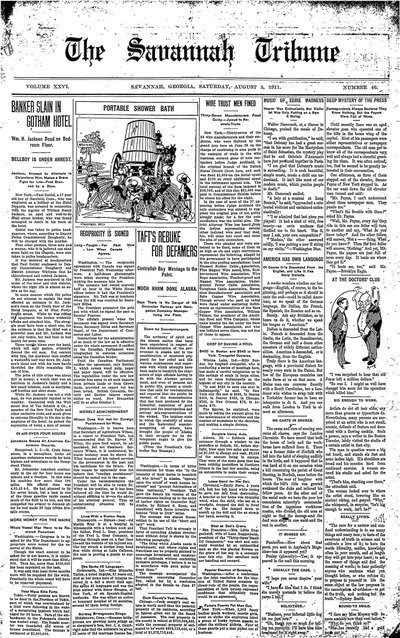
Page text (machine-generated)
VOLUME XXVI.
BANKER SLAIN IN GOTHAM HOTEL
Wm. H. Jackson Dead.on Bedroom Floor.
BELLBOY IS UNDER ARREST.
Jackson, Aroused by Attempts to Chloroform Him, Makes a Brave Fight for Life—First Stunned by a Blow.
New York.—Paul Geldel, a 17 year old boy of Hartford, Coun., who was employed as a bellboy at the Hotel Iroquois, was arrested in connection with the murder of William Henry Jackson, an aged and well-to-do Wall street broker, who was found strangled to death in his room at the hotel.
Geldel was taken to police headquarters, where, according to Deputy Police Commissioner Dougherty, he will be charged with the murder.
Four other persons, three men and a woman, who it is believed can shed some light on the tragedy, were also taken to police headquarters.
It was declared at headquarters that Paul Geelid confessed to Deputy Commissioner Dougherty and District Attorney Whitman that he chloroformed and robbed Jackson. Mr. Jackson was murdered in the midst of the hotel and club district, where the night life is almost as active as the day. In some manner which the police do not attempt to explain the man effected an entrance to Mr. Jackson's room on the Tenth floor of the Hotel Iroquois, at 49 West Forty-fourth street. While he was rifling the apartment the broker evidently awoke and attacked him. The struggle must have been a short one, for the evidence is that the thief was a powerful man and Mr. Jackson was not only feeble, but had been in bad health for some time.
Three terrific blows over the head, which left ugly gashes, evidently floored the old man. Not content with this, the murderer then stuffed a washcloth half way down Mr. Jackson's throat and with his bare hands throttled the little remaining life out of him.
The price of this crime was about $50 in money, a watch that was an heirloom in Jackson's family and a few small trinkets, such as scarfpins, cuff buttons and shirt studs.
While Mr. Jackson was not a rich man, he was generally reputed to be wealthy. Connected with the Wall street firm of Van Schalck & Co., a member of the New York Yacht and other exclusive clubs, and much given to extreme liberality in his tips to the employees of the hotel, he gained the reputation of being a man of means.
IN AIR OVER FOUR HOURS
Johnstone Breaks All American Endurance Records.
Hempstead, L. I.—St. Crolix Johnstone, in a monoplane, broke all American endurance records for both biplane and monoplane on the Hempstead Plains.
Mr. Johnstone remained continuously in the air for four hours one minute and a fraction. In this time his machine flew more than 195 miles. His official time was 4.01.53 4-5. He had planned to fly for seven hours, but a leak in one of the three gasoline tanks caused much of the fluid to be lost, and this compelled the aviator to descend after he had made 39 laps of the five-mile course.
MORE MONEY FOR THE MAINE
Whole Vessel May Have to be Removed Piecemeal.
Washington. — Congress is to be asked by the War Department to appropriate more money for the removal of the Maine.
Though the exact amount to be asked for is not known, it is understood that it will be more than $200,000. Thus far, more than $400,000 has been expended on the task.
It was said that least three months more will be required for the work. Practically the whole vessel will have to be removed piecemeal.
Tidal Wave Killie Forty.
Tokio.—Forty persons are known to be dead in the Province of Tokio, part of which was overwhelmed by a tidal wave following in the wake of a devastating typhoon which had raged for 24 hours. Part of the embankment in the Fukagawa district was washed away. The Suzaki quarter was inundated and scores of houses demolished. The damage is estimated at $1,000,000.
The Savannah
PORTABLE SHOWER BATH
WILL L. 22
WILL L. BE
RECIPROCITY IS SIGNED
Long - Fought - For Pact Now
- Law When Canada
Washington. — The reelprocity agreement with Canada was signed by President Taft Wednesday afternoon. A half-dozen photographs were taken showing the President making the measure into law. The measure had rested scarcely half an hour in the White House offices before it had the President's signature. Mr. Taft was at luncheon when the bill was received by Secretary Hilles. The President presented the gold pen with which he signed the pact to Senator Penrose. The officials present when the document was signed were Secretary Knox, Secretary Hilles and Secretary Nagel, of the Department of Commerce and Labor.
Instructions for the administration of so much of the law as is effective under the whole agreement if ratified by the Canadian Parliament were telegraphed to customs collectors along the Canadian border.
Until the Canadian Parliament ratifies the agreement, only Section 2; which covers wood pulp, paper and paper board, will be effective. The regulations under the new law provide free entry to all such imports from private lands or from Crown lands, provided no export tax has been levied. British Columbia, Ontario and Quebec impose export duties on wood. New Brunswick will do so after October 1.
MERELY ADMCNISHMENT
Wilson Does Not Ask for Condign
Punishment for Wiley.
Washington.—It is known here that Secretary of Agriculture Wilson, in a report to President Taft, has recommended that Dr. Harvey W. Wiley, the pure food expert, be admonished, but not dismissed. Secretary Wilson, it is understood, declares lenency must be shown Dr. Wiley because of his valued services to the government in the past and his usefulness for the future. For this reason he apparently does not believe that "condign punishment" should be meted out in the case. Under the recommendation the President will be able to retain Dr. Wiley in his position, as it has been believed all the time he would do, without seeming to ignore the advice of his attorney general. Thus an embarrassing situation will be avoided.
LIves With a Broken Neck.
Minneapolis. — Sixteen-year-old Martin Gray is at a hospital in Minneapolis with a broken neck and the father, Fred L. Gray, president of the Fred L. Gray Company, is plowing through seas on a fast liner toward the bedside of his injured son. The boy struck a dredge heap head first while diving at Lake Calhoun. His case is proving a puzzle to surgeons.
She Spoke 45 Language
Greencastle, Ind.-Miss Minetta Taylor, a noted linguist, 51 years old, died at her home here of injuries received in a fall a short time ago. She spoke 45 languages and was the joint author with Senor Biragua, of New York, of six Spanish-English textbooks. She was either an active or honorary member of 30 societies, several of them being foreign.
Nutman Bridegrooms Stingy.
Middletown, Conn.—Because bridegrooms are growing more stingy as to clergymen's fees, Rey, J. A. Courtright asks that the ministers be given 25 cents of the marriage license fee.
(Copyright, 191L)
---
SAVANNAH, GEORGIA, SATURDAY, AUGUST 5, 1911.
1
TAFT'S REBUKE FOR DEFAMERS
Controller Bay Message to the Point.
MUCH HARM DONE ALASKA.
Says There Is No Danger of the Controller Railway and Navigation Company Monopo- lizing the Field.
Scorn for Scandalmongers.
The acrimony of spirit and the intense malice that have been engendered in respect of the administration of the government in Alaska and in the consideration of measures proposed for her relief and the wanton recklessness and eagerness with which attempts have been made to besmirch the characters of high officials having to do with the Alaskan government, and even of persons not in public life, present a condition that calls for condemnation and requires that the public be warned of the demoralization that has been produced by the hysterical suspicions of good people and the unscrupulous and corrupt mis-representations of the wicked. The helpless state to which the credulity of some and the malevolent scandal-mongering of others have brought the people of Alaska in their struggle for its development ought to give the public pause.
(From the President's Controller Bay Message.)
Washington.—In terms of bitter denunciation for those who "in the intensity of their desire to besmirch all who invest" in Alaska, "operate upon the minds of weak human interests" and "prompt fabrications of false testimony," President Taft gave the Senate his version of the circumstances leading up to the entry of harbor rights on Controller Bay; Alaska, by Richard S. Ryan, and repudiated with fierce invective the famous "Dick to Dick" letter. The message was almost Rooseveltian in its use of the "short and ugly" word. That President Taft is strongly in favor of extending Alaskan development without delay is shown by the following paragraph:
"The thing which Alaska needs is development, and where rights and franchises can be properly granted to encourage investment and construction of railroads without conferring exclusive privileges, I believe it to be in accordance with good policy to grant them."
The message accompanied the documents concerning Controller Bay, called for by a resolution adopted in the Senate on June 27 last.
Cook County's Vast Wealth
Chicago.—Cook county's real estate is worth more than the personal property of its residents, according to figures-given out by the Board of Assessors. The real property in the county is valued at $720,000,000, while the personal property is estimated to be worth $652,710,448, or a total of $1,372,710,448.
WIRE TRUST MEN FINED
Thirty-Seven Manufacturers Piead
Guilty---Joined to Restrain Trade.
New York.—Thirty-seven of the
84 wire manufacturers and their em-
ployes, who were indicted by the
grand jury here on June 29 on the
charge of combining in nine pools to
the restraint of trade in the wire
business, entered pleas of nolo contendere before Judge Archbold, in the criminal branch of the United
States' Circuit Court here, and each
was fined $1,000 on the initial count
and $100 on every additional count
in the indictment against him. The
total amount of the fines imposed is
$42,700, and of this sum $21,000 was
paid to Commissioner Shields before
he closed his office for the night.
In the case of most of the 37 appearing before Judge Archbald the nolo contendere was entered to supplant the original plea of not guilty already made; for a few the nolo contendere was the initial plea. District Attorney Wise has heard from the lawyer representing several other indicted wire men that they, too, will come into court and enter the plea of nolo contendere.
Those who pleaded and were sentenced to be fined, some of them on as high as six and eight convictions, represented the following, alleged by the government to have participated in the nine pooling associations: Lead Encased Rubber Cable Association, Fine Magnet Wire Association, Rubber-covered Wire Association, Wire Rope Association, Weather-proof and Magnet Wire Association, Underground Power Cable Association, Telephone Cable Association, Horseshoe Manufacturers' Association and Bare Copper Wire Association. Though several who paid up today were listed under scattering indictments as representatives of the Bare Copper Wire Association, William Palmer, the president of the American Steel and Wire Company, whose name headed the list under the Bare Copper Wire Association, and who was indicted seven times, was not one of those to appear.
COST OF SAVING A SOUL
$450 in Boston and $545 in New York. Evangelist Desigers.
Winona Lake, Ind.-Billy Sunday, the baseball evangelist, who is conducting a series of meetings here, has made a careful calculation as to the savings of souls in large cities, and he rates Indianapolis as the highest of any city in the country. "It cost $620 to save one soul in Indianapolis," he said. "In New York city the cost is $545, in Boston $450, in Denver $425, in Chicago, $395, in New Orleans $78, in Atlanta $75. The figures, he explained, were made by taking the amount given for the maintenance of churches and the number of accessions to the churches, and making a simple division.
Burglar Using Auto
Aurora, Ill. — Robbers gained entrance through a window to the postoffice at Dekalb, Ill., before daylight, blew open two safes and secured $7,500 in stamps and cash, $6,000 of the amount being in stamps. They were of the same gang that has been robbing postoffices in Northern Illinois in the last few months, using an automobile to make their escape.
Loses Hand for Her Doll
Cleveland.—Emily Steve, 5-years old, lost her left hand while trying to save her doll from destruction. A boarder at her home was chopping wood, when the child, who sat on a woodpile, dropped the doll in front of the ax. She jumped down to snatch up the doll and the ax struck her hand, severing it.
Shot at Son'a Graves
San Francisco.—Mrs. Lillie Guggenheim, wife of Leon Guggenheim, president of the "Thirty-three" Small Oil Companies," was shot and seriously wounded by an unidentified man as she was placing flowers on the grave of her son in a cemetery near this city. Her assailant took her handbag and escaped.
Popular Election of Senators
Washington. After a conference on the joint resolution for the election of United States senators by direct vote of the people, the representatives of both houses expressed confidence that ultimately there would be an agreement.
Female Guards Put Men Out
New York.—When 5,000 fancy leather goods workers, mostly girls, went on strike the employera hired a group of husky women guards, to offset the strikers' pickets. Four of these guards put a man picket out of business.
Tribune
MUSIC OF EERIE MADNESS
Hearer Was Enthusiastic. But Violinist Was Only Putting on a New E String.
Walter Damrosch, at, a dinner in Chicago, praised the music of Debussy.
"I see with gratification," he said,
"that Debussy has had a great success in his score for the Martyrdom of Saint Sebastian, the mystery play that he and Gabriele d'Annunzio have just produced together in Paris.
"I am glad that Debussy's music is succeeding. It is such beautiful, simple music, music a child can understand. It isn't like most of our modern music, which puzzles people to death."
Mr. Damrosch smiled.
"A lady at a musical at Long Branch," he said, "approached a celebrated violinist and exclaimed enthusiastically:
"Madam,' the other answered coldly, 'I was putting a new E string on my violin.'"—Washington Star.
AMERICA HAS OWN LANGUAGE
Of Course It Is Descended From the English, and Like It Has Many Dialects.
A reader wonders whether our language—English, of course, in the beginning, and perhaps so it should be unto the end—could be called American, as we speak of the German language, the Italian, the French, the Spanish, the Russian and so on. Surely. Ask any Britisher, as he hears us do it, whether we speak his tongue or "American."
Italian is descended from the Latin. French is descended from the Gaelic, the Latin, the Scandinavian, the German and half a dozen other ancestors of widely different nationalities. American is descended, or is descending, from the English.
Truly there is the American language, with a provincial dialect for nearly every state in the Union. But few of the European countries can make faces at us on that score. A Maine man can converse fluently with a South Carolinian, but a Londoner who wishes to swap talk with a Yorkshire farmer has to have an interpreter to do it. And you can walk from London to York in almost an afternoon.
NO CASTE IN SNORES.
The cause and cure of snoring concerns all classes, says the London Chronicle. We have record that both the house of lords and the workhouse have suffered from it. There was a former duke of Norfolk who fell into the habit of sleeping audibly in the lords, and it happened that he was hard at it on one occasion when a bill concerning the parish of Great Snoring, in Norfolk, came before the house. The roar of laughter with which the bill's title was greeted awakened the duke and relieved his fellow peers. At the other end of the social scale we have the poor law commission minority's commendation of the ingenious workhouse master, who divided the old men at night so that the snorers and the deaf men slept in one ward and the rest in another.
IT BOBBED UP.
Pemberfon—How about that poem you sent to Anybody's Magazine—has it appeared yet?
Penley (gloomily)—Yes; it appeared in the mail this morning.
USUALLY THE CASE.
"I hope you never deceive your wife."
"I have no idea that I do. I think she merely pretends to believe the yarns I tell."
"Madame, your infernal little dog blt me just now." "Oh, thank you so much for telling me,promptly.I'll have him take treatment for it right away."
DEEP MYSTERY OF THE PRESS
Correspondents Always Declared They Knew Nothing, But the Papers Were Full of News.
Until recently there was an aged elevator man who operated one of the lifts in the house wing of the capitol. Most of his passengers were either representatives or newspaper correspondents. The old man got to know all of the correspondents very well and always had a cheerful greeting for them. It was often noticed, too, that he seemed to be greatly interested in their conversation.
One afternoon, as three of them stepped out of the elevator, Sereno Payne of New York stepped in. As the car went down the old elevator man turned and said:
"Mr. Payne, I can't understand about those newspaper men. They puzzle me."
"What's the trouble with them?" asked Mr. Payne.
"Well, Mr. Payne, every day they ride in this car one feller will turn to another and say, What do you know today?" And the other fellow will answer, Not a thing. What do you know? Then the first feller will answer, Nothing. And yet, Mr. Payne, the papers are just full of news every day. It beats me where they get it." "It beats me, too," said Mr. Payne.—Brooklyn Eagle.
AT THE DOCTORS' CLUB
P. K.
"I was surprised to hear that old Joncs left a million dollars." "So was L. I might as well have charged him more for the operation which killed him."
BIG ENOUGH TO WORK
Artists do not all look alike, any more than grocers or typesetters do. Nevertheless, many persons are surprised at an artist who is not small, anemic, delicate of feature and decorated with a flowing necktie. Such a person, says a writer in the Boston Traveler, lately visited the studio of a certain artist in that city. The man in question wears a big red beard, and stands six feet and some inches high. His shoulders are broad and his muscles hard from continued exercise. A woman entered his studio and asked for the artist. "That's him, standing over there," the attendant said.
The woman looked over to where the artist stood, towering like an ancient viking, and gasped. "Why," she whispered, in surprise, "he's big enough to work, isn't he?" REALLY LIVING.
"The cure for a narrow and confined understanding is to see many things and many men; to taste of the sweetness of truth in science and to cultivate a love of it; to have the words liberality, candor, knowledge often in your mouth, and at length they will get into your heart; to ask the reason of things and find the meaning of words; to hear patiently anyone who confirms what you thought before, or who refutes it; to propose to yourself in life the same object as the law proposes in the examination of evidence—to get at the truth, and nothing but the truth."—Sydney Smith.
BOUND TO SMILE
"I dare say Miss Mopeon will be more amiable now than ever before." "Why do you think so?"
"She has recently had a tooth put in"
AFRO-AMERICAN CULLINGS
= * . sf Se Poa at Set et
President Thirkfeld points out in one
of bis many helpful addresses that the
southern negro needs the protection of
lawyers of bis own race, not only in
commercial causes, but In questions
involving property rights, etc. For
many years colored lawyers have prac-
ticed before the courts in every south-
em state, and many of thom—men of
the type of Mfollison of Vicksburg,
Vance of New Orleans, and the late
M. M. McLeod of Jackson—have made
fino reputations as pleaders, advocates
and counsellors, During the last ten
‘years there has grown up in the south
the new lawyer. He {s educated and
efficient, and takes upon himself not
only the legal burden of the people,
but also and particularly the civic bur-
dens now resting heavily upon them.
Of this new school, Perry W. Howard
of the Jackson (Mise,) bar is the
leader. Mr. Howard fs gifted in many,
directions, and occuples in the affairs
of his state a place all bis own, In a
recent number of the Southwestern
Christian Advocate, an extended ref-
erence was made to Mr. Howard’s
work and career, Among other things
it was sald of him: “Perry W. Howard,
the brilliant and successful attorney
at Jackeon, Miss,, 1s among those who
have gone into the profession of law
and succeeded in spite of the heavy
odds always encountered by-a negro In
this profession. Mr. Howard ts na-
tive Missiselpplan—born thirty-two
years ago in the town of Ebenezer,
Holmes county, Mississtpp!. He was
educated at Rust and Fisk unlvers!-
tles, 1s a Uterary graduate of Rust uni-
versity and has done postgraduate and
other special work at the University
of Chicago, where he ranked as one of
the first honor students. Later he
completed his law course at the Ill!-
nols College of Law, graduating at the
head of a class of 74, of which he was
the only negro member, with LL. B.
degree. Lawyer Howard was for one
year president of Campbell college,
Jackson, Miss., from which he went to
the chair of mathematics at Alcorn A.,
& M. college, and this position he filled
for,five years, receiving the highest
cotimendation from members of tho
‘board of trustees. After this service
‘Mr. Howard took up his life's work—
the practice of law—and he has been
@ pronounced success from the begin- |
ning. As an attorney he has not con-
fined his practice to mere agitation,
Dut has stood on bis merits, and today
he ranks as one of the leading mem-
ders of the Jackson bar. Among the
corporations represented by him are
the District Grand Lodge of Odd Fel
lows of Mississippi, Supreme Lodge of
Reformers, Grand Lodge of Calan-
thans, the Supreme Lodge of ‘Forest-
ers, and the American Trust and Say-
ings bank of Jackson, He is a mem-
ber of the well-known firm of Beadle
& Howard, which has figured fn all im-
portant litigation among negroes for
many years fn the state of Mississip-
pi. Mr. Howard ts in constant demand
throughout the state as one of her
most eloquent and brilliant orators
and scholars,”
The apparent fallure orset-back of
the True Reformers’ organization, ta.
ken in connection with the closing of
the True Reformers’ bank, ought to
teach our people everywhere one ses:
son: Every organization with which
we ate connected, whether it 18 busi-
ness, religious or fraternal, ought to
be carefully examined three or four
times a year by a competent and dis-
interested auditor. Everything should
be gone thoroughly into. No consider-
ations of friendship, relationship or
any other matters should stand in the
way of having a thorough accountant
g0 to the very bottom of affairs two or
three times'a year. Where money !s
handled, the -actual cash should be
counted. Nobody's word should be
taken. The time bas come In the af-
fairs of the race when our organiza-
tions will cease to command the con-
fidence of the public, unless we throw
aside all sentimental considerations
and do clean, first-class business. The
only way to hold confidence fs to have
all accounts correctly audited and
then sworn to before a notary public
and then published. The members of
the various organizations should begin
to insist on this being done—New
York Age.
Prot. Zachary T. Hubert has been
appointed by the American Baptist
Home Mission society to the presk
dency of the Jackson college at Jack:
son, the most important Baptist schoo!
of the state of Bftselssipp!.. Jackson
college has one of the best plants in
All the south, and for many years bas
been the main wheel in denomination-
al machinery there. Tho selection of
Professor Hubert for the presidency
‘opens a large opportunity to bim for
a high service. For the first time in
the history of it, Jackson college ts
placed under the direction of a colored
man. For the Baptists and for all
the people of the state, Jackson col-
Jege bas long stood as a rallying poigt
for sound and useful learning. Under
Professor Hubert it should not go
back. The Jackson folk the naw presl-
dent will find among the most pro-
gtessive in the country, very jealous
ofithelr reputation and amiable in co-
operation. Professor Hubert .is an
alumnus of Atlanta Baptist college.
Cilmatic conditions make the school
year at Tuskegee inatitute relatively
short, and accordingly the commence-
ment exercises down there are already
over while yet most of the northern
schools and colleges still have before
them thelr final examtnations, As for
the Inst fourteen years the graduating
addresses at Tuskegee this year were
matnly concerned with the practical
work of the students, The salutatorian
spoke in English ‘and discussed “The
Care and Feeding of Cattle for Milk
Production.” Another graduate, point-
ing to a stalrway which he had made
with bis own hands, told how he hed
done the work. A girl graduate talked
of the “Negro Dressmaker in Her
Community,” and flustrated her ad-
dress with the actual execution of
millinery work in the presence of the
audience. A striking feature of the
exercise was a dramatic representa-
tion upon the stage of actual broom-
making, plastering, wheelwrighting
and the lke, There were theoretical
discussions as well on such topics as
“Carrying the School Into the Home,”
and “Modern Methods of Education,”
but the practical s{gnificance of train-
ing at Tuskegee was chiefly empha:
sized. It 1s easy to see in all this the
homely wisdom of the remarkable man
at the head of Tuskegee. He knows
his own people well and realizes their
smmediate neods, He knows also thelr
‘taste for dramatic realism and meets
its demand {a these unique commence-
ment exercises. Wisely also, how-
ever, he remembers the fine art in
which the colored people chiefly shine,
that of yocal music, and singing was
an Important adjunct of the entertain-
ment. The character of the occas{on
certifies to the outside world the prac-
tical claims of this truly great school,
Dr. Washington has been accused of
throttling the {dealisttc ambitions of
his race, but he fs far from doing any-
thing so short-sighted. He recognizes,
however, the pressing need for sy-
tematized practical education and
wholesome discipline among the col-|
ored people, and he 1s paving the way |
for that higher civilization which has
deen so long deferred for the mass of
the blacks, but which will come to
them slowly, indeed, and perhaps with
Gfsappointing delays, and even occa-
sional reversions toward earller crudl-
Hes, but with substantial gains such
as must eventually command the ree-
ognition of the least willing and most
pesslmistle onlooker. Booker Wash-
ington deserves the confidence reposed
in him by both races, and his.work
was never worth{er than now of coun-
tenance and support.—Fdltortal: Bos-
ton (3fass.) Morning Herald.
A few days ago the citizens of Bt.
Paul, Mion., gave a dinner in honor of
Frederick L. McGhee, the lawyer. It
was, 80 the local newspapers describe
tt, the most helpful occasion of the
city’s history. Among the happy in-
cldents of the affair was the renowal
of triendship between W. T. Francis
and Mr. McGhee, who have been es-
tranged for some years, Mr. Mc
Ghee’s response to the'speeches of the
evening was a happy effort, couched 10
the elegance of simple language, ana
having for its text “Ye Are One.”
What he sald there might well be re-
peated by all thoughtful authorities
of his race, A sentence or two we
cull: There {s to the race a voice ery-
Ing. It cried in the early dawn of our
freedom, It has been crying every
night as we went to bed, as the whip.
‘poorwill sings its sweet song, and
‘erfes every ‘morning with the lark
awaking the moon; and that cry has
been, “Ye are all one.” How true is
this that we are all one. Wo have
been steadily growing together. We
must not grow apart. There can be n¢
such thing as “he fa greater than 1,
and he is over me, and I his follower.”
We are all leaders, we are only going
on together. And this mighty cry/“Ye
are one” Is the key that unlocks the
door to higher life. And just as sure
as we let that spirit grow among us,
just so surely will we grow in material
worth. The one thing that brought
success in a’recent case which I.tried
was the fact that every man in this
community was Interested in its out:
come. Those of you who could not
attend thé trial talked it on the street
and at your business, while the good
women stayed at home and prayed
over it, and that’s what made success.
The only negro resident of Hills-
dale, the smallest incorporated village
in New York state, thirty miles from
Manhattan up the Harlem valley, {s
its registrar of vital statistics, He 1s
also a member of the board of health,
secretary of the village improvement
society and village trustee. He is F. O.
Stratton, in business in Now York., He
was born In Virginia of poor parents
and got his education studying at
home nighta-while working to’support
his mother. a *
As Afro-Americans, we should Jesrn
at once that we should now depend
upon ourselves as individuals and aa
arace, Stop looking all around your-
self for something to Jean on, stand
‘up on your feet like men—there is no
tlmé for‘that yum, yum, shiftiesa 1ale-
some fellow and ‘tis high time. that
you take due notice from, date—Ba-
‘yannah Outlook. e
“STAY ON THE. FARK”
SLOGAN OF FIFTH ANNUAL 8E8.
SION OF STATE ASSOCIATION
OF TEACHERS IN COLORED
SCHOOLS HELD AT UTICA,
MISS—PROF. J, A. MAR-
TIN RE-ELECTED |
PRESIDENT.
‘Utca, Mise.—The fifth ennual ses
sion of the State Association o!
‘seachers in Colored Szhools was helt
at the Utjca Normal and Industrial
institute, Prof. J. A, Martin of Jack
son, presiding. The meeting was at
tended by a large number of teachers.
‘The convention wes marked by sey
eral strong and !mportant papers bear
ing upon various phases of the profes
sion, the chfef of which were an Jn
teresting talk on the Jeanes fund by
Prof. J, H., Webber, Darbun; a dis
cussion of “How to Make Negro Edu
cation Popular in, the South,” by W.
A. Battle, of Okolona Normal and In.
dustrial Institute; “Self-Help in the
Sevondaru Schools,” by Prof. G. C
Moseley, Christ's college, Jackson, and
“The Responsibilfty of Women as
Teachers,” by Misses Armelda Greene
and L. P, Winfrey, of Jackson,
‘The “back to the farm" slogan was
changed here to “stay on the farm,"
Prinelpal Holtzclaw declaring that the
farm was too important in the econ:
‘omy of the race and the nation to be
made a refuge for failures in other
‘walks of life. Farming subjects were
given place and the lion's share of at-
tention and Industrial education was
-stressed by nearly every speaker,
while President Martin, fo bis annual
address, made several important rec-
ommendat{ons with reference to agri-
cultural-and other industrial work in
the public schools.
Profs Z. T. Hubert, the new presl-
dent of Jackson college, whoso
coming means the plecing.of an all-
negro faculty into this well-equ{pped
Institution, wes introduced to the as-
soctation,
Dr. J. B. Lehman, president of
Southern Christian inst{tute, Edwards,
Niss., spoke to the teachers at a spe-
clal hour Wednesday, and Bishop
‘Theodore D. Bratton, of the Eplscopal
dlocese of Mississippi, was the guest
of the institution and the assoclation
‘Thursday.
Professor Martin was reelected
president, and Willlam H. Holtzclaw
made corresponding secretary In the
place of President L. J. Rowan, who
Decomes first vice-president.
REW SCHOOL ESTABLISHED
DR. GEORGE G. HALL BELIEVES
THAT THE NEW NASHVILLE
COLLEGE IN WHICH ONLY
SOUTHERN WHITE TEACHERS
WILL BE EMPLOYED TO BE
THE MOST SIGNIFICANT MOVE
IN A GENERATION.
Baltimore, Md.—“I regard as the
most significant movement among the
race in a generation the establishment
‘of the American Inter-Church college
at Nashville, Tenn. sald Dr. George
C. Hall, a prominent Chicago phys!
clan, to 8 representative of the Age,
while in the clty a few days ago.
“This school,” he sald, “will tratn
religious and social worke-s for. the
race and will open In the fall. it fs
a new departure, for all of its teach-
ers will be southern whites, which
meang that the old prejudice against
whites teaching colored people will
pass away. The school had {ts 1n-
ception with, Doctor McCullough, in-
structor of theology at Vanderbilt un!-
versity. After consultation with a
number of leading southerners, his
plans were indorsed and the school
will be the result. Southerners are
taking wide interest in the matters
affecting the moral and physical wel-
fare of colored people in the south.
They are beginning to realize how in-
terdependent are’ the twa races, and
that what bodies {11 for one means
detriment to the other.”
‘The school has a board of managers,
equally divided between both races.
‘The personnel of the board follows:
Dr. George A. Gates, president of
Fisk university; Dr, Wilbur P. Thir-
kigld, president of Howard univer.
sity; Rev. J. D. Ward, Rey. Dr. Mc-
Cullough, Afiss Belle H. Bennett, Hon.
James C. Napler, register of the
United States treasury; James H. Djl-
lard, agent of the Jeanes and Slater
Educational Funds; Dr, Booker T.
Washington, R. H Boyd of Nashville,
Rey. C. T, Walker of Auguste, Ga.,
and Dr. George C. Hall of Chicago.
TAFT’S TIGHT TROUSERS.
‘When President Taft was sevez
years old, says the Knoxville Spntinel
his mother bought him a pair of short
duck trousers. The first time they
were washed they shrank badly. The
boy was fat, but his mother wedged
him into the trousers against his pro-
test. He weit out to play, but in a
few minntes returned,
“Mamma,” he said, “I can't wear
these pants; they are too tight. Why,
mamma, they are tighter than my
skin.”
“Oh, no; they're not,” replied bis
mother, “Nothing could be tighter
than your skin.”
“Well, all the same, these pants are.
I can ait down in my skin, but I can’t
in these pants.”
HIS LEGACY,
“T hear your rich uncle {s desd.” *-
“Yen”
“What did he leave?” _
“A widow we'd never heard of"—
Milwaukee News,
PULLMAN’ HEN 10
> SET INCREASE
Announcement Made That
They Will Receive 10 per
Cent Raise,
PORTERS -ARE DIVIDED
WHILE SOME ARE HEARTILY IN
FAVOR OF PROPOSED IN-
GREASE, OTHERS ARE
NOT SO JUBILANT.
Now York City.—According to ad.
vices from Chicago, the Pullman com:
pany contemplates increasing the
‘wages of its porters ten per cent and
the conductors five per cent. Just
how soon the order will be sent out
to the many Pullman offices through:
out the country has not been made
public.
‘The announcement that the Pullman
Porters are to get an increase {n
wages has occasioned a controversy
which has divided the colored raflroad
men into two factions, One faction
fs heartily In favor of the proposed
increage, while the other Is unalter-
ably opposed to the plan, Those who
have become entbusiastle over the
news that the porters would be paid
more money assert that tips are not
as frequent and as large as some
years ago, and claim that if the Pull-
man people increase their monthly
atipend they will, therefore, recelve
“living” wages.
The porters who regard the increase
plan with marked disfavor admit that
‘they @o not recetye “living” wages
from the company, but they ergue that
‘there 1s a possibility of the traveling
Public being misled by the announce-
ment that all Pullman porters are to
be given more pay, that those who
have been in the habit of tipping will
elther stop giving tips or greatly re-
duce the amount of money they have
been wont to give to the obliging
“lenight of the whist broom.”
Although it has been publicly made
kmown that Pullman porters will be
given an increase in wages, the heads
of the New York divisien, from Sup-
erintendent Merrill down, are not in-
clined to discuss the subject at length.
It fs admitted, however, that the Pull-
man company is serlously considering
the advisability of raising the wages
of the conductors and porters, the con-
ductors to receive a five per cent In-
crease and the porters a ten per cent
increase.
The wages of Pullman porters at
this time are from $35 to $40 a month.
They make most of thelr money in
tps.
cE “STAR OF THE SOUTH”
MIAMONG BISGOVERED BY.A, We
* The story of the “Star of the South,”
one of the largest diamonds ¢ve!
found in Brazil, is typical of the vi
clasitudes through which these stones
‘sometimes pass. Found“by a negress
in the mines of Bergarem, Minas Ger
aes, the crystal welghed 254% carats
was of irregular dodecahedron shape
with strongly obtuse angles, and with
24 natural facets. The confguratlor
of the facets, showing deep depression
suggests that it was one of a group of
crystala,
It was sold for $15,000, and the ne
gresa recelved her freedom and a pen
sion as a reward. The firet purchaser
Dorrowed $50,000 on {t from the Bank
of Rio de Janelro, and afterward sold
it to a syndicate for elther $170,000 oF
$240,000. It was named “Estrella do
Sud,” and was cut to an oval brilliant
of 125 carats. Thus It made a clean,
‘fine stone of first quality. Because of
‘te size and beauty it wes exhibited
at the exhibition of London in 1862,
and-Paris, 1867, when an Indlan re-
jah offered over half a million dollars
for it, which was refused. Later it
was bought for the Galkwar of Baroda
for eight Ines of rupees, or $400,000.
‘This royal personage of Hindustan had
the habit of administering powdered
glace or diamond dust, or both, to sub-
jects whom he judged superfluous. He
pursued this pastime beyond bis own
immediate sphere and prescribed for
the British resident, one Colonel Phay-
te, but his art was detected, he was
tried, found gullty, and deposed—Pan
American Union.
THE WEAKER SEX,
‘Tho young woman,had spent a busy
day.
She had browbeaten 14 salespeople,
Dullyragged a floorwalker, argued vic-
torlously with a milliner, laid down
the law to a modiste, nipped in ‘the
bud a taxi chauffeur’s attempt to over-
charge her, made a street car conduc
tor stop the car in the middle of the
Block for her, discharged her maid
and engaged another, and otherwise
refused to allow herself to be imposed
upon.
Yet sho did not smile that evening
when @ young man begged:
“Let me be‘your protector through
life."—Lite, »
: THE FINISH.
“Did the play have 2 happy end:
ingt* . os
“It might have: been worse. My
wife only lost her handkerchlef ‘and
one glove*’—Kanses City Journal.
| The Sanday |
‘School Lesson
Sunday School Lesson for August. 6,
1911, L
ee ae (ee
_ _TED—JER. 26:
Golden Text—The Lord ts my lght
and my salvation; whom shall I fear?
—Paa, 27:1. 2
‘The lesson explained:
Verses 79: A Dissatisfied Congre-
gation.
Jeremiah was now a well-known char-
acter In Jerusalem. He belonged to a
priestly family of Anathoth, about two
and a ‘halt miles to the northeast of
Jerusalem, He had witnessed the re-
form under Jos{ah and was also to
see how it had grievously -failed in
gripping the heart of the people, The
centralization of worship in the tem-
ple was misunderstood and the people
soon began to regard the temple as a
fetish, as though its presence in thelr
midst would insure their safety
against invasion, regardless of moral
considerations. Jeremiah disabused
their minds of this erroneous idea in
a sermon which is reported in chapter
:1-15, This was probably part of the
address which he repeated in the tem-
ple‘ courts. It was familiar to the peo-
ple, but there was added emphasis.
The inhabitants of “all the eltles of
Judah” were In attendance at the tem-
ple to celebrate one of the regular
fasts or festivals, and to them the
words were spoken. The priests—who
were intensely devoted to their shrine.
The prophets—particilarly the false
prophets, of whom Jeremiah had sald:
“The prophets prophesy falsely, and
the priests bear rule by thelr means;
and my people love to have {t 30,”
(chapter 6:31), ‘To bis hearers Jere-
miah seemed to be an intruder who
had no sense of the fitness of things.
His utterance concerning the destruc-
tlon of the temples was intolerable
and out of place, so they thought. It
was resented so angrily that they laid
hold on him with vehemence, saying,
thou shelt surely die. One who® ut-
tered such sentiments of disloyalty,
yea, even of treachery, was playing
Into the hands of the enemy and
should be put out of the way. This
house shall be like Shiloh—Shiloh was
situated about twelve miles south of
Shechem; it was the center of an im-
portant sanctuary, and In the early
days of Samuel the ark was housed in
a substantial building and not in @
tabernacle. But it was destroyed by
the Philistines, Jeremlah ts referring
to this welf-kmown disaster, and Is
predicting similar fate for the tem-
ple. Hence the fanatic fury of the
‘worshipers,
Verses 10-16: Faithful Unto Death.
‘The public excitement was speedily
made known to the prince of Judah,
and they hurried from the king’s pal-
ace adjoining the temple to take' thelr
seats in the entry of the new gate of
the Lord’s house. This was the place
of judgment where justice was ad-
minfetered. It was a timely nterfer-
ence on the part of these nobles; for
it Is very likely that the prophet would
have been assassinated. Recall the fn
tervention of Claudlus Lystas, who res-
cued Paul from the hands of the ex-
cited people (Acts 21:30-6). You can
imegine the tumult of this Oriental
crowd, all ejaculating at the same
time, and pointing the finger of scorn
at the solitary Jeremiah. The charges
which they brought against tim were
strikingly slmilar to those of a later
century which wore preferred against
Jesus (Mark 1458). The temple was
the unfgue symbol of the presence of
Jehovah. To speak against it meant
also to speak against this city whose
sacredness was due to the temple.
Then spake Jeremlah—He looked into
their faces calmly and courageously,
and defended himself by declaring his
divine commission. He also urgently
appealed to them: Amend your ways
and your doings—Let them show
obedience to Jehovah their God by
something more practical and ethical
than mere rituallatic devotion to the
temple, There is tlme yet for their
repentance to move God to deliver
them from disaster, I am in your hand
—His danger could not induce him to
ppeak anything bit the word of Jeho-
vab. He was Indifferent as to’ his
fate; but he wmed them that if they
should put him to death their guilt
would be yet more severe and the pun-
jahment would be In proportion.
Verses 16-19: A Reasonable Verdict.
The defense of Jeremiah was im-
pressive; he appealed to reason and
conscience, and the better judgment
of the princes and the people prevailed
over that of the professional leaders
of religion. Furthermore, his faithful
ministry of over twenty years was be-
fore them; they therefore could not
get away from the conclusion that he
hath spoken to us in the name of the
Lord our God. This verdict was in-
forsed by certain of the elders of the
jand who reminded them that when
Micah the, Morasthite declared the
oming destruction of Zion, including
:
KNEW WHAT HE WANTED.
, She—'T do not care to marry you.
i do not care to even talt"to you.”
Hé (a widower)—“That- is precisely
the reston I want you to marry me.”
New York’ Herald:: ~
>
as = |
, POETRY r :
| of and by Our People
BY C. P, M'DONALD.
Hot! :
Great Scott!
‘There's not ‘ :
A breath of air oF
“Round anywhere! '
And Sunday, too, “
‘When all you do
Is loaf and eat. x
Bome cool retreat
May haunt your dreams,
‘And Nature schemes ~
To make you wish- ,
To wish to, sh
Or swim or be
Beneath some treo
‘Where you can seo
‘The world go past.
‘Wi this heat last
Forever? Bay, i
‘Take me away
To some quiet nook,
Give me a book
And let me stay >
Eternally! Heyt :
Hot ts rigntt
Iva a fright ‘
‘That's what it ist |
Bufterin’ gee whist te
T'm blessed ~ i 7
If T get dressed
And fare ‘
From this big chafr’ °
For all the gold
‘The ses could holdt ‘
Fou bet your lite,
Me for the wife -
‘And a cory flat
‘This xlzzn’ day! What's that?
Friend wite, the bell
Ia ringing. ‘Tell :
‘Whoever {t may be, .
If they want me,
I'm not here;
Understand, dear?
‘Who—George? Says ke
4g going to the gamo and wants me
To Join ‘im? Daggonel :
Teli George he's ont
‘What?
Too hot? c
‘Well, I guess not!
Bee that breeze
Swayin’ the trees? >
Why, sey,
It's an absolutely perfect day!
Woman, don't stand there and grin,
Ask the man in!
RENOUNCEMENT, :
I must not think of thee, and, tired, yet
strong,
J shun, the thought that furks In all
delight—
‘Tho thought of thee~end the blue
heaven's helght,
And in the aweetest passage of a pong.
‘Oh, Juse beyond the fairest thoughts that
throng
‘This breast, the thought of thee walts,
Maden, yet bright; Sc
But it must never, never come in alghts
I must stop short of thee the whole
day long.
But when sleep comes to close each alf-
ficult day, i
‘When night’ gives pause to the tong
watch I keep,
And all my bonds I needs must loose
apart,
Must doff my will ax raiment Jala away—
‘With the first dream that comes -with
the first sleep
X run, I run, I am gathered to thy
heart, .
Allee Mynétl.
eee 5
AN EVENING SCENE,
The sheep bell tolleth curfew times;
‘The gnats, a busy rout,
Fleck the warm alr; the dismat owl ,
Bhouteth a sleepy shout;
The voiceless bat, more felt than seen,
Is filtting round about.
The aspen leaflets scarcely stir;
‘The river acems to think:
Athwart thé dusk, broad primroses
Look coldly trom the brink,
Where, listening to the freshet’s noise,
The quiet cattle drink.
The bees boom past: the white moths\rise
Like spirits from the ground;
The gray files hum their weary tune,
A distant, dreamiike sound;
And far, far off, to the slumbrous eve,
Bayeth an old guard hound.
—Coventry Patmore.
THE GUEER CARARAN.
‘#he carabac Is sald to be slower
than a mule. Every ono seems agreed
that the chlef ambition in Mfe of a
carabao, if he has any at all, !s to Ne
down in a puddle of water with just
his nose end horns sticking out. Con-
sequently, considerable ccmmotion
rules the wagon train when it ap-
proaches a stream that must be ford-
ed, The soldiers who are walking
behind the carts as guards lay aside
thelr rifles and begin to belabor each
animal. In the middle of the stream
the excitement reaches its highest
pitch. The carabao will begin to
atretch bis neck and bend bis knees
and grunt—infallible indications of his
fntention to Ne down. Everybody
works like a beaver to prevent him
from accomplishing this fell purpose,
but thelr labors are not always suc:
cessful. They may get. him over the
stream, but this {s unusual good for
tune.—darper’s Weekly.
SIREN IN Skiers.
Which is the most recent siren (of
the animal variety) in history? Jacobs
Noleraa relates that in 1403 dsiren
was captured In the Zulder Zee._ She
was (saya Mr, Norman Douglas in
“B.ren Land”) brought to Haarlem
and, being naked, allowed herself to
be clothed; she learned to eat like a
Dutchman; she could spin thread and
take pleasure in other maldenly occu-
pations; she was gentle and lived to
@ great age. But she never spoke.
‘The honest burghers had no knowl
edge of the language of the ea folk
to enable them to teach her their own
tongue, so she remained mute to the
end of her days,
REASSURING,
He—Good night, dear, We must not
Kiss or you would take my cold.
She—Never mind—I can pass it’ on,
MAKES PLEA FOR CHANGE OF PUBLIC SENTIMENT
PROF. MASON A. WHITFIELD, JACKSON, MICH. In the name of him whose life furnishes the fundamental principles of our great government, which principles moved that far-seeing scholar and statesman, Thomas Jefferson, to write the axiomatic truth, "All men were created equal," etc., that this appeal is made to the better conscience of America's citizens through church, state, printing press and all other agencies concerned. The thing for which we ask costs no more than the free grace, which Holy Writ guarantees on the conditions of prayer, yet it means very much in the spiritual and material welfare of a weak and struggling race of people.
My plea is that the channel of hostile public sentiment be diverted from the negro race in America. This we verily believe can be done, provided the forces of righteousness be allowed to get together. True enough the monster called race prejudice has been many decades in formation, hence several generations may come and go before anything like a permanent reversal is effected. However, the effort is worth while, the result most glorious. History encourages the fact that all great achievements had humble beginnings.
Within the last half century the social and political streams have been giving off a nauseating stench, popularly known as race prejudice, in its vilest type. Upon the back of the imaginary monster individuals of small calliber have sprung phoenix-like into prominence, power and wealth. Even governments have been moved to wear the crown of partiality; corporations have lost treasures, and its odor has stifled the white-robed angel of universal peace.
It is intensely amusing to note some of the proffered conjectures for the last fifty years, as to how to solve this theoretical race problem. One class of thinkers was impressed that intellectual acquirements and property acquisition were the true solvents, but time has shattered the validity of that argument. For where and when a black man becomes offensive he is made to flee from the community with no regard whatever to his attainments.
Another conceived the idea that racial absorption was feasible and inevitable, but time shows that natural selection downs that theory. Each race is content to perpetuate its seed. This idea is demonstrated in the fact that, although thousands of years have elapsed since humanity was resolved into prime factors in race make-up, each race maintains its originality. So the theory of one race swallowing up the other is preposterous and un-American. Still another theory is that of industrial education for negroes. This idea is helpful in both moral and business elevation. Experience teaches, however, that where he intrudes on the congested territory of trades, he is made to feel the full force of the hornet's sting. Time and tide, therefore, have disclosed man's inability to rightly and justly adjust himself towards his unfortunate brother, especially so in the presence of preconceived notions of inferiority.
We have now entered upon the stage of full American life and ask our fair-skin brother, in the language of Diogenes, the old Grecian philosopher, "Get out of our sunlight." The negro asks his senior brother, in all parts of this great republic, to get out of the air of healthy public sentiment. As you stand on the scene where our brains are being immersed in the fountain of knowledge, you have polluted the waters by throwing into them a flower plucked from Satan's garden. You have even vitiated the aroma that passes up from the Holy Grail, so lovingly referred to by Mr. Lowell, one of American's sweet singers. There are many other things of which you have suffered yourself to be guilty that time and space here forbid mentioning. We believe when men, like the Biblical prodigal son, "come to themselves," better influences will drive race hatred into the sea of oblivion. The all-pervading idea will then be "the Fatherhood of God and the brotherhood of man." This, then, is the true key to America's race problem as the negro is concerned. All others are visionary and fleeting, promulgated by schemers.
We will next consider the foundation upon which this race prejudice rests. A long time before science reached its present glory, among the many-crude notions as to what the earth was resting on, one theory was that it was perched on the back of an eagle and that that bird was flying through space. The modern and accepted theory is that earth rests upon nothing.
Our present theory of the earth is an apt illustration of this prejudice against the American negro. The negro did not come to America as a conqueror, like some other races in the world's history. Our fairer skin brother has for many decades been teaching racial inferiority with nothing save a dark skin and kinky hair for a basis. This teaching is made
ridiculous by virtue of the fact that these are natural marks and as such move in the channels of instinct. Like seeks like. "Can the Ethiopian change his skin or the leopard his spots?"
Again, race feeling should not rest on previous condition, since man, in a sense, is his brother's keeper and as such ought to be willing to do as he wishes to be done unto. It is a one-sided idea in our religious faith to expect the heavenly Father to give us blessings that we in turn deny to others because of some superficial mark of racial difference. If sunlight and the forces of nature are essential to the well-being of one human creature, they mean the same to all. The same is true of whatever else that may fall within the realm of human existence. This is not theory, but fact, and is the ture end toward which to make.
Realizing that-race hatred has no valid foundation, we are forced to conclude that while the best conscience of America was asleep, an enemy (scheming politician) sowed tares. The spirit of indifference has been allowed to reign so long it is now very hard to uproot the mischief. It has charged and surcharged the spirit of patriotism. Patriotism, therefore, has become a fog that will require ages for the sun of Christianity to penetrate and dominate.
What the American nation needs is regeneration in its ideas on the negro question. This ought not to be considered a stupendous undertaking in face of the fact of our religious pretensions. That imprisoned force (Christianity) has already in its ebullitions, through the Protestant church, suggested the true key to this national puzzle. But like the greed-and-gain seekers over the damsel of divination in apostolic days, the "still small voice" is not heard. It is drowned by the lusty spirit and husky cry of savage sentiment.
The crying and pressing need of the hour is to exalt men in church and state who will uphold the principles of right and justice to all men whatsoever. As a rule, men are no greater today than popular sentiment makes them. History of past ages shows, however, that general sentiment has not always been consistent to true ideals. This is true by virtue of the fact that even the best men are inclined to cater to the animal rather than always move in the purely spiritual. The rabble put our Saviour to death. This same element has lived in all ages of history. Their voice too often creates the spirit in which thrones move and base conclusions upon.
The prophet Elijah, in his day, was possessed with a clearer optimism of divine ideals than the ignorant and sensual populace under King Ahab's rule.
These things being true, the better element in all sections of this country is allike held responsible for so much abuse, maltreatment and discrimination against a race that furnishes no just claim for grievances.
It devolves upon you as workers of righteousness to denounce harsh and blas judgment and create a sentiment, founded on kindness and gentleness. When a negro is lynched for a bad crime the press of the country unites in denouncing the negro's act in a way that sentiment is in sympathy with the mob; although some afterward condemn the mob's action in a not serious way. The negro is willing to suffer as an individual, but good sentiment ought not to be diverted because of individual acts. This standard of judgment has held sway entirely too long by this Christian nation.
Again, it has been argued and settled that emigration or deportation is impossible and impracticable, then why keep up things of old? Why continue to agitate settled convictions? Why not attempt to demonstrate beyond accepted facts the axioms of mathematics and the postules of logic? Reason and experience teaches that men agitate those things which are intended to crystallize into facts for future good. Where is all of this race agitation to end? Is it simply a pastime affair?" What good do I derive from abusing my brother? Whose conscience is smitten worse in the end, mine or his?
Our Saviour while on earth was glad to be helpful to others. He was never more intense in his joy than when men expressed appreciation of his services. The negro has time and again shown his profound appreciation for bringing him to Christian light. Our position in this country is not unlike parent and child in one sense. We expect for you to hold up the principles you teach. Divine Writ, conditions, love of your brother as a pre-requisite to eternal life. A nation, like an individual, does itself more harm in the song run, by carrying concealed in its bosom a monster more deadly in its effects than the breath from a vengeous reptile out of the wild jungles.
It is needless to assert that America's race prejudice has belittled and disgraced her citizens all over the civilized world. It has made its bed in the deepest seat in human nature. When, oh when will it begin to wane?
What influences are at work to exterminate it? Will some branch of the Christian church, some big-hearted editor, some broad statesman, some private layman or citizen muster enough Davidic courage to attack this Gollath of evil? If all of Christianity were to open fire now, reason teaches that notwithstanding the manful resistance by obstinate human nature, the downfall of race hatred would be shortly effected. Who will venture? The plea is urgent. We are appealing to the forces of Christendom rather than seeking
notoriously. Are you afraid to jeopardize your standing, your salary, your natural life? Then you are only a moral coward boasting of influences exercised in past days.
Christianity means battling for right whether to Greek, Jew or Gentile. You are debtor to all men, not by comparison, but helpfulness.
Sir, the avaricious trusts are not near so destructive to good government as the green-eyed monster herein complained of. It is of the same type and character as that which caused you and other civilized nations to express condolence when Russia and Turkey were murdering their Jewish citizenry. Even then some perverts in our own government tried to condone America's treatment of the negro by false comparisons. This idea ought to down also. Persecution in Europe, should not encourage persecution in America.
Much is also said about graft in high places. That wicked genius whose spirit dominates our national life is a peculiar sort of a grafter. He grafts by abrogating and suppressing human rights and privileges. As heretofore mentioned there are reasons for sowing and cultivating evil seed. Nowhere do more valid reasons exist proving that idea than in political activity. Swimming in the sea of puplar sentiment, political minnows have developed into huge whales. Men with scarcely intelligence to dodge a thunder shower find it easy to ride down this sea into the port of notoriously.
This uncongenial atmosphere has not only contaminated life but has largely overspread the face" of the Church of God. Like the three weeks' delay of the angel in Bible davs, church militant has not the courage to break up race prejudice and take a permanent stand for universal right.
Civilization does not condemn erecting a common standard to which all must conform. The sin comes in where one man claims pre-eminent rights, whether conditions are equal or unequal.
Politics therefore being the dominant spirit of our national life, it is profoundly important that a healthier sentiment be created in that field of endeavor. This can be accomplished by elevating men of high ideals to rulership and sustained by a fair-minded press both of church and state.
This is to be the ultimate outcome of the American government since its principles are embedded in Christianity. If these things cannot be realized, the force we call religion is too weak to subvert and transform the brute nature in man. Wending our way to divine services on the golden Sabbath morns is to be considered a piece of superfluity born of time-worn formality. If however, this force of religion is as rated—and we sincerely believe it is—then we have the assurance based on the words of the great Gentile apostle, we can do all things through him who dwells within us.
Lastly, this brute force in our national life must down if ever we expect to realize the object of our fondest hope. Wickedness needs to be and always will be condemned and punished. Righteous acts should always be commended without regards as to who it is.
A people may be considered great from an angle of material prosperity, but weak in its standards of judgment. Observation discloses the fact that two standards of judgment exist in America as a rule. One is conditioned on the civil code and known as civil law. The other is conditioned on popular feeling and known as the "unwritten law." It is needless to say which is the controlling force when the criminal belongs to the desplised race and the crime is against the superior race. In view of the various facts stated in this humble paper, we implore the better conscience of our great republic to begin an, create a healthier atmosphere for the black man to live and move about in it. Our elder brother is angry at us for evils imaginary. Every effort on our part has been put forth to reconcile him to us, but his mind remains evil toward us. Whatever idea the negro race may have about the existence of Almighty God, it is certainly no stronger than the idea that there is a personal devil whose influences men allow to fill their lives for ages.
If the object for which this plea is made is ever realized our faith is that there will be no more race problem so far as the negro is concerned in America. Religion is the true key.
SIR EDWIN ARNOLD AS AN EDITOR.
Sir Edwin Arnold was perhaps the most suave man who ever paced Fleet street. His correspondence must have been enormous, but it never seemed a tax. He hailed a contribution from an acquaintance with thanks on one day, begged forgiveness on the next for a day's inevitable delay in publication and on the third offered his congratulations. At first sight people thought the friendly manner too good to be true, but Arnold proved true on long trial. "I am a nightly journalist," he once said, and one who knew he took pride in the ambiguous sound of the "nightly." A proper knight of the pen was he.—London Chronicle.
"How did the young man who wanted to go in the newspaper business get along?"
SEE COOPER & ODREZIN
218 West Broad Street, Between Hull and Oglethorpe Ave. The latest patterns in Summer Goods. First-class workmanship guaranteed. Our prices will interest you.
Pilgrim Health and
The Oldest, Strongest and Most Reliable Company in the State. Gives employment to hundreds of men and women of our race. Pays from $1 to $10 weekly sick and accident benefits and from $10 to $100 death benefits. Our Motto: "Promptness, Honesty and Justice." Home Office: 1143 Gwhnnett St. Augusta, Ga. For further information write 509 West Broad St, Savannah, Ga. J. S. Perry, Supt. A. B. Singfield, Gen. Supt. C. T. Walker, D. D., LL. D., Director and General Lecturer.
Their Ideal Realized
For more than a dozen years the dream of the Manager of the UNION MUTUAL ASSOCIATION Has been to Inspire Confidence in, and bring respectability to Negro Industrial Insurance, which does not only cause this Company to handle more than a million dollars annually, but they have made it possible for other similar concerns operated by our people in the South to do a successful business, which was once controlled absolutely by another race.
For these and other sane reasons, we urge that you take out a policy today.
Call one of their agents or phone the local manager of the Savannah district,
J. C. LINDSAY,
Branch Office 509 West Broad St.,
Phone 1470, Savannah, Ga.,
or WM. DRISKELL,
Secretary and General Manager,
210 Auburn Ave. Atlanta, Ga.
CHICKENS
DUCKS
TURKEYS
Wholesale and retail dealer In Live and Dressed Poultry. Game In Season. Special attention given to picnic orders. All orders delivered free of charge. Stall 12 City Market. Phone 2733.
UNION
Laundry Co.
1218 West Broad Street
ONLY COLORED LAUNDRY IN CITY. WORK CALLED FOR AND DELIVERED. Phone 36.7
MYERS & RUSSEL, Props.
The honor of your presence is requested at the
Auditorium Cafe
"THE COOL PLACE"
Ice cream made of pure cream. Pure fruit flavoring. Come and make your headquarters with us when in Beaufort this summer. "Get the Auditorium habit." ALEXANDER MEYERS, Proprietor, Beaufort, S. C.
Masonic Books &
Regallas.
LODGE GEALS,
FINANCIAL CARDS and
BLANKS of every description.
Publishers and Manufacturers' Prices
Liberal Discounts Will Be Arranged.
GOL. O, JOHNSON,
Savannah, Ga.
Who is the man for Cleaning and
Pressing?
BAKER'S PRESSING
519 PRICE ST.
Men's Suits Pressed 40c; Pants 15c;
Men's Suits Scoured $1. Ladies' work
specialty. Give us a trial.
Johnson Undertaking Establishment
COMBINE D WITH
The Royal Undertaking Company
(Incorporated.)
Funeral Directors and Embalmers
Finest line of Coffins, Caskets and Robes. White and black funeral
cars. Office and warerooms 825-381. Jefferson street
W. R. FIELDS, Manager.
234 ST. JULIAN ST., WEST, 235 BRYAN ST., WEST.
SAVANNAH, GEORGIA Phone 2982
In addition first class rooms, barber shop, hot and cold baths and automobile service at any hour, day or night. In all of our departments we give first class accommodation. Call and see our rooms while visiting the city at 109 Jefferson street, just a half block from Broughton St. car line going south on Jefferson. Ask any hackman.
Palm Shaving Palace
Expert Hair Cutting, Electric Massage and Shampooing a Specialty. All Work Done by Experienced Workmen. Courteous attention to all. SHINING PARLOR ATTACHED. PERRY R. WRIGHT, Proprietor
If you hesitate to wear Shoes that have been repaired, you don't know our kind of repairing. We do everything needed to footwear in first class condition—rebutton, straighten, or alter heels; sow up rips, repair breaks, put on rubber heels or soles.
See us before going elsewhere.
POPULAR PRICED
SHOES
NICHOLS
THE SHOE MAN
20 W. Broughton Street
Atlanta University
ATLANTA, GEORGIA.
An Unsectarian Christian Institution. High School, Normal School and College.
Superior advantages in Industrial Training, Music and Printing. Home Life Training. For catalog and information address
PRESIDENT EDWARD T. WARE.
Woodlawn Park Lots
The Highest Price Lots at Woodlawn Park are Only $150.00 and they 50x400 They have concrete sidewalks and are directly on car lines. Consider how important that transportation feature is. Some excellent LOTS LEFT. You pay
See me quickly and get a choice location
CHAS. McDOWELL,
623 WEST BROAD STREET
Entered at the Post Office at Savannah, Ga., as Second-Class mail matter.
There should be a "getting together" of the colored business men of this city. We are destroying golden opportunities by refusing to unite thoughts and action in the interest of our several enterprises. Let us get together.
Editor R. R. Wright, Jr., of the Christian Recorder merits much commendation for coming to the rescue of the book concern and saving it from the auctioneer's hammer by settling a judgment against it for $1800. And not only that, but he had the judgment reduced more than half. The entire connection should applaud this young men for what he did.
The number of cozy homes that are being erected in several parts of the city by some of our young men are indeed a source of inspiration. Each man of family especially should feel ashamed to be continually paying rent, when homes can be secured on the easy terms that are being offered by many. Young men, get a home it matters not how humble it may be.
The spirit of enterprise should be more rampant among our young men, especially those who are in good positions. Less thought should be given to the having of "a good time," which generally terminates in disgrace and ruin. These young men should think of the material things of life by joining the forces that are doing much to upbuild race integrity and enterprises. The banding of the talent and means of these young men into some business, or the purchasing of property would mean much to them and the race. Young men, cut out, the good time, save and invest your money"
"Let the preachers rest for a while." This was the subject of an editorial in one of our contemporaries a few days ago and the sentence so impressed us that we wondered whether we should be justified in following its bidding. We should be pleased beyond expression to know that the local ministry were well filled with men whose conduct was such as to allow us to heed this bit of advice, but we regret to say that in so doing we should be neglectful of our obligations to the community. There are, of course, some members of the Savannah pulpit whose demeanor is always most commendable, but there are others who are a disgrace to Christianity, an insult to their congregations and more fit to be dispensers of intoxicating beverages than to be expounders of the gospel. Verily would we be delighted to join the person who is the author of the sentence which has brought forth our opinion on this matter if only the local preachers would all be careful of their deportment and carry themselves as true ministers of God.
The death of Bob Cole which occurred in Catskill, N. Y., on Wednesday will be received with much sorrow from one end of the country to the other by theatrical followers who have witnessed his performances on the stage, and by his hosts of friends who always found in him a warm, loyal and congenial companion. There probably never was a Negro comedian who was more widely known than he and who was so generally liked. He was, in the estimation of many stage critics, the most original and highest type of comedian which the Negro race has produced. He was of a most modest disposition, in fact rather retiring in his manner, yet always approachable. He was one of the few highly educated Negro actors on the stage and, together with Rosamond Johnson, his stage partner, formed a team which probably could boast of more intelligence than any other
Negro pair which have been thrown together in the theatrical world. The productions of the late company of Cole and Johnson are all well known and have been shown in every part of this country. Their greatest and last play was "The Red Moon" which ran two successful seasons and was considered by many the equal of any play ever staged by a Negro theatrical company. Other productions by this company were The Shoo Fly Regiment and A Trip to Coon Town. In vaudeville also were Cole and Johnson well known and successful until the mental collapse of Cole some months ago. As a comedian Cole was endowed with a natural sense of humor which was strengthened by a keen and comprehensive knowledge of the theatrical business. His humor was always of a high order and was ever appreciated by the most critical followers of the stage. His interpretation of a tramp will long be remembered for it was in this role that he first received national recognition as an actor of the first magnitude. He was a Georgia boy, having been born in Athens forty one years ago, and the Negroes of the state have ever taken special pride in pointing to him as a product of the Empire state of the south. And in summing up the salient points in his career it will be pleasing to note that Cole did not squander his time and money during the prosperous days of his life, as has been and is the case with many Negro actors of note, but he carefully provided for those dependent upon him and ministered unto their every want. Truly an admirable character, both on the stage and in private life, has been taken away and those who follow Cole may well emulate his life.
Bossism.
St. Simons Island, Ga., July 29, 1911.
Sayannah Tribune.
and not Might rules there. So let us be up and doing and get out of this state of lethargy into which we have fallen while Ben and his clique have been working. 'Let us place a halt on their wild and unchecked career. Let us come into possession of our proper senses and assert our rights. Let us force a hearing in all things which we believe to be for the highest and best interests of our order, and finally let us see to it that our order be run not by one man or any narrow minded, selfish set of men but by officers who are magnanimous, open minded, and honest enough as to always be actuated by the proper motives.
WILL THE WOMEN STAND FOR IT.
Will They Allow the Men To Control the Ruth and use Them as Figure Heads? Editor The Tribune:
I have been impressed by the communications published in your columns from Mr. P. C. Joseph. He stamps himself an honest and straightforward man. He has shown the danger places and it is left with the women of the Household to as whether they will permit Mr. B. J. Davis and his cohorts to wrest the government of the Household from them. The Household was organized for the benefit of the female relatives of hearty Odd-Fellows. The lodges are for the brethren and the Households for the sisters.
It is the plan of Mr. Davis and his followers to not only control the District Grand Lodge, but to gobble up the Households and take control of them He planned far ahead. He claims that the late B. M. C. enacted a proposition presented by him through his lodge, forbidding any officer of the Odd-Fellows or Ruth to hold an office in any other fraternal or civic institution; but many of the delegates to this B. M. C, declare that this proposition never passed, yet the mighty Mr. Ben wished it so, and it has been so declared, thus legislating out of office one of the grandest women in Georgia, one who has done much for the upbuilding of the Ruth and has put her best years of labor and experience in placing it in the foremost ranks of fraternal institutions. By legislating her out, he can the better carry out his plans in subsidizing this department. He is against her holding simply one position in another institution, and yet he holds about a half dozen and nothing is said or done about it. Will those who appreciate what Mrs. Barnes has done stand for this? Will the lovers of fair play and honesty allow the men headed, by Mr. Ben, to gobble up the Ruth? Inmates of the Household, if you allow this you will not be worthy of being women, you will not be worthy of being followers of the Gleaner Ruth.
What is the plan? Mr. Ben has proposed to call a joint meeting (without consulting the M. N. G.) of the District Grand Lodge and the Grand Household. He has sugar coated it by stating that it is for the purpose of hearing reports of the rally and then to consider the endowment. Here is where he is going to soft soap the women. After getting them to huddled together, surrounded by his followers, then he will force them to swallow his endowment plan, thus taking the work from the women and doing himself. Inmates of Georgia, will you stand for this highhanded attempt to make us send our endowment money or any other money to Bro. Davis, or any other brother for that matter? Will you stand for the high handed attempt to take our organization from us? Not! Let us stand up like gallant women and battle down any attempt along these lines. We have a sufficient number of able and efficient women to do our work. Let them have the offices and not the men. They have been running the Ruth from its organization and have brought it to this great success so far and they can continue doing so.
I have been reliably informed that this Bro. Davis has entirely ignored the officers of the Grand Household. He has issued all orders and proclamations without even consulting the D. M. N. G. He has had her name signed to all of these documents. He has had the program for the Bi-Annual session prepared and placed on whom he pleased but never did he consult the D. M. N. G. Inmates will you stand for a usurper like this? If we are not allowed to manage the Ruth, then it would be better for the brethren to also take charge of the membership. Our brethren should be more considerate of their sisters, their wives and mothers and daughters. Will they take advantage of us? Will they tell us by their action in Augusta next week that we are not capable of attending to our affairs by putting Bro Ben over our endowment? By doing this then sisters, all of our energies will be killed and it will be shown that we are not waited.
And what else does this Bro. Davis wants to, do? He has violated the law, and he a chief-justice, by sending out circulars asking for votes for one Lucile Dennis for District Worthy Recorder. Inmates, do you remember how she was received at the first District Household that she ever attended in Macon six years ago? Do you recall how she was ignored in Albany two years ago? Do not stand for Bro. Ben's candidate for D. W. R. Support Sister R. Ethel Wright, a worthy inmate who has been an active worker in the Ruth many years, and who has proven faithful. She is able, she is efficient and she is worthy of the position. She is not the candidate of any clique; she is the people's choice. I am glad to state that the upheaval in the State is for her and against Miss Lucile of book-keeping fame. Sisters let us hold up our heads and bravely march to battle. Act wisely and we will rout Mr. Ben and Miss Lucile.
And still another game is being played on the unsuspecting inmates of the Household. It is rumored that Mr. Ben has sent out requests to many Households for credentials; that he has received a pile of them. These he expects to distribute among his friends, mainly the men in order to carry out his ideas and wrest the government of the Ruth from the women. This will be done in Augusta next week. Another plan is to take away the gavel from Mrs. Barnes and not allow her to preside under some pretext. Inmates, will you stand for this high-handed piece of brazeny? Honest, men will you allow Mr. Ben to use you as a tool in order to carry out his plans?
I believe that the good men and women of the state will join hands next
week and like one mighty phalanx wipe from among them this man along with his book-keeper.
SUPREME GRAND TEMPLE
NOTES.
The United Brotherhood America Inc., continues to grow.
Headquarters—Savannah, Ga.
On Saturday 22nd, ult., 2nd Vice S.
G. A., R. W. Jones made a flying trip to
Burke County and instituted a flourishing
temple at Midville. The membership of
this temple is made up of the leading
colored citizens of the community,
and under the leadership of Hon. G. L.
Lodge, District Grand Director for the
Midville district which comprises Burke
and the four adjoining counties, the
future success of the work is assured.
On Tuesday of last week G. D.,
Andrew Brailsford, formerly a member of
Crescent Temple No. 2, had his new
temple instituted, thus adding another
temple to the already large and flourishing
membership of the Savannah District.
Now is the time for ambitious
men and women to get to work and get
paid for their influence. Special Dispensation for all new work. Join the
modern Order, that has paid your
friend and that will pay you for whatever you do towards building it up
P. G. D., J. H. Johnson, S. G. Director who so beautifully performed as Master of Reception at The Annual Thanksgiving Services, is in charge of the Savannah District and will cheerfully furnish information in regards to the work, or apply at Headquarters. Phone. 4129. Prof. W. D. Kennedy, S. G. A. Attest: R. L. Lockley, S. G. S.
day Night Baffles Police. Since his disappearance from the city Monday night with two white men in his automobile the only news of the whereabouts of Mr. J. H. Turner or his car was received yesterday noon when word reached the city that the car was found at Oliver, Ga. about forty miles from here. Connected with this was the finding on the road several days ago of bits of human flesh and bone. It is feared that Turner has met with foul play.
Household of Ruth.
The Executive Board and Auditors of the District Household of Ruth met last Monday at the residence of Mrs. R. L. Barnes; 218 East Broad street. The meeting was one of the most interesting in the history of the Household. The reports showed marked progress by the Ruths for the past two years Those present were Mrs. L. P. Fortune, Rome, Ga.; Mrs. Annie Jarrett, Washington, Ga.; Mrs. P. L. Whitfield, Atlanta, Ga.; Miss Minnie King, Augusta, Ga.; Mrs. R. L. Barnes, Savannah, Ga.; Prof. T. L. Price, Columbus, Ga.; Miss L. S Mitchell, Macon, Ga.; and Mrs. R. Ethel Wright, Savannah, Ga.
IN HIS HOLY TEMPLE.
Interesting Services in The Churches of the City.
Second Baptist Church. The services on Sunday morning were well attended. Rev. Reid preached an excellent sermon from Isaiah 63:2-3. The carpet rally was on Sunday and the members responded liberally. At the morning services several babies were prayed for. The meetings during the week were well attended. The public is cordially invited to attend our services. Good singing and short services during the summer months. Usual services on tomorrow.
Evangelical Ministers Union. The Evangelical Ministers Union meet with Dr. P. W. Greatheart presiding. Devotional service was conducted by Rev. G W. Butler. The 14th Chapter of St Luke was then read. Rev. G W. Butter of the A. M. E. Church was introduced and took part in the discussion. Rev. C. H. Clemmon of the M. E. Church. St Augustine, Fla., was introduced to the Union and spoke, Prof. I. J. Yancy responded. Sermonic report was given by Dr. L. A. Townsley. Come out next Tuesday, business of importance. Visitors are welcome.
F. B. B. Dots.
Sunday was "Children's Day" in our church and from their appearance and attendance they had full possession of the services on Sunday morning. Rev. Wright's sermon to the Sunday School was very timely and pointed, in fact just what is needed nowadays. At night Rev. Wright read for the lesson Ps.1, his text was from 1 Cor. 3:11. This excellent sermon was heard by a large and earnest congregation. Rev. Wright led the hymn "Amazing Grace" He very earnestly invited those who needed prayer to the mercy seat. Quite a crowd bowed and prayer was offered. Our ushers and members always welcome visitors, so come at any time.
Monumental Notes.
Monumental Notes.
The Sunday School was interesting last Sunday, the attendance was small. Dr. L. W. McMillan of Valdosta preached a splendid sermon at 11:30 a.m. m., text "Arise and go to Bethel, and dwell there" three accessions at 3 p. m. Rev. I. T. Griner of Palen Memorial Church preached the Evangelical Union Rally sermon. Collection $41.50. Dr. G. W. Butter preached quite an interesting sermon at night. Text, "Ye cannot serve God and Mammon." Eighteen approached the the mercy seat for prayer. The Brigadier Generals of the Drum Corps Rally reported a total sum of $546.49. The reports at the quarterly Conference were grand. Death entered and took from us Brother Willie Johnson; he was baptized July 20th and died Sunday July 30th, ult. Surdav School 9:30 a.m. tomorrow. Baptism 11:31 a.m., Holy Eucharist 3 a d 8 p. m. Straight and visitors are welcome. The pastor will fill the pulpit at each service.
REST AND HEALTH TO MOTHER AND CHILD.
BEST AND HEALTH TO MOTHER AND CHILD.
Mrs Winslow's Soothing Syrup has been used for over SIXTY YEARS BY MILLIONS OF MOTHERS for their CHILDREN WHILE TREATING, with PERFECT SUCCESS. IN SOOTHERS the CHILD, SOFTENS the GUMS, CLAYS PAIN; CURSES WIND COLIC, and ABSOLUTely HARMFUL. It absolutely harms. Be sure and ask for "Mrs Winslow's soothing Syrup" and take no other kind. Twenty-five cents a bottle.
Correction.
In an article in The Savannah-Tribune week before last under caption 'Sunday School Convention at Statesboro, Ga. the name, Prof. W. L. Jones should have been Prof. W. L. James.
Card of Thanks.
Saluda, S. C., July 29th, 1911.
To the Public: By this means, I wish to thank the officers of Mt. Sier Lodge No. 2441, G. U. O. of O. F., for their kindness and promptness in delivering to me the full amount due me from the Bureau of Endowment and funeral benefits from said lodge on account of the death of my husband, H. L. Logan.
I will return home in 30 day.
Announcement.
Announcement
Three big features of next Sunday's New York World that should not be overlooked are as follows: The words and music of the great song "hit" of "The Hen Pecks" which starts playing next week at the Broadway Theatre, New York City; a complete detective story, "A Modern Dellah" by E. Phillips Oppenheim; America's "Conan Doyle," and "My Adventure With the Queen of the Counterfeiters and her Gang" by Chief Flynn of the United States Secret Service.
To make sure of getting them order the Sunday World in advance.
Memoriam.
In loving remembrance of my dear
sister,
MARY McALLISTER.
Who exchanged earth for heaven July
20th, 1910.
'Tis one year ago dear one
Since you from us have gone;
We miss thee more and more each day
We miss, thy voice and gentle care.
In that length of time dear one you
see,
One more has gently followed thee.
We love thee but God loves thee best,
So they with Him have gone to rest
Sleep on dear sister and take thy rest,
Lean gently on thy Savior's breast,
No pain, nor sorrow shall you suffer
any more
For Jesus has called thee home to rest.
Farewell dear sister, farewell,
We know that you are resting and
this shall be our prayer,
That when we reach our journey's
end
Thy glory we shall share.
Her sister,
Mrs. Hager Ellison.
In loving remembrance of my devoted husband,
THOMAS B BURKE,
who departed this life Sunday July 24,
1910.
A precious one from us has gone,
A voice we loved is stilled,
A place is vacant in our home,
which never can be filled.
God in His wisdom has recalled,
the boon His love had given
And though the body moulders here
The soul is safe in heaven.
A devoted wife,
Lula Hedersham Burke
Death.
Mrs. Fannie B. Mitchell, beloved wife of Mr. Wm. Mitchell after being confined to bed for about six weeks died on Saturday afternoon last at 5 o'clock, at her late residence Minis street. The funeral took place Monday afternoon from the Secobd Baptist Church of which she was an old and faithful member. The services were conducted by Rey. D. Augustine Reid, D. D. and were well attended by friends. Mrs. Mitchell was a member of Opal Court of Calainth Sheba Lodge of Samaritans of the Tibrens Helping Hand Society. The members of them all attended the funeral in a body. She is survived by a husband, Mr. Wm. Mitchell, a sister Mrs Bell Andrews of Macon; two nieces Mrs. Nora B. Brown and Alice B. Jones. The friends of the family extend sympathy in their bereavement.
Miss Bessie Clarke died on Wednesday 26th ult at 10:30 o'clock at the residence of her mother Mrs. Bessie Williams, 636 Oak street after an illness of several months. She was buried from F. A.'B Church Bolton and West Broad streets Sunday afternoon.
AIR-DOME
Hall Lane and West Broad St.
THE
SHOW SHOP
For the Entire Family
Clothes called for and Delivered Phone 2585-J C.D. BROWN, Prop.
Dr. L. S. Parks,
DENTIST
240 Barnard Street.
Nayannan, Ga.
Does all kind of high grade dental
work of the best quality and workman-
ship. Gold crowns and bridge work.
White Porcelain P and Gold
Crowns mounted on the natural roots.
Gold Fillings, Cement Fillings, and
Silver or Amalgam Fillings, from
nine to a full set of teeth: $ 0 and $ 80.
Broken places mended n teeth added
Gold ones for a small cost. Bell Phone
314, Solid Gold Crowns Guaranteed
224K Gold
Artistic
Millinery
Our Hats are of the season's most beautiful creations, having the very latest styles, from the most fashionable makers. Our prices are very reasonable. Special attention given to the remodeling of old hats. Greene & Allen, 464 West Broad St.
Agents Wanted!
For the Sale of
Magic Shaving
Powder
It gives a quick shave
without the use of a
razor.
For particulars write
The Shaving Powder
Company
SAVANNAH, GEORGIA
The Acme Bicycle Store
K. HALPERN, Proprietor,
463 West Broad St.
Dealer in new and second handed
bicycles. Repairing and vul-
canizing a specialty.
Tires and Sundries.
Phone 1340.
Dr. J. W. Jamerson FIRSTCLASS DENTIST
All Work Guaranteed
623 West Broad Street
Between Huntingdon and Hall
Phone 2098
Take a pleasant drive on the
cool and well paved White
Bluff Road to Nicholsonboro
and refresh yourself at
(Corner of the Road)
Refrshments served on short notice. Cold Drinks. Special attention to serving small parties.
MRS. GEORGIA WILLIAMS
R. F. D. No. 2
F, F, JONES,
BEEF, VEAL, MUTTON, LAMB, PORK, HAMS, BACON and CORNED BEEF. All kinds of GAME in season. Goods promptly delivered to any part of the city free of charge. Stall 31, City Market.
REAM
None too Small.
We guarantee the rest
BROS.
winnett Streets
be refreshed
Dr. Geo. N. Stoney of Augusta, Ga. spent last Sunday in the city. Miss C. Emma-Lewis spent a few day in Atlanta last week. Miss Willie Handy of Macon is in the city visiting relatives. Mrs. Susie Kite and Daughter left for Philadelphia, Pa, last Tuesday. Miss Anna Abrams, of Macon, Ga. was in the city last Sunday.
Go to Pate's Drug Store, West Broad and Hall streets.
Mr. E. B. Cooper of Lyons was in the city on business Wednesday
Prof. E. Mark Glover, principal of the Ridgeland, S. C., High school was in the city this week. For Ice Cream, ring up McFall Phone 4038.
Lodge rooms for rent at Scott Bros. West Broad and Gwinnett streets.
Miss Annelade Martin of Atlanta, Ga., is in the city spending a few weeks.
Go to Savannah Pharmacy- or phone your wants. Prescriptions called for and delivered. Phone 3570
Don't go other places to buy your suit before seeing A. P. Barnard, The Taylor, 310 Whitaker street-Phone 3003 MIDSUMMER SALE of all our pattern trimmed hats at cost prices. Green and Allen, 464 West Broad St
Mrs. Rosa J. Brown of Waynesboro,
Ga., is in the city visiting Mrs. Leqla
Wright of 44G Montgomery street.
Mrs. Jerry Jackson and son left for Marrietta, Ga, Wednesday to visit relatives.
Mr. Harry G. Middleton, of Waycross, Ga., is in the city spending a few days with relatives and friends
Mr. and Mrs. George Harrison, of Bolton street east, left for New Orleans Monday to visit their relatives.
Mr. and Mrs. Charles L. Smalls of Augusta, Ga., are the guests of Mr. and Mrs. H. C. Jones of Henry street west. Ask Pate's Drug Store about the Nyall Line. Mrs. J. B. O'neal of Thomasville, Ga., is in the city visiting her mother Mrs. Cora Scott 529 Roberts street. Miss Addie Jordan and Mrs. Mildred Hines of Americus, Ga., are in the city spending a couple of months. Mr. John J. Harvey of Oak street is spending a month with relatives in Montgomery, Ala. STORES FOR RENT—Stores on Bay near Lumber, good stand, ten dollars. Apply W. H. Wade, room 9 Provident Building. Have you had a glass of soda from the new sanitary iceless soda fount at Savannah Pharmacy. Its the goods and deserves your patronage. Mr. C. N Ward formerly of Savannah, but now a resident of Jacksonville, Fla., passed through the city on Wednesday enroute to New York.
Mrs. Annie H. Banks, left last Saturday for New York, whence she will visit Boston, Mass., remaining two months.
Miss Sarah O. Lee sailed for New York last Saturday to spend two months, visiting her brother Mr. John R. Lee and family.
St. Stephen's foot-ball team with Mr. J. W. Habersham as captain and J. Williams as coach, will start practicing next month.
Miss Margaret A. Greene left for Ocala, Fla., on last Saturday to spend six weeks with her brother Mr. Arthur J. Greene of that city.
Miss Mamie Jackson and daughter are to leave tomorrow for Baltimore where they will remain during the month.
Mr. Allen J. Addison 527 Charles St., has succeeded in raising some of the largest and most delicious peaches ever produced in Chatham County.
Mr. W. J Styles, manager of the Pekin Theater and Lincoln Park who was injured in an automobile accident a few nights ago is out again.
Miss Perditha Ury left for Providence, R. I., on Saturday last to spend a few months with her relatives.
Mrs. L. C. Collier of 508 Park Avenue west left Saturday for a six weeks' stay in New York whence she will visit her daughter in Washington, D. C.
Go to the Savannah Pharmacy to buy your drugs and toilet articles. They have the goods. West Broad and Gwinnett St. Lane.
Mrs. Mary Maun, 527 Jones street east, who was run over by an automobile Wednesday and seriously injured is steadily improving.
Mrs. Mamie Scott of Augusta, Ga., after having spent several pleasant weeks in the city returned home on Sunday.
Ask Pate's Drug Store about the Nyall Line.
Watch me as I grow, that will show you that I am turning out good work that suits my customers. A. P. Barnard The Tailor. 310 Whitaker street. Phone 3003.
Misses Ada Henry, Susie Carter, Annie Hart and Georgia Williams accompanied by Mrs. J. P. Haines were among the excursionists from Columbus, Ga., in the city last Sunday:
Mrs. May Reynolds Jones, Miss Lillian C. Reynolds and little Lillian May are spending a part of their vacation in Philadelphia, the guest of Mr. C. F. Jones.
Go to Pate's Drug Store, West Broad and Hall streets.
Come and see the beautiful trimmed hats which were $6, $7 and $8 that we are now offering at $3.98, and $4 and $5 hats for $2.98. Green and Allen 464, West Broad street.
Mrs. Sophie L. Harris has returned from Darien, Ga., where she went after returning from the Grand Lodge in Macon. She reports a pleasant time at her o d home town.
On last Tuesday evening, Mrs. Lottie Jenrobt entertained in honor of Mrs. Annie McBride of Chattanooga, Fenn., and Mrs. Lucilla Martin of Elberton, Ga., at her residence 814 Cuyler St. Quite a delightful time was had.
On last Friday Mr. G. L. Binyard of W. Bolton street, received by express from a friend in Florida, Mr. E. Burt a very large sweet potato weighed 14 pound. Mr. Burt has
ciency of Messrs. Cole and Duncan.
Grand Chancellor G. R. Hutto of Bainbridge, Grand Keeper of Records and Seals, B. W. Warren, of Americus; Grand Master of [Exchequer, Chas. H. McCarthy of Albany; Vice Grand Chancellor, W. T. Reid of Macon, were welcomed visitors to the city last week.
Gen'l F. M. Cohen and other friends made their stay one of pleasure.
On Friday afternoon of last week little Miss May Ford entertained her friends in honor of little Miss Alice Mae Rountree of waynesboro, Ga. The afternoon was pleasantly spent. Those present were Misses Alice Mae Rountree, Elizabeth Gadkin, Georgia Gadkin, Lillian Springs, Eureka Calhoun, Viola Weston, Marion Weston, Lucile Clarke, Georgia Pickens, Annie Gilliar, Alma Tyson, May Ford, Messrs. Johnnie Hazel, James, Edwards, Arthur King and Louis Callen.
Mrs. H. J. Jordon entertained delightfully on Saturday afternoon July 2nd, at her home Fort Valley, Ga., in honor of Mrs. Frances Mason and Mrs. Mary L. Johnson of Savannah. The house was beautifully decorated for the occasion and a most delightful time was experienced. Mrs. W. A. Holmes assisted Mrs. Jordan in receiving while Misses Annie Belle Robinson and Margaret Lee Jordan served the refreshments. Those invited were Mrs. Lena Pollins of Savannah; Mrs. M. E. Randall of this city; Mrs. Mary Robinson of Macon; Mrs. M. A Hunt, Mrs. L. Bailey, Mrs. M. L Basin, Mrs. L. Lila Barnett, Mrs. Banks, Mrs. C. L. Jordan, Mrs. M. Hollinshead, Mrs. H. A. Mullin, Mrs. Holloway, Mrs. Whittaker, Mrs. Onel, Mrs. C. Nixson and others.
Among the social events of last week was a birthday party given by Mr. and Mrs C. W. Alexander for their daughter, Alberta, in honor of her eleventh birthday. The house was beautifully decorated and a sumptuous feast was enjoyed by all. Those who formed the party were Misses Sadie and Stella Jones, Florence Hall, Irene Houston, May and Lillie Bell Jennings, Mabel Carter, Anna Mitchell, Eloise Butler, Beatrice, Viola and Mattie Alexander, Ernestine Lightburn, Louise Bowens, and Lulamae Andrews, Masters Leon Andrews and Edwin Joines, Mesdames A. E. Honor, Catherine Alexander, C. Smith, Mrs. Katie Tucker, and little Gladys from Jacksonville, Fla. Quite a number of pretty presents were received.
Miss Willie Geneva Jenkins entertained her friends on last Wednesday evening in honor of Miss Gaynell Walker, of Waynesboro, Ga. Various games were played, after which dainty refreshments were served. Those present were Misses Gaynell Walker and Alice Mae Roundtree of Waynesboro, Ga; Edith Allen, Amy Pickens, Marion Nagle Beatrice Foster, Naomi Wright, Carmen Maehall, Augusta Powell, May Ford, Emma Gilliard, Ruby Hill, Edna Everett, Emily Ponder, Willie G. Jenkins and Mr. and Mrs. J. C. Hill, Messrs. Troy Newkirk, Earl Parks, Houston Tolbert, Julius Pickins, James Bourke, Albert Grant, Lee Roy Manton, Frank Dowse, Gladys Williams, Charlie Simmons, Enoch Everett, Halbert Riley, John Brooks, Andrew Robinson of Waynesboro, Ga., and R. H. Nelson of Philadelphia, Pa.
A reception was tendered Mrs. Annie McAfee, of Quitman, Ga., last week at the residence of Mrs. Mittei Striplins, West Broad near Bolton, Mrs. McAfee had been spending some time in the city the guest of Mrs. E. F. Sharpe and also Mrs. M. E. Evers. She, accompanied by Mrs. M. E. Evers and jittle daughter, Alfreta, left Saturday for Quitman. They will spend sometime there visiting relatives and friends before returning to the city. The persons were present at the reception Mr. and Mrs. T. Y. Simmons, Mr. and Mrs. P Evers, Mrs. Sadie Jones, Mrs Luvenia Iill, Mrs. Georgia Scriyen, Mrs. J. B. Oneal, Mrs. Sarah E. Conners, Mrs. W. Wilson, Misses Thelma Sharpe and Alfreta Evers, Messrs. Sclomon Bee, Jesse Brinson, Anthony Striplin, Mrs. M. Mitchell and others.
Pretty Home Wedding.
A pretty home wedding took place at the home of Mr. and Mrs. Linton Lyons 628 Bolton west, Wednesday evening July 26th, when they gave in marriage their daughter, Maria Estelle, to Mr. Milledge Robinson. Only the family and a few friends were present. The bride was dressed in a pretty brocade silk trimmed in Irish lace and rhinestone stones. She wore a veil and a wreath of orange blossoms, carrying a beautiful fan draped with large white satin bow. Miss Charlotte Genross played the wedding march, while the bride entered with her father. Mr. Henry Sanders acted as best man. The parlor was decorated with ferns and geraniums. The beautiful and useful presents showed the high esteem in which the couple are held by their many friends. The happy couple are domiciled in their cozy little home at 2417 Burroughs St. The ceremony was performed by Rev. Daniel Wright.
Notice.
Savannah Ga., July 24th, 1911. The following work and improvement was recommended in an official meeting of the church on Friday night the 20th, 1911 to wit;
—For Church—
1st That the two Cupalos on the church be removed and roof extended out square and bricks be filled in where needed.
2nd That four 4x8 wind braces be put in at front part of the roof and five rafters, two on East corner and three on the West corner of the church roof.
3rd That the body of the steeple be tinned or weather boarded and new boxing with 20 inch V Valley be put in on both sides of the church and 4 inch leader pipes two (2) on each side of the church.
For Parsonage.
4th New boxing with 16 inch V. Valleys to be put on Parsonage and two-4 inch leader pipes, nine (9) pairs of blinds and two coats of paint on the outside.
5th The roof of both church and parsonage to be tinned with the Oglethorpe Tin plate roofing and painted with best roofing paint. Therefore all sealed bids or estimates will be received by the Trustees of St James A. M. E. Church until August 15th at 12 o'clock. All bids must be sealed and addressed to the Trustees of St James A. Church in care of Rev. P. W. Hart, pastor. The Trustees re- right to reject any or all bids, Handy Ingraham, A. W. Trustees; D. D Rivers, B. Hadley, Chairman, P. Pastor.
Some actors may need something to
whet their appetites, but believe me
they don't need anything for their
nerves.
Manager Styles should feel highly complimented by the patronage at the Pekin this week. Certainly the program that is being presented does not deserve such flattering attendance. The bill opens with "in Arizona" a western drama, in two acts. Wilson as plain "Slick" with his "slow dry gin" and every ready gun, plays, the comedy part. The women look very becoming in their western costumes, particularly Miss Davis who plays the part of the bar-maid. The first act is real breezy in spots, full of actions and presents several thrilling situations; but the second act, oh my! Wilson how could you expect such a conglomeration of poor-acting and confusion to be called a first-class or even mediocre act? The vaudeville between the acts presents several good numbers with pleasing acting, Bessie Smith with "Oh Lord send me a man" is taking three and encores nightly. Believe me this girl has some voice. Hill and Tanzel are still making good, Aggie Tansel is cleaning up with "Put your arms around me honey." Billy Hill is handling out a monologue on base ball that goes big. His song "Jesse James" is tair but not equal to the one he sang last week. Green, Pugh and Green made their first appearance this week and made a favorable impression. Pugh the boy comedian, looks real good. The patrons would like to see more team work from Wilson and Davis. Hope they "will show us" next week. The conduct of some of the male patrons both down stairs and in the gallery, at times, is not only uncalled for but often very disrespectful. In order to insure continued good patronage and in behalf of the good name of the house the management should see to it that good order is maintained at all times. Whistling and screaming were once tolerated in the theatres of the country at large but not now.
Coming Events in the Social
NOTICE—Articles in this column one cent per word.
August 7th, Monday. Seventh annual Water Outing by the Eureka Aid and Athletic Club to Daufuskie. Tickets 50 cents.
August 14th, Monday Outing at Palmetto Park, Daufuskie by Lime Kiln Club. Fare 35 cents.
August 8, Tuesday, Joint Entertainment by I. O. of G. S. and D. of S. at Lincoln Park. Tickets 15 cents.
August 28th, Monday. Excursion to Beaufort, S. C., by Union Baptist Church. Tickets 50 cents.
August 20th, Saturday. Outing around the Harbor by Berean Baptist Sunday Schools. Tickets 40 and 25 cents.
August 7th, Monday. Trolley Ride by Ushers Club of First Bryan Baptist Church. Tickets 25 cents.
August 15th, Tuesday. Annual Family Excursion to Beafort, S. C., by Armour Lodge 1884 G. U. O. ol O. F. Tickets 50 cents.
August 14th, Menday. Annual Excursion to St. Cathrine Island by F. A. R. Church, Franklin Square. Tickets 50 and 25 cents.
August 7th, Monday. Picnic at Styles Park by Friendship. Baptist Church Sunday School. Tickets 25 and 15 cents.
August 8th, Tuesday. Outing at Woodlawn Park by Ladies Union Enterprising Club. Tickets 15 cents.
August 15th, Tuesday. Outing at
Lincoln Park by P. G. M. Council No.
60 G. U. O. of O. F. Tickets 15 cents.
August 20th, Sunday. Three Days
Excursion to Charleston by Supreme
Grand Lodge A. O. K. of D. Fare $1.50
September 4th, Monday. Excursion by
Grand United Benevolent Society to
Newington, Ga. Round trip $1.00;
Children 5 to 12 years 50 cents.
August 7th, Monday night. Trolley
Ride by St. Luke Baptist Church. Fare
25 cent.
August 8th, Tuesday. Outing at
Daufuskie by Colored Chauffeurs: Tickets 50 cents.
August 14th, Monday. Outing at
Daufuskie by Twilight Reapers. Tickets 50 cents.
August 22nd, Tuesday. Annual Outing at Lincoln Park by The Golden Harvest
Union and Gospel Travellers' Union
and Children's Branch. Tickets 15 and
25 cents.
August 16th, Wednesday. Pionio at
Woodlawn Park by Star of Sayannah
Fountain No. 2450 Tickets 15 cents.
August 9th, Wednesday. Picnic and
Fish Fry at Woodlawn Park by The
Young Ladies A. and S. Club. Tickets
15 cents.
August 14th, Monday. Trolley Ride
by Orine A. and S. Club No. 1. Tickets
25 cents.
August 14th, Monday. Trolley Ride
by Driskell Lodge No. 4916 G. U. O. of
O. F. Tickets 25 cents.
August 14th, Monday Picnic at
Styles Park by J. W. Roberts Lodge
No. 256 K. of P. Tickets 25 cents.
August 7th, Monday. Trolley Ride
by Southern A. and S. Club No 1. Fare
25 cents.
August 7th Monday, Pienic at Lincoln Park by Weldon Lodge No. 26 of Elks. Tickets 15 cents.
September 4th, Monday, Excursion 10 Daufuskie by Olympia Pleasure Club. Tickets 50 cents. August 7th, Monday, Afternoon Party by Crystal Court Juvenile No. 2 at Masonic Temple Admission 5 cents.
August 14th, Monday. Picnic at Lincoln Park by J. W. Armstrong Lodge No 242 K. of P. Admission 15 cents.
August 7th, Monday. Picnic at Woodlawn Park by Armstrong Household of Ruth No. 4008. Admission 15 cents.
Aug. 14th, Monday. Picnic at Woodlawn Park by Pansy Council No. 485, G. U. of W. M. of E. Tickets 15 cents.
Aug. 28th, Monday. Jeff and Mutt Picnic at Woodlawn Park. Tickets 15 cents.
Aug. 22nd, Tuesday. Outing at Woodlawn Park by the U. S. Grant Association. Admission 15 cents.
Aug. 15th, Tuesday. Picnic at Styles Park by Catholic Mutual Aid Society and St. Mary's Aid Society of St. Benedict's Church. Tickets 25 cents.
Aug. 8th, Tuesday. Trolly Ride by The May Boys Pleasure Club. Tickets 25 cents.
Aug. 29th, Tuesday. Two boat ex
cursion to Daufuskie by Mt. Sier Lodge
No. 2441. G. U. O. of. O. F. Tickets 50
and 25 cents.
August 21st, Monday. Outing at Lincoln Park by The Violet A. and S. Club. Tickets 15 cents.
September 11th, Monday night. Dance at Harris street Hall by Young Imperil A. and S. Club. Tickets 40 and 25 cents.
August 21st, Monday. Picnic and Barbecue at Woodawn Park by Friendship Baptist Church Club No. 2. Tickets 25 and 15 cents.
August 14th, Monday. Trolley Ride by Sons and Daughters of Honor. Tickets 25 cents.
Picnic at Woodlawn Park on Tuesday August 15th, by St. Augustine Church Admission 15 cents.
St. Stephen's Excursion to Daufusk! Wednesday Afternoon, Aug. 9th, 2:30.
Urged by a number of our friends to repeat our excursion as they were unable to attend last month on account of bad weather, we are gladly complying with their request and extend a cordial invitation to all. Music, Dancing, Refreshments.
EUREKA CLUB
TO DAUFUSKIE
On the Afternoon of
Monday Aug. 7. 1911
You wont need a search light to find joy and pleasure. Now just this hint should make you wise. Come and join us and we will share it with you.
Boat leaves wharf foot of Abercorn street at 2:30 o'clock
Tickets 50 Cents
You are invited to attend the
Letter Carriers
MOONLIGHT RIDE
Benefit of RELIEF FUND
WEDNESDAY
August 16th, 1911
Music, Dancing and Refreshments
FARE
Adults 50c~ Children 25c
For an Evening of Pleasure and Entertainment Attend the FIRST OUTING of the
AT LINCOLN PARK
TUESDAY AUG. 15, 1911
Classy music. Dainty refreshments and a good time promised to all. ADMISSION 15 CENTS.
A. J. Williams, Chairman,
J. D. Powell, G. S.
J. W. Bryant, Ex-officio
FOR A GOOD TIME GO TO
Daufuskie
BUILDING COMMITTEE Nos. 1 and 2 of the Twilight Reapers On the afternoon of Monday AUGUST 14th, 1911 Boat leaves foot of Abercorn St. at 2:30 o'clock Tickets 50 Cents WATCH
The DOVES
And fly with us on our first SOUVENIR OUTING TO. DAUFUSKIE on Steamer Clivedon THURSDAY AUG. 24. at 2 p.m. Music, refreshments and order the best as usual. All we ask is to come. Pare 50c Children 22c
BASE BALL
Sava'h Athletic Park
CHATHAM of Savannah
VS
NAVY, YARDS of Charleston
Monday, Tuesday and Wednesday
AUG. 14-15-16
Admission 15c Grand stand 10c
Ladies Free
Game called at 4:30
Managers :
G. E. DOAR, Charleston
L. FREEMAN, Chathams
PEKIN THEATAE
August 7th, 1911
A BIG SHOW—NEW FAGES
MILLS and TANSEL
From Chicago
SMITH and LEVI
From Cincinnati
GREEN—PUGH—GREEN
Some Act
A $1.00 SHOW for 40 Cents'
Matinees Mondays and Thursdays, 3:30 p. m.
The North Carolina Mutual and Provident Association
JOHN MERRICK
President & Founder
A. M. MOOORE, M. D.
Secretary & Treasurer
C. C. SPAULDING
Vice Pres. & Gen. Mgr.
The Largest Negro
Insurance Company
in the World
Twelve Years
SUCCESSFUL
EXPERIENCE
$75,000.00 Invested in North Carolina
$20,000.00 Cash Bond in South Carolina
$1,000.00 in Atlanta City Bonds in Georgia
Ch Office, 623 West Broad St
P. BARNAM
THE TAILOR
BUYING YOUR SPRING AND SUMMER
SHOW YOU THE LATEST FOR THIS
2003
310 White
Reward--Lost, Strayed or
about the size of a women, barefoofed with
den shoes on, pink green eyes; sun set
the latter cut curly the former cut dark. He
had beef colored overcoat with a sourkraut
He had an empty crocus sack on his bac
a dozen railroad locomotives and a hale
tunnels stolen from the Pacific Ocean.
When he was following a crowd of 500 people
making their way to
PATE'S DRUG STORE
to buy the
$75,000.00 Invested B
$20,000.00 Cash Bond
$5,000.00 in Atlanta City
Branch Office, 623
J. H. Whitis, Manager
SEE
A. P. BAN
THE TA
BEFORE BUYING. YOUR SPRING
LET ME SHOW YOU THE L
Phone 3003
$100.00 Reward--Lost,
A man about the size of a woman of wooden shoes on, pink green hair, the latter cut curly the for a corned beef colored overcoat lining. He had an empty crotaining a dozen railroad loco railroad tunnels stolen from the last seen he was following a crew were making their way to
PATE'S DRU
$75,000.00 Invested in North Carolina
$20,000.00 Cash Bond in South Carolina
$5,000.00 in Atlanta City Bonds in Georgia
Branch Office, 623 West Broad Street
J. H. Whits, Manager Savannah, Ga.
BEFORE BUYING YOUR SPRING AND SUMMER SUITS AND LET ME SHOW YOU THE LATEST FOR THIS SEASON Phone 3003 310 Whitaker St
$100.00 Reward--Lost, Strayed or Stolen.
A man about the size of a women, barefoofed with a pair of wooden shoes on, pink green eyes; sun set colored hair, the latter cut curly the former cut dark. He wore a corned beef colored overcoat with a sourkraut colored lining. He had an empty crocus sack on his back containing a dozen railroad locomotives and a half dozen railroad tunnels stolen from the Pacific Ocean. When last seen he was following a crowd of 500 people who
FAMOUS NYAL'S FAMILY REMEDY
We are the agents for the whole Nyal
ted or your money back, ask us about
buy cheap patent medicines you don't
can buy something first class that will
The Nyal Remedies are all good because
PATE'S DRUGS
Phones 660 and 862 HA
Savannah L
LEE CHEMICAL
The only NEGRO D
the C
A. Full Line of DRUGS, PATENT L
Our Ice Cream, Sodas and
Prescriptions Called
PHONE,3570 .811
agents for the whole Nyal line they are all good for
money back, ask us about the line when in our
patient medicines you don't know anything about
something first class that will do you good for the s
remedies are all good because Pates says so.
TE'S DRUG STORE
and 862
HALL and WEST BROAD
Opposite The Pekin
Wannah Pharma
LEE CHEMICAL CO. Proprietor
by NEGRO DRUG STO
the City
of DRUGS, PATENT MEDICINES and T
or Ice Cream, Sodas and Sherbets are the b
Prescriptions Called for and Delivered
IONE, 3570
811 WEST BROAD S
We are the agents for the whole Nyal line they are all good all guaranteed or your money back, ask us about the line when in our store. Why buy cheap patent medicines you don't know anything about when you can buy something first class that will do you good for the same money. The Nyal Remedies are all good because Pates says so.
PATE'S DRUG STORE
Phones 660 and 862
HALL and WEST BROAD STS.
Opposite The Pekin Theatre.
Savannah Pharmacy
A. Full Line of DRUGS, PATENT MEDICINES and Toilet Articles Our Ice Cream, Sodas and Sherbets are the best Prescriptions Called for and Delivered PHONE.3570 811 WEST BROAD ST.
West Broad and Gwlnnett Lane
Scott Bros.
Phone 2829 AMERICAN BEAUTY
Manhattan Correth
WEST BROAL &
$10 Cash &
Will buy a FIVE ROOM!
best residential streets in
City water and lights.
house at once and save rent
tunity for a man of smalln
for the rent he now pays.
AMERICAN BEAUTY Style at our s
amamazco Corst Co. Makers what we
ST BROAD & GWINNETT
Cash & $10 Per
will buy a FIVE ROOM HOME on one of
best residential streets in the city. Lot 30x
y water and lights. You can occupy
ouse at once and save rent. Unexcelled oppor-
tunity for a man of small means to obtain a ho
the rent he now pays.
Phone 2829 AMERICAN BEAUTY Style at our store and see
amimaco Corst Co. Makers what we are doing.
WEST BROAD & GWINNETT ST
$10 Cash & $10 Per Month
Will buy a FIVE ROOM HOME on one of the best residential streets in the city. Lot 30x90. City water and lights. You can occupy the house at once and save rent. Unexcelled opportunity for a man of small means to obtain a home for the rent he now pays.
The Wage Earners Loan and Investment Co.,
Phone 1198 468 WEST BROAD ST.
WEST END PHARMACY
Get the habit of patronizing OUR NEW STORE. We guarantee a Square Deal. We make a specialty of LOW PRICES. We never lose a customer because We give courteous attention to all. PATE'S WEST END PHARMACY BAY AND FARM STREETS.
The Largest Negro Insurance Company in the World
For Comfortable
SHOES
STRAW HATS
Triangle Brand COLLARS
Howard's SHOE POLISH
Carolina
North Carolina
States in Georgia
Broad Street
Savannah, Ga.
WARD
OR
SUMMER SUITS AND
FOR THIS SEASON
Whitaker St
yed or Stolen.
foofed with a pair
sun set colored
t dark. He wore
bourkraut colored
on his back con-
and a half dozen
e Ocean. When
500 people who
ORE
are all good all guaran-
when in our store. Why
thing about when you
good for the same money,
days so.
STORE
WEST BROAD STS.
The Pekin Theatre.
armacy
Prop.
G STORE in
NES and Toilet Articles
its are the best
Delivered
BROAD ST.
Scott Bros.
Men's and Women's HOSIERY
at our store and see what we are doing.
INETT ST
Per Month
on one of the
Lot 30x90.
in occupy the
excellent oppor-
obtain a home
Twelve Years SUCCESSFUL EXPERIENCE
Paris Dress $ ^{c} $ SHIRTS
APRON CHECKS
Men and Women FURNISHINGS We invite you to call
DEBTS ONCE PAID IN BUFFALO BONES
Relics That Formerly Saved Kanjas Settlers from Destruction.
CITIZEN TELLS OF DROUGHT,
PLAGUES, HOT WINDS, INDIANS AND STORMS.
Hutchinson, Kan—Buffalo bones once passed as legal tender in Reno county, Kansas, and were exchanged by the settlers of thirty-five years ago for meat and provisions. Just as manna plicked up from the ground saved the children of Israel from starvation, the early settlers of this county were saved by those bleached bones which they plicked up from the prairie.
"Had it not been for the buffalo bones and buffalo chips, many of the settlers could not have stayed here at all," said J. W. Young of Pretty Prairie, one of the first settlers in Reno.
Mr. Young, who located in this county in 1874, tells some interesting experiences of the early days, of the trials and hardships the farmers of this county had to undergo during those pioneer days. "We landed in Hutchinson on the 19th of March, 1874," related Mr. Young. "Hutchinson at that time was a little place, consisting of about two blocks, running north and south. We crossed the great Arkansas river, of which we had heard so much, and night coming on us, we went into camp in A. M. Switzerland's yard.
"We then drove on to Castleton, where Mr. Wallace, who had the only family then in Castleton, directed us to our clisms. I put in some wheat and corn. Things looked prosperous until in June and July when the drought and hot winds together with the grasshoppers by millions came and cleaned up our crops.
"It was this year also that we had an Indian scare that caused most of the population of South Reno and Kingman counties to pack up and move away.
"This does not end our 1874 calamities. While the hot winds cooked our crops, and the Indians tried to make us think they had a better right to the plains than we, and the grasshoppers shrouded the sun like a cloud; when we had gathered in our little wheat and hay for the winter, we had the misfortune to have our sod barn struck by lightning and everything within and around the barn was burned. Not only was our barn burned, but also all of our feed, chickens, hogs, implements and our dog. Our cows were so badly burned that they were never of any use afterward. My wife was alone with two little boys, and after the lightning struck the barn she ran three-quarters of a mile to Mr. Nicholson's for help. The fright and exposure caused her to have an attack of typhoid pneumonia which lasted about two months. We did not have a doctor closer than Hutchinson at that time and three trips cost us $60. And at that time $60 was considered quite a little money.
"Misfortune did not seem to come singly, as we had a second fire just about two weeks after the first one. I had rebuilt my stable and we had made a trip to Castleton. While we were away, there was a high wind, and in some unknown way our second stable took fire and burned. These losses, together with the first-mentioned hardships had left us in pretty hard circumstances, financially, and I was able to build the third stable through the kindness of John McCollough, then with the W. C. Edwards Lumber company, who sold me the lumber at half price. This lumber I hauled from Hutchinson to build my third stable.
"The winter of 1874-1875 was a blue one for us, but things brightened up for us in the spring of 1875, when a man by the name of Potter, living in Hutchinson, advertised for buffalo bones, and as these bones were plentiful in this part of the country, we concluded that this would be a good way to help us buy our bacon, corn meal, coffee and feed for our horses. We went to hauling bones for the small sum of four dollars per ton. This was a means of livelihood for many of the early settlers, and many could not have stayed here had it not been for the use of buffalo bones as legal tender, and buffalo chips for fuel. There are a great many of us who remember the times when we were pilgrims together, sharing alike the wagon box as a shelter, when the temperature was down to about twenty below zero and our horses were entirely without shelter, being tied to our wagons.
"After the supply of bones at home was exhausted, we went further and further away to get our loads. Sometimes we went as far as Medicine Lodge to get our loads; this trip taking about five days to pick up and bring the bones home, and two days extra for the trip to Hutchinson. These were hard times for both the men and their horses, for as I said before, the men slept under the wagons and the horses were tied to them. We had no money to spare for any luxuries, it taking all to provide food for ourselves and teams, together with the things that were absolutely necessary to the existence of our families.
"Eighteen hundred and seventy-eight is a year well remembered in the history of Kansas, as that year the people just fairly flocked to this country. All the crops were good and the old settlers almost forgot the hard times of former years and began to think that Kansas was surely a land of prosperity. But it seemed that our good fortune was not to last, as again in the years 1879 and 1880 we had crop failures. Our wheat was hardly worth the cutting, and no corn whatever. Many of the settlers had to go to Wichita and Hutchinson to get corn for their horses. From 1881 up to 1889 we had fairly good crops, but in 1889 corn sold as low as ten cents per bushel in Pretty Prairie. The next year, however, brought a change, and we sold our corn for 65 cents per bushel. This year, though, found us without a wheat crop.
"So ends the first sixteen years of our lives in Kansas. There was a great deal of adversity, and many hardships, in those days, but they were days of happiness, too. We were young then, with plenty of friends, and we were willing to make some sacrifice for the homes we were trying to make."
THE WONDERFUL BIBLE
LIBRARY OF 66 DIFFERENT BOOKS
WRITTEN BY 40 OR 50
WRITERS.
The Bible is not a book. It is a library of 66 different books, written in its present form by 40 or 50 different writers, but contributed to by many more. Its earliest book—the Book of the Covenant, contained in the present Book of Exodus—was written 10' or 12 centuries before Christ; the gospel of John, one of the latest, was written at the close of the first or the beginning of the second century after Christ. Thus for not less than 1,000 or 1,200 years was this library in process of formation. It contains all that is best in the literature of an ancient people which has survived the wrecks of time. In it are found history, biography, law, both political and ecclesiastical; fiction, poetry, drama, political ethics, practical theology. Art, music and science are conspicuously absent, as is philosophy, except in the latter portion of the New Testament, where it is philosophy used for practical purposes and applied to practical problems.
To specify more in detail: Genesis contains the prehistoric traditions of this people, rewritten by an unknown prophet, probably as an introduction to the collection; the next four books are a collection of the laws of this people as they are gradually formed during a period of centuries of their national life; the books of history which follow are compilations from pre-existing materials, and it is possible now to distinguish to some extent these materials—the difference between two chief sources of the compilation coming out clearly in the parallel but independent narratives of Kings and Chronicles; Job is what Professor Genung has well called it, an "epic of the inner life," and Psalms are a collection of religious hymns, some of which were used in the temple service, others in the synagogues, still others for private devotion; Proverbs and Ecclesiastes are books of ethical culture, which almost entirely ignore both the theological doctrines and the ecclesiastical institutions of the people; the Song of Songs is a love drama, one of the earliest as it is one of the most beautiful in the world's literature, and the prophetic books which follow are collections of addresses which may be compared to the political addresses of the modern moral reformers and the sermons of the modern practical preachers.
The New Testament contains four biographies of Jesus, of Nazareth, largely compiled from previous oral and documentary material; a history of the beginning of the apostolic churches; letters from evangelists to the infant churches, and a book of dream literature written to encourage faith and hope in the church in a period of bitter persecution. But they are all, from the first chapter of Genesis to the last chapter of Revelation, records of human experiences. They are written not by amanuenses inscribing at dictation something which they could not have learned except by miraculous information, but by men of like passions as we ourselves are, writing down what they have seen and felt, and writing it down that their readers may see and feel the same life truths. The Bible is a library of characteristically human experiences.—Outlook.
SAYINGS.OF FAMOUS MEN.
Methuselah—Do you call that a new story? I heard it 900 years ago.
Buffalo Bill—Hair cut? No, you gourdhead! Shampoo.
Shakespeare—Let me see—how did I spell my name the last time I signed my stuff?
Champ Clark—Doctor, I suppose I have to show you my tongue, but I know what you'll say.
King Charles I.—The trouble with me is that I lose my head so easily.
Pope Gregory—I'm going to take a few days off.
Socrates—Individual drinking cup, please.—Chicago Tribune.
ALWAY8.
Mrs. Highupp—The judge decreed that they should be separated, never to see each other again.
Mrs. Blase—Are they?
Mrs. Highupp—Yes. They are living next door to each other in a New York apartment house new.-Puck.
"SELF-SATISFIED,
BUT INSECURE."
A Sermon
"The pride of thine heart hath deceived thee, thou that dwellest in the clefts of the rock, whose habitation is high; that saith in his heart: Who shall bring me down to the ground?"—Obadiah 1:3.
When people build for themselves places of shelter they aim to build where they can count on safety. That there is more likelihood of a structure enduring which is founded upon rocks than one reared on sand is conceded by all. And yet even the destruction of the strongest edifice, the handwork of man, is both within the range of possibility and probability.
The prophet Obadiah, living in the time of Jerusalem's annihilation, launches his strictures against Edom. Edom had gloated over the downfall of Israel. It believed itself destined to survive, for was not Edom well conditioned? Was it not the possessor of wondrous power? The thought of meeting the same fate which befel Israel was to it an idle dream. It felt that it could never be dislodged. No wonder, then, that in the pride of its heart and in the overestimation of self it defiantly exclaimed: "Who shall bring me down to the ground?"—an act of presumption leading to its well-deserved fall.
When the prophet of old spoke his message was not only for the nation but also for the individual. No people is better than its constituents. Hence when Obadiah chastises Edom he indirectly denounces all self-satisfaction in men and women, in old and young, in high and low.
And there was undoubtedly need for a personal message on this failing to the prophet's contemporaries. Self-satisfaction is a falling which has afflicted human flesh in all times. It is a shortcoming from which many suffer in our day.
The world seems to be slow to learn that "pride goeth before the fall." Humility is virtue difficult of acquirement. We rise to positions of prominence in one sphere or another, and we cannot believe that aught will ever happen to dislodge us from the height. Not only are men unfortunately satisfied with themselves who have justly won fame, but often also they who have done nothing to merit recognition. They seem to forget that the claims on which they rest their idle hope are no more reliable than foundations of sand.
How often men delude themselves with the supposed permanence of material wealth, the force of human intelligence, the continuance of social prestige and the preservation of personal influence! How often persons have, by virtue of these, believed themselves thoroughly secure! How often people have said, in the language of Edom, "Who shall bring me down to the ground?" Such self-satisfaction is a lamentable form of ruinous conceit.
Reprehensible as self-satisfaction is under these ordinary circumstances, it is more reprehensible when it believes itself justified, because they who evidence it have always held their own, while others have suffered defeat. The continuance of one's security is not to be taken as a sign of that security's permanence. Because you are safe now is no reason for believing that you will be safe all the time. The well-known rabbinical admonition, "not to believe in oneself until the day of one's death" is here to the point. Life is full of pitfalls. You can never know when you will make your missten.
Under certain conditions your priceless possessions may lose their value. You will then be like the Arab, who, traveling in the desert, was threatened with starvation. Coming to a well and finding there a bag which he thought contained some dates and nuts, but in reality containing some precious pearls, he was made to realize that the costly gems could not save from death. If you wish to build securely, you must build with God. You must ever recognize his presence; you must reckon with his divine law; you must acknowledge him as the power that makes for righteousness.
It is the consciousness of all this which will make you strong and sure and stable when the storms and tempests of outrageous fortune blow against you. Would you cure yourself of dangerous self-satisfaction? Then indulge in self-valuation on the basis of the higher acceptable standards of human worth and dignity and bliss. Self-valuation is the best, the only remedy. Had Edom had the religious conscience which Jerusalem lacked, and on account of the want of which Jerusalem fell, Edom should never have been annihilated.
Let no one say, no matter wherein his success lies, "Who shall bring me down to the ground?" He that does give utterance to this exclamation shall, like the house of Edom, become in the course of time the stubble to burn in the fire, to which others, like the house of Jacob, are doomed, because they have forgotten that God is on the side of the just.
KEEPING A SECRET.
Ethel—"Bella told me that you told her that secret I told you not to tell her." Madge—"She's a mean thing! I told her not to tell you." Ethel—"Well! I told her I wouldn't tell you she told me—so don't tell her I did."
NEGRO BUSINESS LEAGUE
GREAT INTEREST SHOWN BY OF
OFFICIALS, AND CITIZENS OF
ARKANSAS.
The National Negro Business league will hold its twelfth annual meeting at Little Rock, Ark., Wednesday, Thursday and Friday, August 16, 17 and 18, 1911. Those intending to be present should notify W. M. Alexander, chairman committee on homes, 504½ West Ninth street, Little Rock, as early as possible.
Gov. George W. Donaghey of Arkansas is manifesting great interest in this coming meeting, and has assured the local league of his entire willingness to do everything possible toward making the meeting a success. Governor Donaghey, the Little Rock Chamber of Commerce and the most important white citizens of Little Rock joined with the local league of Little Rock in inviting the national organization to Little Rock. The citizens have already begun to make extensive preparations for this meeting.
The annual meetings of the National Negro Business league are yearly increasing in value and helpfulness to the race. They bring progressive colored men and women together from every section of the country, and afford a chance to become acquainted and exchange ideas with each other. Moreover, the deliberations of the meeting, and the opportunity which the members of other races are afforded to learn of what the negro is doing for himself, are helpful in the highest degree. Lastly, the annual vacation which every person usually takes can be made both inexpensive, delightful and profitable by attendance at these meetings of the National Negro Business league.
Hon. J. E. Bush, a member of the executive committee of the national organization is the leading spirit in all of the activities now being made for the coming meeting, and is especially anxious to have northern members of the league present in large numbers. "It is no farther from New York to Little Rock," he says, "than it is from Little Rock to New York, and Arkansas has been largely represented at every meeting of the national organization." Mr. Bush assures the northern members that the progress which the colored people of Arkansas have made will fully warrant their coming south in large numbers.
The railroads have already consented to make an attractive rate for this coming meeting, and delegates are especially urged to give attention to the matter of arranging for Pullman or tourist car parties. Further information will be furnished regarding this feature within the next week or ten days.
BOOKER T. WASHINGTON,
President, Tuskegee Institute, Alabama.
J. C. NAPIER,
Chairman Executive committee, Washington, D. C.
EMMETT J. SCOTT,
Corresponding Secretary, Tuskegee Institute, Alabama.
COLORED GIRL WAITERS
A FAMOUS RALEIGH (N. C.)
HOTEL INTRODUCES GIRLS AS
SUCCESSORS TO UNSATISFAC-
TORY MEN WAITERS.
(Editorial: Richmond Times-Dispatch).
One of the oldest hotels in the south was the Yarborough house, in Raleigh. It has been closed for repairs, and when the architects and carpenters and plasterers and decorators get through it is expected to be as good as new. If its walls could only speak they would tell many a moving story of the great men who have frequented it, the caucuses that have been held in its many recesses, the plots that were there formed for the deliverance of the state from the hands of marauders, the little schemes for personal gain or public good that have been worked out in quiet corners, and the hundreds of happy couples who began life there. All these memories will go with the old place, and with the memories will go also the dingy belongings that have made the house seem almost like home to the folk who have been putting up with it all these long and weary years. It is no harm to write about it, now that it is passed out of the active life of the community.
In recent years it was much improved, and one of the improvements was in the character of the dining-room service, which was better when it closed than it had ever been, had made an experiment which turned out well, so well that it might be followed in other houses with advantage.
Six months or more ago the colored men waiters, who are so often incompetent and inattentive, were dropped out and were succeeded by colored girls, who, dressed in black skirts and with white aprons, served the guests with less confusion and with more intelligence and cleanliness than the negro men. So far as we know, this is the first time such an experiment has made in a big hotel, and it has worked so well here that it might work as well elsewhere. It opens a new field for the colored girls, and should go a long way towards solving another of the difficult problems with which inmKeepers have to deal. There is no reason why the plan should not work, as the same service has been found entirely satisfactory in thousands of southern homes.
The Farm
Mass the different varieties of a single flower and the effect is more pleasing than when made up of a dozen varieties. On the lawn as in the vase, popular taste has been trained to admire the harmony of unity.
Soak seeds of cypress vine for a few hours in hot water just before planting. The hard seeds of the canna may need a bit of filling ere the germ can push its way out; but care should be taken not to injure it in the process.
Poppies will perpetuate themselves by self-sown seed.
Aim to have something new every year, but not a high priced novelty. The sensitive plant is handsome and intensely interesting in its habits. If you have never grown it, try it for the children.
Study its queer habits, and you will always find it entertaining.
The Japanese morning glory is slower in attaining the blooming size than the old fashioned flower, yet its larger size and clear colors make amends for slower maturity.
UNSCIENTIFIC MOVEMENT.
In an article on country life as viewed by science, Prof. Bailey-says: "In' my opinion the present back-to-the-farm cry is for the most part unscientific and unsound, as a corrective of human ills. It rests largely on the assumption that one solution of city congestion is to send people away from itself to the open country and on another assumption that a little farm well tilled will abundantly support a family. There is bound to be a strong reaction against much of the present agitation. We are to consider the welfare of the open country as well as that of the city itself. The open country needs more good farmers, whether they are country bred or city bred; but it can not utilize or assimilate to any great extent the typical urban-minded man; and the farm is no refuge.
"City people must be on their guard against attractive land schemes. Now and then it is possible to pay for the land and make a living out of it at the same time, but these cases are so few that the intending purchaser would better not make his calculations on them. Farming is no longer a poor man's business. It requires capital to equip and run a farm as well as to buy it, the same as in other business. It is a common fault of land schemes to magnify the incomes and to minimize both the risks and the needed capital.
"The ultimate importance of agriculture to civilization lies not in the number of persons it supports, but in the fact that it must continue to provide supplies for the populations of the earth when mining and exploitation are done, when there shall be no new lands and when we shall have taken away all the first flush of the earth's bounty. The character of the farm man, therefore, becomes of supreme importance, and all institutions of society must lend themselves to this personal problem."
NEW SOURCE OF POTASH.
Many of the brines of the salt wells are known to carry potash, but it is not now known in what quantities, and a field inspection of these wells is desirable in addition to laboratory investigations. A possible source of relatively large percentages of potash, bearing rocks and minerals, such as feldspars and leucite, which contain relatively large percentages of potash, which may be extracted by laboratory methods. A complete investigation of the possible source of potash salts and the methods of extracting the same is eminently desirable and can well be prosecuted by the government in the interests of the people at large. It is almost inconceivable how our people have so long allowed themselves to be dependent upon a foreign country for a fertilizer which is such an important factor in successful agriculture, for the American farmer pays yearly $8,000,000 for potash alone, all of which comes from Germany, as at present that country has practically a world monopoly on potash salts. The farmers of this country, it is estimated, annually pay $120,000,000 for commercial fertilizers—an enormous sum which must be deducted from the price received for the products of the farm, and in my judgment every effort ought to be made to cheapen the fertilizer bill of the American farmer.
THE BIGGEST APPLE
The biggest apple in the world, probably the biggest that has ever been grown, was sold at Covent Garden recently. The apple, which, says the Pall Mall Gazette, is a beautifully proportioned and colored gloria mundi, was grown at the King's Acre fruit tree nurseries at Heresford, and weighs no less than 27 ounces. It has a circumference of 16½ inches and is 5 inches in height.
The horse population of the world is estimated as more than 111,000,000 of which about 42,000,000 are in Europe, 28,000,000 in North America, 11,000,000 in Asia.
Tomato seeds are easily preserved and if you have extra good ones pick out the best and save the seeds.
The city housewife cannot understand why the farmers are not all rich when she considers the enormous price she pays for vegetables and fruit.
Young babies and young plants must have the right kind of food and plenty of it to make them grow.
If your plants grow tall and spindly thin them out. Do not be afraid to cut—go at them courageously.
It is a great thing to know just when a plant needs water. It is a matter that requires close observation.
Too much water is as bad as too little, because the surplus fills up the interstlees at the soil, excludes the air, and smothers the plants.
THE BLACKBERRY PATCH.
The raspberry, blackberry and dewberry should be trained to trellises. The best trellis for this purpose is made by setting posts in the row 20 feet apart, extending to a height of 6 to 8 feet from the ground. On these at heights of 3 and 5 feet crosspieces are nalled, and on the ends of these crosspieces wires are strung on each side. These wires confine the bushes and permit rfree cultivation. A wire or a 2x4 piece may be run along the tops of the posts to steady them.
A well-established blockberry patch will last six or seven years. The yields that may be secured depend largely on the frequency of rainfall during the ripening season. A little dry weather at this time will result in shriveled, worthless berries.
The pruning of the blackberry is very simple and very important. The large growing sorts will require more pruning than the others, and those growing on poor soil will need less than those growing on soil which is fertile. If allowed to do so, the blackberry will exhaust itself in wood growth in a good soil, hence we curb it by severe pruning. Pinch out the tops as soon as the canes are two feet high, and keep the resulting side branches under control. Cut out the old canes as soon as the crop is picked.
Blackberries are usually propagated by suckers. The distance apart is about 4 feet in the row, with 7 feet apart. The proper depth to set the plants is about 4 inches. It is a common practice to plant a row of potatoes or some other vegetables between the blackberry rows the first season. This can also be done with black raspberries.—Farmers and Drovers' Journal.
GRADING GRAIN.
The question of grain grading is again receiving the attention of congress, and Senator McCumber of North Dakota has provided for federal inspection of all grains in a bill which he introduced. The secretary of agriculture is authorized to determine and fix, according to such standards as he may provide, such classification and grading of wheat, flax, corn, oats, barley and other grains as, in his judgment, the usages of the trade may warrant and permit. In the inauguration of the work it is provided that the secretary may adopt the standards and classifications of grades now recognized by commercial usages or established by the laws of any state, boards of trade or chambers of commerce, as the best interests of the trade may require.
The following are designated by the bill as grain inspection centers, towit: Portland, Me; Boston, NewYork, Philadelphia, Baltimore, Chicago, Minneapolis, Duluth, Superior, Kansas City, Mo.; St. Louis, New Orleans, Seattle, Tacoma and San Francisco, and in addition such other cities as the trade may require. An appropriation of $850,000 is provided for carrying into effect the provisions of the bill, which the senator hopes to have considered at an early date.
ILLEGAL VEGETABLES.
In France at the present time it is illegal to raise certain vegetables, such as celery, lettuce and other things which grow near the ground, upon sewage disposal lands, because of the supposed danger of poisonous germs being carried and introduced into the human system. Some experiments have been performed recently which have demonstrated the needlessness of this alarm. Microbes do not enter the body of the vegetable under any circumstances, although it is possible for them to be entrained along the stem and leaves, but this location not seem to be very favorable lives. No evidences of cholera were found, alt search was made for Generally speak germs, such and the takl-
Of Interest to Our Women
HOW TO ROAST THE ROAST.
So much depends on knowing how to roast a roast. When the meat comes from the market, says Good Housekeeping, after weighing, wipe it thoroughly with a clean cheesecloth, wrung out in hot water. Do not wash it. Then compute the time necessary for cooking. Beef, if desired rare, should be cooked ten minutes for each pound counted after the first fifteen, twenty or thirty minutes, depending upon the size of the meat. Take a roast weighing 8 pounds, desired rare; count eighty plus twenty minutes, or one hour and forty minutes. If dinner is to be at 6:30, the oven must be ready and the meat go in promptly at 4:50. If desired better done, it needs to be placed in the oven at 4:30, as the 8 pounds multiplied by twelve minutes equals ninety-six, plus twenty equals 116, which is two hours within four minutes.
The meat should not be seasoned, nor dredged with flour, but placed in a hot oven, whether the piece be large or small. There are directions which say "the smaller the meat the hotter the oven," and others that state exactly the opposite. Let us make this seeming discrepancy quite plain to the beginner.
When a large roast is put in the oven, it takes with it a sufficient proportion of cold to perceptibly lower the heat of the oven, and this has to be regained before the surfaces of the meat can be seared over and prevent escape of the juices. On the other hand, because meat is a poor conductor or heat, the surface of a large piece of meat becomes burned or charred before the heat reaches the interior if the oven be too hot at first. The very hot oven sears or coagulates the surfaces of a small roast quickly and therefore alds in the retention of the juices in which the meat should cook.
Hence, the sensible directions are that the oven should be relatively hotter for the smaller roast than for the large one, and then the heat be more quickly lowered to complete the cooking. The first heat of the oven should be more moderate relatively for the larger piece, but be more evenly maintained.
When the roasting is properly done it may be stated as a fact that it is better not to baste the meat during the process.
Proper roasting means accurately calculated time, the required degrees of heat to begin and carry on the cooking, and a not too frequent opening of the oven door. And basting is often required in an unventilated oven when it is unnecessary in a ventilated one.
The points to be accomplished are a development of flavor and retention of all juices, and in doing this to lose as little of the meat by evaporation as can be avoided. That is, when the meat is cooked, say as a pot roast, the loss by weight in the cooking process much greater than when it is roasted in the oven. This loss is even more when roasted in the oven than when actually roasted before the fire. Take an 8-pound roast; if cooked in the oven it will lose from 1 to 2 pounds, according to perfection of method and kind of cooking. The losses when cooked as a pot roast are between 3 and 4 pounds.
The knowledge of this led to experimenting with basting and not basting when meats were cooked in the oven. The unbasted meat has lost less by weight when properly cooked than the basted meat, and if, as said before, it is properly done, it will be found more juicy and tender.
The question of seasoning the meat before or after cooking has always raised much question. Meat in general should not be seasoned before cooking. Salt has what is called in physics an affinity for water, and when placed on the surface of the meat does not penetrate, but draws the juices of the meat toward the surface, thus rendering the meat tougher and more tasteless. The time to season is when the cooking is finished.
We are fully aware of the skepticism raised in the old-fashioned cook's mind by such a statement, but science has proved it correct. And we can only request the skeptics to do the fair thing and try it for themselves. Let them take two roasts, a week or so apart, as nearly alike as possible, weighing each before and after cooking, salting one and not the other, and not telling the family what has been done. Then record and compare the results in the two. This is the real way to learn "just how."
CHICKEN SOUP.
Singe, draw and wash a fowl suitable for baking, place in a good-sized cook kettle and cover with cold water, bring to a boil and simmer gently for a couple of hours. Allow the chicken to cool in the broth, lift it and fill the baking. Now reheat the broth, then some well-washed rice, sea salt and serve when the rice
cool in the broth, lift it and fill
making. Now reheat the broth,
in some well-washed rice, sea-
wardly and serve when the rice
MARRIAGE AND LONGEVITY.
Of old the minstrel endman propounded the conundrum, "Does a married man live longer than a single man?" to which the answer was, "It seems longer." Now comes Dr. Jacques Bertillon, the distinguished French scientist, with statistical proof that marriage conduces to longevity. Herbert Spencer once directed his attention to this problem and argued that the statistics were fallacious because only healthy and robust men ordinarily marry. Doctor Bertillon presents the figures irrespective of any such consideration, declaring that if men and women would reach a good old age they must marry.
According to this authority, the chances of a long life are three to one in favor of the married man or woman as against the bachelor or spinster. Furthermore, he finds that age for age the mortality among widowers is greater than among benedicts. Widows are similarly unfortunate as compared with married women. Taking those between twenty and twenty-five years of age he finds that the mortality among widows is twice as great as that among married women of the same age.
Doctor Bertillen is not blind to the true cause of the greater mortality among wildowers than among married men of the same age. When deprived of the watchful care of a wife men are likely to become negligent of their habits and often they depart sadly from an ideal standard of life. The Frenchman does not directly offer this as an argument for second marriages, which are not always, in Doctor Johnson's cruelty sardonic phrasing, "the triumph of hope over experience."
Herbert Spencer was doubtless in a measure justified in maintaining that the statistics must yield something to the fact that the men who marry are the strong and healthy and the men who do not marry are generally weaklings. But Doctor Bertillon lays his finger on the greater truth when he points out that marriage produces regularity of habits and an ideal standard of living, from which the man without the dearest of family ties falls away to his own physical and spiritual detriment, hastening his path to the tomb.—Exchange.
A GOOD PLACE FOR WOMEN.
For the woman, Burma 'is a veritable heaven or earth, according to a writer in the Chicago Journal, who says: No country elsewhere furnishes her more freedom, more opportunity. Even Occidental countries cannot vie with Burma in this respect. Mrs. Burma outshines everybody and everything. Moreover, she is ubliquitous. You find her here, there and everywhere. You stop at the jewelry store containing millions of dollars' worth of pearls and rubies and precious stones, and the person in charge of the establishment is a woman. The salespeople are also women. You go to a fruit stand and it is a woman who owns and conducts it and sells you a banana or a mango.
At railroad stations a Burmese woman sells you the tickets and a fair daughter of the land is ready to take your dictation and do your typewriting if you are looking for an amanuensis. The Burmese woman is not only an efficient business woman, but good mother. Her duties as mother and merchant do not interfere with each other in the slightest degree.
Added to her superior intelligence, the Burmece woman has good looks. She has eyes of a deep liquid black or brown bordering on black. The forehead is usually high and well filled out, and there is purity of expression about the face. Her head is oval and shapely, this effect being heightened by the manner in which she dresses her hair in a big knot on the top of her head. Her dress is white, with a tight-fitting jacket with large sleeves; the lower part of the body is covered by a single bright silk petticoat, which also is tight fitting and displays the figure like a modern sheath skirt.—To-Day's Magazine.
GOOSEBERRY MARMALADE.
Four pounds of gooseberries, four oranges, juice of all and ring of two —4 pounds of sugar, 2 pounds of seeded raisins. Stem gooseberries, squeezed juice of oranges and cook skin of two (or the skin of four if flavor of orange is liked) in water until tender. Drain and scrap out the white part. Put the gooseberries into a granite kettle, heat slowly to boiling and cook twenty minutes (add a little water if necessary to keep from sticking). Then add the sugar, orange juice and rind cut fine, and raisins; cook slowly until thick. Seal white hot.
PORK CHOPS EN CASSEROLE.
Have the chops cut an inch thick.
Trim off all the fat and brown it in a fryer; then add to the chops, which should be dusted with pepper and salt; lay in a flat-bottomed casserole. Cover with a layer of thinly sliced, pared onion, a shredded green pepper, seeds and white mebrane removed; then pour over a can of tomatoes pressed through a sieve. Cover and cook three hours in a moderate oven. When ready to serve add one tablespoonful butter and more salt if necessary.
WHITE SKIN AND BLACK
NOAH W. CQOPER'S ADDRESS BEFORE THE NEGRO TEACHERS' INSTITUTE IN NASHVILLE,
The Hon. Noah W. Cooper is a white gentleman of high standing in Nashville, Tenn. His is always a weighty word, and he bears well the honors of the people. A few days ago he was called on to speak a word or so before the Negro Teachers' institute, then in session at Nashville. He delivered the following eloquent and touching address:
The ideal negro has righteousness in his life, intelligence in his head, joy in his heart, and skill in his hands. He is a negro that nobody hates; that everybody loves. You can find him now, putting his talents to good use, whether scrubbing floors or laying brick, whether laying crossties or plowing fields, whether hauling garbage or healing the sick, whether preaching the gospel or teaching school. We are praying and looking for the ideal negro; and when we find him we call in our neighbors to rejoice with us that we have found a friend to every virtue, a foe to every vice.
The true glory of the negro race and the peace and happiness of all our people depend, in large measure, upon the negro school teachers. For one bad negro, just like one bad white man, can bring pandemonium to any community. The negro school teacher is the white man's tribute to peace and virtue. He goes to reincarnate the gospel of righteous living and honorable industry. Every good negro teacher is a palladium of the state's happiness. He goes to the schoolroom, like a picket to his post, without bond or security. We trust him like a Roman guard to watch and work for the state's best interest; and for his duty well performed he deserves as rich rewards as martial heroes ever wore.
Your success will mean that the greedy dives of shameless men will go into bankruptcy and decay for want of negro loafers, negro thieves, negro drunkards, negro gamblers and negro ruffians.
Then the selfish politicians will have no negro dupes to vote for vice in virtue's vestments.
Scarce three hundred years have passed since first the negro was sold a slave upon our soil; not half a century has passed since he became a citizen. Yet today in many places the negro stands the voluntary arbiter of our civic destinies. We have seen him wield the balance of power. His vote is almost as much sought for in the political world, as is his labor in the industrial world.
If the negro is ever to decide our conflicts in the political world; if the negro is to vote us forward toward paradise, or backward toward perdition, then I pray that that negro may be an ideal negro.
The path of duty is always the path of safety. And if we white folks don't do our full duty toward our brothers in black, if we don't strive with might and main to make him an ideal negro, the time will come when the negro who was sold a slave to make us rich will sell us to the devil at the ballot box or bind us out in vilest slavery to public plunderers.
We have got to save the negro in order to save ourselves.
Joseph went to Egypt as a slave but he stayed to save Egypt from famine and death. The negro came to America a slave; I want him to stay imbued with virtue, to help us save America from a famine of bread and a famine of righteousness. His skin is black, but it takes more than a black skin to make us outcast, and it takes more than a white skin to make a gentleman. God sent Phillip far from home out upon the desert to preach the truth to the Ethiopian. If we fail to follow this great example Ethiopia will rise up to condemn us, if not to inflict us with unutterable woes.
Every negro school teacher, virtuous and vallant in his task of supplying our country with ideal negroes, will become a Christian Hercules, who works out his own freedom, happiness and salvation by freeing his country of the Augean stables of vice, and slaying the hydra-headed monsters of trouble and crime.
TRUE FRIENDLINESS.
Many stories are told of the pride of these long descended country squires. They have held their own even with peers of ancient creation. A great friend of the duke of Norfolk who died in 1815—Jockey of Norfolk—was an old squire who always maintained that his name Huddleston was a corruption at the Saxon Athelstan and consequently much more ancient than that of Howard. Like the duke he was a great toper and at dinner one day rolled off his chair to the floor. The duke ordered a member of his family to raise him up. "Never," hiccoughed the old man—"never shall it be said that the head of the house of Huddleston was lifted up by a junior member of the house of Howard." "Then, old friend," answered the genial duke, "as Howard is too drunk to lift him up he will lie down beside him," and he did—Manchester Guardian.
Not Easy.
"What is the hardest work you do?" "My hardest work," replied Senator Sorghum, "is trying to look like my photograph and talk like my speeches when I get back to my home town."—Washington Star.
WITH RHEUMATIZ AND MIS'RY IN HER BACK, OLD MAUMER DROPS IN FOR MORNING CHAT WITH FOLKS AT BIG HOUSE—SOME OF MAUMER'S ZION CHURCH SONGS.
BY JOHN LIVINGSTON GRAY.
"Broxy Anh say"—I heard a familiar voice utter the words outside my window as we sat at our sewing one pleasant spring morning and, looking up, I beheld the substantial form of Maumer crossing the yard, evidently with the intention of paying us a morning call. She was arrayed in a voluminous calico dress and vast white apron, which was reserved as a last touch of elegance for Sundays' and state occasions. Her head was adorned with a large turban of very brilliant pattern, and she carried a willow basket on her arm.
"Kitty," I said to my pretty visitor from a far northern city, "there Maumer coming, and you said you wanted to hear some 'spirituals.' She is a great singer; you had better ask her to sing for you." Kitty was delighted at the prospect and followed me out to the back plaza, where Maumer was already tolling up the steps.
Maumer was our cook, but a severe attack of rheumatism having compelled her to "res' off" for a month, she was at present staying with her son, Daddy Jim, who lived in a cabin about a mile distant, on the outskirts of the village.
"Good-morning, Maumer; how are you today?" I asked.
"Mornin', Miss Mary; 'mornin', missis," panted Maumer, dropping a ponderous courtesy, and then subsiding on the top step, as if exhausted with her walk. "Tenk de Lawd, I dey yuh, but I aln' feel so well dis mornin'. I got de rheumatiz mighty bad, an' de m'sry een my back is powerful. I dls come out a little while for warm myself een de buzzard fire."
"She means the sunshine," I interrupted. "I am sorry to hear you are not well, Maumer. Have you taken any medicine?"
"Yes, chile. I been drink de res' oat medicine de doctor glue Jim las' winter was a year gone, for de m'sry en he ches'."
"But, Maumer," I remonstrated, horrified. "what was good for Jim's misery might not be good for yours."
"Yes, ma'am; it been powerful bitter, an' Broxy Ann Briggs, she tell me dat is good een de spring o' de year, for keep yo' blood bitter an' mek you strong. An' I want to lib as long as I kin, an' die w'en I cahn help it. An' sides dat, Miss Mary, I ain't like for wase nuttin', so after Jim neek tit all, ljs' finish de bottle for sabe um. An' is oonah all well. Miss Mary, chile?" "Quite well, thank you, Maumer," I replied.
"Tenk de good Maussa for dat; I glad for yer um, sho," said Maumer fervently. A sudden fluttering in the basket which she had set on, the floor beside her recalled to her memory the object of her visit. "I done bring dat little wite rooster I promus Baby eber sere Christmas done gone," she went on irrelevantly. "I spec' she tink say Maumer done forgot 'bout um; but I ain' forgit, but re ole black hen ain' gone for set till now, an' Miss Rachel done buy all my spring chicken, 'scusln' one, what I been sabe for Baby."
She produced from the capacious basket a diminutive and lonely looking white chicken, which was received with grateful thanks by the five-year-old "Baby" 'of the household, and carried away in triumph.
Maumer looked thoughtful for a moment and presently started a fresh topic.
"Miss Mary," she asked, "is dey any shish wud as 'encrummage'?"
"I don't think so, Maumer; I never heard it."
"Dere, now," said Maumer, with great satisfaction, "dat jis' w'at I been tink myself. You see, dis mornlin', I ax Jim 'bout someting, an' Jim he answer berry short like 'Oh, don't boder me, ole 'oman, my mind is encrummaged.' An' I sorter s'piclon dat maybe Jim alm' know nuttin' 'tall 'bout w'at I ax um, an' he aln' want me for know dat he dunno, an' so he say he min 'is encrummage,' an' I say to myself I don' b'lieve dey is no shisha wud, an' I gwine ax Miss Mary. So after Estella done gone to Miss Rachel' house for fetch water an' sweep de flo', please de Lawd, I an out for walk little piece een de sun, an' drop long for see how oonah all do."
The click of the gate interrupted Maumer's monologue, and, turning, we saw coming up the path a little colored girl about 8 years old, with a merry, good-natured face, her woolly locks, guiltless of covering, neatly "wrapped" with white cotton strings in separate little pigtails all over her head. Some of these had broken loose from their moerings and stood up, with an indescribably cheerful alr. She wore a short blue homespun frock, and carried in her hands a silver tray filled with flowers.
"That," I said, in answer to Kitty's query, "Oh, that is little Estella, Maumer's little grand-daughter. She has come on some message from Aunt Rachel."
Maumer turned sharply as Estella came up the stems.
"Min' yo' manenrs, now," she cautioned, severely. "Wha'mek yo' aln' drop yo' cutchy fus".
Estella meekly obeyed. "Ole Miss sen' desu yuh to de young lady," she said, presenting her tray, held so gingerly between the very tips of her fingers that I feared she would drop it. It was piled with lovely roses and geraniums, and fragrant leaves, for
Aunt Rachel's sunny windows and deep pit kept her supplied with flowers all the winter.
Kitty was delighted, and sent thanks quite beyond Estella's powers to deliver.
"I said I git de message all tanglety up," she said deprecatingly.
"Very well, Estella, we will send a note," I said. "Was there anything else?
"Yes, ma'am, please, Miss Mary, ole Miss arx you please ma'am for len' um a cup o'-o—" Estella paused, "fixed her mouth," and finally articulated, "confexioner's sugar for icen de cake."
We afterward learned that the pronunciation of confectioner had only been mastered by long and patient drilling on Aunt Rachel's part, and laborious practice on hers, and it was a proud moment when she achieved it. "Estella must be a help to you, now she is growing older," I remarked, bringing the cup of sugar.
"Yes, ma'am, she glittin' right smart," said Maumer, after looking carefully to ascertain Estella's whereabouts, and discovering that she had gone with Baby to see the "little white rooster," and was safely out of hearing. "I try for bring um up strick, Miss Mary. Ef I do dat, den she learn to wuk, and kin tek care o' me wen I git ole. But dese yuh fool nigger wat don' mek dey chillen wuk, jis' let dem idle all day—I don' b'lleve in no shill doin." Co'se, young people is young people," proceeded Maumer, with kindly toleration, "but ef you don' bring dem up right, dey sho go to penitentment, an' dey put dem on the chain gang, an' den dey hatter wuk." Maumer spoke with great relish for the fate of these idle ones.
"Dey is Sam' wife, now," she went on. "She dat laughish an' crackity, she ain' got sense nuff for come een out de rain. I year say she gwine do up Miss Rachel' fine henkerch an' ting; but she dat foolish, you cann pen' 'pon top o' she. I useter kin do Miss Rachel' fine muslin an' ting myself, better dan dat gal eber see, but I ain't got de eyesight for do um now, so I spec' I hatter let Angela muddle 'em out de bes' she kin," finished Maumer, with a sort of resigned contempt for the incapacity of the rising generation.
"Now, Maumer," I said, as she paused for breath, "I want you to sing for Miss Kitty."
Maumer was immediately convulsed with Homeric laughter.
"Who? Me? Me sing spiritual? Do Miss Mary, go 'long. Me cahn sing." "Now, Maumer," I remonstrated, knowing that she was only waiting to be pressed, "you know you used to lead the singing in Zion church." "Eh-eh, Miss Mary, dat been long time ago, an' I done forgit. But I usether kin sing in dem days, w'en I been young, an' we usether to go to Zion chu'ch an' shout an' git happy—oo-eel!" Maumer's recollections became too rapturous for words.
"Try to remember just one. I am sure you can," sald Kitty; and after a little more pressing Maumer consented, with pretended reluctance, but secret delight. She rose ponderously to her feet and stood with her hands planted on her hips; and after a little cogitation began to sing, at first low and bashfully, then warming to her work, as memories of old days in Zion church returned to her.
Little Glideon weep, an' seem but dull. Hally, hally, hally loo!
Little Gideon weep, an' seem but dull.
Hally, oh, hally loo!
An' he march down to de Midians' camp.
Hally, oh, hally loo!
Little Gideon weep, an' seem but dull,
Hally, oh, hally loo!
He break ol' Goliah's brazen skull,
Hally, oh, hally loo!
Den he leave the fiel' for Zion's son,
An' broke ol' Satan an' he kingdom
down.
Hally, oh, hally loo!
Then Maumer began a sort of recitative, in a chanting voice, describing the fall of Jericho, in which she had Moses, Joshua, David and "little Gideon" inextricably mixed; winding up with a few graphic touches telling how "little Gideon march seben times roun" de wall o' Jericho, an' little Gideon blow de trumpet, an' de wall o' Jericho fall down, c-r-r-ack!" rising on tiptoe at the climax and coming down on her heels with a force that shook the floor and made the windows ratle.
"Oh, do sing another," begged Kitty, delighted; and Maumer, nothing loth, rheumatism and "misery" both forgotten, began:
I bull' my house on a rocky shore,
Oh, yes!
Win' an' storm cahn' blow it down.
Oh, yes!
Boun' to go, member, boun' to go.
Satan, wha' mek you da bodder me so?
I got nuttin' 'tall for to do wid you.
Sinner, hol' your light,
Sinner, hol' your light,
Sinner, hol' your light,
Till you git on Canaan shore.
Turning as she finished the walling melody, Maumer was shocked to discover Estella listening at the foot of the steps.
"What you doin' yuh, you little imp o' Satan?" she demanded sternly.
"I dis come wid a message from Miss Rachel," said Estella, humbly presenting a small pitcher. "Please, ma'am, Miss Mary, for len' um a little-sweet milk, 'cause de cow an' calf done git togedder las' night, an' we all got no sweet milk."
"An' when Miss: Rachel done wid
you," said Maumer, as I filled the pitcher and returned it to Estella. "You git 'long home an' min' de tukkey, an' have yourself good, now! I ain' gwine put up wid no foolishness." Estella courtesed and disappeared, and Maumer, having thus illustrated her method of bringing the child up "strick," took her leave.
"Well, I spec' I is done wase oonah time long 'nuff. I haffer git 'long back an' see 'bout Jim dinner. Dat fool gal Angela ain' gwine tink 'pon he pa bittle. 'Mornin', Mis Mary' Mornin', Miss;" and with a groan, as if from stiff and rheumatic joints, Maumer waddled away with stately dignity.
A REMARKABLE TRIBUTE
A REMARKABLE TRIBUTE
A LEADING DAILY OF ARKANSAS PRINTS STRIKING EDITORIAL ABOUT THE RACE.
The Arkansas Democrat is the leading daily newspaper of the state. In a recent issue the following remarkable tribute, an editorial it is, to the negro was printed:
The approaching national convention of negro business men, which will be held in Little Rock, directs attention to the accomplishments of this race, which has been master of its own affairs less than a half century.
No other race ever faced the difficulties—and overcame as many of them—as has the negro. Held in bondage to do his master's will for generations, the negro was at one stroke of the pen of President Lincoln placed on political equality with the proud monarch of the globe, but without the intelligence, training or environment which was necessary for him to cope with his changed conditions.
That the negro should have required several generations to acquire a working knowledge of the affairs of men was to be expected, but that he has, inside 50 years, made a place for his people in the country where he was so long a slave, is more than remarkable.
Little Rock negroes are a fair sample of the achievement of the members of the race. They are no better and no worse here than in other cities and sections. But here they have accomplished much for the benefit of themselves, and incidentally for the community at large. They own and are in possession of solid mercantile establishments; they are engaged in practically all lines of endeavor and have entered nearly all the professions with varying success, but as a whole they have been wonderfully successful. Physicians, attorneys, dentists and ministers serve their race with wonderful fidelity and skill as a result of comparatively only a few years of training.
The schools for the race in this city are models which might well be followed by the dominant race in many sections of the country. Magnificent buildings, equipped with every modern convenience, with teachers than whom there are no better to be found, offer the coming generation even a better chance to fit itself for the duties and opportunities of life. Its churches would be a credit to any section of the country, while the industry of the members of the race, as a whole, is all that could be desired. At the coming convention these facts will be made more manifest, doubtless, as a general principle. The negro is to be congratulated upon his achievement and encouraged toward a bettering of this and the coming generation.
Dumas' Blot of Extravagance.
Dumas' Monte Cristo villa was a lordly pleasure house, tropical in its taste and its extravagance—a weird confusion of Bohemia and the Arabian Nights. The spoils of the bazaars of Algeria and Tunis lay about the house, commingled with costly treasures of home manufacture, in a supreme disorder, and there was every embellishment which caprices of a luxurant and undisciplined imagination could suggest—gothic turrets, pavilions, minarets, an artificial lake with an island and a cascade, a picture gallery, a studio, an aviary, a monkey house, a stable, a bijou theater, a klosk with a blue ceiling studded with stars to serve as a workroom for the master, who had the titles of his principal plays and stories graven conspicuously on the stones of his dwelling." "Passions of the French Romantics."
Old Time Smoke Nulsance.
We are accustomed to think of the smoke nuisance as a modern phenomenon, but Professor V. B. Lewes shows that it raised so much indignation in England 600 years ago that a decree was made forbidding the use of bituminous coal for fuel. Such fuel was than a new thing.
In the time of Queen Elizabeth another attempt to use bituminous coal was defeated by public opposition to the smoke. The third effort attained complete success in the nineteenth century, and now the quantity of smoke belched into the air is so great that Professor Lewes likens it to a cumulative poison which aids in shortening life, killing vegetation and begriming, and destroying buildings.—Youth's Companion.
A Telescope Hla Tomb:
A telescope His Tom.
After Keeler had become head of the Lick observatory and died there and his ashes were brought back to Allegheny for burial it was his friend Brashear who sealed them up in their last resting place, a hollow in the supporting pillar of the thirty inch reflector, which is Keeler's memorial.—McClure's.
MINISTERIAL EXCELLENCY
BY REV. G. S. COLLINS, A. B., M. D. HOMA, LA.
Isalah 52:7—"How beautiful upon the mountains are the feet of him that bringeth good tidings; that publisheth peace; that bringeth good tidings of good; that publisheth salvation; that saith unto Zion, Thy God relgeth."
This text to my mind clearly sets forth the excellency of the position which the true minister of Christ occupies. This position, pointed out by Christ to the great major prophet, is one far removed from the valley of ignorance, superstition and sin. Their feet are seen "upon the mountains." Note well the exalted position of the feet of these messengers of pence. What significance attaches to this position! Does every true herald of the cross of Christ realize the exaltedness of the position to which he has been called? If so, then whence come so many accusations against the gospel ministry? There are those who believe that the race would be far better off if some of the ministerial branches were severed. If this view has in it a scintilla of truth, and heaven knows it has, then it is plainly seen that in but not of the ranks of God's true ministers are those whose feet are not "upon the mountains," but are seen lurking in the by-ways of unrighteousness. Feet lurking in forbidden paths; feet lurking in lying paths. These false prophets are pullbacks to the race.
It has been truthfully said that no race can rise higher than its women. Glorious saying! But may it not also be said that no race can rise higher than its ministry? The text was uttered at a time when divine efforts were busy trying to persuade the church to believe in the free redemption of Christ. Now it is the work of the gospel ministry to continue to impress the church with the importance of this truth. To do this successfully, the ministry must maintain the highest intellectual, moral and religious position; in other words, its feet must ever remain "upon the mountain." No incompetent ministry can accomplish this great task. The feet of Christ's real ministry are placed upon the highest elevation of intellectuality.
No minister can keep abreast of these times unless he has the best possible mental training. He must be able to make the truth plain, pleasing and moving. He must be one who knows the truth, and knowing dares maintain it. You, who understand the science of teaching, know that to be a successful teacher one's knowledge must not be limited to any one subject, but broad and comprehensive. It should embrace not merely what is in the book, but more or less of the whole realm of science, especially should he know the character of the minds he is called to teach and their surroundings. He should be acquainted with the human mind. But if this is true of the common school teacher, how much more is it essential that the teacher of divine truth should know the material on which he is to work. He should be able to read the minds of men and to understand their tendencies, habits and motives. He should learn how to deal with their prejudices and help them over their doubts and difficulties and strengthen them against temptations. He should feel the ever-abiding call of God to occupy this lofty position and the call of the people to put forth the greatest effort to prepare, yea, to thoroughly prepare, to occupy it.
Moreover, my brethren, we live in a land where the demands upon a minister are ever increasing. Our entire country is provided with public schools, secondary schools, academies, colleges and universities, which are every year improving in quality. These institutions are sending out annually thousands of graduates into all the walks of life. It is obvious to be a minister, in a land like ours, demands the highest degree of intelligence and the best possible mental culture. Some of you may ask, Why is it necessary for a minister to be an educated man? Did not the Divine Teacher choose the humble fishermen of Galllee to be his ministers? Let us look at this important question a moment. Suppose we admit that it is sufficient for a minister of the gospel to know as much as did the Gallleean fishermen, who were Christ's apostles. What minister is there who knows as much? The Gallean fishermen were Jews, able to read and even to recite from memory the Hebrew Scripture of the Old Testament. They thoroughly understood Greek so to speak it as their native tongue. They spent at least three years under the daily instructions of the greatest theological teacher the world ever saw, and they received from him special power, divine inspiration, to remember his words, and they knew from their childhood every hill and valley and hamlet in the land of Palestine, where the Lord's ministry was performed.
```markdown
```
THE IMPORTANT QUESTION.
The new fireman was telling his wife about the fire.
"It broke out at midnight in the Von Biffers' house on the avenue," he said, "and just as we got there Miss Von Biffer came stumbling out of the flames and smoke, carrying her little niece all wrapped up in her arms. It was the bravest act I ever saw."
"What was she wearing?" inquired the fireman's wife.—Cleveland Plain Dealer.
THE MEGRO AND
THE CONVENTION IDEA
The gavel falls. I now call to order the forty-sixth annual convention of "The Sons of Unrest," and the presiding officer proceeds to look the king he is. Facing the chair are members of a race new to the ways of freedom and no thoughtful American can look into the faces of these assembled thousands of his race in any national gathering, without pondering deeply the significance of such a convention to the negro race or to any race, it matters not whether the foregathering be political, business, fraternal or religious.
With the negro everything is in the making and there is no better way for him to properly relate himself to life than by attending conventions that have his welfare as their object.
We may harp as much as we please. "We are ten millions strong," this is all right, but its effect in making a member of the race feel the importance of his unit in the aggregation is infinitesimal as compared with the effect of 2,000 delegates assembled in a hall representing some racial interest.
You say you have an army, well and good, but the negro wants to see that army and hear its battle cry.
In the convention the negro feels himself a part of the great body of negro population as he can feel it in no other way; after adjournment he goes home charged with inspiration for a whole year, and often a lifetime.
The abstract ideas of citizenship, rights, etc., are not enough to feed the race.
The negro demands to hear the human voice, the most powerful agency in the world and he must see the face that he may judge whether the orator looks the part he speaks.
So long as the negro enjoys being a delegate there is hope for him. We hall with delight the season when various bodies in the state and nation will assemble to deliberate upon matters touching their vital interests. The meetings of a business or religious nature are worthy of the highest consideration. "Let us not neglect the assembling of ourselves together."—Charlotte Observer.
A YOUNG GIRL'S TIME
TO RECEIVE COMPANY DWELT UPON BY MRS. BOOKER T. WASHINGTON, WHO IS THE PRINCIPAL SPEAKER AT THE Y. W. C. A. RALLY AT BETHEL.
The Young Women's Christian Association held a large and enthusiastic mass meeting in New York city in the interest of their work at Bethel A. M. E. church, of which Rev. R. C. Ransom is pastor.
Mrs. Booker T. Washington was the principal speaker. Mrs. A. 4V. Hunton presided and introduced the speaker.
Mrs. Washington told in an interesting way of the work that is being done by the women's clubs for the betterment of women and men. She emphasized the importance of beautifying the back yard as well as the front yard. She showed the value of parental co-operation with children. The proper time when a girl should receive company was also dwelt upon. Mrs. Washington told of the work the club women of Alabama and Texas were doing. Especially interesting was the story of the reformatory movement in Alabama and of the interest of the governor and white people generally in the work. The reception given Mrs. Washington was most cordial and she was warmly thanked for her very helpful service to the Y. W. C. A.
Mrs. S. Elizabeth Ross Haynes spoke on "Self-Reliance." The music was rendered by the Mt. Olivet Baptist church choir. Mrs. James L. Curtis had direct charge of the arrangements. The audience was made up of the representative women and men of New York, Brooklyn and New Jersey. The young ladies of the Y. W. C. A. acted as ushers. Counsellor James L. Curtis had charge of the collection. Miss Edith Leonard, one of the secretaries, read the notices.
A JOKE THAT WENT ASTRAY.
To illustrate the fact that some persons are devold of the sense of humor this story was told at a downtown luncheon club: "I forgot to pay my newsboy last night and when I saw him this morning gave him the five cents due him and said, 'I thought every minute last night you'd send a collector for this.' 'Naw, not on your life; not if you owed me twicest as much.' An hour later the boy came to my office, where he had never been before, waited for me and when I came said: 'Say, I'm awful sorry you thought I was sore about de nickel. Ye needn't pay me never till ye want to, and about sendin' for it—nix.' I thanked him, and now for trying to crack a joke I have secured a long line of credit"—New York Tribune.
NOT ON SPEAKING TERMS.
"Three dollars a minute," said the youth who had asked the long distance telephone rate between him and the lady fair.
"Yes, sir," said the telephone clerk.
"I guess I'm not on speaking terms with her," sighed the youth, sadly counting out $2.50 in his purse.—Detroit Saturday Night.
Advertise
IF YOU
Want a Cook
Want a Clerk
Want a Partner
Want a Situations
Want a Servant Girl
Want to Sell a Piano
Want to Sell a Carriage
Want to Sell Town Property
Want to Sell Your Groceries
Want to Sell Your Hardware
Want Customers for Anything
Advertise Weekly in This Paper.
Advertising Is the Way to Success
Advertising Brings Customers
Advertising Keeps Customers
Advertising Insures Success
Advertising Shows Energy
Advertising Shows Fluck
Advertising In "Bix"
Advertise or Bust
Advertise Long
Advertise Well
ADVERTISE
At Once
In This Paper
MADAME FLORENCE E. WILLIAMS
Graduate Prof. Rohrer's. School,
New York.
Hairdressing Parlor
521 Gaston Street, East.
Telephone 2328
Wigs, Switches and Pompadours
Made from Natural Hair.
Combings Made Up. Shampooing and
Hair Straightening a Specialty.
Face and Electric Massage. Dyeing
and Matching Hair.
ORIENTAL HAIR GROWER,
An excellent preparation, will produce a beautiful growth of hair. Directions on each box. For sale, price
25 cents per box.
The Palative
The only Colored Cafe of its kind is the city.
SEA FOOD AND GAME in season.
Home cooking a specialty.
EDWARD JOHNSON,
Proprietor and Caterer.
817 Burroughs Street.
Open all night.
GO TO—
Young Bros.
GO TO—
For your TOBACCO, CIGARS and FRUITS Of all kinds. 509 West Broad Street.
McFALL'S
Ice Cream Parlor
Ice Cream and Sherbets in large and small quantities. Special prices to Churches and Societies. Also Hot and Cold Lunches. Fish Suppers prepared to order. Phone 4038. Orders very promptly filled. : : : : : 5 East Broad St. Savannah, Ga
WEST SIDE RESTAURANT
Near Union Station.
The place to get first-class meals
Everything neat and clean. Meals
prepared in an appetizing manner
and at all hours daily.
Meals 16 and 25 cents.
MRS. A. S. SCOTT, Proprietress
Counting Your Money
will occupy your entire time when you become a regular advertiser in THIS PAPER. Unless you have an antipathy for labor of this kind, call us up and we'll be glad to come and talk over our proposition.
How the Great Pinkney Estate In New York Has Increased In Value
One of the most famous sales of New York realty will be the offering soon of the great Pinkney estate, founded by old Commodore Archibald Watt a century ago. Never, perhaps, has there been such a large offering of Manhattan property through the public auction market at one time. The entire holdings of the estate are located in sections where values have increased tremendously owing to the numerous buildings that have been erected and the large influx of population.
Commodore Watt came from Scotland in the latter part of the eighteenth century. He was possessed of keen foresight and he used it to good advantage in his realty transactions. Mr. Watt's shrewdness pointed out to him the vast possibilities of New York city real estate. His first purchase was recorded about 1810, at which time he acquired for a small sum of money a large part of what is now Central park. This was about the time the famous Astor and Vanderbilt fortunes were started with real estate as a basis.—New York Times.
EVIDENTLY VALUELESS
GUERLAIN
QUICK LUNCH
MAURICE
SHORT CAKE
100
Smudge—You don't seem to consider my opinions of much value. Grudge—If they were worth anything you wouldn't offer them so freely.
TRUTHS AND GARISH PAINTINGS.
To know by rote is not perfect knowledge, but to keep what one hath committed to his memory's charge is commendable; what a man directly knoweth that he will dispose of, without turning still to his books, or looking to his pattern. A mere bookish sufficiency is unpleasant. All I expect of it is an embellishing of my actions, and not a foundation of them, according to Plato's mind, who saith constancy, faith and sincerity are true philosophy; as for other sciences, and tending elsewhere, they are but garish paintings. —Montsigne.
IN THE OLD LIBRARY.
What a place to be in is an old library! It seems as though all the souls of all the writers that have bequeathed their labors to these Bodleians were reposing here, as in some dormitory or middle state. I do not want to handle, to profane the leaves, their winding sheets. I could as soon dislodge a shade. I seem to inhale learning, walking amid their foliage, and the odor of their old moth-eaten coverings is fragrant as the first bloom of those scientific apples which grew amid the happy orchard.—Charles Lamb, Essays of Elia.
OUR RICH OF TODAY.
The rich of the United States of today were the poor of but yesterday, and the highest testimonial of their remembrance of their own past struggles and their interest in their fellow men who are still struggling for success is found in that glorious roll of contributions to hospitals, missions, industrial homes, sanitariums and other institutions of a similar character.—Cincinnati Enquirer.
REASON WHY.
"That fellow is a stupid one. He didn't know anything about a needle bath."
"Possibly because he's such a pinhead."
She—I do not care to marry you. I do not care to even talk to you. He. (a widower)—That is precisely the reason I want you to marry me.
WOODLAWN PARK DANCING Every Wednesday Evening ADMISSION 15 CENTS
THE JOHNSON HOTEL
With all Hotel conveniences, Hot or cold baths. Large parlor with reading matter and music. Polite help. Carriage and hacks, also telephones. If you want a hack or carriage ring up 676 and the manager will see that you get it. Rooms to let at 25 cents.
With all Hotel conveniences. Hot or cold baths. Large parlor with reading matter and music. Polite help. Carriage and hacks, also telephones. If you want a hack or carriage ring up 676 and the manager will see that you get it. Rooms to let at 25 cents.
EE THE
HIGH ART TAILORS
21 BROUGHTON STREET, EAST. Next Door to Red Cross Pharmacy.
Special Prices Given for Thirty Days. A full line of Latest Spring and Summer Goods.
SEE THE
HIG
S21 BROUGHTON
Special Pro
HIGH ART TAILORS
321 BROUGHTON STREET, EAST. Next Door to Red Cross Pharmacy. Special Prices Given for Thirty Days. A full line of Latest Spring and Summer Goods.
HYMES & HILL,
Dealers in STATE all kinds. Manu a specialty. A wanted in and out.
Phone 1034-J.
CENTR
Traverses with cellen GEORGE
The New W Reliabli Whenever you co your tickets. Inure to answer qu City Ticket Office WILLIAM B
The M Two suits clean specialty. Goods and dry cleaning 715 EAST BROAD
THOMAS First class SH 50 cents; rubber 715 EAST BROAD
Dor Save the old or ture, Mattresses, IALTY. Old fur called for and de JACKSON BO
When Y DR. M
FOR SAFE, COMFORT STOP
FIRST CLASS 8A
Dealers in STATIONERY and NEWS. Any book desired. Pictures of all kinds. Manufacturers of Frames in all sizes. Enlarging Portraits a specialty. A beautiful Easel Free with each cash order. Agents wanted in and out of the city. Liberal commission. Call on or write W. W. HILL,
Dealers in STATIONERY and NEWS. Any book desired. Pictures of all kinds. Manufacturers of Frames in all sizes. Enlarging Portraits a specialty. A beautiful Easel Free with each cash order. Agents wanted in and out of the city. Liberal commission. Call on or write W. W. HILL.
CENTRAL OF GEORGIA RAILWAY
Traverses with its own rails the best portions—and reaches by excellent Schedules the important Cities and Towns of
GEORGIA = ALABAMA
Traverses with its own rails the best portions—and reaches by excellent Schedules the Important Cities and Towns of
GEORGIA=ALABAMA
The North and Northwest the West and Southwest
The North and Northwest the West and Southwest
Reliability, Comfort, Safety
Whenever you contemplate a short trip or long journey let us arrange your tickets. Information cheerfully furnished. "It is always a pleasure to answer questions."
City Ticket Office 37 Bull Street Phone No. 83
WILLIAM B. CLEMENTS, City Pass. & Ticket Agent
The Mordecie Pressing Club
Two suits cleaned and pressed per month for $1.00. Ladies' work a specialty. Goods called for and delivered. All work guaranteed. Steam and dry cleaning.
715 EAST BROAD ST. Phone 1319.
THOMAS BAKER The Shoemaker
First class SHOE REPAIRING. Half sole, sewed, 85 cents; nalled, 50 cents; rubber heels, 35 and 50 cents. All work guaranteed.
15 EAST BROAD STREET, near Subway. Phone 1319.
Don't Buy a New One
Save the old ones and send to us. We make them new—Stoves, Furniture, Mattresses, Carpets. CARPET AND MATTING LAYING A SPECIALTY. Old furniture bought and sold. Packing and Shipping. Goods called for and delivered.
JACKSON & SLOCUM, Upholsterers
Reliability, Comfort, Safety
Whenever you contemplate a short trip or long journey let us arrange your tickets. Information cheerfully furnished. "It is always a pleasure to answer questions."
City Ticket Office 37 Bull Street Phone No. 83
WILLIAM B. CLEMENTS, City Pass. & Ticket Agt.
The Mordecie Pressing Club
Two suits cleaned and pressed per month for $1.00. Ladies' work a specialty. Goods called for and delivered. All work guaranteed. Steam and dry cleaning. 715 EAST BROAD ST. Phone 1319.
THOMAS BAKER
First class SHOE REPAIRING. Half sole, sewed, 85 cents; nalled, 50 cents; rubber heels, 35 and 50 cents. All work guaranteed. 715 EAST BROAD STREET, near Subway. Phone 1319.
Don't Buy a New One
Save the old ones and send to us. We make them new—Stoves, Furniture, Mattresses, Carpets. CARPET AND MATTING LAYING A SPEC IALTY. Old furniture bought and sold. Packing and Shipping. Goods called for and delivered. JACKSON & SLOCUM, Upholsterers
When Your Eyes Trouble You
CONSULT OUR OPTICIAN.
DR. M. SCHWABS' SON
11 BULL STREET.
FOR SAFE, COMFORTABLE AND CLEAN LODGING PERMANENT
OR TRANSIENT
Stop at McCARTHY'S
233 BRYAN ST., WEST.
FIRST CLASS SANITARY BARBER SHOP AND RESTAIR
TAC HED.
230 ST. JULIAN STREET, WEST.
When Your Eyes Trouble You CONSULT OUR OPTICIAN.
FOR SAFE, COMFORTABLE AND CLEAN LODGING PERMANENT OR TRANSIENT Stop at McCARTHY'S 233 BRYAN ST., WEST. FIRST CLASS SANITARY BARBER SHOP AND RESTAIR TACHED. 230 ST. JULIAN STREET, WEST.
TO MY FF
I wish to notify all of my old pa
stand at Hall and Price streets, and
me. Phone me at 601 for anythir
you promptly.
ANDERSON
TAZ L. ANDERSON, PROP
ANDERSON
TAZ L. ANDERSON, PROP
331 JEFFERSON STREET
MEALS AT ALL HOURS:
PRINCE R. BUTLER, Manager and Proprietor.
513 West Broad Street, SAVANNAH, GA.
AND THROUGH ITS CONNECTIONS
Our Standards Are
The Shoemaker
BOLTON AND EAST BROAD STREETS.
11 BULL STREET.
Fe hege Rk |seas sa
7) Me SS
Sse eee
eee
ee
ETS HEE
EE
=
Ste
ae
ey
Se
=
at
Sa
ee
SE
ut