Savannah Tribune
Saturday, August 12, 1911
Savannah, Georgia
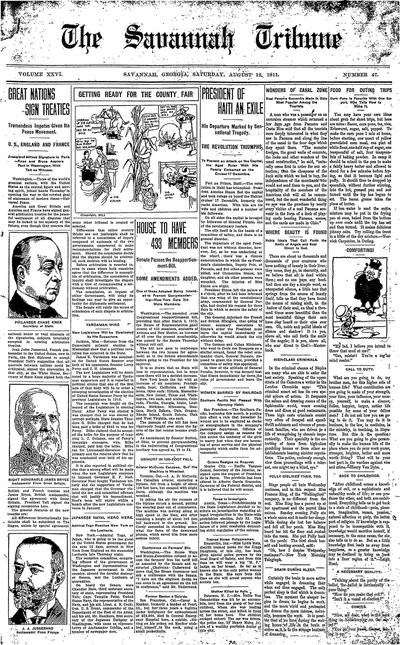
Page text (machine-generated)
VOLUME XXVI.
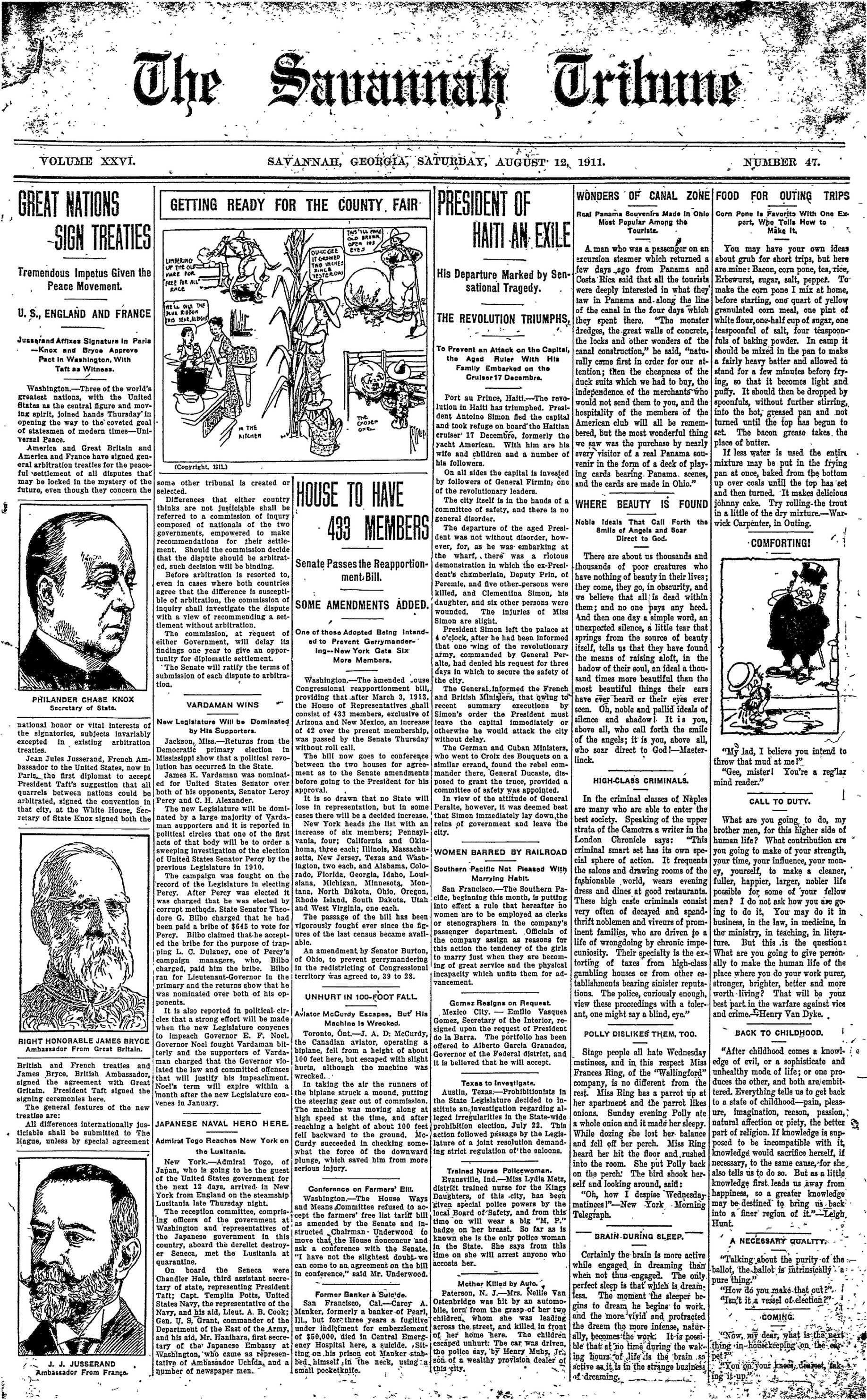
GREAT NATIONS SIGN TREATIES
Tremendous Impetus Given the Peace Movement.
U. S., ENGLAND AND FRANCE
Jussagrand Affixes Signature in Parla
—Knox and Bryce Approve
Pact in Washington, With
Taft as Witness.
Washington.—Three of the world's
greatest nations, with the United
States as the central figure and mov-
ing spirit, joined hands Thursday in
opening the way to the coveted goal
of statesmen of modern times—Universal Peace.
America and Great Britain and America and France have signed general arbitration treaties for the peaceful settlement of all disputes that may be locked in the mystery of the future, even though they concern the
WILLIAM M.
PHILANDER CHASE KNOX
Secretary of State.
national honor or vital interests of
the signatories, subjects invariably
excepted in existing arbitration
treaties.
Jean Jules Jusserand, French Ambassador to the United States, now in Paris_the first diplomat to accept President Taft's suggestion that all quarrels between nations could be arbitrated, signed the convention in that city, at the White House, Secretary of State Knox signed both the
[Illustration of a man with a long beard and a high collar, wearing a decorative garment with intricate patterns.]
RIGHT HONORABLE JAMES BRYCE
Ambassador From Great Britain.
British and French treaties and
James Bryce, British Ambassador,
signed the agreement with Great
Gritain. President Taft signed the
signed ceremonies here.
The general features of the new
treatise are:
All differences internationally justi-
cable shall be submitted to The
Hague, unless by special agreement
A. H.
J. J. JUSSEERAND
Amphassand FROM France
The Savannah
GETTING READY FOR THE COUNTY. FAIR
LIMBERING UP THE OLD MARE FOR FREE FOR ALL RACE
OU-WI-GEE IT GROWED TWO IRCHES SINCE YESTERDAY
THIS ILL PAGE OLD BROWN, OPEN THE EYES
WE'LL OWN THE BLUE RIBBON THIS SEASON!
IN THE KITCHEN
THE CHOOSEM ONE
some other tribunal is created or selected. Differences that either country thinks are not justifiable shall be referred to a commission of inquiry composed of nationals of the two governments, empowered to make recommendations for their settlement. Should the commission decide that the dispute should be arbitrated, such decision will be binding. Before arbitration is resorted to, even in cases where both countries agree that the difference is susceptible of arbitration, the commission of inquiry shall investigate the dispute with a view of recommending a settlement without arbitration. The commission, at request of either Government, will delay its findings one year to give an opportunity for diplomatic settlement.
The Senate will ratify the terms of submission of each dispute to arbitration.
VARDAMAN WINS
New Legislature Will be Dominated by His Supporters.
Jackson, Miss.—Returns from the Democratic primary election in Mississippi show that a political revolution has occurred in the State.
James K. Vardaman was nominated for United States Senator over both of his opponents, Senator Leroy Percy and C. H. Alexander.
The new Legislature will be dominated by a large majority of Vardaman supporters and it is reported in political circles that one of the first acts of that body will be to order a sweeping investigation of the election of United States Senator Percy by the previous Legislature in 1910.
The campaign was fought on the record of the Legislature in electing Percy. After Percy was elected it was charged that he was elected by corrupt methods. State Senator Theodore G. Bilbo charged that he had been paid a bribe of $645 to vote for Percy. Bilbo claimed that he accepted the bribe for the purpose of trapping L. C. Dulaney, one of Percy's campaign managers, who, Bilbo charged, paid him the bribe. Bilbo ran for Lieutenant-Governor in the primary and the returns show that he was nominated over both of his opponents.
It is also reported in political circles that a strong effort will be made when the new Legislature convenes to impeach Governor E. F. Noel. Governor Noel fought Vardaman bitterly and the supporters of Vardaman charged that the Governor violated the law and committed offenses that will justify his impeachment. Noel's term will expire within a month after the new Legislature convenes in January.
JAPANESE NAVAL HERO HERE
Admiral Togo Reaches New York on the Lusitanie.
New York.—Admiral Togo, of Japan, who is going to be the guest of the United States government for the next 12 days, arrived in New York from England on the steamship Lusitania late Thursday night. The reception committee, comprising officers of the government at Washington and representatives of the Japanese government in this country, aboard the derelict destroyer Seneca, met the Lusitania at guarantine.
On board the Seneca were Chandler Hale, third assistant secretary of state, representing President Taft; Capt. Templin Potts, United States Navy, the representative of the Navy, and his aid, Lieut. A. B. Cook; Gen. U. S. Grant, commander of the Department of the East of the Army, and his aid, Mr. Hanlhara, first secretary of the Japanese Embassy at Washington, who came as representative of Ambassador Uchida, and a number of newspaper men.
HOUSE TO HAVE 433 MEMBERS
Senate Passes the Reapportionment Bill.
SOME AMENDMENTS ADDED.
One of those Adopted Being Intended to Prevent Gerrymander-
ing--New York Gets Six More Members.
Washington.—The amended house Congressional reapportionment bill, providing that after March 3, 1913, the House of Representatives shall consist of 433 members, exclusive of Arizona and New Mexico, an increase of 42 over the present membership, was passed by the Senate Thursday without roll call.
The bill now goes to conference between the two houses for agreement as to the Senate amendments before going to the President for his approval.
It is so drawn that no State will lose in representation, but in some cases there will be a decided increase.
New York heads the list with an increase of six members; Pennsylvania, four; California and Oklahoma, three each; Illinois, Massachusetts, New Jersey, Texas and Washington, two each, and Alabama, Colorado, Florida, Georgia, Idaho, Louisiana, Michigan, Minnesota, Montana, North Dakota, Ohio, Oregon, Rhode Island, South Dakota, Utah and West Virginia, one each.
The passage of the bill has been vigorously fought ever since the figures of the last census became available.
An amendment by Senator Burton, of Ohio, to prevent gerrymandering in the redistricting of Congressional territory was agreed to. 39 to 28.
UNHURT IN 100-FOOT FALL
Aviator McCurdy Escapes, But His Machine is Wrecked.
Toronto, Ont.-J. A. D: McCurdy, the Canadian aviator, operating a biplane, fell from a height of about 100 feet here, but escaped with slight hurts, although the machine was wrecked.
In taking the air the runners of the biplane struck a mound, putting the steering gear out of commission. The machine was moving along at high speed at the time, and after reaching a height of about 100 feet fell backward to the ground. McCurdy succeeded in checking somewhat the force of the downward plunge, which saved him from more serious injury.
Conference on Farmers' EITL
Washington.—The House Ways and Means Committee refused to accept the farmers' free list tariff bill as amended by the Senate and Instructed Chairman Underwood to move that the House nonconcur and ask a conference with the Senate. "I have not the slightest doubt we can come to an agreement on the bill in conference," said Mr. Underwood.
Former Banker & Suicide
San Francisco, Cal.—Carey A. Manker, formerly a banker of Pearl, Ill., but for three years a fugitive under indictment for embezzlement of $50,000, died in Central Emergency Hospital here, a suicide. Sitting on his prison cot Manker stabbed himself in the neck, using a small pocketknife.
PRESIDENT OF HAITI AN EXILE
PRESIDENT OF HAITI AN EXILE
His Departure Marked by Sensational Tragedy.
THE REVOLUTION TRIUMPHS,
To Prevent an Attack on the Capital, the Aged Ruler With His Family Embarked on the Cruiser 17 December.
Port au Prince, Haiti.—The revolution in Haiti has triumphed. President Antoine Simon fled the capital and took refuge on board the Haitian cruiser 17 December, formerly the yacht American. With him are his wife and children and a number of his followers.
On all sides the capital is invested by followers of General Firmin; one of the revolutionary leaders.
The city itself is in the hands of a committee of safety, and there is no general disorder.
The departure of the aged President was not without disorder, however, for, as he was embarking at the wharf, there was a riotous demonstration in which the ex-President's chamberlain, Deputy Prin, of Peremle, and five other persons were killed, and Clementina Simon, his daughter, and six other persons were wounded. The injuries of Miss Simon are slight.
President Simon left the palace at 4 o'clock, after he had been informed that one wing of the revolutionary army, commanded by General Peralte, had denied his request for three days in which to secure the safety of the city.
The General, informed the French and British Ministers, that owing to recent summary executions by Simon's order the President must leave the capital immediately or otherwise he would attack the city without delay. The German and Cuban Ministers, who went to Croix des Bouquets on a similar errand, found the rebel commander there, General Ducaste, disposed to grant the truce, provided a committee of safety was appointed. In view of the attitude of General Peralte, however, it was deemed best that Simon immediately lay down the relins of government and leave the city.
WOMEN BARRED BY RAILROAD
Southern Pacific Not Pleased With Marrying Habit.
San Francisco.—The Southern Pacific, beginning this month, is putting into effect a rule that hereafter no women are to be employed as clerks or stenographers in the company's passenger department. Officials of the company assign as reasons for this action the tendency of the girls to marry just when they are becoming of great service and the physical incapacity which unfits them for advancement.
Gcmez Realign on Request
Mexico City. — Emilio Vasquez Gomez, Secretary of the Interior, resigned upon the request of President de la Barra. The portfolio has been offered to Alberto Garcia Granados, Governor of the Federal district, and it is believed that he will accept.
Texas to Investigate.
Austin, Texas—Prohibitionists in the State Legislature decided to institute an investigation regarding alleged irregularities in the State-wide prohibition election, July 22. This action followed passage by the Legislature of a joint resolution demanding strict regulation of the saloons.
Trained Nurse, Policewoman.
Trained Nurse Policewoman
Evansville, Ind..Miss Lydia Metz,
district trained nurse for the Kings
Daughters, of this city, has been
given special police powers by the
local Board of Safety, and from this
time on will wear a big "M. P."
badge on her breast. So far as is
known she is the only police woman
in the State. She says from this
time on she will arrest anyone who
accares her.
Mother Killed by Auto.
Paterson, N. J.—Mrs. Nellie Van Ostenbridge was hit by an automobile, torn from the grasp of her two children, whom she was leading across the street, and killed in front of her home here. The children escaped unhurt. The car was driven, the police say, by Henry Muhs, Jr., son of a wealthy provision dealer of this city.
WONDERS OF CANAL ZONE
Real Panama Souvenirs Made In Ohio
Most Popular Among the
Touristate.
A man who was a passenger on an excursion steamer which returned a few days ago from Panama and Costa Rica said that all the tourists were deeply interested in what they saw in Panama and along the line of the canal in the four days which they spent there. "The monster dredges, the great walls of concrete, the locks and other wonders of the canal construction," he said, "naturally came first in order for our attention; then the cheapness of the duck suits which we had to buy, the independence of the merchants who would not send them to you, and the hospitality of the members of the American club will all be remembered, but the most wonderful thing we saw was the purchase by nearly every visitor of a real Panama souvenir in the form of a deck of playing cards bearing. Panama, scenes, and the cards are made in Ohio."
Noble Ideals That Call Forth the
8mills of Angels and Boar
Direct to God.
There are about us thousands and thousands of poor creatures who have nothing of beauty in their lives; they come, they go, in obscurity, and we believe that all is dead within them; and no one pays any heed. And then one day a simple word, an unexpected silence, a little tear that springs from the source of beauty itself, tells us that they have found the means of raising aloft, in the hadow of their soul, an ideal a thousand times more beautiful than the most beautiful things their ears have ever heard or their eyes ever seen. Oh, noble and pallid ideals of silence and shadow! It is you, above all, who call forth the smile of the angels; it is you, above all, who soar direct to God!—Maeterlinck.
HIGH-CLASS CRIMINALS.
In the criminal classes of Naples are many who are able to enter the best society. Speaking of the upper strata of the Camotra a writer in the London Chronicle says: "This criminal smart set has its own special sphere of action. It frequents the salons and drawing rooms of the fashionable world, wears evening dress and dines at good restaurants. These high caste criminals consist very often of decayed and spend-thrift noblemen and viveurs of prominent families, who are driven to a life of wrongdoing by chronic impecuniousity. Their specialty is the extorting of taxes from high-class gambling houses or from other establishments bearing sinister reputations. The police, curiously enough, view these proceedings with a tolerant, one might say a blind, eye."
POLLY DISLIKE$ THEM, TOO.
Stage people all hate Wednesday matinees, and in this respect Miss Frances Ring, of the "Wallingford" company, is no different from the rest. Miss Ring has a parrot up at her apartment and the parrot likes onions. Sunday evening Polly ate a whole onion and it made her sleepy. While dozing she lost her balance and fell off her perch. Miss Ring heard her hit the floor and rushed into the room. She put Polly back on the perch. The bird shook herself and looking around, said:
"Oh, how I despise Wednesday matinees!"—New York Morning Telegraph.
BRAIN-DURING SLEEP
Certainly the brain is more active while engaged in dreaming than when not thus engaged. The only perfect sleep is that which is dreamless. The moment the sleeper begins to dream he begins to work, and the more vivid and protracted the dream the more intense, naturally, becomes the work. It is possible that at no time during the waking hours of life is the brain so active as it is in the strange business of dreaming.
NUMBER 47.
Corn Pone Is Favorite With One Export, Who Tells How to Make It.
You may have your own ideas about grub for short trips, but here are mine: Bacon, corn pone, tea, rice, Erbswurst, sugar, salt, pepper. To make the corn pone I mix at home, before starting, one quart of yellow granulated corn meal, one pint of white flour, one-half cup of sugar, one teaspoonful of salt, four teaspoonfuls of baking powder. In camp it should be mixed in the pan to make a fairly heavy batter and allowed to stand for a few minutes before frying, so that it becomes light and puffy. It should then be dropped by spoonfuls, without further stirring, into the hot, greased pan and not turned until the top has begun to set. The bacon grease takes the place of butter.
If less water is used the entire mixture may be put in the frying pan at once, baked from the bottom up over coals until the top has set and then turned. It makes delicious johnny cake. Try rolling-the trout in a little of the dry mixture.—Warwick Carpenter, in Outing.
A man in a top hat and a cane stands on a street corner, watching a child in a hat and a cane play with a ball.
"My lad, I believe you intend to throw that mud at me!"
"Gee, mister! You're a reglar mind reader."
CALL TO DUTY.
What are you going to do, my brother men, for this higher side of human life? What contribution are you going to make of your strength, your time, your influence, your money, yourself, to make a cleaner, fuller, happier, larger, nobler life possible for some of your fellow men? I do not ask how you are going to do it. You may do it in business, in the law, in medicine, in the ministry, in teaching, in literature. But this is the question: What are you going to give personally to make the human life of the place where you do your work purer, stronger, brighter, better and more worth living? That will be your best part in the warfare against vice and crime. Henry Van Dyke.
BACK TO CHILDHOOD.
"After childhood comes a knowledge of evil, or a sophisticate and unhealthy mode of life; or one produces the other, and both are embittered. Everything tells us to get back to a state of childhood—pain, pleasure, imagination, reason, passion, natural affection or piety, the better part of religion. If knowledge is supposed to be incompatible with it, knowledge would sacrifice herself, if necessary, to the same cause, for she also tells us to do so. But as a little knowledge first leads us away from happiness, so a greater knowledge may be destined to bring us back into a finer region of it."—Leigh Hunt.
A NECESSARY QUALITY.
"Talking about the purity of the ballot, the ballot is intrinsically a pure thing."
"How do you make that out?"
"Isn't it a vessel of election?"
"Now, my dear, what is the next thing in housekeeping on the carpet?"
"You on your knees, dearest, taking it up."
FOSTER'S FAMELIVES IN NEGRO BALLADS
A Monument May Also Proclaim Deeds of Foster.
HE WAS AMERICA'S MOST POPUL
LAR SONG WRITER, HAVING
PRODUCED MANY FAVOR-
The Fourth of July, 1826, marked the half-century of the birth of the American nation, and naturally was celebrated with a great display of oratory and fireworks. It was about noon of that day—the same day on which Thomas Jefferson and John Adams died—that a patriotic company on the outskirts of old-Pittsburg were listening to the national salute from the arsenal cannon and martial sails from the band, when word came that a son had been born to the man who was the chief spirit of the celebration. The child who made his advent under such glorious auspices was desired to become America's most popular song writer, the author of "My Old Kentucky Home," and "Suwaree River," and 150 other ballads that everybody used to sing—Stephen Collins Foster.
His body rests today under a plain gravestone of the old-fashioned sort, just like his songs, and many think that a more elaborate memorial would be out of keeping. But others hold that by such a memorial Pittsburgh would be honoring herself, rather than the poet and composer, and so a movement is on foot to have the obscure grave in the Allegheny cemetery, almost within view of the spot where he was born, marked with a suitably dignified monument. One already exists in Highland park, but it is not commensurate with Foster's fame and his high rank as a writer of songs. Another suggestion is to have the memorial take the form of a music pavilion in Schenley park.
How Foster Got the Tunes.
It was Foster who first delved into the rich fount of negro melody to find the inspiration of truly American music. There is no primitive people that has a greater wealth of haunting themes than the descendants of the African slaves, and the ante-bellum plantation resounded with the thikle of the banjo and the chant of the cotton pickers. When Stephen was still a child he would frequently be taken to a negro church and camp meeting by a mulatto girl who was a bound servant in the household, and so he got some of the rhythmic tunes of the darkies early into his blood.
There had been a musical strain in his make-up from the first—his ancestry was Irish and one of his mother's antecedents was Italian. When little Stephen was only two years old he would often pick out harmonies on a guitar lying on the floor, and when he was only seven he was taken into a music store, where he took up a flute, and in a few minutes had mastered its stops sufficiently to play "Hall Columbia."
About that time there were several negro airs that had become very popular, especially "Jim Crow" and "Zip Coon." A number of the boys in the neighborhood had fitted up an old carriage house as a theater and gave juvenile performances, at which nine-year-old Stephen was the musical star. He was a native musical genius; that fact was admitted by his comrades, who granted him the only "salary" paid out by the company, the others assuming the risks of management. When there was a surplus in the treasury a dividend was declared sufficient to enable the company to see Edwin Forrest or Junius Brutus Booth on their visits to the old Pittsburgh theater.
Wrote First Song at Sixteen.
Native musical genius was not the sole equipment of the future song writer. He had lessons from Henry Kleber, who had opened probably the first music store in Pittsburg. His brother has recorded that he gave much time to the study of Beethoven, Mozart and Weber. He delighted in improvisation upon the piano. He sang with profound feeling. One of his favorite songs was Tennyson's "May Queen," set to music by Dempster, and as he sang the pathetic words tears would often flow down his cheeks.
It was inevitable that he should try his hand at composition. He was sixteen when his first song was published; it was "Open Thy Lattice, Love." Two or three years later a club of young men used to gather to sing some of the popular negro melodies of the day under his leadership, and to enlarge their repertoire, he suggested that they produce some songs of their own. "The Louisiana Belle" was the first, both words and music, and a week later came "Old Uncle Ned," which made him famous. The following year he was in Cincinnati, working as a bookkeeper for his brother, when he wrote "Oh, Susannah," another big hit. He gave these two songs to a friend in the music publishing business, who made $10,000 out of them. Foster had the usual lack of practical business ability which marks geniuses.
The sweetest and, most widely sung of all of Foster's songs is "The Old Folks at Home," better known as "Suwanne Ribber." The story of how this song came to be written is told by Foster's brother, and will interest many thousands who sing it and do
not even know that there is a real. Swance river.
"One day in 1851," Morrison Foster says, "Stephen came into my office and said to me: 'What is a good name of two syllables for a southern river? I want to use it in this new song of "Old Folks at Home'" I asked him how Yazoo would do. 'Oh, sal he, that has been used before.' I then suggested Pedee. 'Oh, pshaw, he replied, I won't have that.' I then took down an atlas from the top of my desk and opened the map of the United States. We both looked over it, and my finger stopped at the Swanance, a little river in Florida emptying into the Gulf of Mexico. 'That's it, that it's exactly, exclaimed he delighted, as he wrote the name down. He left the office, as was his custom, abruptly, without saying another word." About this time E. P. Christy, the famous negro minstrel, wrote to Foster for a song, and this one was sold to him for $50. Foster made about $15,000 from this song afterward.
A faithful setter, given to Foster by a friend, furnished the inspiration for "Old Dog Tray." Another popular song, "My Old Kentucky Home," was written under a tree that is still standing at Federal hill, the homestead, near Bardstown, Ky., where lived John Rowan, United States senator from Kentucky when Stephen was born, and a cousin on his maternal side.
"Old Black Joe" is another perennial favorite among the nearly 200 songs that Stephen Collins Foster wrote. The figure of Old Black Joe adorns the pedestal of the monument in Highland park, Pittsburg. It is a symbol of the intimate sympathy the poet and composer had with the life of the lowly black folk whose sorrows and joys he immortalized in his songs.
His Courage and Gentleness.
His courage and the bravery Foster was one of the simplest and sweetest of souls. One of his teachers told his father that "Stephen was the most perfect gentleman he ever had for a pupil." He was on his way to a party one evening when he heard that a little girl had been run over by a dray and killed, and he went instead to the stricken home and spent the night there comforting her parents. Yet his gentle spirit could develop the courage of a lion upon occasions, as when he came upon two bullies who were abusing a drunken man. Selizing a fence rall he drove them to flight, after a battle in which he received a scar that he carried with him to his grave.
So sensitive that the tickling of a clock annoyed him until he had stowed it away beneath a tub in the cellar, in order to be able to sleep, he locked the door of his room to everyone but his mother when he was at work on a piece of music. He removed to New York once, because that was a better market for his compositions, and in a year he had become so homesick that he sold out his furniture; on a twenty-four hours' notice, and went home to Pittsburgh. He reached the white cottage in Lawrenceville, still standing, about midnight, and when his mother came down to see who knocked so late, she found him weeping upon the porch. In spite of his love for his home he was destined to die in the great metropolis. In January, 1864, while in the American hotel in New York, he was seized with a fever. Getting up a few days later, he was so weakened that he fell across a wash basin and cut several serious gashes in his head and throat. He died in a hospital a few days later from weakness and loss of blood.
While Stephen Collins Foster had not the prodigious fertility of Schubert, who composed seven other songs on the same day that he composed "Erikonig," or of Abt, who has over 3,000 songs to his credit, his most popular songs are sung by more people and awaken deeper response than those of any other composer. If we expect "Home, Sweet Home," there is no better beloved song than "Swuwean Ribber."
He died when he was only thirty-eight years old, but it may be doubted whether the psalmist's span of life would have made his fame any more secure than it is. He and his songs are beloved, and that is the highest assurance of immortality. Pittsburg, where his daughter still lives, cannot add to his renown by the erection of another monument, but she can show that she appreciates the richness of his genius, which received the meed of praise from sources so diverse as Washington Irving and Ole Bull—Cincinnati Enquirer.
A SIGNIFICANT NOTICE.
Richard Croker, the day of his departure for his Irish home, said to a New York reporter:
"It is the desire for freedom that sends so many Americans and so many millions of dollars abroad every June. The Puritanical laws of America enslave us. These laws, with their total misconception of freedom and of enjoyment, are well exemplified in a notice board I once saw in a New England park. This board said:
"Pleasure Grounds. Notice—These grounds are for pleasure only. No games or play allowed."—Washington Star.
RASPBERRY ! GRBET.
Boll together for 20 minutes one pint of sugar, one quart of water and one pint of crushed raspberries. Add to this one gill of lemon juice and the same of orange juice. When cold strain and freeze. Pineapple or other fruit may be served in the same manner.
The Sunday School Lesson
Lesson for August 13, 1911.
JEHOIAKIM BURNS THE PROPHET'S BOOK.
Golden Text—"The word of our God shall stand forever." Isa. 40:8.
Jeremiah 36:21-32. Commit vs. 23,
24.
TIME-604 B. C. PLACE-Jerusa
lem.
EXPOSITION—I. The King Seeks to Destroy God's Word, 21:26. Jehovah spoke to Jeremiah, Jeremiah repeated to Baruch what Jehovah said to him, Baruch wrote it in a book (v. 4). Then Baruch read this message to all the people in the chamber of Gemariah, who was the son of the man who brought the newly-discovered word of God to King Josiah in lesson 5 (v. 10). Micailah, the son of Gemariah, went and told all the princes "all the words that he had heard, when Baruch read the book" (v. 13). The princes having summoned Baruch and heard him themselves, went and repeated the divine message to the king. These princes kept back no part of the message; "they told all the words in the ears of the king" (v. 20). It was not an agreeable message, not such as a king loved to hear from his courtiers (vs. 2, 7). They knew, with what anger Jehovah had received a similar message (ch. 28:20:3), but they told all they wisely anticipated the king's anger, however, by telling Baruch and Jeremiah to fetch the roll. That seemed hopeful. But Jehovah turned right around and went in a thoroughly wrong direction. In a king can play the fool (v. 23, R. V.). This King Jehovah did. His father had humbled himself and sought the Lord when the word of God was read to him, and thus found mercy, safety and peace; but Jehovah scorned it, and sought to destroy it, and thus brought ruin upon him and people (vs. 29:31). Jehovah fancied that by burning the prophecies he would burn up the facts therein predicted. There are many today who fancy that by destroying the Bible they will get rid of the unwelcome truths therein contained. Let them learn a lesson from Jehovah's experience. If every copy of the Bible were destroyed the truths it contains would be none the less true (Matt. 24:35). Jehovah was one of the most thorough-going destructive critics that ever lived. The average critic only cuts out portions of God's word. Jehovah cut up the whole business and threw it into the fire. Jehovah doubtless felt very much comforted when he saw the last leaf turned to ashes. Now he had nothing to dread. Were not the prophecies destroyed? Well, he soot found out. Despelling God's word does not render it void. It simply brings destruction upon the despiser (Prov. 13:13). These warnings at which Jehovah was angry were not a token of God's hate but of God's love. They were intended to bring king and people to repentance (v. 3; cf. 2 Fet. 3:9). It was not cruel but kindness on Jeremiah's part to communicate these warnings, terrific as they were, to the people. The preacher who today warns of the awful wrath to come is often hated and called hard-hearted, but he is a true friend, but the false prophet who prophesies smooth things and lulls people to sleep in sin, is an enemy of God and man. There were, however, three men who had the wisdom and the courage to protest against the mad action of Jehovah. "But he would not hear them." The Lord will always take care of his own (v. 26). Kings may plot, but the faithful servant of Jehovah is always safe. This does not mean that a faithful servant of Jehovah may not be captured or even slain by his foes, but he will be neither captured nor slain unless this is the very best thing for him (Rom. 8:28, 31). Jeremiah had a right to be perfectly sure the Lord would hide him and deliver him; for he had promised so to do (ch. 1:19:15, 20:21).
11. God's Word Abides, the King Perishes, 27-32. God's word is indefestructible, his judgments persistent, his patience enduring. You can burn the paper on which God's word is written, but you cannot destroy the message. The word of God ever arises triumphantly from the ashes. You may scoff at God's judgments and burn the book that records them, and persecute the preacher that proclaims them, but God will simply referate them and fulfill them. You can refuse to listen to the warnings of God's love, and cast the book that conveys them in to the fire, and the long-suffering Father will repeat them. Jeremiah did as Jehovah bade him. He took another roll and repeated his labor (v. 32). It seemed useless, and if Jeremiah had been like many of us, he would have said "What is the use?" But he was not like us, he was wise enough to ask no questions, no matter how unreasonable God's orders seemed, but to do just as he was told. The new roll was more severe than the first (v. 32). God's judgments never become milder because we despise them. God never compromises with rebels because of their stubbornness. Every rejection of God's warnings or God's grace brings increase of doom. Jeholakim had entered into controversy with God. That never pays (Isa. 45:9). It certainly did not pay in Jeholakim's case (vs. 30, 31).
MOVEMENT OF WHITE AND NEGRO POPULATION IN NINE SOUTHERN STATES
Washington, D. C.—Preliminary statistics showing the consistent and constant cityward movement of the white and negro population of the nine southern cotton states, based upon the returns for the censuses of 1910, 1900, and 1890, are contained in a comparative statement prepared under the supervision of Mr. William C. Hunt, chief statistician for population in the bureau of the census, and issued by Acting Census Director Falkner. The figures are preliminary and subject to necessary revision later, but it is believed that there will be no material change in the percentages stated.
The nine cotton states concerned are: Alabama, Arkansas, Florida, Georgia, Louisiana, Mississippi, North Carolina, South Carolina, and Tennessee.
Of the white people of these states 18.9 per cent lived in urban areas in 1910, 14 per cent in 1900, and 11.6 per cent in 1890. Of the total negro population of the same states the percentages living in urban areas were 17.7 per cent in 1910, 14.7 per cent in 1900, and 11.8 per cent in 1890.
It appears from these percentages that the changes in the proportion of the total negro population of these states lying in the urban sections have been about the same as those in the proportion of the total whites who live in cities. Both white and negro show a decided movement toward the city. From an urban proportion of 11.6 per cent in 1890 the whites have increased to 18.9 per cent in 1910. During the same period the urban proportion of negroes increased from 11.9 to 17.7 per cent.
While the proportion of whites and negroes living in city and country can be readily measured, some care is required in stating the rate of increase. This difficulty arises from the fact that portions of the rural area are continually changing into urban districts. Urban population, as defined by the census office, is composed of those groups that live in cities and other incorporated places having at least 2,500 inhabitants. In order to obtain a definite measure of the rate of increase it is necessary that the rate pertain to the same area for each census period. Rates of increase, calculated for the places that were classed as urban or rural in 1890, are as follows:
The white population of the 1890 cities increased 27.6 per cent between 1890 and 1900 and 46.6 per cent between 1900 and 1910. Similar rates of increase for the urban negroes are 23.3 per cent in the decade 1890 to 1900 and 30.5 per cent in the decade 1900-1910. For the rural sections of 1890 the rate of increase for the white population was 18.7 between 18.7 between 1890 and 1900, and 17.3 between 1900 and 1910. The increase of the negroes in the same rural sections was 17.5 between 1890 and 1900 and 8.3 between 1900 and 1910.
A comparison of these, rates of increase brings out clearly the cityward trend for both races, but shows it to be even greater for the whites than for the negroes. The rate of increase for the urban whites advanced from 27.6 to 46.6, or a difference of 19 per cent while the rate for the urban negroes advanced from 23.2 to 30.5, or a difference of 7.2 per cent.
The rate of increase in the rural sections was less for both races in the decade ending in 1910 than for that ending in 1900, but the decline in the rate of increase was very much greater for the negroes than for the whites. For the whites the change was from 18.7 per cent in the first decade to 17.3 in the last 10 years, a difference of 1.4 per cent. For the negroes the change was from 17.5 per cent to 8.3 per cent, a difference of 9.2 per cent.
THE SMALL BOY AND HIS HAT.
He flings his hat across the dining-room when he comes in from school, or leaves it in all manner of places in the house; in the coal bin, or on sister's bureau. He loses it just at church time, and spoils the spirit of family reverence and pliey. As the family enters the church the anthem is being sung, and the disgrace of being late again is laid on the innocent headpiece clutched in the hand of the small boy, who has already forgotten the confusion of which he was the cause twenty minutes ago. In this stage also one's hat is removed on the way to school by the hand of one's bosom friend, passed down the line of surrounding boon companions, stuffed into other's pockets, while dire thoughts of ultimate loss hold one in their grip, and the reckoning to be paid at home wraps the world in tragedy.-The Atlantic.
CHARGED THE JURY.
By some twist of the election an old negro had been elected to the office of justice of the peace in a little backwoods district in Tennessee. His first case happened to be one in which the defendant asked for a trial by jury. When the testimony was all in the lawyers waited for the judge to give his instructions to the jury. The new justice seemed embarrassed. Finally one of the lawyers whispered to him that it was time to charge the jury. He Webstered one hand into the front of his coat, Calhoun his voice and said: "Gent'mn'oh de jury, sence dis am a putty small case, Ah'll on' charge vo a dollah 'a half aplece."
Set up unto thyself, pillars of the road, place for thyself way-marks; set thy heart upon thy way, even upon the way which thou goest—Jeremilah, xxii, 21.
There are men who deliberately abandon the direction of their conscience until they lose all sense of moral responsibility. Their life is like a weathercock that is turned by every breeze. Without sufficient will-power to resist even a mild temptation, they yield on its first approach, and from any direction in which they may have been pursuing their life, they will unhesitatingly turn and, take an opposite ship. These rudderless ships on the sea of life are not few; every one within his individual horizon can hall numbers of them as they drift aimlessly by, without charf or compass to direct their course.
Of course, these men have a philosophy of their own to bolster up their peculiar conception of human life. They have their reasons for abandoning duty and for effacing the inviolable distinctions between "thou shalt" and "thou shalt, not." Conscience is not blinding upon them, and the only injunction they obey is that basely worldly one—never be found out. Their philosophy hinges chiefly on the notion that the individual cannot control his life; that a person's conduct is determined wholly by the worldly influences about him. The matter of responsibility, the sense of duty, is thus lightly disposed of, and the man who should endeavor to rise above the debasing influences of a purely worldly life would be deemed only a fool for his pains.
It is against this sham reasoning the prophet warns us in the words that serve as our text. Regardless of worldly influences we must set up the immovable way-marks of true human existence—the dictates of honor, of duty, of the fear of God. We are endowed with free will, and we ourselves mark out the paths we pursue. This is a fundamental moral truth. It destroys the immoral notion that the individual is altogether subject to external influences and he becomes what the world makes him. That relation which some men establish between themselves and their surroundings and which they offer as a palliative for all short-comings cannot reasonably be held to be binding. Man that has reason and free will cannot rely for moral elevation or debasement, for choosing good or evil, upon the mere flow of circumstance. In a normal state a man does not depend upon the throw of dice for his bread; can he then depend upon mere chance for the life or death of his very soul? There is no ground whatever for putting the blame one deserves upon the shoulders of society. There is a law, and all life bears it out, that "the soul which has snithed it shall die." This law holds good because free will is the peculiar mark of the human being. In the Biblical allegory, therefore, there was no forgiveness when, on committing the first sin, Adam threw the blame upon Eve and Eve upon the serpent. Virtue and vice are the results of our own work. Our fellow-men have no share in the destiny of our souls. "It is sheer cowardice to take off the scarlet robe of guilt and place it on the back of society for a scapegoat.
Unsparingly, as becomes a true prophet of God, Jeremiah in a single phrase anhilates such false philosophy. "Set up unto myself pillars of the road," he says; "set thy heart upon thy way." Every man takes the lines of destiny into his own hands. If he sows righteousness, he will reap in his conscience blessings; if he sows the wind, he will reap the whirlwind. He cannot make away with his sense of responsibility. Conscience will not be silenced. At every turn in life man hears the solemn warning, "Set thy heart upon the way which thou goest"—an echo of the fateful choice he is compelled to make when he has been told at the very beginning: "Behold, I give unto you on this day life, and the good, death and evil." After all has been said about external influences, about the temptations of the world, and the like, the personal equation remains. When we shall have been brought face to face with our ultimate goal, and our hearts have become bared before the searching heavenly judgment, the world will be far removed from us, and we shall stand revealed as the sole authors of the good or civil we have done.
This is a very important lesson to bear in mind. We should take to heart the words of the prophet and set up the true way-marks in our life. Our test will then come in the choice we shall make of our points of guidance. Once the choice is made, the dte is cast; we generally go on in that direction clear to our journey's end. And so the prophet uses the word which is ordinarily translated by the word "pillar," but which in Hebrew literally means a high pillar. We should be guided by high aims, noble ambitions. Not the indulgence of self, not the acquisition of worldly things, not worldly pomp or power is the true measure of life. Our guilding influence should be self-sacrifice, the performance of duty, disinterested service to our fellows and an earnest effort to realize in our life our thought of God. These are the high pillars which we should set up on the way of human life.-C. A. Rubenstein, Haral Temple.
ALARMED AT MANY SLAYINGS OF NEGRO WOMEN IN ATLANTA.
Atlanta.—Alarmed at the many murders of negro women during the past two years and—the failure to apprehend the murderers, negro citizens of Atlanta are circulating petitions to the governor and mayor urging that suitable rewards be offered for the arrest and conviction of those responsible for these deeds of blood. The work of getting signatures to these petitions is in charge of H. A. Rucker, former collector of internal revenue, and Rev. J. A. Rush, pastor of the Central Avenue Methodist church (colored).
On these petitions are signed the names of many of Atlanta's foremost citizens, and to the committee circulating the petitions several prominent Atlantans have expressed hearty sympathy in the movement undertaken by the negro citizens. One prominent attorney urged that a fund be raised by white citizens for running down the murderer, and offered to contribute liberally.
The petitions point out that within the past two years there have been seventeen murders of negro women, and that the hangman's noose has not been resorted to in any case. Names of the victims and the dates of the murders are given in them.
TEXAS NEGRO BUSINESS LEAGUE MEETS
Fort Worth, Texas.—The Negro Business league met in Ft. Worth. After transacting its routine business the league adjourned to meet at Palestine, Texas, on July 4, 1912.
The following officers were elected for the ensuing year:
R. L. Smith, president, Waco, Texas.
R. C. Houston, Jr., vice-president, Ft. Worth, Texas.
J. P. Stark, second vice-president, Dallas, Texas.
H. L. Price, secretary.
J. B. Bell, treasurer.
E. M. Griggs, state organizer.
Dr. Booker T. Washington was invited to visit Texas next fall.
J. B. Bell and J. J. Hardoway attended the meeting as delegates from the Houston lodge.
HANDLING A HADDOCK.
"There is no better place than a fish market to pick up queer superstitions," said a restaurant proprietor. "The other day I held up a fine specimen of haddock. The dealer, who was an Italian, nearly choked on the bunch of Neapolitan expletives that rushed into his throat.
"Nevaire, no, nevaire take up haddock so," he said.
"How? I asked.
"By the head, so your fingers touch those dark spots on each side of the head," he said. "The curse fall on you if you do."
"Whose curse?' said I.
"St. Petalre's,' said he. 'St. Petalre gave the haddock those dark spots. They are his finger prints. He catch haddock just so in the sea of Gallle, and every haddock born since then has shown those same marks. Let go.'
"And I did let go. Of course I did. not believe it, but when I found that half the fish dealers In that market did believe I deemed it prudent to handle haddock by the body or tall."
-New York Sun.
ONE TRICK SENATOR MISSED.
Col. Fred Hale of Portland, Me., son of former Senator Eugene Hale of that state, came to Washington and called on his old friend H. C. Emery of the tariff board, also from Maine.
Emery's office is in the treasury building, and Emery showed Hale, not without pride, the long row of granite monoliths on the Fifteenth street side of that building, explaining that there were 36 in the lot, recently put up to replace the old limestone columns, and that they cost $10,000 aplece.
"Ten thousand dollars each?" repeated Hale.
"Yes."
* "And they came from the Maine quarries, I suppose?"
"No," replied Emery; "they came from the New Hampshire quarries."
"From New Hampshire?"
"You don't mean it!" said Hale.
"Where the deuce was father?"—Saturday Evening Post.
BIRD STORIES.
A German scientific journal published in 1897 a story to the effect that a golden eagle shot in that year at Eszeg, Slavonia, was found to have, a ring about its neck engraved on which were the arms of a Slavonian family and the date 1646.
In 1793 the Gentleman's Magazine told about a hawk, captured when flying in the vicinity of the Cape of Good Hope and taken by an Indian ship to England, which wore a gold collar inscribed:
"This goodie hawk doth belong to his Most Excellent Majesty James, King of England, A.D. 1610."
If this bird really escaped from England in the reign of James, 183 years elapsed between its escape and its recapture, and it had flown a distance of 6,500 miles away from its former owner.
First comes a layer of rubbish, nearly all thick dating from the sixteenth century to the fifteenth. At second layer, a little over $2\%$ thick_consists of rubbish recognizable by the character of its fragments as belonging to the period from the fourteenth to the sixteenth century. This is separated from the first layer by thin/deep of sand; and a second sandy deposit of sand the third layer, which plainly shows rules of the eleventh and twelfth centuries.
The largest of all the flowers of the world is said to be the Rafflesia a la native, of Sumatra, sn. called after Sir, Stamford Raffles. This immense plant, says the Scientifique American, is composed of five round pots of a brick-like color, each measuring, a foot in width. These are covered with numerous irregular, yellowish white swellings. The petals surround a cup, neatly, too wide, the margin of which bears the stamens. The cup of their Rafflesia is filled with a fleshy disk, the upper surface of which is covered with fine projections like miniature bowls or horns. The cup, when free from its coating, will hold about 12 pints. The flower weighs about 15 pounds and is, as is typical, the potaia being three quarters of an inch thick.
CROP ROTATION AND LEGUMES
Crop rotation in which the legumes,
such as cow peas, soy beans, vetch
and their loveries, have a 'brilliant'
place will nurture up the soil and place
an ampleable farm upon it, paying
fastly. Plant a solution that will improve
the fertility of the soils and at
the same time keep up the income
from the farm. This progressive
agriculture 1913 snd 1011 snd
Mr. J. W. Mayrant, of Ludovici, gave a call on Monday.
Fo: Ice Cream, ring up McFall Phone 408.
Mr. Raymond Homes of Charleston is in the city for a few days.
Mr. George harris of Columbia, S. C., is in the city for a few days.
C. is in the in for a store.
D. Drug Store, West Broad
and Hall streets.
Mr. Geo. Ivey of Waycross called in to see us on Monday.
Mr. S. B. Bryant of Bainbridge visited here on Monday.
Mrs.P. G. Jones, of Gwinnett Street left for Augusta on Monday.
Mrs. Fanny Raines of Old Bolton St., westailed Monday for Boston, Mass.
Mrs. Henderson and daughter of Cuthbert, Ga., are in the city for a few days.
Miss Henrietta Houstoun of 301 Waldburg, East left Wednesday for Asheville N. C.
Ask Pate's Drug Store about the Nyall Line.
Mrs. Rosa Stevens of 608 Bolton St., west, made a flying trip to Augusta on Monday.
Mrs. Brown of Atlanta, Ga., is stopping with Mrs. Mattie Thomas of 605 Bolton West
Mr. J. C. Kemp of Ludowici, was in the city on Monday and stopped in to see us.
Go to Pate's Drug Store, West Broad and Hall streets.
Mrs. Minnie Harvey and Miss Viola Reed of Atlanta, Ga., are in the city enroute to Brunswick, Ga.
Mrs. L. V. Drayton, of 66 Farm St., left Wednesday for a three weeks stay in Spartanburg, S. C.
Mrs. M. A. Phoenix, of Jefferson St., thanks her many friends for the many favors during her recent illnes. Go to Savannah Pharmacy or phone your wants. Prescriptions called for and delivered. Phone 3570
Miss Maggie Bright and Miss Josephine Brown are visiting Miss Ruth Watson at Brunswick, Ga.
Miss Georgia Bell and Mrs. Willie Sanders of Birmingham, Ala., are among the visitors in the city.
Mrs. Sarah Boyd and daughter of Athens, Ga., are the guests of Mrs. James C. Johnson, Henry Street west.
Misses Mamie Hill, Hattie Jackson, Hilda Anderson and Mrs. James P. Monroe left for Jacksonville. Tuesday.
Miss Beulah Simmons of Brunswick, Ga., is stopping with Mrs. C. C. Christopher, 718 Price Street.
Messrs John Gassaway, John Pharms and a number of other excursionists from Greenville, Ga. were in to see us.
Don't go other places to buy your suit before seeing A. P. Barnard, The Taylor, 310 Whitaker street-Phone 3003 Miss Celestine N. McFall left Tuesday for Brookly, N. Y. to visit her sister Mrs. R. McFall Josephs.
Miss Lottie Roundfield left for Augusta, last Sunday to spend awhile with relatives.
Miss Anna B. Douglas will leave tomorrow for Augusta to spend awhile with relatives. We wish her a pleasant stay.
MIDSUMMER SALE of all our pattern trimmed hats at cost prices Green and Allen, 464 West Broad St.
· Miss Esther Rutledge of Beaufort, S. C., is spending a month in the city the guest of Mrs. A. Chisolm, Park Avenue west.
· Mr. Grant Gregory and Mrs. Annie Lewis of New York arrived in the city Monday to attend the funeral of Mrs. Emma Gregory.
Mr. J. H. Herring of Öfferman was a visitor to the city on Sunday, stopping at the home of Mr. L. Theus on West 42nd, street.
Rev. W. T. Moore, of Brunswick, formerly pastor of St. Paul C. M. E. Church, this city, spent a few days among friends during the week.
STORES FOR RENT—Stores on Bay near Lumber, good stand, ten dollars.
Apply W. H. Wade, room 9 Provident Building.
Mr. J. H. Knight, of Folkston, Ga., Past Master of the Masonic Lodge at Folkston, Ga., has recently married Mrs. F. Johnson and now resides in Bologne, Fla.
Mrs. Jos. H. Baker and children Miss Sarah E. and Ellen C. and Master Jos H. Jr. left last Saturday for Cartersville Ga., where they will spend the month of August.
Mrs. F. L. Dixon left on Friday of last week for Washington, D. C., on her vacation to spend awhile with, her son who is employed in the government service.
Mrs. Ella Nora Harris of Savannah is visiting Mrs. Susie Barnes of McIntosh Ga., and was entertained last week by Mrs. A. B Carter, and Mrs. Anna L. Russell.
On last Saturday morning the stork called and left a bouncing little girl at the residence of Mr. and Mrs. Richard Wright, at 1115 Waldburg street east. Mrs. Richard Wright, the grand mother is in the city full of smiles.
Mrs. Bertha Thompson, Misses Lucile Maggie and Viola Nelson, Mamie McDaniel, Rosa Hammond, of Columbia spent Sunday last in the city as the guests of Mr. and Mrs. Hopkins and Miss Catherine L. Flagg.
Have you had a glass of soda from the new sanitary iceless soda fount at Savannah Pharmacy. Its the goods and deserves your patronage.
Our old friend, Mr. J. A. Grant of Bainbridge, was a welcome visitor to the city and our office on Monday. Mr Grant is one of the oldest patrons of the Tribune and shows his appreciation by always keeping in advance. Go to the Sayannah Pharmacy to buy your drugs and toilet articles. They have the goods, West Broad and Gwinnett St. Lane.
Mrs E. E. Des Verney and children Louise, Edward, Jr., and Mary, of Sayannah, relatives of Madam Des Verney and son Anthony, are in the city to spend a while the guests of the Madam. Friends are invited to call—Amercus Chronicle.
Mr. Joseph Clark and John Miller formerly of New York and Derby Coun., but now of Juskegee Institute who were passing through the city this week enroute home were the guests of Mr. John H. Washington, 508 E, Park Ave.
Ask Pate's Drug Store about the Nyall Line.
Mrs. M. F. Trottie left the past few weeks for a visit to her daughters Mrs. J. B. Henderson and Mrs. E. W. McFall at Fayetteville, N. C. Mrs. Henderson and mother are now visiting Philadelphia, Pa., New York and Atlantic City, where they will spend a few weeks.
Miss Gwendylyn Hurd of Athens left Monday for home after spending two weeks with Mrs. F. M. Cohen.
Mrs. John H. Hulin of E. Gwinnett Sr. has just left Concord, N. C. for Washington, D. C. for two weeks, after which she will join her husband in Jacksonville, Fla. We hope for her a pleasant tirp.
After a very pleasant stay of four weeks visiting relatives and friends in Savannah and Beaufort, S. C., Mrs. Alonzo White, (sister of Mrs. Dr. E. M. Pinckney) returned to her home at Daytona, Fla., on the 8 inst., accompanied by little Marie Reed, the grand daughter of Maj Geo. A. Reed, the genial Postmaster of Beaufort, S. C.
Mr. W. H. Sykes, an old Savannahian but now of Washington, D. C., is spending his vacation in the city with his mother other relatives and friends. He is a clerk in the Treasury Department of the government and being efficient in every respect, is able to "hold his own" against any odds. He is among the few Savannah boys who are "making good" His host of friends here are glad to see him. Mr. Sykes returns to Washington next month.
Come and see the beautiful trimmed hats which were $6, $7 and $8 that we are now offering at $3.98, and $4 and $5 hats for $2.98. Green and Allen 464, West Broad street.
On last Friday night Mr. and Mrs. James Delegale, of 786 East Waldburg, entertained in honor of their daughter Mrs. Wm. R. Hardaway. Those present were Mr. and Mrs. Joe North, Mrs. M. L. Horne, Mrs. Chas. Heywood Misses Annie Williams, of Cherokee, S. C., and Hattie Armstrong, L. Morell, Mattie Browne, Mr. and Mrs. Wm. H. Blair, Mr. and Mrs. C. Allen, Messrs R. Stancel, of Miami, Fla., Joe Turner, Henry Brown, John Jenkins, Chas. J. Elliott and T. Holmes. Mrs. Hardaway left Monday mornig for Atlanta where she will spend two or three weeks with her husband's relatives.
Card of Thanks
St. Stephens Episcopal Church wishes to extend thanks to their many friends who accompanied them on their outing to Daufuske Wednesday August 9th.
Grand Picnic to Styles Park.
The combined Societies attached to St Benedict's Church will give an afternoon picnic to Styles Park on Tuesday August 15th. A chartered car will leave Habersham and Gwinnett streets at 3 p. m., and another one will start from the Union station West Broad street at 9 p. m. Good music will be rendered on the pavilion and choice refreshments will be sold. In the afternoon the children will have plenty of fun and interesting games and in the evening the grown people will enjoy good dancing. Cars will bring the people back to the city. The picnic is given for the benefit of the Catholic Mutual Aid and St Mary's Aid Societies, which deserve our encouragement and support. Tickets are being sold for 25 cents and may be obtained from any of the above mentioned societies.
Baker Alr Dome.
Among the pictures which were shown at the Air Dome during the week were The Battle Hymn of the Republic, The Star Spangled Banner, Eruption of Mt. Etna, The Naval Review and Scenes after the Battle of Jaurez. From an educational and artistic standpoint these pictures should be highly appreciated. Pictures of this nature demonstrate the desire of the manager to give the highest and best which can be secured. The program always consists of a variety of scenes; some comic, some dramatic and some historic. The show is clean throughout and well worthy of the patronage of the best. Perfect order is always maintained and the attachis are courteous and polite. Pictures seen at the Victoria are often shown the following night at the down town houses.
Annual Mountain and Seashore Excursion via Seaboard Air Line August 16th, 1911
Lime August 10th, 1911.
The Seabird announces their annual Mountain and Seashore excursion August 16th with the following attractive round trip rates from Savannah, Ga. to Washington, D. C., $13.50; Norfolk, Va., $10.00; Richmond, Va. $10.00; Wilmington, N. C. $6.50.
Tickets will be sold for all trains August 16th and will be limited for return to reach original starting point not later than Midnight September 2nd 1911. Propositionally low rates from other points on the Seabird to Mountain and Seashore resorts in the territory.
All trains consist of steel sleepers and coaches with electric lights and fans, dining cars, etc.
For detailed information and Pullman reservation, call on nearest SEABOARD agent or write R. H. Stansell, AGPA, Savannah, Ga.
Excarsion Rates Via Central of Georgia Railway.
To Monteagle and Swenae, Tenn., account opening week, Monteagle Bible School, and Monteagle Sunday School Institute, to be held during July and August 1911.
To Black Mountain, N. C., account Montreat Chautauqua and Religious Assemblies to be held July 15-September 8, 1911. Fares apply from selected points only.
To Detroit, Mich. account Supreme Lodge Royal Order of Moose to be held August 21-25, 1911. Fares apply from selected points only.
To Flovilla G., account Annual Indian Springs Holiness Camp Meeting, to be held August 10-20, 1911. Fares apply from points in Georgia.
To Rochester, N. Y., account National Encampment G. A. R., to be held September 4-9 1911.
Miss Christian Banks and Rev. James C. Scott of Blackshear were joined in holy wedlock Sunday night and are now residing at their home on William street.
Miss Lydia Edmonson of Scriven, Ga., is visiting friends in Blackshear, this week.
Mrs. Fannie Gray left Friday morning for Savannah where she will 'spend the remainder of the summer.
Coming Events in the Social World.
NOTICE—Articles in this column one cent per word.
August 14th, Monday Outing at Palette Park, Daufuskie by Lime Kiln Club. Fare 35 cents.
August 28th, Monday. Excursion to Beaufort, S. C., by Union Baptist Church. Tickets 50 cents.
August 20th, Saturday Outing around the Harbor by Berean Baptist Sunday Schools. Tickets 40 and 25 cents.
August 15th, Tuesday. Annual Family Excursion to Beaufort, S. C., by Armour Lodge 1884 G. U. O. oI O. F. Tickets 50 cents.
August 14th, Menday. Annual Excursion to St. Cathrine Island by F. A. R. Church, Franklin Square. Tickets 50 and 25 cents.
August 15th, Tuesday. Outing at Lincoln Park by P. G. M. Council No. 60 G. U. O. of O. F. Tickets 15 cents.
September 4th, Monday. Excursion by Grand United Benevolent Society to Newington, Ga. Round trip $1.00; Children 5 to 12 years 50 cents.
August 14th, Monday. Outing at Daufuskie by Twilight Reapers. Tickets 50 cents.
August 22nd, Tuesday. Annual Outing at LincolnPark by The Golden Harvest Union and Gospel Travelers' Union and Children's Branch. Tickets 15 and 25 cents.
August 16th, Wednesday. Picnic at Woodlawn Park by Star of Savannah Fountain No. 2450 Tickets 15 cents.
August 14th, Monday. Trolley Ride by Orine A. and S. Club No. 1, Tickets 25 cents.
August 14th, Monday. Trolley Ride by Driskell Lodge No. 4916 G. U. O. of O. F. Tickets 25 cents.
August 14th, Monday Picnic at Styles Park by J. W. Roberts Lodge No. 256 K. of P. Tickets 25 cents.
September 4th, Monday. Excursion to Daufuskie by Olympia Pleasure Club. Tickets 50 cents.
August 14th, Monday. Picnic at Lincoln Park by J. W. Armstrong Lodge No 242 K. qf P. Admission 15 cents.
Aug. 14th, Monday. Picnic at Wood-lawn Park by *Pansy Councill No.* 485. G. U. of W. M. of E. Tickets 15 cents.
Aug. 28th, Monday. Jeff and Mutt Picnic at Woodlawn Park. Tickets 15 cents.
Aug. 22nd, Tuesday. Outing at Woodlawn Park by the U. S. Grant Association. Admission 15 cents.
Aug. 15th, Tuesday. Picnic at Styles Park by Catholic Mutual Aid Society and St. Mary's Aid Society of St. Benedict's Church. Tickets 25 cents.
August 31st, Thursday. Picnic at Lincoln Park by Japonica A. and S. C. Tickets 15 cents.
August 23rd, Wednesday. Musical at Asbury M. E. Church, by Miss M. H. Bembry. Tickets 15 cents.
August 28th, Monday Picnic at
Styles Park by Chatham County Corn
Club. Tickets 15 cents.
August 14, Monday. Trolley Ride by
Pious Ruth Circle. No. 1. Tickets 2
cents.
September 11th, Monday. Ball at
Masonic Temple by Hawkins Social
Club. Tickets 15 and 25 cents.
August 30th, Wednesday. Trolley
Ride by S. L. A. and S. C. Tickets 25
cents.
September 11th. Monday Picnic at
Woodlawn Park by the Chesterfield.
Tickets 15 cents.
August 30th, Wednesday. Afternoon
Outing to Daufuskie by Young
Adelphia A and S. C. Tickets 50
cents.
August 21st, Monday. Barbecue at
Crescent Park by L. and Q. U. C. of W.
No. 1. Tickets 15 cents.
August 15th, Monday. Outing at
Daufuskie by Boys of Pleasure A. and
S. C. Tickets 15 cents.
August 15th, Tuesday. Grand Picnic by Catholic Mutual Aid and St. Mary's Aid Societies of St. Benedict's Church at Styles Park. Tickets 25 cents.
Aug. 29th, Tuesday Two boat excursion to Daufuskie by Mt. Sier Lodge No. 2441, G. U. Q. of O. F. Tickets 50 and 25 cents.
August 21st, Monday. Outing at Lincoln Park by The Violet A. and S. Club. Tickets 15 cents.
September 11th, Monday night. Dance at Harris street Hall by Young Imperil A. and S. Club. Tickets 40 and 25 cents.
August 21st, Monday. Picnic and Barbecue at Woodlawn Park by Friendship Baptist Church Club No. 2. Tickets 25 and 15 cents.
August 14th, Monday. Trolley Ride by Sons and Daughters of Honor. Tickets 25 cents.
Picnic at Woodlawn Park on Tuesday August 15th, by St. Augustine Church Admission 15 cents.
AIR-DOME
Hall Lane and West Broad St
THE
SHOW SHOP
For the Entire Family
Motion Pictures
OF THE
Highost Class
REFINEMENT
EDUCATIONAL
GOOD-CLEAN-CUT
Bright-Entertaining
EVERYTHING THAT'S GOOD
BAKER
The MOVING PICTURE MAN JACKSONVILLE-SAVANNAH
First Class Music For DANCES, BALLS and FAIRS at reasonable prices. PROF.
Middleton's
Will furnish swell MUSIC for any occasion. The best orchestra in town and only colored orchestra with bells, played by Prof. Price. Prof. MIDDLETON can be found at 541 CHARLTON Street East Prof. Price at 407 Hall St. west or 106 Jefferson srteet.
Greene & Allen,
If you haven't bought your Summer HAT this is your chance. Every Hat below cost. The best 'ever offered for the prices. Come and take advantage of the sale. Bring your old Hats and have them made new. Give us call a and bring your friends. 464 West Broad St.
You are invited to attend the
Letter Carriers
MOONLIGHT RIDE
Benefit of RELIEF FUND
WEDNESDAY
August 16th, 1911
Music, Dancing and Refreshments
FARE
Adults 50c. Children 25c
F. S. Edwards, Pres.
J. C. Hamilton, Sect'y
L. M. Pollard, Chairman.
For an Evening of Pleasure and
Entertainment Attend the e-
FIRST OUTING of the
Season of the
P. G. M. COUNCIL,
No. 60, G. U. O. O. F:
AT L NCOLN PARK
TUESDAY AUG. 15, 1911
Classy music. Dainty refreshments and a good time promised to all. ADMISSION 15 CENTS.
A. J. Williams, Chairman,
J. D. Powell, G. S.
FOR A GOOD TIME GO TO Daufuskie
BUILDING COMMITTEE Nos.
1 and 2 of the
Twilight Reapers
On the afternoon of
Monday AUGUST 14th, 1911
Boat leaves foot of Abercorn, St.
at 2:30 o'clock
Tickets 50 Cents
The DOVES
And fly with us on our first
SOUVENIR OUTING TO
DAUFUSKIE
on Steamer Clivedon
THURSDAY AUG. 24, at 2 p.m.
Music, refreshments and
order the best as usual. All we
ask is to come.
Fare 80c Children 22c
BASE BALL
Sava'h Athletic Park
CHATHAM of Savannah
VS
NAVY YARDS of Charleston
Monday, Tuesday and Wednesday
AUG.14-15-16
Admission 15c Grand stand 10c
Ladles Free
Game called at 4:30
Managers:
G. E. DOAR, Charleston
L. FREEMAN, Chathams
PEKIN THEATAE
THE WEEK OF
August 7th, 1911
A BIG SHOW—NEW FACES
MILLS and TANSEL
From Chicago
SMITH and LEVI
From Cincinnati
GREEN—PUGH—GREEN
Some Act
A $1.00.SHOW for 10 Cents
Matinees Mondays and Thursd
days, 3:30 p.m.
The North Carolina Mutual and Provident Association
A. M. MOOORE, M. D.
Secretary & Treasurer
MIDDLEBURY MUSEUM
000.00 Invested in North Carolina
000.00 Cash Bond in South Carolina
000 in Atlanta City Bonds in Georgia
Office, 623 West Broadway
Manager
R. BARNARD
THE TAILOR
BUG YOUR SPRING AND SUMMER
NEW YOU THE LATEST FOR THE
310 White
ward--Lost, Strayed
at the size of a women, barefooted w
hoes on, pink green eyes; sun se
ter cut curly the former cut dark.
of colored overcoat with a sourkrau
had an empty crocus sack on his
ozen railroad locomotives and a
nels stolen from the Pacific Ocean
was following a crowd of 500 pe
their way to—
PATE'S DRUG STORE
to buy the
JOUS NYAL'S FAMILY REMED
is for the whole Nyal line they are all go
y back, ask us about the line when in our
medicines you don't know anything ab
ing first class that will do you good for th
as are all good because Pates says so.
'S DRUG STORE
HALL and WEST
Opposite The Pet
innah Pharm
CHEMICAL CO. Prod.
NEGRO DRUG ST
$75,000.00 Invested
$20,000.00 Cash Bond
$5,000.00 in Atlanta Clos
Branch Office, 623 V
J. H. Whitis, Manager
SEE
A. P. BAR
THE TA
BEFORE BUYING YOUR SPRING
LET ME SHOW YOU THE D
Phone 3003
$100.00 Reward--Lost,
A man about the size of a worm
of wooden shoes on, pink green
hair, the latter cut curly the foe
a corned beef colored overcoat
lining. He had an empty cr
taining a dozen railroad loco
railroad tunnels stolen from the
last seen he was following a cr
were making their way to—
PATE'S DRU
to buy the
FAMOUS NYAL'S F
We are the agents for the whole Nyal
teed or your money back, ask us about
buy cheap patent medicines you don't
can buy something first class that will
The Nyal Remedies are all good becau
PATE'S DRU
Phones 660 and 862 HA
Savannah L
LEE CHEMICAL
The only NEGRO ID
the C
A Full Line of DRUGS, PATENT
Our Ice Cream, Sodas and
Prесcriptions Called
PHONE 3570 811
$75,000.00 Invested in North Carolina
$20,000.00 Cash Bond in South Carolina
$5,000.00 in Atlanta City Bonds in Georgia
A. P. BARNARD
THE TAILOR
BEFORE BUYING YOUR SPRING AND SUMMER SUITS AND LET ME SHOW YOU THE LATEST FOR THIS SEASON Phone 3003 310 Whitaker St
$100,00 Reward--Lost, Strayed or Stolen.
A man about the size of a women, barefoofed with a pair of wooden shoes on, pink green eyes; sun set colored hair, the latter cut curly the former cut dark. He wore a corned beef colored overcoat with a sourkraut colored lining. He had an empty crocus sack on his back containing a dozen railroad locomotives and a half dozen railroad tunnels stolen from the Pacific Ocean. When last seen he was following a crowd of 500 people who were making their way to—
We are the agents for the whole Nyal line they are all good all guaranteed or your money back, ask us about the line when in our store. Why buy cheap patent medicines you don't know anything about when you can buy something first class that will do you good for the same money. The Nyal Remedies are all good because Pates says so.
PATE'S DRUG STORE
Phones 660 and 862
HALL and WEST BROAD STS.
Opposite The Pekin Theatre.
Savannah Pharmacy
the City
RUGS, PATENT MEDICINES and Cream, Sodas and Sherbets are the Scriptions Called for and Delivered 3570 811 WEST BROAD
A Full Line of DRUGS, PATENT MEDICINES and Toilet Articles Our Ice Cream, Sodas and Sherbets are the best Prescriptions Called for and Delivered PHONE 3570 811 WEST BROAD ST.
West Broad and Gwinnett Lane
C.
Scott Bros.
Phone 2829 AMERICAN BEAUTY
marzano Corso
WEST BROAD &
$10 Cash &
Will buy a FIVE ROOM
best Residential streets in
City water and lights.
house at once and save rent
tunity for a man of small
for the rent he now pays.
The Wave Farmers Loan
AMERICAN BEAUTY STYLE L.L. at our
nammarco Corset Co., Makers what w
BROAD & GWINNETT
Fish & $10 Per
by a FIVE ROOM apartment on one of
residential streets in the city. Lot 30
water and lights. You are occupu
once and save rent. Unexcelled o
or a man of small means to obtain a
rent he now pays.
Earners Loan and Invest
Phone 2829 what we are doing. WEST BROAD & GWINNETT ST.
$10 Cash & $10 Per Month
Will buy a FIVEROOM on one of the best Residential streets in the Lot 30x90. City water and lights. You can occupy the house at once and save rent. Unexcelled opportunity for a man of small means to obtain a home for the rent he now pays.
The Wage Earners Loan and Investment Co.,
Phone 1198 468 WEST BROAD ST.
WEST END PHARMACY
Get the habit of patronizing OUR NEW STORE. We guarantee a Square Deal. We make a specialty of LOW PRICES. We never lose a customer because We give courteous attention to all.
The Largest Negro Insurance Company in the World
For Comfortable SHOES
STRAW HATS
Triangle.Brand COLLARS
Howard's
SHOE POLISH
Carolina
with Carolina
in Georgia
Broad Street
WARD OR
SUMMER SUITS AND
FOR THIS SEASON
Whitaker St
Played or Stolen.
foofed with a pair
sun set colored
t dark. He wore
bourkraut colored
on his back con-
and a half dozen
E ocean. When
500 people who
STORE
REMEDY
are all good all guaran-
when in our store. Why
thing about when you.
good for the same money.
ays so.
STORE
WEST BROAD STS.
The Pekin Theatre.
armacy
Prop.
G STORE in
NES and Toilet Articles
ts are the best
Delivered
BROAD ST.
Scott Bros.
Paris Dress SHIRTS FLAXON LAWNS
at our store and see what we are doing.
INETT ST.
Per Month
on one of the
Lot 30x90.
I occupy the
cellled oppor-
obtain a home
Investment Co.
C. C. SPAULDING
Vice Pres. & Gen. Mgr.
Twelve Years
SUCCESSFUL
EXPERIENCE
Savannah, Ga.
APRON CHECKS
Men's and Women's
HOSIERY
Men and Women
FURNISHINGS
We invite you to call
The general topography of the city of Louisville is rapidly changing, and acquired buildings are being demolished and modern sky scrapers built on the old sites. Systems of boulevards have been constructed by which easy access has been given to all the various parks. The streets are kept clean and through the generosity of philanthropists, millions of trees have been planted, millions of factories are sound with the hum of industry, and there seems to be no every hand evidences of general prosperity and substantial progress.
The colored people, like Rip Van Winkle, have awakened and become acquainted with the spirit of the "New Era" and they are being swamped along by it or they are seeking to keep pace with the way the colored people enter into fields of enterprise unattempted by them and branching out into various kinds of business and commercial activities that speaks volumes to their credit. Most of the better class are no longer satisfied to be housed in a book and a children and some of the more respectable those occupants in the city have been given over to them as a decorative room and you will hardly find a colored family, whose home is without all necessary modern equipment, for faculty and kindness laws of health care and decency. The 19th and 20th century Campaign throughout this state and the great moral wave that immediately succeed-
ed it have not gone without a des-
ign of making Impression upon the
thoughtful negro. The new, school
commission of this institution and all
carrying the needles, man and woman
public education. The schools are ab-
breviating requested and immediate and lax
erything, and scientific science and
architectural light, together, on the
comfort, the health, healing, and
vancement of all the children without
regard to race, creed or color.
The high school is starting out yearly, greater numbers of children thoroughly drilled in the elementary branches and probably prepared to enter the higher institutings of learning. Many of them are sent to the medical and law schools of omnivorous children others to technical schools where they may learn trades and different skills such as Hampton and Tuskegee.
The same name thanks Prof. K. M. McGillan, then president, instituted at Fisk university, from which this year, quite a number was graduated with the highest honors, the only wills of beginners in the high school of our college and we have great expectations that through these agencies and these instrumentalities will itself fulfil all of the negro will be lifted higher and higher for the year.
The south life of the colored people in Louisville is upon a very high plane and here as elsewhere, for various strata of society, different conditions in the society.
disposition of photography 1919-1920
In the professional life of the colored people, they realizing that it is a struggle to which in the final analysis will be held the law of "survival of the fittest;" they therefore, rarely have a man or woman to enter any of the learned professions without the proper mental and moral preparation. Seldom that is, because a man or woman here suffering for the necessities of life. The 60,000 colored people in Louisville are loyal to their race's leaders and be found in an community of like numbers.
In the field of journalism they support four newspapers and most of the advertising among our people to draw these pictures or their copy printing annexes.
That being between the white and colored people are always been a friendly character, and so well do each understand each other that they can understand each other easily has there been and HIHILLE slaughter either one, as has taken place another, either both, and both. The colored people of Louisville will ever remem
User with gratitude the many and
worlds that have been spoken for them
and the many ways that we have
been done in their behalf by three
distinguished white citizens one of
the Tarocher who, in
other work
heaven, are still with us—Cust inter-
Watterson, the Watterson Let's no
Journalism, the Colt braid in
Young, the "Prince of the
Bat," and the "Prince of the
Conferedate," both in the
whole ext of white men in the countryside
attitude of the Courter-Journal editor
toward the negro at all times has
tened to the Courter-Journal Bash
and hot tempered.
While the success ofoulful们 are making as much progress probably as any other people would make similarly situated, we have to consider opportunities within the area not to proper use and turned into the right channels would further facilitate movement much greater than it is at present. The greatest stumbling of the negro is his false leaders. The negro must learn to select his own leader and ascertain to a certainty that he has the power to guide his ships and something else to recommend him besides ability to skillfully handle white newspapers. The trouble heretofore has been that the negro leaders have been treated as the negro's
FROM THE early post-revolutionary days when the patriarchal Wenli Hamilton and Jay and Jefferson and Franklin formed parties and policies with their treasured downhill such men as Horace Greeley Charles Dana to Joseph Pulitzer Henry Jefferson and Wm J. Bryan the newspaper has steadily marched on warhead and as goal of supreme prestige and power. The ideal editor embodies with the unprincipled zeal of the philosopher and presents the vision to his admitting readers. This is
as it should be.
Unhappily the boss editor has never been able to do this. Instead of the untroubled eye, he has the impossible task of writing a philosophic calm, he has upon him the frightening anxiety as to what shall he eat, or what shall we drink? the frightening shall we be drunk? the frightening when the editor, printfigured, reported the devil, businessman, reporter and subscription agent sald on one occasion even then the harrier eba eba, despairing out of it until eba eba.
And yet despite all this, the negro
cultors are doing a great work for
their people. When we consider the
strength and character and purpose
of such men as Holmes and Garrett
and Garrard, White, Andrews and others,
the outworn state we are devoted to
admiration and admiration what
the world owes to black people
received by Charleston Messenger.
INTERESTING UCMS modY
CAUSES THE EFFECT OF TU
TONOUSLY lessens the efficiency of the
engine from 3 to 10 per cent.
Institutions are obtained from hose nozzles six to ten times the hose diameter in length and with the opening one-third of the diameter by the body. The Chinese government is planning to extend its merchant fleet of Chinese steamers of modern build in the immediate future to the extent of their fast steamships.
In Seoul, the Capital of the Sen (Korea); the Japanese population increases at the rate of three thousand monthly. Education in Japan (Korea) is receiving vigorous attention at the hands of the Japanese government.
Japan has 879 electric works, using 100,000 kilowatts of electric power, all the progress of nineteenth years. The number of electric railways is thirty-one, with a trackages of 657 telephone subscribers number 109782.
[DA098 - 723W]
M. Daste, one of the professors in the faculty of science in Paris, recent read a paper "More recent emulate the subject with both hands des Aylateurs." The trouble of aviation has to be tried like mountain slopes, jungles on much more rapidly. The sensation experienced in all pulsation about four thousand feet and reaching the present, can go to a not too virulent.
ELECTION FOR PRESIDENT
LOUISIANA NATIONAL BUS
NESS BEAUTY USE OF EXCIT
MENT ADDRESS OF EMMETT
SCOTT FEATURE OF SECON
ANNUAL SESSION
New Orleans, La.—the strong and practical address of Bammott J. Scott, correspondent, secretary of the National Negro Business league and private secretary to Dr. Booker W. Washington, was easily the feature of the second annual session of the Louisiana State Negro Business league which was organized last year by Dr. Robert E. Jones. The Mississippi Negro Business league was represented by Charles Banks of Mound Bayou, president, and George H. Mays, representing the Mound Bayou Off mill. Both spoke to the league. No feature was traught with more interest, however, than the election of Bermuda in which Dr. Robert E. Jones, the first president and organizer, was defeated, by W. E. Robinson, in the determined fight which the opposition made on Dr. Jones' dissatisfaction was easily appealed when, further, than was elected president to Dr. Jones was unanimous against the Louisiana member, the executive committee, and his business associate, M. E. Savage, manager of the Southwestern Christian Applegate, was elected corresponding secretary.
W. E. Robertson the new president
the hospital where he has been
a contractor for a long number of
years, and has established an enviable
reputation in the state and city for
hospital treatment. There seems
to be every indication of a
professional mission in the imp
ple theater, Pythian Temple, Gravier
and Andratalog street. The first
session was devoted/classical, to welt
come addresses one being made after
days by the representative of Mayor
Behrmann, W. J. K. Happens, Dr. B. C.
Thornhill, Prost. Wicker and Rev.
E. G. Dellerville the welcome
addresses, J. B. Argus of Shreve
port, responded to the welcome.
Scott Bonda, manager and men-
sultant of Arkansas, delivered the first
address and his own peculiar ad-
dication to manners, entertained the
audience with a festive string of
gles' and success. After Mr. Bonda's
address subjects relating to farmland
Nekton Blake
taking to this subject "Successful
Jamaica" and discussing
"Stock Bailings" for the Farmers' Cl.
C. Vitaly "A Farmer's Side, Jones," and
B. Reed "The Possibilities, of Be-
caming Land" (1012) IMMA IU of
BamadhifhaseyoYQgelthelleh when
he met what exxw,waw and
together.
I trust you may stay together.
for the very life of this race,
of Qgelthelleh & vighlh awould or
The function, also, purposes of the National Negro Business League, is to bring together these "individual instances of success, to" induce them, to tell, for the encouragement of others, of their successes, and how they have kept us. Our meetings bring together the largest body of Negroes actually succeeding, actually doing things than join together anywhere in the "United States." Our men and women represent, in the main, the achievement of the race.
The business league, as strong and youthful an organization as it is, however, does not feel that all the problems the race is committed to its care for "solution." It realizes that there is a work for other organizations to do, and it will not in the past it will not do in the future, give up much of its time, to the discussion of those subjects which may be referred to, as social questions; it has masterless, dead, with, at, considerable length, these that concern the underlying, foundations of the race at existence: The servant girl problem: the best of the Negro in the faithful occupation, the death rate, and other of that character have engaged its attention.
What the organization has meant to the masses, of the race, cannot be computed. It has taken the man of unagreed ambition and transformed him into an ambitious creature, anxious to accomplish as much as some other who has his interest, at one of the annual meetings. We have developed a considerable body, of exceedingly interesting and valuable information useful alike, in spurring us all to greater achievements, and as proving to our white friends that we have taken up the task of civilization and improved some of the opportunities which have come our way, for instance, our records, show that during the years since emancipation men of the Negro race have gone out as pioneers into the wilderness to establish towns, and what greater testimony to the capacity of the Negro is there than Mound Bayon, a recital of whose story is an epic. It is the story of a group of men who went back to, the soil, when others were focking to the city, with the definite purpose of establishing a community and galoring, for themselves the advantages which await the pioneer, white or black, who has the courage the energy and the enterprise to possess the unutilized lands and plant upon them the seeds of civilization. Our leaders also have a record of men who have raised capital and established banks, insurance companies and business enterprises of innumerable character among an impoverished people, and nobly written into our records is the history of many men and many women who know how to take advantage of their opportunity, and who have remembered that upon them is laid the duty, and the responsibility of raising the standard of the less fortunate of the race in the communities in which they live.
Long ago, thoughtful men of our race realized that as beneficent a thing as emancipation was, it was only the beginning. They have come to believe, as Dr. Washington, pitifully states it, that "freedom is not a bequest, but a conquest," and that if the race would not degenerate, would not die of dry rot, it must achieve and conquer, and that the world of business offers an opportunity for young cyclists those guardian, those more benign, qualities, without which the accomplishment of the greater tasks of civilization are impossible. but it is to our credit, it is to the credit of our environment; that, taken as a whole, we have not degenerated. We have not gone backward, but have made steady progress; a progress so creditable that Dr. Lynn Abbott, the successor of Henry Ward Beecher of Birmingham church, and now editor of "The Outlook," was let to declare that "never in the history of man's race" made such educational and material progress. In forty years, as the American Negro. We have a considerable body of facts to vindicate Dr. Abbott's claim in our behalf.
A race that in less than fifty years
mudum had done these things
against that ought to be produced of
itself in the compassions sense of
thinking that the victory has been
won, but in the realizing sense of a
self-consciousness that it can hold
greater things in the next forty-five
years than it has had the past forty-five
years.
constraint must not be less than $100,000 per place. In the process, she must contribute her quota to the sum total of race progress. She must realize "if you hit their possibilities." Let me suggest some things for your services at the two weeks in the process, including a meeting with a fellow colleague giving utterance to some important statements. In admissing the Negro people of the United States of their advantages and opportunities, he politicized out that in the South alone, among us, "a nation within a nation," 6,000 dry goods stores could be supported by Negroes alone, 10,000 grocery stores could be supported by Negroes alone, 20,000 shops, stores, 3,000 military stores, 3,000 additional banks could be supported by other words if the 9,000,000 Negroes of the South were as progressive, as alert, as willing to take advantage of their opportunities and they should be, they could easily and well support 30,000 additional stores and banks! // siT // I wish it to bring these facts close home to the new and wounded of Louisiana. Based upon the popula-
COMMUNITY PESTS. THE
not. liable cuu, mess. soil soil
LOAFER AND THE GOSSIP
noted. book. book. book.
soil soil soil soil
soil soil soil soil
soil soil soil soil
Two of the greatest authorities on
only community pest control and the
goals. where it is doing where it
unite the periclimic influence of the
community pests will spread. soil
THE-LOAFER. m.
The very name of the loader is a synonym of all that is the embodiment of all that is meant for the loader. Associated with the devil, who makes the idle man easily subservient to his use. The loader is not above theft, and this naturally ends of the means to which he resorts for all books. We feature the indifferent loader, both of the men arrested for there are those given to vengeance. Rather than to lieve, by "the sweat on his brow," the loader will spend the day, and the greater part of the, night, in the gambling dens and other places, on corruption, where he easily develops the
The law, both in latter and earlier, is against disturbers of the peace. The rowdy, the drunkard, and many other offenders, the losers, may be gotten hold of, but the gossip is hard to reach at the hands of the law. This is difficult to the feet, thus the ear of so many people who take delight in the theft, the theft, the deceitful tongue can pour into them. It is always hard to bring up, against a liar and a gossip, and this makes the good all the more disgustful to the law.
the good people of the community.
The best, and perhaps the best way,
to get rid of the poverty is to refuse
him eat. People will, with good
there they have, no welcome, hence,
the community law, a people, a lawful,
responsible for the good that distur-
tered the peace should obey
restrained, give the people whatsoever
to give them and room in the home and
eat any other food.
IN HUMOROUS VEIN
Phrenologist—Dear your kindship of destructiveness is very targal. Are you a soldier? Customer—No. I'm a chaplainur. —Sydney Buildin. —Connolly and in environ. disallust. said you. We got eighty-sight wedding presents. "You're lucky. We are not. Every one came from friends who are engaged to be married. I told you Blade. or you and your son into our. Mrs. Reynolds (in the picture gallery). This lady, Emily, is real old master. Aunt J. Earlstowel I shouldn't care. If he was. If it was good (as isbond of the newbums.) Life. —Bruce of unh2 last day. Young Doctor—Why did you always ask your patient what kind of hat had for dinner. Old Doctor. —A most important question, for, according
Andando you havvaitolated edited in
inthemaking you had the idolhaving
apositivengage h newvaitolated that
has to be, mum" replied the apositiv
apositivengage h newvaitolated that
whitess your Bargain you had
whitess your Bargain you had
whitess your Bargain you had
RISING STAR MODEL SCHOOL
hires us! all youthful delilah at H.
donot sell us! the cash view, so
Within the past five or so years
AFRO-AMERICAN CULLINGS
Booker T. Washington is constantly inciting his race to make itself ready for its growing opportunities and he is showing the members of the race what opportunities lie open before them. No man has done more to open the door of hope to black people and to fit them to seize and use their opportunity. He encourages the members of his race to believe that opportunity awaits their attempt to seize and improve it. He has recently been putting his studies on this line into mathematical form.
What he says of existing opportunity is interesting to all citizens. But it should especially interest those before whom the opportunity lies open. In a recent address before Wilberforce university, he put those facts into concrete form in a highly suggestive and illuminating way. No one knows better than does this great leader what is true along this line. He said in part:
"There are openings in the south for at least 8,000 additional grocery stores, for 3,500 additional drug stores. There are openings in the south for 2,000 shoe stores, 2,000 millinery stores, and there are communities in the south where 2,000 additional negro banks can be opened and supported. Further than this, there are places in the south where at least 75 self-governing, self-supporting, and self-directing towns or cities may be established where the colored people can have their own mayor, their own board of aldermen, their own self-government from every point of view. In the last analysis, local self-government is the most precious kind of self-government. If none of these openings suit the ambition of our educated colored men and women, there is another field that is ripe for the harvest, that of education. There are 1,500,000 negro children of school age who do not enter any school in the south, and there are hundreds of thousands of others who are in school only three months out of the 12 months. We need 300,000 additional schoolhouses built in the south, and we need at least 20,000 additional negro school teachers. But if the visions of the educated colored man cannot be realized in any of the callings to which I have referred, there are still further openings in the south. I refer to the opportunities in professional directions. There are individual locations in the south for at least 2,500 additional doctors and 3,000 additional dentists and 1,000 veterinary surgeons."—Editorial, Fall River (Mass.) News.
There is a kind of jealousy which should not find place among our people, and that is the jealousy which is prevalent among negro business men. One of the greatest drawbacks to race enterprises is the intense jealousy which prevails among those who enter into business. So great is this jealousy that it begets mistrust and seeks culmination in the desire to hinder the progress of one engaged in a similar business. The negro in business harbors a jealousy not commonly found in the white man who has long since learned that "competition is the life of trade." Rivalry helps and gives stimulus to a man's energies. Jealousy on the other hand hinders and stuples the energies of its possessor. Men in the same kind of business should not cultivate the spirit of jealousy, for here, as elsewhere, the law of the "survival of the fittest" will apply. If a fellowman's business can succeed let it succeed. If a man has not energy and business foresight, his business will die of itself—Southern Ploughman.
An institution that is doing a great deal for the moral and spiritual uplift of the young women of New York is the Young Women's Christian association, at 143 West Fifty-third street. The association was started in this city about four years ago, and has a steady growth. Some of the most influential women of the metropolis are interested in the association and aid in making the work a success. Various activities of the association life aid in making life attractive and interesting for the young women. Some of the active clubs attached to the association are the Civic club, the Naval club, Tennis club, Bible and Amusement clubs, and the Y. W. C. A. Glee club under the direction of Miss Daisy Tapley! A movement is on foot to have a new building erected for the association in Harlem, the upper section of the city.
The white man oftimes misjudges the better class of negroes by some of the lower type of our race, by their gandy dress and fine clothing. He comes in contact with him more than any other class of the negro, and thinks he represents the race on account of his attire. This is a grave mistake. This class of negroes are easily known through conversation and action. They are most times garbed in very expensive clothing, away beyond the extent of their pockets; appearing in public like gentlemen and refined men, and, as frequently is the case they can barely write their names. Many of them are bolderous and have no respect for anyone. Beware of imitations, for they do not represent the race.—Palestine Plain-doorer.
The white man has always claimed that the negro was an imitator, rather than an inventor or originator. During the time the American negro was given his freedom, the field of invention was being filled by the white man. The negro was just out of bondage, half civilized, uneducated, unpolished, while the white man was his superior in civilization by thousands of years.
The negro rushed into the "swim" and grasped ideas partly original, from the people among whom he dwelled—natural to the oppressed or the man at the bottom. His power of invention was rude and unfounded; yet, during these 46 years of invention and improvement, he has kept abreast with other nations, regardless to the trials he has to undergo at the hands of his superiors.
Suppose the same privileges as the white man were allowed the negro in the machine shops, boiler shops, railroading, manufacturing houses, etc., his faculties would be greater for invention than now in his present state. The originators and inventors of the present age are indeed, genii, for the room of invention is narrowing—Palestine Plaindealer.
"Declaring the American negro has small cause for complaint over the conditions he encounters in different parts of the land, in view of the fact that he has already made greater progress toward the ideal in human attentions since his liberation from bondage than any race in the history of human events, Judge Robert H. Terrell of the municipal court, orator of the Fourth of July exercises on the Howard university compus, urged his audience of several hundred representative colored citizens to continue the struggle for the advancement of the race, regardless of the temporary setbacks and obstacles."—Washington (D. C.) Star.
The negro town of Mound Bayou, Miss., is preparing to erect a washboard factory. That is a happy thought. Since the negro is the greatest user of washboards in this country it is, peculiarly, fitting that he should furnish the supply. There is an enterprising negro firm in Kansas City that manufactures the best hygienic starch on the market. They also produce soap, extracts, spices, etc. This and the washboard factory and dozens of other productive enterprises show that we're gradually descending from the sky and are taking our places down on the ground floor. —Dallas Express.
When Jack Johnson left America a few weeks ago to attend the coronation in London he carried with him 40 suits of clothes costing on the average about $90 apiece, and jewelry valued at several thousand dollars. His panama hat cost $100. At his present gait, Jack will soon be out of-funds, but when the finish does come he can console himself with the thought: "I've had my fling."—Dallas Express.
BOOKER T. WASHINGTON'S SIXTH
ARTICLE IN. THE OUTLOOK
DEALING WITH LABOR
CONDITIONS IN EUROPE.
In his sixth article in the Outlook
on "The Man Farthest Down," Principa
lal Washington discusses "The
Woman Who Works in Europe."
"It had not occurred to me," he
says, "when I set out from America to
make the acquaintance of the man
farthest down, that I should find myself
in any way concerned with the
woman problem. I had not been in
London more than a few days, however,
before I discovered that the woman who is at the bottom in London life is just as interesting as the man, in the same level of life, and perhaps a more deserving object of study and observation."
He paints a vivid picture of conditions among the poorer classes of women in London. Particularly was he impressed and shocked at the great extent to which the drink evil prevails among them—a condition which does not exist in America and which he saw in no other European city. While drinking is common among all European peoples, the excessive use of strong drink among the poorer class of women is a particularly discouraging feature of English life. As showing the contrast between England and Austria in this regard, he describes his visit Sunday to the Prater, the great Viennese public park.
"I do not think that I ever saw anywhere," he says, "except, at a picnic or a barbecue among the degrees of the southern states, people who gave themselves up so frankly and with such entire zest to the simple, physical sort of enjoyment: Everywhere there were eating, drinking and dancing, but nevertheless I saw no disorder, very few people who seemed to be the worse for drinking, and in no instance did I see people who showed, in the disorder of their dress or in the blotched appearance of their faces, the effects of continued excesses, such as one sees in so many parts of London. The people were, for the most part, neatly and cleanly dressed, each class of people seemed to have its own place of amusement and its own code of manners, and every one seemed to keep easily and naturally within the restraints which custom prescribed.
"I do not mean to say that I approve of this way of spending the Sabbath. I simply desire to point out the fact which others have noticed, that the effect of the drinking habit seems to be quite different in England from what it is in countries on the continent."
The woman's suffrage movement, which is growing so rapidly in England, is practically unknown among women of the peasant class in many parts of Europe, who never think of asking for the same rights as men. The hauling of carts, the tilling of the soil and many other kinds of rough and unskilled labor are performed by these peasant women as a matter of course. This is largely explained by the disproportion of sexes in so many European countries due to emigration.
"The emigration to America has left an enormous surplus of women in Europe. In England, for instance, the women stand in the proportion of sixteen to fifteen to the men. In some parts of Italy there are cities, it is sald, where all the able-bodied men have left the country and gone to America. The changes brought by emigration have not, on the whole, it seems to me, affected the life of women favorably. But the same thing is true with regard to the changes brought about by the growth of cities and the use of machinery. Men have profited by the use of machinery more than women. The machines have taken away from the women the occupations they had in the homes, and this has driven them to take up other forms of labor of more or less temporary character, in which they are overworked and underpaid."
The remedy for this condition is education.
"There must be a new distribution of the occupations. Too many women in Europe are performing a kind of labor for which they are not naturally fitted and for which they have had no special training. There are too many women in the ranks of unskilled labor. My own conviction is that what the working women of Europe need most is a kind of education that will lift a larger number of them into the ranks of skilled labor—that will teach them to do something, and to do that something well.
"The negro women in America have a great advantage in this respect. They are everywhere admitted to the same schools to which the men are admitted. All the negro colleges are crowded with women. They are admitted to the industrial schools and to training in the different trades on the same terms as men."
Dr. Washington concludes with the observation that after all the "man" farthest down in Europe is "woman."
RETAINED THE MACHINE.
"I thought you sold your automobile?"
"No," replied Farmer Corntossel, "I traded the machine off for that horse over there."
"But you seem to have both the auto and the horse."
"Yes. I made a contract that he was to give me the haulin' the machine out every time he got stuck or broke down. Finally, he owed me so much that he turned the auto back as part payment."—Washington Star.
TEXAS WOMEN MEET
WELL-TO-DO-NEGRO CITIZEN OF GALVESTON OFFERS TO DONATE FIVE ACRES OF LAND NEAR HOUSTON FOR REFORMATORY. FEDERATION FOR PROHIBITION.
Austin, Texas.—The Texas State Federation of Colored Women's clubs held an interesting session at Samuel Houston college. Delegatons from various clubs of the state were in attendance. The enthusiasm aroused by a recent visit of Mrs. Booker T. Washington was still manifested in the project of establishing and maintaining a reformatory for the negro youth. While in the midst of a session a letter from Mr. Caldwell, a well-to-do negro of Galveston, Texas, was received, stating that he would donate five acres of rich land near Houston for the establishment of a reformatory or any other purpose the federation saw fit. A committee was appointed to investigate the cost of this undertaking and secure information of the governor relatly to the state juvenile law.
A resolution putting the federation of record as being opposed to saloons and supporters of prohibition was unanimously adopted. The session closed to meet in Beaumont, Texas, July 3 and 4, 1912. Some of those in attendance were Mrs. Wm. Alphin, of Waco, president; Mrs. L. E. Lee, Austin, secretary; Mrs. W. M. Cummings, of Galveston; Mesdames P. V. Harris and Etta Holland, of Fort Worth; Mesdames I. H. Kelly and Maynard, of San Antonio, and Mesdames Morris, Adama and Jno. Odom, of Beaumont.
The members of the federation were entertained by Heart's Ease Circle, Phyllis Wheatley, Douglass and Langston clubs during their stay.
TO SETTLE HAYTI BOUNDARY
THE UNITED STATES LENDS ITS AID TO FIX FRONTIER BETWEEN FORMER COUNTRY AND SANTO DOMINGO
Washington—The representatives of the governments of Santo Domingo and Haytl, who have been working here to arrange the terms upon which the boundary dispute between the two countries can be submitted to the arbitration of The Hague tribunal, have asked the state department for assistance. The department has assigned William Doyle of the Latin-American bureau to join in the conferences. Speedy settlement of matters is expected. The boundary question is of thirty-five years' standing and the issues involved are very complex.
A MANIAC'S POEM.
Probably the mass of prison poetry which has been written on stools and bedposts and scratched on prison walls far exceeds that which has found expression on paper, and many a "mute, inglorious Milton" has begun and finished his poetical career with these "lost to sight" productions. There is in existence a short poem, said to have been scratched by a maniac on the wall of his cell, which runs thus:
Could I with ink the ocean fill, Were all the world of parchment made, Were every reed on earth a quill And every man a scribe by trade, To write all the words of God above Would drinn to ocean dry; Nor could the scroll contain the whole, Though stretched from sky to sky.
The authenticity of this being the work of a manlike has often been questioned because of the beauty of its expression and its sound reason, but the story stands.—London Saturday Review.
A BOY ONCE HIMSELF.
The principal of a village school in Kansas one afternoon detected a boy cutting the letters of his name in the desk in front of him. As the novels would put it the principal rushed to the 'spot, angrily put forth his hand intending to grasp the boy by the collar, when lo, and also behold, close by the newly-formed letters were the initials of the principal's own name written by himself when he was a pupil in the same school. His grasp upon the boy's collar loosened itself, and he returned to his desk a sadder and a wiser teacher. That principal is today judge of an important court in one of the greatest cities of the world. We often wonder whether or not in the administration of justice the judge ever thinks of the incident in the village school.—Western School Journal.
THE MAN BEHIND.
Miss Grace Strachan was being-congratulated on her successful fight for equal pay for women teachers, says the Washington Star.
"It is odd," said Miss Strachan, smiling, "but the men who most earnestly oppose equal pay were men of the so-called chivalrous type—the type that says woman should be protected, woman's place is the home, and so forth.
"Protectors of this kind remind me of a soldier named Carlyle.
"Carlyle, a veteran private, undertook to train a raw recruit. In the first battle Carlyle was heard repeating-over and over again to his recruit:
"Be a man, lad. Don't duck. Don't duck. I fell you. I'm behind you!" — Milwaukee. Sentinel.
It is said that "still water runs deep," yet when it comes to applying this saying to his own dearest girl, many a lover falls, and, growing discouraged by his sweetheart's silence and reserve, at last, perhaps, gives up hope.
"If you love me, tell me my so!" How often a girl who is quiet and shy would give anything if she dared to say those sweet words to a man who is holding back because he thinks the girl whose love he longs for does not want him! Of course, a girl cannot actually tell her love, but a little word thrown out now, and then at a suitable moment, a smile, a glance from cast-down eyes that ill conceal the love light in them, will do wonders. If a shy girl uses such little virtices she will sacrifice nothing of her womanhood, and perhaps thus gain a good man's love.
Very often the quiet girl does not in the least realize that her undemonstrative ways, her dignity and reserve, her underlying strength of purpose and character, her attention to household duties in her father's home, have completely captivated the heart of the man who is a constant caller at the home. She may also have fallen in love with him, just as much as he has with her. But neither shows it. He because she is apparently so silent and reserved; she, because she is too proud to betray her love.
"Does she really love me as I would wish her to?" he often argues. Perhaps one day he desperately makes a great plunge—he proposes, and is accepted. But even then his mind is not quite at rest, because she is so undemonstrative. She is so calm about it all that he begins to doubt if she really cares for him as much as would justify him in making her his wife. But he need have no fear. She loves him.
Beneath her gentle, half-tidy nature is a great joy—the joy that comes to a woman when she has given her heart, her whole being, to the one man whom she esteems above all others. And she is ready to take him "for better or for worse." Soon her lover begins to recognize her splendid qualities. Beneath her shy, half-brinking timidity, he discovers a warm, generous nature, and intense affection. She proves her noble nature in many ways. Faithfulness is one of her finest qualities; this girl loves but once. She does not understand what it means to be fickle. Happy is the man who wins the love of such a girl—New York Weekly.
YOUR GARDEN.
There is not a better way to begin to plan one's garden than to do it on paper. Make a scale drawing of your premises that is, a diagram of the shape of the lot, letting each inch represent so many linear feet, in accordance with the actual dimensions of the plot.
Next, draw in the roadways, if there are any, the paths, and the walks, marking the location of shrubbery and trees, says Harper's Bazar. With this sketch before you, proceed to lay out the ground plan of your garden to be. Remember that the flower garden should have a position where plenty of sun will reach it both morning and afternoon; thus seek a southern exposure if possible. While a southeastern slope is an ideal location for a vegetable garden, vegetables will thrive in many places where flowers would not do so well! The soil will, to a great extent, dictate the garden's location with many, although the summer and fall months can be given over to developing and enriching the soil by fertilizers, where it is less rich than it may be in some less suitably located position.
Do not make the mistake of planning a larger garden than you can take care of, for nothing is a more dismal sight than that of an over-ambitious garden that it has been impossible to live up to.
THE TEA DRINKERS.
The chronic tea drinkers of this country are generally the kitchen girls and women who remain in the kitchen and in the house a great deal. The teapot is constantly on the stove, and the strong, stale brew, full of tannic acid and bitter extracts, is poured into the stomach at frequent intervals. Here we get not only the stimulation of the caffein, but the irritation of the tannin derivatives on the stomach mucous membrane. The sooner or later result is sleeplessness, an irritable, pretty disposition, nervous dyspepsia or even gastritis and constipation. Of course the treatment is to stop the cause, treat the insomnia, dyspepsia and constipation and give fresh air. Tea tasters show earlier than other individuals decay of the teeth. Children of fifteen years should not drink coffee or tea regularly—Journal of American Medical Association.
RAI8IN PIE.
One and one-half cups seeded ralins,
one cup cold water, one half cup
sugar, one lemon sliced thin, one level
tablespoonful flour. Like a plaque with
paste, add the ralins, water and
sugar, well mixed. Lay the slices of
lemon on top and sprinkle with flour.
Cover with paste in the usual way and
bake for forty-five minutes.
Blouses continue to grow more elaborate, until one wonders just how the laundering is to be accomplished. Chinese and Japanese silk has taken a conspicuous place in the building of the newest blouses. They are shown in both the plain shirt effects and in the more dressy affairs of lace- and tucks. Contrary to custom, plain white is by no means in the ascendant. Designers have fashioned the daintiest possible stripes on white background. They work up charmingly into tailored waistls and are equally pretty with insertions of lace and 'groups of tucks' between the tucks. A peach-pink china silk-model worn with a cloth skirt of the same shade had a deep yoke of plain linen to match with touches of black velvet for contrast. When the warm days come these soft silks will be a grateful change from the linen tailored waistls affected by the girl who works.
Some really wonderful linen frocks are making their appearance on the streets, at afternoon affairs and at places of summer amusement. One girl, who could not afford the handsome Irish lice so necessary to the semi-dress linen suit, confessed that she had spent a great many of her winter evenings crocheting the heavy and costly looking lace of Irish design that made her frock the admiration and envy of all who beheld it. The empire waist was literally all lace, with a patch of the linen here and there to hold it together. The lace formed most of the sleeves and was generously inserted into the shirt, and the wearer felt more than rushed for her evenings under the living room lamp.
RETURNS TO PADS.
"But are there not quicker ways than dieting?" I asked, for at the best one cannot do much with a diet unless one walts a few weeks for it to work.
"Oh, dear, yes," said she. "There's something that takes only a few minutes and does no end of good. That is the paraffine treatment, not the old paraffine method, but the new. By it the paraffine is used on the outside instead of under the skin. You fill up the hollows with paraffine and you put plenty of powder over it, and finally the yoke of pale pink chiffon."
"And then?
"Why, then, you slip on your lace waist; or your waist of any thin stuff; and, if your neck shows at all, it is merely to display its own very charming color."
"I asked this figure builder and form-molder what else she did for the figure of the season," says a writer in the New York Sun.
"Women have reduced their weight; she said, 'until the arms and legs are merely skin and bone; and now we figure an appearance of plumness. We pad the tops of shoes, a necessary trick in view of the short skirts. We pad the shoulders to make them broader for the kimono sleeve and arm; and we also do back shaping, whether the back is too round, too narrow or too hollow. There is a remedy for everything." "We supply arm pads to be tied on when the sleeves are long."
PURIFYING THE CELLAR.
If the cellar is closed to keep it cool in daytime, and the cellar becomes musty, burn a pound of sulphur in it. Close windows and doors to confine the fumes.
Lime, charcoal and sulphate of iron are all good purifiers and cheap. Use them freely.
Cellars are usually poor places for milk, as there is not sufficient air in circulation to drive out the stale odors, and milk is such an absorber of ill-smelling things.
Milk needs air, then more air, to keep it wholesome, and the cellar always open is not a very cool one.
A good means of ventilation is to keep the furnace door open, so there will be a draught upward. Or, if there is no furnace, there is possibly a hole for a storepipe to enter the flue. Keep this open at all times. Then if but one window is raised there will be a free circulation of pure air.
By opening the cellar on those rare cool days and nights that follow rain can be kept reasonably healthy, opened only at night during great
Judge Clark of Springfield, Mass., has ruled that a husband is the "hoss" of the family. If he orders breakfast at six o'clock in the morning he must have it, and if he does not like the middle-aged servant girl, and hires a young one his wife has nothing to say about it, Judge Clark establishes the "legal status" of a husband in that state about which there is to be no disputing hereafter.
PEACH COBBLER.
Line a two-quart pudding dish with a thick crust. Feel and cut into quarter peaches enough to fill the dish full. Cover them with a cup of sugar, a half teaspoon of ground cinnamon and a little lemon juice, if you like. Cover the top with a thick饼 crust, put in the oven and bake until a flail heaves. But it hot or cold and serve with whipped or plain cream.