Savannah Tribune
Saturday, August 19, 1911
Savannah, Georgia
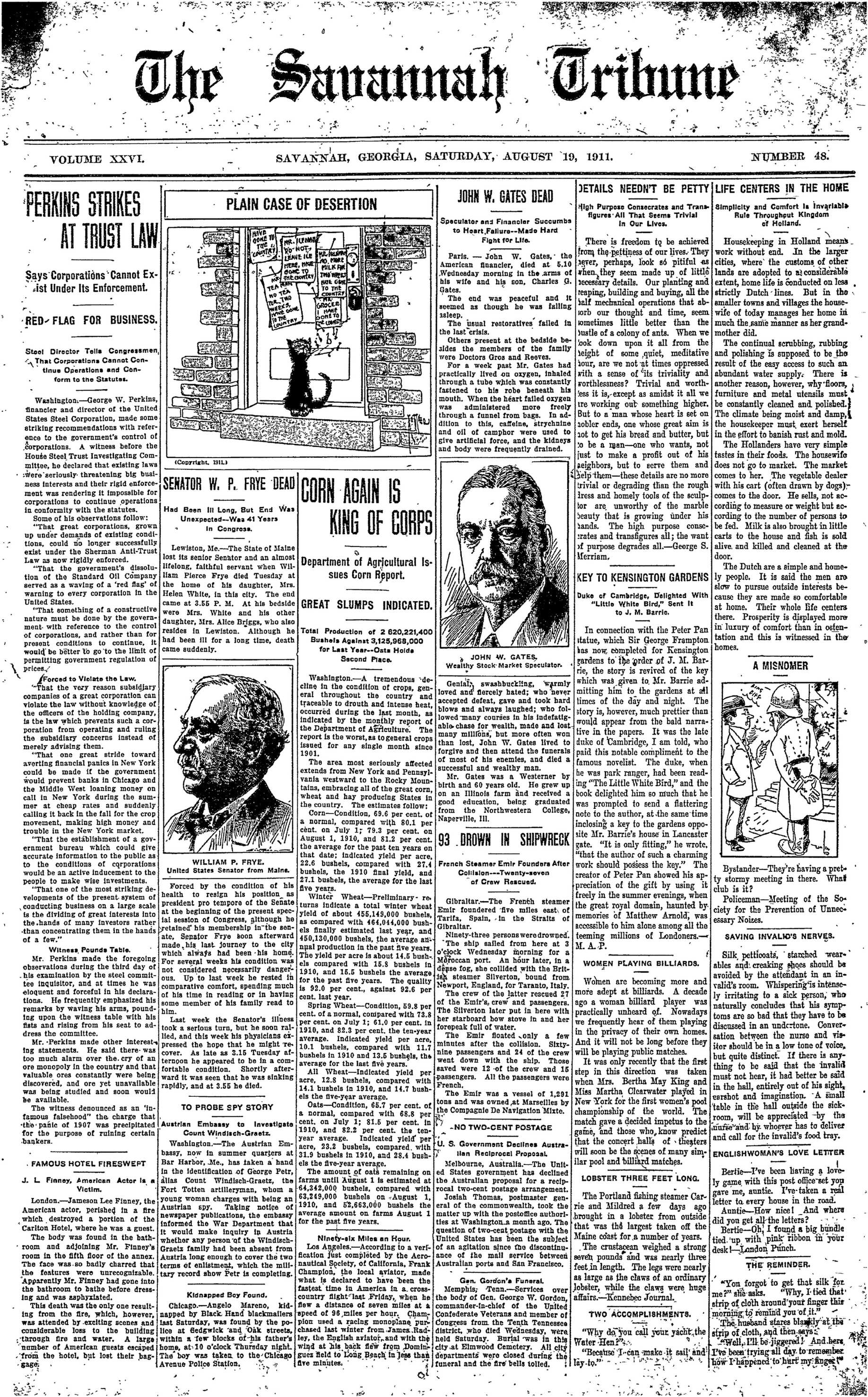
Page text (machine-generated)
VOLUME XXVI.
PERKINS STRIKES AT TRUST LAW
PERKINS STRIKES AT TRUST LAW
Says Corporations Cannot Exist Under Its Enforcement.
RED- FLAG FOR BUSINESS.
Steel Director Tells Congressmen That Corporations Cannot Continue Operations and Conform to the Statutes.
Washington: George W. Perkins, financier and director of the United States Steel Corporation, made some striking recommendations with reference to the government's control of corporations. A witness before the House Steel Trust Investigating Committee, he declared that existing laws were seriously threatening big business interests and their rigid enforcement was rendering it impossible for corporations to continue operations in conformity with the statutes.
Some of his observations follow:
Some of his observations follow.
"That great corporations, grown up under demands of existing conditions, could no longer successfully exist under the Sherman Anti-Trust Law as now rigidly enforced.
"That the government's dissolution of the Standard Oil Company served as a waving of a 'red flag' of warning to every corporation in the United States.
"That something of a constructive nature must be done by the government with reference to the control of corporations, and rather than for present conditions to continue, it would be better to go to the limit of permitting government regulation of prices."
Forced to Violate the Law.
"That the very reason subsidiary companies of a great corporation can violate the law without knowledge of the officers of the holding company, is the law which prevents such a corporation from operating and ruling the subsidiary concerns instead of merely advising them.
"That one great stride toward averting financial panics in New York could be made if the government would prevent banks in Chicago and the Middle West loaning money on call in New York during the summer at cheap rates and suddenly calling it back in the fall for the crop movement, making high money and trouble in the New York market.
"That the establishment of a government bureau which could give accurate information to the public as to the conditions of corporations would be an active inducement to the people to make wise investments.
"That one of the most striking developments of the present system of conducting business on a large scale is the dividing of great interests into the hands of many investors rather than concentrating them in the hands of a few."
Witness Pounds Table.
Mr. Perkins made the foregoing observations during the third day of his examination by the steel committee inquisitor, and at times he was eloquent and forceful in his declarations. He frequently emphasized his remarks by waving his arms, pounding upon the witness table with his fists and rising from his seat to address the committee.
Mr. Perkins made other interesting statements. He said there was too much alarm over the cry of an ore monopoly in the country and that valuable ores constantly were being discovered, and ore yet unavailable was being studied and soon would be available.
The witness denounced as an 'infamous falsehood" the charge that the panic of 1907 was precipitated for the purpose of ruining certain bankers.
FAMOUS HOTEL FIRESWEPT
J. L Finney, American Actor is a Victim.
London.—Jameson Lee Finney, the American actor, perished in a fire which destroyed a portion of the Carlton Hotel, where he was a guest.
The body was found in the bathroom and adjoining Mr. Finney's room in the fifth floor of the annex. The face was so badly charred that the features were unrecognizable. Apparently Mr. Finney had gone into the bathroom to bathe before dressing and was asphyxiated.
This death was the only one resulting from the fire, which, however, was attended by exciting scenes and considerable loss to the building through fire and water. A large number of American guests escaped from the hotel, but lost their baggage.
The Savannah
PLAIN CASE OF DESERTION
HAVE GONE TO THE COUNTRY
MR. DO LEA
HER GO
THE
TEA MAN
NO TEA
FOR TWO
WEEKS,
HOME GO
TO THE COUNTRY
(Copyright, 1911)
HAVE GONE TO THE COUNTRY
MR. I CLEARLY DO NOT LEAVE ICE HERE, MORE GONE TO THE COUNTRY
MR. TEA MINT NO TEA TOR, TWO WEEKS, MORE GONE TO THE COUNTRY
MR. WALKER NO MORE MILK FOR THIS WEEK, MORE GONE TO THE COUNTRY
GROCER I HAVE GONE TO THE COUNTRY
SENATOR W. P. FRYE DEAD
Had Been Ill Long, But End Was Unexpected—Waa 41 Years In Congress.
Lewiston, Me.—The State of Maine lost its senior Senator and an almost lifelong, faithful servant when William Pierce Frye died Tuesday at the home of his daughter, Mrs. Helen White, in this city. The end came at 3.55 P. M. At his bedside were Mrs. White and his other daughter, Mrs. Alice Briggs, who also resides in Lewiston. Although he had been ill for a long time, death came suddenly.
A.
Forced by the condition of his health to resign his position as president pro tempore of the Senate at the beginning of the present special session of Congress, although he retained his membership in the senate, Senator Frye soon afterward made his last journey to the city which always had been his home. For several weeks his condition was not considered necessarily dangerous. Up to last week he rested in comparative comfort, spending much of his time in reading or in having some member of his family read to him.
Last week the Senator's illness took a serious turn, but he soon rallied, and this week his physicians expressed the hope that he might recover. As late as 3.15 Tuesday afternoon he appeared to be in a comfortable condition. Shortly afterward it was seen that he was sinking rapidly, and at 3.55 he died.
TO PROBE SPY STORY
Austrian Embassy to Investigate Count Windisch-Graetz.
Washington.—The Austrian Embassy, now in summer quarters at Bar Harbor, Me., has taken a hand in the identification of George Petr, alias Count Windisch-Graetz, the Fort Totten artilleryman, whom a young woman charges with being an Austrian spy. Taking notice of newspaper publications, the embassy informed the War Department that it would make inquiry in Austria whether any person of the Windisch-Graetz family had been absent from Austria long enough to cover the two terms of enlistment, which the military record show Petr is completing.
Kidnapped Boy Found.
Chicago.—Angelo Mareno, kidnapped by Black Hand blackmailers last Saturday, was found by the police at Gedwick and Oak streets, within a few blocks of his father's home, at 10 o'clock Thursday night. The boy was taken to the Chicago Avenue Police Station.
SAVANNAH, GEORGIA, SATURDAY, AUGUST 19, 1911.
LEAH
NOT,
NE ILE
E, MINR
C TO
COUNTRY
MR. KALISPER
NO. MORE
MILK FOR
THE HOPEES
HAVE GONE
TO THE
COUNTRY
MR. GROCER
I HAVE
GOING TO
THE LONGS
CORN AGAIN IS KING OF CORPS
Department of Agricultural Issues Corn Report.
GREAT SLUMPS INDICATED.
Total Production of 2 620,221,400 Bushels Against 3,125,968,000 for Last Year--Oats Holds Second Place.
Washington.—A tremendous decline in the condition of crops, general throughout the country and traceable to drouth and intense heat, occurred during the last month, as indicated by the monthly report of the Department of Agriculture. The report is the worst, as to general crops issued for any single month since 1901.
The area most seriously affected extends from New York and Pennsylvania westward to the Rocky Mountains, embracing all of the great corn, wheat and hay producing States in the country. The estimates follow:
Corn—Condition, 69.6 per cent. of a normal, compared with 80.1 per cent. on July 1; 79.3 per cent. on August 1, 1910, and 81.2 per cent. the average for the past ten years on that date; indicated yield per acre, 22.6 bushels, compared with 27.4 bushels, the 1910 final yield, and 27.1 bushels, the average for the last five years.
Winter Wheat—Preliminary- returns indicate a total winter wheat yield of about 455,149,000 bushels, as compared with 464,044,000 bushels finally estimated last year, and 450,130,000 bushels, the average annual production in the past five years. The yield per acre is about 14.5 bushels compared with 15.8 bushels in 1910, and 15.5 bushels the average for the past five years. The quality is 92.0 per cent., against 92.6 per cent. last year.
Spring Wheat—Condition, 59.8 per cent. of a normal, compared with 73.8 per cent. on July 1; 61.0 per cent. in 1910, and 82.3 per cent. the ten-year average. Indicated yield per acre, 10.1 bushels, compared with 11.7 bushels in 1910 and 13.5 bushels, the average for the last five years.
All Wheat—Indicated yield per acre, 12.8 bushels, compared with 14.1 bushels in 1910, and 14.7 bushels the five-year average.
Oats—Condition, 65.7 per cent. of a normal, compared with 68.8 per cent. on July 1; 81.5 per cent. in 1910, and 82.2 per cent. the ten-year average. Indicated yield per acre, 23.2 bushels, compared with 31.9 bushels in 1910, and 28.4 bushels the five-year average.
The amount of oats remaining on farms until August 1 is estimated at 64,342,000 bushels, compared with 63,249,000 bushels on August 1, 1910, and 52,663,000 bushels the average amount on farms August 1 for the past five years.
Ninety-six Miles an Hour
Los Angeles.—According to a verification just completed by the Aeronautical Society, of California, Frank Champion, the local aviator, made what is declared to have been the fastest time in America in a cross-country flight last Friday, when he flew a distance of seven miles at a speed of 96 miles per hour. Champion used a racing monoplane purchased last winter from James Radley, the English aviator, and with the wind at his back flew from Dominguez field to Long Beach in less than five minutes.
Tribune
JOHN W. GATES DEAD
Speculator and Financier Succumbs to Heart, Failure--Made Hard Fight for Life.
Paris. — John W. Gates, the American financier, died at 5.10 Wednesday morning in the arms of his wife and his son, Charles G. Gates.
The end was peaceful and it seemed as though he was falling asleep.
The usual restoratives failed in the last crisis. Others present at the bedside besides the members of the family were Doctors Gros and Reeves. For a week past Mr. Gates had practically lived on oxygen, inhaled through a tube which was constantly fastened to his robe beneath his mouth. When the heart failed oxygen was administered more freely through a funnel from bags. In addition to this, caffeine, strychnine and oil of camphor were used to give artificial force, and the kidneys and body were frequently drained.
A. H.
JOHN W. GATES,
Wealthy Stock Market Speculator.
Genial, swashbuckling, warmly loved and fiercely hated; who never accepted defeat, gave and took hard blows and always laughed; who followed many courses in his indefatigable chase for wealth, made and lost many millions, but more often won than lost, John W. Gates lived to forgive and then attend the funerals of most of his enemies, and died a successful and wealthy man.
Mr. Gates was a Westerner by birth and 60 years old. He grew up on an Illinois farm and received a good education, being graduated from the Northwestern College, Naperville, Ill.
93 DROWN IN SHIPWRECK
French Steamer Emir Founders After Collision---Twenty-seven of Craw Rescued.
Gibraltar.—The French steamer Emir foundered five miles east of Tarifa, Spain, in the Straits of Gibraltar.
Ninety-three persons were drowned.
The ship sailed from here at 3 o'clock Wednesday morning for a Moroccan port. An hour later, in a deuce fog, she collided with the British steamer Silverton, bound from Newport, England, for Taranto, Italy.
The crew of the latter rescued 27 of the Emir's crew and passengers. The Silverton later put in here with her starboard bow stove in and her forepeak full of water.
The Emir floated only a few minutes after the collision. Sixty-nine passengers and 24 of the crew went down with the ship. Those saved were 12 of the crew and 15 passengers. All the passengers were French.
The Emir was a vessel of 1,291 tons and was owned at Marselles by the Compagnie De Navigation Mixte.
U. S. Government Deciles Australian Reciprocal Proposal.
Melbourne, Australia.—The United States government has declined the Australian proposal for a reciprocal two-cent postage arrangement.
Josiah Thomas, postmaster general of the commonwealth, took the matter up with the postoffice authorities at Washington a month ago. The question of two-cent postage with the United States has been the subject of an agitation since the discontinuance of the mail service between Australian ports and San Francisco.
Gen. Gordon'a Funeral
Memphis; Tenn.—Services over the body of Gen. George W. Gordon, commander-In-chief of the United Confederate Veterans and member of Congress from the Tenth Tennessee district, who died Wednesday, were held Saturday. Burial was in this city at Elmwood Cemetery. All city departments were closed during the funeral and the fire bells tolled.
DETAILS NEEDN'T BE PETTY High Purpose Consecrates and Transfigures All That Seems Trivial In Our Lives.
There is freedom to be achieved from the pettiness of our lives. They never, perhaps, look so pitiful as when they seem made up of little necessary details. Our planting and reaping, building and buying, all the half mechanical operations that absorb our thought and time, seem sometimes little better than the bustle of a colony of ants. When we look down upon it all from the height of some quiet, meditative hour, are we not at times oppressed with a sense of its triviality and worthlessness? Trivial and worthless it is, except as amidst it all we are working out something higher. But to a man whose heart is set on sobler ends, one whose great aim is not to get his bread and butter, but to be a man—one who wants, not just to make a profit out of his neighbors, but to serve them and help them—these details are no more trivial or degrading than the rough dress and homely tools of the sculptor are unworthy of the marble beauty that is growing under his hands. The high purpose conservates and transfigures all; the want of purpose degrades all.—George S. Merriam.
KEY TO KENSINGTON GARDENS
Duke of Cambridge, Delighted With "Little White Bird," Sent It to J. M. Barrie.
In connection with the Peter Pan statue, which Sir George Frampton has now completed for Kensington gardens to the order of J. M. Barrie, the story is revived of the key which was given to Mr. Barrie admitting him to the gardens at all times of the day and night. The story is, however, much prettier than would appear from the bald narrative in the papers. It was the late duke of Cambridge, I am told, who paid this notable compliment to the famous novelist. The duke, when he was park ranger, had been reading "The Little White Bird," and the book delighted him so much that he was prompted to send a flattering note to the author, at the same time inclosing a key to the gardens opposite Mr. Barrie's house in Lancaster gate. "It is only fitting," he wrote, "that the author of such a charming work should possess the key." The creator of Peter Pan showed his appreciation of the gift by using it freely in the summer evenings, when the great royal domain, haunted by memories of Matthew Arnold, was accessible to him alone among all the teeming millions of Londoners. M. A. P.
WOMEN PLAYING BILLIARDS.
Women are becoming more and more adept at billiards. A decade ago a woman billiard player was practically unheard of. Nowadays we frequently hear of them playing in the privacy of their own homes. And it will not be long before they will be playing public matches.
It was only recently that the first step in this direction was taken when Mrs. Bertha May King and Miss Martha Clearwater played in New York for the first women's pool championship of the world. The match gave a decided impetus to the game, and those who know predict that the concert halls of the theaters will soon be the scenes of many similar pool and billiard matches.
LOBSTER THREE FEET LONG.
The Portland fishing steamer Carrie and Mildred a few days ago brought in a lobster from outside that was the largest taken off the Maine coast for a number of years. The crustacean weighed a strong seven pounds and was nearly three feet in length. The legs were nearly as large as the claws of an ordinary jobster, while the claws were huge affairs.—Kennebec Journal.
TWO ACCQMPLISHMENTS.
"Why do you call your yacht, the Water Hen?" "Because I can make it sail and lay to."
NUMBER 48.
LIFE CENTERS IN THE HOME
Simplicity and Comfort is Invariable Rule Throughout Kingdom of Holland.
Housekeeping in Holland means work without end. In the larger cities, where the customs of other lands are adopted to as considerable extent, home life is conducted on less strictly Dutch lines. But in the smaller towns and villages the housewife of today manages her home in much the same manner as her grandmother did.
The continual scrubbing, rubbing and polishing is supposed to be the result of the easy access to such an abundant water supply. There is another reason, however, why floora, furniture and metal utensils must be constantly cleaned and polished. The climate being moist and damp, the housekeeper must exert herself in the effort to banish rust and mold.
The Hollanders have very simple tastes in their foods. The housewife does not go to market. The market comes to her. The vegetable dealer with his cart (often drawn by dogs) comes to the door. He sells, not according to measure or weight but according to the number of persons to be fed. Milk is also brought in little carts to the house and fish is sold alive and killed and cleaned at the door.
The Dutch are a simple and homely people. It is said the men are slow to pursue outside interests because they are made so comfortable at home. Their whole life centers there. Prosperity is displayed more in luxury of comfort than in ostentation and this is witnessed in the homes.
A MISNOMER
Bystander—They're having a pretty stormy meeting in there. What club is it? Policeman—Meeting of the Society for the Prevention of Unnecessary Noizes.
SAVING INVALID'S NERVES.
Silk, petticoats, starched wearables and creaking shoes should be avoided by the attendant in an invalid's room. Whispering is intensely irritating to a sick person, who naturally concludes that his symptoms are so bad that they have to be discussed in an undertone. Conversation between the nurse and visitor should be in a low tone of voice, but quite distinct. If there is anything to be said that the invalid must not hear, it had better be said in the hall, entirely out of his sight, earshot and imagination. A small table in the hall outside the sickroom, will be appreciated by the nurse and by whoever has to deliver and call for the invalid's food tray.
ENGLISHWOMAN'S LOVE LETITER
Bertie—I've been liaving a love-
ly game with this post office set you
gave me, auntie. I've-taken a real
letter to every house in the road.
Auntie—How nice! And where
did you get all the letters?
Bertie—Oh! I found a big bundle tied. up with pink ribbon in your desk—London Punch.
THE REMINDER.
"You forgot to get that silk for me?" she asks. "Why, I tied that strip of cloth around your finger this morning to remind you of it." The husband stares blazingly at the strip of cloth, and then says:
"Well, I'll be jiggered! And here I've been trying all day to remember how I happened to hurt my fingers."
The Farm
BIRDS AND FARMERS,
In a closely reasoned argument fo)
the protectfon of birds, a writer ir
Chambers’ Journal quotes the follow
ing evidence of the good they do {r
protecting fruit trees from insect
pests:
“Baron von Berlepsch makes the fol
lowing statement: ‘The Hainide Wood
south of Ejsenach, which covers sev
eral square miles, was stripped entire
ly bare in the spring of 1905 by larvae
of a little moth,
“The wood of Baron von Berlepsch,
in which there had long been nesting
boxes, of which there are now more
than 2,000, was untouched. It actually
stood out among the remaining woods
like a green oasis. At a distance of a
lite more than a quarter of a mile
farther the first traces of the plague
‘were apparent, and at the same dis:
tance farther on still it was in full
force.
“‘It was a plain proof of the dis
tance the tits and their companions
.had gone during the winter and after
‘their breeding season. The case was
so plain that Baron von Berlepsch con-
sidered {t of sufficient importance to
send a report to the Prussian board of
agriculture in order that it might be
placed on record.
“‘Similar observations were made
during a plague of Tortrix virldana, a
small species of moth; last spring in
the brown wood Harras, in the grand
duchy of Hesse, where the protection
of birds has been carried on in a
sensible and energetic fashion for the
last six years.
." The abundant use of nesting boxes
in the Prussian woods has, during the
last two years, brought about a sen~
sible decrease in cockchafers, and of
Tortrix viridana in Some places, by
means of starlings.
“If we turn from woods to agricul-
ture and fruit growing, the experi-
mental station at Sebach again affords
an eloquent and well-authenticated tes-
‘timony. The same good fruit crops
has been obtained for many years in
those places which have been longest
and most abundantly provided with
nesting boxes, and where most of the
trees have grown up with the protec-
tion of birds.
“*Although the whole neighbrohood
frequently suffered from caterpillars,
those trees inhabited by tits and other
birds nesting in the boxes have es-
,»caped.’”
CHEAP POULTRY ALWAYS DEAR.
Buyers should remember that good
stock will cost money; that cheap
stock is dear In vhe long run. There
is no breeder who has not thought
upen the great increase in the price of
grain and the cost of producing fowls
ready for the shipping crate. One
breeder who sends out hundreds of
birds each year has found that it costs
him about $3 a head to place his birds
in the shipping coops. This included
all expenses except advertising and
correspondence, The expense of show-
ing, printed matter, advertising, dor-
respondence and feeding, together
with housing and cooping for ship-
ment, will make a lot of breeders
think if they knew exactly what every
bird sold cost them to sell. Only those
who keep an accurate account of their
receipts and expenditures know far
what prices they can really afford to
sell.
In this day it costs good money to
keep up a strain or flock to a high
standard of excellence. Money and
brains cannot be spared if any flock
is to grow better each season, Nine
times in ten the buyer who asks for
2 $2 bird does not know what. good
‘birds are commanding, and expects as
*mtich for his money as the man who
gives the breeder a carte blanche or-
der for what he wants and then sends
the money to pay for it. Utility stock
“once sold for $1 a head, but this was
when feed was cheap and lumber
cheaper than it is now. Prices today
are higher for good, stock because
good stock {s worth It. The beginner
should remember that the demand for
good birds far exceeds the supply, and
if the prices quoted to buyers are not
accepted because they think the fig-
ures too high, they should remember
hefore finally refusing to pay what is
Yeasonable that some, one else will
get the birds,
FATTENING AND MARKETING
CHICKS,
From a series of experiments in
chick feeding, fattening and market-
ing conducted at the New ‘York state
-college of agriculture and reported
in a recent bulletin, Prof, J. E, Rice
has drawn the following conclusions:
Most of the chicks relished a change
of ration. Variety ration chicks were
satisfied with the food on which they
were reared for the first six weeks.
Drymash chicks showed highest mez
tality during the fattening period and
‘were of poorest appearance. Mor
tality was comparatively low in all
flocks during the period of fattening.
Chicks reared on dry grain rations
averaged greater gain per chick and at
ess cost per pound during the fatten-
4ng perlod than the chicka reated on
fle wet mash and the variety rations.
Chicks reared on the cracked grain ra-
tion-madé best gain per-chick during
the fattening period. The flock reared
on cracked grain dry mash ration
made best gain per flock during thc
six weeks of fattening. Chicks grow
more rapidly when eating a larger pro-
Porton of ground food. The wet mash
aud variety ration flocks cost less per
Pound weight for.the fattening period
than those reared on the dry grain
rations,
Chicks reared on rations consisting
altogether or In part of cracked grain
and having no molst mash, gave bet.
ter gain and at less cost per pound
gain during the fattening period (their
ration consisting at this time largely
of a moist mash) than the chicks
which had been reared on rations con-
sisting altogether or In part of moist
mash, but which were now eating a
large proportion of their food as crack-
ed grain. Chicks reared on rations
censisting altogether or in part of
moist food were ready-for market one
or two weeks earlier than those reared
on the dry grain ration, Squab droll
ers are not profitably marketed in
September and early October. Dry
picking of broilers by amateurs fs too
expensive as a market proposition.
Broilers should be of proper size to
mect the demands of summer and fall
trade, which requires a dregsed weight
of three-fourths pound or of one and
one-half pounds each, to be served
whole in the former case as a squab
brojler, or in halves fn the latter {n-
stance.—Soutliern Planter, Richmodd,
YVa_
+ THE CODLING MOTH.
Prof. Fabian Garcla, head of the
horticultural department of the Agri:
cultural college In New Mexico, is con
ducing en experiment of more than
usual interest this year In his cam-
paign against the codling moth, the
bane of the apple grower In New Mex.
fco. It has been demonstrated that
the coiling moth, unilke the other
memters of the moth family, {s not at-
tracted by Hight, and the question has
arisen as {o whether or not dight ts
repellant to the insect. It {s a noc-
turna{ worker, this having been proved
time and time again. Prof. Garcia has
fet aside one corner of the exper-
ment station orchard for this experi-
ment, and has placed it {n a number of
high-power electric lights, which are
Kept burning all night, Complete data
are being kept unon’the experfment,
and ag soon ag the crop matures the
rerults will be announced. If it ts
shown that the use of artificial lights
will keep off the moth, then the prob-
lem for the commercial apple grower
is settled,
HATCHING CHICKS.
In testing the eggs you will find
some that are from 12 to 24 hours be-
hind the rest. These should be shift-
ed to the part of tray having the high-
est temperature, so they may catch
‘up with the rest or an uneven hatch
will result, .
The more heat, the faster the
embryo grows and the larger the air
cell; so those eggs having the largest
air cells should be shifted to the cool-
est part of the machine. Sometimes
the air cell gets to one side of the
egg, showing that the egg has not
been turned often enough. The side
having the most air cells, should be
turned down, as gravity causes the
heavy part of the egg to settle to the
lower side. Best results are gbtained,
when the eggs are turned two or more
times a day. Every one understands
that to get a good hatch one must
haye good hatchable eggs which can
only be produced by strong, healthy
breeding stock.—Rural World.
NEW USE FOR SUGAR BEETS,
An entirely new use, and one that
may in time become very Important,
has been discovered for sugar beets.
This is the making of them into flour.
‘This flour is now belng manufactured
in considerable quantities at Suresnes,
in France, where an immense dryer
has been built for the purpose.
The first part of the process con-
éists in chopping up the beets and
drying the water out of them.. They
contain to start with 72 per cent. of
water, nearly all of which is removed
by evaporation. By this means 100
pounds of dry material is obtained
from 357 pounds of beets.
This dry material’ contains more
than seventy per cenf. of sugar and
therefore on being ground to a fine
mcal ts exceedingly sweet und adapted
to the making of cakes and puddings.
The sugar beet flour ts estimated to
contain something like 82 per cent. of
pure nutriment—Baker's Weekly.
ANCIENT CEMENTS.
It has been stated that the durabill
ty of the old cemente—for Instance
those of the Romans—is due to a low
proportion of-soluble silicates and 2
low lime content—under 60 per cent.
and that most modern high-lime
cements are deficient in resisting pow.
er when exposed to waters containing
dissolved alkalis and sulphates. In
America a company has begun the
manufacture of a cement which ft is
claimed will’ resist alkalis and sul
phates by virtue of @ low-lime content
and an excess of silica,.using Imo
stone, shale and blast furnace slag
as raw materials, 7
= 5 i a aa
- AID-FORSLAKE
GENERAL BOARD OF EDUCATION
MAKES GIFT TO NEGRO COL.
LEGE, WHICH WILL MAKE EV-
ERY EFFORT TO COMPLY
WITH CONDITIONS.
Jackson, Tenn.—At the cloge of the
commencement exercises of Lane col-
lege, President J. F, Lane announced
@ conditional gift of $7,000 to Lane
college by the general educational
board of New York. It was not known
then what the exact conditions upon
which this money was given were;
since that time the president has
been informed.
‘This donation is by far the largest
one ever made to the cdllege outside
the C. M. E. church, and comes large-
ly through the earnest efforts made
by the president, ably supplemented
by that of Dr. J. W. Gilbert, of Au-
gusta, Ga. .
Regarding this matter, President
Lane says: “Lane college greatly
needs another boys’ hall. The pres-
ent dormitory for the boys accommo-
‘dates less than one-half of the youns
men, and it is in behalf of this bulld-
ing that the gift from the general
education board Js made. To construct
@ hall in keeping with the other splen-
did buildings on the grounds, and one
having a capacity to accommodate the
school, will cost fully $20,000. To-
ward raising this amount the general
education board contributes $7,000,
leaving ,$13,000 to be raised by the
trustees and friends of the college
This condition will be met promptly
and the building will go up.”
The college has just closed a most
successful season, and the trustees and
friends are jubilant over the prospects
for a new hall on the grounds, which
has become in recent years a real
necessity.
SON OF FOURDER OF
~ HAMPTON IRSTITUTE IS
APPOINTED HIDSHIPMIAN
Weshington.—Among the successful
candidates for appcintment as mid-
shipman in the navy, who were desig-
nated by President Taft as candidates
at large in the’cdhpetition in which
seventeen entered for the six vacan-
cies, was Daniel Armstrong, son ot
the late General Armstrong, the Civil
war veteran, who founded the Hamp-
ton Institute for Colored Men and the
Indian scheol at Hampton, Va.
Young Armstrong called at the
White House just before President
Taft left the city for Beverly, per-
sonally to thank him. By an Snterest-
{ng coincidence while ‘the president
was chatting with Midshipman Arm-
strong, Booker T. Washington entered
the room and was delighted to be pre-
sented to the son of his former patron.
It was to General Armstrong at
Hampton that Booker Washington,
just escaped from slavery, made his
way barefooted, and from him he re-
ceived the first encouragement.
LEWIS APPOINTED DELEGATE TO
NEGRO NATIONAL EDUCATION.
AL CONGRESS AT DEN-
VER, COLO.
New York.—William H, Lewis, the
assistant attorney general at Washing:
ton, and whose appointment to that
office by President Taft’created a pro-
found stir in’ political circles over the
country, has been named by President
Taft to speak at the Negro National
Educational congress, to be held in
Denver, Colo. The assistant attorney
general will attend the educational
congress as a direct representative of
the administration; and will speak on
educational matters pertaining to the
negro. The Natfonal Educational con-
gress is one of the most representa-
tive and distinguished negro bodies In
the country and at Its annual sessfons
many vital and important questions
pertaining to the educational uplift of
the negro are discussed. Well-known
educators like President R. R. Wright
of the Georgia State college, Kelley
Miller of Howard university, President
Scarborough of Wilberforce, Prof. Wit-
lam H. Pichens of Talladega, and
many others well known in education
circles attend the’ sessions and talk
on various educational methods and
their relations to the youth of today.
‘The selection of Denver by the educa-
tional congress as the meeting place
was a wise one. Denver fs considered
an scatters center and is situated
in ohe of the most picturesque sec:
tions of the Golden West.
‘A large delegation of prominent
New Yorkers, interested in the edu-
cations! work of the negro, will a
tend the congress.
There are several prominent col
ored men and wotnen in the metro-
polis who are noted educators and
‘who could grace the meeting with
much dignity and grace. The name
ing of Lewis as one of the speakers
at the educational session will give
the congress a national aspect, and
give the, visitors and delegates to the
session an opportunity to see and
hear the highest appointed negro of-
ficial in the country. .
‘At the Republican, club here a large
number of friends of Lewis look upon
his appointment as one of special sig-
nificance and merit.
WILLING TO, WORK.
Mr, Bulllon—Huh? Want to marry
my daughter, eh? What do you er:
pect to do for a Hving?- Tell me that?
Mr, Poorchap—Well—er—I was
thinking you might—er—need™i cpn
fidential assistant to help clip “cou
pons,
$ E-1 4 » ; BE a's i vy
. 2 COOPER &' ODREZIN |
Rhe Up-to-DateTailors
218 West Broad Street, Between Hull and Oglethorpe Ave. .
The latest patterns in Summer Goods. First-class Workmanship guaranteed, Our’
prices will interest you. , .
. GAREY’S. Johnson Undertaking Establishment
Variety. Bakery. Eee
dete tent yomty vm} ‘The Royal Undertaking Company |
part of the city. .
408 Wert Brosd Street, News Get} ~=Funeral Directors and Embalmers
Johnson Undertaking Establishment
—COMBINE D WITH—
The Royal Undertaking Company |
(Incor porated.) ;
Funeral Directors and Embalmers
Finest Uno of Coftins,. Caskets and Robes. White and black funera)
ears. Office and warerooms 325-331 Jefferson'strest,
‘1 W. R. FIBLDS, Manager.
Residence Phone 2032, Livery Stable Attached. Office Phone“ 67e
J. H. ULMER, Residence Phone 3064.
‘Take a Policy With The
Pilgrim Health and
Life Insurance Co
Ww. kk. BLUONYS ST,
WHOLESALE AND RETAIL e
Fruit and Commission Merchant
234 ST. JULIAN ST., WEST, 235 BRYAN ST., WEST. Phone 2968
SAVANNAH, GEORGIA,
The Oldest, Strongest and Most
Rellable Company In the Stéte.
Gives employement to hundreds of
men and women of our race,
Pays trom $I'to $10 weekly: sick and
accident benefits and from $10 to $100
death benefits, Our Motto: “Prompt
ness, Honesty and Justice.”
Home Office:
2143 Gwinnett St. Augusta, Ga.
For further information write 509
West Broad St, Savannah, Ga,
J. 8. Perry, Supt.
A, B. Singfield, Gen. Supt.
C. T, Walker, D. D, LL. D, .
Director and General Lecturer.
Advertise in this Paper.
It Wilt Pay You.
‘Now is the Time to Do It.
Their Ideal Realized
For more than a dozen years the
dream of the Manager of the
UNION MUTUAL ASSOCIATION
Has been to inspire Confidence in, and
bring respectability to
Negro Indusetrial Insurance,
which does not only cause this Com-
pany to handle more than a million
dollars annually, but they have made
it possible for other similar concerns
operated by cur- people in the South
to do a succespful busfness, whicn
yas once controlled absoltely by an-
other race.
. For these and other sane reasons,
we urge that you take out a policy to-
day.
+ Call one of their agents or phone
‘the local manager of the Savannan
district,
J.C. LINDSAY,
Branch Office 509 West Broad St,
Phone 1470, Savannah, Ga, °
or WM, DRISKELL, a
Secretary and General Manager,
210 Auburn Ave., Atlanta, Ga.
! =
a « aes ie
Paim Shaving Palace-_ -
. FINEST IN THE CITY.
Expert Halr Cutting, Electrie Massage and Shampooing a Spectalty.— All
‘Work Done by Experienced Workmen, Coitrteous attention to all. SHIN:
ING PARLOR ATTACHED,
| cceull
| PERRY R. WRIGHT, Proprietor _
617 WEST.BROAD ST. —.— — —— — — — —.— SAVANNAH, GA.
ae
| Hg 1
mittee
It you hesitate to wear Shoes that have been repaired, you don’ j
know our kind of repairing. We do everything needed to footwear in,
first class condition—rebutton, straighten, or alter heels, sew up rips, ré
pair breaks, put on rubber heels or soles, ¥ oT
See us beforg going elsewhere. :
J. H. WASHINGTON,.
SHOEMAKER, . xe
309 WHITAKER ST. "ot
: CHICKENS
DUCKS
TURKEYS
R. H. O. YOUNG
Wholesale and retail] dealer in Live
and Dressed Poultry, Game in Season.
Special attention given to picnic on
ders. Ali orders delivered free
of charge,
Stall 12 City Market. .
Phone 2733.
~ POPULAR PRICED :
SHOES.
NICHOLS
THE SHOE MAN)
20 W.- Broughton Street 1
UNION
Laundry Co.
1218 West Broad Street
ONLY: COLORED LAUNDRY IN
CITY. WORK CALLED FOR
AND DELIVERED,
Phone 36,
MYERS & RUSSEL, Props.
Atlanta Universit
ATLANTA, GEORGIA, \ a §
An Unsectarian Christian Institution, High School, Normal School and
Col lege. ‘ *
Superior advantages in Industrial Training, Music and Printing. Home
Life Training. For catalog and information address © . -
PRESIDENT EDWARD T. WARE.
The honor of your presence is re-
‘ quested at the
Auditorium Cafe
“THE COOL PLACE”
Ice cream made of pure cream. +
Pure fruit flavoring. Come and
make your headquarters with us
when In Beaufort this summer.
“Get the Auditorium habit.
ALEXANDER MEYERS, Proprictor,
Beaufort, S.C!
ree Park .Lots
The Highest Price Lots at Woodlawn Park’
are Only $150.00 and they 50x400° :
They have concrete sidewalks and are directly on cardines, =. : ,
Consider how important that transportation feature 1s.
Some excellent LOTS LEFT. You pay - ce a
$5.00 Cash and $5.00 Per Month :
| : NO INTEREST z
See me quickly and get a choice 3
. location _ 4
CHAS. McDOWELL, ;
623 WEST BROAD STREET ;
PHONE 208-3. r - REHIDENCE ioe %
flasenic Books &
- Regalias.
LODGE BEALS, :
FINANCIAL CARDS and.
BLAKKG of every description
Prbtishere’ and Manufacturore’ Priese
Liberal Biecounte Will Be Arranged,
@OL. . JOHNSON,
Gevannah, Ga
Who Is the man fer Cleaning and
Proszing?
y
BAKER'S PRESSING CLUB
519 PRICE ST.
Men's Guits' Pressed 406, Pants 15¢)
Men'é Suite'Scoures $1. Ladles’ work
ca specialty, Give ua a‘ trial, = ~.>
oe a a ' Sie? ae f ae ge RE ee oe aaa ey ee Re eo eee we
tee? eb ~ ms sis cette ites phan mwmiesenrentkees Seer stomesernitet ate Hage a £ &
einen Le TEES EEE gare TE aelt re ee 1 Best
3 nner ST TELE aa TT eae = =e —— - —
BEERS NEGRO orsICER [AST Ao vince Ems Fab m—_/ NesE twas css S/CSTPP] LEAGUE
PRAT ONT ONT OAS CAT ONT OT ONT} : ae
— Th U PLIFTS RAGE, JUDICIAL EXPERT GIVES SAGE AD- GOR DUGTING REVIVALS Jp Japan the nursery trade divided HO I FE
e Sanday at +i). MICE"TO HUSBANDS AND — Into tmp ered, sections, one for the :
Sa “Wives, SOUTHERN PLOUGHMAN SC! paltivation of pleats 155. export, She x
School Lesson|\||t2ce caueaet syecessrut | me UTHERN PLOUGHMAN SCENTS| pews aoky tame Doses 28 | i
5 ON APPOINTEE AT'NEW |‘ Judge Petit of the’Chicago divorce} INGS AT CHURCH THAT LAST|‘Z0S® Ia this country, and one for! Colored Delegates. Made Wel-
= = YORK, DECLARES -GIRIs' -DE.,-|-£ourté Who has just completed his an-| LATE INTO THE NIGHT. plants for home trade, which latter GALBS Made Wer:
——— : VELOPMENT AND RECLAMA. | 200 x Weeks ‘calendar, made up — tre of an entirely dierent class, e278) come by’ the Citizens
Sunday School Lesson for August 20,) Foy 154 . ns mostly of divorce sults, has come.to| We have already buggested that the|% Teturned nurseryman. The art of Ee
isi, IMPOSSIBLE WITH- , [the coucluslon Uhnt parents of young | average slant cervlnn deriee sovivate| @"@rHNg plants is 0 little known in of Natchez, - 5%
oo OUT MENTAL TRAINING married eerie are largely to blame | s too long. ‘This running the service | CUeF lands that a short description >
| JEREMIAH CAST INTO PRISON. WHITE OR BLACK | for failliy'traible, ——=to.a very late hour makes the prefu.|°f te Process will not be out of place:| 9
Golden Text—"Blessed are ye, when
4men jsball revile you, and persecute
“yoil; and say all mannef of evil against
~ You falsely, for my sake.”—Bfatt, 5:11,
_ Jeremiah 37:4-21. Comult, v. 15.
“ ‘TIME—598 B,C. to. 588 B. C.
PLACE.—Jerusalem.
- EXPOSITION—I. Jehovah's word
to Jermiah concerning the temporary
departure of the Chaldeans from Jeru-
salem, 4-10. Zedeklah has many fol-
‘lowers who inqulre what God's Word
“Js, but do not follow tt when they find
- ft Zedekiah and his people were de-
ceiving themselves with false hopes
{v, 9), but God’s Word was sure
and thelr hopes were vain (vs. 8, 10).
Whatever temporary calamity might
overtake the Chaldeans, thelr ‘ultl-
mate victory was sure, for God had
predicted it (v. 10). It may have
seemed Impossible for the people to
believe that a God of love would per-
malt the city of his cholce to be burned
with fire, but in point of fact it was
‘burned with fire. God's predictions of
punishment upon the rebels are true
no matter how impossible it may
‘seem to us to reconcile them with the
doctrine that God is love.
Il. Jeremiah cast into prison on a
false charge, 1121. Irizah had a long-
standing grudge, Inherited from his
grafidtather, against Jeremiah (v.
13; of, ch. 28:1, 10, 15-17; 38:14).
Trijah ‘brought against Jeremiah the
charge that he was going over to the
‘enemy. No charge could possibly be
more false, but-It appeared plausible.
‘There was never a truer patriot than
Jeremiah (ch. 40:4-7). Jeremiah Is
not the only man who has been re
garded as an enemy of his country
ecause of his faithful denuncitlon of
national sins and inatfonal doom (cf.
‘Amos 7:10; Luke 23:2; Acts 6:11).
‘The one who rebukes the sins of his
people and foretells their coming
judgment fs not their enemy but thelr
‘best friend. At an earlier date while
the priests had been hostile to Jere-
miah, the princes had been favorable
(ch, 20:1-3; 26:11, 16), but now “the
princes were wroth with Jeremiah and
‘smote bim and put bim in prison,”
without even investigating the charge.
‘This is. the kind of treatment a falth-
--ful sprvant of God 1s to expect from
Seale ‘Tim, 3:12; Matt. 23:34; 26:67,
68;“Jno, 15:20; Acts 5:28, 40; 2 Cor.
11:23-27; Heb, 11:36-38). This par-
ticular prison was a vile place that
threatened the death of those cast
there (¥. 20 cf, 38:6, 26), Their real
motive in casting Jeremiah there was
not to punish a traitor but to satisfy
their anger against one who had re-
buked their sins (cf. John 7:7). Jere-
miah’s fmprisonment was long (v. 16).
He spent his time there in prayer
(Lam, 3:55). The king himself sent
and took Jeremiah out of prison.
‘When the wicked get into trouble,
they always want to consult with
God's servants. But Zedeklah was
not man enough to consult openly
with Jeremiah (cf. 38:14-16, 24-27; cf.
Jobn 3:2). At heart Zedekiah recog-
nized Jeremiah to be a prophet of the
Lord. It was a good question that
Zedekiah put to Jeremiah: “Is there
any word from the Lord?” The man
who Is governed by fear of others
will always do more evil than good.
Jeremiah had a word from the Lord,
but it was not the kind of a word that
Zedeklah wished to hear (¥. 17).
‘When men hear some word from the
Lord they do not relish, they always
search for some other word to con-
tradict {t, The messago that Jere-
miah had was a message of doom and
{t took courage to deliver it (cf.
32:3-5; 38-14). Jeremiah did not him-
self relish the message (Lam. 3: 48,
49), but it was God's word and he de-
livered it without changing It to sult
‘bjs own taste. Jeremiah's bearing
toward the king was most bumble and
respectful, but at the same time
fearless (v8. 18-20). ‘The question
that Jeremtah put to Zedekiah In
verse 19 ought to have set him té
thinking (ef, ch. 1413-15; 28:15:17). A
Mke doom awaits the false prophets
‘of today who say: “Peace, peace,
when there is no peace,” and “speak
a. vision of their own heart and not
out of the mouth of the Lord,” and
promise to him “that walketh after
the imagination of his own heart, no
evil shall come upon you” (Jer. 23:16,
17). The issue had proven Jeremiah
to be a true prophet, and the final Is-
sue will show those who prophesy
doom upon the impenitent in face of
all contradiction from the false
+ PECULIARLY GIFTED.
‘I don't know what I'm ever going
to make of that son of mine,” corn
plained a prominent Cleveland buzl
ness man the other day, says the Plain
Dealer. ‘The old chap Is self-shade, »
gtaduate of hard knocks and all that
and {t naturally grieves him to have
a on who 1s not ‘aggressive.
{Maybe your son hasn't found bim.
selt yet," we concoled. “Ian't he
glited in any way?”
YGltted? I should say hé is, He
ain't got a dared thing that wasn't
givén to him.”
? cA ACTIArN. aiid
NEGRO OFFICER:
UPLUFTS RACE,
wie a
GRACE CAMPBELL, SUCCESSFUL:
PROBATION APPOINTEE AT’NEW |
YORK, DECLARES -GIRLS' -DE.~
VELOPMENT AND RECLAMA-
TION ISIMPOSSIBLE WITH,
OUT MENTAL TRAINING
—WHITE OR BLACK
ALL ARE. HUMAN.
ALL ARE- HUMAN. |
Grace Campbell! fs’ her niime, and
at the criminal courts building she
1s known as one of the most success-
ful probation officers. She Is the first
aud only one of her race, and -she
has attracted a great deal of attention
by her work in the Tombs.
“Miss Campbell 1s doffig fine work
here, and there {sn’t woy one who
‘won't respond to hee ympathy. She
4s an {deal disclplinarian,”
This is Probation Officer D. E
Kimball's tribute to her feminine co-
worker. &,
When I saw Miss Campbell at the
National League for the Protection
of Colored Women she explained how
she had been drawn ~to the work
through her interest In kindergarten
teaching in Chicago and Washington.
Like her father and mother, Miss
Campbell was a graduate of the
Howard university, at Washington.
Her father is a minister and was
born {a British West Indies. Her
mother was a Washington woman,
‘Miss Campbell has large, soft, brown
eyes and a quantity of black har, It
is her eyes that make the most elo-
quent appeal, although ber soft, well-
modulated voice is almost as per-
suastye. .
“Do you think there {s any differ-
ence in the attitude of the colored
girl and the white girl, when you ap-
peal to them to reform?” I inquired.
“No," she replied, “J think buman
Bature is the same, no matter what
the color of the skin. I consider that
mental deficiency {s one of the great
est causes of crime in all races. I
believe that there ought to be schools
for the mentally deficient, where the
nature of the defect might be studied,
as well as the possibility of edu
cating the delinquents In some work
that would appeal to them and thus
make useful citizens of them, instead
of treating them as criminals and
exposing them to further temptation
in inetitutions.
“The most stubborn cases, 1 find,
respond to sympathy and the proper
Kind of discipline. Investigation
shows that the colored girl is very
often a victim of an employment
agent who has lured her from her
southern home with promises of
plenty of work, The girl, flattered
by these assurances, leaves "her home
with ttle or no money, few clothes
and absolutely destitute of expert-
ence. She reaches the big city penni-
less, and has no place to go. Of
course the lure of the north for
southern colored woman {s just the
same for the southern white woman
who hopes to obtain employment
here.
“But where there is protection for
the white girl there is not so much
for the negro, The Nationa] League
for the Protection of Colored Women
first of all trles to prévent the col-
ored woman from coming north, but
then if she has made the mistake and
arrives here we try to find a place
for her as soon as we possibly can.
My work at the docks puts me in
touch with many of these girls, for I
am not at the court the whole day.
“I know that the femptations of
these innocent colored girls from
rural districts are great. The lost
address to a friend or a decent lodg:
fag house is one source of a girl's
downfall. She must be properly shel-
tered the first night she arrives in
the clty, or perhaps an agent, seek-
ing girls for purposes of which the
victims are Ignorant, come into pos-
session of them and then follows the
fe of misery and disgrace.
“The girls who find thelr way to
the night courts are often the victims
of these spurious employment agents
It they can only be reached in time
a few words will put them on the
right road. We find proper lodgings
for them and legitimate’ work 1s sup-
Plled by the league, which has asso-
ciatfons in Philadelphia, New York,
Memphis and Baltimore, The same
good work is done in these other
cities,
“The majorlty of people forget that
the colored Face {s not naturally
‘vicious or shiftiess, but that lack of
proper training and the fact that they
have been.so long oppressed militates
against thelr development"—Viola
Justin in New York Dally Mail.
BONHAM, TEXAS, MAKES DOUBLE
AMPUTATION VENDING
QUALIFICATION.
Bonham, Texas.—The elty council
has just passed an ordinance provid.
tng that no one may sell peanuts on
the street of Bonham until he bas
suffered the amputation of both legs.
‘The purpose of the ordinaiice Is to per
anit an aged negro, Who'has lost both
legs to “freeze out” all able-bodied
competitors in the peanut-selling Une.
THE CACTUS, NOT THE VINE,
“The clinging type of girls 1s dlsap-
pearing,” she sald, :
Yes,” he replied, “modern woman,
with her numerous hatpliis, ts mote
like 8 cactus than a vine.”
” BASY-TO“AVOID' DIVORCE
JUDICIAL EXPERT GIVES SAGE AD-
-VICETO HUSBANDS AND
“ Wives.
‘jJudge ‘Petit of the Chicago divorce
courts who has just completed his an:
nual e{x weeks’ ‘calendar, made up
mostly of divorce sults, has come. te
‘the ‘conclusion that parents of young
married pgople are largely to blame
for tedttyStreibles,
“The mothersinjaw are {dremos
| trouble makers," sald the judge. “I
have all reverence for mothers and
motherhood, but they must not argu¢
with their daughterinlaw ‘or son-In
law, but must realize that they are
individuals and have their work to de
in thé world. Mothers can give advice
when asked fort. =, ¢
“But summer resorts, Winter resorts
and flat life can be: blamed for many
divorces. It 1s bad for chystiand and
‘wife.tp be separated byStrips away
trom’tome.
The judge then gave this advice tc
husbands;
Don’t quote mother.
Call up your wite while at business
and ask her how she Js, and that you
called-her up just to hear her voice
Bring her a box of candy.
One of the new books that she 1
interested In.
A flower, even ff it is faded and
you havespicked it up off the street,
#’pretty pin or handkerchief.
And don't ever lay your head on
your pillow at pight without baving
done something to gain and obtain a
firmer hold on your wife's love.
Kiss her every day.
At least once a month meet het
downtown and take her to dinner and
the theater.
Don’t ever stop courting, for as soon
as you do some other man will begin.
Make your wife your companion,
Take her out with you and wher
you have to’ have a big time take
your wife along, and the divorce ev!
will be lessened.
For wives the Judge advised:
Don't quote father.
Pot your husband; he ts only a bis
kid,
Dress as carefully as you did when
he came courting.
Wear the color he Ikes you in and
the style of. gown.
Have something in the way of a eur
prise dish for dinner.
Read tac papers and magazines and
be your husband's fntellectual equal.
Keep up with him in any special lin
of work.
Excourage Nis hobby.
Be sympathet!; and do not tell bin
all the trouble of the day; he has bad
his own more significant any Import
ant individually, than al!’ yours put
together,
Keep his clothes tn order, a clear
house and good food.
‘Your husband is then yours forever
and ever, No chorus girl or pretty
stenographer can take him away from
you, But keep him or somebody els¢
wil snap him up and make him think
she and she alone ever did or will un
derstand bim.
AN OLD-TIME HONEYMOON
Some of the wedding reminiscences
of the old man in the chimney corner
=it there is a chimney corner, whlch
1s doubtful—are almost startling in
tholr financial simplicity, at least
when viewed from the modern cut
glass and $60-amonth apartment point
of view, says the Chicago Tribune.
Get the old man to talking some time
and find out how much his wedding
Journey cost him and how much capl-
tal he had on which to set up the busi
ness of housekeeping. Somo of these
relniscences are almost unbellev-
able, they show such a simple con-
fidence in providence and good luck
and the ullimate working out of things
for which novpresent provision could
be made.
Quite @ typleal honeymoon of alxty
or seventy yeats ago was the pralrle
schooner Voyage. Back in Indiana or
Oblo or some other of the thickly
settled communities the affalr would
start with two loving hearts and two
strong and willing pairs of hands. The
lovers would have an abounding faith
in themselves and in the future. Oth-
erwise the lovers’ assets would {n-
clude $9 in cash, a Sunday sult of
clothes more or less homespun, a
good constitution, and a father who
stood ready to give’ him upon the
wedding day his perental blessing and
fa yoke of oxen and the wagon in
which to go west and take up a home-
stead. 4
‘The modern fhother is not often to
be found who could view such a stock
and, bondless ventare*without forebod-
ings. But the mothers of that day do
not appear to have been appalled.
“Mary fs strong and willing,” the
mother would say, “I've taught her
how to cook and sew and Keep house,
and if I do say {t, she does me credit.”
‘The wedding ceremony that fol
Jowed the understanding was simple
in the extreme. most of It was home-
made, costing “ttle but loving work
‘Then the.honeymoon followed out into
the west, with no espectal destink-
tion, no money for trousseaux and tips
and bridal suites and furniture and
flat rent. A Ilttle cabin somewhere
was put up by the new husband him-
self upon a likely 160 acres, the latter
the wedding present of the United
States.
Such courtsbips and weddings cost
Ultle beyond a great capital of cour
age. From them have come the men
of todsy who think it necessary to be
stow grand planos and European
bridal voyages upon thelr sons and
daughters before a wedding can de
properly solemnized e
EVILS FOURD IN.
CONDUGTING REVIVALS
SOUTHERN PLOUGHMAN SCENTS
DANGER IN HOLDING MEET-
INGS AT CHURCH THAT LAST
LATE INTO THE NIGHT.
We have already suggested that the
average night servico during revivals
48 too long. ‘This running the service
to a very late hour makes the preju:
dice against night meetings all the
greater. A line which we learned
Years ago comes to our mind just at
thts point, which will perhaps cover
the ground of all we had Intended to
say. We think It comes from a noted
author in hymn writing:
“Temptation and danger walk forth
with the night.”
‘There ts a yowdy and ‘careless ele-
ment among the young—and old, too,
for that matter—especially in . the
communities where there ts little or
no law protection, who follow up all
night gatherings for the express pur-
pose of committing mischief. While
the meeting is in progress, just a tow
yards away, concealed (?) from the
view of the church officers, 1s a den
‘of gamblers. if not that, the “Blind
tiger” fs at its best, and one evil after
another 1s committed right in sight
and hearing of what is, or ought to
be, the most sacred place -on earth,
While the church {s not responsible
for the vell, yet It 1s responsible for
late services, which furnish a better
opportunity for evildoers to carry out
thelr evil designs.
‘There Js another evil equally alarm-
Ing, it not more so. People all the
‘way from 15 to 90 years of age are in
attendance at these night meetings.
almost every night, but, as a rule, the
children under 10 years of age are
not there. Where are they? Certain:
ly thelr fathers and mothers are
there, and feel that they are duty-
bound to be there. So they came and
left the children at home exposed to
danger and intrusfon, How often we
read of the father and mother going
to church leaving the children locked
up in the house, and sometimes {t
turns out that the house takes fire?
But the horror of having a child burn-
ed to death will lightly compare with
the regret of having one led astray
while both father and mother are at
church half the night for elght or ten
nights in success{on. But these are
facts and conditions tbat will come
under one’s observation in almost ev-
ery community.
Another evil in conducting revivals
1s that of calling mourners to the
‘bench to be prayed for. and when the
‘poor mourners kneel a great crowd of
sympathizers sometimes gather arqund
them, however hot the weather or un-
‘comfortable the position, to sing and
yell over them for the sake of excite:
ment. Then some brother will pray a
Jong prayer for which, before he is
through, he will ask the Lord to for-
give him.
We have known preachers to run
revivals for the purpose princtpally of
getting a good collection by the time
the meeting 1s ready to come to an
end. Think of the motive!
Preachers sometimes run revivals
simply to get a blg membership in his
church It 1s not 80 much the saving
of men as it fs a great membership.
‘The result is that a great number of
members are taken Into the church
unsaved who will naturally prove a
‘burden in the work and government
‘of the church—Southern Ploughman.
MARRIAGE IN THE CONGO
A wife In tho Congo region costs
$10. ‘This sum ts pald to the parents
of the girl or to the man who owns
her as his slave. The girl seldom has
any voico in the miatter. Sometimes,
however, the couple wishing to be
married make their own bargain, and
then this 1s an Interesting business.
The young man seeks to meet the dar.
ling of his dreams. But how and
where are the questions that worry
and puzzle him? Often ho takes ref
uge in the home of the evangelist, and
gets him to write a note for him. He
then goes out, cuts a stick and splits
it at the top, puts the letter in the
split and hurries to get a carrier,
When It 1s delivered ce stands
around to see how it {8 Tecelved. If
ft ts favorably recelved a nice pot of
food 1s cooked and sent to him. The
parties are then considered engaged.
A man can have as many wives as he
can buy, I saw one man, a king, who
had forty. The marriage feast fs
ceremonious affair with the heathen.
It the groom {s‘wealthy''all of the
drums, horns, bells, musicians and
dancing masters are hired: to do the
bride honor. All of the luxuries of the
tropics, according to the hative ideas,
are in evidence at the feast. I havo
known them to have a hundred pots
af food at a single wedding supper.—
Southern Workman.
SHE CAUGHT HIM.
A sitl, recently riding in a street
car, was annoyed and made curious.
Seated opposite her was a man af.
filetéd with crossed eyes. The girl
was pretty and knew St. She knew,
too—or thought she knew—that all
men on the car were looking at her.
‘That 1s what annoyed her, She was
ta doubt as to whether the cross-oyed
men's gazo Was fastened on her. That
Is why che was curfous, Ha may
have been reading the advertisements
over her head; he may have been
looking at the conductor on the rear
platform. To'satisty her curfoalty th
$ist yawned. “The act 1s a3 contagious
xs the measles. She ‘found out the
man wes looking at her. For ke
yawned, too—New York Tribune, —
JAPANESE DWARFING PROGESS
Jp Japan the nursery trade divided
fnto two great sections, one for the
cultivation of plants for export, which
aro grown on tho same principle as
those In this country, and one for
plants for home trade, which latter
are of an entirely different class, says
&@ returned nurseryman. The art of
warding plants {s so little known in
other lands that a short description
of the process wiJl not be out of place:
A few eramples will suffics to give
a general idea.
‘The successful Japanese nursery-
‘tman must not only, be 2 good grower,
but hé must also be an artist, con-
Yersant with the general arts and
customs of his country, which differ
Very materially from those of other
countries. The pines may be consid-
erede the most {important of all trees
in Japan, and great care Is taken of
thelr cultivation and preservation.
Some of the most popular dnes are
pious densifiora, plnus pagsifiora and
‘pinus thunbergil. They are generally
grown from geed, and great care Is
taken to select the choicest qualities.
In the spring of the second year, when
the seedlings are about 8 inches in
helght, they are staked with bamboo
canes and tled with rice straw, the
plants being bent im different desir-
able skapes. "The next autumn they
are transplanted to a richer soil and
well fertilized. In the following spring
the plants are restaked and twisted
and tied fn fanciful forms. This mode
of treatment {s given until the seventh
year, when the trees will have as-
sumed fairly Jarge proportions, the
branches being trained in graceful
forms, and the foliage like small
clouds of dense green. ‘The plants
are now taken up and potted.
Every succeeding year great care
must be taken of new shoots, which
must be Kept pinched back, After
another'three years of this treatment
the trees are virtually dwarfed, there
delng no visible growth after, An-
other Important branch of Japanese
nursery business {s the dwarfing of
bamboos, which is carried out in the
following manner: Three weeks after
bamboo shoots begin to ‘grow, and
when the trunks measure about 8
inches in circumference and 5 feet in
helght, the bark is removed, pfece by
piece, from the joint, After five weeks,
when the plants get somewhat stout,
bend and tle the stem zigzag after
three months, when the side shoots
grow strong enough, cut them all off,
5 or 6 inches from the main trunk;
they are then dug up and potted in
sand; care should be taken not to use
any fertilizer, but plenty of water
should: be given. Cut off the large
shoots every year, in May or June,
and atter three years the twles, and
leaves will present admirable yellow
and green tints. Dwarfed thuyas are
Se a en nt aea ee
WOMAN I TROUSERS
In Irishwoman, now the proprietress
of forty fertile acres in Sussex, Eng-
land, says in ‘an interview for a Bos-
ton journal that she wears trousers
when attending to her duties as an
agriculturist and finds them much
more suitable than skirts.
In conservative England a woman
without skirts probably attracts a
good deal of attention and subjects
herself to more or less {nvidious com-
ment, but in some countries women
in “pants” are uncriticised, If there
is a race whose women are womanly
It 1s the Japanese, yet Jayenese wom-
en discard thelr kimonos when ‘en-
gaged In eome forms of manual labor,
donning trousers for the time being
and returning to the kimonos at the
end of the day's work.
Taking the world over, quite a large
proportion of women wear trousers
habitually without bringing thelr dig-
nity or discretion into question. ‘The
Chinese are certainly as decorous
as any women in the world. Thelr
demureness 1s rather depressing” to
the westerner, acctstomed to the
more or less emancipated and conf
dent woman of the oceldent, Thelr
‘trousers neither make nor proclaim
them “mannish.” But custom is more
{inviolable than law and the pioneers
‘who assail it orally or defy {t by thelr
actions fncur penalties that are ex-
acted automatically and without the
‘delays that intervene between infrac-
‘tions of law and convictions of court,
‘Trousers are certainly as modest as
any kinds of skirts, even when there's
not a breath of alr stirring. Upon
windy days there's no comparing the
two kinds of nelther garment. . Not-
withstanding these indlsputable facts
the point of view, and perhaps the
lyre of lingerie from all points of
view, will keep the women of the
western world skirted to the end of
time. ‘Those who attempt revolution
and trousers will find more comfort
in their trousers than consolation in
their progress as reformers,
HOW SHE KNEW HIM,
A Mr, Prim, who disappeared from
Sedalia, Mo, twenty years ago, leav-
ing a wife and many Kinsmen to
mourn his loss, suddenly reappeared
on the scene ot hg ae activities.
He had changed. gé@atly and relatives
who met him. gé&ibted his Identity.
Even hfs. owsison ‘wasn't sure, al-
though Mr, Prim insisted that he was
the genufne’ article. Finally the man
went kome and, -unamoiinced, started
upstairs. ‘His wifs ran from her room,
screaming the husband's name, and
meeting him in Joyful embrace, “How
did you know {t was me?” asked; Prix,
after recovering-his breath. “By the
way ‘you walked upstairs,” sald Mre
Prin, z
HISSISSIPPILEAGUE
HOLDS MEETING
Colored ‘Delegates. Made Wels
| come by’ the. Citizens
| of Natchez, - :
YAZOO CITY NEXT YEARS
DR. A. W. DUMAS MADE wie
| ING ADDRESS FOR COLORED
CITIZENS OF NATCHEZ. _
Natchez, Miss.—The Mississippi Ne-
gro Business.league has just closed ite
seventh annual session, which will go
down {n history as: tho best session
held. “Tho good people of Natches,
Doth white and colored, left nothing
undone to make every one feel wel-
come and at home, The officers and
members of the local Ieague, headed
by Prof, S. H.C. Owens, the popular
president of the Natchez college, hha
everything ready and in perfect order
to give the delegates and visitors a
swell time, and evéry one went-away,
with words of pralsu for Natchez and
her good people, and wondering wheth-
er they will get such treatment a-
other year in Yazoo City, Miss.
‘Dr. A. W. Dumas, one of the lead
{ng colored doctors of the south, made
the welcome address on the part of
the eltizens, and Prof, S. H.C. Owens
on the part of the local league.
Responses to the welcome address
were made by, Prof, L. J. Rowan of
Alcorn and Re¥. A. A. Casey, D. Ds
of Mound Bayéu, Miss,, and Dr. Wal-
‘ker, of Indianola, Miss.
Mr. Banks then complimented the
delegates and visitors and thanked
Hon. Chas, Stowart and Hon, Horace
Slater and Rev, John W. Cook for be-
Ing present to publish the doings of
the league.
‘There were men and women of all
walks in Ilfe present to do honor to
-the league, mingling one with another,
the banker, the merehant, the lawyer,
the doctor, the preacher, the editor
and the plain old farmer, which made
a great crowd of lending citizens and
business men. The many speeches
and addresses that were made gave
new life to the negro business man
and woman, and by the popularity
and high esteem In which Hon, John
L. Webb Is held by the members of
the league, they accepted an invitation
to go to Yazoo City, Miss, in 1912,
where Mr. Webb promised a real nice
‘me and where every one will be
‘treated nice and made comfortable,
DR, JACKSONMAKES DISCOVERY
ATTRACTING ATTENTION IN MED-
ICAL CIRCLES BY DECLARING
HE HAS CURE FOR RHEUMA-
TISM—NEW YORK MEDICAL
JOURNAL COMMENTS ON NE-
GRO SURGEON’S FINDINGS.
Philadelphia, Pa—Dr. Algernon B.
Jackson, the well-known surgeon of
this clty and head of the Mercy Hos-
pital, 1s attracting attention in medl-
cal clreles by announcing that he has
discovered a cure for acute articular
rheumatism, and in the current num-
ber of the New York Bedical Journal
tells of his experlments and findings.
Dr. Jackson refers in bis article to
five cases which turned out satlstac-
torily under bls method of treatment
In commenting on Dr. Jackson's
Alscovery the New York Medical Jour-
nal says In part:
“There are few young practitioners
who have not had the chagrin of im-
agining, at one time or another, that
they had accomplished a cure in some
longstanding case by the exhibition
of some recent and welladvertised
remedy, only to see their patients
sink back {nto thelr former, condi-
ton after a few days or weeks. The
treatment, however, of rheumatic fev-
er described In the fssue of the Jour-
nal by Dr. Algernon Brashear Jack-
ton, and for which he {g careful not
Jo claim too mach, has nothing mys-
terfous or magical {a {ts nature. Our
readers will join us in the hope that
the hypodermic administration of
magnesium sulphate will prove in
this wretched disease, if not a speci
fic, at least sufficiently analgetic and
eliminant to give comfort to thous-
anda.
In speaking of his discovery Dr-
Jackson says that his article in the
Medical Journal is a preliminary re-
port and that he hopes in the near
fatare to present to the public a more
careful study of his nfethod for cur-
{ng rheumatism.
QUOTATION FROM THACKERAY.
‘This t9 from ~“The Newcomes,”
when Ethel and Clive, separated by
his martlage and other things, happen
to be in the same hall, when Barnes
fs lecturing: = + ote
“Of course the, knew that Clive
was present. She was aware of him
as she entered the hall;. saw him at
the very first moment; saw nothing
‘but him, I dare say, though her oyes
wore shut and her hgad was tired
now toward her mother, and now bent
‘down on her Uttle niece's golden
‘urls. -And the past and'it2-dear Ais-
torles,. and youth and its Hopésrand
passions and tones dnd looka,forerer,
echoing’ in the heart, and"prosent ia
the memory—these, no doubt, poor
Clive saw and hoard ss ho, looked
ncross the;.great gulf, tere and
Dartinglamdigrietvand bebélé, the,
woman: he bed loved for many" ybars”
The Savannah Tribune
Established 1875
By JOHN H. DEVEAUX.
Published Every Saturday
462 West Broad Street.
Phone 2171.
Remittance must be made by Express or Post Office Money Order, or Registered Letter. Advertising rates given on application.
Entered at the Post Office at Savannah, Ga., as Second-Class mail matter.
Within the past three or four days hundreds of persons have left the city for the mountains, the seashores and other places of interest. The excursion rates this summer have been very reasonable, thus affording an opportunity for persons of moderate means the benefit of travel and recreation. Every person needs a renewal of vitality after long periods of close application to the regular routine of work and there is no better way to attain it than by embracing these opportunities to acquaint oneself with new scenes and surroundings. Travel, aside from being a source of physical benefit to those who have been going a steady grind the year round, is a means of education, and we are pleased to note that these excursions which have been so reasonable have been largely patronized.
There never was a more flendish or brutal demonstration of mob violence than that which took place in Coatesville, Pa., Monday when a mob of whites took a Negro murderer from the hospital where he lay desperately wounded by his own hand, and burned him, bound to his cot, in a bonfire and later gathering the charred remains placed them in a soap box with the following inscription scrawled upon it: "To be claimed by relatives." Has a more cowardly crime ever been committed in the history of our country north or south? Has there ever been a thing which would cause the white man to feel more shame for his race than this cowardly deed which snatched away the life of a defenseless human being? The country will look on with bated breath to see what steps Pennsylvania will take to punish the perpetrators of this crime which has placed a blot on her history never to be erased.
The recent report of Supt. Ashmore of the public schools to the Board of Education was a very interesting document, especially that portion concerning the colored schools. The fact that the number of colored children in the public schools remains practically the same is by no means strange in as much as the school facilities have remained exactly the same for years. It is impossible to crowd more children into the rooms when every available seat is already occupied, sometimes three in a seat. The slight falling off in the number of children in the country schools might indicate a slow movement of Negroes to the city and this too would not be at all strange when it is remembered that the school accommodations there are even worse than in the city. Yet, it is hard to see by the report where these children are provided for, but they are, of course, included in the hundreds that are turned away every year when application is made for admission at the opening of the school year. It is a pity that the Board of Education has not seen its way clear to enlarge the school facilities for the Negro children of the city and county. Another fact noted is the statement that the applicants for places as teachers in colored schools have deteriorated, and that not as many of them pass the teachers' examination as white. This should not be strange either, as most of the applicants have had no further training than the grammar schools afford, while the whites have had the advantage of high school training. The colored teachers who are best fitted for the work have received their training elsewhere, because grammar school training will not properly fit them for the required work, and yet that is all that is afforded them by the city. We agree with Supt. Ashmore that some arrangements should be made for a more thorough training for teachers of the colored schools.
A year ago last night a few of our energetic, enterprising young men got together and after a little deliberation decided that they would band together their energies and means, though limited were the latter, and launch out into some sort of business enterprise. They looked the field of opportunities over and after carefully scrutinizing them decided that they would cast their lot in providing a place of wholesome enjoyment to the thousands of their fellow citizens who were pining for some sort of resort where they might take their wives and mothers, sons and daughters without having them surrounded by immoral influences. Therefore, during the early days of last spring these young men began to put into execution the plans they had so well and long thought out and the name of Woodlawn Park began to be whispered about the city. As is the case in the early beginning of every Negro enterprise, a large majority of those who heard of this new venture looked at it with an eye of suspicion, even going so far as to make chronological predictions as to the length of life of the new park, while a few sought to encourage the young men in their endeavors and commend them for the admirable start they had made. The eyes of the town were focused upon these young men, but they faltered not. Piece by piece they added to the comforts of their park and with each succeeding week the clouds of suspicion and disfavor began to roll away, until finally the praises of Woodlawn Park were to be heard on every side and not a discordant note was raised. The good people, the law-abiding, the quiet, church going element saw in this park the chance to grasp an opportunity for which they were long waiting and they embraced it with a vim, and now Woodlawn Park is a fixture among the pleasure resorts of the city and the young men who are farthering this park are to be congratulated. Last night being an open date the management decided to celebrate the anniversary of the park by inviting their friends out to join them in making merry over their success so far. A signal success is this which these young men have scored by running their park in such an atmosphere of cleanliness and in keeping it so free from those influences for bad which are to be found in other places of amusement for our people. We congratulate these young men for what they have accomplished and should be pleased to see others follow their example by putting their efforts and means together in the accomplishment of something which would prove of some benefit to the community. Opportunities for "making good" in the business world are going begging for the want of more young men like these and if only this could be sufficiently impressed upon the many young men of ability we have, our city would be abreast with other towns where Negroes are forging to the front.
Odd-Fellows Grand Lodge In
Stormy Session at Augusta.
District Grand Lodge No. 18 of Georgia, G. U. O. of F., held its biennial Session in Augusta, Ga., last week. On Monday delegates from all parts of the state began to pour into the city and the outlook pointed to a harmonious session and that satisfactory legislation would be done for the good of the order. But instead of a harmonious and business-like session it proved to be the most stormy one in the history of the order. The administration forces were well lined up and every proposition placed before the house by them, whether favorably taken or not was placed upon the "new pattern rollers" manufactured somewhere in the upper part of the state and rolled in so become a law while many of the delegates stood howling for recognition. To gain the floor to speak in opposition to any measure presented by them was one of impossibility. The captain had his soldiers well drilled and whenever a brother was recognized by the chair you could depend in by the chair you could depend under discussion. The deck was well packed and cold hands were dealt out to the delegates as of never before. Another bad feature of the occasion was the displacement and mistreatment of Mrs. R. L. Barnes now Fast Most Noble Governor of the District Grand Household. The part taken by some of the District Grand Lodge officers in not recognizing Mrs. Barnes as District Most Noble Governor, thereby making her ineligible to preside at this session was met with indignation by both male and female delegates of the order and caused much dissatisfaction among the inmates of the Household who hold Mrs. Barnes in high esteem and who showed by the stand they took that they regretted to part with her as their leader, who for fourteen years with uniring efforts succeeded in placing the Household of Georgia foremost among fraternal female organizations. As a whole the session was everything but harmonious and satisfactory and over two-thirds of the delegates in attendance departed for their homes much displeased and disgruntled. The ladies all over the state, but especially in Savannah are elated over the election of Mrs. R. Ethel Wright and the displacement of Madam Dennis.
Savannah Ga.Aug', 17, 1911.
I wish to thank the friends and well wishers in my city and throughout the State most heartily for the manner in which you have so loyally supported me. I assure you from my heart that I never feel so happy as when I see myself surrounded by my friends. In the battle of life which we are all compelled to fight, it becomes necessary to halt occasionally, stop by the wayside, and refresh. This brief snatching of pleasure at its best makes us all feel that there is something worth living for, and that life without friends would indeed be a disgall blank. I again thank you for your gracious good fellowship, and promise you that no effort shall be wanting on my part that will enable you to regret' your actions. Again, again and yet again, I thank you.
tinue to Come In.
The murderers of Mr. J. H. Turner, the prosperous Negro restaurant proprietor and automobile hackman, who was murdered near Monteith Monday night three weeks ago, are still at large and no new information of their whereabouts has been learned as yet. The authorities have followed every possible clue that would lead to the apprehension of the guilty parties but all of them have proven fruitless. The long start which the murderers had upon the authorities before the latter were aware of just what fate had befallen Mr. Turner has stood the murderers in good stead and they have taken advantage of it so far too keep beyond the clutches of the law. Subscriptions to the reward fund are still coming in and all classes of citizens of both races are showing their appreciation of Mr. Turner's respectability by grasping the opportunity to contribute to this fund, which already has reached a large amount.
Wanted—Head Nurse and Matron.
A woman of even temper and kind disposition for a thoroughly modern hospital: one free of incumbers of unattnished reputation and with no shady past, must not be a widow, one who will treat all the patients alike, who will be conscientious in the discharge of her duties and will not desert them for private nursing; not a spendthrift nor a grafter who will run the institution in debt or give away the medicine to her relatives or friends, nor convert the institution into a private boarding house for them: one who will treat with becoming courtesy of the physicians of both races practising at the institution and not be servile to the one and domineering and rude to the other because they are members of her own race; who will have enough pride, as an official of the institution, to be treated by a Negro physician when she is sick. As superintendent of the nurses she will be expected to be a model of good manners and exemplary conduct for the pupil nurses and must hold a diploma from some reputable institution No one who has been dismissed from any institution need apply.
A. generous salary will be paid the right person.
Address—M. D., Tribune Office.
IN HIS HOLY TEMPLE.
Interesting Services in The Churches of the City.
St. Benedict's Church.
Gaston and East Broad Streets.
The services during the summer months are: First Mass at 6:30 a. m., with a short instruction. Second Mass at 7:30 a. m. Third Mass and Sermon at 9:30 a. m., followed by Benediction of the Most Blessed Sacrament. Sunday School after the last Mass. The various Societies meet in the morning after the last services.
Asbury Dots
Asbury Dots.
Asbury Methodist Episcopal Church,
Gwinnett Street West. Delegates have
returned from The Missionary and Educational Convention held in Atlanta and
the District Conference at Clyo. Both
report helpful sessions and far reaching
results. Our pastor is back and will
preach Sunday. Services at 11 a. m.
and 8:30 p. m.; Sunday School at 4 p. m.
Miss Demby assisted by the best local
talent will sing Wednesday night, Aug.
23rd, Admission 15 cents. The public
is cordially invited.
Second Baptist Church Dots.
Rev, Reid preached an excellent sermon from the text II Chr. 26:5. The attendance was good. After the morning service baptism took place. At 3:30 p.m. m. was communion services which was well attended. At night Rev, Reid preached on the "First Murder." His discourse was timely and to the point. At this service $25.00 was taken up for the Turner's Fnnd. On to-morrow night there will be the Candle Services, and illustration on canvas at 7:30 p.m. m. The public is invited to attend. Good singing. The program will appear in another column in the paper.
Mt. Zion B. Church.
The Anniversary Services of Mt. Zion Baptist church closed on Monday night and same proved quite successful and we wish to thank the various ministers who helped us so wonderfully. On Sunday the realization of the collections for the day proved to be more than $116. On Monday night Rev. Dan Wright favored us with a very interesting sermon and the results of the collections were in the neighborhood of $32. The good members of Mt. Zion are struggling hard and putting forth every effort toward their new building. To-morrow is our Communion and we are in hopes that the result of the day will prove equally as favorable as that of last Sunday. So we are expecting to see all members present and greet all friends, well wishers and sister churches with a cordial welcome.
St. Philip Dots.
Rev. J. B. Beard, D. D., pastor of Bethel A. M. E Church, one of the largest and most prosperous churches in the A. M. E. connection, preached Sunday morning. Rev. Beard's text was 17 chapter and 26 verse of 1st Samuel, subject, "Estimation of a giant." Rev. Beard's discourse was one of the most instructive that has been heard at St. Philip for quite a while. Rev. Singleton preached at 8:30 p. m. It is a pleasure to hear Rey. Singleton. His discourses are plain and instructive at all times. The dol-
lar money is now due and it behooves every member to pay and get it out of the way before the Oct. rally. A fine picture of Bishop Grant or Bishop Lampton will be sent every member on receipt of their dollar. Quite a number of our members are away judging from the attendance at the class. It looks like a larger crowd than usual has left the city. Our Sunday school is making preparations for Endowment day. Mrs. Laura B. Reid died very suddenly Wednesday evening at 7:30 o'clock. The following services will be held on tomorrow: Prayer meeting at 5:30 a. m., preaching at 11 a. m., Sunday school at 3 p. m., preaching at 8:30 p. m., league meeting at 8:30 p. m. every Thursday.
F. B. B. Dots.
On Sunday morning, Rev. Wright's subject was "Escape to the mountain." The sermon was filled with beautiful thoughts and listened to by a large and appreciative congregation. The choir sang "Sometimes I'll stand before the judgment throne." Rev. Wright led the hymn "My hope is built." At night the church was packed, even the gallery. Rev. Wright read for the lesson 23rd Ps. As the organist, Mrs. E. R. Dennis played a beautiful march our distinguished guests, The Sons and Daughters of St. Paul, were escorted in. Their history was read by the Secretary. Rev. Wright gave them a hearty welcome. His text was from II Cor. 12:10. The subject was "Strength and Weakness." Many beautiful lessons were drawn that will be helpful to all who heard the sermon. The choir sang "I expect to hear the Saviour call my name." Rev Wright led the hymn "Amazing sight." He pleadingly invited all who felt the need of prayer to the mercy seat. A very large crowd howed and he earnestly prayed in their behalf The Usher Club led by Mr. F. Dudley came forward and after a short paper, read by Mr. Pope, presented the church $38.05 which they realized from the trolley ride. A very liberal collection was taken to aid in catching J. H. Turner's murderers. The society contributed liberally to the church, pastor, choir and sexton. You will be benefitted by attending our services at any time. Our ushers are polite and courteous.
Monumental Dots.
Sunday School last Sunday morning was well attended. The pastor having just returned from his week's vacation at Sugar Hill, Ga., came in just in time to review the lesson. His visit was a rare treat as he came in unexpectedly. At eleven o'clock the services were conducted by Rev. R. Brady, (Rev) Bro James Grant preached a wonderful sermon. At eight o'clock p.m. the services were conducted by the pastor. Rev. A. B. Beard, pastor of Bethel A. M. E. church, Georgetown, S. C. preached a very interesting sermon. The choir rendered appropriate music at these services. Class meeting was well attended Tuesday night Dr. G. W. Alexander, Dean of Theological Department Morris Brown College was a visitor and made a delightful talk. He became greatly enthused over the work carried on by the pastor. Mrs. J. Powell was asked to give $10 and gave $34.00. The church raised $1400 for the trustees in less than four months. The church is free from all debt. 581 members have joined the church during Dr. Townsly's pastorage. Dr. Alexander delivered an eloquent address Wednesday night at this church to a vast audience. His subject was "Obscurity and Humble birth no bar to eminence and fame" Doctor Alexander has visited sixteen District Conferences and Sunday School Conventions this year. Mrs. H. N. Goodwin of 1445 Hanson St. Philadelphia, Pa. composed an excellent poem relative to the pastor, Dr. Townsley. Get the guide to-morrow and read it. Don't forget Sunday School to-morrow morning 9:30 o'clock preaching at elev. en a.m. and 8 p.m. You are welcome.
Library Dots.
No cash subscriptions for this week*
Time subscriptions $48.90.
Time subscriptions #18.00.
I am looking for a good site for the Carnegie Library. Suggest a good site.
If you have not subscribed do so now.
If you have subscribed let me have the cash.
Can you imagine how a $12000 building would appear to you? The building will probably be of granite. Can you afford not to have your name on the list of contributors.
Rev. Dinkins of Dublin, formerly pastor of St. Paul's church subscribed $5.00 which he will send when notified.
You may subscribe through the mail if you desire.
H. Pearson, Soliciting Agent. Collecting Agent.
Chathams take Series from Navy Yards. Games brilliant in flashes.
The Chathams of Savannah and the Navy Yards of Charleston, S. C. played a series of three games at the Base Ball Park this week, the Chathams winning two games out of three. The last game played was the most interesting of the series, the score being Chathams 6, Navy Yard 4. The Charleston team is composed of a many set of athletes and made many friends by their deportment on and off the field. They are ably handled by Capt. F. A. Nash and manager W. E. Doan who report the club as having a very successful season.
Waynesville Ga. Notes.]
Mrs. L. A. Woodard accompanied by her niece, Marie Blue is visiting her sister Mrs. R. L. Hurst at Mc Kinnon. They were tendered a reception at the home of Rev. Mrs. Wilson on Wednesday evening last by the friends of that place. Those present were Mesdames Inetta Britton, Susannah Herringway, Carrie Robinson, Rev. and Mrs. Fred Wilson, Rev. and Mrs. I S. W. Echols, Prof. and Mrs P. H. Hurst, Mrs. L. A Woodard, Rev. M. S. Simmons, Mr. and Mrs. R. Alexander, Messrs J. H. Duncan, W. M Anderson, M. Robinson, S. J. Jenkins, B. Bias, John Aikens, Marion Echols, William Echols, D. L. Layman, S. F. Wilson, Simuel Wilson, Misses Marie Blue, Ida M. Wilson, Corene Echols, Lilla Britton, Evalena Robinson' Pearlie Herringway, Janie Britton, Masters Henry Echols, Oscar Wilson, Fred Belle, Jos. and Ed. Robingon.
Card of Thanks.
Mrs. Jannie-C. Price. wishes to extend her many friends thanks for their kindness.
A Novel Church Service.
A unique illustrated Candle service will take place at the Second Baptist church on to morrow evening at seven o'clock. Candles of different,sizes and colors to illustrate appearance, progress and distribution of the gospel light in the world to the end of time will be used.
The characters will be divided into four parts, namely First, Daughters of Zion, Second, Announcement, Third Harvest, Fourth, Reward. The most interesting part of the program will be the selection of The Angel of Light to be decided by popular vote. The contestants are; Miss Roena Gilliard, Miss Cornelia Osborne, Miss Ione Amabel Monroe and Miss Anna DeWillis
Greene & Allen,
We wish to announce to our friends that Mrs. Allen of the above named firm left on the 16th inst. for the north to visit the leading millinery houses and personally select our fall and winter stock which, we intend, will be second to none.
464 West Broad St.
F. F. JONES
Dealer in
BEEF, VEAL, MUTTON,
LAMB, PORK, HAMS,
BACON and CORNED BEEF,
All kinds of GAME in season.
Goods promptly delivered to
any part of the city free of
charge.
Stall 31, City Market.
Take a pleasant drive on the
cool and well paved White
Bluff Road to Nicholsonboro
and refresh yourself at
Williams' Resort
(Corner of the Road)
Refreshments served on short notice. Cold Drinks. Special attention to serving small parties.
MRS. GEORGIA WILLIAMS
R. F. D. No. 2
Dr, J. W. Jamerson FIRSTCLASS DENTIST
623 West Broad Street
Between Huntingdon and Hall
Phone 2098
AIR
Hall Lane & W
AIR DOME Hall Lane & West Broad Sts.
My Main Object
Of writing this advertisement woman so they may know the senting daily
You can Game
When I say I have the finest show of value—
Don't For
Stick your head up in the a cause the Theatre is up Hall West Broad Street.
For that is I
False Pride—I'm not what the chant—I'm sincere every bit I'm turning people away even the seats—No, sir:
Of writing this advertisement is to reach every man and woman so they may know the quality Show I am presenting daily You can Gamble and Win When I say I have the finest Moving Pictures and the show of value—
Stick your head up in the air and not visit me just because the Theatre is up Hall Lane about 100 feet from West Broad Street.
For that is Foolishness
False Pride—I'm not what they call a "Hot Air" merchant—I'm sincere every bit of me—I wont tell you I'm turning people away every night because I have'nt the seats—No, sir:
But I Will Say
I am playing to big houses
And They are Laws
Because its the goods. Why
will come again—because its
REEINEMENT, EDUCATION
BILITY ON EVERY
EVERYTHING THAT
I could fill this page with it
say again
Just Come
TO-NIGHT
TELL EVERYBODY L
I am playing to big houses And They are Larger Every Night Because its the goods. Why—well, come once and you will come again—because its REEINEMENT, EDUCATIONAL. RESPECTABILITY ON EVERY SIDE, IN FACT EVERYTHING THAT IS GOOD I could fill this page with its merits. Suffice, when I say again
TO-NIGHT SPECIAL TELL EVERYBODY LAST CHANCE TO SEE THE GREAT PICTURE
C. D. BROWN, Prop.
Dr. L. S. Parks,
DENTIST
240 Barnard Street,
Savannah, Ga.
Does all kind of high grade dental work of the best quality and workmanship. Gold crowns and bridge work. White Porcelain P. and Gold Crowns mounted on the natural roots. Gold Fillings, Cemen Fillings, and Silver or Amalgam Fillings, from nine to a full set of teeth: $0 and $8.00. Broken places mended in teeth added Gold ones for a small cost. Bell Phone 314, Solid Gold Crowns Guaranteed 224K Gold
Agents Wanted!
For the Sale of
Magic Shaving,
Powder
It gives a quick shave
without the use of a
razor.
For 'particulars write
The Shaving Powder
Company
SAVANNAH, GEORGIA
The Acme Bicycle Store
K. HALPERN, Proprietor,
463 West Broad St.
Dealer in new and second handed
bicycles. Repairing and vul-
canizing a specialty.
Tires and Sundries.
Phone 1340.
BEST AND HEALTH TO MOTHER AND CHILD.
Mrs. Winslow's Soothing Syrup has been used for over Sixty Years; MILLIONS of MOTHERS for their CHILDREN WHILE TERTHING, with PERFECT SUCCESS. It SOOTHERS the CHILD, SOFTENS the GUMS, ALLAYS all PAIN; CURES WIND COLIC, and is the best remedy for DIARRHEA. It is absolutely harmless. Be sure and take for Mrs. Winslow's Soothing Syrup, and take no other elud. Twenty-five cents a bottle.
DOME
West Broad Sts.
nt is to reach every man and
the quality Show I am pre-
ble and Win
at Moving Pictures and the
a Minute
air and not visit me just be-
I Lane about 100 feet from
Foolishness s
they call a "Hot Air" mer-
t of me—I wont tell you
every night because I have'nt
burger Every Night
well, come once and you
NATIONAL. RESPECTA-
LY SIDE, IN FACT
WHAT IS GOOD
s merits. Suffice, when I
To-Night
Dr. P/E. Love left Wednesday for an extensive trip through the north. Go to Pate's Drug Store, West Broad and Half streets. Mr. A. B. Cooper left last week for a month's vacation in the north. For Ice Cream, ring up McFall Phone 4038. Miss Lucile-V. Grant of Dover, Ga., is in the city visiting Mrs. F. H. Starr. Lodge rooms for rent at Scott Bros. West Broad and Gwinnett streets. Mrs. J. C. Miller attended the Grand Chapter O. E. S. at Sparta this week.
Chapter G. H. B. Holloway of Thomasviile, Ga. passed through the city Tuesday enroute home from the north. Mrs. Geo W. Johnson of Park Ave, west, left Thursday for a visit to Washington and other places of interest. Mrs. F. A. Curtwright and daughter and Miss Essie Monroe left Wednesday night for Chicago and Joliet Ill. Mrs. J. H. Butler and daughter were among the excursionists to leave for Chicago Thursday.
Mrs. A. Carson Orner left on Wednesday for Washington, Baltimore and Philadelphia.
Mrs. Cathrine Walls of Macon, Ga., passed through the city Wednesday enroute home from Worcester, Mass.
Mrs. Maggie Browner of Augusta, Ga., is in the city visiting Miss Fannie Campfield.
Miss Bessie E. Foster was among the delegates to the Grand Chapter O. E. S. that met in Sparta this week.
Mrs. M. L. White left on Monday for for Sparta to attend the O. E. S. Grand Chapter.
Mrs. Evers of 519 Bolton W. who has been spending a few weeks out of the city returned home Thursday.
Miss Alice Golson of Orangeburg, S. C., is in the city spending the remainder of the summer.
Go to Savannah Pharmacy or phone your wants. Prescriptions called for and delivered. Phone 3570
Don't go other places to buy your suit before seeing A. P. Barnard, The Taylor, 310 Whitaker street-Phone 3003 Go to Pate's Drug Store, West Broad and Hall streets
MIDSUMMER SALE of all our pattern trimmed hats at cost prices Green and Allen, 464 West Broad St Mr. L. E. Williams and Mr. Sol. C. Johnson will leave the city tomorrow for an extended trip through the east. Mr. S. T. Baker of Charlotte, N. C. and Mr. James P. Henderson of Nile City, Ind., are in the city spend a few days. Have you had a glass of soda from the new sanitary ieless soda fount at Savannah Pharmacy. Its goods and deserves your patronage. Mrs. Janie E. Mongin and little son Arthur Roosevelt, left on Wednesday for Chicago to visit her mother Mrs. E C. Heyward and sister Mrs. P. J. Cosey, Jr. R. L. Barnes, 218 East Broad Let who has been couffed to the house for the last few days is improving steadily.
Miss Carrie Armstong, formerly of this city but now of Jacksonville, Fla., is the city for a short stay at 514 Charles St. Mrs. Rosa B. Barnard, Mrs. Luvenia Quarterman, Mrs. Daisy Green and children and Miss Anna Collins are spending awhile in Waycross. Mrs. Claudia P. Mitchell has returned home after a three weeks' stay in Macon visiting her mothe and other relatives. Mrs. S. A. King, 614 Bolton street west last week for a two months stay in New York, Philadelphia and Atlantic City. Prof. J. E. Wallace. General Field Agent, for the North Carolina Mutual and Provident Association was in the city this week Mr. Henry Anderson and his son, Harry L. left the city Sunday for a visit to relatives and friends in Richmond, VO
STORES FOR RENT—Stores on Bay Pear Lumber, good stand, ten dollars. Apply W H. Wade, room 9 Provident Shilding. Ask Pate's Drug Store about the Nyall Line. Dr. Jno. F. Williams, resident physician and instructor in sciences at Atlanta Baptist College, Atlanta Ga., arrived in the city Friday.
Go to the Savannah Pharmacy to buy your drugs and toilet articles. They have the goods. West Broad and Gwinnett St. Lane. Ask Pate's Drug Store about the Nyall Line. Mr. H. Jackson, of the firm of Jackson and Slocum East Broad and Bolton streets, left Thursday morning for a two weeks' stay in Chicago and the neighboring cities. Mrs. H. B. Sales left on Monday for Sparta to attend the Grand Chapter, O. E.S. All of her friends are glad to know that she has improved after an illness of several weeks. Mrs. Emma Susanna Miles of New York, who has been visiting her mother in Jacksonville, Fla., passed through the city Wednesday enroute to Baltimore where she will remain two weeks.
Mrs. W. J Timmons and Mrs. J. C. Brown of this city after spending two delightful weeks at Mt. Kisco have returned to New York City and are the guests of Mr. Wm. Heyward. Miss Sadie Lightburn accompanied by Miss Louise Brown returned home Sunday night after spending a very pleasant week in Jacksonville, Fla., visiting relatives and friends. After spending six weeks with relatives, Mrs. E. R. Mallard left for Selma, Alabama, where she will join her husband in his new charge. Come and see the beautiful trimmed hats which were $6, $7 and $3 that we are now offering at $3.98, and $4 and $5 hats for $2.98. Green and Allen 4.64 West Broad street.
Mr. R. Coker Thomas of Washington, H. C., is in the city for awhile stopping A Thunderbolt, Ga. Mr. Thomas is employed in the government printing offices at Washington, D. C.
Mrs. J. V. Sherman and daughter, Miss Virginia O. left Wednesday, for Washington, D. C., where they will be the guest of Mrs. I. N. Ross. Befere returning they will visit other cities in the north.
Mrs. M. E. Williams left on Wednesday for Washington, Baltimore and other places of interest for the purpose of getting a new supply of winter goods and a few points in fancy hair dressing. She will return on September 2nd.
Mr. and Mrs. E. L. Martin will leave on to-morrow for New York where Mrs. Martin will be the guest of her sister in law Mrs. M. Jenkins for the coming week, while Mr. Martin will attend the National Grand Lodge of the I. O. of G.
S. and D. of S. at New I haven, Conn.
Mrs. Aurelia E Allen of the milliner,
firm of Green and, Allen, 464 West
Broad street, left Wednesday morni t
g for a visit to Indianapolis and oth er
places, where she will visit the leadi ng
millinery establishment to study the
fall shapes and place order for the same.
Among the delegates to leave Thursday
from Savannah, for the Supreme
Grand Lodge, Knights of Pythias and
Court of Calanthe, which convenes in
Indianapolis, Ind., next week were Mrs.
R. L. Barnes, Mrs M. E. Harper, Mrs.
M. S. Grant, of Darien, Ga., Mr. J.' M.
Cohen and Mr. Geo. S. Williams
Prof. Louis S. Clark, principal of Knon Institute, Athens, Ga., passed through the city this week enroute home from St. Mary's where he was visiting his mother. Knox Institute is one of the most successful A. M. A schools in the state. The 1910-1911 catalogue of Knox Institute is very interesting and tells of the good work of this school.
On Friday evening of last week Mrs. William Ward entertained in honor of Mrs. Julia Mitchell and little Inez Mitchell of Bluffton S. C. Music was rendered by the choir of the F. A. B. church. A most delightful time was had and light refreshments were served. Those present were : Mrs. Julia Mitchell, Mrs. Maud Riley, Mrs. Georgia Simmons, Mrs Glover, Mrs. Miram Lewis, Mrs. Susie Green, Mr. and Mrs. Burson, Mr. and Mrs. P. D. Davis, Misses Ineas Mitchell, Mamie Gordan, Lula Batchelor, Messrs Oliver Riley and Deveaux.
Misses Emma Gibson, K. L. Hamilton, and Victoria Thompson three popular young ladies of Thomasville, Ga., passed through Savannah on Friday August 11th, enroute to Washington, D.C., to attend the Convention of the Graduate Nurses which convenes this week. From Washington they will visit Norfolk and Hampton, Va., Philadelphia, New York and Atlantic City. N. J. While in this city they were the guests of the Capt. and Mrs. Jno. Starr. Dr. J. H. Bugg of Lynchburg, Va., will attend the National Medical Association convenes in Hampton next week. Dr. Bugg will be accompanied by his daughter Miss Jimnie and Miss Rosa Vassar. Miss Bugg is a Junior College at Howard, Miss Vassar is a Senior College at Cornell. It will be recalled that Miss Vassar in her contention made it possible for the entry of colored young women to Sage College in the future.
At the home of grand mother and mother of our young friend, Edward H. Burke of Savannah we spent many pleasant hours in the years of the past. They and all the children were dear friends of ours. Edward is now a full grown man and we had not seen him since a boy and so when he called to pay respects to old time friendship, we had to be introduced to him. The Burke family are of the most noted of the Forest City and we are glad to find our young friend connected with The Savannah Tribune and has made a man of himself. He is attending the Odd Fellows Grand Lodge.-Georgia Baptist.
The U. L. Houston Benevolent Society held their annual installation on Wednesday night last at Scott's hall. The officers were installed by Mr. Edward Wicks, after which the members enjoyed themselves with refreshments which were prepared for the occasion. The officers installed were W. H. Graham, president; C. C. Brown, vice president; W. M. Lovett, treasurer; Ed. H. Burke, financial secretary; A. J. Andrews, recording secretary; Thos. E. Ferrebee, advocate; Edward Wicks, chaplain.
Mr. and Mrs. Isaac Raife, formerly of this city but now of New York celebrated their crystal wedding anniversary on Thursday evening August 10, at their residence 429, 52nd street New York. The evening was pleasantly spent by those who attended. Many beautiful and valuable presents were received which showed the popularity of the couple, they also received many hearty congratulations wishing them further happiness and success. Those present were Mr. and Mrs. M. A. Washington, Mr. and Mrs. J, S. Williams, Mr. and Mrs. C. B. Johnson, Mr. and Mrs. J. Japhouff, Mr and Mrs. D. Washington, Mr. and Mrs. J. Deas, Mr. and Mrs. C. W. Grant, Mrs. M. A. Ferrior, Mrs. M. S. Butler, Mr. and Mrs. Tolbert, Mr. and Mrs. Glover, Mr. and Mrs. Nelson, Mr. and Mrs. Bell, Mr. and Mrs. Clemons, Mr. and Mrs. Green, Mr. and Mrs. Smith, Mr. and Mrs. Williams, Messrs. C. N. Ward, K. Lewis, B. Rhawn and many others.
Forest City High School Dots-
Mr. Editor- Please allow me space in
your far reaching journal for our
acknowledgment and thanks to friends
who have so generously donated to
our school work since July 15th, 1911.
We spoke to the following christian
ladies and received donations: Zion Baptist
Association, held with the Shiloh
Baptist Church Brunswick, Ga., July
16th, the Berean Baptist Association
held with the Nicholson Baptist-Church,
White Bluff Road, R F. D.; Savannah,
Ga., July 20th, The M. Pleasant Calvary
Baptist Sunday School Convention
held with the 'Scoots Creek Baptist
Church Register, Ga., July 22nd; The
East Savannah District Sunday School
Convention of the A. M. E. Church,
held with the St. Philip Monumental A.
M. E. Church July 29th; The Union
meeting of the East end of the Mt.
Pleasant Baptist Association held with
Shiloh Baptist Church, Savannah, July
30th; The Tattail Baptist Sunday
School Convention held with the Ader
Bell Baptist Church, Register, Ga.,
August 4th. There were individuals at
each of the aboved named sessions who
gave twenty five cents and more whose
name will appear in our report at the
close of our vacation campaign. The
1911-12 term will open the first Monday
in October. Literary, Bible trainig
and Theological students are solicited.
More anon.
I. J. Yancy, 537 1-2 Anderson St.
Principal and Financial Agent
Special Notice.
Miss Denby of the Boston Conservatory will appear at Asbury M. E. Church Wednesday evening August, 23rd, 1911. Some of the best local talent will assist her. Among the numbers will be instrumental and vosolos, an instrumental duet/, trombone solo, violin solo, cornet solo and readings. The Apollo Orchestra will render several selections. The public is cordially invited. Admission 15 cents.
Death of Mrs. Laura B. Reed
With much regret do we chronicle
the death of Mrs. Laura B. Reed who
died suddenly on Wednesday evening
last at 7 o'clock at her late residence
1018 Burroughs street. Mrs. Reed
possessed a disposition which won admiration from all who came in contact with her. She was a consistent Christian and for many-years a faithful member of St. Philip church, West Broad and Charles streets from which place the funeral will take place to-morrow afternoon at 3 o'clock. She was a member of the Household of Ruth and Court of Calanthe. Mrs. Reed is survived by a son, Mr. Floyd Reed, a sister, Mrs. Viola Williams and other relatives to mourn her death.
The funeral of Mr. Hamilton White head whose death occurred on Tuesday last took place yesterday afternoon from his late residence 548 E. Huntingdon street. The Eureka Club of which he was a member turned out in a body. He leaves a wife Mrs. Eliza Whitehead and other relatives to mourn his death
Pekin Dots.
In spite of the warm weather the patronage at the Pekin continues to be very flattering, particularly on Monday night. And to show his appreciation, Manager Styles not only endeavors to present a pleasing program but changes the bill twice a week, Monday and Thursday nights. The show is always preceded by excellent motion pictures that are both cunning and instructive. The bill opens this week with a Western play in two acts. Slick Wilson as Mexican Joe, the villain, was real good. The mauvieu between the acts is very entertaining and some bright and catchy songs are well rendered. Green, Pugh and Green, a clever trio, opened their third week at the Pekin and are going big. Green is a clever straight man and has a real good voice this week the trio is featuring with much success "We got your number."
Smith, Levi and Smith another trio that has been here several weeks, are still making good. They are putting on a very laughable sketch this week that keeps the audience in an uproar. Stage manager Wilson sprung a surprise on the patrons this week by introducing an exceptionally clever child soubrette in the person of little Celeste. She is singing very sweetly "Stop, Stop, Stop" and comes back strong with a buck dance in which some of the steps she executes are not only original and difficult but call for loud applause.
Lee and Lee, who made themselves popular here are playing a return engagement, were given quite a reception by the audience on their opening nights. They are featuring "I want you to he my honey love."
Next week manager styles will present his patrons with an all star bill. An entire new company has been booked. The following will appear: Muriel Ringgold high class comedienne just from New York, Hester Kenton and old favorite. Ward and Smith a team of classy artist direct from Chicago.
Get Your Money's Worth.
Get Your Money's Worth. Tell your newsleader to save you a copy of next Sunday's New York World and receive not only the greatest Sunday newspaper published in the United States, but get the words and music of the "Marionette," the song hit in "The Girl of My Dreams," now playing at the Criterion Theatre, New York; a famous Peter Ruff detective story; an illustrative article explaining "Why Lilian Sussel Is Still a Beauty at Fifty Years of Age," and the remarkable narrative "Marked for Death and Waiting," an exciting vendetta romance.
AMUSEMENT COLUMN.
Coming Events in the Social
NOTICE—Articles in this column one cent per word.
August 28th, Monday. Excursion to Beaufort, S. C., by Union Baptist Church. Tickets 50 cents
August 20th, Saturday. Outing around the Harbor by Berean Baptist Sunday Schools. Tickets 40 and 25 cents.
August 20th, Sunday. Three Days Excursion to Charleston by Supreme Grand Lodge A. O. K. of D. Fare $1.50
September 4th, Monday. Excursion by Grand United Benevolent Society to Newington, Ga. Round trip $1.00; Children 5 to 12 years 50 cents.
August 22nd, Tuesday. Annual Outing at LincolnPark by The Golden Harvest Union and Gospel Travellers' Union and Children's Branch. Tickets 15 and 25 cents.
September 4th, Monday. Excursion to Dauphuskie by Olympia Pleasure Club. Tickets 50 cents.
Aug. 28th, Monday. Jeff and Mutt Picnic at Woodlawn Park. Tickets 15 cents,
Aug. 22nd, Tuesday. Outing at Woodlawn Park by the U. S. Grant Association. Admission 15 cents.
August 31st, Thursday. Picnic at Lincoln Park by Japonica A. and S. C. Tickets 15 cents.
August 23rd, Wednesday. Musical at Asbury M. E. Church, by Miss M. H. Bembry. Tickets 15 cents.
August 28th, Monday Picnic at Styles Park by Chatham County Corn Club. Tickets 15 cents.
September 11th, Monday. Ball at Masonic Temple by Hawkins Social Club. Tickets 15 and 25 cents.
August 30th, Wednesday. Trolley Ride by S. L. A. and S. C. Tickets 25 cents.
September 11th. Monday Picnic at Woodlawn Park by the Chesterfield. Tickets 15 cents.
August 30th, Wednesday. Afternoon Outing to Daufuskie by Young Adelphia A and S. C. Tickets 50 cents.
August 21st, Monday. Barbecue at Crescent Park by L. and G. U. G. of W. No. 1. Tickets 15 cents.
Aug. 29th, Tuesday Two boat excursion to Daufuskie by Mt. Sier Lodge No. 2441, G. U. O. of O. F. Tickets 50 and 25 cents.
August 21st, Monday. Outing at Lincoln Park by The Violet A. and S. Club. Tickets 15 cents.
September 11th, Monday night. Dance at Harris street Hall by Young Imperil A. and S. Club. Tickets 40 and 25 cents.
August 21st, Monday. Picnic and Barbecue at Woodlawn Park by Friendship Baptist Church Club No. 2. Tickets 25 and 15 cents.
September 4th, Monday. Dance at Masonic Temple by West End Pleasure Club. Tickets 25 cent.
August 21st, Monday. Trolley Ride by Tabernacle Baptist Church. Tickets 25 cents.
Sept. 4th, Monday. Picnic and Dance at Horton's Hall by Queen Esther Lodge No. 1 G. U. O. of A. K. of A. Tickets 15 and 25 cents.
September 4th, Monday. Outing at Palmetto Park. Daufuskie by Middleton's Band Tickets 35 and 20 cents.
September 4th, Monday. Barbecue and Dance at Woodlawn Park by Chatham Lodge No. 7864 G. U. O. of O. F. Tickets 25 cents.
August 24th, Thursday. Picnic at Lincoln Park by Mt. Carmel Lodge 8379 G. U. O. of O. F. Tickets 15 cents.
August 28th, Monday. Picnic at Lincoln Park, by Union Brotherhood Benevolent Society. Tickets 15 cents.
August 28th, Monday. Trolley Ride by Mt. Tabor Baptist Church. Tickets 25 cents.
August 30th, Wednesday. Picnic at Lincoln Park by Speedwill M. E. Church Sunday School. Tickets 25 and 15 cents.
August 23rd, Wednesday. Outing at
Woodlawn Park, by Metronome Orchestra
and Chesterfield Club. Tickets 25
cents.
August 29th, Tuesday. Outing at
Lincoln Park by the Baker Girls. Tickets
15 cents.
August 28th, Monday. Trolley Ride
by James Houston Lodge No. 219 I. O.
of G. S. and D. of S. Tickets 25 cents.
August 28th, Monday. Trolley Ride
by Light of Inheritance Lodge No. 133
I. O. of G. S. and D. of S. Tickets 25
cents.
August 28th, Monday. Outing at
Daufuskie by Weldon Lodge No 26 I. B.
P. O. E. of W. Tickets 50 cents.
September 11th, Monday. Outing at
Daufuskie by Mt. Zion Baptist Church
Tickets 50 and 25 cents.
August 23, Wednesday. Trolley Ride
by Griffin Benevolent Club. Tickets
25 cents.
September 4th, Monday. Picnic at Crescent Pavilion by I. H. C. and B. L. U. of A. No. 64. Tickets 15 cents. September 4th, Monday. Barbecue, Prize Drill and Prize Waltz at Mechanic's Hall by First Ga., Ba.talion U. R. K. of B Tickets 25 centst
RIDGELAND
Normal and Industriai
INSTITUTE
Opens October 2nd, 1911
Board $5.00
Tuition 40c to $1.25
Per Month
SEND FOR CATALOGUE
President, E. Mark Glover,
.RIDGELAND, S. C.
PEKINTHEATRE
THE WEEK OF
Aug. 21th, 1911
All Star Bill. New Faces
CLEVER SINGERS,
COMEDIANS and
DANGERS
MURIEL RINGGOLD
High Class Comedienne,
Singer and Dancer direct
from New York.
A return engagement of
that Singing Soubrette
HESTER KENTON
WARD & SMITH,
Black Dockstaters, direct
from Chicago,
LEE and LEE
A classy team of singers
and dancers
FULK, SMITH & LEVI
A trio of spontaneous laugh
producers
BESSIE SMITH
The girl with the big voice
A $1.00 SHOW for 10 Cents
Matinees Mondays and
Thursdays, 3:30 p. m.
Two Shows Nightly 8 & 9:30
LOOK & READ!
First Class Music For DANCES, BALLS and FAIRS at reasonable prices. PROF.
Middleton's
ORCHESTRA
Will furnish swell MUSIC for any occasion. The best orchestra in town and only colored orchestra with bells, played by Prof. Price. Prof. MIDDLETON can be found at 541 CHARLTON Street East Prof. Price at 407 Hall St. west or 106 Jefferson srteet.
WATCH
The DOVES
And fly with us on our first SOUVENIR OUTING TO
DAUFUSKIE on Steamer Clivedon THURSDAY AUG. 24. at 2 p.m. Music, refreshments and order the best ss usual. All.we ask is to come.
The North Carolina Mutual Provident Association
$75,000.00 Invested in North Carolina
$20,000.00 Cash Bond in South Carolina
$5,000.00 in Atlanta City Bonds in Georgia
$100.00 Reward--Lost, Strayed or Stolen. A man about the size of a women, barefoofed with a pair of wooden shoes on, pink green eyes; sun set colored hair, the latter cut curly the former cut dark. He wore a corned beef colored overcoat with a sourkraut colored lining. He had an empty crocus sack on his back containing a dozen railroad locomotives and a half dozen railroad tunnels stolen from the Pacific Ocean. When last seen he was following a crowd of 500 people who were making their way to—
We are the agents for the whole Nyal line they are all good all guaranteed or your money, back, ask us about the line when in our store. Why buy cheap patent medicines you don't know anything about when you can buy something first class that will do you good for the same money. The Nyal Remedies are all good because Pates says so.
PATE'S DRUG STORE
Phones 660 and 862
HALL and WEST BROAD STS.
Opposite The Pekin Theatre.
Savannah Pharmacy
A Full Line of DRUGS, PATENT MEDICINES and Toilet Articles Our Ice Cream, Sodas and Sherbets are the best Prescriptions Called for and Delivered PHONE 3570 811 WEST BROAD ST. West Broad and Gwlnnett Lane
$10 Cash & $10 Per Month
Will buy a FIVE ROOM HOME on one of the best residential streets in the city. Lot 30x90. City water and lights. You can occupy the house at once and save rent. Unexcelled opportunity for a man of small means to obtain a home for the rent he now pays.
The Wage Earners Loan and Investment Co.,
Phone 1198 468 WEST BROAD ST.
WEST END PHARMACY
PATE'S WEST END PHARMACY BAY AND FARM STREETS.
JOHN MERRICK
President & Founder
The Largest Negro Insurance Company in the World
$75,000.00
$20,000.00
$5,000.00 in
Branch Office
J. H. Whitis, Manah
NOW IS THE SEASON
100
No. Ord
Give us you
SCOOT
West
$100.00 Reward
A man about the of wooden shoes, hair, the latter of a corned beef coiling. He had taining a dozen railroad tunnels last seen he was were making the PA.
FAMOUS
We are the agents for teed, or your money, buy cheap patent medi can buy something first The Nyal Remedies are
PATE'S
Phones 660, and 862
Savannah
LEE C
The only NE
A Full Line of DRUG
Our Ice Cream
Prescripti
PHONE 3577
West Broad and Gwli
Scott Bros.
For Comfortable
SHOES
.STRAW HATS
Union Made
OVERALLS
Triangle Brand
COLLARS
Howard's
SHOE POLISH
Phone 2829
WEST BR
$10 Cash
Will buy a F
best resident
City water
house at once
tunity for a n
for the rent
A. H. H. H.
Scott Bros.
Paris Dress
SHIRTS
FLAXON LAWNS
APRON CHECKS
Men's and Women's
HOSIERY
Men and Women
FURNISHINGS
’ At ery Po BS gt RR see PS + Ge tote ge is RET aE Ree te So BO eu SF AR ST i a ae oe
RE OT REEDED CE, Oe |
BS pe Sa ie Vegas 8 ee . Bee? de SE OE, ot Wee ‘BR
=. -€ \ “ . 7: aes . wy i . Closes ok epee
hes ode RS z = CFG ee wh 5 “Ne nr a on woth eg when | ER OS
Of Interest to Our Women
HEMS OF FASHION.
+ A warm negligee of outing flannel
- ar elderdown should be provided, for
nights fn camp are cold. Many wom-
en habitually wear pajamas of outing
‘-ftannel white in camp.
In contrast with the picturesque
and Informal togs of the camper 1s
the correct and conventional garb of
the woman who delights in horseback
exercise. Whlle summer riding hab-
tts are much less formal in style than
those deemed correct for park wear
in town, the riding habit must always
have a suggestion of conventlonallty.
It 1s amusing to read about the riding
habits worn in the early part of the
nineteenth century—not 0 long a50,
-when one comes to think of it. A
Iady of the 50's swept down the steps
toward her steed habited in a trail-
tpg gown of bright green cloth, prob-
ably embroidered on bodice and skirt
and jauntily trimmed with frogs of
black cord. The skirt of this green
habit was attached to a polnted
basque by means of multitudinous
gathers. On the lady's elaborate chig-
noo, confined for the exercise under a
dead-embroidered net, was perched 2
tall. beaver hat from which floated
several yards of white veiling. What
a contrast between this costume and
the trim, correct habit of the feminine
rider today, who wears a most simple
Dut perfectly cut and tailored coat
and skirt, gulltless of any trimming, a
snug, sméoth cofffure, above which
4s a smart little derby or a manish
straw saflor!
Summer riding habits of gray linen
crash, with white sallor hats and
white buckskin gloves, are particular-
ly attractive and appropriate for
country wear. The linen habits also
are liked for outof-town riding, and
the ekirt is cut so that when the rider
stands it fs merely a smattly-shaped
walking model. In the country the
coat of the riding hablt may be dis-
pensed with on very warm days, but
the shirtwaist must be faultlessly
maannish In every. detafl. No such
thing as a boned stock, fluffy jabot
or elbow sleeve {s permitted. A cor-
rect habit for cross saddle riding 1s
illustrated. More and more women
are adopting this style of riding, espe-
cially in the country, but spectal care
‘must be given to the crosssaddle
habit in order that ttymay be abso-
Jutely correct and not’ approach the
Dizarre in any particular. The habit
pletured includes a stunning coat of
checked worsted which falls just over
the tops of the leather puttees or rid-
tog leggins. Beneath the coat are
riding breeches as faultlessly shaped
and tailored as the coat, and which
buckle over the knee above the leath-
er puttees. The skirt is of thin white
ellk with a madras stock at the
throat, The gloves are heavy white
buckskin and the hat fs a new man-
nish sallor of black straw.
After all, there 1s nothing like a
sallor for summer wear, Each sea-
on the sallor crops out again, some-
times In one shape and sometimes in
another, but always our old friend,
the sailor. This year simple, man-
nish sailors with rather wide brims
and-a moderately high crown are the
approved style, and these hats come,
aa usual, in all grades from less than
a dollar up to seven, or eight. The
woman who buys a sailor at all
should buy a good one, for though all
eaflor shapes may seem much allke
at the beginning of the season, it 1s
only the high-priced models that are
distinctive and correct looking as
s00n as the sailor begins to appear on
every other woman one meets. Wom
en, 28 8 rule, do not take trouble in
selecting a sallor hat to see that it
4s properly fitted to the head—and ab-
surd and distressing, too, are some of
the resulting effects. The woman be-
tween thirty and forty may wear a
sallor of good quality provided every
detall of her costume fs tallored, trim |
and {n keeping with the mannish style |.
of headgear. ‘The colffure, too, must |
mateh the sailor.
SUMMER HANDBAGS.
In handbags the tendency {s still to
ward medium sizes, with a decided
preference for the thin or flat modele.
Bags of greater width than depth,
made over plain,metal frames, are
types well liked.
Wasbhegs are made of pique, linen
and similar materfals. Those of linen
stamped fer embroidering are shown
in {nnumerable'varletles and in artis.
tle arts and crafts designs. They are
easy to work, take Mittle time and
are decidedly practical. A bag of na-
tural color Inen crash, embroldered
in dull green and red, has a handle
formed of an excelient quallty cord,
‘which continues down the sides of the
dag, providing an excellent finish, An-
other of white Iinen crash was in the
form of & pocket with a buttoned-over
flap, and embroldered in vivid Bulgar-
fan colors, and had a pretty bralded
cord handle. The same could - be
made in all white embroidery.
‘The old-tashfoned garden bouquet in
gayest colors on a simple Hnen bag
and done fn cross-stitch ‘marks the
rerfval of an ancient idea in design
and of a stitch that for many years
has been considered more or less of
the past. The cream color of the
nen, background Jends an old-time
softened effect to work which might
otherwise be too gay in color. Reds,
blues and yellows melt into the creamy
tones as they would not upon white.
The card handle in itself 4s fascin-
line fn its durability, belng ‘hand
‘twisted and knotted from many
strands of coarse ravelings pulled
trom the material like the bag. A very
pretty bag was crocheted from a
coarse white sill and Jined with. white
silk, tlny crocheted balls being at-
tached to the ends of the crocheted
cord handle:
‘The smart Persian bags, so popjlar
this season, can: be fashtoned by the
vekiliful girl. The foundation tg com-
posed of gold satin, on which {s em-
broldered an elaborate pattern, thickly
covered with tiny beads and colored
silk, which should match or contrast
well with the color of one’s gown,
The lower edge of the bag should be
finished with a row of bead tassels,
combining all the different colors of
the silk, and the bag suspended from
the shoulder by long, thick cords,
Dafaty bags on the small order aro
made of wide pompadour ribbon, with
a small handle made from séveral
stringa of white or colored beads.
A PLEA FOR CHILDREN.
Tn selecting @ flat or an apartment,
where a limited amount of money can
be expended for rent, and where chil-
dren must enter Into the considera-
tion, It 1s well to remember that
some conveniences can be sacrificed
in order to live near a park or a play-
ground.
Young muscles must stretch them-
selves, otherwise they become
cramped and the effervescent child
nature is driven Inward instead of ex-
panding, as It should, in open alr and
activity. Sometimes it 18 necessary
to live farther out of town than com
fort allows in order to secure this ne-
cessity to the child. Often the: Ilttie
modern housewife must give place to
the playground, but no good mother
considers the sacrifice too great when
‘she looks at the tanned, bealthy face
‘and well developed body of the child
who Is allowed the normal pleasures
‘of childhood.
Work may be calling insistently in
the home, but try to close your ears
to the call and listen Instead to the
plea of your sturdy son or your tiny
daughter with roses in her cheeks.
‘Take them for a play hour in the park
or at the playground. Such innocent
recreation is food for the childish
mind and body. There will be less
cause for the doctor's phials every
time they play safely and sanely in
Tie cas ate:
DAINTY BREAKFAST CAPS,
The dainty breakfast cap has cer
tainly come back Into fashion for a
long stay, judging from its popular.
ity and from the variety of styles in
which it is made. There are thoso
ot mob cap shape made of thin silk
or flowered ribbon, with the lace or
footing frills, and those of eheer ba-
tiste, allover lace or dotted nets made
fn the same shape, with big rosettes
of ribbon at the sides.
‘The latest fad is to use lace hand:
Kerchlefs, line them with delicate col-
ored silks and use artificial silk roses
at the sides In place of the ribbon
rosettes. If the handkerchief happens
to be square the corners are caught
up over the shirring or looped under
while the round handkerchiet’s lace
frill is kept up by a frill of plain
footing. Some of the caps have just
a wreath of single French roses caught
to the shirring with a little bunch at
elther side,
VEAL LOAF.
This {s a specially savory dish for
picnics or lawn teas. Mince three
pounds of raw, lean veal and a quar-
ter pound of nice fat pork. Season
the meat with half an onfon grated
fine, a level tablespoonful of mixed
powdered thyme, summer savory and
sweet marjaram, a tablespoonful of
salt, a half teaspoonful of pepper and
a tablespoonful of minced parsley.
Now add two-thirds of a cup of crack-
er crumbs, a half cup of veal gravy,
the yolk of one egg and the whites
of two eggs beater together. Form
into a compact loaf, roll In the yolks
of two eggs, then in fine sifted
crumbs, set on a rack in the pan and
begin the baking. As soon as it be
gins to brown pour a cup of boiling
water, in the pan and baste often.
Bake about two hours and when cold,
slice thin. :
THE WELL GROOMED WOMAN.
_ Never to put away clothes un
‘brushed or unfolded nor forget to
place the trees in boots and shoes
when taken off; to pull and stralght
en out gloves; to roll yells carefully;
never to sit.about Jn 4 walking dress
indoors; to keep gowns and hats,
when not in use, away from strong
sunlight, are only a part of the gen
eral scheme of’economy practiced by
the’Mfench woman in every walk of
Ute." She {s nothing if not feminine,
and if her clothes should ever escape
all that fs trim and dainty, then her
costume falls wide of her intentlon.
Underneath it all there may be’ s
method in the madness,” for every
centlme iz made to go as far as be
man means will compass. Clothes are
looked upon as investments, the in-
terest of which will have to pay as
long as possible and’ the principal to
be literally turned over and over un-
til there is absolutely nothing left,
MARRIAGE
~— SUPERSTITIONS
Beliefs Attaching to the Insti-
tution Are of an Ancient
Origin, :
HONEYMOON 13. OF COMBARATIVE
LY RECENT DATE AND WAS
DEVELOPED BY TRAVEL
FACILITIES.
Every nation appears to have hat
{ta own assortment of bridal bellet
and superstitions, and if full invest!
gation were made It wonid readily de
velop that all the present. customs o
marriage, down to. the habit worn, th
flowers, the form, etc, were derlvec
trom these bellefs, most of whic!
have been discarded as ridiculous {r
their esoteric meaning, says the Pitts
burg Leader. 7
The anclent Greoks held that should
a crow be seen at any time during
the wedding feast, which was always
celebrated in the open, divorce woule
Fesult unless all the women present
arose and with one accord shouted
“Gg away, crow!” Thus the white
dove, by its antithes!s of the raven
came to be the bird of nuptials.
|. In Thuringia, from a period that
Tuns back {ato the pagan, an almond
or other nut has been placed, in the
soup for the wedding feast. The per:
son who found this nut in his or her
plate would marry within the year, It
was held, i
In many bucolle countries, even
now, ft {s held that no widow or wid:
ower must be permitted at the bridal
festival unless there be also present
an old maid or bachelor to counteract
the {ll influence of the former. “The
belief fs that widows and widowers de-
note early separation by death. *
‘The bellef appears to be common
in England and America that a bride
who chances to eat pickles at the
bridal meal fs doomed to unrequited
love.
One of the old beliefs fs that at the
wedding meal everything must be
passed to the right. There is even
an historic anecdote to show how this
Uttle superstitution, which has long
aince made itself a custom, Influenced
manners. Henry of Navarre, when he
found his great minister, Sully, in
dilemma of love, sald to him half In
fun: “If you wish a good wife, turn
tothe right.” Sully entered the cham-
ber door at the right of the’ corridor
where ho and his monarch had been
walking and found there the young
woman Henry had chosen for him.
History 1s so Uttle sentimental as not
to record the outcome, past the fact
that they’ married.
How and where these singular be-
Hefs originated 1s a study of lmit-
less complexities, yet authorities have
been able, so far as many of the com-
mon American superstitions are con-
cerned, to trace them to the places or
districts where they appear.to have
originated, since they are there most
in vogue,
For instance, “three times a brides-
maid, never a bride,” is ascribed to
New England.
“It you try on your wedding gown
before the ceremony, you will never
be happy,” came from Massachusetts.
“The bride should wear a borrowed
garter and also a yellgw garter,” ap-
pears to have been born in Boston.
From Alabama came the saying that
it {s bad luck for the bride to keep
any of the pins used in her bridal
dress,
You will be unbappy if you lose your
wedding ring, !s common to all parts
of the United States.
The old couplet, ©
Marry {n Lent,
Live to repent,
fg sald to have originated in New
York, —
“Happy the bridé the sun shines
on,” {8 ascribed to ‘northern Ohio.
Talladega, Ala,, has the same Idea
{ncorporated Into ‘‘If it rains on the
wedding’ the bride will weep all her
married life.”
And Peabody, Mass, has the same
superstition, “To marry in a storm be-
tokens a stormy married life.
Omaha; Neb., appears to have had
time, to discover that “The pair to be
Married should stand in line with the
cracks of the floor and never at right
angles to them.”
“A bride must step over the sill of
the church with her right foot,” say
the wiseacres of Orange county, N. Y.
Generally in Massachusetts it Is
held that a double wedding is unfortu-
nate, since one of thé pairs certainly
will be unhappy.
Nave parents of New York state
jong since discovered that runaway
matches are certain to prove unlucky.
Do not, in the name of all'the hap-
piness ye toast, tell a living eoul where
you're going on your honeymoon. This
Ce eee
circamstshces, real or fancfed, perm!
anothér bridal party to get on the
same train with you. Disaster is cer
tain. The train inay even be wrecked
a fault which all trains have in com
men, :
And now, having reached this {n
terior polat on the journey In quest of
the reason for waning honeymoons,
let us pause to determine, ‘ere we
Teach the goal, just what, why and
whencs is this- honeymoon, If you
will read back over the superstitions
quoted you will rotice that, whils
those referring to the bridal are old
and gray as the world, those dealing
with the honeymoon speak of such
modern conveniences as trifhks, trains,
traveling gowns, etc. The deduction fs
that the honeymoon is a modern in-
-stitutfon, and this appears to be the
‘cage,
As recently as the reign of Queen
Eillzabeth the honeymoon was prac-
tically unknown. It was not the cus-
tom for the bride and groom to go on
a Journey, nor even to seclude them-
selves trom frlenda and callers for any
perlod such as now has come to be
custom. In those halcyon days the
guests, even at the marriages of the
Bigh nobility, were told that the new
pair would be home and recelving
within two or three days. This little
period of seclusion was then only be-
sinning to be observed and tt may be
looked upon as the dim beginning of
the honeymoon...
The season of spooning and moon-
ing alone 1s thus an outgrowth of
modern travel facilities. Not only ts
it easy to get away for a visit, but it
is generally felt that the new wife
ought to have a season of preparing
her home before friends obtrude thelr
attentions.
But, comparatively new as {s the
honeymoon, {t has spread to most na-
tions. In parts of England it is called
“treacle moon.” The French have their
lune de miel (moon of honey) and
the Germans their “hockzeltsreise,” or
bridal tour. They have been too def-
erential to taste to Iteralize honey-
moon into Hongimond.
“TFT ONLY HAD THE TIME”
Some boys will pick up a good edt.
cation in the odds and ends of time
which others carelessly throw away.
as one saves a fortune by small econo
mfes which others disdain to practice
What young man {s too busy to get an
hour a day for self-lmprovement?
On this subject Success Magarine
says: You will never “find” time for
aiything. If you want time, you must
take It, .
It a genius Mke Gladstone carried
through Ife a little book In hin pock-
et lest an unexpected moment should
slip from his grasp, what should we,
ot common abilities, resort to to save
the precious moments from oblivion?
“Nothing ts worse for those who
have business than the visits of those
who have none,” was the mutto of a
Scottish editor, ‘
Drive the minutes or they will drive
you. Success in life is what Garfield
called a question of “margins.” Tell
me how a young man uses the little
tagged edges of time while waiting
for meals or tardy apointments after
his day's work is done, or evenings—
what opportunity—and I will tell you
what that man’s success will be. One
can usually tell by his manner, the
direction of the wrinkles in his fore-
head or the expression of his eyes,
whether he has been in the habit of
using his time to good advantage or
not,
“The most valuable of all posses-
sions {a time; life itself {s measured
by it.” The man who loses no time
doubles his life. Wasting time Is
wasting life.
Some squander time, some fnvest it,
some kill it, That precious half-hour
a day which many of us throw away,
rightly used, would save us from the
ignorance which mortifies us, the nar
rowness and pettiness which always
attend exclusive application to our
callings.
Four things come not back—the
spoken word, the sped arrow, the past
Iffe, and the neglected opportunity.
Never shun smali responsibilities,
‘The small duties are the Inks making
the chain.
Never lose your self-respect. Char-
acter 18 the foundation on which all
good work fs built,
Never refuse advice. Take all men’s
opinions, and season them with your
judgment,
Never quit when failure stares you
in the face. A Mttle more energy
often changes a fallure into a great
Never hesitate to give a man the
benefit of the doubt, Remembe?, to
err is humen,
Never shrink from work. If you
must envy any one let it be a man
who has more and not less respogsl-
bility than you.
PERISH THE THOUGHT.
Sir Oliver Lodge, the famous medt-
cal sctentist, learned to play golf
at St. Andrews some thirty years ago.
‘His-teacher was, Prof, Tait,
“You don't play golf with your mus-
cles," Prof. Talt safd to him one day;
“you play with your morals.”
“But I hope,” sald Sir Oliver, with
a hasty glance round, “that no one
will consider my morals as bad as my
golf.”"—Vanlty Falr.
PERFECTLY SAFE.
"A little boy on a ship was standing
6n deck when the sea was quite
rough, }
- “Are you not afraid?” some one gald
to im.
“Oh, no,” he answered, “T've Loon
vaccinated and baptized both.”—
Ram's Horn, s!
THE SUPERIOR ETHIOPIAN
New nsseiestce In Art Show the
Ethiopians to.Be Far Superior to ,
LattenDay Egyptians,
The gem of the exhibition at Bur
Ungton House of the antiquities’ dis
covered by Professor Garstang during
his last winter's work at Meroe, ac
cording to the excavator, is a bronz
‘head which he regardsas representing
Germanicus, It Js twice the size 0
Iife, and furnished with eyes of ala
baster, with inlaid pupils and Iris of
colored glass, and eyelashes of bronze
The strong lines of the face and the
small but projecting eets show muct
character; but there seems little rea
fon for its attribution to Germanicus,
the passage in Tacltua on which Pro
fessor-Garstang relles' merely" stating
that Germanicus went on a tour in
Egypt tasee the antiquities a9 ssatled
up the Nile as far as Assuad, That
ho ever made his way above the catar-
acts there {sno evidence; and Strabo,
who probably wrote In the lifetime
ot Germanicus, speaks of the Roman
garrison of three cohorts, “and those
not complete,” belzg stationed*only at
Assuan or Syene, where they formed
a sufficient guard to tho upper country.
It fs therefore unlikely that Germant-
cus asa mere tourist, traveling, as Tac-
itus tells us, without the permission
of Tiberius, should have penetrated
to the clty of the Ethloplans at all,
stlll more so that he should have
appeared tothem so important a per-
sonage as to deserve a statue. It is
more likely that the head formed part
of the plunder obtained by the Ethi-
oplans when they ralded Syene in the
time of Augustus “and threw down
the statues of Caesar.” Most of the
teonlc statues of that time had de-
tachable heads, and this one might
easily have been taken away by them
as a fetish, and as such hidden from
the punitive expedition of Petroniug.
‘The other exhibits, when taken witti
those of last year, afford a clear idea
‘of the scope and nature of Ethiopian
art, which it {s now plain must have
been largely indigenous, and owed less
than was supposed to Egyptian fmttu-
ence. The pottery here shown is of
a ware perfectly different from any
thing in Egypt, and it fs notable that
all the larger vessels are evidently
modeled from gourds and other vege-
table forms, instead of, as in (he
earlier Egyptian types, from baskets
and iyorfes. Their construction dis-
plays high technical skill, and a young
negro’s head In sandstone, if ft 1s
indeed of native work, shows (hat the
Ethloplans were in sculpture far-su-
perior to tho Egyptians of any but the
earliest dynasites. Some neolithic 4m-
Plements, axes,and the lke, of pol
tshed stone, show too that thelr cty-
ilization was of considerable antiquity,
and some beautifully shaped arrow
heads elther of glass or translucent
stones, are longer, narrower and more
delicate than any yet found in Egypt.
Nevertheless the Ethfoplans must
have looked toward Egypt from a very
early date, and therearein the pres-
ent exhibition a cylinder seal of pro-
todynastic pattern, scarabs end jewels
of Amenhotep Ill, and Queen Thy,
and a large figure of the god Bes, of
typically Egyptian execution. One
wonders whether these too are not loot |
from one of the ralds which the Ethl-|
oplans made from ftme to time Into
the Nile valley during the perlods of
weakness of the central power; but
there 1s also plenty of proof that at a
later date or, particularly, within the
last millennium B. C., the worship of
the Egyptian gods, especially amen
and the delties of the Osiris cycle, was
tdken into Meroe, and probably grafted
on to some existing native cult. The
new faith seems to have been asso-
ciated here with many cruel and sav-
age practices unknown further north,
including, according to Professor Gar
stang, human sacriflecs. The scenes
here shown from the walls of the
Meroitic temples, which depict pris-
oners being goaded and dragged to ex-
ecutlon, and a small clay figuro of one
having his feet tled to the back of
his neck in a position to which the
“{rog’a march” must bea rellet, reveal
a thoroughly African delight in cruelty
for Its own sake. Equally African is
a large plece of pottery with a slightly
concave top and a central opening,
which is described on the label at-
tached ‘as a bottle, but is evidently a
low stool like those used by the
Ashanti chiefs or caboceers at Coom-
assle and elsewhere.
Among the smaller objects shown
We note a beautiful cameo with a pair
of galloping horses, black and white
respectively, some good and unusual
beads and some curious molds of pot-
tery. One of the iat Is for making
the sacred ankh, and another for an
emblem which Is ‘supiciously lke a
‘rue lover’s knot. What the substance
was that was poured into these ves-
SMe ee eee sae Bee ce
We note a beautiful cameo with a palr
of galloping horses, black and white
respectively, some good and unusual
beads and some curious molds of pot-
tery. One of the IAt Is for making
the sacred ankh, and another for an
emblem which Is ‘supiclously Ike a
true lover’s knot. What the substance
was that was poured into these ves-
sels remains a puzzle, as the pot-
tery, which {s not particularly well
baked, would probably not have stood
tho heat of molten metal. A stela
discovered on 8 former occasion by
Professor Garstang, in which the
ankh was represented by a hole, may
possibly have been connected with
these and makes one wonder whether
the castings were not made in some
perishable substence, such as wax,
But in this case; what was the sym-
bolism involved? Thero is, of course,
the possibility that the molds were
‘used for the baking of cakes or loaves
but thelr relatively large alze mill-
tates somewhat against this view.
The strictly historical’ inscriptions
here shown ineludo séveral cortouches
of King Mer-ka-Re, whose other neme
seems to have “been Aspalot, and
King Uatch-ka-Ra, also named Hor
mattleq.. No Horus or hawk names
appear to have been discovered, and
it fs evident therefore, that the Pipi
oplan kings only imitated tho «roy!
protocol of intitulature of Egypt fin’
part. i
Lastly there were discoverod with~
in the rulns of one of the royal pal
aces some” pottery jars containing,
gold dust and nuggets to theivalue of
aebout £1,700. It is duggested that:
this formed part of tHe royal hoards:
stolen from the treasury and hidden,
by the thleves. Another explanation’
would be that it was concealed by Its:
lawful owners when Meroe was taken:
and sacked, as Profestor Sayce has:
shown by Tazena, king of Axum, in)
the fifth century of our era—The!
Athenaeum.
THERE SHOULD BE A CLOSER
‘UNION AMONG NEGROES
ALONG ALL BUSINESS
“AND PROFESSIONAL
LINES.
‘The salvation of the American Ne-
gro is in his own hands. It {s use-
less for him fot to attempt to rise to
eminence educationally and financial-
ly unless he does {t himeelf.. If ono
would improve his own household he
must do it by Individual energy.
So it is with the race. :
There should be a closer union
among Negroes along all business
and professional lines. In order to
help the race upward we should pur-
chase what we need from Negro mer-
}chants, and get our professional work
done by Negro professional men. We
should patronize Negro banks—tor
they aro just as secure as any others
—all are Hable to failures, *
In whatever community the Negro
has gotten together it 1s in that place
we find the greatest success,
We must learn to be self-helpers.
We contribute dargely toward enrich-
ing other races and leave ours to
struggle. Let us bend our energies
toward race building and put our-
selves on record as being helpers in-
stead of hinderers. :
In many respects we are responsible
for many of the shortcomings, and it
is for us to Improve upon our-disad-
vantages,
The love of race must be instilled
and stimulated in the young and it
cannot fail to produce the most gratt-
tying results in the business endeav-
ors of the race.
In bringing about good results the
duty of business and professional men
of the race toward thelr customers,
clients and patients cannot be over-
looked. We admit that both sides
expect lenfence and Indulgence when
neither should be allowed. Let every
Negro business and professional man
furnish the articles, and render \(Ke
‘service, and then use the methpda
used by men who furnish the
standards,
‘We live in a section where there
are great possibilities for the race,
provided the opportunities offered us
are used in the right direction.
Dr. Booker T, Washington in his
speech at the commencement of Wil-
berforce university brought out pany
facts in regard to the advantages pos-
sessed by the southern Negror-Rich-
mond Reformer,
“MAH FARTREST DOWN”
COMMENTS ON THE SERIES OF
ARTICLES BY BOOKER T.
WASHINGTON NOW AP-
PEARING IN THE
OUTLOOK.
Interesting, Instructive and logical-
ly, graphically portrayed are the
serles of articles that’are buing pub-
Ushed from the pen of Dr. Booker T.
Washington in The Qutlook Maga-
zine each week. The subject the past
week is “Life and Labor on the Conti-
nent,” and consists of the personal
observation of the doctor, as to the
conditions of the natives as witnessed
duritg bis late European trip. From
the information gained the Negroes
of this country have much to gain
and nothing to lose by following and
obeying and emulating those »pro-
gressive printiples that are being
‘taught to progressive Negroes
throughout the land, by the recognized
leader of the black race, Dr. Booker
T. Washington.—Providence (R. 1)
Advocate.
It there 1s one thing which ono
gathers from Dr. Washington's arti-
cles which may be regarded as the
mainstay of eoctal progress and bet-
terment, it is the possession of the-
land, and freedom in the control of
it and one's self. These conditions do
not seem to exist anywhere in Europe
to the same extent that they are
found in America, Large land holders
who control the life and destiny of
the laboring people are found every--
where and it is“possible that this
alone is responsible for much of the
stagnation of European soclety, The
Negro has none of these conditions to,
contend with except in a few scat-
tered localities. As a rule he can buy
a small farm and remain in the secure
possession of ft. ‘This very oppor
tunity would be highly prized by the
laboring millions across the sea. Dr.
Washington's articles ought to open
the eyes of the Negro to the priceless
privileges offered by the colorblind
south.—Durham (N. ©.) Reformer.
t@AIAH AND LUNCH COUNTER.
Fogg remarks that they must ave
had Taflroad Junch counters:in Isalah’s
time, for we’ read in that prophet’s
writings; “And he shall snatch on the
right hand end bo hungry, and .he
shall eat on the left hand and then
Hot be satisfied. * |
---
Perhaps we cannot do better on this mid-July Sunday than meditate on the love of God for us all. Nothing sustains a wanderer from home, nothing gives him strength to put up with inconveniences and to bear fatigue or really enables him to interest himself in the objects and occurrences around him, more than the knowledge of the love of those he left behind him. Nothing imparts to our lives here on earth, in all their phases and violisitudes, in all their alms and interests the peace that comforts, the spirit that impels, the strength that upholds as well as the influences that permeate—more than the abiding consciousness of God's love for each and every one of us.
The sweetest sentiments and the most lasting agencies and the most powerful incentives of childhood days—the thing that brought us then the deepest joy and caused us not to know what care and trouble were, or inspired us with all the trust and confidence that children have—came from the love which we instinctively felt that our parents had for us. The efforts made to learn and to do, the courage oft to take the initiative in many ways, and, not less, the undisturbed sleep and the absence of fear and timidity resulted from the same conviction. So in our mature years and older state must a similar condition exist from the knowledge of an actual, ever-present, overshadowing, all-comprehending love—the love of God above.
He who knows not God's love is lonely and weak indeed. He walks the earth as they might walk who find themselves in sunless, pathless, darksome jungles. The universe has no magnificence, or glory, or power for him; and the world possesses no beauty, attraction or joyousness. Everywhere he goes, he meets no infinite friendship to delight him, no power strong enough to uplift him and no peace deep enough to enthrall him. In all the ways of life he will be the victim of discontent or despair, of anxious foreboding or anguished fears, of troubled misgivings or trenchant disappointment.
On the contrary, when we are imbued with a sense of that love, the hardest things will become easy, the darkest days will be bright; no poverty or misfortune will destroy the peace of our souls or the joy of our hearts. We cast all our cares on him, and we know he will not fail. Just as children who, in times of trial and trouble, crying from hunger, nestle closely on the bosoms of those that love them—unconsciously feeling that parental love will provide.
God loves us, beyond a doubt, each and every one, low and high, unfortunate and fortunate, sinner and saint. Christ assures us and Christ is God. "God so loved the world that he sent his only begotten son." "Christ loved us and delivered himself for us." On one occasion, when our blessed Saviour was, teaching his apostles how
THE DEAD ARE STILL BURYING THEIR DEAD
---
From the days of the earliest civilization it has been the business, as well as the disposition, of men to give considerable time and attention to the burying of their dead. There is nothing improper about this save the fact that it is often done to the serious neglect of the living. God who "is not the God of the dead, but of the living," has clearly revealed to us that our greatest mission is to the living. True it is that the dead are to be buried, and it is nothing of harmony with the eternal fitness of things to lay them away decently. Memorial occasions are not out of place, and, as far as it is practicable, monuments should be built in honor of the dead. Hero-warship is a commendable instinct in human nature. "When hereroship dies the gods are soon forget, and when monuments cease to be reared, altars will soon be overthrown." The practice in subordinating the care for the living to the caring for the dead is by no means of divine origin. Observation has convinced us that too much time and attention, as well as money, are given to preparations for the dead. We are further convinced that if more of our time and means were devoted to the living fewer would be the dead to be cared for. A dollar in medicine would often save $50 in burial expenses. Men are so inclined to neglect the living that they are virtually dead to the higher purposes of life, and their minds become absorbed in things pertaining to the dead. This inclination on the part of men is aptly portrayed in a line from Shakespeare which reads: "Come not when I am dead to drop thy foolish tears upon my grave." Health and the things conducive to it are considerations only of those who are alive with the spirit of helpliness and uplift. They are truly "the dead" who lay no stress on the things which concern the living, and they constitute an organized majority whose chief glory is found in "burying the dead." Though living, they are dead; and though dead, they yet speak the living truth that the "dead" are still "burying their dead." -Southern Ploughman.
to pray and in whose name they should offer their prayers, he said: "I do not say that I will ask the father for you, for the father himself loveth you." The whole purpose of Christ's coming and the trend of his every deed was to show us and to convince us of heaven's love and care of us all. The Christian idea is of a God—good, kind, beneficent, merciful; and repudiates the thought of him as a Moloch, burning children in a fiery furnace, or a Saturn devouring his own offspring. He gave the earth to men for their use and enjoyment, and he has entrusted his angels with the charge of us that they bear us up, lest we dash our feet against a stone. He imprinted his own image in us, granted its intelligence and life and destined us to unending happiness. God is love.
We must not allege, in opposition, or emphasize the evil that encompasses us, or the misfortunes that overtake us; for what we suffer is usually of our own doing. God, in his love and goodness, made us right and we have marred his work and introduced discord where he placed order and harmony. He gave us free-will, and we would not have it otherwise; from the use or rather abuse of the free-will come the miseries and bitterness of which we complain. Even personal and individual sorrows we trace to actions for which we are responsible. Whatever afflicts us disproves not that God loves us. Children will hurt themselves in spite of great love and tender solicitude; willful sons and wayward daughters will be plunged into disaster and distress though the best of care and attention have been bestowed on them; but the parents' love 'prevails and can be counted on for the healing of the wounds, the assuaging of the griefs and the bringing back to health and strength.
God cannot prevent the sins I commit, or hinder my injustices, or destroy the consequences of my unwise choice and imprudent course; his power will not override my independence and willfulness; but he loyes me all the same, and wills that I be converted and live. He loves me—and I shall not fear any darkness, for he will make it light. He loves me, and I shall not indulge any excessive sadness at my mishaps, for he will turn my sorrow into joy. I shall not worry or be troubled; I shall not dread even death, for he will raise me up to life.
Let due acknowledgment be rendered him in grateful praise and faithful service. He will still be God and his love for mankind still endure; our neglect or indifference may not mean anything to his essential nature and intrinsic happiness. But it means a great deal to us. Unfulfill and undutiful conduct on the part of a child may not destroy or alter a father's and a mother's love or make them less sensitive to its welfare and good, yet failure to remember and to return that love will result in shame and dishonor to the child. God may not need us, but we need him; and unless we be impressed with his love for us and give him just return for the same, we shall suffer loss indeed, even in our self-respect.
AN IMPROVEMENT.
Husband—How do you 'like' your new girl?
Wife—Well, she works me a little harder than the last one, but she is more respectful.
PROFANITY IN FIGTION
The profuse use of profanity, the Bookman says, is not merely inartistic; it stamps unmistakably the beginner and the ineffectual workman. Profanity in fiction is at times not only excusable but necessary. In the hands of the master, who will employ it with wise economy, it is a kind of reserve force, a battalion of the old guard, to be held strongly in leash and to be released only at the vital moment.
For example, in a memorable chapter of "Vanity Fair" Lord Steyne is bullying the women of his household, who have objected to the presence of Mrs. Rawdon Crawley at Gaunt House. "This house," he cries, "this temple of vulture, belongs to me, and if I choose to invite all, Bedlam here, or all Newgate, by God, they shall be welcome!" Here the oath is inevitable. It gives the final touch and brings to the reader the desired thrill. But had Thackeray wasted it by distributing it freely and unnecessarily in preceding paragraphs it would have failed utterly of its point.
Again, in George Du Maurier's "Peter Ibbetson" we can recall just one oath, but that we shall never forget. It is held back until the great moment of the story and then let loose with hurid and terrible effect.
THE CARES OF BUSINESS.
The old storekeeper down in the country, who gave up keeping Turkey red because the women insisted on buying all he had as fast as he got it; must be related to the New Hampshire merchant.
There was nothing he liked so well to do as to lie back in an old armchair on the elm shaded porch of his store and whittle a green willow stick. One very hot afternoon, just as he got his jackknife out, a boy appeared on the scene with a gallon jug.
"Can I get a gallon of molasses?" he inquired.
"Oh, hum!" growled the storekeeper, showing considerable temper. "Confound it! Nobody else in town's got molasses to sell but me, I suppose." With this stinging rebuke, he went in and filled the jug—Boston Globe.
AFRO-AMERICAN CULLINGS
Vital statistics continue to tell an ominous story regarding the negro. According to last report for this state, the number of deaths were about one hundred in excess of the births during the past quarter—the figures being 435 deaths as against 335 births. That is to say, unsanitary surroundings, social over speeding and general recklessness regarding hygienic living are getting in their deadly work all the time. We have any number of "uplift" organizations that look after the spiritual and moral welfare of the race. Now since morality is intimately connected with if not dependent upon physical well-being, wouldn't it be a splendid idea if some of these organizations would devote some little time to a "forward movement" along the line of more health and better health? Further, since every word that preceded from the lips of the preacher is law and gospel, why not institute an additional "day" and devote it to sermonizing on the greatest of all questions, "good health?" It was Carlyle we believe who said that no man with dyspepsia could be a Christian. And the statistics show that the ravages of scores of other diseases are preventing the negro from remaining a Christian long at a time. It would seem then that one way to promote Christianity would be to spread the gospel of good health. If statistics could be collected showing to what extent race efficiency is being lowered by the twin evils, the "sick habit" and the "drug habit," such statistics would be staggering in the story they would tell. The issue that dwarfs all other questions affecting the negro seems to be one looking to the conservation of negro health. If we lose here (and the facts seem to show that we are losing), then victory anywhere else is worthless. Walving the question as to whether some of our schools are not doing more to wreck than to conserve the health of their students, it might be mentioned in passing that these schools could and ought to do a wonderful work in the matter of promoting the general health of the race. Another curious feature about the last report on vital statistics was that concerning suicides. There were 28 suicides, and of that number only one was a negro. That is to say, the colored brother, doesn't take to the suicide route worth a cent. He exemplifies Shakespeare's philosophy "Better bear the ills we now endure to to fly to those we know not of." It takes a brave man to face the odds the negro has to face and keep on living. But he is doing just that—Dallas Express.
A story is being told of a man electrocuted at Sling Sing who walked to the death chair with a smile on his face. Whether true or not, the story is deeply suggestive. The possibility of a man's meeting the death current with a smile must prove the practicability of meeting with a smile, any conditions of life. It is not always the great trials and troubles that are hardest to meet. We can readily acquire a habit of frowning over every petty woe or disappointment, and thus make life miserable not only for ourselves, but for all about us. It is a detestable habit, and is suicide to one's own joy in life, and murder to the joys of others. There seems to be something in human nature that braces us up for the inevitable. For this reason we face with fortitude the gravest disasters, even death itself, but fret and fuss and frown over little lilies which a cheerful smile would dissipate as sunshine dissipates malarial mists. Men who arise as masters in great emergencies may be stung to death by little annoyances. It is almost entirely a matter, of habit. Cheerfulness may be cultivated, as well as health. Indeed, the two blessings generally go together. Fortunately, few of us may be called upon to go smiling to the death chair. But we all are called upon every day to smile away life's little worries.—Ex.
Every individual who has any intellectual life in him at all should subscribe for some worthy and lively paper. He owes it to his own development to do so. There are live subjects being discussed every day and every week through the papers, a knowledge of which he cannot afford to be without. But there are a great many who subscribe for papers who do not read them to advantage. The matter of reading is what we particularly wish to impress. It is a waste of money to buy-papers merely to be used for pasting on the walls of the room, or to spread on the table, or to be used in the shop as razor cleaners or for wrapping purposes. You must read and read to some purpose. Read thoroughly what you read, and digest it. Get thought out of your reading, and store away facts for use. In this way you will become strong and ready—Southern Ploughman.
Our farmers must learn to cultivate intelligently. Success is fleeing from the farmer who scratches the earth, throws a few seed in, covers them and leaves them, to fight their own battle for growth and existence. You must be intelligent farmers as those of the more complicated vocations.—Palestine Pleaideeer.
If the colored race will listen and heed the advice given by Booker T. Washington, prosperity, progress and contentment will follow. He has no time to spend in petty wrangling over politics. There is a big field of usefulness for the Negro, and he would have the race take advantage of its opportunities. In part, he said recently at a college commencement:
"There are openings in the South for, at least 8,000 additional grocery stores, for 3,500 additional drug stores. There are openings in the South for 2,000 shoe stores, 2,000 millinery stores, and there are communities in the South where 2,000 additional Negro banks can be opened and supported. Further than this, there are places in the South where at least 75 self-governing, self-supporting and self-directing towns or cities may be established where the colored people can have their own mayor, their own board of aldermen, their own self-government from every point of view. In the last analysis, local self-government is the most precious kind of self-government.
"If none of these openings suit the ambition of our educated colored men and women, there is another field that is ripe for the harvest, that of education. There are 1,500,000 Negro children of school age who do not enter any school in the South, and there are hundreds of thousands of others who are in school only three months out of the 12 months. We need 30,000 additional schoolhouses built in the South, and we need at least 20,000 additional Negro school teachers. But if the vision of the educated colored man cannot be realized in any of the callings to which I have referred, there are still other openings in the South. I refer to the opportunities in professional directions. There are individual locations in the South for at least 2,500 additional pharmacists, 2,000 additional dentists and 1,000 veterinary surgeons."
The Richmond Times-Dispatch, commenting on the above, well says:
"... But the speech of Washington was the speech of a wise man, a man of vision, who, passing by the trifling question of the loaves and fishes of office, and leaving the political embarrassments to the consideration of the little men of the race and their near-sighted white sympathizers up North, strikes the true note for their deliverance—land and more land, and independence. The Negro who would rather be a third-rate white man than a first-rate black man will protest; but what this Virginian in a colored skin said so well will appeal to the judgment of sane men whatever their race or their place of residence." —Editorial: Spartanburg (South Carolina) Herald
The routing of the white slave trade has been made a national issue and is being weakened and trampled throughout the world. Who has said anything of negro slave trade; who has protested against it; who has aided in its extermination? Those who are trafficked in the low pits of debauchery and immorality in the negro slave traffic are the flowers of our race; then we should make the movement of rescuing them from the mighty drop-fall that is daily carrying thousands to ruin. Our girls are faced by mylads of hardships and traps, that are being set to snare them by the two prevailing peoples of this country—black and white. They are preyed upon, on account of the injustice of the law toward them on account of the color of their skin and the texture of their hair. The dominant causes of their downfall is the disrespect, immoral enticements from some of our men mantled with mock righteousness and the lack of efficient and thorough home training on the part of some parents. If these helnous curs who carry on the modern slave traffic for the wrecking of their lives, and their hellish designs were wiped out, every mother and father would wear smiles of confidence and happiness. We must assail this sin in the pulpit, through the press, in the meetings and every available place where the masses can take it in and consider the conditions.—Palestine Plaindealer.
A minister of the gospel once said to a certain bishop: "Now that the hot weather is upon us, my dear bishop, I find that a good many members of my congregation are. inclined to—er—doze during the sermon. What remedy do you advise in this matter?" The bishop with a faint smile replied: "When I first commenced preaching I devoted a good deal of thought to the problem you propound. I will tell you the course I decided on. I gave the sexton strict orders that whenever he saw anyone asleep in my congregation he should immediately step forward and wake up the preacher."—Exchange.
The new bills bearing the signature of Register Napier will soon be ready for distribution. There is a big demand for them. That's the way a dispatch puts the case. There is not only a big demand for those bills—there is a crying need for them. We need a few thousand of those of larger denominations right now. For God's sake send em on down—Dallas Express.
FURNISS MAY BE RETAINED IN HAITI
President Taft Asks Ambassador .Not to His Station.
STATE DEPARTMENT SAYS FUR
NISS HAS MADE A FINE REC
ORD IN HAITI.
Washington, D. C.—It is announced at the White House that President Taft has definitely decided to retain Minister Henry W. Furniss, of Indianapolis, Ind., as our representative in Haiti. The president has reached this decision not only because of the strong desire of prominent colored people throughout the country that Dr. Furniss be retained, but especially because the young man has made such a fine record in Haiti as a diplomat, statesman and master of the large public questions that the people in New York, Chicago, Boston and all of the great metropolitan centers of the United States, as well as those residing in Haiti, who have financial interests involved, are practically unanimous in their demand that Minister Furniss remain at his post at Port au Prince.
He has assisted American commerce in various legitimate ways, and at the same time has helped the Haitian people by placing them in touch with
C. H. H.
HENRY W. FURNISS.
the latest and best productions of the mills and factories of this country, and has preserved the spirit of fraternity between the two republics in the face of many trying ordeals.
It is very encouraging to note that the president has recognized the worth of Minister Furniss in this signal manner, and that he has been so gracious in the matter of following the wishes of those most interested in the welfare of Haiti.
Minister Furniss has been at all times in hearty accord with the broad and far-reaching policies of Secretary Knox, and the state department, says that he has made a superb record in Haiti, contending that it would be an injustice to all concerned to permit him to sever his connection with the diplomatic service of the nation at any time in the near future, in view of the very excellent reasons why he should remain in the field where he has been so useful.
'ARNST REGARDED AS " WHITE HOPE."
New York.—The real live "white hope" that has a possible chance to defeat Jack Johnson for the title of heavyweight champion of the world is Richard Arnst, the champion sculler of the world. At least Australians are pinning their faith to Arnst, and are predicting, now that he has entered the list as a boxer, that he will fulfill all promises and wrest the title from its present holder.
Arnst recently accepted favorably the suggestions by many Australians that he take up boxing and become a claimist for the title. He has started training, although he is in adept with the gloves. It was the showing he made in private and his powerful physique that caused Australians to regard him favorably as a possible heavyweight champion. He weighs 196 pounds.
Before becoming champion sculler of the world and beating all the best oarsmen brought against him, Arnst was a bicycle rider. It was while riding the wheel that he developed his great muscles and gained much of the endurance which later stood him in stead as an oarsman.
IS THIS TRUE?
If a ten-pound fish is put into a tub of water, does that add ten pounds to the vessel and its contents?
Let George M. Myers, some fisherman, answer that question.
"Your first inclination is to answer yes," says Myers, "but do not be too fast. Yes is the correct answer only when the fish touches the side of the tub. When the fish floats clear of the sides the vessel and its contents weigh just what it did before the fish was put in."
Several mine owners here recently bet a large sum on this question—Kansas City Star.
FEDERATION OF VIRGINIA COLORED WOMEN'S CLUBS
WORTHY ORGANIZATION' FORMULATED PLANSTHAT WILL RESULT IN MUCH GOOD TO THE RACE IN VIRGINIA.
Roanoke, Va.-The Federation of Colored Women's Clubs of Virginia held its annual meeting at Roanoke, Va., and formulated many plans that will result in much good to the race in Virginia. These ladies are determined to have a state industrial home school for colored girls of tender years, who are so unfortunate as to fall into the hands of law, and by this means keep them from the jails and the state penitentiary.
The members are firm believers in doing all in their power to lift up the fallen before appealing to the general public. They have been signally successful in their efforts, and deserve to be complimented for their activity along this line. The Roanoke Times has the following to say about the meeting:
"Colored women from various cities of Virginia, including Richmond, Lynchburg, Norfolk, Petersburg, and Portsmouth, are meeting in the High Street Baptist church in Roanoke this week to discuss and form plans for the advancement of the negro race. Many subjects of interest are being discussed and yesterday six hundred dollars was subscribed to a fund for the establishment of an institution for rescue work. It has been said that God helps him who helps himself. The individual, the community or the race, satisfied with conditions and content to depend upon others for progress, usually will either stand still or deteriorate. Self help is necessary to growth, mental, physical and spiritual, and the fact that colored people of Virginia and the south are recognizing this principle, may be regarded as a most encouraging indication. When members of the race work 'for themselves and are anxious to keep pace with the march of civilization, results can be expected. Coming into close touch with each other and being in position to teach and to advise their people as to what will best contribute to their welfare, philanthropic and educational organizations among them should find a fruitful field of labor and be able to accomplish much good. In these efforts they will have the sympathy and earnest cooperation of all citizens who are interested in their country and anxious to see it attain to the highest development."
PRIZE FOR LAWLESSNESS EASILY TAKEN BY HAITI
New York.—"I have been in many corners of the world, but Haith is the most lawless country I ever saw." This is the summing up of the situation in Port au Prince given by Captain Willey Arens, the German officer who brought the mysterious Halten cruiser, Consul Grostuck, across the ocean on her recent trip from Italy. On his arrival in New York Captain Arens said positively that General Cipriano Castro had not been either one of the crew or a passenger or the Consul Grostuck on the voyage from Italy, "The voyage of the Consul Grostuck, with her leaky boilers, is one I shall not soon forget," he said. "The ship was in awful shape. Her funnels were rusted away at their base and her guns were well-nigh useless.
"When, at last, the steamship was delivered to President Simon four valutes were fired and since then the guns have not been used. As the ammunition lies exposed to the heat of a tropical sun, it would not be surprising if a premature explosion blew the ship out of the water. The funnels are uncovered and everything is rusting. The city of Port au Prince is full of knaves and thieves. I was attacked, robbed and nearly killed in the public square and afterwards never left the hotel."
HUBERT . HAMED PRESIDENT
Jackson, Miss.—In keeping with its policy of turning its large negro schools over to the management of negroes as soon as practicable, the American Baptist Home society has recently named Prof. Z. T. Hubert, of Atlanta, president of Jackson college, located at this place. This fact, together with the installation of Prof. John Hope as president of Atlanta Baptist college, and the turning over of the new Roger Williams university to negroes gives the society a warmer plate in the hearts of the colored people of the south.
Prof. Hubert, who is one of the most advanced representatives of the young educated negro; succeeds Dr. Luther G. Barrett, who was president for seventeen years. By his coming, an all-negro faculty will be in charge of the work of Jackson college. The new president was born and reared in Georgia, and understands thoroughly the economic and educational needs of his people. He is an alumnus of Atlanta Baptist college, the Massachusetts Agricultural college and Boston university.
HIS IDEA OF ECONOMY.
His Wife="But don't / you think
joining the golf club is rather an
extragrance!" "Not if we economise
in other ways." I thought we might
give up our pow in church." - Like.
26 TAS PEE ERE Tae TB STM eS Fea Se ee gro - eee es SO RS | Re ee eee
ee ee eee eee a
By Rae Rey pee es hee wt . ee CRE . co _ + SENS
. z- an + : Ae —_ ee ae & ay ; ; o : * x : ">
oe et = St = 7 > —— - : ae
W 00 DL A WN p A RK Wives COSTLY CAUSES OF SLEEP EXPLAINED| BRITISH WOMEN AS PIONEERS | ms aan
yy : Frenchman Saye It le Inherited In-| Dr, Ethel Smyth Has Opera Produced a
= a - AN TBRKEY , Stinct to Protect Organism From *| ind Orchestra Contains Several i
. . D A N Cc I N G 7 Effects oe Fatigue, Femining Performers. . :
ses ' ; ————= | At the National Mrseym for| For tho first time in the history ) one ag
+ . Tos Expensive Une | Natural History in Paria"M. R, Le-|of- English music women harg been Your M Bs
Every Wednesday Evening? yey to peice vote lial tive! sveretary [tenia tntcln octease De ao
wy _ cer s - ss ‘ : en- interesting lecture on “The Physiolo-} Ethel Smyth, the first same | to ~ 5
we ‘ a : sive! racticed, of Sleep,” which summarizes the } have an opera produced in England, : -3
-, ADMISSION: 15 CENTS tee Ay Ear . Past researches on the subject. He} is the ileoeee of this project, and Bila Cenure ee Z
20 . Pew RM~ICStIIL MANS APPLE TO ladmitted at the antest thet 3+ wee] inteadnead o weramoarfavtict ond nor. ea: ‘e- 0 —Cti( (alti
WIVES COSTLY —
AN TURKEY
Polygamy ,Tod Expensive Un-
der Law to Be Exten-
sively Practiced.
FEW MUSSULMANS ABLE TO
MAINTAIN FOUR ESTABLISH-
MENTS ON EQUAL FOOTING.
331 JEFFERSON STREET
‘With ali hotel conveniences. Hot or cold baths. Large parlor with read-
' ing imatter‘and music. Polite help. Carrlage-and. hacks, also telephones.
If, you want a hack or carriage ring up 676 and the manager will sce that
you get it. Rooms to let at 25 cents. 7
MEALS AT ALL HOURS,
PRINCE R. BUTLER, Manager and Proprjetor,
‘There exlets in Europe and America
4 mistaken notion that almost every
married Turk has several wives, that
he is at fiverty to marry as many
times as-he Mkes; and that it is for
him jugt-as easy to divorce a wife
as to change an overcoat, Polygamy
in Turkey Is the excepjion, and not
the rule, the majority of the Osman-
Ms have but one wife. In the metrop-
olis itself polygamy does not amount
to five per cent. It is very rarely met
with in other big centers of the Otto-
man empire, save among the richest
and most powerful functionarles, and
leven then plurality of wives is an ex-
ception.
The jegal number of wives is four.
Only the padishah and caliph is al-
lowed to have more, being a person
beyond and above lim{tatfons’ andjre-
strictions of that kind. The prophet
Mohammed had seven wives, and All,
the fourth In the succession of the cal-
Iphate, had ‘nine,
One of the chief causes of the plu-
rallty of wives being so rare among
the Turks f that, while the prophet
and the Koran permit the faithful wor-
shipers of Is!am to marry four times,
they also provide strict injunctions
of a religious and ethical nature,
which every Mussulman has to adhere
to if he doesn't want to be excommu-
nfcated from the fold of orthodox Is-
lamism, Thus, a Turk who {s desir-
‘ous of contracting a second marriage
1s bound by an explicit lay to provide
for his*new Ife companion a sepa-
rate dwelling place jn every respect
similar to that of his first wife, as
well as an equal number of slaves and
servants,
This is done not only for the sake
of the principle of equity so highly
pronounced in Mohammedan matrimo-
nial relationships, but chiefly in or+
der not to excite jealousy and rivalry.
‘The same pripciple must be observed
in the third and fourth marriage”
Another reason for the rarity of
polygamous practices among Moslems
is the very intricate character of the
wedding’ ceremony. The purely re-
Hgious part of it is always small, nas- |
much as a Turkish couple can be con-|
sidered married if they express tnetr
desire to be so in the presence of one
witness and an “imam” (priest). But
the difficult and costly conditions pre-
ceding this stmple‘feligious act have
at all times been an obstacle not only
to polygamy, but to marriage gener-
ally.
To begin with, a Turk desirous to
marry has to hand over to his bride's
parents a sum of between $50 and
$2,500, or even much more, according
to the means and social position of
the couple, in order to furnish the nup-
tial chamber. Besides, tlle prospective
bride demands a large number of pres-
ents, very often extremely costly and
frequently beyond the means of the
bridegroom. These presents consist,
as a rule, of bracelets, earrings,
brooches, rings and gems, and are sine
gua non of a Turkish wedding. Ifthey
are inferfor to the extravagant an-
ticipations and pretensions of the
bride or her parents, they are imme-
diately sent back. This is often given
and taken ag a hint that the pngage-
ment is declared off,
BEE THE—
821 BROUGHTON STREET, EAST. ___ Next Door to Red Croes Pharmacy.
Special Prices Given for thirty Days. A Tull line of Latest
‘ Spring and Summer Goods. %
eo
HYMES & HILL,
Dealers in STATIONERY and NEWS, Any” book desired. Pictures of
; all Kinds, Manufacturers of Frames in all sizes, Enlarging Portraits
a spectalty. A beautiful Easel Free with each cash order, Agents
wanted in and out of the city. Liberal commission, Call on or write
= WwW. W. HILL,
Phone 1034J. 513 West Broad Street, SAVANNAH, GA.
-CENTRAL® GEORGIA
“RAILWAY
° Traversee with Its own ralls the best portlons—and reaches by ex-
/ cellent Schedules the Important Cities and Towns of
GEORGIA=- ALABAMA
. AND THROUGH a CONNECTIONS So =
The North and Northwest
the West and Southwest —
- f |
i Our Standards Are |
e ege
Reliability, Comfort, Safety
Whenever you contemplate a short trip or long journey let us arrange
your ticktés- Information cheerfully furnished, “It Ie always a pleas-
ure to answer questions.”
ek 37 Bull Street Pious
WILLIAM B. CLEMENTS, City Pass. & Ticket Agt
The Mordecie Pressing Club
‘Two sults cleaned and pressed per month for $1.00, Ladies’ work a
: specialty. Goods called for and delivered. All work guaranteed. Steam
. nt ise gaan st. 2 Phone 1319.
Th
THOMAS BAKER 2"...
,, First class SHOE REPAIRING. Half sole, sewed, 85 cents; nailed,
50 cents; rubber heels, 35 and 50 cents. All work guaranteed,
_ 418 EAST BROAD STREET, Dear S ubway. Phone 1319.
Don’t Buy a New One
etna eats Shines sto khang Uhmne Tw
IALTY. Old furniture bought and sold, Packing and Shipping. Goods
called for and delivered, .
JACKSON & SLOCUM, Upholsterers
BOLTON AND EAST BROAD STREETS. .
When Your Eyes Trouble You
CONSULT OUR OPTICIAN,
ONE TOUGH OF NATURE
An astute political leader,” not un-
used to blows in the arena, {s sudden-
ly struck by an arrow in the heart.
Another square‘ fighter in politics is
sorely wounded in his purely human
affections. We reverence the sorrow.
We feel an impulse of softened re-
spect that fs quick as a ray of sun-
shine through’ a rift in the clouds of a
somber day.
The president celebrates a wedding
anniversary and the old White House
smiles again as it smiled on Cleveland
and his bride. The king of England
Jeans eagerly forward, most to wel-
come the kies of a young son, his son,
and it is a charming news item of the
‘coronation.
Under the outer crust fs always thé
man, 8 man quite like ourselves. “If
you cut us, do we not bleed?/ Great
was Shakespeare.when, from his own
heart, he put it in the lips of a hard
man. All, “warmed by the same sum-
mer, cooled by the same winter.”
On ‘change this very day zome man
came, staggering from a heartache
that caused his friends to whisper in
explanation to one another. And sharp
traders treated him with an unspoken
consideration. For each had had his
own.turn. .
It is frightfully severe, this keeping
‘up with figures with a wild heartache
and hunger. It is to the honor of hu-
man nature that we nearly all of us
confess our debt to a fellow who is in
sdme trouble that no money can re-
Neve, no honor keep from him, no fault
of.his caused.
And tfe home fife that lee behind
ts all, where are pretty faces snd’
lives that make life worth our living,
‘this common home life might compel’
us to be more careful not' to kill the.
breadwinner, might move us to deal
squarely end even lend @ hand.
.. This. human home ie is the high-,
‘est value there is ip the land ‘
When Your Eyes Trouble You
CONSULT OUR OPTICIAN.
DR. M. SCHWABS’ SON
~ 41 BULL STREET.
“FOR SAFE, COMFORTABLE AND CLEAN LODGING ‘Sx ARAStene
_. Stop at McCARTHY'S
“hiner CLASS. SANITARY. BARSEE SHOR’ AND RESTAURANT AT-
+ oe 230 ST. souun Lieber, WEST. ;
‘ "_ wish to'notity all of my old patrons that Ihave purctiased my cld
-Stand at Hall and Prico streets, and would be glad to hava them patronize
_ “tue. Phone aie‘at 601 for anything you may want and I will deliver to
_ you promptly, Respectfully, .
%~-ANDERSON DRUG COMPANY .
“tAgsLL ANDERSON, PROPRIETOR. ‘Comer HALL and Price “$i.
CAUSES OF SLEEP EXPLAINED
Frenchman Gaye it le Inherited Fs
stinct to Protect Organism From“
. Effects of Fatigue.
|, At the National Museym for
Natural History in Paris’M, RB, Le
gendre lately delivered an‘extremelj
interesting lecture on “The Physiolo-
gy of Sleep,” which eummarizes the
latest researches on the subject. He
admitted at the outset that it was
impossible to give an exact defini-
tion of, sleep, which was to be dis.
tinguished from narcosis, hypnotism
and lethargy, and devoted himself
chiefly to investigating the cause of
sleep, of which many explanations
have been ‘suggested., He-shqwed by
fairly coticlusive arguments that this
could be neither brain pgllor, nor in-
toxication by carbonic ‘acid,*nof the
presence of narcotic substances in
the blood, theories which have had
in their turn greater or less success ;
and finally avowed his preference for
the view of Prof. Claparede of Ge-
neva that sleep-is not the result of
fatigue but an inherited instinct de-
signed to protect the organism
against the ill effects of fatigue. He
pointed out, however, that an injec-
tion of the cerebro-spinal (cephalo-
rachidian) fluid fram an animal suf-
fering ftom insomnia would produce
the same malady in one otherwise
healthy; and that experiments were
now being made to determine the
toxic substance present in the fluid
in question. Some of these experi-
ments seem to showthat the effect of
sleep is limited to the brain and
nerves.—The Athenaeum.
LESSON IN HARMONY SCORED
Little Giri, After Lecture on Color
Combinations, Discovers Real
Symphony In Black.
—A woman who prides herself on
her instinct for producing effective
and harmonious, combinations of
color was called upon to admire a
doll’s toilet which her small daugh-
ter had just completed: Dolly’s out-
fit comprised all the primary colors.
There were no softening mezzotints
to rest the tired eye as it royed from
‘red to orange, and then wandered on
blinkingly,to be confronted by pur-
ple and green. It was hard for’the
aesthetic parent to believe any child
of hers had such crude ideas as to
what constituted decorative effect,
but there was the doll in all its lurid-
ness to prove the sad fact. THere-
upon mother proceeded to talk long
and earnestly (in words of one syl-
lable) on harmony in general and
harmonious color combinations in
particular. ‘
That the seed did not fall on bar-
ren soil was proved an hour later
when the latest recruit to art called
out: “Oh, mother, do come fo the
window and see this boy. He is a
plaék boy, mother, and he’s riding
a black horse. That shows that he
has good taste, doesn’t it, to pick out.
, horse of the same color?”
WATER LILY FARM.
One-of the beauty spots in Wash-
ington is the water lily farm con-
ducted by a woman who as a clerk
in the treasury department ‘lost: ker
health. Starting as an amateur cul-
tivator, she has become one of ‘the
most prosperous producers of the
flowers. She purchased a few acres
on the Potomac and caused an arti-
ficial lake to be made on her land
by piping in the water. She be-
came fascinated with the work, and
willingly gave up her government
position ‘so she could devote her at-
tention to the flowers. Now she has
ponds which cover five acres, in
which she is raising the flowers, and
many persons’ go to her garden at
early hours of the morning to see
the lilies in full bloom.
WHEN SCHUMANN WAS SORE.
An amusing story of Schumann ig
told by a Vienna critic.- The comi-
poser once accompanied his wife,
who was even then a celebrated pian-
ist, to the palace, when she went to
play before the king of Holland, and
was gratified by the monarch’s com-
pliments of her performance. The
composer was somewhat surprised,
however, when the king turned to
him and courteously iriqnired: ‘Are
you also musical?” They say Schu-
mann was 80 indignant’ that he
didn’t speak-for an hour.
MAKES THE DIAGNOSIS EASY, -
“Doctor, I snffer dreadfully from
rheumatism in my knee.” ~
“Well, thete’s some eatisfaction in
1 cr
~ £¥es; it shows, you, know, that
it’e 3 real case of rheuniatism.” e
BRITISH WOMEN AS PIONEERS
Dr, Ethol Smyth Has Opera Produced
and Orchestra Contains Several
Feminine Performers.
For the first time in the history
of- English music women havg been
heard in first-class orchestra, Dr.
Ethel Smyth, the first woman to
heve an opera produced in England,
is the pioneer of this project, and
introduced a woman-flautist and per-
cussionist, as well ss a woman at the
‘drum, into the orcliestra, ‘which in-
‘terpreted her varied and‘ magnifi-
cent harmonies at 2 recent matinee
at' a London theater. Hitherto a
woman harpist is the only feminine
figure; which: has, appeared in first-
clags orchestra, the harp being what
Dr. Smyth describes as “an eminent-
ty'ladylike'instriment.” * She’claims
that women canlook very pretty
playing wind instruments, and that
their femininity need not have any
effect on the volume of sound they
produce. The amount of noise is
not a result necessarily of physique,
but rather of intensity of feeling;
this is Dr. Smyth’s contention and in
intensity it cannot be said the
women are Jacking. The songs in
which these ladies were tested were
extremely difficult and very modern,
and have hitherto taxed the capacity
of the first-class male performer to
the utmost, but they’ stood the test
admirably, and there seems no good
reason why in future the symphony
orchestre and ifs prototypes should
not have the dull' monotony of its
black-coated music masters relieved
by feminine frills.
See
ce Wy
ET
Conductor (crowded street car)—
Move forward, please!
Passenger—Not on your life. This
lady sitting here is my wife, and if
anyone sits in her lap it’s going to
be me, I’m wise to this road’s
curves, all right.
SURE CURE FOR SNORING,
To the morers who ask for the
cure let the cause be announced,
Snoring is the result of .stomachic
repletion and mental vacuity. A cor-
respondent who has suffered from
both prescribes the cure. A light
supper—or none—to avoid repletion,
and the frequent repetition of same
literary phrase to provide occupation
for the mind during sleeping hours.
Go to bed fasting and think of some
short literary phrase to occupy your
mind.. The combination of the two
prescriptiotis. against snoring—the
abstention from food and the medi-
tation: upon the literary phrase—
may be ‘found in Ecclesiasticus—the
ninetieth verse of the thirty-first
chapter: “How sufficient to a well-
mannered man is a very little, and
he doth not breathe hard upon hig
bed.”
IKU'’S DEPARTURE.
The departure of the arch-crim-
inal Iku from Pekin to exile is de-
scribed as rivaling in splendor that
of the most distinguished envoy to
foreign parts. All the unoccupied
great ones of Pekin “saw him off;”
he took ’four cooks and twenty sery-
ants with:hjm, and left behind with
each"servant’s family a solatium of
ifty Sojinces ; moreover each servant
‘had to “gign on” and secure “bail”
for good behavior. “It pays to be
@ traitor.”—Westminster Gazette.
’ HABIT.
“There's no use talking,” said Mr.
Dustin Stax; “this corporation of
ours will have to dissolve.”
“How will youygo about it?”
“I don’t know. The only way I
Imow of to dissolve things is to keep
putting water into them.” :
CALCULATIONS. . *
“Thenk heaven gir ts still free,”
said the gloomy pemep.
" *Yee,? replied: Mr, Chuggins.
‘But-an automobile tirs to surround:
@ saiall section’ of if costs’ ahoap.”.
’
You Money -
Pile Grows. .
Jiist in-propor-
tion’as.youad- |
werties y aus’.
business, and
our columns
are open fie
you to begin
at once. Sup-
| pose you ‘give
us a trial. E :
— ye
Advertise.
in this paper
Graduate Prof, Rohrer's School,
New York.,
Hairdressing Parlor -
521 Gaston Street, East.
Telephone 2328 .
Wigs, Switches and Pompadours *
Made from Natural Hair.
Combings Made Up. Shampooing and
Hair Straightening a. Specialty.
Face and Electric Massage. Dyeing
and Matching Hair.
“ORIENTAL HAIR GROWER,
An excellent preparation, will pro-
duce a beautiful growth of hair. Die
rections on each box. For sale, price
25 conta per box.
The Palati
® ralavlve
‘The only Colored Cafo of its king
fm the city, ‘
BHA FOOD AND GAMB
in season,
Home cooking -a specialty.
EDWARD JOHNSON, =
Propristor and Caterer, 3
$17 Burroughs Street -
Open all night - ~ :
$$$
ao . . ’ ~
!
Young Bros..
* For your * A,
TOBACCO, CIGARS and BRUITS |
Of all kines, *s
60d West Broad Greg
McFALL’S ° -
Ice Cream Parlor,
Ice Cream and Sherbets in
large and small quantities. _
“ Special prices to Churches
and Societies. Also Hot
“and Cold Lunches. Fish
" Suppers prepared to order. _.
Phone 4038 Orders very ~
promptly filled. : : : 3:
815 East Broad 8, Savannah, Ga. -
' .WEST SIDE
-RESTAURANT
+ 402 West road Street,
Near Union Staton. ~
varying neat qa clean Mel
Wrerything neat, and chess. . Mes
prepared. fn. aa: oapnising waannat
‘aad at all Rours'dally
° Moda 1 aad36 eens 7
‘MRR: A.B. SCOTT, Froprvtives