Savannah Tribune
Saturday, August 26, 1911
Savannah, Georgia
Page text (machine-generated)
VOLUME XXVI.
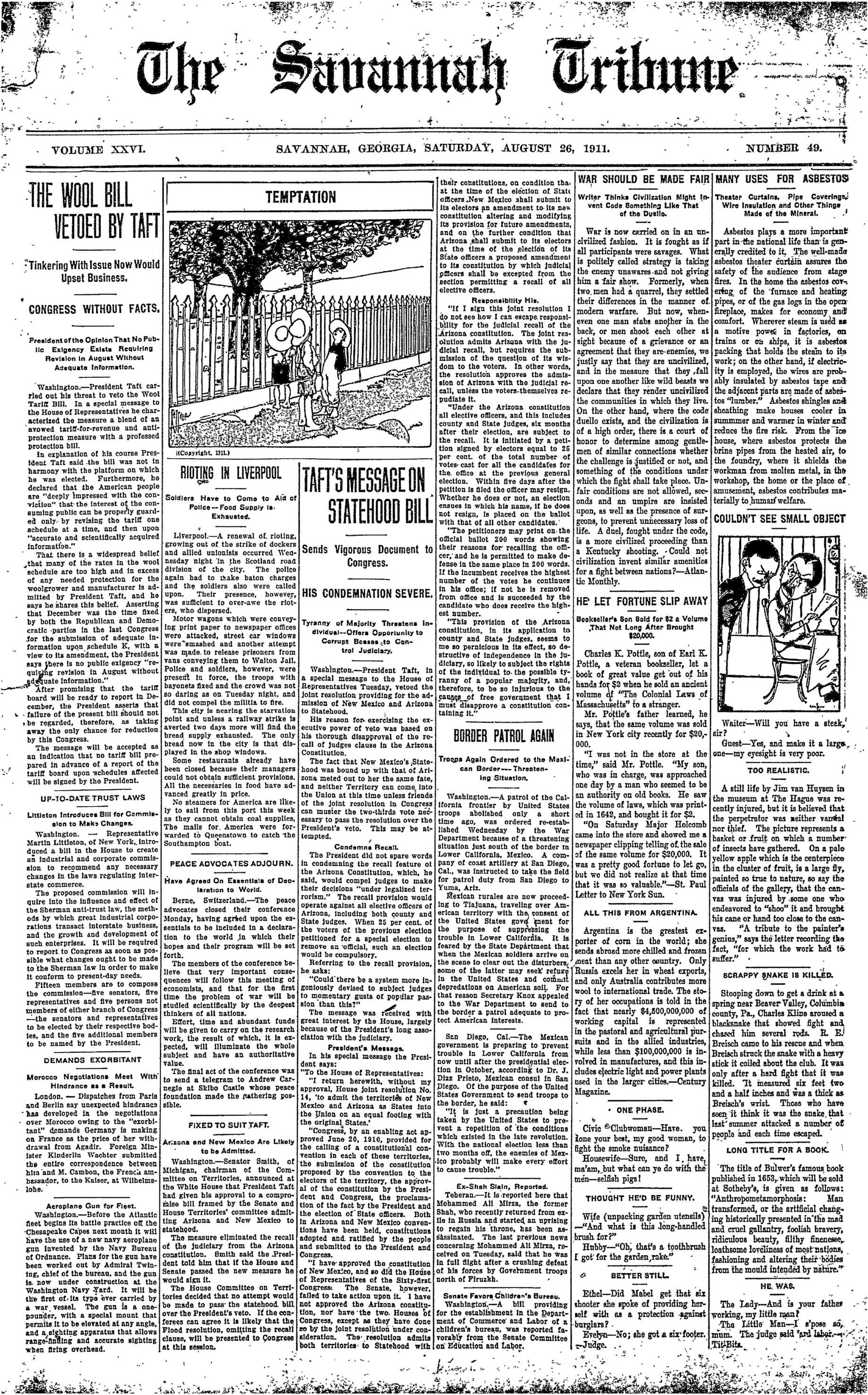
THE WOOL BILL VETOED BY TAFT
Tinkering With Issue Now Would Upset Business.
President of the Opinion That No Public Exigency Exists Requiring Revision in August Without Adequate Information.
Washington.—President Taft carried out his threat to veto the Wool Tariff Bill. In a special message to the House of Representatives he characterized the measure a blend of an avowed tariff-for-revenue and anti-protection measure with a professed protection bill.
In explanation of his course President Taft said the bill was not in harmony with the platform on which he was elected. Furthermore, he declared that the American people are "deeply impressed with the conviction" that the interest of the consuming public can be properly guarded only by revising the tariff one schedule at a time, and then upon "accurate and scientifically acquired information."
That there is a widespread belief that many of the rates in the wool schedule are too high and in excess of any needed protection for the woolgrower and manufacturer is admitted by President Taft, and he says he shares this belief. Asserting that December was the time fixed by both the Republican and Democratic parties in the last Congress for the submission of adequate information upon schedule K, with a view to its amendment, the President says there is no public exigency "requiring revision in August without adequate information."
After promising that the tariff board will be ready to report in December, the President asserts that failure of the present bill should not be regarded, therefore, as taking away the only chance for reduction by this Congress. The message will be accepted as an indication that no tariff bill prepared in advance of a report of the tariff board upon schedules affected will be signed by the President.
UP-TO-DATE TRUST LAWS
Littleton Introduces Bill for Commission to Maks Changes.
Washington. — Representative Martin Littleton, of New York, introduced a bill in the House to create an industrial and corporate commission to recommend any necessary changes in the laws regulating interstate commerce.
The proposed commission will inquire into the influence and effect of the Sherman anti-trust law, the methods by which great industrial corporations transact interstate business, and the growth and development of such enterprises. It will be required to report to Congress as soon as possible what changes ought to be made to the Sherman law in order to make it conform to present-day needs.
Fifteen members are to compose the commission-five senators, five representatives and five persons not members of either branch of Congress—the senators and representatives to be elected by their respective bodies, and the five additional members to be named by the President.
DEMANDS EXORBITANT
Morocco Negotiations Meet With
Hindrance as a Result.
London. — Dispatches from Paris and Berlin say unexpected hindrance has developed in the negotiations over Morocco owing to the "exorbitant" demands Germany is making on France as the price of her withdrawal from Agadir. Foreign Minister Kinderlin Wachter submitted the entire correspondence between hina' and M. Cambon, the French ambassador, to the Kaiser, at Wilhelmslohe.
Aeroplane Gun for Fleet.
Washington. Before the Atlantic fleet begins its battle practice off the Chesapeake Capes next month it will have the use of a new navy aeroplane gun invented by the Navy Bureau of Ordnance. Plans for the gun have been worked out by Admiral Twining, chief of the bureau, and the gun is now under construction at the Washington Navy Yard. It will be the first of its type ever carried by a war vessel. The gun is a one-pounder, with a special mount that permits it to be elevated at any angle, and a sighting apparatus that allows range-finding and accurate sighting when firing overhead.
The Savannah
TEMPTATION
A
RIOTING IN LIVERPOOL
Soldiers Have to Come to Aid of Police—Food Supply Is. Exhausted.
Liverpool.—A renewal of rioting, growing out of the strike of dockers and allied unionists occurred Wednesday night in the Scotland road division of the city. The police again had to make baton charges and the soldiers also were called upon. Their presence, however, was sufficient to over-awe the rioters, who dispersed.
Motor wagons which were conveying print paper to newspaper offices were attacked, street car windows were 'amashed and another attempt was made to release prisoners from vans conveying them to Walton Jail. Police and soldiers, however, were present in force, the troops with bayonets fixed and the crowd was not so daring as on Tuesday night, and did not compel the militia to fire. This city is nearing the starvation point and unless a railway strike is averted two days more will find the bread supply exhausted. The only bread now in the city is that displayed in the shop windows. Some restaurants already have been closed because their managers could not obtain sufficient provisions. All the necessaries in food have advanced greatly in price.
No steamers for America are likely to sail from this port this week as they cannot obtain coal supplies, The mails for. America were forwarded to Queenstown to catch the Southampton boat.
PEACE ADVOCATES ADJOURN.
Have Agreed On Essentials of Declaration to World.
Berne, Switzerland.—The peace advocates closed their conference Monday, having agreed upon the essentials to be included in a declaration to the world in which their hopes and their program will be set forth.
The members of the conference believe that very important consequences will follow this meeting of economists, and that for the first time the problem of war will be studied scientifically by the deepest thinkers of all nations.
Effort, time and abundant funds will be given to carry on the research work, the result of which, it is expected, will illuminate the whole subject and have an authoritative value. The final act of the conference was to send a telegram to Andrew Carnegie at Skibo Castle whose peace foundation made the gathering possible.
Arizona and New Mexico Are Likely to be Admitted.
Washington.—Senator Smith, of Michigan, chairman of the Committee on Territories, announced at the White House that President Taft had given his approval to a compromise bill framed by the Senate and House Territories' committee admitting Arizona and New Mexico to statehood.
The measure eliminated the recall of the judiciary from the Arizona constitution. Smith said the President told him that if the House and Senate passed the new measure he would sign it.
The House Committee on Territories decided that no attempt would be made to pass the statehood bill over the President's veto. If the conferences can agree it is likely that the Flood resolution, omitting the recall clause, will be presented to Congress at this session.
FIXED TO SUIT TAFT.
SAVANNAH, GEORGIA, SATURDAY, AUGUST 26, 1911.
TAFT'S MESSAGE ON STATEHOOD BILL
Sends Vigorous Document to Congress.
HIS CONDEMNATION SEVERE.
Tyranny of Majority Threatens Individual--Offers Opportunity to Corrupt Boasts to Control Judiciary.
Washington.—President Taft, in a special message to the House of Representatives Tuesday, vetoed the joint resolution providing for the admission of New Mexico and Arizona to Statehood.
His reason for exercising the executive power of veto was based on his thorough disapproval of the recall of judges clause in the Arizona Constitution.
The fact that New Mexico's Statehood was bound up with that of Arizona meted out to her the same fate, and neither Territory can come into the Union at this time unless friends of the joint resolution in Congress can musier the two-thirds vote necessary to pass the resolution over the President's veto. This may be attempted.
The President did not spare words in condemning the recall feature of the Arizona Constitution, which, he said, would compel judges to make their decisions "under legalized terrorism." The recall provision would operate against all elective officers of Arizona, including both county and State judges. When 25 per cent. of the voters of the previous election petitioned for a special election to remove an official, such an election would be compulsory.
Referring to the recall provision, he asks:
"Could there be a system more ingeniously devised to subject judges to momentary guasts of popular passion than this?"
The message was received with great interest by the House, largely because of the President's long association with the judiciary.
President's Message.
In his special message the President says:
"To the House of Representatives:
"I return herewith, without my approval, House joint resolution No. 14, 'to admit the territories of New Mexico and Arizona as States into the Union on an equal footing with the original States.'
"Congress, by an enabling act approved June 20, 1910, provided for the calling of a constitutional convention in each of these territories, the submission of the constitution proposed by the convention to the electors of the territory, the approval of the constitution by the President and Congress, the proclamation of the fact by the President and the election of State officers. Both in Arizona and New Mexico conventions have been held, constitutions adopted and ratified by the people and submitted to the President and Congress.
"I have approved the constitution of New Mexico, and so did the House of Representatives of the Sixty-first Congress. The Senate, however, failed to take action upon it. I have not approved the Arizona constitution, nor have the two. Houses of Congress, except as they have done so by the joint resolution under consideration. The resolution admits both territories to Statehood with
Condemna Recall
President's Message.
their constitutions, on condition that at the time of the election of State officers New Mexico shall submit to its electors an amendment to its new constitution altering and modifying its provision for future amendments, and on the further condition that Arizona shall submit to its electors at the time of the election of its State officers a proposed amendment to its constitution by which judicial officers shall be excepted from the section permitting a recall of all elective officers.
Reaponsibility His.
"If I sign this joint resolution I do not see how I can escape responsibility for the judicial recall of the Arizona constitution. The joint resolution admits Arizona with the judicial recall, but requires the submission of the question of its wisdom to the voters. In other words, the resolution approves the admission of Arizona with the judicial recall, unless the voters-themselves repudiate it.
"Under the Arizona constitution all elective officers, and this includes county and State judges, six months after their election, are subject to the recall. It is initiated by a petition signed by electors equal to 25 per cent. of the total number of votes cast for all the candidates for the office at the previous general election. Within five days after the petition is filed the officer may resign. Whether he does or not, an election ensues in which his name, if he does not resign, is placed on the ballot with that of all other candidates."
"The petitioners may print on the official ballot 200 words showing their reasons for recalling the officer, and he is permitted to make defense in the same place in 200 words. If the incumbent receives the highest number of the votes he continues in his office; if not he is removed from office and is succeeded by the candidate who does receive the highest number.
"This provision of the Arizona constitution, in its application to county and State judges, seems to me so pernicious in its effect, so destructive of independence in the judicial, so likely to subject the rights of the individual to the possible tyranny of a popular majority, and, therefore, to be so injurious to the causes of free government that I must disapprove a constitution containing it."
BORDER PATROL AGAIN
Troops Again Ordered to the Mexican Border---Threatening Situation.
Washington.—A patrol of the California frontier by United States troops abolished only a short time ago, was ordered re-established Wednesday by the War Department because of a threatening situation just south of the border in Lower California, Mexico. A company of coast artillery at San Diego, Cal., was instructed to take the field for patrol duty from San Diego to Yuma, Ariz.
Mexican rurales are now proceeding to Tiajuana, traveling over American territory with the consent of the United States government for the purpose of suppressing the trouble in Lower California. It is feared by the State Department that when the Mexican soldiers arrive on the scene to clear out the disturbers, some of the latter may seek refuge in the United States and commit depredations on American soil. For that reason Secretary Knox appealed to the War Department to send to the border a patrol adequate to protect American interests.
San Diego, Cal.-The Mexican government is preparing to prevent trouble in Lower California from now until after the presidential election in October, according to Dr. J. Diaz Prieto, Mexican consul in San Diego. Of the purpose of the United States Government to send troops to the border, he said: "It is just a precaution being taken by the United States to prevent a repetition of the conditions which existed in the late revolution. With the national election less than two months off, the enemies of Mexico probably will make every effort to cause trouble."
Ex-Shah Sialn. Reported.
Teheran.—It is reported here that Mohammed All Mirza, the former Shah, who recently returned from exile in Russia and started an uprising to regain his throne, has been assassinated. The last previous news concerning Mohammed All Mirza, received on Tuesday, said that he was in full flight after a crushing defeat of his forces by Government troops north of Firuzkh.
Senate Favors Children's Bureau
Senate Favorite Children's Bureau. Washington.—A bill providing for the establishment in the Department of Commerce and Labor of a children's bureau, was reported favorably from the Senate Committee on Education and Labor.
WAR SHOULD BE MADE FAIR
Writer Thinks Civilization Might Invent Code Something Like That of the Dyslo.
War is now carried on in an uncivilized fashion. It is fought as if all participants were savages. What is politely called strategy is taking the enemy unawares and not giving him a fair show. Formerly, when two men had a quarrel, they settled their differences in the manner of modern warfare. But now, whenever one man stabs another in the back, or men shoot each other at sight because of a grievance or an agreement that they are enemies, we justly say that they are uncivilized, and in the measure that they fall upon one another like wild beasts we declare that they render uncivilized the communities in which they live. On the other hand, where the code duello exists, and the civilization is of a high order, there is a court of honor to determine among gentlemen of similar connections whether the challenge is justified or not, and something of the conditions under which the fight shall take place. Unfair conditions are not allowed, seconds and an ampire are insisted upon, as well as the presence of surgeons, to prevent unnecessary loss of life. A duel, fought under the code, is a more civilized proceeding than a Kentucky shooting. Could not civilization invent similar amenities for a fight between nations?—Atlantic Monthly.
HE LET FORTUNE SLIP AWAY
Bookseller's Son Sold for $2 a Volume
That Not Long After Brought
$20,000.
Charles K. Pottle, son of Earl K. Pottle, a veteran bookseller, let a book of great value get out of his hands for $2 when he sold an ancient volume of "The Colonial Laws of Massachusetts" to a stranger.
Mr. Pottle's father learned, he says, that the same volume was sold in New York city recently for $20,-000.
"I was not in the store at the time," said Mr. Pottle. "My son, who was in charge, was approached one day by a man who seemed to be an authority on old books. He saw the volume of laws, which was printed in 1642, and bought it for $2.
"On Saturday Major Holcomb came into the store and showed me a newspaper clipping telling of the sale of the same volume for $20,000. It was a pretty good fortune to let go, but we did not realize at that time that it was so valuable."—St. Paul Letter to New York Sun.
ALL THIS FROM ARGENTINA
Argentina is the greatest exporter of corn in the world; she sends abroad more chilled and frozen meat than any other country. Only Russia excels her in wheat exports, and only Australia contributes more wool to international trade. The story of her occupations is told in the fact that nearly $4,500,000,000 of working capital is represented in the pastoral and agricultural pursuits and in the allied industries, while less than $100,000,000 is involved in manufactures, and this includes electric light and power plants used in the larger cities.—Century Magazine.
- ONE PHASE.
Civic Clubwoman—Have, you
lone your best, my good woman, to
fight the smoke nuisance?
Housewife—Sure, and I, have,
ma'am, but what can ye do with the
men—selfish pigs!
THOUGHT HE'D BE FUNNY.
Wife (unpacking garden utensils)
—"And what is this long-handled
brush for?"
Hubby—"Oh, that's a toothbrush
I got for the garden, rake."
Ethel—Did Mabel get that six shooter she spoke of providing herself with as a protection against burglar's?
Evelyn—No; she got a six footer.
—Judge.
Theater Curtains, Pipe Coverings Wire Insulation and Other Things Made of the Mineral.
Asbestos plays a more important part in the national life than is generally credited to it. The well-made asbestos theater curtain assures the safety of the audience from stage fires. In the home the asbestos covering of the furnace and heating pipes, or of the gas logs in the open fireplace, makes for economy and comfort. Wherever steam is used as a motive power in factories, on trains or on ships, it is asbestos packing that holds the steam to its work; on the other hand, if electricity is employed, the wires are probably insulated by asbestos tape and the adjacent parts are made of asbestos "lumber." Asbestos shingles and sheathing make houses cooler in summer and warmer in winter and reduce the fire risk. From the ice house, where asbestos protects the brine pipes from the heated air, to the foundry, where it shields the workman from molten metal, in the workshop, the home or the place of amusement, asbestos contributes materially to human welfare.
COULDN'T SEE SMALL OBJECT
J. M.
Waiter—Will you have a steak, sir?
Guest—Yes, and make it a large one—my eyesight is very poor.
TOO REALISTIC.
A still life by Jim van Huysen in the museum at The Hague was recently injured, but it is believed that the perpetrator was neither vandal nor thief. The picture represents a basket or fruit on which a number of insects have gathered. On a pale yellow apple which is the centerpiece in the cluster of fruit, is a large fly, painted so true to nature, so say the officials of the gallery, that the canvas was injured by some one who endeavored to "shoo" it and brought his cane or hand too close to the canvas. "A tribute to the painter's genius," says the letter recording the fact, "for which the work had to suffer."
SCRAPPY 8NAKE 18 KILLED.
Stooping down to get a drink at a spring near Beaver Valley, Columbia county, Pa., Charles Kline aroused a blacksnake that showed fight and chased him several rods. R. E. Breisch came to his rescue and when Breisch struck the snake with a heavy stick it coiled about the club. It was only after a hard fight that it was killed. It measured six feet two and a half inches and was a thick as Breisch's wrist. Those who have seen it think it was the snake, that last summer attacked a number of people and each time escaped.
LONG TITLE FOR A BOOK.
The title of Bulwer's famous book published in 1653, which will be sold at Sotheby's, is given as follows: "Anthropometamorphosis: Man transformed, or the artificial changing historically presented in the mad and cruel gallantry, foolish bravery, ridiculous beauty, filthy finenesse, loathsome loveliness of most nations, fashioning and altering their bodies from the mould intended by nature."
HE, WA8.
The Lady—And is your father working, my little man?
The Little Man—I a'pose so, mum. The judge said 'ard labor—Tit-Bits.
The Farm
FEEDING YOUNG CHICKS.
Corn is one of the grains which should not form the exclusive food of chicks before they are four weeks old at least. If corn bread is made as for table, with eggs and milk, the result would not be so disastrous to the chick. Feed nothing till the chicks are 36 hours old, then give bright gravel or grit, and for the first meal-bread squeezed dry out of sweet milk. Mix your own feed, mix together cracked wheat six pounds, fine cracked corn two pounds, rolled cats or coarse catmeal pone one pound, broken rice, one-half pound, fine granulated beef scraps two pounds; feed daily two pounds of lettuce leaves. Throw into light litter to keep the chicks scratching for their food. No one is too poor not to have poultry, for nearly all places will sustain a limited amount of poultry without feeding practically the year round. To get the greatest results from the management of poultry we must necessarily study it, learn its needs and give due diligence to the health and welfare of the fowl.—Agricultural Epitomist.
FLAVOR OF BUTTER.
Expert butter tasters in France maintain that a flavor of the soil on which the cattle browse is always distinctly perceptible in butter, no matter what the special race of the cows producing it may be. Normandy cows sent into Poltou show a change in the flavor of their butter approaching that characteristic of the butter produced in that region, although the resemblance is never complete. Thus they say that, just as there are different cruses of soil and climate, so there are corresponding cruses of butter arising from peculiarities of nourishment and pasturage. The immediate influence of the soil is shown by the fact that in winter, when the cows are nourished on concentrated food not taken directly from the land, the characteristic flavors ascribed to the soil vanish.
CARRYING A FOWL
A fancier says that it is decidedly cruel how some people punish fowls in carrying them. Her way is to wrap the bird in a cornucopia of newspapers and carry as you would a bouquet. Simply lay the bird down on the paper, straightening the legs on a line with the tail, and holding the wings in position at the sides; now roll the newspaper around as though making a cornucopia and twist the lower end, leaving the upper end open. In carrying, hold the twisted end in the hand, allowing the roll to rest on the arm. Having plenty of air, B迪 will ride comfortably, with neither flutterings nor fright, since wings and tail are confined.—Journal of Agriculture.
POINTS IN FEEDING.
Where green cut bone is not procurable it is a difficult matter to adjust the feed to the layers so as to get the best results. It is possible to utilize bones obtainable at butcher shops by breaking them to some extent and then boiling them. This plan necessitates a soft mash in which some absorbent is necessary, and nothing is better than good, pure wheat bran, to be stirred in after the mash is cooked. Some poultry keepers prefer this to feeding the grain dry and the vegetables raw; but where the cut bone can be had, it is we think, best to feed in the natural conditions and force the hens to scratch for their food in litter, as is often suggested. Journal of Agriculture.
THE GAPE WORM.
It seems strange that so many worry over gape worm troubles when the remedy is so simple. Let no one doubt that there is such a thing as the gape worm. It has two white heads which fasten to the windpipe to suck the blood. When rubbed loose it is no trouble for the chick to get rid of. Just as soon as the chick begins to cough and sneeze, take it in your left hand and hold its mouth open with the thumb and finger; hold its head up to tighten the windpipe; look down and the worms will be plainly seen. Place the thumb and finger of the right hand tightly just below the worms and rub up and down until they come loose. Then the chick will cough up at once so they can be reached with a pin head or a toothpick—Journal of Agriculture.
Look for Strings Before Swallowing Gratuities.
A farmer who had been much troubled by birds taking his corn, concluded to trap a few of them and scattered a number of grains about in his field to which had been fastened threads which were in turn tied to small pegs. A foolish blackbird happening along saw the grains and swallowed one only to find that it was securely lariated to a peg. Then a squirrel who loved corn, but who was smooth in its day and generation, seeing the situation of the blackbird, said: "My dark feathered friend, it is altogether probable that it is too late for advice to be of any benefit, so far as you are con-
cerned, because I apprehend that your name is Dennis at this writing, but if any of your friend should happen around before you finally get it in the neck, you might suggest for their benefit that when a stranger offers you a free gift there is generally a string to it."—Missouri Ruralist.
INSECT GRAPE DESTROYERS.
Vineyardists in some parts of the state of New York have little trouble from insects; but in the Chautauqua grape belt the damage from rootworm, flea-beetle, rose-chafer, blossommidge and leaf-hopper has contributed not a little to the great decline in productivity of the vineyards in that section. Accordingly these and other insects have been and are being studied by the entomologist appointed by the station at New York under the special fund appropriated by the legislature of 1909 for relief of the Chautauqua county grape growers. Butletin 331 of the station records the work done in control of these pests, for some of which very successful repressive methods have been developed. Any vineyardist may secure the bulletin by sending his address to the director of the station at Geneva.
COUGHING AND SCABBY HOGS.
Wormy, coughing, stunted hogs have been cured and made perfectly healthy by the use of one-fourth to one-half a box of lye to a barrel of soaked corn, shorts or slops. This is the remedy of a Kansas man and he says it never falls. Scabs on shoats are sometimes caused by a mite which causes the hair to fall off in patches. It may be cured by washing the skin with weak lye or soft soap, rubbed in with a brush. A wash containing 1 pound white arsenic, 12 pounds alum and 25 gallons of water gives good results. Infested pens should be disinfected with hot kerosene emulsion or pure gerosene and liberal quantities of lime on the floor.
THE CHICKEN THIEF.
A man in Scranton, Pa., mlssed three or four of his black Hamburg pullets, and made up his mind that his neighbor's big cat was the thief. So he lay in wait for the culprit with a shotgun, and presently there appeared, not a cat, but a small black and tan dog, which seized a little chicken and ran off with it, right before the eyes of the owner, who was so astonished that he forgot to shoot. When he recovered his senses, he chased the dog and traced it to a house five blocks away. The family begged him not to kill the children's spet, and ransomed the dog by paying for all the chickens that had been stolen.
SYSTEMATIC FERTILIZING
Manure may be profitably applied to the soil at any time of year in ordinary farming, but in intensive farming the application must be systematic, and in any case its value depends chiefly on the quality and condition of the material. It can not afford food to plants until it is decomposed and is soluble. Stable manures are generally more economically used when applied to crops during cultivation, yet where there is an abundance and it becomes a nuisance in the barnyard, it can be hauled out and scattered upon the land in winter. When applied in that manner it may fall to give very good results the first year and show well the following season.
PREVENTING MILK FEVER.
Milk fever can be prevented very easily by milking the cow regularly before she drops her calf. If she is usually a heavy milker she should be as regularly milked for a few weeks before calving as she is after. Begin the milking at least two weeks before the time for the arrival of the calf. During the first week once each day is sufficient, but the last week she should be milked both night and morning.—Agricultural Epitomist.
DISEASED FEATHERS.
Feather diseases is a skin trouble due to a vegetable growth in the sack out of which the feathers grows, which will cause the birds to lose their feathers. One of the most practical remedies is a mixture of one part sulphur, one part kerosene and three parts lard. Mix well and apply to the feathers in the affected section of the body, rubbing the ointment well into the roots of the feathers. Another good remedy is one part sulphur and two parts vaseline, applied in the same way as suggested for the sulphur, kerosene and lard—Journal of Agriculture.
TO KEEP CABBAGE FRESH.
Frequently only half a cabbage is required at a time. To keep the remainder fresh, wrap it in some of the loose leaves and afterward in damp paper. Put it in a cool place, and it will keep fresh and crisp for a day or two. Half a cut cucumber may be kept fresh by standing it in a tumbler of water.
FIFTEENTH ANNUAL MEETING
HELD AT HAMPTON INSTITUTE — CONFERENCE
LARGELY ATTENDED—
ADDRESSES INTERESTING AND PRACTICAL.
Hampton, Va.—The fifteenth annual meeting o f the Hafpton Negro conference was held at Hampton institute, which brought out several hundred thoughtful and progressive negroes from many parts of the south. At each regular meeting from 350 to 500 persons were present and at the round table discussions from 50 to 200 persons were in attendance.
Mrs. Harris Barrett of Hampton, Va., a graduate of Hampton and president of the Virginia Federation of Colored Women, which was organized in 1907 at the conference, told of bringing together negro women's clubs for special state work without interfering with their community activities. Mrs. Barrett stated that the negro women's clubs which had pledged $10 each for the building of an industrial school for wayward girls had redeemed their pledges and that there was now in hand more than $600. How much this co-operative pioneer work means only those in harmony and sympathy with the colored people of the south can estimate. The Homemakers' club of Hampton raised $57 instead of the $10 pledged.
Mrs. I. C. Norcum, of Portsmouth, Va., who is chairman of the ways and means committee of the federation, read a paper on "Womens' Community Clubs." Mrs. Norcum showed the relation of the work of colored women's clubs to improvement in the conduct and appointment of the home, including well-cooked meals, school improvement societies, sanitary reforms in rural life, care of children, and the antituberculosis movement. Her paper centered about a helpful discussion of the federation motto: "Lifting as we climb."
Mrs. Laura B. Titus, of Norfolk, Va., who has had a wide experience in community work, among negroes, outlined the origin and growth of the Norfolk Women's Christian association (colored) and the need of providing protection and shelter for negro girls and women in their journeys from the south to the north and back again. Negro teachers, she said, must be missionaries in the broadest sense. They must do a large share of the work in saving the negro. They must teach the young people to behave quietly on the streets, on the cars, and on the boats. In short, the salvation of the negro is through co-operation with one another and the best white people.
In her address on "The Negro Woman's Religious Activity," Mrs. Ora Brown Stokes, wife of a Baptist minister of Richmond, Va., declared that "activity" meant "work." She explained how thoroughly some of the negro ministers are being assisted by women's aid societies which care for the sick and destitute, relieve the aged, and look after the welfare of needy children. Mrs. Stokes commented on some, of the tangible and beneficent results of negro women's club work; the national Christian temperance movement; the national federation of colored women's clubs, with its offspring—reform, schools, orphanages, Young Women's Christian associations, hospitals and schools; women's auxiliary of the National Baptist convention; Lott Carey Foreign Mission convention; National Nurses' association; National Y. W. C. A.; Women's Educational Convention of Virginia; Women's M. E. association of Virginia; Women's Aid society of the Northern Neck association of Virginia; Rappahannock Sunday School convention; Negro Baptists' Old Folks home, Richmond, Va.; the Firesides school; Women's Mite Missionary society of the Methodist church. All these organizations are devoted to the uplift and improvement of the colored people. Mrs. Stokes declared that there was an urgent call for enthusiasts, not extremists, in club work for negro women.
Dr. James Buchanan, secretary of the Associated Charities of Richmond, spoke to the large audience of white and colored people concerning the need of men and women who are able to meet every question of social welfare arising in their respective communities. Dr. Buchanan is a white officer who has been engaged for eight years in social work in Richmond. Business men, he said, ask now how their money is being spent in social work, what has been accomplished, and what is the program for the future. He urged the principles of economy in administration and of common sense in ideals.
W. W. Long, who is in charge of the farm demonstration work in North Carolina, Virginia and Maryland, spoke at a round table meeting on what is sometimes called "kindergarten agriculture"—deep fall plowing, the saving of farm manures, careful soil preparation, and the raising of home supplies.
A practical demonstration in proper methods of hitching and unharnessing a horse, and a talk on the essentials of good draft horses for southern farmers, was given by Dr. R. R. Clark, veterinarian and instructor in animal husbandry at Hampton institute.
Dr. Hollis B. Frissell, principal of Hampton institute, in his address of welcome, referred to the appropriateness of men and women gathering at Hampton where so much of American history centers for the discussion of problems vital to the progress of the
negro race and its proper relation to the white people of the country. He testified to the advancement which the negro has been making everywhere throughout the south, and declared that co-operation was the thought of the time which would lift up the country. Among the other speakers were Dr. S. G. Atkins, of Winston-Salem, N. C., secretary of education for the A. M. E. Zion church; Dr. James Hardy Dillard, of New Orleans, president of the rural school fund board; Rev. C. L. Bonner, presiding elder of the C. M. E. church, Toccoa, Ga.; A. W. Nicholson, of Trenton, S. C., principal of Bettis academy; Dr. J. D. Hammond, president of Palhe college, Augusta, Ga.; and Thomas C. Walker, a well-known farmer of Gloucester, Va.
NEW SCHOOLING FOR GIRLS
Theological students are hereby admonished to pause and reconsider their matrimonial aspirations. For signs are not wanting "that's different." A kindly German critic has recently been asking with urgency: "Why do not struggling country parsons with small, small salaries, help themselves out by taking charge of city young ladies? In Germany it is the custom for a girl to pass the year between school and society in the country in the home of some clergyman who can oversee her reading, while his wife inducts her into all the mysteries of the housewifely arts. The plan has many advantages. It is more practical than your course in domestic science, for the pupil actually takes a hand in all the work of the household, from the fine laundering to sausage making. Free from the distractions of home or society, or even of the classroom, she can devote herself singleminded to the business in hand. Her first timid experiments are ventured out of range of the jeers of brothers and sisters, and of the mother's unconscious assumption that she is still a little girl. When she goes home it is in the full blush and dignity of housewifely completeness, a graduate into mature life. Moreover, the year of simple fare in the country usually sends her into society rosy and rested. The clergyman's pocket is meanwhile substantially replenished. So it is good all round. Why is it not done here?"
AMERICANS IN EUROPE.
"Mrs. Hamilton Paine—the Duchesse de Choleseul-Praslin—gives by her misadventure with Count d'Aulby another proof of the inability of Americans to grapple with European life."
The speaker, Count Jacques de la Tour Blanche, was praising, in New York, the honesty of America.
"You are, for all the tales about your politics and corporate corruption," he said, "the most honest. and the most honorable people in the world. It is to your credit, not to your discredit, that adventurers so often dupe you in Europe. It isn't because your minds are stupid that you are duped. It is because your minds are noble—too noble to believe such mean, small creatures as Europe adventurers can exist.
"That was a typical adventurer who, meeting an American millionaire in Paris, congratulated her upon her good fortune in making his acquaintance."
"You know,' he said, 'I always pick my friends.'
"But this lady, who.was up to snuff, retorted:
"As you would a chicken, eh., marquis?"—New York Times.
SOME LIGHT ON A SCOURGE.
"New light on cancer" is the headline over a news dispatch to the Tribute from London. It is light at least a little helped by the "X-ray" and the "X" in this instance does not stand for an unknown quantity. One discovery made is that the cancer is not contagious. That when understood and accepted will end a large amount of fear, superstition and horror in the world. Investigation of how to cure, or to check the disease of how to extirpate it so as to prevent its recurrence is still going on among scientists. "Progress" alone can be announced by them, for neither investigation nor experimentation has yet more than begun. Vaccines and serums are benignly in use, but the relation of the disease to foods, to habits and to surroundings remains to be further examined both in animals and men.—Brooklyn Eagle.
LOTS OF RAW MATERIAL
"President Diaz," said a railroad man with headquarters in Mexico, "used to have a gruff, caustic kind of wit.
"I once dined with him in Mexico City, when the subject of Dash came up-Dash, a stall millionaire of seventy-eight years, who had eloped with his sixteen-year-old stenographer.
"President Diaz philosophized, I thought, rather neatly on the matter.
thought, rather neatly on the matter. "Well," he said, 'not every man is made a fool of, but every man has the raw material in him.'"—Los Angeles Times.
THE STORK AND SISTER.
Little Robert was much interested in the picture of a stork-which he saw in a magazine.
"Say, mamma," he asked, "what has become of the bird's other leg?"
"It has raised it up among its feathers," replied the mother. "That's funny," the boy observed; "I thought it was trying to clean its shoe on its stocking like sister Ethel does."
CHICAGO RECORD-HERALD MAKES INTERESTING EDITORIAL OBSERVATION ON SUBJECT.
The Chicago Record-Herold makes the following editorial observation of the negro's opportunity in the south taking its text from a recent address made by Dr. Washington. We quote: $ ^{2} $ Figures from South Carolina show the rapidity with which negroes are taking up the farms of that state. From 1800 to 1910 the number of farms increased by more than 20,000, but the number owned by negroes increased by 11,295, against an increase of but 9,530 in the number owned by whites. Out of a total of 176,180 South Carolina farms, 96,696, or considerably more than one-half, are now owned by colored people.
This increase is creditable and gratifying, yet Dr. Booker T. Washington, in his recent address at Wilberforce university, indicated a still more promising field for the ambitious negroes—the small town. He says that there are openings in the south for at least 8,000 additional grocery stores, for 2,000 shoe stores and 2,000 millinery stores, and that there are communities where 2,000 additional negro banks can be opened and supported. He also observes equal opportunities for like numbers of doctors, pharmacists, dentists and veterinary surgeons.
Of more moment still is Dr. Washington's declaration that "there are places in the south where at least seventy-five self-governing, self-supporting and self-directing towns or cities may be established where the colored people can have their own mayor, their own board of aldermen, their own self-government from every point of view." Such opportunities as these, rightly appropriated and used, would be the most valuable of all; for, as Dr. Washington points out, "local self-government is the most precious kind of self-government"—the elementary school of civics in which experience herself is teacher. The idea of trained, negroes doing definite social service in the south within restricted districts and co-operating in the details of town and village government holds more positive promise of improved conditions for the southern states and their people than most suggestions proposed for the betterment of that sorely tried section."
WHEN LOVE WAS YOUNG.
The Man's mother had given the man's wife a love letter which she found hidden away in a mass of old papers, says the Cleveland Plain Dealer. It had been written to the man which he was a boy and the writer was his sweetheart, aged fifteen.
The man's mother laughed when she handed it to the man's wife, and the man's wife laughed when she handed it to the man.
But the man did not laugh.
"Aha," said the wife, in her merry way, "see how the past rises up against you."
The man took the letter and slowly unfolded it and softly read it aloud:
"Dearest boy," he read, "I'm afraid you are mad at me because I walked with Johnnie Nichotson yesterday to school, but it wasn't my fault at all. You know I love you, dearest boy, a thousand million times more than I could ever love Johnnie, and when you look cross at me it breaks my heart. Aln't you going to take me to the school picnic Saturday—'cause if you don't I can't go. I cried when I wrote this—that's why it's spotted. Don't make me cry any more, dearest boy."
The man looked at the letter for some time. "His gaze softened, and he sighed.
"That was the real thing," he murmured, and he carefully refolded the letter and turned away.
And then the man's wife was sorry she had given the letter to the man.
LIGHT OF REASON.
A farmer returning home late at night found a man standing beside the house with a lighted lantern in his hand. "What are you doing here?" he asked savagely, suspecting he had caught a criminal.
For answer came a chuckle and "It's only mez zur."
The farmer recognized John, his shepherd. "It's you, John, is it? What on earth are you doing here this time o-night?"
Another chuckle. "I'm a-courtin' Ann, zur."
"And so you've come courting with a lantern, you fool! Why, I never took a lantern when I courted your mistress!"
"No, zur, you didn't, zur," John chuckled. "We can all zee you didn't, zuri!"—Answers.
KILLING THEM OFF.
A teacher, wishing to impress upon his pupils the population of China, said:
"The population of China is so great that every time you breathe two Chinamen die."
In a short time a little boy at the foot of the class was noticed by the teacher to be breathing and puffing vigorously. The teacher, much alarmed at his actions, inquired:
"What is the matter? What on earth are you doing?"
"Killing Chinamen!" was the quick reply. "I don't like those foreigners, so I'm getting rid of them as quick as I can."—National Monthly.
In city or country the best friend of the doctor is the housewife who economizes on fuel, labor and time by serving hastily cooked foods to her family. Usually this woman is so joined to her idols that she openly pities her neighbors who are tied down to housework, but in the long run she is the one who needs the pity. She boasts that she can give the entire morning to sewing or cleaning, or some other task, and in twenty minutes get a dinner for her family, and it really does taste good often. But the after-effects work havec with her economy. Such women usually have more time for visiting, fancy work, reading and sewing during the first days of the housekeeping, but later on they pay a heavy penalty for their leisure time. Unless a woman uses a fireless cooker, foods that can be prepared in fifteen minutes or half an hour are a menace to the health of the family.
Take fried potatoes, for example. Nothing could be better for an occasional meal than delicious browned potatoes fried in a small allowance of butter and fryings mixed, but for steady diet they soon bring indigestion. And when children are intrusted with the hasty cooking, as is often the case, a great quantity of fat is used and the potatoes dumped in cold, making a combination that would ruin the stoutest stomach. Good baked potatoes, mashed potatoes and potatoes boiled with meat are far superior to friend ones, but all these take time, and the economical woman will not have them.
Everybody knows that long, slow cooking improves such vegetables as beans, parsulips, cabbage, turnips and many other good things of the garden, but even those who agree with this declare that they have no time to waste on cooking.
HOW JOHN DOES IT.
"John D. Rockefeller, an incurable optimist, will take in good part the Supreme court's decision against-Standard Oil," said a Cleveland neighbor of the great millionaire.
"Mr. Rockefeller," he resumed, "is very proud of his optimism. I have often heard him, indeed, liken himself in optimism to the man who fell from the tower of a skyscraper.
"This man was an optimist whom nothing could dishearten. He worked in a skyscraper's twenty-eighth story and one afternoon, while admiring the glorious view, he lost his balance and fell from the window.
"Loud cries of horror from the street below at once filled the windows of every floor of the skyscraper with agonized spectators. To these horror-struck people the optimist, as he dropped swiftly past story after story, shouted in cheery tones:
"All right so far!"
"And by Jove, his optimism was justified," concluded the Cleveland man, "for he alighted, quite uninjured, on a mountain of excelsior piled in the street."-Cleveland Plain Dealer.
A STRONG ATTACHMENT.
Apropos of a beautiful young-wife, worth $40,000,000, who had just divorced her penniless husband in order to marry again, Henry E. Dixey, the noted comedian, said at a dinner in New York:
"The young man who marries for money has none too easy a time of it. His rich wife is apt to tire of him and throw him out in a few years, or else she is apt to limit his allowance to 25 or 50 cents a day.
"I married money,' a man once said to me.
"Wasn't there a woman attached to it?' I asked.
"Yes, you bet there was,' he exploded; 'so much attached to it that she never parted with a penny.'"—Pittsburg Gazette-Times.
8HE SET THE STYLE.
Charles Frohman, the eminent manager, was talking about a famous young actress.
"She is superb," said Mr. Frohman, lighting a huge cigar, "but she is a little—er—but I won't call her conceited.
"Once, though, at a rehearsal, after she had finished a really wonderful scene, I ventured to object:
"It was divine except that handshake. People don't shake hands like that in real life."
"Ah, but they will," she answered, 'after they see me.'"
Mr. Frohman smiled.
"And, by Jove, they did, too."
ONLY STEERAGE LOSS
The narrative of one of the passengers on the damaged Cunarder, as given to a reporter of the Birmingham Daily Mall, contains this passage:
"The baggage master deserved special praise. He had only been asleep a couple of hours when called up, but he arranged the baggage no cleverly that not a piece was lost save such as belonged to the steerage passengers."
A truly first-class touch. To a steerage passenger, who has little enough to begin with, the loss of baggage is, of course, nothing—London Punch.
RECORD FOR SIZE.
In a recent session a certain senator, after elaborating in a speech of two hours, a statement that would have been better made in a speech of two minutes, concluded:
"And that's the situation, gentlemen, in a nutshell."
"Gracialou!" said Senator La Follette, so voce, "what a nut."
There wasn't any reason for it, a certain woman declared, but she, was always tired. She was conscious that her temper was not the best, though she had it under excellent control, and whatever she did tired her (even diversion exhausted her), so at last she called a nerve specialist.
He listened to her recital of trouble and shook his head gravely, and then began to ask questions. "Do you wear high boots when you walk in the streets?" She said she did not. "Did you wear few underclothes, to appear syriaclike, or do you use flannels?" No flannel, was her answer, and she volunteered that most of her gowns had half sleeves. Then the nerve specialist delivered himself of an opinion like this.
"You are like most women nowadays; you are not warmly enough dressed in cold weather. Cold saps vitality, which is strength. You are not sufficiently protected from cold, so your physical strength goes below par, and then you proceed to live the strenuous life demanded of women and go on your nerves.
"Cold is exhausting to a person who suffers from herpes. Conversely, warmth is soothing. You must keep the surface of your body thoroughly warm at all times unless you want to grow old before your time. For premature age will be the price that women will pay soon for the fashion now of dressing slightly in cold weather."
Don't forget moment Janey I think you should swathe yourself in flannels or that I would have your hosiery made of yarn. You should select such garments as will prevent your own natural warmth from being dissipated during the first five minutes you are exposed to a cold wind."
FRUIT AND OLD AGE.
Psychologists claim that growth from infancy to old age is a process of gradual ossification, and that the stiffness of age is caused by the deposits of calcareous matter or earthly salts. Therefore, a diet containing a large proportion of these salts, food rich in nitrogen, such as the cereals, beans, peas and meat, increases the natural tendency of ossification, says Health. For this reason a diet, made up largely of fruit, which contains a minimum amount of this calcareous matter, is scientifically best adapted to persons in advancing years.
Large eaters add to the liability of ocular deposits from overworking the eliminating organs by an excess of nutritive material until their healthful activity is destroyed, and the whole system suffers in consequence. Old age indicates less food and a maximum amount of fruit as the diet.
CLEANLINESS.
Cleanliness and neatness ought to be watchwords of the kitchen. The cook's hands, nails and apron should be immaculate. Cotton dresses that will bear frequent washings and smooth aprons minus gathers and trimmings—never Mother Hubbard wrappers, kimono sacques or discarded old clothes fit for the rag bag—should be worn for kitchen work. Stranga as it may seem, it is possible for a housewife to be clean without being neat. Her stove may shine, her cooking utensils be bright, her hearth and floor scrubbed to snowy whiteiness—yet her kitchen table, dresser and closet shelves "cluttered" with things not put away from the last, or time before last, cooking. Her hair may be frowsy, her dress, though clean without collar, or belt. A word to the wise is sufficient.
. RED CURRANT JELLY.
Put a quantity of red currants, picked but unstemmed, in a porcelain kettle and set it on the back of the stove or in a moderate oven. The heat will gradually burst the skins. Mash the fruit and pour it into a jelly bag. Allow it to drip over night. Boll the juice in a preserving kettle, and to each pint of juice add one pound of sugar, heated in the oven. When the sugar is dissolved, test by dropping a spoonful of the jelly into a saucer. If it begins to jelly readily pour it at once into glasses. When cool and a skin has formed on the top of the jelly, cover with a round of tissue paper dipped in brandy or in beaten white of egg. Over this put a layer of absorbent cotton, then fit on closely the metal lid that comes with the glass.
Seen In the Shops of Paris.
Plumes in two colors are much used. Blouses of striped material are popular. Girdles of strands of beads are much seen. Filet of venise are the most fashionable laces of the moment. Blouses of white muslin usually show a plaited frill, wide or narrow, but always a frill. Coats tend to curve sharply away from the front in cutaway lines. Some blouses show a generous use of Make stones or point de venise.
or valenciennes or point de vue.
Every summer frock sheer material
must have its scarf, to match.
TRY THE "WATER" CURE.
The 'water cure' is said to be an excellent aid to clear the complexion, as well as to rid the system from the
excess of uric acid, which causes rheumatic troubles. Drink at least eight glasses of water each day between meals.
- The girl with a thin, scrawny neck or a coarse, red neck should never wear a low-neck or a Dutch collar. Instead, she should wear a high face or embroidery collar, well honed to keep it in place.
Rub the face and hand frequently with lemon juice, and put a few drops of tincture of benzoin in the wash water. This will help to keep the skin white.
Wear shoes that fit, even though you should have to try on a dozen pairs to find the right one. Nothing rules one's walk and facial expression more than corns.
SARDINE AS HEALTH FOOD.
It is, encouraging. In these days, when every thing nice is condemned by scientific faddists as nasty, to have the high authority of the Lencet in support of the popular theory that the sardine is of great dietetic value. The sardine is good, the Lencet tells us because, for one thing, it encourages, the consumption of oil, which tends to avoid "many ills, and especially those associated with wasting diseases and gouty dispositions." This consumption of sardine oil, it adds, "prevents the overloading of the tissues with nitrogenous wasto products and a digestible fat favors nutrition considerably. The sardine supplies also an excellent proportion (25 per cent.) of nitrogenous material, and so it becomes a real and economical food. In addition to this the sardine has appetizing qualities, and where appetite serves digestion follows." -New York Tribune.
BELGIUM HAIR OR
COTTON TAIL PIE
Take a three-pound hare; separate into seven parts; wash well, wipe dry, salt, pepper, and roll in flour. Have a frying pan medium hot, and in it put a cooking spoonful of drippings and butter mixed. Put in the hare and fry until all sides are a nice brown. Now put over the top a small onion sliced fine, and a third cupful of hot water and cover. As the water cooks away replenish from the tea kettle until the meat is tender enough to almost drop from the fork. Remove the meat to a baking dish, thicken the fat remaining in the frying pan with an equal amount of flour and pour in enough milk to make a good cream gravy. Pour over the meat, then cover with a rich biscuit dough crust. Bake in a hot oven to a light brown and serve hot or cold as preferred.
TO CAN RED RASPBERRIES.
Put the wash boiler on the stove, with small piece of lath, or shingles, in the bottom, fill jars with the berries, being careful not to crush them, set them in the boiler and fill the boiler up to 3 inches of top of jars, with cold water, let boil; in the meantime make a slurp of two cups water, one of sugar, have it boiling hot, and when the berries are at scalding (use a dairy thermometer to ascertain that, by running it down into the jars of berries), fill with the boiling slurp and screw on the tops, removing at once from the boiler. The berrigs will remain whole, have a beautiful color and delicious flavor. I have sent this in before, but have had so many calls for it that I am pleased to send it again.
THE FEMININE PARTNER.
The modern wife has been advised very largely to interest herself in her husband's business and in his interest outside the home if she wishes to retain his affections. This is all very well, but nobody advises the husband to interest himself in his wife's home. Why not? Perhaps because it is generally taken for granted that the home belongs to both. But if this be true of the home, why is not equally true of the business which makes that home possible? Just because the husband's hand develops the one and the wife's the other is a mere detail of administration and should in no way affect the joint ownership in both.
A HOUSEPLANT ITEM.
Houseplants of any kind that seem to need more life and energy will thrive by submitting it to a course of ammonia water applications, that is, the soil. Ammonia when diluted in the proportions that one makes it to wash windows is a fertilizer. Soapy water is quite as good and a combination of soapy water and ammonia is still better. Give the poor houseplants a drink that is also food to them when you are about to throw into the drain a material which they actually require to appear at their best.
CURBANT VINEGAR
A fine vinegar may be made from currants by simply pressing the fruit to a mash; let it stand over night, then strain the juice off clear and fill the bottles to the brim. Set them, uncorked, in the sun or in a warm place, until fermentation ceases. Any little impurity that rises skim off with a piece of blotting paper and cork the bottles well. White currants are excellent for a delicate, pale vinegar.
Need For Moral
Uplift
A Sermon
Stand ye in the ways, and see, and
ask for the old patha—Jeremiah. 6:16.
Stand ye in the ways, and see, and ask for the old path—Jeremiah 6, 16. Every moral awakening is marked by a return to old ways, striving and wholesome, that have been neglected. To go to the past, for guidance in hours when heart and soul are stirred is not mere sentiment. In scanning the events of former times one discerns that the great moral principles which have "uplifted mankind and molded the higher life have, never changed. As mankind's horizon broadens conditions, and environments will naturally change, but the elements that make for the upbuilding of character are not subject to change; they are rooted eternally in the moral consciousness of the world. God himself has graven upon the tablets of stone the duties and obligations of man. Just balances and just weights are the best policy today, as they have ever been. The honest and upright man has always been a tower of strength in his community. Nor are purity and decent living amenable to any new conditions of modern life. Impurity and lascivious living the most degenerate will not defend as proper and respectable.
The admonition of the prophet to return to the old paths is one that every generation ought to lay to heart. It holds a note of encouragement for all those who are desirous to enlist in the cause of moral regeneration. In the fight for the full and free life we need to know that we do not fight alone, that we are but part of a great and glorious army that has been struggling up through all the ages past. We need to catch the vision of the men who battled for the nobler things of life and feel the glow of strength that comes from touch with the great souls of every age. To seek the old paths is not an indictment of the present. No one familiar with the trend and tendency of our time will dare to speak of it as a godless age. The independence of man, the dignity of woman, the nobility of labor, the freedom of research, religious tolerance, the need of a common education, a broadening sympathy and help for human suffering—all these achievements stamp our age as one dedicated to the broader interests of mankind. Yet to be honest we must confess that on the whole the tendency of life has grown downward instead of upward, forward instead. of inward, natureward instead of Godward. Wonderful strides have been made intellectually; morally we have not held our own. But especially must be noted in estimating the civilization of our age that the pendulum has swung from the ideal to the material altogether. Modern man is displaying marvelous strength and ingenuity in conquering the forces of nature and in removing obstacles that stand in the way of his material well-being; but he is lamentably weak and impotent when put to the test of resisting his evil passions and inclinations. Of what value, then, all discoveries and inventions, all wealth, pleasure and luxury, if in the pursuit of them we lose the power to control and regulate our passions and desires, if all material progress does not bring peace, comfort and light in the great trials and emergencies of life?
In political life thousands seem to be bereft of all sense of moral responsibility. Venality and corruption abide in low as well as in high places. Tens of thousands have been deprived by class legislation of opportunities and blessings to which they were clearly entitled. The greed and avarice of corporate interests have become a menace to the very existence of our free institutions. In social life "plain living and high thinking" has long ceased to be fashionable. Reading the daily papers one cannot help but feel that domestic virtue is at a discount. Marriage is a matter of convenience, terminated in the spirit it is entered upon, Vulgarily and ostentation pass only too often for culture. Money, not character, regulates social intercourse.
In the realm of religion conditions are not any better. In the increasing valuation and glorification of things material we are losing all sense for the appreciation of things spiritual. Ethics and religion are man-made. Love, righteousness, justice, are not rooted in the divine ideal. Shallow reasoning and cheap phrases have robbed many of the religious heritage of their fathers and driven them into the camps of mountebanks. The lack of a. religious faith is apparent in the hopelessness and pessimism which leads so many to despair and destruction.
Thank God there is a moral awakening against corruption and dishonesty, against false standards of morality and against religious faddism, against a philosophy that leads to blind fatalism. Indications of uneasiness as to modern business methods abound everywhere. Public sentiment in this country is crystallizing more and more, until there will be a thorough appreciation on the part of everyone of moral responsibility. The moral consciousness of men is growing more and more sensitive. Men are beginning to criticize, freely and openly, the slightest departure from the path of moral rectitude, because it is contrary to God, because it is contrary to the higher law of man and to the best interests of society, Men and women are heeding more and more their obligations to those who call them father and mother. Pure physical and moral lives are
a most valuable asset that parents can give their offspring in the slogan adopted by thousands of good people everywhere. Whether this moral awakening shall become a broad stream, whose waters shall cover the whole land, must depend upon the individual. Everyone must feel the need of personal reformation before, there can be a thorough and widespread public regeneration. The only honesty which counts in every reform movement is personal honesty. If we are to have good-government, everyone must be honest and seek the welfare of the nation as the highest aim of civic duty. In brief, in all the relations of life we must ever be cognizant of our duties and responsibilities and live our lives in the spirit of the great moral principles, that bear the imprint of God, our Father.
DOMESTIC SUPERSTITIONS
One of the early morning sights in Boston is the small army of women farm laborers starting out for their day's work on the truck farms or gardens in the suhurbs. They start early, they return late, but their season is short.
The sight of women working in the fields has come to be so common in the garden farming districts as to attract no special attention, says the Boston-Globe. Almost all of these women are Italians, the very picture of health, short and sturdy, straight backed and straight limbed, and they can handle a hoe or even a fork or spade with, as much dexterity and effectiveness as the average man.
But when it comes to weeding these women seem to be in a class all by themselves! It is a picturesque sight to watch it at a distance a group of the weeders at work. One thing the Italian won't do. She don't lay aside her bright-colored finery. It seems as necessary to her happiness when she is on her knees weeding onions' or breaking her back crushing potato bugs as it is when she is gossiping on her house stoop or celebrating a holiday.
The woman's mind if left to itself turns naturally to believe the make-believe. A housewife likes to pit her unreason against her reason. The mere act of obsurd illogic gives variety and charm to an otherwise dull foronoon of housework and nobody is the worse for stretching the arm of imagination to include a little mild superstition of the old-fashioned sort. Youth's Companion.
THE HYDENIS U8E
"Here," said the teacher, pointing with her cane to the blackboard, "we have an example of a compound word—'bird-cage.'" She paused dramatically, while her pupils bent forward in their seats and read the bold, white letters in profound silence.
"In compound words," she resumed, "a hyphen is employed to show relation between the two terms that form it. Ahem! For Instance—Thomas," she broke off suddenly, "you're not attending!"
"Yes, I was," murmured Thomas.
"Well, if you were," retorted the teacher, pointing again to the blackboard, "perhaps you'll tell the class why the hyphen is placed between bird and cage!"
For a thrilling second Thomas racked his brain for light. Then he exclaimed:
"I know! . It's for the bird to perch on!"—London Answers.
SURVIVING SOUTHERN GENERALS
Of the Confederate captains, there are some notable surveyors. Lieut-Gen. Simon Hollary Buckner, the old friend of Grant, who surrendered to the latter at Fort Donelson, is still alive in a green old age. There are five major generals surviving, including Hoke, Lomax, Law and G. W. C. Lee, all of whom performed notable services to their cause, and Polignac, now living in his old nome in France. In addition, there are twenty-seven brigadier-generals, of whom the best known are Cockrell of Missouri, Basil of Kentucky, Gordon, a member of congress, and Roger A. Pryor, now of New York city. All these attained the full rank and commanded bodies of troops generally above that indicated by their rank.—Philadelphia Inquirer.
HAD BEEN PRINTED
Dr. C. W. Aked responded to the toast of "Eloquence" at a banquet at San Francisco.
"But it is better to be silent," said Dr. Aked; in conclusion, "than to be eloquent by unfair means.
"There was once a divine whose good wife said to him:
"James, dear, the Rev, Dr. Tenthly has made over $200 by the publication of a volume of sermons. You preach much better than Dr. Tenthly, dear. Why not print a few of your sermons?"
"My love," the man whispered, hourlessly, "they were all printed long ago."—Washington Star.
SHE KNEW HIS FAULT.
"I have sent you flowers every day and bought you chocolates twice a week for the past year, and provided you with all the latest fiction. I have taken you to the theater and supper after the performance, and we have always had a taxicab. I have done everything to anticipate your every wish. Money has been no object. Yet you refuse to marry me. Why?" "You are too extravagant."
WIL. AND. HUMOR
GEORGE'S JOB
10
The manager, turped for the new boy.
boy.
"Here, George," he said; they enter the next room and look up" collabate site." I'm not quite sure about the spelling."
The boy, disappeared, but did not return. The manager put the letter aside and took up some other duties. Presently he remembered the boy and went out to look for him. He found him studying the big dictionary with great intentness.
"What are you doing, George?" he asked.
The boy looked round.
"I forgot the word you told me, sir," he. replied, "an 'am lookin' through the book to find it." The manager gasped. "How far have you got?" "I'm just finishing the second page, sir."—Cleveland Plain Dealer.
ADVERTISING ADAM.
Members of congress write the sketches of their lives that appear in the congressional directory, though not many outside of Washington know that.
In the present directory Representative Adam Littlepage, of West Virginia, has an autobiography that lays over anything ever printed in that book.
They were talking about this in Charleston.
"Adam laid it on pretty thick," said one man. "He shouldn't have done that."
"Why not?" asked another. "He knew what he was doing. Why, you can beat him for governor next time. He's already sent out 2,000 copies of that book to show the folks back home what the government thinks of him."
—Saturday Evening Post.
NOT THE TAILOR'S FAULT.
Gov. W. R. Stubbs of Kansas, apropos of a bill he was promoting, said at a recent banquet:
"The opponents of this bill find fault with it. Well, in that, they remind me of Jack Hughes.
"The tailor brought Jack home a new suit the other day. Jack went upstairs to try it on. Then, ten minutes later, he shouted down to his wife:
"That fool tailor's made a botch out of the vest."
"How, John? Mrs. Hughes asked.
"Why," said Jack, he's put a button too many at the top and a buttonhole too many at the bottom."—Washington Star.
A SLIGHT MISTAKE.
Oliver Herford once entered a doubtful looking restaurant in a small New York town and ordered a lamb chop. After a long delay the waiter returned, bearing a plate on which reposed a dab of mashed potatoes and a much overdone chop of microscopical proportions, with a remarkably long and slender rib attached. This the waiter set, down before him and then hurried away.
"See here!" called Herford, "I ordered a chop."
"Yes, sir," replied the man, "there it is."
"Ah, so it is," mused Herford, peering at it closely. "I thought it was a crack in the plate."—Toledo Blade.
MÁNAGING HUBBY.
Wife—I shall need ten dollars today.
Husband—Good gracious! I gave you ten dollars yesterday, ten dollars the day before, and ten dollars the day before that.
Wife—I need the ten dollars, or I would hot 'ask it. I wish to get a new dress.
Husband—Oh! Well, you do need another dress, that's a fact. Here's the money. You can get a dress for ten dollars?
Wife—No; but this ten and the other three tens make forty. Goodby, dear.
NO ALLEVIATION.
Senator Bankhead, in a recent address in Fayette, Ala., said of a bill he disliked:
"It seems to offer you some redress and satisfaction; but consider it closely, and you'll find that it gives you nothing at all. It is like the remark of the waitress in the cheap boarding house.
"Mamie,' a boarder protested to her 'this roast beef is overdone!'
"No, it ain't, sor,' she replied, 'it's done over. It's the same roast you had yesterday.'"—Los Angeles Times:
A GOOD DEFENSE.
A party of Manila army women were returning in an automobile from a suburban excursion when the driver unfortunately collided with another vehicle. While a policeman was taking down the names of those concerned an "English-speaking" Filipino law student asked one of the ladies how the accident happened. "I'm sure I don't know," she replied. "I was asleep when it occurred." Proud of her knowledge of the Anglo-Saxon tongue, the youth said: "Ah! Then, madam, you will be able to prove a nullah!"—Philippines Monthly.
HELPS WORTH KNOWING
HELPS WORTH KNOWING
১৭৮ 180212021
Ground glass, globes, whether plain or figured, will be brighter and whiter. It, after being washed in soap and water, the sieves make it and then allowed to dry. The stagnation of being wiped.
Save all the lemon hulls, drop them into the vessel in which you bolt your tea towels and it will whiten them wonderfully in the size will be a clean freshness about that start is desirable.
But, a good salt level of salt into a cup of vinegar and put into the vessel that is discolored and let it stand for half a day. Wash well with warm water and stop and sit without come off easily.
An easy way to mend torn lace is to plagued by paper under the place to be saved and then to stitch on the machine until this hole is filled. Use, find thread and pick out the paper afterward.
If half a bottle of olives has been used and you wish to keep the rest, add a pinch of salt in the brine, pour a teaspoonful of olives into the liquid and replace the oil.
Wash gloves with gasoline and ivory soap, using gasoline as you would water. Wash the sable as you would a silk glove. Repeat this process three times, using clean gasoline each time, omitting the soap in the last process, using that for rinsing. Let dry, then sprinkle with cornstarch and wrap in a towel for half a day. They will turn out soft and white as new.
In cooking vegetables, all those grown under ground should be cooked in cold water, adding the salt before they are done, and they should be kept covered while cooking. All of the fresh or green vegetables should be put on in boiling water and left uncovered so that they keep their color.
If the garbage bucket is filled half full of water with washing soda in it, then covered tightly and allowed to boil for ten minutes on the stove, then rinsed and dried in the sun, it will always be wholesome and last twice as long. This should be done two or three times a week.
NOT A GOOD COMBINATION.
The little son of a South Side physician has frequently been cautioned about eating combinations of food which are apt to produce summer complaint in children.
When the child reached home one afternoon recently the mother observed that he seemed to take little interest in the preparations for supper, and that he appeared to be watching and waiting for his father.
After a time the youngster's actions were such as to arouse the mother's anxiety.
"Robert, dear," she said, "you seem to be alling, what is wrong with you?"
With one pudgy hand on his stomach and the other pressing his heated brow the little fellow asked in dubious tones:
"Mumsey, does cucumbers and cocacola and green apples and buttermilk agree with each other?"—Youngstown (Ohio) Telegram.
THE WRONG BOY.
A certain Sunday school head teacher was much worried by the noise of the scholars in the room next to him. At last, unable to bear with it any longer, he mounted a chair and looked over the partition dividing the two rooms to see who the offenders were.
Seeing one boy, a little taller than the others, talking a great deal, he leaned over, seized the boy by the collar, lifted him over the partition, and banged him into a chair, saying: "Now be quiet!"
He then resumed his lesson until about a quarter of an hour later, when he saw a small head appear round his door, and a meek little voice said: "Please, sir, you've got our teacher!"—Ideas.
YOUTHFUL LOGIC.
The teacher in elementary mathematics looked hopefully about the room. "Now, children," she said, "I wish you to think very carefully before you answer my next question." The small pupils sat eagerly awaiting it, wide-eyed, and in some instance open-mouthed.
"What would you rather have, three bags with two apples to each bag, or two bags with three apples in each bag?" asked the teacher.
"Three bags with two apples in each bag" said a boy in one of the last seats, while the glass still debated as to the best answer.
"Why, Paul?" asked the teacher.
"Because there'd be one more bag to bust!" announced the practical young mathematician.-Youth's Companion
A SURE TEST.
On a pleasant Sunday afternoon an old German and his youngest son were seated in the village inn. The father had partaken liberally of the home-brewed beer, and was warning his son against the evils of, intemperance. "Never drink too much, my son. A gentleman stops when he has enough. To be drunk is a disgrace." "Yes, father, but how can I tell when I have enough or am drunk?"
The old man pointed with his finger. "Do you see those two sitting in the corner? If you should see four men there, you would be drunk." The boy looked long end earnestly. "Yes, father, but—but—there is only one man in that corner."—July Lippincott's.
Subscription Rates:
Remittance must be made by Express or Post Office Money Order, or Registered Letter. Advertising rates given on application.
Entered at the Post Office at Savannah, Ga., as Second-Class mail matter.
SATURDAY, AUGUST 26, 1911
The danger of allowing young girls to go to church at night without proper protection was very plainly demonstrated the other night and almost resulted in a most serious catastrophe. It seems as if two young girls of fifteen and sixteen years of age, respectively, were on their way to some special services at their church and as they were very desirous of getting there before the rush they started out alone. Everything went well until the girls were passing through the "red light" district where they were rudely accosted by men of questionable character. The girls stopped to defend themselves when fortunately the father came upon the scene. The men beat a hasty retreat and the father was unable to overtake them. This is not an unusual occurrence and only adds emphasis to the fact that girls should not be allowed on the streets at night unaccompanied by their parents or some responsible person. It has long been our opinion that girls should not be permitted upon the streets alone after nightfall except upon very rare occasions. The fact that girls are upon the streets at night unaccompanied going to church it no excuse and no protection. Is would be far better for our girls if they were kept at home, unless they be accompanied by some responsible person. In this case the girls were not of the frivolous, giddy class that might invite undue attention showing plainly that none of our girls is exempt from these cowardly attacks. We would urge upon our ministers to advise parents to see that their children are properly protected or kept at home, especially at night.
Again on Thursday the attention of the country was called to Oklahoma, where a Negro was burned alive at the stake, the second human burning to take place in that state in the course of two weeks. If the facts are as stated the Negro certainly deserved death but not at the hands of a mob. It is certainly a blot on our civilization when men, women and children can stand by showing their approval at such a dastardly deed as the burning of a human being. The history of this last case of human burning is a rather interesting one. The Negro who was burned had been accused of and arrested for committing the "unpardonable crime," upon a white woman and in order to hide it he set the house on fire. The husband of the wronged woman seeing the conflagration from a distance reached home in time to rescue his wife who told him of the deed and the man who committed it. Officers of the law were informed and went to the Negro's home and arrested him. On the way to jail he escaped. Searching parties were formed and after scouring the neighborhood all night failed to find him. The following afternoon he was apprehended by three Negroes and taken to the main street of the town of Purcell where they were met by a crowd who took the prisoner from them. Men and boys immediately set about building fire around his feet when the sheriff and his deputies arrived and begged that the prisoner be surrendered to them. The officers were locked up and the Negro tied to a stake, saturated with oil was burned to death. Contrary to what is generally asserted Negroes, knowing that certain death would be meted out to the prisoner, apprehended and delivered him. Crimes of this character have become so frequent as to arouse but little indignation. No adequate effort on the part of either federal or state officials is made to establish justice. Lawlessness, especially directed against the Negro, is allowed to go unchecked. Where will it end? In course of time it will not only be the black man who will suffer, but eventually any man regardless of race, will be the victim of mol law. No man's life is safe in a country where lawlessness reigns.
A Negro College in Alabama. In geographic environment, historic incident and Providential oversight Tallegah College may rightly claim to be signally favored among the Southern institutions for the higher education of the Negro. The college site is a high and healthful one, in a region rich in Indian legend, notable for the record of stirring events connected with more than one war, and for the achievements of peace. Fortunate in location, protected in trial and adversity, rejoicing in its friends, blessed in its service for humanity, the college looks hopefully to the future for the good in store.
Commencing its work in a single building in 1867, it now has more than twenty, with 815 acres of adjacent land, all of which with its invested funds amounts in value to more than a half million dollars. If employs forty teachers and officers and enrolls more than 600 pupils annually. Its departments of study, commencing with school, include the academy, the College of Arts and Sciences and the Theological Seminary. There is also the Normal School, Conservatory of Music, Training School for Nurses, and instruction in various forms of manual industry.
Four hundred diplomas have been issued by the college, and its alumni are holding positions of importance throughout the United States. They are ministers of the gospel, lawyers physicians, dentists, college presidents and professors, normal and high school principals and teachers, makers of home and molders of thought in society and in the church. More than 10,000 pupils have been enrolled in the institution since its opening forty-four years ago. Fitty graduates of the college have found their way to Northern universities and professional schools, where in competition with their brethren of other races they have not failed to make good whether their studies were in medicine, theology, in law, or in the subjects commonly pursued in the graduate school.
Tutalead College inculcates lessons of diligence and fidelity and patriotism and human brotherhood. Its graduates furnish no candidates to jails, penitentiaries or poor houses. They are men and women with a mission, and they can usually be found working it out. Loyal to ama mater they are true to sett, to fellow men, to God.
Talladega College was founded and is fostered by the American Missionary Association, whose work for the Southern Negro began before the battle smoke of the civil war had blown away. The Association is entitled to the credit for ampton Institute, Fisk, Atlanta and Tougaloo Universities, for the academies and normal schools at Savannah Charleston, Wilmington, Athens, Macon Moline, and ascore or more of the cities and towns at strategic points in the South. And every denomination among the Negroes has been blessed by the labors of this Association through its schools and colleges for its sympathies have been broad and its arms have been long.
Send for a catalogue of Talladega College, and learn more about its advantages as an institution for the higher training of the Negro. Talladega, Alabama. E. C. SILBY, Dean of the College. IN HIS HOLY TEMPLE.
Interesting Services in The Churches of the City.
Gaston and East Broad Streets. The services during the summer months are: First Mass at 6:30 a.m., with a short instruction. Second Mass at 7:30 a.m. Third Mass and Sermon at 9:30 a.m., followed by Benediction of the Most Blessed Sacrament. Sunday School after the last Mass. The various Societies meet in the morning after the last services.
Monumental Dots.
The pastor preached all day Sunday. His sermon at eleven o'clock a.m. was mostly a fireside talk but it was quite helpful and the words it contained were true. His sermon at eight thirty o'clock was from the subject of Security of love. The church was crowded all day. The choir sang beautifully and Sunday School at 9:30 a.m. m. was well attended. A liberal amount was raised. Dr. Townsley was present and taught his class, which is the banner class. The Class meeting was well attended Tuesday night, nearly three hundred were present. The teachers and officers of the Sunday School held an excellent meeting Wednesday night. Tomorrow is Dollar Money Rally Day. Tomorrow's bulletin: Sunday School 9:30 a.m. Preaching 11 a.m. and 8 p.m. Alien Endeavor League Meeting 5:30 p.m. General class meeting 3:30 p.m. You are welcome.
On Sunday morning services were conducted by Rev. Walker. He read for the lesson St. Luke 18:1-15. His text was from St. Luke 18:14. His sermon proved plainly that we must be humble to inherit eternal life. The chour sang "Saviour lead me." Rev. Wright led the hymn "Sweet hour of prayer." At night, the church was packed even the gallery. Rev. Wright read for the lesson St. John 15:1-14. His text was from I Cor. 16:13. So purge and true were the words of the sermon that all through the congregation was filled with its inspiring thoughts. The chour sang "I expect to hear the Saviour." Rev. Wright led the hymn "Am I a soldier of the cross." Pointing out the danger awaiting them, he pleadingly invited sinners to the mercy seat. An exceedingly large crowd bowed, a fervent prayer was offered in their behalt. Mrs. Mills and Mrs. Woodruff were called to the rostrum. They represented the Sunday School and in very choice words, Mrs Woodruff presented the church $100 which was given by the Sunday School. A hearty vote of thanks was sent that august body. Attend our services at any time. They are reviving.
Second Baptist Church Dots.
The services on Sunday mornings were well attended. the pastor, Rev. D.A. Reid, preached a powerful sermon 14 chapter of St. John 27th verse.
The subject "Peace." At 7:30 p.m. the main auditorium and galleries were crowded to witness the "Illustrated Candle and Canvas services. Never was such an exercise pulled of in the South before. The services were solemn and impressive It represented the world in darkness, from then to when Christ comes, after which the contest came off for the most popular lady to be, the Angel of Light. There were four young ladies contesting; Misses Romena Gillard, Cornelia Osborne, Ione Amabel Monroe, and Anna DeWillis. Miss
Romena Gillard receiving the highest number of votes was the Angel of Light. During the intermission a solo was sung by Miss N. A. Honston, and a trio by Mrs. Rebecca Smith, Miss Iona Coston and Mr. J. H. C. Jenkins. Rev. M. W. Gilbert of Selma Ala. will lecture at the church on Wednesday night, Sept. 7th. Subject "The Great Crisis." Too much praise cannot be given Rev. Reid, the pastor for his efforts to make these services a success.
St. Philip Dots.
Rev. Singleton preached an excellent sermon at 11 a.m. on Sunday, subject "The Soul's Prosperity." Rev. Singleton's discussion of this subject was appreciatively taken. Rev. Collins filled the pulpit. Mrs. Laura B. Reid was buried at 4:30 p.m. from St. Philip on Sunday Her funeral was largely attended. She was a member of Class 39, a teacher in the Sunday School and president of the A.C. E. League. On to-morrow, Sunday night, the Wise Men of the East and the Council of Queen Sheba will worship at St. Philip. The Sunday School is preparing for Endowment Day. The following services will be held on to-morrow, Sunday; Prayer meeting at 5:30 a.m. Sunday School at 3:15 p.m. Preaching at 8:30 p.m. A.C. E. League every Thursday at 8:50 p.m. Strangers are cordially invited.
Alr Dome Dots.
The manner in which the people are beginning to appreciate the efforts of the management of the Air Dome to give them the best possible pictures is very gratifying for the programs as presented by the Baker Amusement company since they took over the business have been of the lighest character and well worth the patronage of the best. Day by day improvements are being made to the building and it all ready affords a most delightful place of amusement to hundreds, many of whom are nightly attendants, and why shouldn't it be patronized largely? There is absolutely nothing objectional or offensive in the shows but to the contrary, they are the best, cleanest, most instructive, most educative and most elevating programs ever presented to our people.
Lasf week's closing program when the "Battle Hymn of the Republic" was shown was the finest ever seen here and the building was packed. The coming week's program will probably surpass even that of last week which has been the talk of the town, for one of the greatest and most highly appreciated pictures known to the moving picture world will be given Wednesday night, the thirtieth. This will be the Passion Play, in other words the Life of Christ. Would it hurt the ministers to be present and get inspiration from the presentation of this picture? Indeed not, they might well spend a part of that evening reviewing and appreciating a picture which has been appreciatively and favorably commented on by the followers of Christianity the world over wherever it has been shown.
Obltuary.
Mr Alexander Moore age 45 years, A. F. and A. M. of Rossignol Hill, West Savannah departed this life, Tuesday Aug. 15th. He leaves a devoted wife and three children to mourn his demise. His brother Mr. Robinson, of Ashburn, Ga., attended the funeral. The funeral ceremonies were conducted by Dr. L. A. Townsley also the Masonic rites were carried out very beautifully by him. The Masons of Woodville were in attendance in a body. Mr. Moore was a faithful member of Taylor Chapel and a local preacher. He was held in high esteem, and hundreds attended the funeral. The interment was at Woodville cemetery.
A Great Detective.
The continued interest in the Peter Ruff Detective Stories, by E Phillips Oppenheim, justified the taste of the Fiction Editor of The New York World in selecting this series for the Sunday World Magazine. "They are simply great," is the verdict. Even if not as good as Sherlock Holmes, they are the best unpublished detective stories in America to-day. Every one should get the New York Sunday World every week.
REST AND HEALTH TO MOTHER AND CHILD.
MRS. WINDSLOW's Soothing SURPRISE Has been used for over SIXTY YEARS. MILLIONS of MRS. FOR their CHILDREN WHILE TEXTING WITH PERFECT HOLD, SOOTHES THE CHILD, SOFTENS THE GUMS, ALLIES ALL PAIN; CURSES WIND COLIC, and is the best remedy for DIARRIGE. It is aba-
bstractness, sure and ask for "Mrs. Winlow's Soothing SURPRISE to take no other. Twenty-five cents a bottle.
Pekin Dots.
It is a very difficult feat for one actor to successfully impersonate another and only a very clever "mimic" will even attempt it, yet that is what the patrons of the Pekin are being treated to this week by Billy Ward, the black Docktaster, as a Monologists. He is above the average and his impersonation of the great "Lew Docktaster" is not only a clever piece of acting but very entertaining. Mr. Ward must have spent considerable time studying the character of the great minstrel and proves the old adage that "perseverance leads to success." Gussie Smith who assists him is a very clever hee and toe dancer. Hester Kenton received quite an ovation on her opening night. Johnnie and Paul Lee that clever team of high class entertainers are going big this week. They are featuring that's the "Cozy cozy rag." Bessie Smith, that singing soubrette, is "cleaning up" singing "To-to-tune" and "Oh Lord send me a man." While singing and dancing acts are all right the patrons would appreciate seeing a good novelty act now and then. Again do we bring to the attention of the management that we should like for him to put into use some method of letting the patrons know the names of the actors as they pull off their stunts.
I'M FEELING FINE
Death.
Mrs. Annie Hamilton died on Sunday August 20th, after a short illness of apoplexy. She leaves three daughters Miss Belle Hamilton of this city; Miss Hannah Hamilton of Atlanta, Ga., and Miss J. A. Hamilton of Newport. R. I., and other relatives to mourn her loss.
Library Dots.
Thanks for $35 on time subscriptions. They are as good as cash, though I prefer the latter.
Why not have your name on the list that goes into the corner stone?
The greatest opportunity that has ever come to the people of Savannah to purchase the grounds and furniture for a $1200 building. The building will be theirs to have, to hold, to keep, to enjoy—their children, their children's children. Our motto this week is: "Id nobis faciendum." You may pay your subscription any day you see me H. Pearson, Soliciting and collecting Agent.
Special Notices.
To the Building Committee of Myrtle No. 1663, Armenia No. 1930, Mt. Seir No. 2441, G. U. O. of O. F. All committees are requested to meet at Duffy street hall on Monday night Aug. 23th, 1911 at 8:30 p.m. by order of
AIR DOME Hall Lane and West Broad St. Adults 10 Cents. Children 5 Cents.
E. A. Fields, Chairman.
C. W. Alexander, Sec'y.
The Christian Workers a charitable institution, have donated to Charity Hospital this week the sum of $3.27 to help on the good work.
The P. C. Association will convene on Thursday night, August 31st, 1911, at Masonic Temple. All P. C.'s are urged to be present. Election of officers and other important business.
SEMI-ANNUAL STATEMENT For the Six Months Ending June 30, 1911, of the condition of
Wanted—Head Nurse and Matron.
A woman of even temper and kind diaposition for a thoroughly modern hospital: one free of incumberances of unnished reputation and with no shady past, must not be a widow, one who will treat all the patients alike, who will be conscientious in the discharge of her duties and will not desert them for private nursing; not a spendthrift nor a grafter who will run the institution in debt or give away the medicine to her relatives or friends, nor convert the institution into a private boarding house for them: one who will treat with becoming courtesy the physicians of both races practising at the institution and not be servile to the one and domineering and rude to the other because they are members of her own race; who will have enough pride, as an official of the institution, to be treated by a Negro physician when she is sick. As superintendent of the nurses she will be expected to be a model of good manners and exemplary conduct for the pupil nurses and must hold a diploma from some reputable institution. No one who has been dismissed from any institution need apply.
A generous salary will be paid the right person.
Address—M. D., Tribune Office.
C, is spending sometime in the city.
Mr. and Mrs. E. L. Mitchell of Belfast, Ga., were in the city this week.
Go to Pate's Drug Store, West Broad and Hall streets.
For Ice Cream, ring up McFall Phone 4038.
Persons desiring to hire a Naptha launch at a reasonable price should see Mr. King Young, Thunderbolt.
Mrs. Israella Graham and little daughter, Gertrude are spending a few days at Pineland, S. C.
Misses Gertrude Cox and Elizabeth Watkins of Augusta, Ga.. spent Sunday in the city.
Miss Cora Jennings of Augusta, Ga., is in the city visiting Mrs. Lula Williams 419 Purse street.
Go to Savannah Pharmacy or phone your wants. Prescriptions called for and delivered. Phone 3570
Miss Daisy Berrien is the guest of Mrs. A. L. Russell and other friends at McIntosh, Ga.
Mrs. L. M. Bynes of Augusta, Ga., is in the city visiting Mrs. Wm. Tilley of 519 West Broad street.
Mrs. Carrie L. White left on Tuesday last for Charleston where she will spend awhile with friends. Mr J H. Carter a popular merchant and farmer of Limerick, Ga.; spent Tuesday in the city on business.
Mr. F. Dudley spent a few days in Augusta, Ga, last week While there he visited Rev. C. T. Walker.
Mrs. M. C. Wright and daughter, Lucretia, are visiting relatives and friends in Pineland, S. C.
Mrs. C. A. Johnson, Miss Jennie Byrd and little Marie Rogers of Limerick, Ga. spent a few days in the city visiting relatives.
Mrs. Lula Hawks of Cincinnati, Ohio, is visiting her mother Mrs. Blunt at 506 Oak street.
Mrs. Louisa R. Harrison and little Misses Janie Belle and Anna Mae Harrison are visiting in Asheville, N. C.
Don't go other places to buy your suit before seeing A. P. Barnard, The Taylor, 310 Whitaker street-Phone 3003 Go to Pate's Drug Store, West Broad and Hall streets.
MIDSUMMER SALE of all our pattern trimmed hats at cost prices Green and Allen, 404 West Broad St After a few days the guests of Mr. and Mrs. F. Dudley, Mr. and Mrs. Caesar Roberts of Birmingham, Ala., returned home last Thursday. Mrs. A. F. Johnson is spending awhile with her husband and mother-in-law, Mrs. A. P. Coleman at Kennesaw Mountain, Ga. Mr. Henry G. Monroe of Jacksonville, Fla., is in the city spending a few days with relatives and friends. Mr. Monroe is an old Savannahian. Mrs. Rena Warren, Mrs. Maggie Robinson and their sons came from Augusta, Sunday to attend the funeral of their cousin, Mrs. Laura B. Reid. Mr. Paul Walker of Augusta was in the city Sunday for the purpose of attending the funeral of Mrs. Laura B. Reid.
Have you had a glass of soda from the new sanitaryiness soda fount at Savannah Pharmacy. Its the goods and deserves your patronage.
Mrs. Maggie Sanders Brown of Beaufort, S. C., is in the city spending sometime the guest of Mr. and Mrs. A. S Reed.
Mr. and Mrs. William Brown of 612 Oak street are all smiles over the arrival of an 18 pound boy Tuesday morning. Mother and baby are doing fine.
Mr. J Earnest Newsome of Augusta, is visiting Mr. and Mrs. Perry R. Wright at their new home 514 Anderson street, east.
Mr. and Mrs. Frank Thomas formerly of 605 Bolton street west have moved to their new residence Waldburg street east of Waters Road.
Mr. and Mrs. Thomas Blunt of Memphis, Tenn., are visiting Mrs. Blunt, the mother of Mr. Thomas Blunt who is a Pythian of the strongest type. Ask Pate's Drug Store about the Nyall Line. Miss Ruth Gilliard of Dublin, Ga., spent two weeks in the city with her cousin Miss Romena Gilliard. She was very pleasantly entertained by friends. She returned home on Sunday last. Go to the Savannah Pharmacy to buy your drugs and toilet articles. They have the goods. West Broad and Gwinnett St. Lane. Mrs. L. H Griffin leaves today by steamer for Philadelphia to attend the Supreme Session of Knights of Pythias and Courts of Calanthe which meets on Monday next at Asbury Park, N. J. Mr. J. L. Murchison, Chief Diver of Louisiana is now engaged with a large Diving Works in Alabama and will remain there until all work is completed. Mr. Murchison is a native of Georgia.
Mrs G. L. Bowens is visiting Mr. J. P. and Mrs. Laura Smith at Bladin, Ga. She will also visit Mrs. Susie Dubignon of Brunswick, and other friends before returning home.
Miss Etta E. Williams accompanied by Miss Marie Blalock left Friday for Darien where she will spend the rest of the summer, as the guest of her aunt and uncle Mr. and Mrs. J. C. Cooper Ask Pate's Drug Store about the Nyall Line.
Come and see the beautiful trimmed hats which were $6, $7 and $3 that we are now offering at $3.98, and $4 and $5 hats for $2.98 Green and Allen 464 West Broad street.
Mrs. Helen F. Thomas after three days in Augusta, Ga., returned home at her residence 612 Walker street, Saturday morning in a critical condition. Her friends wish her a speedy recovery.
Mrs. R. B. Spellman of New York City, the mother of Mrs. A. B. Carr, Wine and James H. Blair, is visiting the city, her herd home. She is stopping with her daughter Mrs. A. B. Carr 504 Henry east.
Rev. Dr. Prescott of Swainsboro, Ga, was in the city a few hours last week and reports his church work in a prosperous condition. Rev. Prescott is a candidate for election to the next General Conference 1912.
Mrs. Laura Smith of Bladin, Ga, passed through Savannah last week on her way to attend Grand Chapter O. E. S. at Sparta, Ga. She was the guest of Mr. and Mrs. G. L. Bowens. She was accompanied by Mrs. J. C. Milten.
Mr. and Mrs. Wm Allen of 'G12 Bolton street west, left on Tuesday night August 22nd, to spend one month with parents and relatives of Mr. Allen, at their home in Orangeburg S. C. Their many friends wish them a sate arrival and a speedy return.
Mr. and Mrs. L. W. Beasley left the
city on Wednesday August 17th, for New Have n, Connecticut, where th ey will attend the Grand Lodge of the I O. of G. S. and D. of S While off Mr. and Mrs. Beasley will visit New York, Washington and spend a short time in Philadelphia as the guests of the N. G. Sire, Mr. C. L. Thomas. On Friday evening of last week Miss Fannie Campfield entertained at her residence 545 McDonough St., east in honor of Mrs. Maggie Browner of Augusta, Ga. The hostess was complimented upon the unique manner in which she arranged to make possible such an extraordinary evening of pleasure and entertainment. Mrs. Browner returned home on Sunday.
On Wednesday evening last The Savannah Home Association held their annual installation. The officers were ably installed by Mr. B. C. Creamer. Following are the officers: E H. Burke, president; Jos. C Davis, vice-president; Ed R. Collins, financial secretary; John F. Andrews, treasurer; H E. Payton, recording secretary; Jos. H. Gathers, advocate; James H. Ulmer, chaplain; Charles Squire, chair of health. The Young Adelphia Aid and Social Club held their election of officers on Monday evening August 14th. The following officers were elected and in- stalled: W J. Richards, Jr., president. A. Marshall, vice president; J J. Mingledorf, financial secretary; B G. Densler, Jr., treasurer; A Boles, advocate; Benjamin J. White, Jr., recording secretary; H. Scriven, clerk of order; C Bacon, marshal, L. Bacon, chair of health; A. Wright, chaplain; H Blunt, chair of finance; R. Butler, chair of ways and means committee.
We are publishing this week the semi-annual report of The Guaranty Aid and Relief Society, which shows that the Society is in excellent financial condition, and a comparison with its statement of 1910 shows that the volume of business has increased about fifty percent. The policy holders and friends of this Society will be much elated over the splendid statement just issued in view of the fact that this Society is the only colored insurance company operating in Georgia that is officered by Savannah business men and has its main office in Savannah
The Ladies Circle of Truth held their annual installation on Monday evening last at the residence of Mrs. L. S. Gay, 513 Gwinnett street, west. The officers were installed by Mr. Ed. H. Burke. Several guests were present and the affair was quite enjoyable. Following are the officers: Mrs. Irene Hardwick, president; Mrs. Laura B. Fleming, vice-president; Mrs. L. Boifeuillet, secretary; Mrs. M. E. Grant, treasurer; Mrs. V. Samuels, chair of finance, Mrs. M. Ready, chair of health; Mr. L. Whitehead, clerk of order; Mrs. Salena Anderson, chaplain.
AMUSEMENT COLUMN.
Coming Events in the Social World,
NOTICE—Articles in this column one cent per word.
August 28th, Monday. Excursion to Beautort, S. C., by Union Baptist Church. Tickets 50 cents.
September 4th, Monday. Excursion to Daufuskie by Olympia Pleasure Club. Tickets 50 cents.
Aug. 28th, Monday. Jeff and Mutt Picnic at Woodlawn Park. Tickets 15 cents.
August 31st, Thursday. Picnic at Lincoln Park by Japonica A. and S. C. Tickets 15 cents.
August 28th, Monday. Picnic at Styles Park by Chatham County Corn Club. Tickets 15 cents.
September 11th, Monday. Ball at Masonic Temple by Hawkins Social Club. Tickets 15 and 25 cents.
August 30th, Wednesday. Trolley Ride by S. L. A. and S. C. Tickets 25 cents.
September 11th. Monday Picnic at Woodlawn Park by the Chesterfield. Tickets 15 cents.
August 30th, Wednesday. Afternoon Outing to Daufuskie by Young Adelphia A. and S. C. Tickets 50 cents.
Aug. 29th, Tuesday Two boat excursion to Daufuskie by Mt. Sier Lodge No. 2441, G. U. O. of O. F. Tickets 50 and 25 cents.
September 11th, Monday night Dance at Harris street Hall by Young Imperil A. and S. Club. Tickets 40 and 25 cents.
September 4th, Monday, Dance at Masonic Temple by West End Pleasure Club. Tickets 25 cent.
August 28th, Monday. Outing at Daufuskie by Weldon Lodge No 26 I. B. P. O. E. of W. Tickets 50 cents.
September 11th, Monday. Outing at Daufuskie by Mt. Zion Baptist Church Tickets 50 and 25 cents.
September 4th, Monday. Picnic at Crescent Pavilion by I. H. C. and B. L. U. of A. No. 64. Tickets 15 cents.
September 4th, Monday. Barbecue, Prize Drill and Prize Waltz at Mechanic's Hall by First Gaa. B.atalion U. R. K. of B. Tickets 25 centst
August 28th, Monday. Picnic at Lincoln Park, by Union Brotherhood Benevolent Society. Tickets 15 cents.
August 28th, Monday Trolley Ride by Mt. Tabor Baptist Church. Tickets 25 cents.
August 30th, Wednesday. Picnic at Lincoln Park by Speedwill M. E. Church Sunday School. Tickets 25 and 15 cents.
August 29th, Tuesday. Outing at Lincoln Park by the Baker Girls. Tickets 15 cents.
August 28th, Monday. Trolley Ride by James Houston Lodge No. 219 L.O. of G. S. and D. of S. Tickets 25 cents.
August 28th, Monday, Trolley Ride by Light of Inheritance Lodge No. 133 I O. of G. S. and D. of S. Tickets 25 cents.
Sept. 4th, Monday, Picnic and Dance at Horton's Hall by Queen Esther Lodge No. I G. U. O. of A. K of A Tickets 15 and 25 cents.
September 4th, Monday Outing at Palmetto Park, Daufuske by Middleton's Band Tickets 35 and 20 cents.
September 4th, Monday, Barbecue and Dance at Woodlawn Park by Chatham Lodge No. 7864 G. U. O. of O. F. Tickets 25 cents.
September 11th Monday, Outing at Lincoln Park by Evening Call Aid and Social Club. Tickets 15 cents.
September 18th Monday. Outing at Styles Park by Household of Ruth No. 3831. Tickets 25 cents'.
September 4th, Monday, Picnic and Barbecue at Styles Park by Painters Union No. 1052 and Ga. Chapter No. 1.
CLAIRVOYANT
R. A. M. Tickets 15 cents.
September 6th, Wednesday. Grand concert at 5f. Mary's Hall 36th and Harden Streets. Tickets 25 cents.
September 4th, Monday. Picnic and Barbecue by Carpenter Union No. 318,
at Lincoln Park. Tickets 15 cents.
September 25th, Monday. Grand Ball at Masonic Temple by Pythian Band and the M. W. C. Tickets 25 cents.
September 11th, Monday. Picnic at Styles Park by Myrtle Lodge 1633 G. U. O. of O. F. Tickets 25 cents.
August 29th, Tuesday Excursion to Daufuskie by Boys of Pleasure Club.
Tickets 35 cents.
September 13th, Wednesday. Trolley Ride by Wise Daughters of the East.
Ticket 25 cents.
OUR HALL
OUR HALL
East Broad and Anderson Sts.
Is now opened for Entertainments, Fairs, etc., also Two ve-r-y large Lodge Rooms, Matting Floors, Electric lights Rooms kept clean without extra charge. Rent reasonable.
For information call at 525 ANDERSON STREET, E. Between Price and E. Broad.
Dr, J. W. Jamerson
FIRSTCLASS DENTIST
All Work Guaranteed
623 West Broad Street
Between Huntingdon and Hall
Phone 2008
The Acme Bicycle Store
K. HALPERN, Proprietor,
463 West Broad St.
Dealer in new and second handed
bicycles. Repairing and vul-
canizing a specialty.
Tires and Sundries.
Phone 1340.
Agents Wanted!
For the Sale of
Magic Shaving
Powder
It gives a quick shave
without the use of a
razor.
For particulars write
The Shaving Powder
Company
SAVANNAH, GEORGIA
LIBERAL
PRESSING CLUB
806 Cuyler St.
Dying, Dry and Steam
Cleaning
Clothes called for and Delivered
Phone 2585-J
C. D. BROWN, Prop.
Dr. L. S. Parks,
DENTIST
240 Barnard Street,
Savannah, Ga.
Does all kind of high g
work of the best quality an
ship! Gold crowns and l
White Porcelain P
Crowns mounted on the
Gold Fillings, Cemen
Silver or Amalgam filli
to a full set of teeth!
Broken places mended
Gold ones for a small cost.
314, Solid Gold Crowns
22 K Gold
```markdown
```
9:30 Phone 2829 AMERICAN BEAUTY
amuzazoo Correct
WEST BROAD &
MME. DEL
809 WEST BROAD ST.
Office Hours: 9 a. m. to 9 p. m.
Will I succeed in business? What
Will I succeed in my undertaking? What
What profession should I follow? Have
When will I marry? Who
Will my loved one return? How
What is the cause of my misfortune? How
Will I have better health? What
Answers All Questions of
If you are undecided, in doubt, or unhappy
If you are undecided, in doubt, or unhappy, if you are anxious to better condition in life, go see this wonderful woman. Her twenty-years of practical experience as a consulting clairvoyant specialist enables her to succeed where all others fail.
Greene & Allen,
We wish to announce to our friends that Mrs. Allen of the above named firm left on the 16th inst. for the north to visit the leading millinery houses and personally select our fall and winter stock which, we intend, will be second to none.
464 West Broad St.
Take a pleasant drive on the cool and well paved White Bluff Road to Nicholsonboro and refresh yourself at Williams' Resort
(Corner of the Road)
Refreshments served on short notice. Cold Drinks. Special attention to serving small parties.
MRS. GEORGIA-WILLIAMS
R. F. D. No. 2
F, F, JONES.
BEEF, VEAL, MUTTON, LAMB, PORK, HAMS, BACON and CORNED BEEF. All kinds of GAME in season.
Goods promptly delivered to any part of the city free of charge.
Stall 31, City Market.
RIDGELAND
Normal and Industrial
INSTITUTE
Opens October 2nd, 1911
Board $5.00
Tuition 40c to $1.25
Per Month
SEND FOR CATALOGUE
President, E. Mark Glover,
RIDGELAND, S. C.
PEKINTHEATRE
Aug. 21th, 1911
All Star Bill. New Faces
CLEVER SINGERS,
COMEDIANS and
DANCERS
MURIEL RINGGOLD
High Class Comedienne,
Singer and Dancer direct
from New York.
A return engagement of
that Singing Soubrette
HESTER KENTON
WARD & SMITH,
Black Dockstaters, direct
from]Chicago,
LEE and LEE
A classy team of singers and dancers
FULK, SMITH & LEVI
A trio of spontanee laugh producers
BESSIE SMITH
The girl with the big voice
A $1.00 SHOW for 10 Cents
Matinees Mondays and
Thursdays, 2:30 p. m.
Two Shows Nightly 8 & 9:30
AIRVOYANT
809
The North Carolina Mutual and Provident Association
JOHN MERRICK
President & Founder
A. M. MOOORE, M. D.
Secretary & Treasurer
C. C. SPAULDING
Vice Pres. & Gen. Mgr.
The Largest Negro Insurance Company in the World
Twelve Years SUCCESSFUL,
EXPERIENCE
$100.00 Reward--Lost, Strayed or Stolen.
A man about the size of a women, barefoofed with a pair of wooden shoes on, pink green eyes; sun set colored hair, the latter cut curly the former cut dark. He wore a corned beef colored overcoat with a sourkraut colored lining. He had an empty crocus sack on his back containing a dozen railroad locomotives and a half dozen railroad tunnels stolen from the Pacific Ocean. When last seen he was following a crowd of 500 people who were making their way to—
We are the agents for the whole Nyal line they are all good all guaranteed or your money back, ask us about the line when in our store. Why buy cheap patent medicines you don't know anything about when you can buy something first class that will do you good for the same money. The Nyal Remedies are all good because Pates says so.
PATE'S DRUG STORE
Phones 660 and 862
HALL and WEST BROAD STS.
Opposite The Pekin Theatre.
Savannah Pharmacy
A Full Line of DRUGS, PATENT MEDICINES and Toilet Articles Our Ice Cream, Sodas and Sherbets are the best
PHONE 3570. 811 WEST BROAD ST.
West Broad and Gwinnett Lane
Ralph Lauren
Scott Bros.
For Comfortable SHOES
STRAW HATS
Union Made OVERALLS
Triangle Brand COLLARS
Howard's SHOE POLISH
Paris Dress SHIRTS
FLAXON LAWNS
APRON CHECKS
Men's and Women's HOSIERY
Men and Women FURNISHINGS
We invite you to call at our store and see what we are doing.
Phone 2829
AMERICAN BEAUTY STYLE LTD.
ammaroo Corret Co. Makers
WEST BROAD & GWINNETT ST.
AMERICAN BEAUTY Style at
amamazoo Corset Co., makers wh
WEST BROAD & GWINN
ME. DELON
BROAD ST. SAVAN
Hours: 9 a. m. to 9 p. m. Daily and Su
Ask Mme. DeLong?
All Questions of Human
Tested in North Carolina
Bond in South Carolina
City Bonds in Georgia
823 West Broad Street
Savannah, Ga
Cost, Strayed or Stolen
a women, barefoofed with a pair
dark green eyes; sun set colored
the former cut dark. He wore
mercoat with a sourkraut colored
crocus sack on his back con-
locomotives and a half dozen
from the Pacific Ocean. When
a crowd of 500 people who
DRUG STORE
pay the
Y'S FAMILY REMEDY
Nyal line they are all good all guaran-
t about the line when in our store. Why
don't know anything about when you
will do you good for the same money,
because Pates says so.
DRUG STORE
HALL and WEST BROAD STS.
Opposite The Pekin Theatre.
Pharmacy
MICAL CO. Prop.
DRUG STORE in
the City
MENT MEDICINES and Toilet Articles
us and Sherbets are the best
led for and Delivered
811 WEST BROAD ST.
Lane
Paris Dress
SHIRTS
FLAXON LAWNS
APRON CHECKS
We invite you to call at our store and see Coraat Co., Makers what we are doing. & GWINNETT ST.
LONG
SAVANNAH, GA.
m. Daily and Sunday
What trade am I best adapted for?
What business would I succeed in?
Have I any enemies?
Whom will I marry?
How can I control my friends?
How can I conquer my enemies?
What is the cause of my illness?
of Human Interest
happy, if you are anxious to better woman. Her twenty-years of prac- tant specialist enables her to succeed
TODAY
DING $1.00
Twelve Years SUCCESSFUL EXPERIENCE
Scott Bros.
Men's and Women's HOSIERY Men and Women FURNISHINGS
MISSISSIPPI TO HAVE NEW NEGRO TOWN
Application Made to Gov. Noel Asking That Village Be Incorporated.
CONSISTS OF, 220, ACRES, VALUED AT $6,600-LOCATED IN BOLI VAR COUNTY,NEAR THRIVING TOWN OF MOUND
Mound Bayou, Miss.—Mississippi is to have another incorporated town controlled by negroes. It will be known as Revona and will begin as an incorporated village with 132 citizens.
The following application has been made to Governor Noel:
Renova; Miss., 1911.
To His Excellency, Gov. E. H. Noel,
Governor of the State of Mississippi,
Jackson, Miss.
We, the undersigned resident citizens and legal electors of the unincorporated village of Renova, in Bolivar county, Miss.; respectfully petition you to incorporate said village. The metes and bounds of said village to be as follows, to-wit:
The south half of the northwest quarter of section 4. The north half of the northwest half of section 9. Township 22, north range 5 west, in Bolivar county, State of Mississippi. Thus beginning at the corner of sections 4, 5, 8 and 9, township 22, north range 5 west, and running due north, alone the line between sections 4 and 5, 4,237 feet; thence north 1,320 feet to the place of beginning, making 220 acres, valued at $6,600 in toto.
Your petitioners would show that the inhabitants of said proposed village number 132 soils. Your petitioners would show that two-thirds of the qualified electors signed the foregoing petition, and that said petition has been published in a newspaper, in said county, circulated in said proposed village for three weeks, and has been posted to three public places in said proposed village. Your petitioners would further petition that your excellency will appoint D. E. Hays, mayor; R. D. Wallace, alderman; S. E. Dawson, alderman; Robert Brown, alderman; J. M. McGrigg, marshal.
Your petitioners would show that the proposed village is not within one mile of any incorporated municipality.
Names of the qualified electors of the village of Renova, Miss.: R. D. Wallace, S. R. Dawson, D. E. Hays, J. M. McGrigg, N. D. Taylor, W. L. Smith, D. A. Anderson, B. E. Ousley, C. W. Ousley, Robert Brown, Sandy McGinnis, George Hanks, H. K. Earls, C. A. Smith, J. G. Gillard, Joe Young, Hardy Snipes, W. D. Smith, L. J. Clalbourne, J. G. Epps, K. W. Crucup.
Renova will be the second negro town in Mississippi. It is in the same county as Mound Bayou.
BOOKER T. WASHINGTON DELIVERS STRONG ADDRESS IN ATLANTA.
Atlanta, Ga.—Two thousand persons of both races heard addresses by Dr. M. C. B. Mason, Glinclnatti, secretary of the Freedman Aid society; Dr. S. N. Vass, agent of the American Baptist Publication society, Raleigh, N. C., and Booker T. Washington; the Tuskegee educator, the speakers paying tribute to the great Methodist Episcopal church in its efforts to elevate and educate the negroes of America.
The meeting, as arranged, was, one feature of the missionary and educational convention held in this city by the negro members of the Methodist Episcopal church; representing the South Carolina, Florida, Atlanta, Savannah, East Tennessee and central Alabama conferences.
: Those on the Bostrum.
Those on the rostrum sat: Dr. Robert E. Jones, New Orleans, editor of the Southewestern Christian Advocate; I. Garland Penn, assistant general secretary of the Epworth League, and the originator of the conventions; Dr. C. C. Jacobs, Sumter, S. C.; Dr. John A. Rush, Dr. E. W. Jones, field agent of the Sunday school board; Dr. J. P. Wray, American Bible society; Bishop I. B. Scott, Liberia, Africa; Bishop H. M. Turner of the African Methodist Episcopal church; Dr. J. H. Hiringsley, secretary of the board of conference claimants, Chicago; Emmett J. Scott, Doctor Washington's secretary; Dr. I. L. Thomas of the church extension board; Dr. I. H.-Fulton-Florence, S. C. and others.
The big chorus, of 125 voices; under the direction of Charles G. Harris, of Washington, Dr. C.; proved an interesting and entertaining feature in the rendition of several high-class choruses.
Dr. J. W. E. Bowen, of Gammon Theological seminary presided over the meeting.
Doctrd Vass spoke first. As a member of the Baptist church he paid a high tribute to the Methodist Episcopal church, declaring that in its handling of the race question that church shows more practical religion than is
---
shown in all the creeds in Christen-
tion.
"I know of hundreds of friends in
other denominations; but the politi-
cists dare them to raise their heads,
and they have not the courage of their
convictions," he said.
"It takes good religion on the part
of both the white and colored
members of your church to hold both
united in one great body in such perilous times as these."
Tribute to Negro Leaders.
Tribute to Negro Leaders.
He paid high tribute to the negro leaders in the Methodist Episcopal church. He laid particular stress upon the advancement made by the negroes in the United States, and ascribed much of that progress to the result of the Christian agencies working in behalf of the negro.
"Methodism; Her Work for the Kingdom," was the subject discussed by Dr. M. C. B. Mason, corresponding secretary of the Freedman Aid society. Doctor Mason not only dealt with the work accomplished by the Methodist Episcopal church, but paid a glowing tribute to the work of the Methodist Episcopal church, South, for the uplift of the negro, calling special attention to the work of Bishop William Capers before the war, and that of Bishops Haygood and Galloway since the war.
Booker Washington received an ovation when he was introduced by Doctor Bowen. He spoke in his characteristic spirit of optimism, discussing "Moral Forces in the Elevation of the Negro." He congratulated the negro leaders in the Methodist Episcopal church upon this effort for self-support and pleaded in a very forceful manner for a higher moral life along with the increased acquisition of property and the possession of money. In the course of his remarks, Doctor Washington said:
Booker Washington's Speech.
"This effort means self-help on the part of our race. It means that the colored members of the Methodist church have decided that they will not be burdens, but that they will be burden lifters; that they do not mean to be carried by some one else, but they mean to help carry somebody.
"This meeting also means that the spirit of sectarianism is giving way to a feeling of unity and larger service among all religious denominations. This fact is indicated by the presence of representatives of prominent denominations on this platform and on the program.
"This meeting also indicates that the leaders of our race in Georgia, as elsewhere, are beginning to learn the fundamental lesson that we must turn our minds away from our fills in the direction of our opportunities. No individual or race that contents itself by sitting down brooding over its troubles, its trials, its obstacles, can amount to much.
"Are the leaders of this forward movement justified in asking our people to put themselves into a position to make further progress in church extension? What is their foundation for their faith in the future of our race in Georgia? Let me indicate what the negro is doing.
"According to the statistics furnished by the state comptroller of Georgia, the negro last year added 71,000 acres to his holdings in Georgia. He added $4,000,000 to the taxable values of his property. The negroes of Georgia own today 1,607,000 acres of land, valued at $10,000,000. Including land, furniture, tools, stock and what not, the negroes of Georgia are paying taxes today upon $32,000,000 worth of property. In Fulton county, Georgia, the negroes pay taxes upon $1,655,000 worth of property, and they added to their wealth in Fulton county last year to the extent of $169,000. These figures indicate two things. First, that the colored people in Georgia are not altogether burdens upon the state. They indicate, in the second place, that in the fundamental things of life in Georgia, that the white people are our friends. It would be impossible for us to have secured $32,000,000 worth of property within forty-eight years unless we had in every community white friends who stood by us to guide, to help and encourage us in the direction of bettering our condition.
"I believe that the negroes more and more should advertise their friends, and their enemies less. I will guarantee to say that there is scarcely a community in Georgia where a negro who wants to purchase a home, improve his condition, educate his children, build churches, cannot find white friends who, with money, advice and sympathy are willing to stand back of him.
"Now, what we want to do as a race is to turn, in the state of Georgia, as elsewhere, material possessions, our material advancement into the higher and better things of life. Turn land values, house values, crop values, into high, virtuous living; turn them in the direction of church extension, church building; turn them in the direction of Sunday schools; turn them in the direction of everything that this great forward movement on the part of the Methodist church stands for."
First Footpad—They say this 'are electrocutin' is more humane than hagin'.
Second Footpad—Yep.
"An" they say that's why they adoptered it, 'cause it's more humane.
See?
The Sunday School Lesson
Sunday School Lesson for August
27, 1911.
Golden Text.—"Be sure your sin will find you out." Num. 32:23.
Jeremiah 39:1-10. Commit vs. 9, 10.
Time.—590 B. C. Places.—Jerusalem and Kiblah.
Exposition.—1. The fall of Jerusalem, 1-4. There are four accounts in the Bible of the siege and fall of Jerusalem (Jer. 39:52; 2 K. 25; Lamentations) The siege lasted a year and six months lacking a day. The condition of the people within the city as the siege drew near its close was pittable in the extreme. (Lam. 4:4-10). At the outset of the siege there appeared to be no likelihood that Jerusalem would be taken (Lam. 4:12), but God predicted that it would and his predictions are sure. It was because of the sins of the prophets and priests and people and the consequent anger of Jehovah against Jerusalem that it fell (Lam. 4:11-13). Jehovah had withdrawn his watchcare (Ps. 127:1), and the people had put their trust in Egypt (Lam. 4:17) and Jehovah had turned back the weapons of war that were in the hands of his people and had himself fought against them (Jer. 21:4-5). When the breach was made in the city, the famine was already sore (Jer. 52:6-7; 2 K. 25:34). The entrance of the princes of the king of Babylon into the city and their setting up of their thrones in the middle gate was a literal fulfillment of prophecy (Jer. 21:4; 1:15). The names of the princes indicate that they were worshipers of Nergal and Nebo. This does not prove that Jehovah had been conquered by Nergal and Nebo, he had himself given his people over because of their apostasy and fought against them (Jer. 21:5). Zedekiah was watching and as soon as he saw the leaders of the Chaldeans inside the city, he fled with his men of war (V. 4). The manner of his flight was an exact and literal fulfillment of prophecy (Ezek. 12:12; cf Lev. 26:36; Deu. 28:35). There was no use in his fleeing, he might have known that he could not escape (Jer. 32:4-5). He certainly ought to have believed God's word by this time.
2. The capture of Zedekiah and the deportation of the people, 5-10. Zedekiah did not get very far before he was captured (V. 5). Israel had won their great national victory in that plain (Joshua 4:13; 6:12), because they trusted Jehovah, they suffered their final defeat there because they had departed from Jehovah. Zedekiah's army had been scattered before his capture (2 K. 25:5). His capture was an exact fulfilment of prophecy
POETRY
of and by Our People
BOOKS OF THE BIBLE.
God spake in Genesis, and said:
Le there be light, and darkness fled;
In Exodus, at his command,
All Israel fled from Egypt's land;
Their laws, and what their tribes befell
Leviticus and Numbers tell;
God's holy will again we see
Contained in Deuteronomy.
Then follow Joshua, Judges, Ruth,
Two books of Samuel from his youth;
And two of Kings, the record plain
Of many a good and evil reign;
Two books of Chronicles tell o'er
Each monarch's history heard before—
Their noble deeds of valor done,
Their many battles fought and won.
Historic words our hearts inspire
From Ezra and from Nehemiah;
And Esther shows the powers of God,
Who was the chastening rod:
The Psalms lift up the soul with praise;
And Proverbs teach in homely phrase;
Ecclesiastes next comes on;
And then the song of Solomon.
Isaiah now, with vision clear,
Beholds an promised Saviour near,
While Jeremiah lifts on high
For Israel's race his humble cry;
And Lamentations paints his grief
That Zion weeps nor finds relief;
Ezekiel, Daniel, each record
The wondrous dealings of the Lord.
Hosea, Joel, Amos, too,
And Obediah, prophets true,
O'er Israel's faithless nation yearn,
And warn from evil to return;
Then Jomah, Mieah, Nahum show
God's tender love and threatened woe;
Habakkuk prays in words sublime,
That ring through all succeeding time;
Next Zephaniah, Hagggal,
Then Zachariah, Malachi,
And we have passed in close review
From ancient Scripture to the new.
And now a Saviour's birth behold,
In Matthew's Gospel sweetly told;
Mark, Luke and John his works disclose
His sufferings, death and how he rose
In Acts the Holy Ghost descends,
And Christ his kingdom wide extends;
In Romans, lo! the Apostle Paul
Commends the gift of God to all;
Corinthians and Galatians show
The grace that every soul may know.
Ephesians and Philippians tell
The zeal his life portrayed so well;
Colossians, Thessalonians, speak
Of hope and comfort to the weak;
In Timothy, Paul's charge we find;
In Peter, Friendship we find;
Philadelphus shows how love constrains,
While Hebrews all the types explains;
With James and Peter, John and Jude,
And Revelation, we conclude
The books that in God's word divine
Like stars of endless glory shine.
—Fanny J. Crosby.
(Jer. 32:45). He was treated with extreme cruelty. The last sight his eyes beheld was the slaughter of his sons (V. 6; cf. Deu. 28:34). As, this was the last thing he saw before his sight was destroyed, it would make a more indelible impression upon his mind. It had been prophesied that Zedekiah would be taken to Babylon and yet not see it (Ezek. 12:13). It had also been prophesied that he should speak with the king of Babylon mouth to mouth and his eyes should behold his eyes (Jer. 32:4), and that the king of Babylon should lead Zedekiah to Babylon (Jer. 32:45; 34:3). These prophecles seemed to contradict one another, but both prophecles proved true, as Zedekiah's eyes, were put out after seeing the king but before reaching Babylon. All seeming contradictions in prophecles that are as yet unfulfilled will be reconciled in the actual fulfilment. All rebels against God are carried into the enemy's land in chains (V. 7; cf. Ps. 107:10-11; John 8:34). The royal palaces and the houses of the people were burned and the walls of the city broken down (Vs. 8-10), but this was not done at once (Jer. 52:12-16). The intervening month was spent in awful cruelties upon the women and princes (Lam. 5:11-12). This was all according to God's warnings and prophecles (Isa. 64:10-11; Jer. 7:14; 17:27; 21:10; 26:9; 32:29; 34:22-27; 37:10; 38:18; Micah 3:12; Amos 2:4.5). If ever a people had abundant warnings of coming doom and consequent opportunity for repentance, it was the people of Jerusalem. The desolation of the house of the Lord had first been predicted at the very time of its dedication (1 K. 9:39). The city was burned because its inhabitants turned a deaf ear to God's Word (Jer. 17:7; 2 Ch. 36:15-19). The mass of the people still remaining were carried away to Babylon. This all was a literal fulfilment of many prophecles (Ezek. 12:15-16; 22:15; Jer. 20:4; Lev. 26:33; Deu. 4:27; 2 K. 20:18). The number of people deported is given in Jer. 52:28-30. They were carried into captivity because of their lack of knowledge consequent upon their not studying and heeding God's Word (Isa. 5:13). This uprooting of the people was not final, nor was the later uprooting final. There is to be another siege of Jerusalem when their Lord will appear to deliver them. (Zech. 12:8; 14:24, 14:16). This later siege will terminate so differently from the one here recorded because of the dependence of the people upon and consequent help of Jehovah. All this awful defeat resulted from Zedekiah's fear of man and lack of trust in God (cf. Prov. 29:25). Judah had long wandered from God, but in his long-suffering patience he had delayed the day of doom (cf. 2 Pet. 3:9; Eccles. 8:11). God's judgments are none the less sure because so long delayed (2 Pet. 110) and are all the more terrific when they do come. While God in his long-suffering delays his judgments, men are despairing his mercy and storing up wrath against the day of wrath (Rom. 2:4, 5). During all these days of the delay of his judgment God had been pleading with his people to repent (2 Ch. 36:14-16). Prophets had multiplied in these last days; Jeremiah, Ezekiel, Isaiah and Micah.
When low in the west the cloud-ships drift,
And dark o'er the landscape the shadows shift.
When dull is the day, and the heart is lead,
Turn your face to the east; there is light ahead.
"Look up and not down; look out and not in;"
Make believe that the spirits of good are your kin;
Dwell not in the past, but live just for today.
And you'll never be worsed whatever the fray.
If you cannot be first in a contest or race,
Step aside for your rival, and do it with grace.
And never deplore at the set of the sun.
The loss of a prize that another has won.
I would be friend of all—the foe, the friendless;
I would be giving, and forgetting the gift;
I would be humble, for I know my weak-ness;
I would look up, and laugh, and love, and wilt.
—Howard A. Walter, in National Baptist Union Review.
LINCOLN'S ANSWER TO SEWARD.
AFRO-AMERICAN CULLINGS
No institutions have more keenly felt the effects of the increased cost of living than have our church schools. They have been caught between two fires as it were; they have had to pay more for supplies and equipment than ever before, and yet the general strengency precludes the possibility of charging any more than formerly for the advantages and opportunities offered to the student. Many of these schools will, through the efforts of their managers and directors, levy a heavier assessment on the general public and especially on the various churches who support them. This policy may tie them over for a while—but only for a while. And, further, this policy may lead in time to that condition of "riding a free horse to death." It occurs to us that one sensible plan for these institutions to follow is this: Many of them own from 30 to 150 acres of land. This land has heretofore played only a subordinate part in the support of these institutions. Why not make this land productive? Use it as a support to the school and as a means of giving the student the best sort of education? Schools owning this land could get in touch with the agricultural department in touch with the government or with some experiment station and thus become an industrial school in ways other than on paper. These schools draw largely upon country districts for their students. What finer opportunity could be desired for training "in right methods" of farming? This education could and should be a part and a real part of the work done. We appreciate the difficulties that these schools have to face. A dozen youngsters, come up from the country with the most preposterous ideas about education and life. If they are turned loose on a course leading through algebra; Latin, French and Greek, they are happy and so are their parents. Their loyalty and support are assured. If these youngsters should be introduced to the plow, and other farming paraphernalia, it is just possible that there would be wailing and grashing of teeth on the part of both students and parents. Heroic beginning of this sort may be postponed from time to time, as has been the case in the past, but events are gradually showing the need of just such a start. We were in conversation recently with one of the promoters of a denominational school. This denomination has bought and paid for 50 acres of land near a growing city. Buildings have been erected and work will begin in the fall. My informant regretted that in electing a principal, they had to elect a man who is only a normal graduate! Next year, he thought, they would send and get a man versed in Greek, Hebrew, German and French! "Now, don't beat h—ll," we said to ourselves! That 50 acres of land could be developed into a model farm helping to defray the expenses of the school and giving valuable instruction in work that the world wants and is willing to pay for. Another fact worthy of note in this connection is this: Within a radius of a hundred miles of the town where this new school is to be erected there are eight denominational schools, all doing identically the same sort of work. Two of them are giving and are prepared to give training in the higher branches of education. The others are for the most part doing the work of well-organized and efficient country schools, and are not doing it nearly so well. Our activity in establishing new schools—schools that duplicate the work of one another—suggests a possible result similar to that in the story of Midas. This latter got all the gold he wanted, but all of his gold was absolutely worthless and injurious to him.—Dallas Express.
We fear sometimes that those who are endeavoring to educate themselves and their children, or who are trying to make progress in various ways, have in mind the effort to bring themselves and their children to a point of superiority over others, rather than the keeping in mind the fact that this education is for lifting the particular individuals that the whole people may be lifted higher. The proper progress in made only when all education, for whatever people, has for its end and purpose the betterment in a larger way of a race and individual. Education that is selfish is no education at all—Negro School News.
Army officers are really the dictators as to what enlisted men shall stand for promotion, and they are not in the main in favor of the promotion of enlisted men, white or black. They stickle for the West Point, graduation in the officers, and negroes have so much trouble getting into West Point as cadets and out of it as officers that only three have done so—H. O. Flipper, Charles Young and J. W. Alexander, Major Young is now the only West Pointer we have in the army. Army officers should have less power over the designations of enlisted men for promotion—Rochester Sentinal.
Every member of the Afro-American race should resolve to be a monitor, and send to it that every other one of us behave and deport ourselves as becoming a lady or gentleman in every particular. Such a crusade as this will
go a long way to solve the problem, and help us in ways we little dream of at present. There in infinitely too much laxity along that line among us as a race variety in this city, and who knows but what much discrimination and prejudice on the part of the white people against the race has had its rise in that fact.—Philadelphia Courant.
A white preacher from somewhere in the south has written a book in which he attempts to incite division between the blacks and yellows of the race, claiming the light shades are gobbling all the best places in life from the darker ones. He calls the dark people to arise in mutiny and annihilate their yellow kindred.—Cincinnati Pilot.
"Is dat Calline Jackson?" asked a masculine voice at the far end of the phone. "Yes, dis am, her," was the response. "Well, Calline, will you marry me, 'bout nex' Sadday night?" "Cose I will," returned the courted one, "if I could git my weddin' dress ready. Who is you?"
Hot headed, rowdy negroes would do well to take the advice given from time to time in these columns to be careful in all their conduct, be polite to everybody, both white and black, and in all cases attend only to their own business, thus keeping out of trouble. "Orange (S. C.) Recorder."
The Freeman is firmly of the opinion that if affairs are conducted rightly in the home that all will end well, even the conduct of the children who may be temporarily absent from home and far away from their parents.—Indianapolis Freeman.
Years ago when colored women looked after the cleanliness of stores, residences, offices, etc., almost exclusively, they were referred to as scrubwomen. White women nowadays who perform the same service are referred to as care-takers: When a colored man gets a few tables, knives, forks, stoves and chairs together and opens up, he calls his place an eating house. A white man possessed of the same paraphernalia calls his place a cafe. The colored man gets together his shaving effects and he has a barber shop. Under the same circumstances a white man declares he has a tonsorial parlor, and thus it is the "man and brother" is playing the minors in the music, but time shows that he is stepping up.-Dallas Express.
At the recent commencement at Wilberforce university there were 72 graduates for diplomas and certificates as follows: Classical, 4; scientific, 1; academic, 5; theological, 9; normal, 15; commercial, 11; sewing, 9; vocal music, 13; millinery, 15; domestic science, 10; shoemaking, 1. Besides a diploma quite a number of the young ladies received two certificates for completing the industrial courses.—Exchange.
Teach your children the necessity of an education, if he acquires it for a refined servant.—Exchange.
The science of physical development and the living of the radiant life is overcoming the drug science in many instances.—Exchange.
Five hundred dollars has been offered for the arrest of Cashier R. T. Hill 8f the True Reformers' bank of Richmond, Va. Mr. Hill disappeared several months ago, and incidentally about $14,000, of the bank's funds disappeared about the same time. The bank was wrecked. Mr. Hill's family thinks he is insane. When Hill is caught—as he will be—his lawyer will probably file a plea of insanity. We're imitating the white folks fight along.
The preacher should be a moral teacher and a moral doer; a man to lead the people by teaching them what is right, and setting the cleanest and unblemished examples before them, then their followers would be a greater per cent. the better. But, if some of our ministers carouse and practice all manner of immorality, how do they expect to face a congregation, rebuke them about their wrong-doing and sin? This class of ministers must get right themselves before advising the people — Palestine Plaindealer.
The editor of "The Bee" has just ordered a new six-seat touring car for immediate delivery, providing the manufacturer will accept a slight draft on the future in payment. A negro who does not own an automobile in Washington is isolated. That is why we have ordered a car big and fine.—Washington Bee.
"United together we stand, divided we fail." This is a true saying and one that will do much good if adhered to by all bodies, all races, communities, etc. We must know that when we begin to contend with one another, or in the better term, begin to contend with ourselves, we will not make much headway. The time we waste contending could be used to a great advantage in going forward.—Helens (Ark.) Reporter.
RACE PREJUDICE BEING FOUGHT BY EDUCATORS
Noted Men Meet in London as Delegates to First Universal Race Congress.
BETTER FEELING IS URGED
PROF. FELIX ADLER, OF NEW YORK, HEAD OF ETHICAL CULTURE MOVEMENT IN AMERICA, ONE OF THE VICE-PRESIDENTS.
London, England.—Leading sociologists, educators, scientists, statesmen and scholars, representatives of all races and of more than a score of civilizations met in London in the first Universal Races congress, which is designed to bring about closer relations between Occident and Orient, to hasten the movement toward international brotherhood, and to combat that prejudice of race which sets white against black and yellow and divides humanity into warring factions.
"For East is East, and West is West, and never the twain shall meet," sang Kipling, and it is this common sentiment of humanity at large that the congress organized hopes to dissipate.
Special treatment was accorded to the mighty problem of the contact of European, American and other developed types, including the Chinese, Japanese, Indian, Turkish, Persian and Negro.
English, French, German and Italian were the official languages of the congress.
Resolutions of a political character were excluded from the deliberations. The object of the congress, as set forth by Lord Weardale, the president, is expressed in the following statement:
"To discuss, in the light of modern knowledge and the modern conscience, the general relation subsisting between the people of the west and those of the east, between so-called white and so-called colored peoples, with a view to encouraging between them a fuller understanding, the most friendly feelings and a heartier cooperation."
The program of the first session dealt with "Meaning of Race and Nation," and included the presentation of papers by Brajendranath Seal, an Indian educator; Dr. Felix von Luscan, of the University of Berlin; Prof. Foulllee, of the Institute of France, and G. Spiller, of London, author of "The Mind of Man." At the second session papers were presented by John M. Robertson, M. P., of London; Dr. T. Rhys Davids, of the University of Manchester; Dr. Gulseppe Sergi, of the University of Rome; Sister Nivedita, of India, and M. Joseph Denklker, of Paris.
Lord Weardale presided at the congress, and Lord Avebury is the vicepresident. The honorary vice presidents include all the members of the Permanent Court of Arbitration and of the second Hague conference, the presidents of the parliaments of nearly all of the leading nations of Europe, Asia and South America, and many governors, ambassadors and other prominent government officials of various nations. The United States was represented in this list by the United States ambassador to Japan. The executive committee was headed by the Hon. William P. Reeves.
Prof. Felix Adler, of New York, head of the Ethical Culture movement in America, is president of the honorary general committee, and Baron d'Estournelles de Constant, of Paris, who recently toured America in the interest of international peace, is one of the vice presidents. Represented on this committee are members of the faculties of the leading institutions of learning throughout the world, including Yale, Harvard, Stanford, Bryn Mawr, Illinois, Western Reserve, Wellesley, Johns Hopkins, Smith, Clark, Columbia, Chicago, Cornell, Nebraska, Michigan, Ohio State, Purdue, Brown, Southern California, Wisconsin, Williams, Atlanta, Denver, Missouri, Tufts, Bowdoin, Syracuse, California, Amherst, Texas, Iowa, Hebrew Union, Pennsylvania, Minnesota, Colorado, Louisiana, St. Louis, Rutgers, Carolina and Indiana.
The sessions were held in the central building of the University of London, and it was a notable gathering of the "intellectuals" of all nations that assembled in the spacious hall. Europeans and Americans of all types, swarthy Indians and Malays, negroes of all shades and yellow-skinned representatives of the culture and learning of the far east mingled and met on the basis of a common humanity and a common aim.
Two notable papers were contributed by Americans. Dr. E. B. DuBois, the author of "Souls of Black Folk," and perhaps the most scholarly negro in the world, wrote a monograph on "The Negro in America," and Dr. Charles A. Eastman prepared a paper on "The American Indian." The congress, the first of its kind in the world's history, had its origin in a suggestion made some four years ago, by Dr. Felix Adler, of New York. Speaking at a congress in Eisenach he suggested the desirability of a great international meeting of the races to ascertain how far it was possible to
bring the enlightened conscience in the modern world to bear on the problems presented by racial divisions. Since man was man, the yellow, black and white races have clashed in a million ways, the differences of religion, language and custom being added to the natural animosities between men of different races and color.
Few of those in attendance at the meeting believe or hope that there will ever be social equality between the masses of the white, yellow and black races. Strict justice, however, is held to be possible, and the fraternity of men of intellect who have outgrown the petty prejudices which, it is alleged, are part and parcel of the mental processes of the childhood of humanity, and which the great majority of people of all races have not outgrown. The hatred of "white devils" in China is of a piece with the detestation of "Chlnks" in America and Europe, declared a speaker.
Transient political questions and theological problems were not discussed during the congress. Eight half-day sessions were held, with general themes as follows:
1. "Fundamental Considerations—Meaning of Race and Nation."
2. "General Conditions of Progress."
3. "Peaceful Contact Between Civilizations."
4. "Special Problems in Inter-Racial Economics."
7-8. "Positive Suggestions for Promoting Inter-Racial Frendliness."
One of the most interesting sessions was that in which papers were presented by Wu Ting-Fung, late Chinese ambassador to the United States; Sumitaka Haseba, president of the Japanese house of representatives; Said Bey, president of the legislative section of the Turkish council of state; Moh. Sourour Bey, of the Calro court of appeals; Gen. Legitime, former president of Haiti; Sir Sydney Olivier, governor of Jamalca; M. H. LaFontaine, president of the international peace bureau; Frederick C. Croxton, chief statistician of the United States immigration commission, and others.
The proceedings will be published in book form, in both English and French, and will constitute a compendium of information on all phases of the race question.
ANOTHER COLLEGE TURNED OVER TO NEGRO MANAGERS
(BY HORACE D. SLATTER)
Jackson, Miss.—In keeping with its policy of turning its large negro schools over to the management of negroes as soon as practicable, the American Baptist Home Mission society has recently named Z. T. Hubert president of Jackson college, located here. This fact, together with the installation of Prof. John Hope, president of Atlanta Baptist college, and turning over Roger Williams university to the negroes, gives the society a warmer place in the hearts of the negroes in the south, whom for so long a time it has helped and educated.
Professor Hubert, who is one of the most advanced representatives of the educated young negro, succeeds Dr. Luther G. Barrett, who was president for seventeen years. By his coming an all negro faculty will be in charge of the work of Jackson college. The new president was born and reared in Georgia and understands thoroughly the economic and educational needs of his people.
He is an alumnus of Atlanta Baptist college, the Massachusetts Agricultural college and Boston university. His experience as a teacher in the State Agricultural college of Florida and his long business connection with the Home Mission schools in Atlanta commended him to the society as the man peculiarly fitted for the work in Mississippi.
U. S. TAKES CHARGE OF LIBERIAN FINANCES
ASSUMES CONTROL OF CUSTOMS OF THE COLORED REPUBLIC TO PAY $1,500,000 LOAN FROM UNITED STATES, GREAT BRITAIN AND FRANCE—LIBERIA INDEPENDENCE IN THE BALANCE?
Washington, D. C.—After several months of negotiations with the republic of Liberia, whose ship of state has been pounding on the financial rocks for some time, and with a number of European powers, the American government has finally concluded a program looking to the rehabilitation of the finances of that country through American supervision of the customs service.
The terms of the contract for the loan of $1,500,000 have been definitely agreed upon by the United States, Great Britain, Germany and France. The American government undertakes the supervision of the customs service by which the loan is to be guaranteed. Reed Palge Clark of Vermont was selected by President Taft to be appointed by the Liberian government as general receiver of customs for the republic.
A WAY OUT.
Wife (emphatically)—I can't put it off another week. We must clean house. Husband (coaxingly)—No, don't Let's touch a match to the place and begin fresh.
NEGROES ARE RAPIDLY LEAVING THE COUNTRY ACCORDING TO CENSUS REPORT.
Washington.—Preliminary statistics showing the consistent and constant cityward movement of the white and negro population of the nine southern cotton states, based upon the returns for the censuses of 1910, 1900 and 1890 are contained in a comparative statement prepared under the supervision of Mr. William C. Hunt, chief statistician for population, in the bureau of the census, and issued by Acting Census Director Falkner. The figures are preliminary and subject to necessary revision later, but it is believed that there will be no material change in the percentages stated.
The nine cotton states concerned are Alabama, Arkansas, Florida, Georgia, Louisiana, Mississippi, North Carolina, South Carolina and Tennessee.
Of the white people of these states 18.9 per cent. lived in urban areas in 1910, 14 per cent. in 1900, and 11.6 per cent. in 1890. Of the total negro population of the same states the percentages living in urban areas were 17.7 per cent. in 1910, 14.7 per cent. in 1900, and 11.8 per cent. in 1890.
It appears from these percentages that the changes in proportion of the total negro population of these states living in the urban sections have been about the same as those in the proportion of the total whites who live in cities. Both white and negro show a decided movement toward the city. From an urban proportion of 11.9 per cent. in 1890 the whites have increased to 18.9 per cent. in 1910. During the same period, the urban proportion of negroes increased from 11.9 per cent. to 17.7 per cent.
While the proportion of whites and negroes living in city and country can be readily measured, some care is required in stating the rate of increase. This difficulty arises from the fact that portions of the rural area are continually changing into urban districts. Urban population as defined by the census office, is composed of those groups that live in cities and other incorporated places having at least 2,500 inhabitants. In order to obtain a definite measure of the rate of increase it is necessary that the rate pertain to the same area for each census period. Rates of increase, calculated for the places that were classed as urban or rural in 1890, are as follows:
The white population of the 1890 cities increased 27.6 per cent. between 1890 and 1900 and 46.6 per cent. between 1900 and 1910. Similar rates of increase for the urban negroes are 23.3 per cent. in the decade 1890 to 1900 and 30.5 per cent. in the decade 1900-1910. For the rural sections of 1890 the rate of increase for the white population was 18.7 between 1890 and 1900, and 17.3 between 1900 and 1910. The increase of the negroes in the same rural sections was 17.5 between 1890 and 1900 and 8.3 between 1900 and 1910.
A comparison of these rates of increase brings out clearly the cityward trend of both races, but shows it to be even greater for whites than for negroes. The rate of increase for the urban whites advanced from 27.6 to 46.6, or a difference of 19 per cent, while the rate for the urban negroes advanced from 23.2 to 30.5, or a difference of 7.2 per cent.
The rate of increase in the rural sections was less for both races in the decade ending in 1910 than for that ending in 1900, but the decline in the rate of increase was very much greater for the negroes than for the whites. For the whites the change was from 18.7 per cent. in the first decade to 17.3 in the last ten years, a difference of 1.4 per cent. For the negroes the change was from 17.5 per cent. to 8.3 per cent., a difference of 9.2 per cent.
NO CAUSE TO COMPLAIN.
"Gee, but I was sick last night!" he groaned.
"Effect of the heat?" we inquired, sympathetically.
"Must have been—and yet it wasn't so hot as it had been."
"Something you ate, maybe?"
"Couldn't have been. I wasn't hungry yesterday and I didn't eat much—just a little sweet corn and some cucumbers and a slice of melon. I don't overload my stomach this hot weather. No, and it wasn't anything I drank, either. I leave the booze alone when the mercury is up where it is. All I drank was buttermilk and lemonade, and I had some ice cream the next time I got thirsty. No, sir, I've been careful, and I guess I'll have to see a doctor."—Cleveland Plain Dealer.
THE PUZZLED PORTER.
A passenger on a New York-Cleveland sleeper, on awakening in the morning, found under his berth one black shoe and one brown one. He called the porter and directed his attention to the error. The porter scratched his woolly head. In utter bewilderment. "Well," said the exasperated passenger, "what's the matter?"
"Now, if dat don't beat all!" exclaimed the porter. "Dat's de second time dis mownin' dat dat mistake's happened."—Metropolitan Magazine.
DID HIS BEST.
A Toledo darky was charged with the non-support of his wife. "What have you to say for yourself, Rastus?" asked the judge. "Well, jedge." replied the defendant, "I done got her more washings a week than any other cullud lady in the block."—Toledo Blade.
SEE COOPER & ODREZIN
218 West Broad Street, Between Hull and Oglethorpe Ave. The latest patterns in Summer Goods. First-class workmanship guaranteed. Our prices will interest you.
GAREY'S Johnson Undertaking Establishment COMBINE D WITH
GAREY'S
Variety Bakery.
The Royal Undertaking Company (Incorporated.)
Goods delivered promptly to any part of the city.
506 West Broad Street, Near Gaston
Phone 1869-J.
Pilgrim Health and
The Oldest, Strongest and Most Reliable Company in the State. Gives employment to hundreds of men and women of our race. Pays from $1 to $10 weekly sick and accident benefits and from $10 to $100 death benefits. Our Motto: "Promptness, Honesty and Justice."
234 ST. JULIAN ST., WEST, 235 BRYAN ST., WEST. Phone 2962.
SAVANNAH, GEORGIA.
1143 Gwinnett St. Augusta, Ga.
For further information write-509
West Broad St. Savannah, Ga.
J. S. Perry, Supt.
Advertise in this Paper. It Will Pay You. Now is the Time to Do It.
Their Ideal Realized
For more than a dozen years the dream of the Manager of the UNION MUTUAL ASSOCIATION Has been to inspire Confidence in, and bring respectability to Negro Industrial Insurance, which does not only cause this Company to handle more than a million dollars annually, but they have made it possible for other similar concerns operated by our people in the South to do a successful business, which was once controlled absolutely by another race.
Palm Shaving Palace
Expert Hair Cutting. Electric Massage and Shampooing a Specialty. All Work Done by Experienced Workmen. Courteous attention to all. SHINING PARLOR ATTACHED! PERRY R. WRIGHT, Proprietor
For these and other sane reasons, we urge that you take out a policy today.
517 WEST BROAD ST., --- --- --- SAVANNAH, GA.
Call one of their agents or phone the local manager of the Savannan district,
J. C. LINDSAY,
Branch Office 509 West Broad St.,
Phone 1470, Savannah, Ga.,
or WM. DRISKELL,
Secretary and General Manager,
210 Auburn Ave., Atlanta, Ga.
If you hesitate to wear Shoes that have been repaired, you don't know our kind of repairing. We do everything needed to footwear in first class condition—rebutton, straighten, or alter heels, sew up rips, repair breaks, put on rubber heels or soles. See us before going elsewhere.
CHICKENS DUCKS TURKEYS
R. H. O. YOUNG
Wholesale and retail dealer in Live
and Dressed Poultry. Game in Season.
Special attention given to picnic or-
ders. All orders delivered free
of charge.
Stall 12 City Market.
Phone 2733.
UNION
Laundry Co.
1218 West Broad Street
POPULAR PRICED
SHOES
NICHOLS
THE SHOE MAN
20 W. Broughton Street
ONLY COLORED LAUNDRY IN CITY. WORK CALLED FOR AND DELIVERED.
Atlanta University
Phone 36.
MYERS & RUSSEL, Props.
The honor of your presence is re- requested at the
An Unsectarian Christian Institution. High School, Normal School and College. Superior advantages in Industrial Training, Music and Printing. Home Life Training. For catalog and information address PRESIDENT EDWARD T. WARE.
Auditorium Cafe
Ice cream made of pure cream. Pure fruit flavoring. Come and make your headquarters with us when in Beaufort this summer. "Get the Auditorium habit." ALEXANDER MEYERS, Proprietor. Beaufort, S. C.
Woodlawn Park Lots
Masonic Books &
The Highest Price Lots at Woodlawn Park are Only $150.00 and they 50x400
Regalias.
LODGE SEALS,
FINANCIAL CARDS and
BLANKS of every description.
Publishers' and Manufacturers' Prices
Liberal Discounts Will Be Arranged
BOL O. JOHNSON,
Gavannah, Co.
Who is the man for Cleaning and
Pressing?
BAKER'S 'PRESSING CLUB
They have concrete sidewalks and are directly on car lines. Consider how important that transportation feature is. Some excellent LOTS LEFT. You pay
519 PRICE ST.
Man's Suits Pressed 40c; Pants 15c;
Men's Suits Secured $1. Ladies' work
specialty. Give us a trial.
Your Money Pile Grows
Just in proportion as you advertise your business, and our columns are open for you to begin at once. Suppose you give us a trial.
---
Advertise
in this paper
MADAME FLORENCE E. WILLIAMS
Graduate Prof. Rohrer's School,
New York.
Hairdressing Parlor
521 Gaston Street, East.
Telephone 2328
Wigs, Switches and Pompadours
Made from Natural Hair.
Combings Made Up. Shampooing and
Hair Straightening a Specialty.
Face and Electric Massage. Dyeing
and Matching Hair.
ORIENTAL HAIR GROWER,
An excellent preparation, will produce a beautiful growth of hair. Directions on each box. For sale, price
26 cents per box.
The Palative
The only Colored Cafe of its kind in the city.
SEA FOOD AND GAME in season.
Home cooking a specialty.
EDWARD JOHNSON,
Proprietor and Caterer.
817 Burroughs Street
Open all night.
GO TO—
Young Bros.
For your
TOBACCO, CIGARS and FRUITS
Of all kinds.
509 West Broad Street
McFALL'S
Ice Cream Parlor
Ice Cream and Sherbets in large and small quantities. Special prices to Churches and Societies. Also Hot and Cold Lunches. Fish Suppers prepared to order. Phone 4038. Orders very promptly filled. : : : : : : 5 East Broad St., Savannah, G
WEST SIDE RESTAURANT
The place to get first-class meals Everything neat and clean. Meals prepared in an appetizing manner and at all hours daily. Meals 16 and 25 cents. MRS. A. S. SCOTT, Proprietress
In Ancient Mythology She Was Pledge of Honesty and Bulwark of Honor.
In the ancient mythology, Truth was a goddess and the mother of Virtue. She wore garments as white as snow; her looks were serene, pleasant, courteous, cheerful, and yet modest; she was the pledge of all honesty, the bulwark of honor and the light and joy of human society. Such was truth, which in these days is much abused. We are so apt to think if we have truth on our side we have a right to be proud, arbitrary and even insolent; but when we act that way we may be sure that the truth is not our ally. Truth is not rude and unkind. It does not bawl and bellow and shake its fist under our nose. Truth is friendly, and when it isn't it is a lie.
There is another thought one gets from the mythological faith, and that is this, that Virtue is the daughter of Truth. So if a man's life is presided over by truth, it is necessarily a virtuous and honorable life, and if it isn't that kind of a life he may know that it is born of error and wrong. When we see a man attacking another or another's cause with prejudice, hate and angry words, we turn about and go up street in sorrow, for that man who has never learned that there can be no truth not born of virtue.—Ohio State Journal.
NO TIME TO PRAY FOR RAIN
Vilise Old Negro Slave Knew It Would Not Come Till the Wind Shifted.
During slavery times my father awned a splendid negro man who, however, was rather liberal in his religious views, and was classed by his more emotional fellows as a "plumb infidel." There had been a continued drought, and pious believers, black and white, were to pray for rain. On Sunday morning my father found Henry surreptitiously hoeing a bit of late corn of his cabin, instead of going to church.
"I'm surprised, Henry," said my father. "Why are you not at the meeting to pray for rain with the others?"
Henry shifted from one foot to the other and looked at his master quizzically.
"Now, Marse George," he said, apologetically, "you know, an' I know, 'taint gwine to rain nohow till de win' shifts."—Exchange.
ROASTED ALIVE.
Agnes Kone, a farmer's wife, at Gortschach, in Carniola, Hungary, recently committed suicide in an appalling way. She was the recognized beauty of the district, lived very happily with her husband and four children, and was known as an extremely devoted Roman Catholic. The other day, on returning from church, where she had received the communion, she sent her children and the servant to her husband, who was engaged in field work. Then she kindled a big fire in the oven, lighted six candles and put them on this improvised altar, undressed, and crept into the red-hot oven, where the husband and children found her charred body. From a note she left it was found that she had roasted herself alive in the kitchen oven in a frenzied desire to die like the martyrs at the stake.
CARDINALATE REDUCED.
The Catholic college of cardinals has now the smallest membership recorded in centuries, and the smallest proportion of Italians ever known. The traditional membership is 70, and by the recent death of Cardinal Cavicchioni it is reduced to 49. It is three and a half years since any cardinals have been created, and it is likely to be a year before a consistory is called, whereat alone new cardinals are proclaimed.
YOUTH AND AGE.
"Uncle Joe" Cannon, at a wedding breakfast in Danville, indicated in a telling way one of the great differences between youth and age. "When a man is young," he said, "he is anxious to display his knowledge; but, when he gets old, his desire is to conceal his ignorance."
A FINANCIAL QUERY.
"Are night banks in finance what they are in nature?"
SERVICE RENDERED BY BIRDS Their Function Is to Suppress Insects That Play Havoc With the Farmer's Crops. Among the creatures that render service to mankind the birds occupy a foremost place. It is their function to suppress the insects that play havoc with the farmer's hard-earned crops.
Fifty-three per cent. of the food of birds in one locality was found to consist of the larvae of the disease-disseminating mosquitoes. Horse flies are the burden not only of horses, but of other valuable stock, and the larvae of this fly are the natural food of several species of birds. The fever tick, so injurious to cattle, is the natural food of the killdeer and the plover. Corn, cotton and other crops are destroyed to a large extent by grasshoppers, and there are at least 23 species of birds that feed upon grasshoppers. Grass lands and grain crops in general suffer greatly from various insect pests, which are destroyed in vast multitudes by birds. The greatly dreaded boll weevil is food for the plover, the killdeer and others of the feathered tribe.
It is a common experience to see birds following the plow and consuming grubs that are destructive to garden and other valuable plants. These friends of the planter should in every state be protected by rigid legislation.
GOOD TITLE
GASCO
Henry Wise—Yes; "The Charge of the Light Brigade."
A WHISTLING WELL
A resident of West Seattle has in his back yard a whistling well which predicts changes of weather instead of gushing water. With the intention of boring for water this man drove a drill 153 feet below the surface. The well was abandoned at this depth because no water was in sight. Later the owner noticed that the pipe which capped the bore was spouting wind making a peculiar whistling sound. At other times the pipe seems to suck in wind.
By observation it has been found that the expulsion of air precedes a storm of some sort, and the influx of air a change for the better.—Popular Mechanics.
SHAKESPEARE NOT IN IT.
Richard Le Gallienne, the well-known author, was condemning at a dinner at Sherry's in New York, the conceit of a certain playwright.
"He is indeed conceited," said a young woman novelist. "In congratulating him on the success of his last comedy, I told him he was the greatest living playwright, and—do you know—he didn't seem at all pleased!"
"No, of course not," said Mr. Le Gallienne, "you should have told him he was the greatest playwright that ever lived."
AMBITIOUS YOUNG WOMAN.
Miss Paula Laddy, who was the only woman graduate of the New Jersey Law school, is the daughter of the president of the New Jersey State Suffrage association, whose son took his doctor's degree in the New York university at the same time that her daughter graduated. Miss Laddy was a probation officer and thought that a knowledge of law would better fit her for her work, so took the course.
THE REASON.
"Somehow, the colors in that marine view don't seem to mix properly."
"That's because the artist painted a water scene with oil colors."
With all hotel conveniences. Hot or cold baths. Large parlor with reading matter and music. Polite help. Carriage and hacks, also telephones. If you want a hack or carriage ring up 676 and the manager will see that you get it. Rooms to let at 25 cents.
MEALS AT ALL HOURS.
PRINCE R. BUTLER. Manager and Proprietor.
321 BROUGHTON STREET, EAST. Next Door to Red Cross Pharmacy. Special Prices Given for thirty Days. A full line of Latest Spring and Summer Goods.
Dealers in STATIONERY and NEWS. Any book desired. Pictures of all kinds. Manufacturers of Frames in all sizes. Enlarging Portraits a specialty. A beautiful Easel Free with each cash order. Agents wanted in and out of the city. Liberal commission. Call on or write W. W. HILL.
CENTRAL OF GEORGIA RAILWAY Traverses with its own rails the best portions and reaches by excellent Schedules the Important Cities and Towns of
GEORGIA = ALABAMA
Reliability, Comfort, Safety
Whenever you contemplate a short trip or long journey let us arrange your tickets. Information cheerfully furnished. "It is always a pleasure to answer questions."
City Ticket Office 37 Bull Street Phone No. 83
THOMAS BAKER The Shoemaker
First class SHOE REPAIRING. Half sole, sewed, 85 cents; nalled, 50 cents; rubber heels, 35 and 50 cents. All work guaranteed. 715 EAST BROAD STREET, near Subway. Phone 1319.
Save the old ones and send to us. We make them new—Stoves, Furniture, Mattresses, Carpets. CARPET AND MATTING LAYING A SPECIALTY. Old furniture bought and sold. Packing and Shipping. Goods called for and delivered.
JACKSON & SLOCUM, Upholsterers
BOLTON AND EAST BROAD STREETS.
FOR SAFE, COMFORTABLE AND CLEAN LODGING PERMANENT OR TRANSIENT
Stop at McCARTHY'S
233 BRYAN ST., WEST.
FIRST CLASS SANITARY BARBER SHOP AND RESTAURANT ATTACHED.
230 ST. JULIAN STREET, WEST.
I wish to notify all of my old patrons that I have purchased my old stand at Hall and Price streets, and would be glad to have them patronize me. Phone me at 601 for anything you may want and I will deliver to you promptly. Respectfully
TAZ-L. ANDERSON, PROPRIETOR. Corner HALL and PRICE ST.
"CATECHISM OF THE FLY"
The signs and wonders of the household have markedly diminished in the last quarter century. Many of them were picturesque and diverting. Few of them were taken seriously enough to be harmful.
It is easy to trace several of them to their sources in domestic economy. A group of them, for example, had to do with the approach of an unexpected guest. The scissors or a knife sticking up straight in the floor, a dropped dishcloth, or a long, floating stem in a cup of tea—all these foretold arrivals. They had the agreeable double effect of keeping the housekeeping up to a high mark of preparedness, and of breaking monotony by the pleasure of anticipated society. If the prophesied caller followed the dropped scissors, the sign\received an increased authority. When the promise failed, the failure was promptly forgotten.
Another group of superstitions rests upon the thrifty habits of former times. To pick up a pin brought good luck. To neglect to snuff a candle until it was wasted by a "weeper" was sure to involve misfortune. An overabundance of teagrounds in the cup spoke of careless measure, and so threatened debt. A second helping of food before the first was eaten foretold an undesirable beggar.
BEE THE
The following "Catechism of the Fly," sent out by the Detroit board of health, is worth committing to memory. Especially good is the part pertaining to stables:
1. Where is the fly born? In manure and filth.
2. Where does the fly live? In every kind of filth.
3. Is anything too filthy for the fly to eat? No.
4. (a) Where does he go when he leaves the surface closet and the manure pile and the spittoon? Into the kitchen and dining room.
(b) What does he do there? He walks on the bread, fruit and vegetables. He wipes his feet on the butter and bathes in the milk.
5. Does the fly visit the patient sick with typhoid fever, consumption and cholera infantum? He does—and he may call on you next.
6. Is the fly dangerous? He is man's worst pest, and more dangerous than wild beast or/rattlesnakes.
7. What diseases does the fly carry? He carries typhoid fever, consumption and summer complaint. How? On his wings and hairy feet. What is his correct name? Typhoid fly.
8. Did he ever kill any one? He killed more American soldiers during the Spanish-American war than did the bullets of the Spaniards.
9. Where are the greatest number of cases of typhoid fever, consumption and summer complaint? Where there are the most files.
10. Where are the most files? Where there is the most flith.
11. Why should we kill the fly? Because he may kill us.
12. When shall we kill the fly? Kill him before he gets wings—kill him, when he is a maggot in the manure pile—kill him while he is in the egg state.
13. How? Keep the stable dry and clean and don't allow any manure to stay on the premises longer than one week. Have all other flith and trash accumulating on your premises removed or burned at least once a week.
Do not allow manure heaps to lie uncovered in your alley or back yards. Keep the loose manure in covered boxes and have it carried away at least once a week.
Protect your houses against flies by putting proper screens on all doors and windows.
WHAT FATHER TOOK.
He came down the garden path a sad, sorrowful figure. She watched him with anxious eyes.
"How did father take it?" she asked.
"He took it—well," replied the young man.
"Oh, I'm so glad, George!" she cried, pressing her hands together.
"Are you?" replied George, flopping forlornly by her side. "Well, I can't say that I am, dear. At first your father wouldn't listen to me."
"Why didn't you tell him that you had $2,500 in the bank, as I told you to?" she exclaimed.
"I did, after all else had failed," answered George dejectedly.
"And what did he do then?"
"Do!" echoed the young man, passing his hand wearily through his hair.
"He borrowed it!"—London Answers.
FLYING FEATS TO DATE.
Avilators have already to their credit among other daring and skilful deeds these achievements:
An entire working day of more than eight hours spent in the air in an aeroplane.
A speed of more than 100 miles an hour.
A cross country flight of more than 500 miles.
A continuous flight of 365 miles.
A flight two miles (11,474 feet) above the earth.
A dozen passengers carried six miles in an aeroplane.
The perfection of an aeroplane that can rise from or land in the water.
The winning of $1,000,000 in prizes.
—World's Work.
BOUND TO DIE.
Gloomy Individual—Have you any prussic acid?
Waitress—Good gracious, not
Gloomy Individual—Then bring me one of your steak and kidney pleas—London Opinor
HIGH ART TAILORS
HYMES & HILL,
IN STATIONERY and NEWS. Any book desired. Pictures of
books. Manufacturers of Frames in all sizes. Enlarging Portraits
Halty. A beautiful Easel Free with each cash order. Agents
in and out of the city. Liberal commission. Call on or write
W. W. HILL,
513 West Broad Street, SAVANNAH, GA.
CENTRAL OF GEORGIA
RAILWAY
uses with its own rails the best portions—and reaches by ex-
cellent Schedules the Important Cities and Towns of
GEORGIA = ALABAMA
AND THROUGH ITS CONNECTIONS North and Northwest West and Southwest Our Standards Are
liability, Comfort, Safety
ever you contemplate a short trip or long journey let us arrange tickets. Information cheerfully furnished. "It is always a plea-answer questions."
Ticket Office 37 Bull Street Phone No. 83
WILLIAM B. CLEMENTS, City Pass. & Ticket Agent
The Mordecie Pressing Club
sults cleaned and pressed per month for $1.00. Ladies' work a city. Goods called for and delivered. All work guaranteed. Steam cleaning.
EAST BROAD ST. Phone 1319.
THOMAS BAKER The Shoemaker
class SHOE REPAIRING. Half sole, sewed, 85 cents; nailed, nails; rubber heels, 85 and 50 cents. All work guaranteed.
T BROAD STREET, near Subway. Phone 1319.
Don't Buy a New One
the old ones and send to us. We make them new—Stoves, Furniture, Mattresses, Carpets. CARPET AND MATTING LAYING A SPEC. Old furniture bought and sold. Packing and Shipping. Goods for and delivered.
KSON & SLOCUM, Upholsterers
BOLTON AND EAST BROAD STREETS.
En Your Eyes Trouble You
CONSULT OUR OPTICIAN.
R. M. SCHWABS' SON
11 BULL STREET.
E, COMFORTABLE AND CLEAN LODGING PERMANENT OR TRANSIENT
Stop at McCARTHY'S
233 BRYAN ST., WEST.
CLASS SANITARY BARBER SHOP AND RESTAURANT ATTACHED.
230 ST. JULIAN STREET, WEST.
The Mordecie Pressing Club
Two suits cleaned and pressed per month for $1.00. Ladies' work a specialty. Goods called for and delivered. All work guaranteed. Steam and dry cleaning. 715 EAST BROAD ST. Phone 1319.
Don't Buy a New One
```markdown
```
11 BULL STREET.
TO MY FRIENDS
wish to notify all of my old patrons that I have purchased my old at Hall and Price streets, and would be glad to have them patronize phone me at 601 for anything you may want and I will deliver to promptly. Respectfully,
ANDERSON DRUG COMPANY
ANDERSON, PROPRIETOR. Corner HALL and PRICE ST.
ANDERSON DRUG COMPANY
SS") SUBMM ML SSreE= SA
Sas SSS Soe
=e