Savannah Tribune
Saturday, September 9, 1911
Savannah, Georgia
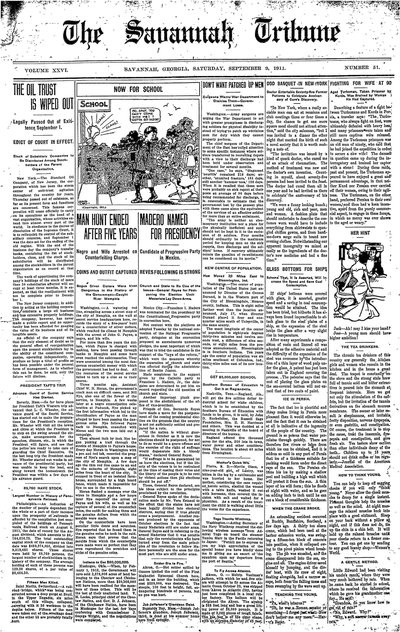
Page text (machine-generated)
VOLUME XXVI.
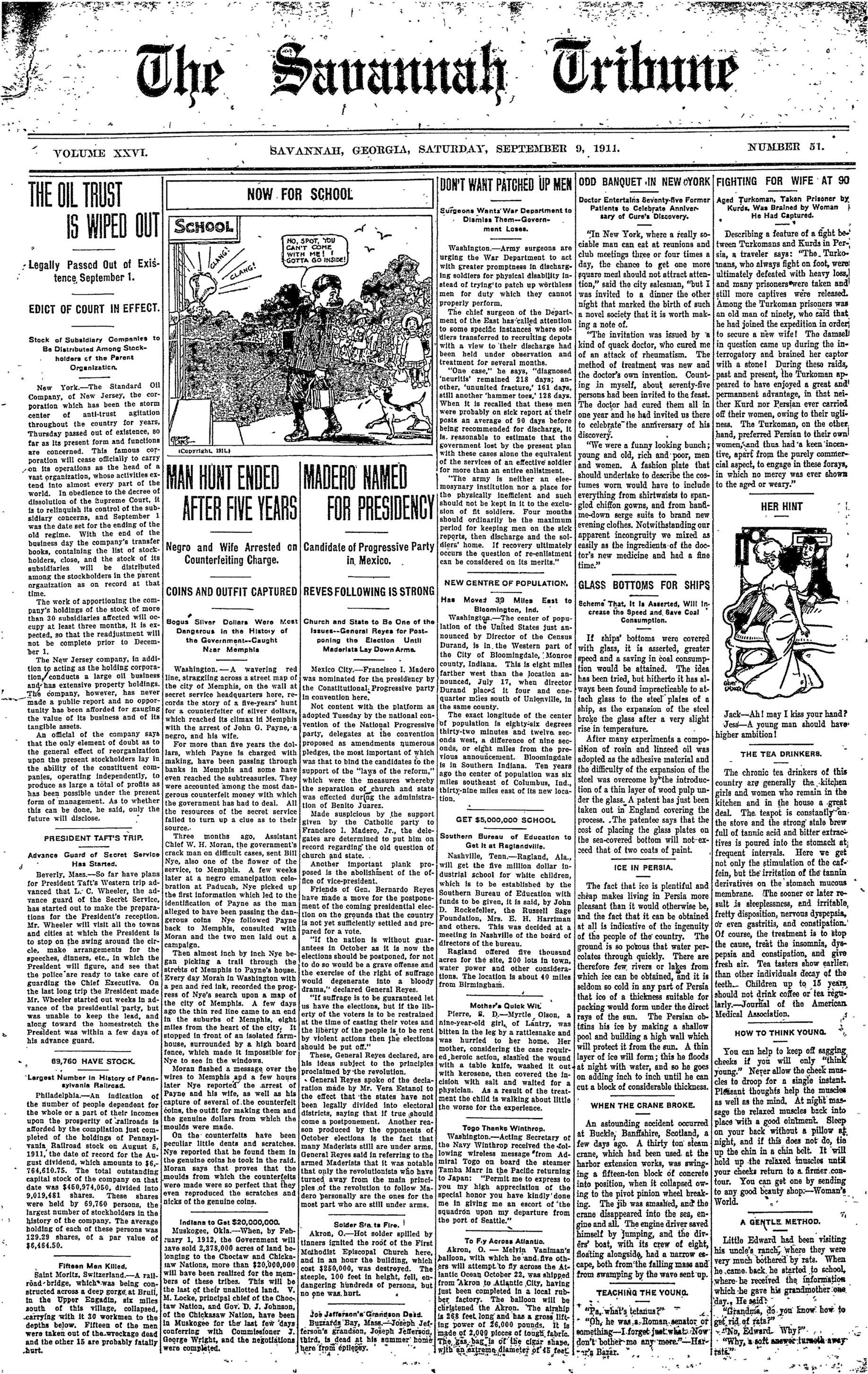
THE OIL TRUST IS WIPED OUT
Legally Passed Out of Existence September 1.
EDICT OF COURT IN EFFECT.
Stock of Subsidiary Companies to Be Distributed Among Stock-holders of the Parent Organization.
New York.—The Standard Oil Company, of New Jersey, the corporation which has been the storm center of anti-trust agitation throughout the country for years, Thursday passed out of existence, so far as its present form and functions are concerned. This famous corporation will cease officially to carry
on its operations as the head of a vast organization, whose activities extend into almost every part of the world. In obedience to the decree of dissolution of the Supreme Court, it is to relinquish its control of the subsidiary concerns, and September 1 was the date set for the ending of the old regime. With the end of the business day the company's transfer books, containing the list of stockholders, close, and the stock of its subsidiaries will be distributed among the stockholders in the parent organization as on record at that time.
The work of apportioning the company's holdings of the stock of more than 30 subsidiaries affected will occupy at least three months, it is expected, so that the readjustment will not be complete prior to December 1.
The New Jersey company, in addition to acting as the holding corporation conducts a large oil business and has extensive property holdings. The company, however, has never made a public report and no opportunity has been afforded for gauging the value of its business and of its tangible assets.
An official of the company says that the only element of doubt as to the general effect of reorganization upon the present stockholders lay in the ability of the constituent companies, operating independently, to produce as large a total of profits as has been possible under the present form of management. As to whether this can be done, he said, only the future will disclose.
PRESIDENT TAFT'S TRIP.
Advance Guard of Secret Service Has Started.
Beverly, Mass.—So far have plans for President Taft's Western trip advanced that L. C. Wheeler, the advance guard of the Secret Service, has started out to make the preparations for the President's reception. Mr. Wheeler will visit all the towns and cities at which the President is to stop on the swing around the circle, make arrangements for the speeches, dinners, etc., in which the President will figure, and see that the police are ready to take care of guarding the Chief Executive. On the last long trip the President made Mr. Wheeler started out weeks in advance of the presidential party, but was unable to keep the lead, and along toward the homestretch the President was within a few days of his advance guard.
89,760 HAVE STOCK
Largest Number in History of Pennsylvania Railroad.
Philadelphia.—An indication of the number of people dependent for the whole or a part of their incomes upon the prosperity of railroads is afforded by the compilation just completed of the holdings of Pennsylvania. Railroad stock on August 5, 1911, the date of record for the August dividend, which amounts to $6,-764,610.75. The total outstanding capital stock of the company on that date was $450,974,050, divided into 9,019,481 shares. These shares were held by 69,760 persons, the largest number of stockholders in the history of the company. The average holding of each of these persons was 129.29 shares, of a par value of $6,464.50.
Fifteen Men Killed.
Saint Moritz, Switzerland.—A railroad bridge, which was being constructed across a deep gorge at Brull, in the Upper Engadin, six miles south of this village, collapsed, carrying with it 30 workmen to the depths below. Fifteen of the men were taken out of the wreckage dead and the other 15 are probably fatally hurt.
SAVANNAH, GEORGIA, SATURDAY, SEPTEMBER 9, 1911.
NOW FOR SCHOOL
SCHOOL
CLANG!
CLANG!
NO, SPOT, YOU CAN'T COME WITH ME! GOTTA GO INSIDE!
MAN HUNT ENDED AFTER FIVE YEARS
Negro and Wife Arrested on Counterfeiting Charge.
COINS AND OUTFIT CAPTURED
Bogus Silver Dollars Were Most Dangerous in the History of the Government--Caught Near Memphis
Washington. — A wavering red line, straggling across a street map of the city of Memphis, on the wall at secret service headquarters here, records the story of a five-years' hunt for a counterfeiter of silver dollars, which reached its climax in Memphis with the arrest of John G. Payne, a negro, and his wife.
For more than five years the dollars, which Payne is charged with making, have been passing through banks in Memphis and some have even reached the subtreasuries. They were accounted among the most dangerous counterfeit money with which the government has had to deal. All the resources of the secret service failed to turn up a clue as to their source.
Three months ago, Assistant Chief W. H. Moran, the government's crack man on difficult cases, sent Bill Nye, also one of the flower of the service, to Memphis. A few weeks later at a negro emancipation celebration at Paducah, Nye picked up the first information which led to the identification of Payne as the man alleged to have been passing the dangerous colns Nye followed Payne back to Memphis, consulted with Moran and the two men laid out a campaign.
Then almost inch by inch Nye began picking a trail through the streets of Memphis to Payne's house. Every day Moran In Washington with a pen and red ink, recorded the progress of Nye's search upon a map of the city of Memphis. A few days ago the thin red line came to an end in the suburbs of Memphis, eight miles from the heart of the city. It stopped in front of an isolated farmhouse, surrounded by a high board fence, which made it impossible for Nye to see in the windows. Moran flashed a message over the wires to Memphis and a few hours later Nye reported the arrest of Payne and his wife, as well as his capture of several of the counterfeit coins, the outfit for making them and the genuine dollars from which the moulds were made.
On the counterfeits have been peculiar little dents and scratches. Nye reported that he found them in the genuine coins he took in the raid. Moran says that proves that the moulds from which the counterfeits were made were so perfect that they even reproduced the scratches and nicks of the genuine coins.
Indiana to Gat $20,000,000.
Muskogee, Okla.—When, by February 1, 1912, the Government will have sold 2,378,000 acres of land belonging to the Choctaw and Chickasaw Nations, more than $20,000,000 will have been realized for the members of these tribes. This will be the last of their unallotted land. V. M. Locke, principal chief of the Choctaw Nation, and Gov. D. J. Johnson, of the Chickasaw Nation, have been in Muskogee for the last few days conferring with Commissioner J. George Wright, and the negotiations were completed.
MADERO NAMED FOR PRESIDENCY
Candidate of Progressive Party in Mexico.
REVES FOLLOWING IS STRONG
Church and State to Be One of the Issues--General Reyes for Postponing the Election Until Maderists Lay Down Arms.
Mexico City.—Francisco I. Madero was nominated for the presidency by the Constitutional, Progressive party in convention here.
Not content with the platform as adopted Tuesday by the national convention of the National Progressive party, delegates at the convention proposed as amendments numerous pledges, the most important of which was that to bind the candidates to the support of the "laws of the reform," which were the measures whereby the separation of church and state was effected during the administration of Benito Juarez. Made suspicious by the support given by the Catholic party to Francisco I. Madero, Jr., the delegates are determined to put him on record regarding the old question of church and state. Another important plank proposed is the abolishment of the office of vice-president.
Friends of Gen. Bernardo Reyes have made a move for the postponement of the coming presidential election on the grounds that the country is not yet sufficiently settled and prepared for a vote.
"If the nation is without guarantees in October as it is now the elections should be postponed, for not to do so would be a grave offense and the exercise of the right of suffrage would degenerate into a bloody drama," declared General Reyes.
"If suffrage is to be guaranteed let us have the elections, but if the liberty of the voters is to be restrained at the time of casting their votes and the liberty of the people is to be rent by violent actions then the elections should be put off."
These, General Reyes declared, are his ideas subject to the principles proclaimed by the revolution.
- General Reyes spoke of the declaration made by Mr. Vera Estanol to the effect that the states have not been legally divided into electoral districts, saying that if true should come a postponement. Another reason produced by the opponents of October elections is the fact that many Maderists still are under arms. General Reyes said in referring to the armed Maderists that it was notable that only the revolutionists who have turned away from the main principles of the revolution to follow Madero personally are the ones for the most part who are still under arms.
Solder Sta te Fire.
Akron, O.—Hot solder spilled by tinners ignited the roof of the First Methodist Episcopal Church here, and in an hour the building, which cost $250,000, was destroyed. The steepe, 100 feet in height, fell, endangering hundreds of persons, but no one was hurt.
Joe Jafferson's Grandson Dead.
Buzzards Bay, Mass.—Joseph Jefferson's grandson, Joseph Jefferson, third, is dead at his summer home here from epilepsy.
DON'T WANT PATCHED UP MEN
Washington.—Army surgeons are urging the War Department to act with greater promptness in discharging soldiers for physical disability instead of trying to patch up worthless men for duty which they cannot properly perform.
The chief surgeon of the Department of the East has called attention to some specific instances where soldiers transferred to recruiting depots with a view to their discharge had been held under observation and treatment for several months.
"One case," he says, "diagnosed 'neuritis' remained 218 days; another, 'ununited fracture,' 161 days, still another 'hammer toes,' 128 days. When it is recalled that these men were probably an sick report at their posts an average of 90 days before being recommended for discharge, it is reasonable to estimate that the government lost by the present plan with these cases alone the equivalent of the services of an effective soldier for more than an entire enlistment.
"The army is neither an eleemosynary institution nor a place for the physically inefficient and such should not be kept in it to the exclusion of fit soldiers. Four months should ordinarily be the maximum period for keeping men on the slick reports, then discharge and the soldiers' home. If recovery ultimately occurs the question of re-enlistment can be considered on its merits."
NEW CENTRE OF POPULATION.
Has Moved 39 Miles East to Bloomington, Ind.
Washington.—The center of population of the United States just announced by Director of the Census Durand, is in the Western part of the City of Bloomingdale, Monroe county, Indiana. This is eight miles farther west than the location announced, July 17, when director Durand placed it four and one-quarter miles south of Unionville, in the same county.
The exact longitude of the center of population is eighty-six degrees thirty-two minutes and twelve seconds west, a difference of nine seconds, or eight miles from the previous announcement. Bloomingdale is in Southern Indiana. Ten years ago the center of population was six miles southeast of Columbus, Ind., thirty-nine miles east of its new location.
GET $5,000,000 SCHOOL
Southern Bureau of Education to Get it at Raglandville.
Nashville, Tenn.—Ragland, Ala., will get the five million dollar industrial school for white children, which is to be established by the Southern Bureau of Education with funds to be given, it is said, by John D. Rockefeller, the Russell Sage Foundation, Mrs. E. H. Harriman and others. This was decided at a meeting in Nashville of the board of directors of the bureau.
Ragland offered five thousand acres for the site, 200 lots in town, water power and other considerations. The location is about 40 miles from Birmingham.
Mother'a Quick Wit
Pierre, S. D.-Myrtle Olson, a nine-year-old girl, of Lantry, was bitten in the leg by a rattlesnake and was hurried to her home. Her mother, considering the case required heric action, slashed the wound with a table knife, washed it out with kerosene, then covered the incision with salt and waited for a physician. As a result of the treatment the child is walking about little the worse for the experience.
Togo Thanks Winthron.
Washington.—Acting Secretary of the Navy Winthrop received the following wireless message from Admiral Togo on board the steamer Tamba Marr in the Pacific returning to Japan: "Permit me to express to you my high appreciation of the special honor you have kindly done me in giving me an escort of 'the squadron upon my departure from the port of Seattle."
To E. F. Across Atlantic
Akron, O. — Melyin Vaniman's balloon, with which he and five others will attempt to fly across the Atlantic Ocean October 22, was shipped from 'Akron to Atlantic City, having just been completed in a local rubber factory. The balloon will be christened the Akron. The airship is 268 feet long and has a gross lifting power of 26,000 pounds. It is made of 2,000 pieces of tough fabric. The gas bag is of the cigar shape, with an extreme diameter of 45 feet
ODD BANQUET IN NEW YORK FIGHTING FOR WIFE AT 90
Doctor Entertainis Seventy-five Former Patients to Celebrate Anniversary of Cure's Discovery.
"In New York, where a really sociable man can eat at reunions and club meetings three or four times a day, the chance to get one more square meal should not attract attention," said the city salesman, "but I was invited to a dinner the other night that marked the birth of such a novel society that it is worth making a note of.
The invitation was issued by a kind of quack doctor, who cured me of an attack of rheumatism. The method of treatment was new and the doctor's own invention. Counting in myself, about seventy-five persons had been invited to the feast. The doctor had cured them all in one year and he had invited us there to celebrate the anniversary of his discovery.
"We were a funny looking bunch; young and old, rich and poor, men and women. A fashion plate that should undertake to describe the costumes worn would have to include everything from shirtwaists to spangled chiffon gowns, and from hand-down serge suits to brand new evening clothes. Notwithstanding our apparent incongruity we mixed as easily as the ingredients of the doctor's new medicine and had a fine time."
GLASS BOTTOMS FOR SHIPS
Scheme That, It Is Asserted, Will Increase the Speed and, Save Coal Consumption.
If ships' bottoms were covered with glass, it is asserted, greater speed and a saving in coal consumption would be attained. The idea has been tried, but hitherto it has always been found impracticable to attach glass to the steel plates of a ship, as the expansion of the steel broke the glass after a very slight rise in temperature.
After many experiments a composition of rosin and linseed oil was adopted as the adhesive material and the difficulty of the expansion of the steel was overcome by the introduction of a thin layer of wood pulp under the glass. A patent has just been taken out in England covering the process. The patentee says that the cost of placing the glass plates on the sea-covered bottom will not exceed that of two coats of paint.
ICE IN PERSIA.
The fact that ice is plentiful and cheap makes living in Persia more pleasant than it would otherwise be, and the fact that it can be obtained at all is indicative of the ingenuity of the people of the country. The ground is so pokous that water percolates through quickly. There are therefore few rivers or lakes from which ice can be obtained, and it is seldom so cold in any part of Persia that ice of a thickness suitable for packing would form under the direct rays of the sun. The Persian obtains his ice by making a shallow pool and building a high wall which will protect it from the sun. A thin layer of ice will form; this he floods at night with water, and so he goes on adding inch to inch until he can cut a block of considerable thickness.
WHEN THE CRANE BROKE.
An astounding accident occurred at Buckie, Banffshire, Scotland, a few days ago. A thirty ton steam crane, which had been used at the harbor extension works, was swinging a fifteen-ton block of concrete into position, when it collapsed owing to the pivot pinion wheel breaking. The jib was smashed, and the crane disappeared into the sea, engine and all. The engine driver saved himself by jumping, and the divers' boat, with its crew of eight, floating alongside, had a narrow escape, both from the falling mass and from swamping by the wave sent up.
TEACHING THE YOUNG.
"Oh, he was a Roman senator or something—I forget just what. Now don't bother me any more."—Harris Bazar.
NUMBER 51.
Aged Turkoman, Taken Prisoner by Kurds, Was Brained by Woman He Had Captured.
Describing a feature of a fight between Turkomans and Kurds in Persia, a traveler says: "The Turkomans, who always fight on foot, were ultimately defeated with heavy loss, and many prisoners were taken and still more captives were released. Among the Turkoman prisoners was an old man of ninety, who said that he had joined the expedition in order to secure a new wife! The damself in question came up during the interrogatory and brained her captor with a stone! During these raids, past and present, the Turkoman appeared to have enjoyed a great and permanent advantage, in that neither Kurd nor Persian ever carried off their women, owing to their ugliness. The Turkoman, on the other hand, preferred Persian to their own women, and thus had a keen incentive, apart from the purely commercial aspect, to engage in these forays, in which no mercy was ever shown to the aged or weary."
HER HINT
Oliver Moore
Jack—Ah! may I kiss your hand?
Jess—A young man should have higher ambition!
THE TEA DRINKERS.
The chronic tea drinkers of this country are generally the kitchen girls and women who remain in the kitchen and in the house a great deal. The teapot is constantly on the stove and the strong stale brew full of tannic acid and bitter extractives is poured into the stomach at frequent intervals. Here we get not only the stimulation of the caffein, but the irritation of the tannin derivatives on the stomach mucous membrane. The sooner or later result is sleeplessness, and irritable, pretty disposition, nervous dyspepsia, or even gastritis, and constipation. Of course, the treatment is to stop the cause, treat the insomnia, dyspepsia and constipation, and give fresh air. Tea tasters show earlier than other individuals decay of the teeth. Children up to 15 years should not drink coffee or tea regularly.—Journal of the American Medical Association.
HOW TO THINK YOUNG.
You can help to keep off sagging cheeks if you will only "think young." Neyer allow the cheek muscles to droop for a single instant. Pleasant thoughts help the muscles as well as the mind. At night massage the relaxed muscles back into place with a good ointment. Sleep on your back without a pillow at night, and if this does not do, tie up the chin in a chin belt. It will hold up the relaxed muscles until your cheeks return to a firmer contour. You can get one by sending to any good beauty shop—Woman's World.
A GENTLE METHOD.
Little Edward had been visiting his uncle's ranch, where they were very much bothered by rats. When he came back he started to school, where he received the information which he gave his grandmother one day. He said:
"Grandma, do you know how to get rid of rata?"
"No, Edward. Why?"
"Why, a soft answer turnsoth awe rata."
The Farm UNCLE SAM IS A BOOSTER. MOISTURE FOR WHEAT.
It cost the government around fifty millions a year to deliver mail to the farmers. The rural route delivery has been in operation about thirteen years, although the first two years or three were largely in the way of an experiment. The first appropriation was $40,000. It is a pretty long jump from this figure to fifty millions but the appropriation will not stop there. It will go on increasing until the entire country is served with its daily mail.
The farmer has profited by the rural service to an extent not generally understood. Aside from the convenience of daily mail delivery, the rural mail service has very largely enhanced the value of all farm properties wherever it goes. Many students of agricultural conditions say that it is one of the most important factors in the rapid and unprecented increase of farm values during the past ten years. It is estimated that the value of farms has increased from 30 to 45 per cent. since 1900, and the greater increase has been in those sections where rural mail routes have been established. The service has also influenced good road building because the government will not deliver mail on roads that are not reasonably well kept.
It is also adding much to the attractiveness to country life because it brings the farmer into daily contact with village life, overcomes the loneliness and monotony of life in the country and by stimulating business activity adds to its profit.
BUYING ALFALFA SEED.
Farmers should take more than ordinary precautions in purchasing alfalfa seed to ascertain what they are getting. Alfalfa seed is subject to adulteration with cheaper seeds closely resembling it, and the greater danger lies in the fact that with the adulterants some noxious weeds may be introduced, which will cause endless trouble and work in the future. It is almost impossible for the average individual to tell the difference between alfalfa, yellow trefoil and sweet and red clover seeds. Alfalfa is frequently adulterated with these seeds by unscrupulous dealers, who, owing to the great demand for the seed, cannot resist the temptation. Good alfalfa seeds are of an obscure greenish or reddish-yellow color, while the defective or immature seeds are usually brown and generally shriveled. The shape varies, but the majority of the seeds are kidney-shaped.—Fruit Belt.
SOW MORE RAPE EVERYWHERE.
You can sow rape most any time during the summer, and get your money's worth. It is a fine-thing to sow in corn as a catch crop as it grows faster than cow-peas, soy-beans, clover or any of the catches.
As pasture it is far superior to cow-peas or soy-beans as it lasts till nearly Christmas in the southern states and in many places all winter.
The seed is cheap. It can be bought for about five cents a pound and two pounds will sow an acre so that you can get $5 or $10 worth of feed from as many cents' worth of seed.
It is pretty certain to make a crop, and then if it is pastured there is no loss of fertility to the soil, but on the contrary it is benefited.
As it grows long after corn and oats is matured it saves the nitrogen that would otherwise be wasted. There is no extra plowing, harrowing or harvesting and you may get a profit of one dollar or ten dollars per acre.
IMPROVING LIVE STOCK.
Too little attention is given to the improvement of our breeds of live stock. The simplest and least expensive method of improving our stock is the grading-up process. This requires only a pure-bred male. Many farmers who are not able to purchase females can afford to own registered sires. Others who are unable to buy such sires can secure the services of such animals at nominal cost.
No farmer who can secure the service of a registered boar for his scrub sows, of a pure-bred stallion and bull for his mares and cows, should fail to take advantage of it. Remember that the male is half the herd when it comes to improving stock. Why continue to raise razorback hogs that weigh 75 pounds at fifteen months when by breeding your sows to a registered Berkshire boar you can raise pigs that weigh 175 pounds at ten months of age?
LIQUID MANURE FOR VINES.
Liquid manure is a wonderful stimulant for growing vines and tomato plants. Fill an old barrel with unfermented horse manure and set it on a platform high enough from the ground so that a pail can be used to catch the liquid. Then pour water on until it begins to drip out of the bottom. Arrange the platform so the drippings will all run to one point. Use these drippings to water the hills and watch the vines grow.
MOISTURE FOR WHEAT.
The controlling factor in the production of wheat is moisture. Western Kansas and the plains country in general produces the best hard winter wheat, because the rainfall in this region is limited. The soil is rich in mineral matter, producing wheat that ripens quickly and makes a strong flour. In Minnesota and the Dakotas similar conditions as to moisture and a shorter summer produce the hard spring wheats used in making flour famous the world over for its high loaf yield and well-flavored bread. The best hard wheat is produced with a limited rainfall, but there are seasons when the supply of moisture is too short.
If either the hard winter or spring wheat belt experienced heavy rainfall for a single season, the character of the wheat would change. It would gain in starch and lose in gluten content. Occasionally there is a season in the hard wheat section in which the rainfall is far above normal while the wheat is filling out resulting in slow ripening. This produces "yellow berry"—a starchy, yellow kernel that reduces the bread producing qualities at the rate of twelve or more one-pound loaves to the barrel—Kansas Farmer.
MILCH GOATS.
Few know that in our large cities there exists an unfilled demand for goat's milk for weak babies not blessed with the supply of food nature intended them to have and for invalids suffering from lingering diseases. This is not a fad. It is founded on a very simple fact, easily understood. The fat globules in goat's milk are smaller than those contained in the milk of other animals. Human milk alone contains smaller fat globules. Naturally the milk containing exceedingly small fat globules is more easily and completely digested than that containing large fat globules. A difference has been found between the different breeds of cows in this respect. A demand for goat's milk based upon so rational a condition and unfilled at 25 cents to 50 cents per quart is not going to grow less and is a good one to cater to.—Farmers and Drovers' Journal.
WHERE THE VALUE OF FERTILIZER SHOWS.
At Rothamsted, England, there is an experiment station that has been carrying on fertility experiments continuously for more than half a century. On a field on which no manure and no plant food has been applied, the average yield of wheat has been 12.9 bushels per acre for more than half a century. Land treated with a heavy annual application of farm manure has produced 35.5 bushels of wheat per acre on an average for 55 years. Another field treated with commercial plant food without organic matter has produced 37.1 bushels of wheat per acre on an average for the same time.—Agricultural Epitomist.
THE PASTURE.
It has been abundantly shown that pastures may be improved cliffer by natural or commercial fertilizers. When the pastures are heavily grazed and the animals fed little or no other food, usually the pastures gradually decline. If, however, the cattail are fed a little concentrated food, especially of a highly nitrogenous character, or if the pastures are topdressed with manures or commercial fertilizers, they steadily grow better. But occasional application of seed, clipping of the weeds, and the harrowing of the field, also contribute to this end—Agricultural Epitomist.
WATER AND SALT FOR CALVES.
Calves, like other farm animals, get thirsty, even though milk forms a large part of their ration. Calves three months of age will drink as much as five quarts of water daily per head. They like to drink often, sipping a little at a time.
A half barrel cleaned and replenished twice daily, will serve nicely as a water trough. Another good device is an automatic waterer which may be easily cleaned, situated a little above the floor to keep out the litter.
Salt is essential to the development of the calf, as of other animals, and should be kept continually available.
FEED CATTLE ONCE A DAY.
Years ago I used to feed my cattle corn twice a day, until one day I ran across Professor Henry's book on "Feeds and Feeding," and there saw the statement that many feeders fed only once a day. I had a set of scales put between two feed yards, and in one yard fed corn once a day and in the other twice. I welighed the cattle in both yards monthly and found practically no difference in gain. So for the last six years I have never fed more than once a day—Capt. W. S. Smith, at Minnesota Live Stock Breeders' Association.
TRUE REFORMERS GET IN TROUBLE
Officer of Order. Charged with Wrecking Bank.
ALL BUT ONE GAVE BAIL IN SUM OF $3,000 EACH—HE GAVE LEG BAIL.
Richmond, Va.—The grand jury indicted "the big five" general officers of the Grand Fountain of the Order of True Reformers, the negro fraternal order, for alleged complicity in the looting and wrecking of the True Reformers' bank.
The officers indicted are W. L. Taylor, grand master; Edward L. Ellis, Jr., vice-grand master; W. P. Burrell, grand secretary; J. C. Robertson, general attorney, and Reuben T. Hill, cashier of the True Reformers bank, who is now a fugitive under indictment for grand larceny of indefinite sums. The grand jury estimates the amount of shortage at $290,000. The membership of the Order of True Reformers is spread over 28 states.
All of the indicted men, except Hill, the fugitive from justice, were bailed in the sum of $3,000 each for their appearance for trial.
THEY SAT IN SHADY SEATS.
All the shady seats in Union square were taken, says the New York World. There were plenty of vacant ones in the sun, but it was a scorching hot day. A young man and girl strolled into the park from Broadway and, finding no place to rest, obtained by strategem what they could not get by fair means.
Standing near enough to the sitter to be heard, the young man remarked: "It's pretty nearly time he passed over."
"Who?" innocently asked the girl, not seeing what he was getting at.
"Why, Wilbur Wright. He's going to circle the Metropolitan tower today. Starts from Garden City. It's five minutes to one now; let's go see him. He's to be there at one."
The report that one of the Wrights was to do an open-air stunt spread rapidly, and as the Metropolitan tower could not be seen from the choice spot in which the youth had elected to sit, more than half of those occupying the benches started off. Two of the coolest, shadiest seats were then selected by the youth, and he and his companion sat down.
HIS REASON.
A well known temperance lecturer often makes use of the following illustration:
"I can perhaps sympathize," he says, "with the real connosseur of wines, with him who slips slowly, with proper enjoyment of the bouquet and the flavor, a small glass of vintage Bordeaux, champagne or Bourgogne. But after all, few men drink like that.
"Most men drink like the Chinaman who explained, as he bought a quart of fiery, execrable, cheap whisky:
"Me nc drinkee for drinkee; me drinkee for drunkee."—Detroit Free Press.
NOT OF THAT PROFESSION.
George L. Shronk, one of Atlantic City's champion lifeguards, was discussing his profession.
"Funny things happen to us guards sometimes," said Mr. Shronk. "A funny thing happened to my friend Tim last week.
"A society belle from Spruce street went in the water wearing one of those fashionable wigs. A big wave went over her, and when she came up the wig was floating out to sea. She turned and ran to Tim.
"Oh, save my hair!" she yelled. 'Save my hair!'
"Pardon me, lady,' says Tim. 'I'm a life-saver, not a hair restorer.'"
DIFFERENCE OF OPINION.
The professor of law was quizzing his class. Singling out a somnolent student in the rear of the room, he addressed a question to him. Confused, the student rose, and bent his ear to catch the stage whispers of his friends seated about him.
"Well, you ought to be able to answer," snapped the professor, "with all the aid you are receiving back there!"
"Professor," came the quick reply, "I could, but there's a difference of opinion back here."—"Everybody's."
OH. THE CHUMP.
They were sitting in the park in the dusk of the evening.
"I'm so chilly, Algernon," she murmured. "Won't you please put something around me?
"Certainly, dear," he replied. "What would you like to have me put around you?"
"Oh anything—"
So he went and borrowed a shawl and put it around her. Wasn't he the original bonshead?
A COLD DAY.
Mrs. De Silke-I wish to give a memorial of some kind to the church, in memory of a relative. What would you suggest?
Struggling Pusfor-A-er-an ap propriately decorated-er-new church furnace, madam, and a-a few toms of coal.
MONEY-RAISED-FOR MISSIONS
$3,286.58 COLLECTED AT CLOSE OF
MISSIONARY · CONGRESS OF
FIFTH EPISCOPAL DISTRICT C.
M. E. CHURCH—BIHOP PHILLIPS PRESIDES — GOVERNOR WILSON PRESIDES.
Louisville, Ky.—At the close of the missionary congress of the Fifth Episcopal district of the C. M. E. church, which was held in the Chestnut C. M. E. church here, presided over by Bishop C. H. Phillips of -Nashville, Tenn., announcement was made that $3,286.58 had been raided for the cause of missions.
One of the principal speakers during the convention was Gov. A. E. Willson. Bishop G. W. Stewart of Alabama, one of the new bishops of the C. M. E. church, preached to a large audience Sunday morning. Other speakers during the congress were Dr. J. H. Young and Doctor Selgler, both of the M. E. Church South; Drs. I. G. Jordon, C. H. Parrish, Miss Nannie E. Burroughs, Drs. J. C. Anderson, E. G. Harris and others.
Leading churchmen of all denominations here, who are recognized authorities on such matters, say that the missionary spirit among the membership of the C. M. E. church has been greatly cultivated and developed as well as its social and intellectual improvement encouraged.
Rev. T. H. Copeland, presiding elder of the Louisville district, raised more money than any other presiding elder in the Fifth Episcopal district, and was crowned by Biahop Phillips the "money king" of the district. Rev. J. H. Britt, presiding elder of the Hopkinsville district, was awarded the souvenir for having brought the largest delegation to the congress, and Rev.J. L. Thompson, Indianapolis, was among the pastors who led the ministers of their respective presiding elder districts.
HAYTIANS ARRIVE WITH GOLD
SON OF DEPOSED PRESIDENT AND COMPANIONS ARRIVE IN NEW YORK WITH VALISES FILLED WITH GOLD—GENERAL LEGONTE PROCLAIMED PRESIDENT.
New York—Gen. Antonio Simon, son of the deposed president of Hayti; Gen. Antoine Pierre-Paul, who was private secretary to the ex-president, and Gens. Ferdinand Petton and Emile Presson arrived in New York from Hayti on the Hamburg-American steamship Allemania. They carried valises filled with gold coin said to be worth $60,000. The Haytlans are on their way to France.
Young Simon did not appear to be much concerned upon being informed that General Leconte had been proclaimed president of Haytl, and refused to speak on the subject. After the Allemania docked Simon and his friends,carried the gold away in grips and made for a safe deposit vault.
WHAT THEY GET.
These kids I teach aren't a bit slow," observed a school teacher the other day. "In fact, I'm afraid they read the papers. The other-day I proposed the following problem to my arithmetic class:
"A rich man dies and leaves $1,000,000. One-fifth is to go to his wife, one-fifth to his son, one-seventh to his daughter, one-eighth to his brother and the rest to foreign missions. What does each get!"
"A lawyer," said the littlest boy in the class promptly."—Case and Comment.
BIG DOGS IN DEMAND.
Country Cousin—Little dogs have gone out of fashion, haven't they?
Mrs. De Style—No, indeed. They are more popular than ever.
"But I notice that you are all getting big dogs."
"Yes, we have to have big dogs to keep people from stealing the little dogs."
ORDERS TO MARY.
A college professor noted for strict discipline-entered the classroom one day and noticed a girl student sitting with her feet in the aisle and chewing gum.
"Mary," exclaimed the indignant professor, "take that gum out of your mouth and put your feet in."—Everybody's Magazine.
NOT ENOUGH TO HURT.
First Boarder—I wonder what makes this strawberry shortcake so heavy?
Second Boarder—Don't know, but it isn't the weight of the strawberries on top, anyhow.
DANTE NEVER SAW IT.
Jinks—I don't believe Dante's description of the Inferno is correct. Winks—Why not? Jinks—Not one of the shades said to any other shade: "Is it hot enough for you?"
AT THE SEASIDE
Heroic Girl—What has become of that handsome man who cheered so loudly when I rescued the little boy from drowning?
Friend—He is over there on the vananda, proposing to the girl who screamed and faliated.
AN EDITORIAL FROM THE NEW YORK SUN.
The American minister at Port-au-Prince, Hon. Henry W. Furnill, notified the state department Saturday that the diplomatic corps had failed in its efforts to mediate between the revolutionary factions and that a conflict seemed to be inevitable. Mr. Furnill ought to know the signs of Impending readjustment in HaytI by this time; he marked the decline and collapse of the rule of the aged Nord Alexis and witnessed the triumphal entry of Gen. Antoline Simon into the capital at the head of a tattered demalion army on December 2, 1909. As a military man and former secretary of war the general brushed aside the claims to the presidency of M. Fouchard, who had been a mere secretary of the treasury, convened the congress and had himself elected president for a full term.
The present situation bears some resemblance to the emergency of 1908; that is to say, another military man is in possession of Port-au-Prince, Gen. Cincinnatus Leconte, who was driven into exile by Nord Alexis in 1902; but this time the victorious soldier will have to reckon with an aspirant of a different type from Fouchard, the man of budgets. Gen. Anterior Firmin is not only a chronic candidate for the presidency, but a man of parts and audacity with a long official record. He has been minister to France, secretary of exterior relations; that is, head of the state department, and also secretary of the treasury, under previous administrations. Firmin first distinguished himself as a member of President Hyppolite's cabinet in what was called the Mole St. Nicholas affair, during President Harrison's administration. On that occasion the Haytians were greatly excited about a proposal to let the United States have the place for a naval station, and M. Firmin dramatically invoked the constitution, which forbids the alienation of any part of the national territory. When Gen. Tireslas Simon Sam was driven from the presidency, in 1902, M. Firmin, who was minister to France, became a candidate, with headquarters in his native town, Cape Haytien, and was forthwith known as General Firmin. There were the usual blood-letting and disorder. Gen. Nord Alexis, then secretary of war, was dispatched to Cape Haytien to put down the insurrection. About that time Admiral Killick, the Scotsman who had espoused Firmin's cause and as commander of the gunboat Crete-a-Pierrot was the head of the navy, had the temerity to szeze the German steamship Markomania with arms and ammunition consigned to Gen. Nord Alexis. Killick perished in an explosion of the Crete-a-Pierrot magazine after he had refused to surrender the gunboat to the German man-of-war Panther. The tragic death of Killick and the loss of the consignment of war material settled Firmin's pretensions and he fled to the island of Inagua as Nord Alexis was advancing on Cape Haytien. General Firmin was a candidate for the presidency again when Nord Alexis suffered the fate of Tireslas Simon Sam, with greater ignominy, however, Fouchard received a post under Antoine Simon's government, but. Firmin wisely concluded to remain in exile at St. Thomas when General Simon occupied Port-au-Prince in force.
According to a dispatch from San Juan, Porto Rico, General Firmin has saluted from Cape Hayden on a French steamship with designs on the presidency. There is probably no Haytian better equipped for its duties, and he has a respectable following in the republic. It is said that General Firmin received assurances that Leconte would not oppose him, but the Haytian politicians are notoriously treacherous. The man at the head of a so-called army in Port-au-Prince is too strong as a ruler to be dislodged and has seldom resisted the temptation to make himself president.
Doubliess General Firmin upon his arrival at Cape Haytian will begin his campaign in the usual way by drumming up an army and preparing to march upon the capital, where his adherents, according to Mr. Furniss, are already numerous and active. The administration at Washington will have to await developments. Three years ago General Simon was promptly recognized as president when he was seen to be in full control of the situation. He had no dangerous rival, and was a man not to, be trifled with. The troops were ready to do his bidding. General Leconte is an unknown quantity. He was quickly suppressed and driven into exile by old Nord Alexis, but President Simon has had a different experience with him. It may be presumed that the administration will not stand marcy, in the Haytian capital. If rivals for the presidency cannot compose their differences it may become necessary to land marines and keep the peace. A squadron of five warships has been assembled in Haytian waters, a fact that indicates the policy of Washington. It is obvious that while the United States has not yet followed the example of Great Britain and Germany, which have sent troops ashore to protect the interests of their subjects, vigorous measures will be taken to police Port-au-Prince if the emergency arises.
THE REASON.
Book Salesman—That man always buys two copies of a book.
Customer—Why so?
Book Salesman—He's no cross eyed that he has to hold one book in each hand when he reads.
POETRY
of and by Our People
You sail and seek for the Fortunate Isles,
The old Greek Isles of the yellowbird's song?
They were straight on through the watery miles,
On straight on, straight on, and you can't go wrong.
Nay, not to the left; nay, not to the right,
But on, straight on, and the Isles are in sight.
The Fortunate Isles where the yellowbirds sing,
And life lies girt with a golden ring.
These Fortunate Isles they are not so far,
The life within reach of the lowliest door;
You can see them gleam by the twilight start;
You can hear them sing by the moon's white shore.
Nay, never look back! Those leveled gravestones
They were landing steps! they were steps unto thrones
Of glory for souls that have sailed before,
And have set white feet on the fortunate shores.
And what are the names of the Fortunate Isles?
Why, Duty and Love and a large content.
Lo! these are the Isles of the watery miles,
The God let down the firmament.
Lo, Duty and Love, and a true man's Trust;
Your forehead to God, though your feet in the dust;
Lo, Duty and Love, and a sweet face's smiles,
And these, O friend, are the Fortunate Isles.
MAY GARDEN.
There is a garden of my heart,
Where blooms the flowers of song;
At eventide, the world apart,
I walk my buds among;
Within the deepening dark of night,
Flames forth the rose's red love-light.
The lily, on her slender stem,
Bends in the gentle breeze,
Careased by waft of trailing hem
My vision never sees.
The flimy fringe of robe of day
Gilding into the far away.
When all my little urs of gold
Are brimmed with wells of sleep.
And shadowed bowls of verdure hold
The draught the moon rays steep.
I lie where nods, by murmuring streams,
My poppy from the Isle of Dreams.
—Samuel Abbott, in Boston Transcript.
TRANQUIL HABIT.
Dear tranquil Habit, with her silent hands,
Doth heal our deepest wounds from day to day
With tooling, soothing oil, and firmly lay
Around the broken heart her gentle hands.
Her nursing is as calm as nature's care;
She doth not weep with us; yet none the less
Her quiet fingers weave forgetfulness—
We fall asleep in peace when she is there.
Upon the mirror of her mind her breath is like a cloud to hide the fading trace,
Of that dear smile, of that remembered face.
Whose presence were the joy and pang of death.
And he who clings to sorrow overmuch,
Weeping for withered grief, has cause to bless
More than all cries of pity and distress—
Dear tranquil Habit, thy consoling touch!
-Auguste Angellier, translation by Henry van Dyke, in Scribner's Magazine.
8LUMBER SONG.
Sleep, little one! The Twilight folds her
gloom
Full tenderly about the slumbering Day.
And all his gilded hours of light and
bloom
Like toys are laid away
Sleep! sleep! The noon sky's cloud of white
Has deepened wide o'er the starry plain.
And, trailing through the leaves, the skirts of Night
Are wet with driving rain.
But rest thou sweetly, smiling in thy sleep.
With round fists tossed like roses o'er thy head.
And thy glad lips and eyelids kissed with gleams.
Of rapture perfected.
-James Whitcomb Riley.
THE PAST.
Still shall the soul around it call
The shadows which it gathered here,
And painted on the eternal wall
The past shall reappear.
Think ye the notes of holy song
On Milton's tuneful ear have didd?
Think ye that Raphael's angel throng
Has vanished from his side?
Oh, no! We live our life again.
Or warmly touched or coldly dim
The pictures of the past remain
Man's work shall follow him!
—Whittier.
THE ROAD OF LOVE.
Yes, I have loved you long and loved you well—
Yet there are deeps untouched and heavens scaled;
More yet lies hidden than has been revealed.
And there are songs to sing and tales to tell.
Love's incompleteness is its richest toll,
Love's imperfection its most perfect trait,
'Tis easy running to the hounds of hate.
But love's road is the long, long road of toll.
—Louise Morgan, in Sun and Shade.
The Inventor—I have invented a camera that makes people prettier than they really are.
The Capitalist—How is it done?
The Inventor—By simply making the lens Satter.
---
---
Bear ye one another's burdens.—Galatians, 6:2.
"Man is born to trouble as the sparks fly upward." These troubles may largely be imaginary, of our own making, greater in anticipation than in realization, but they are very real to the man called upon to bear them. Sin with its consequent shame and remorse, sickness with its resultant pain and bereavement, poverty with its accompanying anxiety and want, all verify the statement that in this world we do and shall have tribulation.
If this is so, why then does St. Paul say to men and women, crushed by sorrow, staggering beneath burdens, beset by trials and tribulations, "bear ye one another's burdens?" If the back is not broad enough for its own burden, the shoulders strong enough for their own cross, why command the humanly impossible? Because St. Paul says "it is the law of Christ." And it is not a law of precept, but of example—not a mere theory, but a life lived. Not as the law given on Sinai, which was never kept, but an example given in the quietness and self-sacrifice of his daily life. His ministry of three years, the sorrows he bore, the sickness he carried, the nights spent in prayer, all entitle him to enjoin upon his followers the duty of bearing, as he did, the burdens of others. St. Peter says that he left men this example that they should walk "in his steps." The discipline, inspired by that life, should strive to be "as his Master."
Nor does his example allow men to limit, as would be easier, this burden-bearing to assisting our own, to ministering to those we love. He came, it is true, to "his own." He was sent to the "lost sheep of the house of Israel," but the Syro-Phoenician woman, the Samaritan who was a leper, the Gadarene demonlac and others who were not of "that fold" had their burdens borne, their sicknesses carried. Whosoever has a burden and needs assistance in carrying it is a brother to the man who has the strength, the means, to assist. Parents, children, friends, can plead these earthly tiles and ask for "love's sweet sake," but the poor, the destitute, the stranger, can only ask "for Christ's sake." We must provide for our own, care for those of the same household of faith—to neglect doing so would mark us as "worse than infidels"—but to neglect any of Christ's little ones, or the sin-sick and sorrow-worn, proves that we have not partaken of his spirit, have failed to catch the significance of that life. The poor we have always with us. Those who are carrying burdens are ever in our midst. The opportunity for bearing the burdens of others is only limited by man's willingness. The helping hand, the kindly greeting, the word of sympathy, the note of warning, are all needed, and those who withhold them scarcely know the measure of good they might have done, while those who freely give can never fully realize the help, peace and joy they bring into lives which but for this attempt at burden-bearing might become
NO TIME TO CHOP WOOD.
A traveling salesman in a southern town came to a small pond. An old negro was looling contentedly in the sun, with fishing rod in hand. The salesman paused and watched the fishing. After watching for half an hour without seeing the least sign of a bite, he asked how the fish were bliting. The fisher looked surprised. "Why, boss," he exclaimed, "dere ain't no fish in dis yere pond. Dere never was a fish in it."
"Well, what do you fish for?" the salesman wanted to know.
"So's my old woman can see dat I ain't got no time to chop wood for de fire," the negro answered.—Newark Star.
INTELLIGENCE NEEDED.
James Hamilton Lewis, attorney-at-law and demonstrator of pink whiskers as successful facial adornments, became annoyed by the continual questioning of a newspaper reporter who wanted to find out something new about a case in which Lewis was interested.
"Why," exclaimed Lewis, curtly, "you evidently know more about this case than I do! You apparently have more sense than I have."
"I have to," responded the reporter, "in order to hold my job."
This amused Lewis so much that he gave the newspaper man all the information he wanted.—Popular Magazine.
THE KIND OLD MAN.
George Bancroft, the historian, used to relate with gusto a joke that he caught while trotting to school along a Massachusetts country road. It was about old Levi Lincoln, says Percy H. Epler in "Master Minds at the Commonwealth's Heart."
"The old gentleman was nearly blind. A flock of geese was being driven gobbling up Lincoln street. Leaning far out of the carriage the fine old aristocrat, thinking they were children, threw out a handful of pennies, graciously exclaiming:
"God bless you, my children!"—Youth's Companion.
crushed and hardened. Brighter would this world be, happier would-countless lives be, if each one of us would only resolve to walk daily "in his steps" and bear one another's burdens.
Summer, with its heated terms, its sickness and weariness, gives us numberless ways of brightening the lives of the poor, the sick and helpless. The Fresh Air society, the Christ Child society, the Federated Charities with its appeal for pure milk for the young, for ice and diet for the sick, afford opportunity to minister to Christ's sick and little ones—to bear the burdens of others in a way that should appeal most strongly. Thousands of Baltimoreans are today enjoying the ocean's breezes, or bracing mountain air, partaking of a wholesome and nourishing food—how many of them when planning for their own enjoyment have given a thought to the poor and suffering who cannot leave the heated city? Bear ye one another's burdens! We are all God's children, and if it may be that having blessed us with a fair share of this world's goods he looks to us to use them in bearing the burdens of others less fortunate.
But in this burden-bearing we observe the workings of the law of compensation. In sharing the sorrows of others our own are lightened. In bearing the burdens of others we find strength to carry our own. Death invades the home. The only child is taken. The strong heart of the father is well-nigh crushed. The mother's grief is no less keen, her-heart is also pierced. But her ready instinct tells her she must bear her own burden and help her husband bear her. She tries to be brave and appear resigned. Her end is gained. Her bravery and courage strengthen that other heart. In bearing his burden she has found strength to bear her own. The little child is taken and the home is desolate. The cot in the children's hospital is endowed, the love and affection is poured out upon some motherless child, the sick and helpless little ones are cared for and their lives made brighter for the sake of the one who has been taken—do not all these leave a blessing behind? Man is so constituted that in ministering to others he finds the comfort, the sympathy, the strength given, returning into his own bosom—good measure, pressed down, shaken together and running over.
The lamp which has no oil in it can give forth no light. The man who has no strength can bear no burden. Unless a man has found strength in God he cannot help others. Into every life there comes a time when we would give all we possess to be able to say the right thing, to impart the needed advice or sympathy. The father knows not when his son will come to him for strength and comfort—it may be to save him from ruin and disgrace. The daughter turns to the mother for help and advice, for strength in some crisis in life. What can that father or mother do if they have never turned to the Father above? Can the man who has never returned to the Father lead another to him? We can only comfort others with that comfort wherewith we ourselves have been comforted. This, then, is the secret of those self-sacrificing lives which bring peace and comfort into so many homes; they have cast all their cares upon him, and in that strength and "in his name" are able to bear the burdens of others.
ATTACKS WEAKEST END FIRST.
A new story of the late Senator Thomas Platt was told at the capitol one afternoon.
One day after the senator's legs became partially paralyzed and almost useless he was creeping through the Marble room, leaning heavily on the arm of an assistant.
A young native was showing the sights to a party of visiting friends. Spying Mr. Platt he excitedly announced:
"That is Senator Platt of New York. He is dying from his legs up."
Mr. Platt overheard the remark. Turning angrily he said:
"Young man, you seem to be dying from the head Down."—Washington Correspondence New York World.
LONG-DISTANCE COURTSHIP.
A lady was one day approached by her Scotch maid with the information that she was about to leave. "What is the cause of this sudden decision, Mary?" "I think I'll be a-marryin." "Indeed; and whom, may I ask?" "The mon that slits across in the kirk o' Sundays."
"But what is his name?"
"I dinna kin."
"What! You're surely not engaged to a man whose name you do not know?"
"Not engaged, my lady, but he's been lang lookin' at me an' I think he'll soon be speakin'."—Housekeeper,
LOST TIME.
The late Sylvanus Miller, civil engineer, who was engaged in railroad enterprise in Central America, was seeking local support for a road and attempted to give the matter point. He asked a native:
"How long does it take you to carry your goods to market by muleback?"
"Three days," was the reply.
"There's the point," said Miller. "With our road in operation you could take your goods to market and be back home in one day."
"Very good, senor," answered the native. "But what would we do with the other two days?"
It is with a view of elevating the popular taste, and etherealizing, so to speak, the manners and customs of our readers, that we give below a few hints upon table tiquette.
If by writing an article of this kinu we can induce one man who now wipes his hands on the tablecloth to come up and take higher ground, and wipe them on his coat, we shall feel amply repaid.
If you cannot accept an invitation to dinner, do not write your regrets on the back of a pool check with a blue pencil. This is now regarded as vulgar. A sufficient note to your host informing him that your washerwoman refuses to relent is sufficient.
On seating yourself at the table, draw off your gloves, and put them in your napkin. Do not put them in the gravy, as it would ruin the gloves and cast a gloom over the gravy. If you have just cleaned your gloves with benzine, you might leave them out in the front yard.
If you happen to drop gravy on your knife blade, back near the handle, do not run the blade down your throat to remove the gravy, as it might injure your epigolotis, and it is not considered embonpoint, anyway.
When you are at dinner, do not take up a raw oyster on your fork and playfully ask your host if it is dead Remarks about death at dinner are in very poor taste.
Pears should be held by the stems and peeled gently but firmly, not as though you were skinning a dead horse. It is not bon ton.
Stones in cherries or other fruit should not be placed upon the table-cloth, but slid quietly and unostentationally into the pocket of your neighbor or noiselessly tossed under the table.
If you strike a worm in your fruit, do not call attention to it by mashing it with the nut cracker. This is not only uncouth, but it is regarded in the best society as blase and exceedingly vice versa.
Macaroni should be cut into short pieces and eaten with an even, graceful motion, not absorbed by the yard.
In drinking wine, when you get to the bottom of the glass do not throw your head back and draw in your breath like the exhaust of a bathtub in order to get the last drop, as it engenders a feeling of the most depressing melancholy among the guests.
After eating a considerable amount, do not rise and unbuckle your vest strap in order to get more room, as it is exceedingly au fait and dishabille.
If by mistake you drink out of your finger bowl, laugh heartily and make some facetious remark, which will change the course of conversation, and renew the friendly feeling among the members of the party.
Ladies should take but one glass of wine at dinner. Otherwise there might be difficulty in steering the male portion of the procession home.
Do not make remarks about the amount your companion has eaten. If the lady who is your company at table, whither she be your wife or the wife of some one else, should eat quite heartily, do not offer to pay your host for his loss, or say to her: "Great Scott! I hope you will not kill yourself because you have the opportunity," but be polite and gentlemanly, even though the food supply be cut off for a week.
If one of the gentlemen should drop a raw oyster into his bosom, and he should have trouble in fishing it out, do not make facetious remarks about it, but assist him to find it, laughing heartily all the time.—Exchange.
A WAY TO FREE STORAGE.
Young men with meager salaries evolve financial makeshifts abhorrent to the moral and financial sensibilities of their opulent elders, according to the New York Times. Said one young sprig of boarding house gentility to another, who expected to seek new quarters upon his return from a two months' trip on the road:
"What are you going to do with all this personal truck that is cluttering up your room? It will cost you anyhow a dollar a month for storage." "Not the way I am working things," said the man who was going away. "I have purposely refrained from paying board for four weeks and the landlady will hold my stuff. Of course I shall square up when I come back and get it again, and in the meantime she will give it free storage."
FIRST AID FOR A POET.
John P. Irish, the San Francisco orator and officeholder was entertaining Joaquin Miller, the poet, one night. Upon hearing a particularly funny story by the host the poet fell off his chair in a paroxysm of mirth.
Irish thought the poet had a seizure of some kind and he rushed to the sideboard, took a bottle of brandy and stuck the top of it into Miller's mouth, hoping to revive him.
"What is it?" asked Irish solicitously.
"Remove the cork!" whispered the poet hoarsely. "Remove the cork!"—Saturday Evening Post.
MAKING IT LEGAL.
"We didn't know what to do about Plute Pete," said the Crimson Gulch citizen. "He was a real good feller, but he would be careless about shootin' unplease populace."
"Did you straighten out the matter?"
"To some extent. We elected him sheriff, thereby makin' it look a little more legal."—Washington Star.
SEE COOPER & ODREZIN
218 West Broad Street, Between Hull and Oglethorpe Ave.
The latest patterns in Summer Goods. First-class workmanship guaranteed. Our prices will interest you.
GAREY'S Variety Bakery.
Goods delivered promptly to any part of the city.
506 West Broad Street, Near Gaston.
Phone 1869-J.
Johnson Undertaking Establishment
COMBINE D WITH
The Royal Undertaking Company
(Incorporated.)
Funeral Directors and Embalmers
Finest line of Coffins, Caskets and Robes. White and black funeral cars. Office and warerooms 325-231 Jefferson street.
W. R. FIELDS, Manager.
Residence Phone 2032. Livery Stable Attached. Office Phone 049
J. H. ULMER,'Residence Phone 3064.
Pilgrim Health and
The Oldest, Strongest and Most Reliable Company in the State. Gives employment to hundreds of men and women of our race. Pays from $1 to $10 weekly sick and accident benefits and from $10 to $100 death benefits. Our Motto: "Promptness, Honesty and Justice."
234 ST. JULIAN ST., WEST, 235 BRYAN ST., WEST. Phone 2962.
SAVANNAH, GEORGIA
1143 Gwinnett St. Augusta, Ga.
For further information write 509
West Broad St. Savannah, Ga.
J. S. Perry, Supt.
Advertise in this Paper. It Will Pay You. Now is the Time to Do It.
A. B. Singfield, Gen. Supt.
C. T. Walker, D. D., LL. D.
Director and General Lecturer.
Booker T. Washington's Coming to the City
Coming to the City to address the citizens of Savannah upon some live and up-to-date subject, would certainly mean a deal to both races. But the coming to your bedside in the time of sickness, accident or death of the pay envelope of the
Palm Shaving Palace
Union Mutual Association would certainly mean more to you as an individual or family. Therefore, be wise and take a policy today if you haven't one, against the day of adversity, about the coming of which there can be no doubt. Be sure to see a UNION MUTUAL AGENT TODAY and get protection that protects, or phone the local manager,
Expert Hair Cutting, Electric Massage and Shampooing a Specialty. All Work Done by Experienced Workmen. Courteous attention to all. SHINING PARLOR ATTACHED.
PERRY R. WRIGHT, Proprietor
If you hesitate to wear Shoes that have been repaired, you don't know our kind of repairing. We do everything needed to footwear in first class condition—rebutton, straighten, or alter heels, saw up rips, repair breaks, put on rubber heels or soles. See us before going elsewhere.
WILLIAM DRISKELL, Secretary and General Manager, 210 Auburn avenue, Atlanta, Ga.
J. H. WASHINGTON,
CHICKENS DUCKS TURKEYS
Wholesale and retail dealer in Live and Dressed Poultry. Game in Season. Special attention given to picnic orders. All orders delivered free
POPULAR PRICED
SHOES
NICHOLS
THE SHOE MAN
20 W. Broughton Street
of charge.
Stall 12 City Market.
Phone 2733.
UNION
Laundry Co.
1218 West Broad Street
ONLY COLORED LAUNDRY IN
CITY. WORK CALLED FOR
AND DELIVERED.
Atlanta University
MYERS & RUSSEL, Props. The honor of your presence is requested at the
An Unsectarian Christian Institution. High School, Normal School and College. Superior advantages in Industrial Training, Music and Printing. Home Life Training. For catalog and information address PRESIDENT EDWARD T. WARE.
Auditorium Cafe
Ice cream made of pure cream. Pure fruit flavoring. Come and make your headquarters with us when in Beaufort this summer. "Get the Auditorium habit." ALEXANDER MEYERS, Proprietor, Beaufort. S. C.
Woodlawn Park Lots
Masonic Books &
The Highest Price Lots at Woodlawn Park are Only $150.00 and they 50x400
Regallas.
LODGE SEALS,
FINANCIAL CARDS and
BLANKS of every description.
Publisher and Manufacturer's Press
Liberal Discounts Will Be Arranged.
BOL. O. JOHNSON,
Gevannah, Ga.
Who is the man for Cleaning and
Pressing?
BAKER'S PRESSING CLUB
They have concrete sidewalks and are directly on car lines. Consider how important that transportation feature is. Some excellent LOTS LEFT. You pay
$5.00 Cash and $5.00 Per Month
See me quickly and get a choice location
Men's Suits Preased 40c; Parts 15c;
Wen's Suits Secured $1. Ladies' work
specialty. Give us a trial.
Remittance must be made by Express or Post Office Money Order, or Registered Letter. Advertising rates given on application.
Entered at the Post Office'at Savannah, Ga., as Second-Class mail matter.
With an Atlanta date line, the press dispatches during the week contained the information that hereafter the Taft clubs will manage Republican affairs in Georgia, thus displacing the regular organization. This is intended for startling news, but it really will not startle. It may startle the promoters as soon as the Republican State organization gets in action. The staunch Republicans of Georgia will not stand for any interference from the lily white Taft clubs, and if the least attempt be made to carry out the idea of the press dispatches there will be lively times next year. Lily whiteism has no place in the Republican party, and the sooner these Democrats who are Republicans for the sake of office find this out the better it will be for the best interest everywhere.
We highly endorse the stand taken by the Wisconsin Weekly Defender, that it is an insult to any congregation for an ignoramus to occupy the pulpit. We are not acquainted with the Professor Swain spoken of in the following article but what is said in the article about him applies equally It all others in the same category, it behooves reputable pastors to be especially careful as to the men that, they permit to fill their pulpits. They should know something of the character and ability of these men before allowing them to speak before their congregations. The following is the editorial of which we have made mention:
The Defender is going to begin war on those jack leg and tramp preachers. They must either live right or get out of Milwaukee. The good man need not fear. They are not only a disgrace but they are a set back to the race. Take warning.
A man who calls himself Prof. Swain of Georgia and who advertises himself as a preacher and revivalist, occupied the pulpit of St. Mark's church Wednesday and Thursday evening of last week. His remarks and his preaching were simply disgusting to say the least, and an insult to any intelligent congregation. How any man can have the nerve to travel around the country and hand out such dope is something the Defender is unable to understand. It is simply a case of ignorance—a travesty on the ministry. Let us not have any more of that Prof. Swain affair in Milwaukee.
It is ever a source of much pleasure to us and a credit to the race when Negroes, either in small or large gatherings, deport themselves becomingly and we feel that the Knights of Pythias who recently convened in Indianapolis deserve much praise for the admirable way in which they demeaned themselves. As an evidence of the creditable showing and fine impression they made we present the following taken from the editorial page of the Indianapolis Star:
The Colored Pythians. Not less than 30,000 visiting colored men and women have been in Indianapolis this week in attendance on the Knights of Pythias convention and the meetings of the associate order of women. As is the case with similar organizations among the whites, membership is granted in these orders only to persons of good character and standing, and it was expected that the visitors would represent the race at its best.
This expectation proved to be well founded, but even Indianapolis white citizens, acquainted as they are with the resident Negro population and its general intelligence and good repute, experienced surprise at the uniformly high-grade of citizenship represented by the visiting strangers indicated by their official proceedings, their deportment in public and their general bearing and appearance. In connection with any gathering this size some disorder is almost inevitable through the behavior of irresponsible hangers on, but there was the minimum of this week, and it is not too much to say that far more disturbance is the rule as an accompaniment of the coming of an equal number of white visitors. If the colored knights took special pains that orderliness should prevail, it was a manifestation of commendable race pride that should delight Booker Washington's heart.
The parade of yesterday was admirable in every respect and reflected credit on all concerned. The convention altogether has served to create a new respect in the minds of white citizens for the colored brethren and a better comprehension of their efforts
achievements and possibilities. If the Knights and their friends have found their stay profitable and satisfactory, then the convention has served a double purpose and has been indeed worth while.
During the first part of the week there appeared in town a labor agent representing the farmers in middle and southwest Georgia. The mission of the agent was to secure Negro farm hands and he visited every section of the city where Negroes are to be found in large numbers, especially Yamacraw and the Fort. In these districts, it is needless to say, he ran upon hundreds of idle Negroes and it was his impression at first sight that his search for laborers would be met with overwhelming success, but instead his offers were all declined, the men refusing to go to the country for wages which he allowed they themselves to name. He could not understand their refusals and undertook to show them the advantages of accepting work on the farms to loafing around the city. This proved of no avail, however, for without exception the men all offset his arguments by saying that they were very desirous of securing work, but feared to go into the rural districts on account of the harsh treatment which they would be apt to experience. The recent lynchings and whippings which have been visited upon Negroes together with numerous notices posted throughout the rural districts of certain counties warning Negroes to leave have had their effect and now it is no easy matter to persuade Negroes who feel themselves accorded some protection in the city to go out to the farms. We admit that the average Negro is better fitted for an agricultural life than the steady grind which the city imposes on one, but under existing circumstances we believe that the life of a Negro in the country is unsafe and would not advise those who are already in the city to leave for the country. The farmers are no more desirous of securing farm hands than the hands are to get work, but when the farmers themselves exert no efforts whatever to protect their laborers then the latter in turn are justified in forsaking the farm for those places where protection is assured them. Until the farmers learn that they must make the lives of their laborers reasonably safe from mob violence they are going to find it hard to get competent field hands, for personal safety and protection are to be sought above every thing else and not only will there be a scarcity of farm laborers until this protection is afforded but even those who are compelled to toil in the fields cannot give the best labor that they are capable of on account of the uneasiness of mind in which they live.
Labor Day Picnics Well Attended. Parade Not Up To Standard
Labor day was observed very generously by the colored people at the various parks and upon the streets but the demonstration which the trades unions made was rather disappointing and did not by any means anywhere near approach those of former years. The public had looked forward to a revival of the good, lively and keen friendly rivalry among the various unions on labor day for highest honors in the showing made in the parade but this was not to be seen and in its stead was a rather tame affair for the thousands of laborers and mechanics that are to be found in Savannah. Those that did turn out, however, are to be congratulated for saving the day for the Negroes of Savannah and not, allowing the day to pass without at least attempting to have the day fittingly observed by some of the unions here.
WORLEY BOUGHT FROM
PAWNSHOP HAMMER
THAT KILLED J. H.
TURNER.
Negro Attendant In Shop Sold Hammer for Fifty Cents.
A new development in the Turner murder case took place late this week when it was brought out that the hammer with which Mr. J. H. Turner was killed on the night of July 31, was purchased at a pawn shop on West Broad street by Worley for fifty cents. Worley denies having purchased the hammer, and still clings to the story that he found it under the seat of the automobile. The person who waited on Worley when he went into the pawn shop to purchase the sledge hammer happened to be the Negro clerk Albert Baylor, who fortunately got a good look at the customer and easily identified him when he was asked to pick Worley out of about thirty prisoners lined up at the prison. The prisoners still cling to the story that they killed Mr. Turner in self defense, claiming that the fatal blow was struck only after the murdered man had attempted to use his gun on them. The finding of this new bit of evidence against the prisoners is regarded by the prosecution as being particularly damaging as the men had both declared that they were unaware of the presence of the hammer in the car until they happened to stumble upon it. It is thought that the case will be brought up for preliminary trial some time next week.
Mr. Editor, Savannah Tribune;
Please allow space in your widely
read paper to say the following: The
Eleventh Congressional committee of
the Republican party met in Waycross
on the above date for the purpose of
filling a vacancy of Chairman and Vice
Chairman and considering or attending
to any other matter that might claim
their attention. Three-fourths of the
members were present and participated
in the proceedings. The creating of the
New Congressional District in Georgia
carried the Chairman and Vice Chairman
with it, which created the vacancies.
Hon. S. S. Minecy of Alley tendered his resignation as Vice Chairman and Dr. G. P. W. Washington the Champion of "Back to the old ways" was elected Vice Chairman. Prof. L. W. Brown, acting Secretary was elected Secretary. Resolutions were passed indorsing the administration of President Taft, and thanked Hon. Clark Grier for the loyal, many stand he has taken to help save the colored voters of the state of Georgia. He has done for the colored voters what no other White Republican has done in the state. His efforts have not been confined to his district but the entire state. Dr. Washington and Prof. Brown made timely speeches vindicating the cause and telling of the true manhood of Mr. Grier. Col. M. C. Parker is being urged by his friends for future honors. The committee adopted the suggestion of Mr. Grier in having the colored men to resister and save their frachise by instructing the Vice Chairman to appoint one or more committees in each county to urge the importance of registering.
IN HIS HOLY TEMPLE.
Interesting Services in The Churches of the City.
F. B. B. Church.
On Sunday morning Rev. Walker conducted the services as Rev. Wright went to Nicholsonboro to conduct the services at Nicholsonboro Baptist church as it was their communion day. At night he read for the lesson Isaiah 66:5-19. His text was from Isa., 66:13. The subject was "Divine Comfort." There was a very large crowd at church and the sermon was filled with beautiful thoughts and advices which will be beneficial to all. The choir sang "The Comforter has come." Rev. Wright led the hymn "Jesus Thou art a sinner's friend." He earnestly invited those who felt the need of prayer to the Mercy seat; a large crowd bowed and prayer was offered. You are always welcome.
Second Baptist Church.
The services on Sunday morning were well attended. the pastor, Rev. D. A. Reid preached an excellent sermon from the text 1st Cor 6:20. At night a special sermon was preached to the Friendly Sisters Society, after which the society donated liberally to the pastor, sexton, church and choir.
Tomorrow afternoon at 3:30 p. m. the holy communion will be administered. Each and every member is earnestly requested to be the pastor. The pastor will leave on to-morning night for Pittsburgh Pa., to attend the National Baptist Convention. Remember weekly services.
Evangelical Ministers' Union,
The Evangelical Ministers' Union meet with Dr. P. W. Greartheart presiding. Devotional services were conducted by Rev. W. A. Daughtry. Having addressed the throne of grace, the 80th Psalm was read, then a hymn was sung. The Union had a splendid meeting. It will hereafter publish its doings in the Savannah Independent, Rev. W. V. Daughtry was elected reporter. Rev. J. S. Jenkins will still report for the Savannah Tribune. Don't forget the great Mass-meeting at Asbury M. E. church, Monday night September 11th. Bishop I. B. Scott of Liberia Africa will be the main speaker. The Evangelical Ministers Union is invited to attend in a body, Dr. P. W. Greatheart, president will deliver the welcome address. Come out next Tuesday. Visitors always invited.
Monumental Notes.
The storm party at the parsonage Tuesday night was quite an enjoyable affair and a very pleasant surprise to the pastor and wife. The table was heaped with good things which will last many days. They extended a hearty welcome for another early return of the party. The Sunday School was not largely attended as usual. Collections was good and the lessons well instructed. The pastor masters the chart, blackboard, and Leaf cluster. Rev. J. S. Jenkins preached at 11 o'clock. One infant and one adult were baptized. Rev. G. W. Edwards preached a splendid sermon at 3 p. m., six were received into full fellowship. The Holy Eucharist was administered at 3 and 8 p. m. quite a number partook of it. The pastor preached a stirring sermon from Psalm 50:15. "Call upon me in the time of trouble, I will deliver thee" Theme "God, a promised deliverer," Two joined the church. Bro. J. S. Daniels departed this life Tuesday 11a. m. His funeral was largely attended, Thursday 3 p. m. All of the leading ministers attended and participated in the ceremonies. The floral offering by, the church and boards was rich and fine. The Booster District Meeching Brigades are out, have you seen them? Are you a "Booster?" Join them. Sunday School at 9:30a.m tomorrow. Come to all services, you are welcome.
St. Philip Dots.
Rev. G. W. Edwards, Evangelist of the Georgia Conference preached on Sunday at 11 a.m. His text was Luke 19-5. Subject "Jesus and Zacheus" Rev. Edwards is a plain and practical speaker of the old school and his discourse was very interesting. His hearers paid strict attention to what he said and everybody was much benefitted. At 4:30 p.m. the communion services were held after the meditation of Rev. Cappus, Rev. Singleton was assisted by Revs. Collins and Cappus. At 8 p.m. Rev. Singleton preached to the working men of the city. It was a sermon that should have been heard by many a one that was not there especially to the young people of our city. Bro. R Barnes, one of the most widely known members of St. Philips after a short illness passed away on last Saturday about 1 p.m. at his residence. Bro. Barnes was a member of St. Philip since 1834. He was converted under the administration of Rev. M. B. Salter, now Bishop Salter. He was confirmed a class leader a year later and has filled many positions in the church. At the time of his death he was leader of class No. 8 and a steward in the church. His
funeral took place on last Monday from St. Philip at 11 a. m., and was attended by a concourse of friends and the various institution he was a member of. A Trolley Ride will be given under the auspices of The Woman Home and Foreign Missionary Society for the children on Monday afternoon. Fare 15 cents. Adults 25 cents. The Silver concert for the benefit of Womans Missionary Society was attended by many, each person gave a piece of silver money as an offering. Memorial Services of the late Mr. Thos. B. Reid and his wife Mrs. L. B. Reid was held on Thursday night under the auspices of the A. C. E. League of which Mrs. Reid was president and Mr. Reid as christian. Al Ladies that are going to attend the Missionary meeting at Valdosta Ga. will meet at St. Philips on Wednesday afternoon 4 o'clock to practice the chorus. The following services will held on tomorrow, Sunday: Prayer meeting at 5:30 a. m. Preaching at 11 a. m. Sunday School at 3:15 p. m. Preaching at 8:30 p. m. League meeting Thursday at 8:30 p. m. Strangers are cordially invited
Crossed the Great Divide.
After an illness of several months, death visited Mrs. Mattie E. Benson, early Monday night last. She bore her illness with much fortitude. Those who visited her always came away inspired by her cheerfulness and belief in eternal rest.
The funeral took place Wednesday afternoon from the First Congregational Church of which she was a faithful member. The pastor Rev. W. L. Cash, assisted by Rev. S. T. Redd, conducted the services. A goodly number of friends were in attendance.
Besides the beloved husband, Mr. H. F. Benson, she leaves many other relatives to mourn her death, all of whom have the sincere sympathy of friends.
Death.
On last Saturday afternoon at 1:15 o'clock Mr. Richard Barnes, of 218 East Broad Street, departed this life after a short illness. Mr. Barnes was one of the most prominent and influential Negroes in the city. He was a native of Monticella, Fla., where he was born in 1857 and came to this city in 1881. Three years after his arrival here he connected himself with St. Philips church under Rev. Salter and occupied several responsible positions in the church up to his death. Mr. Barnes was one of the most widely connected Fraternal order men in the city being a member of Olympia, Lodge Knights of Pythias; Mt Moriah Lodge, Masons; Myrtle Lodge, Odd Fellows; Past Grand Masters Council No. 60; Patriachie, No. 38; Household of Ruth, No. 118; White Rose Court of Calanthe and Salters Union Association. The funeral services took place Monday afternoon from St. Philip church, Charles and West Broad streets and were very largely attended by both the orders to which the deceased belonged and by friends and acquaintances; Rev. Singleton officiated. The deceased was a prominent business man operating one of the best Negro barbershops in the city. Mr. Barnes is survived by his wife, Mrs. R. L. Barnes, a sister Mrs. L. Lloyd and several cousins. Mrs. Barnes wishes to extend her thanks to her many friends for their sympathy and kindness during theillness and subsequent death of her husband.
Memoriam.
In memory of
Rev. W. H. HOLMES,
who departed this life Sept. 5, 1910.
"Oh how sad" was the parting.
Softly and tenderly Jesus hath call
thee
Into the summer of endless delight,
There shall thou rest from earth's toil-
ing forever,
Safe in the arms of God's infinite love
His wife and daughter,
Mrs. B. Holmes,
Miss Mamie Holmes.
In Loving Memory of My Mamma,
MRS. MARY. E. FOSTER
who departed this life September 7, 1904.
Mamma, yes my darling mamma
How dear the name to me
Silent, yes for seven years
In heaven she lives, not here.
Under the oak in Laurel Grove
There the remains of mamma lay
Viola by her side,
Waiting the judgement day.
Their battle was well fought
And the victory achieved
And they entered their Masters Joy.
In that city beyond Sun Moon and Stars
Where their souls are at rest
They entered as valiant soldiers
Sleep on, darling mamma sleep on
Sleep on, sweet sister sleep on
Some day when the silver cord breaks
Then we shall see all our loved ones
face to face,
And tell the story saved by grace.
Loving Daughter
Bessie E. Foster.
Opening of St. Mary's New Hall. The beautiful new Hall on 36th and Harden Streets will be opened to the Public on September 19th and the event promises to be one of the most interesting and most pleasant affairs of the season. A charming concert will be given as the best singers in the city have kindly consented to sing on the occasion. The committee, under the direction of Mr. N. Cuyler and J. Dowse are preparing a grand program. Do not fail to come and visit the new school and the splendid Hall. everything will be, complete in the building by the 19th of this month. On Wednesday evening the children had a little Festival in the Hall and they had a "good time" as they all said. On the same occasion many parents visited the school and they were all delighted with the splendid modern structure and its interior equipments. On the 19th the electric lights will be installed and will add new improvement to the whole building. Buy a ticket now. It is only 25 cents.
A Few Fosinating Features:
Some rare treats are in store for those who get and read next Sunday's New York World. A few of the Magazine features will be "The Romance of John Jacob Astor's Eighty-Year-Old Uncle Who Was Disinherited for Marrying a Poor Farmer's Daughter," "The Intrigues of a Woman Who Is Fighting for a Crown," "A Message to American Women from Anna Rogstad, the First Woman Member of Parliament," "How Manchuria Is Getting Rid of Its Cut-Throat Brigands," words and music of "The Girl I Love." Tell your news dealer to-day to save you a copy.
And like all young fellows—An old gentleman said to me, "Eddie", the world is growing faster and faster and I want to impress upon your young mind the value of education." "Get knowledge, for its brains that count, always pal and travel with the people who know
MORE THAN YOU DO
For they can teach you."—Well he handed me a good long sermon. I remembered every word, and from that day I started to amount to something. I TRAVELED with people WHO KNEW MORE THAN I DID. When I read a book, it was a GOOD ONE, not TRASH; when I went to a show, it was HIGH CLASS and when I wanted anything and could get it, you can bet nothing was too good. Now I am in the Moving Picture Business, and know what I'm talking about when I tell you I have
For every member of the family IT'S THE PROPER PLACE For its education and refinement IT'S THE PROPER PLACE In every way and is entirely a new show every week-night.
A. P. BARNARD
His clothes are a Perfect Fit His Prices are very Reasonable His work thoroughly satisfactory His goods the Best in town
Saving Money Is A Habit
Gaiths in the city for a few days.
J. F. J. M. Washington left the city
the week for St. Mary's, Ga.
Miss Panola V. Tatyr of Charleston,
is visiting Miss Camilla G. Marshall.
Go to Pate's Drug Store, West Broad
and Hall streets.
For Ice Cream, ring up McFall Phone 4038.
Miss Josephine Deveaux is spending a while in Beaufort with her parents. Mrs. Alice McKelvy left for Edgefield, S. C<sub>p</sub> for a stay of one week.
Mrs. Emma Frohman is visiting relatives and friends at Swainshoro, Ga. Mrs. Bell Willams of Beaufort, S. C., was in the city last week.
Mr. Henry Smalls and James Carter departed for Boston Monday.
departed Miss Hannah Smiley of Beaufort, S. C., is in the city for a few days.
Mr. Jas. L. Grant of Darien spent several days in the city among friends
Mr. J. E. Warren of Waynesboro, was in the city on Monday.
Mr. W. H. kings of Statesboro was a visitor to the city this week.
Mr. M. A. J. Foye of Screven County spent Labor day in the city
Mr. W. M. Wright of Ellabelle made a flying trip to the city this week
Mr Sam Bowen of Keller, spent Monday in the city.
NAsk Pate's Drug Store about the vall Line.
Mr. S. Russell of McIntosh, and Rev. D. D. Williams came in to see us on Monday. Mrs. Leola Morgan, of Jacksonville, Fla., past through the city Tuesday enroute home from Richmond, Va. Mr. John Mays of Chicago, Ill., passed through the city Wednesday enroute to Tampa, fla.
Misses Annie Wilson and Ida Weston left Tuesday for New York City where they will remain two months.
Miss Susie C. Wright of Cordele, Ga., is in the city the guest of Mrs. H. J. Payne, of Walburg street west.
Don't go other places to buy your suit before seeing A. P. Barnard, The Taylor, 310 Whitaker street-Phone 3003 Go to Savannah Pharmacy or phone your wants. Prescriptions called for and delivered. Phone 3570
Miss Gertrude Howard returned home on Sunday after spending three weeks very pleasantly in Athens, Ga.
Mrs Florrie Sanders of Beaufort, S.C., after a pleasant stay in the city returned home Sunday.
Mrs. Lula Vanhuren left Sunday for Augusta, Ga., where she will spend sometime visiting relatives and friends.
Miss Rosa Bacon has returned to the city after spending the summer at Montgomery, Ga.
Miss Minnie Washington departed Thursday for Atlanta where she will remain for a couple of weeks.
Mr. Harry C. Williams of Charlotte, N C., arrived in the city last week for a stay of one month.
Mr. P. B. Ray has returned home from Asheville, N C., where he enjoyed a fine time.
MIDSUMMER SALE of all our pattern trimmed hats at cost prices Green and Allen, 464 West Broad St
Mrs. Richard Bright and daughter, Miss Nellie Bright, after a very pleasant stay in the city left for Philadelphia, Pa., Wednesday afternoon.
Miss Ethel Brown of Waycross, Ga., was in the city last week for a few days, the guest of Miss Julia Anderson of Gwinnett street, west.
Go to Pate's Drug Store, West Broad and Hall streets.
Mr. J. E. Perkins and grand father; Mr. Dunn passed through the city en route to Valdosta last week and were the guests of Mr. and Mrs. E. J. Newton. Neatly furnished room in a quiet neighborhood. Apply at northwest corner of Huntingdon and Jefferson streets. Grand treasurer, Wm. Driskell of Atlanta and Grand auditor, E. J. Mathews of Dawson, Ga., of the Odd Fellows were in the city this week. Mrs. M. E. Williams, 514 West Broad street who has been in the north for a few weeks returned to the city last Saturday. Mrs. Florence Theus Herring and husband spent two days in the city after visiting relatives in Faison and Clinton, N. C. Dr. James Harrison of Montgomery, Ala., passed through the city Wednesday enroute home from the Doctors Convention in Hampton, Va.
Little Miss Wilhelmina Louise Daniels arrived home on last Tuesday after spending a few weeks with her mother in New York City.
Mrs. Laura Hill returned to the city after a very pleasant stay of two weeks in Jacksonville, Fla., visiting Mrs. Rachel Lundy and Mrs. Linda Richards.
Mrs. G. W. Johnson, of Park Avenue west, returned to the city Saturday after a very pleasant stay of two weeks in Hampton and Richmond Va., and Washington, D. C.
Mrs. Corene L. Warren accompanied by little Charlie and Credelle, left for Bluffton, S. C., last Sunday to spend a while with Mrs. Cornelia Brown.
Go to the Savannah Pharmacy to buy your drugs and toilet articles. They have the goods. West Broad and Gwinnett St. Lane.
Mrs. C. H. Graham and her little daughter Gertrude left on yesterday for New York after spending three months in the city.
Miss Madeline R. Shivery of 518 Henry street, east, is visiting in Cordele, Ga., the guest of Dr. and Mrs. H. J. Wilson.
Ask Pate's Drug Store about the Nyall Line.
Have you had a glass of soda from the new sanitary iceless soda fount at Savannah Pharmacy. Its goods and deserves your patronage.
Mrs Mabel Hemby harris left New York on Saturday a. m., for Jersey City N J., where she will spend a short while with Mr. and Mrs. Abram Jones of 151 Grand street.
Mrs. S. S. Mincey of Alley spent several days in the city this week with friends who endeavoured to make her stay very pleasant. She returned home on Thursday.
Mr. J. M. Mooney, head waiter at Baker's Hotel, Tyne Is and left the city this week to spend his vacation in Mason, Ga., with his motif a and other relatives and friends.
Mr. C. E. Hardwick, and sister, Miss Maria Hardwick left the city yesterday for Washington where the latter teaches. Mr. Hardwick will visit the large cities of the north before returning home. Mr. and Mrs. R. D. Whigham are very glad to save that their daughter Miss Aethelia Wigham, is improving mighty after a severe attack of illness and they wish to thank her many
friends for their hospitalities shown her during her illness.
Mrs. D. J. Hamilton of 908 Hall St, east, reports a pleasant stay of two weeks visiting friends at Augusta, Ga., and Aiken, S. C. While in Augusta she was the guest of Mr. and Mrs. Richard D. Evans of 922 D'Antignac street.
Mrs. Cornelia Brown of Bluffton, S. C, returned home last Tuesday after spending two pleasant weeks in the city visiting Mrs. Katie Lightburn.
Little Miss Ernestine Lightburn left with her to spend the remainder of vacation.
Mrs. I. D. Williams left Washington D. C., Friday Sept. 8th, for Buffalo, N. Y., Niagara Falls, N. Y., and Toronto, Canada, and fifteen days later she will go to New York City where she will spend awhile with her sister before returning to Savannah.
Mrs. Barbara C. Williams of 1215 Gwinnett street east, wishes to thank Messrs. M. Tifer, Richard Styles and J. N. Purse of G. U. O. of the U. M. of E. of the 555 Division of St. Elmo Lodge for their kindness during the recent illness of her husband Mr. Daniel Williams, also No 2 Lodge of Knights of Damon.
Mr. and Mrs. Calvin A. Turner have returned to New York City after spending a very pleasant week with Mr. and Mrs. Sullivan at Nyack on the Hudson. Mrs. Sullivan is now spending a week with Mrs. Turner in New York City, Mr. Turner is now managing his own business in New York City this summer and is making a great success.
Mme. M. B. Hollomon of 313 West Oglethorpe Avenue returned to the city on Sunday week after a pleasant stay in Augusta, Ga., and Aiken, S. C., with father and friends.
Mme Hollomon has been in the city for the past six months from New York city where she finished French dress-making in the school of Mme Becks. Mme Hollomon also graduated from the State College in Orangeburg, S. C. and after teaching four years she went to New York where she completed her course and now has a shop and has been very successful. She began to teach a class of French dress-making on September 1st, in which she hopes to be successful. Terms reasonable. Course one year and six months. Courses consisting of Cutting, Fitting, Drafting, Designing, Embroidering, Lady's tailoring. Mme. M. B. Hollomon. Mrs. A. L. Tweedy, Asst.
Flats for Rent.
220 East Park Ave., 3 rooms and bath $11.00. Apply to Chas. McDowell, 623 West Broad street.
1915 Reynolds street, 4 rooms price $6.00. Apply to Chas. McDowell, 623 West Broad street.
FOR 'RENT-Furnished or unfunished room at 527 Charles street.
Upper flat of five rooms and bath for rent, possession given after Sept. 15th. Apply 5181 Hartridge street.
Air Dome Dots.
The usual pleasing pictures have been shown at the Air Dome this week and the attendance is growing larger every day. A new feature of the show next week will be the presentation of souvenir dishes to every female who attends the show Tuesday night. On Thursday night, the Passion Play will be presented for a second time
St. Stephen's Kindergarten and Primary School.
This well-known institution established nineteen years ago will reopen on Monday Oct 2. The Kindergarten is for children between the ages of four and seven. In the Primary Department pupils are taken to the Third Grade inclusive. The work is thorough hence St. Stephen's pupils lead their classes in the representative institutions all over the country. Any fair minded and just teacher in the city can testify to the above. Girls are taught sewing and the rudiments of Domestic Science without extra charge. The school is thoroughly up-to-date and well equipped in every way, and parents who really desire their children to have a good foundation in scholarship, industry, and moral training and all the other things which will help them to win their way in the world would do well to consult the Rev. R. Bright, 313 E. Harris as early as possible.
Social Happenings
A delightful little porch party was given in honor of Miss Norma Walker of Augusta at the residence of Miss Mary Green 1008 Reynolds St., Thursday night August 21st. Among those present were Miss Norma Walker, Miss Minnie Atkinson, Miss Mabel Clark, Miss Mary Green and others.
A birthday party was given by Miss Alberta Law, last Friday night at her residence, 704 Bolton St west. A large number of her friends were invited and a fine time was enjoyed by all who were present. Those present were Misses Naomi Bright, Alberta Brown, Pearl and Ethel Brothers, Essie Butler, Rosa Collins, Adelia Hemby, Addie Lasaine, Bertha Marsh, Viola Miller, Amy Stevens, Thelma Sharp, Florine Washington, Messrs James Brown, Aggie Blackshear, Clinton Brown, Mordecan Brown, Elijah Butler, Matthew Heyward, Nathan Inman, Anthony Strupling, McQueen Shellman.
On Labor Day, a number of members of the Savannah Home Association with a few friends spent the afternoon very pleasantly enjoying a well arranged stag under the direction of Messrs Ed. R. Collins, Jeff Moran, Albert Morris, and Charlie Squire. The affair was one of merriment from beginning to end. Messrs Ward, Lee and Boyd of the Pekin theatre were present and added much to the pleasure by rendering some of their latest songs.
AMUSEMENT COLUMN.
Coming Events in the Social World.
NOTICE—Articles in this column one cent per word.
Sept. 11th. Monday. Trolley Ride by the L. G. M.S. Tickets 25 cents.
Sept. 19th Tuesday. Concert and Festival at St. Mary's new Hall. Tickets 25 cents.
Sept. 19th. Tuesday. Picnic and
Barbecue at Lincoln Park by Friend-
ship Baptist Church. Tickets 15 cents.
Sept. 12th. Tuesday. Picnic at Lin-
coln park by G. E. Club and Bianc.
Tickets 15 cents.
September 11th, Monday. Ball at
vassonic Temple by Hawkins Social
Club. Tickets 15 and 25 cents.
September 11th, Monday Picnic at
Wood awn Park by the Chesterfield.
Tickets 15 cents.
CARVOYANT
September 11th, Monday night Dance at Harris street Hall by Young Imperil A. and S. Club. Tickets 40 and 25 cents.
September 11th, Monday. Ouffing at Daufuske by Mt. Zion Baptist Church Tickets 50 and 25 cents.
September 25th, Monday. Grand Ball at Masonic Temple by Pythian Band and the M. W. C. Tickets 25 cents.
September 11th, Monday. Picnic at Styles Park by Myrtle Lodge 1663 G. U. O. of O. F. Tickets 25 cents.
September 13th, Wednesday Trolley Ride by Wise Daughters of the East. Tickets 25 cents.
Sept. 11th, Monday. Trolley Ride by Adamant Household of Ruth. Fare 25 cents.
Sept. 13th, Wednesday. Apollo Dancing Class and Chesterfield Club at Woodlawn Park. Admission 15 cents.
October 9th, Monday. Fall entertainment by The Y. G. E. A. and S. C., at Harris street hall. Admission 25 and 50 cents.
September 18th, Monday, Joint Picnic at Lincoln Park by Driskell Lodge No. 4916 and Deveaux Lodge No. 8181. G. U. O. of O. F. Admission 15 cents. September 12th, Tuesday, Trolley Ride by Light of Inheritance Lodge No 133 L. O. G. S. and D. of S. Fare 25 cents. Don't fail to attend the Pecan Club's prize dance at Mechanics hall, Monday night Sept. 11, 1911. September 11th, Monday. Afternoon Outing to Palmetto Park by The Boys of Pleasure A. and S. C. Fare 35 and 25 cents. September 18th, Monday. Fall dance by the Young Adelphia A. and S. C., at Masonic Temple. Admission 25 cents.
The Apollo Orchestra will give a grand picnic at Woodlawn Park, Wednesday Sept. 20th, benefit Beth-Eden Baptist Church. Admission 15 cents. The following ladies will serve as committee: Mesdames Martha Johnson, Laura Mungin, Mary Bradford and Henrietta Richardson, Mrs. Ellen Chipp, Chairlady.
REST AND HEALTH TO MOTHER AND CHILD.
Mrs. Winslow's Soothing Syrup has been used for over Sixty YEARS, MILLIONS of TEETRING, with PERFECT SUCCESS. SOOTHES THE CHILD, SOFTENES the GUMS, ALLIES ALL PAIN, CURSES WIND COLIC, and IT is absolutely harmless. Be sure and ask for Winslow's Soothing Syrup, and take no other aid. Twenty-five cents a bottle.
ST. STEPHEN'S
KINDERGARTEN and PRIMARY SCHOOL
A First Class School for Young Children.
Thorough Work. Clean, Neat, Comfortable and Attractive Class Rooms
Girls taught sewing and rudiments of domestic science without extra charges
Terms reasonable. Apply to Rev. R. Bright, J13 E. Harris
Agents Wanted! For the Sale of Magic Shaving Powder
It gives a quick shave without the use of a razor.
For particulars write
The Shaving Powder Company
SAVANNAH, GEORGIA
P. B. RAY Merchant Tailor DRY AND STEAM CLEANING
Ladies Work A Specialty AATS CLEANED AND REBLOCKED
---
Greene & Allen,
We wish to announce to our friends that Mrs. Allen of the above named firm left on the 16th inst. for the north to visit the leading millinery houses and personally select our fall and winter stock which, we intend, will be second to none.
464 West Broad St.
Take a pleasant drive on the cool and well paved White Bluff Road to Nicholsonboro and refresh yourself at
(Corner of the Road) Refrishments served on short notice. Cold Drinks. Special attention to serving small parties. MRS. GEORGIA WILLIAMS R.F.D.No.2
F. F. JONES
BEEF, VEAL, MUTTON, LAMB, PORK, HAMS, BACON and CORNED BEEF. All kinds of GAME ijl season.
Goods promptly delivered to any part of the city free of charge.
Stall 31, City Market.
RIDGELAND
Normal and Industrial
INSTITUTE
Opens October 2nd, 1911
Board $5.00
Tuition 40c to $1.25
Per Month
SEND FOR CATALOGUE
President, E. Mark Glover,
RIDGELAND, S. C.
PEKINTHEATRE
All Star Bill, New Faces
CLEVER SINGERS,
COMEDIANS and
DANCERS
MURIEL RINGGOLD
High Class Comedienne,
Singer and Dancer direct
from New York.
A return engagement of
that Singing Soubrette
HESTER KENTON
WARD & SMITH,
Black Dockstaters, direct
from Chicago,
LEE and LEE
A classy team of singers and dancers
FULK, SMITH & LEVI
A trio of spontaneous laugh producers
BESSIE SMITH
The girl with the big voice
A $1.00 SHOW for 10 Cents
Matinees Mondays and
Thursdays, 3:30 p. m.
Two Shows Nightly 8 & 9:30
AIRVOYANT
809
The Acme Bicycle Store
F. K. HALPERN, Proprietor,
463 West Broad St.
Dealer in new and second handed
bicycles. Repairing and vul-
canizing a specialty.
Tires and Sundries.
Phone 1340.
Dr, J. W. Jamerson FIRSTCLASS DENTIST
Dr, J. W. Jamerson FIRSTCLASS DENTIST
All Work Guaranteed
623 West Broad Street
Between Huntingdon and Hall
Phone 2098
$100.00 Reward--Lost,
A man about the size of a woman of wooden shoes on, pink green hair, the latter cut curly the feather a corned beef colored overcoat lining. He had an empty crotterning'a dozen railroad locomotives stolen from the last seen he was following a crew were making their way to
PATE'S DRU
to Reward--Lost, Strayed on
man about the size of a women, barefoofed with
wooden shoes on, pink green eyes; sun set
er, the latter cut curly the former cut dark. He
orned beef colored overcoat with a sourkraut
ing. He had an empty crocus sack on his bask
ing a dozen railroad locomotives and a half
road tunnels stolen from the Pacific Ocean.
He seen he was following a crowd of 500 people
are making their way to
PATE'S DRUG STORE
to buy the
$100,90 Reward--Lost, Strayed or Stolen.
A man about the size of a women, barefoofed with a pair of wooden shoes on, pink green eyes; sun set colored hair, the latter cut curly the former cut dark. He wore a corned beef colored overcoat with a sourkraut colored lining. He had an empty crocus sack on his back containing'a dozen railroad locomotives and a half dozen railroad tunnels stolen from the Pacific Ocean. When last seen he was following a crowd of 500 people who were making their way to—
FAMOUS NYAL'S FAMILY REMEDY
We are the agents for the whole Nyal Remedies or your money back, ask us about the cheap patent medicines you don't need to buy something first class that will The Nyal Remedies are all good because
PATE'S DRUGS
Phones 660 and 862
Savannah LEE CHEMICALS
The only NEGRO DIE the C
A Full Line of DRUGS, PATENT LIE
Our Ice Cream, Sodas and Prescriptions Called for
PHONE 3570 811
at the agents for the whole Nyal line they are all good for your money back, ask us about the line when in our area. Weap patent medicines you don't know anything about something first class that will do you good for the actual Remedies are all good because Pates says so.
ATE'S DRUG STORE
100 and 862
HALL and WEST BRIDGE
Opposite The Pekin
Javannah Pharma
LEE CHEMICAL CO. Prop.
Only NEGRO DRUG STORE
the City
One of DRUGS, PATENT MEDICINES and T
Our Ice Cream, Sodas and Sherbets are the best
Prescriptions Called for and Delivered
PHONE 3570
811 WEST BROAD ST
We are the agents for the whole Nyal line they are all good all guaran- teed or your money back, ask us about the line when in our store. Why buy cheap patent medicines you don't know anything about when you can buy something first class that will do you good for the same money. The Nyal Remedies are all good because Pates says so.
PATE'S DRUG STORE
Phones 660 and 862
HALL and WEST BROAD STS.
Opposite The Pekin Theatre.
Savannah Pharmacy
A Full Line of DRUGS, PATENT MEDICINES and Toilet Articles Our Ice Cream, Sodas and Sherbets are the best
PHONE 3570 811 WEST BROAD ST.
West Broad and Gwinnett Lane
NOW IS THE SEASON FOR
ICE CREAM
No Order too Large. None too Small.
Give us your Order. We guarantee the rest
SCOTT BRO
ICE CREAM No Order too Large. None too Small. Give us your Order. We guarantee the r SCOTT BRO
ICE CREAM
No Order too Large. None too Small.
Give us your Order. We guarantee the rest
SCOTT BROS
West Broad and Gwinnett Streets
WEST END
Get the habit of patronizing
We guarantee a Square Deal.
We make a specialty of LOW P
We never lose a customer because
We give courteous attention to a
PATE'S WEST END
BAY AND FARM
MME. DEL
809 WEST BROAD ST.
Office Hours: 9 a. m. to 9 p. m.
WEST END PHARMA
the habit of patronizing OUR NEW STORE,
guarantee a Square Deal.
make a specialty of LOW PRICES.
never lose a customer because
live courteous attention to all.
ATE'S WEST END PHARMA
BAY AND FARM STREETS.
ME. DELONG
BROAD ST. SAVANNA
Hours: 9 a. m. to 9 p. m. Daily and Sunday
WEST END PHARMACY
Get the habit of patronizing OUR NEW STORE. We guarantee a Square Deal. We make a specialty of LOW PRICES. We never lose a customer because We give courteous attention to all. PATE'S WEST END PHARMACY BAY AND FARM STREETS.
Ask Mme. DeLong?
Will I succeed in business?
Will I succeed in my undertaking?
What profession should I follow?
When will I marry?
Will my loved one return?
What is the cause of my misfortune?
Will I have better health?
Answers All Questions o
If you are undecided, in doubt, or unhappy condition in life, go see this wonderful woman's technical experience as a consulting clairvoyant where all others fail.
CALL TO
SPECIAL READ
All Questions of Human In
decided, in doubt, or unhappy, if you are anxious
to see this wonderful woman. Her twenty-year
as a consulting clairvoyant specialist enables her
fail.
CALL TODAY
SPECIAL READING $1.00
Answers All Questions of Human Interest
If you are undecided, in doubt, or unhappy, if you are anxious to better condition in life, go see this wonderful woman. Her twenty-years of practical experience as a consulting clairyoyant specialist enables her to succeed where all others fail.
OUR HALL
East Broad and Anderson Sts.
Is now opened for Entertainments, Fairs, etc., also Two very large Lodge Rooms, Matting Floors, Electric lights Rooms kept clean without extra charge. Rent reasonable.
For information call at 525 ANDERSON STREET, E.
Between Price and E. Broad.
Dr. L. S. Parks,
DENTIST,
'240 Barnard Street,
Harvannah, Tx.
Does all kind of high grade dental work of the best quality and workmanship. Gold crowns and bridge work. White Porcelain Pv' and. Gold Crowns mounted on the natural'roots. Gold Fillings, Cement' Fillings, and Silver or Amalgam Fillings, from nine to a full set of teeth' $7 0 and $8.00. Broken places mended n teeth added Gold Ones for a small cost. Bell Phone 314, Solid Gold Crowns Guaranteed 28'K Gold
ost, Strayed or Stolen.
women, barefoofed with a pair green eyes; sun set colored the former cut dark. He wore coat with a sourkraut colored y crocus sack-on his back con- locomotives and a half dozen in the Pacific Ocean. When a crowd of 500 people who
RUG STORE
Nyal line they are all good all guaran-
about the line when in our store. Why
don't know anything about when you
will do you good for the same money.
because Pates says so.
DRUG STORE
HALL and WEST BROAD STS.
Opposite The Pekin Theatre.
Pharmacy
CAL CO. Prop.
DRUG STORE in
City
ENT MEDICINES and Toilet Articles
and Sherbets are the best
ed for and Delivered
811 WEST BROAD ST.
ane
CREAM
ge. None too Small.
We guarantee the rest
BROS.
PHARMACY
ing OUR NEW STORE.
NEW PRICES.
because
to all.
END PHARMACY
ARM STREETS.
LONG
SAVANNAH, GA.
m. Daily and Sunday
What trade am I best adapted for?
What business would I succeed in?
Have I any enemies?
Whom will I marry?
How can I control my friends?
How can I conquer my enemies?
What is the cause of my illness?
of Human Interest
happy, if you are anxious to better woman. Her twenty-years of prac- tant specialist enables her to succeed
TODAY
ADING $1.00
AN ARCTIC RESCUE
The Finding of the Survivors of the Greelv Expedition.
STAYED THE HAND OF DEATH
THE SEVEN STARVED AND HALF-
CRAZED DYING MEN. WERE
WEARILY WAITING FOR THE
END WHEN CAME THE SHOUT
THAT TOLD THEM RELIEF
WAS NIGH.
In his story of the rescue of the
remnants of the ill-fated Greely expedition at Cape Sabine in 1884 Frank B. Copley in the American Magazine gives a dramatic description of the actual finding of the starving survivors.
On June 21 a furious gale blew down the tent, which the despairing men had not the strength to raise again. On the 22d the gale continued, and the men felt that the end of their long struggle had come.
In the evening all the men were in their bags, waiting for death. Greely, Frederick, Biederbick, Ellison and Connell were under the fallen canvas of the tent. Brainard and Long were under the fallen canvas of the adjoining shelter. It remained light, of course, the sun at this season being continuously above the horizon. Connell passed into the unconscious state which was the prelude of death. The other six men, supremely indifferent to everything, lay idly dozing. But the evening still was young when, seemingly from a distance, there came a sound that forced itself upon their attention. Once came the sound! Twice came the sound! Three times came the sound! Each time it was a long insistent screech.
At first it was annoying, as any sound is that gradually forces one to leave one's pleasant dreams and awake. But with the second repetition of the screech Brainard and Long sat up and looked at each other. From under the canvas of the tent came the complaining voice of Greely: "Brainard, did you hear it?" "Yes, sir." "What was it?" "I think—I am pretty sure—that it was the whistle of a steamer."
There was something of a stir under the fallen canvas of the tent Blederbick had aroused himself and seized the bag containing their last bit of brandy. Two spoonfuls were left. Blederbick forced one down the throat of the dying Connell. If they actually were going to be rescued Connell should have a chance to live. The other spoonful of brandy Blederbick offered to his commander. When Greely declined it Blederbick sent it to follow the other spoonful down the throat of Connell.
Greely now asked Brainard and Long if they could get out from under their canvas and report if anything was to be seen. They said they felt able to climb to the high, rocky point on the ridge where Brainard had set a signal flag.
"Do your best," said Greely.
Slowly and painfully Brainard and Long crawled up the narrow path in the snow to the point which commanded a broad view of the sea. There was much open water, but nothing was to be seen on it save the old monotonous floes and bergs. Long said they must have been mistaken in the nature of the sound they had heard. Brainard agreed. After a few minutes Brainard, chilled through, said he would go back and report to Greely. Long, who was more warmly cald, said he would stay up there awhile longer.
When Brainard, in reporting to Greely, again expressed the opinion that they had been deceived the opinion seemed to be accepted by all the men under the tent. Brainard crawled back into his bag, fully believing that he never would leave it again and fully resigned to the prospect.
Presently Blederblink began to argue that the fact that no ship was to be seen from the point above them did not necessarily indicate that they had been deceived in believing that the sounds they heard were those of a ship's whistle. He suggested that the ship might be in Payer harbor, which could not be seen from their ridge.
Greely aroused himself sufficiently to say that he did not consider this probable. Blederbick, however, went on arguing in his persistent German way that help was near. At length Greely, whose nerves were a wreck and whose mind was fast giving way, turned on Blederbick and cursed him for making a disturbance.
"Shut up," he ordered, "and let us die in peace."
So once more there was quiet.
Lying outside in his bag, Brainard vaguely wondered if he ever again would see Long.
Presently he heard footsteps.
Some one was coming.
It could not be Long.
Whoever was coming was running. God—he was running! Then came a shout—the shout of a hale and hearty man. "Greeely! Greely! Are ye there?" There was no mistaking the voice with its Scotch-Irish accent. The voice was that of James W. Norman, ice master on the Proteus when that steamship transported the Greely expedition to Lady Franklin, bay three years before. As Norman shouted two big ships of the United States navy were anchoring just at the foot of the ridge.
Seven men out of twenty-five lived until the evening of June 22. Another
hour and probably only would have been found alive. Two days more and in all probability the last man would have been found dead.
GETTING THE LEAVINGS.
Old Uncle Ned dropped in at a charity society one day and asked for a job of work. The clerk, a young joker, said: "We've got nothing for you today, uncle. 'Hold on; though. The river's high. Suppose you go down to the shore and collect driftwood. I'll give you half of all you get."
"Thanks, boss. Thank ye, sir," said Uncle Ned, with warm and humble gratitude; and he hobbled down to the river side and by sunset he had collected quite a respectable pile of wood. Then as he was putting on his coat to go home, a man in uniform came up, divided the wood into two equal piles and sald:
"I'll take this half."
"Why," said Uncle Ned, "you ain't the charity society gentleman, are you, sir?"
"No," was the reply; "I'm the harbor master, and half of all driftwood collected on this shore belongs to me."
"Well, if that's the law, all right; go ahead," said Uncle Ned. "You take your half, sir, and the charity society it'll take it's half. Only I do hope you gentlemen won't mind if I help myself to just a few sticks off both halves so's I can make a fire to cook me any little thing I might be able to steal before morning."
A LITTLE DUBIOUS.
There was a new baby up at Johnny Bilkins' and everybody in the neighborhood seemed very much interested in the newcomer. On his way to school in the morning Johnny was frequently stopped by passers-by with inquiries as to the state of things at home. The last individual of record to inquire was the clergyman, who reports the following.
"Ah, Johnny, my lad," said the reverend gentleman. "I understand that you have a bouncing boy up at your house."
"I dun'no," said Johnny. "I ain't never seen him bounce—I don't think they've thrown him down hard enough to find out yet."
The clergyman smiled broadly and went on with the next question:
"Well, I hope he is a good baby," he suggested.
"Oh, I guess he lth," said Johnny, dubiously. "He doesn't smoke or drink any, but sometimes he seems to me to swear some."—Harper's Monthly Magazine.
DIDN'T KNOW THE ROPES.
"When I was in a town in Switzerland," said a traveler recently, "I was delighted to find a shower bath in the suite I had in my hotel. I arrived full of clinders and dust after the ride from Aix-les-Bains and prepared to enjoy a good shower.
"But looking about I could not find any way to turning on the thing. A cord dangled from the ceiling near the bathtub and I decided that I had to pull this. I gave one tug and nothing happened. Then I pulled again, with no apparent result. My third effort was a violent one. In a brief moment there was a loud knocking at the door.
"Monsleur has had an accident?" came in the voice of the chambermaid.
"No; I was pulling this cord to get a shower bath."
"Ah, but that is the bell cord," came through the door. "Monsieur need only turn the aplgot in the bathtub."
GOT IT THEMSELVES.
They were lodging in a Catskill cottage and their cupboard was well stocked with after-dinner wines. One day a sherry bottle was found uncorked, and on the following day it had again been "tapped." They determined to set a trap. Brown had some halwash of a yellowish color and with this the sherry was soon diluted. Notwithstanding this the wine grew less day by day and at last the bottle was empty. Then the boarders chuckled and prepared to interview the landlady. "I am sorry to complain," said Brown to her, "but surely the empty state of the bottle requires some explanation."
"Well, sir," said the good wife, "it's easy enough explained. The gentleman who was here before ye liked a glass o' sherry in his soup and so I've been giving you a glass in yours." Columbian Magazine.
BOTH IN SAME BOAT.
The new cook, who had come into the household during the holidays, asked her mistress:
"Where bane your son? I not seeing him 'round no more."
"My son?" replied the mistress, pridefully. "Oh, he has gone back to Yale. He could only get away long enough to stay until New Year's day, you see. I miss him dreadfully, though."
"Yas. I knowing yoost how you feel. My broder, he ban in yall sax times since Tanksgiving."—Judge.
LARGE FAMILY.
The curious person had opened a conversation with the fat woman in the side-show.
"Are your parents living?" he asked.
"Yes, sir."
"Have they a large family?"
"Have they a large family?"
"Rather large, sir," answered the fat woman.
"I'm the family."
WORK OF WOMEN
MRS. BOOKER T. WASHINGTON IN NOTABLE INTERVIEW GIVES ADVANCED VIEWS ON PRESENT CONDITIONS.
A reporter for the New York Tribune journeyed to Northport, L. I., to have a talk with Mrs. Booker T. Washington, who, like her distinguished husband, is a worker; a reformer with common sense. A more interesting interview we have not read. All women, and a great many men will read what Mrs. Washington says with unusual interest.
Some persons hold that the modern woman's tendency to go out into the world and do the things that men do is the tragedy of modern life. Mrs. Booker T. Washington does not agree with them. Mrs. Washington says it is woman's tendency to stay at home and think of the affairs of her house and her husband and children exclusively that has kept her from being man's intellectual equal, and that if women all had some business or work outside their homes, and if married women especially were occupied at least half of every weekday away from husband and children and fireside, they could cope more intelligently with their household problems. An office, she thinks, is a great educator for a woman; some hours a day in an office, seeing the newspapers, and keeping in touch with world affairs, is an important part of her recipe for making a good wife and mother.
Mrs. Washington doesn't speak without experience. As head of the woman's department at Tuskegee Institute she meets daily there scores of ambitious young colored women, whose wants and needs are the wants and needs of their white sisters. As chairman of the executive committee of the National Association of Colored Women's clubs she has had a great acquaintance with the progressive women of her race. At Tuskegee she has her own office and works in it for a good part of every school day, as she has ever since she was appointed dean of the women's department, soon after she was graduated from Fiske university in 1839. All the same, she can cook, wash, iron and order a house with calmness and capability, and it was in her own home that she told the Tribune reporter her views about the desirability of greater emancipation for women, black and white. Not her home at Tuskegee—the Washingtonts are living now on Long Island, in a cottage in a hidden corner on the sound, at Fort Salonga, to which they moved a short time ago. Five miles from the nearest railway station it is, a white frame house, rather old, approached by a lane bordered with tall growing sumachs and looking out over the water. Mr. Washington spends a few days there as he can, between lecture engagements. He was there, working on his new book, when the reporter called, and he agreed to everything his wife said.
"The woman, black or white, who gets up at dawn, cooks the breakfast, washes the dishes, gets lunch, washes the dishes, makes the dinner, washes the dishes—the woman who does this, day after day, grows old before her time," observed Mrs. Washington from her chair on the porch to the reporter, on another chair. "The monotony of the life makes her lose interest in herself, which is woman's chief prop. She gets careless about her dress. She has no fresh ideas to impart to her husband and children. If her family have any intelligence at all they are pretty sure to come to look on her as the household drudge and to disregard her accordingly. If a woman has ability for anything above drudgery it is her duty to cultivate that ability, to pursue her art or her business part of the time, away from the cares of home, which cares may be looked out for by a paid domestic. This rule, as I said, is applicable to white women and colored women allike."
"But," said the reporter, "aren't there difficulties in the way of the colored woman who would follow this rule? Are there many positions open to educated colored women—those who graduate from college?"
"Let a colored woman obtain a good education, either literary or manual, and site will have no difficulty in obtaining a suitable occupation," said Mrs. Washington promptly. "Very few colored women of education have to look for work; work looks for them. In the south our women who do not teach find positions in offices, some as stenographers. I suppose we have as many as a dozen women stenographers at Tuskegee. Some colored women are reporters on newspapers. Some have their own shops or business offices. There are colored women in the grocery business, running restaurants, conducting millinery establishments and doing catering. There are colored women physicians. Not long ago we found two colored women in San Antonio, Tex., winning success as dentists. Near Indiana'a colored woman conducts with her husband a prosperous banking establishment. Our people employ lawyers and doctors of their own race, and there are some very fine colored surgeons.
"Of course, you won't find many colored women, or men either, getting an education in northern schools. Occasionally a colored student will be seen at Smith or Wellesley, and there are some at western universities—more, perhaps, at Oberlin than at any other institution outside of the south. As for the southern schools, they give the women an equal chance with the men. Very few of our industrial colleges for the colored are for men only; they welcome women as well. And when the woman graduates she can
easily get a position as teacher if she doesn't want to go into something else. The bulk of the graduates do become teachers among us. In many of the country districts of the south the colored schools keep open only four months in the year; in other districts there are no colored schools at all. That is the problem colored women have to deal with before they can take part in the advanced movements that are agitating women's clubs. A common school education should be available for every colored man and woman, girl and boy in the country; it is for us to make it so. We have begun the work; indeed, one of the most effective things accomplished by our race is the establishment by club-women of colored schools in country districts."
"Tell about the colored women's clubs," suggested the reporter.
"Well, our national association is organized after the manner of the white women's national federation. And the clubs of which it is composed have done some very definite things besides establishing schools in country districts. For example, in some of the southern states the idea of reformatories for juvenile offenders has taken root very slowly; boys and girls are sent to prison for slight misdemeanors, housed with older prisoners and treated with the same severity. But in Alabama and several other states the local colored women's clubs have taken the matter up and established reformatories, where youthful offenders can be taught as well as punished. And in Alabama the reformatory started by colored women six or seven years ago was found by the governor to be doing such work that last winter the state took it over.
"In Pennsylvania the state organization established and has supported for three years a home for destitute negro children. The Arkansas federation is raising money to open a reading room in Little Rock. The Kentucky federation maintains a colored orphans' industrial home at Lexington.
"The Tuskegee club, which has 85 members, is an example of the practical work our clubs do. There are different departments for study—fluence, literature, art, domestic science and social science. There is a committee which visits the jails, reading to the prisoners and keeping in touch with their families. The poorhouse is visited, and a hospital supported at Tuskegee by these women. But to no one," ended Mrs. Washington, "do these clubs do as much good as to the members themselves in getting them out of the rut of their home life."
WELCOMING THE KING.
The welcome of royalty always means a royalty. For the tariff is always settled by the assumed ability to pay. One recalls the Burwash worthles in "Sussex Folk and Sussex Ways." When the prince regent passed through their little kingdom on his return to Brighton an air of unconcern enveloped the village. Not a sound was heard, not a' welcoming note. The prince was not pleased. He asked the reason, and received the explanation direct: "They had rung for him when he came through the first time, and he gave them no beer, so they weren't going to ring for him again, not likely."
George IV. when he went abroad paid the penalty. Precisely as the ordinary man pays his doctor and his income tax commissioner on his presumed means. He asked the price of eggs. "A ducat aplece, myneheer," answered the little Dutch girl with the basket. "Are eggs so scarce, then, in Holland?" "No, myneheer, but kings are." And George paid.
A CRUEL RETORT.
Amelia Bingham, at the recent luncheon in New York of the Actors' Church alliance, sald of dramatic criticism:
"There is one part of dramatic criticism that strikes me as cruel. I refer to the criticism that reproaches an actor or actress with growing old. It is very hard to be reminded of one's age. One is conscious enough of that, dear knows, without being told about it in the papers."
Miss Bingham's tense air relaxed.
"Such critics," she said, "are almost as bad as Lord Lacland. Young Lord Lacland came over to New York and proposed to a rather elderly helress. She refused him.
"I am sorry, Lord Lacland," she said, "but I can never be anything more to you than a—"
"Just my luck!" he interrupted, reaching for his hat and stick. 'And I've got two grandmothers already!" "Los Angeles Times."
THE CATCHER'S MUZZZLE.
"George, dear, just one more question and I promise not to bother you any more during the game," she pleaded.
"Well, what is it now?" said George impatiently.
"Tell me why the catcher wears that funny wire thing on his face?"
"Oh, sometimes the catcher gets mad at the umpire's decisions."
"What has that to do with it?"
"Some day he might get too mad and bite the umpire, and as they don't want that to happen they muzzle him."
—Detroit Free Press.
EASY FOR HIM.
"We're goin' to have three moving vans to take our goods on the first o' May."
"Huh! We don't need no vans. My papa will carry everything hisself. He's a postman."
MOTON RETURNS
FROM ABROAD
WAS ONE OF THE PRINCIPAL SPEAKERS AT THE UNIVERSAL RACES CONGRESS—PRAISES DU BOIS AND MULHOLLAND FOR CONSERVATISM—THINKS MEETING WILL HELP RACES.
New York.—Maj. R. R. Moton of Hampton institute, accompanied by Mrs. Moton, arrived in New York from London, England. Major Moton was one of the principal speakers at the Universal Races congress, held in London at the University of London From July 26 to 29. He and Mrs. Moton sailed for America at the close of the congress from Glasgow, Scotland, on the steamer Saturnin, landing in Montreal.
Major Moton has nothing but praise for the Universal Races congress, and predicts that the convention should have a good effect on the people of all races. He says that the true position and condition of the negro of America should be more thoroughly understood.
Two members of the congress who greatly pleased Major Moton by making conservative and optimistic addresses were W. E. D. Du Bols and John E. Muhholland. Judging from Major Moton's complimentary reference to Messrs Du Bols and Muhholland, the stand taken by them was entirely different from that of a few months ago when they made an appeal to England to interrefere and protest against the discrimination of the negro in America.
"Professor Du Bols stated the case for the American negro in a clear, forceful manner as anyone would want," said Major Moton to an Age representative. "He did not sound a pessimistic note and was as conservative throughout his talk. Mr. Mulholland was equally as hopeful of the race's future in this country, and while conscious of the disadvantages and difficulties under which the negro in America labors, he expressed the belief that America would sooner or later give the negro all of his rights and privileges and settle its own problem at home."
Mr. Mulholland entertained the delegates to the congress at a reception given at his London home which was attended by Major Moton and Mrs. Moton. Mrs. Black, an American, the Countess Warwick and Lord Waredale also entertained the delegates.
Major Moton, who has been commandant and executive officer at Hampton for over twenty years, while in London discussed the future of the negro in America as follows:
"There is much that is discouraging in the situation in America, and, although there is still a prejudice between black and white, the situation to me was never more hopeful than it is today. The negroes are growing to have more faith in themselves, and naturally more respect for themselves, and they are obtaining more and more the respect of other races. In the educational institutes, where such men as Booker T. Washington, Doctor Du Bols and Kelly Miller are working in absolute harmony, as undoubtedly they will, I do not think anyone need feel hopeless about the ultimate adjustment of our race differences in America.
"We are just passing through the most acute period of race feeling in America. Among southern educated men there is a strong section who are taking a keen interest in the negro question, from its scientific and economic point of view. For instance, I am secretary to a board of trustees, who have in hand a million dollars of money to be distributed among rural schools for negroes. President Taft is one of the trustees, and we meet once a year in the cabinet room of the White House to discuss the position. The board is composed of northern and southern white men—Mr. Andrew Carnegie is a member, and so are Mr. Robert Ogden and Dr. Booker T. Washington. The fact that the white men, northern and southern, and the colored men meet the president of the United States at the White House to discuss this problem shows that the position is hopeful, and to me these meetings are only one of a number of encouraging signs of the times."
"I should feel safer," he said, "in a race riot at Atlanta, Ga., than I would be in New York. There is a strong foreign element in the north, who differ greatly with one another, and that causes a difference with the negroes.
"In the south, on the other hand, in case of distress, I could go into a southern man's house and say to him, 'I am in trouble; there is a mob after me,' and I would be taken in and given shelter without questions asked. That is probably a survival of the old paternal feeling which the Virginian planters entertained towards their slaves, and which impelled them to protect negroes against attacks from outside. The southerners may talk very loudly and harshly on the race problem, but what he says as a Virginian and what he says as a private individual are two very different things.
"The American negro had the ballot given to him and taken from him by all sorts of subterfuges. I maintain, as does Dr. Booker T. Washington, that the right principle is to obtain for the negro a thorough grounding in character and a thorough basis of education. Like Doctor Washington, I believe that the negro should have absolutely all the rights and privileges that are guaranteed
to every white citizen of the United States.
"I think that both factions in the negro population are entirely honest in their opinions, and my hope is that eventually the two will come together and will work to the common good of humanity. I believe that, the better elements in the north and in the south are really anxious that the negro should have absolute justice and should be treated as a good citizen."
THE SMALLEST EVER.
At the store in Snow Hill, a little town in Missouri, the loungers were recounting their narrow escapes. Uncle "Milt" 'lowed the had had one that beat any so far related.
"You boys all remember the hollow sycamore down here by the creek," he began; "well, I came all fired near getting trapped in the lim" of that tree the other day. I was coming back from a hunt, over on Sugar creek, and just as I got to this old tree it began to rain. Thinks s'y to myself, 'that's a good place to get in out of the rain,' so in I crawls.
"Well, I clim' up and up and up, and finally I crawled out into a hollow lim', and what do you think the dod-gasted lim' done but went down and closed up the hole where I had crawled in. Mebbe you think I wasn't some scalft. I begun to think of all the mean, low-down things I had ever done, but it didn't seem to do no kind o' good. I didn't seem to get no lighter, so the lim' would raise up and let me out, and the only other opening was a knothole about two inches across. I had about concluded that I was done for, when I happened to think of the time when I voted the Republican ticket, about six years ago, and I just nacherly swlveled up 'till I crawled out of that knothole and got away."—National Monthly.
THE WATER WAS SANITARY.
"Walter!" roared the diper.
Waiter! Toasted the diner.
The waiter looked intensely out of the window, pretending he hadn't heard. The diner had already complained of his chop and his chips and his napkin, and Alphonse had had about enough of him.
"Walter!"
Reluctantly Alphonse moved over.
"Just look at the color of the water, waiter," growled the diner. "It's not fit to drink."
Critically the waiter raised the glass to the light and examined it. Then triumphantly he set it down again.
"No, sir; you're deceiving yourself, sir," he said, kindly. "That water's perfectly all right, sir. It's the glass what's dirty!"—Philadelphia Times.
THE REAL MYSTERY.
A fox was once seen to take a bunch of bunch in his mouth and swim out into the river, where, after sinking himself to the very point of his nose in the water, he let go of the moss and came ashore, says Puck.
"No doubt," remarked the well-read by-stander, "you did that to rid yourself of fleas, which were driven by the water to seek refuge in the moss."
The fox glanced furtively and silnkingly about and around.
"Histi!" he whispered, with a sly wink. "I did it to make some people think that was what I did it for!"
Moral: There is no greater mystery than motive, take it up one side and down the other.
WHAT THE COOK WAS DOING.
While a certain Richmond family were in Europe the dusky housemald acted as caretaker, and more than once she received in the dining room an admirer in the person of one Henry Morgan, cab driver.
One evening, as the maid and the Jehu were making merry, there came from the kitchen a painful scratching sound.
"What's dat noise in de kitchen?" demanded the maid's admirer. "Must be a dawg tryin' to git in."
"Don't yo' worry," answered the maid; "dat ain't no dawg a-scratchjn at de do." Dat's dat cook a-writin' a love letter to her honeysuckle."—Lippincott's.
AN UNDOUBTED SUCCESS.
"How is the new filing system? Success?" asked the agent of the merchant to whom he had sold a "system" a few days before. "Great!" said the merchant.
Great, said the merchant.
"Good!" said the agent, rubbing his hands.
"And how is business?"
"Business?" echoed the merchant.
"Oh, we have stopped business to attend to the 'filing system.'"—Everybody's.
SOME FEET.
Two old farmers were seated in the parlor telling of their experiences in life.
"Talkin' of long feet. I seen some t'other day that both together made a yard," said the younger of the two.
"Humph!" replied the other. "I once saw a man whose feet were so long that he had to back up to the door to knock."—Mack's Monthly.
8HE LAUGHED.
"Wise men hesitate—only fools are certain," he observed In the course of a conversation with his tender spouse. "I don't know about that," she said testily. "Well, I am certain of it!" he exclaimed. And for a long time he was puzzled to understand why she burst out laughing at him—Los Angeles Tribune.
AFRO-AMERICAN CULLINGS
No one who has kept trend with the current affairs for the last forty years would deny for one moment that the negro people have made great progress along many lines. They have abler educated ministers who preach the gospel in the highest and best sense. They compare very favorably in that respect with any other people. But it must be admitted that this number is in the minority rather than the majority.
There are far too many who do not do anything but talk and beat the air. And" the Voice regrets to say that these have a greater following than the intelligent God-sent ministers. It is a case "where ignorance is bliss 'tis folly to be wise." They tear down rather than build up. But there is a large minority who do credit to any race anywhere and the Voice is delighted to say that the number is fast increasing. They are not those who believe that all you have to do is to open your mouth and it will be filled by some miraculous power, but that you must prepare by hard study in some theological seminary or college. And they are making it less popular for the ignorant ministers who put their hands in their ears and who looph and imagine they have preached a good sermon when finished. Then, too, the younger race is being educated and are growing intelligent, and will not have that kind of stuff. And hence it is only a question of time before that kind of ignorant and superstitious talk must give way for truth and spirituality. For those who worship God must do so in spirit and truth.
We have many doctors and some lawyers being graduated yearly, and many of them are doing good work for their race and community in which they live. They do not belong to the criminal class. Very seldom you hear of any of this class of negroes committing any crime. They are self-respecting and law-abiding. The only fault we find is their lack of unity among themselves. But we see some improvements along this line. The Voice seems to think there is better understanding among them. They seem to understand one another and work for the highest good of their patients.
As to what the negro editors are doing, we only refer to the address delivered by Mr. Booker T. Washington in New York before the Negro National Business league.
He told the truth when he said "that no people" ought to receive the patronage of our people. He said, without these papers negro enterprises never could have made the progress which they have. The true negro paper not only serves its own race, but both races. For it cements the friendship between them. Of course there are exceptions. There are those that are calamity howlers, that always see the dark side rather than the bright. But the Voice is an optimist and believes that the law-abiding and God-fearing among our white neighbors want us ot succeed, and notwithstanding the rabid talks of the politician, we believe that the best white people wish us well and that we will secure every right guaranteed us by the state and federal constitution. The Voice further believes that industrious, law-abiding and God-fearing as many of our people are, need have any fear of the future. Let us not then be discouraged when things don't come our way at all times.—Piedmont Voice.
The Record is in heart accord with the results achieved by Booker T. Washington. It looks like pin-headed judgment to be constantly assailing some non-essential idea. Booker T. Washington is easily the most constructive negro in this country. This is beat illustrated not only by the courtesy with which he is treated everywhere, but also by the generous response made to the appeals he makes.
Booker T. Washington represents an idea, a substantial idea, an idea of constantly enlarging growth. There may be things said and done by him with which we may not agree, but are those things of sufficient importance to cause the maligning and vilifying instinations that some delight in casting? Brethren, there is no use in begging the question, the man who succeeds in giving the negro the largest opportunity and preparation in meeting the requirements of this strenuous life is the man whom the negro needs.—Dayton (O.) Record.
Hon. William H. Lewis, assistant attorney general, has been compelled to decline many cordial invitations to address audiences in various cities in the States. Lewis finds the duties of his office so exacting as to require all his time. And he feels that it is up to him to prove that a colored man can successfully fill the next highest office in the department of justice. It's all work with William H. Lewis, and the race should feel proud of his application to duty.—Washington Bee.
The best policy for every colored man is to attend to your business—a good road to stay out of trouble.
The noise-maker is not always the true and confidential leader. He is usually the man at the foot.
An eastern magazine published two letters from the south touching upon the negro, and incidentally illustrating the two standpoints from which the black man in the south is usually viewed. The first letter quotes from a recent editorial in the New Orleans Item as follows: "The negro is with us without his consent or ours, by force of circumstances lying far behind us. As an ignorant, untrained, undisciplined brutal element of our population, he has not been a success. Schooling, discipline and encouragement in good tendencies may improve him condition." The other letter was from the secretary of the Board of Trade of Little Rock, Ark, a man who is working for the material and spiritual growth of his community and the south, and who is not afraid that the negro outdistance him in the race of life. The letter follows: "Say something when you can about the acquirement of real estate by the negroes. The negroes on the farm are improving steadily. Yesterday we had a call here from Dave Nelson, sixty-eight years old, who owns eighty acres of bottom land—cotton land—sixteen miles from Little Rock. He is worth about ten thousand dollars and is a fine farmer; but the point I want to bring out is that he is bringing in his first year's crop of Eherta peaches in addition to cotton, and these peaches will average four bushels to the tree. Nelson is as black as the ace of spades, but is a good farmer and a good citizen."
A committee of prominent colored citizens honored Mayor Gaynor of New York by presenting him with a loving cup as an evidence of the esteem and respect he is held in by the colored citizens of the metropolis. During the administration of Mayor Gaynor he has been especially solicitous of the welfare and interest of the colored portion of New York's population. This friendly attitude has commended itself to the better thinking class of colored citizens and, to show the mayor their appreciation of his broad policy, it was decided by the committee to make a presentation to his honor. The presentation occurred in the Aldermanic chamber at the city hall. The delegation was headed by Bishop Alexander Walters, the distinguished prelate of the A. M. E. church, and a force in the moral and intellectual life of the metropolis. The movement on the part of the colored citizens in honoring Mayor Gaynor is regarded as an interesting move and efforts are being made to make the incident one of national note. An elaborate and interesting program had been prepared and several addresses expressive of the good will of the colored people toward Mayor Gaynor were made. Bishop Walters, who headed the delegation and whose opinion is valued highly on political matters, looks upon Mayor Gaynor as one of the best city officials New York has had in a long time. This opinion is the prevailing one in the metropolis among the colored citizens.
Dr. Booker T. Washington, who was booked to make a tour through Maryland this summer, has postponed his tour and has decided to make a tour through Texas instead, the last of September. Dr. Washington is planning to make his tour through Texas especially interesting, and hopes to touch the life of the negro population in the state from all of its phases. Dr. Washington said that the trip will be an educational pilgrimage and will be taken to become acquainted with the life affecting the colored people of the state. Texas is said to be an interesting state and the trip through Texas by Dr. Washington will be one calculated to inspire the colored citizen.
There are 21,130 school children in Jefferson county, Arkansas. They are divided as follows: White—males, 2,449; females, 2,246. Negroes—males, 7,619; females, 7,892. The negroes outnumber the whites over three to one. There is no race friction whatever in that county. Perhaps both races have resolved to get along as well as possible.
Booker T. Washington will not be allowed to speak in the representative hall at the state's capitol during his visit to Austin, Texas. A resolution allowing him the privilege was introduced by Representative Schluter of Travis. The resolution was put down by the majority of the house.
Some of our people are on the standstill and have sat down on their past "rep." If you stop, it will die out. Keep striving and pursuing—Palestine Plaindealer.
Our people are branching off into every enterprise, and they are succeeding.
The boy and girl should be taught to save some of their earnings, for they are very essential during the rainy days.
A little talk, a little encouragement and some advice are all good for a people striving for name and respect.
---
The Sunday School Lesson
SUNDAY SCHOOL LESSON FOR
SEPTEMBER 10, 1911.
DANIEL AND HIS COMPANIONS.
(Temperance Lesson).
Golden Text.—"It is good neither to eat flesh, nor to drink wine, nor any thing whereby thy brother stumble."—Rom. 14:21.
Daniel 1:8-20. Commit vt. 8. 9.
Daniel Lefteri Committee v. 8, 9
Time,—606 B. C. Place.-Babylon.
Exposition.-I. Daniel's Noble Purpose,
8-13. This is the first of four lessons in one of the most remarkable and instructive books in the Bible,
Daniel. It has been well said that
"no man is a thorough Bible student who is ignorant of Daniel, or whose study of it has been shallow." "Daniel purposed in his heart that he would not defile himself," this is the key to Daniel's life and the secret of his power and success. Daniel had a sound heart and so his whole life was sound (Prov. 4:23). The real purpose of a man's heart tells what the man is. It is this that God looks at (2 Cor. 9:7; 8:12; Luke 16:15). There can be no steadiness of life and action without steadfastness or purpose (Acts 11:23). Daniel's purpose was fixed and unalterable. Carrying it out involved great daily sacrifice and great peril, but there Daniel stood, and God, of course, stood by him. Daniel's purpose was a good one in itself, "not to defile himself." The king's meat and wine were very agreeable to the palate, much more agreeable than pulse, and they had been offered as a sacrifice and libation to false gods and Daniel would keep himself free from all false compromise with devil-worship (Deu. 32:38; Ps. 106:28; 141:4; I. Cor. 10:18-21; 28:31). He would be absolutely clean from all partnership with the whole miserable business. What a lesson Daniel gives us in this day of easy-going worldly conformity. He was in Babylon, but he would not do as the Babylonians did. He lost nothing by his unwavering fidelity to God. No one ever loses anything by such fidelity (Ps. 411). But Daniel was not arrogant and self-assertive in his fidelity, there was no parade of his conscientiousness. He was very modest and courteous in taking his stand. Most men who are unbending in their loyalty to God and his word spolit it all by their pharissical parade of their fidelity to conscience. How seldom it is that a spotless puritanism and sweet reasonableness go hand in hand. But they did in Daniel. If we are careful to please God we may safely leave in his hands the matter of our pleasing him (v. 9, R. V.; Prov. 16:7). This great truth is illustrated here in Daniel. It was illustrated in Joseph (Gen. 39:21; Acts 7:10); Exra (Ezra 7:27, 28). Nehemiah (Neh.
THE PROFESSOR.
When Prof. Charles Zueblin of Harvard was last in Kansas City he immediately sought out L. H. Flery, assistant manager of the Coates house, who was his boyhood friend. They had played on the same college baseball team and were chums at school. One afternoon Mr. Flery and Professor Zuebliff went to Evanston to play golf. The professor is almost an expert at the game. He was constantly addressed as "Professor." Finally Mr. Flery's caddie whispered to him:
"Is he a professor of golf?"
"Oh, no, my boy," Mr. Fiery answered, "he's a professor in a university."
The caddie studied a moment, and then said, with a decided show of disappointment:
"Shucks, is that all?"—Kansas City Star.
FARMERS IN THE SENATE.
Lealie's Weekly has made a classification of United States senators according to professions, as follows: Lawyers, 61; bankers, 5; business, 8; farmers, 4; journalists, 3; mining, 2; manufacturers, 2; author, 1; doctor, 1; occupation not given, 4. In commenting on these figures the Augusta Chronicle says: "Those who have aspirations in the direction of the United State senate had better study law if they ever expect to get there." By the way, is it possible that there are only four farmers in the senate? If so, South Carolina furnishes half the number, Tillman and Smith both being farmers—Lancaster News.
SHOULD WORK BOTH WAYS.
Betty may not be very worldly wise, but she is practical. She knows enough to take a common, sense view of things sentimental as well as material. So when she listened to the proposal of the young man she is fond of she couldn't help saying what she did. "If you reject me, Betty," he urged in a final appeal, "I shall never, never love another. It will be the end." "And if I accept you," she asked, "does the same thing hold good? Philadelphia Times."
8HE BROKE A BRICK.
Marion, who had been taught to report her misdeeds promptly, came to her mother one day, sobbing penitently: "Mother—I broke a brick in the fireplace." "Well, that isn't very hard to remedy. But how on earth did you do it, child?" "I pounded it with a father's watch." Pittsburgh Press
1:11; 2:4), and it is being illustrated every day, "If we are in God's line, God will bring things into line with us." All we need see to is that we please God. "Prove thy servants, I beseethe thee, ten days." His suggestion is born of faith. He knew God would not leave one of his children to suffer because of his loyalty to him: Dsmiel had enough confidence in his religion to have it put to a practical test. His wisdom was idified the wisdom that cometh from above (Jas. 3:17).
II. How Jehovah Rewarded the Fidelity of Daniel and His Friends, 14-20. Daniel's faith was not disappointed. At the end of the ten days their confluence, appeared fairer and fatter in flesh than all the children which did eat the portion of the king's meat* (v. 15). Some would see in this an argument for a vegetable diet. Whof strange vision some have. It is an argument for obeying God and seeking to please him in everything (cf. Ex. 23:25; Deu. 28:1-14; Ps. 37:16). "God gave them knowledge and skill in all learning and wisdom." True wisdom is God's gift (ch. 2:20-23; I K. 3:12 28; 4:29-31; 1 Ch.. 1:10-12; Job 22:8; Prov. 2:0. This is true wisdom in all its forms, but it is preeminently true of the wisdom that is of perennial worth. The conditions upon which God bestows wisdom, are, first, as illustrated here, unwavering obedience to his will (cf. John 14:15, 16, 26, R.V.;) second, prayer (Jas. 1:5-7, 1:9); third, the study of the word (Ps. 119:98-100, 130). It is through his spirit that wisdom is given (Luke 21:16; Acts 6:10). Daniel had wisdom given to him in an especial direction, in all visions and dreams. This was because Daniel had an especial work to perform in the purposes of God and an especial place to fill in the plan of God. It illustrates the principle that holds in the church today, that while there is one spirit there are diversities of gifts, ministrations, workings and manifestations, that the one and the selfsame spirit divideth to each one severally even as he will (see I. Cor. 12:41, R.V.). There is wisdom through the spirit for every child of God, but whether there shall be "understanding in all visions and dreams" depends entirely upon the sovereign will of the Holy Spirit and the work to which God in his wisdom and grace calls us. "Therefore stood they before the king." Their loyalty to God had paid. Where did those Israelites who had compromised and eaten the king's defiled meat and drank his defiled wine stand? It seemed three years back as if Daniel and his friends had sacrificed everything by their stern conscientiousness, but in reality they had gained everything. It always comes out that way in the long run. But those who are loyal today will stand some day before a greater king than Nebuchadnezzar. Earth-born wisdom will never bear comparison with God-given wisdom. Would that we might never forget that. There is one more thing that must be noted, "Daniel continued." He had good staying qualities. What was the secret of it?
A FAMILY MATTER.
Henry Miller was chuckling as merrily as though the weather really gave one the chance to be happy. "The house where I spent the week-end," he said, "is inhabited by the most riotous small boy. Saturday afternoon he had a heated argument with his mother and—well, mother got very much the best of it. When daddy came home he found his small son sitting in the nursery with very red eyes.
"Why, my poor little man," he inquired, "what is the matter?"
"Nuffing," sniffed the small boy.
"But something must be wrong, persisted daddy. 'Do tell me.'"
"Oh, well, if you want to know, said the little boy, 'I have just been having an awful row with your wife.'"
—Young's Magazine.
WET AND WIT.
What a climatel The tourist grown savagely as he hurried through mud and mire to the station. Rain, rain, rain—from morn till afternoon, and afternoon till night! There was no avoiding it.
At the station he had a hasty bite and then entered the train. It soon filled with well-clothed individuals and soddened umbrellas. He couldn't even stretch.
But he managed to doze, and when he awoke the train was standing in a station. Eagerly he thrust his head out of the window.
"Is it still raining, porter?" he asked. The official addressed put his hand out to catch the falling drops.
"No, it ain't, sir," he answered. "It's just raining water."
ALPHA AND OMEGA
"Good earning power on the husband's part and good saying power in the wife—this goes a long way toward making the home happy."
The speaker, Senator Heyburn of Idaho, smiled and added—the occasion was a silver wedding in Wallace:
"In a word, the husband should make the money first, and then the wife should, make it last."—Washington Star.
FOOLISH FLETCHERIZER.
The teacher was giving a lesson in natural history.
"And now, children," she said, "what animal do you think shows the least amount of intelligence? Johnnie Jones, you may answer."
"Please, ma'am, the cow."
"And why the cow?"
"Because, ma'am, it gets first and Fletcher sees afterward." - Judge
Of Interest to Our Women
A simple method of getting rid of the pesky mosquito is advocated by Henry Mason of St. Louis. According to Mr. Hason all that is really necessary is a wet towel or handkerchief and a plentiful supply of tobacco smoke. The towel or handkerchief should be saturated with fresh, cold water and afterward wring out. Then puffs of smoke from a pipe filled with good tobacco should be blown through the fabric, five or six times. By rubbing the hands and face with this smoke-filled cloth, it is asserted, the mosquitoes will not only keep at a distance, but even leave the house.
CARE OF THE ICE BOX.
Most makes of standard ice boxes have instructions for cleaning pasted on the inside of the lid. For those who have not such an ice box, only one direction is necessary to insure perfect cleanliness. At least once a week scrub your ice box out thoroughly with boiling soapsuds in which two or three ounces of washing soda have been dissolved. Be sure that your ice box drain pipe does not run straight into the sewer outlet unless it is provided with a U-shaped safety valve, the water in which protects your ice from contamination by air which might be blown back into the chest from the sewer.
THE UNSELFISH GIRL
The bachelor girl, especially at the outset of her career, is usually bright, jolly, in love with life and the good times she is having. Everyone likes her because she has such good spirits, because her outlook on life is so cheery. She is welcomed everywhere. Her social calendar is usually full.
But if she wants to continue popular, if she wants her life to remain interesting, she should, as the years slip by, keep strict watch and ward upon herself. For this gay, carefree life of the bachelor girl is apt to make her self-centered, self-absorbed. She grows selfish. She is apt to be concerned only with herself and her own affairs. And gradually, little by little, lovableness slips out of her character. And before she knows it, life will be less full of bloom and fragrance. There will be barren spots. It will begin to take on the hue of the desert. And unless she heeds these signs of the times she will come to a rather desolate old age.
The bachelor girl, therefore, needs to keep strict watch upon herself that she does not slip unconsciously into this selfish, self-absorbed attitude toward life. She wants to, keep the sweetness and lovableness that family life brings out in character and which will make her a favorite always, no matter how time may silver her hair. —Cleveland Plain Dealer.
MORE QUILL HINTS.
A large-quill shown by Paquin is of cream-colored chantilly shirred along a central vein and again in double rows on the outer edges. Tiny silk rosebuds emphasize the long shape.
The straw quill is an excellent way to use the little piece of straw braid that has been left from making the shape over a frame. It can be shaped over thin buckram or scrim and each surface should be covered with straw. Velvet is another form that the quill takes in this summer's millinery. It can be plaited so that the folds radiate from the long central vein. A backing of satin is the nearest finish for this type of quill.
If you are a member of the Andubon society, these hints should appeal to you. Indeed, in many respects the made quill is more lovely than the natural one. At least, you can determine the shape, color and general character and decide upon them by a snip of the scissors and a clever manipulation of the needle.
PRESERVES AND JELLIES.
Modern methods of food preservation and transportation have rendered unnecessary the well-stocked jum cupboards of our grandmothers, but a limited supply of home-made dainties of this class is very useful. Turt jellies, either plum or grape, are good substitutes for cranberry. The sweet jellies used in moderation are a great help where lunches must be prepared. Fruit prepared with sugar, as in jellies and preserves, is not of the same value from a medicinal standpoint as the fresh fruits, but must rank with confections. Jellies are not as objectionable as preserves, being decidedly more digestible. For the delicate digestion, however, they must be used in the greatest moderation.
BAKED EGGPLANT.
Boll an eggplant, then peel and mash it and add salt, pepper, cayenne, a chopped onion, two hard-boiled eggs chopped, a tablespoon of butter, and some bread crumbs. Bake until nicely browsed.
PEACH TART8.
Pool and hale, large ripe, peaches.
Make a good pastry, roll and out into squares.
Lay, half a peach on each square, and sprinkle with sugar, food color, or make three corned laces and bake. Serve with a hard sauce.
FALL CROWNS MUCH HIGHER.
For a number of years at the beginning of each season hats with high crowns have made an attempt to win the approval of fashionable women, but with only the most limited success. Nevertheless, although the very lofty hat has been persistently frowned upon, crowns have just as persistently been adding little by little to their altitude until now the one that would not so very long ago have been considered extremely high is taken as a matter of course. Still, there are hats, shown that strike the eye somewhat accustomed to height as being decidedly freakish, and from this it may be inferred that the makers of the modes intend to encourage the progress upward yet further. The most startling models have crowns that taper to a point at the top and run well toward a foot in height. Starting with a hat of this kind, one may follow different methods of procedure.
Most women are likely to prefer that of bending the point of the crown down and fastening it at a side with any decorations that are to be used, but this is by no means obligatory. The hat may not only be allowed to retain all the glory of its natural elevation, but this may be added to by trimmings that soar above it. This may seem sufficiently absurd, but is not half so grotesque as another hat with a crown that is a trifle lower and less pointed and is adorned with an Alasstian bow set straight across the ton.
The latter shape without the how seems to be an entirely practical one. It is shown in the soft-felts for midsummer and autumn and is likely to be even more conspicuous as the season advances. The more extreme pointed crown itself may find a place it can fill gracefully. One outing hat with such a crown would make a charming head covering for a woman of a juvenile type. It is of straw in a natural and green mixture, has a wide brim with a downward curve and wears altogether the air of primitiveness that is so captivating in the wilderness. -Tacoma Ledger.
THE PICNIC MEAL.
During the spring and summer months the call of the woods, the desire to feel the soft earth under foot, to watch the miracles of nature and hear the first song birds are so irresistible that one must need go in quest of such joys. One seeks some congenial spirit to help enjoy it to the utmost.
A day in the woods means that the lunch basket must be packed and planned beforehand. And, oh, the horror of a cold lunch that is not dainty and neatly put together! No matter how simple the food, it must be well prepared and appetizing. The sandwiches should have the bread cut thin, the different kinds being wrapped separately in oiled paper to keep them moist. It is always a good idea to vary the sandwiches—one of meat and another of lettuce or grass with mayonnaise. Paper napkins are inexpensive and always are a good comfort—Cleveland Plain Dealer.
FRUIT SALAD.
Fruit salad is delicious and easily made. Use an orange, an apple and a bit of banana. for a plain salad and to this add a little pineapple, a peach and any other fruit at hand. Serve with sweetened orange juice or a French dressing. After the salad is made, squeeze over the juice of half a lemon.
PLAIN COLLAR AND YOKE.
It is not always desirable to cut the blouse with a collarless neck, and where this is true, instead of introducing a guippe, the veiling chiffon or mousseline is run up to form a perfectly plain yoke and collar—semitransparent, of course, and relied by a line of white at the throat.
POTATOES WITH PAPRIKA.
Boll four potatoea and cut into slices; put these in a buttered baking dish, adding generously, to each layer butter, salt, pepper and paprika. A large tablespoonful of paprika is about the right quantity. Sprinkle with flour and pour in a cupful of milk. Bake:
A COLD STEAK ECONOMY. 45
When there is any let-over steak you can make a taste little diah, by cutting it up as you would cutlets, and after marinating, roll in eggs and crumbs and fry in deep fat. Garnish with lemon and a few springs, of parley. This will prove a real kitchen economy, and at the same time, provides a really delectable little diah.
Do not forget to open the silk shirt on the left side over a contrasting underskirt.
Gay plaid silks are bidding for favor for framing the capa, and have used for the surf.
Opa place pieces of blue sergo are amanently popular, framed with collars of heavy sergo fabric.
For making suits the materials most in demand are wool, sergo, mohair, summer flannel, taffeta, nails and bristlefine.
Your Money Pile Grows
Just in proportion as you advertise your business, and our columns are open for you to begin at once. Suppose you give us a trial.
Advertise
in this paper
MADAME FLORENCE E. WILLIAMS
Graduate Prof. Rohrer's School,
New York.
Hairdressing Parlor
521 Gasten Street, East.
Telephone 2328
Wigs, Switches and Pompadeurs
Made from Natural Hair.
Comblings Made Up. Shampooing and
Hair Straightening a Specialty.
Face and Electric Massage. Dyeing
and Matching Hair.
ORIENTAL HAIR GROWER,
An excellent preparation, will produce a beautiful growth of hair. Directions on each box. For sale, price
25 cents per box.
The Palative
The only Colored Cafe of its kind is the city.
SEA FOOD AND GAMH in season.
Home cocking a specialty.
EDWARD JOHNSON.
Proprietor and Caterer.
$17 Burroughs Street.
Open all night.
GO TO—
Young Bros.
For your
TOBACCO, CIGARS and FRUITS
Of all kinds.
509 West Broad, Street.
McFALL'S
Ice Cream Parlor
Ice Cream and Sherbets in large and small quantities. Special prices to Churches and Societies. Also Hot and Cold Lunches. Fish Suppers prepared to order. Phone 4038. Orders very promptly filled. : : : : : 5 East Broad St. Savannah, Ga
WEST SIDE RESTAURANT
461 West Broad Street,
Near Union Station.
The place to get first-class meals
Everything neat and clean. Meals
prepared in an appetizing manner
and at all hours daily.
Meals 15 and 26 cents
MRS. A, B. SCOTT, Proprietress
RACE PAPERS SHOULD BE BETTER PATRONIZED BY NEGROES.
In the modern commercial world there is perhaps no more striking example of the power of the press for developing an enterprise than that given by H. J. Selfridge in his London department store.
London a century ago had her own standard of commercialism and exploitation and the method was quite as un-American as London is.
The merchants believed in dignity at all times; they did not encourage idle curiosity. Then Mr. Selfridge, very American and afame with nerve and ideas, entered the staid city, and one morning all the papers were alive with his advertisements.
He told what his store contained in three-inch headlines, he gave the policy of the institution in long columns, he whetted the public curiosity, and then lived up to the expectations of the people. Truly, London was surprised and London was indignant, but London was also curious, and today as a result of the Selfridge idea the big stores are advertising and becoming more of a public institution than they have ever been.
In America we need no example of what the newspaper does for the department store. It has built the loop district, and so potently is this recognized that stores in other parts of the city desiring additional trade are beginning to use the paper columns extensively. All are seeking patronage because without the peoples' co-operation no institution can exist. Now the newspaper itself is also a business proposition. Run along different lines perhaps, but with the same fundamental prinicples governing its well being.
Perhaps no other business gives so much for so little. The best brain of the country is called for its columns. No branch of life is left unnoted. It is a history, a literature, a dictionary of everyday life, and it is absolutely dependent on the populace for its existence. Other institutions supply physical needs that are constantly recurring, but the newspaper supplies the mental need which is at all times uncertain in its demands.
A famous writer once said that "no man could be ignorant who kept himself familiar with the newspaper." It gives the best expression to all events and ideas in the most concise manner possible. And the news in accredited papers is absolutely dependable.
As an institution it is the keynote of a race or nation. It reflects the trend of thought and lends color to public opinions. It moulds and shapes men's minds and ideas according to the brain which creates it. It is a dominant force reaching influence that cannot be escaped or crushed. Crimes are prevalent, but were it not for the newspaper and its ever watchful eye, crime would perhaps be the rule rather than the exception.
Moreover more movements toward right living and right thinking are directly traceable to the press than to any, other public organ. To the cities the papers are like the rapids to great bodies of water, ever cleansing and readjusting them. The local news organ watches over the community, points out the immoralities, brings to light those things which are for the public good and which, were it not for the paper, would often be overlooked or silenced.
As an evidence of progress the paper is a movement to the race. To our race this is especially true. "Tis only in very recent years that we have recognized the need for records and histories of our daily occurrences, but the negro newspaper-all over the country, has for years been watchful of an interest to which the race is but just awakening. Moreover, our papers have given incentive to brain development, and through them we have found free expression for our Fred Douglases and T. T. Fortunes. With a voice that can be heard from coast to const, they bring before the land the needs of an often neglected portion of its citizens.
To the paper the race owes reforms which the pulpit often cannot reach. It influences politics, watches the school systems, guards the social centers, in fact keeps the good of the community ever before negligent people, besides giving a healthy tone and clean understanding of literary matters and pastime interests. It is the weapon of the oppressed and the mouthpiece of the race at all times. And the voice speaking through it is usually that of Destiny. By. keeping things forever in the limelight it acts as a great moral factor. Those in power are slower to act without justice when they know that a paper stands ready to announce the evils that they do to a listening and correcting world.
But in the final analysis, the paper is the direct medium of the advertiser and the subscriber. To them it gives its best and closest attention. And from them it must draw its sustenance.
And, since the paper fulfills in its entirety its duty to its patrons, an obligation is imposed on them toward it. Our race papers should be patronized at all times when possible. They can only prosper as we answer their needs, and their progress means ours. Financially, the patrons of a paper cannot be too prompt. It is an institution where, because of its very nature, large expenses are always accruing.
We ourselves set the standard for any enterprise, and we ourselves measure its progress. The newspaper will proper, despite individual shortcomings, but every person should feel
it his duty to help toward that progress. Advertisement means larger business, an increased interest, a larger outlook, and our interests demand that we keep that which we are offering the public everywhere before them. The newspaper is the surest, swiftest measure for accomplishing this. We must recognize our interests in our enterprises and live up to them if we ever measure to the full stature of a nation.—Illinois Chronicle.
DISTURBING THE PROFESSOR.
Professor Jenkins was deep in a philosophical discussion with a visiting classmate when his neighbor, Mrs. Ely, knocked in his study door, and then opened it without further ceremony.
"Oh, professor," she gasped, from the threshold, "your house is on fire!" "Thank you," the professor responded, with smiling courtesy. As Mrs. Ely turned away he added: "Would you mind mentioning it to Mrs, Jenkins as you go out?"
Mrs. Ely giggled hysterically. "But I can't find Mrs. Jenkins! She is not in the house."
"Not in the house?" The professor was momentarily dazed. Then his countenance brightened and he visibly threw off all anxiety. "But she must have made some arrangements before going out. She always does. I am sure cook or Martha knows what she would wish done in such unusual circumstances."
"Just then the fire department dashed up to the back door, and with it Mrs. Jenkins. She soon appeared in the study.
"It's all right, Theodore," she assured her husband. "We shall be able to confine the fire to the laundry; you won't be disturbed."
As she went out, gently closing the door after her, the professor remarked that Mrs. Ely was a good neighbor and a charming woman, but slightly impetuous. "She ought to know by this time," said he, "that there is absolutely no necessity for me to meddle with household affairs. Dorothea is so entirely capable."—Youth's Companion.
GOOD FORM $ ^{3} $ IN PHILADELPHIA.
As customary in many families, the daily order for meat and groceries is placed by phone. Among the West Philadelphiaans who do their marketing in this way is a very fastidious woman whose home is in Chester avenue. One day she was passing the meat shop when, to her amazement, she saw the butcher in his shirt sleeves talking over the phone. Next day she called him up. "Is that Mr. Blank?" she asked, and, receiving an affirmative answer, thus proceeded:
"This is Mrs. White, and I merely desire to say that hercafter either you, will put on your coat when you talk to a lady over the phone or I shall find another dealer."
"Why, my dear woman, what's wrong?" asked the butcher.
"Why, don't you know how terribly vulgar it is to talk to a woman in shirt sleeves?"
This aroused the man's indignation and not caring whether he lost her trade he shouted back: "Then, madam, you'd better put on a coat"—Philadelphia Times.
THEN HE LEFT.
The clock on the mantelpiece had already struck one. At least it would have done so had the clocks been invented then. Still the noble knight lingered, thinking of something to say, although the baron's daughter was obviously half asleep. "I'm afraid," he ventured at last, "that I am like an auger."
"And why, Sir Knight?" she asked, talking in her sleep.
"Because I bore you," he exclaimed in triumph. The shock roused her.
"Nay, then," she retorted, "but you remind me of an ancient flintlock gun."
"Aha, fair lady," he queried, scenting a compliment, "in what manner?"
"It takes you so long to go off," she murmured, as she settled down for another nap.
At 1:15 a. m. the portcullis fell with a clank, the cat was put out for the night, the drawbridge raised and all slept—Greensboro Telegram.
A BIG CONTRACT.
George W. Perkins, the retiring partner of the famous banking house of J. P. Morgan & Co., was giving advice to young men.
"Never undertake," he said, "to do too much. In applying for a position it is almost better to promise too little than too much. Remember the model.
"An old chap, you know, applied to a New. York artist for the post of model.
"Well,' said the artist, 'what do you sit for?'
"Oh, anything, sir,' said the model, fingering his gray beard nervously. 'Anything you like, sir. Landscape, if necessary.'
SOMEWHAT TANGLED.
A German cobbler and his wife had two dogs, a St. Bernard, six months old, and a fox terrier, three years old. A friend, calling one day, said to the cobbler: "Those are two fine dogs you haye."
"Yeah," replied the cobbler, "and de funny part of it is dat de biggest dog is de littlest one."
His wife, then spoke up and explained: "You must mine husband, egscuse; he speaks not vary, good English. He means de biggest dog is de youngest one."—The Housekeeper.
Every Wednesday Evening ADMISSION 15 CENTS
With all hotel conveniences. Hot or cold baths. Large parlor with reading matter and music. Polite help. Carriage and hacks, also telephones. If you want a hack or carriage ring up 676 and the manager will see that you get it. Rooms to let at 25 cents. MEALS AT ALL HOURS.
Dealers in STATIONERY and NEWS. Any book desired. Pictures of all kinds. Manufacturers of Frames in all sizes. Enlarging Portraits a specialty. A beautiful Easel Free with each cash order. Agents wanted in and out of the city. Liberal commission. Call on or write W. W. HILL.
CENTRAL OF GEORGIA RAILWAY Traverses with its own rails the best portions and reaches by excellent Schedules the Important Cities and Towns of
Reliability, Comfort, Safety
Whenever you contemplate a short trip or long journey let us arrange your tickets. Information cheerfully furnished. "It is always a pleasure to answer questions."
City Ticket Office 37 Bull Street Phone No. 83
WILLIAM B. CLEMENTS, City Pass. & Ticket Agt.
Two suits cleaned and pressed per month for $1.00. Ladies' work a specialty. Goods called for and delivered. All work guaranteed. Steam and dry cleaning. 715 EAST BROAD ST. Phone 1313.
THOMAS BAKER
First class SHOE REPAIRING. Half sole, sewed, 85 cents; nalled, 50 cents; rubber heels, 35 and 50 cents. All work guaranteed. 715 EAST BROAD STREET, near 8 subway. Phone 1319.
Save the old ones and send to us. We make them new—Stoves, Furniture, Mattresses, Carpets. CARPET AND MATTING LAYING A SPEC IALTY. Old furniture bought and sold. Packing and Shipping. Goods called for and delivered. JACKSON & SLOCUM, Upholsterers
I wish to notify all of my old patrons that I have purchased my old stand at Hall and Price streets, and would be glad to have them patronize me. Please me at 001 for anything you may want and I will deliver to you promptly. Respectfully.
ANDERSON DRUG COMPANY
BREAKFAST OFF HIS PILLOW
Lodger In. Crowded Old Irish Inn
Sleeping on a mat under the moon in a cannibal country is a pale adventure compared with a lodge in an old-time Irish inn at the height of the tourist season. A certain master of the Galway hunt, says a contributor to Cornhill, arrived at a small inn where all the beds were already taken.
A kitchen table was requisitioned, a heterogeneous collection of bed clothes was arranged upon it—into the exact nature of which it was perhaps not well to inquire too closely, as it seemed to be composed of contributions from the wardrobes of the hotel help—and the sportsman turned in.
The pillow was an odd-shaped substance, emitting a faint and strangely familiar odor; but the master of the Galway Blazers was too weary to concern himself over such trifles, and he slept as soundly on his make-shift couch as if it had been a canopied bed of state.
SEE THE—
He was awakened in the morning, by a gentle fumbling at the wrappings beside his head, and started up to see a gleaming knife suspended above his head.
"I'm sorry to be disturbin' ye, sir," said an apologetic voice, "but sure th' house was out iv pillows intirely, an' we put th' side iv bacon undher y'r honor's head. I was just conthrivin' to get a few rashers off for th' quality's breakfast without disturbin' ye, whin y'r honor woke up."
THE COMING MAN
Little Maid (to mother, once a widow, once divorced, and about to marry again): And has this husband good references, mamma?
WILD CATTLE IN THE OLYMPICS.
Although the state has its "no trespass" sign tacked on the elk in the Olympic mountains, guides are returning from the wild regions with large game—wild cattle unprotected by law. Grant W. Humes brought in the hide and horns of a wild bull he killed in the plateau region at the headwater of the Dusewallips river. Humes, who has lived in Olympia 15 years, says several hundred wild cattle are at large near the source of the Dusewallips.
Indian legend says the stock was brought to this country by the Scotch settlers who landed from a sailing vessel in the early forties. The colony did not thrive and its members returned to civilization leaving their stock. Guidelines say the wild cattle and horses are more timid than deer and more difficult to hunt.—Seattle correspondence Chicago Inter-Ocean.
THE REAL THING
The childish mind deals with the concrete more easily than with the abstract. It can give an example more readily than a definition. As, for instance:
The kindergartner was trying to "draw out" from her little audience the meaning of good luck. She asked, "Have you ever had good luck?"
Because Michael waved his arms and signaled most strenuously, he was given the floor. "I know what good luck means. My papa has always had good luck. He's been on the section gang 23 years, and he's never broke a hand car yet."
SHREWD 8MUGGLERS CAUGHT
An astonishing ruso has been adopted by smugglers at Naples, Italy, to get food into the city without paying the municipal dues. It was found that the smugglers were using a main drainage pipe, and the officials hung through various drain gratings thin threads of cotton. The other day a detective-noticed that the cotton threads were being disturbed. A number of policemen entered the drain pipes and after a struggle captured seven smugglers.
THE JOHNSON HOTEL
AND THROUGH ITS CONNECTIONS North and North West and South Our Standards Are
ility, Comfort, S
contemplate a short trip or long journey lo
Information cheerfully furnished. "It is alw
questions."
37 Bull Street
B. CLEMENTS, City Pass. & T
Mordecie Pressing
cleaned and pressed per month for $1.00. L
ods called for and delivered. All work guara
ing.
ROAD ST.
MAS BAKER
Sho
SHOE REPAIRING. Half sole, sewed, 85
er, heels, 35 and 60 cents. All work guar
AD STREET, near Subway.
Don't Buy a New Or
ones and send to us. We make them new—
Carpets. CARPET AND MATTING LAY
furniture bought and sold. Packing and Shi
delivered.
ON & SLOCUM, Uphol
BOLTON AND EAST BROAD STREETS.
Your Eyes Trouble
CONSULT OUR OPTICIAN.
M. SCHWABS' S
The Mordecie Pressing Club
Don't Buy a New One
11 BULL STREET.
IMPORTABLE AND CLEAN LODGING PERMANENT OR TRADITIONAL
Shop at McCARTHY'S
233 BRYAN ST., WEST.
DANITARY BARBER SHOP AND RESTAURANT
TACHED.
230 ST. JULIAN STREET., WEST.
TO MY FRIENDS
a om Se
nD MED
fa sn
la
5
os
=
ae
Bree
eae
es
=
Baas