Savannah Tribune
Saturday, September 16, 1911
Savannah, Georgia
Page text (machine-generated)
VOLUME XXVI.
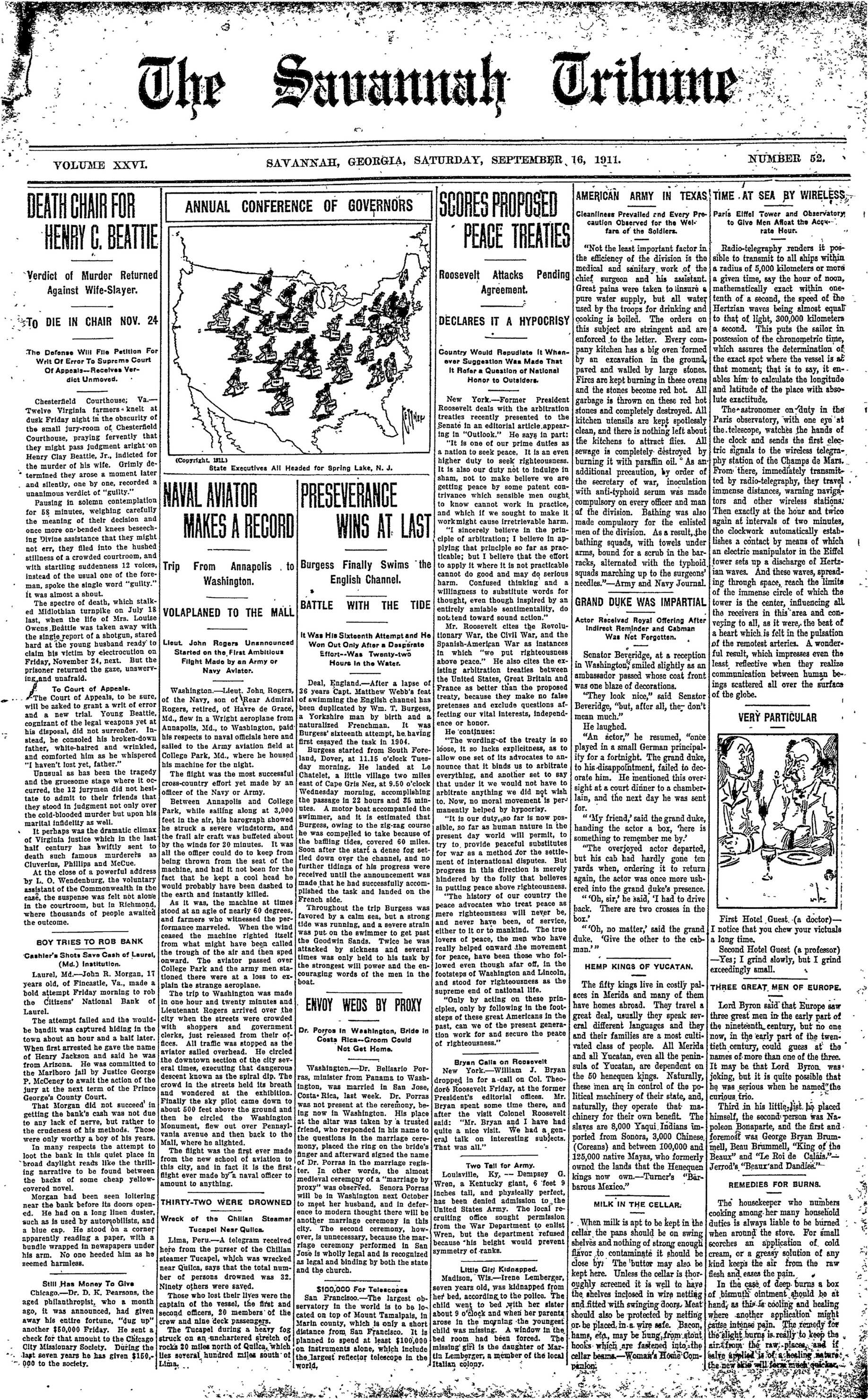
DEATH CHAIR FOR HENRY G. BEATTIE
Verdict of Murder Returned Against Wife-Slayer.
The Defense Will File Petition For Writ Of Error To Supreme Court Of Appeals—Receives Verdict Unmoved.
Chesterfield Courthouse; Va.—Twelve Virginia farmers—knelt at dusk Friday night in the obscurity of the small jury-room of Chesterfield Courthouse, praying fervently that they might pass judgment aright on Henry Clay Beattle, Jr., indicted for the murder of his wife. Grimly determined they arose a moment later and silently, one by one, recorded a unanimous verdict of "gulty."
Pausing in solemn contemplation for 58 minutes, weighing carefully the meaning of their decision and once more on-bended knees beseeching Divine assistance that they might not err, they filed into the hushed stillness of a crowded courtroom, and with startling suddenness 12 voices, instead of the usual one of the foreman, spoke the single word "guilty." it was almost a shout. The spectre of death, which stalked Midlothian turnpike on July 18 last, when the life of Mrs. Louise Owens. Beattie was taken away with the single report of a shotgun, stared hard at the young husband ready to claim his victim by electrocution on Friday, November 24, next. But the prisoner returned the gaze, unswerving and unafraid.
To Court of Appeals.
The Court of Appeals, to be sure, will be asked to grant a writ of error and a new trial. Young Beattie, cognizant of the legal weapons yet at his disposal, did not surrender. Instead, he consolled his broken-down father, white-hatred and wrinkled, and comforted him as he whispered "I haven't lost yet, father." Unusual as has been the tragedy and the gruesome stage where it occurred, the 12 jurymen did not hesitate to admit to their friends that they stood in judgment not only over the cold-blooded murder but upon his marital infidelity as well. It perhaps was the dramatic climax of Virginia justice which in the last half century has swiftly sent to death such famous murderers as Cluyvering, Phillips and McCue.
At the close of a powerful address by L. O. Wendenburg, the voluntary assistant of the Commonwealth in the case, the suspense was felt not alone in the courtroom, but in Richmond, where thousands of people awaited the outcome.
BOY TRIES TO ROB BANK
Cashier's Shots Save Cash of Laurel, (Md.) Institution.
Laurel, Md.—John R. Morgan, 17 years old, of Fincastle, Va., made a bold attempt Friday morning to rob the Citizens' National Bank of Laurel.
The attempt failed and the would-be bandit was captured hiding in the town about an hour and a half later. When first arrested he gave the name of Henry Jackson and said he was from Arizona. He was committed to the Marlboro jail by Justice George P. McCeney to await the action of the jury at the next term of the Prince George's County Court.
That Morgan did not succeed in getting the bank's cash was not due to any lack of nerve, but rather to the crudeness of his methods. Those were only worthy a boy of his years. In many respects the attempt to loot the bank in this quiet place in broad daylight reads like the thrilling narrative to be found between the backs of some cheap yellow-covered novel. Morgan had been seen loitering near the bank before its doors opened. He had on a long linen duster, such as is used by automobillists, and a blue cap. He stood on a corner apparently reading a paper, with a bundle wrapped in newspapers under his arm. No one heeded him as he seemed harmless.
Still Has Money To Give
Chicago.—Dr. D. K. Pearson's, the aged philanthropist, who a month ago, it was announced, had given away his entire fortune, "dug up" another $50,000 Friday. He sent a check for that amount to the Chicago City Missionary Society. During the last seven years he has given $150,000 to the society.
The Savannah
SAVANNAH, GEORGIA, SATURDAY, SEPTEMBER, 16, 1911.
ANNUAL CONFERENCE OF GOVERNORS
(Copyright, 1911)
NAVAL AVIATOR MAKES A RECORD
Trip From Annapolis to Washington.
VOLAPLANED TO THE MALL
Lieut. John Rogers Unannounced Started on the First Ambitious Filight Made by an Army or Navy Avilator.
Washington.—Lieut. John Rogers, of the Navy, son of Rear Admiral Rogers, retired, of Havre de Grace, Md., flew in a Wright aeroplane from Annapolis, Md., to Washington, paid his respects to naval officials here and sailed to the Army aviation field at College Park, Md., where he housed his machine for the night.
The flight was the most successful cross-country effort yet made by an officer of the Navy or Army.
Between Annapolis and College Park, while sailing along at 3,000 feet in the air, his barograph showed he struck a severe windstorm, and the frail air craft was buffeted about by the winds for 20 minutes. It was all the officer could do to keep from being thrown from the seat of the machine, and had it not been for the fact that he kept a cool head he would probably have been dashed to the earth and instantly killed.
As it was, the machine at times stood at an age of nearly 60 degrees, and farmers who witnessed the performance marveled. When the wind ceased the machine righted itself from what might have been called the trough of the air and then speed onward. The aviator passed over College Park and the army men stationed there were at a loss to explain the strange aeroplane.
The trip to Washington was made in one hour and twenty minutes and Lieutenant Rogers arrived over the city when the streets were crowded with shoppers and government clerks, just released from their offices. All traffic was stopped as the aviator sailed overhead. He circled the downtown section of the city several times, executing that dangerous descent as the spiral dip. The crowd in the streets held its breath and wondered at the exhibition. Finally the sky pilot came down to about 500 feet above the ground and then he circled the Washington Monument, flew out over Pennsylvania avenue and then back to the Mall, where he alighted.
The flight was the first ever made from the new school of aviation to this city, and in fact it is the first flight ever made by a naval officer to amount to anything.
THIRTY-TWO WERE DROWNED
Wreck of the Chillan Steamer
Tucapel Near Quilca.
Llima, Peru.—A telegram received
here from the purser of the Chillan
steamer Tucapel, which was wrecked
near Quilca, says that the total number
of persons drowned was 32.
Ninety others were saved.
Those who lost their lives were the
captain of the vessel, the first and
second officers, 20 members of the
crew and nine deck passengers.
The Tucapel during a heavy fog
struck on an unchartered stretch of
rocks 20 miles north of Quilca, which
lies several hundred miles south of
Llima.
PRESEVERANCE WINS AT LAST
Burgess Finally Swims the English Channel.
It Was His Sixteenth Attempt and He Won Out Only After a Desperate Effort--Was Twenty-two Hours in the Water.
Deal, England.—After a lapse of 36 years Capt. Matthew Webb's feat of swimming the English channel has been duplicated by Wm. T. Burgess, a Yorkshire man by birth and a naturalized Frenchman. It was Burgess's sixteenth attempt, he having first essayed the task in 1904.
Burgess started from South Foreland, Dover, at 11.15 o'clock Tuesday morning. He landed at Le Chatelet, a little village two miles east of Cape Gris Nez, at 9.50 o'clock Wednesday morning, accomplishing the passage in 22 hours and 25 minutes. A motor boat accompanied the swimmer, and it is estimated that Burgess, owing to the zig-zag course he was compelled to take because of the baffling tides, covered 60 miles. Soon after the start a dense fog settled down over the channel, and no further tidings of his progress were received until the announcement was made that he had successfully accomplished the task and landed on the French side.
Throughout the trip Burgess was favored by a calm sea, but a strong tide was running, and a severe strain was put on the swimmer to get past the Goodwin Sands. Twice he was attacked by sickness and several times was only held to his task by the strongest will power and the encouraging words of the men in the boat.
ENVOY WEDS BY PROXY
Dr. Porros In Washington, Bride In Costa Rica--Groom Could Not Get Home.
Washington.—Dr. Belisario Porras, minister from Panama to Washington, was married in San Jose, Costa Rica, last week. Dr. Porras was not present at the ceremony, being now in Washington. His place at the altar was taken by a trusted friend, who responded in his name to the questions in the marriage ceremony, placed the ring on the bride's finger and afterward signed the name of Dr. Porras in the marriage register. In other words, the almost medieval ceremony of a "marriage by proxy" was observed. Senora Porras will be in Washington next October to meet her husband, and in reference to modern thought there will be another marriage ceremony in this city. The second ceremony, however, is unnecessary, because the marriage ceremony performed in San Jose is wholly legal and is recognized as legal and blinding by both the state and the church.
$100,000 For Telescopes
San Francisco.—The largest observatory in the world is to be located on top of Mount Tamalpals, in Marin county, which is only a short distance from San Francisco. It is planned to spend at least $100,000 on instruments alone, which include the largest reflector telescope in the world.
SCORES PROPOSED PEACE TREATIES
DECLARES IT A HYPOCRISY
Country Would Repudiate It Whenever Suggestion Was Made That It Refer a Question of National Honor to Outsiders.
New York—Former President Roosevelt deals with the arbitration treaties recently presented to the Senate in an editorial article, appearing in "Outlook." He says in part: "It is one of our prime duties as a nation to seek peace. It is an even higher duty to seek righteousness. It is also our duty not to indulge in sham, not to make believe we are getting peace by some patent contrivance which sensible men ought to know cannot work in practice, and which if we sought to make it workmight cause irretrievable harm.
"I sincerely believe in the principle of arbitration; I believe in applying that principle so far as practicable; but I believe that the effort to apply it where it is not practicable cannot do good and may do serious harm. Confused thinking and a willingness to substitute words for thought, even though inspired by an entirely amiable sentimentality, do not tend toward sound action."
Mr. Roosevelt cites the Revolutionary War, the Civil War, and the Spanish-American War as instances in which "we put righteousness above peace." He also cites the existing arbitration treaties between the United States, Great Britain and France as better than the proposed treaty, because they make no false pretenses and exclude questions affecting our vital interests, independence or honor.
He continues:
"The wording of the treaty is so loose, it so lacks explicitness, as to allow one set of its advocates to announce that it blinds us to arbitrate everything, and another set to say that under it we would not have to arbitrate anything we did not wish to. Now, no moral movement is permanently helped by hypocrisy.
"It is our duty, so far is now possible, so far as human nature in the present day world will permit, to try to provide peaceful substitutes for war as a method for the settlement of international disputes. But progress in this direction is merely hindered by the folly that believes in putting peace above righteousness.
"The history of our country the peace advocates who treat peace as mere righteousness will never be, and never have been, of service, either to it or to mankind. The true lovers of peace, the men who have really helped onward the movement for peace, have been those who followed even though afar off, in the footsteps of Washington and Lincoln, and stood for righteousness as the supreme end of national life.
"Only by acting on these principles, only by following in the footsteps of these great Americans In the past, can we of the present generation work for and secure the peace of righteousness."
Bryan Gallis on Roosevelt
New York.—William J. Bryan dropped in for a call on Col. Theodore Roosevelt Friday, at the former President's editorial offices. Mr. Bryan spent some time there, and after the visit Colonel Roosevelt said: "Mr. Bryan and I have had quite a nice visit. We had a general talk on interesting subjects. That was all."
Two Tell for Army.
Louisville, Ky. -- Dempsey G. Wren, a Kentucky giant, 6 feet 9 inches tall, and physically perfect, has been denied admission to the United States Army. The local recruiting office sought permission from the War Department to enlist Wren, but the department refused because his height would prevent symmetry of ranks.
Little Girl Kidnapped.
Madison, Wis.—Irene Lemberger, seven years old, was kidnapped from her bed, according to the police. The child went to bed with her sister about 9 o'clock and when her parents arose in the morning the youngest child was missing. A window in the bed room had been forced. The missing girl is the daughter of Martin Lemberger, a member of the local Italian colony.
Cleanliness Prevailed and Every Precaution Observed for the Welfare of the Soldiers.
"Not the least important factor in the efficiency of the division is the medical and sanitary work of the chief surgeon and his assistant. Great pains were taken to insure a pure water supply, but all water used by the troops for drinking and cooking is boiled. The orders on this subject are stringent and are enforced to the letter. Every company kitchen has a big oven formed by an excavation in the ground, paved and walled by large stones. Fires are kept burning in these ovens and the stones become red hot. All garbage is thrown on these red hot stones and completely destroyed. All kitchen utensils are kept spotlessly clean, and there is nothing left about the kitchens to attract flies. All sewage is completely destroyed by burning it with paraffin oil. As an additional precaution, by order of the secretary of war, inoculation with anti-typhoid serum was made compulsory on every officer and man of the division. Bathing was also made compulsory for the enlisted men of the division. As a result, the bathing squads, with towels under arms, bound for a scrub in the barracks, alternated with the typhoid squads marching up to the surgeons' needles."—Army and Navy Journal.
GRAND DUKE WAS IMPARTIAL
Actor Received Royal Offering After Indirect Reminder and Cabman Was Not Forgotten.
Senator Beveridge, at a reception in Washington, smiled slightly as an ambassador passed whose coat front was one blaze of decorations.
"They look nice," said Senator Beveridge, "but, after all, they don't mean much."
He laughed.
"An actor," he resumed, "once played in a small German principality for a fortnight. The grand duke, to his disappointment, failed to decorate him. He mentioned this oversight at a court dinner to a chamberlain, and the next day he was sent for.
"My friend,' said the grand duke, handing the actor a box, 'here is something to remember me by.'
"The overjoyed actor departed, but his cab had hardly gone ten yards when, ordering it to return again, the actor was once more ushered into the grand duke's presence.
"Oh, sir,' he said, 'I had to drive back. There are two crosses in the box.' "Oh, no matter,' said the grand duke, 'Give the other to the cabman.'
HEMP KINGS OF YUCATAN.
The fifty kings live in costly palaces in Merida and many of them have homes abroad. They travel a great deal, usually they speak several different languages and they and their families are a most cultivated class of people. All Merida and all Yucatan, even all the peninsula of Yucatan, are dependent on the 50 henequen kings. Naturally, these men are in control of the political machinery of their state, and, naturally, they operate that machinery for their own benefit. The slaves are 8,000 Yaqui Indians imported from Sonora, 3,000 Chinese (Coreans) and between 100,000 and 125,000 native Mayas, who formerly owned the lands that the Henequen kings now own.—Turner's "Barbarous Mexico."
MILK IN THE CELLAR:
When milk is apt to be kept in the cellar the pans should be on swing shelves and nothing of strong enough flavor to contaminate it should be close by. The button may also be kept here. Unless the cellar is thoroughly screened it is well to have the shelves inclosed in wire netting and fitted with swinging doors. Meat should also be protected by netting or be placed in a wire safe. Bacon, hams, etc, may be hung from stout hooks which are fastened into the cellar beams.—Woman's Home Com-
NUMBER 52.
Paris Elfelf Tower and Observatory to Give Men Affloat the Accu rate Hour.
Radio-telegraphy renders it possible to transmit to all ships within a radius of 5,000 kilometers or more a given time, say the hour of noon, mathematically exact within one-tenth of a second, the speed of the Hertzian waves being almost equal to that of light, 300,000 kilometers a second. This puts the sailor in possession of the chronometric time, which assures the determination of the exact spot where the vessel is at that moment; that is to say, it enables him to calculate the longitude and latitude of the place with absolute exactitude.
The astronomer on duty in the Paris observatory, with one eye at the telescope, watches the hands of the clock and sends the first electric signals to the wireless telegraphy station of the Champs de Mars. From there, immediately transmitted by radio-telegraphy, they travel immense distances, warning navigators and other wireless stations. Then exactly at the hour and twice again at intervals of two minutes, the clockwork automatically establishes a contact by means of which an electric manipulator in the Eiffel tower sets up a discharge of Hertzian waves. And these waves, spreading through space, reach the limits of the immense circle of which the tower is the center, influencing all the receivers in this area and conveying to all, as it were, the beat of a heart which is felt in the pulsation of the remotest arteries. A wonderful result, which impresses even the least reflective when they realize communication between human beings scattered all over the surface of the globe.
VERY PARTICULAR
I
First Hotel Guest. (a doctor)— I notice that you chew your victuals a long time. Second Hotel Guest (a professor)— Yes; I grind slowly, but I grind exceedingly small.
THREE GREAT, MEN OF EUROPE.
Lord Byron said that Europe saw three great men in the early part of the nineteenth century, but no one now, in the early part of the twentieth century, could guess at the names of more than one of the three. It may be that Lord Byron was joking, but it is quite possible that he was serious when he named" the curious trio.
Third in his little list, he placed himself, the second person was Napoleon Bonaparte, and the first and foremost was George Bryan Brummell, Beau Brummell, "King of the Beaux" and "Le Roi de Calais."—Jerrod's "Beaux and Dandies."
REMEDIES FOR BURNS.
The housekeeper who numbers cooking among her many household duties is always liable to be burned when around the store. For small scorches an application of cold cream, or a greasy solution of any kind keeps the air from the raw flesh and eases the pain.
In the case of deep burns a box of bismuth ointment should be at hand, as this is cooling and healing where another application might cause intense pain. The remedy for the slight burns is really to keep the air from the raw places, and if salve applied is of a healing nature the new skin will form much quicker.
PROGRESS MADE BY NEGROES
Opportunities Should Be Seized
Rather Than Disadvantages Advertised
SITUATION IN ARKANSAS
ADDRESS DELIVERED BY BOOKER
T. WASHINGTON BEFORE THE
NATIONAL NEGRO BUSINESS LEAGUE.
Little Rock, Ark.-The National Negro Business league held its twelfth annual session here. Chicago was selected for the place of meeting in 1912.
Preaching the Gospel of optimism that has made him famous, and inciting the members of his race to economy, thrift and the highest point of excellence in industrial and commercial pursuits, Booker T. Washington, leader of the negro race, principal of the famous Tuskegee Normal and Industrial institute, delivered the twelfth annual address before the National Negro Business league, which potent organization he founded twelve years ago.
Assembled in the Kemper theater to hear his address was an audience of about two thousand people, composed of a large number of the best white people of the city and state, and members of the organization. In the course of his remarks, Doctor Washington said:
"This session marks the twelfth year of the existence of the National Negro Business league. While it is among the youngest of our national organizations, I think we have just cause to feel proud of its growth, success and influence. Starting in a simple way, it has now grown to the point where it brings together at these annual meetings the strongest and best men and women of our race. In connection-with the national organization there are now in existence about six hundred local leagues scattered throughout the United States.
"The peculiar value of this league, however, is not the size of the national organization nor in the number of local leagues, but in the work and influence of the league in turning the attention of members of our race to the rich opportunity that is right about them in their own communities for industrial and business, growth. The value of this league consists mainly in the new spirit that turns the impossible to the possible, from that which is artificial and unstable to that which is natural and enduring.
"The National Negro Business league, too, is unlike many other organizations in the fact that it is not a secret organization; it has no grips and pass-words, and offers no stick and death benefits. Nor is this in any sense a political organization. Let me add, too, that the Business league is not in opposition to any other organization that is meant to help and cooperate with all other worthy organizations.
"I am glad that we are holding this national meeting in the city of Little Rock and in the state of Arkansas. In no other state has the league had more loyal and active workers than in this state. From the first we have had the support and influence of that honored-and successful man, J. E. Bush, and his comrades in Arkansas.
"For another reason I am glad that we have assembled in the state of Arkansas, because in few if any other states have the negroes made greater progress, and there are few if any communities where the white citizens are more just in their treatment of the negroes than is true of the city of Little Rock. The interest of the white people in the colored people of Little Rock is shown in the fine school system provided for our race, and the numerous opportunities afforded our race to secure and to promote business and industrial enterprises. Without firm and loyal white friends the negro could not have made the progress that he has made in Little Rock and throughout the state of Arkansas. "I sometimes fear that too many of our people are so active in advertising our disadvantages that they fail to understand our opportunities
to rigorously appreciate our opportunities
I would not, however, be understood
as meaning that on proper occasions
and in a proper manner, that we
should not protest against wrong; that
we should depend mainly for our
success upon constructive efforts, rather
than mere protest. For a few minutes
permit me to go into particulars as to
the conditions and opportunities and
the progress of our race in the state
of Arkansas. Let me use the state of
Arkansas as an example of what is
possible for the negro in practically
every one of our southern states, to
say nothing of opportunities that are
open to us in northern and western
states. I repeat that my experience
and observation convince me that with
few exceptions, where the negro is trying
to work, to save money, to advance in
all-the fundamental things of life, that
he will find in the southern communities
as elsewhere white friends who
are anxious and willing to encourage
him.
"In Arkansas, for example, I find by the official records that there are about 400,000 negroes, that they constitute about 27 per cent of the total population of the state. These 400,000 negroes within forty-five years of freedom have accumulated taxable pro-
erty in Arkansas to the amount 'of $20,500,000. According to the official records kept in your state, the colored people in Arkansas paid in local and state taxes $451,000 toward the support of government in Arkansas during the past year.
"In proportion to their numbers, I question whether the colored people of any other state in the south have made greater progress in material directions than these figures. Indicate. But we should not be satisfied with what we have accomplished in the past. There is a richer and broader future for us if we can but be made to appreciate what is possible for us in a state like Arkansas.
"One of our weaknesses as a race which in an increasing degree we must learn to overcome, is that of squandering that which we earn, of wasteful and unnecessary expenditure of money and property. One of the objects of this National Negro Business league is to not only teach our race to get hold of things to but to hold on to those we get.
"For example, I find by the official records that about 40 per cent of the cotton raised in Arkansas is produced by the hands of negro farmers. I am safe in saying that the negroes in Arkansas produced last year about 350,000 bales of cotton valued at about $24,000,000. The question is, how much of this $24,000,000 remains in the hands of the race today and how much of it has been spent for things we could have done without?
"The negro farmers of Arkansas produced last year about 9,600 bushels of corn valued at $5,600,000. The negro farmers of Arkansas produced last year 189,000 bushels of oats valued at $7,000. They produced last year about 48,000 bushels of wheat valued at $4,600. They produced last year about 432,000 bushels of Irish potatoes and sweet potatoes valued at about $291,000. The total farm products of the colored farmers of Arkansas for 1910 amounted to $2,000,000. If we add to this what the colored people earned in other occupations such as professional, domestic and personal service, trade, manufacturing and mechanical pursuits, the people of our race in this state earned at least $38,000,000 last year.
"The great question, then, is how much of this wealth remains in our hands in Arkansas? How much of it has been put into land? How much into houses? How much into the bank? How much into the schools? How much into the churches? How much has gone in directions which are calculated to make us stronger, a more useful, intelligent, moral and religious race?
In the state of Arkansas there are tremendous opportunities for still greater progress. I find that in this state there are at least eight million acres of unimproved lands that are capable of producing almost every kind of farm products. In the past fifteen years in Arkansas there has been great increase in land values. Land which fifteen years ago could be purchased for $2 to $15 per acre is now selling from $15 to $20 an acre, and in some cases the price has gone up as high as $100 an acre. If we do not as a race improve the opportunities to get hold of our share of these rich and productive lands people of another race and of another color will come in from Europe and reap the golden harvest which should be ours in part at least.
"Taking the southern states as a whole, I find that colored farmers last year produced four and a half million bales of cotton valued at about $219,000,000. Colored farmers in the south produced last year 150,000,000 bushels of corn valued at about $55,000,000. How many of these millions of dollars today remain in our hands, and how much has parted from us? "The colored' farmers of the south produced last year four and a half million bushels of oats valued at over two million of dollars. They produced last year $50,000 bushels of wheat valued at nearly four million dollars, and 98,000,000 pounds of tobacco valued at about nine million dollars.
"It is estimated that the total value of the form products of colored farmers of the south last year amounted to five hundred million dollars. In addition to what was produced by the farmers, I am safe in saying that those engaged in other gainful occupations such as professional service, domestic and personal service, and trade and manufacturing and mechanical pursuits earned last year at least two hundred million dollars, making the total earnings of our race in the south alone something over seven hundred million dollars. -
"I repeat again and again that it is the duty of the negro minister, the negro teacher, the negro business man, of the leaders of our race everywhere to see to it that a larger proportion of the tremendous amount earned by our race is invested in lands, houses, banks, schools, industrial institutions, colleges, churches, so invested that it will remain for all time in the possession of this generation and succeeding generations. If ten per cent only of our annual earnings were set aside for such investment as I have suggested, the race would have every year seventy millions of dollars which would go into its permanent enrichment and enlightenment.
"There is another feature of race development to which I cannot fail to call your attention at this time. This refers to the matter of seeing to it that the youths of the race in a larger measure prepare themselves for service in the fundamental skilled trades. Too large a proportion of youths are content with little odd jobs, or hand to mouth callings. Too many of our young men are content to be mere walters, or Pullman car porters, or tilt-takers in some easy
position that carries little with it that is permanent and dependable in the way of laying a foundation for the present or for the future. The whole southland is full of opportunities for skilled workmen at high wages. In Alabama, for example, there are colored men who are earning from three to five dollars a day as bricklayers. In the Birmingham district of Alabama there are colored men who are earning from five to ten dollars per day as skilled laborers in the various iron and steel manufacturing enterprises of that state. What I say of Alabama is true of other states.
"Without the least fear of exaggeration, I would state that employment can be found for 400 additional negro architects, 300 negro contractors, 100 more electrical engineers, 5,000 more bricklayers, 5,000 more carpenters, 500 more plumbers, 500 more stationary engineers and 5,000 more skilled workers in the iron furnaces. This is to say nothing of at least 50,000 places awaiting skilled farmers, dairymen, stock raisers and fruit growers.
"Attention before it is too late to our economic and industrial growth will enable the ten million members of our race in the United States to escape many of the pitfalls into which our race has fallen in Liberia, Haiti and elsewhere."
"Just in proportion as our race gives heed to the development of its economic and industrial opportunities will every school, college, university and church be strengthened. Just in proportion as we seize hold of and use the tremendous economic and material opportunities that are at our door will every journalist, teacher, minister, lawyer and doctor share in the benefit and be strengthened.
"In all the respects to which I have referred and many others, a rich and bountiful harvest awaits us as a race, and in proportion as we enter it we shall find friends and supporters among white people and black people. Let us, then, as a race everywhere turn our faces away from the setting sun of gloom and despair toward the rising sun of hope and determination."
Following Doctor Washington's address, Dr. Joseph A. Booker, president of the Arkansas Baptist college, Little Rock, and one of the most resourceful and forceful negro college presidents in the south, spoke on "Negro School Building by Negroes." As president of a distinctively negro school for twenty-five years, Doctor Booker's experience in this regard proved very valuable. Doctor Booker stated that the Arkansas Baptist college was built up of the pennies and nickels and dimes of washerwomen and laboring men for the most part, and declared it to be a most helpful example of self-help among the negroes of the south. Whereas the school twenty-five years ago had nothing but the name, he continued, it now owns property in the city valued between $60,000 and $70,000 and a ten thousand dollar farm north of Little Rock.
"It is a much easier matter to build schools for negroes than to persuade them to build them for themselves," he said. "The race today is enjoying excellent school advantages both in the north and in the south; but these advantages are due more to the philanthropy, public charity and patriotism of the white man, north and south, than to the negroes' own self-help. The problem before us now is to get the race into the habit and effort of paying much of its own educational bills.
"Education today is the paramount question with the white man. He and his child are eager to know, and they will find out in any school at any cost. He and all his want intellectual power and social power, and they have it by aggregating their schools, presidents and professors and labeling them as achievements of the white race for the general uplift and promotion of the white race and the world.
"In everything but in civil and business matters, negroes are a society unto themselves. With these two exceptions they are a government within a government, a wheel within a wheel. The world would look with strange horror upon them if they should accumulate great wealth, learn to do business in great waters, erect magnificent temples of worship and then care not to build schools or colleges or universities at their own expense.
"The white people of this country have spent an immense amount of money to educate the negroes both in the common schools, colleges, professional schools and industrial schools. What shall I say to the business men, the financiers of the negro race, with reference to these worthy enterprises? The common people have done much to launch and support them. They have allowed themselves to be grouped off according to their religious belief and rallied nobly in supporting these schools. Most of them are still incomplete, for they are not fully manned; not well equipped, not sufficiently large in campus and number of buildings, and not at all endowed.
"Is it not time for you, our men of means, to come forward with your hundreds and thousands and give those worthy institutions a new lease of life? It is the most feasible way to advertise your business, perpetuate your memory and relieve those who have fought so nobly and long to maintain the honor of the race in these efforts. Not only this, but the more our leading friends may do, the more our white friends will contribute."
MODEST FLATTERY.
She—It seems to me that I have met you before somewhere.
He-Impossible, or I should have fallen in love with you before.
A MESSAGE FROM A BROTHER IN WHITE
BY B. F. RILEY.
Only once before have I ventured to invade your columns to occupy small space, but I am so impressed by the worth of the negro, as an asset of American civilization, the more I study him, that I dare to ask again to be heard, in order that I may say a word by way of suggestion.
My study and investigation of the conditions and possibilities of the colored race, especially as it pertains to the states of the south, have awakened a profound interest in its welfare, and while I am doing my utmost in many directions for the benefit of the negro, there are two practical suggestions which I wish right now to make.
One of these is that I want to urge on our colored people the extreme importance of buying land in the south, as rapidly as possible, and every inch possible. The present is the golden opportunity of the negro in the south. Lands are now cheap compared with that which they will bring in the years of the immediate future. The completion of the Panama canal will mark an era in the history of the south, and especially in the states lying along the seaboard. The completion of the great canal will be the occasion of a shift of population to the south. People who come will want lands, and will have to have them. The waste places will be reclaimed, and lands now accounted valueless will become valuable. That work is already in progress in some parts of the south, notably in the swamp and lagoon districts of southern Louisiana.
Theories of government and laws are valuable, as they relate to freedom and independence of action, but ownership of land surpasses in substantial importance every other agency in procuring liberty, independence, and the pursuit of happiness. Economic foundations based on land ownership are stable, and procure advantages not had elsewhere, on in any other way. Every colored man who can buy land should do so. Its possession is both an open door and an open highway to substantial freedom and independence. There are some things for which the negro can afford to walt, but not in the ownership of land. If one can buy only a few acres, let him do so, on the best terms possible, live hard if necessary till it is paid for, buy more, and keep buying, as fast and as far as he can. If he has a few acres, he has basis, and from that 'let him proceed. With the muscularity and will, two assets which the colored man has, and they are invaluable, he should be able to own much land within the next few years. Lands are now abundant and cheap in the markets of the south and the immense advantage should not be slighted. Within a few years the opportunity will close, and to every one who owns real estate it will be blessing immeasurable to him and his, while he who hath not, will be handicapped for all time to come. Within a short period of years, the land question will be one which will divide between the two classes of blacks. The advantage will be many-sided and too much to be discussed now, but for one thing it will identify him with the common interests of the community, and his services as a citizen and patron will be in demand. When this comes to pass, the negro will have come to his own. Let me not be misunderstood, for I speak from a viewpoint of perfect, knowledge.
The present writer was in one of the wealthiest counties in Mississippi some months ago, and when on Sunday the negroes came to church to hear him preach, driving fine horses to carriages, and riding in automobiles, the spectacle was so rare, that he asked what it all meant. A white friend with whom he was staying smilingly remarked that the negroes owned the chief plantations in the county, and the most of the land. This was to me exceedingly pleasing. Just this week I was in South Alabama, my native region, and was told by one of the wealthiest white citizens of the region of a colony of colored people who had gone several years ago into a region in Conecuch河 county, bought lands, built their homes, churches and schoolhouses, had made fine crops every year, and was one of the most prosperous communities in that part of the state. He said that they had their stores, a post office of their own, telephones, were contented, happy and prosperous, peaceable, neighborly with their white friends, and the most obliging people he ever knew. Many other things he said in detail, all of which is comprehended in the general statements already given, but the root of it all was that so valuable were these good people, that if it were necessary their white friends would protect them against any imposition. I saw one of their country churches near the village of Bellville, and it would be an ornament in any town or city. The praise voluntarily given of those excellent people was little short of the extravagant. It did the heart of a white friend, profoundly interested in aiding the colored man, great good to see and hear so much of his colored friends in his native region.
An amusing incident occurred some time since when the writer fell into conversation with a leading citizen from Mason county, in which county is located Tuskegee; and while I knew he was from that county, he knew nothing of me. I began in a disparaging way talking about the negro, using stale language of epithet against him, such as that he is only
a thief, and ordinary llar, despoiler of hen roosts, and all the rest; seeking by that means to develop his real sentiments. He turned on me with much feel. g, and began a defense of the colored man such as I have rarely heard. Being familiar with the customary jargon of the racial hater, I insisted that the race was base, vicious, inferior, and every epithet I could summon, but he taking me seriously protested against such abuse and told me in detail all about the Tuskegee school, its worth to the county, how prosperous the colored people are, and really gave me much valuable information which I could not have otherwise gotten. We parted, he never learning who I was, nor of my purpose of stealing the march on him. I had a fair chance of a row with him on the subject in his many defense of the colored people. The moral of it all was that the worthy negro compels respect and protection. Just conditions like these will bring the negro into his own. If there is an exception to this rule, I have not found it. If the colored people of one section can do this, it can be done in the thousands of others. The light is breaking, and the negro is solving the problem made by the white man. As time goes on, there will be white friends who with growing boldness will proclaim these things from the housetops, and a reaction favorable to the negro is as sure as the coming of the darkness of the night.
The negro must cease to crouch and to crawl. He must quietly and without show vindicate his right to live and to prosper, and the friends will come from the best whites who will come into control of this country.
I write as a white man who believes in the negro. I know him, have made him a study for years, and especially during recent years, have labored for him in ways in which he could not for himself, and expect to continue to do so, as God gives me opportunity. I am not writing in a patronizing way, but of a genuine man for whom Christ died, my brother in black, and I wish to say that there are two things to which the colored man must cling, and these are he must hold fast to nature and to God. He must stick to the soil, own the soil, and cling close to God. Every people that has done this has become great, and I am among those who believe that the negro has a great future. But I must not be betrayed into giving, the reason why I think so. God's hand is in the history of the negro, and God's hand is guiding that mighty people.
There is however one apprehension and that I am frank enough to state, and that is the recklessness of many thousands of negroes concerning the laws of health. On the upper levels of the race, these are generally observed, but among the masses, these are often neglected, and the backbone of the race is giving way under the sway of such negligence. Good health cannot be preserved, nor morals either, where mean whisky is drunk, patent medicines are indiscriminately used, morphine and cocaine are taken, houses are unventilated, surroundings are unclean, unwholesome food is eaten, and vicious indulgence is practised. A pig pen near a country dwelling is a breeder of untold diseases. Nor is this the only nuisance to which homes are exposed alike in the country and the crowded haunts of the cities. I am in position to know that the negroes on the lower levels of life are dying at an alarming rate throughout the south. The morality among the infants of this class is terrible, due to many causes for which the parents are responsible. While on the upper levels the negro is advancing with astonishing rapidity, on the lower planes, he is dying at a rapid rate. This is not so clear to any as to those who have studied conditions, and know whereof they speak.
As a friend of the colored people, I wish I might reach the ear of every one and din these things in it, till they were heeded. My contention is an equality of opportunity to every man. The negro asks for nothing more. He wants a square deal, and must have it. To him the gateways of appeal and means of redress are closed. But there are those who can be heard in his behalf and will be. The struggle in his behalf must be shifted from the negro himself to the whites. They must take up his cause, bearing on all that pertains to life and liberty, and they are doing it, and will do more and more. But the negro must do his share. He can in the way imperfectly outlined in that which I have already said. He asks not to be made a dependable creature, not a ward, but merely to have the way cleared for him. He asks not that a fish be given him, but a fish-hook. That must come, and will come. Then if he fails, the fault will be his. For that reason, I write with the utmost candor about his respect for his self-preservation.
But my article has already grown too long, and I must cease. My heart is full of this subject, and while I could write much more, wisdom admonishes me to close. I have not written for popularity, but for the good of the colored people. All may not agree with all that I have written, but I have jotted down the results of investigation and study, and know whereof I write.
SOME OLD PROVERBS.
A blind man is no judge of colors.
Fierceness is often hidden beneath beauty.
There is often anger in a laugh.
A dress often hides a deceiver.
A foolish word is 'folly.
Hope consoles the persecuted.
The well fed forget the hungry.
Idenness is the fool's desire.
THE WAY A STATE CONGRESS OF MOTHERS WAS STARTED.
The rapidity with which the mother's movement will become, established in a community when once its broad purpose and great need are understood is well illustrated by the organization of the new State Congress of Mothers in Tennessee.
It needed only the energy of an interested mother. This was Mrs. Kate Campbell Robertson of Jackson, to whom a revelation was made of the really distressing waste of child life and need of trained priesthood in her home town and throughout the state. Work in local charities and the child labor conditions stirred her to activity. Resolving to bring the women of the state together to work for child welfare, she issued circular letters, which were sent to mayors of towns, superintendents of schools and prominent women in the large places, appointing a meeting at Nashville, January 24, 1911. The response was gratifying; and the result was a full-fledged organization, with Mrs. Robertson as leader, a vice-president at large were elected, Mrs. L. Crozier-French of Knoxville, and a vice-president for each of three divisions of the state, Mrs. Thomas Scruggs, West Tennessee; Mrs. Eugene Crutcher, Middle Tennessee, and Mrs. S. A. Myers, East Tennessee. The workers in the last division secured the cooperation by affiliation of almost every other organization in the eastern part of the state. In three months the congress enrolled 1,200 members, in 14 cities in different parts of the state.
The newly organized congress immediately set itself to the task of promoting the child-protection bills before the legislature, and received cordial response to its letters sent to state legislators asking the utmost attention to all bills for child welfare. It has also secured the co-operation of the State Free Library commission, whose new traveling librarian will carry the congress work with hers, establishing parent-teacher associations in the rural schools throughout the state and recommending courses of reading for mothers and children. The Tennessee Mothers' congress has asked the state department of good roads to appoint and to salary a member of the Mothers' congress to travel over the state for the purpose of forming clubs in the interest of good roads between homes and schools and of other needs of the child.
A crusade for dental inspection in the public schools has been arranged, and the legislative committee has in preparation two bills for the next session—one asking state-wide probation for delinquent children, and another asking state pension for widows with young children who are dependent on daily toll or charity.
FLASH LIGHTS
It has been said:
By that some means we must, set up the doctrine that, first and last, whatever hauls down the colors of a human soul is treason to the universe.
That a "nigger" is a colored man who hasn't got any money.
That "self-reverence, self-knowledge and self-control— These three alone Lead life to sovereign power."
That the poor and the ignorant will continue to lie and steal as long as the rich and educated show them how.
That before you are fit for friendship you must be able to-do without it.
That originality is simply a pair of fresh eyes.
That if Cleopatra's nose had been shorter, the world's history would have been different.
OLD HICKORY
WHEN HE WANTS GRAPES.
"Champ Clark is rather leery about giving ap opinion nowadays," said one of his friends in the house press gallery. "He is running for president. He is much given to saying that he will not discuss a subject that everybody else is discussing.
"Mr. Clark reminds me of a young lawyer out wast. The legal light would not commit himself on any subject. Two of his friends, Tom and John, undertook to make him take a stand. They went to his office and incidentally commenced a debate whether or not a buffalo ate grapes.
"Of course he eats grapes," said Tom. "I saw one climb 20 feet into a tree to get a bunch of grapes."
"What! A buffalo climb a tree?"
"Yes."
"What do you think of that proposition—a buffalo climbing a tree to get grapes, judge?" said John to the lawyer, who had remained silent up to that time.
"Why, I don't know, but there's no telling what a buffalo will do when he wants grapes," the reply."
PLEASED WITH HER PRAISE.
One of the most charming bits of repatrize we ever were fortunate enough to listen to was at a big wedding on East Seventy-sixth street last Monday night.
"What charming teeth Miss Dibbleton has!" a lady exclaimed. "I never saw anything so beautiful!"
"Oh, thank you so much for saying that!" exclaimed the young lady's escort, fervently and sincerely.
"Oh, pardon me—are you her husband?"
"No, my dear lady—I am only her dentist!"—Cleveland Plain Deal.
WOMEN AND MONEY.
The household economic department of the University of Wisconsin has issued a bulletin which will create universal astonishment, and nowhere more than in the dry goods stores. This bulletin recites that $10,000,000,000 a year is spent in general shopping, nine-tenths of it by women, and the greater part of these know nothing of the value of money.
The University of Wisconsin has long been famous for its enterprise in meeting the practical needs of the people. It will teach Greek to persons who wish to know Greek, but it will also teach butter making to the far greater number of persons who wish to know how to make gilt-edged butter. Hence its department of household economics, which more nearly concerns the community than astronomy, geology and the higher mathematics. If this department will devote itself to teaching dressmaking, millinery and cooking, it will add greatly to the happiness of the state of Wisconsin and the state of matrimony. These are things that most women have to know, but nature does not endow them with skill in these arts, and they must learn them.
But when it comes to shopping and the value of money, the department of household economics in Madison is intruding upon the realm of nature. Women are born shoppers. The vast difference between $3 and $2.93 is a part of their inheritance; they need no benevolent university to teach it to them. Women have been hunting bargains ever since fig-leaves went out of style and costumes had to be bought instead of picked off the trees. Do not the dry goods dealers know that women are by nature gifted as shoppers, and do not their published announcements appeal especially to the instinct of woman for getting the best that there is at the lowest possible price? Can the University of Wisconsin teach bargain hunting? Do the women of Senator La Follette's state need any instruction in the gentle art of shopping? No mere man can get anything like as much for $1.93 as his wife can. If the university would only undertake to teach men how to spend money judiciously it would be something well worth while—Philadelphi Record.
WASHING COLORED DRESSES.
They should never be soaked beforeland unless they are about to undergo their first washing. In this case it is as well to set the colors by soaking them for ten minutes in very strong salted water. Soda, of course, spells ruination to colored prints, cotton, linens, batistes and muslins. For this reason frocks of dalnty sprigged muslin, as well as one color frocks, always keep their tint better if laundered at home, where they run no danger of being washed by a careless laundress in a lather which is made with soda and has been used for white articles.
Salt should always be dissolved in the rinsing water in which colored cotton dresses are washed.
One of the laundry rules for washing white silk is to avoid both hot water and soda. A mistake is that of leaving the blouse to steep too long. There should be three rinsing waters in washing white silk. The first should be cold and soft. The second, on the contrary, must be hard and cold. With the third rinsing water a little blue bag should be mixed, together with a spoonful of methylated spirits.
JELLIED LOAF.
Put ten cents' worth of stewing veal and the same quantity of beef in a pot and cover well with cold water. Add one onion, four whole cloves, a dash of red pepper and salt, a few mustard seeds and a small end of ginger root. Soak half a box of gelatin in cold water, enough to cover it barely, and when the gelatin is dissolved strain the meat broth—or a quart of it—over the gelatin. Set on a fire and bring to a boll, then remove and set aside to cool. Remove the shells from six hard-bolled eggs, cut into slices and lay these slices in the bottom of a dish, sprinkling lightly with salt. When the gelatin is partly congealed put in a layer of gelatin, then another layer of eggs and proceed in this way until the dish is full, having the last layer of the gelatin. Set on ice overnight and serve on lettuce. It can be sliced very thin by using a knife dipped into hot water.
ANCIENT "REMEDIES."
Some of the sufferers from coughs and colds may feel disposed to try one of the remedies recommended by Pliny. These include wolf's liver dissolved in hot wine, honey mixed with the gall of a bear and powders made from rabbit skins and bullock's horns burned and powdered together. Should one's ill resist these simple remedies for a cough he might try wrapping any of his fingers in the skin of a freshly killed dog. Three frogs, too, are excellent for all forms of catarrh. Place one in the mouth for a minute, and when he makes his escape the sufferer is cured. No harm is done to the frog. For a cold in the head Pliny prescribes a simple yet infallible remedy—three kisses on the mouth of a mule.
According to their wont here, milliners are taking time by the forelock. In their ceaseless quest for novelty, many of them are showing hats that look as if they were made with a view to the fall. I don't supose any woman in New York would care to burden her head in summer time with a huge velvet beret, such as French students wear, even though it were mounted on a sort of diadem of straw. This new model is launched by a leading firm in the Rue de la Palx. The beret, just a big Tam o' Shanter, is in black velvet, and the diadem, shelving outwards from its base in fine golden yellow straw; the former bulges far over the latter at the sides and back, while fluted so as to be within its edge in front.
Another notion that would also seem better suited to a later date, is to give a straw hat what the modistes are pleased to call a coat, that is to say, a sheath of velvet to the crown (which must be a domed one) joined, to a narrow-shaped piece of the same which rests on the brim.
I have seen this made of black, dark blue or pheasant brown for the chalk-white hats, and in ruby red and kingfisher blue-green for black or dark blue ones. Some of these have the brims bent down over the cars "Niniche" style, while others have wide spreading brims. In either case the trimming is ostrich, arranged so as partly to conceal the crown and rising high above it, and partaking more of the hue of the hat than of the coat. Cyclamen pink on the ruby I thought effective and reseda a nice harmony for the blue-green—The Millinery Trade Review.
LET WIFE HAVE OWN MONEY.
It is a deplorable'fact that many a wife has to beg her husband for money after she has helped to make it. To have to ask for money, even when it is given willingly, is a disagreeable thing. Did you ever hear the story of the committee of women who pledged themselves to contribute $1 each to a worthy cause? The dollar was to be earned by hard word. The night of the collection some funny stories were told about how the money had been earned. "How did you earn your dollar?" the chairman asked a handsome woman. "I got it from my husband," was the reply. "There was no hard work about that," some one said. The woman smiled and answered, "You don't know my husband."
TOMATO GATSUP.
Wash, mash and boil till tender with two tablespoons of salt, half a bushel of tomatoes. These may be the inferior ones, not choice enough to can. After cooking let them cool, and rub through a sieve, return to the fire and boll till thick. When nearly done add half an ounce each of ground cloves, cinnamon and black pepper, two pounds of sugar and one quart of good vinegar; cook 15 minutes, bottle hot and seal. The ground spices make it dark, but give a better flavor than where whole spices are used. Never put any water into tomatoes when making catup or chill sauce, for if they are properly mashed at first they will not need it.
CARROT CONSERVE.
Wash and scrape half a dozen firm, highly colored carrots and put them through a food chopper, cutting as small as peas. Boll for half an hour in plenty of clear water, salting lightly. Drain and to each pint add two cups of light brown sugar, and the juice and half the grated rind of a lemon or sugar orange. Cook slowly for one and one-half hours, or until clear, adding a very little water if necessary. For those who like a rich, sweetmeat of foreign flavor, this is an agreeable novelty and few would guess its origin except for the telltale color.
BREAD GRIDDLE CAKES.
To make bread griddle cakes, take one and one-half cups of flour, one cup of stale bread crumbs, three teaspoonfuls of baking powder, one teaspoonful of salt, two teaspoonfuls of sugar, one-half cup of boiling water, three quarters cup of milk, one egg, well beaten, and two tablespoonfuls of melted butter. Add boiling water to the bread crumbs and let stand five minutes. Add the milk, sift together thoroughly the flour, salt, sugar and baking powder and add to the bread mixture; then add the egg and butter. Fry as griddle cakes.
ELDERBERRY WINE.
Over eight quarts of elderberries your four quarts of boiling water and allow them to stand for 12 hours, stirring occasionally. At the end of that time strain, pressing out all the juice. To this add one-half ounce of cloves (powdered), one ounce of powdered cinnamon and three pounds of sugar. (These proportions are proper for four quarts of juice.) Boll for five minutes and set away to ferment in a stone crock. Cover with a cloth. When fermentation ceases pour off carefully, bottle and seal.
Grand Jury Returns Indicments Against Heads of True Reformers.
MESSRS. HOLMES, BURRELL, TAYLOR, HILL, ROBERTSON AND ELLIS MUST STAND TRIAL.
Richmond, Va.—Charging that certain officials of the order abstracted notes before they were due and sought to have the payment of them anticipated in order to cover up the deficit caused by their criminal acts, the grand jury investigating the condition of the True Reformers' Insurance Order, Fraternity and Bank, has returned a number of indictments for the misappropriation of funds. Those indicted are Grand Master A. W. Holmes, General Secretary W. P. Burrell, ex-Grand Master W. L. Taylor, Cashier R. T. Hill, ex-Attorney of the Order J. C. Robertson, and ex-Vice-President and Accountant Edward Ellis, Jr. Taylor, Hill, Ellis and Burrell are jointly indicted for the grand larceny of $27,404.25; the property of the Old Folks home of the True Reformers.
It is estimated that more than $300,000 has been lost in speculation. All of the indicted officers have been arrested and released on bonds in the sum of $3,000 each for their appearance in court. Against R. T. Hill, previously indicted and a fugitive from justice, were found four counts; against A. W. Holmes, six counts; W. P. Burrell must answer to eight counts; J. C. Robertson to eight counts, W. L. Taylor to six counts, and Edward Ellis, Jr. eight counts.
New Orleans—President Arthur Barclay of Liberia has conferred upon the Hon. Emmett J. Scott of Tuskegee Institute, Alabama, and Dr. George Sale of Atlanta, Ga., the order of KnightCommander of African Redemption, and has authorized Bishop I. B. Scott, who is now in this city, to represent him in making the formal presentation. This will be done as soon as the bishop receives the jewels; the certificates have already been received.
NEGRO BANKERS
ELECT OFFICERS
BOOKER T. WASHINGTON WILL BE PRESIDENT OF PARENT ORGANIZATION.
Little Rock, Ark.—In session here the National Negro Bankers' association, an auxiliary of the National Negro Business Men's league, elected officers as follows:
President, W. R. Hettiford, Birmingham, Ala.; first vice-president, W. W. Cox, Indianola, Miss.; second vice-president, G. I. Jackson, Dallas; secretary, H. S. Brown, Memphis, Tenn.; corresponding secretary, P. W. Howard, Jackson, Tenn.; treasurer, T. H. Hayes, Memphis, Tenn.; auditor, S. P. Allen, Forth Worth, Tex.; statistician, A. W. Williams, Springfield, Ill.
Dr. Booker T. Washington was re-elected president of the parent organization.
RACES ON FRIENDLY TERMS
CHARLES BANKS DENIES REPORT
THAT ILL FEELING EXISTS BEETWEEN WHITES AND BLACKS—
CLARKSDALE DAILY REGISTER
SPEAKS HIGHLY OF NEGRO
COMMUNITY.
Mound Bayou, Miss.—Charles Banks,
cashier of the Bank of Mound Bayou,
denies the report published in a sensational colored sheet that ill feeling exists between the whites and blacks of this section. With reference to the malicious report, Mr. Banks had this to say:
"The feeling between the whites and blacks of this county is the very best and in our efforts to build up Mound Bayou none has given us more cordial and substantial support than our white neighbors in this and adjoining counties. The more prominent ones even go out of their way to see to it that we are assisted in every way, not in a manner marked out by them, but after our own direction and selection."
The Clarksdale Daily Register, one of the leading papers of this section, perhaps knows more about things in and about here than the paper publishing the article to the effect that the two races were having trouble. The Register recently commented on the good spirit prevailing between whites and blacks, and that Mound Bayou was one of the progressive sections of Mississippi.
NEXT OF THE GREBE.
The grebe, or dipper, although awkward on land, is an expert diver and has the power of remaining long under water and thrusting out the bill for a supply of air. The little grebe bullds a floating nest, which she removes at the approach of danger, padding it with one foot.
When the scientist discovers a fact widely scattered over the earth on throughout human nature, he very reasonably uses this discovery as a framework upon which to build a theory, and furthermore, when he has procured a sufficient number of these facts repeated over and over again, he offers this theory to the world as a contribution of a verified truth worthy of a statue in the temple of the Eternal Verities; and all earnest seekers after the true light are logically bound to accept it as a part of the revealed will of God. This being true, I can confidently assert, without fear of contradiction, that the best authenticated fact in the scientific world today is the fact of prayers for no one of the tenets of religion is so universally practiced, no one of the theories of secular science is so solemnly demonstrated, as the doctrine of prayer. From the dawn of history—among all nations, whether civilized or savage—all classes, whether ignorant or cultivated—men have offered their devitions to diety. And today, as in the past, the righteous and the wicked alike continue universally to practice this custom. The patient continuation of this appeal to heaven would indicate that there was planted in the constitution of the human soul a belief in the possibility of a communion between the Creator and the man, and that God can and does hear human petitions and, hearing, answers. It would simply be unthinkable to take the ground that all these millions have been following a mirage, born of some superstition in the childhood of the race and projected into history and modern life. We have no proof of this suspidion which misfortune or affliction sometimes creates in revenge for breaking hearts. On the contrary, the fact that the most spiritual-minded people as well as the slinner, whose soul the act of prayer condemns, unite in the custom of praying would prove that the uplifting of the eyes to God is founded in the constitution of man.
Yet there are multitudes of persons who testify to having prayed their best, at times in their lives, but have received no answers to their petitions. It would seem, then, that we are concerned, not so much with the fact of prayer as with its method. If some are heard and some are not, it would look as though there were a secret to successful petition which some discover and some do not. This is true. The widespread belief among men that all prayers, from whatever source, from whatever motive in the mind, are of equal value before God is a vain delusion. We have to be taught to pray as we have to be taught to walk or sing or think. To only the one genius, now and then in history, is prayer a natural gift. The rest of us must cultivate the gift. It is quite important, then, for us to settle in our minds the constituent landmarks of successful petition. It was in this spirit that the disciples went to Jesus with the request: "Lord, teach us to pray." He showed them that the first essential was the uplifting of the soul to God—the human mind consulting with the divine mind. It is not true, then, that the mere utterance of the lips in "vain repetitions" is sufficient to attract the soul of the universe. Heart must commune with heart.
Even when this is as it should be, success in prayer depends upon four conditions—(1) Upon the character of the suppilant, (2) upon the results we attempt to effect when we pray, (3) upon the faith of the suppilant, and lastly (4) upon whether the petition is in harmony with the laws of the universe. As to the first, every Bible reader understands that sin limits God power to do for us according to the promptings of the paternal heart—for his power to give good gifts is narrowed to our worthiness to receive. The bad son has a right to pray and find an answer, but his pleadings are limited to the pleading for forgiveness and restoration to his old place in the household of God. The good son may claim the wilder promise, "Whatsoever ye shall ask the Father in my name he will give it you."
A PERTINENT QUESTION.
William Dean Howells, at a tea at Kittery Point, Me., said of a widely read author, says the New York Times:
"Wide reading doesn't necessarily make good writing. Remember Southey.
"Southey, the forgotten laureate, was the hardest working reader the world has ever seen. Every hour of his day had its task, every half-hour its undeviating function.
"Hogg, the incomparable biographer of Shelley, tells us how Southey once outlined his daily life to a Quaker lady.
"I rise at five throughout the year," he said. "From six till eight I read Spanish, then French for an hour, my watch lying on the table; I give two hours to poetry; I write prose for two hours; I translate so long; I make extracts so long, and thus, on and on, till the poor fellow had fairly fagged himself back into his bed again.
"The Quaker lady heard in silence Southey's narrative. Then she said, dryly:
"And, pray, friend, when dost thou think?'"
But even these rights of the righteous are bound by the fixed laws of the universe—the laws of truth and justice and love and the wages of sin. No one believes any longer that God can or will break the laws of nature to advance the material interests of his children—or remove the results of their past transgressions. No prayer will bring you forgiveness of your sins if you do not forgive the sins of those who transgress against you. Self-sacrifice and meditation are the only avenues to genuine plety. God himself cannot give the Christ-like spirit to the selfish and the worldly-minded.
But within these laws there is a wide circle of life's events, which, by prayer, God can change and guide and cause to work together for good for those who love him. There is also a compensation for life's mistakes and sorrows which any Christian may have for the asking. If you are enslaved by sinful habits, he will give you strength to break the chains. If you have hopelessly destroyed your health by neglect or the drive in money-getting, he can give the consolation of peace. If you are a watcher by the bedside of your loved ones, the hopes which he holds out of reunion of loving hearts shed a light in the sickroom that will make you sing in the night. But the attainment of these compensations depends upon your own faith in God's willingness to answer. In a certain town in Palestine Jesus could do no mighty works because of their unbelief. It is equally true now. Multitudes of earnest prayers are tainted because we ask with little or no faith in their being answered. The prayer is too often the hopeless cry of a bleeding heart. Conviction that God will answer must go along with the cry. "All things are possible to him that believeth."
Just as faith in the divine willingness to give relief up to the full measure of your worthiness is essential to successful pleading, so is it of the highest importance that we watch the results we are attempting to effect when we pray. Very much of our praying is a frantic effort to persuade God to change his plans with regard to our lives, to take away the cup whether it is best for us or not, to take from others in order to give us some desire we fondly crave. This self-centered habit of supplication—this effort on our part to direct the divine plans laid in wisdom for us, or for the world—is the mere childhood of prayer, to be abandoned when the Christian arrives at the age of manhood. Then, the chief end to be desired in our prayers is, not to change God's plans for our benefit, but that we ourselves may, thereby, be changed so that our wills may harmonize with and become resigned to the will of God concerning us. "Nevertheless," Jesus said, "not my will but thine be done." Resignation to the divine will is, therefore, the summum bonum in all human petitions. This state of mind attained to, the man is made strong to bear adversity; clear-eyed in the hour of perplexity and self-possessed in the day of battle.
But let us not undervalue the difficulties met with by the Christ in teaching us to pray. From the founding of the kingdom men have been slow of heart to learn to apply the power of prayer to life and its needs. Today we are less quick than before. The modern tendency toward the widespread challenging of the dogmas of the faith makes it harder for the suppliant to become as a little child. The overcharge of many minds with the cares and business of life for seven days in the week gives no starlit solitude under whose canopy Christian graces grow. The growing acquaintance with the phenomena of nature tends to destroy faith in an overruling providence and quickens the development of the pride of life. Under such conditions the request of the disciples long ago becomes a crying need in modern Christianity. "Lord, teach us to pray."
And did he do it? Undoubtedly, and in one lesson. That consisted of the model which has become world-famous as the Lord's Prayer. Peruse it again, and in future you will devote your prayers less and less to the asking for things for yourself and more and more to the begging for blessings upon the world. Say it once more, and it will draw you up to the spiritual elevation where your heart's desire will be the hastening of the day when the nations will be bound by chains of love and obedience to the throne of God. Amen.
A PRACTICAL QUESTION.
Mme. Nordica, at a garden party at Deal Beach, sald, apropos of her recent European tour:
"Many good people refuse to be impressed by the armless and legless fragments of unique sculpture treasured in the museums of the Old World.
"One day in the British Museum a guide was recounting to a little knot of tourists the glories of the battered centaur, when a Chicago meat salesman broke the reverent hush with the question:
"Excuse me, sir, but what would they feed a bloke like that on—ham and eggs or hay?"—Washington Star.
CAREFUL.
"Yes. John told her he was desperately in love-with her and asked her to marry him."
"What did she say?"
"Said she would have to insure his love at Lloyd's before she could consider his proposal."—Philadelphia Times.
WATCHES FOREIGN NATIONS
LEARNS THEIR SECRET PLANS AND REPORTS THEM TO HIS OWN COUNTRY—IF CAUGHT HE IS REPUDIATED BY HIS GOVERNMENT AND SUFFERS IN SILENCE.
Once in a while an army or navy officer is arrested for aspiring or attempting to obtain military secrets from a foreign government. Practically every government, including the United States, has a law which makes this a crime. Usually there is more or less secrecy about the officer's arrest and trial. His government repudiates his activity, and if he is sentenced to a term of imprisonment he receives no support or aid from his government.
Although they will not officially admit it, practically every government has a secret service of army and navy officers whose only duty is to travel in foreign countries to gather information which might be useful in time of war. Because of the shortage of officers the United States has only engaged in this practice in time of actual hostilities. Military esplonage is, of course, a delicate subject, and it would be gross violation of international propriety for any government to admit that it had secret agents spying on its neighbors. However, it is a well known fact that this system exists.
In 1907 an American ambassador at a foreign capital reported to the state department that an army officer of the country to which he was accredited had been detailed to visit the American countries secretly to ascertain the strength of their forces. His mission was thwarted, however, by the information furnished by the ambassador
The military authorities of every first class power are constantly preparing for war. Naturally they are anxious to know what their neighbors are accomplishing in military science. Here develops the function of the modern military spy. Fiction writers clothe the spy with a vell of mystery and a supernatural cleverness which enables him to get out of all danger pitfalls into which he falls. But the real flesh and blood spy is a different person. In these days of modern and scientific warfare the spy has become a technical expert who must be thoroughly versed in every branch of his art. He must be tactful and above all close mouthed.
The procedure in sending out a spy is something like this: If the German government wishes information which it cannot get in the regular channels of information some officer is sent for. He is summoned to the war office to receive his instructions. In the case of confidential work abroad he receives oral orders, so that he will not have any documentary evidence on his person to disclose his identity in case he gets into trouble. Having received his instructions he starts out, sometimes so secretly that even his family do not know where he is going. Usually he speaks the language of the country to which he is bound. His real identity for the time being is forgotten, and he travels under an assumed name. If necessary he uses a disguise to cover his movements. If he is a good spy he returns with the desired information, and no questions in regard to the methods he employed are asked. If he is captured while engaged in his work he is punished for attempting to obtain the military secrets of a foreign government, and his own country lets him severely alone.
The cipher code books by means of which diplomatic correspondence is carried on are often sought after by these secret agents. Several years ago the code book of the American legation at Bucharest "disappeared." Its loss was reported to Secretary of State Ellhu Root by telegraph. Mr. Root sent for the chief clerk of the department.
"Mr. Smith," said the secretary, "the code book at Bucharest has been lost. I believe it is about time for us to have a new code for our diplomatic correspondence."
Some months later the missing book was offered for sale to the Japanese ambassador at St. Petersburg, who purchased it for a small sum and as an act of comity turned it over to the American ambassador there.
A young man several years ago appeared at the American embassy in Berlin and offered to sell to the ambassador a copy of the state department's code book which he said he had in his possession. He left several specimen pages to prove that his book was genuine. A comparison with the embassy's code book proved that he had the real code, but where he had obtained it was a mystery. The ambassador knew that a new code was in course of preparation and would shortly be distributed by the department. The offer was politely declined on the ground that the embassy had a code book of its own and did not need another—New York Sun.
RUS IN URBE.
A Springfield, (Mo.) man, describing his experience in New York, says: 'I've got on street cars two or three times and told the conductor the names of friends along the line that I wanted to visit, and blame me if he could tell me where any of them lived.'—Kansas City, Times.
Remittance must be made by Express or Post Office Money Order, or Register Letter. Advertising rates givenon application.
Entered at the Post Office at Savannah, Ga., as Second-Class mail matter.
SATURDAY, SEPTEMBER 16, 1911
Another raid was made on the vagrants of the city this week. These raids are helpful, and would meet our approval more heartily if the police would capture some of the many white loafers who infest certain localities. There should be no discrimination among violators of the law. A white violator is as much a menace to the community as a black one. "Run" them all in.
During the week the news accounts recorded horrible crimes committed by white men in various parts of the country. In giving accounts of these crimes the paper did not denote them as "brutes," "burly," "demons," etc., in glaring headlines, as they would if the crimes were committed by colored men. These sensational newspapers with glaring headlines do much to influence and continue the prejudice against our people.
A few issues ago we had occasion to mention the cause of so many of our people leaving the rural districts and flocking to the cities. We stated then that the cause of this exodus was that they received no protection whatever and that advantage was taken of them in every manner. Our stand along this line was substantiated by the following under the heading of "Run Negro Cotton Pickers Away."
Waxahatchie, Tex., Sept. 11.—White-cappers last night made a partial successful attempt to drive Negro cotton pickers out of the country between Midlothian and Venus, including portions of both Ellis and Johnson counties. Negroes were today reported fleeing in large numbers, leaving farmers without help. Two or three Negroes were reported as badly beaten by night riders.
The farmers will continue to suffer for help until full assurance is given our people that they will receive full protection at law, will be paid promptly what is promised, and are given suitable school facilities for the education of their children.
The speech of former Governor W. J. Northern before the Evangelical Ministers Union at Atlanta strikes the keynote in the settlement of the "Negro problem." The address is that of an honest, fair minded, christian gentleman, who from his long years of experience is thoroughly capable of presenting this subject. Our Relation to the Negro, frankly and intelligently. The first fact brought out strongly is that the Negro and the white man make the community-life of the state, forty-seven per cent and fifty-three per cent relatively, and that the Negro is here and here to stay, for he says that deportation is a physical impossibility, that it would bankrupt the state to purchase the property of the Negroes at the price the Negroes would demand as their property holdings are so vast. Extermination of the Negro, he claims, would be cowardly and cruel and not worthy of the consideration of Christian people. Next he dwells upon the criminality of the Negro and asserts that the whites have done little to Christianize him or to better his moral status. On the other hand the penal system of Georgia is hardening and damning. He accounts for the fact that the Negro furnishes so much larger per cent of the criminals in our penitentiaries by saying "If the newspapers are to be credited, every Negro lynched or burned in Georgia makes from 100 to 1,000 murderous white men. The crowds doing these savage deeds have been estimated from 10 to 2,050 strong. If during the last quarter of a century we have averaged twenty lynchings annually, and the average crowd doing the savage work should be estimated at 500, we have the appalling condition of 250,000 murderous white men loose in Georgia," not one of whom has ever been brought to trial and
ECC. CO.
punished for the crime of murder. This statement may furnish one further means for determining the criminal population of our criminal state, as between Negroes and white men as to numbers." His final appeal is that Christianity, and that alone, will settle this much vexed problem and that the "responsibility for the preservation of our Christian civilization rests with the Christian element of our people, with the Christian ministers in the lead."
Activity Necessary to The Growth of the Order, Stunned by Inimical Legislation. The Duty of the, Endowment Board, Its Responsibility.
Aside from the fact that a stunning blow was dealt to the Pythian Order by the recent legal precedents instituted against it, the order is in a prosperous condition. Of course a continuity of even the present status depends, largely, upon, not only the securing of healthful and helpful recruits, but also upon legislation that will place the Endowment Department upon a permanently steady basis. For temporary assessments bring only temporary relief while their increments carry no positive guarantee of longevity. Hence it is, in my opinion, up to the Board of Endowment to offer legislation that will bring the needed relief. Such offerings should, to a great extent, originate in the aforesaid Board and their findings presented to the Grand Lodge for ratification.
True, no legislation can be offered that will bring the permanent relief that, at the same time, will not bring some burden to the rank and file, and yet it is absolutely necessary that the legislation be had. In whatever legislation that may be offered, however, every member of the order, officers and rank should be an equal weight. This will have to be done to add impetus and life to the idea.
As a step towards the idea at point, it has already been suggested that the Grand Lodge, per se, be made a member of the Endowment Board and that three and one half per cent of its income, aside from what naturally accrues to the Endowment Board, be paid into the endowment fund. True this would cut off some of the funds for office rents and clerk hire, and possibly, might force a reduction, of some of the salaries now paid. But it cannot be disputed that it would be a means to the end desired. To the minds of all who would like to see the Board of Endowment upon a safe and sane basis, the idea will appear reasonable regardless of the fact that it borders upon retrenchment. This is suggestion number one.
Another suggestion came from the pen of Dr Butler of Atlanta but was reported unfavorable by the Grand Lodge. This proposition carried with it the idea that a graded scale of insurance would have to be adopted based upon the ages of the insured, but that the effect of the proposition should not bring to bear upon those who are in the order. The idea, we thought, was all right except the exceptions. We believe that had the proposition become a law that each member of the order, regardless of age or position should witness a similar effect from the operation of the law. This proposition amended so as to embrace the whole body of Knights, we believe, would have, gone far towards giving the relief desired.
But these things are past history. The question should be of the present and future, of the future especially for the fact that the Board of Endowment has no enacting power, no plenary prerogatives and exists, as I see it, for no well defined cause or purpose. If at any time in the past it has offered anything effective, it has been the distant past. This board should be constructive. It should originate something. Aside from the report of the secretary and treasurer, there should be a real report of the work of the board. This report should be given annually to the Grand Lodge along with the regular-report. The report should not deal with finance but should tell of all other matter coming before the Board for adjudication. In this report should be encouched recommendations and propositions for enactment into law at the session of the Grand Lodge.
There is a manifest awakening among the members of the order. The rank and file as well as the officers are convinced of the fact that there must be new life injected into the order. In consequence whereof there is being made a strong pull for a monster numerical increase. There is a universal expression of willingness to pay the assessments which were levied, promptly and cheerfully. It follows, therefore, that to stave off the necessity of continuous assessments that have assumed the name of burdens, some remedial legislation must be had
Opening of St. Mary's New Hall A Delightful Time Promised. Next Tuesday, September 19th, the beautiful new Hall on 36th St. between Bullock and Harden will be opened for the public and the event promises to be one of the most interesting affairs of the season. At 8:30 p. m., a splendid concert will be given in the Hall, which will be beautifully illuminated with electric lights. During the concert, Capt. Simmons will make a short address on Education. Mr. Mungin's famous orchestra will furnish the music. Fine refreshments will be served. An opportunity will be given to the people to visit the new school which is certainly the finest and best equipped school building for colored children in Savannah. After the concert the young people may have a dance and enjoy a pleasant evening. The program with Mr. J. M. Dowse as chairman of the committee on entertainment will be as follows: Apollo Orchestra; Quartette, Messrs Cruz Anderson, Hooker, Pleasant; Vocal Solo, Miss Lloyd; Vocal Duet The Misses Davis; Vocal Solo, Miss May Steward; Vocal Solo, Julius Jenkins; Instrumental Duet, Messrs Mungin and BurkÆ. Intermission. Piano Selection eight hands, Miss Alice Ellis, Mrs. C. B. Lewis, Miss Helen Ellis, Mr. Chas. McDowel; Addres, Education. Capt. J. C. Simmons; Vocal Solo, Miss Nettie Houston; Recitation "The Blacksmith's Story" Mr. Pop. Jones; Vocal Solo Mr. Cuyler; Vocal Solo Mr. Alice Ellis; Orchestra. Musical Director, N. Anson Cuyler. Stage Manager Chas. S. Seigling. Festival choice refreshments.
P.
Father J. A. Dahlent, who has been untiring in his work among the colored people of the city is to have charge of the new school and with such an estimable and affable gentleman at its head great success is predicted for the work.
Grand Chapter Order of Eastern Star
Savannah, Ga. Sept. 12, 1911.
Mr. Editor:
Will you allow me a space in your valuable paper to say a few words of the Grand Chapter Order of the Eastern Star of Georgia and its jurisdiction that held its Thirteenth Session at Sparta, Ga., August 15-17. Promptly at 9:30 Tuesday morning the meeting convened with Mrs. Viola Hart, Grand R. M. and Mr. Sol. C. Johnson, Grand R. P. presiding. It was indeed a fine gathering. The delegates of all chapters that were represented seemed as though they came with a spirit of love and friendship and reflected credit upon the order for its fine reports and all business that claimed its attention. Peace and harmony prevailed throughout the session. The reports showed a great increase over the last year's session: Truly the O. F. S. is spreading and before long the earth shall be full of its knowledge and wisdom as the waters that cover the sea. Too much praise can not be given to the people of Sparta in providing for the delegates and visiting members. On Wednesday night we were tendered a banquet by the chapter at Sparta and when we were assembled in the brilliantly lighted hall it was indeed a picturequees scene with the table laden with good things.
And in my opinion the Board of Endowment should prepare and offer this legislation, it being in close touch with the finance of the order. As has been herein before stated, it may possibly temporarily burden the order or rather the members thereof, yet it should be done for the future protection of the Endowment and the defense of the very ones who may the more bitterly oppose it.
As Pythians, we must nerve ourselves to the task of fixing for all times to come the stability of our Endowment Fund in order that the widows and orphans may remain protected against a possible calamity. If to secure safety burdens come, let each of us put shoulder to the load and carry our pro rata part until we push our treasury to a height-that is in itself immuned to the ravages of panic or fluctuation of finance.
Edward Winfred Sherman.
IN HIS HOLY TEMPLE.
Interesting Services in The Churches of the City.
Evangelical Ministers' Union,
The Evangelical Ministers Union
met with Dr. R. H. Singleton, presiding.
Devotional service was conducted by Rey. S. C. McMillan. Having addressed the throne of grace, the 1st Psalm was then read. Topic of the day was the sermonic report by Rey.
E. B. Brown. The sermon was indeed grand. Come out next Tuesday.
Visitors always welcome.
Second Baptist Church.
The services on Sunday morning were well attended. The pastor Rev. D. A. Reid, preached a fine sermon from the text Ps. 116:7 verse. It was an interesting discourse from beginning to end. At 3:30 p. m. was holy communion, at this service several members were fellowshipped into the church. On Monday the pastor left for the National Baptist Convention. He will also take his vacation. Before leaving he was presented on Sunday night with a neat sum by Mrs. F. H. Starr in behalf of the church to show their appreciation towards him. Attend the weekly services. The pulpit will be supplied while the pastor is away.
Monumental Notes.
Sunday school was well attended last Sunday morning, the collection was very liberal. At eleven o'clock a. m., the pastor preached an interesting sermon, text Matt. 12th, chapter 33rd, verse. At 8 p. m., he also prenched a wonderful sermon text Daniel 1 Chapter 8 verse. Theme: "Fix purpose of heart brings sure success." At 4 p. m., the Allen Christian Endeavor League Workers held a glorious meeting. The topic was briefly discussed. The dollar money rally is still on and will be on until conference, many are paying. The subscription list of the trustees for the purpose of fixing the roof appeared very long Sunday morning, some subscribed as high as five dollars, can we write your name to be paid in by the second Sunday in October? Read the Guide tomorrow, it will bring the desired results. Tomorrow Sunday school 930 a. m., breaching 11 o'clock a. m., and 8 o'clock p. m., You are welcome.
St. Philip Dots.
A good sized crowd was out at 11 a.m. on last Sunday to hear Rev. Singleton and they were well paid for being present. Rev. Singleton's text was from Mark 1:13. Subject "In the hands of the tempter the desire to sin is the same as committing sin—to keep from sin is to keep as far away as possible," was the basis of his discourse. There is one feature about Rev. Singleton's sermons, you always hear something new. On tomorrow, Sunday, Rev. W. G. Alexander, D. D. Dean of Turner's Theological Seminary of Atlanta, Ga. will preach the Educational sermon at 11 a.m. as it will be Endowment day. The Endowment exercise will be held at 3 p.m. by the Sunday School. At 8:30 p.m. the Literary exercises by adults of the Sunday School will be held. On next Monday night Dr. W. G. Alexander, D. D. will lecture at st. Philips on several interesting subjects. Admission 10 cents. Prof J. A. Lankford, the architect and supervisor of the new St. Philips is in our city making final details for the commencement of parsonage and church. The two contesting armies for raising the largest amount of money in the Big Rally on December 24, are the Moroccan and Austrians. All members of these two forces must be up and a doing. The Bigest Rally that has ever taken place in St. Philips will take place on the sixth Sunday in October. Every subscriber to the building fund must pay on their subscriptions and also make all back payments. And every male that has not subscribed must pay $10.00 and every female $5.00. This applies to all members. The Georgia Conference will convene at St. Philips on the 6th of December and the corner stone of the new St. Philips will be laid while the conference is in session. Don't wait for the last hour to pay your dollar money. The following services will be held on tomorrow (Sunday.) Prayer meeting at 5:30 a.m. Preaching at 11 a.m by Rev W. G. Alexander, D. D. Sunday School 3:39 p.m. Literary exercises at 8:30 p.m. Everybody is invited to be on time to these services.
F. B. B. Church.
B. B. B. Church.
On 'last Sunday the Y. M. and Y. L. C. C. of the church celebrated their twentieth and nineteenth anniversaries, respectively. In the morning the services were conducted by Rev Walker. He read for the lesson Matt. 8:14-25. His text was from Matt. 8:19. The sermon was very striking and appropriate. The choir sang "Jesus is a rock." Rev Wright led the hymn "More like Jesus." At night, a solo was sung by Mrs. E. Givens and a very sweet and 'impressive duet by Messrs Jackie Johnson and J. B Graham of St. John Baptist Church. Rev Wright read for the lesson Ps. 34:1-17. Licentiate Miler prayed a prayer that stirred the whole church. The history of the clubs was read by Mrs. F. A. Merchison. Rev Wr phil's text was from
When I Opened The Air Dome
Two months ago, there were many people who didnt believe me when I told them of the highclass show I was presenting-I don't wonder.
Every Night My Patrons Comprise successful business men, lawyers, doctors, real estate men, ministers and people of refinement. Only one answer to it,
NEXT TUESDAY NIGHT
Every lady will be presented with one of
my swell dishes
COME ANY WEEK NIGHT
AIR DOME
Hall Lane and West Broad
Adults 10c Prices Never Change Children 5c
BAKER
THE MOVING PICTURE MAN
WEST END PHARMACY
The PLACE to get your DRUGS. Prescriptions given strictest Attention. We handle everything known to the Drug Business. TOILET ARTICLES the BEST on the MARKET PATE'S WEST END PHARMACY BAY AND FARM STREETS.
A Full Line of Coffins, Caskets and Robes. Prices Reasonable. Satisfaction Guaranteed. Livery Stable Attached. Everything First Class
NOW IS THE SEASON FOR
ICE, CREAM
No Order too Large. None too Sm
Give us your Order. We guarantee t
SCOTT BR
West Broad and Gwinnett Streets
Thess. 3:4. The subject was "Brethren pray for us." The whole church was packed and we are quite sure that those who heard the sermon shall not forget it soon. The clubs donated very liberally to the church, pastor, choir, organist, poor saints and sexton. Rev. Wright and quite a large delegation of ladies of the church left on Monday morning to attend the National Convention that convenes in Pittsburg, Pa. Thursday morning. You are welcome at any of our services.
Air Dome Dots.
The usual pleasing pictures with the Passion Play Thursday and last night as the biggest hits were shown during the week. The management had hoped to have Uncle Tom's Cabin this coming Tuesday night but yesterday morning learned that he could not secure it for this date but will present it later.
Some Spectacular Stories.
Among the score of magazines articles to be published in next Sunday's New York World will be "How Fred Stone, the comedian Lassoed Polar Bears in the Artic Ocean," "The Strange Mystery of a $500.00 Rembrandt Painting" "The Prophecy of a Scientist that 10,000 Murders Will Be Committed Before October, 1912," "How 'Duel' Has Come to Be-the 'Last Word' of Women to Today." Then there will be the words and music of "From a Confidential Source," a late song hit. Order, next Sunday's World from your newsdealer in advance.
We your committee, on Resolution beg to report that
Whereas, In the all wise providence of God, He has seen fit to remove from the midst of the Savannah Home Association, during its three years of existence the following named members: Bros. Adam Murry, March, 8, 1909; James H. Barnard, April 14, 1909; W. T. Wylie, (founder and first president) Sept. 28, 1910 and Steven C. Green, (vice president) May 29, 1911, be it Resolved, That while we deplore the loss of our deceased brethren, yet we bow in humble submission to the will of the Father Almighty in the belief that our loss is heaven's gain. Resolved, That these resolutions be spread on the face of the minutes of the Savannah Home Association. Resolved further, That these resolutions be published in The Savannah Tribune and that a copy be sent to the widow of each of our deceased brethren.
Respectfully submitted,
Jno. F. Andrews, Chairman.
J. J. Brown,
J. H. Gathers.
July 26, 1911.
Card of Thanks.
Mrs. A. B. Cooper wishes to thank her many friends for the kindness shown her in her bereavement. She also extends many thanks to the quartette that rendered such sweet music and to those who sent flowers.
Mr. E. W. Matthews of Atlanta, Ga. is in the city this week on business. Mr. C. B. Harris of Atlanta, Ga. was in the gilbert park.
in the class week.
Mr. Allen Vaughn of Beaufort, S. C,
was in the city last Friday.
Miss M. A. Adams spent last Sunday
at Charleston, S. C.
Miss Bessie Moore is spending awhile in Balsam and Ashville, N.C.
Mrs. Sarah Skipper left for Beaufort on last Sunday to spend a month.
Go to Pate's Drug Store, West Broad and Hall streets.
For Ice Cream, ring up McFall Phone 4038.
Mr. James Ray of Allan, is spending his vacation here.
Mr. C. A. Shaw of Brunswick, Ga. was in the city Thursday.
Dr J. Walter Williams has been on the sick list during the week.
Ask Pate's Drug Store about the Nyall Line.
Dr. J. W. Jamerson the dentist will be out of the city from Sept. 21st to Oct. 5th.
Go to Savannah Pharmacy or phone your wants. Prescriptions called for and delivered. Phone 3570
Mrs. Nellie Dent of Jacksonville, Fla., is in the city, the guest of Mrs. Jola Brown'o 316 Park Avenue lane, eaI
Mrs. Sarah Williams returned to the city after spending awhile in Okatie and Grahamville, S. C.
MIDSUMMER SALE of all our pattern trimmed hats at cost prices Green and Allen, 464 West Broad St
Mr. William Grant 601 Oak street who has been on the sick list for the past week is out again.
Mrs. W. E. Stevens will return home tomorrow after spending the summer with relatives in New Haven, Conn.
Mrs. Mary Jane Howard has returned to the city after spending the summer in the west.
Mrs. Ella N. Harris has been confined to the house for the past week from a serious illness.
Go to Pate's Drug Store, West Broad and Hall streets.
Have you had a glass of soda from the new sanitary ieless soda fount at Savannah Pharmacy. Its the goods and deserves your patronage.
Mrs. Rosa Hamilton returned from Jacksonville, Fla., on Sunday last after spending three pleasant weeks with friends.
Mr. Theodore Theus and Master Freddie Theus returned to the city last Thursday after spending awhile with their aunt in Valdosta, Ga.
Miss Bessie E Foster left on Monday for Pittsburgh, Pa., to attend the National Baptist Convention. From there she will visit New York and other points.
Mrs. Rosa Stevens of 606 Bolton street west left for Pittsburgh, Pa., on last Monday in attendance at the National Baptist Convention.
Mr. and Mrs. William Allen of 612 Bolton street have returned after spending quite a while at Orangeburg, S.C.
Mr. J. M. Mitchell of this city, son of Mr. and Mrs. Wro. Mitchell spent his vacation with his mother at Summit, N. J. Dr. C. C. Johnson, of Aiken, S. C. Grand Master of Mason of South Carolina spent a few hours in the city on Tuesday. Rev. Mc D. Spencer, D. D. pastor of Mt. Zion B. church, left on Monday for Pittsburg, Pa. where he is attending the National Baptist Convention Mrs. Benton, of Brunswick, Ga., was in the city Monday enroute home from New York where she placed her son in school. Go to the Savannah Pharmacy to buy your drugs and toilet articles. They have the goods. West Broad and Gwinnett St. Lane. Ask Pate's Drug Store about the Nyall Line.
Mr. Paris H. Pollard, formerly of this city now residing in Washington, D.C., is spending his vacation as the guest of Mr. and Mrs. Moses W. Bryan, 714 Paulsen street.
The many friends of Mr. and Mrs. Charles McCrea of Atlantic City, N. J., are indeed glad to hear of the arrival of a little daughter and extends to them their highest congratulations.
Mr. William Reid of Boston, Mass., spent a few weeks in the city the after an absence of thirteen years. While in the city he was the guest of Mr. and Mrs. Chas. Thomas, 518 Hall lane east.
Mrs. Effie Lumpkin and Mrs. Lula Malloy of Dublin, Ga., spent the summer very pleasantly in New Haven, Conn., New York and other points. These ladies are expected to return to the city tomorrow by steamer and will leave immediately for Dublin.
Mrs. Mary Janie Howard after spending the summer and part of the spring in Pogeleman, Ark., returned Thursday of last week. While away she visited Earl, Ark., Lake View, Miss., and spent spent some time swith Rev. and Mrs. J. A. Lindsay of Memphis, Tenn. Miss Janetta Henson of Lawrence, Kansas, has left the city to continue her course in music and elocution. A reception was given in her honor at Harris street Hall on Tuesday night. Refreshments in abundance were served and a very jolly evening was spent by those present. Mrs. Sadie Douglas formerly of Savannah but now residing in New York City spent a few weeks in the city, being called here on account of the death of her grand mother. While in the city she was the guest of Mrs. Percel of 546 West Huntingdon street and Mrs. Charles Heywood, 6 Wheaton St
Mr. Daniel M. Turner, son of Bishop Turner spent Tuesday in the city on his way to Atlanta from the North. This is Mr. Turner's first visit in thirty-five years, and he was amazed at the progress that the city has made. He was well cared for by Rev. L. A. Townsley.
On Sunday August 27th, 1911, The U. S. G. L. A. No. 1 met at their regular monthly meeting. At the close of the meeting. The following officers were instaled Mrs. A. Ward, president; Mrs. M. Brown, vice-president; Mrs. E. E. Quarterman, financial secretary; Mrs. F. E. Kennedy, recording secretary; Mrs. B. Theus, treasurer; Mrs. A. Brooks, chair of health; Mrs. L. Turner, chair of finance; Mrs. C. McDonald chaplain; Mrs. R. Bowens, chair of in vestigating committee; Mrs. S Holman clerk of order. After the installation the members were served with high
refreshments, the spacious dini ug room being decorated with ferns and potted plants. After being bountifully server each member went home much pleased over the daintyrepeat. The installation took place at the residence of Mrs. G. Simmons.
The General Secretary of the Young Men Christian Association to Speak at St. Stephens Episcopal Church.
en's Episcopal church There will be a specially interesting service at St. Stephen's Episcopal church to-morrow evening at 8:15 when Mr. Johnson, the General Secretary of the Y. M. C. A. on Bull St., will make an address. Mr. Johnson's connection with that great work eminently fits him to know men and what to say to them. He is a pleasing and forceful speaker, and a cordial invitation is extended to 500 men women and children to come and hear him. He will not disappoint you. He'll be on hand to keep his appointment. Good music, short services, tree seats. There will be no services at 11 o'clock tomorrow morning, only the service at night 8:15. It is hoped that a large number will be present to hear the message Mr. Johnson has to deliver.
Los Angeles California News. Rev. and Mrs. J. D. Gordon who have been touring the Continent have returned.
Mrs. Emily Brown Childress entertained with a Matinee Party in honor of Misses Mary Dickerson, Annie Howard and Jessie Parks, Public School teachers from Washington, D. C.
Mrs. Amanda Nelson and her daughter Emmie arrived in Los Angeles last Friday. They were met by Mrs. W. B. Brown.
Surprise Party.
On Tuesday night September 5th, the Y.M. C. A. accompanied by friends of the fate Rev. L. L. Blair from the various churches surprised his wife and four children with a basket of groceries amounting to $5.45 and $2.50 in cash. We thank the following friends who took part with us in making their home happy, Mesdames Gillam, J. Walton, V. Maudley, M. Prince, S. Smith, M. Hopkins, A. B. Fields, R. McCloud, M. Hills, E. Collier, M. Allen, M. Brown, M. Anderson, J. Camel, S. J. Putman, D. Williams, M. Mitchell, N. Maxwell, E. Johnson, D. M. Carter, Nutton, Herrite, E. Chisholm, C. Jones, M. Griffin, Nelson, M. Jones, M. Miller, T. Marshall, H. Riley, S. Cook, R. Washington, C. Thompson, M. Mobley, Misses M. Gordon, L. Williams, C. Brown, P. Brown, J. Marshall, A. Maxwell, Mr. and Mrs. C. F. Fleming, C. and Mrs. E. R. Chance, Messrs. Wm. Turner, E. E. Cooper, H. King, J. B. Johnson, J. Roberson, Riley, D. and M. Phoenix, Deacons L. Langfort, J. Smith, Wm. Jones and C. Miller, Master P. Jones and Rev. R. V. Sutton.
Yonkers Dots.
Mrs. N. M. Reynolds and Miss Harriette Reynolds and Miss Sarah Lee were the guests at a number of entertainments given in honor of Mrs. Reynolds and Miss Harriette's departure for their new home in Philadelphia.
On Saturday Aug. 26th, Mrs. Virginia Simmons entertained a number of ladies at a luncheon in honor of Mrs. Reynolds and Mrs. Wayne of Washington, D C. On the same evening Mrs. Victoria White entertained with a dance for Miss Lee and Miss Reynolds. Sunday morning Mrs. Luther Bush entertained at breakfast. Monday Mr. and Mrs. Albert Williams entertained with a dinner and the same evening with a dance for a number of young people. On Tuesday afternoon Mr. Purcell Harris gave a box party at the base ball game in New York, followed by dinner at his mother's residence later in the evening. Mr. and Mrs. Joseph Thomas gave a tea for Mrs. Reynolds Wednesday afternoon, and the same evening Mr. John Lee gave a box party at Hammerstein's Roof Garden for Miss Lee and Miss Reynolds. On Thursday Mrs. Francisco Mendez entertained with a luncheon, Mr. and Mrs. L. Post with a tea and Mrs. Victoria White with a dinner. Friday morning Mrs. Reynolds, Miss Harriette and Master Franklin丁 Jones left for Philadelphia with the best wishes of all their friends.
Death.
Mrs. Janie Elmore Price, after a very short illness died at her late residence Paulsen street on last Saturday afternoon and was buried on Monday from First A. B. Church, Franklin Square. She leaves a husband, Mr. Frank P. Price other relatives and many friends to mourn her death.
Library Dots.
"A great University is a library of books" says Carlyle. True! Who can estimate the influence of good books on character. Many lives have been reformed, many strengthened, comforted and made happy by reading good books. Would like to use your spare time in the most profitable way possible? Use it in reading good books.
Subscribe now :: Pay now :: The Library::
Prof. S. A. Grant, Misses C. E. Lewis, E. L. Duncan, O. E. Lee have been secured to take subscriptions for ans money-you wish to give. Subscription now amounts to $110.00
Cash subscriptions;
C. L. Cox, Bethesda, Ga. $3 00
J. J. Frazier, College, Ga. 1 00
Dr. J. W. Jemerson, Savannah, 1 00
A. E. Banks, State College 1 00
Total $6 00
Our motto this week: Id facere posnumus.
Excursion Rates Via Central of Georgia Railway.
To Brunswick, Ga., account Grand Lodge Supre at Circle of Benevolence, to be held September 19-24, 1911. Tickets on sale from points in Georgia.
To Memphis, Tenn., account Reunion of the Blue and the Gray, to be held September 26-28, 1911.
To New Orleans, La., account American Bankers Association, to be held November 26-25, 1911.
To Tifton, Ga., account South Georgia Land and Agricultural Exposition, to be held September 27, October 7, 1911. Fares apply from points in Georgia
To Atlantic City, N. J., account American Electric Railway Association to be held October 9-13, 1911.
To Augusta, Ga., account Georgia-Carolina Fair Association, to be held November 14-17, 1911.
For complete information in regard to total fates, dates of sale, limits, cheques, main service, etc., apply to nearest ticket agent.
J. C: Hale,
General Passenger Agent.
F. A. Roinson,
Assistant General Passenger Agent
AMUSEMENT COLUMN.
NOTIC E—Articles in this column one cent per e-mail word.
Sept. 19th Tuesday. Concert and Festival at St. Mary's new Hall. Tickets 25 cents.
Sept. 19th, Tuesday. Picnic and Barbecue at Lincoln Park by Friendship Baptist Church. Tickets 15 cents.
September 25th, Monday. Grand Ball at Masonic Temple by Pythian Band and the M. W. C. Tickets 25 cents.
October 9th, Monday. Fall entertainment by The Y. G. E. A. and S. C., at Harris street hall. Admission 25 and 50 cents.
September 18th, Monday. Joint Picnic at Lincoln Park by Driskell Lodge No. 4916 and Deveaux Lodge No. 8181, G. U. Q. of O. F. Admission 15 cents.
September 18th, Monday. Fall dance by the Young Adelphia A. and S. C., at Masonic Temple., Admission 25 cents.
Sept. 18th, Monday. Trolley Ride by the Ladies Busy Bee Club of First Bryan Baptist Church. Tickets 25 cents.
Sept. 26th, Tuesday. Wand-drill, garland dance and concert by the Lone Star Branch at Masonic Temple. Tickets 15 cents.
Sept. 25th, Monday. A grand ball at Our Hall by Lymous O'Neil. Admission 15 and 25 cents.
Sept. 25th, Monday. Outing at Woodlawn park by Advance Temple No. 5. Tickets 15 cents.
Sept. 27th, Wednesday. Joint entertainment by G. U. O. of S. and D. of Ezekiel at Masonic Temple. Admission 15 cents.
Sept. 18th, Monday. Trolley Ride given by Bethlehem Lodge No. 32, G. U. O. of A. K. of America. Tickets 25 cents.
Sept. 25th. Monday. A grand dance at Harris street hall given by Live Oak Lodge No. 237, I. O. G. S. and D. of S. Admission 15 and 25 cents.
Sept. 25th, Monday. The Famous Headlight's excursion to Beaufort, S. C. Tickets 50 and 25 cents.
Oct. 15, Sunday. Capt. Alex Brown's annual trip from Savannah to Charleston, S. C. Round trip $1 50. The Apollo Orchestra will give a grand picnic at Woodlawn Park, Wednesday Sept. 20th, benefit Beth-Eden Baptist Church. Admission 15 cents. The following ladies will serve as committee: Mesdames Martha Johnson, Laura Mungin, Mary Bradford and Henrietta Richardson: Mrs. Ellen Chipp, Chairlady.
REST AND HEALTH TO MOTHER AND CHILD
Mrs. Winslow's Soothing SAFE has been used for over SIXTY YEARS. MILLIONS of MOTHERS for their CHILDREN WHILE TEETING WITH EVERY SINGLE SOOTHERS the CHILD, SOFTENS the GJMS, ALLAYS all PAIN; CURS WIND COLIC, and is the best remedy for HIARRINGA. It is absolutely harmless. Be sure and ask for "Mrs. Winslow's Soothing Syrup," and take no other And. Twenty-five cents a bottle.
My Business Is Growing
The reason for it is plain. I stand for
"Honest Values" & "Absolute Relia
For Six Years I have made a very close study of the Real Estate Situation, not so very long, of course, but long enough for MY OPINION to be of VALUE to YOU if you want to buy a Home or make an Investment
My Renting Service, too, is up to a high Standard. More next time
Chas. A. R.
623 WEST BR
PHONE
CLAIRVOYANT
Flats for Rent.
1915 Reynolds street, 4 rooms
price $6.00. Apply to Chas. McDowell,
623 West Broad street.
FOR RENT-Furnished or unfurnished room at 527 Charles street. Upper flat of five rooms and bath for rent, possession given after Sept. 15th. Apply 518 Hartridge street. Neatly furnished room in a quiet neighborhood. Apply at northwest corner of Huntingdon and Jefferson streets.
Night School
A limited number of ambitious young men and women will be taken as night school students. Only those desirous of elevating themselves will be considered. Here is an excellent opportunity to prepare for the civil service and other fall examinations. Tuition reasonable. Use your spare-time profitably. For further information address Night School care Tribune Office.
Take a pleasant drive on the cool and well paved White Bluff Road to Nicholsonboro and refresh yourself at
Williams' Resort
(Corner of the Road)
Refrshments served on short notice. Cold Drinks. Special attention to serving small parties.
MRS. GEORGIA WILLIAMS
R. F. D. No. 2
Greene & Allen.
We wish to announce to our friends that Mrs. Allen of the above named firm left on the 16th inst. for the north to visit the leading millinery houses and personally select our fall and winter stock which, we intend, will be second to none.
464 West Broad St.
Is Growing
plain. I stand for
Absolute Reliability"
McDowell
DAD STREET
2098-J
If you are undecided, in doubt, or unhappy, if you are anxious to better condition in life, go see this wonderful woman. Her twenty-years of practical experience as a consulting clairvoyant specialist enables her to succeed where all others fail.
```markdown
```
K. HALPERN, Proprietor,
463 West Broad St.
Dealer in new and second handed
bicycles. Repairing and vul-
canizing a specialty.
Tires and Sundries.
Phone 1340.
ST. STEPHEN'S
KINDERGARTEN and
PRIMARY SCHOOL.
A First Class School for
Young Children.
Thorough Work, Clean, Neat, Comfortable and Attractive Class Rooms Girls taught sewing and rudiments of domestic science without extra charges
Terms reasonable. Apply to Rev. R. Bright, 313 E. Harris
P. B. RAY
Merchant Tailor
DRY AND STEAM CLEANING
P. B. RAY
Merchant Tailor
DRY AND STEAM CLEANING
Ladies. Work A Specialty
AAT'S CLEANED AND
REBLOCKED
Phone 2050
N. W. Cor. Jefferson and
Berrien Sts.
Savannah, Ga.
$100.00 Reward--Lost,
A man about the size of a woman of wooden shoes on, pink green hair, the latter cut curly the face a corned beef colored overcoat lining. He had an empty croc-taining a dozen railroad loco-railroad tunnels stolen from the last seen he was following a croc-were making their way to—
PATE'S DRU-
to buy the
FAMOUS NYAL'S PAT-
We are the agents for the whole Nyal luteed or your money back, ask us about buy cheap patent medicines you don't lute can buy something first class that will The Nyal Remedies are all good because
PATE'S DRU-
Phones 660 and 862
THE
ONLY NEGRO PHAR-
The pride of 30000
BECAUSE WE CARRY PURE DYE
BECAUSE OUR PRESCRIPTION
BECAUSE OUR TOILET ARTIFICIAL
BECAUSE OUR CREAM AND S
Savannah L
LEE CHEMICAL
PHONE 3570 811
To Reward--Lost, Strayed
man about the size of a women, barefoofed
wooden shoes on, pink green eyes; sun-
ner, the latter cut curly the former cut dark
orned beef colored overcoat with a sourk-
ing. He had an empty crocus sack on
bringing a dozen railroad locomotives and
road tunnels stolen from the Pacific Ore-
seen he was following a crowd of 500
we making their way to—
PATE'S DRUG STORE
to buy the
FAMOUS NYAL'S FAMILY REM
the agents for the whole Nyal line they are all
your money back, ask us about the line when i
cap patent medicines you don't know anything
something first class that will do you good for
real Remedies are all good because Pates says so
ATE'S DRUG ST
800 and 862
HALL and WEST
Opposite The
THE
NY NEGRO PHARMACY
The pride of 30000 Negroes.
USE WE CARRY PURE DRUGS.
USE OUR PRESCRIPTION DEPARTMEN
USE OUR TOILET ARTICLES ARE
USE OUR CREAM AND SODAS ARE
Javannah Phar-
LEE CHEMICAL CO. P.
PHONE 3570 811 WEST BRO
$100.00 Reward--Lost, Strayed or Stolen.
A man about the size of a women, barefoofed with a pair of wooden shoes on, pink green eyes; sun set colored hair, the latter cut curly the former cut dark! He wore a corned beef colored overcoat with a sourkraut colored lining. He had an empty crocus sack on his back containing a dozen railroad locomotives and a half dozen railroad tunnels stolen from the Pacific Ocean. When last seen he was following a crowd of 500 people who were making their way to
to buy'the
We are the agents for the whole Nyal line they are all good all guaranteed or your money back, ask us about the line when in our store. Why buy cheap patent medicines you don't know anything about when you can buy something first class that will do you good for the same money. The Nyal Remedies are all good because Pates says so.
PATE'S DRUG STORE
Phones 660 and 862
HALL and WEST BROAD STS.
Opposite The Pekin Theatre.
The pride of 30000 Negroes. Why? BECAUSE WE CARRY PURE DRUGS. BECAUSEOUR PRESCRIPTION DEPARTMENT IS STRICT BECAUSE OUR TOILET ARTICLES ARE THE BEST BECAUSE OUR CREAM AND SODAS ARE THE PUREST
LEE CHEMICAL CO. Prop.
PHONE 3570 811 WEST BROAD ST.
West Broad and Gwinnett Lane
MME. DELONG
809 WEST BROAD ST. SAVANNAH
Office Hours: 9 a. m. to 9 p. m. Daily and Sunday
ME. DELON
BROAD ST. SAVANE
e Hours: 9 a. m. to 9 p. m. Daily and Su
Ask Mme. DeLong?
Will I succeed in business?
Will I succeed in my undertaking?
What profession should I follow?
When will I marry?
Will my loved one return?
What is the cause of my misfortune?
Will I have better health?
Answers All Questions of
If you are undecided, in doubt, or unhappy condition in life, go see this wonderful woman's technical experience as a consulting clairvoyant so where all others fail.
CALL TODAY
SPECIAL READING
All Questions of Human
decided, in doubt, or unhappy, if you are
to go see this wonderful woman. Her twen-
s is a consulting clairvoyant specialist enab-
ail.
CALL TODAY
SPECIAL READING $1
OUR HALL
East Broad and Anderson Sts:
Is now opened for Entertainment,
Fairs, etc., also Two very large Lodge Rooms,
Matting Floors, Electric lights
Rooms kept clean without extra charge. Rent reasonable.
For information call at
525 ANDERSON STREET, E.
Between Price and E. Broad.
Dr. L. S. Parks,
Does all kind of high grade dental work of the best quality and workmanship. Gold crowns and. bridge work. White Porcelain Pv. and Gold Crowns mounted on the natural roots. Gold Fillings, Cement Fillings, and Silver or Amalgam Fillings, from nine to a full set of teeth 77 0 and $3.00. Broken places mended n teeth added Gold ones for a small cost. Bell Phone 314, Solid Gold Crowns Guaranteed 22 K Gold
Dr, J. W. Jamerson
FIRSTCLASS DENTIST
All Work Guaranteed
623 West Broad Street
Between Huntingdon and Hall
Phone 2098
RIDGELAND
Normal and Industrial
INSTITUTE
Opens October 2nd, 1911
Board $5.00
Tuition 40c to $1.25
Per Month
SEND FOR CATALOGUE
President, E. Mark Glover,
RIDGELAND, S. C.
hot, Strayed or Stolen.
women, barefoofed with a pair of green eyes; sun set colored the former cut dark. He wore a coat with a sourkraut colored by crocus sack on his back con- locomotives and a half dozen from the Pacific Ocean. When a crowd of 500 people who
RUG STORE
by the FAMILY REMEDY
Royal line they are all good all guaran- about the line when in our store. Why don't know anything about when you will do you good for the same money. because Pates says so.
RUG STORE
HALL and WEST BROAD STS.
Opposite The Pekin Theatre.
THE PHARMACY IN TOWN
ooo Negroes. Why?
RE DRUGS.
NION DEPARTMENT IS STRICT PARTICLES ARE THE BEST AND SODAS ARE THE PUREST
Pharmacy
MICAL CO. Prop.
811 WEST BROAD ST.
Lane
LONG
SAVANNAH, GA.
m. Daily and Sunday
What trade am I best adapted for?
What business would I succeed in?
Have I any enemies?
Whom will I marry?
How can I control my friends?
How can I conquer my enemies?
What is the cause of my illness?
of Human Interest
happy, if you are anxious to better woman. Her twenty-years of prac-ant specialist enables her to succeed
TODAY
DING $1.00
The Farm
DIGESTIBILITY OF FEEDS.
The Maine experiment station has submitted to the department of agriculture a report of tests to determine the digestibility of various feeds. It is shown that bran, though much in favor as a poultry feed, has low digestibility. A mixture of equal parts of corn meal and fine cut clover was more digestible than bran, and, at present prices, more economical, providing, of course, that the poultryman produces his own clover. An exclusive diet of wheat had a deranging effect upon the digestive system of the birds. Corn was considered as making a valuable grain for poultry because, of its palatability and high digestibility, though it cannot be fed alone, as it is too concentrated a feed and also deficient in protein.
DAHLIAS AND POTATOES.
By a kind of horticultural irony, says the Scientific American, the dahila, that popular flower that so often forms a conspicuous display at flower shows, has a dreadfully proscale parentage. It has been developed from the Mexican tubers introduced about 120 years ago by the Swedish naturalist, Doctor Dahl, for the purely commercial purpose of supplementing the potato. The doctor's scheme did not meet with favor and the dahila dish soon disappeared from British tables, but the gardeners of the old country at once perceived the great potentialities of the flower, and accordingly proceeded to produce the double dahila and other delightful floral fantasies. The tubers of the dahila, too acrid for most tastes, are still eaten in some parts of France.
CULL CLOSE.
If you are desirous of having a choice flock of pullets, you must cull closely as they are growing. Weed out every undesirable specimen. If you can get several of them out at once you can fatten them for the broiler market. It does not pay to raise the pullets that are off color of defective in any way. You may think at the time that they are pullets and that, you will want them for egg production, but the time will come when they will become an eyesore to you. You will mar an otherwise fine lot of birds by having in with them some that are not right as to color, form or some special points. The best thing to do is to watch and cull closely. In order to do this, endeavor to raise as many chicks as possible so that you will have a wider field of selection.
RUBBER FROM BEANS.
It has taken the Germans to use beans for making rubber. The process has just been patented. It consists in extracting a third oil from the soya bean, treating this with nitric acid, and then heating the material to a given temperature, whereupon it becomes viscid and tough like crude rubber. It can then be vulcanized by the addition of sulphur the same as vegetable rubber, and used for the same purposes.
Various other processes for producing artificial rubber have failed to be adopted in practice owing to the high cost of operation. It remains to be seen, therefore, whether the soya rubber will be put on the market in a way to compete with the natural rubber.
VALUE OF PHOSPHORUS.
Phosphorus is an element that is essential to plant life. The garden could not exist without it. Scientists have always wondered more or less where the phosphorus came from which is supplied to plant life in the country. There is no danger of our nitrogen or potash giving out, because we know there are methods by which both are being continually added to the soil. Science has now developed the theory that the phosphorus supplied to plant life is directly given through the earthworm. Experiments have shown that the mode of existence and habits of the earthworm are highly beneficial to garden soil, owing to the fact that from its body comes the supply of phosphorus. Hence gardeners should welcome earthworms to their gardens.
CURE FOR GRASSHOPPERS.
The bran-arsonic mash is a sure cure for grasshoppers. It is made up as follows: White arsenic, one pound; brown sugar, two pounds, and 'bran' six pounds. First mix it thoroughly, dry, and then add enough water to make a stiff, wet mash. A tablespoonful of this should be placed near the bottom of every tree or shrub to be protected.
CARING FOR THE HOME.
Beautifying the farm home seldom requires more than a small outlay of money and not so very much of time. The ordinary farm house, painted and in good repair, standing in the midst of a green lawn, with shrubbery and large shade trees interspersed here
and there, makes a picturesque scene. The barns and outbuilding, though of ordinary construction, may have a neat appearance; and a little paint, simply applied by the farmer himself, and even though it be nothing more than the conventional red and white usually found on farm buildings, will aid wonderfully in making them pleasing to the eye of the passerby.—Agricultural Epitomist.
INSECTS OF THE PAST.
The carboniferous ironstone nodules found in and around Mason Creek, Ill., afford a treasure house of new and interesting forms of paleozoic insects, and Dr. Anton Handlirsch of the Vienna Natural History museum, who has been studying the fossils derived from this locality, says that they constitute a fauna of giants as compared with the insects of today. Moreover, they offer a new field in terminology. Doctor Handlirsch has distinguished among them 40 new species, 23 new genera, nine new families and even one new order, to which he has given the name Protorthoptera. Some of these Brobdingnagian insects had wings exceeding six and even seven inches in length.
AN IDEAL ARTESIAN BASIN.
This term is applied by C. E. Siebenthal in paper No. 240 of the hydrographic department of the United States geological survey, to the San Lulis valley in southern California. Its length, north and south, is about 150 miles, and its greatest width is about fifty miles. Although the streams that flow down into it from the bordering mountains disappear as soon as they reach the alluvial slope, there is an abundance of water underground contained in beds of fine sand varying from one foot to twenty feet in thickness, and separated by beds of blue clay from one foot to several hundred feet thick. No less than 3,234 wells already exist capable of irrigating 25,000 acres.
VALUE OF CROP ROTATION.
A valuable object lesson in the value of crop rotation is furnished by recent experiments, notably at the Virginia station, where corn has been grown continuously on one plot since 1894, with an average yield since 1900 of over 24 bushels per acre. In a three-year rotation of wheat, clover and corn the corn yield has averaged over 42 bushels per acre since 1900, showing a difference of over 21 bushels increase, due solely to rotation. Where the land was manured at the rate of about eight tons per acre in a five-year rotation of wheat, timothy and clover hay, pasture, oats and corn, the corn yield has averaged over 60 bushels per acre.
TREE GROWTH.
The Nebraska experiment station says that during the summer months the growth of young trees should be watched and slight corrections made here and there. This will help materially toward shaping the head of the trees so that they are symmetrical and properly balanced. Some shoots become too rampant and need checking to preserve the balance of the tree, and others can be bent and tied to fill in the open spaces. Or perhaps the tree is growing too tall and the leaders need pinching back to cause the head to spread more. A bushy or clustered growth is not uncommon in young trees, and needs to be corrected by the removal of surplus branches.
ELECTROCUTED EGGS.
It is possible that the peculiar taste of a cold-storage egg, which is something not easy to mistake, may be removed if experiments now being made by an electrical company are successful. Says the Inventive Age: "It is claimed that when fresh eggs are placed in cold storage the eggs are alive; that they are slowly frozen to death, and that in spite of the preservative qualities of the ice, the eggs do not taste good when cooked. It is now believed that by electrocuting the eggs, the natural fresh taste may be retained and not removed when the eggs are placed in cold storage. The eggs are 'killed' by placing a metal cap on each end of the egg and then throwing on a pressure of 500 volts."
TO MAKE BLOCKS OF MILK.
A New Haven, Conn., item reads: As a result of the present scarcity of milk, experiments in freezing that fluid are being tried in this city, with a view to providing a supply against possible recurrences of the present situation. The plan is to freeze the milk into blocks of 250 and 300 pounds, which may be used as found necessary. At the present time milk dealers must depend solely on the daily output from dairy farms and are unable to allow for any sudden increase, in demand or falling off in supply. The new plan, if successfully worked out, will, make the dealers practically independent of either condition, as they will have a reserve supply on hand.
D. WEBSTER DAVIS
DELIVERS LECTURE
TO TRAINING SCHOOL
D. WEBSTER DAVIS
DELIVERS LECTURE
TO TRAINING SCHOOL
NOTED POET, PREACHER AND LECTURER TALKS TO STUDENTS OF NATIONAL RE LIGIOUS. TRAINING SCHOOL.
BY GEORGE F. KING.
BY GEORGE F. KING.
Durham, N. C.—Some of the greatest lecturers of the white race have been here during the present session of the summer school and chautauqua of the National Religious Training school, but not one was occasioned such an unique ovation as was tendered Dr. D. Webster Davis, the noted poet, author, preacher, lecturer and a staunch defender of the rights of his race. When Dr. Davis announced that the state of Virginia had accepted his new history of the negro race, to be used in the negro schools of that state, he elicited pronounced applause from his large audience composed of teachers, preachers and an enthusiastic laity. Following some of the most talented men in the white race, and lecturing to a class of people intelligently prepared to receive and appreciate the best to be heard at a summer school and chautauqua which the National Religious Training school is giving the race, Dr. Davis has sustained his well-earned reputation by his lectures, which were inspiring and uplifting.
Dr. Davis began with a series of lectures on "Negro Ideals." These lectures were gems and exhibited profound thought, careful research and careful historical work. The ability to be manly and courageous and not bringing in one's attitude on questions of vital import to the negro folk, was a cardinal feature of his lectures that will undoubtedly become a leaven for great good in the life of those who heard him and were greatly benefited so that they will return to their respective homes imbued with the spirit to reach the other fellow and make him a potent element in racial development. The inspiring hymns of the grand old characters which have the power to reach the soul and create ennobling ideals for their children now enjoying some rights of citizenship and the only distinctive American music, the negro should feel proud of same, which represents character and register his hopes, ambition and ideals. That every person of ebony hue should have a number of books written by members of his race was among the pertinent and strong appeals made by him. "Domestic Ideal" was another subject discussed by him that brought out narrations of the ante-bellum period that showed how the negro had to forge certain environments detrimental to his proper domestic development, and he clearly stated that the domestic ideals of the race were being formed by the present generation of Afro-Americans. He
FEEDING THE CHILDREN
BUILDING-UP DIET RECOMMENDED BY A NEW YORK PHYSICIAN. Parents of young and growing children will study with interest the following possible solution, of the problem of what to feed them on, prepared by Dr. E. M. Sill, a New York physician, for the Medical Record.
Dr. Sill suggests this schedule in compiling a diet for both healthy and malnourished children: One-half hour for breakfast, 7 to 8 a.m., glass of milk, baked apple or orange; cereal, oatmeal, cracked wheat, farina, hominy, etc.; two to three tablespoonsfuls of one of these cereals, with cream and milk; eggs, one to three, according to the age of the child, either soft boiled, scrambled or poached or in the form of an omelet, or a lamb chop or fish for variety occasionally; one to three slices of bread three-eighths of an inch thick, with butter.
Ten a. m., an apple, a banana, a couple of graham cracker or a small glass of milk; one hour for dinner, 12 to 1 p. m., soup, bread and butter; meats, rare steak, rare roast beef, mutton or chicken (fish may be given once a week). From one-eighth to one-fourth of a pound of meat should be given, according to the age and capacity of the child. Baked or boiled potatoes, with butter and salt or stewed with milk, and a green vegetable, such as spinach, carrots, string beans, green peas, cauliflower, squash, a puree of dried soy beans or dried peas, may be given three or four times a week at this meal, or baked beans may be given_one to two tablespoonfuls, and this will in a measure take the place of meat; a glass of milk. Hominy or rice may be given three or four times a week (two to three tablespoonfuls); a simple dessert, such as plain rice pudding, plain bread custard, blanckmance, ice cream.
At 4 p. m. an apple, peach or pear may be given if the child is hungry. Half an hour should be taken for supper, at from 6 to 7 p. m. bread and butter and a glass of milk or bread and milk, milk with one of the cereals, bread and butter with jelly, fruit juice or sipup, a bit of cold meat or omelet or scrambled eggs.
WIRELESS RUM WANTED.
The wireless, telegraph is used now by the monks in the Alps for the rescue of blizzard victims, instead of St. Bernard dogs; but how they manage to tie a little cask of rum around the neck of a wireless hasn't been satisfactorily explained.
gave historical facts to show that the greatest curse of any race is a poor domestic ideal. The principles that should actuate husband and wife and make domestic tranquility a predominant factor in their lives wereanely, practically and eloquently enunciated by the pleasing speaker, who received an ovation every time he lectured.
The address of Dr. Shepard, showing the aims and purposes of his great institution, would make excellent literature. His address was pregnant with cogent facts and proper conceptions of reaching and developing the race upon the principles of the Bible. He aroused pronounced enthusiasm, the kind that is not psychological and giving-only temporary effect, but an enthusiasm that causes one to "accept the main chance" for true service. The settlement work being done under the leadership of Miss Pinyon, a specialist on sanitary chemistry, a graduate of Cornell university, at this school, is an evidence of the school's scope, and Dr. Shepard's plans becoming a tangible factor for the thorough rounding of the character of the race.
"The ideals of our age are individual. The demand is for individual rights. The individual is refusing to be lost in the mass. He refuses to accept any philosophy of life that loses sight of the individual. Man believes that he has individual rights, worth and privileges which no system or scheme of society have the right to ignore. In other words, man today realizes himself "as he has never before realized himself in all the history of the world. He demands that no mere accident or incident of his life shall rob him of his rights as an individual. Anywhere or everywhere he is a man and has the rights that belong to him as a man. He is always a man for a that," said Dr. George Miller, pastor of the wealthy Protestant Methodist church at Steubenville, O., in delivering one of the ablest addresses on the subject "The Neighbors." In a fair and deliberate manner he touched upon the race question in a manner that created prolonged applause at times during his address. He said in reference to the rights of individuals that "This demand for individual rights rises above all distinctions of color. Color is an incident of life and a distinction of nature that shall not in any wise interfere with the high demand of the individual. One is no more a barge of distinction than another is of inferiority. Individual worth recognized and rewarded is the ideal of the present day. It is this that gives rise to most, if not all, the friction of the present age." He set himself square on the race question when he exclaimed: "About all that I have to say about this race question is to reassert my former premises that after all, the race question, as every other question of real importance in our day over which men divide, is fundamentally a question that grows out of the demand for individual rights. With this demand I am in full sympathy. Any other position is out of harmony with the Christian spirit." This address was strong and uncompromising.
A STORY OF GATES.
Mr. Gates' last office was in the Trinity building. He called his firm Charles G. Gates & Co. Others termed it "The House of the Twelve Apostles," as a dozen partners were in it. Gates was considered a good bridge whist player. Often after 3 p. m. bridge was played in the office. One day there were only three to play. A young man of good family, but not wealthy, came in.
"Sit down," said Gates, agreeably. "I hate to play with dummy."
"How much a point do you play?" asked the newcomer.
"Fifty," said Gates.
"I can't afford it," was the rejoinder. "Twenty-five is a big game for me."
"Well, make up the rubber," said Gates, disappointed. "We'll play for twenty-five."
The young man played well, had luck and won.
"We have a sort of clearing house here," said Gates, when the game ended. "I'll send you your check in the morning."
The young man got a check for $13,000. Astounded, he took it to the signer.
"What does this mean?" he asked. "I calculated that I won $130. We were playing for twenty-five cents a point, weren't we?" "We were playing for $25 a point," returned Gates.
"Wha-at! Why, if I'd lost I couldn't have paid."
"If you hadn't paid we'd have run you out of the city," said Gates coldly. "But you won. Cash that check."
It was cashed.—Rochester Post-Express.
A SLIGHT MISTAKE.
A young man who was wearing one of those soft shirts with soft cuffs and collars and a gold safety pin to hold the tie inside the collar, was wheeling the baby back and forth in front of a long terrace in East Cleveland, says the Plain-Dealer of that city. The hot sun poured pitilessly down upon him, and he was as angry as any man in the city or its suburbs.
"My dear," came a soprano voice from an upper window of the terrace.
"Go to thunder!" shrieked the young man in return. "Let me alone, can't you?" and he went on wheeling the cart and swabbing his face.
An hour later the same voice came from the front window, in earnest, pleading tones:
"Well, what in Tophet is it now?" "I've been trying to tell you. You have been wheeling Betsy's doll all the afternoon. Hadn't you better let the baby have his turn, now?"
The Sunday School Lesson
DANIEL'S COMPANIONS IN THE
FIERY FURNACE.
Golden Text—"The Lord is my
helper, and I will not fear what man
shall do unto me."—Heb. 13:6.
Daniel 3:13-28. Commit vs. 17, 18.
Time—550 B. C. Place—Babylon.
Exposition—1. The loyalty and bravery of three servants of God. 13-18. Nebuchadnezzar was not moved by zeal for what he considered the true God, he was angry because they did not worship "my gods"—"the image which I have set up." A great deal of religious zeal is of this character. It is always at the bottom of zeal for ourselves and not zeal for God that leads to religious persecutions. Shadrach, Meshach and Abednego now have an opportunity to show the metal they are made of (v. 15), obedience to God means disobedience to Nebuchadnezzar, and disobedience to Nebuchadnezzar means a literal furnace of fire. They stood the test, they never falinched nor faltered (2 Tim. 3:12; Matt. 16:24). "Who is that God that shall deliver you out of my hands?" cries the furious Nebuchadnezzar. Nebucharnezzar will surely get the answer to that question—that God is Jehovah, defying him is not safe business (Ex. 5:12; 2 K. 18:35; cf. 2 K. 19:35-37). They had no need to answer (v.16), because God "himself would answer." A true child, and servant never needs to answer the taunts and threats and slanders of his enemies. Just let him quietly wait upon God. God will answer in due time and his answer will be wonderful. It is a beautiful faith that these Hebrews displayed in their calm confidence in God that he will bring everything out all right. Note well their words (v. 17). Their trust was wholly in their God. They were no match for Nebuchadnezzar, but their God was more than a match for him. God is able to deliver and will deliver those who serve and trust him. He may not keep us out of the fiery furnace, but he will be with us in it and bring us triumphant out of it, whether through the same door by which we entered or by the door on the other side that opens up into eternal glory. What these brave men added is very significant, they were not sure they would come out of the furnace alive, but they were sure they were to be delivered somehow from Nebuchadnezzar's rage and power. The due respect, which these dauntless men paid to their king, wicked as he was, is worthy of note and imitation; contempt for those in authority is not a mark of true faith (Jude 8:9; Rom. 12:17; 1 K. 2:17). They were not absolutely certain God would save them from suffering, but they were absolutely certain that they would obey his word (v. 18). That was true loyalty. To obey God only when he shields us from the suffering involved in obedience is really not to obey him at all, but that is the way in which many obey.
2. God's deliverance of his faithful servants. 19-28. Nebuchadnezzar, though a great man, was a weak man governed by uncontrollable fury. The man who loses his temper always makes a fool of himself. Fury is a form of insanity, but an insanity for which the victim is himself responsible. All the fire burned for Shadrach, Meshach and Abednego way their bonds. The fires of persecution always set men free and do the man himself no real harm. Nebuchadnezzar may be furious, but if God is for us, Nebuchadnezzar's rage is utterly impotent. The three faithful servants were not merely protected, they were rewarded. They had the companionship of the Son of God. Whether we translate Nebuchadnezzar's words with the revisers, "a son of the gods," or with the authorized version, "the Son of God." It was doubtless the Son of God who was there, though it may be doubted whether this wicked king recognized him so clearly. It is often in the furnace of persecution that we enter into the most intimate fellowship with the Son of God (cf. Isa. 42:2). Blessed indeed are the flames when he walks with us in them. Nebuchadnezzar as he beheld the wonder quickly changed his tone, he passes from fury to the utmost humility (v. 36). Nothing pays like trust in God, it is the sure road to deliverance, victory, peace and blessedness (1 Ch. 5:20; 2 Ch. 20:20; Ps. 22:4, 5; 34:22; 84:11, 12).
AN EASY COURSE.
Robert Underwood Johnson, the poet and editor, declared at the University of New York's commencement that New York as a literary center was ridiculous—that nowhere in this country was poetry more appreciated than in Boston, and nowhere less than in New York.
"In fact," said Mr. Johnson afterward, "New York's love of poetry is about equal to the Earlham college boy's love of languages.
"In my sophomore year at Earlham this lad was visited by his mother.
"Well, my dear,' she said to him, 'what languages have you decided to take up here."
"I have decided to take up Pictish,' he replied.
"Pictish?' -said his puzzled mother.
'Why Pictish?'
"Only five words of it remain," said he."
POETRY
of and by Our People
There was a fellow got a hunch
That he was very stricly "it";
Just to get even with his boss
He quit.
The boss he bore it wondrous well,
He never walled or moaned or swore;
But said, "As you go out don't slam
The door."
The other boys about the place
Did not go moping, much that day,
They laughed and said good-by, and drew
Their pay.
He thought: "They do not realize
That I have left them to their fate.
So much the better; let them laugh;
But wait!"
And then he ambled down the street
And confidently told the town,
"Now, fellows, watch and see the boss
Fall down."
Somehow or other things went on;
The business did not go to smash;
The boss went smiling as he grabbed
The cash.
And every day the fellow met
Some friend who didn't know he'd quit,
And didn't care, and wasn't sore
A bit.
It rather stunned him that the world
Went booming on through day and
night,
As well as when he used to keep
It right.
Somehow there isn't any man
For whom the whole creation squirms;
And good men cluster round'a job
Like germs.
And when you up and leave your place,
And think the whole blame works, will
quit.
The joker hollers, "Tag, old man,
You're it!"
The world goes plugging, plodding on,
As unconcerned as it can be;
If you are mentioned some one asks,
"Who's he?"
—St. Paul Dispatch
COMRADES THREE.
Nay, not alone
When, sunrise signals in the sky
And in the hedge the thrush's cry,
She took the long, long trail.
Three with her walked,
Three comrades down, each sunny slope;
And one was Love and one was Hope,
And one was Faith supreme.
And life was joy,
Until one black and bitter day
Love faltered on the upward way,
Faistered and lost the step.
And when at last,
White-faced as one who bears a load,
She took again the onward road,
Two only walked with her.
Then Hope that erst
Had always laughed or rough or smooth
the track,
Forgot his song and turned him back,
A-whimper for his mate.
And though she called
He answered not, but stayed to weep
And by the side of dead Love keep
A vigil through the dark.
And so but one
Came with her to the journey's end.
Where sunset banners droop and blend—
But one of all the three.
For Faith.abides.
When night's black ensigns fill the sky
It puts the crowding shadows by
And shows the quiet stars.
And yet she knows
That somewhere, somehow she will find
The Love and Hope she left behind
Walting where ends the road.
—Sara Beaumont Kennedy, in Memphis
Commercial Appeal.
A GARDEN.
Here stands long rows of incense bearing flowers,
Each one a pagan, worshiping the sun;
Some close their petals when his race is run,
Some keep their glory for his dimmer hours.
Here dwells perfection; color, form and scent,
Knows to the Great Artificer alone.
Allike live in each bloom and bud unblown.
With lacy foliage in beauty bleat.
And He whose thought evolved this love-liness
From the crude roughness of a forming world,
Think you He does not love each flower unfurled,
And bend above them, to enjoy and bless?
He who in Eden walked, in twilight's dim,
Think you our gardens are unknown to Him?
—Ninette M. Lowater, in New York Sun.
RACE PRIDE.
It's what I thank God for each night—
A little cabin that's mine by right.
The strength of a man for work or fight.
And food and light.
It's what I thank God for each day—
A wife with never much to say;
A wife, a dog, an' a child for play.
For those I'd pray.
I thank God for the land I tread,
A pipe to smoke, and an easy bed.
The thatch I made that's over my head,
And dally bread.
I thank God for an honored name,
And a son of mine to bear the same.
My own to love me and none to blame.
No more I'd, claim.
—W. M. Letts in the Saturday Review.
YOUTH.
YOUTH.
You hear Youth laughing down green,
budding aisles.
You glimpse her dancing limbs, her
hair of gold.
The care free, sweet defiance of her
amiles.
For you are old.
But I can see her eyes gray with alarm,
Misty with longings that can find no
tongue.
The hooded Future clutching at her arm,
For I am young.
—Theresa Helburn in the Century.
AFRO-AMERICAN CULLINGS
Strangely enough the United States census shows both races in full flight from the country to the city with the whites slightly leading. Note this item of that report: The white population of 1890 cities increased 27.6 per cent. between 1890 and 1900 and 46.6 per cent. between 1900 and 1910. Similar rates of increase for the urban negroes are 23.3 per cent. in the decade 1890 to 1900 and 30.5 per cent. in the decade 1900 to 1910. For the rural sections of 1890 the rate of increase for the white population was 18.7 between 1890 and 1900, and 17.3 between 1900 and 1910. The increase of the negroes in the same rural sections was 17.5 between 1890 and 1900 and 8.3 between 1900 and 1910. A comparison of these rates of increase brings out clearly the cityward trend for both races, but shows it to be even greater for whites than for negroes. The rate of increase for the urban whites advanced from 27.6 to 46.6 or a difference of 19 per cent., while the rate for the urban negroes advanced from 23.2 to 30.5, or a difference of 7.2 per cent. The rate of increase in the rural sections was less for both races in the decade ending in 1910 than for that ending in 1900, but the decline in the rate of increase was very much greater for the negroes than for the whites. For the whites the change was from 18.7 per cent. in the first decade to 17.3 in the last ten years, a difference of 1.4 per cent. For the negroes the change was from 17.5 per cent. to 8.3 per cent., a difference of 9.2 per cent. Commencing on the foregoing features of the census the Globe-Democrat says:
In the country as a whole, the cities in the south are growing faster than the farming regions. It may be said, too, that the relative growth of the two races in the south is pretty well maintained throughout the north and west also. All over the country the white lead over the black race is lengthening. While there is a higher birth rate among the blacks than among the whites, the death rate is also much higher. Then, too, the increase from immigration is all on the side of the whites. The negroes have no foreign country to draw on to increase their numbers. Relatively to the other element of the people the blacks must continue to decrease, although their actual numbers will keep on growing.
The south's concern on account of the presence of so many negroes in its states is needless. The proportion of the negroes is steadily declining. The lament will eventually take a new tack. There will not be enough negroes to do the work which they have been doing hitherto. Already there is a complaint in some quarters in the south that there are not enough laborers to meet the demand. White immigrants do not go to the south in anything like the number that they do to the rest of the country, and consequently the greater part of the hard manual labor must be performed by the blacks. Some of the southern papers are predicting that a time may come in their region when Chinese will have to be imported to do work which the negroes had performed since the beginning of things.
A bulletin, just issued from the census bureau, shows that: Of the whole number, 262,720 of farms reported in 1910 in Alabama, there were 152,347, or fifty-eight per cent, operated by white farmers, and 110,373, or 42 per cent., by negro and other non-white farmers, as compared with a total of 223,220 in 1900, of which 129,137, or 58 per cent., were conducted by white farmers and 94,083, or 42 per cent., by negro and other non-white. The increase in the number of farms of white farmers during the decade amounted to 23,210 and in the number of farms of negro and other non-white farmers to 16,200.
The principal point to keep in mind in regard to these figures is that the colored people in Alabama have bought over 16,000 additional farms during the past ten years, while the white people have bought 23,000 additional farms. When it is kept in mind that the colored people of Alabama are only about 45 per cent. of the whole population, this is not a bad showing by any means. Indeed, it is a most interesting and encouraging showing—New York Age.
It is noted that the negro is not maintaining his own on the farms of the south. During the last decade the white people living in the districts and communities increased 13 per cent, while the negroes living in the same did not increase but six per cent. The figures on their face are most discouraging for the negro, but do not appear so formidable when the facts are explained. In the first place the negro has received no accretions to his numbers except by excess of births over deaths, while the white population is being constantly increased by immigration. In fact, the movement to Florida and Texas has been most notable. Whether this immigration will reduce the increase of the native population of the south to equality with the negro is not known exactly. Though it is believed that such is the fact.—Durham Reformer.
Another prophet of evil has arisen. This time it is a physician who essays the role of seer, and from the death rate of the negroes of Richmond predicts the early extinction of the American negro. It is asserted by this physician that negro deaths constitute 96 per cent. of the total for Richmond during the last year. The figures are sufficiently alarming and cannot but be viewed with concern by all thoughtful people. The fact as it appears, however, does not seem to justify itself. It would be difficult to convince anyone that the negroes, who constitute but two-fifths of the population of Richmond, at the same time have 96 of their number die while only four others live. It is admitted that negro mortality is in excess of that of the white people, but it does appear that this rating is far in excess of the ordinarily accepted fact.
It is, however, with the prediction that the negro race will be extinct by or during the twenty-first century that we have to deal. It is to be noted that ever since the census of 1880 some one has occasionally arisen who predicted the early extinction of the negro race. The facts in their broader aspects do not appear to bear out their predictions. The negro race has steadily increased for the last thirty years and there is little logic in the position of early extinction. While unsanitary and other conditions cause a temporary setback in one locality, there are many others which show a remarkable fecundity. It is also to be remembered that all races die rapidly when brought for the first time in contact with modern civilization. The masses of the negroes are just experiencing the shock of this first contact and the results are most alarming in our large cities. It is believed that when the negro shall have had two centuries of such contact that they will be the most prolific and vital race factor on the continent.
There is another fact which is seldom mentioned, but is nevertheless potent in the negro's favor, and that is the original race stocks are not in numerical ascendency in this country. In fact, had it been left to the original settlers of America to fill this continent the population of the country would have been stationary since 1830, if not actually decreasing. No, the negro is not going to become extinct, but is going to become one of the most dependable numerical element of our population—Durham Reformer.
---
Incidents are constantly occurring which show how inextricably the man and brother is standing up in the affairs of this country. Some weeks ago business in the nited States senate had to be suspended on his account. A resolution abolishing a couple of petty jobs had been introduced. One of these jobs was held by "Jim" Jones, the body servant of Jefferson Davis, The Congressional Record sets forth the matter as follows:
The Vice President—Is there further morning business?
Mr. Martin of Virginia—In connection with the resolution just adopted, I ask if it has any relation to the colored man who is employed in the stationery room.
Mr. Lodge—It covers his case and one other.
Mr. Martin of Virginia—I ask that the vote by which the resolution was adopted be reconsidered. The senator from Mississippi desires to be present when it is considered.
Mr. Lodge—I put it over several times. It is a small matter and I think it ought not be put over again. It has been pending three or four weeks.
Mr. Martin of Virginia—It will do no harm to let it go over until tomorrow. I am sure the senator from Mississippi is interested. It is of no great importance that it should be disposed of this morning.
The senator from Mississippi was no other than Hon. John Sharp Williams. When he did arrive he insisted on having "Jim" Jones retained on the senate payroll as a laborer at $720 a year. The senate sustained Senator Williams, and Mr. "Jim" Jones will continue to draw his pay from the government. It thus appears that Dr. Booker T. Washington was right when he said that the worst negro-hating white man in the country always knows some one negro whom he loves and in whom he has the utmost confidence.
Throttle envy, then drag its worthless corpse from out of your heart; find for it a grave and dig it so deep and bury it so surely that there will be for it no resurrection. Envy curses him in whose heart it finds a name in which to rankle and defile and befoul with its poison. Listen at this advice and description, and don't be envious: "The envious person is in pain upon all occasions which ought to give him pleasure. The relish of his life is lost, and the objects which administer the highest satisfaction to those who are exempt from this passion give the quickest pangs to persons who are subject to it. All the perfections of their fellow creatures are odious." Don't entertain that deadliest of enemies—envy—National Baptist Union Review.
JUST THE CAUSE OF TUBERGULOSIS
WARNING ISSUED BY THE NATIONAL ASSOCIATION FOR PREVENTING DISEASE.
A warning against the dangers of dust was issued in a statement made recently by the National Association for the Study and Prevention of Tuberculosis, in which it is shown that the percentage of deaths caused by tuberculosis in dusty trades is more than double that for all employed men in the registration area of the United States.
As a result of the dangers from consumption to those exposed to various forms of dust, and at the request of the National association, the United States government has recently appointed a commission to work in cooperation with state authorities in making an investigation into the conditions of the metal mining industries in the United States, with special reference to diseases of the lungs. The work of the commission engaged in this special task will follow lines somewhat similar to those worked out by the Royal Commission of Australia, whose report was recently received in this country.
"Dusts are of three kinds," says the National association; "factory, street, and house dusts." The statement refers to the results obtained through investigations made for the bureau of labor, by Frederick L. Hoffman. While among males generally in the registration area of the United States 14.5 per cent. of all deaths are from consumption, the mortality among grinders from this disease is 49.2 per cent., and in hardly any of the dusty trades is it below 25 per cent. The percentage of deaths from tuberculosis among all those exposed to metallic dust is 36.9 per cent.; to mineral dust, 28.6 per cent.; to vegetable fiber dust, 28.8 per cent.; to mixed animal and other forms of dust, 32.1 per cent.; to street dust, 25.5 per cent., and to organic, or dust coming from the articles being manufactured, 23 per cent.
The statement speaks also of the dangers from house dust, especially in rooms that are not well ventilated. The association warns against dry sweeping, and against the use of the feather duster, or other devices that scatter, but do not take up the dust. Since the ordinary dust blown about in the streets is impregnated with disease germs, the National association urges the adoption of methods that will prevent the further dissemination of such bacilli. It also urges for the coming months of fall and winter, more open windows and more fresh air in house, shop and schoolroom.
BOOKER T. WASHINGTON TO TOUR TEXAS
Dr. Booker T. Washington of the Tuskegee institute has accepted the invitation of prominent negro business men and leaders among the negro people of Texas to tour the state the latter part of September or first of October, as he has such southern states as Mississippi, Tennessee, North Carolina, South Carolina and Virginia, beginning at El Paso, where he will probably speak returning from Phoenix, Ariz. His tour will probably begin Saturday, September 23.
The intention of the managers of the tour is to visit the following important centers of negro population, namely: San Antonio, Austin, Houston, Waco, Marshall, Fort Worth, Dallas, Pralle View, Temple, Palestine, and Corsicanna. If there is time, stops will also be made at Navasota, Paris, Sherman, Galveston and Beaumont. These tours are undertaken for the purpose, as Doctor Washington explains it, of seeing something of the progress being made by the colored people of the state in industrial, intellectual and moral directions, and for the purpose at the same time of studying conditions and of cementing, if possible, more friendly relations between the races.
Hon. R. L. Smith of the Farmers' Improvement bank, Waco, Tex., together with such important leaders as Dr. G. J. Starnes of San Antonio, Prof. L. C. Anderson, Mr. J. B. Bell, Dr. M. M. Dogan, Prof. W. C. Rollins, E. D. Pierson and others are working to make the tour a success.
WHY SHE WAS SURE.
Representative Swagar Sherley of Kentucky was talking about his amendment to strengthen the pure food and drug bill.
"We must make our lawns against impure food and drugs impregnable," he said, "or a national state of ill health will be ours as certainly as—as certainly as—
"It reminds me of a story about a Louisville maid servant who said one day to her mistress: 'Might I have next Friday a week off, ma'am?'
"You'll get your usual Thursday,' the mistress objected; 'but, of course, if it's important—
"My fiance is to be buried, ma'am, next Friday a week, and I want to go to the funeral."
"Your fiance buried? Why, I didn't know you had a fiance, let alone that he was dead."
"He ain't dead, ma'am."
"Not dead? Then, of course, you can't be sure he is going to die, no matter how ill he may be. None of us know when we are going to die."
SEE COOPER & ODREZIN
218 West Broad Street, Between Hull and Oglethorpe Ave. The latest patterns in Summer Goods. First-class workmanship guaranteed. Our prices will interest you.
GAREY'S Johnson Undertaking Establishment COMBINE D WITH
GAREY'S
The Royal Undertaking Company (Incor porated.)
Goods delivered promptly to any part of the city.
100 West Broad Street, Near Gaston
Phone 1869-J.
Funeral Directors and Embalmors
Finest line of Coffins, Caskets and Robes. White and black funeral
cars. Office and warroots 125-131 Jefferson street.
W. R. FIELDS, Manager.
Take a Policy With The Pilgrim Health and Life Insurance Co. The Oldest, Strongest and Most Reliable Company in the State. Gives employment to hundreds of men and women of our race.
W. L. BLUNT, WHOLESALE AND RETAIL
Pays from $1 to $10 weekly sick and accident benefits and from $10 to $100 death benefits. Our Motto: "Promptness, Honesty and Justice."
Fruit and Commission Merchant
234 ST. JULIAN ST., WEST, 235 BRYAN ST., WEST.
SAVANNAH, GEORGIA
Phone 2968
Home Office:
2143 Gwinnett St. Augusta, Ga.
For further information write 509
West Broad St. Savannah, Ga.
J. S. Perry, Supt.
A. B. Singfield, Gen. Supt.
C. T. Walker, D. D., LL. D.
Director and General Lecturer.
Advertise in this Paper. It Will Pay You. Now is the Time to Do It.
Booker T. Washington's
Coming to the City to address the citizens of Savannah upon some live and up-to-date subject, would certainly mean a deal to both races. But the coming to your bedside in the time of sickness, accident or death of the pay envelope of the
Palm Shaving Palace
Union Mutual Association would certainly mean more to you as an individual or family. Therefore, be wise and take a policy today if you haven't one, against the day of adversity, about the coming of which there can be no doubt. Be sure to see a UNION MUTUAL AGENT TODAY and get protection that protects, or phone the local manager,
Expert Hair Cutting, Electric Massage and Shampooing a Specialty. All Work, Done by Experienced Workmen. Courteous attention to all. SHINING PARLOR ATTACHED.
PERRY R. WRIGHT, Proprietor
If you hesitate to wear Shoes that have been repaired, you don't know our kind of repairing. We do everything needed to footwear in first class condition—rebutton, straighten, or alter heels, saw up rips, repair breaks, put on rubber heels or soles. See us before going elsewhere.
WILLIAM DRISKELL,
Secretary and General Manager, 210
Auburn avenue, Atlanta, Ga.
CHICKENS
DUCKS
TURKEYS
R. H. O. YOUNG
Wholesale and retail dealer in Live
and Dressed Poultry. Game in Season.
Special attention given to picnic or-
ders. All orders delivered free
of charge.
Stall 12 City Market.
Phone 2733.
UNION
Laundry Co.
1218 West Broad Street
ONLY COLORED LAUNDRY IN CITY. WORK CALLED FOR AND DELIVERED. Phone 36. MYERS & RUSSEL, Props.
ATLANTA, GEORGIA.
An Unsectarian Christian Institution. High School, Normal School and College.
Superior advantages in Industrial Training, Music and Printing. Home Life Training. For catalog and information address
PRESIDENT EDWARD T. WARE.
The honor of your presence is requested at the Auditorium Cafe "THE COOL PLACE" Ice cream made of pure cream. Pure fruit flavoring. Come and make your headquarters with us when in Beaufort, this summer. "Get the Auditorium habit." ALEXANDER MEYERS, Proprietor. Beaufort, S. C.
Woodlawn Park.Lots
Iasonic Books &
The Highest Price Lots at Woodlawn Park are Only $150.00 and they 50x400
Regalias.
LODGE SEALS,
FINANCIAL CARDS and
BLANKS of every description.
Publishers' and Manufacturers' Prises
Liberal Discounts Will Be Arranged
GOL. G. JOHNSON,
Savannah, Ga.
Who is the man for Cleaning and
Pressing?
BAKER'S PRESSING CLUB
They have concrete sidewalks and are directly on car lines. Consider how important that transportation feature is. Some excellent LOTS LEFT. You pay
See me quickly and get a choice location
BIG PRICE $1.
Men's Suits Pressed 40c; Pants 15c;
Ten's Suits Scoured $1. Ladies' work
specialty. Give us a trial.
ee Pe aaa ie CoP as Se ae wee a eee ORR OR a oe, ee ane CN ree ae SS
Oa anee ere apy ROE Oe OM ee ee nr, eee ee eee Cees
eet ee ae et eal a we May” en MEAS Be a “et Oe ype 7 ON eS
OR Se s 4 net ofy, = et So see es ety ont «2 , TER
eo O® bates -
. Te dl cate ve shui nyt
a . ag Bite > Meee Sie tey ot aigsiagt
Sites yess ise pad aA hg UR eites oe We Bee eit a ent Sree
fle ap Fete Be ati Ss wae SRE Be
Your Money
> Pile Grows
Be gehen
2 Just in propor=
4 ‘tion. as you ad:
o vertise your
' _ business, and
our columns
are open for
. you to begin
"af once. Sup-
‘pose you give
- ie .
> us a trial:
S Advertise —
in this paper
Graduate Prof, Rohrer’s School,
New York,
Hairdressing Parlor
521 Gaston Street, East?
Telephone 2328
Wigs, Switches and Pompadoura
Made from Natural Hair.
_Combings Made Up. Shampooing and
Hair Straightening # Specialty.
Face and Electric Massage. Dyeing
and Matching Halr. .
* ORIENTAL HAIR GROWER,
‘An excellent préparation, will pro-
@uce a besutifal growth of hair, Di
rections on each box. For sale, price
25 cents per box.
The Palative
The only Colored Cafe of tts kad
ta the city, x
i BHA FOOD AND GAME
= in seazoa.
Home cooking a» specialty.
EDWARD JOHNSON,
- Propristor and Cateres.
» , ‘1% Burroughs Street
*, Open all night. .
| ee re
a 7 =
5
Young Bros.
> ¥or your
TOBACCO, GIGARS and FRUITS
‘ i Of all kinds, .
.' + 809 Wert Broad ‘Street
- . McFALL’S
Ice Cream Parlor
+ ‘Ice Cream and Sherbets in
large and small quantities,
. Bpeclat prices to Churches
+ and Societies. Also Hot ,
~ and Cold, Lunches. Fish
¥ _ Suppers prepared to order.
~ Phone 4038. Orders very
> promptly filled. : : : 2?
B15 East Broad St, Savannah, Ga.
WEST SIDE
RESTAURANT
461 West Broad Street, ~
7 Near Union Station. .
» The placé to get first-class meaia
Bverything neat abd clean, Meals
‘proyared in an appetizing mannaf
sendét all hours dally,
‘ Meals 16 and 35 cents.
.” MRS, AB, SCOTT, Propristreaa
# AMONG THE MASONS, 4
+ eee on 4
SSERSERER ESS HESS
‘The vacation is now over and ‘all
of us can join in working assiduous
ly for the upbullding of our various
lodges. The keynote must be prog-
ress along every rightful line, This
is an age of progress and each one
of us must join heartily in the pro-
cession. Let each: one of us make 2
vow to be more dutiful to work’ hard-
er for Masonry and to follow its
teachings more during the coming
twelve months than ever before. If
these things be done, we will be able
to place the jurisdiction of Georgia
on the pinnacle of Masonry. This is
not impossible; let each one of us
ty it for at least one year.
A Masonfc lodge should be estab-
lished in every thriving community.
Its membership should be among the
best of sald community, It would
be of untold good to any community
to have such an institution.
Our cly and state were honored
by a visit of a few hours from the
beloved Grand Master C. C. Johnson
of our sister jurisdiction of South
Carolina, We endeavored to make
his short stay a very pleasing one,
Grand Master Johnson is to South
Carolina what our own beloved Grand
Master Butler {s to our state—ener-
getic, efficient and faltbful,
Every lodge should be collecting its
assessment for the Widows’ and Or-
phanst Home. Collect this and send
it in at once to Brother Spencer.
The Grand Master of Indian Ter-
ritory in a recent address to the
Grand Lodge said that every case of
discipline referred to him, during the
year was the direct result of drunk-
enness. It is a fact that can-be
proven that each year the oumber
of drinking men is growing less, Has
not Freemasonry, a work in this di-
rection in teaching men to learn to
subdue their passions and to prac-
tice the ‘lesson of temperance?—Illi-
noils Freemason.
Guardians of the Masonic Fold.
One of our American contempora-
ries In speaking of “unworthy mate:
rial” being admitted to our lodges,
says “that the black sheep In Ma-
sonry were most assuredly ‘black
sheep’ at heart long before their pe-
tition for application was ever pre-
sented for their admigsion into our
fraternity—for Masonry never paint-
ed them black, Many masters of our
blue lodges, in 2 spirit of emulation,
put forth all thelr energy and effort
to enter, pass_and raise more material
than their predecessors, Or possibly
the financial condition of the treas-
pry worrles them and they call for
material to work on. This fs one of
the great faults Masonry has to con-
tend with, The only remedy that we
can see is not to look at the financial
condition of the treasury or the num-
bers yequired to beat our preceding
Master. It {s quality, not quantity,
that Js required td put in the founda-
tion of our Masonic structure. In
many jurisdictions only those will be
accepted who are worthy to be intro-
duced into the bosom of our families.
Therefore, let the Master place the
petition in the hands of a committee
who will act fairly and impartially
In thelr investigations, They should
do their duty by carefully examining
into the true character of :the appli-
cant and not depend upon reputation.
A man may have the reputation of be-
ing a jolly, jovial companion, a royal
good fellow, but at heart he may be
a black-hearted scoundrel. It is not
always safe to depend upon the repu-
tation of any one, You will realize
that the standard of your lodge de-
pends primarily and fundamentally
upon the investigating committee
themselves, They are really and tru-
lyy the guardians of the Masonic fold.
PROTECTS THE DAD'S RIGHTS
Ells Parker Butler Organizes the
Fond Father’e Oop-de-Baby Asso-
clation of America.
At the firet sign of an attempt to
standardize and sterilize the babies,
eays Ellis Parker Butler, writing in
Success Magazine, I organized the
{Fond Fathers’ Oop-de-baby Asso-
ciation of America.” For thousands
of years fathers have been permitted
to oop-de-baby unrestrained, “and
this right was one of the first rights
attacked by the advocates of the au-
tomatic baby. I considered it a dou-
ple blow, at the baby and at the fa-
ther, and resented it as such. Ifa
father may not oop his own baby,
what is the world coming to?
Ooping the baby is a father’s
greatest pleasure. It is the act of
grasping the baby under the arms,
tossing the baby into-the air and
catching it on its down-trip, while
the words “oop-de-baby!” are repeat-
ed at each toss. This is repeated un-
til the baby is hysterical, or drops on
the floor by accident. It is - then
handed to its mother, a
‘The governor general of Tripolits
pia has just awarded a contract for
building a 10-mile-highway road from
the city ‘of Titpoll to a small town on
the caravan route to the Tunisian
frintler. The contract price is 475,
000"plastérs, which at the present dis
count rdte amounts to $17,853.
SOUTHERA JUDGE
SOUNDS WARRING NOTE
Tells Jurors Whites Have No
* Assurance As To Future
Supremacy.
REFERS TO HISTORY ‘OF RACES
save WHITE PEOPLE SHOULD
enoT ALLOW MOB JUSTICE TO
GO UNNOTIGED—BELIEVES ALL
SHOULD HAVE EQUAL RIGHTS.
‘Union Springs, Ala.—In charging the
grand jury which fs being presented
with the facts concerning: thé lynch:
ing of s colored man who was mobbed
in this city some weeks ago, Judge
Mike Sollie of the clreuft court of Bul
lock county, declared that the white
Deople cannot allow mob justice to go
unnoticed, and reminded the jurors
that although the whites are now in
the ascendancy, that they have no as
surance that they or their children will
always be so. The jurors were told
that history shows that conditions and
relations among nations change con
stantly, and that people enjoying su:
premacy in one are found to have lost
it and «become subservient in an-
other:
Judge Solllo touched upon the race
problem In the south, and called at
tention to the fact that In a govern-
mest such as this all citizens have
equal rights, legally and civilly, that
the white people rule and govern, that
they believe in law and liberty; that
this is a form of government that de
pends ‘upon the principles of liberty
and the protection and preservation
of the rights of all citizens and a due
and orderly administration of the Jaw;
that the whites ag a dominant ele
ment, owe it to the negro to protect
him against organized violence ‘and
secure him in the enjoyment of his
legal and constitutional rights, as fully
as they secure and protect themselves,
that the whites owe it to the negro to
protect him; that these duties are not
only due the negro, but the white man
owes them to the cause of right.
He sald the white people cannot al.
low mob violence to go unnoticed and
unwhipped of justice; it is the duty
of every grand jury to investigate
every indictable homicide, whether
committed privately by individuals, or
publicly by mobs, Jf the charge 1s
true that a mob has recently taken
a citizen from the local jail and killed
“in your midst,” I charge you it fe
your solemn sacred duty, under your
oaths shortly to be taken to run the
matter down with great diligence, and
if fou can learn who thé guilty par.
ties are, to indict every one of them.
I know nothing of the facts in thts
case. It is not my province to know
these. You are to Investigate and
learn for yourselves what the truth in
each case {s.”
FROM THE 23RD PSALM.
| 1. My wife is boss. I shall not
deny. = =
| 2, She maketh me to Iie down be
hind the bed when swell company
| comes, and she leadeth me behind her
up Main street.
. 3. She. restoreth my pocketbook
after sbe has spent all of its contents
for hobble skirts and theater tickets,
and she leadeth me up the main aisle
at church for her new hats sake.
4, Yea, though I walk more than
halt the night through dark rooms
with a crying baby, I will get no rest
for she !s behind me, her broomstick
and her hatpin they do anything bui
comfort me.
5. She prepareth a cold snack for
me, then maketh a bee line for an Ald
‘society supper. She anointeth my
head with the rolling pin occasfonally.
My arms runneth over with bundles
before she is Batt done with ber shop-
ping.
6. Surely her dreesmaker’s and mil
Unery dilis shall follow me all the
days of*my life, and I will dwell in
the house of my wife forever.—Urich
Herald.
A RESTFUL LIFE.
| We sent our reporter out to,Geauga
county last week to interview an old
‘codger who was celebrating his one
hundred and fourth birthday.
“How do you account for the fact
that you haye been able to attain this
‘remarkable age?” asked our bright
young man.
“To the fact that I Have never
worked a lick before breakfast," an-
swered the centenarian.
“This fs a fact worth ‘remembering,”
muttered the reporter, making a note
of it.
“There's another thing that pa falled
to mention,” 2 son-in-law whispered in
the newspaper man’s ear, .~
“What Is that?”
“He never done a lick of work after
breakfast, neither. Git that.in your
story, too.”
LIFE OF “BERLIN IN THREE
STREETS.
From a stald old capital Berlin has
become one of the gayest, brightest
clties in Europe. \ ee
The Ufe of Berlin {s concentrated
in the streets, the Friedrichstrasse,
Liopslgerstratte and, Unter den Lio-
den. Beyond thesé great thorgugh-
fates, ablaze with Hghts and ‘an {m-
‘mense concourse of people, all {s
darkmess, and merry Belin may be
‘sald to begin and end within the Um-
its’ of these three famous thorougit
| farea—National Magazine,
WOMEN LIVE LONGEST
WOODLAWN PARK
DANCING...
Every Wednesday Evening
ADMISSION 13 CENTS =
“THEIR VITAL TENACITY A MYS
TERY NOF YET SOLVED BY
SCIENCE.
Women are called the weaker sex,
‘but the fact fe that when tested by
the length of their life and by their
‘power to endure suffering and to re
‘sist disease they are physically su-
perfor to men.
An English statisticlan has calcula-
ted that of two children, a boy and a
girl, born the same day, the boy will
have only seventeen chances against
eleven of living one year, while the
‘girl will have twenty-one chances
against eleyen. From five to fifteen
‘there appears to be little difference,
but from, fifteen to nineteen the boy
will have 269 chances and the girl
277 chances of living against one of
death.
* ‘This advantage in favor of the fe
‘male increases, especially from thirty-
five to seventy-five, when the ratio
drops slightly till after eighty, when
‘the man will heve only three chances
of life against one of death, while the
Woman's chahces will be much
greater. . 3
The report of the United States cen-
sus diireau on the vital statistics of
this country for the year 1890 shows
that for every five-year period ,from
birth up to seventy years of age the
death rate {s much greater among
males than among females. From
seventy’ to elghty the death rate {s
about equal between the sexes, but
from elghty to ninety there are about
five women living to four men; from
ninety to one hundred there are two
women to one man, and after ofe bun-
dred the proportion of women Is still
much greater.
“The fact that woman lives a more
protected life, avoids the stresses and
strains that Yavor senility may be 8
factor, but it can hardly be the only
factor {n her superior tenacity of life,”
the writer says. “She lives a more
protected life than man because she Is
differently constituted.
“If a thousand able-bodied men and
an thousand able-bodied women be un!-
formed, armed and equipped for bat:
tle and ordered on a long and weary
march to the front, more men would
probably reach their destination,
while more women would be found ex-
hausted, but more men dead, at the
yyoadside. Owing to thelr pecullar
psycho-physical organizatlon women
heed the warnings of fatigue and
avold the fatal crash, while man, with
his iron will, after complete exhaus-
tion resolves to take another step if
he dies‘in the attempt.
“So after making all due allow:
‘ances forthe greater mortality of man
in war and from accidents from dan-
gerous occupations and from mascu-
Une excesses, there are good reasons
for belleving that nothing short of a
conatitutional difference can account
for the greater tenacity of life in wom-
en. Woman is a psys{fological miser—
she accumulates energy without ex-
pending it; while man is a physio-
logical prodigal—he expends more en-
ergy than he accumulates.”—Medical
Record,
THE JOHNSON HOTEL ©
331 JEFFERSON STREET
With all hotel conventences, Hot or cold baths, Large parlor with reads
ing matter and music. Polite help, Carrlage-and hacks, also telephonss. .
It you want a back or carriage ring up 676 and the manager will seo that,
you get it, Rooms to let at 25 cents. 5
. MEALS AT ALL HOURS. .
PRINCE R. BUTLER, Manager and Proprietor.
a
SEE THE
HIGH ART TAILORS:
821 BROUGHTON STREET, EAST. Next Door to Red Crosa Pharmacy.
_ Spoctal Prlees Given vor ‘rnirty Day®. A mull line of Latest
Spring and Summer Goods, fou
“-. HYMES & HILL, —
: 9 :
. - = :
Dealers in STATIONERY and NEWS. Any book destred. Pictures of
all Kinds, Manufacturers of Frames in all sizes, Balerging Portraits -
@ speclalty, A beautiful Easel Free with each cath order, Agents
wanted in and out of the city. Liberal commission, Call on or write
2 W. We HILL,
Phone 1084. 613 West Broad Street, SAVANNAH, GA.
(ENTRAL« ((EORGIA
| RAILWAY a
GEORGIA- ALABAMA
The North and Northwest
the West and Southwest.~
Our Standards Are.
Reliability, Comfort, Safety.
“Brice 37 Bull Street 52°35
WILLIAM B. CLEMENTS, City Pass. & Ticket Agt.—’
GETTING THE DOCTOR.
“Hello, is dis central? Gimme num-
ber five ‘leven, please. . . . Is dat
you Doctor Smif? . . . Yessur, dis
is Missus "Rastus Johnsfng,,down Mul-
berry avenue, . . . Yessuh. Some
thing’s done happened to "Restus.”
“I dodn’ know what made It, nosuh,
He's turrible sick, ever sence wercome
from de park dis afternoon. He’s sure
bad.”
° ° Z
- The Mordecie Pressing Club. |
Two suits cleaned end pressed per month for $1.00. Ladies’ work a
specialty, Goods called for and delivered, All work guaranteed, Steam
and dry cleaning.
116 EAST BROAD ST. Phone 1319. -
“Nosub, he didn’t eat nufin; jus’ a
Ul bit o' chicking—free or foh pleces
an’ part of a watermillion, an’ two
pleces of ple, an’ some Ice cream. Nos-
sub, be didn’ eat much.”
THOMAS BAKER ,... |
: Shoemaker —
First class SHOS REPAIRING. Half sole, sewed, 85 cents; nalled,
60 conte; rubber heels, 85 and 50 cents, All work guaranteed, ‘ 4
16 Hast BROAD STREET, sear Subway. | Phone .1319. '
“Nosub, be dfdn't drink nuffin’
elther—jus' a tiny jigger whisky, or
mebbe two, an’ two or free beers, an’
some sodys.”
“Yessuh, he has a little pain in bis
hald, where he bumped ft.”
i 9 .
Don’t Buy a New One
Save the old ones and send to us. We make them new—Btores, Porat
ture, Mattresses, Carpets. UARPET AND MATTING LAYING 4 SPEC
IALTY. Old furniture bought and cold. Packing and Shipping. Goods!)
called for and delivered, : = ty
JACKSON & SLOCUM, Upholsterers
‘ BOLTON AND EAST BROAD STREETS. .
When Your Eyes Trouble You
CONSULT QUR OPTICIAN. — :
DR. M. SCHWABS’ SON
11 BULL STREET. 5 ’
FOR SAFE, COMFORTABLE AND CLEAN LODGING "SSM mien.
Stop at McCARTHY’S .
- ’ 233 BRYAN &T., WEST. - "ow
FIRST CLASS SANITARY BARBER SHOP AND RESTAURANT, _AT
3 TAC HED. cae
ow 230 ST. JULIAN STREET, WEST. SO
‘7? © z
‘. TO MY FRIENDS... ~
> L wish to notify all of my old patrons that I have purchased my;.clé ,
stand at Hell and Price streets, and would be'glsd to have them pstronize.<
wis, Pkoné.me at 601 for‘anything you may want and 1 will. deliver te
you promptly, Respectfully, . :
ANDERSON DRUG COMPANY <.
TAZ L. ANDERSON, PROPRIETOR. Comer HALL and BRICK. 87:
. = ‘< aee Si
“All right, doctor, thanky. P’r’aps
you'd better come. It mought git séri-
ous. Shall 7 gib “im some mo}, gin; or
Sak T Walt Ul you come?”—Lippin-
cott’s. ~
:
cot Meta Sa. Bes eee
fae Ee, BE eae
se