Savannah Tribune
Saturday, September 23, 1911
Savannah, Georgia
Page text (machine-generated)
VOLUME XXVII.
A DEMAND FOR STATE RIGHTS
Twenty-five Governors Protest to Supreme Court.
NEW IDEA IN OUR POLITICS
The Decision of Judge Sanborn In the "Minnesota Rate Case Is the "Invasion" to which the Governors Object.
Spring Lake, N. J.—The House of Governors sprang a new idea in American politics. It voted, 25 to 1, to send a committee of three to appeal to the Supreme Court of the United States to check "the autocracy of inferior Federal courts." With Judson Harmon, of Ohio, as chairman and Herbert S. Madley, of Missouri, and Chester H. Aldrich, of Nebraska, as the other members, the committee will protest to the Supreme Court that Federal judges have unwarrantably forbidden states to regulate railroad rates within their boundaries. It will argue that Federal courts have unconstitutionally limited the powers of state legislatures.
The occasion for the appeal will be the decision of Justice Sanborn, of the United States Circuit Court of Appeals, enjoining the Railroad Commission of Minnesota, from regulating interstate rates on the ground that such regulation could not be enforced and would deprive the roads of proper remuneration and would interfere with interstate commerce. But the governors take the broader ground that, unless the Supreme Court, by its final decisions, protects state rights, the state will soon become mere Federal-province.
Governor Harmon, of Ohio, was one of the five governors who convicted the conference that the time had come for the states to call on the Supreme Court for help. The others who were especially prominent in bringing about this action were Stubbs, of Kansas; Hadley, of Mississippi; O'Neal, of Alabama, and Aldrich, of Nebraska.
Harmon and O'Neal are Democrats, and Hadley, Stubbs and Aldrich are Republicans.
AVIATION APPEALS TO WOMEN
Females Gradually Forcing Way Into Game.
New York.—Although both the Wright and Curtiss schools steadfastly refuse to teach feminine pupils at any price, woman is gradually forcing her way into the hazardous game of aviation, and followers of the sport are discussing with interest the report that Mrs. Ralph Johnstone, of Kansas City, whose husband met death at Denver, is soon coming to New York to master the craft that widowed her.
Today there are only two licensed women aviators in this country—Miss Mathilde Moisant and Miss Harriet Quimby—both of whom are now on Long Island. Blanche Scott has made some noteworthy flights in Ohio, but as yet has obtained no license. Miss Moisant, it will be recalled, took up aviation after the tragic death of her brother, John B. Moisant, of New Orleans, and in this respect her career parallels Mrs. Johnstone's case.
France leads the world with more than half a dozen prominent women aviators, and death has already claimed one of them, Mme. Denise Moore, while the Baroness Laroche, a filer of note, has been seriously injured.
BELLE ELMORE'S JEWELS SOLD
An Auction Recalls the Notorious
Crippen Case.
London.—The jewelry which belonged to Belle Elmore, the American actress for whose murder her husband, Dr. H. H. Crippen, was hanged, was disposed of in an auction-room here. The lot brought about $800, the best price realized being $325, which was given for a single stone brilliant ring. The "faming sun" brooch, which figured in the trial of Crippen, brought only $100.
KILLED IN AUTO ACCIDENT.
Party Were Returning to Cleveland From a Clambake.
Cleveland, O.—Returning from a clambake in the country, James Fitzpatrick was killed and William McElroy, Thomas Beyer and Louis Allenback were badly injured when the automobile in which they were riding ran into a ditch and overturned. The accident took place on Marcelline avenue. The occupants of the car were pinioned beneath it.
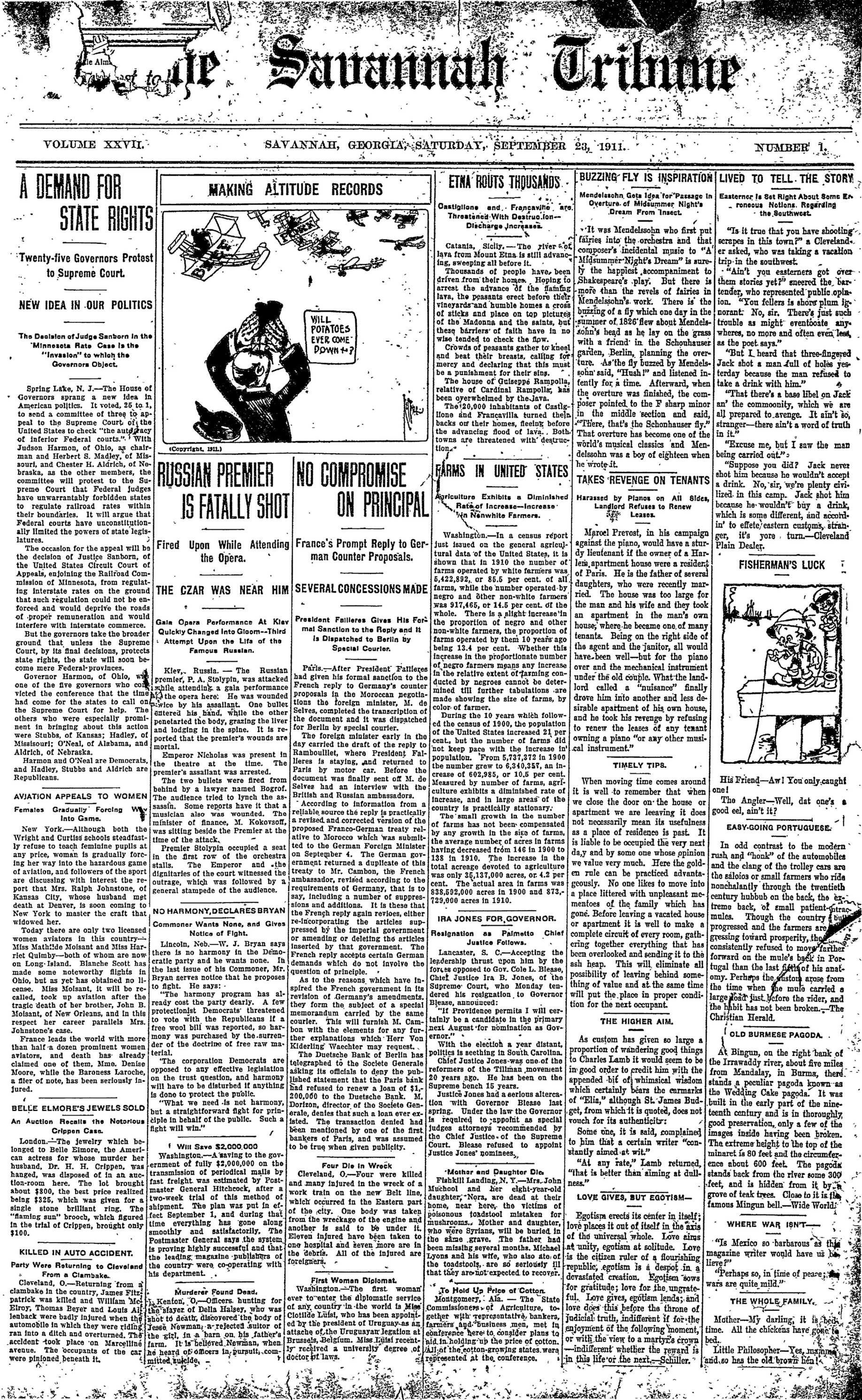
MAKING ALTITUDE RECORDS
WILL POTATOES EVER COME DOWN?
RUSSIAN PREMIER IS FATALLY SHOT
Fired Upon While Attending the Opera.
Gala Opera Performance At Klev Quickly Changed Into Gloom--Third Attempt Upon the Lifa of the Famous Russian.
Klev, Russia. — The Russian premier, P. A. Stolypin, was attacked while attending a gala performance of the opera here. He was wounded twice by his assailant. One bullet entered his hand, while the other penetrated the body, grazing the liver and lodging in the spine. It is reported that the premier's wounds are mortal.
Emperor Nicholas was present in the theatre at the time. The premier's assailant was arrested.
The two bullets were fired from behind by a lawyer named Bogrof. The audience tried to lynch the assassin. Some reports have it that a musician also was wounded. The minister of finance, M. Kokovsoff, was sitting beside the Premier at the time of the attack.
Premier Stolypin occupied a seat in the first row of the orchestra stalls. The Emperor and the dignitaries of the court witnessed the outrage, which was followed by a general stampede of the audience.
Commoner Wants None, and Gives Notice of Fight.
Lincoln, Neb.—W. J. Bryan says there is no harmony in the Democratic party and he wants none. In the last issue of his Commoner, Mr. Bryan serves notice that he proposes to fight. He says:
"The harmony program has already cost the party dearly. A few protectionist Democrats' threatened to vote with the Republicans if a free wool bill was reported, so harmony was purchased by the surrender of the doctrine of free raw material.
"The corporation Democrats are opposed to any effective legislation on the trust question, and harmony will have to be disturbed if anything is done to protect the public.
"What we need is not harmony, but a straightforward fight for principle in behalf of the public. Such a fight will win."
f Will Save $2,000,000
Washington.—A saving to the government of fully $2,000,000 on the transmission of periodical mails by fast freight was estimated by Postmaster General Hitchcock, after a two-week trial of this method of shipment. The plan was put in effect September 1, and during that time everything has gone along smoothly and satisfactorily. The Postmaster General says the system is proving highly successful and that the leading magazine publishers of the country were co-operating with his department.
Murderer Found Dead.
I. Kenton, O.—Officers hunting for the slayer of Della Halsey, who was shot to death, discovered the body of Jesse Newman, a rejected suitor of the girl, in a barn on his father's farm. It is believed Newman, when he heard of officers in pursuit, committed suicide.
NO COMPROMISE ON PRINCIPAL
France's Prompt Reply to German Counter Proposals.
SEVERAL CONCESSIONS MADE
President Fallieres Gives His Formal Sanction to the Reply and It is Dispatched to Berlin by Special Courier.
Paris.—After President Fallieres had given his formal sanction to the French reply to Germany's counter proposals in the Moroccan negotiations the foreign minister, M. de Selves, completed the transcription of the document and it was dispatched for Berlin by special courier.
The foreign minister early in the day carried the draft of the reply to Ramboulllet, where President Fallieres is staying, and returned to Paris by motor car. Before the document was finally sent off M. de Selves had an interview with the British and Russian ambassadors.
According to information from a reliable source the reply is practically a revised and corrected version of the proposed Franco-German treaty relative to Morocco which was submitted to the German Foreign Minister on September 4. The German government returned a duplicate of this treaty to Mr. Cambon, the French ambassador, revised according to the requirements of Germany, that is to say, including a number of suppressions and additions. It is these that the French reply again revioes, either re-incorporating the articles suppressed by the imperial government or amending or deleting the articles inserted by that government. The French reply accepts certain German demands which do not involve the question of principle.
As to the reasons which have inspired the French government in its revision of Germany's amendments, they form the subject of a special memorandum carried by the same courier. This will furnish M. Cambon with the elements for any further explanations which Herr Von Kiderling Waechter may request. The Duetsche Bank of Berlin has telegraphed to the Societe Generale asking its officials to deny the published statement that the Paris bank had refused to renew a loan of $1,200,060 to the Duetsche Bank. M. Dorizon, director of the Societe Generale, denies that such a loan ever existed. The transaction denied had been mentioned by one of the first bankers of Paris, and was assumed to be true when given publicity.
Four Die In Wreck
Cleveland, O.—Four were killed and many injured in the wreck of a work train on the new Belt line, which occurred in the Eastern part of the city. One body was taken from the wreckage of the engine and another is said to be under it. Eleven injured have been taken to one hospital and seven more are in the debris. All of the injured are foreigners.
First Woman Diplomat.
Washington.—The first woman ever to enter the diplomatic service of any country in the world is Miss Clotilde Luiisi, who has been appointed by the president of Uruguay-as an attache of the Uruguayan legation at Brussels, Belgium. Miss Luiisi recently received a university degree of doctor of laws.
ETNA ROUTS THOUSANDS
Castigilone and Francaville are Threatened With Destruction—Discharge Increases.
Catania, Sicily. — The river of lava from Mount Etna is still advancing, sweeping all before it.
Thousands of people have been driven from their homes. Hoping to arrest the advance of the flaming lava, the peasants erect before their vineyards and humble homes a cross of sticks and place on top pictures of the Madonna and the saints, but these barriers of faith have in no wise tended to check the flow.
Crowds of peasants gather to kneel and beat their breasts, calling for mercy and declaring that this must be a punishment for their sins.
The house of Guisseppe Rampolla, relative of Cardinal Rampolla, has been overwhelmed by the Java. The 20,000 inhabitants of Castilgione and Francavilla turned their backs on their homes, fleeing before the advancing flood of lava. Both towns are threatened with destruction.
Agriculture Exhibits a Diminished Rate of Increase-Increase in Newhite Farmers.
Washington. In a census report just issued on the general agricultural data of the United States, it is shown that in 1910 the number of farms operated by white farmers was 5,422,892, or 85.5 per cent. of all farms, while the number operated by negro and other non-white farmers was 917,465, or 14.5 per cent. of the whole. There is a slight increase in the proportion of negro and other non-white farmers, the proportion of farms operated by them 10 years ago being 13.4 per cent. Whether this increase in the proportionate number of negro farmers means any increase in the relative extent of farming conducted by negroes cannot be determined till further tabulations are made showing the size of farms, by color of farmer.
During the 10 years which followed the census of 1900, the population of the United States increased 21 per cent, but the number of farms did not keep pace with the increase in population. From 5,737,372 in 1900 the number grew to 6,340,357, an increase of 602,985, or 10.5 per cent. Measured by number of farms, agriculture exhibits a diminished rate of increase, and in large areas of the country is practically stationary:
The small growth in the number of farms has not been compensated by any growth in the size of farms, the average number of acres in farms having decreased from 146 in 1900 to 138 in 1910. The increase in the total acreage devoted to agriculture was only 35,137,000 acres, or 4.2 per cent. The actual area in farms was 838,592,000 acres in 1900 and 873,- 729,000 acres in 1910.
IRA JONES FOR,GOVERNOR.
Resignation as Palmetto Chief Justice Follows.
Lancaster, S. C.—Accepting the leadership thrust upon him by the forces opposed to Gov. Cole L. Blease, Chief Justice Ira B. Jones, of the Supreme Court, who Monday tendered his resignation to Governor Blease, announced:
"If Providence permits I will certainly be a candidate in the primary next August for nomination as Governor."
With the election a year distant, politics is seething in South Carolina.
Chief Justice Jones was one of the reformers of the Tilliman movement 20 years ago. He has been on the Supreme bench 15 years.
Justice Jones had a serious altercation with Governor Blease last spring. Under the law the Governor is required to appoint as special judges attorneys recommended by the Chief Justice of the Supreme Court. Blease refused to appoint Justice Jones' nominees.
: Mother and Daughter Dic
Fishkill Landing, N. Y.—Mrs. John Muchool and her eight-year-old daughter, Nora, are dead at their home, near here, the victims of poisonous toadstool mistaken for mushrooms. Mother and daughter, who were Syrians, will be buried in the same grave. The father, had been missing several months. Michael Lyons and his wife, who also ate of the toadstools, are so seriously ill that they are not expected to recover.
To Hold Us Price of Cotton
Montgomery, Ala. — The State Commissioners of Agriculture, together with representative, bankers, farmers, and business men, met in conference here to consider plans to aid in holding up the price of cotton. All of the cotton-growing states were represented at the conference.
BUZZING FLY IS INSPIRATION
Mendelsohn Gota Gela 'for'Passage In
Overture of Midsummer Night's
Dream From Insect
It was Mendelssohn who first put fairies into the orchestra and that composer's incidental music to "A Midsummer-Night's Dream" is surely the happiest accompaniment to Shakespeare's play. But there is more than the revels of fairies in Mendelssohn's work. There is the buzzing of a fly which one day in the summer of 1826 flew about Mendelssohn's head as he lay on the grass with a friend in the Schouhauser garden, Berlin, planning the overture. As the fly buzzed by Mendelssohn said, "Hush!" and listened intently for a time. Afterward, when the overture was finished, the composer pointed to the F sharp minor in the middle section and said, "There, that's the Schonhauser fly." That overture has become one of the world's musical classics and Mendelssohn was a boy of eighteen when he wrote it.
TAKES REVENGE ON TENANTS
Harassed by Planos on All 8ides,
Landlord Refuses to Renew
Leases.
Maroel Prevost, in his campaign against the piano, would have a sturdy lieutenant if the owner of a Harlen apartment house were a resident of Paris. He is the father of several daughters, who were recently married. The house was too large for the man and his wife and they took an apartment in the man's own house, where he became one of many tenants. Being on the right side of the agent and the janitor, all would have been well—but for the piano over and the mechanical instrument under the old couple. What the landlord called a "nuisance" finally drove him into another and less desirable apartment of his own house, and he took his revenge by refusing to renew the leases of any tenant owning a piano "or any other musical instrument."
TIMELY TIPS.
When moving time comes around it is well to remember that when we close the door on the house or apartment we are leeaving it does not necessarily mean its usefulness as a place of residence is past. It is liable to be occupied the very next day, and by some one whose opinion we value very much. Here the golden rule can be practiced advantageously. No one likes to move into a place littered with unpleasant mementoes of the family which has gone. Before leaving a vacated house or apartment it is well to make a complete circuit of every room, gathering together everything that has been overlooked and sending it to the ash heap. This will eliminate all possibility of leaving behind something of value and at the same time will put the place in proper condition for the next occupant.
THE HIGHER AIM.
As custom has given so large a proportion of wandering good things to Charles Lamb it would seem to be in good order to credit him with the appended bit of whimsical wisdom which certainly bears the carmarks of "Elia," although St. James Budget, from which it is quoted, does not vouch for its authenticity:
Some one, it is said, complained to him that a certain writer "constantly aimed at wit."
"At any rate," Lamb returned, "that is better than aiming at dullness."
LOVE GIVES, BUT EGOTISM—
Egotism erects its center in itself; love places it out of itself in the axis of the universal whole. Love aims at unity, egotism at solitude. Love is the citizen ruler of a flourishing republic; egotism is a despot in a devastated creation. Egotism sows for gratitude; love for the ungrateful. Love gives, egotism lends; and love does this before the throne of judicial truth, indifferent if for the enjoyment of the following moment, or with the view to a martyr's crown —indifferent whether the reward is in this life or the next.—Schiller.
LIVED TO TELL. THE STORY
Easterner Is Set Right About Some Entrenous Notions. Regarding the Southwest.
"Is it true that you have shooting scrapes in this town?" a Clevelander asked, who was taking a vacation trip in the southwest.
"Ain't you easterners got over them stories yet?" sneered the bartender, who represented public opinion.
"You fellers is shore plum ignorant: No, sir. There's just such trouble as might eventoate anywheres, no more and often even less, as the poet says."
"But I heard that three-fingered Jack shot a man full of holes yesterday because the man refused to take a drink with him."
"That there's a base libel on Jack an' the commonity, which we are all prepared to avenge. It ain't so, stranger—there ain't a word of truth in it."
"Excuse me, but I saw the man being carried out."
"Suppose you did? Jack never shot him because he wouldn't accept a drink. No, sir, we're plenty civilized in this camp. Jack shot him because he wouldn't buy a drink, which is some different, and accordin' to effete; eastern customs, stranger, it's yore turn.—Cleveland Plain Dealer.
A boy is fishing.
His Friend—Awl You only caught one!
The Angler—Well, dat one's good eel, ain't it?
EASY-GOING PORTUGUESE.
In odd contrast to the modern rush and "honk" of the automobiles and the clang of the trolley cars are the saloios or small farmers who ride nonchalantly through the twentieth century hubbub on the back, the extreme back, of small patient-intrac mules. Though the country bull progressed and the farmers are greasing toward prosperity, the consistently refused to move farther forward on the mule's back in Portugal than the last fifth of his anatomy. Perhaps the custom arose from the time when the mule carried a large load just before the rider, and the habit has not been broken.—The Christian Herald.
intrac
bulk
log
her
OLD BURMESE PAGODA.
At Bingun, on the right bank of the Irrawaddy river, about five miles from Mandalay, in Burma, there stands a peculiar pagoda known as the Wedding Cake pagoda. It was built in the early part of the nineteenth century and is in thoroughly, good preservation, only a few of the images inside having been broken. The extreme height to the top of the minaret is 80 feet and the circumference about 600 feet. The pagoda stands back from the river some 300 feet, and is hidden from it by a grove of teak trees. Close to it is the famous Mingun bell.-Wide World.
"Is Mexico so barbarous as this magazine writer would have us liee?"
"Perhaps so, in time of peace; wars are quite mild."
Mother—My darling, it is bed time. All the chickens have gone to bed.
AFRO-AMERICAN CULLINGS
The time is ripe, if ever it was, for every negro of respectability, energy and thrift, to own their own residence, if they already do not own one. The man who works six days in each week and without ceasing should at least put aside a percentage of each week's wages, so that in a reasonable time the nucleus will have been secured towards the first payment on a home.
We have from time to time written article after article upon this subject. We have pleaded with, threatened and abused whenever we thought it would do some good on this line, and we believe results have been attained for we have noticed that there is activity in the purchase of real estate by the colored people of this city. We mean by that the purchase of small places for homes, not as investments. If this is done in proportion to the numbers represented by the negroes in the population of this city, according to the advantages offered them in the field of labor, and with the remuneration equalized as it is today, there is no earthly reason why they should not purchase a home whenever they so desire.
Men may claim that the negro is full of idleness, that he is thriftless, and that he will not work regularly and stick to it. This certainly is untrue and when reduced to facts and figures it can be shown that the labor of the entire south is today handled by the negro and in many places he is clamoring for work and cannot get it. This is different here, for in South Carolina and especially adjacent to Charleston there is and has been sufficient work for all who may apply and with wages from thirty-three and one-third to fifty per cent better than a few years ago. Occasionally or at certain seasons some classes of labor might decrease or slacken up for a month or so, but taken as a whole, the year round, the laborer is truly worthy of his hire.
Then let the man who is at the head of a family consider these things, save his money and build him a home, however humble, for the protection of his family in the days when age and infirmity will cause him to cease from active labor.—Charleston (S. C.) Messenger.
Rev. H. H. Proctor, speaking on "Egypt and Its Light on the Relation of the Races" in Atlanta, said:
"Egypt is the gateway of Africa, the cradle of civilization and the mother of the Holy Land. Cairo, the center of Egyptian life, presents many contrasts between the new and the old world, but its chief interest is historic. Its pyramids constitute the earliest monuments to human industry. It is evident from a study of the great museum in Cairo that a great people occupied this territory. They were great in agriculture, art, science and religion. It is also clear that blacks played a great part in this civilization. Among the evidences of this are the busts and pictures of kings seen in the museum. The kings and queens were of various colors. The features of the Sphinx are those of a negro and the colossal statue of Rameses II., excavated at Memphis, shows him to be of black origin. The Pharaoh before whom Moses pleaded was the son of Rameses I., and was, foreword of Negritian origin."
James Shelton, Indianapolis, member of the ways and means committee, called upon E. Lung, Chinman, for a subscription, says an exchange. Shelton told Lung that he would guarantee that he would wash 5,000 more shorts during the K. of P. encampment. Lung didn't believe it, and replied, "Niggee aln't got 5,000 shirtee. Niggee only got one shirtee." Shelton insisted that 5,000 negroes represented at least 5,000 shirts and that Lung ought to subscribe for he would see that they would bring all their shirts to his laundry. The Chinman laughed and said: "I give you dollie, but niggee aln't got 5,000 shirtee. Niggee's shirtees are no good. They lose checkee. Don't you send 5,000 niggees here—scare my baby. Tell niggee no checkee no shirtee. Give dolle." Mr. Shelton accepted Lung's dollar and declared he would never try to induce a Chinman to subscribe to another negro enterprise as long as he lives—Dallas Express.
Dr. Booker T. Washington's appearance in the Alabama case at the White House was that of a patriotic citizen of Alabama, a defender of the civic privileges of his race and a foe to the reactionary forces that would relegate the negro to the bacground. Doctor Washington is in no sense a politician. He gives his opinion of public matters when an expression can do good. He does his duty as a wide-awake American should.—Texas Freeman.
---
Pessimism is not a word or term with which to conjure, if you would lift men up or prepare them to unlock for themselves those causes that contain the essentials of a useful, practical life. The man, woman or child who is pessimistic is foredoomed to failure.—Ex.
Inman E. Page, president of Langston university, Langston City, Okla. In his speech before the National Negro Business league at Little Rock, Ark., told what the negro was doing in education, and how he was being helped by the state. The institution started just thirteen years ago with 40 acres of land, without the mule, 40 students and four teachers. The state then appropriated $5,000 for the support of the school for two years. He recounted the success year by year, until at present it has 320 acres, 25 teachers, 673 students and the national government had given 100,000 acres of land for the endowment of a negro school.
The change in political parties did not make any change in the interest of the white people in the negro's progress, because just after the change the main building was destroyed by fire, and the legislature appropriated $100,000 for the erection of another building, which far surpassed the former one. "We are turning out teachers to teach the negro race, lawyers to plead for the negro, and doctors to cure the negro race," he said.
Other addresses were delivered by J. E. Johnson, cashier of the Peoples Bank and Trust company; John W. Simmons of Coweta, "The Negro in Oklahoma;" I. W. Young, M. D. Boley, R. W. Tolliver, D. D. Boley and R. Emmett Stewart, the negro lawyer. Stewart spoke of his lucrative practice, and asked for a stenographer at once, saying/that he was in position to pay a salary of $100 a month.
Quite a large crowd of colored people and a considerable number of representative white people gathered in Bethel church in Atlanta to hear the address of W. T. Vernon, ex-register of the treasury, who is now connected with the interior department as supervisor of education. His present appointment was made some time ago by President Taft and comes as a reward for his able work in Kansas, where he is a leader. His address was an interesting and instructive one. He urged that there should be peace and a cordial understanding between the races here in the south, and that this was the first and most important requisite for progress. "This can be easily done, for the best white people are the real friends of the law-abiding colored citizens. I am the child of slave parents," he continued, "and we are here to slay, to live in this country, where we have been for the last three hundred years, and we mean to remain here. We must work out our destiny as other people have done, and must pay and must make sacrifices." He was introduced by Bishop J. S. Flipper of Arkansas, and the closing remarks were by the pastor, Dr. C. M. Tanner. Vernon came here from Hampton institute, and will go from here to Tuskegee, following the work of his department.
---
The census reports thus far issued show in regard to agricultural conditions in the south two things:
First, in both the South Atlantic and the south central states the value of farm lands and farm buildings has considerably more than doubled. They have increased in the South Atlantic states from $1,205,350,000 in 1900 to $2,476,152,000 in 1910, an increase of $1,269,802,000. In the south central states the increase has been even greater. The value of farm lands and buildings in 1900 was $2,072,672,000, and in 1910 it was $4,837,353,000, an increase of $2,764,681,000. Second, during this time the number of farms has steadily increased, showing that the plantations are breaking up and the era of the small farmer has arrived, while during the same period the number of negro land owners has increased much more rapidly than the number of white land owners. This certainly looks as if the negro was not going backward-in the south, no matter how much the planters howl about negro labor—New York Age.
When a backward race gets far enough advanced to attract widespread attention and command a healthy opposition, no better evidence of its progress is needed. When the negro was a slave he had no opposition because he was not in competition with the white man. But fifty years of freedom have brought him to the point where he is debated on in college, written about in the magazines and newspapers, discussed in politics, preached on from the pulp, argued about in homes and even made the subject of drama. None but a rising people could command all this attention.—Er.
Debt is an awful burden upon any human being, who has experienced it. Some of our people will get into it, seeing no way of getting out, then they will be harassed. Recently we saw several of these victims being tormented and humiliated by these loan sharks, who make double their money loaned by practicing usury. Dealing with this system only means shame and disgrace to you in a long run. Try to economize and get on foot- Palestine Plaindealer.
JOURNEYS TO THE BUSINESS LEAGUE—INCIDENTS OF THE GREAT MEETING—AN AGGREGATION OF MEN WHO HAVE OVERCOME—EXTRACTS FROM SPECHES BY GOV. DONAGHEY AND THE WIZARD OF TUSKEGEE.
When asked if he were going to attend the meeting of the National Negro Business league, a certain bishop answered: "No, I am not going; I'd rather stay at home and be a big dog among little dogs than to go up there and be a little dog among big ones!" I confess that the remark caused me to pause in my preparation to attend that great meeting. I figured, however, that the only way to know about the big dogs was to get among them and that if my bankers could be brought to terms I'd chance it anyhow. After prayerful consultation with these latter and after all sorts of assurances to them that I'd be certain to come back (these assurances being absolutely necessary in absence of glit-edge securities) I hiked out. For the first two or three hundred miles I saw no one going to the same destination. Great crowds would get on at various towns, but on inquiry found they were going either to a "big meeting," a big ball, or both. One enthusiastic brother got on and as the train was pulling out he poked his head out of the window and shouted to his wife: "You make dem dar children behave while I'm gone." The conductor, who was standing waiting for the ticket, said: "Here, here, give me your ticket; that woman knows a thousand times more about that you do." The passenger seemed hurt in his feelings and never said another word while on the train.
The National Negro Business league is serving the purpose of discovering the negro to the negro, and in so doing it radiates inspiration, enthusiasm, hope and race confidence. It is the greatest forward movement found anywhere among negroes today. It is made up of men who against overwhelming odds have made good in their several lines of endeavor. They are men who instead of asking for a chance have gone in and taken the chance and used it. Surrounded as they were by the heritage of slavery, they have seized the guns of the guards and got away to the heights of financial independence. In these meetings the members tell how it was done. And if their "talks" were set to music, a most fitting title would be "The Story of How We Have Overcome." As was to be expected, the "hot alr man" and his fellow, the "point of order man," were nowhere in evidence. The preacher as a preacher was not there—as was evidenced by the fact that no "collections" were called for and no "rallies" pulled off. The sessions were opened with prayer, but these were short and, for negroes, were wonderfully business-like and to the point. No school teachers were, there as such, for there was no eloquent discussion of vague and shadowy theories and telling of things which the speaker never thinks of doing in the school room. Even the fellow who wanted to forget that he had made good not by talking, but by doing, was held strictly to his story. Time and again President Booker T. Washington would admonish the speaker to "leave off your introduction." "get down to your story; your time will be out pretty soon. "Such admonitions were frequent during the "loveeast" or "covenant meeting" (we put it both ways so you'll understand it, whether you are a shouting Methodist or a deep water Baptist) which at Mr. Washington's suggestion was held so that all might have a say. He explained that he found such a meeting absolutely necessary, for every time he left the stage he would be approached by a dozen or more gentlemen asking for a chance to make a speech. In any other negro meeting on earth these gentlemen would not have thought of anything else than simply rising in their seats and shouting, "Mr. Chairman," and then proceeding to inflict upon the audience the "greatest speech" ever made! Nothing less than a club could have induced him to stop. Not so at this meeting. Everything was under strict control; nobody, spoke who was not invited and no speaker was allowed to get away from the subject in hand, and if the subject got away from him he was promptly "squelched." The very fact that they could be rung off without having to call out the police shows pretty conclusively that they were pretty big negroes after all. Only "big dogs" can be controlled—"fice" has to be indulged or clubbed in insensibility.
The opening session of the league meeting was devoted to hearing welcome addresses and responses by local citizens and a most interesting speech by Governor Donaghey of that state. The governor disclaimed any embarrassment in appearing, before the league to speak, and illustrated that remark by telling of a man who had tried to invent a kind of food for hogs. The man's neighbors tried to discourage him by pointing out the fact that he didn't know anything about hogs. "You're dead wrong there," said the man, "I was brought up among hogs!" The governor said he was among the people with whom he had been raised. Continuing he said: "We never have any trouble; we
and friends; since I have been the governor of this state I have turned aloose more crap-shooting criminals, turned aloose more colored men who were convicted largely because of a wrong principle. I have turned them out of the county farm because I believed that they were erroneously and wrongfully confined therein (applause)—but I have refused to turn aloose more hardened criminals that ought to be confined, in the pen-tentilary, it didn't make any difference what race they belonged to, than any governor of this state. The New York American telegraphed me and said: 'What do you attribute the cause of the Pennsylvania lynching to? What is the remedy, and what the moral?' I said the cause is the lack of law enforcement and the proper education of the human race (applause); I said the remedy will be a rigid enforcement of law and this continued education. I said the moral is that the negro should come back home, come south.'
He paid a high tribute to the race, claiming that they were remarkable for more things than color and plantation melodies. He spoke of the negro's unfalling good humor and of the fact that though imitative, he never commits suicide or suffers from nervous troubles. The governor's address was a happy one and you could feel his sincerity. We didn't expect to see him again after he had performed his part of the program, but we were agreeably disappointed for he was present at the following session of the league that night. The league had met in twelve different states and this was the second time that a governor has responded to the invitation to address it. The other exception was in the case of the governor of Kentucky
—both southern men. All the other governors would either be sick or be called out of town by wire just as the league would be assembling. The introductory addresses were made by Messrs. Bush, Thornton, Doctors Hayman and Morris, and all of them said something. Too much cannot be said in praise of the committee of management, headed by Messrs. Scplo A. Jones and J. E. Bush. The arrangements challenged admiration on account of their completeness and extent and everything—big things, too—was put through without a hitch. One of the largest theaters in the south had been secured for the meeting of the main body of the league; the Federal building was secured for the meeting of the negro lawyers—the only time a thing like that has happened since the league was organized—a free trolley ride around the city was given to all the delegates, and $500 was donated by the chamber of commerce. While all of this bespeaks the splendid relation and good will existing between the races in Little Rock, it also shows the resourcefulness of the men charged with the making the arrangements. It was a source of regret to us to hear these men "cussed out" and "rplpped up the back" on all sides. They were under constant fire from their local fellow-citizens, but in spite of that they knew how to get results which their critics could never have accomplished. But isn't that the case wherever the negro lives, and where some are demonstrating their ability to lead by actually leading and going forward even though under constant fire? The only crime that we could discover that these men had committed was the heinous crime of success—the only offense was that of having made good. When Alexander the Great was on his death bed he was asked to whom he was going to leave his empire? "To the strongest," was the answer. And so wherever there is a group or community of contending, warring negroes, the strongest will in time "get by" and be in the forefront of any movement that brings results.
Dr. Booker T. Washington's annual address was the keynote speech of the occasion, and to this keynote all the other speeches were attuned. As is well known, Mr. Washington stresses the opportunities within our reach, rather than "whine" for those not yet within our grasp. Don't advertise our disadvantages, but make use of our advantages; don't sigh and whine for rights withheld, but make good with what can be had today; don't theorize, but get up and do something. That I think is the gist of Mr. Washington's philosophy, and whatever may be its defects he has succeeded to a wonderful extent in inculcating thousands of people with it. Every man there who spoke gave evidence that the "treatment" had "taken" at least in his case. Not once did a speaker dwell on privileges abridged, rights withheld, wrongs endured or opportunities denied. After you listen to one of Mr. Washington's addresses you begin to feel the accuracy of the term "wizard" by which he is so popularly known. His talks are pointed and weighty and form a cumulative argument in behalf of his philosophy regarding the solution of the problem. Nothing is said in derogation of the "other" fellow's philosophy, and unless your reason is strong enough to emerge out of the mass of facts presented, and to overcome the force of his logic, you'll forget that there is any other side or any "other" fellow.
NOT HARD TO BELIEVE.
"A certain lady called up her grocer by telephone the other morning and, after she had sufficiently scolded the man who responded, said: "And, what's more, the next order you get from me will be the last I'll ever give you."
"It probably will, madam," said the voice at the other end of the wire; "you are talking to an undertaken" Tis Blis.
I know that my Redeemer liveth.—Job, 19:25.
The assurance expressed here was a great conscious power in the heart of Job. Without it he would have surrendered to the tremendous force of the calamities which fell upon him in hurried succession. Notwithstanding this assurance, another great fact forced itself upon him with relentless persistency, and that was that this is a world of strange, deep mysteries. Assent to the doctrine that God reigns does not always quietly pacify the heart in the presence of strange, hard events. God's ways are too wonderful for us.
Our near view is always dim, and the distance is ever shrouded in darkness. Photographers have developed what they call pictures of the invisible. An illustration of this is found in two photographs taken at midnight, looking out over Lake Geneva, which develop faint yet distinct images of the lake and of Mont Blanc. The photographer could not see the lake nor the mountain while he was photographing them. This is something of the manner in which we behold the mount of God's glory. We never penetrate the deep cloud that surrounds him with our natural eyes, but our faith comprehends him as the lake and the far-off mountain are seen in the beauty of the night pictures. Invisibility is, of course, a relative term, and its significance depends upon the power of the observer's eye. But we all in the midst of life's darkness need to see enough of the Designer and of the designed to keep us in the assurance that all are working toward beneficient ends. At best, acquiescence in the order of an unseen Ruler is the severest, but 'divinest, lesson, and often the last that mortals learn. It is especially so when adversity becomes a chastening rod, and it is almost invariably in the whirlwind of misfortune and sorrow that the soul slowly and cautiously yields itself to the will of the Unseen.
This chieftain of the Orient was swept suddenly and swiftly from power, luxury and popularity to invalidism, poverty and forsakenness by successive strokes, the cause of which he could not see. In the midst of great humiliation he yearned for the quiet of the grave, where, he said, the wicked cease from troubling and the weary rest. While bowing low under the weight of sorrow and misfortune these would-be friends attend upon him for the avowed purpose of comfort and correction. They insisted that his reverses and bereavement were the revenges of God for secret and distinctive sins. Job appealed from this accusation, saying "I know that my Redeemer liveth, and that he shall stand in the latter day upon the earth; and, though after worms destroy this body, yet in my flesh shall I see God." He thus declared his innocence and asserted his faith in God's sympathetic care of him while here, together with his com-
LIMIT OF HIS PATIENCE.
Louie D. Brandels was being congratulated at the Union club in Boston on the rejection of the Cunningham goal claims.
"You and your friends," said a broker, "worked hard. You must now be pleased at the successful outcome of your hard work."
"Yes," said Mr. Brandels, frankly, "some of us did work very hard. None of us, not even the least of us soldiered."
He smiled and added:
"The thought of soldiering reminds me of an anecdote. A classmate of mine at Harvard went, in the summer of '76, to a Canadian lumber camp. He was a lean, pale, stringy chap, and he hoped the rough life would do him good.
"Well, the first day they put him on a cross-saw with an experienced sawyer, and he did fairlyvim. But the second day he was stiff and sore, and there was less vim in his cross-sawing. The third day, quite done up, with hands blistered and every muscle aching, he sawed wretchedly—wretchedly.
"His partner at the other end said nothing for some time. Then the old fellow's patience became at last exhausted, and letting go the saw handle, he straightened up and said, quietly:
"Son, I don't mind yer ridin' on this here saw, but I surely would be obliged if ye'd keep yer feet off the ground'"—Washington Star.
AT THE DOOR.
Thomas had been a carpenter, but owing to dullness in trade, he was engaged as a footman at the "Big House" in the village.
On the day of his engagement his mistress, having a lady visitor in the drawing room, rang the bell, for the footman. "You will show this lady to the front door, Thomas," she said.
"Yes, mum," replied Thomas, and, bowing-to the lady, he requested her to follow him. On coming to the door, Thomas opened it, and the lady was about to pass out when Thomas, tapping her on the shoulder, remarked: "This is the door, mum; gift pitchpine isn't frame two an' a half inches thick, with raised moldings; wad cost about two pound ten, mum."-Ideas.
of glorification in
here teaches us
at power that at-
though sometimes
and awful, is the
Redeemer. God
We would all do well to observe that a great God has shaped our lives and guided our ways far better than we have thought or dreamed. Each man whose eyes may fall upon these lines may see, if he will, how a gracious Providence has intervened and overruled mistakes and sanctified hard events to his own good. The least of men are the objects of his daily care. No man and no event are unimportant in his sight. God carries on his designs with precision and determination. Then, who brought us on our way to this high mount in the pilgrimage of life? Not some blind chain of circumstances; not some preordained god of fate, nor the power of our own will alone. Men progress by the permission and grace of a living Redeemer. He encamps his hosts along the ways of our anxious and suffering pilgrimage. Unseen armies of heroes and charlots, with angels, throw themselves along the dangerous paths of every true man's life. This conviction in Job's heart made a prince of him—a great prince of character. The downpour of calamity, which rendered him poor and childless, did not drown him in irremedible despair nor cause him to charge God foolishly. He at once appealed to a Redeemer whose justice and love would, at the proper time, right the wrong of these accusing men, and turn to good the afflictions which had half stunned his trusting heart.
At last, then, every true hope of man clusters about the life of the Redeemer. From every field of strife, where the toll of the day and the weariness of night wring sweat from the brow and courage from the heart, strong appeals rise toward the tender skies. In this sense the world is a stage of human tragedy. No city presents anything of more absorbing interest than the crowds of haggard, sinful and slimming people who throng its streets. Some meet us from the palace door, while others, dingy and aching with weariness, meet us from the doors of hot and noisy workshops, and still others come from nowhere and go, they know not where. Heartaches may be seen in many a face, and eyes gleam with a lurid desperation. Some hurry on as if there were no suffering in the world, while others strike the hot tears from their bloated or pinched cheeks, which have risen at the storm-swell that beats in the depths of the heart. For all these who wrong, or are being wronged, Job means to tell us there is a living Redeemer; that God loves justice and mercy, and that some day all who believe and live in the integrity of righteous motive and noble act shall turn their steps out of the lanes of I've where chagrin and pain are as scorpions' stings into the thoroughfare that leads to the City of Justice and Repose, and to the great white Throne, before which each aspiring soul shall rise to greet the solemn day that shall give him peace forever, and to behold the infinitely glorious and universally adored Redeemer.
SHARP PRACTICE
"The new idea in business is honesty, openness, frankness," said Alton B. Parker at a dipner at Esopus. "We used to conceal our plumbing, and very poor, insanitary work it was. We expose it now, and it is altogether sound, wholesome and satisfactory. Well, business is like that. "When I think of some of the tricks that used to obtain in reputable business firms, I am reminded of the seaside auctioneer. "This scoundrel once held up a $10 gold piece and said: "Guess the date on this piece of money, friends. Make a guess and a small purchase, and the correct guesser takes the coin."
"So everybody in the crowd guessed, everybody bought some worthless rubbish, and the dealer netted a huge profit. Then, at the end he looked at the $10 gold piece, held it up and said:
'Now for it! Who guessed 1894?'
'Me! me! me! cried every man jack in the shop.
The dealer smiled.
"Then you all guessed wrong," he said, slipping the coin into his pocket.
"The date is 1882."—Washington Star.
A THINKING PART.
The boss was brusque and the timid stenographer had her revenge by nicknaming him Mr. Legree. The appellation "took" and finally reached the boss. The stenographer fled, but the name remained. Another stenographer came with, imperious ways, and changed the tone of the office, but a salesman fresh from a trip knew nothing of the change.
"Hello, Mr. Legree," was his greeting to the boss.
"Young man," said the chief meekly, "roles to this company have been reassigned. I nbw play the part of the cake of ice upon which Eliza walks."—Success Magazine.
ENFORCED MARRIAGES
The legislator in Arkansas who proposes to make all men more than twenty-five years old marry ought to read that section of the Constitution which deals with the subject of cruel and unusual punishment—New York Herald.
Of a right to Our Women
BLACK AND WHITE.
In spite of persistent rumors to the contrary, black and white is still the most popular combination in this age of two-toned costumes. At many of the smartest functions gowns showing these colors are often the most modish, having the true Parisian touch to distinguish them from frocks made at home. There is a change, however, for now the trick is to veil black material with filmy white, instead of, as formerly, white with black.
Black satin, used as a foundation and covered with white tulle or spangled net, is now the extreme of good taste for an evening frock. The great Parisian modistes lay decided stress upon this arrangement. Callot shows a model made of black satin velled with finely plaited white tulle and lace. A deep hem of the satin finished the skirt, and under the tule, which shows through in a most attractive way, are bands of silver galloon. The effect is extremely attractive, as are other models on the same order. White lace velling black madrucette is another fancy of the French. A handsome model of clinking black messaline has an overdress of creamy lace, showing a heavy design at the hem, with a figure in trailing vines extending at the way up to the extended waist line, where it ended in the faintest tracts of thread lace.
The lace is draped over the shoulders, forming a deep V decoulage both back and front. This is filled in with fine shirrings of white tulle, and the sleeves are simulated with bands of tulle shirrings crossing the arms midway between the elbow and shoulder. A high girdle of softly folded black panne velvet is held in place a little to the left of the center of the back with an oblong buckle set with rhinestones. Long ends of the velvet, edged with fringe, added the sash effect to the costume.
COSTUMES OF SURAH.
Parisians are favoring tailored costumes of silk worn much like the one-time fashionable surah.
Very chic are those of white surah showing facings of black or black-and-white striped satin.
These have quite taken the place of satin suits at the French capital and promise to be extensively worn during the early fall season by women of fashion in America.
Coats are cut on rather straight lines, with perhaps a little more of a suggestion of fitting at the waist than has been seen for some time. Skirts are a bit fuller at the hem, but still cling closely to the figure about the hips and at the waist line, which in many of the newest models has dropped to the normal again.
Striped satin of white with black or a color, sometimes a vivid one, is employed for collar, rever and cuff facings.
Buttons, too, are covered with gay-colored silk and used as an added trimming on the black or white shawl suit.
FOR ROUGH ELBOWS.
Use vichy water for bathing these patches of roughened skin. Treat the elbows gently. They may be made callous by unnecessary pressure, as in continual leaning on a table or a desk. Night and morning apply a little of the following mixture: Orange flower water, 50 parts; glycerin, 10 parts; borax, 2 parts.
FRENCH FASHION NOTES.
For evening, tulle over satin is much in evidence. The unusual color combinations are the feature. For instance, pink over-yellow, touched up with pale blue, purple, and royal blue, green and silver, silver and red, are some of the exquisite alliances.
Very large flat hats are worn for the events on lawn and at the shore.
One seen at a lawn fete last week was a white straw with a black velvet crown. On the brim was a band of pleated white tulle. Pale pink roses surrounded the crown. This black, white and pink combination is quite evident in the late summer millinery.
At Rumplemeyer's tearoom there was worn a beautiful white hat with a draped emblem, the velvet crown ending in a bow at the front. This was worn with a blue taffeta dress trimmed with white tulle.
Hats of linen with rolling brims, like the Breton peasant shapes, are worn. Trimming is quite simple, usually a long linen quill embroidered on the edge in coarse linen colspots. Beige and bright lavender are allied in plumes on blege-colored straw. Attractive bathing caps are quite like the Oriental turbans or the theater caps of the winter. A softening frill around the edge does much to make the French woman attractive in the sea. Valenciennes lace is used in allover pattern for crowns of hats and for covering or facing lingerie hats. The narrow lace is used for ruffles on the undersleaves and on little vests for lingerie sacques.
Some of the loveliest negligees are being exhibited in little shops on our big streets. Flowered tulle and net are draped over satin, and wreathes of blue and pink forget-me-nots are the dainty trimming imbedded in soft ribbon.
BEDROOMS IN SUMMER.
In the summer months we must look for comfort in many guises which we would not think of seeking out at other times of the year, therefore an especial effort should be made to discover where there can be improvement over the manner in which they are conducted at these times that the bed always proves a comfort when one is in need of rest.
To give the room an appearance of airiness it is necessary that the greater part of the furniture be taken out of the room and stored in an unoccupied part of the house, leaving only, in fact, the actual materials that cater to most imperative wants and, by the way, one's wants should not be so many in hot weather, for it is these generally that make for a greater part of the discomforts that are experienced.
Be sure that there are dark inside blinds to exclude the light that comes as a dusturber to the morning snooze, which, coupled with the afternoon nap, proves to be the beautifier that nature proffers to those who wish to garner or glean the roses that are to be found in the Garden of Rest, for none are ready to say that where there is sufficient to rest the mind and relax the muscles a relief of tension on the whole system, there are not rosy complexions as the reward.
Where in the heart of a city there is a lack of trees and their accompanying aroma a trip can be made to the woods on the outskirts about once a week and an armful of boughs can be gathered to place in a large vase, and so if one cannot get away from the city permanently for the hot months they can at least "bring the country to the town" in the shape of the oxygen-diffusing leaves of the maples and the oaks—Cleveland Plain Dealer.
HOUSEHOLD HINTS
SWEET WATERMELON PICKLES.
Peel off the green skin and cut the white rind in pieces about two inches square. Place in a porcelain kettle a layer of the watermelon, then a layer of grape leaves until the kettle is full. Cover with water and add one tablespoonful of salt and one teaspoonful of alum; cook until the melon is clear; take it out on a platter; remove the grape leaves; make a syrup of three plums of vinegar, two pounds of granulated sugar, one tablespoon cloves, five sticks of cinnamon broken up, one-half teaspoon ground cloves, one tablespoon ground chinamon; put this syrup over the fire and let it come to a boll; add the watermelon and cook slowly for 20 minutes; can. This is excellent, and sweet cucumber and cantaloupe pickle may be made the same way.
CHOW-CHOW.
One-half peck small green tomatoes, one dozen peppers, one quart small white onions, one-half dozen large cucumbers and two hundred small cucumbers, one large head cauliflower. Cut all but onions and small cucumbers in small pieces; let stand in strong brine over night, then take three quarts best vinegar, let come to a boll; have mixed one-half box of mustard, one-half cup sugar, three tablespoons of four, and five cents' worth of turmeric, with a little cold vinegar; add to boiling vinegar and cook until thick; pour while hot over, pickles. This makes six quarts, and is fine and keeps well.
EGGPLANT SOUFFLE.
Take the mashed pulp of a baked eggplant and pass it through a sieve. Work into it pepper, salt, a pinch of nutmeg, a tablespoonful of finely chopped parsley, four tablespoonfuls cream and three eggs beaten separately. Beat the whites stiff. Then beat the whole mixture until it is light, pour into a buttered baking dish, sprinkle the top with rolled bread crumbs and a dash of grated cheese, and bake in a hot oven.
EGGPLANT FRITTERS.
Sift thoroughly, one cupful of flour, one teaspoonful baking powder, one teaspoonful salt and one-fourth teaspoonful of pepper. Add enough milk to make a stiff batter and one egg well beaten. Then stir into it the mashed eggplant. Drop this, a spoonful at a time, into hot lard or fat, and fry a golden brown.
ROUND STEAK.
One pound steak ground, add one small onion minced, make into patties, rol in flour, put one tablespoon of butter into hot skillet and add patties, fry brown on both sides, dredge with flour, salt and pepper to taste, then add one and one-half cups of sour cream, let slimmer until well done; serve hot.
JOHNNY CAKE.
One and one-half cups flour, three tablespoons cornmeal, two tablespoons sugar, one egg, lard size of an egg, two teaspoons baking powder, one cup-cold water, little salt; slit sugar, baking powder, and salt with meal and flour, add lard, water and egg.
---
If I have a guide-book to India giving me correctly the time tables on railways and steamships, and a thousand other things immediately connected with my journey in India, I shall not reject it even if I find in it some incidental allusion to the United States containing a slight error in American history. Its function is as a guide to India. It may be that to an admirable degree, even though it contain some erroneous allusions to botany, geology, or some other science or history entirely unconnected with its purpose. It is true that some of the Bible's doctrines involve historical facts, but it is easy to make all necessary distinction between historical facts of vital importance and those of merely incidental relation to the purpose for which the Bible was given. The existence of scientific errors in the Bible is not yet proven, and probably it is impossible. A careful and unprejudiced study of Joshua 10:12-14, for example, will conclusively show the Bible does not affirm that the sun and moon stood still, or even that Joshua prayed to God that they might pause in their course. The passage shows, when properly translated and interpreted, that Joshua did not pray to God at all, but that he simply apostrophized the sun and moon. The time has come when we must make sharp distinction between the revelations of men. The time has come when this passage should no longer be a stumbling block to either saints or sinners. It has too long received a degree of importance, alike from the friends and foes, of revelation, which, when truly interpreted, it does not deserve. This is a passage which human interpretation and not divine revelation has made difficult.
The gospel claims that Christ promised inspiration to his apostles—John 14:16, 17:26; 15:26, 27; 16:13, 15. It is also claimed in several passages that in accordance with Christ's promise, the apostles received inspiration in their teachings. Only a few passages of this class need here be stated—Acts 4:8; 11:12; 15:28; 1 Peter 1:12. The apostles did not hesitate to put themselves on a level with the Old Testament writers, and to these writers they granted inspiration. They thus claim for themselves the degree of inspiration which they attribute to the writings of the more ancient Scripture—2 Tim. 3:16; 2 Peter 1:19-21. The meaning of this passage quoted from Timothy has been much discussed; it refers of course, to the Old Testament. The revised version of the rendering: "Every Scripture inspired of God is," etc. Is this a true rendering? According to the common rendering of this passage, inspiration is affirmed of all Scripture; but according to the later rendering, the affirmation regarding inspiration is greatly limited. One hesitates to declare his conviction that the common rendering is the true one, when some scholarly men and the revised version seem to prefer another interpretation. Scholarship, however, can match scholarship on both sides of this subject. Rules of Greek syntax can be marshalled to show that the common rendering is conformable to the recognized laws of this most accurate of all languages. The rendering of the revised version is liable to strong objectives. When two adjectives are closely joined as are the words Theopneutus, and hellosmos, "God-breathed" and "profitable" by the conjunction, that both must be predicates, if either is. It is quite certain that there is good authority for the older interpretation. If one wishes to hold is as taught it is difficult to believe that the apostle meant to affirm that divine inspiration belongs to a part of Scripture, but not to the whole, or that he gives us a rule by which to judge whether
NORTH MAGNETIC POLE
IT IS NOT A STATIONARY POINT,
BUT IS CONSTANTLY
SHIETING
Only the experts understand that the north pole and the north magnetic pole are two entirely different things. As a matter of fact, there are few localities on the earth's surface where the compass points due north. The reason is because the north magnetic pole or area lies in the vicinity of King William's Land, just off the arctic coast of North America, in Bornia. When this magnetic pole is between us and the north pole the compass points due north. As we go either east or west from this line it is easy to see that the compass is off to a certain degree. If we were to travel north of the magnetic pole the needle would point south; west of it the needle would point east. Sir James Ross in 1831 located the north magnet pole approximately at a point up in Bornia. In 1903 Capt. Roald Amundsen in th ship Gjoa set out on a three years' expedition, relocated the magnetic pole and made the "northwest passage" for which mariners have striven since the days of Henry Hudson. Terrestrial magnetic force is different in every part of the earth's surface and is not always the same at a given point. It is subject to regular daily and yearly changes. Amundsen posted himself near the seat of the magnetic power and for nineteen months, day and night, with his party, took readings of their instruments, both inclination and declination. He also made short excursions into the region of the magnetic pole and was able by the aid of the declination observations to prove that the magnetic north pole does not have a stationary situatun, but is continually moving. But the general location is, where Sir James Ross first had the honor to place it.—Chicago Tribune.
JUST PERHAPS.
The late Bill Barlow, editor of the Laramie Boomerang, believed no less in accuracy than in humorous journalism, says Human Life Magazine. "You can't achieve our effect," Barlow once said in an address in Douglass, Wyoming, "unless you are accurate. Uncertainty and inaccuracy will spoil the finest effect, whether it be comic or whether it be pathetic.
"I remember a funeral in Tin Can, The Widow Wagg had lost her third in a poker dive. George Jones, D. D., delivered the funeral address, and an eloquent and moving address it was, but George, in his inaccurate way, hadn't made sure whether it was her third or fourth that the Widow Wagg was burrying.
"Henee he spolled a grand oration with these concluding words:
"And now we commend to the Divine mercy this woldowed handmaid who has been bereaved again, and again, and again—
"George hesitated, frowned, and added: 'And perhaps again.'
PROBABLY HE WOULDN'T.
A country rector, coming up to preach at Oxford in his turn, complained to Doctor Routh, the venerable principal, that the remuneration was very inadequate, considering the traveling expenses and the labor necessary, for the composition of the discourse.
"How much did they give you?" inquired Doctor Routh.
"Only £5," was the reply.
"Only 'QS'" repented the doctor.
"Why, I would not have preached, that sermon for fifty." -Briola-Brac
---
"the girl should family that takes care of cook chums and disciples family of negroes. Nobody haves a girl girl, they can count on feeding another family. If complaint is given to the servants, milady, soon finds her self reconnoitering for a friend and servant girl. In the "child" house girl, it is a rare experience a family has in keeping in its room play the same girl for three weeks. The average tenure of service of the house girl is two weeks. If the 'position' is too 'exacting' and the morning paper doesn't come promptly, she wouldn't mind quitting the first week."
It is even asserted that this sort of "gentleman's agreement" to live out of the white folks' kitchen is often encouraged by some of the negro preachers. The Macon News suggests that the housekeepers organize, form unions of their own, and protect themselves against the litterant servants, who are now assured of finding a new place after a week or so spent in the old one. They might be required, for instance, to produce "characters" from their last place of service. The negroes do not, of course, compete with white labor in domestic work. But if their terms of employment become burdensome, they may find powerful competition in the adoption throughout the south of labor-saving contrivances and of methods of scientific management in the home that will largely do away with the need of keeping servants. In the factories and fields they are submitting more and more to the competition of white labor. Their cunning and unthrift in domestic matters may work to their harm. The domestic service problem, however, is not more perplexing in the south than in the north. It is assuredly one of the gravest of the hour, and one that becomes, more annoying year by year—New York Times.
REFUSED TO OBEY
MAJOR BUTLER CARRIED HIS OBSTINACY RIGHT INTO HIS COFFIN.
Many amusing stories are told of the great formality blended with a humorous brusqueness and independence which characterized early revolutionary days. An incident of camp life is related by the author of "Romance and Realism of the Southern Gulf Coast." In 1998 the first United States troops that came down the Mississippi were quartered at Fort Adams. General Wilkinson, Colonel Hamtramck, Major Butler, Captain Green and other officers were merry over their punch one night, and the general by some accident got his cue burned off. Angry at the laugh which followed his mishap, he next day issued an order forbidding any officer to appear with a cue. Obedient to orders, all the officers but Major Butler cut off their cues.
"The vain old prig!" said the major, "I'll see him hanged before I cut off my cue to gratify him!" And he boldly appeared without changing the style of his hairdressing. The major was put under arrest, but he declared obstinately that he would spend the rest of his life in prison before he would comply with such a silly command. Soon afterward he was taken very ill, and, realizing that he was at the point of death, he gave instructions for his burial, which he knew would be witnessed by the whole command. "Bore a hole," said he, "through the bottom of my coffin, right under my head, and let my cue come through it, that the old general may see that even when dead I refuse to obey his order." And these directions were literally carried out.
BEYOND THE PALE.
Jones—I say, I heard an awful funny thing the other day('proceeds to recite mild and mildewed chestnut at great length.) Jim—Ah, that reminds me of a man I once met in Nysaland.
Jones (with interest)—What about him?
Jim—Oh, nothing; only he'd never heard that story of yours before.—Punch.
Is Urged by Booker T. Wash-
fuldun
for New Broad Street.
PATRONIZE RACIAL TRADE
not supported
people can LEADS WITH OPPORTUNITY TO
show us TEACH MEMBERS OF RACE
and share with them the importance
to us OMOSILIO to
the visual unite with A
drawings the color line was filled by
as Booker T. Washington, in an address
address to a
address be to
delivered in connection with the
activities encampment of the colored Knights of
the Bloody Fifty-Fifth that
encase the colored man should give the col-
onyed man the preference in business;
with just the colored man given the white
hold man the preference.
9. **RHINOCHITES** filmed in the certifi-
thly functions of the fraternal orga-
nization and pertinent tithus face after
a manmate, with another body can-
do. One of the functions of this orga-
nization is to look after offence, to
teach our people to have faith in them-
selves, to face people and prosper
unless that race is, is proud of itself,
proud of our past and of this present.
I have no objection to the patience with
any colored people, and I am of Ameri-
can origin, in some parts of the dunni-
ntown and sorrow to say,
some colored people are weak,
and shortsighted that their prefer-
er to be third-rate white people rather
than first-rate colored people. The
Knights of Pythias teach the precept
and by example that there is as
much glory in being a first-class col-
ored man as in being a first-class white
man.
"We are as a nation within a nation in this country. There are more black people in the United States than the entire population of Canada. The number of black people in this country is greater than the total population of Norway, Sweden and Switzerland. The number is greater than the entire population of Mexico. We should be proud of our race. Just as the Englishman, as the Frenchman, the German and the Irishman are proud of their races, so should we be proud of our race.
"We should be proud to belong to a race that has a struggle ahead, and which has a problem for every day in the year. History shows that when a race has no struggle and no problem to solve it finally disappears.
"Whenever you get two black men and two white men together you have a race problem."
"While we should be the last to draw the color line, at the same time we should see to it that in every wise and legitimate way our people are taught to patronize racial enterprise. If a colored man has a grocery store he should receive his share of racial patronage. If he has a shoe store he should get some of our dollars. If a colored man is a builder and contractor he should get a chance to build some of our houses and churches. If a colored man conducts a bank or a real estate concern he should get some of our money.
"The trouble with our people is this: There are shoe stores in every city where, when a negro woman stops to buy a pair of shoes, she cannot have them, tried on or fitted. They will not permit her to be fitted in the store. She must either take them home, or they will be sent out to her and she fits them on herself. Yet, if a colored man opened a shoe store in that town the colored people would pass his place and go right back to the store where the colored woman could not have her shoes fitted.
"There are millinery stores where a colored woman cannot have a hat fitted. She must try it on at home. Yet, if a colored milliner opened a store in the neighborhood, the colored women would pass it by and go right back to the store where they are not allowed to try on a hat.
"Another part of the work of fraternal' organization in this generation is to teach our people how to govern themselves, to direct, to control, themselves. This means the teaching of the race to subordinate selfish and narrow ambitions in the interest of the general welfare.
"Some people say that the negro cannot govern negroes; that they will not follow a leader or a foreman of their own race. They say the colored man must have a white boss. I say this is not true. The colored man does not need a white boss at any time.
"It is a function of a fraternal organization to teach our people to have, respect for racial workers, racial lead, ership; to teach our people to hold up the hands of those who have, the responsibility of leadership and, racial guidance thrust upon them. This organization in the past has held up the hands of its leaders, and I predict and urge that it will do so in the future."
Published Every Saturday
462 West Broad Street.
Phone 2171.
Remittance must be made by Express or Post Office Money Order, or Register ed Letter. Advertising rates given on application.
Entered at the Post Office at Savan uah, Ga., as Second-Class mail matter.
Volume Twenty-Seven, Number One.
With this issue The Tribune enters into its twenty-seventh year, a record held by but few colored journals published. During these years The Tribune endeavored to stick to its principle and give its patrons value received.
Since the beginning of our publication there have been many changes in this community. All of the men who were high in councils of the race and held prominent positions of honor and trust, have crossed the great beyond, except one. The city has grown wonderfully in every respect, and even beyond the expectations of the most sanguine citizen. In this growth the colored citizens have kept pace. When The Tribune was established there were but few colored men in business, with a number of butchers, etc., in the city market. Their business was of the struggling sort. Our first purpose in entering the journalistic field was to encourage our people to open business, build homes and save their earnings. The result today is that we have many and varied kinds of business. We have homes that any class of citizens may well feel proud, and many of our men oave large investments in real estate, city and county, and are connected with various enter
prises that are proving the onward march of race progress. The management of The Tribune is not egotistic, yet it is felt that much of this progressiveness is due to the incessant attitude of The Tribune in advocating the same, and which we are continuing to do in order that we may have every kind of business that is conducted by any other people, and in order to give to our boys and girls who are being prepared an opportunity of securing employment.
During the coming year The Tribune is hopeful of a greater showing of progress. It hopes to see scores of new homes erected; our young men invest their earnings in real estate and other safe enterprises; the establishment of other business concerns especially along lines not now covered; the improvement of our present enterprises and a more loyal support of these enterprises.
During these years The Tribune endeavored to practice what it preached by making improvements in its plant from time to time, by giving employment to many young men and women; and in fact it gives employment to more colored printers than any other race journal in the State, and during the coming year it is being planned to make further improvements in our mechanical department, the employing of more skilled workmen, and to further practice what we preach by purchasing a site and erecting the ceon an office building.
The Tribune has on its books patrons who gave the first encouragement in the enterprise and who have continued during these many years. There are many others who have been equally loyal, and to all, appreciation is extended, and the hope is expressed that they, with the new patrons we hope to gain will give us unstinted support in our further labors for race uplift and progress.
Opportunity waits on no man; grasp it now and success will crown the effort.
In the lining up, the Republicans of the state are yet unsettled. There is one thing certain though, and that is the lily whites will not be allowed any quarters. This is the slogan and along this line the fight will be waged.
The woeful lack of home training of the children is appalling. It is noted more so now, than ever before. A Moses should arise among the women in order to lead the thoughtless ones into ways of home training of children.
Within the next few weeks the tax books will be opened. In paying tax, the voters can take the opportunity of registering. The leaders in the several counties and districts should continue encouraging the voters to attend to this very important duty—pay tax then register. _____
'Tis true that the lynching fever has reached Pennsylvania. 'Tis true too, that many of those alleged to be connected with the lynching have been indicted by the Grand Jury. If this same thing be done in the South, lynching would not be so popular.
It is a matter of encouragement to note the interest manifested by so many young men in procuring homes, and the effort of some of them in doing so. This should inspire many more of our young men and cause them to invest their earnings in that direction, especially so those young men who are holding good positions and are married.
One of our contemporaries a few weeks ago, suggested the idea for some of the higher schools and colleges to add a business department whereby those of our young men and women who are thus inclined, may be taught along business lines. The idea is an excellent one and it can be inaugurated profitably to both school and pupil. We need young men well trained in business.
Our community is liven with young men of fine physique, learning and ability; many of these young men are wasting their lives by not entering into work of an uplifting nature. In church work many of these young men are nill, even so along lines of charity and public uplift. These young men in the future will have to take the places of the men who are now leading affairs, and they should prepare themselves to be an improvement in every respect.
Our people spend more money for pleasure and foolery in this city than any other city of its size in the country. Very often we hear men expressing themselves by saying that they wished that they had saved the money that they had spent in this manner. Such thoughtless expenditure of money is criminal and does not denote a stable people. Let us emulate the saving ability of the foreigners in our midst and prepare for the days when we may be unable to provide for ourselves or family.
The progress of a people is noted mostly by their activity in the commercial world. To be noted progressive, we should be more active in the business field. Those of our young men in business should make improvements; more of our men of finance and ability should husband their means and inaugurate some business enterprise. Capital will find this an excellent field for business. Any man or set of men that would open a first-class shoe store, a furniture store, or a gent's furnishings store, maintaining standard prices and goods with courteous treatment to the public, would succeed admirably.
In about a week hence our public schools will reopen. This season always meet us with a sadden heart on account of the great need for more school facilities for the thousands of our boys and girls that are unable to secure seats in the public schools. And not only that but for the unsanitary and ill-ventilated buildings now being used by the colored children. We would like for members of the Board of Education to divide themselves and be at the colored schools on the opening day and note the crowded condition of the grades, the look of despondency on the faces of the little ones that are turned away, and the great need of improvements in the buildings.
The solidarity of purpose of our people means much for their progress. Even more so with the business men. We find among our white business men that they have their Cotton Exchange, their Board of Trade, their Chamber of Commerce, their Retail Merchants Association, etc. They find it profitable to maintain these organizations. Can not our business men imbibe this spirit of progress and do the same thing by at least being bound in one organization? If the people note that the business men are well organized, it will be the means of inspiring them and causing them to be more loyal to colored enterprises, and the result would be that in the course of time the present enterprises would increase patronage wonderfully and the opening of others would be inevitable.
Many times we have been confronted with the very serious charge that many of our people will not give faithful and efficient service to their employers. This charge of course is not general, for their are hundreds of our men and women in the employ of firms and families, who are as constant as the day is long. This is only intended for those young men and young women who have good employment and who do not render faithful and efficient service. This class of our people believe in having a "good time" by staying up late at nights thus being incapacitated for duty next day. Even if they do not indulge in this direction, they are not inclined to give full service. They should learn that it is only the man or woman who is ever faithful in the performance of duty and is efficient in that performance that ever succeed. Matters not how poor the pay may be, if service is accepted, the performance of it should be faithful and efficient.
Rey, R. R. Downs.
Rev. K. K. Downs.
From time to time The Advocate has had cause and occasion to speak in terms uncomplimentary of some wearers of the cloth. With this as a foundation critics, either malicious or ignorant or both, have jumped at the conclusion and endeavored to disseminate that conclusion as a fact that this paper is hostile to the church and its teachings.
It is with no intention of dispelling that belier or of denying its truth that we here turn over a page, but because we find the reading theron much more agreeable and the subject one worthy of greater praise than some of our recent subjects have been deserving of censure.
The Rev. R. R. Downs is to sever his connection with the St. Paul A. M. E. Church. To those who know the value of a clean educated minister to a community, this announcement will bring anything but pleasure. They will regret his determination, for Rev. Downs, during the eighteen months of his pastorate here, has lived without fear and without reproach. He has been exemplified in all his dealings, as far as a frail mortal may, the teachings of Him whose standard bearer he professes to be and in consequence has won the highest prize of all—the esteem and good will of those who know him best. A correspondent writes in the Christian Recorder, the official organ of the African Methodist Ecuscopic church:
"For many years the Rev. R. R. Downs, D. D., has stood in the fourfront of African Methodism in Ohio and adjacent States. He is a gifted son with the pen and one of Georgia's sons. He easily takes rank, with the best writers and thinkers of the race. As a theologian he has but few equals and still-fewer superiors. His ability as pastor and Presiding Elder, coupled with his splendid pulpit services rounds him out as a character worthy of higher honors."
Rev. Downs is leaving Charleston to be rewarded with some of these higher honors and, though his going will be a distinct loss to Charleston, The Advocate is glad for his sake that he is coming again into his own, that the appointing powers have at last seen the error of assigning him to a charge where his talents have full play and are correcting it by transferring him to Macon Ga. Charleston (W. V.) Advocate.
Rev. Downs pastored in this city and gained the good will and esteem of all classes of citizens. He is a model preacher and gentleman. The Tribune is glad to welcome him to Georgia.
Why Negroes Only?
To Editor Syavagh Tehune:
To Editor Savannah Tribune:
Sir: The Tribune in its last issue called attention to a matter that should engage the thoughtful consideration of every Negro in Savannah. The question is why Negroes only are the victim of these repeated raids by the police department. Is it because there are no loaters among the other races? or is it on account of the explicit order from the chief of police to arrest Negroes only? A week or ten days ago 108 able bodied men were arrested and detained in the barracks on suspicion—men who are working every day, or at least whenever an opportunity for work is offered. The "milk in the cocoonnut" is that the farmers want cotton pickers at starvation price and worst treatment and at the same time there will be races with automobiles very soon—Convict labor as opposed to free labor is required to further the money making scheme of a body of enterprising citizens. Why not lease some of these convicts to the M. & M. T. Co. or O. S. S. Co.? The county has no more interest in automobile races than handling of freight by the companies named. Mr. Editor I believe the police department could find a number of white loiterers whenever they are instructed to look up such. The writer hopes that the next raid will show up a few of the other fellows 100.
Pro Bono Publico.
Inauguration of St. Mary's Hall.
The beautiful hall on 36th street was officially opened for the public last Tuesday evening. The event will long be remembered by those who were present as it was a most pleasant affair. The new hall, which is over the classrooms of the grand school building on 36th street is most beautiful and it is splendidly equipped for social gatherings. For the occasion it was nicely decorated with American flags and the many electric lights presented a bright appearance. At 9 p.m. the large hall was litterally thronged with people. Mr. Mungin's orchestra furnished fine music during the whole evening. The concert in which the best singers took part was delightful. During the two parts of the program, Captain Simmons made an interesting address in which he referred in striking terms to the great work which the Catholics are doing among the Colored people of Savannah especially for the education of the children. Father Dahlent, who is the manager of the school got a cheering reception from the audience, when he appeared on the platform; and with earnest and inspiring words he welcomed the peo-
ple to the grand-new hall in a few words. also he outlined the program which would be followed in the new school. "The motto of the Catholic School," he said, "is not only to educate the mind of the child, but also its young soul." He thanked the immense crowd of people present for the appreciation they are showing to the Catholic Priests in their work. Never before had such an enthusiastic gathering shown appreciation to the Catholics in Savannah. The grand building which was thoroughly inspected by the people during the evening is certainly the best proof of the great work which the Catholics are trying to accomplish for the welfare of the community.
IN HIS HOLY TEMPLE.
Interesting Services in The Churches of the City.
Monumental Notes.
Monumental Notes.
Another glorious Sunday has passed by, it was trustees' day. The endowment exercises were postponed until tomorrow when an excellent program will be carried out. Sunday school last Sunday morning was grand. The collection was liberal and the lesson was discussed briefly. Dr. Townsley put the climax on the lesson when he explained the chart and the black board. At 11 a.m. the Rev. R. Brady preached an interesting sermon. At 8 p.m., Dr. G. W. Alexander, preached a wonderful sermon. Nearly two hundred members were out to class meeting Tuesday night. Revs. Robinson, Savage and Jenkins were among the distinguished visitors. The members of the old mother church are glad to hear the news that the edifice of one of her daughters will soon be torn down and a new one erected, namely, St. Philip, Charles and West Broad Sts. The funeral of Sister Anna Mullin took place at the church Tuesday afternoon, Dr. Townsley officiated. Services tomorrow. Early sunrise prayer meeting 5 a.m., Sunday school 9:30 a.m., preaching 11 a.m., general class 4 p.m. Endowment day exercises 8 p.m. You are welcome.
St. Phillip Dots.
St. Philip Dots.
Rev. W. G. Alexander, M. A., D. D., filled the pulpit at 11 a.m. at St. Philip. His text was from I Cor. 13:11. "When I was a child I spake as a child, I understood as a child, I thought as a child but when I became a man I put away childish things. Some professed christians say I know the time and the place but if they don't know any more than that why they had better start over again." The speaker portrayed Paul's letter to the Corinthians concerning their great learning and their love toward God. The Sunday School Intermediate and Primary department held their Endowment Day exercises at 3 p.m. The boys and girls acquitted themselves well in song and recitation. The collection was as usual on Endowment Day. At 8:20 p.m. the adult department held its exercises. Special mention is made of Mr. H. Hymes' address, subject "A free man" and also Mr. E. W. Sherman on the "Church and Sunday School." Also the papers read by Miss Nellie May Hart and Mrs. L. A. Newsome. In fact all the participants did well. On last Saturday the board of trustees met and signed up all papers concerning the new St. Philips church and parsonage. We are sorry to note that Mrs. R. L. Barnes has been somewhat indisposed but is improved at this time. Mr. W. D. Armstrong is still the building committee of the St. Philips composed of Messrs. R. J. Williams, J. M. Northington, R. W. Rogers, S. J. Howard and B. S. Reid on Wednesday night awarded the contract to the successful bidder. It is said that the colored people of Savannah do not take to lectures. Not withstanding that fact, there was a large crowd to hear Rev. W. G. Alexander Monday night on "Payne, Cromwell, Douglas." It was quite a treat to hear him. Commencing on Monday night September 27 there will be given a ten nights' Entertainment for the benefit of St. Philips building fund in the Ladies exchange. Mrs. R. H. Singleton and Mrs. L. A. Newton left for Valdaots, Ga., on Wednesday to attend the Home and Foreign Missionary Society meeting. The following services will be hold on tomorrow: Prayer meeting at 5:30 a.m. Preaching at 11 a.m. Sunday School at 3 p.m. Preaching at 8 p.m. League meeting every Thursday evening at 8:30. Strangers are cordially invited. At the meeting of the Building Committee of St. Philips church on Wednesday night the contract for the erection of the New St. Philips was awarded to Mr. R. E. Pharrow of Atlanta, Ga. He being the lowest bidder work will begin at once.
Death.
The funeral of Mr. Henry Johnson whose death occurred on Thursday of last week at the Georgia Infirmary took place on last Sunday afternoon from the residence of Mrs. M. C. Sharpe, 520 Stewart street. Mr. Johnson had been lingering for some time from a severe attack of sickness and lately was taken with a stroke of paralysis which hastened his death. He was a member of Eureka Club which institution attended the funeral in a body.
Little Life Ebbed Away.
"Sebby" the seventeen months old daughter of Mr. and Mrs. J. H. Butler of 615 West Henry street, died early Thursday evening from the effect of potash poisoning. "Sebby" was a robust and healthy baby, the idol of the home; she had reached that interesting age that endeared her especially to the parents. It was indeed a sad blow to them. The funeral took place yesterday afternoon from the home.
Card of Thanks.
Mr. H. F. Benson desires to thank the friends who were so kind to his wife during her illness, and for their sympathy at her death.
Atlanta Mutual at the Churches
Tomorrow the Atlanta Mutual Insurance Company will have its agents at all of the churches in the city in order to inform the people of its progressiveness etc. See the ad. in another column.
Did You Write It?
If the party who sent us the article dated from this city, but mailed in Atlanta, would send us his correct address, we will publish the same. The article meets our approval but we always want to know the authentic source of all articles.—Ed.
Subscribers Responding. We have sent out statements to many of our subscribers. Several of them have responded readily. Their action tends to, encourage us in our business. It is hoped that the others will consider their obligation to and pay up at once.
Dr, J. W. Jamerson
FIRSTCLASS DENTIST
All Work Guaranteed
623 West Broad Street
Between Huntingdon and Hall
Phone 2098
Dr, L. S. Parks,
DENTIST
240 Barnard Street,
Bavannah, Ga.
Does all kind of high grade dental
work of the best quality and workman-
ship. Gold crowns and bridge work.
White Porcelain Pv.
Gold Fillings, Cement
Silver or Amalgam Fill-
to a full set of teeth $7
Broken places mended n
Gold ones for a small coat.
Bell Phone
$14, Solid Gold Crowns
Guaranteed
$22 K Gold
I HAVE BEEN
Jumped on a train
to see the high mog
picture trust.
I Had A Sw
For they treated me
way—congratulated
run things and the
I was presenting in
I WENT
For one reason—
great specials, which
all about in the n
paper—"BAKER."
Where the best
That's saying
NEXT TUES
Every lady will be pre
my swell dishes
COME ANY W
AIR D
Hall Lane and
Adults 10c Prices Never
B A K
THE MOVING P
WEST END
The PLACE to get your DR.
Prescriptions given strictest
We handle everything known
TOILET ARTICLES the
PATE'S WEST END
BAY AND FAR
Jamerson
S DENTIST
Guaranteed
Broad Street
ingdon and Hall
Thorough W
Neat, Comfi
Attractive C
Girls taught
rudiments o
science wi
char
Terms reasona
Rev. R. Bright
HAVE BEEN AWA
Jumped on a train and took a trip to see the high moguls of the moving picture trust.
Had A Swell Time
For they treated me royalty in every way—congratulated me on the way I run things and the high class shows I was presenting in my theatres.
WENT THERE
For one reason—to arrange some great specials, which I will tell you all about in the next issue of this paper—"BAKER."
here the best people go
that's saying something
NEXT TUESDAY NIGHT
every lady will be presented with one of swell dishes
OME ANY WEEK NIGHT
MR DOME
Hall Lane and West Broad
Prices Never Change
BAKER
THE MOVING PICTURE MARKET
T END PHARMA
GE to get your DRUGS.
ons given strictest Attention.
everything known to the Drug Business.
ARTICLES the BEST on the M.
S WEST END PHARMA
BAY AND FARM STREETS.
I HAVE BEEN AWAY
Jumped on a train and took a trip to see the high moguls of the moving picture trust.
I Had A Swell Time
For they treated me royalty in every way—congratulated me on the way I run things and the high class shows I was presenting in my theatres.
I WENT THERE
For one reason—to arrange some great specials which I will tell you all about in the next issue of this paper—"BAKER."
Where the best people go.
That's saying something.
NEXT TUESDAY NIGHT
Every lady will be presented with one of my swell dishes
COME ANY WEEK NIGHT
AIR DOME
Hall Lane and West Broad
Adults 10c Prices Never Change Children 5c
BAKER
THE MOVING PICTURE MAN
WEST END PHARMACY
The PLACE to get your DRUGS. Prescriptions given strictest Attention. We handle everything known to the Drug Business. TOILET ARTICLES the BEST on the MARKET PATE'S WEST END PHARMACY BAY AND FARM STREETS.
Funeral Directors
A.M. MONR
FLOYD GREEN
A Full Line of Coffins, C
Prices Reasonable. Satij
Livery Stable Attached.
PHONE-1211. 605
NOW IS THE SEASON FOR
ICE C
No Order too Large.
M. MONROE, AND
FLOYD GREEN Embalmer
Line of Coffins, Caskets and Robes.
Reasonable. Satisfaction Guaranteed.
Stable Attached. Everything First.
211. 605 WEST BROAD
SEASON FOR
ICE CREAM
No Order too Large. None too Small.
A Full Line of Coffins, Caskets and Robes. Prices Reasonable. Satjsfaction Guaranteed. Livery Stable Attached. Everything First Class
"My Heart Goes Bump Inside."
That's the name of the great song hit of the musical show, "The Kiss Waltz," that will be a feature of next Sunday's New York World. In the Magazine Section of this greatest of all Sunday Newspapers will be found a score of exclusive articles such as: The "American Girl Who Won Lord Kitchener," "Note Payer for Sentimental Lovers," "Pittsburgh and New York," by Mrs. Mary C. Thaw; Suffragettes of Darkest Siberia," "Beauty Measurements," "Magnetism Making the Earth Slow Down," "Photographs of the New Campanile at Venice &c., &c.
The Sunday World should be ordered in advance.
OPEN AWAY
and took a trip
signals of the moving
well Time
me royalty in every
me on the way I
high class shows
my theatres.
THERE
to arrange some
I will tell you
next issue of this
st people go.
g something.
DAY NIGHT
presented with one of
WEEK NIGHT
DOME
West Broad
Change Children 5c
ER
PICTURE MAN
PHARMACY
DRUGS.
Attention.
to the Drug Business.
BEST on the MARKET
AND PHARMACY
EM STREETS.
OE. AND CO.
EN Embalmer
Caskets and Robes.
Satisfaction Guaranteed.
Everything First Class
5 WEST BROAD STREET.
Fee Meee PEM ee LO, OR I BBR CR PL LET TE Sea
ete aye . « es ax ee wast we EP Tee - 4 . ter AEE, A
Bo St Sw Fk fia tiie Seatac eT A, MER ee * , “2 2 ER
sons aaa ‘ é : i * eh a7 . gs Bs
SSS ee Reereta een fo Po TS aNR Te ted ae : = ——s = = eee
Tarete. lanai Tose welding Sn Wedaest” AMUSEME@Tccatiine’: | css ea SE ee
RS a ee oe ro
NyaliLine, =
Miss Theodocia Mitchell HJ.,” :
ing. in Bulloch County is héme %
‘he Savannah delegates to the Pitts-
burgh Convention have returned.
ae Ice Cream, ring up McFall Phone
‘Mrs. Lule A. Green was on the sick
list this week.
Don’t go other plates to buy your
suit before seeing A. P. Barnard, The
Taylor, 310 Whitaker street- Phone 3003
Mr. and Mrs. Lorenzo Johnson have
taken an apartment for the winter af
190 West 134 street New York City.
Mrs. Eliza J. Hunt has returned to
from Manchester, Iowa, after a stay of
six weeks, to the delight of her friends.
Rev. A. W. Bryant of Valdosta, pass-
ed through the city this week enroute
from Pittsburgh, Pe
Go to Savannah Pharmacy or phone
your wants. Prescriptions called for
and dellvered. Phone 3570
Miss Mary ‘L.. Haves of Sandfly sta
tion will leave on Monday for Motris
Brown College, Atlanta, Ga.
Ask Pate’s Drug Store about the
Nyall Line.
‘Messrs. Julius H. Pickens Jr., and
Chas. L. Barnard spent last Sunday in
Charleston, S.C. | .
Mr. J. M. Mooney, who left last Sat
urday for stacon, Ga., has returned to
the city and reports his trip a very
pleasant one. o 7
Mr. Wyly Smith, the popular city
manager of the Guaranty Aid and Re-
het bociety, is out again after two
weeks of illness,
Miss Hattie Hamilton, milliner, of
Green and Allen, has returned to the
city after spending her vacation.very
pleasantly with her sister at Augusta.
Green & Allen, the popular milliners
have received their stock of fall hats,
and are now planing for the opening
which will be grander than ever.
* Rev. C S. Wilkins is in the city con-
ducting a series of meetings at the F.
A. B.”Church, Bolton street. The
meetings are well attended.
Mrs. Fannie Gray, after a very pee
ant stay in the city, is seals at Black-
shear where she is gladly greeted by
her friends. .
Mrs. A. R. Bryan of Brooklyn. N. Y.
will arrive in the city on Sunday morn-
ing to visit her parents Mr. and Mrs. H
A. Laphan at 517 Nicoll street.
Miss Katie Andrews of Macon, Ga.
who has been spending the last three
weeks with her sister BMrs, Claudia P,
Mitchell, will return home Sunday
On Friday morning Sept. 15th, a
fourteen pound boy came into the home
of Mr. and Mrs.°C. W. Alexander. The
smother and son are doing nicely.
Go to the Savannah Pharmacy to buy
qour drugs and toilet articles. They
ave the goods. West Broad and
Gwinnett St. Lane. .
Go to Pate’s Drug Store, West Broad
and Hail streets.
After spending a month in New York
City and visiting friends at neighboring
sea shore resorts, birs. Geo. L, Smith is.
expected home Sept, 27th on the S.S.
bart of St. Louis.
Mrs. Olivia Mitchell and Miss Teressa
Mitchell, Jeft for Washington, D, C.,
their home, last week after spending a
delightful summer wilh relatives and
friends.
Mrs. Mgrtha Bright of Charleston ac-
companied by her grandson, Master
Hermon Perry spent the week very:
pleasantly 23 the guest of Mrs. Carrie
. White, of East Anderson street.
Mr. Truman K. Gibson, vice-presi-
dent and general manager of the At-
Janta Mutual Insurance Co., is in the
city im_ the interest of his company
which is among the foremost in the
country.
Rev. W. L. Cash of the First Congre-|
gational Church left on-Tuesday morn-
ing for New Orleans toattend the Con-|
ference of Congregational Workers|
which convenes in that city this week.
Mr. R. E. Pharrow, the’ well knows
contractor of Atlanta, was in the city.
Mr. Pharrow is figuring onthe new St.
Philip Church edifice, and everything
points to him landing the job.
Have you hada glass of soda fromthe
new sanitary iceless soda fount at
Savannah Pharmacy. Its the goods and
deserves your patronage.
Mr. E. W. Matthews of Atlanta was
in the city on business last week.
While here his friends made it very
pleasant for him. Mr. Matthews is
making good in the real estate busi-
ness,
To the delight of her many friends
Miss Henrietta J. Fields of 568 Maple
street has returned home after spend-
ig three weeks vacation in Jackson-
ville and other points in Florida with
her friend Mrs. Willie B. Pinkney of
611 West Beaver street.
Rey. and Mrs. S. E. Cruse passed
through the city for Valdosta on Wed-
nesday to attend the session of the Wo-
men Home and Foreign Missionary So-
ciety of the Georgia, Annual Confer-
ence, of which Mrs. Cruse is its honar-
ed_ president.
Go to Pate’s Drug’Store, West Broad
and Hall streets. ¥
_ Miss Lucy Moore of Darien, Ga., who
is one of the most popular school
teachers in Brunswick, Ga., has re-
turned to her home after a pleasant
stay of three weeks with her brother
Mr. Philander Moore of East Broad
street.
Miss Maud: Campbell who recently
ast tami Pe gh on atts pen Mee tirade Fe
TolberéGaines wedding “on We sdnes-
day-nodn. ‘The bridal party-Stri zed in
the city on Thursdayand was” énter-
tained by Dr. and Mrs, Este and -Mr,
and Mrs. 4. J. Hopkins.
be f- 2
Yos Removal. =
Hehe Steward and Stewardesses of St
fieedps A M. E. Church tendered a re
ception to the pastas Rev. R. H. Single
ton in honor of their removal from the
parsonage to make room for the
building of the new St. Philip Church
Those pie at the reception were
Dr. and Mrs R. H. Singleton, Dr. and
Mrs. L’A. Townsley, Dr. anti Mrs. B.
J Ross, Dr. and Mrs. W. E. Farmer,
Dr, T.N.M. Smith, P, E.; Dr. E. D
Giddens, Supt.; Dr. E. B. Brown, Revs.
W._Y. Daughtry, N. Bembry, P. E.;
B.S. Hannah, P. ET. Griner, 1. J.
Yancy, H. L. Heyward, R. J. Jeffer.
son, D. J. Grier, S.C. McMillan, Dr. P.
W. Greatheart. The reception was
held at3 E m.. on Tuesday Sept. 19th,
in the Ladies exchange. Relresh-
ments were served by the ladies of the
Stewardess’ Board, during which perti-
nent and appreciative remarks were
made by the visitors present and a
splendid donation was made to the la-
dies. Dr. Singleton acted as Master of
ceremonies.
See CR RET
é In Memoriam.
In fond reinembrance of our darling
LITTLE GRANDSON.
One year ie the angels came in out
home and took little Andrew as_he was
known on earth to that Celestial City
where all angels dwell, Now he is
known as Angel Andrew. Rest on
darling, we love you, but Jesus love:
thee best.
His devoted grand-parents,
‘Andrew Fleming,
Laura B. Fleming,
His mother,
s Triphenia F. Butler.
7 icsiaciacemiininatietim
- Resolution.
Sn cen
The following resolutions were
adopted by~ Household of Rath No. 438
on the death of Mrs. Fannie Houston:
Whereas, The Supreme Ruler of the
universe has in His all wise providence
called from this field of labor our
Worthy Inmate, Fannie Houston; one
who was an earnest and faithful glean-
er in the vineyard, untiring in her
labor, being always zealous and ever
ready, anxious to spend and be spent
in the seryice of her Household, ani
Whereas, In the death of Worthy In-
mate, Fannie Houston this Household
of Ruth has lost one of her founders
who was a pillar of strength. Her
place in our midst shall be missed for
it cannot be easily filled. In_her we
could truly say “Behold a Ruth in-
deed,” therefore be it
Resolved, That while we mourn the
loss of our deceased worthy inmate,
we bow in humble submission to the
divine will of our Lord and Master who
doeth all faings well, be it further
Resolved, That these resolutions be
transcribed on our minutes, a copy be
sent to the relatives and the same be
published in The Savannah Tribune.
Committee,
W. S, Roundfield,
Miss Etta McIntosh,
Mrs, PD, M. Collins,
ie
Night School
» Alimited number of ambitious
young men and women will be
taken as night school students.
Only -those desirous of eleyat-
ing themselves will be consid-
ered. Here isan excellent op-_
portunity to prepare for the
civil service and other fall ex-
aminations. Tuition reasona-
ble. Use your spare time pro-
fipbly. For further informa-
Hi
Night School care Trib-
une Office,
ake a pleasant drive on the
cool and well paved White
Bluff Road ta Nicholsonboro
aud refresh yourself at
eben?
Williams’ Resort
(Corner of the Road)
Refrshments seryed on_ short
notice. Cold Drinks, Special
attention to serving small par-
ties.
MRS. GEORGIA WILLIAMS
R.FLD.No.2
x .
KUNG AW
SD EARS
CAI? IS
‘
The Acme Bicycle Store
K, HALPERN, Proprietor,
463 West Broad St.
Dealer ih new and second banded
bieyeles, Repairing and yul-
canizinys a specialty, *
Tires and Sundries.
“Phone 1340, ‘
‘(ast Broad andAuderson Sts.
is new opened far Entertain-
ments, Mairs,’ete., also Two
very large Lodge Rooms, -
Matting Floors, Electric lights
Rooms kept clean without ex-
tra charge. Rent reasonable.
For information, call at
525 ANDERSON STREET, E.
| Between Price and E. Broad.
| NOW IS THE TIME TO BUY
: .
IN SAVANNAH
@ @ ®@ ‘
T have on my list a number of choice places
which the owners do not care to have advertis- \
“ed. Inevery case very easy terms can be
arranged, It will pay you to call on me be-
fore -yon buy a HOME ‘or make an invest-
ment. Let me tell you about others who
relied on my judgement and made goods
@® ® ®@
Chas. ALR. McDowell
Savannah’s Pioneer Colored Real Estate Agent.
623 WEST BROAD STREET |
PHONE 2098-5
SY een nel
Do eee ee Lope revo
Sf Caer es 2
ae St BIO Ce 7 hae
13511 132 saa Te Nn
Fy a ie eas ae Og i
77h Pe op oy . og “
his FTG a eee Kote
Ae Pe aie ae “ eee ee
Hi RB EE
a ee ;
| 5s eee eas :
Bae ae ae |
Pn
rbd SOAS oace a ca
Pe, Se ee fee O&O
cee NY
ee a Ee
?* sa attlck unm naetins |
- ANUSEMEN'T COLUMN. >
PL Sn, Bh Re REN AS
* Comidic Evewtetn. tie Social
‘Comin: ve 2-the 2
eee eRe et ORNs
s
NOTICE—Articles i this columt on
cent per word.
September 25th, Monday, Grand Bal
at Masonic Temyile by pn Banc
-and the M. W. Cy Tickets 25 eents,
Sept. 26th, Tuesday. Wand-dril
geriand dance and concert by the Lone
star Branch at Masonic Temple. Tic
kets 15 cents,
Sept. 25th, Monday. A grand Dall
at Our Hell by Lymous O'Neil. Ad.
mission 15 and 25 centa,
Sept. 25th, Monday. Outing at
Woodlawn’ park by Advance Temple
No, 5. Tickets 15 cents. ®
Sept. 27th, Wednesday. Joint _en-
tertainment by G. U. O. of S. and D, of
er atMasonicTemple. Admission
cents, ‘
Sept. 25th. Monday. J grand dance
at Harris street hall given y Live Oak
Ldige No. 237, LO. G. S, and D. of S,
Admission 15 and 25 cents.
oor 25th, Monday. The Famous
Hea right s excursion to Beaufort, S.
C. Tickets 50 and 25 cents.
Oct, 15, Sunde. Capt. Alex
Brown’s annual trip from Savannah fo
Charleston, S. C. Round trip $1 59,
November 6th, Monday. Nightingalo
and Moon dance by the Young Imperial
A. and § C, at hguris street Hall. Tic-
kets 25 and 40 dents,
September 25th, Meade. Trolley
Ride by Lily of the Valley Juvenile No.
4K, of D. ‘Tickets 25 cents.
September 25th, Monday. | Trolley
Ride by Union Star Association. ° Tic-
kets 25 cents,
October 9th, Monday. Entertainment
by Eureka’s Ladies Branch at Masonic
Temple. Tickets 25 cents.
October 9th, Monday. Autumn Fes-
tival by Alex. Ellis Club No. 1 at 610
Wet Waldburg street. Tickets 10
cents.
October 2nd, Monday. Fall Enter-
tainment by M.A. Lane Rosebud No.
1075 U_O. 'T. R. at 523 Gaston street
east. Tickets 10 cents.
September 25th, Monday. Trolley
Ride ne James Houston Lodge No. 219
1.0. of G.S, and D. of S. Tickets 25
cents.
Come and see Dr “Cure-all” the new
2act comedy at the Masonic Temple
September 29th, 1911, for the benefit of
rR o B.Chureh, Admission 15 cents.
Flats for Rent.
1915 Reynolds street, 4 room:
price $6.00. Apply to Chas, McDowell
23 West Broad street.
FOR RENT—Furnished or unfun
ished room 81.527 Charles street.
Upper fla‘pf five rooms and batt
for rent, possession given after Sept.
15th. Apply 518 Hartridge street.
Neatly furnished room in a quie
neighborhood, Apply at northwest
cence of Huntingdon and Jefferson
streets, .
B : BOE ; ss 3 ES ey
& e 7 ¥ La
Bin, 2 «
e- .
ee ®
—< -3
J
Slif Wa september 24th, ¢
ne oe oe '
6 ye ae WILL BE
cae “i | GY 7
© AF Bi Me “ATLANTA MUTUAL JUBILEE
S ‘ oe ss : In Every Prominent Church in The City '
ad i By i, Aone tee I e Atlanta Mutual reaching into Kentucky, ~
= Ee Ae The Atlanta Mutual reaching into Kentuck
& c ee 2 The $10,000 Bond Deposit, :
& Pee m 3 The Famous Atlanta Mutual Bank Check. :
z ‘ Fs Pamphlets and Souvenir Copies of the Negroes’ Tar-
ES wie Neme gest Bank Check will be given away. ’
$ Your Church on that Day.
@ he. HES, ti Spee Se
Of Allanta Mutua —_ a ee le
8 Savannah’s Expert in Industrial Jubilee Under the Personal Directidn of - 8
8 — GENERAL MANAGER, GIBSON
a AND 7
e a @ er" séDISTRICT MANAGER, HEGGS °
PRLPGREHSLBLEPRBPESRGSOPOROGLSLHSOHGOSS
Mme. DELONG
809 WEST BROAD ST. SAVANNAH; GA,
Office Hours: 9 a. m. to 9 p. m. Daily and Sunday 7
Ask Mme. DeLong? /
Will I succeed in business? 7 What trede am T'best adapted fort-
Will I suéceed in my undertaking? | What business would I succeed inf.
What profession should I follow? Have I any enemies}
When wiil I marry? Whom will I marry?
Will my loved one return? How can I contro! my friends?
What is the cause of my misfortune? | How can I conquer my enemies?
Will I have better health? What is the cause of my ilfnésst
‘
en
aEEo—E—EEEEEE————_Ex_y__
Auswers All Questions of Human Interest
renee erence seneneneneeemanecirmmamnmmrsameomamas|
If you are undecided, in doubt, or unhappy, if you are anxious to better —
condition in life, go see this wonderful woman. Her twenty-years of prec-
tical experience as a consulting clairvoyant specialist enables hér,to succeed —
where all others fail. : a
: =
> CALL TODAY oe
. SPECIAL READING $1.00
i .
ne ee Se
{ =
Greene & Allen, .
< —
( We wish to announce —
{ to our frie nds that
{ Mrs, Allenof the above |
( named firm left on the
{ 16th inst. for the north to |
‘ yisit the leading millinery —
‘ houses and personally select
‘ our fall arid winter stock —
‘ which, ‘we intend, will be |
‘ second to none.
4 eee
( 464 West Broad St.
naar a
Slo0.00 Reward--Lost, Strayed ‘or Stolen,
A man about the size of a women, barefoofed with a pair
ef wooden shoes on, pink green eyes; sun set colorad
hair, the latter cut curly the former cut dark. He wore
a corned beef colored overcoat with a sourkraut colored
lining. He had an empty cracus sack on his beck con-
. taining a dozen railroad locomotives anda half dozen
railroad tunnels stolen from the Pacific Ocean. When ~
last seen he was. following a crowd of 500 people who
Weremaking their way to— : 2
ATE’S DRUG STORE ce
to buy’the ‘
FAMOUS NYAL’S FAMILY REMEDY
‘We are the agents for the whole Nyal line they are all good all gusras-
teed or your money back, askus about theline whenin ourstore, Why
buy cheap patent medicines you don't know anything about when you
can buy eomething first class that will do pon good for the same money.
The Nyal Remodies are all good because Pates says #0.
, . 3
PATE’S DRUG STORE
Phones 660 and 862 HALL and WEST BROAD STS. ,
. Opposite The Pekin Theatre, )
. THE ‘
OWLY HEGRO PHARMACY INTOWH
Ghe pride of So000 Negroes. Why?
BECAUSE WE CARRY PURE DRUGS.
BECAUSEOUR PRESCRIPTION DEPARTMENT IS STRICT
BECAUSE OUR TOILET ARTICLES ARE THE BEST ~.
BECAUSE OUR CREAM AND SODAS ARE THE PUREST |
‘ LEE CHEMICAL co. Prop. , .
PHONE 3570 811 WEST BROAD sr. 7
West Broad and Gwinnett Lane , .
g PRS SERS S ORR SH ASHER CHES!
2 ’
3 6 PRB RAY |
8
: Merchant Tailor
: DRY. AND STEAM GLEANIKG :
: Ladies ,Work A Specialty
2 AATS CLEANED AND |
e REBLOCKED :
+ Phone 2050 f
2 N.W.Cor. Jefferson and §
: Berrien Sts. ;
2 Savannah, Ga, :
b ec cvanaeedesnaneesadeuss
Sacesaseesesssaceeseseesss
®& RIDGELAND - !
o :
= Normal and Industrial
¢ INSTITUTE
¢ Opens October 2nd, 191 .. §
* Board $5.00 4
. Tuition 40c to $1.25 :
: Per Month ‘
* SEND FOR CATALOGUE |
¢. President; E. Mark Glover, !
S RIDGELAND,S.C. 3
Seecunconssesssaussaassens
BeOS en: OP IBRRRBUR SAIN Te OOS
ee ee a ° o Veet B SSE ED a UNA OTR OE oy ae Tt ee ee MS
stipe FF * ee tae fs Bee ar Bes a 2 ae ee PTS
oa or ‘ me wo nag Peet Pate tg” ce iass wkalloeis | sansa Bas gee ay, OE os Bo sheng tras
+ npnaEpaETEaEEEEEGEDS Grn POE UEP EDPUGDERED ENDED lannnrocy uta ef TO enn ES eee
Pe y 2 uadiscriminates agalnst and may ‘at FI Boe open REE LEST 2 oer, <n te ett ee ae
THE AMERICAN tend schocig and churches and te EGLORED: Y, Re 6 Be = = S-E+ wa > a . =. i. r : a e
4 S . without restriction. As a matter of iat rd Sip , "| { oF. ae
RACE PROBLEM fact, however, they are insde*in most OF CHICAGO IS Fr ae . e ae: A
communities to fee) that they are un- : es fico ws 2. # =
‘ desirable. They are elther refused NG E Of 4 *
> See noaaticn at hotels, restaurants GETTI TH Mh EY The Up-to-Pate’” T
and theaters or received reluctantly. —— é u a
‘ lawnat? i r . : : n Hull antgel
Sano View ofits Cas, Pres-| Sete rete cras a fr chenc the sot at, ane 21S West Broad Street, Between Hull ant.g
- 0 ie Young en's 31 e+ 3 4a ans.
sent Effect and Future | few Jol. Intermarsiage with waite] Sesociation has entered upon a second| . /€ lateat patterns in Summer Goods: First-cliss/wor P
. brings ostracism and public dlstavor,| campatgn in thelr efforts to secure|P¥ices will interest you.
Status, “ Gare negroes often suffer un-| 2 $159,000 building for the South side. ——_-,__-- ax
% ses’) ener: e In their first campaign they secured . we t
be eee en age commen labor and menial work 18] from the eolored zens of Chicag9| GAREY’S | Johnson Undertaking Est
‘DR. DU BOIS GIVES FACTS) Pitinea lator or the nakecien, | more tham $67,000 in pledges. They) == + —COMBINE D WITH—
GRAPHIC ACCOUNT OF THE UP.
WARD STRUGGLE OF TEN MIL-
LION COLORED AMERICANS—
WHAT THEY HAVE ACHIEVED
“ AND THE UNFAVORABLE CON-
DITIONS UNDER WHICH THEY
LABOR ALONG ALL LINES.
“gress, recently held in London, wa:
devoted to a comprehensive summary
of the history of the negro race 11
America. He outlined the condition:
under which slavery existed, gave the
statistics of population and discusse:
the figures for health and crime.
He quoted the fact of the 2,50(
lynchings in the last twenty-five year:
and showed that only one-quarter o}
these colored men were even accusec
of rape. He gave a brief outline of the
reconstruction period and dwelt or
the fact that the colored legislators
whatever their faults, gave the south
the beginning of a public school sys
tem, admitted thousands of poot
whites to the suffrage who had pre
viously been debarred and abolished
many barbarous forms of punishment.
He analyzed the occupations of the ne
groes of today thus—2,000,000 labor.
, ers, divided into 1,250,000 farm labor:
ers, 600,000 day laborers and 250,000
Washerwomen,
These he called “the seml-sub
tierged” class, some held !n debt peon-
age and paid small wages.
There are 1,235,000 workingmen,
divided into 125,000 skilled artisans,
* 675,000 semi-skilled workers ard 500,,
000 servants. “This is the emerging
group. They are handicapped by poor
training and race prejudice, but they
are pushing forward, saving something
and educating their children as far as
possible.”
There are 250,000 independents, di-
vided into 200,000 farmers, 40,000 pro-
fessional men and 10,000 merchants.
“This,” he sald, “is the leading group
of negro Americans. The mass of
them have common school training,
and there are some 5,000 college
trained men. They are accumulating
Property and educating their children.
Their advance is opposed by a bitter
and growing race prejudice.”
After giving these figures for the ac-
cumulation of property, Dr, Du Bois
took up the present situation, which
he analyzed as follows:
“The American negro problem fs the
Question of fhe future status of the
10,000,000 Americans of negro descent.
it must be remembered that these per-
sons are Americans by birth and de-
scent. They represent for the most
‘part four or five American born gen-
-erations, being in that respect one of
the most original American groups In
the land. Méreover, the negroes are
mot barbarians. They are as a mass
poor and Ignorant, but they are grow-
ing rapidly in both wealth and intel-
ligence, and larger and larger num-
bers of them demand the rights and
privileges of American citizens as a
matter of undoubted desert.
Today these rights are largely de-
nied. In order to realize the disabili-
ties under which negroes suffer re-
gardless of education, wealth or de-
gree of white blood, we may divide the,
United States into thre districts—the-
southern south, containing 75 per;
cent. of the race; the border states,
containing 15 per cent., and the north
and west, containing 10 per cent.
‘They receive a distinct standard of
Justice In the courts and are especially |
Mable to mob violence, are segregated
80 far as possible In every walk of life
—in raflway stations, rallway trains,
street cars, lifts, etc—and usually
made to pay equal prices for inferfor
accommodations.
They are often unable to protect
their homes from “invasion, their wo-
men from insult and thelr savings
from exploitation; are taxed for pub-
Me facilities, ike parks and libraries,
which they may not enter; are given
meager educational facilities and
sometimes none at all; are lable to
personal insult unless they appear as
servants cr igenfals or show deference
to white folks by ylelding the roads,
etc.
‘To many of these disabilities there
are personal and local exceptions. In
cities, for Instance, the chance to de-
fend the home, get an education and
somewaar better wages 1s greater and
mob violeuce less frequent. Then
there are always some persona: excep-
tlons—-cases of help aud courtesy, of
Justice jn the courts and of good
schools. These are, however, excep
fons, and, as a rule all negroes, no
matter what their training, posses-
siong or desert, are subject to the
above“ disabilities. Within the limits
ot these caste restrictions there are
much good will and kdndliness be-
tween the races, and especially much
personal charity and help.
The 15 per cent. of the negro popu-
lation living on the border states suf-
fer a Uttle lezs restriction, They have
some right of- voting, are better able
to defend theirs homes and are less
discriminated against in the expend!-
ture of public funds. In the cities
their schools are much better and pub-
| uadiscriminatea against and may tab
tend schotis and churches and “vote
without restriction. As a miatten of
tact, however, they are Tnsde‘in most
communities to fee) that they are un-
desirable. They are efther refused
accommodation at hotels, restaurants
and theaters or received reluctantly.
Their treatment In churches and gen-
eral cultural organizations ig such that
few join, Intermarriage with white
brings ostracism and public disfavor,
and in courts negroes often suffer un.
deservedly.
Common labor and menial work is
open te them, but avenues above this
in skilled labor or the prdfessions,
Save as they serve their owu race,
are extremely difficult to enter, and
‘thera fs much discrimination in wages.
Mob violence has become not infre
quent of later years, ,
‘Irere are here also many exception.
al cases, instances of preferment In
the Industrial and political world, and
there 1s always some little sdclal in-
tercourse. On the whole, however,
the negro fn the north {s an ostracised
person who finds it difficult to make a
good living or spend his earnings with
pleasure.
Under these circumstances there
has grown up a negro world in Amert-
ca which has its own economic and
social Ife, its churches, schools and
newspapers; {ts literature, public opin-
fon and ideals. This life fs largely
unnoticed and unknown even in Amer-
ica, and travelers miss {t almost em
tirely.
The average American in the past
made at least a pretense of excusing
the discrimination against negroes on
the ground of their ignorance and
poverty and their tendencies to crime
and disease. While the mass fs still
poor and-unlettered, it Is admitted by |
all today that the negro ts rapidly de-
veloping a larger and larger class of
intelligent property holding men of
negro descent. Notwithstanding this
more and more race lines are being
drawn which involve the treatment of
elvilized men in an uncivilized man-
ner.
‘This philosophy the thinking ne-
groes and a larger number of white
friends vigorously combat, They claim
that the racial differences between
white and black In the United States
offer no essential obstacle to the races
living together on terms of mutual re-
spect andhelpfulness. They deny,on the
one hand, that the large amalgama-
tion of the races already accomplished
has produced degenerates in spite of
the unhappy character of these unions.
On the other hand, they deny any de-
sire to lose the Identity of elther race
through intermarriage. They claim
hat it should be possible for a clvil-
zed black man to be treated as an
American citizen without harm to the
republic and that the modern world
must learn to treat colored races as
equals if it expects to advance.
They claim that the negro race fa
America has more than vindicated its
bility to assimilate modern culture.
Negro blood has furnished thousands
of soldiers to defend the flag In every
war in which the United States has
een engaged. They are a most impor-
ant part of the, economic strength of
he natfon, and they have furnished a
lumber of men ‘of ability in politics,
iterature and art.
THE IRISH AMBASSADOR,
At an International” wedding in
Washington, order was preserved {n
the streets near the church by a squad
of policemen under the command of
Capt. Daniel Sullivan, who {s famous
for his politeness. A young man rep-
resenting a metropolitan daily paper
stationed himself near Sullivan, and
took down the names of the promi-
nent people *as they alighted from
their carriages and entered the
church.
Sullivan’s diction was partly as fol-
lows:
“The British ambassador, The sen-
ators from Maryland, The German am-
bassador. The Irish ambassador, The
bishop of Washington.” ,
When the reporter returned to the
office and looked over his lat, he was
astonished to see the note, “The Irish
ambassador,” as he realized that Ire-
land, being a part of Great Britala,
has no diplomatic representative of
its own, After much trouble, he got
Sullivan on the telephone. :
“What do you mean by ‘the Irish
ambassador?’" he asked, in great
haste. “Who is he?” .
“Why, he’s Capt. Danlel Sullivan,”
replied Sullivan. “Ain't I a police-
man?’—Popular Magazine, _
PUNISHING THE MICROBES.
“The germ theory, thanks to the
study of hygiene in the schools, is
familiar even to our children,” sald
Dr. Charles T. Tikens, president of
Susquehanna university, in an ad-
dress at Selinsgrove.
“Two little Selinsgroye urchins
played In thetr mother’s kitchen *the
other day while the cook boiled some
water. Hearing the sound of the boil-
ing, they drew near the gas range,
“What is in that pot?” sald tho
first urchin.
“‘Water,’ sald the second. ‘Just
water’. °
“What {s the sound I hear, then;
brother?’ S
“Sister, it'ls the microbes crying.'”
ECONOMY.
“Benjamin!” cried Mrs. Toodles to
her husband, who was going out of the
gate, “bring me two penny worth of
snuff when you come home.”
“Snuff, Mrs. Toodles—snuft!” he
ejaculated, as he paused with his hand
on the latch. “No, no, Mrs, Toodles;
the times are too bard to admit of sach
extravagance. You must tickle your
nose with’a straw.”
OF GHIGAGO IS
"BETTING THE HONEY
=
Chicrgoy—The South aide depart
ment of the Young Men's Christian
association has entered upon a second
campaign in their efforts to secure
& $150,000 building for the South side,
In thelr first campaign they secured
trom the colored citizens of Chicago
more than $67,000 In pledges. They
are now entering upon a second cam-
paign to collect these pledges so gen-
erously made, Appeal after appeal
has been made, and thousands of let
terg sent, but for some reason, best
known to the subscriber, no payments
at all have been made on some of thé
subscriptions, and others have paid
only part of what should have been
pald up to date. Of the total sub-
scription, of $67,000, less than $13,000
Has been pald. With this, all expenses
‘of the office have been pald, and a
beautiful site, at the northeast corner
of Thitty-eighth street and Wabash
aventle purchased.
At @ recent meeting the house com-
mittee increased its number from 20
to 25, from which the following exeeu-
uve committee was elected: Dr.
George C, Hall, R..C. Kelley, William
D. Neighbors, A. H. Roberts and J.
W. Fisher. This change will enable
the house committee to transact Its
business with greater dispatch than
has been posslble heretofore, and a
lively time is promised the subserib-
er who is in arrears. Members of the
committee have been designated to
visit the various churches and secret
organizations, and appeal to the mem-
bers who have subscribed to pay uD.
thelr subscriptions on or before the
first of September, when the next or
third instalment comes due.
The South side department bas
every good ‘reason to believe, that if
they succeed in raleing $25,000 more,
the central department will assist in
collecting the larger pledges, which
will make It possible to begin build-
Ing at once, so that all outside work
can be done and the workmen be cn
the Inside before winter sets in. To
that end every person who has prom.
ised Is urged to make good as soon as
possible. In order that those who
cannot call during business hours may
be accommodated the office is belng
kept open until nine o'clock in the
evening.- Papments may also be made
by eneck, draft or money order, pay-
able to James B. Forgan, treasurer,
and mailed to the office,
Officera and members of the com-
mittee seem to entertain no doubts as
to the immediate response on the part
of the public when they realize the Im-
portance of the movement and the po
sition the people of Chicago occupy.
Upon this point Dr. George C. Hall,
chairman of the executive committee
paid:
“This Is a big undertaking, a big
business propbsition, and the people
must be made to realize its import-
ance, and when they do, they will
pay.” My. Morris Lewis, executive
secretary, thinks that “the colored
people of Chicago are facing a very
grave situation and one that needs a
great deal of sacrifice in the payment
of pledges on the part of subscribers.
The eyes of the public of Chicago are
upon us and we ‘re also being)
watched by the people of the nation.
We must push on toward our goal
of $50,000 cash as rapidly as possible,
and I feel confident we will get it,
when the subscribers are made to un-
Jerstand how important it {s,that they
meet thelr obligations.”
NEGRO EDUCATOR ENTERTAINED
BY NEGROES AT FORREST
«CITY.
Forrest City, Ark—Booker T. Washb-
Ington’s triumphal tour of Arkansas,
came to a close in this city, and at
‘Madison. The Washington party,
which was made up of Bocker T.
Washington; E, J. Scott and N. Hunt
of Tuskegee, Ala.; J. C. Nopler, regis-
ter.of the treasury, Washington, D. C.;
S. Laing Williams, United States dis-
trict attorney, Chicago; F. H. Gilbert,
Brooklyn, N. Y.; William Alexander,
grand master, Mosalg Templars, Lit-
tle Rock, Ark,; Dr. W. R. Pettiford,
Birmingham, Ala.; §. A, MeKisston,
grand master of the Colored Odd Fel-
lows lodge, Holly Springs, Miss.;
Spencer Patterson, St. Dennis, Md.;
Professor Mando, New York; C. J.
Jones, Trenton, N. J.; Doctors Money
and Barravan of Marianna, wes met
by a brass band upon its arrival here
and the procession, taken up from this
city to Madison, covered more than a
mile. At the latter place Washing-
ton’s party was entertained at the
home of Scott Bond, for dinner, after
which Washington spoke to about
7,000 or 8,000 people, there being
about 500 white people in attendance
at a barbecue given in his honor.
Washington wes given an ovation
upon bis arrival at the speaker's stand
at 3:30 o'clock, at which time he
made a back-to-the-farm speech that
Irsted about an hour and thirty min-
whee.
: "THE SAMPLE,
James Wilson, secretary, of agricul:
ture; ended a recent address in Wash:
ington’ on the autumn crops with a
crop story. -
“A commission agent,” he sald,
“looked carefully at a handful of
whéat that had been brought him by a
farmer’s boy, and then {nquired:.
“How much more has your master
got of this, my Ied? .
“‘He ain't got no more of it,” sald
the boy; ‘It took him all the mornin’
to_-pick that out’”—Los Angeles
Times. 7 *
S2E-Eo eS \ s 3 OFA; Ee; an me 2
SSCOOPER & ODREZIN
The Up-to-Date hagors
218 West Broad Street, Between Hull an¢/Ggletiiorpe Ave,
The latest patterns in Summer Goods: First-class/workmanship guaranteed, Our’
prices will interest you.
GAREY’S ‘Johnson Undertaking Establishment...
Variety Bakery : 2 yaya ea -
jaritcimet mdetr vem] ‘The Royal Undertaking Company —
einer uwh Nor Gwe) Funeral Directors and Embalmers -
‘Johnson Undertaking. Establishment.
: - COMBINE D WITH—- -
The Royal Undertaking Compaay
(Incor porated.) .
Funeral Directors and -Embalmers .
Finest lino of Coffins, Caskets and Robes, Write and bleck funsrat
ears, Office and warercoms 325-331 Jefferson Gtreet, ‘
: 1‘ W. R. FIBLDS, Manizer.~ =,
Residence Phone 208%, Livery Stable Attached. Office Phone Ofe”
J. H. ULMER, Residence Phone 3064,
"Take @ Polley With, The eg
Pilgrim. Health and *'
Life Insurance Co.
Ww. KX. EBX.0 NT,
WHOLESALE AND RETAIL *
Fruit and Conimission Merchant
234 ST. JULIAN ST., WEST, 235 BR YAN ST., WEST. Phone 2968.
in & SAVANNAH, GEORGIA,
The Oldest, Strongest and Moat
‘Rellable Company In the ‘gite.
‘Gives employement to hundreds of
men and women of our, race.
Pays from $1 to $10 weekly‘ sick and
accident benefits and from $10 to $100
death benefits. Our Motto: “Prompt:
ness, Honesty and Justice."
Home Office: os
1143 Gwinnett St. Augusta, Ga.
’For further information write 509
West Broad St, Savannah, Ga,
J. 3, Perry, Supt.
A. B. Singfeld, Gen. Supt.
C. T. Walker, D. D, LL. D.,
Director and General Lecturer.
Advertise in this Paper.
It Will Pay You. —
Now is the. Time to Do It.
Booker T, Washington’s
. *
Coming to the City
to address the citizens of Savannah
upon some live and up-to-date sub-
ject, would certainly*mean a deal to
both races. But the coming to your
bedside in the time of sfckness, ac-
eldent or death of the pay envelope
of the
Union Mutual Association ;
would certainly mean more to you 33
an individual or famly. Therefore, be
wise and take a policy today if you
hayen’t one, against the day of ad-
versity, about the coming of which
there can be no doubt. Be sure to
see a UNION MUTUAL AGENT TO-
DAY and get protection that protects,
or phone the local manager,
J. C. LINDSAY,
509 “West Broad street, Phone 1470,
Savannah, Ga., or write 7
WILLIAM DRISKELL,
Secretary and General Manager, 210
Auburn avenue, Atlanta, Gar
i 3
- Paim Shaving Palace _
FINEST IN THE CITY,
Expert Hair Cutting, Electric Massege and Shampooing a Specialty. All
Work Done by Experienced Workmen. Courteous attention to all, SHIN:
ING PARLOR ATTACHED.
PERRY R. WRIGHT, Proprietor
617 WEST BROAD ST, — — co icomaaaes wayne SAVANNAH, Ga.
fe eg gy
|
It you hesitate to wear Shoes that have been repaired, you don’
know our kind of repairing. We do everything needed to febtwear ta
first class condition—rebutton, straighten, or alter heels, sow up rigs, ro
’ pair breaks, put on rubber heels or solos,
Bee us before going elsewhere,
j ?
J.H. WASHINGTON,
|e SHOEMAKER, SS
309 WHITAKER ST. a
CHICKENS ;
DUCKS *
TURKEYS
R. H. O. YOUNG
Wholesale and retail dealer in Live
and Dressed Poultry. Game In Seaton.
Special attention given to plenic or
ders. All orders delivered free
of charge.
Stall 12 City Market,
Phone 2733.
~ POPULAR PRICED
- SHOES.
NICHOLS.
. THE SHOE MAN
20 W- Broughton Street ‘
UNION
Laundry Co.
1218 West Broad Street
ONLy- COLORED LAUNDRY IN
CITY. WORK CALLED FOR
AND DELIVERED.
Phone 36.
MYERS & RUSSEL, Props.
Atlanta University
ATLANTA, GEORGIA, -
An Unsectarian Christian Institution. High School, Normal School “and
College. _
Superlor advantages in Industrial Training, Musle and Printing. Hone
Life Training. For catalog and information address a"
. PRESIDENT EDWARD T. WARE.
‘The honor of your presence is re-
quested at the
v
Auditorium Cafe
“THE COOL PLACE”
Ice cream made of pure cream.
Pure fruit’ flavoring, Come and
make your headquarters with.us
when in Beaufort this summer.
‘Get the Auditorium habit.” .
ALEXANDER MEYERS, Proprietor.
Beaufort, S.C.
Woodlawn Park Lots
The Highest Price Lots at Woodlawn Park
are Only $150.00 and they 50x400
‘They have concrete dtaewalks ‘and are directly on car lines. =
an lew | le
$5.00 Cash and $5-00- Per Month
: : _ ; NO INTEREST .
See me quickly and get.a choice -
‘location .— .
CHAS, McDOWEEL, ©
. 623 WEST BROAD STREET .
PHONE 2098—J,, . “, * : : RES TDaNOM 1366
pe * “Eg 2 * oh etd -
[lasonic Books &
Regalias.
Lopel SEALS, a
FINANCIAL CARDS ané
BLANK® ‘of every description
-> te 2
Mubllahere’ and Manufactucere’ Priess’
Literal Biecounte Will fie Arranget,
GOL. 0, JOHNSON, =
@avannah, Gai ~ :
Who I the man fr Cleaning and’
Pressing? oe
BAKER'S" PRESSING CLUB
810° PRICE! ST. ‘
‘Men's Suits Pressed, 400; Pants 15¢y
Men's Bulta Scdured $1, Ladies’ worl
“¢ specialty, Give us a trial,
ee oN OR OE Vg ma fra og OO A * a EOL Mg RN Mpg Ee Sri ok BES
are es ee ER ON ng Si sag ura ds tee
‘ wy se eo, by yn te ee attr * fs OO LS ERS Saat BERRA SE i
| Me... : a
eal: 2 le
Te, Farm
re EA RC A ALAIN
.s
DRILLING SAVES SEED AND THE SOY BEAN.
MAKES BETTER STAND. —
‘That an immense amount of seed Is
wasted by farmers because they do
not know how much to use, is well
known. To ascertain how far this
waste extends some valuable exper!-
ments have been made by the New
Mexico station.
It was found that ten pounds of
alfalfa seed put in with a drill in
different kinds of soil resulted in a
better “stand” then twenty pounds
sown broadcast, with same quality of
seed,
In the drilled plots the young
plants were closer or nearer together
and were no doubt able to assist one
another to some extent in pushing
through the surface crust. In this
experiment it was found that in clay
loam about half as many seeds were
required as were necessary in very
sandy land.
If the soll be fertile and other con-
ditions favorable the following esti-
mates will be found to be as near cor-
rect as it is possible to make them.
‘Wheat, 3 to & pecks per acre.
Corn, § to 10 quarts.
Oats, 1% bushels. >
Kaffir and Egyptian corns, 6 Hynde
Buckwheat, 1 bushel.
° Rye, 3 to 5 pecks,
Beans, 1 quart to 100 feet of drill,
or 1% bushels to the acre,
Beets, 2 ounces to 100 feet of drill,
or 6 pounds to the acre.
Cabbage, grown in beds to trans-
Plant; % pound ‘to an acre,
Carrots, 1 ounce will sow 100 feet
of drill, or 4 pounds for 1 acre.
Cucumbers, 1 ounce will plant 50
hills, or 4 pounds to the acre.
Lettuce, 1 ounce will sow 150 feet
of drill,
Muskmetons, 1 ounce will plant 50
hills.
Watermetons, 1 ounce to 25 hills, 5
pounds to the acre.
Onions, 1 ounce for 100 feet of drill,
or 6 pounds to the acre,
-Garden peas, 1 quart Will plant 100
feet of drill, or 1% bushels an acre,
Tomatoes, grown in beds to trans-
plant, % pound for plants enough to
plant an acre.
.Turnips In drills, 2 pounds; broad-
cast, 4 to 5 pounds an acre.
Sugar beets, 10 to 15 pounds an
acre,
KILL ROBINS FOR POT PIE.
Mrs. Russell Sage has given $15,000
tothe National Association of Audu:
bon socleties to be used to help the
work of preservation of birds in the
southern states.
An additional sum of $500 has been
given for the speclal work of pro-
tecting the robin during its winter
stay south of the Potomac and the
Onfo.
Game laws in the southern states,
especially those intended to protect
song birds, have not always been well
enforced. A tendency to eee
has been noticed in recent years Qv-
ing to the awakening appreciation in
the southern country districts of what
the birds mean to agriculture.
‘Texas is protecting the birds which
Prey upon the boll weevil and the
legislatures of several other states
have adopted what {s known as the
“model bird law,” framed by members
of the American Ornithologists’
union.
It fs one thing, however, to have
laws and another thing to enforce
them. Three years ago it was re
ported that fn the months from No-
vember to March 1,000,000 robins had
been killed for market purposes in
one state.
A report came from another south-
ern state not long ago that fn a single
week 100,000 robins had been killed
In a single county in that state.
It 1s probable that both of these re-
ports werd exaggerated, but it is
known that multitudes of robins are
killed for pot’ ple purposes every.
. winter.
MAKING MEN GOOD.
By breeding purebred hogs men
ought to improve in finances, intel-
ligence and character. Good live
stock {3 2 powerful ald in making
good men, But some metf are too
coarse-gralned to respond to the hu-
manizing and ennobling influences
which the eare of animals yield. Un-
fortunately there are men who seem
"to acquire in the course of their
experfence certain traits which are
very sugggestive of porcine associa-
tion. A buman hog fs an awful com-
mentary on our agricultural clviliza-
tfon, He abounds fn cltles, too, but
he 1s much more anomalous in coun-
try than town.—Kansas Farmer.
- FOR THE HOG RAISER.
It pigs farrowed early in March do
net reach 275 pounds by the first
week of November there {s some
thing wrong about the feeding,
Oregon experiment. station shows
that one acre of good clover for
growing hogs represents a value of
$44. .
Too much corn for the brood sow
means small litters,
Too many farmers kill their good
brood sows because of the temptation
to sell for tho high prices, This ta 8
mistake. i *
THE SOY BEAN.
No farm crop fs attracting more at,
tention than the soy bean. The high
price of all grain and concentrates
has caused many farmers to expert
ment\with new crops that will assis!
in cutting down the prohibitive feed
bill.
‘The soy bean Is a nitrogen gather.
ing crop and it possesses a strong and
Penetrating root system that carries
many large nodules (after the soil be
comes Inoculated with the proper
bacteria). It ylélds a heavy crop of
beans that analyze higher as animal
food than Hngeed ofl meal. As a farm
crop it should be grown as a catch
crop rather than as a rotation crop.
On many fields where clover’ has
failed to secure a stand {t turns ap-
parent failure Into success,
The preparation of the seed bed
should be about the same as the corn
crop and the planting done as soon
as’ the ground becomes thoroughly
ywarmed. In a northern latitude it
‘is best to dglay planting until after
the middle of May and it may safely
de delayed until the middle of June.
An ordinary grain mill may be used
for planting by stopping up all but
three teeth so that the rows will be
28 Inches apart. With all hose drill
we use the middle hose and the two
next to the outside so that we can
follow the wheel when driving back
across the field.- If the ground Is
reasonably well supplied with mois-
tute I' prefer to plant the seed about
one inch deep.
‘The crop may be cultivated with an
ordinary one-horse cultivator although
some people prefer to narrow thelr
two-horse corn cultivator and use two
horse. Give the crop ghalléw culti-
vation and do not ridge up the rows.
‘The field will afford luxuriant grazing
as soon as the pods are set.
Hogs will thrive best on a soy bean
field, although many claim excellent
results from using it for sheep pas-
ture,
Perhaps the most satisfactory man-
ner of using this crop 1s to cut it
when the silos are being filled and
run ft in the silo with the corn, mix-
ing about one-fourth soy beans with
the corn.
In this way the ensilage {s greatly
improved by the addition of mote
protein. When cut and cured for hay
it requires a number of days to prop-
erly cure the crop, but if the weather
is favorable it makes excellent fodder
tor winter focding,
Hogs, cattle and sheep relish soy
beans when fed from the mow. The
cost of growing the crop and harvest-
ing is slightly more than that of
growing corn. It would seem,that the
growing of thls crop should be en-
couraged by all men who are Inter
ested In reducing their feed bills and
increasing the productivity of thelr
farms.—W. Milton Kelly.
COWS MUST HAVE A REST.
Too many farmers milk thelr cows
from “calf to calf.” In some states
the law forbids the selling of milk
of cows within two weeks ‘of calving
or five days after. This rest is none
to long and in fact young helfers
would do better if they were given
a longer rest,before calving.
‘We once heard a farmer at county
institute defend his practice of milk-
ing his cows up to the last moment on
the ground that he worked every day
and wanted his cows to do the same.
A woman asked him {f he did not
rest on Sundays and he rather shame-
facedly replied that he worked every
day in the week particularly during
the summer months. +
Not. much use arguing with a man
lke that, but experience shows that
ft {s much better for the health and
usefulness of the cow, especially heif-
ers, to give her at least a month's
rest during the year,
A cow fs a milk machine it Is true
and we want to get all we can out
of her, but Ike machines made of
ateel end wood she must be given time
for repairs or she will wear out J
too quickly.
CLEANING THE HENHOUSE.
All the furnishings in the henhonse
should be adjustable, so that easy ac
cess may be had to all parts with
whitewash and coal ofl. The drop-
ping boards should be cleaned fre
quently, so that mites may not get a
start. ‘The perches should be olled or
whitewashed once a moith. Hens
should be greased with vaseline or
lard when they are through setting, s0
that the mites and lice on them will
be Killed. In-addition, the heads of
the chicks should be greased with lard
or vaseline or with sweet cream two
or three times the first month. This
will keep them free from lce—Jour
nal of Agricultare,
AT THE CROBSROADS,
One of the famtllar things that
used to be see along country roads
was the sign post. Now tho sign
board at the crossroads Is coming
back, and ft ts due to the fact thet
cross-country traveling is being ré-
sumed—this time by meens of auto-
mobiler—Battle Creek (Mich) r-
quirer. ad
THEY ARE SOLVING:THE
-—RAGEPROBLEM IA: ATLANTA
PREACHING AND viene
FRIENDLINESS TOWARD THE
_ERN crry.* .
Bt
They are gtving deily instructions
in solving the much vexed race prob
lem down fn Atlanta, The terrible
riot of some time ago proves to have
deen the vision on the road to Damas.
cus, Bince that time the preaching
and practicing of frlendiiness toward
and regeneration of the poor gentile
of a black man have been as genuine
and peralstent as the activities of Saul
of Tarsus. The operas and theaters
have swung open thelr doors in this
city with respectable accommodations
to the colored cltizens. The negro
performers have been accorded a wel-
come in the Auditorium, Armory and
in the columns of the .white dailtes
equal in every whit to that recelved
by white performers. Indeed in the
case of the Fisk singers and the Tus-
kegeg Institute band these dailies were
a trifle blased in the negro's ‘favor.
There has been the agitation for bet-
ter negro schools and improved
health conditions in negro quarters;
for reform schools for black boys ta
keep them from the hardened crimt-
nals in the chain gang, and for tho
white churches and better white peo-
ple to bring their representatives into
more intimate contact with all classes
of colored people.
But far beyond this ts the effort,
during the past few weeks In that city,
to raise a Y. BM. C, A. building fund,
The committee from the white Y. Bf.
©. A, decided that a larger and Better
association building was needed. It
decided also that the Georgia teachers
and rural boys should have buildings
as branches of the central associa-
tion, Then, oh revelation! {t was also
decided that the negro Y. M.C. A.
should form a branch and that $600,-
000 which they bad to raise, included
the portion for thegnegro building as
St did for the other branch associa-
tions.
Here fs the kind of race equality
that counts—equal opportunities to be
good, to enjoy life, to develop indus-
try, character, correct social habits—~
to be protected from the pitfalls in the
streets, from unguarded companion
ships, from the brothel and the vice
den,
It fs a unique situation in the life
of southern cltles since the war.
There have been movements in Dixie
-and particularly in Atlanta, where
even religion and character and good-
ness seem to have a “Jim Crow” sec
tlon; where movements’ which were
bound to benefit every human beg
and reciprocally benefit the city, have
been cornered off toa special race.
‘This step of Atlanta, natural though {t
may seem, is a salient illustration of
the rapid change of attitude in the
south toward the negro. More gratify
ing than this, however, is the effort the
negroes themselves are displaying: to
raise thelr own funds. In offering
the negro a.share in the $600,000 funds,
the white asaoclation made ft incum-
bent that the negroes themselves
should ralse a certain amount, To be
specific, the white association would
give $25,000, a private friend $25,000
provided the negroes among them-
selves would raise $50,000. In one day
slone, under J. E. Moreland and J, B.
Watson, national Y. M. C. A. men,
$12,000 was subscribed. In’less than a
week these two men with the negro
ministers back of them had swelled
the subscriptions to $48,000. Fired by
this success Mr. Moreland told the
white people that he would within his
time limit raise more than the re-
quired amount, that he would raise
$65,000, a record breaker for this pur-
pose among colored people,
Significant as all this may be, what
shall be sald of the subscription lst
itself? Fifty cents, twenty-five cents—
No, $65,000 is not #9 soon raised at this
rate. The Atlanta Constitution some
time ago gave the list of negro sub-
serlbers to date. There Bre hundred
dollar subseribers by the score, too
general to demand special attention.
And thén there fs J. 0. Ross with his
$500 and David T. Howard, Sr, with
his $1,000. Mr. Howard’s speech was
worth fully as much as his money.
“God blessed me in my early bard
struggles,” he declared, “I have made
my money by working for my own
people, and I feel that I ought to give
some of it back to them.”
To have the white people count on
the negro {s indeed a glorious thing,
but for the negro not to sit idly by,
not to complain. or cry, but to set to
work and outstrip ‘all demands of the
white people, and, to revolve the the
picture, to have the members of the
race actually contribute thus, is the
real triumph. There is nothing that
NOT A SUCCESS,
A former resident of ‘Marshall, Mo;
was asking about the old town.
“I understand they! have a curfew
law out there now,” he sald,
“No,” his informant answered; “they
did have one, but they've abandoned
it”
“What was the matter?” 4
“Well, the bell"rang at nine o'clock,
and almost everybody complained that
it woke'them up.”--~ . °
REDUCING. INFANT. MORTALITY
PROFESSOR .GIDDING? OF COLUM
BIA’ UNIVERSITY STRONGLY IN"
FAVOR OF WORK GOING ON—
CRY, BEING, MADE OF “'SAVE
THE BABIESI’s ‘
Prof. Franklin HH. Glddings, head o!
the department of saciology, of Co
lumbia university, in an interview re
cently stated that he was strongly’ tn
sympathy with the work of saving
babies going forward in New York
this surtimer, He is not worrled about
its Interfering with the operations of
the Darwinfan theory of the survival
of the fittest.
“I heartily. approve of the work,”
sald Professor Giddings. “The sug
gestion that saving bables ts unwise
because ft is a violation of natural
Jaws and detrimental to race progress
has no truth in it, Some of the chil
dren, because of the conditions under
which they are reared, or for some
other reason, may be preserved to
lives of illness or drunkenness. But
in that I see no interference with the
operations of the Darwinian theory
of race selection through the survival
of the fittest, because these same
laws will work upon the children in
the succeeding years of thelr lives,
Just as they would have done in tho
first year if the soclal agencles bad
not stepped in to preserve them. If
a child saved {s a natural weakling,
tuberculosis or kidney trouble or
some other malady will plek him off
later and the race Is not weakened.
On the other hand, if a child saved
has vitality, (and it is nonsense to
say that all children who dle from
summer complaint or other diseases
common to infant life are weaklings)
he has as good a chance to come to
maturity a strong person as bas the
child which was not’illL There can be
no race decadence in elther event.
Natural selection does not stop mes
the close of the first year of lite,
which is the perlod to which the va-
rious organizations are devoting
thelr efforts. *
“Neither {g the plan to be criticized
for the simple reason that eugenics
from the polnt of view of eugenics,
have not been developed, so that
there fs a possibility yet of breeding
an allround excellent man. Strains
of animals are bred, to be sure, but
always for, polnts—horses for speed,
or dogs for thelr hunting qualltles.
We do not want man bred for points,
but for all’round usefulness. It
would be helpful {f we could ' sed
for vitality, butt do not see just how
that Is to be done,
“Ten years ago there were advo-
cates of the Darwinian theory who
would have opposed the saving of in-
fant lives. But the argument has
been threshed over since then and
most leaders in sociological thought
are not now opponents. For myself,
I say: ‘Save the bables, by all
means!”
BOSTON LIGHT
= ae .
IT 1S SAID TO BE THE OLDEST
HARBOR BEACON IN
1 AMERICA,
The outer Nght of Boston harbor {s
Boston light, eight miles below the
elty and at the very outer end of thé
channel that ocean liners follow. It
stands on Little Brewster island, a
pile of rocke partly grassed over in its
gentle hollow on thé sheltered side.
‘Three familles live here—those of the
head keeper and his two assistants,
in all the inhabitants number a dozen
souls.
‘The light itself ts sald to be the old-
est In America, built In 1715 by the
government of England. It {3 of
rough bowlder stone, hooped with
fron bands, and Its lean, whitewashed
form {a a landmark and seamark far
and wide.
A rustic fron rallway for carrying
coal lends up from the waterside to
the engine house, where is an engine
and bollers in which steam is kept up
continually to operate the siren fog-
horns. Their great trumpet-like forms
protrude shrough the wall of the
bullding on the seaward side. In
foggy weather one can hear from the
open windows the far off mooing of
the foghorn on the Boston Iightship,
seven miles away, as the keepers on
the lghtshfp can hear this ono at
Boston light. ‘
NATURAL HISTORY.
“I don't suppose,” remarked Greg
Halloway, grinning ruefully, “that 1'l
ever have the nerve to call my sor
down again.”
“What went wrong?” we asked bim
“It wes this Way. We were invited
out and the kid exhibited his worst
table manners, I leaned over to him
and whispered—in a stage wh{sper—
You're a little pig!
“The kid just grinned.
“"Do you hear?’ I hissed. ‘You are
a little pig! Do-you have eense enough
to know what,a little pig is?”
“*¥es, papa, answered the child,
trying to look innocent.
“Well, then, what is Itt?) = %
“<4 pig is a hog’s little boyl"* _
Poe IN THE GARDEN. i
“There Is one discordant note in
your garden, my dear madam,” re
marked the esthetic landscape archi,
tect. - .
“What fs that?” asked the lady,
much alarmed.
“I notice,” he replied, with a shud-
der, “that you have a dogwood planted
hear'some pussy willows,”
baba Ea i aloe US De hes a
« Gategdten Coated: vasteae a
The Sunday
School Lesson|
Sunday Schoo! Lesson for Septomber
24 1911.
DANIEL IN THE LION’S DEN.
Golden Text.—"The angel of the
Lord encampeth round ‘about them
that fear bim, and dellyereth them.’
Ps. 8437,"
Daniel 6:10-23. Commit va, 21-23,
Time—587 B.C, Place—Babylon.
Exposition—1. Dantel’s Fearless
Loyalty to Jehovah, 10-18. “He
kneeled upon bis knees three times a
day and prayed,” the secret of Dan-
fel's maryeloua life of victory ts found
in these words—he was emphatically
@ man of prayer (cf. ch, 2:17, 18;
9:8, 4). He knew to whom to pray,
when to pray, and how to pray. So he
knew how to get the victory in every
conceivable emergéncy of life. To bu
man reason there were only two al-
ternatives open, to compromise or to
die. for conscience, But to the eye of
faith there was another way open, the
way of prayer. He must “obey God
rather than men" (Acts 5:29; 4:19,
20). He was willing if God so willed,
to take the consequences; but he knew
{f God didnot so will he would not die,
for his God was able to deliver. He
did not shut his windows that looked
out toward the city where God had
put his name (1 K, 8:30, 38 48-50; 2
Ch 6:38). “Three times a day” bis
prayer went up, In this too he was in
fellowship with the saints of all ages
(Ps. 55:17; Acts 2:1, 2, 15; 31:10, 9).
‘His prayer wes accompanied with
thanks to God (Phil. 4:6, 1 Thesa.
5:17, 18), Those who forget to return
thanks when they pray need not ex-
pect thelr prayers to reach the ear of
God. His godless enemies were watch-
Ing for their opportunity. They thought
they had found it, but ft only proved to
be an opportunity for God to display
his power and grace and resulted in
Danfel’s promotion and not bis ruin.
‘They found Daniel in intense, earnest-
ness in prayer, “praying and making
supplication” (cf. Eph. 6:18), They
would have done well to have listened
to the prayer instead of hurrying off
to the king. In trying to blast Danfel
they bore a testimony~to all ages to
his devotion.
2, The Wretchedness of the King,
1418. “The king was sore displeased
with himself.” Well he might be, In
his impious pride he had walked into
a trap. He seemed about to lose his
wisest and most trusted counsellor. He
tried hard to extricate himself from
the snare, but all in vain. Any man
who, puts himself in the place of God
will haye occasion to be .displeased
with /himself before he gets ‘through.
And many a man today Is putting
himself in the place of God. At last
the King yielded and “they brought
Daniel, and cast him into the den of
Hons.” The fear of man kept Darius
beak from what in his heart he longed
to do (Prov, 29:25). As Pilate at a
later day sought to appease his con-
sclence and cover up his own infamy
by washing his hands, so Darius here
seeks to cloak his infamy by saying,
“Daniel, thy God whom thou servest
continually, he will deliver thee.” That
was true, but it was a truth used to
excuse sin, Darius had no right to do
wrong trusting God to overrule the
wrong he did. But after all Darius
was not ds sure that God would deliv-
er Daniel as his statement would indi-
cate (v. 20). The king had a bad night
of It. + He déserved to have. Daniel
nad a far better time In the Hons’ den
han the king In the palace. It {s far
better to be in a lion’s den with God
hen in a palace with a guilty con-
sclence,
3, God is Able to Deliver, 19-23. For
mce at least the king was up early.
Dignity was forgotten and he hastened
o the man he had wronged. “He
ried with a lamentable voice: O
Daniel, servant of the living God. . .
hy God whom thou servest, continual-
y.” That is a grand testimony to a
nan, Daniel had mado a great im-
ression upon this potent but time-
erving king. The testimony was true
1s the whole record shows. No better
estimony than that to a man’s char-
eter could bé: given. And remember
Daniel was a statesman nearly all his
ite, and he was now near ninety.
There {8 a striking inconsistency be-
ween Darius’ testimony to Daniel and
Is treatment of him. Such a friend
s scarce worth having, but Daniel had
better one. Daniel's answer was in
| cheery tone, in marked cdntrast to
he king’s lamentable voice. God had
yrought another deliverance. He is
Iways working deliverances for his
althful servants. If he befor us no
memy can harm us (Rom. 8:31). De-
verance was wrought through an
ngel, it is the business of angels to
20k after God's own (Heb. 1:13, 14;
's. 36:7; 2 Ch. 32:21; Acts 12:11;
7:23). He could shut every one of
FIGURATIVELY ONLY, *
“Pa,” sald little Willie, “what.is the
meaning of ‘Sgure of speechT"”
“That, ‘may? Gon, {av the. ver7 ‘latest
name for s man's Detterbalt."—Judge.
GPCR aay | ageing:
, Ze:
Ce
f |POETRY?*)-
of and by. Que Peogle; 7
, > me \
- OVER THERIVER. _
Over the river tiey beckon to me~"
Loved ones, who've crossed to ‘the fans
ther aides sn |
The gleam of thelr snowy robes I pee,
Rut thelr volces are drowned fn the Tushe
ing tide. :
‘There's one with ringlets of sunny golds
And eyes, the reflection of heaven's owd
bluey . i
He croaiea tn the twllicht, siay ant
And the pale mist bid bim‘frés ~aortal
view.
‘We saw not the angels, who met bim
theres ‘
The gates of the city we could hot
me,
Over the river, over the river, ~
My dear boy stands ready to welcomo
me!
Over the river, the boatman pale .
Carried another—the household pet?
Her brown curla waved In the, gentle
gale—
Darling girlle, I see her yet.
She crossed on her bosom her dimpled.”
hanés, . _
And fearlessly entered the phantom bark;
‘We watched {t glide from the, silver
sands, ¥ ’
And all our sunshine grew strangely
fark,
We know sho fs safe on the farther slde,
‘Where all the ransomed and angels be; ,
Over the river, the mystic river, {
My childhood’s dol is waiting for. me.
For none may return from those quiet
shores, .
Wheetfons with the boatman cold and
pale; :
We hear the dip of the golden oars,
And catch a gilmpse of the snowy sail—
And lo! they have passed from our yearn—
ing heart,
They cross the stream, and are gone for
+ ayes
We may not sunder the vel! apart,
That ides from our vislén the gates, of
Ye
We only know that’ thelr barks x20.
more \
May anil with us o'er life's stormy sea;
Yet somewhere, I know, on the unseen
shore, t
They watch, and.beckon, and walt, tox
(me,
And ¥ sit and think, when the sunsets,
gold . 7
Is flushing river and hill and shore,- |
I shall ons day stand by the water cold
And lst for the sound of the boatman’s
on $
taal fateh for s gleam of the flapping;
sail,
1 shall hear the boat-as It gains the
strand, .
[ shall pass from elght, with the boatman
pale,
To the better shore of the spirit land; ~
[ shall know the loved, who have gone
before,
And Joytully sweet will tho meeting bes
When over the river, the peaceful river, ;
The Angel of*Denth shall carry me,” |
Anon.
A MEMORY SYSTEM. = *
Forget each kindness that you do, 4
As soon as you have done It;
Forget the praise that falls to you
‘The moment you have won,tt:
Forget the slander thet you hear
Before you can repeat it;
Forget each alight, each spite, ‘eacks
‘sneer. :
Remember every kindness done”
To you, whate’er Jts measures *
Remember, praise by otbers won”
And pass it on with pleasure;
Remember every promise made '
And keep It to the letter;
Remember those who lend you ald
And be a grateful debtor.
°
Remember all the happlaess :
‘That comes your way In living:
Forget each” worry and: distress;
‘Be hopeful and forgiving;
Remember good, remember truth, “> -
‘Remember heaven's above you,
And you will nd, through age ana!
youth,
‘True joys and hearts to love you.
Exchange.
BE THYSELF AND SMILE.
The happlest man or woman, too,
‘Are both alike and ever true
In heart and mind and all they do.
‘They never try as some we sce
To be unlike “themselves” or free
But greatest content seems to be
Thetr bitss which ever stays
By being self always.
Regardless what ‘becomes our task
“Of blessings ‘we should always ask
That God would kindly on us Cast
‘The robe which gives us sure confent,
That through our lives, our natural bent
‘Wilt be to live as those who've spent
Thelr happlest earthly days, :
By being’ self always. z
Oh, be thyself by what ts best,
In thee ‘iLet gdodness o'erpower the
Test” -
Of what may mar thy glorlous drees
As no real happiness is gains
Until we've learned midst foy and pate:
In sailing o'r Ife's solemn mala
Or what times may ‘beguile
To.be ourselves and smile.
tas. P. Magwood.
THE MUSICIAN OF LIFE.
Along the Path ofife I stay ‘
‘To watch the movements of the day.
As there I learn and see the world P
And mysteries that Jife unfurl
The tumult often breaks my peace
‘And cause me from work to.cease, ‘
But yet my gain is great Indeed ~
Of preclous lessons that I need, |
Though many a servant of manking
Desire to live where none can fing | °
Hig solitary’ thinking place oe
‘Where he Is tolling for our race,
But sorely those who do the most,;
‘Who cain Influence and have force: -
Are lives whom all the world doth Saiow
“By contact” for thelr goodness shown,
For when the world has learned-that-arg
Bxacta’a cost of mind aud heart.
From those who have'the brain end. wilt
To create worthy thoughts that aa, t
Our lives with beauty, truth and“fere:}
‘Tho Heaven shall amile and’ Godvahore,
Bhall then remove.the gloomy; skteq 5”
SWhich hideeArt's meantng-trvettoug’
“eyes, 5 ae
. ~. ~Taa, PL Megveed §
Your Money Pile Grows
Just in propor tion as you ad= vertise your business, and
our columns are open for you to begin at once. Suppose you give us a trial.
Advertise in this paper
MADAME FLORENCE E. WILLIAMS
Hairdressing Parlor
521 Gaston Street, East.
Telephone 2323
Wigs, Switches and Pompadours
Made from Natural Hair.
Combings Made Up, Shampooing and
Hair Straightening a Specialty.
Face and Electric Massage. Dyeing
and Matching Hair.
ORIENTAL HAIR GROWER,
An excellent preparation, will produce a beautiful growth of hair. Directions on each box. For sale, price
25 cents per box.
The Palative
The only Colored Cafe of its kind in the city.
SEA FOOD AND GAMES in season.
Home cooking a specialty.
EDWARD JOHNSON,
Proprietor and Caterer.
817 Burroughs Street
Open all night
GO TO—
Young Bros.
For your
TOBACO, CIGARS and FRUITB
Of all kinds.
699 West Broad Stree
McFALL'S
Ice Cream Parlor
Ice Cream and Sherbets in large and small quantities. Special prices to Churches and Societies. Also Hot and Cold Lunches. Fish Suppers prepared to order. Phone 4033. Orders very promptly allied. : : : : : 5 East Bread St., Savannah, Ga
WEST SIDE RESTAURANT
451 West, Broad Street,
Near Union Station.
The place to get first-class meals
Everything neat and clean. Meals
prepared in an appetizing manner
and at all hours daily.
Meals 15 and 25 cents.
MRS. A. S. SCOTT, Proprietress
GEORGIA'S EVIDENCE OF APPRECIATION OF THE OLD, ANTEBELLUM NEGRO, IN PRACTICAL FORM ABOUT TO BE IN MATERIAL SHAPE IN ATHENS.
She bends beneath the weight of years with feeble feet and slow.
Yet in her heart there throbs and shines the light of long ago;
Of days when on her dear old face there played an angel smile.
As in her blessed arms she held and crooned to sleep "her chile."
The color of a lowly race shone with its ebon glow.
And yet the "old black mammy's soul was white as driven snow;
Her tollworn hands were kind and true through all her bonded years.
To mistles and the little ones in gladness and in tears;
And through war's wearing agency her heart was free from gullie.
And loyal to the bitter end to "Mistus" and "her chile."
Her ranks are waning year by year on southern hill" and plain.
And when the last black mammy's gone she'll never come again;
Yet somewhere on the radiant hills, beyond earth's woe and wife.
Her dear old arms will fold again o' Mistus and "her chile."
God bless her-till her weary feet shall touch the shining shore;
God keep her with his faithful ones at rest forevermore!
Athens, Ga.—In a few days it is hoped there will be begun the first work of actual building upon an institution which is unique in its nature and original in its naming—the Black Mammy Memorial institute. There have been news notes and coarse allusions to the project in the public press for the past several months, but only recently has the institution been really crystallized into what it will actually be in its beginning.
As it is the plans are for an expenditure three or four times what the author of the idea believed he could raise to put in it a year ago. Beginning on hopes of raising a thousand or twelve hundred dollars for a modest building, the plan became known and from every section of the state, from Old Virginia and from the southerners in the northern state and from as ardent northerners came suggestions and advices which expanded the plans to somewhat meet the recognized fitness and the appreciated offices which the "racial peace monument" should mean.
Instead of five acres of land twenty-five have been bought on an eminence in full sight of the University of Georgia and with a view out over the immense tract embraced in the extension territory of the university and state college of agriculture—all but in sight of the homes of Grady, the Cobbs, and Toombs and Hills—in sight of the scenes frequented by hundreds who made the Old South the paradise of history and the elysium of romance.
The charter of the association reveals the object of the institution: "To maintain a school to prepare colored boys and young men and colored girls and young women for the practical duties of life by training them for domestic service and for service in the arts and trades, and likewise give them such academic training as will best fit them for carrying out the main objects of this school." There "is to be no capital stock and there is no pecuniary gain to be made." The teachers are to be paid moderate salaries and the one who has been instrumental in bringing the great plan of the memorial institute to a desired consummation has been giving his nights and holidays and vacation times to this labor of love while he made a living teaching in the city schools of Athens.
The young negro teacher whose work has brought to pass the practical memorial which shall not only serve as a monument of stone but a living remembrance in active hearts and lives of a newer sort of trained negro youth, is himself a grandson of the "old black mammy" of the days that were. Mrs. John D. Moss, a member of one of the wealthiest families of the state, has taken a care to find out something about this young negro and she tells the story of his struggle and his success, of his quiet seven years of effort and thought in the interest of the institution which he is now to lead.
Sam F. Harris was born in Athens thirty-six years ago and his grandfather, whose name he bears, was a slave in a wealthy Georgia family, who "hired out" his time as a skilled shoe maker and made considerable money at this vocation. Young Sam Harris was educated at the Athens city schools and in the Atlanta university. Coming back from college he was in charge of the colored schools at Galnesville when that system was first organized, under Prof. R. E. Park, now head of the English department at the university—being the first colored teacher ever paid a salary in Galnesville. After a year there he was made principal of the colored high school in Athens and has had that position ever since. Even in this place he soon added "industrial" to the high school's name.
A meeting of some of the most prominent educators and business and professional men in Athens was held at the office of Judge John J. Strickland in the interest of the project. Those present were: William T. Bryan, president of the Athens Electric railway and industrial builder of this section; Billups Phlnizy, president of the Southern Mutual Insurance company and capitallist; T. P. Vincent of the Georgia National bank; John E. Talmadge, Sr., president of Talmadge Mills and head of the wholesale house of Talmadge; John D. Moss, president Moss Cotton company; E. R. Hodgson, president Empire State Chemical company;
David C. Barrow, chancellor of the university; Judge H. S. West and Judge J. J. Strickland, with Prof. Sam Harris. The organisation applied for and was granted a charter and additional men were interested. A board of trustees was elected; W. T. Bryan, Athens, president; John E. Talmadge, Sr., Athens; John D. Moss, Athens; Robert F. Maddox of Atlanta, H. H. Dean of Gainesville, and C. J. Hood of Commerce. Colored directors were named and among them were the four who first met and worked out a plan with Harris for an industrial school; David Hawkins, Simon Pope, A. T. Chunn, Moses Milner, W. A. and M. G. Gilham, L. Hunt, Jackson Spalding, and F. S. Harris.
It is planned to build the Memorial hall according to the adopted outline by the architect—old southern style, at a cost of $15,000. There will be built also two domitories costing $10,000 each. The institution already owns 25 acres of land in the suburbs of Athens—enhanced since it was purchased and estimated at a valuation of $5,000. The south will be asked to contribute to this fund of $25,000 to erect this working monument to the most faithful worker the old south ever knew. The responses it is confidently believed will make the modest sum for initial building look modest indeed.
The courses that are designed to by taught include industrial and academic lines. Housekeeping, cooking, sewing, nurse training, laundering, dalrying, poultry raising, agriculture, carpentry, masonry, English or common school studies, Bible, hygiene, chemistry, and morals. These courses, the principal says, are designed to meet the needs of those who will make some phase of domestic or industrial labor their life occupation, not as teachers or leaders, but as intelligent industrial workers and citizens. It is that the masses, the average, everyday, common laborer may have an opportunity to fit himself for real, useful living and service, this line of education will be followed. And the institution will serve not only Georgia, but the country at large.
GOVERNOR PRAISES
CHIEF EXECUTIVE OF ARKANSAS TELLS DELEGATES TO BUSINESS LEAGUE CONVENTION THAT NEGROES ARE A REMARKABLE PEOPLE.
Little Rock, Ark.-All the delegates to the twelfth annual session of the National Negro Business league left this city with words of praise for Governor Donaghey, who made a notable address to the delegates at Kempner the theater. Governor Donaghey was applauded often.
He said in part:
"Some men might be embarrassed to come here under such circumstances, but I am not in the least, because I know who; I am talking to. I am talking to people I was raised with. I know them and understand them, and they know me. There is no trouble between us. Everything is all right. I know your strong polite and I know your weaknesses.
"I am greatly pleased to welcome you. You are a remarkable people—remarkable more than for your color or your plantation melodies. Behold the astounding progress you have made in 50 years.
"What are the prominent elements in the solution of the race problem? First, your unfalling good humor. The Irish—my own people—have this quality, but not to so marked a degree as yours. It has carried and is carrying you through your hardships. You are said to be an initiative race, but you never suicide or suffer from nervous trouble. Another distinguishing character of your race is your loyalty and your devotion. No race is so loyal and devoted as yours."
THE NEW POSTMASTER.
Frank H. Hitchcock, the postmaster general, tells a story to illustrate that sometimes mistakes are made in the service, of which he has charge. A rural postmaster, it was found, never answered any of the official communications and directions sent to him, but he was always prompt in sending in his monthly reports. Finally, an inspector was sent to his office to find out what the trouble was.
"Here is a bunch of letters and documents," the postmaster explained to the insevtigator, "and I don't know what to do-with them. They have on them the initials 'P. M.' and nobody with those initials lives in this community."
The inspector muttered something about "heads of solid ivory" and sald, in emphatic language, that "P. M." stood for postmaster."—Popular Magazine.
HIS LULLABY.
"Good morning, Mr. Schnelderpone'll!" exclaimed the good lady of the house as the new second-floor back took his place at the breakfast table. "Goot mor-r-rning!" replied the musician, bowing gallantly. "I'm so afraid you didn't pass a comfortable night," pursued the hostess, sympathetically. "Can we do anything for you?" "Not koomfortable? Me?" exclaimed the long-haired one. "Ach, ja, I slee' like ze' humming bird! I was oil rite. Joost before I go to bed I br-ractise mit mein feedle—" "Oh, was that it?" interrupted the hostess, with a look of glad-relief. "I'm so pleased. We thought you were shifting the bed."—Answers.
The real seat of Masonic interest is in the lodge, and no Mason will long keep a warm interest in Masonic matters who neglects his lodge or falls to attend its meetings or keep in touch with the members.—Masonic Observer.
Let us stand in imagination as we have all stood in reality beside the open grave. Oh, how frivolous are our pretenses as we gather here. Errors, resentments, failures, estrangements, are one and all forgotten. On one hand we see a marble column with some emblem of hope pointing upward; on the other, a wooden headmark telling its story of poverty and distress. Tears wrung from afflicted hearts have fallen on each. The ashes of those whom caste and station have separated in life now commingle, while the motives which inspired their hearts are the only presentations they can make to the Supreme Ruler. —Berry A. Clay.
Value of Harmony.
When shall we learn that harmony is the only condition under which strength of body and beauty of life can be developed? One's best work cannot be done under friction, nor in a black, heavy thundercloud atmosphere. There must be sunshine and good cheer and a happy environment to bring the best out of us. The faculties do not work normally when there is even a little bit of discord. Perfect harmony gives strength of mind and effectiveness of execution. There must be liberty—no sense of suffocation or restraint or repression—in an atmosphere which develops the best in man.—Success.
Life Rises Out of the Grave.
Life Rises Out of the Grave.
Knowing we shall live forever, and that the infinite God loves all of us, we can look on all the evils of the world, and see that it is only the hour before sunrise, and that the light is coming; and so we also, even we, may light a little taper, to illuminate the darkness while it lasts, and help until the dayspring comes. Eternal morning follows the night; a rainbow scarfs the shoulders of every cloud that weeps its rain away to be flowers on land and pearls at sea. Life rises out of the grave; the soul cannot be held by fettering flesh. No dawn is hopeless; and disaster is only, the threshold of delight.—Albert Pike.
Jebovah's Trestle-Board.
Jehovah's Trestle-Board.
The trestle-board upon which Jehovah-draws his plans is not exposed to mortal eyes. Hoodwinked and helpless we go ever round and round with faltering feet and outstretched hands, crying for light—light to illuminate the dark pathway our brethren have trod. We come out of the eternity of the past and we enter the infinity of the future with no knowledge of either. For centuries science, with her magic wand, has bent over the crucible of Truth and fanned the fires of Hope, watching and waiting for some transmutation in nature's wondrous elements that should solve the secret long sought, of human while religion with her flaming torch—fed from the font of Faith—has searched through revelation's pages for knowledge of the life beyond the grave. The one in feeble terms asserts a faltering hope; the other, in spite of doubts and fears, says, "I believe," and to the evergreen, that symbol of immortal life, through all the ages, Masonry clings. — Obituaries Com., Illinois.
True Masonic Work.
The fire had burned low in the grate, the cellar was empty of coal, the larder contained neither bread nor meat, and that home was cheerless and cold. Death had entered that humble dwelling with his stealthy, noiseless tread, and taken hence the husband and the father to the narrow house of the dead. The widow, with strength superhuman, had beaten back the wolf at the door, until by illness overwhelmed, when, powerless to do more, she gave way to despair. Then not one ray of hope beamed in that stricken cottage; and it was indeed lonely and desolate. At that time, as God willed, a stranger passing that way, learned of her sorrow and, being a Mason at heart, immediately extended relief. The children were fed and clothed, the mother was attended with skill by physician and nurse, a cheerful fire lit up the grate, and the cellar was filled with coal. The family purse, so long empty, was well supplied, and in lieu of distress, happiness prevailed. The donor, having Masonically discharged his duty, quietly disappeared, no one knowing whence he came or whither he went. His charity by no trumpet was bruited abroad, and no one on the house-top proclaimed it, but the All-Seeling Eye benignly looked down and approved his deed of merit.
So popular are cinematograph shows in Russia that the most insignificant towns and villages, even in remote districts, are well provided with these amusements, and new electrical theatres are being opened daily in the provinces.
Herman Schmidt, 63 years of age, said to have been the heaviest man in the west, was found dead at his home, in San Francisco. His weight was more than 450 pounds. He was active in spite of his avoiddups.
WOODLAWN PARK DANCING
Every Wednesday Evening ADMISSION 15 CENTS
THE JOHNSON HOTEL
With all hotel conveniences. Hot or cold baths. Large parlor with reading matter and music. Polite help. Carriage and hacks, also telephones. If you want a hack or carriage ring up 676 and the manager will see that you get it. Rooms to let at 25 cents.
MEALS AT ALL HOURS.
PRINCE R. BUTLER, Manager and Proprietor.
HIGH ART TAILORS
821 BROUGHTON STREET, EAST. Next Door to Red Cross Pharmacy. Special Prices Given for thirty Days. A full line of Latest Spring and Summer Goods.
HYMES & HILL,
STATIONERY and NEWS...Any book desired. Manufacturers of Frames in all sizes. Enlarge it. A beautiful Easel Free with each cash on hand out of the city. Liberal commission. Call W. W. HILL, 513 West Broad Street, SAV.
CENTRAL OF GEORGIA RAILWAY
with its own rails the best portions—and reasonable Schedules the Important Cities and Towns
ORGIA - ALABA
Dealers in STATIONERY and NEWS. Any book desired. Pictures of all kinds. Manufacturers of Frames in all sizes. Enlarging Portraits a specialty. A beautiful Easel Free with each cash order. Agents wanted in and out of the city. Liberal commission. Call on or write W. W. HILL.
CENTRAL OF GEORGIA RAILWAY Traverses with its own rails the best portions-and reaches by excellent Schedules the Important Cities and Towns of
GEORGIA-ALABAMA
AND THROUGH ITS CONNECTIONS
North and North West and Southwest
Our Standards Are Stability, Comfort, Safety
you contemplate a short trip or long journey let it sit. Information cheerfully furnished. "It is always easier questions."
37 Bull Street
M B. CLEMENTS, City Pass. & T
Mordecie Pressing Co.
its cleaned and pressed per month for $1.00. Laundry goods called for and delivered. All work guaranty cleaning.
BROAD ST.
THOMAS BAKER
Shoeer
Press SHOE REPAIRING. Half sole, sewed, 85 cedar rubber heels, 35 and 50 cents. All work guaranty BROAD STREET, near Subway.
Don't Buy a New One
old ones and send to us. We make them new—Sweets, Carpets. CARPET AND MATTING LAYING. Old furniture bought and sold. Packing and Shipping and delivered.
SON & SLOCUM, Upholstery
BOLTON AND EAST BROAD STREETS.
In Your Eyes Troubles
CONSULT OUR OPTICIAN.
M. SCHWABS' SOFTTOP at McCARTHY'S
11 BULL STREET.
COMFORTABLE AND CLEAN LODGING PERMANENT OR TRADITIONAL
top at McCARTHY'S
233 BRYAN ST, WEST.
SANITARY BARBER SHOP AND RESTAURANT
TAC HED.
230 ST. JULIAN STREET, WEST.
Reliability, Comfort, Safety
Whenever you contemplate a short trip or long journey let us arrange your tickets. Information cheerfully furnished. "It is always a pleasure to answer questions."
City Ticket Office 37 Bull Street Phone No. 83
WILLIAM B. CLEMENTS, City Pass. & Ticket Agt
The Mordecie Pressing Club
Two suits cleaned and pressed per month for $1.00. Ladies' work a specialty. Goods called for and delivered. All work guaranteed. Steam and dry cleaning. 715 EAST BROAD ST. Phone 1319.
First class SHOE REPAIRING. Half sole, sewed, 85 cents; nailed, 50 cents; rubber heels, 35 and 50 cents. All work guaranteed. 715 EAST BROAD STREET, near Subway. Phone 1319.
Don't Buy a New One
Save the old ones and send to us. We make them new—Stoves, Furniture, Mattresses, Carpets. CARPET AND MATTING LAYING A SPEC IALTY. Old furniture bought and sold. Packing and Shipping. Goods called for and delivered.
JACKSON & SLOCUM, Upholsterers
BOLTON AND EAST BROAD STREETS.
When Your Eyes Trouble You CONSULT OUR OPTICIAN.
FOR SAFE, COMFORTABLE AND CLEAN LODGING PERMANENT OR TRANSIENT
Stop at McCARTHY'S
233 BRYAN ST., WEST.
FIRST CLASS SANITARY BARBER SHOP AND RESTAURANT AT TAC HED.
230 ST. JULIAN STREET, WEST.
TO MY FRIENDS
to notify all of my old patrons that I have purchased all and Price streets, and would be glad to have the time at 601 for anything you may want and I will respectfully,
DERSON DRUG COMPANY
DERSON, PROPRIETOR. Corner HALL and
I wish to notify all of my old patrons that I have purchased my old stand at Hall and Price streets, and would be glad to have them patronize me. Phone me at 601 for anything you may want and I will deliver to you promptly. Respectfully,
y . SRRESET Ee
EGO so
ns a =e
sa ton nandaria Se ee
=
==
:
Be
Be
az
srsc