Savannah Tribune
Saturday, October 7, 1911
Savannah, Georgia
Page text (machine-generated)
Savannah Tribune
VOLUME XXVII.
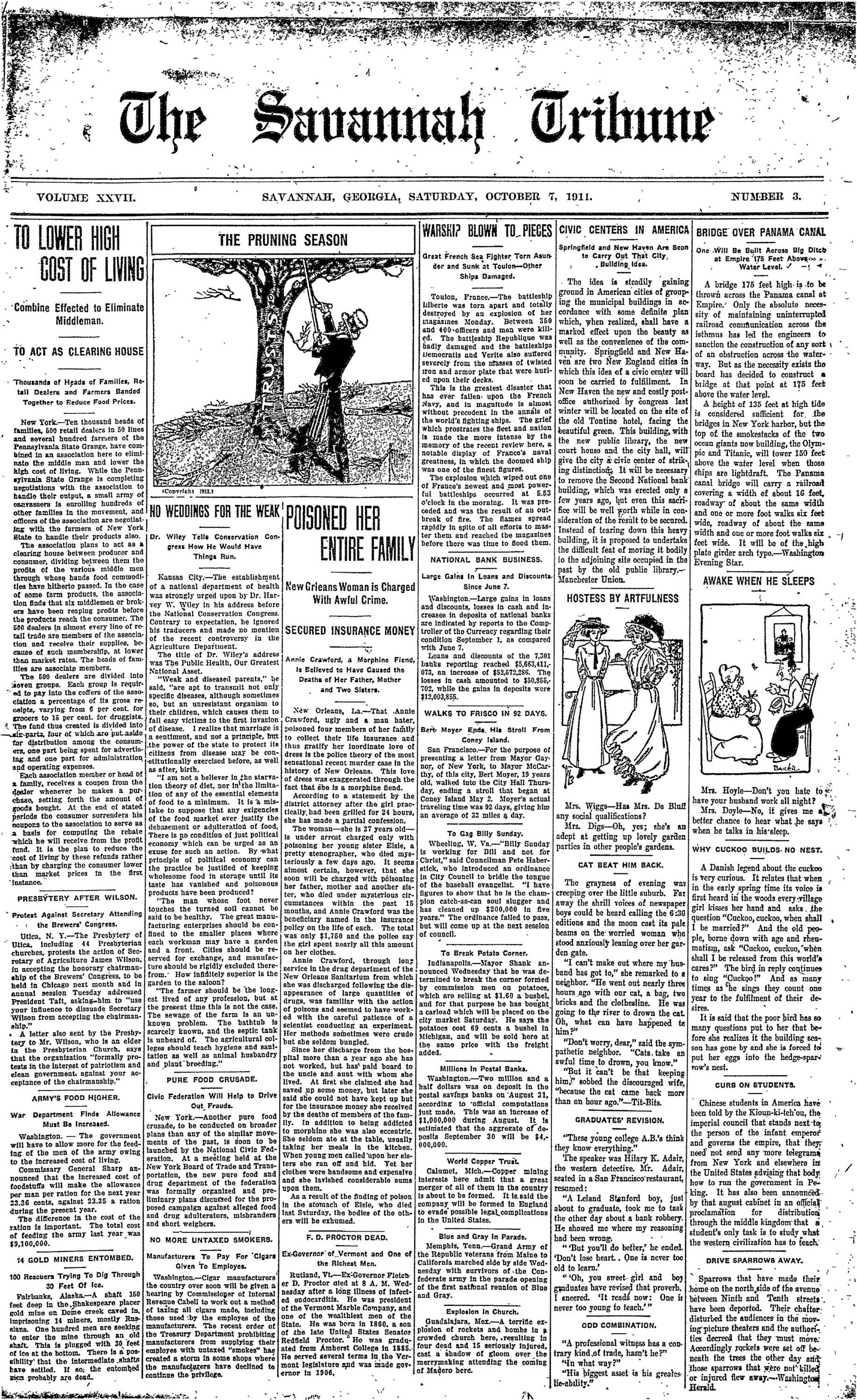
TO LOWER HIGH COST OF LIVING
Combine Effected to Eliminate Middleman.
TO ACT AS CLEARING HOUSE
Thousands of Heads of Families, Retail Dealers and Farmers Banded Together to Reduce Food Prices.
Now York.—Ten thousand heads of families, 500 retail dealers in 50 lines and several hundred farmers of the Pennsylvania State Grange, have combined in an association here to eliminate the middle man and lower the high cost of living. While the Pennsylvania State Grange is completing negotiations with the association to handle their output, a small army of canvassers is enrolling hundreds of other families in the movement, and officers of the association are negotiating with the farmers of New York State to handle their products also.
The association plans to act as a clearing house between producer and consumer, dividing between them the profits of the various middle men through whose hands food commodities have hitherto passed. In the case of some farm products, the association finds that six middlemen or brokers have been reaping profits before the products reach the consumer. The 500 dealers in almost every line of retail trade are members of the association and receive their supplies, because of such membership, at lower than market rates. The heads of families are associate members.
The 500 dealers are divided into seven groups. Each group is required to pay into the coffers of the association a percentage of its gross receipts, varying from 6 per cent. for grocers to 15 per cent. for druggists. The fund thus created is divided into six parts, four of which are put aside for distribution among the consumers, one part being spent for advertising and one part for administration and operating expenses.
Each association member or head of a family, receives a coupon from the dealer whenever he makes a purchase, setting forth the amount of goods bought. At the end of stated periods the consumer surrenders his coupons to the association to serve as a basis for computing the rebate which he will receive from the profit fund. It is the plan to reduce the cost of living by these refunds rather than by charging the consumer lower than market prices in the first instance.
PRESBYTERY AFTER WILSON.
Protest Against Secretary Attending the Brewers' Congress.
Utica, N. Y.-The Presbytery of Utica, including 44 Presbyterian churches, protests the action of Secretary of Agriculture James Wilson, in accepting the honorary chairmanship of the Brewers' Congress, to be held in Chicago next month and in annual session Tuesday addressed President Taft, asking-him to "use your influence to dissuade Secretary Wilson from accepting the chairmanship."
A letter also sent by the Presbytery to Mr. Wilson, who is an elder in the Presbyterian Church, says that the organization "formally protests in the interest of patriotism and clean government against your acceptance of the chairmanship."
ARMY'S FOOD HIGHER.
War Department Finds Allowance Must Be Increased.
Washington. — The government will have to allow more for the feeding of the men of the army owing to the increased cost of living.
Commissary General Sharp announced that the increased cost of foodstuffs will make the allowance per man per ration for the next year 23.36 cents, against 23.35 a ration during the present year.
The difference in the cost of the ration is important. The total cost of feeding the army last year was $9,100,000.
14 GOLD MINERS ENTOMBED.
100 Rescuers Trying To Dig Through
30 Foot Of Ice.
Fairbanks, Alaska.—A shaft 150 feet deep in the.Shakespeare placer gold mine on Dome Creek caved in, imprisoning 14 miners, mostly Russians. One hundred men are seeking to enter the mine through an old shaft. This is plugged with 30 feet of ice at the bottom. There is a possibility that the intermediate shafts have settled. If so, the entombbed men probably are dead.
THE PRUNING SEASON
TRUSTS
(Copyright 1811.)
TRUSTS
NO WEDDINGS FOR THE WEAK
Dr. Wiley Tells Conservation Congress How He Would Have Things Run.
Kansas City.—The establishment of a national department of health was strongly urged upon by Dr. Harvey W. Wiley in his address before the National Conservation Congress. Contrary to expectation, he ignored his traducers and made no mention of the recent controversy in the Agriculture Department.
The title of Dr. Wiley's address was The Public Health, Our Greatest National Asset.
"Weak and diseased parents," he said, "are apt to transmit not only specific diseases, although sometimes so, but an unresistant organism to their children, which causes them to fall easy victims to the first invasion of disease. I realize that marriage is a sentiment, and not a principle, but the power of the state to protect its citizens from disease may be constitutionally exercised before, as well as after, birth.
"I am not a believer in the starvation theory of diet, nor in the limitation of any of the essential elements of food to a minimum. It is a mistake to suppose that any exigencies of the food market ever justify the debasement or adulteration of food. There is no condition of just political economy which can be urged as an excuse for such an action. By what principle of political economy can the practice be justified of keeping wholesome food in storage until its taste has vanished and poisonous products have been produced?
"The man whose foot never touches the turned soil cannot be said to be healthy. The great manufacturing enterprises should be confined to the smaller places where each workman may have a garden and a front. Cities should be reserved for exchange, and manufacture should be rigidly excluded therefrom. How infinitely superior is the garden to the saloon?
"The farmer should be the longest lived of any profession, but at the present time this is not the case. The sewage of the farm is an unknown problem. The bathtub is scarcely known, and the septic tank is unheard of. The agricultural colleges should teach hygiene and sanitation as well as animal husbandry and plant breeding."
PURE FOOD CRUSADE.
Civic Federation Will Help to Drive Out Frauds
New York.—Another pure food crusade, to be conducted on broader plans than any of the similar movements of the past, is soon to be launched by the National Civic Federation. At a meeting held at the New York Board of Trade and Transportation, the new pure food and drug department of the federation was formally organized and preliminary plans discussed for the proposed campaign against alleged food and drug adulterators, misbranders and short weighers.
NO MORE UNTAXED SMOKERS.
Manufacturers To Pay For Cigars Given To Employes. Washington—Cigar manufacturers the country over soon will be given a hearing by Commissioner of Internal Revenue Cabell to work out a method of taking all cigars made, including those used by the employees of the manufacturers. The recent order of the Treasury Department prohibiting manufacturers from supplying their employees with untaxed "smokes" has created a storm in some shops where the manufacturers have declined to continue the privilege.
SAVANNAH, GEORGIA, SATURDAY, OCTOBER 7, 1911.
ROG TRAVAL
POISONED HER ENTIRE FAMILY
New Orleans Woman is Charged With Awful Crime.
SECURED INSURANCE MONEY
Annie Crawford, a Morphine Fiend, Is Believed to Have Caused the Deaths of Her Father, Mother and Two Sisters.
New Orleans, La.—That Annie Crawford, ugly and a man hater, poisoned four members of her family to collect their life insurance and thus gratify her inordinate love of dress is the police theory of the most sensational recent murder case in the history of New Orleans. This love of dress was exaggerated through the fact that she is a morphine fiend.
According to a statement by the district attorney after the girl practically, had been grilled for 24 hours, she has made a partial confession.
The woman—she is 27 years old—is under arrest charged only with poisoning her young sister Elsie, a pretty stenographer, who died mysteriously a few days ago. It seems almost certain, however, that she soon will be charged with poisoning her father, mother and another sister, who died under mysterious circumstances within the past 15 months, and Annie Crawford was the beneficiary named In the insurance policy on the life of each. The total was only $1,750 and the police say the girl spent nearly all this amount on her clothes.
Annie Crawford, through long service in the drug department of the New Orleans Sanitarium from which she was discharged following the disappearance of large quantities of drugs, was familiar with the action of poisons and seemed to have worked with the careful patience of a scientist conducting an experiment. Her methods sometimes were crude but she seldom burgled.
Since her discharge from the hospital more than a year ago she has not worked, but has paid board to the uncle and aunt with whom she lived. At first she claimed she had saved up some money, but later she said she could not have kept up but for the insurance money she received by the deaths of members of the family. In addition to being addicted to morphine she was also eccentric. She seldom ate at the table, usually taking her meals in the kitchen. When young men called upon her sisters she ran off and hid. Yet her clothes were handsome and expensive and she lavished considerable sums upon them. As a result of the finding of poison in the stomach of Elsle, who died last Saturday, the bodies of the others will be exhumed.
F. D. PROCTOR DEAD.
Ex-Governor of_Vermont and One of the Richest Men.
Rutland, Vt.—Ex-Governor Fletcher D. Proctor died at 8 A. M. Wednesday after a long illness of infected endocarditis. He was president of the Vermont Marble Company, and one of the wealthiest men of the State. He was born in 1860, a son of the late United States Senator Redfield Proctor. He was graduated from Amherst College in 1885. He served several terms in the Vermont legislature and was made governor in 1906.
WARSKI? BLOWN TO_PIECES
Great French Sea Fighter Torn Asunder and Sunk at Toulon—Other Ships Damaged.
Toulon, France.—The battleship Liberte was torn apart and totally destroyed by an explosion of her magazines Monday. Between 350 and 400 officers and men were killed. The battleship Republic was badly damaged and the battleships Democratis and Verite also suffered severely from the masses of twisted iron and armor plate that were hurled upon their decks.
This is the greatest disaster that has ever fallen upon the French Navy, and in magnitude is almost without precedent in the annals of the world's fighting ships. The grief which prostrates the fleet and nation is made the more intense by the memory of the recent review here, a notable display of France's naval greatness, in which the doomed ship was one of the finest figures.
The explosion which wiped out one of France's newest and most powerful battleships occurred at 5.53 o'clock in the morning. It was preceded and was the result of an outbreak of fire. The flames spread rapidly in spite of all efforts to master them and reached the magazines before there was time to flood them.
NATIONAL BANK BUSINESS.
Large Gain$ In Loans and Discounts Since June 7.
Washington.—Large gains in loans and discounts, losses in cash and increases in deposits of national banks are indicated by reports to the Comptroller of the Currency regarding their condition September 1, as compared with June 7.
Loans and discounts of the 7,301 banks reporting reached $5,663,411,073, an increase of $52,572,286. The losses in cash amounted to $50,855,702, while the gains in deposits were $12,003,855.
WALKS TO FRISCO IN 92 DAYS.
Berk Moyer Enda. His Stroll From
Coney Island.
San Francisco.—For the purpose of presenting a letter from Mayor Gaynor, of New York, to Mayor McCarthy, of this city, Bert Moyer, 19 years old, walked into the City Hall Thursday, ending a stroll that began at Coney Island May 2. Moyer's actual traveling time was 92 days, giving him an average of 32 miles a day.
To Gag Billy Sunday.
Wheeling, W. Va.—"Billy Sunday is working for Bill and not for Christ," said Councilman Pete Haberstick, who introduced an ordinance in City Council to bridle the tongue of the baseball evangelist. "I have figures to show that he is the champion catch-as-can soul slugger and has cleaned up $200,000 in five years." The ordinance failed to pass, but will come up at the next session of council.
To Break Potato Corner
Indianapolis.—Mayor Shank announced Wednesday that he was determined to break the corner formed by commission men on potatoes, which are selling at $1.60 a bushel, and for that purpose he has bought a carload which will be placed on the city market Saturday. He says the potatoes cost 69 cents a bushel in Michigan, and will be sold here at the same price with the freight added.
Millions In Postal Banks
Washington.—Two million and a half dollars was on deposit in the postal savings banks on August 31, according to official computations just made. This was an increase of $1,000,000 during August. It is estimated that the aggregate of deposits September 30 will be $4,-000,000.
World Copper Trust
Calumet, Mich.—Copper mining interests here admit that a great merger of all of them in the country is about to be formed. It is said the company will be formed in England to evade possible legal complications in the United States.
Blue and Gray In Parade
Memphis, Teen.—Grand Army of the Republic veterans from Malne to California marched side by side Wednesday with survivors of the Confederate army in the parade opening of the first national reunion of Blue and Gray.
Explosion In Church.
Guadalajara, Mex.—A terrific explosion of rockets and bombs in a crowded church here, resulting in four dead and 15 seriously injured, cast a shadow of gloom over the merrymaking attending the coming of Madero here.
CIVIC CENTERS IN AMERICA
Springfield and New Haven Are Soon to Carry Out That City, Building Idea.
The idea is steadily gaining ground in American cities of grouping the municipal buildings in accordance with some definite plan which, when realized, shall have a marked effect upon the beauty as well as the convenience of the community. Springfield and New Haven are two New England cities in which this idea of a civic center will soon be carried to fulfillment. In New Haven the new and costly postoffice authorized by congress last winter will be located on the site of the old Tontine hotel, facing the beautiful green. This building, with the new public library, the new court house and the city hall, will give the city a civic center of striking distinction. It will be necessary to remove the Second National bank building, which was erected only a few years ago, but even this sacrifice will be well worth while in consideration of the result to be secured. Instead of tearing down this heavy building, it is proposed to undertake the difficult feat of moving it bodily to the adjoining site occupied in the past by the old public library.—Manchester Union.
HOSTESS BY ARTFULNESS
T. B.
Mrs. Wiggs—Has Mrs. De Bluff any social qualifications?
Mrs. Digs—Oh, yes; she's an adept at getting up lovely garden parties in other people's gardens.
CAT BEAT HIM BACK.
The grayness of evening was creeping over the little suburb. Far away the shrill voices of newspaper boys could be heard calling the 6:30 editions and the moon cast its pale beams on the worried woman who stood anxiously leaning over her garden gate.
"I can't make out where my husband has got to," she remarked to a neighbor. "He went out nearly three hours ago with our cat, a bag, two bricks and the clothesline. He was going to the river to drown the cat. Oh, what can have happened to him?"
"Don't worry, dear," said the sympathetic neighbor. "Cats, take an awful time to drown, you know." "But it can't be that keeping him," sobbed the discouraged wife, "because the cat came back more than an hour ago."—Tit-Bits.
GRADUATES' REVISION.
"These young college A.B.'s think they know everything."
The speaker was Hilary K. Adair, the western detective. Mr. Adair, seated in a San Francisco restaurant, resumed:
"A Leland Stanford boy, just about to graduate, took me to task the other day about a bank robbery. He showed me where my reasoning had been wrong.
"But you'll do better,' he ended. 'Don't lose heart. One is never too old to learn.'
"Oh, you sweet girl and boy graduates have revised that proverb. I sneered. 'It reads now: One is never too young to teach.'"
ODD COMBINATION.
"A professional witness has a con-
trary kind.of trade, hasn't he?"
"In what way?"
"His biggest asset is his greatest
lie-ability."
BRIDGE OVER PANAMA CANAL
One Will Be Built Across Big Ditch at Empire 175 Feet Above Water Level.
A bridge 175 feet high is to be thrown across the Panama canal at Empire. Only the absolute necessity of maintaining uninterrupted railroad communication across the isthmus has led the engineers to sanction the construction of any sort of an obstruction across the waterway. But as the necessity exists the board has decided to construct a bridge at that point at 175 feet above the water level.
A height of 135 feet at high tide is considered sufficient for the bridges in New York harbor, but the top of the smokestacks of the two ocean giants now building, the Olympic and Titanic, will tower 150 feet above the wafer level when those ships are lightdraft. The Panama canal bridge will carry a railroad covering a width of about 16 feet, roadway of about the same width and one or more foot walks six feet wide, roadway of about the same width and one or more foot walks six feet wide. It will be of the high plate girder arch type.—Washington Evening Star.
AWAKE WHEN HE SLEEPS
DAICER
Mrs. Hoyle—Don't you hate to have your husband work all night?
Mrs. Doyle—No, it gives me better chance to hear what he says when he talks in his sleep.
WHY CUCKOO BUILDS NO NEST.
A Danish legend about the cuckoo is very curious. It relates that when in the early spring time its voice is first heard in the woods every village girl kisses her hand and asks the question "Cuckoo, cuckoo, when shall I be married?" And the old people, borne down with age and rheumatism, ask "Cuckoo, cuckoo, when shall I be released from this world's cares?" The bird in reply continues to sing "Cuckoo!" And as many times as he sings they count one year to the fulfilment of their desires.
It is said that the poor bird has so many questions put to her that before she realizes it the building season has gone by and she is forced to put her eggs into the hedge-sparrow's nest.
CURB ON STUDENTS.
Chinese students in America have been told by the Kioun-ki-teh'ou, the imperial council that stands next to the person of the infant emperor and governs the empire, that they need not send any more telegrams from New York and elsewhere in the United States advising that body how to run the government in Peking. It has also been announced by that august cabinet in an official proclamation for distribution through the middle kingdom that a student's only task is to study what the western civilization has to teach.
DRIVE SPARROWS AWAY.
Sparrows that have made their home on the north side of the avenue between Ninth and Tenth streets have been deported. Their chatter disturbed the audiences in the moving picture theaters and the authorities decreed that they must move. Accordingly rockets were set off beneath the trees the other day and those sparrows that were not killed or injured flew away. Washington Herald
AFRU-AMERICAN CULLINGS
Prof. W. E. Dubols not only gives
fine editorial on “The First Univer.
sal Congress” In this month’s fssue of
‘The Crisis, but also writes a splendid
account of the meeting in the same
Sesto. Says The Crisis on the object
‘of the meeting:
“What after all was the object of
eesembling a congress of this charac-
ter? To many people it seemed a vis-
fonary scheme; what practical out-
come could there be? The executive
committee stated the purpose of the
congress succintly: “The object.of the
congress will be to discuss, in the
Ught of sclence and the modern con-
acence, the general relations substst-
tug between the peoples of the west
and those of the east, between so-
called white and so-called colored péo-
ples, with a view to encouraging be-
tween them a fuller understanding,
the most friendly feelings, and a
heartler co-operation,” Lord Weardale
im his introduction to the volume of
Papers bas enlarged upon this {dea:
“To those who regard the furtherance
of tnternational good will and peace
as the highest of all Luman interests,
the occasion of tho. first untversal
Faces congress opens a vista of al-
‘most boundless promise.
“No impartial student of bistory can
deny that in the case of nearly alll re-
corded wars, whatever the ostensible
reasons aselgned, the underlying cause
of confifct has been the existence of
race antipathles—using the word race
in its broad and popular acceptatfon—
which particular circumstances, often
tn themselves of trivial moment, have
fanned into flame.”
‘The writer continued further with
several other paragraphs and spoke of
the personnel of the meeting and used
extracts from papers read by seven-
teen of the most highly educated and
scholarly men {n attendance.
‘We give a resume of one of the most
important papers:
“Dr. W E. B, DuBois, United Statgs.
—The negroes number about ten mill-
fons in the United States. Most of
them descend from former slaves.
‘They live at the present thme under a
system,of theoretical liberty, bit it Is
restrlevJd in practice by certain legal
dispositions and by custom. They are
‘well disposed toward family life, In so
far as they are enabled to enjoy ft,
‘and to education. They have churches
of thelr own. About two hundred
thousand of them are farmers, and
Atty thousand are engaged In com-
merce and tho Mberal professions.
Seventy-five per cent of the negroes
live In the south. One theory pro
poses that they should emancipate
themselves by acquiring wealth, but It
‘would seem that Intellectual emanelpa-
tfon should proceed hand fn hand with
‘economfe Independence.”
Sir Harry Johnson, of England, stat-
ed that the physical difference from
the white was merely a question of
taste. He spoke highly of the negro’s
ability and his progress in various
walks.
Great good {s hoped will be the re-
sult of such a meeting. Those con-
nected with the gathering claim It will
promote cordial relations among all
divisions of mank{nd, vold of color or
prejudice. Let us’ hope that all races
are better off by the meeting.
The negro must recognize and ap
preolate the favors which come tc
‘him, and stand with the men, or men
who stasd by him, AN men in the
“white race are not enemies to the ne
gro. There are thousands of persons
of the Caucasian race who sincerely
and genuinely wish us well, and when
we find them we should show by out
attitude that we appreciate thelr kind:
nese. You should patronize the man
fn business who shows by his acts
that be desires you to succeed, and
retum in every way you can the
favors which the charitably disposed
show you. “He ‘that would have
friends must show himself friendly.”
—Danville Torchlight.
‘The masses do not know, nor even
have an !dea what the men whom they
Baye put in front of the work, along
the different tines, have to undergo.
If they did they would be more con-
siderate in thelr criticism of them. A
great many of the people thins that
the men who are alwes3 on the road
ag representatives of the race are hav-
Jog a good time, but if those same
people who have that fdea-were put
‘on the road, or put in the lead for just
one month, they would change thelr
minds as to the gcod time that the
Jeaders have—Helena Interstate Re-
porter.
‘There are a goodly number of ne-
groes in town who should be on the
farm; but they cannot go unless they.
are backed by the moneyed men of
this elty. Charleston merchants and
business men have just begun In the
last one or two yeats to put out thelr
money. They are buying real estate
and selling it out to negroes. This
4s indeed commendable on their part.
‘The next step will be the farm, and
we do not care how quickly if comes.
—Charleston (S. 0.) Messenger.
It pays every Afro-American youth
te have a reputation for being courte-
ova, truthful, trustworthy, honest and
rellable—Cadiz Informer,
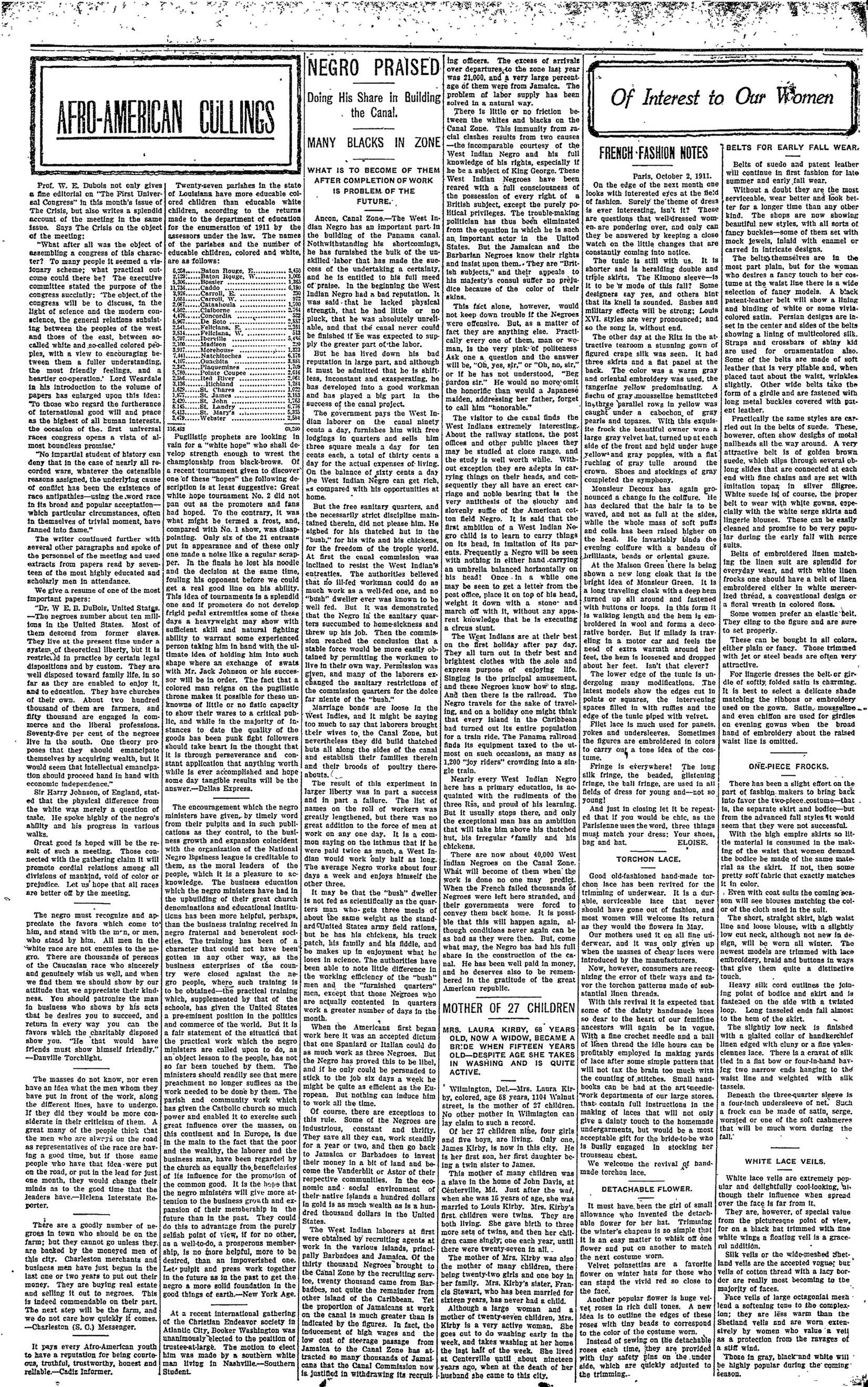
‘Twenty-seven parlzhes in the state
of Louisiana have more educable col-
ored children than educable white
children, according to the returns
made to the department of education
for the enumeration ‘of 1911 by the
assessors under the law. The names
of the parishes and the nuriber of
educable children, colored and white,
are as follows:
5.28-...Baton Re Eiseveenenvnne 345%
| BBreBaea Rouge, Reon Ba
B0hccessBossler sreseersseeeesececees L388
UB seeeeCBdO os -ccesenseereensnerene G19
BIB eva CArFoll, EL sessereeserencers 200
BRUSIGarron We, CSI. ge
S30e. SGlatborne 2000020000 St
46 cs:Concordin, “c2200 TI Tse
B96 0-01-DO BOLO .oo.eeeceeeeeeeenenene 2,587
PML... Feliclana, Fe... eeeeeeeee SUBL
Bic Pelfebuna, W, “7000p st
Bott berville” .syenresececce SAS
Shoo. Madigon TIT ee
$902 Morehouse ercscicjcs Me
TMLee Natchitoches sccvsereeeeeeee 616
SIGS OuaehMta sensstescececceees RBM
2UG..00/Plaqueminea’ orccsssuceeees LAS
S780. seeeePOINLE COUPEE sessseeereneee 2616
Bie" hed ver ereectessccereess SAGE
BIB.veccee Richland s.scesesrsersereee LOBE
W628. .00eBL CHOLES c.ceceesserereeeee 102
Ysa SC James 2020S
BGQOIUBE Jolin’ srrccssecccecssocses Lees
SYSCCUBE Landry SCI ee
GMB Merges CCCI 6s
SAB. Wenster’ s..ttenssisucsesesses 28
mas aa
SUSNEES Prophets are OnE im
vain for a “white hope” who shall de-
velop strength enough to wrest the
champtonship from black-brows. Ot
‘a recent tournament given to discover
‘one ‘of these “hopes” the following de-
‘seription {s at least suggestive: Great
white hope tournament No. 2 did not
pan out as the promoters and fans
had hoped. To the contrary, it was
what mfght be termed a frost, and,
compared with No. 1 show, was dlsap-
pointing. Only six of tho 21 entrants
put in appearance and of these only
‘one made a nolse like a regular serap-
Per. In the finals he lost his noodle
and the decision at the same time,
fouling bis opponent before we could
get & real good Iino on his ability.
‘This {dea of tournaments fs a splendid
one and if promoters do not develop
frigid pedal extremities some of these
days a heavyweight may show with
sufficient skill and natural fighting
ability to warrant some experienced
person taking him in hand with the ul-
timate Idea of holding him into such
shape where an exchange of swats
with Mr. Jack Johnson or his succes-
sor will be {a order. ‘The fact that 2
colored man relgns on the pugilistic
throne makes {t possible for these un-
knowns of Iittle or no fistic capacity
to show thelr wares to a critical pub-
Me, and while in the majority of n+
stances to date the quality of the
goods has been punk fight followers
should take heart in the thought that
it 1s through perseverance and con-
stant application that anything worth
While {s ever accomplished and hope
some day tangible results will be the
answer.—Dellas Express,
‘The encouragement which the negro
ministers have given, by timely word
from their pulpits and in such publi
cations as they control, to the bust-
ness growth and expansion coincident
with the organization of the National
Negro Bysiness league fs creditable to
them, as the moral leaders of the
people, which ft 1s a pleasure to ac-
knowledge. The business education
which the negro ministers have had in
the upbullding of thelr great church
denominations and educational institu:
Ucns has been more helpful, perhaps,
than the business training received in
negro fraternal and benevolent soc
etles, The training has been of a
character that could not have been
gotten in any other way, as the
business enterprises of the coun:
try were closed against the ne
gto people, where such training 1s
to be obtatned—the practical training
which, supplemented by that of the
schools, has given the United States
a preeminent position In the politics
and commerce of the world. But it {s
a fair statement of the sltuatici that
the practical work which the negro
ministers are called upon to do, as
‘an object lesson to the people, has not
s0 far been touched by them. The
ministers should readily seo that mere
preachment no longer sufllees as the
work needed to be done by them. The
parish and community work which
has given the Catholic church so much
power and enabled it to exercise such
Great influence over the masses, on
this continent and in Burope, 1s due
in the main to the fact that the poor
and the wealthy, the laborer and the
business man, have been regardell by
the church as equally the, beneficiaries
of Sis influence for the promoticn of
the common good. It {s the hope that
the negro ministers will give more at-
tention to the business growth and ex:
pansion of thelr membership in the
future than in the past. They could
do this to advantage from the purely
selfish polnt of view, if for no other,
as a well-to-do, a prosperous member
ship, is no fnore helpful, more to be
desired, than an Smpoverished one.
Let’ pulplt and press work together
in the future as in the past to get the
negro a more solid foundation in the
good things of earth—New York Age.
At a recent international gathering
of the Christlan Endeavor society in
Atlante City, Booker Washington was
unanimouely elected to the position of
trusteeatlarge. The motion to elect
him was made by a southem white
man Uving in Nashville—Southem
Student.
NEGRO PRAISED
Doing His Share in’ Building
. the Canal,
MANY BLACKS IN ZONE
WHAT is to BECOME OF THEM
AFTER COMPLETION OF WORK
. 1S PROBLEM OF THE
FUTURE.
See a ee re ore arate en ce, ae
the bullding of the Panama canal
Nothwithstanding his shortcomings
he has furnished the bulk of the un
skilled ‘labor that has made the sue
cess of the undertaking a certainty
and he fs entitled to his full mee¢
of'pratse. In the beginning the Wes
Indian Negro had a bad reputation. 1
was sald-that be lacked physica
strength, that he had Ilttle or n¢
Pluck, that he was absolutely unreft
able, and that thé canal never could
be finished {f ie was expected to sup
ply the greater part of:the labor.
But he has lived down bis bad
reputation in large part, and although
ft must be admitted that he 1s shitt
tess, inconstant and exasperating, he
bas developed into a good workman
and has played a big part in the
success of the canal profect,
The government pays the West In
dian laborer on the canal ninety
cents a day, furnishes him with free
lodgings {0 quarters and sells him
three square meals a day for ten
cents each, a total of thirty cents a
day for the actual expenses of: living.
On the balance of sizty cents a day
the West Indian Negro can get rich,
w compared with bis opportunities at
home. .
But the free sanitary quarters, and
the necessarily strict discipline main-
tained therein, did not please him. He
sighed for his thatched hut in the
“bush,” for his wife and bis chickens,
for the freedom of the trople world.
‘At first the canal commission was
fnclined to resist the West Indlan’s
entreaties. The authorities believed
that ro illed workman could do as
much work as a well-fed one, and no
“bush” dweller ever was known to be
well fed. But {t was demonstrated
that the Negro In the sanitary quar-
ters succumbed to homesickness and
threw up his Job. Then the commis.
slon reached the conclusion that a
stable force would be more easily ob-
tained by permitting the workmen to
lve tn thelr own way. Pernitssion was
gven, end many of the laborers ex
changed the sanitary restrictions of
the commission quarters for the dolce
far niente of the “busb."
_Marrlage bonds are loose ta the
West Indies, and It might be saying
too much to say that laborers brought
tkelr wives to, the Canal Zone, but
nevertheless they did build thatched
huts all along tho sides of the canal
and establisti thelr familles therein
and their broods of poultry there
abouts.“ _
| The result of this experiment in
larger liberty was in part a success
and in part a failure. The list of
names on the roll of workers was
greatly lengthened, but there was no
great addition to the force of men at
work on any one day. It fs a com-
mon saying on the isthmus that If he
were paid twice as much, a West In-
dian would work only half as long.
‘The average Negro works about four
days a week and enjoys himeelf the
other three.
It may be that the “bush” dweller
{8 not fed as scientifically as the quar-
ters man who- gets three meals of
about the same welght as the stand-
ardOUnited States army field rations,
but he has his chickens, his truck
Patch, his family and his fddle, and
ho makes up {n enjoyment what he
loses in sclence. The authorities have
been able to note little ditference In
the working efficiency of the “bush”
men and the “furnished quarters”
men, except that those Negroes who
are actually contented in quarters
work @ greater number of days in the
month. a
When the Americans first began
work here it was an accepted dictum
that one Spanfard or Itallan could do
as much work as three Negroes, But
the Negro has proved this to be lbel,
and if he only could be persuaded to
slick to the fob six days a week he
migbt be quite as efficient as the Eu-
Topean. But nothing can induce him
to work all the time,
Of course, there are exceptions to
this rule. Some of the Negroes are
industrious, constant and thrifty,
They cave all they can, work steadily
for a year or two, and then go hack
to Jamafea or Barbadoes to invest
thelr money in a bit of land and be-
come the Vanderbilt or Astor of thelr
respective communities, In the eco-
nomle and- social environment of
thelr native {slands a hundred dollars
in gold 1s as much wealth as fs a hun-
dred thousand dollars in the United
States.
‘The West Indian laborers at first
were obtained by’ recrulting agents at
work in the varlovs islands, princl-
pally Barbadoes and Jamaica. Ot the
eke ML SRcEE Se ee
tng officers. The excess of arrivals
over departures.to the zone last year
was 21,000, and a very large percent
age of them were from Jamalea. The
problem of labor supply has been
solved in a natural way,
There 1s Iittle or no frletion be
tween the whites and blacks on the
Canal Zone. This immunity from za.
cial clashes results from two causes
—the incomparable courtesy of the
West Indian Negro and bia full
knowledge of bis rights, especially if
he be a subject of King George. These
West Indian Negroes have been
Tented with a full consciousness of
the possession of every right of a
British subject, except the purely po
WUcal privileges. The troublemaking
politicfan has thus becn eliminated
from the equation in which he fs such
an, important actor in the United
States. But the Jamaican and the
Barbarlen Negroes know thelr rights
and insist upon them. They are “Brit
fsh subjects,” and thelr appeals to
‘his miafesty’s consul suffer no preéju-
dice because of the color of their
asking.
This fact alone, however, would
not keep down trouble if the Negroes
were offensive, But, as a matter of
fact they are anything else. Practt-
cally every one of them, man or wo-
man, 1s the very pink~of politeness
Ask one a question and the answer
will be, "Ob, yes, sft,” or “Ob, no, slr,”
or if he has not understood, “Beg
Bardon sir.” He would no more:omlt
the honorific than would a Japanesé
malden, addressing her father, forget
to call him “honorable.”
The visitor to che canal finds the
West Indians extremely interesting.
About the railway stations, the post
offices and other public places they
may be studied at cloce range, and
the study fs well worth while. With-
out exception they are adepts in car-
rying things on thelr heads, and con-
sequently they all have an erect car-
riage and noble bearing that ts the
very antithesis of the glouchy and
slovenly suffie of the American cot-
ton field Negro. It is said that the
first ambition of a West Indian Ne-
gro child 4s to learn to carry things
on {ts head, in imitation of its par
ents. Frequently a Negro will be seen
with nothing in elther hand .carrying
an umbrella balanced hortzontally on
his head! Once-in a while one
may be seen to get a letter from the
Post office, place it on top of bie head,
welght it down with a stone- and
‘march off with it, without any appa~
‘ent kriowledge that be ts executing
a circus stunt.
‘The West Indians are at their best
on the first holiday ater pay day.
‘They all turn out In thelr best and
brightest clothes with the sole and
express purpose of enjoying Iife.
Singing 18 the principal amusement,
and these Negroes know how to sing.
And then there fs the railroad, The
Negro travels for the sake of travel-
ing, and on a holiday one might think
that every island in the Caribbean,
bad turned out its entire population |
for a train ride, The Panama rallroad
finda its equipment taxed to the ut-
most on such occasions, as many as
1,200 “Joy riders” crowding into a sin-
gle train,
Nearly every West Indian Negro
here bas a primary education, 1s ac
quatnted with the rudiments of the
three Ris, and proud of his learning.
But it usually stops there, and only
‘the exceptional man has an ambition
that will take bim above his thatched
hut, bis frregular ‘family and his
chickens,
There are now about 40,000 West
Tadfan Negroes on the Canal Zone.
What will become of them when’ the
work is done no one may predict.
When the French failed thousands of
Negroes were left here stranded, and
thelr governments were fored to
convey them back home. It is posst-
ble that this will happen again, al-
though conditfons never again can be
as bad as they were then. Dut, come
what may, the Negro bas had his full
sbare in the construction of the ca-
nal. He has been well paid in money,
and ho deserves also to be remem-
bered in the gratitude of the great
American republic.
Canes GA Aas esl mK
MRS. LAURA KIRBY, 68 YEARS
OLD, NOW A WIDOW, BECAME A
BRIDE WHEN FIFTEEN YEARS
OLD—DESPITE AGE SHE TAKES
IN WASHING AND 1S QUITE
ACTIVE.
* wilmington, Del—Mrs. Laura Kir
by, colored, age 68 years, 1104 Walnut
street, Is the mother of 27 children
No other mother in Wilmington can
lay claim to such a record.
Of ber 27 children nthe, four girle
and five boys, are living. Only one
James Kirby, is now in this city. He
fs her first son, her first daughter be
ing a twin elster to James.
‘This mother of many children was
a slave in the home of John Davis, at
Cénterville, Md. Just after the war
when she was 16 years of age, she wad
married to Louls Kirby. Mrs. Kirby’s
first. children were twins, They are
both living. She gave birth to three
more sets of twins, and then her chil-
dren came singly; one each year, until
there were twenty-seven in all, -
‘The mother of Ars. Kirby was also
the mother of many children, there
being twenty-two glrls and one boy in
her family. Mrs, Kirby's siater, Fran-
cla Stewart, who has been married for
sizteen years, has never had x child.
Although a large woman and a
mother of twenty-seven children, Mfrs.
Kirby 1s a very active woman, She
goes out to do washing early in the
week, and takes washing at her home
the lagt half of the week. Sho lived
at Centerville yntil ebout nineteen
years ago, when at the death of her
husband she came to this city,
~~.
Of Interest to Our Veomen
FRENCH FASHION NOTES
Paris, October 2, 1911.
On the edge of the next month one
looks with interested eyes at the tle'd
of fashion. Surely the'theme of dress
fe ever Snteresting, isn't ft? ‘These
are questions that welldressed wour
en-ate pondering over, and only cat
they be answered by Keeping a close
watch on the little changes that are
constantly coming into notice.
‘The tunic fs still with us. It fs
shorter and Is heralding double and
triple skirts, ‘The Kimono sleeve—ts
it to be w mode of this fall? Some
designera say yes, and others bint
that its knell {s sounded. Sashes and
military effects will be strong; Louis
XVI. styles are very pronounced; and
so the song fs, without end,
‘The other day at the Ritz in the at-
tractive tearoom a stunning gown of
figured crape silk was seen. It had
three skirts and a flat panel at the
back. The color was a warm gray
and orlental embroidery was used, the
tangerine yellow predominating. A
fixchu of gray anousseline hemstitcbed
taythage parallel rows In yellow was
caught under a cabochon, of gray
pearls and topazes. With this exguis-
ite frock the beautiful owner wore a
large gray velvet hat, turned up at each
aide of the front end held under huge
|yellowtand gray poppies, with a fiat
Tuching of gray tulle around the
crown. Shoes and stockings of gray
completed the symphony.
Monsfeur Decoux has again pro-
nounced a change fn the cofffure. He
hag declared that the hair {a to be
waved, and not es full at the sides,
while the whole mass of soft puffs
and coils has been raised higher on
the head. He inyarlably binds the
evening colffure with a bandeau of
Jirflllants, beads or orlental gauze.
At the Malson Green ‘there 1s being
shown a new long cloak that is the
bright {dea of Monsteur Green. It 1s
@ long traveling cloak witha deep hem
turned up all around and fastened
with buttons or loops. In this form it
fa walking length aud the hem fs em-
brofdered {n wool and forms a deco-
rative border. But if milady is trav-
eling in a motor car and feels the
necd of extra warmth around her
feet, the hem fs loosened and dropped
about her feet. Isn't that clever?
‘The lower edge of the tunic 1s un-
dergoing many modifications. The
latest models show the edges cut In
points or squares, the intervening
‘Spaces filled in with ruffles and the
edge of the tunic piped with velvet.
Filet lace 1s much used for panets,
yokes and undersleeves. Sometimes
the figures are embroidered in colors
to carry ouf a tone {dea of the cos-
tume,
Fringe is eterywhere! The long
silk fringe, the beaded, glistening
fringe, the ball fringe, are used fo all
fields of dress for young and—not 80
young!
And just in closing let It be repeat-
ca that if you would be chic, as the
Parisfenne uses the word, three things
must match your dress: Your shoes,
bag and hat. ELOISE.
TORCHON LACE.
Good old-fashioned hand-made tor
chon lace has been revived for the
trlmming of underwear. It 1s a dur
‘able, serviceable lace that never
should have gone out of fashion, and
most women will welcome its return
as they would the flowera in May.
Our mothers used {t on all fine uti
derwear, and it was only given up
when the masses of cheap’ laces were
introduced by the manufacturers.
Now, however, consumers are recog
nizing the error of thelr ways and fa
vor the torchon patterns made of sub-
stantial Iinen threads.
‘With this revival it 1s expected that
some of the dainty handmade laces
so dear to the heart of our femifine
ancestors will again be in vogue.
With a fine crochet needle and a ball
of Men thread the {dle hours can be
profitably employed in making yards
of Jace after some simple pattern that
will not tax the brain too much with
the counting of stitches, Small hand
books can be had at the art tneedle:
‘work departments of our large stores.
that contain full instructions In the
making of laces that will not only
sive a dainty touch to the homemade
undergarments, but would be a most
acceptable gift for the bride-to-be who
's Duslly engaged In stocking her
trousseau chest.
We welcome the revival ef hand-
made torchon lace,
7 DETACHABLE FLOWER.
It must have, been the gir! of emal
allowance who Invented the detach
able flower for her hat. Trimintog
the winter’s chapeau is so simple thot
it 12 an easy matter to whlak off dne
flower and put on another to match
the next costume worn.
Velvet polnsettias are a favorite
flower on winter hats for those who
can stapd the vivid red s0 close to
the face.
‘Another popular flower is huge vel
set roses in rich dull tones. A new
Idea fs to outline the edges of these
roses with tiny beads to correspond
to the color of the costume worn.
Instead of sewing on {lie detachable
roses each time, jthey are provided
with tny safety pine on the under
aide, whlch nze quickly adjusted to
the trimming...
BELTS FOR EARLY FALL WEAR.
Belts of suede and patent leather
will continue in first fashion for late
summer and early {all wear,
‘Without a doubt they are the most
serviceable, wear better and look bet-
ter for a longer time than any other
Kind. The shops are now showing
beautiful new styles, with all sorts of
fancy buckles—some of them set with
mock jewels, Inlaid with enamel or
carved in intricate designs,
‘The deltspthemsélves are in the
most part plain, but for the woman
who desires a fancy touch to her cos-
tume at the walst line there Is a wide
selection of fancy models. A b'ack
patentcather belt will show a Uning
and binding of white or some vivia-
colored satin. Persian designs are in-
set In the center and sides of the belts
showing a lining of multicolored silk.
Straps and crossbars of sbiny Kid
are used for ornamentation also.
Some of the belts are made of soft
leather that 1s very pliable and, when
placed taut about the walet, wrinkles
slightly. Other wide belts take the
form of a girdle and are fastened with
long metal buckles covered with pat-
ent leather.
Practically the same styles are car-
ried out In the belts of suede. These,
however, often show desighs of metal
naliheads all the way around. A very
attyactive belt is of golden brown
suede, which slips througi several ob-
long slides that are connected at each
‘end with fine chains and are set with
‘imitation topaz in silver filigree.
‘White suede ts} of course, the proper
Delt to wear with white gowns, espe-
clally with the white serge skirts and
lingerie blouses. These can be eaally
cleaned and promise to be very popu-
Jar during the early fall with serge
sults,
Belts of embrofdered Inen match
ing the linen sult are splendid for
everyday wear, and with white linen
frocks one should have a belt of linen
embrofdered elther In white mercer-
Ize thréad, a conventional design or
@ floral wreath in colored floss.
Some women prefer an elastic "belt.
They cling to tho figure and are sure
to set properly.
‘These can be bought In all colors.
either plain or fancy. Those trimmed
with Jet or steel beads are often very
attractive. :
For lingerie dresses the delt-or gir-
dle of softly, folded satin fs charming.
It Is best to select a delicate shade
matching the ribbons or embroidery
used on the gown. Satin, mousseline .
and even chiffon are used for girdles
on evening gowns when the brosd
hand of embroidery about the raised
walst line fs omitted.
ONE-PIECE FROCKS.
| ‘There has been a slight effort on the
part of fashion. makers to bring back
Into favor the two-plece.costume—that
fs, the separate skirt and bodice—but
from the advanced fall styles §t would
seom that they were not successful.
With the high empire skirts so it-
tle material is consumed in the mak-
Ing of the waist that women demand
the bodice be made of the same mate-
tial as the skirt. If not, then some
pretty soft fabric that exactly matches
t in color.
« Even with coat sults the coming ’sea-
son will see blouses matching the col-
or of the cloth used in the sult.
‘Tho short, strafght skirt, bigh waist
Une and loose blouse, with a slightly
low cut neck, although not new in de-
sign, will be worn all winter. Tho
newest models are trimmed with laco
embroidery, braid and buttons in ways
that give them quite a dictinetive
touch. :
Heavy silk cord outlines the join-
ing point of bodice and skirt and te
fastened on the side with a twisted
loop. Long tasseled ends fall almost
to the hem of the skirt. ~
The slightly low neck is finished
with a plaited collar of handkerchlet
linen edged with cluny or a fine yaten-
clennes lace. There is a eravat of sitk
{fed in a flat bow or four-In-hand hay-
jeg two narrow ends hanging to thé
waist line and weighted with silk
tassels,
Beneath the three-quarter sleeve is
a four-inch undersleeve of net, Such
a frock can be made of satin, serge.
worsted or one of the soft cashmeres
that will be much worn during the
tall, . :
was WHITE LACE VEILS,
White taco vells are extremely pop-
ular and delightfully cooltooking, ‘als
though thelr influence when spread
malt | over the face 4s far from it,
ach-| ‘They are, however, of special value
uing |from the plcturesqne point of view,
thot |for on a black hat trimmed with tine
dne | white wings a floating vell is a grace-
atch | sul addition, :
Silk yells or the wide-meshed shet-
rite | land yells are the accepted vogue: but
who | Vells of cotton thread with a lacy bor-
» to|der are really most becoming to the
majority of faces. .
vel-| Face veils of large octagoniat meen -
new {lend a softening tone to the complex:
ese |{on; they are léss warm than the
ond] Shetland yells and are worn exten-
sively by women who values vell
le {a8 a protectfon from the ravages of
ded |m stiff wind.
der| “Those in gray, black-and white will
“to| be highly popular during the coming
Benson. .
“
BROKEN
cis(ERNS
A SERMON
Se ee ae eRe eee Te ee ee
For my people have committed tx0
evits; they have forsaken me, the
fountain of living waters, and hewed
them out cisterns, ‘broken cisterns,
that can hold no water.—deremiab,
it, 13.
God's people bad committed two
evils. The one was negative; the
other positive. In the first place, they
Jhad forsaken God; {n the second
place, they had sought a substitute
for God. This thought is presented 10
the form of a suggestive figure. God
ig a fountain, a fountain of living Wa-
ters. “They have forsaken me,” says
God, “the fountain of iiving waters,
and hewed them out cisterns, broken
cisterns, that can hold no water.”
No figure could be more suggestive
than this to a desert traveler, wearied
and thirsty, approaching some oasis
with its precious well or spring. Man
travels also over life's desert areas,
and there his soul ofttimes becomes
thirsty.
Life contains vast stretches where
there fs nothing that can satisfy the
soul. There is failure in business,
loss of position, the breaking down
of health, the loss of friends and
Joved ones, disappointment and
trouble, drudgery, weariness with the
shams and conventions, routine and
the bondage of the soul.
In traversing these desert areas we
need some well, some spring, some
fountain of living waters In the mtdst
‘of a dry land, some oasis in the desert
with its fresh waters and {ts cool
shade. To every thirsty soul God is
that fountain of living waters.
"Imagine 2 man dwelling by an
oasis with its well of splendid’ water
who will not use that spring but will
persist In building for himself a cls-
‘tern of his own, Tho proposition ts
foolish indeed. But this {s a parable.
It presents the actual truth concern-
ing the foolish attitude of multitudes
of people toward God, “the fountaln
of Iiving waters.” Men forsake God
who alone can satisfy thelr souls, and
all they have to show in the end are
tho cisterns of their own make, bro-
ken cisterns, that can hold no water.
(1) First, a man’s Mfework ts often
but tho making of a broken cistern.
St fs from God that we should draw
our strength and our {aspiration for
work. He has for each of us a voca-
(fon, a calling, a ministry, a place In
life's industrial activity. ‘Think not
that because, we call work “secular”
God has no place In it. Work {s not
secular, but sacred, and God has ev-
erything to do with {t when we as
workers are truly consecrated to‘ him.
“We are God's fellow-workers” and
we are to labor primarily not for
money, not for the bread that per-
ishes, but for the service we render to
God and to humanity. Work thus
conceived 1s a source of delight, am
Inspiration, a satisfaction to the soul.
Mt refreshes and does not weary, for ft
means access to God. The labor of
brain and tho labor of hand become a
pleasure, the humblest toll becomes
slorified, and routine duties cease to
be a drudgery. Even disappointing
fabors have their compensation.
Bat let a man decomo selfish, let
him live only for the money he may
make, Iet him worship Mammon and
oppress bis fellowmen, let him for-
sake Ged and refuse to make his labor
a service—ho ceases to draw nspira-
ton and power from God, his sou! be-
comes shriveled, his heart becomes
unfeeling, his life empty. He builds
for himself a broken clstern—a bro-
ken-and empty cistern. He bas for-
saken God, the fountain of living wa-
ters, and tho thirst of his soul {s not
quenched. His broken cistern can hold
no water, and tho thirst of Dives con-
sumes his Iife.
(2) Secondly, men frequently trust
to thelr own broken cisterns for pleas-
ure. There is nothing to be sald
TOM'S MEMORY.
Representative Thomas L. Rubey o!
Missoarl went into the house cloak:
room recently. As soon as Tom, the
acgro attendant, saw him, a perplexed
expression covered his black features
Mr, Ruby {nquired as to the trouble.
“I certainly 1s a forgetful nigger.”
replied Tom. “A person called you
on the telephone.” 2
“Woll, who was {t?” asked the mem
ber of the bouse.
“He dope tell me, but I disrecol:
fect,” sald Tom.
“When did you get tho call?” asked
Mr. Bubey.
“It was elther today or yesterday,”
he replied. “I never was no hand to
remember dates.”—Pittsburg Commer
clal-Caronicle.
HANDICAPPING CUPID.
“Crabbed age and youth can not
Hive together,” said Senator Davis,
apropos of an unhappy divorce sult
fn Little Rogk, recites an exchange,
“Whenever I hear of an old man mar
rying a yonng girl, I think of the
Copia story.
““Capid’ indignantly cried a mil
Monatre of 77 years—Cupld would be
powerless before such an iceberg a2
yoarself, Miss. Why, @ score of Cu
pigs armed with a hundred arrows
each, could find no vulnerable spot
upon your heart of stone.’
“The young and beautiful girl ad
dressed tossed her head as she re
piled:
“No, they couldn’t—If-they used an
old beau to shoot with” ©
ee er ee ee ee ee eo
Joy life. He wants us all to be happy
Tho heart of man should feel the
keenest thrills of delight, every nerve
tingling with pleasure, every faculty
alive to the joys of living. God wants
us to edjoy the air and the sunlight,
the blue skies and the clouds and the
rain, the flowers and the birds and the
‘trees, Ho wants us to enjoy exercise,
food, recreations and amusements and
social intercourse. He wants us to
enjoy music and art and travel and
new scenes. God wants us to enjoy
everything that fs lovely and good
and uplifting and Inspiring. Thus if
we drink of pleasure aright, we drink
as from a fountain of living waters—
a fountain flowing from the throne of
God. Here we may drink and invig-
orate our bodfes and refresh our
minds and souls, ‘
But many seek thelr pleasures from
cislerns—cisterns of thelr own makt
ing. cisterns that can hold no water.
Men are not satistied with the sim
ple, pure, energizing and health-giving
pleasures that God would give us and
that would in truth refresh our souls.
‘They rceck pleasures that are not re-
freshing, pleasures that merely excite
and stimulate and weary, pleasures
that consume life's energies. There
are, In fact, but few persons who know
how to enjoy life. They are bored to
death to start with, and thelr co-called
pleasures are but mere evidences of
nervous irritations. It fs all because
they do not understand the secret of
skaple pleasures that alone can sat-
isfy the soul in God's great, free world.
If we are to enfoy life truly, we must
go to God's living fountain and for-
sake the clumsy, broken cisterns of
our own making.
(3) Thirdly, our chureb Ife often
becomes a broken cistern, and that
because {2 our spititual: Ife wo for-
sake God. While God should be pres-
ent In all life, yet in the church he
should be most in evidence, Here tho
Bible is taught—the fountain of all
truth. Here Christ 1s presented, the
Saviour from sin, ho who sald: “If
any man thirst, let bim come unto mo
and drink." Here we should find
spiritual refreshment, that which
should strengthen us for life, for duty,
for service, for grace and beauty, for
Joy and peace, All this and more wo
should reallze {n our church life, if
only we drank from the fountain of
living waters—God. :
But, alas, we are disposed to for-
sake that fountain for something
else! Our churches are many of them
but broken cisterns—cisterns that can
hold no water. They have music, they
havo eloquent preaching, splendid
architecture, comfortable pews, social
attractions, farreaching activitles—
everything -but God's water of life,
everything but that which can satisfy
the soul's thirst, its cravings, Its long-
tongs and yeiralngy. We take our own
selfish thoughts, We take our own tn-
adequate Ideas, we take our own way-
ward little wills, we také our own
petty little wisdom, we take our own
determined ambitions; and then we
proceed to construct with them a
clumsy cistern, In that clstern we
propose to gather raindrops of world-
Ines, gelfishness, sin, our own pas-
slons, our own pleasures, our love of
ease and of riches. And out of that
cistern we propose to drink to our
soul's refreshment. But the water fsn't
good, it fsn’t pure, it isn't refreshing,
and it does not satisfy, Wo think it
{s good. We decelve ourselves with a
sham, and that fs all. There 1s the
fountain with its clear, owing, living
waters, fresh from the throne of God.
Rut‘we are bound to have that miser-
ablé little cistern, that broken cistern
that can hold no water, for what Ilt-
tle unsatisfying -water {t does contain
soon leaks away. What fools we
mortals be!
Hear what the Lord saith: “Every-
one that drinketh of this water shall
thirst again; but whosoever drinketh
of the water that I shall give him
shall never thirst.” Let us, therefore,
discard those broken cisterns of our
own, and drink of the fountain of Iiv-
Ing waters. There alone shall we be
satisfled and refreshed, there alone
shall we have life—eternal Iife—Rev.
Charles G. Girellus,
‘PRESENCE OF MIND,
It was the annual concert of the
Slowcombe Philharmonfe Society, and
the young man who came from, the
city was obviously bored.
At last one singer tried bir more
than usual. Lines of pain showed on
his face as he leaned forward to ex
press himself audibly to his elderly
neighbor; for the young man, being
musical, felt the need of sympathy.
“Did you ever hear, in the whole
course of your existence,” he whis
pered, in disgust, “such horribly dis.
cordant, earsplitting—"
‘The old gentleman frowned.
“That's my daughter, sir, and 1f—"
But the young man waved aside the
interruption, and, with scarcely a
tremor, went on:
“Such ear-splitting clatter as these
{dfots behind us are making? Really,
T can scarcely catch one word of the
song!"”"—Answers,
LET THEM HAVE A REST.
As for the moulting hens, we never
crowd them into laying. Feed them
light and allow little exercise ’till they
begin to molt, then let them have
plenty of green bone mash and grains
of all kinds, to build up and strength-
en the whole system and get the egg-
Producing apparatus in pris working
order.
Just Iet the molting hens rest. This
is thelr regular and natural season for
enjoying a lay-off and if we will allow
them:to take life easy while this
change is going on they will be ready
for better work after they do begin
laying.
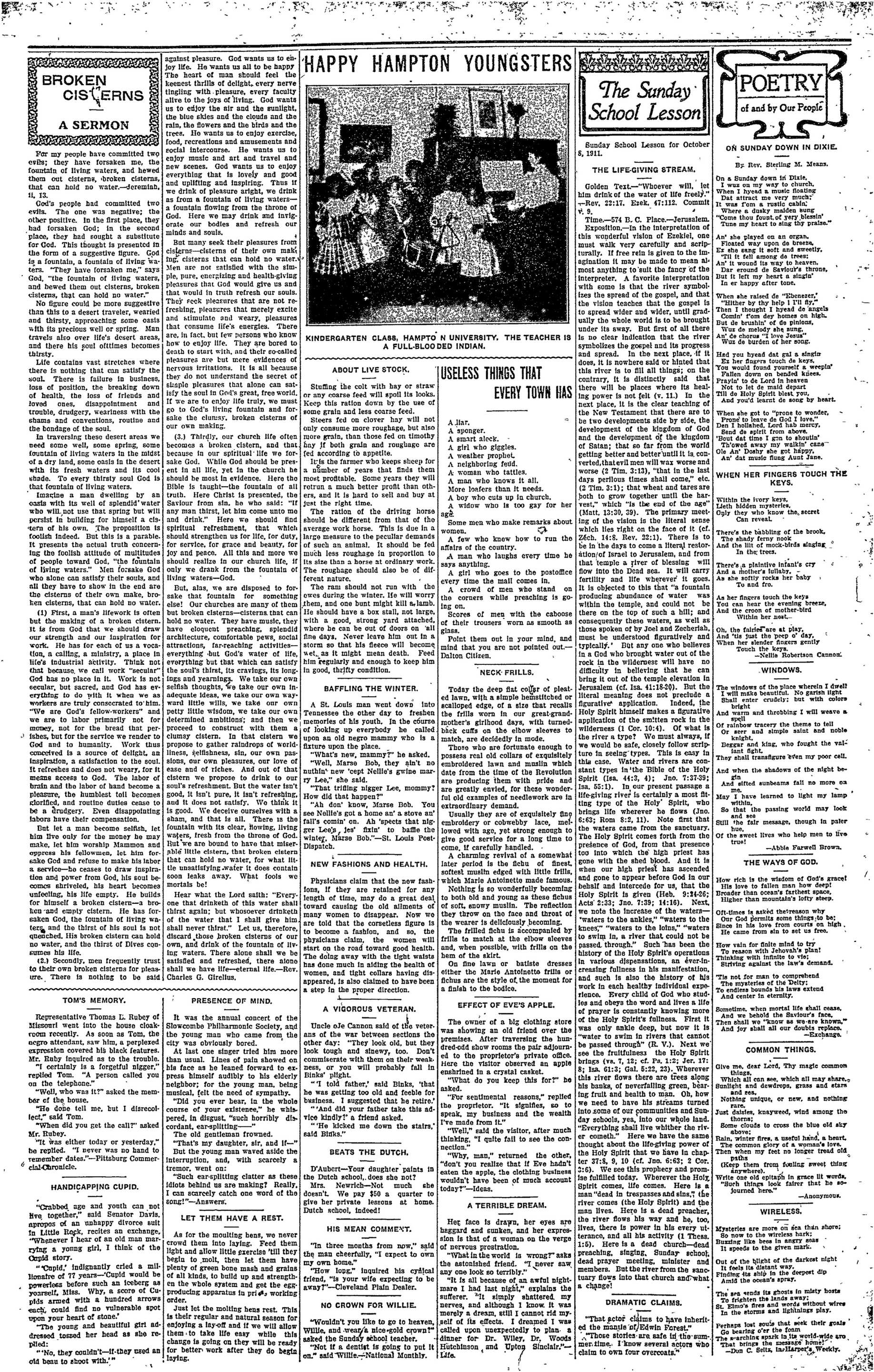
HAPPY HAMPTON YOUNGSTERS Ree C_ >
a a Serene oC MS eS Lg See er a
eae SOMME AS wait ds Brouece ter
Be? Meme ook a ee cere é ay
(lie Sas ce “<a Sea eS LS
Ceara Fe mee er SCY
iti tS eee on RC RST
ee ER CRITE 1ST RRS BM TT ae
¥ oy Ore Sm OO ERY ga SaaS ck WS
ANE EEE ONS oes os
‘ ee eee ee
ee ie es” Bicmetiey ls :
NS Bess Eg tieemeay oe
APTI SS I eos
SRO ine Toe me
KINDERGARTEN CLASS, HAMPTO. N UNIVERSITY, THE TEACHER IS
A FULL-BLOO DED INDIAN.
ABOUT LIVE STOCK,
StufMling the colt with hay or straw
or any coarse feed will spoil Sts looks.
Keep this ration down by the use of
some grain and less coarse feed.
Steers fed on clover hay will not
‘only consume more roughage, but also
more grain, than those fed on timothy
hay $f both grain and roughage are
fed according to appetite.
In fs the farmer who keeps sheep for
a nimber of years that finds them
most profitable. Some years they will
retrun a much better profit than oth-
ers, and It 1s hard to sell and buy at
just the right time.
‘The ration of the driving horse
should be different from that of tho
‘average work horse. This {s due in a
large measure to the pecullar demands
of such an animal. It should be fed
much less roughage in proportion to
Its size than a horse at ordinary work.
‘The roughage should also be of dif
ferent nature. ‘
| ‘The ram should not run with the
‘owes during the winter, Ife will worry
them, and one bunt might kill a,lamb.
"He should have a box stall, not large,
with a good, strong yard attached,
where he can be out of doors on ‘all
fine days, Never leave him out in a
‘storm so that his fleece will become
‘wet, as it might mean death. Feed
‘him regularly and enough to keep him
in good, thrifty condition.
BAFFLING THE WINTER.
A St. Louls man went down Into
Tennessee the other day to freshen
memories of his youth, In the c6urse
of looking up everybody he called
upon an old negro mammy who Is a
fixture upon the place. _
“What's new, mammy?” he asked,
“Well, Marso Bob, they ain't no
nuthin* new ‘cept Nellle's gwine mar-
ry Lee,” she sald.
“That trifing nigger Lee, mommy?
How did that happen?”
“Ah don’ know, Marse Bob. You
see Nellle’s got a home an’ a stove an’
fall's comin’ on. Ah ‘spects that nig-
ger Lee's, Jes’ fixin’ to baffle the
wintey, Marse Bob."—St, Louls Post-
Dispatch.
NEW FASHIONS AND HEALTH,
Physicians claim that the now tash-
fons, If they are retalned for any
length of time, may do a great deal
toward causing the old ailments of
many women to disappear. Now we
are told that the corsetless figure 1s
to become a fashfon, and so, the
physicians claim, the women will
start on the road toward good health.
The doing away with the tight walsts
has done much fn aiding the health of
women, and tight collars having dis-
appeared, 1s also claimed to have been
a step In the proper direction.
————
A VIGOROUS VETERAN.
Unele oe Cannon safd of the veter-
ans of the war between sections the
other day: “They look old, but they
look tough and stnewy, too. Don’t
commiserate with them on thelr weak.
ness, or you will probably fall In
Binks’ plight.
“‘T told father” said Binks, ‘that
he was getting too old and feeble for
business. 1 suggested that he retire,’
‘and did your father take this ad-
vice kindly?” a friend asked,
“‘He kicked me down the stairs,
sald Bhiks.”
BEATS THE DUTCH,
D'Aubert—Your daughter paints in
the Dutch school,. does she not?
Mrs. Newrlch—Not much she
doesn't, We pay $50 a quarter to
give her private lessons at home. |
Dutcb school, indeed!
HIS MEAN COMMENT. '
“In three months from now,” sald
the man cheerfully, “I expect to own,
my own home.” ;
“How lope.” Inqulred his enical
friend, “is your wife expecting to be
away?’—Cloveland Plain Dealer. |
NO CROWN FOR WILLIE.
—
“Wouldn't you like to go to heaven,
‘Wille, and weary nice-gold crown?” |
asked the Sunday sthool teacher,
“Not if a dentist 1s going to put It
on.” sald-Willie—National Monthly. —
USELESS THINGS THAT
EVERY TOWN HAS
Altar. .
A sponger.
A smart aleck,
A girl who giggles.
A weather prophet.
A neighboring feud. 7
A women who tattles.
A man who knows {t all,
More loafers than it needs.
A boy who cuts up Jn church,
A widow who Is too gay for her
age.
‘Some men who make remarks about
women, Oo
‘A few who know how to run the
affairs of the country.
‘A man who laughs every time he
says anything.
‘A gitl who goes to the postoffice
every time the mall comes In,
A crowd of men who stand on
the corners while preaching {s go
ing on,
Scores of men with the caboose
of thelr trousers worn as smooth as
glass.
Pont them out in your mind, and
mind that you are not pointed out—
Dalton Citizen. :
NECK: FRILLS.
Today the deep fiat colfer of pleat-
ed lawn, with a simple hemstitched or
acalloped edge, of a stze that recalls
the frills worn in our great-grand-
mother’s girlhood days, with turned-
Dick cuffs on the elbow sleeves to
mateh, are decidedly in mode,
Those who are fortunate enough to
possess real old collars of exquisitely
embroidered lawn and moslin which
date from the time of the Revolution
are producing them with pride and
are greatly envied, for these wonder-
ful old examples of needlework are in
extraordinary demand.
Usually they are of exquisitely fag
embroldery or cobwebby lace, mel-
lowed with age, yet strong enough to
give good service for a long time to
come, if carefully handled. -
‘A charming revival of a somewhat
later perlod is the ficbu of finest,
softest mustin edged with Iittle frills,
which Marle Antoinette made famous.
Nothing ts so wonderfully becomtag
to both old and young as these fichus
of soft, snowy muslin. The reflection
they throw on tho face and throat of
the wearer is deliclously becoming.
‘The frilled fichu is dccompanied by
frills to match at the elbow sleeves
and, when possible, with frills on the
hem of the skirt.
On fine lawn or batlste dresses
either the Marte Antotnetto frils or
fichus are the style of, the moment for
‘a Gnish to the bofitee,
EFFECT OF EVE’S APPLE.
The owner of a big clothing store
was showing an old friend over the
premises. After traversing the hun-
dred-odd show rooms the pair adjourn-
ed to the proprietor’s private office.
Here the visitor observed an apple
enshrined in a crystal casket.
“What do you keep this for?” be
asked.
“For sentimental reasons,” replied
the proprietor. “It signifies, so to
speak, my business and the wealth
I've made from {t.”
“Well,” eaid the visitor, after much
thinking, “I quite fall to see the con-
nection.”
“Why, man,” returned the other,
“don't you realize that If Eve hadn't
eaten the apple, the clothing business
wouldn't have been of much account
today?”—Ideas,
A TERRIBLE DREAM.
Het face Is drawn, her eyes are
heggard end sunken, and her expres-
sion Is that of a woman on the verge
of nervous prostration.
“Whatinthe world is wrong?” asks
the astonished friend. “I never saw,
any one look so terribly.”
“It is all because of an awful night-
mare I had last night,” explains the
sufferer. “It simply shattered my
nerves, and although 1 know. ft was
merely a dresm, still I cannot rid my-
self of fis effects, I dreamed I was
called upon unexpectedly to plan. 8
dinner for Dr. Wiley, Dr, Woods
Hutchinson , and Untog Sinclair.’—
Ute. -
| The Sane |
School Lesson
Sunday School Lesson for October
3, 1911.
‘THE LIFE-GIVING STREAM,
him drink of the water of life freely.”
Rev, 22:17, Ezek, 473112, Commit
v9 - ?
Time—574 B.C. Place.—Jerusalem.
Exposttion.—In the interpretation of
this wonderful vision of Ezekiel, one
must walk very carefully and serip-
turally. If free rein is given to the im-
agination ft may be made to mean alt
most anything to’sult the fancy of the
interpreter, A favorite interpretation
with somo Js that the river symbol-
izes the spread of the gospel, and that
the vision teaches that the gospel {s
to spread wider and wider, until grad-
ually the whole world {s to be brought
under its sway. But first of all there
ts no clear indfcation that the river
symbolizes the gospel and Its progress
and spread. In the next place, ff it
does, it Is nowhere sald or hinted that
this river is to fill all things; on the
contrary, {t 1s distinctly sald that
there will be places where Its heal-
Ing power fs not felt (v. 11.) In the
next place, It is the clear teaching of
the New Testament that there are to
be two developments side by side, the
development of the kingdom of God
and the development of the kingdom
of Satan; that so far from the world
getting better and better until {t 1s, con-
verted, thatevil men will wax worse and
worse (2 Tim, 3:13), “that in the last
days perilous times shall come,” etc.
(2 Tim, 3:1); that wheat and tares are
oth to grow together unt{l the har-
yest,” which “Is the end of the age”
(Matt, 13:30, 39). The primary meet-
ing of the vision is the literal sense
which Mes right on the face of it (ef.
Zéch. 14:8. Rey. 22:1). There 13 to
Be in the days to come a literal restor-
ation/of Israel to Jerusalem, and from
that temple a yiver of blessing will
flow into the Dead sea. It will carry
fertility and life wherever it gocs.
It Is objected to thls that “a fountain
producing abundance of water was
within the temple, and could not be
there on the top of such a hill; and
consequently theso waters, as well as
those spoken of by Joel and Zecheriah,
must be understood figuratively and
typically." But any one who believes
in a God who brought water out of the
rock in the Wildernese will have no
difficulty in belleving that he can
bring it out of the temple elevation In
Jerusalem (cf. Isa. 41:18-20). But the
Mteral meantng does not preclude a
figurative application. Indeed, the
Holy Spirit himself’ makes a figurative
application of the smitten rock in the
wilderness (1 Cor. 10:4). Of what Is
the river a type? We must always, If
we would be safe, closely follow scrip-
ture in seelng types. This is easy in
thia case. Water and rivers are con-
stant types in'the Bible of the Holy
Spirit (Isa. 44:3, 4); Jno. 7:37.39;
Isa, 55:1). In, our present passage a
Ufegiving river {s certainly a most At-
ting type of the Holy’ Spirit, who
brings life wherever he flows (Jno.
6:63; Rom 8:2, 11). Note first that
the waters came from the sanctuary.
The Holy Spirit comes forth from tho
presence of God, from that presence
too Into which the high priest has
gone with the shed blood. And it is
then our high priest has ascended
and gone to appear before God in our
behalf and intercede for us, that the
Holy Spirit ts given (Heb, 9:24-26;
Acts’ 2:33; Ino. 7:39; 14:16). Next,
we note the Increase of the waters—
“waters to the ankles,” “waters to the
knees,” “waters to the loins,” “waters
to swim In, a river that could not be
passed through.” Such ‘has been the
history of the Holy Spirlt’s operations
In varlous djspensations, an éver-in-
ereasing fullness in his manifestation,
and such !s also the history of his
work in each healthy individual expe-
rlence, Every child of God who stud-
Jos and obeys the word and lives a life
of prayer {s constantly knowing more
of the Holy Spirit's fallness. First it
was only ankle deep, but now it Is
“water to swim in rivers that cantot
be passed through” (R. V.). Next we’
see the frultfulness the Holy Spirit
brings (vs, 7, 12; cf. Ps, 1:2; Jer. 17:
8; Isa, 61:3; Gal. 5:22, 23). Wherever
this river flows there are trees along
his banks, of nevorfalling green, bear-
ing frult and health to man, Oh, how
we need to have his streams turned
into soma of our communities and Sun-
day schools, yea, Into our whole land._
“Byerything shall lve whither the riv-_
er cometh.” Here we have the same
thought about the life-giving power of
the Holy Spirlt that we ave In chap-
ter 37:8, 9, 10 (cf. Jno. 6:63; 2 Cor.
3:6). We eee this prophecy and prom.
{se fulfilled today. Wherever the Holy,
Spirit comes, Ufe comes. Here Js a!
man “dead In trespasses and sins,” the’
river comes (the Holy Spirit) and the |
man Ives. Here fs a dead preacher,
DRAMATIC CLAIMS.
“That getot cine to have Inberit-
ed the manule ‘of/Edwin Forest.”
“x’Those stories: are safe {dl the-sum-
mertime, I-know several actors who
claim to own four overcoats”
“POETRY 4
of and by Our People ;
ok sunnay Down it aixiv:
Bz Rev, Sterling M. Means.
On » Sunday down rf Dixie,
I wuz on my way to church,
When I hyead a music floating
Dat attract me very muchy
Tt_was fom 4 rustic cabin;
Where a dusky maiden sung
“Come thou fount, of very blessin’
‘Tune my heart to sing thy praise.”
An‘ she played on an organ,
Floated way upon de breeza,
Ex she sang It soft and sweetly,
“Ti tt fell among do trees:
An’ ft wound fts way to heaven, =,
Dar eround de Saviour’s throne,
But ft left my heart a singin”
In er happy after tone.
When she raised de “Ebenezer,” °
“Hither by thy help | I'll fly,”
‘Then I thought I hyead do ‘angels
Comin’ t'om dey homes on high.
But de brushin’ of de pinions,
‘Wuz de melody she sung,
An* de chorus “I love Jesus*
‘Wuz de burden of her sons,
Had you hyead dat gal a singis
Ex her fingers touch de keys,
‘You would found yourself s weepia’
Fallen down on bended kiees.
Prayta’ to de Lord in heaven
Not to let de maid depart
‘Till de Holy Spirit blest you, *
And you'd learnt de song by heart.
‘When she got to “prone to wonder,
Prone to leave de God I love.”
Den I hollahed. Lord hab mercy,
Send de spirit from above.
"Bout dat time T g2n to shoutin’
‘Throwed away my walkin’ cane
Ole An’ Doshy she got happy,
An’ dat music flung Aunt Jane.
WHEN HER FINGERS TOUCH THE
KEYS,
Within the Ivory keys, 7
Lieth hidden mysteries,
Oply they who know the, secret
Can reveal, ~
There's the babbling of the brook,
‘The shady ferny nook
And the lit of mock-birds alnging °
In the trees.
There's a plaintive infant's cry”
And a thother's lullaby, —
As she softly rocks her baby
To and fro.
As her fingera touch the keys
You can hear the evening breeze,
And the croon of mother-bird
Within her nest—
Oh, the falried"are at play,
And ‘tis fust the peep o’ day, ©
When her slender fingers gently
Touch the keys.
Nellie Robertson Cannon.
WINDOWS.
The windows of the place wherein I dwell
I will make beautiful. No garish ilgnt
Shall enter crudely; but with colors
bright
And ae and throbbing I will weave a
spel
Of rainbow tracery the theme to tell
Or seer and simple saint and noble
knight, :
Beggar and king, who fought the val-
fant fight.
They shall transfigure t¥en my poor cell.
And when the shadows of the night be~
gin “
And sifted sundeams fall no more om
me. ; ~
May I have learned to Ught my lamp
within,
So that the passing world may look
and seo
Sul vee talr message, though in paler
Ne, =
Of the sweet Iives who help men to live
true!
Abbie Farwell Brown.
THE WAYS OF GOD. .
How rich ts the wisdom of God's gracef
His love to fallen man how dept
Broader than ocean's farthest space,
Higher than mountain's lofty steep.
Oft-times {a asked the?resson why
Our God permits some things to be:
Bince in his love from courts on high ,
He came from sin to set us free.
How vain for finite mind to try
‘To reason with Jehovah's plant
Thinking with infintte to vie;
Striving against the law's demand.
"Tis not for man to comprehend
‘The mysteries of the Delty:
To endiess bounds bis laws extend
‘And center in eternity,
Sometime, when mortal life shall cease,
‘And we behold the Saviour’s face,
Then shall we “know es we-are known,”
‘And joy shall all our doubts replace,
Exchange. |
COMMON THINGS,
Give me, deat Lord, Thy magic common
things,
‘Which all can see, which all may share,,
Sunlight and dewdrops, grass and eters
and ses,
Nothing unique, or new, and nothing
are,
Just daisies, knayweed, wind among the
thorns;
Bome clouds to cross the blue old sky
above: ‘
Rain, winter fires, a useful hand, a beart,
‘The common glory of a woman's love.
Then when my feet no longer tread old
paths ~ a
(keep them trom fooling sweet thing
anywhere). +
Write one olf epitagh In grace Ut words,
“Such things look fairer thet be #0-
Journed here.”
Anonymous.
WIRELESS,
Mysteries are more on sea thin shore;
Bo now to the wireless hark:
Buzzing like bees In angry 9835 *
It speeds to the given mark.
Out of the Qiight of the darkest night
It feels Its distant way. ¢
Finding dts ship in the deepest dip
‘Amid the ocean's spray.
‘The are sends its ghosts In misty hoste
‘To frighten the lands away:
Se Elmo's fires and words without wires
In the etorms and Uphinings play.
Perhaps lost souls that seek thelr goats
Go bearing o'er the foam
‘The searching spark Ia te world-wide aro
‘That brings the meszoge home!"
Don C. Belts, ineHlarper’s, Weekly.
Published Every Saturday
462 West Broad Street.
Phone 2171.
Remittance must be made by Express or Post Office Money Order, or Registered Letter. Advertising rates given on application.
Entered at the Post Office at Savannah, Ga., as Second-Class mail matter.
The opening of the public schools last Monday presented the same pitiable sight for Negro children as has been the case for years. Hundreds of them who were clamoring for cards of admittance on last Saturday but were turned down on account of lack of accommodations besieged the schools on Monday morning early hoping by some mere turn of fortune to be squeezed in on opening day. But the few seats that were to be filled by the incoming children were given out on the day of the issuance of entrance cards and they were sent away, the most of them to illly roam the streets and fall prey to the evil influences of the city. How sad it is that year after year passes and still no greater school facilities are provided for the little black boys and girls. They increase numerically at about the same rate as do the white children and the latter are provided with a new school every five or six years but the former, those who are fortunate enough to get accommodations, must be packed into the lower grades like so many sardines in a box, in fact in some rooms as many as four to the ordinary two seat bench. These woefully inadequate school facilities bespeak a sad sad story for without the proper training for our children it will be impossible for them to measure up equally with those of other races. Is it any wonder that there is so much unintelligent labor among us? The remarkable thing is that it is not worse. Is it not cheaper, more judicious and more profitable to provide school facilities for these hundreds of boys and girls who are forced to walk the streets than to pay thousands of dollars each year for prisons in which to keep them? It is these little Negro boys and girls whom in later years the city must depend upon for its labor and unless they are given a few years of schooling how can they give satisfactory services.
An evil which we have been decriing for many months and one which is causing far-seeing mothers and fathers no little concern is that of allowing young girls and boys unaccompanied to roam the streets after night fall. It is a bad enough practice for children to be allowed too much freedom on the streets in the day time but when the shades of night are drawn it is absolutely necessary for them to be given every possible protection if occasion arises for them to go out. This is a most opportune time of the year for parents to start putting a ban on their children's pawling the streets at night, if they have not already done so, for school has just begun and it is a good habit to have them put in a little quiet time at night preparing their next day's lessons. It is the custom of many parents when urging their children to be studious by, preparing their lessons over night to allow them to go over to a neighbor's house in order that their children might study together thereby making their hours of study both pleasing and profitable. In cases where children live in adjoining houses and where their parents are absolutely sure of the wholesome home surroundings into which their children are going, this mutual exchange of the common study rooms of next-door-neighbor children might be tolerated, but let it be thoroughly understood that upon no circumstances is it conducive to the best interest of children for them to be allowed to go any appreciable distance from their own homes in order that they may study with some friend. As a matter of fact it is a good thing to have children understand in no uncertain terms that the best place for them at nights, whether preparing their next day's lesson or not, is in their own homes under the careful and watchful protection of their own parents. Many a young person, especially girls, en route to
or from some school chum's house where they would prepare their lessons together has gone astray and the unsuspecting but over-liberal parents has ever since been made to bear a heavily burdened heart. Children's places at night are at home. Parents should not forget this. There should be nothing which parents should think so important as to have their children attend at night without first seeing that the proper protection is thrown around them. The concert hall, the theatre, the street carnival, the church and all are all good enough places for children to attend occasionly at night when they are properly accompanied but by no means is it advisable for them to be allowed out anywhere at night by themselves. Until pargnts come to this understanding and keep their children off the streets at night we are going to have a large proportion of wayward and ruined children for the shades of night have a woefully damaging effect upon the morals of any child.
Powers of the Board of Endowment of Reform Regarding Premiums. The Waiting Rank and File Readiness To Act.
The question has been asked if the Board of Endowment should be a legislative body-if it should not possess certain plenary rights aside from the certain rights given it now by the Grand Lodge. If the right to settle the question rested with me, I would under present conditions say no, for the fact that the Endowment Board is a creature of the Grand Lodge and for the fact that no creature can be greater than its Creator. Again the Board of Endowment is a part of the Grand Lodge, one of the several parts, and no part is greater than the whole.
But notwithstanding the fact above stated, I do believe and shall contend that the Endowment Board should be itself a creator. It should establish the necessity of its existence by the service it renders in the effort to evolve some plan for the progress and perpetuity of itself and the product of its labor should be presented to the Grand Lodge for its consideration. For though it is a creature it should have class, for it must belong to one or both of the two great classes of individuals of which the world is composed-creators and supporters. If we exist and do not persist in the performance of such service as will render our existence necessary, then we exist spuriously and for no profitable reason. Of a necessity the meeting of the Board entails an expense and the labors of the members thereof should be commensurate to the amount of funds expended.
That there is work to be done by the Board, there is no doubt, if power be spent and efforts bent to accomplish it. And there is little if any doubt but that plans studied out and presented to the Grand Lodge, would receive the sanction of that body especially if the plans shall appear remedial. As has already been stated some radical changes regarding endowment must be made. The premiums in my opinion, will have to be graded upon the basis of age or an annual assessment must be established. Neither of these methods, upon first blush would meet the approbation of a majority, but I opine that after reasonable and mature consideration either of them would be accepted after having been put in form. Either of them will bring relief and go along towards placing the endowment upon a lasting basis. If relief cannot be seen in any of the suggestions, which from time to time have been made, it will have to be seen in some subsequent suggestions or proposition. So it is now between sessions that the realm of reason should be explored in order to dig from its secret cloisters a remedy that shall prove effective a remedy that is just and equitable, touching every phase of the situation and bearing with equal weight upon every unit of which the organization is composed. And the entire membership of the order has the right of suggestion.
It has grown to appear oppressive whenever the burden, for any cause is made heavier. At the same time, there is reactionary influence engendered whenever the slightest semblance of tardiness upon the part of leaders meet the ken of the public. If it be for or without cause it is productive of cavil such as militates against the peace and progress of the concern at that point. This necessitates rigid sagacity and clear conception of fundamental needs of the concern upon the parts of the officers and they should be alert to any possible weakness of the construction of the concern and should strive to bring forth a remedy. For no corporation or society is stronger than is the estimate place upon its strength by a majority of its supporters. And no organization is permanently established that does not hold the confidence of the majority. Therefore the aim of the promoters of any concern should through the will of the majority so strengthen the foundation of their corporation as to hold in their grasp every rising condition. And when it is seen that the situation is really and truly and safely in the hands of the officers or any officer, the rank and file should strenuously support such officer or officers. In this idea, I find myself endorsing the diction of W. L. Hughes, who, in the Independent, "rose to remark" in defense of B. J. Davis and like this functionary, I would state that if Grand Chancellor Hutto will inaugurate reforms which will bring strength to the order, members from every nook and cranny, every "coot and hern," of this great state should rally to his support. I believe they will. They are only waiting for suggestions for propositions beneficial to the order.
I believe a commission should be appointed constituted of the best thinkers of the order whose duty should be to inaugurate reasonable and necessary reforms if such reforms are not forth coming from other sources. It is within the scope and power of the Grand Lodge to form such a commission, and it is within the power of the Grand Chancellor, ad interim so to do. A basis of reckoning must be established to perpetuate the stability of the endowment
and there is no getting around it. The leaders of the Order may as well face the task now and settle the question for all times to come. Edward Winifred Sherman. The Union Mutual Insurance Company in the Hands of The Matchless J. C. Lindsay, a Marvel in the Insurance World.
That community is blessed that can claim a unit of value even though the sphere, of that unit is circumscribed. That community is thrice blessed when it can lay claim to a unit of unlimited influence in affairs, both secular and religious—whose activity merits and receives the plaudits and approval of all the people. A man who is diligent in business, suave, courteous, and clean, unfettered by isms andologies to the extent of narrowness, apt and alert, positive but pleasing of manners, cool, calculating and sagacious, cannot fail to tie himself to the life and progress of any community in which he may live. Such a one cannot fail to become a great power in the religious, social and material advancement of a community.
Of such a nature and possessed of these prerequisites is our friend and fellow townman, J. C. Lindsay of the Union Mutual Insurance Company of Atlanta, Gr. Mr. Lindsay is at the head of the Savannah branch of this great company and through his herculean effort and matchless skill is rapidly forcing his company to the fore. Being an expert in industrial insurance, a student of men, a tireless worker and a diplomat of the clearest waters, he has surrounded himself with a force of agents whose methods and manners might well be copied by men of every walk of life. His system of education in the art of canvassing, collecting and distributing is original, new and effective and periodically his offices transform into a training school in which
O
J. C. Lindsay
fundamentals as well as embellishments along his line of labor, are taught. It is interesting even to a novice to sit in one of these symposiums and listen to questions propounded to agents and the answers given. Such methods cannot fail of results which results must rebound to the company and the agents alike. All of these items show the wisdom and sagacity of the genial manager and the wonderful influence he holds over his co-laborers.
With a force of stalwart men, taught and trained in the arts and science of insurance in all of its varied and varying ramifications with a company that pays its claims—a company of character and stability behind him, it is not to be wondered at that such matchless strides are being made by Mr. Lindsay's company. Under the matchless control of this genius it is reasonable to conjecture that eventually, this branch will become too heavy for the great trunk and that Savannah may become headquarters for this great company.
In the midst of his earnest labors for the furtherance of the interests of his company, Mr. Lindsay does not neglect his religious duties, nor does he cut himself from society, social nor fraternal. In fact it is evident from his conduct, that he knows the value of being known in every sphere of activity. As a consequence the citizens of the community consider any convocation incomplete without his presence and congeniality. And Mr. Lindsay is seldom absent from any of them. As the direct result of his activity he is as well known in the community as any citizen and his words are heeded, both for counsel and advice. His activity along these lines makes business for his company by making friends for him. And thus, many recruits to his company are enrolled without solicitation.
Fortunate for the Union Mutual Insurance Company it is that such a splendid specimen of manhood, such an exemplar of honesty in trade, and such an example of Christian devotion and unquestionable manhood was selected to fill such an important position upon its official staff. The placing of Mr. Lindsay shows with what deep wisdom the management of this magnificent corporate body makes its selections and how the fruits of the wisdom displayed rebounds to the strength of the corporation.
The Character of the Man.
"Unpracticed he to fawn or seek for power.
By doctrines fashioned unto the varying hour."
My subject is well equipped for the services imposed upon him. He is technically tutored in things practical and hence upon questions economic he is to be feared in debate. He will not shave a truth to share apleause, nor will he fashion his "doctrine unto the varying hour." His manners, however are pleasing, his propositions are studied and well put, and his argument runs easily from a stated premise to a conclusion arrived at by flawless thought and a regular course of reason. Hence, when these forces are brought to bear in the defense of his company, showing the wisdom of selecting this company as the basis of protection he scarcely ever fails to convince the listener that the Union Mutual Insurance Company is the company that pledges and pays
The offices of Mr. Lindsay are well kept and modern. Located in the Williams Building, situated upon one of the city's busiest thoroughfares it is easy of reach and convenient to its many resident and business patrons.
In his rooms aside from the well-kept furniture and fixtures, are charts and bulletins, the former used for daily hints to agents, the latter for recording the schedules of agents. The conduct of the office is business-like and the excellent records of the agents show the manipulation of a master hand directed by a master mind.
Mr. Lindsay has made of the Union Mutual Insurance Company a pet concern of the community whose merits are discussed at every fireside. This is due largely to his personal popularity and then to the pertinacity and push of his agents as well as to reliability of of the great company he represents. His advent into this community was not the advent of a stranger. His bountiful congeniality, pleasing manners and the remarkable versatility, made of him a citizen without the process of "naturalization" His unrestricted and manifest desire to unite with every interest dear to the community, made of him a friend. His declarations of his enlistment in the vast army that labors for the uplift of the race made of him a comrade. His willingness to shoulder a pro-rata part of the weight of the community and to tie himself to its life and labors made of him a partner. Therefore, as a citizen, comrade, friend and partner, he could without scruples lay chim to the patronage of the community. The growth of the Union Mutual is proof of the righteousness of his claim. So fertile and fruitful of thought and beneficent ideas is the subject of this sketch and so original of designs and exact of prophesy has been his history among us, that
Still the wonder grows.
That one small head can carry all he knows"
Ground Breaking of St. Philip Parsonage Largely Attended.
The ground breaking Monday afternoon for the new parsonage of St. Philip, Charles and West Broad streets was largely attended and was a most impressive ceremony. The ministry in general was well represented at those exercises. The ceremonies were begun by a very interesting program which was held inside the church, at which several interesting addresses were made, the history of the church given and a number of beautiful anthems sung by the choir. After these services and a collection which was indeed very liberal, the breaking of the ground was begun. People of all denominations and all walks of life was present and witnessed these impressive exercises. The parsonage is to be one of the most commodious in the city and is to be of pressed bick. It will be completed in about sixty days.
Green and Allen's Grand Fail Opening Finest Display
Ever Seen in City.
The progressive millinery establishment of Green and Allen, 464 West Broad street, held their fall opening on Monday and it was the finest display of head gear ever seen in Savannah. The management had spared no pains and money in selecting an entirely up-to-date and knobbish line of hats. The seasons latest creations were shown and met with the approval of the highly critical. Aside from the newest ideas in hats, an extensive line of willow and ostrich plumes, chenille flowers, Fringes and everything new in ribbons and trimmings were shown. Large crowds were in attendance all during the day and until eleven o'clock at night and nothing but words of praise were to be heard on every side. Another enjoyable feature was the music which was rendered. Mesdames Green and Allen, are running probably the most up-to-date millinery store among our people anywhere in the country and they deserve unstinted patronage. Their stock compares favorably with any similar establishment in the city and their workmanship and artistic taste are unquestioned. The high class goods which they have carried together with the courteous treatment for which they are known have commended them to public favor ever since they have opened.
Dedication of St. Mary's School
On Sunday afternoon, at 5 p. m., the dedication of the new school on 36th and Harden streets will take place. Right Rev. Bishop Kelley will preside at the solemn function and make a special address in the large hall after which he will bless the little Chapel in the Building. The school is being dedicated to the Immaculate Heart of Mary a titular that is dear to the Catholics. The children of our different schools are requested to take part in the celebration. They will meet on 37th street at 4:30 p. m. and parade around the school with American flags in their hands. The public is invited to attend the celebration. Special places are reserved to the children and the two societies of St. Benedict's church. The school was opened on Monday last and from 110 to 120 pupils attended during the week.
Library Dots.
The Library; The proposed Carnegie Library:: The citizen Library:: Shall we have it? Do you want a $12,000 Negro library building in Savannah? Please pay your subscription to ProfGrant, Miss C. E. Lewis, Miss Ophelia Lee or Miss E. Duncan and we shall have the library Thanks to the Air Dome for $18.73. Patronize Mr. Baker, he is our friend. Cash subscriptions: F. R. Lampkin 25 cents. Cash 10 cents, Cash 5 cents, Air Dome $18.73. Total $19.13.
Press, Type, Type Cases and Stands For Sale.
In order to secure more room, we will offer for sale a Monumental press, inside chase 6x9 1-2. This press is in good condition and gives excellent service.
Several fonts of Job Type, very serviceable; worth twice as much as the sale price.
A number of jobs, upper and lower type cases in good condition.
Several stands for cases will be sold cheap.
The prices for these articles are low, for that reason they will be sold only for cash.
Apply.
Card of Thanks.
Mrs: Elizabeth Whitfield and Mrs.
M. Black wish to thank their many
friends for the kindness shown them
during the illness of their father,
SO MANY PEOPLE
Have asked me "what will you do for this winter, and how will you fix up the Air Dome for the cold days!" We don't want you to close this
High Class Show
We wouldn't have any place to go. It has been a blessing to have a fellow like you to come here and give us such a good-clean-bright amusement that you have us worried.
Now, I'll Tell You
Don't worry—I am on the job—I'll tell you about it shortly. I didn't come to Savannah for a day or one week—get the money and skip away—you have just
Started to Know Me
The more you see my show the more you'll like it, the more you know me you will find I'm not a bad sort of a fellow.
Next Tuesday Every Lady a Dish
SAVANNAH THEATRE
Late Co-star Black Pattl
IN THE NEW BIG THREE ACT MUSICAL COMEDY
"ROYAL SAM"
Supported by JENNIE PEARL
Prices Matinee 25 to 50c. Night 50c-75c-$1.00 Plenty of good seats to be had. Box office open to night until 10 o'clock.
WEST END PHARMACY
The PLACE to get your DRUGS. Prescriptions given strictest Attention. We handle everything known to the Drug Business. TOILET ARTICLES the BEST on the MARKET PATE'S WEST END PHARMACY
Get the habit by saving a part of your earnings each week. ONE DOLLAR STARTS AN ACCOUNT.
Locals.
Miss Anna E. Jenkins left Monday for Clark University, Atlanta, Ga.
Miss Minnie Mungin of Atlanta, Ga.
Miss Minnie Mungin of Atlanta, Ga. is in the city for a short stay.
is Ask Pate's Drug Store about the Nyall Line.
Miss Marie Taylor, who was visiting in New York returned home on Friday of last week.
Capt. Alex. Myers and Lieut. J. S. Blocker of Beaufort, S.C., were in the city on Monday.
Mr. Gladdius McNeal Williams left Sunday afternoon for Lawrenceville, Va., where he will attend school.
Don't go other places to buy your suit before seeing A. P. Barnard, The Taylor, 310 Whitaker street-Phone 3003 Go to Savannah Pharmacy or phone your wants. Prescriptions called for and delivered. Phone 3570 Mr. and Mrs. Gilbert Fisher of Beaufort, S.C., were among the excursionists in the city on Monday.
Mr. Albert P. Williams, Jr., has returned to Washington, D.C., where he will resume his studies in the medical school of Howard University.
Mrs. Claudia C. Allen of 606 W. 32nd street, who has been spending a while in New Port, R. I., and other northern cities returned home last week.
Mr. Alex. W. Ferrebee has begun his third term in the dental department of Howard University, Washington, D.C.
Go to Pate's Drug Store, West Broad and Hall streets.
Mrs. Ada Welch after spending a pleasant stay in Baltimore and Washington, D.C., as the guest of Mrs. Ada Collier Carey is expected home soon.
Prof. J. G. Lemon, returned to the city Saturday from McDonough, Ga., where he and his family were spending the summer.
Go to the Savannah Pharmacy to buy your drugs and toilet articles. They have the goods. West Broad and Gwinnett St. Lane.
Dr. and Mrs. Janerson and children, accompanied by Mrs. Dr. Beleher and children, returned Thursday to the city from Washington, D.C.
Mme. Florence Williams gave an automobile outing Tuesday afternoon in honor of Mrs. Manie Turnbull Williams, Mrs. Turnbull and the young Mrs Gwyndoline Jackson of New York.
Mr. John Adams left on Monday night for Atlanta where he will continue his studies at the Baptist College. He contemplates finishing his college course at Howard University.
Mrs. Jos. H. Baker and children, 218 Bullock street, have returned home after a stay of six weeks the guests of Mr. and Mrs. Wade Roberson, Cartersville, Ga.
Mrs. Wm. M Mitchell of this city, Mrs. R. E. Cummings and Mrs. E. H. Howard of Summitt, N. J., recently had a very pleasant stay with Rev. E. L. Moseley and family of Orange, N. J. Mrs. Daisy Allen, Mrs. Gertrude Anderson and Miss Maggie Richards, after spending some time very pleasantly in New York returned home on last Tuesday.
Dr Walter E. Moody, formerly manager of the Nisanza Pharmacy, New York City, arrived in the city yesterday and is located at the Savannah Pharmacy.
Ask Pate's Drug Store about the Nyall Line.
District Grand Director P. A. Fields, Deputy W. D. Armstrong and Special Deputy Wylie Smith of the Odd Fellows, left yesterday for Milledgeville, Ga., to attend a meeting of the deputies.
Try the Oriental hair grower If it is given a fair trial it will produce a lovely growth of hair. Sold by Mine Williams. 521 Gaston street, east, agent. Mine. Williams recrimps all artificial hair -ad.
Mrs. M. E. Bryant of this city who is stopping at Wakefield, R. I., has been very ill but is now improving. Her friends, Mrs. Geo. F. Potter and daughters-with whom she is stopping are caring for her.
Mrs. L. A. Newton returned home last week from Valdosta, Ga., where she attended the convention of the W. H. and F. M. Society. Mrs. Newton was the guest of Mr. and Mrs. I. D. Perkins
Rev. S. G. Baker of Daytonia, Fla., is spending a few days in the city the guest of Dr. and Mrs. E. M. Pineckney. Rev. Baker is expecting to visit several of the northern cities before returning to his charge at Daytonia.
Mrs. Catherine L. Stewart of 708 West Broad street, accompanied by her grand-daughter, Miss Catherine Williams, returned to the city after a visit to her son, Mr. Chesterfield W. Stewart in Atlantic City. Mrs. Stewart also visited other northern cities.
At the parsonage of the First A. B. Church, 717 West Broad street, on Wednesday evening last, Mrs. Mamie E. Moore and Mr. Louis A. Thomas were joined in marriage by the Rev. W. L. Jones. Mr. and Mrs. Thomas will leave for Boston, Mass., on their bridal tour.
Mr. John A. Gadsden has opened shop at 225 Jefferson street where he will be glad to have you send your carriages, autos and buggies for painting. He is the only colored vehicle painter in the city today doing business and should be well patronized.
After spending an exceedingly pleasant stay at Boston, Mass., and the surrounding country, chaperoned by Mrs. R. Parker of New York City, Mrs. S. J. and little Miss Nafile Williams returned to the latter place preparatory to their homecoming.
Rey. J. Earnest Robinson, B. D., the pastor of the First Baptist Church of Sheepshead Bay, N. Y., is in the city on account of the illness of his mother, Mrs. T. M. Robinson. Rev. Robinson will be here two or more weeks. He reports great success with his church. Mr. A. J Elkins, formerly of Savannah, who has been in the census bureau department for the past two years, has resigned to take up the study of medicine at North Western University in Chicago, Ill. His friends wish him much success. Mrs. Emma C. Frohman has returned home after spending a while at Swainsboro, Ga. On Monday evening she was entertained by Mrs. Pughsley and Mrs. Murry and on Tuesday evening by Mrs. Jordon and Mrs. Smith. Both entertainments were very pleasant enjoyed.
During the week the following were among the students to leave the city for school, those going to Atlanta University, Meldrim Tucker, John Mcintosh, Frank Stoney, Gordon Dingle, Misses Lucille Tucker, Lucile Spencer. Hazel Heffron, Charlotte Genross, Christine Wilson, Irma Smalls, Mabel Robinson,
Edith Bythwood. To Clark University, Anna Eliza Jenkins, Harriet Parkhurst, Mrs. C. A. Johnson of Limerick, G. a., met with a very painful accident at her home on last Tuesday morning. While attending her household duties or the second floor of her house she accidently lost her balance falling backwards down a long flight of stairs cutting a long gash in her head that required several stitches and severely bruising her shoulders and body. She was hurried to the city for medical attention and is now at the residence of Mrs. Rosa B. Barnard, 512 Oak street under the treatment of Dr. Tyson. Her many friends wish her a speedy recovery.
On last Tuesday evening Mr. and Mrs Wm. Allen and Mrs. E. R Dennis, very delightfully entertained Mrs. Jno. F. Snead of Washington, D. C., at their home G12 West Bolston street. Miss C. Alexander, Mrs. E.' E. R Dennis, and Mr.W. H. Stykes by musical renditions added to the pleasures of the evening. Refreshments were served. The following guests were present: Misses C. Alexander, Anna Jones, Lavinia Morrell, Martha Daniels, Janie Bissard, Anna E. Maxwell, Mesdames Etta Holman, Ethel Williams, A. H. Dunbar I. M. Jackson, Messrs Thos. A. Bright, Amos Paton, W. H. Stykes, P. B. Kay, Jno. Frazier, A. S. Lloyd, R. Haywood, G. W. Haywood, A. H. Dunbar, Dr. E. M. Pinkney, Thomas, Thomas Williams.
Death.
Mr. Marcus Jones, after an illness of a few months departed this life last month. 26th, at the residence of his daughter, Mrs. M. Black, 549 Oak St., and was buried on the 28th.
Special Notice.
Savannah Patriarchie No. 38 will memorialize their deceased Bros. C. Gillins, Edward Brinson and R. Barnes at St. Philip Church, West Broad and Charles streets Tuesday night Oct. 10th at 8 o'clock. Patriarchies and P. G. M.'s are ordered to meet prompt, full uniformed. The respective lodges of the deceased will be present. Sister lodges and inmates are invited.
By order of
Capt. P. I. Small, Commander.
J. D. Powell, W. P. R.
Sunday Club.
Special Program, Metronome Orchestra. Overture, Northern Lights, by Metronome Orchestrn; Solo Mr. Flood; Instrumental Solo, Miss Pearl Marshall; Solo, Miss May Steward; Selection by Eureka Quartette; Clarinet Solo, "Wedding of the winds," by Mr. Carl Hankinson; Vocal Solo, Mr. P. D. Davis, Address, subject, "Music" by Mr. E. W. Sherman; Selection, "Festival Overture" by the orchestra; Vocal Solo, Mrs. Lula Wright; Trombone Solo, Mr. R. L. Hicks; Vocal Solo, Mrs. Maggie Hardaway; Song by the Club.
IN HIS HOLY TEMPLE.
Interesting Services in The Churches of the City.
Nicholsonboro Baptist Church.
On tomorrow Nicholsonboro Baptist Church will celebrate their anniversary. A grand time is anticipated and a large crowd will be out from the city.
St. Benedict's Church.
Gaston and East Broad Streets.
Sunday October 8: 18th Sunday after Pentacost and Feast of the Maternity of the Blessed Virgin Mary. First Mass at 7 a.m. Second Mass at 8 a.m. Rev. Michel Sherrer will preach the sermon. On account of the celebration at St. Mary's school there will be no Sunday School or evening devotion in our church.
Second Baptist Church.
A large concourse of members and friends were out to greet the pastor, Rev. Reid on his return from his vacation on Sunday morning. He preached a powerful sermon from the text, 13th chapter of Numbers 30th verse. Tomorrow is the Communion and each and every member is requested to be out. On Sunday night the candle service will be repeated. Remember the weekly services, also that Sunday School will be held at 2:30 p. m. on to-morrow.
Eugenegong, Mistletoe, Ulan
Evangelical Ministers' Union.
The Evangelical Ministers' Union met with Dr. R. H. Singleton presiding. Devotional service was conducted by Rev. J. S. Jenkins. Having addressed the throne of grace the 8th Psalm was then read. A short talk followed and then sermonic report was given by P. E. Rev. B. S. Hannah. Dr. W. E. Farmer called attention to his Rally tomorrow at 4 p. m. The public is invited. Dr. P. W. Greatheart will preach. All members of the Union are requested to be out next Tuesday, business of vital importance.
F. B. B. Dots.
On last Sunday, Rev. Wright conducted the services at the Nicholsonboro Baptist church. The visitors returned to the city much benefitted and feeling satisfied that the day was usefully spent. The B. Y. P. U. service Sunday evening just before church was very interesting. On last Sunday Miss Eva Singleton read an excellent paper on "Good Morals." At night Rev. Wright read for the lesson Ps. 41:11 13. text St. John 6:27; Subject, "The Best Aid." The sermon was filled with beautiful thoughts and examples. It was truly a live sermon preached to a live congregation. The choir sang "Angels get my manson ready." Rev. Wright led the hymn, "I love the Lord, He heard my cry." He invited those who felt the need of prayer to the mercy seat. A large crowd came forward and prayer was offered in their behalf. You are always welcome at our services.
Mt. Zion Baptist Church.
Sunday was a high day in Zion. The Memorial of W. L. P. Weston, deceased Pastor was wellattended. At 11 o'clock Rev. Spencer preached a fine sermon from Jer. 8:22. Theme: "Gilead the Balm and Physician." 3 p.m., Revs. W. L. Jones, J. S. Irby, W. E. Farmer, G. A. Thomas and others spoke to the delight of all present. Several strong papers were read, the choir was in its glory. 8 p.m., the Pastor preached the ordination sermon. Bros. Jackson and Holmes were ordained, five members joined the church. The collections were fine, the spirit off he Lord brooded over Zion with power, the Pastor swayed his people at will. We are glad to say by the help of God and our Leader, our beloved Doctor, Rev. M. D. Spencer, we have had a successful year's work, our church has added over 80 to its membership roll and raised nearly $1,000 this year. We
have kept up with all our obligations to the Pastor, and have to our credit near $1000 to begin a new church in short. On the 28th of November, 4th Sunday, we hope ro raise money to begin our work. All the officers and members have gone to work. We feel as if we have a safe leader and pastor. Will you give us your help.
St. Philip Dots.
St. Philip Dots.
On account of the rain on Sunday the attendance was not very large. Rev. Rev. C. B Collins preached at 11 a. m. Rev. S. G. Baker of Daytona Fla. filled the pulpit at night. He preached a powerful sermon, his theme was "The Mysteries of God." Rev. Singleton was assisted by Revs. Collins and Capps in the Communion services. The ground breaking of the new St. Philips was attended by many irrespective of creed. Everybody seemed to be interested in the work. The fourth Quarterly, meeting of St. Philip convenes Friday night October 13th. Don't forget the big rally on the Fourth Sunday in October. The work has begun so it behooves every member to begin work of paying their subscriptions. Don't forget the last appearance of Miss M. H. Demby at St. Philips for the benefit of building fund Wednesday night October 11. Admission 10 cents. On Tuesday night in connection with class meeting, Memorial services on the late Mr. Barnes will be held by the Patriarchies, Mrs. R. H. Singleton and Mrs. L. A. Newton returned from Valdosta, Ga., where they were in attendance at the Ladies Home Foreign Mission Society of the Georgia Conference. The Abyssinians will give a ten nights entertainment in the Ladies exchange (church annex) commencing on Monday night October 9th for the benefit of the building fund. The following services will be held on tomorrow, Sunday: Prayer meeting at 5:30 a. m. Preaching at 11 a. m. Sunday School at 2:30 p. m. Preaching at 8:15 p. m.
Monumental Notes.
Sunday was a great day in the old "Mother" church. At 5:30 a.m. the faithful Christians held a glorious prayer meeting. At 9:30 o'clock a.m. the Sunday School was on with every officer present and a good collection. At 11 a.m. Rev. G. C. Baker preached an interesting sermon, two infants being baptized. At 3:30 p.m. the holy Communion was administered. At 8 o'clock p.m. there was preaching and holy Communion, thePastor delivering a wonderful sermon, subject "Every knee shall bow and every tongue shall confess." Nearly eight hundred members took communion and two joined the church.
The choir rendered excellent music at these services. Class meeting was attended Tuesday night by 190 members. Collection $26.50; one joined the church.
The Sunday School's Rally known as "Boosters" closed at this meeting, Miss Rosalie McAllister was awarded first prize a handsome Gold, watch; Miss Marie Cato, second prize a gold bracelet. Amounts raised were $35.00 and $19.00 by the winners, total raised by all the Captains $114.91. The Sunday School teachers and officers held a splendid meeting Wednesday night. The choir and a host of members made a surprise Thursday on Mrs., Julia Drayton who has been sick about eight months, many good things were left. 600 members have joined during this administration at the church. Services to-morrow: Early sunrise prayer meeting 5:30 a.m. a.m. Sunday School 9:30 a.m. Preaching 11 a.m. and 8 p.m. A. C. E. League meeting 4:30 p.m. You are invited to attend these services.
New St, Peter's Institutional Church, Wawcross, Ga.
On Saturday Sept. 23 the corner stone laying of the new St. Peters Institutional Baptist church of Waycross, Ga. took place. The exercises were very impressive and were engaged in by the home people and many visitors from other cities and towns. Rev. B. Molett who is pastor, of this beautiful house of God was the main figure at the ceremonies, for it was through him the new edifice was successfully built. The people of Waycross took an unusual amount of interest in these services and expect much good to be accomplished through this new church.
A Great Collection
More than maintaining its high standard for exclusively articles of deep interest, the Magazine Section of next Sunday's New York World will contain "Advice of Mary Garden to New York Girls Abroad" "My Adventure with Stolypin's Assassin," by Col. James Persitz of the Russian Secret Police, "Discarded American Battleships," New York Mansions, &c., carved to Fit Streets," "The American Girl Who Married a Duke and Is Happy"; also the words and music of "Little Fit" a new song hit, &c., &. Don't fail to, order the Sunday World in advance.
BEST AND HEALTH TO MOTHER AND CHILD
MISS WISCONSIN Soothing Suite has been used for over SIXTY YEARS L, MILLIONS OF MOTHERS for their CHILDREN WHILE SOOTHING THE CHILD, SOFTENS THE GUMS, ALLEYS all FAIN; CURS WIND COLIC, and is the best remedy for DIARRHIA. It is an easy cure and ask for "Katrina Winlow's Soothing Suite" to take no other. Twenty-five cents a bottle.
AMUSEMENT COLUMN.
Coming Events in the Social
World.
NOTICE—Articles in this column one cent per word.
October 9th, Monday. Entertainment by Eureka's Ladies Branch at Masonic Temple. Tickets 25 cents.
October 9th, Monday. Autumn Festival by Alex. Ellis Club No. 1 at 610 West Waldburg street. Tickets 10 cents.
October 2nd, Monday. Fall Entertainment by M.A. Lane Rosebud No. 1075 U. O. T. R. at 523 Gaston street east. Tickets 10 cents.
September 25th, Monday. Trolley Ride by James Houston Lodge No. 219 I. O. of G. S. and D. of S. Tickets 25 cents.
Oct. 9th, Monday. Pigeon Ball at Harris Street hall by Young Ladies and Gentlemen Social Circle. Tickets 20 and 35 cents.
Oct. 10th, Tuesday. Entertainment at Masonic Temple by the Palmetto Club. Tickets 25 and 40 cents.
Oct. 9th, Monday. Autumn Festival by Autumn Leaf Club at Our Hall. Tickets 16 cents.
Oct. 23rd, Monday. Entertainment at Masonic Temple by Starks Lodge 302 K of P. Tickets 25 cents.
Oct. 16th, Monday. Roosters' Ten Hours' Dance at Harris St. Half. Tickets 25 cents.
Oct 16th, Monday. Barbecue at Cres
cent Pavilion by the L. and G. S. C.
of the W. No. 2. Tickets 15 cents.
Oct. 9th, Monday. Re-Hobble Dance
at Lincoln Park by Union Labor Lodge
No. 64. Tickets 15 cents.
Oct. 11th, Wednesday. Entertainment
by Morning Star Benevolent
Society at Masonic Temple. Tickets 45
and 25 cents.
Oct. 16th, Monday Barbecue at Cres-
cent Pavilion by the L. and G. C. of W.
No. 2. Tickets 15 and 10 cents.
Oct. 16th, Monday beginning of Five
Night fete by Forest City Light Fountain
No. 2757. Admission 10 cents.
Oct. 16th, Monday, Trolley Ride by
Jericho Lodge No. 40, I. O. of G. S. and
D. of S. Tickets 25 cents.
Oct. 13th, Friday entertainment by
Hezekiah Temple No. 25, U. B. of A.
Admission 15 cents.
Oct. 23rd, Monday Yum Yum Entertainment
by Union Brotherhood Benevolent
Association at Harris St., Hall.
Admission 25 cents.
Remember, that Wednesday Night Oct. 11th, is your last chance to hear the noted singer of New England Miss M. H. Demby of Boston, graduate of the Boston Conservatory of Music. She will make her farewell appearance at St. Philip A. M. E. Church, Charles and West-Broad.
Jolly John Larkins—The late co-star of Black Patti, Jolly John Larkins, will be seen at the Savannah Theater on Monday, matinee and night in the musical comedy "Royal Sam," The supporting company will include Jennie Pearl and forty other colored singers and dancers. Seats on sale Friday. Matinee, 25c to 50c; night, 50c to $1.00.
Agents Wanted! For the Sale of Magic Shaving Powder
It gives a quick shave without the use of a razor.
For particulars.write
The Shaving Powder Company
SAVANNAH, GEORGIA
John A. Sadsen
THE PAINTER
Carriages, Autos, Buggies, etc., Done in Firstclass order. The only Colored Vehicle Painter Doing Business in the city to-day. A trial is all I ask. Satisfaction Guaranteed.
225 JEFFERSON ST.
Everything
Beautiful
Everything that is
Stylish
The Newest Creations in Ladies'
Head Gear You Will Find At
Greene & Allen;
We are now showing a most beautiful line of
FALL & WINTER HATS
Also a full assortment of Willow Ostrich Plumes and all kinds of Trimmings.
Come early and make your selection. Bring your OLD HATS for Remodeling.
464 WestBrozd St.
To What Strains of Music
Does Alma Dane Best?
To those Rendered by
PROF.
MUNGIN'S
Famous Opollo
Orchestra
The best in Town
American, Spanish and
Italian Airs.
The following musicians compose this orchestra:
James Burke, pianist; Jas.
Durden, violinist; Robert
Green, 1st violinist; Chas.
Williams, Clarinetist; Chas.
Royal, trombonist; Eugene
Cambell, drummer; Prof.
Mungin, Clarinetist; and
manager.
Engagement made at
Perry Wright's
BarberShop, 517 West Broad
Take a pleasant drive on the cool and well payed White Bluff Road to Nicholsonboro and refresh yourself at
Williams' Resort
(Corner of the Road) Refreshments served on short notice. Cold Drinks. Special attention to serving small parties. MRS. GEORGIA WILLIAMS R. F. D. No. 2
PATE'S. PATE'S. PATE'S.
That is where everybody who is looking for a drug store goes. They just can't help it. We have the goods, the prices and know how to TREAT everybody who comes in our store. Your physician tells you to take your prescription to Pates he knows we fill them just as written always. Our business has doubled in the past year. The secret is, we carry the BEST at the LOWEST PRICES and the colored man can buy anything in our store. We have hundreds of good colored people on our books and would be pleased to open an account with any good responsible colored person at any time. We carry the full Nyal Line and will be pleased to show you any of them at any time.
If you have a cold try Pate's famous Syrup White pine/Mentholated
If your Lungs are effected don't wait, get a bottle of Nyals Cod Liver Oil Emulsion one dollar, it will cure you right now.
PATE'S DRUG STORE
Phones 660 and 862 HALL and WEST BROAD,STS.
Opposite The Pekin Theatre.
ONLY NEGRO PHARMACY INTOWN
The pride of 30000 Negroes. Why?
BECAUSE WE CARRY PURE DRUGS.
BECAUSE OUR PRESCRIPTION DEPARTMENT IS STRICTLY UP TO DATE
BECAUSE OUR TOILET ARTICLES ARE THE BEST BECAUSE OUR CREAM AND SODAS ARE THE PUREST
Savannah Pharmacy
LEE CHEMICAL CO. Prop.
PHONE 3570 811 WEST BROAD ST.
West Broad and Gwinnett Lane
Is one the of the prettiest' residence sections in the city
I am now in position to sell you a Lot and build you a HOME with EASY PAYMENTS on this beautiful thoroughfare.
Don't miss this opportunity.
Chas. A. R. McDowell Savannah's Pioneer Colored Real Estate Agent. 623 WEST BROAD STREET PHONE 2098-J
Dr J. W. Jamerson FIRSTCLASS DENTIST
All Work Guaranteed.
623 West Broad Street
Between Huntingdon and Hall
Phone 2098
The Acme Bicycle Store
K. HALPERN, Proprietor,
463 West Broad St.
Dealer in new and second handed bicycles. Tires and Supplies. Expert Vulcanizer of Bicycle Tires. Vulcanizing 75c. Phone 1340.
P. B. RAY Merchant Tailor DRY AND STEAM CLEANING
Ladies Work A Specialty
AATS CLEANED AND
REBLOCKED
A limited number of ambitious young men and women will be taken as night school students. Only those desirous of elevating themselves will be considered. Here is an excellent opportunity to prepare for the civil service and other fall examinations. Tuition reasonable. Use your spare time profitably. For further information address
Night School care Tribune Office.
ST. STEPHEN'S
KINDERGARTEN and PRIMARY SCHOOL.
A First Class School for Young Children.
Thorough Work. Clean, Neat, Comfortable and Attractive Class Rooms
Girls taught sewing and rudiments of domestic science without extra charges
Terms reasonable. Apply to Rev. R. Bright, JJJ E. Harris
RIDGELAND
Normal and Industrial
INSTITUTE
Opens October 2nd, 1911
Board $5.00
Tuition 40c to $1.25
Per Month
SEND FOR CATALOGUE
President, E. Mark Glover,
RIDGELAND, S. C.
The Farm
HUM8 FROM THE HIVES. LATE CROPS FOR FEED.
When you see the bees clustering around the watering trough just provide them a fountain near their hives. This will save time for them and there will be no more drowned bees and horses and other stock will not be stung as they come from the field, heated and perspiring—a fit mark for the angry bee.
Surround a board of convenient size with a narrow cleat an inch high, making the shallow trough water tight. Over this tack a piece of wire screen, being careful to leave no sharp edges that will hurt the bees. Fill with water and note the enjoyment with which the winged visitors flock and drink with no possibility of finding in it a fatal draught. They will drink lots of water now, and if you do not furnish the pure stuff they will hunt out the nearest cesspool for moisture they must have.
Do not worry if your fence row is bordered with golden rod and aster. You may not be impressed with the aesthetic effect expressed by your city cousins, but the bees revel in the sweets afforded and will, from the weeds, extract a supply of honey that will go a long way toward pleasing out their winter store. Beside, golden rod honey, when it can be secured in quantity, is food fit for kings, being of a rich amber hue and of superior flavor.
Remember that honey must ripen before it is ready to market. When first made it is thin and watery, but after two or three weeks it acquires the consistency necessary to the first-class product.
Conversely, if kept in a damp place it soons gathers moisture and becomes seriously damaged. A cool, dry closet is preferable to the cellar for storing—B. L. Putnam.
FEEDING VEGETABLES.
That person is "a little off" who trusts luck to rear his chickens for him, when luck has little or nothing to do about it, unless good luck is to know how, to give them good care, clean, dry quarters, good food and plenty of it and pure water. If this is true, poor luck must come from the opposite.
We all know the succulent and saccharine qualities of the common pumpkin and how fond four-footed beasts are of this nutritious vegetable. Where the farmer or poultry raiser has a good-sized barn or vegetable cellar in which to preserve them from frost, and they occupy considerable room, it will be found a most valuable and economical food in part for poultry. It costs but little and promises very well for the best results—green foods of some form must be fed—not only to the old fowls, but young chicks from five days old.
EGG PRODUCTION.
There are a few things that may be called basic principles in keeping hens, to which, if one will adhere, she will get eggs in paying quantities. In the first place one must have a good strain. Whatever breed is chosen the laying strain must be obtained in order to get results. There are barred rocks that grow big and fat and lay a few eggs; there are other barred rocks that grow big and lay many eggs. It is this strain of laying hens that must be secured. In the next place, late-hatched pullets will not lay eggs before January. To get early eggs in November and December the pullets must be hatched in March or early April. Proper feed and care will, if the two essentials named are secured, produce satisfactory results. Journal of Agriculture.
FOR LICE ON HOGS.
For pigs that have lice use any of the commercial dips either by spraying or dipping or with brush. A bit of kerosene poured over the shoulders and backs will destroy the lice. If you are more or less troubled with lice a hog wallow made of cement or boards, water tight, in which some water and disinfecting material like the coal tar dips are placed, will be very effective, permitting the hogs to do their own disinfecting. It is likely that the hog quarters are infected with lice, so these ought to be cleaned out and sprayed or whitewashed.
THE BEST DUCK.
The Indian Runner duck is the Lephorn of the duck family, that is, they are very prolific layers. The standard weight of the drake is $4\frac{1}{2}$ pounds and that of the duck 4 pounds. They are considered excellent table fowls, as the meat is of very high flavor. The prevailing colors are fawn and white, but some are black and white.—Missouri Farmer and Breeder.
FEEDING OLD HENS.
A good system of feeding old hens is to give a morning mash of equal parts of oats, corn and bran three times a week, and chopped, steamed clover hay mixed with ground corn and oats the remaining four mornings of the week. For the noon feed give whole oats, and for supper corn. If the birds are yarded they should have a liberal supply of corn and grain.
LATE CROPS FOR FEED.
The need for plenty of roughage on the farm is apparent when there is a likelihood that the corn crop will be short or a failure. The paramount question for farmers who keep animals is to provide plenty of nutritious hay and other forage.
Concentrates can be bought, and many of these are usually purchased, regardless of the season, but hay, because of its low feeding value and bulk, is very expensive feed when bought for animals. Hay should be produced on the farm if possible.
Such concentrates as cottonseed meal, rice polish, wheat shorts and bran, when plenty of good hay is produced on the farm, may be purchased and the animal profitably kept, but when there is no pasture and the feeder must depend upon his neighbor and the manufacturer for his concentrates the animals and their products must bring good returns to pay for their board.
There are many crops that can be planted late in the season to furnish roughage for the animals—namely, cowpeas, soy beans, rape, sorghum, milo, Kaffir, peanuts, etc. The progressive manager will plant two or three of these crops and thereby reduce the possibility of failure.
ALFALFA FOR POULTRY.
Alfalfa is one of the best plants to furnish green food for chickens, but ordinarily it soons kills out if over pastured.
Alfalfa crowns that have been cut off and plowed under and that have taken root again, are much harder to kill out, as many have found by repeatedly grubbing out the same stool that has taken root the second time. Such crowns seem to put out shoots from each piece of root that is left in the ground if the soil is in favorable condition.
Those who desire to establish alfalfa in their poultry yards can succeed in this way by plowing or spading under alfalfa crowns that have been freely plowed out from some field near by. Early in spring is best, while the crowns are dormant. The crowns should be covered four to six inches deep, and the soil wet down and kept moist and the chickens kept off until the crowns have become established, which will be much sooner than alfalfa from seed, and will stand much harder pasture.—By Philo K. Billin, Alfalfa Specialist, Colorado Experiment Station.
GETTING RID OF CHICKEN LICE.
What I have found to be the best means of ridling a chicken house of lice I learned by accident. I had been spraying the houses with a preparation which I had purchased and dusting with a patent powder and never thought of looking for lice as I believed the two preparations I was using were doing their work. Going in the pen one day I became covered with chicken lice, and the more I felt the lice the more I thought of the poor chickens, and it also gave me enough of the lice killer I had been using.
Placing a half gallon of kerosene, a bottle of carbolic acid and a quantity of coal tar in a bucket and filling with water, I thoroughly sprayed the roosts, nests, cracks and crevices and found to my delight that the lice soon disappeared, and by a frequent application of the above preparation have never been bothered again by ice.—R. O. Clagett.
DIVISION OF SEXES.
When the cockerels and pullets are allowed to run together, growth is considerably retarded and loss comes in that way. If it is thought unadvisable to separate them for want of convenient quarters, it may be well, for caponize all the cockerels not wanted for breeding purposes, in which case they can be kept with the pullets unless they are to be forced for market. It is difficult to give any exact time when the sexes can be distinguished as various breeds mature at different ages. With the light breeds this condition arises at the age of 6 or 7 weeks but with heavier breeds it can not be done under three months. A trial of this plan convinces any one of its benefits—Agricultural Epifomist.
CANADIAN THISTLE.
To kill Canadian thistles take it at its weakest point. This is when it is in blossom. At this time it has stored heavily on the food stored up in its roots. Mow it and plow at once; then plow often enough so that no thistle is allowed to get up. Keep at this until fall and the thistle will be dead. If this treatment is begun before they are in blossom it will be harder to kill them, as they will in that case have more food in the roots to help bridge them over.—North Dakota Agricultural College.
SHEEP RESPOND TO CARE.
Just because sheep will gnaw away and manage to live' on the shortest pasturage about the farm is no indication that they will do their best on such grazing.
Negro Making Great Progress Along Agricultural and Industrial Lines.
PREPARING FOR THE FAIR
STATE AGRICULTURAL AND INDUSTRIAL FAIR TO BE HELD AT MACON NOVEMBER 8TH TO 18TH.
Macon, Ga.—This year's Georgia State Agricultural and Industrial fair promises to eclipse all others. Invitations have been extended President Taft, Booker T: Washington and other distinguished citizens to deliver addresses. Prof. R. R. Wright, the leading spirit of the enterprise, who is also president of the Georgia State college, has just returned from the east. where he had a talk with the country's chief executive and Dr. Washington relative to speaking at the fair, which will be held from November 8 to the 18th. Both assured him that they would make an effort to be present.
For six years the Georgia State Agricultural and Industrial Fair association has been holding annual fairs, which have done much to create additional interest among the negroes of the state along agricultural lines. The idea of holding a fair yearly grew out of the farmers' conferences which have been held each year at the Georgia State college for the past 15 years. The amount of good these conferences and fairs have done for the negroes of Georgia is shown, by figures. Today the race owns 122,000 farms in the state, an increase of 33,000 farms in the past ten years.
From $5,000 to $8,000 is expended by the fair association annually in premiums and nearly one hundred persons are employed while the fair is being held. The daily attendance at previous fairs has been from 5,000 to 30,000. This fall the association expects a combined attendance of 200,000 persons. Not only the exhibits, but the attractions are on a par with those offered at the fairs promoted by whites. An effort is now being made to locate a colored aviator who can give an aerial exhibition in an airship.
Prof. R. R. Wright, who has been president of the Georgia, State college for 20 years, went east to extend President Traft an invitation to address the colored citizens, at the fair. He carried with him letters from some of the prominent, white citizens of Georgia, including United States Senator Hacon, Mayor John T. Moore of Macon; Representative Hartlett, Judge Callaway and W. H. Fleming of Augusta; Gen. P. W. Melyrin of Savannah and Judge W. R. Hammond of Atlanta.
GET CLOSE TO NATURE.
Why not make a collection of the common field weeds or flowers? Carefully prepare and press them in an old book; when they are dry fasten them to the right page of a sheet of paper. Let the left page fold over the right to furnish a cover for the plant. Make a collection of weeds and put them in small vials. Paste a label on the bottle.
Learn to call by names as many insects and birds as you can. Ask any one who you think knows. Don't stop until you find out what you want to know.
If you find a plant or insect you cannot name, carefully pack and mail it to the experiment station, and they will try to find its correct name. If there are birds you cannot name, describe them as to their size, color and flight. Give any other points you can—nest on ground, bush or tree; what (they eat); when they rising or whistle, etc.
JUST LIKE HER BROTHER.
The new cook who had come into the household during the holidays, asked her mistress:
"Where ban your son? I not seeing him round no more."
"My son?" replied the mistress pridefully. "Oh, he has gone back to Tale. He could only get away long enough to sity until New Year's day, you see. I miss him dreadfully, though."
"Yaa; I knowing yoost how you feel. My brother he ban in yall sax times since Tanksgiving."—Judge.
PICKING AND PACKING PEARS.
Many growers, pick pears when they are quite green, but this is a mistake.
It is better to pick pears when they are fully matured. Wrapped carefully in paper, they will reach the market in fine condition.
If pears are picked green, they will remain green. They do not ripen as many people suppose. It is necessary to pack pears, plums and peaches, just tightly enough so they will not bruise by jarring in the packages.
He (to second wife)—I am glad to begin in this charming spot once more.
She—I thought, you were, here on your bridal tour with your first wife.
He—Yes, but I was so much in love I never saw the landscape.
FAKE RACE MEN
MANY COLORED MEN IN NEW ORLEANS INTERESTED IN THEMSELVES ONLY.
New Orjeans, La.-New Orleans is not without her good share of those negroes who, because they have a little business which they want the race to patronize, believe or pretend rather to believe, that they are helping the race up in the world. Those same negroes patronize white shops, in preference to patronizing colored people in the same business. And yet to hear them talking about race enterprise and what they do for the race, one would suppose that their hearts were in the right place and that they were really anxious to see the race become stronger, better off in influence and worth, and standing shoulder to shoulder in progress with the most advanced race in the world. It's all talk. When they speak about the race sticking together and backing up race enterprises, they mean the race should stick together and back up their own, the speaker's enterprise. They are the race (7) and the other fellows, the masses, are to do all the sticking together and all the backing up of the race enterprises, while they who are being patronized, are doing as they please, buying from and patronizing white business places, drawing the line on the less favored of the race and in some cases having nothing but purely business relations with people with kinky hair and black faces. There are others in business in New Orleans who desire the backing of the race because they back up race enterprises all they know how and who never draw the color line or the hair line on other negroes. The law and custom in New Orleans do not permit persons with negro blood in their veins to commingle socially with the whites, so it is easy for negroes to stick together and patronize one another if they want to do so. There is no excuse for the negro who though he is in business himself and is always talking about negroes ought to stick together, does but a very little of patronizing of negroes himself and then have the cheek to point to this little patronage he spares the race as if it was worth talking about. Such negroes are race men only when they want the patronage of the race, and are anything but race men at all other times. They are nothing but fake race men.
Bilthely beautiful was Ola;
She could play the planola,
Listen to the big victrola,
Cook meals by a kitchenola,
Get hats from a millinola,
Dresses from a modistola,
Learned things from a tutorola,
Danced as per a terpsichola,
Won games on a bridgewhistola,
Motored in an automola,
Played golf with a linkerola,
Thought thoughts with a mentalola,
Wrote things with a chirorola—
But, alas, unhappy Ola
Couldn't find a husbandola!
DAIRY GOSSIP.
The winter cow may give a little less milk than the one upon pasture, but the difference in the price of butter fat more than makes up for this. The milk vessels should be cleaned just as soon as possible after being used.
It is always a good plan to be on your guard when a man wants to sell you the best cow of his herd. The winter dairyman is the coming man, but he cannot afford to milk in a cold, dirty stable or barn. Let's have better cow barns.
The cow that loses flesh in October or November will be an expensive one to winter.
NO SALT RIVER TRIP.
Former Vice-President Fairbanks was a speaker at one of the little gatherings recently such as have made the National Press club of Washington famous. Senator Fairbanks told the boys about his trip around the world. He held their attention and brought forth much enthusiasm with the account. Gov. Judson Harmon of Ohio, possibly having in mind the recent elecalon and Democratic landslide, said: "It is hard for me to be a speaker following such a distinguished traveler as Senator Fairbanks. I haven't traveled any. I haven't even been up Salt river."—Leslie's Weekly.
HE COULD TUNE FENCES TOO.
"Every man can find work if he uses his brains," said Andrew Carnegie in an after-dinner address.
"We should all be like the piano tuner I once met out west,
"Why,' I said to him—for we were in a wild, unsettled country—surely piano tuning can't be very lucrative here. I shouldn't imagine that pianos were very plentiful in this region."
"No, sir, they're not," said the piano tuner, 'but I make a pretty fair income by tightening up barbed wire fences.'
INTENTIONS
Debt is the black monster of the material world. Mental clarity is sometimes a knack, but oftenest it is the result of long training.
The man of mercy rarely has mercy shown him—therefore he is so ready with it.
THE'BURDEN OF OUR THOUGHT
A STRONG EDITORIAL FROM THE NATIONAL BAPTIST UNION REVIEW.
The burden of our thought is the well-being of the Negro, and this is so in response or answer to the impulses of nature's primal law. It would be less than natural for it to be other wise. No people, like as unto an individual, can or do rise higher than their thought or estimation of themselves. History substantiates this fact, and leaves in the mind of those who peruse its pages, in serious search to learn the lessons it has to teach to its records, some valuable lessons of the life and doings of the different races of men. Each has made its impress upon the world in direct proportion to the confidence it has displayed with regard to its own ability to work out its own racial destiny. The peoples who have made the greatest show in self-development have been those who have been the greatest self-advertisers, have talked and talked incessantly of their achievements and ability to further achieve, and with such persistence that it made action on their part, in order to fulfill their boasting of their powers to do an imperative duty, a necessity. The peoples lowest down in the scale of things attempted and things done are those who have not been spurred on to the limit of endeavor by racial publicity of what they were or capable of. They were negligent or indifferent to the importance of giving to the world a full account of any worthy thing done by an individual or collection of individuals, in fact, failed to noise abroad loudly and continuously things accomplished racially. For instance, the Indian—the Red Man of the western plains—while he could throw his tomahawk with undeviating precision and use his bow and arrow with the unerring precision of a Tell, yet he trod the beaten path of tradition, the path of his fathers, without saying he could do greater things and making those sayings true. The Chinaman is another instance of the old way—the way that things have been done—the easy way. For untold centuries he has cried out, so to speak, "Tradition—we must uphold tradition!" He, as a sailor, builds his clumsy junk, rigs it with clumsy sails and navigates it in the same clumsy way that did his ancestors a thousand years ago. Other peoples might be mentioned in this connection to prove that those who have not accomplished world-helpful things have been those who have failed to receive and then transmit inspiration born of racial laudation of things accomplished and things in the course of contemplation. The white man is an example of egotism, of overweening boastfulness of his power and ability to do. This trait in him is pronounced, and while it has made him overbearing and has become almost a fact with him, yet it has forced him to attempt the seemingly impossible that his boasting might hold good. He has said, "I can do anything within human possibility," and because he has said so, he attempts. The results of these attempts have told mightily in his favor, and, in truth, he now leads in the mightiest of achievements. We have commented thus in order to say this: Let the Negro people extol their racial achievements, and their ability to achieve in that whole-hearted manner that will create substantial faith in their ability to do anything within the scope of human powers equally as great as that of any people. Let us, who are more addicted to envying each other's success individually than any other race on the face of the earth, tear out this rufulous, deadly trait from our racial life and plant in its stead the beautiful spirit of encouragement and co-operativeness for the common good of all. Let us not weary in giving credit to those who are deserving of credit. Let every man of the race remember that no other man can fill the niche in the scheme of things which God the director of the material as well as the spiritual affairs of men, intended for him. Let him not hide his talent and sulk in his tent because he has but one, but let him put that to the usury of service with willingness and energy of enthusiasm as though he had been given two or five. If he does, his reward will be as great as the others, as the beautiful parable of the talents assures in these words which were spoken to the two servants having the two and five talents: "Well done, thou good and faithful servant: thou hast been faithful over a few things, I will make the ruler over many things: enter into the joy of the Lord." The reward was the same to both, because each had performed his duty to the best of his ability. Let us quit now, if we are guilty of doing so, wasting our energy trying to injure some fellow-laborer who may have one or more talents than we. God in his wisdom has made us a distinct people and let us contribute our share of effective service to the sum total of racial building and we will not be ashamed or dismayed at the way of accounting, but will be able to say with full assurance that we have used our talents for the welfare of our people, who have been the burden of our thought.
NOT THESE DAYS!
"You are charged with fast driving," sald the magistrate.
"I was driving very slowly, judge," sald the culprit, "not more than 20 miles an hour."
"Heavens! Isn't that fast?" "Not these days, judge."
KEEP THE YOUNG PULLETS BY THEMSELVES.
Some of the very early hatched pullets will be laying in a few months, and those poultrymen who are in the business to produce eggs for the market will be interested in some of the experiments conducted by the Geneva (N. Y.) station.
These experiments were for the purpose of finding out what effect the keeping of males with the pullets had on the egg production. Many poultry raisers, and certainly most farmers, believe it is best to permit the cockerels to run with the pullets at all times, but these experiments show that this is not true.
Several pens of birds were made up in some of them the males were kept with the pullets and in others the pullets were kept by themselves.
The net results show that the pen of pullets kept without a male produce eggs at about 30 per cent. less cost than an exactly similar pen where the cockerels are entered.
In the pen without a male the hens, during the first three months laid about 30 per cent. more eggs than the pen from the same hatching and under exactly similar conditions, except that they were kept with a cockerel.
In all of the experiments the pens of pullets without the male birds began to lay from one to two months earlier than in any of the corresponding pens in which the male birds were kept.
No attempts were made to force laying and broody fowls were allowed to set at will there being plenty of nest boxes in each pen.
About the same number became broody in the pens having the males as in those without. This is pretty conclusive evidence that the young cockerels should be separated from the pullets just as soon as they are old enough to be distinguished. It would be better if they could be kept in an enclosure not far from the pullets, particularly at the beginning of each laying season. We are going to repeat here what we have so many times said that the best use for the cockerels is to make capons of them. Every cockerel that is not kept for breeding purposes ought to be caponized.
A FAMILY MATTER.
John Kennealy of the bureau of engraving and printing is one of Washington's best-known Irishmen. He is a big, strapping, genial fellow, proud of his race, proud of his descent, and very active in Irish affairs.
Col. Robert M. Gates of Tennessee and his friend, Col. Thomas U. Slisson of Mississippi, member of the house of representatives, were proceeding up the street in a leisurely manner when they met Kennealy.
"Tom," said Colonel Gates, putting his arm on Kennealy's shoulder, "here is a friend of mine I want you to know. He is one of the finest men in Washington, Tom, this is my friend, John Kennealy."
"Mr. Kennealy," said Colonel Slisson, with a distinguished band and a hearty clasp of the hand, "I am proud and glad to meet you. It gives me great pleasure, sir. I have a family of your name, sir, in my home town. I wonder if they are kin of yours, sir?"
Kennealy said he didn't know.
"Well, sir," continued Colonel Sisson. "I hope they are, sir, for they are fine people, sir—although they are Italians."—Philadelphia Post.
A RESTFUL LIFE.
We sent our reporter out to Geauga county recently to interview an old codger who was celebrating his one hundred and fourth birthday, says the Cleveland Plain Dealer.
"How do you account for the fact that you have been able to attain this remarkable age?" asked our bright young man.
"To the fact that I have never worked a lick before breakfast," answered the centenarian.
"This is a fact worth remembering," muttered the reporter, making a note of it.
"There's another thing that pa failed to mention," a son-in-law whispered in the newspaper man's ear.
"What's that?"
"He never does a lick of work after breakfast, either. Get that in your story, too."
ON TO THE GAME.
The supervisor of a school was trying to prove that children are lacking in observation.
To the children he said: "Now, children, tell me a number to put on the board."
Some child said "Thirty-six." The supervisor wrote sixty-three.
He asked for another 'number, and seventy-six' was given. He wrote sixty-seven.
When a third number was asked, a child who apparently had paid no attention called out:
"The twenty-theven. Change that, you thucker!"—Everbody's Magazine.
BLISSFUL IGNORANCE.
Holden, the New York "bird man," lately had in his shop a taciturn parrot. Day after day it sat silent on its perch, indifferent to every question. At last a Cuban lady came into the shop and spoke to it in her native tongue. The parrot brightened up at once, opened its beak and emitted a jubilant volley of vehement, Spanish words. When the parrot finally ceased speaking the lady turned to Mr. Holden and, blushing violently, asked: "Do you understand Spanish?" "No," he replied. "Thank God!" she replied and left the shop."-Success Magazine.
That if Diogenes, who went around with a lantern in the day time looking for an honest man, were to attempt that today, some one would steal his lantern the first day.
That in nine cases out of ten the man who bleeds the suckers is being bled by some one higher up.
That some folks are so busy putting away for a rainy day that they get little or no good out of pleasant weather.
That the old colored brother's definition of chickens was exact if not scientific: "Chickens is something you can eat befo' dey is born and also after dey is dead."
That the great blessings of mankind are within us, and within our reach, but we shut our eyes, and, like people in the dark, we fall upon the very thing we search for, without finding it.
NEW MOTOR CAPS.
The very latest motor caps show a charming variety of shape and material and thereby promise a becomingness to all faces; but in the cap lies a suggestion for evening hood. Therefore, attention.
A frill of lace on a silk model has a softening effect reminiscent of the Corday frill of summer. A folded band holds in the full back that protects but does not harm any coiffure beneath. Chiffon ties complete this little bonnet.
For evening trips in a motor car a schiffon cap suggests endless possibilities. It is puffed on a foundation of silk. Rosettes of ribbon are placed on each side, while a wire on the front edge clasps the pretty thing firmly on the head. No need for strings. Marquisette, mull, net or silk might well be worked on this plan.
A more ornate type is that of pink mousseline that is tied under the chin by long, broad strings and that has its warm lining of pink silk wadding concealed at the front edge by a frilling of ecru lace. Lace rosettes appear at each side. If the color should not be becoming, why not try black, with a deep ecru lace?
For a change—and. a serviceable change—a practical suggestion is gray suede. Over a close wire frame the leather is folded around the face. Gray chiffon quilting edge the front and is used for rosettes at each side. Ample ties afford a vell, if the speed be too much for you. All are copyable by even the unprofessional. All are undeniably attractive, giving us promise of looking our prettiest behind the steering wheel.
RESPECTFULLY REFERRED.
He had the poet's instinct for leaving practical matters to others. But his father-in-law-to-be did not know this.
"Look here, young fellow," he said.
"I think it's about time the date of your marriage with my daughter was fixed."
"Yes, perhaps," the young man agreed. "But I am leaving that entirely to Ermyntrude."
"Ah! Is it to be a quiet or a stylish wedding?"
"I think, sir," answered the young man quietly. "I can leave that safely in the hands of Mrs. Bullion."
"Yes, quite so," nodded Mr. Bullion.
"But a young fellow generally has some idea with regard to the expense — bridesmaids' gowns, you know. And — by the way, what is your income?"
"Well, that, sir," said the young man, modestly. "I am leaving entirely to you."—Answers.
INDESCRIBABLE COMBINATION.
An old lawyer had instructed his client, accused of theft, to weep whenever he struck the desk with his hand. In the ardor of his plea he forgot, and struck the desk at an inauspicious moment.
His client promptly fell to sobbing with much energy, and the judge turned upon her.
"What is the matter with you?" he asked.
"He told me to cry as often as he struck the table," said the woman, lifting a pair of large dry eyes to the judge's face as she put down her handkerchief.
As laugh ran around the room, but the unabashed lawyer saw his opportunity.
"It is not possible," he said, when the laughter had subsided, "that any one here can reconcile the idea of crime with such candor and simplicity as this."-Youth's Companion.
ANOTHER MODE OF PROCEDURE.
A certain Missouri boarding school for girls had as a pupil a girl named Ellen Holm from Southampton, England. In one of her letters from home, Ellen was told that her father was "standing," to use the expression, for some civic position. Hearing that the father of one of her schoolmates was running for mayor Ellen sought her out.
"I hear that your father is standing for office, too," she began with interest.
"Goodness, girl," responded the Missouriian, "they don't stand in this country—they run."—National Magazine.
THE BOY GUESSED RIGHT.
Uncle Jackson (showing city boy the farm)—With all your city eddication, sonny, I'll warrant you don't know which side you milk a cow from?
The Boy—Sure, I do. It's the under side—Puck.
STRANGE FREAK OF NATURE COLOR LINE DIVORGE CASE
BLACK AND WHITE TWINS BORN OF NEGRO PARENTS—ONE OF THE CHILDREN IS PURE WHITE WHILE THE OTHER IS JET BLACK—PHYSICIANS DEEPLY INTRESTED IN CASE.
Philadelphia, Pa.—The medical fraternity is deeply interested in twins who are children of negro. parents. Marie Boner, aged 5 months and a few days, is as black as her heart-of-Africa ancestors were. On the other hand, Sallie Boner, likewise aged 5 months and a few days, and a twin sister to Marie, is much whiter than the average Caucasian baby.
Doctors say that it is nothing more or less than the unusual but well authenticated atavism or manifestation of a racial strain that has been submerged for generations, and finally crops out unexpectedly. The case of Marle and Sallie is all the more unusual because of their being twins—one black and the other white. The doctors declare that they have records of cases where a single baby has betrayed the submerged strain of another race, but that atavism has seldom manifested itself in this manner. Atavism is not peculiar to any race. The same freak of nature might develop in the offspring of white persons.
Marie and Sallie are at this moment snuggled side by side in a cot in the day camp of the Chestnut street recreation pier and are oblivious absolutely of the rudely curious visitors who find them a source of wonderment. Both are as healthy as children can be, and their chief recreation lies in chasing each other—like two cubs—around their trundle cot, and eventually falling into a terrific struggle for supremacy. Maybe race supremacy is the crux of their baby antagonism, and maybe it's merely the joy of being on the top of the windswept pier away from the sordidness and fetidness of the streets and alleys.
There are many wonderful conjectures about Marle and Sallie. Their mother died when they were born, and as far as their father knows there may have been the blood of the white man in Mamma Boner's veins. Friends of Mamma Boner say that it must have been four generations ago that the negro strain was broken. The grandparents of the twins came from Georgia.
Sallie is absolutely white. She is not green nor yet blue. Neither is there the slightest indication of her Ethiopian parentage in her hair. Her lips are full, but not the thick, super-sensual, sagging lips of the negro. As a matter of fact, there are scores of Caucasians to be seen every day in Chestnut street whose lips are heavier and thicker. Her eyes are as blue as corn flowers, and so fair and delicate is her skin that, the blue veins beneath can be traced along their forked way for inches. Her nails are pink and delicately shaded just like those of any white baby. Her little nose is going to be aquilline and daintily molded.
It is of no advantage to describe Marle. Marie is the typical pickaninny—just as cunning, just as clean and equally bright as her white sister—but a pickaninny if there ever was one. To make the distinction all the more vivid, Marie's chubby little legs are so bowed that she would easily represent the letter O if stood on her minute feet. Sallie's are as straight as legs can be.
Now the future of Marle and Sallie is no mean thing to contemplate. Some enterprising vaudeville man might teach the odd sisters to do a "sister act." Already several well-known doctors are interested in the twins and are preparing to have the children reared where they can watch their development. Both are pretty to a degree, and, while Sallie's hair now has brunette inclinations, the nurses say that it is not unlikely that it will turn blonde.
NEGROES TO LIBERIA
RACE TROUBLES IN OKLAHOMA
START EXODUS FROM THAT
Denison, Texas.—Because he believes that under the present conditions it is impossible for the negro to prosper in southern Oklahoma since the recent race troubles there, Dovey Costner, a negro farmer, has announced that he will head a band of fifty negroes in an expedition to colonize in Liberia. Costner says he has found negroes in Bryan county who are willing to go with him.
A WARNING.
Dr. Elmer Ellsworth Brown, the new chancellor of New York university, was talking about his desire for a larger and deeper study of the arts in American colleges.
"In youth," said Dr. Brown, "the taste is formed, and it will be a taste for fine and beautiful things, or it will be a taste for tawdry and false things. Without great care it will be a taste of the latter sort. Let us be warned by the anecdote of the little Kiantone boy.
"This little boy was taken, one summer day, to the circus for the first time.
"Well, dear, how did you like it?" his mother asked on his return.
"His eyes widened, and he answered with earnest and grave enthusiasm:
"Mamma, if you once went to the circus you'd never, never, consent to go to church again in all your life." —Exchange.
COLLINS, THE WHITE HUSBAND, REUNITES WITH CLAMORGAN GIRL WHO WAS CHARGED WITH DROP OF COLORED BLOOD—HIS FATHER PROPOSES THE RECONCILIATION.
St. Louis.—The most sensational divorce case which St. Louis has had in the memory of the oldest residents has cofé to a sudden settlement, it seems, in the announcement of the dropping of the Clamorgan suit, an action for a marriage annulment against a daughter of a successful octooon colored family here.
John Collins, so not a prominent family, and Cora Clamorgan Collins, his beautiful wife, whom he renounced two months ago when it was said she had colored blood, are to be reunited. The suit which Owen L. Collins, the father of John Collins, brought as "his next friend" to annul his son's marriage is to be dismissed and the trouble which has almost wrecked the two homes in Ellendale, a fashionable suburb, is ended. John C. Higdon, attorney for Cora Clamorgan Collins, received a letter from Louis P. Clamorgan, her father, saying that a reconciliation had been effected. The letter reads:
"John Collins called on me last evening as expected and made the proposition to withdraw the annulment suit and let the whole matter drop out of existence if we would agree to do likewise and promise not to enter any suit in retaliation.
"He said his father had authorized him to make this proposition. I told him I would be glad to settle the matter out of court, and if his proposition met with the approval of Mrs. Cora Collins' attorney, and I thought it would, we would join them in bringing this notorious sensation to an end. He seemed much relieved and assured me that his father would request his lawyers to withdraw the papers at once.
The Clamorgana had moved in the best society in Ellendale, representing they were descendants of Spanish nobility. Collins' father is a wealthy real estate owner, Blanche Clamorgan, a sister of Mrs. Collins, was a reader in the Christian Science church. All the Clamorgan girls were beautiful and were educated in the white schools. The laws of Missouri do not allow coloreds and whites to attend the same schools. The Clamorgans separated after their child was born, two months ago.
LONGFELLOW'S DAUGHTER MEETS COLERIDGE--TAYLOR
GREAT COLORED ENGLISH COMPOSER TELLS, HER THAT IN HIS MUSIC OF HIAWATHA HE DREW HIS INSPIRATION FROM HER FATHER'S WORDS.
London.—One of the most picturesque figures at the meeting of the Welsh National Elsteddfod at Carmarthen was Miss Alice Longfellow, the daughter of the poet, and it was quite in the fitness of things that Miss Longfellow should meet Mr. Coleridge-Taylor, who has been one of the musical adjudicators at the Elsteddfod, and whose musical setting of Longfellow's "Hiawatha" is by common consent destined for immortality.
Miss Longfellow said that she had had the Elsteddffd in her mind for years. The contrast between Miss Longfellow, with her silver-white hair, and with a remarkable likeness to the portraits of her illustrious father, and Mr. Coleridge-Taylor, who, despite his African characteristics of color and hair, is London born and educated, was very striking. Mr. Coleridge-Taylor expressed the gratification he felt at meeting Miss Longfellow, especially in the home of the Elsteddffd—in the very garden where one of the national gatherings was held 500 years ago.
Mr. Coleridge-Taylor recalled his visits to the poet's house in America, and his inspection of the Indian curiosities it contained. He explained in answer to Miss Longfellow that he had never visited the Hlawatha country, and that, although he was acquainted with many of the weird native Indian melodies, he had not drawn upon them in his setting of the scenes from "Hlawatha." He had relied purely upon the spirit of Longfellow's words for his inspiration.
SHE DIDN'T UNDERSTAND.
One of the most prominent college professors took unto himself as a wife a very charming and highly cultured German lady who is exquisitely particular about all small matters.
Several years ago, just after she had come to live in this country, she was ever on the quilive for new forms of expression.
One night the professor came home worn out with the troubles of commencement. As he was dressing to attend a very formal reception he remarked:
"I wish we weren't going to this shindig."
"Shindig?" repeated his wife, "what is a shindig?"
"It's the sort of thing we're going to tonight." answered her husband.
At the close of a very enjoyable evening the professor heard his wife saying: "Oh, Mrs. B——, I have so much enjoyed your shindlg."—Harper's Weekly.
SEE COOPER & ODREZIN
218 West Broad Street, Between Hull and Oglethorpe Ave
The latest patterns in Fall and Winter Goods. First-class workmanship guaranteed.
Our prices will interest you.
GAREY'S
Variety Bakery.
Goods delivered promptly to are
Johnson Undertaking Establishment
COMBINE D WITH
The Royal Undertaking Company
(Incorporated.)
Goods delivered promptly to any part of the city.
506 West Broad Street, Near Gasteen
Phone 1869-J.
Pilgrim Health and
The Oldest, Strongest and Most Reliable Company in the State. Gives employment to hundreds of men and women of our race. Pays from $1 to $10 weekly sick and accident benefits and from $10 to $100 death benefits. Our Motto: "Promptness, Honesty and Justice."
Fruit and Commission Merchant
234 ST. JULIAN ST., WEST, 235 BRYAN ST., WEST.
SAVANNAH, GEORGIA.
Phone 2968.
1143 Gwinnett St. Augusta, Ga.
For further information write 509
West Broad St, Savannah, Ga.
J. S. Perry, Supt.
Advertise in this Paper. It Will Pay You. Now is the Time to Do It.
A. B. Singfeld, Gen. Supt.
C. T. Walker, D. D., LL. D.
Director and General Lecturer.
Booker T. Washington's
Coming to the City to address the citizens of Savannah upon some live and up-to-date subject, would certainly mean a deal to both races. But the coming to your bedside in the time of sickness, accident or death of the pay envelope of the
Palm Shaving Palace
Union Mutual Association would certainly mean more to you as an individual or family. Therefore, be wise and take a policy today if you haven't one, against the day of adversity, about the coming of which there can be no doubt. Be sure to see a UNION MUTUAL AGENT TODAY and get protection that protects, or phone the local manager,
Expert Hair Cutting, Electric Massage and Shampooing a Specialty. All Work Done by Experienced Workmen. Courteous attention to all. SHINING PARLOR ATTACHED.
PERRY R. WRIGHT, Proprietor
509 West Broad street, Phone 1470,
Savannah, Ga., or write
If you hesitate to wear Shoes that have been repaired, you don't know our kind of repairing. We do everything needed to footwear in first class condition—rebutton, straighten, or alter heels, sew up rips, repair breaks, put on rubber heels or soles. See us before going elsewhere.
WILLIAM DRISKELL,
Secretary and General Manager, 210
Auburn avenue, Atlanta, Ga.
CHICKENS
DUCKS
TURKEYS
Wholesale and retail dealer in Live and Dressed Poultry. Game in Season. Special attention given to picnic orders. All orders delivered free of charge. Stall 12 City Market. Phone 2733.
UNION
Laundry Co.
.1218 West Broad Street
ONLY COLORED LAUNDRY IN CITY. WORK CALLED FOR AND DELIVERED.
Atlanta University
MYERS & RUSSEL, Props. The honor of your presence is requested at the
An Unsectarian Christian Institution. High School, Normal School and College. Superior advantages in Industrial Training, Music and Printing. Home Life Training. For catalog and information address PRESIDENT EDWARD T. WARE.
Auditorium Cafe
THE COOL PLACE
Ice cream made of pure cream. Pure fruit flavoring. Come and make your headquarters with us when in Beaufort this summer. "Get the Auditorium habit." ALEXANDER MEYERS, Proprietor. Beaufort, S. C.
Woodlawn Park Lots
Masonic Books &
The Highest Price Lots at Woodlawn Park are Only $150.00 and they 50x400
Regalias.
They have concrete sidewalks and are directly on car lines. Consider how important that transportation feature is. Some excellent LOTS LEFT. You pay
BLANKS of every description.
Publicers and Manufacturers' Prices
Liberal Discounts Will Be Arranged
BOL. C. JOHNSON,
Bsvannah, Ga.
Who is the man for Cleaning and Pressing?
BAKER'S PRESSING CLUB
See me quickly and get a choice location
CHAS. McDOWELL,
519 PRICE ST.
Men's Suits Pressed 40c; Pants 15c;
Men's Suits Scoured $1. Ladies' work
specialty. Give us a trial.
Your Money
Pile Grows |
_ Just in propor-
_ tion as you ad-
: Vertise your
business, and
‘our columns
: are open for
- you to begin
_at cr ‘Sup-
pose you ive
is a trial.
Geeks :
“Advertise
f
in this paper
|
Graduate Prof, Rohrer’s School,
New York,
Hairdressing Parlor
- 521 Gaston Street, East.
Telephone 2328
{ Wigs, Switches and Pompadcurs
Made from Natura! Halr.
Combings Made Up. Shampooing and
Hair Straightening a Specialty.
Face and Electric Macsage. Dyelng
and Mutching Hair, -
QRIENTAL. HAIR GROWER,
tan excellent ‘preparation, will pro-
duce a beautiful growth of hair. Di:
rections on each box. For sale, price
‘85 cents per box. <
£2
he Palative
* qphe only Colored Cafe of tts kim
ta the alty,
SEA FOOD AND GAME
j in season.
| ome cooking @ spectalty. .
/ EDWARD JOHNSON,
| Propristor and Caterer,
y .817 Burrougha Street
1 pen all night
a atar
ao TO— .
Young Bros.
For your
TOBACCO, CIGARS and FRUITS
: Of all kinds,
BOs West Broad Streot,
McFALL’S
fce Cream Parlor
Ice Cream and Sherbets in
large and small quantities.
Special prices to Churches
and Societies. Also Hot
. end Cold Lunches, Fish,
Suppers prepared to order.
:, ‘Phone 4038, Orders very
t” promptly filled, : 2: : t
«pts Bast Broad St, Savannah, Ga
——
WEST SIDE
RESTAURANT
a 461 West Broad “Street,
Near Untont Station.
‘The pisce to get first<lass meals
Wrerything neat and clesa. Meal
prepared-in ad appetizing sianbes
eod at all hours daily. >
Meals 16 and/35 conta
RS, A.B, SCOTT, Proprietress
a GAUGE OF MAN’S AGE
Is Seen In Degree of Interest Hs Takes
In Announcement of Open-
ing of School. =
A man may gauge how old he is
by the degree of interest he feels in
the announcement that school’s
open again. If he is still a young
man, with Considerable of the boy
left in him, he will hear that boy ex-
claim in some recess of his outdoor:
loving consciousness: “Gee, that’s too
bad.” Minds in which there is not
the least symptom of momentary re-
gret that the long and delicious va-
cation is over ate minds which have
long been engrossed: by-ther cares of
the workaday world and in which
not even a living memory of the ‘ro-
mance of boyhood days remains, As
for the children themselves, they
have our sympathy. Also the teach-
ers. For teaching an unwilling child
is no child’s play, and it takes some
time to get the wheels of discipline
running smoothly. And yet there
is a great deal in school life nowa-
days that is almost delightful. It is
at least interesting to wide-awake
boys and girls, and the progress that
they make in their studies after the
seductive call of outdoors has been
forgotten is the best evidence that
they appreciate the charm which
comfortable schoolrooms combined
with intelligent and kindly pedagog-
ical methods have contrived to instill
into our modern public school edu-
cation. . *
HER REPUTATON
Poa jl
EAE YEN
po Se
YAR
HM Ves
Prat EOP
erty
gs Ne
SEIN SB
Mra. Clawom—So you're going to
leave, eh! I suppose you will be ask-
ing me for a reference,
The Cook—No’m. If I tefl any-
body F worked for you for two
months that/ll be all the reference
Vl need.
DOLLY UP-TO-DATE. *_
Little girls of the present day are
said to have no love for dolls. It is,
unfortunately true, that whereas
once upon a time every small maiden
was to be seen hugging a dolly or
wheeling several in a perambutetor,
that sight is now rare.
In toy shops they tell you dolls are
not popular, :
However, one finds there is a cer-
tain kind of doll which wins its way
to the heart of the woman in minia-
ture. It is not the baby, but the
model manikin who has her trousseau
complete like mamma. She has her
corsets, her gloves, her large hats,
parasols, bags and furs, perfectly s
Ja mode. Her coiffure can be
changed; in short she is a lady
turned qut en regle.
Thus even fashions in dolls ate
changing with the times.
JUGS FOR FLOWERS.
The girl who likes a few growing
things around her, no matter how
simple they are, should not bother
about procuring handsome vases. She
should take up the new fancy for
using old English beér jugs. They
are made in America as well as in
England, and have all sorts of pic-
tures on them, from Westminster
Abbey, in London, to the Independ-
ence hall, in Philadelphia.
The jugs are low and broad and
have wonderful coloring. They.come
in purple, in green and in brown,
and sell for reasonable prices.
| A GUARANTEE.
“Why are women so ready to mar-
ty in the army and navy?”
“Perhaps because they want a uni-
forin affection.”
- A JUDGMENT.
“Why do they call it civil law?”
“Because that’s what it is.”
“Well, I’m sure if the law is civil
it is More than the lawyers are.”
ULTERIOR MOTIVES, *
Gwen—Talking abcut suffrage, J
know what the antis are after.
Ben—What are they after?
Qwén—The uncles.
PERILS OF MODERN LIFE
— Cites Case of Jorkins to
Show Walker Is In as Great
: Danger 2s Flyer.
‘Miss Harriet Quimby, aiter one o!
her daring aeroplane flights at Min:
eola, I, I, smiled lightly af a re:
porter’s mention of the danger of
fying.
“Oh, there’s danger everywhere,”
she said. “The walker is'in as much
danger almost as the flier. Did you
never hear about the fate of Jor.
kins?” “
| “Jorkins, poor fellow, came from
‘the country to New York. The noise
and confusion of New York quite
‘upset hhim. Threading his way
across the busy street, he thought he
would go mad.
— “Clank! Clank?
“Jorkins leaped to the right just
in time to escape a motor car.
_ “Ding-a-ling! Ding-dong.’
“He darted to the left from under
‘the very wheels of an automobile fire
engine.
| “Hum-m-m? .
“Jorkins, looking up in the air,
now saw a monoplane, its tail
smashed, falling straight upon him.
He glared wildly round, caught sight
of a manhole, lifted the cover and
jumped down into a black hole just
in time to be cut in half by an un-
derground electrit train.”
oe
STRADIVARI.
Antonio Stradivari, the Italian vi-
olin maker, was. bgm in, 1649 and
died in 1737. He was the pupil of
Nicoli Amati, in whose employment
he remained until about 1679,
when he began making violins on-his
own account. He settled the typical
paftern, of {he Gremons xiglin, and
his instrumenis,, for"fono and finish,
have never yet “been excelled. His
‘improverpents consisted chiefly in
towering the height of the arch of
the belly,,in making the four ‘corner
blocks more massive, in giying great-
er curraturé:to the middle ribs, in
altering the setling of the sound
holes and in making the scroll more
massive and-prominent. He reached
his~ greatest: perfection in his art
about. 1714. He also made’ many
other kinds of ‘musical iastruments,
but it'is on his violins of ‘all kinds
that-his fame tests.
There.are' many so-called Stradi-
vari violins in ‘existence, but few, if
any of them, are genuine. ~
WA SHINING METAL.
‘There is’a legend among the peas-
ants of Cornwall in England that at
night there may be observed a faint-
ly-shining mineral among the rocks
brought from the mines. That this i:
hot pure fancy has been proved by
Professor Strutt. A specimen of
the mineral autunite, which is also
found’ in Wales, was sent,to him
from Portugal bécause of its lumin-
osity. “He finds that, it closely re-
sembles- artificially prepared salts of
uranium, and that its lumifosity is
due to epontqneous radio-actiyity.
‘The light it sheds is stronger than
that of’ nitrate of uranium. Upon
parting’ with its water of crystaliza-
tion the mineral Ioses its Tuminéus
property.—Scientific American.
THE DYSPEPTIC’S OPPORTUNITY.
| ,; Among what may be called death-
bed jests that of the Rev. Jame:
Guthrie of Stirling, one of the Cov.
enanter’ martyrs, deserves a high
place. Lord Guthrie recalls the story
in “From a Northern Window.” Mr
Guthrie was executed at the cross
‘in High street, Edinburgh. The
night before he asked for cheese fot
supper. ‘His friends wondered, for
‘the physicians had forbidden him tc
eat cheese. But he said, with a
smile, “I am beyond-the hazard of all
earthly discases.!?
‘MOST- PROBABLY?
““T see where the women are going
to wear aeroplane hats ‘with aviation
bows.” ~
“fs there any particular reason,
other thin a fad, for calling them
aeroplane hats?” . |
“1 guess nof, but the busband3
and fathers who have to pay, for
those hats will probably’ go, up in- thé
air?” 3
| THE ONE TO sutT. |
/ “Are jou going to keep-your new
cook 2 1 :
- “1%G don’t kamow fet. “She took’ps
only on probation.” .
4. oH
HER PROBER ‘ATTRIBUTE,
a a: =
“Whint a ringing. voice | Mis:
Gladys hast a
“Yes, but Yeni you: know 'she’s
great belle.” - a. , + ee
PEPER EECE EEE
‘AMONG THE MASONS,
———
. 331 JEFFERSON STREET . |
With all hotel conventences, Hot or cold baths, Large parlor with read: .
ing matter and music. Pollta help. Carriage and hacks, also tolephones.
It you want a hack or cartlago ring up 676 and tho manager will see that.
you get it. Rooms to let at 25 cents. ; :
MEALS AT ALL HOURS. - 2 #
x, PRINCB R. BUTLER, Manager and Proprietor.
é : Ce
SEE -THE— x =
HIGH ART TAILORS *
321 BROUGHTON STREET, EAST. Next Door, to Red Cross Phatmacy>~
Special Prices Given for'Thir ty Days. ‘ A full line of Latest
7 Fait and Win ter Goods. i
EERE EEE EES
To call a man brother and to take
him by the hand i fraternal recog-
‘nition and then stab him behind his
back with a slanderous tongue is the
sheerest hypocrisy and the height pt
unmasonic conduct—Exchange,
Same lodges have a cOmmittee on
Masonic fellowship, whose duty it
ig to extend the hand of fellowship
to newcomers and sojourning breth-
ren, in the namé of the lodge. This
is a good {dea, ahd all lodges may
well follow this practice.—Texas
Freemason,
There js no great kindness in al
lowing any member- to fall hope:
lessly In arrears before he is gent-
ly reminded of his duty to hia lodge.
When the amount of a brother's dues
reaches a respectable amount he
should be energetically looked after
by Brother Secretary. Not that we
would infer it to be the duty of the
secretary to go inta the highways
and byways to dun a brother, but
upon all proper and convenient oc-
casions a timely call to the matter of
a brother's aryears by Brother Sec-
retary js a Masonic act of some’im-
portance.—Queensland Freemason.
(ENTRAL« (GEORGIA.
~ RATLWAY |
GEORGIA- ALABAMA.
The ‘North and Northwest:
the West and Southwest -
Our Standards Are
Reliability, Comfort, Safety
Whenever you contemplate a short trip or, tong Journey ee me me
City Ticket 37 Bull Street Prous
WILLIAM B. CLEMENTS, City Pass. & Ticket Agt’
i Nuggets of Wisdom. ~
* Masonry is of little vatue- untess
you practice it, .
To die for those we love is nobler
far than to wear a crown.
Like the dfamond, Masonry is a
gem that never Joses ifs brilllance.
Experience without learning: is bet.
ter than learning without experience.
There are no carativo properties in
the religion that is taken as a dose.
" Endeavor is ruined by. despair and
doubt. To build firmly we must pos.
sess falth and perseverance.—Queens-
land Freemason,
‘The Masonic World's Floating
A floating item puts the question,
‘Would it not be better to estimate
the standing of a Masonle lodge by
the number of homes made happy
rather, than by the number raised?”
This may be classified as a “catch
question,” Nobody would. anawer it
in the negative, and yet nobody can
tell just how many homes or indi.
viduals ‘ave been “made happy” by
a Masoni¢ lodges or Masonic influ:
ences. The good done by Masonry
cannot. be estimated because much of
its best work is done in secrecy and
silence, Its benefactions are far more
numerous than even its members are
aware of, It is easy to estimate the
material prosperity of-a lodge, ‘but the
measure of its influence cannot be
reckoned.—-Masonic Standard.
~~ Sl
+ ° s
The Mordecie Pressing Club
- Two salts cleaned and“pressed per month for $1.00. Ladies’ work a
specialty, Goods called for and delivered, All work guaranteed. Steam
and dry cleaning. ‘
716 EAST BROAD ST. . Phone 1819.
Fraternity.
THOMAS BAKER
Shoemaker
| First class SHOB REPATRING. Half sole, sewed, 85 cents; nalted,
60 cents; rubber heels, 35 and 50 cents. All work guarantecd,
715 EAST BROAD STREET, neat 8 ubway, Phone 1319.
Fraternity is the handmaid of civ-
iization—the daughter of charity ~
the parent of hope, joy and goodness.
Fraternity could not exist in lands
of barbarism in barbarous gates —
“Faith, Hope and Charity, theso three
and the greatest of titese is charity.”
When charity came from heaven to
dwell upon the earth, there came a
new era for the human race. Its first-
born child was Fraternity. Human-
ity was made better by its advent,
Fraternity means the brotherhood
of man, and in this case, that {n-
cludes all. Up to the advent of* Fra:
ternity, selfishness and greed ruled
the world. Selfishness never built a
home. ‘It ‘dwelt in caverns or camp:
ed upon the pathless desert. It made
slaves of woman, and transformed the
children into brutes. It mado gods
of lust, greed, avarice and: hate. It
never looked up to “The Great I Am,”
but gazed downward as do the brutes.
Selfishness is the sworn enemy of
fraternity,
Fraternity made men look upward.
No man eveF went to heaven by the
way of caves of gloom or the subter-
yanean passage way of despair, Fra-
ternlty closed the doors of batharism
and opened wide the gateway of civi-
‘lization, Fraternity safd woman is
God's best gift to man and children
ihe beacon Mghts to show the dan-
‘ger lines along life's journey. Fra-
‘ternity sald: “Lift up the brother,
make a man of: him, nurse him.when
ill, feed the hungry and clothe the
naked.”
Don’t Buy a New One |
Savo the old ones and send to va, We make them new—Stoves, Surah,
* ture, Mattresses, Carpeté. CARPET AND MATTING LAYING A SPEO/
IALTY. Old furniture bought and eold, Packing and Shipping. Goole
+ called for and delivered,
JACKSON & SLOCUM, Upholsterers.
BOLTON AND EAST BROAD STREETS.
When Your Eyes Trouble You
CONSULT OUR OPTICIAN,
DR. M. SCHWABS’ SON |
: WBULL STREET.
b as = >
FOR SAFE, COMFORTABLE AND. CLEAN LODGING ‘OR tnansiens —
; Stop at'McCARTHY'S - *s
x - 233 BRYAN 8T., WEST. 2
FIRST CLASS SANITARY BARBER SHOP AND RESTAURANT AT-
TAC HED,
230 ST. JULIAN STREET, WEST, = * %
a a ref
TO MY FRIENDS -|
I wish to notity all of my old patrons that I have purchased nty cld
stand at Halt and Prica streets, and would be glad to have’them patronize
me. Phone mg at 601 for anything you may want and I will cellver to
you promptly. Respectfully,
ANDERSON DRUG COMPANY —
TAZ L. ANDERSON, PROPRIETOR. Comer HALL and PRICE ST.
Gathering Chewing Gum.
In Yucatan the gathering of: the
ehicle chewing gum {s an Industry
that employs“the services of consider
able bands of natives known as “chic-
leros.” They g0 Into the deep forests,
under experienced leaders, armed
with heavy knives of special make
and pails and ladles for the sap, and
each one {s provided with a stfong
Tope, more than elghty feet long, to
be used in climbing the lofty sapota
trees, from which the gum Is pro-
cured. The sap flowsdnom gashes cut
in the bark. A camp of chiciéros,
where the sap is bolled, resembles in
some respects an American mapié
sugar sugar camp. After months of
work the chicleros return from the
forests, laden’ with bricktike blocks of
aromatic gum. The 'flnest gum ts col-
lected from the fruft of the sapota,
.mostly by the native women, and it ts
sald that it ts seldom exported, be
cause it 1s‘too well liked at home.—
Harper's Weekly.
TIE PROGRESSIVE MAN
Is the one who makes it:
his . busiziess to advertise .
his business thoroughly. _
‘Now, is your opportunity.
An unexpected result Of the Por.
cuguese revolution was the indlspost-
fon- of the animals at the Lisbon |
“oological Gardens: They all became |
U, “having.been so -2larmed by the
~ombardment that they refused to ent
wdrink, | ! we.
PE |
aaa
“area
=
aes
Se
=a
pe
nes
ae
=