Savannah Tribune
Saturday, October 14, 1911
Savannah, Georgia
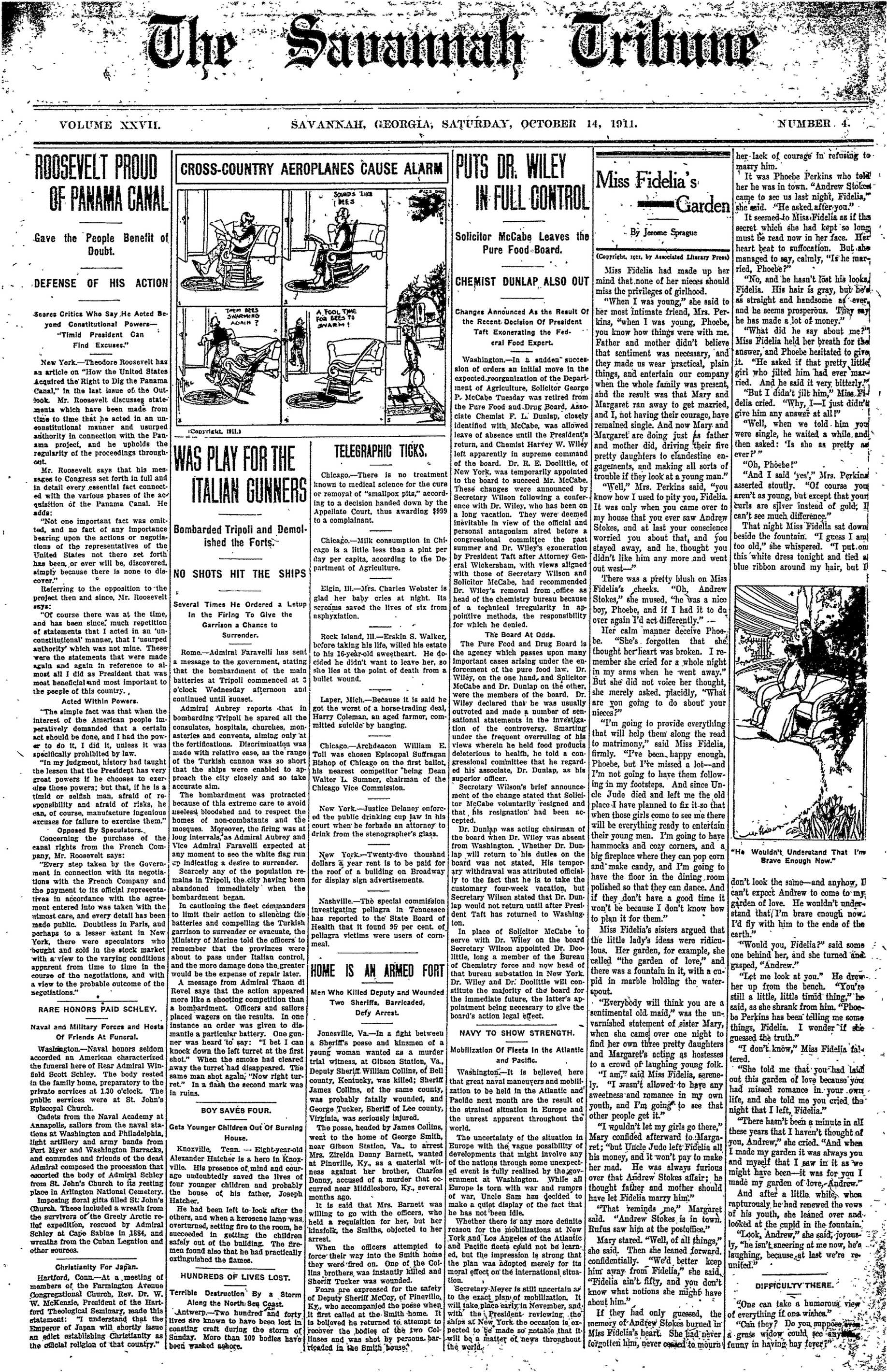
Page text (machine-generated)
VOLUME XXVII.
ROOSEVELT PROUD OF PANAMA CANAL
Gave the People Benefit of Doubt.
Scores Critics Who Say He Aoted Beyond Constitutional Powers— "Timid President Can Find Excuses."
New York.—Theodore Roosevelt has an article on "How the United States Acquired the Right to Dig the Panama Canal." In the last issue of the Outlook. Mr. Roosevelt discusses statements which have been made from time to time that he acted in an unconstitutional manner and usurped authority in connection with the Panama project, and he upholds the regularity of the proceedings throughout.
Mr. Roosevelt says that his messages to Congress set forth in full and in detail every essential fact connected with the various phases of the acquisition of the Panama Canal. He adds:
"Not one important fact was omitted, and no fact of any importance bearing upon the actions or negotiations of the representatives of the United States not there set forth has been, or ever will be, discovered, simply because there is none to discover."
Referring to the opposition to the project then and since, Mr. Roosevelt says:
"Of course there was at the time, and has been since," much repetition of statements that I acted in an 'unconstitutional' manner, that I 'usurped authority' which was not mine. These were the statements that were made again and again in reference to almost all I did as President that was most beneficial and most important to the people of this country.
Acted Within Powers.
"The simple fact was that when the interest of the American people imperatively demanded that a certain act should be done, and I had the power to do it, I did it, unless it was specifically prohibited by law.
"In my judgment, history had taught the lesson that the President has very great powers if he chooses to exercise those powers; but that, if he is a timid or selfish man, afraid of responsibility and afraid of risks, he can, of course, manufacture ingenious excuses for failure to exercise them."
Opposed By Speculators.
Concerning the purchase of the canal rights from the French Company, Mr. Roosevelt says:
"Every step taken by the Government in connection with its negotiations with the French Company and the payment to its official representatives in accordance with the agreement entered into was taken with the utmost care, and every detail has been made public. Doubtless in Paris, and perhaps to a lesser extent in New York, there were speculators who bought and sold in the stock market with a view to the varying conditions apparent from time to time in the course of the negotiations, and with a view to the probable outcome of the negotiations."
RARE HONORS PAID SCHLEY.
Naval and Military Forces and Hosts Of Friends At Funeral.
Washington.—Naval honors seldom accorded an American characterized the funeral here of Rear Admiral Winfield Scott Schley. The body rested in the family home, preparatory to the private services at 1.30 o'clock. The public services were at St. John's Episcopal Church. Cadets from the Naval Academy at Annapolis, sailors from the naval stations at Washington and Philadelphia, light artillery and army bands from Fort Myer and Washington Barracks, and comrades and friends of the dead Admiral composed the procession that escorted the body of Admiral Schley from St. John's Church to its resting place in Arlington National Cemetery.
Imposing floral gifts filled St. John's Church. These included a wreath from the survivors of the Greely Arctic relief expedition, rescued by Admiral Schley at Cape Sabina in 1884, and wreaths from the Cuban Legnion and other sources.
Christianity For Japan.
Hartford, Conn.-At a meeting of members of the Farmington Avenue Congregational Church, Rev. Dr. W. W. McKenzie, President of the Hartford Theological Seminary, made this statement: "I understand that the Emperor of Japan will shortly issue an adict establishing Christianity as the official religion of that country."
CROSS-COUNTRY AEROPLANES CAUSE ALARM
SOUNDS LIKE BEES
THEM BEES SWARMING AGAIN?
A FOOL TIME FOR BEES TO SWARM!
WAS PLAY FOR THE ITALIAN GUNNERS
Bombarded Tripoli and Demolished the Forts.
NO SHOTS HIT THE SHIPS
Several Times He Ordered a Letup In the Firing To Give the Garrison a Chance to
Rome.—Admiral Faravelli has sent a message to the government, stating that the bombardment of the main batteries at Tripoli commenced at 5 o'clock Wednesday afternoon and continued until sunset.
Admiral Aubrey reports that in bombarding Tripoli he spared all the consulates, hospitals, churches, monasteries and convents, aliming only at the fortifications. Discrimination was made with relative ease, as the range of the Turkish cannon was so short that the ships were enabled to approach the city closely and so take accurate aim.
The bombardment was protracted because of this extreme care to avoid useless bloodshed and to respect the homes of non-combatants and the mosques. Moreover, the firing was at long intervals, as Admiral Aubrey and Vice Admiral Faravelll expected at any moment to see the white flag run up indicating a desire to surrender. Scarcely any of the population remains in Tripoll, the city having been abandoned immediately when the bombardment began. In cautioning the fleet commanders to limit their action to silencing the batteries and compelling the Turkish garrison to surrender or evacuate, the Ministry of Marine told the officers to remember that the provinces were about to pass under Italian control, and the more damage done the greater would be the expense of repair later.
A message from Admiral Thaon di Revel says that the action appeared more like a shooting competition than a bombardment. Officers and sailors placed wagers on the results. In one instance an order was given to dismantle a particular battery. One gunner was heard 'to say: "I bet I can knock down the left turret at the first shot." When the smoke had cleared the turret had disappeared. The same man shot again; "Now right turret." In a flash the second mark was in ruins.
BOY SAVÉS FOUR.
Geta Younger Children Out Of Burning House.
Knoxville, Tenn. — Eight-year-old Alexander Hatcher is a hero in Knoxville. His presence of mind and courage undoubtedly saved the lives of four younger children and probably the house of his father, Joseph Hatcher.
He had been left to look after the others, and when a kerosene lamp was overturned, setting fire to the room he succeeded in getting the children safely out of the building. The firemen found also that he had practically extinguished the flames.
HUNDREDS OF LIVES LOST
Terrible Destruction By a Storm Along the North Sea Coast.
Along the North Sea Coast
Antwerp.-Two hundred and forty
lives are known to have been lost in
coastal craft during the storm of
Sunday. More than 100 bodies have
been washed ashore.
SAVANNAH, GEORGIA; SATURDAY, OCTOBER 14, 1911.
TELEGRAPHIC TICKS.
Chicago.—There is no treatment known to medical science for the cure or removal of "smallpox pits," according to a decision handed down by the Appellate Court, thus awarding $899 to a complainant.
Chicago.—Milk consumption in Chicago is a little less than a pint per day per capita, according to the Department of Agriculture.
Elgin, Ill.—Mrs. Charles Webster is glad her baby cries at night. Its screams saved the lives of six from asphyxiation.
Rock Island, Ill.—Erskin S. Walker, before taking his life, willed his estate to his 16-year-old sweetheart. He decided he didn't want to leave her, so she lies at the point of death from a bullet wound.
Laper, Mich.—Because it is said he got the worst of a horse-trading deal, Harry Coleman, an aged farmer, committed suicide by hanging.
Chicago.—Archdeacon William E. Toll was chosen Episcopal Suffragan Bishop of Chicago on the first ballot, his nearest competitor "being Dean Walter L. Sumner, chairman of the Chicago Vice Commission.
New York.—Justice Delauey enforced the public drinking cup law in his court when he beforade an attorney to drink from the stenographer's glass.
New York.—Twenty-five thousand dollars a year rent is to be paid for the roof of a building on Broadway for display sign advertisements.
Nashville.—The special commission investigating pellagra in Tennessee has reported to the State Board of Health that it found 95 per cent. of pellagra victims were users of cornmeal.
HOME IS AN ARMED FORT
HOME IS AN ARMED FORT
Men Who Killed Deputy and Wounded
Two Sheriffs, Barricaded,
Defy Arrest.
Jonesville, Va.—In a fight between
a Sheriff's posse and kinsmen of a
young woman wanted as a murder
trial witness, at Gibson Station, Va.
Deputy Sheriff William Collins, of Bell
county, Kentucky, was killed; Sheriff
James Collins, of the same county,
was probably fatally wounded, and
George Tucker, Sheriff of Lee county,
Virginia, was seriously injured.
The posse, headed by James Collins, went to the home of George Smith, near Gibson Station, Va., to arrest Mrs. Zirelda Denny Barnett, wanted at Pinville, Ky., as a material witness against her brother, Charles Denny, accused of a murder that occurred near Middlesboro, Ky., several months ago. It is said that Mrs. Barnett was willing to go with the officers, who held a requisition for her, but her kinsfolk, the Smiths, objected to her arrest. When the officers attempted to force their way into the Smith home they were fired on. One of the Collins brothers, was Instantly killed and Sheriff Tucker was wounded.
Fears are expressed for the safety of Deputy Sheriff McCoy, of Pineville, Ky., who accompanied the posse when it first called at the Smith home. It is beloved he returned to attempt to recover the bodies of the two Collinses and was shot by persona. barricaded in the Smith house.
PUTS DR. WILEY IN FULL CONTROL
Solicitor McCabe Leaves the Pure Food Board.
CHEMIST DUNLAP ALSO OUT
Changes Announced As the Result Of the Recent Decision Of President Taft Exonerating the Federal Food Expert.
Washington.—In a sudden succession of orders an initial move in the expected_reorganization of the Department of Agriculture, Solicitor George P. McCabe Tuesday was retired from the Pure Food and Drug Board, Associate Chemist F. L. Dunlap, closely identified with McCabe, was allowed leave of absence until the President's return, and Chemist Harvey W. Wiley left apparently in supreme command of the board. Dr. R. E. Doolittle, of New York, was temporarily appointed to the board to succeed Mr. McCabe. These changes were announced by Secretary Wilson following a conference with Dr. Wiley, who has been on a long vacation. They were deemed inevitable in view of the official and personal antagonism aired before a congressional committee the past summer and Dr. Wiley's exoneration by President Taft after Attorney General Wickersham, with views aligned with those of Secretary Wilson and Solicitor McCabe, had recommended Dr. Wiley's removal from office as head of the chemistry bureau because of a technical irregularity in appointive methods, the responsibility for which he denied.
The Board At Odds.
The Pure Food and Drug Board is the agency which passes upon many important cases arising under the enforcement of the pure food law. Dr. Willey, on the one hand, and Solicitor McCabe and Dr. Dunlap on the other, were the members of the board. Dr. Willey declared that he was usually outvoted and made a number of sensational statements in the investigation of the controversy. Smarting under the frequent overruling of his views wherein he held food products deleterious to health, he told a congressional committee that he regarded his associate, Dr. Dunlap, as his superior officer.
Secretary Wilson's brief announcement of the change stated that Solicitor McCabe voluntarily resigned and that his resignation had been accepted.
Dr. Dunlap was acting chairman of the board when Dr. Willey was absent from Washington. Whether Dr. Dunlap will return to his duties on the board was not stated. His temporary withdrawal was attributed officially to the fact that he is to take the customary four-week vacation, but Secretary Wilson stated that Dr. Dunlap would not return until after President Taft has returned to Washington.
In place of Solicitor McCabe to serve with Dr. Wiley on the board Secretary Wilson appointed Dr. Doolittle, long a member of the Bureau of Chemistry force and now head of that bureau sub-station in New York. Dr. Wiley and Dr. Doolittle will constitute the majority of the board for the immediate future, the latter's appointment being necessary to give the board's action legal effect.
NAVY TO SHOW STRENGTH.
Mobilization Of Fleets In the Atlantic and Pacific.
Washington-It is believed here that great naval maneuvers and mobilization to be held in the Atlantic and Pacific next month are the result of the strained situation in Europe and the unrest apparent throughout the world.
The uncertainty of the situation in Europe with the vague possibility of developments that might involve any of the nations through some unexpected event is fully realized by the government at Washington. While all Europe is torn with war and rumors of war, Uncle Sam has decided to make a quiet display of the fact that he has not been idle.
Whether there is any more definite reason for the mobilizations at New York and Los Angeles of the Atlantic and Pacific fleets could not be learned, but the impression is strong that the plan was adopted merely for its moral effect on the international situation.
Secretary-Meyer is still uncertain as to the exact plan of mobilization. It will take place early in November, and with the President reviewing, the ships at New York the occasion is expected to be made so notable that it will be a matter of news throughout the world.
Miss Fidelia's
Garden
By Jerome Sprague
(Copyright, 1921, by Associated Literary Press)
Miss Fidelia had made up her
mind that none of her nieces should
miss the privileges of girlhood.
"When I was young," she said to her most intimate friend, Mrs. Perkins, "when I was young, Phoebe, you know how things were with me. Father and mother didn't believe that sentiment was necessary, and they made us wear practical, plain things, and entertain our company when the whole family was present, and the result was that Mary and Margaret ran away to get married, and I, not having their courage, have remained single. And now Mary and Margaret are doing just as father and mother did, driving their five pretty daughters to clandestine engagements, and making all sorts of trouble if they look at a young man."
"Well," Mrs. Perkins said, "you know how I used to pity you, Fidelia. It was only when you came over to my house that you ever saw Andrew Stokes, and at last your conscience worried you about that, and you stayed away, and he thought you didn't like him any more and went out west—"
There was a pretty blush on Miss Fidelia's cheeks. "Oh, Andrew Stokes," she mused, "he was a nice boy, Phoebe, and if I had it to do over again I'd act differently."
Her calm manner deceive Phoebe. "She's forgotten that she thought her heart was broken. I remember she cried for a whole night in my arms when he went away." But she did not voice her thought, she merely asked, placidly, "What are you going to do about your nieces?"
"I'm going to provide everything that will help them along the road to matrimony," said Miss Fidelia, firmly. "I've been happy enough, Phoebe, but I've missed a lot—and I'm not going to have them following in my footsteps. And since Uncle Jude died and left me the old place I have planned to fix it so that when those girls come to see me there will be everything ready to entertain their young men. I'm going to have hammocks and cozy corners, and a big fireplace where they can pop corn and make candy, and I'm going to have the floor in the dining room polished so that they can dance. And if they don't have a good time it won't be because I don't know how to plan it for them."
Miss Fidelia's sisters argued that the little lady's ideas were ridiculous. Her garden, for example, she called "the garden of love," and there was a fountain in it, with a cupid in marble holding the water-spout.
"Everybody will think you are a sentimental old maid," was the unvarnished statement of sister Mary, when she came over one night to find her own three pretty daughters and Margaret's acting as hostesses to a crowd of laughing young folk.
"I am," said Miss Fidelia, serenely. "I wasn't allowed to have any sweetness and romance in my own youth, and I'm going to see that other people get it."
"I wouldn't let my girls go there," Mary confided afterward to Margaret; "but Uncle Jude left Fidelia all his money, and it won't pay to make her mad. He was always furious over that Andrew Stokes affair; he thought father and mother should have let Fidelia marry him."
"That reminds me," Margaret said. "Andrew Stokes is in town. Rufus saw him at the postoffice."
Mary stared. "Well, of all things," she said. Then she leaned forward, confidentially. "We'd better keep him away from Fidelia," she said. "Fidelia ain't fifty, and you don't know what notions she might have about him." If they had only guessed, the memory of Andrew Stokes burned in Miss Fidelia's heart. She had never forgotten him, never ceased to mourn.
her lack of courage in refusing to marry him.
It was Phoebe Perkins who told her he was in town. "Andrew Stokes came to see us last night, Fidelia, she said. "He asked after you."
It seemed to Miss Fidelia as if the secret which she had kept so long must be read now in her face. Her heart beat to suffocation. But she managed to say, calmly, "Is he married, Phoebe?
"No, and he hasn't lost his looks. Fidelia. His hair is gray, but he's as straight and handsome as ever, and he seems prosperous. They say he has made a lot of money."
"What did he say about me?" Miss Fidelia held her breath for the answer, and Phoebe hesitated to give it. "He asked if that pretty little girl who jilted him had ever married. And he said it very bitterly." "But I didn't jilt him," Miss Fidelia cried. "Why, I—I just didn't give him any answer at all!" "Well, when we told him you were single, he waited a while, and then asked: 'Is she as pretty as ever?' " "Oh, Phoebe!"
"And I said 'yes,'" Mrs. Perkins asserted stoutly. "Of course you aren't as young, but except that your curls are silver instead of gold; I can't see much difference."
That night Miss Fidella sat down beside the fountain. "I guess I am too old," she whispered. "I put on this white dress tonight and tied a blue ribbon around my hair, but I
B. H.
"He Wouldn't Understand That I'm Brave Enough Now."
don't look the same—and anyhow, I can't expect Andrew to come to my garden of love. He wouldn't understand that I'm brave enough now. I'd fly with him to the ends of the earth."
"Would you, Fidelia?" said some one behind her, and she turned and gasped, "Andrew."
"Let me look at you." He drew her up from the bench. "You're still a little, little timid thing," he said, as she shrank from him. "Phoebe Perkins has been telling me some things, Fidelia. I wonder if she guessed the truth."
"I don't know," Miss Fidelia faltered.
"She told me that you had laid out this garden of love because you had missed romance in your own life, and she told me you cried the night that I left, Fidelia."
"There hasn't been a minute in all these years that I haven't thought of you, Andrew," she cried. "And when I made my garden it was always you and myself that I saw in it as we might have been—it was for you I made my garden of love, Andrew."
And after a little while, when rapturously he had renewed the vows of his youth, she leaned over and looked at the cupid in the fountain.
"Look, Andrew," she said, joyously, "he isn't sneering at me now, he's laughing, because at last we're reunified."
"One can take a humorous view of everything if ora wiacha."
"Can they? Do you suppose even a grass widow could see anything funny in having hay fever?"
en eee CN = ~ pO Me, Rea os Mere ee) tM ote Z* FT Sa Ne AA OMe Zs Meee ee ie Sacer ian) ys Sieh Get er Re ea ee oe SERENE ote oa
BRE EE ARES gs oy ORR nS SERRE CALERA 7. PRE AA Jo ROE BAD SORT
a8 Se. Sots ee a a "ee ae on ee . ‘ i “ee he ee en ae PRS AS eat Oo Me ea 8
oe eee ae 9 ee ae RRR te Pe en far eS
SUNDAY
_OBSERVANSE’
A SERMON.
RAL AREEES
Remember the Sabbath day to keep
Bt holy.
‘The Sabbath was made for man, not
man for the Sabbath.
+ The history of Sunday observance
.Feveals two tendencies not easy to
Feconclle in one prinetple—one toward
‘Uberty, the other toward restraint by
Jegal and ecclesiastical authority.
‘The- Jewish church in the days of
Jesus Silustrates the latter tendency.
{The authorities hedged the sacred day
about with minute, and often absurd,
Feitrictions, forbidding even the visita-
won of the sick. For colossal foolish:
ness probably the rabinnical reguia-
tions for Sabbath observance have
never.been equaled, certainly never
excelled. Against these, and not
against a true religious observance of
"the day, Jesus protested, and for so
doing ‘he was charged with being a
Sabbath-breaker.
‘The Medieval church fell into the
eame error. As soon as the bishops
had the power gonferred by the state
“tw compel obedience they repeated the
wiclous exemple, and the ignorant peo-
ple were forced to bow to authority
‘which they had no hand in creating,
and so Sunday again became a day of
‘durdens. But the other tendency—that
-of Mberty—was always preset, acting
as & check on excedsive ecclesiastic-
sam, Tho mystics in particular were
active in protest In favor of a more
epiritual and religious view.
| The Reformation church reveals the
@ome.tendency. On the one hand we
“have the Puritan with his “blue laws,”
his image-breaking end bis over-right-
eous and overbearing attitude toward
‘the cavailer. By a strange transfer of
standpoint the Puritan stands out a3
the advocate of authority—the authorl-
ty of Scripture—and the cavaller of
Uberty, with a marked tendency to
worldiness. It 1s not generally known
that in the days of Charles J. a “Book
of Sports” was drawn up specifying
what recreations should be allowed
after sundown on Sunday,
‘We have inherited these tendencies
and can no more escape them than the
hound can escape his own shadow. We
vibrate between Itberty and authority
without any clear clue to the under-
lying principle. There is a difference,
however, between our atmosphere and
that of any past.age. It is no longer
possible to compel the people to come
to church. No pope, bishop or con-
‘enticle would attempt to legislate for
the.modern man, determining Yor him
how the hours of bis Sunday shall be
spent. In our time the average man's
amind, on this question, oscillates be-
tween a religious and a hedonistic view
of Sunday observance. Though we
“have lost beyond recall some of the
ld sanctions for Sunday observance,
‘we still retain the sense of Its religious
character, but associated with this loss
of {ts formal authority, there has grown
‘up a disposition to follow pleasure,
one's own pleasure, as the sole cri-
terion of liberty with regard to the fit-
test way to “keep” the Sunday.
‘This divergence of view raises the
question as to the true religious prin-
eiples which underlle the whole prob-
Tem, tliose principles, 1 mean, which
seem to have survived the changes: of
the centuries. These are, in the main,
three:
44, Sunday fs the Lord's day par ex-
cellence. Of course, to a religious man
every day {s the Lord’s day, but Sun-
day {8 peculiarly £0, because ft is the
amemorfal day of bis highest hopes, for
on that day his spiritual Mfe ts re-|
newed by the living Christ, who roae |
from the dead. It {s a day of spiritual
réfreshment, properly accompanied,
therefore, by the eucharistic feast, and
attains a troly Christian and religious,
character from these aesoclations. No |
changes of rubric or adminietration
can alter this fundamental fact about
Sunday. Whatever authority this day
possesses in the eyes of civilized and
Christian people {s derived from the
fact that it is the Lord's day in a
‘peculiar sense.
IT WASN'T CREPE,
In the spring of °89 a reporter for
the Traveler, Opie Read's paper, died
The day after the funeral a visitor tc
the office found the editor and his
staff talking about thelr late assoct
vate.
“It has been a sad loss, friends,” the
visitor sald, “a sad loss, indeed.” He
sighed and looked about the room,
“Ab, I am pleased to see,” he went on,
arthat you commemorate the melan
choly event by hanging up crape.”
F Opie Read frowned. “Crape?” he
said. “Where do you see any crape?”
. “Over there.” sald the visitor, point
ing,
> *Crape be durnedt’: sald Resd
“That isn't crape. It's the office tow
l.’—Lippincott’s.
A QUALIFICATION,
. Rastys was honeat and industrious,
tut, in the opinion of the new minis-
ter, uneociable.
#4Melghborliness, my dear friend,”
gala the .dominte, “is brotherliness. Do
you take the trouble to see much of
your neighbors?”
“Ab reckon ah sees as much of them
as they sees of me,” Rastus replied.
“Perhaps,” sald the clergyman. “But
doyyou love your neighbor as your
self?” .
_ “Ah reckon ah does, ‘pabson,” Ras-
‘tas replied, “but you know,’sth, I ain't
pUclary stick ‘on mabself nefther.”—
Success Magarin.» ''*
Ean I — ag eg
cetacean er er rater
~Arifundeyis & daz progeris, devoted
130 WarehD. We whose nak spseker tps
forms0t woteilp. 4Tibe Quaker and the,
Rominiat. ate ailke Tat their “funda
meatal thelstédca' that Sunday worsip,
Is appropriate to the spirit of the day:
‘The essential principle in all churches
{s the proper development of the habit
of worship. The loss of tifo bablt,
in ninety-nine cases out of a hundred,
means the loss both of worship and of
Sunday observance. In talking with
men who do not go to church any
more, how often do we catch the fe-
millar refrain, “Ob, I have simply Jost
the habit!” That is the key to much
non-observance of Sunday worship. It
fs sald that the working clagses of this
country have lost this habit, They
complain that church worship no Iong-
er appeals tq them. Just so. But let
the working ‘clatses oace again “get
the habit” of worship, and they can
change the church, as they can do
most things“they cet their Intelligent
And earnest miads 16,da. Butithey will
Fadmit that a Sunday without worship
would be a calamity, and Weald plunge
us deeper Into,materialism and sordid.
ness than we are.
3. Sunday Is aleo a day of rest. This
statement at once raiser the whole
problem of Sunday work and amuso-
ments. Here again we must find some
‘wey to combine Hberty with authority,
as in worship ‘and spiritual tradition.
Times have changed. Some work on
the Lord's day 1s unavoldable. {There
te also a difference between thé indul-
gence in pleasurable amusements on
Sunday in the case of a rich man and
ble family, who have abundant oppor-
tunity for this during the week, and
thoae who are closely confined in of-
fice,,in factory or in mine during the
same period. We cannot draw any hard
and fast lines, perhaps, but {t 1s mant-
festly unfair for the rich to go to
church once a week, or very rarely,
and expect theSchurch to be crowded
by the working classed.
‘The question of Sunday amusements
ts a delicate one, where eo much de-
pends on a nice sense of the balance
between liberty and authority. One
thing is certain, The man who does
not go to church once on every Bun-
day of the year misses his greatest re-
Ugious opportunity to develop his per-
sonality In a system of sound spiritual
habits. Sunday worehip 1s the best
guarantee of true spiritual liberty wo
possess. It fs the Lord's day, but tt 1a
made for man, for his lberation from
the tyranny of sin and for bis initia-
tion into the fullness and power of
eternal life. It fs for Kim to make it
so. Sunday need not be a day of dull-
ness or tedious routine if efforts are
put forth to realize these princfples.
Charles Kingsley used to play cricket
with the lads of Eversley parish in
the afternoons of Sunday, but insisted
on their attendance at church as 2
quid pro quo, We have all known boys
who have given up church-golng, too,
because they had too much of it at
home, or in choo}, or in church. In
all this, how clear ft {s that we need to
reconcile Iberty with authority and
find a way by which thelr claims can
be met!
‘This way becomes clear as soon as
we bring our problem to the supreme
test of the teaching and example of
Jesus. This 1s our final court of ap-
peel: What would Jesus do? He sald,
“It ye love me, keep my command-
mente.” The whole question of Sun-
@ay observance hinges on this one
pomnt. If we strive to follow in his
footsteps, If we listen to his teaching,
it we would base our thoughts and ac-
tlons on the broad and simple, yet
comprehensive, lines which he incul-
cated both by bis words and acta; if
we let our love go out to meet the in-
finite love of which he was the em-
Dodiment, there will-be no difficulty in
solving thels problem of Sunday ob-
‘servance, There will be no necessity
‘to diecuss whether it {s right or wrong
‘to motor, or golf, or cycle, or play
baseball or tennis on thp Lord’s day.
‘The question each of us will ask Ja:
“am I helping or hindering the cause
of my Master?” Above all, we must
‘constantly beer n mind the apostolic
injanction, which will enable us to ar-
rive at a speedy and satisfactory de-
cision whenever any doubts assail us:
“Whatsoever ye do, do all to the glory,
of God,"*
Rev, HENRY DAVIS, B.D, Ph.D. |
DELAWARE AND ALABAMA,
- When, Joseph’F. Johnston arrived in
‘Washing{on'as a member of the Unt-
ted States senate from thé glértovs
and gallant state of Alabama, Senator
Burrows of Michjgan took a great
fancy to him. One day in the cloak
room Burrows turned to, another sena-
tor and satd: :
“Du Pont, stand up.” 1 want you to
meet Johnston of Alnbama.”
‘The man from Delaware rose to his
feet. + {
“Du Pont," sald Johnston, taking
the proffered hand, “I believe sou're
the infernal Yankee who shot me at
Cedar Creek.” *
“Well, well!” commented-the Dela
ware senator, fomewhat puzzled.
“What makes you think 50?” *
“T geo by the two pages of your
dlography in the Congressional Direc
tory,” explained Johnston, “that you
commandéd practically every regi.
ment in tho Union army during the
Civil war. Some infernal Yankee shot
me, and I think ft was you."—Popular
Magazine.
‘SHARK HATCHED IN CAPTIVITY.
For some time a shark's egr in the
Glasgow (Scotland) aquarium has
been watched from day to day. It
hatched a few days ago, jen event
unfque In many reapects, “The tiny
shark seems quite at home, and {s not
# bit sby.of the numiercus’ visitors
who-bave crowded -to fee it *
Noy. RAE |
The Stfiday''
School Lesson
SRRERY SNe: Se ae oe ee
isin,
THE RETURN FROM THE CAP-
TIVITY.
Golden Text—“Ho yetaineth not
his anger forever, because he delight:
eth in mercy.”—Migah 7:18.
Exposition—L The Decree of Cy-
nus, 14, Tho word of the Lord ts
sure. It will be fulfilled to the very
letter, Seventy years before the
Holy: spirit had moved" Jeremiah to
aay (2, Pot. 1:21): thdtvin seventy
yeara Jéhovah”yould visit his people
in Babylon and‘cause thenr to return
to Jerusalem . (Jers 29:10; 26:12-14;
33:7-13). Now that word {s about to
be fulflled Iterally and exactly.
Every prophecy of the Bible is sire
of Iteral fulfillment. There are many
prophecies of the Bible that have not
been fulfilled as yet, but they will be
In thelr fime, fust aa so many have
been fulfilled slready. Fulfilled
Prophecy 1s one of God's. own seals
upon the Inspiration of the Bible.
The infidels in the church, und out of
it, have done thelr best ta read the
prophécles out of the Bible and thetr
fulfliment out of history; but they
have failed utterly. Some of the ar
guments thet they have ventured upon
in thelr desperation are pitiably lu-
dicrous. ‘They eerve to illustrate
what fools wise men become when
they undertake to fight against God
(Rom, 1:22). What a remarkable
way God took to fulfill his own word!
He first brings to the front a man
not yet born when the prophecy was
made, and then puts it into his heart
to fulfill his word. “The Lord atirred
up the spirit of Cyrus.” God has a
strange but mighty way of moving
upon the hearts of men, He can
Prompt a king to help his people
(Prov. 21:1; Ezra 7:27; 6:22)" He
can put {t Into the heart of a rich
man to send help to a poor man Just
at the hour of his need. He does
it today just as well as in the days
of Ezra. ‘The man who Is in league
with Ged can bring all the the kings
of earth to bis assistance, Though It
was “the word of the Lord” that was
fulfilled at this tlme, ft hed been
spoken “by the mouth of Jeremiab.”
But it was not Jerem{ah's word.
What Jeremiah says 1s not bis own
word, but God’s and so what Isafab
says, and Paul and John. This fs 2
very different theory of inspiration
from that which fs popular with "ad-
vanced thinkers” today, but it is the
true theory, as history abundantly dem-
onstrates. “The Lord God of heaven
hath given me all the kingdoms of the
earth.” Cyrus was a wise man to
recognize the source of his power.
Whether or not Dantel had called his
attention to the prophecles that so!
long before had mentioned him by
name (Isa. 44:26-28; 45:1-6) we cannot
‘Nine millions a year are spent on
the maintenance of roads in England,
‘The heads of all Chinese babies are
shaved when they are a month old.
The ,children of Japon are taught
to make use of both hands equally
well.’
‘The Dam Truth fs the name of an
Arizona newspaper published ‘near one
of the big irrigation dame.,
[ ee ee eee: Sane. tow
plentiful in Mexico that some of the
copper mines there are timbered with
rosewood, while mahogany !s used as
‘fuel for the engines.
The Mt, Painter fleld of South Aus-
tralia {s 8, Wonderful place for the oc-
‘currence of rare minerals and a com-
pany has been recently formed to re-
‘cover radium from the earth.
” ‘The death dutles colfected in France
during 1909 amounted to $52,236,395.
‘The estates concerned numbtred 379,
418, with an aggregate net value. of
$1,107,904,218, the average value of a
jahare being about $2,900.
Among the relies in the anctent Ger-
mantown Mennonite church in Ger.
mantown avenue, above Herman
Street, Philadelphia, 1a a tombstone
on which this sentence Is inscribed:
“By George, It's Cold.”
+ ‘The forelgn tourists who visited
Japap during the last year totaled 17,
283, including 3,161 Euglishmen, 3,870
Aniericans and 5,739 Chinese. ‘This
shows an increase of some two hun-
dred as compared with the preceding
year. . .
Hindoo bellef and lore altke strong-
ly hold that acefal navigation fs not
the new thing that it fs claimed to be
4m Europe. It is sald that aeroplanes
of some sort or. other were the con-
‘yeyances ordinarily used by the Deva.
tas(benvenly beings) tn Hindoo myth.
ology—Madras Mall,
‘Tho ratlo of deatha to births among
children under one year of age in
‘Moscow in 1909 reached the startling
figure of 321 to @ thousand. In Mon
treal tt 18 287; in Dresden, 152; In
Boston, 148; Glasgow, 137;New York,
128; Paris, 1087 Ameterdam, 88; Syd-
ney, Australia,.83, :
tell with: Gertajnty, but somebow Cy-
inhi pbuh 0:2 rogomti
oe is eveatebeiil tidt alt power emia?
Hates tram Ged (6. Jer, 21:67; Dan.
2237," 38; ‘114, WS, 32). It would be
well If men of wealth and friftuence
and power today recognized this truth
(Dan. 5:19-21). Cyrys not only rec
ognized the source of his great ‘now-
er, but aleo his obligation to obey and
serve him who had placed bim in bis
exalted position. Many there sate
who, theoretically at least, acknowl:
edge God zs the giver of all they
have, but they do not recognize thelr
obligation to obey him in practical
Mfe, Jehovah's charge to Cyrus ts
found in the prophecy of Iealah (Isp,
44:26-28; 45:12, 13), ‘There are those
today who would havo us bdelleve
that this prophecy of Iraiah Is of later
date, but Cyrus, who lived 2,400 years
nearer the tlme, did not think so, and
for some 2,00 years no one thought
50. But“the#é} very wise men of to-
day haya found out what has been
‘agen ‘from,all the good and. great
and wiee*dlfathese years..""It 1s bet:
‘ter not to know so many things than
to know so many things ‘that are not
to" “His God be with htin,” Cyrus
could wish for nothing better for
Sows who were to go up. That wish
included everything. If God was with
‘them, no one could be agalust théta
(Rom. 8:31), and they could be sure
‘that God would be with them; for he
has promised to be with those who
obey and serve him (Josh. 1:9; 1 Ch.
28:20; Matt. 28:20; Heb. 13:5). ‘Ev-
erylone in every place was to co-oper-
ate in sending God's people of. that
place to Jerusalem to do the work.
Ample provision wae to be made for
every need.
IL The Return of Jehovah's People
to Build Jehovah's House in Jerusa-
lem, 611, The leaders of Judah and
Benjamin responded promptly dnd
heartily to the decree of Cyrus.
‘Those who went were those “whose
spirit God had stirred.” God had frst
atirred up the spirit of Cyrus to make
the proclamation (2 Ch. 36:22) and
now God's spirit stirred up the people
to carry it out (cf, Neh. 2:12; Prov.
16:1; Phil. 2:13), ‘The purpose of the
return was religious rather than po-
Utical, “to bulld the house of Jebovab
which fs In Jerusalem.” Every one
on every hand eagerly, co-operated
and strengthened thelr hands. Sel-
dom ts such untveraal co-operation
seen'in the work of God. There was
cheerful giving on every hand (cf. 2
Cor, 9:7). ‘The sacred vessels that
had belonged to the house of Jehovah,
but which Nebuchadnerzar had car
ried away In the sack of the city and
had desecrated them by putting them,
In the house of his gods, and which
Belshazzar had further desecrated to
adorn his heathen debauch (Dan.
5:24), were brought forth by Cyrus
and restored to thelr proper use.
What Cyrus d{d, he did with 9 hearty
good will. These were entrusted to
Shesbbazzar. Sheshbatzar 1s the Per-
sian name of Zerubbabel. There
were 5,400 vessels in all, but, in the
numbers specified in vs. 9, 10, there
were but 2,499; presumably only the
chief vessels are specified, spoons,
etc,, being omitted. The list given in
Esdras 2:13, 14, sums up 6,469.
COULDN'T TAKE HIS PLACE,
Joseph P. Sherrer told a humorous
“experience” while “automobile rid.
ing,” says the Milwaukee Sentinel,
which, he safd, illustrated the sarcasm
which a woman {s capable of when oc.
casion demands. .
“We were going alor~ at an awful
speed," be sald. “Ididi °e the dog,
but I heard his‘kikt,’ eo 1 ordered the
‘chauffeur to stop. Golng back, ye
found an trate lady standing over her
ead dog—one of the ugliest dogs you
ever saw,
“Bhe met us with tirade of re-
marks, telling us in no uncertain
terms what she thought of us and au-
tomobilés tn general, finishing up by
calling us the murderers of her dog.
It was then that I thought I would
pacify her,
Madam,’ 1 sald, ‘I will replace your
dog.
* “*Bir,’ she sald, in s freezing tone
of voice, ‘you flatter yourself.’
WANTED AN ENCORE. .
She remembered. him, quite cledtly.
He was the honestfaced tramp ‘who
had called some months ago, and ho
had so touched her that she gave
him some of her husband's leftom
clothing.
“Come Inside, my poor man,” sie
sald warmly, “and I will give you a
cup of nice hot tea und some cake.”
“No, thank yer, mum,” answered the
tramp; “I don't want yer tea or yer
cake. I've just called to tell yer, mum,
that In one of the pockets af that
weskit you gave me larst summer,
mum, I found a fivepound note!”
“Good gracious!” exclatmed the as-
tonished housewife. “And you mean
to tell me, you good, honest mai, that
you have called to bring it back?”
“No, mum,” answered the tramp;
“not exactly, mum. T'ye called for an-
other weskit."—Tit-Bits,
CLEVER EXCUSE.
‘An Irish sdidier, placed on, ganrd
over a cannon; was found by his‘ off
cer in a pablic house some distance
away?
“How dare you leave your post?”
was the stern rebuke,
“Ab, Dut it's no consequence at all,
plaze'‘yer honor,” said’ the man.
“There's no two men able to lift that
gun betwano them, much less carry
{t off. An’ if there was more than
two, I know I wouldn't be a mated for
themi—so I kem away, yer ‘honor!”—
THeRts. ~*~ 72 8 ya
tk ae CR ye Ge
SAS A RUMUNE: BEGISINE: 5
FIFTEEN-YEAR-OLD .NEGRO. “BOY
WILL NOT BE HUNG IN
‘ ARKANSAS.
| Little Rock—The decision of the
Arkansas supreme court that Earl
Gilchrist, the fifteen-year-old boy, was
too young to hang, was a humane
one, His appeal for a new trial was
‘granted, Once more the boy will
face & jury. ‘This time’ It will be
‘with the decision of the higher court
that he Js too youvg to hang con-
fronting Judge Robett E, Lee of the
tower court, ‘This may affect his sec-
ond sentence, :
It {s true that Gilebrist is a negro,
It makes no difference what his race
may be, or bis color, or bis crime.
‘Ho:ts a child. As auch he should
HOF be sentenced to death, He may
be all that the evidence indicated
that be wee He’killed another boy, fn
‘awtkeet fight. In the eyes‘of the Inw
he Is a convicted murderer. Follow.
ing out the technical polnts, Judze
Lee was no doubt justified In impos-
ing the sentence of death. The boy
might be fifteen; he Is a diminutive
youth, and {t would be a disgrace to
the state of Arkansas to countenance
such an execution. z
‘The boy should be punished. He
should be imprisoned, but he should
not be hanged. .
The decision of the: supreme court
will be ‘applauded and approved by
all people with a fot of Christian sym
pathy in thelr hearts,
Arkansas and all’ other ‘states
should have reform schools for just
such boys.
Tf a good man can get hold of a
negro in timg, he can usually ‘make
a good, big negro out of the young
product. ~ :
L, A. LEWIS, CITY HOSPITAL IN-
TERNE AT INDIANAPOLIS, IND.,
HEADS 99 iN STATE MEDICAL
EXAMINATIONS. .
Ninety-nine applicants for medical
Ucenses in Indiana successfully
passed the July examinations of the
state board of medical registration
and examination, L. Aldridge Lewis,
a colored interne at the Clty hos-
pital, making the highest grade, He
received 947 out of & possible 1,000
points, Three other applicants are
fn the honor list of those recetving
a gtade of $00 or better.
Lewis {s the first colored applicant
who hes ever won first place in the
medical examinations in Indiana. He
was an honor mar in the 1911 grad-
uating class of the Indiana university
school of medicine. .
| ‘Anyway, a rolling pin scatters the
‘dust.
Genlus ts more plentiful than plain
common sense. 1
| Anything Js all right—until tt inter-
‘feres with your plane.
"No man ts 40 religfous that he con-
siders dying a pleasure. é
A girl’s sense of humor Is badly
warped if she marries for a joke. °
+ Father Time {8 @ grest artist, but
women’ do not admire his line of
work, os
Free advice ts the kind people give
away because they have no use for it
A man wastes a lot of time asking
questions that he doesn't want an-
avered.
Some men are lke the wind; they
can't even raise a disturbance without
Blowing about st
It fsn't dificult to size a man up,
but the trae ‘measure of a woman Is
known only to her dressmaker.
‘There 1s no reason why a woinan
shouldn't have “in aim in Iife—even
if sho can't throw a stone "with accu
racy.
‘The man who hasn't enough prop-
erty to intereat the tax assessor 1s al-
ways talking about the good he-would
do if he were a milllonaire.—Chtcago
News.
PLENTY OF PRESIDENTS,
‘Tho late Fitzhugh Lee wai a loyal
Virginian, and would ceo his prolitic
mother of presidents deposed by no
one, 0 the choice of him to introduce
Grover Cleveland, who was to make
an address at the historic University
of Virginia, resulted in some mirth.
“nr. President,” he began, gractouz-
ly, “we are-hondted‘in weltoming you
to Virginia.today, both as a loyal Dem-
ccrat and-as the president of these
United States, “Tis long since we
have hed a president with us.” ‘Then,
fearing suck"adulation might turn Mr:
Cleveland's Bead, be warmed to” his
real sufect and added,.ta the delight
of his audience; “But the time bas
been, sut, when we coiild go out on
Yhis ¥éry old rotunda porch ‘ond hol-
ler Mr," Preaident!" and the woods
would de fall of themT*—Lippincott’s:
OS ee
; i POETRY |
+
; of and by. Our-People} .
, ——
(Aug: & WT) *
This Is the Meld; this pathway leads
To thet bright. hill of greeny *, fs
Théro is the marsh, the tangled weeds
That skirt the deep ravine. a
Here stood the’ flank on dne dread eat
‘When thunder filled the alr; :
And rose the shout o'er mountains gray
The King and 8 Leger!"
They fell—the sons of years cone by.
‘In wood and ambuscade;
And few men read in history
‘The brave defense they made,
For that as seven score aisthn\yeaca:
‘The summer: breezes stir,
And deck with rowa-ot grasey spears, -
The grave of Herkimer. , ,
Nor shines the- glare of war's red brand
By fort and tower and town;-
But there was sorrow in the land ~
When that good man went down
Boft echo sends bis battle cry
Across that valley fair;
Apd yet the bending pine trees sigh: ||
“The King and ‘St. Leger!” ”
—i:-J, Meehan.
THE WANDERER TO HIS HEART'S
DESIRE.
There you—here I; sal
Not all the sweetnets of your face,
Nor joy of your talr company, . <
Can bring us fo one place.
T think of you~
A pleture framed in sombre trees,
Eyes where a gleam of sky ;breake
‘through, 3
Gray days on summer seas. ,
The Western Wind, =
‘That runs the prairies Ike « flame,
Bears tn lls fragrant garments twined”
‘A whisper of your name!
In some far land, .*
‘When I desire your comradeship -
And the cool frankness of your hand,
‘The sweetness of your Up.
Then do you send aoe
A blown kiss in the wind’s long biatr:
And though T sleep’at the world's end
‘Yet will It, Ane me there.
—Jobn 8, Réed, In American Magasine.
THE MIRROR.
‘Within s wondrous glass,
A wondrous, magic mirror, +,
I gaze and see my features’ robiér
shown *
Than I can dare to own— os
‘on, nobler, fairer, dearer,
‘Which inward graces brighten as they
pasa! :
How beautiful, how strange
To note so wondrous graces! _
A queen might feel her eceptre cheaply
‘0 . ee
If sho could. thus behold .
A slass wherein her, face is Tee
Beyond desire made fair sby magic
ebange. Seas
Such mirrors no one buys,”,-
But they may treely qwn. them
‘Who rightly tove, who siadty Erect tiie,
Ime,
AN, these will have sublime
Thelr eovis and features shown them,”
Nobly renowed within thelr childrea’e
exes.
Horace Holley, In Century Magazine,
PRIMAVERA MIA.
As kiigg who sce thier Iife-day pass,’
‘Take off the heavy ermine and the crown,
So ‘had the trees that autumn-time. isjd
down, 1
‘Their golden garments on the faded
crass, i
‘When I, who watched the season in the
gloss ot
Of mine own thoughts, ssw all the au-
tumn's brown
‘Leap into Ife and don a sunny gown *
Of leafage such as happy April has.
Great spring camie singing upward,trom
‘the routh: ae
For tn my heart, far carried on’ the
wind, ae
Your words like winged seeds tock
* root and grew,
And all the world caught musle from
your mouth;
I saw tho light as one who had ‘been
tind, 4
And knew my sun and song and spring
were you.
Sara ‘Teaedale, in the Ynternations
TO FOLLY AND WHIM.
Let the future be dark, e
«Or let It be bright, - *
Let us sing with the lark” ..,.~
Ere the present has fed, ss
‘The past, It ts dead, ee
‘And the future fim, “=
Ere the present has fled, tay
Here's to folly"and whim! ;
0, the morrows ne'er dawn, /
‘ns always todays
Then before It Is gone * :
Let us sing while we-may.
The cup ef gi bles
Let us fill th, the brim;
‘With a amile and & kiss,
Here's to folly and whim!
Francis Owne, in Smart Set.
THE FRUIT THAT NEVER FAILE~
‘Though crops may fail from year to yeae
And leave ws very sad,
‘There fe one fruit, it doth appear, -
‘That's always to be had.
In apples, peaches and in pears =~
‘A shortage may be found,
But constantly in Mfe's attairs
‘The lemon's passed around,
Tt greets she simple sighing swain,
It acares the soldier bold,
It Dids the statesman oft complain -
‘Aud fn finance “ts sold.
Though drought ‘and bug may prowt
‘about es isl hy
‘This sturdy frutt. prevasla; * _
"Tis always freely passed ‘about?
‘The lemon never-fal, =” -
SONG, ;
Outof the dusky midnight, - ,
‘Over the aflver dew, op
A spirit came | pe
With a heart of fame,» *-
Binging of you, of you =~
Dawn ,rose over-the moutfiaing,-
Gold on the farthest heights; * /
‘And the sobing,sang s
_ TM the. wildwood rang * i
‘Only of love's delight, ¥
7 : *,
Dildnight and dawn and-dunset— . [
Fee ot te eat and wet— =, |
+ ‘wal
‘At your earien cate,*°
And ‘the‘thorn ia in my- breast! ’
_Loule'¥, Ledoux, in-Cantury Magozic
BREE ERE ay ee eee Le ee a © gery tharos
oe a : a ee iar: a or eM ceasing en tec aatin. ® 2 tee et, hoe bee ore
TOS PRIS, SNE Colones peapre 2a Cet
tain sections has been a very weak
thing. The preachers have been, in, the
anain, merely time servers, preaching
to win applause on pne side and to
swell the “table” on the ather, Espe-
cially fn the south has this type of the
minfgter flourished, Loud on Jesus in
the records, he has been mighty soft
on Jesus in the actual. Of right, the
palpit ought to,be the standard of mor-
ality in our'form of government. ‘The
preacher ought not to have any hesl-
tancy in denouncing ain In high.or low
places. His rule of lifé should be the
trath clear. cut and clean under every
condition and clime. All men {n the
right of God should lodk alike to him.
Rut, alas! we flad no moral courage in
the ministry today. The ministry is
about as vacillating as any other class
of men. We speak particularly of the
preachers of our race’ for the reason
ce are not inn position to know about
{he white preacher. And our re-
anarks of them are"not general enous
to cover the entire profession, but
the great majority fall under our ham-
mer of condemnation. The,race and
the church of God 1s suffering for a
- strong moral ministry’ with convictlon
and the courage to give expression to
thelr views. The average neuro preach:
er is about as much of a demagogue
ns the average white politician. No
Intellectual fdeal, No convictions, 220
real Bible religion. “The gospel they
preach {s uttered with a view of {n-
creasing the public collection. Then
another élaa of negro preachers which
i a curse to-the race, is-the newspa-
per fiend. It is the hypocrite who
stapes his'sermon with a’view of get-
, ting it in the press. Manly courage and
unadulterated religion is left entirely
out of the scope of the sermon, with
‘view of conforming his remarks to
suit the “white presi. Every oppor-
tunity this class of preachers have,
they are in the daily, newspaper office
publishing a setmor they never ut-
tered. Some expostulation on’ the fm-
morality of the race, or condemna-
tion of the negro crap. shooters; 43
rule there are the subjects this class
of negro preachers discuss. You
never hear of one of them denouncing
the barbarity of lynching, distranchise-
<ment or, any other public indignity
" eaped upon a patient and long suffer-
tog people. No, their one object ia
selfishness. Their one effort is to get
some white man to say “he fs a good
nigger.” “The pulpit should rise above
such cheap demogogy and without of-
tense to any man shell the woods with
the gospel of Jesus Christ as taught by
the Bible—New York Age.
A prominent Baptist divine four-
neyed to Pittsburg some months ago
to attend some sort of an alliance,
and from what we can learn he ab-
sorbed a great deal of practical infor-
mation which he purposes to radiate
among his fellow ministers, During
all hig previous mintsterfal life be had
deen using from one to two hours in
delivering sermous just as hundreds
of others have been doing. But in the
great gathering that he attended he
heard the greatest sermon of his life
preached in less than forty minutes.
He 4lso met a gentleman who had
traveled,a thousand miles to make a
- three-minute speech, and that three
minute speech was worth-one's going
a thousand mites to hear. Now these
things had a wonderful effect on our
good brother. First, they forced him
to think of that somewhat unfamiliar
text which reads thus: “I have played
the fool;” second, they caused bim ta.
embrace tho regolution not” to play
the feol any more in the matter of
long-winded ‘sermons. From thence-
forward he determined to deserve the
title “reverend” instead of “never
ond.” Not only that, but he has put
ihe brethren-under bis charge—he's
2 president or ‘moderator or some-
thing of some association or convep-
ton—on notice that hereafter ‘they
must limit thelr sermons to thirty-
five or forty minutes. This {s a com:
Mmendatle Feforai—but, snot unmixed
with danger. If “Al inlntsters were
Mmited to forty minutes in which to
deliver thelr sermons the great body
of theni_would find thelr occupation
) gone,forever. If a man has,anything
“tp say heé can say it In thirtyor forty
nilnutes, whfle on the other’ hand ‘if
he bas nothing to say he will need
an hour or two in which to say It!
filowgter, here's hoping the -sugges
éd.retqrm will become popular}—Dallai’
Express. alia)
Business is the life of a nation. Re-
Uigion, education, art, scfence and Mt,
erature must feed upon the surplus
+ ereated by business. First of all thinga
ee ee eee cen a ea
Business is the Jife of a nation. Re-|
gion, education, art, scfence and Mt-}1
erature must feed upon the surplus |
« created by business. First of all things |
+ vo must have bresd and without It].
. ve cannot build churches, school-|;
+} houses sand. promote: Institutions of |
learning. Business is the fount that}!
, Taakes all brooks ‘flow and while-there | t
| * analy be eddies‘and counter currents | f
‘in the Side of a nation, the steady, |1
- powerful swoop of the stream ‘must
‘ever be onward. toward the sea of {3
(progress. When a nation dissipates its}
+ ‘energies fn factional strife and neg}
lecta ifs material welfare, gavernment jt
-* Becdmes scarcely’mote than a-casket |1
from which the soil haa fled and in
tme- the, weoplé will cry for bread. {
‘Hunger-ig a rpdeybut avery sebepiatl P
teacher Gnd msny people only | ¢
‘whiémite fod fs pon thelr backs—| 1
‘Texas Freeman. 1
The Chicago Inter Qcean contained
a iwery .thogttful axfd ‘well-written
sermon on the “asides, Status ‘and
Possible Destiny of the American ‘Ne:
gro” ThE sermon was very unigite
tn qhany zespects. In} the fat ple
{i 90 fie view that pernaps miavery
Was not os bad an institution as we
have'been taught to Belleve: But that
ft might have been 2 _providentlal
plan to Introduce the:African to-west-
erh ‘civilization and ‘fo prepare him
through slavery andi finally through
freedom to partake apd’ enjoy the
highest and broadest, social develop-
ment. :
Affer disposing of the possible 1n-
terpretations of American slavery,
and having named Toussaint L'Over-
ture, Alexander Dumas, Fred Dous-
lass and Dr. Booker: if, Washington,
he urges the negro rice to be proud
of its nemlers and to endearor {ndl-
vidually: td achleve and acfualize the
high ‘add tworihy example of the
world’s famous leaders. Rev, J. NM
Hurst gave a very Interestiig. natra-
ton of the present status of.the col-
ored citizen by showing his progress
in education and letters, going so far
a5 to name .the number of colleges
and ,other ‘graduates, the. number of
negroes attending European unlver-
rattles, the books published, the news-
papers edited and the magazines con-
trolled by thé race. He called atten-
tlon that they had , acquired since
freedom something orgr $200,000.00
in personal and real property; and
these facts show that’ no negro should
be discouraged because of prejudice
and discrimination by many of the
American people.
Perbaps the most significant feature
of this distinguished sermon was the
possible disclosure of what might be
termed the International Mission wug-
gested by the presence of the negro
In the midst of the American people.
The author of the sermon was {9-
‘clined to the view that it was the pos-
sible destiny of the American negro,
who had attained the highest stafus
in his race, to return after a timg to
‘Afflea and’ bring the. millioxs of the
African race Into possession off tho
Intellecatai, material. and social
wealth and -power of ‘western know!-
edge and culture. He pald a glowing
tribute to the steadfast loyalty of the
southern negro’ who had saved the
Gouthern: people from the countless
Social and political problems which
had been forced upon the other sec
tion of the country by woolesale and
Indiseriminate foreign Immigration.
This sermon speaks of the megnifi
cent character oftthe speaker; breadth
‘of view, and iberal culture of the
minister, and an inspiration to the
whole negro race.
‘The brilliant Will Anderson of the
Cincinnati Pilot fs original; he 1s hap-
pily original, and whether we will or
‘no, ledds us at the other end of his
string of delightful phrases. In the
Iateat esue of his paper we find the
following addition to the never-ending
discussion of the “problem:" The prob-
Jem of what we are going to do with
the negro Is largely academic. It is a
good subject for debate, for magazine
articles aiid political fanfare, but as
yet we have not gotten down to’ bed-
rock and agreed that as ¥ problem he
ought to be solred in thet jnalvidual
conscience. In all things concerning
him we collectively treat him as some:
thing in the aggregate, when, as a mat.
ter of honesty every white man should
treat each negro according as that ne
gto.stands.foF himself. The negro has
Ho trait exceptionally apart from any
other race in America, and as an ind!-
‘vidual {s likely to reflect the influence
of environment just as do the units of
every other race. The method of
measurement {s all wrong and as a
result the solution goes awry among
a mass of misconceptions. One of
these misconceptions {a the idea that
negroes should not be employed where
they come’ in close contact with
wblte women, The: urgency of this
appeal sometimesibecomes g0 fierce a3
to take the sousid of a shriek. But
ft is really irresistibly laughable when.
ato eat oct eqallerWil on
out of it some’mty. The negro will
force his attentions where not wanted,
exclaira others...Rut noting’ the aspect
of the negro porters on the Pullman
cars toward white women passengers
aboard, whero very frequently the
porter ts in’ sole, charge, gives us
something to muse over at length. If
ever there were an occasion to try
tho weakness of men, it {s In this"em-
ployment. Still tt has been, the ei-
ception to bear of’ one of thes®, mem
being reprimanded for inatzentlon or.
overattention to a female passenger.
Anyone who figs, spent much timd on.
a<Pullman knows that for-elgbls. to
be seen and others not, to bo-men-
tioned, nothing excells this carriage’
for the disstpatfon of erinul. “In dis-,
habille, with ‘and’ without, agerfe,
temptingly~ plump? and conteniptibly |
Mey with etreaming, hale 30 alae
aster boeoms, very féw white women
Reals to dtley thelmcharms to the
busy parter, And be,!s said in his!
favor. tke parterymainthths his equl,
olse when many, m-conilactor had dis-
Fracetolly lott iis. ob | Because he
could nit ‘kéep his: Head, Doth» cont
sie are
aga , of .Am Intelligence amon;
oeo Ot ine clanacs, ie
[et SSB x FIRE pena sctsp ae
BRVERAOR: ee 2 ‘
nee OR AONE 7 2
"TS CONSERVATIVE
? ae -; ?
CHIEF EXECUTIVE, OF: ARKANSAS
{TOLD HOW HE STOOD: ON ‘RACE
"JG8UEAT RECENT SESSjON OF
NEGRO’ BUSINESS LEAGUE.
| Yention, ®hich -was held in this: citys
and—sho ‘ras ‘given’ an ovation Dy
ithe delegates, ‘received ® telegram
atoyaars ‘ago front the editor of the
‘NewYork “Amerfeab, “which read:
“Tq ‘what do you attribute’ the cause
of thevieecent, Penneylvenls, tynch-
jing?” What 1s the cause and what ts
the>moral?” <
‘Governor Donaghey wired the’ fol
| lowing reply: a
The ‘cause ‘ts because of thé lack
lot ‘law, enforcement and the proper
gditeglod of hp buman race, ‘The
Temedy would found, Jargely 10
the rigia enforcement of the law and
continued education of both whites
aid blacks. The moral fs -that the
fegro should cowie back home; he
should teturn to the south, where he
Delonge.”
cdt wha While addressing. the dete-
ee of the Natfonal Negro Business
jeague a few weeks ago that Gov-
ermor Donaghey- gave out the follow:
ing’ impressfons of the negro:
“What people tn all the world have
shown ‘themselves possessed of uD:
failing humor In such bfgh degree
as-has the colored man? My own
people, the Irish, have that quality,
"Gut doubtless in a less degree. «In-
deed it fs a great quality ‘and an {0-
valuable asset of your race. It has
carried you smiling through ao many
hardships; it has lightened your bur-
dens; it has enabled you to Jaugh In
the mldst of tribulation; it bas
wreathed your face with smiles {0-
stead of furrowed It with cares, It
j Keeps the irrepressible smile about
| You, and preserves s happy, cheerful
Alsposition. It saxes you from worry
and anxiety,
“While you are said to be an Im!
tative race, you never sulclde or suf-
fer from nervous troubles. I be-
Méve {t was your chairman who tells
us of a young negro in Harvard unt-
versity who specialized on nervous
{diseases with a view to practicing
| medielne fo the Misstasipp! bottoms.
| He, of course, would never have had
[a patent. mt
| “Another distinguishing character-
'Jatfe of your people ts loyalty. Your
j record of faithfulness to your trust
during the Civil war fs an imperish-
| abte monument to your race. During
those times that tried men's souls,
[tem colored men betrayed their trust.
‘Upon our return as soldiers {row that
war, your fathers returned to us our
property and our families, protected
from any acts of disbonor—z monu-
ment more enduring than brass or
marble! . :
“Moreover, your people are biest
by nature with a good, active body,
gapacitated for physieal endurance.
Of course, another important element
in the eftuation {s that your race 1s
fn ite Infancy; that it has been un-
der the infinence of a high clviliza-
tion for only a short timo.
“What lessons do these facts sug-
gest?
_"In the rst place, they suggest
that you have something to be proud
of. Your unfailing good humor Is a
great racial asset; perhaps no race
can boast of so high a spirit of loy-
alty and devotion as can yours.
Then you ebould be proud of your
strong bodies, For sustained prog:
ress, people must have a good physt-
cal basig ‘as well as moral qualities.
A ratlonal pride 1s an element essen-
tel to the success of any people.
Do not run around begging social
recognition or social equality, Be
contented with the progress you are
making. &
“Another lesson drawn from the
ebaracteristics of your race is that
you should train your body for useful
pursuits. Your body is active and
strongand is capable of skifl in all
Unes,6t manual labor. ‘The flelds of
agricillture, of the mechanic arts, and
of domestic economy offer rich re
ways for skilled hands; they also
offer far more openings for your race
than the learned professions. Others
‘will tell you how important it is for
‘you to educate along purely intelfect-
-ual lies, but a baste fact for, you to
remember {s that your race iS” young,
and that its first problem fs ‘phystcal,
that fs, the solution of the, meat and
bread question. Your aco must
emancipate itself from grinding pov-
‘erty and accumulate jrealih before
you cin have a secure foundation for’
the bfgher’ fntellectual and cultural
clemetits of our, civilization. You
must own your own land, shops,
stores, banks. You must bulld and
Keep comfortable homes. =,
“You people are’ making. retaarka:
Dle Advancement along ghat line, but
‘remember what I am telling you ‘to-
CN is,
obi eS MANE ESEA Sts Yon ee
ler Senet my Noe ena eo
you ‘think thatylend ta, worth: ‘now?
He: hes. been“oMored ‘$75, amzacre 198
it, and it fg worth *3100 an, acre,
Tie-slonty shod hn the wisdom
‘dt-buying! now, Work ‘hard. and Re;
dmulate ipanhing st (ns
yourstime; don’t spend too much tinid
riding abqut. In automobiles. =
"The man whamakes the debt ttt
zen, the ‘man who'dally ‘addins ‘so:
clety, “Is "thet man *who does some?
thing, who ‘holds sbinething, who,
‘contributes Yomething ‘to, the «sup
‘port and betterment of his com
‘munity and the government!, Now,
‘then, in all -of‘these mattefs, you
‘should follow the lead ‘of our’ distin-
gulshed chalrman; Dr. Booker T.
Washington, He “has given ' more
‘wholesome. adétez, mora practical ad-
Yice, long ‘ih\galine than “sty other
man who Bagrusiertaken "to advise
his race, tha £.know of.
“The board-of trus{ees of the Uni-
varalty of ‘Arkansai, ia adminis-
ters the Branch Normal for colored
people, has pnder advisement a plan
to organtée’ thet. {nstitutlon along the
Ines bere indicated. We hope to be
able to. make af that frstitution
practical agricultural, mechanical, do-
mestic sclence and normal ‘school for
the colored people of this state. We
are ceftain that In thls effort re will
have yotir hearty co-operation.
“In closing, let me assure you ot
{he good -will and sympathy of ‘our
people. While here and there a white
man may wrong the colored man, yet
you maye'be: assured that all honest
and meritérious movements by ‘the
colored ian is greatly appfectated by
the people of Arkansas." .
BUSINESS CHANCES
FOR THE NEGRO
— 7. WASHINGTON SEES
NEGRO’'S CHANCE FOR A
CAREER IN THE SOUTH.
Booker T, Washington, with a full
knowledge of conditions in the South
both as relates to the whites and the
blacks, sees right there In the South
the educated’ Negro’s chance for s
career, Jf he bas in im the faculty
for work, added to some training,
there is a field waiting for him to
work, with a need for him eo definite
that the rowarda of success are walt:
Ing to be gathered In. When Dh
Washington ‘presents statistics In the
round numbers of thousands, the
speech is not to be estimated as
generalities, but as Yacts well within
conservative bounds. So there should
have been Inspiration for the Negra
students to whom he was speaking,
and there should be enlightenment
and encouragement for all Negroes,
Jn ‘this statement: That there are
opentogs in the South for ‘at least
eight thousand additional grocery
stores, for thirty-five hundred drug
stores, for two thousand shoe stores.
two thousand millinery stores, and
for two thousand Negro banks. There
aro individual locations in the South
for at least twenty-five hundred addl-
tlonal doctors, three thousand pharma-
clsts, two thousand dentists, and a
thousand veterinary surgeons,
As for the need of school teachers
fn the South, a million and a half
of Negro children do not go to school
at all and hundreds of thousands go
‘only for three months out of the
twelye. The need exists, Dr. Wash-
Ington says, for twenty thousand ad-
ditional schoot teachers for school
houses not yet built. He does not
say that the money Is waiting to
bulld these school houses or that’ It
could be easily secured; but the bis-
tory of the educational movement In
the South in the past forty’ years is
full of proofs pf what a determined
teacher can, accomplish In the direc
tion of opening up hiinself a fleld in
which to work while he at the same
time secures benefit to ‘the com-
munity he serves. Still another line
ot opportunity exisis, though open to
‘a more limited group, in the fact that
‘there ‘are places In the South where
‘at least seventy-five” relfgoverning,
self-directing towns or eltles might be
‘established by colored people who
‘could have thelr own mayor and alder-
men and ‘thelr own self-government
trom every polnt of view. The ability
of leadership {3, not given’ to many,-
but where it existe'there Js eridently
a field for its exerelse.
How to: get a start fs the young
man’s problem, be he black or white,
Dut evidently for the former, not
ess than the latter, the work fs walt-
ing to be done. Since it is tnelster
by many that tho Negro is best, fitted
by natuye for manual Iabor, these Og-
ures of needs for Negroes mith edu-
cated minds are of Interest, and they
are especlally significant as coming
from the leader of industrial educd-
tlon among the tolored people —Ex|-_
torlal: New Bedford (Sfass,) Stand
ak: ' e ies iil
| PRESUMPTION REBUKED.
Samuel Rogers, the versatile wit
banker and poet, used to gather at
‘his famous: breakfasts the most bril-
Mantyminds in-Great Britain or among
visiting strangers. One of the most
frequent guests was Douglas Jerrold,
famous 2s dramatist, satirist, and one
of the: “fixda” stars of Punch,
_ His tmpromptus and retorts were
‘as brilliant, and sudden as Ughtning:
On a,certain occasion © recent, pget
of Nictcr Hugo's was under discue-
alon and a fledgling: poet, who was a
‘scion of a hoble house, drawled:
“T have just written a poem on: the
same qubject:- Hugo and I zow ‘in
the same font, you know.”
“¥es, yes, sald, Jerrold, with 2
withering’ sneer, “but not with - tlie
same seulis,"-New York Eyentng
‘Math.
| BYE BD selgi ow wrerlan ong Loe eS OOS erent SA ean
td Ge TERT I Teed
A BOE Be otk PAIGE BOL
5 | ne Prpiaciges antendatt
Ph ne Frearrr..
a oS == SE
Bh se ~ : eae .
ab. tie om oat
nr nn
ne ” ie ° iiiolf oxdT -
SUCCESSFUL POULTRY, METHODS/ , WHERE BEES,ARE LAZY.
‘When a pergdn Koei pouty ‘merely,
agra hobby, atid the object Id only’ to
‘providé eggs for tis own household
ana'th givé-hin pleasura(in his ‘time of
‘Telsure; ‘the’ business aldg need:nat ens
‘ter sHté'his caleulatlons’ to any. great
extent. Butta maka 3 living tg aug-
ment one'sncome by meaps of poul-
try keeping, the first. and'forémost gon-
sideration Is, of course, to acquira
practical knowledge of all the aspects
of the question; at the'samo time it
tg absolutely necessary for thé poul
try keeper algo to-have some business
capacity in order that the operations
may'be:conducted on a sound commer-
fal Ine. :
However skillful a man, may be in
réaring, feeding and general manage
ment of his stock, unless, be adopts
business methods and fs able to carry
them ‘out he’ will’probably fail from a
financial standpoint, no matter how
‘well he ‘inay succeed in other direc-
tions. In the: first plage, the product
miust be dlepored of ‘in the best poe-
gible manner, while be should always
be on the lookout for custom that will
be to.his advantage, and not, as 18 too
often the case, jog along ’on the wld
lines followed by his forbears. Npt
only should he be keenly observant
for new channels of outlet for his eggs
ana thickens, or any other branch in
which he may specialize, but the
easiest and cheapest method of reach-
ing the consumer should be carefully
considered, :
Important as these points undoubt-
edly are, there Is another matterof In-
finitely greater importance, and that is
todnsure the" eggs feaching the con-
sumer in thelr first freshness. 3
There are probably two methods of,
transit open to the producer, one ,of
which is perhaps cheaper and easier
than the other, but probably by em-
ploylng it fouger time elapses between
dfspatch and arrival at the destination.
Withéut gtying the matter a second
thought, he adopts the cheaper plan;
if he has any qualms of conscfence he
generally. consoles himself with the
thought that.e few days does not real-
ly matter. This Is tho worst plan-that:
could be followed, ae it may matter
to such at txteng.that a few days, oF
‘whatever the pertod may be, turns the
balance from frestiness to staleness,
This would be thé action of the easy-
going, indifferent type of poultry keep-
er, who 1 content to “slither” atong.
The keen business man, on the other
hand, would realize that to obtain for
his product a gogd reputation for fresh-
ness Would noteonly retain the faith
of his old ctstomers, but bis fame once
established gain new ones. |
SHEEP AS RURDEN BEARERS.
In the northern part of India sheep
are put to 2 use unthought of in Euro
pean countries. The mountain, paths
among the foothills of the Himalayas
are so precipitous that the sheep, more
mire footed than larger beasts, ate pre-
ferred as butden carriers.
‘The load for each sheep Js from, 16
pounds to 20 pounds. The sheep, are
driven from village té village with the
woo} still growing and in each town
the farmer shears as much wool as he
can sell there and loads the shee
‘with the grain he recetves In exchange.
After his flock has been sheared he
tums ft homeward, each sheep hav:
tng on {ts back a small‘bag containing
the, purchased gralo:—Westminster
Gazette.
OVERCROWDING.
“Where ground bakes hard it should
be spaded, and the-stones and gravel
sifted out (after each rain), so as to
keep them fine and loose, The-hens
will take advantage of this and It helps
to Keep lice down.
When the spacd 1s limited to 2
small, yard wheré fowls may’ be kept,
ten or a dozeh fowls.may do yell and
return a handsome profit, But.st ts
not wise ta oyercrowd, for it will
cause sickness. While ten iens may
be a blessing-on a certain space, and
Just suited to. the accommodations,
twice’ that umber will prove® fatal
Be, gure and do not overctoivd: ‘The
majority-of beginners do not give
thelr fowls enough spece,
THE BEST EGG LAYERS.
“Chickens with, short toenails ‘aro
the best egg layers,"“Prof. J: B., Ric¢,
poultry expert of Cornell ‘uniyoralty,
told ‘students af the Agricultural fol
lege of the; University of,, Missouri,
“Qhickens have, short foenaifa,”, ha
sald, “by; continual scratching ‘for
\food. A chicken that’ {a ‘coristantly
scratching’for food is are to'tie Indus:
trious” | ‘The“hen of the olden’ time,
Professor’ Rice ‘ald, tala “on-an ‘avers
age only 18-eges a pat, “Tie modern
Aen ‘of pure,breed will.Jay-from 100:to
200 eggs antiually, -. k , ,
eee
REMARKABLE ASPARAGUS,
At the arinndl asparagus show in
resem Sop and th elie Bile ot
120 hedds Of aspardgis, welghing #1
pounds.) outices, was, anctldncd)off to
&. Covent Garten, Leadon partbaue
for the extreordinary-priga -of; #10
($48.67).s This 4s an excepifonal price,
aven for tho best Evesham asparakue.
‘Tho _ heaviest, bundle wefghea 7
pounds, § ounces, .
2i10l sid? xcaeenl
WHERE BEES ARE LAZY.
Aree ee aie Tee the world
Pot thiatds ‘crop ip’ éceaionally which
are well worthy‘of toaafderation.. For’
instance, ft has been proved that the,
beamay,,under,certain circumstances.’
turn, out ta, be anything but the pat
tern at fuduatey tla proverblally sup-
posed to furnish, says the Milwaukee
Sentinel. Australian’ colonists hava
m.time totiwe.taken out swarms off
bees to thelr adopted land, in the hope
fof deriving prdctical!benefit from tho
Drotusion;‘of -flowera with wh(ch tho,
Whole country abounds, For some tine
the.newly imported. bees maintained!
their Feputation fr tadustr7, storing!
up their food’in ths comfortable hives
provided for ‘them, hq’ supplying the
‘colonists wiih ee Ge superior to,
thiat collected “by ‘indlgenous honey}
producers, thé*“mellipoios.” Presents
Iy, however, the hives were discovered!
unstocked at the. ead of the autumn,
notwithstanding thé long summers tor
thé tiorthern-part of ‘Alistralla, and {t:
was found: thiat the bees entirely neg-
ected to lay by austbek of food, am
was thelr wont. Though the bees {n-
creased and the blyes;were always res-
ularly ¢enanted,no honey was brought
home. It soon beceme evident that,
Anding the, renal ftummer of the
tropfeal parts’ of ‘Auétfalla afforded)
‘them’an abundabé#of'food, without in~
tervention of Jong winters, the beow
forgcok thelr old, pbs, gare them
‘selves "up'tova Ite" df happy indolencey.
and ho Tonget!‘téokthé ‘trouble to con
vey ‘thelr superaburidint supplies tor
thevhites’prepared:fof'them. In short,
‘there being no. wintery to provide for,
the bees gave up,fbp practice, of story.
ing honey... ; . te }
+ BROODY.,HENS.
antral
Pootgal and. ii retical writers oni
poultry ‘matters. ihe rots are aly
of them) ‘declare ‘ttint At 1s best to te!
a hen ‘slt hae owen to, Decauser
she won't begiti'td tay any sooner IC
she is “broken up” than if she were
allowed to sit and raise her chickse.
Broddy hend ‘havé been taken off the
nest, kept In’a ‘coop ‘tddr days, and six
days thereafter ‘they’ were,” laying;
Sgaim And this is ‘thé experience, of
dozens of practieal poultry keepérs in~
terviewed, ws ‘ cal
It broody ‘hens are. properly treat
nine out of, ten will, begin to lay again.
within two weeks after belng re-
moved from the ‘est; but it they are
half drowned, starved a week, on
brufséd -and ‘Abused’ if 1s more than!
Ukely'‘they will’get’ even with thelr
owner# by deélining: to lay a single
ege’ uatll they: Rave tecovered fully,
from: thelr Mit treatment and acquired!
‘thelr customary tranquillity. Poult
‘keepers should,eyer,keep in mind th
fact that they lose monoy every tim
‘they abuse or haraié a, fowl.
SEPARATING, THE FLOCK. |
‘Auch of the profits which might be,
derived ‘trom small Bocks of\fowls ts
lost by' Keopthg the''hens and pullets
together. It seems iike too much work
for a smalt bbjéct“to/separdte them
when they uméunt only to a decent
flock together. Butidf the hens ar
fed as the pullets.ghould be they a
get too fat; and if they are all £
‘ag. tho old hens, should-be, the pul
cwill,not, develop in seagon today ety
‘If you keep but few hens and have not
‘room tor twa péus ‘and yards, St is
‘better to railed a supply of-pullets an
dispose of\‘the old“hens in the fall.
The male"'birds bhould also,be kept
away until tho ‘broedlig seasdn. 0!
course the whole flocin ‘old and rae
male and feniale,:can-be allowed
run together, but,this {s the old slip,
‘shod way’ of running, things, and we
are here to, snegest, a petter way and
8 more profitable way of ralsing fowls,
—Exchaige. ©." 3
ar St
A WALKING MACHINE. “7
‘Prof. HeleShaw predicts that, fn ast
much as tien ahd"anfuials move upon
the ankle-joliit'in 24way quite superior
|to that of the roiitag'dt 2 wheel, the
time will’ come’ whéa!..2 mechanical
Yalking. machine, willbe Invented te
move over parts of the earth where
roads da not exist-or are silll in evil
‘conditlon:’ ‘He thinks that the higher
his standard of ¥4ébinvotion becomes
‘and the moro bé Afiprdves the roads,
;the Store. manieril}ifésl the need of
such a maching, which may ‘pozsibiy
move ata apped'pt 20 miles an, hour.
‘Thera already. exists a kind of pedaled
wheel ‘tor Reavy, guigmablte engines.
which ‘progrestes by“aleps instead of
‘oy torltng. “1 9 O
eee ming eR att _H
CLOVER! Gn "PouLTRY.
, POMP PY
Glover esntility thei etementa that
‘aro ita. Semin’! by thd’ hen—nitrogen.
sudrlime;.Ki'isrici dd the elements -
regufred forghe White: (albumen) and
tho shell,iend stplenty.of it be provid-,
ed for Sp hens, o9 better food can, be.
given... Grats ahguld,ealy bo a portion.
of the det ston, reptat sey flocks
hrecetve seytblag ut grain, ond “as
‘suth food, Wol"adt promote Iaying, it
fe'irot-ourprising that many welkted,
ifiotks do'inet tay 2hs: Well .as thes
should. Useiclover alfalfa with graina
pnd, enrbsult-wikybermore egai/aty
reduced cost sad the flock. will" keow
jo better senaition, @ ae
Remittance must be made by Express or Post Office Money Order, or Register ad Letter. Advertising rates given on application.
The Republican National Committee is called to meet in Washington, December 12, to select time and place for the holding of the National Convention. The boys will soon be awake, especially those who are only active when the time comes to select delegates to a convention.
Our editorial last week calling upon parents to prevent the boys and girls from roaming the streets at night, found an able echo in the energetic pastor of the Second Baptist Church, who made it more impressive. If all of our pastors would do likewise, much good would be accomplished for the moral uplift of the community.
We noticed in Thursday morning's paper that superintendent Ashmore recognizes the right of all parents to have their children in the schools and that he has endeavored to solve the problem to the best interests of parents and children. We trust that this applies to the Negroes as well as to the whites and that some ample provision will be made to accommodate the many hundred Negro children who have been denied the privilege of school.
We have just received a copy of the yearly report of Tuskegee Institute for the year ending May thirty first, nineteen hundred and eleven. It is a very interesting document and gives a very comprehensive idea of the great work carried on by this school, the most famous industrial school known. It gives the attendance for last year, the agricultural work carried on, the trades taught and makes mention of the growth of the Nurse Training department established in 1892. The Four Fundamental Needs of the school are made known as are also the financial standing of the school, the religious work carried on and the summary of Some Present Needs.
It has been reported authentically that a mob of white men entered the G. S. and F. depot at Vienna., Ga., on Saturday night, and killed an old and inoffensive colored man, and mercilessly whipped the other colored persons who were around. It is said that the men engaged in the murderous and cowardly assault are known, but no arrests have been made. It can be feelingly exclaim; "How long, O Lord, will such heinous crimes be permitted to continue?" Vienna is a small town in Dooly County, in the heart of the cotton belt where laborers are so badly needed in order to gather the fieecy staple. Is it a wonder that laborers are scarce in these districts? Crimes against them similar to the one above noted, have driven them from the cotton fields. We call upon the law loving citizens of Georgia to stop this lawlessness in the State, and the people of Dooly County should see that the assaulters of these inoffensive persons be brought to justice.
Every business should place a standard of value upon the particular thing or goods it is endeavoring to sell. If it is a newspaper and it is attempting to sell its advertising space it should have a standard price to charge for such space and should stick to it. It is just as necessary for a newspaper to have a set price for its space per inch as it is for a grocer to fix a price upon the goods he is selling. In the one case the merchant derives his income from the revenues accruing from the sale of sugar, grits, butter and the other goods he is carrying while the newspaper must get its support from the advertising space it has for sale and unless it charges a reasonable standard price for this space it cannot hope to receive recognition at the hands of the public or other business enterprises. For sometime past we
have known of a newspaper that was charging for its advertising space anywhere from ten to thirty five cents per inch a month, and was collecting but very little of this, but recently we were astounded to learn that this paper had gone one step farther and had accepted in payment for an advertisement a slice of bacon and two cigars, the latter Virginia cheroots, which the editor and his congenial manager puffed on with the air of men who had brought to a successful consummation a thousand dollar deal. Such unbusiness like methods as this are detrimental not only to the business adopting them but they are a reflection upon the whole race. It is a very poor policy for a man in business to set a price upon a commodity which he has for sale and then accept any old thing which is offered. It is equally as injurious and unbusiness like for a man who is running a supposedly respectable business to be ignorant of of the prices he should charge for his goods. A merchant must know his goods through and through, if his business is to be a success and a newspaper man must have a definite knowledge of the real value of his advertising space and must stick to it if his paper is to bring him the greatest financial returns and at the same time be of some value to the community. For the good of Negro journalism and for the good of all Negro business enterprises we should advise this particular paper and all others that are guilty of using such unprincipled methods to give them up and assist in the upward march of the race by putting their own business on a just and firm basis.
Mock-Trial
A Mock Trial will be given at St. Philip A. M. E. church Charles and West Broad Street on Friday night, October 20th, 1911, benefit-Building Fund. This event will be one of instruction and interest to all who may attend. While you may learn how the courts of our land are conducted, you can also learn how easily one may in ignorance infringe upon the law and thereby become a criminal. Come out and learn about your rights as the protector of your fireside and family. Those participating in the event are as follows: Attorneys for the State; Prof. I. M. Jackson, Solicitor Floyd J. Styles. Attorneys for the Defense are Prof. E. W. Sherman, C. W. Alexander, and Lieutenant Colonel Wm. H. Blake and David Moses; Clerk of the Court, Yates E. Rogers; [Sheriff] Joseph C. Hamilton; Deputy-Sheriff, Roger W. Williams; Stenographer of the Court, J. M. Northington. The jury is composed of the following veniremen, R. A. Harper, A. D. Monroe, S. W. Saxon, J. A. Snyder, A. C. Jones, H. Johnson, S. L. Scriven, C. Stevens, W. H. Norman, James Goodwin, F. L. Dixon, G. H. Cabule, Elijah Smith, R. W. Cole, R. H. Cuthbert, Philip Lovett, H. G. Nixon, James F. Butler, Jesse Brinson, Edgar Blackshear, and George Gilmore and others. Don't forget the date of the convening of the Abyssinian Superior Court, Singleton County, State of Jones. The admission is only ten cents and the Court convenes at 8:30 p. m.
Library Day at Sunday Club
To morrow will be Library Day at the
Sunday Club. The following program
will be rendered: Music, Chorus; Paper,
"The Relation of Current History
to Progress," Miss Ophelia M. Lee;
Music, Cornet Solo, Mr. James Thomas;
Paper, "The Well-Read Man," Dr. N.
W.Este; Music, Violin and Piano Duett
Master Andy and Miss Ione Monroe;
Paper, "The Direct and Indirect Benefit
of Self Help," Dr. W. E. Farmer; Music
Vocal Solo, Miss Sophronia Gaston;
Music Vocal Solo, Miss Mae Stewart; "The
Money We Waste" General Discussion:
Papers are not to be over ten minutes.
General discussion on all papers limited
to two minutes.
A Unique Colored City Directory
Interesting Facts Concerning
Negroes in Savannah
ing Negroes in Savannah. During the week there has appeared a very interesting directory of the Negroes of Savannah. The book is one of valuable information to the Negroes of the city and gives many interesting facts. It contains a list of the Colored churches, educational reports, vital and criminal statistics, sketches of some prominent Negroes of the city, together with a list of the Negro property holders and business men. There are also cuts of some of the prominent men shown. The work is the production of Mr. Whitter H. Wright son of Prof. R.R. Wright of the Georgia State College. The book is sold for the small price of twenty five cents.
Beach Opening.
Beach Institute opened Tuesday October 3rd with an enrollment of one hundred and twenty-five. More will enter later.
The school will be conducted this year on the same general plan as last year and very few changes will be made in the courses of study. It is hoped that sometimes during this year a twelfth grade may be added to the course. At present the school is doing the equivalent of three years high school work.
The addition of a twelfth grade would bring the school up to the high school standard.
Two science studies, physics and chemistry, have been added to the course and one hundred dollars has been appropriated to purchase apparatus. A laboratory for physics and chemistry will be arranged and equipped in the near future.
It is planned to carry on the work of the industrial classes in a somewhat broader and more thorough manner than formerly. The industrial work will include cooking and serving for the girls and wood-working for the boys and will be compulsory in all the grades above the sixth.
IN HIS HOLY TEMPLE.
Interesting Services in The Churches of the City.
F. B. B. Dots.
On Sunday a very large crowd accompanied Rev. Wright to Nicholsonboro where the anniversary sermon of the Nicholsonboro Baptist Church was given. At night the services of our church were conducted by Rev. A. L. James, pastor of New Zion Baptist Church, Fernandina, Fla. He read for the lesson Ps. 23, text, 1 Cor. 16: 8-9, subject, "Paul's zeal for the extension of the gospel." The sermon was enjoyed by all. You are always welcome at our church.
Second Baptist Church.
The services on Sunday morning were well attended. The pastor Rev. Reid preached an excellent sermon from the 5th chapter 2nd Cor. 17 verse, subject, "The transformation of Christianity." The sermon was interesting from beginning to end. After the sermon the Ushers' Board presented the church with a set of contribution plates. Mr. Searles made the presentation speech and Deacon W. R Fields accepted in behalf of the church At 4 p. m. was the communion service at which time a goodly, number were put. Attend your weekly services and also the young people's meetings on Friday nights. The candle services will be repeated on Sunday night Oct. 29th at 7:30 p. m.
St. Phillip Dots.
St. Philip Dots.
Rev. M. R. Granderson of Columbus, Ga. preached at 11 a.m. Text, Daniel 5:27; Subject "God's Representatives." Rev. Singleton preached at 8:15 p. m. to a large crowd. His discourse was one of much interest to his hearers. Rev. D. Augustus Reid and his choir, from the Second Baptist church conducted services at St. Philip on Monday in the interest of the building fund. The Fourth Quarterly Conference of St. Philip church, West Savannah District, convened at 8:30 on Thursday night the reports from the various departments of the church were very good. The mystic ship Entertainment will be given at St. Philip Monumental church on Monday night October 16 for the benefit of
New St. Philip. Admission events. There will be a mock trial at St. Philip on Friday night October 29th for this benefit of the building fund. One week more and the big rally. Subscribers you must pay up. Every member that have not subscribed Males, $10.00; Females $5.00. Every member must report to their leader, give name and amount. Say, if you are a subscriber or non subscriber, Sunday will be quarterly meeting day. Prayer meeting at 5:30 a.m. Preaching at 11 a.m. Sunday School 3 p.m. Preaching at 8:15 p.m. Memorial services conducted by the Patriarchs, Odd Fellows, was held St. Philip on Tuesday night in respect of Bro. R. Barnes and others.
Gaston and East Broad Streets.
Sunday Oct. 15th, 19th Sunday after Pentecost. First mass at 7 a.m. with a short instruction. Second mass at 8 a.m. High mass and sermon at 10:30 a.m. Sunday school at 4 p.m. Rosary, sermon and benediction of the Most Blessed Sacrament at 8 p.m. Father Dahlent will preach the morning sermon, which will be taken from the gospel of the day "Parable of the Marriage Feast." Father Sherer will preach in the evening. After the evening service there will be a congregational meeting; all the members are invited to be present, as important matters will be treated. The dedication of St. Mary's School on 36th St., was an interesting and beautiful ceremony and was witnessed by a very large crowd of people. The children carrying American flags and parading on the street made a fine show and deserve special credit. Right Rev. Bishop Kelley, assisted by several priests of the city blessed the little Chapel and the class rooms. After the blessing the Bishop made an address to the people in the large hall; he commended Father Lissner and his Priests for the great educational work which they are doing amongst the colored people in Georgia and he emphasized especially the moral training which is given in the Catholic schools. About 120 children are attending the school, which is splendidly conducted, by three able teachers; namely: Mr. Robert Gibson, the principal, the Misses C. Elliott and G. Davis assistants.
Petition For Incorporation.
State of Georgia, }
Chatham County, }
To the Superior Court of Said County:
The petition of C. W. Alexander, W.
H. Burgess, E. Seabrooks, W. H. Ward,
N. McGriff, E. A. Fields, J. H. Freeman,
W. O. P. Sherman, Jr., W. D
Willis, R. N. Rutledge, W. E. Phillips,
P. L. Bowen, F. Dudley, W. Smith, S.
Williams, respectfully shows.
1st. That they desire for themselves, their associates, successors and assigns to be incorporated under the name and Style of the Odd Fellows Building Association of the G. U. O. of O.F. of Savannah, Ga.
2nd. Petitioners ask to be incorporated for a period of twenty (20) years with the privilege of renewal at the end of said time.
3rd. That the object of said association is pecuniary gain and profit to its stockholders.
4th. That the particular business which they propose to carry on is to own, construct, equip, remodel and repair buildings for the use of Odd Fellow Lodges, and to conduct and operate the same, and to lease and rent to other societies or persons for social gatherings of all kind, to do and perform all acts whatsoever necessary and proper in the conduct of the business aforesaid.
5th. That the principle place of business of said corporation will be Chatham County, Georgia, and the said corporation shall have the power and right to do business at such places within or without the State of Georgia as may be determined upon.
6th. The amount of capital stock to be employed by said corporation will be the sum of ten thousand ($10,000) dollars, divided into shares of five ($5.00) dollars each, said corporation to have the privilege of increasing said capital stock by action taken at a stockholders meeting from time to time, to a sum not exceeding fifty thousand ($50,000) dollars and to decrease the same from time to time to any sum not less than the sum of ($10,000) ten thousand dollars, 20 per cent. of which has already been paid in.
7th. In addition to the foregoing the said corporation prays to be empowered as follows: To make by-laws for the government of its stockholders, to accept and receive lands improved or unimproved, choas in action, personal property or service in payment for subscription to stock at such valuation as may be agreed upon.
8th. To make contracts of any kind whatsoever in the furtherance of its business, to have a corporate seal, to borrow money and to secure the same by deed of trust or mortgage, on any or all of its property or franchise, or otherwise to issue notes, debenture or other obligations therefor and generally to have, enjoy and exercise all the powers and privilege incident to corporations of like character under the laws of this state.
9th. Petitioners also pray that the power of stockholders to sell and transfer their stock shall be limited as follows: Stockholders desiring to sell any or all of their stock shall give the company stockholders the first option to purchase same and shall sell to them such stock at the price which they are bona fide offered, for such stock by one not a stockholder. Stockholders who have paid their stock subscription in full are to be in no wise liable for the debts of the corporation.
Wherefore, your petitioners pray that they and their associates may be in corporation for the purpose aforesaid under said corporate name with the powers aforesaid and with the right and privileges as are incident or common to such corporations.
H. A. MACBETH,
[Seal]
Petitioners' Attorney.
Original petition for incorporation filed in the clerk's office this 16th day, or Oct. 1911.
JOS. J. CARR,
Dep. Clerk S. C. C. C.
REST AND HEALTH TO MOTHER AND CHILD.
Mrs. Winslow's Soothing Breeze Has been
made for twenty millions of MOTHERS
for their CHILDREN, and THREATING,
with PERFECT SUCCESS. IT
BOOTHES the CHILD, SOFTENS the GUMS,
ALLOWS all PAINT, CURSES WIND COLIC, and
is the best remedy for DIARRHEA. It is ab-
sorbed by Mrs. Winslow's Soothing Breeze,
and take no other. Twenty-five cents a bottle.
I have told every body I was here to stay and stay I will—I'm getting everything arranged nicely so be contended good folks.
Just Remember One Thing
That when you see my name. "BAKER" attached to any amusement enterprise it stand for,quality and class-its just like "sterling" on silver-you are sure of it.
Isn't the findest therate in the world —you
understand—but there is every other comfort
and best of all you get what you *u* come to see.
While they last-Next Tuesday every Lady a Dish
SAVANNAH THEATRE MONDAY MATINEE AND NIGHT OCTOBER 16TH.
BONES TAMBOES
James Crosby Chicken Jones
Walter Long George Taylor
Wilbur Dixon Billie Ritchie
John Owens Moses Melon
Introductory Melody Entire Company
SOLOISTS FROM WHICH WE WILL SELECT
Diniah Come Kiss Your Baby.....Billy Ritchie
If I Had a Thousand Lives to Live.....Hayward S. Woolen
Jungle Band.....Wilber Dixon
If All My Dreams Were of Gold Id Buy The World
For You.....Manual Felain
My Little Dream-land Rose.....Alex White
Carolina Rag.....Walter Long
Gee But it's Great to Meet a Friend From Your Town.....Will E. Jones
I Ain't Nobody's Fool.....George Taylor
Cosey Rag.....Charlie Jones
The Sand of the Desert Grows Cold.....L. C. Timberlake
If I Forget.....Tom Oswley
Railroad Rag.....James Crosby
"My Hero"—From the Chocolate Soldier.....John G. Payne
OLIO
1. JOHN PAMPLIN, The Demon of the Tropics
2. DIXON and WHITE, The Dandy Dixie Boys
3. THE JOHNSONS, Wire and Acrobatic Artists
4. JAMES CROSBY, The Tall Talker
5. ARTHUR T. BROOKS, Modern Ventiloquism
6. Grand Finale, FROLICS ON THE LEVY, by Entire Company
Prices Matinee 25 to 50c. Night 50c-75c
Entire BALCOY, reserved for COLORED PEOPLE
Night School
A limited number of ambitious young men and women will be taken as night school students. Only those desirous of elevating themselves will be considered. Here is an excellent opportunity to prepare for the civil service and other fall examinations. Tuition reasonable. Use your spare time profitably. For further information address
Night School care Tribune Office.
To our Patrons and the Public:
This is to notify you that J. H. Ulmer
is no longer connected with the Royal-
Johnson (Understanding Establishment
and is not empowered to collect bills
or transact any business for the same.
We will not be responsible for payments
that are made to him.
BEEF, VEAL, MUTTON, LAMB, PORK, HAMS, BACON and CORNED BEEF. All kinds of GAME in season.
Stall 31, City Market.
OUR HALL
East Broad and Anderson Sts.
Is now opened for Entertainments, Fairs, etc., also Two very large Lodge Rooms, Matting Floors, Electric lights
Rooms kept clean without extra charge. Rent reasonable.
For information call at
525 ANDERSON STREET, E.
Bethesda, Price and E. Broad
Mr. Singfield of 509 West 40th Street who was ill last week is out again.
Ask Pate's Drug Store about the Nyall Line.
Miss Elvira Williams of 407 Bolton street is now at 2113 Harden street.
Go to Savannah Pharmacy or phone your wants. Prescriptions called for and delivered. Phone 3570
Miss Nancy E. Barnard returned to the city on Monday after spending two weeks very pleasantly with relatives and friends at Grahamville, S. C.
Miss Hattie Blige after spending two weeks very pleasantly at Asheville, N. C., returned home on Wednesday of last week.
Go to the Savannah Pharmacy to buy your drugs and toilet articles. They have the goods. West Broad and Gwinest St. Lane.
Go to Pate's Drug Store, West Broad and Hall streets.
Mrs. Anna Miller will leave on Sunday for Charleston, S. C., to visit her sister-in-law for two weeks and will leave there for Florence. S. C., to visit another sister-in-law for one month.
The many friends of Miss Essie L. Monroe of this city will be pleased to know that she is making rapid progress in her studies of piano, vocal and harmony at the Chicago Musical College.
Mrs. C. A. Shaw of Brunswick, Ga., the wife of Col. C. A. Shaw, passed through the city enroute to Augusta, Sunday. While here she was the guest of Rev. and Mrs M. M. Weston.
Messrs. C. V. Boston and John Herns arrived in the city September 21st, from New York, Asheville, N. C. and other points of interest. Mr. Boston left Tuesday noon for Jacksonville, Fla., where he will spend the winter
Mrs. E. N. Sullivan, with young baby and Miss Helen left last week for their home Atlantic City, N. J. after spending nearly a year in the city with Capt. and Mrs. John Starr, East Gaston street.
Mr. E. W. McFall a former Savannahian but now of Fayetteville, N. C. left there Tuesday a week ago for Meharry Medical College to resume his studies after spending two weeks with his family upon his return from Portland, Me., where he was engaged during the summer.
Try the Oriental hair grower If it is given a fair trial it will produce a lovely growth of hair. Sold by Mme Williams. 521 Gaston street, east, agent. Mme. Williams recrimps all artificial hair—ad.
Mrs Mamie Lee and Mr. Heywood Curry were happily wedded on Tuesday night last at the bride's residence 537 Hall street east, by the Rev, Wm. Gray. Mr. and Mrs. Curry will be at home to their friends on Tuesday evening, 1803 Randolph street.
Ask Pate's Drug Store about the Nyall Line.
Mrs. T. J. Carter and her youngest son, Morse B. Carter have returned home from New York City after spending two months vacation visiting friends in Atlantic City, and New York. They were royally entertained by Mr. and Mrs. W. H. Denegal of New York formerly of this city.
Miss Dessie E. Foster, the State Superintendent of the Woman's Auxiliary of the National Baptist Convention at Pittsburg, Pa., rendered an excellent report on the work accomplished by her in both departments. She was successful in being honored with the first prize.
The Musical Congress that was held at Blackshear, on Monday night last was quite a successful one. Those solos, duets, quartets and old plantation melodies are still ringing in our ears. We hope that Miss Richardson will bring her singers before us again. We ask her to keep the old Ark moving.
Social Happenings.
Social Happenings.
The Fountain City Aid and Social Club and its ladies Branch, held a joint installation of officers on Wednesday evening last. The club installing their semi-annual officers and the branch their yearly officers. The president and vice president of the branch entered upon their fourth term and the financial secretary upon her fifth term. Both Club and branch are in a prosperous condition and bid fair to be one of the leading social organizations in the city. The affair was full of pleasure. Refreshments were served to a number of guests and members in a unique manner. Following are the officers: Club. W. E. Searles; president; Henry Bowman, vice president; Frank Canty, recording secretary; Perry Davis, advocate; Ed. Bush, chaplain; W. R. Lokey, sergeant atarms. Branch; Mrs. S. B. Johnson, president; Mrs. Belle Robinson, vice president; Mrs. L. S. Clay, financial secretary; Miss Henrietta Hamillon, recording secretary; Mrs. Susie Tyler, treasurer; Mrs. Carrie Heyward, advocate; Mrs. Matilda Fields, chaplain; Mrs. Virginia Jackson, clerk of order; Mrs. L. Ferrell, chair of finance, Mrs. Ida Scott, chair of health.
Miss Mattie Baker and Mrs. Bertha Monroe entertained very pleasantly at their home 627 West Duffy Lane with a social in honor of Miss Idella Livingston of Jacksonville, Fla. Among those present were Misses Idella Livingston, Mattie Baker, Mr. Henry Baker, Mr. and Mrs. Thomas Monroe, Mr. and Mrs. J. R. Gardner, Mr. and Mrs. Charlie Lambert, Mrs. Martha Hill, Misses Carrie Heyward, Idia Jackson, Mrs. Clara Murry, Miss Flossy Bellinger, Mrs. Sarah White, Misses Mattie Bail Savage, Daisy Lucas, Maggie Mitchell, Mary Noiset, Alice Brown, Messrs. Sammie Barnes, Willie Williams, Walter Johnson, E. and N. Fuller, Robert Herries David Hines, A. L. Jackson and Master Eugene Nolsetie.
Ladies Missionary Society.
The fourth annual Convention of the W. H. and F. M. Society of the A. M. E. Church, Georgia Conference was held at St. Paul A. M. E. Church, Valdosta, Ga., Sept. 21-24, Madam M. W. Cruse presiding. The meeting opened with deyotional services. Dr. S. H. Holton preached the introductory sermon, after which the love feast and communion were administered by, presiding Elder L. P. Taylor. The Convention proceeded with their regular routine business. The ladies of Valdosta, tendered the Convention a delightful banquet at the parsonage of Rev. and Mrs. M. C. Williams. Too much cannot
J. C. Hamilton, Mgr. Rev. R. H. Singleton, Pastor Read the particulars in another column of The Tribune.
be said for the good people of Valdossi
for their excellent an- lery liberal ho s
pitality. The visiting ministers were a
follows: Revs. W. H. Wells, L. P
Taylor, S. H. Holton, A. L. Sampson,
G. W. Butler, J. W. McMillan, J. Stil-
son, S. D. Davis, and L. A. Hoops
Rev. Rev. A. L. Sampson preached the
Missionary sermon and Rev. G. W.
Butler the annual sermon. The disti-
tory reports were as follows: Savannah,
$80.00; West Savannah, $100.00; Way-
cross, $115.00; Valdosta, $100.00; Fitz-
gerald, $102.00; Brunswick, $100.00.
Total for all purposes $621.21. Mrs. L.
A. Newton reporter.
Resolutions.
Sister LAURA B. REID, W. P. of Household of Ruth No. 113, G. U. O. of O. F.
Whereas, It has pleased the Almighty to call from this labor, our Worthy Prelate, Sister Laura B. Reid, one who was a faithful gleaner in the vineyard, unfiring in her labor, always ready to perform whatever duty that was placed upon her, and
Whereas, H. of R. No. 118, has lost one of her strong pillows of strength and
Whereas, Her voice in our midst shall be missed for in her we could say behold a Ruth indeed. Therefore, be it Resolved, That while we mourn the loss of our worthy Inmate, we bow in humble submission to Him who does all things well and never makes a mistake. Be it further
Resolved, That these resolutions be placed upon the minutes, a copy be sent the bereaved family, and also printed in The Savaunah Tribune.
Committee,
Mrs. Nancy Hemby,
Mrs. J. T. Reid,
Mrs. Maggie Slocum,
Mrs. Lucy Newton, Chairman,
Mrs. F. A. Merchison, W. R.
The Best of Reading.
Some exclusive features of next Sunday's New York World will be: "My Most Thrilling Second" by a famous detective; "Happiness" by Hetty Green's son; "Jubilee Message," by Cardinal Gibbons; New York's "Animal Pawn Shop"; how "Tears are Out of Fashion," by Dr. Sarah J. McNutt; opinions of prominent women on "New Marriage Laws"; Saturday Night Among Members of the "Downstairs" 400 words and music of "Put Your Arms Around Me," a late song sensation. These are but few of the "big things" in the Magazine Section of next Sunday's New York World. Order Your copy in advance.
Press, Type, Type Cases and Stands For Sale.
In order to secure more room, we will offer for sale a Monumental press, inside chase 6x9 1-2. This press is in good condition and gives excellent service.
Several fonts of Job Type, very serviceable; worth twice as much as the sale price.
A number of jobs, upper and lower type cases in good condition.
Several stands for cases will be sold cheap.
The prices for these articles are low, for that reason they will be sold only for cash.
Apply.
Tribune Office.
462 West Broad St.
Savannah, Ga.
In Memoriam.
In loving remembrance of my husband,
Deacon H. R. JACKSON,
who departed this life Oct. 6th, 1909.
Two years ago the chain was severed,
And our hearts were made sore,
Sorrowed and distressed,
When he who dwelt with us*
And wielded his words of love
Was stricken with affliction.
Two years ago the chain was severed,
Yes servered in our home,
By the Lord of love who dwells above
And watches o'er his own.
With word o'er cheer he left us here
To join that celestial band,
That dwells with God alone.
Two years have passed
But still we miss thee
who left me three years ago, October
5th, 1908.
Dear Elizabeth: I still miss you, but, "Blessed are the dead which die in the Lord"
Her friend,
Maria E. Colemna.
Deaths,
Mrs. Susan Mallard
Early Saturday morning last, after an illness of only a few minutes, death visited Mrs. Susan Mallard at her late home Ogglethorpe Ave. E. Mrs.Mallard was a remarkable lady. Notwithstanding that her eyesight was affected, she went about her household duties and kept same in better condition than many who had the use of their eeye. She was always cheerful and had a good word for everybody. Mrs.Mallard was one of the oldest members of the First Congregational church from which she was buried last Sunday afternoon. The pastor Rev. Cash, conducted the services, and a number of friends were present. She leaves a husband, Deacon S. Mallard and many friends to mourn her death.
On last Sunday afternoon Mr. Joseph Sandford Trophe 2221 Harden Street, after an illness of about two months departed this life. He was a native of Sparta Ga., having been born there sixty seven years ago. At an early age he came to Savannah and secured employment at Butler's drug store, going with the Solomon Drug Company twenty five years ago and remaining in their service until his death. Mr. Trophe was a very highly respected gentleman, thrifty and very widely known. He is survived by a wife, four children and a
DON'T FAIL ATTENE
MOOK
AT ST. PHILIP A. M.
ERIDAY NIGHT OCT
Admission
J. C. Hamilton, Mgr.
Read the particulars in another
brother.
Mr. Herbert V. Stiles, 666 Anderson Street, east, died, on last Sunday night. The funeral took place from the Second Baptist church Tuesday afternoon. The deceased had been sick for many months. He is survived by a mother, two sisters and four brothers.
Coming Events in the Social World.
NOTICE—Articles in this column one cent per word.
Oct. 23rd, Monday. Entertainment at Masonic Temple by Starks Lodge 302 K. of P. Tickets 25 cents.
Oct. 16th, Monday. Roosters' Ten Hours Dance at Harris St. Hall. Tickets 25 cents.
Oct. 16th, Monday. Barbecue at Crescent Pavilion by the L. and G. S. C. of the W. No. 2. Tickets 15 cents.
Oct. 16th, Monday Barbecue at Crescent-Pavilion by the L. and G. C. of W. No. 2. Tickets 15 and 10 cents.
Oct. 16th, Monday beginning of Five Night fete by Forest City Light Fountain No. 2757. Admission 10 cents.
Oct. 16th, Monday, Trolley Ride by Jericho Lodge No. 40, I. O. of G. S. and D. of S. Tickets 25 cents.
Oct. 23rd, Monday Yum Yum Entertainment by Union-Brotherhood Benevolent Association at Harris St., Hall. Admission 25 cents.'
Nov. 8th, Wednesday. First entertainment by W. D. Armstrong Lodge No. 8048 G. U. O. of F. at Masonic Temple. Tickets 25 cents.
Oct. 30th, Monday. First Soiree by Savannah Home Association Ladies Branch at Masonic Temple. Tickets 25 cents.
Nov. 7th, Tuesday. Annual Ball by Aid and Athletic Club of S. S. City of Savannah at Harris street Hall. Tickets 35 and 50 cents.
Oct. 20th, Friday. Concert at St. Paul C. M. E. Church benefit of St. Philip Building Fund. Tickets 10 cents.
Nov. 8th, Wednesday. Entertainment at Harris street Hall by Opal Court No. 41 O. O. C. Tickets 15 cents.
Oct. 16th, Monday. Concert at St. Philip Monumental Church New Street, for benefit of new St. Philip Building Fund* Admission 10 cents.
Oct. 25th, Wednesday. Free Dance by Naval Stores Coopers Benevolent Association at Harris street hall. Tickets 20 cents.
Oct. 23rd, Monday. Beginning of a Patriotic Fair at Asbury M. E. Church. Tickets 5 cents.
Nov. 24th, Friday. Dance by Hawkie representing the Honey Boys A. and S. C. at Masonic Temple. Tickets 15 cents.
Nov. 9th, Thursday. Installation and Dance by Evening Call A. and S. C. at Masonic Temple. Tickets 25 and 30 cents.
Nov. 3rd, Friday. Joint Entertainment at Masonic Temple by Mt. Moriah Lodge No. 15 A. F. and A. M. and Mt. Moriah Chapter No. 37 O. E. S. Tickets 15 cents.
Oct. 24th, Tuesday. Wayside Picnic and Musical Concert by Ivy Leaf Club benefit Beth-Eden Church. Tickets 15 cents.
Oct. 30th, Monday. Beginning of a five night Eete by Crescent A. and S. C. at Harris street Hall. Tickets 10 and 35 cents.
Oct. 25th, Wednesday. Autumn Dance by the Eureka Club at Masonic Temple. Tickets 35 and 50 cents.
Dandy Dixie Colored Minstrel—Easily the greatest of its kind appropriately may be applied to R. Voelckel's famous all colored Original Dandy Dixie Minstrel which, with its large and well equipped company of singers, dancers and real comedians, will be the next attraction at Savannah Theatre Monday, matinee and night. Nothing has been spared by the management to make the engagement the treat of the year. James Crosby, pronounced by the highest critics to be the best delineator of genuine Negro comedy in the country, heads the troupe
which should be a sufficient guarantee in itself. The Band of 20 Musicians, George, Taylor, John Pamplin, Dixon and White, Charlie Chicken Jones, Eugene Hellman, Arthur Brooks, and a monster street parade are a few of the other noteworthy attractions offered by the company. There will be no increases in prices. Matinee 26 and 50 cents; Night 50 and 75 cents. The entire balcony reserved for colored people.
P. B. RAY Merchant Tailor DRY AND STEAM CLEANING
Excursion Rates Via Central of Georgia Railway.
To New Orleans, La., account American Bankers Association, to be held November 20-25, 1911.
To Augusta, Ga., account Georgia-Carolina Fair Association, to be held November 14-17, 1911.
For complete information in regard to total fares, dates of sale, limits, schedules, train service, etc., apply to nearest ticket agent.
J. O. Haile,
General Passenger Agent.
F, J. Robinson,
Assistant General Passenger Agent.
The Acme Bicycle Store
K. HALPERN, Proprietor,
A band book of information concerning the RELIGIOUS, SOCIAL, POLITICAL, PROFESSIONAL, BUSINESS, and other ACTIVITIES of the Negroes of Sayannah. Contains list of Colored Churches, Educational Reports, Vital Statistics, Sketches of Prominent, Negroes of the city, list of Colored Property Holders, list of Colored Business Men, etc., etc.
Dealer in new and second handed bicycles. Tires and Supplies: Expert Vulcanizer of Bicycle Tires. Vulcanizing 75c. Phone 1340.
Dr J. W. Jamerson
FIRSTCLASS DENTIST
All Work Guaranteed
623 West Broad Street
Between Huntingdon and Hall
Phone-2098
WHITTIER H. WRIGHT,
GEORGIA STATE COLLEGE.
Care, Pres. Wright. Savannah, Ga.
Agents Wanted! For the Sale of Magic Shaving Powder
WEST END PHARMACY
The PLACE to get your DRUGS. Prescriptions given strictest Attention. We handle everything known to the Drug Business. TOILET ARTICLES the BEST on the MARKET PATE'S WEST END PHARMACY BAY AND FARM STREETS.
It gives a quick shave without the use of a razor.
For particulars write
The Shaving Powder Company
SAVANNAH. GEORGIA
John A. Sadsden
THE PAINTER
TOILET ARTICLES the BEST
PATE'S WEST ENG
BAY AND FARM
PATE'S. PATE
That is where everybody who is/goes. They just can't help it. Prices and know how to TREAT in our store. Your physician
PATE'S. PATE'S. PATE'S.
That is where everybody who is looking for a drug store goes. They just can't help it. We have the goods, the prices and know how to TREAT everybody who comes in our store. Your physician tells you to take your prescription to Pates he knows we fill them just as written always. Our business has doubled in the past year. The secret is, we carry the BEST at the LOWEST PRICES and the colored man can buy anything in our store. We have hundreds of good colored people on our books and would be pleased to open an account with any good responsible colored person at any time. We carry the full Nyal Line and will be pleased to show you any of them at any time.
Carriages, Autos, Buggies, etc., Done in Firstclass order. The only Colored Vehicle Painter Doing Business in the-city to-day. A trial is all I ask. Satisfaction Guaranteed. 225 JEFFERSON ST.
If you have a cold try Pate's famous Syrup White pine Mentholated If your Lungs are effected don't wait, get a bottle of Nyals Cod Liver Oil Emulsion one dollar, it will cure you right now.
Everything Beautiful Everything that is Stylish
PATE'S DRUG STORE Phones 660 and 862 HALL and WEST BROAD STS. Opposite The Pekin Theatre.
The Newest Creations in Ladies' Head Gear You Will Find At
THE
Greene & Allen, ONLY NEGRO PHAR
ONLY NEGRO PHARMACY INTOWN
We are now showing a most beautiful line of
The pride of 30000 Negroes. Why?
FALL & WINTER HATS Also a full assortment of Willow Ostrich Plumes and all kinds of Trimmings. BECAUSE WE CARRY PURE DRU BECAUSE OUR PRESCRIPTION DLY UP-TO-DATE. BECAUSE OUR TOILET ARTICLE
BECAUSE WE CARRY PURE DRUGS.
BECAUSE OUR.PRESCRIPTION DEPARTMENT IS STRICTLY UP TO DATE.
BECAUSE OUR TOILET ARTICLES ARE THE BEST BECAUSE OUR CREAM AND SODAS ARE THE PUREST
Come early and make your selection. Bring your OLD-HATS for Remodeling.
Savannah Pharmacy
464 WestBroad St. Savannah P LEE CHEMICAL
LEE CHEMICAL CO. Prop.
PHONE 3570 811 WEST BROAD ST.
West Broad and Gwinnett Lane
To What Strains of Music Does Alma Dance Best? To those Rendered by PROF. MUNGIN'S Famous Opollo Orchestra The best in Town American, Spanish and Italian Airs
PHONE 3570 811 W West Broad and Gwinnett Lane
THERE ARE A LOT
The following musicians compose this orchestra:
James Burke, pianist; Jas.
Durden, violinist; Robert
Green, 1st violinist; Chas.
Williams, Clarinetist; Chas.
Royal, trombonist; Eugene
Cambell, drummer; Prof.
Mungin, Clarinetist, and
manager.
Who would like to invest their Money in REAL ESTATE But are not sure that they are going to MAKE GOOD. Its no problem with me. I can always show you where you are COMING OUT before you GET IN. Some excellent INVESTMENT propositions on my list now. Don't miss them.
Engagements made at Perry Wright's Barber Shop, 517 West Broad
Dr. L. S. Parks, DENTIST 940 Barnard Street, bavannah, Ga.
Does all kind of high grade dental work of the best quality and workmanship. Gold crowns and bridge work. White Porcelain Pivot and Gold Crowns mounted on the natural roots. Gold Fillings, Cement Fillings, and Silver or Amalgam Fillings from nine to a full set of teeth $7.00 and $8.00 Broken places mended and teeth added. Gold ones for a small cost. Bell Phone 314. Solid Gold Guaranteed 221.2K Gold.
Chas. A. R. M.
Savannah's Ploneer Colored B
623 WEST BROA
PHONE 20
pu AN ga SS RIA ag ah NAD ee ATU UR ot BS RU a to a
MN = oe TAS N . ~ sig oe m8 ARR e 2 Pe Ohare AE ae a ey
ca -, Sion yey. fe oe EEL pe bates bebe pe Teepe. oe entail ERS ny gobs geet?
‘eet ee ss Pa cpm net tbl perennation renee gt Maryse ones ae pen ee ek 2 eT
* ery pee ge ry'a es) ths cestgnation,y marked“ thetAmer] Rend iy ae at eh tite diet RTE OR OY ZF POTS IMSECS EO ee RETO TI
“2 Raine as negro as the-chosen peopld off ER 4 aay 4 ragK: RAY 5 j
GREAT-SERMON. the black lace for the aecomplish- ALO LO AVOE GERM ' "REARS BL ~ cA Mig Se a geek a oT)
= sat at sue. erent pornos not yet . «tet te ‘ ———. Atk fi sf igi cs. ae, i
* ie a oe * | PUBLIC MIND: HAS BEEN EXC{TEO| Ff * datz 4 ia - 4 Th.
¢ + ag: | “When we study the history of the roe’ rue Me ara |p Of th REST. 10:' ir Women !
Preached by Presbyterian Min-| negro race we find that, In spite of SELF-DEPENGERCE-FOR NEGROES} SV st sy ‘THe ‘Morocco’ im; : te Ce es Ps
“fas? «| American slivery, the American ne- fa BRUGLIO—FRANCE GOES ON {ME ; io oes - 3 <
Nister at Charlestown, ‘Ind: “|e73 tas reacnea the bighest standard 5 a Tan ENLISTING, AERHCAN NATIVES ee wie 4 te : a
fe, oy ever attained by the black race /and Rey-R. fi>Boyd, Serélary ofthe Swick aid HEM TOURS OF | a em.
CAUDS? THE: NEGRO. RACE Tecan” Sxreestayares tewasts | amg Wislonh ad Babiahing | PLEY I ERARCE, 20, Gin TIMELY TOPICS OF INTEREST 70 SUMMER FADS.
1 eene EES that {s a world wonder. Then, instead: ‘sBoardi,/ Advacates Relig. * | EUROPE—FRANCE CAN DO IT WOMEN. ‘White lace of a rather heavy, weave
h —— ‘of blindly condemning what seems to fouls Thrift for HiNDex | BECAUSE, WITHOUT COLOR se wet for
nN ‘us all a wrong, let us ask revereritly es ‘Saelupice, “* To those who Bave eyes to see With| Is-used az a veiling over velvet’
“Yaoonees. eect ae ee for what purpsse 3s this wonde-tal nomination. PARIUDICED og and minds sitctently serious to ap-| millinery purposes Titi: very good ef-
; B — . , a rents, It is per-| fect, Sometimes It Is applied smoothly
Haeas AND DIGESTED—BY THE| Preparation of millions of the blsck’| Report to- National “BapiistCdtien-| A dark yisfon bas. -troubled the Peart ne nea ere arg undonbt{ and sometimes-{¢ form a lopea shell
UReEV. T. M. HURST. ‘Flrace, 1s tt poautble that .thls 13. a1" {ion Over One Hundreds. Kighty-|German’ popular (magization greatly |cty Pisin that women are undoubt| ond sometimes Ji revue 8 Ott OF
SRR eee eee eee
iChariestown, Ind—I a sermor
preached by request before the ne
foes of this place by the Rev. T. M
‘Hurst, pastor of the Presbyterian
church of Charlestown, be took for
his topic, “The American Negro,” and
fot his text:
ithe recompence of a man’s hands
shall be rendered unto him.’—Prov.
wi °F :
Rey. Mr, Hurst sald in part:
“Looking {nto history the negro
finds plenty of men of bis own race
of whom he may be proud. Such men
assToussalat-L'Ouverture (Too-San-
Loo-Vartur), the Haytian negro gen-
eral and Mberator; and Alexander Du-
mas, the Freneh novelist, and Booker
T4Washington, the American edu-
catér,atd Fréd Douglass, the Ameri.
can orator, and many others.
~“Take theso as models for- yout
race and reject the‘prize fighters, and
crap-sbooters and .rooster pullers of
the race: Strive to be-men and wo-
men. Strive to build up your home
Ife on a basis of purity and fore.
Practice honesty among all men and
cherish the truth as your own ‘iife.
Do not seek to obliterate race dis-
‘tinetions, but strive to distingutsn
your own race by cherlshing bigh
ideals of homo and citizenship.
“Educate your sons to be men of
high purpose, whose regard for hon.
esty [s more than a right arm, and
teach your daughters lessons of mod-
esty and virtue and self reliance.
Keep’ your home and church Ilfe
‘clean, and do not allow yourselves
to be classed with the low grade cat.
tle who bave disgraced Adams county,
Ohio, and almost every other county
in the United States.
“i Js bo, enone thing to hear
men famen} about the blunder that
was made when the negro was
Drought to America as a stave, but |
am not so sure that slavery Was a
Dlunder. God moves In a mysterious
way his wonders to perform, and he
Jald the foundations of all clviliza-
tion in human slavery and gave the
world the foundation of all, law
through the agency of a man bdrm in
slavery: It required more than 400
years of slavery in Egypt to work out
theSSians of God in providing 2 clvil-
tration and a salvation that gradually
opened to all men, and who knows for
what purpose slavery was allowed in
this land of the free and the home
of the brave?
“Born in a home surrounded by
slavery, I never drew one breath of
sympathy with slavery in any form,
‘but as I have thought of {t through
the years, I have come to see that
negro slavery In the United States
might be made to serve more than
‘one good purpose.
“Who knows but what, after all,
the negro may be the means of pre-
serving the {deals on which our gov-
ernment rests? For nearly fifty years
a tide of immigration from all races
and natlons has been flooding our
shores with stronger sweep than the
overflow of Vandals and Goths + and
‘Vistgoths that once swept over parts
‘of Europe, bringing with them con-
fileting {deas, of moral and govern-
ment that threaten the very founda-
tion of our efvilization. :
“During all this time the negro—
as a color Hine has stood, saying to
these invaders, thus far, no farther,
and ag a’ result the old slave states
stand today the champion of the ideals
from which our nation sprung. In the
midst of conflict and prefudice the
negro, unconséfously and silently,
has stood as a wall of fire round
about the home of his slave days, mal
ing St impossible for thoughts of an-
archy and disloyalty to the American
fdea to find sofl fn which it sought
to grow.
“When God gave the promise Abra-
harg littla dreamed that the way to
its jfulfllment lay through four bun-
dred years of slavery for his own
people; and yet such was the case.
‘Tho: highway to -the temple lay
through the land of Goshen and the
road was paved with bricks made bY
the!.hands of those who inherited in
theSpromised land.
“In the great division of the world
Africa—the largest and” most fertile
portion~became the Inheritance of
thelnegro, but for some reason un-
kndwn to us he bas nerer improved
‘or Enjoyed It, Who knows but that
God,tri*his wisdom may use American
slavery as @ means of Iitting up Ethi-
opia? It may require a thousand
yects, but when the design of Goi ts
worked ont in history men may as
easfiy seo the part American slavery
played in it all as we now see the
Ne pe ie ae
the black lace for the! accomplish:
mient of some great purpose not yet
mate manifest.
“When we study the history of the
negro race we fing that, in spite of
[American slavery, the American jne.
gro bas reached the highest standard
ever attained by the black race,/and
we easily discover that even now, His
| progress {8 moring with a rapidity
that {s a world wonder, Then, Instead
of blindly condemning what seems to
‘us all a wrong, let us ask reverenitly
for what purpose js this wonderful
preparation of milllons of the black
race, Is tt possible that ,this 13. a
part of the plan that shall lead to {he
clvilizing and Christlanizing of the
largest division of the globe?
“In the years to cbme, when the
marble buildings glitter in the sun:
shite of Africa and the school house
rests securely on the fair of the tger,
and the glad church bell makes music
to the waving flelds and the melfow-
tng orchards, who knows but what
the Inhabitants may then Jolt back in
gratitude to God as they view ‘the
pathway that led to such a consum-
mation through American slavery?
““The American negro 1s In prepara-
tion for somo great purpose, and we
should all be encouraged by his pro-
gress, Since the time fhe shackles
of slavery were struck off the negroes
of America have to their credit two
United States senators, seventeen
congressmen, two registrars of the
United States treasury, besides scores
of representatives in the diplomatic
service and in official life, ‘riuntetpal,
state and national, and they have won
championships in many other flelds of
honorable endeavor. ‘The fatest tig-
ures to which [ have access show
that 3,200,000 negro children are in
public schools and 20,000 1n our high-
er institutions of learning, and 260 in
northern and European colleges and
untversitles, ‘
“Over 2,000 negroes have been
graduated from colleges and. the pro
fessions show 30,000 school teachers
and professors, 2,000 lawyers, 1,500
doctors, dentists and pharmactsts,
and nearly 25,000 ‘minigterg of the
Rospel.
“More than this, negroes bave taken
out 500 patents, published over 400
dooks, composed numerous songs, and
now own and edit twelve magazines
and 300 newspapers.
“In other ways American negroes
have made remarkable ‘progress. Be
sides many industrial establishments,
the American negroes own and man-
age twenty-six banks, and they own
over $9000,000,000 worth of real estate
and personal property.
“Recently Atlanta negroes were
asked to raise $49,000 in ten days to-
ward a negro Y, M. C. A. bullding to
close a conditional offer of $25,000.
When this ten day whirlwind cam-
paign closed it was found that these
Regroes had raised $67,000, or $27,
009 more than was asked for. Pretty
‘good for any race.
“It you hed been in Atlanta yow
couldn't have kept from higging your-
self when you knew tbat you were
counted with that bunch of negroes.
They are the kind of men who compel
other folks to sit up and take notice.
They have a right to be proud of
themselves. Other folks are proud of
them, The white man of Atlanta is
glad for the world to know that Geor
gia bas negroes of that’ kind.
“So everywhere with every race,
It is men who do things that the
‘world honors,
“Don't fret, then, about race distinc.
fons and ditereaces. They are here
Decause they ought to be, and we
should not changeythem if we could,
Don't worry because the white man,
don’t give you a ‘chance. In this
world, unfortunately, every man 1s
for himself and when a man takes
advantage of you it Is simply because
of previous condition of servitude.
‘The white man who tries to beat the
negro tries Just as hand to beat his
own race, {6 t¥ no‘respecter of-per-
sons. You will Sind men of your own
race just as ready to do you wrong as
are men of any other. Life is a game
in which the Winner must work and
watch every day. ey
“Set your aint high, Let your mot-
to be honesty and integrity, practice.
Industry and economy, cherish vene-
ration for the men of your race who
have attained unto'great things; take
their lives as models under God, deal
charitably with all-men and discour-
age the man who by his life brings a
staln on the race, and hold up*your
heags and point with pride to what’
has been and Is belog accomplished
by thé American negroes, and sou
will come in for'your share in the In-
SUBSTITUTE FOR'GREEN FOOD.
Clover hay {s not a green food, but
it Is a pretty good substitute for poul-
try, Steam or scald the shattered
leaves or run some of th hay through
a fed cutter and scald {t after it bas
been cut up. Sometimes yo add
enougt middlings, ground oats or bran
to make crumbly mash and ‘feed In
troughs. When we haven't time to
seald the clover we gather up 2 big
basket of the leaves. from the barn
floor ‘and scatter ft in the houses. The
hens scratch ‘among Jt for seeds and
bulls and itis surprising‘ how much
‘of it they will eat—S; soe
NOTHING SERIOUS.
eneece
“I see your wife had to be carried
to her carriage yesterddy.” 03
“Yes, she had to-be carried.” *
“What does .the doctor say?”
» “We have io'dottor, The dressmak
er saya she mede the gown a trifle too
ght” | . =
ae RS
BAPTISTS INSESSHIN
SELF-DEPENOERCE-FBR NEGROES
k—?t
Rey. Hi>Boyd, Seerélary atthe
Home Mistion and bubraning
¥:Boards,/ Advocates Relig. *
*-joiis Thrift for HiNDex~
nominatien.
OSS. TENE 108 Uo es
nomination.
Report to- National ‘ Bapifst~iCétiven:
|, tion—Over One Hundrpd:. Eighty:
Seven ‘Thousand Dollars Received
and Nine-Milllon Periédtcais 'atfed
Out This Yeap: 1 °F i
| Pitteburg, Pa—Showing gross re
legtpta of $187,763.77 for the fiscal
year ending August 31, 1911, end at
the same time. reportipx 1306559) fat-
ters written ‘to thé venue Sbabli
'Sunday schools tarousbout the Upied
States, Rer: RH. Boyd, seergtary, of
the Nationa! Haptiat: ‘Publishing fioard
‘of Nashville, Tenn, concluded bis
two splendid reports before the Na-
‘Monal Baptlat convention in session
im this city.” Dr, Boyd: declared in
bis remarks before the convention.
which Is ‘reputed to’ be ‘the largest
‘organized religious body in the world,
that ‘unless bls people exercised more
selfdependence, which will make
them.“ progressive, and industrial
people, and’help teach tbelf nosterity
Uhat “a well man needs no crutebes,”
they were not going to make as rapid
strides in the future as they bad-{n
the past, ‘He spétte Partidularly ftom
2 dehominational polat of view, as he
sald he represented «the future
churches among “two! and one-half
million negro Baptists. “
Tt was the sixteenth annual report
of the home mlssfon: board: iot' this
convention, of which Rev. J. P.“Rob-
fnson, D. D,, of Lite Rock, Ark. Js
chaffinan, and the. fiffteenth, report of
the -'Natfonali ‘Saar pabieibe
board, located at, Nashville, Tenp., of
which Rev. C. H.'Clark, D. D., fs
chairman, Dr, Boyd fills the secre-
taryship of both boards. ‘These two
posiilons he thas held with credit to
the denomfnatfon and to the tace
since 1896. The reports as presented
by Secretary Boyd were in ‘pamphlet,
form and consisted of ninety-six priat-
ed pages. ‘It reviewed the work of
the publishing board from its begin-
ning in Nasbville, Tenn, in the win-
ter of December, 1896, when. without
a dollar from this convention Dr.
Boyd began to demonstrate what the
negro Baptists, as well as the race,
could do if they would cultivate self-
dependence. His reports show that
up to the close of August, 1911, he
has mailed out duaing the past twelve
months nine million elghty-fve thou-
sand one bundred sixty-one period-
feals and requisites written, arranged,
compiled, edited and sent out from
the National Baptist Publishing board
an Increase of nineteen thousand
seyen hundred and seventy-one over
1910, It was Interesting to’ watch the
trénd of his report. showing how, step
by' step, year-after year, the institu-
ton under his management had gone
along in the face of much opposition
within the denomination, as well
as the keen competition, which
naturally opposes from without, yet
he reportd an Increase of ten {hpu-
sand dollars” Worth of business over
last year. The report was received
with enthusiasm by the delegates to
‘the convertion, and again Dr. Boyd
was proclaimed by his denqmination
ag tholt “Moses” of rodem ‘times. ~
“This report also contains “The
Story of the Sunday Scbool Con-
gress." which was held this year in
Meridian, Miss. in which thousands
of Sunday school workers were repre-
sented. In the work of Sunday
schools, Dr. Boyd sald that-this Sun-
day school congress bad proven to
be a potent factor in helping in mod:
ernrSunday school work and methods.
He stated that. the organized- Sunday,
school class movement, such as the
Metoka aud the Galedo classes, {o-
gether with the. National Baptist
Bible class and Reading circle, had
filled many Sunday school rooms that
herétofore had beba empty, Closing,
be declared {hét! the young *hebro
was, turtlng from Hhet error of “hls
. way, and with the religious influence
thrown around! him ‘would’ scon_prave
a worthy, hogest,.jndusfrigus .cltizen.
‘The, phenomend); feataxe. about the
entjre document was the showing
made of the rapid growth of the in-
gitdetion which in fifteen vears has
RD ec tan en ee RN ht pte ela
herétofore had beba empty, Closing,
be declared {hét! the young “hekro
was, turtlng from Hhet error of “his
.way, and with the religious influence
thrown around! him ‘would’ scon_prave
a worthy, honest,.jndusfrigus .cltizen.
‘The, phenomend); featire,iabou the
entjre document was the showing
made of the rapid growth of the in.
sitvation, which in fifteen years, bas
‘come from insignificance’ to a plant
‘worth three hundred and fifty thou-
ysand dollars, according to an-'fb-
ventory appearing in the natfonal top:
‘vention minutes for 1910: The jlant
at Nashville occupies seven “brick
ibulidings at the corner of Second
avenue and Locnst street. Scorbs/of
young men and women of the, race
find employment under the secretory
sof these boarda, The plant Is, ce
‘corded as the largest distinct negro
-publishing ‘establishment in the’ world
‘and stands a8 @ monument fo the
‘enotgy, thrift and ‘budiness foresight
‘of the secretary, who was its strong:
“est “advocate. at St- Louls,*Mb;, <n
11896, when he plead with this same
lconvention.. for, xan opportunity, to
-demnbustrate !whatche, fis brought?ap
‘to them here, From every state.
‘the Unlor the’ Baptists Frovlain tt
ithe greateSt. year th their bistory:
“Many cltles are bidding tor the next
meeting of the, convention,
: Serpe
$ A VERMIFORM:. VALUE. .«
| the vermiform sapbendix"fs otto
value to. bine belie eer a
el, Tel Solan es
hog dt of asi
doctor” Who takes” tf :ouf."—Washlae:
‘ton Berghe sass ease L
APR rope Dance
GERWANT FEARS” BLACK ARMY
Oe Ce ese ee
PUBLIC MIND: HAS BEEN EXCITED
BY' 1T 3y THE ‘MOROCCO IM;
BRUGLIO—FRANCE GOES ON
ENLISTING AFRICAN NATIVES
aA SibeeueM roURs OF
DUTY JN: ERANGE, SQ. AS TO-
FAMILIARIZE SLAGKS WITH
EUROPE—FRANCE CAN DO IT
BECAUSE, WITHOUT COLOR
‘PREJUDICE. “*,
SNCS eee
A dark ylsion has. -troubled the
‘German popular tmaginatiow greatly
iduring the strain of the Morgeco
“conversations” It is of an {mménse
“Black Atmy" of Africans under-the
Aricolor of the dattlenelds of, Europe;
thloly yenecred ‘savages sweeplag
over pleasant. Tputonic fields.and add-
Ing new barbarity:to. war: The kalser's
government hagsfound tt necessary to
jealm the German-mind by giving ont
the assurdzce that it is simply im-
postible for’ France to ralse a great
aymy of negroes, Such a comforting
ascertion fe going ra{ber far, {t, would
appear, for France ts steadily increas-
Jog the number of native troops in
All its possessions, There are '120,000
French troops ‘maintained in oversea
colonies and of theso less, than half
are Europeans, ‘Altogether France
bas about 62/000 “natlyo” soldiers of
whom the majority are. Africans, af-
ficered by Frenchmen. The object of
France Js to be able to keep more
and more of its purely French soldiers
at home. it kas an immense amount
of fighting material at {ts command
In its African colonies outside Algerja
and Tunfé,’ These furnish st with
Arab battalions, but In West Africa
and the Congo it has nade # promis-
ing. beginning of:.a negro army in
elght organizations which fn various
operations have‘follpwed their French
officers bravely ‘and intelligently.
France proposes, that its colored
troops shall gain’ some acquaintance
with European, ways py tours of duty
in Fratice. If has a gréat advantage
in this work of familiarizing “na-
tives" with France fn tha abeence of
color prejudice. “The man’s the man
tn France whatever ‘the color of his
skin.
q
RECOGHIZE HAITI'S. PRESIDEAT
(GREAT SRITAIN, FRANCE ane
GERMANY* JOIN *WITH THE
UNITED STATES, ~
Great Bsitain, France and Ger-
many, In addition to the United
States, it was. announced, hare recog:
nized Gen. Cincinnatus “Leconte as
president of Haiti,
In recelving American Minister Pur-
niss a few days ago, the state depart-
ment Is advised, President Leconte
expressed much frlendly sentiment to-
ward the United States, A dectaration
“by the executive outlining his policies
“for the rehabilitation of the finances
.of the dbuntry Is sald not to -bé In
-eonflict with foreign interests. «
SOURCES OF RADIUM.
Radium fs found in Luatwengule,
Morogoro district, East Africa; Evje,
Ned{aes, Christlansand, Norway;
Cornwall and South Devon; Joachim
‘stabi {n Bohemia; Gilpin county in
Colorado, and Kolmlargerstaetten, in
‘Sweden.
- Of all uranlum mines only the one
at Joachimstahl, which Js working
regularly, may be depended upon;
there the two mines to be faken into
account have an estimated yearly out-
put of sixteen to twenty tons of ura
nium pitch ore, or pitehblende, con:
taining $5 per cent. U. Os.
+ Radium free uranium color Is ob
tained from this ore, which incroases
he radium content of the residue. Six
tons 1s the annual production of rest-
due, from which {t 13 reasonable to
expect a production of 18 grams of
radium salt of the highest activity.
__ The yleld Jn Austria up to:the pres.
‘ant, 3.6 grams; ts not derived from the
Yegular production {rom pitchblende,
Dut from, riunterous old stocks, ‘which
‘are probably “exhausted now. ‘The
‘yearly yield of 1.8 grams of radium
alt of the chighest activity may, ac
‘carding to present prices, be valued
at, $144,090—Consular ahd Trade Re-
arts. : .
QUITE A.BCHOLAR,
* A, pitman at H-— was very prone
fo,exhibit the “wohderfal scholarship’
Af iis tittle boy to ‘altors, .
* “Just listen,” satd he ons day to a
tijend, "listen to oor Bilyf-what a
wonderful skoller he Is.” Then he
galled out, “Billy, whit gender am 17”
“eyaskeline.” sald Billy. y
“Hear that, noo!” sald the’ father.
Band whit gender Is et mother?”
“Feminin’,” responded the boy.
+ “Hear that, noo!” sald the father,
and ub¢,” continued he, taklig up 2
Britannia metal teapot, “whit gender
Js. this teapot, RItly?” .
‘Nawtor,” sald the Ind.
> “Why,” ;wald the father, turning
gpologetically to his friend, “that’s
the firs ‘time I ever kent oor Billy
mak a nilsteke, but be's, no’ faur
wang efter a’; he's only. sald ‘newtor’
for ‘pewtor’““ritBfis
» HELPEUL HINTSi™~,':
a very good way to water little
chickens {s to take an old tin and
plice a hole about ane inch-fram -the
top. Fill can'with water and'thvert in
gisoucer, This will keep the saucer
filled until can fs empty. =
‘To keep Uce Rway from your cheb
House put stems or dust of, tobsccd
info thechens'mests"and placd whors
they dust themselves,:(,.%) 87
Of tnterest. to: Oar Wornen
‘TIMELY TOPICS OF INTEREST TO
WOMEN,
To those who fave eyes to see With
and minds sufficiently serious ‘to ap-
jpreclate the trend of eyents, It 1s per-
‘fectly plain that women are undoubt-
edly getting -the whip hand in the
world, not only in power but ia nuri-
ders 2a ‘well. You iid women every-
where and wonien’s questions upper-
séost In the papers and’ petiodicale;
women are taking the place of men
intmany callings, and new’ businesses
ate springing up in which tle seryice
of mer Is hardly required, ‘The sex is
{nvading the professions and making
desperate attempts to enter politics,
and no force seems able to stop them,
not éven nature herself:
It seems, In fact, as If nature de-
s{ded that things shouldbe 23. She
has been: iagalficently patient with
men ard now she {s giving her own
sex a chance, for it ix agreed that
‘nature {s.feminine,
lan bas proven himself thoroughly
Yocapable of clvilizing women, and
‘now woman is going to civilize her-
self in her own way. Men are nlready
calling the process barbarous, but
that canngt stop it .Sticks and
stones may break her bones, as thelr.
substitutes have done on many occa-
slong, but names, .as ren ought to
kiiow by this, will never hurt her,
‘Men have always resorted 3 to the
time-worn custom of callfng’, names
when women have done anything out:
side the conventioiis established for
‘them by men. But all proper women
have not cared a jot, And. they. do
not care today. *
One cannot, of course, speak-of the
great, part women have played even
in helping men to accompiisb what
they have. The hovering care of
woman, the maternal side of her, Is
‘a thing lacking phrases and words to
express it without appearing to be
sentimental, Probably that ia due to
the fact that men, having appointed
themselves lords of language as of
others things, have forgotten to in-
vent other than maudlin word com-
binations for the expression -of the
mother spirit, Men are so sentl-
mental, much more so than women,
and most of what they hase written
about this subject reminds one of the
‘wordy enthustasm ot:a drunken man
for the mother he neglects when
sober.
Men have been absurdly dependent
upon women even in thelr follies;
man might be described as the an{mat
which is always tled to 2 woman's
apron strings. Women brood over
men not only in childhood, fn youth;
but always, Men only admit this
sentimentally, or else, with shame, and
probably this is because that to ad?
mit this power of mothering {s to
admit the existence of a greater
power than he himself possesses.
But abore all objections to woman's
powér on the part of man is the great
objection to woman's personaliems.
“Women will never make comrades
of legislators (or any cther old
thing) because thes cannot be imper-
sonal,” that 1s the eternal éry of de
parting man, Alas! the stupidity of
it! Men will not learn that even
they never accomplish things untit
they havo become as personal as!
women; that, in short, personality {¢
a sign of vitality, It is actually be-
cause women cannot be impersonal’
that they are going to win, 3fen can
only be personal when he practices
the fine arts; woman has long since
earned the more dificult art of boing
pecsoant in alf things, especially In
ithe things that matter.
KITCHENETTES.
‘A good cleaning fluid is made of sul
phurie ether, two drams;. chloroform,
two drams; alcohol, four drams, and
oll of wintetgreen, twenty drops
Boisten a soft cloth with the mixture
and rub vigorously on the sofled spot
It doughnuts do not take on a gold.
en brown crust as soon as they are
dropped into the-lard it is because It
fsvnot hot enough, = °
‘Fish may be scaled easier by first
dipping them into bolling water for a
minute. :
Rain water and soap will remove
machine oll from washable. fabrics. .
UNIQUE IDEA.
‘When a buckle fs required for a
dress, and, you don't care tojspénd a
Jot om one, try this: Cut out the
‘shape you, want fn heavy cardboard.
Cover it with the ‘matetial of which
‘the dress ta made and then ‘trim tt
with whatever trimming is befus used,
A pretty one wag made of row after
Tawsof beads to match a dress
trimmed with bead fringe. Cover one
‘with lace, gold tissue on anything oF-
nate and see what a pretty, Inexpens
site ornament for the back of front‘of
agirdle.yousarhare. . °°
HOW TO RELIEVE
--~+ + “THE ACHING” HEAD
A géol ‘cleansing cream to remove
grime.and the dust of travel, plenty
fot seeds or talcum powder to
freshen ond; after \thex bath ‘and ,2
eadous boc of tae cologne e
Bathe ong’s Wearled-and aching, head
‘—these ara some,ot the “nust haves”
pimast women travelers,
‘Smelting salts may also prove uze-
ful, cicumber. cfeats “wilt relleva; simm-
bam dan peroxides. not? * come
amiss, a
SUMMER FADS.
‘White lace of a rather heavy, weave
Is-used az a veiling over velvet for
millinery purposes ‘ith very good ef-
feet. Sometimes It Is applied smoothly
and sometimes Jt forms @ toosa shell
over the made-up velvet In bow’ or
other fori, :
One fat has a bow of extra ‘size
made of black yelvei. Before the vel-
‘yet “was tled Into the bow white lace
was carefully stretched over the sur
face, and the two materials ‘were
made up together. Another, model
boasts a huge bow of pale piak vel-
Yet made up independently and thea
kwathed in the Tace, Other hats have
Velvet crowns veiled with white Ince
in a similar manner.
Somewhat on the same Jine fs ®
tombination of white crepe and black
velvet in a dressy motor bonnet. The
Uttle round bonnet fs fashioned of
the crepe and faced with the velvet
and there ts a long “wjng” of the
crepe backed with the velvet. A vel-
vet “cravat” bow Is laid across the:
front. “
The chiffon-veiled hat has beén
een earlfer, but no example of this”
style hax been prettler than a, new
bonnet shape of generous proportion
made of tapestry in beautiful color-
Ings velled tn, white chiffon, applied
50 smoothly es to be practically fa
‘visible while blurring and taping the
gay colors beneath.
' The straw hat faced with cretonne
or ‘with anything else under the ea”
4s nothing new, but the reverse ‘is
something of a novelty. iA smail
shape shows a top of softiy toned cre-
tonne with narrow turned down brim.
while the facing—in fact, the entire
Ining of the hat—Is of French blue,
rough straw. The cretonne is sou-
tached In white. *
A quaint model almost of the poko
bonnet order is in a fancy straw of
sott sage green. Wound around the
hat just at the Joining of the little
downward sloping brim fs a two-inch
ribbon with the old-fashioned picot
edging. The ribbon fs odd and vere
pretty in design, showing alternating
‘gblongs of plain rose color and ‘of
white brocaded with tiny roses. -
2 SHORT JACKETS. a
This does not refer to the outer
wrap that you associate with warmth
and protection. It fa a little disserta-
tion on the silk and chiffon oyerjeck-
eta or “coatees” that are Incorporated
with the simple little mouesselinos
aad silk volles that are in pale colors
and need the note of bright color to
give them character.
Little boleros are very chic. They
are slightly full, and many are edged
‘with ruffles and frills of silk. They
are cut low and fastened at the walat-
Mine, and are cool and lovely. ”
SPICED CHERRIES.
Three and one-half pounds of cher
ries, one and one-balf pounds of sugar,
one tablespoontul of cinnamon, ,ome-
half tablespoonful of cloves, one-halt
pint of vinegar. Boil all but. sugar
one hour, then add hot water.
HER SECRET.
One day a pastor was calling upon
‘8 dear old lady, one of the “pillars”
of the church to which they both be-
long. As he thought of her long and
useful, fe, and looked upon., hor
sweet, placid countenance ° bearing
but few tokens of her ninety-two
years of earthly pligrimage, he was
mored to ask her, “My dear Mrs. S.,
what has been the chief’ source of
your strength and sustenance, during
all these years? What has appealed
to you as the real basis of your un-
usual vigor of mind and body, and
has been to you an unfailing comfort
Yhrough joy and sorrow? Tell me,
that 1 may pass the secret to others,
and, if possible, profit by it myself.”
The old lady thought a moment,
then lifting her eyes, dim with age,
yet kindling with sveet memorles.of
the past, answered briefly, “Victuata.”
—September Lippincott’s.
REPENTING AT LEISURE, ,; .
Marie had been naughty at the din-
ner table and her mother had- sent.
her into the next room to remain um
til shé was sorry for her behavior. .
Marie cherefully complied. Making
no expression of repentance after #
sultable tlme bad elapsed, her mother
called from an adjoining room: ,
“Marie, dear, aren't you sorgy?*-
No, answer, On a repetition ‘of the
question, however, Marte replied, with.
asweet and pattent dignity: =" +
"Mamma, please don’t ask me any
nore. Il tell you when J'm sorry.”
—Harper’s Magazine,” ee
: SS a
: HIS BULBS.
“This beatititul weather,” said
James Witson,the ‘secretary, of -agtl-
cnltire,’aa funcheon In, Washington,
“sends ono, in thought at least, back
to the-farm. , =
Mr, Wilson smiled.
“{ hoard of a farm the other day,”
hg-pald,,"to which a certaln congress
man gent agift of rare Iily bulbs from
We-department, Tho farmer's wife #0”,
Imewledged the gift thus: ca
ig pits ‘Sir! Thank you for tho par;
ticularly! fine.z onions, _ whieh, “Weta
greatly enjoyed ,yith last -eyenlng’e :
eloak’’—Washington Star.
TELLS OF THE POWER OF UNITED EFFORT
BAILING UPON TROUBLESOME WATERS IN UPWARD STRUGGLE—ILLUSTRATION ON RACE CO-OPERATION.
Little Rock, Ark.—One of the most forceful and enjoyable addresses heard at the recent National Negro Business league convention was delivered by Prof. H. T. Kealing, principal of Western university, Quindaro, Kan. Professor Kealing was heartily applauded when he said: "What the negro needs, in a constant increasing degree, is the help of his own kind. I don't care how much inspiration comes to us from other sources. Self-help, self-reliance and strength must come to us from seeing what our own people are doing and what they can do." Professor Kealing's address
Mr. President, Ladies and Gentlemen: There is one thing that is not debated from this platform (except by Bishop Cottrell, who has just preceded me) and that is eloquence. Aside from the excellent and practical speeches which have been delivered to this convention by some of our race's best business men., successful bankers, prosperous farmers, capable editors and the like, you have just had a liberal dose of eloquence administered by our learned bishop, and I shall make no effort to follow in his oratorial footsteps, even if I could. I merely want to tell you, as briefly as I can what this Business league means to me, or what I think it means to the race, and what I think it means to the nation.
It has, first of all, discovered us to ourselves. For fourteen years I traveled all over the United States, surprising myself at every little town and hamlet by finding unheard of negroes who were successful in business and who were noted, in their respective communities, for their wealth, their enterprise, their public spirit and sterling character.
Influence of the National Negro Business League.
When the National Negro Business league came into existence twelve years ago in the city of Boston, for the first time it brought together from the farm and plantation, from the carpenter's bench and workshop, from the store, the counting house and manufactory a number of successful members of our race for mutual help and inspiration, where they might give and get a great schooling in racial progress, where they might let each other know what progress of various kinds was being made by negroes in their several communities, and where, in this way, each delegate could go back home and let all know what the whole race was achieving. In this way great good has been accomplished, for the negro is beginning to find himself out, is beginning to know himself better, and to have more confidence in himself as well as more respect for his race.
Secondly, I want to say, this league has stimulated business enterprises that were already established, and created new business enterprises among members of our race that never would have come into existence but for the direct or indirect influence of this league.
Thirdly, it has stimulated the inventive genius of the negro, so that you have upon this platform today the model of a cotton-chopping machine (invented by L. D. Moore of Little Rock), which will scrape both sides of the row, chop it out and dirt it all at the same time, thus evidencing the activity of the negro's brain and vindicating the wise policy of this great association and its worthy founder, who says: "Put your brains to work as well as your hands," and so we have at this convention a negro cotton-chopper, scraper and dirter to make an eloquent speech to you, the design of which is to save so much cotton chopping by our women of the south.
On the plantations, in the homes, on the streets and railroads, and in the mines and factories of the southland we see abundant use and employment of the negro's brawn and muscle, but I tell you, gentlemen, whenever the negro reaches that stage of development that he puts his brain to work as well as his hands, there is no power on earth that can pull him down. A man passing through the country came upon a negro who was bareheaded and busily engaged on a rock pile—breaking rock for a living under a hot sun. "My friend," said the traveler, "aren't you afraid you will get brain fever working there on that rock pile, bareheaded, beneath the burning sun?" With his face all wet with perspiration, and a characteristic smile upon his countenance, the black man looked up and quickly replied: "Brain fever, boss? Do you suppose if I had any brains I would be working at this here job?" Now, my friends, what the negro wants to do is to learn, through this league, and through the lesson that is being so effectively taught by its president and founder, to put more brains into whatever he is doing, to put more brains into his farm work, more brains into his business, more brains into his home life, in order that he may draw therefrom the full measure and benefit of useful living.
And then again, this league is showing the negro how he can take ad-
vantage of the opportunities that lie at his door. It is constantly illustrating to him in a concrete way how to use his humble circumstances as a stepping stone to rise above and better his condition. There's a way out of every difficulty, there's a way over every obstacle, if we are ingenious, watchful, industrious and patient enough to find the way. Just a few days ago I came to a river where they had an old-fashioned ferryboat. I noticed that whenever the captain wanted to cross the river to a point directly opposite on the other shore, he would always head his vessel upstream where, it would seem at first glance, he was going in a course that would lead him away from the place of his destination.
That little incident taught me a valuable lesson, for I pretty soon found out that by heading his boat upstream he finally got the full benefit of the current and was really enabled the more easily to reach the wharf on the other side. Had he turned his boat at right angles, he would have drifted with the current and would surely have been carried far below the point which he desired. And so it is in our individual as well as our racial life—if we would cross the river and reach the goal we must head our vessels upstream and not be afraid of the current of difficulties.
This National Negro Business league has not only justified its existence by revealing from year to year remarkable instances of self-help and business achievement, but if the nogro race will only follow in the wake of its teaching, "it will take you where you'e gwine"—as Doctor Washington so pleasingly puts it.
Some time ago, while down at Galveston, I was invited to go out fishing in a sailboat. Being very fond of both fishing and sailing (though not proficient in either) I readily accepted the invitation. I had hardly stepped into the boat before the wind was right astern and we went speeding out on the gulf from Galveston. After a host pleasant and successful day's outing, we began to make the journey homeward. My friend in charge of the boat soon found out that we would have to sail into Galveston harbor against the wind. Just as soon as the sails were holsted, instead of pointing his boat toward Galveston, he beaded her in a different direction and I wondered how we would be able to reach Galveston by following that course. The wind was strong and the sails were full. The waters leaped and dashed in fiendish glee as if they were eager to capsize our frail barque, but the boatsman, not the least bit perturbed, cried out his orders to the crew, and every once in a while I would hear him say: "Luffer! Luffer!"
Of course I did not understand what that meant, but I could soon see the progress which the boat was making, for I noticed we had reached a point nearly opposite to Galveston. Then after a series of "luffering," "facking," "zlgzagging" and the like, in due time we reached Galveston harbor, all safe and sound, without the slightest injury to boat or passengers.
Our race is likewise "in a boat." We are sailing upon troublesome waters, for this is a critical period in our upward struggle. We have set our eyes upon and are determined to reach the homeward harbor of success; that is especially true of the members of this league. But notwithstanding the headwinds of opposition, or the rolling current of competition, or the frail barque of our limited resources, we have men aboard who are not afraid to "sail in" against difficulties, men aboard who understand the elements of real progress and, under that great captain of negro advancement and economic development, Booker T. Washington, who is the "luffer" of his people, we will reach the port in due time.
I want to say that this institution stands for the co-operation of the negro along a line that was never before attempted. I was a member of the defunct Afro-American council when it held meetings in various cities of this country in order to protest against wrongs and injustices perpetrated upon us, and in order to make big speeches and addresses and pass high-sounding resolutions, which never got before the public as we wanted. I finally became convinced that we were accomplishing but little if anything.
Then I saw another star rising above the horizon. It was the National Negro Business league. I saw they had gotten together negro farmers, merchants, bankers, inventors, teachers, doctors, lawyers, for the purpose of discussing matters of vital importance to the welfare of our race and nation. And I noticed that even the reporters listened attentively and reported accurately their utterances and what transpired daily in their meetings. The papers began to change their tone; they began to say: "The negro people are rising in the scale of civilization, not through the process of simply holding indignation metings, but by the irresistible power of self-help; they are not merely pleading for others to help them and grant them sympathy and compassion, but they, as a race, are striving in a practical way to help themselves!"
And indeed, my friends, self-help is the only kind of help that is capable of making us a people worthy of the world's respect and deserving of a place in the history of races. Outside help may cheer us, but that alone will never give us backbone, and no man can stand upon his feet and walk unless he has a backbone. We need and must have the sympathy and cooperation of each other; that, next to self-help, is the most important factor in the solution of our problem. And, in this connection, I am forcibly.
minded of a little story they tell about the elephant and the partridge nest. It is said an elephant was out grazing one day and as he walked about in the tall grass he came upon a nest of young partridges. Inadvertently he stepped upon and crushed the mother bird. The story goes that when the elephant saw the mother bird was dead, and that there was no one to take her place, he became very sorry, and in pity looked down upon the dead bird and said: "Poor thing; I have killed you; I didn't mean to do it; and poor little orphan birds without any mother, I am so sorry for you. Now that your mother is dead you will have no one to brood you, to nestle you under her wings; no one to feed you and teach you the shrill sweet notes of your kind. I really feel sorry for you, poor little orphan birds, and even if you have no mother to sit on you, I will take her place—I will sit on you, little birds, I will sit on you."
I can't believe that that kind of help did those birds any good. What those birds wanted was help from birds like themselves. And what the negro wants, in a constantly increasing degree, is the help of his own kind. I don't care how much inspiration comes to us from other sources, self-help, self-reliance and strength must come to us from seeing what our own people are doing and what they can do.
And now, then, in conclusion, I want to do what one of my friends asked me to do by way of illustration. I refer to R. L. Smith of Texas. I have used this illustration a hundred times to show our people the wonderful power of united effort and how little money is required to make a great race rich. It illustrates just what cooperation along race lines in business is going to do for us, even though we do not control the great money markets of the world. Let me show you how the members of our race can use their money for their own best benefit and at the same time help and inspire other business enterprises—possibly producing negro millionaires within a very short time.
Now here, for instance, are three men—Doctor Washington, Hon. J. C. Napier and myself—these three men representing the whole negro race (for the sake of illustration) so far as interchange of values is concerned. Now I owe Doctor Washington three dollars. (That is only supposition, however.) Doctor Washington owes Mr. Napier three dollars, and Mr. Napier owes me three dollars. (I am sorry that is not a reality.) Remember there are nine dollars owing in that debt, three parties involved, and let us say that there is only one dollar in the crowd and I have that dollar (which is a pretty big supposition). Only one dollar in circulation. Being anxious to pay my debt to Doctor Washington, I go to him like an honest man and give him that one dollar on account; that leaves two dollars which I still owe him. Then Doctor Washington hands the dollar over to Mr. Napier an account, leaving two dollars left on his indebtedness to Mr. Napier. Then Mr. Napier comes in and pays me one dollar on account, leaving a balance due me from Mr. Napier of two dollars.
Now I take that same dollar and go to Doctor Washington and I say to him: "Here is another dollar of the two dollars balance I owe you; this leaves only one dollar I owe you now." Doctor Washington goes to Mr. Napler and likewise cancels another dollar of his indebtedness, leaving one dollar still due. Mr. Napler gladly comes to me and hands that dollar over to me leaving a balance due by him to me of only one dollar. Now, as the matter stands, I owe Doctor Washington one dollar. Doctor Washington owes Mr. Napler one dollar, and Mr. Napler owes me one dollar. Now with that last dollar Mr. Napler gave me I pay off my entire indebtedness to Doctor Washington, who in turn cancels his indebtedness to Mr. Napler, and Mr. Napler comes to me (like a good financier that he is) and squares up his entire debt with that dollar.
So you see there has been nine dollars' worth of debts paid with that one dollar. How was it done? Simply by keeping that dollar traveling in a circle—as it ought to do among members of our race. Suppose, instead of taking that dollar to Doctor Washington, I had handed it to a man outside the circle, one who had no interest in the circle, my debt would not have been paid until I found another dollar, and likewise the debts of others would have still remained outstanding, but see what you can accomplish when you keep your dollars in proper circulation!
Now you put the negro grocer in that circle, and the negro shoemaker, and the negro furniture dealer, the negro dry goods merchant, the negro seamstress, the negro doctor—put all the business enterprises that humanity and civilization require in that circle, and keep a little money circulating therein, and I tell you that every time a dollar goes around it will lift each one of you a dollar out of debt.
I heartily congratulate you upon your strong and growing organization and bid you Godspeed in the good work which you are doing. Long may the Business league live and prosper, and may it continue, in an ever-increasing degree, to perform its high mission of instilling confidence in ourselves and in each other, and, in a thoroughly practical and helpful way, win that respect for our race which it would be difficult to obtain in any other way than by showing what our race is actually achieving.
Some women are nondescripts because they haven't yet decided between the short-waisted styles, or the long Parisian waists, and that sort never does.
The Up-to-Date Tailors 218 West Broad Street, Between Hull and Oglethorpe Ave The latest patterns in Fall and Winter Goods. First-class workmanship guaranteed Our prices will interest you.
Johnson Undertaking Establishment
COMBINE D WITE
The Royal Undertaking Company
(Incorporated.)
Funeral Directors and Embalmers
Finest Use of Coffins, Caskets and Robes. White and black funeral
urns. Office and werrooms 835-831 Jefferson Street.
W. R. FIELDS, Manager.
Residence Phone 2082. Livery Stable Attached. Office Phone 808
J. H. ULMER, Residence Phone 3064.
Fruit and Commission Merchant
234 ST. JULIAN ST., WEST, 235 BRYAN ST., WEST.
BAVANNAH, GEORGIA.
Phone 2508.
Advertise in this Paper. It Will Pay You. Now is the Time to Do It.
Booker T. Washington's
Coming to the City to address the citizens of Savannah upon some live and up-to-date subject, would certainly mean a deal to both races. But the coming to your bedside in the time of sickness, accident or death of the pay envelope of the
Palm Shaving Palace
Union Mutual Association would certainly mean more to you as an individual or family. Therefore, be wise and take a policy today if you haven't one, against the day of adversity, about the coming of which there can be no doubt. Be sure to see a UNION MUTUAL AGENT TODAY and get protection that protects, or phone the local manager,
Expert Hair Cutting, Electric Massage and Shampooing a Specialty. All Work Done by Experienced Workmen. Courteous attention to all. SHINING PARLOR ATTACHED.
J. C. LINDSAY,
509 West Broad street, Phone 1470,
Savannah, Ga., or write
WILLIAM DRISKELL,
Secretary and General Manager, 210
Auburn avenue, Atlanta, Ga.
If you hesitate to wear Shoes that have been repaired, you don't know our kind of repairing. We do everything needed to footwear the first class condition—rebutton, straighten, or alter heels, sow up rips, repair breaks, put on rubber heels or soles.
See us before, going elsewhere.
CHICKENS
DUCKS
TURKEYS
R. H. O. YOUNG
Wholesale and retail dealer in Live
and Dressed Poultry. Game in Season.
Special attention given to picnic or-
ders. All orders delivered free
of charge.
Stall 12 City Market.
Phone 2733.
UNION
Laundry Co.
1218 West Broad Street
ONLY COLORED LAUNDRY IN
CITY. WORK CALLED FOR
AND DELIVERED.
Phone '36.
MYERS & RUSSEL, Props.
POPULAR PRICED
SHOES
NICHOLS
THE SHOE MAN
20 W. Broughton Street
Atlanta University
ATLANTA, GEORGIA
An Unsectarian Christian Institution. High School, Normal School and College.
Superior advantages in Industrial Training, Music and Printing. Home Life Training. For catalog and information address
PRESIDENT EDWARD T. WARE.
The honor of your presence is requested at the
Auditorium Cafe
"THE COOL PLACE"
Ice cream made of pure cream.
Pure fruit flavoring. Come and
make your headquarters with us
when in Beaufort this summer.
"Get the Auditorium habit."
ALEXANDER MEYERS, Proprietor.
Beaufort, B. C.
Woodlawn Park Lots
Masonic Books &
The Highest Price Lots at Woodlawn Park are Only $150.00 and they 50x400
Regalias.
LODGE GEALS,
FINANCIAL CARDS and
BLANKS of every description.
Pubflehars' and Manufacturers' Prisons
Liberal Discounts Will Be Arranged
GOL. O. JOHNSON,
Savannah, Ga.
Who is the man for Cleaning and
Pressing?
BAKER'S PRESSING CLUB
They have concrete sidewalks, and are directly on car lines. Consider how important that transportation feature is. Some excellent LOTS LEFT. You pay
See me quickly and get a choice location.
519' PRICE ST.
Men's Suits Pressed, 40or Pants 15or
Men's Suits Scoured $1. Ladies' work
specialty. Give us a trial.
Your Money Pile Grows
Just in proportion as you advertise your business, and our columns are open for you to begin at once. Suppose you give us a trial.
Advertise
in this paper
MADAME FLORENCE E. WILLIAMS
Graduate Prof. Rohrer's School,
New York.
Hairdressing Parlor
521 Gaston Street, East.
Telephone 2328
Wlgs, Switches and Pompadours
Made from Natural Hair.
Combings Made Up. Shampooing and
Hair Straightening a Specialty.
Face and Electric Massage. Dysing
and Matching Hair.
ORIENTAL HAIR GROWER,
An excellent preparation, will produce a beautiful growth of hair. Directions on each box. For sale, price
25 cents per box.
The Palative
The only Colored Cafe of its kind in the city.
SEA FOOD AND GAME in season.
Home cooking a specialty.
EDWARD JOHNSON,
Proprietor and Caterer.
817 Burroughs Street.
Open all night.
GO TO—
Young Bros.
GO TO-
For your
TOBACCO, CIGARS and FRUITS
Of all kinds.
200 West Broad Street
McFALL'S
Ice Cream Parlor
Ice Cream and Sherbets in large and small quantities. Special prices to Churohes and Societies. Also Hot and Cold Lunches. Fish Suppers prepared to order. Phone 4038. Orders very promptly filled. : : : : : : East Broad St. Savannah, Ga.
WEST SIDE RESTAURANT
The place to get first-class meals
Everything neat and clean. Meals
prepared in an appetizing manner
and at all hours daily.
Meals 15 and 23 cents.
MRS. A. S. BOOTT, Proprietress
Modern Man Must Do Many Things Before He Is Ready for Breakfast.
"Life is too short to sleep," says Mr. Edison. Most of us, however, seem to need sleep. The inventor is more practical when he adds, "It takes me one minute to undress at night, 40 seconds to fall asleep and two minutes to dress in the morning." It takes other people longer to dress and undress, and maybe that is why there is but one Edison.
Nowadays it does not suffice to doff night and don day raiment. Dressing in the morning is a rite an houg or more long. One must swing dumbbells, and have a shower, and brush his teeth, and gargle his throat, and spray his nose, and rub his gums with magnesia, and shave, and apply witch hazel, and knead his scalp, and use an eye cup, and eat quinine for a cold coming or going, and uncork liniment for some local ailment.
Most of these processes are undertaken to promote health, preserve youth and postpone old age. They are like lifting one's self over a fence by the boot straps. They fill the first hour after sleep with fussy activities and bring the subject to breakfast tired out. While he is priming, youth passes and old age arrives. If one will not do as Mr. Edison does, better take a leaf from Garfield's example—he read - the classics while shaying—and equip the bathroom with wall charts and improving books, oilcloth bound. New York World.
I
"Yes, sir; he's a man of sterling integrity. His character never has been assailed.
"What?"
"I say his character has never been assailed."
"Then he never has been in politics."
QUICK ON THE TRIGGER.
At the risk of cutting off his regular morning tonic, every right-thinking man must have a sense that conditions would be improved in this land of the brave and home of the free if the merry little pistol were not so conveniently accessible at all times. Under stress of passion or in the presence of apparent danger the most peace-loving are at times capable of committing homicide, in what they believe to be the protection of their life, their honor or their property. But the protection assured through the instrumentality of firearms is generally more fancied than real. Honor, particularly, is shattered far more often than it is preserved through recourse to the gun, which has brought death in more than one instance to an innocent victim, and left the survivor a life of bitter but unavailing remorse. Washington Post.
MISUNDERSTOOD.
They were discussing the Greenhagen case in a Brooklyn trolley car. He was a sturdy German and his companion was evidently his wife. "I hope the little girl don't die from the poisoned candy," said the woman. "Where did she get it?" asked the man. "This paper says it was gift candy." "She knew it was gift and took it—she can't get my sympathy," said the man; and his wife, better versed in English than he, had to explain that "gift," which is poison in German, has a different meaning in the vernacular.—New York Tribune.
SAD FEELINGS.
"Jaggsby takes even his pleasures sadly."
"He does?"
"Yes, and to such an extent that when he goes on a spree, he never sees green serpents, pink monkeys or purple elephants, like other fellows; he sees nothing but black snakes."
Washing a White Pique Waistcoat Remove the buttons with a sharp hatchet, and wash the waistcoat with any soap that is advertised. If there are spots on the garment which do not belong there, use a small scrub brush and white sand. If this does not take them out, dip the waistcoat into hot naphtha. The principal time to be careful is in the drying of the thing. Waistcoats should never be hung on a line or clothes horse, but, to preserve their shape, must be dried on the person. Put on the waistcoat while it is wet and stand in front of the fire. Revolve very slowly until it is partly dry, and then go into a dark closet and shut the door. White goods must be dried in the dark. Keep on revolving. As the material shrinks, inflate your lungs to the fullest extent, or, if you are sufficiently puffed up with pride, this will not be necessary.
Homemade Neckties—Very pretty white neckties may be made from ordinary lamp wicks. Choose the flat kind, buying a sufficient number to make the necktie long enough. Join the ends neatly with a drawnwork stitch, and tie in a four-in-hand or butterfly bow, according to taste. A delightful fob chain may also be made from a single lamp wick. The natural color of the wick may be used with duck or white serge suits, but for evening wear the wick should be dyeed black.—Judge's Library.
HONORS TO THEIR COUNTRY
Old Malda Gain Due Recognition In New Orleans Movement for Their Ald.
"Honor the old maids, for they are worth more in push, ability and character than the mollycoddles they are replacing right and left every day." Such was the announcement made a few days ago by an organizer of the movement to aid spinsters. Since that time more than 500 letters of appreciation have reached him. One of the latest letters, from Chicago, reads: "I read the surprising announcement that a man is championing the cause of the 'old maid.' I am glad to see that a business man is taking this stand and telling whoever can and will read that the woman who is forced to carn her living, or is doing it through choice, has the push, ability and character necessary to insure her an independent and happy life, without waiting for some impossibility to marry her." The man who wrote that letter is a gentleman in two places, and we doff our hat to him in reverence and respect. And, returning to the subject of women who work for a living, why they're queens of love, light and liberty and an honor to their country. New Orleans Picayune.
ABDUL HAMID'S JEWELS.
One of the most remarkable auctions ever held in Paris is to take place toward the end of November, namely, the sale of the jewels formerly belonging to the former sultan, Abdul Hamid. It will be remembered that when Abdul was deposed the Ottoman government seized this property as belonging to the nation. Since then they have been stored with the Imperial Ottoman bank, but now the government intends to apply the proceeds of its sale to the purpose of increasing the Turkish fleet.
The collection is very large and varied, and contains a large number of magnificent pieces, although some what barbaric to modern tastes.
DIVISION-OF LABOR.
There were points of resemblance between Mrs. Hammond and the lilies of the field; she had married a young man who had a good salary, but she herself had never earned a penny in her life; nor had she been blessed with well-to-do parents.
"We have a joint account in the National Fountain bank," she announced to one of her friends, when she had been married a few months.
"It is such fun to pay bills by check."
"What do you mean by a joint account?" asked the incredulous friend "Do you put in equal sums?"
"Oh, I don't put in any," said Mra Hammond. "Will put it in and I draw it out?"-Youth's Companion.
QUITE'EVIDENT.
"I found a rare biography of Amerigo Vespucci in a book store yesterday." "I'm not interested very much in the lives of Italian bandmasters."
AMONG THE MASONS.
Very often have we received reports from some of the lodges about the visit of some deceptive Masons. These Visits are generally made to the lodges in the rural districts. Again we beg the officers of all lodges to be careful whom they admit in the lodge room. Take not their gibl words and manifestations. If they have not the proper proof of standing, turn them down.
Have you sent in the orphan home assessment? Do so at once.
Next month will be the month of thanksgiving. It would be a blessed thing for each lodge to remember the poor orphans at Americus by donating a small sum in order that they, too, may enjoy a sumptuous dinner. Such gifts tend to broaden us and sweeten our lives, and in the same time we are helping others that are deserving.
A large number of the brethren have written the Grand.Patron of the Eastern Star for information in order to organize Eastern Star Chapters. In each case full information has been given. We would like to have an Eastern Star Chapter wherever there is a lodge established.
Mrs. Hester B. Sales, Royal Matron of Electa Chapter, and Brother J. F. Andrews, were deputized by the Grand Chapter and they set up a flourishing chapter at McIntosh a few weeks ago. The membership was large and from outlooks it will prove one of our best chapters.
Let us make an effort to bring in all the non-affiliates.
Let us as Masons ever stand for that which is truest and best. The influence of Masonry is felt more strongly today than ever before. Masonry is a progressive science. Let us move steadily upward and onward. A good Mason must be more than a good ritualist. He must be a true man, one who is faithful in the discharge of every duty.
A Mason's Duty.
There are certain matters connected with Masonry that are proper subjects for discussion in the family. Information as to the character of the organization, its aims, objects, etc., should be conveyed by a member of the craft to his family. Misunderstandings sometimes arise on account of the fact that a number of Masons neglect to make full explanation to their families of how to proceed in case of death. A Masonic lodge conducts the funeral service over the deceased brother only at the request of the family. It is in no sense an insurance organization, and the lodge is not liable for any expense incurred by the family.
The erroneous idea that a Masonic lodge pay all the funeral expenses and that it takes charge of the funeral regardless of the wishes of the family is created on account of neglect of duty on the part of some Masons. This places the Master and officers of a lodge in an embarrassing position, and at a time when a proper explanation is next to impossible. Only on the request of the family of a deceased brother are the officers of a lodge empowered to act. In case the family are unable to bear the funeral expenses, then the lodge makes proper provisions. The Master or secretary of a lodge are the proper officers to be notified in case of death, but in the event that they are out of the city or cannot be reached, any officer can receive the notification and convey it to the ranking officer.
It is the duty of every Mason, old and new, to inform himself on questions of this character and convey the information to his family. Every Masonic lodge owes a certain duty to every Mason's family, and, in turn, every Mason's family has a duty to perform toward the lodge. Unless the Mason explains the relation of the family to the lodge annoying mistakes are liable to occur, and do occur. The most unfortunate and peculiar feature of this matter is that these mistakes or misunderstandings do not occur more frequently in the families of the inactive and uninformed members than they do in the active and intelectual members' families. Where light and Masonic knowledge are expected to be found, ignorance and confusion is discovered. It is a very easy matter to remedy this by a little exertion on the part of the members of the craft—Masonic Chronicle.
The First "Lady in Trade."
Perhaps the most notable instance on record of the feminine street trader is that of the "white-widow," otherwise the duchess of Ty, connell, the Frances Joannings of the De Grammont memoirs, who, at the time of the revolution in 1838, according to Horace Walpole, "being reduced to absolute want on her arrival in England and unable for some time to procure secret access to her family, hired one of thy stalls under the Royal Exchange and maintained herself by the sale of small articles of haberdashery. She wore a white dress wrapping her whole person and a white msk, which she never removed, and excited much interest and curiosity."—London Chronicle.
The Pursuit of Letters.
All the world may not exactly love a lover, but it always takes quita an interest in his lofters when they are road to the jiny.—Puck
With all hotel conveniences. Hot or cold baths. Large parlor with reading matter and music. Polite help. Carriage and hacks; also telephones. If you want a hack or carriage ring up 676 and the manager will see that you get it. Rooms to let at 25 cents.
MEALS AT ALL HOURS.
PRINCE B. BUFFLER Manager and Proprietor.
321 BROUGHTON STREET, EAST. Next Door to Red Gross Pharmacy Special Prices Given for Thir ty Days. A full line of Latest Fall and Win ter Goods.
Traverses with its own rails the best portions—and reaches by excellent Schedules the Important Cities and Towns of
The North and Northwest the West and Southwest
Reliability, Comfort, Safety
Whenever you contemplate a short trip or long journey let us arrange your tickets. Information cheerfully furnished. "It is always a pleasure to answer questions."
City Ticket Office 37 Bull Street Phone No. 83
WILLIAM B. CLEMENTS, City Pass. & Ticket Agt
The Mordecie Pressing Club
Two suits cleaned and pressed per month for $1.00. Ladies' work a specialty. Goods called for and delivered. All work guaranteed. Steam and dry cleaning. 715 EAST BROAD ST. Phone 1218.
THOMAS BAKER
First class SHOE REPAIRING. Half sole, 60 cents; rubber heels, 25 and 50 cents. All 716 EAST BROAD STREET, near Subway.
Don't Buy a New
Save the old ones and send to us. We makeature, Mattresses, Carpets. CARPET AND MATTALTY. Old furniture bought and sold. Pack called for and delivered.
JACKSON & SLOCUM,
BOLTON AND EAST BROAD ST
When Your Eyes Tr
CONSULT OUR OPTICIAN
DR. M. SCHWAR
11 BULL STREET.
FOR SAFE, COMFORTABLE AND CLEAN LODGING
Stop at McCAR
233 BRYAN ST., WEST
FIRST CLASS BANITARY BARBER SHOP AND TAC HED.
230 ST. JULIAN STREET,
SHOE REPAIRING. Half sole, sewed, 85 cedar rubber heels, 25 and 50 cents. All work guaranty. BROAD STREET, near Subway.
Don't Buy a New One
Sold ones and send to us. We make them new—Suedes, Carpets. CARPET AND MATTING LAYING. All furniture bought and sold. Packing and Shipping and delivered.
ON & SLOCUM, Uphols
BOLTON AND EAST BROAD STREETS.
In Your Eyes Trouble
CONSULT OUR OPTICIAN.
M. SCHWABS' SOL
11 BULL STREET.
COMFORTABLE AND CLEAN LODGING PERMANENT OR TRADITIONAL
Stop at McCARTHY'S
233 BRYAN ST, WEST.
BANITARY BARBER SHOP AND RESTAURANT
TAC HED.
230 ST. JULIAN STREET, WEST.
First class SHOE REPAIRING. Half sole, sewed, 35 cents; mailed, 50 cents; rubber heels, 35 and 50 cents. All work guaranteed. 718 EAST BROAD STREET, near Subway. Phone 1319.
Don't Buy a New One
Save the old ones and send to us. We make them new—Stoves, Furniture, Mattresses, Carpets. CARPET AND MATTING LAYING A SPECIALTY. Old furniture bought and sold. Packing and Shipping. Goods called for and delivered.
JACKSON & SLOCUM, Upholsterers
FOR SAFE, COMFORTABLE AND CLEAN LODGING PERMANENT OR TRANSIENT Stop at McCARTHY'S 233 BRYAN ST. WEST. FIRST CLASS BANITARY BARBER SHOP AND RESTAURANT AT TACHED. 230 ST. JULIAN STREET, WEST.
TO MY FRIENDS
I wish to notify all of my old patrons that stand at Hali and Price streets, and would be g me. Phone me at 601 for anything you may you promptly. Respectfu ANDEPSON DRUG C
notify all of my old patrons that I have purchasell and Price streets, and would be glad to have the time at 601 for anything you may want, and I will. Respectfully,
I wish to notify all of my old patrons that I have purchased my old stand at Hall and Price streets, and would be glad to have them patronize me. Phone me at 601 for anything you may want and I will deliver to you promptly. Respectfully,
THE PROGRESSIVE MAN
; eat eeoS
i | es ee
= Se
Sosa epee
=
a
met
hee