Savannah Tribune
Saturday, October 21, 1911
Savannah, Georgia
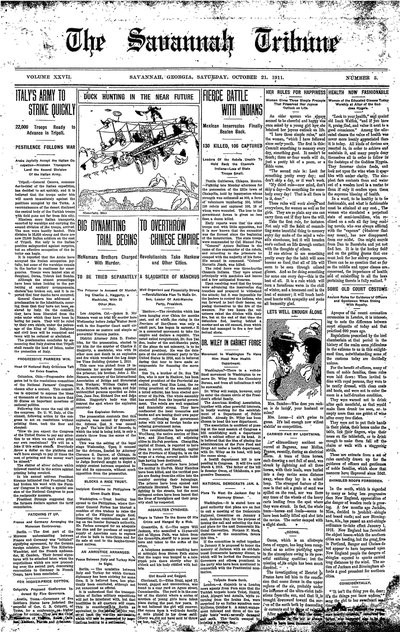
Page text (machine-generated)
. x ws aad. st SE RD OE
- -e'D ak : og : a: : yg - oo & ft. a7 tS pe ts
— 5 te ; : Rf aE Ere: ee EEA US Se?
‘ z tye . a. . es se F a ie: Sj ese, FY ae a. 38% a . 4
Soege : be : : : : , vo of i,
: a = Pw : . \ : Ba Ba ahi a“
—aaeaeaeaqaeaeaeaeee ee eee
VOLUME XXVII. < SAVANNAH, ‘GEORGIA, SATUBDAY, OCTOBER 21, 1911. : : NUMBER 6.
tee - - = ” a.
MALY ARMY 10
STAKE QUAL
Arabs Joyfully Accept the Italian Oc.
* cupation—Nineteen Transports
. Land the Second Division
Of the Itatlan Army.
‘Tripoll—General Caneva, comman-
derfnchlet of the Itallan expeditfon,
has decided to act quickly, and it is
belfeved that the troops under him
will march immediately against the
positions occupied by the Turks. A
reconnalssauce of the desert disclosed
the central body of the Turkish troops
ith field guns not far from this city.
Nineteen more Italian transports,
escorted by warships and carrying the
second division of the troops, arrived.
The men were hastily landed. This
division {s 15,000 strong and there are
now 22,000 Italian coldiers on the cost
of TripolL Not only {s the Itallan
position safeguarded against surprise,
but an effective occupation of the in-
terior can begin.
It is reported that the Arabs have
accepted tho Italian occupation joy-
tally, but some of the warships remain
in the harbor in readiness for emer-
gencies. Troops were landed also at
Benghazi, Derna, Tobruk and Bombs.
Although the utmost precautiops
have been taken looking to the per-
focting. of sanitary arrangements,
cholera‘has broken out, and It ts re-
ported that four deaths have occurred.
General Caneva has addressed a
proclamation to the inhabitants, assur-
ing. them that they have not been, en-
slaved by Italy. On the contrary,
they, have been liberated from the
yoke under which they have been la-
boring tor years. They will’ be ruled
by their own chlefs, under the patron-
age of the King of Italy. Religious
and civil laws will be respected and
taxes will be reduced or abolished.
‘The proclamation concludes by an-
nouncing that Italy desires that Tripoli
shall remain the land of Isla, under
the protection of Italy.
PROGRESSIVE FARMERS WIN.
for Extra Session.
Columbus, Ohio—Progressive dele.
gates led in the resolutions committee
ot the National Farmers’ Congress,
chosen after a contest, This commlt.
tee 18 expected to express the ideas
of thousands of farmers In more than
30 States on tmportant questions of
national politics.
Following this camo the real tilt of
the congress. Dr. U. W. Daly, of Cin-
einnati, following action by the con-
_gress to act on resolutions without
printing them, took the floor and
shouted:
“How ‘do you expect the Congress
of the United States to pay any atten-
tion to us when wo can’t even print
our own resolutions? We will be a
Joke if this action stand$. Everybody
throw a dollar on the platform and
‘we'll have enough to pay 10 times the
cost of printing and the motey won't
‘be missed.”
‘The clatter of silver’ dollars which
followed resulted in the action against
printing being revoked,
In his annual address President
Strange intimated that President Taft
had broken his word with the Farm-
ers’ Congress in cailing a special ses-
slon of the Natlonal Congress to pass
the reciprocity measure.
President Strange suggested that
the farmers declare against the tariff
commission.
af PATCHING IT UP.
France and Germany Arranging the
: Moroccan Controversy.
Berlin. — The first part of the
Morocco untorstanding between
France and Germany was “initialed”
signifying agreement, by the German
foreign minister, Herr Von Kiderlen-
Waechter, and the French ambassa-
dor, M&. Cambon. Thelr formal slgua-
tures will be attached later, when the
negotiations whicl are now proceed-
ing over, the second part, concerning
concessions to Germany In French
“Congo, have been concluded. -
FOR HIGHER-PRICE COTTON.
Colquit’s Proposed Conference In-
- , dorsed By Five Governors.
Austin, Texas—Governors of five
Soithern States have indorsed the
‘proposal of Goy, C. B. Colquitt, of
‘Texas, for a conference;,on- Bieter
Prices tor cottbasy,They are thie Chiet
i Bibeswtizes, of veeee Bowth;,Care-
ah one .
DUCK HUNTING IN THE NEAR FUTURE
” = ‘ ges
ior <A Me
: es = x Boz ‘Oe -F>
EPS gt we
es a ae ae
¥ PESTER .
CNEOGY? &
BET HN a
eT . .
eR AS
sm Fi
LEE SEE aT Ni
BiG OYAAMITING
TAL EB
TO BE TRIED SEPARATELY
The Prisoner ts Accused Of Nurder.
Ing Charles J. Haggerty, a
Machinist, With 20
Other Men.
Los -Angeles, Cal—James B. Me
Namara went on trial for murder here
Wednesday before Judge Walter Bord
well in the Superior Court amld cir
‘cumstances as austere and simple as
proverbial Western justice.
District Attorney John D. Freder.
icks, for the prosecution, elected to
try him for the murder of Charles J.
Haggerty, a machinist, who with 20
other men met death in an explosion
and fire which wrecked tho Lop Ange-
Jes Time Building October 1, 1910.
| ‘This case was picked from 19 in.
dictments for murder found against
the prisoner, his brother, John J. Bfc-
Namara, secretary of the International
Association of Bridge and Structural
Iron Workers; Willlam Caplan and
M. A. Schmidt, both at large, and four
finidentified persons specified as John
Doe, Jane Doe, Richard Doe and Jobn
Stiles, Haggerty's body was that
nearest the spot where the explosion
occurred.
Gas Explosion Defense. ,
‘The prosecution contonds that this
explosion was caused by dynamite;
the defense that it was caused
by gas’ The'néw-Hall of Records, in
which the trial 1s being beld, ts only a
stone's throw from the scene of the
explosion.
‘This was the setting of the legal
stage Wednesday. Upon, it counsel
for the defense, Headed by Attorney
Clarence S. Darrow, of Chicago, In
questions to the jury aud arguments
to Judge Bordwell sought to depict a
mighty contest between organized la-
bor ahd {ts opponents, without much
opposition from the prosecution.
BLOCKS A RICE TRUST.
Incipient Combine In Philippines ts
Given Death Blow.
Washington.—Trust busting has
spread to the Philippines, where Gor-
enor General Forbes has blocked a
combine of rice traders to raise the
price of the Filipinos’ staplo food.
Suspecting the combination and act-
ing on the Insular Bureau’s authority,
Mr. Forbes arranged for an adequate
the rice and for purchase of cargoes
supply of Amorichn corn to replace
of rice in bulk In Indo-China and for
Its sale at cost to the faminethreat-
ened natives.
AN ARMISTICE ARRANGED.
Peace Between jtaly and Turkey Now
tie Slee
Berlin. — The armistice between
Italy and Turkey for which German
diplomacy has been striving for some
time, it is belleved here, has prac-
tically been concluded, although not
yet announced as official.
It is understood that the transpor-
tation of Itallan military expeditions
will not be interfered with, but that
hostilities in all quarters will cease.
This is consideredrin., Borlin "as
equivalent, to thejeedieg!ofitho war,
ortat least tip warllke movements,
which will naw be sveseeded by nogo-
tations looking te a-petilement. *
T0 OVERTHROW
CHINESE EMPRE
A SLAUGHTER OF MANCHUS
Well Organized and Financially Strong
—Revolutlonlats Plan To Make Or.
Ben, Leader Of Anti-Manchu
Party, President.
| “Hankow.—The revolution which bas
‘been hanging over China for months
past, and 6f whith the rising In the
‘Province of Sze-Chuen was only a
small part, bas begun {n earnest.¢ It
is a concerted: movement to take the
empire and declare a republic. The
noted exiled revajutionist, Dr. Sun Yat
Sen, leader of the antl-Manchu party,
if the plays do not miscarry, is to be
elected president. He was the’ dele-
gate of the revolutionary party to‘the
United States In 1910, and-is belleved
during that tour to have made ar
rangements for financing the move-
ment. 1. ;
_ Sun Yu, a brother of Dr. Sun Yat
Sen, who is now in Hankow, has been
elected president of the Provincial As-
sembly, and Tang Hua Lung, the re-
tiring president of the assembly and
a noted scholar, has been elected gov-
ernor of Hu-Peh, The whole assembly
has seceded from the imperlal govern.
ment. The rebels are well organized
and financially strong. They have
confiscated the Jocal treasuries and
banks and are issuing their own paper
money, redeeming tho government
notes with’ this as forelgn banks are
refusing government notes.
The revolutionaries have ceptured
WuChang, the native section of-Han-
kow, and Han-Yang, all adjoining
citles in Hu-Peh province. ChangSha,
capital of Hunan, is reported to have
risen in revolt, and Nankizg, capital
of the Province of Kiang-Su, {s on the
verge of a rising, several public bulld-
ings having been destroyed.
‘Thousands of soldiers have joined
the mutiny in Hu-Peb. Many Manchus
have been killed, and the terrified peo-
plo ere fleeing fromithe cities into the
country carrying their belongings.
The prisons have been opened and
criminals lberated. Thera has been
fighting in the streets, but the most
stringent orders bave been issued that
the lives of ‘foreigiiers and thelr prop-
erty shall be'respected.
ASSAULTER LYNCHED, =.
Negro Is Taken To tho Scene-Of His
Crime and Hanged By a Mob.
Greenville, 8. C—The negro Will
Jackson, who assaulted a 11-yearold
girl at‘Honea Path, was taken trom
tho Greenvillesheriff by a posse near
here ahd taken to the scéne of the
crime, *
A telephone message reaching here
at midnight from Honea Path states
that the negro was hanged to a.tele-
Graph pole there shortly after 11
o'clock and his body riddled with but-
lets. , :
Girt Bound and, Gagged.
Cincinnati, O—Edna Hogs, aged 17,
bound, gagged and unconscious, was
found in a rear yard on Agnes street,
Cumminsville. The yard is in the.cen-
ter of tho district where a serles, of
murders of ‘young girls have taken
place during the past few years. It
is not believed the girl will recover.
She comes from & welltodo family.
A_ note pinned to her dress -sald;
{Sorry wo,did not have acid to throw
om her, too of xe.
Mexican Insurrectos Finally
-Beaten Back.
130 KILLED, 106 CAPTURED
Leaders Of the fcbils . Unable To
Hold Back the Chamula
Indlana—Loes of State
Troops. Small.
| Tustla Gultierrez, Chiapas, Mexico.
—Fightiag late Monday- afternoon for
the possession of the Uttle town of
Chalapilla, held by insurrectos-whose
strength was estimated as 900, a force
of volunteers ‘numbering 100, killed
130 rebels and captured 106, 18 of
whom, were wounded. The loss to the
government forces is given as less
than.a dozen killed. .
Early reports were that’ the state
troops met with little opposition,, but
It is now known that the encoutter
was the ficrcest since the beginning
of the insurrection, ‘The state troops
were commanded by Cal. Manuel Paz.
“General” Antero Ballinas !s the
name of the commander of the rebels,
and according to the prisoners he
escaped with the majority of his force.
His second in command, “Colonel”
Marcelin Jiméz, was killed.
The rebel force was three-fourths
Chamula Indians. They were armed
principally with machétes and lances
and g few antiquated firearms,
Upon receiving word that the troops
were advancing the insurrecfos dug
trenehes and prepared to withstand
the attack; but It was Impossible for
the leaders to control the Indians, who
ran forward to hurl thelr lances, ex-
posing themselves to the fire of the
mausers, For two hours: the. vol-
unteers raked the ditches with their
fire, but at the ond of that time the
defenders fied, leaving behind a
mortar-and an old cannon, from which
they: had managed to fire a few inef
fectual shots. ’
DR, WILEY 1H GABINET FORCE
Washington*—There is a wellde
fined movement in Washingtan to re
move Dr. Wiley from the Chemistry
Bureau, and from all indications it will
be successful.
Dr. Wiley will resign, howsver, only
to enter tho chosen clrcle of the Presi.
dent’s official famlly.
‘The American- Medical Association,
together with other powerful tnterests,
fs busily working for the establish-
ment of a Department of Public
Health, Already Dr. Wiley has been
chosen to head thé'new départment,
“The association ta confident of pass.
ing at the next session of Congress a
bill establishing such a department
with 2 cabinet officer at its head. It
is belteved that the dea of placing the
administration of the Pure Food and
Drugs Act under a health department,
with Dr. Wiley as its head, will help
the causo along. .
A health department Dill is now
pending In Congress, It will live until
March 4, 1913. 'Thé father of the bill
is Senator Owen, of Oklahoua, @ pro-
gressive Democrat.
NATIONAL DEMOCRATS JAN, &
Plana To Meet On Jackson Day In
Harmony Dinner. “—
Washington—It is stated -here on
good authority that plans are on foot
to call & meeting of the Deinocratic
National, Committee on January 8
noxt, Jackson Day, for the purpose of
issuing the call and selecting the date
and place for the next Democratic Na-
tional Convention. Norman F. Mack,
chairman of the committee, favors
this fdea. *
If the committes Is called together
in January It 1s proposed to honor the
memory of Jackeon with an old-fash-
ioned Democratic harmony dinner, to
which will be invited the Democratic
Governors and othera prominent in
the party who hava been mentioned in
connection with the Presidential nom-
ination.
Tateede Boats Sunk, a
London—A dispatch toxs Londoy
news agency from Pera says that the
Turkish torpedo hoats Tokat, Hamid,
Abed, Alpagut “and Antalla, ‘while re
turning from the Ionian Sea, were
surprised by an Italian squadron near
Mytilens, October 9. A smart-engage
ment followed and threé of tho tor
pedo boata”‘wetds severely. damaged
and sesk, The-fourth escaped by
holating 2 forblen-fes.- oat
HER RULES FOR HAPPINESS
Woman Gives Three Simple Precepts
That Preserved Her Joyous
Autlook on Life.
An older yoman who slyays
seemed to be cheerful and happy wai
once asked-by a young girl how.she
‘Fetained her joyous outlook on life
“I have three simple rules,” said
the womau, “which I have followed
eince early-youth, The first is this:
Commit something to meroory every
‘day, something good. It needn’t be
Yauch; three or-four words will do,
just a pretty bit of a poem, or a
“Bible verze.
“The second rule is: Look for
something pretty every day; and
don’t skip a day, or it won’t work.
“ary third rule—now mind, don’t
skips day—Do somtething for some-
body every day! ‘That is all there is
toit,dear.” . i
These rules will work always‘and
everywhere, for women as well as for
girls, They are so plain any one can
carry them out if they have the will.
Take the firat rule, for instance.
Not only will the Habit of commit-
ting some beautiful thing to memory
evéry day make.of the mind a valu-
able storehouse, but it will broaden
one’s outlook on life through contact
with the thoughts 9f others.
If one strives to see something
pretty every day the habit will soon
become so fixed, that all of life will
seem to be seen through colored
glasses, And as for doing something
for some one every day—this is' the
best of.all. It is a rule which will
turn a farmHouse warm in the chill
of winter, and a tenement cool in the
heat of gummer; it will touch hard-
ened hearts with sympathy and make
all humanity glad, /
LETS WELL ENOUGH ALONE
Yi, =
Le Lie. ipa ss
Us ps
a et
WW ge
pe . > “i
ise a) Y ih
s mam}
Ss LE r
ba Sp Be
wy
< J
cP 6
y Y
RG Uy aff
Mrs. Sambo—Who does you reck-
on is de lazié’, your husband or
mine?
Mrs. Lucas—I ain’t gwine tu
gness, It’s bad enough now wifout
stabtin’ no competition. *
CARRIED FAR BY LIGHTNING, .
én® extraordinary accident oc
curred at Bagneux, near Molins,
ie recently, during an electrical
orm. A team of three horses,
each drawing a cart full of eand, was
struck by lightning and all three
horses, with their loads, were hurled
into a deep ravine some distance
away, where they lay in a mixed
heap. The strangest feature of the
case is that nét a grain of sand was
spilled on the road, nor was there
any trace of the wheels of the heavy
carts leading from the spot where
they were struck, In fact, the whole
team—horses- and -loads—seems to
have been bodily lifted and shot into
the ravine. The carter ¢scaped with
alight shock. + ”
OZONE,
Ozone, which is an allotropic
form of oxygen, has long been recog-
nized as an active purifying agent
in the atmosphere owing to its pow-
erful oxidizing qualities; but the
question of.its origin has been much
disptted.- +
The investigations of Benrit
France have led him to the conclu-
sion that ozone forms in the upper
regions of the air, probably under
the inffixence of the ultra-violet iadi-
ations fzom the sun, and that it,is
brought downward toward the sur-
ésce of the earth‘both by descendin;
dr currents and by dione of rainaged
‘After og pir Sain the “an
iia. of y Saiithe sir: ie: always
HEALTH NOW FASHIONABLE
‘Women of the Educated Classes Today:
Worship at Altar of the God- -
* dees Hygela. ‘ x
., “Look to your health,” anid quaint
old Izack Walton, “and if you have
it, praise God,.ond value it next tou
good conscience.” Among the edu-
cated classes the valus of health was
never more keenly appreciated than
it is today. All kinds of devices ara
resorted to, in order to achieve and
maintain it, and many people deny:
themselves all in order to follow int
the footsteps of the Goddess Hygeia.
They forawear choice foods, and
look not upon fhe wine when it spars
‘Ales with amber clarity. The sim-
plest fare contents them and water
out of a wooden bowl is a nectar. to
them if only it confers upon themj
the supreme blessing of health.
In 8 word, to be healthy is to be
fashionable, and what is fashionable
must be attained at any cost., The
woman who simulated a perpetual
state of semi-invalidism, who. re-
clined on a sofa all day long readJ
ing novels; who was always afflicted
with the “vapours” (Whatever that
may mean), has now disappeared
from our midst. One might search!
from Dan to Beersheba and yet not
find her, It is im thé hockey field!
and on the golfing ireens that one
must look for her sinewy successora.
There can be no question that so far
as the middle and upper classea are:
concerned, the importance of health
and of subscribing to all the laws
pertaining thereto is fully realized. *
SOME OLD COURT CUSTOMS.
Ancient Rules for Guldance’of Ofticors
and Gentlemen When Dining
‘With Royalty.
Apropos of thé recent coronation
ceremonies in London, it is interest-
ing to note the difference between
court etiquette of today and thet
practiced 200 years ago. -
Regulations prescribed by the lérd
chamberlain at that period in the
history of the realm seem zidiculous
in the extreme to us in this enlight-
ened time, notwithstanding some of
the customs today are decidedly
unique. :
For the benefit of-officers, many of”
them of noble families, thess rules
were laid down: When invited to
dine with royal persons, they were to
be neatly dressed, with clean coats
and boots, and were not to enter the
room in a half-drunken condition.
They were warned not to drink
after each mouthful, as thet would
make fhem drunk too soon, or.. to
empty more than one goblet of wine
after every two-dishes. 7
They were not to put their hands
in their plates, their bones under the
table, lick their fingers,. wipe their
noses on the tablecloth, or to drink
enough to make them fall’ off -the-
chairs or walk with a ‘ateggering
stride. .
‘These ‘are extracts from a set of
rules carefully drawn up for the
guidence of officers and gentlemen
of noble families, which show that
manners have iinproved since 1642.
SHINGLED ROOFS FORBIDDEN.
Tn the south, which is regérded
by many as being less . progressive
than New England; appreciation of
the danger-of wooden roofs is grow=
ing. A> few months ago Jackgon,
Miss,, decided to prohibit . shingle
and board roofs; and now Birming-
ham, Ala., has passed an anti-shingle
ordinance tostake effect January 1,
1912. New England has furnished
the object lesson:which the southern
cities are heeding, but the great, fires
in Portland, Bangor and Chelsea do
‘not appear’ to have impressed upon
New England people the dangers of
shingles exposed to sparks carzied
long distances by the wind. The ac-
tion of Jackson and.Birmingham af-
fords & good precedent for northern
citics. .
COINCIDENTALLY,
i] “Tt isn't the thing you do, ans
is |i’ the things you leave undone,” ¥
| sang the girl to her sweetheart sazer
g | timents eubhin Tao
BSP SEA te ruse
mater io biageaet sive bate
Of Interest to Our Women
PROPER WAY TO PREPARE PRESERVES.
What a satisfaction, at the close of the summer season, to review a long row or rows of jars and glasses filled with mellifluent fruits for the cold months to come. When a guest drops in unexpectedly, or an extra delicacy is wanted for the family table, to open the doors of the fruit cupboard and select a jar of preserves or dessert fruit from the shelves is the reward of the woman who braves the summer heat in canning season. In preserving, the following rules should be observed:
Select only sound fruit as soon as possible after it is gathered.
Wash carefully all-fruits that come from the market or the home garden if exposed to dust or an insecticide.
Make sure that all jars, rubbers, tops and kettles are clean and sanitary. Scald before using.
Never cook fruit in tin or iron vessels, but in enamel or porcelain lined ones.
Prepare the fruit with a silver knife and stir with a wooden or silver spoon.
Have everything ready before you begin the work of canning and be sure that you have enough cans or glasses. Pint cans are more convenient than quart cans.
Use the best granulated sugar, the purest spices and good elder vinegar. Arrange to do the bulk of the work in the cool of the early morning.
For canned fruits to be used in the making of ples, puddings and for dessert, sterilization is the secret of success.
Jars, covers, spoons and utensils should be put on the stove in cold water and allowed to come to the boiling point, then kept there fifteen minutes.
Canning fresh fruit in cold water is only possible in the case of cranberries, pleplant and green gooseberries.
The proportion of sugar should be gauged by the purpose for which the fruit is intended.
Can fruits as they come in season and strive for variety as well as quantity.
TO KEEP THE HOUSE COOL.
The New England housekeeper whose "front room" is always gloomily cool no matter how the sun blazes outside has unwittingly mastered one of the first principles of being comfortable in torrid weather. That is, to shut the heat outside the house instead of admitting it at every door and window. Air the rooms thoroughly from sundown to an hour or so after dawn, then close up every door and window. Draw the shutters close and permit no hot breeze and no blazing rays of sunlight to creep through a crevice. The rooms darkened and made restful with bared walls, and slippery linen or chintz coverings, will be delightfully cool, even at that awful hour, midafternoon. When it seems too hot to sleep at night, even with every window thrown open, try hanging wet sheets in the windows. This is done in the hospitals in very sultry weather, and the evaporation of the water in the rapidly drying linen sensibly cools the atmosphere in the room.
HAND EMBROIDERY.
Everybody embroiderers a lingerie waist this time of the year, or gets somebody else to do it for her. If it is a kimono blouse that one is making, then the cross-stitching or French knot design or solid embroidery goes around over the shoulders to the back of the waist without a break, and perhaps branches down into the sleeves as well, for the waist is seamless over the shoulders. But if one has embroidered a front only, then one can make one's blouse with deep Gibson tucks over the shoulders and sewed-in sleeves. The Gibson tucks hide the armhole seam, and a new elbow sleeve they are using with them is plain at the top and rather wide at the bottom, so that one does get precisely the effect of a kimono blouse.
CUCUMBER MANGOES.
Soak in strong brine nine days as many large, green cucumbers as you wish to use. Then lay them 48 hours in clear water. Cut a slit lengthwise in each, scoop out seeds, wipe dry, and fill with stoned raisins, lemon cut in long, thin strips, and six or eight whole cloves. Sew up slit, pack cucumbers in a stone jar and cover with a boiling sirup made after following recipe: Add to one quart vinegar five pounds sugar, also mace, cinnamon, and cloves to taste. Reheat sirup and pour boiling hot over cucumbers for nine successive mornings.
HINTS TO HOUSEKEEPERS.
A good cleaning fluid is made of sulphuric ether, two drams; chloroform, two drams; alcohol, four drams, and oil of wintergreen, twenty drops. Molsten a soft cloth with the mixture and rub vigorously on the soiled spot. If doughnuts do not take on a golden brown crust as soon as they are dropped into the lard it is because it is not hot enough.
Flash may be scaled easily by first dipping them into boiling water for a minute.
RENOVATING HINTS.
Before many weeks the season of fall housekeeping will be upon us, and with it comes the cleaning of face curtains. For those who can afford to send them to an establishment to be cleaned, so much the better, but for the little housewife who must do her own cleaning a little advice as to a good method to employ might not come amiss.
Take the exact dimensions of the curtains, shake out the dust and rinse in cold water. Put them in a boiler of warm water to which have been added a half bar of shayed soap, three tablespoonfuls of turpentine and three tablespoonfuls of amonia. Roll about fifteen minutes, rinse, wring slightly and starch slightly, or use a little thin gum arabic or gelatin water for stiffening. Measure off a plot of grass the dimensions of the curtains, stretch the curtains over this, sticking a toothpick through each sealop well into the ground. Two or more curtains may be stretched over the same toothpicks. When dry lift one at a time off the picks. When one has the regular curtain dryers which are made for this purpose much labor is saved. If one has no grass for drying, or the frames mentioned, wring them dry and lay on a sheet on the carpet and pin down every point.
CANNING AND PRESERVING
FOR MONTH OF AUGUST
The success of canning depends upon absolute sterilization and heating the fruit till all the germs are destroyed, then sealing in airtight cans while scalding hot.
For canning use one-third to one-half as much sugar as fruit.
For preserving use three-fourths as much sugar as fruit.
For jam use equal amount of sugar and juice.
For canning use only perfectly sound fruit, fresh, firm and of good quality.
For preserving, fruit is both cut up and left whole.
For jam, imperfect or overripe fruit may be used.
For jelly, fruit should be underripe.
Cook small quantities at a time.
Cook small quantities at a time.
Have a fruit boiling hot when put into the jars.
Fruits in a hot, dry season require less sugar than in a cool, damp season.
To keep quinces, pears and apples from turning dark after they are pared drop them in cold water containing lemon juice.
REVERS ON SKIRTS.
Revers on skirts? Well, why not, if you can have them on waists? On coats, of course, you accept them unconcernedly, and they must take on outrageous size and fancy shapes before you will show any interest in them. Those on the new waists and skirts are not outrageous—which is a poor way of commenting on them—because they do have the positive value of smartness. The favorite idea seems to be to face the revers with black and white stripes. You see this done a great deal in the tailored frocks of colored linen for summer. They are made on simple lines, and the revers stand out as the important decoration of the dress. For those who have not seen them, a description is simple enough: The skirt may be six-gored, with a broad panel down the back. At the bottom, one corner of the loose panel is lifted and folded back to form the revers.
EMPIRE WAISTLINE.
Don't be afraid of those smart-looking little coats with the empire waistline. One might imagine that they are a new-fashioned cut which is way beyond one's own skill as tailor. Actually, some of them are nothing but the ordinary straight cut coats, and the illusion of the empire style is produced simply by the addition of a band sewed on flatly above the waist line.
FASHION HINTS.
One of the materials that have come into being at the beginning of the hot weather is the figure cotton net that we had with us several seasons ago. Some of the long white gloves are exquisitely embroidered in tiny buds around the wrist, with fine trailing vines extending part way up the long arm.
The combination of broderie anglaise with mousseline de sole in colors is one that must not be overlooked when planning lingerie frocks of the dressy type.
Thick cords of satin, linen, silk or cotton are used to form bralded designs on the bottom of skirts, on collars and cuffs and even on the brims of large fabric hats.
There is a revival of the high stock of taffeta or black taffeta ribbon, and tiny turn-over white linen collars are worn over the top of the stock and relieve their sombreness. Rather pretty are the silk gloves made with fine tucks from just above the wrist to below the elbow. The tucks are made at intervals of about one-quarter of an inch. Little boleros are very chic. They are slightly full, and many are edged with ruffles and frills of silk. They are cut low and fastened at the waist line, and are cool and lovely.
THE EDUCATIONAL INSTITUTIONS IN THE SOUTH HAVE DONE MORE-FOR THE NEGRO PEOPLE IN FORTY YEARS THAN HAVE BEEN DONE FOR ANY PEOPLE BEFORE IN AN HUNDRED YEARS.
The season is upon us when the college and university throw open their doors to the young men and women of the race. Many are returning to devote another year to knowledge, while thousands for the first time will seek the ways of wisdom. The educational institutions in the south have done more for the negro people in forty years than educational institutions have done for any people before in an hundred years. As we count the seasons and mark the achievements of the people since the close of the Civil war, we marvel at the revolution wrought by the books and a consecrated army of teachers. Everywhere in the south the greacher and the teacher ought to go among the people, pick their brightest youth and urge them to seek a school of training. In this way we can build up a leadership, not with respect only to certain relations sought to be established, but particularly with respect to scholarship, to science, to art and to the professions. Sight must not be lost of the preparation the great mass of people ought to have in the trades, in agriculture, particularly agriculture, and the household economy.
To us it is encouraging to note that much of the silly debating that got into the life of the race ten or fifteen years ago about education, its need and kind, has passed out. What the negro needs is education; the kind he needs no man can establish. Booker Washington was never wiser than in his refusal to set metes and bounds for the training of colored men and women. His opinion is our opinion, and the accepted rule of all who study with a serious mind the situation in the south: An equal opportunity for both the masses and those who from the masses aspire for the wider and higher life.
What is education? As many answers to this riddle as there are philosophers in the council we have had. But it is safe to say that education, whether the spirit or method of it, gives us the power to see two stars, where we saw only one before, and make two balls of cotton to grow where only one grew before. Education they tell us means service, and he is not educated who does not serve his fellowman. That is true, but education means also individual emancipation, not only out of selfishness, but also out of poverty. It is a poor education that gives the man, or the woman, no power to lift himself up. Colored people can afford to disregard the warring ideas and opinions, regarding education and insist upon the children getting hold of useful knowledge, that is, knowledge that will help up all forward to a wider life, and to a higher place in the higher life of the country. Any education that does this is the proper education. The education that does not do this is no education at all.
NOMINATION WAS UNANIMOUS.
During a local election in a German town only one man appeared at the nomination desk. "Whom do you nominate?" queried the official.
"Myself," was the answer.
"Do you accept the nomination?"
"Well, no."
"Then we must try again. Whom do you nominate?"
"Myself."
"Do you accept the nomination?"
"No."
A subdued "Donnerwetter!" escaped the lips of the perplexed official, but he went on:
"For the third time, whom do you nominate?"
"Myself," came the invariable reply.
"Do you accept the nomination?"
Do you accept the nomination.
The man rose up with a smile of satisfaction spreading over his face as he answered proudly:
"Having been three times, solicited by my fellow citizens to accept the nomination, I can no longer decline to accede to their wishes."—Cincinnati Commercial-Tribune.
A REAL·GENTLEMAN.
"You have some beefsteak, of course?" queried a man who had hurriedly entered a butcher's shop.
"Yes, sir."
"And beefsteak is good to take the color out of a 'back eye'?"
"The best thing in the world, sir!"
"Good! Save two pounds for Riley."
"Which Riley?"
"The Riley who lives in Jones street. I'm going to 'back both his optics. He'll probab'y call in half an hour. Good evening!"
Twenty minutes later the same man came back with his coat in rags, his collar gone, his nose damaged and both eyes puffed in.
"Did you find Riley?" asked the butcher, with a twinkle in his eye.
"I did, sir, and he has kindly consented to let me use the beefsteak Mr. Riley is a 'gentleman, sir!"—New York Evening Mall.
JEALOUSY.
"So you disapprove of the modern drama?"
"Yes," said the constable. "I can't help thinking there's something wrong with these plays we've been getting. I never saw a play that made a policeman appear as a affable or smart or heroic as a burglar or confidence man."—Washington Stair
See Cooper & O'Drizen The Up-to-Date Tailors
218 WEST BROAD ST., BETWEEN HULL AND OGLETHORPE AVE. The Latest Patterns in FALL and WINTER GOODS. First Class workmanship guaranteed, Our prices will interest you.
GAREY'S Variety Bakery.
Goods delivered promptly to any part of the city. 506 West Broad Street, Near Gaston Phone 1321-1.
Take a Policy With The Pilgrim Health and Life Insurance Co.
The Oldest, Strongest and Most Reliable Company in the State. Gives employment to hundreds of men and women of our race.
Pays from $1 to $10 weekly sick and accident benefits and from $10 to $100 death benefits. Our Motto: "Promptness, Honesty and Justice."
1143 Gwinnett St. Augusta, Ga.
For further information write 509
West Broad St., Savannah, Ga.
J. S. Perry, Supt.
A. B. Singfield, Gen. Supt.
Their Ideal Realized
For more than a dozen years the dream of the Manager of the UNION MUTUAL ASSOCIATION Has been to inspire Confidence in, and bring respectability to Negro Industrial Insurance, which does not only cause this Company to handle more than a million dollars annually, but they have made it possible for other similar concerns operated by our people in the South to do a successful business, which was once controlled abscety by another race.
For these and other sane reasons, we urge that you take out a policy today.
Call one of their agents or phone the local manager of the Savannan district,
J. C. LINDSAY,
Branch Office 509 West Broad St.
Phone 1470, Savannah, Ga.,
or WM. DRISKELL,
Secretary and General Manager,
210 Auburn Ave. Atlanta, Ga.
CHICKENS DUCKS TURKEYS
R. H. O. YOUNG
Wholesale and retail dealer in Live and Dressed Poultry. Game in Season. Special attention given to picnic orders. All orders delivered free of charge. Stall 12 City Market. Phone 2733. UNION
Laundry Co.
1218 West Broad Street ONLY COLORED LAUNDRY IN CITY. WORK CALLED FOR AND DELIVERED. Phone 38. MYERS & RUSSEL, Props.
McFALL'S
Ice Cream Parlor
Ice Cream and Sherbets in large and small quantities. Special prices to Churches and Societies. Also Hot and Cold Lunches. Fish Suppers prepared to order. Phone 4038. Orders very promptly filled. : : : : : : 115 East Broad St., Savannah, Ga
Regalias.
LODGE SEALS,
FINANCIAL CARDS and
BLANKS of every description.
Publishers' and Manufacturers' Press
Liberal Discounts Will Be Arranged
SOL. G. JOHNSON,
Gavannah, Ga.
Who is the man for Cleaning and
Pressing?
BAKER'S PRESSING CLUB
519 PRICE ST.
Men's Suits Pressed 40c; Pants 15c;
men's Suits Scoured $K. Ladies' work
specialty. Give us a trial.
Johnson Undertaking Establishment
COMBINE D WITH
The Royal Undertaking Company
(Incorporated.)
Funeral Directors and Embalmers
Finest line of Coffins, Cuskets and Robes. White and black funeral
cars. Office and warrerooms 325-331 Jefferson street.
W. R. FIELDS, Manager.
Residence Phone 2032. Livery Stable Attached. Office Phone 878
Fruit and Commission Merchant
234 ST. JULIAN ST., WEST, 235 BRYAN ST., WEST. Phone 2968
SAVANNAH, GEORGIA.
In addidtion first class rooms, barber shop, hot and cold baths and automobile service at any hour, day or night. In all of our departments we give first class accommodation. Call and see our rooms while visiting the city at 109 Jefferson street, just a half block from Broughton St. car line going south on Jefferson Ask any hackman.
Paim Shaving Palace
Expert Hair Cutting, Electric Massage and Shampooing a Specialty. All Work Done by Experienced Workmen. Courteous attention to all. SHINING PARLOR ATTACHED. PERRY R. WRIGHT, Proprietor
If Your Business Isn't Worth Advertising Advertise It For Sale
POPULAR PRICED
SHOES
NICHOLS
THE SHOE MAN
20 W. Broughton Street
Atlanta University
ATLANTA, GEORGIA.
An Unsectarian Christian Institution. High School, Normal School and College.
Superior advantages in Industrial Training, Music and Printing. Home Life Training. For catalog and information address
PRESIDENT EDWARD T. WARE.
Woodlawn Park Lots
The Highest Price Lots at Woodlawn Park are Only $150.00 and they 50x400
They have concrete sidewalks and are directly on car lines. Consider how important that transportation feature is. Some excellent LOTS LEFT. You pay
$5.00 Cash and $5.00 Per Month
NO INTEREST
See me quickly and get a choice location
523 WEST BROAD STREET PHONE 2098-J. RESIDENCE
AFRO-AMERICAN CULLINGS
The St. Loula Globe-Democrat regards as foolish the talk, now rife among Oklahoma negroes, about emigrating to Liberia. "Race troubles are taking place in some parts of Oklahoma," it says, "as they have taken place in many other states, some of them in the north. But the remedy is not deportation, voluntary or forcible. The black man is an American. His forefathers were brought here without their consent, and this is their country-now, just as it is the country of the white men who are here." It is refreshing and reassuring to read from such a source that this is the negro's country. That other sentiment, "this is the white man's country," has been swelling in volume and popularity of late, however we always had a sneaking opinion that it belonged to the men who can use the opportunities offered in the strenuous art of getting the most out of life. The Globe-Democrat thinks the negro problem, once-grave, is becoming less and less serious partly by reason of the dispersion of negroes throughout the north and west and because of decrease in negro population relatively to that of the whites. The negroes suffer from a higher death rate than do the whites, and there are no black immigrants. Speaking of the strong race prejudice north as well as south, as evidenced by lynchings and burnings in one section as in the other, our contemporary says:
"Yet the turning point must come soon. Taking the country as a whole, the turning point has already come. The relations between the races, if we take the country in general, are much less hostile than they were shortly after the Civil war. Fewer massacres take place in the south now than then. Public sentiment is beginning to reach out after lynchers. Moreover the south realizes that it needs the negroes in its industrial scheme. For good or ill the American negro's place is in America, and probably as the years pass his lot here will become less unpleasant than it has been hitherto."
---
We noted some of our prominent farmers, sald to be worth between two and five thousand aplece, stealing in the back of the jim crow restaurants and eating liaisons operated by people who did not care for their trade, where he had to eat in the kitchen among greasy cans, slop and all manner of refuse. Next door was a nicely equipped colored eating house, which gave first-class accommodation for their color only. They practice non-support, not only in this business, but in most every available business operated by colored men. The grocery store, the supply store, etc. But there is one good thing that some of the men of the other race are gradually driving him back to his people. The white barber would not dare shave him or cut his hair. He has quit doctoring him and pulling his teeth. He has refused to bury him, and some of the grocery men have refused to accept his trade. Are you waiting on the white man to drive you to your race? (A good idea, it is.) Can you not see that your people need your support? The time is at hand that your people need your help. For instance, take our farming element who spend thousands of dollars yearly in supplying their wants, and suppose they would spend this money with their own colored merchants, then we would be financially strong to help or support any movement of benefit to the race. Don't wait to be driven to the line, but be men and line up for a stronger race by giving your own people your support. — Palestine (Tex.) Plain-dealer.
---
Our people spend as much or more money in riding around over the railreads than any people in this country. Much of this spending is unnecessary. They lope across the country to some big convention where they have no voice and are not needed. The big church conventions are the ones attended most. The preachers or proposed representatives work and "saw" on their struggling members until they receive a bountiful pile from them to bear their expenses, and live in ease on their distant journey and they don't do a "nickle's" worth of good for the struggling slaves he left behind. Oh, men he considerate, be humane and, let your under man live. Because he was not born or drifted in your position do not trample him, let him live. If he must be your tool deal moderately with him and let him have a showing—Palestine Plaindealer.
The negroes of Nashville and Tennessee, we are proud to say, are getting out of the habit of allowing some one to pay their poll tax. In the coming city election that will be held on the 12th of October, eary negro man in Nashville ought to vote, and vete intelligently. He should not ask anybody to enable him to be a voter, but he should go down in his pocket and take his money and buy the privilege for himself, then he can exercise it as to his best judgment.—Nashville Globe.
When the roll is called on the final day of accounting with mankind, those who have served their Master through alding his less fortunate children will probably occupy a high place, says a writer in Collier's Weekly. And those who know old Nancy Hill of Jackson, Miss., firmly believe that she will sit in a reserved seat on that day. Since 1875 this old negro woman has absolutely unafraid and in the face of defeats, obstacles and disappointments enough to have crushed any one but a person sustained by a divine faith, raised to manhood and womanhood 108 orphan waffs—white and black! She has a queer, hotchpotch collection of shanties, built by herself and some of the boys she has raised, adding a room at a time as her family grew. She used scrap plank, bits of goods boxes, old corrugated iron, tin cans with the solder melted out and flattened. The rooms are crowded close together down back of the power plant, at Jackson, on land owned by a railroad, and she is allowed to retain it at a purely nominal rent. Shading the house, or houses, are two immense weeping willow trees. With her own hands she planted, in 1872, the switches from which they grew.
"Don't the negroes help you any?" asked the reporter. "You are helping the race by taking these little walts and making good citizens of them." "Naw, sub, niggers is got no use for me, 'ceep' to push some po' ill' chile off on me dey doan' want. I aln' fancy ernuff fer niggers; hit's dis yer flashy business dat catches 'em. I raises dese yere chillens ter wuck an' be hones' an' spectful ter dey betters, an' ter be some' count. Now, if I raised 'em ter silt eroun' wild red dresses on an' pink ribbins in dey halr, an' do nuffin' maybe some er dese hyar nigger preachers 'd come eround, an' have er kine w'ud fer me—but no money. Naw, I don' spect no help, an' speshily frum my color. I'll fight dis out twell I die, an' do de bes' I kin, an' de good Lord won' expect no more of me dan I kn do, w'en I'm doln' mer level bes', 'cordin ter' whut I is an' has' will he?"
Some preachers seem to think that they were predestined from all eternity to indulge in sing-song preaching, and that a sermon cannot reach the hearts of their hearers except through this method. In this way the people have been led to ignore sense for sound. It matters little now whether a preacher talks sense to his audience since he has the ability to "moan," as his anxious hearers gratefully call it.
It seems never to enter into the back side of his head that he is making the weak weaker, and that his followers are giving themselves over to the belief that it is all in sound. It is painful to know how easily most of our people are carried away by mere sound. The sermons which we are forced sometimes to listen to have made the impression upon us that the condition of our people in some cases is hopeless. What are we to hope for when our best men—our young men who ought to be "strong" because they are fresh from the colleges and seminaries and placed under the gospel yoke, so trained as to "rightly" divide "the word of truth"—will persist in this kind of sing-song preaching? They ought not to do it unless they can imagine the Lord Jesus and his apostles resorting to that kind of thing; and if they can so imagine then we pity their imagination.
The white preachers of the old day preached in this style, but their later preachers rose above it, and now it cannot be heard anywhere among the people of the white race. Why cannot negro preachers take the same consideration and put down this "whang-doodling?"
"Ephraim is joined to his idols," but we are determined not to "let him alone" until we can put in motion some influence that will prove a stumbling block to this preaching with sound without sense. — Southern Ploughman.
A well-known revivalist whose work has been principally among the negroes of a certain section of the south remembers one service conducted by him that was not entirely successful. He had had very poor attendance, and spent much time in questioning the darkies as to their reason for not attending. "Why were you not at our revival?" he asked one old man, whom he encountered on the road. "Oh, I dunno," said the backward one. "Don't you ever pray?" demanded the preacher. The old man shook his head. "No," said he; "I carries a rabbit's shoe."
Call off there, and stop your knocking. Learn the law of your fraternity and, be governed by it. Learn the law of your church and keep the law. Don't insist on being the great I AM in everything and everywhere; remember, the world got on first rate before you came and has some chance of running a day or two after you are gone. Baltimore Afro-American.
WHY SHOULD WE EDUCATE OUR CHILDREN?
AN ABLE EDITORIAL BY R. D. JOHNSON OF EMMETT, AR-KANSAS.
While passing through a rural district a few Sundays ago, we noticed this motto on the church wall: "We must educate." This motto gave us reflection over quite a number of reasons for education and gave us a stimulus to think along that line.
You have no doubt heard of the word education quite a number of years, and maybe you have heard it explained in the sense that "we are to use it in this discussion it means to train the mind or to conduct the mind or to lead the mind out to its fullest extent.
There are possibly many ways in which the mind may be trained; in the schoolroom by the teacher, at home by reading, in traveling by observation. We will not question which of the many ways of training is the best. The question is, why should be educate our children? might be asked any of you, and there is not one of you that could not give some reason why.
We say educate them because it makes them accurate observers of the things around them. The child's mind is plastic and very easily molded in the way in which the trained mind sees fit to shape it. Nothing in human nature is more open to impressions than the child's mind. The little babe sees a beautiful rose and stretches forth its chubby hands to grasp it. It no sooner has the rose but that it begins to pick it to pieces, sometimes noticing each petal. This keen observation in the child, it rightly developed, means more to its after life than you might now think. In the schoolroom the child observes the teacher and more or less imitates the teacher. The teacher's actions live in the life of the child. Constant attention to the teacher and her work makes the child an accurate observer in the schoolroom. The ideas of the teacher inculcated in the child teach it to observe things on the way home from school to home. It takes notice of the many things around in its circle of activity and reports its new discoveries to the teacher. This exercise gives it a great opportunity to observe the things at home and in what way many of them are used.
We often look at the locomotive as it passes us with its train of cars and wonder how much power is stored up in it. Human intelligence delights to contemplate powerful things. Just as we admire the exhibition of power in the great mechanical creations of man, so we like to see children with power of the will, the power of thought and the power of action. Education gives the child the power of will. The child, in coming in contact with our children, gains a power of doing things that it would not get otherwise. This power makes it exercise its will more or less, thus giving it will power. The child's study of conditions around itself gives the child certain conclusions; these conclusions are reached by the exercise of thought power. The execution of ideas and deductions of the child give it the power of action. Thus it is that we should educate the child because of the above facts.
Our minds are somewhat agitated when we hear or read of some foul deed committed in our community or in our county or state. Did you ever think that the man or woman who committed the deed was a grown-up child? Give the child a chance to learn something and it will create in the child the love for beautifying the home. It will stimulate its passivity into activity so that the child will take an interest in the community life. As the child develops its circle of interests grows larger until it takes in the welfore of the county and state. Since the man or woman is a developed child, let the child get the proper training and you will have better citizens. Thinking people are those people who make progress along all lines. Even the laborer, if he does not think will find himself using his best strength in vain. The farmer who does not think in seed time will stand very little chance of reaping when harvest time comes. The teacher, if he or she does not make the best preparation possible while training themselves for their work, will fall short of realizing their cherished ambition of helping the child's life. Thus it is that we should educate our children to make them better in every way.
We should educate our children because it gives them a better grasp on a practical Christian life. Our race of all races needs to learn, yes, not only learn, but put into practice our Christian principles so that our daily lives will measure up to our Sunday testimonials to our Christian steadfastness. This can be best accomplished through the means of education. Send your child to school. Let it get mental power in the great storehouse of knowledge and the exercise of his mental powers will greatly aid him to rightly interpret God's Holy Writ, and from this interpretation his life will be built up in that high atmosphere of usefulness, not only to himself but to his community and to the Creator of the universe.
From our observation of children and their habits, we say train them while they are young. Let them have a chance. Is the cultivation of a cotton crop more valuable than that training which the child receives in the schoolroom? Are the few dollars you save by keeping them out of school
making you any richer? Do not some of you crave for the chance your children now enjoy? Then give them a chance. Since education maker the children accurate observers of conditions around them, and since it cultivates the mind to love the home, to be active in the school and district, and since it develops the power of will, thought and action, and since it makes better citizens and leads them into a life of usefulness, we say, if you would maintain your place in the present civilization; if you would compete with other races in this struggle for existence, educate your children.
MONEY AND CHARACTER
YOUNG MEN OF THE NEGRO RACE ARE 'AROUSED TO THE BLESS- EDNESS OF THE ALMIGHTY DOLLAR.
Whatever the older men among negroes might have thought of the value and power of money in its relation to the problem of the American negro, it is a very certain fact that the younger men, those who are about getting the whip hand in race affairs, are thoroughly aroused to the blessingness of the almighty dollar. They are not only aroused in this respect, but they boldly crown the American dollar not only as almighty, but as the only thing that is mighty at all. We do not like to have our strong young men feel this way about money, but that is the way they do feel, and that is the only way they can feel about it, for the dollar mark in American life is the only mark that spells power and position. We have all of us fell to preaching money, here of late with eloquence and zeal, stressing, as we ought to do, the need of money in the terrible battle we are called on constantly to wage, but we have unfortunately omitted to preach the need also of character. From the lips of one of the most successful of young colored men we heard that the only solution to the vexations that trouble our hearts was money, money, and more money. He spoke no idle speech, but the belief that was in him. He is a type. With his growing kind arguments in support of character as also a necessary element in the solution for which we all of us labor are words wasted. This is bad, bad for the race, bad for the children and worse for the future. No money-changer can of himself live, and no money-changing people can of themselves develop the power of a permanent growth. Behind the dollar is the man, and if behind the dollar there is neither man nor hope of him, of what use is it?
Hand in hand with our material growth, a growth upon which we do well to dwell, must go also the moral and spiritual growth of us; the determination that we shall merit all that the dollar can buy, and the preparation that will enable us to enjoy in no superficial sense whatever is bought. What is character? The ancients were up against that question, and came out the worse for the battle. There are, however, certain fundamental principles in correct living, and, therefore, in correct development, that are debatable not even among those who at the drop of the hat are ready to debate upon the color of longitude or, the shape of water. These principles are not alone for the preacher, nor the learned, but are at the hands of all who may seek them. Honesty, honor, determination, patience, toll, temperance, self-control—upon these as stepping-stones men may rise to higher things. "If we can give the French character we can make France free," remarked a statesman who had seen the revolution turn France from a madhouse of blood into a state of free men. The French, one of the wealthiest of peoples and the intellect of Europe, needed character, according to, one of them, to make them a well-rounded people.
The American negro needs money, and he needs much of it. He needs more than he can get hold of honestly in the next century, but he needs character more than money. His friends, in the race and out of it, will tell him this whether he likes it or not. The theme of the preacher, the subject of the writer, the command of the leader, and the word of the teacher, in season and out of season, ought to be money and character, today and tomorrow. But the greater of these is character.
H18 CHRISTMAS CHECK.
Al Ryan, the hospitable flint glass worker of Lockport, N. Y., and formerly organizer of the Socialist local at that place, was being congratulated by the boys at the glass factory.
"Yes," said Al, "my uncle out in Tifton is mighty good to me. The day before Christmas he sent me a check for $100, just as a little Christmas gift."
After the usual congratulatory comments had been duly made all around, Al added:
"Yes, he certainly is a fine old fellow. In the postscript if his letter containing the check he said:
"Dear Al, if you manage to get this check cashed, please send me $4. I need a pair of shoes."—Coming Nation.
A GREAT RELIEF.
"Gee, aint it a, great relief when you've been suffering from a toothache to summon up your courage and go to a dentist and have it over with!" "I guess go. Did the dentist, relieve you!" "You bet. He wasn't it!"—Toledo Blade.
ADDRESS DELIVERED BY GEORGE W. ELLIS OF CHICAGO BEFORE THE CONFERENCE ON AFRICA.
We have before us a reprint from the Journal of Race Development of an address delivered by Mr. George W. Ellis of Chicago before the Conference on Africa called by Dr. G. S. Hall and Prof. George H. Blakeslee of Clark university. The subject of Mr. Ellis' address is entitled: "Dynamic Factors in the Liberian Situation."
The address is significant because of its review of the conditions which led up to and which involved the political crisis through which the Black West African Republic passed.
The address opens with a brief recitation of recent European discoveries which led to the partition of Africa on the part of certain European and colony holding powers. It is significant that the Black Republic of Liberia on the west coast and Abyssinia on the east are the only two African sections which have not come under the political sovereign and jurisdiction of European nations. The speaker next describes the population of Liberia, which is about 2,500,000—about 65,000 are Americanized colored people and the remainder are aboriginal Africans who are governed by their civilized kinsmen across the sea. The territory of Liberia is mentioned as being healthful, rich in natural resources, gold and silver and in a varied flora and fauna. One of the strange things about conditions in Liberia is that American colored people seem to be indifferent to the financial opportunities offered to them by the Liberian republic and who seem to take little or no concern beyond a sentimental interest in the Liberian republic.
It is pathetic to read the speakers' description of the alarming nature of social and political conditions in Liberia which finally moved that people to appeal to the American people for aid and assistance in their international struggle. It was very wisely pointed out by the speaker that Liberia had played an important part in the abolition of the slave trade, had rendered important and valuable international services to the nations, and therefore in this crisis was entitled to the sympathy of the civilized and liberty loving world.
The first difficulty with the government of Great Britain is succinctly described, in which it was disclosed how European traders had been sent down from Sierre Leon by British firms with the support and sanction of the government at Sierre Leon and later of the British government at London, with the evident purpose of violating Liberian revenue laws and affording the British government a pretext to rob the Américanized republic of some of its territory.
There follows very rapidly difficulties between Liberia and Great Britain over the territory in which British subjects were making trouble by refusing to recognize and obey the laws of the Liberian state. The government of Great Britain began the controversy by claiming the Liberian coast territories from Sherbro islands to the Mafa river in exchan-e for a few thousand pounds. The controversy lasted for more than twenty years, the United States giving to Liberia the warmest and most ardent diplomatic support, championed its cause with the deepest concern and zeal, but not to the recognition of her contentions—avail. Great Britain finally forced the recognition of her contentions, Liberia was compelled to yield her northwest territory, upon the advice of the United States and under the force and pressure of the military-and political power of Great Britain.
The speaker then took up the Liberian difficulty with France. France, jealous of Great Britain, who had taken some valuable territory on the northwest, began at once to plan how she should take as much from Liberia on the southeast. At once Frenchmen were sent out to claim the desired lands and the French government notified the powers of the new assumption of sovereignty. The United States again protested, and gave Liberia every possible diplomatic support; but France, bound to equal England in the grabbing of Liberian land, forced Liberia again to yield up valuable territory for a few thousand francs.
Great Britain was so successful in getting Liberian territory on the northwest that she was bold enough to attempt to take additional Liberian territory, after the Anglo-Liberian boundary on the northwest had been delimited in 1903. This Mr. Ellis terms the "Kaure Labum Question" and constituted at the time of Liberian boundary difficulties with Great Britain. The taking of this Liberian section of territory after the boundary had been fixed is one of the most pathetic and distressing incidents in Liberian history.
The rivalry of France continues and she forces the cession of another section of Liberian southwest territory to match the new acquisition of Great Britain. The speaker describes the negotiation of the two loans secured by Liberia from Great Britain and the severe-crisis which followed the loan of 1906, which came near erasing liberia from the map. After enumerating the factors in the Liberian situation, the author describes the natural resources of the country, and closes with a glowing picture of American commercial portals, for example, New York.
POETRY
of and by Our People
AN ODE TO A FRIEND.
(By Stella H. Smothers.)
1. Four years have elapsed, dear,
Since last we met;
And still we are fond friends, and have
no regret.
For amid the joys, and sorrows too,
We both have remained ever faithful
and true.
2. Time has not yet changed us, or drilled
us apart;
Ah! even a thought of it.
Causes a pang in my heart.
For what would we do, without each
other pear;
One to comfort the other, and help ban-
ish the tear.
3. Best friend of my life, ever faithful
and true,
Who helped me to begin life, all anew;
Whose kind words and deeds,
Are ever fresh in mind.
Encouraging me onward, all of the time.
4. Such friendship as yours, is help and
rare.
Making me stronger, and more willing
to dars;
Causing the sunlight to shine in bright
rays of joy upon me.
Thereby making my glorious days
Brighter days through them.
5. Sharing our joys and sorrows alike;
Striving to help each other, with all our
might.
God grant that such friendship may never
end,
Until our voices cease to blend.
In harmony as friend to friend.
-Stella H. Smothers-
RELIGION IS SO DIFFERENT NOW.
Religion is so different now,
From what it used to be,
The old time way of serving God
Alas no more we see.
They worshiped in an old log house
No carpet on the floor;
But yet they had a happy time
For a couple of hours or more.
Oh how they made the building ring
With songs of love and praise;
They had no organ or paid choir
In those old by-gone days.
The old-time preacher of the "word"
Would speak with tremulous voice.
Yet oh, the words the good man spoke
Would make the saints rejoice.
But things are very different now,
The house is grand and great;
The singing by a choir is led
And must be up-to-date.
The preacher speaks but a short time
And that in flowing style.
With a display of rhetoric
The moments to beguile.
Yes things are very different now
From what they used to be;
I can but like the old time way
It's good enough for me.
THE DEAD.
Who are the Dead?
Are they the souls who, queasing, forth
have fared.
Through the loose doors of their trail
tenements?
Who tarried not for staff, nor wine, nor
bread?
Who in the stress of Night their bosoms
bared.
Despite our bitter tears, our fond li-
ments?
Are they the Dead?
Who are the Dead?
Are they the souls who, from their larger
view.
Regard with quiet eyes our foolish ways?
Marvel that we should seek to stay, in-
stead.
Of speeding them to their environs now?
And smile to see the sepulchers we raise?
Are they the Dead?
Who are the Dead?
Say, rather, are not we in full-sensed
life.
Bound by our sickly fears, our outworn
creeds.
That strangely speak of faith—we, who
are led
Apart from Love, by selfish alms and
strife.
Stifed, enslaved, undone by our mis-
deeds—
Are not we Dead?
Addiside, Guthrie, in the Outlook
LOVE'S ANOMALY.
I thought that the highway of love was pleasant.
Merry with music and very fair;
A-shimmer with amberbeams and soft with moonlight.
Sweet with the perfume of roses rare.
I know that the highway of love is rocky.
Scattered with rose pots, bruised and torn.
Shimmer with tears that our knowledge brings up.
Sad with the phantoms of dreams forlorn.
And yet were I back where our love awakened.
Back to the days when my dreams were sweet.
And you were to open your arms in pleading.
Ask me to choose where the crossroads meet.
With peace I would travel that hard way over.
Knowing the road was my paradise.
What matter the pain or the toll and trouble?
Life holds its meaning within your eyes.
TO A PRISONER.
Imprisoned bird, how canst thou sing
As if 'twas early morn.
And from the blue over sparkling fields
Thy song was born?
Thy world is now a little cage
Hung on the dusty street.
And with the sound of heavy wheels
Thy strains compels.
Ah, if thou canst from just the rays
That on thy prison fall
Find and foot forth thy happiness—
So may we all!
So may we all for little things in
And is the sun of what we save.
Find singing days.
Paul Hall Goulds
Cle Savanial: Gibune,,
ee Established 1875 .
By JOHN H. DEVEAUX. :
T=
‘, Published Every Saturday
462 West Broad Street.
“Phone 2171.
Subscription Rates: ~ \
One Year - - - - - ~ $1.25
Six Months + - + - 15
Three Months - - - -~ .50
Remittance must be made by Express
- or Post Office Money Order, or Register
edLetter. Advertising. rates given on
“application,
"SJEntered, at the Post Office at Savan
nab, Ga., a5 Second-Class mail matter,
. -SatoRpay, Ocronrr 21, 1911
The ‘death of Associate Justico
Harlan of the Supreme court of
the United Sites was a sad blow
to theten million Negroes of the
country, for upon every possible
opportunity he proved himself to
be their friend. He was a man
of noble ideas anda’ broad mind
and his vacancy in the Supreme
Court will be hard to fill.
? For many years there has been a
bitter rivalry going on in the city
among the Negro aid and social
clubs for social supremacy, and
among the many secret orders
for the largest enrollment. ‘These
contests are perfectly legitimate
and ereate interest and we do not
pretend to criticise them but there
is another kind of gontest which
we should like to see them all en-
ter into with might and main and
which will ofter at this time in
particular a greater amount of
lasting fame and popularity than
either of theabove tha that is to
sce which of these numerous or-
ganizations will be firstto be able
to boast of every member being a
qualified voter. This prize would
be worthy of every Negro male
society in the city striving for and
would be a means of stimulating
registration among our neople.
A little ovér ten years ago there
was in this city a Negro gentle-
man of moderate means who sce-
ing an opportunity of purchasing
a piece of valuable property at a
rather low figure embraced it-and
today with a few improvements
on it, this same piecetof property
cannot be bought for five times
its purchase price. This is not
the only example where a Negro
has used good foresight in the
purchase of property in the city
but it serves well to illustrate the
point, which we wish to bring out
and’ that is that there are still
many golden opportunities in the
city for inyestment and especially
should they appeal to our young
men. It is true that all of the
chances for investment which now
present themselyes may not in the
short space of time of ten years
increase five fold but if they rise
in_value at a less rapid rate than
this we shall even then haye made
a profitable purchase. Oppertu-
nities for bettering our condition
are confronting us every day and
if we would only set aside some of
the many dollars which we are
wasting and pit them into some
good investment our standing in
the community wouid be raised
and we would be fortified againsy
poverty in our declining days.
__ On the first Sunday afternoon
in this month the Men’s Sunday
Club. after being closed for about
two months during the hottest
part of the summer, opened its
doors again to the public. We
were especially pleased when the
Vacation period of this organiza-
tion came to a close for in the
short time of these two months we
observed more of our young men
and women proimenading up and
down West Broad street on Sun-
day afternoon than ever before.
A goodly proportion of thes@young
folks were regular attendants at
the club and they, as all young
people not having any place to go
which would be of spécial interest
to them and from which they felt
they could derive some benefit,
joined the great throng of Sunday
afternoon strollers who make, a
veritable Fifth Avenue out of
West Broad street and who do not
alway deport themselves in a man-
ner beyond adverse criticism. It
is by no means‘conduciye to the
best interests of these young _peo-
plejto be continually seen gallivant-
ing up aig down the streets at any
time‘and especially it is to be con-
demned when done upon the Sab-
bat. Te Men’s Sunday Club
offers to these young people a
place wholesome and beneficial
entertainment and we are delight-
si to a tia Sf nea them are
ailing ena asonpor-
‘Hate Ot akeading 3 eecrust
that many more. will be nunibered
er e a eres
among -the ‘regular ‘attendants:
It's 2 deserving work which is
being carried on by this club and
it fills a need which was long felt
Prior to- its organization six
years igo, Let us all rally to its’
supportand make this year the
most succeséful in its history.
Places ot Promincnce Are Of-
times Obstacles—Co-operas |
tion The Key to Situae
_ tlon—The Wisdomof |
stactes in fraternal or religious organ-
izations, in corporations of all classes
and kinds unless the person or persons
placed’aré possessed of initiative. Not
alone mest one be productive in order
to establish His usefulness in-and fit-
ness for place, but one must be, also,
brave enough to endeavor to reason-
ably pusi the thing initiated to beneti-
cent results, An office is a grave Te-
sponsibility and is to the man what lead
istoaline, unless the man possesses
sufficient stamina and courage and wis-
dom to vitiate the deadly weight One
cannot hope to lead, successfully unless
he is productive and fertile, active and
vigilant. Hé must be able to see ap-
proaching emergencies before such
emergencies swoop down upon him and
swamp him and the inteysts of those
he represents. To such a one responsi-
bility is a palatable tonic that nerves
him'to greater effort. Itis to the re-
dundant super-annuated, non-construc-
tive fellows, that responsibility is a bur-
den and life ynder it, am existence of
unrest.
This frath is applied not alone to the
individual. It fits as admirably 2 body
of men el eted to perform. certain du-
ties, and it binds them as rigidly to the
rule as it does the individual.
Too often have I noticed that boards,
committees, commissions and councils
in organizations have been appointed
orelected from whom the organ-
ization constituting them never hear
a single thing in the shape of a re-
port. Ihave been forced to conclude
that such bodys are simply appointed
to clear a constitutional provision, that,
in so far as its actual usefulness is con-
cerned, need not exist. In such bodies
one of two thirigs should be done and
that right quickly as a matter of re-
trenchment. The constitutional provi-
sion should be abolished or‘the intent
of the provision be carried out. The
latter would be, however less profit-
abe. than the former andto it I invite
thé attention of all men who are in ay
way, in aby organized body, affecte
thereby.
Acommittee, as an individual, upon
whose shoulders responsibilities rest
from whom .some valuable service is
expected by the appointing power and
the peopte represented should not be
as “idle as an oyster and dumb as Baa-
lam’s Ass.” ‘On the conta, the:
should be vigilant and active in the pe:
formance of duty. They should de ol
service to the head of the organization
of which they are a part and by whom
they were aj jectted. If such were the
case, andall will admit that it should
be, many of the tangles into which
officers of organizations run. would be
averted and officers and members
alike, would benefit as the result of
progress, the result of unity of action
coming from a common uoterseading
and a mutual agreement. Althoug!
our officers should think and act} it is
not just nor reasonable to suppose that
hey can do it always, reasonably and
profitably without ‘the seen of
heir constituents. They should have
ur moral support, our suggestions and
ur thought and the fact would stimu-
ate them, no doubt, to deeper thought
and richer results,
‘And herein rests the cause that, to my
nind, gives rise to the necessity of a
yeneral committee for the Pythian
Irder, whose duty should be to meet
eriodically to discuss ways and means
o perpetuate the healthfulness of our
ow healthful Endowment. For re-
ardless of the fact thatweare as yet up-
n the rockbed of. entely “Stdoth not yet
ppear” where we shall be, for though
ve have a limit to admissable age, we
ave no check upon the death rate.
30 while it is yet to-day, we should be
ip and doing, “It is not always bullets
hat kill” epidemics often prevail, senile
lecay sets in and accidents come. All
f these, sometimes, come together and
hen calamity follows in the wake.
Let not the monster, procrastination,
ix its fangs in our vitals, while misery
nd want, the, dreaded and dreadful
yenas, lean and lank, stand hardby,
estless to devour the dead carcasses of
portunities which “died aborning.”
ut since eternal vigilance is the price
f liberty” and safety and sanity, let us, |
vith it, purchase future liberty-from {«
robable disaster by, the inauguration |
peace dir ema lg -y Eleagtats abate os |
‘To Boost Tax Paying and Res
é gistration.
The acting chairman of the Republi.
can Executive Committee.of the First
Congressional District, sent_communi-
cations to the Baptist and Evangelical
Ministets Unions at their meetings this
week, requesting special addresses be
made on the Fifth Sunday in this
month urging the men _to pay their
Poll tax‘and register, The sommuni
cations were jeartily received and
commended. These Unions are com-
posed of ministers of every denomina-
tion in the city except two, and if each
of them would givea strong talk at
that time, no doubt much ood would
be accomplished in awakening our
men to do full duty.
Along this line apt. J. C. Simmons
who is Chairman of the party in Chat-
ham County, andthe acting Chairman
the First Congressional District .have
sent throughout the county and the
district, circulars _ urging the men fo
duty, and explaining the new registra-
tion law.
Itis now incumbent upon us all topay
this dollar as poll tax which gees 0
ward the education of’our children and
to register in that we may become full
fledged citizens. Our young men es
pecially should see that they ‘are num:
ered among the taxpayers and regis.
tered as citizens.
WASHINGTON PROSECUTES
ULRICH.
The Educator’s Assailant Again
Pleads for Delay—Case Set for
November6. 9. >
New York City, Oct. 17:—Harry A.
Ulrich, the drunken thug who so ‘bru-
tllggacked Dr Booker T, Washing-
ae educator, on a pub.
lic street MMMcity last March, ‘was
oe Yara ctt ead all atiny nf ee Se te Merwe
The-Publicinstallation of the-Dove’s Aid and Sacial.Club,
on ae Great,.Graud Affair, Tote age Se
Ee
. 7 a we? - LD
4 SJ n Lf a me.
a AE EB
od ee
rs | Eee
ary € : - Sy .
1 H.W. Mann, President; 2 Edw. W. Scbattie, Chairman of Examining
Committee ; 3. Chas. H. Sabattie, Chairman Ways and Means Cémmittee ;
4 J. Wesley Scott, Treasurer; 5 Morris H, Anderson, Vice-President ;
6 C.Thad Toomer, Recording Secretary; 7 J. D. Hughes, Chairman
Finance Committee. 1
On Tuesday evening of last week the Dove’s Aid and.Social Club pulled
off.a swell affair in the shape of a partially public instaliition. Each mem-
ber was allowed a guest and the hai! was comfortably filled with a jolly and
erpeptent array. ss z . 3, ‘ * &
‘ol. H. A. Macbeth did the installation act and in an inimitable manner,
leased the officers and delighted the audience. Col. Macbett was at his
Geet'ana handed out to the officers he was installing “broken doses!’ of safe
and sane advice. The installation being over the new president, Mr. Har-
rison W. Mann, assumed charge of the club and appointed his committees.
‘The president is a born diplomat as was shown in the selection of places for
the committeemen and the nen appointed. Mr. Mann selected, some of his
Tuast rabid opposers as commilteemen, and by s9 doing bridged over diffi-
culties which might have seriously handicapped his administration. We
congratulate the club uport the wisdom of their new’ president, and predict
thatthe “white, winged Dove of peace” will ever hover overthe lub and
over tbe: staunch galaxy of young Negro manhood of which the club is com-
yosed. .
g The clubestablished a precedent in its exhibition of generosity for the
faithful and continuous service of the treasurer of the club, Mr. John Wes-
ley Scott, otherwise known as “The King.” The memento was in the shape
ofa gold emblem adopted as the part of the insignia of the elub, The
emblem was happily presented by Mr M; H. Andersan, who spoke feeling.
ly of the worth of Mr. Scott. The words were vigorously applauded and
appropriately responded to by Mr. Scott
ir. Mann, the president, at this point delivered the gavel to Mr. Nelson
Cuyler, the toastmaster of the evening, who being of a happy mood, drew
forth applause as the result of his very first remarks. The rendition of
suitable selections by a quartette composed of members of the club was fol-
lowed by a forceful speech by Capt.J. C. Simmons. Nothing need be said
of the congenial Caplain. Everybody knows that he is an ever reddy
“rapid fire” gun that always hits the mark. yee shots were taken at the
history of the Dove. One speaker saying that the dove originated in South
Carolina. Then Noah must have come a long way to secure this valuable
article of the feathery tribe. A casual glimpse into history would reveal
the fact even since this historical occurrence,’ South Carolina was a §part of
a submerged contitfent. Others spoke upon ‘the signification and intent of
the club, among whom was Dr. Morrison formerly of Boston. Dr. Morrison
congratulated himself in that he was able to meet such a hardy set of young
men: The doctor scemied surprised that he found intelligence prong he
and so stated. He said that from the informatiorhe had receiyed, he ex-
eee to find, logather a different set of men. We feel proud that the
Jove Aid-and Social Club ina masterly way proved to the good doctor that
he was not quite among heathens. +
The menu served was such as would suit the taste of the most delicate
epenies and right heartily did avery one enjoy it. Every member of the
ub exerted every effort4o-keep cordiality and hospitality upon the guests.
It was good to be there, .
, There are possibilities for this club and for each young man of which it
is compored: The future needs or will'need men of training: mes who be-
cause they have lived in union, know how to teach it. The future will need
men who have beey trained in the art of jranaging, men and material ina
manner to bring ‘about wholesome results. The Doves Aid and Sotial
Club can aid mightily in giving to the state this class of men. If they will
emulate the characteristics of the Dove, the bird of peace, this club will be
an ever living, and potent influence in the moulding of meu and the making
of sentiment. The Dove is emblematic of pee and peace should be a
component part of the club’s makeup. ‘The Dove is a bird and—
“Birds in their little nests agree,
And ’tis.a shameful sight,
That thildren of one fara * ee
Fall out and chide and fight.” : .
Therefore, let the “Dove and Peace” be an ever burning motto before the
eye, and let every member of this club in spite of differences of opiniofin
matters effecting the progress and perpetuity of the club be united, let bar-
mony, unbroken by any well founded cause, forever exist in all of its yried
and varying pene for the betterment of the club J pesticalerly, and in
the dissemination of stolid traths to the public in general.
“brought to book” in the Court o}
Special Sessions, Part V. today, Judges
Zeller, pe and Ryan presiding.
Dr. Washington was in court to pros
ecute Ulrich ; presentalso were his sec
retary, Emmett J. Scott ; Hon. Chas
W. Anderson, Collector ‘of Interna
Revenue for the Second District of New
York ; Fred R. Moore, editor and pe
lisher of the New York Ages on.
Ralph’ W. Tyler, auditor for the Navy
Department, ‘Washington, D. C.:
George W. Harris, of the Amsterdam
News, and other of Dr Washington's
friends. ‘
‘The people of the State of New York
were represented by Assistant District
Attorney James E. Seth, Dr. Avasbing:
ton’s personal attorney, Wilford H.
Smith, was present as consulting attor-
ney. é
Virion has continued tohave this case
delayed each time it has been called for
trial, hoping that Dr. Washington would
drop the prosecution ; today, through
hig counsel, he pleaded for delay claim.
ing that hehad not been able to get his
witnesses into court-this despite the
fect that he has ‘had seven months to
lo so. .
-District Attorney Smith cpposed ‘the
motion, Saat that Ulrich had no
witnesses, and that his plea for defay
wag simply an effort to avoid the con:
sequences of his brutaland uncalled for
assault. The Judges decided they
‘would give him one more chance and
have'set the case down for trial Monday
November 6. Dr. Washington has noti
fied the District Attorney’s office thal
‘he will cancel the series of engage:
ments he has for, Wisconsin and the
West, made long since, so as to be in
court and prosecute Ulrich
The assault oecurréd several months
ago, and Ulrich at fhat time told con.
tradictory stories of what led to it. To
the police he sad that hé had taken Dr
Washington for a’ burglar, but to.:the
reporters he saldethat Dr. Washington
had insulted Mrs. Ulrich, --his,, wile
Ulrich, howeyer'was neyer married to
the woman he claimed was his wife and
the real wife of Ulrich, who lives in
New Jersey and was deserted by him
several years ago, confronted him in
court when he was today arraigned for
trial .
eS PORE
In Memoriam. ~
REV. ALEXANDER HARRIS,
. Died.October 1909 ,
“A flash of the lightning, .
a break of the wave
He passes from life
to hisrest-in the graye.’? ey
x” Resolutions. .
Resolutions in precious memory. q.
Bro. R. Barnes by Past Counsellors
Union 0. 0. C.
Whereas, Our Heavenly Father has
seen fit to remove from from ee us
our worthy brother, R. Barnes, whose
life was that of an exemplary christian.
Whereas, He endeared himself to
thase with whom he came in’ contact,
always willing to perform any task a
signed him for the promotion of his
people, and
‘Whereas, In his death the church has
lost a useful member, societies one who
was faithful and true, the community
and race an upright an loyal -citizen,
the home one whose place can never
be filled. Be it fo
Resolved, Thaf we bow williuply
with sad hearts to the will of the
Supreme Ruler of the universe who
takes but His own; and bet further
Resolved, That these resolutions ay
pear in The Savannah Tribune ‘anda
copy be sent to his bereaved wife and
other relatives, is
ia Signéd, .
Mrs. E.G Davis, .* 2
.. Mrs. E. Williams, \ 6
“Mrs. J. V. Sherma n, Cha'rinag
* de ass ese
. OF
| Good Hl Folks -
_—$——— ce
Twas knocked off my feet the other -
2 night when I inyited a fellow to see
amy performance and he wanted to. ~
. know how
1 a
before he, came—Think of it—Under .
my collar I hada good laughon him » .
7 —he didn’t know it—he has just
been asleep that’s all. we, .
* Saw thé show- saw everything—saw —-
the CLASS OF PEOPLE’ and now‘
he is another booster fof us, *
There Are More People
Nae scat * a” ‘
* like him who don’t"go anywhere ‘
but home, and, then talk Qf their ”
* hard luck ete—Eyerybody must bhve ~
a little pleasure—and there is every =
, reason to come to my show— i
" Don’t Be a Stick in The Mud. |
’, Think it Over j |
eee open ieee
_ $$
- . Hall Lane and West Broad
4 Open from 7p. m. to 11 p. m.
r Adults 0c‘ Prices Never Change Childrea $c, |
————
a iM
‘ BAKER : :
THE MOVING PICTURE MAN .
- y “ae
NOW IS THE SEASON'FOR—— st ASF
., ICE. CREAM ;
nS No Order too.Large. None tooSmall. "+4 =
. +. Give us your Order, We guarantea the rest
‘ S ’ Oe
“SCOLT .BROSM
aoc ps, MLE oak acne entaar Ape Se
ye ‘Wee Biond and Giintett Steele is 2F -i
ve fe aS LO MAE Bee
“Petitiea For trcorporatien.”
‘State of Georgia, t 7 7
Chatham-County, oe 4
To the Superior Court of Suid “County
The petition of C. W. Alexander, W,
H. Burgess, E Seabrooks, WH, Ward,
'N. Mcriff, E. A, Fields, H. J. Free
man, W.-O. P. Sherman, dr. M.D
Wills, R. Ni. Rutledge, WE ‘Phillips
iit Bowen, Fe ley We Smith; S.
liams, respectfully shows, *
Ist. That they desire for themselves;
their adsociates, successors and assigns
to be incorporated under the-name an
Style of the Odd Fellows ullding As-
sociation of the G. U.0. of 0. F. of
Savannah, Ga. :
2nd. Petitioners ask to be incorpo-
rated for 2 period of twenty a) years
with the Piilege of renewal at the
end of saidtime. . :
3rd, That the object of said associa.
tions Pecuniary gain and profit to its
stockholders. fev
| 4th. That the particular ‘business
which they propose to carry on is
to own, construct, equip, remodel, and
repair buildings for the use of Odd
Fellow Lodges, and to conduct and
operate the same, ard fo leasé and rent
to other societies or persons for social
gatherings of all kind, to do. and. per-
form all acts whatsoever Pecessary and
‘proper in the, conduct of thé business
aforesaid.
Sth. That the brinciple place.of bus-
iness of said corporation will be Chat-
ham County, Georgia, and the said cor-
poration shall have the power and right
to do business at such places within or
without the State of Georgia 2s may be
determined upon. 7 1
6th. The amount of capital stock i
be employed by said corporation will
be the sum of ten thousand ($10,000)
dollars, divided into shares of five
(85.00) dollars each, said corporation to
have the privilege of increasing said
capital stock by action taken at a stock-
holders meeting from time fa time, to
a sum not exceeding fifty thousand,
($50,000) dollars and to decregse the
same from time to time to any sum rot!
less than the sum of (810,000) ten
thousand dollars, coy cent. of which
has already been paid in. 7
ith, In addition to the foregoing the
said Sorporation prays to be empow-|
ered as follows: To make by-laws for
the government of its stockholders, to;
accept and receive lands improved or
unimproved, choas in action, personal
property or service in payment foF
subsersption: to stock at such valuation
as may be agreed upon. .
8th. To make contracts of any kind
whatsoever in the furtherance of its
business, to have a corporate seal, to
borrow money and to secure the same
by deed of trust or morfgage, on any
or all of its property or franchise, or
otherwise to issue notes, debenture or
other obligations therefor and gener-
lly to have, enjoyand exercise all the|
powers and privilege.inéident to corpo-
rations of like character under the laws |.
of this state.
Sth. Petitioners also Dray that the
porter of stockholders to sell and trans-
er their stock shall be limited as fol-}
ows: Stockholders desiring to sell];
any or all of theirstock: shall give the
company stockholders the first opbon
to'purchase same_and shall: sell to them
such stock-at-the price which they are
bova fide offered, for “such stock by
oné not a stockholder. Stockholders
who bye paid their stock subscription
fin full are to be in uo wise liable for
the debts of the corporation.
Wherefore, your petitioners pray that
they: and their associates may be in-
sorporaied for the purpose aforesaid
‘uncer said corporate -name with the
powers aforesaid und with the right
and privileges asare incident or com-,
mon to such corporations. |
i HL A; MACBETH,
{Seal} Petitioners’ Attorney.
Original petition- for incorporation
filed in the clerk’s office this 10th day
ot Oct. 1911. |
. o JOS. J. GARR,
: Dep. Clerk S: €, C. C.
Notice to the Public.
To our Patrons and the Public:
This is to notify you that J. #1. Ulmer
is no Jonger connected with the Rogal-
Johnson? Vocterteling Establishment
and is not. empowered to collect bills
or transact any business for thessame.
We will not be refponsitie for pay-
mepits that are made fo him.
W. R. FIELDS, Manager.
+ wee feakon Why: *
To better understand why New York
Sunday Worlds are sefling. so rapidly
and should be ordered in adyance, note
some of the big features of next Sun-.
day's issue: Words and music of ‘‘Pretty
Lilue “Sunshade,"a. new song hil
“Three Weeks With the Turkish Army”
“The Girl Who Changes Her Clothes
‘wenty-six Times a Day,” “In Terror
of Tweed’s Ghost,” “Heroines ot the
Switchboard,” “American Benuties Pos-
‘ing in Paris,” “Seven Hallowe'en
Games,” “Choosing Between a
$2,000,000 Heritage and a New Hus-
band,” &c., &c. Au
- Tell your newsdealer joday to save
a 8 copy of next Sunday’s New York
forld. * * :
Sunday Club .
The Anti-Tuberculosis League will
hold its first meeting of the season at
the Masonic Temple at $o’clock p. m.,
Sunday October 22nd. im: vocal
solo, Mr. .Chas. Waters; vocal solo, Miss
Mae Stewart; address, Rev. W. L. Cash;
vocal solo, Mr. J. H. C. Jenkins; Music
by First Congregationat Choir. Mrs.
.E, Tolbert, president; Miss Bertha
D. Williams, seretary.
Labrary Dots.
Time subscriptions $300.00, cash Rev,
Dr. Gray on account $1.00; John Dur-
den, $1.00; Prof R_ M,-Cooper, State
College ‘on account $1.00; Henry Rob-
erts 50 cents, H.C. Homes, $2.00} The
Friendship Banlict $2.16; Dr. Este
$2.00 ; H. C. Holzendorf, $100; J EL
Weston, on account .25, total 310.91.
Leave Your subscription at The Savan-
nah Tribune with Mr. Johnson and you
will get credit therefor. Subscribenow.
Pay now. H. Pearson, Agent.
HR
Vaseten! u® «
Mrs. Anna C, Garnett of Montgomery,
Ala,, is in the city visiting friebds. ~
Ask Pate’s Drug :Store about the
Nyall Line. ‘
“Mrs, Mamie C, Byron of Chicago, Ill,
is in the city visiting her sister, (Mrs. J.
Hi, Butler 615 West Henry-street.
Dr. J. Walter Williams who‘has beep
seriously ilt for the past aveék is steadi-
ly improving. e-
Don't go other places to’ buy your
guit before seeing A. P. Barnard, Thy
Taylor, 310 Whitaker street- Phone 3003
Go to Savannah Pharmacy or phone
your wants. Preseriptitns called for
and delivered. Phone 3570
Mrs. S. Russell of MeIntosh, Ga., is
spending a few days in the‘city with
Mrs. Ella N. Herris. a
Miss Addie Mitchell of \Waldourg
street, west, left the city Monday for a
two weeks’ stay in Jacksonville, Fla
Rev. A. K. Woods of Havkinsville,
Ga,, arrived in the city this week and
paid usav isit.
Ask Pate's Drug Store about’ the
Nyall Lire.
“Mr desse Hopkins‘of 604 Oak, street
who has been confined home sick for
the past weeks impgoving. |S
Mrs James G. Lethon with her two
children returned to the Georgia State
College, Monday after Spending the
summerin northGeorgis. .
Go to the Savannah Pharmacy to buy
your-drugs and toilet articles. The}
have the goods. West Broad an
Gwinnett St, Lane. .
-Miss Fanhie V. A. Taylo? left or
Monday for Boggs Academy, Keysville
Ga., where she tas accgpted 2, positio
as Sewing instructor. 4Ve wish for hie
much success. :
Atter spending delightful. sume
in New York, New Haven and Say
brook, Conn., with relatives an¢
friend’, Mrs. Laura E. Taylor and iit
tle Minnie haye-returned home to th
delight of their many frends.
Go to Pate’s Drug’Store, West Broa¢
and Hall streets.
Try the Orientalhair grower tf i
is given a Tair trial it will produce
lovely growth of hair. Sold by Mm
Williams, 521 Gaston “street, east
agent, Mme. Williams reerimps al
artificial hair—ad.
Mr, J.C. Lindsay the écal manager 0
the Union Mutual Association spent
Tew daysin Atlanta “attending a meet
ing of the Board of Directors of whic
he isa member, andon his way down Ki
Hopped at Macon attendig the Stat
‘air.
Mr. Arthur T. Pop# who graduate
from Hampton lostitute in 1910 and i
now an employee of the Virginia, an
North Carolina Chemical Company 2
Charleston, S. C., spent Sunday wit
his parents Mr. and Mrs. Herbert O
Pope, 536 Maple street.
Mrs. S. F. King and Mrs. M. B
Thompson of Jacksonville, Fia., wh
were stopping with, Mr.’ aud” Mr:
Scott, 512 W. Huntingdon street an
who were visiting Mfs. S. F. Pringh
and sister, Miss Lillie Sadberry, re
turned home Wednesday week after
very pleasant trip,
The Fox Club Celebrates Its
Fifth Anniversary.—A |
Rellliant Gatherinc.
The Fox Club celebrated ifs fifth
anniversary on Wednesday evening
last at Harris street hall with an
elaborately prepared banquet. Guiests
to the numoer of-about two hundred
and fifty were present and quite a de-
lightful time was had. The dance
room was beautifully decorated. Spe-
cial mention needs to be made of the
parlor which was arranged in one part
of the room ina unique manner: At
12:30 o'clock to the strains of beauti-
ful music rendered by Prof. Mungin’s
noted Apolio Orchestra, The ¥ox’s
grand march was pulled off, headed by
Mr, and Mrs. Chas. Smith. The par.
ticipants encircled the room several
times in a graceful manner after which
the members and their guests repaired
to the banquet room below where they
found a tastefully set table well
Inden with the choicest dBlicacies
awaiting them. The toastmaster, Mr.
J. Clayton Williams then introduced
Nir. Geo. O. Price, who in his congenial
way welcomed the guests. Mr. Geo.
Cabule offered the blessing. ‘The Fox
Club is one of the young organizations
af the ety hich deserves {o be com:
mended for the rapid progress which
ithas made. The president, Mr. T. A.
Milledge; the chairman of the com:
mittee, Mr. John A. Battise and their
committeémen deserve much congratu:
lations for making possible such an ex
traordinary evening of pleasure and
entertainment. The guests and mem:
bers were attired in evening dress.
The ladies were very becomingly
‘gowned. ‘The affair was one of the
most brilliant ever held in the cify and
will long be remembered.
‘Candle Service Repeated at Sec:
ond Baptist Sunday Octo-
Th unique and highly impressive and
instructive candle service which was
produced at at the Second-Baptist
Charch last month will be repeated on
the last Sunday in this month, October
20th. The immense crowd ‘that pack-
ed ihe edifice of this church when
these services were first rendered will
doubtless be present to witness
these services. again on tomorrow
night wéek, They were among, the
most unique and interesting, services
ever held in Savannah and theirimfres-
siveness will long be remembered. As
before candles of different sizes and
colors will be used to denote the appear
ence, progress and distribution. 0 ‘the
gospel light of the world to the-end of
time. ‘These novel services are the
production of the energeti¢ pastor of
the Second Baptist Chureb, ‘Rev. D.
Auguating Reid.
¢ entire services willbe interspers-
éd with sweet and appropriate music.
A silver offering will te taken at the
door and all persons giving a. quarter
ofa dollar will be presented with a
souvenir. The program will be as fol-
‘lows: -Part I, In the Qrient.—Daugh-
ters of the Old Test, 12 in ancient
styles. Daughters of New Test, 16 in
modern robes. Part II, The World in
Darkness.—Announcement, -John_ the
Baptist, Forerubner of Christ. Her
alds. Jesus, the’ world's True Light.
, The Twelve Disciples chosen. Apos-
fles sent out to preach the gospel.
Jesus and His Apostles on Mt. Olivet.
Christ removed from the earth. “An-
pes ee Apostles teturh to Jerusa-
m. Distribution of Gospel ages e
the world. Christians as ght, shining
inadark world Emblematic and mys-
tic candles. Part IIT; The Harvest.
Angels of the Hagvest appears.” Chorus
“of snéapers. ‘Respers” song: Sheaves
gathered? Part IV, Reyand:-Angels
of Reward’ with; attertdants appéd tr,
Grand Finale. Berfédiction.
tee .
IN HIS HOLY TEMPLE.
—. r
Interesting Services in The
Churches of the City.o ‘|
SE aR ee en ee
tg 8 ae ee
Asbury Methodist Episcopal
Services last Sunday were very inter-
esting. “The morning sermon Subject,
“No ‘time for Christ,” was particularly
helpful. Sunday services 11a m. ani
8 p.m. Sunday School 3:30 p. m. All
are invited to attend. Remember.the
fair October 23rd: to November. 3rd.
‘The patronage of our friends is solicited.
‘Second Baptist Church. |
The services on ‘Sunday morning
were well attended. | The pastor, Rev.
Reid preached a very interesting ser-
mon from Matt. 27:42 The’ discourse
was very.interesting. At8 p.m. Rev.
Reid preached from Acis3:6 A large
erowd was our at this service. Next
‘week will be a week of prayer, and the
week following the revival meetings
‘will take place. Ench and every mem-
‘ber is asked to send their children to
Sun day School. _ Don’t forget the
weekly services.
| St. Philip Dots.’ *
Presiding Elder Bembry closed his
fourth and last Quarterly Conference on
Sunday night. It was one of the niost
successful Conferences of the year.
Rev. Bembry preached two able. ser-
mons on Sunday. To-morrow is Rally
Day; every member mustreportto theit
class leader, give name and-amount,
say If you are a subscriber or notso that
you tay get due credit on the subscrip-
tion book. Every male member pay
ten dollars and’ every female five dol-
lars, that is if you are not.a subscriber,
The following services will be held of
to-morrow, Sunday: Prayer Meeting al
5:30am. "Preaching at 11a. m. Sun-
day School at p.m. Preaching at 8:15
p.m.
Evangelical Minister's Union,
‘The Evangelical Minister’s Union me!
with, Dr. R. H. Singleton presiding
Devotional ‘service was conducted bj
the chaplain, Dr. E. B. Browns Having
addressed the throne of grave, the 3rc
chapter of St. James was read alte
which they joined in aychant. Supt
Rev. E. D. Giddimgave a splendid out
line’ from’ Genesis 5:22, The sermor
was masterly handled. The Union was
favored with a communication from the
Editor of The Savannah Tribune, asking
the aid of every minister on the 5t
Sunday in October to urge every man
in their congregations4o become regis
tered and he made elegible to vote by
paving fete taxes. The JUnion acted
favorably on this request and will d
‘their best to swell the regisration list
Comezoyt next Tuesday. Visitors al
ways welcome.
St. Benedict’s Church,
Gaston and East Broad St.
Sunday, October 22nd. 20th Sunda}
after Pentecost. First Mass at 7 a. m
Second Mass at 8; High Mass and Ser.
mon at 10:30a.m. Sunday School at 4
p.m. Rosary, Sermon and Benedictior
of the most blessed Sacrament at 8 p,
m. Rev. G. Obrecht will preach in the
morning. Subject “Gospel of the Day
Jesus heals the son of the Ruler” ft
the evening Father Dablent will preact
on “The Professian of Faith,” The
members of the Catholic Mutual Aic
Society will receive Holy Communioz
in a body at the first mass. They wil
have their monthly meeting after tha
mass. The ushers for the month o
October are: First Mass, M.S. Mont
gomery; Second Mass, Mr. J. Scurdy
iligh Mass, Mr. C.d, Williams and: Mr
Smith; Evening Service Mr. J. Sim
mons. :
F.'B, B. Dots.
eqThegweather on Sunday morning wa
ideal {and there was a large crowd a
church. Rev. Wright's subject was,
“Be obedient to the law.” It was at
eloquent sermon. He used his subjec
pointedly, giving excellent examples ir
each case. The choir sang ery appre:
Priately, “Saviour lead me lest stay:
eV, Guo led the hyma “When thi
passing world is done,” just before th
singing he made a few remarks which
‘were certainly inspiring and so true
At night the church was packed, ever
the gallery. Rev. Wright read for the
lesson Ps. 103, His text was from Ex
3:14. “Lam that lam send me." The
sermon was beautifully illustrated an¢
many strong lessons were drawn The
choir sang “I expect fo hear the Savi
our call my name,” Rev. Wright le
the hymn “Amazing sight the Saviout
stands.” He pleadingly invited sinner:
to the mercy seat. I
FA. B. Dots.
Rev. W.L. Jones, the pastor, deliver:
ed two very interesting sermons to Bis
congregation on last Sunday. , At the
morning service his text was found ir
Colossians 3:15, theme, “What should
rile in Religion.” A wonderfullesson
of truth was convened through the
practical manner with which he empha.
sized the powerful influence of peace
when itrules theheart. At the nigh!
| service his text was found in Jeremiah
12329; theme “What God's word is .to
man.” «The forceful manner with which
| he delivered this sermon had its effec!
/5n the unconverted part of his congre-
gation, for when the invitation was ex.
tended to those who felt the need of
|prayer and salvation, many bowed
{around the altar. The church has been
engaged in a series of meetings for the
past week and will continue for several
{weeks longer. Special sermons each
ight, _ Saints and slangys are invited
‘The pastor and officers &tend 2 cordial
aétvice Sunde jand addressed the con.
gregation sple idly, ‘theclass. raeeting
was wellattem: deg Tresday nigatin Spite
the-inclement weather. The-Presi cing
Elder Dr, Hak inah, will holds his“ fow
quarterly cor Ferenee Monday night the
‘23rd; many'hy wwe paid the dollar money.
‘The pastor s¢ ems proud of what he hes
already secut ‘ed. ‘The trustees raised a
Jarge amouv t of subscription money.
Services to-} norrow: paver meeting
5:30 a.m. Sunday !School 9:30 a. m.
Preaching 11 a.m, General class 3:30
a.m, Ar Gy B, League s p,m. Preach:
ngatSp.m. You areinvited toattend
. hese services. 7
$6) Ataeers Reiofe,
Business is picking up along the
riverfront and it makes us feel jolly
St evedort .C. H. Holzendorf finishec
Igz wding 10,000 cross+ties on the Schoone
ic sssavit on Friday, ‘She arrived las
Fr iday from Porto Rico.
“y tcinity M. E. Church closed if 34th
am tiversary last Sunday which wa
qui tas complinent toRef. E. J. Kim
ball P. C., his committee and the par
tici, ants)
Mrs. Rachel E. Whiters and Mrs. L
E. Mash of Brunswick,.Ga., are spend
ing the week with Mrs, D- F. Bell or
Hull street. ve
Thee teachers of the public school:
are Jnactt plates with the interest the
pupilsand patrons are taking inthe
marking system and sending out. o
cards. We have just‘finished our first
Spyatss
» Rev. Forsyth, of tlie Episcopal
‘Church, hetd song sevice cr last Sun-
day night. Monday week ago was pas-
toral day at the First Baptist Church.
Quite a crowd was out to hear Rey.
Mizell in the afternoon.
Mrs. Lena R. Robinson entertained
with a dinner on Monday week. Those
prgeent were Mrs, R. E. Whiters, Mrs.
|. E. Nash and Prof, J,M, Washington)
Quife an enjoyable social was given
Jast week by Mrs. D. F. Bell. it, honor
other guests. After music, singing and
gues light refrestiments were served.
uite a number were present and
spent an puldyeble evening.
Mr.-and Mrs, Peter Jenkins ‘of North
River éntertained with a social tea on
paeday, renee ‘Those present were
Mr. and Mrs. Peter Jenkins, Mr, and
Mrs. Frank Clarke, Mrs. R. E. Whiters,
Mrs. J. E. Nash and Prof. J: M. Wash-
Jngton, minty
Rev. Forsyth, Mrs. R. E. Whiter, and
Mrs. I. E. Nash were pleasent visitors
at the public school last month. Each
left with the pupils and teachers words
of inspiration and encouragement.
The walls of the Camden’s Banic are
being ‘pushed heavenward rapidly.
aay. expect to throw open the doors
for business Nov. 15th. We fe el richer
already, feeling for our pass book.
Meddler.
/ AMUSEMENT COLUMN.
Coming Events in the Social
World.
NOTICE—Ariicles,in this column one
cent per word.
Oct. 23rd, Monday. Entertainmen!
at Masonic Temple by Starks Lodge 30:
K. of P. Tickets 25 cents.
Oct. 33rd, Monday Yum Yum “Enter
tainment by Union Brotherhood Benev
olent Association at Harris St., Hall
Admission 25 cents.
Nov. 8th, Wednesday. First enter
{ainment by. W. D. Armstrong Lodg
No. 8048 G. U, 0, of O. F. at Masonic
Temple. Tickets 25 cents.
Oct. 30th, Monday. First Soiree by
Savannah Home ‘Association Ladies
Bae at Masonic Temple. Tickets 2:
cents. »
|. "Nov. 7th, Tuesday. Annual Ball by
Aid find Athletic Club of S. S. oy of
Savannah at Harris street Hall. Tickets
35 and 50 cents. .
Nov. 8th, Wednesday. Entertain
ment at Harris street Hall by Opa
Court No. 410. 0. C, Tickets 15 cents.
Oct. 25th, Wednesday. Free Dance
by Naval Stores Coopers Benevolent
Association at Harris street hall. Tic.
kets 20 cents.
Oct. 23rd, Monday, Deginning of
Patriotic Fair at Asbury M, E. Church.
Tickets 5 cents, .
Nov: 24th, re Dance by Hawkie
representing the Honey Boys A. and S,
C. at Masonic Temple. Tickets 15
cents. y
Nov. 9th, Thursday. Installation and
Dance by Evening Call A. and S. C. at
Masonic Temple, Tickets 25 and 30
cents. oe
Nov. 3rd, Friday. Joint Entertain-
ment at Masonic Temple by Mt. Moriah
Lodge No. 15A. F. and A."M. and Mt
Moriah Chapter No. 37 0. E. S. Tiekets
15 cents, .
Oct. 24th, Tuesday, Wayside Picnic
and Musical Concert by Ivy Leaf Club
benefit Beth-Eden Church. Tickets 15
cents: 7
Oet. 30th, Monday. Beginning of a
five et Fete by Crescent A. and S.
€.' at Harris street Hall. Tickets 10
and 35 cents.
Oct. 25th, Wednesday Autumn
‘Dance by the Eureka Club at Masonic
Temple. Tickets 35 and.50 cents.
November Ist, Wednesday. Second
rentertainment by the West End Plea-
‘sure Clubat Masonic Temple. Tickets
25 cents. =
Novembér 6th, Monday. Second en
tertainment by the Young Adelphia A.
and, C, at Masonic Temple. Tickets
cents, , .
November 10th, Friday. Milita
Hop and Cue by Joshua Company we
Ey Masonic Temple, Tickets 25
cel ~
October 23rd, Monday. Concert by
Southern Group Coucert Band at Cath-
olic Hall. Tickets 15 cents.
November 7th, ey. Entertain-
ment by UY. ,§. Grant Ladies Branch
Assoelstign at Magonje Temple, — Tic:
kets 15 cents. “
Novemember 13th, Monday, Begin
ning of fiye night Fete byte B S-Club
at Masonic Temple. ‘Tickets 25 and10
cent
Sohn 3, Sededen,
THE PAINTER |
+ oe .
Carriages*: Autos, Buggies,
ete.« Done ja, Firstclass
order, The only |
Colared Vehicle Painter
Dojng'Business in the citys |
to-day.- A .trial is all I
ask, Satisfaction Giaran-~ .
teed. : af
oak < wg)
228° JEPRERSON. st.~;
The Aone Bie Sid
K. HALPERN, Proprietor,” .
_ ,463 West Broad St.”
Dealer in new and second handed
bicycles. Tiresand Supplies.
Expert Vulcanizer of Bicycle
- Tires. Vuleanizing 75c.
“ Phone-1340, .
; DO‘NOT BH BEHIND* 4
> HAVE YoU GOTTEN THE of cs ‘2
7 ‘ mt
- SAVANNAH
: ApY.as3
“ COLORED DIRECTORY 2:
i nai get . aga
e A band bool: of information concerning’... #84
ve". the RELIGIOUS, SOCIAL, POLIT. + °:2 26%
CAL, PROFESSIONAL, BUSINESS; ~ T2°1
7 and other ACTIVITIES of the Negroes pra
“> of Savannah. , xi Net
. Contains lisbof Coléred Churches, Edu- © -*}-* 4
ag . cational,Reports, Vital Statistics, Sketches ~~ pw
2 of Prominent} Négroes of the “city, . list Secu
: of Colored Property Holders, list of Col; :
: ored Business Men, ete., ete. ony BF
“Price 25 cents, plus 5c postage;
~ Send at once.to . ays
. WHITTIER H. WRIGHT,
i “GEORGIA STATE COLLEGE;:.,
Care, Pres, Wright, - Savannah, Ga. 7
‘Dr J. W. damerson’
” FIRSTCLASS DEATIST
All Work Guaranteed. .
* $23 West Broad Street
Between‘Huntingdon and Hall
Phone 2098 ee
| Agents Wanted.
MALE and FEMALE in every
Town throughout Georgia and
South Carolina to sella classy
line of
Perfumes and Goilet
. Preparations «..
For terms ete.,; apply to sg
Dr. A} Leng -*.
1005 Montgomery Street, >
SAVANNAH, :! GEORGIA
The PLACE to get your DRUGS. .
Pescriptions given strictest Atfention. .
W ebfridlebverything know to the Drug Business.“
TOILET ARTICLES the BEST én the MARKEY °°
“PATE’S WEST END PHARMACY
- BAY AND FARM STREETS, < .
W. H. Burgess
Has Removed
His Cabinet Shop
- From
BARNARD & JONES LANE
To
113 WHITAKER STREET
Cor Liberty Lane, *
Where he will be pleased
to see his friends. AN.
work will be’ given the
same prompt attention.
” q . "¢
PATE'S. PATE'S. PATE;S.
. ‘
That is where everybody~who is looking for a drug store
goes, They just can’t help it, We have the goods, the
prices and know how to-TREAT everybody who comes __
in our: store. Your-physician tells you to take your |
prescription to Pates he knows we fill them just as writ-
ten always. Our business has doubled in the past year.
The secret is, we carry the BEST at the LOWEST ~ |
PRICES and the colored man can buy anything in our S
store. We have huntlreds of good colored people on our cs
books and wouldybe pleased to open an account with any
* good responsible colored personat any time. We carre
the full Nyal Line and will be pleased to show you any ‘
of them at any time. ot ,
It you have 2 cold try Pate’s famous Syrup White,
pine Mentholated ~~ .
ityour Lungs are effected don't wait, geta bottle of Nyals *
Cod Liver, O11 Emulsion one dollar, it will cure you right SY
now.
’
PATE’S DRUG STORE _
hones 660 and 862 HALL and WEST BROAD ST.
Opposite The Pekin Theatre.
.
Night School
Alimited number of ambitious
young men and women will be
taken as night school students.
Only those desirous of elevat-
ing themselves will be consid-
sted. jiere isan excellent op.
ety service spd other fall ex-
aminations. Tuition reasona-
ble. Use four spare time pro-
fitably. For further *informa-
tion address
Night School care Tribe
une Office.
a ee
Everything
Beautiful
_ Everything that is
. Stylish
The Newest Creatfons in Ladies"
Head Gear You Will Find At
Greene & Allen, |
“We are now showing 2 most
* Deautiful line of
FALL & WINTER HATS
Also 2 {ull assortment of Willow
Ostrteh Plumes and all kinds of
‘Trimmings.
Come early and make your se- +
lection. Bring your OLD HATS
for Remodeling,
464 WestBroad St.
P os THE oe
ONLY HEGRO PHARMACY INTOWN,
_ Ghe pride of Soo00-Nagroes, Why?
BECAUSE WE CARRY PURE DRUGS. a
BECAUSE OURIPRESCRIPTTON DEPARTMENT'S STRICT:. .
LY UP-TO-DATE. \ 8
BECAUSE OUR TOILET ARTICLES ARE THE BEST...‘
BECAUSE OUR CREAM AND SODAS ARE THE PUREST: -
Savannah: Pharmacy”
LEE-CHEMICAL ©O, Prop.’ |:
. - PHONE 3570 811 WEST BROAD SEv ys ay
West’ Broad and Gwinnett Lane | oe ad
y BVINN EVEN EN IN ENING INN
¢ To What Strains of Music }
{ Does Alma Dance Best? j
\ To those Renderéd by. ;
( PROF, ;
; Ag? *
| MUNGIN’S °
( . Famous Apollo }
,
{ Orchestra |
a4
q The best in Town y
4 American, Spanish and }
i ‘Italian Airs. }
4 ‘The following musicians *
> compose this orchestra: )
‘ James Burke, asst. pianist; |
James Durden, pianist }
4 and violinist; | Rebotrt }
{ Green, Ist violinist; Chas. ;
i Williams, Cornetists Chas. 2
Y Royal, trambonist;,Eugene |
‘ Cambell, drummer; Prof. y
‘ Mungin, Clarinetist and )
q ‘moanager.
1 Engagements made at
: *
A Barber-Shony S17 West Broad}
Soe A ATA A SAS AYASASASASASA
THERE ARE A LOT OF PEOPLE.’
> 0 =
. 2 , 2 wry
_< Who would like to invest their Boney in, 7 a)
"REAL ESTATE: =
“” But‘arenot sure that they are going to MAKE >
7 GOOD. “Its no problem ‘with me. I-can “alfrays ;
show you-where you are COMING OUT before. - “
you GET: IN. Some excellent INVESTMENT ‘
propositions onmy list now: Don't miss thiem, *.-
7 ft ee ae
2 <3 iceill
ee
Chas. A.R. McDowell
Savannahs Pioaeer Caled Real Estate Agest,
=i e ciate
623: WEST BRGAD STREET 3 |
-. PHONE 2098-5
Pn 2 7 Mgr 7 - ills 32
< si 7 ee te eh one tale tal SF MISS ee eae
REST AWE REALTH 10 MOTHER AAD CHILE. «
Mxs. Winestowr's Sooraine Si2zvé has deed
sedlon ower SLXTY SEARS IY MILLIONS ot
MOTARES for, their CHILDREN “WAIL
TRSTHING, with PRREECY SUCCESS Tt
S0OTHES the CILD, SOPTENG Ibe GUM
APEAvaaiLPAIN CURES WIND COLIC
{2 the bere remedy fer, DUg RRA. sit fo nis
Wiasigee Couttg rrp cad ke clas
aA 8 ok ae
Soa Teentedtnbote e botne oes
Fe - 7 “" x = Ce ait
a : . _— = 7 _ . = e S are at 7 ‘. s, Ba Syspyeeraee
aes Se a + = ~ =
g
iy Feats ial | mecens ver nse they ated, ; PHODL | WILL. MOT -DISGRATNATE | manaenecnencRcREEC | A st eatcaare of thet
~ GSS SEER rescore meses tr| USE MONEY FOR “SPHOOL| WIL. AOT-OISQAINATE, | memememaraeccaca |e eo
| The Sunday
It School Lesson
|
Sunday School Lesson for Octobér 22,
. 7 1911,
THe FOUNDATION OF THE SEC-
tat OND TEMPLE LAID.
bf nase? ——.
porte, Text—“Enter into his gates
‘with thanksgiving, and into his courts
:@witt’pradse.”"—Ps. 10034. *
7 #Exra 3310—4:5. Commit 3:11.
+ -Time—S34 B.C, Place—Jerusalem.
+ Bxpositlon—i, Laying the Founda
‘jon-of the Second Temple, 10-13.
Pratee formed a. very large part of the
God-given religion of Israel. There
Were elaborate directtous as to how
to pralse Jehovah and much caretand
‘expense was bestowed upon the prep-
“aration for pratse (1 Ch. 25:1-7; 6:21;
£16:4-7; 23:5; 2 Ch. 29:25). All great
ynational undertakings were accompa:
jmled with'prafse. The songs of the
‘anclent people of God, as we see from
‘the passage before us and from’ the
<whole book of Psalms, were largely tz.
Xen up with God's praises, “they sang
one to another in préising and giving
;thanks.” Our modern hymnology, on
“the other hand, {s largely taken up
with man and his experfences. The
substance of what the people sang on
thts occasion is summed up In these
words, “for he is good, for hls mercy
endurgh forever toward Israel.” This
was a'favorite song with Israel. In
the one hundred and thirty-sixth
Pealm the words “his mercy endureth
foreyer,” occur twenty-six tlmes. Thié
was David's theme when the ark. was
first brought to Jerusalem (1 Ch, 16:1,
7, 3441), and the theme of the peopie
at the dedication of Solomons temple
- (2 Ch. 7:1, 3; see also Psalms 103:17;
106:1; 107:1). What a theme It Is!
How much more heartily we ought to
sing It than Israel; for we have the
added Ught upom God's goodness and
everlasting mercy that falls from the
crosa. It was a literal fulfillment of
prophecy that Israel now sang this
song (Jer. 33:11). While the priests
and, Levites sang the people shouted.
This ‘would appear to cold souls’ who
have no deep sense of God's over-
whelming glory and the vastness of
our debt of gratitude to him, Itke too
auch excitement. It fs all right to
shout for somé man in acknowledg-
ment of his prowess and skill and the
debt we owe to him (indeed the man
who doesn't shout 1s regarded as un-
“patriotic and a great offender), but
it 1s all wrong to shout for the great
Jehovah in view of what he fs and
what he has done for us. But the re-
Ugion of the Bible had a good deal of
shout in it, for it was real and earnest
Josh, 6:10, 16; Ps, 47:1, 6; Isa, 12:6;
44323; Zech. 9:9; Luke 19:37-40). Of
course there is in our day much shout.
tng that {s unreal and hypocritical,
and that ts more offensive than cold-
blooded quiet, but {t should not keep
us back from obeying God's command-
ment by shouting at the right time and
in the right way (Ps. 5:11). It 1s well
A GOOD SUGGESTION TO’ PAR.
* ENTS.
1.1 ‘resolve to see only the good
points in my -ctilld's teacher and to
speak about them to her and others.
2.1 resolve to think always that
the teacher {s trying to do her best.
‘3.1 resolve not to eritictze the
teacher in the presence of my chil
dren or others.
4.1 resolve to make home condi:
tlons 26 favorable as possible for the
physical, mental, moral well-being of
my children.
B. I resolve to visit the school as
soften as possible, that the teacher
may. be assured of my interest in her
and in the'well-belng of the pupils.
6.1 resolve that if I feel positive
that the teacher {s using unwise
methods with my children, Y will
have a friendly talk with her about
the matter before referring it to
higher authority. .
7.1 resolve to find out what my
boy's associations are; whether or
not they are helpful, whether he 1
being led tnto bad habits, whether
he is smoking cigarettes or using to-
bacco in any form.
81 resolve to make gentle en-
forcement of obedience to wise rules
a vital principle in order that the
home and school may work in har
mony.—Progressive Farmer,
SWATTING THE FLIES.
| “Mrs. Goodbody pays her four cbil-
dren.a cent a dozen for swatting the
files;that get Into the house.”
“How does the plan work?”
“Nobly! When their mother ts
away the little boy holds the screen
\doo¥ open and lets in the files, while
thetststers slay them with featness
and¥dispatch. Sometimes, when the
gocd woman fs absent for an hour
‘or go, the dear children manage to
“Assagsinate e ‘sufficient number of the
pestiferous insects to enable them to
paypthelr way Into the moving plc-
turalahow that very blessed night”—
-"MEMORY RESENTS DISTRUST.
*] yemember telling the bishop of Ri-
pon that I envicd him his splendid
| memory. “I seem to remember. a
ching quite well,” I told him, “then 1
getifrightened.” . - ®
(Wie. bishop sald: “That's the worst
g.you' can do. ‘Memory ts a very
Sexeite organ’and resents distrust.—
“Ehox Terry In MeCluro’s Magazing,
thought, over what they, shouted, "be-
cause"the foundation of the house!ot
tlie-Lord was' laid.” They loved God
and-so they loved the place of his
habitatfin (Ps, 102:13, 14). Do we
have a similar delight In the house ot
God today? It fs a bad sign if we do
not, But there: was not unmired joy
on this occasion, Some remembered
the more splendid edifice of the past
and wept at the comparative insigait-
cance of the present temple {v. 12).
‘But God’s messenger Haggai bade
‘them forget the pat and look forward
into the still more glorious future
(Hag. 2:3-9), The true Christlan look
Is forward, not back (Phil. 3:13). The
golden age les ahead, when the Lora
comes, No one who thoroughly studies
ang belleves his Bible cah be anything
but an optimist, On the accaston be-
‘fore us the shouting drowned out the
weeping (Vv. 13; cf, Job 38:6, 7).
2. Separation From the -ileatken,
4:16. When God's people begin to put
their hands to the work and prosper in
tt the enemies soon take note of {t
ahd bestir themselves. It 1s a good
sign when the enemy wakes up. We
need not be disturbed: at all. If we
Keep right with God he will take care
of the opposition. The work in the
case before ns was delayed some
years, but It was accomplished, and no
doubt good came of that delay. The
opposition to us may be as powerful
and cunning and unprinctpled and re-
lentless as in this case, but we need
not have a fear (Pa, 2:14; Rom, 8:31).
“Let us bulld with you; for we seek
your God, as ye do.” The enemy ts far
more dangerous, when he wishes to
combine with us in the work then
when he comes out in open dpposition.
The request of the Samaritans seemed
plausible. They did seek Jehovah in
a sense (2 K. 17:24,°27-33, 41), and
doubtless many In Judah would have
been glad of thelr hearty co-operation
and considered the policy of Zerubba-
bel and Joshua very ‘narrow. But to
have accepted thelr proffered help
“would have heen fatal. They were pro-
feesed friends but real enemles. And
an enemy outside {s*never so danger
ous ag an enemy inside. Zerubbabel
and Joshua escaped the snare that was
set for them. They followed the nar-
row but secure path of separation
from the ungodly. It awakened their
bitter opposition but it saved the work
of God. The greatest Injuries~ the
church has ever suffered have come
from disobeying God's clear commend
about separation (2 Cor, 6:14-18), and
fotning hands with the ggdless to do
God's work. To godless church choirs,
unconyerted church and society offl-
cers, and the whole host of Rehums,
Shimshats, Bishlams, Mithredaths and
Tabeels who wish to bulld with us we
should say kindly but firmly, “ye have
nothing to do with us tg build an house
unto our Gog.” But of all true Chris-
tans we; should say ““We ‘ourselves
together will build unto the Lord.”
Separation from the world and unton
with all true bellevers aro two great
secrets of power. It was “unto the
Lord” and not unto self that they pro-
posed to build. As they would not ac-
cept thelr cooperation thelr adversar-
fes gave them a taste of their oppos!-
tion. wut thelr opposition is not so
perilous as thelr apparent coopera-
tion.
JUST WHAT HE FEARED,
Senator La Follette tells this:
“Calhoun Clay was a walter at ©
seaside restaurant. The white glare
of the sun-drenched beach injured
his eyes, and he had to consult ar
oculist. The oculist fitted him out
with spectacles, and, as he left the
shop with the spectacles on bis nose,
be gave A great start and halted be
fore a huge and extraordinary ma:
chine.
“Calhoun stared In awe at this
machine for some time. Then he
sald:
“What's dat, boss?”
“That, ‘sald the oculist, solemnly,
‘ig an opbthalmometer.”
“‘Sho,’ muttered Calhoun, and he
backed farther away, his eyes still
fixed on the foruiidable instrument
‘Sho, dat's what Ab was afeared 1
wur!’"—Philadelphia Record.
EMPTY WAS THE CRADLE.
| Man may declare that he is the lord
of creation, but all the same he fears
his wife above everything else should
‘he happen to reach home very late at
night. Recently a certaln husband ar.
rived’ home much later than usual
“from the office.” He took off his
boots and stole into the bedroom; but,
vain precaution, bis wife began to
stir, Quickly the panic-stricken man
went to the cradle of his firstborn and
began to rock it vigorously.
“What are you doing ther, Robert?”
queried his wife.
“Tve been slitting bere for nearly
two hours trying to get this baby to
sleep,” he growled.
“Why, Robert, I've got him here in
bed with me," sald the spouse,
And he never sald another word
all that night—London’ Tit-Bits,
THE FOUNTAIN AT THE CORNER
Beranger {s best known for hia bac-
chanolian gongs. One night he was
at supper with Dumas the elder. The
younger Dumas, ‘who ,was present,
was passing throvgh his college course
and at that period was exhibiting
those characteristics which untortu-
nately developed in Inter life. Notic-
{ng that Beranger had drunk only ws-
ter, he somewhat, indiscreetly asked,
“vBuere do you obtain, M. Beranger,
all the wine whiclf.we find in your
songs?” eo. a
‘The poet's reply was: “Froia tbe
fountain at the corner, my boy, and
you would do woll to make that the
source of your inspiration.” i
‘‘@fint® tenured” ean ?aninai |
WISE MONEY. FOR “SCHOOL
a a Pe |
NEGROES OF NEW opveAns PUR: |
CHASE SITE’ FOR ANOTHER
SCHOOL BUILDING — SCHOOL
BOARD IMPRESSED - WITH EF.
FORTS OF NEGROES AND DE-
CIDE TO ERECT BUILDING.
* SS 4
New orteans, La—The New Or-
leans school board has decided to
grant the colored people of the Sev-
enth ward a public'school for thelr
children. The negro citizens of ‘the
ward have organized an educational
league and under the auspices of the
organization recently gave an engr-
tainment for tha purpose of -ralsing
fonds with which. to buy: a place for
the erection of public schoo! bulld-
ing. 2
Over one thojisand dollars has been
raised and pafd on account of ‘a pub-
Me schoot beilding. November, 16
the payment will- be increased to
i$1,800. The school officials have been
yery ‘much impressed with the efforts
of the negro citizens to secure a achool
Yn the Seventh ward and have detided
to put up a school building on the
property recently purchased by the
colpred citzens, The new institution
will increase the number of colored
schools in the state of Loulslana to
1,044, and the number of school prop-
ertles turned over to the state by ne
groes for sctiool purpases to 643,
Have Given Much - Property for
Schools. |
According to the last report of the
stdte superintendent, there are 2,362
schools in the state for white chil:
dren. Of this number of school prop-
erties, the white people have tur-
nished 425 and the state 1,917. It will
be seen that the whites have not glv-
en as much property to the state for
schoal purposes as have the colored,
Dut Have recelyed ‘more from it than
‘have the colored by very large odds.
“Yt is sald that the school board has
selected for the present and until a
duflding hhs been put up on the place
boiight by the tolored people, a bulld-
ing with something like twenty rooms
on Allen and Miro streets and will put
eight teachers in It to accommodate
the Seventh ward colored children.
‘The name the board will give the
school fs the Bird school.
The Seventh Ward Educatfonat
Teague 1s headed by Rev. Alfred Law-
less, Jr., pastor of Stralght University
chapel, one of the most tireless and
energetic members of the race In the
city of New Orleans as well as one
of the best equipped, educationally
speaking. It {s reported that he will
be offered the -principaiship of the
new school. Helping him In the work
of getting the school were Dr. 1. J.
Kano, first vice-president; Walter H.
Adams, second vicepresident; John
T. James, secretary; Anthony Doub-
let, financial secretary; Lowls Mas-
pero, treasurer, and Joseph Wiltz, ser
geantatarms, officers of the league.
In New Orleans there are eleven pri-
mary schools for colored citizens, and
even in some of the wards there {s no
school for negro children, There are
seventéen ‘wards and ouly eleven
schools for colofed children in the
whole city and parish. This does not
include private schools or schools
maintained ‘by cliurches and socletles.
The colored people are doing a con-
siderable amount of self-help and
thelr children are not growing up to
ignorance ad much as some people
might suppose’ they’ are under such
Ignoring of them by the stite as the
banudican shows,
ANOTHER COLLEGE TURNED
OVER TO NEGRO MANAGERS.
Jackson, Miss—In keeping with its
policy of turning its large negro
schools over to the management. of
-hegtoés a8 soon as practicable, the
American Baptist Home Misston soct-
ety hos recently named Z. T. Hubert
president of Jockson college, located
here. This fact, together with the in-
stallation of Prof, John Hope, preat-
dent of Atlanta Baptist college, and
turning over Roger Williams untver-
sity to the negroes, gives the society
a warmer place in the hearts of the
negroes in the soyth, whom for so tong
a time if has helped and educated.
Professor Hubert, who {s one of the
most. advanced representatives of thé
educated young negro; succeeds Dr.
Luther G. Barrett, who was president
‘for 17 years. By his coming an all-
negro faculty will be in charfe of the
work of Jackson ,college. The new
president was born ‘and reared in
Georgta and understands thorpugbly
the economic atid educational needs
ois People,
‘He is an alumnus of Atlanta Bep-
tist college ‘as a, teacher in the State
“Agricultural college ot Florida, and his
long business connection with the
home mission schools in Atlanta tom-
mended-him ta the soclety ag the man
Peculiarly fitted for the, work In Mis-
sisippl—The Seattle Searchlight.
4. H Torbert Killed,
Barnesville, Ga.—J, H. Torhert, the
most prominent negro of this part of
Georgia; died at ‘his home at Pied-
mont as"the result of an injury fe
ceived whenchis, hérse ran away with
hls buggy on his way ‘from Barnes.
Wille to his home, Torbert had been
finantial agent of the Jndustrial
‘Bchool for Negroes at Fort Valley for
quany years and frequently made trips
to tho north, where, he succeeded In
getting all the mozey-he Wantit. Ho
was on unusually Intelligent negro,
‘Was ‘Well, ought of among ths white
people, as well as’ with" his owntrace,
and hed accumulated a valuable: et
fate, owning. magnificent, two-story
home at. Piedmont. His emfortunato
dsath.te deplored; throughoilt. this’ see
Yion of the state. - -~ .t wet t
WILL-AOT-DSGRMINATE,
-——~ ABAIKST THE NEGROES
are eee
- _ NEGROES.,
.. New Orleans.—The longshoremen
took the first steps beyond the *pre-
Himinary stage {i forming the gulf
‘district of the international. i
The day saw the partial organize-
tion of the branch, and the committee
on organization presented a very
full report, setting forth the princl-
‘ples and afms of the branch, ahd
hriefiy stating {ts objects, .
"phis report ts to bo further empl
fied and when completed will be
adopted by the convention.
Mr., Fricke of Galveston besides
Grand President T, V. O'Connor; in
the course of an address sald: “The
black man has got to play'.féit with
the white man and tha white mam has
got to play fair with the blackman.
We are not going to attempt to take
up the social equality, but we can if
we ‘achieve Ithe proper organization
bring out industrial equality. Td you
colored men, I will say that the
white man ts ready and willing to
assist you to get the same wages and
working conditions that be enjoys ‘but
you must stand ready to assiat, your-
solyes. We must go abut the forma-
tlon of the southern district with
the purpose in, ‘view of being fair at
all times ‘with one another, and we
must be reddy at all times to render
assistance on all occasions when
‘needed. ¥ would rather go home to-
merrow morning seeing this meeting
a failure than ‘to see any agreement
‘or promise made here broken after
ward.”
‘The committee on constitution re-
ported progress. and this commlites
may complete its work tomorrow.
Officers, will be elected and head
querters selected for the gulf dis-
trict, Tie convention will end
Thursday.
‘The above is very significant in the
Present lght -of things. ‘The négro
should not be ,discovraged but con®
tinue true to every trust imposed,
showlng to thos who demand for
him fair play that thelr confidence
is well founded one, one worthy to
receive it. .
HALTI'S’ REED
THE DISSATISFIED NEGROES of
U. 8. CAN GO THERE AND PUT
THE COUNTRY ON ITS FEET.
Little Rock, Ark.—Haltl offers great
opportunities for that class of-negroes
in this country to whom conditions
have become intolerable. The negro
‘who would immortalize bimgelf and
‘place hts portralt in the niche of tame
can do so,by going to Halti and silen-
cing tho warring factiohs and giving
to Haiti a stable government. Some-
thing will have to be dono or the biack
republic of the tropical seas will be
no more, Halti ts w fair sample of a
people wrongly educated. Their edu:
cation fs such, that they are chasing
after the shadow of clvilization and
trampling the substance under their
feet.
If Halt will ever become a govern-
ment supported by a law-abiding and
industrious people {t myst be made ‘so
by men who have the ability to make
her rich soll give up its treasures, and
not tho politiclans and lacé-decorated
generals of her army. While the men
of influence and power in Halti are
working to get @ position or govern:
ment office, the weeds and grass are
running wild ‘with all that-Hattt, can
hope to maintain Itself upon—tits fer-
tile farm land.—Little Rock Guide,
. ;- %
OLDEST -OF: ALL THE ‘RAGES
‘COLORED RACE EXISTED BEFORE
BIRTH OF CHRIST, SAYS EASON.
New York.—Sclentific scholars of
both .eacred and‘ profane history had
better: put on their research caps.and
gowns If they expect to be able to
confirm or deny the statements of
Blshop Bf, F. Eason of the A. M. E.
church, who, before salling for Egypt
and Abyesinia recently, sald:
“When I return I expect to lay be-
fore the scientific world some data’
of, the first importance regarding the
origin of the colored races and, I
firmly believe, the progenitor of the
Greeks.
“The colored race was in existence
more than 3,000 years before the birth
of Christ. The Greek race , sprang
from this colored race.in Africa and
Jost their dark*color througt intermar-
tage in-later ages with white races.”
—Nashville Globe.
GOES TO WASHINGTON. .
‘Washington, D, C.—Prof. William
H. J. Beckett. bas résigned his posl-
ton as director of physical cultura In
the pubdlle schools of St. Louls to ac-
cept 2 similar position at the Colored
YM. © A. Jn this city. Professor
Beckett was educated at the Balt.
more ‘Colored Highsschool &nd ‘Y, Mt
@ A. Training school at Springfield.
‘Mass., He wasvin cherge of the de-
partment of physical training tn, the
Baltimore High schoo! and also had
charge of the athletic work in the
colored playgrounds before going, to
St Louls.. : ry
ORANGE GALAD. ,. *
. Remove all the skin and pith from
the orange,“cut At “info its” natura’
dizistons and iseagon with olfva oll
brandy, a teaspoonful of sugar’ and
yho''same of finely chopped tarragon
THE SAVING
REMNANT
A SERMON. °
’* T safd,in my haste, All men are liars,
—Pealm, 116:2.
It is strange that we never weary
of complaining when we first teste the
bitterness of a false friendship. We
need not flatter qurselves that we are
haying an original experience. It 1s
an old, old story, Already in hoary
antiquity wise men built proverbs on
the wiles of hypocrisy and the snares
of,detelt. That astounding judgment
of,the writer in Scripture, “AI! men
ar€ flare," must be regarded as the
honest expression of opinfon of a man
, Who was ot igorant of the. ways of
the world. Of course, he was mistak-
en in making such a sweeping asser-
don; and he goclogties by saying that
he spoke hastily. ' But the apology
does not take away the world-wisdom
he had acquired. He must bave seen
enough, #f such a contémptuous opin-
fon of mankind could be ‘forced from
dim,
We. are rather accustomed to such
pessimism. It is not, uncommon to.
hear from those who apparently ought
to know that the world {s false, that
every nian has his price, that the ten-
derest conscience can be salved with
a consideration. I do not believe it.
Buch cynics have long usurped the
tight to judge human nature, assum-
jog a dignity to which thelr warped
‘opinion does not entitle them; and we
| should not hesitate to pluck from them
‘the magisterial robe. There ts an old
Hebrew saying that the accusers
should not presume to be the Judges.
Common experience proves that the
world consists of the good and the
bad, of the true and*the false: Even
Mf we do nét exhibit a broad spirit of
‘charity, as we should, we cannot dls-
regard every rule of logtc: If there
should be one grain of wheat in a
bushel of tares, we cannot deny the
existence of that single grain. One
honest man wil but to rout the col
lective wisdom of all the ‘mfsan-
thropes.
What tends to substantiate suctt
cynical judgments is the allurement
of deception and the ease with whtch
men are {mposed upon. Not realities
attract, but pretense and make-believe.
While we ato always being warned
that ‘appearances are deceitful and all
that glitters is not gold, few can with-
‘stand the temptation of stopping short.
at the surface. It is sq easy to take
fm the outward impression and so
troublesome to peer underneath. The
representation of the truth {!s attract-
ive, not the truth Itself, When the
semblance of it 1s made up fn con-
crete form and is highly coldred most
men will want nothing else. From,thts
toa distortion of th rath and finally
to a false substitutidn for the truth,
the doséent {s easy, and {t !s.n0 longer
recognized. At length men strangely
ask themselves, like Pilate, "What 13
truth?”
Hence the sal travesties on religion
when the sublime teaching of the
common fatherhood of God was dis-
torted into blind fanaticism and the.
idea of a common brotherhcod was
turned into a mortal hatred. Hence
DEFIED THE COMMODORE
Reuben Pinkham, a native of Nan
tueket, made his first trip as third
Heitenant on the shIp Potomac, whict
crossed the north Pacific, a region Itt
tle known to naval vessels in the early
thirtles»Pinkbam had betn on sev
eral whaling, voyages and was tamil
far with those waters. The author of
“The Island ‘of Nantucket” says that
one day, near sunset, he bad the
watch, while the commodore was pac
ing up and down the deck.
Sifddenly Pinkham gave the order,
“Man the weather braces!” :
“What's that for?” asked ‘the com:
modore. :
“We shall have wind in a moment”
Tha commodore went to the lee rall
and scanned the sea and sky. “I see
no signs of the wind,” he returned.
“Let the men feave the braces.”
‘The crew dropped the ropes.
“Keep hold of the braces, every man
Lot you!" called out Pinkham, and the
fnen resumed thelr grasp. The com-
modore flushed @ith anger and ex:
claimed in perelmptory tones:
“Lot the men’ leave the braces!”
and again the braces were dropped.
“Don’t any of you daré to drop the
ropes! shouted Pinkham, shaking his
trumpot at the crew, who once lore
took hold. Just then the wind dropped
entirely;, not a breath. stirred.
“Tavt, taut! Haul, all of you!” call-
ed Pinkharh, and tho ponderoue’ yards
‘swung to reversed position. “The wind
came out. of the opposite quarter and
struck the ship like 3 sledge hammer:
‘Ths vessel staggered, ehook the spray
trom her bows.and dashed abead. The
commodore disappeared inte his cabin
without, seytog a word. = 5
7 Prestatly he sent the firstlentenant
to-rélleve Pinkham, réquesting to see
the. Jatter Immediately. When. Pink-
ioe entered the cabin the commodore
“I consider that I am indebiéd to you
for all our lives, but { will.tet you
frankly if thas riggs ade come t
should havo. bens'dn, two
minutes” DrSsent WEES LY “ty
Ing*that We should love our neighbor
ag, ourselves, ‘which we sée today,
when not eren the strong arm of- g07-
ernment can keep the oppressor (rost
grinding the faces of the poor. It-alt
arlses frpni a base substitution for the
genuine rpligious and ethical truth.
Besides te fiative inability of most
mento stize upon truth itself, thetr
[very weaknesses will lead them to 8.
follow mockery of it, according as tt
will serve their {ndolence, thelr ca-
price or thei passions. We know
that there are none so blind as ttose,
that will not see.
So it happens that untrath spreads
Ifke a contagion; it appeals to-some
common human weakness. In (ho
past, when {t was 8 question of tn
credible legends, of impossibie tates,
‘or preposterous fictions, the average
‘man, was readg:to swallow a camel;
when it came to the plain, sober trith
he would straif at aagnat] ‘The world
fs very willing to be’daped. it bas
always readily played into the bands
‘of the charlatan and the quack, 60
‘that a Diogenes, with fine sarcasm,
lights a candle in broad daylight and
sets out to find one honest man. With
the flourishing race of pretendera and
bypderites battening on our hamao
‘weaknesses, men of real worth often
fall ever¥to be heard, let along to re-
ceive thelr just reward, and, when
‘dying n despalg, remain unwept, ua-
honored and'unsung. It was no doubt
‘out of the fullness of bitter expertenco
‘that the prophtt lamented in Jeruea-
lem: “The righteous perish and n0
man layeth it to heart, and the plans
are taken away with no one to under
stand.”
Fortunately, the world is bettered,
in spite of itself. Nothing shows 60
clearly the divite, charactér of trath
and,vittue ag the fact that they eventu-
ally emerge Into the light out of tho
dark shadows of falsehood and sham.
‘They, have meyer ceased to be the
{deals of mankind, whatever the suc-
cess of efror and imposture. In the
darkest days of the world when ft’
seemed as though morality were
about to dirappear tn final eclipse,
men were still drawn to trath and
ighteousness. ° fliese .remained the
fixed standards for human conduct,
though t Nero had the world in nts
grasp, though a Callguls was wor
sbiped,as a god. Few were the men,
indeed, to follow these standards oxt
of the whole mass who prostrated
themeelves before thelr {dols of clay,
but these few wefe the saving rem-
nant +
Few such men still are In propor
ton to the rest of mankind; but these
fed individually ofteg, submerged by de-
ceit and fraud, cojlectively form the
stim total of huthan righteousness and
are the-tower-af-moral strength. fm
{ts sober moments, after {njustice and
vice have run the full measure of
thelr geath-dance and kings are ahak-
en on thelr thrones and nations stant
appalled before a moral abyss, the
world permits these few to frame ts
dest constitutions, to write Its Jasteat
laws and to preach its holiest rettet-
ous truths. These once known to.man-
Kind are never more forgotten. though
often disregarded; and they remain the
fixed ideals in spite of many popular
aberrations. This saving remnant wif
‘yet became a mighty host. In the fefl-
ness of time the prophet's words will
‘be actually realized: “The inbabit-
ante of the world will learn rightoous-
ness.” .
WOULDN'T BE A BLOTTER.
Representative Henry of Texas, ia
an eloquent and gaustia speech In the
house recently, condemned the Amer-
tcan heiress who marries for the sake
of bis title the-nobleman ruined tn
health and prospects by disslpstion
Dracussing this speech with # re
porter Mr,, Henry sald: .
“E wantrto seq our fale young girls
marry hale) youllg men. And ! want
to see nee all showing the spirit of
a girl I knéw in Waco.
+ "She was proposed to by ® rich
bachelor of fifty, And she refasod
him. > Afterward, talking over his
turntown, with a mutual friend, ske
sald:
“Yes, Irefused him. He bas, you
know, a pest. He has a dreadful
past.’
-"“Oh, but, sald the mutual friead,
‘a man can always blot out his past.”
“Yes, that may be,’ replied this
spendid Waco’ girl; ‘but he sban't use
me for a “blotter,’"—Los Angeles
Times, x) .
en
DIVING BARRED. 5;
Two inexperienced “Anglers went
fishing’ one day. One sat down on the
pier, while the nther stood. Just be-
foré ‘beginning operations they mge
a wager with each other as w
would mate the bigger catch of Gsb.
‘They'shad been fishlog for att
half an hour with ilttle or no succe’s,
‘yhen Jobn, ‘who waa standing, tot
‘hfs balance aind.fell off the pler.
As he went headlong past Dick, the
Jatter gave a yell, and sald:
~ “Hi, John, ff you are goin’ to dive
for ’em, the bet’s off!"—London Ti
Bits. * “ "
° Ee
WHEN JHE .B!SHOP WAS
\ STUMPED.
Bishop Gcodman was ono day, ad-
dressing a ‘Stinday school when’ he
eald, In a most expressive way: “And
now, children, let me tell you 8 verm,
‘gad fact. In Africa there are 10,00%-
‘ado +sayare miles of territory with-
-‘Sué a pingle Sunday school where
tbe Boys end birt can spend thelr
Sundays. Now, what should ve all
try (an@ eave up our morey,and dof”
¥ na'the class, 28 te yolce, repked
{it pqstatld aleon:, Aton —
{Ht sartale Mileons, C8 a AiO
The Farm
WINTER COVER CROPS.
‘The unprecedented crougat wiich
prevails {n some sections of the state
ig an object lesson as to the value
of organic matter or humus in the
soll, as it is a well known fact that
jn addition to other desirable qual-
ites decaying organic matter or
humus increases the water holding
capacity of all soils.
Fer.the protection of the sof and
to provide against the disastrous ef-
feets Of a possible drought next sum-
mer-fatmers should put in winter
corer crops. The best crops for this
purpose are the clorers, vetches and
emall grain crops. On land phere
the clovers and vetches will ‘grow
erscessfully they are better than rye
other small grain crops, but
where they will not grow it will be
advisable to sow rye.
For best results these crops
should be putyin as quickly es pos-
sible, especially in the western part
of the state. Prepare the;land by
disking and harrowing and sow 15
pounds clean crimson clover seed
per acre, and if conventent, sow also
30) pounds acid phosphate rer acre,
as thot will help to insure a stand of
clover. Some sow in addition to
this one pound of turnip seed per
acre-preferredly the Cowhorn variety,
claiming that the turnip leaves pro-
tect the young clover plants In thei
early stages. It can do no harm
to gow the turnip seed as these crops
avo intended to plow ,under next
spring to tmprove the soll.
‘The seed should be covered with a
caltivator or with a harrow about
one inch deep. In the western part
of the state these should be put In
at once so aa to make sufficient
growth to withstand the winter. In
the central part of the state they
ekould be put in not-later than the
Jast pf September, while in the east-
em and warmer sections of the state
they can be put in 28 Iate as the
middle of October.
In the coastal plain sectfon bur
clover Js also fine for a winter cover
crop. The seed of this is usuatiy
purchased in the rough or bur and
should be planted at the rate of
4rom three to four bushels of the
burs per acre, and covered about
one inch deep. These should go in
at once. Acid phosphate can be
used with these to advantage.
airy vetch also makes a fine
winter. cover crop, and will succeed
fn almost any part of the state on
well drained land, especially where
partridge or mountain peas grow. It
sown alone sow at the rate -of 20
pounds af sced per acre, and if with
rye or other small grain, one bushel
of small grain and 20 pounds of
vetch per acre. They should be
sown at about the same time as
crimson clover and covered from one
to two inches deep.
‘Where none of these crops will
grow successfully sow rye at the
rate of one and a half bushels per
acre, You want a heavy growth to
protect the land and to add a great
grantity of vegetable matter when
terned under next spring.
‘Turn under two or three weeks
Before yon wish to plant the crop
which fs to follow. Rye, especially,
should not be permitted to get woody
before turning under. Better turz
ft under as soon as the heads begin
to appear than to wait until it is
grown, If it gets full grown and dry
weather foNows st would leave the
Jand.so open znd loose that the cror
following it would suffer more than if
no rye was put on the land.
All these crops should be disked
well and thoroughly cut_ up, before
plowing under next spring. Good re
sults may bo expected only when they
are well mized with the soll before
the crop is planted.
If any one doubts the benefits to be
had from these winter cover crops Je!
him prepare one acto of average land
and treat {t as described above. Next
spring plant another acre by the aide
ef it that has had no winter cover croy
and cultivate both alike. One demon
stration like this will usually convince
a person of the value of winter cover
erops.
Seed for any of the abovemention
ed crops can be had from almost anj
reputable seedman, but uy only the
Dest and freshest from impurities
The best are none too good.
T. B. PARKER,
Director Co-operative Experiments, N
€. Department of Agriculture.
WOMEN AND POULTRY. *
‘There 1s no field open to women
today that Is less crowded than this,
nor that offers as good returns for
one’s labor; none that affords 50
much freedom when taken as a vo
eation, and noze that, makes one s0
nearly Independent of others. Some
ef the Lest planned poultry farms, as
‘well as the best paying ones, are the
outgrowth, of woman's skill and tn-
genulty fr planning and her financial
ability in conducting the enterprise.
Host women show a qualification for
neatness about poultry of which men
are occasionally void, and as cleanll
ess is an imperative factor, she
often outstrips the “lords of; crea.
on” in results, obtained *vThe care
ofSpoultry is productive of* -g6od
health to women engaged therein, giv-
ing her sufficient exercise in the
open alr and just enough care and re-
sponsibility to make her work inter-
esting and make her feel her im-
portance. This field for women Is
almost unlimited, and it pays her bet-
ter profits than she can reasonably
expect from most other business ven-
tures. When all things are consid-
ered there 1s no agricultural industry
known thet furnishes so unlimited a
field and pays o large a profit on
the capital invested, and none that
requires €0-llttle labor, as the poultry
industry. -Start right, get strong,
hearty fowls frem the best strains.
Do not start with scrubby stock, See
that there are no vermin on your
birds or in the houses which they oc-
cupy. See that It 1s kept this way.
See that the houses are suffictently
Protected so that the fowls will not
contract colds and roup, or have their
combs and wattles frozen off during
severe cold weather. Do not rely en-
Urely upon a grain diet. The one
essential point to be urged upon all
is thoroughness in all minute details.
‘The poultry business will not run It-
self any more than will some great
commercial _enterprise.—Southern
oan Magazine.
LONGEVITY OF THE GRAPE VINE.
Grape vines haye been famous al-
ways for their longevity; in fact, it 1s
doubtful if they ever dle of old age,
as even the longestlived trees do.
Pliny, the Roman writer, who was a
great observer, mentions one 600
‘years old, and there have existed
vines in modern times in Italy and
France whose age was known to be
three to four centurles. An article In
the Technical-World tells of some of
the famous old vines of California,
which Were introduced, probably from
Spain, by the old Franciscan fa-
thers, away back in the eighteenth
century, Near Santa Barbara Is a
huge vine called “La Vina Grande,"
which, go far as Is known, {s ‘the big-
gest individual grape vine in the
world. ‘The trunk fs ten feet in clr
cumference and resembles the trunk
of a big oak rather than a grape vine.
Some of its branches are over four
feet round, and the vine {s trained
over a massive arbor which cavers
a space of 10,000 square feet. This
vine has produced as much as twelve
tons of grapes In a single season.
This vine is not so old as might be
supposed from its great size, for it
was planted ‘by a Spanish woman in
‘1842.
‘The fenous “Trinity” vice, near
‘Los Angeles—so called because it has
‘three principal branches—is much
older, though it covers only half as
much ground as “La Vina Grande.”
It was a very large vine as far back
ag the year 1800. All these old-time
vines aro of the Mission and Rose of
Peru varieties, and they seem to be
immune to the destructive phylloxera
and other pests.
There fg a famous wild grape vine
on the shores of Mobile bay, near
Daphne, Ala, which 1s known as the
“Gen, Jackson” vine, from the fact
that “Old Hickory” camped under It
during bis campaign against the Sem-
Inote Indians. This vine ts over 6
feet around, and 1s belfeved to be up-
wards of a century old.
INOCULATING LAND.
It {s apparent that most of our up
land prairle lands will need tnocula-
tlon, says Dry Farming. Nearly all
farmers (at least those who have ta-
ken an interest in alfalfa) understand
this term. It Is necessary that cen
tain bacteria be found In the soll. If
they are not there naturally they must
be put there. This planting of the
bacteria is called inoculation.
Pure cultures can be obtained, but
the best and safest method is to se
cure dirt from a successful alfalfa
field. This dirt should be sowed over
the fleld at the rate of 200 or 300
pounds per acre. upon a cloudy day.
or just before a rain, if possible, and
harrowed in. Sunshine 1s {njurioys to
the germs. s
A sack and a half of soil to an acre
will be sufticlent, but it milght be of
advantage to mix this with other dirt
to insure equable distribution. An ad
vantage In starting with a small patch
of alfalfa ts that when this patch {s
well inoculated a tarmer has an abun
dance of alfalfa dirt to inoculate larg
er areas. .
THE USEFUL WEASEL.
It fs particularly useful to know
what animals we regard as our aiders
fad abettors In fighting the rats, says
London Country Life. It does not seem
that we need have any hesitation in
rating the weasel as a valuable fighter
on our side. Even the keeper hint
self, with his natural tendency to do
to death any creature that attacks hie
game (and certainly the weasel !s not
to be held wholly guiltless of this
charge) bas become so generally: can-
vinced of the weasel’s value ar @
slayér of rats, that he often holds his
hand, and we do,not nearly so ofter
see the carcass of-te‘small, butcour
ageous, killer salted Vong the, bard
door as we used to sen it’ -t a
CONFERENCE FOR
NEGRO PASTORS
Al Denominations fe Asked
to Sena Galaga
SETTLEMENT WORK “BEGUN
BUT -FURTHER DISCUSSION OF
+ THE MORAL, CIVIL, SPIRITUAL
AND SOCIOLOGICAL CONDITION
OF THE RACE 18 NEEDED FOR
PRACTICAL UPLIFT, WHICH
CAN BEST BE DONE THROUGH
RELIGIOUS CHANNELS,
Durham, N, C—Hupdreds of colored
people in touch with the’ masses of
therace attended the recent summer
school and Chautauqua of the Na
tional Rellglous Training school, this
city. This fg the only movement of
{ts kind among negroes, and Its of-
ficials are men of both races from va-
rious sections of the country. The
spirit of the Chautauqua was for the
uplift of the negroes who were en
vironed to their detriment. The lee.
tures and the other departments, fea
turing such well-known preachers as
Dr. Jesse C. Massee of Chattanooga,
Tenn; Dr: W. ¥Y. Chapman of New-
ark, N. J.; Dr. Jesse L. Hurlburt, one
of the leading authorities in Amer.
fea on the Bible; Bishop Kilgo, Dur.
ham; Prof. Kelly Miller, Washing.
ton; Dr. Jesse Johnson, Xenia, 0.
and Dr. D. Webster Dayis, Richmond,
kindled the minds and hearts of bun.
dreds of the race, who received a
new educational value and expert.
enced a newness that gave them a
determination to dwell am{d the-most
monotonous surroundings to triumph
over certain ‘conditions making
large ‘umber of thelr race parasites
upon soclety.
| Settlement work is a new feature
‘among the educational activities of
the Alro-American- folk, and this In.
stitution is the ploneer in such 2
needed work for the negro’s, good
The teachers and preachers were
given lectures {n sanitary chemistry
and during the six weeks of the
summer schoo! and Chautauqua ex
cursions were made to various sec
tins of the city that afforded the
members of the settlement party an
opportunity to do real settlement
work among thelr people, The good
accomplished by’ such excursfons wil
undoubtedly become a potent factor
in a large number of citles, towns and
a large section of the rural dis
tricts, in the south especially. The
negro that helps to make up the un
desirable element in the north and
gives that -section a phase of the
problem found incthe south was dis
‘cussed, and the outcome of such dla
THE SOUTH” IS
THE HEGRO'S HOPE
SOUTHERN STATES OFFER ‘Mone
INDUSTRIAL OPPORTUNITIES
THAN ANY OTHER SECTION OF
_ ‘THE COUNTRY.
The president among other things
sald in bis address in the interest of
Hampton the other day that the south
is the negro’s hope. Some people may
feel inclitied to deny this, and doubt-
lesg will, but the sober fact remains
thaWlthe south offers more opportunt
flea along industrial lines than any
other section of our country. At the
south the negro ts on the soll and has
abugdant opportunities to buy land
and further Intrench himself a3 an ta-
dispensable part of his community.
‘This cannot be said with equal truth
of any other section of the country.
‘The money powers are so entrenched
at the north that no legislative wor-
ries are necessary to effect the social
ostracism of the negro. At the south
legislation 1s necessary to make ne-
gro segregation effective. While the
law in this respect-Keeps the negro to
himself lt does not prohibit, the exer-
cise of the most prodigious energy or
‘the most preserving frugality. In this
Nes the negro’s opoprtunity.
‘There is another phase of the sub-
Ject which relates to the land and its
price. As a general thing land Is
cheap, though , gradually rising 1m
price, THis is‘not so at the north,
where it s almost impossible for the
masses of colored people to buy and
own their homes. Then the drift is
toward the northern cities, where Ilv-
‘ing conditions are generally (dnsant
tary and unsuited to people who have
been accustomed to a life largely out
of doors. Then, too, the men, the
plain men, cannot find coramon ‘abor
to do fnsthe same, quantity as in the
south. This throws the bulk of the
family’s support on the women, who
can get all the work they can suc
cessfully do. Our friends see this and
are not slow to express the same;
among them We name President Tatt.
Tho president algo stated in that
same address that Hampton had de-
served the gratitude of the entire
country by producing Booker T. Wash-
ington, This ts a splendid tribute to
Hampton as well as a glowing estl-
mate of the Worth of Dr, Booker T.
Washington to the country and the
world. Dr, Washington's Ilfe has been
thd most successful of any negro who
has lived within bistoric time and in
Tuskegee wili rear an enduring manu.
ment to his enterprise and genius. *
cussions and investigations on ,the
part of student’ body directed by the
prealdent of the institution and a
number pt prominent northern and
touthern/ men of both races has
caused greater activity among those
attending the schol to better the
sociological conditions of their race
in thelr respective communities and
made it imperative for the following
call, signed by Dr. James E. Shepard,
founder and president of the schoo}:
“To the Ministers of the United
States: At the request of many
who are Interested in the develop-
ment of the race along all lines I
have been asked to call a conference
of the colored ministéts of the
United States at the National Re-
ligious Training school, In the city
of Durham, N. C., July 6, 1912.
“This conference 1s for the pur-
pose of discussing the moral, clvil
and spiritual condition of ‘the negro,
to study sociological problems and to
devise some means of working along
practical Nines for the uplift of the
race, especially through religious
channels. We realize that the colored
minister 1s the real leader of hts peo-
ple and that there should be co-opera-
tion between him and all others who
are striving for the racial uplift, We
belleve that the colored minister
holds the real key to the situation,
and for this reason we desire to have
a heart to heart conference of all the
ministers, {respective of denomina-
tlons.
“Such practical questions as these
will-be discussed: What 1s the moral
condition of the people in your com-
munity? What Is the sanitary condl-
tion? What effort, if any,.has been
made to Improve the sanitary condi.
tions? Is crime on the increase? If
not ,what was the’ cause of its reduc-
tion? To what extent do you co-
operate with the Civic Improvement
leagues? Has settlement work to any
extent ,been conducted in your com-
munity and, {f so, with what results?
Many Kindred subjects will be dls:
cussed.
“Pe National Religious ‘Training
‘school invites all ministers to be
thelr guests for one week, so that
you will be at no expense while in
the clty of Durham. The railroad
will be asked to co-operate In this
movement to the extent of making
very liberal rates, Durham {sre
garded as one of the most progressive
citles in the country, and it will be a
pleasure and a benefit for you to
come and see what your own race Is
actually doing tn Durham.
“All ministers who contemplate at-
tending this conference are request:
ed to make same known by January
1, 1912, so that arrangements can be
made for thelr accommodation. We
will also be glad to have any prac-
tical suggestions that you may see fit
to make, and they will be carefully
considered.”
The regular school term begins
next month with a‘ higher standard
and a faculty composed of well:
known pedagogues from leading in
stitutions of learning,
COLORED COLLEGE STUDENTS,
In order to find out the attitude of
northern colleges toward negro stu-
dents, Atlanta university (colored)
sent a circular letter to several hun-
dred fnstitutions asking the names
and addresses of students and gradu-
atés of negro descent and how they
were regarded by the faculty and the
student body. Many illuminating re-
plies were recelved.
Yalé university answered that It
never tried to attract negro students,
but never felt justified in Fefusing ad-
mittance to those who came, At
Leland Stanford there was sald to be
no hostility whatever toward colored
students. Fordham university, New
York, replied that {t had never had
negro applicants for admission, aid
if any should come it was impossible
to say what reception they would
meet. At St, Vincent college, in Penn-
sylvania, It was said frankly that “we
do not think it wise under prevailing
conditions to accept any distinctively
colored students into the college.”
Naturally none of the northern state
universities draw the color line.
In Missouri the Une ts sharply
drawn, The president of Carleten
college, in that state, writes; “I have
not found a student In the state who
would tolerate a negro In the college,
‘and It {s even worse since the Jobn-
son-Jeftries fight.”
So it seems that while Mr. Johnson
won the champicnshlp, he did not help
the cause of negro education In Mis-
sourl, Nearly every year sluce 1826,
when a negro was graduated from
Bowdoin college, there have been col-
ored graduates from the leading’ col-
leges of New England.—Boston Globe.
WELL, THAT WAS ENOUGH.
“Robert, dear,” said the coy little
maiden to her sweetheart, “I'm sure
you love me. ~But give me some
proof of it, darling. We can't marry
on $15 a week, you know.”
“Well, what do you want me to
do?” said he, with a grieved alr.
“Why, save up $1,000 and have ft
safe in the bank, and then I'll marry
you.” - 1 6
About two months later she cuddled
up close to him on the sofa one eve
ning and sald:
“Robert, dear, have you saved up
that thousand, yet?” 3
“Why, uo, my love,” he replied,
“pot all of it.” *
“How much have you saved,
darling?” .
“Just $2.35, dear.” +
“Ok, well,” sald the'sweet young
thing a= she sotigelsd a little. clover.
“don't let's walt any longer, darling
I guees that'll do."—Uppincott’s. ~
FLABORATE ‘PREPARATIONS
WERE MADE BY NEGRO BUSI-
NESS LEAGUE OF TEXAS FOR
ENTERTAINING NOTED EDU-
. CATOR.
At the instance of a number of rep-
resentative negro citizens of Texas,
Lr. Booker T. Washington is making
a tour of the state of Texas for the.
twofold purpose of making observa-
tions on the condition and progress,
of the negro people of Fexas and of
awakening, inspiring and instructing
his race in this state. He hopes also
to meet in the course of his journcy
many of the good white people of the
state and to Interest them more fully
In the progress of the negro and to
convey Information respecting that
progress which will be» valuable to
all,
Similar tours have been made in
‘Missisalpp!, South Carolina, North
Carolina, Tennessee and Virginia, and
good reports were made of the effect
of these trips by both whites and
blacks. In fact, no adverse criticism
was made, but, on the contrary, the
best white citizens who heard bim
speak were positive in their expres-
sion of approval of Dr,/ Washington's
visit ‘and {ts influence among both
races, A herald of peace between
the races, an evangel of the gospel of
Industry and economy, ‘the influence of
Booker, Washington has unquestion-
ably been a benefit to both races, {n
‘the south and to the country at large.
His never-to-beforgotten Atlanta ad-
dress, on the occasion of the Atlanta
exposition, furnished a status quo, a
Modus vivend!, as to the race ques-
tion, that was acceptable at once both
to the north and to the south; to the
black man and the white man. The
effect of this address was instantane-
ous and universal. In bis addresa he
declared fn effect that the basis of
racial peace was to be found in the
complete social separation of the
races, to be accompanies by habits
of icdustry on part of the black man
and of economle usefulness on his
part to the white nian; and the best
‘trlend the negroespcould have ‘were
the white people right around them;
and that economic and moral progress
avd efficiency on part of the black
man was a better state ot things for
the south than the black man’s eco-
nomic apd moral weakness and degra-
dann,
‘The Influence of this address was
as remarkable at the north as at the
south, and contributed greatly to the
allaying of sectional bitterness and
to a better understanding between
northern white men and southern
white men, For the first tlme, on read-
ing the Atlanta address of Booker
Washington, northern white men be-
gan to understand the southern situa-
tion and the southern point of view
And it 18 not too much to say that
Booker Wathington has done as much
or more than any otber Individual,
white or nizck, of bis time, to facilitate
a better feeling between the white
people of the orth and the white peo-
ple of the south, as well'as between
whites ard blacks the country over.
His influence has not been merely
sentimental, but bas directly af-
fected commerce and investments as
detween the two sections of the na
tion,
‘Speaking of and for, the negroes of
Texas, | can say that we are not
ashamed to have bim visit us and to
see our humes, schools, churches,
faring, stores and banks. The negroes
of Texas Lave much to be proud of,
considering the brief span of freedom
—forty-six years, whtch {a but a day
in the long history and progress of
races and rations—a little more than
a single generation, as the life’ of the
writer, for example, comprebends the
entire span of negro freedom from
bondage- and a few years more,
As for the educational advantages
of Texas negroes, they are, on the
whole, unsurpassed by any other state
4n the Union having equal negro pop-
ulation, All the larger and lesser
cities of Texas have not only primary
and grammar schools for colored
youth, but excellent high schools as
well, Such cities as Houston, Galves-
ton, Fort Worth and Dallas have ex-
cellent high school “bulldings—the
$50,000 vegro, high school building at
Fort Worth being a model of its kind
which would do credit to any com-
raunity fn the nation, Such cltles as
San Antonio, Waco, Victoria, Hous-
ton, Corsicana, Galveston, Dallas and
ton, Corsicana, Galveston, Dallas and
Fort Werth have given the colored
children the advantages of industrial
tratamng {p addition to the conventlon-
al Iuerary training.
“The public schoo! system of Texas,
so far &3 the negro people are con-
cerned, surpasses that of any other
State as to courses of study parse
average length of school term, ant
salarfes paid ta negro teachers,
The secondary or advanced educa
tion of the negroes Is by ho means
neglected. At Pralrle View, in Waller
‘county,’ near Hempstead, Texas, the
state of Texas maintains, under direc-
tion of a state board of directors, a
normal and Industrial college which
‘now surpasses {n number enrolled, in
variety of Industrial and literary
‘courses offered any ‘similar state tn-
stitution In the United States, and Is
‘the largest institution for negro edu-
cation west of the Misslsstpp{ river
‘Its enrollment fast ‘scholastic year
/was, in round numbers, one thousand
jand two bundred, and the value of
the plant, as land and equipment, ap-
proximately one-half millfon dollars.
‘Through the- {mpartis! and. kind ‘Mb
erality of the members eee Thirty.
second legislature apd tho-chief
es ee ae oN ee
‘entyfour thousand and one hundred
dollars, The students and gradvates
of this institutfon are leaders in every
useful calling of Itfe pursued by cok
cored people in the south. Its influence
fs not wholly confined to Texas, as
It has enrolled puplle from. other
states, such as Ohio, Califorala, ‘Now
Mexico, Arizona, Okishoma and
Louisiana, Nor has the state of Texas
neglected the unfortunates among De-
gro children, Tha State Institution
for Deaf, Dumb and Blind at Austin
is one of the few of its Kind In/the
country and hes proved to ea’ bless-
fog to’afflicted negro childreti/ tn
‘Texas, <
Religious initiative bas not been,
wanting in Texas as regards negro
education, At Austin, the American
Missionary association of the Congre-
gational church of America maintaing
Titotson college; the Freedmen's Ald
soclety of the Methodist Episcopal
church supports Wiley univeraity at
Marshall avd Samuel Houston college
at Austin; the Colored Methodist
church maintains Texas college, near
Tyler; the African Methodist Eplaco-
pal church supports Paul Quinn col-
lege at Waco; the Negro Baptists of
Teras support colleges at Fort Worth,
Waco, Seguin and other ‘points; the
Roman Catholics have schools at Gal-
veston, Houston, Dallas and San An-
tonfo; thd Baptist Home Mission s0-
elety supports Bishop college at
‘Marshall, and Houston college-at Hous-
ton; the Episcopal church supports
an iustitutlon at San Antonfo; while
the Presbyterians support an excellent
institution for colored girls situated
at Crockett and known as Mary Allen
seminary. ae
In alt the larger cities and
in many of the lesser citles, as
well 88g ‘n the rural districts the
‘colored ‘people have erected houses
of worship which are neat, commod!-
ous and creditable to their religious
zeal and self-sacrifice.
“At Houston, Palestine, Waco, Fort
Worth and Dallas successful negro
banks are in operation. Many Texas
negroes are successfully engaged in
the retail grocery business and at
least two are doing a syccessfgi
wholesale business. ‘there are two
‘negro dry goods merchants and at
least six well conducted negro drug
stores with negro pharmacists’ in at-
tendance to fill prescriptions, There
1s a large number of negro physicians,
some of whom are held in high esteem
for thelr ability by the white practi-
tloners of their respective communt-
ties. In most of the citles negro den:
tsts are practicing successfully on
the members of their race, doing a
practice which the white dentists are
glad to turn over to them. There.are
several negro fawyers of ability, nofa-
bly in Galveston and Houston, Dallas
and San Antonio. Among the negro
clergymen of Texas ate ministers
whose ability, eloquence and Christian
character rank them with the best at
the race in the United States. Negro
real estate dealers operate extensively
fn the cltles and are doing great work.
fh getting the homeless of the race to,
own thelr own homes. A large nym
ber of negroes are engaged tn thg life,
{ngurance business, writing ‘both jn-
dustrial and regular old line Ife poll-
cles for negroes working for Teras-
companies manned by white Texas.
capitalists. The various fraternal or-
ders among the negroes of Texas com-
prise approximately one hundred thou-
gand members. Notable among:these
orders are the Ancient Order of Pil-
grims, the Knights of Tabor and the
United Brethren of Friendebtp, alt.
orders of purely negro origin and con-
ception; and the negro Masons, Odd,
Fellows and Knights of Pythtas. The.
Anclent Order of Piigrims ts a floyr;
ishing order, conceived and organized
by a Texas negro formerly of Jamaica,
West Indles, namely, the late Profes-
sor Hardy of Houston. The United
Brothers of Friendship own # brick
building In the Houston business dis-
trict worth $50,000, and the negro Ma-
sons own at eimilar building in Fort
Worth of equal value,
“Some of the ‘most successful tratk
and melon growers of Texas are ne
groes, But ft is in farming that the
negroes of Texas bave achieved thetr
widest success. Texas negroes oper-
ate farms all the way from the farm
of ‘forty-acres and a mule’ up to plan-
tations of two and three thousand’
acres. Many negroes own and operate
eins.
“Much more might be sald, but
enough has been said to prove that we
are glad to have the acknowledged
leader of te negroes of the United
States to vislt Texas and witness the
condition Of the negro race in this
ARITHMETIC.
When Guy was 8 small boy his
father bought’ bim a pair of rabbits.
He soon bad a Htter of rabbits, and
they In turn increased until the place
waa full of rabbits, To a visitor on
day Guy's mother said:
“Have you seen Guy's rabbits? He
has thirty-five Dow.” .
“Oh, mother,” sald Guy, “you mmulté-
ply myeh faster than the rabbits,
bagels twenty-fize."’——Philadelphle,
pied 3° Ls, MIN
SUPPORT THE PRESS
RACE PAPERS SHOULD BE BETTER PATRONIZED BY NE GROES
In the modern commercial world there is perhaps no more striking example of the power of the press for developing an enterprise than that given by H. J. Selrfidge in his London department store.
London a century ago had her own standard of commercialism and exploitation and the method was quite as un-American as London is.
The merchants believed in dignity at all times; they did not encourage idle curiosity. Then Mr. Selfridge, very American and affame with nerve and ideas, entered the staid city, and one morning all the papers were alive with his advertisements.
He told what his store contained in three-inch headlines, he gave the policy of the institution in long columns, he whetted the public curiosity, and then lived up to the expectation of the people. Truly, London was surprised and London was indignant, but London was also curious, and today as a result of the Selfridge idea the big stores are advertising and becoming more of a public institution than they have ever been.
In America we need no example of what the newspaper does for the department store. It has built the loop district, and so potently is this recognized that stores in other parts of the city destring additional trade are beginning to use the paper columns extensively. All are seeking patronage because without the peoples' co-operation no institution can exist. Now the newspaper itself is also a business proposition. Run along different lines perhaps, but with the same fundamental principles governing its well being.
Perhaps no other business gives so much for so little. The best brain of the country is called for its columns, No branch of life is left unnoticed. It is a history, a literature, a dictionary of everyday life, and it is absolutely dependent on the populace for its existence. Other institutions supply physical needs that are constantly reoccurring, but the newspaper supplies the mental need which is at all times uncertain in its demands.
A famous writer once said that "no man could be ignorant who kept himself familiar with the newspaper." It gives the best expression to all events and ideas in the most concise manner possible. And the news in accredited papers is absolutely dependable.
As an institution it is the keynote of a race or nation. It reflects the trend of thought and lends color to public opinions. It molds and shapes men's minds and ideas according to the brain which creates it. It is a dominant force of far-reaching influence that cannot be escaped or crushed. Crimes are prevalent, but were it not for the newspaper and its ever watchful eye crime would perhaps be the rule rather than the exception.
Moreover more movements toward right living and right thinking are directly traceable to the press than to any other public organ. To the cities the papers are like the rapids to great bodies of water, ever cleansing and readjusting them. The local news organ watches over the community, points out the immoralities, brings to light those things which are for the public good and which, were it not for the paper, would often be overlooked or silenced.
As an evidence of progress the paper is a monument to the race. To our race this is especially true. This only in very recent years that we have recognized the need for records and histories of our daily occurrences, but the negro newspaper all over the country has for years been watchful of an interest to which the race is but just awakening. Moreover, our papers have given incentive to brain development, and through them we have found free expression for our Fred Douglases and T. T. Fortunes. With a voice that can be heard from coast to coast, they bring before the land the needs of an often neglected portion of its citrity.
To the paper the race owes reforms which the pulpit often cannot reach. It influences politics, watches the school systems, guards the social centers, in fact keeps the good of the community ever before negligent people, besides giving a healthy tone and clean understanding of literary matters and pastime interests.
It is the weapon of the oppressed and the mouthpiece of the race at all times. And the voice speaking through it is usually that of Destiny.
But in the final analysis, the paper is the direct medium of the advertiser and the subscriber. To them it gives its best and closest attention. And from them it must draw its sustenance.
And, since the paper fulfills in its entirety its duty to its patrons, an obligation is imposed on them toward it Our race papers should be patronized at all times when possible. They can only prosper as we answer their needs, and their progress means ours.
Financially, the patrons of a paper cannot be too prompt. It is an institution where, because of its very nature, large expenses are always accruing.
We norselves set the standard for any enterprise, and we norselves
measure its progress. The newspaper will prosper despite individual shortcomings, but every person should feel it his duty to help toward that progress.
Advertisement means larger business, an increased interest, a larger outlook, and our interests demand that we keep that which we are offering the public everywhere before them. The newspaper is the surest, swiftest measure for accomplishing this.
We must recognize our interests in our enterprises and live up to them if we ever measure to the full stature of a nation.—Illinois Chronicle.
SCIENTIFIC MYSTERIES
THE PROBLEMS OF MIND, LIFE, GRAVITATION AND ELECTRICITY.
A most remarkable state, condition or point of nature, the absolute zero of temperature, has been reached to within three degrees. This is considered to be a great scientific achievement. Hydrogen gas was solidified into pure white ice, and this was employed in the process of cooling helium, and all works of the hand of man were surpassed. The temperature sank lower and lower until a point only three degrees from absolute was reached, but the obdurate helium did not even liquefy.
The imagination, however vivid, cannot encompass what this intense cold, implies. It may be the death of the activity of matter—that is, a state of rest so far as chemical reaction is concerned. Thus if the true zero of nature can be reached it may obtain that matter will put on new aspects and hitherto unknown properties, or it may expire, become chemically inert, totally devoid of heat and lifeless. Still even then the standing mystery ever confronting man, always awaiting explanation, gravitation, will act. Nothing known can affect the universal attraction, forever directly as to mass, whether hot or cold.
However, the three degrees may never be overcome, or, indeed, they may, for it is now thought that science has no limits, the scientific mind being capable of solving all problems—so saith some mentologists.
The capital problem is first to discover what mind is, then life, next gravitation, next electricity, and reach a climax in finding how it is that gaseous masses glow and issue light when existing in frigid voids at zero absolute.
There is no solution in sight for any of these perplexing problems and harassing. No progress whatever has been made in finding what mind is, the reason being doubtless that mind is unable to think of itself. On trial it will be soon discovered that one is unable to set up a train of reasoning regarding his own or another's mind. "His own" implies an owner, but no fact as to who this owner is has ever been discovered. Humans are not perfect. —Edgar Lucien Larkin in New York American.
FEES FOR ITS FLASHES
SAN SALVADOR USES A LIVE VOLCANO AS A LIGHTHOUSE.
The republic of San Salvador is the only government on earth that collects lighthouse fees on account of a volcano that it owns and without the slightest cost of upkeep. The volcano beacon is about eight miles inland from the port of Acajutia, and its pillar of cloud by day and its fire sky by night are visible for many miles out at sea. It bursts forth every seven minutes and is just as accurate as any revolving light that warns mariners of danger in any part of the world.
This volcano has been keeping up this seven minute series of eruptions ever since anyone can remember. It is a favorite amusement of visitors to sit by the hour during the lazy afternoons and, watch in hand, to time the eruptions till they fire the occupation and fall asleep. No one has ever caught the volcano napping, however.
Every vessel that puts in at Acajuta has to pay its lighthouse fee. There is no other lighthouse than the volcano, but that is sufficient excuse for the government of Salvador to make a charge for its services. The explosions that accompany the eruptions sound like detonations of a heavy charge of dynamite, but fortunately they are not sufficient to shake the ground perceptibly more than about a mile or two from the summit of the crater.—Pearson's Weekly.
ALWAYS THE WAY.
Tommy had been invited to dine at a learned professor's house, and his mother was anxious for his good behavior at table. She gave him elaborate instructions.
"Well, Tommy, how did you get on?" she asked on his return. "You are quite sure you didn't do anything impolite?"
"Well, no, ma—at least nothing to speak of."
The mother's anxiety was aroused. "Ah, then, there was something wrong. Now, tell me all about it, Tommy."
"Oh, it wasn't much. You see, I was trying to cut my meat when it slipped off the plate on to the floor."
"Oh, my dear boy, what did you do?"
"I just said sort of carelessly. That's always the way with tough meat" and went on with my dinner."—Pete Newn.
NO CHANCE FOR SYMPATHY
Subject Had Been Too Sore a One for Dorothyto Open Her Heart Easily.
"When you are seven years old nothing gives so much satisfaction as to be able to claim superiority in all things over your playmates," said a fond mother of four healthy youngsters. "One day the question of grandmothers was under discussion between our Ruth and our neighbor's Dorothy, both, at the important age mentioned. Ruth, knowing herself long of these relatives and having heard that her little friend had none, would not drop the subject till Dorothy ran home crying to her mother.
ers, while Ruth has two?" she sobbed. "It was explained that hers had died long ago. Several months later a telegram announced the death of one of Ruth's grandmothers. The bercavement cast a gloom over the household. Many neighbors called to extend their sympathy. By the time Dorothy and her mother came in little Ruth had become fully impressed with the importance of receiving so much attention. "Dorothy,' said she in that childlike manner so well suited to challenge a retort, I—I've lost one grandmother.'
"Humph! That's nothing! I've lost two,' was the response."
THE SAME HAND
He—He asked her for,her hand in marriage.
She—Did she give it to him?
He—Yes; and ever since that event it's been in his pocket.
SURELY UP AGAINST IT.
The staff humorist approached the editor with a lugubrious face and his resignation.
"Why, you are doing all right, said the editor; 'what's the trouble?' "Well, you see, sir," replied the staff humorist, "it's this way. I got married a few weeks ago and now if I print a joke about wives, my wife thinks I mean her; and if I mention a mother-in-law, her mother comes around and raises the roof; then, too, one of my wife's brothers is a plumber, another an ice man and the third is a coal dealer. More than that, she has a half-brother who is a book agent, and they are all big, hucky fellows with ugly tempers. If you don't mind, I'd like to retire from the humorous department and take a position as obituary editor.—Boston Transcript.
HARD-WORKING AUTHOR.
A Yiddish dramatist in New York was recently in court in a queer suit. A theater company there had made a contract with him by which he furnished the company two original plays a week, also directing the performance and occasionally at need playing a part. This amazing and prolific genius even found some leisure time, in the course of which he wrote two plays of which he intended to dispose to his own profit, when the suit was brought to enjoin him from selling them to any other company. As his total salary was $40 a week, he pleaded in defense that it was hardly fair to give up all output of his genius over and above the two regular plays a week for that consideration.
EXPLAINED.
At the farmhouse where they spent the first half of the summer, Marjorie found her chief delight in listening to the cheeping of little chickens. At the house where they finished their vacation she found ducks instead of chickens. Their cry puzzled her. It took her some time to figure out a reason for their hoarse quack, but finally she settled it to her satisfaction. "Just listen, mother," she said "these poor little chickens have the croup."
AMONG THE MASONS.
Grand-Master Butler paid the brethren of St. Joseph Lodge at Claxton a visit last week. It goes without saying that he left the brethren greatly inspired and the work of St. Joseph will undoubtedly prove that fact. The Grand Master is acclaimed wherever he goes.
It is indeed gratifying to note how well the brethren are paying the Orphan Home assessment. Lodges that have failed to do so should report at once. To be a good Mason you will have to do full duty.
The Eastern Star sentiment is daily increasing in the state. The brethren should see to it that a chapter is established wherever a lodge is located. Write to the grand officers for information.
Savannah will soon have another flourishing lodge. Past Master S. T. Redd is working assiduously in order to present to the grand lodge many fine pieces of timber. The work will be done on the fifth Monday night in October, and the brethren are urged to meet at the lodge room at seven o'clock in order to assist in the work. It is expected that a great exemplification of the work will be had.
Masonry Needs Men.
"Masonry needs men!" So writes an emphatic friend and a brother to one of our American contemporaries. "Leaders in thought are what we lack," he continues. "Membership of our lodges is intelligent beyond the average. Those in control of lodges and grand lodges are men of affairs conducting craft business as a labor of love, honestly and successfully. The beauties of our ritual are brought out by brothers who give time and patience to memorizing and rendition. But certainly with such perfect organization, Masonry should have thinkers—not officeholders nor men concerned with the material things of a particular jurisdiction—but those filled with the spirit of Masonry, alive to its possibilities, who could lead the fraternity along new paths to a usefulness yet undreamed of."—The Masonie Sun.
It doesn't require much effort to grumble.
Are We Brethren?
Seek your answer in any lodge. Go among the brethren and listen to the conversation. It will not be necessary to ask questions. Where men or women are gathered together they talk about each other. Man is prone to judge his neighbor, and in the absence of his neighbor that judgment is very plainly expressed. The character is laid bare and analyzed, its good qualities magnified, depreciated or ignored; its faults exposed or excused.
In a brotherhood pledged to friendship and mutual assistance one would expect that each would spring to the defense of another when his reputation was assailed. Charitable judgment and kindly consideration at least may be assumed. If we love our brother or if we merely esteem or respect him, we are slow to attribute to him unworthy actions or motives. If his character is aspersed we defend it, if appearances are against him we give him the benefit of the doubt. At the least we can refrain from criticism, from words that may give pain or cause others to regard our brother with contempt or derision—The Globe.
C. T. Williamson and W. H. Fetzer, water commissioners of Macon, spent a day in Atlanta looking over the water works system. Macon recently purchased the water works plant from R. D. Wood & Co. for $699,000, and the sum of $235,000 has been appropriated for improvements and extensions.
MADAME FLORENCE E. WILLIAMS
Graduate Prof. Rohrer's School,
New York.
Hairdressing Parlor
521 Gasten Street, East.
Telephone 2328
Wigs, Switches and Pompadours
Made from Natural Hair.
Combings Made Up. Shampooing and
Hair Straightening a Specialty.
Face and Electric Massage. Dyeing
and Matching Hair.
ORIENTAL HAIR GROWER.
An excellent preparation, will produce a beautiful growth of hair. Directions on each box. For sale, price
25 cents per box.
Young Bros.
For your TOBACCO, CIGARS and FRUITS Of all kinds. 509 West Broad Street.
WEST SIDE RESTAURANT
The place to get first-class meals
Everything neat and clean. Meals
prepared in an appetizing manner
and at all hours daily.
Meals 15 and 25 centu.
MRS. A. S. SCOTT, Proprietress
THE JOHNSON HOTEL
With all hotel conveniences. Hot or cold baths. Large parlor with reading matter and music. Polite help. Carriage and hacks, also telephones. If you want a hack or carriage ring up 676 and the manager will see that you get it. Rooms to let at 25 cents.
MEALS AT ALL HOURS.
PRINCE R. BUTLER, Manager and Proprietor.
321 BROUGHTON STREET, EAST. Next Door to Red Cross Pharmacy-
Special Prices Given for Thir ty Days. A full line of Latest
Fall and Win ter Goods.
CENTRAL OF GEORGIA
RAILWAY
Travorses with its own rails the best portions—and reaches by
excellent Schedules the important Cities and Towns of
AND THROUGH ITS CONNECTIONS
North and Northwest and Southwest
Our Standards Are
Stability, Comfort, Safety
You contemplate a short trip or long journey let us. Information cheerfully furnished. "It is always easier questions."
37 Bull Street
11 B. CLEMENTS, City Pass. & Tide
Mordecie Pressing Co.
Is cleaned and pressed per month for $1.00. Ladies Goods called for and delivered. All work guaranteed. Cleaning.
BROAD ST.
THOMAS BAKER
The Shoemaker
Is SHOE REPAIRING. Half solg, sewed, 85 cents rubber heels, 35 and 50 cents. All work guaranteed. BROAD STREET, near Subway.
Don't Buy a New One
Old ones and send to us. We make them new—Stresses, Carpets. CARPET AND MATTING LAYING. All furniture bought and sold. Packing and Shipping and delivered.
SON & SLOCUM, Upholstery
BOLTON AND EAST BROAD STREETS.
In Your Eyes Trouble
Consult our Optician.
M. SCHWABS' SOL
11 BULL STREET.
COMFORTABLE AND CLEAN LODGING
Shop at McCARTHY'S
233 BRYAN ST, WEST.
B SANITARY BARBER SHOP AND RESTAURANT CHEED.
230 ST. JULIAN STREET, WEST.
The North and Northwest the West and Southwest
Reliability, Comfort, Safety
Whenever you contemplate a short trip or long journey let us arrange your tickets. Information cheerfully furnished. "It is always a pleasure to answer questions."
City Ticket Office 37 Bull Street Phone No. 83
WILLIAM B. CLEMENTS, City Pass. & Ticket Agt.
The Mordecie Pressing Club
Two suits cleaned and pressed per month for $100. Ladies' work a specialty. Goods called for and delivered. All work guaranteed. Steam and dry cleaning. 715 EAST BROAD ST. Phone 1318.
First class SHOE REPAIRING. Half solg, sewed, 85 cents; nalled, 50 cents; rubber heels, 35 and 60 cents. All work guaranteed. 715 EAST BROAD STREET, near Subway. Phone 1219.
Don't Buy a New One
Save the old ones and send to us. We make them new—Stoves, Furniture, Mattreases, Carpets. CARPET AND MATTING LAYING A SPECIALTY. Old furniture bought and sold. Packing and Shipping. Goods called for and delivered.
JACKSON & SLOCUM, Upholsterers
BOLTON AND EAST BROAD STREETS.
When Your Eyes Trouble You
CONSULT OUR OPTICIAN.
DR. M. SCHWABS' SON
FOR SAFE, COMFORTABLE AND CLEAN LODGING PERMANENT OR TRANSIENT Stop at McCARTHY'S 233 BRYAN ST, WEST. FIRST CLASS SANITARY BARBER SHOP AND RESTAURANT ATTACHED. 230 ST. JULIAN STREET, WEST.
TO MY FRIENDS
notify all of my old patrons that I have purchased all and Price streets, and would be glad to have the same at 601 for anything you may want and I will respectfully.
PERSON DRUG COMPANY
PERSON, PROPRIETOR. Corner HALL and
I wish to notify all of my old patrons that I have purchased my old stand at Hall and Price streets, and would be glad to have them patronize me. Phone metal 601 for anything you may want and I will deliver to you promptly. Respectfully.
ANDERSON DRUG COMPANY
TAZ L. ANDERSON, PROPRIETOR. Corner HALL and PRICE ST.
THE PROGRESSIVE MAN
Is the one who makes it his business to advertise his business thoroughly.
mi =e =e
Ui EE NE =e Eo
a aReiEe eae
ee ee ae
Sr eee SEES
=:
a
sion
aaa
an
;
ae