Savannah Tribune
Saturday, October 28, 1911
Savannah, Georgia
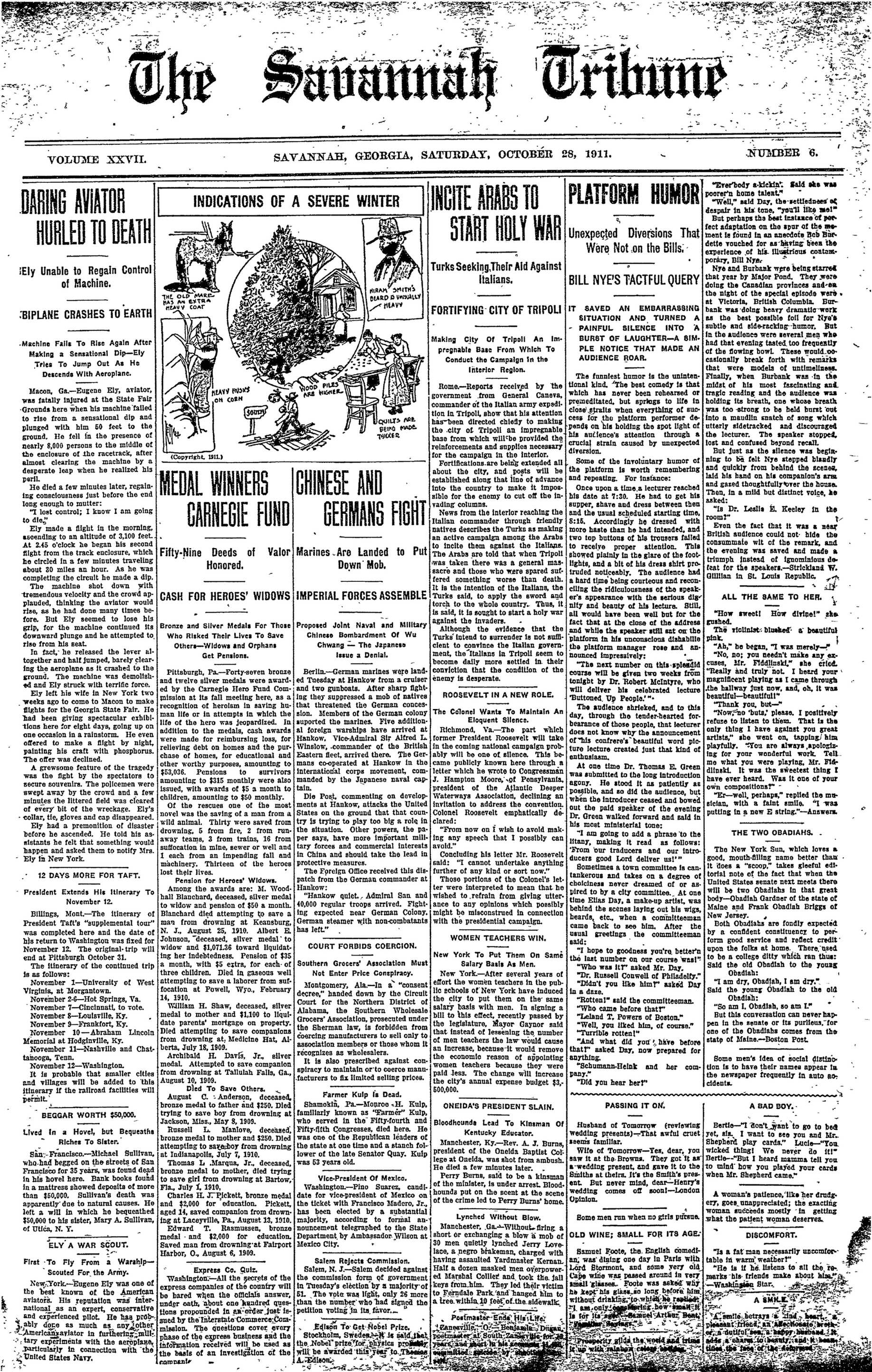
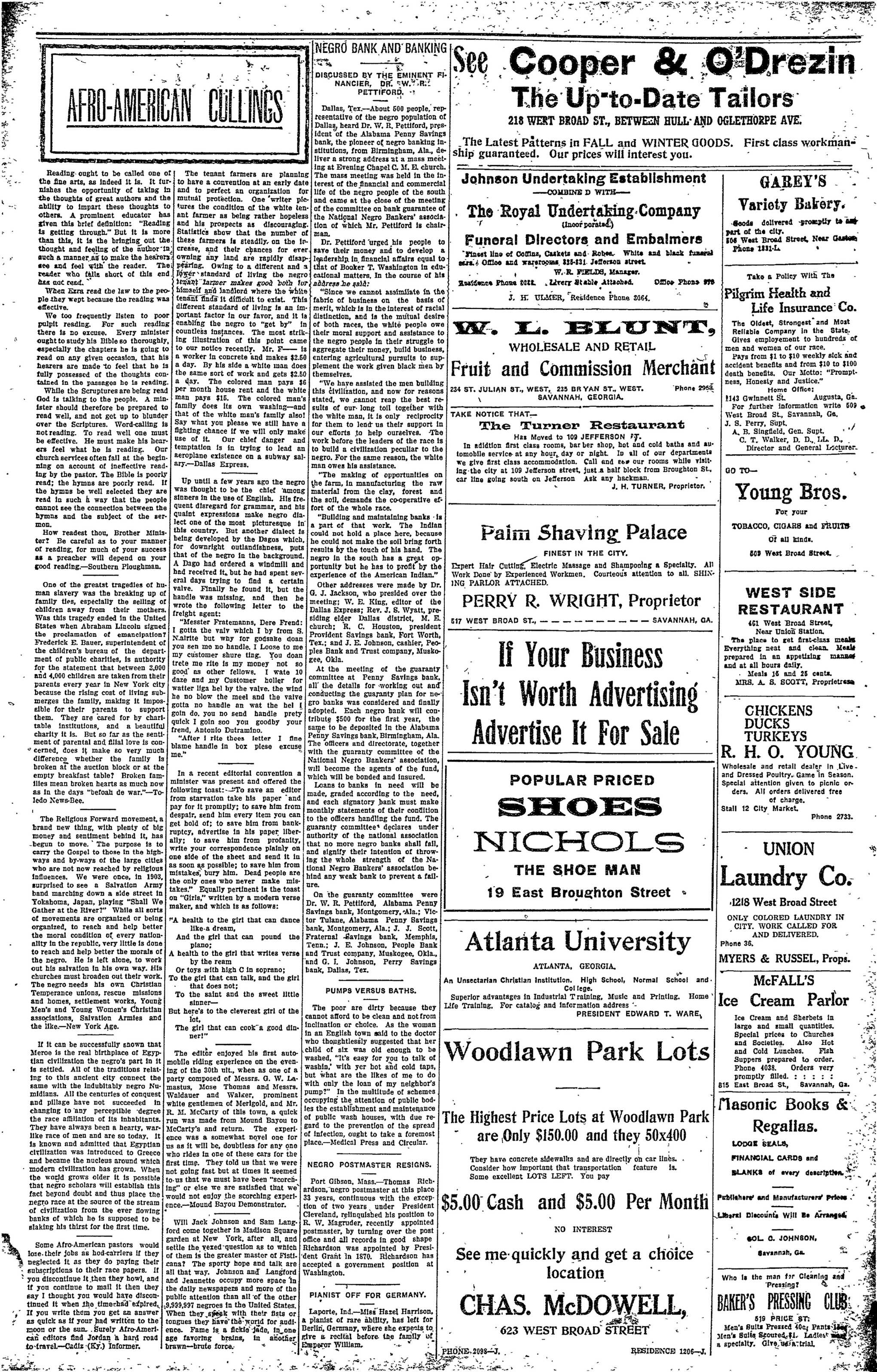
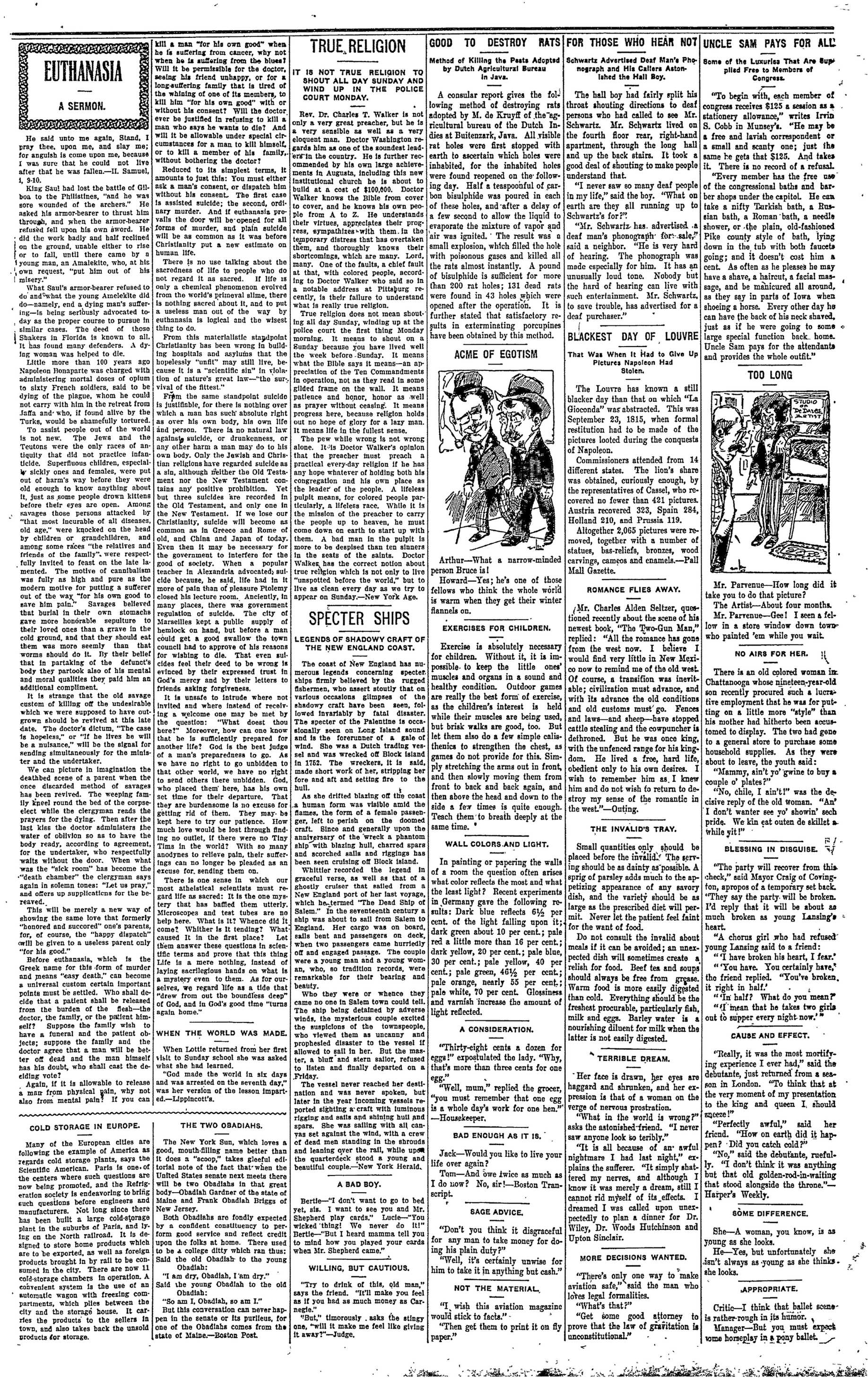
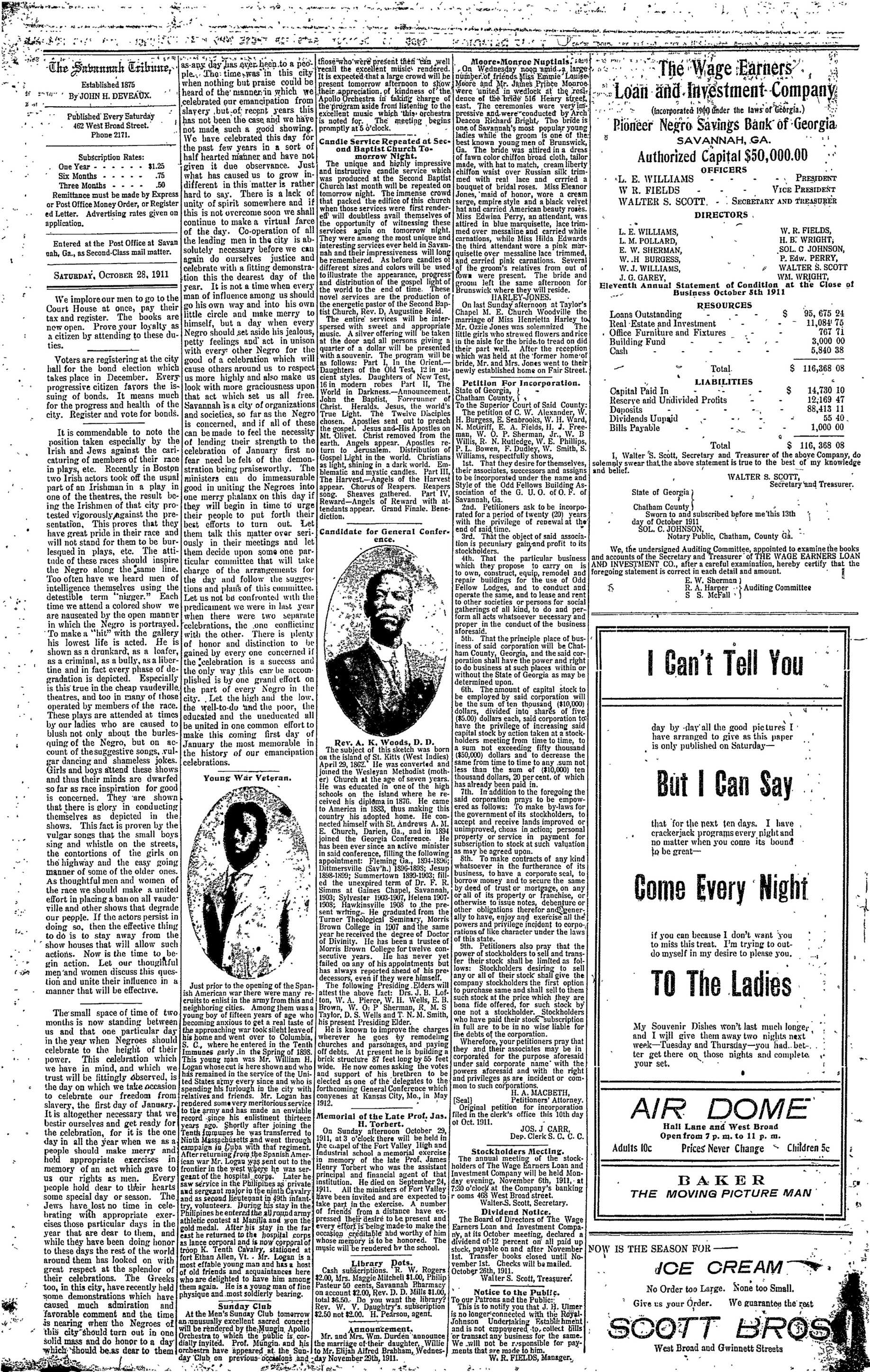
Page text (machine-generated)
VOLUME XXVII.
DARING AVIATOR HURLED TO DEATH
Ely Unable to Regain Control of Machine.
BIPLANE CRASHES TO EARTH
Machine Falls To Rise Again After Making a Sensational Dip—Ely Tries To Jump Out As He Descends With Aeroplane.
Macon, Ga.—Eugene Ely, aviator, was fatally injured at the State Fair Grounds here when his machine failed to rise from a sensational dip and plunged with him 50 feet to the ground. He fell in the presence of nearly 8,000 persons to the middle of the enclosure of the racetrack, after almost clearing the machine by a desperate leap when he realized his peril.
He died a few minutes later, regaining consciousness just before the end long enough to mutter:
"I lost control; I know I am going to die."
Ely made a flight in the morning, ascending to an altitude of 3,100 feet. At 2.45 o'clock he began his second flight from the track enclosure, which he circled in a few minutes traveling about 20 miles an hour. As he was completing the circuit he made a dip. The machine shot down with tremendous velocity and the crowd applauded, thinking the aviator would rise, as he had done many times before. But Ely seemed to lose his grip, for the machine continued its downward plunge and he attempted to rise from his seat. In fact, he released the lever altogether and half jumped, barely clearing the aeroplane as it crashed to the ground. The machine was demolished and Ely struck with terrific force.
Ely left his wife in New York two weeks ago to come to Macon to make flights for the Georgia State Fair. He had been giving spectacular exhibitions here for eight days, going up on one occasion in a rainstorm. He even offered to make a flight by night, painting his craft with phosphorus. The offer was declined.
A grewsome feature of the tragedy was the fight by the spectators to secure souvenirs. The policemen were swept away by the crowd and a few minutes the littered field was cleared of every bit of the wreckage. Ely's collar, tie, gloves and cap disappeared. Ely had a premonition of disaster before he ascended. He told his assistants he felt that something would happen and asked them to notify Mrs. Ely in New York.
12 DAYS MORE FOR TAFT.
President Extends His Itinerary To November 12.
Billings, Mont.-The itinerary of President Taft's "supplemental tour" was completed here and the date of his return to Washington was fixed for November 12. The original-trip will end at Pittsburgh October 31. The itinerary of the continued trip is as follows:
November 1—University of West Virginia, at Morgantown.
November 2-6—Hot Springs, Va.
November 7—Cincinnati, to vote.
November 8—Louisville, Ky.
November 9—Frankfort, Ky.
November 10—Abraham Lincoln Memorial at Hodgville, Ky.
November 11—Nashville and Chattanooga, Tenn.
November 12—Washington.
It is probable that smaller cities and villages will be added to this itinerary if the railroad facilities will permit.
Lived in a Hovel, but Bequeathe
Riches To Sister.
San. Francisco—Michael Sullivan,
who had begged on the streets of San
Francisco for 35 years, was found dead
in his hovel here. Bank books found
in a mattress showed deposits of more
than $50,000. Sullivan's death was
apparently due to natural causes. He
left a will in which he bequeathed
$50,000 to his sister, Mary A. Sullivan,
of Utica, N. Y.
First To Fly From a Warship—Scouted For the Army.
New York—Eugene Ely was one of the best known of the American aviators. His reputation was international as an expert, conservative and experienced pilot. He has probably done as much as any other American aviator in furthering military experiments with the aircraft, particularly in connection with the United States Navy.
INDICATIONS OF A SEVERE WINTER
THE OLD MARE
MAS AN EXTRA
HEAVY COAT
MIRAM SMITH'S
BEARD D VOCUALLY
HEAVY
HEAVY FUSKS
ON CORN
WOOD PILES
ARE HIGHER
QUILTS ARE
BEING MADE
THICKER
MEDAL WINNERS
CARNEGIE FUND
Fifty-Nine Deeds of Valor Honored.
CASH FOR HEROES' WIDOWS
Bronze and Silver Medals For Those Who Risked Their Lives To Save Others—Wildows and Orphans
Pittsburgh, Pa.—Forty-soven bronze and twelve silver medals were awarded by the Carnegie Hero Fund Commission at its fall meeting here, as a recognition of herolism in saving human life or in attempts in which the life of the hero was jeopardized. In addition to the medals, cash awards were made for reimbursing loss, for relieving debt on homes and the purchase of homes, for educational and other worthy purposes, amounting to $53,036. Pensions to survivors amounting to $315 monthly were also issued, with awards of $5 a month to children, amounting to $50 monthly.
Of the rescues one of the most novel was the saving of a man from a wild animal. Thirty were saved from drowning, 5 from fire, 2 from runaway teams, 3 from trains, 16 from suffocation in mine, sewer or well and 1 each from an impending fall and machinery. Thirteen of the heroes lost their lives.
Pension for Heroes' Widows.
Among the awards are: M. Woodhall Blanchard, deceased, silver medal to widow and pension of $50 a month.
Blanchard died attempting to save a man from drowning at Keansburg.
N. J., August 25, 1910. Albert E. Johnson, deceased, silver medal to widow and $1,071.36 toward liquidating her indebtedness. Pension of $55 a month, with $5 extra, for each of three children. Died in gaseous well attempting to save a laborer from suffocation at Powell, Wyo., February 14, 1910.
William H. Shaw, deceased, silver medal to mother and $1,100 to liquidate parents' mortgage on property.
Died attempting to save companions from drowning at Medicine Hat, Alberta July 18, 1909.
Archibald H. Davis, Jr., silver medal. Attempted to save companion from drowning at Tallulah Falls, Ga., August 10, 1909. Died To Save Others.
August C. Anderson, deceased, bronze medal to father and $250. Died trying to save boy from drowning at Jackson, Miss., May 8, 1909.
Russell L. Manlove, deceased, bronze medal to mother and $250. Died attempting to save boy from drowning at Indianapolis, July 7, 1910.
Thomas L. Marqua, Jr., deceased, bronze medal to mother, died trying to save girl from drowning at Bartow, Fla., July 1, 1910.
Charles H. J. Pickett, bronze medal and $2,000 for education. Pickett, aged 14, saved companion from drowning at Laceyvillle, Pa., August 13, 1910.
Edward T. Rasmussen, bronze medal and $2,000 for education.
Saved man from drowning at Fairport Harbor, O., August 6, 1909.
Express Co. Quiz.
Washington: All the secrets of the express companies of the country will be bared when the officials answer, under oath, about one hundred questions propounded in an order, just issued by the Interstate Commerce Commission. The questions cover every phase of the express business and the information received will be used as the basis of an investigation of the companies
SAVANNAH, GEORGIA, SATURDAY, OCTOBER 28, 1911.
CHINESE AND GERMANS FIGHT
Marines Are Landed to Put Down Mob.
IMPERIAL FORCES ASSEMBLE
Proposed Joint Naval and Military Chinese Bombardment Of Wu Chwang — The Japanese Issue a Denial.
Berlin—German marines were landed Tuesday at Hankow from a cruiser and two gunboats. After sharp fighting they suppressed a mob of natives that threatened the German concession. Members of the German colony supported the marines. Five additional foreign warships have arrived at Hankow, Vice-Admiral Sir Alfred L. Winslow, commander of the British Eastern fleet, arrived there. The Germans co-operated at Hankow in the international corps movement, commanded by the Japanese naval captain.
Die Post, commenting on developments at Hankow, attacks the United States on the ground that that country is trying to play too big a role in the situation. Other powers, the paper says, have more important military forces and commercial interests in China and should take the lead in protective measures.
The Foreign Office received this dispatch from the German commander at Hankow:
"Hankow quiet. Admiral San and 40,000 regular troops arrived. Fighting expected near German Colony. German steamer with non-combatants has left."
COURT FORBIDS COERCION.
Southern Grocers' Association Must Not Enter Price Conspiracy.
Montgomery, Ala.—In a "consent decree," handed down by the Circuit Court for the Northern District of Alabama, the Southern Wholesale Grocers' Association, prosecuted under the Sherman law, is forbidden from coercing manufacturers to sell only to association members or those whom it recognizes as wholesalers.
It is also prescribed against conspiracy to maintain or to coerce manufacturers to fix limited selling prices.
Farmer Kulp Is Dead.
Shamokin, Pa.-Monroe -H. Kulp, familiarly known as "Farmér" Kulp, who served in the Fifty-fourth and Fifty-fifth Congresses, died here. He was one of the Republican leaders of the state at one time and a stanch follower of the late Senator Quay. Kulp was 53 years old.
Vice-President Of Mexico
Washington.-Pino Suarez, candidate for vice-president of Mexico on the ticket with Francisco Madero, Jr., has been elected by a substantial majority, according to formal announcement telegraphed to the State Department by Ambassador Wilson at Mexico City.
Salem Relects Commislion
Salem, N. J.—Salem decided against the commission form of government in Tuesday's election by a majority of 51. The vote was light, only 26 more than the number who had signed the petition voting in its favor..
Edison To Get Nobel Prize.
Stockholm, Sweden.—N is said that the Nobel prize for physics probably will be awarded this year to Thomas A. Edison.
INCITE ARABS TO START HOLY WAR
INCITE ARABS TO START HOLY WAR
Turks Seeking,Their Aid Against Italians.
FORTIFYING CITY OF TRIPOLI
Making City Of Tripoll An impregnable Base From Which To Conduct the Campaign In the Interior Region.
Rome.—Reports received by the government from General Caneva, commander of the Italian army expedition in Tripoll, show that his attention has been directed chiefly to making the city of Tripoll an impregnable base from which will be provided the reinforcements and supplies necessary for the campaign in the interior.
Fortifications are being extended all about the city, and posts will be established along that line of advance into the country to make it impossible for the enemy to cut off the invading columns.
News from the interior reaching the Italian commander through friendly natives describes the Turks as making an active campaign among the Arabs to incite them against the Italians. The Arabs are told that when Tripoll was taken there was a general massacre and those who were spared suffered something worse than death. It is the intention of the Italians, the Turks said, to apply the sword and torch to the whole country. Thus, it is said, it is sought to start a holy war against the invaders. Although the evidence that the Turks intend to surrender is not sufficient to convince the Italian government, the Italians in Tripoll seem to become daily more settled in their conviction that the condition of the enemy is desperate.
ROOSEVELT IN A NEW ROLE.
The Colonel Wants To Maintain An Eloquent Silence.
Richmond, Va.—The part which former President Roosevelt will take in the coming national campaign probably will be one of silence. This became publicly known here through a letter which he wrote to Congressman J. Hampton Moore, of Pennsylvania, president of the Atlantic Deeper Waterways Association, declining an invitation to address the convention. Colonel Roosevelt emphatically declared:
"From now on I wish to avoid making any speech that I possibly can avoid."
Concluding his letter Mr. Roosevelt said: "I cannot undertake anything further of any kind or sort now."
Those portions of the Colonel's letter were interpreted to mean that he wished to refrain from giving utterance to any opinions which possibly might be misconstrued in connection with the presidential campaign.
WOMEN TEACHERS WIN.
New York To Put Them On Same Salary Basis As Men.
New York.—After several years of effort the women teachers in the public schools of New York have induced the city to put them on the same salary basis with men. In signing a bill to this effect, recently passed by the legislature, Mayor Gaynor said that instead of lessening the number of men teachers the law would cause an increase, because it would remove the economic reason of appointing women teachers because they were paid less. The change will increase the city's annual expense budget $3,500,000.
ONEIDA'S PRESIDENT SLAIN.
Manchester, Ky.—Rev. A. J. Burns, president of the Onelida Baptist College at Onelida, was shot from ambush. He died a few minutes later. Perry Burns, said to be a kinsman of the minister, is under arrest. Bloodhounds put on the scent at the scene of the crime led to Perry Burns' home
Lynched Without Blow.
Manchester, Ga. Without firing a short or exchanging a blow a mob of 30 men quietly lynched Jerry Lovelace, a negro brakeman, charged with having assaulted Yardmaster Kernan. Half a dozen masked men overpowered Marshal Collier and took the jail keys from him. They led their victim to Ferndale Park and hanged him to a tree within 10 feet of the sidewalk.
Postmaster Ends His Life.
Zaneville, O.—Henriella, Dugan, postmaster at South Zaneville for 20 years, and short in his sentence of 60 committed guilty by a shooter safe.
PLATFORM HUMOR
Unexpected Diversions That Were Not on the Bills.
BILL NYE'S TACTFUL QUERY
IT SAVED AN EMBARRASSING SITUATION AND TURNED A PAINFUL SILENCE INTO A BURST OF LAUGHTER—A SIMPLE NOTICE THAT MADE AN AUDIENCE ROAR.
The funniest humor is the unintentional kind. The best comedy is that which has never been rehearsed or premeditated, but springs to life in close straits when everything of success for the platform performer depends on his holding the spot light of his audience's attention through a crucial strain caused by unexpected diversion.
Some of the involuntary humor of the platform is worth remembering and repeating. For instance:
Once upon a time a lecturer reached his date at 7:30. He had to get his supper, shave and dress between then and the usual scheduled starting time, 8:15. Accordingly he dressed with more haste than he had intended, and two top buttons of his trousers failed to receive proper attention. This showed plainly in the glare of the footlights, and a bit of his dress shirt protruded noticeably. The audience had a hard time being courteous and recoiling the ridiculousness of the speaker's appearance with the serious dignity and beauty of his lecture. Still, all would have been well but for the fact that at the close of the address and while the speaker still sat on the platform in his unconsciona dishabillie the platform manager rose and announced impressively:
"The next number on this splendid course will be given two weeks from tonight by Dr. Robert McIntyre, who will deliver his celebrated lecture 'Buttoned Up People.'"
The audience shrieked, and to this day, through the tender-hearted forbearance of those people, that lecturer does not know why the announcement of his conferee's beautiful word picture lecture created just that kind of enthusiasm.
At one time Dr. Thomas E. Green was submitted to the long introduction agony. He stood it as patiently as possible, and so did the audience, but when the introducer ceased and bowed out the paid speaker of the evening Dr. Green walked forward and said in his most ministerial tone:
"I am going to add a phrase to the litany, making it read as follows: 'From our traducers and our introducers good Lord deliver us!'"
Sometimes a town committee is cantankerous and takes on a degree of choicness never dreamed of or aspired to by a city committee. At one time Elias Day, a make-up artist, was behind the scenes laying out his wigs, beards, etc., when a committeeman came back to see him. After the usual greetings the committeeman said:
"I hope to goodness you're better'n the last number on our course was!"
"Who was it?" asked Mr. Day.
"Dr. Russell Conwell of Philadolf."
"Didn't you like him?" asked Day in a daze.
"Rotten!" said the committeeman.
"Who came before that!"
"And what did you', have before that?" asked Day, now prepared for anything.
"Schumann-Heink and her company."
"Did you hear her?"
PASSING IT ON.
Husband of Tomorrow (reviewing wedding presents)—That awful cruel seems familiar.
Wife of Tomorrow—Yes, dear, you saw it at the Browns. They got it as a wedding present, and gave it to the Smiths at theirs. It's the Smith's present. But never mind, dear—Henry's wedding comes off soon!—London Opinion.
Some men run when no girls pursue.
OLD WINE; SMALL FOR ITS AGE.
Samuel Foote, the English comedian, was dising one day in Paris with Lord Stormont, and some very old Cape wine was passed around in very small glasses. Foote was asked why he kept his glass so long before him without drinking, to which he replied, I am only considering how small it is for its age—Samuel Arthur, Beant, Samuel Bartings.
Preposity glides the world and trims it up with raindrop colour bedding.
NUMBER 6.
"Everbody a kickin', said she was poorer'n home talent." "Well', said Day, the settledness of despair in his tone, 'you'll like me!' But perhaps the best instance of perfect adaptation on the spur of the moment is found in an anecdote Bob Burdette vouched for as having been the experience of his illustrious contemporary, Bill Nye.
Nye and Burbank were being starred that year by Major Pond. They were doing the Canadian provinces and en- the night of the special episode were at Victoria, British Columbia. Burbank was doing heavy dramatic work as the best possible foll for Nye's subtle and side-racking-humor. But in the audience were several men who had that evening tasted too frequently of the flowing bowl. These were oocasionally break forth with remarks that were models of untilmelliness. Finally, when Burbank was in the midst of his most fascinating and tragic reading and the audience was holding its breath, one whose breath was too strong to be held burst out into a maudlin snatch of song which utterly sidetracked and discouraged the lecturer. The speaker stopped, lost and confused beyond recall.
But just as the silence was beginning to be felt Nye stepped blandly and quickly from behind the scenes, laid his hand on his companion's arm and gazed thoughtfully over the house. Then, in a mild but distinct volge, he asked:
"Is Dr. Leslie H. Keeley in the room?"
Even the fact that it was a near British audience could not hide the consummate wit of the remark, and the evening was saved and made a triumph instead of ignominious defeat for the speakers.—Strickland W. Gillilian in St. Louis Republic.
"How sweet! How divine!" she gushed.
The violinist blushed a beautiful pink.
"Ah," he began, "I was merely—"
"No, no; you needn't make any excuses, Mr. Fiddlinski." she cried.
"Really and truly not. I heard your magnificent playing as I came through the hallway just now, and, oh, it was beautiful—beautiful!"
"Thank you, but—"
"Now, no 'buts,' please. I positively refuse to listen to them. That is the only thing I have against you great artists," she went on, tapping him playfully. "You are always apologizing for your wonderful work. Tell me what you were playing, Mr. Fiddlinski. It was the sweetest thing I have ever heard. Was it one of your own compositions?"
"Er—well, perhaps," replied the musician, with a faint smile. "I was putting in a new Ei string."—Answer.
THE TWO OBADIAHS.
The New York Sun, which loves a good, mouth-filling name better than it does a "scoop," takes gleeful editorial note of the fact that when the United States senate next meets there will be two Obadiahs in that great body—Obadiah Gardner of the state of Malne and Frank Obadiah Briggs of New Jersey.
Both Obadiahs are fondly expected by a confident constituency to perform good service and reflect credit upon the folks at home. There, used to be a college ditty which ran thus: Said the old Obadiah to the young Obadiah:
"I am dry, Obadiah, I am dry."
Said the young Obadiah to the old Obadiah:
"So am I, Obadiah, so am I"
But this conversation can never happen in the senate or its purlieus, for one of the Obadiahs comes from the state of Maine.—Boston Post.
Some men's idea of social distinction is to have their names appear in the newspaper frequently in auto accidents.
Bertle—"I don't want to go to bed yet, sia. I want to see you and Mr. Shepherd play cards." Lucie—"You wicked thing! We never do it!" Bertle—"But I heard mamma tell you to mind how you played your cards when Mr. Shepherd came."
A woman's patience, like her drudgery, goes unappreciated; the exacting woman succeeds mostly in getting what the patient woman deserves.
DISCOMFORT.
"Is a fat man necessarily uncomfortable in warm weather?"
Reading: ought to be called one of
the fine arts, as Indeed it Is. It fur-
Mishes the opportunity of taking in
tho thoughts of great authors and the
sbillty to impart these thoughts to
others. A prominent educator has
xiven this brief definition: “Reading
1g getting through.” But it is more
than this, ft {s the bringing out the.
thought and feeling of the author-tn,
guch a manner.ag to make the hearers:
@ee and feel with the reader. The:
reader who félls short of this end.
tas cat ceed. ~
When Ezra read the law to the peo-
Ple they wept because the reading was
effective.
We too frequently Usten to poor
pulpit reading. For such reading
there {8 no excuse. Every minister
ought to study his Bible so thoroughly,
especially the chapters he is going to
read on any given occasion, that his
hearers are made ‘to feel that he 1s
fully possessed of the thoughts con-
tained in the passeges he is reading.
While the Scruptures are being read
God is talking to the people, A min-
ister should therefore be prepared to
read well, and not get up to blunder
ever the Scriptures. Word-calling 1s
notreading. To read well one must
be effective. He must make his hear-
ers feel what he [s reading. Our
church services often fall at the begin-
ning on account of ineffective read-
ing by the pastor. The Bible is poorly
read; the hymns are poorly read. If
the hymns be well selected they are
read in such & way that the people
cannot see the connection between the
hymns and the subject of the ser
mon,
How readest thou, Brother Minis-
ter? Be careful as to your manner
of reading, for much of your success
as a preacher will depend on your
good reading—Southern Ploughman.
One of the greatst tragedies of hu-
man slavery was the breaking up of
family ties, espectally the selling of
ebildren away from their mothers.
‘Was this tragedy ended in the United
States when Abraham Lincoln signed
the proclamation of emancipation?
Frederick E. Bauer, superintendent of
the children’s bureau of the depart-
ment of public charities, Is authority
for the statement that between 2,000
and 4,000 children are taken from their
parents every year in New York city
because the rising cost of living sub-
merges the family, making it impos-
eible for their parents to support
them. They are cared for by charl-
table institutions, and a beautifw
charity it is. But so far as the senti-
ment of parental and fillal love is con-
cerned, does it make so very much
difference whether the family Is:
broken at the auction block or at the
empty breakfast table? Broken fam-
ilies mean broken hearts as much now
as In the days “befoah de war.”—To-
ledo News-Bee.
The Religious Forward movement, a
brand new thing, with plenty of big
Toney and sentiment behind {t, has
-begun to move.’ The purpose is to
carry the Gospel to those In the high-
ways and by-ways of the large citles
who are not now reached by religious
Influences. We were once, in 1903,
surprised to see @ Salvation Army
band marching down a side street in
Yokahoma, Japan, playing “Shall We
Gather at the River?” While all sorts
of movements are organized or being
organized, to reach and help better
the moral condition of every natlon-
ality in the republic, very little 1s done
to reach and help better the morals of
the negro. He is left alone, to work
out his salvation In his own way. His
churches must broaden out their work.
The negro needs his own Christian
Temperance unions, rescue missions
and homes, settlement works, Young
Men's and Young Women’s Christan
associations, Salvation Armies and
the like—New York Age.
If It can be successfully snown that
Meroe is the real birthplace of Egyp-
tlan civilization the negro’s part in it
is settled. All of the traditions relat-
Ing to this ancient city connect the
same with the Indublitably negro Nu-
midians. All the centurfes of conquest
and pillage have not succeeded in
changing to‘any perceptible ‘degree
the race affiliation of its inhabitants.
They have always been a hearty, war-
lke race of men and are so today, It
is known and admitted that Egyptian
celvilization was Introduced to Greece
and became the nucleus around whtch
modern civilization has grown. When
the world grows older ft ts possible
that negro scholars will establish this
fact beyond doubt and thus place the
negro race at the source of the stream
of civilization from the ever flowing
banks of which he {s supposed to be
slaking his thirst for the first time.
Some Afro-American pastors would
Jose.their jobs as hod-carriers if they
neglected it as they do paying their
subscriptions to thelr race papers. If
you discontinue it then they howl, and
if you continue to mail {t then they
say I thought you would have discon-
tinued It when the timechdd expired,
If you write them you get en answer
as quick ag if your had written to the
moon or the sun. . Surely Afro-Amert-
can editors find Jotdan a hard road
to-travel—Cadiz -(Ky.) Informer,
‘The tenant farmers are planning
to have a convention at an early date
and to perfect an organization for
mutual protection. One ‘writer pic-
tures the condition af the white ten-
ant farmer as being rather hopeless
and his prospects as discouraging.
Statietics show that the number of
these farmera Is steadily. on the {r-
crease, and thelr chances for ever
owning any land are rapidly disap-
pédring. Owing to a different and 3
Iyer standard of lving the negro
seman} “larmer makes good both tor
himself and Jandlord where the white
tenant finds it dificult to exist. This
different standard of living fs an im-
portant factor in our favor, and it fa
enabling the negro to “get by” in
countless instances. The most strik-
ing illustration of this polnt came
to our notics recently. Mr, F—— fs
a worker in concrete and makes $2.60
aday. By his side a white man does
the same sort of work and gets $2.50
a day. The colored man pays $6
per month house rent and the white
man pays $15. The colored man's
family does its own washing—and
that of the white man’s famlly also!
Say what you please we still have a
fighting chance if we will only make
use of it, Our chief danger and
temptation ts in trying to lead an
eeroplane existence on a subway sal-
ary.—Dallas Express,
Up until a few years ago the negro
was thought to be the chfef ‘among
sinners in the uso of English, His fre.
quent disregard for grammar, and his
quaint expressions make negto dla-
lect one of the most picturesque in
this country. But another dialect ts
being developed by the Dagos which,
for downright outlandishness, puts
that of the negro In the background.
A Dago had ordered a windmill and
had received {t, but he had spent sev-
eral days trying to find a certain
valve. Finally he found it, but the
handle was missing, and then he
wrote the following letter to the
freight agent:
“Messter Fratemanns, Dere Frend:
I gotta the valy which I by from S.
N.alrite but why for godsake doan
you sen me no handle, I Loose to me
my customer shure ting. You doan
trete me rite 1s my money not 80
good’ os other fellows, I wate 10
daze and my Customer holler for
watter liga hel by the valve. the wind
he no blow the meel and the valve
gotta no handle an wat the hel L
goin do. you no send handle prety
quick I goin soo you goodby your
frend, Antonlo Dutramino.
“After I rite thees fetter I fine
blame handle in bor plese excuse :
me.”
In a recent editorfal convention a
minister was present and offered the
following toast:---To save an editor
from starvation take his paper “and
pay for it promptly; to save him from
despair, send him every Item you can
get hold of; to save bim from bank.
ruptcy, advertise in his paper liber-
ally; to save him from profanity,
write your correspondence plainly on
one side of the sheet and send it in
a8 soon as possible; to save him from
mistakes, bury him. Dead people are
the only ones who never make mis-
takes.” Equally pertinent Is the toast
on “Girls,” written by a modern verse
maker, and which fs as follows:
“A health to the girl that can dunce
like-a dream,
And the girl that can pound the
plano;
A health to the girl that writes verse
by the ream =
Or toys with high C in soprano;
To the girl that can talk, and the girl
+ that does not;
To the saint and the sweet ttle
sinner—
But here's to the cleverest girl of the
lot,
The girl that can cook’a good din-
ner!”
The editor enjoyed his first auto-
mobile riding experience on the even-
ing of the 30th ult, when as one of a
party composed of Messrs. G. W. La-
mastus, Mose Thomas and Messrs.
Waldauer and Walser, prominent
white gentlemen of Merlgold, and Mr.
R. M. McCarty of thls town, a quick
run was made from Mound Bayou to
McCarty’s and return. The experi-
ence was a somewhat novel one for
us as it will be, doubtless for any one
who rides In one of these cars for the
first time. They told us that we were
not golng fast but at times it seemed
to-us that we must have been “scorcii-
ing” or else we are satisfied that we
would not enjoy the scorching expert-
ence.—Mound Bayou Demonstrator...
Will Jack Johnson and Sam Lang:
ford come together in Madison Square
garden at New York, after all, and
settle the vexed question ag to which
of them is the greater master of Fistt.
cana? The sporty hope and talk are
all that way. Johnson and Langford
and Jeannette occupy more space ‘in
the dally newspapers and more of the
public attention than all ‘of the other
9,999,897 negroes in the United States,
When they spegk with their fists or
tongues they liave’thé-world for audi-
ence. Fame is 8 fickle Jade, in_one
age favoring braing, in atother
brawn—brate force. < =
ee BANK AND’ BANKING
‘orecuiéiien BY THE S anenr Fie
NANCIER, DR. SW.7>R:2
- PETTIFORD. -* *
SR eee eRe Oe oat y pace eee et Mee mee a ate
tegentative of the negro population of
Dallas, heard Dr. W, R, Pettiford, pres-
ident of the Alabama Penny Savings
bank, the pioneer of negro banking in-
atitutfons, from Birmingham, Alz., de-
liver a strong address at a mass meét-
ing at Evening Chapel C. Mf. B. church.
The mass meeting was held fn the in-
terest of the financial and commercial
Ute of the negro people of the south
and came at the close of the meeting
of the committee on bank guarantee of
the National Negro Bankers’ associa-
tlon of which Mr, Pettlford is chalr-
man,
Dr. Pettiford ‘urged his people to
Saye their money and to develop 4
Lpterabin in financial affairs equal to
jat of Booker T, Washington in edu-
‘eational matters, In the course of his
address he gaia:
. “Since we cannot assimilate in the
fabric of business on the basis of
merit, which is In the interest of racial
distinction, and is the mutual desire
of both races, the white people owe
thelr moral support and asstatance to
the negro people in their struggle to
aggregate their money, build business,
entering agricultural pursuits to sup-
Plement the work given black men by
themselves.
“We hare assisted the men building
this ¢ivilization, and now for reasons
stated, we cannot reap the best re
sults of our: long toll together with
the white man, it is only reciprocity
for them to lend us thelr support in
our efforts to help ouraelves. ‘The
work before the leaders of the race !s |
to build a civilization peculiar to the |
negro. For the same reason, the white
man owes his assistance.
“The making of opportunities on
the farm, In manufacturing the raw
material from the clay, forest and
the soil, demands the co-operative ef-
fort of the whole race.
“Bullding and maintaining banks -is
a part of that work. The Indian
could not hold a place here, because
he could not make the soll bring forth
results by the touch of his hand, The
negro In the south has a great op-
portunity but he has to profit by the
experience of the American Indfan.”
Other addresses were made by Dr.
G. J. Jackson, who presided over the
meeting; W. E. King, editor of the
Dallas Express; Rev. J, S. Wyatt, pre-
siding elder Dallas district, M. E.
church; R, C, Houston, president
Provident Savings bank, Fort Worth,
Tex.; and J. E. Johnson, cashier, Peo |
les Bank and Trust company, Musko-
see, Okla.
At the meeting of the guaranty
committee at Penny Savings bank,
I’ the details for working out and
onducting the guaranty plan for ne-
ro banks was considered and finally
dopted. Each negro bank will con-
ribute $500 for the first year, the
ame to be deposited in the Alabama
eniny Savings bank, Birmingham, Ala.
‘he officers and directorate, together
ith the guaranty committee of the
fational Negro Bankers’ asaocfation,
mil become the agents of the fund,
yhich will be bonded and insured.
Loans to banks in need will be
ade, graded according to the need,
nd each signatory bank must make
ionthly statements of their condition
> the officers handling the fund. The
uaranty committee* declares under
uthority of the national resoclation
hat no more negro banks shall fail,
nd signify their intention of throw-
1g the whole strength of the Na-
onal Negro Bankers’ association be-
ind any weak bank to prevent a fail-
re.
On the guaranty committee were
r. W. R. Pettiford, Alabama Penny
avings bank, Montgomery, Alz.; Vic- |“
r Tulane, Alabama Penny Savings | -
ank, Montgomery, Ala.; J. J. Scott,
raternal Savings bank, Memphis,
enn.; J. E. Johnson, People Bank
ad Trust company, Muskogee, Okla.
nd G. —. Johnson, Perry Savings
ank, Dallas, Tex.
‘Atlarita University
ATLANTA, GEORGIA,
o
n Unsectarian Christian Institution. High School, Normal Schoo} and-
Col lege.
Superlor advantages in Industrial Training, Music and Printing. Home
‘fe Training, For catalog and information address *-
PRESIDENT EDWARD T. WARE,
PUMPS VERSUS BATHS.
The poor are dirty because they
cannot afford to be clean and not from
Inclination or choice. As the woman
in an English town said to the doctor
who thonghtlessly suggested that her
child of six was old enough to be
washed, “It's easy for you to talk of
washin,’ with yer hot and cold taps,
but what are the Ikes of me to do
with only the loan of my nelghbor’s
pump?” In the multitude of schemes
occupying the attention of public bod:
les the establishment and maintenance
of public wash houses, with due re-
gard to the prevention of the spread
of infection, ought to take a foremost
place.—Medical Press and Circular.
Woodlawn Park Lots
fg oo :
The Highest Price Lots at Woodlawn Park
~ are Only $150.00 and they 50x400_
‘They have concrete sidewalks and are directly pieamabes. *
Sone cueeleny LOTS LEP. Yor pay
$5.00 Cash and $5.00 Per Month
F % NO INTEREST ;
See me-quickly and get a chidice -
24 location - ;
CHAS. McDOWELL,
tI
be "623 WEST BROAD STREET =<
puoie.oees..- tt; RESIDENCE 1206—-J,
NEGRO POSTMASTER RESIGNS.
Port Gibson, Mass—Thomas Rich-
ardson, negro postmaster at this place
33 years, continuous with the excep-
tion of two years. under President
Cleveland, relinquished his position to
R. W. Magruder, recently appointed
postmaster, by turning over the post
office and all records in good shape
‘Richardson was appointed by Presi-
‘dent Graft In 1870. Richardson has
accepted a government position at
Washington,
_—e—-———-
PIANIST OFF FOR GERMANY.
Laporte, Ind_—Mied Hazel Harrison,
& pianist of rare ability, had left for
Berliri, Gernrany, where she expects to,
give & recital before the family vf
Emperor William. ve Ss
See Cooper & .O2Drezin
.. The Up-to-Date Tailors: |
218 WERT BROAD ST., BETWEEN HULL: AND OGLETHORPE AVE. 2
The Latest Patterns in FALL and WINTER GOODS. First class worksaaité |
‘ship guaranteed. Our prices will interest you. - ~ R
Johnson Undertaking Establishment
: . ——COMBINE D WITH— ®
. The Royal Undertaking-Company
t : Uneot porated) .
. Funeral Directors and Embalmers
"Finest Une of Coffins, Caskets and- Robes. White and black funeral
ecra.é Offloe and warerooms, 335-831. Jefferson street, 2
+ . wi W.-R. FIELDS, Manager,
Raaisence Phone 20f2 . idverr Btadle Attached. OMoy Phone 98
: 3. H ULMER, “Redldence Phone 2064, . ‘
| _ SARBES ~.
| Variety Bakery. ©
Gcoda dolivered -promptly to amt
part of the clty. .
106 West Brood Street, Near Gastor
Phone 1831: . .
Take a Policy With The 2
Pilgrim Health and
Life Insurance’ Co.
VW. KX. BLOONS,
. WHOLESALE AND RETAIL :
. 8 ee , gr
Fruit and Commission Merchant
234 ST. une 8T., wieUdanotonGae “Phone 2988,
| The Oldest, Strongest and Most
Rellable Company in the State,
Gives employement to hundreds of
men and women of our race, a
Pays from $1 to $10 weekly sick and
accident benefits and from $10 to $100
death benefits, Our Motto: “Prompt-
ness, Honesty and Justice.”
Home Office: :
1143 Gwinnett St. Augusta, Ga.
For further information write 609.
West Broad St, Savannah, Ga,
J. 8. Perry, Supt.
A,B, Singfleld, Gen. Supt. uf
G. T, Walker, D. DLL. D, |
Director and General Lecturer.
TAKE NOTICE THAT—
The Turner Restaurant.
Has Moved to 109 JEFFERSON fF.
In adidtion first class rooms, bar ber shop, hot and cold baths snd au:
tomobile service at any hour, day or night. Ip all of our departments
We give first class accommodation. Call and ees our rooms while visit:
ing-the clty at 109 Jefferson etreet, just.a half block from Broughton St.,
car ine going south on Jefferson Ask any hackman. eg
= J. H, TURNER, Proprietor,
ao TO— . ;
Young Bros.
For your .
TOBACCO, CIGARS and FRUITS
Of all kinds.
80D West Broad Btrect, |
4
Paim Shaving Palace
FINEST IN THE CITY.
Expert Hair Cutting ‘Hlectrte Massage and Shampoolng 8 Specialty, All
Work Done’ by Experfenced Workmen, Courteous attention to all. SHIN-
ING PARLOR ATTACHED.
PERRY R. WRIGHT, Proprietor |
817 WEST BROAD ST., — — — — —— — — — — SAVANNAH, GA.
WEST SIDE
RESTAURANT .
461 West Broad Street,
Near Union Station,
* fhe place to get first-class meals
Byerything neat and clean Meal
prepared in an appetizing mannet
and at all boura daily,
+ Meals 16 and 25 cents.
MRS, A 8, SCOTT, Proprictresa
_ Tf Your Business
Isn’t Worth Advertising
Advertise It For Sale.
CHICKENS °¢-.
DUCKS :
TURKEYS ;
R. H. O. YOUNG.
Wholesale and retail dealer In Live-
and Dressed Poultry. Game in Season.
Special attention given to picnic on
ders. All orders delivered free
of charge, -
Stall 12 City Market.
- Phone 2733.
POPULAR PRICED
SHOES
NICHOLS |
. THE SHOE MAN
18 East Broughton Street «
Laundry Co.
| 1218 West Broad Street
| ONLy COLORED LAUNDRY IN
| CITY, WORK CALLED FOR
AND DELIVERED, oa
Phone 36,
MYERS & RUSSEL, Props.
———
McFALL’S
,
Ice Cream Parlor
Ice Cream and Sherbets in
large and small quantities.
Bpectal prices to Churches
and Societies. Also Hot
and Cold Lunches, Fish
Suppers prepared to order. :
Phone 4038 Orders very
promptly filled. : : 2:
B15 East Broad St, Savannah, Ga.
flasonic Books &-.
Regalias.
Lopak SEALs, f
FINANCIAL CARDS and wih
BLANKS of every doscripton *°
Prtllahere’ and Manufacturers’ Priose
Jtbarel Diecotints Will Be Arranged,
a: GOL. 0. JOHNSON, c
, Gayannah, Ga Ba ;
“Who fs the man for Cleaning and
“Pressing? ere
"PRESSING CLUB:
BAKER'S a
. . “te
819 PRICE st: a
Men's Suits Pressed 4c; Pants-1deg:.
Men's Salts Soured fl. Ladlest wanes
a spectalty, Give wéiactrial, = * 3h)
es
He said unto me again, Stand, I pray thee, upon me, and slay me; for anguish is come upon me, because I was sure that he could not live after that he was fallen.—II. Samuel, 1, 9-10.
King Saul had lost the battle of Gilboa to the Philistines, "and he was sore wounded of the archers." He asked his armor-bearer to thrust him through, and when the armor-bearer refused fell upon his own sword. He did the work badly and half reclined on the ground, unable either to rise or to fall, until there came by a young man, an Amalekite, who, at his own request, "put him out of his misery."
What Saul's armor-bearer refused to do and what the young Amelekite did do—namely, end a dying man's suffering—is being seriously advocated today as the proper course to pursue in similar cases. The deed of those Shakers in Florida is known to all. it has found many defenders. A dying woman was helped to die. Little more than 100 years ago Napoleon Bonaparte was charged with administering mortal doses of opium to sixty French soldiers, said to be dying of the plague, whom he could not carry with him in the retreat from Jaffa and who, if found alive by the Turks, would be shamefully tortured.
To assist people out of the world is not new. The Jews and the Teutons were the only races of antiquity that did not practice infanticide. Superfluous children, especially sickly ones and females, were put out of harm's way before they were old enough to know anything about it, just as some people drown kittens before their eyes are open. Among savages those persons attacked by "that most incurable of all diseases, old age," were knocked on the head by children or grandchildren, and among some races "the relatives and friends of the family." were respectfully invited to feast on the late lamented. The motive of cannibalism was fully as high and pure as the modern motive for putting a sufferer out of the way "for his own good to save him pain." Savages believed that burial in their own stomachs gave more honorable sepulture to their loved ones than a grave in the cold ground, and that they should eat them was more seemly than that worms should do it. By their belief that in partaking of the defunct's body they partook also of his mental and moral qualities they paid him an additional compliment.
It is strange that the old savage custom of killing off the undesirable which we were supposed to have outgrown should be revived at this late date. The doctor's dictum, "The case is hopeless," or "If he lives he will be a nuisance," will be the signal for sending simultaneously for the minister and the undertaker.
We can picture in imagination the deathbed scene of a parent when the once discarded method of savages has been revived. The weeping family kneel round the bed of the corpse-elect while the clergyman reads the prayers for the dying. Then after the last kiss the doctor administers the water of oblivion so as to have the body ready, according to agreement, for the undertaker, who respectfully waits without the door. When what was the "sick room" has become the "death chamber" the clergyman says again in solemn tones: "Let us pray," and offers up supplications for the beaved.
This will be merely a new way of showing the same love that formerly "honored and succored" one's parents, for, of course, the "happy dispatch" will be given to a useless parent only "for his good."
Before euthanasia, which is the Greek name for this form of murder and means "easy death," can become a universal custom certain important points must be settled. Who shall decide that a patient shall be released from the burden of the flesh—the doctor, the family, or the patient himself? Suppose the family wish to have a funeral and the patient objects; suppose the family and the doctor agree that a man will be better off dead and the man himself has his doubt, who shall cast the deeling vote? Again, if it is allowable to release a man from physical pain, why not also from mental pain? If you can
COLD STORAGE IN EUROPE.
Many of the European cities are following the example of America as regards cold storage plants, says the Scientific American. Paris is one of the centers where such questions are now being promoted, and the Refrigeration society is endeavoring to bring such questions before engineers and manufacturers. Not long since there has been built a cold-storage plant in the suburbs of Paris, and lying on the North railroad. It is designed to store home products which are to be exported, as well as foreign products brought in by rail to be consumed in the city. There are now 11 cold-storage chambers in operation. A convenient system is the use of an automatic wagon with freezing compartments, which piles between the city and the storage house. It carries the products to the sellers in town, and also takes back the unsold products for storage.
kill a man "for his own good" when he is suffering from cancer, why not when he is suffering from the blues? Will it be permissible for the doctor, seeing his friend unhappy, or for a long-suffering family that is tired of the whining of one of its members, to kill him "for his own good" with or without his consent? Will the doctor ever be justified in refusing to kill a man who says he wants to die? And will it be allowable under special circumstances for a man to kill himself, or to kill a member of his family, without bothering the doctor?
Reduced to its simplest terms, it amounts to just this: You must either ask a man's consent, or dispatch him without his consent. The first case is assisted suicide; the second, ordinary murder. And if euthanasia prevails the door will be opened for all forms of murder, and plain suicide will be as common as it was before Christianity put a new estimate on human life.
There is no use talking about the sacredness of life to people who do not regard it as sacred. If life is only a chemical phenomenon evolved from the world's primeval sillage, there is nothing sacred about it, and to put a useless man out of the way by euthanasia is logical and the wisest thing to do.
From this materialistic stapdpoint Christianity has been wrong in building hospitals and asylums that the hopelessly "unfit" may still live, because it is a "scientific sin" in violation of nature's great law—"the survival of the fittest."
From the same standpoint suicide is justifiable, for there is nothing over which a man has such absolute right as over his own body, his own life and person. There is no natural law against suicide, or drunkenness, or any other harm a man may do to his own body. Only the Jewish and Christian religions have regarded suicide as a sin, although neither the Old Testament nor the New Testament contains any positive prohibition. Yet but three sulcides are recorded in the Old Testament, and only one in the New Testament. If we lose our Christianity, sulcide will become as common as in Greece and Rome of old, and China and Japan of today. Even then it may be necessary for the government to interfere for the good of society. When a popular teacher in Alexandria advocated, sulcide because, he said, life had in it more of pain than of pleasure Ptolemy closed his lecture room. Anciently, in many places, there was government regulation of sulcide. The city of Marselles kept a public supply of hemlock on hand, but before a man could get a good swallow the town council had to approve of his reasons for wishing to die. That even sulcides feel their deed to be wrong is evinced by their expressed trust in God's mercy and by their letters to friends asking forgiveness.
It is unsafe to intrude where not invited and where instead of receiving a welcome one may be met by the question: "What doest thou here?" Moreover, how can one know that he is sufficiently prepared for another life? God is the best judge of a man's preparedness to go. As we have no right to go unbidden to that other world, we have no right to send others there unbidden. God, who placed them here, has his own set time for their departure. That they are burdensome is no excuse for getting rid of them. They may be kept here to try our patience. How much love would be lost through finding no outlet, if there were no Tiny Tims in the world? With so many anodynes to relieve pain, their sufferings can no longer be pleaded as an excuse for sending them on.
There is one sense in which our most atheistical scientists must regard life as sacred: It is the one mystery that has baffled them utterly. Microscopes and test tubes are no help here. What is it? Whence did it come? Whither is it tending? What caused It in the first place? Let them answer these questions in scientific terms and prove that this thing Life is a mere nothing, instead of laying sacrilegious hands on what is a mystery even to them. As for ourselves, we regard life as a tide that "drew from out the boundless deep" of God, and in God's good time "turns again home."
WHEN THE WORLD WAS MADE.
When Lottie returned from her first visit to Sunday school she was asked what she had learned.
"God made the world in six days and was arrested on the seventh day," was her version of the lesson imparted.—Lippincott's.
THE TWO OBADIAHS.
The New York Sun, which loves a good, mouth-filling name better than it does a "scopo," takes gleeful editorial note of the fact that when the United States senate next meets there will be two Obadiahs in that great body—Obadiah Gardner of the state of Maine and Frank Obadiah Briggs of New Jersey. Both Obadiahs are fondly expected by a confident constituency to perform good service and reflect credit upon the folks at home. There used to be a college ditty which ran thus: Said the old Obadiah to the young
"So am I. Obadlah, so am I."
But this conversation can never happen in the senate or its purleus, for one of the Obadiahas comes from the state of Maine.—Boston Post.
TRUE RELIGION
IT IS NOT TRUE RELIGION TO SHOUT ALL DAY SUNDAY AND WIND UP IN THE POLICE COURT MONDAY.
Rev. Dr. Charles T. Walker is not only a very great preacher, but he is a very sensible as well as a very eloquent man. Doctor Washington regards him as one of the soundest leaders in the country. He is further recommended by his own large achievements in Augusta, including this new institutional church he is about to build at a cost of $100,000. Doctor Walker knows the Bible from cover to cover, and he knows his own people from A to Z. He understands their virtues, appreciates their progress, sympathizes with them. in the temporary distress that has overtaken them, and thoroughly knows their shortcomings, which are many. Lord, many. One of the faults, a chief fault at that, with colored people, according to Doctor Walker who said so in a notable address at Pittsburg recently, is their failure to understand what is really true religion.
True religion does not mean shouting all day Sunday, winding up at the police court the first thing Monday morning. It means to shout on a Sunday because you have lived well the week before-Sunday. It means what the Bible says it means—an appreciation of the Ten Commandments in operation, not as they read in some glided frame on the wall. It means patience and honor, honor as well as prayer without ceasing. It means progress here, because religion holds out no hope of glory for a lazy man. It means life in the fullest sense.
The pew while wrong is not wrong alone. It is Doctor Walker's opinion that the preacher must preach a practical every-day religion if he has any hope whatever of holding both his congregation and his own place as the leader of the people. A lifeless pulpit means, for colored people particularly, a lifeless race. While it is the mission of the preacher to carry the people up to heaven, he must come down on earth to start up with them. A bad man in the pulpit is more to be despised than ten sinners in the seats of the saints. Doctor Walker has the correct notion about true religion which is not only to live "unspotted before the world," but to live as clean every day as we try to appear on Sunday.—New York Age.
SPECTER SHIPS
LEGENDS OF SHADOWY CRAFT OF THE NEW ENGLAND COAST.
The coast of New England has numerous legends concerning specter ships firmly believed by the rugged fishermen, who assert stoutly that on various occasions gilmpees of the shadowy craft have been seen, followed invariably by fatal disaster. The specter of the Palentine is occasionally seen on Long Island sound and is the forerunner of a gale of wind. She was a Dutch trading vessel and was wrecked off Block Island in 1752. The wreckers, it is said, made short work of her, stripping her fore and aft and setting fire to the hull.
As she drifted blazing off the coast a human form was visible amid the flames, the form of a female passenger, left to perish on the doomed craft. Since and generally upon the anniversary of the wreck a phantom ship with blazing hull, charred spars and scorched sails and riggings has been seen cruising off Block island.
Whittier recorded the legend in graceful verse, as well as that of a ghostly cruiser that sailed from a New England port of her last voyage, which he termed "The Dead Ship of Salem." In the seventeenth century a ship was about to sail from Salem to England. Her cargo was on board, sails bent and passengers on deck, when two passengers came hurriedly off and engaged passage. The couple were a young man and a young woman, who, so tradition records, were remarkable for their bearing and beauty.
Who they were or whence they came no one in Salem town could tell. The ship being detained by adverse winds, the mysterious couple excited the suspicions of the townspeople, who viewed them as uncanny and prophesied disaster to the vessel if allowed to sail in her. But the master, a bluff and stern sailor, refused to listen and finally departed on a Friday.
The vessel never reached her destination and was never spoken, but later in the year incoming vessels reported sighting a craft with luminous rigging and salts and shining hull and spars. She was sailing with all canvas set against the wind, with a crew of dead men standing in the shrouds and leaning over the rail, while upon the quarterdeck stood a young and beautiful couple.—New York Herald.
A BAD BOY.
Bertle—"I don't want to go to bed yet, sis. I want to see you and Mr. Shepherd play cards." Lucie—"You wicked 'thing! We never do it!" Bertle—"But I heard mamma tell you to mind how you played your cards when Mr. Shepherd came."
WILLING, BUT CAUTIOUS.
"Try to drink of this, old man," says the friend. "It'll make you feel as if you had as much money as Carnegle."
"But," timorously . asks the stingy one, "will it make me feel like giving it away?"—Judge.
Method of Killing the Peats Adopted by Dutch Agricultural Bureau In Java.
A consular report gives the following method of destroying rats adopted by M. de Kruyff of the agricultural bureau of the Dutch Indies at Buitenzark, Java. All visible rat holes were first stopped with earth to ascertain which holes were inhabited, for the inhabited holes were found reopened on the following day. Half a teaspoonful of carbon bisulphide was poured in each of these holes, and after a delay of a few second to allow the liquid to evaporate the mixture of vapor and air was ignited. The result was a small explosion, which filled the hole with poisonous gases and killed all the rats almost instantly. A pound of bisulphide is sufficient for more than 200 rat holes; 131 dead rats were found in 43 holes which were opened after the operation. It is further stated that satisfactory results in exterminating porcupines have been obtained by this method.
ACME OF EGOTISM
J. L.
Arthur—What a narrow-minded person Bruce is! Howard—Yes; he's one of those fellows who think the whole world is warm when they get their winter flannels on.
EXERCISES FOR CHILDREN.
Exercise is absolutely necessary for children. Without it, it is impossible to keep the little ones' muscles and organs in a sound and healthy condition. Outdoor games are really the best form of exercise, as the children's interest is held while their muscles are being used, but brisk walks are good, too. But let them also do a few simple calisthenics to strengthen the chest, as games do not provide for this. Simply stretching the arms out in front, and then slowly moving them from front to back and back again, and then above the head and down to the side a few times is quite enough. Teach them to breath deeply at the same time.
WALL COLORS.AND LIGHT.
In painting or papering the walls of a room the question often arises what color reflects the most and what the least light? Recent experiments in Germany gave the following results: Dark blue reflects $ 6 \frac{1}{2} $ per cent. of the light falling upon it; dark green about 10 per cent.; pale red a little more than 16 per cent.; dark yellow, 20 per cent.; pale blue, 30 per cent.; pale yellow, 40 per cent.; pale green, $ 46 \frac{1}{2} $ per cent.; pale orange, nearly 55 per cent.; pale white, 70 per cent. Glossiness and varnish increase the amount of light reflected.
A CONSIDERATION.
"Thirty-eight cents a dozen for eggs!" exposulated the lady. "Why, that's more than three cents for one egg."
"Well, mum," replied the grocer, "you must remember that one egg is a whole day's work for one hen." —Housekeeper.
BAD ENOUGH AS IT IS.
Jack—Would you like to live your life over again?
Tom—And owe twice as much as I do now? No, sir!—Boston Transcript.
"Don't you think it disgraceful for any man to take money for doing his plain duty?" "Well, it's certainly unwise for him to take it in anything but cash."
NOT THE MATERIAL.
"I wish this aviation magazine would stick to facts." "Then get them to print it on fly paper."
Schwartz Advertised Deaf Man's Photograph and His Callers Astonished the Hall Boy.
The hall boy had fairly split his throat shouting directions to deaf persons who had called to see Mr. Schwartz. Mr. Schwartz lived on the fourth floor rear, right-hand apartment, through the long hall and up the back stairs. It took a good deal of shouting to make people understand that.
"I never saw so many deaf people in my life," said the boy. "What on earth are they all running up to Schwartz's for?"
"Mr. Schwartz has advertised a deaf man's phonograph for sale," said a neighbor. "He is very hard of hearing. The phonograph was made especially for him. It has an unusually loud tone. Nobody but the hard of hearing can live with such entertainment. Mr. Schwartz, to save trouble, has advertised for a deaf purchaser."
BLACKEST DAY OF LOUVRE
That Was When It Had to Give Up Pictures Napoleon Had Stolen
The Louvre has known a still blacker day than that on which "La Gioconda" was abstracted. This was September 23, 1815, when formal restitution had to be made of the pictures looted during the conquests of Napoleon. Commissioners attended from 14 different states. The lion's share was obtained, curiously enough, by the representatives of Cassel, who recovered no fewer than 421 pictures. Austria recovered 323, Spain 284, Holland 210, and Prussia 119.
Altogether 2,065 pictures were removed, together with a number of statues, bas-reliefs, bronzes, wood carvings, camos and enamels.—Pall Mall Gazette.
ROMANCE FLIES AWAY.
Mr. Charles Alden Seltzer, questioned recently about the scene of his newest book, "The Two-Gun Man," replied: "All the romance has gone from the west now. I believe I would find very little in New Mexico now to remind me of the old west. Of course, a transition was inevitable; civilization must advance, and with its advance the old conditions and old customs must go. Fences and laws—and sheep—have stopped cattle stealing and the cowpuncher is dethroned. But he was once king, with the unfenced range for his kingdom. He lived a free, hard life, obedient only to his own desires. I wish to remember him as. I knew him and do not wish to return to destroy my sense of the romantic in the west."—Outing.
THE INVALID'S TRAY.
Small quantities only should be placed before the invalid. The serving should be as dainty as possible. A sprig of parsley adds much to the appetizing appearance of any savory dish, and the variety should be as large as the prescribed diet will permit. Never let the patient feel faint for the want of food.
Do not consult the invalid about meals if it can be avoided; an unexpected dish will sometimes create a relish for food. Beef tea and soups should always be free from gregase. Warm food is more easily digested than cold. Everything should be the freshest procurable, particularly fish, milk and eggs. Barley water is a nourishing diluent for milk when the latter is not easily digested.
TERRIBLE DREAM.
Her face is drawn, her eyes are haggard and shrunken, and her expression is that of a woman on the verge of nervous prostration.
"What in the world is wrong?" asks the astonished friend. "I never saw anyone look so teribly."
"It is all because of an awful nightmare I had last night," explains the sufferer. "It simply shattered my nerves, and although I know it was merely a dream, still I cannot rid myself of its effects. I dreamed I was called upon unexpectedly to plan a dinner for Dr. Wiley, Dr. Woods Hutchinson and Upton Sinclair.
MORE DECISIONS WANTED.
"There's only one way to make aviation safe," said the man who loves legal formalities.
"What's that?"
"Get some good attorney to prove that the law of gravitation is unconstitutional."
Some of the Luxurles That Are Suppliled Free to Members of Congress.
"To begin with, each member of congress receives $125 a session as a stationery allowance," writes Irvin S. Cobb in Munseys. "He may be a free and lavish correspondent or a small and scanty one; just the same he gets that $125. And take it. There is no record of a refusal.
"Every member has the free use of the congressional baths and barber shops under the capitol. He can take a nifty Turkish bath, a Russian bath, a Roman bath, a needle shower, or the plain, old-fashioned Pike county style of both faucets going; and it doesn't cost him a cent. As often as he pleases he may have a shave, a haircut, a facial massage, and be manicured all around, as they say in parts of Iowa when shoeing a horse. Every other day he can have the back of his neck shaved, just as if he were going to some large special function back. home. Uncle Sam pays for the attendants and provides the whole outfit."
TOO LONG
STUDIO OF
DE DAVIDE
ARTIST
Mr. Parvenue—How long did it take you to do that picture?
The Artist—About four months.
Mr. Parvenue—Gee! I seen a fellow in a store window down town who painted 'em while you wait.
NO AIRS FOR HER.
There is an old colored woman in Chattanooga whose nineteen-year-old son recently procured such a lucrative employment that he was for putting on a little more "style" than his mother had hitherto been accustomed to display. The two had gene to a general store to purchase some household supplies. As they were about to leave, the youth said:
"Mammy, ain't yo' gwine to buy a couple o' plates?"
"No, chile, I ain't!" was the decisive reply of the old woman. "An' I don't wanter see yo' showin' sech pride. We kin eat outen de skillet a while wit!"
BLESSING IN DISGUISE.
"The party will recover from this check," said Mayor Craig of Covington, apropos of a temporary set back. "They say the party will be broken. I'd reply that it will be about as much broken as young Lansing's heart.
"A chorus girl who had refused young Lansing said to a friend:
"I have broken his heart, I fear."
"You have. You certainly have, the friend replied. "You've broken it right in half."
"In half? What do you mean?
"I mean that he takes two girls out to supper every night now."
CAUSE AND EFFECT.
"Really, it was the most mortifying experience I ever had," said the debutante, just returned from a season in London. "To think that at the very moment of my presentation to the king and queen I, should anceze!" "Perfectly awful," said her friend. "How on earth did it happen? Did you catch cold?" "No," said the debutante, ruefully. "I don't think it was anything but that old golden-rod-in-waiting that stood alongside the throne."—Harper's Weekly.
SOME DIFFERENCE.
She—A woman, you know, is as young as she looks.
He—Yes, but unfortunately she isn't always as young as she thinks she looks.
APPROPRIATE.
Critic—I think that ballet scene is rather-rough in its humor.
Manager—But you must expect vome horseplay in a pony ballet.
Thitterly rtm eee. eet wee ee Ate = St WE Sao BW Senaneeee ey 4 Mile Olean oo wa ohege F ot. 7 i
Pee : ‘ ~ j . Bothy oe ee Reng ee eet Fe ee, bY ag ert
SHRI eps ne ar he eect pee RTT ce cements “eon mtinbinets glenn 10h oie Be coikave pel . . . a
ea hntee ones pein waters eae pietang siBaevrenencesi patie tah amends pete: arenlemaneh?, frelennntntarentteeetaterst tb ae Seis etttetr Matias! J its aryeee
aR Deft be cage: os Sait gege age ete ee On goeh eines ag tte y Dieee po oe et ce puisisesincn se
& HE epee Tsay THM [arnt ONE Shor oR 5 a péct|thosswhorwey@ preseat thee Win welll. MeoresMonroo Nuptials; #29] = mn coven semet Tr ay,
* “Che Sabannak Eribine, |98-208 day dass aver hech to 8 pe0-t och ine excellent musics rendéred.| -On" Wednesday nogaumideg larger, os" =: = Wi ‘Earners’: 33
. a ne "les The: timeswas in_ this, ety its expected that a large crowd wil be | suber fridnds Wig EamiesLouge| es 8s he . ARE : par ners: 18
oe Established 1875 when nothing but praise could be present tomorrow afternoon to show|Moore and a Jamnes Prihte Monroe} na “gees seg He i
"swe > pygomnas DEvEAOx. °' |heard of the'muanner-in which we|fheir appreciation, of kindness of the) were united ia wedlore at the nese ores LOL ‘4nd Inyestment-Compan i
hate. a a celebrated our emancipation from Apollo Orchestra in faking charge of|dence of thé bride 516 Henry streef,|2° “| “4 ~ on Be » gtiakigdh \ le
TT i but.of t years this the'program aside frond listentag to the}east, The ceremonies were veryim-. Bo of te fs
2" published Every Saturday ~ |lavery sbut.of recanh sears ist excellent music, which ‘this orchestral pressive and-wereconducted by Arch] “°° "~~ (Incorporated 1969 dnder the laws'of Gébrgia.) 2s
+” PlghWesrBroud sive” ~1/R0s wt been the cas abd me have ote for he "mest, bes [Deacon Rican Bagh The brides] °° Digneer Negro Savings Bank of Georgia.
.] Dot made, + a € es =
: Phone 2171. = ok nd thi: ——— ladi hile thi é .
‘jl We have celebrated this day iy Candle Service Repeated at Secs | best known a Sronewice 7 SAVANNAH, GA. oe
ee the past few years in a sort o ond BaptistChurch To- —|Ga._‘The bride was attired ina dress| . oo on
. Subscription Rates: half hearted niahner and have not morrow Night, jof fawn eolor chiffon broad cot, talor Authorized Capital $50,000.00 --
. OneYerr-- +--+ $1.25 ‘sgiven it due observance. Just; The unique and highly impressive) made, with hat to match, cream liberty . .
- "Six Months - - - -- 75 [what has caused us to grow in-|@td instructive see ee ataat chiffon waist over Russian sil trim- ; OFFICERS 5 ot
y « Be * Ns con it i ons y’ ° - - os
‘Three Months - - - - 50 different in this matter is rather|Ghurdh last month will be repeated on | bouquet of bridal roses, Miss Eleanor L, E, WILLIAMS . ates
‘ Remittance must be made by Express|hard to say. There is a lack of| tomorrow night. The immense crowd] Jones, 'maid of honor, wore a cream WR. FIELDS - - > | Vice Presipext
7 or Post Office Money Order, or Register| unity of spirit somewhere and if that necked dhs calfies of Shs coe sere, empire style and black velvet WALTER S. SCOTT, - . SECRETARY AND TREASURER
“+ edLetter, Advertsing rates given on this is not overcome soon we shall] cgi doubiless avail themselves of Mss’ Ewing Perry: an atienaiog wes| DIRECTORS .
application. continue to make a virtual fret /the opportunity of witnessing these/ attired in blue marquigette, Jace trim-| a a
SE ce the: day Co-operation of al Eigen setter meee or med over menteling and Carried white L. E. WILLIAMS, W. R. FIELDS,
: Entered at the Post Office at Savan|the leading men in the city is ab-): Ney NE i est unique nod} carnations, while Miss Hilda Edwards L. M. POLLARD, . . H.B: WRIGHT;
: nab, Ga., 2s Second-Class mail matter. |solutely necessary before we cen ean thelr lnpressiveness wil ong we tte caltendant wore. a pial ae E. W. SHERMAN, . SOL. C JOHNSON,
_ again do ourselves justice and) be remembered. As before candles of and carried pink carnations, Several W..H_ BURGESS, 7 P. Edw. PERRY,
. 20 sk 8, 1911 celebrate with a fitting demonstra-| different sizes and colors will be used | gt the groom’s relatives from out of] » | W.J. WILLIAMS, » ¢ WALTER §, SCOTT
Satorpay, Ocrozer 28, tion this the dearest day of the|toillustrate the appearance, progress|fowm were present. The bride and J. G. GAREY. WM. WRIGHT,
We implore our men to go to the
Court House at once, pay their
tax and register. The books are
newopen. Prove your loyalty as
a citizen by attending to these du-
ties.
Voters are registering at the city
hall for the bond election which
takes place in December. Every
progressive citizen fayors the is-
suing of bonds. It means much
for the progress and health of the
city. Register and vote for bonds.
It is commendable to note the
position taken especially by the
Irish and Jews against the cari-
caturing of members of their race
in plays, ete. Recently in Boston
two Irish actors took off the uspal
part of an Irishman in a play in
‘one of the theatres, the result be-
ing the Irishmen of that city pro-
tested vigorously against the pre-
sentation, This proves that they
have great pride in their race and
will not stand for them to be bur-
lesqued in plays, etc. The atti-
tnde of these races should inspire
the Negro along the%same line.
‘Too often haye we heard men of
intelligence themselves using the
detestible term “nigger.” Each
time we attend a colored show we
are nauseated by the open manner
in which the Negro is portrayed.
“To make a “hit” with the gallery
his lowest life is acted. He is
shown as a drunkard, as a loafer,
as a criminal, as a bully, asa liber-
tine and in fact every phase of de-
gradation is depicted. Especially
is this true in the cheap vaudeville
theatres, and too in many of those
operated by members of the race.
These plays are attended at times
by our ladies who are caused to
blush not only about the burles-
quing of the Negro, but on ac-
count of thesuggestive songs, vul-
gar dancing and shameless jokes.
Girls and boys attend these shows
and thus their minds are dwarfed
‘so far as race inspiration for good
is concerned. They ‘are shown
that there is glory in conducting
themselves as depicted in the
shows. ‘This fact is proven by the
vulgar songs that the small boys
sing and whistle on the streets,
the contortions of tie girls on
the highway and the easy going
manner of some of the older ones.
As thoughtful men and women of
the race we should make a united
effort in placing a banon all vaude-
ville and other shows that degrade
our people. If the actors persist in
doing so, then the effective thing
todo is to stay away from the
show houses that will allow such
actions. Now is the time to, be-
gin action. Let our thougiftful
men‘and women discuss this ques-
tion and unite their influence in 4
manner that will be effective.
Thesmall space of time of two
months is now standing between
us and that one particular day
in the year when Negroes should
celebrate to the height of théir
power. This celebration which
we have in mind, and which we
trust will be fittingly ébserved, is
the day on which we take occasion
to celebrate our freedom from
slavery, the first day of January.
Itis altogether necessary that we
bestir ourselves and get ready for
the celebration, for itis the one
day in all the year when we asa
people should’ make merry and
hold appropriate exercises in
memory ofan act which gave to
us our rights as men. Every
people hold dear to their hearts
some special day or season. The.
Jews have lost no time in cele-
brating with appropriate exer-
cises those particular days in the
year that are dear to them, and
while they have been doing honor
to these days the rest of the world
around them has looked on with
great respect at the splendor of
their celebrations. The Greeks
too, in this city, have recently held
‘some demonstrations which have
caused much admiration and
favorable comment and the time
is nearing when the Negroes of
‘this city’should tern cut in one
solid mass and do honor toa day’
which Should be.as dear to them
Re a oO to het ae
wT Open ee te Sao ae oe eS
ple., Tho: time,was in this city
when nothing but praise could be
heard of the’ manner:in which we
celebrated pur emancipation from
slayery ,but.of recent years this
has not been the case and we have
not made such a gocd showing,
We have celebrated this day for
the past few years in a sort of
half hearted manner and have not
given it due observance. Just
what has caused us to grow in-
different in this ‘matter is rather
hard to say. There is a lack of
unity of spirit somewhere and if
this is not overcome soon we shall
continue tomakea virtual farce
of the day. Co-operation of all
the leading men in the city is ab-
solutely necessary before we can
again do ourselves justice and
celebrate with a fitting demonstra-
tion this the dearest day of the
year. It is not a time when every
man of influence among us should
go his own way and into his own
little circle and make merry to
himself, but a day when every
Negro should set aside his jealous,
petty feelings and’ act in unison
with every: other Negro for the
good of a celebration which will
cause others around us to respect
us more highly and also make us
look with more graciousness upon
that act which set us all free.
Savannah is a city of organizations
and societies, so far as the Negro
is concerned, and if all of these
can be made to feel the necessity
of lending their strength to the
celebration of January first no
fear need be felt of the demon-
stration being praiseworthy. ‘fhe
ministers can do immeasurable
good in uniting the Negroes into
one merry phalanx on this day if
they will begin in time to urge
their people to put forth their
best efforts to turn out. Let
them talk this matter over seri-
ously in their meetings and let
them decide upon some one par-
ticular committee that will take
charge of the arrangements for
the day and follow the sugges-
tions and plauS of this committee.
Let us not bé confronted with the
predicament we were in last year
when there were two separate
celebrations, the one conflicting
with the other. There is plenty
of honor and distinction to be
gained by every one concerned if
the feelebration is a success and
the only way this cam be accom
plished is by one grand effort on
the part of every Negro in the
city. , Let the high and the low,
the well-to-do ‘and the poor, the
educated and the uneducated all
be united in one common effort to
make this coming first day of
January the most memorable in
the history of our emancipation
celebrations.
Young War Veteran.
A>
a, oe
gr Py” 3
BY.
bee mA aE
bak we Pe
Oe ES
4 if oe
Qiks >
Just prior to the opening of the Span-
ish American war there were many re.
cruitsto enlist in the army from this an¢
neighboring cities. Among them was
‘oung boy of fifteen years of age whe
becoming anxious to get a Teal taste of
the approaching war took sileht leave of
his home and went over to Columbia,
S. C,, where he entered in the Tenth
Immunes early .in the Spring of 1898.
‘This young man was Mr. William H.
Logan whose cut is here shown and who
hds remained in the service of the Uni-
ted States atmy every since and who is
spending his furlough in the city with
relatives and friends. Mr. Logan has
rendered some very meritorious service
to the army and has made an enviable
record -since his enlistment thirteen
years ago. Shortly after joining the
Tenth iogmunes he was transferred to
Ninth Massgchisetts and went through
campaign in Guba with thaf regiment.
Alter returning froma the Spanish Amer-
ican war Mr. Logau was sent out to the’
frontier in the west where he was ser-
geant of the hospital corps. Later he;
saw service in the Philipines 35 private
aud sergeant major in the ninth avalry:
and as second Jieutenant in 49th infant.
try, volunteers. During his stay in the:
Philipines he entered the ql) round army,
athletic contest at Manjija and won the
gold medal, After his stay in the far
east he returned to the hospital corps
as lance corporal nnd is now corporal of
troop K. Tenth Cavalry, stationed at
fort Ethan Allen, Vi.» Mr. Logan is a
most effable young man and hs a host!
of old friends and acquaintances here
who are delighted to have him among
them again. Heisa qouee man of fine
physique and most soldierly bearing.
Sunday Clab
. time| At the Men’s Sunday Club tomerrow
es of | an tnusualy excellent eet concert
will be rendered by the,Mungin, lo
D ONC| Orchestra to. whic the Mudie is*cor-
8 day'|dially invited. Prot. Mungin, and his
them {orchestra have appeared at. the Sun-
day ‘Club on previous- occasions and
a wa MS. Satay? ? i: or Bi 2,23
thoséwho'were pest thefi “cin well
recall the excellent miisic' rendered.
It is expected-that a large crowd will be
peo tomorrow afternoon to show
{heir appreciation. of Kindness of’ the
Apollo Orchestra in fakitty charge of
the'program aside front listening to the
excellent music which ‘this: orchestra
is noted for., The meeting begins
promptly at d’clock, ee
Candle Service Repeated at Sec»
ond Baptist Church To
' caspemar Miakt.
| The unique and highly impressive
and instructive candle service which
was produced at the Second Baptist
Church last month will be repeated on
tomorrow night. The immense crowd
that packed ‘the edifice of this church
when those services were first render-
ef will doubtless avail themselves of
the opportunity of witnessing these
services again on tomorrow night,
‘They were among the most unique and
interesting services ever held in Savan-
nah and their impressiveness will long
beremembered. As before candles of
different sizes and colors will be used
toillustrate the appearance, progress
and distribution of the gospel light of
the world to the endof time. ‘These
novel services are the production of
the energetic pastor of the Second Bap-
tist Church, Rev. D, Augustine Reid.
‘The entire’ services will be inter-
spersed with sweet and appropriate
music. A silver offering will be taken
at the door and all persons giving a
quarter of a dollar will be presented
with asouvenir. The program will be
as follows: Part I, In the Orient—
Daughters of the Old Test, I2in_an-
cient styles. Bauginers of New Test,
16in modern robes Part II, The
World in Darkness.—Announcement.
John the Baptist, Forerunner of
Christ. Heralds, Jesus, the. world's
True Light. The Twelve Disciples
chosen. Apostles sent out to preach
the gospel. Jesus and-Hlis Apostles on
Mt. Olivet. Christ removed from the
earth. Angels appear. Apostles re:
turn to Jerusalem. Distribution of
Gospel Light in the world. Christians
as light, shining in a dark world. Em-
blematic and mystic candles. Part Ill,
The Harvest-—Angels of the Harvest
appear. Chorus of Reapers. Reapers
song. Sheaves gathered. Part IV,
Reward—Angels of Reward with at-
tendants appear. Grand Finale. Bene-
diction.
Candidate for General Confer-
ence.
LEER SS
Pee Sy,
nS ie at
oye WS
+ 8 ny
se,
4 iy
ore IS PE
>. eee Or
at We a”
= 5
x:
Rev. A. K. Woods, D. D.
The subject of this sketch was born
on the island of St. Kitts (West Indies)
April 29, 1862." He was converted and
joined the Wesleyan Methadist (moth-
‘er) Chureh at the age of seven years.
He was educated in one of the high
schools on the istand where he re-
ceived his dipléma in 1876. He came
to America in 1883, thus making this
country his adopted home. He con-
nected himself with St. Andrews A. M.
E. Church, Darien, Ga., and in 1894
joined the Georgia Conference. | He
has been ever since an active minister
in said conference, filling the following
appointment: Fleming Ga., 1894-1894;
Dittmersville (Say’h.) 1896-1898; Jesup
1898-1899; Summertown 1899-1903; fill-
ed the unexpired term of Dr. F. R.
Simms at Gaines Chapel, Savannah,
1903; Sylvester 1903-1907, Helena 1907-
1908; Hawkinsville 1908' to the pre-
sent writing He graduated from the
Turner Theological Seminary, Morris
Brown College in 1907 and the same
year he received the degree of Doctor
of Divinity. He has been a trustee of
Morris Brown College for twelve con-
secutive years. He has never yet
failed on any of his appointments but
fhas always reported ahead of ‘his pre
decessors, even if they were himself.
_ The following Presiding .Elders will
attest the above fact: Drs. J.B. Lof-
ton, W. A. Pierce, W. H. Wells, E. B.
Brown, W. 0: P’Sherman, R.’M. S
Taylor, D. S. Wells and T. N- M. Smith,
his present Presiding Elder.
He is known to improve the charges
wherever he goes by remodeling
churches and parsonages, and paying
off debts. At present he is bnilding a
brick structure 87 feet long by 55 feet
wide. He now comes asking the votes
and support of his brethren to be
elected as one of the delegates to the
forthcoming General Conference which
conyenes at Kansas City, Mo., in May
Memorial of the Late Prof, Jas.
H. Torbert.
On Sunday afternoon October 29,
1911, at3 o'clock there will be held in
the cuapel ofthe Fort Valley High and
Industrial school a memorial exercise
in memory of the late Prof. James
Henry Torbert who was the assistant
principal and financial agent of that
institution. He died on Seifoules 24,
Aplt. | Al the ministers of Fort Valley
fave been invited and are expected to
take part inthe exercise. A number
of friends from a distance have ex-
pressed their desiré to be present and
every effort is’being made'to make the
occasion créditable abd worthy of him
whose memory is to be honored. The
music will be rendered by the school.
Library Dots.
Gash subéeripions, Be hoo cee
$2.00, Mrs. Maggie Miichell $1.00, Philip
Pasteur $9 cents, Savannah Pharmacy
on account $2.00, Rev. D. D. Mills $1.00,
total $6.50. Da ‘you want the library?
Rev. W. iV. Dauehtry's, subscription
$2.50 not $2.00. H. Pedrsou, agent.
Rae
Announcement.
Mr, and Mrs, Wm. Durden ‘announce
the pocie of-their daughter, Willie
to Mr, Elijah Alfred Brabham, Wednes-|
day November 2th, 1911.
late Ook + pp te . *
Mocore»Monroe Nuptials. +2"!
fore eco PAW ‘rarnery. Va
Je AMG Wage Barners: +, a3
= Loan and Inyestment- Company:
rcs 3m Be eagetcdl a mK
srs" > (Incorporated 1949 tinder the laws of Gébrgia.) fee
gare es a sn te = - aL: ie
Pioneer Negro Savings Bank of Georgia:
7 SAVANNAH, GA. —
4 . a 7
Authorized Capital $50,000.00
OFFICERS ot
+ sL. E. WILLIAMS -— - : +>, PRESIDENT
WR. FIELDS - : - _ Vice Presipexr
WALTER S. SCOTT, - : SroRETARY AND TREASURER
‘ DIRECTORS .
"LE, WILLIAMS, “ W. R. FIELDS,
L. M. POLLARD, 7 . H. By WRIGHT;
E, W. SHERMAN, .SOL. C JOHNSON,
W..H_ BURGESS, a P. Edw. PERRY,
+ Wid. WILLIAMS, ' g WALTER 8. SCOTT
J. G. GAREY, WM, WRIGHT,
Eleventh Annual Statement of Condition at the Clase of
= Business October 5th 1911
RESOURCES z .
Loans Outstanding - ee $ 95, 675 24
Real Estate and Investment - “- > 11,084! 75
+ Office Furniture and Fixtures. - - ‘67 T1
Building Fund - - one 3,000 00
Cash - - - - - 5,840 38
me Ss Total. $ 116,368 08
> Total: :
. LIABILITIES «
Capital Paid In - +. zoe $ 14,730 10
Reserye atid Undivided Profits - - 12;169 47
Deposits - - - ea, - 88,413 11
Dividends Unpaid ey : 5B 40.
Bills Payable - “st - 1,000 00
; i—————
= “ Total $ 116, 368 08
I, Walter ‘S. Scott, Secretary and Treasurer of the aboye Company, do
solemply swear thatthe above statement istrue to the best of my knowledge
ve a WALTER 8. SCOTT, J
Secretary ‘and Treasurer.
State of Georgia} . ;
Chatham Gattet * : ‘
Sworn to and subscribed before me‘this 13th
. day of October 1911 * ' 8
OL. C. JOHNSON, ay 2
Notary Public, Chatham, County Ga. ~
We, the undersigned Auditing Committee, appointed to examine the books
and accounts of the Secretary and Treasurer of THE WAGE EARNERS LOAN
AND INVESTMENT CO., after a careful examination, hereby certify that the
foregoing statement is correct in each detail and amount. a |
E. W. Sherman ) ‘
8 » RA Harper <rpAuditing Committee
_ SS. McFall >
, Qn Wednesday noon umid.-a large
uibinber:of friends Miss Emunio® Louise
Moore and pe dames Prjite Monroe
Were ‘united in wedlock at the resi:
dence of thé bride 516 Heary street,
east, The ceremonies were very im-
pressive andwerevconducted by Arch
eacon Richard Bright, The bride is
one of Savannah's most popular young
ladies whilé the groom {s one of the
best known young men of Brunswick,
Ga. The bride was altired ina dress
of fawn color chiffon broad cloth, tailor
made, with hat to match, cream liberty
chiffon waist over Russian silk trim-
med with real lace and crrried a
bouquet of bridal roses. Miss Eleanor
Jones, maid of honor, wore a cream
serge, empire style and a black velvet
hat and carried American beauty rosés.
Miss Edwina Perry, an attendant, was
altired in blue marquisette, lace trim-
med over messaline and carried white
carnations, while Miss Hilda Edwards
the third ‘attendant wore 2 pink mar-
quisette over messaline lace trimmed,
and carried pink carnations. Several
gt the groom’s relatives from out of
wa were present, The bride and
groom left the same afternoon for
runswick where ey will reside.
HARLEY-JONES.
On last pandas afternoon at Taylor’s
Chapel M. E. Church Woodville the
marriage of Miss Henrietta Harley to
Mr. Ozzie Jones was solemnized ‘The
little girls who strewed flowers and rice
in the aisle for the bride-to tread on did
their part well. After the reception
which was held at the ‘former home‘of
bride, Mr. and Mrs. Jones went to their
madbetat Aaah tai y-aectta e-dar “Phaecea
Se eet ee Serer ae eee mere gear a
newly established home on Fair Street.
Petition For Incorporation.
State of Georgia, he
Chatham County, {+
To the Superior Court of Said County
The petition of C. W. Alexander, W.
H. Burgess, E. Seabrooks, W. H. Ward,
N. McGriff, E. A. Fields, H, J. Free:
man, W. 0. P. Sherman, dr. W. B
Willis, R. N. Ratledge, W. E. Phillips,
PL, Bowen, F, Dudley, W.’ Smith S.
Williams, respectfully shows,
Ist. That they desire for themselves,
their associates, successors and assigns
to be incorporated under the name and
Style of the Odd Fellows Building As-
sociation of the G. U.O. of O.F. of
Savannah, Ga.
2nd, Petitioners ask to be incorpo-
rated fora period of twenty (20) years
with the privilege of repewal at the
end of said time. ; =
god Inst the object of sad, associn:
ion is pecuniary gainand profit to its
stockholders. a
4th. That the particular business
which they propose to carry on is
to own, construc, equip, remodel and
repair ‘buildings ‘for the use of Odd
Fellow Lodges, and to conduct and
operate the same, and to lease and rent
to other societies, or persons for social
gatherings of all kind, to do and per-
form all acts whatsoever necessary and
proper in the conduct of the business
aforesaid,
5th. That the principle place of bus-
iness of said corporation will be Chat-
ham County, Georgia, and the said cor-
poration shail have the power and right
todo business at such places within or
without the State of Georgia as may be
determined upon. acs
6th. The amount of capital stock to
be employed by said corporation will
be the sum of ten jhoueang (310,000)
dollars, divided inta sharts of five
(85.00)' dollars each, said corporation to
have the privilege of increasing said
capital stoek by aston taken at 2 stock-
holders meeting from time to time, to
asum not exceeding fifty thousand
($50,000) dollars and to decrease the
same from time to time to any sum not
less than the sum of ($10,000) ten
thousand dollars, 20 per cent. of which
has already been paid in.
7th. In'addition to the foregoing the
said, cotporation prays to be ‘empow-
ered as follows: ‘To make by-laws for
the government of its stockholders, to
accept and receive lands improved or
‘unimproved, choas in action; personal
property or service in payment for
subseription to stock at such valuation
as may be agreed upon.
_ 8th. To make contracts of any kind
whatsoever in the furtherance of its
business, tohave a corporate seal, to
borrow money and to secure the same
‘by deed of trust or mortgage, on any
or all of its property ar franchise, or
otherwise to issue notes, debenture or
other obligations therefor andSyener-
ally to have, enjoy and exercise all the
powers and privilege incjdent to corpo-,
rations of like character under the laws
of this state,
ath. Petitioners also pray that the
power of stockholders to sell and trans-
fer their stock shail be limited as fol-
lows: Stockholders desiring to sell
any or all of their stock shall give the
company stockholders the first option
to purchase same apd shall sell to them
such stock at the price which they are
bona fide offered, for such stock by
one not 2 stockholder. Stockholders
who have paid their stock subscription
in full are to be inno wise liable for
the debts of the corporation.
Wherefore, your petitioners pray that
they and their associates may be in
corporated for the purpose aforesaid
under said corporate name’ with the
powers aforesaid and with the right
and privileges as are, incident or eom-
mon to such corporations.
H. A. MACBETH,
{Seal} ___ Petitioners’ Attorney.
Original petition for incorporation
original petition for incorporation
° ‘ P
| Cant Tell You —
.
eT | [aT
‘ day by -day'all the good pietures T°
have arranged to give as this paper |‘
_ is only published on Saturday— 7
that ‘for the next ten days. I have ,
Re crackerjack programsevery pightand
no matter when you come its bound -
ta be great—
Come Every Nighi
if you can because 1 don’t want ‘you =! |
to miss this treat. I’m trying to out- ° ..”
do myself in my desire to please you...
10 The Ladies
My Souvenir Dishes won’t last much longer, °;
and I will give them away two nights next $
week—Tuesday and Thursday—you had..bet-, . *
. ter get there on those nights and complete
your set. som '
. +8
Hall Lane and West Broad
Open from 7 p. m. to 11 p. m. .
Adults 0c Prices Never Change ~ Children 5c
ee
“ BAKER |
THE MOVING PICTURE MAN’
Stockholders Mectinge.
The anoual meeting of the stock-
holders of The Wage Earners Loan and
Investment Company will be held Mon-
day evening, November 6th, 1911,- at
7:30 oveloey ‘at the Company’s banking
r ooms 468 West Broad street.
WalterS, Scott, Secretary.
Dividend Notice.
The Board of Directors of The Wage
Earners Loan and Investment Compa-
ny, at its October meeting, deceed a
dividend of-12 percent on’ all paid up
stocie, payable onand after November
Ist. Transfer books closed until No-
vember Ist. Checks will be mailed.
October 26th, 1911. :
Walter S. Scott, Treasurer.
Yow IS THE SEASON FOR —— g :
“s ICE CREAM: ::
. No Order too Large. None too Small, Z
* Give ts your Order. We guarantes the'rest =» 3
a Ls , ae
| SOOTT BROS i
: West Broad and Gwinnett Strests “Se ae
* Tse
* Notice to the Public.
To our Patrons and the Public::
This is to notify you that J. H. Ulmer
is no longer‘connected with the Rayel-
Johnson Undertaking Fstabli: hmeint
and is not empayered to, collect pills
‘or transact ane business for the same-
We -will not be zorpocsible for pay-
ments that sre made to him.
WR. FIELDS, Manager,
‘hes i e
5 ad wh Se eS a ome owe . 7 + . . Bo
ee ee eee cen hme stances epgadeneeneplanbeeemte sy etait meaginnes ae ewanmgeinten ce ties ceancee me cy ne ce ort
BoE ee OY torn > ee Se ee Ee ee ne coray tae hs gear spi at
5: Swen
Ask? Pate’s Drug Store about the
Nyall Fine.
Miss,Anna Paghsley of Swairisboro,
Ga,, was in the city this week,
Don't go other places to buy your
guil bélore seeing A. P. Barnard, ‘The
Taylor, 310 Whitaker street- Phone 300
‘Go to Savannah Pharmacy or phone
your wants. Prescriptions called for
and delivered. Phone 3570
Mrs.$.A. King of 614 Bolton stree
west after an extensive trip througt
the north returned home Saturday
Mrs. Fannie Grahain, 606 Park Ave.
west who' has been sick for the pasi
two weeks is improving slowly.
‘Miss Albertena Smith and Miss Gus
sie Jackson afler spending two week:
very pleasantly in ;Atlanta returned
home on last Saturday.
‘After a month pleasantly spent in th
eily with parents and friends Mrs.
R Bryan has returned to her home in
Brooklyn, New York.
‘Ask Pate’s Drug Store about th
Nyall Line.
Go to the Savannah Pharmacy to_buy
your drugs and toilet articles. They
have the. goods. West Broad and
Gwinnett St, Lane.
Go to Pate’s Drug Store, West Broa
and Hall streets. :
Mr. William Sams and Miss Cornelis
Johnson were joined in holy wedlocl
on Wednesday night last by Rev. Wim
Gay at the bride's residence G17 Price
street. Their friends wish them a hap
py life over the sea of matrimony.
Try the Oriental hair grower If i
is given a fair tral it will produce.
jovelys growth of hair. Sold by Mme
Williams. 521 Gaston street, east
agent. Mme. Williams reerimps al
artificial hair —ad.
Mr. J. H, Bryant at his Bull stree
residence, fell and broke his right arm
Friday of last week. He is still painful
Mr. Bryant is very popular, smeng hi
triends who will regret to hear of hi
accident. Ie willbe glad for them
wactt Nina.
Sacial Hanoenings.
Un luesday evening, UCIODEr Af, sin
Georgia Social Link of Boston, Mass.
held its regular meeting at the home of
Mr. and Mrs. Joseph Waters, 686 Shaw-
mut Ave. The meeting proved a greal
success After the regular routine o!
business the members were entertained
with Piano Solos, Vocal Solos, “and
Readings, The Link had for its guest
Mr. and Mrs. Louis Thomas of Savan.
nah, Ga.
On Tuesday afternoon, Mr. and Mrs.
James R. Davis entertained with a din.
ner party for their soa Mrs. William
Floyd of Brunswick, Ga., and Mrs. W.
Luchen of Jekyl Island and the bridal
pay. Misses Emmie L. Moore, Eleanor
. Jones, Mr. Samuel Dent, Mr. Jas. P.
Monroe of Brunswick. Mr. and Mrs.
Davis also entertained with a receptior
al night, (Those present were Mr. and
Mrs. L. M. Pollard, Mr. and Mrs. Ro b
E, Scott, Mr. and Mrs. Eugene Edward:
Mr. and Mrs. Howard Reed, Mr. and
Mrs M. B. Branham, Mr. and “Mrs.
Joseph King, Mr. and Mrs. Frank F.
Jones, Mr-and Mrs. John Habersham,
Mrs, Alethia Armstrong, and Mrs W,
Luc hen of Jel Island, Mrs. Wm Floyd
of Brunswick, Ga. Misses Emmie Moore,
Eleanor Jones, Theodosia Stiles, Gene-
va Stiles, Camilla Stiles, Rachel Rogers,
Rosa Ashton, Susie Scott, Helen Ellis
-Alice Ellis, Eurekz Jackson, Annie
Scott, Inez Belcher of Washington, D.C
Dr. Jamerson, Messrs. Jas. P. Monroe
Matthew Jones, Marion Johnson, John
Carr, Duncan Scott, Samuel Dent.
Mr.and Mrs. L. M. Pollard also en:
terlained the guests with a drive and
D.\W. C's afforded the guests a most
aeigatial card party at the residence
of Mr, aad Mrs.M. B. Branham. z
A linen;shower was given for Miss
Emmie L: Moore on Monday evening
at theresidence of Mr. and Mrs. Paul E
Perry, many beautiful pieces of liner
were received. The evening wa:
spent very pleasantly by all.
= Glance These Over.
The best proof that the New York
Sunday World is thé best Magazine
Newspaper for you to order in advance
end to read is that it has a circulation
int New Yor City greater than the Sun-
day Herald, Times, Sun, Tribune and
Press Combined.’ In’ its Magazine
Section next Sunday will be: “Society
Women Who Wear Trousers,” “Pecti
liar Names in the City Directory,”
“Girls Preminent in Get-Rich-Quick
Games.” “The First New Yorker,”
“The Source of Chatles Dicken's, Chay
acter,” “Important Changes on road.
way,” “Hallowe'en Facts,” “Exercise
ing,'&c,, &c. Don’t fail to order next
Suliday's New York World in advance.
IN HIS HOLY TEMPLE.
, Interesting Services in The
Churches of the City,
St Paul Church
All ministers and the public are re
quested to be present at an important
meeting Wednesday morning — ter
o'clock at St, Paul Church. Rev. W. E
Farmer, Pastor.
‘Asbury Methodist Episcopal
Church,
Services last Sunday were well at
tended and proved beneficial. Sunda}
services 11.4. m., and 8 p, m, Sunda}
School 3:30 Ri m. The fair at the
church is in full blast. Special attrac.
tions were provided for each night and
all seemed. pleased. One more week
remains. The pyblicgs cordially ip
vited,
A. €. E. U. L,
Sunday afterncon Oct, 15h was Union
League Day at St. Philip }fonumenta
church. At the usual hour the Presi.
dent in a very dignified manner apened
the meeting with a short introduction
Sabject for discussion was, ‘Why I be:
‘lieve in the Bible.” Rom, 10:17; 1§:4
‘ine lesson text was read by Mr. Jesse
Brinson. Discussion was ‘opened by
the President of the League, Other:
th.t pole on the topic were Bros. A.
tuivens, B.S. Reed, A. bie Solomon
Grant and Jesse Brinson. Theprogram
that followed was very short, but ex.
ceedingly good; it began with a recita-
tion by Miss Lilla Smith followed by a
mu. ical selection by Miss Pear] Marshall
and Prof, Hankerson which was indeed
amasterly picges which is also true of
the duet which was rendered by Mrs.
L. Drayton and Mrs. B Singleton.
‘The next and last selection was a piano
solo by Miss Virginia Sherman which
was well rendered and much enjoyed
by all. Remarks by Prof. B.S. Reed
followed. Next mesilng of the Union
League willbe heldit St. Philip, Wes
Broad and Charles Streets Sunday after-
Rgon at 2: ovelocle °
W. 0. B. Sherman, Jr., Pres.
Miss Ada Oliver, Sect.
. Jesse Brinson, Reporter.
F. A.B. Dots.
“Each service at the First African Bap.
fist Church was well attended om Jas
Sunday despite te Inclement weather
in the afternoon.’ ‘The pastor Rev. W.
L, Jones preached at the 11 o'clock a.
m., service from St. Luke 12:17; select:
ing for the theme of his discourse ‘tA
hard question.” ‘The sermon evidene-
ed the fact that a bountiful blessing is
ultimately a curse to a covetous heart
ed man, and that the perplexity tha
overcomes his better judgment is “due
to the fact that he forgets the source
whence his blessings come and as a re
sult selfishly reaches his own conclu:
sions. The Sunday Schoot held a live
ly meeting in the afternoon. Prof, I
M. Jackson reviewed the classes. At
night Rev. W, L. Plekard, pastor of the
First Baptist Church (white,) celiver.
ed an interesting sermon‘on Mission,”
which aroused the spirit ‘of those
present to do effectual mission work,
A splendid collection for mission pur.
poses was raised, headed with a dona.
tion from the pastor, Rev. Pickard and
the visitors that accompanied him. The
choir rendered very appropriate selec-
tions. Much success crowned the
series of meetings held during the_ pas!
two weeks. ‘The visiting ministers
have assisted the pastor greatly. The
meetings will continue throughout nex!
week. A number of candidates wil
erhaps be ready for baptism on the
First Sunday in Novembers Each mem:
ber is asked to return the Convention
Rally envelope witf their amount on
the first Sunday. | The pastor and Dea
con Lee Gillmore have been elected at
the last conference as delegates to the
State Convention. 2
St. Philip Dots.
Sunday was a busy day at St. Philiy
as it was Rally Day. Every) member
seems to have been on the mave for
their respective sides., The contending
forces, the Morrocans led hy Mr. Joseph
Powell as General and Mrs. Josephine
Singleton as Lieut. Gen.,and the Abys.
sinians led by Mrs. P. G. Jones as. Gen-
eral and E. “A. Martin as Lieut. Gen.
vied with each other in amost spirited
contest. ‘The Abyssinians raised $518.83
and the Morrocans $52.95: Rev. Single-
ton raised individually $212.00: | Total
raised $1233.95. Raised Tuesday night
$23.75: Total raised to date $1257.70.
‘The pastor officers and members thank
be many friends for their assistance.
Out of a membership of 1200 only about
240 did anything in this Rally, Mrs.
Josephine Singleton raised the highes!
individual amount nntong the members,
she having raised $50.50. The work is
now going on nicely and it will take the
[united effort of every tayal member of
‘the church to pull us through safe and
sound. Only a few more weeks and
the annual conference wifl be right
here, prepare to take some of the minis.
ters. Your dollar money is due, now is
the time to pay it, The following ser.
vices will be held on Sunday. Prayer
meeting 5:30a.m, Preachitig at 11 a.
m Sunday School at 8:30 p. m. Preach-
ing at 8:15 p.m. .
__ B. B. B. Dots.
Despite the inclement weather on
Sunday, the services were well attend.
edallday, Inthemorning Rev. Walker
read for the lesson I Cor, 3;1-19. Mis
text was from I Cor. 3:9; Subject, “We
are co-laborers with God.” It was a
very instructive one. The choir sang
“He will hide me” Rev. Charles Wright
led a hymn and offered a very fervent
prayer. The baptismal services were
very impressive. There wasa large
crowd at communion, including several
visiting ministers, deacons and friends.
Rev. Wright read for the lesson Acts
31-15. The guest of honor was the “G.
u. O. of Eastern Gates and their Ladie
Auxiliary.” Theirhistory and finaneds
standing was given by Mr. J. W. Will:
iams and Mr. Geo. Bechette respective.
ly. Rev. Wright gave the organization
ahearty welcome. His text was from
Acts 8:6; Subject “The uplift of human-
ity” Truly it was a wonderful sermon
and furnished rich food for thought.
The officers of the society expressed
themselves as being well pleased. They
contributed liberally to the pastor,
church, choir and sexton, We will al:
ways welcome you at our church.
St. Benédict’s Church,
Gaston and East Broad St:
Sunday, Oct. 20: 2ist Sunday after
Pentecost; First Mass at 7a m. with a
short instruction. HTigh Mass and Ser-
mon at 10:30. m. Sunday School at $
p.m. Rosary, Sermon and Benedictiori
of the most Blessed Sacrament at § p.
m. Father Sherer will preach the
morning sermon. The subject will be
taken from the Gospel ofthe day: “The
unforgiving sermon.” Father Obrecht
will preaeh in theevening. Wednesday
Noyember Ist will be a holiday for the
‘Catholics as it is the Feast of all Saints.
Every Catholic is bound to hear Mass
on that day. Masses will be said at6:30
Death.
Prof. M. N, Work of Tuskegee Insti.
tute arrived in the city last Saturday
ynorning with the remains of his infant
baby. He was met at the train by rel
atives and friends who accompanied
him to Laurel Grove Cemetery where
the body was interred, Rey. WV.
Daughtry of Asbury Church’ officia-
ting.” Prof. Work and Mrs. Work are
both well known in the city, the former
having taught at the Georgia State
College fora number af “years, while
fbb aiter isa native of Savannah and
farmer school teacher here. They
have the sympathy of thei many
friends, .
TAMUSEME! 1p COLUMN:
} Coming Ever its iz the Social
ee World. .
#NOTICE-“Artic les fir this'éolumn on
cep} per word. eo,
Nov. Sth, Wednesday. First ente
talriment by" W. D: Armstrong, Lodg
No. 8048 &. U. 0, of OL F. at Mason:
‘Temple. Tickets 25 cents, .
Oct. 30th, Motday. First Soiree b
Savannah ‘Home: Association Ladie
Branch at Masouic Temple. Tickets 2
cents.
Nov. 7th, Tuesday. Annual Ball.b;
Aid and Athletic Club of S. S. City c
Savannah at Harris street Hall. Ticket
39 and 60 cents,
Nov. 8th, Wednesday. , Entertain
ment at Harris street Hall by Opa
Court No. 41.0.0. C. Tickets 19 cents
Nov. oth, Thursday. Installation an
Dance by Evening Cail A aud S.C, a
Masonic Temple. Tickefs 25 and 3
cents.
Noy. 3rd, Friday. Joint, Entertain
ment at Masonic ‘Temple by Mt. Morial
Lodge No. 15. I. and A.M. and Mt
Moriah Chapter No. 37 0. E. S. Ticket
15 cents. 2
Oct. 30th, Monday. -Beginning of 1
five night Fete by Urescent A. and S
C. at Harris street Hall, ‘Tickets 1
and 35 cents,
November ist, Wednesday, Second
entertainment by the West End Plea-
sure Clubat Masonic Temple. ‘Ticket:
25 cents. :
November 6th, Monday. | Second en
tertaiument by the Young Adelphia A.
and S.C. at Magonit Temple. Tickets
25 cents, a
November 10th, Friday. + Military
Hop and Cue by Joshua Company U.
R. at Masonic Temple. Tickets 25
cents, .
November 7th, Tuesday. _ Entertain.
ment by U. S. "Grant Ladies Branch
Associhtion at Masoni¢ Temple. Tic-
kels 15 cents.
Novemember 13th, Monday. Begin:
ning of fiye night Fete by L. B.S Club
at Nasonie Temple. ‘Tickets 25 and 10
cents.
Nov. 24th, Friday. Dance by Hawkie
representing the Honey Boys A. and S.
GC. at Masonic Temple. Tickets 15
cents. :
October 30th, Monday. Hobble Skirt
Dance by the Bank Messengers at
Mehanics Hall, Admission 15 cents.
November 2st, Tuesday. Masquer:
ade Entertainment by Hermion Court
No. 3.at Masonic Temple. Tickets 15
and 25 cents, * ¢
December Sth, Friday. Entertainment
by Past Worthy’ Counsellors Union at
Masonic ‘Temple. Admission 15 cents
November 10th, Friday, Tom Thumb
Wedding and Entertainment at Beach
Institute by the Congregational Aid.
Admission 10 cents
November Sih, Wednesday. Feay
Company Cadet Entertainment at
Mechanics Hall. Admission 15 cents. ¢
October Bist, Tuesday, Jolly Hop-
per Minstrel at Mechanics Hall. Admis
sion 15 and 25 cents
BARBER SHOP
For Sale
Doing.Good Business. Good
Locality, Owner leaving city
Address. “Barber”
W.H. Burgess
HAS REMOVED
HIS CABINET SHOP
From Barnard & Jones Lane to
313 Whitaker Street Cor.
5 Liberty Lane
Where he will be pleased
to see his friends. All
work will be given the
same prompt attention,
B, F, JONES,
Dealer in ;
BEER, YEAL, ‘MUTTON,
LAMB, PORK, HAMS,
BACON and CORNED BEEF.
All kinds ef GAME in season.
Stadt 37, City Marker.
PE
giochi a.
> —_«
hoe 7a
424 BE sat lhe Sirs
E Racer GS
Raa a Geoon
2 glee
eh i
Seem = ee
yo, Ee ae
ieee 2 eee
re >, cee
ee? com |
eo ee
| eaenaecc os are
ieee ce. Foner:
ae. aoe
J. C, LINDSAY
Is the District Manager of the
Old Reliable
Union Mutual
Association
“Ntuff.Sed, I'm with 'em’”
Local offices
509 West Broad Street,
PHONE 1470 or write
WM. DRISKELL, Sec’y and Gen'l Mg
210 Auburn Ave,
ATLANTA,” GEORGIA.
REST AND HEALTH 70 207789 AND CHtLD,
Mus Wixstow's Soitr-4S1t ¢ Las been
std for over SIXTY VRANSY. SH LUNG of
TEET te hE | RL Waste
TEETIUNG, with yexlRCi success. It
pega the ean’, cote She cones
ALLAYSall PAIN: CURES WIND COLIC, ax F
Sis pep feeey ar DIARANIGEA. ti ae
lutsly harmolest. De sure and es for Mee
Winslow's Soothing Syrup,” and take ‘Ro other
aind.” Twenty-bve note botnet
| The heme Bicycle. Store
DN AD
ere G7AS/)
K, HALPERN, Proprietor,
~ 463 West-Broad St.
Dealer in new and,second handed
bicycles. Tires and Supplies.
Expert Vulcanizer of Bicycle
Tires, Vulcanizing Tc. °
Phone 1340.
| DO NOT BE BEHIND,
: 5
- HAVE YOU GOTTEN THE o 8,
COBORED DIRECTORY? :
‘ Bo
A band book of information concerning
the RELIGIOUS, SOCIAL, POLITI-
CAL, PROFESSIONAL, BUSINESS,
and other ACTIVITIES of the Negroes =~
: of Savannah. 7 :
+ Contains list of Colored Churches, Edu-
cational Reports, Vital Statistics, Sketches
, of Prominent Negroes of the city, list
of Colored Property Holders, list of Col- -
ored Business Men, etc., etc. #
a
Price 25 cents, plus-5¢ postage
Send ai once to ‘
WHITTIER H. WRIGHT,
GEORGIA STATE COLLEGE.
Care, Pres. Wright. ’ Savannah, Ga.
| Dr J. W. Jamerson
;
FIRSTCLASS DENTIST
All Work Guaranteed
623 West Broad Street
Between Huntingdon and Hall’
Phone 2098
Agents Wanted
MALE or FEMALE in every
Town throughout Georgia and
South Carolina to sella classy
> line of
PERFUMES and TOILET
PREPARATIONS
For terms ecte., apply to
Dr. H. Leng
1005 Montgomery Street,
SAVANNAH, :* GEORGIA
The PLACE to get your DRUGS,
P: eseriptions ‘given strictest Attention, d
W ehandleeverything known to the Drug Business,
TOILET ARTICLES the BEST on the MARKET , —
PATE’S WEST END pHarmicy
BAY AND FARM STREETS. .
om ee pe Ul
Sohn A, Gadsden
THE PAINTER :
Carriages, Autos, Buggies,
etc., Done in Firstclass
order. The only
Colored Vehicle Painter
Doing Business in the city
to-day. A trial is all I
ask, Satisfaction Guaran-
teed.
225 JEFFERSON ST.
’ ’
PATE'S. PATE'S. PATE’S.
That is where everybody who is looking for a drug store
goes, They just can’t help it. We have the’goods, the
prices and know how to TREAT everybody who comes
-inour store. Your physician tells you to take your
prescription to Pates he knows we fill them just as writ-
ten always. Our business has doubled in the past year.
The secret is, we carry the BEST at the LOWEST .
PRICES and the colored man can buy anything in our
store. We have hundreds of good colored people on our *
books and would be pleased to open en account with any
good responsible colored personat any time. We carry
the full Nyal Line and will be pleased to show you any
of them at any time.
If you have a cold try Pate’s famous Syrup'White. .
fine Mentholated .
ft your Lungs are effected don’t wait, get a bottle of Nyals .
Cod Liver.Oil Emulsion one dollar, it will cure you right
now.
.
PATE’S DRUG STORE
hones 660 and 862 HALL and WEST BROAD STS.
Opposite The Pekin Theatre.
| Agents Wanted!
For the Sale of .
| Magic Shaving -
| Powder |
It givesa quick shave
without the use of a
razor,
For particulars’write :
The Shaving Powder
Company
SAVANNAH, GEORGIA
THLE .
OWLY NEGRO PHARMACY INTOWN
Ghe pride of Soooo Yegroes. Why?
BECAUSE WE CARRY PURE DRUGS.
BECAUSE OUR PRESCRIPTION DEPARTMENT IS STRICT-
LY UP-TO-DATE. .
BECAUSE OUR TOILET ARTICLES ARE THE BEST
BECAUSE OUR CREAM AND SODAS ARE THE PUREST
LEE CHEMICAL CO. Prop.
PHONE 3570 811 WEST BROAD ST.
West Broad and Gwinnett Lane 2
Dr. L. S, Parks,
DENTIST
ee 240 Barnard Street,
Savannah, Ua.
Does all kind of bigh grade dental
work of the best quality and workman-
ship, Gold crowns and bridge: work.
White Porcelain Piyat and Gold Crowns
mounted on tho natural roots. Gold
Ara cope Filings, and SUver or
am in| rom nine to a ful
selof teeth 4200 and $8.0 “Broken
nlaces mended and teeth added. Gold
ones fora small cost. Bell Phone S14,
Solid Gold, Guaranteed 22.1 2K Gold.
(RNANINGNINGNENIEN INN,
( To What Strains of Music }
( Does Alma Dance Rest?
@ Tothoso Rendered by |
‘ BROR, = §
RAY? 4
( MUNGIN’S ;
‘ Famous Apollo i
;
Orchestra:
« The best in Town ‘
( American, Spanish and
q Italian Airs, -
j The following musicians ;
compose this orchestra: 4
S James Burke, asst. pianist; !
{ James Durden, pianist y
€ and violinists Rebotrt }
@ Green, Ist violinist; Chas. }
Williams, Cornetist; Chas. j
Royal, trombonist; Eugene 2
S$ Cambell, drummer; Prof. }
( Mungin, Clarinetist, and )
(4 manager, 5 )
Engagements made at, ‘
« !
Pp ight"
A Barker Seon’ SIf Went Brod |
CVA T/ DAZAZATAZAZAT ASAT
THERE-ARE A LOT OF PEOPLE
a
Who would like to ingest their Money ‘in .
REAL ESTATE —
But are not sure that they are going to MAKE
GOOD. Its no problem with mé. I can. always
show you where you are COMING OUT ‘before
you GET, IN. Some excellent INVESTMENT
Prop ositions onmy list now. Don’t miss them. ;
. .. fs
_ LL
Chas. A.R. McDowell
Savannah’s Pioneer Celered Roal Estate Agent.
623 WEST BROAD STREET
. “ 3
| . . PHONE 2098-0 a
Everythic Beautiful Everything
tha iS ish, ‘The Newest
He ston Bades Head
. GearYou Will Find At
GREEN & ALLEN
We are now showing 2 most
beautiful line of
FALL, and WINTER HATS
Also a full assortment of Willow
Ostrich Plumes and all kinds of
Trimmings. z
Come early and make your se-
|. lection. Bring your OLD HATS.
for Remodeling. ;
464 WestBraad St.
= ,~- ne ~~ ee at
a 2g > . ey
ee SS oe
LAST OF THE thelr mounts when on thelr way to le
[ the post, but Hamilton kept up a con- y > = -
- stant kind of gitber tat was alwaye a | THE NEGRO 1S FOUND CONDUCT IN PUBLIC: PLACES SG
soures of amusement. Most of the . HTS ie
money he earned heave away. He f -_ We y i
«NEGRO JOCKEYS) 2.seg2eeeeere.e |! IW ALL Big: MOVEHE ' Of Interest to Our Women, |i
oe : springing In a” short timetroman un-| © MORE OBLIGATORY UPON RE ’
i — derzized exercise boy with 8 cot in 8 ny coNbUcY cinuateeee . - :
i stall to where he could earn hun:| COLORED MAN WHO FOUGHT AT E < ‘
< Turfldom oT Itself from) reds ot dliars tm a. cay. Perhaps | “cree arTee OR SAN JACINTO AB GENTLEMEN, ———————————
i It ts Httle wonder, under the cfroum- —
,! TheSe Riders. stances, thet he didn’t appreciate LIVING NEAR AUSTIN, TEX. ee er COLLARETTES. _FOR THE HOUSEWIFE. .
>t _— money’s value, Champagne and dla- — krown and noted "by observers where- 4 oe —
: MOST OF THEM ARE ALREADY|™0nds were bis weaknesses, The| Some years ago one of our neat-| socver he goes, Even the rougher sort, | | Garden parties, matinegs and after} An entire change ot covenation OF.
ty_| $1,000 diamond that he would wear to- | poets wrote 2 piece to the affect that] ana, rowdy sort, the blackguard sort, | Hoon ey are brought out many Sew alten prove: 4) eretetil-rese to 8 Seer
ACROSS THE STYX AND OTH-| as) would be the property of his valet | im all the blg movement and Issues| xnow and respect him when they seo | Wicks dt fashlon in feminine adofn-| housewife. When the needle rags
. ERS AWAIT CHARON’S CALL. | 0, his favorite tammrow. A “nank | in this country there haa always been|pim and hesitate to molest him or|™eRt. The most attractive Is, per-| and each stitch represents so much
‘The death, In !mpoyerished circum-
stances, of “Soup” Perkins at the
Hamilton (Ont.) Jockey club course
recently emphasizes the practical ex-
tinction of the negro as a race rider.
‘Three decades ago the engro was in
his zenith as a jockey. At that time
the mafority of owners of thorough-
bred horses were in the south and the
negro Was the natural attendant of
the horses. Gradually with the com-
ing of the sport to the north, the ne-
sro jockey lost his ascendancy. The
white boy became the preferred one,
and today a negro rider fs as rare on
sthe tracks as is a gray horse.
Of the great negro Jockeys Isaac
Murphy was the peer in conduct and
fn judgment of any white rider. “Lon-
ny” Clayton and his brother both were
well behaved, well dressed and compe-
tent Jockeys. Pike Barnes rode him
aelf into the tist of Immortals by win:
ning the first Futurity with Proctor
Knott, beating the great Salvator;
Willie Simms achteved success both
tn this country and In England; then
there were “Coley” Stone and Tony
Hamilton, “Soup’: Perkins, who later
made hia debut in the east with Henry
of Navarre, and Joo Harris, who was
the star rider in California in 1907.
Isaac Murphy Was Dean.
‘The majority of theso riders are dead.
‘The others are poor. Those who are
not dead have passed away from the
torf, Isaac Dean, the dean and idol
of the black race, as he was the pride
of all horsemen, dled in Louisville
practically penniless, He was crushed
by the accusatio® that ho was drunk
when Tea Tray in the midsuamer o!
1890 defeated the great Firenze.
He was suspended for 30 days by
the stewards of the meoting—a most
tnadequate sentence if he was {nitox!
cated and an unjust verdict 1f he bad
deen drugged, as was generally under
stood. Perhaps the association did no!
care to hare Its great new park sad
dled with what promised to be the
gravest scandal on the American turt
‘That practically ended the tur!
career of Murphy. He was tubercular,
and in addition developed stomach
trouble from his efforts to keep down
to weight. This latter ailment was
added to by his fondness for cham
pagne. It was, he contended, the only
Uquor ke could take that would
jatrengthen without fattening btm. He
often said his champagne bills were
‘equal to all bis other living expenses,
and he lived well. He spent about
$12,000 a year for ten years, for he
bad a number of camp followers.
Barnes’ Life Ended In Tragedy.
“Pike” Barnes for a time promised
to maintain a high place in the jockey
ranks, but a fondness for night life
dulled bis judgment. An accident, too
Drought on a timfdlty that be coutd
not geem to be able to shake off. He
was riding in Chicago in a raco in
febich a boy named Abbas fell
“Pike's” horse strade on the boy and
Mterally crushed the life out of bim
Barnes’ nerve was gone forever after.
He rode one or two good raced subse
quently—notably his victory on Ten:
ny’ in the Brooklyn handicap—but
practically hls career ended with the
accident. It was sald he could not’be
induced to sleep in the night time, sit
ting up until daylight, then to fall
asleep until It would be time for bim
to go to the races. :
Of course, such a Ife meant ruin
Barnes had the good sense not to dail}
about the tracks and become a wreck
He took with him what was left of hi
savings and started a saloon in Chica
go. He lasted only half a dozen sea
sons. None of his race has since at
tafned the eminence he achleved.
‘Some may question this latter state
ment and point to Willle Simms, bu
Simms was @ consistent jockey rathe!
than a sensational one. He earne
large fees when he rode for Michael F
Dwyer and Richard Croker. But mon
ey seemed to flow from him, He hac
at one time, or it 1s s0 reported, 7
bank account of generous proportion:
and some land on Ocean Parkway
Brooklyn, but it has gone. The tri
which he took to England in the ii
starred Dwyer and Croker tnvaston 0
1895, {t was sald, was responsible fo
the bulk of his losses, and it probabl;
was. He and Mr, Dwyer, it was be
Hered, “stood a tap” on Harry Reed 1
the Stewards’ cup when that fas
horse was left at the post. Be tha
as it may, Simms has passed from th
eaddle and has taken with him noth
ing of the fortune tbat once was his
Hamilton Earned Thousands,
' pony Hamilton was another of thi
great black riders. Friends rescue
hie body from a pauper’s grave an
their mounts when on their way to
the post, but Hamilton kept up a con-
stant kind of gibber that was always a
soures of amusement. Most of the
money he earned heygare away. He
had a sort of mushroom growth,
springing In a’ short time from an un-
dersized exercise boy with s cot in a
stall to where he could earn bun;
dreds of dollars in a day, Perhaps
It ts Nttle wonder, under the circum:
stances, thet he didn't appreciate
money's value, Champagne and dla-
monds were his weaknesses, The
$1,000 diamond that he would wear to-
day would be the property of his valet
or his favorite tomorrow. A “bank
roll” to him was merely a bank roll.
It might be of $1 notes or of $50 or
$100 notes. It wes good just for s0
long as {t lasted,
If It were of $1 notes it probably
lasted! him as long as would one com-
posed entirely of $100 notes,
It was pathetic at times to see the
way in which the black boy was part-
ing with bis money, but he apparently
did not realize {t and {t was not until
his money was all gone and necessity
for bread and shelter and medicine
pressed bim that it came to him how
valuable a little saving might have
been—New York Express,
a OF GREAT HAYTIAN
A great Haytlan is dead. There are
not a great many great Haytians liv-
ing. Gen. Antenor Firman died In ex-
ile, at St. Thomas, D, W. I. Most great
Haytians, Including Toussaint L’Over-
ture, have died in exile; always as
generals, never as privates. General
Firman was great In peaco, and not
in war; all of bis war ventures having
been fallures, undertaking always to
secure the office of president, a tricky
bauble which those Haytlans who
have won ft have been unable to keep
for long; while as a diplomat and as a
minister of state he won much success
and demonstrated high qualities of
statesmanship.
In 1889 Mr, Firman was minieter of
forelgn affairs in the cabinet of Prest-
dent ‘Hippolyte, and was responsible
for the fallure of the United States to
secure a concession for a coaling sta-
tion at Mole St. Nicholas. Bir. Fred.
erick Douglass was United States min-
{ster to Hayti at the tlme, but the ne-
gotiations were taken out of his hands
and placed tn those of Admiral Ghir-
ardi, Mr. Douglass, as he {old the
writer after returning to this country,
was greatly humiliated for his country
by the high-handed, rough and insolent
manner in which the admiral sought
to compel the Haytian government to
make the concession, But Minlater
Firman remained firm and self-con-
tained.
As a trump card Admiral Ghirard!
produced a memorandum of conces-
sion, in Mr. Firman’s own handwrit-
tng, which he had previously submit-
ted for the consideration of our state
department, and demanded that Mints-
ter Firman should comply with the
terms of It, Minister Firman smiled
benevolently, and pointing out that
while he had signed the memorandum,
Secretary Blaine had forgotten to at-
tach his signature to it, announced
that the negotiations were at an end.
The admiral was taken clean off bis
high horse, but could not do other
thon accept the humillating situation
in which Mr, Blaine’ oversight bad
placed him,
Mr, Firman greatly desired to be
president of Haytl and deserved to
be; but he had the misfortune to be
born a scholar and statesman and not
a warrior, and so be died in exile, with
the cherished desire of his soul dented
to him.—New York Age,
COULDN'T SURPRISE HIM.
“Vermont 1s the place for charac-
ters,” sald Jerome S. BMcWade, the
Duluth militonaire collector. “I have
a farm in Vermont where I spend part
of every summer, and Hiram Program,
my farmer, {s a character, stralght out
of ‘The Old Homestead’
“Hi Is very phlegmatic. Nothing
ever usters him, ‘This was proved at
‘a conjuring performance last month
at Crodon' Four Corners.
"The conjurer at this performance
asked for some one to atep up on the
platform, and HI volunteered. Ho
stood calm and stolid, facing the au-
tence, and the confurer took eggs
out of his ears, plants out of bis
shoes, dozens of flags out of his pock-
ets and bundreds of yards of ribbon
out of bis mouth. %
“Then, nettled by H's calmness, the
conjurer extracted threo white rabbits,
fa duck and two hens from his beard,
“HI, at this, smilea dreamlly. He
stroked bis beard and murmurea:
«wall, by erlnus, do you know, I've
kinder suspected they wus there thts
two months back! "—St. Louls Globe
Democrat.
THE LINKS OF TIME.
It ts remarkable how many interest-
Ing things, not originally looked for,
put picked up by the way, were dis-
covered in Sbackleton’s south polar
expedition. One of the most sugges-
tlye has recently been pointed out. It
Is a plece of rock found on the Beard-
more glacier, which turns out to be.
long to the Cambrian Imestone series,
and closely to resemble a similar for-
‘mation lately discovered in South Aus-
tralla. The fossils In the rock from
the Antarctic are identical with those
of the Australian strata, representing
forms of Ife which immediately pre
ceded the corals and sponges In geo
logical history. ‘The Inference
drawn that at a not very distant perl
or in the past Australia and the Ant
fretle continent were united.
THE NEGRO 1S FOUND
- 1H ALL BIG. MOVEMENTS
COLORED MAN WHO FOUGHT AT
THE BATTLE OF SAN JACINTO
LIVING NEAR AUSTIN, TEX.
Some years ago one of our near-
poets wrote a piece to the effect that
i all the blg movementy and Issues
in this country there has always been
‘a negro “In It!” The truth of those
verses is being continuallyg verified
by tha development of events. To
illustrate: Who would Have thought
that negroes fought in the battle of
San Jacinto not as body servants, but
as regular soldiers? Who would
have dreamed that one of theso s0l-
dlers would live to attain the distinc-
tion of being the sole survivor of that
battle? Truth 1g Indeed stronger thatt
fictfon,
Elisha Pruett, now ninety-two years
of age, and living near Austin, shows
conclusively in a recent Interviow that
he was regularly enllsted ix Hous-
ton’s army, and fought side by side
with white soldiers in the last battle
of the Texas revolution.
He got an honorable discharge and
was given papers entitling him to
seven leagues of land as a reward for
his services. Owing to a serles of
deaths among those to whom he en-
trusted his papers, the latter were
finally lost, and some one else suc-
ceeded in getting his land.
He is now applying to the state
tor a pension and for his services fn
her defense, and to the United States
for.a almllar reward for his services in
the war with Mexico.
‘The foregoing story recalls to mind
an Inctdént In the life of General Sam
Houston, which also shows the negro
“in {ty" though in‘a more humble ca-
pacity than that in which Mr. ;Pruett
acted. General Houston was @ man
who loved bis whisky and he apolo-
sized to no one for drinking as much
as he pleased—if {t could be bad!
Shortly after his election as pres{-
dent of the Texas republic, he and
some friends decided to have a “night
of iL” In the convivial company was
Esau, the general's falthful negro serv-
ant, It 1s more than probable that
when the wine began to flow, Esau
got his!
Late at night on this particular oc-
casion the general awoke from his
troubled slumbers feéling that he
would, If possible, give his kingdom,
not for a horse, but for a drink of
water,
“Esau! You Esau!” be called.
“Yes, sah, Gen’l!”
“Esau, i want water! Water, Water!
Water! Water! Esau!”
After a search that seemed an eter-
nity to the thirsty bon vivants, Esau
came back and sald:
“Dah ain't no water; hit all drunk
upt”
“What!” exclaimed Mr. Houston.
“You go and get some, and do it
quick, or I'll have your scalp!”
Esau began to plead as follows:
“Maree Gen'l, whar I gwin to git
water now? Folks’ dogs eat me up et
I go prowling round in dey yards dls
time o° night.”
“You go across to Aunt Lucy's then,
and tell her I sent you for some water
and strike a trot.”
Not hesitating to go nor standing on
the order of his golng Esau stumbled
over to a shack occupled by Aunt
Lucy, who was a washer-woman. When
he returned this Is what he reported:
“{ would er got St ef I could, ‘cause
I most dead for some right now.”
The general grabbed the pitcher,
‘with “By the Eternal," as Jackson
saya, “water you shall have!. Follow
me, you thirsty idlot!”
They both staggered up to Aunt
Lucy's humble shack, and the, general
announced his business. Aunt Lucy
answered:
“Dat you, Marse Gen'l? Foh de Lord,
I ain't got a drop of water. I ben
beggin’ water all day, and dere ain't
no place to git none needer, tell to-
morrer; dat’s de Lord's trufe.”
‘The general looked up at the sky,
then at Esau and, with an expression
of the deepest resignation, sald:
Esau, can you belleve that this Is
I—General Bam Houston, the protege
of Andrew Jackson, the exgovernor
of Tennessee, the beloved of Collta
and his savage cohorts, the hero of
San Jacinto, and row president of the
young republic of Texas—standing at
the dead- hour of mfdnight in the
heart of our own capital, with the
myriad of twinkling stars shining
down on his unhappy forehead, beg-
ging for water at the door of an old
nigger wench's shanty, and can't get
@ dropT”
It {8 recorded that Esau replied:
“I doan know nuffin about dat, but
cwhar we gwine git de, watert"—Old
“Hickory.
_NOT LIBELous.
“I would ke to know, senator,
whether this is a Mbelous article?”
one of the Washington correspondents
asked Senator John Sharp Williams of
Bisstsstppl. .
“What did you eay about the man?”
asked the Misstssipp! solon, running
his eye down the page of manuscript
devoted to the shortcomings of
brother senator who has galned tor
himself a rather generous share: of
‘unpopularity,
“Why, I guess the worst thing !
said abbut bim was that be Is a cross
between a buzzard and a hyens,” re
plted the newspaper man.
~ “Libelous?’ No, I should say not,”
exclaimed Williams, “there aln't no
auch animal.”—Pittsburzh Chronicle
Telegraph.
COADUCT IN PUBLIC: PLACES
MORE OBLIGATORY UPON RE.
* GROES THAN OTHER RACES
TO CONDUCT THEMSELVES
AS GENTLEMEN.
‘A gentleman is a marked man; he is
known and noted by observers where-
socver he goes, Even the rougher sort,
and, rowdy sort, the blackguard sort,
know and respect him when they see
him and hesitate to molest him or
make him afrald; on the contrary, they
are rather disposed to defend bim
from the jibes and jests and assaults
of thelr own sort, by that Intuition
which constrains the lesser to look up
to the greater, the baser to respect
the better. If {t were not'ad'the bot.
tom would drop out of saclety and the
foundations of the state would serva
a8 Carthaginfan stumps for discom-
Atted Marluses to sit upon and bewall
thelr eclipses,
| What sald the fallen Triumvir?
‘This! “Tell them at Rome that you
‘saw Marius sitting in the ruins of
Carthage, and that you saw nothing
moro desolate than iatius!” And
‘that has been the walf of every black-
guard since who has forced himself
Into the company of gentlemen:
It {8 more obligatory,upon negroes
than upon other sorts of people to 80
‘conduct themselves in places of pub-
llc amusement, ‘accommodation and
transportation as gentlemen—modesf,
quiet, unobtrusive, but without fear or
sotaervtencr—necanse any display of
vultgarity, uppishness, bumptlousness,
attracts attention more readily to
them than to othefs, because of thelr
color. Conduct in such places which
would pass unnoticed or be laughed
‘out of countenance when exhibited by
a white person, is promptly resented
when exhibited by a black person,
often with serlous consequences. It
1s not wise to rush into a fight, and It
Is foolish to run out of one when it
rushes into you. Fight, when forced
to do it, but fight hardest not to be
forced w do tt. x.
“A soft answer turneth away wrath,”
but a hot temper often leadeth straight
to Sing Sing.
It fg useless to set up the conten-
tlon that a growing rowdy, vulgar ele-
ment in the northern and western
cities have not done and are not doing
much to aggravate the situation. They
are, for the most part, “gentleman from
leisure,” who are awake most of the
night and asleep most of the day; they
have no known or certain means of
support, but they do not go hungry
and are usually well clothed. They
are re-enforced by enother sort, but of
lke character, who do work, but are
always “outsfor a good time,” and
“not afraid of 2 scrap,” when not
‘nokinn— ieee Wacker kao
POWER OF THE POLICEMAN.
Two men were walking on the
grass in the capitol grounds at Wasb-
ington. A pollceman, tall, stalwart,
stim, approached them on the run.
“Get off the gress!” he shouted, no
hint of uncertainty in his tones.
‘The two trespassers paced on, un:
heeding, unmoved by the warning
volce.
“Get off this grass!” shouted the
policeman tg the smaller of the offend-
ing couple. “It's against the Iaw for
you to be here, and I'll arrest you.”
SU the two walked on, bruising the
grass, ignoring the minlomvof the law.
A heavy hand fell on the small man’s
shoulder. The polfeeman was in
deadly earnest. Already the station
house yawned wide for the stubborn
men,
‘Who appointed you to your place?”
asked the small man.
“Mr, Stokes Jackson, an official of
the house of representatives,” ap-
swered the policeman, with dignity.
“Well.” sald the questloner, calmly,
“you tell Mr. Stokes Jackson that you
twice warned Representative Garner
of Texas and Representative Lee of
Georgia to get off the grass and that
they didn't pay a blanked bit of at-
tention to: you.”—Popular Magazine,
DELIGHTFUL TRAVELING, BUT—
Henry Clews, at a dinner in New
port, sald of American traveling:
“It ts delightfal to travel In Amert-
ca, but I think that American porters
handle our luggage a little too rough-
ly.
“Once, at a certalt station, I was
amazed and pleased to hear a unt
formed oficial shout to a burly porter:
“Hi, what are you knockin’ them
trunks about Jike that for?"
“The porter had been lifting great
trunks above his head snd hurling
them down onto the‘ floor furiously;
but now he stood back still in aston-
tshment.
“What's that, boss?" he sald.
“ewhat do you mean by knockin’
trunks about Iike that? repeated the
official. ‘Look at the floor, man. Look
‘at the dents you're makin’ in the con-
crete. Don't you know you'll lose your
Job if you damage the company’s
‘property?’ "Manchester Union,
| Lasy INDOLENCE.
“A good turkey dinner and mince
ple,” sald 2 New York raconteur, “al
ways put ua in a lethargle mood—
make us feel, tn fact, lke the natives
of Nola Chucky.
“In Nola Chucky one day I said to
& man: >
“What 1s the prinelpal occupation
of this town?’
“Waal, boss, the man unswered,
yawning, ‘In winter they mostly sets
on the east side of the house and fol
Jers the sun around to the west, and
tn the summer they sets on the west
side and follers the shade around tc
the east” =
Of Interest to Our Women,
COLLARETTES.
Garden parties, matinees and after-
noon tegs have brought out many new
triels dt fashion ia feminino adorn
ment. The most attractive Is, per-
haps, the new double collarettes.
Those fluffs of fancy encircle the
neck Instead of the atift-boned collar
or its uncomfortable relation, the linen
collar, and, rising from a corolla of
cloudy fabric, the face appears soft
and flower Uke:
‘Those collarattes are made of tulle
(the waterproof varlety), mousseline
de sole or of embroidered handker-
chlef linen,
Most of them show edges of beads
or of fine silk fringe joined to the ma-
terfal with rows of French knots or
beads. A collarette of gray chantilly
and tulle, for Instance, has small jet
deads dotted in profusion all over its
surface, A moire ribbon held the col-
lar in place and fell In long loops and
ends to below the waistline. |
Some of them are tled\over the feft
shoulder, with the ends of ribbon fall-
ing left of the center of the back.
White tulle dotted with tiny bril-
Mant red glass beads and tled with
red ribbon mgkes an effective finish
for the white sergé or silk sult. Black
tulle with white Indian beads dotting
It Is designed to be worn with black
or any color chosen for the costume.
For evening all the delicate shades
tmaginable are used. Lace, tulle and
mousseline are best, for they give the
required fluffy frame for the face.
‘They are newer than the scarf and
heii engea nieentane:
SYSTEM IN MENDING,
‘There is nothing on earth like sys-
tem, and nowhere do you realize this
more than In matters of dress. The
tiny hole in your stocking that you
might have mended in two minutes
grows into an undarnable “run,” the
rip under the arm in your new blouse
extends alarmingly; nothing that must
be mended stays “where it 1s put.”
‘The remedy for all this is 8 regular
mending. day or a regular mending
evening if you are a business woman.
As soon as a garment needs mending
if {t is only a button or a hook that
must be replaced, put It aside unless
ft ts necessary that you must attend
to the trouble at once, and when
mending day rolls around do the re-
quired sewing. You will be surprised
to find how much lghter your work
becomes when you can thus catch
rents and tears at their start Instead
of at thelr disastrous finish. The
other point to remember fs to always
have your sewing {mplements where
you can get them and in perfect order.
Do not walt until the very moment for
mending to find that you are out of
white thread or that your needles are
rusty. When a thing needs repairing,
repair it; when {t needs replacing, re-
place It. It might even be ‘well to
have 2 “preparation” day to antedate
the mending one.
BAKED CREAM TOAST.
‘Toast-the raquired number of slices
vt tivoway. afd bred, dip aylekly in
Rot water (one teaspoonful to 2 pint
‘of water), butter, and lay in a flat
par, then pour a little rich milk over
{t and place jn a hot ovon for about
five minutes. Take up on a platter
and pour two tablespoonfuls of cream
on each slice, place the platter in the
oven just long enough to heat through
and then serve at once. Slices of
erisp bacon may be placed around the
toast. This ts an excellent breakfast
dish. .
SHIRTWAIST HINT.
To darn a worn place in a shirt-
walst or other material, lay a plece of
paper, not too atiff, on the wrong side
4nd atitch back and forth on the sew:
ing machine to cover the spot. , The
paper will keep the material from
yuckering and will come off in the
wash.
HOUSEHOLD HINTS.
Halt a lemon will remove match
marks from paint. Tho‘scratches can
also be removed with a pleco of very
fine sandpaper.
To remove fly marks from wall pa
per take a plece of soft bread, moister
{t very slightly and roll {€ into 2 ball;
rob the, paper with this just as though
using ai India rubber till the marke
disappear. :
‘To make varnish for plaster casts
take white soap and white wax, each
half an ounce, and two pints of water;
boll together In a clean vessel for 3
short time and apply to the cast when
cold with s soft brush?
‘An easy way to bleach faded mus
lin {3 to allow a tablespoonful ot
chloride of lime to every quart o}
water required. Stir the article about
in this water until all color has dis
appeared and then rinse in very thor
oughly in clear water.
To clean brass ornaments that have
not: been gilded or lacquered, and
also give them a very brilliant color
wash them In alum. bolled in -strong
lye, in the proportion of an ounce t
a pint, and afterwards rub thom with
a strong tripoll.
To sweeten jars.and cans whict
have contained tobacco, ontons, or any
thing else of strong pdor, ‘wash the
articles clean, then fill jwith fresh gar
den earth and cover .and allow te
stand for 24 hours. Then wash and
dry them and they will be quite sweet
and At for‘ use.
FOR THE HOUSEWIFE.
An entire change of occupation will
often prove a grateful-rest to a-busy”
housewife. When the needle drags
and each stitch represents so much
concentrated effort, try soma other
‘work about the house. Prepare one of
the dishes for dinner or luncheon, tidy
up the dresser oz chitfonter drawers,
iter somo ot! the neckweat oF
pices of fine Inen you do not! caro
to trust to heedless hands, or, “best
of all, pick up a book or magazine
and take the strain away’ from the
tired body by using the ‘mind exclu-
sively for a half hour. At the end of
this time you will feel quite as If you
had indulged in a long rest, and you
will return to the needle with a zest
that will mean twice as much by
way of accomplishment as did work-
ing In a state of fatigue and.revolt.
¥ If you afe determined to sleep out
of doors keep ‘off the ground, says &
physician, You can do this by using
a hammock. It fs equally tmportant
to have the body dry and guarded
from the direct impact of chilling
winds. There is much to be sald in
favor of the open air Ife, but cold,
damp and drafts are more favorable
to the undertaker? than the health
seeker,
When children come in from the
play ground hot and panting remem-
der the old rule and make them wet
thetr wrists and the lobes of thelr
ears, The effect of this slight bath is
wonderful and it fa not attended with
the dangers that result from a plunge
while overheated into a tub of cold
water. Women while sewing on hot
afternoons will find the constant wet-
ting of the wrists and ear lobes very
refreshing, Hanging wet towels about ,
will cool a room and a basin filled
with cracked Ice and salt will lower
the temperature most pleasantly.
ABOUT SLIPPERS.
Some of the most beautiful slippers
are of soft lustrous satin, made per-
fectly plain, with a medium Cuban
heel and a small rhinestone in front.
‘Many of them are finished’ with a
soft chou of chiffon or maline, held
fn ‘place with a round jeweled orna-
ment, and others have small satin
bows in front,
For the bride, white satin slippers
having a tiny cluster of the significant
orange blossom on the toe are quite
correct.
‘The new note in miledy’s shoe and
slippers is that heels are to be a trifle
lower than heretofore and toes more
pointed.
Velvet and suede pumps have been
much worn during the summer and
will continue to be popular during the
fall. As a rule, they are so soft and
comfortable women hate to give them
up, even when cold weather seas in.
“The French heel has almost entlre-
ly disappeared from shoes adapted to
street wear, although ft is still seen
on evening slippers.
Very beautiful are the “mules” de-
signed for the boudotr, These soft
comfy lounging ellppers are made of
satin and brocades in the daintlest
shades. Some are embroidered and
others are trimmed with little bows
of lace.
Buckles are seen on all the newest
slippers. Large, small and medium,
It matters not what size 1s chosen—
just so Jt 18.2 buckle. They are of
metal often jeweled elaborately, oth-
ers leather covered, or having metal
frames Inlaid with satin, suede oF
velvet, -
ERADICATING INK FROM MA
. HOGANY.
A woman who has an office down-
town furnished in mahogany had the
misfortune to drop a penful of tak on
her desk and not discoyering tt until
it had penetrated Into the wood.
Of course it was a disturbing sight
and actually affected her in such a
manner as to make her slightly nery-
ous, even though she covered it with
an odd desk appurtenanco that came
to hand.
‘At last she thought of using the ink
eradicator, but feared to harm ‘the
wood by using {t, but at last through
some good fortune she struck on the
{dea of making a solution of a few
drops of nitric acid In 2 teaspoonful
of water. She took a feather and
touched the spats, quickly wiping off
with a wet cloth, This was repeated
till all the ink statns disappeared. She
then brightenéd the spot with a bit
of furniture oll and no one would ever
de able to tell that an ink splotch
had ever been on that desk top.
This {dea can be put to good use
on no matter what kind of varnished
wood the ink stain might be.
pO You KNOW?
‘That while children are belong
dressed along grown-up lines, thelr
elders are wearing hats of the most
childish description?
‘That coat sleeves aro made Dow
like thoso of a man’s coat, being set
in without fulness and finished off by
‘a few buttons or 8 very modest turn-
back cum?
‘That though both are dangerous to
the eyes and not at all comfortable to
wear, the favorite veils are of spider
web net or of real lace, the latter -be-
ing worn io quite the old-feshloned
way round the sha¢y brims of our
wide summer bats?
The Sunday School Lesson
SUNDAY SCHOOL LESSON FOR
OCTOBER 29, 1911.
A PSALM OF DELIVERANCE.
Golden Text.—"The Lord hath done great things for us; whereof we are glad." Ps. 126.3.
Psalm 85. Commit vs. 10, 11.
Time.—536 B. C. Place.—Jerusalem.
Exposition.—1. "Thou hast brought back the captivity of Jacob, 1-3. The primary teaching and application of this Psalm and other Psalms of this period is evidently to Israel and their restoration from captivity; the restoration in the days of Ezra and the more complete restoration that is yet to be. Nevertheless these Psalms contain great prayers and principles. The approximate date of the Psalm is indicated by the opening words, "Lord, Thou hast been favorable unto Thy land," etc. This was a literal fulfillment of his promises. When God gave Israel the law, he warned them that if they did not hearken into him and keep his commandments, that he would punish them with dreadful plagues and finally make their cities waste and bring their sanctuaries into desolation and scatter them among the heathen. They broke his commandments and turned a deaf ear unto himself and he kept to the letter the awful words of doom he had spoken. But
MAKING UMBRELLAS
THE WORK OF ASSEMBLING THE FRAMES AND PUTTING ON COVERS.
In most umbrella factories the task of turning out ribs and stems is left to other factories making, a specialty of those parts. These are sent to the manufacturer, and the man whose work it is to assemble the parts inserts a bit of wire into the small holes at the end of the ribs, draws them together about the main rod and adjusts the ferrule.
In cutting the cloth or silk 75 thicknesses or thereabouts are arranged upon a table at which skilled operators work. In one department there are girls who operate hemming machines. A thousand yards of hemmed goods is a day's work for one of these girls. The machines doing this job attain a speed of some 3,000 revolution a minute. After the hemming has been done the cloth or silk is cut into triangular pieces with a knife, as before, but with a pattern laid upon the cloth. The next operation is the sewing of the triangular pieces together by machinery.
The covers and frames are now ready to be brought together. In all there are twenty-one places where the cover is to be attached to the frame. The handle is next glued on, and the umbrella is ready for pressing and inspection.
By far the greater number of umbrellas today are equipped with wooden handles. A large variety of materials may, however, be used. Gold and silver quite naturally enter into the construction of the more expensive grades of umbrellas.
A wooden handle may be quite expensive, though, by reason of the wood used—Harper's Weekly.
AND THE RIDER?
New Stable Lad—That 'un aren't 'ardly safe. I wonder you keeps 'im. Master—Best 'oss 'we've got; find its way 'ome alone from anywhere, 'e will, like a dog—Punch.
that Thy people may rejoice in Thee." 4-7. In y. 4 there seems to be a going back in the thought, for the preceding verses tell us of anger already ceased and here is the prayer that it may cease. The explanation is that vs. 1-3 tell of a restoration and forgiveness that has already taken place, and when sin again entered, there were consequently new manifestations of God's displeasure and the Psalmist encourages his heart by recalling what God has done in the past in order to ask him to do so again. He recognizes that God's people must turn from their sin before God turns from his anger, and he recognizes too that God must "turn us" if we are to really turn, i. e., that true repentance is God's work. This is a frequent prayer in the Bible (Ps. 80:3, 7, 19; Jer. 31:18; Lam. 5:21). The God who thus brings men to repentance is the "God of salvation." Verse 6 is a prayer for a national revival or quickening of Israel. There were many such revivals in Israel in response to the prayer of believing individuals or a believing few. (e. g., Exra 9:8, 9). The church and believing individuals in the church have at times taken up this prayer of ancient Israel and God has most wonderfully answered it. "Revive us again" has risen as sweet incense before God when the church has been in desolation, and mighty outpourings of grace have resulted. Every true revival, local or general, is begun in this prayer or substantially this prayer. The time has come for the church to take it up again and she is beginning to do it. The verse brings out beautifully the results of a true reviving from God, "That Thy people may rejoice in Thee." Nothing brings such joy to God's people as a reviving from himself.
III. "I will hear what God the Lord will speak." 8-13. The Psalmist decided wisely when he said, "I will hear what God the Lord will speak." Some of us are very anxious that God the Lord would hear what we would say to him, but it never occurs to us that it is vastly more important that we should hear what he has to say to us. The man who really knows how to pray does not keep talking right along to God, but stops to listen to what God has to say to him. It would be well if we would often stop in our communion with God and say, "I will hear what God the Lord will speak." "In our prayers we talk to God. In our study of the Word, God talks to us. It is best to let God do most of the talking." (cf. John 15:7). Note carefully what God speaks when we hear, "For He will speak peace unto His people and unto His saints." Yes, that is what he speaks—peace (John 14:27; 20:19; 26; Acts 10:36). Sometimes he speaks it through his written heart peace, "The peace of God that passeth all understanding" should feed much on the word (Ps. 119:165). Some times he speaks it directly by his spirit. When one has heard the word of peace, he should walk very softly before God "Let them not turn again to folly." When one hears the great heart filling word of peace, it does not seem possible that they can turn again to folly, but alas! they often do (Gal. 4:9; 2 Tim. 2:19; 4:10). Salvation is right at hand for the one that has a reverend regard for God (v. 9), and not only salvation for the individual, but glory for the land. "When God's people are obedient mercy and truth meet together, righteousness and peace kiss each other" (v. 10). "Truth," "righteousness," prosperity, growth abound on every hand (11-13). His righteousness guides us (v. 13).
BELL WITH THE WAIL OF A CHILD.
A queerly shaped gong which occupie a position of honor in the center of the city of Seoul, Korea, is said to be one of the largest in the world and is called "the bell with the wall of a child in its voice." When first cast the bell sounded with a harsh and cracked note, and the superstitious emperor, fearing an ill omen, consulted with his magicians. These gentlemen held a long comfab and finally stated that the bell would never sound right until a live child was given to it. The mass was then melted again, and a live baby was thrown into the molten metal. The wall of agony uttered by the little tot as the bronze engulfed it seemed to be repeated every time the bell was tolled, and today the Koreans still claim that the wall of a child can be heard in the voice of the metal.
RADIOACTIVITY OF SNOW.
It has been known for some time that newly-fallen snow is radioactive, but until recently, when some French scientists looked into the matter, the subject had not been examined very closely. The investigators announce that snow quickly gathered after its descent to the earth is highly radioactive, but that this quality disappears almost entirely after the lapse of two hours. Snow which has fallen on the soil appears to retain its radioactivity a little longer than that which has come to rest upon the roofs of buildings.
REMARKABLE.
"One of the astronomers claims that he has charted 60,000 new worlds." "By George, it's remarkable!" "Not so very when you consider the fact that he has the use of the largest telescope in the world." "I wasn't thinking of that. What I consider strange is that with so many other worlds in existence the lady who is acting as stepmother for my children had to light on this one."—Chicago Record-Herald.
TWO TYPES OF NEGRO IN AFRICA,
THE AGRICULTURAL AND THE
PASTORAL — BY PROFESSOR
BOAS.
There are two types of negro in Africa, the agricultural and the pastoral. When we make comparisons we must compare them with the ancient Europeans. It is fair to make the comparison, for the negroes, like the Europeans, have, to a large extent, developed themselves. Some things, of course, both borrowed from other countries, but in the main they are responsible for their own development.
In certain directions Europe has gone further than Africa, but this means nothing at all in respect to natural aptitude. Man has been on earth probably 150,000 or 200,000 years. To take only later times, of which we know more, he has been working upward for 25,000 years since the glacial period. When you deal with periods of time like this 2,000 years or 3,000 years means nothing in the development of a race. It is like comparing a boy of eighteen with a young man of twenty-five. One may be further along than the other because he is a trifle older, but that does not mean they have not equal capacity.
The Negro In Africa Has Progressed Far.
Along their own lines the negroes in Africa have progressed far. Their industrial development is very high. Their pottery and wood carving are admirable, while their weaving compares favorably with the highest type anywhere. Their plush weaving is a most remarkable invention. In agriculture they cultivate gardens rather than fields, but the tillage of the soil and the distribution of work between men and women is most elaborately worked out and is analogous to that of ancient Europe.
In metal work they are distinguished. It is probable, although of course it cannot be proved, that the production of iron from the ore originated near the sources of the Nile among negroes. Certainly the art of smelting iron was known to the negro before it was understood by the most highly-developed Europeans. They have beautiful filigree work of iron. They inlay iron with copper, and do the most difficult casting imaginable. In Berlin the capital was surrounded by an enormous wall covered with brass work, which would with difficulty be copied in our best foundries.
In the social life of the negro we have to recognize that he, with the European and the West Aslatic, forms a unit of the human family. There is, to begin with, a particularly strong tendency among the negroes to moralize, just such a faculty as we have ourselves. Among the more primitive tribes this takes the form of proverbs. The African proverbs are very apt and astonishingly like our own.
"I nearly killed a bird—no one can eat nearly in a stew," which is, of course, "First catch your hare."
"He runs away from the sword and hides in the scabbard," or "Out of the frying pan into the fire."
"An old dog cannot be taught."
"Faming compels one to eat the fruit of all kinds of trees."
There are pages and pages of these proverbs, showing the strong moralizing tendency of the Africans. African's Judicial System Prised. But more important than this is the fact that throughout Africa there is a judicial system. Now I want that emphasized, because the negroes are the only primitive people who have a regular judicial proceeding. Among other primitive peoples to say a man is guilty is to make him so—they have no idea of the right of a man to defend himself. But among the Africans there is the same idea that our forefathers worked out. A man is innocent until he is proved guilty.
Politically the African has been very much underestimated. The negroes have a good political system. There is practically one fundamental type of political organization all over the continent; it varies in different places, is_better in some than in others, but it is fundamentally the same everywhere.
Ordinarily there is a king and a number of ministers who have special political functions. There will be one in charge of the administration of justice, another of the agricultural interests, and so forth. In short, it is like a cabinet. Very often the king's acts are checked by a second court presided over by a woman. That is, the decisions of the males are checked by the females and vice versa. No, not woman suffrage exactly, but something like it.
Indeed, as far back as we can go in the history of the negro there have been remarkable statesmen among them. We find that persons of great personality and power established empires and ruled them well. Even tribes which have no writing have traditions which are quite reliable back as far as the fifteenth century. In the northern provinces, where they have a knowledge of writing, their history goes back to the ninth century—I am leaving out the count now the empire of the Nile, which flourished in the time of the Pharaohs. And in all this history the striking fact is the enormous number of strong individuals that appear and the extraordinary power of initiative they had-
They were not merely, men just like the rest of the tribe, but stronger and fiercer—they were persons of original
genius. One Congo king, who ruled where we are accustomed to think of the people as cannibals, reasoned out a theory against war and applied it. There were no wars during his reign. When his people were attacked he refused to allow them to fight and submitted everything to arbitration. Another king forbade the use of bows and arrows. This left the people to fight with knives and axes and made their quarrels a fight to the death. They acquired a more daring bravery at the same time that they were taught to be chary of beginning a struggle.
It is often said of the negro in Africa that he is evidently inferior because he does not advance in contact with European civilization. The fact is that European civilization has never been offered him in such a form that it could be accepted. The missionaries and the traders cannot do it. The Soudan is sufficient proof of the negro's power of assimilation. There, coming in touch with the Mohammedan culture, he has made it his own. Assimilation without the opportunity for social equality, it must be remembered, is not to be expected. It is a phenomenon which does not occur.
SOME MISTAKES IN REARING CHILDREN
MANY OF THE CHILDREN OF THE RACE ARE TAUGHT NOTHING BUT TO EAT AND RUN. It'a a dead out shame the way some of our people are rearing their children. They are not rearing them, but letting them come up in the world similar to the wild plants of the field and forest.
Many are taught nothing but to eat and run. They have no respect for themselves, their parents, or anybody else; a gang of juvenile bums, thieves and illiterates to fill the prisons of this country. Its a common occurrence to see the small boy roving the streets at late hours in the night, when grown-up men can be scarcely seen. The knell of destruction and degradation is sounding throughout every city in the country, and every parent must take heed. Then, tender in age as he may be, small in size as they are, he stands facing the cruelties of a treacherous race. They will take him, drag him from his bed and hang him, and steal him away into the darkness and shoot him like a beast.
After all of this we find those who these savageous outrages have been dealt to, in most cases to be the fruits of the half-reared child and those that are being half reared.
The pleasant, polite, kind, self-respecting, respectable and law-abiding child who has been taught these necessary principles by parents who practice the same, have been ever free from the, outrageous violence practiced by some of the countrymen.
If there is a case, it has originated from the influence of one of the lower class, not really from his or her own cause and him. The bulk of our people must awaken. Let the pinnacle of your success be the training of good and respectable children, then you build better generations.
FLASH LIGHTS.
It is said:
That it is not what you used to be, it's what you are today that makes you what you're going to be tomorrow.
That you should by all means prepare to live, but for heaven's sake don't forget to live.
That the trouble with many of the children of today is that they have discovered that they are superior; their advantages are much greater than ours were, and they know it—and they rub it in.
That we should study to be what we wish to seem.
That you can hit more cats with a handful of sand than you can with a brick, but you can collect more cats with the brick.
That heaven made virtue, man, the appearance.
That the old-time class meeting defined in popularity because people could not continue to muster up sufficient nerve to look one another in the eyes and tell so many things which all know to be untrue.—Old Hickory.
UNCALLED FOR COURTESY.
The Vicomte Toussaint was formerly a colonel in the French army and mayor of Toulouse. He was a brave man and a dashing officer. During one of the hottest engagements of a terrible year of war, noticing that his troops were bending forward under a galling fire to escape the bullets of the enemy while he alone maintained an erect position, he explained, "Since when, I should like to know, has so much politeness been shown to the Prussians?" The sarcasm took instantaneous effect, for the soldiers rushed forward and carried everything before them.
A VALUABLE MAN.
"Yes, he had some rare trouble with his eyes," said the celebrated oculist. "Every time he went to read he would read double."
"Poor fellow," remarked the sympathetic person. "I suppose that interfered with his holding a good position?
"Not at all. The gas company gobble him up and gave him a lucrative job reading gas meters."—Lippincott's.
The Farm
There are three kinds of peanut hay: The hay made when the tops are cut off and cured the same as alfalfa or clover; the hay when the entire plant is harvested and the nuts have been removed by hand or with a thresher, and the hay where the entire plant, vines and nuts, is cured for forage.
Where peanuts are to be gathered by hogs, the top may be cut, with a mower, cured in cocks and then put in the stack or barn, the same as clover or alfalfa. Peanut hay made in this way is very palatable, has about the same feeding value as hay from red clover, and has the same laxative and other feeding characteristics as alfalfa hay. The yield is one to two tons to the acre in the south, one-half to one ton in the dry farming sections in ordinary seasons.
When peanuts are threshed, to secure the nuts for market, the vines are left with many small peanuts. This hay is richer than that made from the vines alone. The straw itself is not quite as palatable as that from the vines cured alone for hay, but the many small nuts add greatly to the feeding value and appetizing qualities. This kind of peanut hay sells at a good price in most of the southern markets.
The entire peanut plant, vine and pods, harvested and cured for hay, makes an unusually rich and palatable hay, containing, according to analysis of the United States department of agriculture, 18.4 per cent of protein, 40 per cent of carbohydrates, and 21.5 per cent of fat. The composition will, of course, vary, with variations in the proportion between vine and pods.
Many southern planters use this peanut hay from the whole plant as the only feed for their mules when doing hard work. The Arkansas experiment station found that hay from the entire peanut plant was somewhat better for horses and mules than a ration of ordinary hay and corn. This hay makes a great milk producing feed for dairy cows.
Several Louisiana planters have told me that in many seasons the hay from the peanuts will pay for raising the crop, leaving the nuts clear profit —Southwest Trail.
AZOTURIA.
At the end of the hard work In the fall a number of cases of Azoturia develop. This disease is also called "Monday morning disease," "Fourth of July disease" and haeavnagloburia.
The cause of aszoturia may be ascribed to the fact that horses in good, hard flesh, and being fed oats and good hay while working, are rested for a day or two on the same amount of feed as when at work. While the horse is idle the nourishment from the feed is not used by muscular exertion, but is stored in the liver. Nothing will be noticed in regard to the patient being sick until after it is moved say half a mile or so. The horse usually comes out of the barn feeling unusually well; will jump and play for a quarter of mile. Then he becomes dull and stupid, lags back and get lame in one or both hind legs. If allowed to stop he may recover in one or two hours so he can be taken back to the barn. If compelled to keep moving, will sooner or later drop in the harness.
The explanation of the symptoms seems to be that the nourishment which is stored in the liver is thrown onto the muscles all at once and causes a congestion, so that the muscles can not take care of it; hence the stiffness. The muscles over the rump and hind legs are usually hard or boardlike. The urile is coffee colored, and, in a great many cases, is as black as blood. The coloring matter of the blood comes through the urine.
For treatment the first thing to do is to stop the animal as soon as the symptoms appear. Then draw the urine. Rub the muscles over the affected parts. Give the hourse some form of laxative. Keep the horse on his feet of possible. Give him assistance when he makes an effort to rise, or otherwise the horse loses courage and will remain down until he dies. If treated early most cases of azoturia recover—C. L. Barnes, Colorado.
FRESH MEAT CLUBS.
During the season of heavy work both the farmer, and his help need good, substantial food, food that will "stick to the ribs." They get tired of cured pork in hot weather and have a craving for fresh beef.
To satisfy this craving, which is a real need, the farmer must either plan to go to town at a time when every minute is needed on the farm, or he must butcher his own meat. Few farmers can afford to kill a beef as often as would be necessary to supply fresh meat, and, without ag icehouse, the only alternative is to go to town or form a fresh meat club.
The fresh meat club idea has been carried out in this and other countries for a long time and those who are members would not abandon it.
The method of operating is as follows. The club is composed of about twenty or more farmers, who organize
so as to dispose of at least one beef each week. This is operated in connection with a creamy, or at some convenient place in the community. A beef is slaughtered once a week, usually on Friday evening, and put in a cellar to cool over night. The next morning the carcass is cut and divided into as many portions as there are members of the club. A sliding scale is followed and each person gets a different portion of meat each week until each has received a whole carcass. A price per pound for the different cuts is agreed upon and cash paid for the meat. The proceeds are used for buying the animal and paying for labor spent in dressing and cutting the carcass—Kansas Farmer.
POINTS IN BUTTER MAKING.
One of the most common complaints is that the butter will not come. This generally happens in the fall in herds where the cows freshen in the spring or early winter. When fall comes, these cows have been milking a long time and are not giving much milk. The character of the milk changes as the lactation period advances. The per cent. of fat and of solids—not fat—increases. This makes the cream more viscous and more inclined to "whip" or to froth up and fill the churn. When this happens and the churn is full of froth cream, about the only thing to do is to add hot water to warm up the fat and to destroy the viscosity of the cream. Such treatment will not make the best of butter, but it is better than churning all day, and finally becoming so discharged that the whole churning is thrown out.
Sometimes the butter will not come because the cream is too thin. The fat globules are not crowded closely enough together in the milk serum to cause them to stick together when the cream is agitated. Cream should contain over 20 per cent. of fat in order to make it churn easily, and 30 per cent is better. Sweet cream does not churn as easily as sour cream. Souring tends to reduce viscosity and prevent whipping.
Frequently the butter will not come because the cream is too cold. The thermometer should be used and if below 60 degrees Fahrenheit warm up by adding hot water or by taking out some of the cream and warming it up and then returning it to the main lot in the churn. Unless the cream is already too thin, hot water added carefully, will generally be found satisfactory. Cream may become too cold from churning in a cold room, especially if a metal or crockery churn is used. Too thick cream will sometimes stick to the sides of the churn and the latter will not come from lack of concussion. Water or skim milk of the proper temperature may be added to reduce the thickness of the cream.
GOOD BREEDING AT LOW COST.
The cheapest way for a poor man to obtain the use of a pure bred sire is to induce a dozen of his neighbors to co-operate with him in the purchase of a sire of merit as may be desirable. The Minnesota station believes this a feasible plan for poor or well-to-do farmers. The poor man can hardly afford to own such a sire for his exclusive use. The more fortunate neighbor doesn't want to waste money in exclusive ownership, so the practical way is to own a bull in the neighborhood partnership and all use him until his usefulness is exhausted by reason of relationship to the sows of the community. Then he may be sold to some other equally wise neighborhood.
SORE MOUTH IN PIGS.
The care and management of the little pigs is detail work, and no man can succeed in getting these little fellows started in the right direction unless he keep close watch of the sows and their pigs during the early spring months. The first trouble is apt to be sore mouths, and to avoid this the pigs should have their large front teeth removed soon after they are farrowed. It is a form of blood poisoning that is usually caused by lacerating each other's mouths in the struggle for their place at the teat. When their mouths are in a foul condition, a drop of diluted carbolic acid will clean out the bad flesh and remove the trouble. Peroxide of hydrogen is also a good remedy.
KEEP RATS OUT.
I had a bin in my granary that I had been using for corn, and oats. The rats cut the floor so full of holes that it would hardly hold corn cobs. I nailed small pieces of boards over the holes and then mixed up some cement one to three and plastered that floor all over one and one-half inches thick, first wetting, the floor thoroughly. I have had this bin full of grain several times since and it is in perfect condition. The rats have not touched it since. This bin was only four feet wide, and of course for large granary one would have to cut the cement in blocks to keep it from checking.—H. M. Rice, Muscotah, Klan, in Journal of Agriculture.
LIBERIA'S CRYING NEED IS EDUCATION
SMALL
VERY LITTLE MONEY EXPENDED BY GOVERNMENT FOR THE EDUCATION OF LIBERIAN CHILDREN.
Monrovin, Liberia.-The state department has been apprised of the early coming of Reid Palge Clark, recently designated by President Taft to serve under the general direction of the government of Liberia as collector general of customs. Both the government officials and the citizens generally are deeply grateful to the American government for keeping before them the program recommended by the late commissioners of the United States, looking to the rehabilitation of Liberia as an independent government.
Liberla needs all the help she can secure along the lines recommended by the American commission, but what it needs quite as much is aid from philanthropic sources to help to establish a school system which shall serve to put within the reach of every child in Liberia at least primary and secondary education. A resume of educational conditions in Liberia may be of interest.
Largely as a result of the pitiable condition of the Liberian finances, education within the republic is in a deplorable state. Owing to the fact that there has been for years a large floating debt, it is extremely difficult to ascertain with any degree of accuracy what have been the real cash receipts of the government in recent years. A certain part of this debt has been cancelled each year, but a new debt often greater in amount has been created to take the place of that which has been cancelled. Liberian public finances is under the bondage of this debt. A business man with good credit may and does find a profit in keeping in debt when he is constantly increasing his means of payment. But let his ventures become unprofitable, so that the debt grows faster than means of payment, and he soon finds himself engulfed.
Finances in Pitable Condition. The case is rarer where a government can maintain a floating debt indefinitely, because its use of its resources is not as a rule profitable in the sense of profit making. In rare cases does government expenditure result in an enhancement of government receipts. In Liberia this floating debt is not contracted, as in the case of governments with well-ordered finances, by means of the issue of short-term obligations, but through advances in goods by the local merchants. It is needless to say that these goods are charged to the government at exorbitant prices, and that as the floating debt increases and the prospect of payment becomes more remote, the prices increase.
This may seem to be wandering a long way from education, but the point which seems essential at the outset is a clear comprehension of the fact that debt charges, direct or indirect, absorb a large proportion of the Liberian revenues. Estimating these nominal receipts of the last few years at $350,000, it is quite safe to assume that not more than $250,000 is in reality available either in the form of cash or credit for the general purposes of the government.
With a population variously estimated at 1,500,000 to 2,000,000, the problem of administering a government with no more than $250,000 a year is no easy task, however primitive the government may be. The maintenance of a framework of government and the preservation of peace and order make formidable demands upon so meager a pittance. However high among the functions of government we may rate the care of public education, it is clear that it is not so imperious a demand upon the public purse as these fundamental conditions of any body politic. If, then, as in the case of Liberia, the public purse is so shallow that these imperious demands almost drain its contents, it is not to be wondered at that little is done for public education. Only $25,000 Appreciated Annually
Only $25,000 Appropriated Annually
for Elementary Schools.
for Elementary Schools.
Theoretically, the Liberians recognize the value of education and the duty of the state to provide it. Practically, the state can offer so little and that little of so poor a quality that the people take only a half-hearted interest in it. The annual appropriation bills carry $25,000 for public elementary schools, and a subsidy of $12,500 for Liberla college. Of this $25,000 for public schools very little is actually available, and very little is spent. As a consequence, the few schools maintained are woefully deficient. Teachers are wholly untrained. Of knowledge they have very little; of anything but the most haphazard and casual methods of imparting it, nothing at all.
Liberia college, like the denominational colleges of Liberia, is primarily an elementary school, with a so-called college attachment. In its upper reaches it covers the ground of a high school in a very imperfect and superficial manner.
It is somewhat of a relief to turn from the public schools to those conducted by the churches. The Episco-
pal institutions at Cape Palmas are commended by those who have seen them. In the College of West Africa, maintained by the Methodists in Morrovia, under Bishop L. H. Scott, the main work is that of the elementary school. Last year there were only three college students. The equipment is primitive, but the teachers are capable. They are all of them from the United States and appear to have had the experience and training which fit them for their work. It seems that similar conditions prevail in the Episcopal institutions.
Groundwork of Education is the Common School.
I have dwelt upon the pitiful aspect of primary, education in Liberia because I believe that whatever forms education may assume, its groundwork is the common school, and that no professional, technical or industrial education can prosper except upon such a foundation. Moreover, I have avoided the common criticism of Liberian education, that time and money is wasted in Liberia college upon Latin and Greek to the neglect of other things far more important to citizens of Africa. This I do because Liberia college is not a college at all, but merely a large graded school. The time of its professors and the money expended upon it is concerned almost exclusively in the teaching of the common English branches.
The foregoing has, I presume, made it clear that any institution which may be created in Liberia for any grade of higher education must, in the present deplorable condition of the elementary schools, maintain its own feeders. It must take the children at the earliest stages and give them such preliminary training as would fit them for any special instruction that may be contemplated. In time, the burden upon the institution of supplying elementary education might be removed if one feature of the institution itself were a normal department. A normal department furnishing trained teachers to the common schools might so enhance the value of the education given in those schools that any institution of higher rank would thereafter not be obliged to rely altogether upon its own preparatory school, and might eventually abandon such a school and devote itself to the special ends for which it was created.
Country Overrun by Clergymen. So far as there has been any outlook towards the higher education, there has been a distinct leaning towards the learned professions of the bar and the ministry and thus indirectly for the public service. In Liberla the profession of the ministry, so far from being a bar to public service, seems to be a direct preparation for it. At a recent church service, a portion of the Scriptures was read by the sheriff of the county, prayer was offered by the postmaster general, the sermon was preached by an associate justice of the supreme court, and the benediction was pronounced by a member of the senate. The country is in fact overrun by clergymen, of whom but a small portion devote themselves to their profession.
The great and crying need of the country is in technical education and in preparation for a more progressive agricultural and industrial occupation. There is, moreover, among the older generation a growing feeling that they have too long neglected the industrial opportunities of the country, and their speakers dwell with insistence upon the need of better farming and the need of productive occupation. It is encouraging that one of the fostest exponents of this doctrine, D. E. Howard, now secretary of the treasury, is the president-elect, so that we can count upon the influence of the future administration being directed as far as it can towards promoting the economic and industrial development of the country. The establishment at this time of an institution in Liberia, based on the lines of the Tuskegee Institute, located in Alahama, U. S. A., would be one of the greatest blessings that could be conferred upon this country. Such an institution should have two quite distinct aims or departments. The first should be a normal department, for the need of which the foregoing statements offer conclusive demonstration. This normal department is a necessary adjunct to the main purpose of such an establishment, in order that in time the general system of public education may be improved and the institution relieved of the necessity of giving elementary instruction and therefore putting it in a position to do a larger work along industrial lines.
About Industrial Education.
With regard to industrial education, in a country like Liberia, which is almost wholly agricultural, it is a matter of course that any industrial education should be based largely upon agriculture. It should, however, be pointed out that there are certain distinctions between agriculture in the tropics and agriculture in temperate climates, which must be brought into the reckoning of any plan for the establishment of any agricultural school in the tropics. In temperate climates, the object of agricultural education is, in large measure, to educate workers. In the tropics the aim must be to educate overseers. Neither the white man nor the negro who has been transplanted from the United States in Africa can endure the hard physical labor which is necessary in agricultural pursuits in this climate. He must be able, however, to direct the labor force, which consists of the aborigines. It seems not improbable that this difference in the character of the work to be performed may indicate some differences in the training which is given.
It is also clear that with agriculture should be associated instruction
in those handicrafts for which there is the greatest need in that country. These are, primarily everything connected with the construction of dwellings, both as to carpentry and as to masonry. In the towns a large part of the buildings are constructed of brick, stone or cement, and this form of construction is that which is best adapted to the tropics. The brick used is mostly imported, though at the present time a great deal is derived from older buildings which have fallen into decay and which have broken up. Brick-making would also be a profitable industry.
Special attention should be given to all kinds of cement work for the purposes of construction of houses, clisters and all kinds of drainage. Sanitary arrangements do not exist in the country and in the city are woefully primitive. A proper application of cement construction to these necessities would not only contribute to the health of the community, but would be valuable in establishing higher standards of decency and living.
The center of the Americo-Liberian number of trained mechanics. The application of the gasoline motor to navigation of the St. Paul's river and in machine shops is increasing, and for the present it would seem that elementary knowledge of the principles and applications of mechanics, and the care of machinery might well be made a subject of instruction.
There has so far been little conscious effort to utilize native products to the best advantages. The teachers of an agricultural school could tender an enormous service to the country by the study of its natural resources, by the cultivation by way of experiment and demonstration of the crops of the country, such as the coffee plant and possibly the sugar cane, and by introducing improved methods for the collection, preservation and shipment of such natural products as palm oil and kernels, plassava fiber and rubber. If such an institution were designed for both sexes, the industrial training of the girls would naturally follow the suture lines as have been developed by the educational experts of the United States.
The center of the America-Liberian population is Monrovia, and such a school as is needed should be located in or near this place. There is plenty of good agricultural land easily accessible to Monrovia, while the proximity to the town would in the first instance be an important factor in reducing the cost of the necessary supplies which, until the school is well established, must be largely purchased.
New Era Dawning for Republic. No gift of the American people to the republic of Liberia could be more valuable for development of the country than such an institution. As an example of a wholly disinterested concern in the welfare of the republic, the gift would be most highly-appreciated. The people of Liberia believe that a new era is dawning. They have placed themselves under the guidance of the United States of America, and they are looking forward to the advent of their advisers as the beginning of changed conditions. While these changes encounter the natural inertia which opposes any new movement, the present and future administrations of the country are in hearty accord with these changes. No more fitting time than the present could be imagined in which to establish such a school, which would be regarded by the Liberian people as conclusive evidence that the interest the American government has taken in their welfare is as unselfish as those who have been concerned in this policy believe.
Of course, the Europeans in Liberia cannot understand that the United States has no ulterior motive, and that it is actuated solely by considerations of sympathy and friendly feeling. Such an educational institution as has been discussed would in a large measure counteract this influence of the foreigners now located in the country.
DR. BOOKER T. WASHINGTON
TAKES PRIVATE CAR
EVADES TEXAS JIM CROW LAW BY CHARTERING A PULLMAN SLEEPER.
Denlson, Tex.—When Dr. Booker T. Washington was informed by the Missouri, Kansas & Texas railway that he must either ride in the compartment reserved for negroes or hire a special car to transport him from Austin to Temple, Doctor Washington demurred. But the Texas Jim Crow law is firmly enforced and the railroad officials could not afford to be accommodating.
Doctor Washington later notified the railroad passenger agent that he wanted a sleeper anyhow and chartered a special Pullman for the trip, which took place September 30. The distance from Austin to Temple is about 200 miles.
LEAVES SMALL FORTUNE.
New York City.—Hannah Mills, eighty, years old, a colored widow woman without family, who lived in New York for more than fifty years, died a few days ago, leaving the savings of a lifetime which will go to her next of kin, if any can be found. Where Hannah Mills was born or her maiden name, unfortunately, is not known, but some years ago she spoke to a friend about a sister who lived up state having died. It is thought that this sister may have left children who would be Hannah Mills' heirs.
It will be agreeable news to the craft to know that since the last Grand Lodge Communication many new lodges have been set up and thus the brotherhood has been increased. These lodges are located in the prosperous sections of the state. There should be lodges in other growing localities and those who are interested in the growth of the order should assist in this work of increase.
With all hotel conveniences, Hot or cold baths. Large parlor with reading matter and music. Polite help. Carriage and hacks, also telephones. If you want a hack or carriage ring, up 676 and the manager will see these you get it. Rooms to lst at 25 cents.
Our Grand Master is so kind hearted until he will hardly refuse any reasonable requests from the lodges, especially the faithful ones, but really he should hereafter refuse the granting of dispensations to Lodges with large membership and are in otherwise good condition. It has been the rule that during the life of a dispensation, a number of men are received in the lodge that are undesirable and give trouble in one way or the other. This is a fact that can not be disputed. Masonry should first appeal to a man's desire for the order, if this be so, then he will have no objection-in paying the full amount to join. We are not against granting dispensations to assist the poor Lodges, but let the large Lodges stand in their dignity.
321 BROUGHTON STREET, EAST. Next Door to Red Cross Pharmacy. Special Prices Given for Thir ty Days. A full line of Latest Fall and Win ter Goods.
CENTRAL OF GEORGIA RAILWAY
Traverses with its own rails the best portions—and reaches by excellent Schedules the Important Cities and Towns of
There will be lively times at the Lodge room in this city on Monday night. A new Lodge will be set up and many candidates will receive the light of Masonry. The candidates are expected to be present at seven o'clock.
The North and Northwest the West and Southwest
How about your Orphan Home assessment? If you have not sent it to Bro. Spencer, do so at once. We do "blow," about our progress, but it would be encouraging to the Craft to know that our Relief Department is steadily growing. Despite the fact that we are constantly and promptly paying off many claims, yet the balance on hand continues to increase. This shows healthy management, and we are all proud of it. Many a Mason when prompted to redeem his promise to "improve" himself in Masonry, will assume that "tired feeling." He utterly refuses to read or study the objects, purposes or philosophies of the order and almost glories in his Masonic ignorance—Texas Freemason.
Whenever you contemplate a short trip or long journey let us arrange your tickets. Information cheerfully furnished. "It is always a pleasure to answer questions."
City Ticket Office 37 Bull Street Phone No. 83
WILLIAM B. CLEMENTS, City Pass. & Ticket Agt
The late Bro. Vincil said: "No God, no obligation, no responsibility." The late Bro. Drummond modified this as follows: "No God, no obligation, no obligation, no Mason," and then pronounced it "two Masonic landmarks stated in eight words."
The Mordecie Pressing Club
The Masonic Spirit.
(Translated from "Boletin Official"
(Madrid) by Brother Ell Broad)
Two suits cleaned and pressed per month for $1.00. Ladies' work-a specialty. Goods called for and delivered. All work guaranteed. Steam and dry cleaning. 816 EAST BROAD STREET. Phone 1319
(Maurida) by Brother En Broad)
I shall never weary of repeating that it is not the initiation which makes the Mason. That does nothing more than confer in the profane new rights and obligations, whilst at the same time it points out to him the cquare he must follow to acquire a special intellectuality, which Masons, worthy of the name, know as and denominate the Masonic Spirit. This is acquired slowly by frequenting Lodges, and passing successively (Masonic infancy), Fellow craft (adolescence), and Master Mason (full Masonic age), which are capable of constituting the true Mason. Some men grasp with grater rapidity than others who are never able to entirely understand it, and these, however great their intelligence, their knowledge, and their personal importance, never become good Masons. The Masonic Spirit is formed of the profound sentiment of affection and fraternal solidarity which should blind all Masons; despisal of the prejudices which dominates the majority of men; of love for our Order; respect for our traditions, which constitutes its strength; comprehension of the symbols adopted, which represent the highest teachings of philosophy and sound morality. The more modern Science penetrates the secrets of the intellectual functions of men, the more clearly it demonstrates the logic and excellency of our traditional practices. Those who qualify these proceedings as antiquated and inutile give proof that they possess an antiscientific spirit and an ignorance that is convenient and is of importance to mark.—The Freemason.
First class SHOW REPAIRING. Half solo, sewed, 85 cents; nailed,
60 cents; rubber heels, 85 and 50 cents. All work guaranteed.
715 EAST BROAD STREET, near ubway. Phone 1319.
Don't Buy a New One
Have the old ones and send to us. We make them new—Stoves, Furniture, Mattresses, Carpets. CARPET AND MATTING LAYING A SPECIALTY. Old furniture bought and sold. Packing and Shipping. Goods called for and delivered.
When Your Eyes Trouble You CONSULT OUR OPTICIAN. DR. M. SCHWABS' SON
FOR SAFE, COMFORTABLE AND CLEAN LODGING PERMANENT OR TRANSIENT
Stop at McCARTHY'S
233 BRYAN ST, WEST.
FIRST CLASS SANITARY BARBER SHOP AND RESTAURANT AT
TAC HED.
230 ST. JULIAN STREET, WEST.
TO MY FRIENDS
MADAME FLORENCE E. WILLIAMS
I wish to notify all of my old patrons that I have purchased my old stand at Hall and Price streets, and would be glad to have them patronize me. @Phone me at 601 for anything you may want and I will deliver to you promptly. Respectfully.
Graduate Prof. Rohrer's School, New York.
Combings Made Up. Shampooing and Hair Straightening a Specialty. Face and Electric Massage. Dyeing and Matching Hair.
THE PROGRESSIVE MAN
ORIENTAL HAIR GROWER.
An excellent preparation, will produce a beautiful growth of hair. Directions on each box. For sale, price 25 cents per box.
Is the one who makes it his business to advertise his business thoroughly. Now is your opportunity
Don't Overlook
that subscription. If you
are in arrears remember
that we can always find
good use for
the MONEY
The Savannah Tribune