Savannah Tribune
Saturday, November 25, 1911
Savannah, Georgia
Page text (machine-generated)
VOLUME XXVII.
TAFT ON THE NEGRO PROBLEM
.Addresses Large Gathering of Colored Citizens at Los Angeles.
THINKS SOLUTION OF PROBLEM WILL BE IN THE WIDESPREAD INDUSTRIAL EDUCATION OF RACE.
Los Angeles, Cal.—When President Taft was in this city he addressed the colored citizens at Blanchard hall, speaking on race prejudice. He declared that he had given the so-called negro problem much consideration and that the believed its solution would be in the widespread industrial education of the race. President Taft referred to Booker T. Washington as one of the greatest men of this and the last century—white or black.
The chief executive of the nation said:
"No friend of the negro race would or could minimize the obstacles against which you have to contend in building up yourselves. Individually, and in building up your race as a community in the United States. No one who deals with you truthfully would attempt to depreciate the difficulties or mental suffering that many of your race have to undergo in encountering cruel and unreasonable race prejudices, and no one either would do you any good who attempted to stir up in your minds that kind of a prejudice against those difficulties, against that prejudice, which would lead you to do something that your friends would regret. It is one of the facts, which, when you have overcome them, will entitle you to the greater credit for the successful struggle that you have made.
"I have taken a great interest in what is called the negro problem, and I believe it is to find its solution in the widespread industrial education of the race, especially in that part of the country where the race is most numerous, through the southern states; and while there is a strong feeling at the south that presents a difficulty, those who have studied the question and those who live in the south know that there is a large element of the white men in the south who are the real true-friends of the people of the south, and those who are his enemies are not of the best people of the south and do not have the true patriotism and the desire to solve; the question presented by the races in the proper way.
"I know that there are differences among you. I know that your greatest leader, Booker Washington, finds those who do not agree with his method of unlifting your race. Personally, I think Booker Washington one of the greatest men of this and the last century, while or black, and I think so because he has had the courage, while he loves your race—his race, he has had the courage to tell you the truth, and to tell you the only way by which you can earn your place in the community and render it better and better and higher and higher.
"He has had the courage to tell you that it is work, attention, industry, that shall make you valuable to your community, that will cure the prejudices that you now have to struggle against, and that when you furnish a mercenary or a selfish motive to the white man, however low he may be, to respect you and to ask for your labor to assist in building up the community, then prejudices disappear
COMPOTE OF APPLES.
One pound of apples, one-quarter pound of lump sugar, one cupful of water, the juice of half a lemon, a few drops of red coloring. Put the sugar, water and lemon juice into a clean enameled saucepan and let them boil quickly for ten minutes. Peel the apples, core them and cut into quarters. Throw the pieces into the boiling sirup and let them cook slowly until clear and tender, but not broken. Then remove the apples, reduce the sirup and add a few drops of coloring. Arrange the apples in a glass dish and pour the sirup over. A little cream or custard served with them is a great improvement.
NEEDED MORE FLAVOR.
Customer—Look here, waiter, is that the stuff you've got the cheek to call oxtail soup?
Walter—That's it, sir.
Customer—Well, you'd better take it out and let the ox dip his tail in it two or three times more.—London公finition.
Savannah
and his interest yields and you get your rights.
"Now, my friends, I thank you for your kindly testimonial. I want you to know, whether you do know it or not, that there are those of the white people in this country, and they number millions, that sympathize deeply with you in the struggle that you have to undergo and realize that those sufferings are not to be done away with by eloquence, not to be done away with by expressions of sympathy, that they are real, hard burdens to carry, but it may help you to carry them to know that you have friends in the white race, that you have men who have a sense of responsibility for this government and this people—this government and this people that in times past brought you here against your will and have necessitated the conditions that now exist.
"Therefore, the United States is responsible for you and for you betterment, but that responsibility cannot, in the nature of things, reach to a point where it will save you and elevate you unless you shall struggle on with bravery and courage and self-restrain and a determination to win."
FIGHTING THE BOLL WEEVIL
CHARLES BANKS ISSUES LETTER TO COLORED FARMERS OF THE DELTA ADVISING THAT ACTIVE CAMPAIGN BE WAGED AGAINST PEST.
Mound Bayou, Miss.—Charles Banks, president of the Mississippi Negro Business league, has published an open letter to the negro farmers of the Delta, as follows:
"To the Negro Farmers of the Delta: The boll weevil has infected practically the entire delta. Its destruction in the southern part of the state has been dreadful. But the fear of the weevil has worked more hardships on our people than the weevil itself. Those who stayed where the weevil found them have fared better than those who came away to escape him. These last ones came into hardships they knew not of, and have been the losers. In a word, the thing to do is to rout the boll weevil, instead of allowing him to rout you. The merchant acted for the best interests of all in not advancing money when the weevil appeared; for more money was cleared the very first year of his advent than has been done in better crop years.
"It has taken you a lifetime to get together the things you own. To work or break up and start again on lands you do not understand will very likely mean your undoing for all time.
"You can and should raise more hay, hogs, grain and feed stuffs. Nor does this mean to neglect cotton, for when it is cultivated under government and other methods, the weevil-infected district can be made to yield as much as other places. For instance, Sharkey county, with the weevil, produced more cotton than Cochoma county did without the weevil. So, judging by the light of past experience, it is the part of wisdom for the negro farmer to adjust himself to the conditions surrounding him, and remain here and fight it out. This is my advice and counsel as president of the Negro Business league of Mississippi, which has for six years kept an eye open for your best interests and pointed you the way thereunto.
"CHARLES BANKS,
"President of Mississippi Negro Busi
ness League."
WAY OF THE WORLD.
"What put that bank in the hole?"
"It was robbed."
"What became of the remaining assets?"
Even when the winds sigh they blow about it.
AN ENGLISH VIEWPOINT.
When Lord Decies of England married Vivien Lord it made him a fourth cousin of Osmer Leonard of Worcester.—Worcester (N. Y.) Times. Some people have all the luck.
POTATO MASHER.
Word comes from St. Louis\that George Potato has been, arrested there for smiling at girls on the street—From the Walnut (Mo.) Times.
"Dou you belleye in a hereafter?"
"You bet. I have several enemies who are too strong for me to punish myself."—Chicago Record-Herald.
Hink—Dink has been in hundreds of revolutions.
Was there ever yet a boy who did not feel that being sent to school was a punishment?
SAVANNAH, GEORGIA, SATURDAY, NOVEMBER 25, 1911.
```markdown
```
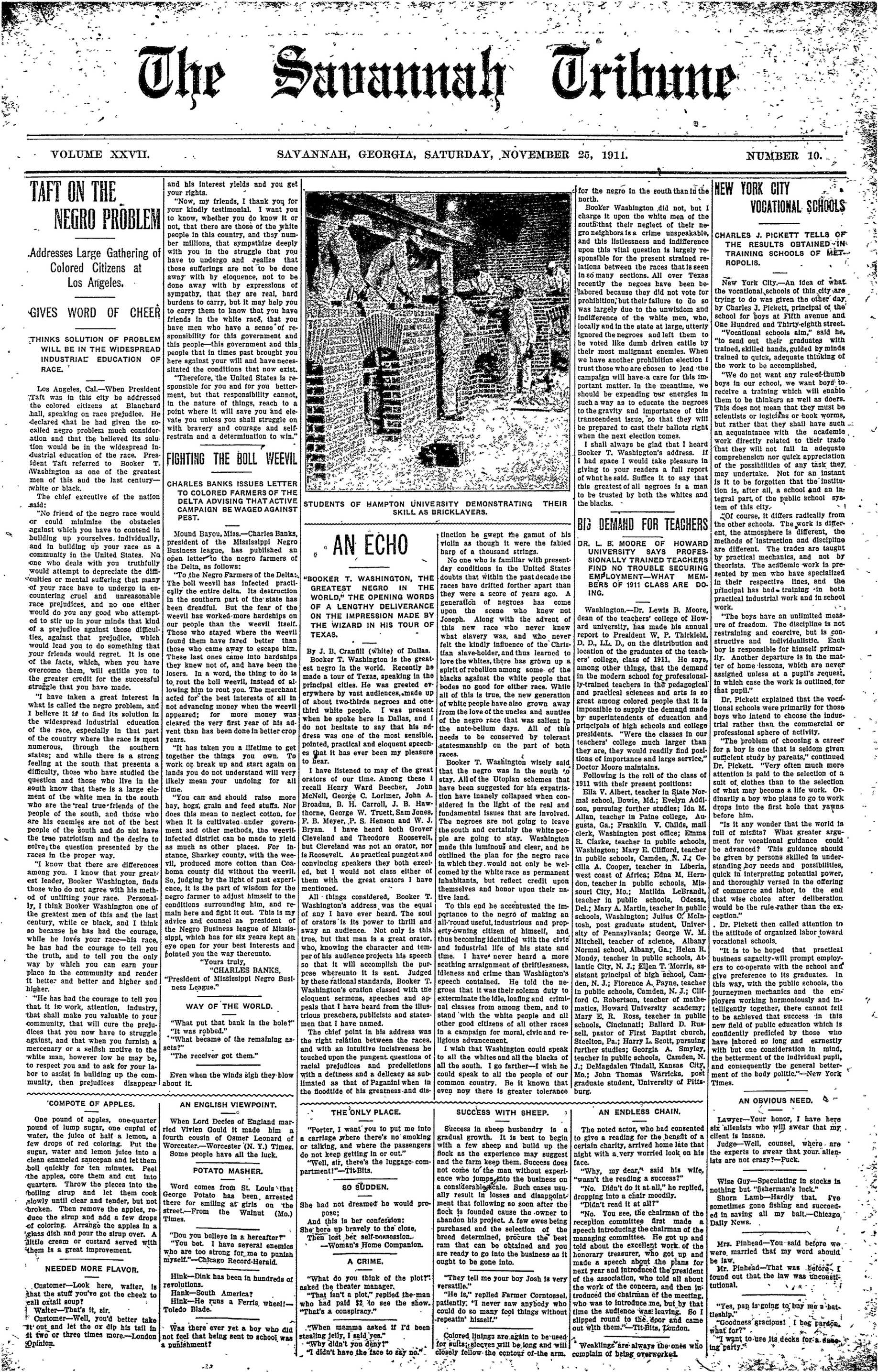
STUDENTS OF HAMPTON UNIVERSITY DEMONSTRATING THEIR SKILL AS BRICKLAYERS.
AN ECHO
AN ECHO
"BOOKER T. WASHINGTON, THE GREATEST NEGRO IN THE WORLD," THE OPENING WORDS OF A LENGTHY DELIVERANCE ON THE IMPRESSION MADE BY THE WIZARD IN HIS TOUR OF TEXAS.
By J. B. Cranfill (white) of Dallas. Booker T. Washington is the greatest negro in the world. Recently he made a tour of Texas, speaking in the principal cities. He was greeted everywhere by vast audiences, made up of about two-thirds negroes and one-third white people. I was present when he spoke here in Dallas, and I do not hesitate to say that his address was one of the most sensible, pointed, practical and eloquent speeches that it has ever been my pleasure to hear.
I have listened to may of the great orators of our time. Among these I recall Henry Ward Beecher, John McNell, George C. Lorimer, John A. Broadus, B. H. Carroll, J. B. Hawthorne, George W. Truett, Sam Jones, F. B. Meyer, P. S. Henson and W. J. Bryan. I have heard both Grover Cleveland and Theodore Roosevelt, but Cleveland was not an orator, nor is Roosevelt. As practical pungent and convincing speakers they both exceled, but I would not class either of them with the great orators I have mentioned.
All things considered, Booker T. Washington's address was the equal of any I have ever heard. The soul of orators' is its power to thrill and sway an audience. Not only is this true, but that man is a great orator, who, knowing the character and temper of his audience projects his speech so that it will accomplish the purpose whereunto it is sent. Judged by these rational standards, Booker T. Washington's oration classed with the eloquent sermons, speeches and appeals that I have heard from the illustrious preachers, publicists and statesmen that I have named.
The chief point in his address was the right relation between the races, and with an intuitive incisiveness he touched upon the pungent questions of racial prejudices and predelictions with a deftness and a delicacy as sublimated as that of Paganini when in the floodtide of his greatness and dis-
"Porter, I want you to put me into a carriage where there's no smoking or talking, and where the passengers do not keep getting in or out." "Well, sir, there's the luggage compartment!"—Tit-Bits.
80 SUDDEN.
She had not dreamed he would pro-
A CRIME.
"What do you think of the plot?" asked the theater manager. "That isn't a plot," replied the man who had paid $2 to see the show. "That's a conspiracy."
"When mamma asked if I'd been stealing jelly, I said yes." "Why didn't you deny?" "I didn't have the face to say no."
function he swept the gamut of his violin as though it were the fabled harp of a thousand strings.
No one who is familiar with present-day conditions in the United States doubts that within the past decade the races have drifted further apart than they were a score of years ago. A generation of negroes has come upon the scene who knew not Joseph. Along with the advent of this new race who never knew what slavery was, and who never felt the kindly influence of the Christian slave-holder, and thus learned to love the whites, there has grown up a spirit of rebellion among some of the blacks against the white people that bodies no good for either race. White all of this is true, the new generation of white people have also grown away from the love of the uncles and aunts of the negro race that was salient in the ante-bellum days. All of this needs to be conserved by tolerant statesmanship on the part of both races.
Booker T. Washington wisely said that the negro was in the south to stay. All of the Utopian schemes that have been suggested for his expatriation have inanely collapsed when considered in the light of the real and fundamental issues that are involved. The negroes are not going to leave the south and certainly the white people are going to stay. Washington made this luminous and clear, and he outlined the plan for the negro race in which they would not only be welcomed by the white race as permanent inhabitants, but reflect credit upon themselves and honor upon their native land.
To this end he accentuated the importance to the negro of making an all-round useful, industrious and property-owning citizen of himself, and thus becoming identified with the civic and industrial life of his state and time. I have never heard a more scathing arraignment of thriftlessness, idleness and crime than Washington's speech contained. He told the negroes that it was their solemn duty to exterminate the idle, loafing and criminal classes from among them, and to stand with the white people and all other good citizens of all other races in a campaign for moral, civic and religious advancement.
I wish that Washington could speak to all the whites and all the blacks of all the south. I go farther—I wish he could speak to all the people of our common country. Be it known that even now there is greater tolerance
Success in sheep husbandry is a gradual growth. It is best to begin with a few sheep and build up the flock as the experience may suggest and the farm keep them. Success does not come to the man without experience who jumps into the business on a considerable scale. Such cases usually result in losses and disappointment that following so soon after the flock is founded cause the owner to abandon his project. A few ewes being purchased and the selection of the breed determined, procure the best ram that can be obtained and you are ready to go into the business as it ought to be gone into.
"They tell me your boy Josh is very versatile."
"He is," replied Farmer Corntossel, patiently. "I never saw anybody who could do so many fool things without-repeatin' hisself."
Colored linings are again to be used for suits; sleeves will be long and will closely follow the contour of the arm.
Tribune
for the negro in the south than in the north.
Booker Washington did not, but I charge it upon the white men of the south that their neglect of their negro neighbors is a crime unspeakable, and this listlessness and indifference upon this vital question is largely responsible for the present strained relations between the races that is seen in so many sections. All over Texas recently the negroes have been labored because they did not vote for prohibition, but their failure to do so was largely due to the unwisdom and indifference of the white men, who, locally and in the state at large, utterly ignored the negroes and left them to be voted like dumb driven cattle by their most malignant enemies. When we have another prohibition election I trust those who are chosen to lead the campaign will have a care for this important matter. In the meantime, we should be expending our energies in such a way as to educate the negroes to the gravity and importance of this transcendent issue, so that they will be prepared to cast their ballots right when the next election comes.
I shall always be glad that I heard Bocker T. Washington's address. If I had space I would take pleasure in giving to your readers a full report of what he said. Suffice it to say that this greatest of all negroes is a man to be trusted by both the whites and the blacks.
BIG DEMAND FOR TEACHERS
DR. L. B. MOORE OF HOWARD UNIVERSITY SAYS PROFESSIONALLY TRAINED TEACHERS FIND NO TROUBLE SECURING EMPLYMENT—WHAT MEMBERS OF 1911 CLASS ARE DOING.
Washington.—Dr. Lewis B. Moore, dean of the teachers' college of Howard university, has made his annual report to President W. P. Thirkield, D. D., LL. D., on the distribution and location of the graduates of the teachers' college, class of 1911. He says, among other things, that the demand in the modern school for professionally-trained teachers in the pedagogical and practical sciences and arts is so great among colored people that it is impossible to supply the demand made by superintendents of education and principals of high schools and college presidents. "Were the classes in our teachers' college much larger than they are, they would readily find positions of importance and large service," Doctor Moore maintains.
Following is the roll of the class of 1911 with their present positions:
The noted actor, who had consented to give a reading for the benefit of a certain charity, arrived home late that night with a very worried look on his face.
"Why, my dear," said his wife, "wasn't the reading a success?"
"No. Didn't do it at all," he replied, dropping into a chair moodily.
"Didn't read it at all."
"No. You see, the chairman of the reception committee first made a speech introducing the chairman of the managing committee. He got up and told about the excellent work of the honorary treasurer, who got up and made a speech about the plans for next year and introduced the president of the association, who told all about the work of the concern, and then introduced the chairman of the meeting, who was to introduce me, but by that time the audience was leaving. So I slipped round to the door and came out with them." - Tit-Bits, London.
Weaklings are always the ones who complain of being overworked.
NEW YORK CITY VOCATIONAL SCHOOLS
CHARLES J. PICKETT TELLS OF THE RESULTS OBTAINED IN TRAINING SCHOOLS OF METROPOLIS.
New York City-An idea of what the vocational schools of this city are trying to do was given the other day by Charles J. Pickett, principal of the school for boys at Fifth avenue and One Hundred and Thirty-eighth street. "Vocational schools aim," said he, "to send out their graduates with trained, skilled hands, gulled by minds trained to quick, adequate thinking of the work to be accomplished.
"We do not want any rule-of-thumb boys in our school, we want boys to receive a training which will enable them to be thinkers as well as doers. This does not mean that they must be scientists or logicians or book worms, but rather that they shall have such an acquaintance with the academic work directly related to their trade that they will not fall in adequate comprehension nor quick appreciation of the possibilities of any task they may undertake. Not for an instant is it to be forgotten that the institution is, after all, a school and an integral part of the public school system of this city.
"Of course, it differs radically from the other schools. The work is different, the atmosphere is different, the methods of instruction and discipline are different. The trades are taught by practical mechanics, and not by theorists. The academic work is presented by men who have specialized in their respective lines, and the principal has had training in both practical industrial work and in school work.
"The boys have an unlimited measure of freedom. The discipline is not restraining and coercive, but is constructive and individualistic. Each boy is responsible for himself primarily. Another departure is in the matter of home lessons, which are never assigned unless at a pupil's request, in which case the work is outlined, for that pupil."
Dr. Pickett explained that the vocational schools were primarily for those boys who intend to choose the industrial rather than the commercial or professional sphere of activity.
"The problem of choosing a career for a boy is one that is seldom given sufficient study by parents," continued Dr. Pickett. "Very often much more attention is paid to the selection of a suit of clothes than to the selection of what may become a life work. Ordinarily a boy who plans to go to work drops into the first hole that yawns before him.
"Is it any wonder that the world is full of misfits? What greater argument for vocational guidance could be advanced? This guidance should be given by persons skilled in understanding boy needs and possibilities, quick in interpreting potential power, and thoroughly versed in the offering of commerce and labor, to the end that wise choice after deliberation would be the rule rather than the exception."
Dr. Pleckett then called attention to the attitude of organized labor toward vocational schools.
"It is to be hoped that practical business sagacity will prompt employers to co-operate with the school and give preference to its graduates. In this way, with the public schools, the journeymen mechanics and the employers working harmoniously and intelligently together, there cannot fail to be achieved that success in this new field of public education which is confidently predicted by those who have labored so long and earnestly with but one consideration in mind, the betterment of the individual pupil, and consequently the general betterment of the body politic."—New York Times.
Lawyer—Your honor, I have here six alienists who will swear that my client is insane.
Judge—Well, counsel, where are the experts to swear that your alienists are not crazy?—Puck.
Wise Guy—Speculating in stocks is nothing but "fisherman's luck."
Mrs. Pinhead—You said before we were married that my word should be law.
Mr. Pinhead—That was before. I found out that the law was unconstitutional.
"Yes, pan is going to buy me a battleship."
"Goodness gracious! I beg pardon what for?"
WASHINGTON ON NEED FOR SAVING
Negro Leader Dellivers Address in Birmingham, Alabama.
WASHINGTON URGES HEARERS TO DO ALL THEY CAN TO GET MEMBERS OF THE NEGRO RACE TO SAVE THEIR MONEY.
Birmingham, Ala.—Booker T. Washington, founder and principal of Tukegee institute, reached this city just a few minutes before he was scheduled to speak and was driven immediately to the Orpheum theater, where he was greeted by an immense audience, about 300 of whom were leading white citizens.
The negro leader and educator and his traveling secretary, Edwin J. Chesnutt, were met at the Louisville and Nashville railroad depot by Dr. W. E. Pettiford, Dr. U. G. Mason, J. O. Diffay, Dr. Lauderdale and Windham.
When Doctor Washington appeared upon the stage he received an ovation by the largest audience he ever faced in Birmingham. Rev. C. L. Fisher, D. D., former pastor of the Sixteenth Street Baptist church, was master of ceremonies. The audience seemed delighted with several plantation melodies sung by a trained chorus of 100 volces. Dr. W. H. Nelson led in prayer. After a statement by Rev. J. A. Whitted, pastor of the Sixteenth Street Baptist church, and a collection taken for the church, Doctor Fisher introduced in felicitous words former Congressman S. J. Bowle, who in turn delivered an address which was, frequently applauded. Mr. Bowle began by saying:
"It is with pleasure that I have accepted the opportunity of presenting Doctor Washington to this audience. He is known not only throughout the length and breadth of this country, throughout the world. That he stands for a sane and rational program for the improvement and uplift of his own people it seems to me cannot be reasonably doubted. However much certain theorists may wish it were otherwise, and however much it may have avoided complications and problems that would not now confront us if it had been otherwise, the fact remains that eight-tenths of the negroes of the United States live in the southern states and here they must continue to live. Some of them will, doubtless, as others have in the past, move to other states, and some who have moved to other states will doubtless return to these states. Such movements of population are common among the whites as well as among the blacks, but the fact still remains that the great majority of the blacks in this country not only now but for an indefinite time in the future must remain citizens of the south. The truth is that when efforts have been made in times past by emigration agents to move any considerable number of negro laborers from any neighborhood or county in the southern states to some other place, such movements have almost invariably been met with a pronounced and emphatic hostility of their white neighbors and employers, and so clear is this hostility that laws upon the subject having the definite object and purpose of checking the exodus of laborers by means of this sort have been enacted."
After citing the law Mr. Bowle continued:
"But there is a law of a higher nature and of greater consequence than the civil law which you see, manifested in the courts and in the police officials. I refer to the moral law. That law enjoins not only that you shall refrain from the commission of crime, but it enjoins certain positive duties. 'In the sweat of your own face shall you eat bread,' is a divine command, Industry and sobriety are required by laws as positive as that which says: 'Thou shalt not kill.' And this brings me to the point that is uppermost in my mind.
"A few months ago Col. J. W. Church, who is now connected with Hampton institute, came into my office with Doctor Phillips and invited me to attend the commencement exercises of that institution. In the course of his conversation he referred to what Hampton was doing in the way of industrial education, and what it had done, and what it proposed to do in the future. He referred to the plan that had been adopted to have hundreds of small Hamptons educating the hand of the colored man to work so as to get the highest results of his labor at the same time that they educated the brain. These smaller institutions were to be spread not only all over Virginia, but throughout the south. I have a right to refer to Hampton institute, because the speakers of the evening is its most distinguished product. I listened with great interest as he unfolded the splendid plans which he had in his mind for the further growth and enlargement of that institution, and when I got an opportunity I said: "But why should this work be started, why should so much money be expended for the negroes alone?" Is not industrial education, the training of the hand, the training of the eye.
along with the training of the brain, just as important for the white race as for the black? If we need industrial education to make better farmers, to make better carpenters, to make better brickmasons, to make better citizens for one race, why do we not need it for both? He said in reply: 'I thoroughly agree with you, industrial education must be for both races; just now,' he said, 'our particular work is for the negroes and the Indians alone—the other will have to be evolved in the future.' I do not know of any reason why emphasis should be placed upon the observance of the primary virtues of industrial economy or thrift by one race above another, unless it is that our race needs teaching of that sort more than another. If so, then the greater emphasis should be placed where the greater necessity lies. But, at all events, if I understand the lesson which the eminent speaker of the evening has been teaching from one end of this country to the other, it is certainly a lesson which can and should command our unfalling and enthusiastic support."
Doctor Washington began his address which lasted one hour and ten minutes. It was enthusiastically received, the applause being often led by the white listeners. It was considered to be one of the most remarkable addresses ever delivered to the colored citizens of Birmingham—remarkable for its absolute candor in dealing with the race problem.
Following are some of the white citizens seated on the platform: Judge W. I. Grubb, Doctor Parks, Doctor Riley, Mr. Klotz, Judge Edmund H. Dryer, Hon. J. O. Thompson, Mr. Smith Cullom, Jr., Judge Crow, Professor White, Doctor Ullman, Mr. M. V. Joseph, Mr. Cabinness, Hon. John Frye, Ben M. Jacobs, Doctor Whaley, Mr. Gafford and several white ladies.
Doctor Washington spoke as follows:
"I am glad to be in Birmingham in connection with the beginning of the work of Dr. J. A. Whitted in a new church. I have known Doctor Whitted for many years in North Carolina, and there are fewer stronger and more useful men of our race anywhere than is true of him.
"There is important work for a church to do in a city like Birmingham. The colored population of the Birmingham district is large and growing each year. Birmingham and Jefferson county contain not far from 100,000 colored people. This I think you will find the largest number, with possible one other exception, of colored people in any county in the United States. The mere fact that so large a number of colored people are living in this county brings a tremendous responsibility to the church and people who have the interest of their community and state at heart.
"There is perhaps no other country in the United States where colored people earn and handle so much money annually as they do in Birmingham and Jefferson county. It is safe to say that from $8,000,000 to $10,000,000 are handed every year by our race in this county.
"I sometimes fear that as a race we do not rightly appreciate our opportunities in this country in the matter of finding plenty of opportunities to live. In most of the older countries of the world there are thousands of people today who are seeking labor, who are willing to work for a very small wage. When I was in Europe last summer I saw numerous cases where thousands of people walked the streets at night and by day, sleeping sometimes on the sidewalks, sometimes under the trees in the parks, because they could not find labor with which to supply their wants. How different is it with the hundred thousand colored people in Jefferson county. I do not think I am far out of the way when I say that there is scarcely an able-bodied man or woman of our race in this county who cannot find plenty of work every day in the year, and in most cases instead of having to seek work, work seeks them.
"The colored man as a laborer has an advantage again when compared with the condition of laboring classes among other races in the old world. During the past summer in southern Europe I saw strong, able-bodied men working for a wage of from 12 to 15 and 25 cents a day and glad to get work at that price. How different it is with the colored people in Jefferson county, where in many cases they earn from 10 to 12 times as much as the same class of laborers in southern Europe.
"In Jefferson county the negro has spatted down a pretty big field in the matter of labor. I do not want to see my race merely tolerated in this county because it exists in large numbers, but I want to see my race in such a condition that it will actually be wanted and sought after because of its usefulness and high service. This means that in an increased degree everywhere the church as well as the school should teach our people reliability in matters of labor.
"In some communities I am often told that while the negro is valuable for a certain kind of labor for a certain time, that one cannot depend upon him for constant, effective labor in too many cases. It is often said by those who employ our people in large numbers that the negro as a laborer is all right until, Saturday night, when he gets his wage, and then one is not sure he will return to his place of employment or not until the last dollar is spent. If in any degree that is true in this county, it should be a part of the work of the church and of the school and of leaders generally.
to teach our people to become reliable, to keep their word in anything that relates to labor. If a promise is given to be at a given place of labor on Monday morning at a certain hour we must be there, no matter what befalls us.
"And then we must remember that progress is being made in every kind of labor. The kind of labor that would satisfy on the farm, or in the factory or shop or kitchen or dining-room or laundry twenty years ago will not satisfy today. In all these respects improvements are constantly taking place, and the negro man and the negro woman must make progress or they will find themselves left behind and other races will come in and take their places in the world of labor which we now occupy.
"I am glad to see that the colored people have two banking institutions in the city of Birmingham. This is most praiseworthy and important. It is not only necessary that our people have instilled into them proper methods of labor, but equally important that they be taught through the church and the school to save a large proportion of what they earn. And let me add here that it will pay every white man and every white lady who employs colored labor to encourage them to save a part of what they earn. The colored people for the most part who do not render satisfactory service as laborers is the class that have nothing and want nothing. The class of colored people who cannot be depended upon as laborers, for the most part are those who want such a little that they can supply these wants by working two or three days in the week, and when they have gotten enough money to supply their few wants, whether it is a drink of whisky or a chaw of tobacco, then they stop work and say what the dickens is the use of working any longer. On the other hand, the colored man who owns a house and wants to add another room to that house, who owns one dwelling and wants to buy another dwelling, or the colored woman who has $100 in the bank and wants to put $200 in the bank, is the individual who will work steadily for six or seven days in the week.
"Through education the wants of the negro must be multiplied if we expect him to become more satisfactory as a laborer. Wherever people have little education, they do not give satisfaction as laborers, because ignorance means that the individual has few wants to be satisfied and these wants can be satisfied by working two or three days in the week and then the individual ceases to work.
"A gentleman residing in Birmingham who has mining interests in Mexico told me a few days ago that the negro in Birmingham as a laborer was worth from three to four times as much as the Mexican as a laborer. This meant that the negro in Birmingham had by contact with the white man, through the Influence of the church, the Sunday school, and the day school had been educated to some extent, had his wants increased above the wants of the Mexican, consequently, the negro in Birmingham was more satisfactory as a laborer than the Mexican. In proportion as the colored people are educated everywhere, I repeat that they will become more satisfactory as laborers.
"I am glad to see that you are erecting new school buildings for the housing of the colored children in this city, and I am sure that our people appreciate everything that is done for them in this regard. To my own race in this county, however, I want to suggest that it is most important that a large proportion of the colored children be put into the public schools. I find that during the past school year while $8 per cent. of the white children in the county attended public schools, only 7 per cent. of the colored children in the county attended any public school. This means ignorance and ignorance means crime and crime means not only inefficiency, but it means in the last analysis a heavy load for the community and the state to carry. It is cheaper to educate than it is to punish.
"The main point which I want to urge upon my colored hearers is this: Beginning from tonight. I want to urge that every member of our race begin to save a larger proportion of what he earns. Too much in the past we have squandered our earnings, it has been thrown away for things which we could have done without. In many cases we have worked hard all the week and then in a few minutes on Saturday night the last dollar has been squandered. So long as we have the reputation of being a race of spendthrifts, so long will our entire race be hindered in its progress. I want to urge each one of my hearers to exert his influence in helping our people start a bank account. Start a bank account in a white bank or in a colored bank; or if this is not desirable, invest money in property. The man who gets a start with a little money in the bank or in property ceases for the most part to become a criminal, he ceases to throw away his money for whisky and in gambling, and such an individual is very rarely charged, with any kind of crime by the public authorities.
"I cannot forbear to congratulate the colored people in Birmingham upon the progress that they are making. There are members of my race in Birmingham who-by reason of their ownership in property, their intelligence, their high character and business success would do credit to any race, and I-congratulate the white people of Birmingham upon the fact that for the most part friendly re-
tions exist between white people and black people in this community. One of our difficulties throughout the south grow out of the fact that the outside world hears of the worst things that take place between colored people and white people in the south; the outside world rarely hears of the friendly relations that exist between black people and white people. Getting down to bed rock, I find that the individual relations between black and white people are closer here in the south than between black people and white people anywhere in the world, and you can't find a portion of the civilized or uncivilized world where there are so many black people living side by side with so many white people where the relations, all things considered, are so happy and friendly as they are in our southern states.
"There is nothing over which to be discouraged. If we go forward doing our whole duty in the communities in which we live, in the long run all will be well."
MISSIONARY JUBILEE
NORTHERN AND SOUTHERN WHITE WOMEN ADDRESS NEGROES AT CHARLESTON BISHOP GUERRY PRESIDES INTEREST IN RELIGIOUS FORWARD MOVEMENT.
Charleston, S. C.—In connection with the golden jubilee, celebrating the fifteenth anniversary of organized women's work for foreign missions, a largely attended mass meeting of colored people was held at Mt. Zlon A. M. E. church. Rt. Rev. William A. Guerry, D. D., Episcopal bishop of South Carolina, presided and the meeting was addressed by the missionaries and mission workers who are making the tour of the south in the interest of the Golden Missionary jubilee.
Rev. Abraham Lincoln De Mound introduced Bishop Guerry in a brief but pointed address that brought forth applause from the large audience. He spoke of the progress of the past 50 years, the noble work of women in the mission fields, and expressed the gratitude of the colored people for the interest Bishop Guerry had taken in their welfare.
Bishop Guery told of his lifelong friendship for the colored people, but said that he welcomed the day that finds the black man in larger and larger measure bearing his own burden. He said that as the Chinese were being Christianized by Chinese, so negroes must be evangelized by negroes.
The missionary speakers for the evening were Mrs. W. Eugene Sallee, a native of Texas, who has just returned from mission work in the interior of China; Mrs. Henry W. Peabody of Massachusetts, who has spent many years as a missionary in India, and Miss Daisy Davies, field secretary of the Woman's Missionary council of the Methodist Episcopal church, south.
Miss Davies moved the audience to applause when she exclaimed: "If I had all the money that Barnum & Balley's circus will take out of the southland this year I would build a hundred schools and send missionaries to the foreign field."
The colored men of Charleston are co-operating in the Men and Religion Forward Movement campaign. An enthusiastic meeting of colored men was held at Mc.Zlon church. Able addresses were delivered by R. H. King and Dr. A. R.-Miller. The colored committee of one hundred was organized with the following officers: Chairman, Rev. N. B. Sterritt, D. D.; first vice-chairman, Rev A L. DeMund, D. D.; second vice-chairman, Rev M. M. Mouzon, D. D.; third vice-president, Rev S. D. Thomas, D. D.; recording secretary, R. S. Lawrence; treasurer; W. R Campbell; corresponding secretary, Rev C. F. Gandy, D. D.
CAPTAIN PROBABLY ADMITTED IT
The skipper was a man who had a good opinion of himself and his notions. He had pulled through shipwreck, mutiny and other perils of the deep, but he came a cropper once. For one of his voyages he had shipped a boatwain's mate who bore something of a reputation.
One day the skipper ordered him aloft to examine a sail on the royal yard.
"Tain't safe, cap'n!" protested the boatwain's mate; "the foot ropes has got to be fixed first."
"Do as I tell you!" thundered the captain. "The foot ropes are all right. I know they are."
The man went up.
Five minutes later he came tumbling down through the rigging from the top of the mast, a distance of over 100 feet.
With a bang he landed on the belly of the mainsail and bounded into one of the canvas covered boats.
The sailors, thinking him dead, crowded about him in a circle. To their amazement he sat up. His eyes wandered vacantly about until they rested on the leathery face of the skipped when they lighted up with intelligence. "Cap'n," he said slowly; "you was mistaken about them foot ropes."—Tib Bits, London.
EDUCATION.
"Fifth grade this year, Tommy?"
"Yes, sir."
"You're in decimals or fractions now, no doubt?"
"No, sir; I'm in crochet work and clay-modeling now."—Louisville Courier-Journal.
A NIGHT ADVENTURE
HARROWING EXPERIENCES OF
LOVE-SMITTEN NEGRO COLLEGE
BOY—A SHORT STORY WRITTEN
FOR SOUTHERN LIFE MAGAZINE
BY WILSON CARR LOWERY.
The following is the story of a rather
peculiar adventure had by a student
at one of our proximate colleges
dent at one of our prominent colleges. This school is situated in a small town in one of the south Atlantic or southern states—a town so small, in fact, that besides the university above spoken of, there is but little to it. The outlying rural districts being fairly well populated, it was not an unusual thing for some of the male students to stroll out within a radius of two or three miles, in the afternoon, when there was not a great deal to be done. It was during one of these atrots that our friend (whom we shall call Jackson), experienced the first of the events leading up to the strange adventure we are about to chronicle.
One afternoon, in company with several of his fellows as was their wont, he was wandering along the public road that led through the most thickly settled portion of the country. The road being rather narrow, when they had gotten about a mile and a half from the campus, they were compelled to step aside to let a wagon pass. On the front seat of the wagon, to which he hitched a fine, sleek mule, was a fairly intelligent-looking colored man of the "hayseed" type, who was driving. Beside him sat a buxom woman — evidently his wife—with a benign smile upon his shiny face; her rotund form encased in a loud-colored calico dress. Behind these two, resting carelessly in a common house-chair, sat one of the most beautiful young colored women whom it had been our friend's pleasure to see. She was of that Indian-colored dark-eyed, dark-haired type about whom men rave. The frosty air—for it was early winter—had brought to her cheeks the ruddy flush of health. Her eyes sparkled; her raven hair hung in two braids down her back and swung coquettish with the motion of the wagon over rough places. Although she had a gaily-colored quilt-laprobeucked closely about her, there was an unmistakable suggestion of beauty of form as well as face.
The young men who had stepped aside to let the vehicle pass gazed in wonderment at this ideally beautiful young creature. In answer to the "Howdy" of the jovial farmer and his genial helpmeet the young gallants all politely raised their hats. The young lady in the rear of the wagon smiled sweetly and gracefully acknowledged their salutation by a marked inclination of her head. After various comments, while the wagon was a mere speck on the horizon—as to who the young lady could be—the incident was thought to be closed. But, if the other fellows had forgotten the occurrence, Jackson had not. The young woman's seductive beauty had made a marked impression upon the hero of this tale. For several days' he thought and dreamed of this meteor, as it were, which had come within his range of vision and as suddenly disappeared again.
Some weeks after this, Jackson was invited out into the country, a few miles, to take Christmas dinner with some friends of his whom he had met through one of the instructors. He dressed himself in his best and took his departure. After having spent a most enjoyable afternoon, he started, a little after dusk, on his way back to the campus. The moon was just rising, and her soft radiance illuminated the dreary wastes of dead foliage and the fruitless frost-covered fields, making it seem even more lonely. Our friend trudged hurriedly along the road glancing from right to left and quaking for fear at the sound of his own footsteps, and as he walked his thoughts of the pleasant afternoon that he had spent were not unmixed with the usual conjecture as to the whereabouts of his fair inamorita. As he would come within sight of an occasional human habitat his heart would beat lighter and his step would become more elastic.
The weather, though fair all day, had been somewhat hazy, and the mist which hung heavy all the afternoon had now begun to grow thicker. Light, snowy clouds began to form, and there was every indication of bad weather. Our friend was traversing a section of road with which he was not very familiar, and he became suddenly aware of the fact that he was lost. Believing that he saw a dwelling house in the dim distance he hastened on. On reaching the farmhouse he knocked and was admitted by—the farmer whom he had seen driving the fair one. His heart almost stopped beating as he recognized the old man. There in front of the fire sat the queen of his visions. Her nymphlike form was hidden by a beautiful Japanese kimono. Her hair was done up in "papers;" two children were playing on the floor by her side; and she was reading a book, seemingly undisturbed by the doleful tunes of "Way Over in the New Burying Ground," which came from a chesty female voice in the kitchen. As Mr. Jackson came within the circle of firelight, the gloom which was enhanced by the feeble efforts of a smoky tin lamp, the young lady looked up and gave him a slight nod of recognition; then resumed her book. Our friend explained to the gentleman of the house the predicament in which he found himself, and asked to be directed to the nearest way by which he might reach the public road with which he was familiar. Upon hearing that he was a student, Miss-Dotterer, as her name was found to be, looked up and seemed interested.
The farmer introduced them, and to his surprise, Jackson found that Miss Dotterer was from his own state and had relatives in his own town. A friendly feeling at once sprung up between them. As the evening was yet young, Jackson was invited to be seated; the host assuring him that he would personally see our friend to the road.
The evening passed most pleasantly. When the time came to retire Jackson bade the ladies good night and was invited to call again. The farmer walked with him to the fork of the road where he could find his way without difficulty and Jackson went on his way. Pleasant were the reveries in which he indulged, and not the least of his thoughts was about the, pretty school teacher whom he had lately met.
As he approached a small house which he was compelled to pass, he was horrified to hear plaintive groans and cries issue therefrom. His first impulse was to pass the place in a hurry and reach the campus as soon as possible. But his manly instinct prevailed, and he turned out of the road and went up to the house, thinking to be of assistance to anyone whom he might find in distress. A mongrel hound, aroused from his lethargy, crept around the house, and raised his nose to the heavens, rid his consumptive thorax of a long-drawn howl. The door opened and a grusu voice demanded:
"What do you want?"
"N-n-nothing, sir," replied our brave student, his knees spitefully smiling each other.
"Nothing? Then what did you come here for?" the voice demanded.
"I only wanted a match."
"Come here?" the voice commanded.
Jackson could see the brawny form of a dark-skinned man silhouetted against the flickering firelight from the inside.
"Come here!" imperatively repeated the voice. "I want to show you something."
Mr. Joseph Jackson managed to muster up courage enough to approach the door. The groans had ceased, and as he came within the light which shown through the door his blood ran cold; for there on the floor lay the outstretched form of a woman. A large amudge on her 'temple' and a pool of dark fluid in which she was lying told the tale too well. She had been murdered.
"See here. What is your name?"
"I am Mr. Jackson, air. I am a student up here. I am just coming back from a Christmas dinner." All this information was vouchsafed by our quaking friend. "Well, Mr. Jackson, this was my wife. She was untrue to me, so I have put her out of the way. Now, my name is Jones. If you ever tell what you have seen and beard tonight, I shall kill you. You may go."
It did not take Jackson long to put the house far behind him. He was glad to get away from such unpleasant scenes. After having gone some distance at the top of his speed, he mustered nerve enough to stop and look back. To his horror he saw that the house was enveloped in flames. He promptly took to his heels again. He had not gone far, however, when he became aware that he was being rudely pursued by some one on horseback. Being thoroughly exhausted he tried to hide in some underbrush on the side of the road. But he was a minute too late; the rider drew rein and ordered him to come forth.
Trembling like a leaf, Mr. Jackson, the lion-hearted, crawled out of his hiding place.
"What did you set my house on fire for?" said a voice which he did not recognize.
"I d-didn't set it, sir," protested our friend.
"Then what were you running so for? I know what the trouble is," went on the voice, "it is a plot between you and the niggers who have been living in my house."
Jackson then became convinced that it was the white property-owner who was his accuser. "Those niggers moved out because I pushed them for the rent, and got you to burn my house down. You can say your prayers, for I am going to kill you."
"Then you will have to kill me, sir; but I declare I don't know anything about it. I was just running to keep warm." Jackson had resolved to die a martyr for one of his race who was possibly guilty of justifiable homicide. A loud laugh greeted this declaration.
"Jackson," said the voice of the man whom he had seen in the door of the ill-fated hut. "I merely tried this trick to test you, and you have won my lifelong friendship and admiration. Now, you had better go; for the countryside is aroused, and you may not be able to give a satisfactory account of your presence here."
"Good-by."
By that time people could be seen silhouetted against the glare of the burning house, and some of them had heard the sound of the horse's hoofs and were coming rapidly in their direction. The horseman disappeared in a clump of woods to the right and the people were rapidly pursuing Jackson, yelling: "Stop him, catch him." Jackson reached the campus a safe distance ahead of his pursuers, hastened to his room and jumped into bed. The sound of scurrying footsteps were heard in the building. His pursuers were coming upstairs. And then—
Jackson awoke.
It was all a nightmare. Our friend hrd eaten too heavy a supper the night before, and during all these horrible happenings, was safely tucked in his bed.- The footsteps he heard, only the noise made by the students hurrying down to breakfast
See Cooper & Odrizen The Up-to-Date Tailors
218 WEST BROAD STREET, BETWEEN HULL AND OGLETHORPE AVE. The Latest Patterns in FALL and WINTER GOODS. First-class workmanship guaranteed. Our prices will in erest you.
Johnson Undertaking Establishment COMBINED WITH The Royall Undertaking Company (Incorporated.)
Residence Phone 2032. Livery Stable Attached. Office Phone 676. C. H. ROYALL, Residence 509 Charles St. Phone 3064.
W. L. BLUNT, WHOLESALE AND RETAIL
Fruit and Commission Merchant
234 ST. JULIAN ST., WEST, 235 BRYAN ST., WEST. Phone 2968. SAVANNÄH. GEORGIA.
In addition first class rooms, barber shop, hot and cold baths and automobile service at any hour, day or night. In all of our departments we give first class accommodation. Call and see our rooms while visiting the city at 109 Jefferson street, just a half block from Broughton St., car line going south on Jefferson Ask any hackman.
Paim Shaving Palace
Expert Hair Cutting, Electric Massage and Shampooing a Specialty. All
Work Done by Experienced Workmen. Courteous attention to all. SHIN-
ING PARLOR ATTACHED.
PERRY R. WRIGHT, Proprietor
517 WEST BROAD ST., SAVANNAH, GA.
If Your Business Isn't Worth Advertising Advertise It For Sale
POPULAR PRICED
SHOES
NICHOLS
THE SHOE MAN
19 East Broughton Street
Atlanta University
ATLANTA, GEORGIA. An Unsectarian Christian Institution. High School, Normal School and College. Superior advantages in Industrial Training, Music and Printing. Home Life Training. For catalog and information address PRESIDENT EDWARD T. WARE.
Woodlawn Park Lots
The Highest Price Lots at Woodlawn Park are Only $150.00 and they 50x400 They have concrete sidewalks and are directly on car lines. Consider how important that transportation feature is. Some excellent LOTS LEFT. You pay
e quickly and get a location AS. McDOWE
See me quickly and get a choice location
623 WEST BROAD STREET
NO INTEREST
RESIDENCE 1206
GAREY'S
Variety. Bakery.
Goods delivered promptly to any part of the city. 506 West Bread Street, Near Easton. Phone 1331-L.
Take a Policy With The Pilgrim Health and Life Insurance Co.
The Oldest, Strongest and Most Reliable Company in the State. Gives employment to hundreds of men and women of our race.
Pays from $1 to $10 weekly sick and accident benefits and from $10 to $100 death benefits. Our Motto: "Promptness, Honesty and Justice."
Home Office:
1142 Gwinnett St. Augusta, Ga.
For further information write 509 West Broad St, Savannah, Ga.
J. S. Perry, Supt.
A. B. Slingfield, Gen. Supt.
C. T. Walker, D. D., LL. D.
Director and General Lecturer
GO TO—
Young Bròs.
TOBACCO, CIGARS and FRUITS Of all kinds. 869 West Broad Street.
WEST SIDE RESTAURANT
461 West Broad Street.
Near Union Station.
The place to get first-class meals
Everything neat and clean Meals
prepared in an appetizing manner
and at all hours daily.
Meals 16 and 36 cents.
MRS. A. B. SCOTT, Proprietress
CHICKENS
DUCKS
TURKEYS
R. H. O. YOUNG
Wholesale and retail dealer in Live
and Dressed Poultry. Game in Season.
Special attention given to picnic or-
ders. All orders delivered free
of charge.
Stall 12 City Market.
Phone 2733.
UNION
Laundry Co.
1218 West Broad Street
ONLY COLORED LAUNDRY IN
CITY. WORK CALLED FOR
AND DELIVERED.
Phone 36.
MYERS & RUSSEL, Props.
McFALL'S
Ice Cream Parlor
Ice Cream and Sherbets in large and small quantities. Special prices to Churches and Societies. Also Hot and Cold Lunches. Fish Suppers prepared to order. Phone 4038. Orders very promptly filled. : : : : East Bread St. Savannah, Ga
Masonic Books &
Regalias.
LEOGE SEALS,
FINANCIAL CARDS and
BLANKS of every description.
Publishers' and Manufacturers' Presses
Liberal Discounts Will Be Arranged
GOL. G. JOHNSON,
Savannah, Ga.
Who is the man for Cleaning and Pressing?
BAKER'S PRESSING CLUB
519 PRICE ST.
Men's Suita Pressed 40c; Pants 13c
Men's Suita Scoured $1. Ladies' work
a specialty. Give us a trial.
"THE NEGRO IN U. S. A."
The Following Article Appeared and Was Given Prominence in an Issue of 19th Ult., of a Newspaper Published Thrice a Week in a Town of About 6,000 People In One of the European Countries Whence Emigration to America, Particularly to the East Central States and West Central States, Has Been Large.
(Translation.)
"The NEGRO IN U. S. A.
"He works two days of the week in order to be able to loaf the other five, ducks into a saloon and hangs around till night and slabbers up greedily the leavings in the 'glasses left by the whites. Treated to a drink he takes the glass in silence and with a grin, treated to ten drinks he will continue drinking with the same phlegmatism and same grin. And everything goes in him equally well; whisky and lemonade, soda water and bitters.
"The negro youth, who after attendance at school, gets into an office to sweep, wash windows and the like, retains most assuredly twenty years later the same job, and has to hold the same position without possibility of being anything better until he dies—or gets into slavery. Into such fall many of the 'colored gentlemen'—in the north; in the south they do not even get so far, often no farther than the nearest telegraph pole. And their crimes consist mostly of theft, assassination and attacks on the whites, and to these latter offenses both parties are at fault.
"Noticing the thousands of colored people one meets in an American city, it strikes one how different are their physiognomies in spite of their negro likeness. There are all variegations of colors from coal black to light cream yellow, yes, nearly white.
"The negro has all the attributes of a child; done a favor he never forgets it; but on the other hand, he remembers a wrong all his life. He is vain to a high order—something his clothes bear witness to.
"When dentists some years ago commenced filling teeth with gold, crowds of blacks rushed to get the costly metal in their mouth, yes, almost innumerable were the negroes of both sexes, who had good teeth pulled to be replaced by gold ones. Then the thick lips were never closed. The negro smile, moreover, extends from ear to ear and he smiles and laughs at everything
"His station in the community is not imposing. It is all of a kind that requires no knowledge and no responsibility; drivers, carriers, scavenger work and the like. One or another has been fortunate enough to become physician, lawyer or preacher and are then citizens—that is to say, have a right to vote; that right, however, most of them sell to the highest bidder.
"The negro in U. S. A. is an outcast. In the southern states he is not permitted even to enter a public restaurant, but will nicely keep to the places designated for negroes and on the railroads are separate coaches for him. And the blacks do not seek to improve their condition—ordinarily, at least. No, he seeks his good corn cob pipe, sings his negro songs, and lets the world slide along."
The language employed and the wrong of inciting prejudice and hatred by such misrepresentation of facts (there being no foundation for anything but the allusion of Jim Crow cars and to restaurants catering exclusively to whites) is not creditable to the press of a country priding itself of its traditions, its line of kings, its schools and barely one per cent. illiteracy.
History records no parallel of the progress and advancements of any people or race to that of our own, in four decades, and we have but just bown—Illinois Chronicle.
NOT SO BAD.
A couple of old salts met after a long absence, and the following animated conversation ensued:
"Well, old man, how are you gettin' on?"
"First rate. I have taken a wife."
"Very sensible idea."
"Not a bit of it; she's a regular tartar."
"Then I'm sorry for you, mate."
"There's no need; she brought me a big ship as her marriage portion."
"Then you made a good bargain, after all."
"Nothing to boast of, I can tell you. The ship turned out a worthless old tinder box."
"Bah! You can speak as much as you like. The old tub was well insured, and went down on her first voyage."
"So you got the pull there, anyhow?"
"Not so much, mate. I only got twenty-five hundred dollars out of he job as my share."
"That was too bad!"
"Too bad? Nothing of the sort! Wife was on board and went down with the rest."
SPEAKING OF WILLIE.
Papa and mamna and son Willie were crossing the ocean. Willie had done something for which his mother thought he needed correction, but not feeling equal to the occasion she urned to her husband.
"John," she said, "can't you speak o Willie?"
Papa replied in 6 thin, weak voice, "How'd Willie."—Success Magazine.
The Farm
OUR NATIVE NUT TREES. GROWING PEANUTS.
By J. M. W. Smith, Oklahoma. Among the great natural resources of the United States, our native nut-bearing trees occupy a place of no mean importance; but they have been treated like other natural resources of the country-exploited, wasted and destroyed until the outcome is getting to be alarming. Our fertile lands have been robbed of their productivity by the one-crop system; the forests have been cut down for the best timber and no provision made for a future supply.
The walnut, the chestnut and the hickory, also the pecan have fallen before the woodman's ax, with their fellows, the elm, ash and oak—in the effort to make room for more grain crops, cotton and tobacco. Thousands of acres of valuable timber and nut trees have been destroyed in this manner, in many cases it will be generations before the average yield per acre will again attain unto that which was destroyed.
But it is too late to grieve over the errors of the past, but it is not too late to quit the wasteful habits, to begin to repair the damage done and save and improve that which is left.
The black walnut, the most valuable tree in the world for its timber, which is used in the manufacture of the finest furniture and cabinet making, bears a large, olly nut of fine flavor which finds a ready sale at a fair price. The shell-bark hickory is another native tree of sturdy and lofty growth, the wood of which, on account of its great strength and elasticity is highly prized for the manufacture of agricultural implements and is unsurpassed for fuel. The American sweet chestnut, the butternut and the pecan are all trees of fast growth and are valuable for both timber and nuts.
Our native nuts have already made a respectable beginning in forming the body of various food products whose marketable value is growing rapidly—such as butter, oils, confections and concentrated food stuffs that are meeting an increased demand. There is no diet more nutritious and easier to digest than our native nuts.
There are thousands of farmers who have no nut trees of their own but whose land is highly suitable for the growing of these trees. Such farmers should plant a few nut trees, such as are adaptable to their climate and soil, every year, and not be deterred from planting on the grounds that they would have to wait so long for results. The planting of nut trees is elevating, profitable and pleasing and in harmony with the laws of nature.
The planting, propagating and growing of nut trees has a great future before it, owing to the natural adaptability and the rapidly increasing demand for nuts to use in the various food products.
FRUIT AND ORCHARD.
It is good practice to graft plums on peach stock.
If you intend to plant a new orchard, buy the trees which are best adapted to your climate and soil. Consult with the orchardist of your state experiment station.
Lemon and orange growers have learned that it is best to wash and wire them before packing to prevent the spread of rot fungi.
In washing only running water should be used because if washed in water that has been used they will absorb the microbe organisms of disease.
Fruit should never be offered for sale that is exposed to files.
When a customer sees files—which may have just arrived from dining off a dead animal or from a manure pile—crawling around over the fruit in the store, she is not likely to buy it. A customer who observes that the fruit is carefully assorted and put up in clean packages will naturally want to know the name of the grower and that is where the stencil and rubber stamp come in
BIG STRAWBERRIES.
A strawberry grower who has succeeded in producing a berry which weighed four and three-fourths ounces says he never saw a big berry picked from a spring-set plant. He says that in the art of growing berries long experience is what counts. He advises placing a thin mulch around the plant and watering through this. Mosquito netting should be placed over the plant for shade, and something thicker over the berry itself to shield from sun, rain, birds and insects. This grower, after long experience, rejects a deep, loose soil. His prize berries are grown on hard, shallow soil.
ECONOMY OF THE SEPARATOR
No up to date farmer will be without a hand separator, and the skimilk, when improved in quality by the addition of some concentrated food, is solving the problem of raising good dairy stock on the farm. In addition to turning every ounce of fat in the milk into butter.
GROWING PEANUTS.
Any soil that will raise good corn will raise peanuts, but the best results are obtained from light, sandy soils. If planted in heavy soils the nuts are sometimes stunted. Peanuts should not be planted on the same soil year after year but should be used in rotation.
It is better to manure the land in the fall and plow it with a disk and harrow thoroughly the next spring. Make the seed bed as fine as a garden bed. Plant the seeds in rows about two and one-half feet apart.
With a small turning plow throw up two furrows and mudge as you would to plant sweet potatoes. After the ridges are thrown up go over them with the weeder or scraper fastened to the back teeth of the cultivator.
The seed should be dropped about eight inches apart and two seeds in a place and two inches deep. The ridges should then be brushed down and the seeds covered by drawing the earth over them about a foot.
Cultivation should begin before the plants are up to keep out the weeds and the field must be kept absolutely clean. Cultivate as close as possible but be careful not to destroy the roots or the forming peanuts. The ridges should be kept two or three inches high and the soil must always be loose because as soon as the plants are in full bloom the buds begin to form the nut in the loose soil.
They are harvested by means of forks, the plants being lifted out of the ground and the dirt taken from the goobers and the vines thrown in a heap. Five or six rows can be placed in one winrow. The vines are then shocked around a pole thrust into the ground and cross pieces should be nailed to the poles and the vines piled up lightly to provide circulation of air. Boards or straw should be laid on the ground so that the vines should not touch the soil.
The nuts must be allowed to sit in the shock until thoroughly cured. They can be then taken to the barn where the nuts are picked by hand or they can be picked in the field if the weather is fine. There are machines for threshing peanuts but these are not used except when large crops are grown. Peanuts are easy to grow and make a profitable crop. They are sold mostly to roasters who prepare them for eating, although a large amount of peanut oil is made every year as a substitute for olive oil. Peanut butter is also coming into favor and large quantities of nuts are sold for this purpose.
THE HIRED MAN'S HOUSE.
Every farm where hired help is employed by the year should have good, comfortable quarters for the help. It is time we began to reform our habit of housing our farm help. One of the reasons why laboring men prefer to live in the city is because they cannot find comfortable houses in; the country. How many dairy farmers who are complaining about the scarcity of good help provide as good a, house for their help as they do for their cows? Can we blame a self-respecting laboring man for not moving his family into a hovel? The American farm laborer is a human being and he should be shown as much respect as a priz Joersey, to say the least.
How many neat and attractive cottages suitable for an American laboring man are there vacant in your neighborhood? Any good man who is worth hiring by the year is worthy of a good, comfortable house for himself and family.
If we keep good help we must treat them right. Men who have no homes go to the most cheerful places they can find and I am sorry to confess it is not always in a hovel behind a big red barn. The better the house and surroundings you furnish, within limits, the better class of men you will be able to hire.
THE MAN. AND THE COW.
Udder troubles are frequently the result of bad feeding.
Sunlight and pleasant surroundings are great factors in stimulating large milk yields.
The cow should be fed so that she will produce a full flow of milk and maintain practically the same flesh conditions.
The high producing dairy cow is an animal that follows in the wake of civilization. She never goes ahead. Conditions must be suitable before she can be of any value to the farmer
The cow should have a capacity to produce more milk than she is called upon to produce in ordinary dairy work.
SUNFLOWERS USEFUL.
Sunflowers are attractive, and a place is always more homelike when they are planted in abundance near it. Sunflowers give dignity and charm to the farmstead, and their presence denote taste and culture of the homemaker. The seed makes good poultry feed.
The Savannah Tribune
Published Every Saturday
462 West Broad Street,
Phone 2171.
Subscription Rates:
Remittance must be made by Express or Post Office Money Order, or Registered Letter. Advertising rates given on application.
Entered at the Post Office at Savannah, Ga., as Second-Class mail matter.
SATURDAY, NOVEMBER 25, 1911
Just what can be done by a live, energetic, progressive pastor was plainly demonstrated last week in the very creditable anniversary exercises held in one of our churches. Among the distinguished participants on the program were the Mayor, City Attorney, the Superintendent of Education, President of the Board of Education and many well-known Negro men and women. And this was accomplished by a man who completed his first year's residence in this city but a few days ago.
The biggest gala week in the history of the city begins on Monday with the Vanderbilt automobile races and ends on Thanksgiving day with the Grand Prize race. Interspersed between these will be aviation contests and a football game. A full week of excitement will be afforded the people and thousands of strangers will be in the city. It will be the greatest advertisement our city has ever had, for the results of these contests, especially the automobile races which are international in character, will be heralded all over the world. "It is up to all the citizens of Savannah to assist the authorities in making these contests a success and every one of us should do his utmost to help make these festivities a credit to our city.
Every loyal voter should prepare himself, and early on the morning of the sixth of December, the polls should be crowded with them casting their votes in favor of the bond issue. The success of this bond issue means much especially to our people. Not only will it benefit the health of a large number of us now living in districts that need this drainage, but it will give employment to hundreds of our laborers. And not only that, it will be benefitting the city. As colored citizens, we should be fully interested in things that tend for the benefit of Savannah. Let your thoughts be for bond and let your vote early on the morning of Dec. 6, be for the same cause.
We particularly commend the stand taken by the Savannah daily papers in the matter of lawlessness which is manifesting itself so widely throughout the south. The following is a clipping from the editorial page of the Morning News which calls for hearty approval:
"The last card seems to have been played in the case of Henry Clay Beatie, Jr., who has been convicted in Virginia of the murder of his wife. The case was one of the most remarkable in the "Old Dominion" for many years, on account of the wealth and prominence of the parties to it. A stubborn fight was made for the young man's life. He lacked nothing that could have been supplied to him in the way of financial backing or legal talent. But the facts pointed too strongly to his guilt as charged wherefore he was convicted; and the Governor says the extreme penalty of the law must be carried out. That is the sort of administration that makes law respected. It is too often the case that a man—a white man—with money, can come pretty nearly to do anything he pleases and "getting away with it." There is no use blinking the truth, and that is the truth. The Negro comes mighty near to getting justice. When he commits a crime he is punished. But the white man oftener than not fails of getting what is coming to him by rights. We need in this part of the country a stricter enforcement of criminal law against the white man, and no let up in the enforcement of the law against the Negro."
The health condition of this city prior to the time of the installing of the present house drainage system, is well-known by many of the citizens. Typhoid, malaria, and other epidemics were prevalent. During that period the growth and progress of the city were dwarfed. Immediately after the installing of the house drainage, the health condition was wonderfully improved and to-day Savannah stands in a class to itself for good health in comparison with other cities of its size. Not only was the health condition improv-
cd, but progress marched in its wake, and this much is known by all of us. As the city grows larger, the need for an extension of sewers becomes more apparent in order to protect the health not only of the people in the present radius of the house drainage but those in the extreme eastern, southern and western sections. For this improvement an election will be held on Wednesday December 6th, to authorize the issuing of bonds. The spending of this money for this great improvement will be under the control of a non-partisan commission composed of some of our foremost citizens, thus assuring honest manipulations in its expenditure.
Second Baptist Church Anniversary Great Success-Exercise Most Commendable Judge Adams' Encouraging Talk
Probably the most notable and commendable exercises held for this city for many years were the anniversary exercises of the Second Baptist Church during last week, when the first year's work in this city, of Rev. D Augustine Reid was celebrated. Throughout the week the festivities were in progress, but the nights of special interest were those of Thursday and Friday. On Thursday night Mayor Tiedeman and City Attorney, H E. Wilson were present and spoke. This was known as Negro Business night, but only a very few of the Negro business concerns of the city were represented or mentioned. The final meeting on Friday night known as Educational night was the most thoroughly enjoyed. The program was the most interesting of any during the week, the principal address being delivered by Judge S B. Adams. His remarks were the most encouraging, cheering and inspiring heard by our people from a member of his race for many a day. It was a frank discussion of the problems that confront the Negroes in Savannah. He condemned in strong terms the advantages which at times were taken of the Negroes by members of his race. He deplored the lack of educational facilities for Negro children in Savannah and decried the wholesale denunciation of our people. On the other hand, he commended the Negroes for the rapid strides they have made told of the surprise which greeted him when he learned of there being twenty two hundred Negro depositors in one white banking institution of the city and exhorted them to continue on their upward march. Among the other speakers on the program were Superintendent of public schools, Mr. Otis Ashmore and many members of the race.
South-Ga. Conference of the C. M. E. Church.
The Thirty Third Annual Session of the South Georgia Conference of Colored Methodist Episcopal churches' in America will convene at St. Paul C. M. E. Church West Broad and Maple St., Wednesday Nov. 29, 1911, Rt. Rev. L. H. Holsey, D. D. of Atlanta Ga., presiding. This is the largest C. M. E. Conference in the State, having seven Presiding Elder Districts, one hundred and ten traveling preachers and more than fourteen thousand lay members. We ask that the good citizens of Savannah will help us make this session the greatest ever held here by the Colored M. E. Church. All are welcome. Rev. W E. Farmer is pastor of St. Paul.
The 20th Annual Convention of Congregational Churches of Georgia, McKin Atlanta.
Georgia Metin Aldanta.
The 20th Annual Session of the General Convention of the Congregational churches of Georgia convened with the First Congregational church in Atlanta, Rev. H. H. Proctor, pastor. The welcome address was delivered by Dr. M. W. Adams of Atlanta University. The session was a very interesting and profitable one. The Annual Sermon was preached by Rev. W. H. Holloway of Talledega College, Talledega, Ala., formerly pastor of Thomasville. The following themes were discussed by appointed speakers, viz., "The Self-Support of the Churches." "The New Day for World-Wide Missions," "Conditions as they are in the Country Districts of Georgia" and "Modern Church Methods." The Convention sermon was preached on Sunday by Rev. Dr. Geo. W. Moore of Nashville, Teunn, Superintendent of churches. Two new ministers were admitted to the fellowship of the churches of the State, Rev. Jas. M. Morse of Selma, Ala., who has been elected pastor of First church at Macon and Rev. H. S. Barnwell of Lake Charles, La., who is to succeed Rev. W. H. Holloway at Thomasville. The pastor and delegates made encouraging reports of the signs of the work in the respective churches and fields of labor. The reports were excellent and showed substantial progress along both spiritual and financial lines. Rev. H. H. Proctor, D. D., was re-elected Moderator of the Convention. The Women's Home Missionary Union held its annual session in connection with the State meeting. The Session was well attended and the delegates reported progress in the work of the societies of the Union. The Congregational Sunday School and Y. P. S. C. E. Convention was held on Friday night and Saturday in connection with the State Convention. The attendance from the Sunday School and societies were larger than ever before. Among the subjects discussed were "Ideals and their importance in S. S. work." "The Teachers Training Class" "Efficiency" and "How to reach the Country boy and girl." Prof. L. S. Clark of Athens was re-elected President of the Convention and Miss Ella McIntosh of Savannah was elected Secretary. The next Session will be held with the First church, of Savannah and Rev. H. S. Barnwell of Thomasville will dread the annual sermon.
Sunday Club. $ ^{4} $
The regular meeting of the Anti Tuberculosis League will be held in the club room of the Men's Sunday Club on Sunday November 26th, at 5 p.m. There will be an address by Mr. Lanford, the architect of the St. Philip A. M. E. church. Mr. Jenkins will sing and there are other good things in store for those who attend. The members are earnestly requested to be present
Coffee on Parker.
Valdosta Ga. Nov. 20, 1911.
Editor of The Savannah Tribune:
Please allow me space in your valuable paper to reply to the letter written by M. C. Parker of Blackshear, Ga., dated Nov. 12, 1911. I do not understand what he meant by a square deal. We did not endorse Mr. Clark Grier for Chairmanship for the State Central Committee. Neither did we endorse him for National Committeeman. My friend Parker made an error. L. W. Brown of Scriven, Ga., was Secretary of the meeting, and the minutes will bear out the fact. I do not understand Mr. Parker. I stand ready to meet the situation from start to finish and I am somewhat surprised at my friend Parker. I only ask him to state facts. Mr. Parker is trying to cross the bridge before he gets to it. But we will be there with plenty of powder to blow up the bridge and if he is near he will feel the effects of it. I refer to Dr. G. P. Washington, Rev. W. H. Cobb and George Bryant; Pearson, Ga. He stated in his letter that it was a Negro meeting, Mr. J. M. Sulon of Adel, Ga., white Ex-Post Master of Ways Ga., one from Nashville Ga., one from Pearson, Ga., were present at the meeting. My friend Mack was just from Atlanta, Ga., and when he stopped over to the meeting he lost so much rest in Atlanta until I guess it was one of his dreams. We only endorsed Pres. Taff's Administration What occurred in Chicago 1908—it is up to him.
I am, Very Respectfully,
B. Coffee.
Emancipation Association Met
In response to notice appearing in The
Tribune, the ministers and other disting-
uished citizens composing the Emancipa-
tion Association met at St. Philip A.
M. E, church, Charles and W Broad Sts,
the 21st inst., and started a movement to
make the 49th celebration the greatest
in the history of Savannah. Dr. W. E.
Farmer, pastor of St. Paul C. M. E,
church was elected as the orator of the
day. The services will be held at St.
John's Baptist church, Hatturidge street,
Rev. Wm Gray, D. D pastor, and in
order to succeed in our effort we appeal
to every Race loving Negro in the city,
and the representatives of the various
Lodges, societies and clubs are invited
to be present in person or by letter at
our next meeting to be held at the above
named church, Tuesday Nov. 28, 12 m.
The Executive Board of the Emancipa-
tion and Chatham County Associations
will meet at the same church Saturday
evening Nov. 29th, 7:30.
IN HIS HOLY TEMPLE.
Interesting Services In The Churches of the City.
Evangelical Ministers Union.
The Evangelical Ministers Union met with Dr. P. W. Greatheart presiding.
Devotional service was conducted by Rev. R. J. Jefferson. Having addressed the throne of grace, the 3rd, chapter of St. James was then read. The Union chanted "Nearer my God to thee." Rev. S. N. Vass of the Baptist Church, Raleigh, N. C., was introduced and spoke. The Emancipation committee then took charge. Visitors always welcome.
Second Baptist Church.
Second Baptist Church.
On Sunday morning Prof. Hope of the Atlanta Baptist College gave an interesting talk. At night the pastor Rev. D. A. Reid preached an excellent sermon. During all last week there was anniversary week and each night during the week there was a literary program carried out. On Friday night of last week closed the exercises at which time Judge S. B. Adams and Supt. Otis Ashmore were present and gave interesting talks. Attend your weekly services regularly. The officers of the Sunday school are trying very hard to build up the Sunday school and increase the attendance.
F. B, B. Dots,
On Sunday morning we were all pleased to listen to a very interesting sermon by Rev. Mitchell Maxwell. The subject was "The Saints Asylum." The choir sang "My hope is built." At 7:30 p. m., the B. Y. P. U, rendered the following very entertaining program; duette by Miss E. Singleton and Mr. B. Porter; solo by Miss D. Woodson; discussion of the subject, "Thanksgiving and Prayer." President Johnson and his co-workers are doing a great work. Rev. Wright read for the lesson Ps. 1st. His text was from Heb. 10:25. The subject was "The Importance of Public Worship." The sermon was filled with many good advices and beautiful lessons. The choir sang "Let the Gospel Light Shine out." Rev. Wright led the hymn "Did Christ' oer sinners weep." He very forcibly invited those who felt the need of prayer to the mercy seat, an exceedingly large crowd bowed. Prayer was offered. President Hope of the Atlanta Baptist College was present and spoke in the interest of the school.
Chapel of Immaculate Heart of Mary
Harden and 36th Streets
Next Sunday, Nov. 26th--Holy Mass will again be celebrated in the little chapel at 10 a. m. and Sunday School will be held in the hall. A short sermon on the Gospel of the Day will be preached by the celebrant of the mass. In the evening at 8 o'clock, Father Dahlent will give a lecture in the hall. The subject will be "Why do Catholics pray for thy dead." It will be interesting to Catholics and non-Catholics alike. The grand Dogma of Purgatory will be explained in clear and convincing terms. The Catholics of the surrounding districts and their friends are requested to attend. The admission will be free. After the lecture, public night prayers will be held in the little chapel in the school. Every month Father Dahlent will give lectures of that kind with the purpose of explaining those great dogmas of the Catholic Faith, which are so much misunderstood and misrepresented by those who do not belong to the Catholic Church.
Gaston and East Broad St.
Sunday Nov. 26, 25th Sunday after
Pentecost. First mass at 7 a.m. High
mass and sermon at 10:30 a.m. Sunday
school at 4 p.m. m, rosary, sermon
and benediction of the Blessed Sacrament at 8 p.m. The gospel of the day is the striking description of the last judgment, which is taken from the gospel of St. Matthew chapter 24.
In the sermon at the high mass this great subject will be treated. The monthly meeting of the Catholic Mutual Aid Society will take place on
Sunday afternoon. The December issue of St. Benedict's Messenger will be distributed after the services; it contains very interesting reading matter. The Forty Hours' Devotions were celebrated with great solemnity on last Sunday, Monday and Tuesday. The imposing procession at the opening and at the blessing was a beautiful sight. The eloquent sermons preached by visiting Priests made a deep impression on the large congregations that attended the evening services. The festival given for the benefit of the church on last Thursday was enjoyed by the members and their friends.
Rev. Singleton preached on last Sunday at at 11 a. m. and Rev. S. H. Holton at 8:15 p. m. Rev. Singleton's discourse was on "Character." We are only too sorry that there were not more out to hear him. Rev. Holton also preached an interesting sermon. He is pastoring at Millen, Ga. On Tuesday night the clubs for the spring rally was organized with one hundred captains Each captain will have ten gleaners and must organize his own club Each gleaner will be a brick gleaner with one door and five windows Each brick will be ten cents and each window twenty five cents, door 50 cents. We mention this because we want the friends of St. Philips to know what we are doing. On tomorrow, Sun Jay night there will be a literary program rendered at St. Philips at 8:15 under the auspices of the Missionary Society of St. Philip. Tomorrow is Dollar Money Rally day. Every member that has not paid his dollar is expected to do so as the conference will convene on December 6th. The following services will be held on tomorrow : prayer meeting at 5:30 a. m., preaching at 11 a. m., Sunday school at 3 p. m., preaching at 8:15 p. m. Strangers are cordially invited.
Quite an enjoyable day was spent at Monumental Sunday, the Holy Spirit was in the church from early sunrise prayer meeting until the last services at night. Sunday school at 9:30 a. m., was crowded to its utmost capacity. The collection was grand, the lesson was reviewed by the superintendent and pastor. At 11 o'clock a. m., the pastor preached an able and beautifully illustrated sermon to the Juvenile Auxiliary Branch No. 2. The sermon was so well pictured that even the smallest child in the society could understand it. At 8 o'clock p. m., the pastor again preached an able and interesting sermon which was enjoyed by all. Class meeting Tuesday night was crowded, the pastor seems to be proud of his attendance at these meetings which is the chief service of his members. Following additions have been made: new lights, fresh painting, kalsomning, new roof, new pows in the basement, marble tablets in the wall. Dollar money has been raised, general conference claims, contingent money and the pastors conference claims are enough to keep us on the move. Next week's issue will bring us to the conference and the details of all work done by the pastor since he has been with us will be published. Services tomorrow 5:30 a. m., prayer meeting; 9:30 a. m., Sunday school; 11 a. m., preaching; 3:30 p. m., general class meeting; 8 p. m., preaching. The sermon at eleven o'clock a. m., will be memorial.
First African Baptist Church
Those who attended the services at the First African Baptist church on last Sunday were highly benefited by an interesting talk on "The Mission Field in Africa" by the Rev. R. H. Jackson, D. D., a thorough and rite Missionary. His sermon at the morning service from 1st Corinthians 2.9, subject, "God's provision for His People" and at the evening service from 126 Psalm 3rd verse were both edifying and instructive. The choir sang very sweetly appropriate selections at the close of each sermon. Many members and friends purchased a photo of his family group and bade him God's speed in the work he is engaged. The pastor returned from the State Baptist Missionary Convention at Brunswick, Ga., and reported that the next session will be held in Savannah Jute 1912. This means a big affair, but since the hospitality of of Savannah has never been outstripped anywhere, the delegates through out the State may look to be well taken care of here. The pastor has organized 'six clubs under the names of the six former pastores of the church to raise money to place and replace memorials in the windows to their hallowed memory. Two to three deacons manage each club, much enthusiasm prevails among the members and it is almost a certainty that the necessary amount will be raised on the Third Sunday in December, the day set for the Rally. The church has lost a dutiful member in the death of Mrs. Lizzie Alston whose funeral took place from the church on last Wednesday afternoon, the pastor, Rev. W. L. Jones officiated. The church extends much sympathy to the bereaved family. The deacons reported much sickness through out their wards at the Conference on Monday night. It is hoped that ere the next Conference all will be restored to health or convalescing. The J. W. Carr club will give an entertainment at the home of Mrs. Amy Deleware 516 Hartridge Street next Monday night for the benefit of the Rally. Admissin 10 cents. The pastor urges that other entertainments be given through out this and next month by the various clubs to assist in the Rally also. The public is asked to assist. A cordial invitation is extended you to attend each service of the church.
Ashury M E Church Dots
WEST END PHARMACY
The PLACE to get your DRUGS. Pescriptions given strictest Attention. We handleeverything known to the Drug Business. TOILET ARTICLES the BEST on the MARKET PATE'S WEST END PHARMACY BAY AND FARM STREETS.
wish to thank the ministers, choirs, congregations, clubs, societies and the public for the assistance they rendered us in this effort. Services tomorrow at the usual hours. The pastor will preach his closing sermon for this conference year tomorrow night and will leave for conference Wednesday November 29th. The public is cordially invited.
A. C. E. H. L.
Sunday Nov., 19 was Allen Christian Endeavor Union League Day at St. Philip A. M. e. Church, West Broad and Charles streets, the President, Mr. W. O. P. Sherman, Jr., in a very dignified manner opened the meeting. The singing, led by Bro. B. S. Reed, was much enjoyed by all Subject for discussion, "A Missionary Journey Around the World!" (Missions in South America) Discussion of topic opened by the President of St. Philip's local League Rev. C. P. Perry, followed by Jesse Brinson, F. B. Bryant, Bros. A. Givins, James Holmes, B. S. Reed and others. The League was then favored with a recitation by little Janie Cody which was followed by a quartette by Mrs. Lillie Ballard, J. Singleton, I. B. Agnew, and B. Holmes. Then a paper by Miss L. Goodride. The league was then favored with another quartette by Prof. B S. Reed, Mrs. P. G. Jones, Mr. J. B. Moultry, and Mrs. Maggie Hudson. All that heard this rendition were well paid for having taken in the meeting. After the collection was taken the League adjourned to meet at Gaines Chapel A. M.E., 3rd Sunday, prox. 4:30 p.m., at which time officers will be elected. The public is cordially invited to take part in these discussions. Subject for next meeting "Missionary Journey around the World." (Missions in the West Indies). Corinthians 12:1-15. All are cordially invited, Sunday, Dec. 17, Mr. W. O. P. Sherman, Jr., President, Miss Ida I尔蒙, Secretary.
Jesse Brinson, Reporter.
Resolutions.
The Lord gave and the Lord hath taken away; blessed be the name of the Lord. Though we cannot understand the ways of our Heavenly Father, yet we know He is love, and full of mercy and tender compassion.
He has in His infinite wisdom seen fit to summon from this scene of earthly labor the wife of our co-worker, Prof. J. M. Roston, to the Haven of rest.
We, the Faculty of the Georgia State Industrial College extend to Prof. Roston and his family our profound sympathy in this sore affliction and irreparable loss.
The husband has lost a faithful and helpful companion.
The children have lost an affectionate and tender mother, whose anxious care and loving ministrations seemed inexhaustible. She never ceased to labor and pray that her children might be in conduct, service and character what God had intended.
The community has lost a friend, whose hospitality was sincere and unbounded, whose response to the cry of the poor and needy was unfailing, whose ministrations to the sick and afflicted were unfeigned and untiring. The church has lost a loyal member whose life and conduct were above reproach. A great, good and noble woman has left her relatives and friends on earth to join those in Heaven. We invoke for the bereaved family the comforting presence of our heavenly Father who doeth all things well. A copy of these expressions of sympathy shall be transmitted to the bereaved family and to The Savannah Trihune for publication.
The Faculty of the State College.
In loving memory of our beloved friend and brother,
JOSEPH S. DANIELS, P. N. F. who departed this life Sept. 5, 1911. In the full triumph of the faith may his soul rest in peace. Whereas, It has pleased the Amighty God in His all wise providence to call our brother from labor to reward, we bow in humble submission to His will, who is too kind to do wrong and too wise to make a mistake. Therefore, be it
Resolved, That in the death of Bro.
P. N. F. Joseph S. Daniels, Myrtle Lodge No. 1663, f. U. of O. F. has lost a kind and loving brother and a faithful member and the order a strong advocate, the community a quiet citizen and his friends a loving companion. Be it also
Resolved, That in the demise of this good man, his wife has lost an affectionate husband, his children a loving father. We the officers and members of this lodge hereby tender our heartfelt sympathy to the bereaved family. Be it further
Resolved, That a copy of these resolutions be tendered the bereaved family, a copy be spread on our minute book and a copy be published in The Savannah Tribune.
Rev. S. T. Redd,
G. W. Haywood,
W. H. Burgess.
In loving memory of our beloved friend
and brother,
Patriarchie, RICHARD BARNES,
who departed this-life Sept 2nd, 1911,
to join the enumerate host of the
Grand United Order of Odd Fellows
above.
Peace be thy rest.
Whereas, It has pleased the Almighty God in His all wise providence to call from our midst this beloved Sir to a better land than this, be it
Resolved, That we how our heads in humble submission to His will who is too kind to do a wrong and too wise to make a mistake. Be it
Resolved further, That in the death of our brother, Myrtle Lodge has lost a kind, faithful and true brother, the order a wise and sagacious advocate, the community a valuable citizen, his friends a loyable companion and his wife a kind and affectionate husband, his relatives a wise counsellor. Now that he has sheathed his sword we can exclaim for a truth
"Soldier of Christ well done,
Praise he thy new employ
And while eternal ages run,
Rest in joy, Saviour's joy."
Resolved further, That a copy of these resolutions be spread upon our minute books, a copy be tendered the bercaved family and the same be published in The Savannah Tribune.
Committee:
Rev. S. T. Redd,
G. W. Haywood,
W H. Burgess, Chairman.
Myrille Lodge 1663, G. U. O. or O. F.
Card of Thanks
Professor J. M. Roston and family take this means of expressing their appreciation and thanks for the many kindnesses and sympathies extended to them by their many friends during the illness and death of wife and mother, Mrs J. M Roston, who departed this life November 18th, 1911.
Attention Calanthians:
Office of Grand Worthy Counsellor of the Order of Calanthe.
Under the Jurisdiction of the Grand Lodge of Knights of Pythias:
Lodge of Knights of Tynas.
Of North America, South America,
Europe, Asia, Africa, and Australia.
Courts of Calanthe Rally for 10,000
Membership by July, 1912.
Savannah, Ga., Nov. 10, 1911.
In one great wave of enthusiasm for
the cause of Calanthe let our entire
jurisdiction be interested.
Prize Offered—A set of Jewels (14)
pieces to the Court showing the largest
percentage of increases of new or re-
instated membership above. And a P.
W. C Jewel to the Deputy that organizes
the most courts in his or her district.
Also to the Deputy that reports the
most new members in their district by
our next Grand Court session.
Each court appoint supervisors to work up
Juvenile courts, for parents and guardians could not do better than to join their children in the Juvenile Court
Let us be able to report 2 000 children
at our next Grand Court Session.
Young
Mrs. K. L. Barnes.
Grand Worthy, Campsell.
Special Notice
I hereby notify my friends that they can find me with A. M. Monroe and Co. will be glad to have them call on the above firm when in need of our line of business.
saenias Jot Hot Springs; after whic li Miss Bertha} = AMUSEMENT CoLuMN. | TL Jom pet of -| | | §§See She Races”
Scott Bros. for shoes.
Miss Cornelia Johnson of Macon, Ga.,
is visiting in the city.
Mr. J.C. Jones of Augusta, Ga., is
in the city for the winter.
Ask Pate’s Drug Store about the
Nyalt Line.
Mr. J. B. Greenwood one of Atlanta’s:
popular mail clerks, is in che city visit-
ing relatives. |
Call and see our line of Rugs.
Go to Pate’s Drug Store, West Broad
and Hall streets.
Miss Ida Wilson, of Newark, N. J.,
is in the city the guest of Mrs. A. G.
McDowell of 218 Park Avenue east
Mrs. Geo. L, Smith and her little
daughter, Marrietta P. of 550 East Hall,
both are‘getting along fine.
Matting Rugs 33c. at Scott Bros.
Don’t forget that The Tribune collec-
tor is on his rounds and will call upon
you ina day ortwo. -
Mr. M. B. Branham after spending
his vacation in the north returned home
this week.
‘Ask Pate’s Drug Store about the
Nyall Line. a
Miss Elizabeth S. Wilson returned
home last week after spending the sum:
mer very pleasantly at ‘Hot Springs Va.
Go to Savannah Pharmacy or phonc
your wants, Prescriptions called fo
and dellyered. Phone 3570
Seott Bros. sell Triangle Brand collar:
and Paris Dress Shirts.
Don’t go other plates to buy you!
‘suit before serine A P. Barnard, Th
Taylor, 310 Whitaker street- Phone 300:
Mrs. Peggy Robson was called to th
bedside of her mother at Albany, Ga.
whois very sick. Her many friend
wish her a speedy: recovery.
Hosiery for men women and childre!
at Scott Bros.
Don't forget to be prepared to mee
‘The Tribune, collector when he calls t
see you.
Mr. Frank Bacon and daughters for
merly of this city but now residents 0
. New York spenta few days in the cit
last week enroute to Florida.
Go to the Savannah Pharmacy to bu
yor drugs and toilet articles. The
ave the goods. West Broad an
Gwinnett St. Lane.
Dr.J H. Bugg of Lynchburg, Va
formerly of this city, arrived in the cit
yesterday for the races. Dr. Bug
old acquaintances here are delighted t
have him among them again.
Mrs. D. A. Brinson has returne
from Summertown and Swainsbor
Ga., where she has been visiting he
mother, brother other relatives an
friends. -
Pay up that subscription of you
when The Tribune collector calls an
you can read your paper with an eas
conscience.
Get your winter underwear at Sco
Bros
Mr. and Mrs. Walter S. Scott of 2
Waldburg street, east, were the prou
recipients on Monday morning carly
a fine little daughter. Both moth
and baby are doing nicely.
Mr J.L. Murchison, chief diver |
New Orleans, La., formerly of this ci
is now preparing to move his fami
here and will be glad to meet his mar
old friends. Mr. Murchison will be e1
gaged in the diving business here.
he collector for The Tribune will |
around to call on the city subscribe
between the fifteenth and last of th
month,
‘Try the Oriental hair grower If
is given a fair trial it will pipdnee
lovely growth of hair. Sold by Mn
Williams, 521 Gaston street, ,eas
agent. Mme. Williams recrimps :
artificial hair —ad.
Scott Bros. for Rubbers and Umbre
las 50c.'to $5.00.
Miss Rosa Coles and Mr Ado);
Brantley were united in holy matrim
ny on Wednesday night at the re
dence of her mother Mrs. Mary
Coles, 1618 Randolph street The cer
mony was performed by Rev. W.
Cash, A large circle of friends and 2
quaintances were present.
Gocial Haooenines.
Quite a unique affair was pulled off
on Wednesday night of last week at
Duffy street hall’ by The Savannah
Home Association in joint meeting
with its Ladies’ Branch. About 9
o’clock the members of both branches
began to assemble and very short
afterward the meeting was opened.
After a few well chosen remarks by
the officers, dancing was indulged into
for quite awhile which the members
seem to enjoy very much. A 1ew well
rendered selections were then given,
after which the committee in charge
announced Supper in order and the
members gathered around a well
Jadened table at which they were
served bountifully. The committee,
Messrs. Ed. R. Collins, John Mack,
Chas. Squire, Jeff Moran, J. J. Brown
and J. 0. Miller deserves to be com-
mended for the manner in which they
handled the affair.
Mrs. Lizzie Beard of Hot Springs,
Va., gaveavery delightful little after-
noon tea on November 7th, in honor of
Mrs. Martha Filer, of Savannah, Ga.
A number of Mrs. Filer’s friends were
asked to meet her informally in this
way. The rooms were attractive with
great sprays of dogwood and there
were quantities of daffodils which lent
a pretty golden touch of color. Mrs.
Beard received with Miss Steward and
Miss Profit. Miss Mary Essex and
Mrs. Cecelia Hamilton pea tea.
Among those who called from Savan-
nah were Miss Mary Jones, Miss Eliza-
beth S. Wilson, Miss Pauline Jones,
Miss Bertha L. Smith, Miss Mary E.
Smith, Mrs. Addie May Woods, Miss
Sallie’ Haywood, Mrs. Mary Fleming
and Miss Hattie Bowens. Mrs. Lizzi¢
Beard is of one of the prominent
families of Hot Springs.
A grand social was given by a part)
of young ladies of Hot Springs, Va,
recently, especially for the ladies of
Savannah, Ga. Among those who pre
pared this social were Mrs. Susar
Koss, Mrs. Ruth White, Mrs. Mary
Dixon, Mrs, Ella Hill, Mrs. Lucy Tolli
Yer, Miss Martha Burrell. Miss Bessie
Burrell, Miss Nora Spurloci, Mrs. Ad:
die Williams, Miss Emma Jane Clark
Miss sasephine: Williams, Messrs. Har
yey Beard, Frank Early and August
Gurdy. The table was beautifully de
corated with Easter lillies and white
roses and beautifal ferns and'the hal
was dpeorated With palms and'red oak
Igaves. Al none those from Savannal
were: Mrs: Martha Filer, Mis:
Etizabeth S. Wilson, Miss § Pauline
Jones, Miss Bertha L. Smith, Miss Mary
E. Smith, Miss Hattie Bowens, Mrs
Mary Fleming, Miss Mary Jones, Mrs
Addie May Woodstand other Indies an
gentlemen of Hot Springs. After. the
social Mrs, Filer made some very brie
remarks especially to the young ladie:
of Hot Springs; after whit ht Miss Bertha
Smith sung “God be wi th you till we
meet again”. Mr. Dock Sheppard fur-
nished music for the occa s10n.
Resnen Bantict Accademy. |
There will be @ grand_ Educational
Rally held at the First, Bryan Baptist
Church on Bryan street fox the benefit
of-the Bercan Baptist .\cademy or
Monday night December 4th Gran
singing by the school. Seamon by Re y
Daniel Wright All those bolding car g.
will please beat the church tomake re
port or report to Miss Alice J, Br jy,
1103 Collins street. There willals 9 p,
agrand musical concert given on fon
day night November 27th, for the bene
fit oF said school at St. donk J saptis,
Church, Hartridge street. Ad’ mssioy
10 cents.
——
Deaths. .
Mr James H. Moore dep’ irted this
life last Sunday afternoon? ,bout four
o'clock at his late reside? ce at Sand.
fly. Mr. Moore was seventy ‘eight
years old andwas very Widely known
throughout the city. He was'a native
of Savannah end was very highly
esteemed by members of both races
He leaves to mourn his loss one son,
Mr, James F. W. Mocire, many other
relatives and a large circle of frimnds.
The funeral took place Tuesday after-
noon from the Tirs.t Congregational
Church of which be was a merober,
Rev. W. J... Cash ovficiating. —Inter-
ment was at Laurel Grove Cemetery.
One of the saddest losses in recent
years -that has befallen the First.Con-
erevational Ghurch of this city and the
family group of the Georgia Statz In-
dustrial College was the death of Mrs.
Annie M. Roston, wife of Mr. Jokn M.
Roston, the College Proctor and an in-
structor. Mrs. Roston died about noori
on November 1Sth at her late residence
on the college campus, She was born
in this city fifty three years ayo. Her
early life was sperit in this city
Later she‘moved north and in_ the year
of 1SS2sle was married to Mr. jJohn
M_ Roston in Middletown, Conn. In
1886 the family moved south where
they have since resided. Ske is sur-
vived by her husband and cight chil-
dren, the youngest about seven years
ofage, andother relatives. |Mrs. Roston
was especially noted for her christian
land altruistic qualities. She was in-
[terested in everything that tended to
the upbuilding of her church. She
[was a charter member and one of the
=most faithful workers of the Ladies
{Missionary Union connected with her
church. So greally imbued was she
Jwith the missionary splat that she
Jallied herself with the Baptist Mission
'|Society of Rev, Thomas’ church at
College, Ga, Her works of charity
|were dispensed irrespectiye of ereed
among all the pearle of the community
}in which he lived. Asa friend she
was, always firm and true. The high
flesteem in which she was held was
-|shown by the large concourse of peo
ple of all creeds and conditions that
attended her funeral on Monday after.
‘Inoon from the Baptist Church at Cot
‘liege, Ga. ‘The tuneral services were
‘| conducted by Rev. W. L, Cash, pastor
‘lof the First Congregational Church.
this city. ‘The interment took place al
slthe little cemetery near the College
s}where her graye was covered with
s|beautiful floral designs sent by het
many admiring friends. The funera
t}was also attended by Opal Court o!
. alanis of which she was an old mem
>| ber
_| After an illness of many months Mis:
I)Mabel D. Houstoun of 303 Waldbury
street, cast, died on Monday afterioot
-lin Asheville, N. C., where she wa:
taken sbout four months ago. Mis:
1] Houstoun wasa very promising youn
-|lady and was very popular among th
-younger set in the city. She was :
-|graduate of the East Broad stree
-|school and Beach Institute of this cit;
-]and finished with secondchonors in th
-|Normal class of Atlanta University i
1908. Shortly after completing’ he
schooling she accepted a position i
the Bluefield Institute, Bluetield, W
¢|Va., where she had charge of th
tlpractice school until this fall when
; [through ill health, she was unable t
r|return, Miss Houstoun was a mo:
S| praiseworthy young lady and. ws
y | very highly esteemed by all who kne\
-jher. She was a member of the Firs
Y | Congresational church of this city fror
| which place tke funeral services too
Y | place yesterday afternoon, Rev. W. I
s|Cash ‘officiating. Miss Houstoun
| | survived by a mother, Mrs. J. C. Hous
,{toun, three brothers, Messrs. Rober
2{R., Frederick W., and Emanuel \W\
e|Houstounéand three sisters, Misse
| Sallie C., Henrietta C., and Rowena f
e|Houstoun. The services at the chure
_ javere attended by a large number c
*liriends. ‘The oral otterings wer
{numerous and beautiful. Intermen
-| was at Laurel Grove Cemetery.
y|,. Are Edward Simmons departed thi
life Tuesday Nov. 7th, and was buric
Jon Thursday the 9th. He leaves t
{mourn his death, a wife, Mrs, Nol
{| Simmons, three brothers and one siste
| Mrs. Sadie Walker of New" Heaven
Dane ee see er ee a gee ee
Visit King's Stand on Dale
Avenue for the Races.
Menu at King's stand November
27th and3Uth: ham sandwiches, cheese
sandwiches, oysters stewed, red rice,
turkey, coffee, hot frankfurters aud
rolls. Soft drinks, peanuts, candy,
sugar-cane ete. *
Most Wonderful Thing That
; Flies.
Marvelous things in aviation have
been doue by Orville Wright st Kill-
devil Hills in the last few weeks: Only
a few persons besides Mr. Wright's
helpers were permitted to see the test
with the new Wright “glider.” One of
the five ; Van Ness Harwood of the New
york Sunday World staff, who ‘for four
weeks daily watched the tests, will de
cribe in the Magazine Section of next
Sunday's New York World, what he
saw. Thisis but one of a score of
equally fascinating ard instrhctive ar
ticles for which the Sundiy World is
‘famons. Order your cong in advance
and get enough good reading tolast you
a week
—
Notice to the Public.
ae Se ne. 2. eee
This is to notify you that J. H. Ulmer
is no longer connected with the Royal-
Johnson Undertaking Establishment
and is not empowered to collect bills
or transact any business for the same.
We will not be responsible for pay
ments that are made to him.
W. R. FIELDS, Manager. 2
AMUSEMENT COLUMN.
World.
NOTICE—Articles in this column gp:
cent per word.
You and your friends will be wel
‘ comed at King’s stand for the automo
| bile Races Nov. 27-30th. Fine views o
j Dale Avenue opposite King street
jSeats 25 cents. Children free. Re
freshments. Place can be reached any
{time of day by coming through Beé
Dec. 4th, Monday. Beginning of :
| Five Nights Fete by South Side Club a
St. Mary's Hall. Admission 10 cents.
Nov. 28th, Tuesday. Beginning of
Two Night Fete by Twilight Reapers A
and S.C. at Masonic Temple. Ticket:
15 cents.
Dec 12th, Testa. Entertainmen
by Chatham Lodge No 315, K. of P. al
Masonic peels. Tickets 25 and 40cts
Nov. 2dth, Wednesday. Literary anc
and Musical Entertainment by Men’s
Sunday Club at Harris Street Hall. Ad
mission 25 cents. a
Dee, 4th, Monday. Beginning of Five
Night Bazaar by the Imperial A. andS
C. at Harris St. Hall, ‘Tickets 10 cents.
December 8th, Friday. Entertainment
by Past Worthy Counsellors Union at
Masonic ene Admission 15 cents
November 27th, Monday Third an.
nual dance by Violet Aid and Social
Club at Masonic Temple. ‘Tickets 26
and 40 cents. .
November 30th, Monday. Public In-
stallation by the Third Star Club at
Chatham Hall. Admission 15 cents.
November 29th, Wednesday. Enter-
tainment by Gardner's Court No. 350
0. 0.C, at Harris street Hall. Admis
sion 25 cents.
November 27th, Mofday Begin
ning of a five nights Fete by the Wes!
Side Club, benefit of F. B. B. Church-
at St. Mary’s Catholic Hall. Admission
10 and 15 cents.
December ist, Friday. Dance by
Live Oak Lodge No. 2377. O. of G._S.
and D, of S, at Masonic Temple. Tic-
kets 15 cents.
“November 27th, Monday. Ninth an-
niversary of Light Inheritance Lodge,
No. 133 1. 0. of GS. and D. of S. at
Mechanic's Hall. Tickets 15 and 2%
cents.
2November 30th, Thursday. ‘Thanks-
giving Soiree and Prize Waltz by The
Apolio Pleasure Club at Masonic Tem-
ple. Tickets 25 cents. 7
Deg. 4th, Monday. Drama entitled
“Love Sick, by Miss L_C. Cooper, at
F. A. B. Church, West Broad and Bol:
ton streets. Tickets 15 cents.
November 20th, Thursday. Dance at
Mechanic Hall by the Cotirie Club. Tic
kets 15 vents. _
Novetnber 29th, Wednesday. Enter.
tainment by Feay Company ‘A. Cadets
Boys at Mechanic Hall. © Tickets 15
cents.
December ith, Monday. Oyster
Roast by G U. O. of Eastern Star at
Sisters Hall, Russcil street. Tickets 12
and 25 cents.
December 18th, Dance by Orion A
and S. Cluh at Harris street Hall. Tic
kets 20 and 35 cents.
Don’t forget our barbecue at the
same old place on the race’s course of
Monday and Thursday, Brooks Wate
Avenue.
REST AND HEALTH TO MOTHER AKD CHILD. «
Mas, Wixstow’s Soormtaa Syrup has been
used for over SIXTY YEARS by MILLIONS of
MOTHERS fot, their CHILDREN “WITILE
TEUTIING, with PERERCT SUCCESS. “It
SOOTHES the CHILD, SOFTENS the GUMS,
ALLAYSall PAIN: CURES WIND COLIC, and
43 the best remedy for DIARKHGZA._ it 1s ab-
solutely harmless. Be sure and axk for “Mrs,
Winslow's Soothing Syrup,” and take uo other
Kind. Twenty-five cents a buttle,
a wee
oe
On Bs, a mess =
La Ret Boe st,
Pee Ba 8p
Digg 3 Be ice
Bes . 4 ae ie:
en eae ee
La By we
5 : cee
mn ‘ o
us pee ere: ae
a sil
a
J.C. LINDSAY
Is the District {Manager of the
Old Reliable
Union Mutual
Association
“Nuff Sed, I'm with ’em””
Local office: 3
509 West Broad Strect.
PHONE 14.0 or write
WM. DRISKELL, Sec’y and Gen'l Mgr
210 Auburn Ave.
ATLANTA, % GEORGIA.
fo =
Doing Good Business, Good
Locality, Owner leaving city
Address “Barber”
FIVE ACRES of fertile
land on Ogeechee Road
next to lumber mill, four
miles from the city.
For particulars apply to
MR. CATO YOUNG,
7 "707 Howard street
oS Z
“See The Races”
. IN A TORPEDO TOURING CAR
Cc. H. SINGLETON
Beavfort’s Popular Liveryman daw be in the city
during the Races with his Large
TOURING CAR FOR HIRE
Phone 4345, Hazard and Brocket
913-219 EAST BROUGHTON =”
<< 1 Z
The. Aette Bioycle Store
x
FO ‘ =
fen AR
‘é was’ =
oo ASSSes aa
| ay? NGS
Ki HALPERN, Proprietor,
463 West Broad St.
Dealer in new and second handed
bicycles. Tires and Supplies.
Expert Vulcanizer of Bicycle
Tires. Vuleanizing 75e.
Phone 1340.
SEABOARD AIR LINE |
LOW RATES
ff $$ —|
: ™* On Account ;
Grand Prize Automobile Race
November 30, 1911 7
Vanderbilt Cur Race. Savannah Challenge Trophy Race
- Tiedeman's Trophy Race NQV. 27, 1911.
Tickets on Sale for all trains Nov: 26, 27; 28 and 29th
und for trains scheduled to arrive Savannah before
|, noon Noy, 30, 1911
Good returning té reach original starting point by mid- ~
night DEC. 4, 1911
OTHER ATTRACTIONS DURING THE WEEK
will be the Grand Parade, Dramatic Order Knights Khorrassans |
Tuesday evening Nov 28th and the Georgia-Auburn Foot-ball Game
Nov. 20th. The Savannah~Poultry Show will be on the whole week |
SPECIAL TRAIN SERVICE
For full information eall on nearest agent or write,
R. H. STANSELL, Agt., Savannah, Ga. |
| Dr d. W. Jamerson
| All Work Guaranteed
623 West Broad Street
| Between Huntingdon and Hall
Phone 2008
‘Agents Wanted
MALE or FEMALE in every
‘Town throughout Georgia and
South Carolina to sell a classy
| dine of + i
| PERFUMES and TOILET *
ef PREPARATIONS -
For terms ete., apply ‘to
DrH Leng ~
1005 Montgomery Street,
SAVANNAH, =! GEORGIA
Se
3 Gorn A. Gadeden }
THs PAINTER
Carriages, Autos, Bugunes,
ete., Dong in Firstelass
order, The only
Colored Vehicle Painter
Doing Business in‘the-city
* to-day. A trial is all 1 <
ask, Satisfaction Guaran- <
teed. a 4
225 JEFFERSON ST. ‘
ee ee ee es
You must not let that cough get
a hold on you. It means trouble °
Pato’s Mfentholated Cough Balsam will cure
it. 285¢ the bottle
Our Grip Capsules will break up
the worse head colds, 25c the
dozen.
Our Line Complete. PRICES REASONABLE. Why
e Trade Else where?
PATE'S DRUG STORE
Phones 660 and 862 HALL and WEST BROAD STS.
Opposite The Pekin Theatre.
Dr. L. S, Parks,
oak DENTIST
Ext ee i
SPT 240 Barnard Street,
bavhnnan, Ga.
Does all kind of high grade dental
work of the best quality and workman-
ship. Gold crowns and bridge work.
White Porcelain Pivot and Gold Crowns
mounted on the natural roots. Gold
Fillings, Cement Fillings, and Silver or
Amialgay Filings from nine to a Full
set of teeth $7.00 and $8.00 Broken
places mended and teeth added. Gold
ones for a small cost Bell Phone 314.
Solid Gold Guaranteed 22 1 2K Gold.
a THE
OWLY WEGRO PHARMACY WNTOWN
Ghe pride of Sooo0 Negroes, Why?
BECAUSE WE CARRY PURE DRUGS. 7
BECAUSE OUR PRESCRIPTION DEPARTMENTIS STRICT-
LY UP-TO-DATE.
BECAUSE OUR TOILET ARTICLES ARE THE BEST
BECAUSE OUR CREAM AND SODAS ARE THE PUREST
LEE CHEMICAL CO. Prop.
PHONE 3970 SIL WEST BROAD ST.
West Broad and Gwinnett Lane °
REE Rs Sirota MY
Everything Beautiful, Everything
that is Stylish, “The Newest
Creations in Ladies’ Head
Gear You Will Find At
GREEN & ALLIEN
% We are now showing 2 most }
: beautiful line of
BALL and WINTER HATS
Also 2 full assortment of Willow
Ostrich Plumes and all kinds of
‘Trimmings.
Come early and make your se-
lection. Bring your OLD HATS
for Remodeling.
464 WestBroad St.
RS TRE SE aE |
W.H. Burgess |
HAS REMOVED
WIS CABINET SHOP |
From Barnard & Jones Lane to
313 Whitaker Street Cor.
Liberty Lane
Where he will be pleased
to sce his friends. All
work will be given the
same prompt attention.
FF. JONES
Dealer in
BEEF,.4 VEAL, MUTTON,
LAMB, PORK. HAMS,
BACON and CORNED BEEF.
All kinds of GAME in season.
Stall 31, City Yarket.
Agents Wanted |
For the Sale of |
Magic Shaving
Powder
It givesa quick shave
_ Without the use of a
razor, *
For particulars write
The Shaving Powder
Company
SAVANNAH GEORGIA
YOUR OPPORTUNITY
|
| 1
TO GET HOLD OF WELL LOCATED PROPERTY IS
| NOT INCREASING ©
: THE BEST THERE IS IN HOUSES AND VACANT
LOTS. I CAN OFFER YOU ON TERMS TO SUIT
YOU. ‘ :
. : Bet _)
— 4
F@ Look at 2308 Marden Street New Six Room House, \
In Fine Neighborhood. Prices and Termt Just Right., “_
emma
_——_—_—$———
Chas, ALR. McDowell
Savannah's Pioneer Colored Real Estate Agent:
623 WEST BROAD STREET
PHONE 2098-3
EE —————————
APRU-AMERICAN CULLINGS
The foundation upon wich rests
the stability of civilized socfety te the
eutcome of a proper adjustment of
‘Rumah affairs, which a general diftu-
slon of knowledge embodies. It
many localities where a lack of edu-
ational activity fs noticeable, the re
sults may be traced to the unsatis-
factory surroundings, meager equip
ments and Inefficlent forces of the
public schools located In their midst.
Such circles, already widely spread
are increasing yearly; and their
baneful influences are exerting them:
selves in a marked degree, which
proves to be of great detriment to a
large portion of the negro common-
wealth. Observant eyes, scanning
the mental horizon, cannot fall to
detect the dark spots creeping upon
its borders, threatening to overshad-
‘Ow our intellectual sun by the thick-
ness of their mantle. The danger
arises not more from the manifest
indifference of officia's exercising
supervision of the public funds, than
the prrarent blindness .on the part
of parents who fail to see the ne-
cessity of personal sacrifice to enable
them, by largely suplementing ihe
scanty eppropriation from the public
purse, to secure the services of these
instructors whose fitness would ele-
Yate them and lift the community to
hieher grounds. Imbued with false
notions as to that which leads to in:
dividual importance and determines
one’s social status among his fellow-
men, the negroes, in no small num:
bers, are abject sleves to fashion,
whieh has developed unquenchsble
desires for finery and dimmed their
range of visfon In quest ‘of nobler
things, Tence ignorance Is gaining
ground where intelligence should rute.
Outward appearance is not always a
tree test of prosnerity; for extrava-
ance 1s the forerunner of poverty
To elevate the mind, and beautify
the inward man for the reception of
noble truths are, to many, after-
thoughts whose existence appeals to
fancy rather than reality. ‘The spir-
St, herein portrayed, {9 not univer-
gal, however. There are a chosen
dex, comparatively speaking, whose
seal has not’ fegeed from discourree-
ment; nor have they failed to show
their bands and exert thelr energies
where meritorfous services are re-
quired Time was when authorities
-did much to encourage parental ef:
forts in the Intel'ectnal field and
satimulated endeavors by the afd of
Hberal compensation trom public cof-
Ters. A generous rivalry on all lines
ef activity, apracg up: and the re-
sources of the various colleges of At-
Janta were heavily taxed to meet
the existing crave for knowledge.
They were cases of necessity; thor-
sughners was required in dispensing
information; and aniple preparations’
were necessary to meet the demands
@f the hour. In every stoge of hu-
san action, indifference creers in
when Interest takes Its flight; and
when our minds become thoroughly
adjusted to surrounding cireum-
stonces, we eettle down to a state of
apathy unmindful of the great dam-
2ges being wrought through the in-
finence of incomretency The cheap-
est material is often the costliest In
the end; and we often lose a dollar
in our efforts to seve a dime. A
Yutchered mind $n childbood is a
@rawback to the individual in matur-
er life: and euch is caused by a
want of foresight created by igno-
rance’and greed. “Let there be light,”
sald the Creator in the beginning,
and there was lght; but darkness
was dispe'led by a Master mind Ig-
norance suporting its kind can make
‘no satisfactory report; and Its mis-
sion will tend only to render condl-
tions more appalling. The errors we
commit agafast ourselves should ap-
real to our correction, since our wel-
fare alone s the most affected, and
ethers are not supposed to be wor-
ried 2bout our own concerns. We
bone the ray may dawn upon our be-
wighted souls and awaken our slum-
Dering senees, that we may rightly
view the path of wisdom, and choose
to walk therein,
The Montgomery Industrial Schoo!
for Girls, with Miss Alice White and
Miss Margaret Beard, principals, has
opencd for the winter and every indi:
cation {s that they will have a suc
ceesful year Here at this school every
Christian influence 1s thrown around
the students. Girls are not only
trained In the literary branches, but
are trained also in the industries and
domestic selence. But perbaps the
greatest good lies In the gentle, Chris-
tian, refined spirit these girls seem to
possess after attendlrig the school. We
wish for the principals and teachers a
year of uninterrupted quiet and prog
ress—Colored Alabamian.
Jack Jobnson 1s going some. He has
almost exhausted his fortune for tun
and pleasure. It 1s reported he was
compelled to pawn his jewels and au
tos to get enough money to pay bis at.
tendants and defray other expenses.
‘There's nothing in sight for Johnson
to fight Just now, so he bad better cut
own expenses. The money he threw
eut to the English vagabonds on the
streets of London could have gone to
assist many a poor, uncared-for negro
pauper and child.
|
AN CULLINES IC
a a
And there came also publicans to
be buptized, and they said unto him,
“Teacher, what must we'do?" And he
sald unto them, “Extort no more than
that which is appointed you,” ete—
Luke, 3:12-14,
In St. Luke's story of the work of
{John the Baptist we are told that the
| multlendes, moved by the stern preach-
ing of that uncompromising prophet,
| came to him, asking “What, then,
janet we do?” For John had demand-
ed that as an.ovidence of the sincerity
|of those who sought baptism they
ibring forth “fruits worthy of repent:
ance.” Among the multitudes who thus
|came were certain publicans, who
jauked, “Teacher, what must we do?”
I The answer Izid no stress upon the re-
[tigfous observances of the day; it was
'& meseage that went straight, to the
‘everyday life, into the region of the
sinful, the sordid, the selfish. “Ex:
}tort no more than that which is ap-
‘pointed you" was John’s reply. ‘These
men had no standing among the Jews;
they were a dishonest lot. John there-
‘fore urged upon them plain, everyday
honesty; he told them to esalt their
disreputable calling, make that their
ministry aud consecrate it to God.
| And there were soldiers also who
‘came to him, asking, “And we, what
‘must we do?” ‘These soldiers were a
‘hard lot. Their life was fuli of tempta-
tion; their very profession was based
on wrong. But John told those coarse
soldiers to exalt even their profession,
difficult as that might seem. “I can't
serve God und be a soldier,” I pre-
sume ono of them said. “Yes, you
con,” said John, “only you must make
Your work honest. You saust not do
‘violence to“innocent people, or ac-
cuse anyone falsely. You must be con-
tent with your wages. They are small
enough, bet for all that you must not
better yourself at the expense of the
innocent.”
If, then, publicans and soldiers could
caalt cven their lowly professions and
coneccrate them to a higher service,
plainly it 1s the duty pf every man to
regard ‘bis occupation, his calling, bis
profersion, as sacred. What we need
is a Christianity that enthrones God in
the everyday Iife and tn the everyday
occupation. We need a seven-day re-
ligion, We have made Christianity
too much a religion of piety merely
on special occasions. The result is
that we have a church life whose ac-
tivity, whose power, too largely begins
and ends in itself. Christianity must
0 beyond the four walls of a mere
building, of a mere organization. We
necd a Chriatianity of work, a Chris:
tianity engaged In gervice, not in mere
“services.”
“But what gre we expected to do?”
you ark, as the multitudes did of Jobn.
At once you think of a church office,
osqasher, trustee, president of a men's
organization, teacher n the Sunday
school, etc—all of which is good and
necdful, provided we do not stop right
there. If that is all we do ‘for the
master, Christianity will get nowhere
‘The trouble with so much of our work
is that we are just after members—
members with-which to build up the
organization, members to help bear
the financial burden, members to help
make a larger statistical showing; and
therefore ‘we try to attract them and
to allure them Into the church, in-
stead of pleading with them to get
right with God by repentance and to
enlist In the master’s work. The pur-
pose of Christianity 1s not primarily
to build up a church, except as the,
There was a queer old specimen of
humenity brought to the Cuyahoga
‘county jell. He had been convicted of
‘the crime of cruelty to animals, and
there was no doubt in anybody's mind
that he ricbly deserved the penalty
inflicted. It {a the custom to examine
prisoners, howover, before they are as
signed to thelr cells. When this old
reprobate was brought up, tho Interro:
gation went thus:
“What Is your name?”
“Bud Dobbs.”
“What is your age?"
“Sixty-eight.”
“What Is your religion?”
“Great snakes! Does a man hafter
git religion before they'll let him inter
jail in this county?”—Cleveland Plain
Dealer.
‘There is no advantage in moistening
the meal portion of the cow's ration.
It is better to force her to thoroughly
anasticate her feed rather than to ald
ber in swallowing St quickly .
Mixing of the feed with the saliva
of the mouth helps in Its digestion.
The fiuld secreted by the mouth fs
‘quite important in digesting feeds rich
‘in stared.
It the grain is molstened there fs
‘ess saliva secreted, and therefore the
digestion of the feed {s more or less
impaired.
TOBACCO STEMS FOR FERTILIZ-
ER.
Tobacco stems are sometimes sold
as a fertilizer. If comparatively dry
‘they contain something over two per
‘rent. of nitrogen, a trace of phos-
‘ghorie acid and five or six per cent.
wf potash, ‘They usually retall around
314 a ton and are well worth the
money.
During the fading away of forty-six
}eara, there bas beca en extensive
property bitthed out of the annals of
the negro race In America, and that 13
enlightenment. He has left that pe-
riod of ignorance to a new and intel:
ligent age, which he fs living up to.
Durlug the negro’s stage of bond-
age, wen he was wholly ignorant and
half-civillzed, of course, he could not
be Jonked upon by a civilized people
for elvilized considerations, for ho
Was thelr slave, a drawer of water and
@ hewer ot wood.
The American white man upueld
civilization and intelligence (though
he did hold staves—an unelvlllzed act)
and ali that pertained to the upiitt-
ing of humanity, though some of the
southern Ameficans were not intor-
ested enough iin civilization and jus-
tice to part wilh their barbarous slav-
uy. Any way} it hippered that Jus-
tce prevalled, once in the negro's
favor, and thdt was when he was IIb-
erated, *
The present negro bas caused dis-
sensfon, turmgil and strife throughout
the country. ©
‘The white ian ts contending for an
futelligent nition. The negro fs be
coming Intellfgent, but te ls lowered
in the estimation of the white man,
as he advances In civilization, Does
‘the white man sco or care for his ad-
vancement? le may want educated
and refined men and women, but tt
seems that tho majority of them do
not want cdueated and refined black
meu and women.
The white man fs blind or pretends
co, when it cames to classing the no-
gro He classes all of us with the jutl
bird, hatital transgressor and tho
lowest tyne of the race. z
We aro trying to satisty him by ace
quirimg an education that we may
compete with the world. If this will
not work with a civilized people,
what's next. He undoitbtedly under-
stands. —Palestine Plaindealor,
It bas been noted by several news
papers that the Mexican laborer 1
sapioly displacing the negro labore!
and that the latter shows no resent
ment.
‘That Mexican laborers are becom
jog numerous throughout many states
‘Of the south cannot’be denied, but that
they are displacing negro laborers Is
putting It tco strong, however pleas
Ing the inference may bu to the writ
ers. The facts are these. The south
ia undergoing a wonderful industrial
development; the negro cannot supply
the demand for this new labor.
Further, the negro bas been leay
ing the south for years, golng to all
‘parts of the world; be has Leen going
into business and Into the professions,
and buying farms of bis own,
‘There aro a large numler of loaf.
ers among us—but we Lave nothing to
do with enforcing the law, and conse
quently are powerless to remedy that
state of affairs. Tho statement that
‘he Mexicans are displacing negro Ia
bor, implying, as it does, that the tat.
ter are inethctent and too trifling to
‘work, Iscall clap-trap and bosh.
“the tact is, there's not enough of
working negtoos to go round. One re
port of this Mexican invaslon tolls
of the efforts of employes to make
thelr surroundings pleasant and com
tortable and that many of thom are
given free transportation to the old
home once a year.
Fivally the Mexican fits well in out
Industrial scheme, because he gets
aong well- with the uegro, working
right along by the sido of him. How
ing Wik be Le here, though, before
jhe ts taught by countless incidents
thst he is tho negro’s superior and
therefore ought not to work with bim?
—"Old Hickory.” .
The co'onel of one of the negrc
regiments in the regular army Is 2
5 agerter and a small, dignified man,
His first name is James. He believes
sn athletics and organized two base
ball teams among his enlisted men.
They played a match game. ‘The
colonel didn't think the men were
showing enough splrlt and vim, al
though the score was close. He jerked
off bls uniform coat, grabbed a bat
aud declared bimself ta,
“Now, then,” he yelled, as be ad
vanced to the plate, “as long as I’ve
got no shoulder straps on I want you
‘men to treat me just as if I were one
of you.”
The pltcher whirled the ball across
avd the colonel cracked out a three:
bagger. He tried to stretch ft Into a
home run. As he turned third base on
tke dead run the coacher Jor his side
crened up
“Run, you pore little sawed-off, bow.
alxed white runt! Run!" he shouted.
“Now slide, old Jimboy, dadgum you—
sticet” -
‘The colonel slid and got there. Then
he weut over and put his coat on.—
Saturday Evening Post.
Now fs the season for the fool cot:
ton pickers both men and women of
the race to “tide de kara" on the
happy go lucky order and welk to and
fro from the front coach to the back
talking loud and acting such fools ss
to make decent people sick of their ac
tions and ashamed to be one of them
—Waco Counselor,
‘Your Daily Occupa- |
; tion a Ministry’
fy SERMON.
HARD TO GET INTO JAIL.
DON'T USE WET FEED.
eee
church shall serve as a means to an
end, but to seek a “human society or:
ganized according to the will of God.”
‘The church, then, should be not mere-
ly the place for “services,” but the
place where we recelve Inspiration for
service. It should be the center for 2
ministry to the world, a source of pow-
er for good that shall touch and bless
and sanctify the varied life about us.
The first thing you are expected to
do, therefore, if you are to be a true
follower of Christ—workman, black-
smith, doctor, lawyer, merchant—Is to
make your daily occupation a ministry
consecrated to God. “My dally occu-
pation!” you exclaim. “Why, that {s
not a ministry. That Jso’t working for
the Lord. That is only the way I make
my bread and butter and as much else
as I can afford to get. “So that is all
you think of your work, your life's
work, your daily occupation? You are
going to make it entirely secular,
worldly, selfish? John the Baptist did
not say that even to the publican and
soldiers. Let us look into this matter.
We will say, for example, you are a
groceryman. You go to your store to-
morrow morning, and as you begin
your day's work you eay to yourself”
“t'm in this thing for all I can get
out of it. Honesty is the best policy,
to be sure; but I must look out for
number one. “I had a goed tlme at
church yesterday; but thé Golden Rule
won't Work today.” Tell me, is this
‘the spirit in which you are going to
begin tomorrow's work? It so, you
desecrate your labor; you are going to
serve Mammon aud not God. But sup-
pose you begin your work by com-
muning with yourself somewhat efter
this fashion: “No, I'm not here sim
ply to make money. I am here to do
things for other people. My work is a
service; it sa ministry. I havo a lot
of customers who want groceries. 1
am here to supply their wants and to
look after their interests. I am here
to see that they get pure, honest
goods, and as cheaply as possible,
corsistent with a reasonable profit for
myself. For I am a church member.
‘That should mean that I am a Chris-
tian. That should mean also that 1
am a Christlan merchant—not mere-
ly a Christian—so-called—and a
merchant. God expects me to
be d Christian also to thore whom I
employ. I must give them falr wages,
for they have a living to make too.
But I owe them something more than
wages. I must give them thgt frlend-
ship which only a Christian employer
cen give. There is John, who come
from the country to work for me only
two months ago. J must be a father to
that boy, for he hasn't very many
friends. ? He 1s meeting temptations—
saloons, bad women and all that. 1
musta’t let him go to the dogs If I can’
help it. If a kind word in the name
of the Master Is going to save him, I
um the one who must save him.”
Now, that is religion, ‘That is Chris-
tianity. ‘That fs what God wants you
to do first of all. If you don't do it,
you can't make up for it on Sunday.
Consecrate your occupation and give
it to God. Make your occupation a
Christian work, a service to humanity,
a ministry as sacred as anything on
this earth. Christ consecrated his
carpentry. You, if you are a Chrlatian,
must consecrate your work likewise.
Neat Sunday you will go to church a
better Christian than you have ever
been before In all your life, all be-
cause you will then know for the first
time what religion really means. You
will sing “Praise God, From Whom All
Blessings Flow," with a fervor you
have never heretofore experienced
Heretofore you have had a one-day re-
ligion, and a poor sort of religion at
that. Seven days of it Is what you
need. You have been looking for Chris-
tian work? There you have it. Make
veur everyday occupation your Chris-
tian work. Go to work at it tomor
row morning.
. FILLING THE SILO.
The Important thing in this fs to
exclude the air by close packing
Whether the silage be delivered by
carrier or blower, it is very necessary
that one or two good men remain Jn
the silo to pack the ensilage thorough:
ly. If alr sets in the ensilage spoils.
The heating of the ensilage {s duo to
bacteria, which multiply at 140 to 160
degrees. After a time a slower fer-
mentation process succeeds, and acet
ie acld {s formed, which gives a rol
ish to the feed. To facilitate these
processes a fair amount of molsture
is needed, so if the corn fs at all dry
it is well to turn a stream of water
Into the silo as it is being packed.
It the ensilage !s frozen no material
harm 1s done—George P, Grout.
THE FLOW-OF SAP.
‘There in quite a mystery aurround-
Ing the solution of the forces which
start the flow of eap In the trees In-
vestigations made It In the case of the
‘maple, which starts as early, if not ear-
‘er, than any other tree to flow, {t has
‘been found that the temperature seems
to bave only an indirect Influence. The
conclusion has been reached that neitt-
er expansion of gas in the wood, ior
earansion of water, nor expansion of
the wood Itself, fs the underlying
cause of the pressure which produces
the flow, but that this pressure arises
from the effects of temperature In al-
tering the osmotic permeability of the
pith-ray celle, :
THE WHOLE TRUTH.
“How aid you Mke my doughnuts,
dear?”
She asked; “aln't they divine?”
“They surely are,” her husband
gulped;
“The holes are simply fine.”
—Dallas News,
| The Sunday |
| School Lesson}
Sunday School Lesson for November
26, 1911.
AEBEMAHS PRAYER.
Golden Text—"The effectual fetvent
prayer of a righteous man avalleth
much.” Jes, 5:16.
Nehemiah 1. Commit y. 9.
Time—444 B.C. Place—Shushan.
Exposition.—1, Nehemiah Hears of
the Sheme and Distress of His Peo-
ple, 1-3. Nebemiah was one of the
purest hearted patriots the world has
ever known. Born and reared fn a for-
eign land, himself a high favorite at
the foreign court, with everything In
the way of wealth and position that
heart could desire, still bis whole
thought was for his people in their
misfortune and humiliation, trying to
rebuild the city of their fathers. The
fact that he himself was greatly pros-
pered did not content him in the least
as Jong as Jerusalem was in dishonor
and’his people In distress. The foun-
dation of bis patriotism, as the founda-
tion of all true and lasting patriotism,
was retigious. To him came the fulfill:
‘ment of the promize, “they shall pros-
per that love Jerusalem,” (Ps.
12:68). The answer to Nehemiab’s
eager question was most disbearten-
ing, “The remnant that ae left of the
captivity there in the province are in
great aMiction and reproach? the wall
of Jerusalem also is broken down, and
the gates thereof ere burned with
fire.” But all this was in accordance
with prophecies mule to the Jews in
the days of their prosperity and pride
(LK. 9:7; Jer. 24:9; 29:18).
2, Nekemlah’s Prayer, 4-11, The
sorrow of his people was his own sor-
row. It was no pang of passing symi-
pathy, but an overwhelmirg grief that
lasted for days. What a lesson for us
who are saved ourselves and quite con
tent with that; have no deep lasting
grief and burden for those who are
still unsaved, even for the unsaved of
our own household (Rom. 9:1-2; 10:1;
Acts 20:31).. Nehemiah’s genuine sor-
row for bis people lay at the founda-
ton of bis persistent, self-sacrificing.
untiring and finally successful effort
for their redemption; and if we are to
put forth successful efforts for the
salvation of the lost today we must
first have true heart eorrow for them.
Of couree, back of this sorrow for
them was love for them; Nehemiah
was a.lover of bis people, and tack of
his love for them was lore for God.
But Nehemiah did not stop with idle
mourning and weeping—“and I fasted
and prayed before the God of'heaven.”
That was the best thing he could do
for his people. It Is the best thing we
can do for anyone. A godly man can
accomplish more by bia prayers than
WHAT'S IN A NAME?
An investigation of the new direc
tory of the city of New York gives a
Ust of unusual names, which indicates
plainly that the unrighteous prevail
in the metropolis.
There are two Drinkers, one Drunke,
13 Bums, one Boozer, one Jagge, seven
Lushes, five Lushers, 34 Beers, five
Lagers, 22 Ports, 42 Sherrys,” two
Brandys, four Ginns, one Rickey, 8%
Wurzburgers, 94 Glasses, two Tipples,
four Wines, two Winegardens, two
Wineglaeses, six Bars, 25 Seltzers, 12
Schnapps, three Sours, one Straight,
one Mixer, five swallows, one Shaker
and 17 Heads. But there are only
four Sobers in the whole book.
The attention of the advocates of
statewide and constitutional prohibl.
tion 18 respectfully called to this
alarming evidence of depravity in our
leading city. As there are only a few
Saints and a handful of Monks in the
city it fs evident that the Sobers will
have very ttle support In attempting
to keep thelr good resolutions, and the
outlook is that they will fall off the
water wagon.—LoulsvillaCourier-
Journal.
CAUSE OF THE DROUGHT.
Remarkable astronomical thoories
were expounded in a lecture at Nao-
tucket by Edwin Fairfax Naulty of
New York. Mr. Naulty declared the
remarkable weather of this spring
and summer and of tho last three
years was due to the presence of a
comet In the solar system.
“The sun is not a hot body in a
state of combustion,” he eald, “but, on
the contrary, It Is 8 cold sphere of
gaseous and quid matter in a state
of violent motion which appears tot
only because seen from the carth
through the earth's atmosphere,
which acts as a huge transformer of
cold solar force into lzht and heat
precisely as fesistance offered to the
passage of an electric current causes
Ight and heat.”
SWEETENING SOUR SOILS.
Limestone Is ‘not considered a fertil-
izer in itself. That fs not its function.
Its purpose Is to creates favorable con-
dition or environment in which the
plant food may exist, awaiting con:
sumption by the plant, Perhaps all of
its funetions are not yet understood,
but its most important one—that of
sweetening the soil or correcting the
acldity—te well known, and thousands
of car loads are used each year with
immense profits. Its value to agri-
tulturo {s so great that you cannot af-
ford to delay in informing yourself
fully on its use.
be can accomplish In any other way
fas. 5:16). If Nehemiah had under
taken to accomplish something by bis
mere efforts without prayer for all bis
ipfivence {t would have come to noth-
fag. But out of his prayers came dk
vinely triumphant efforts (cf. Dan.
9:3,f). Hla prayer was accompanied
by fasting. There 1s no virtue In mere-
ly going without necessary food, but
there is power in that downright earn-
estness in prayer and that humiliation.
of self and realization of one's utter
unworthiness before God that leads
one to forego even the necessities of
Ife that one may seek God's favor and
obtain God's help (ef, Dan. 9:3; Acts
13:2, 3; 14:23). Nebemiah wes doing
the very thing that God had biddea
them centuries before to do In such
an emergency as this (2. Ch. 7:14).
The prayer itself is worthy of careful
study. It ts a model prayer. (1) The
prayer begins with worship, with ador-
ing contemplation of the character.
Majesty and faithfulness of God. Ne-
hemiah encourages his faith by dwell-
ing upon who and what God {s as re-
vealed in his word (Deut, 7:21; Ex.
20:6; cf, Deu, 7:9; ef, Dan. 9:4; 1 K.
§-23), No mere Idle, thoughtless tak-
Ing the name of the Delty upon the
lips. Note carefully the cheracter of
God as here set forth and for whom It
Is he “kggpeth covenant” (cf. Jno.
4:21, 28; 15:14), (2) The prayer was
rersistent, “day and night” (cf. Luke
2:37; 18:7; 1 Tim, 5:5; 2 Tim. 1:3).
@ It was accompanied with confes-
‘sion of gin (cf, Ezra 9:6, 7; Ps. 02:5;
Dan. 9:4, 20, ff; 1 Jno, 1:9). The con-
fession was definite and Nehemiah Ie-
cluded himself among the sinnners
against God (cf. Isa. 6:5; Dan 9:5, 6).
‘The confession was thorough going,
“very corrupt.” When anyone sces
the real,character of his conduct be-
fore God he will regard it as “very_cor-
rupt.” (4) The prayer is built upon
God's own word of promise (vs. 8, 95
cf, Lev. 26:39-42; Deu. 4229-31; 30:25;
Jer. 31:1012, 37; Exek. 26:24) The
man who would pray with power
should study the promises of God and
then plead them in his prayers to Goa
(John 15:7). The word of God con-
cerning the scattering of Israel if they
transgressed had been fulfilled to the
letter (Lev, 26:33; Deu. 4225-27;
28.C4), and so Nebemiah might be
sure that the word of God concerning
thelr restoration, if they repented
would be fulfilled to the letter. Nebe-
mian called upon God to remember his
word, that he always does. (5) The
prayer appealed to the fact of the rela-
tion of the Jews to God—"these ave,
thy eervants and thy people” (cf Ex.
32:11), and to the fact of ‘what God
liad already done for thein, “redeemed”
them. In our prayers to God we have
2 right to plead our relationship to bim
—ne are bis children—anti our posi-
tion as redeemed in Christ. ‘This wo
do by praying in the name of -brist.
Nehemlah’s specific petition was fer
favor before the king. This prayer
was granted,(ch, 2:8). We can always
obtain favor before man by appealing
to God for it (Prov. 21:1). (6) The
prayer was earnest. Note the repetl-
tion “I beseech thee.” _
GOOD BUTTER MAKING.
Dairy work is no longer guess work,
but aclence. Simple, it fs true, but
all the same sclence.
People who are troubled with thetr
cream and butter are generally those
who have made no study of the prin-
ciples that absolutely govern the
souringsof cream and the proccss ef
making butter. «
There is no exeuse for any farm-
er's wile being ignorant of the meth-
ods of good butter making In these
days of scfentific teachers In the ex-
periment stations in every state in the
union, *
If you are constantly having trouble
with your churning, if your milk does
not cour properly, if your butter Js
not sweet and firm, attend the short
course in dairying at the state instt-
tute this fall,
NOT LIKE A WOMAN,
“Jasper,” enid Mrs. Grigson, who was
looking over the paper, “bere’s a story
of 2 Woman who was robbed on a
street car {n broad daylight, and yet
the thief got away unsuspected ”
Mr, Grigson sald that he bad scex
the item, but ‘that it was elther a type-
graphical error or the story was pure
invention.
“Why do you say that?” asked his
wife.
“Look at the item again. It says
her purge contained $100 in curreney,
does {t not?”
“Yes.” .
“It says: also there was a receipted
Dill for a fvedollar hat, does It not?”
“Yes.”
“Well, no woman with $100 in cash
in her possession would buy a five-dol-
lar hat."—Mack’s National Monthly.
; JUST HORSES AND COLTS.
Work horses should be allowed ta
Tun out in the pastures at nights fa
all weather except during very severe
cold and storms,
Never salt the horse's feed in the
box. Place a big lump where he ean
reach it and he will take It when he
needs it.
‘The long halter strap in thé stalt
has been the cause of permanent in-
jury to many animals.
A “cheap” harness Is really about
the most expensive thing on the farm,
as It sometimes costs life.
AUSTRALIAN Cows,
Australia has cows enough to giro
each man, woman and child in the fe-
Jand continent three aplece;.while the
Argentine can do even better. Thess
are five cattle to each inhabitant tm the,
big South American republic,
Of Interest to Our Women
Fashion Notes
BROCADES IN THE METAL EFFECTS.
Brocades continue among the high novelties. Wonderful metal brocades have had a great showing among the model costumes that have been prepared and duplicated many times for the English coronation ceremonies. These very expensive materials have registered a great success.
Combinations of color with gold as well as silver threads are seen in very large pattern brocades. Copies from antique tapestry design in combinations of rich colorings with old gold, silver and steel metal threads have been greatly employed for the court trains of presentation gowns.
A number of the large Paris houses have ordered exclusive patterns in these metal brocades. Worth has a beautiful line of these fabrics.
One of the most interesting patterns is the Prince of Wales feathers, with broad bands of ribbon running from one group of feathers to another to form the design. This pattern is executed in gold or silver therads on a delicate colored satin, otherwise perfectly plain. The fabric seems almost like an embroidered tissue, so perfect and so striking is the design.
Another interesting pattern shows great stalks of the French fleur-de-lis tied with ribbons, the ends of which pass from one bunch to another.
EASY WASH DAY.
For an easy wash day, without the trouble of running a washing machine, bending over a wash board, or the expense of washing compounds, the following recipe, which has been in use in my family for many years, is highly recommended: First, let the clothes soak in lukewarm water for twenty to thirty minutes. Second, to a No. 9 wash boiler, two-thirds full of water, add two tablespoons full of kerosene (common lamp oil) and one bar of any laundry soap (excepting naphtha) finely sliced. Put boiler on stove and let the mixture of water, oil and soap come to a boll; then put the clothes, which have been soaked in the lukewarm water the required length of time, into the boiling solution and let boll for ten minutes, after which take clothes out, rinse in cold water, and wring. Should any of the clothes bear a deep grease stain a few light rubs on the washboard is necessary. If the above directions are followed as given the result will be perfectly clean clothes, bearing no odor of oil whatever, and a wash day made easy at a cost of not more than 25 cents for fuel, water, oil and soap.
CABBAGE IN A NEW WAY.
Cut a freshly gathered cabbage into the thinest shreds possible, season it well with salt, black pepper, vinegar, finely chopped onions, olive oil and cream. Mix all well in a bowl and garnish with slices of hard-boiled eggs, strips of tongue or ham, and sprinkle it well with chopped tarragon.
BLACK LAYER CAKE.
Two egg yolks well beaten, two tablespoons brown sugar, one cup mo lasses, one teaspoon each cinnamon, cloves, and nutmeg, two cups flour,
Fashion
Hats at the grand steeplechase at Auteuil were enormous. Long ribbon streamers decorated some of them.
In spite of its simple effectiveness,
not one woman wears a sailor hat today
where five wore them a few years ago.
Sleeves just now are half and three-quarter length, but there is a rumor afloat that they are to again be long and close.
A number of pretty skirts have the stash at the side or side front, which gives opportunity for display of fetching footwear.
- Lace gowns, lace coats, lace tunics, lace overwaists, lace scarfs and mantles—lace abundant makes a prominent part in the summer wardrobe.
Odd satin and taffeta coats in habit shape were in great favor at the recent great race meetings of the French capital.
For bridemaids, lace caps are in vogue. They drop over the hair in soft plaited frills and are trimmed with rows of silk or mousseline flowers.
Little coats or jackets of changeable taffetas are worn with volle or mull frocks. They show the high line and the platted frill at the lower edge.
Many of the new parasols are in bordered effects—pongee silks with hands of Persian or Dresden satins or perhaps a border of plain colored taffeta
one cup of boiling water, one heaping teaspoon soda, added last. Then stir all together and bake immediately in layers. Use iceing with chopped raisins for filling.
HOUSEHOLD
HINTS
FROZEN FRUIT PUDDING.
Beat the yolks of four eggs and a half cupful of sugar until light; dissolve a tablespoonful of corn starch in a little cold milk, add to the beaten yolks and gradually stir in four cupfuls of hot milk. Cook over hot water for fifteen minutes, stirring constantly until it thickens, and then only occasionally. Chop fine one cupful of English walnuts and plump out a cupful of raisins by covering them with boiling water, and after standing 15 minutes drain them and roll in granulated sugar. When the cooked mixture is cold add a little vanilla, a cupful of strawberry preserve, the nuts and raisins and freeze as ice cream. When half frozen add the whites of four eggs beaten to a stiff froth with one-quarter of a cupful of sugar. When serving garnish with the halves of nuts and a little whipped cream.
ORANGE CREAM.
Cut a small hole in the top of six small oranges and with a small spoon scoop out the pulp, leaving the skins whole and clear. Take five or six more oranges and squeeze out the juice. Dissolve one ounce of gelatin in a little water and mix with it the juice of all and pulp of the six first oranges and four ounces of sugar. Strain and when cold add one pint of cream. Pour this into the scooped out orange skins. Leave them on ice for a few hours. Then with a sharp pointed knife cut around the middle of each and carefully remove the top half of the skin which has the hole in it. The cream will have a slightly rough appearance, like the inside of an orange. Garnish with some little strips of the thin yellow peel.
TUTTI FRUTTI FILLING.
One-fourth cup each of figs, prepared cocoanut, walnut meats and raisins, one cup of sugar, one-fourth cup of water and the white of one egg. Chop the fruit very fine. Simmer the sugar and water until it threads; beat the white of the egg and pour the sirup over it, beating until smooth; then add the chopped fruit and spread, while it is warm. This makes two fillings.
NEW ENGLAND SUCCOTASH.
Take two quarts of shelled string beans (green), one dozen ears of corn (cut from the cob) and one pound pickled pork. Cover the pork with water and parboil it. Add the beans; cook until they burst; then add corn, two-tablespoonfuls sugar, butter the size of a walnut, and pepper to taste. After the corn is added, watch carefully to keep from scorching.
Notes
Colored linings are again to be used for suits; sleeves will be long and will closely follow the contour of the arm.
Foulards are combined with plain silks extensively. Rarely do we see a silk dress of entirely one kind of material. It is indeed a season of remnants.
An ingenious milliner has evolved some beautiful tassels from discarded willow plumes and, attached to a heavy silk cord, they are the sole trimming of a new high-pointed crown black velvet hat.
Big wings of eyelet embroidery are among the season's millinery plumage. They are the big embroidered collars on fur coats—a fashion soon to be seen.
The most important accessory to new gowns noted recently are sleeves puffed and frilled at the elbow in such a manner that the wearing of ordinary coat sleeves over them would be quite impossible.
White broadcloth, partly covered with one of the heavy laces—Venise, macrame, crochet, yak, etc., and trimmed with ostrich, will be ranked as the dress hat, rivaling those of black velvet and feathers.
The most couplecuous features, of autumn millinery are the great height of the tall-peaked crowns, appearing on all sorts and conditions of hats, and the trimmings, which is also employed to add its quota to the towering effects.
BIG DEMAND FOR TEACHERS
DR. L. B. MOORE OF HOWARD UNIVERSITY SAYS PROFESSIONALLY TRAINED TEACHERS FIND NO TROUBLE SECURING EMPLOYMENT—WHAT MEMBERS OF 1911 CLASS ARE DOING.
Washington—Dr. Lewis B. Moore, dean of the teachers' college of Howard university, has made his annual report to President W. P. Thirkield, D. D., LL. D., on the distribution and location of the graduates of the teachers' college, class of 1911. He says, among other things, that the demand in the modern school for professionally-trained teachers in the pedagogical and practical sciences and arts is so great among colored people that it is impossible to supply the demand made by superintendents of education and principals of high schools and college presidents. "Were the classes in our teachers' college much larger than they are, they would readily find positions of importance and large service," Doctor Moore maintains. Following is the roll of the class of 1911 with their present positions:
FIGHTING THE BOLL WEEVIL
CHARLES BANKS ISSUES LETTER TO COLORED FARMERS OF THE DELTA ADVISING THAT ACTIVE CAMPAIGN BE WAGED AGAINST PEST.
Mound Bayou, Miss.—Charles Banks, president of the Mississippi Negro Business league, has published an open letter to the negro farmers of the Delta, as follows:
"To the Negro Farmers of the Delta: The boll weevil has infected practically the entire delta. Its destruction in the southern part of the state has been dreadful. But the fear of the weevil has worked more hardships on our people than the weevil itself. Those who stayed where the weevil found them have fared better than those who came away to escape him. These last ones came into hardships they knew not of, and have been the losers. In a word, the thing to do is to rout the boll weevil, instead of allowing him to rout you. The merchant acted for the best interests of all in not advancing money when the weevil appeared; for more money was cleared the very first year of his advent than has been done in better crop years.
"It has taken you a lifetime to get together the things you own. To work or break up and start again on jands you do not understand will very likely mean your undoing for all time.
"You can and should raise more hay, hogs, grain and feed stuffs. Nor does this mean to neglect cotton, for when it is cultivated under government and other methods, the weevil-infected district can be made to yield as much as other places. For instance, Sharkey county, with the weevil, produced more cotton than Coahoma county did without the weevil. So, judging by the light of past experience, it is the part of wisdom for the negro farmer to adjust himself to the conditions surrounding him, and remain here and fight it out. This is my advice and counsel as president of the Negro Business league of Mississippi, which has for six years kept an eye open for your best interests and pointed you the way thereunto.
"Yours truly."
"CHARLES BANKS,
"President of Mississippi Negro Business League."
COMPOTE OF APPLES.
One pound of apples, one-quarter pound of lump sugar, one cupful of water, the juice of half a lemon, a few drops of red coloring. Put the sugar, water and lemon juice into a clean enameled saucepan and let them boil quickly for ten minutes. Feel the apples, core them and cut into quarters. Throw the pieces into the boiling, sirup and let them cook slowly until clear and tender, but not broken. Then remove the apples, reduce the sirup and add a few drops of coloring. Arrange the apples in a glass dish and pour the sirup over. A little cream or custard served with them is a great improvement.
PAINTED IN FIRST CENTURY
Remarkable Colored Portraits on Wood Found by Prof. Filinders Petrel in Egypt.
With the revived interest in art, both ancient and modern, it is surprising that so little attention has been paid to the recent exhibition by Prof. Flinders Petrie of some remarkable color portraits which he discovered in an Egyptian cemetery at Fayoum. The cemetery date from about the first century and its occupants were probably Roman. The portraits which the professor has discovered are painted on thin cedar wood and were used as a covering over the face of each mummified body. Professor Petrie considers that these are probably the earliest paintings know, and says that many of the portraits are of such individuality and strength as to challenge comparison with the technic and imagination of modern artists. This is particularly remarkable from the fact that the basic material of the paints is beeswax, which must have been melted to receive the pigment, and then melted again immediately before use. The colors have been found to consist of mineral ochre, and haematite, the blacks and charcoal, and the pinks and purples are madder. It is interesting to note that several modern artists have attempted to use beeswax in their pigments, but the results have been unsatisfactory, owing to its tendency to either harden too slowly, which causes the colors to funn, or too quickly, causing the brush to become clouded.
NOT LOST!
Mrs. Subbubs—I know you lost those letters I gave you to mail last week.
Subbubs—I expected you'd say that, and to prove you're wrong I have them right here in my pocket. See?
GENTLY REBUKED.
As a young lady attired in a neat blue suit entered a Vliet street car, a man, his head buried in a newspaper arose and offered his seat. With a curt nod, the young woman accepted, and as soon as she had composed herself she became diligently interested in the contents of her shopping bag. In spite of his apparent abstraction, the man with the newspaper eyed her furtively for a moment. Then, speaking hurriedly, he said: "I beg your pardon, what is it; what did you say?" The young woman lifted her eyes, and seeing that she was addressed, she answered, coolly: "I said nothing, sir."
"Beg pardon, beg pardon," was the absent minded answer. "I thought you said 'Thank you.'"— Milwaukee Free Press.
QUITE COMFORTABLE.
"Don't you think Mr. Bliggins suffers from exaggerated ego?" "No," replied Miss Cayenne. "He doesn't suffer. It's his chief pleasure."
"They tell me Banks' baby is very fretful at night."
"He oughtn't to mind that. You know, he is a professional floor walker."
INVERSE RATIO.
Salesman—Do you wish about two yards of this material, madam?
Lady—No, I'll take four. It's not for myself; it's for the baby.—Judge.
SURE.
American Girl—I am sure I have met you before.
Baron Habenichts—Impossible!
By this time you would have married me—Satire.
---
Percival's Interest in Horticulture
By ADELE MENDEL
Percival, what do you find so unusual and singular about that tree? You scrutinize it as if you had not seen it every day for the last ten years," asked Percival's sister Hazel. "It just flashed upon my mind that those branches need trimming." "Didn't you want the whole tree chopped down to make room for the tennis court? I thought that you mentioned something about it before you went west."
"Oh, I've changed my mind since I met Aimie Alliston. Why she used to live in this very house when she was a child. Her father died and the family moved away. She was most interested to find I came from her home town. Wanted to know all about the people here, who married who. Made me describe the house minutely. What color it was painted; who occupied her room, and last but not least she confessed how she loved that old tree under which she used to play with her dolls. I never realized how much I loved that tree until then. Isn't it a beauty with its leaves like a delicate piece of embroidery against the blue sky?"
"Are you in love with the tree or the girl?" asked his sister.
"You'll like her too, when you know her. She intends visiting her cousin Helen Hungerford next week. I think I'll send the man up tomorrow to trim those decayed branches. Every little leaflet seems to say, 'Aimee is coming!'"
Just as Hazel was about to leave the house an old man appeared.
"I came to take some of the dead limbs off that tree," he said.
"Be sure to cut the branches off the one tree, and chop the other
N
"Those Branches Need Trimming." one down, it shades the house too much," directed Hazel, thinking. "Certainly it isn't necessary to stay home to watch that man."
Hazel was much disturbed upon her return to meet her brother, who looked as distressed, excited and angry as it was possible for a young man to appear. "Hazel, in heaven's name—there's nothing but the roots of that tree left. The old imbecile bungler chopped it down. How could it have happened? I'll have that brute arrested! Aimee loved that tree and I believed she loved me because I loved it too."
"Oh! Percival, it's all my fault-I'm so sorry."
"I should think you would be. Aimie will never believe that tree ever stood there since we moved here She'll think I'm a deliberate deceiver, a liar and everything in the category of deceit. If that sturdy old oak was only standing there, I'd give every cent I possess, or expect to carn."
"Why not have another one planted in its place?" suggested Hazel.
"Great, immense! I'll send the
Wild Turkey In Virginia.
In King George county, Virginia,
wild turkeys have been unusually
plentiful. In a number of instances
they joined focks of domestic turkeys
in barnyards. On the premises of
Chapman Prire, Belle Isle, a wild turkey joined the flock of fowls in the yard and when Price walked toward it the fowl became entangled in a wire fence and was caught.
Alexander Pott, one of the best
shots in King George county, frightened some wild fowls away from his
man to the woods tomorrow to fetch one."
A few days later, when Percival met the "only girl in the world for him" at the depot he said, "Jump into my automobile, I was appointed a delegation of one to meet you."
"Oh! It will be lovely to take a little ride with just you. The depot is so new, nothing looks familiar. I'm crazy to see our old home once again."
"Your old home is going to be your new home some day, I hope," he said, giving her one lingering, loving glance.
"I hope your hope will come true," she said, placing her hand tenderly on his shoulder.
As they neared the house Aimie spied the tree, which seemed to be waving its leaves to welcome her.
"That dear old tree has been waiting for me all these years." Jumping out of the car, she ran toward it. Standing under the branches, she looked like some pure white flower. Percival could not resist the temptation to kiss her.
"I'm so glad," she whispered, as the moon above smiled upon the two lovers under the green canopy "that our first kiss is under my dear old tree. It makes it so sacred, Percival," she said. "Am I the only girl you ever kissed under the protecting shadows of this tree?" "I can swear to you by all that I consider holy that you are the only sweetheart I've had as long as that tree is standing there," answered the young man, "and my love, like the oak, will stand for years to come, hardy, firm and strong."
INCIDENTS IN IBSEN'S LIFE.
While at Bergen, Ibsen fell a little in love with a pretty girl, who used to bring the young poet flowers from the wood. One day, while walking with her, the pair were suddenly met by the young-lady's father, who had no respect for an impecunious poet. Ibsen, like Goethe, was no hero, and incontinently fled, leaving the girl to explain as best she might. It was to her that the poem "Flowers of the Wood" was written.
As a young man Ibsen was by no means certain of his vocation. Until he was thirty-two he believed himself to be born for painting. In fact, a fairly large exhibition might be got together of the canvases painted by Ibsen in the days of his early manhood, and scattered now through the farmhouses and country villas of Norway. He remained all his life profoundly interested in art, and his judgments of ancient and renaissance art in Italy are always original.
Of Raphael he said: "Raphael's art has never warmed me. His beings belong to the Garden of Eden before the fall."
SINGERS AT DAWN.
In her ideal American novel, "Ramona," Helen Hunt Jackson tells us of a beautiful custom practiced by the Spanish-American Catholics of California in this wise:
"At the first dawn of light, the oldest member of the family rose and began singing a hymn familiar to the household. It was the duty of each person hearing it to immediately rise, or at least sit up in bed and join in the singing. In a few moments the whole family would be singing, and the joyous sounds pouring out from the house like the music of the birds in the field at dawn. The hymns were usually invocations to the Virgin or to the saint of the day, and the melodies were sweet and simple."
Beginning the new day with song in the heart, it is easier to follow the advice of Froebel, who said "Come, let us live with our children so shall their lives bring peace and joy to us; so shall we begin to be and to become wise."—The House keeper.
PRAISE FOR THE DOCTOR.
The Sickly One—Doc Gellers is all right. He put me through the insurance examination without a hitch. The Robust One—You bet he's all right. He gave me a certificate that got me off jury duty.—Life.
flock of turkeys and succeeded in shooting one as it flew away in the direction of the woods.
Patient—Doctor, I'm having an awful lot of trouble with the gas in my stomach."
Doctor—Yes, yes. I know. Those old fashioned fixtures are giving people a lot of trouble this fall. Just step into the next room and I'll have my engineer wire you for electric lights. Puck.
EXPRESSED IN ART TERMS
Artist Knew Just What the Compliment Meant, but Miss Verity Did Not.
"I consider the greatest compliment I ever had paid to my painting," said Rose Maddar, who was showing the results of her summer's sketching to Miss Verity, "was that Euphemia Jones said about it. She expressed so much in such a few words."
"What did she say?" asked Miss Verity.
"She said," replied Rose, "that my pictures had a 'great deal of vitality.'"
"And just what did she mean by that?" inquired Miss Verity.
"She meant—why, I perfectly understand what she meant. Don't you really know?"
"No," responded Miss Verity with a sigh. "Just put it in plain words, won't you, Rose?"
"Why, she meant—she meant—that the pictures had—that the pictures had—well, of course, that the pictures had 'a great deal of vitality.'"
"I'm dense, I suppose, for I still fail to grasp her exact meaning."
"Euphenia Jones knows lots and lots about art and talks beautifully and interestingly on the subject," said Rose Maldar, bridling. "Because you can't grasp the subtlety of her expression 'vitality' used in this connection, is not reason why it does not mean something nice, and to have her say, such things about one's pictures is certainly a great compliment!"
CROOKED ALL RIGHT
C.
Hogan—An' phwy don't yez like Dooly?
Doran—He's not on th' square.
Hogan—Phwat makes yez think so?
Doran—He's th' kind av a man th't can't look ye straight in the eye till yer back's turned.
CONCERNING MEDICINE.
If a doctor's prescription is not entirely used, the remainder should be thrown away, bearing in mind that; if liquid, the bottle should be emptied and washed. Not one chance in a hundred would ever necessitate the use of the medicine or the same combination of drugs, unless it be in the form of a linament or some external remedy, which should be properly labeled. Most medicines do not keep well, and, if unnecessary bottles are kept in the medicine cabinet, mistakes are more apt to be made, and confusion results. The medicine closet should be kept separate from others, free from dampness, and under lock and key, if possible, remembering to exclude the light. Drugs, especially powders, are injured by dampness.—Suburban Life.
NEW PLANET IS LOST.
The astronomical world has found and lost a new planet and now the observatories of the world are training their telescopes on the heavens in the hope of again locating the strange little traveler. The new planet or asteroid, as astronomers call it, was discovered by Palisa of Vienna, and his discovery confirmed by Pecula of Copenhagen. According to the best calculations the planet is a lively traveler and has advanced so rapidly toward the earth that it has distanced observation and is now lost track of.
MODIFIED MARRIAGE.
"You and your husband celebrate your silver wedding next week, do you?"
"Yes; next Wednesday."
"Does it seem possible that you have lived together 25 years?"
"I should say it didn't! Harry's a traveling man for a wholesale queensware house, and we've lived together just three years, eleven months and nineteen days."—Chicago Tribune.
How Alexander M. Dockery's Little Plan to Evade Borrowing Friend Fell Through.
Alexander M. Dockery, former governor of Missouri, was at one time a member of the house of representatives, and, while filling the job, made the acquaintance of a needy young man who formed the habit of borrowing too much money. Dockery got tired of being "touched" every few days and decided to put a stop to it.
One day he was called out of the house chamber by the borrowing friend.
"Say, Dockery," came the usual request, "can you lend me twenty?" Dockery looked grieved and cast down, felt in all his pockets and nearly succeeded in squeezing out a tear from his left eye.
"I haven't got a cent," he said in sepulchral tone.
At that moment he spied a page boy coming down the corridor—a boy who, he knew, was always hard up. The legislator taw a way of making an effective escape.
"I don't even know where I could borrow the money for you, Ben," he concluded. Turning quickly, he called the page. "Ray, my boy," he said kindly, "have you twenty dollars with you?" The boy put his and into a pocket, Dockery took a few steps toward the door and the would-be borrower began to mourn. "Yes, sir," said the lad. "Here it is."—The Popular Magazine.
SEAS EAT THE CONTINENTS
Process of Erosion, However, Protects the Land by Building Sand and Shingle Beaches.
A great deal of interest is taken in England in the question of coast protection. The ocean, assailing the cliffs, gradually tears them away, but this very process furnishes a defense for the land by building up long beaches of sand and shingle, which arrest the waves before they can attack the cliffs. An effort is making to prevent; or better regulate, the removal of this material for construction and road building, because in many places its removal has permitted the sea freely to exert its power of erosion.
The ordnance survey has ascertained that in the last 35 years England has lost 6,640 acres by sea erosion, and gained 48,000 acres through reclaiming land, the existence of which is mainly due to material brought down by the rivers. Youth's Companion.
SHE BENT, THE BUILDING.
Mr. and Mrs. Aschenbrenner were touring Europe and had just arrived at Pisa. Mrs. Aschenbrenner was all excited upon reaching the leaning tower of Pisa, and eagerly pattered up the spiral stairway, leaving her husband languidly awaiting her return.
-As she weighed a shade over the 200 mark, her husband always dug up an excuse when it came to accompanying her on any altitudes above easy falling distance.
He was just pondering on the beautiful flow of the unintelligible language used by their guide when from the topmost rampart came the "Hi-lee, Hi-lo" trill of his wife, who was leaning far out and waving a scarf.
Mr. Aschenbrenner obligingly looked up and then came to life with an anguished roar:
"Gretchen, for your life get back. You're bendin' the building."—Harper's Magazine.
FANCY SKATERS THERE.
"There do not seem to be any just ordinary skaters at St. Moritz," said a New York woman who spent last winter at the Swiss resort. "Nobody goes in for plain skating, but all do fancy figures and feats, such as in New York we are accustomed to see mainly at exhibitions. And nobody you meet there seems to get too old to put on skates.
"The most active fancy figure artist in the place last winter was an English noblewoman who is over seventy years old, but she was so active you would have thought she was not more than half her years."
Town Visitor-That's the village doctor, isn't it?
Townsman—Oh, he's all right—if you've got a strong constitution.—Puck.
Patient Investigator Finds That Its So-called Eyes Are Not Organs of Vision.
The snail does not receive in this country the attention that Europeans see fit to bestow upon him. For some time a controversy has been going on between scientists there over the question of the eyesight of the humble mollusc.
One school holds that the eyes of the snail cannot stand the bright sunlight, and point to the fact that he takes his leisurely walks abroad at night, and that he has a fondness for the shade.
Now comes a patient investigator named Yung, who claims that the snail doesn't see at all. He has made 2,400 experiments upon 176 specimens, and he says that when you put snails into an enclosure where there is both light and shade, their distribution is a matter of chance. The snail, he says, does not shun the light so much as he hunts for seclusion.
His conclusion is that the snail does not perceive obstacles in his uath until he bumps into them; his speed being low, he escapes injury. Having once selected a resting place, flashing lights into his apology for a face does not disturb him. If you put a bright object like the head of a pin or a tiny mirror within the twenty-fifth of an inch from his so-called eyes he pays no attention. To complete his experiments, Mr. Yung amputated the organs of sight from several snails and couldn't find that it made any difference in their happy, if placid, lives.
X
The Bridegroom (happily)—Let me see! I declare, this is really my honeymoon.
The Bride (anxiously)—Yes. George, but I notice you go in the buffet car too often. Please don't let it be your wet moon.
PROOF OF THE MAN.
Unthinking and self-engrossed young womanhood is apt to plume itself on a lover's devotion so complete that it leaves no room for even common courtesy to the rest of the world.
This type of girl rather prides herself on the passion she has inspired, when her lover crushes carelessly past any woman to get to her, and all the time if she knew men, she might feel a pang of fear as to her own future.
Once the fever of his love dream is over, just with the carless courtesy with which he treats other women will her lover treat her after marriage.
The best proof that a man will prove as kind and considerate husband as he is in his unfailing courtesy and consideration to all women.
Because he loves one does not make a gentleman less gentle—but more.
THE ANSWER.
"A man died," says the teacher. "leaving to his eldest son one-fourth of his property, plus one-tenth that of the share received by the next son, who was to receive one-fourth of the property, plus one-twentieth of the share received by the third son, who was to receive as much as the other two received, less one-fifth of their combined inheritances. How much God each get?" "Nothing," promptly answers the thoughtful boy in the second row. "The lawyer got it for breaking the will."—Judge.
WHEN CARE IS ADVISABLE
"It took Branscomb six months to make up his mind concerning the kind of an automobile he would buy."
"Yes, and I understand that he had known his wife only two weeks before they were married."
"Well, buying an automobile is a serious thing."
With all hotel conveniences. Hot or cold baths. Large parlor with reading matter and music. Polite help. Carriage and hacks, also telephones. If you want a hack or carriage ring up 676 and the manager will see that you get it. Rooms to let at 25 cents.
321 BROUGHTON STREET, EAST. Next Door to Red Cross Pharmacy. Special Prices Given for Thir ty Days. A full line of Latest Fall and Win ter Goods.
Traverses with its own rails the best portions—and reaches by cellenent Schedules the Important Cities and Towns of
GEORGIA-ALABAMA
The North and Northwest the West and Southwest
Reliability, Comfort, Safety
Whenever you contemplate a short trip or long journey let us arrange your tickets. Information cheerfully furnished. "It is always a pleasure to answer questions."
City Ticket Office 37 Bull Street Phone No. 83
WILLIAM B. CLEMENTS, City Pass. & Ticket Agt.
Two suits cleaned and pressed per month for $1.00. Ladies' work
specialty. Goods called for and delivered. All work guaranteed. Steam
and dry cleaning.
816 EAST BROAD STREET. Phone 1319
THOMAS BAKER
First class SHOW REPAIRING. Half sole, sowed, 55 cents; nalled,
50 cents; rubber heels, 35 and 50 cents. All work guaranteed.
718 EAST BROAD STREET, near Subway. Phone 1318.
Save the old ones and send to us. We make them new—Stoves, Furniture, Mattresses, Carpets. CARPET AND MATTING LAYING A SPECIALTY. Old furniture bought and sold. Packing and Shipping. Goods called for and delivered.
JACKSON & SLOCUM, Upholsterers
FOR SAFE, COMFORTABLE AND CLEAN LODGING PERMANENT OR TRANSIENT Stop at McCARTHY'S 233 BRYAN ST., WEST. FIRST CLASS SANITARY BARBER SHOP AND RESTAURANT AT TACHED. 230 ST. JULIAN STREET, WEST.
I wish to notify all of my old patrons that I have purchased my old stand at Hall and Price streets, and would be glad to have them patronize me. Phone me at 601 for anything you may want and I will deliver to you promptly. Respectfully,
ANDERSON DRUG COMPANY
TAZ L. ANDERSON, PROPRIETOR. Corner HALL and PRICE ST.
THE PROGRESSIVE MAN
Senator Carter's Tale of His Visit to London Quite Squelched Mr. Newlyrich.
A newly rich railroad man on one occasion bored Senator Carter with a description of his first visit to London. The new millionaire was rather snobbish in his ways and sayings. He told of the great people he had met and finally asked Carter if he had ever been in London.
SEE THE
"Oh, yes, frequently," replied Carter.
"Where did you put up?"
"Buckingham palace," was Carter's rejoinder, and he proceeded to tell his newly rich friend how he and Queen Victoria and the late King Edward, then the prince of Wales, and all the royal family had breakfasted together. Carter went into details giving the different breakfasts every morning at the palace. He switched to the luncheons and finally to the dinners, which he described in detail, telling how huge diamonds were set in the gold dinner plates and how the prince of Wales pried out several and handed them to Carter for keepsakes. Then Carter remarked on the jolly times he had rolling on the floor playing with the royal children, and this rigmarole lasted for an hour. In the end his newly wealthy friend seemed to be utterly crushed.
SHE DEMANDS SOUARE DEAL
Rich American Wife of Foreign Noble-
man Will Stand No Nonsense
From Him.
Representative Henry of Texas,
whose campaign against international
marriages has already borne fruit
in the Gould-Drexel wedding and
the Sears-Vanderbilt engagement.
said the other day in Waco:
"My investigation of international
marriages has revealed one good
thing. This rich American wife
stands no nonsense from her foreign husband. She gives him a square deal and if he doesn't give her one in return—bang!
"There was a young nobleman who, on an allowance of $20,000 from his wife, a New York girl, began to live a very gay life. Then came the inevitable separation, the withdrawal of the allowance and the end to all gaicity forever.
"I'm sorry, old chap,' said one of the nobleman's friends, 'I'm very sorry to hear you've fallen out with your wife.'
"Oh, I didn't fall out,' was the dismal reply. 'She chucked me out.'"
ECONOMICS IS A FAVORITE.
The first report of the results of the new "grouping of studies" system at Harvard is now at hand. Under this system every student must take at least six of his courses in some one department and six more courses must be distributed among the three general groups in which his chief work does not lie. As to the five remaining courses necessary for a degree, free election prevails. Of the present sophomore class—a total of 133 are concentrating their work in economics, 55 in engineering and 45 in romance languages, English history and chemistry follow in the order named. The report will cause no surprise. Economics has long been a popular subject with college men, principally because it is supposed to bear a rather close relation to the life work of the ordinary graduate.
SCHOOL TEACHER KING.
The versatile Peter the Great followed his various professions for pleasure; but there have been monarchs who have had of necessity to follow a profession other than that of reigning. When Louis Philippe, then duke of Chartres, fled from France in 1793, he took a post in a school in Switzerland, where he taught mathematics and geography under the name of M. Chabaud-Latour. And in ancient times there was Dionysius, who, after reigning over Syracuse and getting deposed, earned a meager living as a schoolmaster, and later on a less meager one as a barber. And now there is a new chapter of "Rois en Exile" waiting a writer.
SHIPWRECK DE LUXE.
"Yes," said Mrs. Van Millyun, "we were on this desert island for months and months." "Yet you were right in the path of traffic." "But returning tourists make travel heavy at this time of year, and it was some time before a liner came along that could give us a first cabin."—Baltimore American.
THE JOHNSON HOTEL
831 JEFFERSON STREET
All conveniences. Hot or cold baths. Large parlor with re-
d music. Polite help. Carriage and hacks, also telephon-
a hack or carriage ring up 676 and the manager will see th
rooms to let at 25 cents.
MEALS AT ALL HOURS.
PRINCE R. BUTLER, Manager and Proprietor.
HIGH ART TAILORS
BUTTON STREET, EAST. Next Door to Red Cross Pharma
Special Prices Given for Thirty Days. A full line of Latest
Fall and Winter Goods.
CENTRAL OF GEORGIA
RAILWAY
with its own rails the best portions—and reaches by ex-
cellent Schedules the Important Cities and Towns of
GEORGIA = ALABAMA
HIGH ART TAILORS
AND THROUGH ITS CONNECTIONS North and Northwest West and Southwest Our Standards Are
bility, Comfort, Safety
You contemplate a short trip or long journey let us arrange. Information cheerfully furnished. "It is always a pleasure to answer questions."
37 Bull Street Phone No. 83
M. B. CLEMENTS, City Pass. & Ticket Agent
Mordecie Pressing Club
cleaned and pressed per month for $1.00. Ladies' work goods called for and delivered. All work guaranteed. Steam cleaning.
BROAD STREET. Phone 13
MAS BAKER The Shoemaker
SHOE REPAIRING. Half sole, sawed, 35 cents; nails, rubber heels, 35 and 50 cents. All work guaranteed.
BROAD STREET, near Subway. Phone 13
Don't Buy a New One
Sold ones and send to us. We make them new—Stoves, Furnaces, Carpets. CARPET AND MATTING LAYING A SPECIAL furniture bought and sold. Packing and Shipping. Good and delivered.
BOLTON AND EAST BROAD STREETS.
In Your Eyes Trouble You
CONSULT OUR OPTICIAN.
M. SCHWABS' SON
11 BULL STREET.
COMFORTABLE AND CLEAN LODGING PERMANENT OR TRANSIENT
Shop at McCARTHY'S
233 BRYAN ST., WEST.
SANITARY BARBER SHOP AND RESTAURANT TAC HED.
230 ST. JULIAN STREET, WEST.
The Mordecie Pressing Club
Don't Buy a New One
TO MY FRIENDS
notify all of my old patrons that I have purchased my old and Price streets, and would be glad to have them patrons come at 601 for anything you may want and I will deliver it. Respectfully,
PERSON DRUG COMPANY
PERSON, PROPRIETOR. Corner HALL and PRICE
PROGRESSIVE MAN
Is the one who makes it his business to advertise his business thoroughly. Now is your opportunity
Sey fe a eee
ss