Savannah Tribune
Saturday, December 9, 1911
Savannah, Georgia
Page text (machine-generated)
VOLUME XXVII.
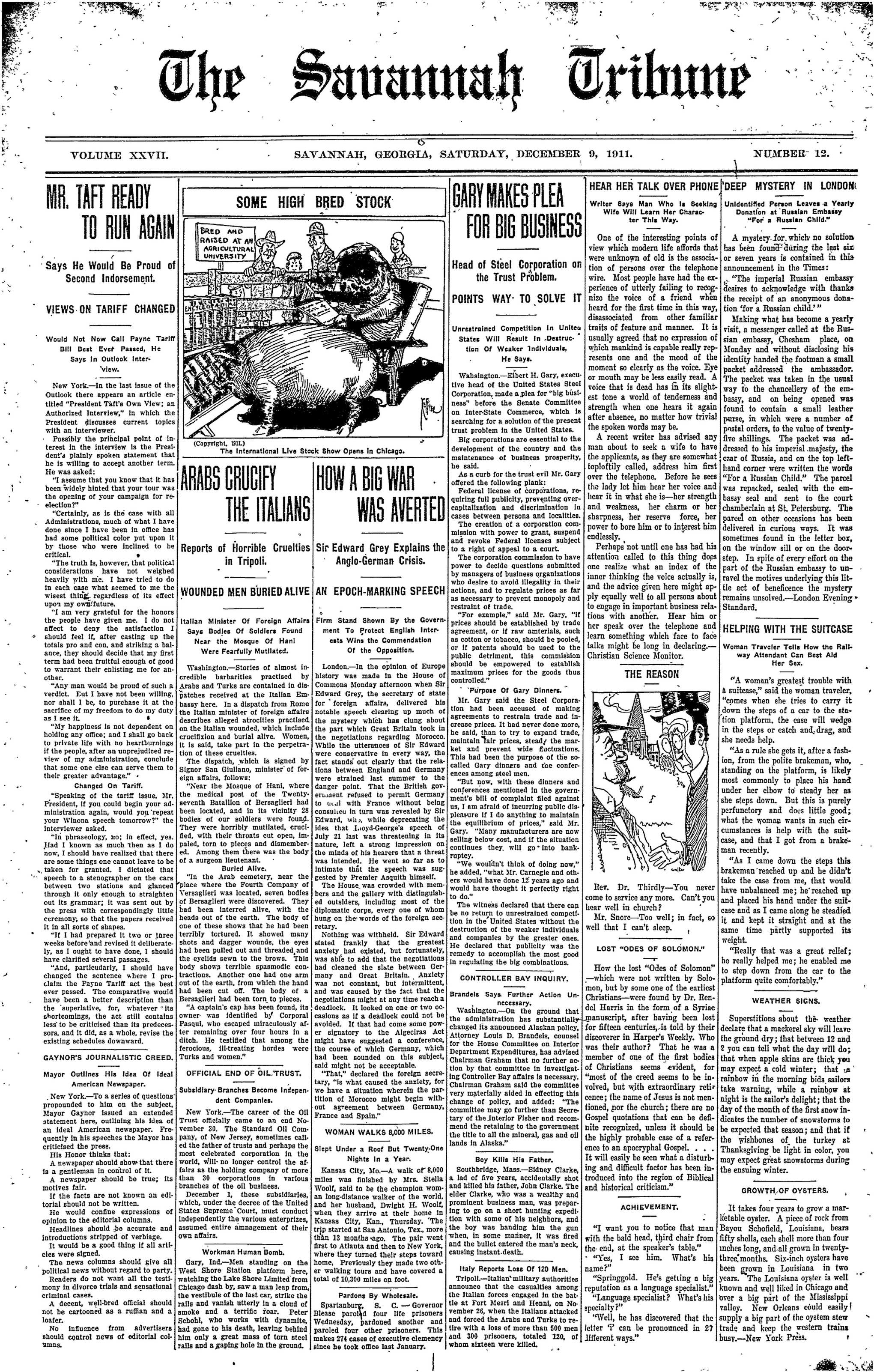
MR. TAFT READY TO RUN AGAIN
MR. TAFT READY TO RUN AGAIN
Says He Would Be Proud of Second Indorsement.
VIEWS·ON TARIFF CHANGED
Would Not Now Call Payne Tariff Bill Best Ever Passed, He Says In Outlook Inter-
New York.—In the last issue of the Outlook there appears an article entitled "President Taft's Own View; an Authorized Interview," in which the President discusses current topics with an interviewer.
Possibly the principal point of interest in the interview is the President's plainly spoken statement that he is willing to accept another term. He was asked:
"I assume that you know that it has been widely hinted that your tour was the opening of your campaign for re-election?"
"Certainly, as is the case with all Administrations, much of what I have done since I have been in office has had some political color put upon it by those who were inclined to be critical.
"The truth is, however, that political considerations have not weighed heavily with me. I have tried to do in each case what seemed to me the wisest thing, regardless of its effect upon my own future.
"I am very grateful for the honors the people have given me. I do not affect to deny the satisfaction I should feel if, after casting up the totals pro and con, and striking a balance, they should decide that my first term had been fruitful enough of good to warrant their enlisting me for another.
"Any man would be proud of such a verdict. Eut I have not been willing, nor shall I be, to purchase it at the sacrifice of my freedom to do my duty as I see it.
"My happiness is not dependent on holding any office; and I shall go back to private life with no heartburnings if the people, after an unprejudiced review of my administration, conclude that some one else can serve them to their greater advantage."
Changed On Tariff.
"Speaking of the tariff issue, Mr. President, if you could begin your administration again, would you repeat your Winona speech tomorrow?" the interviewer asked.
"In phraseology, no; in effect, yes. Had I known as much then as I do now, I should have realized that there are some things one cannot leave to be taken for granted. I dictated that speech to a stenographer on the cars between two stations and glanced through it only enough to straighten out its grammar; it was sent out by the press with correspondingly little ceremony, so that the papers received it in all sorts of shapes.
"If I had prepared it two or three weeks before and revised it deliberately, as I ought to have done, I should have clarified several passages.
"And, particularly, I should have changed the sentence where I proclaim the Payne Tariff act the best ever passed. The comparative would have been a better description than the 'superlative, for, whatever 'its shortcomings, the act still contains less' to be criticised than its predecessors, and it did, as a whole, revise the existing schedules downward.
GAYNOR'S JOURNALISTIC CREED.
Mayor Outlines His Idea Of Ideal American Newspaper.
New York.—To a series of questions propounded to him on the subject, Mayor Gaynor issued an extended statement here, outlining his idea of an ideal American newspaper. Frequently in his speeches the Mayor has criticised the press.
His Honor thinks that:
A newspaper should show that there is a gentleman in control of it. A newspaper should be true; its motives fair.
If the facts are not known an editorial should not be written. He would confine expressions of opinion to the editorial columns.
Headlines should be accurate and introductions striped of verbiage.
introductions stripped of verbiage. It would be a good thing if all articles were signed.
Readers do not want all the testimony in divorce trials and sensational criminal cases. A decent, well-bred official should not be cartooned as a ruffian and a loafer. No influence from advertisers should control news of editorial columns.
The Savannah
SOME HIGH BRED STOCK
BRED AND
RAISED AT AN
AGRICULTURAL
UNIVERSITY
(Copyright, 1911)
The International Live Store
BRED AND
RAISED AT AN
AGRICULTURAL
UNIVERSITY
The International Live Stock Show Opens In Chicago.
ARABS CRUCIFY THE ITALIANS
Reports of Horrible Cruelties in Tripoli.
WOUNDED MEN BURIED ALIVE
Italian Minister Of Foreign Affairs Says Bodies Of Soldiers Found Near the Mosque Of Hani Were Fearfully Mutilated.
Washington.—Stories of almost incredible barbarities practised by Arabs and Turks are contained in dispatches received at the Italian Embassy here. In a dispatch from Rome the Italian minister of foreign affairs describes alleged atrocities practised on the Italian wounded, which include crucifixion and burial alive. Women, it is said, take part in the perpetration of these cruelties.
The dispatch, which is signed by Signor San Giuliano, minister of foreign affairs, follows:
"Near the Mosque of Hani, where the medical post of the Twenty-seventh Battalion of Bersaglieri had been located, and in its vicinity 28 bodies of our soldiers were found. They were horribly mutilated, crucified, with their throats cut open, impaled, torn to pieces and dismembered. Among them there was the body of a surgeon lieutenant.
Burled Alive.
"In the Arab cemetery, near the place where the Fourth Company of Versaglierl was located, seven bodies of Bersaglierl were discovered. They had been interred alive, with the heads out of the earth. The body of one of these shows that he had been terribly tortured. It showed many shots and dagger wounds, the eyes had been pulled out and threaded, and the eyelids sewn to the brows. This body shows terrible spasmodic contractions. Another one had one arm out of the earth, from which the hand had been cut off. The body of a Bersaglierl had been torn to pieces.
"A captain's cap has been found, its owner was identified by Corporal Pasqui, who escaped miraculously after remaining over four hours in a ditch. He testified that among the ferocious, ill-treating hordes were Turks and women."
OFFICIAL END OF OIL TRUST.
Subsidiary-Branches Become Independent Companies.
New York.-The career of the Oil Trust officially came to an end November 30. The Standard Oil Company, of New Jersey, sometimes called the father of trusts and perhaps the most celebrated corporation in the world, will no longer control the affairs as the holding company of more than 30 corporations in various branches of the oil business. December 1, these subsidiaries, which, under the decree of the United States Supreme Court, must conduct independently the various enterprizes, assumed entire amnagement of their own affairs.
Workman Human Bomb
Gary, Ind.-Men standing on the West Shore Station platform here, watching the Lake Shore Limited from Chicago dash by, saw a man leap from the vestibule of the last car, strike the rails and vanish utterly in a cloud of smoke and a terrific roar. Peter Schohl, who works with dynamite, had gone to his death, leaving behind him only a great mass of torn steel rails and a gaping hole in the ground.
SAVANNAH, GEORGIA, SATURDAY, DECEMBER 9, 1911.
ck Show Opens In Chicago.
HOW A BIG WAR WAS AVERTED
Sir Edward Grey Explains the Anglo-German Crisis.
AN EPOCH-MARKING SPEECH
Firm Stand Shown By the Government To Protect English Interests Wins the Commendation Of the Opposition.
London.—In the opinion of Europe history was made in the House of Commons Monday afternoon when Sir Edward Grey, the secretary of state for foreign affairs, delivered his notable speech clearing up much of the mystery which has clung about the part which Great Britain took in the negotiations regarding Morocco. While the utterances of Sir Edward were conservative in every way, the fact stands out clearly that the relations between England and Germany were strained last summer to the danger point. That the British government refused to permit Germany to deal with France without being consulted in turn was revealed by Sir Edward, who, while deprecating the idea that Lord-George's speech of July 21 last was threatening in its nature, left a strong impression on the minds of his hearers that a threat was intended. He went so far as to intimate that the speech was suggested by Premier Asquith himself.
The House was crowded with members and the gallery with distinguished outsiders, including most of the diplomatic corps, every one of whom hung on the words of the foreign secretary.
Nothing was withheld. Sir Edward stated frankly that the greatest anxiety had existed, but fortunately, was able to add that the negotiations had cleaned the slate between Germany and Great Britain. Anxiety was not constant, but intermittent, and was caused by the fact that the negotiations might at any time reach a deadlock. It looked on one or two occasions as if a deadlock could not be avoided. If that had come some power signatory to the Algeciras Act might have suggested a conference, the course of which Germany, which had been sounded on this subject, said might not be acceptable.
"That," declared the foreign secretary, "is what caused the anxiety, for we have a situation wherein the partition of Morocco might begin without agreement between Germany, France and Spain."
WOMAN WALKS 8,000 MILES.
Slept Under a Roof But Twenty-One Nights in a Year.
Kansas City, Mo.—A walk of 8,000 miles was finished by Mrs. Stella Woolf, said to be the champion woman long-distance walker of the world, and her husband, Dwight H. Woolf, when they arrive at their home in Kansas City, Kan., Thursday. 'The trip started at San Antonio, Tex., more than 13 months ago. The pair went first to Atlanta and then to New York, where they turned their steps toward home. Previously they made two other walking tours and have covered a total of 10,300 miles on foot.
Pardons By Wholesale.
Spartanburg, S. C. — Governor Blease paroled four life prisoners Wednesday, pardoned another and paroled four other prisoners. This makes 274 cases of executive clemency since he took office last January.
GARY MAKES PLEA FOR BIG BUSINESS
Head of Steel Corporation on the Trust Problem.
POINTS WAY· TO SOLVE IT
Unrestrained Competition In United States Will Result In Destruction Of Weaker Individuals,
He Says.
Wahsington.—Elbert H. Gary, executive head of the United States Steel Corporation, made a plea for "big business" before the Senate Committee on Inter-State Commerce, which is searching for a solution of the present trust problem in the United States. Big corporations are essential to the development of the country and the maintenance of business prosperity, he said. As a curb for the trust evil Mr. Gary offered the following plank: Federal license of corporations, requiring full publicity, preventing overcapitalization and discrimination in cases between persons and localities.
The creation of a corporation commission with power to grant, suspend and revoke Federal licenses subject to a right of appeal to a court. The corporation commission to have power to decide questions submitted by managers of business organizations who desire to avoid illegality in their actions, and to regulate prices as far as necessary to prevent monopoly and restraint of trade. "For example," said Mr. Gary, "if prices should be established by trade agreement, or if raw amterials, such as cotton or tobacco, should be pooled, or if patents should be used to the public detriment, this commission should be empowered to establish maximum prices for the goods thus controlled."
Purpose Of Gary Dinners.
Mr. Gary said the Steel Corporation had been accused of making agreements to restrain trade and increase prices. It had never done more, he said, than to try to expand trade, maintain fair prices, steady the market and prevent wide fluctuations. This had been the purpose of the so-called Gary dinners and the conferences among steel men.
"But now, with these dinners and conferences mentioned in the government's bill of complaint filed against us, I am afraid of incurring public displeasure if I do anything to maintain the equilibrium of prices," said Mr. Gary. "Many manufacturers are now selling below cost, and if the situation continues they, will go into bankruntey.
"We wouldn't think of doing now," he added, "what Mr. Carnegie and others would have done 12 years ago and would have thought it perfectly right to do." The witness declared that there can be no return to unrestrained competition in the United States without the destruction of the weaker individuals and companies by the greater ones. He declared that publicity was the remedy to accomplish the most good in regulating the big combinations.
CONTROLLER BAY INQUIRY.
Brandeis Says Further Action Unnecessary. Washington. On the ground that the administration has substantially changed its announced Alaskan policy, Attorney Louis D. Brandeis, counsel for the House Committee on Interior Department Expenditures, has advised Chairman Graham that no further action by that committee in investigating Controller Bay affairs is necessary, Chairman Graham said the committee very materially aided in effecting this change of policy, and added: "The committee may go further than Secretary of the Interior Fisher and recommend the retaining to the government the title to all the mineral, gas and oil lands in Alaska."
Boy Kills His Father.
Southbridge, Mass.—Sidney Clarke, a lad of five years, accidentally shot and killed his father, John Clarke. The elder Clarke, who was a wealthy and prominent business man, was preparing to go on a short hunting expedition with some of his neighbors, and the boy was handing him the gun when, in some manner, it was fired and the bullet entered the man's neck, causing instant death.
Italy Reports Loss Of 120 Men.
Tripoli.Italian military authorities announce that the casualties among the Italian forces engaged in the battle at Fort Mesri and Hennl, on November 26, when the Italians attacked and forced the Arabs and Turks to retire with a loss of more than 500 men and 300 prisoners, totaled 120, of whom sixteen were killed.
Tribune
Writer Says Man Who Is Seeking
Wife Will Learn Her Charac-
ter This Way.
One of the interesting points of view which modern life affords that were unknown of old is the association of persons over the telephone wire. Most people have had the experience of utterly failing to recognize the voice of a friend when heard for the first time in this way, disassociated from other familiar traits of feature and manner. It is usually agreed that no expression of which mankind is capable really represents one and the mood of the moment so clearly as the voice. Eye or mouth may be less easily read. A voice that is dead has in its slightest tone a world of tenderness and strength when one hears it again after absence, no matter how trivial the spoken words may be.
A recent writer has advised any man about to seek a wife to have the applicants, as they are somewhat toploftily called, address him first over the telephone. Before he sees the lady let him hear her voice and hear it in what she is—her strength and weakness, her charm or her sharpness, her reserve force, her power to bore him or to interest him endlessly.
Perhaps not until one has had his attention called to this thing does one realize what an index of the inner thinking the voice actually is, and the advice given here might apply equally well to all persons about to engage in important business relations with another. Hear him or her speak over the telephone and learn something which face to face talks might be long in declaring. Christian Science Monitor.
A
Rev. Dr. Thirdly—You never come to service any more. Can't you hear well in church?
Mr. Snore—Too well; in fact, so well that I can't sleep.
LOST "ODES OF SOLOMON."
How the lost "Odes of Solomon"—which were not written by Solomon, but by some one of the earliest Christians—were found by Dr. Rendel Harris in the form of a Syriac manuscript, after having been lost for fifteen centuries, is told by their discoverer in Harper's Weekly. Who was their author? That he was a member of one of the first bodies of Christians seems evident, for "most of the creed seems to be involved, but with extraordinary reticence; the name of Jesus is not mentioned, nor the church; there are no Gospel quotations that can be definite recognized, unless it should be the highly probable case of a reference to an apocryphal Gospel. . . . It will easily be seen what a disturbing and difficult factor has been introduced into the region of Biblical and historical criticism."
ACHIEVEMENT.
"I want you to notice that man with the bald head, third chair from the end, at the speaker's table."
"Yes, I see him. What's his name?"
"Springgold. He's getting a big reputation as a language specialist."
"Language specialist? What's his specialty?"
"Well, he has discovered that the letter 'i' can be pronounced in 27 different ways."
Unidentified Person Leaves a Yearly Donation at Russian Embassy "For a Russian Child."
A mystery for which no solution has been found during the last six or seven years is contained in this announcement in the Times:
"The imperial Russian embassy desires to acknowledge with thanks the receipt of an anonymous donation 'for a Russian child.'"
Making what has become a yearly visit, a messenger called at the Russian embassy, Chesham place, on Monday and without disclosing his identity handed the footman a small packet addressed the ambassador. The packet was taken in the usual way to the chancellery of the embassy, and on being opened was found to contain a small leather purse, in which were a number of postal orders, to the value of twenty-five shillings. The packet was addressed to his imperial majesty, the czar of Russia, and on the top left-hand corner were written the words "For a Russian Child." The parcel was repacked, sealed with the embassy seal and sent to the court chamberlain at St. Petersburg. The parcel on other occasions has been delivered in curious ways. It was sometimes found in the letter box, on the window sill or on the doorstep. In spite of every effort on the part of the Russian embassy to unravel the motives underlying this little act of beneficence the mystery remains unsolved.—London Evening Standard.
HELPING WITH THE SUITCASE
Woman Traveler Tells How the Railway Attendant Can Best Aid Her Sex.
"A woman's greatest trouble with a suitcase," said the woman traveler, "comes when she tries to carry it down the steps of a car to the station platform, the case will wedge in the steps or catch and drag, and she needs help.
"As a rule she gets it, after a fashion, from the polite brakeman, who, standing on the platform, is likely most commonly to place his hand under her elbow to steady her as she steps down. But this is purely perfunctory and does little good; what the woman wants in such circumstances is help with the suitcase, and that I got from a brakeman recently.
"As I came down the steps this brakeman reached up and he didn't take the case from me, that would have unbalanced me; he reached up and placed his hand under the suitcase and as I came along he steadied it and kept it straight and at the same time partly supported its weight.
"Really that was a great relief; he really helped me; he enabled me to step down from the car to the platform quite comfortably."
WEATHER SIGNS
Superstitions about the weather declare that a mackerel sky will leave the ground dry; that between 12 and 2 you can tell what the day will do; that when apple skins are thick you may expect a cold winter; that a rainbow in the morning bids sailors take warning, while a rainbow at night is the sailor's delight; that the day of the month of the first snow indicates the number of snowstorms to be expected that season; and that if the wishbones of the turkey at Thanksgiving be light in color, you may expect great snowstorms during the ensuing winter.
GROWTH, OF OYSTERS.
It takes four years to grow a marketable oyster. A piece of rock from Bayou Schofield, Louisiana, bears fifty shells, each shell more than four inches long, and all grown in twenty-three months. Six-inch oysters have been grown in Louisiana in two years. The Louisiana oyster is well known and well liked in Chicago and over a big part of the Mississippi valley. New Orleans could easily supply a big part of the oystem stew trade and keep the western trains busy.—New York Press.
PRESERVATION
: ” AND DEDICATION:
A SERMON |
And the Lord preserved David with-
ersoever he went.... Them also
“King David dedicated unto the Lord.
—I Chronicles, xvill, 6-11.
The téxt which we have chosen will
call to our minds the contrast be-
tween the moral nature of the living
God and the supposed moral disposi-
tlon of the heathen gods. The heathen
gods are represented as being de
structive as disposed to destroy their
subject, their wrath being appeased
only by the shedding of blcod and
often the destruction of the innocent.
Thus we have the bloodthiraty god
Shiva and the firedestroying god Mo-
loch, and many others having similar
natures, and scarcely ever do we find
emong the heathen gods one which
represents a gracious disposition. But
this is not true of our God, for he is
Tevealed to us as a “preserver” and
“protector” of his people. “The Lord
‘preserved’ David witherscever he
went,” and what fs true of his atti-
tude toward David is true of his atti-
tude toward all of his followers and
those who put their trust in him. |
David, looking back on a long life
filled with changes, stirring events
and a multitude of dangers which he
had escaped, must have felt that his
coming through them all unharmed
‘was due to the fact that God had pre-
served him, and in appreciation of
this providential protection he deter-
mines to dedicate himself and, his:
material things to God, leaving us an
example worthy of imitation. |
What would become of us if our:
God did not preserve us? The aver-
age life 1s full of dangers, some of
them seen and others unseen, and we
need to be preserved from them or be
Tuine. Not only kings and warriors
need protection, but the common rol-
dier as well, for life's battle has to
be fought by one and all. The rich
and poor, the young and old, the fa-
mous and obscure in every nation
and every clime are subject to grave
dangers. We are compelled to face
the dangers which arise from the
world, the flesh and the devil. In the
world there are pitfalls all about us
Into which should we fall only ruin
awaits us, There Is the pitfall of im-
proper commerce, euch as speculation, |
usury, oppression and other dishonest
methods of making gain, Then come
the dangers of the flesh, such as sin-|
ful appetite, unholy ambition, bodily
disease and death itself. The very:
weakness of the flesh is the source of
‘many dangers, and it can be saved
trom corruption only by God himself. ;
After the world and the flesh we still
have the devil to contend with, for!
he is ever setting his traps and
snares, seeking to envelop us In ques-,
tlonable pleasures and destroy our,
faith. Human beings are compelled to!
travel a dangerous road and wrestle’
not with flesh and blood but grapple
with the powers of darkness, and their}
only hope is in God, who Js the vre-|
server of men. - |
ENTERPRISING AGENT.
Hearing a nolse at midnight in one
of his rooms a gentleman tiptoed to
the spot, thinking to take the burglar
unawares. Sikes, however, was not to
be caught napping, and before the
owner of the house fully realized what
was happening he was looking down
the muzzle of a revolver.
“You realize that you are at my
mercy?”
“Ye—s,” replied the house owner.
“And also realize that I could shoot
you dead if I wished?”
Another trembling affirmative.
“You did not hear me enter the
house?” ‘i .
“No.” “
“Well, if you hed your windows fit
ted with one of Ketchum’s new patent
burglar alarms that wouldn’t have
happened. I am am agert for the—"
But the house owner had swoonet.
—Ideas.
A WCNDERFUL CONVICTER.
There was a prosecuting attorney
whose methods were so dramatic and
uniformly succesful that he not only
became the terror of evil-doers, but an
object of admiration, especially among
the negroes,
Upon retirement from office he was
at once sought after by those charged
with crime. The first two cases which
he defended resulted in convietion,
much to his chagrin.
An old negro who had watched his
prosecution in admiring wonder, and
jJooked on with equal interest when he
conducted the defense, accosted him
just after his defeat, and safd:
“Marse Earl, you sho’ is a wonder.
No matter which side you’s on they go
to the pen just the same.”—Case and
Comment. *
—_——————
TO CHEER HER UP.
‘An old Scotswoman, who had put
herself to considerable inconvenience
‘and gone a long way to see a alck
friend, learned on arriving that the
alarming symptoms had subsided.
“an’ hoo are ye the day; Mrs. Craw-
fora?” she inquired 1m breathlesa anx-
lety. 2
“Ob, I'm quite weel noo, thank ye,
‘Mrs. McGregor,” was the cheerful an-
swer.
“Quite weel!” exclaimed the visitor,
“an’ after me haeln’ come sae far to
see ye!” .
The protection God gives his fol-
lowers {s not the protection of favor.
itism, nor does it come spasmodically
as from a capricious-tyrant; it fs an
assistance which rescues us from
harm and we are preserved because
the nature of God Is to save. Saving
power and disposition fs an attribute
of God and his nature is to be grac-
jous and give needed help. Our God
is not a God who creates and then
abandons his creation, nor does he
urge his people to battle and then
desert when the fight is on. I have
read of a heathen god who bid his
poor subjects to ask for bread and
when they stretched out their hands
to recelve it he would strike them off
with a sword. Not so with the God
of David. He preserved him wither-
soever he went, and he still goes be-
fore his servants in the struggle of
life and preserves them from harm
and {s the joy and comfort of his peo-
ple. God is a shield, a buckler, a fort-
ress and a sure defense. It Is God
who saves the soul from death, it is
he who dries the tearful eyes and
keeps our feet froin falling. Our times
are in his hands, and how great and
strong are those hands! The man
who is the friend of God can say,
amid all the dangers of his life, “I
will trust and not be afraid," for
Angels guard from God surround us,
We are safe for thou art nigh.
David was unwilling for God to pre-
serve lim without In some way show-
ing his gratitude and apprectation,
and he decided that God's preservation
demanded his dedication, He would
dedicate himself and what he pos-
sessed to God, and the same obliga-
tion rests upon us today. We must
dedicate our lives ta:God because of
his mercles, and this, is a reasonable:
service and none should decline to do
it. The Apostle Paul, when writing
to some Roman Jewé/ has this to say:
“I beseech you, brethren, by the ‘mer-
cles’ of God, that ye present your
bodies a, living sacrifice unto God,
holy and acceptablé; which {s your
reasonable service.”’, There is no oth-
er way for us to pleaze God except
by our faith. If we jgive of our mate-
tial things, we give’that which be
longs to God by the right of redemp-
tion, and our gifts are unacceptable to
himapnless our hearts and lives go
with them. A right spirit must ac-
company our gifts, and we can never
have the right spirit until we giverour-
selves to God by surrendering our
wills to his and be ready to do as he
bids us. David did this as the only
means he had of showing his grati-
tude for the protection and preserva-
tion God had given him during his
life. . .
Let us bear in mind that all Chris-
tlans are in a‘state of danger. Satan
desires to trip and trap every believer,
and to this end he sets all kinds of
snares to catch them. The world is
full of pitfalls, and we have to wend
our way through a maze of trial and
temptation. The flesh is weak and
leans hard upon the world, and our
only safety is In God, who will pre-
serve us, while the dedication of our
lives to God 1s both a reasonable and
spiritual service and will show to oth-
ers that we appreciate the fatherly
love of God in giving to us divine pro-
tection.—Walter Rhodes.
CALLAGHAN’S NERVOUSNESS:
A detachment of British soldiers was
about to attack a tribe of rebel Indian
tribesmen, who awaited them drawn
up in battle order. A seasoned old ser-
geant noticed a young soldier fresh
from home, visibly affected.by the
nearness of the coming fight. His face
was pale, his teeth chattered and his
knees tried hard to knock each other
out. It was sheer nervousness but the
sergeant thought {t was downright
funk. 7
“Callaghan,” he whispered, “ls it
trimblin’ ye are for yer own dirty
skin?” ;
“No-no, sergint,” replied Callaghan,
making a braye attempt to still his
shaking limbs, “Oi'm trimblin’ for the
inimy. They don’t know Callaghan’s
here.”—Ideas.
THE CONTENTED ARTIST.
“Stock taking and yearly statements
should be conservative. In taking an
account of stock it is grave error to
‘be, ke the Cape May sculptor, over-
sanguine.”
The speaker was Senator Boise Pen-
rose of Philadelphia, says the New
York Times. He resumed: *
“This sculptor, calculating lke cer-
tain financiers I've known, sald to a
friend on the Cape May Beach:
“*You know that terra-cotta stato-
ette of mine, “The Bathers?” Well, !
got more for that than I expected.’
“But, said his friend, I thought
your landlady just took It for board?’
“Yes, very true,’ sald the sculptor,
‘but you must remember that the
price of board has gone up.”
LONG-DISTANCE COURTSHIP,
A lady was one day-approached by
‘her Seoteh mald with the information
‘that she was about to leave. “What
is the cause of this sudden decision,
Mary?”
“I think I'l bé a-marryin’.”
“Indeed! And whom, may I ask?”
“The man that sits across in the
kirk o’ Sundays.”
“But what is his name?”
| “I dinna kin.”
“What! You're surely not engaged
to a man whose name you do net
know?” .
| “Not engaged, my lady; but he’s
been Jang lookin’ at me an’ I think
he'll soon be speakin’.”"——Housexeeper,
SUCCESSFUL HEGRO
FAIR IN ALABAMA
“COUNTY, ALABAMA, HELD It
POSING EXHIBITION,
| PMO GAMIGL STUN.
| Tuskegee, Ala—The Macon county
|| fair, held in the town of Tuskegee re
cently, was oue of the largest and
'|thost {mposing exhibitions ever seen
}in this neighborhood, The Montgom:
ery Advertiser carries a full account
{of the fair, and we are glad to quote
in part from this account: = -
“Tuskegee, Ala—With the cheering
of hundreds and to the martial strains
'|of music rendered by the four bands,
the big parade which formed in the
public square marched down South
Main street to the fair grounds; where
the formal opening of the Macon coun-
ty agricultural fair took place. Hun-
dreds’ of people had already entered
the fair grounds when the big parade
arrived, and all day long people con-
tinued to flock Into the immense in-
closures, Soon after entering the fafr
grounds President Drakeford ‘of the
association addressed the crowd. He
spoke briefly, but in his few words
manifested an earnest appreciation to
the people of Macon county in re-
sponding so liberally to the cause he
had so zealously worked for during the
past twelve months. He also bade
eleryone welcome to the city and ex-
tended to them the open arms of the
city. Short addresses were followed
by others, Including several specially
directed to the farmers.
“The dpentiig of the fair was made
one of the greatest events in the his-
tory of Tuskogee. From early sunrise
until the opening hour people con-
tinued to pour in from the surround-
ing country, anxiously awalting the
tlme when the parade should move on
toward the grounds. Promptly at ten
o'clock the parade, composed of auto-
mobiles, buggies, wagons and pedes-
trians, began its outward march. In
front were the city and county offs
clals, followed by those of the fair as-
sociation.
Smith Leads Parade,
The parade was led by Capt. N.
Clark Smith and bis famous band.
The national airs were played and
when “Dixie” was touchéd by the elxty
Bleces a thundering roar from thou-
sands of throats greeted the musicians
in response. Everybody possessed the
réal county fair spirit and worked to
make it a great event. Practically
every business house in the city
closed, and ‘their occupants moved
along with the great throng to wit-
ness the opening.
The exhibits in the agricultural de-
partment were larger and more varled
than they have been at any fair here-
tofore hetd here. They showed im-
provement In several respects, the
most noticeable being that the farm-
ers are raising a higher class of prod-
ucts than formerly. A common sight
‘was to see giant stalks of cotton set-
ting about in the different booths,
some of them containing as many as
125 and 150 bolls. Immense stalks of
corn with eight and ten fully matured
ears were also common. In every in-
stance the producers said that the Im-
proved varlety 1s much easier and
cheaper to ralse than the inferior or
common Kind. All the way through
the exhibits were excellent and were
even better than were expected.
_ Fine Stock Ralsed. |
In the past few years the farmers
of Macon county have directed much
of their time towards the raising of
fine cattle, horses and hogs. In this
department were exhibited'some of the
most beautiful specimens to be found
anywhere, all of theni being Alabama
bred and raised in this county. Among
the most noted exbibfts was that of
Mr. W. A. Reynolds of Warrior Stand
in the lower portion of this county.
He had at the fair several colts, mares
and many fine chickens, many of them
having taken first prize at other fairs
in the state this season. All the offer-
ings showed that the farmers are wak-
ing up to the fact that ‘this Is not
only a great farming country, but one
of the greatest stock raising sections
of the south.
‘The exhibit of the Tuskegee Normal
and Industrial institute attracted con-
siderable attention, For several days
the boys and girls of the school were
hard at work arranging the several ex-
bibits and they presented a most
pleasing appearance. That which at-
tracted the most attention was the
corn exhibit. The manner in which
the corn for this purpose was gathered
was unique. Every negro farmer in
the county contributed ten ears each
and with this an immense: pyramid
had been formed in the !mmediate
front part of the administration bulld-
Gs EO anhinee cetenentians sha
COLORED GREATEST WORKERS
THE JOHNSON HOTEL
$31 JEFFERSON STREET
With all hotel convenfences, Hot or cold baths. Large parlor with read-
ing matter and music. Polite help. Carriage and backs, also telephones.
If you want a hack or carriage ring up 676 and the manager Will see that
you get it. Rooms to let at 25 cents. . i
MEALS AT ALL HOURS.
PRINCE R. BUTLER, Manager and Proprietor.
HAVE LARGER PERCENTAGE OF
WORKERS THAN WHITE, AMERI-
CANS, SAID PROF. R. R. WRIGHT,
JR, AT BIG CONFERENCE OF
CHARITIES IN BOSTON—PREJU-
DIC_ AND DISCRIMINATION AC-
COUNT FOR RELATIVE INEFFI-
CIENCY—LABOR UNIONS’ WORST
FOES, BECAUSE IN THEM THE
COLOR PREJUDICE IS MOST EF-
FECTIVE.
SEE THE—
821 BROUGHTON STREET, EAST. Next Door’to Red Cross Pharmacy,
Special Prices Given for Thie ty Days, A full Ine of Latest
* Fall and Win ter Goods.
(ENTRAL® GEORGIA
: RAIL NG
GEORGIA- ALABAMA
The North and Northwest
the West and Southwest
Our Standards Are
Reliability, Comfort, Safety
Whanever yeu contemplate a short trip or tong parma we peony
cy net 37 Bull Street 0%
WILLIAM B. CLEMENTS, City Pass. & Ticket Agt
The Mordecie Pressing Ciub
ov ela geo al eed te eee ee ee es
Be Se epotb STREET. Phone 1319
THIARAAC DAYVOUD The
THOMAS BAKER, ;,™
; . ‘9 Shoemaker
First class SHOE REPAIRING. Halt sole, sewed, 85 cents; nailed,
50 cents; rubber heels, 35 and 50 cents, All work guaranteed,
. CORNER EAST BROAD AND BOLTON STREETS.
Don’t Buy a New One
Bayo the old ones and send to xs. We make them new—Stores, Furn>
ture, Mattresses, Carpets. CARPET AND MATTING LAYING A BPEO-
IALTY. OK furniture bought and sold Packing and ‘Bhippiag. Goods
ealled for and delivered, *
JACKSON & SLOCUM, Upholsterers
BOLTON AND BAST BROAD STREETS.
When Your Eyes Trouble You
GONSULT OUR OPTICIAN, 2
DR. M. SCHWABS’ SON
11 BULL STREET. .
FOR SAFE, COMFORTABLE AND CLEAN LODGING ‘om"TeaNstenr
Stop at McCARTHY’S .
. 233 BRYAN 8T. WEST.
FIRST CLASS SANITARY BARBER SHOP AND RESTAURANT . ATs
TAC HED,
re 230 ST. JULIAN STREET, WEST.
—_—d St
I with to notify all of my old patrons that I have purchased my cld
stand at Hall and Price streets, and would be gled to have thom patronize
me. Phone me at 601 for anything you may want and I will deliver to
you promptly. Respectfully,
ANDERSON DRUG COMPANY
TAZ L. ANDERSON, PROPRIETOR, Corner HALL and PRICE 8T,
SOMETHING A SENATOR NEVER
. DOES.
THE PROGRESSIVE MAN
Is the one who makes it~
his business to advertise
-his business thoroughly.
Now is your opportunity
Mr. Heyburn of Idaho sometimes has
trouble in getting a large audience of
his fellows whe he speaks on the
floor of the senate. One day last July
he rose to make a speech and, seeing
that there were only three men besides
himself in their places, he moved to ad-
journ. This was prevented by the as-
sembling of a quorum of senators who
had been sitting in the cloakrooms,
In beginning his delayed speech, he
sald:
“I do not understand the conduct of
senators. I have seen them under all
phases; I have seen a senator leave
this chamber when ‘he'should a here
to receive good advice, Ihave seen him
leave this chamber when, by remala-
ing, hp could have given good advice.
The only thing I neyer saw a senator
do was to back out of the door in the
middie of his own speech.”—Popular
Magazine.
The Farm
There are heavy clay soils, sandy soils and muck soils. Heavy clay soils have a tendency to pack, thereby necessitating special cultivation. It is a mistake to plow clay soils when not in proper moisture condition; even a single plowing of a too-wet clay soil will show a bad effect for a number of years. It is important that there be an abundance of vegetable matter near the surface. Drainage, too, is of prime importance. It is natural for clay soils to retain moisture, which permits them to puddle easily if worked when wet. The drainage is very effective.
Crops and rotations must be chosen with special view to the character of the land. Clover and timothy grow abundantly on clay, and small grains, including oats, barley and wheat, are well adapted to such and. The rotation on clay fields should include clovers, small grains and tilled crops, such as corn and potatoes. To maintain fertility it is necessary to add considerable vegetable matter by turning under an occasional second crop of clover or other legume, as well as by using all available manure. Clay soils rarely contain much humus. The supply of phosphorus is also limited and should be increased by the addition of phosphate fertilizer supplementing farm manure.
The addition of vegetable matter in sandy soils is valuable as it is required to increase the water-holding capacity, as well as to add fertility. In the production of sandy soils water frequently is the limiting factor, due to the texture of the sandy soil as well as a lack of vegetable matter. The fertility needs of sandy soils are nitrogen, phosphorus and potash. The average sandy soil contains only one-third to one-half as much fertility as clay loams. Legumes are beneficial because they supply the needed nitrogen as well as humus. The use of lime on sandy soils, which are very commonly acid, will aid in securing a stand of alfalfa and clovers. Rotations must be chosen so as to increase the amount of vegetable matter and provide a legume crop to cover the soil at least one year in every three years.
Thorough drainage of marsh soils is the initial step toward improvement. Special cultivation is needed by such lands. Heavy rolling, by packing the loose peat soil, produces a firmer seed bed.
Marsh soils are rich in nitrogen, but are deficient in phosphorus and potash. Barnyard manure will supply these elements, but it is more economical to apply it to the uplands and use commercial fertilizers on the marshes. The soil is frequently in need of lime to correct acidity. There are crops that are best adapted to marsh lands. Corn, potatoes, garden truck and timothy and alsike for hay are best.
RULES FOR USE OF FERTILIZERS.
1. Nitrogen (or "ammonia") encourages strong leaf, vine nad bush growth.
2. Potash makes firm tuber, bulb and fiber.
3. Phosphoric acid makes blooms "set," and seeds and seed pods form abundantly.
4. If the wild growth on your farm is profuse and your tomatoes and melon vines run to leaf, your soil is rich in nitrogen.
5. If trees do not thrive, onlons seem soggy and tomato vines lack sturdiness of stalk, the soil needs potash.
6. If your tomatoes, melons, grain and cotton fall to "set" plenty of seed and fruit, phosphoric acid is called for.
7. If you expect to take from your land a crop rich in leaf, as lettuce, increase the proportion of nitrogen in your fertilizer.
8. If potatoes or onions are desired, provide plenty of potash.
9. If abundant corn, wheat, cotton bolls, melons, peaches, strawberries or tomatoes are wanted, see to the phosphoric acid.
KEEP HOGS CLEAN.
It is of the utmost importance that the pens and surroundings be kept clean and the feed troughs and barrels scrupulously sweet. The hog is a clean animal, and when forced to be otherwise he will not return as great a profit from the food he consumes. The hogs should be fed on a floor made for the purpose, which should be swept off each time before feeding. A good feeding floor is a profitable addition to the feeding layout. By its use the hogs are not compelled to pick their feed out of the mud and dirt. Where there are a number of hogs of different sizes it would be well to have more than one feeding floor and feed the larger hogs on one, the smaller on another. When the hogs are all fed together the smaller ones are nearly always pushed aside by their stronger brothers, and do not get their share of the feed.
Every swine breeder realizes the importance of keeping the hogs in a good healthy condition, and charecoal,
ashes and salt kept within reach of the animals at all times have a wonderful influence in maintaining this desirable feature.
In feeding the charcoal break up six bushels and thoroughly mix with it ten pounds of salt and one of wood ashes. Place this where the hogs can have free access to it. That this fills some requirements of the animal system is proven by the fact that the hogs have insatiable appetites for it and seem to never get enough of it. Where hogs are not accustomed to the charcoal diet, care should be exercised in feeding it at first, as the animals are likely to eat more than is good for them. It should be fed gradually at first until the hogs get used to it and then there will be no danger in their eating too much.
IMPROVED METHODS OF FARMING.
Among the first things essential to know in replanning a farm is what can reasonably be expected from the farm if properly handled. Judgment on this point will be considerably influenced by what is being done by good farmers on similar land elsewhere under like conditions. The usual crops grown in the vicinity and the usual rotation on most of the farms of the neighborhood are corn and oats. But very little hay is raised, notwithstanding both clover and timothy do well, nor is much stock fed. Some colts are raised, but most of the grain is sold direct to the elevator.
In the early days, when the land was new, corn yielded 75 to 80 bushels per acre and oats 40 bushels, and this type of farming—corn in rotation with oats—was very profitable. At the present time on similar land and within ten miles of the farm in question one extensive farmer has been able to maintain the average yield of both corn and oats for a period of sixteen years at forty bushels per acre. Even on this farm scarcely 15 per cent. of the area is yearly planted to clover, and no commercial fertilizer and practically no stable manure are used.
With a proper system of rotation, the introduction of clover into the farming scheme and the use of comparatively small quantities of commercial fertilizers where barnyard manure is not obtainable, it should be easily possible to make the average yields of corn on this farm 60 to 75 bushels per acre and of oats 40 to 45 bushels.
This estimate is based on the fact that in a thirty-year rotation experiment at the University of Illinois the yield of corn in a rotation of corn, oats and clover has averaged fifty-eight bushels per acre, and when treated with lime and phosphorus in addition for thirteen years the average yield of corn per acre has been ninety bushels. The first thought, then, in replanning this farm is to introduce clover into the rotation and to use some form of commercial fertilizer that will maintain the fertility of the soil and increase the yield of money crops.
LIME FOR THE COW.
"The improstance of lime has been shown by some experiments at the Wisconsin experimental station in relation to milk production. It seems from investigations that lime is, indeed, one of the greatest factors in agriculture. Not many years ago our best scientists ignored this important substance on the ground that plants under favorable conditions can grow without the element of calcium, which is the basis of lime, but further investigations*show that in practical agriculture the lime is essential in bringing about the favorable conditions. But it is not only plants that need the medium of lime to enable them to make growth; animals are in even greater need of it. A cow, according to the Wisconsin investigation, gives in her milk and manure two ounces of lime a day. A cow that was fed what might be otherwise considered a good ration for 120 days, was really only getting one ounce of lime a day; so that she had to draw on her body for an ounce a day—Kansas Farmer.
BACK TO THE FARM MOVEMENT.
The United States Department of Agriculture, the magazines and newspapers have been exploiting the advantages of reclaiming neglected eastern farms, and already the tide of emigration has turned eastward. The opportunities of earlier days in the west are no longer to be found there in the most desirable sections, but in the New England there are good farm opportunities, and already farms in the east are being rapidly taken up "Back to the farms of our daddies" has become a popular slogan, and the eastward movement is a fact. Farms that a few years ago could be had for almost a song are now selling at fair prices, like the proverbl "hot cakes," and in some sections have already become so scarce or the prices so high that desirable places at a fair price are scarce and hard to find. There are, howeverfri some good ones left for the wise buyer.
Army Vernacular as Odd as That of the Navy.
A MAN JUST ENLISTED IS CALLED "A ROOKY," AND MEN WHO ENLIST AT THE BEGINNING OF WINTER AND DESERT IN THE SPRING ARE CALLED "SNOW-BIRDS."
The army has just as odd a vernacular as the navy. To the uninitiated some army expressions would convey little or no sense, as, for example, if a soldier were heard to say, "The top told me to report for kitchen police and help skin the spuds for slum for supper," the hearer would have several guesses before he would come anywhere near what this meant in the matter of the barracks.
In plain language, it means that the first sergeant (the ranking or orderly sergeant) had told him to report to the cook to assist him in peeling the potatoes to make the hash or stew for supper. Hash or stew is always "slum," and the first sergeant is "the top," "kitchen police," a man who assists the cook in the preparation of meals and the washing of dishes, pans, etc.
A man who has just enlisted or has not yet been in the ranks long enough to be considered a full fledged soldier, having learned all his duties, is called "a rooky," and woe be unto the "rooky" who gets "fresh" before an old sergeant who has been in the ranks since before the fresh "rooky" was born! He will be told in any but gentle terms by the old timer: "Shut up and go about your work. Your name is not yet dry on your enlistment paper!" Meaning that when he was sworn in and promised to serve for three years and obey the "orders of the president and the officers appointed over him" he had signed his name to this paper and the signature had not had time to get dry.
When a man says he is going to "take on" or "take to another blanket," he means that he is going to reenlist. The government, in the clothing allowance for each man, provides a blanket; hence the term to "take another blanket."
The guardhouse is called "the mill." Some ill behaved soldier away back in the past (the term is a very old one) no doubt thought his term in the guardhouse ground out toward its end very slowly, so he nplied this now much used name to the prison of the carrison.
When "the top" says: "Get your blanket and go to the mill," the soldier knows he is in for a tour of duty in the guardhouse, and his blanket means one or more nights, for in that much to be avoided place nothing is supplied in the way of comforts, and each occupant carries with him his blanket, or more if he has them, to make his rest more comfortable.
All meals are called "chuck," and along toward mealtime the expression, "Is it not time for chuck call to blow?" is heard very frequently.
"Snowbirds" are men who enlist in the winter about the time snow begins to fall and the real snowbird puts in its appearance and desert in the spring when the robin appears. They "take on" only to tide over the winter with its discomforts.
The oldest man in the company is "dad" and the youngest "the kid." Any deserter is called a "skipper." Two men who share the same small tent or whose bunks are side bp side in the barrack room are called "bunkies." This ancient term originated in the days of the very old army, when the bunks were "built for two" and two men slept side by side on a mattress filled with straw and one blanket aplece, much different from today, when each man has his hair mattress, pillow, sheets and blankets. A "bunky" always has a chew or filling for a pipe for his mate, when he might tell another man that he has not enough weed to "put under your nail."
All fines received from a court are called "blind," so that a man who received ten days in the guardhouse and a fine of five dollars would tell his comrades that he "got ten days in the mill and five blind."
The commanding officer of a company or the post is always the "old man." If he is not liked other terms, not parlor talk, are used.
All field musicians are called "wind jammers" on account of their jamming of wind into the trumpet that calls the men to labor or rest.
Every man on the completion of his term of enlistment is given a discharge. At the bottom of his paper in olden times was a space in which the character borne by the man during his term of enlistment was written. If his service had been bad this part of the discharge was cut off, and it was called "a bobtail." In speaking of the length of time a man has to serve before he has completed his term of enlistment the term "butt" means less than a year. So to say he has a year and a little less than two years he would saz "a year and a butt."
There are a number of men in the ranks who save their money and lend it to others. The rate is very high. If a man borrows two dollars he must pay four dollars at pay day. This is called "cent per cent." The term "one more shingle on the White House" means that the man has completed one more tour of guard duty consisting of 24 hours.
Many of these terms quoted are of very old origin, so old that if you ask the oldest man in an organization when he heard it first he will probably tell you, "Oh, it was used when I took my first blanket."—Maj. B. W. Atkinson, in New York Tribune.
HOW TO MAKE THE COMING OF FOREIGNERS A BLESSING TO NEGROES AS WELL AS TO THE GENERAL PUBLIC.
The efforts of the south in bringing in foreigners for the purpose of giving them public and domestic work as well as to sell them the land on which to build industries and manufactories, and the growing sentiment in that direction by the southern people, gives us reason to believe that in a few years we will have a great many foreigners of various nationalities in the south to do the work, buy the lands and build the industries and manufactories. If they find the negroes in the south landless, the growth of our civilization in the future will be restricted for generations to come; but if we can persuade our moneyed people to join in the effort in buying small farm lands, in teaching people to diversify their products, to build industries and manufactories and to manufacture their products from the clay, the farm and the forest, with which we can have access to the markets of the world, we will have an independent foundation and can build up our business and professional interests as well as other people. Then the coming of the foreigners will be a blessing as consumers, if a blessing at all.
A Real Inviting Field for Investment.
The farming lands all over the south offer one of the best fields of investment in the country. Lands can be bought from $10 to $125 per acre all over. These lands are increasing in valuation monthly. Lands that were sold from twelve to six months ago from $7 to $10 per acre in many cases are now selling all the way from $20 to $40 and $50 per acre. In the most cases these lands are offered only in large quantitles, from 500 to 10,000 acres, which, as individuals, the colored people are not able to reach. The urging need of the negro race is that the moneyed men among them will invest their money in this channel where they can not only make some of the largest returns on their money but at the same time help to establish an independent civilization for the negro people.
The moneyed negro can safely follow the northern capitalists in this direction, who have spent hundreds of millions in the lands of the south. Very recently there have been large quantities of farm lands bought by northern capitalists. In one case 31,000 acres at $27 per acre, and it seems that these opportunities to make money and to help the race should appeal to every man whom God has blessed with means.
THE MASTER'S WORD OF PEACE
It is exceedingly fortunate that Christ himself should have told how his people might meet the inevitable summons into the life beyond. Direction from his is authoritative, and can be acted upon with implicit confidence. And in such a matter as this, where so many, in spite of their Christian faith, are more or less troubled in mind, such a prescription would bring great relief.
The suggestion which Christ gives occurs in that touching interview with Peter, by the shore of Galllee, in which he reinstates the penitent discipline in his apostleship, and gives him a threefold commission to service. Also, in order to encourage him after his woeful fall, he intimates to him that he may expect to grow so strong that he will even die a death like that of his Master, and for his sake, instead of basely repudiating him. "Verily, verily, I say unto thee, When thou wast young, thou gloriedst thyself, and walkedst whither thou wouldest; but when thou shalt be old, thou shalt stretch forth thy hands and another shall gird thee, and carry thee whither thou wouldest not." And the evangelist adds: "This he spake, signifying by what manner of death he should glorify God." Then, as if answering the thought of the disciple, startled by the prophecy of his death, he significantly added: "Follow me!" (John 21:18, 19). With even death in prospect, he was not to be thrown into a panic, or jostled out of the plain path of every day duty; but in all simplicity was merely to follow, step by step, the leading of the Master. The vision of death is disconcerting; but follow me! You know not the hour, but follow me! You may be taken unawares; nevertheless, follow me!
"Follow me!" the prescription for Peter in Christ's word for every, disciple. The true attitude of meeting death is the attitude of simple obedience and daily service. There is no special and unusual exercise required. There are no ascension robes to be put on. There is no especially holy place to be sought, as a starting point for the Spirit's flight. There is to be simply a daily following of Jesus, as the exigencies of life present themselves. He will take care of the rest.
"If I were told that I must die tomorrow,
I do not think that I should shrink or falter;
—Rev. P. D. Cowan, in Christian Work and Eynguelist.
AFRO-AMERICAN CULLINGS
Rev. R. D. Stinson preached in the colored Presbyterian church, corner of Fort and Houston streets, in Atlanta. Among other things, he said: "If the high-class press and good people are to be believed, the negro is seeing daily the need of moral homes and school training and fully trusting in God, as our fathers and mothers did in other days. Our own safety largely depends on honorable employment of the youth. Our contribution to the communities' good and the negro's true elevation depends upon what is taught in the practical school house, the common-sense home and the purely moral church. These conditions can hardly be brought thoroughly into action without the proper class of men and women as leaders. Less can be said about race irregularities, and more about a good and useful life; for, say what you will, there is a large class of our people who are taking advantage of the bad things they ought to shun, and they are proving most damaging to our well being and future happiness. The church, in the past, has meant everything good to us when we were trained and had no better sense than to worship God honestly. But in these days of imitation, unscrupulous conduct and ornamental education and the subterfuge of race trouble, too large a class of us are seeking to shift the responsibility of developing the right kind of habits and life, and we are deceling no one more than we are destroying ourselves. Sad to say, this child race of ours has too many morally bad leaders, whose highest interest is sham honors, filthy lucre and to play cheap politics; but all is coming out right in the end. The Lord knows how to deliver the Godly out of temptations and keep the wicked until the day of judgment to be punished."
Do you take a negro newspaper? If not, why not? Negroes who never read negro newspapers are untrue to themselves and to the race. They see only one side of the race question, and lose interest in the race and in themselves. Reputable negro newspapers give the world the bright side, while most other journals paint a black picture. All negroes are not failures, neither are all negroes "black brutes." Some are men with souls, whose useful lives make brilliant pages, worthy to be read by any people. Suppose you subscribe to and read a negro paper, and thus get another side of the picture.—The Negro Fortune Teller (Huntsville, Ala.)
Booker Washington's message of hope gave the poor struggling negro of this state and of the country as for that, much inspiration at a time when it was distressingly needed and highly appreciated. And we wish to say further that the sentiment those messages contained has too deeply rooted and grounded itself in the hearts and hopes of the determined members of the race to ever be unrooted by those of the other race, who every now and then see the "nigger in the woodpile" and thereby seek to raise the false cry of social equality, and thus seek to turn friendly sentiment against us—Western Star.
It is generally a worthless, loud-mouthed black loafer who is continually contending that the negro race never was anything, is now nothing, and never will amount to much. He is ignorant of the rise and fall of nations and races; consequently he can have no conception of the long stretch of years required for the development of a people. Every time it is our painful privilege to hear such self-discounting rot we wish it were possible for the leopard to change his spots. Such a human cipher would look so becoming with the appropriate complexion of a toad frog.—Southern Life Magazine.
It has always been a mystery why apparently intelligent people, when at a concert or an entertainment of any high order, will laugh and talk while some singer or reader is trying to be beard. It is very ill-mannered and shows a lack of good breeding. If the entertainment is not to your liking, get up and go out, but do not disturb those who do enjoy it and have paid for just that privilege.—Chicago Defender.
The longer I live, the more deeply am I convinced that that which makes the difference between one man and another—between the weak and powerful, the great and insignificant—is energy—invincible determination—a purpose once formed, and then death or victory. This quality will do anything that is to be done in the world; and no talents, no circumstances, no opportunities will make one a man without it—Burton.
Jack Johnson may meet Bombardier Wells in London, England, this fall. Hugh McIntosh is trying to get them together. "If Wells can keep away from Johnson for five rounds," said McIntosh, "he is sure to win, as I consider him one of the hardest hitting pugilists I have ever seen. He is a wonder and we will have him in shape to annex the title by next autumn or winter."
Twenty-five million negroes in the new world. Great Scott! Who would have thought it? That number does not include the untold millions in Africa, mind you; but only those who "live, move and have their being" in the new world. According to Sir Harry Johnston, a very eminent and painstaking scholar, as stated in his most recent book, "The Negro in the New World," these 25,000,000 negroes are distributed as follows: Thirty thousand in the Dominion of Canada; 10,000,000 in the United States; 5,756,000 in the West Indies; 117,000 in Central America; 60,000 in Venezuela and Colombia; 225,000 in the Guineas; 8,300,000 in Brazil and 90,000 in the remainder of South America. How the thought that the 25,000,000 human beings in whose veins courses negro blood makes our heart leap and our mind speculate upon the destiny of this people.—Birmingham American.
In a certain church a member was charged by another with a misdemeanor, and the minister requested that some member of the official board prefer a charge. Out of the nine members of the board not one felt inclined or would do so. The brother who had been charged with the misdemeanor happened also to be an official member of the same board; when he was advised of what was about to take place he challenged any member, pastor included, to prefer a charge, and if they did, he threatened to do the same against every member for the selfgame crime. Needless to say, the charge has never been preferrd, even unto this day. And why? Ask it of the winds—Philadelphia Courant.
The Chicago Daily'Tribune thinks it plausible that Europe has decided to divide northern Africa, in view of German and French activity in Morocco and Algeria, and Italian activity in Tripoli, but questions if this can be done without the possible dismemberment of Turkey and a possible Pan-Islamic uprising. We do not think Europe, with the assistance of America, is ready to challenge as Christian powers the Islamic powers of Asia and Africa to a death struggle. The latter powers are by far, numerically, the stronger, and modern.methods of warfare and equipment are the common property of all of them. A religious war is the most dangerous of wars.
There has recently been installed in the public square down town an ices water fountain with this sign attached, "For White People Only." One would scarcely have thought that the first official act of the honorable commissioners of Mobile affecting the negroes would be an act of discrimination against the entire-race. The negroes, like all other people of Mobile, looked forward to the commission form of government with the hope that conditions might be better for them along all lines and that much of the inconvenience and unnecessary restrictions, so far as he is concerned, might be done away with—Mobile Press.
The negroes in this country, chiefly at the south, have increased from four to ten millions. Of this number 40,000 own their own homes and 750,000 are farmers, owning 23,000 square miles of land. In the whole country they are assessed as owning $500,000,000 worth of property. Some towns in the south are inhabited solely by negroes. They have 445 banks in the United States, and in the south there are 30,000 negro teachers-with an enrollment of 2,000,000 school children. Every negro in this country is proud of the above showing, and the better element of negroes has decided to become an important factor in the development of this south land—Ex.
Dr. Booker T. Washington's appearance in the Alabama case at the White House was that of a patriotic citizen of Alabama, a defender of the civic privileges of his race and a foot to the reactionary forces that would relegate the negro to the background. Dr. Washington is in no sense a politician. He gives his opinion of public matters when an expression can do good. He does his duty as a wide-awake American should. — Houston (Tex.) Freeman.
More than passing interest will be taken in the announcement that Prof. J. A. Martin, for 15 years principal of the Jackson public schools, has been elected to the presidency of the Alcorn college, in Mississippi, succeeding Prof. L. J. Rowan, who has held the place since the last revolution, for revolutions at Alcorn are about as numerous as they are in Halti. Prof. Martin is also president of the State Teachers' association.
We are permitting a horde of degenerates to breed among the boys. Parents should look after them carefully and remedy the condition of the minor cigarette fiend and the juvenile criminal.
Get in readiness during the vacation period by preparing your boys and girls for school this fall. Their education and training mean much in the future.
TS ER NGEF IR, TESS FET 2 NG FDS
a Re Tee a OS 7 Ps 2 Oe ee
2 CP eae ce oe ay eS Pipe Op ee + Be a at ee ee
F ut a * nn o . 2 Pe a eae ee ED Se SP OO ae A
ps | 3 ie Bs +3 2 ig ex wet tae ah Mg, og ne mene
be ds mat ger : . « 7 %, ™ . = ° a ~ s _ ee a
* the Savannah Cri —= j eS ee
Savannah Cribune, OF INCHIS HOLY TEMPLE. 1, ccting, Conference conver s h
. : ; ™ a . — ‘meeting. Conference.convened at this| brot i
Established 1873, . Ln RS _, it | Interesting Services in The |*hurch Wediiesday moraing, be at IS et at aattaight aged aren
pie ees oie > : Churches of the City. ed pastor was elected as a delegate to|ness to a grief strickem church
2 : Cie > : | oor the general conference which meets in| ranks have been broken through
on on ge | Second Baptist Church, {Satins ity Mo. nest year He was] pat fou of fg months by th
eae & ‘ =) | tne “ericson Sunday” motaing °Ee4 22 the frst ballot Nis. WO. [reaper death with the keenest
‘Pb Beer Saterday ||” ae 1 mA rant cirrces on Sunday, morning yp, Sherman dr. delivered an. ctoqnent the church. However the chu
etre set > fg : = Dok Hed preached an © pastor Kev: | address to the Conference Friday Tent {in huinble subimission to the we"
___Pameaii, + , Be Fe oe ear mon from the text, 16 chapter St. John in, behalf of the citizens. Services to-| and join with Job in saying “Th
: oo Ses a A\, mgm from the text, 16 chapter St John |morrows Prayer meeting 30. Sunday hath given and the Lord ty h
Subseription Ra par on Hi. verse, gubleet “Christian de> {School a0. Preaching at 11. m. aud | awa ‘Blested be he name oft
one Steno Rates: baer Fame ss, | breached avery good sermon. On to. Spek pom A CE league meets; in the death of Brother Willa
neYer se 15 | PE ee os Sik inorrow is the Communion service and | “20 P- ™ church has lost one of its oldest
_ SixMonths ----. 48 Eo 2a _ |teception of new members. Exch and| First Afstcan Baptist, Churci [bers who-é usefulness in hig ea
Three Months - - - -" 50 | SS EC Se See Sere dea maber is asked to be Out a5 | the Jast Communion, service at the keenly Somoot the text d
peak ic es) Sg alae BE Reece hee[ Eur cen ap | pre ne Et
ice Money Order, or Register Ds * pee ee. © lon_services. “Thre dina- | was observed on last Sunday afternoon | have . history of the «
lati Advertsog es genes] — oe Ss Deacons, Sunday shoo! 250 p.m | bore Whe anincing hve tak Gers of hiscounsels Tid Tungrat fo
eet . a is he . bers, The animsting hyinns that were from the ehureh on last Wednesd
spl is Fonts 7 Ay cacatcere hacen: gung and ervent prayer aferedrmadea|ternoon and. wa largely e
jp CR dt ee ae _ Gaston and East B lasting impression on all that were pres-| Toeeeslinaat
Entered at the Post Office at Savan Cant ht eae x i Saad Doe tite Recane Srpday ta Fey Coma peters. Ot Tie a eee eaten Rev Danial
cab, Ga., as Second-Class rial mat Ce " é advent. 'Fitst mais at 7 a. my atl ond tous of haheah theservice, je was member. Rev Daniel Y
. ee oe eee _ | whieh “the ‘members of St Mary's’ Aid [from every of hallelujah burst forth [pastor of First Bryan Baptist chur
Se a ae ae oe . Society will receive Holy Communion. | prayer meeting At an early momningficiated, as tne pastor wi
Sarugpay, Deceuser 9, 191 : Whee ae gh a ey Second mass at Sa, im. High mass and (See cee eee A ane i | thee ¥ Deters Tries
% RO, 1911 . Or Seta aermon at 1080 aime Suaday school | rege ees pape AL the, 1 eclly oumrgent business: "Ted
gus ees . fagtmen at 103 asm. Sunday,senoolfo'cloek a. m. serviee fe prenclied ‘a4 extend much sympathy v0 the ber
4p. m. Rosary, sermon and bene-|noble sermon from If Kings S:ll; Sub- Lfamily and feel more than great
Judge Charlton very justly
seored the pistol toters in his
charge to thé Grand jury. Those
who éarry weapons concealed are
dangerous to the community, and
the severest penalty should he in-
flicted upon them. 7
All classes of citizens rejoice
over the victory at the polls on
Wednesday for the bond issue.
This shows that our citizens are
progressive and it also assures Sa-
yannali of retaining its standing
as one of the healthiest cities in
the country,
The gambling habit is far too
prevalent in this city ‘These gam-
blers who frequent dives in certain
sections of the city are always on
the lookout “for innocent piey.
These gamblers make up our
criminal class and the police should
run them out of the city or put
them to work on the farm.
The colored man convicted for
killing the white man at Washing-
ton, Ga., and who escaped tivice
was hung on Tuesday. Before he
was hung, the brother of the mur-
dered man shot him while in the
court room and before the court
officials, Of course nothing will
be done to him for his attempt on
the life of the convicted man.
While the Negroes of the state
had no participation inthe guber-
natorial election of last’ Thursday
yet the re-election of former Goy-
ernor Joseph M. Brown was emi-
ently satisfactory to them. The
Hon, Joseph M. Brown is one of
the most’ able men in our state
and the responsibilities of the state
could be placed upon no more
worthy a mun,
Among the many things touch.
ed upon by one of the most prom-
inent Negroes of the country who
came here last Wednesday to de-
liver an address was the need of
co-operation among our people.
There is no one thing which needs
tobe kept more prominent}; ye-
fore our people than this and un-
til we shall have learned the lesson
of working together we shall not
occupy our rightful position
among the peuple of the world.
One of the most dastardly
crimes of modern days was com-
mitted in Tennessee on Tuesday
last. An industrious colored mar
with two members of his family,
one of them a female, was going to
the gin witha load of cotton. A
cowardly mob of white men
caught and tied them to the wagon
and set fire“to the cotton, thus
consuming them and burning to
death one of the mules.” ‘This was
done because the whites objected
to the occupancy of the Jand by
industrious colored —_ farmers.
What will Gov. Hooper do svout
this most dastardly crime ? How
long will the good white people
tolerate such Juwlessness 2
+ Innearly every address deliver-
ed to a body of colored persons by
white nien they jnyarialily advise
them to be industrious and stick to
the farms. To a great ex-
tent this advice is adhered to but
what is the result. The colored
men on the farm ara not pro-
tected. Every conceivable advan-
tage is taken of them and they
have no recourse in Jaw. ‘The
newspaper accounts of dastardly
crimes against them from week to
week attest this fact as will the
ditest heinous crime~ committed
4gainst them in Tennessee this week,
e only satisfaction of which
* are assured is that, the lawless
whites will surely reap what. they
are sowing.
7 = v w — ee omer ee
La RR sa 4
: j coe - et ~
ili TEN
: os mn Sa
7 a EPG Re y BN, ’ 7
. SS < 3
Be ¥ ce
OO) Bo ae sa |
: feck Boer aad Bene \y
Sao: fe eae oe Bae .
pad Pe es te
EOE Me galiee Ny
beat ee ae)
te ee
268 Sep SS
328 ee OS
. “g — a
meee ee ee gi:
s Neal ae” :
The Rev. B. S. Harinab, whose likeness is here given, is one of the
leading ministers of the African Methodist Episcopal Church ip, this
state, Rev. Hannah is one of the most liberal minded men in his church
and is very highly esteemed by every one, who knows him. He is a
very affable gentleman anda man full of life and energy. Hie ‘is pre-
siding elder of the Savannah district. Rev. lannah is 4 man, whose
moral standing in the community is above reproach. "His influence for
good is very widely felt and the Georgia, Conference which is now in
Session here did itself much honor in electing Rey. Hannah as one of its
delegates to the general conference which meets in‘Kansas City, Mo.,
this coming May. .
EE
Masons to Lay Corner Stone! — G. Fx. Board of The S.G.T., of
Tomorrow- | UL BofA. Inc. in mass meet
The Corner Stone of St. Philip A M.| assembled;
E. church, Charles Street, will be laid | Greeting:
to-morrow afternoon at 3 o'clock under} Whereas, Our efforts to launch
theauspices of the Masonic Grand Lodge. | successfully conduct a fraternal be
{An appropriate program has been pre-|ficinl organization, have been so.
Pared along with the Masonic ceremon-/ successful both from a financial
jes, ‘The masonic address will be de-| numerical standpoint. Therefore,
livered by Bishop C.S.Smith. Dr. It R.{it
Butler of Atlanta, who isGrand Masterof| Resolved, ‘That we render praise a
Masonsis expectedto be present. The | thanksgiving to the Supreme Archit
Masons will meet at the Lodge Room/and Judge for “Unless the Lord bu
Gwinnett Street at 2 o'clock and will the house the workman worketh vai
mareh to the church jn a body. peegolved | further, | That sve m
aa {heartily endarse the able_and pro;
Afcican atethodist_ Episcopal|sive manacement of our S. GA.
Conference in Session. BFounder VY. TD. Kennedy who hac
With about four hundred members
present the forty-sixth annual session
Of the Geurgia'Conference of the African
Methodist Episcopal church convened at
St. Philip Monumental Church on Wed-
nesday morning and will conclude its
bisiness on Sunday night. Wedues-
day's gession was of unusual interest
on account of the election of delegates
‘to the General Conference to be held
in Kansas Uity Mo., during the month of
May. After a very lively’ and spirited
contest during the’ afternoon the Rev.
‘T. N. M. Smith was chosen as leader of
the delegation to the general Confer-
ence. The other delegates elected to the
conference were the Rev. RH Single
ton, the Rev. L. A. Townsley, the Kev.
P. W. Greatheart, the Rev. L. W. Me-
Millan, the Rev. W. 0. P Sherman, the
Rev. N. Bembry, the Rev. E B. Brown
the Rev. K M.S. Taylor, the Rev B.S._
Hannah, the Rev. B. J. Ross, and the
Rev. R.L. Hurst. Among the promin-
ent aspirants for the bishopric were
mentioned the Rev. T. N- M. Smith, the
Rev. G. W. Allen, the Rev, John Hurst,
the Rev. W. W. Beckett, and the Rev.
J. H. Jozes. ‘The conference was
scheduled for St. Philip, Charles St.
but on account of the large delegation
and the torn up condition of the
grounds surrounding the building it
was deemed advisable by Bishop C. S.
Smith, the presiding officer to transfer
it to the “‘mother church.”
| Bishop Reese to Preach at St
Rtentent« Holecadal Church
At eight o'clock on Sunday evening
Dec. 24th, the Rt. Rev. F. F. Reese,
Bishop of Georgia, will assist in the
services and preach an edifying ser-
mon fo this congregation and_ the
public at large to whom a cordial invi-
tation is extended In. giving this
notice if is not amiss to state that Bis:
hop Reese has so far proven to be a
thorough Christian gentleman and a
true and sincere friend of our people,
his interest not being confined to the
people of his own church, but is cen-
tered in the race at large,
During his short residence in Savan-
nah, colored people of all sorts and
conditions have gone to him for advice
and help, and he has always received
them courteously and listened to them
patiently, not one worlhy person being
dismissed empty whether he songht
counsel or aid. He is deeply interest-
ed in the work which the Episcopal
Church is doing for our people through-
out the State and when the chapel and
school at Albany burnt down a few
years ago never rested until he was
able to rebuild it. In order that the
people may be well taught he does:his
est to secure the best trained clergy-
man and teachers, the principal of the
school at Brunswick being a graduate
of Yale. The Church which is situated
at the corner of Harris and Habershan
streets has been renovated recently
and the services coming as hey de on,
Christmas Eve will be full of Christmas
music. Come one, come all.
Brotherhood’s* Mass, Meeting.
“Members of the S. G. Ex. Board of
the S. G. Temple of ‘The United
Brotherhood of America held'an enthusi-
astic mass meeting. §. G. A., W. D.
Kennedy spoke on the- wonderful
growth ‘of the order and recommended
the orgauization of a hall and buildin
association. Resolutions were adopted
endorsing the Progressive management
of the order and the organization of the
new branches recommended, A mass
meeting of the entire membership of
Savannah District “is_soon to be called.
The prineipal address of the evening
as delivered by the. 6. Ao W.D-
Kennedy, who ably presented facts ind
figures to show the wonderiy} growth
and suecess whieh the order frag af.
tained, He reviewed the history of the
order; and stressed the pressing de-
mand for the order branching out and
purchasing a suitable site for the erec-
lion of ahall. To thisend he advised
that a committee be appointed to se-
cure proper legal advice as to the or-
der’s Toke and privileges under its
charter.” The members present most
heartily endorsed the course outlined
by theS. G. A., after which the follow-
ing resoluti ms were adopted:
“Za Savannah, Ga., Dec. 4, 1911.
To” the officers and members of the S.
. U. B. of A. Inc, in mass meeting
| assembled;
Greeting:
| Whereas, Our efforts to launch and
‘successfully conduct 2 fraternal bene
ficial organization, have been so. very
ssuecessfil both, from a financial and
jpumerieal standpoint. “Therefore, be
if
| Resolved, ‘That we render praise and
‘thanksgiving to the Supreme Architect
and Judge for “Unless the Lord build
the house the workman worketh vain.”
Resolved further, That we most
heartily endérse the able and progres-
sive management of ourS. G. A. and
Founder W. D. Kennedy who has. so
‘ably piloted us up to the present. And
we commend him tothe entire Brother-
hood and the publicas being a sane,
safe and conservative leader of men,
and a real prodifcer of original thoughts
and ideas.
Resolved further, We endorse the
organization of a hall and building as-
sociation as the rapid growth of our
Grand and Noble Fraternity demands
that we make some suitable prepara.
tion for the housing of our large and
increasing membership.
Resolved further, That the S. G.
Architect be and is’ authorized to. ap-
point a committee of five members from
the S. G. Ex Board toconfer with some
reputable lawyér ot known ability so}as
to ascertain our charter rights under
the law. Said committee to report to
the S,G. A., wha shall in_turn author.
ize the S. G.'S, to serve or furnish each
S.G, Board with a copy of the same.
Fraternally submitted, |
2nd V.S.G, A., R. W, Jones,
S.C. D.,.H. Johnson, |
Aller the adoption of the resolutions,
the following committees were ap:
pointed by the $. G. A.:
Committee. on Charter Rights, and
Privileyes—E. E. Desverney, W. Appr.
No. 2;D Simmons, P. G.D, No. 3;R.
W. Jones, P. G. D., No. 19; B. J. Lam:
pert, PG. D., No. 16; J. H. Johnson,
Ex. G. D, No.2.
Committee ‘on Hall and Building As-
sociation—Fred Bryant, Ex..5. G. 0.
W.; J. Il, Stephens, W. Appr. No. 2;
Medicus Simmons, W. Appr. No. 1; St
L. Ponder. W. R of F No. 3 (ts )
Leola B. Johnson, Si G. M,
Before the adjournment’ of the meet-
ing all present expressed themselves
aptimistically. E 4
Elks Memorial Seryice at Pekin
Theatre Last punday.
Weldon jones No. 26 of the ee
ed Benevolent Protective Order of Elks
of the World held a fer impressive
memorial service at the Pekin Theatre
on last Sunday afternoon, The
principal speaker on the program was
Mr. R. N. Rutledge. ‘The order turned
out in full and made a very commend-
able showing.
Elected Teller.
On account of the continual increase
of business, the board’ of directors of
The Wage Earners Bank found it ne-
cessary to clecta teller. For this po-
sition Mr. 2. A. Harper bas been se-
lected and reported for the duty on the
first of the month. Mr. Harper is emi-
nently fitted for the position. His
scores of friends haye been congratu-
lating him on his selection, and the'di-
rectors of the bank are fortunate in
securing the valuable soryice of Mr.
Harper. =
QGieand Meaetratea.
Programme of the Grand Concert at
First African Baptist Chyrely, Franklin
Square, Monday night Dec. 11, 1911.
1 Doxology
2 Invocation by the pastor, Rev, W,
L. Jones
3 Selection by F. A.B, Church chofr
4 Paper by Mrs: Julia A. Ward
5 “Duett by Mesdames Sampson and
Johnson’
& Recitation by Mrs. Susie Crawford
T Solo .
S$ Instrumental Duett, Mr. J. M. El-
bert and Miss Ethel Grant
9 Quartette, Messrs. Chas. H. Ander-
son, J. F. Ford, J. H. Anderson,
Clifford Anderson
10. Recitation by Mrs. A. E. Orner
11 Solo by Miss Lula Bachelor
12 Cornet Solo by Mr. J. H. Hart
33 Selo ‘by Miss Mae Stewart
14 Bass Solo by Mr. W. H. Sfikes
1b Soto by ike Catherine Alexander
fea
lo by Nrs. Legla Wright ,
18 Bs 9 ryPD. Davis
19 Solo by Mrs, Resa ds. Jobason
20 Solo by 27s. Mamie Wijliaias
al Solo by Mrs. J. EE
22 Solo uy Mrs Matilde Jahnson.
2 ened ction’ :
Cholee refreshments will he served
at the conclusion of the programme,
Admission 15 cents. 7
Committee of arrangement—Prof. I
M. Jackson, Mr. J. A, Snyder Mr, Wm
H. Ward, Mr. W. G. Willisms, Mrs.
Julia. A. Ward, Rev. W..L, Jones.
“IN HIS -HOLY TEMPLE.
Interesting Services in The
Churches of the City.
|, Second Baptist Church.
The services on Sunday mornin,
| ware well attended. ‘The pastor Rev
DA. Rell preached an eloquent ser
mon from the text, 16 shaper St. Joh
ith. ‘verse, subject “Christian de
pendence on God.” At night he als«
preached a woz good sermon. ‘On to
morrow is the Communion servite anc
reception of new members, Each anc
every member is asked to be out a:
this is the last Communion of the year
On Thursday night last was the ordina
tionservicés. “Three were ordaineg
Deacons. Sunday school 2:30 p. m, to
morrow.
St. Benedict’s Church.
Gaston and East Broad St.
Sunday, Dec. 10th, Second Sunday in
advent. "First mass at 7 a.m, a!
which the members of St Mary’s Aid
Society will receive Holy Communion.
Second mass at 8a. m. High mass and
sermon at 10:30 a.m. Sunday school
at4 p.m. Rosary, sermon and bene:
diction at 8 p.m: The Gospel of the
Sunday is: ‘John sends his Aisciples
toJestis” (Matt. XI.) The subject of
the morning sermon will be taken from
that Gospel. In the evening a special
sermon on the Immaculate conception
will be preached. After the evening
service the monthly meeting of St.
Mary's Aid Society will take place.
The officers for the next yar will be
elected. In the.Chapel of the Imma-
culate Heart of Mary there will be mass
at 102. m. and Sunday school at 11
am.
Asbury M. E. Church.
We wish to thank our friends who
Helped ae in our fair and rally and thus
made it possible for us to burn our
mortgage. The mortgage burning took
place Tuesday November 28th and was
avery solemn services. Following it
came the social given the women of the
church and their friends by the breth-
ren. Preceeding the service was 2 le¢-
ture‘by Dr. Martin, Secretary of the
Stewart Missionary Foundation for Af-
rica was greatly enjoyed. He spoke
with force of our duty to our fellow
man, swayed hisaudience at will. Our
annual Conference met at Brunswick
last week and we are wratified to have
our pastor*Rev. Daughtery returned to
use “Regular services on Sunday at 11
am. andSbem Sunday Seto! at 4
pm. The public is cordially invited.
First_ Congregational Churcit.
‘The First Congregational Church yviil
hold a very interesting Vesper Service
tomorrow’ evening at eight o'clock.
Preparations for these services have
been going on for some time and a
ery enjoyable program is promised.
The public is cordially invited to be
present. There will be an offering
taken for the cause of music in the
church The following is the program:
Processional, Opening Chorus "from
Saul .
Call to Worship—Pastor
Doxology
Invocation 7 .
Oh, for a Thousand Tongues to Sing—
Congregation
Chorus, O Samuel Thou Mighty Pro-
pee Like a Shepherd Lead Us—
rs. Jennie Lloyd White
Short Address—Pastor <
Duett Selected—Miss N. A Houston.
and Mr. C. F. Waters
Chorus, David to Isreal
Offering #
Heid 1hoy My Hand—Mr. Julius Jen-
ins
Chorus, The Lost Chord
Mt Zion Baptist Church Notes.
Under the leadership of Rev, Me. D.
Spencer for 18 monthe, we paid a debi
of $1149.00 which stood against our
church for over eleven years to-day.
We don't owe a dollar to any one so we
can ay for once in 35 years we are free.
Rev. Mc. D. Spencer who has been
pastoring our church for little more
than a year deserves credit because it
was through his influence that Mt Zion
Baptist church was freed from all in-
debtedness! It behooves the members
now to raiiy tothe front, give honorand
credit to our beloved pastor and praise
lo God, We are now ina bele r posi-
‘ion than ever before to begin with the
new building and efforts will now be
put forth for the building fund, Our
Joors are open to the publicand friends
st all times. Come, who so eyer will,
come. In a quiet and unpretentious
manner, Rev. Spencer has steadily
pushed on the work of his church and
328 gotton it an a firm and steady basis.
tay. Spencer has proven himself to be
he right man jo the right place His
work at Mt. Zion has been very consci-
sntious, energeticand painstaking. He
1as allowed tio opportunities for doing
ood for his people to escape his notice
ind by a strict application to the busi-
ess of his church he has had almost
henominal success. He hassucceeded
n bringing into hearty co-operation all
he forces for good in his church and the
esults of his work at Mt, Zion have dem-
nstrated to the members that they
hose wisely when ghey selected Rev.
pencer to fead them.
Monumental Notes
Thanksgiving day was observed at
he old mother church last Thursday
seek in the best way possible at 12
‘clock M. The pastor, Dr Le A.
‘ownsley preached aq able sermon.
‘ext ‘Some trust in charjots, some in
orses, but we believe in the Lord our
jad,” Adhering to the usual custom
fter the services, the congregation
narched down into the lecture room
Thanksgiving day was observed at
the old mother ehurch last Thursday
week in the best way possible at 12
o'clock M. The patton, Dr. Le A.
Townsley pregched an able sermon.
Text “Some trust in charjots, some in
horses, but we believe in the Lord aur
God,” Adhering to the usual custom
after the services, the congregation
marched down into the lecture room
where over tivo hundred were fed, re-
gardless to denomination of creed, they
were made to feel happy. The name,
Dr. Townsley will ever be remembered
lin the hearts of both young and old in
this city for this noble charitable act.
Love feast last Friday night was well
attended, as it was the last love feast in
the year, every one present had some-
thing g Say inthe way of a determina-
tion, Sunday School lastSunday morn-_
ing was well attended, the Superloten
dent, Mr. W. Q. P, Sherman, Jr. was at
his pat also the pastor and the official
staff. Atfeleven o'clock a.m, Rev. C.
/H, Beleher of Thomasville, Ga., C. M.+
E. church preached an able sermon
that aroused the entire congregation
‘and put them tothinking. One joined
‘Hhd one infant was baptized. At three
‘o’slock p. m. the pastor preeched a
Woiderful sermon, also at e ight o'clock,
pet. "The rites of Holy Communion
Weve adihinisteted ut both of these ser-
viegs, “THe Choir’ rendered ‘extellent
Inusic all ‘day. At class meeting Tues:
day nignt the, members were “graced
with the presebes at four, distingnishi
visitors. nai org et i, T. Wis 1
Rev. W. 0.'P, Sherman, Rey. M eCrady
and old Father Martin, The: past read
his annual report Tuesday night atclass
EYE a
We take caro of your EYES by Fitting He”
’ proper glasses and the right kind of frames
_ to your face. You aré assured good
attention.
Dr. M. Schwab's & Son,
118 Bull Strect, Corner State
eee 4s, ary
Leave your Orders for ice Cream §£
| Delicious | g att Br Rellable |
< @ ; i
ice Cream | Gott bros. Delivery
| — ~West Broad & Gwinnett
SoneoosssessocsasssssHrsasessuGrAssS acanoesoes Ns
, a
: ¥ . =
Saving Money Is A-Habit :
3
= pase - 3
: e
=
-Get.the habit by.saving a part = =
of-your earnings each week. s
ONE DOLLAR STARTS AN ACCOUNT. 2
. . 2
soon 2
: =
The Wage Earners Loan and Investment Company = =
468 WEST BROAD STREET : =
&
chive pedbsebd Chad andeedadkndsodcensebesnkeanb anes
WEST END PHARMAGY
J Sune ava
Lhe PLACE to get your DRUGS. ,
" Pescriptions given strictest Attention. :
We hundleeverything known to (ie Drug Business.
TOILET ARTICLES the BEST on the MARKET
PATE’5 WEST END PHARMACY
_ BAY AND FARM STREETS. ~
RE RESO ISTE: CAE EICNEN
=) ARE YOU WISE? DON’T [£ISS THIS. {
ee BOS Mises ONG de GERI: §
: | THE GREATEST EVENT OF THE YEAR é
BU cer
3 ex ADMISSION 3
: Two | TUES. DEC. 12, aoe
5 Nights | WED. DEC. Is, CHILDREN 10
accion Se ape ne ae
5 A'T MECHANIC'S HALL g
od PAULSEN STREET eg
° FIRST PUBLIC APPEARANCE IN SAVANNAU OF g
: é
| Madame DeLONG |
A 5
$) The MYSTERIOUS, MYSTIC WONDER WORKER &
#) | Your FIRST OPPORTUNITY to WITNESS a SPIRTUAL MED-
ai IUM'S SEANCE. A COMMITTER, SELECTED by the audience,
Se will SECURELY TIE, BIND and SEAL. atme. DeLong so thatit will &
yj be INPOSSIBLE for'her to MOVE. “UNDER these fest’conditions
Mme DeLONG WILL DUPLICATE EVERY TEST PERFORMED §
by MEDIUMS who are now ASTOUNDING SCIENTISTS In PARIS, &
# LONDON and NEW YORK. : §
HAS SHE LIVED A THOUSAND LIVES ? 3g
a, Whilgin a PSYCHIC TRANG Scientists declare she is ACTUAL
LY in SPIRIT LANDIS Atnese seances Mnte DeLong WILL, &
B) ANSWER free ANY QUESTION. If you are undecided or in doubt
& concerning ANY MATTER COME PREPARED to ask a QUES.’ &
#) TION. ; : }
EXTRA ATTRACTIONS! EXTRA ATTRACHIONSI1
& Moving Pictures - Feature Films
Mme DeLong's Seance Comezces PROMPTLY at 8:30 o'clock @
4 I Guarantee: THIS Spiritual SEANCE will be @
: DEMHIOAL with the DEMONSTRATION L GAVE at the WAITS e
B) HOUSE where I APPEARED by special INVITATION of PRES.
% DENT NeKINLEY, before all the MEMBERS of the CABINET and
#) Their LADIES and all the.LADIES end GENTLEMEWot alt the
4% FORIEGN EMBASSIES. [ DO GUARANTEE you will declare my
Q) SEANCE the MOST REMARKABLE demonstation Jou have even
@ wWilvessed Meet me at Mechanic's Hall Tuesday night.
: “YOURS FOR SUCCESS AND IIAPPINESS,
: MADAME Delo
B OFFICE: S00 West Broad Street, Savannah “HE PeLONG,
es se
. £ 8 #* en
‘meeting. Conference convened at thi:
church Wedriesday morning, onr belov
ed pastor was elected as a delegate te
the general conference which meets it
Kansas city Mo. next year. He wa:
elected on the first ballot. Mr. WO.
P. Sherman Jr., delivered an_ eloqnent
address to the Conference Friday night
in behalf of the citizens. Services to
morrow; Prayer meeting 5:30. Sunday
‘Schoo! $:30. “Preaching at 11 a. m. and
o'clock p.m. A.C. E. league meets
7:30 p. m.
First African Baptist Churcit
The fast Communion service at the
First African Baptist church for 1941
was observed on last Sunday afternoon
with the gathering of a host of its mem-
bers. The animsting hymns that were
sung and .ervent prayer offered madea
lasting impression on all that were pres-
ent. Copious showers of thet foly
Ghost were felt throughout theservice,
and sounds of hallelujah burst forth
from every one. At an early morning
prayer meeting the pastor Kev. W. L-
jones éonducted baptism. At the 11.
o'clock a. m. service he preached al
noble sermon from {I Kings 5:11; Sub-
ject: “False Conception of God's Pinn,”
ev. L. D. MeAfee, a Presiding Elder
attending the C. M.'E. Conference here
preached at the 8 o'lori p.m. service,
le selected his text from St. John 11:40.
and discussed it nnder the subject of
“The Soul’s Organ of Light.” Many
beautiful thoughts were produced frem
his subject and seemingly all enjoyed it
from beginning to end. ‘The death of
brother Joseph C. Williams on last
Monday at midnight added greater sad-
ness to a grief stricken church whose
ranks have been broken throuzhou the
‘past four or five months by the rim
reaper death with the keenest ios to
the church. However the church how
in humble submission to the wt" 0, Gox
and join with Job in saying “The Lord
hath given and the Lord hath taken
auvay; Blessed be the name ofthe Lord *
In the death of Brother Wilkams tie
chureh has lost one of its oldest mem-
bers whoee usefulness in his early itfe,
and éven at his very ripe age has Leen
keenly félt. Some of the most difficuit
roblems in the history of the churct;
have been solved fhrough the wis fom
of his counsel. Iii funeral took place
from the church on last Wednesday af-
fernoon and was largeiy attended by
the membersand orgamzations of whiek,
he was x member. Rev Daniel Wright
pastor of First Bryan Baptist church ot-
jiciated, as tne fastor was called out oF
he city on urgent business. Tie church
extend much sympathy 10 the bereaved
family and feel more than greatful to
Rev Wright for acting in the Pastor's
tead. Don’t forget the church's Rally
m the rd Suaday. A grand convert
vii Le given at the church Monday
right December 13, Admission 15 cents
Come out and enjoy arare musical trest.
Some of the hest jocal talents are on the
ahanratie..
Locals.
city last week.
Mr. S. H. Haines of Pelaski, Ga., was
in to see us this week.
Messrs. M. B., J A. and S. Millen of
Tilson, Ga., were i the city this week.
ask’ Paie’s Drug Store about the
Nyall Line.
Call and see our line of Rugs.
Rev. D. W. Cannon was in the city
Thursday enroute to Darien, Ga.
Mr. Juiian Mitchel of Atlanta, Ga,, is
in the city fora short stay.
Mr. James Johnson vt New York is
in the eity visiung friends.
_ Miss Atnie E. Wilson of New York
is in the city for a few deys.
Miss Viola Henderson or Rome, Ga.,
3s in the city spending afew days,
Hosiery for men women and children
at Scot Bros.
Airs. Naney Roberts of Grahamville, |
S.C., spent two weeks in the city visit-
img her danghter and grand children.
Mrs. Lanra Serven of New Port, R
1,, arrived in the city, last week to visit
Ler sisters and friends.
Mrs. Janie Scott of Jacksonville, Fla.,
ater a stay at two weeks in this city
returned home Monday
Dr. J. H. Bugg, of Lynchburg, Va.
returned home this week after a pleas-
ant stay with his friends in this city
Go to Pate’s Drug Store, West Broad
and Hall streets.
Matting Rugs 33c, at Scott Bros.
For first class. shoe repairing carry
your shoes to ‘Thomas Baker, corner
Hast Broad and Bolton streets,
“Mr. and Mrs. Henry C. Carter of
Montgomery, Ala , are in the city for a
short Stay.
Go to Savannah Pharmacy or phone
your wants. Prescriptions called for
and dellyered. Phone 3570
M-. Willam Smalls of Athens, Ga.,
passed through the cily last week en-
route to Jacksonville, Fla.
Ring up 2799 when’ your shoes need
mending and Thomas Baker will send
for them.
Don't forget to be prepared to meet
The Tribune collector when he calls to
sue you. .
Miss Janie Motroe of Chaviotte, N.
C., is among the visitors in towa this
week. :
Scoit Bros. sell Triangle Brand collars
and Paris Dress Shirts. ’
Don't go other places to buy your
suit before secing A. P. Barnard, “The
Taylor, 310 Wintaker street Phone 2003
Mir. James F Jordan of Brunswick,
Git., passed throwsh the city Monday
on his way to Charleston, S. C.
Mrs. P! J. Miller of Park Avenue
west left the city Tuesday for a short
stay with her sister in Philadelyia, Pa
Mrs, Georgia Anderson of Charles.
* ton, S.C. who was visiting in the city
Jast week returned home Sunday.
(Go to the Savannah Pharmacy to buy
your drugs and toilet articles. ‘The
have the guods. West Broad
‘Ask. Pate’s Drug Store about the
‘Nyail Line.
Miss Eleancr Jones of 506 Henry
street east is in Bronswick, Ga., on 2
tyo weeks’ visit.
Miss Fannie L. Deveaux of 544 Taylor
street east who has been indisposed
Yor the past week is much improved
and will probably be out tomorrow.
Rey. J. I. Lennon formeriy pastor
ot Asbury M.E. Church but now sta-
tioned at LaGrange, Ga., is in the city
thus week. :
‘The collector for The Tribune will be
around to cali on the city subscribers
between the filteenti: and last of this
anonth, 5
Mr. Henry J. Butler of Augusta, Ga.
who has been paying his "Savannah
driends a two weeks. visit left for home
Wednesday.
Scott Bros. for Rubbers and Umbrel-
as 5c. to 83.00.
Miss Ella’Sinith of Atlanta, Ga., is in
the city spending awhie with Mr. an¢
Mrs, E.8. Brabham, 1217 Bolton street
east. .
Miss Helen Ellison oi: Augusta, Ga.
who has been visiting in the vity for
the past two weeks returned hom
Monday. uM
+ Mrs. Anna F. Jones and daughter of
Milledgeville, Ga, who were stoppin,
with Mrs If F. Harper of Waldburs
street west, returned home yesterday
Mr. C. S. Screven of Grahamville, 5.
C,, returned home on Saturday las
alter spending one week very pleaantly
visiting relatives.
Mrs. Ella Evans of Augusta, Ga, was
in the city last week “attending the
races, She was the guest of Mrs. D.
J. Hamilton, $US Halll street, east
Mrs..M. E. Bingard entertained a few
friends on Wednesday evening in
hohor of Mrs. Mary Brogsdale Fitchett
of Boston, Mass.
Pay up that subscription of _yours
when The Tribune collector call5 and
you ean read your paper with an easy
conscience.
Mrs. Mary C. Byron of Clucago, IN.
left the city last Friday night for home
ufler spending six weeks with her sis-
ter, Mrs. J. H’ Butler, ai Henry street
west.
Mrs. Anna Lou Mays formerlly of
Augusta, Ga., but now of Jacksonville,
ila, was in the city attending the
races.” She returned very much de-
lighted with her trip
We,are in reciept of an invitation to
the Wedding of Miss Leila Lucile Davis
to Editor W. Robert Mack to take place
in Columbus, Go., Thursday evening,
December fourteenth. .
“ar. Geo. H. Jones, of Jacksonville,
PO Navin itr Merch titi Poehelaet gies eter
Henry Jr., on Monday morning. Mothe
and ‘son'are doing nicely. father is:
all smiles.
Mr. and Mrs. Gilliard and their
daughter Irma who had been in the
city for the races, left on Sunday morn-
ing for Hawkinsville, their home. They
spent a pleasant stay with Mrs, E. W-
Sherman.
Mrs. Sarah Davis Estwick of New
York, left on Saturday Dec. 2nd, for
Jacksonville to visit Teer parents Mr
and Mrs_ Edward Bowens 1038 West
Beaver, St., after spending, five weeks.
with her sister, Mrs. Daniel Simmons
521 Nicoll street
Mrs Albertag Walton of Jacksor
ville, Fla., has returned to her home
after spending a very pleasant stay ze.
the quest of Mrs. ‘Thos. B. Rivers 5t
East Jones street. Mrs. Walton carze:
up to attend the races and made mauy:
friends who made it pleasant for her.
A Tom Thumb wedding and concert
will be given by The Congregational Aut
Society, Friday right Dec. 1éth, 191Lat
Beach Institute. “Admission 10 cents.
Tom Thumb—Master Fannin S. Bols
cher; Bride—-Miss Edith Sheftall dack-
son. Maid of honor—Miss Lillian Cal-
houn Flower girls—Misses Emma
Dowse and. bthel Ford; Brides-maids
—Misses Marie Este, Ellen Dowse, Isi-
dora Pickens, Dorothy Springs, Mary
Etta Mikeli, and Marguerite Springs.
Groomsmen—Masters Albert W. Jack-
son, George Cabul, Perey _ Miller,
George A. Holly, Clifford Solomon;
Ushers—Masters King CaHen, Sam
Taylor, George Pickens and Mack
Jones.’ Minister—Merritt W. Cohen.
Card of Thanks.
Mrs. Jennie C. Houstoun wishes to
thank her many friends for_ their kind-
ness shown her during the death of
her daughter, Miss Mabel 2. Houstoun.
* Soecial Notice.
The annual meeting of the Stock
Holders of the Mechanic Investment
Company will be held at the Company’s
office, 20 State street west, Savannah,
Ga., Monday Dee, 11th, 1911, at 5p. m.
Mechanic Inv., Co.
F B. Pettie, Asst.. Sec’y and Treas
DOVE CARNIVAL.
Tuesday, Wednesday and
| ‘Thursday Nights. |
| ‘The Dove Club will hold their Carni
yal.at the Harris Street hall on next
Tuesday, Wednesday and Thursday
nights. ‘This Carnival will be one of the
‘the most interesting and enjoyable
avents ever given by this organization.
‘The | principal feature, of the three
nights’ entertainment will be the prize
contest between the various female or.
ganizations of the city. The president
receiving the largest number ‘of votes
will be awarded ahandsome gold watch
and pin, and the most popular secretary
will receive 2 beautiful gold bracelet.
The contest will close the Inst night of
the carnival. Aside from the prize
contest there will be good music and 2
general good time for everybody that
attends. &
—+-e —_
Soecin! Hancenines.
Mr. and Mrs. Green Low entertainec
at their home 503 W 33rd St. on Sunday
evening in honor of their guests Mrs.
Minnie Capers and Miss Pearl Caper:
of Columbia, S.C. The evening was
spent very pleasantly listening to. mu
sical selections Miss Pearl Capers led
quests to the dining room where avery
appetizing menu was served. Those
present were Mr. and Mrs, F, Douglass.
fr. and Mrs. J. B. Monroe, Mr. and
Mrs. Collier, Mr. and Mrs. P. U. Biggins,
Mrs Minnie Capers, Miss Pearl Capers,
Miss Ruth Roberson, Miss Maggie Smith,
Mrs. Clemetine Williams, XIrs. Kats
Waters, Mra Mary Ellen Noisett, Ar.
Powell, Miss Carrie Lee Douglass, Mr.
Emanuel Collier. Mrs, Capers anc
daughter left on Monday for their home
Elbert-Brinson Wedding.
| On Wednesdny evening Nov. 2,
1911, Mr. David Alexander Brinson anc
‘Miss Gertrude Marie Elbert were
joined in wedlock by Rey. W. V.
Daughtry, pastor Asbury M. 2. Church.
‘Mr. Benjamin Handy acted as Lest mar
and Miss Lula Jones as bridesmaud.
‘The wedding march was played by
‘Mrs. Emma Dennis. The very-large
attendance and many valuable presents
are evidences of the high esteem in
schich the contracting parties are held
The residence of the bride @a Wes
31 street was packed until atate hour
with friends extending their good
wishes and congratulations,
Durden-Brabham.
. One of {ue most interesting and beiu
tiful weddings of the season was tha
of Miss Willie Constance Durden an
Mr. Elijah Alfred Brabham which wa:
witnessed on last Wednesday evening
at $2 at the rst. ryan Baptis
Church, West Broad and Waldburg
streets. The ceremony was perform
ed by Rev. E. Rt Carter of Atlanta, Ga
Miss Ella Smith of Atlanta acted a
bridesmaid, The reception was helc
at the home of the bride's parents, 768
Waldburg street east, There were
many beautiful and useful presents re-
ceived. After the reception the bride
and groom went to their home at 121
Bolton street east, which was elaborate
ly furnished. The bride and groom
who are well thought of received many
congratulatinug from their numerou:
friends. 2
Sica epeer es
Men’s Sunday Club.
| ane frst of the series of lectures by
‘prominent ont of fawn speakers under
jthe auspices of the club was given on
last Wednesday night December 6th as
announced by The Tribune when Dr C.
'T, Walker of Augusta, Ga, the Black
Spurgeon, gp of ihe greatest orators of
‘the race held for an hour the rapt at-
{ention of an audience which well filled
‘the main auditorinm of the First Bryan
Baptist church. This lecture marksthe
‘beginning af the winter lecture course
asmapped ant by the elub, “The second
will take glace, during the month of
January. Watch for announcements,
‘On ta-morray the ¢lub will hold the reg.
uldr meeting at its room in the Masonic
Temple A good program js romied,
All of the patrons, well wishers and
members of the. eteb on urged fo tom,
out and vote as well as {din in the w
that the club is doing The mecttec
will begin promptly atS pm,
—————<om——
- Deaths,
_ Mts, Isabella Priscilla Gibbs, after an
illness of one week died "at the rest
dence-of het datipbter Mrs... C Mar-
shall sgt Burroughs street, dn Monday
November 27th, at 11 o'clock 0, m., and
was buried from Reth+Rden Church on
Wednesday af 4 o’elock. She joined
the church at the age of 12 years, was
baptized by the late Rev Jolin Cox and
- CHAS. A. R. MZDOWELL
- SAVANNAH’S PIONEER COLORED REAL ESTATE AGENT
maonoveuby squires IwEYERY BRANCH =
_ ‘SELLING - BUYING - RENTING |
Phone 2098. 623 WEST BROAD STREET Residence Phone ses
hasbeen afuithit iLworker in the caus
of Christ for 635y ears. Mrs. Gibbs wa
vorn in this cit y of free parents, ot
Sept. 18th, 1832 and was 80 ears and 2
months old at srdeath. She was the
eldest daughtce of the late: Robert anc
Sarah Robertts! nd received her educa-
tion and dress naking trade from the
Mrs May Lal e. She is survived by
one daughleiz, Mrs. L. C. Marshall, one
‘sister Mrs. ML. Lloyd, several grand-
[chiideen, vse -es, nephews and “other
relatives to 12 onrn her loss. She was a
Ioving and de voted mother and grand-
‘mother. 7
| ‘the friends of Mrs, Susie A. Cox re-
gret vesy mmuc. ht her death which occur-
redon the ev ening of the 2ist, ult..
after 2 contint‘cd illness of seyeral
months. She crime to Savannah in 1881
from Banlridae Ga., and lived ‘here
until death. Shi? was loved by all that|
| knew her and stie: will be greatly missed
| She wes buried from St. James A. M.
{E Church of which she was a con.
jsistant member on the afternoon of-
November 24th. She leaves to mourn
her demise two daughters, Mrs, Essie
| 3. Whitfield.and Miss Roberta Simons,
ason-in-law Mr. Win, R. Whitfield, two
sisters in Bainbridge, Ga, and other
relatives and friends. The floral offer-
ings were numerous and beautiful,
Mrs. Bertha Sweedenburg, after a
month's illness died on Monday last at
her late residence 2419 West Broad
street and was buried on Wednesday
afternoon, Rev. S. T. Redd officiating.
She leaves a husband and two children
to mourn her death.
In Memoriam.
In sad but loving remembranee of oui
mother,
Mrs. EUGENIA MILLS,
who departed this life Nov. 29, 1910
One year ago dear mother you left us
But a year seems like a day,
For mother we miss you every day,
As though it was yesterday.
A cloud has centered in our home,
[We have been sad, dear mother, ever
‘Since you left our home...
‘Mother, we loved you, no more
‘On earth shall we see
Your loving face of kindness;
No more on earth shall it be.
You have gone from us forever;
No more will we hear the whisper
Of the darling one that sleepeth;
No, the voice has gotten weak,
Now our hearts are o'er cast with sor.
rol,
For the one that is eased with pain
No more of aching misery,
No more your pains is in vain.
Bertha A. Mills.
(Seeman
Rev. P. M. Hunter.
Whereas, It has pleased the Omnipo-
tent One to rémove, from our midst and
Tellowship our friend and co-worker,
the late Rev P.M Hunter, and,
Whereas, In his demise the First A.
B. Church’has lost one who in early
fifeand staunch manhood has proven
himself an exemplary character, “a
warrior worthy of his steel," and
Whereas, He has held ome of the
fnost important positions in this chureh,
deacon, treasurer, spiritual son, with
enviable eredit and distinctive honor,
both to himself and to this time honor
ed church; therefore, be it
Resolved, That we bow in humble
submission 'to Him whose infinite judg
ment is beyond the range of humai
understanding. Be it further
Resolved, That we admonish all t
exemplify the life of the deceased wh«
has fought a good fight and has kep
the faith. Be it further
Resolved, That a copy of these reso
lutions be sent the bereaved family, :
copy be spread upon the records
this church and a copy be printed ic
The Savannah Tribune, -
Respectfully submitted,
First African Baptist Church.
Rey. W. L. Jones, D. D., Pastor
Attest: W. G. Williams, Chureh Clerk.
RE PsesK Lis Rendas.
If Sunday drags; make it a day of
interest as well as well_as rest by get:
ting a copy of'the New York Sunday
World, the Magazine Section of which,
Sunday next, will present a score of
fascinating features, such as ‘Mind-
reading tests that any one can try,” “I
have conquered gravity,” by Major E.
'S. Farrow, U, S. A.. Retz “Women
shoplifters," “New York City dramat-
ized in London,”* “Hygiene,” by Mrs.
0. H. P. Belmont; a Junior Page for the
litle ones, fantastic drawings by an
untrained hoy artist, &c., &c. "To drive
dull care away, order next Sunday's
World in advance.
REST AND HEALTH TO OTHER AKD CHILD. ¢
Aas, Wixstow's Soormise SyRtH has been
used fur over SIXTY VR AKS by MILLIONS of
MOTHERS for thar ‘CHILDREN. ‘WHILE
TEETHING, With PENFECT SUCCESS. It
SOOTHES the CIILD, SOFTENS the GUMS,
ALLAYSall PAIN; CURES WIND COLIC, and
4s the best remedy for DIARRHOEA. It is ab-
ENP haere Me
Mind, Twenty-iveceus a boithe ene BS Gee
QUR WALL
East Broad and Anderson Sts.
-
is new opened for “Entertain-
nents, Fairs, ele, also Two
very large Lodge Rooms,
Matting Floors, Electric lights
Rooms kept clean without ex
tra charge. Rent reasonable.
For information call at
525 ANDERSON STREET, E.
Between Price and E. Broad.
AMUSEMENT COLUMN,
Coming Events in the Social
a Waorla_
)_ NOTICE—Articles in this column on
cent per word,
| Dec. 12th, Tuesday. Entertainmen
| by Chatham Ledge No. 315, K- of Pea
Masonic Temple. Tickets 25 and 40cts
December “1th, Monday. Oyster
Roast by G. U. 0.’ of Eastern Star at
Sisters Hall, Russell street. Tickets 15
and 25 cents, a
December i8th, Dance by Orion A.
and 8. Club at Harris street Hall. Tic:
kets 20 and 35 cents,
December 13th, Wednesday. Enter-
tainment by Zerah Lodge No, 165 I. 0.
of G. S. and D. of S, at Masonic Temple
Admission 15 cents. :
December 15th, Friday. Entertain-
ment by Star of Success Union at
Morse’s Hall, :
December 18th, Monday. Mid-winter
Dance by Advance Lodge No. 166 K of
P. at Masonic Tample. Tickets 25 and
40 cents, ~
December 12th, Tuesday. Beginning
of 3 night Carnival and Contest by the
Doves at Harris street Elall. Admission
10 cents. :
January 8th, Monday. Seventeenth
Anniversary of Belmont Lodge No.
3693 G. U. O. of 0. F. at Masonic
Temple. Tickets 25 and 40 cents.
Deceniber 11th, Monday. Turkey
entertainment by Lime Kiln -A. and S,
Ciub at Harris street Hall. Tickets 25
cents. &
December 15th, Friday. A Tom
Thumb Wedding and Concert will be
given by the Congregational Aid at
Beach Institute. Admission 10 cents.
January Ist, Monday New | Year
Dance by the Athletic’s Club at Masonic
Temple. Tickets 35 cents.
December 15th, Friday. Concert at
si. Philips A. M. E. Church, benefit
of building fund. Admission 10 cents.
Attention Calanthians.:*
Office of Grand Worthy Counseello:
of the Order of Calanthe.
Under the Jurisdiction of the Grand
Jodge of Knights of Pythias:
Of North America, South America,
Europe, Asia, Africa, and Anstralia,
Courts of Calanthe Rally for 10,00
Membership by uly, ‘1912,
Savannah, Ga., Noy. 10, 1911,
In one great wave of enthnsiasm for
the cause of Calanthe let onr entire
jnrisdiction be interested,
Prize Offered—A set of Jewels (14)
piecea to the Court showing the largest
percentage of increase of new or rein-
stated membership above (19) And a P.
W. C. Jewel tothe Deputy that organizes
the most courts in his or her district.
Also to the Deputy that reports | the
most new members in their district by
ont next Grand Court session. Each
court appoint supervisors to work up
Juvenile courts, for parents and guar-
dias could not do better than to join
their children in the Javerile Court.
Let us be able to report 2,000 childrén
at onr next Grand Court Session,
Yoursin F, Re andL *
Mrs. R, L. Barnes,
Grand Worthy Counsellor.
SM RS
: \ age
vogue
a ae
SES Pee
mies ime a
A oe
ES ee
Bee Pee Set
(meee 2 ct aes ou fee
fi SOP St. ovsveia?
ee ae ‘ae
ee * !
J.C, LINDSAY
Is the District Manager @f the
. Old Reliable
Union Mutual
Association
“Nuff Sed, I'm with tem”
Local office:
* 509 West Broad Strect,
PHONE 1470. or write
WM. DRISKELL, See’y and Gen'l Mg
210 Auburn Ave.
ATLANTA, : GEORGIA.
The Acme Bicycle Store
yt Gy
K. HALPERN, Proprietor,
463 West Broad St.
Dealer in new and second handed
bicyeles. Tires and Supplies.
Expert Vulcanizer of Bicycle
Tires, Vulcanizing T5e.
Phone 1340,
Dowecw criunmeuan menue
NEW THROUGH SERVICE
A
On night trains between Savannah and Montgomery,
taking connections for all principal points East and
West
Service was established Sunday November 26th on
following schedule / ==
7:00, m. 6:00 p.m. Ly Savannah Ar, 9:00, m. 8:35 p.m.
7:42am. 6:43 p.m. Cuyler 8:13 a.m, 7:45 p.m.
82am. 7:68 p.m, Hagar. 707 a.m. 6:34 p. m.
9:02. m. 8:25 p.m. Collins G47 a.m. 6:10 p. m.
10:05 a.m. 9:12 p. m, Vidalia 602 a.m. 5:25 p.m.
11:35 a. m, 10:35 p. m. Helena 440.2. m. 4:03 p. m.
1255 a. m, 12:08 p. m. Pitts 3:07 a.m. 2:36 p. m.
1:35 p. m. 12:40 a. m. Cordele 2:30 a. m.. 1:40 ps ma
3:13 p.m. 2:00 a. m. Americus 1:15 a. m, 12:32 p, m.
4:05 p.m. 2:55 a. m. Richland . 12:20, m. 11:32 2. m.
646 p.m. 5:17a.m: Ft, Davis 9:52 p.m. 8:48.a. m:
815 p.m. 6:30a.m. Ar. Montgomery Ly 8:30 p.m. 7:20 a.m.
These trains will carry First Class Coaches and the
Night Trains Pullman High Class - Twelve section
Drawing’Room Sleeping cars ’
y,
Gast or West, Ohe Way Chat’s Bost
C.B. RYAN, G .P* A, R. I. STANSELL, Agt., .
Portsmouth, Va.” Savannah, Ga.”
You must not let that cough get -
a hold on you. It means.trouble
Pate’s Mentholated Cough Balsam will cure
; it. 250 the bottle :
Our Grip Capsules will break up
the worse head colds; ° 25c.the
dozen.
Our Line Complete. PRICES REASONABLE. Why
‘ Trade Else where? :
PATE’S DRUG STORE .
Phones 660 and 862 HALL and WEST BROAD STS, _
Opnosite The Pekin Theatre,
Holiday Excursion Fares Via.
Central of Georgia Railway.
Tickets onsale December 15, 16, 17
20, 21, 22, 23, 24, 25 90, 31, 1911, ‘anc
Sbuary 1 1942. "Retura init January
” Ask ticket agent for additional infor.
mation in regard to total rates, sched.
ules, ete. "
J.G. Haile,
GeneralPassenger Agent
F, J, Robinson,
Assistant General Passenger Agent
Dr J. W. Jamerson
All Work Guaranteed’
623 West Broad Street
Between Huntingdon.and Hall |
Phone 2098 |
In Menioriam.
SOME CLASS and SOME MUSIC
METROPOLITAN
DANCING CLASS
Two Orchestras
Prides Evening Jan Fifth
AT ODD FELLOWS HALL
Harris street.
U R invited to attend oar grand
opening in real N. Y. style,
Continous dancing from 8:30 to
3a.m. Music by Prof. Mun-
gin's Apollo Orchestra and Prof
Aliddleton’s Orchestra.
ADMISSION 40 CENTS
Including a hat check.
J UL, Perkins of Savannah andJ H
Miller of New York, Danciug
Promoters 2
Regular class will be ever} Fri-
day night. x
Agents Wanted!
° For the Sale of .
Magic Shaving
Powder
It givesa quick shave
without the use of a
razor. -
For particulars write
The Shaving Powder
Company
SAVANNAH GEORGIA
FIVE ACRES of fertile
» land on Ogeechee Road
next'tolumber mill, four
+ miles from the city,
For particulars apply to a
MR. CATO YOUNG,
707 Howard street
oe oe
Dr. L. S, Parks,
DENTIST
240 Barnard Street,
bavannan, Wa. *
Does all kind of high grade dental
work of the best quality and workman-
ship. Gold crowns and bridge work.
White Porcelain Pivot and Gold Crowns
mounted on the natural roots. Gold
Fillings, Cement Fillings, and Silver or
Amalgam Fillings from nine to a full
set of teeth $7.00' and $8.00 Broken
places mended and teeth added. Gold
ones fora small cost. Bell Phone 3i4.
Solid Gold Guaranteed 22 1 2K Gold.
et
Everything Beautiful, Everything
that is Stylish, The Newest .
Creations in Ladies’ Head
Gear You Will Find At
GREEN & ALLEN
We are now showing a most
beautiful line of
FALL and WINTER HATS
Also a full assortment of Willow
Ostrich Plumes and all kinds of
Trimmings. ‘
Come early and make your se-
lection. Bring your OLD HATS
for Remodeling.
464 WestBroad St.
Eee |
FF. JONES
"Dealer in
BEEF, VEAL, ,MUTTION,
LAMB, PORK, HAMS,
BACON and CORNED BEEF,
All kinds of GAME in season.
Stall 31, City Marker.
Of Interest to Our Women
EASY DISHES.
Breaded Pigs' Feet—When there is only a short half-hour in which to get a substantial meal, nothing could be more filling and appetizing than pigs' feet treated to deft flourishes.
For a person of moderate appetite one foot or knuckle is enough. Get this at the delicatessen and see that it has been boiled recently and not pickled. Split it in half, dip each half in finely powdered cracker crumbs, and brown lightly in redhot olive oil. The pepper and salt are sprinkled on before the crumbs and a squeeze of lemon juice is added when the dish is done. A green pepper may be panned in the oil and not only flank the feast well, but add another note to the taste.
Calf's Brains and Tomato Sauce Here is a superlative dish for the little dinner to which the intimate friend has been invited. It may be cooked in a two-by-four hall bedroom with only the odors of paradise and the cost of 15 cents. Use olive oil in this case, also, instead of butter, for besides its superior taste, it is less smelly with cooking than butter.
c. the brains are likely to separate in several pieces. Wipe these dry with a perfectly fresh cloth and sprinkle a little flour over all—only a dust of flour, for if too much is used the brains will harden and lose half their taste. Then brown them lightly in a pan in which the oil is already smoking hot, and as soon as this is done take up the pieces with a fork and cook the tomato sauce in the same pan. One large tomato, a shaving of fresh garlic, red pepper and salt are the requirements for this, and when the sauce, which must stew down low, is almost cooked, put in the browned brains, add a teaspoonful of butter, cover the pan and let simmer ten minutes more.
BEADS VERY POPULAR.
And still the beads are with us in endless possibility. There is the simple design, which is merely spaced vertical lines of beads spreading like rays over the corsage, or divided into sets of graduated groups meeting at the base a horizontal band of wall-of-troy pattern in the guise of a belt. Then again, there is the row of upstanding irises, ilies or arabesques, delicately outlined and veined with beads in the natural color of the blossoms, the whole picked out with gold or silver beads.
Colors are extremely varied and include monochrome and multicolor effects mingled with dashes of metal. Flat and raised motifs are produced and shaded by means of bugles, seed and large beads in gold and silver, bead jet, crystal, china, glass, wood and the peculiar Venetian varieties. This beading corresponds exactly with the popular Palsley, Indian, Egyptian and Roumanian rainbow tints in fabrics and embroideries. Hatpin heads are embroidered in beads in flowers of natural colors. Picture hats are trimmed with heavy bows composed of close circles of coral, topaz or emerald beads; while cabochons show checks like a chessboard of two or four different shades, to correspond with the hat.
Belts and buckles are treated in the same way; and there are sets composed of hairpins, cabochons, buckles, belts, chain and handbag—all of which can be made to order to carry out some favorite flower or to match a new costume.
SIMPLE DESSERT FOR CHILDREN.
A simple dessert enjoyed by the children consists of apples cored and each cavity filled with sugar, nutmeg, a bit of butter and two or three raisins. Add one cupful of hot water and bake in a slow oven. This may be varied occasionally by placing a meringue on the top of each apple when done, and cooking in a slow oven for seven minutes longer. Serve cold.
CHOOSING BROOM
A heavy broom should be chosen for thorough sweeping in preference to a light one, for the weight adds to the process. Test a new broom by pressing the edge against the floor. If the straws bristle out and bend the broom is a poor one and should be rejected; they should remain in a firm, solid mass.
MOLASSES SAUCE.
To make molasses sauce, which is an excellent accompaniment to a plain rice or apple pudding, mix together one cupful of molasses, a tablespoonful of vinegar or the juice of one lemon, a saltspoonful of salt and a tablespoonful of butter. Boll ten minutes.
BACON USER.
Buy bacon unsliced unless it is to be used up at once, for the cutting helps to dry it up and harden it. Keep it juicy and sweet by leaving the rind on until the last bit is used up. The bit of skin, well washed and scraped, may then be used with half a pod of garlic to season pea soup.
CARE OF JEWELRY.
As the beauty of all precious stones depends upon the play of light upon them, it is essential that they should be kept scrupulously clean, and jewelry that is worn constantly cannot look its best unless cleaned periodically. Contact with the skin tends to dim the gems, and although real diamonds and other precious stones are so hard that the moisture does not sink in, it remains on the surface and the brilliance is impaired.
Imitation jewels, on the other hand, being more porous allow moisture to enter, so that in time their luster becomes lost and cannot be restored. Hence, if imitation gems are worn they should be set in pendants or brooches, never in rings where they come in close contact with the skin. The first essential for cleaning jewelry at home is a new tooth brush. An old one should on no account be used. Make a nice lather of warm soapsuds, getting one of the several excellent jewelers' soaps on the market, and scrub the jewel in this. Now hang the ring or pendant on a piece of string and swing it in a bath of alcohol. This removes the soapsuds, which if allowed to remain, would dry and form a scum. By holding the jewel on a string the fingers need not be wetted in the alcohol.
Now place the gem in a box of boxwood sawdust, which is inexpensive, and may be bought at any jeweler's. This sawdust is free from anything that tends to dull a stone. Shake it about freely, and when perfectly dry brush off any particles of sawdust with a soft, dry jeweler's brush, which should be kept strictly for this purpose, and locked carefully away when not in use, so as to be absolutely free from dust.
WHITE CLOTHES.
A slice of lemon put into the copper when boiling clothes will make them beautifully white and will remove all stains from handkerchiefs and children's clothes. Cut the lemon with the rind into slices and allow it to remain in the boiler until the clothes are ready to come out.
MUTTON.
Mutton dripping will not set hard and suetly, as it usually does, if directly the fat is poured from the baking tin the vessel containing it is put at the back of the stove and allowed to stay there until the stove itself cools.
DAMASK LUNCH SETS.
Luncheon sets of damask are to be had either hemstitched or scalloped and buttonholed. The hemstitched sets frequently have a little color introduced in a simple hand-embroidered design.
CHANGEABLE VELOUR.
A handsome material for an afternoon gown is the velvet velour, in stripes, woven in changeable effects. The combination of colors in this material is large and altogether pleasing.
END OF THE HONEYMOON.
It was along toward the waning of the honeymoon and his dialogue took place:
"Are you sure that you love me as much as ever?"
"Perfectly sure."
"And you will never, never love anybody else?"
"Never, never."
"Is there anything you wouldn't do to make me happy?"
"Nothing within the bounds of reason."
"Aha! I thought so! You have begun to reason. The honeymoon is over!"—Cleveland Plain Dealer.
ECONOMIC SUGGESTION.
Gladye—Tommy Tightwad is the meanest man I've ever encountered.
Gwendolyn—What has he done?
Gladys—He's engaged to Tilly Tilton, you know. It appears that he picked up a ring at a bargain sale, and had the nerve to offer it as an engagement ring. It was much too small for her finger. What do you suppose he suggested?
Gwendolyn—What?
Gladys—That she diet until she could get it on!
TOO MUCH FOR ELIZABETH.
Little Elizabeth and her mother were having lunch together, and the mother, who always tried to impress facts upon her young daughter, said:
"But, mother, how do the large fish get the cans open?"—Lippincott's.
DRAWING MATERIALS.
"What's the matter, John?"
"Why, ma'am, here's a note from the master, in which he tells me that he's off on a little holiday, and he wants me to send his drawing materials along."
"Well, and isn't that plain enough?"
"Hardly, ma'am. I don't know whether to send his paint and brushes or a corkscrew."
STRIKERS IN EUROPE
EXTRACTS FROM BOOKER T. WASHINGTON'S FORTHCOMING BOOK, "THE MAN FARTHEST DOWN."
There is one English word which seems to be more widely known and used in Europe than almost any other. It is the word "Strike." Labor strikes, I have understood, had their origin with the factory system in England. But the people on the continent have improved on the original English device, and have found ways of using it of which we, in America, at any rate, have rarely ever heard.
It seems to me that during my short journey on the continent, I heard of more kinds of strikes, and learned more about the different ways in which this form of warfare can be used than I ever learned before in all my life. In Europe one hears, for example, of political strikes, of general strikes, and of agricultural strikes, which are a peculiar and interesting variety of the ordinary labor strikes. There are rent strikes, "hunger riots," strikes of students, even of legislatures, and when I was in Budapest, someone called my attention to an account in one of the papers of what was called a "house strike." This was the case in which the tenants of one of the large tenement buildings of apartment houses of the city had gone on a strike to compel the landlord to reduce the rent. They had hung the landlord in effigy in the big central court around which the building is erected, decorated the walls and balconies with scurrilous placards and then created such a disturbance by their jeers and outcries, supplemented with fish horns, that the whole neighborhood was roused. The house strikers took this way to advertise their grievances, gain public sympathy and secure reduction of the rent.
I had an opportunity, during my stay in Europe to get some first-hand information in regard to the manner of these continental strikes. I was in Berlin just before and after the three-days' battle between the striking coal yard men of Moabit and the police, in the course of which several of the officers and hundreds of the people were wounded. For several days, one section of Berlin was practically in a state of siege. The police charged the crowd with their horses, trampled the people under foot, and cut them down with their swords. The soldiers hunted the strikers into the neighboring houses, where they attempted to barricade themselves and replied to the attacks of the police by hurling missiles from the windows' of the houses into the streets below. At night the streets were in darkness. The strikers had cut the electric wires, thus shutting off the lights so that the police were compelled to carry torches in order to distinguish friends from foes.
At another time, while I was in Flume, Hungary, I had an opportunity to see for myself the manner and spirit in which these strikes are conducted, or rather the way in which they are put down by the police.
I had gone out one day to visit the immigrant station, which is situated on the outskirts of the city, and noticed, on my way thither, a number of policemen on the car. Then apparently at a signal from a man in charge, they seemed to melt away. Half an hour later, while I was at the immigrant station, I was startled by loud cries outside the building. Everyone rushed to the windows. The street was crowded with men, women and children, all running helter skelter in the direction of the city. Some of the hands in a nearby factory, I was told, had gone on a strike. I could not at first understand, however, why everybody seemed in such a state of terror. Very soon I learned they were running from the police, and a moment later the police themselves moved into view.
They were formed in a broad line across the avenue, and marching rapidly, simply swept everything before them. At their head, bearing a heavy cane, was a man in plain clothes. I do not know whether he was an officer or the proprietor of the factory, but I was struck by the baughty contempt with which he surveyed the rabble, as it melted away from in front of him. In a few minutes the street was empty and, so far as I could see, the strike was over.
It was a small affair in any case. There was no bloodshed and almost no resistance on the part of the strikers, so far as I could see. It was sufficient, however, to give me a very vivid notion of the ruthless way in which the governments of these stern military powers deal with rebellious laborers. European governments seem to have the habit of interfering. In a way of which we have no conception in this country, in all the small and intimate affairs of life. So it was not to be expected that they would be able, as the police in this country, to act as a neutral party or refuse to take part in the struggles, as we say, of labor and capital. That is the reason. I suspect, why in Europe strikes almost always turn out to be a battle with the police or an insurrection against the government.
Almost anything may be made the occasion of a strike in Europe, it seems. Sometimes in Austria and Hungary, I have been told, members of the local diets, or provincial legislatures, go on a strike and refuse to make any laws, until certain demands have been compiled with by the central government at Vienna. Sometimes the students in one or more of the national universities go on a strike
because a favorite professor has been moved by the governor or because they are opposed to some particular measure of the governor. Not infrequently in France and Italy, labor disturbances are fomented for political or party purposes, particularly among the employees of the state railway.
Strikes are a favorite weapon of the Socialists when they are seeking to force a political measure through parliament. Until a few years ago, it seemed that a "general strike," in which all the laborers of a city or several cities, suddenly lay down their tools and refuse to return to work until some concession has been granted by the government, was the means by which the Socialists proposed to overturn all the existing governments in Europe. Since the failure of the revolution in Russia and of similar movements on a smaller scale in Italy and elsewhere this form of strike seems to have fallen into disrepute.
The most novel and interesting form of labor insurrection of which I heard while I was in Europe was the "strike of the agricultural laborer." In both Hungary and Italy, the agricultural laborers have for some years past been organized into more or less secret societies, and the outbreaks which have been the more bloody and the more far-reaching in their influence than any labor strike in Europe.
The possibility that farm hands might be organized into labor unions and make use of this form of organization in order to compel the land owners to raise wages, had never occurred to me, and I took some pains to learn the condition in Hungary and Italy under which these organizations have grown up. In the next chapter I shall describe the farm laborer in Italy and Hungary and compare him with the negro farm laborer in the south.
EXHIBITS WIN PRAISE
Montgomer, Ala.—The Alabama Industrial exposition, held at Vandiver park, attracted large crowds of both races, many of whom came especially to see the exhibits in the negro building.
The magnificent corn arch in the center of the first floor of the building was a revelation of the modern methods of raising fine corn. This arch rested upon a rectangular frame thirty-seven feet wide and ten feet high, with a seven-foot aisle. Extra large ears of the finest corn in this state covered the dome of the arch. Three thousand ears of corn were on exhibition in the building. In the corn palace was a section reserved for products of colored farmers.
On the first floor of the negro building were exhibits from Tuskegee institute, the agricultural and mechanical college at Normal, Ala., and the Greenville Industrial school. On the second floor were exhibits of farmers, county conference schools and art clubs. The Tuskegee exhibit consisted of all kinds of work done by the students in the various departments, besides a splendid display of the agricultural work at the Institute. Fine exhibits from the Tuskegee creamery also attracted visitors. Fine specimens of agricultural and mechanical work of the students at Normal were also on show.
MURPHY'S MAIL
A freckle-faced girl stopped at the post office and yelled out;
"Anything for the Murphys?"
"No, there is not," said the postmaster.
"Anything for Jane Murphy?"
"Nothing."
"Anything for Ann Murphy?"
"No."
"Anything for Tom Murphy?"
"No."
"Anything for Bob Murphy?"
"Not a bit."
"Anything for Jerry Murphy?"
"Nothing at all."
"Anything for Lize Murphy?"
"No, nor Pat Murphy, nor Dennis Murphy, nor for Pete Murphy, nor Paul Murphy, nor John, Jack or Jim Murphy, nor any Murphy, dead, living, unborn, native or foreign, civilized, savage or barbarous, male or female, black or white, franchised or disfranchised, natural or otherwise. No! there is positively nothing individually, jointly, severally, now and forever."
The girl looked at the postmaster in astonishment and said: "Please see if there is anything for Clarence Murphy."—National Monthly.
CHAMBERS FELT NO FEAR.
At a well-known club in New York the other day one of those bores who are the bane of all clubs drew his chair up to Robert W. Chambers' and sald, genially:
"Chambers, you are writing at the rate of two, and sometimes three, novels every year, to say nothing of your annual sheaf of short stories. Aren't you afraid that a time will come when you will have written yourself out?" "My dear sir," Mr. Chambers replied, "I have no such fear. Just look at your own case. You have been talking for more than sixty years and you haven't talked yourself out, have you?"
A BUSINESS WOMAN.
"Give me until next Saturday at noonday."
"To prepare for your wedding?"
"No, to prepare for your suicide. By that time I can have sold the rights to the picture to a moving picture concern."
The Sunday School Lesson
Lesson for December 10, 1911.
NEHEMIAH AND HIS ENEMIES.
Golden Text—"The Lord is the strength of my life; of whom shall I be afraid?" Ps. 27: 1.
Nehemiah 6: 1-12. Commit-v. 11.
Time—B. C. 445. Place—Jerusalem.
EXPOSITION—I. The Villainy of Sanballat and Toblah, 1-9. Nehemiah is one of the strongest and most attractive characters in Jewish history, a man of unimpeachable integrity, remarkable strength and decision, thorough-going unselfishness and rare shrewdness. He worked against odds that would discourage almost any man but came off victorious. Back of all else lay his unfaltering trust in God. Step by step he had gone forward until the wall was completed and "no breach left therein." The contempt of Sanballat and Toblah was changed into fear. Nehemiah was content with no half-way work, no matter how great the discouragements might be. Doubtless Sanballat and Geshem planned to put Nehemiah out of the way. They pretended that they were no longer opponents, but wished a consultation. When a servant of God is succeeding in accomplishing something for him, there are always enemies ready to say, "Come and let us have a discussion." They claim to want light! What they aim at is mischief. Nehemiah's answer is one that a busy worker should always give to those who want a discussion, "I am doing a great work, so that I cannot come down." The man who leaves the work of God to engage in a debate plays the fool. We have a wily enemy. The servant of God needs to be as wise as a serpent, as well as harmless as a dove (Matt. 10:16). Sanballat, etc., showed a persistence worthy of a better cause (v. 4). But Nehemiah was even more persistent than they. He had a God-given answer, so he simply repeated it every time (cf. 1 Cor. 15:58). Many a worker loses out by weakening after two or three answers and by trying to substitute something else for God's answer. Sanballat over-reached himself by forgetting his courtesy and sending "an open letter." Doubtless his object was to frighten the people as well as Nehemiah (cf. 2 K. 18:25-35). If a servant of God is faithful to his master, there is always somebody ready to report false charges against him (v. 6; Jer. 9:3-6; 20:10; Rom. 3:8; 1 Pet. 2:2; 3:16). Even people as prominent and trusted as Gashmu will not hesitate to tell lies about him. Of course, Gashmu lies seemed plausible. The devil's lies always do. They had tried this same charge before with temporary success (ch. 2:19; Ezra, 4:12-24). The charge that Nehemiah had appointed prophets to preach of him at Jerusalem was, of course, false, but very likely Sanballat and Toblah had hired men to say these things in order to arouse suspicions about Nehemiah (cf. v. 12). Nehemiah's answer was straightforward and to the point. He saw through all their schemes. There are times when it is necessary even to tell a great man to his face that he is a liar (v. 8; cf. Acts 24:12, 13:25-17.10). The lie on Sanballat's lips had its origin in Sanballat's heart, it was his heart that was wrong (v. 8; cf. Matt. 12:34). The whole object of the plot was to make Nehemiah and his associates afraid. The devil knows if he can only scare the people of God, they are of no use (cf. ch. 4:10-14; 2 Ch. 32:18). The fearful heart always means weakened hands. The scheme failed in this case because Nehemiah knew just to whom to look. Sanballat and his associates might try to weaken his hands, but Nehemiah could cry, "O, God, strengthen thou my hands" (cf. 1 Sam. 30:6; Ps. 71:1: 138.3; Isa. 41:10; 2 Cor. 12:9; Eph. 3:16; 6:10; Phil. 4:13).
11. The Perfidy of Shemaiah, 10-12.
That a man claims to be a prophet of God, and even gives indication that he is a prophet of God at one time in his history may prove faithless (cf. Baalim; also Matt. 7:15). Shemaiah at this very time "was shut up," f. e. was apart with God (cf. Jer. 36:5; Ezek. 3: 24). Nevertheless the hypocrite was taking money to betray God's servant. The prophet who can be hired is the most dangerous man in the community. He sought to get Nehemaiah to pervert the temple from its proper use for the worship of the people and to make it merely a sanctuary for his own security. Probably he would have had Nehemaiah go into the most holy place where only the high priest had a right to go and that only once a year.
There is a time when it is warrantable, even for the servant of God to flee from one city to another (Matt.10:23; Acts 8:1), but this was not a proper time for fleeing. It was a time to stand at one's post, and such a man as Nehemiah could not flee under such circumstances (cf. Acts 20:24;21:13). There is a rare combination of courage and humility in the last part of Nehemiah's answer. He was not fit to enter the temple, for he was not a priest—there is seen his humility—and he would not do wrong to save his life—theresin appeared his courage. He sums up his whole great resolution in three short stirring words, "I will not." Though Shemaliah claimed to be a prophet, "God had not sent him." Many of this world's prophets, highly esteemed by man, were never sent by God (cf. Jer.14:14; 23:16, 25; 28:15; Ezek. 13:7; I Jno. 4,1).
POETRY of and by Our People
For trials daily to be born,
For chastisement, and pressing thorn,
That urge our need to seek the throne
We thank thee, Lord.
For hopes that withered lie, or dead,
Like flowers beneath a ruthless tread;
For prayers denied our lips have plead
We thank thee, Lord.
For baffled purpose, strivings vain,
For cup of trembling 'oft to drain;
For scourge of sorrow, lash or pain
We thank thee, Lord.
For scattered grain, and blighting frost,
For frruitage failed, or tempest-tost;
With empty arms, and treasure lost
We thank thee, Lord.
Because thy cross a light doth fling
On sorrow's path illumining
The mystery of suffering
We thank thee, Lord.
That Calvary's cross points clear the way
To guide our souls to greet the day
When earth's long shadows flee away—
We thank thee, Lord.
Accept our praise, and grant that we
With faith and patience follow thee,
Then crowned with life eternally—
We'll thank thee, Lord.
—In Southern Churchman,
THE RUSTIC MAID.
Sometimes I see her coming from the fields
With apron full of beans or peas
That she has gathered from the vine
that yields;
She treads the path beneath the trees.
Her eyes are blue, just like the sky
above.
Her face is tanned to amber-glow;
She lives a life made bright by rustle
love.
The kind the early learned to know.
When twilight comes and out upon the
hill
The sunlight spreads its fading ray.
She comes down to the spring, her pall
to fill.
And then goes back the hillside way.
I see her often in this daily task;
I watch her as she homeward goes,
At times I want to go and kindly ask
If I can aid her-for she knows.
Some day when all the world seems wondrous bright.
And love is whispered through the air,
I hope that when I reach my home at all
She will be waiting for me there.
—Robert G. Wyatt, Bakersville, Tenn.
PICKANINNY LULLABY.
Hush-er-bye ma baby!
Shet yer eyes jist lack er lady!
Close yer little peeper-winkers tight.
You'se yer mammy's pickaninny.
An' jist as good as any.
Ef yer ain' so orful, powerful white.
"You Thomas Alexander,
Go way fum dat do?;
I'll bust yer hald wide open
Ef yer come dar any mor'.
Hush-er-bye ma honey,
Pay no 'tention to dat nigger;
He thinks him mighty smart,
Cuttin' sich aigger.
Ain' yer gwine ter sleep?
I 'low as how I'll make yer!
Shet dem eyes his minutes;
Ef ver doan' I'll shoore shake yer,
I am jest' got ter spank yer,
Dar ain' no odder way,
"Tu'n der bed down Thomas,
She's ersleep es shore as day."
—Nelle Robertson Cannon.
THE CHILD MUSICIAN.
He had played for his lordship's levee,
He had played for his ladyship's whim,
Till the poor little head was heavy
And the poor little brain would swim.
And the face grew peaked and eerie,
And the large eyes strange and bright,
And he said—too late—"He is weary!
He shall rest at last tonight!"
But at dawn when the birds were waking,
As they watched in the silent room,
With the sound of a strained chord breaking,
A something snapped in the gloom.
'Twas a string of his violincello,
And they heard him stir in his bed;
'Make room for a tired little fellow,
Kind God!" was the last he said.
—Austin Dobson.
THE BLIND CHILD.
I know what mother's face is like,
Although I cannot see:
It's like the music of a bell,
It's like the way the roses smell,
It's like the secrets falries tell—
All these it's like to me.
I know what father's face is like,
I'm sure I know it all:
It's like the music of a bell,
It's like his whistle on the air,
It's like his arms that take such care,
And never let me fall.
So I can tell what God is like,
The God whom no one sees:
He's everything my mother means,
He's everything my father seems,
He's like my very sweetest dreams,
But greater than all these.
--Emil Sargent Lewis, in "The Little Singer and Other Verses."
EXCEPT WE DIE.
Except thou die, thou little grain of wheat.
Except thou die thou canst not quickened be.
Thou must be trampled low beneath the feet
Of men whom thou wouldst bless when thou art free.
Ay, free to pierce the clod, to rise, to soar,
On toward the blue that bends down from above.
Upward to God, who proveth evermore Self-sacrifice is very heart of love.
IMMORTALITY.
"For me to have made one soul
The better for my birth,
To have added but one flower
To the garden of earth;
To have sown in the souls of men
One thought that will not die,
To have been a link in the chain of life
Shall be immortality."
THE ELEMENTS OF CULTURE
Address of Dr. E. G. Hirsch to
the Faculty and Students
of Tuskegee Institute.
DR. E. G. HIRSCH, WHO WAS A
MEMBER OF THE ROSENWALD
PARTY THAT RECENTLY VISITED
TUSKEGEE INSTITUTE,
MADE AN ELOQUENT ADDRESS
BEFORE THE STUDENTS AND
FACULTY OF THE SCHOOL.
Tuskegee, Ala.—Dr. Hirsch was born in Luxembourg, and was educated in Germany and in this country. He holds honorary degrees from several colleges, and has been a rabbi at the head of Jewish congregations in Baltimore and Louisville. He is at present of the Sinai congregation, Chicago. He has been professor of rabbinical literature and philosophy at the University of Chicago since 1892, and is an editor and the author of several books and monographs on biblical and religious subjects. Doctor Hirsch's address follows:
"Like Mr. Rosenwald, I am under obligations to you. Our visit here has been a veritable inspiration. The great German poet, Goethe, remarked somewhere that what you desire in your younger days, you generally attain only when old age is upon you. I have desired to see your institution from the very day I heard of its existence. In the meantime I have grown old and what I desired in the younger days has come to me in its rich fulness here when I am standing at the threshold of my life's evening tide. Therefore, I am personally under more obligations to you. You are solving a problem. Most of those in your race believe that you are solving a problem, that of your race alone and for your race alone. A narrow view of this to take! You are solving a problem of American life for all of us, and who knows but that you are solving it for the world at the same time?
"We have often in our churches read the opening chapter of Genesis, and I dare say, if I may judge by the general attitude mentally and morally of the world, we have failed to understand its essential message. That opening chapter tells us that God made man in his image and we have not understood what that old Hebrew story may have intended when it placed upon men the crown of likeness with the great creator of the world. The Greeks had stories about the gods, but none of the Greek gods were ever pictured as working. They drank ambrosia, quaffed nectar; engaged in all sorts of intrigues and committed acts that the better civilization of later years refuses to mention in a society like this. That was the occupation of the Greek gods and many of our Americans today are much like the Greeks. Their ideal of life is to drink and not always ambrosia at that, to quaff, not always nectar, to engage in all sorts of intrigues, and because they cannot carry on that life without having money, they have ceased to be monotheists, believers in one God, and have become moneytheists. That is, they dely money and they do not know what the use of money is; once in a while, however, a man arises who is able to teach the world what you can do with money; that it is not given to men for the purpose of drinking nectar and quaffing ambrosia, but that it is given as a trust to an individual that through it he might bring hope and light to his fellow men groping upward and onward along the path of life.
"The Hebrew civilization begins with the story of God, as a worker. He creates a conception that no other civilization ever advanced. God worked, and when he created man in his image he meant that man should work as God had worked. The Bible's proclamation is the sanctity of human labor, and it is not true that the human labor is a curse. It is the expression of man's likeness to God. God worked and he placed man on earth to work as God had worked before him, and the sanctity of work is the gift, the sacred benediction with which this noble institution anoints your head. You came here to be consecrated priests in the temple of work and go out from here into the world as messengers of this the gospel of all religion; the gospel that fanned forth from Sinai and found sweeter and newer consonance on the lips of another son of Palestine, the gospel of labor. Have you ever thought of it—that great Son of Palestine was a carpenter's son. He did not have a classical education, but he learned the lesson of life in his father's carpenter shop; he did not go to academies, but he heard his divine father's call. Whatever message he had, he clothed it in the phraseology, not of the counting-room, and not of the drawing-room, but into the impressive vocabulary of the farmer and the artisan. In practicing and learning to practice the religion of labor, you become Christianized, in the spirit of the Great Teacher, and Judaized, in the spirit of the great Jewish prophets. As perhaps no other group of young women and young men in this our country, you have the opportunity to become consecrated, to be uplifted and to be empowered.
"Culture, yes, culture, can come from the anvil and the hoe, from the shoemaker's bench, more potently than it ever came from the twiddle of
Clecero and the slinging even of the blind bard of Greece. To despise the practical things is to despise God's work. God made the world so. We have to work in the world, and to call that which is related to work behead the notice or unworthy of the sympathy of cultured men and women is to utter blasphemy.
"Culture, yes, what does culture mean? First, it means the larger vision, and can you not have that larger vision when you create something? Every working man and working woman creates. Culture means joy in life. What greater joy can there be than the joy of creating? The world has lost that joy. The slavery of the factory, the din and tumult and strife of the city have crushed out all true joy in this, our age.
"A French writer recently said that the only one who was still true to the great mission and who understood the great variety of the gospel of joy in life was the artist. He created and found joy in his creation. This French writer should have said the artisan. The man who creates has knowledge, deep knowledge of God's joy in life.
"The third element of culture is worthiness. He who creates something that is worth while, gains culture. Every stroke of the hammer intended to bring forth something new is a declaration of man's worthiness. He who is conscious of creation can never become an unworthy, an immoral or degraded being on earth.
"Men have tried in recent years to install the moral spirit in the public schools. They are even now debating and puzzling how they can teach the children the laws of righteousness. Take them into the work shop; there they will learn them. Unless you are true to your work, your work rises to curse you, for the anvil's song is a song of righteousness and the sigh of the saw, as it goes through the wood, is a protest against man's untruthfulness.
"The final element of culture is sympathy. That ancient Greek culture which they made so much of in the old-fashioned colleges did not lead men to sympathize with one another, and from the Greeks we learn this awful conelt, that one or the other is better than his brother or sister on account of some accident in his personal appearance. The old culture did not unite but divided humanity. The new culture of the work shop has in it the magic to bring men together. In the conseeration of common work you are learning that you help yourselves by helping others. Every article produced by you is not merely of usefulness to you, but is of usefulness to me.
"You are being led here into the sanctuary of this new religion of work. This new religion of consecrated, creative work ought to fill your hearts with thankfulness. I congratulate you on the opportunities that are yours. Your opportunities are larger than those that have come to the white children of many of the northern cities and to the black children of many a northern university town. Cease then complaining. You have nothing to complain of. Go your way proudly in the consciousness of your worth. Strive for worthiness and let those who will, out of the emptiness of their conceit, believe that they stand higher than you; learn from your life how poor is their judgment, how foolish their prejudice.
"I thank you for what you have taught me, for what we have learned from that one man who in these days of short-sightedness has had the vision. Without vision, the people perish. Be glad that he came among you, this great man of vision—your Moses indeed, with this difference—that while the old Moses died in the wilderness, he goes with you across the Jordan into the promised land."
TRUE REFORMERS OPTIMISTIC
MEMBERS OF THE ORDER HAPPY OVER THE REFUSAL OF UNITED STATES AND STATE COURTS TO APPOINT A RECEIVER AS ASKED BY CREDITORS—CONDITION OF ORDER IMPROVING.
Richmond, Va.—The refusal of the United States and state courts to appoint a receiver to take charge of the affairs of the true reformers has occasioned much jubilation among the members of the society from Grand Master Griffin down. The officers now assert without any hesitancy that it will not be many months before the business of the order will be in a healthy condition.
The True Reformer, the official organ of the order, speaking optimistically of the condition of the grand fountain, says in part:
"Out of the chaos of the past we are just beginning to see the light. To put the organization in the hands of receivers would be to cut off her revenues and thus bring disaster to thousands of negroes scattered over the country.
"A glance at the grand worthy secretary's statement . . . will convince you that we are doing well and only ask for time and all debts will be paid. The receipts vary from $500 to $1,000 daily, and claims are being paid as rapidly as possible. It will only be a short time, if the management is let alone, before the organization will be re-established on a firmer basis than ever.
"The condition of the organization in a nut-shell is this: The new management is making a desperate effort to correct former mistakes and doing everything in its power to satisfy the creditors. Who could do more? There is not the least doubt that the order can be rehabilitated."
URGES FRIENDLY RELATIONS BETWEEN WHITE AND BLACK
URGES FRIENDLY RELATIONS BETWEEN WHITE AND BLACK
JUDGE W. R. HAMMOND DELIVERS
STRONG ADDRESS TO NEGROES AT ATLANTA.
Pleading for friendly relations between the races, Judge W. R. Hammond delivered a strong and interesting address at the educational mass meeting held at the Central Avenue theater in the interest of negro education in the south.
His speech left full follows:
this speech in follow.
To any thoughtful mind, it goes without saying, and is evident without argument or insistence, that the welfare of both races in this country, and especially in the south, is absolutely dependent upon the friendliness and cordiality existing between them. The growth and development of the organism which we call human society develops and expands a certain amount of force; and whether the best results are obtained depends on whether this force is all utilized for constructive purposes, or whether a part of it, or all of it, for that matter, is destructive in its operation. If a part of it only is constructive, and another part tends in the direction of disintegration and anarchy, then the resultant effect may be upward or downward, forward of backward, according to the predominance of the constructive or destructive elements. If there are warring elements, energy is absorbed In the conduct of the warfare, and the organic body of society suffers because of the lack of the harmonious cooperation that is necessary to its growth and development.
"It follows, then, that the true philanthropist must seek to reconcile warring and discordant elements, and bring all into harmonious co-operation for the general good. Labor must cease to war against capital, and capital must learn to have due regard for the rights of the laboring man. Every class and element must learn to respect every other, and all must obey the golden rule. In this way can civilization accomplish its best and most substantial advance, and in no other way is such an advance possible of attainment.
"The negro is a part of the south's civilization. His organic life is bound up with that of the white man in ties that are indissoluble. Fanatical utterances to the contrary notwithstanding, his elimination from the social organism of the south is not possible All wise men will dismiss the thought, and seek some other solution of the race problem. The white man cannot kill him because he will not submit quietly to the operation. Neither can he transport him because it is too expensive. And these are the only two ways by which he can be eliminated. So it is perfectly evident to any sense mind that he must stay here, and continue for all time to be a vital part of our civilization.
"The question of how he came here is not at all important; but the question of what to do with him, seeing that he is here, is vital. But it may not be amiss to say that we recognize the hand of an overruling providence in the great fact of his presence in the midst of the white man's civilization. An overruling providence is one which overrules the evil designs of evil men, and turns them to good account. Who can name a great battle in the world's history that hasn't been overruled and turned to good account; and yet these battles were the direct outcome of the evil and malignant passions of men. So, the evil passions and sordid cudility of the slave dealers, who captured these black men and brought them to our shores and sold them to our ancestors, have been overruled by a higher power, and the great great-grandchild of these innocent people have become the wards of the American nation, and we are responsible to them for the faithful and conscientious execution of this high and important trust. Blatant demagogy may seek to obscure this truth, and try to make the people of the south to feel that they are under no obligation to the negro; but true men will recognize it, and will not refuse to set themselves steadily and efficiently to the task of helping him to work out his salvation and elevate himself to a higher plane of civilization.
"The inherent forces in the bosom of the white race, which are capable of being utilized for the advance of civilization, will be perceptibly diverted and diminished if the white man harbors a feeling of antipathy toward the negro, and indulges in armonious controversy with him. What he ought it do is to indulge himself in the feeling that he must look for good in the countenance of his black brother. If he looks for it he will find it, for it is there. A kindly glance will reveal it, when a contemptuous attitude, or a haughty indifference will effectually obscure it. Let the white men seek, by a recognition of the many good qualities and characteristics of the negro, to encourage him to develop those qualities and characteristics. Nothing develops character more effectually than a recognition and appreciation of the good that is in the other man; while a constant, cynical search for the bad, and an utter refusal to see the good, not only hides the good from our vision, but has a blighting effect upon the man who carries within his own breast the consciousness that he has not been appreciated. We do a great wrong to the man who good and true qualities we contemptuously or indifferently refuse to recognize. "No man liveth to himself." "There are many white friends of
the negro who have a sincere desire and purpose to do him full justice, and who make an honest effort in that direction, but who seem to be unable to accomplish much, or to meet with gratifying results in their efforts. They are easily discouraged and turned aside from their purpose, and are too ready to throw up their hands and say: What is the use? They are prone to lose faith in the negro, and say: 'Ephraim is joined to his idols; let him alone.' They feel a strong sense of duty, but they have no inspiration of hope. Their efforts are consequently mechanical and listless, and lack the enthusiasm that is essential to success. The trouble with these friends of the negro is that they have failed to attain to a recognition of the best qualities of the negro character. They do not apprehend and appreciate him. They look for certain qualities which they say he ought to possess, and not finding them they overlook others which he does possess. They form their estimate of him by looking at him in bulk, whereas, in order to get a correct estimate of him they ought to look at the individual members of the race who have made the greatest advance and accomplished the best results. There are negroes, and plenty of them, who are honorable and reliable in a high degree. Let him contemplate these, and not look altogether upon the shiftless element and the criminal classes. There are plenty of negroes who are industrious and frugal in their habits. Let our white friend think about these, make their acquaintance and look into their honest faces, and not confine his observation and attention to the idle, vavrant, worthless classes.
"The way to judge humanity is by its best specimens, and not by its worst. We see in the best the capabilities of the worst under proper training and environment; and the optimistic spirit, which is our most becoming attitude, should prompt us to bring into play our highest moral and intellectual faculties in order that we may be able to discern the good with a clear and strong vision, and thus get a broad and correct estimate, and not a narrow and perverted one, of our brother in black.
"There are others among the white people who are indifferent to all questions which relate to the problem caused by the presence of the colored people in our midst, and still others who are actively opposed to them, and who never lose an opportunity to strike them with a mailed hand. They can see no good in them, and taunt those who do with the opprobrious elitist of negrophile.
"Nothing in the way of helpfulness is to be expected of these except to open their eyes and decrease their numbers. They are a menace to the best civilization of the times in which we live, and if left to themselves would soon bring about a state of warfare between the blacks and whites. Their number has been on the increase since the breaking of the old relations of master and servant between the white man and the negro, and there are entirely too many of them today; but there are many of us who believe that a broader and more appreciative sentiment is gradually gaining ground, among the white people of the south. There are many, very many, who do not join in that sentiment of indifference and hostility, and who are ever ready to insist on justice and fair play toward the negro, and to lend him a helping hand; and there are strong and reasonable grounds for the hope that their number will increase.
"This is not the time and place to discuss and elaborate 'in extenso the question of the relations between the two races, and, perhaps, the less said about that the better. But there can be no harm in saying and insisting that these relations should be cordial and friendly. The colored man is 'Our Brother in Black,' and belongs to the great brotherhood of the races that inhabit the earth. He is a part of our common humanity, and is entitled to his place in the world, and in the civilization of this American country. Whether he will maintain that place depends absolutely upon him. If he proves himself worthy, he will stand. If he falls, he must go down. Let all good men help him, and see that he has a fair chance."
TOOK ONLY ONE TRICK.
"I have seen some very remarkable whist hands," said one of the bridge fiends in a downtown club on Saturday. "But once, about four years ago, I saw one man hold all thirteen trumps."
"Why, that's not so extraordinary," two or three players broke in all at once; "that's happened lots of—"
"Hold on till I'm through. What made this hand remarkable is that the man who held it only took one trick."
"Nonsense! What are you—"
"Nonsense! What are you—
"It's a fact. When he trumped his
partner's ace first time round his
partner got up and threw him out of the
window."—Cleveland Plain Dealer.
THE FOLKS FROM MAINE.
The governor of Malne was at the school and was telling the pupils what the people of different states were called.
"Now," he said, "the people from Indiana are called 'Hooslers'; the people from North Carolina, 'Tar Heels'; the people from Michigan we know as 'Michiganders'. Now, what little boy or girl can tell me what the people of Malne are called?"
"I know," said a little girl.
"Well, what are we called?" asked the governor.
"Maniaca."—Norfolk Virginian-Pilot
NANTS TO BE SENT TO PEN TO PERFECT HIS INVENTION
SOUTHERN COLORED MAN WILL BE A GUEST OF UNCLE SAM.
Savannah, Ga.—When the United States court convenes in Savannah the federal grand jury will be called upon to indict one of the most remarkable negro criminals with which the government has ever had to deal. The man gave the postal authorities endless trouble. It has never been their lot to contend with a smoother negro criminal. The prisoner is Lewis H. Wagner, alias Evan P. Harris, a South Carolina negro.
Harris is an exceptionally smart negro-and is well educated. He confessed that on a number of occasions he raised postal money orders, in one case making an order for 19 cents read $88.19. With every evidence of sincerity, Harris declares that he did not commit the crimes for the money he realized on his operations, but that he might break into the federal penitentiary, where he would have the facilities for perfecting an invention which has to do with compressed air.
Whether the motive for Harris's crimes is correct or not, the negro talks in a most convincing manner. He says he has been working on an invention, but has been unable to complete it for lack of facilities. Some one told him, he says, about the variety of tools and assortment of machinery the government has in the federal prison in Atlanta, and he says he came to the conclusion that if he were a prisoner there he could let his inventive inclinations have full play.
Harris will be given an opportunity of investigating the inside of the federal prison in Atlanta. The post office inspectors intend prosecuting him in both Georgia and South Carolina, Harris having operated on both state. In addition to being a clever money order crook, Harris is a sleight-of-hand performer and has a reputation in several Georgia counties where he has given exhibitions. He maintains an elaborate wardrobe and keeps trunks in several towns that he has been wont to visit. He is a lightning change artist. He has been known to appear in a post office wearing overalls and old clothes, with dirt begrimed face and hands, and present a money order within ten minutes after a public appearance in the street, where he was dressed as a dude.
COLUMBUS COLORED BRANCH
Columbus. O.—The negroes of Columbus have been exceedingly active in making a campaign for $5,000 towards providing a branch Y. M. C. A. for colored young men of the city. There will also be a girls' department. The white people of the city will give $12,000 for the project. The building will be located conveniently. The local ministers, business and professional men are very active in the canvass. Among the large contributors are: Wilbur E. King, Charles Hamilton, S. A. Weaver; William Moore, I. D. Huston, Dr. Woodlin, J. W. Williams, James Watson, William Hughes, M. E. Marchant, Robert Payne, R. B. Barcus, G. W. Bowman, William A. Burke, Rev. I. A. Collins and the instructors and employees of the Lincoln Ohio Industrial school, who gave $50.
A number have remarked that since Springfield, Dayton and Columbus are to have fine branch Y. M. C. A. buildings, perhaps Cleveland and Cincinnati people will wake up and take notice. Cincinnati has a fine new girls' home, which cost $8,000, leading white citizens having given substantially towards the place.
AS A SLIGHT TOKEN.
A wildower belonging to a country village lately led to the altar a fourth bride, says Answers. After the honeymoon the happy couple settled down in his home, and, as the surrounding country was new to the lady she was anxious to visit all the places of interest in the locality.
Among the spots visited was the village churchyard, and there the husband and wife passed before a very elaborate tombstone, the property of the bridegroom. The bride, being a little short-sighted, asked him to read the inscription. In solemn tones he read:
"Here iles Susle——, beloved wife of John——; also Jane——, beloved wife of John——; also Mary——, beloved wife of John——."
"What are the words beneath?" innocently asked the lady, and her horror can be imagined when he read: "Be we also read."
BUSINESS TRANSACTION.
"I beg your pardon, sir," said the new clerk, "but that dollar you just took in is a counterfeit."
"That may be," answered the proprietor nervously, "but the woman who gave it to me was the minister's wife."
"But do you take counterfeit money from women just because they happen to be ministers' wives?"
"Certainly I do not."
"Didn't you notice the money was phoney?"
"Darn it! If you've got to know it, young man, that was the dollar I dropped in the contribution box last Sunday. And look here, your busulness is to weigh out beans and meas ure spaghetti—not to keep tab on your employer."
THE CHICAGO NEGRO
COLORED RACE SAID TO BE MAKING BETTER PROGRESS IN CHI-CAGO THAN IN ANY OTHER PART OF UNITED STATES.
Many writers have advanced theories and reasons for so-called race question conditions. The subject has been studied in every section of America with but little success, for the very reason that humanity is not subject to rules, but responds only to the primal laws of nature. The negro, being after all a human being, has simply absorbed such knowledge as has been offered him in the different communities in which he happened to have his being. For this reason Chicago and the surrounding territory have shown more advance than any other portion of the United States. Chicago's great industrial institutions needed labor. During the period between 1870 and 1890 immigration from the south responded to the call. The negro who came worked side by side with the foreign-born laborer under supervision of Yankee bosses. From the one he learned by actual contact how to work steadily, how to use his wages thriftily, the beauties of a home, and a definite system of savings. From the latter he acquired a true knowledge of the word liberty, a proper dignity, and a manly bearing.
The Chicago stock yards have been responsible for more negroes becoming taxpayers than any other institution in this land, excepting possibly, the Pullman company.
Contrast the horizon of these men with that of eastern negroes, nearly always servants of hotels, clubs or homes, where the nature of their employment brought to their view nothing but case, splendor of garment, surroundings and extravagance. The eastern "boy" saw "Mr. George" during his hours of recreation and imitated him. He saw the top of society's structure without knowing of its foundation, as did the Chicago boy, Without that influence and without the paternalism of the southland the Chicago negro developed a business ability based upon economy and willingness to work.
These seemed to be the foundations upon which is built Chicago's black citizenship.
Another primitive law prevails there: That is "birds of feather," etc. Notwithstanding any restaurant in town will serve a negro, none need to, for in that territory between Twelfth and Fiftieth streets, along Wabash, State, Dearborn and Armour can be duplicated any downtown restaurant's bill of fare. State street has its Pekin theater, as well as several smaller ones; its bank of $200,000 capitalization, real estate concerns, department stores, hotels, small shops, even its own colony of artists, an incorporated concern that does a mall order business, its lodges that own their buildings, and its churches their own edifices. A steam laundry is owned and operated by an individual. As a purely industrial matter, I can mention thirty-five saloons owned outright by negroes and catering to their own trade. And the whisky business is not out of proportion to the other lines of business. Dentists, physicians and attorneys are plentiful and average well.
As I said before, this business and professional structure rests upon a solid foundation of labor. Asphalt paving gangs and railway construction gangs send into Chicago to their families $2,250,000 per year. The stock yards concerns get blank receipts for over $600,000 annually. Railways out of Chicago send to the State street merchants a half million in hard-earned wages via negro employees. The Illinois Trust company boasted to your writer of having 900 negro depositors, with some accounts over thirty years old, aggregating $200,000. To my definite knowledge the Jennings' Trust company holds savings for 270 negroes.
With such an industrial showing, and paying taxes on $2,000,000 worth of property, owning $500,000 worth of stock in close corporations of their own, it is really no surprise that the negro is more in evidence in public service in Chicago than elsewhere in this country.
To those fearing that staff and line officers in the National Guard might be a social embarrassment, let me point to the Eighth Illinois and its armory, the Uniformed Rank Knights of Pythias, and their $100,000 quarters, and the grandest negro business and social club in America, excepting only one. I refer to the Appamattox, on Wabash avenue, where only negroes hold forth. Yet were you to enter, from the appointments and service you would hardly have thought such to be the case. The Elks, a beneficial order, have a club with a membership of 1,000.
It is, then, no wonder that Chicago's colored citizens keep a member in the legislature, have one of five county commissioners, an assistant state's attorney, and are now trying for a member on the school board and a judge. These added to their fire company of proved efficiency, police sergeant, detectives, and three score policemen, meat inspectors, postal clerks, carriers, balliffs, deputy sheriffs, messengers, etc., give to the Chicago negro the best showing of any American city because they have earned it. J. A. J., In New York Globe.
WHY THE ICE FORMED.
Old Gent—Pon my word, madam, I should hardly have known you, you have altered so much.
- Lady—For better or for the worse?
Old Gent—Ah, madam, you could only change for the better—Judge.
See Cooper & Odrizen
. » -
_ The Up-to-Date Tailors
| 218 WEST BROAD STREET, BETWEEN HULL AND OGLETHORPE AVE.
Tle Latest Patterns in FALL and WINTER GOODS. First-class workman
ship guaranteed. Our prices will interest you.
' Johnson Undertaking Establishment GAREY’S |
— — ae ee Variety Bakery.
The Royall Undertaking Comipamy| acces cauverea promptly to-om
: (acorp orated,) Wa Wact Bioed Street, oar Gaston
Funeral Directors and Embalmers | 7 2
dohnson Undertaking Establishment
‘ : —COMBINED WITH—
The Royall Undertaking Company
7 (Incorp orated.)
Funeral Directors and Embalmers
Finest line of Coffins, Saskets and Robes. White and “black funeral
cars, Office and warerooms 325-331 Jefierson street.
W. R. FIELDS, Manager.
Residence Phone 2032, Livery Stable Attached. Office Phone 676.
€. H. ROYALL, Residence 509 Charles St, Phone 3064.
a i 8 5
Take a Policy With The
Pilgrim Health and
Life Insurance Ce.
ww. kK. BLUNT,
WHOLESALE AND RETAIL é
Fruit and Commission Merchant
34 ST. JULIAN 8T., WEST, 235 BRYAN ST., WEST. Phone 2968
. .« SAVANNAH, GEORGIA,
The Oldest, Strongest and Most
Rellable Company In the State.
Gives employement to hundreds of
men and women of our race.
Pays from $1 to $10 weekly sick and
accident benefits and from $10 to $100
death benefits, Our Motto: “Prompt-
ness, Honesty and Justice.”
Home Office:
2143 Gwinnett St. Augusta, Ga.
For further informstion write 509
West Broad St, Savannah, Ga,
J. 8. Perry, Supt,
A. B. Singfeld, Gen. Supt.
Cc. T. Walker, D. D. LL. D.,
Director and General Lacturer.
TAKE NOTICE THAT— .
The Turner Restaurant
. Has Moved to 109 JEFFERSON Fy.
In adidtion first class rooms, barber shop, hot and cold baths and au-
tomobile service at any hour, day or nlght In all of our departments
We give frst class accommodatios. Call and swe our rooms while visit-
dng the city at 109 Jefferson street, just a balf block from Broughton St;
car line going south on Jefferson. Ask any hackman.
J. H, TURNER, Propristor,
Young Bros.
For your .
TOBACCO, CIGARS and FRUITS
© Of all kinds.
663 West Broad Street.
Paim Shaving. Palace
FINEST IN THE CITY.
Expert Hair Cutting, Electric Massage and Shampooing a Bpectalty. All
Work Done by Experlenced Workmen, Courteous attention to all.’ SHIN-
ING PARLOR ATTACHED. .
PERRY R. WRIGHT, Proprietor
817 WEST BROAD S&T, — — — — — — — — — — SAVANNAH, GA.
. WEST SIDE
RESTAURANT
461 West Broad Street,
~ Near Union Station,
‘The place to get firstclesa meats
Brerything neat and clan, Meck
prepared in an appetixing manned
and at all hours daily,
Meals 16 and 35 cents.
MRS. A 8. SCOTT, Proprictresa
Ef Your Business —
isn't Worth Advertising
Advertise Jt For Sale
ON i: a -
Counting -a
Your #9
Money dXs4
ae SM
7 ae As Ae he
es oh Teen
_ ore WY
eae Ie eae
eG >a
5 ie
will occupy your entire
time when you become «
regular advertiserin THIS
PAPER. Unless you have
an sntipathy for Isbor of
this kind, call us up and
we'll be glad to come and
i talk over our proposition.
POPULAR PRICED _
SHOES
NICHOLS.
THE SHOE MAN
19 East Broughton Street
Atlanta University
3 ATLANTA, GEORGIA,
An Unsectarian Christian Institution. High School, Normal School and
Col lege.
Superior advantages in Industrial Training, Music and Printing. Home
Llfe Training. For catalog and {nformation address
. PRESIDENT EDWARD T. WARE.
OO TN a ee
McF ALL'S
Ice ‘Cream Parlor
Ice Cream and Sherbets in
large and small quantities,
Special prices to Churches
and Societies, Also Hot
and Cold Lunches. Fish
Suppers prepared to order. ~
Phone 4038. Orders very
promptly filled. : : : : :
815 East Broad St, Savannah, Ga.
Woodlawn Park Lots
The Highest Price Lots at Woodlawn Park
are Only $150.00 and they 50x400
, They have concréte sidewalks and are directly on car jinn: ia
ee
$5.00 Cash and $5.00 Per Month
’ NO INTERSST a
' See me quickly and get a choice
7 location .
~ CHAS. McDOWELL, ~
623 WEST BROAD STREET —
PHONE 2098—J. RESIDDNOR 1206-3.
flasenic Books &
Regalias.
Lopad e#ALs, >
FINANDIAL CARDS and
BLANKS ef every deseriztion,
Peblighere’ and Manufacturer’ prices
Liberal Blacounts Will Be Arranged
_ BOL. JOHNSON;
Savannah, On.
—
Who Is the man for Cleaning and
Pressing?
BAKER'S PRESSING CLUB
619 PRIGE 8T.
Men's Suits Pressed 49c; Pants. 15¢)
Men/s Suits Scouréé $1. Ladtes’ work
‘a apecialty. Give us a trial,
PEPEREEPEETET EE
"at. > 4
"AMONG THE MASONS, *. 4
This month marks the month of
election in .all of the lodges in the
state. It behooves the brethren to
only place the best materials for
‘ward, Do not elect a man to-a posi-
tion because he is liked, but because
of his fitness for the position,
As s00n as your election fs held,
‘send the names of your W. M. and
Secretary, along with the proper post.
office address, to the Grand Master,
Grand Secretary. Do not delay in
this report. i
Eureka Lodge No, 1 has been in-
yitéd to lay the cornerstone of St.
Philip A. 31. E. Church of this city.
A dispeneation has already been
granted by the Grand Haster, and
the work will be done on Sunday,
December 10, On this occasion the
Grand Master will be present, and
he will wear ‘the apron worn by the
first Grand Master and use the gavel
that the first Grand Master used. It
Is expected that all af the brethren
will meet at the lodge room at one
o'clock to assist in the celebration.
We are hoping to have our able Sec-
retary and Treasury of the Relief De-
partment with us, and we feel sure
that the Drethren will give him a
cordial welcome.
It cheapens Masonry to permit pro
fanes to loiter in the ante-roome
awalting the result of a ballot. No
one should request attendance of a
candidate until such have been elect
ed, then only by the secretary.
‘The Obstructionists.
Jeptha had a hard time subduing
the Ephramites, but succeeded in
taming them at the river Jordan.
There are a good many masters of
lodges who find themselves surround-
ed by turbulent elements and lentent
measures seem not to affect. Some
of these brethren become highly In-
censed and fraught with vengeance
| Whenever the Master assumes to any-
thing on his own initiative and gather
‘together all that they can muster to
We believe, however, that when-
ever an earnest and conscientious
master is harassed by such a band
of Ephramites that he is justified In
assembling the men of Gilead and
giving them battle. Every Masonic
institution must have a head. The
success of any organjzation demands
a governing, somebody who will go
ahead and do things. That Masonic
lodge which bas such a master is in-
deed fortunate, But there are those
Inspired by envy who cannot stand
b yand see another man win his lau-
rels, but use every effort to obstruct
and hinder his work. The only thing
for a master so embarrassed is to
give battle and ‘see that his enemies
fall even though they be forty and
two thousand.—tllinols Freemason.
Masonry.
Masonry justifies its existence not
by antiquity, but by principle, which,
doubtless, accounts for its antiquity.
Its supreme object is to develop char-
acter thct Is to be as strong in splr.
itual elements and as firmly knit to
gether as the marble blocks and the
bond of Masonry that gave strength
and beauty to Solomon's temple. To
bind men together in the everlasting
and Immutable principles of truth,
virtue and love, with a hold that fs
as strong as right itself and as en-
‘during as humanity; to recognize
|Inan only as man; to teach not poll:
tics, but morals; to foster no partl-
‘sanship, but the recognition of real
‘merit wherever found; to have no
narorwer mits in which to work for
the elevation of man than the out-
lines of a world. With such inspira-
tion the outcome could not have been
Jess than the embodiment of what fs
truest and best and noblest in life.
It is not surprising then that where-
ever Masonry has been allowed to
wxercise its influence, it has been a
power in developing a high type of
manhood. The most ancient, the
most universal, the most moral of all
eet human institutions, It appeals
resistlessly to the highest sentiments
of man and compels his admiration,
confidence, support and reverence.—
Willlam D. Wolfakell, G, M., of New
Jersey. 4°
“A Gare of the Eyes.
If a-woman has the slightest diff-
culty with her sight, she should lose
no time {n consulting an ocullst. Noth-
ing will bring undesirable crows’ feet
more quickly than straining the eyes,
and local treatment to prevent ‘the
ifnes will be inefficacious if the seat
of the trouble {fs not attended to. It is
far better to wear glagses when sew-
ing and writing than to let the whole
face have a drawn and aged look.
Of course, massaging about the cor-
ners of the eyes will make a tremen-
dous improvement in a2 woman's ap-
peara.ce, but the work will be with-
out results unless she does it regularly
every night. Also, if ehe is trying to
smooth away trows’ feet, she must re-
member that stréking is not to.be
done so severely as to loosen the skin,
which would cause bagginess, but
merely that friction is to stimulate cir-
culation, nourishing the skin tissues,
= Same Thing. ai
“and he sal@ he was willing to dle
for me?”
“Not -exactly in those words, “but
that was the impression he was evl-
dently trying to convey.”
“What did he say?”
“He sald he was ready to eat your
cooking any time you dafd.the word.”
—Houston Post,
a AN AUSTERE aed
New French Teacher at Wellesley
Used English When Her Finger
7 Was Pinched.
In come recent reminiscences o!
the earlier and simpler days at
Wellesley, when Mr. Durant was yet
living, and showing an eager and
constant interest in the 300 lively
girls of his college family, Prof
Katherine Lee Bates tells apleasant
anecdote of the arrival of a new
French professor, whose first sppear-
ance was at the dinner table.
|, She bad been heralded for weeks
before by Mr. Durant’s joyous proc
lamation of her high and lovély qual-
ities, her Huguenot descent, her tra-
ditions of martyrdom,, her heroic
type of piety. All eyes were strain-
ing eagerly toward the doorway,
where, beside the gracious presence
of Miss Howard, appeared a tall,
lithe figure, with a dark, alert, laugh:
ing face. 4
The impatient warders closed the
doors a shade too soon, and the
stranger's little finger was caught
aad pinched. Then upon oir intent
stitiness broke the ery, “O gosh! 0
gosh!” as, with all the charm of
French vivacity, the smarting finger
was shaken high in the air. :
Our ideas of Huguenot austerity
trightened from that moment.
Mademoiselle’s French and the
German of a more brilliant acquisi-
tion, Prof. Catla Wenckebach,
proved as admirable as their English
was occasionally surprising.
One of the innumerable queer
phrases attributed to Professor
Wenckebach related also to a
pinched finger—not hef own, but
that of a student. It had been
crushed by a falling window. The
professor wished to tell how severely
the finger had been hurt.
“The poor child!” she expjained,
compassignately. “Her window
dropped upon her hand and jellied
her finger to a jam !’—Youth’s Com-
panion. .
FIXTURE NOT A FAD.
E iy 1 iy
PIS heal Fr
CAD) J Say
Cae > %)
ive]
pee Se] ps .
AS » Ee
ee) ie
Le Se
Cw Me (Gs
eK Ae
Wey ; Rae ai
LS te ax > fe ae
CERES
Orville De Lay—How did I come
here? Why, in my auto, of course
Miss Wearie—I guess papa was
right when he said that the auto has
tome to stay.
MODERN “HELOTS.”
In sounding again a note of warn-
ing against the reckless dissipation
of the coal-eupplies.of the British
Isles, Sir William Ramsay makes an
interesting comparison to show that,
thanks to its coal, the people of Eng-
land are, family for family, four
times better off than those of Athens
in its palmy days. Each Athenian
fariily had, on the ‘average, five he-
lots, or slaves, to do its bidding
Now the “man-power” of the coal
annually consuméd in Great Britain
amoynts to 175,000,000, and divid-
ing tis by 9,000,000, the number of
families inhabiting the-country, we
see that each of those families has
workeng for it the equivalent of
mearly 20 helots.—Youth’s Cont
panicn, = *
‘COUNTRY BOARD. -
: Straeon Ford, New York’s bumor-
ist and hotel man, was talking about
‘country board,
“Some of it is pretty steep,” he
said. “I once boarded at a farm in
‘Vermont. While I was, stopping
‘there the postmaster said to me:
“Yer puttin’ yp dt a fine place,
young feller. Yer landlady.zvts tell:
Jn’ me this mornin’ how long she
‘keeps all her boarders,’
“Well, you see,’ said I, ‘che keeps
then 60 thin that they look longer
than they really are.’ ”—Exchange.
ONE PERSON, ANYWAY.
Marke—So you think Miss Jones
is both pretty and intellectual. Huh!
‘You can’t make anyorte believe that.
Parke—Can’t 1? I made her be-
toot —Bosn “Evening Trati.
i peript + By
FROM BALBOA TO :RODGERS
Two Dramatic Views of the Pacifa
Ocean, More Than 400 Years
Apart. 7
When Balboa “gazed on the Pa-
cific, silent pon, a peak in Darien,”
he was the'central figure of a won-
dérful moment? Somethirg more
than 400 years Jater another man
gazed on the Pacific under quite as
dramatic circumstances. This other
man had come out of the air. He
had left the other ocean 4,000 miles
ecross the continent whose narrow
extremity Balboa had crossed, and
all the way he had traveled in the
‘thin currents about the land and
water. i s
Cal. P. Rodgers, of the unroman-
tic name, bas done that which
“stout Cortez” and Balboa thought
possible only to witches and night
fears,
Our epics tell of: heroes in small
spaces—Achilles and Hector, Aeneas.
Roland end Oliver and Arthur—
even Ulysses, the wanderer, had a
litte earth and heaven, When our
modernity shall be antiquity we,
too, will have furnished epic .inci-
dents and persons moving on vaster
planes.—Kansas City Times.
FOUGHT A DUEL WITH EGGS
Two Philadelphia Men Had Bloodless
Combat but Used Up $200 Worth
of Eatables.
Determined to fight a duel, but
equally determined not to risk life
and limb, Walter Hawthorne of
Twenty-third and Tasker streets and
Michael Cuddy of South pecctirond
street, went to the freigit yards of
the Pennsylvania railroad yesterday
‘morning and opened on each other
with cakes of oleomargarine, butter
and eggs. The missiles flew thick
and fast, and upward of $200 worth
of eatablés had been spattered
around when Railroad Detectives
Williams and Caimpbell arrived on
the scene.
‘The two duelists forgot each other
for a moment, and opened ‘fire on the-
two officers. They were finally ‘am
rested, however, and held under $600
each bail for court, charged with
breaking ‘into a car and maliciously
destroying the contents.—Philadel-
phia Record.
MEMORIAL TO TOM MOORE.
A literary shrine sacred to Tom
Moore in the Vale of Avoca, situated
iP Wicklow, that county which is
popularly described the garden of
Ireland. It is now proposed to erect
a memorial to the poet, and as the
outcome of a public meeting the pro-
moters of it consider that its erec-
tion in “the vale in whose bosom the
bright waters meet” would be very
appropriate,
It was while at Avoca that Moore
wrote some of his latest known melo-
dies. Nature herself has .supplied
until quite recently a memorial of
the bard in the form of an oak tree,
“Tom Moore’s tree?’ under whose
shade he did most of his writing. A
remnant of it only now survives,
owing, to the.desire of tourists to car-
ty away portions of it as touvenirs of
“the poet of all circles and the jdol
of his own.”—Pall Bfall Gazette.
MILK POWDER,
In reducing milk to powder, a pat-
‘ented Swiss process evaporates about
85 per cent. of the water at a tem-
perature of 50 to 60 degrees C, The
milk is then exposed four seconds in
a layer of an eighth to a quarter of
an inch in depth on a surface heated
to 105 degrees. The second heating
temoves 9 or 10 per cent. of the re-
maining water, and the resulting
‘milk power is not only sterile, but
pa albumen is not coagulated.
. CLOSE CALCULATION.
“It seems to me,” said a customer
to his barber, “that you ought to
lower your price fora shave in
these hard timés.” .
The barber shook his head éadly
and said: ~
“Can't be done. Nowadays every-
body wears euch & long face that we
have u great deal more surface to
have over!”—Life,
NATURAL ERROR.
“How did that story pan ¢at
about the man up in the-Bronx who
found the big hailstone on his back
stoop this morning?” asked the city
editor: x
' “Nothing in it,” replied the ng
porter. He discovered it wesh’t a
hdilstone, after all. The iceman left
it’ there”—Woman’a “Homé- Coms
penion. .