Savannah Tribune
Saturday, December 16, 1911
Savannah, Georgia
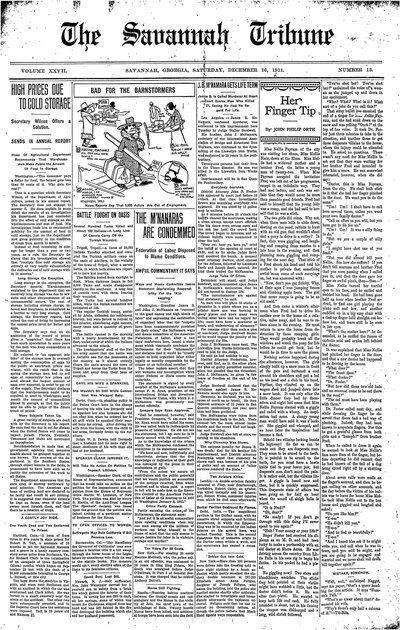
Page text (machine-generated)
The Savannah Tribune
VOLUME XXVII.
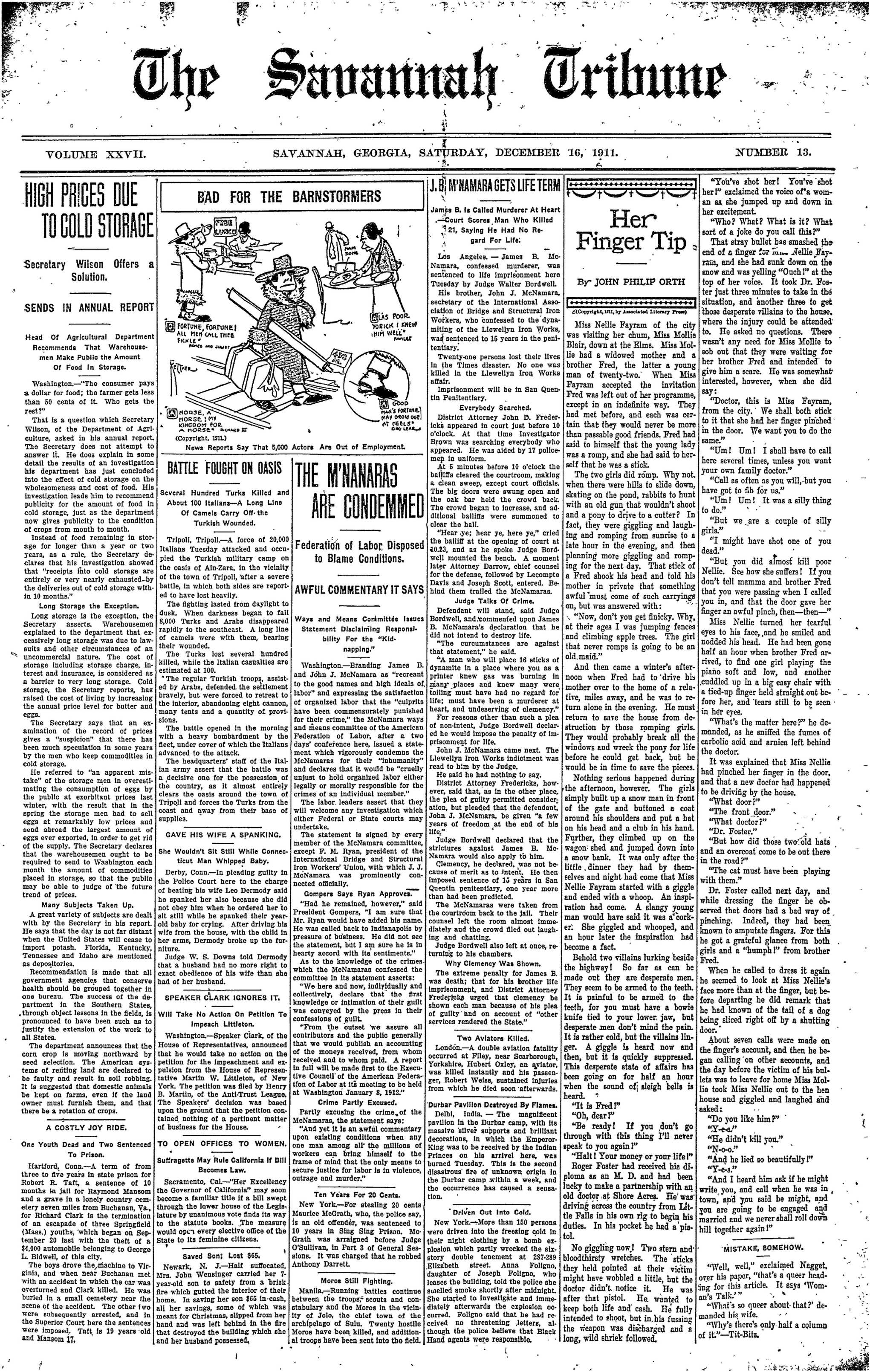
HIGH PRICES DUE TO COLD STORAGE
Wilson Solution.
SENDS IN ANNUAL REPORT
Head Of Agricultural Department Recommenda That Warehousemen Make Public the Amount Of Food In Storage.
Washington.—"The consumer pays a dollar for food; the farmer gets less than 50 cents of it. Who gets the rest?"
That is a question which Secretary Wilson, of the Department of Agriculture, asked in his annual report. The Secretary does not attempt to answer it. He does explain in some detail the results of an investigation his department has just concluded into the effect of cold storage on the wholesomeness and cost of food. His investigation leads him to recommend publicity for the amount of food in cold storage, just as the department now gives publicity to the condition of crops from month to month.
Instead of food remaining in storage for longer than a year or two years, as a rule, the Secretary declares that his investigation showed that "receipts into cold storage are entirely or very nearly exhausted-by the deliveries out of cold storage within 10 months."
Long Storage the Exception.
Long storage is the exception, the Secretary asserts. Warehousemen explained to the department that excessively long storage was due to lawsuits and other circumstances of an uncommercial nature. The cost of storage including storage charge, interest and insurance, is considered as a barrier to very long storage. Cold storage, the Secretary reports, has raised the cost of living by increasing the annual price level for butter and eggs. The Secretary says that an examination of the record of prices gives a "suspicion" that there has been much speculation in some years by the men who keep commodities in cold storage.
He referred to "an apparent mistake" of the storage men in overestimating the consumption of eggs by the public at exorbitant prices last winter, with the result that in the spring the storage men had to sell eggs at remarkably low prices and send abroad the largest amount of eggs ever exported, in order to get rid of the supply. The Secretary declares that the warehousemen ought to be required to send to Washington each month the amount of commodities placed in storage, so that the public may be able to judge of the future trend of prices.
Many Subjects Taken Up.
A great variety of subjects are dealt with by the Secretary in his report. He says that the day is not far distant when the United States will cease to import potash. Florida, Kentucky, Tennessee and Idaho are mentioned as depositories. Recommendation is made that all government agencies that conserve health should be grouped together in one bureau. The success of the department in the Southern States, through object lessons in the fields, is pronounced to have been such as to justify the extension of the work to all States.
The department announces that the corn crop is moving northward by seed selection. The American systems of renting land are declared to be faulty and result in soil robbing. It is suggested that domestic animals be kept on farms, even if the land owner must furnish them, and that there be a rotation of crops.
A COSTLY JOY RIDE.
One Youth Dead and Two Sentenced To Prison.
Hartford, Conn.-A term of from three to five years in state prison for Robert R. Taft, a sentence of 10 months in jail for Raymond Mansom and a grave in a lonely country cemetery seven miles from Buchanan, Va., for Richard Clark is the termination of an escape of three Springfield (Mass.) youths, which began on September 20 last with the theft of a $4,000 automobile belonging to George L. Bidwell, of this city.
The boys drove the machine to Virginia, and when near Buchanan met with an accident in which the car was overturned and Clark killed. He was buried in a small cemetery near the scene of the accident. The other two were subsequently arrested, and in the Superior Court here the sentences were imposed. Taft is 19 years old and Mansom 17.
BAD FOR THE BARNSTORMERS
FREE LUNCH
FORTUNE, FORTUNE!
ALL MEN CALL THEE
FICKLE*
POMED AND JUILLET
LAS POOR
YORICK I KNEW
HIM WELL*
PAMLEE
4$8 M.
FETTER
HORSE, A
HORSE, MY
KINGDOM FOR
A HORSE* RICHARD III
GOOD
MAN'S FORTUNE
MAY GROW OUT
AT HEELS*
KIND LEAR
BATTLE FOUGHT ON OASIS
Several Hundred Turks Killed and About 100 Italians—A Long Line Of Camels Carry Off the Turkish Wounded.
Tripoli, Tripoli.—A force of 20,000 Italians Tuesday attacked and occupied the Turkish military camp on the oasis of Aln-Zara, in the vicinity of the town of Tripoli, after a severe battle, in which both sides are reported to have lost heavily.
The fighting lasted from daylight to dusk. When darkness began to fall 8,000 Turks and Arabs disappeared rapidly to the southeast. A long line of camels were with them, bearing their wounded.
The Turks lost several hundred killed, while the Italian casualties are estimated at 100.
*The regular Turkish troops, assisted by Arabs, defended the settlement bravely, but were forced to retreat to the interior, abandoning eight cannon, many tents and a quantity of provisions.
The battle opened in the morning with a heavy bombardment by the fleet, under cover of which the Italians advanced to the attack.
The headquarters' staff of the Italian army assert that the battle was a decisive one for the possession of the country, as it almost entirely clears the oasis around the town of Tripoll and forces the Turks from the coast and away from their base of supplies.
GAVE HIS WIFE A SPANKING.
She Wouldn't Sit Still While Connecticut Man Whipped Baby.
Derby, Conn.—In pleading guilty in the Police Court here to the charge of beating his wife Leo Dermody said he spanked her also because she did not obey him when he ordered her to sit still while he spanked their year-old baby for crying. After driving his wife from the house, with the child in her arms, Dermody broke up the furniture.
Judge W. S. Downs told Dermody that a husband had no more right to exact obedience of his wife than she had of her husband.
SPEAKER CLARK IgNORES IT.
Will Take No Action On Petition To Impeach Littleton.
Washington.—Speaker Clark, of the House of Representatives, announced that he would take no action on the petition for the impeachment and expulsion from the House of Representative Martin W. Littleton, of New York. The petition was filed by Henry B. Martin, of the Anti-Trust League. The Speakers' decision was based upon the ground that the petition contained nothing of a pertinent matter of business for the House.
TO OPEN OFFICES TO WOMEN.
Suffragette May Rule California If Bill Becomes Law.
Sacramento, Cal.—"Her Excellency the Governor of California" may soon become a familiar title if a bill swept through the lower house of the Legislature by unanimous vote finds its way to the statute books. The measure would open every elective office of the State to its feminine citizens.
Saved Son; Lost $65.
Newark, N. J.-Half suffocated, Mrs. John Wensinger carried her 7-year-old son to safety from a brisk fire which gutted the interior of their home. In saving her son $65 in cash, all her savings, some of which was meant for Christmas, slipped from her hand and was left behind in the fire that destroyed the building which she and her husband possessed.
THE M'NANARAS ARE CONDEMMED
Federation of Labor. Disposed to Blame Conditions.
AWFUL COMMENTARY IT SAYS
Ways and Means Committee Issues Statement Disclaiming Responsibility For the "Kid-
Washington.—Branding James B. and John J. McNamara as "crecant to the good names and high ideals of labor" and expressing the satisfaction of organized labor that the "culprits have been commensurately punished for their crime," the McNamara ways and means committee of the American Federation of Labor, after a two days' conference here, issued a statement which vigorously condemns the McNamaras for their "inhumanity" and declares that it would be "cruelly unjust to hold organized labor either legally or morally responsible for the crimes of an individual member." The labor leaders assert that they will welcome any investigation which either Federal or State courts may undertake.
The statement is signed by every member of the McNamara committee, except F. M. Ryan, president of the International Bridge and Structural Iron Workers' Union, with which J. J. McNamara was prominently connected officially.
Gompers Says Ryan Approves.
"Had he remained, however," said President Gompers, "I am sure that Mr. Ryan would have added his name. He was called back to Indianapolis by pressure of business. He did not see the statement, but I am sure he is in hearty accord with its sentiments." As to the knowledge of the crimes which the McNamaras confessed the committee in its statement asserts: "We here and now, individually and collectively, declare that the first knowledge or intimation of their guilt was conveyed by the press in their confessions of guilt.
"From the outset we assure all contributors and the public generally that we would publish an accounting of the moneys received, from whom received and to whom paid. A report in full will be made first to the Executive Council of the American Federation of Labor at its meeting to be held at Washington January 8, 1912."
Crime Partly Excused.
Partly excusing the crime of the McNamaras, the statement says: "And yet it is an awful commentary upon existing conditions when any one man among all the millions of workers can bring himself to the frame of mind that the only means to secure justice for labor is in violence, outrage and murder."
Ten Years For 20 Cents
New York.—For stealing 20 cents Maurice McGrath, who, the police say, is an old offender, was sentenced to 10 years in Sing Sing Prison. McGrath was arraigned before Judge O'Sullivan, in Part 3 of General Sessions. It was charged that he robbed Anthony Darrett.
Moros Still Fighting.
Manila.—Running battles continue between the troops, scouts and constabulary and the Moros in the vicinity of Jolo, the chief town of the archipelago of Sulu. Twenty hostile Moros have been killed, and additional troops have been sent into the field.
J.B. M'NAMARA GETS LIFE TERM
James B. Is Called Murderer At Heart
Court Scores Man Who Killed
21, Saying He Had No Regard For Life:
Los Angeles. — James B. McNamara, confessed murderer, was sentenced to life imprisonment here Tuesday by Judge Walter Bordwell.
His brother, John J. McNamara, secretary of the International Association of Bridge and Structural Iron Workers, who confessed to the dynamiting of the Llewellyn Iron Works, was sentenced to 15 years in the penitentiary.
Twenty-one persons lost their lives in the Times disaster. No one was killed in the Llewellyn Iron Works affair. Imprisonment will be in San Quentin Penitentiary.
Everybody Searched.
District Attorney John D. Fredericks appeared in court just before 10 o'clock. At that time investigator Brown was searching everybody who appeared. He was aided by 17 policemen in uniform. At 5 minutes before 10 o'clock the bailiffs cleared the courtroom, making a clean sweep, except court officials. The big doors were swung open and the oak bar held the crowd back. The crowd began to increase, and additional balliffs were summoned to clear the hall.
"Hear ye; hear ye, here ye," cried the bailiff at the opening of court at 40.23, and as he spoke Judge Bordwell mounted the bench. A moment later Attorney Darrow, chief counsel for the defense, followed by Lecompte Davis and Joseph Scott, entered. Behind them trailed the McNamaras.
Judge Talks Of Crime.
Defendant will stand, said Judge Bordwell, and commented upon James B. McNamara's declaration that he did not intend to destroy life.
"The curcumstances are against that statement," he said.
"A man who will place 16 sticks of dynamite in a place where you as a printer knew gas was burning in many places and knew many were toiling must have had no regard for life; must have been a murderer at heart, and undeserving of clemency."
For reasons other than such a plea of non-intent, Judge Bordwell declared he would impose the penalty of imprisonment for life.
John J. McNamara came next. The Llewellyn Iron Works indictment was read to him by the Judge.
He said he had nothing to say. District Attorney Fredericks, however, said that, as in the other place, the plea of guilty permitted consideration, but pleaded that the defendant, John J. McNamara, be given "a few years of freedom at the end of his life."
Judge Bordwell declared that the strictures against James B. McNamara would also apply to him. Clemency, he declared, was not because of merit as to intent. He then imposed sentence of 15 years in San Quentin penitentiary, one year more than had been predicted.
The McNamaras were taken from the courtroom back to the jail. Their counsel left the room almost immediately and the crowd filed out laughing and chatting.
Judge Bordwell also left at once, returning to his chambers.
Why Clemency Was Shown.
The extreme penalty for James B. was death; that for his brother life imprisonment, and District Attorney Fredericks urged that clemency be shown each man because of his plea of guilty and on account of "other services rendered the State."
Two Aviators Killed.
London.—A double aviation fatality occurred at Filey, near Scarborough, Yorkshire, Hubert Oxley, an aviator, was killed instantly and his passenger, Robert Welsh, sustained injuries from which he died soon afterwards.
Durbar Pavilion Destroyed By Flames.
Delhi, India. — The magnificent pavilion in the Durbar camp, with its massive silver supports and brilliant decorations, in which the Emperor-King was to be received by the Indian Princes on his arrival here, was burned Tuesday. This is the second disastrous fire of unknown origin in the Durbar camp within a week, and the occurrence has caused a sensation.
Driven Out Into Cold.
New York.—More than 150 persons were driven into the freezing cold in their night clothing by a bomb explosion which partly wrecked the six story double tenement at 287-289 Elizabeth street. Anna Foligno, daughter of Joseph Foligno, who leases the building, told the police she snelled smoke shortly after midnight. She started to investigate and immediately afterwards the explosion occurred. Foligno said that he had received no threatening letters, although the police believe that Black Hand agents were responsible.
Her Finger Tip
By JOHN PHILIP ORTH
(Copyright IHL by Associated Literary Press)
Miss Nellie Fayram of the city was visiting her chum, Miss Mollie Blair, down at the Elma. Miss Mollie had a widowed mother and a brother Fred, the latter a young man of twenty-two. When Miss Fayram accepted the invitation Fred was left out of her programme, except in an indefinite way. They had met before, and each was certain that they would never be more than passable good friends. Fred had said to himself that the young lady was a romp, and she had said to herself that he was a stick.
The two girls did romp. Why not, when there were hills to slide down, skating on the pond, rabbits to hunt with an old gun that wouldn't shoot and a pony to drive to a cutter? In fact, they were giggling and laughing and romping from sunrise to a late hour in the evening, and then planning more giggling and romping for the next day. That stick of a Fred shook his head and told his mother in private that something awful must come of such carryings on, but was answered with:
"Now, don't you get finicky. Why, at their ages I was jumping fences and climbing apple trees. The girl that never romps is going to be an old maid."
And then came a winter's afternoon when Fred had to drive his mother over to the home of a relative, miles away, and he was to return alone in the evening. He must return to save the house from destruction by those romping girls. They would probably break all the windows and wreck the pony for life before he could get back, but he would be in time to save the pieces.
Nothing serious happened during the afternoon, however. The girls simply built up a snow man in front of the gate and buttoned a coat around his shoulders and put a hat on his head and a club in his hand. Further, they climbed up on the wagon shed and jumped down into a snow bank. It was only after the little dinner they had by themselves and night had come that Miss Nellie Fayram started with a giggle and ended with a whoop. An inspiration had come. A slangy young man would have said it was a corker. She giggled and whooped, and an hour later the inspiration had become a fact.
Behold two villains lurking beside the highway! So far as can be made out they are desperate men. They seem to be armed to the teeth. It is painful to be armed to the teeth, for you must have a bowie knife tied to your lower jaw, but desperate men don't mind the pain. It is rather cold, but the villains linger. A giggle is heard now and then, but it is quickly suppressed. This desperate state of affairs has been going on for half an hour when the sound of aleigh bells is heard. "It is Fred!" "Qh. dear!"
"Be ready! If you don't go through with this thing I'll never speak to you again!" "Halt! Your money or your life!"
"Half! Your money or your life!" Roger Foster had received his diploma as an M. D. and had been lucky to make a partnership with an old doctor at Shore Acres. He was driving across the country from Little Falls in his own rig to begin his duties. In his pocket he had a pistol.
No giggling now! Two stern and bloodthirsty wretches. The sticks they held pointed at their victim might have wobbled a little, but the doctor didn't notice it. He was after that pistol. He wanted to keep both life and cash. He fully intended to shoot, but in his fussing the weapon was discharged and a long, wild shriek followed.
NUMBER 13.
"You've shot her! You've shot her!" exclaimed the voice of a woman aa she jumped up and down in her excitement.
"Who? What? What is it? What sort of a joke do you call this?"
That stray bullet has smashed the end of a finger for Miss Jellie Fayrain, and she had sunk down on the snow and was yelling "Ouch!" at the top of her voice. It took Dr. Foster just three minutes to take in the situation, and another three to get those desperate villains to the house, where the injury could be attended to. He asked no questions. There wasn't any need for Miss Mollie to sob out that they were waiting for her brother Fred and intended to give him a scare. He was somewhat interested, however, when she did say:
"Doctor, this is Miss Fayram, from the city. We shall both stick to it that she had her finger pinched in the door. We want you to do the same."
"Um! Um! I shall have to call here several times, unless you want your own family doctor."
"Call as often as you will, but you have got to fib for us."
"Um! Um! It was a silly thing to do."
"But we are a couple of silly girls."
"I might have shot one of you dead."
"But you did almost kill poor Nellie. See how she suffers! If you don't tell mamma and brother Fred that you were passing when I called you in, and that the door gave her finger an awful pinch, then—then—" Miss Nellie turned her tearful eyes to his face, and he smiled and nodded his head. He had been gone half an hour when brother Fred arrived, to find one girl playing the piano soft and low, and another cuddled up in a big easy chair with a tied-up finger held straight out before her, and tears still to be seen in her eyes.
"What's the matter here?" he demanded, as he sniffed the fumes of carbolic acid and arnica left behind the doctor.
It was explained that Miss Nellie had pinched her finger in the door, and that a new doctor had happened to be driving by the house.
"What door?"
"The front door."
"What doctor?"
"Dr. Foster."
"But how did those two old hats and an overcoat come to be out there in the road?"
"The cat must have been playing with them."
Dr. Foster called next day, and while dressing the finger he observed that doors had a bad way of pinching. Indeed, they had been known to amputate fingers. For this he got a grateful glance from both girls and a "humph!" from brother Fred.
When he called to dress it again he seemed to look at Miss Nellie's face more than at the finger, but before departing he did remark that he had known of the tail of a dog being sliced right off by a shutting door.
About seven calls were made on the finger's account, and then he began calling on other accounts, and the day before the victim of his bullets was to leave for home Miss Mollie took Miss Nellie out to the hen house and giggled and laughed and asked:
"Do you like him?"
"Y-e-a."
"He didn't kill you."
"N-o-o."
"And he lied so beautifully!"
"Y-e-a."
"And I heard him ask if he might write you, and call when he was in town, and you said he might, and you are going to be engaged and married and we never shall roll down hill together again!"
MISTAKE, SOMEHOW.
"Well, well," exclaimed Nagget, over his paper, "that's a queer heading for this article. It says 'Woman's Talk.'" "What's so queer about that?' demanded his wife. "Why's there's only half a column of it."—Tit-Bita.
See Cooper & Odrizen The Up-to-Date Tailors
218 WEST BROAD STREET, BETWEEN HULL AND OGLETHORPE AVE.
The Latest Patterns in FALL and WINTER GOODS. First-class workmanship guaranteed. Our prices will interest you.
Johnson Undertaking Establishment
COMBINED WITH
The Royall Undertaking Company
(Incorporated.)
GAREY'S
Variety Bakery.
Goods delivered promptly to any part of the city.
503 West Broad Street, Near Gaston
Funeral Directors and Embalmers
Finest line of Coffins, Saskets and Robes. White and black funeral
cars. Office and warerooms 325-331 Jefferson street.
W. R. FIELDS, Manager.
Residence. Phone 2032. Livery Stable Attached. Office Phone 676.
C. H. ROYALL, Residence 509 Charles St. Phone 3064.
Fruit and Commission Merchant
234 ST. JULIAN ST., WEST, 235 BR YAN. 8T., WEST. Phone 2368 SAVANNAH, GEORGIA.
TAKE NOTICE THAT—
The Turner Restaurant
The Tu
Has M
In addition first class tomobile service at any we give first class acco ing the city at 109 Jeff car line going south of
Palm
Expert Hair Cutting. E Work Done by Experien ING PARLOR ATTACH
PERRY R
517 WEST BROAD ST.
If Y Isn’t W Advert
PO
NIC
TH
19 East
Atlant
An Unsectarian Christian
Superior advantages in Life Training. For catal
Woodland
The Highest P are Only
They have concrete Consider how imp Some excellent L
$5.00 Cash
See me qu
CHAS.
In addition first class rooms, barber shop, hot and cold baths and automobile service at any hour, day or night. In all of our departments we give first class accommodation. Call and our rooms while visiting the city at 109 Jefferson street, just a half block from Broughton St. car line going south on Jefferson. Ask any hackman.
Palm Shaving Palace
Expert Hair Cutting, Electric Massage and Shampooing a Specialty. All Work Done by Experienced Workmen. Courteous attention to all. SHINING PARLOR ATTACHED. PERRY R. WRIGHT, Proprietor
If Your Business Isn't Worth Advertising Advertise It For Sale
POPULAR PRICED
SHOES
NICHOLS
THE SHOE MAN
19 East Broughton Street
Atlanta University
Christian Institution. High School, Normal College.
Potages in Industrial Training, Music and Law.
For catalog and information address
PRESIDENT EDWARD
Hedlawn Park
Best Price Lots at Woodland
Only $150.00 and they 50
We concrete sidewalks and are directly on car
how important that transportation feature
excellent LOTS LEFT. You pay
Cash and $5.00 Per
NO INTEREST
e quickly and get a c
location
AS. McDOWE
An Unsectarian Christian Institution. High School, Normal School and College. Superior advantages in Industrial Training, Music and Printing. Home Life Training. For catalog and information address PRESIDENT EDWARD T. WARE.
Woodlawn Park Lots
The Highest Price Lots at Woodlawn Park are Only $150.00 and they 50x400
They have concrete sidewalks and are directly on car lines. Consider how important that transportation feature is. Some excellent LOTS LEFT. You pay
$5.00 Cash and $5.00 Per Month
NO INTEREST
See me quickly and get a choice location
623 WEST BROAD STREET
PHONE 2098-J.
RESID
ATLANTA, GEORGIA.
Goods delivered promptly to any part of the city. 503 West Broad Street, Near Gasteen Phone 13$1-L.
Take a Policy With The Pilgrim Health and Life Insurance Co.
The Oldest, Strongest and Most Reliable Company in the State. Gives employment to hundreds of men and women of our race.
Pays from $1 to $10 weekly sick and accident benefits and from $10 to $100 death benefits. Our Motto: "Promptness, Honesty and Justice."
1143 Gwinnett St. Augusta, Ga.
For further information write 509
West Broad St., Savannah, Ga.
J. S. Perry, Supt.
A. B. Singfield, Gen. Supt.
C. T. Walker, D. D., LL. D.
Director and General Lecturers
GO TO—
Young Bros.
For your
TOBACCO, CIGARS and FRUITS
Of all kinds.
509 West Broad Street.
The place to get first-class meals Everything neat and clean. Meals prepared in an appetizing manner and at all hours daily.
Counting
Your
Money
Ice Cream Parlor
EDWARD T. WARE.
Park Lots
Moodlawn Park
Key 50x400
on car lines.
feature is.
Per Month
Ice C
large
Specia
and B
and
Suppe
Phone
promp
815 East
Mason
LOBE
FINAN
BLANK
Publishers
Ice Cream and Sherbets in large and small quantitles. Special prices to Churches and Societies. Also Hot and Cold Lunches. Fish Suppers prepared to order. Phone 4038. Orders very promptly filled. : : : : : 815 East Broad St., Savannah, Ga.
Masonic Books & Regalias.
LODGE SEALS,
FINANCIAL CARDS and
BLANKS of every description.
Liberal Biscounts Will Be Arranged
a choice Who is the VELL, BAKER'S
GOL. O. JOHNSON,
Savannah, Ga.
Who is the man for Cleaning and
Pressing?
BAKER'S PRESSING CLUB
519 PRICE ST.
Men's Suits Pressed 40c; Pants 15c;
Men's Suits Scoured $1. Ladies' work
a specialty. Give us a trial.
RESIDENCE 1206-J.
GAREY'S
Variety Bakery.
WEST SIDE RESTAURANT
Meals 16 and 25 cents.
MRS. A. S. SCOTT, Proprietress.
will occupy your entire time when you become a regular advertiser in THIS PAPER. Unless you have an antipathy for labor of this kind, call us up and we'll be glad to come and talk over our proposition.
McFALL'S
PRESIDENT ON TOUR
Arthur and Cleveland Were Not Good Travelers.
LATTER DID NOT LIKE CROWDS—HARRISON WAS IMPATIENT—ONCE HAD TRAIN SIDE-TRACKED IN WOODS SO HE COULD REST.
"If anybody travelling needs rest over Sunday it is a president on a jaunt," said a man who has been out with several presidents. "Fortunately for Mr. Taft, he likes this sort of thing, but I notice that he has ordered rests over Sunday in his itinerary.
"I have traveled with Arthur, McKinley, Cleveland and Harrison on their jaunts. Arthur, in spite of his talent for mixing with a New York crowd, was never equal to the job in the country. If any town in this country is up on the art of catering to any exclusive taste it is Louisville, Ky. Arthur was the first Republican president to go south, and Louisville spread herself to make him feel at home. Political lines were obliterated on the occasion of his visit when he went there to open the cotton exposition. The Pendennis club gave him a banquet fit for a king, but he was glad when it was over.
"When he left Chicago for his hunt in Yellowstone he told Phil Sheridan, who had charge of the party, that he was glad he was going where he could have uninterrupted rest. "McKinley was not as good a traveler as Taft, but he never showed that he was tired. I heard him say once that he wished railroad companies would make some arrangement by which a log cabln could be attached to a train instead of a Pullman sleeper.
"Cleveland never liked a crowd. He fretted under handshaking and always grunted when he had to make a rear-platform speech. When he visited Chicago with his bride he got the greatest reception ever seen in that city. The fact that Mrs. Cleveland broke down under the strain of the excitement may have had something to do with making Cleveland impatient, but the way he raved over the jam and mismanagement of the affair would have melted the type of any newspaper that tried to quote him. When he left the city for Madison, where he was a guest of Colonel Villas, he expressed himself as delighted over the rest to which he was bound. I saw him at an inaugural ball in Washington. I wouldn't like to repeat what I heard him say about the mob on the floor.
"Harrison was the most impatient presidential traveler of all I ever jaunted with. One night the crowd in Burlington became unmanageable. It was the worst I ever saw. The police were as useless as a lot of wooden soldiers. When the meeting was over and Harrison and his party went to the presidential train, Harrison asked when the train was due at the next stop, Oskaloosa, Ia., where he was to open the Corn Palace the next day. When he was told that the schedule was for noon the following day he requested that the train be sidetracked somewhere for the remainder of the night in order that he might get rest.
"It was so ordered, and the train was run out of Burlington about 40 miles and placed on a sliding in the woods. There it remained until after breakfast. For the first time in any presidental jaunt that I ever heard of the president was lost to the people of the country for ten hours. There was no wireless apparatus then. The next day, when Harrison and his party reached St. Joseph, Mo., he was routed out of bed at sunrise to take breakfast at the railroad station and talk to the people. I think Harrison came nearer forgetting his Presbyterian pledge then than he ever did before."—New York Sun.
WHAT FATHER TOOK.
He came down the garden path, a sad, sorrowful figure. She watched him with anxious eyes.
"How did father take it?" she asked.
"He took it well," replied the young man.
"Oh, I am so glad, George," she replied, pressing her hands together.
"Are you?" replied George, flopping forlornly by her side. "Well, I can't say that I am, dear. At first your father wouldn't listen, to me."
"Why didn't you tell him that you had $2,500 in the bank, as I told you to?" she exclaimed.
"I did, after all else had failed," answered George, dejectedly.
"And what did he do then?"
"Do!" echoed the young man, passing his hand wearily through his hair.
"He borrowed it!"—Philadelphia Record.
BOTH ADEPTS.
A man and a woman were in a dispute as to which could tell the bigger lie. The woman was given the right of way for her effort. "I was walking across the Atlantic ocean," she said, "and met a man no taller than that (she held one hand two feet from the floor to indicate the height), who was 300 years old."
The man whistled. It was a big one all right.
"Did the dwarf have a wooden leg?" the man asked.
The woman replied that he did.
"Was he blind in one eye?" was the next question.
"He was," replied the woman.
"Then," replied the man, "he was my son."
SAYS ACQUITTAL OF WHITE MAN HAS CAUSED ENTIRE RACE, TO PUT ON SACK-CLOTH AND ASHES—THE NEGRO'S DISTRUST OF COURTS.
Washington.—Prof. Kelly Miller, dean of Howard university, has given out a statement dealing with the astounding decision in the Ulrich assault case that fairly bristles with indignation. A conservative man, all the professor's statements have been calm and thoughtful. In this statement thoughtfulness is as apparent as ever. Prof. Miller's statement is as follows:
"The decision of the court in New York setting free the assailant of Dr. Booker T. Washington the foremost negro in the world, has caused the entire race to put on sackcloth and ashes. That this illustrious American, the blamelessness of whose life embodies the Christ-like spirit of meekness, humility and forgiveness of spirit, should be stricken down with impunity, fills the just and righteous mind with indignation for the assailant and infinite pity for the victim.
"President Taft, in his calm, judicial, patriotic spirit, proclaims that he reverences the process and personnel of the courts. Would to God that the courts were so true to their function that every American could share in this lofty sentiment. No negro in America feels that he can get justice in any court where the race feeling is involved. Even the president of the United States will, I am sure, forgive the negro for not sharing his feeling of reverence for courts and judges, whose august personality is so exalted that they must not be called into account for deeds done on the bench.
Provocation of Assault Assured.
"I take it for granted that very reasonable man will regard the allegation that the conduct of Mr. Washington was provocative of the assault as absurd in the last degree. That a man who for well nigh a generation has gone in and out among the American people, every feature of whose conduct has been under the white light of public observation, and who for so long has stood the test as being without moral spot or blemish, should of a night, be transformed into an insane libertine, is too impossible to be entertained for a moment. No candid-minded American believes that Booker T. Washington addressed any woman on the streets of New York in terms of lustful endearment. That he was peeking through a keyhole in a cheap apartment house with lascivious intent is so inherently silly that it would not even be repeated against any other American of like established character and renown.
"The fact that Dr. Washington failed to prove the charge against his assailant to the satisfaction of the court before whom it was tried ought not to reflect upon his honor or prejudice his reputation. The fact that one judge out of three held the assailant to be worthy of punishment robs the decision of judicial conclusiveness. Dr. Washington was not on trial before that court; nor should he be before the American people.
"Righteousness of practice, precept and principle is the negro's only hope. This is indeed the only salvation of the weak among the strong. Dr. Washington has preached and exemplified this in his life. That he should be stricken by lawless hands, declared innocent by law, as an alleged transgressor of the gospel, upon which hinges the mission of his life and the salvation of his race, is to me the most tragic occurrence of Abraham Lincoln. And yet I feel sure that the high-minded American people will abate no whit of their respect, support and admiration for this gentle-spirited, pure-souled man because of the humiliation which even a blameless life may not enable the most illustrious negro to escape."
PRESENCE OF MIND.
"Private" John Allen of Tupelo, Miss. tells this one on himself:
"Court had been in session in Tupelo and there were a lot of visiting lawyers. They were congenial souls and naturally a little game of poker started down at the hotel. I stayed out for several nights, but finally the breakfast table arguments got so pointed that I had to promise to be in that evening by 11 o'clock.
"When 11 o'clock came I cleaned up and could not leave a winner—that would have been enride—so I stayed to give the boys a chance to get their money back. Also, there was plenty of the sort of drinkables prohibited by law in Mississippi."
"Finally the game broke up, and I looked at the clock; it was 2:30. I started for home, making the best time I could, slipped off my shoes at the front steps, pulled off my clothes in the hall, slipped into the bedroom and began to slip into bed with the ease of experience.
"Mrs. Allen, has a, blamed dog that on cold nights insists in jumping in the bed with us. So when I began to slide under the covers she stirred in her sleep and pushed me on the head.
"Get down, Fido, get down!" she said.
"And, gentlemen, I just did have presence of mind enough to lick her hand, and she dozed off 'again."—Coopolitan Magazine.
Jones—Do you think the horse will survive the automobile?
Brown—Not if it gets in its way.—Woman's Home Companion.
POETRY
of and by Our People
Though rudely blows the wintry blast,
And sifting snows fall white and fast,
Mark Haley drives along the street,
Perch'd high upon his wagon seat;
His sombre face the storm defies,
And thus from morn till eve he cries—
"Charco'! Charco'!"
While echo faint and far replies—
"Hark, O! Hark, O!"
"Charco'!—"Hark, O"—Such cheery sounds
Attend him on his daily rounds.
The dust begrimes his ancient hat;
His coat is darker far than that;
'Tis odd to see his sooty form
All speckled with the feathery storm;
Yet in his honest bosom lies
Nor spot nor speck—though still he cries—
"Charco'! Charco'!"
And many a roguish lad replies—
"Ark, ho! Ark, ho!"
"Charco'! — "Ark, ho!" — such various sounds
Thus all the cold and wintry day
He labors much for little pay;
Yet feels no less of happiness
Than many a richer man, I guess,
When through the shades of eve he spies
The light of his own home, and cries,
"Charco'! Charco'!"
And Martha from the door replies—
"Mark, ho! Mark, ho!"
"Charco'!" — "Mark, ho!" — Such joy
abounds
When he has closed his daily rounds.
The hearth is warm, the fire is bright;
And, while his hand, washed clean and
white,
Holds Martha's tender hand once more,
His glowing face bends fondly o'er
The crib wherein his darling lies;
And in a coaxing tone he cries,
"Charco! Charco!"
And baby with a laugh replies—
Ah, go! Ah, go!
"Charco!" — "Ah, go!" — while at the
sounds
The mother's heart with gladness bounds.
Then honor'd be the charcoal man!
Though dusky as an African,
'Tis not for you, that chance to be
A little better clad than he,
His honest manhood to despise,
Although from morn till eve he cries—
"Charco! Charco!"
While mocking echo still replies—
"Hark, O! Hark, O!"
"Charco!" — "Hark, O!" — Long may
the sounds
Proclaim Mark Haley's daily rounds!
-J. T. Trowbridge.
VITAL LAMPADA.
There's a breathless hush in the Close
tonight—
Ten to make and the match to win—
A bumping pitch and a blinding light.
An hour to play and the last mar in.
And it's not for the sake, of a ribboned
coat.
Or the selfish hope of a season's fame.
But his Captain's hand on his shoulder
smote.
The sand of the desert is sodden red— Red with the wreck of a square that broke:
The river of death has brimmed his banks. And England's far, and Honor a name. But the voice of a schoolboy rallies the ranks.
"Play up! play up! and play the game!"
This is the word that year by year. While in her place the School is set, Every one of her.sons must hear, And none that hears it dare forget. This they all with a joyful mind Bear through life like a torch in fame, And falling, fling to the host behind— "Play up! play up! and play the game!"
—Henry Newbolt.
WE SHALL MEET AND REST.
Where the faded flower shall freshen,
Freshen never more to fade;
Where the shaded sky shall brighten,
Brighten never more to shade;
Where the morn shall wake in gladness,
And the noun the joy prolong;
Where the daylight, dies in fragrance,
'Mid the burst of holy song:—
Where the love that here we lavish,
On the withering leaves of time,
Shall have fadeless flowers to fix on,
In an ever spring-bright clime;
Where we find the joy of loving,
Where no shadow aball bewilder,
Where life's vain parade is o'er;
Where the sleep of sin is broken,
And the dreamer dreams no more;
Where the child has found the mother,
Where the mother finds the child;
Where the loved ones all are gathered,
That were scattered on the wild.
REFRAIN.
We shall meet and we shall rest,
'Mid the holy and the blest;
We shall meet on yonder shore
With the loved ones gone before;
We shall meet and we shall rest,
'Mid the holy and the blest.
--Rev. Horatius Bonar.
WHATEYER 18, IS BEST.
I know as my life grows older,
And mine eyes have clearer sight,
That under each rank wrong somewhere
There lies the root of right;
That each sorrow has its purpose,
By the sorrowing oft unguessed;
But as sure as the dawn brings daylight.
Whatever is, is best.
I know that each sinful action
As sure as the night brings shade,
Is somewhere some time punished
Though the hour be long delayed.
I know that the soul is sided
Sometimes by the heart's unrest.
And to grow means often to suffer
But whatever is, is best.
I know there are no errors
In the great eternal plan,
And all things work together
For the final good of man.
And I know when my soul speeds on-
In its grand eternal quest,
I shall say, as I look back earthward.
Whatever is, is best.
—Unknown.
‘The Hague peace tribunal had about
23 much effect {n restraining war be-
tween Italy and Turkey as the breath-
ing of a guaat would Have in prevent-
ing a cyclone. In order to understand
<learly the causes leading up to this
war, It fs only necessary to recall to
mind that fact: In thei dealings with
‘one another and especially with an {n-
ferlor people, the Christian powers of
the world are actuated by the same
motives that,illustrated the career of
Rob Roy: “Let him take who has the
power and let him hold who can.” The
golden rule {fs serviceable as lip ex-
ercise, but the ruling sleepless prin-
ciple 1s that of Rob Roy. The Chris-
tlon powers of Europe have been mak-
Ing the Turk stand and deliver for the
past forty years. One would take this
country, another this province, ete.
and they would long ago have blotted
Turkey from the map could they bave
come to any binding agreement as to
the division of the spoils. Now during
all the tlme this territorial robbery
has been golng on, Italy, the “little sis-
ter,” has been looking on with eager
desire but wthout suffictent backing to
get in the game. About a generation
ago she grew Impatient and told some
of the larger brothers she just must
have a slice of foreign territory for
herself. They couldn't spare her any
of Turkey, but they directed her atten-
tion to a little mountainous country in
Afriea—Abyssinla—inhabited by her-
etical negroes, Go and take it! Italy
sent a magnificent army of invasion
down on those ‘black folks. All the
-world knows the result—or rather all
the world hasn't been able to suppress
or explain away the result. That mag-
nificent army was hacked to pleces
and thelr bones still mark the path of
their disastrous retreat in their futile
efforts to get back.home! Adowa was
more disastrous than Waterloo, The ef-
forts made to explain It are laughable.
The Itallan historians claim that the
general was a coward, was drunk or
worse, And the ethnologists, while
confident before that the Abyssinlans
were nothing more than black ne
groes, have bravely come to the res-
cue with learned dissertations to the
effect that those Abyssinians are
after all black white folks! Such
learned antics are sufficient to arouse
@ sneer on the face of a Mephisto-
pheles. Well, after Adowa, Italy had
enough of foreign conquest to hold
her for a while. But a few months
ago Italy found all the powers prayér-
fully concocting plans for counter-
acting one another In thelr schemes
of conquest, Turkey felt secure by
teason of this situation, Italy saw
and seized the oppotunlty to strike.
Before the Turk or tho European
powers knew what was happening,
Italy was on the sea. She is now in
Africa. The question In the minds of
many students Is this: If militant Mo-
“hammedanism becomes thoroughly
aroused will Italy be able to “come
back?"—Dallas Express.
France now has an army of black
soldiers numbering 50,000.
The knowledge of this black war
cloud proved an Important factor in
averting war between France and
Germany a few months ago, France
expects to continue the policy of en:
Usting negro soldiers for her de-
sfense, and Is of the opinion that when
officered by Frenchmen, they form the
finest troops in the world. Colonel
Mangin of the French army and who
fas been an ardent supporter of this
movement was recently asked whether
he would use black troops against
white men in a European war.
“Of course, we should,” he answered,
“and we should not be the first nation
to do so. Do not forget that it was
wtih the help of their black troops
“that the Mussulmans conquered North
Africa, and that it was with their
help that they conquered Spain. Re-
member, too, that William Prince of
Orange had black troops with bim
when he landed in England, and that
Maurice de Saxe had black troops
at Fontenoy—infantry and cavalry
beth. A batallfon of black men went
through Napoleon's Russtan campaign
under Murat, and France kept Guade-
loupe, thanks to her black troops, who
fought very well against the English.
Rome, when her own resources be.
gan to fall, dominated the world for
several centurles owing to her black
troops.”
The church needs today to use the
power which God has given. Often we
pray for power when the power fs al-
ready available, and we are found in
the attitude not using that which God
has placed in our hands. The Master
sald: “All power fs given unto me in
heaven and in earth.” He fs the head
of the-church and he has promised his
power for the accomplishment of the
work which the church ought to do.
Aro we not sometimes in the position
of praying for power when we should
be praying for a willingness to appro-
priate the power that Christ has al-
ready given us?—Christian Observer,
A clean, rellable end hightoned
Afro-American newspaper in the home
is worth more than a shotgun, yet the
latter fu a valuable ald, if used when
Marauders assault your home. Do not
ask the Lord’s help unt{l you havo
done your God-given duty—protected
your famlly.—Cadlz Informer,
°The parents of our children should
look carefully after their rearing, as
it does not take much nowadays to
lead children astray, for enticement
confronts them on every side.
We will, ‘recall a scene which plo
tured to us a deplorable aight in the
rulning of;the young.
During a night some time ago, at &
very late hour, we chanced to pass &
dancing parlor. The» fumates were
few; but the touching character of the
crowd was a small girl of about twelve
or thirteen years of age, gilding over
the foor with a “grownup.”
This poor Ittle child should have
been at home with her inother instead
of mingling wth the adults at a dance.
Mothers, your daughters have plenty
of time to make their debut tn society.
Don't rush them Into a stage of soclety
{n an attitude of life very much dif-
ferent from that of your Ittle twelve
or thirteen-year-old girl. Let her as-
sociation be with those of her equal.
Teach her the ways of the world and
guard her against the over-average
association. What does a girl of the
above ages look lke having any kind
of eoclety on her brains? She. should
delve in school books at night instead,
and attend those gatherings that ere
‘of Interest to the general public and
‘the race.
Let us implore to keep your little
‘girls away from the dancing parlors
‘until they are old enough to realize
right from wrong In a more vivid way,
then they may choose the mode most
enjoyable through association.—Pales-
tine Plaindealer.
Publicity of accounts Is the cry of
today. There was a time when pub-
Uc officlals were not called to account
as now. Forty years ago but few
would dare to ask & treasurer to make
a detailed accounting of public funds.
But.so many officials have become
corrupt, have misused money, have
Myed {a luxury, out of the poor peo-
ple's money that everywhere they are
asking for an accounting. In this state
‘this Is truer today than ever, and
same sad, sad revelations have been
made. Millions of dollars were stolen
In the building of our state capitol,
resulting {i the sentences of several
prominent men. An accounting sent
several Pittsburg touncilmen to pris-
on, and an accounting now going on
of affairs In this city seems to show
that upward of seven millifon dollars
have beén misapplied.
People aro therefore demanding that
‘thorough accountings be made. They
‘ask not only what have been the gross
receipts, but the {temized recelpts.
They ask not only what have been the
gross expenditures, but the {temized
expenditures, and only by getting each
item can they tell whether thelr serv-
ant 1s dealing fair with them,
It fs gratifying to see how many
published reports are itemized. This
js not only a protection to the treas.
urer, but relleves the suspicions of
the people. If Philadélphta had pub-
Ushed all the details of expenditure,
there would not be the present threat-
ened disgrace on account’ of misuse of
the people's money—Christtan Re-
akan
It seems that many of our farmers
have just realized fn the past three
years, the real value of thelr lands,
and are now. putting every available
acre under cultivation. Several years
ago many of our farmers farmed for a
living, but now they are farming for a
Uving and wealth, In the next ten
years tho value of farm land will reach
twice its present value, and some can-
not be bought. Farming is the chief
industry and every farmer should buy
a farm while opportunities are good,
—Palestine Plaindealer.
An observant citizen has counted
329 business places on Seventh street,
between Florida avenue and K strect.
Of this pumber 17 are conducted by
cclored people. ‘And Seventh street is
the leading business thoroughfare up-
on which colored people “trade, Our
people are sleeping upon thelr com-
merefal _opportunitles—Washington
National Union.
At no time in the history of the
world have two distinct races lived. to-
gether in peace and harmony. In spite
of this fact, suppose white and black
make up thelr minds to show this old
world something it has never before
seen? We have begun already to'do
our part In making such an undertak-
ing a success. Have you?—Southern
Life Magazine.
Men are by nature fitted for soclety.
By this we mean that they aro natural-
ly disposed to associate with each oth-
er. They could not be happy without
such association. Hence we conclude
that the Creator has designed men for
soclety.—Southern Progress, ‘
Winter will soon set fn, It will
grow inconvenlent for you ‘who worl
out doors. We Hope you have man-
aged wisely and saved some of\the
summer money, for the rainy days
will surely come, =.
. Wake up and arouse from dleeping
on your rights, There are many ways
in which you could help your people,
Look ahead of your noee and see
‘some things that are badly needed.
SUCCESSFUL NEGRO FAIR
SUCCESSFUL EXHIBITION HELD
AT MACON, GA., BY PROGRES-
SIVE COLORED CITIZENS.
gia state negro fair, which in many re-
spects 1s tho greatest organization of
its kind in the country among colored
people, closed a successful exhibition
here. The fair had ‘been In progress
ten days and bad beon witnessed by
2 large crowd of people from all sec-
tions of the state,
In every respect the fair is declared
to have been a record breaker, On
opening bad weather was encountered,
but eyen the most dleagrepable weath-
er dfd not prevent the people from
Georg{a from showing their apprecia-
tion for the remarkable work done by
the management In making this mam-
moth fair possible,
The exhibits can be eald to be great:
er and larger than any, former collec-
tlon of negro exhibits, whether at
state fairs or at world expositions, and
the presence of the mammoth United
States government exhibit lent color
and dignity to the occasion,
The success of the Georgia state ne-
gro fair In its five years’ history will
ever stand to the credit of President
R. R, Wright, who more than any
other one factor, fs responsibly for Its
high character.
Although disappointed In several
ways by men who had promised to be
present and who bad beod advertised
as features of the fair, none of these
things served ‘to discourage attend-
ance at the fair, Presidebt Wright lett
no stone unturned to carry out bis
word. When C. Wesley Peters, the
negro aviator, held out for cash ad-
vances approximating more than
$3,000 above his contract; when the
colored balloontst, F. H. Bradford, ut
terly fafled to put in appearance with-
out any explanation; and when a
white aviator, Dr. Henry E. Walden,
from New, York, who put in appear.
ance and Tecelved a cash advance of
$250, refused to carry oiit his contract
and left town, President Wright kept
the wires busy until he located an-
other man, by the name of Peters, in
Atlanta, who came to SMacon and made
three pretty successful fights before
big crowds.
Opening day was stormy and wet,
and yet the people of the state went
manfully on with their parade. The
address by the registrar of the treas:
ury, J, C, Napler, was well received
and appreciated, es were later ad-
dresses by W. T. Vernon, supervisor
Jot schools under the department of
the interlor; Dr. J. D. Hammond,
president Paino college, Augusta, Ga.;
Dr. John E. White, pastor of the First
Baptlst church (white), Atlanta; Dr.
P, James Bryant, pastor Wheat Street
Boptist church, Atlanta, and Hon.
George Hillyer, member Georgia ral.
road commission, Atlanta, Ga.
Of particular interest was educa
tonal day, when addrésses were made
by Dr. J. H. Dillard of New Orleans,
secretary of the Jeans “and. Slater
funds, and Dr. J. W. E. Bowen of Gam-
mon theological seminary; and “ex.
slave day,” when all the old exslaves
of Georgia who coiild come had gath.
ered to enjoy a huge barbecued dinner
and to Hsten to an address by a well:
known frlend, Judge Hillyer. A pecul-
far Hind of sentiment was attached to
this dav. Like the army veterans,
these oid héroes were found to be fast
dying out. Their Unes were getting
thinner, their steps less elastle and
buoyant.
{t was perhaps thls feeling, more
then anything else, that prompted
President Wright in his introductory
address on “Ex-Slave Day,” to give
vent to eloquent and Torceful remarks
with reference to the celebration of
the firtieth anniversary of the emancl-
pation of the negro. He had Just read
a telegram of regrets from Mr, Roose
velt, Who had referred to ex-slave day
as a unique celebratiqn. “Mr. Roose:
velt tg right,” he exclaimed. “Ours 1s
Indeed a unique celebration, In fact,
the situation in the south Is unique;
and the southern people, white and
black, will, working together, be able
to-handle {t. We mean to show to the
country what during the past Stty
years the black people and white
people are getting together In the de
velopment of the resources of the
southland.
“I want a semf-centennial celebra.
tion that will show to the country the
progress the black people have made
since freedom. 1 want this celebra.
tlon In the south, where the black man
hss made his progress. 1 belleve the
white people all over the south -will
ald us, just as the white people of
Georgia have helped us to make the
Georgia state fair a success. I be
eve there Is no place in the world
where the negro will recelve greater
consideration than he will recelve
right here in his own home, among
tha neonia with wham ha hae lived
Several of the older ex-slaves pres-
ent gave some experiences of thelr
own during slavery and recited, in
thelr pecullar manner, the progress
the negro Had made in thelr immedi:
ate localities,
Several good horse races were runi
several automobile races, and a foot
ball game between Paine college of
Augusta and Morris Brown college of
Atlanta furnlshed the larger part of
the amusement, while the people were
not slow by any means in taking in all
es attractions on the Midway.
An unusually fino line of exhibits
were seen in the Woman's building,
‘the Agricultural building, the Govern:
|ment building and the building for
schools and colleges. The Central of
Georgia raflroad .offered a cash prize
of $100 tothe boy.or man who pro
{dace the largest yield of corn per
acte in territory traversed by the Cen-
tral of Georgia railroad, and a year’s
expenses at the Georgia State Indus-
trial college to-the boy making the
largest yield.
The special prize for the cooking
contest attracted a great deal of at
tention, Sixteen women cooks et:
tered this contest. From two to four
dinners each day were prepared by
the contestants, the judges belng
three prominent white women of the
city of Macon, The cooks were judged
on cleanliness, economy and taste.
In agriculture, in domestic arts, In
the Hall of Fame, having pletures.
books and relics of negroes of prom!
nence in this and other countries, in
education, and in live stock, the ex-
hibits were. all of the bigh water
mark. For the first time, samples of
money, real money, bearing the slg:
nature of four negro registrars of the
treasury, were gathered together, to
gether With the pictures of each.
No liquors were sold at any place
‘on the grounds, and all the sporting
events were conducted with becoming
ease and decorum. Tho educational
congress, the woman's congress and
the religious congress proved eath to
ve an Interepting feature.
‘While it 6 a diMeult thing to make
an affair of this sort become a paying
Institution, some attention might be
called to the large number of people
employed by the fair management dur
ing the ten days of the fair. Beside:
the two bands, there were on the pay
rolls of the fair association more thar
ninety people, all of whom were given
better salaries and wages than they
received at their regular employment
The attendance was very good and
showed marked appreciation of the
effort on the part of the colored people
of Georgia,
SUNDAY SCHOOL CONGRESS
Nashville, Tenn.—At a regular meet.
ing of the Boards which have direct
charge of the Sunday school and
young people's work of the National
Baptist convention, held in this city,
It was declded that the seventh an-
nual session of the Sunday School
congress should meet at Tuskegee In-
stitute, Alabama, thereby accepting
from a yast number of invitations of-
fered by some of the leading conven-
tion cities of the United States the
one extended by Dr. Booker T. Wash-
ington, princlpal of Tuskegee Normal
and Industrial Inatftute. At this meet-
ing, which was held in the office of
‘the secretary of the National Baptist
‘Publishing Board and which was pre-
‘slded over Rev. J. P: Robinson, D. D.,
of Little Rock, Arkansas, full expres-
slons were made concerning the great
success that has crowned every meet-
ing of this congress movement.
Among the places that have enter-
talned the Sunday School congress
during the past six years have been
New Orleans, Nashville, twice, Jack-
sonville, Florida, Atlante, Georgia, and
Meridan, Mississippi, but Indications
are that the Tuskegee entertainment
will be more elaborate and that the
nieeting will be more largely attend-
ed than hetetofore. The time of the
meeting has been fixed by the Boards
as the first week in June. The meet-
Ing fs to open on the first Wednes-
day in June, remaining in session for
six days, which will include Monday
of the following week,
Letters and communications were
presented at the Board's meeting,
showing the deep Interest manifested
throughout every nection of the coun-
try in the Congress Movement. The
secretary of the Sunday Schoo! con-
gress, Henry A. Boyd, presented a re-
port, showing that nine hundred
eighty-one schools were represented
at the Meridian meeting. Some of
these schools were very small, but the
interest was as great with them as {t
was with the larger schools. Tuske-
‘gee Institute will be a bee hive of
‘congress workers, as they will go to
‘Tuskegee from every portion of the
‘United States. eo
ELECT ALLEN PAG IDENT:
Hannibal, moat the meeting of
the Negro State Teachers’ assoclation,
held in this city, President B. F. Allen
of Lincoln institute, located In Jeffer-
son City, was unanimously elected
president of the assoclation, succeed-
ing Prof, J. Silas Harris, The mem-
bers have promised to give the new
president loyal support in bis efforts
to conduct a successful administration.
‘TOO NEIGHBORLY.
“The Finchbys are altogether too
nelghbérly.”
“Ent Why, I thought I heard you
praising them to the sklas.”
“You did’ But the other night they
gave party and borrowed our bired
girl”
“Well?” @
“And they've forgotten to return
her.”—Cleveland Plain Desler.
LIBERIA WANTS
SKILLED FARMERS
Prof. Walter F, Walker Talks
on Future of African
? Republic.
A NEW ERA FOR LIBERIA
COUNTRY HAS 35,000 SQUARE
avers Cle aaa
15 TO 25 ACRES OF LAND.
New York—Before sailing for Li-
berla, Prof. Walter F. Walker, teacher
of mathematics at the West Africa
College, Monrovia, discussed the fu-
ture of the African republic and the
opportunlty afforded American ne
goes in that ‘country. Prot. Walker,
who has been in the United States
since July on a vacation, believes that
the American negro farmer who tills
the soll along sclentiflc lines would
find Liberia a productive field for his
labors,
Jn commenting, on the announce-
ment in the Daily hes that ten ne-
gro familles left Muskogee, Okla., for
Liberia, where théy Intended to en-
gage in farming, Prof. Walker sald:
“I expect to see a large number of
skilled farmers leave Amerjca for Lt-
berfa within the next few years. Aay
negro who tills his land, using mod-
ern methods, has an excellent chance
in Libera and will bo gladly recelved
by the Liberian government.
“A new era has dawned for Liberia,
and the country 1s now destined to
make great progress,” declared Prof.
Walker to an Age representativo.
“The republic promises to make great
strides in agriculture, which is bound
to bo an important factor in its rebab-
{litation, Liberla has 3,500 square
milles of fert!lq land, so one can read-
ily see the great opportunity if of
fers for farming. =
“Any American negro of good re-
pute who destres’ to settle in Libera
as a farmer can get free fifteen acres
of valuable land by applying to the
government officials. If he has a fam-
ily he can secure twenty-five acres.
One can go from New York to Liberla
by way of Europe, second class, for
$155, and by way of Maderia, Canary
Islands, for $110. Then, If one de-
sires to make the trip traveling third
class it will cost about $70 ‘by way
of Maderia and $90 by way of Europe.
“There Is one plece of advice I want
to give Americans who go to Liberia
Yo settle. They should bring ther
fousehold effects with them, as LI-
beria to date has no large stores which
supply the kind of household goods
that ate bought In the United States.
If you bring your furniture along you
will not have to pay duty, but if you
send for it after you have entered Lt-
beria it will be different.”
Prof, Walker feels confident that
Liberfa, with the ald ot the funds soon
to be placed ut its disposal, will be
recognized before many years as an
important commercial center and coth.
mand the respect of the gther nations.
GOVERNOR INFLUENCED BY HIS
WAFE—BOY OF 15 NOT TO HANG
—BETITIONS POURED IN FROM
NORTHERN PEOPLE,
Little Rock, Ark~-Earl Gilchrist,
aged fifteen, who was condemned to
aeath for murder, will not go to the
gallows, Governor Donaghey an-
nounced that he had commuted the
sentence to iniprisonment for a period
of fifteen years. 7
If the truth were known, it is prob-
able that the influence of Mrs. Don-
aghey had as much to do with the
nction of the governor as the hun-
dreds of thousands of people of the
north who have been sending pett-
tions. In addition to all the plead-
ings R. W. Porter, foreman of the
trial jury, asked that clemency! be
granted. He sald the jury never be-
Meved the court would impose the
death penalty. ‘
THEIR REASONS.
- It was the dinner hour and the
prison inspectors were hurrying over
thelr officlal round, ‘They asked sev.
eral questions quickly.
“I am here, gentlemen,” explained
the pickpocket, when the warden
turned bis back, “as the result of 2
moment of abstraction.”
“And I,” observed the Incendiary,
“because of, an unfortunate habit of
making light of things.”
“Tho reason I am here,” chimed in
the forger, “Is slmply on account of a
natural desire to make a name for
myselt.”
“And I,” added the burglar, “through
nothing but taking advantage of an
opening which was offered in a large
mercantile establishment.” — London
Tit-Bits,
THE RECKLESS HUMORIST.
“T do hope,” sald the man who strug.
gles to be biithe and gay, “that this
fear of the airship being utilized by
smugglers will be realized.”
“What an, unpatriotic wish!”
“1 can’t help it. It would give me
such a chance to refer to a smuggler
ag s misbehaviator.” — Washington
Star.
The Sunday |
School Lesson|
———_-A
Sunday School Lesson for December
17, 1911.
Ezra Teaches the Law.
Golden Text.—“The law of the Lord
Is pertect, converting the soul.”—Ps.
19:7. a
Nehemiah 8:1-12. Commit vs..2, 3.
Time—444 B,C. Place—Jerusslem.
Exposition—L. Ezra reading the
Word of God to the people, 16. We
have hore a picture of one of the most
interesting revivals in all history, the
whole people gathering together as
one man for the purpose, to hearken
to what God has to say, Ezra did not
have to urge the people to Msten to
the Word, They rather requested hint
to “bring the Book.” The author of
the book of Nehemiah called the lar.
“The law which the Lord had col-
manded by Moses” (v. 1; cf. v. 14)-
He elther belleved that the law was
given by Moses or else he did not be-
Heve so himself, but wished to deceive
others {nto so belleving. If the law as
found in Exodus, Leviticus, Numbers
and’ Deuteronomy was not given, 25
here stated, by Moses, then Nehemiah
and Ezra (and Jesus Christ, too) were
elther badly mistaken or deliberately
decélved' the people (cf, Luke 16:29-
31; Jno, 5:46, 47; Luke 24:44). Tho
opinion of cane and Ezra, who
lived so mich nearer the time, and of
Jesus Christ, who IIved so much near-
er to God, Is of vastly more welght
than that of these “modern scholars”
with thelr fine-spun theories that leat
to no consistent conclustons and which
they were so conetantly changing.
Though {t wes “the law of Moses,” it
was Jehovah who had commanded it
by Moses (v. 1; ef. v.14). So Jehovah
was the real author. So it {s with the
whole Bible, God fs the speaker. Tho
fact that the people did not observe
the law is no’ proof of the non-erist-
ence of the Jaw. This 1s one of the
favorite and strongest arguments of
the destructive critics, but it 1s abso-
lutely without force. The Bible exist-
ed throughout the middle ages, but it
was not obeyed. The same line of
proot that the destructive critics
adopt to prove that the law did not
exist before Josiah (or before Ezra)
would prove that the Bible was not in
existence during the middle ages. Not
énly did men and women gather /to
hear the Word but all the children
who “could hear with understanding.”
‘The Word of God seemed to be sweet
to them. Some today think that a sery-
ice an hour long 1s long enough, but
these people listened “from the morn-
{ng until midday” and not only did
they listen, they “were attentive unto
the book of the law." Quite a model
congregation that. The people show
thelr reverence for the Book of God
by standing up when Ezra-opened it
(v. 5). We ought not to worship the
Bible for the Bible fs not God, but we
ought to regard it with a respect and
Attention that we give to no other
book, for it fa the volce of God, “Ezra.
blessed Jehovah, the great God,” and
all the people answered “Amen!
Amen.” It was not the book they were
worshiping, but the‘ author’ of the
book. . They stood up out of respegt to
the book. “They bowed thelr beads
and worshiped Jehovah with thelr
faces to the ground.”
Il. The Levites causing the people
to understand the word, 7-12, While
God's Word is a plain book and easy
to understand, nevertheless men are
needed who shall open the word to
the neater 7, 8; cf. Luke’ 24:45;
Acts 8:30-35). But the great inter-
preter of the Bible ts the author of
the Bible—the Holy Spirit himself
(Jno, 16:12-15; 14:26; I. Jno, 2:20,
21), They were model readers of tho
word (v. 8). Listening to the word
produced, as It always does, profound
conviction of sin, “all the people wept
when they heard the words of the
law” (Heb. 4:12). There ts nothing
produces conviction of sin lke the
Word of God (cf. 2 K. 22:11; Acts
2:87; Jno. 3:20). But while the Word
produces conviction of sin, Bible re-
Ugion 1s a very joyful thing, the peo-
ple were bldden not to mourn, nor
weep as the day was “holy unto the
Lard” (v. 9; cf. ¥. 11). The ultimate
outcome of the reading of the word
was very great gladness (vs. 12, 17;
cf. 1 Ch, 29:22). There fs always very
great gladness where God Is obeyed
with the whole heart. Nehemiah, the
governor, himself, had a part in ‘the
teaching of the people (v. 9). It fsa
great thing when civic rulers know
Published Every Saturday
462 West Broad Street.
Phone 2171.
Subscription Rates:
One Year - - - - - $1.25
Six Months - - - - .75
Three Months - - - - .50
Remittance must be made by Express
or Post Office Money Order, or Register
ed Letter. Advertising rates given on
application.
Entered at the Post Office at Savan
nah, Ga., as Second-Class mail matter.
SATURDAY, DECEMBER 16, 1911
OUR NEW OFFICE BUILDING.
Work Begun Monday on The New Building For The Tribune
In the issue of The Tribune of Sept. 23, when we entered our twenty-seventh year, incidental mention was made about our intention of purchasing a site and erecting thereon a commodious building during the year for our printing plant and business office. At that time we had but the slightest idea that the plan would be soon consumed, because it is very difficult to purchase available properly only at fancy prices. We were able to secure a site on the North West corner of West Broad street and Waldburg Lane and began on Monday to erect thereon a two
Monday to erect thereon a two story brick building. This building will have a front of twenty-seven feet on West Broad street, and a depth of sixty feet. The entire ground floor will be utilized for our printing plant and the upper floor for offices, etc. The building plans were prepared by Mr. W. B. Brown who has the contract for its erection. It will be finished in short order, the weather permitting, and we hope to occupy it before the first of February.
The real leaders of the people are not the men who are glib on the tongue, but rather men who in a humble manner are securing homes, investing their earnings, educating their children and living like model citizens. Give us more of the later men, and cast into oblivion the former.
The Tribune is glad to note the awakening of the school authorities, to the great need of another building for our children. It seems that this much needed structure is assured and the agitation of The Tribune and the leading citizens for the past number of years will prove effective.
The Republican National Committee met in Washington on Tuesday last and formulated plans for the calling of the Republican National Convention. The Convention will be held in Chicago, Ill. June 18th. The call will soon be issued and then the struggle will be on for the selection of delegates.
For the past two weeks we have been busy trying to reach all of our city subscribers but have succeeded in calling on only half of them. The task is a very difficult one but if those subscribers whom we have not been able to get to will kindly hold themselves in readiness to straighten out their accounts when we do reach them our work will be greatly facilitated and we shall appreciate it very much.
Preparations for the celebration of the Christmas holidays are now being made. The large crowds of holiday shoppers have already begun to make their purchases and we feel incumbent upon us to patronize those merchants who advertize in The Tribune. We have always made it a point of our paper to carry only the advertisements of those merchants whom we can recommend and we shall feel it a special favor toward us if our subscribers will make it their business at all times and especially at this season of the year to make all purchases from those firms whose advertisements appear in our paper.
Especial pains should be exercised by parents in purchasing christmas presents for their children. Every year there are hundreds of injuries to children on Xmas day arising from harmful gifts which some thoughtless parent or grown person has given them. We believe that a large number of these sad accidents that befall children during the Christmas holidays would be avoided if only more care would be manifest in the selecting of the kind of pres-
ents which the grown people give to children. Now is the time to think about this dreadful habit which many people have of giving a child for Christmas almost anything which he may express a desire to have Santa Claus bring him regardless of the fact that this or that particular thing which he may wish for is very apt to cause him some bodily injury. Parents should not allow the spirit of giving to run away with their judgment, but they should first and foremost make a selection of those gifts which will reduce to a minimum the chances of their children meeting with some painful accident all from the handling of some Xams gift that should never have been allowed them.
Corner Stone Laying of New St. Phillip Witnessed by Thousands.
On last Sunday afternoon the corner stone of the New St. Philip, Charles and West Broad Streets, was laid amid a great concourse of people. The local Masonic lodges were in attendance at these ceremonies and added materially to the impressiveness of the occasion. Dr. H. R. Butler of Atlanta, Ga., Grand Master of the Masons of the State was present for the exercises and delivered a very inspiring talk. Bishops C. S. Smith and Gaines were also among the distinguished personages who took prominent parts on the program. The exercises were very well attended by thousands of spectators, every available place of vantage in the immediate ground about the church being occupied.
12th Division District Convention of Odd-Fellows Held Creditable Session on
On last Sunday the 12th Division District Convention of Odd-Fellows met in its third annual session at Duffy street hall. The meeting was presided over by Deputy W. D. Armstrong, ably assisted by Special Deputy Wylie Smith. It was largely attended and the most creditable session held since the organizing of the district. The reports of Deputy Armstrong and Supervisor Mrs. S. A. Warren were very favorably received. Special mention should be made of the literary program that was rendered, the participants all acquitting themselves in a very commendable manner. At the conclusion of the session, Mrs. R. Ethel Wright, District Grand Worthy Recorder of the Households of Georgia, in her usually dignified way, on behalf of the district, presented Deputy Armstrong with a beautifully engraved watch and job as a token of their appreciation for the work he is doing. As a whole the meeting was very satisfactory and the delegates expressed themselves as pleased with the session.
African Methodist Episcopal Conference Ends.
Conference Ends.
The forty-sixth annual session of the Georgia Conference of the African Methodist Episcopal Church which began here on the sixth came to an end last Sunday night. The conference was a most inspiring one and the reports were very encouraging. A resolution was passed endorsing the administration of Bishop C. S Smith, and requesting his return to the conference. The conference pledged itself to the establishment and support of a normal and industrial school for Negro boys and girls in Savannah. One of the most impressive services of the conference was the unveiling of historical tablets giving the history of the church in Georgia which took place at St. Philip Monumental Church. The following appointments of special interest to Savannah were made:
Savannah District, Rev. B. S. Hanna, P. E.; St Philip's Monumental station, Rev. L. A. Townsley, D. D.; St James' Tabernacle station, Rev. P. F. Curry, D. D/
West Savannah District, Rev. T. N. M. Smith. D. D., presiding elder; St Philip station, Rev. R. H. Singleton, D. D.; Gaines' Chapel, Rev. H. E. Smith, B. D.; Bethel, Rev. J. H. Este, D. D.; Taylor's Chapel Mission, Rev. S. G. Cain, St. Thomas Mission, Rev. A. J. Edmondson; Tatemville Mission, Rev. Thomas Jefferson; Car Works Mission, Rev. A. B. Scurdy.
Hon. Geo. F. Thomas.
Not long since it was the pleasure of the Chronicle man to visit Hawkinsville and to be the guest of Hon. Geo. F. Thomas, one of the leading characters of Hawkinsville and Pulaski county.
We found this distinguished gentleman very busy at his place of business on Main street, for indeed, his customers were many and among the best white people and colored citizens of the county.
Mr. Thomas is not only engaged in the merchandise business but operates a large farm out from the city, harvesting from 20 to 30 bales of cotton to the plow every year; then, too, he is the acknowledged leader of the good old republican party of his district, and for years he has represented his people both locally and nationally.
Many years ago Mr. Thomas was fellowshipped into the Baptist church and chosen as a deacon, and it goes without saying that never a better man in the capacity has been fellowshipped in the church. He presides over the Sunday School Sabbath after Sabbath and is loved by all who know him. In 1903 Mr. Thomas was elected clerk of the Middle Georgia Baptist Association, this position he holds today to the delight of the entire association.
He is known all over Georgia and his friends are legions. The Chronicle is always pleased to refer to such great men as the Honorable George F. Thomas.—Americus Chronicle.
Christmas Services at St. Stephen's Episcopal Church. Harris and Whorsham St.
Harris and Traubehams St.
The Christmas services in this church will be held on Christmas day at 6 o'clock in the morning, and will be of a high and attractive order, something aside from the ordinary service. The music will be hearty and inspiring. Persons not members of the Episcopal Church and all strangers in the city for the holidays are cordially invited. Be sure to come to hear the Bishop on Christmas Eve night, Sunday Dec. 24th at 8 o'clock sharp.
Charity Hospital.
The Trustees of Charity Hospital wish to thank, through The Tribune, the following friends of the Institution who contributed to it on Thanksgiving: Mrs. Sarah Strain 1 turkey, 6 boxes Unedea crackers, 1-2 peck of rice, 2 soup bunches, 1 bunch of onions, 1 large soup bone, 4 cans tomatoes, 1-2 pk apples, 1-2 Ib tea; Mr. J. D. Hughes, 1 turkey; Mrs. Wm. R. Fields, through subscription, 1 leg of pork, beef, 5 chickens, sweetpotatoes, Irish potatoes, cranberries, turips, celery, onions, pease, 2 large bunches of fish, soup bunches, bell peppers, cabbages, apples, rice, milk, bread, $3.55 in money; First Congregational church $3.00; Woman's Home and Foreign Missionary Society of St. Philip church $1.00; and C. S. Smith Juvenile Society $1.00; Dr. and Mrs. I. D. Williams $1.00. Pupils of Haven Home 2 doz. pillow cases, 3 doz. towels; Children's Missionary Society of Second Baptist church 1 doxen pillow cases, Ladies Charity Circle 20 towels.
IN HIS HOLY TEMPLE.
Interesting Services in The Churchs of the City.
Chapel of Immaculate Heart of Mary.
Harden and 36th Street.
Evening Services will be held in the school chapel on Sunday at 8 p.m.
After the saying of the Rosary, Father Dahlent will preach a special sermon on the Sacrament of Baptism, which will be interesting to Catholics and non Catholics. Baptism will be solemnly administered after the sermon. The service will be brought to a close with the saying of night prayers and the inging of a hymn.
Benedict's Church.
Geehan and East Broad St.
Gaston and East Broad St.
Sunday Dec. 17—Third Sunday in Advent First Mass at 7 a.m. Sunday Mass at 8 a.m. Sunday School at 4 p.m. Rosary, Sermon and Benediction of the most Blessed Sacrament at 8 p.m. The morning sermon will be taken from the Gospel of the day; "Bt John bears witness to Christ" John 1.2. As this is the Holy Season of Advent, the people are requested to attend the services faithfully. Last Tuesday evening the beautiful picture, representing Christ in the garden was raffled for the benefit of the church and was won by Miss Mary Dohan. The doll raffled at the same time was awarded to Miss Beatrice Scurdy.
Second Baptist Church.
Second Baptist Church.
The pastor, Rev. D. A. Reid, preached an eloquent sermon from the text John 3:14 at the morning services. At 3:30 p. m. the Holy Communion and reception of new members took place. At 8 p. m. the pastor also preached a very good sermon from the text Gen. 3:9. The 100th Anniversary of the church takes place on December 26th inst. Great preparations are being made for this occasion. Each and every member is asked to help make it a success. The usual services on tomorrow.
F. B. B. Church
The weather on Sunday was ideal and quite a crowd attended church in the morning. We heard an excellent sermon from a blind preacher. Though blind from his birth his gift is remarkable and we were well pleased. The subject of his sermon was "The Word." The chor sang "Wonderful Word." Rev. Wright's remarks at the close of sermon were touching. He led the hymn "More like Jesus." At night the church was packed. Rev. Wright read for the lesson Eph. 6:1-21. His text was from Eph. 6:13. The subject was "The Whole Armour of Gqd." The sermon contained many beautiful thoughts and useful lessons. The whole church was visibly benefitted. The choir sang "Stand up for Jesus." Do not forget the B. Y. P. U.
First African Baptist Church Again the members of the First African Baptist church listened to two able sermons preached by the Rev. R. A. Jackson, a missionary on the Foreign Field, on last Sunday, the pastor being out of the city on urgent business. The musical concert at the church on last Monday evening was indeed commendable. All the participants on the program were seemingly at their best, and the melody that they produced in the rendition of their rich selections would charm the ears of angels. The Rev. Andrew Marshall's club under whose theism the concert was given to gether with the church tender much thanks to the participants on the program. Tomorrow, Sunday, is the day set for the memorial windows rally. The six clubs representing the former pastors of the church since 1788 will bring in their tithes, which the church hope will be sufficient to accomplish the work planned. When the work is completed the church will deserve the singular credit of having engraven—to the eyes of the public—in its edifice, as well as on history's pages, the pioneers of the First Negro Baptist church in America. The members are asked to attend the church's last conference for this year on Monday night the 18th inst. Much important business will be transacted to close up the year's work of the church.
The pastor returned on last Tuesday evening feeling fine in health, and will preach a special sermon at both services on to-morrow. You are cordially invited to be present.
St. Philip Dots.
St. Philip Dots.
Sunday was a great day at St. Philip. Rev. W. A. Fountain, president of Morris Brown College prescheduled at 11 a.m. His text was III John 3:5-9 subject, "Ignorance of Intelligence." Rev. Fountain is one of the best theologians in the A. M. E. church. The discourse was beneficial both spiritual and temporal. The corner stone of the New St. Philip was laid Sunday afternoon. Bishop Smith did the right thing in returning Rev. Singleton for another year to St. Philip. The members are glad to have him back. The services at St. Philip on next Sunday night will be the last to be held in the old church, the workmen will begin Monday to tear down the old building. Services will be held in the Masonic Temple, Gwinnett St. west until we can get in the basement of the new church. Rev. T. N. M. Smith has been appointed Presiding Elder of the West Savannah district of which St. Philips is a part. Rev. Singleton will deliver a special discourse to the Ladies Aid Society on to-morrow night at S1:5. The new parsonage will be ready for occupancy next week. The walls of the church are going up rapidly. Rev. Branch formerly St. Philip Monumental, but now pastor of Allen Temple, Atlanta, Ga., preached on Sunday night. Rev. Berry Gay of Valdosta, Ga., conducted class meeting on Tuesday night in the absence of Rev. Singleton. Rev.
Gay is one of St. Philip's young ministers that have made good. The followservices will be held on to-morrow for the last time in the old church: Prayer meeting at 5:20 a. m. Preaching at 11 a. m. Sunday School at 3 p. m. Preaching at 8:15 p. m.
Resolutions
Resolutions passed by the Georgia Annual Conference of the A. M. E. Church in session at Savannah, Ga., Dec. 9, 1911.
To the Bishop and Conference:
Whereas, The Central Park Land Corporation has made it possible for the establishment of a Normal and Industrial Institution for the training of our youth, under the direct auspices of the A. M. E. Church, and
Whereas, A committee, known as the A. M. E. Ministerial Association, has very nearly succeeded in meeting the conditions necessary to secure a site of 22 acres of land near the city for the above purpose. Therefore, be it Resolved, That the Georgia Annual Conference here assembled, do hereby endorse the worthy action of said committee, and pledge itself to the establishment and fostering of the above Institution.
Committee
Passed 6:45 p. m., Saturday, Dec. 9,
1911.
A. M. E. Church.
The tract surrounding the above school site consists of 850 beautiful lots. Of this number only 175 remain unsold and these are offered at a low price and on easy terms. Those desiring a good home or first-class investment opportunity, could not do better than purchase in Central Park. Address or call on
G. H. Bowen, Gen'l Agt.
24 Bryan Street, East,
Savannah, Ga.
Petition tor Incorporation.
State of Georgia,
Chatham County,
To the Superior Court of Said County:
The petition of Rev. J. C. Allen,
Capt. John Starr, William Mitchell, S. B. Brown, Sarah Coles, Peter L. Bowen, J. D. Sligman, Caleb Reed, M. G. Graham, N. H. Thompson and Thomas H. Hamilton, all of the State and County aforesaid, respectfully shows:
First, That they desire for themselves, their associates and successors, to be incorporated for a period of twenty years with the privilege of renewal at the expiration of that time, under the corporate name of "THE GRAND LODGE INDEPENDENT ORDER OF TRUE REFORMERS."
Second, The object for which petitioners desire to be incorporated is to unite fraternally all colored persons of sound bodily health and good moral character who are now or that may hereafter become a member of said organization under its constitution, laws, rules and regulations, and to socially uplift and give material aid to its members and their beneficiaries, as may be from time to time specified and set out in its laws, rules and regulations; to establish a benefit fund for the relief of sick and distressed members, or for such other purpose as the organization may determine, consistent with the nature of its business; to establish a benefit fund, from which, after satisfactory proof of the death of a member in good standing, who has complied with all the laws, rules and regulations of said organization a sum of money as shall be agreed upon may be paid to the beneficiary of the deceased within ninety days after such satisfactory proof of the death of said member and said sum shall be payable only to the husband or wife, blood relative or dependent relative of each deceased member.
Third, There is to be no capital stock but the funds of said organization shall be raised from dues, fines and assessments levied against its members and from the sale to its members of such paraphernalia as may be adopted for its use, as shall be determined from time to time by its members or a board or committee duly elected according to the laws, rules or regulations as shall be adopted.
Fourth, Petitioners desire to use a ritualistic form of work and to adopt passwords, signs, grips or tokens of any nature that may be selected by the governing power of said organization.
Fifth, Petitioners desire to classify its members according to a plan or method that may be adopted by the governing power of said organization and to have a juvenile department for the minor children or it members or for those who may become members with the consent of or knowledge of their parent or guardian.
Sixth, Petitioners desire the right to establish, maintain and control Supreme, Grand and Subordinate Lodges or councils and juvenile lodges. Seventh, The principal office of said corporation shall be in Savannah, Chatham County, Georgia, but petitioners desire the right to establish, maintain and control subordinate organizations anywhere in this State or the United States as it may deem expedient. Wherefore, petitioners pray, that after this petition has been filed and published as required by law, an order be passed incorporating them under the name and style heretofore set forth, with all the privileges, rights and immunities and subject to the liabilities fixed by law, and to have and exercise the usual, necessary and incidental powers given to corporations of like nature.
Petitioners' Attorney
Petition for incorporation filed in office and recorded this day of December 1911.
JOS. J. CARR,
Dep. Clerk S. C. C. Ga.
Dove Carnival
The Dove Club Carnival at the Harris street hall closed on Thursday night. The hall was most artistically decorated for the occasion and a very enjoyable time was had during the three nights of the bazaar. The prize voting contest for the most popular president and financial secretary of the various female societies of the city was, won by the Olive Leaf Club, with the Brotherhood Union Branch taking second place.
EYE TROUBLES
We take care of your EYES by Fitting the proper glasses and the right kind of frames to your face. You are assured good attention.
M. Schwab's & Bros.
118 Bull Street, Corner State
Save your Orders for Ice Creams
WITH
Scott Bros.
Relief
Dew
NE 2829 West Broad & Gwinnett
Saving Money Is A Habit
Get the habit by saving a part of your earnings each week.
ONE DOLLAR STARTS AN ACCOUNT.
Wage Earners Loan and Investment Company
468 WEST BROAD STREET
BEST END PHARMA
PLACE to get your DRUGS.
Scriptions given strictest Attention.
Handle everything known to the Drug Business.
GET ARTICLES the BEST on the MARKET.
THE WEST END PHARMA
BAY AND FARM STREETS.
NEW THROUGH SERVICE
VIA
EABOARD AIR LINE
On night trains between Sarannah and Montgomery, connecting connections for all principal points East of Bay and Farm Streets.
Price was established Sunday November 26th, using schedule:
a. 6:00 p.m. Lv Savannah Ar. 9:00 a.m. 8:30
b. 6:43 p.m. Cuyler 8:13 a.m. 7:40
c. 7:58 p.m. Hagan 7:07 a.m. 6:30
d. 8:25 p.m. Collins 6:47 a.m. 6:10
e. 9:12 p.m. Vidalia 6:02 a.m. 5:50
f. 10:35 p.m. Helena 4:40 a.m. 4:00
g. 12:08 p.m. Pitts 3:07 a.m. 2:30
h. 12:40 a.m. Cordele 2:30 a.m. 1:40
i. 2:00 a.m. Americus 1:15 a.m. 12:30
j. 2:55 a.m. Richland 12:20 a.m. 11:30
k. 5:17 a.m. Ft. Davis 9:52 p.m. 8:10
l. 6:30 a.m. Ar. Montgomery Lv 8:30 p.m. 7:20
These trains will carry First Class Coaches and Train Trains. Pullman High Class Twelve-second Room Sleeping cars.
Best or West, The Way That's Best.
RVAN, G. P. A.,
R. H. STANSELL,
Savannah, Va.
TE SAYS
must not let that cough build on you. It means trouble.
Mentholated Cough Balsam will it. 25¢ the bottle.
Grip Capsules will break worse head colds. 25¢ in.
Complete. PRICES REASONABLE.
Trade Else where?
TE'S DRUG STORE
and 862 HALL and WEST BROAD
Opposite The Pekin Th
W EXCURSION RATE
ACCOUNT
Leave your Orders for Ice Cream
Delicious Ice Cream WITH Scott Bros. Reliable Delivery
PHONE 2829 West Broad & Gwinnett
WEST END PHARMACY
The PLACE to get your DRUGS. Prescriptions given strictest Attention. We handleeverything known to the Drug Business. TOILET ARTICLES the BEST on the MARKET PATE'S WEST END PHARMACY BAY AND FARM STREETS.
NEW THROUGH SERVICE
SEABOARD AIR LINE
These trains will carry First Class Coaches and the Night Trains .Pullman High Class Twelve section Drawing Room Sleeping cars
PATE SAYS
Pate's Mentholated Cough Balsam will cure it. 25c the bottle
Our Grip Capsules will break up the worse head colds. 25c the dozen.
Our Line Complete. PRICES REASONABLE. Why Trade Else where?
PATE'S DRUG STORE
Phones 660 and 862 HALL and WEST BROAD STS.
Opposite The Pekin Theatre.
LOW EXCURSION RATES
ACCOUNT
CHRISTMAS HOLIDAYS
e fare tickets on sale Dec. 15, 16, 17, 21, 22,
and 31, 1911 and Jan. 1st, 1912.
returning to reach original starting point by m
Jan. 8th, 1912.
FULL INFORMATION, See Nearest Seaboard
Write
R. H. STANSTELL, A. G. P. A., Savannah, Ga.
SEABCARD AIR LINE RY.
Reduce fare tickets on sale Dec. 15, 16, 17, 21, 22, 23, 24, 25, and 31, 1911 and Jan. 1st, 1912.
Good returning to reach original starting point by midnight Jan. 8th, 1912.
FOR FULL INFORMATION, See Nearest Seaboard Agent or Write
R. H. STANSTELL, A. G. P. A., Savannah, Ga.
Locals.
Scott Bros. for shoes.
Ask Pate’s Drug Store*about the
Nyall Line. al
‘Mr. Henry Jordan of Jacksonville,
Fla,, is now living in Savannah.
Mr. Harry George of Marietta Ga.,
is in the city for the holidays.
Mrs. Robert B. Bryant who resided
at 806 West Broad street is now living
at No. 620 Duffy street west.
‘Mrs. Amanda Wright of Richmond,
Ya., is in the city ‘spending a short
time . |
Call and see our line of Rugs.
Miss Ada M. Mackey of Cincinatti,
Ohio, who was spending a few weeks
in the city returned home Monday.
Mrs. Sarah C. Carter of Burroughs
street who has been ill for the past two
months is out again.
Mr. Henry Johnson of Atlanta, Ga..
who has been in the city for a month
left for Jacksonville last Sunday.
. Mrs. Minnie Smalts of Augusta, Ga,
is visiting relatives nnd friends in the
city.
Go to Pate’s Drug Store, West Broad
and Hall streets.
For first class shoe repairing catry
your shoes to Thomas Baker, corner
Last Broad and Bolton streets.
1on't forget to be prepared to meet
‘The Tribune collector when he calls to
yee you.
‘Mrs. Ellen Gwinedge left for Jack-
sonville, cn the 10th, inst. to visit rela-
tives and friends for the winter.
Mr. James P. Harrison of Charles-
ton, S. G., is in the city spending
awhile with relatives. +
Mrs. Emma Frohman is at the
Georgia Infirmary and had an_ opera-
tion performed during the week.
Rev. N.C. Welch, and Rev. L. M.
Cooper of Glenmore, were in the city
last week
1 Get your winter underwear at -Scott
Bros = .
Don't go other places to buy your
suit Lefore séeing A. P. Barnard, ‘The
Taylor, 310 Whitaker street- Phone 2003
‘Mrs. Georgia Mills of New York, for-
merly of this city, passed through the
city Wednesday enroute to Jackson-
ville, Fla.
Rey. MH. Rutherford, formerly of
Lumber City, Ga., is now’ pastorinz at
St. Paul C. M. E. Church. West Broad
and Maple streets.
Yay up that subscription of yours
when The Tribune collector calls and
you can read your paper with an easy
conscience.
Matting Rugs 33c. at Scott Bros.
King up 2799 when your shoes need
mending and Thomas Baker will send
tor them.
Cards are out for the marriage of
Mr. Joseph T. Waring and Miss Georgia
Beatrice Lovett on Wednesdity evening
Deceniber 20th.
Mrs. Jennie Bones Miller after spend-
ing about three weeks in the city visit-
ing her motber and friends, returned
‘Thursday to New York City.
Miss Bessie G. Smith, a public school
teacher of Durham, N.C, spent a few
days in the ay last week as the guest
of Miss Anna E. Maxwell, 626 Mercer
street.
Scott Bros. sell Triangle Brand collars
and Paris Dress Shirts.
Mrs. S. A. Tolbert of Augusta, Ga.,
is iy the city, and will spend the holi-
days with her son-in-law and daughter,
Mr. aed Mrs. R.B Heggs of East Park
Avenue.
Dr. H. R. Butler and Mr. W. C,
Thumas of Atlanta spent last Sunday
inthe city. They were entertained at
the home of Mr. and Mrs. R. A. Har-
per, Harden street.
‘Ask Pate's Drug Store about the
Nyall Line.
The collector for The Tribune will be
around to call on the city subscribers
between the fifteenth and last of this
month.
Scott Bros. for Rubbers and Umbrel-
as 50c. to $5.00. a
Mr. W. He Logan, who recently re-
turned to the Testh Calvary at Fort
Ethan Allen, Vt., after spending his
furldugh here with relatives and friends,
was suddenly called home Monday on
account of the death of his brother-in-
law, Mr. Prince Davis whose funeral
took plare Tuesday.
Hon _B.J. Davis of Atlanta, Ga., Dis-
‘trict Grand Secretary of the Odd-
Fellows of Georgia, ‘is expected to
arrive in the city on Monday morning
and will be the guest of the First
Bryan Baptist Church, Rev. Daniel
Wright, pastor, at which place he will
speak ‘on Monday night. On Tues-
day night be will address the Odd-
Fellows at Duffy street hall.
Hosiery for men women and children
at Scott Bros.
Rev. E. F, Gordon of Hawkinsville,
arrived in the city on Monday. He was
joined the next day by Mrs. Gordon
‘and their children. They will make
Sayannah their future home and are
nicely domiciled on Collins street, in 2
commodious home that was recently
purchased through the Wage Earners
Bank. Rey. Gordon was among the
feading and most substantial citizens of ¢
Pulaski, County, and we are glad to
‘céice cilia, bike Saw mw venmmranihe:
Social Happenings. |
Very royally entertained indeed,
were the guests who assembled at the
home of Mrs. Helen Thomas, 612
Walker street on Thursday evening of
last week to meet Mr. Jesse J. Austin
and Mr. Lewis Williams two young
gentlemen of very Pleasing dispositions
who recently took up their abodes
m the city. The affair was one of
merriment and the hostess, Mrs
‘Thomas, was congratulated for the
dignified manner in which she enter-
tained the guests. At the beautifully
decorated table a few words of wel-
come were spoken by Mr. Ed. H.
Burke, and responded fo by Mr. Austin
and Mr Williams. Other guests spoke of
their pleasure at having met the gentle-
men "Those present were Mrs. Helen
Thomas, Mrs. Belle Ray, Mrs. Mazie
Clayton, Miss Sylvia Washington, Mrs.
Anna MeIntosh, Miss Mamie McDonald,
Mrs. Lula Williams, Miss Marie Powell,
Messrs. Jesse Austin, Lewis Williams,
Chas. Squire, Johnnie Bynes, Joseph
Jchnson, Riley Brown, Willie Young
ané Ed. H, Burke.
4
REST AND HEALTH TO MOTHER AHD CHILD, €
Mas. Wixstow's Soorisng SyRUP has been
uéed for over SIXTY YEARS by BILLIONS of
MOTHERS for. ther CHILDREN “WHILE
TEETHING. with PERFECT SUCCESS. it
SOOTHES the CHILD, SOFTENS the GUM:
ALLAYS all PAIN; CURES WIND COLIC, ani
as the best remedy "for DIARRIIGEA,_ it 7 ab:
solutely harmless, Me sure and ask for “Ars.
Winslow's Soothing Syrup,” and take no othey
Kind, Twenty-five centsa pottle,
Editor Savannah Tribune.
a ance let crescendo rea
"Sir: Permit space in your va luable
columns in which to make a state ment.
T desireto state first, that it has be ‘1 the
tule of my life never to take noti ce of
rumors, especially when eman, ting
from an irresponsible source; and_ itis
for this reason that Ifind myself | ‘lt-
ing. between duty and inclinath en.
While 1 deem it my duty tothe ma DY
fair-minded and truth-loving people of
the community toexpose the gross it 1-
position perpetrated by some Irrespot *
sible person OF persons in causing t*
be circulated a false rumor with reler-
ence toa case of which I had but a
brief professional connection, yet Lam
inclined to adhere to the rule of con-
duct and ‘reat it as 1 would any rumor
of this class. That most notable and
masterly address by Bishop Smith at
St. Phiip Monumental Church on the
8th inst. in which he compared the
habits of the “eagle and the buzzard”
as apply to social life, should have
been heard by every Repro not only in
Savannah but throughout Georgia.
From inferences gathered from the ad-
dress, I am forced to the conclusion
that in every community there is an
‘appreciable number of persons who
make it their business to play the role
of the latter. It is quite true that I
was called to the patient in question
whom I found in the charge of a nurse;
and fam of the opinion that the mis-
takein this case was like many on re-
cord where the physician was called
too late to be of any service
E.M. Pinckney, M. D.
Berry-Jordon Nuptials.
Miss Rosa Celestine Berry of Char-
leston, S. C, and Mr. Gaines Dolphins
Jordon of Tampa, Ele: were united in
hols: wedinck Wednesday evening De
cember 6th, 1911, 625 Oak street. “Rev.
McD. Speucer of Mt. Zion Baptis'
Church officiated.
Officers of Savannah Lodge
A. KF. & A.M, <
The following officers of Savannah
Lodge No. 325 A. F, and A. M. were
elected for the ensuing year: P
John R. Stiles W.M ;
R. W. Bryant, S. W.z e
Chas. W. Glover, J. W.;
E. G. Bryant, Secty.;
Costello O. Taylor, Treas ;
Frank L. Howard, S. D.;
A. S. Brown, J. D.;
G. M_Manago, Chaplain; :
Jos. 11. Jeannette, Tyler;
B.C. Carter, Marshal;
Henry Colbert, S. Stewart; ‘
Robt. Carr, J.S.
| —+
Snecial Natice.
The delegates of the various clubs
composing the Emancipation Associa-
tion are requested to meet at the Im-
peril Club rooms, Reynolds and
Wheaton streets on Sunday afternoon
three o'clock. All clubs that are not
members of the Association cau appear
at the meeting that evening.
B.C. Creamer, Pres.
. Deaths.
- Mrs. Rebecea Owens Gooding died
early last Saturday morning at her late
residence 500 Hall street, east, and
was buried on Monday afternoon from
First Bryan Baotet Church. = Mrs.
Gooding apparently was in good health,
attending to her usual duties on Fri-
day morning. She was taken suddenly
ill during the day from which she was
unable to recover. She was a native
of Beaufort, S.C., but has resided _iri
the city for a number of years. She
leaves a husband, sou, several sisters
and other reiatives to mourn her death.
Miss Olivia DeLyons; after a short
illness, died yesterday about noon at
her late residence, Gaston and Tattnall
Sts. She was a sister of the late J. D.
Savage.
In Memoriam. .
In loying remembrance of my sister,
Miss GUSSIE BACON,
who departed this life Dec. 9, 1910.
It is one year teday and the thoughts
are as fresh to me as it was yesterday.
Dear sister, I will never forget thee as
long as I live. I miss you so much
Gussie, but when life’s toils are over I
will meet both of my sisters at Jesus’
feet.
“ Sister,
Rosa Bacon.
In memory of
OSCEOLA J. LOCKETT.
who departed this life Dec. 18th, 1903.
Three years ago the angels came
And took you trom ourhome,
Wecried, we mourned and them we
blame,
But God just took His own.
Oh! how we miss thee fram our home
And that, we ever will,
But we hope that the day will surely
. come
When we shall be together still.
So sleep on! dear son
And take thy rest,
Because He, (in heaven) the Holy One
Knows you have done your best.
His mother and brother, ~
Mrs. Mary Lockett Smalls.
Mr. Charles S. Lockett,
ee ae ees a |
. ty County.
_ Liberty County was well represented
in Savannah during the Automobile
Race. After haying a very prosperous
season the Farmers are all’ wearing the
“smile that wont come off.”
On last Monday morning, the roof’ on
the store of Mr. T. M. Way of Midway
caught fire from a defective stove pipe
and only the timely. discovery of the fire
prevented a serious confligration.
Cupid is very husy around Liberty
these days there is an average of three
weddings reported weekly,
Zion saptist church at the sross roads
near Riceboro held their regular com-
munion services on last Sunday snd in
spite of the cool weather was: yery
largely attended- Rey. U. H. Morrison
the pastor preached’a very able germon.
After a hasty trip tq the gity and stren-
ous efforts Dea. Jos. Roberts succeeded
in arranging far the Communion on
time.
The social event of the season was
the beautiful marrage ceremony of Miss
Frances Morrison {os ir. Earnest Shields
on Thursday night Nov. 30 at the resi-
dence of the bride’s parents, Mr. and
Mrs. Isaac Morrison of Thebes, Ga.
The bride is one of the most popular
young ladies of Liberty County and the
groom is a prosperous~farmer. The
young people recejyed the congratula-
tions of the large number of guests
present among them were several teach-
ers from the Dorchester Academy.
LF YOU HAVE 48% PROPERTY
y 7 IT WILL PAY YOU TO LIST IT WITH MB : / “|
“2 7 BUSINESS PLACED IN MY HANDS RECEIVES STRICTEST ATTENTION IN EVERY DETAIL ; r x
. : 6 DROP MEA CARD AND I WILL CALL AND SEE YOU PROMPTLY \ ,
OHAS. A. R. MSEDOWELL-
SAVANNAH'S PIONEER:-COLORED REAL ESTATE AGENT | |
. Phone 209§-J .. 623 WEST BROAD STREET ae Phone 1206-J
(OS ee, - EAA EES SA EME
Phone 282 @ WEST BROAD & GWINHETT STS,
ee
| FOR CHILDREN O
- STOCKINGS a, he _ COLLARS * | WANKERORIEFS “ :
UNDERWEAR. - NEOKTIES , BELTS a *
~ + SHOES GLOVES DRESSES ° * oe 4
CAPS "he HATS : . COMBS and BRUSHES
eee
USEFUL CHRISTMAS GIFTS
ee
¢ . FOR LADIES / ee FOR MEN
, Hankerchiefs Gloves ~ ”. ‘ : - Collars ° Hats :
; Umbrellas . Hand Bags Umbrellas - : Suépenders at
» foie el . Handkerchiefs ! Shoes ~ :
ae een ee Shirts Belts * |
Rugs and Curtain Poles : ‘ Socks . Neckties |
ee eee eee
WEST BROAD ‘&. GWINNETT STS. |
AMUSEMENT COLUMN.
Coming Events fx the Social
Wasetia
World. —
NOTICE—Articles im this column one
cent per word,
January Ist, Mondays, Entertainment
by Famous Georgia Company No.1 U,
R. K. of P., at Harris street Hall. ° Ticé
kets 23 and 50 cents.
January 12th, Fridzy. Rainbow En-
tertainment by White Rose Court 0. 0.
C.at Masonic Temple. Admission 15
cents.
December 26th, Tuesday. Enfertain-
ment by Men’s Sunday Ciub at Masonic
Temple. Tickets 25 cents.
January 16th, Tuesday. 14th, Annual
Ball of The Y.*G, E. A. and S. C, at
Harris street Hall. Tickets 35 and 50
cents,
_ January Grd, Wednesday. First An-
nual Dance by the Original Royal
Roosters A, and 8. C. at Harris street
‘Hall.’ Tickets 25 cents..
_ December 18th, Dancé by Orion A.
‘and S. Club at Harris street Hall. Tie-
kets 20 and 35 cents.
December 18th, Monday. Mid-winter
Dance by Advance Lodge No. 166 K of
P, at Masonic Temple. “Tickets 25 and
40 cents.
January Sth, Monday. Seventeenth
Anniversary of Belmont Lodge No.
3693 G. U. O, of O. F. at Masonic
Temple. Tickets 25 and 40 cents.
January Ist, Mondsy Naw Year
Dance by the Athletic’s Club at Masonic
Temple. Tickets 33 cents.
ywManw \ eemmeiiamnen’ eal ;
East Broad and Anderson Sts,
is new opened for Entertain-
ments, Fairs, ete., also Twa
yery large Lodge Rooms,
Matting Floors, Electric lights
Rooms kept clean without ex-
tra charge. Kent reasonable,
For information call at
525 ANDERSON STREET, E.
Between Price and E. Broad.
A GRAND = Co
Literary and Musica
ENTERTAINMENT
Men’s Sunday Club
. TUESDAY NIGHT ;
December 26t, (9
1p
Masonic Temple
* ADMISSION 250,
— (REE SE Ne
| A.M. MONROE & CO. _
- Funeral Directors and Embalmers ~
| JAS. BACON, Manager. PAUL STEELE, Embalmer.
Prompt and courteous attention giren all business
entrusted to us, Everything of the latest style.
Latest Style Silver Gray and Black Cars
| CARRIAGE FOR HIRE : .
605 WEST BROAD STREET Phone 1211
Attention Calanthians.:
Office of Grand Worthy Counsellor
of the Order of Calanthe,
Under the Jurisdiction of the Grand
Lodge of Knights of Pythias:
Of North America, South America,
Europe, Asia, Africa, and Australia,
Courts ‘of Calanthe Rally for 10,00
Membership by July, 1912,
Savannah, Ga., Nov. 10, 1911.
In one great wave of enthusiasm for
the cause of Calanthe let our entire
jurisdiction be interested, -
Prize Offered—A set of Jewels (14)
pieces to the Court showing.the largest
percentage of increase of ne or rein-
stated membership above (15) Anda P.
W. C. Jewel tothe Deputy that organizes
the most courts in his or her district.
Also to the Deputy that Feports the
most new members in their district bs
our next Grand Court session. Bach
court appoint supervisors to. work up
Juvenile courts, for parents and gua,
Gians could not do better than to join
their children in the Juvenile Court.
Let us be able to report 2.000 children
at our next Grand Court Session.
Yours in F. H. and L .
Mrs. R. L, Barnes,
Grand Worthy Counsellor.
Bn Oe
aS ERY eRe
y 3 ae: 2
RR rm Sis
Ss oe ee
af ae
4 ay il Ethos
s 3 Sie
Dh, ve HSS:
aa: oe Antone
Saeed wes
Be eee, Pesos |
Cay aM S.. F
2 ih Bia
A ee ee ay
oe 5
. ie ree :
J. C. LINDSAY
Is the District ‘Manager of the
Old Reliable
Union Mutual
Association
“Nuff Sed, I’m with ’em”
ocal office:
509 West Broad Street,
PHONE 1470 or write
(M. DRISKELL, Sec’y and Gen’! Mgr
210 Auburn Ave.
ATLANTA, : GEORGIA.
. , * 2 ott SS
Holiday Excursion Fares Via.
Central of Georgia Railway.
Tickets on sale December 15, 16, 1,
20, 21, 22, 23, 24, 25 30, 31, 1911, and
january 1, 1912. Return limit January
Ask ticket agent for additional infor-
mation in regard to total rates, sched-
ules, ete, “
J. C. Haile,
GeneralPassenger Agent
« F. J. Robinson,
Assistant General Passenger, Agent
eet
Dr J. W. Jamerson
FIRSTCLASS DENTIST.
All Work Guaranteed
623 West Broad Street
Between Huntingdon and Hall
Phone 2098
In Memoriam.
SOME CLASS and SOME MUSIC,
METROPOLITAN
DANCING CLASS
Two Orchestras .
Felday Evening Jan Fifth
AT ODD FELLOWS HALL
Harris street.
U R invited to attend our grand
opening in real N. Y. style.
Continous dancing from 8:30 to
3a.m. Music by Prof. Mun-
gin’s Apollo Orchestra and Prof
Middleton's Orchestra.
ADMISSION 40 CENTS
Including your hat check.
J. 1, Perkins of Savannah and J. H
Miller of New York, Danciug
Promoters. =
Regular class will be every Fri-
day night.
Agents Wanted!
For the Sale of
Magic Shaving
Powder
- Itgivesa quick shave
+ without the use of a
razor.
For particulars write '
The Shaving Powder
Company’
SAVANNAH GEORGIA
gee ie ed
c . .
PERTY
RY DETAIL — “!
7 :
VELL
TATE AGENT
Residence Phone 1206-J
For Rent
3 FIVE ACRES of fertile
land on Ogeechee Road
next to lumber mill, four
miles from the city.
For particulars apply to y
MR. CATO YOUNG,
107 Howard Street
Dr. L. S, Parks,
DENTIST
240 Barnard Street,
Savannah, Ga,
Does all kind of high grade dental
work of the best quality and workman-
ship. Gold crowns and bridge ‘work.
White Porcelain Pivot and Gold Crowns
mounted on the natural roots. Gold
Fillings, Cement Fillings, and Silver or
Amalgam Fillings from nine to 2 full
set of teeth $7.00 and $8.00. Broken
places mended and teeth added. Gold
ones for a small cost, Bell Phone 314.
Solid Gold Guaranteed 22 1.2K Gold.
|e
Everything Beautiful, Everything:
are Seylish, The Nevest J
Creations in Ladies’ Head
Gear You Will Find At
GREEN & ALLEN
We are now showing a most
beautiful line of
FALL and WINTER HATS
Also.a full assortment of Willow
Ostrich Plumes and all kinds of
Trimmings.
Come early and make your se--
lection. Bring your OLD HATS
for Remodeling.
464 WestBroad St.
FF. JONES
é Dealer in
BEEF, VEAL, MUTTON,
| LAMB, PORK, HAMS, |
BACON and CORNED BEEF.
All kinds of GAME in season.
Stall 31, City Marker.
'
The Acme Bicycle Store
way
EASE) lS
as @y
K. HALPERN, Proprietor, |
463 West Broad St.
Dealer in new and second handed
bicycles. Tires and Supplies. -
Expert Vulcanizer of Bicycle .
Tires. Vulcanizing T5c.
Phone 1340,
PRESS COMMENT
ON ULRICH CASE
Negro Papers Declare That
‘ a na and
All ae
AS RACE LEADER.
In commenting on the decision of
the judges in acquitt{ng Ulrich of the
charge of assaulting Dr. Booker T.
‘Washington, the leading colored pa-
pers of the United States aro unani-
mous in denouncing what they term
“an unjust and, prejudicial decision,”
and take up much space in renewing
allegiance to the leader of the race,
whose character fs declared to be
above reproach, and whose usefulness
to the race and to humanity {s re-
ferred to in glowing terms.
‘The negro press comments on the
‘Ulrich acquittal as follows:
The pecullar fdeas of justice in the
case of Dr. Booker T. Washington in
New York and in the Nelson case In
Chicago has set the serlous-minded to
wondering as to what fs really meant
by the term, “preponderance of evl-
dence.”"—Chicago Defender.
The acquittal of Ulrich In the New
York court of special sessions, on a
charge of feloniously essaulting Dr.
, Washington, shows that prejudice Is
no respector of persons, when those
persons are negroes—St. Louis Cen-
tral Afro-American.
Henry A. Ulrich, who assaulted Dr.
Booker T. Washington last March in
New York clty, was acquitted of the
charge of assault last Monday In the
court of special sessions. Wo regret
exceedingly that Ulrich did not get a
severe sentence for this most cow-
ardly and brutal assault. But while
this unexpected verdict may tempor-
arily embarrass Mr. Washington he
still ts the most noted negro in the
world. His private life has been too
clean—for a quarter of a century it
has been, unsullled—bis unselfish
labors In behalf of the people with
whom his life is cast has been too
pure to permit this incldent—framed
up by blackmaflers to ruin his repu-
tatlon—lessen In the slightest degree
his great {nfiuence for the good of his
people. And when those who have
tried to destroy his character and in-
terrunt his usefulness shall have been
forgotten, Booker T, Washington will
still be remembered by milllons of
hs race—Clereland Journal.
Dr. Washington has had a clear
record, his actions at all times have
been above criticism. His character
4s above reproach and bis friends and
admirera, those without prejudice will
agree that the whole affalr was a
fiasco,
He did bis race a service in prose-
cuting Ulrieb, The New York decision
4s unjustly seen when one realizes
the mental caliber of Mr: Washing-
ton, his value as a citizen and his
endeavors for his race.
It is discouraging to find in this late
day of the twentieth century that
prejudice so completely holds sway
that it fs Impossible that a negro of
known ability and character to re-
celve a just decision {n an eastern.
court. In the light of present affairs
it behooves us to renew our confidence |
in Dr. Washington and assure bim of
continued faith and appreciation since
he has given us tangible evidence of
his value in the community of which
he is a part. In the language of the|
Record-Herald, “Dr. Washington will
continue to command the admiration
and esteem of all intelligent and fatr-
minded fellow cftizens."—Chicago
Idea,
Except In {ts widest signifieance,
that showing the Influence color ex-
erts In tribunals of justice, there {s
not in’ the acquittal of Ulrich, charg-
ed with assaulting Dr. Booker T.
Washington, elther 2 source of pleas-
ure to his enemies or a cause of pain
to his friends. That the defendant
was found “not guilty” reflects no dis-
credit upon his accuser, The verdict
simply mirrors the trend of the times.
It fg to be seen clearly in the print-
ed reports of the trial that the pre-
ponderance of evidence was on the
side of the defense. The custom Is 80
old as to be as strong as written law,
that the word of any white woman bas
more weight than that of any negro
on any question involving the “social
equality” bugaboo. It matters not if,
as in the case under cons{deration,
the woman {s a self-confessed adul-
terese, or the black man’s record 1s
as white as snow. If the white wom-
an testifies that a man of color at-
tempted undue Mbertles with her,
prejudice, not justice, will in ninety-
nine instances out of every hundred
render the verdict. In such trials the
court {s always organized to convict.
Maat < Sle Gs ee See
SE en eee ee AC ee ae eae oe
subject to all the “slings and arrows
ot outrageous fortune’ which do
hedge about the lowllest of his kind.
Nene are so high, if'a white woman
Talses even a false alarm, as not to
have thelr veracity doubted {n some
communities, thelr berty or lives en:
dangered in others,
When prejudice sits in judgment,
blind justice closes her ears—Charles-
ton, W. Va., Advocate,
Dr, Washington has our profound
sympathy for his embarrassment re-
Barding the affair, and assure him
that It In no wise affects our bellef
in bis integrity.
Looking at the case of the people,of
the state of New York against Henry
Ulrich, whereby the latter was charg-
ed with assaulting Prof. Booker T.
Washington, from purely a legal
standpoint, the defendant should ‘have
been found guilty, according to all the
evidence. Dr, Washington waa around
the premises fully twenty minutes and
he made no attack upon his assailant.
If he was regarded as a suspicious
character there was ample opportu:
nity to call the police. And even ad-
mitting for the sake of argument
that he addressed an Insulting remark
to the Ulrich woman, which {fe un-
thinkable, yet there are laws to pun-
ish such misdemeanors which Ulrich
was in duty bound to employ.
But he took the law into his own
hands and all but killed bis victim
even after the latter attempted to get
away,
There was no jury of tgnorant white
men to render a sympathy verditt in
Uirich's favor, so iti'must have been
decided on the samé grounds that 3
Texas judge decided ‘a cas@ when the
editor of the Informer wes a Pullman
car porter, many yedts ago.
‘There were two other Pullmans on
the train and a drunker white rowdy
attempted to take a seat in one of
them. The Pullman’ conductor order-
ed the porter to eject the intruder and
he did so. But at the next town the
train was held up fe the porter ar-
rested for assaulting the rowdy. All
the evidence showed that the white
man was the aggressor and that the
usespt force was necessary to eject
the white loafer from the Pullma:
But the learned judge decided tha.
although the white man was thé ag-
gressor as well a8 a trespasser, nev-
ertheless “no negro had a right to lay
the hand of force on a white man,”
and fined the porter $50.
It was undoubtedly some such
grounds as this Judge expressed that
actuated the two Justices that decided
the Ulrich case—Detrolt Informer.
The action of the court of general
sessions of New York clty in acquit-
ting Henry A. Ulrich (white), who
admittedly beat Dr. Booker T. Wash-
ington, the great colored educator of
Tuskegee Institute, Ala., will go down
in history as one of the most flag-
Fant displays of race prejudice ever
noted in this country. Ulrich used
his fists and a stick and cut Dr. Wash-
ington's scalp, tore his ear and bruls
ed hiseface, .
To show to what extent race preju-
dice showed Itself in this case, one
has but to note that the words of a
woman of questionable character and
those of a man guilty of a felony were
given the same weight as those of the
foremost colored citfzen in all the
world, whose life has been an open
book and whose standing and veracity
are recognized and vouched for by the
leading white and colored citizens of
the United States. We are of the
opinion that a mistake was made by
Dr. Washidgton's counsel, In’ permit-
ting the case to be tried on the eve
of an election instead of having it go
to trial afterwards,
A decision rendered the day before
election might be different if ren-
dered a day thereafter. The result
will necessarily prove injurious to
Dr. Booker T. Washington. His ene-
mfes will construe {t In a light bighly
discreditable to his record as a gen-
tleman and a scholar. We do not be-
Heve that this should be so,
It will take something moro than
the deciston of political judges to have
the public belfeve that this distin-
guished educator and leader has fall-
en to a plane whére ho would resort
to the tmmoral practices of the street
to the extent of wanting Ulrich’s al-
leged concubine while he had opportu-
nities If he desired which would have
barred him from even a thought fn
this direction. The very idea is un-
thinkable, and we belleve'that he has
been made the victim of one of the
most scandalous outrages ever perpe-
trated upon a citizen of color In this
patella A yaar
(“20De MOst Valted asset any one can
have in this life ts a good character.
It fs that attribute that oanaot be
made in a day nor destroyed in 2 day.
No better illustration of this need be
cited than the Booker Washington
case, The unfortunate incident that
happened between him and Ulrich fn
New York clty was heralded broad-
cast with big headlines. The newspa-
pers, as Is thelr custom, published the
story In a most sensatfodal manner,
simply because it made excitable
reading; but at no time have the peo-
ple of the country shown the least
waver in thelr faith in Mr. Washing-
ton's integrity. No stronger proof of
the worth of this man’s good charat-
ter need be cited than the expres-
sions of two of the dally papers in this
city. The Democrat had the following
to say on the subject:
Ulrich beat up Booker Washington,
but {s declared not gullty for so doing.
The noted negro educator has borne
an excellent reputation where best
known, end this unfortunate Incident
should not be permitted to impair in
the least hls undoubted usefulness to
‘his people and this section, ¢
Dr, Washington has labored for
more than twenty-five years {n the
zouth, He has gone on from day to
day building a character. His labors
have been the means of knocking the
scales of ignorance and superstition
trom the eyes of many a poor black
boy and girl, and his words of wisdom
bave convinced the most skeptical
that {t is worth while to educate all of
the people that are to live together
fn the same country. With all this
behind bim, it is Impossible to make
the world believe that his visit to the
house In New York on the night of
March 19 was for any other purpose
than he has tated himeelf, The
court went against him, but public
optaion {s with him, and that {s might-
fer than all the courts In the land —
Nashville Globe, ‘
| +It. fs unfortunate that the Booker
,Washington incldent dida't occur in
‘the south, The trouble Jn which it
hag placed the noted negro educator
would all have been attributed to
southern race prejudice. As it 18, the
south s entirely free from any com-
plication in the matter. It Is a very
regrettable occurrence in any light.
Booker Washington has done a great
and valuable work for his race In the
south, and anything that may impair
bis usefulness will bo to the detriment
of the south generally. ‘This fact ts
in bis favor, If his presence at the
Ulrich place had been through im-
proper motives he would hardly have
disclosed his identity at the police
station, It was not necessary and he
might have escaped undetected with
the payment of a fine for disorderly
conduct. Furthermore, he would not
have prosecuted the sult against
Ulrich,
His previous high standing {s also
strongly in his favor—Nashville Ban-
ner (white).
ROCKEFELLER'S GIFT
NEGRO SCHOOLS RECEIVED $700,
At a meeting of the Jobn D, Rocke-
Wer fund board for general edu-
zation, millions of dollars were dis
tributed for educational purposes,
Among those benefitted by this gift,
negro schools were the recipients of
$700,000, Hmited to higher schools
which had especially with the tralning
of teachers,
The need for competent teachers
1s belng recognized more and more
by educators along all lines. And It
1s with thls need in vlew that the
various schools have received such
Hberal contributions from the Rocke-
feller board. The day has evidently
passed when one may spend a few
years in the school room and hand
out his halt acquired knowledge to
the children who come under his
tultlon, The man or woman who en-
ters the school room of today must
be as thoroughly equipped In his
profession as the lawyer who enters
the bar. The children of today come
from wide-awake homes, many times
from cultured homes, and they have
enough knowledge at hand to be able
to judge the teacher's proficlency.
The teacher who is not able to satis-
ty ‘thelr inquiring mind is soon
branded as an {nefficient tutor. It ts
laudable ,that a fund of this kind
which ehdi ald in meeting the need
of those preparing for school work
should be established. All honor is
due John D, Rockefeller from the
negro race for his kind generosity,
especially in this time when we re-
member that we can scaréely get $10
for the support of the schools which
mean s0 much to their welfare. It is
high time that we do something
ourselves for our charitable aid
educational institutions. There ars
several In our own city that need sup-
port. We can only rise as the masses
rice, It is therefore imperative that
we give close attention to those
organizations which mean the general
uplitt.
THE SPIRIT OF YACHTING,
“This is good weather for Mediter
ranean yachting,” sald G. A. Cormack
the secretary of the New York Yacht
club. “Some of our finest boats are
now crulsing in the blue waters,
“How fine and luxurious yachts have
become!" Mr, Cormack resumed. “In
the past It wasn't so. A spirit of gay.
ety took the place of luxury in the
past. An old seaman, you know, was
once asked by a young lady for the
definition of » yacht and correctly re
plied:
“Well, my dear young lady, a yacht
{s any old tub with a bottle of cham
pagne on board.”
BERLIN’S WEALTH.
| Berlin with {ts surroundings rep-
resents about nine per cent, of the
‘population of the kingdom of Prussia,
‘but it pays in taxes one-fourth of the
‘total amount collected on incomes,
Tho total amount assessed in Prussia
‘wag 294,000,000 marks at the end of
1910. Berlin itself contributed 42,000,-
000, but when the suburbs are includ-
‘ed the sum amounts to 72,500,000, The
German metropolis pays 10,000,000
‘more than the whole Rhenish province,
and the six eastern provinces furnish
to the treasury 10,500,000 marks less
than does Berlin.—London Globe,
CAUSE AND EFFECT,
“You've been making speeches all
through the corn bélt,” said the polt
tical manager; “do you notice any re
sult?”
“Yes," answered the spellbinder;
“my voice has become quite husky.”"—
Chicego Tribune,
PROFANITY IN PUBLIC PLACES
NEW YORK AGE HAS STRONG ED-
ITORIAL ON GROWING
‘The cultivation of refinement in
speech and manners, In private as well
aa in public places, should be the
Pleasure as it Is the duty of every
Derson who desires to stand high in
his own estimation, We put it in
that way because It is not only the
most suggestive but it should be the
most convincing way. The opinion of
‘others is good and necessary to cul
‘tvate, but to cultivate one’s own good
opinion is far fetter. Indeed, many
people sacrifice thelr self-respect in
order to secure the good opinion of
others, whose standards may be low
and vulgar. It depends largely upon
the standards ruling in the time and
Place. If these be low and vulgar
many ppople, rather than be odd, un-
sociable, conform to them, despite
their repugnance, their disgust, 20 that
after awhile thelr finer sens{billttes
become roughened by Alexander
Pope's token that:
“Vice Is a monster of such frightful
mein
That, to be hated, needs but to be
seen;
Yet, seen too oft, familiar with his
face,
We first endure, then pity, then em-
brace.”
‘Those who associate with low, vul-
gar people are bound in time to be
come themselves low and vulgar, how-
ever hard they may fight against do-
ing 50,
| There Is no commandment in the
‘Bible more binding upon Christian
‘People than the prohibition against
‘profanity, blasphemy, “Swear not at
all!” sums up the whole matter, not
only as a commandment, but fixed as
a law by him who “spake as never
man spake before” to those who be-
Heve on him and the philosophy he
lald down for the,sheep separated from
the goate—the clean people seperated
from the unclean people. How can a
person hav4 a pure heart if he havo
a dirty mouth, clean words if he have
vulgar thoughts, Might as ‘well ex-
pect to whiten Hinen by washing
it in muddy water ag to expect clean
wards out of minds full of vulgar
thoughts. And yet many Christian
people act upon the theory that they
can cultivate low, lewd, vulgar con-
versation in private with thelr as-
soclates, and yet, escape exhibition
of It in their speech and conduct in
public places. That which people cul-
tivate In private, for diversion, for
amusement, that also will they betray,
perhaps unconsciously, in public, often
to their confusion, sometimes to their
undoing, The safe way ts to “touch
not, handle not, the unclean thing;”
there 1s danger in any other course.
The frequency with which sensitive
people in a large city like New York
come upon low and vulgar manners,
fa the conduct and speech of others,
rank profanity, lewd ejaculations, {n
public places of travel, amusement and
accommodation, {s not only astonish-
Ing but disgusting. And often those
gullty of it act and speak as if utterly
unconscious of the proximity of oth-
ers, or as contemptuous of the rights
and feelings of such. The latter
theory {s oftener true than the for-
mer. They simply do not care, having
become tough In thelr own vulgarity,
what others think or feel about It.
If such people are rebuked, even In
the mildest, polltest manner, they be-
come vilely abusive and are ready and
anxious to reduce thelr abuse to vio-
lence. ’
Now, this condition of profanity in
public places {s not confined to any
one race or class of the citizenship.
It Is to be met with in high and low
places, among all sorts of people, and
it fs doing very much to lower the
national moral standard and to yul-
garize the national life, so that the
estimate of foreigners of Americans,
in Europe and the far east, {s that
they are @ profane and vulgar nation,
because they make that display of
themselves st home and abroad.
EXCITED HER FEARS.
A lecturer gave a very learned and
Interesting address before a woman's
clud on “The Decadence of Pure Eng-
Ush.” At theclose of the talk a much
oyer-dressed woman came up to him
and said:
“[ did enjoy your talk ever and ever
so much, and I agree with you that
the English language is decading
something awful, Hardly no one
talks proper nowadays and Hes-
ven only knows what the next genera-
tlon will talk if nothing aln’t dono
about {L”"—Tit-Bits.
DR ELIOT GETTING YOUNGER
President Ellot safd at a Harvard
aluma{ dinner:
“[ cannot acknowledge thst I am
growing old. I have evidence to the
contrary. When I was proctor at Cam-
bridge, a few years after my gradua-
tion, I learned that the students spoke
of me habitually as ‘Ola Eliot.” A few
nights ago, on the other hand, I met a
group of students in the etreet, and
when I had passed them I heard one
say to the others, ‘I wonder where
Charllo has been so late,’ "Christian
Register. ¥
THE RAILROAD CURSE.
“Talk about railroads bein’ a bles-
sin’,” sald Brother Dickey, “des look
at de loads an’ loads er watermelons
dey haulin’ out de state, ter dem
folks ‘way up north whet never done
nuthin’ ter’ deserve sich a dispenss.
tion!” <
‘Of Interest to Our Women
FLORAL FABRIGS FOR GOWNS
There are some new fabrics out of
which we are to make picture gowns
for the midsummer and the fall.. The
trouble with them, as far as the ma-
forlty of buyers 1s concerned, ts that
|they are dificult to find. The exclu-
sive importers have them, and one
Teade a. great deal about them in the
letters froin Paris, . :
They are expensive, but many wom
en think that the effect justifies the
{nitlal cost. The foundation color of
most of them fs a queer old parchment
tone, which is one of the novelties
coming back Into the art of dyeing.
This was very popular in its day, and
for decades at a time it was ignored
or possibly forgotten. ~
There Is nothing about it that ts ar-
tistic. The only way to describe it 1s
to say It looks Uke old parchment. It
has no stiffness, it does not crinkle
or crush, but it looks as though It
would ripple and rustle as parchment
ff one were to sbake It. It {s a dry,
ecru, brown tint that stands for any
color that 4s superimposed on it.
For instance, here are the variety of
colors used with ft: One design has
bright pink roses, large and small
ones, bedded In quantitles of green
leaves. In between the bunches of
roses are Iittle loose groups of blue
forget-me-nots, Another design has
bold ceriso follage in it Ike wonder-
ful autumn leaves, or the red of the
sumach, and in between these sprays
of leaves are quantities of black and
white berfles sprinkled on the surface.
— Posstbly the prettlest design ‘shows
thls dull parchment color for the foun-
dation with stiff Ittle bouquets of
pink, mauve and yellow scattered over
the surface. Imagine such a gown
made {n Dolly Varden fasbfon, and
trimmed with bunches of satin flowers
and stiff little rosettes!
‘Whether or not you will be able to
find or able to buy this new material
it {s Interesting to know that it fs the
leader In the revival of floral fabrics.
‘The figures In It are far cry from the
bold geometric designs of the Egyp
tlan, peasant, and Byzantine; Its in-
troduction has been demure and unan-
nounced by a blare of trumpets.
However, if one judges the future
by the past, these floral fabrics will
be in full swing by autumn. We are
all beginning to see a few of them
made up Into good looking frocks, by
m{fdsummer we will see more, and
possibly they will be strongly advo-
cated In the new things that will be
offered to us In September for win-
ter.
‘Thé manufacturers are never as rev-
olutionary as many think. They put
out feelers months before they make
‘up anything {n quantities. .
HEAVY LUGGAGE.
Ever tramp’ squares and squares
with a heavy bag or sult case In your
hand—the welght apparently increas-
ing every minute? It's trying, nerve-
racking and decidedly uncomfortable,
isn't It?
People who have experienced this
will surefy call down blessings upon
the head of the Inventor of rattan or
straw bags and suit cases, They
Lieve so Uttle weight and the cost {s
zo slight that every girl or man who
goes away for short trips where the
Tuggage must be carried by hand
should Invest in one of these sensi-
ble luggage carriers.
TO REDUCE DOUBLE CHIN.
Sleeping on high pillows will soon
produce a double chin and round shoul-
ders, To sleep without a pillow 1s
best, but never use anything higher
thama baby pillow if you wish to
evold these defects.
FASHION NOTES,
| A new color‘ alliance is mahogany
and peacock blue.
Blue and red !s one of the nex
color combinations.
In the evening frocks the wrapped
tunfe dominates entirely.
This year the linen bathing sult
promises to be much worn,
‘The striped straw which has beer
#0 popular has already lost its charm,
‘White buckskin pumps and slippers
have crlep little bows of black satin.
In the evening and afternoon wraps
three-quarter sleeves are much in
favor.
Many afternoon frocks have thelt
bodices of contrasting material and
color. Z
Skirts of the hour are close, nar
row, quite short as a rule, but very
recently made sults show skirts, some
wider at the foot, although the
atralght effect still obtains,
The lngerle robe fs made all in one
plece, ahd sometimes walst and skirt
are put together with lace, sometimes
‘with fine mull embroidery, sometimes
with beading.
The tapestry handbag, with a point
ed flap, 1s dalled an “envelope bag.”
Its edges aro bound with Itnen tape
or silk galloon, and It fastens either
by a button and loop or by a patent
clasp.
Many of the new top wraps are
made with tly dlrectolre jackets,
which have fmmense revers in front,
and slim, scant skirts, which are put
on to the jackets under a thick satin
cord,
HE VOGUE OF JET
Among the recent fashion arrivals
Is that of wearing jet. It is particu:
larly smart with the many black and
white costumes that are being worn
this season. The dog collars are very
elaborate in design, The winged
combs are new and yery effective for
the halr, especially if, the colffure Is
frorn low. Buttertles with‘algrettes cr
spike bows for the halr are also new
and very dressy.
The nowest jet chains or necklaces
have plaque lockets that are very
handsomely cut and the chain allows
them to fall only to the bust line.
There fs a bowknot pin also that bas
fringe drops which make is most te
tractive.
Hat pins and all other ttle acces-
sorles will be found as complete as In
all of the seml-precious stone novel-
tes, and they are quite as becoming
to the brunette, as to the blonde or
auburn type. *
SLING SLEEVES.
‘The popular and fashionable top
coat made of satin or crepe de chino
has the wlde sling sleeve, which was
fn style in mediseval days. It ts
not so large as its ancestors and it
has a wide cuff, which shows the
color and the reverse side of the
atin. Nearly all these coats are
mado of reversible cloth, the colors of
which are in direct but harmontous
contrast.
It must be a trifle shorter than the
cogts worn during the winter, if one
{sto be fashionable, but it {s not nec-
essary to cut it off just below the
walst line. For this reason the
rather long Norfolk jacket is very
much In style for tall women, who
must wear long Hnes.
These are made of linen, of
‘checked cheyiot, and of the shadowy
‘mohair that has come into fashion.
‘They are an especially good cholce in
Mnen, for this kind of sult can never
be anything but most Informal, and
the Norfolk jacket has never risen
above Its position as a sporting gar
ment.
It originated on the English moors,
has always been worn for shooting
and walking, and it is probable that,
in Sts many revivals, it will not go
any further. It 1s not warmer than
the plain coat, and its entire absence
of fit, and the fact that It cannot be
trimmed, make it an admirable type
of everyday summer coat.
‘The new ones, which are exclusive
so far and not popular, reach a little
delow,the point of the hip. The walst
does not fit in to the figuré, but con-
tinues on straight Ines. The box
plaits are laf on, or made in with
the material, and are not stitched at
the edges. The stitches might help
to keep them In place if there Is any
question of their refusing to behave
themselves, but as a rule heavy lnen
crash is apt to remain in the position
in which it Is froned.
‘The belt is of the material slipped
through the box plalt here and there,
and slmply hooked in front. The
revers are also of the material,
notched lke those on a man’s coat,
and finishing {n a small round collar
at the back,
'. GooD THINGS TO EAT. -
Lemon Pie—The julce and grated
outside of one lemon, one cip of
sugar, two heaping tablespons of corn
starch; pour two cups of bolling water
into the mixture and let thicken;
when cool, one egg and small piece of
butter; epread meringue on the top
-and brown. f
Blueberry Pudding—One cup sugar,
onehalt cup butter, twothirds cup
milk, two heaping ‘cups flour, two
heaping teaspoons baking powder, one
egg and a little salt. Sauce—One cup
sugar, two-thirds cup butter. Beat
these well, then add one egg and beat
well, then a Iittle water, Just to thin ft:
Steamed Berry Dumpitogs—Filt a
twogquart basin about half full with
ripe raspberries or blackberries, cover
with a crust of ralsed dough and cover
the basin with a plate. Steam three-
fourths of an hour. Serve with
sweet sauce.
SOME DON'TS FOR THE TRAV-
ELERS,
Don't talk so all the passengers can
enjoy your conversation.
* Don’t take strangers into your con-
fidence.
Don't be afraid to inquire the way
if you are bewildered.
Don't wipe the dust off the car win-
dows with your elbows.
Don't forget courtesy gets better
returns than tips. Though this may
be hard to belleve, try {t _
Don’t let your children inflict them-
selves on your traveling companions.
FOR MILADI'S TOILET,
‘A good cleansing cream to remove
grime and the dust of travel, plenty of
fragrant rice or talcum powder to
freshen one after the bath, and a gen-
erous bottle of eau de cologne to
bathe one’s wearled and aching head
—these are some of the “must haves”
of most women travelers.
Smelling salts may also prove use-
fal, cucumber cream Will relleve sun-
burn, and peroxide may not come
amiss.
ee enn nn ee ee 8 ne ee ne tT Eo eee eee ee OR eee a ee ee EE a eee eee
‘ are y wee 8 . wt a — ee
. * ’ « aoe .
be grossly represented by the externa {if 0 ArpIeronomonanomonomopges | vested of subterfuge and unnecessary”
ORGANIZING A TALK OH TUBEREULOSIS] iene ingore sn| CLD IGKORD REPLIES || PRMRIROERIREEEEEEEEEEE eon nn ua
to kill and destroy the invading germs, fe BH | with sclence. The thinking world is
—— , the aubject will ecover. On tho ath TO GOULD INTERVIEW | SCIENCE fell rapiaiy coming to know that when the
REGIMENT IN THE TO THE STUDENTS OF TUSKEGEE |er hand, if the bodily resistance Is 80 ei $4 | statements of Scripture clash with
ANSTITUTE BY JOHN A. low that the enemy can overcome the ———_ oS AND RELIGION 3 | what is known to be real sclence the
KENNEY, M. D. “home guard,” then the disease galns |NOTED NEGRO WRITER SHOWS |$% — i | Scrjptures are not untrue, but that the
= an {inroad and progresses, carrying MILLIONAIRE RACE IS NOT ee A SERMON. Be wrong interpretation has been put up-
It ts estimated ‘that tuberculosis | with tt devastation and finally death. THRIFTLESS, =< Be . Fj |on them. The same thoughtful world
claims one-seventh of the victims of all — Reena omomarwoneoromenty | knows that when sclence clashes with
— diseases, It is further stated that 100,- " Up to the present time the presence | POAUOCERCECE CROCE CRORES ES | the real principles of genuine religion
So Think: 6 000 In the United States alone die of} EXPLORING FOR POTASH ° |ot the negro in the south has been an| Xeep that which Is committed to thy | something 1s wrong, not with the
0 Thinks Col. Johin R. Mar-|tubercatosts annually, Appalling! And advantage in that he has done the |trust, avoiding . . . oppositions of | scientific principle, but with the under-
shall of the Eighth the majority of these are between the —— rough labor that in other sections has | science falsely so called—1 Timothy, | &tanding- and application of, that prin-
. iB! ages of 15 and 45 years. Not the help-| The geological experts declare that | beem done by forelgners, The negro | ¢-20, elple, 4
Illinois, less babes nor, the senile and decrepit,|one of the possible sources from|!S to @ large extent thriftless and| This fs St, Paul’s advice to Timothy,| When true science ia discovered and
a but those who are on the very thresh-| which potash may be derived {s in as-| Shiftless, willing only to work for the |his son in the gospel. Observe he | real religion fs practiced, the two ara
ee f |old of life and usefulness, young men | soctation with saline deposits left by | Deeds of the, day and spending all that |doee not warn his protege against |{m perfect accord. It could not be oth-
, |and women who are the promise and| the drying up of large bodies of salty |He takes. To some extent there are|actence, but agalnst science falscly 20| erwise, because they really are the
SHOULD FIRST ENLIST MEN| main stay of the state. | waters, such as are known to have ex-|81sns of Improvement amgng the ne-{called; that 1, against that which|zame thing—truth. The fact is that
SAYS OFFICERS SHOULD BE SE-;
LECTED LAST—TELLS OF STRIN-
GENT REQUIREMENTS — TO
START WORK ON ARMORY IN
MARCH.
Chicago, 1.—Col. John R. -Marshall
of the Eighth Illinois, which is the
only regiment in the State National
Guard made up of colored men, from
Officers down, ‘bas returned from &
trip east, visiting New York, Wash-
ington and other cities of Interest.
While in New York Col. Marshall
showed much concern in the proposed
colored regiment being organized in
that city, but “does not speak eftour-
agingly of the effort being made by
the negroes of Manhattan, expressing
the opinion that they are going about
the work of organization {n the wrong
way.
“In the frst place the heads are ap-
pointing all the oficers without first
filling the various companies with de-
sirable men,” sald Col, Marshall. “The
selection of Mine dfficers in an easy
matter compared with securing men
qualified to enlist as privates. While
to date most of the line officers have
been named, only a small number of
privates have been accepted.
“The requirements are so stringent
nowadays with reference to appll-
cants being accepted es members of
the State militla that I predict that
they will be fortunate in New York
city if 800 out of 3,000 applicants pass
the examinations successfully. Even
when the Eighth Iliinols was organized
during the Spanish-American war, 2,
300 men were examined and but 1-
300 were passed, on favorably, and at
that, time they wanted men badly.
So you can readily understand what
a big task the New Yorkers have
ahead of them in forming a colored
regiment.
“I am also afrafd that in New York
they are not looking at the big ex-
pense that will be incurred in the mus-
tering in of a colored regiment. It will
cost no less than $300,000 to arm and
equip a regiment, which does not in-
clude the expenditure of money for
an armory.
“The law provides that an applicant
desiring to jotn the State militfa must
be between the ages of 18 and 45
years, and that they must secure the
consent of their parents or guardians.
One must successfully pass an eye
and ear test and no flat-footed appli-
cants are taken.
“While in New York 1 noticed that
the officers of the regiment were +
suing statements that the numerical
strength of a company would be
fifty-two men, which is not in ac-
cordance with the law, which pro-
vides that the minimum strength of
& company should be fifty-elght enlist-
ed men and three officers, and the
maximum strength 108 enlisted men
and three officers to a company. The
members of the Elghth Illinois would
lke very much to see a colored regll-
ment In New York, but we know that
in order for the negroes of New York
to realize their ambition they must
proceed along the right’ lines.”
Ground will be broken for the erec-
lion of the new Eighth Illinofs armory
in March, The building will cost
$100,000 and will be located at Thir-
ty-ninth street dnd Wabash avenue.
The plece of property was bought by
the colored citizens of Chicago for
$20,000, due to the activity of Col.
Marshall, who {interested the negroes
of this city in collecting enough money
10 buy the ground. After the prop-
erty had been acquired an appeal was
made to the Illinois legislature to ap-
propriate sufficient money for the
erection of an armory, which was
fone. :
ONLY WHITES WANTED
IH BRITISH COLUMBIA
Ottawa, Ontario—“A white British
Columbia is what I have come to Caa.
ada’s capital to urge,” sald Premler
Richard McBride, of British Columbia,
who 4s here for visits to the governor
general, the Duke of Connaught, and
Premier Borden,
“We want the Pacific coast of Can-
ada to become a white man's country
and not to be flooded with Aelatica
from Japan, China and India,” con-
tinued’ the premier. “Already we
have too many people from those
countries and under our present laws
We are getting more steadily.”
At present Canada has a law re-
quiring Chinese to pay an admission
tax of $500. Mr. McBride wants this
increased to $1,000. There is no Jaw
to sbut out Japanese and Hindus, but
for many years immigation from those
countries has been held in check by
a “gentleman's agreement.” Premier
McBride seeks positive restrictive leg-
lation by Canada,
A TALK OH TUBERSULOSIS
TO THE STUDENTS OF oo
ANSTITUTE BY JOHN A.
KENNEY, M. D.
claims one-seventh of the victims of all
diseases, It {s further stated that 100,
000 in the United States alone die of
tuberculosis annually. Appailing! And
the majority of these are between the
ages of 15 and 45 years. Not the help.
less babes nor, the senile and decrepit,
but those who are on the very thresh-
old of life and usefulness, young men
and women who are the promise and
main stay of the state,
‘Tuberculosis is what 1s popularly
known as consumption. It {s also
called the “Great White Plague.”
When people generally speak of tuber-
culosis they mean consumption of the
lungs, but we may haye tuberculosis
of almost any tissue or part of the
body, the lungs, the brain, liver, kld-
neys, Intestines, ‘bones, glands, etc.
For most diseases we recognize two
kinds of causes. The one we call pre-
disposing, and the other exciting
cause. The predisposing cause may
be described as anything which tends
to debilltate, or weaken the system
and thus render it sueceptible to dis-
eases. The predisposing causes of tu-
‘bereulosis are ignorance, heredity
weakness, previous debility diseases,
“colds,” bad hyglenic conditions and
Impure water, foul alr, damp rooms,
Insufficient ventilation, absence of sun-
Ught, overwork, poor and insufficient
food, lack of sleep, bad housing, over-
crowding, Inte bours, heavy, late sup-
Ders, over indulgence In altoholic
drinks, and all kinds of vice and im-
morality. It fs commonly exploited
that the negro race is especially pre-
disposed or susceptible to tuberculo-
sis, I am not yet ready to accept
the statement that we are more eus-
ceptible to the disease than other peo-
ples with the same environment. I
do not accept the statement that there
is a very high mortality from tuber-
culos!s amang us, but that fs not bigh-
er than {t would be with any other
people similarly situated. So soon
aa the leavening process of education
shall correct these mal-conditions, 80
soon will tuberculosis among us di-
minish,
The exciting cause of a disease may_
be termed the things which directly
produce it. Nearly every disease, it
is now conceded, Is produced by a
germ, It fs even declared that laziness
hasagerm. Certatn it{s,thatt fs both
infectious and contaglous. The exclt-
ing cause of tuberculosis 1s a little
germ called the tubercle bacillus, “tu-
bercle," because In the process of
growth it produces Ittle nodules or
tubercles; and “bacillus,” because It
is shaped Iike a Httle rod.
The discovery of this germ by Prof.
Koch in 1882 placed the study, preven-
ton and treatment of tuberculosis
upon a truly sclentific basis. The germ
Is set free from thé body of the tuber-
culosis subject in the flulds and prod-
ucts of the disease, especially the
sputum, or expectoration of the pa-
ent suffering with tuberculosis of the
lungs. This allowed to dry is ground
into a fine powder by being walked
upon, trodden under foot. The air dls-
seminates this dust laden with myrl-
ads of the germs, and other Individu-
als inhale it. This is accepted as the
most general means of contracting the
disease, dithough {t may also enter
by way of, the allmentary tract with
the food and drink,
You are now prepared to challenge
that all persons who come in contact
with the germ-laden alr inhale it; why
Jo not all have tuberculosis? You re-
member the parable of the sower, who
went out to sow bis'seed. “Some fell
by the wayside and it was trodden
lown and the fowls of the air de-
youred {t. Some fell upon a‘tock, and
2s soon as St sprang up it withered
away for a lack of moisture; some
fell among thorns and the thorns
shoked it out; others fell on good
round and sprang up and bore frult
zn hundred fold.” The analogy is
plain, The person who {s healthy,
ives in the fresh, pure alr, eats prop-
rly or wholesome food, lets the sun-
ight Into his froom, in short, lives
correct, hygiente life, this person
epresents the “wayside” and the
rock.” The germs get into his body
ut cannot exist for want of suitable
jourishment. On thé other hand, the
jerson who is weak, debilitated, dis-
ased, overworked. underfed. Ilvea in
person who is weak, debilitated, dis-
eased, overworked, underfed, lives in
damp, poorly ventilated rooms, -ex-
cluded from the sunlight; who keeps
late hours, dissipates, Is Intemperate,
etc., that person represents the “good
ground,” and when the germ of tuber-
culosis gets into hig body ft springs up
and bears frult; asd this person be-
comes a victim of the dreaded “Great
White Plague.”
I wish to correct the eroneous 1m.
pression that all persons who contract
tuberculosis are doomed. It is this
that has caused many persons affect-
ed to feel that their death warrant
was written, aad give up and die when
manj of them under proper treatment
and care would get well. Many more
would so far recover as to be useful
citizens with great earning capacities,
and at the same time not expose oth-
ers to the infection, ‘That many have
recovered {s proved beyond doubt. It
is well to bear this fact in mind and
present it as means of encourage-
ment to the afflicted, for without his
co-operation very little can be accom:
plished.
‘When the germ of tuberculosis’
lodges in the tlasues of the. body, a.
warfare immediately begins be
tween the Invading germs and the nor-
mal cells which form the’ defending
army of the body. Upon the result of
this battle depends the fate of the
victim If the normal cells, which may
be grossly represented by the externa
bodily resistance, win, and sre able
to kill and destroy the invading germs,
the subject will recover. On the oth-
er hand, if the bodily resistance Is 80
low that the enemy can overcome the
“home guard,” then the disease gains
an {inroad and progresses, carrying
with ft devastation and finally death.
EXPLORING FOR POTASH '
The geological experts declare thal
one of the possible sources from
which potash may be derived {s in as
sociation with saline deposits left by
the drying up of large bodies of salty
watérs, such as are known to have ex
isted at one time in many of the now
‘desert areas of southwest Oregon,
Nevada, southeast California, Utah
and elsewhere. It {s hoped that by
testing these saline deposits some
may be found sufficiently rich In pot
ash to have a commercial value aid
that there may be located some large
and important deposits,
As a part of this work of invest!
gation and ‘exploration the survey will
soon fit up a temporary laboratory at
Fallon, Nev., for the purpose of test-
ing samples of salines from the Great
besin and desert areas. It is the pur.
pose of this laboratory to test sam:
ples free of charge if a definite state
ment of the locality from which the
samples were obtained accompany
same. In regard to stating the local:
ity the survey desires to impress upon
those who may send samples to
state the section, township and range,
it posstble, otherwise by distance and
direction from the nearest postoffice
or settlement from the locality where
the samples were taken.
To those who are Interested the sur-
vey will gladly send small sample
sacks forwarding the material by
mail, with full directions for the send-
er in shipping the samples, The sur-
vey further states that If requested
by the sender of the samples when
submitted for tests the accompanying
information concerning the locality of
the deposits will be treated 2s conti-
dential by the officials of the survey,
and that the evidence thus obtained
will not be used by the government
for the purpose of making lind with-
drawals,
The attention of congress was call-
ed to the importance of exploring this
country for potash deposits by-the
“dispute” with Germany last winter,
occasioned by a disagreement over
potash contracts between American
and German potash dealers, which
was settled after some diplomatic
correspondence and a great deal of
fussing,
MINUS A BATH,
“Don't rough it too much fn’ your
summer vacation,” sald Dr. Phineas L.
Raycrott, the hyglenic expert of Des
Moines, according to the St. Lous
Glohe-Democrat. “See that you get
plenty: of baths and plenty of good
food. Otherwise your vacation will be
apt to do you harm,
“I once thought of spending my mid.
summer holidays in the Tennessee
mountains, so I wrote to a moun-
taineer whose picturesque homestead
had been highly recommended to me,
and in the course of my letter I asked
the man if there was a bath in his
house.
“In reply he sald:
“It you want a bath you had better
take it before you come.’
HE “PASTED"” HER.
| Laurenceburg, Ind., has its quota of
queer ones, just like every other place,
but some of-them are a good deal
‘Queerer than others, Lately a man
and his spouse went to church there
and during the services the husband
took a nap, from which the dutiful
wife aroused him by jabbing him with
a hatpin, This eo angered the man
that he struck his better half and
then chaos ensued. The services were
Interrupted, the police called in and
the pair were fined $5 and costs, and
as nelther could pay both were re.
manded to fall. It’s astonishing how
religious some people get to be.—New
Orleans Picayune.
KNEW IT BY REPUTATION.
Judge,Ben B. Lindsey, the reformer,
of Denver, was lunching one day—It
was very warm—when a politician
paused beside the table.
“Judge,” sald the politician, “I see
you're drinkin’ hot cawfee, That's a
heatin’ drink.”
“Yes?” sald Judge Lindsey.
“Ob, yes. In this weather you want
{ced drinks, Judge, sharp, iced drinks.
Did you ever try gin and ginger ale?”
“No,” sald the judge, smiling, “but
T've tried several fellows who have."
—Denver Times.
FAMILIARITY AND CONTEMPT. *
There {s in a western town a judge
who occasionally hits the flowing bowl
until {t puts him down and out, One
morning, following an unusually swift
encounter with the alcoholic foe, he
appeared {n his office sad and shaken
up. ~
“How are you this morning, Sam?”
inquired & friend.
“Worse than I've ever been,” replied
the judge, with a groan. “I’m in bad at
home. When I left the house, a little
while ago, the children were calling
me,Sam and my wite was addressing
me as ‘Mister.”"—Popular Magazine.
THEORY vs, FACT,
Protessor—For anatom{cal reasons,
women cannot stand eo long as men.
Young Lady—I guess you never sav
a woman having a dress fitted.
“OLD HICKORY” REPLIES
TO GOULD INTERVIEW
NOTED NEGRO WRITER SHOWS
Ve ee eee ae Say peereees
of the negro in the south has been am
advantage in that he has done the
rough labor that in other sections has
been done by foreigners, The negra
fs to a large extent thriftless and
shiftless, willing only to work for the
needs of the, day and spending all that
he ‘makes. To some extent there are
signs of improvement amgng the ne
groes, for some of them are becoming
mote inclined to work with regularity
end to gave what they make. But,
broadly speaking, the race: is thrift
less,
The above extract was taken from
a recent Interview by Mr. Frank Jay
Gould regarding the development ot
the south. “The old charge that the
negro is thriftless and shiftless has
clung to ug during the past fifty years
and it is probable that it is often
made just to keep in the fashion of
having a jab at the man farthest
down. Few people in leveling thal
charge at him ever stop to think that
he fs the poorest paid man on this
continent, and that many employers
think he ought to be glven just
enough to keep soul and body togeth-
er. His standard of life 1s lower than
that of his neighbors, but fsn’t it per-
fectly natural that he should constant-
ly, though in a crude way, be trying
to raise that standard to the level of
that of the people around him? And
isn't it perfectly natural that this
transition should be costly and that tt
should absorb most of his scanty
means? He {s living in the midst of
the most gorgeous extravagance that
the world has ever seen. Wouldn't he
be a little more than human if he
didn’t get “in bad” in his efforts to
imitate? But without attempting fny
apology’ for the thriftiessness of the
race and without attempting our
selves to combat the force of Mr.
Gould's logic, we may be permitted to
inquire about the other side and this
other side must never be forgotten In
discussing things pertaining to the
negro. Ia the thing really as bad as
Mr. Gould implies? There are come
folks who think the negro is too
economical and thrifty and that he ts
“stepping up” too darn fast as {t is!
The following extract ts respectfully
offered in rebuttal to what Mr. Gould
has had to say:
‘There are more negroes in South
Carolina who own or operate farms
than there are whites. This ought to
afford food for serfous reflection by
the white population of the state, But
that which ought to’ give the more
serlous concern fs that In many coun-
tries ‘there are twice as many negro
children in the public schools as there
are white children, And yet there are
those who say we ought not to have a
compulsory education law, lest it ben-
efit negroes more than the whites.
White children are the only ones that
need to be made to attend school, and
if a Isw is not passed to that effect
the time will come when the intelll-
gence of the state will pass over to
the negro, and where will the bulk of
our white population be then?’—
Farmers’ Union Sun (8. ©.)
Now which one of these white men
is right? Are both of them right?
We suspect that Mr, Gould, being a
large employe of labor, and wishing to
induce native southerners to welcome
foreigners here, has resorted to the
old political trick of making a meas
ure popular by first “cussing” out the
negro by way of introduction. “All
our folks are on,” Mr. Gould, and
many of us are wondering how you
managed to learn so much about the
negroes anyhow,
However, granting that all Mr.
Gould says 1s true, here's hoping that
the black will do as the old colored
preacher said that other prodigal son
did: “Dis young man got to thinking
about his meanness and bis misery,
and he tuk off his coat and frowed it
away. And den he tuk off his shirt
and frowed dat away, too. And den
he come to hisself.”
There -are signs everywhere, Mr.
Gould, that the negro 1s coming to
"hissef.”” &
THE POTENT JEFFRIES.
Senator Jeff Davis and a valued con
stituent were in the senate gallery.
‘The constituent was visiting Washing.
ton for the first time, It was a dull
moment in the senate, and but one
tenth of the seats were occupled.
“It looks dead down there, Jeff,”
sald the Arkansas visitor, viewing the
vacant chairs,
“You keep’ your scat and I'll stir
‘them up,” sald Senator Davis, rising.
Two minutes later Mr, Davis was
addressing the vice-president.
“I suggest that there ts n0 quorum,”
an{d the senator, quietly, so that his
friend from down home did not hear.
Immediately the bells began to ring,
the clerk to call the roll and senators
began to swarm in from the cloak
roonis, the corridors and their rooms.
The room filled, Mr. Davis answered
bis name and returned to the side of
his constituent, :
“See them come?” asked the sen-
stor. “All that I have to do to make
them hop fs to appear on the floor.”
OBVIOUSLY THE PROPER THING
“Going to build your new dwelling
of cement, are you?”
“Yea; the corner-stone will be laid
next Thursday.”
“Corner-stone? Then you expect
to make 2 gort of function of !t”
“Sare; my wife will pour."—Cbi-
cago Tribune.
SCIENCE
AND RELIGION
A SERMON. |
Keep that which Is committed to thy
trust, avoiding . . . oppositions of
sclence falsely so called—1 Timothy,
620,
This fe St, Paul's advice to Timothy,
his son in the gospel. Observe he
does not warn his protege against
sctence, but agalnst science falsoly x0
called; that is, against that which
bretends to be science and Is not. 1
St. Paul hed warned Timothy against
sctence, he would have been warning
him ogatnst the very thing which he
was ordained and commissioned to do.
St Timothy’s business was to incul-
cate and exemplify the truth-+true
sclence,
‘Much ado has been made from time
to time about the conflict between
Belence and feligion, This {s all a mis-
take, There {s no clash between
them. So far, indeed, {s this from the
t=ath that the direct opposite fs true.
‘The two are one. Genuine sclence 18
truth. That 1s, sclence equals truth
and religion equals truth, and “things
which are equal to the same thing are
equal to each other.” Indéed, each
Seems to be the support of the other.
Where elther {s lacking, the other Is
‘very Imperfect.
| Selence has made but little progress
in Bibleless lands. The theory in
China that eclipses are caused by a
dragon trying to make way with the
luminary; in Japan, that earthquakes
are due to the squirmings of a huge
tortoise, on whose back the earth
rests, and in India, that the rainy sea-
sons are caused by a great white ele-
phant standing on the banks of the
Ganges and flooding the country with
his trunk, is about the best that
science bas done without the Bible,
It 18 equally true that without reel
scence ,religion attains to nothing
rrore than a very imperfect state, It
1s at best a mizturo of truth and super-
stition, with superstition largely pre-
dominant. There fs not, there cannot
be, any clash between real selgnce and
genuine religion. The advocates of
the two may be at variance, but the
fault 1s always with the advocates and
not with their subjects, There fs
much In this world that boasts the
name of sclence which {s very unsclen-
tific. There is Ukewlse much which
parades the sacred name of religion
which {s anything but rellgion. These
two false or pseudo products are in
hopeless confilct. The ultrasclentist
and the ultrareligionfst are as far
apart as the two poles, and always will
be, This in well. Were it otherwise
there would be small chance of attaln-
ing the genuine article In either case.
But the true sclentist and the genuine
religionist are In perfect accord.
It Is very true that recent discov-
erfes in sclence have compelled vast
changes In religious thought. It {s
also true that the more religion 1s di-
CHANGING FARMING METHODS
It Is too often the case that a type
of farming in a community {s contin-
ued long after that type has proved to
be unprofitable. For example, farm-
era have continued to grow wheat for
a number of years after {t had ceased
to be a paying crop. Yet we lmow
that wheat farming on fertile virgin
soll fs usually profitable. A two-year
rotation of corn, and oats has been
continued in portions of the corn belt,
notwithstanding that it 1s often un-
profitable, Iittle or no money being
made on elther crop. It seems that
the farmer finds {t very difficult to
change a lifelong habit,
On this subject C. Beaman Smith,
agriculturist, United States depart-
‘ment of agriculture, says: “A man
who has grown up with the agriculture
of a community {s slow to belleve
that the type of farming he has fol-
Jowed, and which was at one time
profitable, has at last become un-
sulted to bis conditions, It 1s no small
task to think out and change his long-
used type to some better. kind of
farming. There are several reasons
why such # change fs difficult, It may
mean a new line of equipment. Build
ings may need modification of fences
must be rearranged. It may mean
the introduction of commercial fertil-
{zers or of more or different live stock
on the farm. It may mean that
money will have to be borrowed if the
proposed changes are effected. Fur-
thermore, the change may not suc-
ceed. At best the taking up of a new
lige of farming requires a readjust-
ment of the usual ways of thinking
and doing, a thing difficult in ftself
and requiring considerable time to
accomplish,
ONLY A LOCAL ENGAGEMENT,
“So you think that we're going to
get mixed up in this forelgn war, eh?”
“Who satd I dia?”
“Jones.”
“Jones! Well, say, what's the use
of wasting a choice bit of humor on
such a lunkhead? What,I remarked
was that in another few weeks we'd
be slaughtering turks."—Boston Tran-
seript.
QUERR MEAL.
Philanthropist—Er—I sent a poor,
starving devil down to you with a
note this morning to tell you to give
h{m a meal. What's the bill?
Bung—Elghteenpence.
Philanthropist—{hat are the ttems?
. Bung—Four beers and two clgara—
Sydney Bulletin.
vested of subterfuge and unnecessary
incumbrances, the more does It agree
with science, The thinking world is
rapidly coming to know that when the
statements of Scripture clash with
what ts known to be real sclence the
Scriptures are not untrue, but that the
wrong interpretation has been put up-
on them. The same thoughtful world
knows that when sclence clashes with
the real principles of genuine religion
something is wrong, not with the
scientific principle, but with the under-
etanding- and application of, that prin-
clple.
‘When true science is discovered and
real religion fs practiced, the two are
tn perfect accord. It could not be oth-
erwise, because they really are the
same thing—truth. The fact is that
they are both necessary to the prog-
ress of human affairs. It is only
where both flourish that a nation or a
community amounts to much.
‘The discoveries and inventions of
the world that really are worthy the
name have come of seripturally en-
Ughtened minds. There seems to bo
something about the Bible that stimu-
lates to progress, The nations that
have it not are stagnant. ‘They are in
a comatose state; they only half live,
Ike the hibernating animals in winter.
They exist and that fs all. They do
not move, but are in a state of pas-
sivity, China, India, Africa and all
Bibleless lands are just where they
have always been, They have the
same customs, the same laws and the
same superstitions which they had for
thousands of years. They will con-
tinue in this state until true sclence
and genulne religion get them out of
the ruts and put them in the line of
progress.
The much-talked-of salvation of this
world depends not upon science alone,
nor upon religion alone, but upon the
two together. An unscientific religion
isa failure. An frreligious world !s 0
less so, But when both are stripped
of falsehood and clothed in truth, they
are fust what the World needs. It will
be well for the church, well for the
sclentist, well for all concerned, when
they realize the fact that they cannot
well get along “without either. Both
sclence and religion are as necessary
for the spiritual man as food and drink
are for the physical.
St. Paul did not warn Timothy
against sclence, but against sclence
fatsely so called. The modern church
that 1s the champion of true religion
does not fear scfence, but welcomes It.
The modern scientist who 1s the cham-
plon of true sclence does not repudi-
ate or {gnore genuine religion, but em-
braces it, The church has nothing to
fear from ectence. On.the other hand,
it 1s {ts best afd to the attainment of
Its soughtfor ends. In other words,
science in Its purity and religion {n its
simplicity are one and the same thing.
They are not two friends that are
agreed, but they are the same Indl-
vidual.
To vary the geometrical axiom al-
ready stated Just a Mttle, sclence
agrees with truth and religion agrees.
mith truth, and things that agree with
he same thing must agree with each
other.
0. W. DE VENISH.
Thomas Davy Candy of Langhorne,
near Philadelphia, declares that he
‘has discovered the cause of the blight
which 1s withering chestnut trees in
‘the middle and south Atlantic states.
A boring beetle, one-sizteenth of an
fnch long, black in color, which lays
its eggs between the outer and Inner
barks, is the primary causé, he says.
Grubs are hatched from the eggs and
these penetrafe the soft inner bark,
following {ts course around the treo
trunk. Above the patch of the borer
occurs the blighted appearance. Myr-
fads of the tiny worms were found
upon a singel treo upon Mr. Candy's
land, and the total result of their
depredations was so extensive that
the tree, he says, appears to have
been scorched by fire. The blight has
become so serious in Pennsylvania
that the legislature appropriated
$275,000 to a commission appointed
by the governor to investigate the
cause of the disease and ‘to deviso
ways for exterminating it. -
——~rK '
PLENTY LIKE HER, .
‘Mrs. Spankers—I wish to get a
house In a quiet nelghborhood.
Agent—Yes, madam; We can accom-
modate you. I have a vacant house in
a street which ts as quiet as a Sab-
bath morn all the year round. No
barking dogs, no children, no nuisance
of any kind.
‘Mrs, Spanker—That's exactly what
I want. How lucky I happened to
come to you! How meny rooms has
It?
Agent—Ten,
Mrs, Spanker—That's juét right. We
need a good deal of room. We.bave
nine children. I hope there's space at
the back for a dog house. We have
three,
‘ HE WASN'T LOST.
He was a kind-hearted man, and the
sight of the Iittle nipper who stood
Walling mournfully on the sends filled
him with sympathy. He approached
the youthful sufferer.
“Well, my little man,” be sald a8
cheerfully as he could, “what's wrong?
Are you lost?” .
“N-no," blubbed the little man, “T
ain't lost!” -
“Then what's the matter? Tell me
and I'll see {fT can help you.” *
Still the little one sobbed.
“It—It ain't me who's lost,” he sala
corrowfully, “B-but I'd Iike to know
where father and mother’s sone and
wandered off to!"—Answars.
Persistent Borrower's Son Gets Mixed Up on Message to Accommodating Neighbor?
"Boxville," related little Mrs. Spicer, "was the greatest place for borrowing I ever lived in. Nearly every one had fallen into the habit, and all borrowed of one another—everything from buttons to setting hens. I like to oblige my neighbors, and I had had the pleasure of lending eggs, pies, pans, coal, starch, music, scissors, aprons, tablecloths, fruit jars, carpet sweepers, and even my children. Mrs. Huskins sent over once to know if I wouldn't lend her Kitty to take care of her baby while she went to town.
"Well, I was so used to being borrowed of that I wasn't disturbed when Mrs. Gorley asked one Saturday if I wouldn't hurry up my baking so as to lend her my bread mixer, and I didn't think that anything in the borrowing line could surprise me; but I was puzzled once when Tommy Lang came over and said his mother wanted me to let her have the lamp that wouldn't burn.
"Why, Tommy,' I said, 'I haven't any lamp that won't burn. We use gas, and the only lamp I have is a new one; we use it to carry about the house. Do you think your mother wants that?"
"Tommy yanked at his red hair a minute. 'No'm,' he said, 'we got plenty of lamps. I b'lieve ma said it was a book. She said tell you Mr. Spicer said she could have it.' "Just then Mr. Spicer walked in and heard Tommy's last words. 'Susie,' said he, 'I forgot to tell you I promised Mrs. Lang Kipling's 'Light That Failed.' She hadn't read it, and she said she'd send Tommy over for it.' "I got the book for Tommy, and then drew a long breath of relief. I was so glad it wasn't our one lamp that was wanted!"—Youth's Companion.
BIRD STORE
BIRDS THAT ARE BIRD CHEAP?
The Dealer—This is a fine parrot. sir.
The Preacher—Does it swear?
The Preacher—Does it swear?
The Dealer—No, sir; but for a dollar extra I can give you one that swears splendidly, sir.
EMBARRASSING MOMENT.
There is one young fellow in this city who will be careful about his actions in the future. A few nights ago, while hilarious and indiscreet from the effects of too close an acquaintance with the flowing bowl, he stepped in an elevator of a down town building. Two young ladies there attracted his attention, and he managed to murmur:
"Oh, you big blue eyes. I do like blue eyes."
The young ladies ignored him. A few minutes later he was talking to a friend in an office upstairs.
"You've got to excuse me this time," his friend said. "My wife is waiting for me down stairs."
"Huh? Your wife? Say, you don't mean to tell me one of those ladies down there is your wife?"
There was a painful pause, followed by hasty and voluble explanations and apologies.
THIEF GIVEN LESSON.
"Early yesterday morning the police made a rather startling discovery in the extension of the French concession, coming upon a Chinese trussed up to a tree by the cue," says the North China Daily News. "The man hung from a branch, his feet some distance from the ground, and as his hands were bound to his sides he was unable to struggle. His cries, however, attracted notice, and he was promptly clit down. It is supposed that he had been out during the night for the purpose of stealing vegetables, and the farmers, having caught him, determined to teach him a salutary lesson by stringing him up."
LONG LIFE IN ONE HOUSE Woman Spent All of Her 81 Years in Oldest Home in German-town.
Miss Jane R. Haines, who died several days ago, spent all of the eighty-one years of her life in "Wyck," the oldest house in Germantown. This is a quaint, white-walled dwelling standing with its end toward the street, on Germantown avenue below Walnut lane. Miss Haines was an invalid the greater part of her life, and rarely ventured away from home except in a carriage. The family of which she was a member has owned Wyck since the original part of the house was built, about 1698. The owner at that time was Dirck Jansen or Johnson. Alterations and additions have been made to the house from time to time, but its ancient aspect has not been marred. The name Wyck is said to be an old English term meaning White, and in conformity with that name the exterior of the house has always been kept immaculately white. Relics and mementoes without number have been gathered in the house, many of them relating to the famous men who have been guests there. When Lafayette visited Germantown in 1824 a reception was tendered him at the old house. He greeted the people seated in a chair which had once belonged to Benjamin Franklin. This chair has since remained in the possession of the family. Audubon, the naturalist, also frequently visited the Haines family.—Philadelphia Record.
PROVES > WOMAN'S RESOURCE
Skill With Which She Can Manipulate Hairpln Is One of World's Wonders.
The proof of a boy's mechanical skill is usually what he can do with a knife; the proof of a woman's is what she can do with a hairpin.
Few women take naturally to ordinary tools. They use hammers in a gingerly and ridiculous manner, or they pound their fingers with them; they put blunt-pointed nails along instead of across the grain, and then wonder why it splits; they use screwdrivers principally to pry open boxes, and they thing pinchers were made to crack nuts with. But they know how to manage a hairpin.
She succeeds, by its help, in turning the hasps of windows from the outside, when obliged by accidental lock-out to "burglarize" her own house. She arms herself with it when traveling, to keep disagreeable neighbors at a respectful distance. She files receipts upon it.
The fan has long been suggested as the object most suggestive of the Spanish woman. Ladies of other countries are famed for their specially graceful or skillful use of other dainty, family, feminine articles. But if we are asked to select the thing most truly representative of the American girl, we would name, without hesitation, the neat, the ingenious, the inexhaustible, the magic hairpin.
HIS CHICKENS RAN HOME
Following a rather fulsome introduction, Booker T. Washington at one of the meetings he addressed during the Wisconsin Teachers' association said he was so embarrassed that all his ideas had gone out of his memory.
"I feel somewhat like an old colored man down my way," said Mr. Washington. "I met the old man one day in front of his house. He was in great distress and naturally I asked him what the trouble was.
"Yo' see it is this way,' said my friend. 'Dem chilluns roun' yers am turrible mischiverous. Only dis mawnin' I done come out to maki henhouse and dar was de do' plump wide open!
"Well, what harm was there in that?' I said.
"H'm?' replied the old man. Why, all mah chickens done ran home!
"That's the way I feel at this moment. All my ideas done ran home."
BIG MUDFISH.
Roy Anderson caught a mudfish at Fort Cooper Saturday which was six feet in length, probably the largest of that species ever caught in these waters. This is the gamest fish that inhabits the fresh water lakes of Florida and puts up a desperate fight when hooked. Many think the mudfish is not edible because of its soft flesh, but if soaked in salt water over night the flesh becomes as firm as, that of a trout.-Citrus, County Chronicle.
LEARNING FROM THE TOMATO
Lessons Ethical and Economical Imbibed by Girls Through Cultivation of Plant.
The boys' corn-raising clubs of the south have found rivals in the girls' tomato clubs. Since the first of these was organized, in 1910, at Aiken, S. C., by Miss Marie Samuelle Cromer, president of the teachers' association, the movement has spread widely throughout the southern states. Prizes are given for the largest and the second largest yield, the largest net gain, the best display at the county fair, the largest tomato, and the best-written history of each garden.
One girl, Miss Kate Gunter, cleared $140 above all expenses from her one-tenth of an acre. Even Jerry Moore, the champion boy corn grower of the south, made but $130 from his entire acre of corn.
"The tomato club," says Miss Cromer, "does not exist simply for the raising of tomatoes, but for lessons ethical and economical. . . . Little girls learn the problems of drainage, soil pests, spraying, rotation of crops, real money values—striving to reach a common goal, and rejoicing in the success of others.
"Their gardens have been an inspiration to whole neighborhoods. To some of them it means the beginning of a life work. To all it is teaching useful and valuable lessons. It is teaching them self-support on the farm, it is showing them a way to college, it helps them socially, and it teaches them many lessons about the world. It is making life more livable, and, best of all, making these girls want to stay on the farm."—Youth's Companion.
CORRECT
Hook—There goes Sweet. He is bent on a summer vacation.
Cook—And what happens to a who who is bent on a summer vacation?
Hook—Why, it isn't long after he is bent before he is broke.
TRUE RICHES AND FALSE.
"I remember my first childish comprehension of wealth," said the judge to his companions as they sat on the porch of the camp in the hills. As he went on to explain it, the conception proved to be one which any person might be glad to hold through life.
"A new boy had come to school that day. I had been told that his father was a millionaire with lots of money. Before school we looked upon him in bewilderment, and whispered together that we'd 'just wait till we heard him recite.' Little barefooted Neddy Blake muttered warningly:
"Jes' wait till we get him in a spellin' match. We'll put him out at the first word.'
"When I reached home that night my mother said:
"What troubles you, my boy? You look worried."
"Mother,' I said, anxiously, 'are we rich?' "A smile spread over her face. "My son,' she said, proudly, 'we are rich! Very rich! Rich in generations of respectability.' "I have never forgotten her reply," said the judge. "It has helped me many times when I have been tempted to mistake money for character." Youth's Companion.
. LIMITATION.
"A woman can be just as self-reliant and independent as a man," said Mr. Meekton's wife, defiantly. "Mebbe she can, Henrietta; mebbe she can. But not while she wears dresses that hook up the back."
"This is a strictly up-to-date prison." "In what respect?" "We put our intellectual prisoners in brain cells."
With all hotel conveniences. Hot or cold baths. Large parlor with reading matter and music. Polite help. Carriage and hacks, also telephones. If you want a hack or carriage ring up 676 and the manager will see that, you get it. Rooms to let at 25 cents.
321 BROUGHTON STREET, EAST. Next Door to Red Cross Pharmacy
Special Prices Given for Thir ty Days. A full line of Latest
Fall and Win ter Goods.
Traverses with its own rails the best portions—and reaches by collist Schedules the Important Cities and Towns of
GEORGIA-ALABAMA
Reliability, Comfort, Safety
Whenever you contemplate a short trip or long journey let us arrange your tickets. Information cheerfully furnished. "It is always a pleasure to answer questions."
City Ticket Office 37 Bull Street Phone No. 83
WILLIAM B. CLEMENTS, City Pass. & Ticket Agt
Two suits cleaned and pressed per month for $1.00. Ladies' work a specialty. Goods called for and delivered. All work guaranteed. Steam and dry cleaning. 816 EAST BROAD STREET. Phone 1319
First class SHOE REPAIRING. Half sole, sewed, 85 cents; nalled, 50 cents; rubber heels, 35 and 50 cents. All work guaranteed. CORNER EAST BROAD AND BOLTON STREETS.
Save the old ones and send to us. We make them new—Stoves, Furniture, Mattresses, Carpets. CARPET AND MATTING LAYING A SPECIALTY. Old furniture bought and sold. Packing and Shipping. Goods called for and delivered.
JACKSON & SLOCUM, Upholsterers
FOR SAFE, COMFORTABLE AND CLEAN LODGING PERMANENT OR TRANSIENT Stop at MoCARTHY'S 233 BRYAN ST, WEST. FIRST CLASS SANITARY BARBER SHOP AND RESTAURANT AT TAC HED. 230 ST. JULIAN STREET, WEST.
I wish to notify all of my old patrons that I have purchased my, old stand at Hall and Price streets, and would be glad to have them patronize me. Please me at 601 for anything you may want and I will deliver to you promptly. Respectfully,
ANDERSON DRUG COMPANY
TAZ L. ANDERSON, PROPRIETOR. Corner HALL and PRICE ST.
THE PROGRESSIVE MAN
Is the one who makes it his business to advertise his business thoroughly. Now is your opportunity
AMONG THE MASONS.
The Masons of Savannah were honored on Sunday by the presence of the Most Worshipful Grand Master and Right Worshipful Brother W. C. Thomas, Secretary-Treasurer of the Relief Association. The occasion of their visit was the corner stone laying of St. Philip A. M. E. church, West Broad and Charles streets. The brethren of the several lodges in the city turned on tin large numbers and made an imposing appearance. Those serving as Grand Officers were M. W., H. R. Butler, M. D., Grand Master; R. W., L. E. Williams, Deputy Grand Master; R. W., W. C. Thomas, Grand Senior Warden; R. W., G. L. Binyard, Grand Junior Warden; R. W., G. L. Bowen, Grand Treasurer; R. W., Sol. C. Johnson, Grand Secretary; R. W., J. N. Chisholm, Grand S. Deacon; R. W., S. G. Ryals, Grand, J. Deacon; R. W., L. A. Townsley, D. D., Grand Chaplain; R. W., A. J. Lankford, Grand Architect; R. W., E. B. Roberts, Grand Marshal; W. G. O. Price, Grand Tyler, etc. The oration was delivered by Bishop C. S. Smith. St. Philip choir rendered appropriate music. The corner stone was laid according to ancient rites.
BEE THE
After the return of the brethren to the Lodge Room Grand Master Butler and Brother Thomas gave words of encouragement and proved the progressiveness of the lodges in the jurisdiction. Both the Grand Master and Brother Thomas are very highly thought of by the Masons of Savannah, who are second to those in any other part of the jurisdiction in loyalty to the order an dthe Grand Lodge. These brethren will always find a royal welcome whenever they come to Savannah, and will be loyally supported in their efforts in furthering the progress of the Grand Jurisdiction.
The Lodges are now holding their election. The names and addresses of officers must be forwarded to the Grand Officers at once.
The holiday season is approaching. Let us keep in mind the poor orphans at Americus. Send them a little remembrance so as to make their little hearts glad, too.
A presiding officer in Masonry should preside with dignity and impartiality, and should not take part in debate while he occupies the chair.
Treat the candidate with the consideration and courtesy due a gentleman an dan honored guest. The slightest suggestion of roughness or rudness toward him is repellant to the finer feelings which the degree work should engender, and mars the dignity and impressiveness of the lectures and lessons.—Exchange.
Isn't it about time to put on the brakes when toadyism shows itself in Masonry? The tendency in that direction is getting altogether too strong for the good of the order. Let us return to the high and honorable plane where Masonry honors instead of being honored when it confers its privileges upon any man. — Texas Freemason.
Masons as well as members of other fraternal orders are interested in the bill introduced in the Georgia legislature for the protection of emblems of secret societies. This is an important matter, and one that is receiving attention from lawmakers everywhere. Members of Elks and Knights of Pythias have conducted extended litigation on this point, to prevent the wearing of their emblems by colored people.
As I view the Masonic institution and its grand and noble principles, so dear to all of us, its purposes may be classed as two-fold. The first is care of and solicitude for the brethren to make its votaries wiser and better and happier. The second, as men and Masons, not only to watch with unfalling care, but to take, when time and opportunity offer, an active part in what is transpiring in the world around us, and to be directly interested in anything and everything which appertains in any way to the betterment of our fellow-men and for the general good of mankind. By doing this we shall be stronger men and better Masons—Brother Charles Reynolds Smith, Grand Master, Nova Scotia.
Revere the Traditions.
Masonry is tradition. Men easily learn to love history, to revere the past, to have regard for tradition. Indeed, the noblest part of our present lives is largely due to reverence for traditions, because tradition gives us the wisdom of the past—the accumulated experiences of those who have gone from us. Our lives are what they are because men have enriched the world by their deeds and experiences, by kindness, gentleness and love, which are handed down to us by tradition. Our noblest hopes are in memory of these traditions, our greatest future will depend upon our keeping the traditions, of a noble part alive and present with us. In these purblind days of business, later arts and commercial art, there is a great danger that the ideal may be blotted from our lives; that the spiritual part of our nature may die within us, that a blindness may on to high motives may be resisted as folly, that a crushing materialism may overwhelm us. Charles C. Dunlap, Kansas.
THE JOHNSON HOTEL
MEALS AT ALL HOURS.
PRINCE R. BUTLER, Manager and Proprietor.
HIGH ART TAILOR
BENTON STREET, EAST. Next Door to Red Gro
Special Prices Given for Thirty Days. A full line o
Fall and Win ter Goods.
CENTRAL OF GEORGIA
RAILWAY
with its own rails the best portions—and read
coilent Schedules the Important Cities and Towns
ORGIA - ALABA
AND THROUGH ITS CONNECTIONS
North and North
West and Southw
ART TAILORS
EET, EAST. Next Door to Red Cross Pharma
Salven for Thirty Days. A full line of Latest
Fall and Winter Goods.
CAL OF GEORGIA
RAILWAY
own rails the best portions—and reaches by ex-
tendedules the Important Cities and Towns of
GIA-ALABAMA
THROUGH ITS CONNECTIONS
North and Northwest
East and Southwest
HIGH ART TAILORS
Our Standards Are
bility, Comfort, S
you contemplate a short trip or long journey let
a. Information cheerfully furnished. "It is alwa
wer questions."
market 37 Bull Street
M. B. CLEMENTS, City Pass. & T
Mordecie Pressing Co
is cleaned and pressed per month for $1.00. Lad
Goods called for and delivered. All work guarant
caning.
BROAD STREET.
THAS BAKER, T
Shoe
SHOE REPAIRING. Half sole, sewed, 85 ce
uber heels, 35 and 50 cents. All work guarant
CORNER EAST BROAD AND BOLTON STREET.
Don't Buy a New One
old ones and send to us. We make them new—S
casses, Carpets. CARPET AND MATTING LAYIN
d furniture bought and sold. Packing and Shipp
and delivered.
SON & SLOCUM, Uphols
BOLTON AND EAST BROAD STREETS.
In Your Eyes Trouble
CONSULT OUR OPTICIAN.
M. SCHWABS' SO
11 BULL STREET.
COMFORTABLE AND CLEAN LODGING PERMANENT
OR TRAIN
stop at McCARTHY'S
233 BRYAN ST, WEST.
SANITARY BARBER SHOP AND RESTAUR
TAG HED.
230 ST. JULIAN STREET, WEST.
y, Comfort, Safety
late a short trip or long journey let us arrange
ton cheerfully furnished. "It is always a plea-
."
Bull Street Phone
No. 83
EMENTS, City Pass. & Ticket Ag
decie Pressing Club
d pressed per month for $1.00. Ladies' work
for and delivered. All work guaranteed. Stea
STREET. Phone 131
BAKER, The Shoemaker
REPAIRING. Half sole, sewed, 85 cents; nailed
55 and 50 cents. All work guaranteed.
LAST BROAD AND BOLTON STREETS.
Buy a New One
send to us. We make them new—Stores, Pur-
CARPET AND MATTING LAYING A SPEC
bought and sold. Packing and Shipping. Good
SLOCUM, Upholsterers
AND EAST BROAD STREETS.
Our Eyes Trouble You
INSULT OUR OPTICIAN.
SCHWABS' SON
11 BULL STREET.
E AND CLEAN LODGING PERMANENT
OR TRANSIENT
St. McCARTHY'S
3 BRYAN ST, WEST.
BARBER SHOP AND RESTAURANT AT
TAC MED.
ST. JULIAN STREET, WEST.
The Mordecie Pressing Club
Don't Buy a New One
TO MY FRIENDS
notify all of my old patrons that I have purchased and Price streets, and would be glad to have the time at 001 for anything you may want and I will respectfully,
ERSON DRUG COMPANY
ERSON, PROPRIETOR. Corner HALL and
PROGRESSIVE
If my old patrons that I have purchased my, chk streets, and would be glad to have them patronize for anything you may want and I will deliver to Respectfully,
N DRUG COMPANY
OPRIETOR. Corner HALL and PRICE ST.
PROGRESSIVE MAN