Savannah Tribune
Saturday, December 23, 1911
Savannah, Georgia
Page text (machine-generated)
— Che Savannah Crime.
VOLUME XXVIII. SAVANNAH, GEORGIA, SATURDAY, DECEMBER 23, 1911. “ NUMBER 14
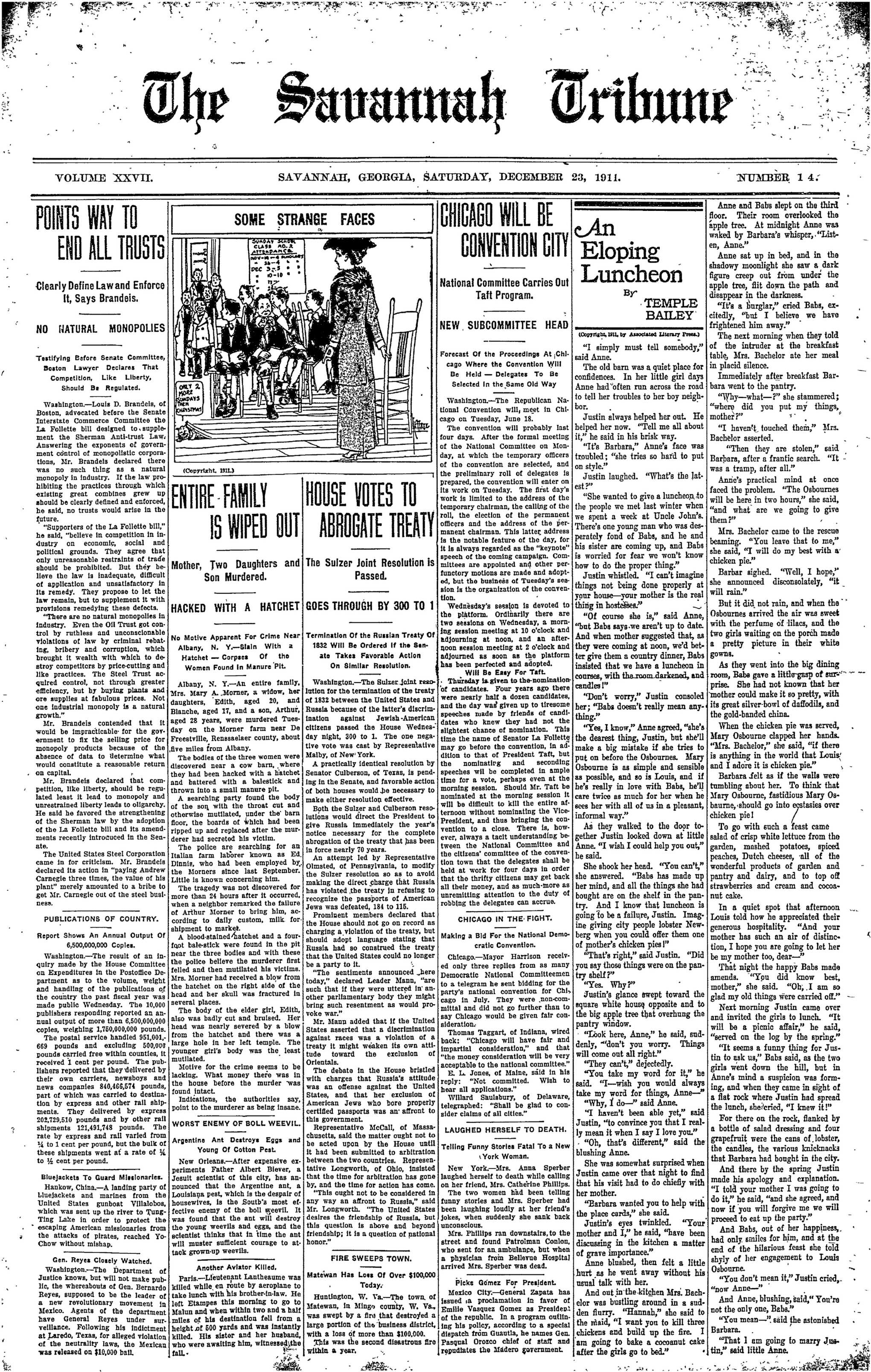
POWWTS WAY 10
END ALL TRUSTS
NO NATURAL MONOPOLIES
Testifying Before Senate Committee,
Boston Lawyer Declares That
Competition, Like Liberty,
Should Be Regulated.
Washington.—Louis D. Brandeis, of
Boston, advocated before the Senate
Interstate Commerce Committee the
La Follette bill designed to.supple-
ment the Sherman Anti-trust Law.
Answering the exponents of govern-
ment control of monopolistic corpora-
tions, Mr. Brandels declared there
was no such thing as a natural
monopoly in Industry. If the law pro-
hibiting the practices through which
existing great combines grew up
should be clearly defined and enforced,
he said, no trusts would arise in the
future.
“Supporters of the La Follette bill,”
he sald, “believe in competition in in-
dustry on economis, social and
political grounds. They agree that
only unreasanable restraints of trade
should be prohibited. But théy be-
Neve the law is inadequate, difficult
of application and unsatisfactory in
its remedy, They propose to let the
law remein, but to supplement it with
provisions remedying these defects.
“There are no natural monopolies in
industry. Even the Oil Trust got con-
trol by ruthless and unconscionable
violations of law by criminal rebat-
ing, bribery and corruption, which
Drought it wealth with which to de
stroy competitors by price-cutting and
Uke practices. The Steel Trust ac:
quired control, not through greater
efficiency, but by buying plants and
‘ore supplies at fabulous prices. Not
one industrial monopoly is a natural
gtowth.”
Mr. Brandeis contended that it
would be impracticable: for the gov-
ernment to fix the selling price for
monopoly products because of the
absence of data to Uetermine what
would constitute a reasonable return
‘on capital. x
Mr. Brandeis declared that com-
petition, like Iberty, should be regu-
lated least it lead to monopoly and
unrestrained liberty leads to oligarchy.
He said he favored the strengthening
of the Sherman law by the adoption
of the La Follette bill and its amend-
ments recently introcuced in the Sen-
ate,
The United States Steel Corporation
came in for criticism, Mr. Brandeis
declared {ts action in “paying Andrew
Carnegie three times, the value of his
plant” merely amounted to a bribe to
got Mr. Carnegie out of the steel busl-
ness.
PUBLICATIONS OF COUNTRY.
Report Shows An Annual Output O1
6,500,000,000 Coples.
Washington—The result of an in-
quiry made by the House Committee
on Expenditures in the Postoffice De-
partment as to the volume, weight
and handling of the publications of
the country the past fiscal year was
made public Wednesday. The 10,000
publishers responding reported an an-
nual output of more than 6,500,000,000
copies, weighing 1,760,000,000 pounds.
The postal service handled 951,001,.
669 pounds and excluding 500,000
pounds carried free within counties, it
received 1 cent per pound. The pub-
Ushers reported that they delivered by
their own carriers, newsboys and
news companies 840,466,574 pounds,
part of which was carried to destina.
tion by express and other rail ship
ments. They delivered by express
202,729,510 pounds and by other rail
shipments 121,491,748 pounds. The
rate by express and rall varied from
¥ to 1 cent per pound, but the bulk of
these shipments went at a rate of %
to % cent per pound.
BluejJackets To Guard Missionaries.
Hankow, China.—A landing party of
Lluejackets and marines from the
‘United States gunboat Villalobos,
which was sent up the river to Tung-
Ting Lake in order to protect the
escaping American missionaries from
the attacks of pirates, reached Yo-
Chow without mishap.
Gen. Reyes Closely Watched.
Washington—The Department of
Justice knows, but will not make pub-
lic, the whereabouts of Gen. Bernardo
Reyes, supposed to be the leader of
& new revolutionary movement jn
Mexico. Agents of the department
have General Reyes under sur.
veillance. Following his indictment
at Laredo, Texas, for alleged violation
of the neutrality laws, the Mexican
‘was released on $10,000 ball,
SOME STRANGE FACES
Iles od |
Ree, al fey
EP Cn — ry Bite j
lise, ye Baia os
Ly % ek ee
i | ih ae ne S| posi
Wyss Nani Ee SLL
& of i ihe fren EL :
he E44 ——t be
eee eT
SSS
Se
ENTIRE FARILY
s WED OUT
HACKED WITH A HATCHET
No Motive Apparent For Crime Near
Albany, N. Y.—6laln With 2
Hatchet — Corpses Of tho
Women Found In Manure Pit.
Albany, N. Y.—An entire family,
‘Mrs, Mary A..Morner, a widow, her
daughters, “Edith, aged 20, and
Blanche, aged 17, and a son, Arthur,
aged 28 years, were murdered Tues:
day on the Morner farm near De
Freestville, Renssaelaer county, about
five miles from Albany.
‘The bodies of the three women were
discovered near a cow barn, where
they had been hacked with a hatchet
and battered with a balestick and
thrown into a small manure pit.
A searching party found the body
of the son with the throat cut and
otherwise mutilated, under the’ barn
floor, the boards of which had been
ripped up and replaced after the mur-
derer had secreted his victim.
| The police are searching for an
Italian farm laborer known as Ed
Dinnie, who had been employed by
‘the Morners since last September.
‘Little is known concerning him.
| ‘The tragedy was not discovered for
‘more than 24 hours after it occurred,
‘when 2 nelghbor remarked the failure
ot Arthur Morner to bring him, ac
‘cording to dafly custom, milk for
‘shipment to market.
A blood-stained hatchet and a four:
fqot balestick were found in the pit
near the three bodies and with these
the police belleve the murderer first
felled and then mutilated his victims
‘Mrs. Morner had recelved a blow from
the hatchet on the right side of the
‘head and her skull was fractured In
several places.
The body of the elder girl, Edith,
also was badly cut and bruised. Her
head was nearly severed by a blow
trom the hatchet and there was a
large hole in her left temple. The
younger girl's body was the least
mutilated. :
Motive for the crime seems to be
lacking. What money there was in
the house before the murder was
found intact.
Indications, the authorities say,
point to the murderer as being insane.
WORST ENEMY OF BOLL WEEVIL.
Argentine Ant Destroys Eggs and
Young Of Cotton Pest.
New Orleans,—After expensive ex-
periments Father Albert Biever, a
Jesuit scientist of this city, has an-
nounced that the Argentine ant, a
Louisiana pest, which is the despair of
housewives, 1s the Soutb’a most ef-
fective enemy of the boll weevil. It
was found that the ant will destroy
the young weevils and eggs, and the
scientist thinks that in time the ant
will muster sufficient courage to at-
tack grown-up weevils.
Another Aviator Killed,
Paris.—Lieutenant Lantheaume was
kdlled while en route by aeroplane to
take lunch with his brotherinlaw. He
left Etampes this morning to go to
Malun and when within two and z half
‘miles of his destination fell from a
height of 500 yards and was instantly
‘killed. His sister and her husband,
‘who were awaiting him, witnessedithe
‘fall, aed
ROUGE VOTES 10
IBOEATE TREAT
GOES THROUGH BY 300 TO 1
Termination Of the Russian Treaty Of
1832 Will Be Ordered If the Sen-
ate Takes Favorable Action
On Similar Resolution.
Washington—The Sulzer joint reeo
lution for the termination of the treaty
of 1832 between the United States and
Russla because of the latter’s discrim.
ination against Jewish -American
citizens passed the House Wednes-
day night, 300 to 1. The one nega-
tive vote was cast by Representative
Malby, of New’ York.
A practically identical resolution by
—— Culberson, of Texas, ia pend.
ing in the Senate, and favorable action
of both houses would pe necessary to
make elther resolution effective.
Both the Sulzer and Culberson reso-
lutions would direct the President to
give Russia immediately the year’s
notice necessary for the complete
abrogation of the treaty that has been
in force nearly 70 years.
An attempt Ied by Representative
Olmsted, of Pennsylvania, to modify
the Sulzer resolution so as to avoid
making the direct charge that Russia
has violated the treaty jn refusing to
recognize the passports of American
Jews was defeated, 184 to 115.
Prominent members declared that
the House should not go on record as
charging a violation of the treaty, but
should adopt language stating that
Russia had so construed the treaty
that the United States could no longer
be a party to it. 4
“The sentiments announced here
today,” declared Leader Mann, “are
such that if they were uttered In’ an.
other parliamentary body they might
bring such resentment as would pro-
voke war.”
| Mr. Mann added that if the United
States asserted that a discrimination
against races was a violation of a
treaty it might weaken its own atti
tude toward the exclusion of
Orientals.
The debate in the House bristled
with charges that Russia's attitude
was an offense against the United
States, and that her exclusion of
American Jews who bore properly
certified passports was an’ affront to
thia government.
Representative McCall, of Massa:
chusetts, safd the matter ought not to
be acted upon by the House until
it had been submitted to arbitration
between the two countries. Represen:
tative Longworth, of Ohio, insisted
that the time for arbitration has gone
by, and the time for action has come
“This ought not to be considered in
any way an affront to Russia,” said
Mr. Longworth. “The United States
desires the friendship of Russia, but
this question 1s above and beyond
friendship; it is a question of national
honor.”
FIRE SWEEPS TOWN.
Matewan Has Loes Of Over $100,000
fi Today.
Huntington, W. Va—The town of
Matewan, In Mingo county, W. Va.
was swept by a firs that destroyed a
large portion of the ‘business district,
with a loss of more than $100,000.
‘Thia was the second disastrous fire
within a year, a
~_ * DY dee 26 et Ore “oe Mee
te
OREN i
NEW SUBCOMMITTEE HEAD
Forecast Of the Proceedings At ,Chl-
cago Where the Convention WII
Be Held — Delegates To Be
Selected In the Same Old Way
Washington.—The Republican Na-
tional Convention will, meet in Chi.
cago on Tuesday, June 18.
The convention will probably last
four days. After the formal meeting
of the National Committee on Mon.
day, at which the temporary officers
of the convention are selected, and
the preliminary roll of delegates ig
prepared, the convention will enter on
Its work on Tuesday. The first day's
work is limited to the address of the
temporary chairman, the calling of the
roll, the election of the permanent
officers and the address of the per
manent chairman. This latter address
is the notable feature of the day, for
it Is always regarded as the “keynote”
speech of the coming campaign. Com:
mittees are appointed and other per
tunctory motions are made and adopt:
ed, but the busineés of Tuesday's ses
sion ig the organization of the conven
ton. e
‘Wednesday's session is devoted tc
the platform. Ordinarily there are
two sessions on Wednesday, 2 morn
ing session meeting at 10 o'clock an¢
wdjourning at noon, and an after
noon session meeting at 2 o'clock anc
adjourned as soon as the platform
has been perfected and adopted.
Will Be Easy For Taft.
+ Thuraday {a given to the-nominatior
‘of candidates. Four years ago there
were nearly half a dozen candidates
and the day wag given up to tiresome
speeches made by friends of cand!
dates who knew they had not the
slightest chance of nomination. This
time the name of Senator La Follett:
may go before the convention, in ad
dition to that of Prestdent Taft, but
the nominating and seconding
speeches wil be completed in sample
time for a vote, perhaps even at the
morning session, Should Mr. Taft be
nominated at the morning sesslon It
will be dificult to kill the entire af
ternoon without nominating the Vice
President, and thus bringing the con
vention to a close. There is, how
ever, always a tacit understanding be
tween the National Committee and
the citizens’ committee of the conven
tion town that the delegates shall be
held at work for four days in ordet
that the thrifty citizens may get back
all thelr money, and as much-more as
unremitting attention to the duty o!
robbing the delegates can accrue.
CHICAGO IN THE: FIGHT.
Making a Bld For the National Demo-
cratic Convention.
Chicago—Mayor Harrison recely-
ed only three replies from as many
Democratic National Committeemen
to a telegram he sent bidding for the
party's national convention for Chi:
cago in July. They were non-com-
mittal and did not go further than to
say Chicago would be given fair con-
sideration.
Thomas Taggart, of Indiana, wired
back: “Chicago will have fair and
impartial consideration,” and that
“the money consideration will be very
acceptable to the national committee.”
E, L. Jones, of Maine, said In his
reply: “Not committed. Wish to
hear all applications.”
Willard Saulsbury, of Delaware,
telegraphed: “Shall be glad to con.
sider claims of all cities.”
LAUGHED HERSELF TO DEATH.
Telling Funny Stortes Fatal To a New
1 York Woman.
New York—Mrs. Anna Sperber
laughed herself to death while calling
on her friend, Mrs. Catherine Phillips.
The two women had been telling
funny stories and Mrs, Sperber had
been laughing loudly at her friend’s
jokes, when suddenly she sank back
unconscious,
Mrs. Phillips ran downstairs, to the
street and found Patrolman Conlon,
who sent for an ambulance, but when
a physician from Bellevue Hospital
arrived Mrs, Sperber was dead.
Picks Gomez For President.
| Mexico City:—General Zapata has
fesued +a proclamation in favor of
Emilie Vasquez Gomez as Presiden:
‘of the republic, In a program outlin
ing his policy, according to a special
dlepateh from Guautla, he names Gen.
Pasqual Orozco chief of staff and
‘repudiates the Madero government.
cAn
Hloping _
Luncheon
a ‘TEMPLE
BAILEY
“I simply must tell somebody,”
said Anne.
The old barn was a quiet place for
confidences. In her little girl days
Anne had”often run across the road
to tell her troubles to her boy neigh-
bor. A
Justin always helped her out. He
helped her now. “Tell me all about
it,” he said in his brisk way.
“Ti’s Barbara,” Anne’s face was
troubled; “she tries so hard to put
on style.”
Justin laughed. “What’s the lat-
est?”
“She wanted to give a luncheon, to
the people we met last winter when
we spent a week at Uncle John’s.
‘There’s one young man who was des-
perately fond of Babs, and he and
his sister are coming up, and Babs
is worried for fear we won't know
how to do the proper thing.”
Justin whistled. “I can’t imagine
things not being done properly at
your house—your mother is the real
thing in hostegses.” ag
“Of course she is,” said Anne,
“but Babs says-we aren’t up to date.
And when mother suggested that, as
they were coming at noon, we'd bet-
ter give them a country dinner, Babs
insisted that we have a luncheon in
courses, with the room darkened, and
candles!”
“Don’t worry,” Justin consoled
her; “Babs doesn’t really mean any-
thing.”
“Yes, I know,” Anne agreed, “she’s
the dearest thing, Justin, but she’ll
make a big mistake if she tries to
put on before the Osbournes. Mary
Osbourne is as simple and sensible
as possible, and so is Louis, and if
he’s really in Jove with Babs, he'll
care twice as much for her when he
sees her with all of us in a pleasant,
informal way.”
As they walked to the door to-
gether Justin looked down at little
Anne. “I wish I could help you out,”
he said.
She shook her head. ‘You can’t,”
she answered. “Babs has made up
her mind, and all the things she had
bought are on the shelf in the pan-
try. And I know that luncheon is
going fo be a failure, Justin. Imag-
ine giving city people lobster New-
berg when you could offer them one
of mother’s chicken pies!”
“That’s right,” said Justin. “Did
you say those things were on the pan-
try shelf?”
“Yes. Why?” .
Justin’s glance swept toward the
square white housq opposite and to
the big apple tree that overhung the
pantry window.
“Taok here, Anne,” he said, sud-
denly, “don’t you worry. Things
will come out all right.”
“They can’t,” dejectedly.
“You take my word for it,” he
said. “I—wish you would always
take my word for things, Anne—”
“Why, 1 do—” said Anne.
“I baven’t been able yet,” said
Justin, “to convince you that I real-
ly mean it when I say I love you.”
- “Oh, that’s different,” said the
blushing Anne.
She was somewhat surprised when
Justin came over that night to find
that his visit had to do chiefly with
her mother. |
“Barbara wanted you to help with
the place cards,” she said.
Justin’s eyes twinkled. “Your
mother and J,” he said, “have been
discuseing in the kitchen a matter
of grave importance.”
Anne blushed, then felt a little
hurt as he went away without his
usual talk with her.
And out in‘the-kitchen Mrs, Bach-
elor was bustling around in a sud-
den flurry. “Hannah,” she said to
the maid, “I want yon to kill three
chickens end build up the fire. 1
am going to bake a cocoanut cake
Anne and Babs slept on the third
Se EN _ Seen ieee eg NE Te
figure creep out from under the
apple tree, flit down the path and
dizappear in the darkness. :
“Iva a Burglar,” eried Babs, ex-
citedly, “but I believe we have
frightened him away.” ~
The next morning when they told
of the intruder at the breakfast
table, Bre. Bachelor ate her meal
in placid silence.
Immediately after breakfast Bar-
bara went to the pantry.
“Why—what—?” she stammered ;
“where did you put my things,
mother?” Ps .
“I haven't touched them,” Mrs.
Bachelor asserted.
“Then they are stolen,” said
Barbara, after a frantic search. “It .
was a tramp, after all.”
Anne’s practical mind at once
faced the problem. ‘“The Osbournes
will be here in two hours,” she said,
“and what are we going to give
them?” oo,
Mrs. Bachelor came to the rescue
beaming. “You leave that to me,”
she said, “I will do my best with a’
chicken pie.”
Barbar sighed. “Well, I hope,”
she announced disconsolately, “it~
will rain.”
But it did not rain, and when the”
Osbournes arrived the air wes sweet
with the perfume of lilacs, and the
two girls waiting on the porch made
a pretty picture in their white
gowns, .
As they went into the big dining
room, Babe gave a little-gasp of sur-”
prise. She had not known that ber
‘mother could make it so pretty, with
its great silver-bowl of daffodils, and
the gold-banded china.
When the chicken pie was served,
Mary Osbourne clapped her hands.
“Mrs. Bachelor,” she said, “if there
is anything in the world that Louis’
and J adore it is chicken pie.” 5
Barbara felt as if the walle were
tumbling about her. To think that
Mary Osbourne, fastidious Mary Os-
baurne, should go into eostasies over
chicken pie! 7
To go with such a feast came
salad of crisp white lettuce from the
garden, mashed potatoes, spiced
peaches, Dutch cheeses, all of the
wonderful products of garden and
pantry and dairy, and to top off
strawberries and cream and cocoa-
nut cake,
In a quiet spot that afternoon
Louis told how he appreciated their
generous hospitality. “And your
mother has such an air of distinc.
tion, I hope you are going to let her
be my mother too, dear—”
That night the happy Babs made
amends. “You did know best,
mother,” she said. “Ob,.I am s0
gled my old things were carried off.”
Next morning Justin came over
and invited the girls to lunch. “It
will be @ picnic affair,” he said,
“served on the log by the spring.”
“Tt seems a funny thing for Jus-
tin to ask us,” Babs said, a3 the two
girls went down the hill, but in
Anne’s mind a suspicion was form-
ing, and when they came in sight of
8 flat rock where Justin had spread
the lunch, sheZeried, “I imew it!”
For there on the rock, flanked by
a bottle of salad dressing and four
grapefruit were the cans of lobster,
the candles, the various knicknacka
that Barbara had bought in the city.
And there by the spring Justin
made his apology and explanation.
“I told your mother I was going to
do it,” he said, “and she agreed, and
now if you will forgive me we will
| proceed to eat up the party.”
And Babs, out of her happiness,
had only. smiles for him, and at the
end of the hilarious feast she told
shyly of her engagement to Louis
Osbourne. ‘
“You don’t mean it,” Justin cried,..
AFRO-AMERICAN CULLINGS
Had this occurred anywhere south of the Ohio river the verdict would have been an international scandal. The press and pulpit of the north would have made it so. It would have been thundered from editorial columns that even Booker T. Washington, educator, philosopher, philanthropist, was not safe from violence at the hands of the southern white men, and that he could get no redress in southern courts of law. It would have been insisted that the jury was influenced wholly by race prejudice and that the charge laid against Dr. Washington by his assailant was too fantastic to be considered seriously by any one conversant with the life work of Dr. Washington, with his character and mental calibre.
In the view of the Courier-Journal the charge made by the defendant in the case just settled was as fantastic as it would have been if it had been laid against any equally noted white educator and philanthropist in America. To believe that Booker T. Washington would descend to peeping through keyholes it would be necessary to believe that he is mentally defective, and he has been the sanest agitator of the negro question, white or black, who has achieved prominence as a specialist upon the race question since the abolition of slavery.
If the ministers of the gospel would set aside a time, free from selfish motives, and throw the church doors open to the people in a general meeting and preach a sermon on race unity, race patronage of business enterprises, and show to the masses their plain duty, they would be carrying out the plan of "Earthly Salyation," which would create an everlasting harmony with the spiritual plan. To do this the minister must be right; he must set the example; his sermon will have no effect if he tells the masses about race patronage and race unity tonight, and in the morning calls the white grocer, the white coal dealer and the white laundryman to fill orders for his household. No general plan of action is effective which has a negative strain.—St. Louis Central Afro-American.
Negro newspapers everywhere are preaching business, business, business,—go into business! Let them also begin urging our schools to give us young people with thorough business training. We must have competent help along with the necessary accessories with which to go into business, or each venture will ultimately become a farce. We do not want any more business collapses from ill-preparedness like the True Reformers' Bank failure.—Ex.
There never was nor will there ever be a thing that is worth having that is gotten by no effort nor exertion. That which tends to development only comes after the struggle to obtain it. That which the possession of makes the owner benefited is obtained only after the battle for it. And for one to give up the fight is but to give up hope of ever obtaining that which is for one's good.—Portland (Ore.) Advocate.
Pay your honest debts. Quit lying and stealing, shun the dives, treat your neighbor's family (each of them) as you want them to treat yours, honor the respectable women and girls, discourage the other kind, stop gathering on the streets to tell your troubles and try not to be so noisy on the street cars, and we will get along better. We will.—Indianapolis Plaindealer.
And when this is all realized and the first water connection between the Atlantic and Pacific is an established fact, we shall one and all, without regard to political creed or affiliation, give three cheers for the great American, Theodore Roosevelt, who made it a possibility.—Charleston Messenger.
The Orgen Realty company has had us puzzled for years. We've been trying to discover where it got its name from. We discovered the secret a few days ago. "Orgen" is "Negro" spelled backwards. Good!—Dallas Express.
A recent writer said of Henry Ossawa Tanner: "He should no longer be classed as the foremost negro painter, but rather as one of the greatest artists America has produced."—Milwaukee Free Press.
"The woman in every house makes the moral and mental atmosphere of that house, just as decidedly as the sunshine or rain affects the natural atmosphere outside of it."—Exchange.
Both white and colored people are beginning to believe more strongly that the negro who does-not own a home will have to be watched.—Inspegia (Ala.) Messenger.
Men may die daily, but the church must live on and on—yea, even unto the coming of the Lord.—Pittsburgh Courler.
The world respects a man with convictions.—Danville (Ky.) Torchlight.
The world outside does not know what we are doing in Texas in a newspaper way and here's some much needed information. There are in Texas 25 periodicals—the Austen Herald, Galveston City Times, Galveston New Idea, Houston Texas Freeman Houston Western Star, Houston Church of God Review, Marshall, Louisiana and Texas Watchman, Waco Conservative Counselor, Paul Quinn Weekly, Waco; Cleburne Eastern Star, Waco Helping Hand, Beaumont Enterprise, Dallas Daily Metropolitan, The Ennils Cimeter, The Hustler, San Antonio; San Antonio Inquirer, Wiley (School) Reporter, Bishop College (School) Student, Marshall; Masonic Quarterly, Fort Worth; Denton Odd Fellows Budget, Dallas Reporter and Dallas Express. Most of the publications have job printing concerns in connection. They represent a capitalization of something like $25,000 and employ about 250 persons. One is issued daily, one quarterly, two twice a month, six monthly; the remainder weekly. The Masonic Quarterly has a circulation of 8,000 copies, the Dallas Express 10,000. They are all loyal to the country in general and the negro in particular. They are the only American papers published in the state; that is to say, they are the only papers which make character and worth the measure of the man, and who believe in equal rights to all and special privileges to none.—Dallas Express.
It is that friendship that when dark forebodings come creeping into the soul, driving the light from the eye and the smile from the face; when the head is bowed down and the spirit is broken with the heavy weight of adversity, and man and angels, yea and God himself seems to have turned away and hid his face from the poor mortal, that can even then throw about the broken body and fainting soul the arms of love and sympathy, and lift him up and speak words of comfort and cheer that shall cause him to look up and take heart again and once more stand upright as a man among men. This friendship has its own reward in a fullness of joy that only those can know who have carried it into everyday life, and solved the problem of genuine friendship in practical work of good for men.—Georgia Broadax.
From an ambitious struggling young man Dr. Dan. Williams has become eminent in every line of medicine and surgery, until today in surgery he is hailed throughout the land as a master mind. Twenty-five years he has studied and experimented, twenty-five years he has toiled and accomplished until he has been the "open sesame" to unexplored fields of research and the means of giving to the medical world a wider knowledge and a better understanding of the laws governing the human body. Not only thus has he been of inestinable benefit to his race but also by the precedent which he has established and by the example which he is giving to all young men of ability.—Chicago (Ill.) Chronicle.
We agree with Dr. Washington that negroes in Birmingham have such opportunities to do big things as are not enjoyed by a like number of negroes elsewhere in this country. But to do these things negroes must sink their personal differences.
Will they sink 'em?
If they are men worthy of the name, they will. If they are not men, they will continue the asinine policy of making faces at every movement, be it ever so grand, that is introduced by a man or set of men against whom is harbored some petty spite.—Birmingham (Ala.) American.
"As a man thinketh so is he." Now then what do you think about yourself? You think you're good; the other fellow thinks likewise of himself. But to set you right and put you straight don't think if you are crooked all of us are crooked; not necessarily so, in the case of the last mentioned it's "your cussed self." So think right.—San Antonio (Texl) Inquirer.
There are fewer children from white and negro parents now than there were twenty years ago. Race consciousness on both sides is largely responsible for this result. This tendency will doubtless become more pronounced as the negro race becomes more respectable in its own eyes.—Durham (N. C.) Informer.
The white man is blind or pretends so, when it comes to classing the negro. He classes all of us with the jail bird, habitual transgressor and the lowest type of the race.—Palestine (Tex.) Plaindealer.
We have no objection to the bad side of the negro's life being advertised if the good side is advertised also.—Helena (Ark.) Interstate Reporter.
Don't throw your money away. Educate your children and buy homes. It is a Christian's duty to religiously educate his-child.—Sunday School Union Volce.
"CAN A BUSINESS MAN BE HONEST?"
"OLD HICKORY" COMMENTS ON RECENT SERMON OF DR. CAMPBELL MORGAN.
Rev. Dr. Campbell, a prominent white minister of London, said in a recent sermon, "no successful business man in modern times can be honest." We hate to dispute so eminent an authority, and we regret the fact if it is true. Mr. Campbell, however, was brought up among the folks he was talking about, and for that reason he is a much better judge of the subject than we are. It may be remarked in passing, however, that if the minister's assertion be true it is, a reflection on the efficacy of the religion which he preaches. If religion can't make men honest what can it do? We have heard of but one other assertion more terrible than that made by the London minister, and that was a declaration made by a colored preacher to the effect that the grander rascal a man in his profession is, the more successful and the more popular he will be. We have heard another minister say that when he entered the profession he had no other thought than to do right, but that he soon discovered that, to use a street phrase, "he wasn't in it" at all with the other fellows! One can, by taking into account the low level of intelligence of the mass of our people, understand the possibility if not the probability of the truth of the negro minister's assertion. But the statement of the London minister seems almost unbelievable. The force of the assertions made by the colored ministers, as well as that made by the white, may be lessened if we classify these assertions under the head of what the writers on logic call the fallacy of incomplete induction. Say what you please, they are terrible if true, and it is to be regretted for the sake of humanity that their falsity cannot be demonstrated with the certainty of a mathematical problem.
While the foregoing assertions from ministers of the gospel are so revolting to reason that the truth of one, if not of both of them, may be open to doubt, the following assertion taken from an appeal issued by a body of ministers for the purpose of arousing the world in the interest of peace, is rather underdrawn than overstated and is equally depressing from a spiritual point of view, and clearly implies that while the forms and monuments of religion are here in pristine vigor the spirit is dead and gone. Listen to this:
"The present armed peace of Christendom is a scourge and a scandal. There are today more guns and bayonets, more bombs and shells, more soldiers on land, and more ships of war upon the seas, than in any preceding century in the history of the world. More money is now expended in getting ready for war than was spent in former times in waging war. The burden of this military and naval equipment is stunting and demoralizing the life of the nation, and handicapping the progress of all humanitarian movements. Militarism is one of the gigantic evils of our day. Against it the Church of Christ must set itself in open and determined opposition. The burden of the people must be lightened, the nations must be delivered from their fears. The instruments of slaughter must be beaten into the implements of industry. The world must know that Christians are indeed followers of the 'Prince of Peace.'"
Of course the appeal takes no note of our near-home evils which are equally repugnant to the teachings of the "Prince of Peace." It is convenient for the ministers according to old habits to stay as far up in the sky as possible. It has been ever thus with them. Their thunder has always reverberated loudest up in the higher altitudes.
HEROIC HAROLD.
Harold, aged nine, came home one day so bruised and dirty that his mother was thrown into a state of marked perturbation.
"Mercy!" she exclaimed, in horror. "How on earth, my child, did you get your clothes and face into such a state?"
"I was trying to keep a little boy from getting licked," was Harold's virtuous, if hesitating, reply.
"Well, that was fine!" said his mollified parent. "I am proud of you, sonny. Who was the little boy?"
"Me."—Chicago Record-Herald.
VACATION TALK.
Simeon Ford, the noted reconteur, said of vacation at a banquet in New York:
"Vacation talk is in the air. Everywhere you see men wipe their wet brows, look at the thermometer, and then begin to talk vacation.
"Two fish in the East river were overheard in conversation the other day.
"What are your plans for the summer?" the first said.
"I expect to get away as usual," the other answered."—Los Angeles Times.
RURAL RIVALS.
Village Beauty—I see that there new fire engine has been named after Jack Hansom. Admirer (a rival of Jack Hansom)—Ya-as, that new engine is a good deal of a squirt.
NOTES ON RACIAL PROGRESS
AS REPORTED BY THE NATIONAL NEGRO BUSINESS LEAGUE.
The colored population of Galveston, Tex., is nearly 9,000 in about one-fifth ratio of the whole. The races here are quite friendly. Many whites patronize business enterprises owned and managed by colored men, and otherwise give proof of their friendliness in responding to the aid and advancement of their colored fellow citizens. In 1900, September 8, the colored residents along with the whites lost almost all their property, as a result of a disastrous storm and flood that swept over and deluged the city that fateful night.
Their progress, therefore, today represents mostly their accumulations since the rehabilitation. The valuation of all their property, business holdings, real and personal, is conservatively estimated to be about one million dollars. The following list represents the various kinds of business enterprises followed by some of the race: Four grocers, 17 barber shops (4 for white and 13 colored), 3 wood dealers, 20 restaurants and boarding houses, 3 furniture dealers, 1 drug store, 1 undertaking establishment, 1 shoemaker, 6 tailors, 2 blacksmiths, 2 fish dealers, 4 house renovators, 6 hauling contractors, 6 builders and house movers, 6 cotton samplers, 3 ice men, 1 ice cream company, 2 insurance businesses, 6 doctors, 1 dentist, 2 newspapers, 2 printing companies, 2 hospitals, 4 lawyers, 1 junk shop, 1 real estate company, 1 mining company, 3 pleasure resorts, 3 public schools, 1 high school, 16 churches, 300 homes owned, 8 organizations own property valued at $60,000, 3 other organizations have bought property in the city limits valued at $30,000. There are about 45 different local secret societies.
The most important labor organization in the city is the No. 2 Cotton Screwmen's, which was formed thirty years ago. Their work for the commercial interest of this port in the past ten years in storing away cotton in vessels to be transported throughout this country and abroad has been estimated in value to amount to about one billion dollars, in other words, equal to the whole wealth of the race in the United States. The organization's strength and membership is 600, and many families of this community.
ADVICE TO THOSE WHO WANT TO GO TO LIBERIA
NEW YORK AGE OFFERS SUGGESTIONS TO OKLAHOMA EMIGRANTS
A long time ago a large number of negroes of Oklahoma sold all that they had and came to New York, intending to proceed to Liberia, but they did not go. The persons who were expected to arrange for their transportation to West Africa, for some reason, were unable to do so. They remained some two weeks in three cars in the Jersey City yards of the Central Railroad of New Jersey. The deplorable condition of the men, women and children was brought to the attention of Mr. Fortune, then editor of The Freeman, and he, with a few others, was instrumental in placing the families with brick yard managers along the Hudson river and the Central Railroad of New Jersey, where, we suppose, they are now.
Two hundred families of Oklahoma, it is said, have made up their minds to move to Liberia. We have no disposition to discourage them, and those in other parts of the country who think of moving to the west coast of Africa, which is a long way from New York and easier to go to than to come from, as those who go have the passage money, while many of those who want to come back cannot do so because they have not got the passage money and cannot get it. Now, while we are not disposed to discourage anyone who has decided to go to Liberia, we will offer some advice about it.
This is the advice: There are said to be 200 Oklahoma families who have decided to go to Liberia. Let them select three of the best men among them, paying all of their expenses and supporting their families in their absence; let those men remain in Liberia long enough to visit all parts of the country and familiarize themselves with its resources and its changes of seasons. The climate and its changes are of great moment in such a movement. Twelve months would not be too long. Now, when those three men have accomplished the work of "spying out the land" the 200 families should accept their report as final. If this should be done the truth would be more likely to be got than in any other way, and much misery and sorrow might be averted. Or communication can be had with Prof. Walter F. Walkin, Monrovia, Liberia, who speaks hopefully of the country's future.
ONCE ENOUGH.
Bilkins—So you didn't go to the masquerade ball?
Wilkins—No; I made a fool of myself there last season, and I didn't care to risk it again.
Wilkins—No. But when the masks were removed I discovered that I'd wasted a whole evening and $20 spooning with my wife.
THE JOHNSON HOTEL
THE JOHNSON HOTEL
331 JEFFERSON STREET al conveniences. Hot or cold baths. Large parlor with re and music. Polite help. Carriage and hacks, also telephon a hack or carriage ring up 676 and the manager will see the Rooms to let at 25 cents.
With all hotel conveniences. Hot or cold baths. Large parlor with reading matter and music. Polite help. Carriage and hacks, also telephones. If you want a hack or carriage ring up 676 and the manager will see that you get it. Rooms to let at 25 cents.
MEALS AT ALL HOURS.
PRINCE R. BUTLER, Manager and Proprietor.
HIGH ART TAILORS
BUTTON STREET, EAST. Next Door to Red Cross Pharma
Special Prices Given for Thirty Days. A full line of Latest
Fall and Winter Goods.
NTRAL OF GEORGIA
RAILWAY
with its own rails the best portions—and reaches by ex-
cellent Schedules the Important Cities and Towns of
GEORGIA = ALABAMA
HIGH ART TAILORS
321 BROUGHTON STREET, EAST. Next Door to Red Cross Pharmacy. Special Prices Given for Thir ty Days. A full line of Latest Fall and Win ter Goods.
CENTRAL OF GEORGIA RAILWAY
Traverses with its own rails the best portions—and reaches by excellent Schedules the Important Cities and Towns of
GEORGIA-ALABAMA
North and Northwest West and Southwest
The North and Northwest the West and Southwest Our Standards Are
bility, Comfort, Safety
you contemplate a short trip or long journey let us arrange
. Information cheerfully furnished. "It is always a please
ver questions."
37 Bull Street Phone
No. 83
M B. CLEMENTS, City Pass. & Ticket Ag
Mordecie Pressing Club
cleaned and pressed per month for $1.00. Ladies' work
Goods called for and delivered. All work guaranteed. Steam
ening.
BROAD STREET.
Phone 131
MAS BAKER, The
Shoemaker
s SHOE REPAIRING. Half sole, sewed, 85 cents; nailer
uber heels, 35 and 50 cents. All work guaranteed.
CORNER EAST BROAD AND BOLTON STREETS.
Don't Buy a New One
old ones and send to us. We make them new—Stoves, Furn
asses, Carpets. CARPET AND MATTING LAYING A SPE
l furniture bought and sold. Packing and Shipping. Good
and delivered.
ON & SLOCUM, Upholsterer
Reliability, Comfort, Safety
Whenever you contemplate a short trip or long journey let us arrange your tickets. Information cheerfully furnished. "It is always a pleasure to answer questions."
City Ticket Office 37 Bull Street Phone No. 83
WILLIAM B. CLEMENTS, City Pass. & Ticket Agt
The Mordecie Pressing Club
Two suits cleaned and pressed per month for $1.00. Ladies work specialty. Goods called for and delivered. All work guaranteed. Steam and dry cleaning. 816 EAST BROAD STREET. Phone 1319
First class SHOE REPAIRING. Half sole, sewed, 85 cents; nalled, 50 cents; rubber heels, 35 and 50 cents. All work guaranteed. CORNER EAST BROAD AND BOLTON STREETS.
Don't Buy a New One
Save the old ones and send to us. We make them new—Stoves, Furniture, Mattresses, Carpets. CARPET AND MATTING LAYING A SPECIALTY. Old furniture bought and sold. Packing and Shipping. Goods called for and delivered.
JACKSON & SLOCUM, Upholsterers
BOLTON AND EAST BROAD STREETS.
Your Eyes Trouble You
CONSULT OUR OPTICIAN.
M. SCHWABS' SON
11 BULL STREET.
COMFORTABLE AND CLEAN LODGING PERMANENT
OR TRANSIENT
stop at MoCARTHY'S
233 BRYAN ST. WEST.
SANITARY BARBER SHOP AND RESTAURANT A
TAG HED.
230 ST. JULIAN STREET, WEST.
FOR SAFE, COMFORTABLE AND CLEAN LODGING PERMANENT OR TRANSIENT Stop at MoCARTHY'S 233 BRYAN ST, WEST. FIRST CLASS SANITARY BARBER SHOP AND RESTAURANT AT TACHED. 230 ST. JULIAN STREET, WEST.
TO MY FRIENDS
notify all of my old patrons that I have purchased my c
all and Price streets, and would be glad to have them patroni
me at 601 for anything you may want and I will deliver th
y. Respectfully,
ERSON DRUG COMPANY
ERSON, PROPRIETOR. Corner HALL and PRICE S
PROGRESSIVE MAN
I wish to notify all of my old patrons that I have purchased my old stand at Hall and Price streets, and would be glad to have them patronize me. Phone me at 601 for anything you may want and I will deliver to you promptly. Respectfully,
TAZ L. ANDERSON, PROPRIETOR. Corner HALL and PRICE ST.
THE PROGRESSIVE MAN
Is the one who makes it his business to advertise his business thoroughly. Now is your opportunity
```markdown
```
Wherefore the law is holy, and the commandment holy, and just, and good—Romans 7:12.
We hear a great deal of ill-advised talk in these days—sometimes from persons who ought to know better—as to the limitations of law, as a moral force or agency. One of the favorite platitudes of the times is the solemn assertion that you cannot legislate people into virtue; that you cannot make people good by law, the net result being the practical disparagement of law as a moral and ethical agency.
Now, I venture to assert that a careful examination of this popular modern, axiom will show it to be no axiom at all—merely an illusion, one half of which is misleading, the other half erroneous.
In the first place, literally considered, we really say nothing practical or useful or real when we assert that you—cannot make people good by law. One might as well announce, with an air of discovery, that a horse cannot fly. Of course, a horse cannot fly; nobody expects it to fly. But while a horse cannot fly, it can do other highly useful things; it can walk and trot and run; it can haul loads and operate machinery. And to speak pityingly of the horse's inability to fly, and disparage it on that account, is to ignore the vast amount of real and valuable service that it renders to humanity year in and year out.
In the same way it is really irrelevant to call attention to the fact that you cannot make people good by law. Of course, you cannot. Goodness, strictly speaking, is the voluntary choice of the good from appreciation of its goodness. And law, being external, cannot reach the motives, the affections and the will, from which goodness springs. Law, accordingly, is as powerless to make people good as a horse is powerless to fly. But what of it? Conceding that law cannot do what it is contrary to its very nature that it should do, is it sensible, or just, or right, to lose sight of the valuable and useful things that the law can do and does do, and which, generally speaking, it alone is able to do?
No sensible person hopes to make people good, really, personally good, by force of law. All thoughtful persons realize that the primary purpose of law is not to make people good, ideally, but to prevent them from being bad, practically. And while we cannot hope to reclaim the erring, reform the vicious, renew the depraved by force of law, we may reasonably expect to protect humanity, individually and collectively, from some of the physical and mental results of vicious, depraved, immoral living.
For example, the law cannot make a man a really good husband. That is to say, the law cannot compel a man to love his wife, and cherish and comfort and honor her in all the vicissitudes of life. The law frankly realizes its inability to do such good and perfect things as these, and does not attempt them. But while the law cannot compel a man to love his wife, as he ought to do, the law can restrain a man from beating or deserting his wife, as he ought not to do. While it would be far better for husbands to love their wives, as St. Paul bids them to do, it is some gain, to some wives, to be protected from physical abuse, and from the fear of it.
The value of law, accordingly, consists chiefly in its protective efficacy. Its results are largely negative, to be sure, and physical, but they are not to be lightly esteemed on that account. The law may not make us good, but it does prevent us from being as bad as we might easily be. And it behoves us to note that the results of such external restraint and constraint may be quite as helpful to those most concerned as if they proceeded from the voluntary choice of good. Proprietors of factories ought to treat their employees humanely and considerably because of their love for their fellows. But so long as proper surroundings are provided, it matters little to the employees from what motive the act proceeded. Accordingly, it is foolish to disparage law as a moral agency because it
AGRICULTURE IS KING.
Whether prince of plebeian, rich or poor, saint or sinner, the queen upon her throne or the malden in the dairy, all must depend upon a common source for food and raiment—agriculture. It was thus from the beginning, from the forbidden fruit in the Garden of Eden to the soil product of 1911, from the time of the alry costume of Eve to the more pretentious apparel of her sisters in the present age. Obviously, then, as population increases and the food supply becomes a more vital question agriculture will command increasing attention and respect and the husbandman attain an importance among his fellows amounting almost to solitude.—Jacob C. Mohler in Kansas Farmer.
TOO DANGEROUS.
"There is one thing belonging to the people which grafting officials in power never want to tax."
"I did not think there was anything. But what is it?"
"Their memory."—Baltimore American.
cannot make people really good. If to an appreciable degree it can check men's wayward impulses, curb their inordinate desires, restrain their passions, it is doing a needful and a beneficent work in the world. And unquestionably law is able to do this negative work, and to do it with reasonable efficiency. But the law is not only a negative moral force, it is also of considerable positive value in the world, even the world of morals, though this fact is generally overlooked.
It is not possible to demonstrate precisely to what extent law makes for real virtue and goodness, the voluntary acceptance of the good, but it is entirely reasonable to affirm that to a considerable extent the law does actually help us morally, does really strengthen our weak wills, does incline us toward the choice of the good, does lead us to something higher and better than itself.
We must recognize in this connection that virtue and goodness are not always or even usually the simple thing or state that we assume them to be. Our personal virtue is not always the result of our conscious, deliberate choice and preference of pure goodness. To a large extent our virtue and our goodness is incidental—even, it may be, accidental. We are greatly helped by circumstances, the things that stand around us and help to hold us up. Like Ulysses, we are a part of all we have met; virtue and goodness, as well as sin and evil, are often forced upon us, not produced by us. As men grow older, for instance, they tend to grow better. To speak more accurately, men find it easy to resist certain temptations as they grow older, because they do not indulge in dissipation and excess we think of them as being better than they formerly were. Strictly speaking, they may not be better men at all, simply different, differently situated and surrounded, and therefore differently constituted, eventually.
Now, just as time delivers us from some temptations, and so mechanically, as it were, makes for virtue, so other conditions and circumstances, as purely objective and external as time itself, exert a like beneficent influence upon us. Experience has doubtless shown us all that to be delivered from temptation at a particular time is often to escape falling into sin at all; later on the same temptation may assail us and find us invulnerable. Under such conditions our escape may be said to be accidental. None the less, it was real, and it may easily prove of permanent value and effect. A man tempted to steal may yield if a moment of weakness, when had he not been so tempted he might never have fallen. A term in prison, a protracted illness, may result in a man's moral reformation. We do not always choose virtue as formally and specifically as Adam is represented to have made choice in the Garden of Eden, and goodness comes we know not whence or how.
Accordingly, the law, by removing or reducing temptation, by making our environment as favorable as possible, by artificially, if you will, strengthening our moral nature for the time, as a bandage supports a broken bone, does often actually and actively in the end produce what it is not its nature to produce at all—viz., virtue and goodness, the willing choice and steadfast acceptance of that which is holy and just and good. The law, like human parents, does far more for us than we are wont to realize, and it seldom receives the credit that is its just due.
The law is not the Gospel, of course; man's free will is not the grace of God. The divine purpose of the law, as St. Paul declared, is tutelarly, directive; its office is to bring men to Christ, who alone can order the unruly wills and affections of sinful men. But while the law is thus comparatively weak and ineffectual as a moral agency, it serves a useful, highly beneficent purpose, practically
God has merits us of the principle of law in his doings with men from the beginning, and we shall never outgrow our need of it in this life. The Ten Commandments are still the foundation of society and the safeguard of government. And it becomes us as rational, moral beings to realize gratefully and gladly that the law is holy and just, and good. It becomes us to esteem it very highly for its work's sake, not to disparage or condemn it, because, as we are accustomed lightly to say, "you cannot make pet le good by law."
IMPROVING PASTURES.
It has been abundantly shown that pastures may be improved either by natural or commercial fertilizers. When the pastures are heavily grazed, and the animals fed little or no other food, usually the pastures gradually decline. If, however, the cattle are fed a little concentrated food, especially of a highly nitrogenous character, or if the pastures are top-dressed with manures or commercial fertilizers, they steadily grow better. But occasional application of seed, clipping of weeds, and the harrowing of the fie'd, also contribute to this end.
AN EXPLANATION.
"Your nephew is a college graduate, isn't he?" "Yes," confessed honest Farmer Hornbank; "but in justice to the college I'll own up that he had no sense beforehand."—Woman's Home Company.
There's a long lane that has no turning—and a woman would keep on looking back.
MODERN DANCE-ITS ORIGIN AND EVILS
REV. R. T. FRYE, B. D. SPRING-
FIELD, OHIO.
Text: Proverbs 29:1—He, that be-
ing often reproved hardened his neck,
shall suddenly be destroyed, and that
without remedy.
The request of a mother, who has a daughter she hopes to bring up to be a useful and honorable woman, is responsible for the present discussion of this subject. In this request should be voiced the desire of every mother who has been entrusted with the development of the Christian womanhood for this and succeeding generations. An exalted priyilefe this, for it is one possessed by every parent into whose hand God has given a child. It is a privilege which, if properly used, will give returns in devotion, honor and helpfulness to parents, usefulness and joy to the church and the world, glory and praise to Christ our Lord, the value of which only God and eternity know.
There are some truths that never grow old; but there are others the world cares not to hear discussed very often, if in the discussion unvarnished facts are stated. So unpopular has the discussion of dancing from the pulpit become until one almost feels inclined to apologize for indulging in such discussion. Preachers are not saying as much against it now as did our fathers. In a great many cases, when a preacher, forced by a zeal for righteousness, attacks this form of amusement, the churches record their silent disapproval of his course and encourage the growing popularity of dancing by actually ignoring the appeal to call a halt and discipline the members who persist in this indulgence.
There used to be a time when one could go into public library and find a book or magazine containing articles on the evils of the dance; but, much to our surprise and disappointment, we were informed when we called at the library for such treatise, that nothing of the kind could be found on the shelves. And to make assurance doubly sure, we were invited to and did examine the shelves, but instead of finding works condemning we found the shelves laden with works teaching how to become proficient in the steps, swings and glides of the fantastic ball. As we left the place the secretary's face wore the surprised expression of one bidding adieu to a just awakened Rip Van Winkle. Then she smilingly said: "You will have to use your own thoughts against the dance."
Special attention is called to the fact that we are discussing the origin and evils of the modern dance and not the dance in general, as the ancient dance will only be mentioned insofar as is necessary to distinguish and compare the two. Now, while it is true we could find nothing condemning the dance, information as to the origin of the different phases was easily obtained. The different dances, their dates and phases of origin are as follows: (1) We have the quadrille or contri dance, which is of French origin, and was introduced in 1760; (2) We have the polka, trimblant or schottische which is of Bohemian origin, was introduced in 1844. It was first introduced at the Odeon by a dancing master from Prague in 1843. (3) we have the lancers, which is of French origin, was introduced by Laborde in 1861. (4) We have the waltz, which is of Bavarian origin, but was modernized about the same time of the lancers.
We have other shades and phases of the dance, such as the schottish reel, the Irish jig, the Negro breakdown, the sallior's horn pipe, the cancan, the Morris and dances, etc.
For one to declare all these dances evil is to take an unpopular view of a very popular subject. The friends of the amusement are loud in their declarations, "That of all men, the ministers who denounce it are the least qualified so to do, for their ignorance of the subject destroys all the force of their adverse criticism."
But their apparent ignorance of steam and electricity is not declared to destroy their knowledge of the fact that cars are moving and that messages are passing over the wires. That is to say, that while they have no technical knowledge of these sciences, they are nevertheless credited with sufficient intelligence to observe their actions and take note of results. They claim and ask for themselves the same credit with reference to the modern dance.
Preachers who condemn the dance are credited with being conscientious, and are at the same time accused of seeing it only through a distorted mental vision. If this be true the preacher really has the advantage as his sim is simply mental, while the facts show that many are actually guilty of the real sins the preacher's mental vision portrays.
We allege, first, that the modern dance is sensual in toto, hence counter spiritual and very sinful. It gives pleasure to three of the senses in particular: (1) The sense of sight. This is charmed with the beautiful and often costly attire of the participants and the decorations of the building. The circular whirl, marking the line of beauty, lends enchantment to the eye. (2) The sense of hearing. This is gratified by charming music that intoxicates and then transports one from his or her normal condition to that of sensuality. All dance music has the ring of a worldly good time, and those who follow it to the
final analysis drink the bowl to the very dregs. (3) The sense of touch. This gets unbounded satisfaction from the modern dance as the opposite sexes embrace and whirl. Those who dance deny these allegations, in part at least, and declare that the graceful form, carriage and physical exercise constitute the main features of attraction and service in the dance. But observation has proved that with any of the three sensual gratifications omitted, the pleasure of the dance is greatly diminished, if not entirely destroyed. Even to allow what they claim to be true does not destroy the truth of the statement that the dance is sensual in toto.
Secondly, we allege that the modern dance diminishes spirituality, hence is sensual. This is proved by the fact that in proportion as one increases in the love for the dance he decreases in his spiritual trend of mind and life, until finally, when fully accomplished as a dancer, he has no spiritual inclinations at all. This is an admitted fact in the lives of sinners and church members alike, who have allowed themselves so to drift. It has the spirit of Mammon and cannot be enjoyed in connection with pure Christian religion. For the Bible declares, "You cannot serve God and Mammon."
We allege that since the modern dance is sensual in toto, it is degrading both to the original dance and the modern dance. (1) It is degrading to the original dance. The art of dancing dates back to the early Egyptians, who ascribed the invention to their god Thoth and was indulged in by them as a mode of worshiping this one of their delites.
In Greece the dance was a religious performance. For religious processions went with song and dance to the temple, while the chorus moving in measured pace sang hymns to the Greek god Apollo.
The Phrygian carrying bantes are reported as dancing in honor of Cybele, their recognized god of the earth.
Among the Romans the festivals of Rhea Silvia were accompanied with the dance, and they regarded it as a disgrace for a free citizen to dance except in connection with religious rites.
The Bible speaks often of dancing, but whenever indulged in by godly people it is mostly, if not altogether, a mode of godly worship. Now, since the modern dance has no thought of suggestion of God nor of Christian worship, it is evident that it has dragged the lofty intention of the original dance down to a sensual level too low to be associated with its first meaning.
The dance I degrading to the dancer. No professed Christian who dances is regarded as the best type of Christian by a vast majority of the Christian world. He is not so regarded by even his sinner associates, as is proved by the little Christian influence he is able to exert over them. No dancer regards himself as being a very good exponent of Christianity; this is proved by the way he conducts himself when occasions call for earnest Christian service, as in times of revival to evangelistic services. The sinner who does not dance thinks himself better than the so-called Christian who does dance. Thus it is evident that the modern dance is degrading both to the original dance and the modern dancer, be he a professed Christian or a sinner.
Dancing is a modern foe to virtue, economy and religion. In the words of Dr. Hall: "It is the child of the devil." And if you continue in it, hardening your neck after being often reproved, ye shall suddenly be destroyed, and that without remedy.
TOO SMART FOR PROFESSOR.
The Rev. Dr. Ritchie of Edinburgh, when examining a student on one occasion, said: "And you attended the class for mathematics?"
What a laugh in the class the student's answer produced when he said, 'An inside and an outside.' But this was nothing compared with what followed. The doctor, having said to this student, "And you attended the moral philosophy class also?" added: "Well, you would hear lectures there on various subjects. Did you ever hear one on cause and effect?" "Yes." "Does an effect ever go before a cause?"
SHERLOCK: HOLMES AT CHURCH.
Tommy's mother had taken him to church to hear the evening sermon, and they occupied seats in the gallery. Tommy tried not to allow his attention to wander from the preacher, but it did. He seemed to be particularly interested in a family who sat in front of him, and when the sermon was about half over he whispered to his mother:
"Mamma, I uever saw those people before, but I know their names."
"Hush, dear!"
"But I do," persisted Tommy. "Their name's Hill."
"How do you know?"
"Every time the preacher says his text, 'I will lift up mines eyes to the hills,' those two big girls look at each other and smile."
Subsequent inquiry proved that Tommy was quite correct.
TO WHAT EXTENT IS THE NEGRO PULPIT UP-LIFTING THE RAGE?
TO WHAT EXTENT IS THE NEGRO PULPIT UP-LIFTING THE RAGE?
By MISS KATIE E. POSEY,
Nocatee, Fla.
Read before the sixth annual session of the Sunday School Congress, Meridian, Miss. From the establishment of the gospel system the pulpit has occupied an important and interesting position in all things pertaining to man's wellbeing along moral, social and spiritual lines. Coming as it does divinely commissioned and bearing to man a divine message, is has a claim upon the attention and acceptance of mankind.
The ministers of Christianity, departing from Asia Minor, passing over Asia, Africa and Europe to Iceland, Greenland and the poles of the earth, suffering all things, enduring all things, "raising men everywhere from ignorance of idol worship to the knowledge of the true God, and everywhere bringing life and immortality to life, have only been acting in obedience to the divine instruction; and they still go forth. They have sought and are still seeking to be able to preach the gospel to every creature under the heaven.
The negro pulpit has not been an exception in the great work of the uplifting of mankind, especially that part of mankind with which it is particularly identified. No other pulpit has ever had a more difficult task or labored under greater disadvantages than the negro pulpit. In the very beginning the negro pulpit had the leadership and the enlightenment of the race in spiritual knowledge thrust upon it, when it was neither qualified nor regularly organized. Despite the disability and disadvantages the negro pulpit became the pioneer in the first movements to better the condition of the race by lifting it from the degradation and disorganized state in which it was left by slavery. In almost every effort and successful plan which has been inaugurated since the race began its life of freedom, the negro pulpit has been the prime promoter and the advanced guard. As an evidence of the success of the negro pulpit along this line the race may point to a larger percentage of negro Christians according to population than any other people in this Christian land.
In organizing the negro into separate racial societies for the conduct of religious worship and church government the negro pulpit did a work which has given the race greater prestige than any other work which has been done for the race by uplifting it. When the negro proved his ability to organize and conduct a religious denomination of great size, it proved its capacity to develop and govern itself along any other line. Surely the words of the prophet in which he speaks of a people "scattered and peeled," "a nation meted out and trodden down" seem fittingly applicable to the condition of the negro just emerged from slavery. It was this people that the negro pulpit took hold of and formed into church societies and religious denominations, which now have followers numbering up into the hundred thousands, and possess property valued at millions of dollars, deeded to and by the race.
To the Christian pulpit the people look for the loftiest ideals of life. The extent to which the negro pulpit is uplifting the race may be seen in the gradual but permanent reformation taking place in the social and moral life of the race. The home life of the masses is gradually being touched and improved by the far-reaching influence of the negro pulpit. From these pulpits the gospel goes forth with simplicity and power. The evils which exist and which are a menace to the best and purest modes of life are strongly denounced and openly rebuked by the negro pulpit, and the race is being led to understand that sound moral character is the foundation upon which to build a well-rounded manhood.
The negro pulpit is awake to its responsibility, and it is putting forth its best efforts to uplift the race socially, morally and religiously. Having been the pioneer in almost every race uplifting enterprise it will cooperate with those who have come along in the paths blazed out by the negro pulpit until the race shall take its place among the foremost people of the earth, in every good work for the advancement of man and the glory of God.
PLANTING APPLE TREES
Some fruit growers believe that the most appropriate time to plant an apple orchard is in the fall, from about the last of October till the middle of November, when the ground is loose and moist enough to work well, but not wet and sticky. At the same time the growing season is over and the trees will hardly be injured at all by the change from nursery to orchard. The roots that have been cut in digging and preparing for resetting will callous over, and the ground will settle firmly about the roots, and in the spring the trees are ready to awaken into new life without a check to their growth. But in severe winters some trees will be lost. The better plan is to set the trees in a trench with tops sloping close to the ground. Then cover with litter to prevent severe freezing. They will be in fine shape for early spring planting.
GREATNESS AND SMALLNESS
NEGRO PEOPLE SHOULD PAY MORE ATTENTION TO THE SUBJECT OF GIVING STRENGTH BY CO-OPERATION.
A great many people play at leadership, but only a few succeed. People who cannot control themselves are among those who think most strongly that they can control others. For a long series of years Ulysses Hereaux ruled San Domingo, but he did it with an iron rod. The people would not be ruled in any other way. Their hot tempers required a cold-blooded soldier as president, who would not hesitate to cool the hot tempers with cold steel and hot lead. But Santo Domingo prospered at home and was respected abroad. One fine day an enemy shot President Hereaux to death. Confusion, long drawn out, followed, and in the end, in order to protect its creditors, the finances of Santo Domingo, like those of China. Turkey and Cuba, passed into the control of foreigners. Mexico, it seems, is going the same way. Ambitious men overturned the strong government of Porfiero Diaz, but they do not appear to be able to rule the country. Diaz was a great man, and, reversing the rule, he made his country great, as in the beginning Alexander Hamilton made the United States great.
The Negro people should pay more attention to the subject of giving strength by co-operation to the strong men and women of them than they do. We do not so much mean by this the towering personalities among them who help make thought for the nation, as Frederick Douglass did, as Dr. Washington and others are doing; we mean the captainis of tens and hundreds and thousands in a restricted locality, such as Jethro suggested to Moses and King David carried to perfection, so that the machinery of his government moved as smoothly as a modern locomotive engine. The men and women who are capable of taking the lead in the grocery, millinery, undertaking, real estate and other needful business of a community are known, even as those in a larger way, and if they are properly supported they make employment for a host of their people in the long run. It requires as much capacity to run a small enterprise as a large one, a small state as a large one, and often more, as a small proposition is often more troublesome than a large one. For example, the people of a small state like Haytl and Cuba have more trouble to manage their affairs wisely and successfully than those of a large government like the United States. So little children are more difficult to manage than large ones.
Our men and women everywhere, and especially in New York, should take a peculiar pride in assisting those of them who are doing the work of ploneers in all sorts of small ventures: The race is at the bottom of the business ladder, and the only way it can climb up to the top is by the encouragement that mutual interest stimulates. We can never tell when we have a business genius among us such as W. W. Browne, of the True Reformers; Charles Banks of Mound Bayou, Miss.; James C. Napler of Nashville, or Gilbert Harris of Boston. We need more such men—men who know what opportunity stands for and strive to get the most possible out of it. It is still true, as when we were schoolboys, that "great oaks from little acorns grow."
AMOUNT OF GRAIN TO FEED HOGS
While good forage will reduce the amount of grain necessary to produce a pound of grain from one-third to one-half, yet the forage should not be used alone except when only a maintenance ration is desired. Mature hogs thin in flesh may be expected to gain on good forage without grain about one-half pound per head daily. However, good forage under average conditions is about equal to a maintenance ration. The greatest economy through the use of forage crops for hogs is obtained when the hogs are fed from one-half to two-thirds of a full ration. A full ration for a hog under ordinary conditions is about three and one-half pounds of live weight per day. One-half to two-thirds of a full ration would, then, be from one and one-half to two pounds of grain per 100 pounds live weight per day—Missouri Experiment Station.
THE TRAP NEST.
As yet the trap nest has not found a place for itself upon many farms, although there is little doubt that this device could be used by farmers who are earnestly striving to make their poultry yield a profit. The trap nest offers practically the only means of determining which hems are paying a profit on their feed and care and which ones are being kept at a loss, but the importance and value of such knowledge is not fully appreciated by the average owner of poultry. In fact, there are a great many who do not even know the results of the efforts of their laying flocks in the aggregate, let alone trying to determine which members of those flocks are profit-producers.
A PREFERENCE.
"I'll leave my reputation to be judged by posterity."
"That's a good idea," replied Senator, Sorghum. "The way things are going I'd rather take my chances with posterity than with an investigating committee."
Che Savannah Cribune,
Established 1875
By JOHN H. DEVEAUX. .
Published Every Saturday
. 462 West Broad Street.
Phone 2171.
‘ Subscription Rates:
One Year- + - - - - $1.2
Six Months ----- 7%
Three Months - --- .50 \
Remittance must be made by Express
or Post Office Money Order, or Register
edLetter. Advertising rates given on
- application, z
Entered at the Post Office at Savan
-nah, Ga., as Second-Class mail matter.
Sarorpar, December 23, 1911
The“happy Yuletide scason is
athand. Upon every side there
is an evidence of that glowing
cheeriness which this season of
the year alone brings to all man-
kind. ‘The streets have taken on
a festive appearance and both the
young and the old are_ sharing
their joys in common.- The stern
and serious man of the business
world bas abandoned his cares
and is living once more in the
realm of those childish Christmas
joys which he experienced years
ngo, and fond parents have for-
saken the anxious moments of life
and are living in the blessed hap-
piness of that day in which we
are serving the memory of-the
One after whom it is named.
During the past month we hay
had seyeral occasions to take no
tice of onc of the most extrava
‘gant and unnecessary evils tc
which a certain element of ow
people are addicted. This espe
cial bit of extravagance to whit
we refer is that of the elaborate
funeral displays which many of
our female societies subject theit
members. In the short course of
-time of four weeks there have
been at least three funerals at each
- of which the expenditure for car-
riage hire alone has amounted to
something like seventy-five dol.
lars, all or apart of which had to
be borne by the individual _mem-
bers of the attending societies.
Atthese three funerals the aver-
age number of carriages occupied
-by the members of the attenuing
societies was about fifleen and in
no one carriage were there more
than four persons. For the hire
of cach one of these carriages some
of these societies, who force their
members to attend the funeral of
a deceased member, through a
special assessment upon the mem-
bers, pay the sum of five dollars,
while others pay from the treas-
ury one half the cost of the car-
riage hire and exact the remainder
from the menibers. In both of
these methods we see much to be
condemned and naught to com-
inend, for in cither case there is
far too great an outlay of money
to justify this seeming display of
respect to the dead. The mem-
bers of almost every one of these
societies which spend, 2 goodly
portion of their money in these
funeral shows are almost invaria-
bly hardworking women from:
bumble homes who can illafford to
pay their hard eained ‘dollars for
such a foolish and unnecessary
display. ‘he great majority of
these women receiye in wages per
day far less than the amount which
thoy spend each time that they at-
tend a funeral of one of their
members and mavy of them@are
compelled to make great sacrifices
in order to, meet these unjust fun-
eral requirements which their so-
cieues impose upon them. It is
true that we all like to show as
much respect to the dead as is“pos-
sible, but let not. the bitter pangs
of sorrow cause us to act without.
judgment. No society should be
criticised for showing reverence
to their dead but in so doing let
Us not forget that our first and
highest obligation is to the living.
‘The time has come now for our
societies, both male and female, to
Set away from these ostentatious
funerals which they havé so Jong
made a practice of,and for
them to look more seriously
and steadfastly upon the original
purpose of their being by thiak-
ing more of the welfare of the
living than of the dead. How
infinitely better would it not be
to eliminate so much unnecessary
taxation as is placed upon the],
members whenever a death oc-|)
curs within their ranks and to in-|
crease the monthly dues just ‘a}!
trifle, thereby allowing a slightly],
larger sick and death benefit and},
to cut: out entirely all street}:
parades and large outlays at fun-
og ]
IN HIS HOLY TEAPLE.
Interesting Services in The
Churches of tise City.
St. Stephien’s Episcopa> Church
Be sure to hear Lishop Reese at, st.
Stephen’s Episcopal chuteh, Habersham
and HarrisSt., on Sunday night the 2th
inst at 8o’clock and also to attend the
Christmas services on Monday morning
at 6 a’clock sharp.
Second Baptist Church.
On to-morrow night at 8 p. m. the an-
niversary sermon Will _be preached by
the pastor, Rev. D. A. Reid, whichis the
beginning of the 109th Anniversary of
the church. ‘The church is divideu ur
in armies and the battle that will be
fought will be called the “War of the
Roses.” ‘The Great Battle will take
place on Tuesday evening Dec. 26th
‘1911. Rev. Durham, a former pastor, is
expected to be present, also Revs. Pick.
ar and Wilder of the White Baptist
churches’ A cordial invitation is ex-
tended to all churches and their pastors
of the city.
First Congregational Church.
Special Christmas services will be
held at the First Congregational Church
on tomorrow. ‘The special feature of
the eleven o’clock service will be the
Christmas sermon preached by the pas-
tor, Rev. W. L. Cash. Appropriate
music will be rendered at this service.
At night special Christmas music will
be rendered by the choir and the ser-
vices will be very interesting. At both
morning and evening services a spe-
cial Christmas offering will be taken
up. The Sunday school will hold its
Christmas exercises on Thursday
night at eight o'clock. These exer-
cises will be very interesting and the
little ones will be made very happy
with the beautiful Xmas tree which is
being prepared for the occasion.
St. Philip Dots.
Os account of the dreary and dis-
agreeab'e weather on Sunday there
was not as large a congregation out as
usual. Rev. Singleton preached his
first sermon for the new conference
year at 1 a.m, His text was Matt.
13-14, subject, ‘ Christ points the gate
of life.” At 8:15 p. m., the Ladies Union
Mlended services in a body. 4 special
sermon was delivered to them by Rev
Singleton. It was announced that last
Sunday would be the last Sunday for
holding services in the old church, but
on account of the delay jin the arrival
of building material the contractor has
consented to Iet the congregation re-
main over untilafter the holidays. At
a meeting of trustees and building
committee it was voted to remain as
abave stated. The pastor, officers and
members of St. Philip extend to the
friends of our church the compliments
of the season. Mr. Samuel Lomax one
of St. Philip assistant class leaders
died on last Tuesday after a long ill-
ness, His funeral took place from his
late residence on Wednesday at_1 p.
m., and his remains were shipped
away on the Central of Georgia rail
way. The following services will be
held on omorrow; Christmas services
at 11 a. m., Synday school at 2:45 p.
m., preaching at 3:15 p. m., ‘prayer
meeting at $:30 3. m. Strangers are
cordially inviteds
Chapel of the Immaculate Heart
of Mary.
On Sunday evening a mostimpressive
service took place in the little school
chapel. It was the solemn administra-
tion of Holy Baptism. In the presence
ofa large congregation, Gertrude Anita
White made the profession of Faith and
received Holy Baptistm. Father Dablent
preached a beautiful sermon on the Sac-
ement of Baptism in which he explained
hz teaching of the Catholic church con-
cerning Baptism. The many non-Cath-
olics who were present were deeply
intpressed by the solemnity of the Cath-
lic’s Ritual. ‘An impressive choir un-
ier the direction of Father Sherrer and
he accompaniment of Mr. Mungin ren-
jered beautiful hymns. The Sponsers
vere: Mrs. Rosa Loyd and Mr. Richard
Mills. The chapel was tastefully deco-
ated by Miss Gertrude Davis. Every
hird Sunday of the month evening ser-
rices will be held and interesting Lec-|
ures wil] be given in thechapel Next |
sunday there will be Mass at 10.2 m |
nd Sunday Sebco] gt U1 a.m. Toa}
he readers.of The Trikune we wish a:
iappy and joyful christmas and to the|
ind editors we express our best (hanks
or inserting our church notices every |
veck in their interesting and valuable|:
aper.
Monumental Notes.
The Georgia Annual Conference just {|
losed, which conyened at this church }
n tie Gth inst., was reported the best}
et, The Sunday of the conference, on
ne 10 nst., Bishop Gaines preached a|/
ronderful ‘sermon, at this seryice the] :
valle of Se historical tablets took]
lace. Services were conducted by |:
ishop C. S. Smith. The choir render-|1
ig appropriate, music. At 8 o'clock}
.m., Rey. J. W. McDonald, editor of |
he Western Recorder, preached an/]
xeellent sermon. Tie pastor, Dr. L. |
. Townsley, assisted “the Masonic}:
raft in the laying of the corner stone}
yr the new St. Philip Church, he being]
ne of the Grand Lodge officers. Six}:
embers have joined fhis church since{
onference. Last Sunday in spite of|a
1¢ inclement weather, Sundsy school] c
9:30 a. m., was well attended. At]
| a. m:, Rev: J. S. Jenkins preached ar
-eling sermon andgat 8 o'clock the
astor, Rey. L. A. Townsley, D. D:,
as introduced by Rev, W. OP. Sher.
an. The pastor took for his text, 3rd ,
On a Bi
which this rally was launched, the perioc
of happy Yule time in connection and
the few clubs in operation, the pasto
and officers give all praises to the lead
ers of the clubs and the members fo
their active work and say that the work
planned on the memorial windows i
how assured as the money is now ir
their hands |The monthly conferenc
held on last Monday night wound wu;
the business for this year Much en
thusiasm prevailed throughout the
meeting as different ones expresse¢
their views on matters which showed
bright prospects for the New Year
The poor saints will be tendered x din
ner on New Year's day in the basemen
of the church. | Each member an
tried is called upon fo remember the
poor by contributing as God has pros
pered you. Baskets of groceries, cloth-
ing and alittle money will be given
each one. « You have a standing invita-
tion to attend each service of the church
F, B. B. Church
Despite the inclement, weather the
attendance at church on Sunday morn-
ing was fine. Rey. Wright preached a
very impressive ‘sermon from the
question “Who will go?” At night the
church was packed. “The guest was St.
Peters Fisherman Union Club No.
Their history, was read by the secre-
tary. Rey. Wright read for the lesson
Ps, 148, his text was from Matt. 9:22,
The subject was the The Harvest.”
His description of the harvest and -the
beautiful tessons, drawn were very
striking. Ie also'spoke of the season
of the year and the many joys and sad-
ness that are in so many homes. The
choir sang very appropriately ‘I
expect to hear the Savior call my
name.” The president of the visiting
club expressed hiniself as being much
benefitted by the sermon. They con-
tributed very liberally to the church,
pastor, choir, sexton «ind even remem-
bered the Chatham Orphan Home. Oa
Monday night the distinguished guest
was the Hon. B. J. Davis, District
Grand Secretary of the G. U. 0. af O
F. of Georwia. “By request le Jeft hls
home in Atlanta to deliver an address
to the order. Rev. Wright read for the
lesson Ps. I. Prayer was olfered by
Rev. Frazier, Rev Wright introduced
P_N.F., W.S. Rhett, who in glowing,
terms introduced the speaker’ of the
evening. The address was fine, sensi-
ble, pithy aud filled with excellent
lessons and helpful suggestions He
compared very carefully the thrifty
habits of the people of Atlanta and
those of Savannah. He spoke of the
artificial women of to-day and advised
them to stop trying [to be other people
and be themselves, Ie said ne matter
how what color 2 woman is por how
homely, she could be virtuous, honest
and truthful. Ie spoke of the sinkin,,
fund that he is tryimy to establish for
the order, and said that he feels that
God is going to let him complete his
work, We are sure that all were bene-
fitted. Do not forget the B. ¥. P. U.
They rendered an excellent proseam
on last Sunday night which was much
enjoyed. Sunday will be our last Com-
munion for this year. Come down.
St. Benedict's Church School.
Gaston and Fast Broad St.
On Sunday the usual services will be
held, First mass at 7 a. mn. “Second
mass at8.a.m. High mass and sermon
ut 10:30.a.m. At Sp m. Rosary and
Benediction of the most Blessed Sacra-
ment. On Christmas morning at #:15]
clock the solemn Christian’ service
will begin with High mass and special |
music. The Celebrant will preach the
sermon ou the mystery of the day. Low
nass will be said at 7, 8 and 10:4ra. 1. ||
After the last mass, solemn Baptism will ||
ye administered. | ‘There will be no}:
vening service on Christmas day. The] |
hildren of St, Benedict's schoo! will
ave their Christmas tree’ on Sunday ||
fter high mass. .\ tuce program has]!
yen prepared for the oceasion. ‘The |
hildren of St. Mary's school will have |!
he kind visit of Santa Claus on Tues-|!
ay afternoon at St. Mary's Hall, 36th St. |
rhe day after, Santa Claus will yisit
t. Augustine's School at Springfield. |?
the children of St. Mary's school wil ¢
ive public exereises in the Hall on Jan. |§
nd at § p.m, Our schools will bel!
losed on Dec. 22nd and ye-opened on {°
an, 2nd. The Catholie Mutual Aid |°
ociety will have their monthly meeting |
n Sunday aiter High Mass. |The rather |¢
udden death ef Miss Olivia Del.yons |"
asa great shock for the members of I
t. Benedict's congregation. For many:
ears she had becil a most faithful and |¢
evoted member of the church and had | §
iken an active part in whatever con-
erned our church and schools. Miss |?
jeLyons wasa kind and eltaritable wo-|
an, always ready to vist the poor and
eedy., She was of retiring disposition |,
nd did her work of charity without os-|%
sntation. God only knows the good |§
2e has accomplished and He ‘also will |®
ewardher. She died with admirable |%
ssignatlon unto {jod’s Holy Will, after | f
ceiving the last rites ot her Faith |{f
er funeral on Sunday afternoon was
ublic demonstration of the esteem and | ¢
fection in which she was held by, all
asses and all creeds. Father Dahlent
aid afeeling tribute tothe good woman |,
ad mapy tears of regret were shed as |"
er remains were carried to the church | P
ad to the cemetery. ‘The choir of the |
iurch rendered most touching music|
uring the funeral service. May her],
oa, Ba pel a wigan
Men’s Sunday Club,
At the club Psat i mmeeling
will be in charge of the anti-tuberculo-
sis league, Mrs. M. E. Tolbert, presi
dent. ‘A good meeting is planned. All
are invited to attend. The attention of
the patrons and friends of the club is
also called to the musical entertainment
tobe given at the Masonic Temple, on
Tuesday eyenjng Dec. 26th, 1911.
Music by Apollo Qrctiestra.
Air Dome Qpens Again After
January First. .
The Air Nome Tall St, lave and West
Broad will open again after the firsts of
January, Mr. Baker, {he manager,
promises to run the same standard of
high class pictures which were seen at
the Air Dome prior to its closing. The
structure will be renovated and a roof
built and when gi) improvements are
finished it will be as ‘comfortable in
winter as in summer. .
St. Stephen’s Episcopal Church
Renovated. - | :,
The work of renovating the interior
and exterior of St. Stephen’s Episcopal
‘church has just been completed and the
communicants whe worship there will
have the pleasure to-morrow of entering
into one of the neatest and most attrac-
tive church structrues which Savannah
affords, The walls, ceiling and pews
have all been done over and put in first
‘class condition and anew carpet will
be laid shortly. The outside of the
church has all been gone over and
the edifice in entirety presents a very
pleasing sight. The friends of St
tephen’s will find a visit to Rev.
Bright's parish productive of much that
is altractive and pleasing.
A Pretty Home Wedding.
On last Wednesday presite Miss
Geotgia Beatrice Lovett and Mr. Jos-
eph T. Waring were united in marriage
atthe bride’s residence 514 1-2 Hunt-
‘ingdon street, west. The ceremonies
were performed by Rev. E, D. Davis.
Miss Stella Jones acted as bridesmaid
ahd Mr. Medicus Simmons as best man.
Mr. Edward Frampton, usher The
bride was very becomingly gornea
and the groom was attired ig full even-
ing dress. The house was” very beau-
tifully decorated with vines and potted
plants. The presen, were numerous
and among them were many useful
articles, ‘The young couple. left on
Thursday for New York their future
home, carrying with them the best
wishes of their many friends.
Dallace.enkine Nuntiale..
_ Avery neat and ar et wa:
celebrated at thethome of Mand Mrs
B. 41. Dallas of 528 Chariton St, West 1
Wednesday December 6th. ‘This wa
the marriage of their daughter Miss
Daisy to Mr. L. A. Jenkins, “Long be
fore the hour set for the wedding the
beautifully decorated home was packe¢
to overflowing with friends both white
‘and colored. Promptly at 9 o'clock the
‘soft straius of _Mendelsohn’s Wedding
‘March pealed forth. The bride’s maid,
Miss Rta Evans, gracefully gowned in
cream serge. lavishly trimmed in lace
and ribbons to match, entered the par-
jor first. She looked very sweet in the
becoming gown. Next came the groom
and his best man, Mr. Paul Reynolds,
attired in the conventional black; fol
lowing them was the beautiful bride
leaning on the arm of her father who
gave her away. Rev Wm. Gray offici-
ated. The bride was handsomely attired
in white liberty satin entrain, thisbeing
fasily trimmed in passementeric andim-
ported tringe, in her hands ske carried
a large bouquet of American beauly
roses, caught up with a large bow of
white satin ribbon. Her wreath was of
American beauty rose buds artistically
arranged around her head with a flow-
ing veil of white tulte. : The bride is the
first daughter of Mr. and Mrs. Dallas,
and the-groom is one of the industrious
young men of our city. The presents
were both handsome and numerous.
Refreshments were plentifully served,
ifter which all departed for thteir homes.
Petition tor Incorporation.
otate of Ueorgia, ¢
Chatham County, §
To the Superior Court of Said County
The petition of Rev. J. C. Allen
Capt, John Starr, William Mitchell, S.
B. Brown, Sarah Coles, Peter’ L.
Bowen, J. D. Sligman, Caleb Reed, M
G. Graham, N. II.’ Thompson and
Thomas HI.’ Hamilton, all of the State
and County aforesaid, respectfully
shows:
First, That they desire for them-
selves, their associates and successors,
to be incorporated for a_ period of
twenty years with the brivilege of re-
newal at the expiration of that time,
under the corporate name of “THE
GRAND LODGE INDEPENDENT ORD-
ER OF TRUE REFORMERS.”
Second, The object for which peti-
fioners desire to be incorparated is to
unite fraternally all colored persons of
sound bodily health and good moral
character who are naw or that may
hereafter become a member of said
organization under its constitution,
lavis, rules and rogulations, and to
socially uplift and give material aid to
its members and their beneficiaries, as
may be from time to time specified and
set out in its laws, rules and regula.
tions; to establish a benefit fund for the
relief of sick and distressed members,
or for such otter purpose as the or.
ganization may determine, _ consis-
tent with the nature of its business; to
establish a benefit fund, from which,
after satisfactory proof of the death ‘of
a member in good standing, who has
complied with all the laws, rules and
regulations of said organization a sum
of money as shall be agreed upon may
be paid to the beneficiary of the de-
ceased within ninety days after such
satisfactory proof of the death of said
member and said sum shall be payable
only to the husband or wife, blood re-
lative or dependent relative of each
deceased member.
Third, There is to be no capital stock
but the funds of said organization
shall be raised from dues, fines and
assessments levied against its members
and from the sale to its members of
such paraphernalia as may be adopted
for its use, 9s shall be determined from
lime to time by its members ar a board
or committee duly elected according to
he laws, rules or regulations as shall
be adopted,
Fourth, Petitioners ‘desire to usta
ritualistic form of work and to adopt
passwords, signs, grips or tokens of
any nature that may be selected by the
goveriting power of said organization.
Fifth, Petitioners desire to classify
its members according to a plan or
method that may be adopted by the
roverning power of said organization
ind to have a juveniledepartment for
the minor children’ or it members or
for those who may become members
with the consent of or knowledge of
heir parent of guardian, ;
Sixth, Petitioners desire the right to
establish, maintain and control Su-
preme, Grand and Subordinate Lodges
or councils and juvenile lodges. .
Seventh, The principal office of said
corporation shall be jn Savannah,
Chatham County, Georgia, but het
fioners desire the right to establish,
maintain and control "subordinate or-
vagizations anywhere in this State or
he United States as it may deem ex-|,
nedient. —
Wherefore, petitianers pray, that
fter this petition has heen filed ani
oublished as required by lay, an order
ye passed Incorporating them under
he name and style heretofore set
orth, with all the privileges, rights and
mmunities a subject to the liabili-
jes fixed bylaw, ‘and to have and ex-
srcise the usual, necessary and inci-
ental powers given fo corporations of
ike nature.
-. FB PETTIE,
Petitioners’ Attorney.
Petition for incorporation filed in of
ice and recorded this day of Decem-
per 1911.
ne 1 CAPD sz
ee ee a
‘EVE TROUBLES
_ We take care of your EYES by Fitting the
proper glasses and the right kind of frames
to your face. You are assured good
attention.
4 3
Dr. M. Schwab’s & Son
U8 Bull Street, Corner State
i . As M. MONROE & CQ.
' : ' |
| Funeral Directors 2ad Embaimers |
’ ij
| _ JAS. BACON, Manager. PAUL-STEELE, Embalmer. y
il Prompt and courtcous attention'giren all business 1
eh entrusted to us, Everything of the latest style. i
|. Latest Style Silver Gray and Black Cars {ft
jj CARRIAGE FOR HIRE oY H
$ ll 605 WEST BROAD STREET Phone 1211 _ il
MERRY CHRISTMAS :
: ‘TO ALL .
BAKER
The Moving Pictmre Man .
AIRDOME AIRDOME *
Savannah Jacksonville
RHEE ERS DOL ROR ERE ES ARRESHSERSRISREL ANN RRS TERER ETON
+ 2
+ : vo 2
; ~=6. Saving Money Is A Habit 2
2
: ange a
: 3 3
+ x = x
: Get the habit by saving a part ? 2.
= « of your earnings each week. ee
ONE DOLLAR STARTS AN ACCOUNT. =
; é 3
ony _ o£
eee
| The Wage Earners Loan and Investment Company » =
468 WEST BROAD STREET z
" 2
sdbeedeeNebRSeaddonkedsadvosegséanseeaseeenseanea
The PLACE to get your DRUGS.
Pescriptions given strictest Attention.
We handleeverything kiiown to the Drug Business.
TOILET ARTICLES the BEST on the MARKET -
PATE’S WEST END PHARMACY
BAY* AND FARM STREETS.
}--—v4 aa
On night trains between Sayannah and Montgomery, |
making connections for all principal points East and
West
Service was, established Sunday November 26th on
following schedule .
70a. m. 6:00p.m. Ly Savanndh Ar, 9:00. m. 8:35 p. m.
T42a.m. 6: p.m. Cuyler “BAB a.m. 7:45 p.m.
852a.m. 7:53 p.m. * Hagan 7,07 a.m. 6:34 p. m.
90a. m. 8:25 p.m. Collins G47 a.m. 6:10 p. m.
10:03 a. m: 9:12 p.m, Vidalia 6:02 a.m. 5:25 p.m.
11:25 a. m, 10:35 p.m. Helena 440.2. m. 4:03 p. m.
12:55 a, m. 12:08 p m. Pitts “3072. m. 2:36 p. m.
1:35 p. m. 12:40am. Cordele 2:30. m. 140 p. m.
313 p.m. 2:00a. m. Americus 1:15 a.m. 12:32 p.m.
4:05 p.m. 2:54. m. Richland 1220, m. 11:32 a, m.
636 p.m. 5:17a.m, Ft. Davis 9:52 p.m. 8:48a.m.
8:15 p.m. G:30a.m. Ar. Montgomery Ly §:30p.m. 720 a.m.
‘These trains will carry First Class Coaches and the
Night Trains Pullman High Class Twelye section
| Drawing Room Sleeping cars e x
Gast or West, Cho Way Chat’s Bost
C. B. RYAN, @ .P*A., R. H. STANSELL, Agt.,
Portsmouth, Va. Savannah, Ga. |
saa steep ama scmammmenisiimmpammaaeitsi i i
| You must not let that cough get /
| a hold on you.’ It means trouble
Pate's ‘entholated Cough Balsam will cure
| 9)
| 3 _ a 25e the bottle
Our Grip Capsules will break up
the worse head colds, 25c the
dozen. . : 3
Our Line Complete. PRICES REASONABLE. Why "
. Trade Else where? .
. PATE'S DRUG STORE. :
Phones 660 and 862 HALL and WEST BROAD STS.
. Opnosite The Pekin Theatre. \ 4
LOW EXCURSION RATES ‘
z ~——ACCOUNT--—— * - 3
' CHRISTMAS HOLIDAYS -
'; SEABCARD AIR LINE RY. -
Reduce fare tickets on sale Vee. 15, 16, 17, 21, 92, 23,
24, 95, and 31, 1911 and Jan. Ist, 1912. 5
Good returning to reach original starting point by mid-
night Jan. 8th, 1919. . © 2
FOK FULL INFORMATION, Set Nearest Seaboard Agent -
"or Write” : , ee
R H, STANSTELL, A. G. P. A,, Savannah, Ga, F
AFRO-AMERICAN CULLINGS
‘Had this occurred anywhere south
of the Ohio rivér the verdict would
have been an international scandal.
The press and pulpit of the north
would have made ft so. It would have
been thundered from editorial columns
that even Booker T. Washington, edu-
ator, philosopher, philanthropist, was
net safe from violence at the hands
of the southern white men, and that
be could get no redress In southern
courts of law. It would have been
insisted that the jury was Influenced
wholly by race prejudice and that the
charge laid against Dr. Washington
by his assaflant was too fantastic to
be considered serlously by any one
conversant with the Ife work of Dr.
Washington, with his character and
mental calibre.
In the view of the Courfer-Journal
the charge made by the defendant in
the-case just settled was as fantastic
as it would have been If it had been
laid against any equally noted white
educator and philanthropist In Amer-
fea. To believe that Booker T. Wash-
ington would descend to peeping
through keyholes it would be neces-
sary. to believe that he i3 mentally
defective, and he has been the sanest
agitator of the negro question, white
or black, who has achieved prominence
as a specialist upon the race question
since the abolition of slavery.
If the ministers of the gospel would
set aside a time, free fram selfish mo-
tives, and throw the church doors
open to the people in a general meet-
irg and preach a sermon on race
unity, race patronage of business en-
terprises, and show to the masses
their plain duty, they would be car-
rying out the plan of “Earthly Salva-
tion,” which would create an everiast-
4og harmony with the spiritual plan.
To do this the minister must be right;
he must set the example; bis sermon
will have no effect If he tells the
masses about race patronage and race
anity tonight, and in the morning calls
the white grocer, the white coal deal-
er and the white laundryman to fill
orders for his hotisehold. No general
plan of action Is effective which has
a negative strain.—St. Louis Central
Afro-American.
Negro newspapers everywhere are
preaching business, business, business
~—go into busjness!_ Let them also be
gin urging our schools to give us
young people with thorough business
training. We must have competent
help along with the necessary, acces
sorties with which to go into business,
or each venture will ultimately be
come a farce. We do not want any
more business collapses from ill-pre-
parédness like the True Reformers’
Bank failure—Ex. .
There never was nor will there
ever be a thing that is worth having
that is gotten by no effort nor exer.
tion. That which tends to develop.
ment only comes aiter the struggle
to obtain it. That which the posses-
sion of makes the owner benefited is
obtained only after the batlle for it.
And for one to give up the fight fs
but to give up hope of ever obtaining
that which is for one’s good.—Port-
land (Ore.) Advocate.
Pay your honest debts. Quit lying
and stealing, shun the dives, treat
your neighbor's family (each of
them) as you want them to treat
yours, konor the respectable women
and girls, discourage the other kind,
stop gathering on the streets to tell
your troubles and try not to be so
noisy on the street cars, and we will
get along better, We will.—Indlan-
apolis Plaindealer.
And when this is all realized and
the first water connection between
the Atlanti¢ and Pacific is an estab:
Hshed fact, we shall one and ail,
without regard to political creed or
afiliation, give three cheers for the
gteat American, Theodcre Roosevelt,
who made it a possibility.—Charles-
ton Messenger.
: The Orgen Realty company bas had
us puzzled for years. We've been try-
Ing to discover where It got its name
from. We discovered the secret a few
days ago. “Orgen” Is “Negro” epelled
backwards. Good!—Dallas Express.
- Arecent writer said of Henry Ossa-
wa Tanner: “He should no longer be
elassed as the foremost negro painter,
but rather as one of the greatest art-
tists America has produced.”"—Milwau-
.Xee Free Press.
‘The woman in every house makes
the moral and mental atmosphere of
‘that house, just as decidedly as the
jsunshine or rain affects the natural
Jatmosphere outside of it.”"—Exchange,
i ———
{" Both White and colored people are
beginning to believe more strongly
jthat the negro who, does not own a
‘home will have to be watched.—In-
, spegia (Ala.) Messenger.
". Men may die daily, but the church
_must live on and on—yea, even unto
Fthe coming of the Lord.—Pittsburgh
Coe. .
‘The world respects a man with con-
Fictlong—Panville (Ky.) Torchiizht.
The world outside does not know
what we are doing In Texas In a news-
Paper way and here's some much
needed information. There are in
Texas 25 perlodicals—the Aust Her-
ald, Galveston City Times, Galveston
New Idea, Houston Texas Freeman
Houston Western Star, Houston
Church of God Review, Marshall, Lou
istana and Texas Watchman, Waco
Conservative Counselor, Paul Quinn
Weekly, Waco; Cleburne Eastern Star,
Waco Helping Hand, Beaumont Enter-
prise, Dallas Daily Metropolitan, The
Ennis Cimeter, The Hustler, San An-
tonio; San Antonio Inquirer, Wiley
(School) Reporter, Bishop College
(School) Student, Marshall; Masonic
Quarterly, Fort Worth; Denton Odd
Fellows Budget, Dallas’ Reporter and
Dallas Express. Most of the publica-
‘tions have job printing concerns In
connection. They represent a capital-
ization of something Ike $25,000 and
employ about 250 persons. One is is-
sued daily, one quarterly, two twice
a month, six monthly; the remainder
weekly. The Masonic Quarterly has
a circulation of 8,000 coples, the Dallas
Express 10,000. They are all Joyal to
the country in general and the negro
in particular, They are the only
American papers published in the
state; that Is to say, they are the only
Papers which make character and
worth the measure of the man, and
who belleve in equal rights to all and
special privileges to none.—Dallas Ex-
press. 2 -
| It is that friendship that when dark
forebodings come creeping into the
soul, driving the light from the eye
and the smile from the face; when tho
head Is bowed down and the spirit is
broken with the heavy weight of ad-
versity, and man and angels, yea and
God himself seems to have turned
away and hid his face from the poor
mortal, that can even then throw
about the broken body and fainting
soul the arms of love and sympathy,
and lift him up and speak words of
comfort and cheer that shall cause
him to look up and take heart again
and-once more stand upright as a man
among men. This friendship has its
own reward in a fullness of joy that
only those can know who have car-
tied it Into everyday life, and solved
the problem of genuine friendship in
practical work of good for men—
Georgia Broadax,
. From an ambitious struggling young
man Dr. Dan. Williams .has become
eminent in every line of medicine and
surgery, until today in surgery he is
hailed throughout the land as a mas-
ter mind. Twenty-five years he has
studied and experimented; twenty-five
‘years he has tolled and actomplished
until be has been the “open sesame”
to unexplored fields of research and
the means of giving to the medical
world a wider knowledge and a better
understanding of the laws governing
the human body. Not only thus has
he been of inestinable beneit to his
race but also by the precedent which
he has established and by the example
which he is giving to alt young men
of ability—Chicago (Ill,.) Chronicle.
- We agree with Dr. Washington that
negroes in Birmingham have such op-
Portunities to do big things as are
not enjoyed by a like number of ne-
groes elsewhere In thfs country, But
to do these things negroes must sink
their personal differences,
Will they sink ‘em? .
If they are men worthy of the
name, they will. If they are not men,
they will continue the asinine policy
of making faces at every movement,
be it ever-go grand, that is introduced
by a manvr set of men against whom
is harbored some petty spite.—Bir-
mingham (Ala.) American.
“As a man thinketh so is he.” Now
then what do you think about your-
self? You think you're good; the
other fellow thinks Ikewise of him-
self. But to set you right and put
you straight don’t think if you are
erooked all of us are crooked; not
necessarily so, in the case of the last
mentioned it’s “your cussed self.” So
think right—San Antonio (Tex.) In-
quirer.
There are fewer children from
white and negro parents now than
there were twenty years ago. Race
consciousness on both sides is large-
ly responsible for this result. This
tendency will doubtless become more
pronounced as the negro race be-
comes more respectable In its own
eyes—Durham (N. C.) Informer.
The white man is blind or pretends
co, when it céthes to classing the ne
gro. He classes all of us with the
Jail bird, habitual transgressor and
the lowest type of the race—Pales-
tine (Tex.) Plaindealer.
We have no objection to the bad
side of the negro’s life being adver
tised if the good side is advertised
also—Helena (Ark.) Interstate Re-
porter,
Don't throw your money away, Edu-
cate your children and buy homes. It
is a Christlan’s duty to religiously ed-
ucate his child—Sunday School Union
Voice. — .
“CAN-A BUSINESS.
MAN BE-HONEST?”
“OLD HICKORY” counts ON
svete tg peer, SS peweuwee
white minister of London, sald in a
Tecent sermon, “no successful’ busi-
ness man in modern times can be hon-
est.” We hate to dispute so eminent
an authority, and we regret the fact
if it fa true. Mr. Campbell, however,
was brought up among the folks he
was talking about, and for that rea-
son he is a much better judge of the
subject than we are. It may be re-
marked in passing, however, that it
the minister's assertion be true it is
@ reflection on the efficacy of the re-
Ugion which he preaches. If religion
can't make men honest what can it
do? We have heard of but one other
agsertion more terrible than that
made by the London minister, and
that was a declaration made by a col-
ored preacher to the effect that the
grander rascal a man in his profession
Js, the more successful and the more
popular he wil! be. We have heard
another minister say that when -he en-
tered the profession he had no other
thought than to do right, but that-he
soon discovered that, to use a street
phrase, “he wasn’t in it” at all with
the other fellows! One can, by tak-
ing into account the low level of in-
telligence of the mass of our people,
understand the possibility if not the
probabllity of the truth of the negro
sminister’s assertion. But the state
ment of the London minister seems
almost unbelievable. The force of
the assertions made by the colored
ministers, as well as that made by
the white, may be lessened if ,we
classify these assertions under the
bead of what the writers on logic
call the fallacy of incomplete induc-
tion, Say what you please, they are
terrible If true, and it is to be re
gretted for the sake of humanity that
their falsity cannot be demonstrated
with the certainty of a mathematical
problem.
While the foregoing assertions
from ministers of the gospel are 60
reyolting to reason that the truth of
one, if not of both of them, may be
open to doubt, the following asser-
tlon taken from an appeal issued by
a body of ministers for the purpose of
arousing the world In the interest
of peace, Is rather underdrawn than
overstated and Is equally depressing
from a spiritual pojat of view, and
clearly implies that while the forme
and monuments of religion are here
in pristine vigor the spirit is dead and
gone. Listen to this:
“The present armed peace of Chris-
tendom 1s a scourge and a scandal.
There are today more guns and bay-
onets, more bombs and shells, more
soldiers on land, and more ships of
War upon the seas, than in any pre-
ceding century in the history of the
world. More money is now expended
in getting ready for war than was
spent in former times in waging war-
The burden of this military and na-
val equipment is stunting acd demor-
alizing the life of the nation, and han-
dicapping the progress of all humant-
tarlan movements. Milltarism {s one
of the gigantic evils of our day.
Against it the Church of Christ must
set itself In open and determined op-
position. The burden of the people
must be lightened, the nations must
be delivered from their fears. The
instruments of slaughter must be
beaten into the implements of {ndus-
try. The world must know that Chris-
tians are indeed followers of the
‘Prince of Peace.’
, Of course the appeal takes no note
of our near-home evils which are
equally repugnant to the teachings of
the “Prince of Peace.”
It fs convenient for the ministers
according to old habits to stay as far
up in the sky as possible. It has been
ever ‘thus with them. Thélr thunder
has always reverberated loudest up
in the higher eltitudes.
HEROIC HAROLD.
Harold, aged nine, came home one
day so brutsed and dirty that his moth.
er was thrown into a state of marked
perturbation.
“Mercy!” she exclaimed, in hotror.
“How on earth, my child, did you get
your clothes and face into such s
state?”
“I was trying to keep a little boy
from getting licked,” was Harold's
virtuous, if hesitating, reply.
“Well, that was fine!” said his-molll-
fied parent. “I am proud of you, son-
ny. Who'was the little boy?”
“Me."—Chicago Record-Herald.
. VACATION TALK.
Simeon Ford, the noted reconteur,
said of'vacation at a banquet in New
York:
“Vacation talk is in the air. Every:
where you see men wipe their wet
brows, look at the thermometer, and
then begin to talk vacation, .
“Two fish in the East river were
overheard In conversation the other
day. .
“What are your plans for the sum.
mer?’ the first sald.
“I expect to get away as usual,’ the
other answered.”—Los Angeles Times.
RURAL RIVALS, |
Village Beauty—I see that there new
fire engine has been named after Jack
Hansom. +
:, Admirer (a riyal of Jack Hansom)—
Yeas, that new engine is a good deal
of a squirt. *
831 JEFFERSON STREET :
With alt hotel conventences. Hot or cold baths. Lerge parlor with resé
ing matter and music. Polite help. Carriage end hacks, also telephones.
It you want a hack or carriage ring up 676 and the manager will seo that
you get ft, Rooms to let at 25 cents.
,MEALS AT ALL HOURS.
‘PRINCE R. BUTLER, Manager and Proprietor.
HOTES OM RACIAL PROGRESS
AS REPORTED BY THE NATIONAL
NEGRO BUSINESS LEAGUE,
The coisred population of Galves
ton, Tex,, is nearly 9,000 in about one
fifth ratio of the whole. The races
here are quite friendly. Many whites
patronize business;nterprises owned
and managed by colored men, and
otherwise give proof of their friend-
Mness in responding to the ald and ad.
vancement of their colored fellow
citizens.
In 1900, September 8, the colored
residents along with the whites lost
almost all thelr property, as a result
of a disastrous storm and flood that
swept over aud deluged the city that
fatetul night,
Thefr progress, therefbre, today rep-
resents mostly their accumulations
since the rehabilitation. The valua-
tion of all their property, business
holdings, real and personal, !s con-
servatively estimated to bé about one
million dollars. The following list
Tepresents the rious kinds of bust-
ness enterprises followed by som ot
the race: Four grocers, 17 ‘barber
shops (4 for white and 13 colored), 3
‘wood dealers, 20 restaurants and
boarding houses, 3 furniture dealers,
1 drug store, 1 undertaking establish-
‘ment, 1 shoemaker, 6 tailors, 2 black-
smiths, 2 fish dealers, 4 house renova-
tors, 6 hauling contractors, 6 Dullders
and house movers, 6 cotton samplers,
3 Ice men, 1 Ice cream company, 2 in-
suranc businesses, 6 doctors, 1 den-
tist, 2 newspapers, 2 printing com-
panies, 2 hospitals, 4 lawyers, 1 junk
shop, 1 real estate company, 1 mining
company, 3 pleasure resorts, 3 pub-
Ne schools, 1 high school, 16 churches,
300 homes owned, 8 organizations own
property valued at $60,000, 3 other or-
ganizations have bought property in
the city ifmits valued at $30,000.
There are about 45 different local se-
cret societies,
The most important labor organiza-
tion in the city Is the No, 2 Cotton
Screwmen’s, which was formed thirty
years ago. Their work for the com-
mercial Interest of this port In the
past ten years in storing away cotton
in vessels to be transported through-
out this country and abroad has been
estimated in value to amount to about
one billion dollars, in other words,
equal to the whole wealth of the race
in the United States. The organiza-
tion’s strength and membership !s 600,
and many families of this Fomaunity:
SEE THE—
‘ HIGH ART TAILORS.
$21 BROUGHTON STREET, EAST. Next Door to Red Cross Pharmacy.
Special Prices Given for Thir ty Days. A full line of Latest
Fall and Win ter Goods.
(ENTRAL« (FEORGIA
RAILWAY =?
‘Traverses with Ite own ralls the best’ portlons—and reaches by eo»
cellent Schedules the important Citles ‘and Towns of
GEORGIA=- ALABAMA
AND THROUGH ITS CONNECTIONS
The North and Northwest
the West and Southwest
“; Our Standards Are
Reliability, Comfort, Safety
Whenever you contemplate a short trip or long Journey let us. arrange
ser Tene cheerfully furnished. “it is alway: a pee
“once 37 Bull Street x26
WILLIAM B. CLEMENTS, City Pass. & Ticket Agt.
The Mordecie Pressing Club
esa tenner i fees Laaigh irk
ie Gest BROAD STREBT. oO “Phone 1319
OO
] Th
THOMAS BAKER, 5,7"...
First class SHOE REPAIRING. Halt -sole, sewed, 85 cents; nailed,
30 cents; rubber heels, 35 and 50 cents. All work guaranteed,
* CORNER EAST BROAD AND BOLTON STREETS.
ADVICE TO THOSE WHO
WANT T0 GO TO LIBERIA
A long time ago a large number of
negroes of Oklahoma sold all that
they had and came to New York, in
tending to proceed to Liberia, but
they did not go. The persons who
were expected to arrange for thelr
transportation to West Africa, for
some reason, were unable to do 80
They remained some two weeks in
three cars in the Jersey City yards of
the Centra] Railroad of New Jersey.
The deplorable conditfon of the ‘men,
women and children was brought to
the attention of Mr. Fortune, then
editor of The Freeman, and he, with
a few others, was instrumental in
placing the families with brick yard
managers along the Hudson river and
the Central Railroad of New Jersey,
where, we suppose, they are now.
Two hundred families of Okla-
homa, it is sald, have made up thelr
minds to move to Liberla, We have
tfo disposition to discourage them,
and those in other parts of the coun-
try who think of moving to the west
coast of Africa, which is a long way
from New York and easler to go to
than to come from, as those who go
have the passage money, ‘while many
of those who want to come back can-
not do so because they have not got
the passage money and cannot get It
Now, while we are not disposed to
discourage anyone who has decided
to go to Liberfa, we will offer“some
ad¥ice about it. *
This is the advice: There are sald
to be 200 Oklahoma families who
have decided to go to Liberia. Let
them select three of the best men
among them, paying all of their ex-
‘penses and supporting their families
‘in thelr absence; let those men re-
‘main In Liberia long enough to visit
‘all parts of the country and familiar.
{ze themselves ‘with {ts resources and
its changes of seasons. The climate
and its changes are of great moment
‘im such a movement, Twelve mgnths
‘would not be too long. Now, when
‘those three men have accomplished
the work of “spying out the land” the
200 fantllies should accept thelr re-
port as final. If this should be done
‘the truth would be more likely to be
got than In any other way, and much
‘misery and sorrow might be averted.
Or communication can be had with
Prof. Walter F. Walkin, Monrovia,
Liber'a, who speaks hopefully of the
country’s future.
Don’t Buy a New One:
Save the old ones and sond to ut. We make them new—Stoves, Furne
ture, Mattresses, Carpets. CARPET AND MATTING LAYING A SPEC
IALTY. Old furniture bought and sold, Packing and Shipping. Goode
called for and delivered.
JACKSON & SLOCUM, Upholsterers
BOLTON AND BAST BROAD STREETS:
When Your Eyes Trouble. You
CONSULT OUR OPTICIAN,
DR. M. SCHWABS’ SON
11 BULL STREET. °
FOR SAFE, COMFORTABLE AND CLEAN LODGING ‘Sn"'tmansiewr
‘Stop at McCARTHY’S .
233 BRYAN 8T. WEST.
FIRST ‘CLASS SANITARY BARBER SHOP AND RESTAURANT ‘ATS
2 . TAC HED,
230°ST. JULIAN STREET, WEST.
nh
I wish to notify all of my old patrons that I have purchased my eld
atend at Hall and Price streets, and would be glad to have them patronize
me. Phone me at 601 for anything you may want and I will deliver to’
you promptly.; Respeotfully, .
ANDERSON DRUG COMPANY -
TAZ L, ANDERSON, PROPRIETOR. Corner HALL and PRICE 87, ,
THE PROGRESSIVE MAN
Is the one who males it
his business to advertise
his: business thoroughly.
’ Now is your opportunity —
ONCE ENOUGH.
Bilkins—So you didn't go to the mas
querade ball? ;
‘Wilkins—No; I made a fool of my
self there last season, and I didn’
care to risk it again, 7
Bilkins—Eh? Didn’t drink too much,
did you? . U *
«Wilkins—No. But when the mask:
were removed I discovered that Pd
wasted- a whole evening and $2(
spooning with my wife, &,
Wherefore the law is holy, and the commandment holy, and just, and good.—Romans 7:12.
We hear-a great deal of ill-advised talk in these days—sometimes from persons who ought to know better—as to the limitations of law, as a moral force or agency. One of the favorite platitudes of the times is the solemn assertion that you cannot legislate people into virtue; that you cannot make people good by law, the net result being the practical disparagement of law as a moral and ethical agency.
Now, I venture to assert that a careful examination of this popular modern axiom will show it to be no axiom at all—merely an illusion, one-half of which is misleading, the other half erroneous.
In the first place, literally considered, we really say nothing practical or useful or real when we assert that you—cannot make people good by law. One might as well announce, with an air of discovery, that a horse cannot fly. Of course, a horse cannot fly; nobody expects it to fly. But while a horse cannot fly, it can do other highly useful things; it can walk and trot and run; it can haul loads and operate machinery. And to speak pityingly of the horse's inability to fly, and disparage it on that account, is to ignore the vast amount of real and valuable service that it renders to humanity year in and year out.
In the same way it is really irrelevant to call attention to the fact that you cannot make people good by law. Of course, you cannot. Goodness, strictly speaking, is the voluntary choice of the good from appreciation of its goodness. And law, being external, cannot reach the motives, the affections and the will, from which goodness springs. Law, accordingly, is as powerless to make people good as a horse is powerless to fly. But what of it? Conceding that law cannot do what it is contrary to its very nature that it should do, is it sensible, or just, or right, to lose sight of the valuable and useful things that the law can do and does do, and which, generally speaking, it alone is able to do?
No sensible person hopes to make people good, really, personally good, by force of law. All thoughtful persons realize that the primary purpose of law is not to make people good, ideally, but to prevent them from being bad, practically. And while we cannot hope to reclaim the erring, reform the vicious, renew the depraved by force of law, we may reasonably expect to protect humanity, individually and collectively, from some of the physical and mental results of vicious, depraved, immoral living.
For example, the law cannot make a man a really good husband. That is to say, the law cannot compel a man to love his wife, and cherish and comfort and honor her in all the vicissitudes of life. The law frankly realizes its inability to do such good and perfect things as these, and does not attempt them. But while the law cannot compel a man to love his wife, as he ought to do, the law can restrain a man from beating or deserting his wife, as he ought not to do. While it would be far better for husbands to love their wives, as St. Paul bids them to do, it is some gain, to some wives, to be protected from physical abuse, and from the fear of it.
The value of law, accordingly, consists chiefly in its protective efficacy. Its results are largely negative, to be sure, and physical, but they are not to be lightly esteemed on that account. The law may not make us good, but it does prevent us from being as bad as we might easily be. And it behaves us to note that the results of such external restraint and constraint may be quite as helpful to those most concerned as if they proceeded from the voluntary choice of good. Proprietors of factories ought to treat their employees humanely and considerately because of their love for their fellows. But so long as proper surroundings are provided, it matters little to the employees from what motive the act proceeded. Accordingly, it is foolish* to disparage law as a moral agency because it
AGRICULTURE IS KING.
Whether prince of plebeian, rich or poor, saint or sinner, the queen upon her throne or the maiden in the dalry, all must depend upon a common source for food and ralment—agriculture. It was thus from the beginning, from the forbidden fruit in the Garden of Eden to the soil product of 1911, from the time of the airy costume of Eve to the more pretentious apparel of her sisters in the present age. Obviously, then, as population increases and the food supply becomes a more vital question agriculture will command increasing attention and respect and the husbandman attain an importance among his fellows amounting almost to solitude.—Jacob C. Mohler in Kansas Farmer.
TOO DANGEROUS.
"There is one thing belonging to the people which grafting officials in power never want to tax."
"I did not think there was anything. But what is it?"
"Their memory."—Baltimore American.
cannot make people really good. If to an appreciable degree it can check men's wayward impulses, curb their inordinate desires, restrain their passions, it is doing a needful and a beneficent work in the world. And unquestionably law is able to do this negative work, and to do it with reasonable efficiency. But the law is not only a negative moral force, it is also of considerable positive value in the world, even the world of morals, though this fact is generally overlooked.
It is not possible to demonstrate precisely to what extent law makes for real virtue and goodness, the voluntary acceptance of the good, but it is entirely reasonable to affirm that to a considerable extent the law does actually help us morally, does really strengthen our weak wills, does incline us toward the choice of the good, does lead us to something higher and better than itself.
We must recognize in this connection that virtue and goodness are not always or even usually the simple thing or state that we assume them to be. Our personal virtue is not always the result of our conscious, deliberate choice and preference of pure goodness. To a large extent our virtue and our goodness is incidental—even, it may be, accidental. We are greatly helped by circumstances, the things that stand around us and help to hold us up. Like Ulysses, we are a part of all we have met; virtue and goodness, as well as sin and evil, are often forced upon us, not produced by us. As men grow older, for instance, they tend to grow better. To speak more accurately, men find it easy to resist certain temptations as they grow older, because they do not indulge in dissipation and excess we think of them as being better than they formerly were. Strictly speaking, they may not be better men at all, simply different, differently situated and surrounded, and therefore differently constituted, eventually.
Now, just-as time delivers us from some temptations, and so mechanically, as it were, makes for virtue, so other conditions and circumstances, as purely objective and external as time itself, exert a like beneficent influence upon us. Experience has doubtless shown us all that to be delivered from temptation at a particular time is often to escape falling into sin at all; later on the same temptation may assail us and find us invulnerable. Under such conditions our escape may be said to be accidental. None the less, it was real, and it may easily prove of permanent value and effect. A man tempted to steal may yield in a moment of weakness, when had he not been so tempted he might never have fallen. A term in prison, a protracted illness, may result in a man's moral reformation. We do not always choose virtue as formally and specifically as Adam is represented to have made choice in the Garden of Eden, and goodness comes we know not whence or how.
Accordingly, the law, by removing or reducing temptation, by making our environment as favorable as possible, by artificiality, if you will, strengthening our moral nature for the time, as a bandage supports a broken bone, does often actually and actively in the end produce what it is not its nature to produce at all—viz., virtue and goodness, the willing choice and steadfast acceptance of that which is holy and just and good. The law, like human parents, does far more for us than we are wont to realize, and it seldom receives the credit that is its just due.
The law is not the Gospel, of course; man's free will is not, the grace of God. The divine purpose of the law, as St. Paul declared, is tulearly, directive; its office is to bring men to Christ, who alone can order the unruly wills, and affections of sinful men. But while the law is thus comparatively weak and ineffectual as a moral agency, it serves a useful, highly beneficent purpose, practically.
God has made us of the principle of law in his devings with men from the beginning, and we shall never outgrow our need of it in this life. The Ten Commandments are still the foundation of society and the safeguard of government. And it becomes us as rational, moral beings to realize gratefully and gladly that the law is holy and just, and good. 'It becomes us to esteem it very highly for its work's sake, not to disparage or condemn it, because, as we are accustomed lightly to say, "you cannot make people good by law."
IMPROVING PASTURES.
It has been abundantly shown that pastures may be improved either, by natural or commercial fertilizers. When the pastures are heavily grazed, and the animals fed little or no other food, usually the pastures gradually decline. If, however, the cattle are fed a little concentrated food, especially of a highly nitrogenous character, or if the pastures are top-dressed with manures or commercial fertilizers, they steadily grow better. But occasional application of seed, clipping of weeds, and the harrowing of the field, also contribute to this end.
AN EXPLANATION.
"Your nephew is a college graduate, isn't he?"
"Yes," confessed honest Farmer Hornbank; "but in justice to the college I'll own up that he had no sense beforehand."—Woman's Home Companion.
There's a long lane that has no turning—and a woman would keep on looking back.
MODERN DANCE-ITS ORIGIN AND EVILS
REV. R. T. FRYE, B. D. SPRING-
FIELD, OHIO.
Text: Proverbs 29:1—He, that be-
ing often reproved hardeneth his neck,
shall suddenly be destroyed, and that
without remedy.
The request of a mother, who has a daughter she hopes to bring up to be a useful and honorable woman, is responsible for the present discussion of this subject. In this request should be volced the desire of every mother who has been entrusted with the development of the Christian womanhood for this and succeeding generations. An exalted privilege this, for it is one possessed by every parent into whose hand God has given a child. It is a privilege which, if properly used, will give returns in devotion, honor and helpfulness to parents, usefulness and joy to the church and the world, glory and praise to Christ our Lord, the value of which only God and eternity know.
There are some truths that never grow old; but there are others the world cares not to hear discussed very often, if in the discussion unvarnished facts are stated. So unpopular has the discussion of dancing from the pulpit become until one almost feels inclined to apologize for indulging in such discussion. Preachers are not saying as much against it now as did our fathers. In a great many cases, when a preacher, forced by a zeal for righteousness, attacks this form of amusement, the churches record their silent disapproval of his course and encourage the growing popularity of dancing by actually ignoring the appeal to call a halt and discipline the members who persist in this indulgence.
There used to be a time when one could go into public library and find a book or magazine containing articles on the evils of the dance; but, much to our surprise and disappointment, we were informed when we called at the library for such treatise, that nothing of the kind could be found on the shelves. And, to make assurance doubly sure, we were invited to and did examine the shelves, but instead of finding works condemning we found the shelves laden with works teaching how to become proficient in the steps, swings and glides of the fantastic ball. As we left the place the secretary's face wore the surprised expression of one bidding adieu to a just awakened Rip Van Winkle. Then she smilingly said: "You will have to use your own thoughts against the dance."
Special attention is called to the fact that we are discussing the origin and evils of the modern dance and not the dance in general, as the ancient dance will only be mentioned insofar as is necessary to distinguish and compare the two. Now, while it is true we could find nothing condemning the dance, information as to the origin of the different phases was easily obtained. The different dances, their dates and phases of origin are as follows: (1) We have the quadrille or contrl dance, which is of French origin, and was introduced in 1760; (2) We have the polka, trimblant or schottise which is of Bohemian origin, was introduced in 1844. It was first introduced at the Odeon by a dancing master from Prague in 1840. (3) we have the lancers, which is of French origin, was introduced by Laborde in 1861. (4) We have the waltz, which is of Bavarian origin, but was modernized about the same time of the lancers.
We have other shades and phases of the dance, such as the schottish reel, the Irish jig, the Negro breakdown, the sailor's horn pipe, the cancan, the Morris and dances, etc. For one to declare all these dances evil is to take an unpopular view of a very popular subject. The friends of the amusement are loud in their declarations, "That of all men, the ministers who denounce it are the least qualified so to do, for their ignorance of the subject destroys all the force of their adverse criticism."
But their apparent ignorance of steam and electricity is not declared to destroy their knowledge of the fact that cars are moving and that messages are passing over the wires. That is to say, that while they have no technical knowledge of these sciences, they are nevertheless credited with sufficient intelligence to observe their actions and take note of results. They claim and ask for themselves the same credit with reference to the modern dance.
Preachers who condemn the dance are credited with being conscientious, and are at the same time accused of seeing it only through a distorted mental vision. If this be true the preacher really has the advantage as his sin is simply mental, while the facts show that many are actually guilty of the real sins the preacher's mental vision portrays.
We allege, first, that the modern dance is sensual in toto, hence counter spiritual and very sinful. It gives pleasure to three of the senses in particular.: (1) The sense of sight. This is charmed with the beautiful and often costly attire of the participants and the decorations of the building. The circular whirl, marking the line of beauty, lends enchantment to the eye. (2) The sense of hearing. This is gratified by charming music that intoxicates and then transports one from his or her normal condition to that of sensuality. All dance music has the ring of a worldly good time, and those who follow it to the
final analysis drink the bowl to the very dregs. (3) The sense of touch. This gets unbounded satisfaction from the modern dance as the opposite sexes embrace and whirl. Those who dance deny these allegations, in part at least, and declare that the graceful form, carriage and physical exercise constitute the main features of attraction and service in the dance. But observation has proved that with any of the three sensual gratifications omitted, the pleasure of the dance is greatly diminished, if not entirely destroyed. Even to allow what they claim to be true does not destroy the truth of the statement that the dance is sensual in toto.
Secondly, we allege that the modern dance diminishes spirituality, hence is sensual. This is proved by the fact that in proportion as one increases in the love for the dance he decreases in his spiritual trend of mind and life, until finally, when fully accomplished as a dancer, he has no spiritual inclinations at all. This is an admitted fact in the lives of sinners and church members alike, who have allowed themselves so to drift. It has the spirit of Mammon and cannot be enjoyed in connection with pure Christian religion. For the Bible declares, "You cannot serve God and Mammon."
We allege that since the modern dance is sensual in toto, it is degrading both to the original dance and the modern dance. (1) It is degrading to the original dance. The art of dancing dates back to the early Egyptians, who ascribed the invention to their god Thoth and was indulged in by them as a mode of worshiping this one of their deities.
In Greece the dance was a religious performance. For religious processions went with song and dance to the temple, while the chorus moving in measured pace sang hymns to the Greek god Apollo.
The Phrygian carrying bantes are reported as dancing in honor of Cybele, their recognized god of the earth. Among the Romans the festivals of Rhea Silvia were accompanied with the dance, and they regarded it as a disgrace for a free citizen to dance except in connection with religious rites. The Bible speaks often of dancing, but whenever indulged in by godly people it is mostly, if not altogether, a mode of godly worship. Now, since the modern dance has no thought or suggestion of God nor of Christian worship, it is evident that it has dragged the lofty intention of the original dance, down to a sensual level too low to be associated with its first meaning.
The dance I degrading to the dancer. No professed Christian who dances is regarded, as the best type of Christian by a vast majority of the Christian world. He is not so regarded by even his sinner associates, as is proved by the little Christian influence he is able to exert over them. No dancer regards himself as being a very good exponent of Christianity; this is proved by the way he conducts himself when occasions call for earnest Christian service, as in times of revival to evangelistic services. The sinner who does not dance thinks himself better than the so-called Christian who does dance. Thus it is evident that the modern dance is degrading both to the original dance and the modern dancer, he he a professed Christian or a sinner.
Dancing is a modern foe to virtue, economy and religion. In the words of Dr. Hall: "It is the child of the devil." And if you continue in it, hardening your neck after being often reproved, ye shall suddenly be de-stroved, and that without remedy.
TOO SMART FOR PROFESSOR.
The Rev. Dr. Ritchie of Edinburgh, when examining a student on one occasion, said: "And you attended the class for mathematics?"
What 4 laugh in the class the student's answer produced when he said, "An inside and an outside."
But this was nothing compared with what followed. The doctor, having said to this student, "And you attended the moral philosophy class also?" added:
"Well, you would hear lectures there on various subjects. Did you ever hear one on cause and effect?"
"Yes."
"Does an effect ever go before a cause?"
The doctor proposed no more questions.—Life.
SHERLOCK HOLMES AT CHURCH.
Tommy's mother had taken him to church to hear the evening sermon, and they occupied seats in the gallery. Tommy tried not to allow his attention to wander from the preacher, but it did. He seemed to be particularly interested in a family who sat in front of him, and when the sermon was about half over he whispered to his mother:
"Mamma, I never saw those people before, but I know their names."
"Hush, dear!"
"But I do," persisted Tommy.
"Their name's Hill."
"How do you know?"
"Every time the preacher says his text, I will lift up mines eyes to the hills," those two big girls look at each other and smile."
Subsequent inquiry proved that Tommy was quite correct.
O WHAT EXTENT IS THE NEGRO PULPIT UP- LIFTING THE RAGE?
O WHAT EXTENT IS THE NEGRO PULPIT UP- LIFTING THE RAGE?
By MISS KATIE E. POSEY,
Nocatee, Fla.
Read before the sixth annual session of the Sunday School Congress, Meridian, Miss.
From the establishment of the gospel system the pulpit has occupied an important and interesting position in all things pertaining to man's well-being along moral, social and spiritual lines. Coming as it does divinely commissioned and bearing to man a divine message, is has a claim upon the attention and acceptance of mankind.
The ministers of Christianity, departing from Asla Minor, passing over Asla, Africa and Europe to Iceland, Greenland and the poles of the earth, suffering all things, enduring all things, "raising men everywhere from ignorance of idol worship to the knowledge of the true God, and everywhere bringing life and immortality to life, have only been acting in obedience to the divine instruction; and they still go forth. They have sought and are still seeking to be able to preach the gospel to every creature under the heaven.
The negro pulpit has not been an exception in the great work of the uplifting of mankind, especially that part of mankind with which it is particularly identified. No other pulpit has ever had a more difficult task or labored under greater disadvantages than the negro pulpit. In the very beginning the negro pulpit had the leadership and the enlightenment of the race in spiritual knowledge thrust upon it, when it was neither qualified nor regularly organized. Despite the disability and disadvantages the negro pulpit became the pioneer in the first movements to better the condition of the race by lifting it from the degradation and disorganized state in which it was left by slavery. In almost every effort and successful plan which has been inaugurated since the race began its life of freedom, the negro pulpit has been the prime promoter and the advanced guard. As an evidence of the success of the negro pulpit along this line the race may point to a larger percentage of negro Christians according to population than any other people in this Christian land.
In organizing the negro into separate racial societies for the conduct of religious worship and church government the negro pulpit did a work which has given the race greater prestige than any other work which has been done for the race by uplifting it. When the negro proved his ability to organize and conduct a religious denomination of great size, it proved its capacity to develop and govern itself along any other line. Surely the words of the prophet in which he speaks of a people "scattered and peeled," "a nation meted out and trodden down" seem fittingly applicable to the condition of the negro just emerged from slavery. It was this people that the negro pulpit took hold of and formed into church societies and religious denominations, which now have followers numbering up into the hundred thousands, and possess property valped at millions of dollars, deeded to and by the race.
To the Christian pulpit the people look for the loftiest ideals of life. The extent to which the negro pulpit is uplifting the race may be seen in the gradual but permanent reformation taking place in the social and moral life of the race. The home life of the masses is gradually being touched and improved by the far-reaching influence of the negro pulpit. From these pulpits the gospel goes forth with simplicity and power. The evils which exist and which are a menace to the best and purest modes of life are strongly denounced and openly rebuked by the negro pulpit, and the race is being led to understand that sound moral character is the foundation upon which to build a well-rounded manhood.
The negro pulpit is awake to its responsibility, and it is putting forth its best efforts to uplift the race socially, morally and religiously. Having been the pioneer in almost every race uplifting enterprise it will cooperate with those who have come along in the paths blazed out by the negro pulpit until the race shall take its place among the foremost people of the earth, in every good work for the advancement of man and the glory of God.
PLANTING APPLE TREES.
Some fruit growers believe that the most appropriate time to plant an apple orchard is in the fall, from about the last of October till the middle of November, when the ground is loose and moist enough to work well, but not wet and sticky. At the same time the growing season is over and the trees will hardly be injured at all by the change from nursery to orchard. The roots that have been cut in digging and preparing for resetting will callous over, and the ground will settle firmly about the roots, and in the spring the trees are ready to awaken into new life without a check to their growth. But in severe winters some trees will be lost. The better plan is to set the trees in a trench with tops sloping close to the ground. Then cover with litter to prevent severe freezing. They will be in fine shape for early spring planting.
NEGRO PEOPLE SHOULD PAY MORE ATTENTION TO THE SUBJECT OF GIVING STRENGTH BY CO-OPERATION.
A great many people play at leadership, but only a few succeed. People who cannot control themselves are among those who think most strongly that they can control others. For a long series of years Ulysses Hereaux ruled San Domingo, but he did it with an iron rod. The people would not be ruled in any other way. Their hot tempers required a cold-blooded soldier as president, who would not hesitate to cool the hot tempers with cold steel and hot lead. But Santo Domingo prospered at home and was respected abroad. One fine day an enemy shot President Hereaux to death: Confusion, long drawn out, followed, and in the end, in order to protect its creditors, the finances of Santo Domingo, like those of China, Turkey and Cuba, passed into the control of foreigners, Mexico, it seems, is going the same way. Ambitious men overturned the strong government of Porfiero Diaz, but they do not appear to be able to rule the country. Diaz was a great man, and, reversing the rule, he made his country great, as in the beginning Alexander Hamilton made the United States great.
The Negro people should pay more attention to the subject of giving strength by co-operation to the strong men and women of them than they do. We do not so much mean by this the towering personalities among them who help make thought for the nation, as Frederick Douglass did, as Dr. Washington and others are doing; we mean the captains of tens and hundreds and thousands in a restricted locality, such as Jethro suggested to Moses and King David carried to perfection, so that the machinery of his government moved as smoothly as a modern locomotive engine. The men and women who are capable of taking the lead in the grocery, millinery, undertaking, real estate and other needful business of a community are known, even as those in a larger way, and if they are properly supported they make employment for a host of their people in the long run. It requires as much capacity to run a small enterprise as a large one, a small state as a large one, and often more, as a small proposition is often more troublesome than a large one. For example, the people of a small state like Haytl and Cuba have more trouble to manage their affairs wisely and successfully than those of a large government like the United States. So little children are more difficult to manage than large ones.
Our men and women everywhere, and especially in New York, should take a peculiar pride in assisting those of them who are doing the work of ploneers in all sorts of small ventures. The race is at the bottom of the business ladder, and the only way it can climb up to the top is by the encouragement that mutual interest stimulates. We can never tell when we have a business genius among us such as W. W. Browne, of the True Reformers; Charles Banks of Mound Bayou, Miss.; James C. Napier of Nashville, or Gilbert Harris of Boston. We need more such men—men who know what opportunity stands for and strive to get the most possible out of it. It is still true, as when we were schoolboys, that "great oaks from little acorns grow."
AMOUNT OF GRAIN TO FEED HOGS
While good forage will reduce the amount of grain necessary to produce a pound of grain from one-third-to one-half, yet the forage should not be used alone except when only a maintenance ration is desired. Mature hogs thin in flesh may be expected to gain on good forage without grain about one-half pound per head daily. However, good forage under average conditions is about equal to a maintenance ration. The greatest economy through the use of forage crops for hogs is obtained when the hogs are fed from one-half to two-thirds of a full ration. A full ratoln for a hog under ordinary conditions is about three and one-half pounds of live weight per day. One-half to two-thirds of a full ration would, then, be from one and one-half to two pounds of grain per 100 pounds live weight per day—Missouri Experiment Station.
THE TRAP NEST.
As yet the trap nest has not found a place for itself upon many farms, although there is little doubt that this device could be used by farmers who are earnestly striving to make their poultry yield a profit. The trap nest offers practically the only means of determining which hens are paying a profit on their feed and care and which ones are being kept at a loss, but the importance and value of such knowledge is not fully appreciated by the average owner of poultry. In fact, there are a great many who do not even know the results of the efforts of their laying flocks in the aggregate, let alone trying to determine which members of those flocks are profit-producers.
A PREFERENCE.
"I'll leave my reputation to be judged by posterity."
"That's a good idea," replied Senator Sorghum. "The way things are going I'd rather take my chances with posterity than with an investigating committee."
mS WEST
AE
=e
core