Savannah Tribune
Saturday, December 30, 1911
Savannah, Georgia
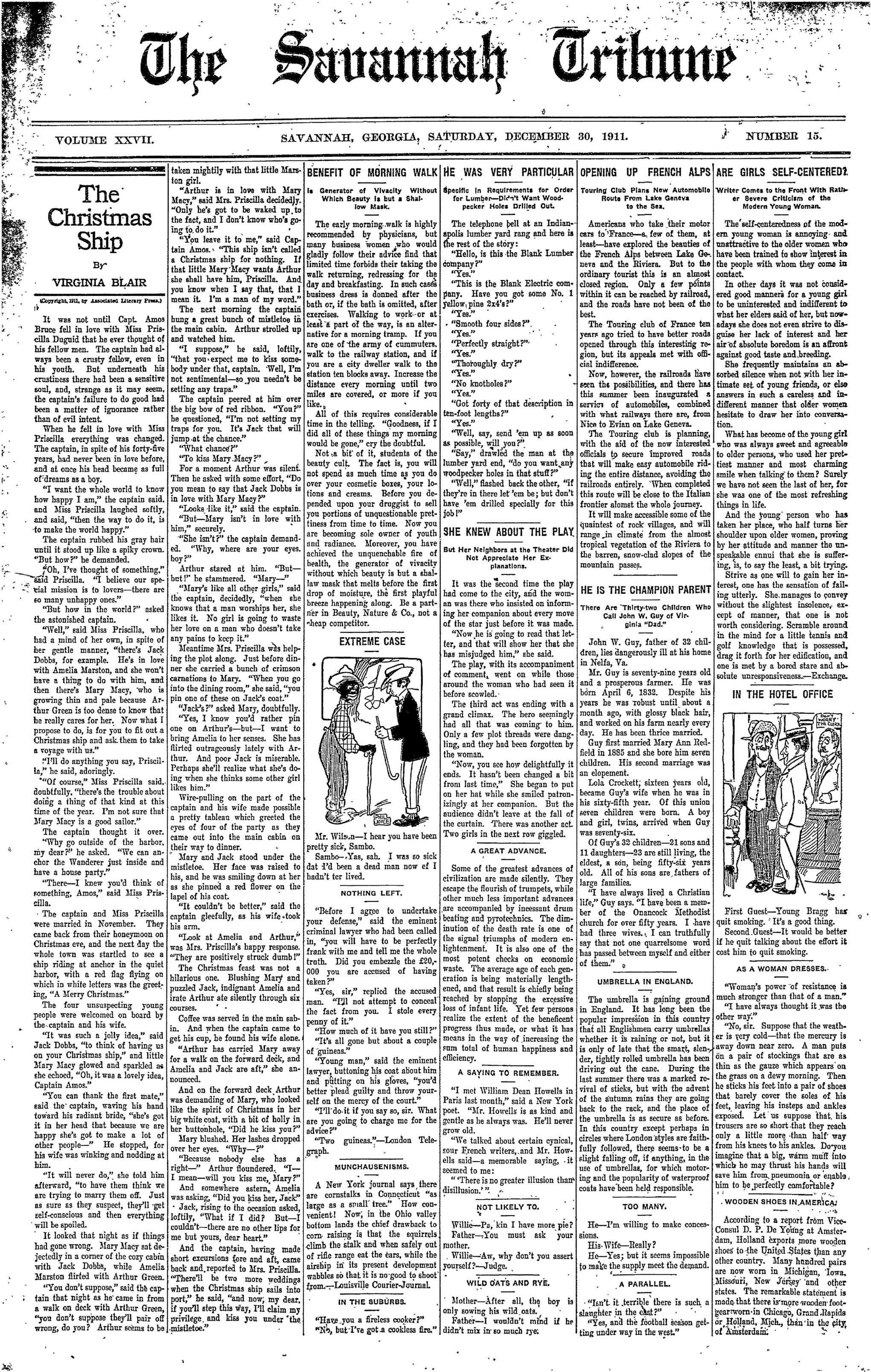
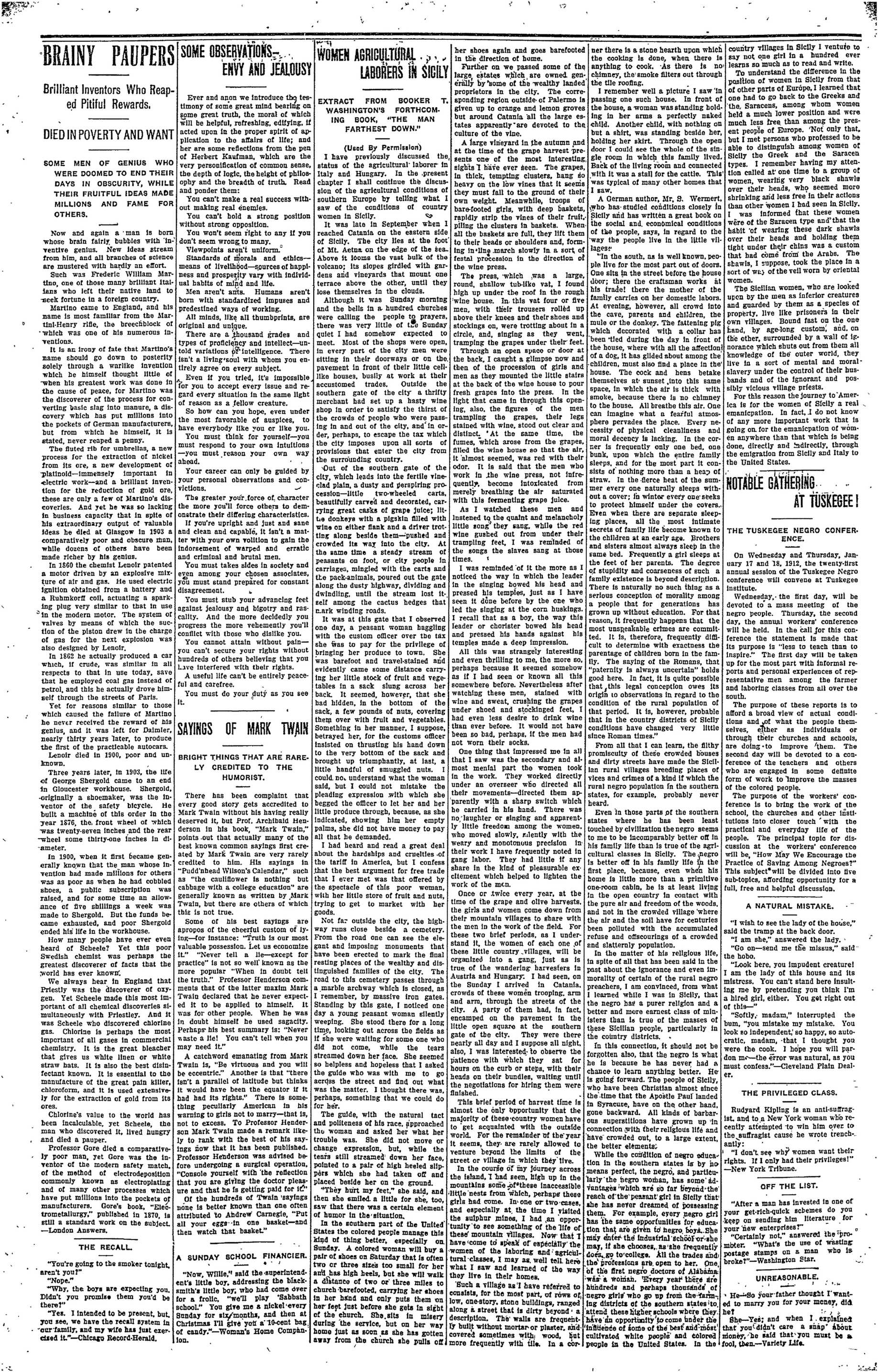
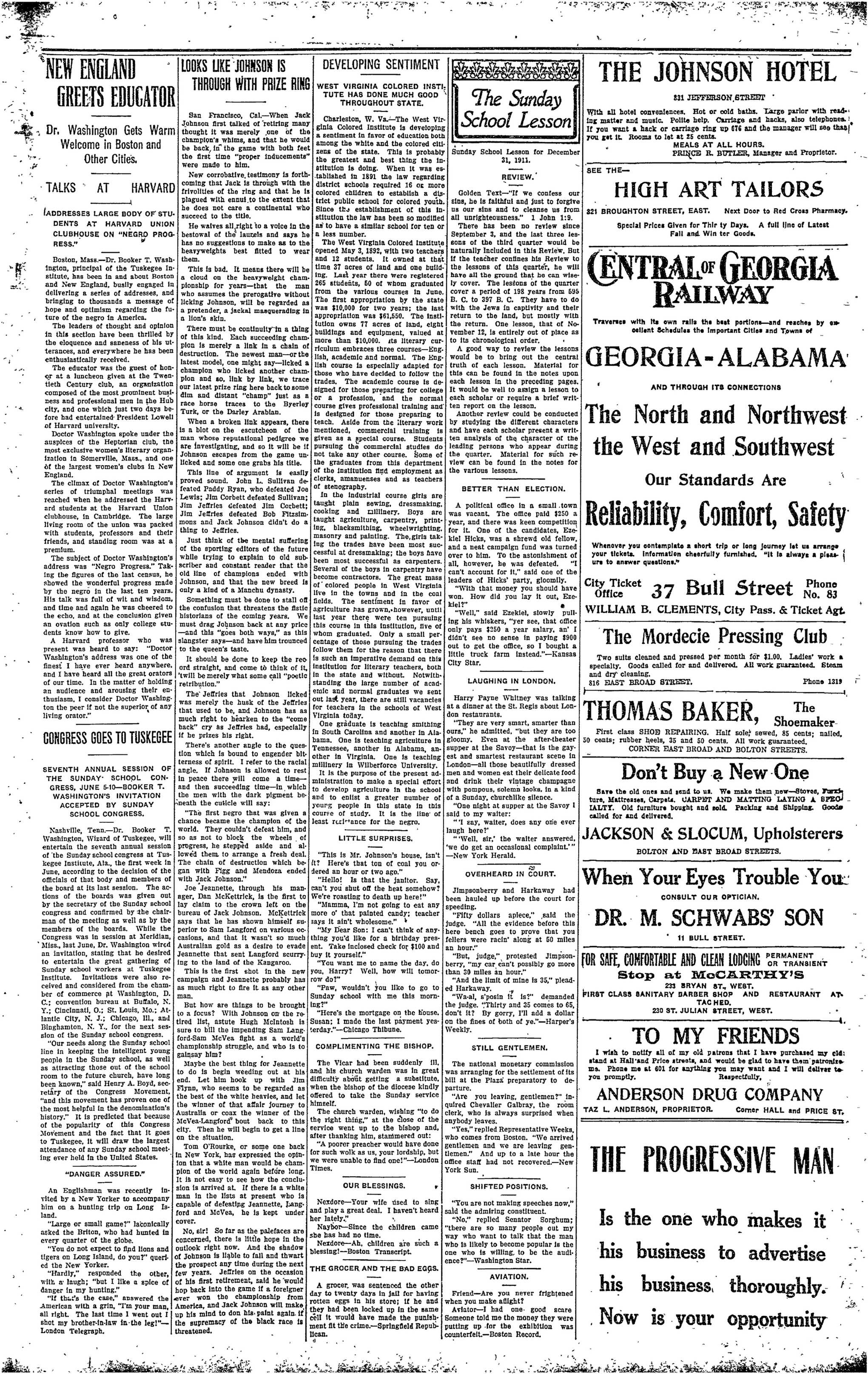
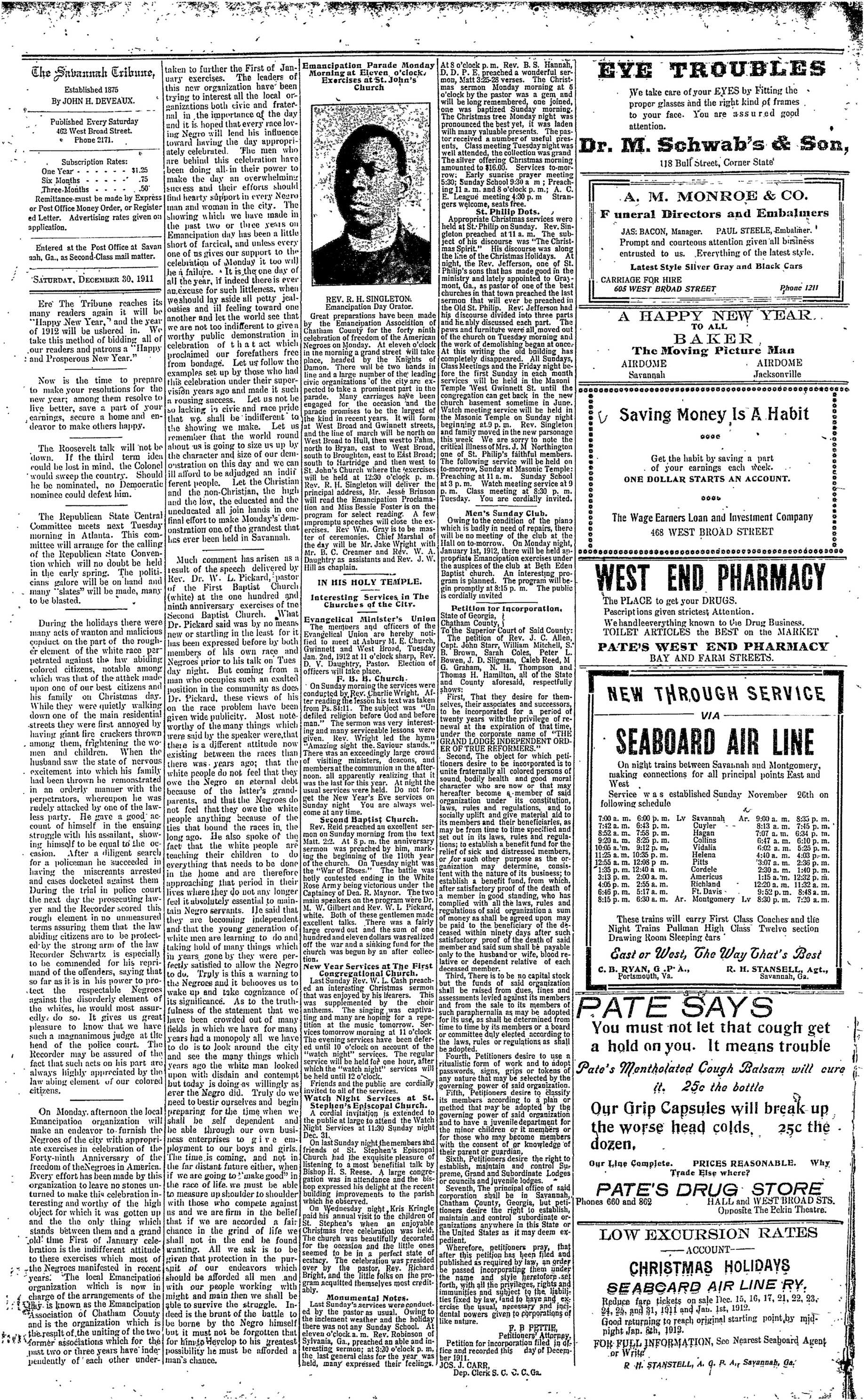
Page text (machine-generated)
The
VOLUME XXVII.
The Christmas Ship
By
VIRGINIA BLAIR
(Copyright, 1911, by Associated Literary Press.)
It was not until Capt. Amos Bruce fell in love with Miss Priscilla Duguid that he ever thought of his fellow men. The captain had always been a crusty fellow, even in his youth. But underneath his crustiness there had been a sensitive soul, and, strange as it may seem, the captain's failure to do good had been a matter of ignorance rather than of evil intent.
When he fell in love with Miss Priscilla everything was changed. The captain, in spite of his forty-five years, had never been in love before, and at once his head became as full of dreams as a boy.
"I want the whole world to know how happy I am," the captain said. and Miss Priscilla laughed softly, and said, "then the way to do it, is to make the world happy."
The captain rubbed his gray hair until it stood up like a spiky crown. "But how?" he demanded.
"Oh, I've thought of something," said Priscilla. "I believe our special mission is to lovers—there are so many unhappy ones." "But how in the world?" asked the astonished captain.
"Well," said Miss Priscilla, who had a mind of her own, in spite of her gentle manner, "there's Jack Dobbs, for example. He's in love with Amelia Marston, and she won't have a thing to do with him, and then there's Mary Macy, who is growing thin and pale because Arthur Green is too dense to know that he really cares for her. Now what I propose to do, is for you to fit out a Christmas ship and ask them to take a voyage with us." "I'll do anything you say, Priscilla," he said, adoringly.
"Of course," Miss Priscilla said, doubtfully, "there's the trouble about doing a thing of that kind at this time of the year. I'm not sure that Mary Macy is a good sailor."
The captain thought it over.
"Why go outside of the harbor, my dear?" he asked. "We can anchor the Wanderer just inside and have a house party."
"There—I knew you'd think of something, Amos," said Miss Priscilla.
The captain and Miss Priscilla were married in November. They came back from their honeymoon on Christmas eve, and the next day the whole town was startled to see a ship riding at anchor in the quiet harbor, with a red flag flying on which in white letters was the greeting, "A Merry Christmas."
The four unsuspecting young people were welcomed on board by the captain and his wife.
"It was such a jolly idea," said Jack Dobbs, "to think of having us on your Christmas ship," and little Mary Macy glowed and sparkled as she echoed, "Oh, it was a lovely idea, Captain Amos."
"You can thank the first mate," said the captain, waving his hand toward his radiant bride, "she's got it in her head that because we are happy she's got to make a lot of other people—" He stopped, for his wife was winking and nodding at him.
"It will never do," she told him afterward, "to have them think we are trying to marry them off. Just as sure as they suspect, they'll get self-conscious and then everything will be spoiled.
It looked that night as if things had gone wrong. Mary Macy sat dejectedly in a corner of the cozy cabin with Jack Dobbs, while Amelia Marston flirted with Arthur Green.
"You don't suppose," said the captain that night as he came in from a walk on deck with Arthur Green, "you don't suppose they'll pair off wrong, do you? Arthur seems to be
taken mightily with that little Marston girl.
"Arthur is in love with Mary Macy," said Mrs. Priscilla decidedly. "Only he's got to be waked up to the fact, and I don't know who's going to do it."
"You leave it to me," said Captain Amos. "This ship isn't called a Christmas ship for nothing. If that little Mary Macy wants Arthur she shall have him, Priscilla. And you know when I say that, that I mean it. I'm a man of my word."
The next morning the captain hung a great bunch of mistletoe in the main cabin. Arthur strolled up and watched him.
"I suppose," he said, loftily, "that you expect me to kiss somebody under that, captain. Well, I'm not sentimental—so you needn't be setting any traps."
The captain peered at him over the big bow of red ribbon. "You?" he questioned, "I'm not setting my traps for you. It's Jack that will jump at the chance."
"What chance?"
"To kiss Mary Macy?"
For a moment Arthur was silent. Then he asked with some effort, "Do you mean to say that Jack Dobbs is in love with Mary Macy?"
"Looks like it," said the captain.
"But—Mary isn't in love with him," securely.
"She isn't?" the captain demanded. "Why, where are your eyes, boy?"
Arthur stared at him. "But—but!" he stammered. "Mary—"
"Mary's like all other girls," said the captain, decidedly, "when she knows that a man worships her, she likes it. No girl is going to waste her love on a man who doesn't take any pains to keep it."
Meantime Mrs. Priscilla was helping the plot along. Just before dinner she carried a bunch of crimson carnations to Mary. "When you go into the dining room," she said, "you pin one of these on Jack's coat."
Jack's?" asked Mary, doubtfully. "Yes, I know you'd rather pin one on Arthur's—but—I want to bring Amelia to her senses. She has flirted outrageously lately with Arthur. And poor Jack is miserable. Perhaps she'll realize what she's doing when she thinks some other girl likes him." Wire-pulling on the part of the captain and his wife made possible a pretty tableau which greeted the eyes of four of the party as they came out into the main cabin on their way to dinner.
Mary and Jack stood under the mistletoe. Her face was raised to his, and he was smiling down at her as she pinned a red flower on the lapel of his coat.
"It couldn't be better," said the captain gleefully, as his wife took his arm.
"Look at Amelia and Arthur," was Mrs. Priscilla's happy response.
"They are positively struck dumb!"
The Christmas feast was not a hilarious one. Blushing Mary and puzzled Jack, indignant Amelia and irate Arthur ate silently through six courses.
Coffee was served in the main sabin. And when the captain came to get his cup, he found his wife alone.
"Arthur has carried Mary away for a walk on the forward deck, and Amelia and Jack are aft," she announced.
And on the forward deck Arthur was demanding of Mary, who looked like the spirit of Christmas in her big white coat, with a bit of holly in her buttonhole, "Did he kiss you?"
Mary blushed. Her lashes dropped over her eyes. "Why—?"
"Because nobody else has a right—" Arthur floundered. "I—I mean—will you kiss me. Mary?"
And somewhere astern, Amelia was asking, "Did you kiss her, Jack" Jack, rising to the occasion asked, loftily, "What if I did? But—I couldn't—there are no other lips for me but yours, dear heart."
And the captain, having made short excursions fore and aft, came back and reported to Mrs. Priscilla. "There'll be two more weddings when the Christmas ship sails into port," he said, "and now, my dear, if you'll step this way, I'll claim my privilege and kiss you under the mistletoe."
Savannah
SAVANNAH, GEORGLA, SATURDAY, DECEMBER 30, 1911.
is Generator of Vivacity Without Which Beauty is but a Shallow Mask.
The early morning walk is highly recommended by physicians, but many business women who would gladly follow their advice find that limited time forbids their taking the walk returning, redressing for the day and breakfasting. In such cases business dress is donned after the bath or, if the bath is omitted, after exercises. Walking to work-or at least a part of the way, is an alternative for a morning tramp. If you are one of the army of cummuters, walk to the railway station, and if you are a city dweller walk to the station ten blocks away. Increase the distance every morning until two miles are covered, or more if you like.
All of this requires considerable time in the telling. "Goodness, if I did all of these things my morning would be gone." cry the doubtful.
Not a bit of it, students of the beauty cult. The fact is, you will not spend as much time as you do over your cosmetic boxes, your lotions and creams. Before you depended upon your druggist to sell you portions of unquestionable prettiness from time to time. Now you are becoming sole owner of youth and radiance. Moreover, you have achieved the unquenchable fire of health, the generator of vivacity without which beauty is but a shallow mask that melts before the first drop of moisture, the first playful breeze happening along. Be a partner in Beauty, Nature & Co., not a cheap competitor.
EXTREME CASE
PHIL JOYLE
Mr. Wilson—I hear you have been pretty sick, Sambo.
Sambo—Yas, sah. I was so sick dat I'd been a dead man now ef I hadn't ter lived.
NOTHING LEFT.
"Before I agree to undertake your defense," said the eminent criminal lawyer who had been called in, "you will have to be perfectly frank with me and tell me the whole truth. Did you embezzle the £20,000 you are accused of having taken?"
"Yes, sir," replied the accused man. "I'll not attempt to conceal the fact from you. I stole every penny of it."
"How much of it have you still?"
"It's all gone but about a couple of guineas."
"Young man," said the eminent lawyer, buttoning his coat about him and putting on his gloves, "you'd better plead guilty and throw yourself on the mercy of the court."
"I'll do it if you say so, sir. What are you going to charge me for the advice?"
"Two guineas."—London Telegraph.
MUNCHAUSENISMS.
A New York journal says, there are cornstalks in Connecticut "as large as a small tree." How convenient! Now, in the Ohio valley bottom lands the chief drawback to corn raising is that the squirrels climb the stalk and when safely out of rifle range eat the ears, while the airship in its present development wabbles so that it is no-good to shoot from. Louisville Courier-Journal.
IN THE SUBURBS.
"Have you a fireless cooker?" "No, but I've got a cookless fire."
Tribune
HE WAS VERY PARTICULAR
Specific in Requirements for Order for Lumber—Didn't Want Woodpecker Holes Drilled Out.
The telephone bell at an Indianapolis lumber yard rang and here is the rest of the story:
"Hello, is this the Blank Lumber company?"
"Yes."
"This is the Blank Electric company. Have you got some No. 1 yellow pine 2x4's?"
"Perfectly straight?" "Yes." "Thoroughly dry?"
"Got forty of that description in ten-foot lengths?"
"Yes."
"Well, say, send 'em up as soon as possible, will you?"
"Say," drawled the man at the lumber yard end, "do you want any woodpecker holes in that stuff?"
"Well," flashed back the other, "if they're in there let 'em be; but don't have 'em drilled specially for this job!"
SHE KNEW ABOUT THE PLAY
But Her Neighbors at the Theater Did Not Appreciate Her Explanations.
It was the second time the play had come to the city, and the woman was there who insisted on informing her companion about every move of the star just before it was made.
"Now he is going to read that letter, and that will show her that she has misjudged him," she said.
The play, with its accompaniment of comment, went on while those around the woman who had seen it before scowled.
The third act was ending with a grand climax. The hero seemingly had all that was coming to him. Only a few plot threads were dangling, and they had been forgotten by the woman.
"Now, you see how delightfully it ends. It hasn't been changed a bit from last time," She began to put on her hat while she smiled patronizingly at her companion. But the audience didn't leave at the fall of the curtain. There was another act. Two girls in the next row giggled.
A GREAT ADVANCE.
Some of the greatest advances of civilization are made silently. They escape the flourish of trumpets, while other much less important advances are accompanied by incessant drum beating and pyrotechnics. The diminution of the death rate is one of the signal triumphs of modern enlightenment. It is also one of the most potent checks on economic waste. The average age of each generation is being materially lengthened, and that result is chiefly being reached by stopping the excessive loss of infant life. Yet few persons realize the extent of the beneficent progress thus made, or what it has means in the way of increasing the sum total of human happiness and efficiency.
A SAYING TO REMEMBER.
"I met William Dean Howells in Paris last month," said a New York poet. "Mr. Howells is as kind and gentle as he always was. He'll never grow old. "We talked about certain cynical, sour French writers, and Mr. Howells said—a memorable saying, it seemed to me: "There is no greater illusion than disillusion.'"
Willie—Pa, kin I have more pie?
Father—You must ask your mother.
Willie—Aw, why don't you assert yourself?—Judge.
WILD OATS AND RYE.
Mother—After all, the boy is only sowing his wild oats.
Father—I wouldn't mind if he didn't mix in so much rye.
OPENING UP FRENCH ALPS
Touring Club Plans New Automobile Route From Lake Geneva to the Sex.
Americans who take their motor cars to France—a few of them, at least—have explored the beauties of the French Alps between Lake Geneva and the Riviera. But to the ordinary tourist this is an almost closed region. Only a few points within it can be reached by railroad, and the roads have not been of the best.
The Touring club of France ten years ago tried to have better roads opened through this interesting region, but its appeals met with official indifference. Now, however, the railroads have seen the possibilities, and there has this summer been inaugurated a service of automobiles, combined with what railways there are, from Nice to Evian on Lake Geneva.
The Touring club is planning, with the aid of the now interested officials to secure improved roads that will make easy automobile riding the entire distance, avoiding the railroads entirely. When completed this route will be close to the Italian frontier alomst the whole journey. It will make accessible some of the quaintest of rock villages, and will range in climate from the almost tropical vegetation of the Riviera to the barren, snow-clad slopes of the mountain passes.
HE IS THE CHAMPION PARENT
There Are Thirty-two Children Who Call John W. Guy of Virginia "Dad."
John W. Guy, father of 32 children, lies dangerously ill at his home in Nelfa, Va.
Mr. Guy is seventy-nine years old and a prosperous farmer. He was born April 6, 1832. Despite his years he was robust until about a month ago, with glossy black hair, and worked on his farm nearly every day. He has been thrice married.
Guy first married Mary Ann Redfield in 1885 and she bore him seven children. His second marriage was an elopement. Lola Crockett, sixteen years old, became Guy's wife when he was in his sixty-fifth year. Of this union seven children were born. A boy and girl, twins, arrived when Guy was seventy-six. Of Guy's 32 children—21 sons and 11 daughters—23 are still living, the eldest, a son, being fifty-six years old. All of his sons are fathers of large families.
"I have always lived a Christian life," Guy says. "I have been a member of the Onancock Methodist church for over fifty years. I have had three wives. I can truthfully say that not one quarrelsome word has passed between myself and either of them."
UMBRELLA IN ENGLAND.
The umbrella is gaining ground in England. It has long been the popular impression in this country that all Englishmen carry umbrellas whether it is raining or not, but it is only of late that the smart, slender, tightly rolled umbrella has been driving out the cane. During the last summer there was a marked revival of sticks, but with the advent of the autumn rains they are going back to the rack, and the place of the umbrella is as secure as before. In this country except perhaps in circles where London styles are faithfully followed, there seems-to be a slight falling off, if anything, in the use of umbrellas, for which motoring and the popularity of waterproof coats have been held responsible.
TOO MANY.
He—I'm willing to make concessions.
His. Wife—Really?
He—Yes; but it seems impossible to make the supply meet the demand.
"I can't it terrible there is such a slaughter in the cast?" "Yes, and the football season getting under way in the west."
NUMBER 15.
ARE GIRLS SELF-CENTERED2.
Writer Comes to the Front With Rath- er Severe Criticism of the Modern Young Woman.
The self-centeredness of the modern young woman is annoying and unattractive to the older women who have been trained to show interest in the people with whom they come in contact.
In other days it was not considered good manners for a young girl to be uninterested and indifferent to what her elders said of her, but nowadays she does not even strive to disguise her lack of interest and her air of absolute boredom is an affront against good taste and breeding.
She frequently maintains an absorbed silence when not with her intimate set of young friends, or else answers in such a careless and indifferent manner that older women hesitate to draw her into conversation.
What has become of the young girl who was always sweet and agreeable to older persons, who used her prettiest manner and most charming smile when talking to them? Surely we have not seen the last of her, for she was one of the most refreshing things in life.
And the young person who has taken her place, who half turns her shoulder upon older women, proving by her attitude and manner the unspeakable ennui that she is suffering, is, to say the least, a bit trying.
Strive as one will to gain her interest, one has the sensation of failing utterly. She manages to convey without the slightest insolence, except of manner, that one is not worth considering. Scramble around in the mind for a little tennis and golf knowledge that is possessed, drag it forth for her edification, and one is met by a bored stare and absolute unresponsiveness.—Exchange
IN THE HOTEL OFFICE
DON'T WORRY THE CURK
First Guest—Young Bragg has quit smoking. 'It's a good thing.
Second Guest-It would be better if he quit talking about the effort it cost him to quit smoking.
AS A WOMAN DRESSES.
"Woman's power of resistance is much stronger than that of a man." "I have always thought it was the other way."
"No, sir. Suppose that the weather is very cold—that the mercury is away down near zero. A man puts on a pair of stockings that are as thin as the gauze which appears on the grass on a dewy morning. Then he sticks his feet into a pair of shoes that barely cover the soles of his feet, leaving his insteps and ankles exposed. Let us suppose that, his trousers are so short that they reach only a little more than half way from his knees to his ankles. Do you imagine that a big, warm muff into which he may thrust his hands will save him from pneumonia or enable him to be perfectly comfortable?
WOODEN SHOES IN AMERICA
According to a report from Vice-Consul D. P. De Young at Amsterdam, Holland exports more wooden shoes to the United States than any other country. Many hundred pairs are now worn in Michigan, Iowa, Missouri, New Jersey and other states. The remarkable statement is made that there is more wooden foot-gear worn in Chicago, Grand Rapids or Holland, Mich., than in the city of Amsterdam.
NEW ENGLAND GREETS EDUCATOR
Dr. Washington Gets Warm Welcome in Boston and Other Cities.
ADDRESSES LARGE BODY OF STUDENTS AT HARVARD UNION CLUBHOUSE ON "NEGRO PROGRESS."
Boston, Mass.—Dr. Booker T. Washington, principal of the Tuskegee Institute, has been in and about Boston and New England, busily engaged in delivering a series of addresses, and bringing to thousands a message of hope and optimism regarding the future of the negro in America.
The leaders of thought and opinion in this section have been thrilled by the eloquence and saneness of his utterances, and everywhere he has been enthusiastically received.
The educator was the guest of honor at a luncheon given at the Twentieth Century club, an organization composed of the most prominent business and professional men in the Hub city, and one which just two days before had entertained President Lowell of Harvard university. Doctor Washington spoke under the auspices of the Heptorian club, the most exclusive women's literary organization in Somerville, Mass., and one of the largest women's clubs in New England.
The climax of Doctor Washington's series of triumphal meetings was reached when he addressed the Harvard students at the Harvard Union clubhouse, in Cambridge. The large living room of the union was packed with students, professors and their friends, and standing room was at a premium.
The subject of Doctor Washington's address was "Negro Progress." Taking the figures of the last census, he showed the wonderful progress made by the negro in the last ten years. His talk was full of wit and wisdom, and time and again he was cheered to the echo, and at the conclusion given an ovation such as only college students know how to give.
A Harvard professor who was present was heard to say: "Doctor Washington's address was one of the finest I have ever heard anywhere, and I have heard all the great orators of our time. In the matter of holding an audience and arousing their enthusiasm, I consider Doctor Washington the peer if not the superior of any living orator."
GONGRESS GOES TO TUSKEGEE
SEVENTH ANNUAL SESSION OF THE SUNDAY SCHOOL CONGRESS, JUNE 5-10—BOOKER T. WASHINGTON'S INVITATION ACCEPTED BY SUNDAY SCHOOL CONGRESS.
Nashville, Tenn.—Dr. Booker T. Washington, Wizard of Tuskegee, will entertain the seventh annual session of the Sunday school congress at Tuskegee Institute, Ala., the first week in June, according to the decision of the officials of that body and members of the board at its last session. The actions of the boards was given out by the secretary of the Sunday school congress and confirmed by the chairman of the meeting as well as by the members of the boards. While the
Congress was in session at Steridan, Miss., last June, Dr. Washington wired an invitation, stating that he desired to entertain the great gathering of Sunday school workers at Tuskegee Institute. Invitations were also received and considered from the chamber of commerce at Washington, D. C.; convention bureau at Buffalo, N. Y.; Cincinnati, O.; St. Louis, Mo.; Atlantic City, N. J.; Chicago, Ill., and Binghamton, N. Y., for the next session of the Sunday school congress.
"Our needs along the Sunday school line in keeping the intelligent young people in the Sunday school, as well as attracting those out of the school room to the future church, have long been known," said Henry A. Boyd, secretary of the Congress Movement, "and this movement has proven one of the most helpful in the denomination's history." It is predicted that because of the popularity of this Congress Movement and the fact that it goes to Tuskegee, it will draw the largest attendance of any Sunday school meeting ever held in the United States.
"DANGER ASSURED."
An Englishman was recently invited by a New Yorker to accompany him on a hunting trip on Long Island.
"Large or small game?" laconically asked the Briton, who had hunted in every quarter of the globe.
"You do not expect to find lions and tigers on Long Island, do you?" queried the New Yorker.
"Hardly," responded the other, with a laugh; "but I like a spice of danger in my hunting."
"If that's the case," answered the American with a grin, "I'm your man, all right. The last time I went out I shot my brother-in-law in the leg!"—London Telegraph.
---
LOOKS LIKE JOHNSON IS THROUGH WITH PRIZE RING
LOOKS LIKE JOHNSON IS THROUGH WITH PRIZE RING
San Francisco, Cal.—When Jack Johnson first talked of retiring many thought it was merely one of the champion's whims, and that he would be back, in the game with both feet the first time "proper inducements" were made to him.
New corrobative testimony is forthcoming that Jack is through with the frivolities of the ring and that he is plagued with ennui to the extent that he does not care a continental who succeed to the title.
He waives all right to a voice in the bestowal of the laurels and says he has no suggestions to make as to the heavyweights best fitted to wear them.
This is bad. It means there will be a cloud on the heavyweight championship for years—that the man who assumes the prerogative without licking Johnson, will be regarded as a pretender, a jackal masquerading in a lion's skin.
There must be continuity in a thing of this kind. Each succeeding champion is merely a link in a chain of destruction. The newest man—or the latest model, one might say—licked a champion who licked another champion and so, link by link, we trace our latest prize ring here back to some dim and distant "champ" just as a race horse traces to the Byerley Turk, or the Darley Arabian.
When a broken link appears, there is a blot on the escutcheon of the man whose reputational pedigree we are investigating, and so it will be if Johnson escapes from the game unlicked and some one grabs his title.
This line of argument is easily proved sound. John L. Sullivan defeated Paddy Ryan, who defeated Joe Lewis; Jim Corbett defeated Sullivan; Jim Jeffries defeated Jim Corbett; Jim Jeffries defeated Bob Fitzsimmons and Jack Johnson didn't do a thing to Jeffries.
Just think of the mental suffering of the sporting editors of the future while trying to explain to old subscriber and constant reader that the old line of champions ended with Johnson, and that the new breed is only a kind of a Manchu dynasty.
Something must be done to stall off the confusion that threatens the fictive historians of the coming years. We must drag Johnson back at any price—and this "goes both ways," as this slangster says—and have him trounced to the queen's taste.
It should be done to keep the record straight, and come to think of it, 'twill be merely what some call "poetic retribution."
The Jeffries that Johnson licked was merely the husk of the Jeffries that used to be, and Johnson has as much right to hearken to the "come back" cry as Jeffries had, especially if he prizes his right.
There's another angle to the question which is bound to engender bitterness of spirit. I refer to the racial angle. If Johnson is allowed to rest in peace there will come a time—and then succeeding time—in which the men with the dark pigment beneath the cuticle will say:
"The first negro that was given a chance became the champion of the world. They couldn't defeat him, and so as not to block the wheels of progress, he stepped aside and allowed them to arrange a fresh deal. The chain of destruction which began with Figg and Mendoza ended with Jack Johnson."
Joe Jeannette, through his manager, Dan McKettrick, is the first to lay claim to the crown left on the bureau of Jack Johnson. McKettrick says that he has shown himself superior to Sam Langford on various occasions, and that it wasn't so much Australian gold as a desire to evade Jeannette that sent Langford scurrying to the land of the Kangaroo.
This is the first shot in the new campaign and Jeannette probably has as much right to fire it as any other man.
But how are things to be brought to a focus? With Johnson on the retired list, astute Hugh McIntosh is sure to bill the impending Sam Langford-Sam McVea fight as a world's championship struggle, and who is to gainslay him?
Maybe the best thing for Jeannette to do is begin weeding out at his end. Let him hook up with Jim Flynn, who seems to be regarded as the best of the white heavies, and let the winner of that affair journey to Australia or coax the winner of the McVea-Langford$^8$ bout back to this city. Then he will begin to get a line on the situation.
Tom O'Rourke, or some one back in New York, has expressed the opinion that a white man would be champion of the world again before long. It is not easy to see how the conclusion is arrived at. If there is a white man in the lists at present who is capable of defeating Jeannette, Langford and McVea, he is kept under cover.
No, sir! So far as the palefaces are concerned, there is little hope in the outlook right now. And the shadow of Johnson is liable to fall and thwart the prospect any time during the next few years. Jeffries on the occasion of his first retirement, said he would hop back into the game if a foreigner ever won the championship from America, and Jack Johnson will make up his mind to don his paint again if the supremacy of the black race is threatened.
DEVELOPING SENTIMENT
WEST VIRGINIA COLORED INSTITUTE HAS DONE MUCH GOOD THROUGHOUT STATE.
Charleston, W. Va.—The West Virginia Colored Institute is developing a sentiment in favor of education both among the white and the colored citizens of the state. This is probably the greatest and best thing the institution is doing. When it was established in 1891 the law regarding district schools required 16 or more colored children to establish a district public school for colored youth. Since the establishment of this institution the law has been so modified as to have a similar school for ten or a less number.
The West Virginia Colored Institute opened May 3, 1892, with two teachers and 12 students. It owned at that time 37 acres of land and one building. Last year there were registered 265 students, 50 of whom graduated from the various courses in June. The first appropriation by the state was $10,000 for two years; the last appropriation was $61,550. The institution owns 77 acres of land, eight buildings and equipment, valued at more than $10,000. Its literary curriculum embraces three courses—English, academic and normal. The English course is especially adapted for those who have decided to follow the trades. The academic course is designed for those preparing for college or a profession, and the normal course gives professional training and is designed for those preparing to teach. Aside from the literary work mentioned, commercial training is given as a special course. Students pursuing the commercial studies do not take any other course. Some of the graduates from this department of the institution find employment as clerks, amanuenses and as teachers of stenography.
In the industrial course girls are taught plain sewing, dressmaking, cooking and millinery. Boys are taught agriculture, carpentry, printing, blacksmithing, wheelwrighting, masonry and painting. The, girls taking the trades have been most successful at dressmaking; the boys have been most successful as carpenters. Several of the boys in carpentry have become contractors. The great mass of colored people in West Virginia live in the towns and in the coal fields. The sentiment in favor of agriculture has grown, however, until last year there were ten pursuing this course in this institution, five of whom graduated. Only a small percentage of those pursuing the trades follow them for the reason that there is such an imperative demand on this institution for literary teachers, both in the state and without. Notwithstanding the large number of academic and normal graduates we sent out last year, there are still vacancies for teachers in the schools of West Virginia today.
One graduate is teaching smithing in South Carolina and another in Alabama. One is teaching agriculture in Tennessee, another in Alabama, another in Virginia. One is teaching millinery in Wilberforce University. It is the purpose of the present administration to make a special effort to develop agriculture in the school and to enlist a greater number of young people in this state in this course of study. It is the line of least resistance for the negro.
LITTLE SURPRISES.
"This is Mr. Johnson's house, isn't it? Here's that ton of coal you ordered an hour or two ago."
"Hello! Is that the janitor. Say, can't you shut off the heat somehow? We're roasting to death up here."
"Mamma, I'm not going to eat any more o' that painted candy; teacher says it ain't wholesome."
"My Dear Son: I can't think of anything you'd like for a birthday present. Take enclosed check for $100 and buy it yourself."
"You want me to name the day, do you, Harry? Well, how will tomorrow do?"
"Paw, wouldn't you like to go to Sunday school with me this morning?"
"Here's the mortgage on the house. Susan; I made the last payment yesterday."—Chicago Thibune.
COMPLIMENTING THE BISHOP.
The Vicar had been suddenly ill, and his church warden was in great difficulty about getting a substitute, when the bishop of the diocese kindly offered to take the Sunday service himself.
The church warden, wishing "to do the right thing," at the close of the service went up to the bishop and, after thanking him, stammered out:
"A poorer preacher would have done for such wolk as us, your lordship, but we were unable to find one!"—London Times.
OUR BLESSINGS.
Nexdore—Your wife used to sing and play a great deal. I haven't heard her lately." Naybor—Since the children came she has had no time.
Nexdore—Ah, children are such a blessing!—Boston Transcript.
THE GROCER AND THE BAD EGGS.
A grocer, was sentenced the other day to twenty days in jail for having rotten eggs in his store; if he and they had been locked up in the same cell it would have made the punishment fit the crime.—Springfield Republican.
The Sunday School Lesson
Golden Text—"If we confess our sins, he is faithful and just to forgive us our sins and to cleanse us from all unrighteousness." 1 John 1:9.
There has been no review since September 3, and the last three lessons of the third quarter would be naturally Included in this Review. But if the teacher confines his Review to the lessons of this quarter, he will have all the ground that he can wisely cover. The lessons of the quarter cover a period of 198 years from 595 B. C. to 397 B. C. They have to do with the Jews in captivity and their return to the land, but mostly with the return. One lesson, that of November 12, is entirely out of place as to its chronological order.
A good way to review the lessons would be to bring out the central truth of each lesson. Material for this can be found in the notes upon each lesson in the preceding pages. It would be well to assign a lesson to each scholar or require a brief written report on the lesson. Another review could be conducted by studying the different characters and have each scholar present a written analysis of the character of the leading persons who appear during the quarter. Material for such review can be found in the notes for the various lessons.
BETTER THAN ELECTION.
A political office in a small town was vacant. The office paid $250 a year, and there was keen competition for it. One of the candidates, Ezekiel Hicks, was a shrewd old fellow, and a neat campaign fund was turned over to him. To the astonishment of all, however, he was defeated. "I can't account for it," said one of the leaders of Hicks' party, gloomily. "With that money you should have won. How did you lay it out, Ezekiel?"
"Well," said Ezekiel, slowly pulling his whiskers, "yer see, that office only pays $250 a year salary, an' I didn't see no sense in paying $900 out to get the office, so I bought a little truck farm instead."—Kansas City Star.
LAUGHING IN LONDON.
Harry Payne Whitney was talking at a dinner at the St. Regis about London restaurants.
"They are very smart, smarter than ours," he admitted, "but they are too gloomy. Even at the after-theater supper at the Savoy—that is the gayest and smartest restaurant scene in London—all those beautifully dressed men and women eat their delicate food and drink their vintage champagne with pompous, solemn looks, in a kind of a Sunday, churchlike silence.
"One night at supper at the Savoy I said to my waiter:
"I say, waiter, does any one ever laugh here?"
"Well, sir," the waiter answered, 'we do get an occasional complaint.'"
—New York Herald.
OVERHEARD IN COURT.
Jimpsonberry and Harkaway had been hauled up before the court for speeding.
"Flfty dollars apiece," said the judge. "All the evidence before this here bench goes to prove that you fellers were racin' along at 50 miles an hour."
"But, judge," protested Jimpsonberry, "my car can't possibly go more than 30 miles an hour."
"And the limit of mine is 35," pleaded Harkaway.
"Wa-al, s'posin it is?" demanded the judge. "Thirty and 35 comes to 65, don't it? By gorry, I'll add a dollar on the fines of both of ye."—Harper's Weekly.
STILL GENTLEMEN.
The national monetary commission was arranging for the settlement of its bill at the Plaza preparatory to departure.
"Are you leaving, gentlemen?" inquired Chevallier Galbray, the room clerk, who is always surprised when anybody leaves.
"Yes," replied Representative Weeks, who comes from Boston. "We arrived gentlemen and we are leaving gentlemen." And up to a late hour the office staff had not recovered.—New York Sun.
SHIFTED POSITIONS.
"You are not making speeches now," said the admiring constituent. "No," replied Senator Sorghum; "there are so many people out my way who want to talk that the man who is likely to become popular is the one who is willing, to be the audience?"—Washington Star.
AVIATION.
Friend—Are you never frightened when you make aflight?
Avlator—I had one good scare
Someone told me the money they were putting up for the exhibition was counterfeit.—Boston Record.
THE JOHNSON HOTEL
831 JEFFERSON STREET
tel conveniences, hot or cold baths. Large parlor with re-
d music. Polite help. Carriage and hacks, also telephon-
a hack or carriage ring up 676 and the manager will see th-
Rooms to let at 25 cents.
With all hotel conveniences. Hot or cold baths. Large parlor with reading matter and music. Polite help. Carriage and hacks, also telephones. If you want a hack or carriage ring up 676 and the manager will see that you get it. Rooms to let at 25 cents.
MEALS AT ALL HOURS.
PRINCE R. BUTLER, Manager and Proprietor.
HIGH ART TAILORS
BUTTON STREET, EAST. Next Door to Red Cross Pharma
Special Prices Given for Thirty Days. A full line of Latest
Fall and Win ter Goods.
CENTRAL OF GEORGIA
RAILWAY
with its own rails the best portions—and reaches by ex-
cellent Schedules the Important Cities and Towns of
GEORGIA - ALABAMA
HIGH ART TAILORS
321 BROUGHTON STREET, EAST. Next Door to Red Cross Pharmacy.
Special Prices Given for Thir ty Days. A full line of Latest Fall and Win ter Goods.
CENTRAL OF GEORGIA RAILWAY
Traverses with its own rails the best portions—and reaches by excellent Schedules the Important Cities and Towns of
GEORGIA-ALABAMA
AND THROUGH ITS CONNECTIONS North and Northwest West and Southwest
The North and Northwest the West and Southwest
Our Standards Are
bility, Comfort, Safety
you contemplate a short trip or long journey let us arrange
information cheerfully furnished. "It is always a pleas-
ver questions."
37 Bull Street Phone
No. 83
M B. CLEMENTS, City Pass. & Ticket Ag
Mordecie Pressing Club
cleaned and pressed per month for $1.00. Ladies' work
goods called for and delivered. All work guaranteed. Steam
cleaning.
BROAD STREET. Phone 131
MAS BAKER, The
Shoemaker
SHOE REPAIRING. Half sole; sewed, 85 cents; nailed
ber heels, 35 and 50 cents. All work guaranteed.
CORNER EAST BROAD AND BOLTON STREETS.
Don't Buy a New One
old ones and send to us. We make them new—Stoves, Fur-
resses, Carpeta. CARPET AND MATTING LAYING A SPECI-
fiture bought and sold. Packing and Shipping. Good
and delivered.
SON & SLOCUM, Upholsterers
BOLTON AND EAST BROAD STREETS.
Your Eyes Trouble You
CONSULT OUR OPTICIAN.
M. SCHWABS' SON
Reliability, Comfort, Safety
Whenover you contemplate a short trip or long journey let us arrange your tickets. Information cheerfully furnished. "it is always a pleasure to answer questions."
City Ticket Office 37 Bull Street Phone No. 83
WILLIAM B. CLEMENTS, City Pass. & Ticket Agt.
The Mordecie Pressing Club
Two suits cleaned and pressed per month for $1.00. Ladies' work a specialty. Goods called for and delivered. All work guaranteed. Steam and dry cleaning. 816 EAST BROAD STREET. Phone 1319
THOMAS BAKER.
First class SHOE REPAIRING. Half sole; sewed, 85 cents; nalled, 50 cents; rubber heels, 35 and 50 cents. All work guaranteed. CORNER EAST BROAD AND BOLTON STREETS.
Don't Buy a New One
Save the old ones and send to us. We make them new—Stoves, Furniture, Mattresses, Carpets, CARPET AND MATTING LAYING A SPECIALTY. Old furniture bought and sold. Packing and Shipping. Goods called for and delivered. JACKSON & SLOCUM, Upholsterers
COMFORTABLE AND CLEAN LODGING PERMANENT OR TRANSIENT
top at McCARTHY'S
233 BRYAN ST., WEST.
S BANITARY BARBER SHOP AND RESTAURANT AT
TACHED.
230 ST. JULIAN STREET, WEST.
FOR SAFE, COMFORTABLE AND CLEAN LODGING PERMANENT OR TRANSIENT Stop at McCARTHY'S 233 BRYAN ST, WEST. FIRST CLASS SANITARY BARBER SHOP AND RESTAURANT AT TAC HED. 230 ST. JULIAN STREET, WEST.
TO MY FRIENDS
notify all of my old patrons that I have purchased my chil and Price streets, and would be glad to have them patronising me at 601 for anything you may want and I will deliver the y. Respectfully,
ERSON DRUG COMPANY
ERSON, PROPRIETOR. Corner HALL and PRICE 80
PROGRESSIVE MAN
I wish to notify all of my old patrons that I have purchased my old stand at Hall and Price streets, and would be glad to have them patronize me. Phone me at 601 for anything you may want and I will deliver to you promptly. Respectfully,
THE PROGRESSIVE MAN
Is the one who makes it his business to advertise his business thoroughly. Now is your opportunity
Published Every Saturday
462 West Broad Street.
Phone 2171.
Remittance-must be made by Express or Post Office Money Order, or Registered Letter. Advertising rates given on application.
Entered at the Post Office at Savannah, Ga., as Second-Class mail matter.
Ere The Tribune reaches its many readers again it will be "Happy New Year," and the year of 1912 will be ushered in. We take this method of bidding all of our readers and patrons a "Happy and Prosperous New Year."
Now is the time to prepare to make your resolutions for the new year; among them resolve to live better, save a part of your earnings, secure a home and endeavor to make others happy.
The Roosevelt talk will not be down. If the third term idea could be lost in mind, the Colonel would sweep the country. Should he be nominated, no Democratic nominee could defeat him.
The Republican State Central Committee meets next Tuesday morning in Atlanta. This committee will arrange for the calling of the Republican State Convention which will no doubt be held in the early spring. The politicians galore will be on hand and many "slates" will be made, many to be blasted.
During the holidays there were many acts of wanton and malicious conduct on the part of the rougher element of the white race perpetrated against the law abiding colored citizens, notable among which was that of the attack made upon one of our best citizens and his family on Christmas day. While they were quietly walking down one of the main residential streets they were first annoyed by having giant fire crackers thrown among them, frightening the women and children. When the husband saw the state of nervous excitement into which his family had been thrown he demonstrated in an orderly manner with the perpetrators, whereupon he was rudely attacked by one of the lawless party. He gave a good account of himself in the ensuing struggle with his assailant, showing himself to be equal to the occasion. After a diligent search for a policeman he succeeded in having the miscreants arrested and cases docketed against them. During the trial in police court the next day the prosecuting lawyer and the Recorder scored this rough element in no unmeasured terms assuring them that the law abiding citizens are to be protected by the strong arm of the law Recorder Schwartz is especially to be commended for his reprimand of the offenders, saying that so far as it is in his power to protect the respectable Negroes against the disorderly element of the whites, he would most assuredly do so. It gives us great pleasure to know that we have such a magnanimous judge at the head of the police court. The Recorder may be assured of the fact that such acts on his part are always highly appreciated by the law abiding element of our colored citizens.
On Monday, afternoon the local Emancipation organization will make an endeavor to furnish the Negroes of the city with appropriate exercises in celebration of the Forty-ninth Anniversary of the freedom of the Negroes in America. Every effort has been made by this organization to leave no stones unturned to make this celebration interesting and worthy of the high object for which it was gotten up and the the only thing which stands between them and a grand old time First of January celebration is the indifferent attitude to these exercises which most of the Negroes manifested in recent years: The local Emancipation organization which is now in
taken to further the First of January exercises. The leaders of this new organization have been trying to interest all the local organizations both civic and fraternal in the importance of the day and it is hoped that every race loving Negro will lend his influence toward having the day appropriately celebrated. The men who are behind this celebration have been doing all in their power to make the day an overwhelming success and their efforts should find hearty support in every Negro man and woman in the city. The showing which we have made in the past two or three years on Emancipation day has been a little short of farcical, and unless every one of us gives our support to the celebration of Monday it too will be a failure. It is the one day of all the year, if indeed there is ever an excuse for such littleness, when we should lay aside all petty jealousies and ill feeling toward one another and let the world see that we are not too indifferent to given worthy public demonstration in celebration of that act which proclaimed our forefathers free from bondage. Let us follow the examples set up by those who had this celebration under their supervision years ago and made it such a rousing success. Let us not be so lacking in civic and race pride that we shall be indifferent to the showing we make. Let us remember that the world round about us is going to size us up by the character and size of our demonstration on this day and we can ill afford to be adjudged an indifferent people. Let the Christian and the non-Christian, the high and the low, the educated and the uneducated all join hands in one final effort to make Monday's demonstration one of the grandest that has ever been held in Savannah.
Much comment has arisen as a result of the speech delivered by Rev. Dr. W. L. Pickard, pastor of the First Baptist Church (white) at the one hundred and ninth anniversary exercises of the Second Baptist Church. What Dr. Pickard said was by no means new or startling in the least for it has been expressed before by both members of his own race and Negroes prior to his talk on Tuesday night. But coming from a man who occupies such an exalted position in the community as does Dr. Pickard, these views of his on the race problem have been given wide publicity. Most noteworthy of the many things which were said by the speaker were, that there is a different attitude now existing between the races than there was years ago; that the white people do not feel that they owe the Negro an eternal debt because of the latter's grandparents, and that the Negroes do not feel that they owe the white people anything because of the ties that bound the races in the long ago. He also spoke of the fact that the white people are teaching their children to do everything that needs to be done in the home and are therefore approaching that period in their lives where they do not any longer feel it absolutely essential to maintain Negro servants. He said that they are becoming independent and that the young generation of white men are learning to do and taking hold of many things which in years gone by they were perfectly satisfied to allow the Negro to do. Truly is this a warning to the Negroes and it behooves us to wake up and take cognizance of its significance. As to the truthfulness of the statement that we have been crowded out of many fields in which we have for many years had a monopoly all we have to do is to look around the city and see the many things which years ago the white man looked upon with disdain and contempt but today is doing as willingly as ever the Negro did. Truly do we need to bestir ourselves and begin preparing for the time when we shall be self dependent and be able through our own business enterprises to give employment to our boys and girls. The time is coming, and not in the far distant future either, when if we are going to "make good" in the race of life we must be able to measure up shoulder to shoulder with those who compete against us and we are firm in the belief that if we are accorded a fair chance in the grind of life we shall not in the end be found wanting. All we ask is to be given that protection in the pursuit of our endeavors which should be afforded all men and with our people working with might and main then we shall be able to survive the struggle. Indeed is the brunt of the battle to be borne by the Negro himself but it must not be forgotten that for him to develop to his greatest possibility he must be afforded a man's chance.
Emancipation Parade Monday Morning at Eleven, o'clock Exercises at St. John's Church
PRIEST
REV. R. H. SINGLETON:
Emancipation Day Orator.
Great preparations have been made by the Emancipation Association of Chatham County for the forty ninth celebration of freedom of the American Negroes on Monday. At eleven o'clock in the morning a grand street will take place, headed by the Knights of Damon. There will be two bands in line and a large number of the leading civic organizations of the city are expected to take a prominent part in the parade. Many carriages have been engaged for the occasion and the parade promises to be the largest of the kind in recent years. It will form at West Broad and Gwinnett streets, and the line of march will be north on West Broad to Hull, then west to Fahm, north to Bryan, east to West Broad, south to Broughton, east to East Broad, south to Hartridge and then west to St. John's Church where the 'exercises will be held at 12:30 o'clock p. m. Rev. R. H. Singleton will deliver the principal address, Mr. Jesse Brinson will read the Emancipation Proclamation and Miss Bessie Foster is on the program for select reading. A few impromptu speeches will close the exercises. Rev Winn. Gray is to be master of ceremonies. Chief Marshal of the day will be Mr. Jake Wright with Mr. B. C. Creamer and Rev. W. A. Daughtry as assistants and Rev. J. W. Hill as chaplain.
IN HIS HOLY TEMPLE.
Interesting Services in The Churches of the City.
Evangelical Minister's Union
The members and officers of the
Evangelical Union are hereby notified
to meet at Asbury M. E. Church,
Gwinnett and West Broad, Tuesday
Jan. 2nd, 1912 at 11 o'clock sharp, Rev.
D. V. Daughtry, Pastor. Election of
officers will take place.
On Sunday morning the services were conducted by Rev. Charlie Wright. After reading the lesson his text was taken from Ps. 84:11. The subject was "Un defiled religion before God and before man." The sermon was very interesting and many serviceable lessons were given. Rev. Wright led the hymn "Amazing sight the. Saviour stands." There was an exceedingly large crowd of visiting ministers, doacons, and members at the communion in the afternoon, all apparently realizing that it was the last for this year. At night the usual services were held. Do not forget the New Year's Eve services on Sunday night. You are always welcome at any time.
Second Baptist Church.
Reid preached an excellent sermon on Sunday morning from the text Matt. 22. At 2 p.m. the anniversary sermon was preached by him, marking the beginning of the 110th year of the church. On Tuesday night was the "War of Roses." The battle was hotly contested ending in the White Rose Army being victorious under the Captaincy of Dea. R. Maynor. The two main speakers on the program were Dr. M. W. Gilbert and Rev. W. L. Pickard, white. Both of these gentlemen made excellent talks. There was a fairly large crowd out and the sum of one hundred and eleven dollars was realized off the war and a sinking fund for the church was begun by an after collection.
New Year Services at The First Congregational Church
Congregational Church
Last Sunday Rev. W. L. Cash preached an interesting Christmas sermon that was enjoyed by his hearers. This was supplemented by the choir anthems. The singing was captivating and many are hoping for a repetition at the music tomorrow. Services tomorrow morning at 11 o'clock. The evening services have been deferred until 10 o'clock on account of the "watch night" services. The regular service will be held for one hour, after which the "watch night" services will be held until 12 o'clock.
Friends and the public are cordially invited to all of the services. Watch Night Services at St.
Watch Night Services at St. Stephen's Episcopal Church. A cordial invitation is extended to the public at large to attend the Watch Night Services at 11:30 Sunday night Dec. 31.
On last Sunday night the members and friends of St. Stephen's Episcopal Church had the exquisite pleasure of listening to a most beneficial talk by Bishop H. S. Reese. A large congregation was in attendance and the bishop expressed his delight at the recent building improvements to the parish which he observed.
On Wednesday night, Kris Kringle paid his annual visit to the children of St. Stephen's when an enjoyable Christmas tree celebration was held. The church was beautifully decorated for the occasion and the little ones seemed to be in a perfect state of ecstasy. The celebration was presided over by the pastor, Rey. Richard Bright, and the little folks on the program acquitted themselves most creditably.
Monumental Notes.
Last Sunday's services were conducted by the pastor as usual. Owing to the inclement weather and the holiday there was not any Sunday School. At eleven o'clock a.m. Rev. Robinson of Sylvania, Ga., preached an able and interesting sermon; at 3:30 o'clock p.m. the last general class for the year was held, many expressed their feelings.
At 8 o'clock p. m. Rev. B. S. Hannall,
D. D. P. E. preached a wonderful sermon,
Matt 3:25-28 verses. The Christmas sermon Monday morning at 6 o'clock by the pastor was a gem and will be long remembered, one joined,
one was baptized Sunday morning.
The Christmas tree Monday night was pronounced the best yet, it was laden with many valuable presents. The pastor received a number of useful presents. Class meeting Tuesday night was well attended, the collection was grand
The silver offering Christmas morning amounted to $16.00. Services to-morrow:
Early sunrise prayer meeting 5:30; Sunday School 9:30 a m; Preaching 11 a.m. and 8 o'clock p. m.; A. C. E. League meeting 4:30 p. m. Strangers welcome, seats free.
St. Philip Dots.
St. Philip Dots.
Appropriate Christmas services were held at St. Philip on Sunday. Rev. Singleton preached at 11 a.m. The subject of his discourse was "The Christmas Spirit." His discourse was along the line of the Christmas Holidays. At night, the Rev. Jefferson, one of St. Philip's sons that has made good in the ministry and lately appointed to Graymont, Ga., as pastor of one of the best churches in that town preached the last sermon that will ever be preached in the Old St. Philip. Rev. Jefferson had his discourse divided into three parts and he ably discussed each part. The pews and furniture were all, moved out of the church on Tuesday morning and the work of demolishing began at once. At this writing the old building has completely disappeared. All Sundays, Class Meetings and the Friday night before the first Sunday in each month services will be held in the Masoni Temple West Gwinnett St. until the congregation can get back in the new church basement sometime in June. Watch meeting service will be held in the Masonic Temple on Sunday night beginning at 9 p.m. Rev. Singleton and family moved in the new parsonage this week. We are sorry to note the critical illness of Mrs. J. M Northington one of St. Philip's faithful members. The following service will be held on to-morrow, Sunday at Masonic Temple: Preaching at 11 a.m. Sunday School at 3 p.m. Watch meeting service at 9 p.m. Class meeting at 8:30 p.m. Tuesday. You are cordially invited.
Men's Sunday Club.
Owing to the condition of the piano which is badly in need of repairs, there will be no meeting of the club at the Hall on to-morrow. On Monday night, January 1st, 1912, there will be held appropriate Emancipation exercises under the auspices of the club at Beth Eden Baptist church. An interesting program is planned. The program will begin promptly at 8:15 p. m. The public is cordially invited
Petition for Incorporation.
State of Georgia,
Chatham County,
To the Superior Court of Said County:
the petition of Rev. J. C. Allen,
Capt. John Starr, William Mitchell, S. B. Brown, Sarah Coles, S. B. Bowen, J. D. Sligman, Caleb Reed, M. G. Graham, N. H. Thompson and
Thomas H. Hamilton, all of the State
and County aforesaid, respectfully
shows:
First. That they desire for themselves, their associates and successors, to be incorporated for a period of twenty years with the privilege of renewal at the expiration of that time, under the corporate name of "THE GRAND LODGE INDEPENDENT ORDER OF TRUE REFORMERS."
Second, The object for which petitioners desire to be incorporated is to unite fraternally all colored persons of sound bodily health and good moral character who are now or that may hereafter become a member of said organization under its constitution, laws, rules and regulations, and to socially uplift and give material aid to its members and their beneficiaries, as may be from time to time specified and set out in its laws, rules and regulations; to establish a benefit fund for the relief of sick and distressed members, or for such other purpose as the organization may determine, consistent with the nature of its business; to establish a benefit fund, from which, after satisfactory proof of the death of a member in good standing, who has complied with all the laws, rules and regulations of said organization a sum of money as shall be agreed upon may be paid to the beneficiary of the deceased within ninety days after such satisfactory proof of the death of said member and said sum shall be payable only to the husband or wife, blood relative or dependent relative of each deceased member.
Third. There is to be no capital stock but the funds of said organization shall be raised from dues, fines and assessments levied against its members and from the sale to its members of such paraphernalia as may be adopted for its use, as shall be determined from time to time by its members or a board or committee duly elected according to the laws, rules or regulations as shall be adopted.
Fourth, Petitioners desire to use a ritualistic form of work and to adopt passwords, signs, grips or tokens of any nature that may be selected by the governing power of said organization. Fifth, Petitioners desire to classify its members according to a plan or method that may be adopted by the governing power of said organization and to have a juvenile department for the minor children or it members or for those who may become members with the consent of or knowledge of their parent or guardian.
Sixth, Petitioners desire the right to establish, maintain and control Supreme, Grand and Subordinate Lodges or councils and juvenile lodges. Seventh, The principal office of said corporation shall be in Sawayann, Chatham County, Georgia, but petitioners desire the right to establish, maintain and control subordinate organizations anywhere in this State or the United States as it may deem expedient. Wherefore, petitioners pray, that after this petition has been filed and published as required by law, an order be passed incorporating them under the name and style heretofore set forth, with all the privileges, rights and immunities and subject to the liabilities fixed by law, and to have and exercise the usual, necessary and incidental powers given to corporations of like nature.
Petitioners' Attorney,
Petition for incorporation filed in office and recorded this day of December 1911.
JCS. J. CARR,
Dep. Clerk S. C. C. Ga.
EYE TROUBLES
EYE TROUBLES
We take care of your EYES by Fitting the proper glasses and the right kind of frames to your face. You are assured good attention.
A. M. MONROE & CO.
Funeral Directors and Embalmers
JAS: BACON, Manager. PAUL STEELE, Embaliner.
Prompt and courteous attention given all business
entrusted to us. Everything of the latest style.
Latest Style Silver Gray and Black Cars
CARRIAGE FQR HIRE
605 WEST BROAD STREET Phone 1211
A HAPPY NEW YEAR
TO ALL
BAKER
The Moving Picture Man
AIRDOME AIRDOME
Savannah Jacksonville
Get the habit by saving a part of your earnings each week. ONE DOLLAR STARTS AN ACCOUNT.
WEST END PHARMA
PLACE to get your DRUGS.
Scriptions given strictest Attention.
Handle everything known to the Drug Business
LET ARTICLES the BEST on the MAIN
STE'S WEST END PHARMA
BAY AND FARM STREETS.
NEW THROUGH SERVICE
VIA
SEABOARD AIR LINE
On night trains between Savannah and Montgomery, making connections for all principal points East.
Service was established Sunday November 1st.
Working schedule
m. 6:00 p.m. Lv Savannah Ar. 9:00 a.m.
m. 6:43 p.m. Guyler 8:13 a.m.
m. 7:58 p.m. Hagan 7:07 a.m.
m. 8:25 p.m. Collins 6:47 a.m.
m. 9:12 p.m. Vidalia 6:02 a.m.
m. 10:35 p.m. Helena 4:40 a.m.
m. 12:08 p.m. Pitts 3:07 a.m.
m. 12:40 a.m. Cordele 2:30 a.m.
m. 2:00 a.m. Americus 1:15 a.m.
m. 2:55 a.m. Richland 12:20 a.m.
m. 5:17 a.m. Ft. Davis 9:52 p.m.
m. 6:30 a.m. Ar. Montgomery Lv 8:30 p.m.
These trains will carry First Class Coaches on Night Trains Pullman High Class Twelve in Room Sleeping cars.
Fast or West, The Way That's BRYAN, G.P.A., R. H. STANSELL, Portsmouth, Va.
Savannah
ATE SAYS
We must not let that cough cold on you. It means trivial Mentholated Cough Balsam it. 25c the bottle.
Grip Capsules will break worse head colds, 25c an.
Complete. PRICES REASONABLE.
Trade Else where?
ATE'S DRUG STORE
and 862 HALL and WEST BRIDGE
Opposite The Pekin.
W EXCURSION RATE
ACCOUNT
The Wage Earners Loan and Investment Company 468 WEST BROAD STREET
WEST END PHARMACY
The PLACE to get your DRUGS. Pascriptions given strictest Attention. We handleeverything known to the Drug Business. TOILET ARTICLES the BEST on the MARKET PATE'S WEST END PHARMACY BAY AND FARM STREETS.
NEW THROUGH SERVICE
SEABOARD AIR LINE
On night trains between Savannah and Montgomery making connections for all principal points East and West Service was established Sunday November 26th on following schedule
These trains will carry First Class Coaches and the Night Trains Pullman High Class Twelve section Drawing Room Sleeping cars
East or West, The Way That's Best
C. B. RYAN, G. P. A.,
Portsmouth, Va.
R. H. STANSELL, Agt.,
Savannah, Ga.
PATE SAYS
You must not let that cough get a hold on you. It means trouble Pate's Mentholated Cough Balsam will cure it. 25c the bottle Our Grip Capsules will break up the worse head colds. 25c the dozen. Our Line Complete. PRICES REASONABLE. Why Trade Else where?
PATE'S DRUG STORE Phones 660 and 862 HALL and WEST BROAD STS. Opposite The Pekin Theatre.
CHRISTMAS HOLIDAYS
EABOARD AIR LINE R
free fare tickets on sale Dec. 15, 16, 17, 21,
25, and 31, 1911 and Jan. 1st, 1912.
returning to reach original starting point by
st Jan. 8th, 1912.
BULL INFORMATION, See Nearest Seahoar
Write
R. H. STANSTELL, A. G. P. A., Sayannah, Qa
SEABOARD AIR LINE RY.
Reduce fare tickets on sale Dec. 15, 16, 17, 21, 22, 23,
24, 25, and 31, 1911 and Jan. 1st, 1912.
Good returning to reach original starting point by mid-
night Jan. 8th, 1912.
FOR FULL INFORMATION, See Nearest Seaboard Agent
or Write
R. H. STANSTELL, A. G. P. A., Sayannah, Ga.
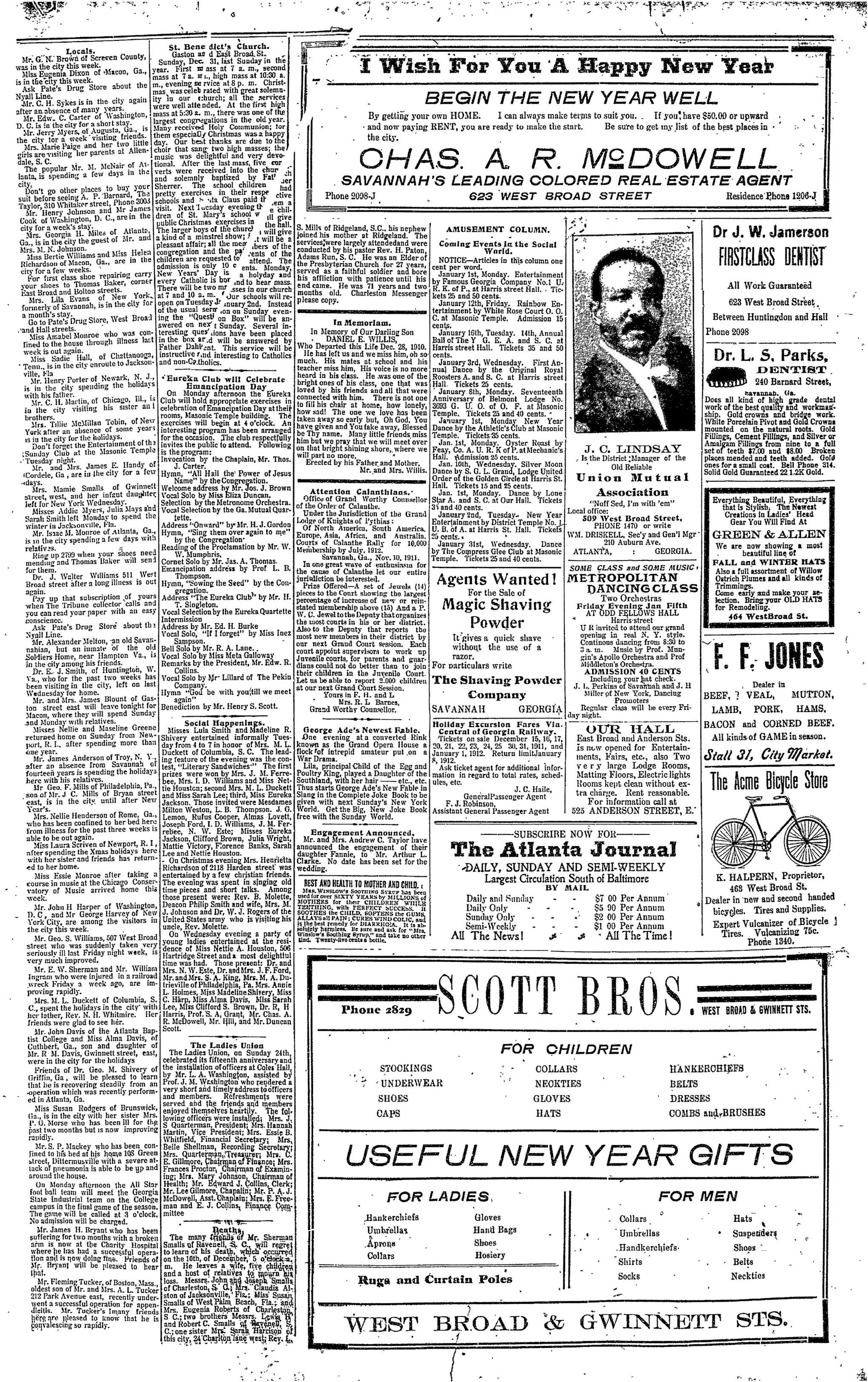
Ne mee a . ey | e es 7 ey: “se ee - ee .. ee NE “Pe eee Lea a ae
ES x ‘ $ fe x p = * = .
oo —_ : a . - ‘ .
1 \« I ac a BEET
— =, | st, Benedict's Church, * | = es a
OY. CECRTY SEOs we Cha Nalidars
is in the city spending the holidays
with his fatlier. . 7
Mr. C. H. Martin, of Chicago, IL, is
in the city visiting his sister ant
brothers. . .
Yrs. Tillie McMillan Tobin, of New
York after an absence of some years:
as iv the city for the holidays. s
Don’t forget the Entertainment of th2
Sunday Club at the Masonic ‘Temple
“Tuesday night.
Ae and Mrs. James E. Handy of
(Cordele, Ga , are ix the city for a few
adays. 7
Mrs. Mamie Smalls of Gwinnett
street, west, and her infant daughter
Teft for New York Wednesday,
Misses Addie Myers, Julia Mays and
Sarah Smith left Monday to spend the
winter in Jacksonville, Kia.
‘Mr. [sage ML. Monroe of Atlanta, Ga.,
is in the city spending a few days with
relatives. 4
Ring up 2799 when your shoes need
mending and Thomas Baker will send
for them. .
Dr. J. Walter Williams 511 West
Broad street after a long illness is out
again.
Pay up that subscription of yours
when The Tribune collector ‘calls and
you can read your paper with an easy
conscience. =
‘Ask Pate’s Drug Storé about th:
Nyall Line.
‘Mr, Alexander Melton, -an old Savan-
nahian, but an inmate of the old
Soldiers Home, near Hampton Va., is
jn the cityamong his friends.
Dr. E. J. Smith, of Huntington, W.
Ya., who for the ‘past two weeks has
been visiting in the city, left on last
Wednesday for home.
Mr. and Mrs. James Blount of Gas-
ton street east will leave tonight for
Macon, where they will spend Sunday
wand Monday with relatives.
Misses Neltie and Maseline Greene
returned home on Sunday from New-
port, R.1., after spending more than
‘one year.
Mr. James Anderson of Troy, N. Y.,
alter ap absence from Savannah of
fourteeii years is spending the holidays
here with his relatives.
Mr Geo. F. Mills of Philadelphia, Pa.,
_sonof Mr.J C. Mills of Bryan street
east, is in the city until after New
Year's.
‘Mrs. Nellie Henderson of Rome, Ga.,
who has been confined to her bed here
from illness for the past three weeks is
able to be out again.
Miss Laura Scriven of Newport, R.1,
after spending the Xmas holidays here
with her sister and friends has return-
ed to her home.
Miss Essie Monroe after taking a
course in musie at the Chicsto Conser-
vatory of Musie arrived home this
week,
Mr. John H Harper of Washington,
D.C, and Mr George Harvey of New
York City, are among the visitors in
the city this week. .
Mr. Geo. S. Williams, 507 West Broad
street who was suddenly taken very
seriously ill last Friday night week, is
very much improved,
Mr. E. W. Sherman and Mr. William
Ingram who were injured in a railroad
areck Friday a week ago, are im-
proving rapidly.
Mrs. M. L. Duckett of Columbia, S.
C., spent the holidays in the city” with
her tather, Rev. N. H. Whitmire. Her
friends were glad to see her.
Mr. John Davis of ihe Atlanta Bap-
tist College and Miss Alma Davis, of
Cuthbert, Ga., son and daughter of
Mr. RM. Davis, Gwinnett street, east,
were in the city for the holidays
Friends of Dr, Geo. M. Shivery of
Griffin, Ga, will be pleased to learn
that he is recovering steadily from an
“opera ee which was recently perform-
ed in Atlanta, Ga.
Miss Susan Rodgers of Brunswick,
Ga., is in the city with her sister Mrs.
P.G. Morse who has been il for the
past two months but is now improving
rapidly.
_Mr-S, P, Mackey who has been_con-
fined to his bed at hjs hame 10S Green
slieel, Ditlermusville with a severe at.
tack of pneumonia is able to be yp and
round the hoyse.
On Monday afternoon the All Star
foot ball team will meet the Georgia
State Industrial team on the College
campus in the final game of the season,
The game will be called at 3 o'clock.
No admission will be charged.
Mr. James H. Bryant wh 1
suffering for {wo months aah ticker
afm is now at the Charity Hospital
where he has had a successful opera
Hon ani! Is now doing fine. "Friends o
ing ryant will be pleased to hear
Mr. Fleming Tucker, of
oldest son of Sire and Aree ots
212 Park Avenue east, recently under
\yent a successful operation for appen
icitls. Mr. Tucker's !many friend:
here xe Nleased to know that he is
foRvalescing so rapidly.
St. Bene dict’s Church.
Cacton ad d Fast Broad St.
Sunday, Dec. 31, last Sunday in the
year. First mass at 7 2. m., second
mass at 73. m1., high mass at 10:30 a.
m,, evening se rvice ut 8 p. m. Christ-
mas, was celeb rated with great solemn-
ity in our ¢:hurch; all the services
were well attended. At the first high
mass at 5:30 2. m., there was one of the
largest congregations in the old year.
Many received Holy Communion; tor
them especially Christmas was 2 happy
day. Our best thanks are due to the
choir that sang: two high masses; the.
music was delightful and very devo-
tional. After the last mass, five cor
verts were received into the chur
and solemnly baplized by Fat’ ie
Sherrer. The school children jo.
pretty exercises in their Fespe ctive
schools and + uta Claus paid tr on
visit. Next Tuesday evening t? “Zhi
dren of St. Mary’s school © 1 giv,
public Christmas exercises ip de fa
‘he larger boys of the churc} twill give
akind of a minstrel showy Fe! wilt he
pleasant affair; all the mex bers of thi
congregation and the pa’ vents of th
children are requested to ‘attend, The
admission is ouly 10 ¢ ents. Monday
|New Years’ Day is a holyday anc
‘}every Catholic is bor ndto hear mass
‘There will be two mt <ses in our churel
sat 7 and 10 a. m.— f ur schools will re
-l open on Tuesday Jr anuary 2nd, Instea
of the usual ser .on on Sunday even
jing the “Ques! on Box” will be an
swered on Nex’ t Sunday. Several in
-|teresting ques’ ions have been place:
tlin the box ar.d will be answered bi
Father, Dat ent. this service will bi
, «nd intere i
Ae Da CA tne esting to Catholic:
“Eureka Club will Celebrate
Emancipation Day
Un il hold alternoon the Eureka
Club will hold approprtate exercises in
celebration of Emancipation Day at thei!
rooms, Masonic Temple building. The
exercises will begin at 4 o'clock. An
interesting program has been arrauged
for the occasion, The club respectful
invites the public to attend. Following
‘is the program:
Invocation by the Chaplain, Mr. Thos.
|, J: Carter,
Hymn, “All Hail the’ Power of Jesus
Name” by the Congre tion.
Welcome address bye ir. ‘is. J. Brown
Vocal Solo by Miss Eliza Duncan,
Selection by the Metronome Orchestra.
Noel golecton by the Ga. Mutual Quar-
ete.
Address “Onward” by Mr. H. J. Gordon
Hymn, “Sing them over again to me”
by the Congregation’
Reading of the Eroslamation by Mr. W.
W. Mumphris,
Cornet Solo ty Mr. Jas. A. Thomas.
Emancipation address by Prof L. B.
Thompson,
Hymn, “Sowing the Seed” by the Con
gregation. 7
Address “The Eureka Club” by Mr. HH.
‘T. Singleton,
Vocal Selection by the Eureka Quartette
Intermission
Address by Mr. Ed. H. Burke
Vocal Solo, “If I forget” by Miss Inez
Sampson. 2
Bell Solo by Mr. R. A. Lane. .
Vocal Solo by Miss Meta Galloway
Remarks by the President, Mr. Edw. R.
Collins. .
Vocal Solo by Mr* Lillard of The Pekin
Company.
‘Hymn ‘God be with youttill we meet
again’?
Benediction by Mr. Henry S. Scott.
Social Hanpenings.
Misses Lula Smith and Madeline R.
Shivery entertained informally Tues-
day from 4 to 7in houor of Mrs. M. L.
Duckett of Columbia, S.C. The lead-
ing feature of the evening was the con-
test, ‘Literary Sandwiches” The first
rizes were Won by Mrs. J. M. Ferre-
bee, Mrs. I. D. Williams and Miss Net-
tie Houstcn; second Mrs. M. L. Duckett
and Miss Sarah Lee; third, Miss Eureka
dackson. Those invited were Mesdames
Milton Weston, L. B. Thompson. J. G.
Lemon, Rufus Soaps Almas Lovett,
Joseph Ford, I. D. Williams, J. M. Fer-
rebee, N. W. Este; Misses Eureka
Jackson, Clifford Brown, Julia Wright,
Mattie Victory, Fiorence Banks, Sarah
Lee and Nettie Houston. .
~ On Christmas evening Mrs. Henrietta
Richardson of 2118 Harden street’ was
entertained by a few christian friends.
The evening was spat in singing old
time pieces and short talks. Among
those present were: Rev. B, Molette,
Deacon Philip Smith and wife, Mrs. M.
J, Johnson and Dr, W. J. Rogers of the
United States army who js visiting his
uncle, Rev. Molette.
On Wednesday evening a pry of
young ladies entertained at the resi-
dence of Miss Nettie A. Houston, 506
Hartridge Street anda most delightful
time was had. Those present: Dr. and
Mrs. N. W. Este, Dr. and Mrs. J. F, Ford,
Mr.and Mrs. S. A. King, Mrs. M, A. Du-
trieville of Philadelphia, Pa, Mrs. Annie
L. Holmes, Miss MadelineShivery, Miss
Cc. Harp, Miss Alma Dayis, Miss Sarah
Lee, Miss Clifford S. Brown, Dr. R, H
| Harris, Prof.’§. A, Grant, Me Chas. A.
R Mebowel Mr. Hil, and Mr. Dunean
‘ott.
The Ladies Union
The Ladies Union, on Sunday 24th,
celebrated its fifteenth anniversary and
the instalation of officers at Coles Hall
by Mr. L. A. Washington, assisted by
Prof. J. M, Weshington who rendered a
very short and timely address to officers
and members. Refreshments were
served and the frjends and embers
enjoyed themselves heart} Vy. "The fol.
lowing officers were instal led Mrs. J,
S Quarterman, President; Mrs. Hannah
Martin, Vice President; ‘Mrs. ‘Essie B,
Whitfield, Financial Secretary; Mrs,
Belle Shellman, Recording Secretary
‘Mrs. Quartei an Treagreri Mra, C,
E. Gilmore, bakinan Yngnce; Mrs.
Frances Proctar, Chairman af Examin-
ing; Mrs, ary Johnson, Chairman of
Health; Mr. Edward J. Collins, Clerk;
Mr. Lee Gilmore, phapatiny Mr. Be A.J.
McDowell, Asst. Ohap! in: Mrs, E. Free-
man and E. J. Collins, Fingnee Ory,
mittee
ge aL eee
Nesths.
sais of Ravenel & Ch ih reget
malts O! venel hog ake re
to learn of his desth, Bich’ erent
on the 10th, of December,’ 5 oor:
m, He leaves a wife, five children
anda host of relatives ta mourn hig
Joss. Messes. John 4 aeeph ‘Smalls
of Charleston, S. Cj Mrs. Claudia Al-
‘ston af Jacksonville,‘ Fix; Miss’ Susan
Smalls of West Palm Beach, Fla: and
‘Mrs. Eugenia Roberts of Charleston,
.; two brothers essrs. Lewi
SG two brothers, Messrg, Lenig
‘and Robert C. Smalls Ravenel, S
C.; one sister Mie Ser ak ‘Harrison 9}
this city, 24° Charlton lane west; Rev. £.,
°° “§ Wish For You ‘A Happy New Year ——
oo. BEGIN THE NEW YEAR WELL
, < By getting your own HOME. Ican always make terms to suit you. . If you’ have $50.00 or upward + yea
' - and now paying RENT, you are ready to make the start. Be sure to get my Jist of the best placesin«“ > <j
: . thecity. ~ . . : 5
OCHAS. A. R. M2DOWELL
. SAVANNAH'S LEADING COLORED REAL ESTATE AGENT
! Phone 2098-J | . 623 WEST BROAD STREET Residence Phone 1206-J
De ey
Phone 2829 / 2 J @ WEST BROAD & GWINKETT STS.
FOR CHILDREN a -
_, S?0CKINGS . 27 COLLARS HANKEROBIEFS “oe
2 -YNDERWEAR ‘ NEOKTIES BELTS Sg
| SHOES "GLOVES ‘DRESSES sf
CAPS HATS COMBS andyBRUSHES |
: _| FOR LADIES, ; / FOR MEN
| Hankerchiefs Gloves . Collars ° 2 Hats” | *
Umbrellas Hand Bags Umbi 1 . ®
foe ae a - oe mbrellas . * Suspetiderg . ®
Collars : Hosiery aad Handkerchiefs. Shoes i
| ee . : Shirts “. + Belts toy '
- Ruga and Curtain Poles ° . Socks . Neckties '
| jpg
| : a . ++ a
WEST BROAD & GWINNETT STS..
§ fo - . . ¢ :
r. I Wis
, . By getting your
i . - and now paying
. . the city.
| _ SAVANNAH
Phone 2098-J .
S. Mills of Ridgeland, S.C.. his nephew
joined his mother at Fidgelsnd The
Servicesjwere largely attendedand were
conducted by his pastor Rev. H. Paton
Adams Run, S.C. He was an Elder of
the Presbyterian Church for 27 years,
served as a faithful soldier and bore
his affliction with patience until his
endcame. He was 71 years and two
months old. Charleston Messenger
please copy.
US
In Memoriam.
In Memory of Our Darling Son
+ DANIEL E. WILLIS,
Who Departed this Life Dec. 28, 1910.
He has left us and we miss him, oh so
much. His mates at school and his
teacher miss him, His voice is no more
heard in his class. He was one of the
bright ones of his class, one that was
loved by his friends and all that were
connected with him. There is not oue
to fill his chair at home, how lonely,
how sad! The one we love has been
taken away so early but, Oh God, You
have given and You fake away, Blessed
be Thy name, Many little friends miss
him but we pray that we will meet over
on that bright shining shore, where we
will part no more, *
Erected by his Father and Mother,
Mr. and Mrs. Willis.
RS
Attention Calanthian<c.:
Office of Grand Worthy Counsellor
of the Order of Calanthe.
_ Under the Jurisdiction of the Grand
Lodge of Knights of Psthias :
Of North America, Sonth America,
Enrope, Asia, Africa, and Anstralia.
Courts of Cslanthe Rally for 19,000
Membership by July, 1912.
Savannah, Ga., Noy. 10, 1911.
Tn one great wave of enthusiasm for
the cause of Calanthe let our entire
jurisdiction be interested.
Prize Offered—A set of Jewels (14)
pieces to the Conrt showing the largest
percentage of increase of ney or rein-
stated niembership above (15) Anda P.
W. C. Jewel to the Deputy that organizes
the most courts in his or her district.
Aleoto the Depnty that reports the
most new members in their district by
our next Grand Court session. Each
court appoint aupervisors to work up
Juvenile courts, for parents and guar-
disns could not do better than to join
their children in the Jnyenile Court.
‘Let us be able to report 2.000 children
at our next Grand Court Session.
Yours in F. R. and L
: 7 Mrs. R.L Barnes,
| Grend Worthy Counsellor.
————+ +
| George Ade’s Newest Rable.
| One evening ata converted Rink
known as the Grand Opera House a
flock fof intrepid amateur put.on a
War Drama. |
Lila, principal Child of the Egg and
Poultry King, played a Daughter of the
Southland, with her hair ——etc., ete.
Thus starts George Ade’s New Fable in
Slang in the Complete Joke Book to be
given with next Sunday’s New York
orld. Get the Big, New Joke Book
free with the Sunday World.
Engapement Announced,
Mr. and Mrs. Andrew C. Taylor have
announced the engagement of their
Seughter Fannie, to Mr. Arthur L.
Clarke. No date has been set for the
wedding.
| REST AND HEALTH TO MOTHER AND CHILD. «
3ius, Winstow's Soormxo Svacr hag been
used {or over SIXTY ¥EAKS by MILLIONS of
MOTHERS for their CHILDREN ‘WIiL#
TEETHING, with PERFECT SUCCESS it
SOOTHES the CHILD, SOFTENS the GUM;
ALLAYS ell PAIN; CURES WIND COLIC, atd
‘ig the best remedy for DIARRUG:A. it ts ab-
SMe hiner eran
“Und, ‘Twenty-five cedtea boitie, “22 her
—-—-SUBSCRIRE NOW FOR—-——
The Atlanta Journal
“DAILY, SUNDAY AND SEMI-WEEKLY
Largest Circulation South of Baltimore
BY MAIL
Daily and Sunday - $7 00 Per Annum
Daily Only - - -, $5 90 Per Annum
Sunday Only - = ~ $2 00 Per Annum
Semi-Weekly - - - $1 00 Per Annum
All The News! we # +All The Time!
AMUSEMENT COLUMN.
Coming Events ir the Social
World.
NOTICE—Articles in this column one
cent per word.
January Ist, Monday. Entertainment
by Famous Georgia Cacnpeny No.l U.
R. K. of P,, at Harris street Hall. . Tic-
kets 25 and 50 cents.
January 12th, Friday. Rainbow En-
tertainment by White Rose Court 0. 0.
C. a Masonic Temple. Admission 15
cents,
January 16th, Tuesday. 14th, Annual
Ballof The Y G. E. A. and S. C. at
Harris street Hall. Tickets 35 and 50
cents.
January 3rd, Wednesday. First An-
nua} Dance by the Original Royal
Roosters A.and 8. C. at Harris street
Hall. Tickets 25 cents. :
January 8th, Monday. Seventeenth
Anniversary of Belmont, Lodge No.
3093 G. U. 0. of O. F. at Masonic
Temple. Tickets 25 and 40 cents. *
January Ist, Monday New Year
Dance by the Athletic's Club at Masonic
Temple. Tickets 35 cents.
Jan. Ast, Monday, Oysier Roast by
Fey, Co. A. U. R. K of P. at Mechanic’s
Hall, Hamisslon 25 cents.
Jan. 10th, Wednesday. Silver Moon
Dance by S. G. L. Grand, Lodge United
Order of the Golden Gircle at Harris St.
Hall. Tickets 15 and 25 cents.
Jan. Ist, Monday. Dance by Lone
Star A. and S.C. at Our Hall. Tickets
33 and 40 cents.
January 2nd, Tuesday.» New Year
Entertainment by District Temple No. d
U. B, of A. at Harris St. Hall. Tickefs
25 cents. « -
January 3ist, Wednesday. Dance
by The Compress Glee Club at Masonic
Temple. Tickets 25 and 40 cents.
Agents Wanted!
For the Sale of
Magic Shaving
Powder
It'givesa quick shave -
without the use of a
razor.
For particulars write
The Shaving Powder
. Company
SAVANNAH GEORGIA
Holiday Excursion Fares Via.
Central of Georgia Railway.
‘Tickets on sale December 15, 16, 17,
20, 21, 22, 23, 24,25 30, 31, 1911, and
pansy 1, 1912. Return limitJanuary
, 1912. fae
Ask ticket agent for additional infor-
mation in regard to total rates, sched-
ules, ete.
; J.C. Haile,
GeneralPassenger Agent
F, J. Robinson, |
Assistant General Passenger Agent
ae ia) oF
> o >
7% p +s pitt enee ss!
wt ee SES
Mf Baa pre
. gil Ree
i FO! ee
eS SGT EM.
te [slg ners
ae ” Mga 35 ek
ay Pe: % -on ie oe
te ag ee ea
aden ey et i
game <> a
rr: Big ose 7 : ae
J.C. LINDSAY
s Is the District :Manager of the
Old Reliable
Union Mutual
Association
“Nuff Sed, I’m with ’em”
ocal office:
509 West Broad Street,
PHONE 1470 or write
VM. DRISKELL, Sec’y and Gen’l Mgr
210 Auburn Ave.
ATLANTA, : GEORGIA.
SOME CLASS and SOME MUSIC:
METROPOLITAN
DANCINGCLASS
Two Orchestras
Priday. Evening Jan Fifth
‘AT ODD FELLOWS HALL
= Harris’street
U RK invited to attend our grand
opening in real N. Y. style.
Continous dancing from 8:30 to
Sa.m. Mnsic by Prof. Mun-
gin’s Apollo Orchestra and Prof
Middleton's Orchestra.
ADMISSION 40 CENTS
Including your hat check.
J. L, Perkins of Savannah and J. H
Miller of New York, Danciug
Promoters
Regular class will be every Fri-
day night.
OUR WALL
East Broad and Anderson Sts.
is new opened for Entertain-
ments, Fairs, ete., also Two
very large Lodge Rooms,
Matting Floors, Electric lights
Rooms kept clean without ex-
tra charge. Rent reasonable.
For information call at
525 ANDERSON STREET, E.
Dr J. W. damerson
FIRSTCLASS DERTIST
All Work Guaranteed
623 West Broad Street,
Between Huntingdon and Hall
Phone 2098 .
Dr. L. S, Parks,
DENTIST .
240 Barnard Street,
Bayannab, Ga,
Does all kind of high grade dental
work of the best quailty and workmay-
ship. Gold crowns and peas, work,
White Porcelain Pivot aud Gold Crowns
mounted on the natural roots. Gold
Fillings, Cement Fillings, and Silver or
Amalgam Fillings from nine to_a full
set of teeth $7.00 and $8.00 Broken
places mended and teeth added. Gold
ones fora small cost. Bell Phone 314.
Solid Gold Guaranteed 22 1.2K Gold.
Everything Beautiful, Everythin;
Gare Sylisy he Newest =
Creations in Ladies’ Heed
Gear You Will Find At
GREEN & ALLEN
We are now showing 2 most
‘ beautiful line of
PALL and WINTER HATS
Also a full assortment of Willow
Ostrich Plumes and all kinds of
Trimmings.
Come early and make your se-
lection, Bring-your OLD HATS
for Remodeling.
464 WestBroad St.
~~; .
F. F; JONES
. Dealer in
BEEF, ? VEAL, MUTTON,
LAMB, PORK, HAMS,
BACON and CORNED BEEF.
All kinds of GAME in season.
Stall 31, City Market.
The Acme Bicycle Store
as* Cis
K. HALPERN, Proprietor,
468 West Broad St.
Dealer in ‘new and second handed
bicygles. Tires and Supplies.
Expert Vulcanizer of Bicycle }
| ‘Tires, _ Vuleanizing 75e.
Phone 1340.
AFRO-AMERICAN CULLINGS
Editing a newspaper in some respects is a good deal like preaching. The gospel truth must be presented in the form of generalities or some fellow will get hit and howl, says a recent writer. Few persons like truth, even in homeopathic doses, if it hits, them. But while preachers and editors are criticised for what they do say, no one thinks of giving them credit for what they do not say. Yet what they keep to themselves constitutes the major portion of what they know about people. Very many people harbor the belief that newspapers are eager to publish derogatory things. It's a mistake. There isn't a newspaper that could not spring a sensation in the community at any time by merely telling what it knows. There is not a newspaper that does not keep under the lock of secrecy scores of derogatory things which never meet the public ear. Deciding what not to print is the most troublesome part of newspaper work. How many good stories are suppressed for innocent relatives and for the public good nobody outside of a newspaper office has any idea of. In some instances he who files into a passion because a newspaper prints something about him which he considers uncomplimentary has every reason to feel profoundly grateful to the newspaper for publishing so little of what it knows of him. And oft times the loudest bluffer is the most vulnerable to attack. A big noise is often a device employed to cover trepidation. Newspapers put up with more bluffing than any other agency would endure. It is not because they lack courage; it is because they are unfilling to use their power to destroy or ruin unless the interests of society imperatively demand it. It might be well for some people to reflect upon these truths and in silent gratitude accept mild admonition, lest worse befall them—Minneapolis Argus.
The editor of the Minneapolis Argus speaks boldly and truthfully when he states that the editor of a paper is not eager to publish "derogatory things." Each week, we could publish column after column of things we know on the big and little fellows, attacking their honesty and derogating acts. It's really a shame sometimes that the degrading actions of those in high places are not brought to light, but for the sake of one's family and other relations, the editor withholds such matter, taking the view that in the final analysis, it will do no good.
But let it be understood that while a newspaper man knows and learns much of an individual that is disgraceful; yet if he is a menace to society and the people of a community, there is no editor that lacks courage to denounce him.
It is, however, the duty of the editor to speak of all wrongs committed against society, yet he must be full of human sympathy, love of fair play and loyal to the highest ideals of American freedom and liberty.
The people of today have ceased to patronize the paper that thrives on scandal and lies, but are supporting those that are clean, decent and honorable. As the editor, so the newspaper.
As a result of the recent conference of governors relative to low price of cotton, which conference considered ways and means by which the farmer could get a better price for his staple, a plan has been arranged by which a loan of $50,000.00 is to be made to the farmer at the rate of $25 per bale. He will be allowed to hold his cotton, till the price, reaches 12 cents and will be required to sell when it reaches 13 cents.
The plan looks good on paper and may benefit a large number of farmers. But it will fall to benefit the large number of farmers who belong to the credit merchants. When a farmer goes in in January and gives a mortgage on his crop and then buys all he can on credit against it, he will lay to market his cotton in the fall just as fast as he can get it out—if not faster! He can't hold a thing. And the farmer who happens to come out with a surplus about once in ten years and then whiles in and imports
that surplus in chips and whetstones, $250 miles, and $90 saddles, rubber-tired hacks, and shiny wagons, and then has to buy his provisions at credit prices. Such a man is bound to unload as soon as he gets out his cotton. He couldn't wait even if the millennium was just around the corner and signaling to him to hold on! This thing of trying to fix a better price for cotton when a large per cent of cotton raisers are hog-tied to some one else, is about on a level with the effort of Jack Cade and his followers to fix the price of bread when they were without any of the ingredients with which bread is made. And the plan to reduce the acreage will prove about as successful as that of two lovers who met at the home of their lady love. Neither could have full sway while the other was present and both came to the conclusion about the same time to return home. Each bide good night to her and proceeded on different streets to their respective homes.
One had not gone far before he de-
cided to steal a march on the other one by quietly returning to the lady's home. When he got there he, found that his rival had conceived the same plan and had put it over him by several minutes. As pointed out by the Dallas News some time ago, the only way to get the farmer in position to get a good price for his cotton is to get the farmer out of debt! He can materially assist in this process by concentrating his smoke house and corn crib at home instead of having them scattered up in Kansas City and St. Louis.-Dallas Express.
A new administration in Hayti always has to face the troublesome question of its foreign debts. The debts are incurred, for the most part, by the destruction of the property of foreign residents by warring revolutionists, and, money borrowed of foreigners by them to prosecute their revolutions. The successful party has to assume its own obligations as well as those of the parties which came and went before. The new president, Gen. Le Conte, has asked the Joint Mixed commission for an extension of time for the payment of the claims piled up against his administration by his predecessors. The taxpayers of Hayti are to be pitiled. They get practically nothing but revolution upon revolution for the money exacted of them. Their leading men appear to value their government only as a means to secure enough to live in Paris, or some other European capital, where life is gay and easy to those who have big names and bank accounts. Patriotism in Hayti seems to be confined to the poor, uneducated people, who have defended it in times past with a valor worthy of any people. How can they be protected from their educated soldiers and statesmen? They would like to know.
San Domingo has more trouble. Gen. Ramon Caceres, president of the republic, was murdered while leaving the residence of a relative on November 20. He was a very large man physically, and good natured as a boy. He had been president since 1908, and dictator since 1906, of the turbulent little neighbor of Hayti, and, it is said, the country prospered under his dictatorship. But he was a marked man. He killed President Heureaux in cold blood because Gen. Heureaux had killed his father in cold blood, and he in his turn was killed in cold blood by friends of President Heureaux. So the blood feud becomes a running issue; in which, among those concerned in it, no man can tell the hour when he will be overtaken by the avenger. It must be a fearful condition in which to live and die. The finances of the country have been under the United States customs receivership about six years and that fact may be responsible for the peace which the country has enjoyed during that period. If a new president should succeed Gen. Caceres without a revolution it would be a very unusual but gratifying event—New York Age.
One of the most impressive exhibits in the Tuskegee booths at the recent Macon county (Georgia) Negro fair was a newly made grave mound covered with ears of corn. At the head of this grave was placed a beveled topper head-board on which this epitaph could be read:
Death of the Mortgage
"In Memory of
C. C. Mortgage,
Born January, 1911,
Killed October 31, 1911.
Gone the way all crop
Mortgages should go."
An old colored lady, seeing this exact replica of a grave and being unable to read, exclaimed: "Dah, dah! Somebody done come here and died! De Lawd giveth and the Lawd taketh. Who was de man? And how came dey to bury 'im here, right in de Fair?" It was a long time before they could make her understand that the exhibit only represented the burial of the chattel crop mortgage, and to show the way all crop mortgages should go.
Do you own an automobile? No! Well, the increase in the automobile business is one of the most remarkable in the history of any one of our many comparatively new industries. In 1904, for example, 22,830 automobiles were produced, capitalized at $23,084,000, while in 1909, 127,287 were produced, capitalized at $173,837,000, according to the federal census bureau. The capitalization of the whole business, that is, all parts of it, in 1904, $30,034,000 and $249,202,000. The automobile is fast displacing the horse. It is ceasing to be a vehicle in the reach of the rich only as a luxury and is becoming one of service within the reach of people of ordinary means. It has opened a splendid field of employment for negroes, as drivers, which is a better and less barbarous term than chauffeurs, and in all the large cities they are operating garages as owners or managers. The number of our business and professional men who own automobiles is large and steadily increasing.
RULES FOR GRADING APPLES
The following rules have been made the standard requirements by the National Apple Buyers' association for grading and packing this fruit:
The Standard Barrel—A barrel which is 17½ inches in diameter at the head, 28½ inches in length of stave and bulge not less than 64 inches outside measurement.
Requirements for No. 1 Apples—The standard size, for No. 1 apples shall not be less than $2\frac{1}{2}$ inches in diameter and shall include such varieties as the Ben Davis, Willowtow, Baldwin, greening and other varieties kindred in size. That the standard for such apples as romitanite, russett, winesap, jonathan, Missouri pippin and other varieties kindred in size shall not be less than $2\frac{1}{4}$ inches in diameter. And further, that No. 1 apples shall be, at the time of packing, practically free from the action of worms, defacement of surface, or breaking of skin, shall be hand-picked, from the tree, a bright and normal color and of shapely form.
Requirements for No. 2 Apples—No. 2 apples shall be hand-picked from the tree. Shall not be more than $2\frac{1}{4}$ inches in diameter and of fair color for the variety. The skin must not be broken, nor the apple bruised, and must be practically free from scab and other defects. This grade must be faced and packed with as much care as the No. 1 fruit.
HEN HOUSE PESTS.
Many people dust their fowls monthly with a powder, and the formulas following are probably as good as any:
To one pound of flour of sulphur, four ounces of powdered coal, tar camphor (naphthaline flakes), use four pounds of very fine plaster of parls. Mix thoroughly and keep dry in a closed vessel. Use by dusting among the feathers.
Another mixture is made of one pound of air-slacked lime, one pound of snuff and five pounds of road dust. Mix thoroughly, keep dry and use as above directed.
One of the most effective ways of giving the fowls comfort is keeping a dust bath box about four feet square and six inches deep, filled to within two inches of the top with wood ashes (to which is sometimes added a pound of sulphur). The fowls will dust themselves and practically rid themselves of lice. The old methods are sometimes entirely effective, and they are certainly simple. The fowls enjoy them, and you are saved much extra work—Union Guide.
GOOD ROADS WOULD HELP.
"Along with educating our young people to get the most out of farming," said W. F. Rankin of Tarkio, Mo., "good roads are the most important things to develop in this state. There is only one way to get them, and that is to tax ourselves for them. We have very good roads in our county, but very poor bridges. The stone and concrete bridges are the only ones that are really economical to build. Iron and wooden bridges are too short lived.
"I am not one of those who consider the buying of motor cars in any sense a craze. When things get adjusted, the motor car will take an important place in the work of the farmer. It is a good roads advocate. It puts an end to the loneliness of farm life. One would not think of driving eight-or ten miles behind a team to attend a lecture or an entertainment or to spend an evening with a friend, but that is just exactly what one would do in a motor car in the country. The motor car and the telephone keep the whole country in communication."
THE GOVERNMENT STUD BOOK.
The investigations concerning the draft horse stud book, which the department of agriculture has been conducting, was completed after two hearings were given the society publishing the book. As a result of the conditions disclosed by this investigation it became necessary for the department to exercise the power given by the tariff law to pass upon the sufficiency of the pedigree certificates of animals imported for breeding purposes, instead of delegating this function to certified American pedigree record associations, as has been the policy in the past.
BIRD'S NEST ON SHEEP.
The remarkable sites sometimes chosen by birds for their nests are recorded from time to time. A robin builds in a watering can, an old kettle, or on the book shelf in a library. One of the most remarkable, perhaps, is that recently given in the Emu, and apparently authentic. On November 10 last a sheep was being shorn on the form of A. Burger, Telanga, Australia. In its wool was found a starling's nest with one egg. A note in the Felld adds that the nest of a small bird was once found in a horse's tall in Cape Colony.
FRTILIZER FORMULA:
Following is an approved formula for commercial fertilizer for sweet potato: Nitrate of soda, 100 pounds; bone meal, 100 pounds; acid phosphate, 550 pounds; muriate of potash, 250 pounds. Composition: Nitrogen, 1.8 per cent; phosphoric acid (available), 8.5 per cent; phosphoric acid (total), 11.2 per cent; potash, 12.5 per cent. Application at the rate of 600 to 1,200 pounds per acre.
SULPHUR IN THE SOIL.
Experiments at the University of Wisconsin are regarded as proving that the generally prevailing theory that sulphur in the soil is of little value for promoting fertility, as compared with phosphorus and nitrogen, is erroneous, and that sulphur is, in fact, of vast importance. Continuous cultivation, together with insufficient fertilization, causes a large annual loss of sulphur, which can not be compensated from the atmosphere, and little is brought up by capillarity from the subsoll. The experimenters, therefore, recommend, the application of fertilizers containing sulphur to lands which are frequently cropped. The failure hitherto to recognize the great value of sulphur in the soil is ascribed to faulty analytic methods employed by early investigators.
AN ANCIENT WATERWAY.
The prefecture of the Seine is engaged in restoring the ancient Roman aqueduct in the eSlieve Valley, which was constructed about the fourth century of our era, and which brought water from Chilly-Mazarin to the baths of Julian. At the present time the aqueduct is below the soil. For the most part it is believed that the aqueduct is intact, as excavations have been made in many places. The work is composed of stone and brick, and the waterway was uncovered. A landowner in the neighborhood came across a good portion of the stone work recently, which he brought above ground, and then, not knowing its archaeological value, turned it into a receptacle for rubbish in his garden.
WEANING PIGS.
It is not advisable to wean pigs before they are six weeks old. Skim milk and middlings make about the best food for young pigs after weaning. If the middling are fine and floury, which is not likely to occur under the present-day methods of milling, they will sometimes cause indigestion, which may show itself either in the form of diarrhoea or constipation. Diluting the middlings with a little bran, or finely ground oats will prevent the trouble. Soaking or scalding the middlings will tend to prevent digestive troubles, and this should be done when no skim milk is to be had, as it makes the food more palatable.—Agricultural Epitomist.
THE HAPPY MICROBE
The microbe is tenacious of life, for according to a French contemporary, Migula found the bacillus tenosporus placed on a sheet of glass lived for five years. Germs of potato disease sealed in a tube were living after a period of eight years. In 1879, Ball of Prague, after a lapse of eight years, infected a mouse fatally, with some bacillus. Nestler investigated clods of earth stored in a herbarium for over half a century and found 89,200 living spores to the gramme. Some earth wrapped in paper since 1824 and protected from atmospheric germs, showed on examination 19,000-bacteria to the gramme. Eighty-seven years is a ripe age even for a microbe.
JUST HAD TO COME UP.
A cluster of mushrooms has, forced its way through an asphalt pavement in St. Jude's, one of thaipoorer quarters of Bristol. It was noticed that the pavement was bulging, and then the asphalt was conquered, and the mushrooms emerged. About two pounds of them, it is said, have been gathered from this strange bed.
CROPS AND SOIL.
Rotation of crops will help you to improve the fertility of your soil and make it possible to feed more animals on the farm. Select the crops with reference to soil building, market and animal requirements. It is not wise to plant crops that are not needed, but plants that will pay in money, animal products, soil fertility, etc.
BIG DIFFERENCE IN PRICE.
Texas cattle raisers have discovered that there is a difference of 300 per cent, between the price received by them and that paid by the consumer.
HEALTH HINTS.
A stomach specialist is quoted as saying that two or three slices of very ripe pineapple eaten after dinner is better than any so-called "digestive" known. The fruit should be very ripe, fresh and uncooked.
If a fine-tooth comb is used on the hair, take just a small strand at a time, placing the comb close to the roots, and drawing it clear to the end of the strand. Clean the comb carefully after combing each strand. A fine-toothed comb can do the hair much harm.
A sufferer from cramp during sleep writes that he found a remedy. He noticed that he never became cramped no matter how long he napped in a reclining chair. These facts in connection with some physiological considerations, induced the writer to put into practice the following plan, which has proved decidedly successful: To sleep upon an inclined plane. This is effected by taking care that the bed or mattress should incline 12 inches from the upper, to the lower part of the bed; and for this purpose the lower feet were cut down so as to form this inclination.
TO COOK POULTRY.
When poultry is high in price economies may be practiced by adding enough vegetables to the dish in some savory style to extend its possibilities. A casserole of young fowl is made in this way by a house mother who is known for ingenuity in making a little go further than most cooks. She has the fowl cut into the usual joints and pieces and sautes them in two tablespoonfuls of butter and one tablespoonful of olive oil. When they are a rich golden brown she puts them into a fireproof casserole with a little stock and white wine, salt and pepper, covers the dish and lets the contents simmer very slowly. Meanwhile she fries little young onions, little young carrots and some potato balls in the fat in which the chicken was cooked, and about half an hour before the chicken is done she turns the vegetables into the casserole and cooks all together. The casserole goes to the table on a folded napkin over a round platter. If the cooking is long and slow there is no need to provide an expensive chicken for a casserole. A tender fowl will be equally tasty.
A favorite supper dish after a long ride consists of a young fowl fried brown and then simmered slowly until it is tender and served with a mushroom sauce. The chicken meat is taken from the bones without breaking the meat more than is necessary, is arranged on a hot platter and the sauce turned over it. For the sauce fry half a chopped onion in butter until it is yellow and then add two tomatoes, two ounces of fresh mushrooms cut in pieces and a tablespoonful of white wine. Simmer the mixture until it is reduced about a half and then strain the sauce over the chicken.
For poulet au riz with supreme sauce, cook the fowl tender in a strong stock that has been flavored with vegetables. Make the sauce with a tablespoonful each of flour and butter and a cupful of chicken or veal stock and thicken with the yolk of an egg, salt, pepper and chopped parsley. Turn the sauce over the chicken just before it goes to the table.
. WORSTED NOVELTIES.
Wide and very long all-wool mufflers, knitted or crocheted, are seen in various colors and styles. One is made with a deep turnover collar, and fastens down the front with pearl clasps.
Another is, in reality, a hood. Just where the long muffler is folded in half, a circular crocheted piece is fitted into place; this forms the back of the hood. Around the front edge of the muffler, directly in line with the back of the hood, is an extra edge crocheted for about twenty inches. This defines the face of the hood. The longends of the muffler hood are finished with fringe.
These are sizeable muffs, crocheted of the worsted, to match one's muffier or bood, and mittens too, if one wishes them. Quilts, for trimming one's cap or hat, are crocheted of worsted and wired into shape. Sweaters are more popular than ever. Both the three-quarter and shorter ones will be worn. They are provided with goodly pockets. For fasteners a crocheted button or pearl one is used, according to fancy. Along the firpt upper edge of the sweater a stout chainstitch is crocheted. This is left free at regular intervals to serve as a loop for the buttons. This makes it a simple matter to renew the loop if it wears or tears.
NEW CHAMPAGNE COLOR.
One of the questions that few are able to answer is what will Dame Fashion think of next. The latest idea to have the gloves in a dainty champagne color. These, in case one be in mode, are worn with the latest gowns of pure white lace or tailored as the case may be. The scarf, too, which plays an important part in the present costume, is of the shade, or its trimmings can show the fashion by their color. Crushed roses in the champagne tint are very pretty on a hat on the same pale tone.
The most important accessory to new downs noted recently are sleeves puffed and frilled at the elbow in such a manner that the wearing of ordinary coat sleeves over them would be quite impossible.
While broadcloth, partly covered with one of the heavy laces—Venice, machine, crochet, yak, etc., and trimmed with ostrich, will be ranked as the dress hat rivaling those of black velvet and feathers.
The most conspicuous features of autumn millinery are the great height of the tall-peaked crowns, appearing orally sorts and conditions of hats, and the trimming, which is also employed to add its quota, to the towering effects.
New blouses and gulpsm show either a closing directly in front of one lapped to one-side under three large, buttons; and whether the buttons are large or small, they are conspicuous for their beauty, or for their decorative quality.
FOR THE PORCH ROCKER.
For the porch rocker there is much that can be done in the line of embroidery, knowing that they have to be saved from the ravages of dust that seems to penetrate into the very heart of the woven mesh of the split willow.
The antimacassar can be utilized for this purpose, also making an addition of back and seat cloths to protect the part of the chair that comes in contact with our clothes when reposing comfortably within the expansive arms of this summer necessity.
One can make these antimacassars and chair cloths as simply or as elaborately as one desires, as it opens a field for the embroidery enthusiast that can run the whole gamut of the fancy as well as the simpler stitches.
If one might choose to embolder in colors it is best to choose the soft shades of the higher colors so that there will be no indication of the degree of warmth that the full colors are so apt to impress.
Open work is less to be desired than the blind embroidery, for should one choose to decorate these with the open work there will be left a loophole, as it were, for the ever present dust to seep through and thus set at naught the full service for which these serviceable articles are actually intended.
As there is no regular service to which an embroidered piece may be put, one can give way to the vagaries of one's imagination to an unwanted limitation by designing or sketching on these cloths whatever seems to them most weird and mythical, or by copying out of story books such hobgoblins as strikes one's fancy. The lighter shades of lavender and green are the colors that are most taking for this kind of work as they do not denote warmth as would the different shades of red or the other high colors, such as yellow or brown. All of the stitches that you have so far learned can be applied in this work and one should not spare any efforts in doing one's best so that they will be admired by your callers.
.RENOVATING A SWEATER.
The girl who has spent her summer at the seashore or mountains finds her sweater unwearable by fall. The first impulse is to send it to a good cleaner. This is the easiest solution, but too costly for many girls who must choose between solled white sweaters or dark ones. Here is how one girl solves the problem. When it has become grimy she makes a thick suds of any good white soap, first dissolving it in water until it is thick jelly. The sweater is put in it and worked up and down many times. Care must be taken not to rub the wool, not even through the hands, as this stretches out of shape.
If the garment is much soiled it is sometimes necessary to use two or three suds. These and the rinsing water should be kept at the same temperature, not much more than lukewarm. Occasionally a little borax or a teaspoonful of ammonia may be used to a pailful of water, but this should only be done if the sweater will not get clean without.
After washing put the sweater in the bathtub and let the water from the spigot run through it until entirely clear. Press gently against the sides of the tub, but do not wring or twist. In both rinsing and washing the object is to keep the garment well together in a ball to prevent stretching.
Have ready a large pillow case and dump the sweater into it. Pin the case to the clothes line where it gets the air and sun. When partially dry beat the case first on one side, then on the other with a wicker furniture beater. Repeat several times until the sweater is entirely dry.
HOUSEHOLD
HINTS
- Turpentine has almost as many uses in the house as borax. It is good for rheumatism, and, mixed with camphorated oil and rubbed on the chest, is one of the best remedies for bronchial colds. It is an excellent preventive against moths, although *naphtha* is preferable, the odor leaving much sooner; it will drive ants and cockroaches away, if sprinkled about the shelves and cupboards, a spoonful in a pail of warm water cleans paint excellently, and a little in the boiler on washing day whitens the clothes.
Wet linen should never be thrown into the clothes hamper, as it is apt to mildew and communicate mildew to the other things in the basket. Dampness also turns the willow of the basket black. If anything sweet has been spilled on table linen rinse it out or throw it rough dry into the hamper. Otherwise it may become the prey of roaches or water bugs in a city flat.
Sponges should be washed free of soapsuds each time they are used and hung up to dry. As often as possible scald them in soda water and hang them in the sunshine.
POETRY of and by Our People
There is a land, of every land the pride, Beloved by heaven, o'er all the world beside; Where brighter suns dispense zerener light. And milder moons imparadise the night; A land of beauty, virtue, valor, truth, Time-tutored age, the love-exalted youth, The wandering mariner, whose eye explores
The wealthiest isles, the most enchanting shores,
Views not a realm so bountiful and fair,
Nor breathes the spirit of a purer air;
In every clime the magnet of his soul,
Touched by remembrance, trembles to that pole.
For in this land of heaven's peculiar grace,
The heritage of nature's noblest race,
There is a spot on earth supremely blest,
A dearer, sweeter spot than all the rest,
Where man, creation's tyrant, casts aside
Hils sword and scepter, pageantry and pride.
While in his softened looks benignly blend
The sire, the son, the husband, brother, friend.
Here woman reigns; the mother, daughter, wife.
Strews with fresh flowers the narrow way of life;
In the clear heaven of her delightful eye,
An angel-guard of loves and graces lie;
Around her knees domestic duties meet,
And fireside pleasures gambol at her feet
Where shall that land, that spot of earth be found?
Art thou a man?—a patriot?—look around!
O, thou shalt find, howe'er thy footsteps roam.
That land thy country, and that spot thy home!
Man, through all ages of revolving time,
Unchanging man, in every varying clime,
Deems his own land of every land the pride.
Beloved by heaven o'er all the world beside;
His home the spot of earth supremely blest.
A dearer, sweeter spot than all the rest.
—James Montgomery.
THE GARLAND OF STARS.
Some night, I think, if you should walk with me
Where the tall trees like ferns on the ocean's floor
Sway slowly in the blue deeps of the moon's flood.
I would put up my hands through that impalpable sea
And tear a branch of stars from the sky, as once I tore
A branch of apple-blossoms for you in the April wood.
And I would bend the dewy branch of stars above your little head
"Till they flamed with pride to be as blossoms amid your hair;
But I would laugh to see them so pale, being near your eyes.
I would say to you: "Love, the Immortal Ones are hovering about your head
They laugh at the dimness of stars in the luminous night of your hair."
I would toss that weeping branch back to the mournful skies.
—Staemas O'Sheel
IN THE FIRE-HOLE.
The captain's fine in his coat of blue,
The mate is big and handsome, too,
But of the hundreds in the crew
It's the coolies who make her go!
Eight hours off and four hours on,
Shoveling the flame the voyage is done,
Stirring the flame till the race is won
Sweat the coolies who make her go!
Not even a 'name on the ship's pay-
roll.
No hint about what's below.
Keeping alive the fiery glow.
Driving the engines fast or slow—
Yellow coolies who make her go!
Tumble 'em up from the hell in the
bold.
See how they shiver out in the cold.
Eyes like a cat's and faces of gold.
These, the coolies who make her go!
—Don C. Seitz, in Harper's Weekly.
FOR OVERCOMING GRACE.
I'm striving hard 'gains inbred sin,
Which doth so easily best:
I'm trying hard to apprehend.
But have not apprehended yet.
The things behind me I forget,
And ever press toward the mark;
But inward foes my plans upset,
And make the way appear so darl
The things I would not do, I do;
What I would do, I do it not.
The very course I now pursue
Is blighted by unholy thoughts.
Lord Jesus lend a helping hand,
Oh, set the captive prisoner free;
And help my feeble soul to stand,
To gain its oft sought liberty.
Then, shall I over all succeed,
And over all the victory win,
Yet still I'll all his merits plead:
To overcome myself and sin.
-Wm. T. Biddle.
WHAT AVAILS THE SILENT TEAR?
What avails the silent tear,
The brooding mind that dwells in sorrow?
Arise and banish suilen fear,
The coward's hope is for the morrow.
Nought is gained by plans deferred
Neath the gloom of false depression;
Life is sweet when faith is reared
To conquer woe and all oppression.
What though storms may rage and howl
And our course seem somebread driver.
What though all that's bright grow foul
When we firmly trust in heaven?
Every thought is pleasure bound.
If conceived for good endeavor;
Every wish is jowels found
That will urge us forth to labor.
J. J. Oswald Conway in Brooklyn Eagle.
MORE APPROPRIATIONS FOR INDIAN THAN NEGRO
President Thirkield Gives Figures in Howard University Report.
THE NEGRO'S GREAT NEED
EDUCATOR SAYS COLORED MEN
SHOULD BE TAUGHT SCIENTIFIC FARMING—85 PER CENT.
OF RACE FOLLOW AGRICULTURE.
Washington, D. C.—Criticism of alleged discrimination toward Indians at the expense of colored citizens is made part of the annual report of Howard university, forwarded to the secretary of the interior by President Thirkield. He pointed out that for the 250,000 Indians in the United States the government last year spent $1,430,000, while for the 10,000,000 colored persons only $100,000 was appropriated.
"Yet colored teachers in the common and high schools," the report continues, "are expected to meet the requirements of the state authorities. To practice medicine the colored man is required to pass the same examination before state boards as the white physicians. So also in other professions and pursuits provision must be made for these 10,000,000 of our colored citizens, else it will mean the blind leading the blind and both falling into the ditch at great cost to society and the state."
In order to further emphasize the greater need of aid from the government, Doctor Thirkleld, in his report says:
"While the Rockefeller fund of a million dollars is available for the eradication of the hookworm disease, yet there is the negro race with tuberculosis, typhoid infection and other diseases wiping out tens of thousands and lowering the vitality and physical efficiency of a race.
"At the same time," he continues, "their condition is a positive menace to the white race, with which it is so closely bound up. It is a question of national interest. Here is a race, multitudes of whom are still the prey of the voodoo doctors and conjure men and given to patent nostrums. The pressing need is for the training of men for the instruction of the ignorant and superstitious, men with scientific knowledge and broad views of medicine, men who can put medical knowledge in simple form before the masses and through preventive medicine raise the vitality of a race that is being decimated by disease."
Doctor Thirkield adds that the great need of the colored men today is more practical study in matters of agriculture. Nearly 85 per cent of the population of 10,000,000, he says, are engaged in agricultural pursuits. Yet there is not a single school for colored persons in the United States where agriculture is a specialty. The report shows that 1,672 students attended the Howard university during last year, coming from 37 states and 11 foreign countries. In describing the need for more dormitories he says:
"There has been no increase in dormitory accommodations since the original buildings were erected, over forty years ago. Of the nearly 1,500 students in attendance, four-fifths of whom are men, only one in five can be accommodated in present dormitories.
"One of the pressing needs, of the institution is an assembly hall large enough to at least seat the student body. The only assembly hall of the university, with 1,500 students, is the Rankin Memorial chapel, which was built especially for religious services, and seats only 600."
GENERAL LYON SPEAKS OF LIBERIA
GENERAL LYON SPEAKS OF LIBERIA
ADVISES INTENDING EMIGRANTS TO TAKE ALONG PLENTY OF MONEY.
Baltimore, Md.-Reed Paige Clark, the new receiver general from Liberia, was commissioned by the president in Washington. The following day he took the oath of office in this city before Dr. Ernest Lyon, consul general to this country for Liberia.
As a receiver general Mr. Clark will have charge of the collection of Liberian customs, which amounts to about $300,000 a year. The Liberian government recently floated a loan of $1,500,000, and will probably devolve upon Mr. Clark to arrange for the payment of this loan, when due. His salary will be $5,000 a year.
Consul General Lyon, who spent eight years in Liberia as American minister, is 'thoroughly conversant with the needs of the little republic, and predicts a bright future for it.
"Along with Mr. Walker," said Mr. Lyon. "I would advise those who wish to emigrate to Liberia to take along some capital, as it is largely an undeveloped country, 'and money, along with initiation and" push is needed there. I stand ready to advise anyone who desires to go there to live. Late advises to me state that the
people of that country are preparing to make the inauguration of Dante Howard as president a big occasion in January. All elements of the population, even the aborigines, will be represented at the ceremonies. He is head of the True Whig party and a most promising future now looms up for Liberia."
PRESENTS DEEDS TO CHURCH
WILLIAM W. SMITH, NOTED PHILANTHROPIST OF POUGHKEEPSE, MAKES GIFT TO COLORED CITIZENS-DEDICATION EXERCISES NOTABLE-MR. SMITH IS PRAISED AND IS VISIBLY AFFECTED.
Poughkeepsie, N. Y.—It was a big day for the members of the New Zion church when the handsome brick and cement building, located at 'Cottage and Smith streets, was formally dedicated—on which occasion the deeds, covering both ground and edifice, were handed over to the congregation by the donor, William W. Smith, the noted philanthropist of Poughkeepsie.
Accompanying Mr. Smith were his wife, son and grandson, and many of the girls from his establishment on Market street. During the service he appeared visibly affected by the sincerity of the homage paid him, and particularly by the ovation tendered him at the close of the services, when it became impossible for him to leave the church for some time, so expressive were those in the audience in their desire to thank him individually for what he had done for the colored citizens of Poughkeepsie. The little church, which is a two-story brick structure surmounted by belfry, was packed to the doors, and many well known business men of Poughkeepsie were present.
The dedicatory sermon was delivered by Rev. L. G. Mason, P. E., who selected as his text for the occasion, "Upon This Rock I Build My Church." It was a strong and forceful sermon reaching the hearts of the people. Following the offertory, when over $100 was collected, the Hon. W. W. Smith, ascending the platform of the church which he was to present to the small, but enthusiastic congregation, in a short though impressive address, congratulated the colored people of Poughkeepsie upon the successful culmination of the years of labor leading up to the present dedication.
He said he had followed the rising fortunes of the old church from its very inception, through its many vicissitudes, until the time arrived to erect a new church when, feeling that he owed something to the colored people of Poughkeepsie he remarked to the pastor if he would consult with an architect and later make known what he wished done, he (Mr. Smith) would assist the church in the furtherance of their plans. With high compliments to the present pastor for his zeal and personal interest in the church's welfare, Mr. Smith presented the deed of the property, free and clear of all encumbrances, with the hope that the edifice would be used for the advancement of the colored race and the spreading of the Kingdom of God in this world.
In concluding his remarks Mr. Smith said that it was his earnest desire that the young people take an interest in the church and make it a gathering place and their guide towards purer and more noble lives.
Responding to this hearty appeal for the interest of the race in furtherance of religious devotion, Rev. Benjamin Judd pronounced the donor, William W. Smith, as among the greatest men he had ever met—net alone on account of his bigness of heart and generous spirit of philanthropy, but because of his inherent love of fellowman. He said that he found W. W. Smith-eminently a man among men, willing at all times to put aside personal prejudice and meet all men upon an equal footing. Never had he visited the residence or business establishment of Mr. Smith, said Rev. Judd, when he had been denied an interview, nor had any benefits been solicited from him that were not more generously compiled with than the mere request had urged. Never was he tired of helping a worthy cause and sufficiently high tribute could not be voiced in words expressing the appreciation of those benefited by the magnanimous gift just presented to them.
Upon the subsidence of applause greeting the completion of these remarks, the Hon. John C. Dancy, formerly recorder of deeds for the government at Washington, arose, and on behalf of the colored people present introduced a public resolution of thanks to the donor, which the congregation voiced upanimously by a standing vote.
INCREASE AT WILBERFORCE.
Wilberforce, O.—There has been a very large increase of students this year at Wilberforce university. The new dormitory for girls on the college grounds is now in course of erection; another has just been completed for the senior girls on the state side. Professor Finch, who has fately returned from London, where he attended the International Race congress as a delegate, addressed the Y. M. C. A. in their new quarters recently.
$10,000 MORE FOR TJSKEGEE.
Tuskegee, Ala.—The Tuskegee Normal and Industrial institute, of which Booker T. Washington is principal, has just received a legacy of $10,100 from the estate of the late Maria Blanchard of Philadelphia.
THE SALVATION OF
THE COLORED MAN
IS IN THE SOUTH
THE SALVATION OF
THE COLORED MAN
IS IN THE SOUTH
The colored people of the south are living in the midst of their friends. This is a point blank statement, and it can be backed up by facts, not so much. In words, but in the very disposition of the colored people to remain in the south, those who are doing well and do not run to the north. Competition is so great in the north that it freezes out those that really don't understand the underground methods that are being carried on there. Notwithstanding the great opportunities and advantages that the colored people have in the south, many of the well-to-do ones among them pick up bag and baggage and go elsewhere among theoretic friends in the north, east or west. Fifty per cent of the colored people in the south today have been to some other section of the country to live. Many of them have stayed in these parts as long as one or two years and some even longer. They have gone to these parts with capital and with the intention of investing their capital and locating permanently. Some have gone to attend the various universities and colleges and others to seek employment. We are free to go away if we so desire, but the fact is that 95 per cent. of those who go away from the south, either to the north, east, or west, return; they return with all they have and die and are buried here.
Is the climate so rigid away from the south that colored people cannot stand it? Is employment so scarce that the people cannot find anything to do? Are colored people so few in these other sections that the southern colored people cannot find any associates? Do the whites of the north, east or west drive the southern colored people away? Then why do these folk almost invariably return home to the south? There are so many ways to account for this home returning, but what cannot be lightly put aside is, that among the many reasons for the return of the colored people to the southland is, that in the communities where they once lived they can always count on getting a hearing and employment from the white people among whom they have lived. Where there have been relations of a personal nature between a white man and a colored man and the two know each other well, it has been demonstrated time and again that that colored man can get assistance from that white man when a member of his own race will refuse him. Then, too, a colored man will go to a white man before he will to a member of his own race, the exceptional cases not-withstanding. The individual cases that are known point to thousands of other cases in which are concealed in bosom confidence and which bespeak in a deeper measure the genuine friendship that exists between the one man and the other in the south.
With the present form of sentiment well founded in the south toward the colored man, his white friend conserves to the good of both, through confidences well guarded. With all one may say about the cordial relations existing between the races in other sections of the country, this one thing is true, nowhere else in this country are the races required to meet each other day after day, face to face, in the offices, homes, shops and other thoroughfares in anything like the numbers, as in the south; and this is one manner in which the test may be applied for the necessity of race friction.
There is less race friction in Charleston today than there is in New York. The reason for the general freedom from an every day occurrence of race trouble in the south today, is the deep rooted friendship that the individual white man feels toward the individual colored man and vice versa. This is a view of the situation from a mere glance and without taking up a long line of evidence.
It is time that many of us who talk about the north and its many superior advantages for the colored people wake up to the truth of this question. The only salvation of the colored man today is in the south. The times are like those days of old Pharoah, the Egyptian Ling, who held the Children of Israel in bondage. The Israelites wanted to go away of their own accord, but had to wait until God's appointed time. They stayed in the wilderness and worked out their own salvation, under good leadership and constant devotion to God, the real friend of all mankind. . .
At any rate, the man who thinks that it is better for him in the north, ought to go there and stay, there we will have a reason to believe he is sincere.—A. B. Polite, in Charleston Messenger.
BLAME THEM ON THE PRINTER.
A certain editor had cause to admonish his son on account of his reluctance to attend school, says the Sacred Heart Review.
"You must go regularly and learn to be a great scholar," said the fond, father encouragingly, "otherwise you can never be an editor, you know. What would you do, for instance, if your paper came out full of mistakes?"
The boy looked up into his parent's face with childish innocence.
"Father," he said solemnly. "I'd blame 'em on the printer!"
And then the editor fell upon his son's neck and wept tears of joy. He knew he had a successor for the editorial chair.
The Farm
SELECTING THE COW THAT WILL MAKE MONEY.
The cow is a machine to convert, cheaply, feed into milk. Like other machines, a large capacity is usually accompanied by economy in production.
deep, the cob comparatively small. The color of the kernels should be uniform, having no indication of a mixed variety. All ears that show immaturity or rotted kernels should be eliminated, and especial care should be taken to select ears with large germs. The fact should be borne in
The first consideration in selecting a dairy cow to make money is to get one with a large stomach capacity. A light feeder never makes a good profit. The ability to handle a large amount of food is indicated by great depth and width just in front of the hips. The cow should have long ribs well sprung. The round, short-ribbed, pony-built cow soon dries up. The long, flat-ribbed cow has ample depth of body, but lacks the necessary width to be a profitable feeder. A broad jaw furnishes grinding surface for a large quantity of feed. The narrow-jaewed cow is not profitable.
A good feeder, to be a profitable dairy cow, must convert her feed into milk and not change it into flesh that is put on the body. A good indication that the feed will be used to produce milk is a shoulder that is thin and sharp at the top, with little muscle on the sides when the cow is in good condition. (A beef cow's shoulders are thick on top and when she is in good flesh they are thickly covered on the sides). The brisket should be light and the cow gradually increase in depth and width backwards.
The hip bones of the well-fed dairy cow are prominent; they project enough so one could hang his hat on them. (A good beef animal's hip bones are so well covered with flesh that they hardly show). The thighs should be thinly covered with flesh.
The udder is the organ that manufactures the milk from the blood, and there must be a large udder to produce a large yield. Nature never places the bulk of the udder below the underline. To secure a good udder the flank must have a high arch, and the body must be cut up between the hind legs almost to the tail, to make room for a large udder. The best udder extends well forward and well up behind. The teats should be placed well apart and should be long. The milk value running along the belly in front of the udder are large and crooked in a good dairy cow when she is milking well. These veins enter the body through openings in the belly, called milk wells. In a good dairy cow these openings are as large as the end of a man's thumb; usually in a beef animal the milk wells are located just a short distance in front of the udder. In the highest yielding milk cows the milk wells are near the front legs.
The eyes of a high-yielding dairy cow are wide apart, large and set out from the head. The backbone is sharp. These two features indicate the development of the enormous nerve power that is needed to digest large quantities of feed and transform it into milk.—Southwest Trail.
USE FOUND FOR ASHES.
The utilization of the treasures locked up in coal has thus far usually stopped at the ashes, says Schatze der Kohle und ihre Verwertung. All the other products, such as gas, coke, tar, sulphate of ammonia, benzol, etc., have for a long time formed most important materials in our industries. In view of the enormous quantities of coal consumed annually, a recently announced discovery, according to which there can be produced from ashes at will, substances resembling marble or rubber, claims lively interest. From ashes, the type of the dead, the passed away, new life, is to be created. The highly excellent substance obtained, as stated, possesses at once the properties of marble and rubber. Neither moisture, heat or acids can attack it, at the same time it is nonconducting, so that its use for electric conduits also comes under consideration. The cost of producing the new substance, which is also adapted for wall and floor coverings, for table slabs, etc., amounts to about 2 to 3 marks (45.6 to 71.4 cents) per square meter. The process of manufacture consists in that the ashes, preferably briquet ashes or dust ashes, are first sifted, then treated with cold soda water and copal varnish and finally subjected to a kneading and drying process. According to whether an imitation of marble or rubber is desired, the proper coloring substance is added. The material will be marketed under the name of "Cinerite."
SELECTING CORN FOR SEED.
With a little practice one can become a quick and reliable judge of an ear of corn suitable for seed. But it will be necessary to study such points as trueness to type, shape of ears, color of kernels, tips and butts of ears, uniformity of kernels, shape of kernels, space between kernels and the per cent, of grain to the cob. Briefly, it should be stated that the rows of kernels should be straight, running from butt to tip; the kernels wedge-shaped, thus insuring a large per cent. of the corn'd on the cob. The furrows or the space between the kernels should be narrow; the grains
deep, the cob comparatively small. The color of the kernels should be uniform, having no indication of a mixed variety. All ears that show immaturity or rotted kernels should be eliminated, and especial care should be taken to select ears with large germs. The fact should be borne in mind that a large yield requires ears that are well filled and as few nubbins and barren stalks as possible. It costs as much to produce nubbins as it does good ears, and ordinarily twenty bushels to the acre will cost as much work and other expense as forty, hence the economy of increasing the yield.
' A CURIOUS INSECT.
In the Midi of France there flourishes a species of grasshopper which the good people of that regiol called the "Prega-Dieu," for the reason that the attitudes assumed by the insect indicate that it is engaged in prayer. When the Prfega-Dieu walks it proceeds with a slow and solemn gait like a pilgrim with his staff. But it does not walk a great deal. Its ordinary attitude is that of an ecstasy of prayer, its arms raised toward heaven.
This pious attitude is, however, an altogether deceitful one. The Prega-Dieu is not engaged in prayer—far from it. He is simply awaiting his dinner. His forelegs, so devoutly held upward and crossed, are provided with tiny spurs or teeth, with which he catches as in a vise small flies and other insects which may be deceived by the grasshopper's hypocritical attitude.
Moreover, he has worse faults than mere hypocrisy. He is a cannibal, and kills and eats his own sisters and brothers. The wife kills her husband if he turns out to be less strong or less nimble than herself. When there is a family quarrel there is always a decapitated body at the close of it. The Pregn-Dieu, despite his peaceable and devout exterior, is one for the fiercest and cruelist of insects.
DESERT DEVELOPMENT.
In a recent interview, C. J. Blanchard, statistician of the reclamation service, said: "National irrigation has gone beyond the stage of prophecy, and in nine years, at an expenditure of $59,580,000, the service has built 5,621 miles of canals, many of which carry whole rivers. It has completed three of the largest dams in the world, and as a result of the work water is available for 1,000,000 acres of land, with an increase in land values of more than $105,800,000.
"The next step in the desert's development is now being worked out on an economic and social revolution. In this country life is real, for there are few of the artificialities of the crowded centers of population.
"The commission form of government," he concluded, "initiative, referendum and recall have obliterated party lines in municipalities."
FRUIT, POLLENIZATION.
Our orchardists have been very slow to realize the necessity of mixing varieties of apples for pollenization purposes, says Field and Farm. We have known that the apple is what is called a perfect bloomer—that is, it has both pistils and stamens and so is supposedly capable of setting fruit. Then, too, the necessity of mixing varieties has been increasing with the passing years. At the time most of our oldest orchards were planted even solid blocks of one variety produced bountiful crops. Since then the conditions have gradually changed. The size of the orchards has been increased, while the number of varieties has been reduced in many commercial orchards to two or three. The soil has become more depleted and insects have greatly increased. The mixing of varieties is not the only thing, but one of the most important needs of an orchard today.
TWO-FOLD VALUE OF SHADE TREES.
The land owner who plants no shade trees deprives himself of two sources of lifelong enjoyment. First, he misses the beauty which the growing tree imparts to his "surroundings and the comfort its shade may afford the dweller in his farmstead, both human and four-footed; second, he loses the exaltation of feeling that ever comes from the exercise of the altruism which plans for coming generations regardless of oneself.—Kansas Farmer.
GRAFTING WAX.
A good recipe for grafting wax is to take four pounds of rosin, two pounds beeswax and one pound tallow. Set them on the stove in a pan or something of that character to aid in dissolving, and when they have reached the liquid state pour into a pail of cold water. This will make a thick mass like molasses candy, and it can be pulled and made into rolls as desired—New England Homestead.
See Cooper & Odrizen The Up-to-Date Tailors
218 WEST BROAD STREET, BETWEEN HULL AND OGLETHORPE AVE.
The Latest Patterns in FALL and WINTER GOODS. First-class workmanship guaranteed. Our prices will interest you.
Johnson Undertaking Establishment
COMBINED WITH
The Royall Undertaking Company
(Incorporated.)
Funeral Directors and Embalmers
Finest line of Coffins, Saskets and Robes. White and black funeral cars. Office and warerooms 325-331 Jefferson street.
W. R. FIELDS, Manager.
GAREY'S
Variety Bakery.
Goods delivered promptly to one part of the city.
506 West Broad Street, Near Garton
Phone 1831-L.
Take a Policy With The
Residence Phone 2032. Livery Stable Attached. Office Phone 676. C. H. ROYALL, Residence 509 Charles St. Phone 3064.
W. L. BLUNT, WHOLESALE AND RETAIL
Fruit and Commission Merchant
234 ST. JULIAN ST., WEST, 235 BRYAN ST., WEST. Phone 2968
SAVANNAH, GEORGIA.
In addition first class rooms, barber shop, hot and cold baths and automobile service at any hour, day or night. In all of our departments we give first class accommodation. Call and see our rooms while visiting the city at 109 Jefferson street, just a half block from Broughton St. car line going south on Jefferson. Ask any hackman.
Palm Shaving Palace
Expert Hair Cutting, Electric Massage and Shampooing a Specialty. All Work Done by Experienced Workmen. Courteous attention to all. SHINING PARLOR ATTACHED. PERRY R. WRIGHT, Proprietor
If Your Business Isn't Worth Advertising Advertise It For Sale
POPULAR PRICED
SHOES
NICHOLS
THE SHOE MAN
19 East Broughton Street
Atlanta University
An Unsectarian Christian Institution. High School, Normal School and College. Superior advantages in Industrial Training, Music and Printing. Home Life Training. For catalog and information address PRESIDENT EDWARD T. WARE.
The Highest Price Lots at Woodlawn Park are Only $150.00 and they 50x400
They have concrete sidewalks and are directly on car lines. Consider how important that transportation feature is. Some excellent LOTS LEFT. You pay
e quickly and get a ch location AS. McDOWEL
See me quickly and get a choice location
623 WEST BROAD STREET
NO INTEREST
RESIDENCE 1206-J.
GAREY'S
Variety Bakery.
Goods delivered promptly to one part of the city.
500 West.Broad Street, Near Queen
Phone 1831-L.
Pilgrim Health and
The Oldest, Strongest and Most
Reliable Company in the State.
Gives employment to hundreds of
men and women of our race.
Pays from $1 to $10 weekly sick and
accident benefits and from $10 to $100
death benefits. Our Motto: "Prompt-
ness, Honesty and Justice."
Home Office:
1143 Gwinnett St. Augusta, Ga.
For further information write 509
West Broad St, Savannah, Ga.
J. S. Perry, Supt.
A. B. Singfield, Gen. Supt.
C. T. Walker, D. D., LL. D.
Director and General Lecturer.
GO TO—
GO TO
Young Bros.
For your
TOBACCO, CIGARS and FRUITS
Of all kinds.
509 West Broad Street.
WEST SIDE RESTAURANT
461 West Broad Street
Near Union Station.
The place to get first-class meals
Everything neat and clean. Meals
prepared in an appetizing manner
and at all hours daily.
Meals 15 and 25 cents.
MRS. A. S. SCOTT, Proprietress
McFALL'S
Ice Cream Parlor
Ice Cream and Sherbets in large and small quantities. Special prices to Churches and Societies. Also Hot and Cold Lunches. Fish Suppers prepared to order. Phone 4038. Orders very Promptly filled. : : : : : 15 East Broad St., Savannah, Ga.
Masonic Books
and Regalias
LODGE SEALS,
FINANCIAL CARDS and
BLANKS of every description.
Publishers and Manufacturers' Prices
Laboral Discounts Will Be Arranged.
SOL G. JOHNSON,
Savannah, Ga.
Who is the man for Cleaning and
Pressing?
Baker's Pressing
Men's Suits Pressed 40c; Pants 15c; Men's Suits Scoured $1. Ladies' work a specialty. Give us a trial.
MADAME FLORENGE E: WILLIAMS
Graduate Prof. Rcher's School, New York.
521 Gaston Street, East.
Telephone 2328
Wigs, Switches, and Pompades
Combings Made Up. Shampooing and Hair, Stralightening a Specialty. Face and Electric Massage. Dyeing and Matching Hair. ORIENTAL HAIR GROWER. An excellent preparation, will produce a beautiful growth of hair. Directions on each box. For sale, price 25 cents per box.
Turn Over a New Leaf
By subscribing for THIS PAPER
AMONG THE MASONS.
We received an inspiring letter from Brother C. Mangram, Mt. Pleasant, Ga., speaking of his lodge, Mount Olive, and the Eastern Star Chapter. He says that each of these institutions are getting along nicely and expect to do much work during the year.
Brother T. J. Maddox has informed us of the burning of his lodge hall at Ochlocknee, Ga. They were not able to save any part of it. He failed to state whether it was insured or not. It is hoped that it was insured. We have often requested the brethren to have their halls insured. It may cost a bit to do so, but it will pay in the end. Begin with the year and see that your halls are well insured.
We take this method of extending to the brethren of the jurisdiction a happy and prosperous new year greeting. The hope is expressed that the year will be one of the best for the lodges and the brethren; that the spirit of progress may be instilled into every one and every effort be made for the uplift of Masonry.
Many of the lodges observed St. John's Day on Wednesday.
Monday will be "happy new year."
Send us the news from your lodges.
The officers of the lodges of Savannah were installed on Wednesday night by the Grand Secretary. Inspiring talks were made by some of the brethren.
The officers of the lodges of Savannah were installed on Wednesday night by the Grand Secretary. Inspiring talks were made by some of the brethren.
According to the ancient laws of Freemasonry, says the Chronicle, every brother must attend his lodge if it is within the length of his cable tow. Some writers have laid it down to mean a distance of three miles. But the expression is really symbolic and as it was defined by the Baltimore convention of 1842 means the scope of man's reasonable ability.
No lives on earth can be nobler than those spent for the uplifting and betterment of mankind. For them there is no death. Could that radiant glow of joy and happiness which they have poured into the dark and desolate homes of the distressed be reflected upon their death bed, we could see them pass from this life to that of the realms above in a halo of heavenly glory. The voices that, throughout such a noble life, have been whispering words of cheer and encouragement to the sorrowful may be silent, the hands that patiently and mercifully have administered to the weak and suffering may be folded in the embrace of death, but life itself and the memory of their deeds will live forever.—A. O. Eberhart, Grand Orator, Minnesota.
Science of Freemasonry.
The science of Freemasonry is worthy of our most patient study and thorough investigation. The grand truths and sublime teachings and the wholesome lessons are not found upon the surface, but are buried deep in the eternal principles and symbols of the institution. One may be a proficient ritualist and impart the verblage of the lectures with the greatest precision, and yet be as profoundly ignorant of the science of Freemasonry as the uninitiated. The ritual is not the key which unlocks the door and reveals the hidden mysteries—that is, just the alphabet. It is the Mason who takes his seat in the school of philosophy of Masonry as an humble pupil, and, sitting meekly at the feet of the fathers, and by dint of hard study and careful investigation, and having mastered the first and elementary principles and then applied these to the more abstruse truths as alds to further and more thorough investigation, that either does or can to any appreciable extent hold the beauties of Freemasonry.—Keystone.
Both Good and Bad.
What a tremendous mistake we make when we rate men as either wholly good or wholly bad. A human being is both good and bad. In the heart of the holiest saint lurks some phase of sin. In the heart of the most hardened criminal dwells a spark of the divine. Said an eloquent pulpit orator: "Within each one of us is a horrible demon, with hideous claws. Within each one of us is a beautiful angel with folded wings." To follow habitually the promptings of the demon is to be dragged down to destruction. To obey habitually the mandate of the angel is to be raised to heavenly heights. — Exchange.
Work of Gothic Sculptors.
The Gothic sculptors produced crude and grotesque carvings from a technical standpoint, but they were the first to attempt intimate speech in art addressed to the common people, and both Rossellino and Giotto with their clever followers are heirs of the humbler craftsmen who broke the bonds of convention to immortalize the homelliness and variety of daily experience and common types of human nature.
One Place Where the Best and Sweetest Side of Character Should Be Shown.
Family life should be one of the utmost deference and respect. It is a peculiar phase of human nature that we are oftener more considerate of strangers than we are of those who in the very nature of things are nearest and dearest to us.
Why should we fret and find fault until we make home life intolerable? Why should we carry a grouch into our homes every time we leave "business?" Why should we demand services of those in the home circle which we only request in the most respectful manner from those outside of it?
Why should a man say to his wife, "May, I want my slippers. Bring them to me," and use a tone of command when he knows he wouldn't address the veriest lackey in a similar manner? Why should May use an irritating, commanding tone toward John when she wants any little service done and why do both order the children around as if they were a lot of unfeeling, unthinking little minions who knew no better than to accept the treatment without protest?
Of all places on earth the home is the place where the best and sweetest side of character should be shown. It is there that the softest tones and kindest actions should prevail. It is there that unfailing and uniform courtesy should be the rule and where every member should use his or her utmost effort to keep the family life untainted by the irritating experiences of the life outside of it.
POOR SORT OF HERO
A BOOK BOOK OF WEB
"Is it a excitin' book, Jimmie?"
"Naw; it's dead slow! Here it is de third chapter an' he ain't killed but eight or ten Injuns so far!"
IMPROVED TELEPHONE.
A simple way of making telephone conversations more audible has been invented by Herr Petersen, a bank manager of Nykjobing, Denmark. On the principle that sound is more readily transmitted through rarefied air he has constructed an apparatus to warm the trasmitter, whereby the air in it becomes thinner and the sound is intensified. Professor Hannover, of the Danish government telephone testing station, who has made extensive experiments with Peterson's apparatus, says in his report that the increase of sound obtained is remarkable. Telephone conversations between Copenhagen and Nykjobing, a distance of some 75 miles, could be clearly followed some distance away from the instrument. The inventor has applied for patents in different countries.
DISAPPOINTED.
An M. P. was discussing voting frauds—impersonation and the duplication of votes generally. He instanced one duplicator, an ignorant fellow who had the.stolid and unmoved look of an animal.
"You are charged,' said the policeman, 'with having voted twice.' "Charged, am I?' muttered the prisoner: "That's odd. I expected to.'be paid for it.'"—The Watch Dog.
PROTECTION AGAINST FROST.
To the long list of the means heretofore proposed of protecting fields, orchards and vineyards against frost a new one has been added by M. E. Chavernac. Writing in Progres agricole et viticole, he points out the fact that frosts are not feared when the wind blows; he is thus led to suggest the creation of an artificial wind by the installation of electric fans among the plants to be protected. He considers this plan applicable chiefly to vineyards, but also possibly useful in orchards.
Vegetarlan Gospel of Bearer of Good Tidings Is Refuted by Cannibal Chief.
Dark looks greeted the missionary. The inhabitants of the cannibal isle were a shade blacker than jet, to start with, and dyspepsia had clouded their faces still more.
"The trouble with you all," said the bearer of good tidings, "is that you live on a meat diet. If you would eat vegetables, cereals and fruits for a spell you would become civilized and happy and devote your days to piety and good works. It is the fermentation of your animal food that causes you to be so short-tempered, so warlike and so miserable.
"That is what all the missionaries say," replied the cannibal chief, "but fruit and green stuff are beyond our reach. Our 1910 census shows that the average wage earner on this island makes only $18 a day, and you know yourself what the overproduction of gold has done to the purchasing power of money. If you have no messages to leave, the executioner will do his duty, after which dinner will be served in the big tent."
QUICK WORK BY A DOCTOR
Within 24 hours after a Philadelphia court granted a divorce to Mrs. Katharine Saeger Bovee, her erstwhile husband, Dr. J. Wesley Bovee, a well-known Washington physician, married at Auburn, N. Y., Mrs. Caroline Copley Wemple. The news of Dr. Bovee's second marriage was a surprise, but the granting of a divorce to Mrs. Bovee was no surprise, as she and Dr. Bovee had been separated since 1907.
She brought suit for divorce in the District of Columbia supreme court, declaring Dr. Bovée had excluded her from his home, and that during their separation he reduced her monthly allowance from $300 to $125. Dr. Bovee, through his attorneys, stated that when the facts were known right thinking people would absolve him from all blame. Mrs. Bovee failed to obtain judgment in the District of Columbia, and later began action in Philadelphia, where an absolute divorce was granted and the papers in the case ordered impounded.
HOME A DANGEROUS PLACE.
A man who, despite the fact that he has several grandchildren, is still fond of his club and the pleasures which lie beyond the domestic circle, said in defense of his weakness that he went out to prolong his life "and to avoid dangers." "According to a table recently published by an accident insurance company," he said, "more than one-quarter of the accidents happen at home," and in proof of the statement he showed this statistical record of accidents: At home, 25.9 per cent.; pedestrians, 18.2; motor cars, 11.1; recreation, 11; horses and vehicles, 9.9; on street cars, 7.2; railway trains, 4.3; bicycles, 1.2; steamship travel, 1; miscellaneous, 10.2.
DEADLY VAPOR.
The explosion of vessels carrying petroleum frequently occurs, and this is generally caused not by the cargoes of oil which they contain, but by the inflammable vapor which is left behind after the huge tanks of the ships have been emptied. It is difficult to remove all the oil that adheres to the sides of the tank, and the evaporation of the oily film left in them after they have been pumped out takes place with great rapidity. A spark may thus cause a fearful explosion in the hold of a ship that is apparently empty. Harper's Weekly.
THE SEEING EYE.
I know a man who has lived on one farm half a century. He sleeps in the room in which he was born in the dark. Yet his lambs and his pigs, the velvety roll of new sprouting wheat, the procession of the seasons, the apple trees he planted and has watched for years—all are new to him each day. I have seen him stand and look at his sheep as if he were a city man long shut out from such sights. A sunset or a sunrise is to him a miracle new-performed each day. That man has the seeing eye.—Detroit News.
OPPOSING FORCES.
"How was Jinks frozen out?" "By hot competition."