Savannah Tribune
Saturday, January 13, 1912
Savannah, Georgia
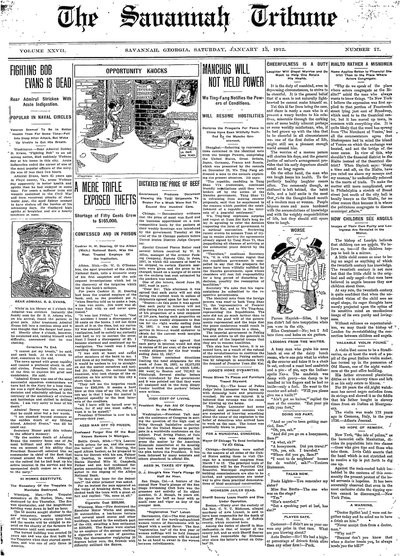
Page text (machine-generated)
The Savannah Tribune
VOLUME XXVII.
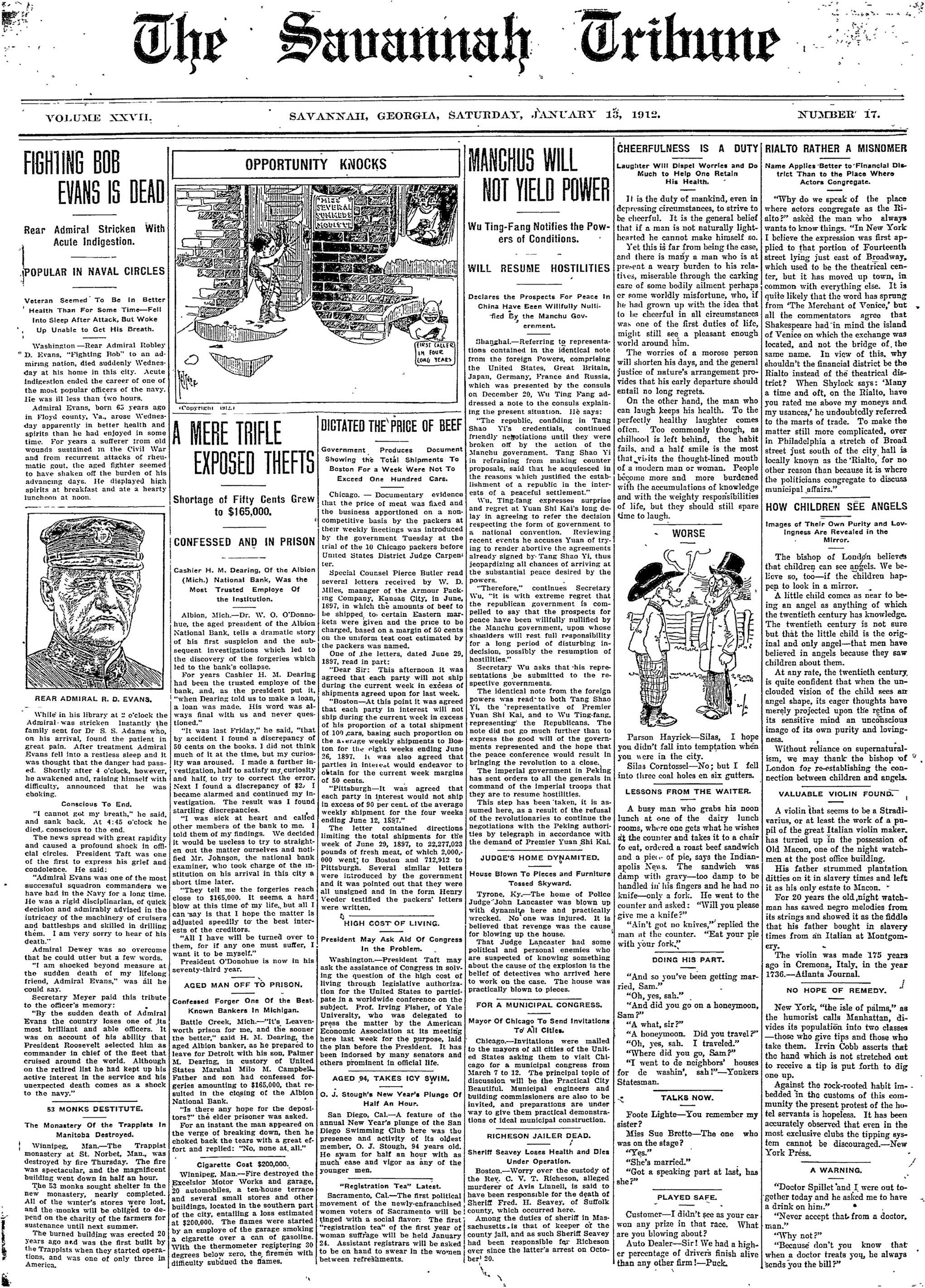
FIGHTING BOB EVANS IS DEAD
Rear Admiral Stricken With Acute Indigestion.
POPULAR IN NAVAL CIRCLES
Veteran Seemed To Be In Better Health Than For Some Time—Fell Into Sleep After Attack, But Woke Up Unable to Get His Breath.
Washington—Rear Admiral Robley D. Evans, "Fighting Bob" to an admiring nation, died suddenly Wednesday at his home in this city. Acute indigestion ended the career of one of the most popular officers of the navy. He was ill less than two hours.
Admiral Evans, born 65 years ago in Floyd county, Va., arose Wednesday apparently in better health and spirits than he had enjoyed in some time. For years a sufferer from old wounds sustained in the Civil War and from recurrent attacks of rheumatic gout, the aged fighter seemed to have shaken off the burden of his advancing days. He displayed high spirits at breakfast and ate a hearty luncheon at noon.
REAR ADMIRAL R. D. EVANS.
While in his library at 2 o'clock the Admiral was stricken Instantly the family sent for Dr S. S. Adams who, on his arrival, found the patient in great pain. After treatment Admiral Evans fell into a restless sleep and it was thought that the danger had passed. Shortly after 4 o'clock, however, he awakened and, raising himself with difficulty, announced that he was choking.
Conscious To End.
"I cannot get my breath," he said, and sank back. At 4:45 o'clock he died, conscious to the end.
The news spread with great rapidity and caused a profound shock in official circles. President Taft was one of the first to express his grief and condolence. He said:
"Admiral Evans was one of the most successful squadron commanders we have had in the Navy for a long time. He was a rigid disciplinarian, of quick decision and admirably advised in the intricacy of the machinery of cruisers and battleships and skilled in drilling them. I am very sorry to hear of his death."
Admiral Dewey was so overcome that he could utter but a few words.
"I am shocked beyond measure at the sudden death of my lifelong friend, Admiral Evans," was all he could say.
Secretary Meyer paid this tribute to the officer's memory:
"By the sudden death of Admiral Evans the country loses one of its most brilliant and able officers. It was on account of his ability that President Roosevelt selected him as commander in chief of the fleet that cruised around the world. Although on the retired list he had kept up his active interest in the service and his unexpected death comes as a shock to the navy."
53 MONKS DESTITUTE.
The Monastery Of The Trappists In Manitoba Destroyed.
Winnipeg, Man.—The Trappist monastery at St. Norbet, Man., was destroyed by fire Thursday. The fire was spectacular, and the magnificent building went down in half an hour. The 53 monks sought shelter in the new monastery, nearly completed. All of the winter's stores were lost, and the monks will be obliged to depend on the charity of the farmers for sustenance until next summer. The burned building was erected 20 years ago and was the first built by the Trappists when they started operations, and was one of only three in America.
OPPORTUNITY KNOCKS
(Copyright 1914)
MORLEAT
SEVERAL
SUMMER
FIRST CALLER
IN FOUR
LONG YEARS
A MERE TRIFLE EXPOSED THEFTS
Shortage of Fifty Cents Grew to $165,000.
CONFESSED AND IN PRISON
Cashier H. M. Dearing, Of the Albion (Mich.) National Bank, Was the Most Trusted Employee Of the Institution.
Albion, Mich.—Dr. W. O. O'Donnouhe, the aged president of the Albion National Bank, tells a dramatic story of his first suspicion and the subsequent investigations which led to the discovery of the forgeries which led to the bank's collapse.
For years Cashier H. M. Dearing had been the trusted employee of the bank, and, as the president put it, "when Dearing told us to make a loan, a loan was made. His word was always final with us and never questioned."
"It was last Friday," he said, "that by accident I found a discrepancy of 50 cents on the books. I did not think much of it at the time, but my curiosity was aroused. I made a further investigation, half to satisfy my curiosity and half, to try to correct the error. Next I found a discrepancy of $2. I became alarmed and continued my investigation. The result was I found startling discrepancies.
"I was sick at heart and called other members of the bank to me. I told them of my findings. We decided it would be useless to try to straighten out the matter ourselves and notified Mr. Johnson, the national bank examiner, who took charge of the institution on his arrival in this city a short time later.
"They tell me the forgeries reach close to $165,000. It seems a hard blow at this time of my life, but all I can say is that I hope the matter is adjusted speedily to the best interests of the creditors.
"All I have will be turned over to them, for if any one must suffer, I want it to be myself."
President O'Donohue is now in his seventy-third year.
AGED MAN OFF TO PRISON.
Confessed Forger One Of the Best Known Bankers in Michigan.
Battle Creek, Mich.—"It's Leavenworth prison for me, and the sooner the better," said H. M. Dearing, the aged Albion banker, as he prepared to leave for Detroit with his son, Palmer M. Dearing, in custody of United States Marshal Milo M. Campbell Father and son had confessed forgeries amounting to $165,000, that resulted in the closing of the Albion National Bank.
"Is there any hope for the depositors?" the elder prisoner was asked.
For an instant the man appeared on the verge of breaking down, then he choked back the tears with a great effort and replied: "No, none at all."
Cigarette Cost $200,000.
Winnipeg, Man.—Fire destroyed the Excelsior Motor Works and garage, 20 automobiles, a ten-house terrace and several small stores and other buildings, located in the southern part of the city, entailing a loss estimated at $200,000. The flames were started by an employee of the garage smoking a cigarette over a can of gasoline. With the thermometer registering 30 degrees below zero, the firemen with difficulty subdued the flames.
SAVANNAH, GEORGIA, SATURDAY, JANUARY 13, 1912.
THIEF
SEVERAL
CUMMERS
MOBILE
FIRST CALLER
IM FOUR
LONG YEARS
DICTATED THE`PRICE OF BEEF
Government. Produces Document Showing the Total Shipments To Boston For a Week Were Not To Exceed One Hundred Cars.
Chicago. — Documentary evidence that the price of meat was fixed and the business apportioned on a non-competitive basis by the packers at their weekly meetings was introduced by the government Tuesday at the trial of the 10 Chicago packers before United States District Judge Carpenter.
Special Counsel Pierce Butler read several letters received by W. D. Miles, manager of the Armour Packing Company, Kansas City, in June, 1897, in which the amounts of beef to be shipped to certain Eastern markets were given and the price to be charged, based on a margin of 50 cents on the uniform test cost estimated by the packers was named.
One of the letters, dated June 29, 1897, read in part:
"Dear Sir: This afternoon it was agreed that each party will not ship during the current week in excess of shipments agreed upon for last week.
"Boston—At this point it was agreed that each party in interest will not ship during the current week in excess of his proportion of a total shipment of 100 cars, basing such proportion on the average weekly shipments to Boston for the eight weeks ending June 26, 1897. It was also agreed that parties in interest would endeavor to obtain for the current week margins of 50 cents.
"Pittsburgh—It was agreed that each party in interest would not ship in excess of 90 per cent. of the average weekly shipment for the four weeks ending June 12, 1897."
The letter contained directions limiting the total shipments for the week of June 29, 1897, to 22,277,023 pounds of fresh meat, of which 2,000,000 went to Boston and 712,912 to Pittsburgh. Several similar letters were introduced by the government and it was pointed out that they were all unsigned and in the form Henry Veeder testified the packers' letters were written.
HIGH COST OF LIVING.
President May Ask Aid Of Congress In the Problem.
Washington.—President Taft may ask the assistance of Congress in solving the question of the high cost of living through legislative authorization for the United States to participate in a worldwide conference on the subject. Prof. Irving Fisher, of Yale University, who was delegated to press the matter by the American Economic Association at its meeting here last week for the purpose, laid the plan before the President. It has been indorsed by many senators and others prominent in official life.
AGED 94, TAKES ICY SWIM.
O. J. Stough's New Year's Plunge Of Half An Hour.
San Diego, Cal.—A feature of the annual New Year's plunge of the San Diego Swimming Club here was the presence and activity of its oldest member, O. J. Stough, 94 years old. He swam for half an hour with as much ease and vigor as any of the younger men.
"Registration Tea" Latest.
Sacramento, Cal.-The first political movement of the newly-enfranchised women voters of Sacramento will be tinged with a social flavor: The first "registration tea" of the first year of woman suffrage will be held January 24. Assistant registrars will be asked to be on hand to swear in the women between refresiments.
MANCHUS WILL NOT YIELD POWER
Wu Ting-Fang Notifies the Powers of Conditions.
WILL RESUME HOSTILITIES
Declares the Prospects For Peace In China Have Eeen Willfully Nullified By the Manchu Gov-
Shanghai.—Referring to representations contained in the identical note from the foreign Powers, comprising the United States, Great Britain, Japan, Germany, France and Russia, which was presented by the consuls on December 20, Wu Ting Fang addressed a note to the consuls explaining the present situation. He says: "The republic, confiding in Tang Shao Yi's credentials, continued friendly negotiations until they were broken off by the action of the Manchu government. Tang Shao Yi in refraining from making counter proposals, said that he acquiesced in the reasons which justified the establishment of a republic in the interests of a peaceful settlement."
Wu, Ting-fang expresses surprise and regret at Yuan Shi Kai's long delay in agreeing to refer the decision respecting the form of government to a national convention. Reviewing recent events he accuses Yuan of trying to render abortive the agreements already signed by Tang Shao Yi, thus jeopardizing all chances of arriving at the substantial peace desired by the powers.
"Therefore," continues Secretary Wu, "it is with extreme regret that the republican government is compelled to say that the prospects for peace have been willfully nullified by the Manchu government, upon whose shoulders will rest full responsibility for a long period of disturbing indecision, possibly the resumption of hostilities."
Secretary Wu asks that his representations be submitted to the respective governments.
The identical note from the foreign powers was read to both Tang Shao Yi, the 'representative of Premier Yuan Shi Kai, and to Wu Ting-fang, representing the Republicans. The note did not go much further than to express the good will of the governments represented and the hope that the peace conference would result in bringing the revolution to a close.
The imperial government in Peking has sent orders to all the generals in command of the imperial troops that they are to resume hostilities.
This step has been taken, it is assumed here, as a result of the refusal of the revolutionaries to continue the negotiations with the Peking authorities by telegraph in accordance with the demand of Premier Yuan Shi Kai.
JUDGE'S HOME DYNAMITED.
House Blown To Pieces and Furniture
Tossed Skward.
Tyrone, Ky.-The home of Police Judge John Lancaster was blown up with dynamite here and practically wrecked. No one was injured. It is believed that revenge was the cause for blowing up the house. That Judge Lancaster had some political and personal enemies who are suspected of knowing something about the cause of the explosion is the belief of detectives who arrived here to work on the case. The house was practically blown to pieces.
FOR A MUNICIPAL CONGRESS.
Mayor Of Chicago To Send Invitations To All Cities.
Chicago.—Invitations were mailed to the mayors of all cities of the United States asking them to visit Chicago for a municipal congress from March 7 to 12. The principal topic of discussion will be the Practical City Beautiful. Municipal engineers and building commissioners are also to be invited, and preparations are under way to give them practical demonstrations of ideal municipal construction.
RICHESON JAILER DEAD.
Sheriff Seavey Loses Health and Dies Under Operation.
Boston.—Worry over the custody of the Rev. C. V. T. Richeson, alleged murderer of Avis Linnell, is said to have been responsible for the death of Sheriff Fred. H. Seavey, of Suffolk county, which occurred here. Among the duties of sheriff in Massachusetts is that of keeper of the county jail, and as such Sheriff Seavey had been responsible for Richeson ever since the latter's arrest on October 20.
Laughter Will Dispel Worries and Do Much to Help One Retain His Health.
It is the duty of mankind, even in depressing circumstances, to strive to be cheerful. It is the general belief that if a man is not naturally light-hearted he cannot make himself so.
Yet this is far from being the case, and there is many a man who is at present a weary burden to his relatives, miserable through the carking care of some bodily ailment perhaps or some worldly misfortune, who, if he had grown up with the idea that to he cheerful in all circumstances was one of the first duties of life, might still see a pleasant enough world around him.
The worries of a morose person will shorten his days, and the general justice of nature's arrangement provides that his early departure should entail no long regrets.
On the other hand, the man who can laugh keeps his health. To the perfectly healthy laughter comes often. Too commonly though, as childhood is left behind, the habit fails, and a half smile is the most that visits the thought-lined mouth of a modern man or woman. People become more and more burdened with the accumulations of knowledge and with the weighty responsibilities of life, but they should still spare time to laugh.
WORSE
Parson Hayrick—Silas, I hope you didn't fall into temptation when you were in the city.
Silas Corntossel—No; but I fell into three coal holes en six gutters.
LESSONS FROM THE WAITER.
A busy man who grabs his noon lunch at one of the dairy lunch rooms, where one gets what he wishes at the counter and takes it to a chair to eat, ordered a roast beef sandwich and a piece of pie, says the Indianapolis News. The sandwich was damp with gravity—too damp to be handled in his fingers and he had no knife—only a fork. He went to the counter and asked: "Will you please give me a knife?"
"Ain't got no knives," replied the man at the counter. "Eat your pie with your fork."
DOING HIS PART.
"And so you've been getting married, Sam."
"Oh, yes, sah."
"And did you go on a honeymoon, Sam?"
"A what, sir?"
"A honeymoon. Did you travel?"
"Oh, yes, sah. I traveled."
"Where did you go, Sam?"
"I went to de neighbors' houses for de washin', sah!"—Yonkers Statesman.
Foote Lighte—You remember my sister?
Miss Sue Brette—The one who was on the stage?
"Got a speaking part at last, has she?"
Customer—I didn't see as your car won any prize in that race. What are you blowing about?
Auto Dealer—Sir! We had a higher percentage of drivers finish alive than any other firm!—Puck.
NUMBER 17.
RIALTO RATHER A MISNOMER
Name Applies Better to Financial District Than to the Place Where Actors Congregate.
"Why do we speak of the place where actors congregate as the Rialto?" asked the man who always wants to know things. "In New York I believe the expression was first applied to that portion of Fourteenth street lying just east of Broadway, which used to be the theatrical center, but it has moved up town, in common with everything else. It is quite likely that the word has sprung from 'The Merchant of Venice,' but all the commentators agree that Shakespeare had in mind the island of Venice on which the exchange was located, and not the bridge of the same name. In view of this, why shouldn't the financial district be the Rialto instead of the theatrical district? When Shylock says: 'Many a time and oft, on the Rialto, have you rated me above my moneys and my usances,' he undoubtedly referred to the marts of trade. To make the matter still more complicated, over in Philadelphia a stretch of Broad street just south of the city hall is locally known as the Rialto, for no other reason than because it is where the politicians congregate to discuss municipal affairs."
HOW CHILDREN SEE ANGELS
Images of Their Own Purity and Lovingness Are Revealed in the Mirror.
The bishop of London believes that children can see angels. We believe so, too—if the children happen to look in a mirror.
A little child comes as near to being an angel as anything of which the twentieth century has knowledge. The twentieth century is not sure but that the little child is the original and only angel—that men have believed in angels because they saw children about them.
At any rate, the twentieth century is quite confident that when the unclouded vision of the child sees an angel shape, its eager thoughts have merely projected upon the retina of its sensitive mind an unconscious image of its own purity and lovingsess. Without reliance on supernaturalism, we may thank the bishop of London for re-establishing the connection between children and angels.
VALUABLE VIOLIN FOUND.
A violin that seems to be a Stradivarius, or at least the work of a pupil of the great Italian violin maker, has turned up in the possession of Old Macon, one of the night watchmen at the post office building.
His father strummed plantation ditties on it in slavery times and left it as his only estate to Macon.
For 20 years the old night watchman has sawed negro melodies from its strings and showed it as the fiddle that his father bought in slavery times from an Italian at Montgomery.
The violin was made 175 years ago in Cremona, Italy, in the year 1736.—Atlanta Journal.
New York, "the isle of palms," as the humorist calls Manhattan, divides its population into two classes—those who give tips and those who take them. Irvin Cobb asserts that the hand which is not stretched out to receive a tip is put forth to dig one up. Against the rock-rooted habit imbedded in the customs of this community the present protest of the hotel servants is hopeless. It has been accurately observed that even in the most exclusive clubs the tipping system cannot be discouraged.—New York Press.
A WARNING.
"Doctor Spillet and I were out together today and he asked me to have a drink on him."
"Never accept that from a doctor, man."
"Why not?"
"Because don't you know that when a doctor treats you, he always sends you the bill?"
Tiny Sparks Have Often Kindled Monster Conflagrations.
CONFLICTS BORN OF TRIELS
A BROKEN TEAPOT AND A STOLEN BUCKET COST YEARS OF CARNAGE AND HUNDREDS OF THOUSANDS OF LIVES—PAUL KRUGER AND THE GREAT BOER UPRISING.
The history of warfare contains numerous examples of conflicts that have originated through trifling causes, says the London Globe. For instance, Turkey in the past suffered greatly in a war with Venice. When the Venetian ambassador was asked by the Turkish grand vizer to ratify a treaty by swearing in the Moslem fashion upon his beard and the beard of the prophet, he declined because, as he said, "the Venetians wear no beards."
This remark was too much for the Turk, who retorted angrily, "Nor do monkeys!" an exclamation which caused the other to fear up the treaty and retire from the conference. The sequel was a sanguinary conflict in which fell 30,000 Christians and four times that number of Turks.
But the Turks were not the only ones to use blows instead of arguments on the slighest provocation. The emperors of China have ever been famous in this direction, the record instance being a war 250 years ago which began through the smashing of a teapot. This indispensable household article was looked upon-by its owner, a high dignitary of the court, as a priceless treasure, and consequently it accompanied the great man on his journeys.
It so happened that when he was traveling through the lawless provinces in the northwest of China some of his retinue were intercepted by a band of robbers, who found the teapot among the baggage and indignantly flung it to the ground and broke it. The matter was reported to the emperor, who was so indignant at his favorite's loss that he sent out punitive force and a long war began which resulted in the death of 500,000 men.
A conflict over a teapot, even a valuable one, seems almost out of the range of possibility until one recalls that a bucket was once the innocent cause of a terrible war. Nine hundred years ago a party of soldiers of Modena stole a bucket, apparently as a practical joke, from a public well in Bologna and refused to restore it. Fights thereupon took place between the soldiers of the rival states and started a war which devastated a large part of Europe.
The cash value of that bucket was only a few shillings, but wars have often been waged concerning things that represented little from a monetary point of view. An excellent illustration is afforded by Algeria, which came into the possession of France through a disagreement over a petty debt. The bey of Algiers demanded immediate payment through the French consul, who asked for time to pay and in reply was beaten and thrown into prison.
A couple of days later a conflict was begun that continued for 20 years, during which time more that 500,000 lives were sacrificed. Such a calamity was surely unnecessary for so paltry a cause, and the same remark is equally applicable to other wars.
In 1879 the Transvaal was declared a crown colony, and the salaries of officials, both Dutch and British, were cut down. Among the number so treated was a certain Paul Kruger, whose salary was reduced by £50 per annum. The loss of the money annoyed the Dutchman, who raised the standard of revolt. As a consequence there followed the Majuba Hill fight, years of agitation, the Jameson raid and finally the great war which cost Britain £220,000,000 and the lives of 25,00 of her sons.
But the most curious war ever waged over a little matter occurred in the sixteenth century. It was carried on single handed for about six years between a bankrupt grocer of Berlin and the elector of Saxony. The immediate cause of the quarrel was the arresting of two of the tradesmen's horses in the elector's territory, he being a subject of the elector of Brandenburg.
Falling to get redress, he adopted what was then a perfectly legal expedient and declared formal war on the realm of Saxony. The declaration was accepted in due form, and the war began. The grocer burned farms and even villages, employed mercenaries after the fashion of the times and made himself the terror of the district.
He was finally influenced to stop hostilities by Luther, but was betrayed into a further act of hostility by treachery and, being captured, suffered death on the wheel.
BETTER THAN A GOOD RAIN.
While it has not been found possible to make it rain, something even better has been discovered, and that is that the moisture can be bottled up in the soil. When a soil is full of moisture, as in the spring, the evaporation is rapid. If the soils compact, amounting to about an inch a week. By stirring the surface, thus forming a soil mulch, this evaporation is stopped and the moisture saved in the soil. This is better than a good rain in the growing season, and it has the further advantage of warming up the soil.
STATE INDUSTRIAL DEPART-
MENT QUINDARO, KANSAS.
Standing upon the most beautiful and picturesque site, overlooking the placid Missouri river whose shifting sands are constantly meandering slowly and silently toward the Mississippi, are the Western University and the state industrial department, which department has been so benefically developed and fostered by the great state of Kansas for the industrial training of the Negro youth. That the Western University and its individual department are great and flourishing institution for the moral, intellectual and industrial training of the Negro youth, is evidenced by the fact that each succeeding year brings a greater number of students than the preceding one. At the head of this great growing educational institution is President H. T. Kealing, and we wish to say right here that language is inadequate to describe the great work that has been and is being done under the direction and management of this great educator. To fully comprehend the scope and magnitude of the wonderful achievements of President Kealing you must visit the education institutions and see for yourself. The one thing more than any other for which the Negroes in Kansas, and those everywhere who are interested in the education of the Negro, should rejoice, is the absolute divorcement of this institution of learning from politics as all educational institutions should be. President Kealing is no politician. He is an able, dignified and scholarly gentleman who is endowed by nature with a splendid intellectuality which, by virtue of his experience of almost a lifetime in educational work, fittingly qualifies him for his present high and honorable position. The life of President Kealing has been an exceedingly busy one, in the church and in the school, for the moral and intellectual uplift of his race. He is one of the great litterateurs of the race and is noted for having written several literary works of great excellence in the world of letters. President H. T. Kealing is comparatively a young man, having been born in Austin, Texas. He was educated at Straight University, New Orleans, La., and Tabor College, Tabor, Iowa. That the life of Dr. Kealing has been one of great usefulness to his race will be observed from the many prominent positions he has from time to time occupied as follows: Supervisor of Public Schools, Austin, Texas; Assistant Principal State Normal and Industrial College, Prairie View, Texas; President, two terms, Colored State Teachers' Association of Texas; President, Paul Quinn College, Waco, Texas; Member National Educational Association, and representative of Texas on speaker's program at session held in Topeka, Kansas; Member American Society of Political Science, Philadelphia, Pa.; Member Negro Academy, Washington, D. C.; Delegate and A. M. E. spokesman to Ecumenical Conference, World Methodism, London, England; Editor A. M. E. Review, Philadelphia, Pa., and unanimously re-elected three times; Delegate Federation of Churches of Christ, Philadelphia, Pa.; President of Western University, Quindaro, Kansas, and Negro representative to World Peace Congress, Chicago, Ill.
Doctor Kealing has traveled extensively and lectured in England France, Scotland, Switzerland, and throughout Europe. As a writer Doctor Kealing has but few equals and no superiors in the race. He is a contributor to various magazines, including the Century Magazine, New York, and the New England Journal of Education, Boston, Mass. The splendid executive ability, experience and business sagacity of President Kealing will, in a few years, enable him to make the Western University and industrial department flourish among the great educational institutions of the country. The Negroes of Kansas and the Southwest generally were exceedingly fortunate in being able to secure the invaluable services of Doctor Kealing, and which are so essential to their future growth and development. Doctor Kealing is a genial, affable gentleman, of sound, comprehensive judgment—and a great practical educator of whom the colored people should be 'proud.'—Paul Jones', Aug., 1911.
THE BITTER BROWNS.
Mayor Crump of Memphis was talking about two opposing factions in a nearby town.
"They are as bitter," he said, "as the two Browns.
"The two Browns spelled their names differently—one used an 'e'—and they were dreadful rivals, socially.
"They met one evening at a banquet and Browne said with a sneer:
"A fool asked me today if I was any relation to you. I told him if you had a single drop of my blood in your veins I'd cut it out of you."
"And if I had," said Browne, "I'd let you."
GET OUT OF THE AVERAGE.
Average farming is not now, and never has been, profitable, but it is the only kind of farming that average farmers can do. Improvement in men is reflected in all their works. Better men can be developed by teaching children the simple science of agriculture. To raise the average crop yields involves an uplift of society as a whole. Education is a national problem.
EXTRACTS FROM BOOKER T. WASHINGTON'S FORTHCOMING BOOK, "THE MAN FARTHEST DOWN."
It was a Jewish trader who advised me to visit Jedlovka. He said that I would see the peasants living there now as they had lived for hundreds of years, in the simplest and most primitive fashion.
Jedlovka, I found, is a little straggling village in the foot hills of the Carpathians, the mountains which divide Gallecia from Hungary.
High up, where the road, winding up out of the valley, leads out into a high, clear space, at what seemed to be the top of the mountain, there is a church and this tavern and the church together with a few scattering log huts, is the village of Jedlovka and the end of our journey.
I had had a vague scrt of notion that somewhere in this remoe region I should meet peasants wearing sheep skin jackets, sandals and leggings, bound with thongs, driving their herds to pasture. I even had a wild hope that I should come upon some rustic festival, such as I had read about, where the young men and women would dance upon the green sward, to the music of shepherd's pipes. As a matter of fact, it chanced that our visit did fall upon a feast day, but there were no shepherds and no dances. What I saw was a crowd of women pouring out of the little church high upon the hill, and crowds of drunken men carousing at the tavern below.
The houses in this part of the country were, for the most part, smaller, more weather worn and decrepit, than those I had seen in other narts of the country. In fact, in some cases the green thatched roofs were so old, so overgrown with vegetation, and the little whitewashed frames of the buildings that supported them had so sunken into the soil, that some of them looked like gigantle toad stools. As the day we visited this part of the country was a holiday we met along the way many of the peasants dressed in the quaint and picturesque garb of the country, passing in groups of two or three along the road.
I had before this visited a number of the peasant houses and was familiar with the plan and arrangement of them. The interior of these houses is usually divided into two rooms, separated in most cases by an entrance or hallway. In one of these rooms the whole family, consisting of the parents and perhaps five or six children, live, eat and sleep. In this room there is usually a very large brick or stone oven, which on the cold winter nights, I learned, frequently serves the purposes of a bed. In the other room are the cows, pigs, geese, chickens. If the farmer is well-to-do he will have a number of buildings arranged in a hollow square having a goose pond in the center and, in that case, the servants will very likely sleep in the straw in the barns with the cattle.
The house I visited in the mountain contained only one room for the whole family, including the cow, the chickens and the rest of the animals. It is very cold on the north side of the mountains in winter and the peasants and cattle frequently live in the same room, I found, to keep warm. In one of the little hunts which I ventured to enter I found two old women lying down apparently asleep on a heap of straw; a cow standing nearby them was peacefully chewing her cud, while several chickens were busily scratching among the straw on the earth floor. As there was almost no ventilation the air in some of these houses was almost indescribable.
It was in this part of the country in the vicinity of the village tavern that I-found people who were poor, even by the very moderate standard of comfort that prevails in rural Poland. We passed on the drive up the valley a number of little huddling straw-thatched huts. One of these, which did not seem to be inhabited, I determined to explore. The building was of the prevailing type, with the cow shed in one and the living room in the other, but the thatch was no longer green, and age had imparted to the whole of the outside of the building a very dismal weatherworn appearance. The windows were evidently of skins of the same brown color as the building itself. The entrance was through what would evidently have been the cow shed, but this was empty. The door into the living room was open, and, as I entered, I saw as first only a cow tied to a manger.
At the other end of the room hovering about a little open stone hearth on which a little fire of twigs burned, was an old man and woman. As is frequently the case in many parts of Poland there was no chinney and the rafters of, the house were deeply incrusted with the smoke which had accumulated in the peak of, the roof and filtered out through the tatch or an opening at the end of the building. The old people seemed very poor and helpless and, as I was about to leave the room, they held out their hands and begged for alms. I should like to have stayed and talked with them, but unfortunately I had no one with me-at that time who was able to speak the Polish language.
As I learned that a number of people had gone to America from this valley I suspected that these old people were some of those who had been left behind and, perhaps, forgotten by the younger generation who had gone across the seas. I made some attempt
With all hotel conveniences. Hot or cold baths. Large parlor with reading matter and music. Polite help. Carriage and hacks, also telephones. If you want a hack or carriage ring up 676 and, the manager will see that you get it. Rooms to let at 25 cents.
$21 BROUGHTON STREET, EAST. Next Door to Red Cross Pharmacy Special Prices Given for Thir ty Days. A full line of Latest Fall and Win ter Goods.
Two suits cleaned and pressed per month for $1.00. Ladies' work specialty. Goods called for and delivered. All work guaranteed. Steam and dry cleaning. 816 EAST BROAD STREET. Phone 1319
THOMAS BAKER.
First class SHOE REPAIRING. Half sole, sewed, 85 cents; nalled, 50 cents; rubber heels, 35 and 50 cents. All work guaranteed. CORNER EAST BROAD AND BOLTON STREETS.
Save the old ones and send to us. We make them new—Stoves, Furniture, Mattresses, Carpets. CARPET AND MATTING LAYING A SPECIALTY. Old furniture bought and sold. Packing and Shipping. Goods called for and delivered.
JACKSON & SLOCUM, Upholsterers
When Your Eyes Trouble You CONSULT OUR OPTICIAN.
FOR SAFE, COMFORTABLE AND CLEAN LODGING PERMANENT OR TRANSIENT Stop at McCARTHY'S 233 BRYAN ST., WEST. FIRST CLASS BANITARY BARBER SHOP AND RESTAURANT AT TACHED. 230 ST. JULIAN STREET, WEST.
I wish to notify all of my old patrons that I have purchased my old stand at Hall and Price streets, and would be glad to have them patronize me. Phone me at 601 for anything you may want and I will deliver to you promptly. Respectfully,
THE PROGRESSIVE MAN
later to learn if my suspicions were well founded, but no one whom I afterwards met seemed to know anything about the history of the old people. The wealthiest landlord in the vicinity was, I learned, a Polish priest, who owned four different farms and most of the people in the neighborhood seemed to be his tenants. He lived in a big, bare, rambling house, surrounded by great barns filled with cattle and produce of various kinds. I stopped to call at this house, thinking that I might learn something from him about the poor people I have referred to, but the good priest was not at home and the people whom I found at his house did not seem to be able to tell me anything.
SEE THE
The tavern, which was a long, low, log structure, built on the same general plan as the houses in the village, was crowded with revelers and steaming with the fumes of beer. Men were standing about, swinging their arms and shouting at each other at the top of their lungs, and almost every one of them was drunk. Several of the men present, including the proprietor, had been, as I learned, in America. One of them, who could speak a few words of English, gave us an especially hearty welcome. Some of the money which pours into Poland from America had reached even this remote corner of the country, it seemed. I asked the proprietor, who had lived in Newark, N. J., for a time and spoke a little English, whether he liked this part of the world better than America.
"It is easier to live here," he said. Then added, "When you have a little money," "But when you haven't any money?" I suggested He shrugged his shoulders, "Then we go to America," he said. He told me a good deal of land had been purchased in this part of the country with money earned in America. Land was worth from five hundred to one thousand guilders per "yoke," which is about one hundred or two hundred dollars per acre, a very large sum in a country where wages are, perhaps, not more than twenty-five or fifty cents a day.
At nightfall as I was leaving the village I began to contrast the condition of these Polish people with that of the negroes in the "Black Belt" of the south. Even thirty years ago when I first went into the "Black Belt" I found no such squalor, no such abject poverty, no such promiscuous living as I found to exist in the Polish village of Jedlovka.
24TH OFF FOR PHILIPPINES
The Twenty-fourth infantry, which has been stationed at Madison barracks and Fort Ontario since March, 1908, sailed from San Francisco on the transport Logan on Tuesday for Manila. This makes the third time that the regiment has made the trip to the islands. After making an excellent record in Cuba during the war with Spain, volunteering before Santiago as yellow fever nurses, the Twenty-fourth infantry was stationed in Utah, Wyoming, California and Washington, until July 14, 1899, when it left San Francisco for Manila. Company L did not accompany the rest of the regiment, but was sent to Alaska.
On returning from the Philippines in August, 1904, it was stationed in Montana until January, 1906, when it was again sent to Manila. When it returned to the United States in March, 1908, it was sent to posts in this state. The Watertown, N. Y., Times has the following to say about the conduct of the men of the regiment:
"The departure of the Twenty-fourth marks the end of an experiment of the war department, putting colored soldiers in northern posts. There was a protest when the regiment was ordered here, but the colored soldiers have proved that they could conduct themselves properly and have won the admiration of all."
ALFALFA LEAVES.
Several years ago the Nebraska Experiment Station found that in throwing down hay for cattle the alfalfa leaves dropped off in-considerable number and were easily gathered together and scooped up from the floor. It occurred to them to try feeding these alfalfa leaves to pigs and the plan was found to be an excellent one. It is almost as valuable as wheat shorts, if mixed with a ration of ground barley or corn meal of feeding pigs. If your wives ever happen to see the poultry have a chance to pick up the alfalfa leaves, you will be obliged to save them for that purpose regularly. I might say that it will pay you very well as it proves an excellent stimulus for poultry during the winter. We usually take the leaves and pour hot water over them, allowing them to soak a few minutes before we give them to the poultry.—Kansas Farmer.
HER CREDIT WAS SUSTAINED.
A young country merchant, who had something of a reputation for close figuring, was especially attentive to the village school ma'ma. The young woman had a sweet tooth and was not at all retiring about making the fact known. Accordingly, she hinted to her admirer that a box of chocolates would be greatly appreciated on the occasion of his next visit. Later the suggestion was repeated and again duly beeded. The third time the subject was broached, however, the dispenser of sweets turned a deaf ear to the entreaty.
"I don't know about taking that girl any more candy," he confided to a companion next day. "She's owl'in me 60 cents for chocolates already."—Lippincott's Magazine.
THE JOHNSON HOTEL
MEALS AT ALL HOURS.
PRINCE R. BUTLER, Manager and Proprietor.
HIGH ART TAILORS
BOLTON STREET, EAST. Next Door to Red Cross Pharma.
Special Prices Given for Thirty Days. A full line of Latest
Fall and Winter Goods.
So After
business ....
a business way---the
advertising way. An ad
this paper offers the
maximum service at the
minimum cost. It
aches the people of the
own and vicinity you
ant to reach.
Try It---
It Pays
Mordecie Pressing Club
cleaned and pressed per month for $1.00. Ladies' work
goods called for and delivered. All work guaranteed. Steam
unning.
BROAD STREET. Phone 13
MAS BAKER,
The
Shoemaker
SHOE REPAIRING. Half sole, sewed, 85 cents; nailed
ber heels, 35 and 50 cents. All work guaranteed.
CORNER EAST BROAD AND BOLTON STREETS.
Don't Buy a New One
hold ones and send to us. We make them new—Stoves, Furn
uses, Carpets. CARPET AND MATTING LAYING A SPE
fiture bought and sold. Packing and Shipping. Good
and delivered.
ON & SLOCUM, Upholsterer
HIGH ART TAILORS
in a business way---the advertising way. An ad in this paper offers the maximum service at the minimum cost. It reaches the people of the town and vicinity you want to reach.
The Mordecie Pressing Club
Don't Buy a New One
BOLTON AND EAST BROAD STREETS.
In Your Eyes Trouble You
CONSULT OUR OPTICIAN.
M. SCHWABS' SON
11 BULL STREET.
COMFORTABLE AND CLEAN LODGING PERMANENT
OR TRANSIENT
top at McCARTHY'S
233 BRYAN ST., WEST.
BANITARY BARBER SHOP AND RESTAURANT AT
TAC HED.
230 ST. JULIAN STREET, WEST.
TO MY FRIENDS
notify all of my old patrons that I have purchased my cienl and Price streets, and would be glad to have them patronize me at 601 for anything you may want and I will deliver the y. Respectfully.
ERSON DRUG COMPANY
ERSON, PROPRIETOR. Corner HALL and PRICE 8
PROGRESSIVE MAN
Is the one who makes it his business to advertise his business thoroughly. Now is your opportunity
The Farm
"I am often asked," remarked Uncle Parker, "What do you mean when you say, "Use good garden soil?" What is and what is not good garden soil is largely a question of moisture, composition, air possibilities and soil.
"First comes drainage, either natural or artificial. Moisture is a necessity, but standing water is destructive. It is a principle of physics that no two forms of matter can occupy the same space at the same time. So standing water is a dog in the manger. It must be provided an outlet. Provide moisture at the bed of the seed or the feeding roots of the plant by allowing a close position of the small particles of matter, but prevent the escape of this moisture by breaking the close portion of each particle of soil near the surface. This stirring destroys the capillary attraction and the pumping of moisture into the air nearly ceases.
"Secondly, good garden soil must have a condition that air will be allowed to circulate in it. Enough to feed oxygen to the bacteria that need it in preparing the soup plants use. Carbon is absorbed largely through the leaf, but the root demands its share.
"The composition of soil is based largely on the rock from which it was made. If leachy it must be thickened. If it will cling enough to slowly crumble when pressed and released its sand composition is no detriment provided there is plenty of humus. The clay soil to be good must have been sanded until it is provided with with an abundance of spaces. It, too, should slowly crumble when released after being pressed. Silt the same.
"Good garden soil must be fine filled with humus of the same kind to the depth of a fork or spade, dark in color and sweet. If your garden will not bear the test on every square foot, this fall is the time to amend the poor parts. Put into condition this fall. The frost will aid." American Producer.
HOW TO CURE HAMS.
The methods of curing hams are as follows: Trim them neatly and make a brine strong enough to float a fresh egg. Put them in this and let them remain four or five days to draw all blood. Then take them out and boil and skim the brine and when cold return them to the brine, adding enough fresh brine to cover them, and then add for each 100 pounds of ham a pint of black molasses and an ounce of saltpeter, and let the hams remain in the brine two or three weeks. Then take them out and hang and smoke well with hickory wood or corn cobs and smother with green cedar brush. When well smoked, take them down and paint them all over with a thick mixture of black molasses and black pepper. Wrap i nstout brown paper and put each in a cotton sack and dip it in lime wash and hang it in a dark smoke-house. The hams will improve till a year old.
I treat shoulders in, the same way, and sides, except that the sides remain in the brine half the time the hams do. Jowla treated in this way are fine for boiling with turnip greens in the spring—W. F. Massey, in The Progressive Farmer.
CARE OF THE BROOD SOW.
The matter of exercise with the brood sows is too often neglected. Without philosophizing and giving the reasons why, I will say that it is absolutely necessary. To neglect the exercise is to endanger the chances of success with the spring pigs. It is by far better to compel the sows to go a considerable distance for their feed, twice per day, than to trust to moderately warm weather to encourage them to stir out and exercise of their own will. They will be prone, if well fed, to spend a good deal of time in the nest, not exercise enough to insure a good circulation of blood, the whole system becomes sluggish and they are unable to transmit life and vigor enough to the pigs to enable them to live and get a start in life.—Michigan Farmer.
A RULE FOR FEEDING COWS.
"The experiment station method is to feed as many pounds of grain per day to each cow as she produces pounds of butter fat per week, or one-fourth on-third as much grain as she gives pounds of milk daily. No two cows can be fed exactly allike; each must receive individual attention, according to her requirements. A general grain mixture may be used, however, which will meet the needs of most of the cows in the herd. The amount of this mixture to be given may then be varied according to the production of the cow. High producers need more protein than cows producing only small amounts of milk and butter fat. The amount of feed used by cows depends also upon their body weight, larger cows requiring more feed for maintenance.
SOMETHING TO TAKE THE PLACE OF COTTON.
There is no part of the country where corn can be grown more successfully than in the South.
There is no section that can compete with the South in the production of winter oats.
There is no section of the country that can compete with the South in the production of crops for hogs to gather for themselves and thus to raise cheap pork.
There is no section of the country that can compete with the South in the production of forage from legume crops and grasses, and there is more future in hogs and cattle and diary productions than in black-eye peas and lima beans as field crops.
If you are really compelled to drop the cotton crop, simply go to farming as farmers do elsewhere. Adopt a good rotation of crops. Grow corn with peas among it, then oats followed peas and hay. Then oats again on the pea stubble with liberal applications of acid phosphate or Thomas phosphate. Follow with peas again, and sow crimson clover or veath on the pea stubble and manure with the stover and the pea hay and turn all over in the spring for corn and then repeat the rotation, and my word for it, you will soon get into shape to not miss the cotton. You will have forage and grain for cattle and hogs. Then you can lay off a series of, say, four lots and fence them and on these keep up a constant succession of crops for hogs to gather like rape, crimson clover, cowpeas, sweet potatoes, etc., that will carry the hogs through winter and summer till time to fatten on corn. There is not the slightest need for hunting up strange crops, but simply to farm well with the regular farm crops.
But if I were farming in the weevil-infested sections, I would certainly make a strong fight before giving up cotton as part of a good farm rotation.—Prof. W. F. Massey, In The Progressive Farmer
CATARRH IN COWS.
Nasal catarrh is an infammation of the mucous membranes of the nosirrils and upper air passages. Simple catarrh is not a serious disease itself, but if neglected is liable to be complicated with diseases of the respiratory organs, which are of serious nature, and sometimes fatal.
Catarrh is a common disease among cows. It is often due to sudden exposure to wet and cold after they have been accustomed to shelter. It may arise from inhalation of irritating gases. It is sometimes due to certain specific atmospheric conditions, and may assume an enzootic form. It is very debilitating, and requires prompt and judicious treatment.
The animals should be housed in a well-ventilated place, with good hygienic surroundings. In cold and damp weather it should be kept warm with blanketing.
If the fever is high, this may be reduced by giving nitrate of potassium from one to two ounces, in the drinking water, three times daily. Diffusible stimulants are beneficial in most cases. Too much importance cannot be attached to good nursing.—Journal of Agriculture.
WHAT THE ROBIN IS WORTH.
What is a robin worth to a fruit-grower? asks the Industrialist. The answer to this question depends upon two things. First, as to whether the person concerned is a grower of large or small fruit; second, the amount of fruit grown. To a gardener or grower of large fruits the robin is a useful bird. Very early in the spring it may be seen at work patrolling garden and field for grubs and other insects. It arrests the destructive work of these pests and rets its board free.
The robin has no consideration for eight-hour laws. It puts in full time, from daylight until dark. Of course, it does not go out and get a cutworm, just because a cutworm damages things. It gets the worm because it, the bird, needs it. The robin eats other destructive members of the caterpillar family. The June bug forms a large part of its menu. While the robin eats a large amount of fruit, nearly one-half of this fruit is wild. What it takes of man's cultivation is comparatively small. The robin comes early in the spring and stays until late in the fall. These things considered, it has a definite worth to the farmers.
INDIGESTION IN HORSES.
A good ration for a horse that is troubled with indigestion is mixed as follows: Ground oats and corn, 5 pounds each; 4 ounces of oil meal, 2 ounces of salt, a dessertspoonful of powdered gentian and a small teaspoonful of dried sulphate of iron. If the animal refuses the ration, a little starvation will make him taste it, when the dislike will cease. Begin with a small quantity of this ration for each meal and increases gradually until a full ration is being fed. As the cold weather comes on horses that have been overworked often fall in condition, and need special attention to build them up again—Field and Farm.
I will say to my soul, Soul, thou hast much goods laid up' for many years; take hine case, eat, drink, be merry.-Luke 12:19.
I press on toward the goal, unto the prize of the high calling of God in Christ Jesus—Philipians 3:14.
There are two words which, each from its own peculiar standpoint, are most frequently used in designating the ultimate goal of human endeavor and achievement. These words are success and salvation. As they are generally used, they are distinct and set apart with little thought of relation to each other. The word success is used in a secular sense, and it applies to achievements that belong to this world, such as making a living, the gaining of wealth, the attainment of social recognition, the promotion to high office. It applies to the man who has made good in business, in politics, in promoting an industry or in any other activity in which certain recognized visible results are, sought and attained.
In this sense the "certain rich man" of the parable, whose ground brought forth plentifully, was a success. He had much goods laid up for years. He could take his ease, eat, drink and be merry. The man who has made money in business is a success. He can build himself a fine house, and he can have all the automobiles he wants. In this sense the man who goes into politics, holds high office and makes money faster than his salary can account for is a success, if he is not caught in the tangle of his devious ways. In this sense the most honest and faithful man alive, without any reflection whatever upon his character, is a success, provided he has gained certain tangible results that the world has sense enough to see and appreciate. Success has to do with—
Things done, that took the eye and had the price;
Oer which, from level stand,
The low world laid its hand.
Found straightway to its mind, could
value in a trice.
On the other hand, salvation is supposed to belong to the realm of spiritual thought, entirely set apart from the secular. Salvation has to do with the forgiveness of sins, peace with God, plous observances and the attainment of heaven. Salvation has nothing to do with success on earth. It belongs not to this world. It is a thing apart; it has to do with the life to come.
Earthly joys no longer please us;
Here would we renounce them all.
In this sense those who have literally forsaken the world, having nothing to do either with its business or its pleasures, but applying themselves to the mortification of the flesh, to penance and to prayer. In the solitude of cells and caves, are attaining salvation; for they give their whole thought to the gaining of heaven. Salvation is other worldliness.
These two conceptions of success and salvation I have, of course, presented in their extreme forms. On the one hand, there are those who devote themselves exclusively to other worldly considerations. Between the two extremes, however, are various combinations and interminglings of the two conceptions, more or less inconsistent and otherwise. There is the familiar effort to serve God and mammon at one and the same time. There are those who would make sure of heaven first of all, but at the same time insist upon taking their filing at the enjoyment of as much of the questionable as they dare without jeopardizing too much their chances for
RECIPES.
Sweetbreads have their coterie of enthusiastic followers, sometimes to the extent of appearing twice a week on the home board. When carefully prepared they are a delicious dish.
Rice Pudding—Wash well a half cupful of rice. Put in your baking dish as much milk as it will hold with the rice. Allow it to boll, and as the milk is absorbed keep adding more until a quart and a half has been used. Add three-fourths of a cupful of sugar and a small lump of butter. Bake until brown.
An important feature of the making is to skim the brown crust off the first six times it form before finally allowing it to remain. Sweet cream may be served with the pudding, or better, frotted cream, which is not so dry as whipped cream.
Sweetbreads—The first treatment of sweetbreads is always the same, no matter in what form they are served. When they come from the market soak in cold water for two hours, then boil five minutes in fresh water, drain and drop again in cold water.
Now wipe, pull off the wind pipes and fibres, after which they may be prepared in any way preferred.
Potato Cake—Season one pint of mashed potatoes with one tablespoonful of melted butter, one-half teaspoonful of salt and pepper to taste. Add one egg, mix until light, run through a strainer, return to the fire and stir a few minutes. Allow to cool, form into small flat cakes or patties, roll in egg and bread crumbs and drop into not fat, to fry a golden brown. Garnish with minced parsley.
heaven. There are those who give themselves frankly to worldly success and the accumulation of riches, believing that generous contributions to various charities will in due time make everything right with God.
Success takes life and puts it to its best and hollest use. Success takes material things, earth's treasures, the enjoyments of sense, nature's powers and resources, the strength of muscle and the vigor of brain, and makes them all minister to life. The aim of success is to take temporalities in all their, limitation and crudeness, extract from them that which is good and true and pure, and make them minister to the eternal. Said Browning:
"To man propose this test—
Thy body at its best.
How fan can that project thy soul on its lone way?" Therefore, when a man boasts that he is successful because he is rich, or because he hold a high office, ask him what his success is doing for his soul. Rest assured that if his so-called success permits the temporalities of life to submerge his soul he is but a dismal failure. The materialities of life ought in their way to minister to the soul and to furnish an avenue by means of which the soul shall climb above the temporal and emerge into the light of the eternal.
The man who would succeed must be unselfish, kind: true, loving, just, careful both for soul and body, mindful of the will of God, considerate of the right of others. He is not making money—God forbid! He is delivering goods for others to use; he is practicing law to the end that justice may be served; he is building houses that the community may be improved; he is making shoes in order that children's feet may be protected from the snow; he is teaching for the purpose of preparing a child for a noble manhood; he is a physician that pain may be relieved and disease destroyed, thus each working not for himself alone but for the common good—
Till all success be nobleness,
And every grain divine.
Such a man is making soul
Such a man is making soul.
After defining success in this fashion we need hardly define salvation further, for this kind of success, devoted as it is to the Master's kingdom, must inevitably find its true fulfillment in salvation. Salvation is success carried to its full completion.
"till we all attain to the unity of the faith, and of the knowledge of the Son of God, until a full-grown man, unto the measure of the stature of the fullness of Christ." Salvation is success carried into the realm of the spiritual and unward to the heights of the eternal; it is the consummation of the soul's full power and true happiness, the achievement of its predestined end, its entrance through Christ into full communion with God.
FIXING PRICES.
The farmer is about the only man in the world who allows the other fellow to fix the price on everything that he buys and sells. He sells his live stock and farm products for what he can get, which is a price fixed by somebody else, and buys for what others ask for their goods. Through the operations of the Grange and a serious study of this question efforts are being put forth to change this condition through co-operative buying and selling. If the figures furnished by the department of agriculture are true for the whole country, then the farmer only gets about a quarter cent, of what the consumer pays for his products. This would seem to open a new field of interest to the farmer in which he could market his own products or cooperate with his neighbors in doing so, and thereby secure a higher price for himself and a lower price for the consumer—Kansas Farmer.
BUSINESS.
A train in Arizona was boarded by robbers, who went through the pockets of the luckless passengers. One of them happened to be a traveling salesman from New York, who, when his turn came, fished out $200, but haplidly took $4 from the pile and placed it in his vest pocket.
"What do you mean by that?" asked the robber, as he toyed with his revolver. Hurriedly came the answer: "Mine frent, you surely would not refuse me two per zent, discount on a strictly cash transaction like dis?"
POETRY of and by Our People
Only a little way
Our roads together run.
Just for a brief sweet day
Beneath the sun.
Only a little while
For you to ease my load
While I your cares beguile
Along the road.
Just for a Summer day
Until the twilight fall
Not as two lovers, nay,
Comrades—that's all!
When the Sun's glowing heart
Thrills like a rose on fire,
We will clasp hands and part
Lest either tire!
Clasp hands, press lips, cling close
One mad, sweet moment, so!
Then each a twilight path
Lonely must go.
Clasp hands, press lips, cling close,
Then, if you will, forget
That, comrades of the road,
We ever met!
-Winifred Sutcliffe Greavés, in the Acade-
emy, London.
IN THE STREETS.
Boy, my boy, it is lonely in the city.
Days that have no pity and the nights without a tear
Follow all too slowly and I can no more dissemble.
I am frightened and I tremble—and would that you were here.
O boy—God keep you!
Boy, my boy, I had sworn to weep no longer.
Time I thought was stronger than the whispers long gone by.
The ardent looks, the eager words, the little love and hurried—
But they all come back unburied and not one of them will die.
O boy—God save you!
Boy, my boy—you were glad with youth and power.
Your joy was like a flower that you wore upon your sleeve:
And wherever you may go there'll be a girl with eyes that glisten.
A girl to wait and listen—and a girl for you to leave.
O boy—God help her!
—Louis Untermeyer.
SUPPOSITION.
Did ever a flower, I'd like to know.
Decide it was hardly worth while to grow?
Did ever a fern, with its fronds outspread,
Bemoan they were not lilly-bells instead?
Did ever a forget-me-not fire of blue,
And long for a gown of another hue?
Or catkin aspire to a perfume rare?
Or humble moss to be blossom fair?
Did eer leaf of grass to its kindred sod
Harangue against being so long down-trod?
Or seedpod that fell on a rock waste
Bemoan that its efforts were thus misplaced?
Or, is it that, lacking God's discontent,
The fern never questions what chance has sent?
And is it because it's content to be—
That moss will be moss to eternity?
Forget-me-not—how your wee heart glows red?
You too, mourn a friend 'mongst the living dead!
—Eva Dean, in New York Times.
THE STREET.
They pass me by like shadows, crowds on crowds,
Dim ghosts of men, that hover to and fro.
Hugging their bodies around them, like thin shrouds
Wherein their souls were buried long ago;
They camped on their youth, and faith and love,
They cast their hope of human-kind away.
With Heaven's clear messages they maddy strove.
And conquered—and their spirits turned to clay;
Lob! howeve wander 'round the world, their grave.
Whose ever-gaping maw by such is fed, Glbering at living men, and idy rave.
"We, only, truly live, but ye are dead." Alas! poor fools, the anointed eye may trace
A dead soul's epitaph in every face!
APOLOGIA.
I am too little for the cares of men.
It was ordained that I should tend the Spring—
Blow with child-pouting lips upon her fires,
And nurse each lovely thing!
I have no mettle for the deeds of men.
It was ordained that I should tend the Spring.
I am too foolish for the storms of men.
It was ordained that I should dance and laugh;
With faerie ladies eat my honey-crusts,
With tips goblins quaff!
I have no greatness for the griefs of men.
It was ordained that I should dance and laugh.
-Anita Fitch, in McClure's.
A QUIET ROOM.
Our plastic hands but half create,
We build fair seeming husks and shells,
But all in vain our eyes await
The consciousness that in them dwells.
Beneath the burden of our stare
The ghosts alip back within the gloom,
Man never yet found unaware
The Spirit of a lonely room.
Yet always with his friendly eyes
He sees our little moths of thought,
And sometimes by his melodies
Their restlessness is charmed and
caught.
—T. T. Cameron Wilson, in Westminster
Gazette.
"REPROACH NOT DEATH."
Reproach not Death, nor charge to him,
in wonder.
The lives that he doth separate awhite;
But think how many hearts that ache,
asunder.
Death-pitying Death—doth join and
reconcilie!
- Florence Earle Coates, In Scribner's.
The Sunday School Lesson
JANUARY 14, 1912.
THE BIRTH OF JOHN THE BAPTIST.
Golden Text.—Blessed be the Lord God of Israel. for he hath visited and redeemed his people. Luke 1:68.
Lesson Text.—Luke 1:57-80. Commit vs. 67-69 or 76, 77.
Time.—July, B. C. 5. Place.—The Hill Country of Judah.
Exposition I.—The Birth of John the Baptist, 57, 58. God's Word proved to the very letter. (v. 57 cf. v. 13; ch. 2:6, 7; Gen. 21; 2, 3; Num. 23; 19). There was also a very immediate fulfilment of the promise that many shall rejoice at his birth. (see v. 14.) The coming of the child was a magnifying of God's mercy. (v. 58 R. V.) Little did the neighbors and kinsfolk who rejoiced with Elisabeth realize how much was wrapped up in the birth of that child.
II. The Circumcision and Naming of John the Baptist, 59-63. Everything was done in strict accordance with the law of God. (v. 59; cf. Lev. 12;3; ch. 2:21; Gen. 17:12; 21:34; Phil. 3:15.) The neighbors undertook the naming of the child. The name they suggested seemed appropriate enough but God already had named the Loy (v. 13), so any other name was wrong. Doubtless Z. had communicated to Elisabeth what the angel had told him and she, without any explanations stood firmly for God's commandment. The neighbors were bound to have their way, but Zachariah settled it. Note exactly what Zachariah says, "His name is John." There was no going back on God's Word.
III. Zacharias' Song of Praise, 64:75. The appointed term of punishment of Zacharias was ended. (cf. v. 20), and Zacharias had stood for God's promise (v. 63 cf. v. 13). And immediately "his mouth was opened and his tongue loosed." He at once used his restoration of speech to praise God. The manifestation of God's power caused all to fear. (v. 65 cf. 7:16; Acts 2:43, 5, 11; 19:17; Rev. 11:11). Those who heard these sayings did wisely. "They laid them up in their hearts." (cf. ps. 119:11; ch. 2:19, 51; 9:44.) The change in verse 66 of "and" to "for" in the Revised Version is deeply significant. When the hand of the Lord is with a child, people may well inquire, "What manner of child shall this be. The Holy Spirit is a Spirit of song and praise. v. 67 cf. Eph. 5:18-20.) The Spirit came upon Elisabeth and she burst forth into song (see vs. 41-45), and now Zacharias "is filled with the Holy Ghost" and he; too, bursts into song. Later we shall see aged Simeon filled with the Spirit and he will burst into song. Heaven itself is a most musical place. The song of Zacharias is wonderful. Every clause in it is worthy of an attention that it is impossible to give attention. It is a song of "salvation." The word "salvation" is found three times in it (see R. V.) and the thought of salvation runs all through it. It sings of salvation from all enemies, and salvation from sin? This salvation is to the end that we may serve God (v. 74), salvation unto service. That is the kind of salvation that is greatly needed in our churches today. The character of the salvation to which we are saved is also deeply significant. It is first of all service "without fear." There is so much servile service in our day, but that is not Christian service. As children of God we have "not received the spirit of bondage again unto fear but the spirit of adoption (placing as a son whereby we cry 'Abba Father'." (Rom. 8:15. In the next place, it is a service "in holiness and righteousness." God's salvation makes holiness of heart and life possible to us, and He expects us to serve Him "in holiness and righteousness." This is one of the most glorious things about the salvation God has provided for us in Christ, that it is a salvation unto holiness of heart and holiness of life and not merely a salvation from the torment that sin necessitates. Sin itself is an immeasurably worse thing than any torment sin itself entails, and Jesus saves us from sin. (Matt. 1:21.) In the next place the service is "before Him," that is in the presence of God and in fellowship with God. Finally it is perpetual service "all the days of our life." The dawn will soon come (v. 78) the night shadows will all soon flee away, and "the sun of righteousness" will shine upon them "that sit in darkness and the shadow of death." (v. 79.) What a wide difference there is between the songs of Elisabeth and Mary and Zacharias and the slickening twaddle of much of our modern hymnology.
Leading Questions. — What does this lesson teach about God's Word? What may we learn from the conduct of Elisabeth? The conduct of Zacharias? What does the lesson teach about the Holy Spirit? About God? About Salvation?
TOO SOON TO TELL.
Tommy had been playing truant from school and had spent a long, beautiful day fishing. On his way back he met one of his young cronies, who accosted him with the usual question, "Catch anything?" At this Tommy, in all the consciousness of guilt, quickly responded: "Nope -ain't been home yet." -Harper's Magazine.
Che Savannah Cribune,
* Established 1875
_’ By JOHN H. DEVEAUX.
ge = a
Published Every Saturday
. 462 West Broad Street.
Phone 2171. |
pepe eS
Subscription Rates:
One Year-- - - - - - $1.25
Six Months - - - - + oy
Three Months - - - - 360
Remittance must be made by Express
or Post Office Money Order, or Register
edLetter. Advertising rates given on
application. 7
Entered at the Post Office at Savan
ah, Ga,, as Second-Class mail matter.
Sarurpary, January 13, 1912
re
Forthe Good of the People Let
‘The Colored Men of This
Community and State
Get Tovether.
Get rogetner.
Immediately following the season of
the advent of Him who brought into
the world “Peace and good will,” this
sentiment should pervade the hearts of
all of our people, especially the leading
ones among us in this county and state,
in order that we may unite our forces
and work ina manner that will be of
benefit to the best welfare of all of the
people.
In recent years the breach among
certain of our leading men has: resulted
mainly in retarding the spirit of pro-
gress and dwarfing the aspiration of
many. Movements that would tend to
the uplift of the community could no!
_be successfully carried through on ac-
count of this difference; the education
of many of our children has been ef.
fected, business interests were made
nil, industrial activities were blighted,
in‘politics we have been made to see
our weakness, and on and on along
every line has this difference among
us to a great extent resulted detri-
mentally to the best welfare of the
people in general.
The Tribune here presents the white
dove of peace and calls upon all con-
cerned to accept it; Jet the actions
and words of the past he buried with
the past and all join hands now in lab.
oring for the uplift of all the people,
In our community we necd the
-lusiness men to join forces, we want
the educators and professional men to
xet together, and the leaders of all
-efforts combined in this great move-
ment,
By this effort the education of, our
children will be better perfected, and
ll of us would join hands with the
yresident and faculty of the State Col-
lege in making it the greatest institu-
tion in the South; join in the great in-
dustrial movement as can be Ici by
the Colored State Fair, and its presi-
dent, in showing to the world what
the Negrees of Georgia are capable of
doing; in polities we tan act as a great
phalanx which would result m much
xood; along fratern’| lines, the lead-
ers of the several organizations may
have only one thought, and that is to
act ina mutual manner for the best
welfare of the thousands who are con-
nected with them; and too, the news-
papers of the State, instead of indulg-
ing in articles that tend to cause dis-
sension, may become inspired with the
idea and blaze the way for a united
people along every line of uphft.
In all sincerity and the fullness of
purpose is this presented, and we will
be the first to extend hand and heart
in this inauguration. .
Now that we can Jook forware
with assurance to an additional
school we are ‘naturally much con.
cerned in the kind of building that
is going to be given us. It goes
without saying, ofcourse, that we
are in hopes that a suitable site
will be secured by the boud of
education for this purpose anda
iuilding with all modern, edu.
cational, conveniences —_ erected
thereon. - An etirely modern and
up-to-date school building for our
children wiil be greatly appregiat
ed and will 9 along way toward
encouraging and inspirnyz: our
“people. We hare never had
erected an entirely new school
house for dur fittle boys and girls
und the possession of a bezutifu!
building erected specifically for
their use will be a fayor which
will greatly please us. Jt costs
but little more to erect a new
building than to transform some
<lilapidated hall or church inte a
building for school purposes. and
in the long run the former is cer-
tainly. more economie than the
Jatter and the ,sreater amount of
satisfaction secured from — the
former more than justifies the
difference in cost of construction.
‘Then as a matter of appearance
there can be no question that a
building erected” primarily for
school purposes, it matters not
bow unpretentious it may be, will
greatly add to the géneral appear
ance of the three public schools
which we now have. A_ well
equipped, newly built school house
is what we really necd and we
“trust that the members of the
Headquarters Republican Executive Committee First
Congressional District.~
To the Voters of the First Congressional District of Georgia :
Pursuant to'the call issued by the Republican National Committee, Decem-
ber 12, 1911, a District Convention of said Congressional District is called to
meetin Savannah, Ga., Monday February 12, 1912, at 12 o'clock, Savannah
timo, at Masonic Temple, West Gwinnett St.y for the purpose of electing two
delegates and two alternate delegates to represent said District in the Re-
publican Convention, called to meet in Chicago, Ill., June 18, 1912, and to
transact such other business as may properly come before it.
Each County in the District shall be entitled to twice as~miany delegates
as it has:representatives im the lower house of the General Assembly of
eorgia,
~ fhe meeting for the selection of said delegates must be held in accordance
with the requirements of the call issued by the State Central Committee.
No person shail be eligible to election asa delegate or alternate delegate
for any of the several counties as a proxy, unless he be a bona-fide citizen
and resident of the County whercin said election is held.
All qualified voters are invited to take a part in the primaries.
The election of all delegates of cach county in the district shall be at the
County primary on Feb. 1912. ‘ ;
All credentials of delegates and alternate delegates elected to the District
Convention under this call must be forwarded to Sul. C. Johnson, Secre-
tary, Savannah, Ga., not later than Saturday noon Feb. 10, 1912.
Kotices of contest’should there be any, must be submitted in writing and
delivered to the above not Inter than Saturday noon, Feb. 10,1912.
By order of the Republican, Executive Committee, First Congressional
District of Georgia.
J. C. SIMMONS, Chairman, Pro Tem._
SOL. C. JOHNSON, Secretary. €
board will recommend nothing
short of this, for any other sort of
building will unquestionably fail
to fill the great scarcity of school
accommodations which we are now
expefiencing and will be nothing
short of 2 make-shift.
One of the most notable faults
of Negro business enterprises in
the past was that of lack of at-
tracliveness. It was a matter of
much regret years ago that many
of us who were engaged in husi-
ness did not see the necessity of
making our business places neat
and attractive, but as is true with
every people who are just launch-
ing out into the business world,
we neither knew nor appreciated
the value of ‘appearances. But
this fault on our part has been
steadily remedied year by year
until today some of our business
houses are as neat and attractive
as one would wish to see. - We
have made great strides along this
line but there is yet much room
for improvement and we must not
fail to continue to add to the looks
of our businesses if we would
keep abreast of the times. lhere
is nothing which advertises 2
business more than neatness and
nothing which has a greater ten-
dency to held patrons to a place
than cleanliness. We have been
particularly pleased with the im-
provements in this direction made
by many of our Business enter-
prises and would like to see them
all get the knack of making their
places attractive If Xve are to
continue in competitidn with other
peoples, and we most assuredly
are, we must not let them surpass
us in the art of making things
pleasing to the eve. If it costs a
Aline or two mere a month to
pat a little more light m our
stores, thereby making them more
attractive, fetus not. refuse to
imake this sacrifice for in’ the long
run we shall profit by it. Let ns
study schemes to keep our busi-
ness before the people and ict us
not be too backward to put them
into execution. Neatness, attrac-
tivensss and cleanliness are abso-
lutely necessary for the success of
any business and until all of our
business men learn this they will
not be able to secure the patron-
age they: would like.
| Politicidns Getting Active.
The Chathun County Republi-
can Committee met ut Masonic
‘Temple on Wednesday last and
issued a call for primaries in the
several Militia districis of the
county to elect delegates to the
County Convention, She prima-
ries of the county districts will be
held at 12 o’clock Gr Feb. 3, and
the city districts at o’clock p. in.
on the same date. The County
Convention to be held at Masoni¢
Temple on Feb. 6, 1912.
|The committee of the First
Congressional District met at
‘Masonie Temple yesterday and
Jarranged to hold the District Gan-
vention jn Sayannah on Monday
Feb. 12. .
Liberty County Emancipation
Dav a ite G@ucceaa
the good people of Liberty County
are jubilant over thesuecesstul way the
Emancipation Day was celebrated
which was held at Days Memorial Pres
byterian church, Dorchester, Ga. A\
the conclusion of an excellent progran:
a big barbecue was served which went
far toward making the day one of the
most enjoyable ones in the history o!
Liberty County. Mr. Bristow W. Byrc
contributed much to the pleasure o!
‘those present by sending up a couple o!
‘smallballoons. ".\ committee composed
‘of the following ladies and gentlemen
saw that everybody was well taken care
of: Messrs S..D. Miller, George Curry,
John E. Baker, A.D. Bacon, J. E.Quar-
terman, ‘T. W.’Delegall, OW. Owens,
Mesdames C. A. Johnson, M. G._ Rob:
erts, B. A, Frasier, Violet Smith, Patsie
Bacon, Violet Alwin, Louisa‘ Hamilton,
Philip’ Shavers, Hattie Bacon, Anna
Williams, Josephine Roberts, Edna An-
derson, Ceilia Anderson, Hazel Delegall
and S.A. Andrews. ‘The following
program vas well rendered: Doxology;
Prayer by Rev, Alex Boweus; Musieby
Thebes Male Quartette; Welcome ad-
dress by Elder D. D James; Response
by L. HP Norman; Reminiscence of Sia.
very Days, Rev. \V. M. Dukes; Reading
of the Proclamation by Miss Jennie C.
Byrd; Vocal Selections by Thebcs Male
Quartette; Emancipation Oration, Rev.
fi, B. Hamilton; Music “God be with
you ’tilwe meet again;” Benediction.
U.II. Morrison, President, Thebes, Ga.;
J. W. Roberts, Secretary, Limerick, Ga.
Among the visitors were Mrs, Maria
Ray of New Bedford; Mass., and Mrs.
Anna L. Hopkins, of New’ York City
who are spending a while in Liberty,
the guests of Mr. C, A. Johnson.
Daeaclationc«e.
*, . Savannah, Ga., January 1, 1912.
To the Chairman, Officers and 'Mem-
hers of the Chatham County Eman.
cipation Association, City” of Sa-
vannah, State of Georgia.
Greeting:
Whereas, We have learned with de-
light and satisfaction ‘that one of the
leading citizens and foremost church-
men of this city and state has recently
heen endorsed by the delegates coun-
cil ot the A. M. E. Church, and
Whereas, We, the clergy and citizens
of the County of Chatham, numbering
upwards of more than 1400, know oi
his sterling worth and untiring zeal, in
his efforts to build and maintain the
honors, rights, privileges and reputa-
tions of the race; and
Whereas, He has graced our Associa-
tion this our 49th Emancipation Anni-
versary with his presence, and has
contriouted to this association funds
and infJuénce since its incipiency
Therefore be it
Resolved, That we, the officers,
members and entire citizenry of the
County of Chatham and City of Savan-
nah, desire to ofter our endorsement
combined with these resolutions for
this worthy citizen and gospel minister,
Rev. ‘T. N.M. Smith, D.D., for the
high honors of the Bishops of the
Great A.M.E. Church,
Sizued—L A. Townsley,” See’y.: W-
A. Baugbiry, -R. H. Singleton, B.C.
Creamer, N.'H. Whitmire, Wm. Gray,
Treas., W. L Jones, IL. L. Haywood,
Bese <lanah Wrtt B.S Mannak.
Royal Benefit Society of Wash-
ington, D.C.
Savannah, Gg., 1-212.
To the officers and members of the
various assemblies of the Royal Benefit
Socivty of Washington, D. C. Greeting:
We, your sister assembly No. 66, take
pleasure in reporting to you our voyagg
upon the great sea of 1911. We were
at times tossed and driven by many
storms whieh caused quite a number of
passengers on board the old ship to
unt up the Captain and inquire of him
“Will we ever make the port?" Thank
God, we are able to say that we have
successfully made the port of 1912.
We are however, pained to announce
the death of eleven of our number as
follows, and whose death-claims have
IMr.S. S.J. J.Jones - - 2100.00
Mr. W. Ferguson ==, = 8000
Mrs. Catharine Blount’ = = 20.00
Mrs. J. Nelson - - + 150.00
Mrs. M. Howard - - - 45.00
Mrs. P/Taylor - - - 16000
Mrs. Ida M. Williams - - 150.00
Mr. J. HW. Turner - - = 200.00
Mrs. M. Benson - - - 22.50
Mrs. Lydia Toles - - - £0.00
Mrs. S. E. Jenkins - - 60.00
Making a total of - = $1077.50
We have paid in sick-claims for 1911
as follows:
danuary : - $ Bal.c0
February - : - 231.00
Mareh - - - 375.50
April 2 . 2 150.00
May - - - - $0625
June - ees R075
July + : s = 269.00
August : - - 258 00
September . oe - 10500
October - - - 348.25
November & - - 181.75
December 5-7 = 190,00
Making atotalof = $3031.50
Wishing you all a safe voyage for
1912; and hoping also to meet you all at
the State Convention at Cordele and that
we shall have as grand atime as we had
at the last Convention in Valdosta. -
Yours for succéss,
Wm. Wright,
, Orwanizer fer Stake
+ To the Editor of The Savannah Tri b-
une.
. Sir: Please allow me space in your
paper {fo announce to the public that
the jury in the city court of Savannah,
|Ga., Jan. stls, 2912, has seen fit te
jadjudge me ity of the charge
made by a weammh, Mariah Burney, of
larceny atter*Wust, which charge had
for its object, imprisonment, disbar-
ment from the’ practice of law’ and dis-
grace, but I was fortunate enough to
prove to the satisfaction of the twelve
Eoncrable men who eemposed the jury
that [was innocent. Therefore, their
verdict has vindicated me of any false
ac.ion and restored to me and my fami-
ly that respect due an, honest citizen.
The case showed that the whole cause
of prosecution ‘was concocted by an
enemy who is cugaged in the same
business as Iam and that it éminated
from a motive ot jealousy only. It is
strange that in this enlightened ege
that the old adage will prevail, it 1
can't eat the hay T will not allow the
docile,cow to eat it (the dog.) I shall
contend that it is only a case of mali-
cious persecution that no white
man would engage in. I only ask my
friend to wait until I act in the matter,
then I shall see to it that the guilty
shall be made to answer to the court
for their dirty work, j
Yours respectfully,
#. A. Macheth.
IN HIS HOLY TEMPLE.
Interesting Services in The
Churches of the City.
Second Baptist Church.
The Services on Sunday morning wert
well attended considering the inclem:
ency of the weather. The pastor, Rev
D. Augustine Reid, preached a very in
teresting sermon from Josh. 3:2. A
night Rev. Reid also preached. The
revival services that have been going or
during the week were conducted by the
sons of the church, those who were
ordained as ministers in this church
To-morrow afternoon at 4 o'clock the
Holy Communion will be administered
Each and every member is requestec
to be present,
At St. Poul C. M. E. Church.
Owing to inclement weather last Sun.
day the morning service was not as in.
spiring as was desired, however the
faithful true and tried ‘were out and
were found at their post of duty waiting
for marching orders. The Sunday
School at 3:30 p.m. was well attended.
Our wide awake Superintendent, Thos.
Hamilton, is destined to be an important
factor in Colored Methodism. He is
full of plans. Sunday night'a great
| srmy ot regulars was present. One
| could read trom their expression these
beautiful lines “I'll go where you want
| me to go, dear Lord and do. what you
want me to do.” ‘The choir under the
tie leadership of Mr. W. H. Johnson
was in its glory, it appeared to have
been divinely inspired or born again.
The organist, Miss Nona Mitchel, is in-
deed an accomplished musician, she is
one who seems to put her soul in music.
We pray God’s richest blessing s upon
The Tribune and all kindred organiza-
tions for good that this year may be the
greatest of all.
F. B. B. Dots.
On Sunday Horning Rev..Wright con-
ducted the services of the Nicholsonbero
Baptist church at Nicholsonboro, Ga.
Despite the inclement weather there
was a crowd at church Sunday night.
Rev, Wright read for the lesson Ps. 13.
His text was from Gal. 6:9. Thesubject
was “Be not weary in welldoing.” He
gave the historical facts of the subject
and then fully illustrated it and drew
beautiful lessons that will be beneficial
to all who heard it. ‘The choir sang
“Come unto Me and rest.” Rev.
Wright led the hymn “Come let us join
our friends above.” He invited sinners
tothe mercy seat, quite a number bowed
and prayer was offered by Lic. W.
Stewart. Quite asurprise was given by
Mrs. J.C. Woodrutf when she stepped
in with two packages and asked Deacon
Merchison fo present one, a beautiful
silver shaving cup complete, from the
choir. ‘fhe other package, she, in a
neat little speech, presented was from
‘Sunday School. It contained a beauti-
ful green sillc box lined with white sat-
in, ‘In which was a lovely comb, brush
and hat brush all mounted on beautiful
heavy silver. Rev. Wright was held
spell-bound but. composed himself
enough tu say “Thank you," and said
he would tell them about it later. Mrs.
J. C. Woodruff is chorister_ of both the
choir and Sunday School’ They render
very sweet music at all times. “You are
always welcome.
St. Philip’s Dots,
| The first Communion service of the
year was held at Masonic Temple on
Sunday. Rev. Singleton preached at
ll am, Joshuas:, subject “Over a
new road.” Our members and friends
need not fear to attend chureh services
at the Masgnic Temple. ‘Fhe trustees
of the church have had everything
madecomfortable and warm On Tues:
day night January 2nd, Dr. J. King
was elected a trustee of St. Philip
church for 112. During the past week
the pastor received a letter from Dr.
King from Albany, Ga. declining the
office as he 1s in’ Albany. Dr. “King,
subscribed two hundred dollars. to St
Philip building fund and is paying it at
every Rally and will pay that and more
On Wednesday night January 3rd_the
old board of tezchers and officers of St
Philip Sunday Schoo! was re elected for
1912. On Tuesday night{Or. C. B. Tyson
was elected a trustee of St. Philip
church in place of Dr. King On to-|
morrow iSunday) 2 specia! effort will
be maae by the members and friends of
St. Philip ‘to make our collections as
large as possible as the trustees are un-'
der a great strain for rent of the Mason
ic Temple and other bills. The follow-
ing services wiil be held at the Masonic
temple to-morrow (Sunday) — Preach-
ing 11a, m.; Sunday School 3 p.m z A.
C.E. League 6:30 p. m.; Preaching 8:15
p.m. Everybady is cordially invited
to these services.
First African Baptist Church
Despiie the mclement weather on last
Sunday a number of the faithful mem-
bers of the F. A. B. church were found
in their seats during cach services.
The day being the first communion at
the church in the new year a number of
visiting ministers were present and as-
sisted Rev McD. Spencer pastor of Mt
Zion Baptist church in administering
the communion, the pastor bein ill at
the parsonage 717 West Broad St. A
glorious day was witnessed by all pres-
ent. The Holy Ghost seemingly brood-
ed over every one Many anxious
prayers were offered in behalf of the
pastor's speedy recovery. Rev. B. H.
Carswell, formerly of this city, but now
Be RS Na eek.
be: . We take care of your EYES by Fitting the
7 proper glasses and the right kind of frames
to your face. You me assured good
attention.
3
Br. NM. Schwab’s & Son,
118 Bull Street, Corner State
Pr sa. See F - SS dl
| A. M..- MONROE & CO. I
Funeral Directors and Embalimers d
\ JAS. BACON, Manager. PAUL STEELE, Embalmer. -
i _ Prompt and courteous attention given all business -
gle g entrusted to us. Everything of the latest style.
Latest Style Silver Gray and Black Cars |
j) CARRIAGE FOR HIRE vs
| 605 WEST BROAD STREET Phone 1211 i “
Tie PLACE to get your DRUGS. :
Peseriptions given strictest Attention.
We handleeyerything known to the Drug Business,
TOILE? ARTICLES the BEST on the MARKET
PATE’S WEST END PHARMACY
BAY AND FARM STREETS.
SE ee ee ee ee ee ee ee —
Saving Money Is AHabit
: 3
7 anee 3
! iu 2-
+ Get the habit by saving: a part a
"sof your earnings each week. .8
ONE DOLLAR STARTS AN ACCOUNT. a
7 t 3
: e60n JON 2
‘ :
The Wage Earners Loan and Investment Company 3
468 WEST BRQAD STREET i g
« '
SABI sesasosseasacaeseeceuspevsessacusoees HHHE OSH
A HE. AIRDOWE |
My—I'm the busiest fellow in all the world right
now getting the theatre in shape to open— :
THE QUALITY SHOW.
Will soon open again after improvements
ee - ———
8B AK EO
THE MOVING PICTURE MAN
73” _Keep Your Eyes on the AIRDOME, ‘
RPT cD ee oe: eee oe Wo a ae eee |
joined the Union. Dr. J, D. Stone,
(white) was in to see usand made a
timely address. Dr. L. A. Townsley was
elected chairman of the following pro-
gram committce with Revs. B, S. Han-
nah, H. L. Heyward, W. V. Daughtry,
J.S. Jenkins. “ The vigilant committee
was as follows: Revs. E. D.iGiddens, M.
H. Rutherford, C. W. Protro, DF. Cur-
ryand H. E. Smith. Rev. W. A. Daugh-
try of the BaptistUnion was intosee us.
Sermonic report was given by Dr. L.
A. Townsley. The Union will always
meet at Asbury M. E. Church.
St. Philip's Sunday School
Wins Medal
, St. Philip's A. M. E. Sunday School was
the winner of the $30 Gold medal which
is now being worn by its Supt, Mr.
Jesse Brinson. The badge was won in
the Quarto Centenary Rally for Morris
Brown College inthe fall of 1910. It was
offered to the Sunday School raising
thelergest amount within this state, In
this rally in which $29,500.00 was raised,
St. Philip's, Sunday School raised the
largest amount of-any of the Schoolsand
was of course entitled to this beautiful
piece of jewelry which was presented to
the Superintendent by the Pastor, Dr,
RH. Singleton, Sunday Dec. 17, 1911
You are invited to attend a granc
Aeroplane Dance
——Giren by the-——
Janitors Asso.
of Savannah
MONDAY NIGHT
February |2th, 1912
AT HARRIS ST, HALL
Choice refreshments will be
served at your request. Music
will be discoursed by one of
the leading orchestras of the
city. Dancing from 8:30 to .
2Qa.m.
ADMISSION:
Single 25c Double 40c.
Dr. L. S, Parks.
DENTIST
240 Barnard Street,
cavanban! Ga:
Does all kind of high grade dental
work of the best quality and workman-
ship. Gold crowns and bridge work.
White Porcelain Pivot and Gold Crowns
mounted on the natural roots. Gold
Fillings, Cement Fillings, and Silver or
Amalgam Fillings from’ nine to a full
set of teeth $7.00 and $8.00 Broken
places mended and teeth added. Gold
ones forasmall cost Hell Phone 314.
Solid Gold Guaranteed 22 1 2K Gold.
t. t
Agents Wanted!
For the Sale of
Magic Shaving
Powder
It givesa quick shave
without the use of a
razor.
For particulars write
The Shaving Powder
Company
SAVANNAU GEORGIA
. Dealer iv
BEEF, VEAL, MUTTON, ‘
LAMB, PORK, HAMS,
BACON and CORNED BEEF >
All kinds of GAME in season.
Stall 37, City Market.
ATTEND THE
. Dancing Class
AT ODD FELLOWS HALL
EVERY FRIDAY NIGHT
All New York New Dances
‘The Metropolitan Glide,
Red Moon Schottische and
the Havana York.
Music by the Apollo Orchestra
TICKETS 25 CENTS.
And Free Check Room
J. L. Perkins & J. H. Miller,
Daneing Profs. and Mgrs.
Dr J. W. Jamerson
FIRSTCLASS DENTIST
All Work Guaranteed » ,
623 West Broad Street
Between Iuntingdon and Hall
Phone 2098
Locals.
Ask Pate's Drug Store about the
Nyall Line.
Go to Pate’s Drug Store, West Broac
and Hall streets.
For first class shoe repairing carr
your shoes to Thomas Baker, corne!
_ East Broad and [olton streets. *_
Mrs. Martha Watson who resided a:
404 Dytfy Lane west, is now residing a
_ 3st East 32nd, street.
Don’t yo other places to buy your
suit betore seeme A. P. Barnard, The
Taylor, 310 Whitaher street, Phone 3005
Ring up 2799 when your shoes need
mending and Thomas Baker will senc
Tor them.
Ask Pate'’s Drug Store about the
Nyail Line.
Mrs. W. M. Mitchell arrived home
Satunday on” ihe Steamer City. of
Montgomery trom Summit, N.J., where
she spent a delighttul summer.
Mrs. D \. Curry of Barrington Ga.,
aiter spending a few days with rela-
tives and fricnds returned home last
Weditesdar.
Prof. R. C. Simmons, one of the
traveling tepresentatives of Tuskegee
Institute, was in the eity this week en-
route to South Carolina,
Messrs. Duncan Scott, Valdore Giles,
John Carr and Mattie Jones made a tly-
ing pleasure trip to Charleston, S. C.
this week,
Mr. Geo. S. Williams, 507 West
Broad Street, who has, been confined
to the bed for several weeks 1s able
to sit up.
Mr. anu Mrs. Join Young, 119 West
Ettrd, street N. Y. City announced the
marringe of their sister Mrs. Catherine
A. Guyton (formerly Miss Ryals of
Darien) to Mr. Sherman Woodson of
Siginiay at 7:30 p. m, January 2nd,
Wit,
Miss Sadie E. Tyson, daughter of Mr.
George F. Tyson has returned home
after spendmi mine years in New York
and neighboring cities Miss Tyson
will he pleased to’ see friends at’ any
time at her residence 525 Anderson
street east.
"Eriends of Mr. and Mrs. Frank P.
Chisolm of Cambridge, Mass., will be
delighted to know that on Christmas
day a fine baby girl was born to them
Both baby, whose name is Helen
Louise, and mother are doing well.
Mr. Chisolm 1s a former Savannahian
who is now Financial Secretary of Tus-
kegee Institute with headquarters at
Cambridge, Mass,
Announcement
Mrs. Hester dchnson announces the
marriage of her mece Miss Josephine
Houston to Mr. Marion Horton, June
Sth, 1911. :
‘ Social Nappenings.
simong the most delighttul social
eyenty curing the holiday season was
the New Year dinner given by the
Poinsettias Club at the residence of
Miss! Fannie Deseaux, 514 Taylor
strect, east, on Monday night
before la-f. The attair was a most
enjoyable one and the spacious par-
lors were very beauutully and artisti-
cally decorated for the oceaston. The
evening was spent in games of pro-
gressive whist and music, atter. which
the guests and members repaired to
the aiming room where a most sump-
{uous and Appetiing dinner was
served. The gentlemen were attired
m evenmy dress while the ladies were
all beautifully owned. The guests
were Messrs. Dunean Scott, Charles
AJR MeDoyell, Valuure Giles, Mattie
Jones, Marion Johnson and John Carr.
The members of uns select club,
all of whom were present, are Misses
Fanme Deveaus, Chiford Ailen, Hattie
donts, Clinton Dingle, Anna ‘Tucker
und Eleanor Jones
Birthday Party.
On last ‘Thursday little Miss [Ethel
May Ford residing at 101 Ogeechee
Road, entertained im honor of her fifth
Lirthday the followme guests: Misses
Louise Anderson, Lucy Gadsaen, Mar-
yarette Gadsden; Dorothy Sprmys, Mar-
varette Springs, Thelma Hart, Lillian
Ualhoun, Velma Horne, Edith Jackson,
Catherine Dixon, Mane Lste, Lenora
Sayder, Janette Brannen, Grace Ca-
bule, Gwendolin Raunair, Marion
Bryan, Katherine Reed, Uilda Edwards,
Pearla Williams, Masters George
Cabule, Charhe Mart, Henry Horne,
Fanhine Belcher, Ralph Snyder, Mer-
rette Cohen, | Eugene ~ Edwards,
Howard Reed Rev. W. L. Cash was
also peesent and invoked God's bless-
ing on the little ones. Many usetul
presents were gladly received.
Mrs. Rosa Stevens of 606 West Bol-
ton strect entertained informally on
Monday evening in honor of Mrs. L.
L. Heudrickson of Pittsburgh, Pa., and
Mrs. Welcher of Philadelphia, Pa.
A most delightful time was had by all.
Those vresent: Mesdames Wejcher,
Hendrickson, M, M. Mills, Taylor,
Stewart, Givens, Green, Roberts, But-
ler Mr. and Mrs. Lopav, Misses Dun-
man, Taylor, Young, Messrs. Byrd,
J. 1. Mitchell, Thomas Byrd, J. Smith,
Goldwire and Smith.
On Tuesday evening last a wedding
reception was qiven by Mr. and Mrs.
David Hryant in honor of Mr. and Mrs.
Aaron Murry. The bride was hand-
somely*gowned in brocaded satin trim-
med with hand made lace which made
her look very bewhitching. The home
was beautifully decorated in the
National colors,” red, white xnd blue,
lovely ferns and flowers. Those pres-
ent Were Mr. and Mrs David Bryant,
Mr, and Mrs. T. D. Lee, Mr. and “Mrs.
RK. Hicks, Mr. and Mrs. L. W. Murry,
Mr. and Mrs. E. L Mosely, Mrs. Ham-
mock, Mrs. Sharpe, Mrs. Smart, Mrs.
Young, Miss Gertrude L. Jarrett,
Messrs A. L. Wright, Geo. Churchill)
Frank Price, Georze Melds, R. Murry,
A. Mosely, R. Collins, A. L. Burke,
G. E. Club Branch Installation
“The G, E. Club Branch held its
annual installation of officers at the
Buccs Club rooms on last Monday
night. The ofticers were ably installed
py Mr. Joseph J. Brown, president of
the G. E. Club. Quite an apbrepriate
paper was read by Mr Joseph R.
frown and some very encouraging re-
marks were made by other gentlemen
present. Refreshments were plentifully
served and quite a pleasant time was
had. Following are the officers: Mrs.
Matilda Black, President; Mys. Lydia
dohnson, Vice-president; Miss Madeline
Bell, Financial Secretary; Mrs. Lizzie
Ferrell, Recording See¢retary; Mrs.
Belle Kohinson, Treasurer; Miss Hen-
rietta Hamilton, Chair of Finance; Mrs.
Matilda Fields, Chaplain; Mrs. Sallie
Bailey, Chair of Health; Mrs. Ctara
Grant, Clerk; Mrs. Sarah: Nelson, Chair
of Examination. °
Special Missionary Service st
St. Stephen's Episcopal
Church,
Tomorrow morning at It o'clock
there will be held a\ Missionary Ser-
ice for the Sunday shoul as weil as for
the adults of the parish,-as the Enip-
hamy Season is one of the missionary
seasons of the chureh Sz. Stephen’s
‘is at the corner of of Haberstam and
Harris streets Strangers are atways
welcome.
+e ——_
Call forthe Exetutive Board
of the Emancipation
Association.
All members‘of the Eacculise Board
Emancipation Association will meet gi
Asbury ME. Church, Civimneyst ane
West Broad streets, Wednesday might
January 17th, 1912 at § o'clock: “All
ministers who have paid for their
churches willreport at the same time.
a ete .
Olympiz Lodye K. ox P. Elece
pe tei
Atthe regular meeting of Olympin
Lodge No. 10 K. of P_ held on Monday
night December 25th, the following
officers were elected to serve for next
ensuing term A.B. Holmes, G. C; P.
A Green, V. C.; J. N. Chisotm, Prelates
Horace Blount, M. F.; J. M. Northing-
ton, K. of R. and S.; W. J. William? i.
E.; William Thorne, M. A.; Rt. WW. Cole.
18 months Trustee; Dr. F. S. Belcher.
M.R.; Representating toG. L, W. J,
Williams; Alternate, J. M. Northington
ao eee
Charles Sumner’s Installation
a Success.
Charles Sumner Lodge K. of P. held
their installation of ofticets on Thurs-
day night January 4th im the K. ol P
Castle Hall Masonic Temple. Grand
Deputy Prof. R. W Gadsdez, the instatl-
‘ing officer made the affarr very mm-
pressive. The following were inscalled:
J. H. Davis, PC. or M. of W.; desse
Brinson, C. C.; R_L. Maxwell, V. 0.5 Ee
C. Toomer, P.; RW. Rodgers, M. of
E.; ET. F. Smalls, M ‘cf I; Solomon
Bee; M. at A.; W.S. Roundiield, i. ot
R. and S ; C_D. Hayward, 0. G ; Frank
Coleman, I. G., A J. Ransier, Rep. te
next Grand Lodve. *
in Memoriain,
Iu memory of my departed brother,
JOHN HENRY WILLIAMS,
who died Jan. f, 1911.
Sleep thy last sleep,
~Free from care and sorrow,°
Rest where none weep,
"Till through eternal incrrow
Though dark waves roll o’er the silent
river,
Thy fainting soul Jesus can deliver.
Signed,
Lucy Williams (Sister.+
4,
In Loving Memory of Cur Devoted
mother, *
MRS. CORNELIA WILLIS GOFF
Who departed this lire one year sac
at Hilton Head, S. CL
Silently the shades of evening
Gather round our Jénely door;
Silently they bring before us
A face we shall see no more. ,
Mother you have lett us,
Yes one year ago; c
Yet it seems to us mother
But as short us yesterday
You were a devoted mother
jour: race is run, '
Your battle fought well 7
And victory won.
Friend after friend depart
But none so dear as mother, ,
Her gentle voice and loving Ways *
Oh how we miss our mother.
Aplace is vacant at our hung,”
Which never will be tilled
Anxiously we watch
For your tootsteps at our door.
But never more, no never. will it
Be heard on earth again. % *
Angel watch over thee
In your earthly house «i ciay
Until Gabriel's Trumpet sounds :
On that Resurrection Day, then _*
Your husbandand children will join sou
Never more to part in Paradise xbore
Sleepon
Your loving Husband aud Children,
Mr, Caleb Gall,
Mrs. Frances Sin:th,
Mrs_ Flora Lan,
Mr. Ned Willis.
Deaths.
On last Wednesday evening Jan
8rd, Mr William Carter departed tn:
life at his late residence, Sachsville,
Ga. He was buried from his daugh-
ters residence 510 EZ. Gaston street,
Saturday afternoon Jan. 6. Tue de-
ceased 15 survived by his wire, Wis.
Laura Carter, a sister, Mrs Phila vel,
daughters, Miss Lena Carter, Mrs.
Wille Davis, Mrs. Amelia Starr, Mrs,
Annie Ford, Mrs. Bertha Thomas, two
sons, Mr. Joseph Carter, Mr. Robert
Carter and a host. of relatives and
friends to mourn his death. He was
eighty-two years old.
Mrs. Trucilla Marshall Willams, s&
ter an illness of two weeks, died at her
late residence Anderson lane and Bur-
roughs streets on Sunday motning
Dec. 31, 191lin her forty-fifth year
She was the daughter of the late Mor-
ris and Lucy Marshall of Flowersville.
She joined’ the White Blutf Baptist
Church 25 years ago and has since
lived a consistent Christizn and at the
time af her death she was the leading
choir singer of the church. She was
loved by all for her gentle and sweet
disposition. She leaves to mourn her
death, a daughter, Miss Lucy P. Wil-
liams, one sister, Mrs. Marion M.
Brown, one brother, Mr. L. C._ Mar-
shall anda host of relatives and friends.
The remains were interred in the
family’slot at White Bluff.
At Rest.
Never before were the members of
the church and Sunday School more
stirred over the illness and death of a
‘member than over that of little Lucre-
tia Robinson. “Tuntsie,”"as she was
lovingly called by her parenis and play-
‘mates departed this life Déc. 30, 1911.
‘The funeral seryiees were held at F
B. B. Church Jan. 1, 1912. She was
born Feb. 3, 1900, ‘converted April
1911 and baptized by Rev. Dan, Wright
Jast_ May. She lived an exemplary
Christian life and was loved by all who
met her. Her seat is vacant’ in the
church, Sunday school, and its little
choir at West’ Broad street school, 1n
her little societies, The Auxiliary
Branch and The South Carolina Branch
No.1 At her home no more shall her
jlittie fingers ploy the hymns and. Sun-
day school music for “mamma” and
“papa.” Her organ is silent aud her
{] Pevossessiinpormemee : REIT TRI
j NE A
5 By getting your own HOME. I can always make ternis to suit you. —_ If you have $50.00 or upward
and now paying RENT, you are ready to make the start. Be sure to get my list of the best places in
| the city. *
N 7 . C ®
i .CHAS. A. R. MZDOWELL
ii SAVANNAH'S LEADING NEGRO REAL ESTATE AGENT
di] Phone 2098-3 623 WEST BROAD STREET Residence Phone 1206-3
ai aed
a ——>———EE————— SS
seat at the fireside vacant. On being
questioned by her father about her
readiness to die, she answered, “I am
nut atraid to walk through the valley
ot the shadow of death for the Lord
will go with me,”
“Asleep in Jesus! oh how sweet
To be for such a slumber meet!
With holy confidence to sing
That death hath lost it venomed sting.”
We extend heartfelt sympathy to
her father, Deacah Cyrus Robinson,
and her mother, Mrs. Dolly Robinson
in vheir bereaved home at 119 Fahm
street.
‘Gvening Call Branch Enter»
tains,
The evening Call Aid and Social Club
Laates Rranch entertained the mem-
bers ef the Club with a New Year _din-
ner on last Sunday afternoon at Free-
man’s Hall. Short talks were made by
some of the gentlemen and several
beautiful selections were rendered.
Quite a number was out and the dinner
was well enjoyed.
Friends of Mr. Henry Carter an old
Savannahian, now residing in. Jackson-
ville, Fla., will be pleased to know that
he has entirely recovered from a long
seize of sickness.
Miss Lydia Frazier of Americus, Ga.,
and Miss Pauline Counts of Aiken, S.
C., are among the visitors in the city
this week.
Little Miss Aunie Butler, of Oak
street, who has been confined to the
house lor the past two weeks, is out
agam. F
Urive Dull Care Away.
It's all right to he serious and attend
strictiy to business during — business
hours; but when the day’s work is laid
aside turn to the big weekly joke book
being ynven free with copies of the
New Yor Sunday World and laugh
yourself ito a joyous frame of mind
and robust ,health by reading its six-
teen paves of jests, finny’ stories,
conundrums, &c., and clear ‘the brain
by mastering the curious tricks, per-
pleaing puzzles, &c., it presents. Next
Sunday anew Geore Ade “Fable in
Slang” will be featured. Order in ad-
Vance.
AMUSEMENT COLUMN.
Coming Events ir the Social
World.
| NOTICE—Articles in this column ons
cent per word.
January 16th, Tuesday. 14th, Annua’
Ball of The YG. E. A. and S.C. a
Harris street Hall Tigkets 85 and 5t
cents.
January Stst, Wednesday _ Dance
by The Compress Glee Club at Masonic
Temple. Tickets 25 and 40 cents.
* Januny ith Monday. Singing con-
test at Frnendship Baptist church. -Ad-
mission 10 cents.
February 2nd, Friday Leap, Year
Soitee by “Past Counsellor's Union at
Mesomc Temple. Admission 15 cents
Januzy 1th, Monday Danee by
The Young Impersal at Harris St. Hall.
Tichets 2s and 40 cents.
Januaty 2ird, Tuesday apenty ‘Bee-
Jond Antivers.ry of Protection Lodge
No, 2293 G U 0. of O. F. at Harris $f
Mail. Tickets complete 7 cents. |
dannary 24th, Wednesday. Panel
Skirt Dance by EC. A. ‘and S.C.
Braneh at Masonie Temple. ‘Tickets 20
and 33 cents. * =
danunry 23nd, Monday. ith Annual
Ball by G.U_ B. Society at Harms St.
Hall.” Ticket 15 and 25 cents.
| February 12th. Monday Aeroplane
Dance by ‘the Janitors Association of
Savannah, at Harrrs street Hall. Tie-
kets 23 und 10 cents.
Vebruary i2th, Monday. | Concert
and Valentine Festival benefit of St.
Renediets Church at St. Mary’s Hall.
Tickets 25 cents.
danuary th, Monday. Moon Dance
and Four mght Fete by Weldon Lodge
Xo 2,71. B.O. EB. of W. at Harris
street Hull. Tickets 25 and 10 cents.
- Bebruary 7th, Wednesday, Dance
iby L. and ui. Seiree Club, at Masonic
‘Teniple Tickets 15 cents.
denuary 24, Wednesday. _ Leap
Year Hop by ‘Savannah Light Lodge
No. 188 Kk. of P. at Harris street Hall.
Trekcis 25 cents.
danuary 19th, Friday Push Mobile
Rapes by the Line Officers of the
Uniform Rank K. of P. at Mechanic’s
Hall. Tickets 10 and 15 cents.
February 7th, Wednesday. Second
‘Annual Ball by the Athletic Aid and
Social Club of S. S. City of Savannah at
Haris St. Uall, ‘Tickets 4 and -A0
cents.
February lth Monday. Entertain-
nent by Adamant Lodge No. 7862 G. U.
0. ot O. FP. at Harris street Hall. Tic-
kets 21 cents.
January 22nd, Monday Soiree and
Dance by Joshua Company B. U. R.K.
of P.at Masonic Temple. Tickets 25
cents.
REST £45 HEALTH TO MOTHER AND CHILD.
Biss Veascsow". SooTHina Sieur has been
use! Doro. rT FIXTS YEAKS hv MILLIONS of
MOTLE SS for ther CHILDELN “WILE
TLLPHNG, with PERFECT SUCCESS. “it
DUOTILS the CHILD, SOPTENS the GUMS,
ALLAVS UTVATN , CURLS WIND COLIC, and
as Ue be t romedy ter DIARRIGRA, ” It a9 ale
colutdy harmless. De sure and ask for “My,
Winslie's Suotlang Syrupe? and take no other
sind “Twenty-five cetits2 bottle,
Stao Boarding & Lodai
Furnished Roams by week or month
Hot and cold bath. Electric Lights
In-center of city. Street cay, hack
and automobile convenient.
Cailbat 217 GAST BROAD ST.
or Phone S746 EC. BROWN, Prop.
| PRICES NOW REDUCED
<—~ON ALL OUR <>
|. , Glothing, Hats, Furnishings
| | and Shoes
- Buy your Suit, Overcoat, Shirts, ine
: ' derwear, Hats or Shoes now and 3
/ SAVE MONEY | -. °
| / Edwin clave wid oihae und Shoes , .
BH Levy Bro, & Co.
—--—SUBSCRIBE NOW FOR——-——
y
The Atlanta Journal
DAILY, SUNDAY AND SEMI-WEEKLY
4 Largest Circulation South of Baltimore *
BY MAIL 7
* Daily and Sunday - - ST 00 Per Annum
Daily Only - - - $5.90 Per Annum
Sunilay, Only - - - $2.00 Per Annum
Senti-Weekly - - % $1 09 Per Annum
All The News! oo eg All The Time!
Cr Fw
a sok
og ia
ite «
"hs, haa |
iiky Jon yy?” llama EE:
eae See MME aS ore,
Bb tg SR ct tb ret ip
2 wit, ES Be oe :
FEE Soest Siti Bove,
Pees. 5 wee hte
peLses Pe Vee:
[oa Ee Eo eee
Decree ocuecnem kates, Oi alan
J.C. LINDSAY
Is the District {Manager of the
. Old Reliable
Union Mutual
Association
“Naif Sed, I'm with ’em”
Local office:
509 West Broad Street,
PHONE 1470. or write
WM. DRISKELL, Sec’y and Gen'l Mgr
210 Auburn Ave.
ATLANTA, : GEORGIA.
You must not let that cough get. -
a hold on you. It means trouble -
Paie’s Wentholated Cough Balsam will cure
. tt. 25¢e the bottle”
Our Grip Capsules will break up
the worse head colds, 25c the
dozen. ;
Our Line Complete. PRICES REASONABLE. Why .
Trade Else where?
PATE’'S DRUG STORE
Phones 660 and 862 HALL and WEST BROAD STS,
Opposite The Pekin Theatre.
1
The Acme Bicycle Store
Ot GIS
“K. HALPERN, Proprictor,
483 West Broad St.
Dealer in new and second hand2d
bicycles. ‘Tires and Supplies,
Expert Vuléanizer of Bieycle
Tires. _ Vulcanizing 75c.
Phone 1340.
: a ener erent
| GREENE & ALLEN
Mid-winte Clearance Sale
ee
=——SS
Entire line of Trimmed Patterns-+Hats are now
being offered below cost, Ceme and take advan-
“tage of this chance. All we asi is that you give
ug a call befere going elsewhere. We also have a
yhice line of CHILDREN’S HATS which we offerfor
25c, 50¢ 72c
Bring Your Old Hats and Have Them Made New
464 WEST BROAD ST. :
AFRO-AMERICAN CULLINGS
There are grave indictments made against negro editors week after week for improper articles published in their papers. Many of them have not stopped at "bullyragging" and nagging each other with words both shameful and disgraceful to use, but they have gone forth with their vulgarity upon their brother in white. White people can stand plain truth and honest discussion that carries sentiment with it. But whenever a negro pours out a bottle of vulgarity and vituperation upon the white man, he must look for judgment and a hail storm falling from somewhere.
The reason we love Charleston so much, is because it has some of the most liberal and conservative white people that God has ever permitted to live in a city. We have seen articles published in little sheets, here and there in this city, against the best intentions and efforts of the white people, in interest of the negro, that had the same been published in other cities, the negro who did the writing could not have escaped the jail and penitentiary on a charge of criminal libel and general disturbance between whites and blacks.
While the Messenger's staff is composed of both white and colored writers, the editor-in-chief has watched with the eye of an eagle to see that nothing goes into its columns untrue or reflecting upon any individual.
The plain truth told, cuts to the bone, and we advise our colored contemporaries to find facts and subjects that are full of discussion and give the general news as it is, or go out of business. The average foolish negro editor doesn't believe his paper will be sold unless he is slandering some one, whose shoe latches he is not worthy to stoop down and fasten. Such papers only live for a time, they sink themselves and those who publish them into oblivion.
If the negro intends to live in this country side by side with the white man, he has got to make up his mind that, regardless to what the white man does, he has got to obey the laws and be a gentleman, and such negroes will get all that is coming to them in the way of protection as American citizens at the hand of the powers that be.—Charleston Messenger.
For years the various religious sects among the negro race have gathered thousands of dollars for foreign missions, and from authentic records they have made very little headway in the foreign work. The foreign missionary work is beneficial and should be executed, but some accurate system should be applied to the work so as to bring better results.
We have a great mission in America that needs all the time of missionaries; and that is home missionary.
In some sections of civilized United States, there are people who are greatly in need of the great work. The Afro-American missionaries should carry on their home missions until every ignorant being would relize the existence of the Great Lord, perfect their morality, which are dominant portals of civilization.
Go into the dense settlements of our people, dwelling largely in the southern states; go into the slums and alleys and commit your mission to the perishing; then when you have straightened out domestic affairs, extend the work throughout the world wherever there is man to be found.—Palestine Plaindealer.
The problem of furnishing employment for negro boys and girls who are preparing themselves for efficient service, recently came home to a certain ministerial friends of ours. The problem was regarded as one of sufficient importance for him to mention it in a sermon and to urge his congregation to unite their efforts to the end that their boys and girls might have a job after they have finished their schooling. "My boys," he said, "grew up and played with the white boys of the community, each went to his own school, each went off to his own college, finished up and returned home. Jobs were waiting for the white boys—there was nothing for my boys to do." The problem, you see, after looking vaguely in the distance, had finally invaded his neighborhood—his street—his home! It is seen then that the man who, by his words and actions is doing anything towards making this problem less acute, is in reality a leader and benefactor of the race—Dallas Express.
When congress was assembling at its opening in December, Speaker Clarke was heard to say: "I wonder where he is? The old regular. He must be dead!" The speaker was referring to an old colored man who has occupied a place near the great clock at the opening session of every congress for the past sixteen years. His absence brought out the foregoing expressions from the speaker.
The great tides in the labor and trades question will turn some day and the negro will have a chance. Continue to educate your sons and daughters in the trades. The way will some day open to the patients.
No one can read the census figures which have recently been published without being forced to the conclusion that the negro race is not increasing so fast in numbers as is desirable, nor is the increase so large as it was some years ago. We make this statement disregarding the fact that we know mistakes have been made and many negroes in the southern states especially have not been counted. Our own doctors are almost uninimous in the opinion that in the large cities of the north the death rate of the negro race is much larger than is true of the white race, and but for the immigration from the south the negro would soon cease to appear in large numbers in northern cities.
The death rate in the large cities of the south is too large. All this indicates a "bugle call to duty" on the part of the negro minister, negro teacher and other leaders. They should not mince words, but should get right down to business, in the pulpit, in the schoolroom and everywhere, and teach our people how to live and how to keep themselves clean, how to protect their bodies from cold, how to get plenty of good air and clothes, and how to secure and eat good, fresh food.
If we do not give immediate attention to the health of the negro the end of the next decade will show a serious condition of affairs. No amount of time and money spent in yelling for the "freedom" and rights of the negro can help him much unless he has a strong, vigorous body.—New York Age.
The question of increasing landlordism in Texas and the south generally is causing reflection and comment in various quaters. Farm and Ranch has been making some investigations into the subject, and the findings are somewhat surprising. Its representative in that work says: 1. Landlordism spreads in Texas by three chief means; (a) Individual farmers buying more lands adjacent to their property; () creditors (town merchants usually) foreclosing mortgages on owners' farms; (c) owners moving their families into towns.
2. In the last ten years the rate of white tenant increase over black tenant increase has been 350 per cent.
3. Negro tenants, renting as a rule lands worth less than half as much as lands rented by white tenants in 1900 produced per acre on improved land $11.96 worth of crops, while white tenant farmers the same year produced crops worth only $10.42 per acre.
4. The negro tenant is following the white owner to the town and city.
5. The white tenant, who is gaining the field, is not one whit better off, economically, under present croping systems, than the negro, while he is much the financial inferior of the landlord.
From the foregoing it will be seen that though given the poorest sort of land to work, the colored brother has been getting the best results both for himself and for the landlord. That item about the increase of white tenants over negro tenants by 350 percent is significant and shows that the negro is "round here somewhere."—Old Hickory.
It seems as but a vision passing briefly, since a new year greeted earth and man to reign its unit and record the diversified incidents of man, civilization, progress and invention. Like a rolling ball of perpetual motion, Mother Earth records fading time annum after annum, and man after man disappears in its fathomless mists.
Vegetation springs and decays, mountains change their magnitude by erosion; streams waver from their original courses, for which many years are consumed, but the "Grim Usurper", Time, reigns, numbered by the years.
On man's countenance shines childhood, his advent to deal with worldly things, and as but a dream these joyous days pass, and are many years his hair is hoary, and he has spent a life time: now ready for his final resting place; yet the ages of time retain their original poise and mock at the fading of humanity to the unknown.
Let each being make the best of life. Let it be exemplary of all that is good, and when time marks your passing let the unknown future be in the promised heaven.—Palestine Plaindealer.
If all men could look each other in the face and say they attend to their own affairs and let others alone, and would be telling the truth much trouble could be prevented among us.
*Ye teachers of "Support Race Enterprise," go forth into all the world and show the people that you are practicing your doctrine. Wouldn't there be a great shortage?—Ex.
No bishop should remain, longer than two terms of four years each in the same conferences.—Star of Zion.
We despise the very thought of a man, insulting a woman.—Charleston Messenger.
PUBLIC SCHOOLS IN THE SOUTH
PUBLIC SCHOOLS IN THE SOUTH
Sentiment Favoring Better Facilities in the Increase.
STATE'S PART IN EDUCATION
GROWTH OF PRAIRIE VIEW NORMAL AND INDUSTRIAL COLLEGE LARGELY DUE TO THE INFLUENCE AND WISE MANAGEMENT OF PROFESSOR E. L. BLACKSHEAR — TEXAS GIVES LIBERAL AID.
Prairie View, Tex—Whatever one might say of the disposition of the south toward negro education, it must be admitted that in recent years sentiment has gradually changed in favor of giving to the children of the race a better chance to improve their condition. Practically every southern state makes some provision for education beyond that afforded in the public schools. Tennessee is the latest state to make such_provision; the last legislature providing handsomely for the commencement of the state normal school in Nashville.
In Texas, where more than in any other state the colored people have taken advantage of the opportunities offered and have begun to make records for themselves, the state has been very liberal. In his recent trip through Texas, Dr. Booker T. Washington repeatedly called attention to the matter of providing educational facilities. Texas leads all other states, and there are more colored high schools in Texas than in all other southern states combined.
The Prairie View State Normal college has been in existence since 1879. It was established primarily for the training of colored teachers. Later under the Twenty-sixth legislature the name was changed to the Prairie View Normal and Industrial college and placed under the supervision of the board of directors of the A. and M. college. Its work is conducted practically along the same lines, with the possible exception of the fact that more pronounced Industrial work is done.
Prairie View is best known to the public by reason of the fact that Professor E. D. Blackshear, a well known educator and leader, has been its head for 15 years, and that much of its real and substantial growth is due to his wise and efficient management. While the Texas school under the management of Professor Blackshear has done good work and has made its influence felt, all over the southland there is no getting around the fact that it would have done much better work, borne much better fruit, have been able to do more real and substantial good with a more commensurate appropriation. None of the schools in the south get what they deserve or what they need when the work they are expected to do is taken into account.
The same may be said of all the state schools, whether for white or black. In the first place, the legislatures are not always made up of men to whom the needs of the young people so far as an education is concerned are paramount. Then, again, the state treasuries are not always in condition to take care of the needs of those institutions for a future period. The best that can be done frequently is to take care of the growth that has taken place instead of making provisions for the future. For example, time was when appropriations were made for the usual accommodation of 350 or perhaps 500 students. Suddenly, in face of this provision, which was then adequate, the student body suddenly jumped to about 800, due to an educational awakening that spread throughout the south among the colored people. Churches, fraternal organizations and newspapers were crying out the need of education, and the response in the increased enrollment that taxed facilities in all the colored schools was startling.
The appropriations by the recent legislature seek to remedy that situation within the next few months, and a new mess hall, capable of accommodating a thousand students, with an assembly hall above, is now being planned by Professor Terrell, the head of the mechanical department. A new dormitory for girls will also be erected during the year, which will greatly increase the facilities and relieve the overcrowded condition. That students are willing to come to an institution and suffer overcrowded conditions means much of a tribute to the work done.
The need, however, in Texas is greater than in any other state in the Union. While there are church schools and private schools in nearly every important center in Texas, the students are crowding into them also, and there is no other state school in the country that has a larger or better appearing set of students. Good work is done in spite of the congested conditions, and the class of equipment that most of our schools have to gut up with. It must be borne in mind that state schools are handicapped often with the burden of the state name—that is to say, that an institution owned and controlled by the state cannot so readily receive aid from the generous public as other schools, the presumption being that the state is amply able to maintain them, whether it be so or not.
ALAINE LE ROY LOCKE ADDRESSES NEGRO SOCIETY FOR HISTORICAL RESEARCH.
Yonkers, N. Y.—Under the auspices of the Negro Society for Historical research at Yonkers Alain Le Roy Locke, of Philadelphia, ex-Rhodes scholar from Pennsylvania to Oxford during 1907-10, and a present student at Berlin university, where he is studying for the degree of Ph. D., read a paper on "The Negro and a Race Tradition." Mr. Locke is visiting his mother in Philadelphia and will be in this country until January. The meeting was held at the home of J. E. Bruce, of Sunny Slope Cottage, and was largely attended by local and out-of-town guests. A general musical program was arranged, which was followed by an inspection of the society's archives and mementoes. Several presentations were made, chief among them being an early engraving of Van Dyke's portrait of Jacobas Capatem, the negro graduate of the University of Leyden, in the early seventeenth century.
Mr. Locke's paper was a discussion of the aim of a negro historical society. The speaker made a reasoned plea for a consistent and thorough-going race propaganda along historical lines, believing it to be the sanest way of giving content and dignity to all specifically negro enterprises and organizations. The American negro, he believed, faces a difficult historical dilemma, and can only solve it through a voluntary adoption and reconstruction of his own tradition. The lasting injury of the slave regime, indeed, of his whole history in the country, has been to degrade his past and deprive him for his racial affiliations, in redeeming his past, he may largely redeem himself, at least in his own estimation, for the most vital of negro problems is the problem of self-respect and corporate pride. Effective and necessary as this self-respect and corporate pride is to the negro for his practical progress in the country, a development of that pride and self-respect in intellectual and spiritual matters would not only react favorably upon his social condition in this country, but anticipate his ultimate solution of his own problem and make it easier to live meanwhile under conditions as they are. The best real way to fight unfair distinction and discriminations is to begin to set up standards and contrasts of one's own, to replace and redeem the distinctions forced upon the race. The speaker was further of the opinion that nothing short of a racial consciousness stretching out beyond mere American boundaries would satisfy the ultimate mental and spiritual needs of the negro in this country.
EDUCATED COLORED
GIRL COMMITS SUICIDE
HUNGRY, DESTITUTE—"NO PLACE TO LAY HER' HEAD," THE CAUSE OF ACT.
Jackson, Mich.—One of the most pathetic cases of suicide on record is that of Miss Lena Brooks (colored), who dropped dead from effects of poisoning in a local drug store November 15. A letter left by the young woman, who was pretty, well educated and well dressed, has just been found. It says:
"Have no money, and oh, Anna, you don't know what it means for darkness to close down over the city and you have no place to lie your head.
"They have ordered me out of a store, where I went just to get warm, they also told me to get out of the public library, Michigan Central depot and the M. U. R. waiting room.
"Now, remember, dearest, I just went into those to get warm. It seemed as if my very blood was leaked. I presume I looked so forlorn, that is why they put me out."
The letter goes on to tell that she has been out of work for a long time, and that no one would have her in Jackson. She also told how she enjoyed herself in the public library, and how she enjoyed reading Booker T. Washington's works. She also said that she intended to take her life. From other sources it was learned that Miss Brooks found it difficult to obtain employment in keeping with her education and refinement because of prejudice and that she finally became disgusted with the world.
CAN YOU TELL?
When the English tongue we speak
Why is "break" not rhymed with
"freak?"
Will you tell me why it's true,
We say "sew," but likewise "few;"
And the fashioner of verse
Cannot cap his "horse" with "worse?"
"Beard" sounds not the same as
"heard;"
"Cord" is different from "word;"
"Cow" is cow, but "low" is low;
Think of "hose" and "dose" and
"lose;"
And of "goose" and also "choose."
Think of "comb" and "tomb" and
"bomb;"
"Doll" and "roll" and "home" and
"some;"
And since "pay" is rhymed with
"say;"
Why not "paid" and "said," I pray?
We have "blood" and "food" and
"good;"
"Mould" is not pronounced like
"could;"
Wherefore "done" but "gone" and
"done?"
Is there any reason known?
—Pittsburgh Dispatch
A GOOD TIME
AND THE TRAGEDY OF IT ALL
Certain philosophers have noted the fact, oblivious enough when attention is called to it, that pleasures rarely enjoyed have all the charm of freshness and novelty, while those frequently repeated lose their salt and became flat and insipid. The observation, if trite, is not without ample illustration: for never were amusements so abundant and varled as in our day, and was more lacking the simple spirit of joyousness and the zest of pleasure.
The world is out for a good time, and in no age were the opportunities more ample to gratify the taste for what is usually implied by that term. Probably no two definitions of a good time would prove to be exactly the same; but take the most obvious, that refers to the usual pleasures, enjoyments, and excitements of life—the thing that is not work, but play, not thought, but sport, not seriousness, but gayety and amusement, not dullness, but lively sensations and quickened pulses. When we see the infinite variety of means provided to these ends, it would seem that the whole world is in pursuit of them, and the whirl and dance becomes ever wider, ever more fast and furious.
The intensity of work, the eager, breathless pursuit of money, is only matched by the frenzied rush after a good time. The daylight hours are given over to one, the night, in large measure, to the other. The wealthy and prosperous are not alone those who have taken the craze. Poor men on day's wages often spend the money on a good time for themselves and families, which they ought to spend on bread and shoes for their children. The rich man buys a $5,000 motor car. The artisan or tradesman, who serves him, gets one for a thousand dollars, perhaps by mortgaging his little home, that he may run close behind his opulent neighbor on "joy rides." The shop girl puts every penny she can economize on food and necessary comforts into finery, even to false hair and plankbeck jewelry, to enable her to enjoy the coveted good time. In large measure it is vapid and empty or noisy and crude. It too often leaves a tired head and a bitter taste in the mouth. Crowds out for a good time look jaded and blase, but they still must herd together and call it pleasure. They have had too much of it to anticipate new sensations or vivid emotions. It is all vapid and stale, but they cannot live without it. Though apparently crowded so full, it is in fact an empty world. Habit has made the good time a necessity to kill the vacant hours of the 24. It is pathetic to see how little true invention and fresh feeling are brought to the devising of new and better forms of enjoyment for the crowds who are seeking them.
A diet of sweets kills the child, A diet of pleasure is destructive of a good time, in the best sense. It is polsonous to genius. Those who would devote themselves to the best things—the delicate, high, ideal vocations of life—must flee from it as from a pestilence. Many a fine and gifted nature has gone under from striving to live the double life of the senses and the soul.
"Under which king, Bezonian?" Nature seems to demand with an insistent voice. The commercial spirit has infected all departments of life. Poetry is born of freshness and exuberance of feeling. One day is scant of it, because the spirit that creates it is absent. Our poets wish to make money. They ask, Will poetry pay? In sordid calculations there is no room for love, reverence, and simple, innocent delight. The good time in a worldly sense often spoils the quiet, happy, peaceful time of heartfelt pleasures. The sentiment that finds expression in beautiful and harmonious composition awaits an age less fevered, nervous, anxious about externals, less cravings for forbidden fruit.
Such an age is arid and unproductive, because it is the result of artificial stimulation. It is like killing the young birds in the nests of spring and then expecting plenty of bird music when summer comes.
Indulgence in amusements that do not amuse, pleasures that are mirtless and joyless, noise in place of genuine laughter, insipidity and boredom in place of heartfelt enjoyment—this is to grow old in youth and sophisticated while still unripe and immature. It is the taste of the fruit of the knowledge of good and evil, that kills the sense of charm and spontaneity. Beautiful surprises and discoveries are no longer possible when excess of pleasure has dulled the keen edge of enjoyment. The forcing process produces short-lived flowers. The fine nature, generous, ardent, in love with all high and noble things, is not nurtured in a hothouse, but in the open air, by the slow, healthful process of growth.
Many of our young people need a more gradual maturing, a gentle, protracted growth, to preserve the bloom and sweetness of the soul. Large numbers of our favored youth have possessed too much of everything, have seen all that the earth has to show of beautiful and rare, have used up their power of sentiment and appreciation before the nature is ripe for such experience or knowledge has come to make it valuable. American humor has declined, and with it the bower of honest, wholesome, refreshing laughter. With the death of Mark Twain the last great mithr-aker went out from among us, and there is no one likely to take his place, or even to approach him. In
this; too, we are growing old, and even decrepit, as the Sunday illustrated supplements of the newspapers seem to indicate. Of all good gifts kind nature has bestowed, honest, true and spontaneous laughter is the best. In fact, we need a finer and higher civilization which shall bring in those intimate relations between human beings regardless of externals, that make and keep the heart young by the refreshment of communicated thought and feeling; where friendship gains new lustre, and love is purified and ennobled, and all the simple, true, human sympathies gain fresh significance and meaning. In our rapid, crowded existence there is often no time for quiet, fruitful converse, where face sharpens face, and the nature is refreshed by the enlargement of another's thought and the inspiration of congenial contact. That is indeed the good time that gives value to life.
We spend money on our friends. We dine them, entertain them, amuse them. We give them, as we say, a good time; but we have no leisure to give them the best that is in ourselves, and the gift without the giver is not even half a gift.—The Christian Register.
BECAUSE OF HER.
With bare brown legs and faded gingham gown,
I saw her first—a lovely little girl.
Her slender fingers' clasped within my own,
With low, sweet laughter, set my heart awhirl.
From out her wondrous eyes of darkest blue
Shone forth a soul all pure and undefiled,
And all things young and beautiful took on
An added charm because she was a child.
Again I saw her as a malden grown,
A half-ope'd blossom, whose rare grace fulfilled
The promise of the bud, and yet gave hints
Of greater glories, when, if God so willed,
The half-grown rose should open to fullest flower.
I brought my gifts of frankincense and myrrh,
To lay them at her feet; and ever more
I reverenced Womanhood, because of Her.
And now I watch her rocking to and fro,
And crooning low within the dimming light;
A tiny head is pillowed on her arm,
A tiny form is cuddled warm and tight.
A glow is on her face—a light, meethinks,
That never on the land or sea did rest.
All Motherhood is sacred now to me
Because it is my baby at her breast.
—Mabel Stevens Freer, in Ainslee's Magazine.
ENCOURAGE THE BOYS.
We believe that a great majority of young men who leave the farm do so because of a lack of an intelligent interest in farming rather than because of greater opportunities in other lines of work. We agree most heartily with the sentiment expressed in the "Message to Missouri Farm Boys" from Dean Mumford of the Agricultural College that agriculture offers the best opportunity of any of the callings in which men are engaged. We want to urge our farmer friends to encourage the boys to take up some work for the improvement of farm crops and live stock. A bushel of good seed corn given to a boy and a patch of ground rented to him might be the means of establishing him some day in a profitable seed corn business. A pig, calf or cott put under his care to fit for the county fair or the local live stock show may be laying the foundation for a successful career as a live stock feeder or a breeder of pure live stock—Missouri Farmer and Breeder.
SUCKERS MAY HELP.
Many farmers are possessed with the idea that the suckers, or earless stalks, which grow from an ear-bearing stalk of corn, are a hindrance to the best growth of the latter, and valuable hours are sometimes spent in removing them. But actual experiments during two successive years on Nebraska farms demonstrated that corn with suckers left undisturbed out-yielded that from which the suckers had been removed. Their leaves, like the others, would seem to perform a useful office in absorbing nutritive elements from the atmosphere for the benefit of the ear on the main stalk.—Kansas Farmer.
FAVORITE FICTION.
"Mr. Ickstein, a Friend of Mine, Wants to Know How Much He Can Get on this Watch."
"We, the Representatives of the Party, in Convention Assembled."
"I'm Telling You This, Johnson, for Your Own Good."
"We Have no Seats Left, Sir, Forward of the Fifteenth Row."
"Glad to Accompodate You, Old Chap; How Much Do You Want?"
"I Picked This Turkey Out for You Myself, Mr. Spingold."
"Auntie, We Want You to Make Us a Good Long Visit This Time."
"Full Jeweled."—Chicago Tribute
7; 7 A = aa 7
COLORED BISHOPS |SAVS HE HAS ORIGNAL DEED) A CRUEL HOAX|#2TOR AND DYNamO ap
De. Ernest Lyon tssues Pam |= 82. “HO, CUAIM®, OWNERSHIP — "| DIFFERENT IN FUNCTION, YET AL. Of Interest to Our Women
. Ernest Lys - OF WILMINGZONN WILL. EXCITED CROWD OF COLORED MOST IDENTICAL IN CON- 7
phlet Urging Colored Officers} - BIGBnICASEs MEN AND WOMEN IN STATU- STRUCTION, -
. . "3 5. ARY HALL IN WASH- aes’ b = .
for Colored Congregation in} ,,\vminsten,, N. | C-Special<—“Fred INGTON. It ts @ very common error to con: | |S
M. E, Church, -- ‘Wilmington as Fred Davis, has laid —_— o | fuse a motor with a dynamo, and but |THE STANDARDS OF THE MODERN] SIMPLICITY IN HAIRDRESSING.
Ey Claim te the realty upee whieh prac.| Washington, D. C.—The excited | Yery few, outside of electrical engin- GIRL. —
: —. tically the entire business district 1s | €Fowd of colored men and women who | €eFing circles can explain the atte — Individuality and simplicity are the
Tocated and embraces also a portion | besteged the capitol armed with their | ference between these two machtnes.| Two women were drinking tea to-| two moat pronounced features of colf-
- NATIONAL ANTIPATHY of the residential ection iy the porte | Well-worn pass books and tattered cer- | The newspaper man writes about the [gether the other afternoon. The | fure fashions at present. While the
ern part of the city. Should he be| tificatess demanding the money due | “dynamos” burning out and setting the | grown up daughter of the hostess had | medium low and low colffures are pre-
—— able prove his claims in a court of| them or their ancestors by reason of | #treet car on fire or tells of the giant | Just left ‘the room and the mother, | ferred in the great majority of cases,
PROF. MASON “A. HAWKINS SAYS | law and get the property or its equiva- | the fallure of the ill-fated Freedmen’s ‘motors” whirling at tremendous | jooking after her girl, shook her hea¢| there are a variety of styles shown
SELFISH RACE ANTIPATHY | lent. which is not probable, he would | bank, were the innocent victims of a speed in the power house, and very | and sighed. which permit a woman to express her
~ "MUST NOT BE TOLERATED. probably be tho wealthiest negro in| cruel hoax. Although there is a bill | few realize that a mistake has been| “How nicely you have brought up |own' indvildual Ideas in the Strange
r* Pea a oe es ee that girl.” the cuest remarked. ment of her hair.
Baltimore, Md—Dr. Ernest Lyon,
former American minister to Liberia,
has published a pamphlet dealing with
the question of autonomy or segrega.
tion for the colored membership of
the M. E. church, fi which he says:
“We have been in the church over
twoscore years, reckoning from the
close of the Civil war, What have we
been doing all this time? In some
school, some say, undergoing training.
Well that is a good and noble thing,
but when will be graduation day? Will
there ever be a commencement day?
Such a day is always Inspiring to par:
ents as nell as to professors and pu:
pily. Is: there none worthy among
the 300,000 pupils in training since
1830? Why is it that we have no
commencement? Has it been the
fault of the instructors of the pupils?
Christendom is interested in the an-
swer. Somebody is responsible for
results Either the instructors have
failed tw instruct of the pupils have
Been incapable of receiving instruc:
tion. In efther case ft Is a reflection
‘on all parties concerned.
In my judgment, anything is best
that will throw us on our own re.
sources: that will enable us to stand
upon our own feet; that will enable
us {0 act and to plan for ourselves as
other independent denominations—any
condition that will develop race con:
aclousness, self reliance and self de
pendence. Whether that be autonomy
or segregation, it would seem to
make very Httle difference, provided
it brought ‘ibout the desired results.
Personally I would prefer autonomy
to segregation.
By autonomy I mean the plan sug
gested by the late Bishop Foster—ta
Wit, that we remain exactly as we are
in the mother church, but governing
ourselves instead of being governed
by the whites; that where we now
have annual conferences presided over
by white bishops they be presided over
by colored bishops who meet with the
white bishops in their sem!-annual
gathering to plan for the work among
both white and colored people; that
we have a school union. Epworth
league, Freed-missionary, church ex
tension, Sunday men’s aid, and other
connectional societies of our own, con:
ducted exactly like the present ones
with the exception that instead of
white secretaries, as We now have
they be colored secretaries. This ar-
rangement would give us full pledged
secretaries instead of the agents, as
now.
‘This arrangement would open” up
oprortunities for development of the
race, would quicken its aspirations
and give it an impetus that, would be
magical in {ts consequences. Surely
no colored man who has the interest
of his race at heart would object to a
plan that had fn it larger opportuni.
tics for us. What just reason can he
give for not wanting such a plan? As
to the matter of elections, he would
act singly and alone, voting in his own
convention for’ men selected for lead:
ers, according to his own preference
und not, as now constituted.
AGAINST TIPPING EVIL
INTERNATIONAL HOTEL WORK-
ERS’ UNION DECLARES FOR
“LIVING WAGES.”
New York.—A campaiga against the
tipping evil is to be the chief work
of the newly organized International
Hotel Workers union. ‘The union's
platform declared for “a living wage
for hotel workers,” which vould ren-
der tips unnecessary.
“The tipping evil Is a relic of pa-
triarchal times,” declares a stdtement
by President Paul Vehling, He scoffs
at the [dea that waiters can make for-
tunes these times, and scores the
heavy fines levied by employers on
their men. Then he explains the perils
of hotel employment. ifotel workers,
he says, are more prone to disease
than any other workmen except
miners. He attributes this condition
to the fact that many of them work
fn overheated rooms, in a smoke:
Jaden and often “alcoholic-saturated”
atmosphere. Shorter hours will help
alleviate these conditions, he declares,
and he advocates a twelve-hour work-
day, with one day off cach week.
Shorter hours of employment and bet-
ter pay Js the solution of the Upping
evil, he says.
ACCURATE,
A Brooklyn Sunday school teacher
once had occasion to catechize a new
pupil whose ignorance of his Testa-
ment would have been amusing had
it not been so appalling. One Sunday
she asked the little fellow how many
commandments there were. To her
surprise, the Iad answered glibly
enough, “Ten, ma‘am.” “And now,
Sammy,” usted the teacher, “what
would be the result if you should
break one of them?” “Then there'd
be nine,” triumphantly answered the
youngster.
SAYS HE HAS ORIGINAL DEED
Wimington, N. O--npecial-—rred
McKenzie, colored, netter know in
Wilmington as Fred Davis, has laid
claim to the realty upon which prac-
teally the entire business district {3
located and embraces also a portion
of the residential section iu the north-
ern part of the city. Should he be
able prove bis claims in a court of
Jaw and get the property cr its equiva-
lent. which is not probable, he would
probably be the wealthiest negro in
the country.
McKenzie has asked the aid of Gov-
ernor Kitchen and other state officials
in his effort to recover the property
which he alleges was willed to his
ancestors back In the colonial days.
The property which he alleges be-
longs to him and his relatives begins
at a point on the Cape Fear river at
the foot Market street, rnns north
up the river to a point some distance
north of the seaboard track, thence
south to Market street aad west down
‘Market street 150 poles to the point of
beginning. 2
Hig story goes back to the colonial
days and according to lifs statement
the property, as far back as he has
been able to trace ity was first owned
by Mr. Marsden Campbell of New
Hanover county. On the death of Mr.
Camptell it went to his heirs, James
G. Campbell, Marsden “ampbell, Jr..
Hugh Y. Waddell and wife, John
Marsden Waddell and William Camp-
dell. It was finally acquired by the
last named, William Campbell, who
later-left this state for Louisiana. On
leaving the state Mr. Campbell de-
sired to leave his property to Mosses
Davis, a slave, but as the laws of
North Carolina probibited a élave
from holding property, ne was forced
to leave it in the hands of a number
of trustees, these belng Messrs. T. C.
Miller, Fred D. Lord. Thomas D.
Meares, William A. Wright. Joahua
Wright and the town of Wilmington.
At that time the town of Wilmington
did not cover any of the property own-
ed by Mr, Campbell.
On the death of Mosses Davis, Mc-
Kenzie claims, the property went to
his daughter, Lucy Davis, who mat
ried a: negro named McKenzie. She
soon left McKenzie, however, but not
until after she bad borue him chil-
dren, Her first child was Freq Mc-
Kenzie or Fred Davis. He was tbe
father of a second Fred Davis, who in
tum had a son named Fred Davis, or
Fred McKenzie, the present clajmant
to the land. McKenzie ciaims to have
the original deed of trust, in which
the land is left to the trustees to hold
for Mosses Davis. This, be says, fs in
Washington just at present. but he
says there {s a certified copy in the
city. He also bas severa! other legal
papers bearing on the matter. He is
now awaiting a letter from the gov-
ernor and other state oficials, whom
he expects will look into the’ matter
for him. He seems confident that the
land upon which a great part of the
city of Wilmfugton fs located right-
fully belongs to bim—Charlotte Ob-
server.
FORM STATE ASSOCIATION
COLORED BUSINESS MEN OF OHIO
“ORGANIZE—WELCOME 7. BLUE
‘ELECTED PRESIDENT.
Cleveland. O.—A meeting of about
75 colored business men from every
section of Ohio was held in Columbus
at the Lincoln Ohio Industrial school.
‘After talks by: several of the dele
gates, an organization was formed to
‘be known as the Colored Business
Ses Association of Ohio
‘The following officers were chosen:
President, Welcome T. Blue. Cleve
land; vice-president, B. F. Stewart,
Norwalk; J. H.GAnley, Dayton, AF
fred C. ‘Alfred, Marietta, and G. A.
Morgan of Cleveland; secretary, Le-
roy Godman, Columbus; correspond-
ing secretary, James M. French, San-
cusky; treasurer, D. ¢ Fisher, Lo-
rain; executive committee, P. W.
Chavers, E. A. Shanklin, Thomas Wil-
ams and Wheeler Brooks, Columbus;
Edward Peterson, Uhrichsvitle; Jobn
Williams, and Henry Tuck, Oberlin.
‘The organization was perfected
through the efforts of Welcome T.
Blue, a prominent real estate dealer
of Cieveland. The object of the asso-
ciation is to encourage thrift and in-
dustry among colored people. Meet-
ings will be beld annually on the third
‘Monday in August.
WHITES LEAD IN CRIME.
Greensboro, N. C.—During the month
of November warrants were Issued
from the police department for seven
more white people than negroes, this
result being an unusual one, and being
regarded with interest by those con-
nected with the police departnient.
The total number of warrants issued
was 153, 81 of whom were white
people and 74 negroes, 9 of the lat-
ter being negro women.
Six of the warrants for white
people have not yet been served, but
of those served 65 have been convict-
ed in the municipal court, the remain-
ing. number elther being found not
guilty or the cases against them nolle
prossed. ‘Three of the warrants for
negroes haye not yet been served.
Forty-nine negroes have been con-
victed, leaving a remainder nolle
prossed or found not guilty. Five of
the warrants against negro women
were nolle prossed or the defendants
found not guilty. Three of the negroes
have not been tried.
EXCITED CROWD OF COLORED
MEN AND WOMEN IN STATU-
ARY HALL IN WASH-
INGTON.
Washington, D. C—The exeltea
crowd of colored men and women who
besteged the capitol armed with their
well-worn pass books and tattered cer-
tifteatess demanding the money due
them or thelr ancestors by reason of
the failure of the Ilfated Freedmen's
bank, were the innocent victims of a
cruel hoax. Although there is a bill
pending, providing for the payment of
the final 38 per cent. due the deposit-
ors of the bank, it has not yet been
passed, and cannot become a law for
several months, even under the most
favorable circumstances. The bill has
been recommended a number of times
by the president, and <has been ap
proved by the committces of both
houses of congress, but has gener-
ally gotten lost in the shuffle inci-
dental to the closing days of the
sessions. The chiet promoter, Col.
J. W. Lyons, has been hoping for
better luck this year, and has plan-
ned to “get busy" earlier In the ses-
soin than heretofore.
+The genesis of the hoax seems to
have been formed in the mind of a
well intentioned, but highly indiscreet
supporter of the measure, The gen-
tleman is said to haye conceived the
notion that if a great popular demon-
stration should be framed up—having
an immense throng of weeping and
wailing negroes strenuously demand-
ing justice—the dramatic spectacle
might have a salutary effect on con-
gress avd lead to a suspension of all
rules known to parliamentary bodies,
followed by an immediate passage of
the bill and the making up and pay-
ing of the government vouchers at
once. With this “pipe dream" percolat-
Ing through his brain-pan, the modern
Don Quixote caused notices to be read
at many of the churches on Sunday, re-
questing all clalmauts to assemble,
Coxey-like, In the Statuary hall of the
Capitol and stating that the amount
due each would then and there be paid.
‘The cruelty of the- hoax Iles in the
bitter disappointment experienced by
the confidipg old people, and in the
further fact that this foolish maneu-
ver is doing the measure more harm
than good, Inducing the fear that
fakirs and conscienceless schemers are
behind the project, waiting to pounce
down upon the gullible certificate hold-
ers tnd cheat them out of thelr pat-
rimony.
Col. Lyons will take the helm “and
do his level best to eradicate any evil
impressions that may have grown out.
of the foolish invasion of the capitol.
The bill carries upward of $2,000,000.
It is a just claim against the govern-
iment, and congress wil doubtless pass
It as soon as It can be reached In the
routine business. * -
START iT OFF, ANYWAY,
“I had a strange experience with an
Intoxleated man in a telegraph offce
down state the other das,” says a trav-
cling mah, “Was in a hurry to send a
message myself, but this fellow was
leaning aginst tho recelver's window
as if he was camped there for the
night. He muttered a lot of fool stuff
to the man behind, the screen, but I
couldn't hear what it was. Finally I
got impatient and shoved my message
over his shoulder. At the same time
I saw the scrawl this souse was en-
deayoring to get on the wire. It was
addressed to somebody in New Or-
Teans.
“He fished in his pocket, produced
62 cents in amall change, and started
away. ‘Hold on,*the clerk sald, ‘this
isn't enough. It will cost you $1.40
to send this to New Orleans.’
““a: right, ol” man,’ waved the in-
ebriate angrily, ‘that’s all I got with
me right now. Just send it as far_as
you can for th’ money!"
BUILD A COLD FRAME.
Build a small cold-frame on the
south side of the house, fence or wall.
Just make a frame six feet wide, any
Tength desfred, eight inches high on
‘south side, and pit down on top of
‘soil, Make soll real rich and porous,
‘Cover with cotton sheets, or any thin
cloth sewed together. Tack the cloth
at the top or north side of the frame.
At south or lower side of frame tack
the cloth to a plece of 2x2 stuff, and
the cloth may be rolled up or down at
will, and the plece- of 2x2 stuf will
hold it in Its ‘place. Set lettuce
plants six inches apart each way on
this frame. This cloth covering will
give the plants sufficient protection
in the middle and lower south. It 1s
used extensively in) eastern North
Carolina. Gf course, 'a glass cover In
much better, but the cloth will do If
you feel that you can't purchase tha
glasa—L. A. Niven, in the Progres-
slye Farmer:
SPRAY, SPRAY AND SPRAY AGAIN.
Spray, spray “and forever spray it
you would save the fruit of your or-
chard, field and garden. Countless
days of labor of men and women are
lost, bope turns to disappointment and
ambition blighted because of the un-
checked ravages of, Insects and dis-
ease. The vital importance of spray-
ing is beginning to be realized by
frult and vegetable growers, but all
too slowly. Not one-half of the frult
crop of the country is sound when ta-
hen from the trees. The loss runs In-
to millions of dollars every year and
this could be minimized by the con-
stant and Intelligent use of the spray;
er.
MOTOR AND DYNAMO
DIFFERENT IN FUNCTION, YET AL«
MOST IDENTICAL IN CON-
STRUCTION,
St 2S Veer Coe ere
fuse a motor with @ dynamo, and but
very few, outslde of electrical engin-
eering circles can explain the dit-
ference between these two machines.
‘The newspaper man writes about the
“dynamos” burning out and setting the
street car on fire or tells of the giant
“motors” whirling at tremendous
speed in the power house, and very
few realize that a mistake has been
made.
To explain in the slmplest language,
a dynamo {fs a machine driven by me-
chanical energy, which converts that
mechanteal energy into electricity, an-
other form of energy. A motor is a
machine that takes the electrical en-
ergy generated by the dynamo and
converts it,back again into mechanical
energy. And, curlously enough, the
two machines are almost identical in
thelr construction. Indeed, some dy-
namos can be operated as motors and
some motors as dynamos without any
change whatever.
Going a llttle into detall, a dynamo,
or a generator, as {t Is now more com-
monly called by electrical men, is a
machine consisting of what {s called
an armature which Js made to revolve
between the poles ‘of a magnet or
Broup of magnets. The armature con-
tains a great many loops of wire,
which cut the lines of magnetic force
which flow from one magnet pole to
that of opposite polarity. Although
no one can see how it 1s done, it is
nevertheless true that thls simple
process causes a current of electricity
to flow through the wire of the arma-
ture, which may be Jed out of the lat-
ter through suitable silding con-
tacts or brushes and sent out through
the conducting wires of a circult
which may extend many miles. The
current 1s supposed, for conventence,
to flow out over one wire and back
over tho other, keeping up a continu-
ous flow through the armature and out-
side efreult.
‘There you have the dynamo. To
orerate the dynamo mechanical ener-
gy such as that of a steam engine or
water wheel 1s required. The more
current you take outof the armature
the harder it fs to turn.
Now, if you take a machine similar
to a dynamo away out somewhere on
the line and connect {ts terminals to
the two wires of the circuit the cur-
rent whfch 1s being generated by the
dynamo flows through the armature
of this second machine and, lo and be-
hold, the armature begins to spin.
There you have the motor, which is
nothing more than a dynamo running
backward and using up current in-
stead of producing it. Put a pulley
on the shaft of the motor and you get
‘mechanical power again, which Is
why motors are so economical and
convenfent where mechanteal power fs
required. Great dynamos in a power
station generate current in vast quan-
tities, which 1s sent out over the Iines
to be used up in motors of all types
and*sizes from a thirty-second of a
horsepower up to a thousand horse-
nower, as desired. Now, when you
want to operate a sewing machine by
power you buy a little motor to do it.
A few years ago st would have been
necessary for you to put in a boiler
and steam engine—Electrical News
Bulletin.
HOUSEHOLD HINTS.
Keep your clothespins in a small bas-
ket with a handle to it, and on the
handle put a hoos—one of’ the “S”
hooks, with a curve at each end. Hook
the basket on the line when hanging
up clothes, and as you proceed push It
along the line just ahead of you. This
saves stooping.
‘A cork soaked In oll makes a good
substitute for glass stopper.
‘When mending woven underwear It
Is alwaye best to use a small embrold-
ery frame. Back and forward darn-
Ing, even in large holes, may then be
accomplished with very ttle difl-
culty.
If the collar bands of the shirtwatst
are left unstarched by the laundresa
the necks of the waist will not break
s0 early as they ordinarily do.
Flower pot stains may be removed
from window sills with fine wood
ashes.
A woman who makes celectable om-
elets cooks them, as usual, over the
fire until they are set, and tien puts
the omelet pan under the broiler of
the gas stove and lets the tep brown.
This bakes them slightly, without
hardening the eggs.
"When a tucked blouse Is being made
‘the plalts should always be stitched be-
fore the material 1s made up, and the
row of tucks ironed so that they Ilo
flat and stralgbt.
PERFUME BY THE CAKE NOW.
‘The tatest iuxury for the woman
who likes a faint suggestion of sweet-
ness about all her belongings Is the
‘cake of perfume which may be tossed
among Nngerle or laces without the
trouble of sewing sachet, powder up
in cotton batting and silk pads. These
cakes of perfume are put up attrac-
tively, and when the perfume falls,
as all perfumes do when exposed to
the air, the surface of the cake may
be scratched and a new surface of
sweetness exposed. These cakes of
perfume are ngt by any means Inex-
pensive, a small size costing almost
a dollar, but the perfume is dainty
and refined and by scraping the sur-
face occasfonally the eave may be
used some time.
Of Interest to Our Women
THE STANDARDS OF THE MODERN
GIRL.
‘Two women were drinking tea to-
gether the other afternoon. The
grown up daughter of the hostess had
Just left ‘the room and the mother,
looking after her girl, shook her heag
and sighed.
“How nicely you have brought up
that girl,” the guest remarked,
‘The mother came out of her rev-
erle.
“Brought her up?" she cried. “I
haven't brought her up. I tell you se-
riously that I don't think I Influence
her in the slightest degree or that any
of the teaching I gave her when she
was a solemn little thing In pinafores
has any more effect on her now than
the fafry tales I told her when she
was a still more solemn thing in bibs.
Mary is not my daughter in the sense
that I was my mofher’s daughter, and
she was hers before that. She ts just
@ charming woman who Hyves in my
house. She 1s a daughter of all the
forces of her time.
“Frankly, I don't understand her;
perhaps one generation never does un-
derstand another—or at least, not the
one next to it. She is as little like you
and I were when we were girls as she
Js lke that what her grandmothers
were with their sandal shoes arid crin-
alines and their sweet, cramped little
minds, =
= “Girls seem to have no enthusiasm
nowadays. Do you remember how
keen you and I were when we went
to college You read sociology and
were golng to reform the world. I
lived for mathematics, and we both
worshiped our teacher. Mary went
through it all complacently and took
no brilliant prizes, though she is more
efficiently ‘book learned’ than either
of us. She says she Isn't of the math-
ematical bent and hasn't the reform-
ing zeal. She made her own frocks all
through her college career. I wouldn't
be bothered even to ese that mine
were properly hooked during mine.
“At Mary's age I should have become
a madly milltant suffragist 1f mill-
tancy bad been in the air then. But
Mary ‘gives only her sympathy to
the cause. She says that, like most
men, she has no liking for polities,
and that agitation isn’t her Ine.”
“What is her line? Does she
say?”
“She does. Muster up all your mod-
ernity, my dear, or I am afraid“that
even you will be shocked. She says
that she means to make a success
of domesticity. She means to
marry.”
“And what is the name of her inspir-
ation?"
“She doesn't know. When a girl
talks about marriage in an abstract
way it fs a sure sign that she isn’t in
love. At present her difficulty fs that
she doesn't care about the sort of
man who makes a good husband, and
though she herself might find life
much more profitable and entertain-
Ing with a bad one, she says she hasn't
the right to burden her probable chil-
dren with a bad father. Goodness
knows where she'll end.”
The other woman laughed. “Trust
Mary,” she said, “that It will be on
firm ground.”
* a
HOW TO CARE FOR THE PIANO.
Pianos should be as carefully nur
tured and cared for as the favorite
house plant. Trying to play on an in
strument with a lot of rattling strings
1s about as satisfactory as trying to
sing with a husky voice, and it Is no
wonder that scme women allow thelr
skill at the piano to wane in the face
of tones that sound lke a burlesque
rendition of a familiar air.
Do not allow the piano to stand
against a cold, damp wall. Be sure
there is an air space between piano
and wall.
Once a year is the minimum for tun-
fag the plano. Twice or even three
times is better, especially if it has
been neglected for some time. The
plano very much out of tune should
be tuned twice within a period of a
few months, after which It will stay in
edniition for some time. Select a
good tuner and keep him. Every
‘tuner pursues a different method, a
‘procedure likely to result rather badly
when practiced several times.
The keys of the piano are kept
white by rubbing them once a month
with a soft cloth moistened with al-
cohol. When the piano case looks
dull and smoky, go over it carefully
with a soft cloth moistened with alco-
hol or cold water, then rub well with
a dry cloth. ‘Too much alcohol eats
Into the varnish. Be sure to polish
vigorously after using it.
CORDUROY FOR BATHROBES,
‘There is a kind of cotton corduroy
which Is very warm and eminently
suitable*for winter bathrobes. It can
be bought for 65 cents a yard und only
seven yards are required for a robe
in ‘kimono style. A charming model,
one to make any woman jealous, was
seen recently, made of pale pink cor-
duroy. The ends of the sleeves and
the front edges of the gown were cut
in shallow scallops and bound with
inch-wide ribbon. Large pink satin
covered buttons and embroidered but-
tonholes made pretty fastenings. The
use of corduroy for this purpose is not
very common yet, but the coming
Christmas season promises to find
more than one of the warm, pretty
negligees among the tributes of love
from people who can sew.
SIMPLICITY IN HAIRDRESSING.
Individuality and simplicity are the
two mong pronounced features of colf-
fure fashions at present. While the
medium low and low colffures are pre-
ferred In the great majority of cases,
there are a variety of styles shown
which permit a woman to express her
own Indviidual Ideas in the Arrange-
ment of her halr.
‘The Psyche knot, or that effect, fs
shown in many of the most fashion-
able coiffures. This {dea 1s carried
out by use of a switch or by clongat-
ed puffs which are arranged length-
wise and are made larger in the cen-
ter to produce the Psyche effect. Three
purfs are, as a rule, used in the form,
or more may be added if desired.
This is practically the only use of
puffs at present, as switches or loose
puff curls are used almost universally
in the arrangement of the hair.
The biscult form of hairdressing
continues popular, and Is especially
well liked by the young girl, who
wears the triple biscuits with one over
each ear. Women of maturer years
who wear their hair In this style ar-
range the biscufis close together in
the back, leaving the ears exposed.
Pads are not used in the present
styles of hairdressing, as the flat ef-
fect on the sides is generally desired.
The waving of the hair is used to
quite an extent in the fashionable colf-
fures, and this gives a soft, fluffy ef-
fect around the face, which relieves
the severe lines.
American women’ do not possess
sufficient hair to dress it becomingly
without a switch, which 1s capable of
being arranged in such a variety of
ways and {s especially adaptable to
the present requirements in hair
dressings.
The present styles do not require as,
claborate a use of ornaments as did
the styles of last season. Some of the
combs have Bulgarian effects in the
design and colorings of the ornamen-
tation. Bandeaux are in a variely of
styles and materials, metal effects be-
Ing much used. With the Psyche
knot the wide barrettes are desired,
as they hold the hair up and give a
pretty effect to the back of the head.
A round pin is worn In the center of
‘the biscuit form of hairdressing,
MAN'S PAR@ IN THE WEDDING
CEREMONY.
Too often the difficulties of , the
bridegroom—and any man will tell you
that they are legion—are forgotten In
the myriads of ¢eremonial perplexitles
assalling the bride. Masculinity is
supposed to efface itself as much as
possible in these days preceding love's
conusmuption at the altar. No ono
seems to remember that possibly the
bridegroom might like tq know u few
things concerning his part in the cere-
money, anc many a man goes his way
biindly without any fragrant blunders
to mar the ceremony,
Of course the matter of chdosing a
best man fs entirely one of preference.
An intimate friend or a brother usual-
ly acts in this capacity. Formerly
custom prescribed that this supporter
be a bachelor, but today married
friends are considered equally eligi-
ble@ In selecting his list of ushers
the bridegroom-to-be always consults
his fiancee, and If she has a brother
he pays her family the compliment of
including the brother In the list. ‘The
| request to serve is made without cere-
mony in the business office, at a casu-
jal meeting or by brief note.
| Fees of the marriage license, clergy-
“men and sexton are pald by the bride-
‘groom. ‘The clergymen’s fee Is gov-
-erned by the financial status of tho
‘man who Js to be married, $5 being
‘regarded as a standard amount. Crisp
new bills or gold pieces should be pro-
vided for this purpose, In addition,
the sexton must be remembered if the
/ehureh is opened for rehearsal.
| The bride's bouquet, the flowers of
cher maids and the marriage ring are
the gift of the bridegroom. There is
@ pretty custom which concerns the
prospective benedict of providing his
attendants with scarf pins or sleovo
links or {dentical design as mementos
of the happy event. The bridegroom
sends carriages to convey his ushers
to and from the church, his own and
his best man’s carriage, ‘and the car-
rlage which takes the bride and bim-
self from the church. if the best man
comes from a distance, the bridegroom
plays the part of host during his stay.
The same general rules obtain sat
house weddings.
NEEDLEWORK NOTES. |
Do not stitch skirt seams all In one
direction. Hold the bias side upper-
most and this wil! give half the skirt
séams stitched from bottom to top and
‘half from top to bottom. Lo
To hem a plaited skirt for either a
child or adult, the easiest way Is to
baste the plaits evenly to the bottom,
then turn the hem and press well.
When the plalts are let out the press-
ed line still remains and is easily fol-
lowed. In this way It Is not much
more trouble to hem a plaited skirt
than a plain one.
Crocneted buttons and stenciled but-
tons make very acceptable pres.
ents for any girl, as both are used
So much for dress decorations. Em-
broidered buttons also make very nico
gifts and a dozen of elther crocheted,
Stenciled of embroidered buttons ar-
Tanged neatly on a plece'ét white card-
buard would certainly delight the
heart of the receiver.
See Cooper & Odrizen The Up-to-Date Tailors
The Latest Patterns in FALL and WINTER GOODS. First-class workmanship guaranteed. Our prices will interest you.
Johnson Undertaking Establishment
COMBINED WITH
The Royall Undertaking Company
(Incorporated.)
Funeral Directors and Embalmers
Finest line of Coffins, Saskets and Robes. White and black funeral cars. Office and warerooms 325-331 Jefferson street.
W. R. FIELDS, Manager.
Residence Phone 2032. Livery Stable Attached. Office Phone 676.
C. H. ROYALL, Residence 509 Charles St. Phone 3064.
GAREY'S
Variety Bakery.
Goods delivered promptly to any part of the city.
506 West Broad Street, Near Gaston Phone 1821-L.
Take a Policy With The Pilgrim Health and
234 ST. JULIAN ST., WEST, 235 BRYAN ST., WEST.
SAVANNAH, GEORGIA
In addition first class rooms, barber shop, hot and cold baths and automobile service at any hour, day or night. In all of our departments we give first class accommodation. Call and see our rooms while visiting the city at 109 Jefferson street, just a half block from Broughton St., car line going south on Jefferson Ask any hackman.
Palm Shaving Palace
Expert Hair Cutting, Electric Massage and Shampooing a Specialty. All Work Done by Experienced Workmen. Courteous attention to all. SHINING PARLOR ATTACHED. PERRY R. WRIGHT, Proprietor
If Your Business Isn't Worth Advertising Advertise It For Sale
POPULAR PRICED
SHOES
NICHOLS
THE SHOE MAN
19 East Broughton Street
Atlanta University
An Unsectarian Christian Institution. High School, Normal School and College.
Superior advantages in Industrial Training, Music and Printing. Home Life Training. For catalog and information address
PRESIDENT EDWARD T. WARE.
The Highest Price Lots at Woodlawn Park are Only $150.00 and they 50x400 They have concrete sidewalks and are directly on car lines. Consider how important that transportation feature is. Some excellent LOTS LEFT. You pay
$5.00 Cash and $5.00 Per Month
See me quickly and get a choice location
PHONE 2098-J.
218 WEST BROAD STREET, BETWEEN HULL AND OGLETHORPE AVE.
J. H. TURNER, Proprietor.
g Palace
CITY.
Shampooling a Specialty. All
esteous attention to all. SHIN
T, Proprietor
SAVANNAH, GA
business
advertising
for Sale
RICED
ES
OLS
MAN
on Street
versity
MA.
School, Normal School and
Music and Printing. Home
address
NT EDWARD T. WARE.
ark Lots
Woodlawn Park
they 50x400
directly on car lines.
ation feature is.
0 Per Month
T
get a choice
DWELL,
Cuttling, Electric Massage and Shampooling
Experienced Workmen. Courteous attent
ATTACHED.
RY R. WRIGHT, Pro-
LOAD ST.,
If Your Business
It Worth Advertise
Advertise It For S
POPULAR PRICED
SHOES
NICHOLL
THE SHOE MAN
9 East Broughton Str
Aanta Univers
Christian Institution. High School, Norman College.
Historical in Industrial Training, Music and Art.
For catalog and information address
PRESIDENT EDWARD
Hedlawn Park
Best Price Lots at Woodland
Only $150.00 and they 50
We concrete sidewalks and are directly on c
how important that transportation feature
excellent LOTS LEFT. You pay
cash and $5.00 Per
e quickly and get a
location
AS. McDOWE
623 WEST BROAD STREET
RESID
FINEST IN THE CITY.
ATLANTA, GEORGIA.
NO INTEREST
RESIDENCE 1206-J.
GAREY'S
Variety Bakery.
Goods delivered promptly to any part of the city.
506 West Broad Street, Near Gasten
Phone 1321-L.
Take a Policy With The Pilgrim Health and Life Insurance Co.
The Oldest, Strongest and Most Reliable Company in the State.
Gives employment to hundreds of men and women of our race.
Pays from $1 to $10 weekly sick and accident benefits and from $10 to $100 death benefits. Our Motto: "Promptness, Honesty and Justice."
Home Office:
1143 Gwinnett St. Augusta, Ga.
For further information write 509 West Broad St, Savannah, Ga.
J. S. Perry, Supt.
A. B. Singfield, Gen. Supt.
C. T. Walker, D. D., LL. D.
Director and General Lecturer.
GO TO—
GO TO—
Young Bros.
TOBACCO, CIGARS and FRUITS Of all kinds. 609 West Broad Street
WEST SIDE RESTAURANT
The place to get first-class meals Everything neat and clean. Meals prepared in an appetizing manner and at all hours daily. Meals' 16 and .25 cents. MRS. A. S. SCOTT. Proprietressa
McFALL'S
Ice Cream Parlor
Ice Cream and Sherbets in large and small quantities. Special prices to Churches and Societies. Also Hot and Cold Lunches. Fish Suppers prepared to order. Phone 4038. Orders very Promptly filled. : : : : : 5 East Broad St., Savannah, Ga.
Masonic Books
and Regalias
LODGE SEALS,
FINANCIAL CARDS and
BLANKS of every description.
Publishers and Manufacturers' Prices
Laboral Discounts Will Be Arranged.
SOL G. JOHNSON,
Savannah, Ga.
Who is the man for Cleaning and
Pressing?
Baker's Pressing
Men's Suits Pressed 40c; Pants 15c; Men's Suits Scoured $1. Ladies' work a specialty. Give us a trial.
MADAME FLORENGE E. WILLIAMS
Graduate Prof. Roher's School, New York.
Hairdressing Parlor
Wigs, Switches and Pompadours Made from Natural Hair. Combins Made Up. Shampooing and Hair Straightening a Specialty. Face and Electric Massage. Dyeing and Matching Hair. ORIENTAL HAIR GROWER. An excellent preparation, will produce a beautiful growth of hair. Directions on each box. For sale, price 25 cents per box.
Turn Over a New Leaf
By, subscribing for THIS PAPER
Impress upon young Masons the necessity of reading and study. Masonry is a science that should be thoroughly understood by its votaries.
Each' of us before being brought to light acknowledged our trust in God. Never has that faith been disappointed or that trust failed to realize its just reward. Greater light comes to the faithful seeker.
"Ample form& properly relates only to the opening or closing of the Grand Lodge by the Grand Master in person. When performed by Deputy Grand Master the term "due form" is applicable, and when done by any one else is simply opened and closed in "form;" and these two terms are the only ones proper in opening or closing of lodges.
Collection of Dues
It should be the policy of every lodge to collect dues from its members promptly.
An efficient secretary means the prompt collection of dues, and few, if any, suspensions for non-payment.
Where a brother is really unable to pay, the lodge will gladly give further time, or remit altogether. We now have in mind only those brethren who are able to pay, and who would pay, if collections were made promptly, but who, if allowed to become in arrears for a long time, cannot or will not pay.
Brother Secretary, collect dues up promptly.
Masonry Is Marching On...
Amid the turmoils and struggles of men and of nations, Masonry is marching on to its triumphant destiny.
More men are enlisted today under the banner of the conipass and the square than ever before in the world's history.
The influence of Masonry is greater today than it ever has been. The institution is known and respected throughout the world, and, its enemies are fewer and incapable of real harm.
We should indeed feel proud of the splendid eminence to which Masonry has risen. But, with great power, come also great responsibilities.
It is our duty, and it should be our privilege as well, to raise high the moral standard, to purge the lodges of all unworthy material, and to make Masonry a potent power for good in every community.
The Goodness of Masonry.
Freemasonry is a synonym of goodness. The very name, in all of its ramifications, stands for right actions in life. Nothing mean, ignoble, uncharitable or wicked can be accepted as meaning in any sense Masonry, or in any way teaching Masonic lessons. The institution of Masonry cannot look with a favorable eye upon anything mean or despicable. Masonry means goodness and goodness means righteousness. It admits of no such thing as hatred of a fellow-man. We may rightfully, and if we are true to the principles and teachings of Freemasonry, we will not do anything contrary in any way to good will for our fellow-men. Good will means friendliness, a desire to be helpful to others. Kindly disposed to all men, doing nothing that will be harmful or injurious to our associates. Such a spirit is not only commendable, but is in strict accord with the lessons we are taught in Masonry. If Masons everywhere, and on all occasions, should be controlled by this spirit of brotherly love and should in all cases be governed by the noble principles which brotherly love inculcates, there would be even more of a lenient spirit, even among men who profess to be governed by this lesson of Freemasonry. But even as Masons, we are but men, controlled by the likes and dislikes, the weakness and frailties of human nature, and therefore we fall short in our own desire to do good, be kind, forgiving and forbearing with our fellow-man.
Masonry, in its purity, is uprightness of action to all men, kindness, forgiveness, forbearance and purity in living at all times. A life of this kind will do much to make the world better. Its influence for good will be seen and recognized by all men and will have a quiet but potent influence for good upon our fellow-men. The presence of such a spirit of helpfulness, of purity, of uprightness in any company or in any community will bring forth fruit for good, and its influence will be found upon all who come within its circle, even at a distance. It is impossible for us to do wrong in the presence of the known goodness, or recognized righteousness. Goodness and wrong doing are incompatible. They cannot in any way be assimilated.
Masonry recognizes everything that is good and all righteous actions, and frowns upon anything in word or deed that is wrong. If everybody was a Mason and lived up to all Masonic doctrines, practicing all Masonic virtues, doing good as taught by Masonic lessons, what a good community we would have. There would be no hatred or injustice in the world, but everybody would be controlled by righteous actions and do right by everybody. Then would we see and recognize the goodness of Masonry.—William J. Duncan.
Diet Seems to Play Important Part In Making True Gentleman of Old Dominion.
The subtle connection which exists between diet and the special characteristics of the various branches of the human race is pointed out by Dr. George W. Bagby in "The Old Virginia Gentleman," who says that a Virginian could not be a Virginian without bacon and greens. He also tells some of the other things that must go to the making of a true Virginian.
He must have fried chicken, stewed chicken, broiled chicken and chicken pie; old hare, butter beans, new potatoes, squirrel, cymlins, snaps, barbecued shoat, roas'n ears, buttermilk, hoe-cake, ash-cake, pancake, fritters, potpie, tomatoes, June apples, waffles, sweet milk, parsnips, artichokes, scrambled eggs, goober peas, fried apples, popcorn, persimmon beer, apple bread, milk and peaches, mutton stew, dewberries, batter cakes, muskmelons, hickory nuts, partridges, honey in the honeycomb, snappin' turtle eggs, damson tarts, catfish, cider, hot light bread and cornfield peas all the time; but he must not intermit his bacon and greens.
He must butt heads with little negroes, get the worst of it, and run crying to tell his ma about it; wear white yarn socks with green toes and yarn gallowses; make frog houses over his feet in the wet sand and find woodpeckers' nests; meddle with the negro men at hog-killing time, and be in everybody's way generally; upset bechives, bring wasps' nests into the house, and get stung over the eye by a yellow-jacket; watch setting turkeys; own a bench-leg, fice and a speckled shoat; wade in the branch; eat too many black-heart cherries; try to tame a catbird; call doodle-bugs out of their holes, and keep on eating bacon and greens. Youth's Companion.
OUTCLASSED
J
Rev. Dr. Thirdly—Ananias was the greatest liar ever known. Mr. Thompson (proprietor of a get-rich-quick fake)—Say, he wasn't one, two, six with my ad writer.
OLD COPY OF BACON'S ESSAYS.
Bacon's Essays, a copy of which realized £1,950 at the Huth sale, have a special title to fame. This work was the first of any importance to be translated from English into French. The translation proved a great success. In his preface to the third edition, Baudodin, the translator, complains that "at least four editions of this work would have been sold by now if the booksellers had not hampered its sale by their unwillingness to place it before the public." Still, the fact that three editions were called for within five years shows that the essays were heartily appreciated by French readers. The first French version of Shakespeare appeared in 1776—over 150 years after the translation of Bacon. London Chronicle.
TREES.
Tree growth is a constant source of wonder to one who contemplates nature. The rigid bole, the bracing and far reaching roots, the outspreading top with its myriad members and its infinite variety of form and expression, all combine to make an organization in which strength, durability, gracefulness and tenderness are all at once the dominant characteristics. In all the range of nature there is no object which so inspires the tenderer and finer emotions and which would leave the earth so bare of loveliness if it were to be removed. Itself devoid of personality, it lends itself to the expression of all the feeling of the heart. It is gay or sad, warm or cold, peaceful or restive, the reflection of the passing mood of the observer.—Liberty H. Bailey.
DESTINY SHAPED BY MOTTOES The Great Napoleon Bonaparte Learned Four When He Attended a Military School.
In 1784 Bonaparte, then fifteen years old, arrived at the military school of Paris from Brienne, being one of four under the conduct of a minim priest. He mounted 173 steps, carrying his small valise, and reached in the attic, the barrack chamber he was to occupy. This chamber had two beds and a small window opening on the great yard of the school. The young predecessors of Bonaparte had bescrawled the whitewashed walls with charcoal and the newcomer could read in this little cell these four inscriptions, which we ourselves read there 35 years ago:
"An epaulet is very long to win."—De Montgivray.
"The finest day in life is that of a battle."—Vicomte de Tinteniac.
"Life is but a prolonged lie."—Le Chevalier Adolphe Delmas.
"The end of all is six feet of earth."—Le Comte de la Villette.
With the trifling substitution of the word "empire" for "epaulet," these four sentences contain the whole destiny of Bonaparte, and formed a kind of "Mene, Tekel, Upharsin," written in advance upon that wall.
Back in Days of Tong Dynasty They Were in Common Use in Celestial Empire.
It seems to be a fact that visiting cards are of Chinese origin. So long ago as the period of the Tong dynasty (618-907), they were in common use in China, and that is also the date of the introduction of the red "silken cords" which figure so conspicuously on the engagement cards of that country. From very ancient times to the present day, the Chinese have observed the strictest ceremony with regard to the paying of visits. The cards which they use for this purpose are very large, and usually of a bright red color. When a Chinaman desires to marry, his parents intimate the fact to a professional "match maker," who thereupon runs through the list of her visiting acquaintances and selects one whom she considers a fitting bride for her young man, and then calls upon the young woman's parents armed with bridegroom's card, on which is inscribed his ancestral name and the eight symbols which denote the day of his birth. If the answer is an acceptance of his suit, the bride's card is sent in return, and should the oracles prophesy good concerning the union, the particulars of the engagement are written on two large cards, tied together with red cord.
HIS OLD OCCUPATION.
A short time after Frank Buchanan, a new member of the house from Illinois, had arrived in Washington. he was passing a hotel, to which an addition was being built. The skeleton framework of steel was almost completed, and the mechanics were busy with their electric drills and hammers. Buck threw off his coat, climbed up a ladder to a scaffold, and said: "Let me try that electric hammer."
After he had driven home a number of spikes and steel rivets, he climbed down to the street and said he felt like old times. "That was my business before I went into politics," he explained to his friend.—The Sunday Magazine.
VALUE OF SUNDAY REST.
It's the busy man who values the Sunday. The man who works 14 hours a day. Frank Buckland worked all that, and still had time to pen an appreciation of his rest day. Here it is: "I am now working from 8 a.m. to 6 p. m., and a bit in the evening—14 hours a day; but thank God it does not hurt me," he wrote in 1866. "I should; however, collapse if it were not for Sunday. The machinery has time to get cool, the millwheel ceases to batter the water, the millhead is pounded up, and the superfluous water let off by an easy quiet current, which leads to things above." There is the physical and moral benefit of Sunday in a nutshell.
APPROPRIATE MEANS.
"How did the ship thread her way in the battle through the attacking vessels?"
"I guess she did it with a needle gun."
=