Savannah Tribune
Saturday, January 20, 1912
Savannah, Georgia
Page text (machine-generated)
The Savannah Tribune
4
VOLUME XXVII.
RARE HONOR FOR DETECTIVE BURNS
Rendered Service to Nation Says Court.
KIDNAPPING CASE DROPPED
Judge Anderson, In Dismissing Case Against the Exposer Of Dynamite Plots, Intimates Someone Should Apologize.
Indianapolis, Ind.—Complimented by the Federal Court for having "rendered a great service to his country," William J. Burns, the detective, was released from the charge of having kidnapped John J. McNamara, the convicted dynamiter. All the charges in the indictment against Burns for having captured the labor leader in Indianapolis last April and taking him to California for trial were held to be null and void.
"If I or this court had anything to do with the arrest of Mr. Burns, in this instance I should certainly now tender him an apology," said Federal Judge A. B. Anderson, in dismissing the indictments brought by the county grand jury under which the detective had been held in $10,000 ball. "The order which the court shall enter will make it impossible for any prosecutions to be brought under the indictments."
The court held that when Burns and James Hosick, a detective of Los Angeles, Cal., arrested McNamara, on a requisition from the Governor of California and honored by the Governor of Indiana, they acted legally under the Federal statutes, and any conflict in the state law with the Federal law which made it possible to bring an indictment was not constitutional.
The Federal Constitution and Congress, the court said, had delegated to the governors of the States the power of honoring requisitions for fugitives from justice, and the Indiana legislature had no legal right to take this power from the governor and add it to the duties of a county judge. The indictments against Burns and Hosick had alleged that McNamara was denied a right to resist extradition in a county court.
Judge Anderson indicated that If Hosick, who also was indicted, petitioned for release the release would be granted.
Detective Burns said:
"Ever since my arrest I have contended there was no justification in prosecuting me. Then I repeatedly asked for a prompt trial, but this was denied by the county authorities. At the time I regarded it as an attempt to hamper my activities at Los Angeles. I am still working on this dynamic conspiracy and constantly turning up more evidence. I am asserting everywhere that organized labor will not be injured by the present proceedings, for it will be a benefit to labor to have it purged of corrupt political leaders."
POISON IN PANCAKES.
Mother Of Twelve-Year Old Girl Is Arrested.
Lancaster, O.-Mrs. Nancy Hall, aged 60 years, mother of 12-year-old Ruth Hall, who died December 12, after eating pancakes was arrested here charged with having put poison in the cakes. Her husband and two daughters, Bertha and Mary, had been made seriously ill, but are now recovering.
An examination of the remaining flour by the State Health Department, showed poison in large quantities.
The arrest was made after Detective J. R. Cleary had sworn to an affidavit before Mayor Lexauer.
The Hall home had been heavily mortgaged. Each member of the family carried life insurance and Mrs. Hall collected $200 on her daughter's death.
ACCUSED OF BLACKMAIL.
Charged With Threatening Husband's Partner.
Vandergrift, Pa.—Mrs. Ella White, aged 38, was arested here, charged with trying to blackmail W. A. McGeary, a newsdealer, and with threatening to dynamite a business block and other buildings, if a large sum of money was not paid to her. McGeary is a business associate of her husband, Thomas White, a contractor and racehorse owner. Mrs. White gave $1,000 ball.
Held Wife For Board.
New York—Miss Sarah Furst, a Brooklyn boarding-house keeper, held Mrs. William H. Griffin as a hostage because Griffin didn't pay his board. He had to go to court to rescue his wife.
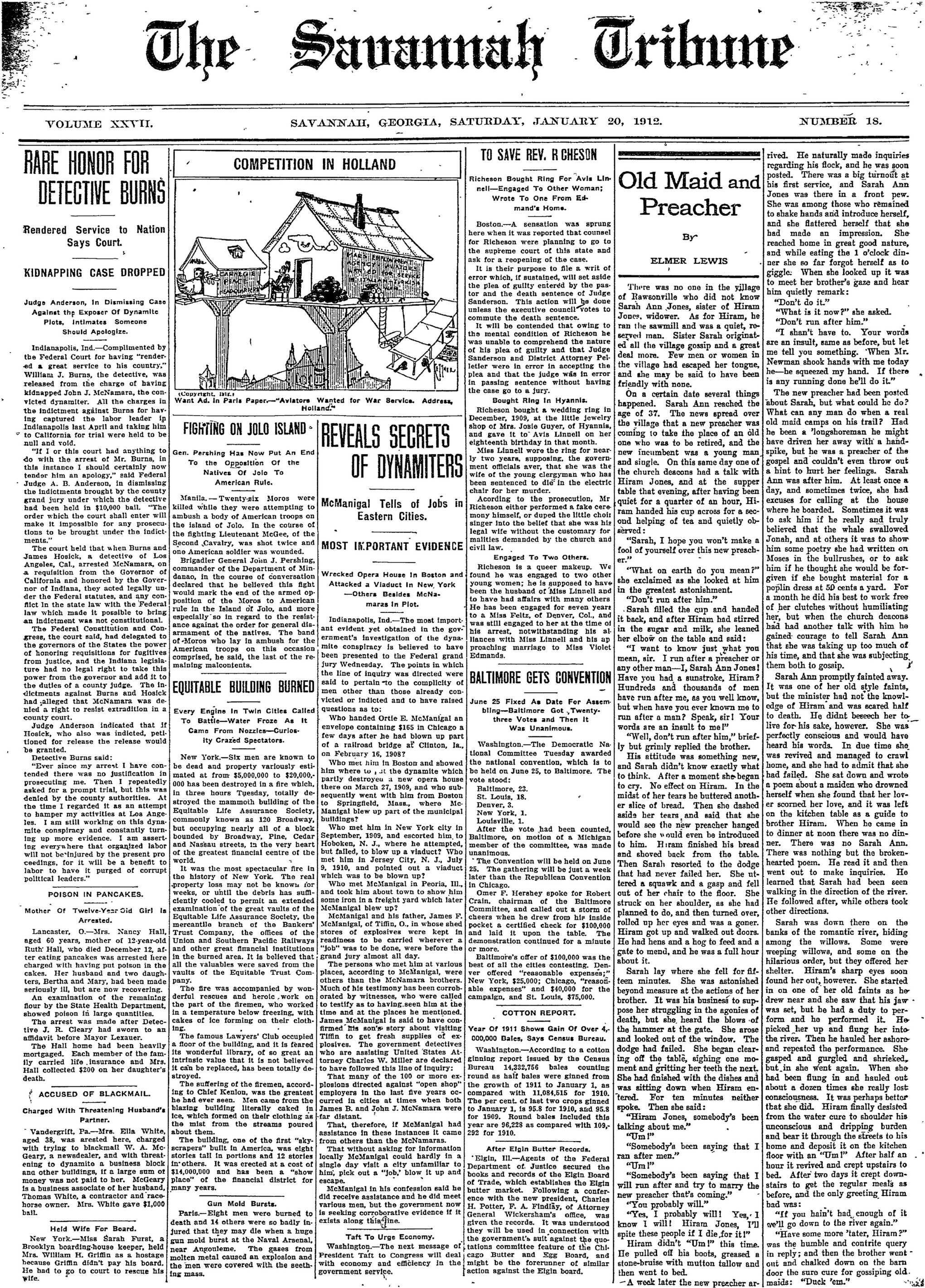
COMPETITION IN HOLLAND
CARNEGIE PARK
WANT AD. IN PARIS PAPER—"AVLATOR
Holl
BARNECOT
RACE
FAIR
FIGHTING ON JOLO ISLAND
Gen. Pershing Has Now Put An End To the Opposition Of the Natives Of Jolo To American Rule.
Manila. — Twenty-six Moros were killed while they were attempting to ambush a body of American troops on the island of Jolo. In the course of the fighting Lieutenant McGee, of the Second Cavalry, was shot twice and one American soldier was wounded.
Brigadler General John J. Pershing, commander of the Department of Mindanao, in the course of conversation declared that he believed this fight would mark the end of the armed opposition of the Moros to American rule in the Island of Jolo, and more especially so in regard to the resistance against the order for general disarmament of the natives. The band of Moros who lay in ambush for the American troops on this occasion comprised, he said, the last of the remaining malcontents.
EQUITABLE BUILDING BURNED
Every Engine In Twin Cities Called To Battle—Water Froze As It Came From Nozzles—Curiosity Crazed Spectators.
New York.—Six men are known to be dead and property variously estimated at from $5,000,000 to $20,000,000 has been destroyed in a fire which, in three hours Tuesday, totally destroyed the mammoth building of the Equitable Life Assurance Society, commonly known as 120 Broadway, but occupying nearly all of a block bounded by Broadway, Pine, Cedar and Nassau streets, in the very heart of the greatest financial centre of the world.
It was the most spectacular fire in the history of New York. The real property loss may not be known for weeks, or until the debris has sufficiently cooled to permit an extended examination of the great vaults of the Equitable Life Assurance Society, the mercantile branch of the Bankers' Trust Company, the offices of the Union and Southern Pacific Railways and other great financial institutions in the burned area. It is believed that all the valuables were saved from the vaults of the Equitable Trust Company. The fire was accompanied by wonderful rescues and heroic work on the part of the firemen, who worked in a temperature below freezing, with cakes of ice forming on their clothing.
The famous Lawyers' Club occupied a floor of the building, and it is feared its wonderful library, of so great an intrinsic value that it is not believed it can be replaced, has been totally destroyed.
The suffering of the firemen, according to Chief Kenlon, was the greatest he had ever seen. Men came from the blazing building literally caked in ice, which formed on their clothing as the mist from the streams poured about them.
The building, one of the first "skyscrapers" built In America, was eight stories tall in portions and 12 stories in others. It was erected at a cost of $14,000,000 and has been a "show place" of the financial district for many years.
Gun Mold Bursta.
Paris.—Eight men were burned to death and 14 others were so badly injured that they may die when a huge gun mold burst at the Naval Arsenal, near Angouleme. The gases from molten metal caused an explosion and the men were covered with the seething mass.
SAVANNAH, GEORGIA, SATURDAY, JANUARY 20, 1912.
Wanted for War Service. Address, and.*
REVEALS SECRETS OF DYNAMITERS
McManigal Tells of Jobs in Eastern Cities.
MOST IN PORTANT EVIDENCE
Wrecked Opera House In Boston and Attacked a Viaduct In New, York
—Others Besides McNa-
Indianapolis, Ind.—The most important evident yet obtained in the government's investigation of the dynamite conspiracy is believed to have been presented to the Federal grand jury Wednesday. The points in which the line of inquiry was directed were said to pertain to the complicity of men other than those already convicted or indicted and to have raised questions as to: Who handed Ortie E. McManigal an envelope containing $165 in Chicago a few days after he had blown up part of a railroad bridge at Clinton, Ia., on February 16, 1908?
Who met him in Boston and showed him where to sit the dynamite which partly destroyeu a new opera house there on March 27, 1909, and who subsequently went with him from Boston to Springfield, Mass., where McManigal blew up part of the municipal buildings?
Who met him in New York city in September, 1909, and escorted him to Hoboken, N. J., where he attempted, but failed, to blow up a viaduct? Who met him in Jersey City, N. J., July 9, 1910, and pointed out a viaduct which was to be blown up?
Who met McManigal in Peoria, Ill., and took him about town to show him some iron in a freight yard which later McManigal blew up?
McManigal and his father, James F. McManigal, of Tiffin, O., in whose shed stores of explosives were kept in readiness to be carried wherever a "job" was to be done, were before the grand jury almost all day. The persons who met him at various places, according to McManigal, were others than the McNamara brothers. Much of his testimony has been corroborated by witnesses, who were called to testify as to having seen him at the time and at the places he mentioned. James McManigal is said to have confirmed his son's story about visiting Tiffin to get fresh supplies of explosives. The government detectives who are assisting United States Attorney Charles W. Miller are declared to have followed this line of inquiry:
That many of the 100 or more explosions directed against "open shop" employers in the last five years occurred in cities at times when both James B. and John J. McNamara were far distant.
That, therefore, if McManigal had assistance in these instances it came from others than the McNamaras.
That without asking for information locally McManigal could hardly in a single day visit a city unfamiliar to him, pick out a "Job," blow it up and escape.
McManigal in his confession said he did receive assistance and he did meet various men, but the government now is seeking corroborative evidence if it exists along this line.
Taft To Urge Economy.
Washington. The next message of President Taft to Congress will deal with economy and efficiency in the government service.
TO SAVE REV. R CHESON
Richeson Bought Ring For Avila Linnell—Engaged To Other Woman; Wrote To One From Edmand's Home.
Boston.—A sensation was sprung here when it was reported that counsel for Richeson were planning to go to the supreme court of this state and ask for a reopening of the case.
It is their purpose to file a writ of error which, if sustained, will set aside the plea of guilty entered by the pastor and the death sentence of Judge Sanderson. This action will be done unless the executive council votes to commute the death sentence.
It will be contended that owing to the mental condition of Richeson he was unable to comprehend the nature of his plea of guilty and that Judge Sanderson and District Attorney Pelletier were in error in accepting the plea and that the judge was in error in passing sentence without having the case go to a jury.
Bought Ring In Hyannis.
Richeson bought a wedding ring in December, 1909, at the little jewelry shop of Mrs. Josie Guyer, of Hyannis, and gave it to Avis Linnell on her eighteenth birthday in that month. Miss Linnell wore the ring for nearly two years, supposing, the government officials aver, that she was the wife of the young clergyman who has been sentenced to die in the electric chair for her murder. Acording to the prosecution, Mr Richeson either performed a fake ceremony himself, or duped the little choir singer into the belief that she was his legal wife without the customary for malities demanded by the church and civil law.
Engaged To Two Others.
Richeson is a queer makeup. We found he was engaged to two other young women; he is supposed to have been the husband of Miss Linnell and to have had affairs with many others. He has been engaged for seven years to a Miss Feltz, of Denver, Col., and was still engaged to her at the time of his arrest, notwithstanding his alliances with Miss Linnell and his ap proaching marriage to Miss Violet Edmands.
BALTIMORE GETS CONVENTION
June 25 Fixed As Date For Assembling—Baltimore Got Twenty-three Votes and Then It Was Unanimous.
Washington.—The Democratic National Committee Tuesday awarded the national convention, which is to be held on June 25, to Baltimore. The vote stood:
Louisville, 1.
After the vote had been counted, Baltimore, on motion of a Michigan member of the committee, was made unanimous.
* The Convention will be held on June 25. The gathering will be just a week later than the Republican Convention in Chicago.
Omer F. Hershey spoke for Robert Crain, chairman of the Baltimore Committee, and called out a storm of cheers when he drew from his inside pocket a certified check for $100,000 and laid it upon the table. The demonstration continued for a minute or more.
Baltimore's offer of $100,000 was the best of all the cities contesting. Denver offered "reasonable expenses;" New York, $25,000; Chicago, "reasonable expenses" and $40,000 for the campaign, and St. Louis, $75,000.
COTTON REPORT.
Year Of 1911 Shows Gain Of Over 4,
000,000 Bales, Says Census Bureau.
Washington.—According to a cotton
ginning report issued by the Census
Bureau 14,332,756 bales counting
round as half bales were ginned from
the growth of 1911 to January 1, as
compared with 11,084,515 for 1910.
The per cent. of last two crops ginned
to January 1, is 95.8 for 1910, and 95.8
for 1909. Round bales included this
year are 96,228 as compared with 109,
292 for 1910.
After Elgin Butter Records
Elgin, Ill.-Agents of the Federal Department of Justice secured the books and records of the Elgin Board of Trade, which establishes the Elgin butter market. Following a conference with the new president, Charles H. Potter, F. A. Findlay, of Attorney General Wickersham's office, was given the records. It was understood they will be used in connection with the government's suit against the quotations committee feature of the Chicago Butter and Egg Board, and might be the forerunner of similar action against the Elgin board.
Old Maid and Preacher By
ELMER LEWIS
There was no one in the village of Rawsonville who did not know Sarah Ann Jones, sister of Hiram Jones, widower. As for Hiram, he ran the sawmill and was a quiet, reserved man. Sister Sarah originated all the village gossip and a great deal more. Few men or women in the village had escaped her tongue, and she may be said to have been friendly with none.
On a certain date several things happened. Sarah Ann reached the age of 37. The news spread over the village that a new preacher was coming to take the place of an old one who was to be retired, and the new incumbent was a young man and single. On this same day one of the church deacons had a talk with Hiram Jones, and at the supper table that evening, after having been quiet for a quarter of an hour, Hiram handed his cup across for a second helping of tea and quietly observed:
"Sarah, I hope you won't make a fool of yourself over this new preacher."
"What on earth do you mean?" she exclaimed as she looked at him in the greatest astonishment.
"Don't run after him."
Sarah filled the cup and handed it back, and after Hiram had stirred in the sugar and milk, she leaned her elbow on the table and said:
"I want to know just what you mean, sir. I run after a preacher or any other man—I, Sarah Ann Jones! Have you had a sunstroke, Hiram? Hundreds and thousands of men have run after me, as you well know, but when have you ever known me to run after a man? Speak, sir! Your words are an insult to me!"
"Well, don't run after him," briefly but grinly replied the brother.
His attitude was something new, and Sarah didn't know exactly what to think. After a moment she began to cry. No effect on Hiram. In the midst of her tears he buttered another slice of bread. Then she dashed aside her tears and said that she would see the new preacher hanged before she would even be introduced to him. Hiram finished his bread and shoved back from the table. Then Sarah resorted to the dodge that had never failed her. She uttered a squawk and a gasp and fell out of her chair to the floor. She struck on her shoulder, as she had planned to do, and then turned over, rolled up her eyes and was a goner. Hiram got up and walked out doors. He had hens and a hog to feed and a gate to mend, and he was a full hour about it.
Sarah lay where she fell for fifteen minutes. She was astonished beyond measure at the actions of her brother. It was his business to suppose her struggling in the agonies of death, but she, heard the blows of the hammer at the gate. She arose and looked out of the window. The dodge had failed. She began clearing off the table, sighing one moment and gritting her teeth the next. She had finished with the dishes and was sitting down when Hiram entered. For ten minutes neither spoke. Then she said:
"Hiram Jones, somebody's been talking about me."
"Somebody's been saying that I ran after men."
"Uml!"
"Somebody's been saying that I will run after and try to marry the new preacher that's coming."
"You probably will."
"Yes, I probably will! Yes, I know I will! Hiram Jones, I'll spite these people if I die for it!"
Hiram didn't "Uml!" this time. He pulled off his boots, greased a stone-bruise with mutton tallow and then went to bed.
NUMBER 18.
rived. He naturally made inquiries regarding his flock, and he was soon posted. There was a big turnout at his first service, and Sarah Ann Jones was there in a front pew. She was among those who remained to shake hands and introduce herself, and she flattered herself that she had made an impression. She reached home in great good nature, and while eating the 1 o'clock dinner she so far forgot herself as to giggle. When she looked up it was to meet her brother's gaze and hear him quietly remark:
"Don't do it."
"What is it now?" she asked.
"Don't run after him."
"I shan't have to. Your words are an insult, same as before, but let me tell you something. 'When Mr. Newman shook hands with me today he—he squeezed my hand. If there is any running done he'll do it."
The new preacher had been posted about Sarah, but what could he do? What can any man do when a real old maid camps on his trail? Had he been a 'longshoreman he might have driven her away with a hand-spike, but he was a preacher of the gospel and couldn't even throw out a hint to hurt her feelings. Sarah Ann was after him. At least once a day, and sometimes twice, she had excuses for calling at the house where he boarded. Sometimes it was to ask him if he really and truly believed that the whale swallowed Jonah, and at others it was to show him some poetry she had written on Moses in the bullrushes, or to ask him if he thought she would be forgiven if she bought material for a poplin dress at 50 cents a yard. For a month he did his best to work free of her clutches without humiliating her, but when the church deacons had had another talk with him he gained courage to tell Sarah Ann that she was taking up too much of his time, and that she was subjecting them both to gossip.
Sarah Ann promptly fainted away. It was one of her old style faints, but the minister had not the knowledge of Hiram and was scared half to death. He didnt beseech her to live for his sake, however. She was perfectly conscious and would have heard his words. In due time she was revived and managed to crawl home, and she had to admit that she had failed. She sat down and wrote a poem about a maiden who drowned herself when she found that her lover scorned her love, and it was left on the kitchen table as a guide to brother Hiram. When he came in to dinner at noon there was no dinner. There was no Sarah Ann. There was nothing but the broken-hearted poem. He read it and then went out to make inquiries. He learned that Sarah had been seen walking in the direction of the river. He followed after, while others took other directions.
Sarah was down there on the banks of the romantic river, hiding among the willows. Some were weeping willows, and some on the hilarious order, but they offered her shelter. Hiram's sharp eyes soon found her out, however. She started in on one of her old faints as he drew near and she saw that his jaw was set, but he had a duty to perform and he performed it. He picked her up and flung her into the river. Then he hauled her ashore and repeated the performance. She gasped and gurgled and shrieked, but in she went again. When she had been flung in and hauled out about a dozen times she really lost consciousness. It was perhaps better that she did. Hiram finally desisted from the water cure to shoulder his unconscious and dripping burden and bear it through the streets to his home and deposit it on the kitchen floor with an "Um!" After half an hour it revived and crept upstairs to bed. After two days it crept downstairs to get the regular meals as before, and the only greeting Hiram had was:
"If you hain't had enough of it we'll go down to the river again."
"Have some more 'tater, Hiram?" was the humble and contrite query in reply; and then the brother went out and chalked down on the barn door the sure cure for gossiping old maids: "Duck 'em."
Of Interest to Our Women
FASHIONABLE SCARFS.
Scarfs are an important item in the toilet this season. There are designs innumerable, of satin lined with bright-hued silk, of the sheerest chiffon lined with satin, of lace, of spangled net, in short, of any article which can be artistically converted into a scarf. Those made of satin and chiffon are gathered into a sort of tassel-like bunch at the ends with some sort of a jeweled ornament as a pendant.
The straight satin scarf, which is from 9 to 12 inches wide and 100 inches long, is not only fashionable and pretty, but serviceable and practical. It may be wound about the throat on a cold day, and it may be arranged to protect the chest.
Some of the newest scarfs are edged with transparent or wooden beads, or a deep band of embroidery. Some have a deep band of fringe and others are finished with a deep hem, above which a fine spray of embroidery spreads out over the scarf, reaching up a foot or more.
Chiffon edged with marabou, velvet lined with satin, and trimmed with fur, and a great many other designs are shown. A bright blue moire scarf lined with chinchilla, worn with the black tailored gown is pretty.
Those of heavy, lustrous black satin on one side and white satin on the other, caught together at the ends with a long silk tassel, are the fad for young and old. The white satin scarf edged with swansdown or marabou will be much in evidence as an evening wrap the coming season. The satin scarf, which matches the dress in color, and which is lined with white silk, is also being trimmed on each side with marabou, may be worn over the shoulders in the day time, but for evening it can be thrown over the head like a hood and the long ends drawn closely about the neck.
A gorgeous scarf is made of a cream-colored satin with great designs at each end embroidered in gold, edged with a fringe about six inches long, made of a golden colored ribbon. One made of Persian silk with a row of black lace down the center and a band of black satin on either side, the ends being tied and drawn into a big tassel, is very attractive. A very simple and pretty scarf is made by sewing three strips of marabou upon a broad strip of silver-blue satin messaline. A fringe of marabou finishes the ends of the scarf where the satin is gathered to a point. When making a satin scarf care must be faken to cut straight, or it will not hang well.
PETTICOAT PROBLEMS.
The widening of our skirts is as yet too gradual to have left any trace on our undergarments, and petticoats are, therefore, cut to the figure and guiltless of pleats or gathers. This applies equally to every other kind of undergarment. Many women even have learned to dispense with everything that is superfluous, and close fitting combinations, a corset coming very deep over the figure, and woollen combinations for practical and very often even for full dress wear, have superseded with these women all the erstwhile daintiness of feminine attire.
Close woven garments are to be had in many different colors in wool and in silk, and their convenience is undoubted. Their elegance, however, is questioned, and their hygiene is doubtful and so there are still many women who will have none of them. There are others who express their feminine love of fine linen only in the daintiness of their cache corset. Others, again, have done away with all under-petticoats and their accessories, but still cling to the symbolism and the smartness of a silk top skirt.
In case one wishes to wear a petticoat one must beware of succumbing to the attractions of "frillies." Let the petticoat be ever so pretty, ever so sweetly in harmony with frock, of what avail is it if it is so many inches wider, or if the fulling of the flounce will make the dress stick out balloon fashion from the knee downward? Soft silk or satin, or even crepe de chine, should be chosen for an underskirt, and from the height of the knee it should show long, closely pleated folds, stitched down in the center and at the edge to keep them in position. Any fulness of drapery is permitted only to such soft materials as mousselline de sole or the lightest makes of lace.
Fine batiste is often chosen for evening wear, but fine silk clings to the figure more closely, and so it is to be preferred. The fact is that though for a long time we have rebelled against the combination garment its success is this season more assured than ever.
FASHION HINTS.
Longer skirts—and just a little fuller, if you would heed the Parisian mandate.
Fashionable batiste blouses for afternoon wear under.thin coat suits are entirely plain, with just a group of hand tucks at the shoulders and an attached frill in front of handsome lace.
Paris is sending over young girls' topcoats made of reversible cloth in two tones of blue, in black and white, which is very smart; in gray and blue, in black and red, and in purple and red.
GOOD ADVICE IN NUGGETS.
Dress for the winter season has settled down into very sumptuous grooves. Constant employment of lace is an important asset toward this impression for lace in its every gulse, from the coarse, boldly patterned macrame qualities to a weave so fine it might have been spun by a spider, is to be observed doing service.
The lace counters at the various large establishments which specialize in this accessory are veritable traps of temptation. The piece laces are especially alluring, and, although the price per yard may at first sight prove a little startling, mature consideration brings the comforting reflection that comparatively little is needed to fashion one of the prevailing incidental bodices to the high waist or princess style of skirt.
But quality throughout is the kernel of the whole dress question of the hour. Dame Fashion has spoken, and is still firm in advocating simple outline effected in irreproachable fabrics. This decree holds equally good in the ordinary everyday frock or costume of serge, cloth, tweed or corduroy velvet.
The all in one dress, which is worn beneath fur coats and is an ideally useful possession to the busy woman, is again to the fore. Sometimes strong touches of contrast are introduced into such a costume with quite admirable effect. A dress of this kind seen recently was in navy blue serge, the corsage of which was thrown open with a single large rever, faced with purple, dull faced satin, over a clear chemisette of ivory net, which was ornamented with one of the new flat jabots of lace. At the left side of the front the skirt was slit up to allow the introduction of a sharply pointed panel or rever of the purple satin, and round the waist there was worn a narrow patent leather belt, inlet with little oblongs of the satin. When the sleeves to these dresses are not arranged in one they are cut perfectly straight from the shoulder to just below the elbow, the long sleeve, alas! being still more honored in the breach than the observance.
Although fur as a decorative adjunct cannot possibly be wrong this season, its services being employed on every manner and style of garment, one notes how lightly and artistically it is employed. It is never for a moment allowed to become a predominant feature, but is made subservient to the other component parts.
DEVICE FOR PERFUMING.
There are dainty perfumed sachets, filligree cases and pads to toss in dresser drawers and sew among miladi's belongings, so that, whenever she moves she may be surrounded by an impalpable sweetness. The newest addition to the perfuming paraphernalia is a device for making the air of her boudoir also sweet with her own particular sachet powder. Perfume sprayed from an atomizer evaporates almost as soon as it touches the air, but this new method of perfuming a room is much more lasting. In an exquisitely dainty jar of glass and silver is a thick wick, which fills the mouth of the jar. Perfume is poured into the jar and the saturated wick is set alight, the alcohol, which is a part of all perfume making a little blue flame. When this tiny lamp has been burning ten minutes the room and everything in it is sweet with violet, rose, valley lily or whatever odor miladi may fancy.
KITCHENETTES.
To peel tomatoes without scalding, rub them backward with the blunt end of a knife.
In selecting beef, the pieces which are well mottled with fat will be found the richest and juiciest.
For the roast of cold lamb course, try serving an egg salad, sprinkled with minced mint leaves.
Coal dust is wasted unless the mistress sees that it is burned, and yet it makes beautiful fires. Have a galvanized iron scuttle for the purpose. Add sufficient water to the coal to make it moist. When a fire is burning brightly, bank it up with this wet dust and you will have a clear fire which will last for hours.
When purchasing a roast of veal have the butcher lard it with salt pork. This will make the meat julcy instead of being dry, and it will have a fine flavor that can be had in no other way.
WASHING DOUBLE BLANKETS.
All housewives have trouble with washing double blankets. They are too heavy to handle comfortably and take too much strength from other work more necessary to the home.
If you can, take your double blankets and cut them in half and bind raw edges; then when you wish to wash them you will find a great difference. They are easier to handle and very much better to put on the beds because there are times when the double blanket is too heavy and you cannot separate them to suit yourself.
Also they are easier to put away than the double ones. In all ways they handier for the woman of the house to take care of.
A VIGIOUS COLONY
England's Penal Settlement In the Andaman Islands
LIFE CONVICTS FROM INDIA
OFTEN THE MOST DESPERATE PRISONERS KILL ONE AN- OTHER, WHILE OTHERS FALL VICTIMS .O THE NATIVE HEAD HUNTERS, TO WHOM MURDER IS SPORT.
Frederick Taylor, F. R. G. S., writ- ing in the Century Magazine about life in the Andaman Islands, says:
"The sailing of the Maharaja from Calcutta for the Andaman islands was not accompanied by the usual goodbye and handkerchief waving, for of my fellow passengers there were seventy to whom no one wished bon voyage, or a safe return. These were convicts, all murderers, under life sentences, who for some reason had escaped the death penalty, and included six women, for the Maharaja is the ship used by the colonial Indian government to transport convicts to the penal settlement near Port Blair, South Andaman island, a distance of 650 miles from Calcutta.
"The prisoners were all manacled and-shackled about the ankles, with chains fastened to bands at the wrist. They were a despicable lot. At night a continual moaning and cursing and hopeless sobbing came up from the hatches and made sleep out of the question for me, though the European officer in the steamer's cabin apparently slept undisturbed. Early the first morning I went on deck and learned that two of the male prisoners were ill and had been brought up to the deck for air. They were closely guarded, and raw recruits were stationed at the railing to prevent them from committing suicide by jumping overboard into the Hugli river.
"The Andamans are literally the homes of murderers. The inhabitants are the most vicious members of an older civilization and the uncivilized head hunters, among whom murder is a sport and a pastime. In the settlement are about 1,700 prisoners, including 800 women. On arriving at Port Blair the prisoners first spend six months in solitary confinement in the cellular jail of Viper island. They are then transferred to one of the associated jails and the comparative blessing of hard labor in company with others, though still occupying separate cells at night. After a year and a half of this they become slaves, working in and about the settlement during the day and sleeping in barracks at night, always closely guarded. At the expiration of five years a convict becomes eligible to join the colony of 'self supporters' and live in the village, where he earns his living in his chosen way, lives in his own house and can send for his wife and children or marry a convict woman. In a limited sense he becomes a pater-familias, but is always carefully watched and cannot leave the settlement without permission.
"Despite the rigid discipline and the vigilance of the authorities the communal life is far from harmonious, and the more vicious often rebel. The murderers kill one another and are in turn murdered by the treacherous Andamanese, who regard the hapless convicts and their guards as their natural prey. Occasional attempts at escape are made by the prisoners, but the efforts inevitably prove disastrous. The fugitive, finding his conditional freedom worse than servitude, either dies at the hands of the Jarawa warriors, falls a victim to fever or other disease or starves. There is also a system in vognue by which the more friendly tribes of savages co-operate with the authorities in capturing escaped convicts and receive rewards for the return of the unhappy deserters. More often, however, the head hunters kill the fugitive and return only the head, receiving the reward just the same, the killing adding zest to the chase and the return of the head being the easiest and quickest way of earning the reward.
"Under these conditions there are few attempts to escape, though many remarkably hazardous dashes for liberty have been made from time to time, which, though futile, were most daring. Some time ago the steamer Fulata picked up a poor, emaculated wretch who was sighted on a small bamboo raft off the Arakan coast. He was later found to be an escaped convict. When picked up he had been on the raft for twenty-nine days during one of the southwest monsoons and had secured water by catching the rain and sucking it from his turban and loin cloth. He lived upon flying fish that flew aboard the raft, eating them raw. He was swept off the raft many times by the waves, but had managed to cling to it. After a month in a hospital at Rangoon he was returned to the prison and solitary confinement.
"Another daring attempt at escape was made by a party of six convicts who were sent with two native policemen to a small island off the middle andaman to work. They managed to escape from the guards and, holisting the sail of a small boat, started out in a gale. Aften seven days of heavy weather they were dashed upon the rocks of the Tenasserim coast, and the boat was wrecked. All escaped with their lives and eventually reached the Slamese border, where they were rehended by the local authorities and returned to the prison."
With all hotel conveniences. Hot or cold baths. Large parlor with reading matter and music. Polite help. Carriage and hacks, also telephones. If you want a hack or carriage ring up 676 and the manager will see that you get it. Rooms to let at 25 cents.
821 BROUGHTON STREET, EAST. Next Door to Red Cross Pharmacy. Special Prices Given for Thir ty Days. A full line of Latest Fall and Win ter Goods.
Two suits cleaned and pressed per month for $1.00. Ladies' work a specialty. Goods called for and delivered. All work guaranteed. Steam and dry cleaning.
$16 EAST BROAD STREET. Phone 1319
First class SHOE REPAIRING. Half sole, sewed, 85 cents; nalled, 50 cents; rubber heels, 35 and 50 cents. All work guaranteed. CORNER EAST BROAD AND BOLTON STREETS.
Save the old ones and send to us. We make them new-Stoves, Furniture, Mattresses, Carpets, CARPET AND MATTING LAYING A SPECIALTY. Old furniture bought and sold, Packing and Shipping. Goods called for and delivered. JACKSON & SLOCUM, Upholsterers
When Your Eyes Trouble You CONSULT OUR OPTICIAN.
DR. M. SCHWABS' SON
FOR SAFE, COMFORTABLE AND CLEAN LODGING PERMANENT OR TRANSIENT
Stop at McCARTHY'S
233 BRYAN ST., WEST.
FIRST CLASS SANITARY BARBER SHOP AND RESTAURANT AT
TAC HED.
230 ST. JULIAN STREET, WEST.
I wish to notify all of my old patrons that I have purchased my old stand at Hall and Price streets, and would be glad to have them patronize me. Phone me at 601 for anything you may want and I will deliver to you promptly. Respectfully,
TAZ L. ANDERSON, PROPRIETOR. Corner HALL and PRICE ST.
THE PROGRESSIVE MAN
"Are you John Borland?"
"Yes."
"You're wanted. Come along with me."
John Borland was a hard working man with a wife and seven little children. He was not getting on very well, and when a constable took him away accused of theft it was a sad blow to his family as well as to him.
SEE THE-
· "What does it mean. John?" his wife asked.
"I don't know." John replied.
"Well," she added, "there's some mistake, and it will be rectified. Keep up your pluck, John."
"But you and the children," he moaned.
"We'll get on. Jane Borland is not going to lie down."
"Plucky woman, that," remarked the constable to himself. Each one of Borland's children kissed him as he was led away.
A few days before this John Borland had been in the private office of Peter Stiver canvassing for a fire insurance company. Stiver had been called out and remained out for some time. Meanwhile John, becoming tired of waiting and having an appointment with another party, went away. The next day Stiver missed $50 from a tin box kept in a drawer in his desk. After racking his brains to think of an opportunity for some one to steal it, he remembered that Borland had been in his office along with the money. He immediately swore out a warrant for the insurance solicitor. The only witness called by the defendant's attorney—a young man just admitted to the bar—was Jane Borland.
"Mrs. Borland," he said, "did your husband give you any more money than usual for household expenses or any other purpose during the time of this robbery or soon after?"
"No. he did not."
"Was there any evidence that he had any more money than usual?" "No. We are scraping along just the same as ever." "Do you know that your husband was not in possession of any more funds than usual?"
"After he has gone to sleep nights I always search his clothes." Borland started. "He didn't have any money that night. He didn't have any money for several nights before or after that night either."
There was a titter among the spectators, and several of the jurymen smiled.
"That will do," said the attorney, and he looked at the prosecutor as much as to say, "You may take the witness."
"Mrs. Borland," said the prosecutor, "why do you search your husband's clothes after he goes to sleep?"
"Well, my husband finds it necessary to keep money about him for his ordinary expenses, such as car fare and lunch. Sometimes he keeps more than I consider necessary. Then sometimes he makes a commission that he forgets to turn over to me. I pay for what we have, so make sure that I get it all except what is absolutely necessary for him."
"And you are quite sure that you don't search his pockets to prevent him from spending the money in dissipation?"
"Quite sure."
"And you trust him?"
"Of course I do. He's always been, fair with me and the children, denying himself a glass of beer when he is thirsty and often walking when he is tired to save car fare."
"This being the case, why do you not ask him to give you all the money he has in his pockets except a stated amount for his legitimate expenses without waiting till he has gone to sleep and then riffling his clothes?"
"No woman would do that, sir."
"Why not?"
"Nothing irritates a man so much as to be called to account by his wife for the chicken feed he spends. And, the more he sacrifices for his family the angrier such a course makes him. To take the money when he is asleep is a much better way."
There was a shout of laughter from those present, and the judge as he rapped for order did so with a smile. It was evident that the wife's testimon was not to be shaken, and her womanly way of looking at the matter of taking care of the interests of her family captivated the jury. Without leaving their seats they pronounced John Borland not guilty, and he was discharged from custody. As the couple left the room Borland looked shamefaced, as though he would have rather been convicted than endure the exposure of family secrets, while his wife was not only happy, but proud of the act that had won her husband his freedom.
The clerk who testified that Borland was the only person in the office after Stiver left it till his return afterward confessed that he himself was the thief.—Exchange.
CAUSE OF THE MIXUP.
Police Justice—Jonas Snookey, you are charged with assault and battery on an inoffensive citizen. What have you, to say for yourself?
Prisoner—Your honor, I asked 'im, as civil as a man can be, how did he pronounce "McNamara?" He told me it was accented on the peanut. "Makin' fun of me, are ye?" I says, an' I chugged him one."—Chicago Tribune.
THE JOHNSON HOTEL
MEALS AT ALL HOURS.
PRINCE R. BUTLER, Manager and Proprietor.
HIGH ART TAILOR
BENTON STREET, EAST. Next Door to Red Cross
Special Prices Given for Thirty Days. A full line
Rail and Winter Goods.
So After
business ...
In a business way---the
advertising way. An a
this paper offers the
maximum service at the
minimum cost. It
maches the people of the
own and vicinity you
ant to reach.
Try I
It Pa
Mordecie Pressing Co.
cleaned and pressed per month for $1.00. Lace
Goods called for and delivered. All work guarant
ing.
BROAD STREET.
THAS BAKER,
Shoe
SHOE REPAIRING. Half sole, sewed, 85 co
umber heels, 35 and 50 cents. All work guarant
ing.
CORNER EAST BROAD AND BOLTON STREET.
Don't Buy a New On
old ones and send to us. We make them new—S
classes, Carpets, CARPET AND MATTING LAYIN
furniture bought and sold. Packing and Shipp
and delivered.
ON & SLOCUM, Uphols
ART TAILORS
SEET, EAST. Next Door to Red Cross Pharma.
Given for Thirty Days. A full line of Latest
Rail and Winter Goods.
After
ness ...
business way---the
missing way. An ad
paper offers the
medium service at the
medium cost. It
is the people of the
and vicinity you
to reach.
Try It---
It Pays
Ardecie Pressing Club
pressed per month for $1.00. Ladies' work
for and delivered. All work guaranteed. Steam
SEET. Phone 131
BAKER, The
Shoemaker
REPAIRING. Half sole, sewed, 85 cents; nailed
85 and 50 cents. All work guaranteed.
EAST BROAD AND BOLTON STREETS.
Buy a New One
send to us. We make them new—Stoves, Furni-
CARPET AND MATTING LAYING A SPECI-
ought and sold. Packing and Shipping. Goods.
SLOCUM, Upholsterers
HIGH ART TAILORS
in a business way---the advertising way. An ad in this paper offers the maximum service at the minimum cost. It reaches the people of the town and vicinity you want to reach.
The Mordecie Pressing Club
Don't Buy a New One
BOLTON AND EAST BROAD STREETS. Your Eyes Trouble CONSULT OUR OPTICIAN. M. SCHWABS'
Your Eyes Trouble You
CONSULT OUR OPTICIAN.
M. SCHWABS' SON
11 BULL STREET.
COMFORTABLE AND CLEAN LODGING PERMANENT
OR TRANSIENT
top at McCARTHY'S
233 BRYAN ST., WEST.
S BANITARY BARBER SHOP AND RESTAURANT AT
TACHED.
230 ST. JULIAN STREET, WEST.
FINE AND CLEAN LODGING PERMANENT OR TRANSIENT
St McCARTHY'S
13 BRYAN ST., WEST.
Y BARBER SHOP AND RESTAURANT AT
TAG HED.
ST. JULIAN STREET, WEST.
TO MY FRIENDS
notify all of my old patrons that I have purchased and Price streets, and would be glad to have the time at 601 for anything you may want and I will respectfully,
ERSON DRUG COMPANY
ERSON, PROPRIETOR. Corner HALL and
PROGRESSIVE
of my old patrons that I have purchased my elec
streets, and would be glad to have them patronize
for anything you may want and I will deliver to
Respectfully,
ON DRUG COMPANY
OPRIETOR. Corner HALL and PRICE 87
PROGRESSIVE MÄN
ANDERSON DRUG COMPANY
Is the one who makes it his business to advertise his business thoroughly. Now is your opportunity
TIMELY LEGACY
Home for Aged and Infirm Colored People Received From Estate of Harriet Gilmore $2,439.69
INSTITUTION NEGLECTED
INDIVIDUALS, CHARITABLE ORGANIZATIONS AND MANY CHURCHES HAVE NOT DONE THEIR DUTY. Chicago, Ill.
Joy and jubilation are dominant in the Home for the Aged and Infirm Colored People. This institution has just become enriched to the extent of $2,439.69, legacy from the estate of the late Mrs. Harriet Glimore.
The arrival of this glorious news should fill with joyous praise the heart of every Negro man and woman in this city, and awaken in them a keener sense of duty to their charity institutions. As Doctor Hirsch has well said: "giving is a duty, not a privilege; and no man or woman should ask or expect thanks for his or her giving."
While this tidy sum lifts the "Home" from the "Slough of Despondency" so to speak, it in no wise lessens our obligations to this institution, but should be an impetus, a stimulus, to greater efforts, greater sacrifices, towards its proper maintenance and support; for we cannot overlook the fact that this is a public institution and for Negroes only, as its name implies.
The directors of the "Home" are especially jubilant over this good fortune, for none but themselves know the worry, struggles and obstacles they have encountered in their efforts to properly maintain the institution; especially during the present year. Practically ignored by their own people—and this includes most of the churches—criticised and condemned for their opposition to the "uncharitable" methods of certain charity organizations, their path has been thorny indeed; but this great gift comes as a vindication of their position, and an endorsement of their methods.
Certainly this good woman—Peace be unto her ashes—who so magnificently endowed the "Home" must have investigated the place and its management, satisfied herself of its stability and worth, and presumably her last earthly act, in her preparation for Death, by this generous bequest, affixed her stamp of approval upon this struggling institution; an absolute and unqualified indorsement of its purpose and methods.
While our own charity organizations, misguided yet critical dictatorial and distrustful, but withal deficient in the knowledge of organized charity, are quibbling as to the disposition of their meager contributions, this good woman, to us totally unknown, and of a race which, because of its advantages, knows and studies charity in all its ramifications, comes forward quietly and unexpectedly, investigates, glives; and gives thousands.
Is not this sufficient evidence of worth, of integrity, of sincerity of purpose, and of confidence?
THE COMPOST HEAP.
Composting is rather a hard job and requires a great deal of time. The compost heap should be made square and with perpendicular sides, four or five feet high and as nearly flat on top as possible. The leaves may be composted with stable manure thoroughly mixed. Hen manure, cow manure and some lime will do no harm. If the heaps are made now the compost will be ready for use early next spring. It requires a long time for leaves to become thoroughly composted. The heap should be made under sholder, else the rains will wash away much of the valuable liquid. The compost heap can receive nearly everything—slops from the kitchen, old vegetables, animal matter (provided it is cut up fine). Great care must be taken, however, that the vines of vegetables which have been diseased should not get into the heap, as they will infect the entire compost and do much harm. The pile must be forked frequently and kept damp enough to aid in the rotting process. To thoroughly compost eight or ten tons of leaves will require many months, and the matter should be placed in at least four or five heaps to facilitate the forking and handling. These heaps may be made in the fields where the compost is to be used later, but it should be covered, as before suggested. Many gardeners build up a structure of rails or old boards in order to keep the heap in proper shape.
HOME LAUNDRY BAG.
There is nothing quite so troublesome to the housewife as laundry lying about in closets and dark corners. A big durable bag is excellent to contain them. Buy enough unbleached muslin sheeting to cut from it a large circular piece—the amount required—and make a casing all around it about three inches from the edge when hemmed. Run in inch-wide tape. Then lay the bag flat on the floor and toss the clothes in as they are counted. This will be found much more satisfactory than the white sheets so frequently used to tie up the family washing.
THE UNDERGROUND RAIL- ROAD IN RUSSIA
THE UNDERGROUND RAIL- ROAD IN RUSSIA
EXTRACTS FROM DR. BOOKER T. WASHINGTON'S FORTHCOMING BOOK, "THE MAN FARTH- EST DOWN."'
Cracow, in addition to being one of the three former capitals of Poland, and containing one of the most interesting Ghettos in the world, is also a fortified border city. It guards a frontier which divides not merely two European countries, but two civilizations—I might almost say—two worlds. Cracow is, as a matter of fact, ten miles from the Russian frontier, and, although the people of Russian Poland are of the same race or nationality as those who live in the Austrian province of Galicia, speaking the same language and sharing the same traditions, the line which divides them marks the limits of free government in Europe.
Now, there are several things that made this frontier, where eastern and western Europe meet, peculiarly interesting to me. In the first place, I knew that thousands of people, most of them Poles and Jews, who were unwilling or unable to pay the high tax which Russia imposes upon its emigrants, were every year smuggled across that border in order to embark at some German or Austrian port for America. I knew at the same time that Jews, and, to a large extent, perhaps, Poles outside of Russia were making use of this same underground railway to send back, in return for the emigrants who came out, another kind of contraband, namely, books and bombs. In fact, I had heard that a few years ago when Russian Poland was all affame with civil war, it was from Cracow that the Jews, who were the leading spirit in that movement, directed the revolution.
Naturally, all this served to increase my natural curiosity in this border country. So it was that one cqol, clear day in September I rented a little drosky for the day and started, in company with my companion, Dr. Park, for the Russian border.
We drove leisurely along a splendid military road between broad fields, in which peasants were gathering, in the cool autumn sunlight, the last fruits of the summer's harvest. A country road in Gallicia, as is true in almost any part of Europe, is a good deal more of a highway than a country road in most parts of America. One meets all sorts of travelers. We passed, for example, just beyond the limits of the city, a troop of soldiers, with the raw look of recruits—red faced, country boys they seemed, for the most, bulging out of their military suits and trudging along the dusty road with an awkward effort at the military precision and order of veterans. Now and then we passed a barefoot peasant woman, tramping briskly to or from the city, with a basket on her head or a milk can thrown over her shoulder.
Once we stopped to watch a group of women and girls threshing. One woman was pitching down sheaves of rye from the barn loft, and another was feeding them to the machine, and all were in high glee at the wonderful way, as it seemed to them, in which this new invention separated the grain from the chaff. They were so proud of this little machine that, when we stopped and showed our interest in what they were doing, they insisted on showing us how it worked, and took palms to explain the advantages over the old-fashioned fall. There was a man sitting on a beam outside the barn, smoking a pipe, but the women were doing the work.
On the same journey we stopped at a little straggling village and spent an hour or two visiting the homes of the people. We saw the house of the richest peasant in the village, who owned and farmed something like a hundred acres of land, as I remember, and then we visited the home of the poorest man in the community who lived in a little thatched roof cottage of two rooms, one of these was just large enough to hold a cow, but there was no cow there. The other room, although it was neat and clean, was not much larger than the cow stall, and in this room the poor old man and his daughter lived.
At one point along the road we stopped for a few minutes at a wayside tavern. It was a log structure, with one great long, low, desolate room in one corner of which was a bar at which a four-faced woman presided. Two or three men were lounging about on the benches in different parts of the room, but here again the woman was doing the work.
Every mile or two it seemed to me we met a wagon plled high with great bulging bags, as large as bed ticks. In each case these wagons were driven by a little shrewd-faced Jew. These wagons, as I learned, had come that morning from Russia and the loads they carried were goose feathers.
A little farther on we came up with a foot passenger who was making toward the border with great strides. He turned out to be a Jew, a tall, erect figure with the customary round flat hat and long black coat which distinguishes the Polish Jew. Our driver informed us, however, that he was a Russian Jew and pointed out the absence of the side-curls, as indicating that fact. Although this man had the outward appearance, the manner and the dress of the Jews whom I had seen in Cracow there was something In the vigorous and erect carriage that impressed me to such an extent that I suggested that we stop and talk with him. As we were already near the border, and he was evidently from Russia, I suggested that Dr. Park show
him our passports and asked him K they would let us into Russia. He stopped abruptly, as we spoke to him, and turned his black pleuring eyes upon us. Without saying a word he took the passports, glanced them through rapidly, tapped them with the back of his hand and handed them back to us. "That is no passport," he said, and then he added: "It should have the vise of your consul." Having said this he turned abruptly, without waiting for further conversation and strode on. We soon came up with and passed him, but he did not look up. A little later we halted at the border. I looked around to see what had become of our wandering Jew, but he had disappeared. Perhaps he had stopped at the inn, and, perhaps, he had his own way of crossing the border.
I was reminded of this strange figure a few months later when I noticed in one of the London papers a telegram from Vienna to the effect that some thirty persons had been arrested at Cracow who were suspected of being the ring leaders "In what is believed to be a wide-spread revolutionary organization of Russian refugees." The report added that "a whole wagon load of Mnnnliches rifles, Browning platois and dynamite grenades, together with a large number of compromising documents and plans of military works, were selzed as a result of searches by the police in the houses of the arrested men."
I had frequently seen reports like this in the newspapers before this time, but they had a new significance for me now that I had visited their border country where this commerce with what has been called the "Underground" or "Revolutionary" Russia, was part of the daily experience of the people. It all recalled to my mind the stories I had heard, when I was a boy, from my mother's lips of the American Underground Railway and the adventures of the runaway slaves in their efforts to cross the border between the free and slave states. It reminded me, also, of the wilder and more desperate struggles, of which we used to hear whispers in slavery time when the slaves sought to gain their freedom by means of insurrection. That was a time when, in the southern states, no matter how good the relations between the individual master and his slaves, each race lived in constant fear of the other. It is in this condition, so far as I can learn, that a great part of th people in Russia are living today, for it is fatally true that no community can live without fear in which one portion of the people seeks to govern the other portion through terror.
SPRAYING EXPERIMENTS.
Under conditions existing in New York state spraying with iron sulphate is not an effective-method of eradicating dandelions from lawns. This conclusion is reached after two years of spraying, making twelve applications in all, on a strip of lawn at the New York agricultural experiment station, Geneva. The details of the tests are given in bulletin No. 335 of the station. Variety testing as a direct means for the selection of kinds of fruit to recommend for other sections of the state has been practically abandoned by the station at Geneva; but new varieties and seedlings are grown in large numbers in connection with plant breeding work and to ascertain the habits and qualities of the varieties. The results of such work with strawberries during the past two years are reported in bulletin 336 in 1907. Inspection of the dalries supplying milk to the city of Geneva showed that 90 per cent. of the supply came from sources that, from a sanitary standpoint, were considered as dirty or filth. In the first quarter of 1911 similar examination showed no milk coming from such surroundings; but that "all of the milk is now produced by reasonably clean cows kept in reasonably clean stables. is drawn by cleanly milkers into sanitary palls and promptly cooled, while more than one-third of this milk comes from tuberculin tested cows." The simple means by which this remarkable improvement was secured are outlined in bulletin 337. The annual potato-spraying bulletin of the station at Geneva for 1910 is No. 338. As in 1909 dry weather severely tested the practice of spraying, since blight and rot were not common and, where they occurred, not very destructive until late. In the season, still, spraying was profitable in sixteen of the nineteen tests reported; while the average gain on farms, not at the station, for 304 experiments made during the past eight years, is more than forty-five bushels to the acre. All the above bulletins may be obtained without expense by a post card request sent to the New York Agricultural Experiment Station, Geneva, N. Y.
GAITERS AGAIN.
Fashion's wheel revolves eternally. Those of us who several seasons ago thriftily packed away our cloth gaiters or "spats" in moth balls are getting them out now to wear over pumps and slippers. For gaiters are all the style, and the very newest boots, though they have regulation button tops, are made to imitate gaiters—that is, the cloth or velvet top is set on the patent leather or calf vamp just as a cloth gaiter sets over the toe and heel of a shoe. White gaiters are considered very smart, and next in favor come pearl gray and a very pale tan. The shoe under the gaiter must be a dainty affair, with thin soles, or the effect 'will be clumsy.
OUR DEATH RATE
BOOKER T. WASHINGTON TALKS OF CENSUS FIGURES TO THE STUDENTS OF TUSKEGEE INSTITUTE.
No one can study the census figures which have recently come from the Census Bureau in Washington without being convinced that the death rate among our people, while not alarming, is very great—greater than it should be. It is through the influence of such men and women as we are training here that the death rate in the future is to be decreased. More and more throughout the civilized world people are not paying so much attention to the healing of disease as they are to trying to prevent disease through various measures, and you are to be among the leaders in this matter of preventing disease among our people in city and in country.
When we first came out of slavery, I think we may as well face the fact, the death rate was not so large as it is now. There were certain restrictions, with all the disadvantages of slavery, that gave us perhaps more healthy bodies than some of use have now, and we, like many other races, have got to learn what freedom means, have got to learn to exercise a certain degree of control in freedom that is true of all races of people.
I think the death rate is due to several causes; first among them, I should put improper houses. A large number of our people in the north and in the south have recently moved from the country and come into cities, meeting a life, a condition, that they are not accustomed to. One of these conditions is that of being congested in small rooms. Many of them come from country districts, where they have had plenty of room. Certainly they have been out in the free, open air. They go to the large cities in the north and in the south and they find themselves, instead of having plenty of room, congested in one or two small, poorly ventilated rooms. Poor housing means, in many cases, bad air and then it means, as I shall mention later, poor food and insufficient clothing. It is lamentably true that in many of the large cities, especially in the north, our people have to pay such high rent for the small apartments they occupy that they have, after paying rent, very little left with which to supply themselves with either proper food or proper clothing. It is a great change going into a city life from the country life. In the country, in many cases, or in the small cities, they have been paying $4 or $5 per month for rent. When they go to a large city, they find themselves confronted with a rent bill of $25 or $30 per month. That means they have got to do without many of the necessities of life in the way of food and clothing in order to meet the rent bill.
As I have stated, insufficient clothing in many of the large cities is largely the cause of a large death rate among our people. The bad air to which I have referred, is not confined to the houses; you will find our people suffer by reason of poorly ventilated bed rooms, poorly ventilated churches, poorly ventilated lodge rooms. I think you will find, if you examine into it carefully, that many of our people, most of them, in many cities, belong to some kind of lodge. They go into these lodge rooms and feel that every window must be down, every curtain must be down, no air permitted to come in; and the same is true of the church houses, filled with people, breathing foul air for hours and hours, and I am sorry to say that the same thing is often true of school rooms—school rooms under the control of seemingly intelligent people.
Another cause of the high deathrate especially in cities north and south, is the kind of food our people live on. In many cases, it is the cheapest food; in many cases, it is not only the cheapest food, but stale food, unwholesome food, composed of knuckknacks—cheese, crackers, a few cakes thrown in here and there, and as you know, it takes some of the students a good while to get accustomed to the kind of food they get here. They do not get the cheese, they do not get the crackers, the cakes, the cheap pie they have been living on before they came here. It takes you some time to get accustomed to our food, but it is borne out by the health records here after students come here and get into the habit of eating our food—well prepared, fresh food. You will find that in body you are five times more healthy and stronger by eating this clean, fresh beef, many times more healthy by good fresh corn bread, much better than cheese, crackers and cakes that many of you have been in the habit, perhaps, of picking up or living on, in too many cases, in large cities. Take students who come here, with a pale, weak appearance and go through our routine, getting, this food regularly three times a day at a certain hour, very soon you will find their bodies straightening up; their eyes grow brighter, and they grow strong, healthy and vigorous.
Many of our people suffer, not only in cities, and it adds to the high deathrate also, because they do not have any regular eating time. There is irregularity in eating. They have no special time for breakfast, no special time for dinner, no special time for supper. A little food taken at a regular time on the minute each day is many times better than much food taken at a irregular times. That is one of the lessons we are trying to teach you here and we hope you will go out and spread that lesson. Practice it first, then spread it among you
fellows—the lesson of regular eating at regular times. Even though the food is very plain, if it is well cooked, well prepared and taken at regular hours, it will result in adding immensely to the health of the bodies of our people.
Again in cities and towns, more in the cities than in the rural districts, a large death-rate is caused by reason of the fact that so many of our people are given to strong drink, to the use of the poorest kind of liquors, the poorest kind of wines—the cheapest and the poorest kind of strong drink of every kind.
In many cases, this high death-rate is due too because of the uncleanliness by which too many of our people are surrounded. This does not apply, I am glad to say, in any large degree, to the people who live in the country districts, because it is a delightful thing to say that no matter how poor or how ignorant our people are who live in the country, you will usually find them clean in the house and outside of the house. When they come into the city and get in these filthy crowded alleys, you will find filth on the inside of the house and filth on the outside of the house, and this adds every time to the high death-rate.
There are two lessons which I want to impress upon you: first, that the salvation of our race in its present condition largely rests upon its willingness to live, for the most part, in the small towns and country districts. The city is a dangerous place for poor people of any race to go to and wherever you have a choice, wherever you can exert an influence, urge our people in the immediate present and in the near future, to live either in the country or in a small town, where conditions are more 'inviting', more healthy than they are in the average large city, either north or south; and then in connection with this, of course, the final remedy is education—education not only in books, education of the larger and broader sense, the education of our people in right methods of living, in healthy rational living to prevent disease, on the part of the teacher, on the part of the minister, on the part of everybody who can exert the slightest influence upon the masses.
WOMAN'S CHARACTER
"Live and learn" runs the old adage, "Observe and learn" is one of equal importance, especially to the woman who wants to appear always at her best.
Some time when you are sitting behind a row of feminine feet, observe the positions in which they are placed—turned ankles, pointed-in toes, crossed feet, feet placed behind the posts or on the rungs of chairs—as many positions as there are people. The strange part of it all is that not one in a hundred assumes the correct and natural, position, feet flat on the floor, so that the body is held erect.
Do not wear shoes even slightly run over at the heels. These will aggravate any weakness of the ankle, and in time will cause a permanently misshapen foot. If the ankles are weak wear laced shoes. Pull the laces very tight across the ankles, leaving them loose on the instep and around the top. In this way weak ankles are firmly supported.
Half of the lilts that human feet are heir to are the direct result of breaking arches. That dragging, tired ache in the limbs and feet is sure to be traceable to this cause. When you arise thoroughly fatigued in the morning, be sure you are the victim of falling arches. Secure some of the arches on sale in most shoe shops, wear them always, and you will be anazed at the outcome. You will be able to walk three times as far without one-third the effort.
Some few women carry the careless foot positions to the extent of sitting on one member. Then they wonder why one hip grows larger than the other. Grace of position is a study not to be confined to the hands, to the head, to the shoulders, but extended to the entire body. The woman who stands on the side of one foot and sits on the other is the same one whose room looks as if it had been struck by a clothes cyclone and whose dressing table looks as if it might have been scrambled.
INOCULATING LAND.
It is apparent that most of our upland prairie lands will need inoculation. Nearly all farmers (at least those who have taken an interest in alfalfa) understand this term. It is necessary that certain bacteria be found in the soil. If they are not there, naturally they must be put there. This planting of the bacteria is called inoculation.
Pure cultures can be obtained, but the best and safest method is to secure dirt from a successful alfalfa field at the rate of 200 or 300 pounds per acre, upon a cloudy day, or just before a rain if possible, and harrowed in. Sunshine is injurious to the germa.
A sack and a half of soil to an acre will be sufficient, but it might be of advantage to mix this with other dirt to insure equable distribution. An advantage in starting with a small patch of alfalfa is that when this patch is well inoculated a farmer has an abundance of alfalfa dirt to inoculate larger areas.—Dry Farming.
CACTUS FOR PHONES.
The needle of the thorny cactus is now being used in phonographs as a substitute for the metal point on the transmitter. The cactus needle is said to produce a softer and more natural tone.
WIT AND HUMOR
"Why don't you speak to that prima donna about her careless performance?"
"I don't dare," replied the manager. "When I talk to her she sings her part of the conversation, and she has a contract with me for ten dollars a note."—St. Paul Pioneer Press.
NO ROOM.
"Bertie," said the hospitable hostess at a Sunday school treat, "won't you eat some more cookies?" "I can't. I'm full!" sighed Bertie. "Well, then, put some in your pockets." "I can't. They're full too," was the regrettful answer—Youth's Companion.
LOOKED LIKE ONE.
"How did the story pan out about the man up in the Bronx who found the big hallstone on his back stoop this morning?" asked the city editor. "Nothing in it," replied the reporter. "He discovered it wasn't a hallstone after all. The iceman left it there."—Woman's Home Companion.
A DIFFERENCE.
Jones—"Poor Blake. He's worrying a great deal about debts—" Smith—"Nonsense! You'll never catch him worrying because he can't pay his debts." Jones—"He's not worrying about the debts he can't pay, but about new ones he can't contract." New York Evening Mail.
YOU CAN'T LOSE IT.
"Of course," said the optimist, "if a man gets into the habit of hunting trouble he's sure to find it."
"Yes," replied the pessimist, "and if he's so lazy that he always tries to avoid it it will find him. So what's the difference?"—Catholic Standard and Times.
RATHER WEAK.
"Pudgers said a mean thing about Tewksley last night."
"What was it?"
"He said it would sap Tewksley's intellect to write the book for a musical comedy." — Birmingham Age-Herald.
"Has our friend the motorman decided on a name for his baby girl yet?"
"Yes; and it's a very appropriate one."
"What is it?"
"Carline."—Boston Transcript.
DIFFERENT.
"Jones is in a nice mess about his typewriter."
"Phew! A scandal, eh?"
"Oh, not exactly a scandal. He bought it on the installment plan and is six weeks in arrears."—Baltimore Sun.
DOG OBEYS PHONE CALLS.
"Can a dog understand what is said over the telephone?" This question can be answered in the affirmative by at least one county in Essex county, according to the story told by the dog's owner. The dog, a Gordon setter, is owned by Dr. Axel Welberg, a veterinarian, of Clinton, N. J., and is named Sven. The dog, with its master, had made several visits to a very sick horse belonging to William Van der Woert of West Caldwell recently sometimes visiting the animal two or three times a day. The animal took a bad turn, and the owner called up the doctor's office on the telephone. Mrs. Welberg answered the telephone and received the message. She told Mr. Van der Woert that her husband had driven over to the post office and would return soon.
Before Mrs. Welberg had hung up the receiver the doctor seized the doctor's medicine case and darted out of the open door with it in his mouth. After a run of nearly a mile he met the doctor, delivered the case, and then trotted home.—New York American.
KEEPING CREAM RIGHT.
It scarcely seems necessary to say that in winter the cream should not be allowed to freeze. This again suggests the cellar or cave. Do not use either unless ventilated and air pure. Do not set can in kitchen—it is worse than either cellar or cave. We have tasted cream having flavor of ham, coffee, tobacco, etc., and the cream gave us a good idea of the family habits. Such cream had been held in the kitchen, possibly behind the kitchen stove. Unless the milkhouse is of concrete and will prevent freezing, a workable plan is that of sinking a barrel in the ground, leaving top of barrel level with surface. Drop the can of cooled cream with the cover on the can into the barrel. In moderately cold weather throw over barrel a piece of carpet or blanket. In extremely cold weather a little heavier cover is necessary.—Kansas Farmer.
Entered at the Post Office at Savan
nah, Ga., as Second-Class mail matter.
SATURDAY, JANUARY 20, 1912
The death of Bishop Wesley John Guines which occurred in Atlanta last week was one of the saddest losses that has befallen the African Methodist Episcopal Church in Georgia for many a day. Bishop Gaines was one of the widest and best known men in the A. M. E. Church and news of his death was received with much sorrow in every section of the country. As a minister of the gospel, Bishop Gaines was among the highest dignitaries in his church and was highly appreciated by the other denominations. As a man his influence was greatly felt by all who came in contact with him. He was among the leading Negro citizens of this state and his loss to the commonwealth is irreparable. He was a self-made man, rising from the humblest environments to the most exalted position in that great denomination which stands forth as the most thoroughly organized religious body which we have.
What portends to be one of the most helpful and encouraging signs for the future welfare of our people in the city of Savannah is the spirit of co-operation among our leading men which is now beginning to manifest itself. The lack of harmony and good will one toward the other among our prominent men in the past now seems to be giving way to real feeling of friendship and cordiality. The spirit of opposition is now being supplanted by a spirit of co-operation and upon every side the general effect of this feeling of good will is noticeable. The general mass of our people in Savannah are most desirous to have their leaders get together and will support them if only they will allow their differences of the past to remain dead. Those of us who are looked upon as leaders educationally, politically, commercially and morally must not again permit any personal differences to stop the whole progress of the race as it has in the past. We are all dependent one upon another for assistance, and unless we work arm in arm we shall not be able to lead our people aight. No work can be satisfactorily accomplished without the peace, harmony, and co-operation of all concerned and our greatest and highest good cannot be obtained unless we give one another a helping hand. The time is now here for a general awaking and working together of all the forces that tend to uplift our people and we are especially pleased to note that there promises to be a time in the near future when there will be naught to complain of on this score.
In the chase after the dollar some business concerns, as with some individuals, will resort to any sort of advertising in order to get large patronage. The following advertisement of one of the white laundries of the city has been appearing in one of our daily papers:
"It is worse than unwise to sleep on a sheet or pillow case that comes from any washwoman's house." It is needless to make much comment on this ad for any fair minded person can easily see that it must be the production of an advertising manager who refuses to recognize the principal of fair play, and for that reason we should pass it by, but for fear that there are those among us who would look favorably upon this cunning device to "knock" the poor washerwomen, we feel it our duty to defend them. Among the cities of the South, Sarannah has enjoyed a remarkable degree of good health and freedom from contagious diseases. Long before the steam laundries were quite as numerous as they are now, in fact when even the wealthiest families in the city used to send their clothes to some washerwoman's house, the general health of the city was quite as good as it is now; and no doubt, the very person who originated this insidious ad used to lay his weary head upon a pillow case or sheet that came
Pursuant to the call issued by the Republican National Committee, December 12, 1911, a District Convention of said Congressional District is called to meet in Savannah, Ga., Monday February 12, 1912, at 12 o'clock, Savannah time, at Masonic Temple, West Ginnett St., for the purpose of electing two delegates and two alternate delegates to represent said District in the Republican Convention, called to meet in Chicago, Ill., June 18, 1912, and to transact such other business as may properly come before it.
SOL. C. JOHNSON, Secretary.
from some poor washerwoman's tub and from which he then had not the slightest idea of being diseased until perchance, the thought struck him that the laundry business on a large scale would be a profitable one. But the average white family which has its washing done at some Negro woman's house is not fearful of any dreadful disease being transmitted to them through the clothes which the little Negro boy or girl or even the woman herself carries home every Saturday afternoon. The only persons who are apprehensive of any disease being transmitted by these clothes are those who are connected with the steam laundries and who would gladly see these poor women deprived of this the only means of livelihood which some of them know. It is a purely sellish, stand which the laundry which is putting forth this advertisement takes and too narrow for the public to heed. There are hundreds of washerwoman whose homes, though humble, are as scrupulously clean as the cleanest of the rich and as free from disease as the most pretentious houses in the city, while there are others that are not quite so free from criticism along this line, just as there are some steam laundries that recognize the laws of hygiene more than others. But this despicable means adopted by this laundry of getting rid of the washerwoman's competition will amount to very little, for those families which now have their washing done satisfactorily by the the washerwomen are going to continue having them, and others will be pleased to make a bid for this service in the future just as they have in the past.
Says Ella Wheeler Wilcox of Women Who Work.
America has a large population known as the Middle Class because it is not so wealthy as the wealthiest, and not so poor as the daily toilers; though often, indeed, its men and women are superior to those above them in wealth and work harder than those below them, says Ella Wheeler Wilcox in analyzing the American woman for the February McCall's. The ideal American woman of this middle class would never strive to be a social leader. She would never permit herself to squander money and time in an effort to emulate the multi-millionaire. And in place of trying to be a social queen, she would seek to become that rare thing, the ideal home-maker.
The ideal American home-maker thinks first of the comfort and health and happiness of the inmates of the home. Everything she does or plans is secondary to that purpose. After her family she thinks of her friends and guests, and with these vital inspirations she sets about to make her home a garden spot of delight, beauty, peace and happiness. She knows that the spirit of the woman is the dominating spirit of the home.
The ideal American working woman is, however, more frequently encountered than any other type in our search for ideality. She is sometimes born to her position, and has worked her way from small things to greater ones for she may be forced into self-support by fate or otherwise. But she is never to be found among those who have left good homes and gone out into the turmoil of life, just from a restless desire to make a career. She is never tawdry, never showy, never mussy, never mannish. She is always a woman--in voice manner and attire. She goes to her duties as promptly and regulatory as a man goes to his, and she attends to them with as much concentration and interest as the male-president of any large concern shows in the management of his affairs. Looking out upon the great world of striving and money-getting, she sees other women living different lives from her own; some enjoying the temporary pleasures of idleness and immorality, some basking in the sunlight of unearned prosperity, some blessed with every good gift, yet* unappreciative and unhappy. And the ideal working woman becomes a philosopher and thanks God for employment, self-respect and the ability to make her own way to independence. Often, indeed, she has others dependent upon her-aged parents, little brothers or sisters, an invalid husband, and she is an angel of light to the humble home she inhabits. And rarely does she dream; never, indeed, does she know that she is the ideal working woman of America.
Atlanta University Meeting.
There will be a meeting of graduates,
undergraduates and friends of Atlanta
University next Wednesday afternoon
January 24th at five o'clock at
East Broad street school. Business
of importance. All are invited to come.
A. L. Tucker, Chairman.
J. C. SIMMONS, Chairman, Pro Tem.
Dr. E. M. Pinckney Exonerated
The grand jury of Superior Court on
Thursday reported a no bill against Dr.
E. M. Pinckney, who was charged with
the responsibility of the death of Mrs.
Elizabeth Alston. The jury found
from a thorough investigation of the
case that Dr. Pinckney acted perfectly
in keeping with professional ethics
and was in no way responsible for the
death of Mrs. Alston.
Annual Farmers' Conference.
The Annual Farmers' Conference
will be held at the Georgia State Industrial College, Savannah, Ga., near Thunderbolt, Thursday and Friday,
February 22d and 23d. There will be
also a meeting of the Stockholders of
the Colored Fair Association, and a
meeting of the Corn Clubs.
Letter Carriers Banquet
Forest City Branch of Letter Carriers celebrated its anniversary Thursday night by installing its newly elected officers and a banquet. The cozy home of Mr. J. M. Dowse was thrown open for this interesting occasion, and nearly a full membership was present with a few special guests. The officers were installed by former president, Mr. P. A. Denegall assisted by former president, Mr. M. B. Branham. After this interesting ceremony, the members and guests were invited into the dining room where tables were prepared and the dainty viands were served in courses. Mr. Denegall acted as toastmaster. The former president, and several of the officers made ringing tails, especially was the inaugural address of President Pollard well-received. Mr. Jackson also made logical response The invited guests were each called on and responded. The wit of the evening was Mr. Riley who "grid-ironed" several of the members. It was indeed an enjoyable affair. The officers are as follows: L. M. Pollard, Pres.; M. B. Branham, V. Pres.; J. M. Ferrebee, Treas.; A. D. Monroe, Financial Sect'y; S. A. King, Recording Sect'y; A. Dilworth, Sergeant-at-Arms; J. A. Snyder, M. B. A. Col.; Trustees, J. M Dowse. E. M. Greec and J. R. Stiles.
IN HIS HOLY TEMPLE.
Interesting Services in The Churches of the City.
St. Stephen's Church.
The Missionary Services which were postponed last Sunday on account of the bad weather will be held tomorrow morning at 11 o'clock. Evening services at 8 o'clock. All are cordially welcome.
St. Benedict's Church.
Gaston and East Broad Streets.
Sunday Jan. 21. Third Sunday after the Epiphany and Feast of the Holy Family. First mass at 7 a.m. Second mass at 8 a.m. High mass and sermon at 10:30 a.m. Sunday School after the last mass. Evening Devotions at 8 p.m. Rosary, sermon and benediction of the Most Blessed Sacrament. If the weather is favorable, the annual congregational meeting will take place after the evening service.
The services on Sunday morning were conducted by the deacons in the absence of the pastor. In the afternoon was the communion service. Quite a large crowd was out at the service, this being the first communion of the year; the officers for the ensuing year were installed by the pastor, Rev. D. Augustine Reid. The pastor was assisted by Rev J. H. Rogers Several new members were fellowshipped into the church at this service. The Sunday school session will be changed from afternoon to morning, the superintendent, Mr. J. C. Lindsa), will inform us when such change is to take place.
Chapel of the Immaculate Heart of Mary.
Harden and 35th Street.
Next Sunday, being the third Sunday of the month, evening devotions will take place in the school chapel at S p.m. After the saying of the rosary Father Dahlent will give a special lecture, in which he will explain the universal Catholic practice of the use of statues and images. He will answer the often agitated question: "Do Catholics adore Pictures and Images" This lecture should prove interesting to non-Catholics who are cordially invited to attend the service. Special hymns will be rendered by the teachers. The service will be brought to a close with the saying of night prayers.
St Paul C. M. E. Church
St. Paul C. M. E. Church.
The sudden change of the temperature affected our service somewhat last Sunday, and yet to our surprise, the gallant troopers were at the post. At 11:30 a. m., we were favored with a most excellent sermon delivered by Rev. J. M. Outlaw, of American, Ga., from the text. "My sheep know my voice." Sunday being a little out of the ordinary, the sheep were somewhat scattered. Sunday night we were greeted with a splendid audience, the condition of the weather considered. There will be a special sermon and prayer for one of our progressive secret organizations Sunday at 8:30 p. m. A great host have signified their intention of being present. Everybody is cordially invited. Polite ushers, seats free. Prayer and praise service Sunday morning at 5 o'clock.
The Evangelical Ministers' Uulon.
The Evangelical Ministers' Union met with Dr. R. H. Singleton presiding.
Devotional Service was conducted by Rev. H. L. Heyward. Having addressed the throne of grace, the scripture lesson was then read. The topic of the day was the Sermonic Report which was given by Rev. E. D. Giddins from St. John 12:19. Dr. R. H. Singleton also gave a sermonic report. The reporter again offers The Savannah Tribune to the new ministers of the city at $1.00 per year. If the ministers of this city and elsewhere would like to know of the work and doings of the Evangelical Ministers Union they must read The Savannah Tribune. Visitors always welcomed.
Monumental Notes.
Monumental Notes.
The inclement weather was against us last Sunday but in the midst of the sleet and snow we managed to have two sermons. At eleven o'clock a. m. Rev. Warren of West Savannah preached a wonderful sermon and the pastor was in the pulpit at 8 o'clock p. m. He preached an able sermon, one joined at the morning services. The pastor attended the funeral of Bishop Gaines on Tuesday at Atlanta, Ga., he reported it a very sad affair. The officers it and teachers of the Sunday School held an excellent meeting Wednesday night, and the officers and teachers were elected for the ensuing year. The ushers met Thursday night and elected their officers, an account of which will appear in the "Monumental Guide" tomorrow. You are asked to be present and get one of the church papers Read it, it will help you. Services tomorrow, Prayer meeting at 5:30 a. m. Sunday School 9:30 a. m. Preaching at 11 a. m. and 8 p. m. You are invited to attend these services.
St. Philip Dots
Service at the Masonic Temple was poorly attended on last Sunday, owing to the freezing weather, nevertheless the faithful few were out. Rain or shine, hot or cold you will find them at their post. Rev. Singleton preached at 11 a. m. His text was the 137 Psalms 5 and 6 verses, Subject "Love for Zion." His discourse at 8:15 p. m. was John 18, 26 verse, subject, "Confessing Christ." Each discourse was aminating and helpful to the christian and a warning to the sinners. The first quarterly conference of St. Philip was held on Friday night, Rev. T. N. M. Sm.th presiding. The reports from all departments of the church were very good. The new board of trustees of St. Philip was installed on Tuesday night. On Monday night January 22nd there will be a Leap Year Entertainment for the benefit of the new Orchestra for new St. Philip church at Mrs Georgia Whitfield 601 Park Ave, W.st. There are a few minor details to be looked after at the St. Philip new parsonage, when that is done the building will be open for inspection. To-morrow, Sunday, will be Quarterly Meeting Day at St. Philip. Preaching at 11 a. m. Sunday School at 3 p. m. A. C. E. League at 6:30 p. m. Preaching at 8:15 p. m. Everybody invited.
F. B. B. Dots.
Despite the freezing weather on Sunday night, there was a good crowd at church. The distinguished guest was the Adelphia Aid and Social Club. Its excellent history and financial standing was read by the Secretary, Rev. Wright welcomed them most heartily. He read for the lesson Ps. 123:1-9. His text was from Jer. 10:23. The subject was "Man is insufficient to direct his steps." In his sermon he made particular mention of Naaman, the leper, who was directed by one of God's servants to dip in the river Jordan seven times and he would be healed of his dreadful disease. He traced Moses from the ark of bulrushes floating on the Nile river to the field where he was attending Jehro's sheep, where the voice in the burning bushes spoke to him and directed him to lead the children of Isreal across the Red Sea, which he did successfully. He described our Heavenly Father as receiving man only when he does right which he said was like the earthly father. Earth, our mother, receives him no matter how bad he is, which is just like our earthly mother. This sermon shall long be remembered. Rev. Wright led the hymn "Amazing sight." Quite a number bowed for prayer which was offered by Deacon Merchison. The club contributed liberally to the church, pastor, choir and sexton. Do not fail to attend our one hundred and twenty-fourth anniversaries.
The Interdenominational
Mipisters' Union
On January 10th the above named organization met at 11:30 a.m. at Friendship Baptist church, corner of Duffy and Burroughs, Rev H. L. Haywood pastor, at which place the annual election of officers for the ensuing year took place. The following officers were elected and will be installed at Mt. Zion Baptist church on West Broad St, Rev Mc. D. Spencer pastor, on February 7th at 8:00 p.m.: Rev E. D. Giddins, President; Rev N. H. Whitmire, 1st Vice; Rev M. I. Rutherford, 2nd Vice; Rev H. L. Haywood, Secretary; Rev C. W. Prothro, Assistant; Rev B Mollett, Treasurer; Rev W. V Daughtry, Chairman of Program Committee; Rev Mc. D. Spencer, Chairman of Vigilant Committee; Rev Wm. Gray, Chairman of Constitutional Committee; Rev W. A Daughtry, Chairman of Finance Committee; Rev A. Sanford, Librarian; Rev Daniel Wright, Chaplain; Musical Director, David Davis. The following program will be carried out: Doxology; Chant, Lord's Prayer; Invocation, Rev Daniel Wright; Hymn by Rev W. A Daughtry; Scripture Lesson, Rev S. T Redd; Prayer by Rev B. Mollett; Hymn by Rev M. A Rutherford; Sermon by Rev T. N. M. Smith, alternate Rev W. L. Jones; Music by choir; Address, "Nineteen Hundred Twelve Ministerial Responsibilities," Rev L. A. Townsley; Music by choir; Installation by Rev R. H. Singleton; Collection and announcements. Retire for banquet. Each minister will be entitled to a guest. Rev H. L. Haywood Master of Ceremonies.
Death.
Mrs. Hanah Holman departed this life on last Friday morning and was buried from her late residence 742 East Gwinnett street on last Tuesday. Mrs. Holman is survived by her husband and four children. Mr. Samuel Holman of New York arrived in the city for the funeral.
After a short illness Mrs. Jane Segee passed to the great beyond on Wednesday and was buried yesterday from her late residence 510 Henry Street East. Mrs. Segee was a native of this city and was a member of Beth Eden church. The deceased was the mother of Mrs. Katie Brown of this city and Mrs. Laura Smith Follins and Mrs. Dianaa Spillmore of New York City. She is survived by a large number of grand and great grand children.
Go the hammers and the carpenters are fast putting on the finishing touches to complete
The AII
THE RE-OPE
Show Shop
Thursday,
THE AIRDOM
THE RE-OPENING OF THE
now Shop of Quality
WILL BE
thursday, February
Thursday, February 1st
Oh, you'll be tickled to death when you will find how comfortable it now is and the many improvements.
Great Show Thursday Feb
BAKER
THE MOVING PICTURE MAN
COMING
at Show Thursday Feb
BAKER
THE MOVING PICTURE MAN
COMING
Dante's Inferno or
A TRIP TO HELL
EVE TR
VE TROUBLE
EYE TROUBLES
We take care of your EYES by Fitting the proper glasses and the right kind of frames to your face. You are assured good attention.
Dr. M. Schweder
118 Bull Street
A. M. MON
F uneral Director
JAS. BACON, Manager.
Prompt and courteous and
entrusted to us. Ever
Latest Style Silver
CARRIAGE FOR HIRE
605 WEST BROAD STREET
WEST END
The PLACE to get your D
Pescriptions given strictest
We handle everything known
TOILET ARTICLES the
PATE'S WEST H
BAY AND FA
Saving Mon
Get the habit by
of your earning
ONE DOLLAR START
The Wage Earners Loan
408 WEST BR
M. Schwab's & Co.
118 Bull Street, Corner State
A. M. MONROE & CO.
General Directors and Embalmer.
AS. BACON, Manager. PAUL STEELE, Embalmer.
Prompt and courteous attention given all business
trusted to us. Everything of the latest style.
Latest Style Silver Gray and Black Cars.
AGE FOR HIRE
WEST BROAD STREET
Phone
BEST END PHARMA
PLACE to get your DRUGS.
Options given strictest Attention.
Handle everything known to the Drug Business.
GET ARTICLES the BEST on the MARKET.
E'S WEST END PHARMA
BAY AND FARM STREETS.
Saving Money Is A Habit
Get the habit by saving a part
of your earnings each week.
ONE DOLLAR STARTS AN ACCOUNT.
Wage Earners Loan and Investment Company
468 WEST BROAD STREET
Dr. M. Schwab's & Son,
A. M. MONROE & CO.
Funeral Directors and Embalmers
JAS. BACON, Manager. PAUL STEELE, Embalmer.
Prompt and courteous attention given all business entrusted to us. Everything of the latest style.
Latest Style Silver Gray and Black Cars
CARRIAGE FOR HIRE
605 WEST BROAD STREET
Phone 1211
WEST END PHARMACY
The PLACE to get your DRUGS. Prescriptions given strictest Attention. We handle everything known to the Drug Business. TOILET ARTICLES the BEST on the MARKET. PATE'S WEST END PHARMACY BAY AND FARM STREETS.
W. J. GILMORE
The Old Reliable RESTAURANT Is now at 509 W. Gaston For a good Meal call and see him. Stag Boarding & Lodging Furnished Rooms by week or month Hot and cold bath. Electric Lights In center of city. Street car, hack and automobile convenient. Call at 217 EAST BROAD ST. or Phone 3746 I. C. BROWN, Prop.
RDOME
ENING OF THE
p of Quality
LL BE
February 1st
ursday Feb. 1st
KER
PICTURE MAN
OUBLES
NROE & CO.
Cars and Embalmers
PAUL STEELE, Embalmer.
Attention given all business
everything of the latest style.
Gray and Black Cars
T
Phone 1211
PHARMACY
DRUGS.
Attention.
in to the Drug Business.
BEST on the MARKET.
END PHARMACY
ORM STREETS.
Hey Is A Habit
by saving a part
gts each week.
DETS AN ACCOUNT.
and Investment Company
ROAD STREET
Agents Wanted!
For the Sale of
Magic Shaving
Powder
It gives a quick shave
without the use of a
razor.
For particulars write
The Shaving Powder
Company
SAVANNAH GEORGIA
Mr. S. S. McFall who has been ill for some time is somewhat improved. Ask Pate's Drug Store about the Nyall Line.
sick wife Mr. William H. Cross of Columbia, S.
Court in the city of business.
Miss Manie Victory of Charleston, S. C. is visiting in the city.
Ask Pate's Drug Store about the Nyall Line.
Ring up 2799 when your shoes need mending and Thomas Baker will send for them.
Mr. F. M. Cohen made a flying trip to Americus this week. He reports Col. B. W. Warren as improving.
Mrs. Ruth Carroll, of Atlanta, Ga., after a pleasant stay of three weeks in the city left for home Tuesday night.
Mrs. Eliza Watson and Mrs. Emma Carter, of Macon, Ga., are among the visitors in the city this week.
Mrs. Nellie Ellis, of Augusta, Ga., after a pleasant stay in the city returned home Wednesday.
Miss Addie Miller of Millen, Ga., who has been spending a few weeks in the city returned home Monday.
Mrs. Florence Gordon left on Thursday for New York, after spending several months in the city.
For first class shoe repairing carry your shoes to Thomas Baker, corner East Broad and Bolton streets.
Mr. H. P Morris of New York is spending a few weeks with Mr. Edward Williams.
Go to Pate's Drug Store, West Broad and Hall streets.
Mr. W. H. Herbert, Grand Secretary of Knights of Damon spent a few days out of the city last week in interest of the Order.
Mr. James A. Davis formerly of this city arrived on Tuesday of last week to spend a while with relatives and friends.
Mr. and Mrs. Chas. A. King after spending three weeks very pleasantly at Goldsboro, N. C., with relatives returned home last week.
Mr. W. W. Mumphris is wearing a beautifully engraved medal presented to him by the Eureka Club for his faithful services as secretary from 1S8S to 1912.
Mrs. R. L Barnes went to Rebecca, Ga., last week to organize a new Court. She was caught in the blizzard and was made quite indisposed, but is improving.
Social Happenings.
Mrs. E. J. Rivers entertained delightfully at her home last Wednesday evening, the occasion being her birthday party. The parlor was beautifully and artistically decorated in red and green, the color scheme being red. The evening was pleasantly spent in music and songs which was enjoyed by all, after which the guests repaired to the dining room where a most sumptuous and appetising repast was served. The hostess was the recipient of many handsome and useful presents Those present were Mrs. J. A. Ward, Mrs. L. Brash, Mrs. A. Guglas, Mrs. Daisy James, Mrs. M. Reed, Mrs. L. Means, Mrs. E. Robin, Mrs S. Edwards, Mrs. Willie Dixson, Mrs. E. Preaston, Mrs. E. Ervin, Mrs. Susie Crawford, Mrs Emma Gordon, Mrs. L. Hings, Mrs Ellen Givins, Mrs. H. Goodwin, Mrs. D. Devor, Mrs. Frances Mason, Mrs. M. L. Johnson and Mrs. H. Jones.
On Thursday night January 11th, at the residence of Mr. and Mrs. R. T. Washington 343 Habersham street, a surprise party was tendered Miss Beulah LaMar of Brooklyn, N. Y., by Mr. Jim Whiteman and Mr. Elliott Taylor. Quite a number of the younger set was present. Dancing and games were indulged in until a late hour, after which refreshments were served. A peasant afternoon was spent on Thursday evening last at the residence of Mrs. Ruth G. Wilson. Games were indulged in until a late hour, after which light refreshments were served. Those present were Mr. and Mrs. H. S. Scott, Mrs. Rosa E. Stevens, Mrs. Ellen A. Givens, Miss Margaret A. Greene, Messrs. G. L. Lawton, Ed. Tucker and Willie Lockley.
Mrs. Sarah Nelson entertained the Ladies Progressive Association last Wednesday afternoon, at her home West Savannah, after the regular meeting. Short talks were made by all the members. The occasion was one of mirth and enjoyment. The way to the dining room was led by Mrs. E. R. Dennis, the president, where a bountifully laden table awaited the guests. The table was blest by Mrs. Dennis and all did justice to what had been so tastily prepared for them. There were about twenty present. Mrs. E. Oniel, Mrs. Rebecca Ward and Mrs. Frances Mason assisted Mrs. Nelson in serving.
On Friday night Jan. 5th, Messrs. and Mesdames R. T. and S. I. Washington entertained Mrs. Gertie LaMar and daughter, Beulah, of Brooklyn, N. Y., at the former's residence 343 Habersham street with a card party. Quite an enjoyable time was had in games and dancing, also in listening to the various solos rendered, especially the one rendered by Miss Beulah Lamar. A pleasing menu was served. Those present were Mrs. LaMar and daughter of Brooklyn, N. Y.; Mr. and Mrs. Lawrence Sales, Mr. and Mrs. Frank Hooker, Mr. and Mrs. H. H. Smith, Mr. and Mrs. Chas. B. Smith, Mr. and Mrs. W. J. Lawson, Mr. and Mrs. S I. Washington, Mr. and Mrs. R. T. Washington, Mrs. Annie Schriner, Mrs. Mamie Whiteman Sullivan, of New York; Mrs. Florie DeZone, Misses Agnes Whiteman, Mildred Sampson, Ruth Robinson, Messrs. Frank Best, James Washington, Jim Whiteman, Kitt, Aiken, and Sam Taylor. Mrs. Lamar and daughter left on 13th, after a delightful stay of three weeks.
A Big Fun Book Free.
A BIG Fun Book Free. Just picture in your mind sixteen good-sized pages of the funniest jests, most comical pictures, cleverest tricks, interesting riddles, fascinating puzzles, &c., you can possibly imagine, then add to them a brand new "Fable in Slang," by George Ade, a humorous Roy McCardell story and a lot of other laughable features, and you will have at least a vague conception of "FUN," the big weekly Joke Book to be given FREE with every copy of next Sunday's New York World. Order from your newsdealers to-day.
Royal Benefit Society of Washington, D.
Sayannah, Ga., 1-3-12.
To the officers and members of the various assemblies of the Royal Benefit Society of Washington, D. C., Greeting: We, your sister assembly No. 66, take pleasure in reporting to you our voyage upon the great sea of 1011. We were at times tossed and driven by many storms which caused quite a number of passengers on board the old ship to hunt up the Captain and inquire of him "Will we ever make the port?" Thank God, we are able to say that we have successfully made the port of 1012. We are however, pained to announce the death of eleven of our number as follows, and whose death-claims have been paid in full:
Mr. S. S. J. J. Jones - $100.00
Mr. W. Ferguson - 80.00
Mrs. Catharine Blount - 20.00
Mrs. J. Nelson - 150.00
Mrs. M. Howard - 45.00
Mrs. P. Taylor - 100.00
Mrs. Ida M. Williams - 150.00
Mrs. J. H. Turner - 300.00
Mrs. M. Benson - 22.50
Mrs. Lydia Toles - 50.00
Mrs. S. E. Jenkins - 60.00
Making a total of - $1077.50
We have paid in sick claims for 1911
as follows:
January - - - - $ 301.00
February - - - - 231.00
March - - - - 375.50
April - - - - 150.00
May - - - - 301.25
June - - - - 320.75
July - - - - 269.00
August - - - - 258.00
September - - - - 165.00
October - - - - 348.25
November - - - - 181.75
December - - - - 190.00
Making a total of - - - $3031.50
Wishing you all a safe voyage for
1912; and hoping also to meet you all
at the State Convention at Cordele and that
we shall have as grand a time as we had
at the last Convention in Valdosta.
Miss Rosa A. Holloway of Americus, Ga., is in the city visiting friends and relatives.
In Memoriam.
In memory of my husband,
JAMES W. WARREN,
who died Jan. 12, 1911.
Although it has been a year since I've heard my beloved one's voice, yet it seems to me but yesterday that he spoke to me and said, "My, work is done, I am going to leave thee, and join the host above."
We miss you dear one,
Each day that comes and goes;
But we know that you are beyond a world
Of suffering and woe.
We will be patient,
And assuage the feeling
We may not wholly stay;
By silence sanctifying not concealing.
The grief that must have way.
By his loving Wife.
Attention Calanthians.
Office of Grand Worthy Counsellor
of the Order of Calanthe.
Under the Jurisdiction of the Grand
Lodge of Knights of Pythias :
Lodge of Knights of Pythias:
Of North America, South America,
Europe, Asia, Africa, and Australia,
Courts of Calanthe rally for 10,000
Membership by July, 1912.
Savannah, Ga., Nov. 10, 1911.
In one great wave of enthusiasm for
the cause of Calanthe let our entire
jurisdiction be interested.
Prize Offered—A set of Jewels (14) pieces to the Court showing the largest percentage of increase of new or reinstated membership above (15) And a P. W. C. Jewel to the Deputy that organizes the most courts in his or her district. Also to the Deputy that reports the most new members in their district by our next Grand Court session. Each court appoints supervisors to work up Juvenile courts, for parents and guardians could not do better than to join their children in the Juvenile Court. Let us be able to report 2,000 children at our next Grand Court Session.
Yours in F. H. and L
Mrs. R. L. Barnes,
Grand Worthy. Counsellor.
Dr J. W. Jamerson
FIRSTCLASS DENTIST
All Work Guaranteed
623 West Broad Street
Between Huntingdon and Hall
Phone 2098
F. F. JONES Dealer in BEEF, VEAL, MUTTON, LAMB, PORK, HAMS, BACON and CORNED BEEF All kinds of GAME in season.
Hold the Lucky Number and Win The
$2.50 Gold Piece
Given AWAY by the
MEFROPOLITAN
Dancing Class
AT ODD FELLOWS HALL,
EVERY FRIDAY NIGHT
Learn to Dance, Two-step, Waltz,
Glide, Schottische, York and the
Red Moon Reel.
Music by the Apollo Orchestra
TICKETS 25 CENTS.
And Free Check Room
IF YOU HAVE ANY PROPERTY
Coming Events in the Social World.
NOTICE—Articles in this column one January 31st, Wednesday. Dance by The Compress Glee Club at Masonic Temple. Tickets 25 and 40 cents.
February 2nd, Friday Leap Year Soiree by Past Counsellor's Union at Masonic Temple. Admission 15 cents
January 23rd, Tuesday Twenty second Anniversary of Protection Lodge No. 3200 G. U. O. of O. F. at Harris St. Hall. Tickets complete 75 cents.
January 24th, Wednesday. Panel Skirt Dance by E.C. A. and S. C. Branch at Masonic Temple. Tickets 20 and 35 cents.
January 22nd, Monday. 15th Annual Ball by G. U. B. Society at Harris St. Hall. Ticket 15 and 25 cents.
February 12th. Monday Aeroplane Dance by the Janitors Association of Savannah, at Harris street Hall. Tickets 25 and 40 cents.
February 12th, Monday. Concert and Valentine Festival benefit of St. Benedicts Church at St. Mary's Hall. Tickets 25 cents.
January 29th, Monday. Moon Dance and Four night Fete by Weldon Lodge No 26, I. P. B. O. E. of W. at Harris street Hall. Tickets 25 and 10 cents.
February 7th, Wednesday. Dance by L. and G. Soiree Club, at Masonio Temple. Tickets 15 cents,
January 24, Wednesday. Leap Year Hop by Savannah Light Lodge No. 188 K. of P. at Harris street Hall. Tickets 25 cents.
February 7th, Wednesday. Second Annual Ball by the Athletic Ald and Social Club of S. S. City of Savannah at Harris St. Hall. Tickets 35 and 50 cents.
February 19th Monday. Entertainment by Adamant Lodge No. 7862 G. U. O. of O. F. at Harris street Hall. Tickets 25 cents.
January 22nd, Monday Soiree and Dance by Joshua Company B. U. R. K. of P. at Masonic Temple. Tickets 25 cents.
Wednesday night February 14th. The Savannah Home Association Valentine and Leap Year Entertainment at Masonic Temple. You know what that means. A good time for all. Admission 25 cents. January 26th, Friday. Concert at Beach Institute. Tickets 10 cents. February 5th, Monday. First Ball of Imperials at Harris street Hall. Tickets 25 cents.
REST AND HEALTH TO MOTHER AND CHILD
BEST AND HEALTH TO MOTHER AND CHILD.
Mrs. Winslow's Soothing Syrup has been used for over Sixty YEARS by MILLIONS OF MOTHERS for their CHILDREN WHILE TEETHING, with PERFECT SUCCESS. It is the best remedy for the GUMS, ALLLAYS all PAIN; CURSES WIND CANCER is the best remedy for DIARRHICA. It is absolutely harmless. Be sure and ask for "Mrs. Winslow's Soothing Syrup," and take no other kind. Twenty-five cents a bottle.
This SPACE is Worth NOTICING
Savannah Home Asso.
You are invited to attend a grand
Aeroplane Dance
Given by the
Janitors Asso.
of Savannah
MONDAY NIGHT
February 12th, 1912
AT HARRIS-ST. HALL
Choice refreshments will be
served at your request. Music
will be discoursed by one of
the leading orchestras of the
city. Dancing from 8:30 to
2 a.m.
Single 25c Double 40c.
Dr. L. S. Parks,
DENTIST
240 Barnard Street,
Savannah, Ga.
Does all kind of high grade dental work of the best quality and workmanship. Gold crowns and bridge work. White Porcelain Pivot and Gold-Crowns mounted on the natural roots. Gold Fillings, Cement Fillings, and Silver or Amalgam Fillings from nine to a full set of teeth $7.00 and $8.00 Broken places mended and teeth added. Gold ones for a small cost. Bell Phone 314. Solid Gold Guaranteed 221.2K Gold.
IF YOU
I HA
CHA
SAVANNAH
Phone 2093-1
PRICES NOW REDUCED
ON ALL OUR
Clothing, Hats, Furnishings and Shoes
Buy your Suit, Overcoat, Shirts, Underwear, Hats or Shoes now and SAVE MONEY
SOLE AGENTS FOR
Edwin Clapp and other good Shoes
B, H, Levy Bro, & Co,
I HAVE BUYERS ON HAND NOW FOR EVERY CLASS OF IMPROVED PROPERTY.
M.
J. C. LINDSAY
Is the District Manager of the
Old Reliable
Union Mutual
Association
"Nuff Sed, I'm with 'em"
Local office:
509 West Broad Street,
PHONE 1470 or write
WM. DRISKELL, Sec'y and Gan'l Mgr
210 Auburn Ave.
ATLANTA, : GEORGIA,
The Acme Bicycle Store
K. HALPERN, Proprietor, 463 West Broad St. Dealer in now and second handed bicycles. Tires and Supplies. Expert Vulcanizer of Bicycle Tires. Vulcanizing 75c. Phone 1340.
J HAVE YOU ARE THINKING OF
The Atlanta Journal
PATE SAYS
You must not let that cough get a hold on you. It means trouble
Our Grip Capsules will break up the worse head colds. 25c the dozen. Our Line Complete. PRICES REASONABLE. Why Trade Else where?
HALL and WEST BROAD STS. Opposite The Pekin Theatre.
GREENE & ALLEN
Mid-winter Clearance Sale
entire line of Trimmed Patterns Hats are now being offered below cost. Come and take advantage of this chance. All we ask is that you call a call before going elsewhere. We also have a line of CHILDREN'S HATS which we offer c. 50c 72c.
Using Your Old Hats and Have Them Made
464 WEST BROAD ST.
PROPERTY
IT WITH ME.
OF IMPROVED PROPERTY.
DOWELL
REAL ESTATE AGENT
Clearance Sale
Red Patterns Hats are now
at. Come and take advan-
ll we ask is that you give
elsewhere. We also have a
HATS which we offer for
and Have Them Made New
BROAD ST.
PERTY
ERTY.
WELL
ATE AGENT
Entire line of Trimmed Patterns Hats are now being offered below cost. Come and take advantage of this chance. All we ask is that you give us a call before going elsewhere. We also have a nice line of CHILDREH'S HATS which we offerfor 25c, 50c 72c
Bring Your Old Hats and Have Them Made New
464 WEST BROAD ST.
Residence Phone 1206-J
| a
go GS
A recent issue of the Montgomery
(Ala.) Advertiser calls attention to a
speech made by Goy. Emmet O'Neat
before the conference of the A. M. E.
church recently in session at Mont-
goinery, Ala.
+ It Js interesting to use to note how
these colored people in the south get
on with leading officials. Seldom or
never does one read of the governor
of a northern state attending any ot
the conferences of our people, nor do
we read of any of them offering
words of advice which will help to
encourage colored people to better Iiv-
ing. As a rule, northern governors
are never to be found around colored
people except when they are seeking
their votes. The report of this inc!-
dent In the far south, however, 1s so
interesting that We are publishing it
herewith just as {t appears in thenAd-
vertiser:
“The fourth day's session of ttle A.
M. E, conference, which 3 in session
at the Madison Avenue church, was a
gala day for negro Methodists of the
-state. The principal feature of the
day being an address by Gov, Emmet
O'Neal, who had been invited to speak
before the conference.
-"At bigh noon all available space
in the auditorium was filled by ne-
groes who had turned out to do. honor
_to the chief magistrate of Alabama.
A committee headed by Rev. It. L.
Pope, the pastor of the church, met
the governor in front of the church
and escorted him to the platform. Dr.
W. H. Mixon of Selma, Ala., made the
address in presenting him to Rt. Rev.
3. B. Parks, the presiding bishop, who
Introduced the governor to the con-
ference. A Chautauqua salute was
given, amid long applause. Governor
O'Neal assured the conference of nis
sympathy for and interest in the ne-
gro ministry. He said:
“*No class counts for so much in
the uplift and advancement of your
people as does the negro ministry. It
“as for the interest of the white man
as well as the black man to have the
negro educated in the sciences and
handicrafts c! our civilization. To al-
low the negro to remain among us
ignorant and vile may prove to be a
weight about our necks to drag us
down. While in New York some
‘weeks ago, I was Interviewed by the
New York Journal. In answer to the
question, was the negro’s uncontrolia-
ble thirst for stuiong drink responsible
for the fallure of prohibition in the
south, I sa{d emphatically, no. I was
born and reared among negroes and
for twenty-five years I practiced at
the bar in Lauderdale county, yet 1
do not recall two negroes who were
‘contirmed drunkards. 1 can never
forget the loyalty of your race during
the Civil war. History does not re
count another Instance where a serv-
ant race exhibited such loyalty to the
‘master as has been exhibited by (he
American negro: I can never forget
you. And so long as I occupy the
governor's chaif I shall do all in my
power to see that even-handed justice
ts meted out to every citizen of this
-commonwealth, be be ich or poor,
black or white.”
{Bishop Parks replied to the gov:
ernor’s address.
“At the close of the reply a reso
lution of thanks was offered the gov:
ernor.”
When strong men like Governor
O'Neal are willing to speak out open
ly In praige of the loyalty of negroes
and in determined assurance of hi
intention to mete out even-handec
Justice to blacks and whites allk¢
they are entitled to our thanks. Fo:
one, The Age intends to give prope!
report to all such incidents. It is the
kind of thing for which we publist
this newspaper.—New York Age.
A New Orleans paper takes great
pains to point out the destrabihty of
giving the negro a square deal, and
refers to many disabilities under
which the negro labors in the south
and nation. Some injustice may be
expected under the circumstances.
When it comes to the courts It is bet-
ter that the negro stay out of them.
The sooner the negro learns how to
attend to his business .and, to avoid
clashes with any and everybody the
sooner he will jearn the lesson wmich
present unfavorable conditions are de-
signed to teach, The point is uot to
be concerned too much about the
privileges that are denfed and to be
concerned about the right use of those
which are retained.Dinham (N. C.)
Reformer,
“Haye you ever thought of it—that
great Son of Palestine was a carpen-
ter’s son,” said Dr, £. G, Hirsch of
Chicago, in an address at Tuskegee
Institute. “He did not have a class-
ica) education, but he learned the les-
son of fe in bis father’s carpenter
shop; he did not go to academies, but
he heard his divine father's call.
‘Whatever message he had, he clothed
ft In the phraseology, not of the
counting-room, and not of the draw-
Ing-room, but Into the Impressive vo
cabulary of the farmer and the ar
tisan. Im practicing and learning to
practice the rel‘gion of labor, you be
come Christianized, in the spirit of
the great teacher, and Judaized in
the’ spirit of the great Jewisb
prophets.”
There !s no occasfon for alarm on
the- part of the wDite people of this
state because the negro population
shows a slightly larger rate of in-
crease. They still outnumber the
colored people about elghteen to one,
thus making the fear of “negso dom-
ination” groundless,
‘The negroes, however, cannot view
the increase of their number with as
Hittle concern, for the xeason that it
has comeabout ivery largely through
migration from dther states of a type
of undesirables, Of men brought here
to labor in the industrial centers,
who tco frequently mistake license
for liberty. Coming as they mostly
do from Virginia; North Carolina and
Kentucky wherd{ wages are tower,
school terms are shorter and the at-
titude of the wiftes toward them 1s
more hostile than in this state, they
are endangering the civil and political
privileges not only of themselves, but
6f the entire race in West Virginia.
This state of affairs has come about
through the development of coal min-
ing and the cohsequent demand for
labor, In but few instances have the
law-abiding, property-owning negroes
of other states responded. Those who
have heeded the call are, for the most
part, the unattached, ignorant, happy-
go-lucky element who are the best
patrons of the salooukeeper and torin
the reserve force from which the pop-
ulation of the penitentiary is recruit-
ed.
This beirg the Situation those ne-
groes in the state who have any re-
gard for their civil and political
status must “view with alarm” this
Influx and hope that it will elther ve
diverted or that those who come here-
after may be of a higher type; other-
wise, the movement tor Jim Crow
eazs and aistranchisgnent will grow
apace-——Charleston (S$, C.) Advocate.
The People’s Investment and Sav-
ings bank of Birmingham, Ala. Dr
W. L. Lauderdale, president, closed
its doors, says the Birmingham Amer
jean.
In explanation of the trouble, Dr.
Lauderdale has issued the following
statement:
“By a special call of the board ot
directors of the People’s Investment
and Savings bank by President W. L.
Lauderdale, after a bilef discussion
pertaining to the affairs of the bank
and {ts Lest interest, since its rob-
bery which disturbed the contidence
of its depositors, the board did not
deem it wise, nor for the best inter-
est of all partles concerned, to con-
tinue its present operations, and in
view of this fact a resolution was
passed calling ou Hon. A. E. Walker,
superintendent of banks of Alabama,
to take the affairs of the bank in
hand and liquidate its indebtedness
to secure the best interest of the de-
positors of the bank .
“The president and board further
feel that in thelr judgment the bank
has sufficient. asseta to pay its de-
positors in full.”
recently delivered a lecture on “News-
papers” before the students of the
Glen Ridge (N. J.) high school.
The speaker explained that there
are three voeabularles in common use.
These he classified as the social vo-
cabulary, Nterary vocabulary and the
vocabulary of names or persons. The
first, be said, is used in every-day
“chit chat,” and and the second in the
schools, but the third, ke declared, to
be of the most importance. Well-read
people, he declared, have an acquain-
tance almost personal with many per-
sonages they have never met,
‘Three sources are open, Mr. Masson
declared, from which thls same ro-
cabulery may be obtained. These-are
the daily newspaper, the weekly news-
paper and the monthly reviews. The
first, he asserted, are so hurriedly ed-
ited as to be often incorrect; the sec-
ond, having more time, are usually
more accurate, while the third class
contains the substance of the news in
the best forms.—South Life Magazine.
Among the many race enterprises
of Memphis we note the following:
Thirty-five groceries and meat mar
kets, 6 undertaker shops, 3 ceme
teries, 6 blacksmith and horseshoeing
shops, 10 shoemakers, 4 harness and
saddle makers, 2 old folks’ homes, »
Infirmaries, 1 hospital, 2 newspaper:
and 2 church organs, §0 boarding
houses and 12 restaurants, 4 drug
stores, 2 banks, 60 barber shops, 4
pressing clubs, 7 printing plants, 1
shoe store, 1 gents’ furnishing store.
1 photo studio, a park theater, 4 jew:
elry shops, 12 coal and wood compa
nies, 1 supply house and 1 swimming
pool, Memphis has also to her credi
‘12 lawyers, 30 physicians, 4 editors
60 preachers, 110 school teachers, %¢
carpenters and woodworkers, 12
brickmasons, 80 hodcarriers and mai
carriers, 60 dressmakers and hair
dressers; colored population, 52,000:
| real estate owned by them, $3,000,000
.| This is not in any sense a bad show
| ing—Memphis News.
"No lady, colored or white, wants to
force her way through a crowd of
jostling men and boys such as 1s wont
to congregate before negro places of
amusement or worship.—Charieston
(W. Va.) Advocate,
i a
“SANDY BOTTOM’ +
IS OPTIMISTIC
.
“OLD HICKORY” DESCRIBES A
CHRISTMAS DANCE OF MANY
YEARS AGO,
ee eee Seen See! ree ere are
here." The speaker was our old ac-
quaintance, Mr. Sandy Bottom, who.
in reply to a question as to his gen-
eral health and financial conditiqn ex-
pressed himself in the optimistic vein
as indicated above.
“You see,” he continued, “I'se been
in much tighter places than I am in
now, and hence I ain’t got no kick
coming.”
“Well, about de most strenuous po-
sition I was ever in, happened some-
thing over 40 years ago, diq coming
Christmas, It was endurh, de war
when ol’ Marse Henry Bottom was at
de front and hia plantation was being
run by over-seers, and de negroes
was being held in check by ‘patter-
rollers,’ or ‘patrols,’ as I have been
told is de right name. Now dese ‘pat-
ter-rollers' and me didn’t set hosses
at all; dey was always wantin’ to
romp round on a negro’s back, and
dat's something I would not stand for,
I never was whipped enduring the
whole time of slavery, and I was too
valuable efther to be sold or sit.
“How did 1 manage to keep ‘em
of? I kep' ‘em off with mah leks!
Dat is when J found dey was just nat
urally bound to corner me. I “loped
out to de woods and lived in de bot-
toms a half er year at a time.
“Five or six of dese overseers came
when I was plowing one day and
commanded me to take out meb
mule and get off meh shirt. All
right, gentlemen, I says, and ‘gun
to unbitch. Dey had dismounted, and
just as 1 unbitched de last trace, T
darted under de mule’s stomach and
before dey could remount, I had
reached de woods and was gone! Well,
I stayed erway abont six months un-
til long erbout Christmas, I heard dat
de negroes were preparing to give
a fancy ball, and { determined to be
one of de guests. 1 slipped in
home, got meh old claw-hammer
coat, meh beaver hat, and went down
to de ball room, whieh was nothing
more than a log cabin dat had once
been used as 2 terbacco barn, All de
folks were on hand—dah was ne-
groes dah from a half dozen _planta-
tions. It was Christmas night. De
dancing was in full swing when | ar-
rove, and ‘twasn’t long before 1 was
outdancing any negro there, because,
you see, 1 was rested and soople. De
greatest dancer In dem days was de
fellow who could get up higher from
Jae flo’ and cut his figure in de alr.
dat's what I was doin’ when de big
thing come off in, dis particular time
I'm telling you erbout. ,
“Old Jack Gallon was de fiddler, and
de tune he was playin'—er tune dat
run de negroes wild, and mdde even
those who were hampered with big
piles er feet, get up and sfine—was
dis:
“Old Mother Hunk,
She got drunk,
' Fell inde fire.
And kicked up a chunk,
“I was up erbout three feet from
de floor cutting de pigeon wing scan-
dalous. After dat tune was ended dey
struck up one dat naturally seemed
to put wings on de dancers’ feet. The
song yas:
* “Run, Nigger, runt
the Patter-roliers'l git you.’
“Banjo Bob jined in with his Instru-
ment and was Mtully picking dat old
banjo all to pieces. Music? Why, de
music was so temptin’ dat old Parson
Jachson who had opened de ball wid
‘|prayer, jined in de dance, saying
‘twon't no harm to dance when sich
| music as dat was being poured out.
| Everybody was dancing and every-
| body was happy, because we was as
.| near heaven as we ever wanted to be.
But ali at once something happened.
4A rock fell on top of de roof and dat
.| noise brought about a sudden silence—
,|a painful silence. Somebody opened
.|de docr, but darted back at once and
, | reported dat a half dozen patter-rollers
-|was er guarding de door, and suc:
.| rounding de house.
,| “Negroes got their wraps and start
;|ed to leave in droves, But when dey
1 | opened de door and ‘started to bulge
.|out, five or six at er time, de chiel
‘patter-roller’ hollered: ‘Git back tn
s|thar; if you come out in droves that
. | way, I'll knock you on de head. Is old
-| Sandy -Bottom fn there.’ ‘Yes, sah,
-|bere he is. Leok ske erbout fifty
;|negroes answered at ence,
{| “Well, we're after him, and the res
» | of you niggers can file out one by one
;|and-go on home, but if you begin tc
;| come out in droves, you'll get you
z {heads cracked.
0 “Negroes ‘gunter pour out er dat
sl house tike ‘twas nizen.. Sisaw dal
ashes all over thelr faces and bosoms
and beafds! .
“I didn't have “to ask anyone to
get out of my way—tt looked just like
there never had been anything in the
way! Man, I put up the greatest long-
distance run dat a man ever did put
up!” :
“But when did you stop?” I asked
“Stop! I never did stop. 1 kept on
and finally jolned the army.”
AN’ AVIATOR’S ASSORTMENT.
Orville Wright, the veteran flyer,
sald the other day in Dayton:
“Our aim js to make flying safe. The
important thing is not how to produce
aeroplanes that will go 150 miles an
hour, but to produce aeroplanes that
won't fall down.”
Mr. Wright smiled.
“I'm reminded of a flying story,” he
went on, “ a story about a°man who
called at a biplane selling agency and
sald:
“My elder brother bought a biplane
here Inst month. You told bim if any-
thing broke you'd supply the missing
parts.” .
“Yes. Well?’ sald the manager.
“Well,” sald the caller, ‘my brother
wants you to supply him, right away.
with six new ribs, a left leg, halt a
dozen assorted fingers and medium-
sized Roman nose.’ "—Minneapolls
Journal,
| THEN SLIDE HIM THROUGH.
When Goff ran against Fleming for
the governorship of Wes Virginia
there was a contest that went before
a Democratic legislature.~ The legisla-
ture was détermined to seat Fleming—
and did seat him—but wanted to do
Ube work in an orderly way. Conse-
quently, for several days, there were
speeches; motions, parliamentary ob-
Jections and maneuvers.
One of the state senators who came
from an interior county, knew that
Fleming was almost certain to be seat-
ed, ard wanted ft done at, once.
After several days of fussing round
he got thd floor ‘and made this
speech:
“Mr. Chairman, what's the use of all
this here speechifyin', argifyin’ an’
Parliamentatifyin’ Ain't Fleming our
candidate?‘ He are. Then slide bim
through!"—Evening Post.
NEEDED INFORMATION.
A visitor at the opera, who, by the
woy, is not a regular attendant, sat
through the erformance of “Die
Walkure” the other evening. Appar-
ently she enjoyed the music, and she
didn't show signs of a lack of inter-
est at any point. She didn't know the
legendary tale that was sung.
When she met an intimate friend
the next day she asked: “Were you
at the orera last night? Oh, I'm so
glad! 1 wish to ask you something.
Tell me, was it good2- Was the story
Interesting?”
Assured that such was the fact, the
inquirer said: “You see, I liked it
fairly well, and I just wanted to know
if I was liking something that was
worth it."—Philadelphia Times.
DIFFICULTIES.
The ghost of the defunct betrayed
80 uncommon a mixture of uneast.
ness and reluctance that the curiosity
of “other wraiths was’ presently
moved, says Christmas Puck.
“Why don't you get busy?” those
latter made bold to inquire at length.
‘To which the unbappy spirit re
pited:
“Alas, I was murdered in a flat sc
replete with articles of vertu that
when I think of haunting ft tn the
dark, In my bare shins, my courage
fails me!”
‘A bush fell upon the assembly, for
while there was those present who
had been most foully done to death,
none had quite such difficulties to
contend with, :
JUROR HAD OTHER BUSINESS.
“In one benighted regton of a cer-
tain state in the southwest,” says a
Louisiana lawyer, “they cherish some
peculiar notions touching the du-
ties of a juror. One day a case was
being tried whgn suddenly the justice
exclatmed:
“‘How is this? There are only 11
jurymen in the box. Where {s the
twelfth?” a
“The foreman rose and addressed
the court respectfully as follows: ‘May
it please your honor, the twelfth
juror had to go away on tmpor-
tant business, but he bas. left his
verdict with me."—New Orleans Pie-:
ayune. e
+ LITERARY TASTE.
ss a
“say.” remarked the hasty individ-
ual to the young woman in the book
department, “have you a novel about
a girl with slate-colored eyes?"
NL don’t recall one just now,” she
sald, “but we haye a very good novel
by Flarotd Grinders about a girl with
tauny bair."
“Is her picture on the cover?”
“Yes, sir. Drawn by James Mont-
gomery Twisty.”
“Well, gimme that.”"—Birmingham
Ave-Herald.
SURE.
Friend—So you're going to make it
hot for that fellow who held up the
bank, shot the cashier and got away
with the ten thousand?
Banker—Yes, indeed. He was en-
tirely too fresh. There’s a decent way
té do that, you know. If he wanted
to get the money, why didn’t he coine
into the bank and work his way up
tbe way the rest‘of us did7—Puck.
EN
The Sunday
School Lesson
THE BIRTH OF CHRIST.
Golden Text—For tito you ts born
this doy in the city of David a
Saviour, which is Christ the Lord.
Luke 2: 11.
Lesson Text—Luke 2: 1-20. Com-
mit vs, 10, 11. +
TIME.—Dec, B. C. 6. PLACE—
Bethlehem.
EXPOSITION.—I. The Shepherds
Told of the Birth of Christ the Lord,
8-14. “Seven hundred years before,
Micah had prophesied that he that
was to “be ruler in Israel; whose g0-
ings forth are from of old, from ever-
lasting” was to come out of Bethie-
hem. (Mic. 5:2). Note how many de-
crees and deeds of men, unconscious
of God's purpose and prophecy,
| worked together to fulfill God's word
and carry out his eternal plan. The
saviour of the world, the Christ, the
Lord,*began in a stable the life he
was .to,close upon the cross. There
was “no room” for him in the inn.
‘There is “no room” for him today in
the hearts of most men, in the home,
in business, in society, in politics.
The announcement of the advent ot
the king was made to shepherds, The
shepherds proved thelr fitness to re-
celve the announcement (v. 15). ‘They
were men of faith, with a deep ap-
preciation of splrituel truth, in spite
of their lowly position. They seem to
have been waiting, longing, looking
for the coming of the Christ (v. 16).
They were faithfully attending to
their lowly dut!es when the revelation
came, It was not pleasant work, but
it was their work and white at it the
angels met them (comp. Ex. 3: 1, 23
Sudg. 6: 11, 12; 1 K. 19:19; Luke
1: 8, 11). The glory that shone aroupd
them was the ancient Shekinan thht
betokened God's presence. At a later
day the disciples were to behold the
glory of God in the person of Jesus
himself (Jno. 1:14; 2 Cor, 3:18; 426).
The shepherds were “sore afraid”
when they beheld this glory. The su:
pernatural,- by bring God near, al-
ways fillg tho heart of sinful man
with fear (Rev. 1:17; Luke 5:8: Isa
6:5), But the angelic message at
once dispelled 2ll fear. ‘Chey came
to announce salvation, not judgment.
They began with one of God's most
frequent messages to men, “fear not.’
But the angels not only bade them
“fear not,” but brought forward the
only real cure for fear, the Gospel
They brought “good tidings of grea'
joy."s The coming of Jesus the
Saviour, Christ and Lord, {s the bes
news this old, sin-cursed and Satan
governed world ever heard. It was
a strange place to be sent to seek 2
King, a barn, And it was a strange
sign to mark “a Saviour, which f
Christ, the Lord”—"a babe in swad
dling clethes, and lyirg in a man
ger.” The world receives this won
derfui proclamation to this day witt
indifference, but the heavenly army
received it with exultant shouts o!
PIPOETRY|
J [of and by Our People}
TODAY
A. A. L. WILSON, SOCIETY HILL, S.
©. IN THE SOUTHERN LIFE
MAGAZINE.
Today ts great as any other day.
In truth it {s the greater much by far,
‘When we consider Its great heritage,
Recelved from Father Time without a
scar.
e
‘The warriors on a thousand battle flelds,
Amidst the charge of steeds, and clash
of steel,
And cannon’s rear in mighty thunder
tones,
Did all thelr strength engnge for thie
‘day's weal
Philosophers, inured to study deep,
To find the What. the Whence, the I,
the Why,
Did labor here and there and ev’rywhere
To give unto this day the clearest sky.
Discanting songs of highest, ‘ aweetest
notes,
As found in Inspiration’s burning way,
‘The poets with their ravished souls aglow
Embalmed ghe-matchless praises of To-
day.
Haranguing crowds in legisigtive halls
‘Were stilled by orators who saw and
knew
It was the necessary thing to bring
‘The glories of Today before their view.
‘The ages which acem passed beyond re-
call, .
The works of former heads and hearts
und hands, +
Are Jonels crystallized In brilliant hues
To dech this great and mighty day's
commands,
A CHRISTMAS- LEGEND.
When borne upon the silent night
Long centuries ago, * -
There came the-ring of bridle reins,
‘And voices hushed and low,
She hastened to her door to see
‘What prince or potentate,
Upon the road to Bethlehem
‘Was journeying so late.
“0% whither dost thou go with gifts,
In pomp so great?” she cried.
“We follow yonder blazing star.”
‘A bearded King replied.
“it leads us to the babe, new born,
‘And in the manger !aid,
platee to Gud, Well Wey Oueutt sue
word “suddenly” shows that -they
could hardly restrain themselves untit
the message was fully dellvered. They
all but interrupted thelr spokesman’s
proclamation with tieir glad chorus.
There was to ke a twofold result of
thb Saviour's birth—“glory to God in
the highest,” “on earth, peace among
men of his good pleasure.” As to
whom the men of his good pleasure
are, see Heb. 13/6; Jno. 6:29; Ko.
5:1; Eph. 1:6, 7. In what senses
Jesus brings “peace” 1s told in Col.
1:20; 2 Cor, 5:18, 19; Ro, 5:10; Jno.
14:27; Ph. 4:6, 7.
II. The shepherds hastening to
find the Christ, 15, 16. The-shepherds,
though humble and Illiterate, were
wise men.” They showed it by, believ-
ing God's word and’ goirg to see for
themselves the glorious truth that
had been proclaimed to them. Of the
truth of what had been told them
they had not a doubt. They spoke of
it as “this thing (or word) which is
come to pass.” Wise and happy the
man who when God tells him anything
counts it done (Luke 1:45; Jxio. 20:
29). They knew it was so because
the Lord had made it known. That
is faith (Heb. 11:1, R. V.; see con
text). They did not “go” to test the
[truth of the word of God, but to “see”
what they already fully _belleved.
When God makes any great fact or
truth known to us we should at once
believe it and then “go and sce this
word which the Lord hath made
known to us,” f. e, enter Into ft ex-
perimentally. Note the eagerness and
wholebeartedness of these shepherd-
saints, “they came with haste.” Sure-
ly they will rise up in the judgment
against our cold-bearted slowness 10
appropriating the fullness of blessing
that God makes known to us. “They
came with haste” to find the Christ,
but today men will scarce come at all;
and, if they do come, it is with such
reluctance that they must be urged
and reasoned with and plead with
and almost pulled to the Saviour’s feet.
These shepherds were rare souls.
They found {t all just as God said it
would be (v. 16; cf, 20; ch, 19:32;
Acts 27:25), Therein a “babe lying
in the manger” they gazed upon the
one who was to be the Christ of God
and Saviour of the world. Who can
measure the possibilities wrapped up
in a poor babe.
II, The shepherds witnessing for
the Christ they had found, 17-20.
They did not keep to themeelves the
good news. They told cnly that
“which was spoken to them.” Christ
was the whole subject of their testi-
mony. Their testimony awakened Iit-
tle besides wonder with most. Mary
“kept” in her heart and ,“pondered”
all these wonderful revelations. That
is the way to deal with God’s word.
The shepherds were true and wise
men, They did not lose their heads.
‘They went back to their humble toll.
But they went back in a new spirit,
“glorifying and praising Ged.” It te
worthy of note for what they glori-
fled and praised God,
LEADING QUESTIONS.—What dé
these verses teach us about God?
About Jeghs? About God's word?
About angéis? In what respects are
these shepherds worthy of our im-
tation? What do these verses teach
us to do with the word of God? With
Jesus? What is the most important
lesson?
Who comes to save the wicked world,
Pray join our cavalcade.” ~ s
“First I must sweep the ashes up,
And put the bread to rise, >
Then T will follow too, she sald,
“The glory in the skles.”
But when the pots and pans were scoured.
‘And hearth and table cleared,
Behold! the east was dark again,
The star had disappeared.
‘When loud and sweet the Christmas belts,
Chime out from tower and town,
StIN seeking for the Infant Christ ,
She wanders up and down.
Her arms are full of cakes and toys, -
Her weary feet are sore,
‘The snow 13 on her old gray head, :
She knocks at every door.
When fair and frosty falls the eve
Of His nativity,
She Mills the children’s stockings up
And decks the Christmas tree.
No Ittle one {s overlooked,
From vate to mountain high,
Lest one might De the Holy Child,
‘And she might pass him by.
—Minna Irving in Leste’.
WORK.
With such as found, man ought to worl,
Nor watt a better world to And.
A better world will never come
But to the persevering mind,
Kind Nature opens wide her book *
And shows an operating plan
‘That tells how during ages long
She tolled and wrought her acme—man_
The greatest deeds, the ewetest songs,
‘The purest words, the bravest hearts
Are echoes from the noblest souls
‘Who hurled with skill the nearest darts,
‘Seek not the paths of ease and sloth,
If you would be a burning Ught! =|
‘Tomorrow is another’s time.
For you, the day that Is In sight.
: THE OFFICE SEEKER.
Senator Bourne was talklag about
a confirmed office seeker.
“His little son,” sald Senator
Bourne, “looked up from his history
lesson one night and said to his
mother:
“Mother, if anything should happen
to the King of England, who would
be king?”
“phe Prince of Wales,’ his mother
answered.
“If tho Prince of Wales should die,
who would be king then?” =~
“The mother hesitated. Sne stam-
mered something or other, It was
plain she didn’t really know who
would succeed the Prince of Wales,
‘Then the boy interrupted her:
“well, he sald, with a sigh, ‘any-
how, I hope father won't try for it"
—wWasbington Star, ° a
a mg Y
¢ " , = =
a tinned ie el
_————
MAKE COTTON YOUR SERVANT, THE TILLER OF THE SOIL.
NOT YOUR KING. —
We should “live at home,” of
course, but merely to make enough to
exist at home fs not enough. The
southern farmer can make money
growing corn and stock, as western
farmers do, and can thereby acquire
the comforts that they enjoy, The old
idea of considering cotton-makiie the
farmer's supreme purpose in life,
and all other crops as mere “sup-
piles,” is deplorable plight. Cotton
has been king’ Indeed, and the cotton
farmer the servant. Now let the cot-
ton farmer make himself king and
cotton his servant. “And this can be
done only by®adopting a thoroughgo-
ing system of diversified farming—
not merely “supplies” to enable the
farmer to “ive at’ home,” but profit
able money crops and stock raising
to enable him to have all tho com-
forts and conveniences that farmers
in cther sections enjoy.
Old Aesop has a fable which comes
appropriately to mind just here:
“A poor man, who longed to get
rich, used to pray day and night for
wealth, to a Wooden Idol which he
had in his house. Notwithstanding all
his prayers, instead of becoming rich-
er he got poorer. Out of all patience
with bis Idol, be one day took it by
the legs and dashed it to pieces upon
the floor. Hundreds of gold pieces,
which’ had been hidden in the body,
flew-about the room. ‘Transported at
the sight, he exclaimed: ‘How have I
wasted my timé in worshiping a grace-
less defty, who ylelds to force what
he would not grant to prayers.”
‘The farmers of the south thave been
in much the same condition as the
poor man in .the fable. They have
made themselves the humble servile
slaves of King Cotton, only to get
poverty for their pains. Now fet them
assert their Independence and heve
done forever with the idol-worship
that bas set him un as the one god of
southern ggriculture, and be will rain
golden showers on them in return.—
The Progressive Farmer.
THE CROW, THE FARMER'S
FRIEND.
If I were to say that the crow Is a
helping hand about the farm, many
farmers misht think I lived in the
city, writes William L. Finley in Suc-
cess Magazine. Many might prefer
to be without such help. The crow
has a reputation as black as his coat.
He has been charged with causing
great injury to the corn crops, steal-
ing fruit, robbing nests of poultry and
eating young birds.
To determine the real economic sta-
tus of the crow, the scientists of the
Diological survey examined nearly a
thourand stomachs of crows killed in
every month of the year and through.
out the country. The crow wes prov
en guilty of these charges, but it was
also shown that most of the corn that
he had eaten was waste corn, and
the part destroyed while growing was
only 3 per cent. of the total food. The
destruction of frult and eggs was only
trival, while, on the other hand, the
amount of harmful Insects and mice
eaten rendered the final verdict in
favor of the crow. It was proven be-
ond doubt that he was of more real
economic value than harm.
DON’T USE WET FEED.
‘There {s no advantage in moistening
the meal portion of the cow's ration.
It is better to force her to thoroughly
masticate her feed rather than to ald
her in swallowing it quickly.
Mixing of the feed with the saliva
of the mouth helps In Its digestion.
The fluid secreted by the mouth is
quite important in digesting feeds rich
in starch.
If the grain Is moistened there {s
less saliva secreted, and therefore the
digestion of tho feed is more or less
impatred.—Field and Farm.
FOUR THINGS TO DO.
There are four thinge tn connec-
tlon with our live stock which should
recelve more attention this winter.
(1) Better protection from wind
and rain, especially for the young
animals and the milk cows.
(2) More and better feed.
(3) Proteetion from llce and ticks.
(4) More and better care of the
manure.
If we prepare to do these things,
and do them, much mor& profit will
come from our live stock—The Pro-
gressive Farmer.
a
MANGROVES WRECK AN ISLAND. |
Every schoolboy has been told how
a tiny plant will eventually break a
Breat rock if It 1s once able to pene-
trate into the {nterior of the stone,
but the indications are that the en-
Ure island of Aldabra {s gradually be
ing broken up by the action of the
mangroves which abound on this
piece of land. They grow along the foot
of the rocks and open up little cracks
4n the rocks, Into which the waves
find thelr way, and in this manner the
Island will gradually be reduced to
Uny bits
THE TILLER OF THE SOIL.
‘There fs but one person whose wel-
fare 1s as vital to the welfare of the
whole country as is that of the wage-
worker who does manual labor, and
that fs the tiller of the soll—the farm-
er. If there 1s one lesson taught by
history, it 1s that the permanent
greatness of any state must ultimately
depend more upon the'character of Its
country population than upon anything
else. No growth of citles/no growth
of wealth can make up for a loss in
elther the strength or the character
of the farming population. In the
United States more than in any other
country we should realize this and
should prize our country population.
When this nation began its independ-
ent existence it was a nation of farm-
ers. The towns were small and were
for the most part mere seacoast trad-
Ing and fishing ports. The chief indus-
try of the country was agriculture,
and the original citizen was in some
way connected with {t. In every
great crisis of the past a pecullar de-
Fendency had to be placed upon the
farming population; and this depend-
nce has hitherto been justified. But
it cannot be justified in the future If
agriculture {s permitted to sink in
the scale as compared with other em-
ployments. We cannot afford to lose
that permanently typical’ American—
the farmer who owns his own farm—
‘Theodore Roosevelt.
THE COLD STORAGE PROBLEM.
Rightly used, cold storage belongs
with all of the wonderful improve-
ments in transportation and bust-
ness that add to the betterment of
Uving. Wrongly used, it becomes ¢
terrible engine ot oppression. If mer
may buy without IimIt they can keer
the price at the time abnormally
high and in times of scarcity, dole
out supplies st extortionate rates. It
is a device as old as Joseph's gtab-
arles in Egypt, The difference is
merely in extension and variety that
whereas he prudently laid in a sup-
ply of grain against the lean years,
this modern methed works always
and keeps abnormal prices against
which fat years and full Industry
avail nothing. Here we are confront-
<d with another condition, and one
that bears very directly on that mys-
terious something by which in a
land of plenty, with industiies well
occupied, labor well paid, yet month
after menth almost, it takes just a
little more earnings or incomes to
lixe—merely to live. The problem of
living grows harder continually‘in a
land under conditions where nothing
fs visib’e to account for it—Indian-
apolis News.
TO IMPROVE RURAL ROADS.
Senator Bankhead gf Alabama, who
fs always interested in rural affairs
and the betterment’ thereof, has_In-
troduced a bil In congress providing
for an appropriation of $506,000 to be
capended by the secretary of ageicul-
ture in Improving the condition of the
highways over which rural delivery
routes ate established. This appears
to be a much-needed item for it often
bappens that new routes can not be
established owing to the bad condition
of the roads on the proposed route,
which fn a large number of instances
are reported to be almost impassa-
ble.
It bas been stated by competent au-
thority that rural routes have had the
largest influence in serving to accentu-
ate the necessity of tmprovement in
the public highways, and bills for
their improvement are belng intro-
duced in congress from time to time
which, with continual agitation, will
probably result {n a committee report
and investigation by either the house
or senate, after which the matter may
recelve probable consideration.
ALFALFA FOR PIGS.
‘Under ordinary conditions alfalfa
will forage from 10 to 20 shoats the
acre. New seeding should be pastured
very lightly the first season. No more
than ten shoats the acre or one sow
and her Utter should be used. After
the first year as high as twenty head
the acre or two sows and their litters
may be pastured on It throughout the
season. In any event It should be pas-
tured so closely that no woody growth
will take place. A very good rule to
go by 4s not to pasture ft, so closely,
but that one cutting of hay may be
taken off in the forepart of the sea-
son.—Field and Farm. :
GRAIN SPECULATOR IS.A CURSE
It’s the business of the farmer to
raise the grain; It’s the business of
the grain dealer to receive, olean and
market the grain; it’s‘the business ct
the miller to grind the grain, and It's
the fanction of the speculator to bus
the surplusage of 5,000,000,000 bush
Is of grain produced in this countrs
as a speculation, and any farmer
grain dealer, miller, artisan or pro
fessional who attempts to reap a live
Whood trom fluctauating grain price
fs a quack speculator, a counterte!
and a curse—J. Ralph Pickell, secre
tary Council of North American Grali
Exchang 7
BOARD MEETS AT
THE WHITE HOUSE
President Taft Presides at
Session of Jeanes Fund
- Board
KEALING MADE MEMBER
HEAD OF QUINDARO UNIVERSITY
SELECTED TO FILL VACANCY
CAUSED BY DEATH OF BISHOP
GRANT.
Washington, D. C.—At the White
House an important meeting of tho
Jeanes Fund board was held, at which
President Taft, who is a member of
the board, presided by courtesy. The
report of Prof. James H. Dillard show-
ed that the fuid expended In the past
year in the interest of negro educa-
ton In the south was over $40,000,
and in conjunction with the Slater
Fund board there are busily engaged
in 2,500 communities in the south glv-
{ng.advice relative to how negro chil-
dren can be educated along practical
nes, two fleld agents and 106 super-
vising teachers. 2
Prof. H. T. Kealing, president of
Western university, Quindaro, Kan.,
was elected a member of the board,
succeeding the late Bishop Abram
Grant. Prof. Kealing’s election met
with the favor of all the other mem-
bers, as he is highly conversant with
negro rural life, The colored mem-
bers on the boafa are Dr. Booker T.
Washington, Hon. J, C. Napler, regis-
ter of the treasury; Maj. R. R. Mpton
of Hampton institute; Hon. R. L.
Smith of Waco, Tex., and Prof. H. T.
Kealing. ze
‘The Jeanes Fund board and the Sla-
ter Fund board are working harmoni-
ously together to uplift negro life in
the rural communities of the south,
and the result has been gratitying.
Prof. Dillard, as general agent, has
$3,000,000 under his supervision to ex-
pend for educational purposes fn the
rural districts of the south, $2,000,000
of which has been set aside by the
Slater fund and $1,000,000 by the
Jeanes Fund board. The two boards
combined expended $200,000 during
the past year for negro education.
It was reported at the session that
the directors of the Phelps-Stokes
fund had set aside a scholarship ot
$12,500 each at the University of
Georgia and the University of North
Carolina, to be awarded yearly to the
successful student from each institu-
tion, who must be in sympathy with
negro education and who shall te
sent out In the rural communities to
study.negro life and education in all
its phases for one year and write a
treatise on his findings.
-NO USE FOR MOLLY.
“The late Admiral Schley, as his
own splendid career showed, didn't
believe in automatons,” said a Wash-
ington veteran, according to the Star.
“He didn’t believe In the subordinate
who tet his toss do all the thinking
for im.
“L once heard Admiral Scbley talk-
ing to a young Annapolis student. He
told the student that unreasoning
and unquestioning obedience to or-
ders was, if the orders Were Wrong, a
foolish thing. He sald the navy’ had
no more uso for men of that stamp
than the Widow Black had for her
maid, Molly.
“The widow, he explained, told Mol-
ly one evening that if anyone called
she was only at home to Mr. Munn.
Then she retired to her room and
took a Httle nap. On towards ten
she awoke, and, ringing for Molly, she
asks:
“Did anyone call?"
“Ob, yes, ma‘am,’ sald Molly; ‘Mrs,
Blank called, and Miss Dash, and the
pastor.’
“‘And you told them what I told
you to?’
“Yes, ma'am. I said you was only
home to Mr, Munn.’”
A SYMPATHETIC BURGLAR.
“I woke up suddenly the other nigit
‘and thought I heard a burglar in the
room. I sat up in bed and that awoke
my wife.”
“What did she do?”
“She accused me, as usual, of hav-
ing n burglar bug. Safd Td never
hear a real burglar if I lived 1,000
years. I sald I'd bet I would. She
said she'd bet I wouldn't. And just
then a shadowy form rose from be-
hind the dresser and a hoarse voice
exclaimed: ‘He wins, ma’am.'”
“Did you catch him?”
“Catch him? I didn't try. I Just
taid there and laughed and heard him
slam the door and run down the
street. And say, my Wife was so
mad she didn't speak to me for a
whole day. But I'll bet one thing.”
“What fs It?"
“Ti bet that burglar was a mar-
rled man."—Cleveland Plain Dealer.
WHAT THE LESSON TAUGHT.
‘The Sunday school teacher was tell-
Ing her class about the wicked chil-
dren mocking the good prophet, and
tow {wo she bears came out of the
mountains and “ate up" over 40 of the
vicked children. “Now, bovs,” she
zoncluded, “what lesson does it teach
at" 7
“I know,” ‘sald gue youngster; “It
saches us howgmaay children a she
vear ean hold |
WORTHY SCHOOL HAS
PLAN TO RAISE MOHEY
VIRGINIA NORMAL AND INDUS-
TRIAL INSTITUTE ASKS $20,000
APPROPRIATION FROM THE
GENERAL ASSEMBLY.
Every citizen of Petersburg will
wish godspeed to the members of the
board of visitors of the Virginia Nor-
mal and Industrial institute in their
efforts to induce the general assem-
bly to grant an extra appropriation
of $20,000 for additional buildings
at the Institution. The money which
will be asked for is urgently needed,
and {t Is dificult to see how such a
sum could be appropriated to 2 pur-
Pose more entirely worthy.
The citizens of Petersburg and
Chésterfield and Dinwiddie and Prince
George, who may be termed the neigh-
bors of this school. can testify to the
excellent manner in which it ts con-
ducted so far as the conduct of the
puplls 1s concerned, and the official
reports of representatives of the. state
government attest the Sne manner in
which it {s run from a business ‘point
of view, and the high character of
work belng done for the pupils. The
joint auditing committee of the gen-
eral assembly which visited the Inst!-
tutions, reported after a careful
examination of the methods of keep-
ing accounts and an inspection of the
buildings and grounds, that the “ac-
counts ‘were fn a perfectly satisfac:
tory condition, and that there was a
remarkable absence of wilful deface-
| ment of property such as was appar-
ent at all other state institutions. The
committee sald én this subject:
“At this institution there Is an en-
tire absence of any wilful defacement
or injury of property, such as seen
from top to bottom and from one end
to the other of the great educational
institutir s. As this fnstitutfon fs
officered by negroes and used by ne-
gro. students, this" particular fact
might well be studied by those in
charge of other places, The wilful
abuse of the property of the state at
other great educational institutions,
it seems, might be stopped.”
Thus the committee reported that
the negro institution of education set
gn example to the white schools of
the state.
The work being done for the negro
boys and girls of the state by the
Virginia Normal and Industrial in-
stitute Is of a character to commend
itself without reserve. The girls are
taught plain English, needlework.
cooking, canning, preserving, house
cleaning, washing, froning, gardening,
ete. while the boys are taught farm-
ing, dairying, poultry raising, and the
use of tools. Girls are also given
training in farming. ‘The students
last year produced an Income of $2,
410.20 from the farm.
The school 1s the only state cdu-
cational institution in which etudents
pay a sum Jarger-than the amount ap-
propriated by the state. The sum re-
ceived from the state lest year was
$21,000, including the regular appro-
priation of $20,000 and the fund for
the support of a summer school for
teachers, amounting to $1,000. while
the students paid for board and tut
tlon, a sum amounting to $28.150.28.
‘The board of visitors, composed of
T. O. Sandy, rector: Dr. R. E. Black-
well, president of the Randolph-Macon
college: Judge Asa D. Watkins of
Farmville and John D. Watkins, Esq.
of this city, is planning to make a
strong effort this winter to Induce the
legislature to grant an extra appro-
priation of $20,000 to be used to erect
homes for the teachers In the school
and an additfonal dormitory for stu-
dents. Last year 203 applicants had
to be refused admission because of
lack of facilities and this year 314 bad
to be dented entrance for the same
reacon. The parents of there negro
youths are unable to gain for their
children the training which they dé-
sire and which the white people of
the state want them to have, although
full payment of the charges therefor
is offered,
The school fs doing a work, Im
training negro boys.and girls to earn
their living with thelr hands, that
commends itself to every thinking
white man of Virginia. whether or,
not he be specially friendly to the
race. Everything which makes -the
negro a better’ and more useful citi
zen deserves the encouragement of
the whites who have to live by his
side. The whites of Virginia have act-
ed with rare generosity in the matter
of educating the negro in the public
schools, and in so doing they have
done well. The legislature will dis-
play both generosity and wisdom If
it heed this pressing plea for help for
the negroes in a work in which they
are helping themselves in a manner
that compels admiration—The Daily
Se eee
CONSIDERABLE INFLUENCE.
Exoy, Joe Brown of Georgia only
weighs 2 bundred pounds, but be Js
powerfn! Ry deeds you shall know
him, The Atlanta Constitution says
“his voice was clear and firm. and
reached every part of the theater.”
Sald be:
“When I was choren in the primary
of 1908 the price of turpentine, one
of South Georg!n's chief productr
was 37 cents rer gVon and In June
1911, it wes $1.07 ner eatton.
“It is also pleasing 0 uote the
the two winters covered by my. ad
ministration were the only ones dur-
Ing tke rast forty yerrs within which
the price of cotton did not go below
10 cents per vound.
Not everybody can do that—Co!
ller’s Weekly
BRILLIANT DINNER
AT ARLINGTON
Booker T. Washington Guest
of Honor at Famous
Hostelry
PROMINENT MEN PRESENT
INFORMAL TALKS MADE DURING
THE EVENING THAT WERE
VERY INTERESTING AND iN-
STRUCTIVE.
Washington, D. C—The recent visit
of Dr. Booker T. Washington to this
‘elty was the occasion for a brilliant
dinner party given in his’honor at the
Arlington hotel, one of the most fa-
mous hostelrles in the country. The
dinner was served in that portion of
the hotel known as the “Charles Sum-
ner House,” the name it bas borne
since daysof that great statesman
and champion of the rights of the
black man.
It was here that Sumner lived dur-
Ing the session of congress, and it
was here that he died. It was pecull-
arly fitting then that those in charge
of this function in honor of Dr. Wasb-
{ington should have selected this par-
ticular place.
There‘were no set speeches at the
dinner, but the brief, Informal talks
that seemed to have found thelr in-
spiration in the atmosphere, senti-
ments and assoclation ‘of the historic
bullding were intensely interesting
and instructive. The trustees of the
Anna T. James fund of $1,000,000
for the education of the rural negro
population of the south were the oth-
er guests of the occasion. They were
In the clty to attend the annual meet-
ing of the board, which has always
been held at the White House since
Mr. Taft has been president.
The dinner party was arranged by a
committee of which the Hon, William
L. Lewis, assistant attorney general,
was the chairman, and its spendid suc-
cess in all of its features Is due to the
energy and effective work which he
put in the affair. The decorations of
the dining hall were beautiful, and
an orchestra played throughout the
dinner.
Those at the Dinner,
| ‘Those present to honor Dr. Wash-
ington were: Hoa. J. C. Napier, Maj.
R. R. Moton of Hampton, Robert L.
Smith of Texas, Prof, H. T. Kealing
of Kansas, Prof. E. C. Willlam, Dr.
M, O. Dumas, Dr. J. R. Wilder, Dr. W
A, Warfield, Hon. James W. Johnson
of New York, Hon. Charles W. Ander-
son of New York, Wilford Smith of
New York, Dr. C. Sumner Wormley.
Robert J. Harlan, W. Calvin Chase.Dr.
Samuel G. Elbert of Wilmington, Del.,
Dr. John R. Francis, Prof. Kelly Miller.
‘Prof. R. C. Bruce, Gor. P. B. S. Pinch:
back, Yyatt Archer, Dr. A. S. Gray,
Hon. Henry Lincoln Johnson, Hon.
Cyrus Field Adams. Lieut. T. R. Clark,
Dr. George W. Cabaniss, Prof. George
AV. Cook, Dr. W. ©. McNtell, Hon.
John C. Daney, Dr. B. D. Williston, Dr..
A.M. Curtis, Hon, Whiteflela McKin-
ley, Prof. L. B. Moore, Ocea Taylor.
George Harrls of New York, Hon.
James A. Cobb, Capt. Walter Cohen
of New Orleans, Judge Robert H. Ter-
rell, Hon. Ralph W. Tyler, Prof. W.
Bruce Evans, H. C. ‘Tyson, Hon. Wil-
Ham H. Lewis, Prof. W. J. Hale ot
Tennessee, Fred R. Moore of New
York, Prof. A. T. Glenn and Prof,
Ernst Just.
Later In the evening Dr. Washing-
ton was the guest of honor at a large
banquet given by the Odd Fellows of
this city. No man ever received a
more enthuslastic welcome than be
did. When he entered the hall where
the function was held and again when
he arose to speak. The genulness and
good spirit of his reception surely
must have touched him deeply.
Past Grand Master William L. Hous-
ton presided at the banquet and intro-
duced Dr. Washington in an able and
Bimacceae cacacet:
HE FELT IT.
“Football,” crfed the old gentleman
in the Red Lion smoke room, “is a
sin and a disgrace, Football; he
continued, thumping the table with
nis fist, “is an abomination and a
blot on civilization. The very name
of football,” he shouted, sweeping two
glasses and a pint pot off the board
in his excitement—"the very name of
football 1s enoygh to make a decent,
respectable man go and hang himself
out of pure disgust!"
“Tho gentleman seems to teel rath-
er deeply on the subject,” said a com-
mercial traveler, who had been listen-
fog to bis recarks,
“He do,” assented one of the na-
tives.
“Has he lost something at a
match?” inquired the commerctat
traveler.
“He ‘ave so. ‘Ad a relative killed
at one,” replied the other oracularly.
- “What relative was 1t?” asked the
quertst. .
“Is wife's first husband,” was the
response.
A SWIFT ONE,
“Now, If I were only an ostrich,” be-
gan the man at the breakfast table,
:3 .e picked up one of bis wife's bis.
cults, “then—.” “Yes,” interrupted
the patlent better half, “then I might
get a.few feathers for that old
hat I've worn for three winters."—Chi-
cago News.
STINSON'S. WORK <
PRAISED BY LEB
THE FORMER ATLANTA MINISTER!
WRITES OF GOOD WORK OF -
INDUSTRIAL INSTITUTE.
pal of the Atlanta Normal and Indus+
trlal Institute, a training scohol for
‘Regroes, has received a letter of hig’
commendation from Dr. James Ws
‘Lee, the well-known Methodiet mintsd
‘ter, who was located for several yeara
in Atlanta. 2
Dr. Lee says that he has been de
Mghted to know that Stinson {s mab-
ing a success of the'work, and praises
the “fafr and outspoken” positiom
which he has taken in regard to the!
race problem. ;
In view of bis sensible views afong
these Mnes, says Dr, Lee, he is not
surprised that Atlanta citizens have
been ready to co-operate in the es-
tablishing of the training school.
Just What Negro Needs.
‘The educatfon which the Institute
offers ts just what the negroes need
says Dr. Lee, the importance of in-
dustrial education being emphastzed~
Such education not only teaches the
negro to think, but It goes further
and shows him how to relate what he
learns to practical Nving.
‘Dr. Lee's letter continues as fol-
lows:
“The disposition to look upon tudus-
trial training as not being quite up to
the style of our mental faculties 1s
a delusion. If one’s mental faculties
are not trained to give out through.
the hand as much learning as he
takes in through the head, then his
place 1s in the clouds and not down
in the midst of the hard, workaday at-
fairs of this earth, Ever since the war
the poor negro has been deluded and
misled and victimized by foolish lead-
ers.
“It is generally understood that the
ganest and wisest leader the God of
history has ever raised up to show the
negroes out of the wilderness of ig-
norance and superstition and impo:
tence !s Booker T. Washington. You
are fashfoniag your fnstitution, in
some degree, after the type of his.
By teaching Industrial education, {n-
cluding domestic science and alt
other forms of activity which call in-
to play the use of the hand, you aro
Preparing the way to give employ-
ment to thousands of the negro girls
and women In the large southern
cities, and in so far as you show them
how to employ their hands in useful
work, you are giving them the means
of bullding up a pure and honest
home life. ‘
“You are showing the negro. too,
the importance of cultivating the
friendship of the white people at his
decor with whom he 1s in dally asso-
clation, and in so far as the white peo-
ple are afding you thus to train tho
negroes of the state, they are opening
the way for their own well being
while advancing, at the sanre-time,
the well-being of the negroes.
White People Must Share,
“The time has come tor the rich
white people’ of the south to share
largely in the support and oversight
of the negroes’ institutions that send
out teachers, preachers, and workers
that are to shape the thought and
conduct of the negro eftizens. Those
who have insight and intelligence
among the white people in the south
know very well that they cannot get
along without the contributions whiten
the negro makes to the commerctat
well-being of the country, and as tho
two races are necessarily put Into as-
soctation with one another in the prac.
tical affairs of every day life, it be-
‘comes of the utmost importance that
the white people see to It that the ne-
groes have every advantage that
looks to the cultivation of thelr prac
teal ‘activities along such lines as
muke of them good citizens.
“I am glad to learn that such men
as Mr, Clark Howell, Captain English,
Mr. S, M. Inman, Mr. J. A. McCord,
Mr. W. Woods White, Bir. W. O.
Foote, Mr, S. A. Johnson, Mr. H, S.
Jackson, Mr. A.-V. Gude and others
are actively sustaining you In. the
great work you are trying to do. At+
Janta ts the greatest city in the sou"h
and desined to grow with the passing
years, and there fs no center in all
Dixie where such a school as you are
trying to establish will do so much
good. I trust such friends as nave
money und insight and leadership will
be constantly added to the Ist of
those who are willing to help you.
Every dollar invested tn your tnsti~
tution will come back to the people
and back to the general prosperity of
the country, multiplied a thousand-
ECLIPSING EDISON.
‘The inventor appeared at his home
one day with a number of homing
pigeons.
“Why this bunch?” queried his wife.
“My dear,” he replied, “I feel sure
that they will make our fortunes. Ry
closely observing thelr habits and
methods { shall make an invention
which will bring us méIMons and pro-
vide mankind with something of which
it stands in dire need. Yes, my dear,
I shall give up for the nonce my ef-
fort to find a cure for neasickness and
a cheap substitute for lvory Dillard
balls.” i.
, “What do you propose to invent?”
inguired his wife.
“something tat will cause my name
to be blessed in every home in this
land,” he replied, “a homing umbrella!
Tbink of it—no more permznent bor-
rowing by unscrupulous friends—no
more—"
But she had reaumed her housework.
Philadelphia Ledger.
See Cooper & Odrizen
The Up-to-Date Tailors -
- 218 WEST BROAD STREET, BETWEEN HULL AND OGLETHORPE AVE.
-The Latest Patterns in FALL and WINTER GOODS. First-class workman-
ship guaranteed. Our prices will interest you.
ee
Johnson Undertaking Establishment GAREY’S
vs —COMBINED WITH—— s
Variety Bakery.
The Royall Undertaking Company) coos: dourerea promptiy to ass
Sincormoraien) Too West Broad Street, Noar Gaston
funeral Directors and Embalmers | 7“
Johnson Undertaking Establishment
= —COMBINED WITH——
The Royall Undertaking Company
{Incorp orated.)
-Funeral Directors and Embalmers
Finest line of Coffins, Saskets and Robes, White and black funeral
cars. Office and warerooms 325-331 Jefierson street,
W. R, FIELDS, Manager.
Residence Phone 2032. é Livery Stable Attached, Office Phone 676.
C. 1 ROYALL, Residence 509 Charles St Phone 3064.
Take a Policy With The
Pilgrim Health and
Life Insurance Co.
The Oldest, Strongest and Most
Reliable Company In the State.
Gives employement to hundreds of
men and women of our race.
Pays from $1 to $10 weekly sick and
gocident benefits and from $10 to $100
death benefits, Our Motto: “Prompt-
ness, Honesty and Justice:?
Home Office:
2143 Gwinnett St. Augusta, Ga
For further information write 609
West Broad St, Savannah, Ga,
J 3S. Perry, Supt.
A. B, Singfield, Gen. Supt. 7
Cc. T. Walker, D. D, LL. D.,
Director and General Lécturer.
Ww. xk. BEUON'T,
WHOLESALE AND RETAIL °
. e 2
Fruit and Commission Merchant
£34 BT. JULIAN ST., WEST, 235 BRYAN BT., WEST. Phone 2968,
SAVANNAH, GEORGIA.
——
TAKE NOTICE THAT—
The Turner Restaurant cs
¥ Has Moved to 109 JEFFERSON fy.
Im adidtion first class rooms, barber shop, hot and ecld baths and au-
temobile service at any hour, day or night In all of our departments
‘wo give first class accommodation. Call and sew our rooms while visit-
fng the clty at 109 Jefferson street, just 2 half block from Broughton st,
ear line going south on Jefferson’ Ask any hackman.
J, H, TURNER, Propristor.
ao TO— :
Young Bros.
For your
-TOBACCO, CIGARS and FRUITS
Of all kinds.
609 West Broad Street,
z
Palm Shaving Palace
FINEST IN THE CITY.
Expert Hair Cutting, Electric Massage and Shampooing a Spectelty. All
‘Work Done by Experienced Workmen, Courteous attention to all SHIN-
ING PARLOR ATTACHED. a
PERRY R. WRIGHT, Proprietor
617 WEST BROAD 8T., — — — ——— -— — -— SAVANNAH, GA.
WEST SIDE
RESTAURANT.
461 West Broad Street, =
Near Union Btation.
‘The place to get firstclass meals
Wrerything neat ond clean. Meeks
prepared in an appetizing mannet
and at all hours dally.
Meals 16 and 38 cents. -
MRS. A. 8, BOOTT, Proprietress
Ti Your Business
Isn’t Worth Advertising
Advertise It For Sale -
McFALL’S
Ice Creanr Parlor
Ice Cream and Sherbets in
large and small quantities.
Special prices to Churches
and Socleties. Also Hot
and Cold Lunches. Fish
Suppers prepared to order.
Phone “4038, Orders very
Promptly filled. : : 2 2 ¢
815 East Broad St. Savannah, Ga.
: POPULAR PRICED
SHOES —
NICHOLS
THE SHOE MAN
19 East Broughton Street
’
Masonic Books
¥ e
and Regalias
LODGE SEALS, #
FINANCIAL CARDS and
BLANKS of every description.
Publishers and Manufacturers’ Prices
Laberal Discounts Will Be Arranged.
SOL G. JOHNSON,
, Savannah, Ga.
Atlanta Universit
ATLANTA, GEORGIA,
An Unsectarlan Christian Institution. High School, Normal School and
College. »
Superior advantages in Industrial Training, Music and Printing. Home
idfe Training. For catalog and information address
PRESIDENT EDWARD T. WARE.
oe res ls nae =
Who Is the man for Cleaning and
Pressing?
Baker’s Presi
aker’s Pressing Club
519 PRICE ST.
| Men’s Suits Pressed 40c; Pants 15¢;
Men's Suits Scoured $1. Ladies’ work
a@ specialty. Give us a trial.
Woodlawn Park Lots
The Highest Price Lots at Woodlawn Park
are Only $150.00 and they 50x400
‘They have concrete sidewalks and are directly on car lines.
Consider how important that transportation feature is:
Some excellent .LOTS LEFT. You pay
$5.00 Cash and $5.00 Per Month
, NO INTEREST
. See.me quickly and get a choice
location
CHAS. McDOWELL,
623 WEST BROAD STREET
, PHONE 2093—J. os RESIDENCE 12061.
Graduate Prof. Roher’s School,
New York.
Hairdressing Parlor
521 Gaston Street, East.
. Telephone 2328
Wigs, Switches and Pompadours
“Made from Natural Halr.
Combings Made Up. Shampooing and
Hair Stralghtening a Specialty.
Face and Electric Massage, Dyeing
and Matching Hair.
ORIENTAL HAIR GROWER.
An excellent preparation, will pro-
duce a beautiful growth of hair. Dt-
rections on each box. For sale, price
25 cents per box.
Turn Over
a New Leaf
—S_———1
By subscribing
for THIS PAPER
Pet PEPE ES St +
ay
AMONG THE MASONS,
Early Spring Lodge, of which Bro-
ther R. J. ttarper is W. M., reported a
glorious time at its installation, All
of the brethren are enthused to do
much for the order during the year.
With regret we annnounce the
death of Past. Master J. S, Lovett of
Minis, Ga., which occurred December
29, Brother Lovett was a faithful
Mason and did much to iinprove the
standard of the order in his section.
He owned considerable property and
was much respected by all who knew
him, *
- Many of the lodges have failed to
report to the Grand Officers the ad-
dresses and names of their Worship-
ful Masters and Secretaries. Report
them at once.
By request of the Royal Grand Pa-
tron, Past Master Daniel Harris or
ganized a flourishing chapter of the
Order of the Eastern Star at Queens-
land, Ga., last Friday. Brother M.
W. Gibbs is at the head of this chap-
ter. Brother Harris can always be
depended upon to do his duty.
* Remember, “‘As you do to others,
it stiall be done to you.”
True and undefiled religion “is vis-
iting the fatherless and widow in
their affliction and living unspotted
in the world.
A true Mason strives to fill this
bill.
In loving and helping others, we
beget love and pleasure for ourselves.
You will have more interest and less
dimits.
Selfishness has no place in a true
Mason's heart, Let's stop politics and
meanness and-try who can best work
and best agree. 5
Above all, let us each maintain In
our own lives inviolate the pure and
lofty ideals that have been given into
our keeping, and let us make them
at all times the active principles by
which we govern our dally Iives in all
their phases.—Tyler-Keystone.
When we contemplate Masonry as
the ancient and honorable ancestor
of all the fraternities of men; con-
sider the power and Influence which,
it has wielded in the creation and
consummation of the glorious civiliza-
tion we enjoy, our hearts rejoice with-
in us that we have been permitted to
enjoy, its privileges to partake of its
advantages and share in its glory.
If you don't love Masonry, it is be-
cause you don't know it, You may
be a bright ritualist yet hnow but
little of Masonry, It is those beautt-
ful teachings that command the
world’s admiration. It is the only
institution on earth in which the
king meets the peasant on the level,
acts by the plumbs and parts on the
square, ‘The institution where all
men of all nations and all creeds can
join heart and hand in offering in-
cense to our Maker and protector.
Scattering Sunshine.
The badge of a true Mason Is made
mapifest in his dally life; in his
reverence for his Deity, his love of
his neighbor and fellow-man, and the
example he sets for his brotlier. Let
us do good. Imprint your ideas upon
wood, they will rot; engrave them
upon brass tablets, they will be effac:
ed by the erosion of the elements
and time; bulld a mighty structure, it
will crumble into dust; but work up:
on the minds and hearts of your fel:
low-men, imbue them with correct
principles, and you engrave upon
those tablets something which neither
the elements nor time can dim, some-
thing that will act as a beacon lght
upon the shorés of that beautiful land
where are no storms, and where the
rainbow never fade. The highest du
tles of a Mason are to scatter sun-
shine in the paths that all humanity
treads; and where sunshine is there
is light, where light is there is love,
duty, every noble aspiration of the
human heart; and where all these
emotions dwell there is the grace of
God, the honor of men, happiness and
sweet content—The Globe.
Depending on the Milkman.
“Mary,” eald Mrs. Gillyflip, “I want
you to Jeave this note for the milk
mi where he will be sure to get it
when he comes tomorrow morning.”
“Yes, ma'am. Aln't the milk satis
factory, ma’am?”
“Oh, yes, the milk fs all right, but T
want him to bring It earller.” - ~
“But he brings it two hours before
any of us get up now, ma’am.”
. “I know. You see, my husband al-
ways gets tn just about the time the
milk comes, and I thought I might be
-able to get him home earlier if the
milkman would be willing to make
this.one of the first stopping places.”
A Fraudulent Pollcy.
“I bave always,” bo sald with a
show of pride, “voted the straight
ticket of my party, as my father did
before me."
“Yet I heatd you say a moment ago
that you carried life insurance.”
“I do, but what has that got to do
with politica?”
“When a man geta life insurance
hoe has to show that he doesn’t Inert
insanity, doesn’t het
Need for a New Gown.
‘Wife—Darling, I want 2 new gown.
Husband—But you had a new one
only a short time ago,
Wife—Yes. but my friend Ellen ta
to be married, and I can't wear the
same dress a8 I wore at her fast wed-
-ding.—Fiegende Blactles
OO” See eae
HAS IT ALL OVER NEPTUNE
‘Maryland Town Has Station Platform
Attraction Which No Man
Should Miss.
Hf you ever step off a train in
Washington Junction, Md., make the
best of your opportunities. There is
something in that town which no
man should miss. It is connected
with the business of decorating the
station platform with Its person
every time a train rolls in, and It is
the biggest, greatest, most marvelous
‘fisherman in the whole wide world.
‘It has Neptune and all the other
gods of the sea backed into the
desert.
This is the story It told one aft-
ernoon when the sun was sinking be-
hind the mountains, that hour when
the thoughts of man should be on
heavenly things, that holy time when
the soul is uplifted and supernal:
2 “Me and Jim went down the river
las’ night, and we got twenty-one
bass. And we didn’t use no hook
and line. The water was muddy,
and we just rowed ’long, close to the
shore, and flapped our oars in the
water. The first time'we flapped a
big bass jumped up out of the water
dnd landed in our boat. We got
twenty-one that way. Yes, suhree,
twenty-one catable bass jumped
square into our boat. And that was
some fishing. But it’s the truth,
just as true as I’m going to eat my
supper right now!” .
Then, It Wid not fall dead, as
Ananias had done, but went up the
street, apparently with a clear con-
science and a great hunger.—Popu-
lar Magazine, ~°
SURE THING. —
1 ES DY
Aisroed HR SOX
Odin Se We
Aen 31)
oy Note
es a
eS >
Mike—A word to the wise is suf-
ficient.
Bill—I know; but the trouble is
you don’t get-a chance to say 4
word to the wise guy.
FEEDING THE QUAILS.
The game warden of the quail cév-
eys near Eastport, Long Island, util-
izes wheat in a unique way as
source of food supply for the birds
during the winter months, After
the first heavy snow, sheaves . of
wheat, one sheaf to a tree, are tied
upright around the trunks, the tops
bent over, and loose food strewn in
all directions to attract the birds.
When a new snow comes, the birds
go underneath the bent-over tops
and find the. food, the snow never
completely covering it. This bas
been done on a 10-inch snow, fol-
lowed by a 12-inch snow, but inves-
| tigation proved that there was plenty
of food left, and always one side of
| the sheaves uncovered.—Popular Me-
chanics.
| NO DOUBT ABOUT ITS SAFETY.
“TI wish to consult you on a certain
point,” said Bliss Roxxe to her law-
yer.
“I am at your service, Miss
Boxxe.”
“Mr. Doodles has done me the
honor to propose for my hand in
marriage.”
“An?
“What I wish to ask ia—you know
Mr. Doodles?—Yes? I thought so.
What I want to know is, if you think
my money would be safe in my fu-
ture husband’s hands?”
“My dear young woman, it would.
In fact, I can assure you that ii
would be so safe that you couldn’
get a cent of it yourself!”
TEACHER’S LONG SERVICE.
Newberry county boasts a teacher
who has taught thirty-nine full terms
in the public schools of that county
and is now entering upon her for-
tieth term. In Mrs. Jane A. Long
Newberry county has a faithful and
devoted servant. She was born and
reared in Newberry and has spent
her, Sife there teaching in the public
‘schools. Thirty-nine years of teach-
ing is an unusual record for a
woman—Southern School News,
i$ MOST COMMON OF FAULTS
Envy and Jealousy Ate Passions That
Indicate a Lack of Control _
and Weakness.
What common faults are these—
envy and jealousy—yet how profit-
less and foolishy Whether one envies
a natural endéwment or an attain-
ment achieved by dint of human ef-
‘fort, it is the grossest of follics. No
person is entirely unendowed by na-
ture, and in the disposition of provi-
dential gifts the element of compen-
sation counts for something; surely
‘the distribution is not all onesided.
‘The envious man may have quali-
ties which the envied lacks, but likes.”
What a pity, instead of wasting time
coveting another’s possessions, he
does not take time to appreciate his
own talents. How much happier
and better off he and the world
would be. As for envy, jealousy of”
acquired powers, it would be much
more sensible and profitable to set
about matching wits for wits in a de-
termination to achieve instead of
covet. a
No one is envious or jealous~of
anything or anybody beneath him; it
is always of a superior. Envy and
jealousy, therefore, are signs and
self-confessions of weakness. -In-
wardly or outwardly the admission
is made of a deficiency in possession
or acquisition. This is a passion
and, like any other passion, indi-
eates a lack of self-control, weak-
ness. 5
CONVICT INVENTS- WAY OUT
Sheriff of County In West Still Walt-
Ing for Return of Prisoner
With Patent.
That all people, even hard-hearted
jailers, are interested in inventors
and‘inventions is shown by the fol-
lowing story:
Some years ago a Washington
patent attorney was called on by 3
man from the west who had an im-
provement in some refrigerating ap-
paratus and prepared and filed the
application for patent, the inventor
leaving ostensibly for home.
A few days later the attorney re-
ceived a telegram from the sheriff
of the inventor’s home county, ask-
ing whether he was in Washington,
and replied that he had been but had
left for home, and later received
from the sheriff an explanatory let-
ter to the effect that the inventor had
been committed to jail for some of-
fense and while in the sheriff’s cus-
tody had developed the invention in
which the sheriff had taken an inter-
est; that he had, on his own respon-
sibility, released the prisoner tem-
porarily, so he could go to Washing-
ton to secure the patent and then
return to serve the balance of his
term.
So far as known, the sheriff is
still waiting his return—Scientifie
American. ’
FAMOUS WOMEN'S NAMES.
A census is being taken up in lit-
erary clubs her¢ and abroad of the
Christian names of women, who have
attained fame in art, science,-history
and government. The resulis so far
obtained show a tie for first honors
among Marys, Elizabeths and Anns.
The next favorite name of illustrious
women is Margaret, and then come
Jane, Catherine, Frances, Sarah,
Harriet, Charlotte, Caroline, Lucy,
Matilda, Emily and Susan. The
Mauds’ Gwendolyns, Ediths, Ethels,
Hazels and Roses are not famous
enough to get in the honorable men-
tion class so far. As the census has
not yet been completed, there still
may be hope for some of the latter.
.AS TO HUMOR.
“Yes,” said the lecturer, “humor
is-a difficult thing to define. I res
member appearing in Boston once
with a humorous lecture, and I la-
bored for two hours with that audi-
ence and not one of them cracked a
‘smile, but, by Jove, as I started to
leave the platform I tripped on
tag and fell flat on my face, and,
would you believe it, the house was-
convulsed ?”
“Yes,” said Dobson, with a grin,
“humor is a very funny thing.”
Harper’s Weekly. - t ;
CASE LIKE HELEN KELLER’s, -
Vera Mavel Gammon is the name
of the little blind deaf nfute who is
often spoken of as the Helen Keller
of Minnesota. She was less-than 4
when she became blind and less.than
a year afterward she lost her hear.
ing. When placed in the state school
for the deaf in Minnesota sho wis
believed to be without the average;
intelligence. Her. teacher’ ig- Ming
Blanche Henson. es
re
ME