Savannah Tribune
Saturday, January 27, 1912
Savannah, Georgia
Page text (machine-generated)
The Savannah Tribune
VOLUME XXVII.
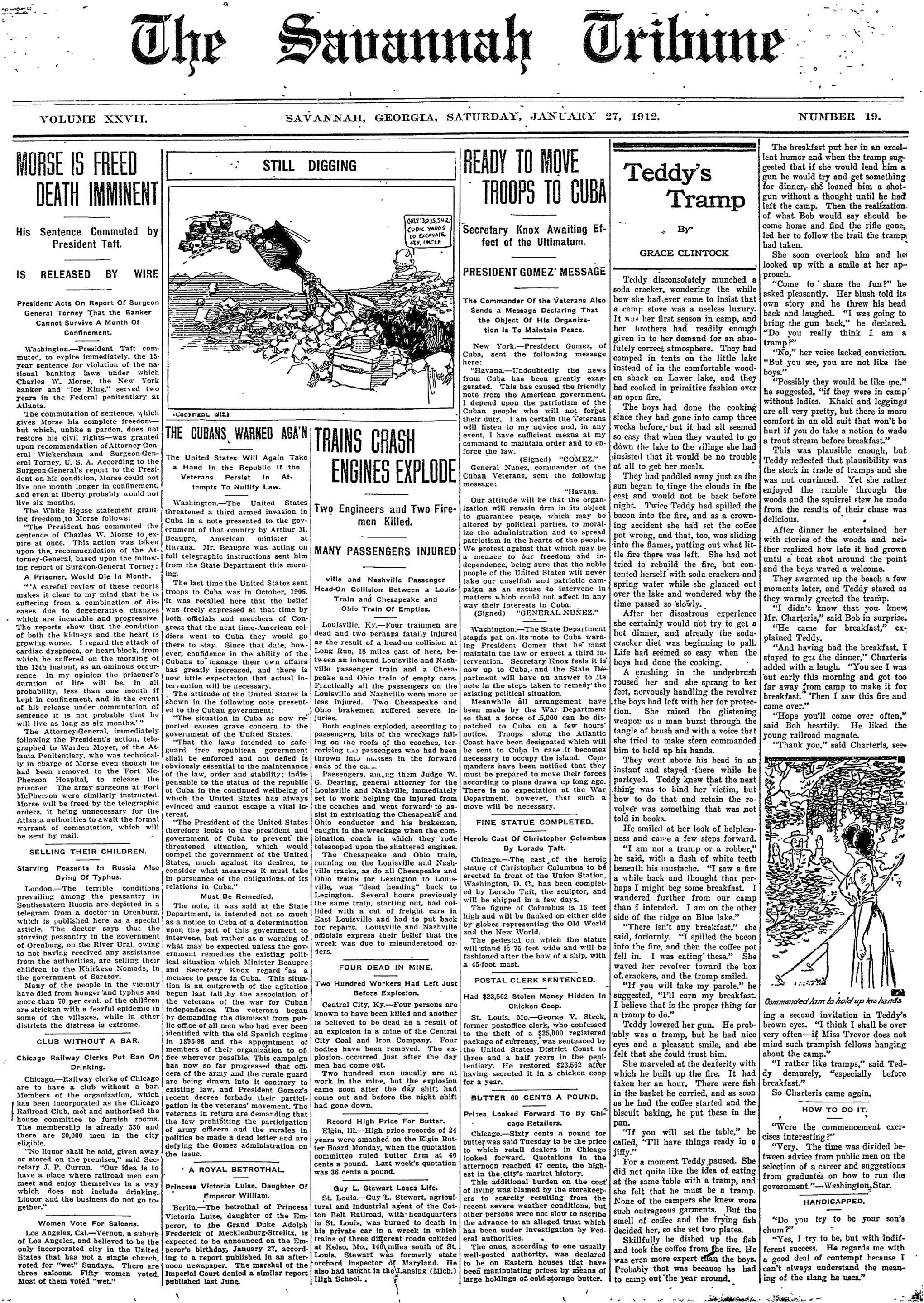
MORSE IS FREED DEATH IMMINENT
His Sentence Commuted by President Taft.
IS RELEASED BY WIRE
President Acts On Report Of Surgeon General Torney That the Banker Cannot Survive A Month Of Confinement.
Washington.—President Taft commuted, to expire immediately, the 15-year sentence for violation of the national banking laws under which Charles W. Morse, the New York banker and "Ice King," served two years in the Federal penitentiary at Atlanta.
The commutation of sentence, which gives Morse his complete freedom—but which, unlike a pardon, does not restore his civil rights—was granted upon recommendation of Attorney-General Wickersham and Surgeon-General Torney, U. S. A. According to the Surgeon-General's report to the President on his condition, Morse could not live one month longer in confinement, and even at liberty probably would not live six months.
The White House statement granting freedom to Morse follows:
"The President has commuted the sentence of Charles W. Morse to expire at once. This action was taken upon the recommendation of the Attorney-General, based upon the following report of Surgeon-General Torney:
A Prisoner, Would Die In Month.
"A careful review of these reports makes it clear to my mind that he is suffering from a combination of diseases due to degenerative changes which are incurable and progressive. The reports show that the condition of both the kidneys and the heart is growing worse. I regard the attack of cardiac dyspnoea, or heart-block, from which he suffered on the morning of the 15th instant, as an ominous occurrence. In my opinion the prisoner's duration of life will be. in all probability, less than one month if kept in confinement, and in the event of his release under commutation of sentence it is not probable that he will live as long as six months."
The Attorney-General, immediately following the President's action, telegraphed to Warden Moyer, of the Atlanta Penitentiary, who was technically in charge of Morse even though he had been removed to the Fort McPherson Hospital, to release the prisoner The army surgeons at Fort McPherson were similarly instructed. Morse will be freed by the telegraphic orders, it being unnecessary for the Atlanta authorities to await the formal warrant of commutation, which will be sent by mail.
SELLING THEIR CHILDREN.
Starving Peasants In Russia Also Dying Of Typhus.
London.—The terrible conditions prevailing among the peasantry in Southeastern Russia are depicted in a telegram from a doctor in Orenburg, which is published here as a special article. The doctor says that the starving peasantry in the government of Orenburg, on the River Ural, owing to not having received any assistance from the authorities, are selling their children to the Khirkese Nomads, in the government of Saratov.
Many of the people in the vicinity have died from hunger and typhus and more than 70 per cent. of the children are stricken with a fearful epidemic in some of the villages, while in other districts the distress is extreme.
CLUB WITHOUT A BAR.
Chicago Railway Clerks Put Ban On Drinking.
Chicago.—Railway clerks of Chicago are to have a club without a bar. Members of the organization, which has been incorporated as the Chicago Railroad Club, met and authorized the house committee to furnish rooms. The membership is already 350 and there are 20,000 men in the city eligible.
"No liquor shall be sold, given away or stored on the premises," said Secretary J. P. Curran. "Our idea is to have a place where railroad men can meet and enjoy themselves in a way which does not include drinking. Liquor and the business do not go together."
Women Vote For Saloons.
Los Angeles, Cal.-Vernon, a suburb of Los Angeles, and believed to be the only incorporated city in the United States that has not a single church, voted for "wet" Sundays. There are three saloons. Fifty women voted. Most of them voted "wet."
ONLY 13,075,542
CUBIC YARDS
TO EXCAVATE,
HEY, UNCLE
The United States Will Again Take a Hand In the Republic If the Veterans Persist In Attempts To Nullify Law.
Washington.—The United States threatened a third armed invasion in Cuba in a note presented to the government of that country by Arthur M. Beaupre, American minister at Havana. Mr. Beaupre was acting on full telegraphic instructions sent him from the State Department this morning.
The last time the United States sent troops to Cuba was in October, 1906. It was recalled here that the belief was freely expressed at that time by both officials and members of Congress that the next time-American soldiers went to Cuba they would go there to stay. Since that date, however, confidence in the ability of the Cubans to manage their own affairs has greatly increased, and there is now little expectation that actual intervention will be necessary.
The attitude of the United States is shown in the following note presented to the Cuban government:
"The situation in Cuba as now reported causes grave concern to the government of the United States.
"That the laws intended to safeguard free republican government shall be enforced and not defied is obviously essential to the maintenance of the law, order and stability; indispensable to the status of the republic of Cuba in the continued wellbeing of which the United States has always evinced and cannot escape a vital interest.
"The President of the United States therefore looks to the president and government of Cuba to prevent the threatened situation, which would compel the government of the United States, much against its desires, to consider what measures it must take in pursuance of the obligations of its relations in Cuba."
Must Be Remedied.
The note, it was said at the State Department, is intended not so much as a notice to Cuba of a determination upon the part of this government to intervene, but rather as a warning of what may be expected unless the government remedies the existing political situation which Minister Beaupre and Secretary Knox regard as a menace to peace in Cuba. This situation is an outgrowth of the agitation begun last fall, by the association of the veterans of the war for Cuban independence. The veterans began by demanding the dismissal from public office of all men who had ever been identified with the old Spanish regime in 1895-98 and the appointment of members of their organization to office wherever possible. This campaign has now so far progressed that officers of the army and the rurale guard are being drawn into it contrary to existing law, and President Gomez's recent decree forbade their participation in the veterans' movement. The veterans in return are demanding that the law prohibiting the participation of army officers and the rurales in politics be made a dead letter and are defying the Gomez administration on the issue.
A ROYAL BETROTHAL
Princess Victoria Luise, Daughter Of Emperor William.
Berlin.—The betrothal of Princess Victoria Luise, daughter of the Emperor, to the Grand Duke Adolph Frederick of Mecklenburg-Strelitz, is expected to be announced on the Emperor's birthday, January 27, according to a report published in an afternoon newspaper. The marshal of the Imperial Court denied a similar report published last June.
SAVANNAH, GEORGIA, SATURDAY, JANUARY 27, 1912.
TRAINS CRASH ENGINES EXPLODE
Two Engineers and Two Firemen Killed.
MANY PASSENGERS INJURED
ville and Nashville Passenger Head-On Collision Between a Louis-
Train and Chesapeake and Ohio Train Of Empties.
Loulsville, Ky.-Four trainmen are dead and two perhaps fatally injured as the result of a head-on collision at Long Run, 18 miles east of here, between an inbound Louisville and Nashville passenger train and a Chesapeake and Ohio train of empty cars. Practically all the passengers on the Louisville and Nashville were more or less injured. Two Chesapeake and Ohio brakemen suffered severe injuries.
Both engines exploded, according to passengers, bits of the wreckage falling on the roofs of the coaches, terrorizing the passengers who had been thrown into masses in the forward ends of the car.
Passengers, among them Judge W. G. Dearing, general attorney for the Louisville and Nashville, immediately set to work helping the injured from the coaches and went forward to assist in extricating the Chesapeake and Ohio conductor and his brakeman, caught in the wreckage when the combination coach in which they rode telescoped upon the shattered engines.
The Chesapeake and Ohio train, running on the Louisville and Nashville tracks, as do all Chesapeake and Ohio trains for Lexington to Louisville, was "dead heading" back to Lexington. Several hours previously the same train, starting out, had collided with a cut of freight cars in East Louisville and had to put back for repairs. Louisville and Nashville officials express their belief that the wreck was due to misunderstood orders.
Two Hundred Workers Had Left Just Before Explosion.
Central City, Ky.—Four persons are known to have been killed and another is believed to be dead as a result of an explosion in a mine of the Central City Coal and Iron Company. Four bodies have been removed. The explosion occurred just after the day men had come out. Two hundred men usually are at work in the mine, but the explosion came soon after the day shift had come out and before the night shift had gone down.
Record High Price For Butter.
Elgin, Ill.—High price records of 24 years were smashed on the Elgin Butter Board Monday, when the quotation committee ruled butter firm at 40 cents a pound. Last week's quotation was 36 cents a pound.
Guy L. Stewart Loses Life.
St. Louis.—Guy L. Stewart, agricultural and industrial agent of the Cotton Belt Railroad, with headquarters in St. Louis, was burned to death in his private car in a wreck in which trains of three different roads collided at Kelso, Mo., 140 miles south of St. Louis. Stewart was formerly state orchard inspector of Maryland. He also had taught in the Lansing (Mich.) High School.
READY TO MOVE TROOPS TO CUBA
Secretary Knox Awaiting Effect of the Ultimatum.
PRESIDENT GOMEZ' MESSAGE
The Commander Of the Veterans Also Sends a Message Declaring That the Object Of His Organization Is To Maintain Peace.
New York.—President Gomez, of Cuba, sent the following message here:
"Havana.—Undoubtedly the news from Cuba has been greatly exaggerated. This has caused the friendly note from the American government. I depend upon the patriotism of the Cuban people who will not forget their duty. I am certain the Veterans will listen to my advice and, in any event, I have sufficient means at my command to maintain order and to enforce the law.
(Signed) "GOMEZ."
General Nunez, commander of the Cuban Veterans, sent the following message:
"Havana.
Our attitude will be that the organization will remain firm in its object to guarantee peace, which may be altered by political parties, to moralize the administration and to spread patriotism in the hearts of the people. We protest against that which may be a menace to our freedom and independence, being sure that the noble people of the United States will never take our unselfish and patriotic campaign as an excuse to intervene in matters which could not affect in any way their interests in Cuba.
(Signed) "GENERAL NUNEZ."
Washington.—The State Department stands pat on its note to Cuba warning President Gomez that he must maintain the law or expect a third intervention. Secretary Knox feels it is now up to Cuba, and the State Department will have an answer to its note in the steps taken to remedy the existing political situation.
Meanwhile all arrangement have been made by the War Department so that a force of 5,000 can be dispatched to Cuba on a few hours' notice. Troops along the Atlantic Coast have been designated which will be sent to Cuba in case it becomes necessary to occupy the island. Commanders have been notified that they must be prepared to move their forces according to plans drawn up long ago. There is no expectation at the War Department, however, that such a move will be necessary.
FINE STATUE COMPLETED.
Heroic Cast Of Christopher Columbus By Lorado Taft.
Chicago.—The cast of the heroic statue of Christopher Columbus to be erected in front of the Union Station, Washington, D. C., has been completed by Lorado Taft, the sculptor, and will be shipped in a few days.
The figure of Columbus is 15 feet high and will be flanked on either side by globes representing the Old World and the New World.
The pedestal on which the statue will stand is 75 feet wide and will be fashioned after the bow of a ship, with a 45-foot mast.
POSTAL CLERK SENTENCED.
Had $23,562 Stolen Money Hidden In Chicken Coop.
St. Louis, Mo.—George V. Steck, former postoffice clerk, who confessed to the theft of a $25,000 registered package of currency, was sentenced by the United States District Court to three and a half years in the penitentiary. He restored $23,562 after having secreted it in a chicken coop for a year.
BUTTER 60 CENTS A POUND.
Prizes Looked Forward To By Chicago Retailers.
Chicago.—Sixty cents a pound for butter was said Tuesday to be the price to which retail dealers in Chicago looked forward. Quotations in the afternoon reached 47 cents, the highest in the city's market history.
This additional burden on the cost of living was blamed by the storekeepers to scarcity resulting from the recent severe weather conditions, but other persons were not slow to ascribe the advance to an alleged trust which has been under investigation by Federal authorities.
The onus, according to one usually well-posted authority, was declared to be on Eastern houses that have been manipulating prices by means of large holdings of cold-storage butter.
Teddy's Tramp
By GRACE CLINTOCK
Teddy disconsolately munched a soda cracker, wondering the while how she had ever come to insist that a camp stove was a useless luxury. It was her first season in camp, and her brothers had readily enough given in to her demand for an absolutely correct atmosphere. They had camped in tents on the little lake instead of in the comfortable wooden shack on Lower lake, and they had cooked in primitive fashion over an open fire.
The boys had done the cooking since they had gone into camp three weeks before, but it had all seemed so easy that when they wanted to go down the lake to the village she had insisted that it would be no trouble at all to get her meals.
They had paddled away just as the sun began to, tinge the clouds in the east and would not be back before night. Twice Teddy had spilled the bacon into the fire, and as a crowning accident she had set the coffee pot wrong, and that, too, was sliding into the flames, putting out what little fire there was left. She had not tried to rebuild the fire, but contented herself with soda crackers and spring water while she glanced out over the lake and wondered why the time passed so slowly.
After her disastrous experience she certainly would not try to get a hot dinner, and already the sodacracker diet was beginning to pall. Life had seemed so easy when the boys had done the cooking.
A crashing in the underbrush roused her and she sprang to her feet, nervously handling the revolver the boys had left with her for protection. She raised the glistening weapon as a man burst through the tangle of brush and with a voice that she tried to make stern commanded him to hold up his hands.
They went above his head in an instant and stayed there while he parleyed. Teddy knew that the next thing was to bind her victim, but how to do that and retain the rovolver was something that was not told in books.
He smiled at her look of helplessness and came a few steps forward.
"I am not a tramp or a robber," he said, with a flash of white teeth beneath his mustache. "I saw a fire a while back and thought that perhaps I might beg some breakfast. I wandered further from our camp than I intended. I am on the other side of the ridge on Blue lake."
"There isn't any breakfast," she said, forlornly. "I spilled the bacon into the fire, and then the coffee pot fell in. I was eating these." She waved her revolver toward the box of crackers, and the tramp smiled. "If you will take my parole," he suggested, "I'll earn my breakfast. I believe that is the proper thing for a tramp to do." Teddy lowered her gun. He probably was a tramp, but he had nice eyes and a pleasant smile, and she felt that she could trust him.
She marveled at the dexterity with which he built up the fire. It had taken her an hour. There were fish in the basket he carried, and as soon as he had the coffee started and the biscuit baking, he put these in the pan.
"If you will set the table," he called, "I'll have things ready in a jiffy."
For a moment Teddy paused. She did not quite like the idea of eating at the same table with a tramp, and she felt that he must be a tramp. None of the campers she knew wore such outrageous garments. But the smell of coffee and the frying fish decided her, so she set two plates.
Skillfully he dished up the fish and took the coffee from the fire. He was even more expert than the boys. Probably that was because he had to camp out the year around.
NUMBER 19.
The breakfast put her in an excellent humor and when the tramp suggested that if she would lend him a gun he would try and get something for dinner, she loaned him a shotgun without a thought until he had left the camp. Then the realization of what Bob would say should he come home and find the rifle gone, led her to follow the trail the tramp had taken. She soon overtook him and he looked up with a smile at her approach.
"Come to share the fun?" he asked pleasantly. Her blush told its own story and he threw his head back and laughed. "I was going to bring the gun back," he declared. "Do you really think I am a tramp?"
"No," her voice lacked conviction. "But you see, you are not like the boys."
"Possibly they would be like me," he suggested, "if they were in camp without ladies. Khaki and leggings are all very pretty, but there is more comfort in an old suit that won't be hurt if you do take a notion to wade a trout stream before breakfast."
This was plausible enough, but Teddy reflected that plausibility was the stock in trade of tramps and she was not convinced. Yet she rather enjoyed the ramble through the woods and the squirrel stew he made from the results of their chase was delicious.
After dinner he entertained her with stories of the woods and neither realized how late it had grown until a boat shot around the point and the boys waved a welcome.
They swarmed up the beach a few moments later, and Teddy stared as they warmly greeted the tramp.
"I didn't know that you knew Mr. Charteris," said Bob in surprise. "He came for breakfast," explained Teddy.
"And having had the breakfast, I stayed to go to the dinner," Charteris added with a laugh. "You see I was out early this morning and got too far away from camp to make it for breakfast." Then I saw this fire and came over."
"Hope you'll come over often," said Bob heartily. He liked the young railroad magnate.
"Thank you," said Charteris, see-
KING GEORGE IV.
Commanded him to hold up his hands ing a second invitation in Teddy's brown eyes. "I think I shall be over very often—if Miss Trevor does not mind such trampish fellows hanging about the camp." "I rather like tramps," said Teddy demurely, "especially before breakfast." So Charteris came again.
"Were the commencement exercises interesting?"
"Very. The time was divided between advice from public men on the selection of a career and suggestions from graduates on how to run the government."—Washington, Star.
"Do you try to be your son's chum?"
"Yes, I try to be, but with indifferent success. He regards me with a good deal of contempt because I can't always understand the meaning of the slang he uses."
;
NN ee
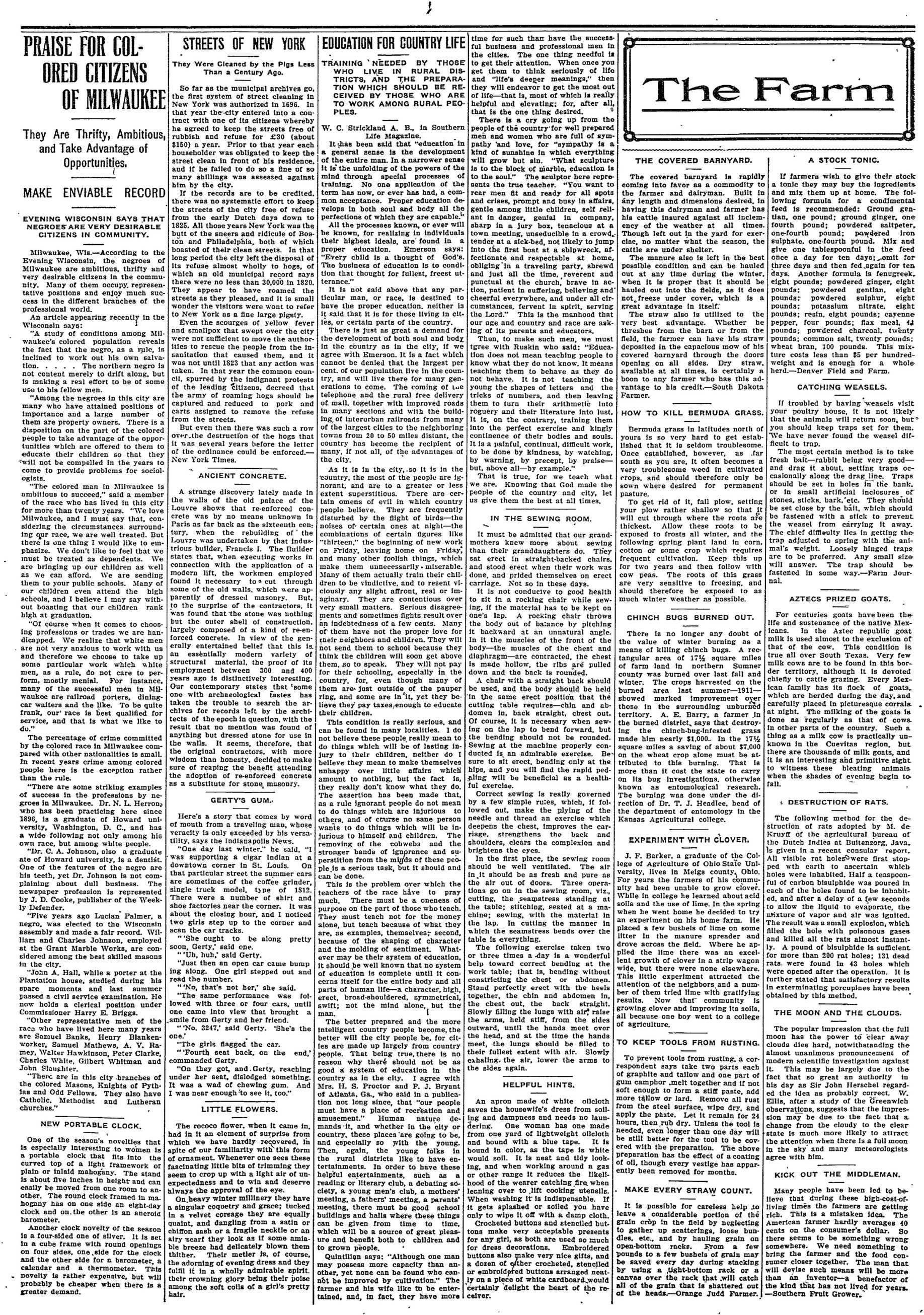
PRAISE FOR COL STREETS OF NEW YORK |EDUGATION FOR COUNTRY LIFE) tii‘.eincse and protessions: mea in| (nner
- ful business and professional men in
. ——- + — the cltles. The one thing needful ts ,
‘They Were Cleaned by the Pigs Less| TRAINING "NEEDED BY THOSE|to get thefr attention. When once you ‘
ORED CITIZENS Than a Century Ago. WHO LIVE IN RURAL DIS-|get them to think seriously of life
—- ‘TRICTS, AND THE PREPARA-/and “life's deeper meanings,” then .
So far as the municipal archives go,| TION WHICH SHOULD BE RE-|they will endeavor to got the most out
the first system of street cleaning in| CEIVED BY THOSE WHO ARE [of life—that fs, most of which 1s really Ee ail i i i
New York was authorized in 1696. In| TO WORK AMONG RURAL PEO-{helpful and elevating: for, after all,
that year the-clty entered into a con-| PLES. that fs the one thing desired, ° —_—_—_—_—_—_—_—eeeees
ee tract with one of its citizens whereby | aera a ia aes There ts a cry golug up from the
an he agreed to keep the streets free of | W. C. Strickland A. B., in Southern | people of thé country'for well prepared 2
They Are Thrifty, Ambitious,|ruvish and refuse for £30 (about Life Magazine. [med and women who are full of sym) ees
and Take Advantage of | $159.8 zear. Prior to that year each | | Ithas beon sald that “education'in| pathy ‘and love, for “sympathy ts & "
i householder was obligated to keep the! @ general sense is the development|kind of sunshine in which everything | rn
Opportunities. street clean in front of bis residence, | of the entire man, In a narrower eense| will grow but sin. “What sculpture} © THE COVERED BARNYARD. A STOCK TONIC,
{ and if he failed to do 20 a fine of so | it Is the unfolding of the powers of the | Ia to the block of niarble, education {8 —— mee
—_—_—_— many shillinga was assessed against} mind through special processes Of|to the soul” The sculptor here repre- ‘The covered barnyard Is rapidly If farmers wish to give thelr stock
him by the city. training. No one application of the|sonts the true teacher. “You want to} coming Into favor as a commodity to} a tonic they may buy the ingredients
MAKE ENVIABLE RECORD] 1 the records are to be credited, | term has now, or ever has had, a com-|rear men ft and ready for all spots| the farmer and dairyman. Built in|and mix them up at home. The fol-
| there was no systematic effort to keep | mon acceptance. Proper education de-| and crises, prompt and busy in affairs, | any length and dimensions desired, in| lowing formula for a condimental
: _ the streets of the clty free of refuse | velops in both soul and body all the| gentle among Uittle children, self reli-| having this dairyman and farmer bas|feed is recommended: Ground gen-
EVENING WISCONSIN SAYS THAT | from the early Dutch days down to| perfections of which they are capable.” | ant in danger, genial in company, | his cattle insured against all inclem-| tian, one pound; ground ginger, one
NEGROES ARE VERY DESIRABLE | 1825. All those years New York wasthe| All the processes known, or ever will|sharp in a jury box, tenacious at al ency of the weather at all times.|fourth pound; powdered saltpeter,
CITIZENS IN COMMUNITY. butt of the sneers and ridicule of Bos-| be known, for realizing in individuals | town meeting, unseducible in a crowd,.| Though left out in the yard for exer-|one-fourth pound; pawdered ron
Milwaukee, Wis.—According to the
Evening Wisconsin, the negroes of
Milwaukee are ambitious, thrifty and
very desirable citizens in the commu-
nity. Many of them occupy, represen-
tative positions and enjoy much suc-
cess in the different branches of the
professional world.
An article appearing recently tn the
Wisconsin says:
“A study of conditions among Mil-
waukee's colored population reveals
the fact that the negro, as a mle, 1s
inclined to work out his own salva-
tion. . . . . The northern negro is
not content merely to drift along, but
fs making a real effort to be of some
use to his fellow men.
“Among the negroes in this city are
many who have attained positions of
importance and a large number of
them are property owners. There is a
disposition on the part of the colored
people to take advantage of the oppor-
tunities which are offered to them to
educate their children so that they
“will not be compelled in the years to
come to provide problems for sociol-
ogists.
“The colored man in Milwaukee ts
ambitfous to succeed,” sald a member
of the race who has lived fn this city
for more than twenty years. “We love
Milwaukee, and I must say that, con-
sidering the circumstances surround-
ing qur race, we are well treated. But
there Is one thing I would like to em-
phasize. We don’t like to feel that we
must be treated as dependents. We
are bringing up our children as well
as we can afford. We are sending
them to your public schools. Many of
our children even attend the high
acheols, and I believe I may say with-
out boasting that our children rank
high at graduation.
“Of course when It comes to choos-
ing professions or trades we are han-
dicapped. We realize that white men
are not very anxious to work with us
and therefore we choose to take up
some particular work which white
men, a8 a rule, do not care to per-
form, mostly menial. For instance,
many of the successful mén in Mil-
waukee are railroad porters, dining-
car walters and the Uke. To be quite
frank, our' race is Best qualified for
service, and that !s what we like to
dv.”
The percentage of crime committed
dy the colored race in Milwaukee com-
pared with other nationalities s small.
Jn recent years crime among colored
people here is the exception rather
than the mule.
“There are some striking examples
of success in the professions by ne-
groes in Milwaukee, Dr. N. L. Herron;
who has been practicing here since
1896, is a graduate of Howard unl-
versity, Washington, D. C., and bas
& wide following not only among his
own race, but among white people.
“Dr. C. A. Johnson, also a graduate
ate of Howard untversity, is a dentist.
One of the features of the negro are
his teeth, yet Dr. Johnson is not com-
plaining about dull business. The
newspaper profession is represented
by J. D. Cooke, publisher of the Week-
ly Defender. 7
“Pive years ago Lucian Palmer, a
negro, was elected to the Wisconsin
assembly and made a fair record. Wil-
Mam and Charles Johnson, employed
at the Grant Marble Works, are con-
sidered among the best skilled masons
in the city.
“Jon A. Hall, while a porter at the
Plantation house, studied during his
spare moments and last summer
passed a civil service examination. He
now holds a clerical position under
Commissioner Harry E. Briggs.
“Other representative men of the
Tacs who have lived here many years
are Samuel Banks, Henry Blanken-
worker, Samuel Mathews, A. V. Ra-
mey, Welter Hawkinson, Peter Clarke,
Charles White, Gilbert Whitman and
Jobn Stanghter.
“There are in this city branches of
the colored Masons, Knights of Pyth-
jas and Odd Fellows. They also have
Catholic, Methodist. and Lutheran
churches.” ;
NEW PORTABLE CLock,
One of the season's novelties that
is especially Interesting to women is
@ portable clock that fits into the
curved top of a light framework of
plain or inlaid mahogany. The stand
4s about five inches in height and can
easily be moved from one room to an-
other. The round clock framed tn ma.
hogany has on one side an eight-day
clock and on.the other 1s an aneroia
barometer.
Another clock novelty of the seacon
1s a four-sided one of silver. It is set
in a cube frame with round openings
on four sides, one side for the clock
and the other side for 2 barometer, a
calendar and a thermometer. This
Bovelty is rather expensive, but will
probably be cheaper when there ts a
greater demand.
STREETS OF NEW YORK
They ‘Were Cleared by sie Pins Less
So far as the municipal archives go,
the first system of street cleaning in
New York was authorized in 1696. In
that year the-elty entered Into a con-
tract with one of its citizens whereby
he agreed to keep the streets free of
rubbish and refuse for £30 (about
$150) a year. Prior to that year each
householder was obligated to keep the
street clean in front of his residence,
and if he failed to do so a fine of 80
many shillings was assessed against
him by the city.
If the records are to be credited,
there was no systematic effort to keep
the streets of the city free of refuse
from the early Dutch days down to
1825. All those years New York was the
bytt of the sneers and ridicule of Bos-
ton and Philadelphia, both of which
boasted of their clean streets. In that
long period the clty left the disposal of
Its refuse almost wholly to hogs, of
which an old municipal record says
there were no less than 30,000 In 1820,
They appear to have roamed the
streets as they pleased, and it {a small
wonder the visitors were wont to refer
to New York as a fine large pigsty.
Even the scourges of yellow fever
and smallpox that swept over the city
were not sufficient to move the author-
{ules to rescue the people from the in-
sanitation that caused them, and it
was not until 1823 that any action was
taken. In that year the common coun-
cil, spurred by the indignant protests
of the leading Titizens, decreed that
the army of roaming hogs should be
captured and reduced to pork and
carts assigned to remove the refuse
from the streets.
But even then there was such a row
over.the destruction of the hogs that
it was several years before the letter
of the ordinance could be enforced.—
New York Times.
" ANCIENT CONCRETE.
| _A strange discovery lately made tn
‘the walls of the old palace of the
Louvre shows that re-enforced con-
crete was by no means unknown {n
Paris as far back as the sixteenth cen:
tury, when the rebuilding of” the
Louvre was undertaken by that indus-
trfous builder, Francis I. The Builder
states that, when executing works in
connection with the application of a
modern lift, the workmen employed
found St necessary tos cut through
some of the old walls, which were ap-
parently of dressed masonry. But,
fo the surprise of the contractors, It
was found that ‘the stone was nothing
but the outer shell of construction,
largely composed of a kind of re-en-
forced concrete. In view of the gen-
erally entertained belief that this s
an essentially modern varlety of
structural materfal, the proof of its
employment between 300 and 400
years ago 1s distinctively Interesting.
Our contemporary states that ‘some
one with archaeological iastes has
taken the trouble to search the ar-
chives for records left by the arehi-
tects of the epoch in question, with the
result that no mention was found of
anything but dressed stone for use in
the walls. It seems, therefore, that
the original contractors, with more
wisdom than honesty. decided to make
sure of reaping the benefit attending
the adoption of re-enforced concrete
as a substitute for stone, masonry.
GERTY’S GUM.
Here's a story that comes by word
of mouth from a traveling man, whose
veracity {s only exceeded by his versa-
tity, says the Indianapolis News.
“One day last winter.” he said, “I
‘was supporting a cigar Indian at a
downtown corner {n St. Louls, On
that particular street the summer cars
are sometimes of the coffee grinder,
single truck model, type of 1812.
‘There were a number of shirt and
shoe factories near the corner. It was
about the closing hour, and I noticed
two girls step up to the corner and
scan the car tracks.
“‘She ought to te along pretty
soon, Gerty,’ said one.
“"Uh, huh,’ satd Gerty.
“Just then an open car came bump
ing along. One girl stepped out and
read the number.
““No, that's not ber,” she said.
“The same performance was {ol-
lowed with three or four cars, until
one came into view that brought a
smile from Gerty and her friend.
“"No, 3247,’ sald Gerty. “She's the
one” 5
“The girls flagged the car.
““Fourth seat back, on the end,’
commanded Gerty.
“On they got, and.Gerty, reaching
under her seat, dislodged something.
It was a wad of chewing gum. And
I was pear enough to see it. too.”
LITTLE FLOWERS.
The rococo flower. when It came in,
had in ft an element of surprise from
which we have hardly recovered, tn
spite of our familiarity with this form
of ornament. Whenever one sees these
fascinating little bits of trimming they
seem to crop up with a light afr of un-
expectedness and to win and deserve
always the approval of the eye.
On.beavy winter millinery they have
a singular coquetry and grace; tucked
in a velvet coreage they are equally
quaint, and dangling from a satin or
chiffon sash or a fragile necktie or an
airy scarf they look 23 if some amia-
ble breeze had delicately blown them
thither. Their metier is, of course,
the adorning of evening dress and they
tultl if in a wholly admirable spirit
thelr crowning glory being thelr poise
among the soft colla of # girl's pretty
EDUCATION FOR COUNTRY LIFE
TRAINING ‘NEEDED BY THOSE
WHO LIVE IN RURAL DIs-
TRICTS, AND JHE PREPARA-
TION WHICH SHOULD BE RE-
CEIVED BY THOSE WHO ARE
TO WORK AMONG RURAL PEO-
PLES.
W. ©. Strickland A. B., in Southern
Life Magazine. .
Itghas been seld that “education in
@ general sense is the development
of the entire man, In a narrower sense
it Is the unfolding of the powers of the
mind through special processes of
training. No one application of the
term has now, or ever has had, a com-
mon acceptance. Proper education de-
velops in both soul and body all the
perfections of which they are capable.”
All the processes known, or ever will
be known, for reallzing in Individuals
thelr highest ideals, are’ found In a
proper education, " Emerson says:
“Every child Is a thought of God's.
The buslness of education Is to condl-
tion that thought for fullest, freest ut-
terance.”
It {8 not eafd above that any par-
ticular man, or race, is destined to
have the proper education, neither is
it said that it Is for those living in clt-
ies, or certain parts of the country.
There is just as great a demand for
the development of both soul and body
In the country as in the city, if we
agree with Emerson. It {s a fact which
cannot be dented that the largest per
cent. of our population Iive in the coun-
try, and will live there for many gen-
erations to come. The coming of tue
telephone and the rural free delivery
ot mail, together with improved roads
fn many sections and with the build-
ing, of interurban raflroads from many
of the largest cities to the nelghboring
towns from 20 to 50 miles distant, the
country has become the recipient of
many, If not all, of the advantages of
the city.
As it {s fn the city,-so It is In the
cduutry, the most of the people are 15-
norant, and are to a greater or less
extent superstitious. There are cer-
tain omens of evil in which country
people believe. They are frequently
disturbed by the fight of birds—the
noises of certain ones at night—the
combinations of certain figures like
“thirteen,” the beginning of new work
on Friday, leaving home on Friday,
and many other foolish things, which
make them unnecessarily - miserable.
Many of them actually train their chil-
dren to be vindictive, and to resent vi-
clously any slight affront, real or {m-
aginary. They are contentious over
very sinall matters. Serious disagree
ments and sometimes fights result over
an indebtedness of a few cents. Many
of them have not the proper love for
heir peighbors and children. They will
not send them to school because they
think the children will soon get above
them, so to speak. They will not pay
for thelr schooling, especially in the
country, for, even though many of
them are: just outside of the pauper
ring, and some are in ‘it, yet they be-
lieve they pay taxes enough to educate
thelr children.
‘This condition 1s really serious, and
ean be found in many localities. I do
not belleve these people really mean to
Jo things which will be of lasting in-
jury to thelr children, nelther do T
pelieve they mean to make themselves
anhappy over ttle affairs whicli
amount to nothing, but the fact is,
they really don't know what they do.
The assertion has been made that,
as a rule Jgnorant people do not mean
o do things which are injurious to
others, and of cturse no sane person
wants to do things which will be in-
jurious to himself and children, The
removing of the cobwebs and the
stronger bands of ignprance and su-
peratition from the migas of these peo
ple {s a serious task, but it should and
van be done.
This fs the problem over which the
eachers of the race hive to pray
much, There must be a oneness of
purpose on the part of those who teach.
They must teach not for the money
alone, but teach because of what they
are, as examples, themselves; second,
because of the shaping of character
and the molding of sentiment. What-
aver may be thelr system of education,
it should be well known that no system
of education 1s complete until tt con-
cerns Itself for the entire body and all
parts of human Ilfe—a character, high,
erect, broad-shouldered, symmetrical,
swift; not the mind alone, but the
man, 1
‘The better prepared and the more
intelligent country people become, the
(SRST TAGES TERED Oe FOr’ see money
alone, but teach because of what they
are, as examples, themselves; second,
because of the shaping of character
and the molding of sentiment. What-
‘ever may be their system of education,
it should be well known that no system
of education 1s complete until it con-
cerns Itself for the entire body and all
parts of human Ife—a character, bigh,
erect, broad-shouldered, symmetrical,
swift; not the mind alone, but the
man, 1
‘The better prepared and the more
Intelligent country people become, the
better will the city people be, for cit-
fes are made up largely from country
people. That being true,there ts no
reason why theré should not be as
good a system of education in the
country as In the clty. I agree with
Mrs. H. S. Proctor and P. J, Bryant
of Atlanta, Ga., who said in a publica-
tion not long since, that “our people
must have a place of recreation and
amusement.” Human nature de-
mands-it, and whether In the clty or
country, these places ‘are going to be,
and especially 80 pith the young.
Then, again, the young folks in
the rural districts Ike to have en-
tertainments. In order to have these
helptul entertainments, such as a
reading or Hterary club, a debating s0-
clety, a young men’s club, a mothers’
meeting, a fathers’ meeting, a parents’
meeting, there must be good school
buildings and halls where these things
can be given from time to time,
which will be a source of great pleas-
ure and benefit both to children and
to grown people. 7
Quintilign says: “Although one man
may possess more capacity than an-
other, yet none can be found who can-
not be improved by cultivation.” The
farmer and his wife like to be enter-
tained, and, in fact, they have more
time for such than have the success-
ful business and professional men in
the citles. The one thing needful is
to get their attention. When once you
get them to think seriously of life
and “life's deeper meanings,” then
they will endeavor to get the most out
of life—that 1s, most of which is really
helpful and elevating; for, after all,
that fs the one thing desired. ®
There is a cry going up from the
people of tha country'for well prepared
meh and women who are full of sym-
pathy ‘and love, for “sympathy is a
kind of sunshine in whfch everything
will grow but sin. “What sculpture
Jn to the block of niarble, education Is
to the soul” The sculptor here repre-
sents the true teacher. “You want to
rear men fit and ready for all spots
and erises, prompt and busy in affairs,
gentle among little children, self reli-
ant in danger, genfal in company,
sharp in a jury box, tenacious at a
town meeting, unseducible in s crowd,
tender at a sick-bed, not likely to jump
into the first boat at a shipwreck, af-
fectionate and respectable at home,
obliging “in a traveling party, shrewd
and just all the time, reverent and
punctual at the church, brave in ac-
tion, patient In suffering, believing and’
cheerful everywhere, and under all clr-
cumstances, fervent In sptrit, serving
the Lord.” This is the manhood that
our age and country and race are ask-
ing of its parents and educators,
Then, to make such men, we must
tgree with Ruskin who said: “Educa-
ton does not mean teaching people to
know what thes do not know. It means
teaching them to behave as they do
not behave. It ts not teaching the
young the shapes of letters and the
tricks of numbers, and then leaving
them to turn their arithmetic into
roguery and their Iterature into lust,
It 1s, on the contrary, training them
into the perfect exercise and kingly
continence of their bodies and souls.
It is a painful, continual, difficult work,
to be done by kindness, by watching,
by warning, by precept, by praise—
but, above all—by example.”
That is true, for we teach what
we are. Knowing that God made the
people of the country and city, let
us give them the best at all times,
IN THE SEWING ROOM.
It must be admitted that our grand-
mothers knew more about sewing
than their granddaughters do. They
sat erect {n strafght-backed chairs,
and stood erect when thelr work was
done, and prided themselves on erect
carriage. Not so in these days.
It is not conducive to good health
to sit in a rocking chair while sew-
ing, if the material has to be kept on
one's lap. A rocking chair throws
the body out of batance by pltching
it backward at an unnatural angle.
In it the muscles of the front of the
body—the muscles of the chest and
diaphragm—are contracted, the chest
Is made hollow, the ribs aré pulled
down and the back ts rounded.
A chair with a straight back should
be used, and the body should be held
Hin the same erect position that thé
cutting table requires—chin and ab-
domen in, back straight, chest out.
Of course, It 1s necessary when sew-
{ng on the lap to bend forward, but
the bending should not be rounded.
Sewing at the machine properly con-
ducted {3 an admirable exercise. Be
sure to sit erect, bending only at the
hips, and you will find the rapid ped-
giing will be beneficial as a health-
ful exercise.
Correct sewing is really governed
by a few simple ruzes, which, if fol-
lowed out, make the plying of the
needle and thread an exercise which
deepens the chest, !mproves the car-
riage, strengthens the back and
shoulders, clears the complexion and
brightens the eyes.
In the first place, the sewing room
should be well ventilated. The air
in jt should be as fresh and pure as
the alr out of doors. Three opera-
tions go on in the sewing room, viz.,
cutting, the seamstress standing at
the table; stitching, seated at a ma-
ebine; sewing, with the material in
the lap. In cutting the manner in
which the seamstress bends over the
table {s everything.
‘The following exercise taken two
or three times a-day is a wonderful
help toward correct bending at the
work table; that {s, bending without
constricting the chest or abdomen.
Stand perfeetly erect with the heels
together, the chin and abdomen in,
the chest out, the back straight.
Slowly filling the lungs with afr? raise
the arms, held stiff, from the sides
outward, until the hands meet over
the head, and at the time the hands
meet, the lungs should be filled to
their fullest extent with air. Slowly
exhaling. the alr, jower the arms to
the sides again.
HELPFUL HINTS,
An apron made of white oflcloth
saves the housewife’s dress from soll-
ing and dampness and needs no laun-
dering. One woman has one made
from one yard of lightweight olfcloth
and bound with a blue tape. It Is
bound in color, as the tape is white
would soll. It 1s neat and tldy look-
ing, and when working around a gas
or other range it reduces the Ilkell-
hood of the wearer catching fire when
lecning over to lift cooking utenells.
When washing It {s Indispensable. If
it gets splashed or solled you have
only to wipe it off with a damp cloth.
Crocheted buttons and stenctled but.
tons make very acceptable presents
for any girl, as both are used 20 rauch
for dress decorations, Embroidered
buttons also make very nice gifts, and
a dozen of ether crocheted, stenctled
or embroidgfed buttons arranged neat-
ly on a plece of white cardboard would
certatnly delight the heart of the re-
natiee: >
The Farm
THE COVERED BARNYARD.
‘The covered barnyard Is rapidly
coming Into favor as a commodity to
the fermer and dafryman. Built in
any length and dimensions desired, in
having this dairyman and farmer bas
his cattle insured against all inclem-
ency of the weather at all times.
‘Though left out in the yard for exer-
cise, no matter what the season, the
cattle are under shelter.
‘The manure also {s left in the best
possible condition and can be hauled
out at any time during the winter,
when it 1s proper that It should be
hauled out into the fields, as {t does
not, freeze under cover, which {s a
great advantage in itself:
The straw also Is utilized to the
Yery best advantage. Whether he
threshes from the barn or from the
field, the farmer can have his straw
deposited In the capacious mow of his
covered barnyard through the doors
opening on all sides. Dry straw,
available at all times, is certainly a
boon to any farmer who has this ad-
vantage to his credit—South Dakota
Farmer,
HOW TO KILL BERMUDA GRASS.
Bermuda grass in latitudes north of
yours is so very hard to get estab-
lshed that {t 1a seldom troublesome.
Once established, however, as far
south as you are, It often becomes a
very troublesome weed In cultivated
crops, and should therefore only be
sown where desired for permanent
pasture.
To get rid of it, fall plow, setting
your plow rather shallow so that Jt
will cut through where the roots afe
thickest. Allow these roots to be
exposed to frosts all winter, and the
following spring plant land in corn,
cotton or some crop which requires
frequent cultivation. Keep this up
for two years and then follow with
cow peas. The roots of this grass
are yery sensitive to freezing, and
should therefore be exposed to as
much winter weather as possible.
CHINCH BUGS BURNED OUT.
There {2 no longer any doubt of
the value of winter burning as a
means of killing chinch bugs. A rec-
tangular area of 17% square miles
of farm land in northern Sumner
county was burned over last fall and
winter. The crops harvested on the
burned area last summer—1911—
showed marked Improvement oyer
those in the surrounding unburméd
territory. A. E. Barry, a farmer Jn
the burned district, says that destroy-
ing the chinch-bug-Infested grass
made him nearly $1,000. In the 17%
square miles a saving of about $7,000
on the wheat crop alone must be at-
tributed to this burning. That Is
more than it cost the state to carry
on Its bug Investigations, otherwise
known as entomological research.
The burning was done under the di-
rection of Dr. T. J. Headlee, head of
the department of entomology in the
Kansas Agricultural college.
EXPERIMENT WITH CLOVER,
J. F, Barker, a graduate of the Col-
lege of Agriculture of Ohio State Unl-
versity, lives In Meigs county, Ohio,
For years the farmers of his commu-
nity had been unable to grow clover.
While in college he Jearned about acid
soils and the use of lime. In the spring
when he went bome he decided to try
an experiment on his home farm. He
placed a few bushels of lime on some
litter In the manure spreader and
drove across the field. Where he ap-
plied the lime there was an excel-
lent growth of clover in a strip wagon
wide, but there were none elsewhere.
This Mttle experiment attracted the
attention of the neighbors and a num-
ber of them tried Ime with gratifying
results. Now that community Is
growing clover and improving Its soils,
all because one boy went to a college
of agriculture.
TO KEEP TOOLS FROM RUSTING.
To prevent tools from rusting, a cor-
respondent says take two parts each
of graphite and tallow and one part of
gum camphor .melt together and if not
soft enough to form a stiff paste, add
more tallow or lard. Remove all rust
from the steel surface, wipe dry, and
apply the paste. Let it remain for 24
hours, then rub dry. Unless the tool 1s
needed, even longer than one day will
be still better for the tool to be cov-
ered with the preparation. The above
preparation has the effect of a coating
of ofl, though every vestige has appar-
ently been removed for months.
» MAKE EVERY STRAW COUNT.
It is possible for careless help to
leave a considerable portion of thé
grain crdp in the field by neglecting
to gather up scatterings, loose bun-
dies, ete, and by hauling grain on
open-bottom racke. From a few
pounds to a few bushels of grain may
be saved every day during stacking
by using a tghtbottom rack or a
canvas over the rack that .will catch
all of the grain that fs shattered out
of the hends—Orange Judd Farmer.
A STOCK TONIC,
If farmers wish to give thelr stock
a tonic they may buy the ingredients
and mix them up at home. The fol-
lowing formula for a condimental
feed is recommended: Ground gen-
tian, one pound; ground ginger, one
fourth pound; powdered saltpeter,
onefourth pound; pawdered Iron
sulphate, one-fourth pound. Mix and
give one tablespoonful In the feed
once a day for ten days; omit for
three days and then fed again for ten
ays, Another formula Is fenugreek.
eight pounds; powdered ginger, eight
pounds: powdered gentlan, eight
pounds; powdered sulphur, eight
pounds: potassium nitrate. elght
pounds; resin, elght pounds; cayenne
Pepper, four pounds; fiax meal, 42
pounds; powdered charcoal, twenty
pounds; common salt, twenty pounds:
wheat bran, 100 pounds. This mix-
ture costs less than $5 per hundred-
weight and {s enough for a whole
herd.—Denver Fleld and Farm.
CATCHING WEASELS.
If troubled by having ‘weasels visit
your poultry house, it fs not likely
that the animals will return soon, but
you should keep traps set for them.
‘We have never found the weasel dif-
ficult to trap.
The most certain method is to take
fresh balt—rabbit being very good—
and drag it about, setting traps oc-
casionally along the drag line. Traps
should be set in holes in the bank,
or in small artificial inclosures of
stones, sticks, bark,’etc. They should
be set close by the bait, which should
be fastened with a stick to prevent
the weasel from carrying It away.
The chief diMfeulty lies in getting the
trap adjusted to spring with the ani-
mal's weight. Loosely hinged traps
are to be preferred. Any small size
will answer. Te trap should be
fastened in some way.—Farm Jour-
nal.
AZTECS PRIZED GOATS.
For centuries goats havebeen the
Ife and sustenance of the native Mex-
icans. In the Aztec republic goat
milk fs used almost to the exclusion of
that of the cow. This condition is
true all over South Texas, Very few
milk cows are to be found In this bor~
der territory. although it Is devoted
chiefly to cattle grazing. Every Mex-
fcan family has its flock of goats,
which are herded during the day, and
carefully placed In picturesque corrals
at night. The milking of the goats fs
done as regularly as that of cows.
in other parts of the country. Such a
thing as a milk cow is practically un-
known in the Cuevitas region, but
there are thousands of milk goats, and
t Is an interesting and primitive sight
to witness these bleating antmais
when the shades of evening begin to
fall. * z
4 DESTRUCTION OF RATS.
The following method for the de-
struction of rats adopted by M. de
Kruyff of the agricultural bureau of
the Duteb Indies at Buitenzorg, Java,
Ys given ina recent consular report.
All visible rat hole®were first stop-
ped wth earth to ascertain whiclr
holes were Inhabited. Half a teaspoon-
ful of carbon bisulphide was poured In
each of the holes found to be Inhabit-
ed, and after a delay of a {ew seconds
to allow the Iquid to evaporate, the
nrixture of vapor and air was Ignited.
The result was a small explosion, which
filled the hole with polsonous gases
and killed all the rats almost instant-
ly. A pound of disulphide fs sufficient
for more than 200 rat holes; 131 dead
rats. were found in 43 holes which
were opened after the operation. It is
turtber stated that satisfactory results
In exterminating porcupines have been
obtained by this method, .
THE MOON AND THE CLoups.
The popular impression that the full
moon has the power to clear away
clouds dies hard, notwithstanding the
almost unanimous pronouncement of
modern scientific investigation against
it. This may be largely due to the
fact that eso great an authority iu
bis day as Sir John Herschel regard-
ed the {dea as probably correct. W.
Ellis, after a study of the Greenwich
observations, suggests that the fmpres-
sion may be due to the fact that a
change from the cloudy to the clear
state {s much more lkely to attract
the attention when there Is a full moon
in the sky and many meteorologists
agree with him.
KICK OUT THE MIDDLEMAN,
Many people have been led to be-
Meve that during these high-cost-of-
Uving timés the farmers are getting
rich, This is a mistaken jdea. The
American farmer hardly averages 40
cents on the consumer's dollar. So
there seems to be something wrong
somewhere. We need something to
bring the farmer and the food con-
sumer closer together. The man that
will deyise such means will be more
than an inventor—a benefactor of
the kind tat has not lived for years,
—Southern Fruit Grower,”
Remittance must be made by Express or Post Office Money Order, or Registered Letter. Advertising rates given on application.
Entered at the Post Office at Savan uah, Ga., as Second-Class mail matter.
SATURDAY, JANUARY 27, 1912
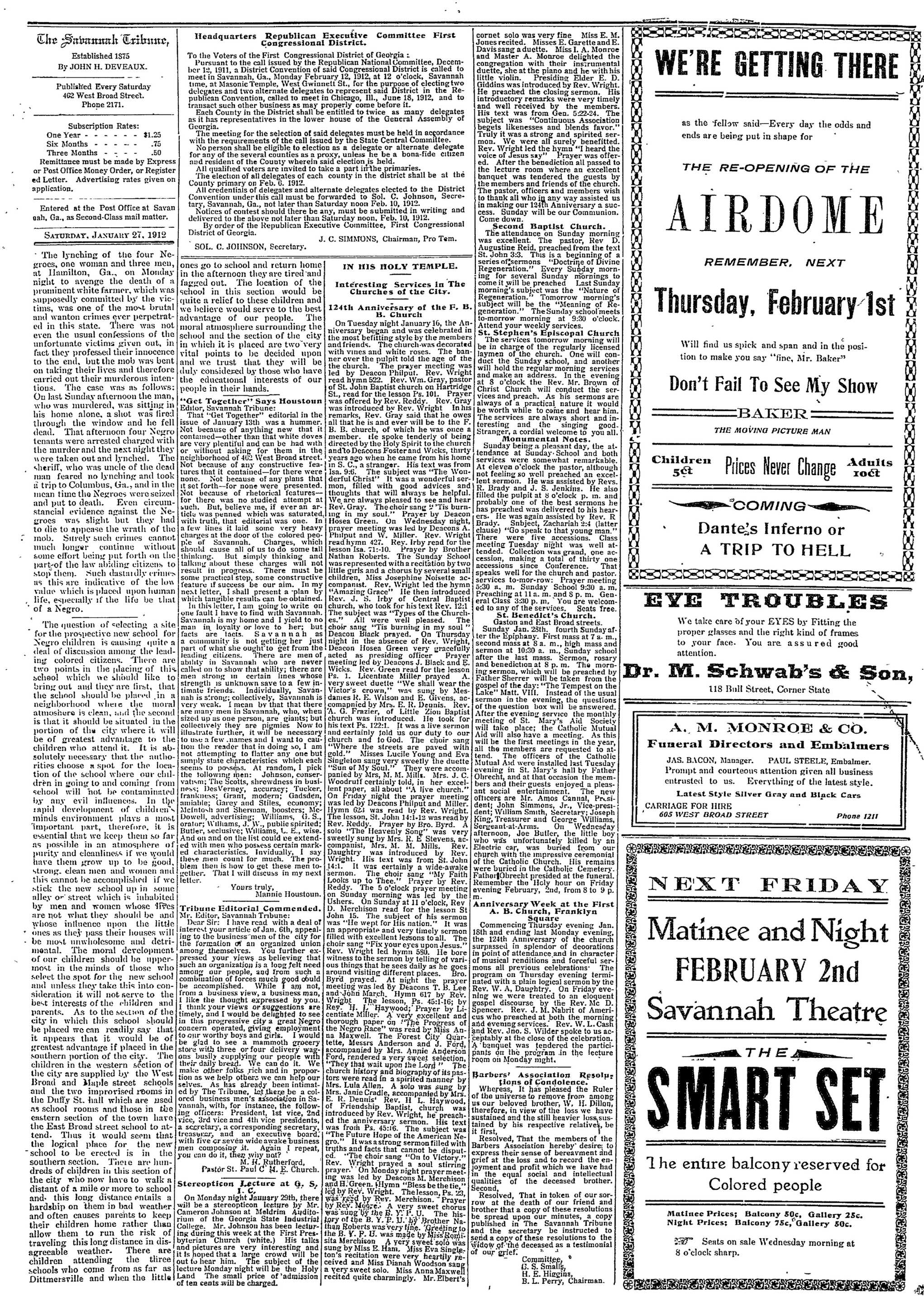
The lynching of the four Negroes, one woman and three men, at Hamilton, Ga., on Monday night to avenge the death of a prominent white farmer, which was supposedly committed by the victims, was one of the most brutal and wanton crimes ever perpetrated in this state. There was not even the usual confessions of the unfortunate victims given out, in fact they professed their innocence to the end, but the mob was bent on taking their lives and therefore carried out their murderous intentions. The case was as follows: On last Sunday afternoon the man, who was murdered, was sitting in his home alone, a shot was fired through the window and he fell dead. That afternoon four Negro tenants were arrested charged with the murder and the next night they were taken out and lynched. The sheriff, who was uncle of the dead man feared no lynching and took a trip to Columbus, Ga., and in the mean time the Negroes were seized and put to death. Even circumstantial evidence against the Negroes was slight but they had to die to appease the wrath of the mob. Surely such crimes cannot much longer continue without some effort being put forth on the part of the law abiding citizens to stop them. Such dastardly crimes as this are indicative of the low value which is placed upon human life, especially if the life be that of a Negro.
The question of selecting a site for the prospective new school for Negro children is causing quite a deal of discussion among the leading colored citizens. There are two points in the placing of this school which we should like to bring out and they are first, that the school should be placed in a neighborhood where the moral atmosphere is clean, and the second is that it should be situated in the portion of the city where it will be of greatest advantage to the children who attend it. It is absolutely necessary that the authorities choose a spot for the location of the school where our children in going to and coming from school will not be contaminated by any evil influences. In the rapid development of children's minds environment plays a most important part, therefore, it is essential that we keep them so far as possible in an atmosphere of purity and cleanliness if we would have them grow up to be good, strong, clean men and women and this cannot be accomplished if we stick the new school up in some alley or street which is inhabited by men and women whose lives are not what they should be and whose influence upon the little ones as they pass their houses will be most unwholesome and detrimental. The moral development of our children should be uppermost in the minds of those who select the spot for the new school and unless they take this into consideration it will not serve to the best interests of the children and parents. As to the section of the city in which this school should be placed we can readily say that it appears that it would be of greatest advantage if placed in the southern portion of the city. The children in the western section of the city are supplied by the West Broad and Maple street schools and the two improvised rooms in the Duffy St. hall which are used as school rooms and those in the eastern section of the town have the East Broad street school to attend. Thus it would seem that the logical place for the new school to be erected is in the southern section. There are hundreds of children in this section of the city who now have to walk a distant of a mile or more to school and this long distance entails a hardship on them in bad weather and often causes parents to keep their children home rather than allow them to run the risk of traveling this long distance in disagreeable weather. There are children attending the three schools who come from as far as Dittsmerville and when the little
Pursuant to the call issued by the Republican National Committee, December 12, 1911, a District Convention of said Congressional District is called to meet in Savannah, Ga., Monday February 12, 1912, at 12 o'clock, Savannah time, at Masonic Temple, West Gwinnett St., for the purpose of electing two delegates and two alternate delegates to represent said District in the Republican Convention, called to meet in Chicago, Ill., June 18, 1912, and to transact such other business as may properly come before it.
Each County in the District shall be entitled to twice as many delegates as it has representatives in the lower house of the General Assembly of Georgia.
SOL. C. JOHNSON, Secretary.
ones go to school and return home in the afternoon they are tired and fagged out. The location of the school in this section would be quite a relief to these children and we believe would serve to the best advantage of our people. The moral atmosphere surrounding the school and the section of the city in which it is placed are two very vital points to be decided upon and we trust that they will be duly considered by those who have the educational interests of our people in their hands.
"Get Together" Says Houstoun
Editor, Sayannah Tribune;
That "Get Together" editorial in the issue of January 13th was a hummer. Not because of anything new that it contained—other than that white doves are very plentiful and can be had with or without asking for them in the neighborhood of 462 West Broad street. Not because of any constructive features that it contained—for there were none. Not because of any plans that it set forth—for none were presented. Not because of rhetorical features—for there was no studied attempt at such. But, believe me, if ever an article was penned which was saturated with truth, that editorial was one. In a few lines it laid some very heavy charges at the door of the colored people of Savannah. Charges, which should cause all of us to do some tall thinking. But simply thinking and talking about these charges will not result in progress. There must be some practical step, some constructive feature if success be our aim. In my next letter, I shall present a plan by which tangible results can be obtained.
In this letter, I am going to write on one fault I have to find with Savannah. Savannah is my home and I yield to no man in loyalty or love to her; but facts are facts. Savannah as a community is not getting her just part of what she ought to get from the leading citizens. There are men of ability in Savannah who are never called on to show that ability; there are men strong in certain lines whose strength is unknown save to a few intimate friends. Individually, Savannah is strong; collectively, Savannah is very weak. I mean by that that there are many men in Savannah, who, when sized up as one person, are giants; but collectively they are pigmies. Now to illustrate further, it will be necessary to use a few names and I want to caution the reader that in doing so, I am not attempting to flatter any one but simply state characteristics which each seems to possess. At random, I pick the following men: Johnson, conservatism; The Scotts, shrewdness in business; DesVerney, accuracy; Tucker, frankness; Grant, modern; Gadsden, amiable; Garey and Stiles, economy; McDowell, advertising; Williams, G.S., orator; Williams, J.W., public spirited; Butler, seclusive; Williams, L.E., wise. And on and on the list could be extended with men who possess certain marked characteristics. Invidually, I say these men count for much. The problem then is how to get these men together. That I will discuss in my next letter.
Yours truly, Mannie Houstoun.
Tribune Editorial Commended.
Mr. Editor, Savannah Tribune;
Mr. Loriur, Savannah Tribune.
Dear Sir: I have read with a deal of interest your article of Jan. 6th, appealing to the business' men of the city for the formation of an organized union among themselves. You further expressed your views as believing that such an organization is a long felt need among our people, and from such a combination of forces much good could be accomplished. While I am not, from a business view, a business man, I like the thought expressed by you. I think your views or suggestions are timely, and I would be delighted to see in this progressive city a great Negro concern operated, giving employment to our worthy boys and girls. I would be glad to see a mammoth grocery store with three or four delivery wagons busily supplying our people with their daily bread. We can do it. We make other folks rich and in proportion as we help others we can help our ourselves. As has already been intimated by The Tribune, let there be a colored business men's association in Savannah, with, for instance, the following officers: President, 1st vice, 2nd rice, 3rd vice and 4th vice presidents, a secretary, a corresponding secretary, treasurer, and an executive board, with five or seven wide awake business men composing it. Again I repeat, you can do it, then wiyh not?
M. H. Rutherford,
Pastor St. P. C. M. E. Church.
Stereopticon Lecture at G, S,
L, C.
On Monday night January 29th, there will be a stereopticon lecture by Mr. Cameron Johnson at Meldrim Auditorium of the Georgia State Industrial College. Mr. Johnson has been lecturing during this week at the First Presbyterian Church (white.) His talks and pictures are very interesting and it is hoped that a large crowd will be out to hear him. The subject of the lecture Monday night will be the Holy Land The small price of admission of ten cents will be charged.
J. C. SIMMONS, Chairman, Pro Tem.
IN HIS HOLY TEMPLE.
Interesting Services in The Churches of the City.
124th Anniversary of the F. B. B. Church
cornet solo was very fine Miss E. M. Jones recited. Misses E. Garette and E. Davis saw a duette. Miss I. A. Monroe and Master A. Monroe delighted the congregation with their instrumental duette, she at the piano and he with his little violin. Presiding Elder E. D. Giddins was introduced by Rev. Wright. He preached the closing sermon. His introductory remarks were very timely and well received by the members. His text was from Gen. 5:22-24. The subject was "Continuous Association begets likenesses and blends favor." Truly it was a strong and spirited sermon. We were all surely benefitted. Rev. Wright led the hymn "I heard the voice of Jesus say" Prayer was offered. After the benediction all passed to the lecture room where an excellent banquet was tendered the guests by the members and friends of the church. The pastor, officers and members wish to thank all who in any way assisted us in making our 124th Anniversary a success. Sunday will be our Communion. Come down.
Second Baptist Church.
The attendance on Sunday morning was excellent. The pastor, Rev D. Augustine Reid, preached from the text St. John 3:3. This is a beginning of a series of sermons "Doctrine of Divine Regeneration." Every Sunday morning for several Sunday mornings to come it will be preached. Last Sunday morning's subject was the "Nature of Regeneration." Tomorrow morning's subject will be the "Meaning of Regeneration." The Sunday school meets to-morrow morning at 9:30 o'clock. Attend your weekly services.
St. Stephen's Episcopal Church
St. Stephen's Episcopal Church
The services tomorrow morning will be in charge of the regularly licensed laymen of the church. One will conduct the Sunday school, and another will hold the regular morning services and make an address. In the evening at 8 o'clock the Rev. Mr. Brown of Christ Church will conduct the services and preach. As his sermons are always of a practical nature it would be worth while to come and hear him. The services are always short and interesting and the singing good. Stranger, a cordial welcome to you all.
Monumental Notes.
Sunday being a pleasant day, the attendance at Sunday-School and both services were somewhat remarkable. At eleven o'clock the pastor, although not feeling so well preached an excellent sermon. He was assisted by Revs. R. Brady and J. S. Jenkins. He also filled the pulpit at 8 o'clock p. m. and probably one of the best sermons he has preached was delivered to his hearers. He was again assisted by Rev. R. Brady. Snbject, Zachariah 2:4 (latter clause) "Go speak to that young man." There were five accessions. Class meeting Tuesday night was well attended. Collection was grand, one accession, making a total of thirty one accessions since Conference. That speaks well for the church and pastor services to-mor-row: Prayer meeting 5:30 a. m. Sunday School 9:30 a. m. Preaching at 11 a. m. and 8 p. m. General Class 3:30 p. m. You are welcomed to any of the services. Seats free.
St. Benedict's Church.
Gaston and East Broad streets.
Sunday Jan. 28th. fourth Sunday after the Epiphany. First mass at 7 a.m., second mass at 8 a.m., high mass and sermon at 10:30 a.m., Sunday school after the last mass. Sermon, rosary and benediction at 8 p.m. The morning sermon, which will be preached by Father Sherrer will be taken from the gospel of the day: "The Tempest on the Lake" Matt. VIII. Instead of the usual sermon in the evening, the questions of the question box will be answered. After the evening service the monthly meeting of St. Mary's Aid Society will take place; the Catholic Mutual Aid will also have a meeting. As this will be the first meetings in the year, all the members are requested to attend. The officers of the Catholic Mutual Aid were installed last Tuesday evening in St. Mary's hall by Father Ohrecht, and at that occasion the members and their guests enjoyed a pleasant social entertainment. The new officers are Mr. Amos Cannal, President; John Simmons, Jr., Vice-president; William Smith, Secretary; Joseph King, Treasurer and George Williams, Sergeant-at-Arms. On Wednesday afternoon, Joe Buller, the little boy who was unfortunately killed by an Electric car, was buried from our church with the impressive ceremonial of the Catholic Church. His remains were buried in the Catholic Cemetery.Father Ohrecht presided at the funeral. Remember the Hcly hour on Friday evening February, 2nd, from 8 to 9 p.m.
Anniversary Week at the First A. B. Church, Franklyn Square
Commencing Thursday evening Jan. 18th and ending last Monday evening, the 124th Anniversary of the church surpassed in splendor of deorations in point of attendance and in character of musical renditions and forceful sermons all previous celebrations. The program on Thursday evening terminated with a plain logical sermon by the Rev. W. A, Daughtry. On Friday evening we were treated to an eloquent gospel discourse by the Rev. Mc D. Spencer. Rev. J. M. Nabrit of Americus who preached at both the morning and evening services. Rev. W. L. Cash and Rev. Jno. S. Wilder spoke to us acceptably at the close of the celebration. A banquet was (tendered the participants on the program in the lecture room on Monday night.
Barbers' Association Resolu-
tions of Condolence.
Whereas, It has pleased the Ruler of the universe to remove from among us our beloved brother, W. H. Dillon, therefore, in view of the loss we have sustained and the still heavier loss sustained by his respective relatives, be it first,
Resolved, That the members of the Barbers Association hereby desire to express their sense of bereavement and grief at the loss and to record the enjoyment and profit which we have had in the equal social and intellectual qualities of the deceased brother. Second,
Resolved, That in token of our sorrow at the death of our friend and brother that a copy of these resolutions be spread upon our minutes, a copy published in The Savannah Tribune and the secretary be instructed to send a copy of these resolutions to the widow of the deceased as a testimonial of our grief.
Committee,
G. S. Smalls,
H. E. Higgins,
B. L. Perry, Chairman.
as the fellow said—Every day the odds and ends are being put in shape for
THE RE-OPENING OF THE
AIRDOME
REMEMBER, NEXT
hursday, February 1st
Will find us spick and span and in the position to make you say "fine, Mr. Baker"
Don't Fail To See My Show
BAKER
THE MOVING PICTURE MAN
children 5¢t Prices Never Change Adults 10¢t
COMING
Dante's Inferno or
A TRIP TO HELL
VE TROUBLES
Thursday, February 1st
Will find us spick and span and in the position to make you say "fine, Mr. Baker"
Adults roct
EYE TROUBLES
We take care of your EYES by Fitting the proper glasses and the right kind of frames to your face. You are assured good attention.
M. Schwab's & Son
118 Bull Street, Corner State
A. M. MONROE & CO.
General Directors and Embalmers
WAS. BACON, Manager. PAUL STEELE, Embalmer.
Prompt and courteous attention given all business
trusted to us. Everything of the latest style.
Latest Style Silver Gray and Black Cars
VAGE FOR HIRE
5 WEST BROAD STREET
Phone 1211
EXT FRIDAY
Matinee and Night
FEBRUARY 2nd
Javannah Theatre
THE
MART SET
The entire balcony reserved for
Colored people
Matinee Prices; Balcony 50c, Gallery 25c.
Night Prices; Balcony 75c, Gallery 50c.
A. M. MONROE & CO.
Funeral Directors and Embalmers
JAS. BACON, Manager. PAUL STEELE, Embalmer.
Prompt and courteous attention given all business
entrusted to us. Everything of the latest style.
Latest Style Silver Gray and Black Cars
CARRIAGE FOR HIRE
605 WEST BROAD STREET Phone 1211
The entire balcony reserved for Colored people
Matinee Prices; Balcony 50c, Gallery 25c.
Night Prices; Balcony 75c, Gallery 50c.
2-27 Seats on sale Wednesday morning at 8 o'clock sharp.
Dr. L. A. Townsley is on the sick list this week. Friends of Dr. J. Walter Williams are pleased to see him out again. Ask Pate's Drug Store about the Nyall Line.
Go to Pate's Drug Store, West Broad and Hall streets.
For first class shoe repairing carry your shoes to Thomas Baker, corner East Broad and Bolton streets. Grand Chancellor G. R. Hutto, of Bainbridge, Ga., was in the city last week. Rev. A. J. Gould of Vidalia, Ga., and Mr. S. S. Mincey, of Alley Ga., were among the callers at our office this week. Mrs. Johnson, the mother of Mrs. R. Ethel Wright is now seriously ill at her residence, Waters Avenue. Friends of Mr. George S. Williams, of 509 West Broad street are pleased to see him out again after a long illness
Mrs. Robert B. Bryant of 630 Duffy street west is improving rapidly after a severe attack of chronic indigestion
Ring up 2799 when your shoes need mending and Thomas Baker will send for them.
Ask Pate's Drug Store about the Nyall Line.
Mr. Geo. F. Tyson, has been on the sick list a number of days. He is much improved and returned to duty on Thursday.
Mr. A. F. Herndon, of Atlanta Ga.
President of the Atlanta Mutual Insurance Association was in the city for a few days this week.
Mr. and Mrs. Walter J. Lawson will give up their residence No 17 Moore Avenue, owing to Mrs Lawson's health. They will reside at No. 556 East Jones street, after February 1st, where they will be delighted to see their friends
Mrs. Lula Robinson formerly Danford, and Mr. Thomas E. Brinn were quietly married in Providence, R. I., on January 11th. They will visit the bride's mother and brother Mrs Stella and Mr. Edgar C. Blackshear of this city in the near future. Friends of Mr. Andrew J. Cochran, a Savannah boy attending Meharry Medical College, Nashville, Tenn., will be delighted to learn of his successful work there, a portion of which has been selected by his professor to be exhibited at a meeting of the Chicago Dental Society in that city January 20th.
On Thursday night January 18th, Chatham Ruth No. 3831 held their first meeting in the New Year. As is the custom of this H. H. the meeting was very harmonious. Sister Ethel Williams, W. R., submitted her annual report which was approved by the members Bro. W. E. Searles installed the following officers for the present term viz. Sisters V. A. Smith M. N. G; Lucy Drayton. P. M. N. G; Clarisy Daniels, R. N. F; E. E. Chance N. G; E. Turner, W. T.; E. Williams, W. R.; C. Rivers, Prelate; M. Howard, Coun. Brothers W. Wilder, W. Searles, T. Young, Trustees; Sisters L. E. Daniels, Chamberlain, A. Walker, Usher; E. Jones, R. S. Steward; M. Wilson, L. S. Steward; A. Lewis, R. J. Steward; F. Bailey, L J, Steward; M. Washington, Sheppard
In P. H. P.
Lucy Draynet, M N G.
Ethel Williams, W R.
SOCIAL HAPPENINGS.
Twentieth Wedding Anniversary.
On Friday evening of last week Mr. and Mrs W. H Telfair celebrated at their residence 521 Gaston street west, their twentieth wedding anniversary by entertaining very delightfully a few of their immediate friends. The evening was pleasantly spent. Several beautiful selections were rendered by the Eureka Quartette, also several solos by some of the ladies. Those present were Mr. and Mrs. Augustus Coleman. Mr. and Mrs. W. H Telfair, Mr. and Mrs. Robert Brown, Mrs. Ruth Allen, Miss Mary Favors, Mrs. Lula Green, Messrs. Joseph J. Brown, Joe Carter, John Eubanks, W. W. Mumphris, Ed. R. Collins, Daniel Burroughs, Isaiah Williams and Ed. H. Burke.
Mr. W. W. Mumphris, entertained on Friday night of last week the Eureka Club and a few invited guests with an oyster roast. The affair was pulled off at the Eureka Club rooms, Masonic Temple buildings Mr. and Mrs. H. S. Scott, Mr. Edward Tucker and Mr George Lawton, entertained quite a number of friends at their residence 522 Charles, on last Wednesday evening. Dancing was indulged, until quite a late hour and a good time in general was had Reshments were served bountifully
Miss Harriette E. Reynolds of Philadelphia, spent the Christmas holidays as the guest of her aunt, Mrs. F. R. Keyser of New York and Mrs. Victoria White of Yonkers. Miss Reynolds' friends in both cities made her visit the occasion of a number of delightful dances, dinners, luncheons and theater parties. The most unique of these was a Leap Year party given by Mrs. Frances Keyser. Much merriment was created by the proposals of the young ladies and the answers of the gentlemen. Miss Van Schoik of New York won the ladies prize and Lawyer Bennett of Yonkers the gentlemen's prize.
---
The Airdome, Hall Lane and West Broad street will reopen on Thursday night, February first. There have been several noticeable changos made in the building and the old patrons of this popular picture house will be very much pleased with the snug and neat appearance of the building. Renovations have now been going on for about a month and everything is practically in readiness for the reopening. The building has been covered and the interior painted a dark gray. A flooring has been laid, more electric lights added and the chairs and benches newly done over. The exterior of the building also has been made to look more pleasing and many electric bulbs will be strung from the entrance to West Broad street where a large electric sign extending across the lane will throw forth abundant light. Mr. Bank promises the same clean, delightful and pleasing pictures which he presided to his patrons some months ago and the very best of order will be maintained. The building will be well heated so that in the coldest of weather the Airdome will be comfortable. A great show is promised for opening night.
Pate's Drug Store Enlarged.
The large number of Negro patrons of Pate's Drug Store are pleased to note the great improvements in his business. Mr. Pate through his courtesy and good treatment has built up a very large trade at his store at West Broad and Hall Sts, and the continual increased patronage has forced him to enlarge his business. A new line of drugs has been put in and the store is now one of the most attractive in the city Mr Pate deserves the continued patronage of our people.
In the Honor Roll.
By the January issue of the school Herald, the monthly publication of the George Brooks school in Philadelphia, Pa., we notice that Little Miss Lillian May Jones, whose parents Mr. and Mrs. Clarence Jones are former Savannahians, has gained quite an enviable reputation for herself among her school nates. She is the only colored student in her class and the only girl in her grade, third grade B, whose name is on the honor roll Little Miss Lillian May was also the only one who recently took the principal's examination for fourth grade, to receive a perfect mark in arithmetic. Friends of Mr. and Mrs. Jones will be pleased to learn of Little Miss Lillian May's success.
Four Big Features
with the issue of The New York World for Sunday, Feb. 4—one week from next Sunday. First, their will be the James Montgomery Flagg series of full-page pen drawings entitled "The Adventures of Kitty Cobb;" a new series of Charles Dickens characters in full-page from, drawn by the famous Charles Dana Gibson; a new Sherlock Holmes' story by Sir A. Conan Doyle; and a sixteen-page Joke Book with colored covers. As they used to say in the circus, "High' is that tor high?" Don't forget the complete Joke Book Next Sunday.
Pythian Period Committee.
The committees appointed by the various lodges and courts and known as the Pythian Celebration Committees are requested to meet on Sunday Jan.
28th at 3:30 o'clock, p m. at Scott's Hall, corner Gwinnett and West Broad streets.
R. W. Gadsden, D. D. G. C.
Special Notice.
The annual meeting of the policyholders of The Guaranty Aid and Relief Society will be held at the office of the Society, 468 West Broad street, Savannah, Ga., on February 13th, 1912, at 7 p.m. Walter S. Scott, Secretary.
Dr. E. J. Kleffer to Open New Drug Store.
Dr. E. J. Kieffer will open about Feb. 1st, a new drug store, corner Alice and West Broad streets, next door to The Tribune office. It will be first class in every particular. Dr. Kieffer is one of the oldest and foremost drug-gists in the city and was among the first advertisers in colored newspapers. The doctor deserves the patronage of the public.
W. J. GILMORE
RESTAURANT
Is now at 500 W. Gaston
For a good Meal call and see him.
Agents Wanted!
For the Sale of
Magic Shaving
Powder
It gives a quick shave
without the use of a
razor
For particulars write
The Shaving Powder
Company
SAVANNAH GEORGIA
Dr J. W. Jamerson
FIRSTCLASS DENTIST
All Work Guaranteed
623 West Broad Street
Between Huntingdon and Hall
Phone 2098
F. F. JONES Dealer in BEEF, VEAL, MUTTON, LAMB, PORK, HAMS. BACON and CORNED BEEF All kinds of GAME in season.
Stall 31, City Market.
Hold the Lucky Number and Win
The
$2.50 Gold Piece
Given AWAY by the
METROPOLITAN
Dancing Class
AT ODD FELLOWS HALL
Lev rn to Dance, Two step, Waltz,
G de, Schottische, York and the
R d Moon Keel.
Music by the Apollo Orchestra
TICKETS 25 CENTS.
And Free Check Room
J. L. Perkins & J. H. Miller,
Dancing Profs. and Mgrs.
IF YOU HAVE ANY PROPERTY
YOU ARE THINKING OF SELLING LIST IT WITH ME.
I HAVE BUYERS ON HAND NOW FOR EVERY CLASS OF IMPROVED PROPERTY.
CHAS. A. R. McDOWELL
SAVANNAH'S LEADING NEGRO REAL ESTATE AGENT
Phone 2098-J
623 WEST BROAD STREE
Residence Phone 1206-J
Coming Events in the Social World.
NOTICE—Articles in this column one January 31st, Wednesday Dance by The Compress Glee Club at Masonic Temple. Tickets 25 and 40 cents.
February 2nd, Friday Leap Year Soiree by Past Counsellor's Union at Masonic Temple. Admission 15 cents
February 12th, Monday. Concert and Valentine Festival benefit of St. Benedicts Church at St. Mary's Hall. Tickets 25 cents. January 29th, Monday. Moon Dance and Four night Fete by Weldon Lodge No 26, I. P. B. O. E. of W. at Harris street Hall. Tickets 25 and 10 cents.
February 7th, Wednesday. Dance by L. and G. Soiree Club, at Masonic Temple. Tickets 15 cents.
February 7th, Wednesday. Second Annual Ball by the Athletic Aid and Social Club of S. S. City of Savannah at Harris St. Hall. Tickets 35 and 50 cents.
February 19th Monday. Entertainment by Adamant Lodge No. 7-62 G. U. O. of O. F. at Harris street Hall. Tickets 25 cents.
Wednesday night February 14th. The Savannah Home Association Valentine and Leap Year Entertainment at Masonic Temple. You know what that means. A good time for all. Admission 25 cents.
February 5th, Monday. First Ball of Imperials at Harris street Hall. Tickets 25 cents.
February 12th, Monday. Second Entertainment by the Piney Wood Club at Masonic Temple. Tickets 25 cents.
February 22nd, Thursday. Washington's Birthday Ball by the L. B. S. Club at Harris street Hall. Tickets 35 and 50 cents.
February 20th, Tuesday. First Entertainment by the Silvery Moon Aid and Social Club at Harris street Hall. Tickets 25 and 40 cents.
February 5th, Thursday. Tuxedo Ball by DeSoto Hotel Waiters at Harris treet Hall. Tickets 25 cents.
REST AND HEALTH TO MOTHER AND CHILD.
Mrs. Winslow's Soothing Syrup has been
used for over NINTY YEARS by MILLIONS OF
MOTHERS for their CHILDREN WHILE
TEETHING, with PERFECT SUCCESS.
SOOTHING THE CHILD, SOFTENING the GUMS,
ALLAYS and PAIN; CURSING BIND COLIC, and
BINDING BIND COLIC; SOOTHING
solutely charmless. Be sure and ask for "Mrs.
Winslow's Soothing Syrup," and take no other
kind. Twenty-five bottles a bottle.
This SPACE is Worth NOTICING
Savannah Ho'me Asso.
Stag Boarding & Lodging
Furnished Rooms by week or month Hot and cold bath. Electric Lights In center of city. Street car, hack and automobile convenient.
Call at 217 EAST BROAD ST. or Phone 3746 I. C. BROWN, Prop.
You are invited to attend a grand Aeroplane Dance
Given by the Janitors Asso.
of Savannah
MONDAY NIGHT
February 12th, 1912
AT HARRIS ST, HALL Choice refreshments will be served at your request. Music will be discoursed by one of the leading orchestras of the city. Dancing from 8:30 to 2 a.m.
ADMISSION:
Dr. L. S. Parks
DENTIST
240 Barnard Street.
Does all kind of high grade dental work of the best quality and workmanship. Gold crowns and bridge work. White Porcelain Pivot and Gold Crowns mounted on the natural roots. Gold Fillings, Cement Fillings, and Silver or Amalgam Fillings from nine to a full set of teeth $7.00 and $8.00 Broken places mended and teeth added. Gold ones for a small cost. Bell Phone 314. Solid Gold Guaranteed 221 2K Gold.
IF YOU
CHA
SAVANNAH
Phone 2098-1
PRICES NOW REDUCED
ON ALL OUR
Clothing, Hats, Furnishings and Shoes
Buy your Suit, Overcoat, Shirts, Underwear, Hats or Shoes now and SAVE MONEY.
SOLE AGENTS FOR
Edwin Clapp and other good Shoes
B, H, Levy Bro, & Co,
A. B.
J. C. LINDSAY Is the District Manager of the Old Reliable
: "Nuff Sed, I'm with 'em"
Local office:
509 West Broad Street.
PHONE 1470 or write
WM. DRISKELL, Sec'y and Gen'l Mgr
210 Auburn Ave.
ATLANTA, GEORGIA.
The Acme Bicycle Store
K. HALPERN, Proprietor,
463 West Broad St.
Dealer in new and second handed
bicycles. Tires and Supplies.
Expert Vulcanizer of Bicycle
Tires. Vulcanizing 75c.
Phone 1340.
Saving Money Is A Habit
Get the habit by saving a part of your earnings each week. ONE DOLLAR STARTS AN ACCOUNT.
The Wage Earners Loan and Investment Company 468 WEST BROAD STREET
Stereopticon, Travel Lecture
"THE HOLY LAND"
By Mr. CAMERON JOHNSON of RICHMOND, VA.
On Monday Night February 29th; 1912 at 8 o'clock
IN MELDRIM AUDITORIUM
GEORGIA STATE INDUSTRIAL COLLEGE
Mr. Johnson is lecturing this week at the First Presbyterian
Church, (white) ADMISSION 10C.
IF You Don't Believe it Drop in and take a Look at Our Store. We Carry Everything. You no longer have to go to Broughton Street.
Phones 4710 and 4711 HALL and WEST BROAD STS. [Opposite The Pekin Theatre.
AFRO-AMERICAN CULLINGS
A race without a history is not unlike "the Man Without a Country," whose desolate life Dr. Edward Everett Hale has so graphically pictured in his book of that title. So, a race with no written history—no background, no great characters, no great achievements in war and peace, for hope and inspiration of itself and of its children—is poor indeed. Even savage races, before and since "we have the letters Cadmus gave," one of the most priceless possessions mankind possesses, have invented all sorts of devices to perpetuate the memory of their own existence, and what they said and what they did. From this same sentiment has grown that high and noble characteristic of mankind only among living creatures of reverential care and treatment of the old and infirm of the family, of the tribe, of the nation, and which has given us the soulful maxim, "old men for counsel; young men for war." Standing in the dark shadows after Joab, the Captain of the Host, had foully murdered Abner, King David said: "Know ye not that there a prince and a great man fallen this day in Israel?" It is natural for great men to appreciate great men. So we as a race sorrowed over the death of Daniel Alexander Payne and of Frederick Douglass; so we as a nation sorrowed the death of Lincoln, of Sumner and of Grant. In speaking of the great success of the fifth annual Georgia State Fair at Macon, last November, in a personal letter to our Mr. Fortune, in a personal letter to our Mr. Richard R. W. Wright, among other things, of the collection of photographs of distinguished negroes, made a feature of the exhibits.
"I want to get you to come to our fair next year and speak upon the distinguished men the negro race has produced. We had a great many responses and a great many pictures. It was the first time in the history of negro fairs that three denominations of currency, signed by the four negro registers—Bruce, Lyons, Vernon and Napler—have been exhibited. I feel that this is a step in the direction of calling the world to the prominent men of the race." It is a step in the right direction; there should be more steps taken like it. For instance, we have no history of the reconstruction period from the negro viewpoint, other than that given by George W. Williams in his "History of the Negro Race in America." Senator B. K. Bruce loomed large in that period, which the story of his life would cover. His distinguished son, Prof. R. C. Bruce, may tell it for us some day—New York Age.
It is interesting to note that the white waiters are busying themselves with a petition to the American Federation of Labor asking for recognition as a labor organization. The opinion of the head waiter at Hotel Schley is worth consideration. He says that the waiters want a wage of $10 per week and a ten per cent, commission on all his sales. This, he adds, would relieve the patron of his moral obligation to tip, and at the same time act as a stimulus to the waiter to serve as many patrons as possible and serve them as well as possible. We suggest that negro waiters get awake to this idea, and find some way to organize and join the American Federation, which will welcome them as members and afford them an impartial protection. Gifted as they are with the innate sense of what constitutes service, the negro waiter should easily hold his own in the field of competition. It requires but little effort to secure the needed protection at the hands of the Federation; so let the colored man take the tide while it serves.—Pittsburg Courier.
When some young and thoughtful man comes forward with honest criticism with respect to the business methods in use in many of our churches, instead of crying him down and discouraging all effort in throwing the light upon present methods, those responsible for present methods should be foremost in welcoming the criticism, and in turning on all the light possible, that the sanity and efficiency of their methods may be made thoroughly manifest. When it is contended that the quality of moral and spiritual leadership in those who dominate affairs in our churches and societies is not what it should be, no man should be more interested in a full and thorough investigation of affairs than the men serving in such capacities of leadership.-Baltimore Afro-American Ledger.
John Arthur Johnson, champion heavyweight of the world, is back in his native land once more, returning recently from Europe, where he appeared with great success in the leading variety houses. The champion is in excellent health and one of the first things he did upon reaching New York was to deny the rumor that he had retired from the ring. Johnson says he has no idea of retiring and is willing to meet all comers, his only stipulation being that he dictate terms as to what end of the purse he is to receive. The champion is in Chicago, where he is spending the holidays with his mother.
The merciless money sharks are devouring their prey in a most greedy way and are putting their victims under a lifetime burden. Our people, mostly those who are ignorant, are falling in the hands of these usury dealers and they are being robbed in an unlimited manner.
Several days ago a negro went to the office of one of these sharks to pay up. He entered the cash on his book and asserted to the negro that he did not give receipts for money and made him understand that hereafter do not ask for any more receipts.
They are loaning their money at 100 per cent. We know of a case where a negro borrowed $15 and paid $15 interest. These traps are set for people of our race and they are getting the money out of them.
We advise the people of our race who are obliged to borrow, borrow from a bank and let the shark alone. They take the advantage of your ignorance and rob you; and as long as you deal with' them your nose will be "on the grinding stone," a hewer of wood and a drawer of water.—Palestine Plaindealer.
Gordon Isham, an East Tennessee negro farmer, raised 187 hogs this year which averaged 380 pounds in weight and were the best marketed so far this year at Morristown.
Isham realized $4,618.90 from his hogs at the wholesale price of 6½ cents a pound.
It is safe to bet that negro has no trouble with his white neighbors. It is also safe to bet that he enjoys the respect of every one of them.
A man who raises corn enough to fatten that many hogs hasn't any time to get into trouble.
And now that his hogs are marketed he is doubtless busy fixing up his fences, repairing his sheds, caring for his cattle, fertilizing his land and preparing for next year's crops.
He has learned the secret of thrift and happiness. Work has solved the life problem with him, and it lies within the reach of thousands of other negroes to make similar successes if they will but resist the lure of idleness and shiftlessness, and devote themselves to a fixed task with a white man's constancy.—Nashville Tennessee.
Fisk University is receiving subscriptions toward a $300,000.00 endowment fund for improvements. No college or institute in America is worthier of support than this school. Long ago it has proved its value to the colored race. The record of Fisk is known throughout the world. It deserves every dollar that will be sent and more.
There are hundreds of graduates in various professions all over this country that have been benefited by Fisk and this would be a splendid time to pay a debt of graduates by sending a mite toward meeting the $300,000. Men of our race, wishing to do something tangible for education and uplift of the race; the training of young men and women for the higher walks of life, could do nothing better than to contribute to this deserving college.
Fisk College believes in the broad education of men and women and puts a premium on the highest development of a student. Again we say, Fisk is worthy of a donation, no matter how small or large.—Illinois Chronicle.
A great many people do not have anything to eat today because they ate it all up yesterday. We once owned a beautiful chrome-colored dog that had more sense than his master. That dog was never hungry. The rise in the price of meats never worried him. How did he manage it? Simplify enough. He never squandered or threw one away. When he was fed he would eat his fill and then gather up the fragments, dig a small hole in the yard some place and bury them. He knew every place in the yard where his food was buried. When he was hungry and there was nothing doing at the kitchen, he would dig up some of his food and eat it. He would never disturb his reserved food as long as his portion went to him from the kitchen when he wanted it. Prof. Franklin H. Glding, of Columbia university, said in a recent address, that "one of the possibilities of human betterment is that all the people in the world should have enough to eat." Very true; but it will never be until people learn to save the fragments.—New York Age.
No man can be a good leader who is not a good follower. No man who is self-centered, narrow and jealous can ever make a successful leader. There are few men capable of real leadership and it is quite amazing that such a few who aspire to leadership are not cognizant of that fact. "Leaders are born not made." The people choose, their leaders and they know the man who is capable of leadership without his labeling himself as such. True leadership is recognized without much stir on the part of him possessed with that great quality and will burst forth despite all of the attempts to crush it out. True leadership cannot be imprisoned.-Charles ton (W. Va.) Mountain Leader.
RAGE SLANDERED BY OIL PAINTING
Painting Which is at Head of East Senate Stairway,Portrays Black Seamen as Cowards.
THEIR BRAVERY RECALLED
REV. REVERDY C. RANSOM TELLS OF PATRIOTIAM AND COURAGE OF BLACK SEAMEN IN DAYS GONE BY.
Washington.—Since the mutilation of Powell's "The Battle of Lake Erie," which is regarded as one of the most valuable paintings at the head of the east senate stairway in Washington, many negroes have been heard to declare that the painting has always been an eyesore to intelligent negroes, and that it is looked upon by them as a slander on the negro in the United States navy. Among those sharing such an opinion is the Rev. Reverdy C. Ransom, pastor of Bethel A. M. E. church, who speaks of the painting as follows:
"The Battle of Lake Erie," by W. H. Powell, which was mutilated by an act of vandalism in Washington last week, calls attention to a fact that has long been an offense to many lovers of truth. This painting, described as 'one of the largest and most valuable paintings', is on the walls of the rotunda of the capitol at Columbus, O., as well as in the east senate stairway at Washington. It has, for a generation, been an eyesore to intelligent negroes. Whatever may be its merits as a work of art, it is a painted lie which mistakes the facts of history. This painting represents the white man as standing up in the boat in a bold and fearless attitude while the negro seamen are portrayed as cowering in fear.
"In the summer of 1813 Captain (afterwards Commodore) Perry wrote a letter to Commodore Chauncey, in which he complained that an indifferent lot of men had been sent him. Among other things, he said: 'The men that came by Mr. Champlin are a motley set of blacks, soldiers and boys. I cannot think you saw them before they were selected.' Commodore Chauncey replied in part as follows: 'I regret that you are not pleased with the men sent you by Messrs. Champlain and Forrest, for, to my knowledge, a part of them are not surpassed by any seamen we have in our fleet; and I have yet to learn that the color of the skin, or the cut and trimmings of the coat, can affect a man's qualification or usefulness. I have fifty blacks on board of this ship and many of them are among my best men.'
Crime of Vandalism Not Excused.
"Perry's former prejudice did not prevent him from speaking highly of the bravery and good conduct of the negroes who formed a considerable part of his crew. 'They seemed to be absolutely insensible to danger,' he said.
"Ntthan Shaler, commander of the private-armed schooner 'Gov Tomkins,' wrote to his agent in New York a letter dated:
"At Sea, January 1, 1813.
"Before I could get our light sails in, and almost before I could turn round, was under the guns, not of a transport, but of a large frigate! . . . Her broadside killed two men and wounded six others. The name of one of my poor fellows who was killed ought to be registered in a book of fame and remembered with reverence as long as bravery is considered a virtue. He was a black man by the name of John Johnson. A 24-pound shot struck him in the hip and took away all the lower part of his body. In this state the poor brave fellow lay on deck and several times exclaimed to his shipmate "Fire away, boys; no haul a color down." The other was also a black man by the name of John Davis, and was struck in much the same way. He fell near me, and several times requested to be thrown overboard, saying he was only in the way of the others."
"Nothing we have said must be construed as excusing or pallating the crime of vandalism. I sincerely hope that the vandal in question will be apprehended and suitably punished. But the fact. remains that Powell's 'Battle of Lake Erie' with its terror-stricken negro tars, is an offense to intelligent negroes, and a slander upon the negro in the United States navy."
AFRICANS IN PHILADELPHIA
Philadelphia, Pa.—Dressed in bright colored shirts and wearing high turbans on their heads, two colored women, genuine Africans, are attracting much attention in the vicinity of Tenth and Lombard, streets. Their names are Akwadre Otto, wife of Mensh Otto, of 911 Lombard street, and her sister, Leovadre Cebillah. Aside from their peculiar dress, the faces of both women are badly scarred, which were placed there by their parents, and are called "family marks." The women are from Dahomey, on the west coast of Africa, and arrived in the city on the steamship Merlon. The husband is the only one who can speak English, the others merely make a peculiar sound when they converse with each other.
NEGRO STATE FAIR
COST ABOUT $11,000
NEGRO STATE FAIR
COST ABOUT $11,000
ACCORDING TO REPORT OF PRESIDENT R. R. WRIGHT OF THE GEORGIA COLORED FAIR ASSOCIATION.
Macon, Ga.—President Wright has just figured out the expense in holding the Colored State Fair at Macon Nov. 8-18. It amounts to $10,980.27. Of this $2,891.06 was given for premiums for agricultural and industrial exhibits. The agricultural exhibits came from about twenty counties and the industrial exhibits from about forty counties. There were exhibits of one kind or another from eighty-three counties. The area from which exhibits came has increased from year to year.
The colored people both in agricultural and industrial lines are gradually being awakened to the importance of improving their agricultural and industrial output. In order to interest them the fair association spent for labor $3,448.14 in the employment of about ninety persons throughout the state and at the fair. The employees spent two or three months traveling by railway or private conveyance in order that they might arouse and instruct the people along the lines which the fair association is striving to emphasize. In addition to this the fair put out in advertising paper $715.46, and in newspaper advertising $501.21.
The expense for free attractions, decorations, water, taxes and rent, etc., was $2,424.40. The association has up to date been able to meet all of its expenses and pay all of its debts. It has not sought to be a money making afair, but merely an educational enterprise. It brought to the fair association this year some of the ablest colored men and white men in the country such as Dr. John E. White, Judge George Hillyer of Atlanta, Dr. James H. Dillard of New Orleans, Dr. J., D. Hammond of Augusta, United States Register of the Treasurer J. C. Napier and former Register W. T. Vernon. All of these men and others made addresses. In addition to this, there was brought a large and interesting government exhibit representing the most interesting exhibit shown at fairs and expositions by the government. This was the first time in the history of colored fairs that such an exhibit has been sent by the general government and the securing of the exhibit was regarded as a tribute to the reputation of the fair association.
Among the interesting features of the fair was the fact that the Central railroad, through Vice President Winburn and J. F. Jackson, agricultural agent, offered premiums for the best corn exhibits by colored boys in the counties along the Central lues. There were two premiums this year. The $100 premium was won by J. L. Reddick of Bibb county, who raised 112 bushels to the acre, and the boys' prize, a $50 scholarship in the Georgia State Industrial College, was won by Lawrence James of Houston county Since then clubs have been organized in Putnam, Lee, Polk, Laurens, Taylor, Washington, Upson, Merlwether, Jefferson, Early, Bulloch, Morgan, Bibb, Effingham, Wilkinson, Henry, Screven, Chatham, Randolph, Richmond, Sumter, Emanuel, Dougherty, Terrell and Burke counties. These will take part in the exhibits at the colored state fair next year.
Perhaps among the most interesting agricultural exhibits were those made by M. L. Yopp and E. D. Ashley, who won the premiums offered by the Macon, Dublin and Savannah railway through J. T. Wright, vice president and general manager. The first prize of $75 was won by Moses L. Yopp of Dublin and the second was won by E. D. Ashley of Bullards. Yopp's exhibit from Laurens was unique. His cotton attracted the attention of everyone who visited the fair.
President Wright and his associates in the Colored State Fair are greatly gratified with the aid that has been given them by the Central and Macon, Dublin and Savannah railways. He claims to have been inspired in this by J. F. Jackson, agricultural agent of the Central railroad, who is taking great interest in the corn clubs in the state.
The next fair will likely be held in Macon about the same time next November.
HOWARD IS PRESIDENT
OF LIBERIAN REPUBLIC
HE SUCCEEDS ANOTHER NEGRO NAMED BARCLAY IN OFFICE.
Monrovia, Liberia.—Daniel Howard was inaugurated as president of the republic of Liberia, succeeding another negro named Barclay, who for eight years had occupied the office. A procession headed by the members of the legislature, led by the speaker of the senate and the house of representatives, escorted Howard to the chamber of representatives. Here the new president, after taking the oath, read his inaugural address, in which he set forth his ideas on reform and advanced several schemes for the development of the country.
He made special reference to the present political situation of Liberia and its relations to the great powers and said that the uncertainty of the past had given way to the positive assurance that Liberia's integrity would remain intact.
The Sunday School Lesson
Sunday School Lesson for January 28, 1912.
THE PRESENTATION IN THE TEMPLE.
GOLDEN TEXT—For mine eyes have seen thy salvation, which thou hast prepared before the face of all peoples. Luke 2:30, 31.
LESSON TEXT — Luke 2:22-39. Commit vs. 29, 30.
TIME—B. C. 4. PLACE—Jerusalem.
EXPOSITION — I. Simeon and Jesus, 25-35. Mary and Joseph obeyed the Mosaic law in every detail (v. 22 cf. Lev. 12:2, 3, 4, 6, 8). We are told four things about Simeon. (1). He was "just," that is, "righteous." (2). "Devout" (3). "Waiting (locking) for the consolation of Israel." There was not much outward sign of the consolation of Israel. Simeon had nothing to rest upon by God's word, but that was enough. We today ought to be looking for the coming of our Lord, the hope and consolation of the believer. (Titus 2:13; II. Pet. 3:12 R. V) (4) "The Holy Spirit was upon him." (cf. Num. 11:25, 26, 29; Acts 4:8; Luke 1:41, 67). Simeon is a good example to the believer today. (Titus 2:11-13; Eph. 5:18; 1 Thess. 1,9:10). Simeon had been granted a glimpse into the future to cheer and sustain him. (v. 26 cf. Ps. 25:14). This revelation had been made to Simeon "by the Holy Ghost." Three times in three verses is the Holy Spirit mentioned in connection with Simeon. (vs. 25-27.) It is evident that he was a true son of God. (Rom 8:14). It had been told to Simeon that he should see two things, death and the Lord's Christ; but he should see the Lord's Christ first. This was an abundant preparation for seeing death. Note whither it was the spirit led Simeon. (v. 27.) By going to the House of God he met Jesus. We can always meet him in the House of God, even if the singing is poor and the preaching dry. (Matt. 18:20.)' The child Jesus was in the house of God because his parents took him there. The plain duty of parents today is suggested in this. He was only a babe (Lev. 12:16) when his parents took him to the house of God. Note exactly what Simeon did with the babe (v. 28). All the eye of sense could see in the child was a helpless babe; the eye of faith saw in him the Lord's Christ. All that faith had to rest upon was God's word spoken by the Holy Ghost (v. 26), but that was enough. Simeon first blessed God (v. 28) and then blessed Joseph and Mary (v. 34). There is a great contrast in the tone of these two prehistoric songs of blessing; the first is jubilant, because it is taken up with Christ; the second is sad because it is taken up with the conduct of man Simeon's departure was to be in peace (v. 29), because his eyes had seen
FATTENING SWINE.
In compounding a hog ration, cost must be taken into consideration, and the feed given must be such as to secure the greatest number of pounds gain from the least expenditure. Better results will be obtained if the grain is ground before being fed. The dairy wastes are all good hog feeds, skim milk being the best. This is always an acceptable addition to the ration at any period of the hog's life. For muscle-making, middlings and linseed meal are good. Corn, including fodder and enslage, has always stood high as a fattener and when properly balanced with skim milk, wheat bran, middlings, shorts and clover hay, it makes a perfect ration. Skim milk should, if possible, be always fed sweet. It is a food that is rich in protein elements and has much value for muscle-making. A variety of feed is necessary. Two feeding materials in combination will always give better results than when fed separately.
When hogs are being fed clover or alfalfa hay it should be run through a cutter, mixed with ground grain and fed in the form of a slop. The hay supplies muscle and bone-making material.
NEW DISHES.
"A new dish every day" was the self-imposed rule of a young wife who found herself in possession of a cozy home and plenty of time.
The odd part of the decision was that she never cooked before in her life, but the shining new kitchen was an inspiration she could not resist, much to the delight of her husband and friends, says an exchange.
She purchased several of the best cook books on the market, preparatory to laying a scientific foundation for her culinary education. She studied ingredients and proportions, and she haunted newstands for papers and magazines publishing recipes.
In the end, she developed into a real wizard of things culinary, and she formed a perfect passion for developing original dainties that would have sent the most blase epicures into an ecstacy of enjoyment.
She had discovered that possibilities of food combinations are practically inexhaustible, and so is still pursuing the rule of "something new every day," a rule entailing very little extra work and lots of enjoyment.
God's salvation. (v. 30). If our departure is to be peaceful, we must first see God's salvation. All this was according to God's word. (v. 29). Simeon said his eyes had seen God's salvation (v. 30) but what he had really seen was Jesus, so Jesus was God's salvation. But Jesus was not only "God's salvation," but also a "light to lighten the Gentiles and the glory of God's people, Israel." (v. 32). Simeon had evidently deeply pondered Old Testament prophecy and from this had learned all these titles for Jesus. (Is. 49:6; 52:6; 60:19; Zech. 2:5). In the Old Testament it is Jehovah who is called "the glory of Israel." (Is. 60:19; Zech. 2:5). It is Jehovah who is so called, that is to say, Jesus Christ occupies in New Testament thought the same place that Jehovah occupies in Old Testament thought. The inference is inescapable, that Jesus is Jehovah manifest in the flesh. The fact that Simeon was a Bible student had much to do with his "Looking for the consolation of Israel." "Being filled with the Spirit," etc. (cf. Mary). Simeon doubtless had not understood all these prophecies until they were fulfilled. Mary and Joseph were exceptionally good people but they had not understood all this. (v. 31). Simeon seems to have understood what some modern scholars (so-called) cannot get through their heads, that while Mary was really the mother of Jesus, that Joseph was only reputedly his father. What Simeon tells Mary about Jesus in v. 34, he had learned from Old Testament prophecy (cf. Is. 8:14, 15; 53:3). If modern theological scholars would study the Bible more, they would know more about Jesus. To every one of us Jesus is set either for our "fall" or our "rising, up." One would naturally suppose that Jesus would be received with appreciation and praise, but it was prophesied (and history has fulfilled the prophecy) that he would be a sign which should be spoken against. Those who best represent Jesus will be received just as Jesus was. (cf. John 15:20, 25). Simeon warned Mary that a sword would pierce through her own soul. That must have sounded strange to her in that day of happy motherhood and bright anticipation, but it was fulfilled to the letter when Jesus hung upon the cross. The purpose of it all was that the thoughts of many hearts might be revealed. (v. 35). The final test of the real thought and disposition and character of a man is in what he does with Jesus.
II. Anna and Jesus, 36-38 We turn here from a holy man, to a holy woman. She was very old, over 100 years old, but she had one of the clearest minds in Israel. Her whole life had been given up to the service of God. She continued in fastings and supplications night and day. She may have been too old to have done physical work but she was not too old to engage in the mightiest of all forms of activity. She was full of thanksgiving and gave a mighty testimony for the Lord's Christ.
LEADING QUESTIONS—What does this lesson teach us about Jesus? About the Holy Spirit? About God? About the Work of God? What may we learn for our own guidance from the character and conduct of Simeon? From the character and conduct of Anna?
CHIFFONS.
Muffs are huge affairs and are often lined with satin and chiffon to harmonize with the color of the fur. Girdles and sashes are often in bright colors on black and white gowns. Persian silk velled with marquisette is used for collars, revers and cuffs on a number of cloth and satin models. Many of the new skirts are fitted with a seam over the right hip and a long straight dart over the left hip. The new models show high-waisted effects on skirts and very slightly short-waisted effects on coats, and cloaks. A few cape collars are being shown on auto coats, but these will not be in the height of their fashions until later in the season.
A SHOE HORN AS LONG AS A
GOLF CLUB.
Everything is made so easy these days that one may almost dress without thinking about it at all. Madame's dresser is provided with a comfortable chair, in which she may sit while doing her hair and manicuring her nails; and monsieur's razor has a safety device so that he may almost use it in the dark. The latest luxury of the toilet is a shoe horn with a handle nearly a yard long, and one may step into one's new shoes without bending the back at all. These new shoe horns look very much like golf sticks, with their long wooden handles and copper ends. There is a leather loop at the top of the handle, by means of which the shoe horn may be hung up.
KITCHENETTES.
If you put a small piece of candle into the starch the clothes will have a nice shiny appearance and will not stick to the iron.
In order to make good buttermilk use left over-milk. When it has turned to clabber pour it out into a dish or pan, and beat it fifteen minutes just as you would the white of an egg.
The ring that a cleaning fluid always leaves on a delicate fabric will entirely disappear if it is held in the steam from a kettle for a few minutes. The fabric must be perfectly dry or a serious stain may be the result of its closeness to the fire.
i = ;
n | e i
DISCUSSION QN = |PAPER MAKES PLEA)SFA’ FOOD FAKES|JAPANESE STRATEGY |musurooms, acop aNd BAD/MUCH WORSE THAN USUAL
} GREENSBORO DAILY RECORD —nne INGENIOUS TACTICS THAT MARK- Larger Number of the 6,000 Fung! of | Bibulous Barrister Declares to Indig-
LYNCHING EVIL WANTS NEGROES OF THE _ ED THE SIEGE OF PORT America Are Appetizing and . nant Spouse That He Cannot = '
NORTH TO STUDY CONDI- Popular Fallacies About Shell 2 ARTHUR. Nutritious. Tell a Lie. i
TIONS IN THE SOUTH MORE . —_— = —_
: Tiles , THOROUGHLY. and Other Fish. Much of the slaughter that markea| Of the 6,000 fungi of the United] Harold Vanderbilt, during, brief
Opinions Differ. as to Best st the siege of Port Arthur centered | Statcs three are poisonous, further | visit to Chicago, praised the tem-
Greensboro, N. C.—In an article ap- — abéut the capture of what was known | three unwholesome, but the larger | perance ref vho, in Chicago
pearing’in a recent issue of the Greens- 203 Meter hill. The Ji - ° ‘ger | pe reformers who, in Chicag:
. Way to Stop Wholesale | pesring'tn a recent tesue of the Greene. wi GENUINE LITTLE NECKS td that eminence, not to plant guns on | [Ler of the rest afford as appetiz-|as elsewhere, have done so much of
Outrages. influential papers in the south, in It, but to observe the position of the |'mg and nutritious food as man| recent years to abolish drunkenness!
> which the New York Age is praised for Russian warships anchored in Port |could ask. In the shops cultivated} “The public,” Mr. Vanderbilt
Ate COUTRg® In declan a EO NOE THE. Pagr, AND | Arthur barber. ‘Before the capture ot | mushrooms bring trom 50 cente to] said to et reporter, ‘a coming to
UPTO THE VARIOUS STATES |v iice'te the nesroce than do the| BLUE POINT OYSTERS ARE [Pe Mill the Japanese fred into te 181 q pound. Many of the wild ones |consider drunkenness as disgraceful
HOUSTON PosT CONDEMNS |£0Vernors of northern states, an ap- MIGHTY SCARCE, YET YOU and puzzling accuracy, although the | 7@ finer flavored and are to be had jas theft or forgery. Not long ago
LYNCHINGS AND THINS Thar | Peal 1s made that the Northern negro MAY BUY THEM AL gunners never saw their target. |for the gathering. In the city of| there were people who thought it
THE STATES WILL HAVE To. {becomes better acquainted with south- MOST EVERY WHERE: After a time the Russians learned | Chicago alone 50,000 persons could even meritorious to get drunk on
DEAL WITH MOB LAW. ern conditions, ths Dally Record say-} = ==) ss —— ss ($s Ss that a Chinese fisherman was particu- | dine daily on this food for the gour- | holidays—on Christmas day, for, in-
There seems to be a decided dif
ference In opinion relative to wha!
1s the most practical step for the ne
groes of the United States to take tc
put a stop to the lynching evil which
is getting worse instead, of diminish
Ing.
There are many negroes who be-
Neve that Federal interference is
necessary, and that a speclat attor
ney be appointed to investigate lynch
ings, the .arguntent being advanced
that a special attorney was appointed
to look into the dynamiting outrages
with which the MeNamaras were con:
nected,
‘Those who are advocating that five
thousand negroes invade the capital
city in the spring and demand that
the president and congress take some
action toward putting down lynching
are enthusiastic over the plan and
claim that if the pilgrimage is made
it will be productive of some very
gratifying results.
> On the other hand, a number of
white papers, particularly in the
south, do not belleve that ar invasion
of the capital city by negroes will
tend to solve the problem. It fs con-
tended that the lynching evil must be
dealt with by the states.
Under the caption “A Negro Pro-
test League.” the Houston Post says:
“There is a negro league, located in
the north, we believe, organized to
protest against the lynching of mem-
bers of the negro race, and the dis-
Patches tell us that it is the purpose
of tke organization to invade Wash-
ington next epring 5,000 strong for
the purpose of demanding thaf Pres-
Sdent Taft put an end to lynching.
We could fervently hope that such a
mission might be entirely successful,
as the lynching evil In the United
States has become almest intolerable.
As it is, however, there seems tq be
nothing In sight for this movement
save considerable annoyance for the
president. The lyncbing evil must be
dealt with by. states. Lynching ts
murder and ai offense against the’
laws of the state wherein It is com-
mitted, and the president can do It-
tle more than sympathize with a sen-
timent that seeks to suppress it.
“It occurs to the Post, however,
that the negro protest league of the
north Js about one of the most use-
less organizations in the country, so
far as the protection of negroes Is
concerned. The members of this
league are men and women of more
or less education, but what are they
doing for the uplift of the race to
which they belong? For the most
part they were schooled at public ex-
Tense, and yet they recognize no obl!-
gation to use their time or talents for
the benefit of the vast mass of black
ignorance in the south. They selfish-
ly flock together In the northern cities
and leave the millions of negroes who
have lacked equal oportunities 10
srore as best they may out of the
bondage of ignorance and crime.
‘Negro education is backwatd in
the southern states because the schcol
funds available for the education of
negro children are not used for them.
One reason wky this Is so is that
there 1s a stupendous lack of negro
teachers. Negroes who by reason of
their’ education and opportunities
might teach negro schools in the
south do not like to associate with
the poorer and more ignorant people
of their face, so they flock to the,
north and discharge thelr obligations
to the ignorant and shiftless members
by doing something foolish, just as
this protest league Is doing.
Every negro of education in the
country ought to be at work in the
south aiding the faithful few who are
trying to fmprove the conditions
among the negro masses. The oppor-
tunity for service in thls respect 1s
almost without limit, and yet {t,{s an
opportunity that {e for’the most part
wasted. There are in Texas probably
150,000 negro children of school age,
amd there is nearly $1,000,000 a year
available for thelr instruction. Three-
fifths of this sum fs probably divert-
ed to the education of white children
because it is impossible to get the
negro parents to send thelr children
to school
“(Ve- mention the matter to show
that one of the best ways to combat
the lynching evils is to reduce crime
aud Ignorance among the negroes
themselves. We do not mean to say
that the effort to suppress lynching
should end there, but that the fidld
for frultful effort in that direction is
almost without mit. The intelligent
negroes who are flocking to the north
to escape contact with the humble
WORLD'S NUT TREES.
Mt 1s sald that the nut trees of the
orld could furnish nourishment for
the entire population of the globe.
Brazil nuts grow fn such profusion
that great quantities are wasted every
Year,
PAPER MAKES PLEA
GREENSBORO DAILY RECORD
“WANTS NEGROES OF THE
NORTH TO STUDY CONDI-
TIONS IN THE SOUTH MORE
THOROUGHLY.
Greensboro, N. C.—In an article ap-
pearing'In a recent issue of the Greens.
boro Dally Record, one of the most
influential papers fn the south, in
which the New York Age Is praised for
its courage in declaring that govern
ors of southern states give more friend-
ly advice to the negroes than do the
governors of northern states, an ap-
peal 1s made that the Northern negro
becomes better acquainted with south
ern conditions, ths Dally Record say-
ing:
“It is interesting to us to note
how these colored people in the
south geton with leading officials.
Seldom or never does one read of
the governor of a northern state
attending any of the conferences
of our people, nor do we read of
any of them offering words of advice
which will help to encourage col-
ored people to better itving. As a
rule northern governors are never
to be found around colored people
except when they are seeking their
votes.
“When strong men like Governor
O'Neal are willing tq speak out, open-
ly in praise of the loyalty of negroes,
and in determined assurance of his fn-
tention to mete out even-handed jus-
tice to blacks and whites alike, they
are entiled to our thanks. For one, The
Age intends to give proper report to
all such Incidents. It is the kind of
thing for which we publish this news-
paper.” e
“On its face {t seems strange that
the colored brother did not long ago
‘get on’ to the game played for 40
years by our northern friends, who yet
express s0 much solicitude for them—
always brother, the man who can vote
—yet, thinking over it one can see
why. The Republican party made the
coloreit people understand that it set
them free; that it was going to still
look after them and in certain cases
was going to give them 40 acres of
land, a mule, fit so that the race
naturally bankéd on the party and in
theie surroundings it was not easy
to get a line on the inside of all such
Protestations, but The Age is there
and speuks out In meetin’.
“Strange as it may seem, however,
there are negroes north and east as
well as west, who cannot see as does
The Age and they are no doubt abus-
ing that paper for its boldness. In
Boston right now educated negroes
are to be found who are satisfied they
would be-lynched were they to come
south. Negroes from this section who
have visited Boston have told them
the true situation, but nothing shakes
their belief; they call all negroes from
the south, on errands like that, ars.
“A prominent negro of this state
was'’!n Denver last summer and a
inember of his race, an educated man
-~actually asked him if he was permit-
ted to walk around where he pleased!
Of course he told him yes and tried to
make the situation clear, but said he
fatled.”
| ALASKA'S WATERFOWL.
Alaska’s game birds are mostly
Wreeding waterfowl, the same well-
Known migratory specles which spend
‘all or part of the winter In the United
States. Therefore, while the territory
Js highly {mportant as a refuge for
large game, It is scarcely less £0 as a
shelter for our surviving water birds:
ducks, geese and wading birds, so re-
vently abundant on our coasts and fn-
land waters, are everywhere diminish-
Ing in numbers, and more than one
species 11 threatened with extinction
fn the near, future. Under such efr-
cumstances ‘the innumerable ponds of
the Interlor of Alaska and the lonely
tundras of its northern coasts, in
Which many of these ‘birds rear their
young. become of the utmost Im-
portance. The birds arrive in the
uorth early in the spring, In April or
May, and after breeding leave for’ the
bouth in August and September.
Among them are great numbere of
ducks, geese, swans and vast hordes
of small shore birds, as _plovers.
enipes, curlews and sandpipers. A
large proportion of these stop in the
‘United States in, the fall’or spend the
winter there.
AUTHORS’ NAMES.
Authors who manipulate their names
to sult thelr fancies are not a small
band. There Js Thomas Henry Hall
Game. There were Gabriel Charles
Dante Rossetti and Charles John Hut-
fam Dickens. Only one book, of ref-
erence gives the full name of Oscar
Fingall O'Flaherty Wills Wilde, some
ct whose poems first appeared over
the initials 0. F. O'F. W. W. Lewis
Melville 1s really Louis Benjamin,
and very few people are aware that
the bearer of the distinguished name
of Sir Sidney Lee-was originally Sol-
omon Lazarus Lee—London Specta-
tor,
RAISING BROILERS.
Difficult as is the lesson, It is nev-
ertheless true that profit in raising
broilers or first-rate roasters comes
only to him who uses pure-bred mates,
broad, deep, full-breasted birds, yel-
low in skin and legs. The scraggy lit.
tle barnyard hen, with a mongrel male
as the sire of her chicks, is Incapable
of producing a chick that will reach
three pounds weight long before tt is
matured, at which period of existence
it ceases to be a “broiler.” It Is the
use of good breeds that gives succes’
and profit, -
SEA FOOD FAKES
Popular Fallacies About Shell
and Other Fish.
NO GENUINE LITTLE NECKS
THESE LUSCIOUS.CLAMS ARE A
THING OF THE PAST, AND
BLUE POINT OYSTERS ARE
MIGHTY SCARCE, YET YOU
MAY BUY THEM AL-
MOST EVERYWHERE.
Vee Cn ter Ten ces a at ec
known ‘as the Blue Point really gets
the genuine article. The reasons fo!
this are simply, first, because very
few Blue Points are raised and, sec
ondly, because the supply is usually
marketed in November and December
‘This brand of oyster takes its name
from being grown on beds in the vi
cinity of Blue Point. in Great South
bay, Long Island, The water there {s
very shoal.
In consequence, when the howling
winter nor-westers blow till they virtu:
ally, empty the bay, any oysters on the
beds freeze. To forestall the loss the
wise oyster tonger becomes active and
markets Blue Points in the fall. It is
thus seen that the reason they are 80
small Is that they bave hag only one
suinmer In which to grow. A full-
sized oyster in that latitude requires
two or three years to mature. Never-
theless you can find “Blue Points” on
bills of fare in Kansas City at almost
any time of the year.
Every locallty bis its pet brand of
oysters. Boston has its Caps Cods,
New York its Saddle Rocks, Philadel-
pbia its Caps May Salts. Baltimore,
Washington and Norfolk their Lynn
Havens. Each place 1s willing to wa-
ger that Its particular bivalve Is the
most luscious in the world, Not be
ing particularly averse, to starting
‘trouble, the writer wishes to state
‘that, having been born in a New Jer-
sey oyster raising comunity, reared
near the most famous oyster beds of
New York and having eaten mollusks
harvested along every*const of the
United States, he would lay a wager
on the Bayou Cook oyster, raised in
the Gulf of Mexico for first place in
the great oyster sweepstakes, and on
the Maurice river coves raised in
Delaware bay for second place.
‘As summer approaches persons who
have enjoyed theit Blue Points until
the advent of the ress month of May
will, with the same sang froid, order
a half-dozen Little Neck clams as a
prelude to a repast. They get them—
not. The Little Neck clam Is a thing
of the past. He, the genuine, takes
his name from Little Neck bay, which
lies just where the East river joins
Long Istand sound.
‘The title, therefore, 1s not derived
from any particular formation of the
clam’s anatomy, as most” people be-
Neve. Clams, unilke oysters, cannot
he cultivated on beds prepared for the
purpose, but are found In what are
termed natural beds. A number of
years ago one of these great natural
beds was discovered in Little Neck
bay, the preducts of which were of
the most toothsome and tender vari-
ety. The find was immediately pounced
upon by clam rakers from far and
near, and the reputation of the Little
Neck was made, Although {It took
only a few years to exhaust the sup-
ply, nearly every claro from every bed
In the country has since basked in the
reflected glory of that’ Lite Neck
harvest.’and you can still buy “genu-
ime Lite Necks” in any sea food em-
porium from Maine to California.
There are many people whd do not
know that hard shell crabs and soft
shell crabs are fdentical, the only dis-
Unction being that the soft shell crab
(for which you pay about three mes
as much as for the hard shell vari-
ety) is simply the crab caught Immedi-
ately after he has backed out of bis
old sbell and within two or three days
of the time when the skin that covers
his body had had a chance to harden |
into the new shell. Soft shell crabs,
Uke certain Imsh products, can be
“eaten skin and all.” They can be
fried and made very palatable, where-
as the crab with his regular shell in
place has to be dug out of his armor
und eaten in fragments or served un-
der the menu titles “deviled crab,”
“crab flakes” or “crab salad.”
‘The popular food finny members of
the fish family have as many inter-
esting characteristics as their shell-
clad brethren. For instance, all the
hotels and restaurants that serve
“genuine” blue Polnts and Little
Necks heretofore referred to also set
forth with the same degree of equa-
nimity fillet of sole (a la anything that
sounds palatable). The proportion of
the genuine to the real article In the
case of this commodity {s even less
than with, the Blue Points. |
‘The'truth $s that about ninety-nine
times out of a hundred the chefs take
our olf friend the plebefan Sounder,
or flatfish, and dress bim up as a
Frenchman, for real sole in this coun-
try must be imported from French wa-
ters. Flounders are caught in great
quantities all along the Atlantic coast
a Se eae
JAPANESE STRATEGY
Much o2 the slaughter that marked
the slege of Port Arthur centered
abdut the capture of what was known
as 203 Meter hill. The Japanese want-
ed that emfnence, not to plant guns on
it, but to observe the position of the
Russian warships anchored in Port
Arthur harbor. Before the capture of
the hil! the Japanese fired {nto the
town and the harbor with an alarming
and puzzling accuracy, although the
gunners never saw thelr target. ~
After a time the Russians learned
that 2 Chinese fisherman was partfcu-
larly fond of a certain spot in the har.
bor. They watched him. If a shot fell
beyond « particular ship be nored his
boat in a corresponding difection. If
a shot fell to the teft the simple Chi-
nese found the fishing better in that
direction. Apparently he had no mis-
sion In the world except to find the
best fishing ground. Finally it dawned
upon ths Russians that his movements
could be observed by Japanese field
glasses. ‘ishing in the harbor was
probibited, and the Japanese fire went
wide.
After a time the shots began hitting
thelr marks with the former accuracy.
The Russfans looked for Chinamen.
They found one. He liked to wade
into the shallow water. apparently
looking for crabs. He had a white
bucket ana a black one. If a abot fell
short or went beyond the mark the
white bucket moved in sympathy. If
it went to the right or left the black
bucket was affected only. If a hit
was made the buckets came together.
Possibly it was by using the simple
Chinese that the Japanese succeeded
{a mining the entrance of Port Arthur
harbor. Qn April 13, 1904, Admiral
Makaro came out at the head of his
fleet, his pennant flying from the Petro-
palovsk. The flagship struck a cable
that connected three floating mines,
One mine swung to port, two to star-
board. In a few minutes Makaroff and
his ship went down. The fleet turned
and fled into port—Sclentifie Ameri-
clea
SHOE NOVELTIES.
Over some of us footgear holds a
fascination that 1s irresistible, and if
we do not have a man’s craze for
accumulating mere numbers we dc
love to buy shoes and slippers of dif
ferent forms, and to sult every style
of tollette. This season offers not a
few novelties that are sure to tempt
the woman who has pretty feet and
knows it. The new patent glace has
won approval and the dressler out
door shoes are often made In this
leather, the newest styles having 2
‘lop of soft suede fastened at the side
of the foot with ribbon tles. And
there are also among the novelties
shoes with very decovative fronts
which slip on the foot tn the easy old-
fashioned way by means of the clas-
tle side,
In evening shoes, the favorite
styles are carried out In velvet calf
In rich vivid colors, matching the
evening gowns of gay hue. Black
looks especially smart set off by a
button or buckle of brilliant and in
royal blue, emerald or purple, fin-
Istied by a small enameled buckle. A
shoe of velvet calf gives to the foot
an appearance that {s svelte and ele-
gant.
These shoes. by the way. are all
made in the low shape, and so are
the exquisite slippers of softest dove
gray—the very latest novelty of all—
gun metal gray, the ornament being
a tny butterfy in small but flashing
brilliants Buckles are often \seen,
but for the most part of the tiny sort
that one associates with an old-fash-
toned bow of black velvet. :
Pocket slippers, which were intro-
duced only comparatively recently,
have been found so comfy and useful
that thls season they are to be bad
tn an even more convenient form
than last. Just now they are made
so soft and fine that they fold up into
a leather envelope, which makes a
neat companton to the case in which
the traveler carries her invaluable
alr cushion.
THE NEWEST FAD.
My lady wears now, slung about her
neck on a slender silver chain, a dain-
ty, round ornament that looks like a
flat plaque, but which {s really a very
thin silver case containing circular
sheets of absorbent paper perfumed
with her favorite odor. The sflver
cases are beautifully chased and the
metal is plerced in filagree effect to
allow the perfume to escape. These
new amulets are worn outside the
blouse, and sometimes the chain {6
long enough to allow the silver
plaque to swing just outside the front
of the coat. Of course the chain and
perfume case may be as handsome as
one desires.
GOODMORNING; GOODBY.
“What is your name,” asked Judge
Cross on Friday of a tall, black mus-
tached Itallam arratgned on a charge
of disorderly conduct.
“Goodmorning,” replied the allen.
“Goodmorning,” returned the judge,
with a smile, “but I want to know your
name,” he continued, *
“Goodmorning,” again came the re-
ply.
“Is that all the English you know?”
the judge demanded, frowning.
“Goodmorning’s my name,” replied
the man before him. “Jim Goédmorn-
ing.”
“Goodby,” sald’ the judge. “Case
dismissed."—Paducah Sun.
MUSHROOMS, GCOD AND BAD
Larger Number of the 6,000 Fung! of
America Are Appetizing and
Nutritious.
Of the 6,000 fungi of the United
States three are poisonous, further
three unwholesome, but the larger
number of the rest afford as appetiz-
ing and nutritious food as man
could ask. In the shops cultivated
mushrooms bring from 50 cents to
$1. pound. Many of the wild ones
are finer flavored and are to be had
for the gathering. In the cily of
Chicago alone 50,000 persons could
dine daily on this food for the gour-
mand without exhausting the sup-
ply to be gathered within the mu-
nicipal limits. Ignorance is costly!
Six bad varieties of the mushroom
family prevent the utilization of
6,000 good ones—and yet it is easy
to distinguish the poisonous kinds,
nor difficult to identify the others
‘The trouble is that the works treat-
ing of the fungi are rare and castly,
hence not to be found outside of
libraries.
Mere is a field for public interven-
tion and some of the states have ree-
ognized this. The state of New
York has published a volume beau-
tifully illustrated, describing the
fungi found growing within its terri-
tory. ‘I’. C. Clements, state bbtan-
ist’ of Minnesota, bas issued the
fourth volume of “Minnesota Plant
Studies,” which deals with the
mushrooms of that state. He de
scribes over 300 varieties. ‘The
three deadly amanitas (phalloid,
vernal and fly) are figured and de-
scribed, so that they could not fail
to be recognized by any person of
average jintelligence.—Journal of
Clinical Medicine.
EVIDENCE TO PROVE IT
y |
| eo? |
GH] jer SA
\ eae
Q i Ws,
MN |e A |
eee Ca |
g LS bs
THE SRE Cou sry N
etn So Gee
RN ae, a 4
) ios Sa)
TO FIGHT SLEEPING SICKNESS.
England and Germany have
agreed to co-operate in fighting the
sleeping sickness, that mysterious
scourge of the native African sub-
jects of both nations. A thorough
inveetigation is to be made into the
prevalence of the sleeping sickness
in the Gold Coast colony, the Ashan-
ti and Northern Territory protecto-
rates, and Tongo. Each government
will keep thefother informed of the
prevalence of the disease in its terri-
tory, and will treat native subjects
of other powers without charge; but
each may impose restrictions on
traffiz at its frontier, and may pre-
rent suspected sufferers from cross-
ing its border. This arrangement
between the two countries will con-
tinue at least for three years, and
may be renewed at the end of that
period.—Youth’s Companion.
COLOR BLIND.
“Father,” asked little Archie.
gravely, “what is color blindness.
‘What does it mean?”
“It means,” was papa’s reply,
“that the people so affected cannot
tell ene color from another.” *
“Qh, is that it? Well, the man
that drew the maps in my new atlas
must have been color blind, for in
the map of Europe he’s got the
Blacl: sew and the White sea painted
blue.” .
FALSE TIP.
“Some of the tips you get over the
wire are fakes.”
“Yes: tips that you might prop-
erly call tele-phoney.”
ALMOST CAUGHT OFF HIS GUARD.
“Lo you know,” she asked, “that
1912 will be leap year?”
“Gh, will it?” he replied. “Teav-
ens! It’s half-past eleven. 1 must
be going.”
TIMELY HINT.
“What resolutions have you made
for the new year, Jack?”
“My schief one is to stop telling
faquisitive friends what the other
gues are.”
MUCH WORSE THAN USUAL
Bibulous Barrister Declares to Indig-
. nant Spouse That He Cannot '
Tell a Lie. j
Harold Vanderbilt, during.a brief
visit to Chicago, praised the tem-
perance reformers who, in Chicago
‘as elsewhere, have done so much of
‘recent years to abolish drunkenness
| “The public,” Mr. Vanderbilt
said to a reporter, “is coming to
consider drunkenness as disgraceful
as theft or forgery. Not long ago
there were people who thought it
even meritorious to get drunk on
holidays—on Christmas day, for, in-
stance. There’s a story—”
Mr. Vanderbilt smiled. 5
“A barrister,” he continued,
“came home one Christmas night
from a long sitting Sver an enor-
mous, holly-crowned bowl of Christ-
mas punch,
“is wife looked at him as he
lurched into the sitting-room, and
said calmly:
“Bill, you’ve been at it.again”
“T can’t,’ the barrister stuttered,
as he struggled out of his fur-lined
overcoat—‘I can’t—hie—tell a—hie
sie
“Then,” she said, ‘you are very
much worse than I thought, You'd
better go right. upstairs to bed.’ ”
GLUTTONY PAYS ITS PRICE
Pe and Ple Heaped Upon Turkey
and Its Trimmings Is Apt to
Cause Trouble.
| “\ Christmas dinner isn’f a very
digestible meal,” said Dr. Henry G.
Higgins, the noted dietitian of Du-
luth, in a recent lecture.
“Plum pudding and mince pie are
meale in themselves. ‘I'herefore,
consumed on top of two or three
pounds of turkey, cranberry saucr,
‘mashed potatoes and creamed onions
and canned corn and péas, pudding
and pie are apt to make trouble.
“There's many a severe illness due
to Christmas gluttony that is given
some high-sounding name toygratify
the vanity of the patient.
“A fat old lady lay groaning in
her bed the morning after Christ-
mas; her hands clutched her stom-
ach in agony. x
“Oh, doctor!’ she groanéd on my
appearance, ‘is it ptomaine poison-
ing, do you think?” ‘
“Madame,” T answered, “mistle
tocmaine poisoning would be nearer
the mark.’”
HARLAN’S WIT WITHOUT MALICE.
The late Justice Harlan’s Ameri-
canism is well known. His lore of
English and his aversion to the‘ use
of any other language when the Eng-
lish tongue could be used was mani-
fected on occasion. At the White
House one evening an American vo-
calist rendered a ecries of selections
in Italian, the justice sitting it out
but showing his feelings on bis éoun-
‘tenance. A iriend inquired as he
‘was leaving how he enjoyed the pro-
‘gramme, to which Justice Harlan re-
sponded:
“Not much; I couldn’t understand
what the fellow was driving at. It
reminded me of one of Brewer's
dissenting opinions.” <
| Notwithstanding this thrust, be-
tween the two, justices there was al-
ways a close bond of affection.
THE SHOCKED APACHE
Miss Mary Garden, at a tea at the
Bellevue-Stratford, in hiladelphia,
was talking about the freedom of the
French stage. .
“Freedom has its advantages,” she
said, “but it docs, sometimes, in
Paris, go foo far.
“One night at a boulevard thea-
ter, during @ love scene that was ex-
tremely free, an ‘Apache’ called
down to the heroine from the gal-
lery: _
“ Mademoiselle, mademoiselle, are
we supposed to hear all this?”
SCHOOLS ADOPT FILM SHOWS.
__ Already private echools are install-
ing moving picture machines. A new
public school building. in Connecti-
cut has a special motion picture hall
attached. Arid elsewhere the atien-
tion of educators is turning seriously
to this new weapon of instruction.
‘The University of Wisconsin, how-
ever, has gone a step further, and
has taken definite measures to incor-
porate the moving picture machine
into its educational extension work.
—Munsey’s,
ot NO DOUBT OF IT,
“Madam, do you give any of your
time to self-reflection ?”
“Certainly I do, What do you
suppose looking-glasses are made
for?”
See Cooper & Odrizen The Up-to-Date Tailors
218 WEST BROAD STREET, BETWEEN HULL AND OGLETHORPE AVE. The Latest Patterns in FALL and WINTER GOODS. First-class workmanship guaranteed. Our prices will interest you.
Johnson Undertaking Establishment COMBINED WITH
The Royall Undertaking Company (Incorporated.)
Funeral Directors and Embalmers
Finest line of Coffins, Saskets and Robes. White and black funeral
cars. Office and warerooms 325-331 Jefferson street.
W. R. FIELDS, Manager.
Residence Phone 2032. Livery Stable Attached. Office Phone 675.
C. H. ROYALL, Residence 509 Charles St. Phone 3064.
Fruit and Commission Merchant
234 ST. JULIAN ST., WEST, 235 BRYAN ST., WEST. Phone 2963 SAVANNAH, GEORGIA.
In addition first class rooms, barber shop, hot and cold baths and automobile service at any hour, day or night. In all of our departments we give first class accommodation. Call and see our rooms while visiting the city at 109 Jefferson street, just a half block from Broughton St., car line going south on Jefferson. Ask any hackman.
Palm Shaving Palace
Expert Hair Cutting, Electric Massage and Shampooing a Specialty. All Work Done by Experienced Workmen. Courteous attention to all. SHINING PARLOR ATTACHED. PERRY R. WRIGHT, Proprietor
Did you ever stop to think that an upright Shoe means an upright person. Let me help you to be upright by repairing your shoes.
The affable H. B. Wright is still with us and expects the continuous patronage of his friends.
Atlanta University
An Unsectarian Christian Institution. High School, Normal School and College. Superior advantages in Industrial Training, Music and Printing. Home Life Training. For catalog and information address PRESIDENT EDWARD T. WARE.
Woodlawn Park Lots
The Highest Price Lots at Woodlawn Park are Only $150.00 and they 50x400 They have concrete sidewalks and are directly on car lines. Consider how important that transportation feature is. Some excellent LOTS LEFT. You pay
$5.00 Cash and $5.00 Per Month
See me quickly and get a choice location
PHONE 2098-J.
J. H. TURNER, Proprietor.alm Shaving Palace
g Palace
CITY.
Shampooling a Specialty. All
intense attention to all. SHIN.
T, Proprietor
SAYANNAH, GA.
OF THE FEET
That Shoe means an upright per-
repairing your shoes.
INGTON
STREET.
Cutting, Electric Massage and Shampooing and Experienced Workmen. Courteous attention ATTACHED.
RY R. WRIGHT, Prop.
DROAD ST., ------ SA
JUDGED BY
THE CASING OF THE
or stop to think that an upright Shoe means you help you to be upright by repairing your
J. H. WASHINGTON
POPULAR PRICED SHOES chols, THE SH
ES
THE SHOE MAN
STREET.
and expects the continuous
iversity
GIA.
School, Normal School and
Music and Printing. Home
address
STUDENT EDWARD T. WARE.
Park Lots
at Woodlawn Park
and they 50x400
directly on car lines.
station feature, is.
ay
100 Per Month
get a choice
OWELL,
19 EAST BROUGHTON STREET. H. B. Wright is still with us and expects his friends.
Christian Institution. High School, Normal College.
Advantages in Industrial Training, Music and Piano.
For catalog and information address
PRESIDENT EDWARD
Woodlawn Park
Quest Price Lots at Woodlawn
are Only $150.00 and they 50
have concrete sidewalks and are directly on can
er how important that transportation feature
excellent LOTS LEFT. You pay
Cash and $5.00 Per
one quickly and get a c
location
MAS. McDOWE
623 WEST BROAD STREET
J. RESID
FINEST IN THE CITY.
309 WHITAKER STREET.
ATLANTA, GEORGIA.
NO INTEREST
Goods delivered promptly to any part of the city. 506 West Broad Street, Near Garton Phone 1331-L.
Take a Policy With The Pilgrim Health and Life Insurance Co.
The Oldest, Strongest and Most Reliable Company in the State. Gives employment to hundreds of men and women of our race.
Pays from $1 to $10 weekly sick and accident benefits and from $10 to $100 death benefits Our Motto: "Promptness, Honesty and Justice."
Home Office:
1143 Gwinnett St. Augusta, Ga.
For further information write 509 West Broad St., Savannah, Ga.
J. S. Perry, Supt.
A. B. Slingfield, Gen. Supt.
C. T. Walker, D. D., LL. D.,
Director and General Lecturer.
GO TO--
Young Bros.
For your
TOBACCO, CIGARS and FRUITS
Of all kinds.
GO TO---
The place to get first-class meals Everything neat and clean. Meals prepared in an appetizing manner and at all hours daily.
McFALL'S
Ice Cream Parlor
Ice Cream and Sherbets in large and small quantities. Special prices to Churches and Societies. Also Hot and Cold Lunches. Fish Suppers prepared to order. Phone 4038. Orders very Promptly filled. : : : : : 815 East Broad St., Savannah, Ga.
Masonic Books and Regalias
Publishers and Manufacturers' Prices Laberal Discounts Will Be Arranged.
Who is the man for Cleaning and Pressing?
Baker's Pressing Club
519 PRICE ST.
Men's Suits Pressed 40c; Pants 15c;
Men's Suits Scoured $1. Ladies' work
a specialty. Give us a trial.
MADAME FLORENGE E. WILLIAMS
Wigs, Switches and Pompadours Made from Natural Hair. Combination Made Up. Shampooing on.
ORIENTAL HAIR GROWER An excellent preparation, will produce a beautiful growth of hair. Directions on each box. For sale, price 25 cents per box.
Turn Over a New Leaf
By subscribing for THIS PAPER
RESIDENCE 1206-J.
GAREY'S
Variety Bakery.
For your
509 West Broad Street
WEST SIDE RESTAURANT
461 West Broad Street. Near Union Station.
Meals 16 and 25 cents.
MRS. A. S. SCOTT, Proprietraza
LODGE SEALS,
FINANCIAL CARDS and
BLANKS of every description.
SOL G. JOHNSON,
Savannah, Ga.
Graduate Prof. Roher's School,
New York.
Hairdressing Pàrlor
521 Gaston Street, East.
Telephone 2328
AMONG THE MASONS.
Let the lodges begin collecting annual dues in order to forward same to the grand secretary not later than March first. Commencing this year, this report is to be rendered in March instead of in May. No lodge can be progressive unless it has its lectures regularly. Improve yourself in Masonry. Be loyal to the order and faithfully support the officers of your lodge. Simply do your duty and all will be well.
The loyal lodge is the one that pays promptly every obligation, and renders its reports on time. Is your lodge among the loyal ones?
Show your charity in a practical way by your earnest support of the Orphan Home at Americus.
Masonry sacrifices self for others. It has no ambition to "rule or ruin." but to do good to our fellow-man. It enters dismembered empires and wades through bloody battlefields with its offering of good deeds and love. It bears aloft the banner of peace and fills the air with its chants of victory.—Tidings.
There comes a time in the life of every man when he needs that which money cannot buy. Sickness lays him low, sorrow throws its pall over his life, his plans fail, all things press heavily upon him—he needs a friend. Our institution tries to do its share of lifting the weight of sorrow from human hearts. From thousands of those who have felt the touch of its beneficent hand the song of its praise ascends to heaven.—Corner Stone,
No. Solicitation.
A brother was arguing the other day that if Masonry is a good thing we ought to be permitted to go out among our friends and influence their petitions. There is an idea prevalent among a good many Masons that a moderate amount of solicitation is all right and that it is necessary in order to keep our lodges in a healthy condition. It is one of the established landmarks of the institution that each candidate must come of his own free will and accord. It is this one established usage which has made Masonry what it is today, the peer of all secret societies. The fathers in Masonry never designed the institution to become common. They realized that its teachings and philosophy appealed only to men of intelligence and good morality, and that its perpetuity depended upon the accession of those men who can live up to the high standard set. The fact that the institution has grown and prospered in the past without the effort of solicitation is sufficient argument why no change should ever be made from this distinguishing characteristic of the fraternity.—Illinois Freemason.
Masonry a Builder.
Masonry is the builder—not the destroyer. Her work is constructive, not destructive. She sees the dim outline of a Temple behind. She sees the rising architecture of a Temple before her, yea beyond the Temples of Earth she sees a Temple which is "from everlasting to everlasting." She looks back to antiquity and gathers all the golden days of the past. She reflects upon the ages, and finds assurance that instead of the world going from bad to worse, it is making progress, and going from better to best. She has faith in man's capacity for growth, she believes in the capabilities of human nature. She is convinced of the willingness of the divine to reinforce the human. She stands for the betterment of the world. She trusts in those laws and those truths symbolized by the Holy Bible, square and compass. Her signs and tokens serve as testimonials of character and qualifications. She points the way along which lies the promise and prophecy of the future. She teaches those things which make for the building up of a universal body of honest, intelligent, patriotic citizenship. hSe counsels respect for the opinions and the rights of others; good will and kindness, as distinct from envy and hate; mutual helpfulness, as distinct from selfishness; a desire to see your neighbor prosper as well as to prosper yourself, all exemplified by the spirit of fraternity.
When Patches Were Popular.
In the eighteenth century the tinting of a beauty's face and the nice adjustment of the patch was one of the serious businesses of the day, and occasionally if my lady or her tiring woman could not agree on such a momentous question then were my lady's gallants called in to decide whether these important patches should be so placed as to draw attention to the mischievous eyes, to the floeting dimple, or to the exquisite turn of snowy throat.
Providing an Old Saying.
"I sure believes dat dere's truth in dat old proverb what says, 'Heaven helps dose what help demselfs," announced Wandering Walter, the Weary Wop.
"Wot mikes yer tink dat kinder dope?" inquired Ragweed, Reggle, the Roving Reprobate.
"Becuz if we hadenter went an' helped ourselves to dat cold ham in dat summer kitchen we'd never have seen dem winter clothes hangin' there!"—Cleveland Plain Deal
THE JOHNSON HOTEL
331 JEFFERSON STREET
With all hotel conveniences. Hot o ing matter and music. Polite help. If you want a hack or carriage rin you get it. Rooms to let at 25 cent
conveniences. Hot or cold baths. Large parlor with read music. Polite help. Carriage and hacks, also telephone hack or carriage ring up 676 and the manager will see that oms to let at 25 cents.
With all hotel conveniences. Hot or cold baths. Large parlor with reading matter and music. Polite help. Carriage and hacks, also telephones. If you want a hack or carriage ring up 676 and the manager will see that you get it. Rooms to let at 25 cents.
MEALS AT ALL HOURS.
PRINCE R. BUTLER. Manager and Proprietor.
SEE THE—
HIGH ART
321 BROUGHTON STREET, EAST.
Special Prices Given for The
Fall and W
THOMAS BAY
First class SHOE REPAIRING.
50 cents; rubber heels, 35 and 50.
CORNER EAST BROAD
Don't Buy
Have the old ones and send to u
ture, Mattresses, Carpets. CARPEN
IALTY. Old furniture bought and
called for and delivered.
JACKSON & SLO
HIGH ART TAILORS
ON STREET, EAST. Next Door to Red Cross Pharmacy.
All Prices Given for Thirty Days. A full line of Latest
Fall and Winter Goods.
MAS BAKER, The
Shoemaker
SHOE REPAIRING. Half sole, sewed, 85 cents; nailed,
ter heels, 35 and 50 cents. All work guaranteed.
CORNER EAST BROAD AND BOLTON STREETS.
Don't Buy a New One
Hold ones and send to us. We make them new—Stoves, Furnit-
ses, Carpets. CARPET AND MATTING LAYING A SPEC
furniture bought and sold. Packing and Shipping. Goods
delivered.
ON & SLOCUM, Upholsterers
HIGH ART TAILORS
321 BROUGHTON STREET, EAST. Next Door to Red Cross Pharmacy. Special Prices Given for.Thir ty Days. A full line of Latest Fall and Winter Goods.
First class SHOE REPAIRING. Half sole, sewed, 85 cents; nailed. 50 cents; rubber heels, 35 and 50*cents. All work guaranteed. CORNER EAST BROAD AND BOLTON STREETS.
Don't Buy a New One
Have the old ones and send to us. We make them new-Stoves, Furniture, Mattresses, Carpets. CARPET AND MATTING LAYING A SPECIALTY. Old furniture bought and sold. Packing and Shipping. Goods called for and delivered.
JACKSON & SLOCUM, Upholsterers
BOLTON AND EAST BROAD STREETS.
When Your Eyes
CONSULT O
DR. M. SCH
11 BULL
FOR SAFE, COMFORTABLE AND C
Stop at M.
233 BRYAN
FIRST CLASS BANITARY BARBER
TA
230 ST. JULIAN
TO MY
I wish to notify all of my old
stand at Hall and Price streets, and
me. Phone me at 601 for anything
you promptly.
ANDERSON D
TAZ L. ANDERSON, PROPRIETOR
THE PROGRESS
Is the one w
his business
his business
Now is you
The Mordecie
Two suits cleaned and pressed
specialty. Goods called for and d
and dry cleaning.
816 EAST BROAD STREET.
Your Eyes Trouble You CONSULT OUR OPTICIAN. M. SCHWABS' SON 11 BULL STREET.
COMFORTABLE AND CLEAN LODGING PERMANENT OR TRANSIENT
Shop at McCARTHY'S
233 BRYAN ST., WEST.
BANITARY BARBER SHOP AND RESTAURANT AT TACHED.
230 ST. JULIAN STREET, WEST.
TO MY FRIENDS
notify all of my old patrons that I have purchased my old and Price streets, and would be glad to have them patronize me at 601 for anything you may want and I will deliver to Respectfully.
PERSON DRUG COMPANY
PERSON, PROPRIETOR. Corner HALL and PRICE ST.
PROGRESSIVE MAN
The one who makes it business to advertise business thoroughly.
How is your opportunity
Mordecie Pressing Club
cleaned and pressed per month for $1.00. Ladies' work a goods called for and de-livered. All work guaranteed. Steam cleaning.
ROAD STREET. Phone 3940.
FOR SAFE, COMFORTABLE AND CLEAN LODGING PERMANENT OR TRANSIENT
TO MY FRIENDS
I wish to notify all of my old patrons that I have purchased my old stand at Hall and Price streets, and would be glad to have them patronize me. Phone me at 601 for anything you may want and I will deliver to you promptly. Respectfully,
TAZ L. ANDERSON, PROPRIETOR. Corner HALL and PRICE ST.
THE PROGRESSIVE MAN
THE PROGRESSIVE MAN
Is the one who makes it his business to advertise his business thoroughly. Now is your opportunity The Mordecie Pressing Club
Two suits cleaned and pressed per month for $1.00. Ladies' work a specialty. Goods called for and de-livered. All work guaranteed. Steam and dry cleaning. 816 EAST BROAD STREET. Phone 3940.
How's Business
THIS ad. is directed at the man who has all the business in his line in this community.
Mr. Merchant-You say you've got it all. You're selling them all they'll buy, anyhow. But at the same time you would like more business. Make this community buy more. Advertise strongly, consistently, judiciously.
Suppose you can buy a lot of washtubs cheap; advertise a big washtub sale in this paper. Put in an inviting picture of a washtub where people can see it the minute they look at your ad. Talk strong on washtubs. And you'll find every woman in this vicinity who has been getting along with a rickety washtub for years and years will buy a new one from you. That's creative business power.
OUR, AD. RATES ARE RIGHT
—CALL ON US
(Copyright, 1929, by W. H. U.)
TRADE MORAL-This paper's advertising columns are the business news of the cdmmunity. If you happen to need a new parlor carpet, you will be a lot more interested in a carpet ad. than in a paragraph about Jim Jones' newly painted barn. That's why everybody in this vicinity reads this paper's ads.
TRADE MORAL—Introducing the buyer to the merchant is the purpose accomplished by our advertising columns. The integrity of both are vouched for.
Everybody who reads magazines buys newspapers, but everybody who reads newspapers doesn't buy magazines. Catch the Drift? Here's the medium to reach the people of this community.
careers FIN Rot
GS EP
eae
=
aS
“es
f=