Savannah Tribune
Saturday, February 3, 1912
Savannah, Georgia
Page text (machine-generated)
The Savannah Tribune
VOLUME XXVII.
GREETED AS THE NATION'S GUEST
GREETED AS THE NATION'S GUEST
Duke of Connaught in Washington.
PRESIDENT TAFT'S WELCOME
Official Visit To The White House Returned By the President—Ceremonial Made As Simple
Washington.—The Duke of Connaught went the American pace in his visit to the national capital. Arriving late in the afternoon he was whirled first to the British Embassy, spent 40 minutes in the White House, where he was received by President and Mrs. Taft, was then motored back to the embassy, where he was the guest of honor at a dinner to which most of the prominent members of the Diplomatic Corps were Invited; visited the National Press Club and then, tired, but delighted, as he expressed it, sought his private car. He left about midnight for New York.
The Duke, the first royal visitor to Washington in many years, spent 40 minutes in the White House, and President Taft returned his call at the British Embassy. Altogether the Chief Executive of the United States and his vice regal visitor were together for a little more than an hour. The Duke had no official message to bear from England and the President had none to give. Their conversation was of the most general character and the only formal welcome to his royal highness was that extended to him when he left his private car at the Union Station by Major A. W. Butt, President Taft's personal aid.
Tea In the Red Room.
The reception in the White House lasted only fifteen minutes and was as unceremonial as State Department officials and the British Ambassador could make it. The Duke was presented to the President by Ambassador Bryce and then Mr. Taft presented him to Mrs. Tatt and Miss Helen Taft. The members of the cabinet and their wives were presented by Major Butt. Mrs. James Bryce, First Assistant Secretary of State Huntington Wilson and Second Assistant Secretary Adee were the only guests outside the cabinet. The Duke's aid, Colonel Lowther, who came with him from New York, and the staff of the British embassy, were presented to Mr. Taft.
Following the formal reception tea was served in the Red Room of the White House by Miss Helen Taft. The Duke chatted with all the President's guests, but spent much of his time talking with Mr. Taft and Secretary of State Knox. The President's return call at the embassy was most informal. Only Major Butt accompanied him and he was received in the drawing-room, where His Royal Highness talked with the President for about 20 minutes. The President walked back to the White House. At the Press Club the Duke made the first and only public speech of his visit to the United States. On being introduced to the assembled newspaper men, he said:
"I assure you it is a pleasure to meet you gentlemen, who hold positions of such influence in this country. I hope you will always use it for the good of the world; I hope, also, that England and the United States will be always the best of friends for the good of the world."
MAN'S TORSO ON CAR TRUCK.
Other Parts Of Body On Tracks Seventeen Miles Away.
Mobile, Ala.—The torso of a white man was found here lodged on a railroad fast-mall train on the Louisville and Nashville Railroad. Other parts of the body were found at Hurricane Bayou, 17 miles north of here.
DIES IN ELECTRIC CHAIR.
Silas N. Phelps Was Electrocuted This Morning.
Boston.—Silas N. Phelps, the Monroe Bridge outlaw, was electrocuted at the Charlestown State Prison for the killing of Deputy Sheriff Emmett F. Haskins, at Monroe Bridge, on June 12, 1910. The current was turned on at 12:15.55 and the man was pronounced dead by the physclans at 12:22.05.
For Panama Exposition Stamps.
Washington. — Postmaster-General Hitchcock authorized the preparation of designs and plates for suitable commemorative postage stamps for the Panama-Pacific International Exposition in 1915. The opening of the Panama Canal and some important event in the history of California will be represented in the designs.
"IT IS AN ILL WIND TURNS NONE TO GOOD"
COAL
FPANCE WARNING TO ITALY
Three Battleship Cruisers and Five Submarines Dispatched For, Maneuver Practice Between Nice and the Hyeras Islands.
Paris.—Should Italy refuse to accede to France's demand that the Turks arrested on board the Manouba shall be turned over to the French authorities, France is prepared to recall her ambassador from Rome and designate French warships to escort and protect French steamers in the Mediterranean:
Camille Barrere, the French ambassador to Italy, is due to arrive in Rome Tuesday. He has been instructed to relenter firmly France's demand. The French government expects that Italy will yield.
The French, Minister of Marine has ordered the Maritime Prefect of Cherbourg to assemble a division of the Third Squadron of the Navy, consisting of the armored cruisers Glore, Conde and La Marsellillaise, together with a division of destroyers, off Cherbourg on January 25, in order to carry out war maneuvers in conjunction with the coast fortifications.
France's words of warning to Italy on the subject of the seizure of the French steamers Carthage and Manouba and the arrest of a number of Turkish nurses were partly influenced by an interview which, it was alleged, Tomaso Tittoni, Italian ambassador to France, gave to the Paris correspondents of Italian newspapers, intimating that Italy would not surrender the Turks she had taken from on board the Manouba nor aban. don her right to capture vessels carrying contraband.
WILL CONSIDER IT.
Italian Foreign Minister's Promise To the French, Charge.
Rome.—The French charge d'affaires, M. Legrand, in an interview with the Italian Foreign Minister Marquis di San Guilano, explained fully the French attitude and insisted upon the release of the Turks.
MALE DEATH RATE LARGER.
Mortality Maximum In March and Minimum In June.
Washington.—More males than females, more married people than single, more infants than adults died during the year 1910, according to the death statistics gathered by the Census Bureau in its registration area, containing a little more than half the continental population of the United States.
Infant mortality occasioned by a variety of children's ailments as usual was more conspicuous in the figures. Of the 805,412 deaths registered for 1910, 365,674 were single, 276,694 married, 149,846 widowed, 4,380 divorced and 8,818 "of unknown or unstated conjugal conditions." Among the single are included children below the age of marriage. The total number of males was 439,767 and 365,655 females.
Classified, by color, 753,308 deaths of white persons, 49,499 negroes, 1,055 Chinese, 886 Indians and 664 Japanese. The maximum death rate was reached in March and the minimum in June. Tuberculosis in different forms claimed 86,309 persons, or 4,474 more than in 1909. This increase was said to be due to the increased area now covered by the Census Bureau, since the death rate per 100,000 population for 1910 was slightly less than that of the previous year.
Cashler Shoots Hlmself.
Lima, O.—E. L. Thomas, cashier of Branch A of the Lima Trust Company, in South Lima, committed suicide at his home here by firing a bullet through his head. Experts have been put to work on his books.
SAVANNAH, GEORGIA, SATURDAY, FEBRUARY 3, 1912.
MILL EMPLOYES LIVE LIKE PIGS
Report So Shocking the Government Suppressed It.
MOVE TO EXPOSE CONDITIONS
Plan To Establish a Children's Bureau Brings Out Statements That Conditions In Mills Are Too Offensive For Publication.
Washington.—Several sensational statements were made in the Senate in the course of a debate on a bill proposing the creation of a national children's bureau In Washington, the object of which will be to collect information concerning dependent children.
Senator Overman, of North Carolina, recalled that Congress had appropriated $300,000 to investigate the conditions under which women and children are employed in factories and mines. The result of this expenditure, he declared, was a report so obscene and offensive to the people of many communities that part of it was suppressed. Senator Gallinger added that he himself had read some of the report and had blue penciled it as absolutely unfit for publication.
Five Volumes Suppressed.
Senator Overman said his attention had been called to the character of the report by a clerk in the Department of Commerce and Labor, who had been going over the manuscript. The Senator from North Carolina called on the Secretary of the Department of Commerce and Labor and that officer agreed with him that the report was an outrage. The Senator from North Carolina said that while 13 volumes of the report had already been published, the manuscript of five volumes was suppressed. "Didn't most of the complaints against the report come from the owners and operators of cotton mills in the South?" inquired Senator Dixon, of Montana, a defender of the bill.
Senator Overman replied that the complaints he received had come mainly from people in the counties of North Carolina, Tennessee and Georgia, in which no mills were located. He charged that the offensive reports related to the poorer classes who lived in cabins on the mountainsides and that the things which the government's special agents said about these poorer inhabitants of the South were simply outrageous. Senator Borah, who is in charge of the bill, maintained that the important thing about the reports was as to their truth. He believed the only way in which popular sentiment would be aroused to the shocking conditions under which women and children now work in industrial plants would be for a Federal bureau to collect and publish the information.
In giving a recital of the conditions under which children worked in the mills of the country, Senator Dixon was halted by Senator Gallinger, of New Hampshire, who inquired what the general government could do about these conditions to stop them.
Favor Treaty On Trade-Marks
Washington—The sub-committee of the Senate Committee on Foreign relations agreed to recommend ratification of a general treaty negotiated by the United States with other nations for the protection of trademarks and other property rights of American citizens.
RA LROAD OFFICIALS KILLED
Former President James T. Harahan, Of the Illinois Central, and Eldridge E. Wright Among
Centralia, Ill.—The State of Illinois, the coroner of Marion county and the Illinois Central Railroad Company itself began a three-fold investigation of the fatal collision on that railroad, in which four men high in the railroad world were killed at Kimmundy, 30 miles northeast of here. In a private car, of wood construction, attached to train No. 25, the New Orleans Express, four men were instantly killed, four other men in the forward end of the same car escaped unhurt.
·The dead:
James T. Harahan, of Chicago, former president of the Illinois Central.
Frank O. Melcher, second vice-president of the Rock Island, whose car was crushed.
E. B. Pelrice, general counsel of the Rock Island.
Eldridge E. Wright, of Memphis; vice-president of a Rock Island bridge company and a son of Luke E. Wright, former secretary of war. The heavy engine, drawing a solid train of steel sleeping cars, plowed halfway through the private car. The four other occupants, Byron B. Curry, secretary to Vice-President Melcher; Thomas Busbee, local attorney of the Rock Island at Little Rock, Ark., and two negro porters escaped with bruises after being buried in the debris. Mr. Busbee, in speaking of the escape from the car, said:
"I retired only a few minutes before the wreck, and had hardly fallen asleep when I was aroused by a terrific crash as the locomotive of the limited split our car in two. When I got my bearings I found myself and Curry, who was asleep in the upper berth of the same compartment, virtually covered by debris."
"We assisted each other to arise, and, after a great deal of difficulty, managed to make our way out of the car at the forward end. A crowd had gathered by the time we got out, and we searched the ruins of the private car, finding the bodies of Mr. Harahan, Mr. Melcher, Mr. Peirce and Mr. Wright. They were badly mutilated.
"The compartment in which Mr. Curry and I were sleeping was in the forward end of the car, and to this fact we probably owe our lives. It is marvelous that we escaped as it was."
THE TELEGRAPH TRUST.
Is Worse Than Oil or Tobacco, He Declares.
Washington. — Charging that the American Telephone and Telegraph Company is a monopoly in restraint of trade and in violation of the Sherman Anti-Trust Law, George Lambert, a justice of the peace in Pelham, Westchester county, N. Y., through Charles Dushkind, his attorney, filed a petition with the Department of Justice, praying that the $700,000,000 corporation be dissolved. The petition was sent to Attorney General Wickersham from New York.
The American Telephone and Telegraph Company, which controls the Western Union Telegraph Company and eight subsidiary corporations, is one of the most powerful institutions in the world. The petitioner charges that it is a greater offender against the anti-trust law than the Standard Oil Company or the Tobacco Trust.
MORGAN MEETS JAPANESE WIFE.
Financier's Nephew Boards Ship At San Francisco Quarantine.
San Francisco.—George Morgan, nephew of J. P. Morgan, greeted his Japanese wife when she arrived here on the liner Tonyo Maru. Morgan boarded the liner as it lay in quarantine and the couple met on the upper deck. They will spend a few days in San Francisco before departing for their home in Paris.
Fire Destroys Masonic Temple.
Portsmouth, O.—Fire which broke out in the basement of the Bragdon Drygoods Company, in the Masonic Temple, for a time threatened the heart of the business district in which it is situated and did-damage amounting to $175,000. It was controlled at 4 o'clock, after burning for more than five hours. The Masonic Temple was entirely gutted. The Bragdon Drygoods Company and the Hall Brothers' clothing store occupied the first floor, while the rest of the building was devoted to offices.
Bathtub Men Lose.
Detroit, Mich.—United States District Judge A. C. Angell denied the motion made in behalf of the Colwell Lead Company, of New York, to squash the indictments in the Government's criminal case against the Government's criminal case against the Government's Trust. This reinathes the case, which is scheduled to come up for trial here Tuesday, January 30. There are about two score defendants'
Visit to Governor's Private Office Was Not Entirely Without Its Compensations.
Three boys and a little girl were being shown through the governor's private office a few days ago when the governor was out. The oldest boy, still less than ten years old, learned which was the governor's chair, and, asking permission, climbed into it, the envy of the other three children. A second boy demanded to share the honor, and the chair changed occupants.
Not to be outdone, the third boy, looking over the desk, saw a penholder lying on an inkstand. It was an ordinary wooden penholder that could be bought for two pennies, but the boy asked permission to take it in his hands. Permission given, he took it up and examined it as carefully as if it were made of pure gold.
Through all this the little girl had been unnoticed. For her no sitting in the big chair and no penholder. As the visitors were leaving the room, however, she caught her mother's hand and whispered:
"I don't care if I didn't sit in his chair, I spit in his spittoon."—Indianapolis News.
MAKING THE BEST OF THINGS
Habit of Seeing Good In Everything May Become Most Unendurable of Virtues.
There are several injudicious ways of making the best of things. One of them is illustrated by the humble young curate, pictured long ago in Punch, who protested when the bishop, his host, expressed doubts of an egg the curate was eating: "Oh, no, my lord; I assure you some parts of it are excellent." Fancy looking on the bright side of a bad egg! The effort was surely less ingratiating than the curate supposed. Indeed this habit of seeing good in everything may become the most unendurable of virtues—as distressing as grim patience, which is a common and effective method of wearing out the mind. I like to remember the complacent old lady who said, when a friend reminded her that she had had little trouble in her life, "Yes, but I've made the most of what I've had." She chose more wisely than the people who come exhausted out of their victories over circumstance. Wounds of the spirit are glorious only when the battle has been mighty.—Atlantic.
SOMETHING WE ALL DO.
The good letter writer needs something more than a passively good reader; he must feel a vivid consciousness of the personality he is addressing—a certainty of understanding, of sympathy and interest—a general responsiveness to his own point of view. Surely we can all divide our friends into groups of those who are easy to write to and those who are difficult. I trust that that I am not the only person of my acquaintance who frequently finds herself creeping, like a snail, unwillingly to a desk piled high with unanswered letters, and instead of reducing that ominous white drift which threatens to snow its victim under, takes pen in hand and writes a perfectly gratuitous and unnecessary letter to the one friend in the world to whom no letter is owing.—From Atlantic.
IN DIXIE.
"The thermometer was 42 degrees below zero at Prince Albert, Saskatchewan, the other day." "For heaven's sake, pull down the window and bring my coat. You make me shiver."
AN EXPERT.
"Have you had much experience as a chauffeur?"
"Well, the last divorce case I was a witness in was my seventeenth. Judge.
"Did you say that stunning green costume was for a widow?"
"Yes, but she's a grass widow."
NUMBER 20.
Pennsylvania Farmer Saw No Reason Why Things Should Be Changed.
In Pennsylvania, not many years ago, dwelt the descendants of an ancient German settler. The farm had descended for generations from father to son, and the original customs had been faithfully adhered to.
But a youth was born to the family who had imbibed some of the modern racial ideas and was likely to come into conflict with his father's stolid conservatism.
One day Johannes was told to saddle the horse and take the grist to the mill. It had been the practice from time immemorial to place the grist in one end of the bag and a large stone in the other end to balance it, and to throw it across the horse's back.
But Johannes on the present occasion managed to get the grist divided between the two ends of the bag, so that there was no need of the stone.
"Oh, daddy, come and see! There ain't no use for the stone."
The old gentleman calmly surveyed the device, and with a severely reproachful aspect remarked to his exulting son:
"Johannes, your fader, your grandfader and your great-grandfader all went to de mill wid de stone in one end of de bag und de grist in de odder. Und you, a mere pey, sets yourself up to know more as they do. Yust put dat stone in de bag and never lets me hear no more of such foolishness as dat."—Life.
IN THE MOOD TO LISTEN
BEER
54
Henderson—You can't tell some women anything.
Henpeck—That's right. They won't stop long enough to listen to you.
HIS LUCID EXPLANATION.
The Rev. John Cavanaugh, president of the University of Notre Dame, told several stories at the Indiana society banquet at Chicago during his address on "The Indiana Home."
"Speaking of being born, reminds me of a good old Hoosier who told me how he missed being born in Indiana," said Father Cavanaugh. "His mother had a favorite sister who had married a man from Illinois, and she had been doing time in that state for a good many years. This man went on to tell how his mother got lonesome to see her sister, and went for a good, long visit with her. During the course of that visit my old friend was born. 'And that's how it came,' he said, 'that I wasn't born a Hoosier. I was born in the absence of my mother.'"
TO SAVE THE GANG.
"The party'll go to pieces in this reform wave unless the boys can get a plank in the platform to protect them."
"I see. A sort of gang plank."
"Why wouldn't the manager take your play. The Comet?"
"Because he said comets had to go on star routes with special trains."
ONE ON THE-BEAN.
He—So Alice said I had a thick head of hair?
She—Oh, she didn't mention the hair.
The Farm HORSE MEAT IN SAUSAGE. HOW GEORGIA BUILDS ROADS.
Says the Philadelphia Record: State Food Inspector Harry P. Cassidy exposed some of the methods used by food dopers yesterday afternoon at the Pure Food Congress on the seventh floor of the Glimbel store. After spending eight years in the service of the state in running down food adulterators, Inspector Cassidy declared that he is still finding new ways by which manufacturers deceive the public.
"One of the most interesting cases that I have ever run into," he said, "will come up for trial in Trenton in a short time. A Newark firm was discovered slaughtering horses, whose meat was pickled and sent to Europe, where it was made into sausage and then sent back to this country. People who bought the sausage thought they were getting a pure brand.
"A man whom I arrested some time ago in this city was selling olive oil that was labeled absolutely pure and was sold as an imported article." I found that it was manufactured from cotton seed and that an American firm made the cans with Italian phraseology displayed on them. This particular brand of olive oil had been awarded scores of medals at expositions.
"Many of the materials used in doped foods are injurious to the health and are liable to cause sickness. An eminent physician told me that I had never sent him a dried egg sample that failed to kill a guinea pig. These dried eggs are used in bakeries instead of good eggs, because they are much cheaper
"Cheap candies, soda waters and ice creams are often found recking with bacteria. One dealer whom we arrested for selling colored soda waters afterward posted labels at all his fountains. I found that these label contained in big letters the words 'highly adulterated.' The man explained that the class of people who patronized his fountains did not know the meaning of adulterated, but because it had the word 'highly' before it they supposed it to be something extra fine."
CAPITAL ON THE FARM.
Capital is needed in running a farm as well as in any business. Land poor is a very expressive term, and it is a condition that too often exists on farms.
The new beginner can not be blamed if he is short of capital. He does wisely in securing a farm, even if he does not have capital enough to equip it as well as he would like. The trouble comes in when this farmer makes enough to pay for his farm and then buys more land instead of thoroughly equipping the farm he has. It is a good deal like the merchant who, having goods enough to occupy a small part of his store, should buy another store instead of buying more stock to put on his shelves. This argument could be used—the land will rise in value, and so might the store. Will this bring in more than working the farm to its full capacity? The store with but a few goods on the shelves would not likely increase very fast in value, and half-worked farms do not increase in value as fast as the well-tilled acres. And when it does go up in value it is not due to any efforts of the owner, but will come as a result of the great demand for land or because of up-to-date farmers on the surrounding farms.—Campbell's Scientific Farmer.
WORMS FOR INFECTED GROUND.
"While a few swine can be raised in limited quarters, if such quarters are kept clean they will do better, will keep in better health, and can be grown more cheaply if they have plenty of range for pasture. It is desirable to have the pasture fenced off into suitable areas so that the hogs can be shifted from one pasture to another, not only to provide fresh pasture, but also to afford an opportunity to disinfect the pastures, either by plowing and seeding to a forage crop or by exposure to sun and weather. Nearly all cases of intestinal worms, which are rather common to swine, are contracted from infected ground, and swine can be kept free from these parasites by frequent changes of pasture." This is from Farmer's bulletin No. 465, issued by the United States department of Agriculture.
PURE WATER NECESSARY.
Perhaps the greatest sources of trouble in a rural home are the water supply and the heaps of refuse around the outbuildings. So many times the well is situated so that the surface water from around the barn and stagnant pools near by can drain into the well. A well should be placed between the house and barn and in such a way that all surface water will drain away from it. The platform should be tight, so that nothing can fall into the well or water run back into it. In times when bowel disorders arise in the household it is best to have the well examined, and if the trouble arises from polluted water, that source of trouble can be corrected. Amy Kelly
HOW GEORGIA BUILDS ROADS.
The state of Georgia is building roads with convict labor. The old-time "stockade," in which the malefactors were penned at a time when the commonwealth was too poor to erect prisons, has been superseded by the road construction camp.
The Georgians take the view that it is neither wise nor good for convicts to be cooped up within prison walls. The class of convicts in that state—largely negroes—does not incline toward success in trade education.
The best medium for effecting reforms is believed to be out-of-door work, either on apprison farm or on the roads, when the unfortunate is given opportunity to build up bodily health and to keep in trim for resuming life's scramble for a living whenever liberated.
The state road, building forces are accredited, according to the Atlanta Constitution, "with more than ten miles of substantially constructed road to their credit every day of the year! That is more than 3,500 miles a year, or twelve times across the state from north to south."
The showing is a good one, but not entirely satisfactory to students of efficiency in the state. "As the work is going today lacks, in many points, co-ordination and co-operation," the Constitution declares. "Much of it has been scattered and desultory, and not a few counties have gotten only one dollar result out of two dollars expenditure."
The convicts are apportioned to the several counties in proportion to population and are used not only in construction of new thoroughfares, but also for maintenance of existing roads.
Florida has adopted a similar policy and Utah is reported to be considering it seriously at this time.—Seattle Times.
WHEN THE HORSE BALKS.
Balkiness is an attribute of equine meanness which, when it manifests itself, is sure to appeal to the evil disposition of the teamster. Beating a balky horse does not appear to reform the vice. When exhibiting a demonstration of balky disposition the horse appears to be immune from the pain of punishment and stands beating without finching. The animal appears to be under the influence of a spell, in which it would rather die than obey the voice of its master. The balky horse can not be conquered by brutal treatment, but may be induced to pull by many devices intended to detract attention from its resolution not to pull. To lift the fore foot and pound on the shoe, to put a handful of hay or dirt in its mouth, to give a lump of sugar or an apple to eat have all proved successful in some instances in inducing a horse to pull. To pass a cord around the pastern and pull the forefoot forward until the animal has to move is also a means of starting a balky horse. We knew an old fellow once back in Pennsylvania who cured a balker by tying, it to a sapling and leaving it there for two days while another horse was substituted in the team to pull away and leave it there alone.—Denver Field and Ferm.
MULCH SMALL FRUIT VINES.
A successful West Virginia raspberry grower gives the following reasons for mulching:
It prevents the growth of weeds.
It retains moisture in the soil.
It adds humus, one of the necessary elements.
It keeps the fruit clean and prevents mud at picking time.
It saves labor, the cost of mulching not exceeding $15.
It prevents deep freezing. It makes the fruit more solid for cultivation and better for shipping purposes. It prevents the baking of the soil caused by tramping at picking time. It has the disadvantage of encouraging mice and establishing a surface root system. However, we have not noticed any serious damage from either of these effects. The cost of growing raspberries by nature's method, as I like to call it, is not very great. Picking is a nice job where there is no mud, no weeds and where the canes have been properly pruned. Don't leave any old canes standing in the field.
DON'T EXPOSE THE DAIRY COWS.
Dairy cows will not stand the exposure that beef cows will stand. With the latter the fat is distributed through the flesh and forms a layer under the skin which serves to keep the animal heat in the body and gives the cow a certain amount of protection when they are exposed. The cow of a dairy breed turns all this fat into milk and does not have it to use as a protection from cold. If the dairy cow is exposed to the cold rains of fall and spring, or the cold winds of winter, the flow of milk is inevitably lessened. A neighbor not infrequently blankets his cows when turning them out into an open field where there is no shelter, on especially cold days.—F. H. Sweet in Michigan Farmer.
BOOKER T. WASHINGTON ASKS NEGROES TO SUP- PRESS THE GUN-TOTER
BOOKER T. WASHINGTON ASKS NEGROES TO SUP- PRESS THE GUN-TOTER
Through your paper I wish to call the attention of the men of my own race to the frightful loss of life and serious wounding and maiming of human beings that grows out of the habit of carrying concealed weapons. No one can read the daily papers, giving account of the crimes and accidents growing out of shootings during the Christmas holidays, without being impressed with the fearful and useless loss of life and limb resulting from the habit of carrying concealed weapons.
During Christmas week a rough calculation shows that in Alabama there were 28 persons killed and about the same number of persons seriously or fatally wounded.
Taking for granted that an equal number were killed and wounded in the remaining twelve southern states, and I think this is a conservative estimate, we have a total of about 300 persons killed and an equal number wounded during Christmas week. Of course I realize that all of this shooting was not done by colored people, but the majority of the crimes or accidents relate to the members of my own race.
My object in writing is to appeal to the masses of our people through ministers, teachers and other leaders to give up once for all the habit of carrying concealed weapons. It is a subject that should be taken up in the pulpit, in the Sunday school, in the home and continually agitated until every member of our race who is now in the habit of carrying concealed weapons will feel ashamed to do so. During all the years that I have lived in Alabama I have never carried a concealed weapon, I have never kept one in my house and have never felt the need of one. I have traveled through all parts of the south by night and by day and have never felt that I have been in the least danger, and if I had I am quite sure I would not have been protected by reason of carrying a pistol. Where a pistol or gun keeps a person out of trouble one time, nine times it gets him in trouble. Besides, carrying concealed weapons not only does not protect life, but carrying concealed weapons is a barbarous, coarse and vulgar habit. There is no reason why a person in a civilized country like the United States should get into the habit of going around in the community loaded and burdened with a piece of iron in the form of a pistol or gun.
If this subject is taken up at once and discussed and agitated throughout the south by our people I am sure that within a few weeks at least the colored people will cease carrying weapons and there will not be so great a loss of life and limb as is now true.
BOOKER T. WASHINGTON.
Tuskegee, Ala.
ACHIEVEMENTS OF TWENTY GREAT MEN OF THE RACE
Society for Historical Research Gives Their Names.
If the progress of a race is to be in any wise judged by the capacity of its members to grasp intellectual knowledge, retain it and use it for the common welfare of the masses of its own people as well as to benefit the public generally, then the following list of twenty eminent colored men (selected by the Negro Society for Historic Research, Yonkers, N. Y.) who have won their spurs as authors, scientists, philosophers, statesmen and warriors is a refutation of the charge made by some person that the colored race is incapable of higher culture.
The list includes:
Francis Williams, born 1700, poet, graduate University Cambridge.
Anthony William Amo, doctor philosophy, University Wittenberg, 1720 Richard Allen, founder first negro church in America. J.E. J. Captein, Latin poet, linguist, University Leyden, 1720.
Geoffroy L'Islet, botanist, member French Academy Sciences, 1760.
Prince Hall, founder negro Masqnry- in America, Boston.
Crispus Attucks, patriot and soldier, 1773, Boston.
Eustace, philanthropist, winner Monthyn prize of virtue, Santo Domingo.
Benjamin Bannaker, astronomer, born 1732, Baltimore.
Touissant L'Overture, soldier and statesman, born 1743.
Alexander Dumas, novelist.
Alexander Poushkin, poet, Russia's "black Byron."
Frederick Douglass, orator, diplomat and statesman.
Brindis de Sala, violinist, decorated by crowned heads of Europe (Cuban).
Sir Conrad Reeves, chief justice of Barbados, Knights of St. Michael's and St. George, Barbados, British West Indies.
Alexander Petton, civil engineer, Haiti.
Paul L. Dunbar, lyric poet.
John B. Russworm, editor first negro newspaper in New York.
Martin R. Delaney, explorer, journalist and physician.
Nathaniel Turner, negro prophet.
Knicker—Is that Boston girl frigid? Bocker—I should say so. When fellows call on her they tie themselves together with ropes. -Harper's Bazar
PLEA FOR CLOSER UNION OF FORCES
---
Broad Minded Minister Gives Timely Advice to the Race.
WORK FOR THE UNFORTUNATE
MUCH INTEREST HAS BEEN AROUSED BY PROGRESSIVE AFRO-AMERICANS IN WILMINGTON FAVORING CO-OPERATION WITH THE RED CROSS SOCIETY —DR. W. H. MOORE PLEDGES LOYAL SUPPORT.
By GEORGE FRANCIS KING
Wilmington, N. C.—There is a growing interest in this section of the south to conserve movements for the good of humanitl, and the beter element among the Afro-Americans is quite conspicuous in giving impetus to commendable activities. A notable work that is an essential factor in alleviating the suffering of the lowly element of both races in this city is the Red Cross society. This organization is encouraged by the progressive Afro-Americans. Foremost among them is a quiet, unassuming, but progressive minister in the person of Dr. W. H. Moore, pastor of Shiloh Baptist church.
He is identified with many organizations which are directing the negro's activities into avenues of higher usefulness. He believes that our people can become a desirable element in any organized body development of the masses. "I believe that as a race we should register the fact that we are not allens to anything that meets the approbation of good citizens. The Red Cross society is doing a good work among us, and it is a concrete index to the fact that we must become more public spirited for our good.
"We need in this city many other movements? that will reach the element of our race that is left to evil tendencies. What we need is a movement that will reach the class of our young people who have not had the proper kind of environment. There is an encouraging spirit on the part of our leading colored men and women of this state to work for the unfortunate of our young people, such as the reformatory for the youth of the race, which is now the cynosure for those interested in saving the young.
"This organization will prevent hundreds of the youthful incorrigibles from becoming associates of hardened criminals, and hundreds of this class of boys who are sent to the road will become inspired by the principles of the institution in which they will be trained and will live useful lives. I will contribute all that I am capable of giving to any movement that will help us and the community in which I reside," said Dr. Moore when he was asked by a representative of the press what was the inclination of the Afro-American folk in North Carolina toward any effort for charitable purposes.
Dr. Moore is highly esteemed by citizens of both races in this state. He is an optimist and believes in the great possibilities of the negro becoming a worldwide factor in the advancement of Christian civilization. He is an admirer of young men who are interested in themselves to the extent that they will sacrifice much to make material advancement. After receiving his literary training he did pedagogic work in Pender county, this state, and later accepted the principalship of the graded school at Conway, S. C.
During the period that he was reaching the lives of hundreds of boys and girls of his race he felt divinely called to the ministry. In 1865, he was ordained and became a power for the advancing of the cause for which he had been especially prepared. He soon became one of the leading ministers in the Middle District Baptist association.
COLORED BUTLER SAVED ADMIRAL'S SILVER AT RISK OF LIFE
ATTACKS ARMED BURGLAR WITH NO WEAPONS—IS STABBED BY BURGLAR, BUT DRIVES HIM OFF WITHOUT THE LOOT.
Washington.—Attacking ah armed burglar with no better weapon than his hands, William Newman, a colored butler, saved the contents of the silver cabinet in the home of Rear Admiral F. M. Ramsey, U. S. N., on New Hampshire avenue. Newman was stabbed in the arm and slashed across the face by the burglar's knife, but he fought gamely, and the intruder finally made off without the valuables he was in the act of bagging when interrupted. Newman's shouts for help aroused Admiral Ramsey's daughter, who leaped from bed and rushed to the scene just as the robber fled.
COLORED MAN DIES AT AGE OF 113.
Elkins, W. Va—Dolliver Saxter, a negro, aged 113, died here. At the age of 108 Saxter was a witness in a federal court case, and made a remarkable impression because of the clearness of his testilhony.
WILLIAM H. LEWIS
SPOKE AT ATLANTA
ASSISTANT ATTORNEY GENERAL PRINCIPAL SPEAKER AT EMANCIPATION DAY EXERCISES.
Atlanta.—The emancipation exercises held at the Auditorium were the best attended and most helpful ever held in this city. They were under the auspices of the Negro Historical and Literary Society of Atlanta, and Dr. J. W. Madison, the president, presided.
Rev. H. H. Proctor gave the invocation, and Dr. H. E. Nash read Lincoln's proclamation. Music was furnished by the negro colleges of the city, each school furnishing one selection. The chief attraction of the day was the address by William H. Lewis, assistant attorney general of the United States. He was introduced by Rev. P. J. Bryant. The address of Lewis was conservative and optimistic in tone.
"I want to see the colored people weave their lives more and more into the industrial, business and commercial life of the people among whom they live," he said. "Let us seek to be a boon to the communities in which we live, and not a hindrance. Love your native state. The brain of the white and the brawn of the black built this state. Today Georgia supports the largest and most prosperous negro population of any state in the Union. Negroes today in this state pay taxes on $30,000,000 worth of property. Love your native southland. Nine-tenths of our people were born here. All our past is here. All our future is here. The most glorious history of the negro race anywhere in the world is in the south. Rejoice in the south and sympathize with her people in her travail to give a new race to freedom."
$20,000,000 IN REAL
ESTATE OWNED BY COLORED
IN THE NORTHERN STATE OF PENNSYLVANIA—THIS IS EXCLUSIVE OF PERSONAL PROPERTY—LISTS GIVEN BY CITIES OF STATE.
Harrisburg, Pa.—Between $15,000,000 and $25,000,000 worth of real estate in Pennsylvania is owned by negroes, according to the forthcoming annual report of John L. Rockey, chief of the bureau of industrial statistics in the department of internal affairs.
In the 47 wards of Philadelphia negroes own a total of 1,080 parcels of taxable real estate, exclusive of non-taxable property, with a total tax valuation of $2,801,275.
The List by Places—All These Are in the North.
Among the places in which the largest number of properties are held, with the market value of each, are: Williamsport, 93, $70,000; Washington, 95, $327,050; Carlisle, 81, $309,500; Darby, 69, $119,300; Scranton, 11, $165,000; Meadville, 27, $38,100; Lewiston, 22, $38,750; Franklin, 20, $31,700; Unlontown, 21, $33,325; Ardmore, 24, $96,400; Harrisburg (two wards), 41, $66,800; Langhorne, 26, $22,400; Lancaster, 25, $73,000; Norwood, 8, $115,100; Chester (two wards), 14, $28,000; Bristol, 17, $11,775; Sewickley, 11, $32,500; Braddock, 35, $156,700; Reading, 18, $62,750; Greensburg, 13, $27,900; Three Tuns, 32, $4,500; Elizabeth, 28, $32,900.
NECRO MUSIC AT
BOSTON OPERA HOUSE
GILBERT'S OVERTURE SMACKS OF AMERICAN SOIL.
Boston, Mass.—A program of exceptional interest was offered the other night at the popular priced concert at the Boston Opera house. This program led off with Henry F. Gilbert's "Comedy Overture on Negro Themes," which was played with admirable finish and with splendid spirit. The overture itself must be regarded as one of the first compositions written in the American spirit and truly smacking of the American soil, and as an artistic production of real value. Mr. Goodrich by his interpretation of the piece not only insured its effect, but established an unusual coherence and logic in its development.
NEW USE FOR CACTUS.
A consular report from Montevideo suggests that the people of the southwestern United States, where cactus is abundant, and often a nuisance, might follow the example of the Uruguayans and utilize this plant in making whitewash. When travelling through the rural districts of Uruguay one's attention is attracted by the fine white color of the farm buildings, even during the wet season. The whitewash is made from the sliced leaves of the common cactus, macerated in water for 24 hours. To the creamy solution thus produced is added lime. When applied to any surface a durable, pearly white appearance is produced.
HUNTING HARDSHIPS
"Serve the champagne in tin cups, James," directed the owner of the hunting lodge.
"Very good, sir."
"These hunting parties always like to rough it a trifle."
Why E. H. Sothern's Father Was Certain Bacon Did Not Write Shakespeare's Plays.
E. H. Sothern contributes an article on the "great Shakespeare-Bacon controversy" in the Munsey. He says, in part: "I recall that when a boy with my father in London I one day picked up at an old book shop a paper covered volume which bore on unusual cover design. In' the center was a huge kettle, under which was a roaring fire. Emerging from the kettle were Shakespeare's head and shoulders. Above this design was Shakespeare's name, and the bulging side of the kettle bore the words 'boiled down.' In short, 'Shakespeare Boiled Down' was a little book containing brief summaries of the plays. An earlier owner of the volume—evidently an enthusiastic Baconian—had run his pen through the first and last of the three words, making the title read 'Boiled Bacon.'
"Taking the book home, I handed it to my father, and asked for his opinion.
"It is nonsense, Ned—all nonsense. It is utterly impossible, had Bacon written the plays, that the secret would not have leaked out. For example—Bacon had a wife, and her a faithless one. Take every line that has come down to us from the days of Shakespeare, and you can't lay your finger on a word or phrase that can be twisted, pinched or tortured into the faintest suggestion that Bacon was the author of the plays which are credited to Shakespeare. That the real authorship could have been kept a secret would be a greater mystery—more inexplicable—than the Sphinx."
ALWAYS LATE
Mrs. Green—She referred so much to her late husband. How long has he been dead?
Mrs. Wise—He isn't dead. He's a newspaper man and never gets home till very late at night.
EYES GET FIRST ATTENTION.
There is no such disguise as that of the eyes. If we want to get an impression of a person's face we have to look at the eyes. You will find this in any railway carriage or public conveyance. You are interested in a face; you fix your eyes on the opposite eyes. If the eyes meet both fail; the eyes drop apologetically, for the inquiry is too intimate. The two people know well enough, though neither may be artists, that you cannot get an impression of the face by looking at the chin, or the forehead, or the nose; you must look straight at the eyes—the window of the soul—and the face becomes a recognizable unit. The best disguise—as burglars know—is the mask that covers the eyes only.
OLDEST UNIVERSITIES
The oldest universities on the continent of Europe are those of Bologna, Paris and Salamanca. In England Oxford and Cambridge are the most ancient. Many of the earlier universities were the outgrowth of the intellectual movement known as "Scholasticism." Great scholastics like Abelard and others would draw about them crowds of young men to listen to their lectures, and the lectures were followed by the permanent institution known as the university. In such way Abelard became the practical founder of the University of Paris.
SNUFF CLUB FOR MOTORISTS.
A Snuff club has been established in Leeds, England, and it is stated that motoring is largely responsible, since the motorist cannot, in his runs into the open, enjoy his cigar. A former canon of Leeds was in his earlier days a retail vender of tobacco, including snuff, and wore a white apron behind the counter. The new club is started with a promise of presenting its members with the Order of the Snuff Box.
Of Interest to Our Women
ARTISTIC PILLOW COVERS.
Dalnty pillow covers are made with two colors of the same fabric. Thus a background of linen or plate tint and soft loose weave has a center of another color, cut circular or diamond shape. On a 22-inch pillow of pale green linen baste a circular center 19 inches in diameter of a deeper green. Stitch the edge flat by machine and stamp around it a wreath of white daisies with part of the flowers pointing in, the rest toward the pillow edge. Work the petals in white, the centers in pale yellow French knots, and the foliage and stems in gray greens. Use outline stitch for stems, and the leaves may be outlined and seeded the petals being done in an over-and-over stitch.
Another similar pillow can have a circular of pink linen on a pale gray background surrounded by a wreath of pink wild roses and foliage in natural colors.
A more conventional design can have a diamond-shaped center of violet linen on a strong-colored background, with conventionalized iris extending into each corner. These can be in violet and yellow tones, the shading copied from designs in floral catalogues.
The edges of the center not covered by the design should be worked in a shadow buttonhole or over-and-over stitch in white or the tone of the center.
All white pillows are effective and cool, and good-looking cases can be made from dotted Swiss or figured muslin. These may be made plain, with a double hem extending beyond the edge of the pillow several inches, or the outer edge of the squares or oblong can be finished with heavy cotton lace insertions. Stylish designs that look comparatively fine can be found on remnant counters. A monogram worked in center, done in satin stitch padded or in double chain stitch or cross stitch, makes such a pillow more distinctive.
A quickly worked cover made from white dotted muslin with coin dots widely scattered. Rays from each dot are worked in chain stitch in blue, pink or green. The center may be outlined or lightly darned with a deeper tone than the rays. The edge is finished with a cotton cord in white or the color used in the rays.
Gray pillows with conventionalized, scattered figures worked in white, with a black outline, are stylish, and if a quick filling stitch is used need very little work.
Oblong pillows usually have the decoration in the form of bands a few inches in from each end. These may be worked directly on the pillow on both sides, or can be applied on embroidered bands. A quick effect is had by using some of the colored insertions in old blue, plink or green. Another good looking band is of loose canvas weave with a conventional cross-stitch design.
AN ENGLISH INNOVATION.
The introduction of the English vogue for using linoleums as floor coverings in bedrooms has led to an enormous increase in the demand for rugs. Housekeepers appreciate the cleanliness of a floor covering that can be washed without requiring a further polishing with oil or wax. The patterns in the bedroom linoleums are pretty and when ornamented with a few rugs look very attractive. Inexpensive velvet and tapestry squares are often used for this purpose and are to be had in old Persian patterns, in which the dull, rich tones of blue and the beautiful, varying tints of soft rose are seen to wonderful advantage.
Among the novelties for curtains and draperies the Murillo fabric, a dull finish silk and satin material obtainable in beautiful colorings, and the Naples satin, which has a bright appearance of silk satin, although it is simply a mixture of cotton and wool, hold first place, combined with their decorative effects. They are importations.
FOR THE MOTORIST
Eash season sees an increase in the many things the shops offer to add to the luxury of motoring. The lunch baskets now come fully equipped for dinner or tea, and one may find a so-called "combination" basket which meets almost every need. There are bases for the thermos bottles, auto clocks in greatest variety and in flower vases, mirrors mirrorscopes and tumbler carriers one has a wide choice. If one seeks something in the way of a gift for the friend who motors, first study the car she or he uses, and then find a novelty in keeping with its furnishings.
FADS AND FANCIES.
In spite of the fact that lace frills were so widely distributed last season, they are again featured to a surprising extent.
All kinds of laces appear in different parts of new dresses, and there is a vogue known for some time.
Fringe will be seen on nearly all of the new costumes for afternoon and evening wear, on house gowns, negligee, parasols and even on hats.
The early fall tendency in tailored suits is strongly toward suits having trimming on the collars, cuffs and revers and occasionally on the skirts.
A BLESSED GIFT.
At a dinner recently the men and girls were discussing what gift they would choose if the "good fairy" should be ladling them out. Hiches, looks, fascination—the whole gamut was run, until one brilliant young matron's turn. With a half laugh she said:
"If I could have but one gift of the gods, what would I take? A sense of humor?"
That girl! new the secret of comfortable living. There is no situation so trying, no lot so hard that it cannot be lightened by the power to see the fun in it.
The humor sense is sometimes called dangerous and the sobersides even deem it frivolous. There is no greater safety, howey, and the happy possessor should deem himself blessed of the gods.
It is said few women own a real sense of humor. This is as false as most of the theorizings about her sex. A woman may not be able to see fun in the same things as does a man, but too many women are facing distressing conditions and actually getting amusement out of them to deny her this sixth and most blessed sense. Lots of women think they have a sense of humor when they have only a dogged sort of "grim-and-bear it" courage. It is much better to smile than to weep, to take life cheerfully, and keep on fighting than to "chuck the job," but that is not the saving sense. If you really have it, this sense of humor, and you do not have to force a smile, you chuckle because you cannot help it. While doing the most impossible things, your thoughts will be bubbling over with the funny side of it.
Lots of women think they possess this sense because they can see a well-sharpened point to a joke—that is only perception, a quick wit. Others lay claim to the coveted possession when they can enjoy a joke at another's expense and realize how excruciatingly funny are the happenings of their friends.
The real sense of humor enjoys a joke just as much as its owner's expense as at her neighbors.
HOUSEHOLD
HINTS
Clothes horses make excellent screens. First paint the top and lower part of the legs with enamel to match the wall paper. Then cover the remaining part with some pretty art muslin or silk and secure to the horse by dalton ribbons.
To clean a copper kettle, which has been blackened by fire, first wash well with soap and soda water, then make a paste of knife powder and paraffin, and scour well. Two or three cleansings may be necessary to restore it to its original brilliance.
Aluminum utensils for the kitchen are becoming daily more popular on account of their light weight and cleanliness. They must never be washed with soda, soap and water being all that is required, with a little powdered whiting for polishing.
The muff suspended from the shoulder by a thick silken cord is the latest novelty at the furriers'.
Carried in this fashion the muff suggests one of the enormous amouniere bags which were the fad of the moment a season ago. When worn with an evening wrap, the muff, made en suite with the cloak, is suspended from the wrist by plaited satin ribbons.
Many new coats are rather plain, the only trimming consisting of large collars, cuffs and pocket flaps. Belts are frequently added.
Nearly all the new coats have large collars, and the newest have the long pointed effect, simulating a hood and finished off with a tassel.
SOME NOTES ON NEW JEWELRY.
The new note in jewelry is a splendor which has never been equalled in previous seasons. Perhaps the Durbar to be held in India has something to do with the sumptuousness which is displayed in all the new pieces. Sunbursts of diamonds and other precious stones, wrought in the form of diadems and corsage ornaments, and the magnificent torch-shaped and splaying jewels that support the turban aligrette have become popular designs. They never lose their charm, these timeworn and beautiful patterns, and their vogue will be permanent this season.
Among the less costly ornaments the influence of the east will be apparent also. The rough, uncut slabs of jade that are being sold now have their appeal for many women, who like their barbaric beauty and pin their faith to them as luck brings. A recent bride gave to the bridesmals jewelry and ornaments of jade, a double investment in good fortune, for the elephant is regarded as a luck bringer, and jade, as every one knows, is one of the first magnitude.
THE FEDERAL MARRIAGE OFFICE
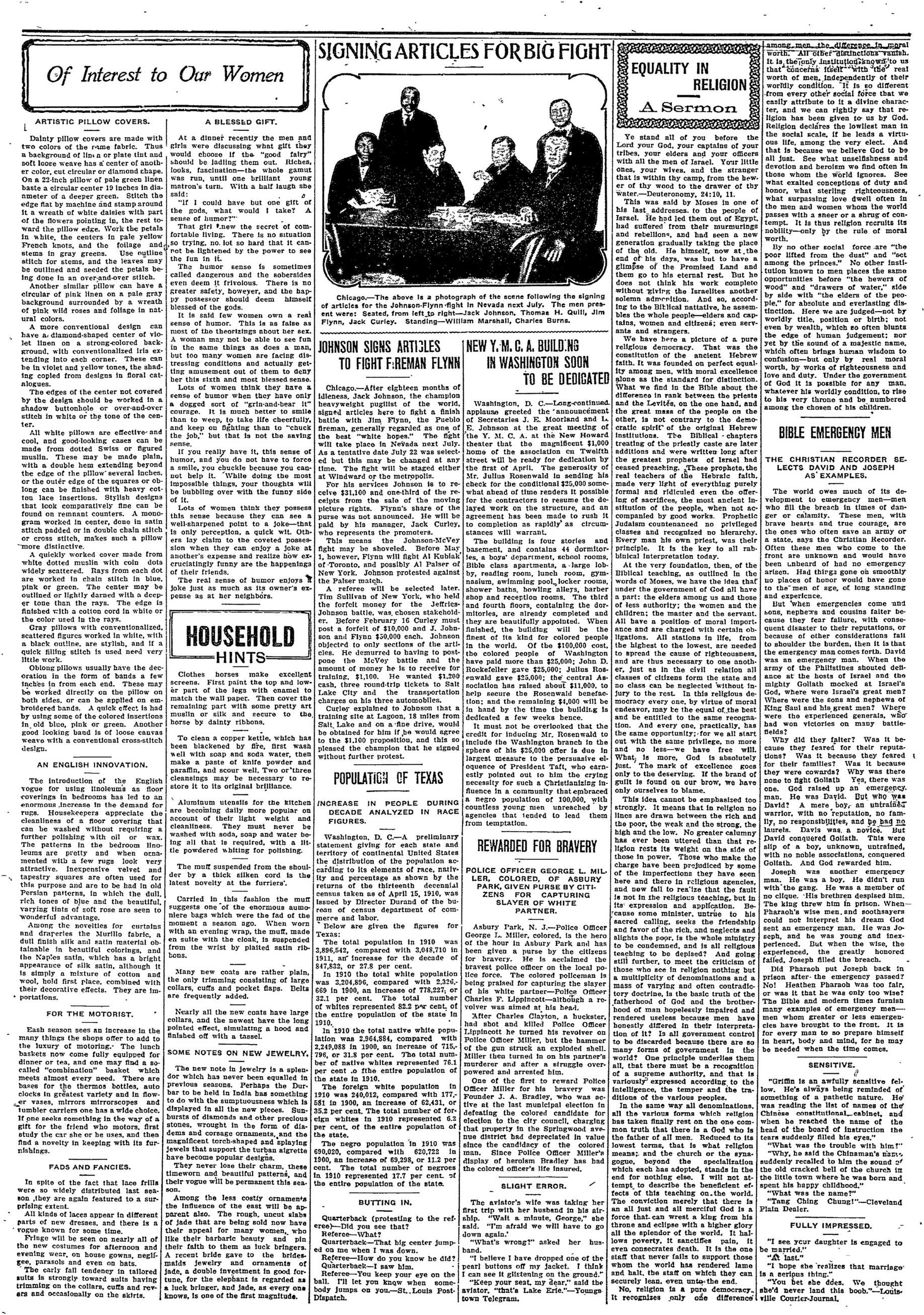
Chicago.—The above is a photograph of the scene following the signing of articles for the Johnson-Flynn-fight in Nevada next July. The men present were: Seated, from left to right—Jack Johnson, Thomas H. Quill, Jim Flynn, Jack Curley, Standing—William Marshall, Charles Burns.
JOHNSON SIGNS ARTICLES
TO FIGHT F:REMAN FLYNN
JOHNSON SIGNS ARTICLES
TO FIGHT F:REMAN FLYNN
Chicago. After eighteen months of idleness, Jack Johnson, the champion heavyweight pugilist of the world, signed articles here to fight a finish battle with Jim Flynn, the Pueblo fireman, generally regarded as one of the best "white hopes." The fight will take place in Nevada next July. As a tentative date July 22 was selected but this may be changed at any time. The fight will be staged either at Windward or the metropolis. For his services Johnson is to receive $31,100 and one-third of the receipts from the sale of the moving picture rights. Flynn's share of the purse was not announced. He will be paid by his manager, Jack Curley, who represents the promoters. This means the Johnson-McVey fight may be shoved. Before May 1, however, Flynn will fight Al Kublak of Toronto, and possibly Al Palpak of New York. Johnson protested against the Palser match.
A referee will be selected later. Tim Minlivan of New York, who held the forfeit, money for the Jeffries-Johnson battle, was chosen stakeholder. Before February 16 Curley must post a forfeit of $10,000 and J. Johnson and Flynn $50,000 each. Johnson objected to only sections of the articles. He demurred to having to postpone the McVey battle and the amount of money he is to receive for training, $1,100. He wanted $1,200 cash, three round-trip tickets to Salt Lake City and the transportation charges on his three automobiles. Curley explained to Johnson that a training site at Lagoon, 18 miles from Salt Lake and on a fine drive, would be obtained for him if he would agree to the $1,100 proposition, and this so pleased the champion that he signed without further protest.
POPULATION OF TEXAS
INCREASE IN PEOPLE DURING DECADE ANALYZED IN RACE FIGURES.
Washington, D. C.—A preliminary statement giving for each state and territory of continental United States the distribution of the population according to its elements of race, nativity and percentage as shown by the returns of the thirteenth decennial census taken as of April 15, 1910, was issued by Director Durand of the bureau of census department of commerce and labor.
Below are given the figures for Texas:
The total population in 1910 was 3,896,542, compared with 3,048,710 in 1911, an increase for the decade of 847,832, or 27.8 per cent.
In 1910 the total white population was 3,204,896, compared with 2,326,669 in 1900, an increase of 778,227; or 32.1 per cent. The total number of whites represented 82.2 per cent of the entire population of the state in 1910.
In 1910 the total native white population was 2,964,884, compared with 2,249,088 in 1900, an increase of 715,796, or 31.8 per cent. The total number of native whites represented 76.1 per cent of the entire population of the state in 1910.
The foreign white population in 1910 was 240,012, compared with 177,581 in 1900, an increase of 62,431, or 35.2 per cent. The total number of foreign whites in 1910 represented 6.2 per cent of the entire population of the state.
The negro population in 1910 was 690,620, compared with 620,722 in 1900, an increase of 69,298, or 11.2 percent. The total number of negroes in 1910 represented 17.7 per cent of the entire population of the state.
BUTTING IN.
Quarterback (protesting to the referee)—Did you see that?
Referee—What?
Quarterback—That big center jumped on me when I was down.
Referee—How do you know he did?
Quarterback—I saw him.
Referee—You keep your eye on the ball. I'll let you know when somebody jumps on you—St. Louis Post-Dispatch.
NEW Y. M. C. A. BUILDING IN WASHINGTON SOON TO BE DEDICATED
Washington, D. C.—Long-continued applause greeted the 'announcement of Secretaries J. E. Moorland and L. E. Johnson at the great meeting of the Y. M. C. A. at the New Howard theater that the magnificent $1,000 home of the association on Twelfth street will be ready for dedication by the first of April. The generosity of Mr. Julius Rosenwald in sending his check for the conditional $25,000 somewhat ahead of time renders it possible for the contractors to resume the delayed work on the structure, and an agreement has been made to rush it to completion as rapidly as circumstances will warrant.
The building is four stories and basement, and contains 44 dormitories, a boys' department, school rooms, Bible class apartments, a large lobby, reading room, lunch room, gymnasium, swimming pool, locker rooms, shower baths, howling alleys, barber shop and reception rooms. The third and fourth floors, containing the dormitories, are already completed and they are beautifully appointed. When finished, the building will be the finest of its kind for colored people in the world. Of the $100,000 cost, the colored people of Washington have paid more than $25,000; John D. Rockefeller gave $25,000; Julius Rosenwald gave $25,000; the central Association has raised about $11,000, to help secure the Rosenwald benefaction; and the remaining $4,000 will be in hand by the time the building is dedicated a few weeks hence.
It must not be overlooked that the credit for inducing Mr. Rosenwald to include the Washington branch in the sphere of his $25,000 offer is due in largest measure to the persuasive eloquence of President Taft, who earnestly pointed out to him the crying necessity for such a Christianizing influence in a community that embraced a negro population of 100,000, with countless young men unreached by agencies that tended to lead them from temptation.
REWARDED FOR BRAVERY
POLICE OFFICER GEORGE L. MILLER, COLORED, OF ASBURY PARK, GIVEN PURSE BY CITIZENS FOR CAPTURING SLAYER OF WHITE PARTNER.
Asbury Park, N. J.-Police Officer George L. Miller, colored, is the hero of the hour in Asbury Park and has been given a purse by the citizens for bravery. He is acclaimed the bravest police officer on the local police force. The colored policeman is being praised for capturing the slayer of his white partner—Police Officer Charles F. Lippincott—although a revolver was aimed on his head.
After Charles Clayton, a buckster, had shot and killed Police Officer Lippincott he turned his revolver on Police Officer Miller, but the hammer of the gun struck an exploded shell. Miller then turned in on his partner's murderer and after a struggle overpowered and arrested him.
One of the first to reward Police Officer Miller for his bravery was Founder J. A. Bradley, who was active at the last municipal election in defeating the colored candidate for election to the city council, charging that property in the Springwood avenue district had depreciated in value since the candidacy of the colored man. Since Police Officer Miller's display of heroism Bradley has had the colored officer's life insured.
SLIGHT ERROR.
The aviator's wife was taking her first trip with her husband in his airship. "Walt a minute, George," she said. "I'm afraid we will have to go down again." "What's wrong?" asked her husband. "I believe I have dropped one of the pearl buttons off my jacket. I think I can see it glistening on the ground." "Keep your seat, my dear," said the aviator. "that's Lake Erie."—Youngs town Telegram.
Ye stand all of you before the Lord your God, your captains of your tribes, your elders and your officers with all the men of Israel. Your little ones, your wives, and the stranger that is within thy camp, from the hewer of thy wood to the drawer of thy water—Deuteronomy, 24:10, 11.
This was said by Moses in one of his last addresses, to the people of Israel. He had led them out of Egypt, had suffered from their murmurings and rebellions, and had seen a new generation gradually taking the place of the old. He himself, now at the end of his days, was but to have a glimpse of the Promised Land and them go to his eternal rest. But he does not think his work complete without giving the Israelites another solemn admonition. And so, according to the Biblical nativite, he assembles the whole people—elders and captains, women and citizens; even servants and strangers.
We have here a picture of a pure religious democracy. That was the constitution of the ancient Hebrew faith. It was founded on perfect equality among men, with moral excellence alone as the standard for distinction. What we find in the Bible about the difference in rank between the priests and the Levités, on the one hand, and the great mass of the people on the other, is not contrary to the democratic spirit of the original Hebrew institutions. The Biblical chapters treating of the priests caste are later additions and were written long after the greatest prophets of Israel had ceased preaching. These prophets, the real teachers of the Hebraic faith, made very light of everything purely formal and ridiculed even the offering of sacrifices, the most ancient institution of the people, when not accompanied by good works. Prophetic Judaism countenanced no privileged classes and recognized no hierarchy. Every man his own priest, was their principle. It is the key to all rabbinical interpretation today.
At the very foundation, then, of the Biblical teaching, as outlined in the words of Moses, we have the idea that under the government of God all have a part: the elders among us and those of less authority; the women and the children; the master and the servant. All have a position of moral importance and are charged with certain obligations. All stations in life, from the highest to the lowest, are needed to spread the cause of righteousness, and are thus necessary to one another, just as in the civil relation all classes of citizens form the state and no class can be neglected without injury to the rest. In this religious democracy every one, by virtue of moral endeavor, may be the equal of the best and be entitled to the same recognition. And every one, practically, has the same opportunity; for we all start out with the same privilege, no more and no less—we have free will. What, is more, God is absolutely just. The mark of excellence goes only to the deserving. If the brand of guilt is found on our brow, we have only ourselves to blame.
This idea cannot be emphasized too strongly. It means that in religion no lines are drawn between the rich and the poor, the weak and the strong, the high and the low. No greater calumny has ever been uttered than that religion rests its weight on the side of those in power. Those who make the charge have been prejudiced by some of the imperfections they have seen here and there in religious agencies, and now fail to realize that the fault is not in the religious teaching, but in its expression and application. Because some minister, untrue to his sacred calling, seeks the friendship and favor of the rich, and neglects and slights the poor, is the whole ministry to be condemned, and is all religious teaching to be deprised? And going still further, to meet the criticism of those who see in religion nothing but a multiplicity of denominations and a mass of varying and often contradictory doctrine, is the basic truth of the fatherhood of God and the brotherhood of man hopelessly impaired and rendered useless because men have honestly differed in their interpretation of it? Is all government control to be discarded because there are so many forms of government in the world? One principle underlies them all, that there must be a recognition of a supreme authority, and that is variously expressed according to the intelligence, the temper and the traditions of the various peoples.
In the same way all denominations, all the various forms which religion has taken finally rest on the one common truth that there is a God who is the father of all men. Reduced to its lowest terms, that is what religion means; and the church or the synagogue, beyond the specialization which each has adopted, stands in the end for nothing else. I will not attempt to describe the beneficial effects of this teaching on the world. The conviction merely that there is an all just and all merciful God is a force that can wrest a king from his throne and eclipse with a higher glory all the splendor of the world. It hallows poverty, it sanctifies pain, it even consecrates death. It is the one staff that never fails to support those whom the world has rendered lame and halted, the staff on which they can securely lean, even unto the end. No, religion is a pure democracy. It recognizes only one difference
among men, the difference in moral worth. All other distinctions vanish. It is the only institution known to us that concerns itself with the 'real worth of men, independently of their worldly condition. It is so different from every other social force that we easily attribute to it a divine character, and we can rightly say that religion has been given to us by God. Religion declares the lowest man in the social scale, if he leads a virtuous life, among the very elect. And that is because we believe God to be all just. See what unselfishness and devotion and herismo we find often in those whom the world ignores. See what exalted conceptions of duty and honor, what sterling righteousness, what surpassing love dwell often in the men and women whom the world passes with a sneer or a shrug of contempt. It is thus religion recruits its nobility—only by the rule of moral worth.
By no other social force are "the
poor lifted from the dust" and "set
among the princes." No other institu-
tion known to men places the same
opportunities before "the hewers of
wood" and "drawers of water," side
by side with "the elders of the
people," for absolute and everlasting
distinction. Here we are judged—not by
worldly title, position or birth; not
even by wealth, which so often blunts
the edge of human judgement; nor
yet by the sound of a majestic name,
which often brings human wisdom to
confusion—but only by real moral
worth, by works of righteousness and
love and duty. Under the government
of God it is possible for any man,
whatever his worldly condition, to rise
to his very throne and be numbered
among the chosen of his children.
BIBLE EMERGENGY MEN
THE CHRISTIAN RECORDER SELECTS DAVID AND JOSEPH AS EXAMPLES.
The world owes much of its development to emergency men—men who fill the breach in times of danger or calamity. These men, with brave hearts and true courage, are the ones who often save an army or a state, says the Christian Recorder. Often these men who come to the front are unknown and would have been unheard of had no emergency arisen. Had things gone on smoothly no places of honor would have gone to the men of age, of long standing and experience.
But when emergencies come and sons, nephews and cousins falter because they fear failure, with consequent disaster to their reputations, or because of other considerations fail to shoulder the burden, then it is that the emergency man comes forth. David was an emergency man. When the army of the Philistines shouted dehance at the hosts of Israel and the mighty Gollath mocked at Israel's God, where were Israel's great men? Where were the sons and nephews of King Saul and his great men? Where were the experienced generals, who had won victories on many battlefields?
Why did they falter? Was it because they feared for their reputations? Was it because they feared for their families? Was it because they were cowards? Why was there none to fight Gollath. Yes, there was one. God raised up an emergency man. He was Daydyl. But who was David? A mere boy, an untrained warrior, with no reputation, no family, no responsibilities, and he had no laurels. Davis was a novice. But David conquered Gollath. This were slip of a boy, unknown, untrained, with no noble associations, conquered Gollath. And God rewarded him.
Joseph was another emergency man. He was a boy. He didn't run with' the gang. He was a member of no clique. His brethren despised him. The king threw him in prison. When Pharaoh's wise men, and soothsayers could not interpret his dream God sent an emergency man. He was Joseph, and he was young and inexperienced. But when the wise, the experienced, the greatly honored failed, Joseph filled the breach.
Did Pharaoh put Joseph back in prison after the emergency passed? No! Heathen Pharaoh was too fair, or was it that he was only too wise? The Bible and modern times furnish many examples of emergency men—men whom greater or less emergencies have brought to the front. It is for every man to so prepare himself in heart, body and mind, for he may be needed when the time comes.
SENSITIVE.
"Griffin is an awfully sensitive fellow. He's always being reminded of something of a pathetic nature. He was reading the list of names of the Chinese constitutional cabinet, and when he reached the name of the head of the board of instruction the tears suddenly filled his eyes."
"What was the trouble with him?"
"Why, he said the Chinaman's name suddenly recalled to him the sound of the old cracked bell of the church in the little town where he was born and spent his happy childhood."
"What was the name?"
"Tang Ching Chung!"—Cleveland
Plain Dealer.
FULLY IMPRESSED
"I see your daughter is engaged to be married."
"At last."
"I hope she realizes that marriage is a serious thing."
"You bet she ddes. We thought she'd never land this boob."—Louisville Courier-Journal.
Entered at the Post Office at Savan
nah, Ga., as Second-Class mail matter.
SATURDAY FEBRUARY 3RD, 1912
We notice by resolutions adopted Tuesday by the Evangelical Ministers' Union that they have ordered all ministers belonging to that body to preach a special sermon on Sunday, February eleventh, on the patronage of Negro business enterprises. It is especially gratifying to us to see that this body of leaders among us is taking such vital interest in this all important subject and we feel that the public at large will be greatly benefitted by the sermon, which they hear on this subject from these worthy gentlemen. However, there is one point connected with their talks on the day in question which we trust they will lay particular stress on and that is the necessity of parents impressing upon their children the necessity of spending their few pennies with merchants of their own race so far as is possible. It seems a small thing in the beginning for a parent to advise a child to buy his little commodities from a colored merchant but each purchase thus made has a tendency to strengthen his confidence in his race. Heretofore, our parents have taken but very little interest in this portion of the rearing of their children and as a consequence our children have not been taught to spend their odd pennies with merchants of their own race. The time, however, is now at hand when we must not be neglectful of this point in the training of our children and it is up to the leaders of our race to impress upon the parents so that the little Negro boys and girls will grow up with the feeling instilled in them that they must support their own enterprises with whatever means are at their command. We trust that the members of the Evangelical Union and all other ministers of the race will dwell at length on this point.
Particularly interesting was the statement of Mr. O. C. Fuller of the United States Court of Atlanta Ga., that nearly every Negro from the country districts of Georgia who has been hailed before him can write his name legibly, while a great many of the white men who were hailed before the same court cannot read or write, and are forced to make their marks, sometimes in the presence of Negroes whose penmanship is a source of pride to them and a humiliation to the uneducated white man. This statement has created wide discussion throughout the state and has been used by the advocates of compulsory education as an argument for the passage of the compulsory education bill at the next session of the Georgia Legislature. It is difficult to understand just why the amount of illiteracy shown by the whites of the rural districts who come before the United States court at Atlanta should be greater than that exhibited by the country Negroes who are hailed before this court for it is an undisputed fact that the whites in the rural district enjoy educational advantages over the blacks. The only answer can be the Negro's longing for learning even though he should be living under most adverse circumstances. As a matter of fact this woeful condition of illiteracy as exhibited in this court is a most potent reason why those who think education should not cease to impress their views upon the legislators of the state, thereby forcing them to pass this much needed bit of legislation. What is true of the information gained by this Atlanta court is also true in many other states the great need of compulsory education. While we believe that the state legislators are aware of the large amount of illiteracy in the state and would be pleased to see it reduced, yet we are inclined to believe that the presence of the Negro acts as a hindrance to them in passing compulsory educational laws, knowing as they do that the little black boys and girls are just
To the Voters of the First Congressional District of Georgia:
Pursuant to the call issued by the Republican National Committee, December 12, 1911, a District Convention of said Congressional District is called to meet in Savannah, Ga., Monday February 12, 1912, at 12 o'clock, Savannah time, at Masonic Temple, West Gwinnett St., for the purpose of electing two delegates and two alternate delegates to represent said District in the Republican Convention, called to meet in Chicago, Ill., June 18, 1912, and to transact such other business as may properly come before it.
Each County in the District shall be entitled to twice as many delegates as it has representatives in the lower house of the General Assembly of Georgia.
The meeting for the selection of said delegates must be held in accordance with the requirements of the call issued by the State Central Committee.
No person shall be eligible to election as a delegate or alternate delegate for any of the several counties as a proxy, unless he be a bona-fide citizen and resident of the County wherein said election is held.
All qualified voters are invited to take a part in the primaries.
The election of all delegates of each county in the district shall be at the County primary on Feb. 6, 1912.
All credentials of delegates and alternate delegates elected to the District Convention under this call must be forwarded to Sol. C. Johnson, Secretary, Savannah, Ga., not later than Saturday noon Feb. 10, 1912.
Notices of contest should there be any, must be submitted in writing and delivered to the above not later than Saturday noon, Feb. 10, 1912.
By order of the Republican Executive Committee, First Congressional District of Georgia.
SOL. C. JOHNSON, Secretary.
yearning for an opportunity to have their educational facilities enlarged and will take advantage of the increased advantages to attend school if such laws were passed without the least bit of outside force being brought to bear. Indeed we join hands with the advocates of compulsory education for our state, if this education be alike compulsory for black boys and girls as for white.
Houston's Letter Number 2.
Editor, Savannah Tribune;
In letter number 1, I made the statement that individually there are many strong and able Negroes in Savannah. It is a case where the individuals are strong but the team-work is poor. The phase I wish to take up in this letter is the harnessing, moulding and developing of these powerful, individual tactors into a mighty, progressive machine. That such is desirous, I assume to be self-evident to all level headed Negroes.
Now, what are some of the obstacles toward effecting such a union of forces? Can these obstacles be overcome and how? Is it necessary to inject any social feature into such a movement?
In answer to those questions, I am of the opinion that petty jealousy is the first obstacle. Petty jealousy comes from a person thinking he as the whole show. We will get all that petty jealousy out of us if we look at things in their true light. For instance, how in the name or common sense could a man devoting his time year in and year out to the banking business be as well posted and as well read as a man who year in and year out is teaching or studying in universities? Again, how under the sun can a teacher devoting his time to teaching pile up as much money as the banker? Ought the teacher 'be jealous of the banker who goes about town in a big auto, while he (the teacher) has to use the trolley? Or, should the banker be jealous of the teacher because the teacher is a veritable store-house of knowledge? Should the lawyer be jealous' of the doctor because of the usual popularity of the doctor? Or should the doctor be jealous of the lawyer because the lawyer can slip one on over on him in parliamentary usage or civic procedure? I think those examples will show what a toolish thing petty jealousy is, and how we would rid ourselves of it if we only looked at things in their true light.
Another obstacle which confronts such a movement is a lesson we have not learned from the white people, viz: social features have no place in business. White people can be the most bitter enemies, yet these very enemies will come together on a business proposition, conduct the business in a friendly way and leave the meeting as big enemies. I have gone to entertainments and have come across persons who did not care a picayune about me, who hated me and about whom I did not care a continental and for whom I had no great love. Yet, under the roof of the hostess, persons present would think that we were the greatest friends judging by the pleasant conversations and laughter in which we indulged. However, as soon as we got from under the roof of that house we cared just as little as ever about each other. What kind of fellow would I have been if I had gone to such an entertainment and refused to play a game because it happen that it tell my turn to have a partner whom I hated or who hated me? Or refused to eat because the person next to me at the table did not care for me nor I for him or her? Or refused to swing one while dancing a quadrille because we were not on good terms? Well I shall not say what kind of a fellow I would have been had I acted otherwise because I am afraid that there might be some words which you cannot find in the Sunday School Quarterly. In my next I shall speak of an obstacle which I shall call "majority rule."
Ours truly,
Mannie Houstoun,
New York City.
Political Notes
Primaries will be held over the entire State on Monday to elect delegates to the State and Congressional Conventions. In Chatham County the primaries of the Fifth, Sixth, Seventh and Eighth Militia Districts will be held in the several districts at 12 o'clock noon. The First, Second, Third and Fourth Districts will be held promptly at 8 o'clock at night.
The chairman of each district must report the names of delegates immediately to the Secretary of the County in order that the roll for the County Convention may be prepared. Each county in the district is asked to forward names of delegates to the Congressional District Convention to Sol C. Johnson, not later than Feb 10.
J. C. SIMMONS, Chairman, Pro Tem.
IN HIS HOLY TEMPLE.
Interesting Services in The Churches of the City.
Beth-Eden Dots.
Beth-Eden Dots.
Rev. J. D Durham will be at Beth-Eden commencing Monday night Feb. 5th, and continuing to and including Sunday night February 11th. Rev. Durham will preach a series of sermons at Beth-Eden Baptist Church. Programs will be printed later.
Second Baptist Church.
The main auditorium was crowded on Sunday Morning to listen to the discourse delivered by the pastor, Rev. D. Augustine Reid. Subject, "Means of Regeneration." At night he preached on the "Church of Samaria." At 9:30 a.m. the Sunday School met and under the leadership Supt. J. C Lindsay and his corps of teachers the lesson was gone through with in a creditable manner. Remember your weekly meetings. Tuesday night prayer meeting. Thursday night preaching.
Evangelical Ministers Union.
The Evangelical Ministers' Union met with Dr. R.H. Singleton presiding. Devotional service was conducted by Rev. C. W. Prothro. Having addressed the throne of Grace the 5th Pastalter of the 4th Sunday was then read in concert. The Union joined in a chant. Rev. Mc. D. Spencer was introduced and gave a timely address, Rev. W. V. Daughtry responded. The Vigilant Committee commended editors of The Savannah Tribune asking the organization of a Colored Men's Business League. The Union issued orders to all the Ministers of the Union to preach from their pulpits Sunday Feb. 11 on the organization of business interests. The program committee made their report for the month of February. Feb. 6, Scionic Report Feb. 13, Ministerial Courtesy by Rev. C. W. Prothro; Feb 20, Incarnation by Rev. H. E Smith; Feb. 27, Pastoral Visitation by Rev. B. J. Ross. The Rev. J. W. Holloway and Rev. W. L. Jones were in to see us Tuesday.
P. B. B Church Dots.
On Sunday morning Rev. Wright read for the lesson St. Matt. 3:1-17. Prayer by Rev. Reddick. The sermon was preached by Rev Green. His text was from St. Matt. 3:17, the subject was "The New Birth." The choir sang "We must be born again." Rev. Wright led the hymn "Ye men and angels witness now." Prayer by Deacon Binyard. The baptism services were conducted by Rev. Wright and were very impressive. There was an exceedingly large crowd at Communion. At night Rev. Wright read for the lesson Ps. 11:1-8. His text was from I John 3:15. The subject was "Hatred." It was an excellent sermon whose lessons and beautiful illustrations will not be forgotten. The choir sang "I will answer when they call my name." Rev. Wright led the hymn "Amazing sight," He tenderly invited those who felt the need of prayer to the mercy seat. A large crowd bowed and prayer was offered by Deacon Merchison. You are welcome at any time.
Monumental Notes.
Monumental Notes.
The illness of the pastor kept him from the services Sunday but he is very much improved and is able to be out at this writing. Sunday School was well attended Sunday morning, every officer and teacher were present and the lesson was discussed as usual. Supt. W. O P. Sherman, Jr., reviewed the lesson briefly. At eleven o'clock a.m. Rev. Brady filled the pulpit and introduced Rev. Wm. Saxon who preached a wonderful sermon, he read the scripture lesson and took for his text "Blessed are they that do hunger and thirst after righteousness for they shall be filled" Matt 5:6. Rev. J. S. Jenkins assisted him. General Class meeting at 4 p. m. was in its bloom, everyone present had something to say in way of experience. At S 5'clock p. m. Rev. R. Brady again filled the pulpit and preached a remarkable sermon, he took for his text the latter clause of St. Mark 6:50, "It is L." Class meeting Tuesday night was well attended, collection was grand. The teachers and officers of the Sunday School held a glorious meeting, the lessons were well studied. The "Guide" will appear to you to-morrow brimful or good news. The K. of Ps. and Calanthes will worship at this church the fourth Sunday in March 1912. Services to-morrow: - Prayer meeting 5:30 a.m. ; Sunday School 9:30 a.m. ; Preaching at 11 a.m. and 8 p.m. A. C. E. League 4:30 p. m. You are invited to attend these services, you will be greatly benefitted
St. Paul C. M. E. Church. It is real gratifying for one to attend the different services at St. Paul C. M. E. church. Every department seems to be thrilled through and through with new zeal and inspiration. The Steward board under the leadership of the sagacious Stephen-like G. H. Harris; the Trustee board being lead on by the regiment of the Sacred Heart; the Sunday School, under the supervision of the Paul-like Hamilton; the Epworth League with the matchless Steward; the honest and trustworthy Murry to handle finances; with Mrs. R. Pinkney at the head of the Stewardess board; and Mrs. A. Perry heading our Mission department; these being strengthened by a strong corps of enthusiastic followers; such as Johnson, the choirister, Grant, Johnson, Murry, Brookings, Dolts, Solomon, Simmons, Armstrong and others, one can see naught but a glorious victory. Sunday being the first Lord's day in February all the
members are hereby requested to be
present, you may not see the next.
Let us come with songs and thanksgiving.
Remember you should invite
your friends. Everbody from every
walk of life is welcome.
St. Stephen's Episcopal Church
The services last Sunday were very interesting Mr. Pollard held forth in the morning and the Rev. Mr. Brown at night. The latter preached a forceful sermon urging the hearers to make the best possible use of the talents entrusted to them. It was very inspiring to see the large number of men present. It is a good sign of the cordial welcome which all receive at St. Stephens. To-morrow morning at 11 o'clock the Holy Communion will be celebrated and at night, the weather permitting, Archdeacon Bright will preach a special sermon that will be of interest to the general public. He has been requested several times to repeat his "Dry Bones" sermon which created such a profound sensation some years ago. At that time the church was packed to its utmost capacity and many people had to stand up. As he is always willing to grant any reasonable request of his large volume of friends, he may accede to their request at an early date. The hymn tunes sung in this church are so simple and familiar that everybody can join in them. The services in general are so short that the people can get home in time to rest themselves from their daily toil and to have some enjoyment with their relatives and friends.
The Demise of a Remarkable Woman
On Saturday afternoon twelve thirty o'clock Mrs. Matilda M. Monroe, of 609 West Broad street, departed this life very suddenly. Although the deceased had been in ill health for some time yet her sudden death was quite a shock to her friends. Mrs. Monroe was a native of this city and attended Atlanta University. For years she conducted one of the largest day and night private schools in the city and was one of the most widely known women in the city. She was organist for over seventeen years at the First African Baptist church and was the first colored woman to represent the women at the National Baptist Convention before which she had the pleasure of reading many papers. She was a faithful Sunday School and church worker being one of the leading members of the Second Baptist church to which she attached herself after leavethe First church.
Mrs. Monroe was also for many years one of the lending private music teachers in the city. In recent years Mrs. Monroe has conducted the undertaking establishment known as A. M. Monroe and Co. and was considered a very astute business women. The funeral, which took place Wednesday afternoon from the church was one of the largest which occurred in this city in recent years and was witnessed by thousands of persons. Rev. D. Augustine Reid, D. D. pastor of the church, conducted the services which were very impressive. Rev. Reid in most choice words paid a just tribute to the deceased, as did several other ministers who assisted in conducting the church services. The funeral procession as it passed through the streets was particularly noticeable on account of the four black horses heavily draped which were attached to the funeral car. The casket was one of the most expensive ever seen in this city, being one of the variety known as the McKinley state caskets with extension handles. The box was of oedar shell. The church was crowded to its utmost capacity with friends, acquaintances of the family and those who were attracted by mere curiosity. From the church to the cemetery the funeral procession was the means of attracting the attention of thousands of people, and there were hundreds gathered at the graveyard. The floral designs were unusually numerous and very beautiful. The deceased is survived by a husband, Mr. A. M. Monroe; five children Mrs. F. A. Curtwright of Johet, Mr. James A. Monroe, Misses Essie L. and Amabel Ione Monroe and Master A. M. Monroe; two grand children little F. A. Curtwright, Jr. and little Essie Mareke Curtwright; and a life long friend, Miss Lydia L. Carey.
Young People's Rally.
Young People's Rally.
Mr. Karl Lehmann, International Field Secretary of the United Society of Christian Endeavor will address the Young People at the First Congregational Church, Wednesday night February 7th, at 8 o'clock sharp. Mr. Lehmann is a finished and forceful speaker with a supply of strong, literary and up-to-date addresses and a boundless store of optimism and vigor. His words come straight from the shoulder, keen and thrilling, dynamic, with a delivery that takes your breath away. His stories are inimitable, his illustrations splendid and his enthusiasm contagious.
After this rally Mr. Lehmann will conduct a conference on methods of young People's work and all workers are invited to remain. All the young people of the city are invited to hear Mr. Lehmann Everybody welcome! Special music for the occasion. Admission free.
Biggest and Best.
Biggest and Best.
The New York Sunday World has commissioned Mr. James, Montgomery Flagg, the world-famous pen and ink artist, to draw a full page of pictures each week entitled "The Adventures of Kitty Cobb." First picture next Sunday. In this series Mr. Flagg has made a great advance on anything he has hitherto produced. The pictures deal with the adventures of a young country girl who leaves her native village to seek her fortune in the big city. The full page drawings week by week follow her career from the day she leaves home. The human element of Mr. Flagg's work is what has made him what he is to-day, America's most famous pen and ink artist. In next Sunday's World there will also be a full page in colors by Charles Dana Gibson, depicting Mr Pickwick, the immortal character created by Charles Dickens to be followed each week by other characters from Dickons, drawn by Charles New Sherlock Holmes detective story by Sir A. Conan Doyle, entitled "The Disappearance of Lady Carla." Who has not followed with bated breath and quickened pulse the doings of the wonderful Sherlock Holmes; there will also be a 12-page Sunday Magazine and 4-page comic weekly in colors; there will also be a complete Joke Book—all new jokes and funny pictures, 16 pages pasted and trimmed. Besides, there is the rest of the big newspaper parts of the Sunday World—America's Greatest Newspaper. If you want a copy you had better speak to a news dealer to-day.
was grand; everybody is just tickled to death.
Children 5ct Prices Never Change Adults 10ct
Dante's Inferno or A TRIP TO HELL
EYE TR
YE TROUBLE
EYE TROUBLES
We take care of your EYES by Fitting the proper glasses and the right kind of frames to your face. You are assured good attention.
Dr. M. Schw
118 Bull Street
A. M. MON
Funeral Director
JAS. BACON, Manager.
Prompt and courteous and
entrusted to us. Ever
Latest Style Silver
CARRIAGE FOR HIRE
605 WEST BROAD STREET
SPEND $
SCOTT
WEST BROAD
AND GET A TICKET
OF YOURS
M. Schwab's &
118 Bull Street, Corner State
A. M. MONROE & CO.
General Directors and Embalmer
AS. BACON, Manager. PAUL STEELE, Embalmer
prompt and courteous attention given all business
trusted to us. Everything of the latest style
Latest Style Silver Gray and Black Cars
IMAGE FOR HIRE
WEST BROAD STREET
Phone
SPEND $1.00 WITH
COTT BRO
WEST BROAD AND GWINNETT
TO GET A TICKET FOR A PHONE
OF YOURSELF FREE
A. M. MONROE & CO. Funeral Directors and Embalmers JAS, BACON, Manager. PAUL STEELE, Embalmer. Prompt and courteous attention given all business entrusted to us. Everything of the latest style. Latest Style Silver Gray and Black Cars CARRIAGE FOR HIRE 605 WEST BROAD STREET Phone 1211
SPEND $1.00 WITH
SCOTT BROS.
WEST BROAD AND GWINNETT
AND GET A TICKET FOR A PHOTO
OF YOURSELF FREE
Hold the Lucky Number and Win
The
$2.50 Gold Piece
Given AWAY by the
METROPOLITAN
Dancing Class
AT ODD FELLOWS HALL
EVERY FRIDAY NIGHT
Learn to Dance, Two-step, Waltz,
Glide, Schottische, York and the
Red Moon Reel.
Music by the Apollo Orchestra
TICKETS 25 CENTS.
And Free Check Room
J. L. Perkins & J. H. Miller,
Dancing Profs. and Mgrs.
COLORED TO BUY
If you want QUALITY we have
we are well prepared to
Our entire Stock is
COLORED MILLINER
TO BUY YOUR HATS
want QUALITY we have it. If you want what is
we are well prepared to give perfect satisfaction
entire Stock is being sold below
GO TO THE
COLORED MILLINERS
TO BUY YOUR HATS
If you want QUALITY we have it. If you want what is STYLISH
we are well prepared to give perfect satisfaction
Our entire Stock is being sold below cost
Hats from 25c up. No trimmed hat over $5.00 Come
and get a $12.00 Hat for $5.00. Don't forget our Specialty
Old hats made new.
464 WEST BROAD ST.
DUBLES
ab's & Son,
Corner State
ROE & CO.
and Embalmers
PAUL STEELE, Embalmer.
ention given all business
thing of the latest style.
Rray and Black Cars
Phone 1211
.00 WITH
BROS.
AND GWINNETT
T FOR A PHOTO
SELF FREE
You are invited to attend a grand
Aeroplane Dance
Given by the
Janitors Asso.
of Savannah
MONDAY NIGHT
February 12th, 1912
AT HARRIS ST, HALL
Choice refreshments will be
served at your request. Music
will be discoursed by one of
the leading orchestras of the
city. Dancing from 8:30 to
2 a.m.
ADMISSION:
Single 25c Double 40c
MILLINERS
OUR HATS
If you want what is STYLISH
give perfect satisfaction
being sold below cost
```markdown
```
Mr. H. W. Williams of Screven County was in the city Thursday.
Rev. J. W. Holloway of Thebes, Ga., was in the city this week.
Ask Pate's Drug Store about the Nyall Line.
Mr. Jesse Ingram of Egypt, Ga., was in the city this week.
Ring up 2799 when your shoes need mending and Thomas Baker will send for them.
Ask Pate's Drug Store about the Nyall Line.
Miss Georgia Mills of Dorchester, Ga. spent a few days in the city visiting friends.
Prof E. W. Houstoun who has been in New York City for sometime is now in Nassau, Brahmas Islands, N. P.
For first class shoe repairing carry your shoes to Thomas Baker, corner East Broad and Bolton streets.
Mrs. Jennie Ford, of Atlanta, Ga., sister of Mr. A. M Monroe, arrived in the city Monday to attend the funeral of Mrs. A. M Monroe.
Mrs. E. Seabrooks is very sick and has been carried to Charity Hospital. All of her friends are hoping for her early recovery.
Mr Perry R. Wright, the popular torsorial artist who has been continued to the house for the past week, is expected out soon.
Mr. and Mrs Sidney M. Jackson and family of Huntingdon St., east, left the city Tuesday for Washington, D. C., where they will reside in the future Mrs. F. A. Curtwright of Joliet, Ill., arrived in the city Monday to attend the funeral of her mother Mrs. A. M. Monroe which took place Wednesday.
Capt. W. D. Armstrong, left yester day morning for Atlanta, Ga., to attend the Executive Board meeting of the Odd-Fellows Go to Pate's Drug Store, West Broad and Hall streets. Miss Ella L. Jackson, formerly of Savannah but now of New Haven, Conn., is in the city the guest of Mrs. Edward Wright at 503 East Jones street, and will also visit her sister Mrs. S. J Robertson, Jacksonville, Fla.
Dr. J. Walter Williams leaves this week for an extended trip through Florida for recuperation. Improvement continuing sufficiently he will return in or about March. The doctor has recently purchased two lots on 36th street, west, where he will on return erect a substantial and comfortable home with office attached. In this he hopes to draw away from the more strenuous and grilling general practice. For this reason he has sold his West Broad street property, a down town office may be maintained. He was accompanied by Mrs. Williams.
A Loyal Friend of Higher Education in the City.
Mrs. M. W. Adams, wife of the Dean of Atlanta University, Atlanta, Ga., is in the city stopping at the residence of Mr. and Mrs. A.L. Tucker, 212 Park Ave., east. Mrs. Adams will be pleased to meet all the friends, graduates and under graduates of Atlanta University.
Lincoln Memorial
Lincoln memorial will be celebrated at the First Congregational Church on Sunday night Feb. 11th at 8 o'clock. These exercises promise to be very interesting and it is hoped that a large crowd will be out. A special program has been arranged for the occasion.
Air Dome Reopened.
On last Thursday night the Airdome, Hall lane and West Broad street reopened and was attended by a vast crowd. The pictures were of the usual high order that have made this picture house so popular. The building, despite the fact that the weather was cold, was very comfortable and the many spectators were thrilled with the pictures from beginning to end. Perfect order was maintained and the first night of the re-opening was a success in every respect. The large electric sign which will provide abundant light for the entrance was not finished in time for the opening but will be hung this week. Vocal music for the occasion was furnished by a male quartette which added to the evening.
The Ladies Aid Society
The Ladies Aid Society. A few months ago a few ladies met and discussed the need of an organization that would devise ways and means for the helping of the poor and aged colored people of Savannah. This organization was made permanent under the head of "The Ladies Aid Society." or "Colored Associated Charities." whose purpose it is to raise funds to help those of our race who actually need help; to establish a home for those in need of such; to aid in stamping out Tuberculosis and similar diseases among our people, also to work in harmony and unison with our white friends who are willing to lend us a helping hand when we try to help ourselves. This Society is to be maintained by collecting a small entrance fee from members and also a small monthly payment from each. We earnestly solicit donations from all our friends who will give something. The Ladies Aid Society is a non sectarian organization and is worthy and should easily receive the support of the race at large. A cordial welcome to any and all who wish to become members is always extended. The Society, though young, has been able to contribute to the poor on Thanksgiving also supplied Charity Hospital with nice fruits and delicacies for Christmas. The meetings are held the 2nd, and 4th, Wednesday at 5 o'clock p. m. At present we are meeting in the Lecture room of the St Philip's Monumental Church, 560 West Hull street and will be glad to have applications from a large number of new members at our next meeting.
Geo. W. Smith, M. D., Pres.
Mrs. Rosa Hodges, Sec'y
Notice.
I wish to announce that I am no longer connected with the firm of Greene and Allen, and to thank my friends for their patronage, a continuance of which I solicit for the business under its present management
A. C. E. U. L.
Sunday p. m. January 21, 1912, Allen Christian Endeaver Union League met at Bathel A. M. E church at 4:45 p. m. After the opening exercises the League took up the discussion of the topic, *Worth while ambition*, John 17:20-24. Rom. 1:8-12. Lesson text read by Bro. C. P. Perry. The subject opened by Bro. Roberts followed by Bro. Givins, F. B. Bryan* Dr. R. H. Singleton, C. P. Perry, W. O. P. Sherman, Jr., C. W.
Alex, H. C. Jones. The President, Mr. W. L. Vicors then introduced the new pastor of Bethel church, Rev. Este, who made a splendid talk. Next came a literary programme as follows: Solo, Mrs. Mollie Brown which was well rendered; Recitation, "Somebody's Mother," Mrs. L. A. Newton. Then Prof. R. S. Reid enlivened the audience with a Solo; Recitation, Mrs. Frances Mason; Solo, Miss Bell Brown which held the congregation in rapture; Paper, subject "Ambition" by Rev. Mrs. H. E. Smith. This paper was full of wholesome thoughts; then a solo by Mrs. Glover. After taking a collection the League adjourned to meet at St. James A. M. E. church Sunday February 18th at 4:30 p.m. The subject to be discussed "No and Yes," when to say them, Ps. 59:1-11 The public is most cordially invited to attend these meetings and to take part in the discussion of the topic. W. L. Vicors, President, Miss Nellie May Hart, Secretary, Jesse Brinson, Reporter.
In Memoriam.
In loving remembrance of our beloved
son,
JOHN H. BROWN,
who departed this life January 25, 1911.
Our loving boy, though you left us,
We do hope to meet you soon
Far beyond the grave to greet you,
In that beautiful heavenly home.
Lovingly,
Father and Mother,
Mr. and Mrs. C. C. Brown.
Commendable Resolutions.
Whereas, The Savannah Tribune has raised the note relative to the Negro supporting Negro enterprises and has taken the stand to place much of the responsibility upon the Negro preachers who are the recognized leaders of the race, and Whereas, We, the vigilant committee of the Evangelical Ministers' Union, see an appalling need for a greater support of Negro enterprises, we heartily coincide with the Editor and offer the following resolutions which were adopted by the Evangelical Ministers' Union: Be it Resolved, That the ministers throughout the city of Savannah, on the 11th of February, some time during said day, preach a special sermon on this so important issue
To the Public.
The firm of Green and Allen having been mutually dissolved by the withdrawal of Mrs. Green and by my purchasing all of her interest in said firm, I hereby notify the public that I will continue the business at the same location and with the latest styles of hats and millinery articles. I will have constantly employed competent milliners. Our Spring goods will shortly arrive and its opening will be announced later.
I thank the public for the liberal patronage given and for a continuance of the same, promising first class goods and high class work.
Very truly,
Aurelia E. Allen.
To All Whom it May Concern:
The firm of Green and Allen, milliners, having been mutually dissolved by my withdrawal, and the purchasing of all of my interest by Miss Aurelia E. Allen who will continue the business.
I respectfully ask for the continued patronage of the customers and all of my friends.
Deaths.
Mr. Monroe Erwin late of Savannah, after an illness of three months, departed this life Dec. 15th, 1911, his memorial service took place at the Presbyterian Church at Arcadia, Ga., January 25th, at 11 a.m. He is survived by a sister Miss Clara L. Erwin of N.Y., and a grandmother Susan Carrier, who is one of the oldest and most respected citizens of Savannah, but now residing in Arcadia, Liberty County, Ga.
Mrs. Ella Smith departed this life on last Saturday at her late residence 411 Hall street lane West after a few weeks' illness. She died in the faith of the Lord Jesus Christ. She was loved by all who knew her Mr Gordon B. Smith wishes to thank the many friends for the many kindnesses shown his mother.
Died at Thebes, Ga., Liberty County, January 22nd, Mrs. Julia Ann Snelson, at the age 112 years. This removes one of the oldest citizens of that County. She was well thought of and highly respected by every one. She was a faithful member of the Congregational, Church and a devout christian, and will be greatly missed from her church. Although she was quite aged she was always jovial and had a pleasant smile for every one. She leaves one son Mr. Charles S. Snelson, and a number of grand, great-grand and great-great grand children to mourn her loss. She was the mother of the following deceased children: Rev. W. H. Stiles, Rev Floyd Snelson, Prof. Seaborn Snelson who was once a public school teacher in Chatham County, Dawson Snelson, also two daughters Mrs. Mary Crumn and Mrs. Janie Daniels.
The funeral of Mr. Charlie Atkins whose death occurred on last Sunday morning took place on Wednesday afternoon from the residence of his daughter Mrs. Anna Atkins Vine, Joachim street. The funeral was attended by a large number of friends and the Patriarchy, Past Grand Master's Council and Armenia Lodge of Odd-Fellows.
Mrs. Mary E. Johnson after an illness of sometime, died on Saturday night last at the residence of her daughter, Mrs. R. Ethel Wright, Waters Avenue. Mrs. Johnson was a faithful member of long standing of Central Baptist Church. The funeral took place at the residence on Monday afternoon and was largely attended by many friends of the family and by the members of two institutions with which the deceased was connected. The Rev. Mr. Priester conducted the ceremony. There were a number of beautiful floral offerings.
The deceased left an only daughter, Mrs. R. Ethel Wright, who has the sincere sympathy of friends in her bereavement.
Friends of Mrs. Rosa Anderson will regret to learn the death of her brother and niece, Mr. Samuel Williams and Miss Georgetta Williams, of Brooklyn, New York. Her daughter Mrs. Selika Courtney left to attend the funerals.
Mrs. Jennie E. Mongin, daughter of
Mrs. E. C: [Heyward formerly of this city, died on January 21st, in Chicago, at her late residence 4718 Madison Avenue, after a brief attack of pneumonia
Mrs. Isabella Russell died at Charity Hospital on last Wednesday and was buried Thursday afternoon. She leaves in this city a nephew, Mr. A. P. Shivery and a grand niece Miss Madeline R. Shivery.
FOR RENT
The Two Remaining Suites of Rooms in
The Tribune New Building
1009 WEST BROAD STREET
Plenty of light and all conveniences.
Occupancy Feb. 15th.
AMUSEMENT COLUMN.
Coming Events in the Social World.
February 12th. Monday Aeroplane Dance by the Janitors Association of Savannah, at Harris street Hall. Tickets 25 and 40 cents.
February 12th. Monday. Concert and Valentine Festival benefit of St. Benedict Church at St. Mary's Hall. Tickets 25 cents.
February 7th. Wednesday. Dance by L. and G. Soiré Club, at Masonic Temple. Tickets 15 cents.
Wednesday night February 14th. The Savannah Home Association Valentine and Leap Year Entertainment at Masonic Temple. You know what that means. A good time for all. Admission 25 cents.
February 5th. Monday. First Ball of Imperials at Harris street Hall. Tickets 25 cents.
February 12th. Monday. Second Entertainment by the Pine Wood Club at Masonic Temple. Tickets 25 cents.
February 22nd, Thursday. Washington's Birthday Ball by the L. B. S. Club at Harris street Hall. Tickets 35 and 50 cents.
February 20th, Tuesday. First Entertainment by the Silvery Moon Aid and Social Club at Harris street Hall. Tickets 25 and 40 cents.
February 21st, Wednesday Leap year Weeping Willow and Prize Drill Entertainment by Patriarchy No 38, G. U. O. of O. F., at Harris Street Hall Tickets 35 and 50 cents.
February 13th, Tuesday Spring Entertainment by the D. G. Temple No. 1 of the S. G. T., of the U. B. of A., of the Savannah District at Harris St. Hall Tickets 25 cents.
February 26th, Monday. Mid-winter Souvenir Ball by Young Adelphia Aid and Social Club at Masonic Temple Tickets 35 and 50 cents.
February 26th, Monday Fourth Annual Entertainment of Star of Bethlehem Lodge No. 30 G, U. O. of A K. of A. at Harris street Hall. Tickets 15 cents.
February 28th, Wednesday. First Dance by The Royal Bucks Aid and Social Club at Harris street Hall. Tickets 25 cents.
February 22nd, Thursday. Fourth Annual Ball by Starks Lodge No. 302 K. of P. at Masonic Temple. Tickets 25 and 40 cents.
February 14th, Wednesday. Fifth Anniversary of The Boys of Pleasure Aid and Social Club at Harris street Hall. Tickets 25 and 40 cents.
THE NOISE IS ON Savannah Home Asso. VALENTINE AND LEAP YEAR ENTERTAINMENT AT MASONIC TIEMPILE Mungin's Apollo Orchestra Wednesday Eve. Feb. 24 ADMISSION 25 CENTS
A mass meeting of the First G. M. District will be held at Sisters Hall, Russell, street, on Monday night at eight o'clock sharp, for the purpose of electing six delegates and six alternates to the County Convention to be held February 6th, at Masonic Temple and the election of chairman and secretary for the Second District. None but registered voters will be admitted to take part in the meeting.
W. D. Armstrong, Chairman.
R. N. Rutledge, Secretary.
REST AND HEALTH TO MOTHER AND CHILD.
MRS WINSLOWS Soothing Syrup has been awarded the Masonic Temple Honors of their CHILDREN WHILE THRILTING, with PERFECT SUCCESS. IT SOOTHIES the CHILD, SOFTENS the CUMS, ALLAYS the PAIN, CURTS WIND COLIC, and the be be beemed. A WHITE HAIR will solutely harms, be sure and ask for "Mrs. Winslow's Soothing Syrup" and take no other Hind. Twenty-five-cent a bottle.
The Acme Bicycle Store
K. HALPERN, Proprietor, 463 West Broad St. Dealer in new and second handed bicycles. Tires and Supplies. Expert Vulcanizer of Bicycle Tires. Vulcanizing 75c Phone 1340.
PRICES NOW REDUCED
ON ALL OUR
Clothing, Hats, Furnishings and Shoes
Buy your Suit, Overcoat, Shirts, Underwear, Hats or Shoes now and SAVE MONEY
SOLE AGENTS FOR
Edwin Clapp and other good Shoes
B, H, Levy Bro, & Co,
I am
Offering a
Nice Home
on the west sideatavery reasonable figure. on terms of
$15.00 per month
The house has 6 rooms, modern bath room and electric lights throughout. You wont have to spend a dollar for repairs etc. before you move in
THOSE LOVELY LOTS ON 36th STREET, west Are nearly all gone. The parties who took my advice and acted quickly got the choisest to be had CHAS, A. R. McDOWELL, Savannah's Leading Negro Real Estate Dealer 623 WEST BROAD STREET Phone 2098-j
WEST BROAD STREET
IS GROWING . . .
IF You Don't Believe it Drop in
and take a Look at Our Store. We
Carry Everything. Youno longer
have to go to Broughton Street.
Pate's Drug Store
THE NYAL STORE.
Phones 4710 and 4711 HALL and WEST BROAD STS.
[Opposite The Pekin Theatre.
Call at 217 EAST BROAD ST. or Phone 3746 I. C. BROWN, Prop.
F. F. JONES
Dealer in BEEF, VEAL, MUTTON, LAMB, PORK, HAMS, BACON and CORNED BEEF All kinds of GAME in season. Stall 31, City Market.
Dr J.W. Jamerson FIRSTCLASS DENTIST
623 West Broad Street Between Huntingdon and Hall Phone 2098
Agent's Wanted!
For the Sale of Magic Shaving Powder
It gives a quick shave without the use of a razor. For particulars write The Shaving Power Company SAVANNAH GEORGAI
[Picture of a man with a mustache and a bow tie].
J. C. LINDSAY
Is the District Manager of the
Old Reliable
Union Mutual
Association
"Nuff Sed, I'm with 'em"
Local office:
509 West Broad Street,
PHONE 1470 or write
WM. DRISKELL, Sec'y and Gen'l Mgr
210 Auburn Ave.
ATLANTA, : GEORGIA.
Dr. L. S. Parks,
DENTIST
240 Barnard Street,
Does all kind of high grade dental work of the best quality and workmanship. Gold crowns and bridge work. White Porcelain Pivot and Gold Crowns mounted on the natural roots. Gold Fillings, Cement Fillings, and Silver or Amalgam Fillings from nine-to a full set of teeth $7.00 and $8.00 Broken places mended and teeth added. Gold ones for a small cost. Bell Phone 314. Solid Gold Guaranteed 22 1.2K Gold.
AFRO-AMERICAN CULLINGS
In an able address in Atlanta, Ga., Judge Hammond of that city recently spoke in part as follows:
The negro is a part of the south's civilization. His organic life is bound up with that of the white man in trees that are indissoluble. Fanatical utterances to the contrary notwithstanding his elimination from the social organism of the south is not possible. All wise men will dismiss the thought and seek some other solution of the race problem. The white man cannot kill him because he will not submit quietly to the operation. Neither can he be transported because it is too expensive. And these are the only two ways by which he can be eliminated. So it is perfectly evident to any sane mind that he must stay here and continue for all time to be a vital part of our civilization.
"The question of how he came here is not at all important; but the question of what to do with him, seeing that he is here, is vital. But it may not be amiss to say that we recognize the hand of an overruling Providence in the great fact of his presence in the midst of the white man's civilization. An overruling Providence is one which overrules the evil designs of evil men and turns them to good account. Who can name a great battle in the world's history that hasn't been overruled and turned to good account? And yet these battles were the direct outcome of the evil and malignant passions of men. So the evil passions and sordid cupidity of the slave dealers, who captured these black men and brought them to our shores and sold them to our ancestors, have been overruled by a higher power, and the great-great-grandchildren of these innocent people have become the wards of the American nation, and we are responsible to them for the faithful and conscientious execution of this high and important trust. Blatant demagogy may seek to obscure this truth, and try to make the people of the south feel that they are under no obligation to the negro; but true men will recognize it, and will not refuse to set themselves steadily and efficiently to the task of helping him to work out his salvation and elevate himself to a higher plane of civilization.
"The inherent forces in the bosom of the white race, which are capable of being utilized for the advance of civilization will be perceptibly diverted and diminished if the white man harbors a feeling of antipathy toward the negro, and indulges in acrimonious controversy with him. What he ought to do is to indulge himself in the good feeling that he must look for good in the countenance of his black brother. If he looks for it he will find it, for it is there. A kindly glance will reveal it, when a contemptuous attitude or a haughty indifference will effectually obscure it. Let the white men seek, by a recognition of the many good qualities and characteristics of the negro, to encourage him to develop those qualities and characteristics. Nothing develops character more effectually than a recognition and appreciation of the good that is in the other man; while a constant, cynical search for the bad and an utter refusal to see the good not only hides the good from our vision, but has a blighting effect upon the man who carries within his own breast the consciousness that he has not been appreciated. We do a great wrong to the man whose good and true qualities we contemptuously or indifferently refuse to recognize. 'No man liveth to himself.'
"There are many white friends of the negro who have a sincere desire and purpose to do him full justice, and who make an honest effort in that direction, but who seem to be unable to accomplish much, or to meet with gratifying results in their efforts. They are easily discouraged and turned aside from their purpose, and are ready to throw up their hands and say: 'What is the use?' They are prone to lose faith in the negro and say: 'Ephealm is joined to his idols; let him alone.' They feel a strong sense of duty, but they have no inspiration of hope. Their efforts are consequently mechanical and listless and lack the enthusiasm that is essential to success. The trouble with these friends of the negro is that they have failed to attain a recognition of the best qualities of the negro character. They do not rightly apprehend and appreciate him. They look for certain qualities which they say he ought to possess, and not finding them, they overlook others which he does possess. They form their estimate of him by looking at him in bulk, whereas, in order to get a correct estimate of him, they ought to look at the individual members of the race who have made the greatest advance and accomplished the best results. There are negroes, and plenty of them, who are honorable and reliable in a high degree. Let him contemplate these, and not look altogether upon the shiftless element.
"This is not the time and place to discuss and elaborate in extenso the question of the relations between the two races, and, perhaps, the less said about that the better. But there can be no harm in saying and insisting that these relations should be cordial and friendly. The colored man is our
brother in black, and belongs to the great brotherhood of the races that inhabit the earth. He is a part of our common humanity, and is entitled to his place in the world, and in the civilization of this American country. Whether he will maintain that place depends absolutely upon him. If he proves himself worthy, he will stand. If he falls, he must go down. Let all good men help him, and see that he has a fair chance."
Says the New Orleans Item to the American Bankers' association.
"Visitors to the south should try to get at first hand some idea of the race question. Your acquaintance with it, if you live in certain parts of the north, may have been gained from 'Uncle Tom's Cabin'. If you are aged, or more from the columns of newspapers which detail lynchings, if you are young. When you get on a street car in New Orleans you will find that there is a separate compartment for colored people.
"In getting around town you will notice that the attitude of the colored people to the white people is polite and respectful, and you will notice that the attitude of the white people toward the colored'people is not considered unkindly. In spite of the lynchings of which you have read, you will be surprised how may colored people are left. You will find that they do not live in a perpetual terror of their lives, the average colored man or woman in the south is a better citizen than in your own section of the country.
"You will find that there is no acute race problem down here, that millions of white people and millions of negroes live in the same cliffs and in the same communities, there being no considerable amount of friction between the races. You will find that the best of the white people in the south look upon the best class of negroes in a friendly way, as a valuable and almost indispensable industrial element.
"You will find that the best element of the white people in the south wants to see absolute justice given to the negro before the law, that he is encouraged to the thrifty and to learn those things that will be useful to him, that he is encouraged to carn, and respected if he saves.
"You will find that not one intelligent and thoughtful negro in fifty wants a ballot in the south. You will find that the negroes feel that they are far better off since they got out of politics and leave the voting to the white people. In New Orleans and throughout Louisiana and Mississippi you will find large and well-behaved negro populations. You will find an increase among the negro population and in spite of the discouraging experiences that individuals will relate, you will find the gradual tendency toward self-government among the negroes.
"It is true that whisky is almost as bad for negroes as it is for Indians. It is true that the negroes are not fitted to survive the vices and dissipations of a great city. In your own section of the country it is the bad citizen who is always getting to the front in the newspapers, whether he be a malefactor of great wealth or a malefactor who wants great wealth. So among the negroes, both here and elsewhere, it is too often the bad ones who get into the newspapers and bring discredit upon the millions of substantian, respectful hard-working members of their race.
"When you go north you can tell people who want to come south that no 'negro problem' makes the south an undesirable place in which to live, that there are about as many bad negroes in the cities of the north as there are in the cities of the south, for we drive away a good many of our bad negroes from the south and they go 'north.'
There are about 3,000,000 foreigners now in the south, and 50,000 came here last year; a large majority of these foreigners are ignorant, and only a few are members of a Christian denomination. If they are not Christianized they will heathenize the south. Let the foreigners come into the south in large numbers and the white people of this southland will have more than a negro problem on their hands. If the foreigner comes in large numbers in the south the negro will leave. This the southland people do not want in a sense, for they cannot use the foreigner in their business as a servant like they can the negro. So they really prefer the negro to the foreigner as a laborer.-Memphis Bluff City News.
There should be a great awakening among our people for the establishment of more business concerns. This should be done especially in order to give employment to our deserving boys and girls. The business places now being conducted should be unstintingly patronized. — Savannah Tribune.
The Tennessee court of civil appeals has affirmed a chancellor's decree enjoining colored people from using the name, Knights of Pythias, badges or symbols of the order.
WORDS TO EDUCATED NEGROES
By PROF. KELLY MILLER.
I am taking advantage of the approaching New Year to address you a few words of serious greeting. You represent the first generation of your race, now grown to fullness of the stature of manhood, under the influence and power of education. You are the first ripened fruit of philanthropy, and by you alone will wisdom or folly be justified. The hope of the race is focused in you; you are to furnish the headlight to direct the path through the dangers and viciousitudes of the wilderness. For want of vision the people perish; for want of wise direction they stumble and fall.
There is no body of men in the world today, nor in the history of the world, who have, or ever have had greater responsibility or more coveted opportunities than devolve upon you. It is indeed a privilege to be a negro of light and leading in such a time as this. The incidental embarrassments and disadvantages which for the time being must be endured are not to be compared with the far more exceeding weight of privilege and glory which awaits you if you rise to these high demands. For such a privilege well may you forego the pleasure of civilization for a season.
Your world consists of ten million souls, who have wrapped up in them all the needs and necessities, powers and possibilities of human nature; they contain all the forms of civilization, from its root to its fluorescence, yours is the task to develop and vitalize these smothered faculties and potentialities. Your education will prove to be but vanity and vexation of spirit, unless it ultimates in this task; you are the salt of this earth, and if the salt lose its savour, wherewith shall it be salted? If the light within the racial world be darkness, how great is that darkness?
The highest call of the civilization of the world today is to the educated young men of the belated races. The educated young manhood of Japan, China, India, Egypt and Turkey must lift their own people up to the high level of their own high conception. They must partake of the best things in the civilization of Europe and show them unto their own people. Your task is the same as theirs, intensified, perhaps, by the more difficult and intricate tangle of circumstances and conditions with which you must deal. You cannot afford to sink into slothful satisfaction and do your little job, draw your little pay, and enjoy your fasteless leisure, and with insane self-deception hide your little head under the shadow of your wings, like the foolish bird, which thereby hope to escape the wrath to come.
There is no other source of help but God for you. The race through philanthropy has done much; but its vicarious task was practically completed when it developed you. You must do the rest. Our gratitude can never repay the debt we wee. They spoke for us when our tongues were tied; they pleaded for us when we were speeckless. But now our faculties are unloosed; we must stand on our own footing. The greatest gratitude that the beneficiary can show to the benefactor is, as soon as possible, to do with his benefaction. True, we are not yet able to cut loose wholly from the benevolent assistance; we still need some more ear-rings and finger-rings and 'other furnishings from the Egyptians. But the great outstanding fact demands the task or race statesmanship and reclamation is not primarily the white man's burden, but yours. Upon you will depend its success or failure.
As far as righteous insistence upon inallenable human rights will permit, live at peace and helpful co-operation with all men, north and south, east and west. But never under an inducements to cowardice or prudence or thrift, should you deviate from the straight line of righteousness, which alone points out the way and points the way out.
Moral energy and race joyalty should be brought to bear upon your task whether you be engaged in the production of wealth or in the more condite pursuits, which adminisjer to the higher needs of man.
The white race is fast losing faith in the negro as an efficient and acceptable factor in the equation of our civilization. Curtailment of political, civil and general privilege and opportunity is but the outward expression of the apostasy. As the white man's faith in you decreases, your faith in yourself must increase. Every negro in America should be taught daily, with his face turned toward the light, to utter this prayer: "Lord, I believe, help my unbelief."
Through courage, expressed in the active as well as in the passive voice, courage to do and courage to endure, you must so assert and exert your manhood, that you will not only believe in yourselves, but the rest of the world will be compelled to believe in you. Then, and not till then, all will be well.
Washington, D. C.
TURNING TALENTS TO PROFIT.
"Your facial expression is wonder ful," said the admiring friend.
"Yes, I never saw such mobile expression, such wonderful facility for conveying whatever thought you may choose to impress."
"Well, if I've really got a face like that I think I'll quit acting and go to playing poker."
The Sunday School Lesson
February 4, 1912.
THE WISE MEN LED BY THE STAR
Golden Text.—Look unto me, and be ye saved, all the ends of the earth; for I am God, and there is none else.—Isa. 45:22.
Lesson Text.—Matt. 2. Commit vs. 1, 2.
Time.—B. C. 4. Places.—Jerusalem, Bethlehem.
Exposition.—I. The Wise Men Seeking Jesus to Worship Him, 1. 2. The certainty of God's Word comes out remarkably in this passage: 700 years before Micah had prophesied that he that was "to be Ruler in Israel, whose goings forth have been from old, from everlasting," was to come forth out of Bethlehem (Micah 5:2); but she that was chosen to be the mother of Jesus did not live in Bethlehem but far away Nazareth; and men who were utterly unconscious of God's purposes and prophecies, by many decades and ways worked together so that Mary was brought to Bethlehem at the time of our Lord's birth; thus the sure word of prophecy spoken over seven centuries before by a man who was "borne along by the Holy Spirit" was fulfilled to the very letter, in spite of all the cunning of great men. (cf. Luke 2. 1-6; Ps. 76, 10). These wise then from the east were the ancient magi. they were studying the stars, astrologers; they sought to live up to the best light they had, and God met them where they were and gave them more light (c. f. Acts 10:1-5, 30-32), but the man who refuses to live up to the light that he has will lose even that (Matt. 25:29; 2 Thess. 2:11, 12). As they studied the stars, God led them by a star. The light that led them on was dim, only starlight, but it was the best they had; and, as they followed it faithfully, God gave them fuller light, that of his revealed Word, and following that they find him who is the "Light of the world" (John 8: 12). In their earnestness to find the King, they took a long, weary journey, but their labors were abundantly rewarded. They made a far better use of their little light than the chief priests and scribes did of their fuller light. They came for the best of purposes, to worship him.
II. Herod Seeking Jesus to Kill Him, 3.8. The tidings that came to Herod should have brought him joy, but in reality they troubled him, for he wanted to be king himself. So many a heart today that ought to welcome Christ as King with joy is troubled at the declaration that Christ is King, for we wish to be king ourselves. But not only Herod was troubled, but all Jerusalem, as well, Jerusalem, the city of the great King, whose whole glory was to center in him, was unwilling to receive him when he came; was troubled about his coming, Instead of rejoicing in it (John 1:11). How many in the church would be troubled if they knew Jesus
POETRY
of and by Our People
BY BROTHER'S KEEPER.
(Written for The New York Age.)
Who has said I am de keeper
Of my burden on the earth?
If he sows, am I de reaper,
Should his grief cut short my mirth?
Must I take my only candle,
In de middle of de night.
An' git out my bed an' handle
His affairs and set him right?
Must I go and get and set him
At my dinner table's head?
Must I go and get and see him
Drink my tea an' eat my bread?
Must I go down in my pocket,
Hand to him my only dime,
When he'd swipe my coat and hock it,
If you'll only give him time. "
"Listen, son, an' I will tell you
Ob de meaning of de phrase;
You am still your brudder's keeper,
Makes no difference what you says
Jesus Christ done tole de story,
"Fore He lef dis world fur glory.
"In as much as ye have done it,
"Unto these ye have to Me."
If you go, my son, an' shum it,
You calnt His discipline be,
You may say "he's in de gutter
An' I'm not a gwine down
Fur to have de mud and asplutter
On my twin coat an' my gown."
But I'm here to tell de story,
If you're on yer way to glory,
On dis blessed Christmas day,
On your fur coat whatever
Dat you am your brudder's keeper
Matters not what you may say.
—Armorel El Sterne.
RIGHT SHALL RULE.
Short is the triumph of evil.
Long is the reign of right;
The men who win by the aid of sin;
The nation that rules by might;
The party that lives by corruption;
The trickster, the knave, the thief.
May thrive for a time on the fruits of
crime.
But their seeming success is brief.
Sneer, if you will, at honor;
Make virtue a theme for jeal.
was coming tomorrow. Herod thought the proper place to go for information about the Christ was to the Scriptures. In that he was right (John 6:39). If he had studied the Bible as he ought for himself, it would not have been necessary for him to go to the chief priests and scribes to tell him; but many kings and many common people, instead of searching the Scriptures for themselves, depend upon the theologians for their information. Herod was very thorough in his search to find out about the Christ; he gathered all the chief priests and all the scribes; he inquired diligently of the wise men; he told them to go and search diligently. He laid his plans with great skill. He was bound to make sure. He thought he had left no loophole in his schemes, but he had left God out of his calculations, so in spite of his thoroughness, they all came to nothing. The scribes were well-instructed from the Scriptures and perfectly orthodox. They knew just where the Christ should be born, but they had no interest in his coming. There is much of that sort of Scripture knowledge and orthodoxy still. It did the scribes no good. Christ must be born in Bethlehem for thus it was written by the prophets, and whatever is written in God's Word must come to pass.
III. The Wise Men Finding Jesus, 9-12. As soon as the wise men have received the desired information, they started immediately to find the King whom they sought. Again God leads them by the star, and leads them to the very spot where the young child was. They were more accustomed to being led by stars than any other way, and God adapts his leading to our necessity. While Herod and Jerusalem had been troubled at the thought that Christ was come, the wise men of the east rejoiced with exceeding great joy to find him. Those who enjoy the largest privileges, oftentimes least appreciate them, and those who have the least light are most eager for more (cf. Matt. 8:10, 11). There is an eagerness to hear about Christ today in heaten lands that is - sometimes lacking in so-called Christian lands. There is no greater joy to the true heart than that of finding Jesus. When they entered the house they fell down and worshipped Jesus. They saw Mary, his mother, but they did not worship her. Worship may not have meant to them all that it means to us, but it is right to worship Jesus (Heb. 1:6). When they had worshipped they presented unto him their gifts. That is the true order; first, worship, then giving. They gave him their very best, gold and frankincense and myrrh (cf. Ps. 72:10, 11). They were wise men indeed. Many today give him only their poorest. Note carefully the conduct of the wise men: 1. They sought Jesus. 2. They found Jesus. 3. They rejoiced over Jesus. 4. They worshipped Jesus. 5. They gave gifts to Jesus. God now guildes them by still another method, a dream.
Leading Questions—How does the Delity of Christ come out in the lesson? How does the humanity of Christ come out in the lesson? What does the lesson teach about God's guidance? What about the Scriptures? In what points were these wise men worthy of our imitation?
Reflect on the man who strives as he can To seek and to do the best; Make goodness a butt for slander, And offer excuse for vice; Proclaim the old lie, the corruptionist's That every man has his price.
Yet know that the truth shall triumph; That evil shall find its doom; That the cause of right, thought subdued by might; Shall break from the strongest tomb; That wrong though it seems to triumph, Lasts only for a day. While the cause of truth has eternal youth, And shall rule 'er the world for aye.
—Clinton N. Howard.
SING UNTO THE LORD WITH
THANKSGIVING.
I spoke his name!
And sea and shore were all aflame!
I stood and rang
Till, with the song, the mountains rang,
And little hills,
And flowers, and trees, and laughing rills,
Gave back the sound,
And throbbing air and teeming ground,
Had but one voice—
Rejoice!
Sweeter than sweet,
Fairer than fair, perfect, complete,
His mercies are;
His hands the gates of life unbar,
And, full and free,
His bounties fall on land and sea,
Till day and night—
Run o'er with beauty and delight,
And with one voice
Rejoice!
Thanksgiving, praise,
And humble adoration raise,
Ye who revere
His holy name, He dwelleth here,
In hearts that love,
And bringeth heaven from above,
And makes earth shine
With glory, like to the Divine,
And with glad voice—
Rejoice!
THE PRIMA DONNA'S LOGIC.
"You are rather difficult," ventured the impresario. "Why not?" replied the prima donna. "In this business you may succeed with a good voice and a bad disposition. But a bad voice and a good disposition won't get you anywhere at all."
NOT UP TO STANDARD.
"The cook is -going to quit," said young Mrs. Torkins.
GREAT DAILY GIVES SOUND ADVICE WHICH MAY BE TO THE THOUGHTLESS UNSAVORY IT'S GOOD MEDICINE, TAKE IT.
A better New Year greeting could not be given to any people than that given by the Houston (Tex.) Post to our people under the caption, "A Negro Monopoly." While it's plain language, about a plain subject, it certainly points out a plain duty our people owe both to themselves and those for whom they labor.
What is worth doing at all is worth doing well, is just as true today as it ever was. He who would aspire to greater things must first show himself more than a match for smaller things. If we would show, our fitness for larger responsibilities, we must perform completely and acceptably the smaller duties or responsibilities. If we would be in demand as house servants or statesmen we must make ourselves indispensable, and in this age of "brain rule" we will have to learn that it is just as necessary to put brain in kitchen service as it is to translate Greek sentences. For any one would prefer the service of the individual who can get the most out of the thing at a less cost. Besides, it's money in our own pockets, not only from the increased wages such intelligent service would produce, but in the management of our own personal affairs. The Star sees much to stress in the editorial, for the Post has spoken better than it knew. However, lest it weary you with a lengthy article, it will stop by asking a careful reading by its thousands of readers, high or low, of the following article. The thoughts uttered as well as suggested cannot harm but may be unto us a powerful weapon to the destruction of the inroads being made in this country by foreigners which rightfully belong to the negro. It's ours. Let's rise and take it from the wash pot to the senate by the force of character, cleanliness, intelligence, reliability, honesty, efficiency. The editorial referred to reads thus:
"Whatever one may think of monopolies, it is generally true that they strive hard to give the people the good service and they are managed with the maximum of intelligence in order that there may be no failure on this point. The monopolist knows that the privilege which entitles him to control any branch of business or industry could not avail long if he did not give the public good service. With out this prime essential, the privilege would fade and the monopoly would crumble.
"Why is it that the negroes of the south are so indifferent to the monopoly they have in the matter of domestic service? We assume they are indifferent because so few of them seem to care whether they equip themselves for intelligent and efficient service. The housewives of the south on the whole prefer negro servants. They entertain no racial prejudice against them and it is no task for a good servant to win the affectionate interest of the southern housewife.
"Character, cleanliness, intelligence, reliability, honesty and efficiency would guarantee to the negroes for all time a monopoly of this most important field of labor. Why do not the negro leaders stress this important truth upon the minds of the negro masses? It is the experience of 90 per cent. of household employers that negro servants are untidy, unreliable, indolent, unskillful and wasteful. Why are efforts not made to remedy these grave deficiencies? Few servants meet the requirements of their employment. Most of them are indifferent cooks, and in nearly every branch of household work they are inefficient. There is no good reason why this should be true. There is no reason why a cook should permit negro laffers to infest the premises where she is employed. She could keep them away easily. Instead of doing so, she wants them around. She feeds them with her employer's virtuals and if the employer objects, she will bundle up her belongings and quit.
"No other branch of labor exacts such lenency from employers, and even if employers did not object to it the cook ought to see that, she stands in her own fight by tolerating lazy loafers where she is employed. That system means waste. It means heavier grocery bills and heavier expenditures with the butcher, all of which tend to keep down wages. A careful, conscientious, economical cook could reduce most of the family provision bills by one-half and this in time would mean better paid domestics all around. It would strengthen the monopoly of which we speak and materially promote the happiness and prosperity of the negro people.
The domestic who steals from her employer, who wastes her employers provisions, who is unreliable or impudent, who associates with the characterless ruffians who live upon the kitchen of the community, who does not try to learn the domestic arts and who does not care whether she pleases her employer never remains long in one place and is not apt to get good pay.
"The point is, the negro monopoly of domestic service in the south will live or fall in the measure that negro servants improve the service they render. If they continue indifferent as to quality of service the time will come when others will take their places and the economic situation of the southern negroes will be made more and more difficult. It seems to The Post that the readers of negro thought might consider these suggestions with good results if they would."
WHO THEY ARE AND THEIR CONTRIBUTION TO THE WORLD'S LITERATURE.
By IRENE Y. McCOY, 2613 WABASH AVÉ., CHICAGO, ILL.
The evening was very dreary. The rain beat a dismal tattoo on the window panes. Just how long I had been studying my literature lesson I cannot tell, but my eyelids grew very heavy and I could not resist the wooing of Morpheus.
Suddenly I seemed to be standing before a dream palace. A waning sun cast its rays of elfin gold on the wide marble stairs. Lifting my eyes to the inscription over the entrance, I saw the words: The World's Literature Building.
Traversing the brilliantly lighted hallway, I stood on the threshold of a spacious, high vaulted room, opening into similar ones beyond. I was greeted by a group of friendly persons who volunteered to escort me through this wonderful building. The first room that we visited was Historians' hall. In this interesting apartment there were magnificent paintings of the world's great historians. I was surprised by seeing so many black faces.
Who are those distinguished looking black men wearing turbans? I asked "The first is Mollamann Kott, an enlighten negro writer born in the year 1460, in a little Sudanese village." His life and works date from the third quarter of the fifteenth century to the year 1560. His most celebrated work, "Fatassi," is a history of the kingdoms of Ganata, Songhal, and the city of Timbuctoo, the Queen of the Sudan.
The second painting was that of Ahmen Baba, called "The Unique Pearl of His Time." This great man was born in Arawan, Africa, a city of the Sudan, in the year 1556. He is the author of twenty known books, dealing with philosophy, law, ethics, traditions, theology, rhetoric and astronomy. His text books were used in such noted universities as those of Fez, Tunis, Sankore, and Calro. Mr Du Bols, a celebrated French scholar and African traveler, was so impressed with the writings and scholarship of the Sudanese negroes, that he spoke of them in these words of praise:
"The learning and scholarship of the Sudanese blacks were genuine and so thorough that during their sojourns in foreign universities they astounded the most learned men of Islam by their erudition. That these regrews were on the level with the Arabian savants, their teachers, is proved by the fact that they were installed as professors in Morocco and Calro."
By the sixteenth century these black scholars became so learned that they were regarded as dangerous and it was this that brought upon them the Moorish exile in Morocco. While there our distinguished author, Ahmed Baba, taught rhetoric, law, and theology. His decisions in the courts were regarded as final. After some years he was allowed to return to his beloved country, where he died in 1627. Among his works we find an astronomical treatise written in verse, "Miraz," a work written by Baba while in exile, is a wonderful description of the erudition of the Negrale peoples residing in the very heart of Africa. By this work the attention of Morocco and the whole of northern Africa was called to the culture and scholarship of the Sudan negro. On account of "El Bithdad," his large biographical dictionary of the Mussulman doctors of the Malekite sect (completed in 1556), it has been possible to reconstruct the intellectual past of Timbucto; showing the culture and civilization of our race in the Sudan, Africa; for this reason the name of Ahmed Baba should be held in plains memory by every lover of the race. His great-great-grandchildren are now living in Timbucto, near the mosque of Sankore.
Adjolining Historians' hall was another spacious room in which there were thousands of books. Glancing through the catalogue, I came across many other negro historians. There was John Sarbar, author of "Fantt Customary Laws," written near the close of the nineteenth century, and said to be the most authoritative work on native laws and customs. The author, an educated native of the gold coast, West Africa, tells understandingly and truly every phase of the customary laws of his people. This valuable work has done as much, if not more, than any other, to place the African and his institutions before the world in something like their true light and condition.
Perhaps there is no continent and no people held in such little esteem through ignorance of their true life, culture and character as Africa and its races, and against whom there is so much unfounded prejudice. That the African race is now producing its own authors to interpret Africa and her people to the nations of the earth, ought to be an inspiration to negroes and mankind everywhere. By his wide acquaintance with native life and conditions, his great command of literary form and style, Hayford may well be mentioned with Sarbar, whose literary prominence recalls the fadeless fame of Kott, Baba, and Sadi, who gave the heart of Africa to the highest forms of literature more than three centuries ago.
There was the great Dr. Edward Wilmot Blyden; this great writer is still living across the seas, an old man in the little British colony of Sierra Leone. His writings began with the last quarter of the nineteenth century. Among his most important
works we find: "Christianity, Islam, and the Negro Race," "The Koran in Africa," "West Africa Before Europe," "Liberla's Offering," and "Monrovia to Palentine." Such scholarly productions were his that they have been translated from English into French, German, Italian and Arabic besides these publications, Dr. Blyden has written numerous essays and pamphlets on different subjects touching the welfare of African peoples and the government of them by European colonial powers. For years he has been recognized as the foremost authority on West Africa, and has done more than any other thinker and writer to modify and soften the attitude of white Europe in its government and control of black Africa. Famillar with French, German, Arabic and a number of native tongues, and with a literary style that is fascinating, forceful, and unique, this noted writer will ever be remembered as among the first and foremost scholars on Africa; besides he was for years secretary of state of Liberia, envoy extraordinary and minister plenl-potentiary to the court of St. James, special envoy to the republic of France, and director of Muhamudah education in Sierra Leone.
And W. S. Scarborough, president of Wilberforce university, a most scholarly gentleman, had contributed several text books. His Greek Grammars have been used in Harvard and other colleges in the United States and are recognized as being among the best text books written on this subject.
There was William A. Sinclair's "Aftermath of Slavery," a record of the progress of the colored citizens in the United States since the Civil war. This book, written in 1905, has wide reading by the American public and has done much to correct the views of people in this country and abroad, concerning the character and progress of the American negro. The press and literary critics have justly pald tribute to its merits. For some time Mr. Sinclair was secretary and treasurer of Howard university, and has taken a prominent part in the advance movements in behalf of the race. He now resides in Philadelphia.
George W. Williams of Ohio. And here I find two large and splendid volumes written in 1883, on the "History of the Negro Race," and another volume in 1888 on the "History of the Negro Troops in War." The author of these publications had begun another upon the "History of the Negro of the World," when in the midst of his literary task, he suddenly died. He was a member of the Ohio legislature for some years; and his history of the negro is the best history ever written of the colored people in the United States. His style is warm, vivid and glowing and replete with copies of documents from original sources exhaustive of every phase of his subject. Without a dissenting voice he is the premier historian of the American negro. It would be difficult to find words that would praise too highly the literary and substantial character of his works.
And now turning to the name of Kelly Miller I was every much interested in the high quality and character of his works. As dean of the college department of Howard university, for some years he has held a unique position in the education of colored people. He is per-eminently a controversial thinker. In the many great questions before the country in which white prejudiced writers sought to defame the character and ability of the negro race, they have found in the pen of this race thinker, a power that has been unable to be subdued. One after another he dashed off in brilliant form and style: "Roosevelt and the Negro," "Appeal to Reason," "Forty Years of Negro Education," "The Ultimate Race Problem," "The Political Capacity of the Negro," "Social Equality," and other pamphlets similar in character; and surpassed himself in a splendid collection of high classed essays dealing with the multiform phases of the race problem; and we had in 1905 his great work, "Race Adjustment," to be followed by his "From Servitude to Service." The Cleveland Plaindealer says of him:
"Prof. Miller shows himself a master of an incisive and a keen logiclan."
Of him the New York Evening Post remarks: "Admirable for calmness and temper, thoroughness and skill!"
Dr. Bookey T. Washington, regarded by Andrew Carnegie as one of the foremost men of his age. He is president of the great industrial Institute of Tuskegee, the greatest Institution of its kind in the world. He sprang into prominent in 1890 by what is known as his Atlanta speech, in which he pleads for peace between the races and urged them to unite for the common good in all matters industrial, remaining separate socially. He has been the trusted adviser, on southern matters, of two presidents, wined and dined by princes and crowned heads of Europe and accepted by the authorities as the leader of the American negro. He is an advocate of the gospel of Work, and so careful a publication as the Independent, after his speech on Abraham Lincoln, pronounced him the most forceful speaker living. He is more than an orator, organizer, educator; he is a great writer. His first great book in 1901 was "Up From Slavery," in which he told to the world his inspiring story of his struggle from the humblest state of the slave to a coveted place among the foremost men of his day and time. He has been wont to address his students at Tuskegee in Sunday evening talks, and in a splendid volume he gathered them together in his book entitled "Character." in
which he emphasizes the growth of habit and the priceless possession of good character. He is the author of other books, "The Life of Frederick Douglass," and "My Experiences," just issued from the press. With a clear and foreful style and an abundance of practical facts he has impressed this country and the world. It is said that his "Up From Slavery" has been translated into more foreign languages than any other work by an American negro. The lustre of his life, fame and works, shed glory upon the whole negro race.
Passing from this room we entered Fiction hall, a room just as spacious and more beautiful. This room was crowded with great figures and I wondered if they were visitors like myself; but they looked so much at home, though some were very antique. My guides told me that these were the authors themselves. Naturally I looked for the colored faces—and I found them.
There was a very distinguished looking gentleman who came up and sald to me in French, "Good Evening, Miss" (Bon soir, Mademoiselle), and then I knew him—we all know him, the greatest of all colored novelists, Alexandre Dumas, born in France in the first half of the 19th century, author of the world renowned, "Count of Monte Cristo," its sequel, "Edmund Dantes," "Three Guardsmen," "Twenty Years After," "The Man in the Iron Mask, "Le Bastille," "La Tulipe Nolre." "The Queen's Necklace" and many other notable works that have interested and delighted the world of letters. Some critics place him at the head of the world's novel writers in style, the development and portrayal of characters. His influence for good has been world-wide and he has immortalized the negro in tales of romance and fiction. His name recalls to our minds the great and immortal novelists, Defoe and Dickens of England, Victor Hugo of France, Harriet Beecher Stowe of America, Alexandre Pushkin, the negro writer of Russia, and Cervantes of Spain.
Another distinguished looking gentleman whom I recognized at once was W. E. Burghardt Du,Bols, an American negro, who for the last fifteen years has been writing some of the world's best compositions. This author has done much to influence the giving of higher education to the negro boy and girl. His works have caused the world to discuss anew the negro problem. His renowned book, "Souls of the Black Folk," has been read by millions and entitles him to a permanent place among the fiction writers of the globe. With a charn. and felicity of style he has disclosed the inner feelings and emotions of the American black people under the peculiar and embarrassing environment of American social and political conditions. He is also the author of a recognized and standard work on the "Negro Slave Trade;" and is regarded as one of the most brilliant men ever graduated from Harvard university. From the press there has just been issued his new work, "The Quest of the Silver Fleece," reviewed by William Stanley Braithwaite, another "brilliant writer of our race. I fancy that I see in his hands a picture of a young negro boy and girl standing in a cotton field and I recall Bles Ahlyn and Zora in their quest of the silver fleece. This work will bring new lustre and fame to its author and will be read with increasing interest and enthusiasm by thousands, black and white, throughout the world. He is the editor of the Crisis, a national negro publication creating and moulding sentiment everywhere for equality and justice to negro peoples. We might justly say of him what Shakespeare said of Brutus:
"He was mild and gentle and the elements so mixed in him that all nature might stand up and say, 'This a man.'"
Of the world's great living negroes we think with pride, and delight of Du Bols as a scholar and American race champion; of Blyden as a linguist and champion of the African negro; of Kelly Miller as the thinker and race controversallist; and of Washington as the practical organizer and leader of men.
Sliding doors opened into Poet's hall. This was the most beautiful of all. Here I found the little African girl, Phillis, who in 1671 was sold in a Boston slave market to a very cultured and loving woman, Mrs. John Wheatley, who grew to love little Phillis dearly and trained her in the finer arts. There were many beautiful poems written from the depths of her pure, young heart between the years of 1763 and 1784. The poem addressed to Gen. George Washington brought to her a lovely letter of thanks from the father of our country. Her translation of one of Ovid's stories was widely published in Europe. It was she who said:
"Twas mercy brought me from my
paran land
And taught my benighted soul to understand
That there's a God—that there's a Savior, too;
Once I redemption neither sought nor knew.'
And there was a young man, very young, who had written poetry since his childhood until his pathetic death in 1906, the beloved-poet of the American negro, Paul Lawrence Dunbar. He is to us as Robert Burns singing to the Scotch among the hills of his native land. He wrote many poems on the idly life of his people. He wrote of their sorrows and their joys and the common walks-of their daily life and gave them in permanent literary form to the reading world. Most of his poems are in dialect. They are compiled in several volumes, among them "Lyrics of Lowly Life." "Lyrics of Love and Laughter." "Lyrics of the
Hearthside," and others of equal merit It was he who expressed life so poetically and incisively:
A crust of bread and a corner' to sleep in.
A minute to laugh and an hour to
weep in;
And that is Life.
A crust and a corner that love makes
precious.
With the smile to warm and the tears
to refresh us.
And joy seems sweeter when care
comes after.
And a moan is the finest of folls for
laughter;
And that is Life.
It would be difficult to find in the
whole range of literature lines more
immortally beautiful than these from
the soul of this negro poet:
An angel robed in spotless white
Stooped down to kiss the sleeping
night;
Night woke to blush; the Sprite was
gone.
Man saw the blush and called it dawn.
When I left the World's Literature building my heart was joyful and filled with exceeding gladness. May our authors ever write, and our poets sing, and in the end may they be heard way out upon the uplifted plains of the future In one grand strain:
"Bring forth the royal diadem
And crown him Lord of all."
BOOK REVIEW
MY LARGER EDUCATION, BY BOOKER T. WASHINGTON.
Dr. Booker T. Washington's new book, "My Larger Education," continues the autobiographical narrative of his "Up From Slavery." His education has been intensely realistic, in "learning from men and things." Half of these "chapters from my experiences" relates what he has learned from some exceptional white men, from experience with reporters and newspapers, from ex-President Roosevelt, from black men of many sorts, including "the intellectuals" and their "Boston mob," from his -educational campaigns through the south, from meeting high and low in Europe, from observing education in Denmark. His great problem has been how to reconcile and unite the antagonistic forces of public opinion, racial and sectional, so as to inspire, uplift and regenerate the negro masses. Believing in education as the solvent influence, he set to work in "building a school around the problem." How he has succeeded in educating public opinion to agree with him, gaining larger education of himself in the process, forms this story of his experiences. No American of our time has so long and steadily, amid all cross-currents, pursued an undeviated aim at an ideal of national importance, or has become more widely influential than he. As seen through his testimony, our dreaded race problem is a retreating cloud. Even in Mississippi, supposedly in hospitable to negro interests, there are regions where the races seem to be getting on "as well as, if not better than, in any other portion of the Union." Yet only an inspiring beginning has been made. Wherever Dr. Washington's line has been followed he finds hostility transformed into cooperation. But he tells us that, "so far as concerns the masses of the negro people, education has never yet been real, tried"—tried in his realistic, virile way of teaching how to work out one's own salvation. There are too many sham colleges for negroes whose pretentious futility tends to excuse what remains of southern hostility to negro education. On the other hand, we are warned to regard newspaper reports and political speeches as "a very poor indication of the actual relations of the races." Aside from its report of the advancing solution of a national problem, this remarkable book, replete with telling facts, possesses a distinct pedagogical value for all professional teachers.
PLANTING APPLE TREES.
Some fruit growers believe that the most appropriate time to plant an apple orchard is in the fall, from about the last of October till the middle of November, when the ground is loose and moist enough to work well, but not wet and sticky. At the same time the growing season is over and the trees will hardly be injured at all by the change from nursery to orchard. The roots that have been cut in digging and preparing for resettling will callous over, and the ground will settle firmly about the roots, and in the spring the trees are ready to awaken into new life without a cheek to their growth. But in severe winters some trees will be lost. The better plan is to set the trees in a trench with tops sloping close to the ground. Then cover with litter to prevent, severe freezing. They will be in fine shape for early spring planting.
OLD CLOCK OUTWORN.
The clock in the tower of Trinity church, New York, is one hundred years old. Rust and age have played havoc with it. It is to be replaced by one of modern make, having four dials, each six feet in diameter with numerals inscribed in stone.
BROTHER DICKEY,
SABLE SAGE, PASSES TO
HIS HOME ABOVE
BROTHER DICKEY,
SABLE SAGE, PASSES TO
HIS HOME ABOVE
"BROTHER DIGKEY."
Dim is the cabin where he dwelt so long—
A sense of darkness drear;
But even in sorrow he heard Heaven's
A. life of toil, from far, remembered days.
Shadows about him cast.
But the Light shines from the high heavily zone.
Atlanta—"Brother" Dickey is dead. The aged ante-bellum darkey, from whose quaint humor and optimistic philosophy Frank L. Stanton, the Constitution's poet, has drawn many a pointed witticism in verse and prose, passed away at his home. 30 Electric avenue.
Brother Dickey's end was as calm and peaceful as his life had been. For several months his tottering steps had been growing more and more uncertain, until about a month ago he was compelled to take to his bed. At times his suffering was intense, but toward the last he seemed to obtain relief from physical pain and he died with a prayer and a smile on his lips.
"Are you afraid to die, Brother Dickey?" inquired "Aunt" Liza Scandrick, with whom he had made his home since his wife died ten years ago.
"Who's afraid to die, me?" replied the old man with some surprise. "Child, I hear de good Lawd callin' me an' while I hates to leave you an' all de good white folks I know, my time's done come an' I'm waitin' peacefully fer de end."
Until within a few moments of his death Brother Dickey talked continuously to the few negroes who stood and listened in awe-struck wonder to the voice which came almost from the tomb. Apparently fully conscious, he alternately prayed and preached as best he could with his falling breath, and occasionally his mind would lapse to the days of his slavery when he lived and was happy with "Marse William" Dickey in Virginia.
At intervals he would call "Aunt" Liza to his bedside and ask her to call Clark Howell and Frank Stanton, of the Constitution, and occasionally he would ask for some of the other white people who have befriended him during his life in Atlanta. When he found that none of his white friends could be reached before he died Brother Dickey left a message for them, telling how he thanked them for their favors and how he hated to go and leave them all behind. Very little is known of Brother Dickey's history prior to his coming to Atlanta thirty-five years ago. He claimed that he was 89 years old, and he looked it. He also said that he was born in Virginia and before the war belonged to William Dickey. He lived several years in Florida and there he married.
Twenty years ago Brother Dickey first met Frank Stanton and from that time until he became too feeble to get about Brother Dickey was as much of a failure around the Constitution building as the corner-stone. The weather and the "rheumatics" permitting, the old darkey had tour places in town where he called every day with the regularity of clockwork. These were Milton Smith's lumber yard, Dan Carey's office at the city hall, the Candler building and The Constitution. Brother Dickey's calls were financial as well as social and from none of these places did he ever go away empty-handed. He had friends at each place and they never failed him.
In some respects Brother Dickey inherited some of the old Virginia pride. After he became too feeble to work and before old age and want began to tell on him so strongly the old man scorned any piece of money less than a quarter. In more recent years, however, he never spurned the smallest gift, but he could never quilt overcome his antipathy for the pernicious donor who offered him a nickel or a dime.
Although he could neither read nor write Brother Dickey has preached many a more effective sermon in his time than some who draw handsome salaries for preaching salvation from costly churches.
When twitted one day about having no preacher's license and bantered because he never joined the church Brother Dickey replied:
"De Lawd taught me how to preach an' I don' have ter jine no church. He just tol' me to go ahead and preach de gospel to anybody I could git ter listen, an' dat' what it's gwine ter do."
And he did that very thing. Brother Dickey preached the gospel of salvation and preached it well to any chance companion and when no one would listen he preached to himself. He had an abiding faith in the God that he worshipped and he died as he had lived, firm in the belief that the power that had brought him safe thus far had strength to lead him home.
Brother Dickey was a philosopher of no mean accomplishments. In his crude unlettered way he spoke many parables, and when he chose to be serious there was much pith and logic in what he had to say.
Brother Dickey's fame in this respect dates back to an incident several years ago and this same incident
later resulted in his being immortalized in Frank Stanton's column,
"Just from Georgia."
One hot day in July Brother Dickey was shuffling along when he saw a man laboring in the street and perspiring profusely.
Brother Dickey stopped and eyed him for a moment. Then a twinkle came in his eye.
"What yer sweatin' so about?", he inquired.
"Because, this weather's so hot," came the reply.
"Dat ain't it," retorted Brother Dickey, "dat's jus' hell a-billin' outen yer." With a chuckle at his own sally, he hobbled on his way.
NEGRO PROGRESS IN ALABAMA
Calhoun, Ala.—Rev. A. F. Owens, Dean of the Phelps Hall Bible Training school and director of the Bible extension work of Tukskegee institute, delivered the principal address Emancipation day, in the chapel of the Calhoun Colored school, Miss Charlotte R. Thorn, principal.
The teachers and students of the school, with representative negroes from the community of 4,000 colored farmers, assembled at two o'clock in the afternoon, the principal of the school presiding, and sang such plantation melodies, as "Listed in the Field of Battle," "Mother, Is Massa Going to Sell Us Tomorrow?" "Before I'd Be a Slave," "Hold Out Your Light," "We Are Climbing Jacob's Ladder," etc.
The Scriptures were read by Rev. Ambrie Field, chapplain, and prayer was offered by Rev. E. E. Edwards.
Addresses Delivered.
After the Emancipation Proclamation was read by one of the teachers, short and spirited addresses were delivered by some of the old settlers who had seen the days of slavery. This, together with the fine singing of the plantation melodies by the students of the school, was a special and enjoyable feature of the exercises.
Chaplain Field introduced Rev. A. F. Owens, whose address was devoted to the progress of the negroes of Alabama along educational and industrial lines, closing with a strong appeal to the members of our race to be grateful, honest, upright and trustworthy. His peroration on the value of manhood and womanhood in the race as the solution of the race problem, produced a powerful effect upon the large audience, whose close attention was held by the speaker more than one hour.
Among other things Rev. Owens said: It was once believed that Atlas supported the world on his shoulders. The world's supply of the necessaries of life rests upon the broad shoulders of the farmer. He is the real Atlas of the world. Every farmer makes the world his debtor. The Negro farmers of Alabama, he said, contributed $40,000,000 last year to the material wealth of the state. Dr. Owens in connection with his address quoted a statement which had been prepared for him by Mr. Work, in charge of our division of records and research. Mr. Work's statement as to negro progress in Alabama follows: Permit me to say that there are now, according to the census, 908,275 negroes in the state. This is $0,000 more than there were in the state ten years ago.
There are 322,707 negro school children in the state, of whom 154,748 are enrolled in the public schools and are taught by 2,243 teachers. There are also in the state over sixty academies, normal and industrial schools for negroes. Forty years ago over 90 per cent. of the negroes of the state were illiterate. Now probably less than one-third are illiterate; that is, the illiteracy has been decreased by almost 70 per cent.
Recent bulletins issued by the census bureau show that in the past ten years there has been an increase of 17 per cent. In the number of farms operated by negro farmers (renters, croppers and owners). In 1900 they were operating 94,083 farms. In 1910 they were operating 110,373 farms, or 16,290 more than they were ten years before.
Negro farmers control about 3,000,000 acres of improved land in the state. This is about one-third of all the improved land in the state. Negro farmers have under their control about $70,000,000 worth of farm property. This is about one-fourth of all the farm property in the state. It is estimated that in 1910 they raised half a million bales of cotton valued at about $30,000,000. They raised about 1,500,000 bushels of sweet potatoes, valued at about $1,000,000. The value of other crops they raised, such as oats, peas, peanuts, hay and forage, probably amounted to over $1,000,000. The total value of all the products raised by the negro farmers of the state in 1910 amounted to about $40,000,000.
MYSTERY IN THE TWINKLE.
It would hardly occur to anyone, except an astronomer, to search among the stars for a new chemical element. Yet helium was detected in the sun before it was found on the earth, and in the corona of the sun there appears a gas which has not been identified with any terrestrial substance. Not long ago it was discovered that a star in Puppis, a subdivision of the constellation Argo, and a few others exhibit strange spectral lines, which were at first supposed to belong to yet another new element. But more recently reason has been found for thinking that the strange lines are due to hydrogen in some extraordinary condition, only attained in those particular stars.—Harper's Weekly.
See Cooper & Odrizen The Up-to-Date Tailors
218 WEST BROAD STREET, BETWEEN HULL AND OGLETHORPE AVE. The Latest Patterns in FALL and WINTER GOODS. First-class workmanship guaranteed. Our prices will interest you.
Johnson Undertaking Establishment COMBINED WITH
Residence Phone 2032. Livery Stable Attached. Office Phone 676. C. H. ROYALL, Residence 509 Charles St. Phone 3064.
Fruit and Commission Merchant
234 ST. JULIAN ST., WEST. 235 BRYAN ST., WEST. Phone 2952 SAVANNAH, GEORGIA.
In addition first class rooms, barber shop, hot and cold baths and automobile service at any hour, day or night. In all of our departments we give first class accommodation. Call and see our rooms while visiting the city at 109 Jefferson street, just a half block from Broughton St., ear line going south on Jefferson. Ask any hackman.
Palm Shaving Palace
Expert Hair Cutting, Electric Massage and Shampooing a Specialty. All
Work Done by Experienced Workmen. Courteous attention to all SHIN-
ING PARLOR ATTACHED.
PERRY R. WRIGHT, Proprietor
817 WEST BROAD ST., SAVANNAH, GA.
Did you ever stop to think that an upright Shoe means an upright person. Let me help you to be upright by repairing your shoes.
The affable H. B. Wright is still with us and expects the continuous patronage of his friends.
Atlanta University
An Unsectarian Christian Institution. High School, Normal School and College. Superior advantages in Industrial Training, Music and Printing. Home Life Training. For catalog and information address PRESIDENT EDWARD T. WARE.
Woodlawn Park Lots
The Highest Price Lots at Woodlawn Park are Only $150.00 and they 50x400 They have concrete sidewalks and are directly on car lines. Consider how important that transportation feature is. Some excellent LOTS LEFT. You pay
See me quickly and get a choice location
CHAS. McDOWELL,
PHONE 2098-J.
POPULAR PRICED
ehols, THE SHOP
19 EAST BROUGHTON STREET.
H. B. Wright is still with us and expects
his friends.
Christian Institution. High School, Normal College.
Mages in Industrial Training, Music and P
For catalog and information address
PRESIDENT EDWARD
dllawn Park
Best Price Lots at Woodland
Only $150.00 and they 50
We concrete sidewalks and are directly on ca
how important that transportation feature
excellent LOTS LEFT. You pay
cash and $5.00 Per
e quickly and get a locatlon AS. McDOWE 623 WEST BROAD STREET
RESID
309 WHITAKER STREET.
SHOES
19 EAST BROUGHTON STREET.
ATLANTA, GEORGIA.
NO INTEREST
RESIDENCE 1206-J
GAREY'S
Variety Bakery.
Goods delivered promptly to any part of the city. 506 West Broad Street, Near Garten Phone 1821-L.
Take a Policy With The
Pilgrim Health and
The Oldest, Strongest and Most Reliable Company in the State. Gives employment to hundreds of men and women of our race. Pays from $1 to $10 weekly sick and accident benefits and from $10 to $100 death benefits. Our Motto: "Promptness, Honesty and Justice."
Home Office:
1143 Gwinnett St. Augusta, Ga.
For further information write 509
West Broad St., Savannah, Ga.
J. S. Perry, Supt.
A. B. Singfield, Gen. Supt.
C. T. Walker, D. D., LL. D.
Director and General Lecturer.
GO TO—
GO TO
Young Bros.
For your TOBACCO, CIGARS and FRUITS Of all kinds. 609 West Broad Street.
WEST SIDE RESTAURANT
461 West Broad Street
Near Union Station.
The place to get first-class meals
Everything neat and clean. Meals
prepared in an appetizing manner
and at all hours daily.
Meals 15 and 26 cents.
MRS. A. S. SCOTT, Proprietress
McFALL'S
Ice Cream Parlor
Ice Cream and Sherbets in large and small quantities. Special prices to Churches and Societies. Also Hot and Cold Lunches. Fish Suppers prepared to order. Phone 1038. Orders very Promptly filled. : : : : : 15 East Broad St. Savannah, Ga
Masonic Books
LODGE SEALS,
FINANCIAL CARDS and
BLANKS of every description.
Publishers and Manufacturers' Prices
Laboral Discounts Will Be Arranged.
SOL G. JOHNSON,
Savannah, Ga.
Who is the man for Cleaning and Pressing?
Baker's Pressing Club
Men's Suits Pressed 40c; Pants 15c; Men's Suits Scoured $1. Ladies' work a specialty. Give us a trial.
MADAME FLORENGE E. WILLIAMS
Graduate Prof. Roher's School, New York.
Hairdressing Parlor
521 Gaston Street, East. Telephone 2328 Wigs, Switches and Pompadours Made from Natural Hair. Combings Made Up. Shampooing and Hair Straightening a Specialty. Face and Electric Massage. Dyeing and Matching Hair. ORIENTAL HAIR GROWER. An excellent preparation, will produce a beautiful growth of hair. Directions on each box. For sale, price 25 cents per box.
Turn Over a New Leaf
By subscribing for THIS PAPER
Throughout the whole civilized world the influence of Masonry is being exerted today more than ever before. In its silent, mysterious workings it is constantly pleading for a more common brotherhood and for a purer and higher plane of living.
A Mason's first duty is to his family, for above all things, he should be a loyal and loving son, a devoted and faithful husband and wise and generous father. The home is the place where the Mason is really needed. This is the place where he proves himself to be a worthy Mason and where he gains the admiration and respect, not only of brethren, but also of all people. This is the place where he has an opportunity to do much towards building up and assisting in maintaining the enviable reputation so long enjoyed by our noble order.—Missouri Freemasons.
The Ideal Master.
The Master of the Masonic Lodge should be an ideal man. It is desirable that he should be proficient in the ritual and an able officer of dignified presence, calm and dispassionate and capable of subordinating himself to rulings and decisions.
To attain the qualifications to become an ideal master it is necessary that the brother who seeks the honor should have a careful training for the position. This can only be attained by a gradual advancement from lower to a high office until he arrives at the highest position at the gift of his brethren. It takes several years to accomplish this and that is the reason why a Masonic lodge the theory of "promotion in line" should be recognized. Promotion as taught in Masonry, is the natural reward of well doing, and should be strictly adhered to.—Exchange.
A Lodge Mason.
An obligation no more makes a man a Mason than does subscribing to a creed of a particular church make a true follower of the doctrines inculcated by that church. One may attend church every day and be conversant with every ceremony and be Christian, or attend the temple and be no Jew. Similarly a man may be present whenever his lodge convenes, know the work perfectly and be only a lodge Mason. Like some frequenters of churches and temples whose religion never strays beyond the confines of the religious edifice his Masonry may be and is confined to lip service and ritual work. Such men are never Masons and no amount of obligations can make them Masons. Men whose hearts do not realize, and whose minds cannot comprehend the real usefulness of Masonry; men who cannot apply the teachings of the craft to their lives and to practice in their daily existence, and feel their Masonry only within the precincts of the lodge room, such men are a detriment and hindrance to the cause that Masonry represents. — Jacob Neets, in Masonic Advocate.
The Master's Influence.
The Worshipful Master of a Masonic Lodge has a bigger responsibility resting upon him than he sometimes realizes.
It is related of Gen. Robert E. Lee that when his eldest son was a very little child, he one winter day, took the child for a walk in the snow. For a time he held the little fellow's hand, but soon the lad dropped behind. Looking over his shoulder he saw the boy imitating his every movement, with head and shoulders erect, putting his little feet exactly in his father's footprints. "When I saw this," said the general, "I said to myself, it behooves me to walk very straight when this fellow is already following in my tracks."
The members, especially the new ones, or those young in years, are greatly impressed by the position of the Master. They are ready to follow his advice in all matters Masonic, and in matters outside of the Lodge, for that matter. If they find him careless in his examination of them, poorly informed in his lectures, slipshod in his work, unparliamentary in his conduct of the lodge; they immediately discount the value of correctness in all things. Their natural conclusion is that these things are of little importance, else the Worshipful Master would pay more heed to them. Thus at the outset of their life as Masons they get a wrong impression which it may take years to efface, or they may remain with them always.
The Worshipful Master should remember that "these fellows are following in their footsteps and it behooves them to walk very straight." Masonic Herald.
Cheaper Still.
"Going to have a new suit this year?"
"No."
"Last year's cleaned and pressed, eh?"
"Worse than that. My wife insists that my old suit will be good enough after she's gone over it with the vacuum cleaner."
Cordiality.
"Those two women always greet each other with the most effusive cordiality." "Yes," replied Miss Cayenne. "Each takes pride in showing the other how artistically she can conceal her real feelings."—Washington Star.
THE JOHNSON HOTEL
831 JEFFERSON STREET
With all hotel conveniences. Hotting matter and music. Polite help. If you want a hack or carriage ring you get it. Rooms to let at 25 cent
and conveniences. Hot or cold baths. Large parlor with read- ed music. Polite help. Carriage and hacks, also telephones. a hack or carriage ring up 676 and the manager will see that rooms to let at 25 cents.
With all hotel conveniences. Hot or cold baths. Large parlor with reading matter and music. Polite help. Carriage and hacks, also telephones. If you want a hack or carriage ring up 676 and the manager will see that you get it. Rooms to let at 25 cents.
MEALS AT ALL. HOURS.
PRINCE R. BUTLER, Manager and Proprietor.
HIGH ART TAILORS
TON STREET, EAST. Next Door to Red Cross Pharmacy.
Special Prices Given for Thirty Days. A full line of Latest
Fall and Winter Goods.
MAS BAKER, The
Shoemaker
SHOE REPAIRING. Half sole, sewed, 85 cents; nailed,
umber heels, 35 and 50 cents. All work guaranteed.
CORNER EAST BROAD AND BOLTON STREETS.
Don't Buy a New One
old ones and send to us. We make them new—Stoves, Furniture,
Carpets, Carpets. CARPET AND MATTING LAYING A SPECIAL
furniture bought and sold. Packing and Shipping Goods
and delivered.
SON & SLOCUM, Upholsterers
HIGH ART
321 BROUGHTON STREET, EAST.
Special Prices Given for The
Fall and W
THOMAS BAY
First class SHOE REPAIRING
50 cents; rubber heels, 35 and 50
CORNER EAST BROA
Don't Buy
Save the old ones and send to u
ture, Mattresses, Carpets. CARPE
IALTY. Old furniture bought and
called for and delivered.
JACKSON & SLO
HIGH ART TAILORS
821 BROUGHTON STREET, EAST. Next Door to Red Cross Pharmacy. Special Prices Given for Thirty Days. A full line of Latest Fall and Winter Goods.
First class SHOE REPAIRING. Half sole, sewed, 85 cents; nailed, 50 cents; rubber heels, 35 and 50 cents. All work guaranteed. CORNER EAST BROAD AND BOLTON STREETS.
Don't Buy a New One
Save the old ones and send to us. We make them new—Stoves, Furniture, Mattresses, Carpets. CARPET AND MATTING LAYING A SPECIALTY. Old furniture bought and sold. Packing and Shipping. Goods called for and delivered.
JACKSON & SLOCUM, Upholsterers
BOLTON AND EAST BROAD STREETS.
When Your Eyes
CONSULT O
DR. M. SCH
11 BULLE
FOR SAFE, COMFORTABLE AND C
Stop at M
233 BRYAN
FIRST CLASS SANITARY BARBER
TA
230 ST. JULIAN
In Your Eyes Trouble You
CONSULT OUR OPTICIAN.
M. SCHWABS' SON
11 BULL STREET.
COMFORTABLE AND CLEAN LODGING PERMANENT
OR TRANSIENT
stop at McCARTHY'S
233 BRYAN ST., WEST.
SANITARY BARBER SHOP AND RESTAURANT AT
TAC HED.
230 ST. JULIAN STREET, WEST.
FOR SAFE, COMFORTABLE AND CLEAN LODGING PERMANENT OR TRANSIENT Stop at McCARTHY'S 233 BRYAN ST., WEST. FIRST CLASS SANITARY BARBER SHOP AND RESTAURANT AT TAC HED. 230 ST. JULIAN STREET, WEST.
TO MY FRIENDS
I wish to notify all of my old stand at Hall and Price streets, and me. Phone me at 601 for anything you promptly.
ANDERSON DE
TAZ L. ANDERSON, PROPRIETOR
THE PROGRESS
Is the one with his business his business
Now is you
The Mordecie
Two suits cleaned and pressed specialty. Goods called for and dry and dry cleaning.
816 EAST BROAD STREET.
notify all of my old patrons that I have purchased my old bill and Price streets, and would be glad to have them patronize me at 601 for anything you may want and I will deliver to you. Respectfully.
PERSON DRUG COMPANY
PERSON, PROPRIETOR. Corner HALL and PRICE ST.
PROGRESSIVE MAN
The one who makes it business to advertise business thoroughly. How is your opportunity
Mordecie Pressing Club
is cleaned and pressed per month for $1.00. Ladies work a goods called for and de-livered. All work guaranteed. Steam caning.
BROAD STREET. Phone 3940.
I wish to notify all of my old patrons that I have purchased my old stand at Hall and Price streets, and would be glad to have them patronize me. Phone me at 601 for anything you may want and I will deliver to you promptly. Respectfully.
ANDERSON DRUG COMPANY
THE PROGRESSIVE MAN
THE PROGRESSIVE MAN
Is the one who makes it his business to advertise his business thoroughly. Now is your opportunity
The Mordecie Pressing Club
Two suits cleaned and pressed per month for $1.00. Ladies' work a specialty. Goods called for and de-livered. All work guaranteed. Steam and dry cleaning.
816 EAST BROAD STREET. Phone 3940.
How's Business
THIS ad. is directed at the man who has all the business in his line in this community.
Mr. Merchant—You say you've got it all. You're selling them all they'll buy, anyhow. But at the same time you would like more business. Make this community buy more. Advertise strongly, consistently, judiciously.
Suppose you can buy a lot of washtubs cheap; advertise a big washtub sale in this paper. Put in an inviting picture of a washtub where people can see it the minute they look at your ad. Talk strong on washtubs. And you'll find every woman in this vicinity who has been getting along with a rickety washtub for years and years will buy a new one from you. That's creative business power.
OUR, AD. RATES ARE RIGHT
—CALL ON US '
/ 'Copyright, 120, by W. N. U.
SEE THE
TRADE MORAL-This paper's advertising columns are the business news of the community. If you happen to need a new parlor carpet, you will be a lot more interested in a carpet ad. than in a paragraph about Jim Jones' newly painted barn. That's why everybody in this vicinity reads this paper's ads.
TRADE MORAL—Introducing the buyer to the merchant is the purpose accomplished by our advertising columns. The integrity of both are vouched for.
Everybody who reads magazines buys newspapers, but everybody who reads newspapers, doesn't buy magazines.
Catch the Drift?
Here's the medium to reach the people of this community.