Savannah Tribune
Saturday, February 10, 1912
Savannah, Georgia
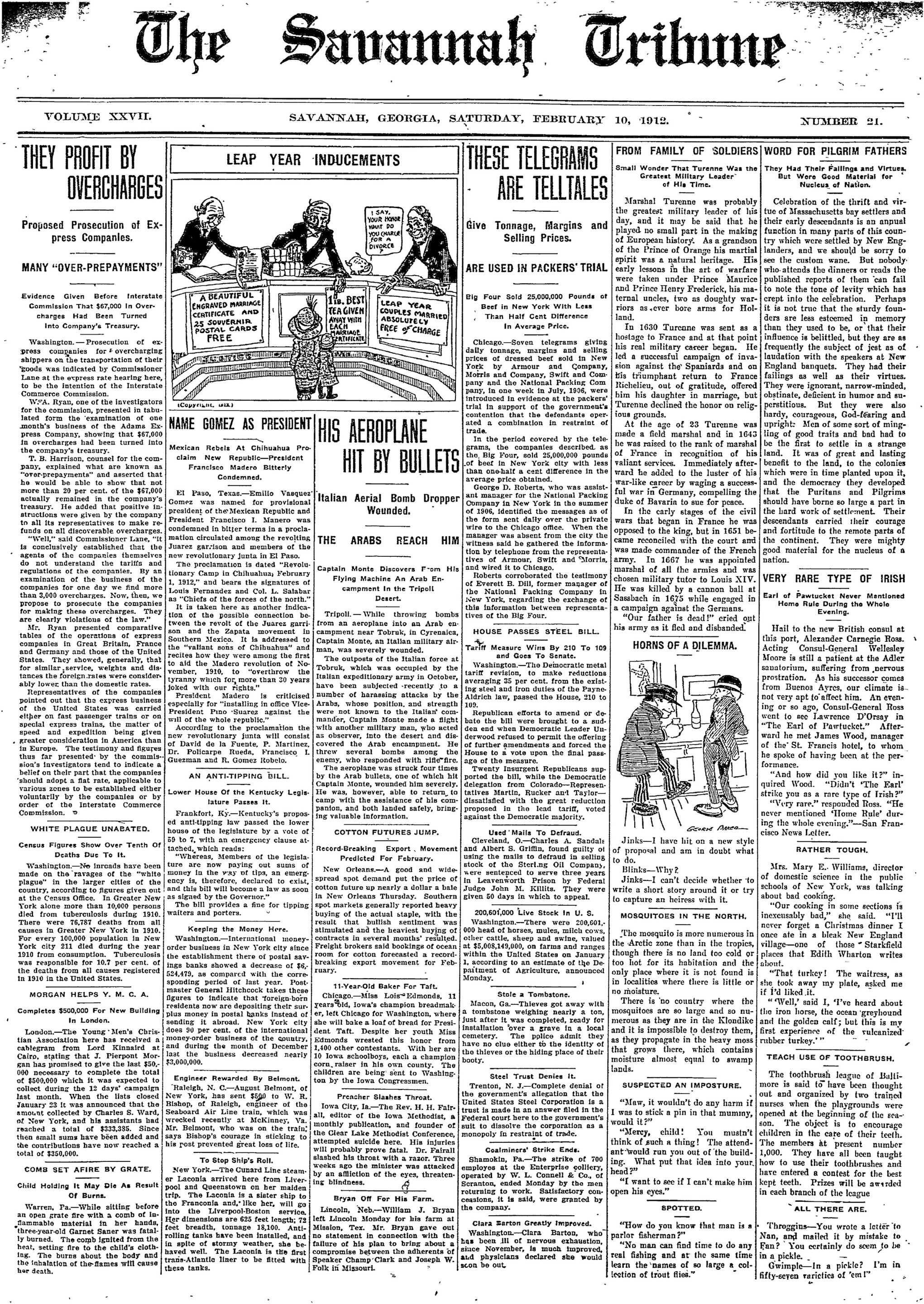
Page text (machine-generated)
VOLUME XXVII.
THEY PROFIT BY OVERCHARGES
Proposed Prosecution of Express Companies.
MANY "OVER-PREPAYMENTS"
Evidence Given Before Interstate Commission That $67,000 In Overcharges Had Been Turned Into Company's Treasury.
Washington.—Prosecution of express companies for overcharging shippers on the transportation of their goods was indicated by Commissioner Lane at the express rate hearing here, to be the intention of the Interstate Commerce Commission.
W.A. Ryan, one of the investigators for the commission, presented in tabulated form the examination of one month's business of the Adams Express Company, showing that $67,000 in overcharges had been turned into the company's treasury.
T. B. Harrison, counsel for the company, explained what are known as "over-prepayments" and asserted that he would be able to show that not more than 20 per cent, of the $67,000 actually remained in the company's treasury. He added that positive instructions were given by the company to all its representatives to make refunds on all discoverable overcharges. "Well," said Commissioner Lane, "it is conclusively established that the agents of the companies themselves do not understand the tariffs and regulations of the companies. By an examination of the business of the companies for one day we find more than 3,000 overcharges. Now, then, we propose to prosecute the companies for making these overcharges. They are clearly violations of the law."
Mr. Ryan presented comparative tables of the operations of express companies in Great Britain, France and Germany and those of the United States. They showed, generally, that for similar service, weights and distances the foreign rates were considerably lower than the domestic rates.
Representatives of the companies pointed out that the express business of the United States was carried either on fast passenger trains or on special express trains, the matter of speed and expedition being given greater consideration in America than in Europe. The testimony and figures thus far presented by the commission's investigators tend to indicate a belief on their part that the companies should adopt a flat rate, applicable to various zones to be established either voluntarily by the companies or by order of the Interstate Commerce Commission.
WHITE PLAGUE UNABATED.
Census Figures Show Over Tenth Of Deaths Due To It.
Washington.—No inroads have been made on the ravages of the "white plague" in the larger cities of the country, according to figures given out at the Census Office. In Greater New York alone more than 10,000 persons died from tuberculosis during 1910. There were 76,787 deaths from all causes in Greater New York in 1910. For every 100,000 population in New York city 211 died during the year 1910 from consumption. Tuberculosis was responsible for 10.7 per cent. of the deaths from all causes registered in 1910 in the United States.
Completes $500,000 For New Building In London.
London.—The Young Men's Christian Association here has received a cablegram from Lord Kinnaird at Cairo, stating that J. Pierpont Morgan has promised to give the last $50,000 necessary to complete the total of $500,000 which it was expected to collect during the 12 days' campaign last month. When the lists closed January 23 it was announced that the amount collected by Charles S. Ward, of New York, and his assistants had reached a total of $333,335. Since then small sums have been added and the contributions have now reached a total of $350,000.
COMB SET AFIRE BY GRATE.
Child Holding It May Die As Result Of Burns.
Warren, Pa.—While sitting before an open grate fire with a comb of inflammable material in her hands, three-year-old Garnet Saner was fatally burned. The comb ignited from the heat, setting fire to the child's clothing. The burns about the body and the inhalation of the flames will cause her death.
LEAP YEAR INDUCEMENTS
A BEAUTIFUL
ENGRAVED MARRIAGE
CERTIFICATE AND
25 SOUVERNIR
POSTAL CARDS
FREE
(Copyright, 1912)
I SAY, YOUR HONOR WHAT DO YOU CHARGE FOR A DIVORCE?
A BEAUTIFUL ENGRAVED MARRIAGE CERTIFICATE AND 25 SOUVERNIR POSTAL CARDS FREE
11B. BEST TEA GIVEN AWAY WITH EACH MARRIAGE CERTIFICATE
LEAP YEAR COUPLES MARRIED ABSOLUTELY FREE OF CHARGE
NAME GOMEZ AS PRESIDENT
Mexican Rebels At Chihuahua Proclaim New Republic—President Francisco Madero Bitterly Condemned.
El Paso, Texas.—Emilio Vasquez Gomez was named for provisional president of the Mexican Republic and President Francisco I. Manero was condemned in bitter terms in a proclamation circulated among the revolting Juarez garrison and members of the new revolutionary Junta in El Paso.
The proclamation is dated "Revolutionary Camp in Chihuahua, February 1, 1912," and bears the signatures of Louis Fernandez and Col. L. Salabar as "Chiefs of the forces of the north."
It is taken here as another indication of the possible connection between the revolt of the Juarez garrison and the Zapata movement in Southern Mexico. It is addressed to the "vallant sons of Chihuahua" and recites how they were among the first to aid the Madero revolution of November, 1910, to "overthrow the tyranny which for more than 30 years joked with our rights."
President Madero is criticised especially for "installing in office Vice-President Pino Suarez against the will of the whole republic."
According to the proclamation the new revolutionary junta will consist of David de la Fuente, P. Martinez, Dr. Policarpe Rueda, Francisco I. Guezman and R. Gomez Robelo.
AN ANTI-TIPPING BILL.
Lower House Of the Kentucky Legislature Passes it.
Frankfort, Ky.—Kentucky's proposed anti-tipping law passed the lower house of the legislature by a vote of 59 to 7, with an emergency clause attached, which reads:
"Whereas, Members of the legislature are now paying out sums of money in the way of tips, an emergency is, therefore, declared to exist, and this bill will become a law as soon as signed by the Governor."
The bill provides a fine for tipping waiters and porters.
Keeping the Money Here.
Washington.—International money-order business in New York city since the establishment there of postal savings banks showed a decrease of $6,524,479, as compared with the corresponding period of last year. Postmaster General Hitchcock takes these figures to indicate that foreign-born residents now are depositing their surplus money in postal banks instead of sending it abroad. New York city does 90 per cent. of the international money-order business of the country, and during the month of December last the business decreased nearly $3,000,000.
Engineer Rewarded By Belmont
Engineer Rewarded by Bellmont
Raleigh, N. C.—August Belmont, of
New York, has sent $500 to W. R.
Bishop, of Raleigh, engineer of the
Seaboard Air Line train, which was
wrecked recently at McKinney, Va.
Mr. Bellmont, who was on the train,
says Bishop's courage in sticking to
his post prevented great loss of life.
To Stop Ship's Roll.
New York.—The Cunard Line steamer Laconia arrived here from Liverpool and Queenstown on her malden trip. The Laconia is a sister ship to the Franconia and,"like her, will go into the Liverpool-Boston service. Her dimensions are 625 feet length; 72 feet breadth, tonnage 18,100. Anti-rolling tanks have been installed, and in spite of stormy weather, she behaved well. The Laconia is the first trans-Atlantic liner to be fitted with these tanks.
SAVANNAH, GEORGIA, SATURDAY, FEBRUARY 10, 1912.
I SAY, YOUR HONOR WANT DO YOU CHARGE FOR A DIVORCE?
11th. BEST TEA GIVEN AWAY WITH EACH MARRIAGE CERTIFICATE
LEAP YEAR COUPLES MARRIED ABSOLUTELY FREE OF CHARGE
HIS AEROPLANE HIT BY BULLETS
Italian Aerial Bomb Dropper Wounded.
THE ARABS REACH HIM
Captain Monte Discovers From His Flying Machine An Arab Encampment In the Tripoll Desert.
Tripoll. — While throwing bombs from an aeroplane into an Arab encampment near Tobruk, in Cyrenaica, Captain Monte, an Italian military alrman, was severely wounded.
The outposts of the Italian force at Tobruk, which was occupied by the Italian expeditionary army in October, have been subjected recently to a number of harassing attacks by the Arabs, whose position, and strength were not known to the Italian commander, Captain Monte made a flight with another military man, who acted as observer, into the desert and discovered the Arab encampment. He threw several bombs among the enemy, who responded with rifle fire. The aeroplane was struck four times by the Arab bullets, one of which hit Captain Monte, wounded him severely. He was, however, able to return to camp with the assistance of his companion, and both landed safely, bringing valuable information.
COTTON FUTURES JUMP.
Record-Breaking Export, Movement Predicted For February.
New Orleans.—A good and widespread spot demand put the price of cotton future up nearly a dollar a bale in New Orleans Thursday. Southern spot markets generally reported heavy buying of the actual staple, with the result that bullish sentiment was stimulated and the heaviest buying of contracts in several months' resulted. Freight brokers said bookings of ocean room for cotton forecasted a record-breaking export movement for February.
11-Year-Old Baker For Taft.
Chicago.—Miss Lois' Edmonds, 11 years old, Iowa's champion breadmaker, left Chicago for Washington, where she will bake a loaf of bread for President Taft. Despite her youth Miss Edmonds wrested this honor from 1,400 other contestants. With her are 10 Iowa schoolboys, each a champion corn, raiser in his own county. The children are being sent to Washington by the Iowa Congressmen.
Preacher Slahes Throat.
Iowa City, Ia.—The Rev. H. H. Fairall, editor of the Iowa Methodist, a monthly publication, and founder of the Clear Lake Methodist Conference, attempted suicide here. His injuries will probably prove fatal. Dr. Fairall slashed his throat with a razor. Three weeks ago the minister was attacked by an affliction of the eyes, threatening blindness.
Bryan Off For His Farm.
Lincoln, Neb.—William J. Bryan left Lincoln Monday for his farm at Mission, Tex. Mr. Bryan gave out no statement in connection with the failure of his plan to bring about a compromise between the adherents of Speaker Champ Clark and Joseph W. Folk in Missouri.
THESE TELEGRAMS ARE TELLTALES
Give Tonnage, Margins and Selling Prices.
ARE USED IN PACKERS' TRIAL
Big Four Sold 25,000,000 Pounds of Beef in New York With Less Than Half Cent Difference In Average Price.
Chicago.—Seven telegrams giving daily tonnage, margins and selling prices of dressed beef sold in New York by Armour and Company, Morris and Company, Swift and Company and the National Packing Company, In one week in July, 1906, were introduced in evidence at the packers' trial in support of the government's contention that the defendants operated a combination in restraint of trade.
In the period covered by the telegrams, the companies described as the Big Four, sold 25,000,000 pounds of beef in New York city with less than one-half a cent difference in the average price obtained. George D. Roberts, who was assistant manager for the National Packing Company in New York in the summer of 1906, identified the messages as of the form sent daily over the private wire to the Chicago office. When the manager was absent from the city the witness said he gathered the information by telephone from the representatives of Armour, Swift and Morris, and wired it to Chicago.
Roberts corroborated the testimony of Everett B. Dill, former manager of the National Packing Company in New York, regarding the exchange of this information between representatives of the Big Four.
HOUSE PASSES STEEL BILL.
Tariff Measure Wins By 210 To 109 and Goes To Senate.
Washington.—The Democratic metal tariff revision, to make reductions averaging 35 per cent. from the existing steel and iron duties of the Payne-Aldrich law, passed the House, 210 to 109.
Republican efforts to amend or debate the bill were brought to a sudden end when Democratic Leader Underwood refused to permit the offering of further amendments and forced the House to a vote upon the final passage of the measure.
Twenty Insurgent Republicans supported the bill, while the Democratic delegation from Colorado—Representatives Martin, Rucker and Taylor—dissatisfied with the great reduction proposed in the lead tariff, voted against the Democratic majority.
Used Mails To Defraud
Cleveland, O.-Charles A. Sandals and Albert S. Griffin, found guilty of using the mails to defraud in selling stock of the Sterling Oil Company, were sentenced to serve three years in Leavenworth Prison by Federal Judge John M. Killits. They were given 50 days in which to appeal.
200.601.000 Live Stock In U. S.
Washington.There were 200,601, 000 head of horses, mules, milch cows, other cattle, sheep and swine, valued at 5,008,149,000, on farms and ranges within the United States on January 1, according to an estimate of the Departament of Agriculture, announced Monday.
Stole a Tombstone.
Macon, Ga.—Thieves got away with a tombstone weighing nearly a ton, just after it was completed, ready for installation over a grave in a local cemetery. The police admit they have no clue either to the identity of the thieves or the hiding place of their booty.
Steel Trust Denies It.
Trenton, N. J.—Complete denial of the government's allegation that the United States Steel Corporation is a trust is made in an answer filed in the Federal court here to the government's suit to dissolve the corporation as a monopoly in restraint of trade.
Coalminers' Strike Ends.
Shamokin, Pa.—The strike of 700 employees at the Enterprise colliery, operated by W. L. Connell & Co., of Scranton, ended Monday by the men returning to work. Satisfactory concessions, it is said, were granted by the company.
Clara Barton Greatly Improved.
Washington—Clara Barton, who has been ill of nervous exhaustion, since November, is much improved, and physicians declared she would soon be out
Small Wonder That Turenne Was the Greatest Military Leader of His Time.
Marshal Turenne was probably the greatest military leader of his day, and it may be said that he played no small part in the making of European history. As a grandson of the Prince of Orange his martial spirit was a natural heritage. His early lessons in the art of warfare were taken under Prince Maurice and Prince Henry Frederick, his maternal uncles, two as doughty warriors as ever bore arms for Holland.
In 1630 Turenne was sent as a hostage to France and at that point his real military career began. He led a successful campaign of invasion against the Spaniards and on his triumphant return to France Richelieu, out of gratitude, offered him his daughter in marriage, but Turenne declined the honor on religious grounds.
At the age of 23 Turenne was made a field marshal and in 1643 he was raised to the rank of marshal of France in recognition of his valiant services. Immediately afterward he added to the luster of his war-like career by waging a successful war in Germany, compelling the duke of Bavaria to sue for peace.
In the early stages of the civil wars that began in France he was opposed to the king, but in 1651 became reconciled with the court and was made commander of the French army. In 1667 he was appointed marshal of all the armies and was chosen military tutor to Louis XIV. He was killed by a cannon ball at Sassbach in 1675 while engaged in a campaign against the Germans. "Our father is dead!" cried out his army as it fled and disbanded.
HORNS OF A DILEMMA.
HORNS OF A DILEMMA.
Jinks—I have hit on a new style of proposal and am in doubt what to do.
Blinks—Why?
Jinks—I can't decide whether to write a short story around it or try to capture an heiress with it.
MOSQUITOES IN THE NORTH.
The mosquito is more numerous in the Arctic zone than in the tropics, though there is no land too cold or too hot for its habitation and the only place where it is not found is in localities where there is little or no moisture.
There is no country where the mosquitoes are so large and so numerous as they are in the Klondike and it is impossible to destroy them, as they propagate in the heavy moss that grows there, which contains moisture almost equal to swamp lands.
SUSPECTED AN IMPOSTURE.
"Maw, it wouldn't do any harm if I was to stick a pin in that mummy, would it?" "Mercy, child! You mustn't think of such a thing! The attendant would run you out of the building. What put that idea into your head?" "I want to see if I can't make him open his eyes."
8POTTED.
"How do you know that man is a parlor fisherman?" "No man can find time to do any real fishing and at the same time learn the names of so large a collection of trout flies."
NUMBER 21.
WORD FOR PILGRIM FATHERS
They Had Their Fallings and Virtues. But Were Good Material for Nucleus of Nation.
Celebration of the thrift and virtue of Massachusetts bay settlers and their early descendants is an annual function in many parts of this country which were settled by New Englanders, and we should be sorry to see the custom wane. But nobody who attends the dinners or reads the published reports of them can fail to note the tone of levity which has crept into the celebration. Perhaps it is not true that the sturdy founders are less esteemed in memory than they used to be, or that their influence is belittled, but they are as frequently the subject of jest as of laudation with the speakers at New England banquets. They had their failings as well as their virtues. They were ignorant, narrow-minded, obstinate, deficient in humor and superstitious. But they were also hardy, courageous, God-fearing and upright: Men of some sort of mingling of good traits and bad had to be the first to settle in a strange land. It was of great and lasting benefit to the land, to the colonies which were in time planted upon it, and the democracy they developed that the Puritans and Pilgrims should have borne so large a part in the hard work of settlement. Their descendants carried their courage and fortitude to the remote parts of the continent. They were mighty good material for the nucleus of a nation.
VERY RARE TYPE OF IRISH
Earl of Pawtucket Never Mentioned Home Rule During the Whole Evening.
Hail to the new British consul at this port, Alexander Carnegie Ross. Acting Consul-General Wellesley Moore is still a patient at the Adler sanatorium, suffering from nervous prostration. As his successor comes from Buenos Ayres, our climate is not very apt to affect him. An evening or so ago, Consul-General Ross went to see Lawrence D'Orsay in "The Earl of Pawtucket." Afterward he met James Wood, manager of the St. Francis hotel, to whom he spoke of having been at the performance.
"And how did you like it?" inquired Wood. "Didn't 'The Earl' strike you as a rare type of Irish?"
"Very rare." responded Ross. "He never mentioned 'Home Rule' during the whole evening."—San Francisco News Letter.
RATHER TOUGH.
Mrs. Mary E. Williams, director of domestic science in the public schools of New York, was talking about bad cooking.
"Our cooking in some sections is inexcusably bad," she said. "I'll never forget a Christmas dinner I once ate in a bleak New England village—one of those Starkfield places that Edith Wharton writes about.
"That turkey! The waitress, as she took away my plate, asked me if I'd liked it.
"Well,' said I, 'I've heard about the iron horse, the ocean greyhound and the golden calf; but this is my first experience of the vulcanized rubber turkey.'"
TEACH USE OF TOOTHBRUSH.
The toothbrush league of Baltimore is said to have been thought out and organized by two trained nurses when the playgrounds were opened at the beginning of the season. The object is to encourage children in the care of their teeth. The members at present number 1,000. They have all been taught how to use their toothbrushes and have entered a contest for the best kept teeth. Prizes will be awarded in each branch of the league
ALL THERE ARE.
Throggins—You wrote a letter to Nan, and mailed it by mistake to Fan? You certainly do seem to be in a pickle. Gwimple—In a pickle? I'm in fifty-seven varieties of 'em!
PROF. LYDE ON ORIGINAL COLOR
London Scientist Says the First Color of Man Was a Brownish-Yellow.
ONCE ALL OF ONE HUE
THE INFLUENCE OF LIGHT—ENGLISHMAN THINKS THAT LIGHT HAS MORE EFFECT ON DETERMINING COLOR THAN HEAT.
Prof. Lyouel, Lyde, who teaches economic geography in the University college, London, has attracted a deal of attention recently with his remarks on the subject of skin color. Prof. Lyde's theory is that whatever the color of primitive man in the beginning, the conditions of life during the glacial period were such that uniformity of results must have been produced. Where man originated is not known—very likely in southern Asia, possibly in Africa, certainly not in Europe, anthropologists say. His original color is supposed to have been a sort of brownish-yellow, not like any of the colors of mankind today and scientists call him for the sake of calling him something, a Condwann.
He lived in southern latitudes—this, anthropologists think, is certain. Then came the migrations and then, Prof. Lyde believes, the varieties in color began. Some turned black, others brown and others yellow, all according to the climate in which they found themselves.
Climatic influences work directly and indirectly. In the tropics the skin and the intestines perform work which in temperate zones is thrown on the lungs. So when man found himself in cooler lands the increased activity of the lungs, together with the lessened light and heat favored lightening of the skin. When he found himself in hotter climates the increased activity of the liver and the presence of great light favored a dark skin.
The old theories of race are pretty well discarded, for men of the same race, under differing conditions, would come to be outwardly very different. Thus, even in Africa, which everybody thinks of as the land of the blacks, black is not at all the universal color. In the Soudan, where there is great light and little humidity and no shade, the men are very black. Elsewhere in Africa, where there is forest, more humidity and less light, though about equal heat, the color is brown, and even yellow.
As primitive man went on his way over the globe he adapted himself to the conditions he found. Prof. Lyde thinks that it is light, and not heat, which is injurious. There are in the tropics dangerous X-llke rays which must be stopped, and they were stopped by the darkening of the skin. Since lack of moisture also tends to give a tawny color, it is found that in rainy countries the people are fairer than in places where there are long and frequent droughts.
The race, then, that found a home in moderate and damp climates turned whiter and whiter. It is only in such climates that white skins can endure; and presumably, if the present white race were turned into a different part of the world for many hundreds of years the whiteness of the skin would be gradually lost. Perhaps, since the white man is spreading over the world today, it would be fair to say it will, in such cases, be lost, the whiteness being retained only in climates that have the conditions under which the race was first bleached.
Intensity of light and little humidity made black. Trade winds and little humidity gave the tinge of brown to the subtropical Mediterranean people. Then comes yellow, which Prof. Lyde puts down as the result of "vast dessicating grass lands" in temperate latitudes.
A STRANGE FRYING PAN
One day M. Sommerand, curator of the Cluny museum, went into a small restaurant in the suburb of St. Denys, a restaurant of the kind where the dining room and the kitchen are one and the same room. While waiting to be served his eye was caught by a frying pan of an unusual shape which was hanging on the wall. He took it down, rubbed off some of the soot with which it was covered and made out part of an inscription. To the surprise of the hostess, he offered to buy the old pan, an offer she joyfully accepted, doubtless thinking her customer somewhat mad.
When the copperplate was properly cleaned it was found that it bore the arms of France and Navarre surrounded by the chain of S. Louis and the cord of the Order of the St. Esprit and the following inscription: "Here lies the magnificent prince, King Louis XIV., king of France and of Navarre. Requiescat in pace." It was evidently the plate which had been attached to the coffin of Louis XIV., and when the faults of the Bourbons at St. Denys were rifted by the populace in 1793 it had been carried off, fitted with a handle and turned into a frying pan. It is now in the Cluny museum. The handle has been removed, but the three holes remain showing where it was attached.—Rome Weekly Mundus.
Advocates of large families, that statistics of the national population may loom/significant in the eyes and estimates of foreign nations, do not also advocate pensions for those large families whose parents are unable to properly feed, clothe and educate them, but they should do it. Now and again a case is reported in the daily newspapers full of the tragedy of the death agony.
For instance, at Garfield, N. J., there is a family with eight children, whose father earns onl $9 a week. Recently the mother told the next to the oldest, a girl not 12, to go out and get work or drown herself, as they were unable longer to take care of them all. The girl went to Passaic and tried hard to get work, but failed, and then tried to drown herself in the Dundee canal. In court the poor mother promised to take care of the child and send her to school. How can she do it, with ten in the family, on $9 a week? The state should take five of those children and care for them as orphans are cared for.
Man is the only animal that is made a slave for his children, and who is never relieved of the obligation, as his last will and testament is supposed to leave them what they did not devour in his lifetime. Children seldom consider that they owe their parents anything after they leave the parental care, or that their parents cease to owe them everything until their wills are probated. The child never gets too old to feel that he cannot have what his father or mother has and he needs, whether the parents can stand for it or not, and he never feels any obligation to return or to account to them for it. What is theirs is his, he thinks and acts, to have in part while they live and in whole when they are dead. In the case of the poorer people this principle worked out by selfish children is the agony of living death to the parents who rear and educate them and strive to set them up in life.
It takes sixteen years to rear and educate a girl and twenty-one a boy, but one indiscretion may destroy the boy or girl and leave nothing to show for the time and expense and anxiety spent upon their raising and education; but if they turn out well they seldom feel that the parents have any claim on their earnings and time, but that all they possess belongs to and is given to their own children. Among well-to-do people it is a little better; but even among them the children do not always consider that they owe their parents anything except love and gratitude for the time and money spent upon their raising and education; and even this love and gratitude are turned into hate if the last will and testament of the parents disappoint the expectations of the children.
Some have too many and some too few children in the family; but every family has more members than it needs, if the parents are unable to properly raise and educate each member of it. With most heads of families this is a life and death struggle, and as the last child passes out into the world to dare and to do the worn-out parents are ready to pass on into "the bourne from which no traveler returns."
Negro children may not have less love and respect for their parents than the children of other races; but they have little enough and should have a great deal more; but that negro parents, in the main, have more children than they can properly raise and educate, under existing conditions, will be admitted.—New York Age.
NEW MANUAL TRAINING
SCHOOL FOR WASHINGTON
Washington—The rapid spread of the "vocational training" is vividly shown in the addition of a new structure for the training of colored pupils in manual arts, which will be ready for use before the opening of the next school year. The building is to be located on O street, near North Capitol. Plans of an elaborate nature have been prepared by Snowden Ashford, the municipal architect, and construction work will begin within the next few weeks. The building is said to greatly resemble the new structure at West Point and Annapolis, a type now referred to as "manual training centers," because they serve other schools in the neighborhood in the teaching of manual arts, domestic science and other industrial subjects. The building will be of red brick, with limestone trimmings and will be of the Elizabethan or Tudor style of architecture, a type of architecture which has become a standard for schoolhouse construction. There will be two floors, accommodating all phases of industrial activity, and the heating and lighting will be by steam and electricity. The new school, besides enlarging the opportunities of the race along the line of vocational education, will offer additional openings for the special teachers now being trained in the Normal school for domestic science and kindred branches.
When Dr. W. Bruce Evans started manual training classes on a small scale in the basement of the Old Mott school some years ago, as a doubtful experiment, he "builted more wisely than he knew." Out of that modest beginning has grown the great Armstrong school, and this new institution is one of the many branches that are arranging from the main stem.
The Sunday School Lesson
THE BOY JESUS IN THE TEMPLE.
Golden Text—How is it that ye sought me? wist ye not that I must be in my Father's house?—Luke 2:49.
Lesson Text—Luke 2:40-52. Commit me. 46, 47.
I. At twelve he stopped at Jerusalem amid the great passover throngs, passed in and out of the magnificent temple and had the meaning of its parts and services explained to him, saw the thousands of innocent lamb, slain, and then gathered with his own family around the roast lamb and bitter herbs that looked back to Israel's great redemption through the slain lamb in the past and forward to the world's greater redemption through the slaying of himself some twenty years hence. Jesus saw deeper than any one else into the significance of all these things, for he had pondered the Scriptures and the Holy Spirit had interpreted to him even as a boy their innermost meaning. Jesus enjoyed being in the temple. He felt more at home there than any place he had ever been. It was "Father's house" (vs. 49, R. V.). How many of us have that deep, consuming longing for the place where the Father dwells and manifests himself? (Ps. 27:4.1) When his human parents left he could not but stay behind his real parent was. When his parents had sought him three days everywhere they could think of they at last found him in the temple. He seems to have spent the time there and they ought to have sought him there in the first place (vs. 49). The house of God is the likeliest place to find a true child of God. (Mk. 14:49). He made himself very much at home in the temple. He was "sitting" there, no passing visitor or sightseer. He was there to learn—he was "in the midst of the doctors (teachers)," and he was "hearing" and "asking them questions." The questions displayed great wisdom (v. 47), but they were not asked to display his wisdom, he wished to learn. The teachers were far from the wisest the world has ever known, and he was infinitely the wisest scholar; but he felt there were things that he could learn even from them. There is no suggestion that he criticised his teachers. He was a model Bible class scholar. He answered questions as well as asked them (v. 47). And his answers were so profoundly intelligent as to "amaze" "all that heard him." It was more as the perfect human boy than as the Divine Child that he was asking questions in the temple, and so he owed the "understanding" he displayed not so much to his inherent dis
POETRY
of and by Our People
EMANCIPATION ODE
READ BY MISS LILLIAN C. MACK,
AT THE EMANCIPATION CELEBRATION AT MANNING, S.
C., JANUARY 1, 1912.
Come, Oh, Muse! Lend the spirit,
Of your song for this I pray;
Not forsooth, to wake the echo
Of some hushed and saddened lay;
Like to that our fathers chanted,
When beneath Oppression's away;
Not a song of wild dispairing,
Is the one we'd sing today.
But awake a sweeter cadence!
Song of joy! Herolé grand!
That shall tell a gladder story,
To a freer, better land!
Let no thought of wrong or sorrow.
In its rapt'rous accent ring;
But, Oh, Muse! We would borrow
Naught but gladness as we sing!
Journ'ing on like destined Pilgrims,
To a fairer land ahead;
Here, while yet the morning lingers,
On the pathway that we treat;
Lest ye pause your wreathers!
And while yet its soft beams last,
Burn our incense to the memory
Of a dark but sacred Fast!
And that incense calm ascending—
To the skies a silent prayer,
All the hopes and deep emotions
Of a race commingled there;
Can but sanctify our Nation,
And unite with stronger bands,
All its nobler aspirations;
All the good for which it stands.
Sees now the curtain lifted!
With its lengthened folds apart!
'Tis that we might peer behind it.
And by seeing again take heart!
For 'tis not the distance followed,
That denotes the distance gained;
But our'heights are to be measured,
By the 'depths from which we came!
Grim Injustice; now we see thee!
With the mind's reflective eye,
Wielding the shield of strength,
Daring not how soon 'twill lie.
Like some shameful object grov'ling
In the dark polluted dust!
While thy crown must be relinquished,
To the God in which we trust.
Stern Oppression, well we know thee!
We have seen thee face to face;
Frowning like some dark-eyed monster,
On our weak benighted Race!
But thy day of wrath soon ended;
Strong, yet weak, how great thy fall!
When the lighter hand of Justice,
Dealt the blow that ended all!
Yes, we see it all so plainly—
Shapes and shadows grim and gray;
There behind that parted curtain,
Passing like some phantom play;
Visions of an era vanished;
vinity as to his Spirit-guided study of the Word of God (Ps. 119:99; Luke 24:27; Jno. 3:34). Mary herself, who had watched him and listened to him for twelve years, was astonished. Depths were now revealed into which even she had never been allowed to peer before. Even Mary, though his mother, had not understood Jesus. There seems to be a tone of complaint if not abruptness in the question Mary put to Jesus. Mary was a wonderful woman (Luke 1:28), but she was not divine and not faultless. The Mary of the Bible is not the Mary of legend and adoration. While Mary and Joseph were surprised that he was in the temple, Jesus was surprised that they should search for him at all instead of coming right there fully assured that he was there. There is no note of apology or regret in Jesus' reply. Though the most dutiful, tender and obedient of sons (v. 51; Jno. 19:26, 27), he was conscious that he was something more than "the son of Mary" (comp. Jno. 2:3, 4), and that Mary must for own sake be made to realize this fact. He points her from the human reputed (ch. 3:23) parentage to the divine real parentage. This is the first recorded utterance of Jesus, and like the last (ch. 23:46), its central thought is "God is my Father." Neither Mary nor Joseph understood Jesus even yet (v. 50). Need we wonder, do we understand him?
II. Jesus Obeying and Growing, 51, 52. Having made this needed assertion and given this clear proof of his delity, Jesus fell back into his place as the son of Mary and Joseph. He doubtless helped his father about the carpentering (Mk. 6:3) and his mother about her domestic work, and he was just as truly "about his Father's business" when carrying water and making fires in Nazareth as when in the temple asking questions. For nearly twenty years longer he remained in the humble obscurity of Nazareth. He did not chafe at that commonplace life, though conscious of power to fill a vastly larger sphere. That quiet life was a necessary preparation for the work the Father had given him to do. During these years Jesus was growing. If we too are in a humble sphere where there seems to be little else to do we can at least grow. Jesus could grow because he was a real human being. He had voluntarily put aside divine glory to become a real man (Phil. 2:6, 7; Mark 13:32). He was perfect as a babe and boy, but the perfection of manhood is a higher form of perfection than the perfection of childhood, and more pleasing to God. So he "increased in favor with God" as he grew from perfect boyhood into perfect manhood.
Leading Questions.—In what ways do we see in these verses the real manhood of Jesus? In what ways do we see his deity? In what points was his a model boyhood? Why is Luke the one evangelist that dwells upon the infancy and boyhood of Jesus? What does the lesson teach us about Mary? What is the most important lesson?
Visions of a faded Past—
But whose import reaching onward.
Who can measure? Who can grasp?
There's a message down the ages.
That it watters to every man;
There's a fragrance in that message.
That floats on from land to land;
That lessons heed the warning!。
Whilst he lessons heed me,
As but wrong can make men happen,
Naught but Truth can make men free
So again we see her rising,
Grandly in that darkened night!
When the earth was deep enveloped
In the clouds of cruel Might!
And she was alone in the bended,
'Oer that rough and troubled sea,
Lo! Oppression dropped the sceptrel
And Injustice bent the knee!
Day of Sorrow! Gone, forgotten!
Vanquished be fore's and aye!
Let no more the darkened visage!
Cast a shadow 'cross our way!
But as long as Truth's eternal,
And as long as God is just.
Let thy ghastly form lie buried
Deep beneath the sordid dust!
Oh, Fair' land! Designed for freedom!
Born sweet Justice to commend!
Thou wert ne'er ordained to cower,
Neath a chash of wrong or shame!
Thanks, that in thy prouder glory,
Scorning deep that guilt and blame,
Thou didst lift the fallen banner,
And inscribed the nobler name!
'Tis enough! That record's ended;
There's no time for idle tears!
Forward turning, then, we leave it,
Shrouded in forgotten years!
Dewdrop that time briefly!
Leave the dead Past where it lies—
Sacred in forgotten ashes,
While we look to fairer skies!
See the sun of Truth is beaming!
Lighting up a firmament!
And the veil so long obscuring
Peace and Justice, now is rent!
Lol! Two forces long opposing,
Now extend a friendly hand!
Once they met as slave and Master;
Now as strong armed man to man!
Oh! Supreme, divine forgiveness!
Oh! Eternal joy and truth!
Where can record witness, stronger,
To a nation's deepest truth!
Now the lion and the lambkin,
Fearing naught together live!
Ah! To err is blind and human,
But 'its God-like to forgive!
Swift the day of Truth advances!
Soon she'll face the western slopes
Bearing on her burnished bosom,
All our fears and joys and hopes:
Long enough, Oh, anxious Pilgrims!
Fear not! We are right
Right about! and faces skyward,
Start again your rugged way!
Oh! Be strong and brave and noble!
You're a mission to fulfill!
Look not back into the valleys:
Know not inward the hill!
There beyond those mountains!
Lies the land you would behold;
Ransomed children, look not backward
Onward! Onward to the goal!
WHAT THE NEGRO PROBLEM IS NOT
Subject Considered From an Impersonal Point of View.
FACTS ABOUT ILLITERACY
PROF. R. R. WRIGHT IN SOCIOLOGICAL TREATMENT OF THE GREAT QUESTION, SAYS IT IS NOT A NEGRO PROBLEM IF THE MALADJUSTMENT IS NOT COMMON TO THE WHOLE GROUP.
Philadelphia—Prof. R. R. Wright, Jr., has recently issued in book form extracts from his two lectures on the sociological attitude in the study of negro problems, which he prepared for and delivered to the social study class at the University of Pennsylvania. The first part tells of the attitude which social students ought to have in the study of race problems and the difficulties involved. The second part consists of an analysis of the negro problem. The lectures attracted considerable attention, being regarded as among the most philosophic and logical ever delivered on the subject at any of the leading colleges.
Under the caption the "Study of Race Problems" Professor Wright says:
"In the study of the facts in human activity the very condition of scientific value must be the accuracy and impartiality of the observation of students. For accurate observation the student must be tolerant and open-minded. He must be widely acquainted with the history and condition of peoples in different parts of the world in order to be entirely rid of national, sectional, racial, religious and political bias.
"In spite of his race, religion and early education, he ought to be able to look at the facts of society entirely from an impersonal point of view. This is especially necessary in the study of nationalities and races different from our own. We are very liable to underrate these peoples—to consider their mental and physical differences and mental and physical inferiorities; to call their religion heathenish; to look upon their racial tendencies as downward if they are not as ours. This will give us a provincial philosophy, but nothing of real scientific value.
"In what consists the particular and peculiar race problem of which we hear so much? A social problem may be said to exist with reference to any particular group when there is in any way maladjustment of that group with respect to its environment. Then the negro problem must be a social problem of maladjustment between the negro group and its American environment. A social problem is a negro problem in so far as the social maladjustment is, first, common to the great mass of the negro group and, second, peculiar to it. It is not a negro problem if the maladjustment is not common to the entire negro group—that is, only negroes suffer it. This we must get clearly in our minds if we are to understand the problem of the negro.
"Much confusion already exists as to just what this maladjustment is, and to avoid further confusion careful analysis is necessary. The average person with whom I have come in contact identifies in some way the negro problem with the problem of ignorance and vice, or with poverty and immorality, or with industrial inefficiency, unemployment or some other pathological social condition. One says if it were not for the ignorance of the negro there would be no problem. But let us examine this and we will see that the negro problem is not a problem of illiteracy or ignorance. In the first place, illiteracy is not common to the negro race, for the majority of them can read and write.
"In the second place, illiteracy is not peculiar to them as a race, for there are more white illiterates in this country than negro illiterates. In 1900 the census gave 3,200,069 as the number of white illiterates and 2,853,194 as the number of negro illiterates in the United States. There are, according to the same census, fourteen times as many white illiterates in the state of Pennsylvania as negro illiterates.
"By the same authority In proportion to population there is less illiteracy among the younger generation of negroes living in the north than in the same class of whites living in the south. The throngs which come to our great cities have a great deal more ignorance among the foreign white element than among the negroes. It is plain, therefore, that ignorance and illiteracy are not the negro problem, although many negroes as well as whites are involved in the general problem of ignorance, which has no color whatever."
TRIED TO AVOID HIM.
"I am sorry to see you here again," said the judge.
"You're not half as sorry as I am, judge," said the prisoner.
"Bad company, my man, as I told you before, is sure to bring you back," said the judge.
"Yeah, judge," said the prisoner. "But I can't help myself. I tried to avoid this vulgar cop, but he just regularly thrust hisself upon me."—Harper's Weekly.
WIT AND HUMOR
Reginald De Koven told at a musical in Chicago a pretty story in praise of modesty.
"A group of tourlists," he said, "visited in Bonn Beethoven's house. One of the tourists, a girl of twenty or so, sat down at Beethoven's plano and played the 'Moonlight Sonata' none too well. Beethoven's own work, in his own room, on his own plano!
"When the girl had finished she rose and said to the old caretaker:
"I suppose lots of famous musicians have been here and played on this instrument?
"Well, Miss, the caretaker answered, gravely, 'Paderewski was here last year and his friends urged him to play, but he shook his head and said:
"No, I am not worthy.'"—Washington Star.
LITTLE SISTER KNEW.
Manager Ellis, head of a local motor car tire agency, halls from Richmond, Ind., which is in the heart of the Quaker belt of Hoosierdom. His father was a Quaker minister, whose duty it often became to preach the sermon at Quaker marriage ceremonies in Richmond it being the custom for the contracting parties to "marry themselves," the minister garnishing the ceremony with a little sermon.
On one occasion the father was to deliver the sermon at a Quaker wedding and at the dinner table that day the son took occasion to inquire what his subject would be. Before the father could answer up spoke the little sister.
"I can tell thee, brother, what it ought to be," she said. "Father, forgive them, they know not what they do."-Louisville Times.
VERY LIKELY.
The railroad station of Meridian, Texas, is about a mile from the business part of the town. One night a sleepy, weary traveling man saltd to the darky who was driving him to the hotel: "Old man, why did they put this depot so far from town?" The darky scratched his head in thought, and replied: "Waal! boss. It's foced to admit dat I hasn't give de matter s'ficlet cogitation, but jen jumped up for a answer like dis. I'spose dey done dat so as to have de depot as near as possible to do railroad."
IMPOSSIBLE POLITICS.
"Would you vote for your husband if he ran for 'office?' asked Mrs. Baring-Banners. "Of course," replied the very young suffragette. "But I don't think I'd care to have a lot of other women trying to flatter him by voting for him."
INFORMATION SURPRISED HER.
Mrs. Parkins—I called on Mrs. Wiperson yesterday and she showed me her old masters.
Mrs. Parvenue—Her old masters! Dear me, I didn't know she was in service.
SQUELCHING HIM.
Mr. Hoopah—You's de onliest girl I ever loved, Della!
Miss Cole—You kin set heah an'
say dat till you turns black in de face, but I ain't g'winter b'lieve you!
—Puck.
IMPROVEMENT NEEDED.
"What you want, I suppose, is to vote, just like the men do." "Certainly not," replied Mrs. Baring-Banners. "If we couldn't do any better than that there would be no use of our voting."
STEADY HABITS.
"We had a fine sunrise this morning," said one New Yorker to another. "Did you see it?" "Sunrise" said the second man. "Why, I'm always in bed before sunrise."
A VIRGINIA DINOSAUR.
The long drought exposed the bed of a creek near Petersburg, Va., and in the bottom of it was found imbedded the skeleton of a prehistoric animal known as a sauropodus dinosaur, about 40 feet in length.
LIKE CURES LIKE.
"This bill of fare offers so much rich food that it fairly gives me indigestion to look it over." "You can remedy that in the same way. Read this advertisement about a dyspepsia pill."
"Am I required to exchange wedding gifts in the department from which they were purchased?"
"Not at all," said the floorwalker.
"Thank you. I should like to exchange a rose jar for a frying pan."
"My wife made me what I am!"
"Have you forgiven her yet?"
THE QUESTION OF RACE TRADITION
Society for Historical Research Hears Subject Discussed.
LEARNED OPINION BY LOGKE
IN PHILOSOPHIC ADDRESS SAYS THE DESIRE TO PRESERVE THE PAST CONNECTS US TO A RACIAL CONSCIOUSNESS—RACE STANDS BETWEEN TWO HERITAGES.
Yonkers, N. Y.—The year-end meeting of the Negro Research society held recently at the residence of the president, Mr. John Edward Bruce, in this city, was made notable by the presence of Alain Le Roy Locke, who is a graduate of Oxford university. He bears the distinction of being the only member of the race to win one of the Rhodes scholarships. Mr. Locke was the principal speaker on this occasion, and a reception' was given in his honor by the society in view' of the fact that he is to return to Berlin in January to complete his studies.
Mr. Locke's subject was "The Negro and a Race Tradition." He spoke in part as follows:
A historical society stands principally as the expression of a practical duty toward a corporate past, and a negro historical society stands therefore for an avowed duty toward a racial past. The negro has special duties and specific problems with regard to his past; but, however specific and special these duties and problems are, the duties and problems of any people in their acquisition of historical mindedness in the establishment of tradition. Although the American negro faces what all thoughtful observers must admit to be a historical dilemma, he can avoid it if he wishes. He has only to forget or repudiate his past or as much of it as he deems wise and consistent to forget and repudiate.
As an American, indeed, he can claim the high but dangerous privilege of taking large liberties with his past both in the direction of adoption and that of repudiation. As an American he can exercise the rights of a mental republic. He can begin anywhere and claim anything. The question is therefore whether or not the negro wishes to have a separate history, apart from the general history of this country, or what justification there is other than the purely sentimental reasons he sometimes gives himself and the wholly justifiable reasons usually given him for having a separate tradition in contrast or addition to the tradition he can acquire and claim as an American, enjoying theoretically at least all of the benefits of free education and democratic institutions.
For very different reasons and very diverse hopes, then, the speaker found himself forced to believe in a race history and a race culture. The desire to preserve our past commits us to a racial consciousness and requires of us the development of a sense for corporate interests and destinies. Indeed the tendencies and facts which treaten the solidarity and perpetuity of a distinct negro tradition in this country may prove the ultimate stumbling blocks in the way of our progress. The historical dilemma of the American negro is the painful position of standing between two heritages, one lost, the other not fully acquired; the one something for which we have as yet no definite use and the other something which may not have permanent satisfaction for us.
This situation is both the price and the reward of the negro's unique history. Later he may be as anxious to take the advantages of the alternatives as he is at present to escape the disadvantages of this situation. Our intellectual and spiritual problems have a different point of origin from social or political economic issues we face, and they are as likely to have a different solution. History and culture, at all events, are known only as the attributes of nations and races.
Any one who surveys at all closely the estate of culture or the field of history will find that it has its fences and proprietary rights, quite as material in their way as the fences and property deeds of any civilized community. They will see that no people has acquired a passport to culture, citizenship and the exchange civilities of civilization until it has cultivated its own land, its own tradition and evolved its own culture. A people that proceeds upon any other assumption is threatened under the present, facts at least with the fate of mental parliahs. Race is not only the key to history, as Disraeli said; it is the most legitimate and indisputable claim to education and culture.
We as negroes need to distinguish sharply between the claim of education and the claim of mental birthright. It may even be that we shall have to choose between them on certain occasions. Certainly we must always bear the distinction in mind. The very accident of our birth and history make for as a claim upon a civilization and a heritage of ideas which no amount of mental juggling and self-sought mystification can conceal from us as not ours in the same literal sense that it is the hereditary culture and history of Aryan peoples.
This is the crux of the problem from the side of education and culture. Sooner or later if he persists in ignoring this distinction the Afro-American of culture finds he is an anomaly; finds that he is sharing and participating in a culture that is his only by right of acquisition and not by right of inheritance.
To be mindful of the distinction does not necessarily make the civilization and culture we propose to claim and share any the less ours, but it does make it ours in a different way. This is the contention that with the proper approach and reservations the frank admission that we participate in an allen culture justifies us in a certain historic and actual pride of acquisition in having made our own what was in the beginning not ours. Further, such an admission should enable us by way of contrast to realize rationally our own position, our own derivations and allegiances, and to help us to build up in addition a tradition worthy of our united loyalties.
Instead, therefore, of bellitling us the great contrast of Aryan culture should make it more meaningful to be a negro. The negro's attitude toward his past has hitherto been a sentimental and mistaken one. There are grave dangers and difficulties in achieving a new attitude, but a new one must be achieved. We might in time succeed in getting the first slave ship into a historical perspective, which would make it a spiritual Mayflower of freedom from the haudcaps of a tropical climate, but better than this would be an attitude which would insist upon the full and remotest tradition of the race. As a patriot the American is satisfied to go back as far as the Mayflower, but as a scholar he is forced to go back a little farther. We have then the phenomenon of Anglo-Saxon tradition, Anglo Saxon tradition, Aryan culture! It should be—indeed, it must be—the same with us. The American negro must in time change his attitude toward the past. The stamp of the abolitionist experience and appeal is still upon us. It deserves to be an indelible memory. But the sentimental ties which bind us to the abolitionist period of our history must not be allowed to control our historical attitudes. A generation that has not lived through such a time can never be expected to care for race history in exactly the same way. Already the younger generation is lapsing from that sentimental attitude, and it is well, since the attitude which freed us physically will never free us mentally. It binds us fast to what is, after all, only one period in the race life. It keeps us from the dispassionate, the scholarly, attitude toward history. It chains us to remain in the vicious circle of early American isolation, the hopelessly Quixotic whim of a people that wishes to begin history all over again. We cannot afford to let our regard for our immediate past blind us to the remote racial past, a past which stands in need of patient and painstaking scholarship to recover, but even more perhaps in need of a worthier historical attitude to accept it.
American thought and scholarship are in process of broadening out in the name of culture, and for the sake of tradition a period of reconstructive scholarship is beginning, a period that will retrieve the necessary damage of the democratic secession. This is being done that the American' of culture need not have to pay the high price of expatriation for his culture. Our situation is parallel. Our involuntary transportation is analogous to the colonial Americans' voluntary revolution. We must, like them, go back to claim as tradition and culture all we have broken with as government and authority. There is for us no alternative. to turning back toward an African and racial past. But such a course need no more interfere with our entering into the full heritage of a liberal education than race loyalty to Anglo-Saxon civilization interferes with American patriotism.
America, standing, as it does, for the common ownership of the utilities of civilization, cannot stand for the amalgamation of cultures. America, at all events, is not sure of her own mental nationality, and behind the traditional uniformities of American life and thought it is significant to find certain latent racial traits and traditions in process of development and assertion. The fear that the acknowledgment of the birth claim to ideas undermines the republican claims to free institutions, the fear that a sense of race history and tradition shuts one out from an impersonal and more inclusive participation in general history culture, can only be indulged by those who misunderstand the trend of American institutions. Indeed, freed from national responsibilities and governmental ambitions, racial pretensions are free in this country to develop without opposition or misconstruction. Certainly America has offered this to other races. Not only have certain Irish ambitions and hopes impossible of realization elsewhere been realized in this country, but their realization, while contributory largely and patriotically to the sum.total of American achievement, has reacted upon the whole status and welfare of that race in its native home. The Jewish communism in this country further has contributed to its racial life the world over and stands today as the champion of some of its most significant reform movements. America affords the unique possibility of a race life and propaganda existing without contradicting national and patriotic loyalties and responsibilities.
The historical dilemma of the American negro is a great culture problem. It is also a great American problem.
Its solution will prove or disprove whether or not culture by adoption is possible and whether a race can exist within a nation without disrupting the nation or contradicting itself. If we accept the burden of being an experiment in this land of experiment it is because we have additional reasons. These additional reasons are the desire to solve our own problems, to convert invidious distinctions into others rational and respected.
THE NEGRO IN BUSINESS
That the negroes of America are making great progress and are going forward by leaps and bounds along all lines of human endeavor cannot be denied. But while he has been making progress the world about him has also been making progress, and having started in the lead, his white brother keeps the lead. Particularly is this true in the business world. The negro merchant, broker, banker, or whatnot is not only handlecapped by lack of experience, and of capital and hampered by social prejudice, but greater than all these is the handicap he is under by reason of the lack of confidence in the ability of his own race to do big business and his lack of patriotism which would make him suffer present temporary inconveniences, and losses, if need be, in order that conditions may be made better for his posterity. The scarcity of large business enterprises among the negroes is not due so much to the lack of colored patronage of negro businesses, as to the lack of those negroes who have been patronized by the masses, to co-operate with one another in the production of larger businesses. The business and professional men are at fault for the lack of large corporations among the negroes, and the use by white corporations of most of the capital possessed by the race.
There are among the negroes too many separate places of business doing the same kind of business. Both economy and efficiency demand that a large number of these small places be combined and one big business made instead of many small failures. The tendency among our professional men to look up a white corporation in which to invest the money they have made from colored people is too great. Those who can should think and having thought, should act. There is no good reason why the more than two millions of dollars possessed by the negroes of Chicago should not earn as much, or more, if invested so to as give the race full benefit of the fruits of their labor and loyalty, than is now being earned by investing in white institutions whose power, created in part by this very negro capital, is used against him and his children which will come after him. Colored men of brains and means, "it is up to you to make good."—Chicago Chronicle.
CARBOLIC ACID ANTIDOTE
TINCTURE OF IODINE, IT, IS CLAIMED, GIVES REMARKABLE RESULTS.
Among cases of accidental poisoning those caused by carbolic acid are the most frequent. These generally arise through misaking a solution of carbolic acid for some medicine or, as occurs very often, for some alcoholic liquor.
The remedies generally employed in dealing with this kind of poisoning consist in washing the stomach with alkaline water or pure glycerin, followed by the ingestion of alkaline sulphates, oil and white of eggs beaten up. Some years ago, however, Dr. Maberly showed that tincture of iodine, administered in fairly large doses, may give much better results. On one occasion when called in to attend a young negro who, thinking he was drinking whisky, had swallowed a quantity of a strong solution of carbolic acid and who consequently was severely burned about the lips and throat, Dr. Maberly hurriedly made him swallow a teaspoonful of tincture of iodine in a cupful of water. A few minutes afterward the patient was able to swallow some milk without any difficulty, speaking became easier, and he very soon completely recovered.
The same immediate and complete effect was obtained on administering tincture of iodine in doses of five drops in water in the case of a three-year-old boy who had just swallowed some carbolic acid.
Similar success was met with in a third case of carbolic acid poisoning, the victim being a child of two years of age. In this instance the iodine treatment could not be begun till 30 hours after the ingestion of the poison. The alarming symptoms soon disappeared under the influence of tincture of iodine given every four hours in doses of five drops in a teaspoonful of water. The little patient was cured.
The tincture of iodine neutralizes the carbolic or phenic acid by forming with it an iodophenate, insoluble and therefore harmless.—European Edition New York Herald.
NO PITY NEEDED
Pastor—I was so sorry for your wife during the sermon this morning, doctor. She had such a dreadful fit of coughing that the eyes of the whole congregation were fixed upon her. Doctor—Don't be unduly alarmed. She was wearing her new hat for the first time.
WEALTH ALSO MEANS WORRY
Very Rich Seem to Have Their Own Troubles, From Which the Poor Are Happily Freed.
There appears to be almost as much worry and gloom among rich Americans this year as there was three or four winters ago. During that period the friends of an exceedingly wealthy man, noting that he appeared to be suffering from extreme mental depression; asked the reason, and he replied: "No wonder I am feeling blue. I have $1,200,000 in cash lying in bank, on which I can't get more than four per cent interest."
A sufficient cause for worry, no doubt. Yet there are other rich persons in equal distress. One of these, the wife of a prominent official of the government, is said to be greatly worried over her jewels. She has more of such articles, it is stated, than she can look after, the result being that she has had to employ help to care for them. Accordingly she has instituted a card catalogue system, which gives a record and description of every piece of jewelry she owns, together with notes showing its need of repairs or cleaning. Yet even this help probably cannot relieve the grinding worry that comes from the sense of possession.
RECREANT LOVER
Edith—Do you remember when I rejected Mr. King about a month ago? And he said he certainly would pine away and die, and I would be his murderer?
Mabel—Yes.
Edith—Well, I just met him on the street walking with another girl and I actually believe the fellow has gained 20 pounds.
CREW OF COLUMBUS.
The list of the officers and sailors in the first voyage of Columbus was almost cosmopolitan in its character. Among them there was a Jew, Luis de Torres; an Englishman, Arthur Laws; Italians, Portuguese, Spaniards and several other nationalities, though, of course, the Spaniards were largely in the majority. It is maintained by some authorities, with considerable plausibility, too, that there was a Scotchman in the list, and that after Columbus himself he was the first man to tread the soil of the new world.
LONELY LIGHTHOUSE.
The most northern lighthouse in Great Britain, the northwest tower on the coast of Shetland, is one of the most interesting of latter-day sea marks. It is built on a rock 200 feet high, the summit of which barely affords room for the necessary buildings. The rock itself has the appearance of a gigantic iceberg, perched on its narrow summit, appears more like an ordinary white hat on a giant's head than anything else. Yet the tower is no less than 50 feet high, and costs over $150,000 to erect.
CHILD'S BEAUTIFUL IDEA.
Elsie, seeing a piece of velvet for the first time, was struck by finding that one side was smooth, soft and glossy, while the other was soft and cottony. Her mother explained to her that there were generally two sides to a thing. Shortly after this Elsie, while out walking with her mother one clear night, looked up into the dusky sky and, seeing the whole heavens thickly studded with stars cried: "O, mother, if the wrong side of heaven is so beautiful, what must the other side be?"
CONTENT IN LITTLE.
"Don't you wish,you could travel to the great north snowbound countries?"
"No; with a nice snow-packed hill, and a good sled, I guess I can get all the traveling I want just now from coast to coast."
AFRO-AMERICAN CULLINGS
A year from now the negroes of this country—ten millions of them—should celebrate their fifthth anniversary as freemen. What is being done preparatory to this memorable occasion? Comparatively nothing whatever. After congress failed to act upon the proposed national emancipation celebration the leaders assumed a quiescent state that left no room for doubt as to how they proposed to act. This true the Negro Business league has a committee somewhere, but where and what they are about is not discoverable.
It is high time that the matter of nation-wide observance, so far as the negro race is concerned, be considered. In lieu of the absence of a national organization, great fraternal orders and religious bodies of the race should prepare to hold such a celebration as they deem befitting, without reference to others. We suggest that our general conference provide connectional celebration and utilize it to the promotion of the great cause, of race evangelization and denominational lauplift.
This would not preclude co-operation active and enthusiastic with any national racial exposition, etc., that may be conducted. Since Major Wright of Georgia seems to have the biggest fair and exposition among negroes, why not turn his annual gathering into a big Emancipation exposition?
If not well to hold it at Macon then elsewhere, meanwhile the negroes of the individual ex-slave states should hold state celebrations. Fifty years of freedom should at least make us capable to honor the man and the event. Abraham Lincoln and the emancipation of 4,000,000 slaves should not be forgotten by those who galned most. Let us celebrate. The race press should take up the call.
In discussing the negro domestic servant editorially, a few days ago, under the head of "A Negro Monopoly" the Houston Post, among many good things said, made the following timely statement:
"Character, cleanliness, intelligence, reliability, honesty and efficiency would guarantee to the negroes for all time a monopoly of this most important field of labor." The editor then asks this question: "Why do not the negro leaders stress this important truth upon the minds' of the negro masses?"
While we certainly appreciate the advice given in the editorial, and stress particularly the statement above quoted, yet, we wish to remind the editor of the fact that the strongest and most effective leaders of the race are doing just what he says they should do, both with tongue and pen. Dr. Booker T. Washington is the greatest of all leaders of the race, and the idea stressed most of all in the message he delivered to the negroes of this city not long ago, which message was given in the columns of the Houston Post, was that the negro should prepare to give intelligent, efficient service in industrial and domestic arts. Others are telling the same story.
The southern states raised 15,000,000 bales of cotton last year on 35,000,000 acres of land. That is what free labor can do. Slave labor produced, in 1860, the year be'ore the war, 4,669,770 bales. In 1860 there were 4,500,000 slaves, every one of whom, except the comparatively few engaged in domestic service and the mechanical trades, was engaged in cotton raising. In 1911, with quite 10,000,00 negro population, 15,000,000 bales were raised by free labor, not more perhaps than one-half being engaged in cotton raising. Of course improved methods of much to do with it, but the fact remains that free labor is more productive than slave labor; and the lie that the free negro would not work has been knocked down and stunned every year since 1865 by the industrial statistics of the southern states, that do not lie, which show a productivity most marvellous in the history of mankind—New York Age.
H. Rider Haggard, the popular English novelist, and equally brilliant but less known sociologist, predicts the destruction of the white race unless there is a pronounced impetus given to the "back to the land movement." City life, he thinks, is gradually sapping the virtue and virility of the white race, and this flocking to the cities is the forerunner of racial disaster. This is a danger in comparison with which the "yellow peril" and the "black peril" are mere hegments of a heated imagination. We are glad to note that the proprietors are beginning to take note of should race other than the negro. They have been clapper-clawing blind so long that a change is refreshing to say the least.—Dallas Express.
The gambling habit is far more prevalent in this city. Those gamblers who frequent dives in certain sections of the city are always on the lookout for innocent prey. These gamblers make up our criminal habits and the police should run, them point of the offence put them to work on the farmer. Savannah Tribune. notation: well be
What is an Ethiopian? The New York Sun says:
Has a nation the right to select its own official name? This novel point is raised by a son of Ras Makonnen, the famous general and nephew of the late King Menelik. Writing to a French official this younger chieftain plaintively protests against the bestowal of the name of Abyssinia upon his country. This undesired appellation, he charges, was folsted upon his fatherland by the Arabs. For him, for all his countrymen, the nation is Ethiopia, and next to its complete independence its patriotic citizens ask only that Abyssinia shall become Ethiopia in the geographies of the world.
We once had a talk with a well-informed man who spent some time in Abyssinia who said that the Abyssinians were highly sensitive on the question of their race, and regarded it as an insult to be styled negroes or Africans. And yet, it is stated by Biblical authorities that they are descendants of Cush, one of the sons of Ham, the alleged father of the African races.
Perhaps Ras Makonnen is correct, as the Ethiopians were an older people than the Africans, and were absorbed or destroyed by the latter, as the Mizralmites of Ham in Egypte were absorbed or destroyed by the shepherd races of Shem.
It is highly probable that the alleged Abyssinians are the only remnants of the ancient Ethiopians who were absorbed or destroyed by the Mizralmites of Ham, who overspread Africa as well as Asia.
Attorney Alonzo E. Twine of Charleston, S. C., has been adjudged insane by an examining board of two physicians of his city, and sent to the colored ward of the asylum at Columbia. S. C., on commitment papers made out by Judge of Probate, George D. Bryan. Attorney Twine was a college graduate of Claflin university, Orangeburg, S. C., and had won for himself the name of being a brilliant and promising young attorney. A change in his life seemed to come after he had severed his connection with Old Bethel M. E. church, where his membership had been, along with his parents, and embraced a new religion, known as the "religion of Bahal". Introduced in his city by Professor Gregory of Washington, D. C. The cry is rapidly going forth for more colored young men to enter the practice of law, and a single vacancy in the sparsely filled ranks of this profession is a distinct loss to the race. Charleston Messenger.
It is most interesting to see how in the old southern states the white people, especially white women, are changing their ideas of civilization and education. A few years ago the southern white girl was educated only in the "accomplishments." This meant something in music, a smattering of painting and some knowledge of literature. All that is changing for the southern white woman. She is beginning to study science; she is taking courses in applied sciences and industrial education, and one of the most interesting and far-reaching movements in this direction is indicated by the fact that throughout the south white women are organizing themselves into canning clubs. Fruits and vegetables which a few years ago were either not raised or were raised but were little cared for are now being canned during the summer for use in the winter. There is a great lesson in all this for the negro mother and the negro girl. New York Age.
The negroes have increased 11 per cent. during the 18th century, while the white people have increased about 15 per cent. The 19th century may be disadvantageous to the indianos when viewed as a chimpanzee simply but much of this disadvantage disappears when the Japanese number of white immigrants and their population increase for the decade is considered. Making suitable deductions, it will not be found that the whites exclusive of the immigrant population increased in numbers during the period with the negroes. Edgar the mankind is good. But when it comes to this summing up of population, for the negroes, it is found that he is increasing rather than an increasing population. This fact will assuredly rob many of our orators of their thunder and the eventually solve all the problems by the chimpanzees by the indigenous people over increasing numbers. The negroes might easily if he would indentify him as a place in american life, Dusenberg Reformer.
1 bus queen queen and queen
this old town and desert
the historical ruins of races
which is in the middle ages to give
the Cushites all the face from which
the high came and Cushites true, he
the highgoyah descended from the
race that they, many ruined and
controllable outside part of
Chaldees who is idolized as the
most fierce savviite of the world. The
most ancient baggage of human history
states that they possess inhabitants, or
the Indian people who occupies Cushites
of the Chaldees Hall. How does
Cushites of the Chaldees Hall face that is sometimes
made of wood and stone from the
Chaldees Star.
Established 1875
By JOHN H. DEVEAUX.
Remittance must be made by Express or Post Office Money Order, or Register ed Letter. Advertising rates given on application.
Entered at the Post Office at Savan uah, G., as Second-Class mail matter.
SATURDAY FEBRUARY 10TH, 1912
Several months ago we showed reason why it was necessary for the Negroes to get together on the Carnegie library movement which has now been on foot for a little over one year, but which up to-date has not yet been able to get beyond a rather feeble start. Some weeks ago another reason for urging our people to work together was shown in the need of a business men's league, which is still being talked about but as yet not acted upon. And now there comes a third movement, one of national importance so far as the Negro is concerned, and that is the hearty cooperation of every Negro in the city to assist President Wright in bringing to our city the Negro exposition to be held next summer in honor of the progress made by our people throughout the country at large since their freedom from slavery. The exposition is to be the greatest exhibition of the kind ever held by our people and should receive the support of every Negro in the country. It is generally understood that the city which will have first call on this commendable undertaking is our beautiful little city and we can secure it with but the asking. It is a fine opportunity for the Negroes of this city to grasp and to show to their fellow countrymen that they are wide awake and progressive. We make an appeal to our people to fall in line and do all in their power to help bring this most praiseworthy exposition to our city. It will be a signal triumph for the thirty five odd thousand Negroes of this city if they succeed in having this exposition held here for it will give us wider and greater prestige than anything which has occurred in this country since our freedom. We can secure this exposition if only we will work together.
One of the most barbarous and flandish crimes in the history of the state occurred in Macon during the first part of this week and demonstrates the unsatiable thirst for the blood of the Negro by the lawless element of whites. A Negro was charged with having committed an assault upon a white woman and was arrested and placed in jail. News was received by the authorities that a mob was being formed to take the Negro and he was secretly spirited out of the back door of the jail by the authorities with a view of taking the prisoner to Atlanta for safe keeping. The two officers guarding the Negro had gotten as far as the railroad yard and there presumably awaited the approach of the out going train for Atlanta. In the meantime the mob was searching the railroad yards for the prisoner and it is said that as they passed the box car in which the officers were keeping their man in hiding they suddenly became aware of his whereabouts by hearing the clanking of the chains which held him. They approached the hiding place of the officers and their man and the prisoner was surrendered without even the slightest show of opposition on the part of the officers. The Negro was taken and lynched in the railroad yards. The body was given over for burial to an undertaker and carried to his establishment in the heart of the city and the next day another mob formed and went to the embalming room of the undertaking establishment and took the body of the dead Negro, put it in a wagon, carried it to the heart of the Negro section of the city and after saturating it with oil and piling cross ties on it burnt it and then quietly dispersed. Not a single arrest has been made and this heinous crime, as all similar crimes in state which have preceded it, will not unnoticed by the authorities. But the day is approaching when this lawlessness, which is not only confined to Georgia, although she leads, but is perpetrated throughout the entire country, will not only be directed against the Negro, but will be visited upon the whites as well. Then and not until then will the Federal and state governments alike see fit to take some steps to check this reign of law-
Pursuant to the call issued by the Republican National Committee, December 12, 1911, a District Convention of said Congressional District is called to meet in Savannah, Ga., Monday February 12, 1912, at 12 o'clock, Savannah time, at Masonic Temple, West Gwinnett St., for the purpose of electing two delegates and two alternate delegates to represent said District in the Republican Convention, called to meet in Chicago, Ill., June 18, 1912, and to transact such other business as may properly come before it.
Each County in the District shall be entitled to twice as many delegates as it has representatives in the lower house of the General Assembly of Georgia.
The election of all delegates of each county in the district shall be at the County primary on Feb. 5, 1912.
All credentials of delegates and alternate delegates elected to the District Convention under this call must be forwarded to Sol. C. Johnson, Secretary, Savannah, Ga., not later than Saturday noon Feb. 10, 1912. Notices of contest should there be any, must be submitted in writing and delivered to the above not later than Saturday noon, Feb. 10, 1912. By order of the Republican Executive Committee, First Congressional District of Georgia.
SOL. C. JOHNSON, Secretary.
lessness but it will have gained such headway that a ruthless campaign against it, at the cost of thousands of lives, will have to be waged to stamp it out.
Government Employees Trying to Boss Republican Politics in This District.
A Tribute of Respect to Mrs. Matilda M. Monroe.
By a Friend.
The statement "Death like a shining mark" found striking illustration in the death of Mrs. Matilda M. Monroe, wife of Mr. Andrew M. Monroe, on Saturday Jan. 27th, 1912, at 12:30 p. m.
Her illness was of short duration, for
Last Monday the several militia districts elected delegates to the Republican County Convention which was held Tuesday at Masonic Temple. At this Convention every district was represented. The meeting proceeded harmoniously until Chairman Simmons, a government employee, refused to continue the roll call in electing of delegates to the State, and District Conventions, after ascertaining that his ticket would be defeated. In this County there are eight districts. In the roll call he proceeded as far as the fifth district, then arbitrarily ruled that his set of delegates were elected. He, Capt. Blun and the half dozen post-office employees with a few followers, bolted the meeting. The regular Convention continued by electing a temporary chairman and selected the following delegates:
District Convention: Sol. C. Johnson, W. D. Armstrong, L. E. Williams, F. M. Bell, F. C. Johnson, B. W. S. Daniels. Alternates: S. Weyth, B. V. Sneed, Henry Mears, Julius Maxwell, J. D. Campbell.
State Convention: W. D. Armstrong, Walter S. Scott, Sol. C. Johnson, J. F. Doyle, W. W. Mumphris, J. C. Lindsay. Alternates: Jacob Wright, R. L. Jones, Wm. Henry, J. C. Williams, J. B. Johnson, H. F. Chaney.
Capf. W. D. Armstrong was elected chairman and Walter S. Scott, secretary. The National administration was endorsed as was also W. H. Johnson, H S. Jackson, H. L. Johnson and B. J. Davis as delegates at-large. Mr. Jackson was endorsed for National 'Committeeemen. Lynching in Georgia was condemned.
The District Convention meets on Monday in this city at Masonic Temple.
NEGRO EXPOSITON SEEMS A CERTAINTY.
Savannah May be Selected. President R. R. Wright of the American Enamcipation Exposition Company returned to the city Monday morning from Washington, D. C., where he appeared before the committee of the United States Senate on Industrial Arts and Exposition in favor of the Bradley bill, which appropriates $250,000 for the holding of a Negro Exposition in Savannah or some other place to be selected by the Company. The purpose of the Exposition is to celebrate the progress for the fifty years since Enamcipation. Following the appearance of President Wright before the committee a favorable report was made on the bill by the committee and it will probably come up for a vote next week. It is the belief of President Wright that the exposition which is hoped will take place next summer will be held in Savannah and as is shown in the bill this city has first call on it. Savannah will be asked to furnish a tract of land, about 100 acres, upon which to hold the exposition. The exposition has already attracted wide interest and is being enthusiastically discussed in every part of the country. The state of Pennsylvania through its Legislature has already appropriated $20,000 for the erection of a building. President Wright conferred with the committee in charge of this in Philadelphia last Saturday. It is believed that many other states will make appropriations for the erection of handsome buildings. President Wright in his efforts to have the Exposition brought to Savannah should be supported by the colored citizens at large. There is no city which can offer broader hospitality than we and it is hoped that the idea of bringing the exposition here will meet with encouragement on all sides.
Prof. Wright has received the following encouraging letter from President Taft:
"White House, Washington, D. C. 1919
"My Dear Prof. Wright: The President has written to, Senator Elhu Root and asked him to urge the passage of the Exposition bill.
"Sincerely,
"Chas. D. Hilles, Secretary
"to the President."
Lincoln Memorial Exercise.
Lincoln Memorial Sunday will be celebrated at the First Congregational Church by the students of Beach Institute and the Sunday school of the church on Sunday evening at 8 o'clock. A free will offering will be taken for the benefit of the work of the American Missionary Association. The following program will be rendered: Remarks by the pastor, Rev. Cash; Anthem by the choir; Responsive reading, "Mission Study," by the school; Music chorus, "Just Before the Battle Mother," by the school; Paper, The story of Abraham Lincoln, by Miss Honor W. Littlefield; on the Old Camp Ground" by Miss Frances Kline; Address, "Abraham Lincoln" by Mr. James M. Ferrebee; Music, Quartette, "To the Haven of Thy Break," by Miss Elizabeth Stoney and Rosa Collins, and Messrs. Isaac Donald and Peter Houston; Offering; Hymn, "America by the congregation; Benediction. You are cordially invited to attend these services.
J. C. SIMMONS, Chairman, Pro Tem.
A Tribute of Respect to Mrs. Matilda M. Monroe. By a Friend.
The statement "Death like a shining mark" found striking illustration in the death of Mrs. Matilda M. Mourroe, wife of Mr. Andrew M. Mourroe, on Saturday Jan. 27, 1912, at 12:30 p. m. Her illness was of short duration, for as was her usual custom, she taught her Sunday school class on the previous Sabbath, and attended preaching services that night.
On Monday and Tuesday, she engaged in her usual employment of caring for her family and home and looking after the undertaking business. She however found time to do some work of charity among the poor and carry comfort to some sad and sorrowring hearts. The unselfish spirit which actuated her life made her unmindful of her frailties and more concerned about the happiness of others.
The altruistic spirit asserted itself in her early womanhood, for though married and charged with the usual domestic duties and responsibilities incident to the care of the home and family, for more than seventeen years she found time to serve as organist of the First African Baptist Church, in Savannah—the church reputed to have the largest membership of any Negro church in America, taught in the Sunday school, and aided largely in the general work of the church. On several occasions she was sent as representative to the District, State and National Conventions of the church and urged such legislation as would further the work of Christ's Kingdom on earth. During this time in the week she conducted a large and successful private school for children in the day, and carried on a school for adults at night.
Several of the ministers desiring to make better literary preparations for their work of the ministry, availed themselves of the advantages offered in this school and thus prepared themselves for larger usefulness.
One of the most touching tributes at her funeral was that offered by Rev Wm. Gray, now pastor of one of the largest churches in the city, who testified that he received his start and inspiration in this school, and owed largely what Be is and what he has been able to accomplish to Mrs. Monroe.
To a devoted and saintly mother she owed many of the noble qualities of mind and heart so beautifully illustrated in her life. These inherent tendencies were afterward augmented and embellished by training in the schools of Savannah and a subsequent course in the Atlanta University.
Soon after the completion of this course of study, she happily married Mr. Andrew M. Monroc, a modest but sturdy specimen of nature's true ability. As evidence of his real manhood, his honesty of heart and efficiency of service have sustained him as a responsible clerk in one of the leading banks of the city for more than thirty years. To this happy union of welded hearts there have been born five children—Mrs. Juliet G. Curtight, Misses Essie L. and Amabel I. G, and Jas. A., and Andrew M. Monroe, Jr.
In no way have the qualities of this noble life exerted themselves so forcibly as upon her children. Being herself possessed of the highest ideals, the noblest impulses and most laudable ambition, she strove in every honorable way to reproduce and enlarge upon these in the lives of her children. As a result, each has been given careful home training, supplemented by courses in other schools of high grade. The three daughters are cultured musicians of high rank while the two sons are performers of splendid ability. Mrs. J. G. Curtright is the cultured wife of Rev. F. A. Curtright, pastor of a large Baptist Church in Joliet, Ill. She was educated in the literary and musical courses of Fisk University; Miss Essie L. Monroe is a graduate of the Georgia State Industrial College, has since studied in the conservatory of music in Chicago, is now organist of the second Baptist Church of Savannah and book keeper for the undertaking establishment of A. M. Monroe and Company; Miss Amabel Ione Monroe, though yet a young Miss, has graduated from Beach Institute, has studied in the conservatory of music in Chicago, is organist for one of the large churches of the city and exhibits rare skill and remarkable powers as a pianist. Mr. Jas. A. Monroe is also a graduate of the Georgia State Industrial College, and for a number of years has been employed in the mail service as a city mail carrier. Little Andrew M. Monroe, Jr., the youngest man, is still in school, but plays the violin with a skill that gives promise of much power. Mrs. Monroe's splendid executive ability, judgment and business acumen demonstrated themselves in securing the splendid property owned by the family and successful undertaking business managed by her. The expression that "The man is but the woman he carries in his heart" largely explains the success that has attended the efforts of Mr. Monroe, for she was the guiding and controlling impulse whose combined efforts resulted in such splendid material acquisitions. The right of imminent domain was recognized by all who knew her. As further evidence of her worth and the irreparable loss sustained, the sad and sorrowing hearts of the bereaved family bestowed upon the remains of her departed spirit every token of esteem and mark of re-
spect which liberal means and unstinted love could provide. The handsome, costly, copper lined McKinley Cabinet with oxidized silver extension handle bars, enclosed in an ornamental cedar case were one of the finest ever seen in the city. The beautiful floral offerings in rich profusion, given by members of the family and friends if both races told a story of love which words fail to describe. The designs include the clinging cross over which perched the dove of peace, the anchor of hope, the broken column, the bleeding heart, the restful pillar, the gates ajar, the crown of glory, the sheaves of wheat and many other elegant designs both rich and rare. The eulogy by Dr. Reid was a fitting gift and a gem of oratory. The resolutions by the Second Baptist Church and Sunday school to which she belonged represented a faithful effort to show just appreciation for her active consistent christian life. The crowded church, the long train of carriages occupied by grief stricken mourners, and the concourse of people that lined the streets all testified in elequent, but silent tones to the sad loss which the community had sustained. To some she had been the Dorcas who had heard the orphans cry and dried the widow's tear; to others she had been the Miriam who had led the battle of the Lord. But great as was her works of love, her ministrations of mercy, her services in the church, her labors in the school, her usefulness to the community, she is no more, save only in the hallowed arm of precious memories. The noble spirit that once animated that tenement of clay and made it great and glorious, has laid aside its earthly habiliments and robed its in the blissful vestments of immortality. Like a string of a sweet toned instrument breaks in the full tide of song, so this mellifluous harp once attuned to such sweet harmonies stops in the rhythmic flow of music's swelling tide not tired, but exhausted. In the meridian splendor of her brilliant usefulness, in the full blaze of luminous glory, she was summoned to sleep where the willows weep, and the weary are at rest. For, on Saturday, the 27th of January, at mid-day, the wings of death shaded the home circle and under the shadows of its deepening gloom the spirit of Mrs. Matilda M. Monroe passed to glory and to God. "Let us so live that when our summons comes to join the innumerable caravan which moves to that mysterious realm above where each shall take his chamber in the silent halls of death, go thou not like a quarry slave scourged and driven to his dungeon but sustained and soothed by an unfaltering trust, approach thy grave like one who wraps the drapery of his couch about him and lies down to pleasant dreams."
IN HIS HOLY TEMPLE.
Interesting Services in The Churches of the City.
Evangelical Ministers Union
The Evangelical Ministers Union met with Dr. R. H. Singleton, D. D. presidina. Devotional service was conducted by Rev. W. A. Daughtry. Having addressed the throne of grace, 50 Palater was then read for the lesson. Rev. I. W. Washington of the Baptist church was a visitor. A motion was passed that the Evangelical Ministers Union udorse the action of the white ministers of this city in upholding the Sunday closing law. Sermonic report was given by Rev. M. H. Rutherford. The Reporter made a trip to Atlanta, Ga., visiting Morris Brown College and the Atlanta University and other places of interest. Come out next Tuesday. Visitors always welcome.
Services at St. Stephen's Episcopal Church.
Habersham and Harris Streets.
On Sunday last the services as usual were very interesting. In the morning a goodly number, received the Holy Eucharist or the Lord's supper. The rector urged the parents and sponsors to send the children to church and Sunday School regularly and explained to them the new methods in use to the Sunday School to stimulate the children to be regular and punctual at their attendance. At night he preached a short, but stirring sermon from Jeremiah concerning those who prosper by unrightnessous, by robbing the laborer of his hard earned wages, laying great emphasis on the imprudence and dishonesty of those who will not pay their debts to God nor man. To-morrow there will be but one service at St. Stephen's in the morning 11 a.m., this being the case the rector hopes that all the people and their friends will turn out in full and have a good and glorious service. At night St. Stephen's congregation will unite in worship with St. Augustine Mission West Broad and Bolton as our good friend Bishop Reese will preach there and administer the rite of confirmation.
St. Benedict's Church.
Gaston and East Broad Streets.
Friday Feb. 11—Sexagesima Sunday:
First Mass at 7 a.m. with a short instruction; Second Mass at 8 a.m.; High Mass and sermon at 10:30 a.m.; Sunday School after the last mass. The sermon will be on the beautiful gospel of the day; "The sower went out to sow his seed" Luke VIII. Father Sherrer will preach in the morning. At 8 p.m. m. there will be Rosary, Sermon and Benediction of the most Blessed Sacrament. The monthly meeting of St. Mary's Aid Society will take place after the evening service. Next Monday, Feb. 12 a grand Concert and a Valentine Party will be given for the benefit of the church at St. Mary's Hall 36th St. The Concert will be rendered by the choir of the church and some old friends. A fine program is being prepared. After the concert there will be a grand Valentine Party with fine music by the Mungin Orchestra. As this will be the last public Festival before Lent, it is expected that it will be well attended. Tickets are being sold for 25 cents. In the Chapel of the Immaculate Heart of Mary there will be a morning service next Sunday. High Mass will be celebrated at 10 a.m. by Father Dahlent, who will also preach a short sermon. At 11 a.m. m. there will be Sunday School A beautiful organ has been placed in the chapel and will be used for church services. Miss Coletta Green has kindly consented to play next Sunday. Despite the cold weather the attendance of our schools is most satisfactory. The winter and spring months are the best for school work and the parents should send their children regularly.
WELL THEY ALL-SAID
Just what I expected—The Show is now fine and you sure have great Pictures—
Well I'll Tell You
I'm so satisfied you like it—but to get right down to it, I'm thinking mostly of the pictures—its my ambition to make them even greater and to secure the best possible—
Keep Your Eyes Open And also your ears for pretty soon I'll give out the dates when I will present other big specialties at the-
The Social event of the season Everybody will go and Hear and See The GREATEST and only ORIGINAL BLACK PATTI (Mme. Sissleretta Jones)
[Picture of a man in a suit and bow tie].
In the Smartest, the Greatest and most Laughable Comedy ever came to Sayannah. Take your Wives, Husbands, Mothers, Fathers, Sisters and Brothers the most unrivaled Prima Donna that this country has everseen Remember you can purchase seats for the night performance in the Orchestra, Balcony and Gallery.
Seats on SALE this SATURDAY (Today) beginning at 9 o'clock
Prices { Night-Orchestra $1.00 Balcony 75c Gallery 50c Matinee-Balcony 50c Gallery 25c
Ask Pate's Drug Store about the Nyall Line.
Mr. Henry Sanders of Atlanta, Ga., is visiting in the city.
Miss Sadie Harris of Jacksonville, Fla., is among the visitors in the city. Go to Pate's Drug Store, West Broad and Hall streets.
Mrs Mildred Beassley of Montgomery, Ala., is visiting in the city.
Mr. George Henderson and Mr. Edward Morse, of Birmingham, Ala., are in the city en route to Boston, Mass. For first class shoe repairing carry your shoes to Thomas Baker, corner East Broad and Bolton streets. 'Mr E. W. Sherman, the popular mail clerk who was injured in a wreck some weeks ago, is out again. Mrs. Annie Hands, who has been ill in bed for three weeks, is able to be up again.
Ask Paie's Drug Store about the Nyall Line.
Ring up 2790 when your shoes need mending and Thomas Baker will send for them.
Mrs. Geo. W. Carr has returned home after a mid-winter visit to Mrs. K. B Spillman of New York, and Mrs. R. W Logan of New Jersey.
Mr. Edward R. Merrick, general inspector of the North Carolina Mutual and Provident Association, Durham, N. U., is in the city on business.
Misses Ada Harper and Anna Smalls of Atlanta, Ga., passed through the city Thursday enroute to Jacksonville, Fla.
On last Sunday there was born to to Prof. and Mrs. R. W. Gadaden a fine little baby boy. Both mother and baby are doing nicely.
Mrs. Mamie Hailey of Atlanta, Ga., and Mrs. Florence Knighton of Gainesville, Ga., Auditors of, the District Grand Household, were in the city this week on business.
The Rt. Rev. F. F. Reese, D. D. Bishop of Georgia, will visit St Augustine's Episcopal Church, Sunday evening February 11th, at S.p.m., to administer the Apostolic Rite of Confirmation. Public cordially invited to be present.
More Room Needed.
The Savannah Home Association has under consideration, a petition to be presented to the building committees of the various halls asking for an enlargement of their dance halls. This is due to the fact, that the attendance at our previous entertainments has been so large and the popularity we have gained on account of the pleasure we dispense to our friends so general, that on Wednesday evening, February fourteenth, at the Masonic Temple, we will be unable to accommodate the large number that will gather to enjoy themselves at our Valentine and Leap Year Entertainment for the price of twenty-five cents., Therefore, it is very necessary that you and your company arrive early so as to gain admittance to the most classic entertainment of the season.
Upon hearing the case, the accused admits his guilt of conduct unbecoming an Odd-Fellow and brother, and the finding of the committee is that the accused be reprimanded by issuing the following statement:
I, E. A. Fields, Grand Director of District Grand Lodge No. 18, G. U. O. O. F., America, Jurisdiction of Georgia, admitting that my conduct as an officer has been unbecoming my official rank; that I am guilty of conduct towards Brother Officers W. D. Armstrong and W. Smith unbecoming an Odd-Fellow and brother, do hereby publicly apologize to each of them for the conduct that has caused them personal and official offense; I do hereby withdraw and apologize for the remarks that I have made in the lodge room and out of it, touching their efficiency, integrity and authority; and I make this statement and apology to them on my own free will and accord as a man and brother as part payment in reparation of the injuries that I admit and confess that I have done against my brothers, against the laws and usages of the Order. I make this statement in justice to the brethren, to my lodge and to the Odd Fellows in the community where I live and where it is my duty to maintain the dignity, reputation and integrity of the Order.
This statement is made, not for the purpose of relieving myself of my personal embarrassment, but in good faith, and I will not violate this faith and your confidence in me when I shall have returned to the community in which I live, by boasting, privately or publicly, that I won out. I further agree that if I do so, and it is established by any one witness, to tender my resignation
E. A. Fields, D. G. D.
Church Dots Continued.
Love feast last Friday night was well attended Sunday School on Sunday morning was in its bloom. At 11 o'clock a. m. the pastor filled the pulpit and dwelt upon the text, "There is but one God." At 3 p. m. he preached an excellent sermon: text, "But God commandeth His love toward us in that while we were yet sinners, Christ died for us." At 8 o'clock p. m. he also preached. Three joined, two were baptized and four were fellow-shipped. Class meeting Tuesday night was at its height. Collection was good. One joined making a total of thirty-six joined since conference. The officers and teachers of the Sunday School held a glorious meeting Wednesday night. The Usher's installation and banquet was something swell. The pastor preached a wonderful sermon and also acted as the installing officer, the programme was fine. Services to-morrow: Prayer meeting 5:30 a. m. Sunday School 9:30 a. m. Preaching 11 a. m. and 8 p. m. You are welcome
Sunday was communion day at St. Philip. Large crowds were at every service. Rev. C. P. Perry preached at 11 a.m. Rev. Perry is one of St. Philip's local preachers and is making good in the local ministry. The text was Acts 26:26, subject "The public demon-
stration of conversion." The discourse was listened to with much attention, and a great deal of information was gleaned from what he said that was helpful to his hearers. Rev. John A. Capps. St. Philip's local elder delivered a short discourse at 4 p. m. in keeping with services of the hour. Rev. Singleton, our pastor, preached at 8:15 p. m., one of those heartfelt and soul stirring sermons. Our members must keep in mind that Sunday, Maroh 24 is the big rally day, each captain must see to it that his members must have their brick gleaners, the public is also asked to assist us in raising means to pay off the indebtedness that has been made in building the new St. Philip. Step around Charles and West Broad streets and see the progress that is being made on the new church, the basement walls are up and the window frames for the first floor are all in place, the workmen are only waiting for stone and steel for the second story. A few weeks ago the building committee gave out the contract for the new pews and the water power pipe organ for the new Philip. The official board and pastor decided in the board meeting that no sleeper will be allowed on the St. Philip train from now on, as this is a work train and all sleepers will be side tracked. All members that have not done anything and don't expect to do anything toward building the new church must get out of the way and let the work be done by the faithful few. Sleepers govern yourselves accordingly. Nothing but sickness and old age will excuse any member. We are glad to note that Mrs. P. G. Jones is up again. Mrs. N. Seabrook is at the Charity hospital with Lagrippe. Mrs Bell Holmes is improving. Our members are sorry to hear of the illness of Bishop M. B. Salter ex-pastor of St. Phillips. Every body is invited to attend the building fund entertainment given at the residence of Mrs. Addie Davis, Russell street Monday night, February 12. The following services will be held on to-morrow, Sunday: Player meeting at 6 a. m.; Preaching at 11 a. m. Sunday School at 3 p. m.; A. C. E League at 6 p. m.; Preaching at 8:15 p. m.—Masonic Temple.
Card of Thanks.
Mr. A. M. Monroe and family hereby beg leave to acknowledge with grateful appreciation the evidence of interest and expressions of sympathy offered by you on the death of our dearly beloved and greatly lamented wife and mother, Mrs. Matilda M. Monroe.
Black Patti.
The Black Patti Musical Comedy Company, which is recognized as one of the most popular and successful stage attractions in the United States, presenting a varied style of entertainment, will be seen at the Savannah Theater on Tuesday Matinee and Night.
The company consists of forty Afro-Americans, headed by Mme. Sissieretta Jones, popularly known as the Black Patti, and considered to be the most accomplished singer of her race, and Happy Julius Gienn, the unexcelled droll comedian, reputed to be the funniest colored man alive. Black Patti has appeared with great success in Europe, singing in Paris, Berlin, St. Petersburg, London and other music centers, and enjoys the distinction of having sung, by command for the present King of Great Britian. Her success in the United States with the Black Patti show covers a period of fifteen years. During that time she has appeared before the largest audiences that ever assembled to pay homage to a diva, at Madison Square Garden. New York City, she attracted an audience numbering over 16,000, and at the great Pittsburg Exposition, 23,000 people assembled to hear her sing.
She has been the stellar attraction for fifteen consecutive seasons, and the unprecedented success of this company is due, in a large measure, to the remarkable vocal accomplishments of this distinguished artist. There are two scores other singers, dancers, comedians, etc., comprising the Black Patti Musical Comedy Company who appear in a stage show that is as varied as it is entertaining and the kind that is understood, enjoyed without the aid of a libretti, or an interpreter. It is a rapidfire medley of song story dance with Negro melody happily interspersed and climaxed by selections from the standard operas.
Seats on sale this Saturday beginning at 9 a.m.
See our ad. For prices to entire house at night.
Social Happenings.
Mr. and Mrs. J. M. Mooney entertained on Wednesday evening in honor of Mr. and Mrs. Preston Alexander of Union Town, Pa. Those present were Rev. McD. Spencer, Mr. and Mrs. Dolphus Jackson, Mr. and Mrs. Charles Dukes and Mr. Joe Grant. Mr. and Mrs. Alexander will be in the city until May and will be glad to see all their old friends.
Mrs. Margaret King entertained on Wednesday night last a few friends very pleasantly at the residence of her daughter Mrs Mamie Laplan, 517 Nicoll street. Games and dancing were indulged in, after which refreshments were served.
AMUSEMENT COLUMN.
Coming Events in the Social World.
NOTICE—Articles in this column one
February 12th, Monday Aeroplane Dance by the Janitors Association of Savannah, at Harris street Hall. Tickets 25 and 40 cents.
February 12th, Monday. Concert and Valentine Festival benefit of St. Benedicts Church at St. Mary's Hall. Tickets 25 cents.
Wednesday night February 14th. The Savannah Home Association Valentine and Leap Year Entertainment at Masonic Temple. You know what that means. A good time for all. Admission 25 cents.
February 12th, Monday. Second Entertainment by the Piney Wood Club at Masonic Temple. Tickets 25 cents.
February 22nd, Thursday. Washington's Birthday Ball by the L. B. S. Club at Harris street Hall. Tickets 35 and 50 cents.
February 20th, Tuesday. First Entertainment by the Silvery Moon Aid and Social Club at Harris street Hall. Tickets 25 and 40 cents.
February 21st, Wednesday Leap year Weeping Willow and Prize Drill Entertainment by Patriarchy No. 38,
G. U. O. of O. F., at Harris Street Hall Tickets 35 and 50 cents.
February 13th, Tuesday Spring Entertainment by the D. G. Temple No. 1 of the S. G. T., of the U. B. of A., of the Sax annah District at Harris St. Hall Tickets 25 cents.
February 26th, Monday. Mid-winter Souvenir Ball by Young Adelphia Aid and Social Club at Masonic Temple. Tickets 35 and 50 cents.
February 26th, Monday. Fourth Annual Entertainment of Star of Bethleham Lodge No. 30 G, U. O. of A. K. of A. at Harris street Hall. Tickets 15 cents.
February 28th, Wednesday. First Dance by The Royal Bucks Aid and Social Club at Harris street Hall. Tickets 25 cents.
February 22nd, Thursday. Fourth Annual Ball by Starks Lodge No. 302 K. of P. at Masonic Temple. Tickets 25 and 40 cents.
February 19th Monday. Entertainment by Adamant Lodge No. 7862 G. U. O. of O. F. at Harris street Hall-Tickets 25 cents.
The public is cordially invited to attend the Mock Conference given at Gaines Chapel A. M. E. Church, February 15th, and 16th. Admission 10 cents. Attend St. Augustine's Bazaar at St. Augustine Hall, West Broad Street.
REST AND HEALTH TO MOTHER AND CHILD. 6
MRS. WINSLOW'S Soothing Syrup has been used for over SIXTY YEARS by MILLIONS of MOTHERS, of their CHILDREN WHILE TRETHING, with PERFECT SUCCESS. IT SOOTIES the CHILD, SOFTENS the GUMS, ALLA'S all PAIN; CURSES WIND COLIC, and is the best remedy for DIARRHICIA. It is absolutely harmless. Be sure and ask for "Mrs. Winslow's Soothing Syrup," and take no other kind. Twenty-five cents a bottle.
Business Opportunity
FOR SALE—One First Class Drug Store, Jacksonville, Fla. Well located, good trade. Terms. Good reason for selling.
G. H. BOWENS,
210 Park Ave., E. Sav'nh, Ga.
Saving Money is A Habit...
Get the habit of Saving a part of your Earnings each week.
$1.00 starts An Account
The Wage Earners Loan & Investment Co.
468 WEST BROAD ST,
Savannah, Ga.
J. C. LINDSAY
Is the District Manager of the
Old Reliable
Union Mutual
Association
"Nuff Sed, I'm with 'em"
Local office:
509 West Broad Street.
PHONE 1470 or write
WM. DRISKELL, Sec'y and Gen'l Mgr
210 Auburn Ave.
ATLANTA, : GEORGIA.
Agents Wanted! For the Sale of Magic Shaving Powder
It gives a quick shave without the use of a razor.
For particulars write
The Shaving Power Company
SAVANNAH- GEORGAI
Stag Boarding & Lodging
Furnished Rooms by week or month Hot and cold bath. Electric Lights In center of city. Street car, hack and automobile convenient.
Call at 217 EAST BROAD ST.
or Phone 3746 I. C. BROWN, Prop.
You are invited to attend a grand
Aeroplane Dance
Given by the
Janitors Asso.
of Savannah
MONDAY NIGHT
February 12th. 1912
AT HARRIS ST, HALL
Choice refreshments will be served at your request. Music will be discoursed by one of the leading orchestras of the city. Dancing from 8:30 to 2 a.m.
ADMISSION:
Single 25c Double 40c.
PRICES NOW REDUCED
ON ALL OUR
Clothing, Hats, Furnishings and Shoes
Buy your Suit, Overcoat, Shirts, Underwear, Hats or Shoes now and SAVE MONEY
SOLE AGENTS FOR
Edwin Clapp and other good Shoes
B, H, Levy Bro, & Co,
I am Offering a Nice Home
on the west side at a very reasonable figure, on terms of $300.00 Cash and $15.00 per month
The house has 6 rooms, modern bath room and electric lights throughout. You wont have to spend a dollar for repairs etc.. before you move in
THOSE LOVELY LOTS ON 36th STREET, west Are nearly all gone. The parties who took my advice and acted quickly got the choicest to be had
CHAS. A.R. McDOWELL,
Savannah's Leading Negro Real Estate Dealer
623 WEST BROAD STREET
Phone 2098-j
K. HALPERN, Proprietor, 463 West Broad St. Dealer in new and second handed bicycles, Tires and Supplies. Expert Vulcanizer of Bicycle Tires. Vulcanizing 75c. Phone 1340.
Dr J. W. Jamerson FIRSTCLASS DENTIST
All Work Guaranteed
623 West Broad Street
Between Huntingdon and Hall
Phone 2098
SPEND $
SCOTT
WEST BROAD
AND GET A TICKET
OF YOURS
EYE TR
SPEND $1.00 WITH SCOTT BROS. WEST BROAD AND GWINNETT AND GET A TICKET FOR A PHOTO OF YOURSELF FREE
EYE TROUBLES
We take care of your EYES by Fitting the proper glasses and the right kind of frames to your face. You are assured good attention. Dr. M. Schwab's & Son, 118 Bull Street, Corner State
Dr. M. Schw
118 Bull Stree
IF You Don't Believe it Drop in and take a Look at Our Store. We Carry Everything. Youno longer have to go to Broughton Street.
Doss all kind of high grade dental work of the best quality and workmanship. Gold crowns and bridge work. White Porcelain Pivot and Gold Crowns mounted on the natural roots. Gold Fillings, Cement Fillings, and Silver or Amalgam Fillings from nine to a full set of teeth $7.00 and $8.00. Broken places mended and teeth added. Gold ones for a small cost. Bell Phone 314. Solid Gold Guaranteed 22 1.2K Gold.
F. F. JONES
BEEF, VEAL, MUTTON, LAMB, PORK, HAMS. BACON and CORNED BEEF All kinds of GAME in season. Stall 31, City Market.
1.00 WITH
BROS.
AND GWINNETT
SET FOR A PHOTO
SELF FREE
vab's & Son,
t, Corner State
THE MOTHER'S CORNER.
Accidents in all forms come as a shock to everyone. Almost every man, woman and child has read or has been told what to do in case of fire, or drowning or the hundred and one other accidents that are likely to occur any day in the year. But when it comes to putting into practice the theories that have been studied the average person is totally at sea. Mothers especially are apt to lose their presence of mind in case of danger to their dear ones and forget all the essential reliefs that should be administered without delay.
If every mother confronted with an accident that may prove fatal to her child could retain her senses more children would live to reach an age of self-reliance. Of course, knowing just what to do is that all-important thing, and next comes the ability to keep one's head.
In case of burning, if it be serious, the first thing to do is to send some one for a physician while the child is being place in a tub of warm water. The temperature should be at blood heat (98 degrees Fahrenheit), and there the child should be kept until the arrival of the doctor. The greatest care should be taken in dressing the burns when they have started to heal and the discharge has stopped. One teaspoonful of sterile or clean boric acid ointment, mixed with an ounce of vasellase, should be spread on antiseptic gauze of old soft linen, and the whole bandage should be fastened tight with a few twists of the cloth. This dressing should be changed daily.
When the burn is slight the most soothing treatment is to keep on the tender places bandages moistened in a solution of a teaspoonful of bicarbonate of soda to a pint of water, or in boric acid solution. The mother should see to it that the bandages are always wet.
A very common accident among little children is the swallowing of pins, buttons, coins, etc. In cases like this do not give the child a cathartic, as it may result in serious injury. If left alone the article will gradually work its way out of the body, doing no harm. Do not change the baby's diet in any way, unless it be an older child. In that case let the little one eat as much cereal and mashed potatoes as possible for a few days.
When the baby seems to be choking while eating, or if he has "swallowed the wrong way," seize him by the feet and let him hang head downward while two or three smart slaps are given the back with the palm of the hand. This will relieve the trouble.
In case of bleeding nose let the child scriff ice cold water up his nostrils. Ice packages at the back of the neck and at the top of the nose sometimes help to stop the bleeding. If it continues in spite of this, put little wads of cotton up the nostrils, or press the lower part of the nose between the fingers for a few moments. Do not allow the child to touch its nose for some hours after the bleeding has ceased.
The mother should never try to remove any object which has fallen into the child's car. The thing to do in such a case is to call a doctor immediately. Serious trouble has resulted from ill-advised attempts on the part of mothers to doctor their children's ears without professional aid.
Any cut or scratch from a rusty nail, broken glass, splinters or jagged bits of tin should receive immediate medical attention. The only thing the mother can do is to wash the spot carefully with peroxide of hydrogen and put wet bandages over it. Do not neglect to call a physician, no matter how slight the wound may be, as lockjaw has often resulted from negligence. When a cut bleeds too freely press cotton firmly over the spot until it ceases.
For the minor accidents, such as insect stings, bruises sunburn, etc., where some little momentary pain is felt, the relief is simple and will allay the sting of the moment. For the bite of any insect wash it with alcohol or drop a little ammonia on it, or put on a bandage of witch hazel. If the little one's finger has been caught in a door or otherwise badly jammed, put on an iced or very hot compress and tie the fingers tightly. If the child is badly burned, alcohol, diluted half and half with water will bring relief, or compresses of witch hazel are an excellent remedy.
ALL ABOUT HEADGEAR.
Now that we are, all so eastern for the time being, Oriental effects are greatly in request, and our heads are wrapped up in turbans which closely resemble the Indian puggerer, whille a center jeweled ornament rests upon the brow:
Again, Juliet gem-studded caps are much in vogue, from which a fringe falls all round on to the neck and over the ears, leaving the forehead and eyes only uncovered. This is varied by side tassels which fall at each ear. Indeed, the vagaries of these head adornments are endless, and in some cases we might dispense with the possession of any hair at all, and for these close-fitting, helmet-like caps completely cover it up.
USE OF FUR AND LACE
ON MIDWINTER HATS
Trimmings of fur on hats are noted almost without limit. Both the long and short haired varieties are in use. Skunk is, perhaps, the most popular. Imitation seal is frequently seen, and ermine and mole are much used, in addition to real seal on high-class models. Skunk and opossum are employed in wide and narrow bands, the narrower bands being used like a fringe on the edge of the brim and to outline the edges of loops or donkey cars of velvet, face, malline, etc. Frequently use is made of a narrow roll of skunk, opossum, mole or ermine around the crown, with a flat bow of the same fur at one side of the crown.
Not only are small turbans and close-fitting hats shown in fur of all kinds, but large trimmed models are noted entirely covered with one of the short-haired furs. In the very large picture shapes the crown and upper brim are covered with seal, moleskin or ermine, while the under brim is faced with velvet, silk maline, lace or such material. A French model with broad brim and low, round crown had the crown and upper side of the brim covered with imitation seal, while the under brim was faced with cerise-colored velvet. Gold roses with cerise velvet hearts formed the only trimming. Many models are shown with crown of fur and a flange of the same edging the brim. In addition to such furs as seal, mole, beaver,ermine, skunk, opossum, fox, lynx, etc., the more novel furs like raccoon, leopard skin and clivet-cat are also being employed.
One has but to visit the theaters to witness the popularity of laces in millinery and to learn what chic effects may be produced by a bit of lace defly disposed here and there on velvet, beaver or satin hats, with perhaps no other ornamentation.
Fur, combined with gold or silver lace, is an attractive combination. Velvet hats show the crown covered with gold lace, or an edge of lace will be appliqued on either the upper or under side of the brim, while a band of fur may be passed around the crown and edge loops of velvet ribbon or ears of heavy lace, velvet, satin or other material.
The white or ecru lace which is used for hats is usually of the heaviest variety, such as macrame, Venise, Irish, etc., while the black laces are favored in the lightest varieties, such as Chantilly and the shadow laces. A large French model in black velvet had a flounce of black shadow lace gathered around the base of the crown, permitting the edge to fall over the brim. Around the base of the crown was a narrow strip of skunk, while a second strip encircled the upper side of the brim midway between the crown and edge. At the side was a bunch of black paradise alfrettes.
A HINT ABOUT SPRING FASHIONS
A lingerie gown which forecasts a fashion for summer is extreme in its simplicity. In English embroidery on fine lawn, the foundation of silk and dress material proper have an interlining of deep pansy, purple chiffon, which give a pretty gray note to the dress. Folds of the chiffon encircle the waist above a tabler of embroidery held down with tiny white buttons, and chiffon is again used for sleeves and yoke, where the embroidered material is lashed up from neck to elbows, and looped together with strands of purple ribbon velvet.
A pretty idea of a summer gown is a dress made of white open-work embroidery, over white satin. The dress has a dalyty little coat of daffodil-yellow ninon, betted at the waist with royal blue Ottoman, and finished with hemsfitted edges of yellow satin with yellow satin with gold threads near the clasp of black velvet which has rows of yellow and blue buttons, and the collar, with frill down one side of the front, is of the embroidery edged with Valenciennes.
Unless apples are very juice it is not necessary to dredge them with flour before frying. Apples and bacon are particularly tasty at this time of year.
Apples, cored, the cavities filled with chopped nuts and raisins, and baked, are delicious molded with lemon jelly. Put each apple into a mold, or custard cup, and pour over it lemon jelly. When cold, turn out and serve with sweetened whipped cream.
Gloves will last longer is they are taken off, wrong side out, then turned and pulled into shape. Do not put them away folded.
Mayonnaise will keep for many days, especially in cool weather. A jar of mayonnaise and a jar of boiled salad dressing on hand in the refrigerator fortifies the housekeeper against an unexpected guest. By means of these a salad for lunch is quickly prepared.
GEORGIA POPULATION BY RACES ANNOUNCED BY CENSUS BUREAU
Georgia Has 1,431,836 White People, 1,176,987 Negroes, and 318 From All Other Races of World.
NEGRO POPULATION IS 45.1 PER CENT, AGAINST 46.7 IN 1900—STATISTICS FOR PRINCIPAL CITIES OF STATE AND COUNTIES.
Washington.—The population of Georgia by color was announced by the census bureau, subdivided as follows: White, 1,431,836; negro, 1,176,987; all others, 318, including Indians, Chinese, Japanese, etc. The negro population constitutes 45.1 per cent., as against 46.7 in 1900.
There are 102,860 white persons in the city of Atlanta and 51,902 negroes, with 77 Indians, Chinese, Japanese, etc. The negro population constitutes 33.5 per cent. of the whole as against 39.8 per cent. in 1900 and 42.9 per cent. in 1890. It is therefore apparent that the white population of the city is fast outstripping that of the negro. The rate of increase in the white population from 1900 to 1910 more than doubled that for the increasing decade, the increase being, respectively, 48,770 or 90.2 per cent., as against 16,674 or 44.6 per cent. The increase in the negro population since 1900 has likewise been considerable, namely, 16,175 or 45.3 per cent., as compared with an increase of 7,629 or 27.2 per cent. from 1890 to 1900. The population of other Georgia cities is subdivided as follows:
White. Negro.
Athens 2,593 6,316
Augusta 22,648 18,344
Brunswick 4,608 5,567
Columbus 12,902 7,644
Macon 22,510 18,150
Rome 8,338 3,758
Savannah 3,784 33,246
Waycross 7,754 6,729
The rate' of increase in the negro population in the state as a whole since 1900 has fallen off considerably, as compared with that of the 'preceding decade the increase from 1900 to 1910 being 142,174 or 13.7 per cent, as against 175,998 or 20.5 per cent. from 1890 to 1900.
There was not much change between the two decades in the rate of increase in the white population of the increase from 1900 to 1910, being 250,002 or 21.2 per cent, as compared with 202,937 or 20 per cent. from 1890 to 1900.
The population of the several counties of the state by color follows:
County. White. Negro.
Appling 9,455 2,863
Baker 2,225 5,718
Baldwin 7,348 11,005
Banks 8,923 2,321
Bartow 19 6,348
Ben Hill 6,962 4,901
Berrrien 16,496 6,263
Bibb 29,163 27,481
Brooks 9,476 14,086
Bryan 3,305 3,337
Bulloch 15,858 10,591
Burke 4,805 22,462
Butts 6,424 7,200
Calhoun 2,973 8,361
Camden 2,577 5,113
Campbell 7,258 3,616
Carroll 24,472 6,383
Catoosa 6,708 476
Charlton 3,533 1,189
Chattahoochee 1,722 3,864
Chattoooga 11,154 2,454
Cherokee 15,493 1,168
Clarke 11,502 11,767
Clay 2,391 6,569
Clayton 5,821 4,632
Clinch 5,046 3,378
Cobb 20,977 7,418
Coffee 14,219 7,734
Colquitt 15,172 4,617
Columbia 3,124 9,198
Coweta 12,531 16,267
Crawford 3,388 4,922
Crisp 7,806 8,616
Dade 3,848 291
Dawson 4,534 152
Decatur 12,306 16,738
DeKalb 19,519 8,362
Dodge 11,666 8,460
Dooly 7,826 12,728
Dougherty 3,393 12,049
Douglas 6,782 2,171
Early 6,849 11,273
Echols 2,319 990
Effingham 5,963 4,278
Elbert 12,041 12,082
Emanuel 15,150 9,990
Fannin 12,412 162
Fayette 7,151 3,815
Floyd 26,249 10,482
Forsyth 10,842 1,098
FOR CAUSE.
"Judge," said the caller, "I wish you'd tell me what I have to do to get my name changed."
"What is your present name?"
"Bannett Lemuel Zebulon Bubb."
"You wish to have 'Bubb' changed to something else?"
"No; I want a new one entirely. Something like William Thompson or George Jones—something short and easy, you know."
"Your objection to your name, then, is that it is too long, I presume. Why can't you just use your initials?"
"That only makes it worse, judge. Whenever I give my name as B. L. Z. Bubb somebody snickers."—Exchange.
SUBJECT DISCUSSED BY JUDGE PHLEGAR BEFORE NEGRO BUSINESS LEAGUE OF BRISTOL.
Bristol, Tenn.—Judge A. A. Phlegar made an address to the negroes of Bristol at the twelfth anniversary of the Negro Business League, held at the Lee Street Baptist church. The main floor and gallery were crowded. In the audience were perhaps forty white people, including some of the most prominent people in the city who are interested in the progress of the negro.
Robert E. Clay, president of league, made the opening prayer, while Charles Brown followed with a practical talk, in which he told of the aims of the Negro Business League. He closed with a tribute to its president, Robert E. Clay, whom he stated was a few years ago a barefoot boy on the streets of Bristol.
Judge Phlegar's subject was "The Privileges of the Negro," and his address was one of the best ever delivered to a negro audience in Bristol. It was practical and abounded with wholesome advice. He enumerated chief among the negro's privileges that of citizenship, the right to acquire and hold property; educational advantages and the right to work; and lastly the right to be a good and useful citizen, helping himself and his fellow man.
Judge Phlegar stated that he had always been a warm friend of the negro race and had felt a deep interest in its welfare. He said that the vicious of both races were the idle, the prosperous and the contented were those who worked.
Judge Phlegar next discussed the educational advantages of the negro. He told of what is being spent for public schools, manual training schools and normal schools. He dwelt upon the importance of the young being taught useful arts and trades in order that their work would command more and enable them to live better and better provide for their families. He said that in this respect Booker T. Washington had set a splendid example for the race and that it would be well for negroes to take his counsel.
The last privilege which Judge Phlegar enumerated was that of being a Christian citizen.
NEGRO COLLEGE
BUYS 632 AGRES
MORRIS-BROWN UNIVERSITY OF
ATLANTA WILL ESTABLISH A
Macon, Ga.-The trustees of the Morris-Brown university of Atlanta, a negro institution, have paid $25,000 for 632 acres of land in East Macon, where an industrial school of large proportions will be established at an early date. The deal was closed between the trustees of the college and J. H. Lowe and Mrs. C. M. Lowe, executor and executrix of the Lowe estate. Claud Estes acted as attorney for the purchasers.
The land purchased is bounded on the east by the Clinton road; on the northwest by the line of Mrs. Lang and Mrs. Carson; on the north by the lands of Mrs. Minnie Walker, Katie Phelps and the river road; and on the west by the river road.
DISCRIMINATION IS BEING SHOWN. HOWLS JOHNSON
Chicago.—"I guess that's discrimination for you," said Jack Johnson, world's heavyweight champion, in discussing the statement of Commissioner O'Neill that Johnson would not be allowed to box in New York.
"As an American citizen," he continued, "I would like to know if I have not the same right to box in New York as any one else. They allow boxers to go in the ring there who are not even American citizens. They allow Langford to box there. Then why do they stop me?
"I am not over-anxious about boxing in New York, and I would not, unless I had a western referee. I will be down there in a short time, and will make it a special point to call on Mr. Q'Neil and ask some reasons for his actions."
HIS MIND DID NOT WANDER.
"No," said the disconsolate girl, "I am sure Algernon does not love me. His mind is not on me as it should be."
"How do you know?"
"I played bridge at the same table with him and he could remember what the trump was all the time."
A KNOCKOUT.
Wife (complainingly)—You're not like Mr. Knagg. They've been married twenty years, and Mrs. Knagg says her husband is so tender. Husband—Tender! Well, he ought to be, after being in hot water that long.
DIVERSION AT THE FEAST.
"That is a peculiarly hery sauce you use. Are you fond of it?", "No," replied Miss Cumrox; "but we always have it put on the table. It is so amusing to see people take an overdose of it and pretend they like it."
DR. FRANK CRANE, IN WOMAN'S WORLD.
The Golden Rule is "Do as you would be 'done by,' or 'Put yourself in his place.' All the labor troubles, strikes, lockouts and their consequent misery would be avoided if employer and employee had sense enough to put self steadily in each others' place.
Two opposing selfishnesses can never work together without clash and irritation. When unselfishness meets unselfishness, that is the ideal condition.
First-of all, therefore, lay it to your heart and get it deep set in your mind that your employer's interests are your own.
If you work for a railroad, act as if whatever causes loss to the road causes loss to you. Be as careful of its property as if you owned it.
If you are employed on a farm take as much interest in anything that pertains to it as if it was your farm. Pick up a stray board, stop a leak, repair a lock, cover exposed machinery, and look after anything that falls to your notice, just as the farmer himself would do.
If you are a clerk in a store, get the thought in your mind that it is your store, and be as anxious as the proprietor to keep things neat, to attract customers, and to avoid losses.
If you work for a man, you do not work for wages. If your eye is only on your pay you are a second-class worker. You will certainly slight your work, and your employer will get rid of you as soon as he can.
You have something better than wages to work for always—it is your Self, for your Future.
You owe it to your best self to be loyal, to give the best that is in you. You are in a way a Partner in the concern.
Business is a bottom co-operation, and not-competition. Master and man work with each other, and not against each other. Don't imagine there is anything humilating in working for another person for wages. To call that "slavery" is stupid. Everybody that works works for some one else. The lawyer, doctor and preacher are all hired men.
As long as you work for a man give him the very best there is in you. Stand up for him, watch for his profit, guard his property, be his friend, fight for him, if you must, and like him if you can. When you can do no more take this attitude—resign.
In conclusion, as to your job:
Be a Golden Rule user.
Work for self-respect first; wages second.
Be loyal to your employer.
Don't be officious.
Be attentive to orders.
Keep clean.
Dress up to your job, but not above
it.
Don't talk about your employer's affairs.
Be polite.
Don't use tobacco.
Beware of injudicious intimacies.
Don't complain.
MAKING SHOT
THE TOWER PROCESS USED ONLY FOR THE SMALLER SIZES.
The tower process of making shot was invented by William Watts, a plumber of Bristol, England, in 1769. His tower was "built" by sawing a square hole in the center of the various floors of his house and locating a well in the cellar, into which the globules of molten lead dropped and were instantly cooled and hardened. Watts secured a patent in 1782 and sold his London rights in 1800 for $48.65.
His tower is still in use, although it has been heightened by the addition of several stories. The lead when molten is poured into a sieve-like receptacle at the top of the tower, and these molten drops, falling into the well, 120 feet below, form the shot, which are then passed through a polishing grader. They are then spilled from a hopper on to an inclined plane, the perfect shot running on a second plane, while the imperfect drop through an opening between. The shot pass over four series of planes, and only the perfect reach the last plane.
A larger size than BBB cannot be made by this process. The larger sizes, including shrapnel, are made by two different processes. In the medium size a wire of the proper material is fed into a machine which mashes it into a ribbon shape and punches irregular formed shot. The largest are made by pouring the metal into long bullet molds, which, in cooling, form irregular shot. The various sizes are then placed, each by itself, in gins, which are revolved for six hours, when the shot come out perfectly smooth spheres.-Boston Globe.
QUAKER CEMETERY IN PROSPECT PARK.
There is a Quaker cemetery in Prospect park west, Brooklyn. The cemetery is much older than the park, and when the park was organized it was done with the understand that the Friends' burground was not to be disturbed. The pact will probably always be kept. The cemetery covers several acres—say, from eight to ten—and is beautifully situated on one of the most commanding hills. in the park. It is still used for burial purposes. New York American.
FORTY RACES ATTEND BANQUET AT HOTEL ASTOR GIVEN BY NEW YORK WORLD—COL; LECTOR ANDERSON PRESENT.
New York.—One of the most remarkable dinners ever given in New York took place at the Hotel Astor, when the representatives of forty races got together at a peace banquet given by the Metropolitan Section of the New York World. Collector Charles W. Anderson spoke and ate in the interest of the negro.
The following were present at the banquet: Robert Adamson, secretary to Mayor Gaynor; H. H. Topakyan, Persla; L. Dobourck, Holland; Victor Ridder, Germany; Prince John Paleologue, Bulgaria; Morris Gest, Hebrew; Karl L. Kitchen; Walter L. Mollroy, Wales; Prof. Jalme Ramirez, Spain; Herbert Roth, Austria; Dr. Sellim Hamma Dik, Turkey; Sam Sing, Jung Lee and Mock Chuen, China; Massad Bey, Egypt; Alexander Allelkoff, Russia; Kamana, Hawaii; Vincent Woytiex, Bohemia; Morris Cukor, Hungary; Roy L. McCardell; M. James Hughes, Canada; Hassen Den Alla, Egypt; Count Carl O. Sparrwart, Dennark; William A. Johnston, editor Sunday World; Rhinelander Waldo, police commissioner; W. Bourke Cockran, Ireland; Thomas McVeigh, Jr., editor Metropolitan Scotton, chairman; Col. William D'H. Washington, United States; Winfield Sheehan, secretary to Police Commissioner Waldo; Julian Joran, Cuba; Dr. F. S. Haddad, Syria; W. Tinckom Fernandez, India; Mock Joya, Japan; R. Ichinomya, Japan; Dan Smith, Greenland; Dr. Johannes E. Hoving, Sweden; Arthur C. Cohen, British Honduras; Louis Kafan, San Salvador; Dr. Maxwell Branner, Servia; John McNaught; Harry E. Sipe, Porto Rico; Charles K. Johansen, Sweden; Chev. Antonio Frabasillis, Greek; J.A. Harpet, Finland; Curtis G. E. Wigg, England; D. S. Chisholm, Scotland; Charles W. Anderson, negro, and Arthur Bentingham.
BISHOP GAINES IS DEAD
AFTER A SHORT ILLNESS
Atlanta.—W. J. Gaines, bishop of the First Episcopal district of the A. M. E. church, south, and one of the most conservative leaders of his race, is dead, the end coming at the residence, 360 Houston street.
Bishop Gaines was seventy-one years of age. He was born in Washington, Ga. For about 30 years he had been a bishop of his church and was highly esteemed by white and black for his work along educative lines and for his safe and sane advice to the members of his race.
He was responsible for the establishment of Morris Brown college and much of his time and attention was given to the needs of this institution.
About a year ago he suffered from a severe attack of the grip and had never fully recovered. The immediate illness that caused his death, however, was a short one.
He leaves a wife and daughter.
SOUTH CAROLINA TEACHERS.
Manning, S. C.—The twelfth annual session of the State Colored Teachers association met in Orangeburg, with a large enrollment of educators representing the teaching fraternity of the race, and the leading schools in the public system of negro education, also the leading colleges and universities for negroes in this state. The meeting was one of great importance, as its effect upon the life and working of the school in South Carolina is felt. There were able discussions by some of the strongest men and women of the profession. "School Improvement," "School Needs," "Teachers Associations," "Supervision of Negro Schools" and "Negro High Schools" were some of the subjects discussed in a manner that meant information and inspiration to the body of teachers gathered.
The officers of the associations for South Carolina are: Prof. N. J. Frederick, superintendent of the Howard Graded school at Columbia, president; Prof. S. L. Finley, principal Chester school, secretary; Mrs. C. D. Saxon of Columbia, treasurer. A committee, consisting of Dr. W. D. Chappelle, president of Allen university; J. B. Beck, principal of the Georgetown public schools, and Prof. J. E. Wallace, dean of languages in Claflin university at Orangeburg, issued an address to the country, setting forth in a masterly way the wants of the negroes in their desire for more funds, better buildings and more equipment for their schools.
The sessions of the association were held in the chapel of the state University for Negroes. A royal reception was given the teachers of the state by the president and faculty of this great school. Prof. R. Shaw Wilkinson of Charleston, S. C., is president of the state university. He succeeded. Dr. Thomas E. Miller, who held the position for 15 years.
WHERE WATER GOES.
All the rain that percolates down into the earth comes to the surface again somewhere. It goes down until it meets rock, through which it cannot pass, and as more water is coming down all pressing upon it, it has to find a way to escape to the surface. In this underground trip it takes up from rocks the salts that are useful to the life of plants and animals.
The Farm
BELIEVES BLACK BOXERS ARE BEST
H. C. B. Fry, publisher of the new Fry's Magazine, London, England, thinks that the negro is constitutionally a better scraper than the Caucasian, and says:
We in England have no anti-color feeling, and we do not excite ourselves much about Jack Johnson having beaten J. J. Jeffries in America; and so to the more recent boxing man being, it adds wings to his hands and feet and lifts him above himself and his natural powers.
We are social beings, designed to live with our kind, influencing them, influenced by them, and, whether we will or no, we are dependent upon our fellows for much that make life worth living. We do our best in the presence of others, our very best in the presence of those we love and honor.
Give us a friendly, cordial, sympathetic audience and we will outdo ourselves—our natural selves. But put us in a solitary treadmill and we will
REAL PROGRESS AT MOUND BAYOU
By CHAS. STEWART.
Mound Bayou, Miss.—Representative men and women were in Mount Bayou from all parts of the state, and many from Tennessee, Arkansas and Louisiana, attending a conference which was called by Hon. Chas. Banks, cashier of the Bank of Mount Bayou, and first vice-president of the
THE FULLNESS OF SYMPATHY
A Sermon
Rejoice with them that do rejoice, and weep with them that weep.—Romans xil. 15.
Some interesting observations were made in France with reference to the power of a species of amaryllis growing in the central part of that country to resist cold. One year spring opened in that region unusually early, and by the last of February one of these little plants blossomed in the garden of the observer.
On the 1st of March a cold wave passed over the country, and the thermometer fell in the night to 12 degrees Fahrenheit. The next morning the flower was found bent to the earth, apparently dead. Strangely enough, as the sun rose higher in the heavens and the temperature reached 50 degrees, the amaryllis arose from the earth, resumed its usual upright position and was evidently none the worse for its untimely refrigeration.
The following night, too, was extremely cold; the same movement on the part of the flower was repeated, and a closed examination showed that it was undoubtedly a measure of self-preservation. The bell-shaped corolla touched the earth lightly, but closely, and was cemented to the soil by the frozen moisture around its rim, thus inclosing the stamens and other important organs of the flower in a temporary tent, as it were, and protecting them from the outside cold.
This movement was repeated for four successive nights of cold. On the fifth night the temperature moderated, and although snow fell, the flower and stalk remained in their usual upright position; and in due time the flower withered and produced seed.
These remarkable spontaneous movements of the plant seem almost to be aided to those of certain low forms of animal life, and are extremely difficult of explanation, as is also the remarkable resistance to low temperatures of many early flowers, such as the snowdrop and the crocus.
THE HEN THAT LAYS.
It is the hen of vigor that lays; without constitutional vitality she will not lay. That is undoubtedly true. A hen may have egg-laying capacity, but without vigor she will not produce eggs. On the other hand, the hen may have vigor without egg-laying capacity. She may have constitutional vitality and lay less than 20 eggs a year. The point is that by selecting vigor alone will not make rapid progress in breeding up a strain of heavy layers. Although vigor is one of the main things, we must select both vigor and egg capacity. The hen that lays 200 eggs a year has good vitality, so that a good egg record is an indication of high-vitality. It is possible that the 200-egg hen will not produce chicks of good vigor. It is also possible that her eggs may not be fertile. This is also possible in the poor layer. It is also possible that heavy laying may injure her breeding qualities. That is a debatable point, but the fact remains that the hen that lays 50 eggs or more a year has good vitality, and it is such hens that one must depend upon to increase egg production and make poultry keeping more profitable.
A high egg record indicates constitutional vitality and stamina. The trap nest, therefore, selects for vigor as well as egg-laying capacity. If each state would take hold of this in a practical way, without doubt in a few years it would add millions of dollars to the profits of poultry keepers; and at the same time help solve the nation's food supply.
THE "BAG WORM."
Frequent inquiries are received regarding the "bag worm," whose peculiar sacks or bags are frequently seen during the winter attached to various trees and other objects. If these sacks are examined some will be found to contain a large number of eggs within a mass of yellow, fluffy material. The empty cases are the ones that were occupied by the male during the past growing season, while the larger ones, containing the mass of eggs, were the abode of the females. The females, in fact, never leave the cases, and after fertilization by the small male moth the eggs are formed, as already described. From these eggs are hatched, in the spring, the larvae, that begin feeding on the leaves of trees at once and soon form about themselves the bag that is enlarged as the larvae mature, until it becomes too large for them to carry. Then it is attached to the limb, while the larvae are eating, and is removed to another place when the food supply is there exhausted. Every one of these cases should be removed from the trees during the winter and burned, as otherwise the larvae are certain to destroy a good number of shade trees in the spring.
GRIT FOR DUCKS.
Ducks can not digest hard grain so readily as other fowls, because they do not eat so much sharp grit. They prefer sand or coal cinders. There is not much danger of overtaxing a duck's digestion if plenty of sand and cinders are available.
Thousands of horses are annually sold under false representations. Some of these fakirs have become so skilled in their tricks and wiles that it requires quite an experienced horseman to catch them. This is especially so in the doctoring tricks practiced by them in order that they may dispose of a bad animal to the best advantage. This faking is also known as "bishoping"—a term derived from a man named Bishop, who, during the eighteenth century, secured a reputation for making old horses appear young.
Bishop's method was in relation to the teeth of the horse. At full age a horse has forty teeth, and not until the fifth year are all visible. Six months later the nippers or front teeth become marked by a natural cavity, and the presence or absence of these marks tells the animal's exact age. As the horse becomes older these marks wear away, and it is then that Bishop set to work to make fresh cavities as found in a horse at the age he wished to represent.
The surface of the teeth was cut out with a steel tool, and the back lining of the groove, which must be visible, burnt in with nitrate or some other chemical. In this way horses of eight or nine years of age were sold as five-year-olds.
In endeavoring to play the trick of increased age, a three-year-old, for instance, was transformed into a five-year-old by means of chiseling out the side milk teeth with which horses are furnished up to their third year, when they are supplanted by permanent ones. The extraction of the former brings on the latter much quicker than would be the case in the natural order of things, thus making a horse appear much older than it really is.
TRAP-NESTS NECESSARY.
The conversion of a flock that barely pays for the feed it eats into one which will lift the mortgage from the home farm is largely a matter of elimination of the "star boarder" and the conservation of the 200-egg-a-year heens. Those who have made special study of this subject are firm believers in the trap nest. To discover the best egg producers one must use the trap nest, or some method of keeping a record of eggs laid by individual heens. The trap nest is about the best thing that has been discovered in the poultry business.
There will be but slow improvement in breeding without an egg record for each hen in the flock. The objection to the trap nest is that it requires too much labor for the farmer. That is true in the majority of cases. Not many farmers can give the necessary time. It is here that the state or experiment station should and can be a great aid. There should be a breeding station or several in every state, where the farmers and poultry raisers could secure at a fair price cockerels of good egg-laying pedigree to mate with their flocks. It would not take so very long to furnish those farmers who had improvement of their flocks in view with a male bird whose ancestry for two generations had an egg record of 150 eggs a year or more.
PREVENTING HORSE COLIC:
A common cause of colic is allowing the horse to partake of large drafts of water immediately after finishing a feed of oats. The reason being that when a large quantity of water is thus drunk it has the effect of carrying with it out of the stomach and into the intestines some of the freshly eaten oats. Being still in a raw and undigested condition, this grain is apt to cause irritation and inflammation to the intestines, which is the immediate cause of colic. It is the best plan to always water horses before a meal, or some time after.
In the case of colic the following treatment is recommended by a veterinary surgeon: Administer a dose consisting of one ounce of laudanum and two ounces of sweet spirits of nitre, along with half a pint of whisky in some hot water. Very often simple cases of colic yield to the administration of a couple of ounces of cooking soda, diluted with water, and given as soon as the first symptoms of the attack are noticed. Should the administration of this cooking soda fall to give the desired relief no time should be lost in following it up with the laudanum.
THE DUCK HOUSE.
While ducks are waterfowls and do not require roosting petches, they must have a comfortable, dry house. The duck house should be built on high ground, and so erected that no water can run in where the ducks may nest. The essential requirements of the house are protection from rain and snow, and exclusion of fowl-eating animals. If the building is a large one, partition into pens. The floor in every pen should be well bedwed with straw or other suitable material. This bedding should be clean and be removed frequently. Nest boxes need not be bought or made; ducks prefer to lay in the bedding or the ground.
BELIEVES BLACK
BOXERS ARE BEST
H. C. B. Fry, publisher of the new Fry's Magazine, London, England, thinks that the negro is constitutionally a better scraper than the Caucasian, and says:
We in England have no anti-color feeling, and we do not exeute ourselves much about Jack Johnson having beaten J. J. Jeffries in America; and as to the more recent boxing event at home we do not take sentimental sides over Langford's defeat over Lang. But as a nation we have recently rediscovered our latent and deep-rooted interest in the ring—which I, for my part, consider a wholesome interest—and we do not much like not having a man who is either champion of the world or thereabouts. One of our own blood, I mean—a white man.
I did not see the Langford-Lang fight, but I have met dozens of men who did, and they saw an exhibition of eminent superlority on the part of the colored man. One of them came away with the settled conviction that it is all U-P with the white man against the colored man in boxing. He tells me that he made up his mind (and he has seen much fighting) that the black man has it over the white man in two vital points—quickness and nervous insensibility. Quickness, of course, means hitting power, not only in frequency, but in force<sub>c</sub>, for speed is a main component in the force of a blow<sub>c</sub> and nervous insensibility means natural capacity for not being affected by punishment. Other things being equal, the man who can 'hit harder than his opponent, and be less affected by the blows he receives must in general be the winner.
Few people recognize what quickness in athletics means, and that in many forms of athletics it is what they miscall strength. This is particularly noticeable in cricket, Indian, Malay and West Indian negro. All three were quite distinctly quicker with a cricket bat than any white man I have ever seen. The Indian was the quickest, the Malay and the West Indian negro about equal. But we must remember that the Indian is quite closely allied by distant descent with the same forefathers. The negro is of a different stock.
As to nervous insensibility, I doubt whether the best white man is inferior by race to the best negro in natural endurance under punishment; and I am strongly of the opinion that he is superior in the will-made endurance we call pluck. But I have seen some remarkable examples of the physical endurance of the black man. I saw a Kafir in the Aranskel district in South Africa, with his foot literally cut in half, and calmly hobbling off, after casually tying it up with a rag. He reminded me of a feline animal—his insensibility was inhuman—he hadn't even winced. It is, of course, a curious fact that one black man will survive wounds that would kill five white men. A surgeon who served in the Zulu war once related to me some notable instances; but, a black man will die of an attack of measles which a white child would not be very ill with.
IRON IN WATER
IS ONE OF THE MOST POWERFUL FLAVORING AGENTS KNOWN.
What would you consider one of the most powerful agents with which to flavor water? Would it be iron?
A half part per million of iron in water is detectable by taste, and more than four or five parts make a water unpalatable. In some mineral springs iron is the constituent which imparts a medicinal value to the water, but ordinarily it is undesirable.
More than 2.5 parts per million in water and for laundering makes a stain on clothes. Iron must be removed from water from which ice is made or a cloudy discolored product will result. An iron content of over two or three parts per million in water used in the manufacture of paper will stain the paper.
Iron is harmful in water used for steaming, for it is in equilibrium with acids, which inside the boiler become dissociated with the result that the free acids corrode the boiler plates, but the amount of iron carried in solution by most waters is so small that the damage it does to steam boilers generally amounts to little. Waters having high iron content have in some places caused an immense amount of trouble and expense when used as city supplies, for they favor the growth of crenothrix to such a degree that the water pipes become clogged with the iron sheaths of the organism. The removal or iron from water is sometimes easy and sometimes very difficult.-Geological Survey Bulletin.
NOT DOING WELL.
"How did you come on with your study of the Russian language?" "Not well. While I was trying to pronounce a few words our family physician came along and forced me to take all kinds of medicine to break up a cold."—Washington Star.
A DUTY.
"Look here, Ben, what did you shoot at me fer? I ain't got no quarrel with you."
"You had a feud with Jim Wombat, didn't ye?"
By CHAS. STEWART.
Mound Bayou, Miss.—Representative men and women were in Mount Bayou from all parts of the state, and many from Tennessee, Arkansas and Louisiana, attending a conference which was called by Hon. Chas Banks, cashier of the Bank of Mount Bayou, and first vice-president of the National Negro Business league. In this he was backed by some of the leading citizens of the state.
Mount Bayou is the oldest negro town in the United States, and has a population of nearly 1,000 industrious citizens. The growth and progress of the city has caused many of the leading colored people in various parts of the country to invest their money in land and the business enterprises.
There are many groceries, mercantile establishments, meat markets, shoe stores, 2 drug stores, 1 photograph gallery, 1 newspaper and plant, 3 insurance agencies, 1 bank, 3 schools, headquarters for the Knights and Daughters of Tabor, headquarters for the Masonic Benefit association, 1 public library and assembly hall, four churches, and many other enterprises are being conducted in Mound Bayou. The people have erected some good homes and public buildings, and within a short time an ice plant and lighting plant is to be launched. Employment is furnished hundreds of young men and women who have graduated from various schools and colleges.
The meeting was held in the assembly room of the Carnegie library, and was presided over by Rev. A. A. Cosey, D. D., pastor of the Green Grove Baptist church, and the opening prayer was made by Rev. J. H. Greer. Hon. Chas. Banks made an address in which he stated the object of the meeting, and this was followed by a number of other short addresses.
In his opening remarks Mr. Banks called attention to the fact that the race was about to enter a new field, by establishing an oil mill at a cost of $95,000. The buildings were complete and machinery was being installed. The main building is a two-story brick structure 50x220, and the seed house and ware-room was a large frame structure 50x344. The modern improved machinery had been installed, and the promoters had been so careful in constructing the buildings and purchasing the machinery that the first year would pay a dividend. They were only $12,000 in debt.
After the address of Mr. Banks several others spoke, and Dr. W. A. Attaway started the ball to rolling by subscribing $250 additional to the stock which he had already, and issued his check to pay for the same. Others fell in line.
A number of short addresses were delivered at night.
HOW TO DESTROY YOUR RAGE
PONDER WELL THE THINGS
ENUMERATED BELOW AND SEE
HOW MANY OF THE WEAPONS
MENTIONED ARE YOU USING
IN RACE DESTRUCTION.
Disobey God. Throw your money away. Don't read books and papers. Be a coward. Be a pimp. Be afraid to read negro newspapers. Be a tattler. Be a backbiter. Be a liar. Say yes for no and no for yes. Be dishonest. Be immoral. Be a drunkard or tolerate drinking. Be a gambler or conceal gambling. Be too busy to read. Let your Sunday school run down, and don't read the Bible. Try to give advice in everything without learning something to enable you to give advice. Pay off notes without getting receipts or without getting an attorney or some sensible person to look over or examine your receipt. Let other people induce you to help prostitute your women. Allow your children to associate with bad children. Tolerate and encourage ranting for preaching. Don't stick together in business matters. Oppose your leaders. Don't contend for your rights. Don't patronize one another in business. Carry one another to law at every chance. Patronize every excursion in your reach. Eat unnecessarily. Drink and be rowdy. Spend your money on your back instead of your head and in a home. Have more confidence in other races than in your own. Idle your wet and cold days away instead of studying, chopping wood or doing something that needs your attention. Don't save your fodder and hay. Sell your corn at 50 cents a bushel and buy it back at $1.25 per bushel. Keep a lot of white people's newspapers in your home for your children and never place any negro papers and negro books in their hands.
Just keep on telling your children that they are bad. Stop courting your wife as soon as you marry her. Keep on opposing and fighting your young men. Neglect bathing often and keep filthy homes. Don't associate with good or wise people. Don't be careful about how you entertain strangers. Don't be kind, courteous and polite. Don't respect your parent nor other aged people. Allow a few or no babes in the homes. Which one of these weapons are you using to destroy your race? If you are clear, God and your race will bless you; if you are guilty, you shall reap what you sow, in time and in eternity unless you change and repent—Ethicplan Observer.
THE FULLNESS OF SYMPATHY
A Sermon
Refolce with them that do rejoice,
and weep with them that weep.—Romans xil. 15.
Members of the gentler sex will be surprised, no doubt, to be told that men are as sympathetic as women. The explanation of such an unusual assertion is that the virtue of sympathy has been divided into two parts, one of which has been appropriated by women, and the other has fallen to the men. Men do not receive credit for their half of the virtue, however, because it has been generally assumed that women's half of the virtue of sympathy is the whole virtue.
Sympathy means, of course, fellow-feeling. To be sympathetic is to share the emotions of another, to experience the kind of feeling that another is undergoing. There is no reason, however, why we should share in but single class of the feelings common to our nature. To sympathize with another is to associate oneself with all of his emotions and sensibilities, yet as a matter of fact we are accustomed, most of us, to feel for our friends, and neighbors and with them in only a part of their experiences, namely, those included under the general head of trouble, sorrow, need, sickness or some similar adversity.
It is easy to understand how sympathy has thus come to be a one-sided virtue. We feel, all of us, that our friends need us in time of sorrow and distress, such experiences constituting a void to be somehow filled up, and we know, all of us, that expressions of sorrow and concern bring comfort and consolation to our afflicted friends as to us when we are in trouble.
Because the burden of the world's suffering rests chiefly on woman, it is natural that she should feel this appeal of sorrow and grief, and that she should respond to it pre-eminently. The poet speaks for the race when he apostrophizes woman as "a ministering angel when pain and anguish wring the brow." In comparison with her man is dumb and insensate in the presence of sorrow and suffering. Men gladly leave this side of life, the visits of "sympathy" and the letters of condolence, to the women, and they discharge their delicate mission with skill and fidelity.
It is obvious, however, that suffering is only half, for most of us less than half, of life. Man is born to work more even than to trouble. Labor and toll is the normal lot of man, and while the world does not realize it, sympathy with a man, meaning feeling with a man, in his ordinary life work, which involves difficulties and trials and needs of its own, is quite as important and quite as practically helpful as sympathy for a man in his occasional domestic or personal sorrows.
And this positive side of the virtue of sympathy, consisting in the intelligent appreciation of the demands of one's recognition of a person's gains and success, the prompt outgoing of pleasure and gratification at his signal triumphs and notable achievements, is a distinctly masculine characteristic. Woman, as such, lacks this active, virile, forceful sympathy, this readiness to rejoice with those who have cause for rejoicing in the ordinary affairs of life. There are numerous exceptions of course, but the rule is that it is the woman who says softly, "I am so sorry for you," while it is the man who says heartily, "I congratulate you."
It is natural, again, that men should be the ones to exercise this positive side of the ministry of sympathy. Just as women must weep, so men must work. Naturally, therefore, it is the men who are quick to recognize and respond to this particular need of human nature, this craving for human fellowship in the joyful experiences of life. It is doubtful, indeed, whether men are fully conscious of the essential helpfulness of their attitude and actions in this respect, but fortunately for all concerned it is instinctive with them to appreciate the significance of good, faithful, effective work, to experience pleasure and gratification over success and victory and to give outward expression of their feelings to their friends and associates. Such congratulations, or felicitations, are a form of fellow-feeling, and they are as much part of the virtue of sympathy as commiseration and condolence.
It ought not to be necessary to elaborate the point that ordinary work needs recognition and appreciation no less than human sorrow and suffering. Just as nature abhors a vacuum, so human nature abhors the vacuum of complete isolation in its work. Some men appear entirely independent and self-sufficient, indeed, but it is extremely doubtful whether there ever lived a normal human being who was not secretly gratified and strengthened and exalted by the approving comments of those competent to pass upon the merits of his work. Nobody capable of doing good work desires effusive praise or even constant commendation, but an attitude of unaffected interest, so real that it can be felt, so obvious that it does not need to be expressed at every turn, together with the ability to enter intelligently into another's trials and difficulties, and the readiness to rejoice in the hour of final success, is a tremendous help to any normal hu-
man being; it adds, wings to his hands and feet and lifts him above himself and his natural powers.
We are social beings, designed to live with our kind, influencing them, influenced by them, and, whether we will or no, we are dependent upon our fellows for much that make life worth living. We do our best in the presence of others, our very best in the presence of those we love and honor. Give us a friendly, cordial, sympathetic audience and we will outdo ourselves—our natural selves. But put us in a solitary treadmill and we will only turn a crank, and that more and more slowly.
Because we are thus members, one of another, and dependent far more than we realize on the judgments and feelings of our fellows that those persons who cannot feel-with others and for others in the ordinary experiences of life, with its mingled joys and sorrows, have no place at the theater, or at commencements, or in the forum, or in the pew, or in the store, or in a home, or anywhere else indeed in a world whose inhabitants have been made sensitive to praise and censure and responsive to interest and concern.
The moral of this sermon is, of course, that the practical division of sympathy into two parts is unnatural and injurious, and that each sex needs to cultivate that side of the virtue in which it is naturally deficient. Men need to learn to be more sympathetic, that is, more tenderly appreciative of pain and grief, more patient with weakness and inability. And women need to learn to be more sympathetic, i. e., more intelligently appreciative of the demand of work for recognition and approval, more conscious of the unsatisfactoriness of solitary triumphs and lonely grandeurs. In this sense, at least, it may be safe to affirm of the sexes:
"In the long years liker must they grow;
The man be more of woman, she of man;
He gain in sweetness and in moral height
Nor lose the wrestling thews that throw the world;
She in mental breadth, nor fall in childward care.
Nor lose the childlike in the larger mind."
There is little likelihood that any use will be insenable to the claims of sorrow and suffering, however weak and ineffectual we may feel our response to be. But there is imminent danger that through ignorance or thoughtlessness we may withhold from our fellows the cup of the wine of praise, which in the best and truest sense doth make glad the heart of man.—John I. Yellott.
THE MISTAKE OF SOME OF OUR YOUNG MEN
Many among the negro young men, as a rule, care for nothing other than a $25 or $30 suit of clothes, a $5 pair of shoes and $5 hat—and sometimes a full stomach, and not even a penny in his pocket nor any other place. And as to his working qualities, "there is nothing to them," and in many cases if asked to work, will say: "I don't have to work; I live nine days to the week and each of them being Sundays, and should I accept the job you will have to bring it to me; I can't go to the job." At the same time some clothing man, in company with an officer, is running him down, and if caught it will be either clothes or money—and it would sure be the clothes, and there this "I Don't Have to Work" would stand as naked as a lay bird.
Young men, don't you think it is more manly to make an honest living by the sweat of the brow and have money in your pockets, in the bank, etc., than to be one of these "Big I Don't Have to Work" fellows? Of course you do.
There is not a young man with any spark of pride in him who will even keep company with a lazy, good-for-nothing fellow who is always running in the opposite direction to that of work, and bragging at the same time how easy he can live, although being nothing more than a straight-out pauper.
Young men, lift yourselves from this class if there be any of you in it; lift yourself to/higher plains and it will add many rungs to the race ladder, which is built of strong, faithful and industrious negro men and women.
Be a man, young men, or die in an attempt, and by the help of our Heavenly Father, we will stand as the rock Gibraltar before the rising and settling of many more suns.—Palestine Plaindaler.
CATHOLIC CHURCH FOR NEGROES
Atlanta, Ga.—Rev. Father Lissner, a prominent Catholic minister; came to Atlanta from Savannah a few days ago and is a guest of Father Jackson in the Saint Anthony parish, West End. Father Lissner has been doing missionary work in Africa for several years past and has only recently returned from that country. He is in Atlanta for the purpose of organizing a Catholic church among the colored people of the Gate City and this immediate section of the state.
Father Lissner contemplates the purchase of a large tract of ground in or near Atlanta, upon which there will be erected buildings for church and educational work among the negroes. Father Lissner will be in Atlanta some days before he goes back to Savannah to complete his arrangements for his final removal to Atlanta.
Cooper & Odrizen The Up-to-Date Tailors
218 WEST BROAD STREET, BETWEEN HULL AND OGLETHORPE AVE.
The Latest Patterns in FALL and WINTER GOODS. First-class workman-
ship guaranteed. Our prices will interest you.
Johnson Undertaking Establishment
COMBINED WITH
GAREY'S
Variety Bakery
Finest line of Coffins, Saskets and Röbea. White and black funeral cars. Office and warerooms 325-331 Jefferson street.
W. R. FIELDS, Manager.
Residence Phone 2032. Livery Stable Attached. Office Phone 676.
C. H. ROYALL, Residence 509 Charles St. Phone 3064.
234 ST. JULIAN ST., WEST, 235 BRYAN ST., WEST. Phone 2968. SAVANNAH, GEORGIA.
In addition first class rooms, barber shop, hot and cold baths and automobile service at any hour, day or night. In all of our departments we give first class accommodation. Call and see our rooms while visiting the city at 109 Jefferson street, just a half block from Broughton St. car line going south on Jefferson Ask any hackman.
Palm Shaving Palace
Expert Hair Cutting, Electric Massage and Shampooing a Specialty. All Work Done by Experienced Workmen. Courteous attention to all. SHINING' PARLOR-ATTACHED.
PERRY R. WRIGHT, Proprietor
617 WEST BROAD ST., --- SAVANNAH, GA.
Did you ever stop to think that an upright Shoe means an upright person. Let me help you to be upright by repairing your shoes.
POPULAR PRICED SHOES chols, THE SH
H. B. Wright is still with us and expects his friends.
Santa University
ATLANTA, GEORGIA.
Christian Institution. High School, Normal College.
Tages in Industrial Training, Music and P.
For catalog and information address
PRESIDENT EDWARD
Dlawn Park
Best Price Lots at Woodland
Only $150.00 and they 50
live concrete sidewalks and are directly on ca-
how important that transportation feature
excellent LOTS LEFT. You pay
cash and $5.00 Per
The affable H. B. Wright is still with us and expects the continuous patronage of his friends.
Atlanta University
An Unsectarian Christian Institution. High School, Normal School and College. Superior advantages in Industrial Training, Music and Printing. Home Life Training. For catalog and information address PRESIDENT EDWARD T. WARE.
Woodlawn Park Lots
The Highest Price Lots at Woodlawn Park are Only $150.00 and they 50x400
They have, concrete sidewalks and are directly on car lines. Consider how important that transportation feature is. Some excellent LOTS LEFT. You pay
$5.00 Cash and $5.00 Per Month
e quickly and get a location AS. McDOWE
See me quickly and get a choice location
CHAS. McDOWELL,
623 WEST BROAD STREET RESID
309 WHITAKER STREET.
19 EAST BROUGHTON STREET.
NO INTEREST
RESIDENCE 1206-J.
GAREY'S
Variety Bakery.
Goods delivered promptly to any part of the city.
103 West Broad Street, Near Gaston
Phone 1881-1.
Take a Policy With The Pilgrim Health and Life Insurance Co.
The Oldest, Strongest and Most Reliable Company in the State.
Gives employment to hundreds of men and women of our race.
Pays from $1 to $10 weekly sick and accident benefits and from $10 to $100 death benefits. Our Motto: "Promptness, Honesty and Justice."
Home Office:
1143 Gwinnett St. Augusta, Ga.
For further information write 509 West Broad St., Savannah, Ga.
J. S. Perry, Supt.
A. B. Singfield, Gen. Supt.
C. T. Walker, D. D., LL. D.
Director and General Lecturer.
GO TO—
Young Bros.
For your
TOBACCO, CIGARS and FRUITS
Of all kinds.
509 West Broad Street.
WEST SIDE
RESTAURANT
GO TO
451 West Broad Street,
Near Union Station.
The place to get first-class meals
Everything neat and clean. Meals
prepared in an appetizing manner
and at all hours daily.
Meals 16 and 28 conta
MRS. 8. SCOTT, Proprietress
McFALL'S
Ice Cream Parlor
Ice Cream and Sherbets in large and small quantities. Special prices to Churches and Societies. Also Hot and Cold Lunches. Fish Suppers prepared to order. Phone 4038. Orders very Promptly filled. : : : : : 815 East-Broad St., Savannah, Ga
Masonic Books
and Regalias
LODGE SEALS,
FINANCIAL CARDS and
BLANKS of every description.
Laboral Discounts Will Be Arranged.
SOL G. JOHNSON,
Savannah, Ga.
Who is the man for Cleaning and
Pressing?
Baker's Pressing Club
519 PRICE ST.
Men's Suits Pressed 40c; Pants 15c;
Men's Suits Scoured $1. Ladies' work
a specialty. Give us a trial.
MADAME FLORENGE E. WILLIAMS
Graduate Prof. Richer's School, New York.
Hairdressing Parlor
521 Gaston Street, East. Telephone 2328 Wigs, Switches and Pompadours Made from Natural Hair. Combings Made Up. Shampooing and Hair Straightening a Specialty. Face and Electric Massage. Dyeing and Matching Hair. ORIENTAL HAIR GROWER. An excellent preparation, will produce a beautiful growth of hair. Directions on each box. For sale, price 25 cents per box.
Turn Over
a New Leaf
By subscribing
for THIS PAPER
WEALTH ALSO MEANS WORRY
Very Rich Seam to Have Their Own Troubles. From Which the Poor Are Happily Freed.
There appears to be almost as much worry and gloom among rich Americans this year as there was three or four winters ago. During that period the friends of an exceedingly wealthy man, noting that he appeared to be suffering from extreme mental depression, asked the reason, and he replied: "No wonder I am feeling blue. I have $1,200,000 in cash lying in bank, on which I can't get more than four per cent interest."
A sufficient cause for worry, no doubt. Yet there are other rich persons in equal distress. One of these, the wife of a prominent official of the government, is said to be greatly worried over her jewels. She has more of such articles, it is stated, than she can look after, the result being that she has had to employ help to care for them. Accordingly she has instituted a card catalogue system, which gives a record and description of every piece of jewelry she owns, together with notes showing its need of repairs or cleaning. Yet even this help probably cannot relieve the grinding worry that comes from the sense of possession.
A
Edith—Do you remember when I rejected Mr. King about a month ago? And he said he certainly would pine away and die, and I would be his murderess?
Mabel—Yes.
Edith—Well, I just met him on the street walking with another girl and I actually believe the fellow has gained 20 pounds.
CREW $ _{2} $ OF COLUMBUS.
The list of the officers and sailors in the first voyage of Columbus was almost cosmopolitan in its character. Among them there was a Jew, Luis de Torres; an Englishman, Arthur Laws; Italians, Portuguese, Spaniards and several other nationalities, though, of course, the Spaniards were largely in the majority. It is maintained by some authorities, with considerable plausibility, too, that there was a Scotchman in the list, and that after Columbus himself he was the first man to tread the soil of the new world.
LONELY LIGHTHOUSE.
The most northern lighthouse in Great Britain, the northwest tower on the coast of Shetland, is one of the most interesting of latter-day sea marks. It is built on a rock 200 feet high, the summit of which barely affords room for the necessary buildings. The rock itself has the appearance of a gigantic iceberg, perched on its narrow summit, appears more like an ordinary white hat on a giant's head than anything, else. Yet the tower is no less than 50 feet high, and costs over $150,000 to erect.
CHILD'S BEAUTIFUL IDEA.
Elsie, seeing a piece of velvet for the first time, was struck by finding that one side was smooth, soft and glossy, while the other was soft and cottony. Her mother explained to her that there were generally two sides to a thing. Shortly after this Elsie, while out walking with her mother one clear night, looked up into the dusky sky and, seeing the whole heavens thickly studded with stars cried: "O, mother, if the wrong side of heaven is so beautiful, what must the other side be?"
"Don't you wish you could travel to the great north snowbound countries?"
"No; with a nice snow-packed hill, and a good sled, I guess I can get all the traveling I want just now from coast to coast."
THE JOHNSON HOTEL
331 JEFFERSON STREET
With all hotel conveniences. Hot oing matter and music. Polite help. If you want a hack or carriage ring you get it. Rooms to let at 25 cent
nces. Hot or cold baths. Large parlor with read- Pollite help. Carriage and hacks, also telephones. carriage ring up 676 and the manager will see that at 25 cents.
With all hotel conveniences. Hot or cold baths. Large parlor with reading matter and music. Polite help. Carriage and hacks, also telephones. If you want a hack or carriage ring up 676 and the manager will see that you get it. Rooms to let at 25 cents.
MEALS AT ALL HOURS.
PRINCE R. BUTLER, Manager and Proprietor.
ART TAILORS
STEET, EAST. Next Door to Red Cross Pharmacy.
Given for Thirty Days. A full line of Latest
Fall and Winter Goods.
S BAKER, The Shoemaker
REPAIRING. Half sole, sewed, 85 cents; nailed,
35 and 50 cents. All work guaranteed.
EAST BROAD AND BOLTON STREETS.
Buy a New One
and send to us. We make them new—Stoves, Furni-
tals, CARPET AND MATTING LAYING A SPEC-
bought and sold. Packing and Shipping. Goods
and.
SLOCUM, Upholsterers
AND EAST BROAD STREETS.
Your Eyes Trouble You
CONSULT OUR OPTICIAN.
SCHWABS' SON
11 BULL STREET.
BIBLE AND CLEAN LODGING PERMANENT
OR TRANSIENT
At McCARTHY'S
233 BRYAN ST., WEST.
BRY BARBER SHOP AND RESTAURANT AT-
TACHED.
ST. JULIAN STREET, WEST.
Fairful Woodlawn Park
More Lights; New Buildings
Picnic Spot of Savannah
FURE YOUR DATES EARLY.
PROGRESSIVE MAN
one who makes it
business to advertise
business thoroughly.
your opportunity
Ardecie Pressing Club
and pressed per month for $1.00. Ladies' work a
d for and de-livered. All work guaranteed. Steam
STREET. Phone 3940.
HIGH ART
321 BROUGHTON STREET, EAST.
Special Prices. Given for The Fall and W
THOMAS BAY
First class SHOE REPAIRING.
50 cents; rubber heels, 35 and 50 CORNER EAST BROAD
Don't Buy
Save the old ones and send to a nature, Mattresses, Carpets. CARPET ALTY. Old furniture bought and called for and delivered.
JACKSON & SLOAN
BOLTON AND BAS
When Your Eye
CONSULT OF
DR. M. SCH
11 BULL
FOR SAFE, COMFORTABLE AND CLEAN
Stop at M.
233 BRYAN
FIRST CLASS SANITARY BARBER
TA
230 ST. JULIAN
The Beautiful
New Improvements; More
The Ideal Picnic
SECURE YOUR
THE PROGRESS
Is the one with his business his business
Now is you
The Mordecie
Two suits cleaned and pressed specialty. Goods called for and dry cleaning.
816, EAST BROAD STREET.
HIGH ART TAILORS
321 BROUGHTON STREET, EAST. Next Door to Red Cross Pharmacy. Special Prices. Given for Thir ty Days. A full line of Latest Fall and Winter Goods.
THOMAS BAKER.
First class SHOE REPAIRING. Half solé, sowed, 85 cents; nalled, 50 cents; rubber heels, 35 and 50 cents. All work guaranteed. CORNER'EAST BROAD AND BOLTON STREETS.
Don't Buy a New One
Save the old ones and send to us. We make them new—Stoves, Furniture, Mattresses, Carpets. CARPET AND MATTING LAYING A SPECIALTY. Old furniture bought and sold. Packing and Shipping. Goods called for and delivered.
JACKSON & SLOCUM, Upholsterers
BOLTON AND EAST BROAD STREETS.
When Your Eyes Trouble You
CONSULT OUR OPTICIAN.
DR. M. SCHWABS' SON
FOR SAFE, COMFORTABLE AND CLEAN LODGING PERMANENT OR TRANSIENT
Stop at McCARTHY'S
233 BRYAN ST., WEST.
FIRST CLASS SANITARY BARBER SHOP AND RESTAURANT AT
TACHED.
230 ST. JULIAN STREET, WEST.
The Beautiful Woodlawn Park
New Improvements; More Lights; New Buildings
The Ideal Picnic Spot of Savannah
SECURE YOUR DATES EARLY.
THE PROGRESSIVE MAN
THE PROGRESSIVE MAN
Is the one who makes it his business to advertise his business thoroughly. Now is your opportunity The Mordecie Pressing Club
Two suits cleaned and pressed per month for $1.00. Ladies' work a specialty. Goods called for and de-livered. All work guaranteed. Steam and dry cleaning.
816 EAST BROAD STREET. Phone 3940.
How's Business
Advertise strongly, consistently, judiciously.
Suppose you can buy a lot of washtubs cheap; advertise a big washtub sale in this paper. Put in an inviting picture of a washtub where people can see it the minute they look at your ad. Talk strong on washtubs. And you'll find every woman in this vicinity who has been getting along with a rickety washtub for years and years will buy a new one from you. That's creative business power.
'Copyright, 1200, by W. N. U.'
---
SEE THE
THIS ad. is directed at the man who has all the business in his line in this community.
Mr. Merchant—You say you've got it all. You're selling them all they'll buy, anyhow. But at the same time you would like more business. Make this community buy more.
OUR AD. RATES ARE RIGHT
-CALL ON US
TRADE MORAL-This paper's advertising columns are the business news of the community. If you happen to need a new parlor carpet, you will be a lot more interested in a carpet ad. than in a paragraph about Jim Jones' newly painted barn. That's why everybody in this vicinity reads this paper's ads.
TRADE MORAL—Introducing the buyer to the merchant is the purpose accomplished by our advertising columns. The integrity of both are vouched for.
Everybody who reads magazines buys newspapers, but everybody who reads newspapers doesn't buy magazines. Catch the Drift? Here's the medium to reach the people of this community.
"UT BY Ba
‘a FL