Savannah Tribune
Saturday, February 24, 1912
Savannah, Georgia
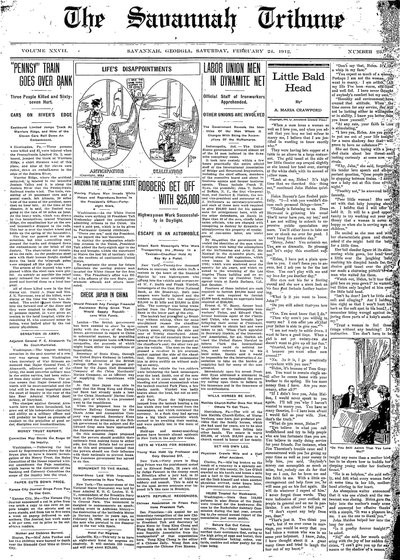
Page text (machine-generated)
The Savannah Tribune
VOLUME XXVII.
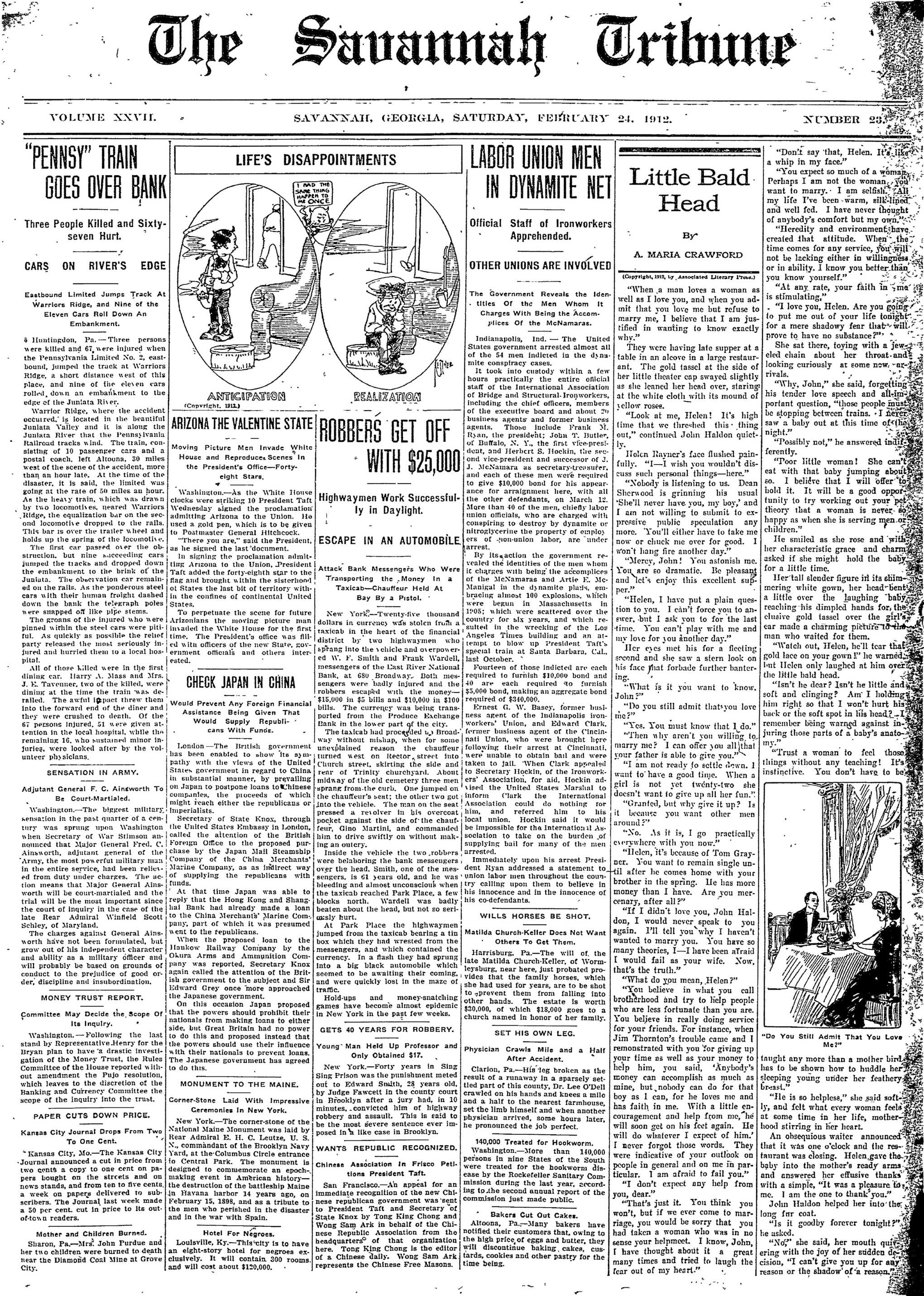
"PENNSY" TRAIN GOES OVER BANK
Three People Killed and Sixtyseven Hurt.
Eastbound Limited Jumps Track At Warriors Ridge, and Nine of the Eleven Cars Roll Down An Embankment.
6 Huntingdon, Pa.—Three persons were killed and 67 were injured when the Pennsylvania Limited No. 2, eastbound, jumped the track at Warriors Ridge, a short distance west of this place, and nine of the eleven cars rolled, down an embankment to the edge of the Juniata River.
Warrior Ridge, where the accident occurred, is located in the beautiful Junlata Valley and it is along the Junlata River that the Pennsylvania Railroad tracks wind. The train, consisting of 10 passenger cars and a postal coach, left Altoona, 30 miles west of the scene of the accident, more than an hour late. At the time of the disaster, it is said, the limited was going at the rate of 50 miles an hour. As the heavy train, which was drawn by two locomotives, neared Warriors Ridge, the equalization bar on the second locomotive dropped to the rails. This bar is over the trailer wheel and holds up the spring of the locomotive.
The first car passed over the obstruction, but nine succeeding cars jumped the tracks and dropped down the embankment to the brink of the Juniata. The obcivation car remained on the rails. As the ponderous steel cars with their human freight dashed down the bank the telegraph poles were snapped off like pipe stems. The groans of the injured who were pinned within the steel cars were pitiful. As quickly as possible the relief party released the most seriously injured and hurried them to a local hospital.
All of those killed were in the first dining car. Harry A. Mass and Mrs. J. E. Tavener, two of the killed, were dining at the time the train was derailed. The awful impact threw them into the forward end of the diner and they were crushed to death. Of the 67 persons injured, 51 were given attention in the local hospital, while the remaining 16, who sustained minor injuries, were looked after by the volunteer physicians.
SENSATION IN ARMY.
Adjutant General F. C. Ainsworth To Be Court-Martialed.
Washington.—The biggest military sensation in the past quarter of a century was sprung upon Washington when Secretary of War Stimson announced that Major General Fred C. Ainsworth, adjutant general of the Army, the most powerful military man in the entire service, had been relieved from duty under charges. The action means that Major General Ainsworth will be court-martialed and the trial will be the most important since the court of inquiry in the case of the late Rear Admiral Winfield Scott Schley, of Maryland. The charges against General Ainsworth have not been formulated, but grow out of his independent character and ability as a military officer and will probably be based on grounds of conduct to the prejudice of good order, discipline and insubordination.
MONEY TRUST REPORT.
Committee May Decide the Scope Of Its Inquiry. Washington. Following the last stand by Representative.Henry for the Bryan plan to have a drastic investigation of the Money Trust, the Rules Committee of the House reported without amendment the Pujo resolution, which leaves to the discretion of the Banking and Currency Committee the scope of the inquiry into the trust.
PAPER CUTS DOWN PRICE.
Kansas City Journal Drops From Two To One Cent.
Kansas City, Mo.—The Kansas City Journal announced a cut in price from two cents a copy to one cent on papers bought on the streets and on news stands, and from ten to five cents a week on papers delivered to subscribers. The Journal last week made a 50 per cent. cut in price to its out-of-town readers.
Sharon, Pa. Mrs. John Purdue and her two children were burned to death near the Diamond Coal Mine at Grove City.
LIFE'S DISAPPOINTMENTS
ANTICIPATION
(Copvright, 1912.)
I MAD THE SAME THING HAPPEN TO ME ONCE
ANTICIPATION
REALIZATION
ARIZONA THE VALENTINE STATE
Moving Picture Men Invade White House and Reproduce Scenes In the President's Office—Forty-
Washington.—As the White House clocks were striking 10 President Taft Wednesday signed the proclamation admitting Arizona to the Union. He used a gold pen, which is to be given to Postmaster General Hitchcock. "There you are," said the President, as he signed the last document.
In signing the proclamation admitting Arizona to the Union, President Taft added the forty-eighth star to the flag and brought within the sisterhood of States the last bit of territory within the confines of continental United States.
To perpetuate the scene for future Arizonaians the moving picture man invaded the White House for the first time. The President's office was filled with officers of the new State, government officials and others interested.
CHECK JAPAN IN CHINA
Would Prevent Any Foreign Financial Assistance Being Given That Would Supply Republi-cans With Funds.
London—The British government has been enabled to show its sympathy with the views of the United States government in regard to China in substantial manner, by prevailing on Japan to postpone loans to Chinese companies, the proceeds of which might reach either the republicans or imperialists.
Secretary of State Knox, through the United States Embassy in London, called the attention of the British Foreign Office to the proposed purchase by the Japan Mail Steamship Company of the China Merchants' Marine Company, as as indirect way of supplying the republicans with funds. At that time Japan was able to reply that the Hong Kong and Shanghai Bank had already made a loan to the China Merchants' Marine Company, part of which it was presumed went to the republicans.
When the proposed loan to the Hankow Railway Company by the Okura Arms and Ammunition Company was reported, Secretary Knox again called the attention of the British government to the subject and Sir Edward Grey once more approached the Japanese government.
On this occasion Japan proposed that the powers should prohibit their nationals from making loans to either side, but Great Britain had no power to do this and proposed instead that the powers should use their influence with their nationals to prevent loans. The Japanese government has agreed to do this.
Corner-Stone Laid With Impressive Ceremonies In New York.
New York.—The corner-stone of the National Maine Monument was laid by Bear Admiral E. H. C. Leutze, U. S. N., commandant of the Brooklyn Navy Yard, at the Columbus Circle entrance to Central Park. The monument is designed to commemorate an epoch-making event in American history—the destruction of the battleship Maine in Havana harbor 14 years ago, on February 15, 1898, and as a tribute to the men who perished in the disaster and in the war with Spain.
Hotel For Negroes.
Louisville, Ky.—This city is to have an eight-story hotel for negroes exclusively. It will contain 300 rooms and will cost about $120,000.
---
SAVANNAH, GEORGIA, SATURDAY, FEBRUARY 24. 1912.
O THE
THING
EH TO
NCE
REALIZATION
ROBBERS GET OFF WITH $25,000
Highwaymen Work Successfully in Daylight.
ESCAPE IN AN AUTOMOBILE
Attack Bank Messengers Who Were Transporting the Money In a Taxicab—Chauffeur Held At Bay By a Pistol.
New York—Twenty-five thousand dollars in currency was stolen from a taxicab in the heart of the financial district by two highwaymen who spang into the vehicle and overpowered W. F. Smith and Frank Wardell, messengers of the Last River National Bank, at 680 Broadway. Both messengers were badly injured and the robbers escaped with the money—$15,000 in $5 bills and $10,000 in $100 bills. The currency was being transported from the Produce Exchange Bank in the lower part of the city.
The taxicab had proceeded to Broadway without mishap, when for some unexplained reason the chauffeur turned west on Rector street into Church street, skirting the side and rear of Trinity churchyard. About midway of the old cemetery three men sprang from the curb. One jumped on the chauffeur's seat; the other two got into the vehicle. The man on the seat pressed a revolver in his overcoat pocket against the side of the chauffeur, Gino Martini, and commanded him to drive swiftly on without making an outey.
Inside the vehicle the two robbers wore belaboring the bank messengers over the head. Smith, one of the messengers, is 61 years old, and he was bleeding and almost unconscious when the taxicab reached Park Place, a few blocks north. Wardell was badly beaten about the head, but not so seriously hurt. At Park Place the highwaymen jumped from the taxicab bearing a tin box which they had wrested from the messengers, and which contained the currency. In a flash they had sprung into a big black automobile which seemed to be awaiting their coming, and were quickly lost in the maze of traffic. Hold-ups and money-snatching games have become almost epidemic in New York in the past few weeks.
GETS 40 YEARS FOR ROBBERY.
Young Man Held Up Professor and Only Obtained $17.
New York.—Forty years in Sing Sing Prison was the punishment meted out to Edward Smith, 28 years old, by Judge Fawcett in the county court in Brooklyn after a jury had, in 10 minutes, convicted him of highway robbery and assault. This is said to be the most severe sentence ever imposed in a like case in Brooklyn.
WANTS REPUBLIC RECOGNIZED.
Chinese Association In Frisco Petitions President Taft.
San Francisco.—An appeal for an immediate recognition of the new Chinese republican government was sent to President Taft and Secretary of State Knox by Tong King Chong and Wong Sam Ark in behalf of the Chinese Republic Association from the headquarters of that organization here. Tong King Chong is the editor of a Chinese daily. Wong Sam Ark represents the Chinese Free Masons.
LABOR UNION MEN IN DYNAMITE NET
LABOR UNION MEN IN DYNAMITE NET
Official Staff of Ironworkers Apprehended.
OTHER UNIONS ARE INVOLVED
The Government Reveals the Identities Of the Men Whom It Charges With Being the Accomplices Of the McNamaras.
Indianapolis, Ind. — The United States government arrested almost all of the 54 men indicted in the dynamite conspiracy cases.
It took into custody within a few hours practically the entire official staff of the International Association of Bridge and Structural-Ironworkers, including the chief officers, members of the executive board and about 20 business agents and former business agents. Those include Frank M. Ryan, the president; John T. Butler, of Buffalo, N. Y., the first vice-president, and Herbert S. Hockin, the second vice-president and successor of J. J. McNamara as secretary-treasurer, and each of these men were required to give $10,000 bond for his appearance for arraignment here, with all the other defendants, on March 12. More than 40 of the men, chiefly labor union officials, who are charged with conspiring to destroy by dynamite or nitroglycerine the property of employers of non-union labor, are under arrest.
By its action the government revealed the identities of the men whom it charges with being the accomplices of the McNamaras and Artie F. McManigal in the dynamite plains, embracing almost 100 explosions, which were begun in Massachusetts in 1905; which were scattered over the country for six years, and which resulted in the wrecking of the Los Angeles Times building and an attempt to blow up President Taft's special train at Santa Barbara, Cal., last October. Fourteen of those indicted are each required to furnish $10,000 bond and 40 are each required to furnish $5,000 bond, making an aggregate bond required of $340,000.
Ernest G. W. Basey, former business agent of the Indianapolis ironworkers' Union, and Edward Clark, former business agent of the Cincinnati Union, who were brought here following their arrest at Cincinnati, were unable to obtain bail and were taken to jail. When Clark appealed to Secretary Hockin, of the Ironworkers' Association, for aid, Hockin advised the United States Marshal to inform Clark the International Association could do nothing for him, and referred him to his local union. Hockin said it would be impossible for the International Association to take on the burden of supplying bail for many of the men arrested.
Immediately upon his arrest President Ryan addressed a statement to union labor men throughout the country calling upon them to believe in his innocence and in the innocence of his co-defendants.
WILLS HORSES BE SHOT.
Matilda Church-Keller Does Not Want Others To Get Them.
Harrisburg, Pa.-The will of, the late Matilda Church-Keller, of Wormleysburg, near here, just probated provides that the family horses, which she had used for years, are to be shot to prevent them from falling into other hands. The estate is worth $30,000, of which $18,000 goes to a church named in honor of her family.
SET HIS OWN LEG.
Physician Crawls Mile and a Half After Accident. Clarion, Pa.-His leg broken as the result of a runaway in a sparsely settled part of this county, Dr. Lee O'Dell crawled on his hands and knees a mile and a half to the nearest farmhouse, set the limb himself and when another physician arrived, some hours later, he pronounced the job perfect.
140,000 Treated for Hookworm
Washington.—More than 140,000 persons in nine States of the South were treated for the hookworm disease by the Rockefeller Sanitary Commission during the last year, according to the second annual report of the commission just made public.
Bakers Cut Out Cakes.
Altoona, Pa.—Many bakers have notified their customers that, owing to the high price of eggs and butter, they will discontinue baking cakes, custards, cookies and other pastry for the time being.
Little Bald Head
By
A. MARIA CRAWFORD
"When a man loves a woman as well as I love you, and when you admit that you love me but refuse to marry me, I believe that I am justified in wanting to know exactly why."
They were having late supper at a table in an alcove in a large restaurant. The gold tassel at the side of her little theater cap swayed slightly as she leaned her head over, staring at the white cloth with its mound of yellow rosees.
"Look at me, Helen! It's high time that we threshed this thing out," continued John Haldon quietly.
Holen Rayner's face flushed painfully. "I—I wish you wouldn't discuss such personal things—here."
"Nobody is listening to us. Dean Sherwood is grinning his usual 'She'll never have you, my boy,' and I am not willing to submit to expressive public speculation any more. You'll either have to take me now or chuck me over for good. I won't hang fire another day."
"Mercy, John! You astonish me. You are so dramatic. Be pleasant and let's enjoy this excellent supper."
"Helen, I have put a plain question to you. I can't force you to answer, but I ask you to for the last time. You can't play with me and my love for you another day."
Her eyes met his for a fleeting second and she saw a stern look on his face that forbade further bantering.
"What is it you want to know, John?"
"Do you still admit that you love me?"
"Yes. You must know that I do."
"Then why aren't you willing to marry me? I can offer you all that your father is able to give you."
"I am not ready to settle down. I want to have a good time. When a girl is not yet twenty-two she doesn't want to give up all her fun." "Granted, but why give it up? Is it because you want other men around?" "No. As it is, I go practically everywhere with you now." "Helen, it's because of Tom Grayner. You want to remain single until after he comes home with your brother in the spring. He has more money than I have. Are you mercenary, after all?"
"If I didn't love you, John Haldon, I would never speak to you again. I'll tell you why I haven't wanted to marry you. You have so many theories, I—I have been afraid I would fail as your wife. Now, that's the truth."
"What do you mean. Helen?"
"You believe in what you call brotherhood and try to help people who are less fortunate than you are. You believe in really doing service for your friends. For instance, when Jim Thornton's trouble came and I remonstrated with you for giving up your time as well as your money to help him, you said, 'Anybody's money can accomplish as much as mine, but nobody can do for that boy as I can, for he loves me and has faith in me. With a little encouragement and help from me, he will soon get on his feet again. He will do whatever I expect of him.' I never forgot those words. They were indicative of your outlook on people in general and on me in particular. I am afraid to fail you." "I don't expect any help from
"I don't expect any help from you, dear."
"That's just it. You think you won't, but if we ever come to marriage, you would be sorry that you had taken a woman who was in no sense your helpmeet. I know, John, I have thought about it a great many times and tried to laugh the fear out of my heart."
"Don't say that, Helen. It's like a whip in my face."
"You expect so much of a woman. Perhaps I am not the woman, you want to marry. I am selfish. 'All my life I've been warm, silk-lined and well fed. I have never thought of anybody's comfort but my own.'"
"Heredity and environment have created that attitude. When the time comes for any service, you will not be lacking either in willingness or in ability. I know you better than you know yourself."
"At any rate, your faith in me is stimulating."
"I love you, Helen. Are you going to put me out of your life tonight for a mere shadowy fear that will prove to have no substance?"
She sat there, toying with a jewelled chain about her throat and looking curiously at some new arrivals.
"Why, John," she said, forgetting his tender love speech and all important question, "those people must be stopping between trains. I never saw a baby out at this time of the night."
"Possibly not," he answered indifferently.
"Poor little woman! She can't eat with that baby jumping about so. I believe that I will offer to hold it. It will be a good opportunity to try working out your pet theory that a woman is never so happy as when she is serving men or children."
He smiled as she rose and with her characteristic grace and charm asked if she might hold the baby for a little time.
Her tall slender figure in its shimmering white gown, her head bent a little over the laughing baby reaching his dimpled hands for, the elusive gold tassel over the girl's car made a charming picture to the man who waited for them.
"Watch out, Helen, he'll tear that gold lace on your gown!" he warned but Helen only laughed at him over the little bald head.
"Isn't he dear? Isn't he little and soft and clinging? Am I holding him right so that I won't hurt his back or the soft spot in his head? I remember being warned against injuring those parts of a baby's anatomy."
"Trust a woman to feel those things without any teaching! It's instinctive. You don't have to be
A
"Do You Still Admit That You Love Me?"
taught any more than a mother bird, has to be shown how to huddle her sleeping young under her feathery breast."
"He is so helpless," she said softly, and felt what every woman feels at some time in her life, motherhood stirring in her heart.
An obsequious waiter announced that it was one o'clock and the restaurant was closing. Helen gave the baby into the mother's ready arms and answered her effusive thanks with a simple, "It was a pleasure to me. I am the one to thank you."
John Haldon helped her into the long fur coat. "Is it goodby forever tonight?" he asked. "No?" she said, her mouth quivering with the joy of her sudden decision, "I can't give you up for any reason or the shadow of a reason."
WITHIN HIS HANDS
AN ORATION DELIVERED AT DAYTONA, FLORIDA, BY M. C. MAX WELL, D. D., OF WASHINGTON, D. C.
Again we are gathered together to celebrate the forty-eighth anniversary of our freedom. The day to us gathered here is the same to patriotic negroes gathered elsewhere throughout the states—sacred. On such a day as this it is befitting that the victories and achievements of the race be relied with thankfulness to God, and that we acknowledge our indebtedness to all races, climes and sections which have contributed to our general uplift. We have no reason to boast and neither will we be befittingly celebrate the day if we use these precious hours on abusing the southern whites. The orator who spends his time today infaming the negroes of the south against the southern whites insults the orderly adjustment of the social order and does his race a positive injury. I am anxious that the southern white man should have justice whenever he is discussed in connection with the progress of our race. It will help us more than all else if we show our willingness to deal with him in absolute fairness; what we measure to him, he will measure to us again. If we measure to him loving good will, he will in return measure us the same; if we measure him hatred, if he should return the same measure, we will not be able to withstand his anger as well as he can withstand ours. All done and said the southern white man is a great character. More indomitable and invincible than any other white man on the face of the whole earth; and, as the negroes's neighbor—the man with whom his lot is cast, the negro will be reckoning without his host if he refuses to rechon with him. A casual perusal of ante and postbellum history verifies my statement that the southern white man is the most indomitable white man on the face of the earth and negro progress will gain nothing if the negro insist in underestimating the man by whose standards he must be measured, in whose fields and around whose doors he must thrive or fail. There is no need longer to chide the southern white man for his slave-holding proclivities nor for his desire to contend for the retention of his vassals, for these proclivities and contentions have been cheered by all predominating classes among all races preceding him since the world began.
I make no defense for slavery as an human institution; to my mind, it does not rise to the dignity of an institution; and without knowing what purpose it served in ancient or modern economics, I am admitting that slavery is almost as old as the human race, hence, it is not an invention of the southern white man.
What has the negro given the country in return for his freedom? We answer, what a race gives its country is determined by the types of men and women it produces to follow the pursuits common to that country. The negro gave the first blood in the Revolution for the emancipation of America from British rule and dominion, and besides it must be borne in mind that three thousand negroes besides Crispus Attucks were soldiers in the Revolutionary war and many of them gave their lives that America might be free from British tyranny. The conduct, heroism and valor of the negro soldiers during the war of the states and during the Spanish-American war are all accounted for in histories which treat on these wars. The negro has contributed his quota to American soldiery and the history of American military achievements can never be complete with honorable mention of the part played by the negro omitted.
Again, the contribution of the race to its country must be judged by the type of men it has produced. The race has not had much time in menmaking, but with what time it has had it has produced some types of men who must stand out for all times, to come as monuments of the race's ability to develop and put into action men who can do things; men who can think; who can contribute to the uplift of all the people, and write their names together with their humanitarian deeds in glowing and imperishable letters upon the historic pages of the nations. I shall avoid the mention of names of illustrious negro men here. They are known the world over; we simply ask that you consult your histories, those written by white men as well as those written by colored. When you will have consulted your histories you will find emblazoned upon their pages the story and achievements of negro men whose lives have been a blessing to their race, nation and country. Then let me remind you there are hundreds of thousands of whom history, for the present, makes no special mention who are working as hard and as uniting for the uplift of the races as those who are heralded forth by historians. A race is also judged by the type and character of the women it produces. There is nothing connected with the race of which we have as much reason to be proud as our women. While the negro woman has been more greatly abused than the women of any other race, while it is true she has greater foes within and without than other women; though she has been more grossly overshadowed by poverty and exposed to galling temptations—though her fathers, husbands and brothers have been often so positioned as to be unable to give her protection of any kind—the honor is ours today to point out with great pride thousands of noble women of
whom no race on earth might feel ashamed. We can point out with pride those who have fully entered into all of the endeavors of the race, added charms to our lives and dignity to our labor, helped us in the accumulation of the substantial things of life, shared our sorrows, sacrificed in the interest of our social and commercial advancement, beautified our home life and ornamented our society. We can point with pride to women who mothered their children and through them perpetuate our name, valor and generation; who make our homes worth having, and, without whom our homes would not rise to the dignity of the wild ass' stall. From the expulsion of the race from the chains of servitude until now the negro woman has been our constant companion. She entered with us fully all of our crude wars for endurance, to cheer us on to victory and weep over our defeats and reverses. Every great commoner, every great warrior, every great statesman produced by the race that has endeavored to littl humanity is a gift from the negro woman—a vital contribution. Had it not been for the negro woman the negro man would still be a savage, and the present monuments of his great abilities and industrial acclaim would still be an aching void. Any race that can produce women of the types of Miss Lucy Laney, Mrs. M. McLeod Bethune, Mrs. Fannie Barrier Williams, Ida Wells Barnett, Mary Church Terrell, Mrs. Booker T. Washington, Mrs. Sophia Bryant, Mrs. Flora Batson, Siseretta Jones, and others too numerous to mention, is a vital race and has contributed vitally to the construction of its country.
The contribution of a race to its country is again judged by its ability to contribute to the sum total of the current intelligence of the country. It is here where the phenomenal and astounding growth of the negro is seen. Emerging from serfery blankly ignorant, he has reduced his illiteracy fifty per cent. and today has twenty thousand school houses, thirty thousand negro school teachers and three million negro pupils. Any race which can put three millions of pupils in school, thirsting and sacrificing for knowledge and furnish thirty thousand teachers to instruct them from the elementary branches through the learned branches of the professions, invest millions in buildings, academies, seminaries and colleges and maintaining parochial schools is an enemy to ignorance and a contributor of force and dignity to the current intelligence of the nation.
What a race contributes to its country is again determined by its ability to accumulate through the sweat and toll of its industry. I, have the honor to inform you that in forty-eight years the negro has acquired two hundred and seventy thousand farms and homes, together with other properties, are worth a billion dollars. This property is not acquired as the result of fabulous salaries paid him for labor. The negro is the worst paid best laborer in the world. When you understand that the average salary of the laboring negro is less than one dollar per day, and in the face of this, his homes, farms and personal property are valued at one billion dollars. I answer that here is a piece of economic freakishness that would baffle the wits and accounting abilities of the most astute economician of the age.
Again the worth of a race's contribution to its country is determined by the respect the government shows him and the part he is allowed to play in it. Let me remind you that the negro has been a United States senator and congressman. I have the honor to inform you that the positions of registrar of the treasury and recorder of deeds have been filled by colored men for a number of years. These positions are now filled by colored men. The collector of the port at Savannah, Ga., has been a colored man for a number of years; the same is true of Brunswick, Ga., and some similar positions in the north; the position of internal revenue collector for Georgia was filled by a colored man for a number of years—a colored man now fills a similar position in Florida. A negro also fits the position of assistant United States attorney general. The negro is well represented in all of the working departments of the government at Washington, and there are some services of the government where the show of the negro almost amounts to a monopoly—railway mail clerks and mail carriers, city and rural. I am not arguing whether or not this is sufficient respect shown him nor whether he has had a large enough part in the game of government. I am arguing the fact that the government respect the negro and what he contributes to the sum-total of governmental civics and constitutional economics. I argue that any race fresh from the fields of slavery, whose ankles still show the gall-marks of serfdom's shackles, which in forty-eight years wears on its head such diadems placed thereon by the country in whose hand fate has placed it and to which its destiny will be wedded for all times to come. I repeat, such a race has been honored and respected beyond expression. The government does not discriminate against the negro; the government cannot discriminate against any other class in favor of the negro. The negro must have patience with the government as the government has
had great patience with him. The government has put more in the negro than the negro has put in the government. Sections discriminate against the negro—the north, industrially; the south, politically and socially, but it cannot be said with an lot of truth that the government so discriminates. The north is not the government; the south is not the government; the government is: The whole sovereign people loyal to the fundamental organic law which gives it vital and vigorous nationality. I am not discussing what political parties have done for the negro, but what the government has done for him. No government has been so heroic in the treatment of its negro problem as ours; the negro problem of no nation has been so complexed; and the government is slowly but surely, through a silent campaign of education, rallying all of its citizens around our organic law with a certainly that is sure to result in one America for all Americans. In some sections of the country unjust discriminations on railways and steamboats may obtain; in other sections lynchings and the confiscations of personal rights and liberties in the courts may exist; and these may not be remedied in a short while, but our government is brave; our government is humane; our government is vital; it knows no failure; it will correct these irregularities in time, to the delight of all who are governed under the stars and stripes. (To Be Continued.)
THE ART OF HOME DECORATING.
Decorating has become a profession ranking high in artistic demands. The time has passed when any girl who needs to swell her income can call herself a decorator. Because she has a pretty bedroom of her own and all her friends praise her taste, it follows not that she can win a fortune furnishing other people's houses.
The modern decorator must be many-sided. More essential than artistic sense—which can be cultivated—is hard business sense, tact, adaptability and common sense. A good education is imperative.
House decorating may be classed as one of the luxuries of life. The poor or those of moderate means do their own furnishing, however distrustful of their own taste. And the rich expect value received for their money always. The decorator who falls to give it fails to get customers.
There is no more interesting profession for the right woman, save, perhaps, landscape gardening, which means more of an outdoor life. A girl who is considering a lifework should give decorating serious thought.
It will mean hard study, constant effort, much responsibility, inevitable discouragement. On the other side is the fascination of turning out the house beautiful at some one else's expense. The beauty lover, the woman who craves an artistic environment, will find real joy in creating for others what her finances forbid for herself.
The modern decorator, she who is successful in the highest sense, is up in history. She must know the proper hangings, furniture and decorations for any given period; otherwise her decorating will be a hodge-podge, ridiculous to those who recognize incongruities.
She must also know textiles, not only modern ones, but those of former days. She dare not be deceived in dyes and weaves, must understand raw materials as well as the finished products.
The best decorators are almost always antiquarians. They love old furniture and old things generally and cannot be fooled. Often in furnishing a house for a wealthy person it falls to the decorator to produce as well as suggest. She may not say: "We will have this room entirely Sheraton" and then sit by while her patrons fill it with the pseudo Sheraton that is flooding the country.
The good decorator understands color effects, also the connection of color with furnishings, temperament, health, and complexion of the owner. It sounds most effect to consider the hangings of a room with reference to one's skin and eyes, yet that is what is being done every day by the decorator who understands her business. A room, he it ever so beautiful, falls if the owner looks hideous when in it. The decorator keeps herself in touch with the manufacturers; she must know just where everything can be bought to best advantage. Nor is it wise to have that advantage solely on her own side. The grafting decorator rarely keeps her custom.
A sense of proportion is essential. Nor is this to be entirely literal. It is quite as important to decorate with regard to income and position as not overtrim a small room and underfurnish a salon.
Above all must the successful decorator know people. She must have the knack of making the self-satisfied patron think she is doing all the suggesting; of overriding tactfully the atrocious taste of the humptious; of listening respectfully to the know-it-all, but never falling to get her own way in essentials.
TOO MUCH FOR ELIZABETH.
Little Elizabeth and her mother were having luncheon together, and the mother, who always fried to impress facts upon her young daughter, said: "These little sardines, Elizabeth, are sometimes eaten by the larger fish." Elizabeth gazed at the sardines in wonder and then asked: "But, mother, how do the large fish get the cans open?"—Lippincott's Magazine.
NEGRO PROGRESS IN 1911
BY MONROE N. WORK, IN CHARGE
RESEARCH WORK AND REC
ORDS, TUSKEGEE INSTITUTE.
[Excerpts from the Negro Year Book, in Press.]
From time to time during the year the census bureau has issued interesting information concerning the negro. The negro population in the United States in 1910 was 9,828,294. Of this number 8,749,390, or 89.1 percent, of the negro population live in the south, and 1,078,904, or 10.9 per cent., outside of the south. The census reports show that negroes are not going to the cities as rapidly as the whites are. The white population of cities during the last ten years increased 46.5 per cent, and the negro population 30.5 per cent. The most interesting thing that the census reported during the year concerning the negro was that negroes are becoming farmers at more than twice the rate of the whites. From 1900 to 1910 the number of white farmers in the country increased 9 per cent, and the number of negro farmers 19 per cent. In 1900 there were 767,764 colored farmers. In 1910 there were 917,465 such farmers.
The problem of farm labor in the south has occupied a considerable amount of attention during the year, particularly when the census report showed that in many parts of the black belt in the south the population was decreasing. It was suggested that the large plantations be cut up and sold in small tracts to farmers. It was also suggested that emigration be secured from the north and from Europe. Dr. Booker T. Washington called attention to the importance of landlords and others providing good, comfortable houses for their tenants, having good school houses, good churches and making life in the rural districts safe. As an example of what could be done, attention was called to Macon county, Ala., one of the few black belt counties in the state which had not decreased in population. The negroes of the county are provided with good rural schools that run eight months; they have good churches, are well protected and there is very little tendency to move about.
Negroes during the year made gains in the field of organized labor. At the 1910 annual meeting of the national council of the American Federation of Labor a resolution was unanimously passed inviting negroes and all other races into the labor federation. The officers of the federation were instructed to take measures to see that negro workmen as well as workmen of other races were brought into the unions. Following out this policy, steps have been taken to unionize the negroes working in the Pittsburgh district. At New Orleans in October the negro longshoremen were admitted to the International Longshoremen's union. Among the 4,000 conductors that, recently attended the annual meeting of the National Railway Conductors of America at Jacksonville, Fla., there were four negroes. At the eleighteenth biennial session of the National Association of Letter Carriers, which met at Rochester, N. Y., fifteen negro delegates were present.
That the negro made progress in 1911 was indicated by the constantly recurring reports in negro newspapers about what negroes were doing in various cities. A report on Buffalo negroes was headed, "Good for Buffalo, Hundreds of Negroes Own Their Own Homes, Colored Men Have Made Their Mark in the Newspaper World and One Real Estate Dealer Is Called an Expert—Progress All Along the Line." In this report it was stated that among the colored men who are making good in Buffalo is Edward W. Crosby, an important member of the editorial staff of the Buffalo Times; James Anderson, circulation manager of the Buffalo Morning Express, and William H. Talbert, a member of the Buffalo Real Estate Exchange.
A report from Pittsburgh was headed, "Pittsburgh Home Owners; Colored People in Iron City Keep Step With March of Progress." Another heading was "Building Brick Structures—Colored Men of Mississippi Capital Saying Nothing and Sawing Wood." Under the above a report from Jackson, Miss., stated that Dr. S. D. Redmond had completed a three-story brick building with a roof garden. The first story offers quarters to the American Trust and Savings Bank, the second story is leased for offices, the third story is utilized for vaudeville attractions. "The ground is being broken," says the same report, "for a new two-story brick building. This will make four brick structures adjoining on Farish street, all owned by negroes."
Financially negro secret societies appear to be very prosperous. The Masonic Grand Lodge of Alabama at its annual meetings reported that $75,949.93 had been received during the year. The colored Odd $^3$Fellows of Louisiana paid $36,000 for a three-story brick building in New Orleans. The United Brothers of Friendship erected a $20,000 building at Louisville, Ky. This order in Texas collected during the year $67,459; $52,347 of this amount went to the widows' and orphans' fund. In no state do the secret societies handle more money than they do in Mississippi. At the annual meeting of the Masonic Grand Lodge of that state it was reported that during the year $230,000 had been expended for the payments of endowed benefits and that a balance of $19,000 was on hand. At the recent biennial convention of the negro Odd Fellows of that state it was
reported that during the two years $507,000 had been paid out by the treasurer for the benefit of widows and orphans and that a balance of $78,000 was on hand.
The Mississippi societies are not only giving attention to the collection of funds for sickness and death, but are endcavoring to promote the health of the members. In their local and state meetings a considerable amount of time has been devoted to lectures on health and sanitation. Also at these meetings lectures on farming, domestic economy and other subjects have been given by experts from the United States department of agriculture and other places.
The Knights of Pythias are financially one of the strongest negro orders in the country. At the biennial session of the Supreme Grand Lodge of the Knights of Pythias which met in August in Indianapolis it was reported that over $1,000,000 had been collected for endowment; that there was in the grand lodge treasury $42,835; that the property owned by the grand lodges was valued at $776,294.55. The total real estate holdings of the order were valued at $1,500,000. It was decided at the Indianapolis meetings to begin the erection in Chicago of the Pythian temple to cost between $150,000 and $200,000.
Reports show that in 1911 the value of property on which negroes paid taxes was: In Arkansas, $20,500,000; in Georgia, $32,234,437; in North Carolina, $28,600,000; in Virginia, $27,000,000; and in Texas, $30,000,000. The total value of property owned by negroes in the United States is estimated to be about $600,000,000.
The year 1911 was a banner year for the raising of money for the Colored Young Men's Christian association work. The greatest event was the announcement of Julius Rosenwald of Chicago that he would give $25,000 to any city that would raise $75,000 for the Colored Young Men's Christian association work. The colored people themselves have subscribed liberally in every city where there has been an appeal for funds for the Y. M. C. A. work. In Pittsburgh they contributed $12,000 for this purpose. In Indianapolis they subscribed in a very short time $20,556,35 to a fund of $100,000. In Philadelphia they subscribed $25,000. In Los Angeles, Cal., $39,000 was subscribed. In Atlanta they subscribed $65,000, which was $15,000 more than was asked for; in Chicago $67,000 was subscribed, which was $17,000 more than was requested. In Chicago the building of the Y. M. C. A. is to cost not less than $150,000. In Washington a $100,000 Y. M. C. A. building for negroes has just been completed. In New York it is proposed to erect a $300,000 building for the colored Y. M. C. A.
During the year the negro Baptists of Alabama raised $23,367 for Selma university. When the amounts raised for the smaller Baptist schools in the state are taken into account it is probable that over $20,000 has been raised by the Baptists of Alabama for the support of their schools.
From twenty colored conferences of the Methodist Episcopal church over $26,000 was raised for the support of the Freedmen's Aid board. This is nearly one dollar in every four compared with what was received from that entire denomination. The South Carolina conference has for the last seven years stood at the head of all the conferences in the Methodist Episcopal church in their gifts to the Freedmen's aid work. This conference has undertaken to raise $50,000 for the endowment of Claflin university, no money to be raised in the north until $50,000 is secured. The African Methodist Episcopal church is raising each year about $150,000 for education. This denomination is supporting twenty normal schools and colleges.
Negro students have shown ability. Edith Palmer of Philadelphia won the free scholarship prize to Cornell university. Edward Winthrop Robinson was awarded a scholarship at Amherst college. Bessie Ganner was valedictorian of her class in the Hillburn (N. Y.) high school. She finished a four years' course in three years. Marlon Reed of the Brighton high school was the best student to be graduated from a secondary school in Boston. She was valedictorian of her class and received a $100 scholarship to Simmons college. The flyfighting committee of the American Civic association of New York city offered a prize of $10 for the best essay on the housefly as a carrier of disease. Willie Henderson, a thirteen-year-old colored girl, won the prize. Ethel Davis of Boston, in a competitive examination against 1,400 other pupils, won a scholarship of $500 per year in Wellesley college. George W. A. Scott won the second prize in the Curtis medal contest at Columbia university in 1910 and first prize in 1911.
James B. Clark, a junior negro student at Cornell university, was awarded the prix d'honneur in the annual competition in French essay writing and translation, held under the auspices of the Society of French Professors in America. Charles Henry Crippen of New York, in a competitive examination, won the state scholarship in Cornell university. Dorothy C. Guinn of New Bedford, Mass., won a $200 scholarship at Radcliffe college. Thomas S. Lowry, a graduate of the medical department of Howard university, stood highest in the Florida state medical examination. P. E. Robinson of Durham, N.C., graduated with the highest honors from the Northwestern University Dental School of Chicago. He was appointed demonstrator in clinics, the first time a colored man has ever held such a position. L. Aldridge<sup>Lewis</sup> of Nashville, out of 15 competitors,
received the highest grade, 92%, for internship at the city hospital and the city dispensary in Indianapolis, Ind. James B. Murphy, in a recent test at the St. Paul (Minn.) postoffice, made an average of 99.75 per cent, the highest general average ever established by a government employee in the northwest.
PREVENTION OF TUBERCULOSIS
TUSKEGEE WOMAN'S CLUB HAS
CAMPAIGN OF EDUCATION
UNDER WAY.
Tuskegee; Ala.—Mrs. T. J. Ferguson, chairman of the committee, sends us for publication the report which follows:
The committee on Prevention of Tuberculosis appointed by the Tuskegee Woman's club began its operations Saturday, December 30, with a general "Clean-up Day." Prior to this time, 500 tags, labeled: "I Am Tagged to Clean Up," were distributed, each wearer pledging himself to act as a peramulating advertisement for the cause. This, with the influence of the Tuskegee Town Mothers' meeting, the Children's house, the Back Door committee, Rising Star, Harris Barrett and Washington schools, enabled nearly 200 homes to rid themselves of accumulations that tended in any way to house a microbe.
From noon till dark of that day, the school's wagons were busy engaged in gathering the rubbish and depositing it in the park in Greenwood. A huge bonfire was made, just as the shades of night began to settle. Bonfires were held in connection with the schools and in the town.
A fitting close to the dying year—remnants of old hopes, disappointments, struggles, joys, pleasures and germs—ending alike their careers in smoke. Through Miss Porter and Major Ramsey, many students enlisted in the fray, and we hope they will act as agents wherever they may go.
On Saturday, January 6, Mrs. J. W. Whittaker-gave a most interesting illustrated talk on bathing to the people attending the farmers short course.
Some points touched were: The Importance, of Bathing; How to Bathe; How Often to Bathe; Ivory Soap and the Bath; Care of the Teeth, and Use of Soda as a Mouth Cleanser. It was heartily discussed by all present.
On Saturday, January 13, Mrs. H. E. Thomas planned a talk on ventilation. Points touched were: Real Meaning of Ventilation; Importance of Fresh Air Day and Night; Breathing, and Some Breathing Exercises That May Be Carried On at Any Time; How to Air the House; How to Air the Clothing That Has Been Worn During the Day, and Screening of Windows.
Miss Ernestine Suarez planned a talk on the Sins of the Cominon Drinking Cup, and How to Make an Individual Cup.
Mrs. L. T. Jones was armed with a battlement in the form of pledges, tooth paste and points of health to be observed. Because of the freeze the people were kept away and for this reason the program could not be carried out.
The two deadliest enemies of tuberculosis are Cleanliness and Fresh Air. This monster can be combatted only as each individual person arms himself and helps himself-and his neighbor to use the weapons. The committee has 1,000 health "Don'ts" that it would like to give to persons or schools—pledging themselves to join in the fight. Who will head this list? Don't let us close the year without counting you a friend to Good Health. Whether you are a teacher, student, carpenter or brickmason, just send us your name and pledge yourself to observe all the "Don'ts" mentioned on the card. Who will be the first?
Address; Mrs. T. J. Ferguson,
chairman; Miss S. H. Porter, Mrs. A.
T. Landers, Mrs. L. T. Jones and Miss
E. Suarez, Tuberculosis Committee;
Tuskegee Institute, Alabama
THE WRONG LANTERN.
Job Hedges, the New York lawyer, was called on to respond to a toast at a dinner of financiers the other night. His predecessors had been hacking vigorously at the Sherman anti-trust law.
"Some of those who comment on the Sherman law," said Hedges. "make me think of Tom Collins. Tom planned a convivial evening with some friends. Being a prudent and foresighted man, he determined to make certain that he would get home safely. As the streets of the village in which he lived were not lighted after 11 o'clock he took a lantern when he left home.
"Long after midnight he bade his friends good-by and started on his homeward-bound trudge, lantern in hand. Next morning he was surprised to receive a note from his host of the evening before. 'Dear Tom.' it read, 'the boy will give you your lantern. Please return by bearer my parrot and cage.'"—Cincinnati Times-Star.
THE JOURNALISTS' TASK.
Martin W. Littleton, nat a dinner in New York, was talking about a political orator who exaggerated some-what.
"The fellow," said Mr. Littleton, "was addressing a meeting one night in my former home in Dallas. He complained bitterly in his address of a certain alleged abuse of power.
"Are we to take this lying down?" he roared.
"Then a little man in a back seat said shrilly:
"No, old chap, the reporters will do that," -Philadelphia Ledger.
AFRO-AMERICAN CULLINGS
"The Star of Zion calls upon the Age to speak out with reference to a great celebration of our emancipation during the semi-centennial year of 1913."
We are glad to do this. In fact, this paper was the first to give publicity to the open letter of Prof. E. L. Blackshear of Prairie View, Tex., to Dr. Booker T Washington, to take the lead in the movement for a national celebration of the fiftieth anniversary of negro freedom. We have given the movement our earnest support and have commended Prof. Blackshear's cooperation with Dr. Washington, Maj. R. Wright, Dr. J. W. E. Bowen, Maj. J. R. Moton and others. It will be recalled probably by the Star of Zion that the executive committee of the National Negro Business league considered this whole matter and reported to the negro press a series of recommendations. A reference to our files enables us to reprint the recommendations put forth by the executive committee of the National Negro Business League. They follow:
"The executive committee, after frankly discussing all phases of the matter, unanimously came to the conclusion that in view of the short time that remains, it would probably be impossible to hold a national exposition, such as was planned, that would reflect credit upon the race or show in any adequate way the progress which has been made by the negro people during their freedom. For that reason, the mempranda which follow were unanimously adopted by the executive committee, and the suggestions contained there are earnestly recommended to the consideration of the negro people throughout the United States, namely:
"1. In view of the fact that the congress of the United States has thus far, failed to make provision as suggested by President Taft in his message to congress for a proper celebration of the fiftieth anniversary of the emancipation of the negro in the United States
"In view of the further fact that should congress now make an appropriation we fear the time would be too short to enable us to carry out a celebration in the form as first planned;
"Therefore we, the executive committee of the National Negro Business league, advise that the race should not await the expected action of-congress, and suggest instead of the large central exposition as first planned, that the celebration should take the following form:
"2. That the third week in October, 1913, he set aside for the celebration, and be known as Pitlieth Anniversary week.
"3. That instead of a central exposition, the schools, churches and all other societies and organizations in each community unite and co-operate for the purpose of holding a local celebration; this celebration to take the form of an exposition of the progress in commercial, professional, moral, intellectual and religious directions made by the race in that community.
"4. We suggest that where it is possible these expositions be held in connection with existing county or state fair organizations; it will not be necessary to change the regular date for holding such county or state fairs.
"5. Wherever it seems feasible, the county or the state should be made the unit of organization for the celebration instead of the local community.
"6. We advise that especial effort be made to secure in addition to the physical exposition, a program of appropriate speeches and other literary features; the speakers to be as far as possible the strongest and best men that can be obtained, north or south.
"7. We advise that wherever possible an effort be made to secure city, county or state aid to carry out the plans of the local committee.
"8. We suggest that, in case money is secured from congress, it be apportioned among the states, to be expended under the control of the governor, or some other state authority, in proportion to the number of colored people residing in the different commonwealths.
"9. We believe that the plans here outlined have several advantages over the plans previously proposed: (a) First, it makes it possible to put the whole race to work in planning and preparing for the exposition and celebration suggested. (b) It will enable more people to see the progress the negro has made than would be possible if they had to travel many miles to some central exposition.
10. In conclusion, we strongly urge that our people begin now to plan and prepare for the Fiftieth Anniversary week, and that this be made at once a means and an occasion for calling attention of the world to the immense progress the negro race in America has made during fifty years of freedom"
We believe 'that Dr. Washington and his executive committee should again get together and act upon the call from our men throughout the country for a more definite program than the above; such a recommenda-
tion should soon be forthcoming, and we have been informed that it will be. —New York Age.
With all the impetus and pressure brought to bear in favor of industrial education of the negro, this being as it should, there still remains a great friendly feeling and cordial support, in favor of the higher education of the negro. Each succeeding year brings a larger number to those colleges that stand for the broad and liberal education of the negro boy and girl.
In every state and in many of the large cities of the south, there are institutions that are turning out men and women thoroughly equipped for the higher duties of life and educational opportunities afforded have been taken advantage of by thou sands during the past 30 years.
White philanthropists have proven themselves friendly in founding these schools and colleges, and their sympathy has not lessened, for they are still giving healthy financial aid to worthy ones. The negro's ability to "make good" and public sentiment in this direction has been the cause of many splendid articles written by journalists of the white race, namely H. H. Kohlsaat, Chicago Record-Herald, Oscar Garrison Vilard, New Work Evening Post, and in a few issues ago, The Outlook, with Lyman Abbott, editor-in-chief, and Theodore Roosevelt, contributing editor, has the following to say.
"Many of our readers will recall the romantic campaign of the Jubilee Singers nearly 40 years ago by which they raised $100,000 for Fisk university. The money so laboriously earned was well expended. The negro school started a year after the close of the Civil war, has developed into a true university. That it deserves the name is sufficiently demonstrated by the fact that the general education board, which is very conservative in its judgments, vouches for the standing of this university by its offer of $60,000, provided the university will raise $240,000 more before October, 1912. The time is short, the task difficult. Two circumstances make it especially difficult: The interest of the public is more in vocational and industrial education for the negro than in the so-called higher education. And there is more than one negro university in the south which is really simply a high school. Thus Fisk university has to create an interest where it is lacking and to remove a suspicion which is not wholly unfounded. Neither obstacle ought to operate against Fisk university. If the negro race is not to be absorbed into a deteriorated white race, nor to remain a burden of ignorance and poverty upon the country, if it is to preserve its race integrity and its race existence, it must have leaders of its own; doctors to practice in its families, teachers for its schools, ministers for its churches, writers to interpret it to itself and to the community. And Fisk university—this The Outlook affirms from direct knowledge—is doing this work of educating leaders, and is doing it well. Evidence of this is furnished by the fact that it has the cordial sympathy and the moral support of the citizens of Nashville, who are familiar with its work. One offer of aid has especial interest as coming from a Hebrew to a Christian college. Mr. Julius Rosenwald of Chicago has offered to be one of four to give $12,500 each for current expenses, payable in five yearly installments. Any reader who desires more information on the subject can obtain it by writing to Mr. H. L. Simmons, 95 William street, New York city, or to the President, the Rev. George A. Gates, D. D., Fisk University, Nashville, Tenn."—Illinois Chronicle
Dr. Washington clearly shows that the negroes are not dying out. His analysis of the preliminary statement issued by the director of the census is most convincing. The negroes have increased 11 per cent, during the last decade while the white people have increased about 15 per cent. The comparison may be disadvantageous to the negro when viewed as a comparison simply, but much of this disadvantage disappears when the large number of white immigrants and their natural increase for the decade is considered. Making all suitable deductions, it will not be found that the native whites exclusive of the immigrant have increased in numbers disproportionately with the negro. So far the showing is good. But when it comes to the summing up of totals for the nation the negro is found to be a decreasing rather than an increasing element. This fact, will assuredly rob many of our orators of their thunder and may eventually solve all the negro's problems by the engulfing power of overwhelming numbers. The negro must get busy if he would keep his numerical place in American life.—Southern Ploughman.
The colored man is waking up to the fact that God helps those who help themselves. He has discovered the winning card.
SAYS COLOR LINE IS DRAWN IN JAMAICA
Native Jamalcan Asserts That Blacks Are Discriminated Against.
DIFFERS FROM DE CORDOVA—
—THADDEUS L M'DONALD
MAINTAINS WEST INDIAN
DOES NOT ENJOY SUPERIOR
ADVANTAGES IN NATIVE LAND.
Baltimore, Md.—Thaddeus L. McDonald, a student at Morgan college, and a native of Jamaica, West Indies, has attracted more than passing attention by challenging some of the statements of Counselor O'Connor De Cordova regarding conditions in the West Indies. Mr. McDonald contends that the West Indian, especially the Jamalcan, does as a whole enjoy superior advantages in his native land, and the charge is made that the color line is drawn in the West Indies between the blacks and the mulattoes. Conditions as they exist in Jamaica, according to Mr. McDonald's viewpoint, are as follows:
"As a Jamaican I felt very much interested in the remarks of Mr. O'Connor De Cordova. The hundreds of West Indians, especially Jamaicans, who come to America yearly make their boasts of the superior advantages which they have in their native land doubtful; but when we hear a white men of intellectual attainment, social status and an unblemished character speak of the negroes in the West Indies as enjoying the rights and privileges of a man, all doubts concerning the favorable conditions under which the negroes labor in the West Indies are likely to be removed.
"The statement made by Mr. De Cordova that in the West Indies negroes are prominent in all walks of life is true. Mr. De Cordova further makes clear what he means by the word negro. He says, 'Let it be understood that I use the expression "negro" as it is accepted in this country and that is, I include in the term men of color, not black men only.'
"This acceptance of the word negro, as it is used in America, by Mr. De Cordova should be specially noticed since the man of color is not regarded as a negro in Jamaica. The mulattoes in Jamaica are considered a distinct people from the blacks or negroes. This distinction between the mulattoes and blacks in Jamaica is evident in its commercial, professional and social life. If the word negro, which designates more than three-fourths of the inhabitants of the island, was to be used in the same sense as it is used in the West Indies, the statement of Mr. De Cordova would be untrue.
"While the term negro, as it is accepted by Mr. De Cordova, has made his statement true, that negroes in Jamaica are prominent in all walks of life, we must not feel that Jamaica is a mecca for the negro. Mr. De Cordova is one I must respect and honor as a man with true sympathies and an earnest conviction in the integrity of my race; but he has made the fatal mistake of concluding the prosperity of the few with the welfare of the many. If the recognition of a few members of another race is to be taken as the standard for the relationship between the two races, then it can be said that the negro in the United States enjoys equal privileges with his white brother.
"Mr. De Cordova has cited specific cases in which negroes of Jamaica are highly recognized. But the same thing, or even more, can be said concerning negroes in America. Mr. De Cordova says: 'The church has among its officials as archdeacons and rectors men of color, who are revered and respected by all classes of the community.' The same thing is true in this country. There are archdeacons, rectors and bishops—black men, too, who are revered and respected. Mr. De Cordova also speaks of negro physicians who have white patients, lawyers who hold distinguished positions in the government, and negroes as members of the legislative council of Jamaica. The comparison that has been just made between the negro clergyman in Jamaica and America is just as fitting in the cases of the negro physician, lawyer and statesman of America as in Jamaica.
"The gentleman has also mentioned that the negro occupies such positions as justice of the peace, Custos Rotulorum, and member of the privy council, all of which are in the power of the governor, the chief executive of the island, to bestow on those whom he thinks fit. Allow me to say here that these seeming honors that may fall to some negroes in Jamaica are only a blind to the real conditions of the negro in Jamaica, and in fact, it is a mere pretext to strengthen the disadvantages and injustices under which the black man of Jamaica is laboring. Who are these men of whom Mr. De Cordova has spoken? Rich men, in some cases learned men; and in most cases men who do not regard themselves as negroes. By virtue of their complexion they have been able to go to England and sometimes come to America, where they pass as white and even marry white women.
"It is this class of negroes chiefly that enjoys that much boasted social equality with the whites in the West Indies; this class that forms a small percentage of the negroes in Jamaica has been so carried away by the recognition of the white man that such
negroes have lost all sympathies with their people, and in some cases they are the worst foes of their race.
"The recognition of the few negroes in Jamaica by the white man is more politic than humane. An extract from an article in the New York Herald called 'The White Man's Burden at Home,' dated May 29, 1905, which records the words of Sit Sydney Oliver, K. C. M. G., the present governor of Jamaica, and at the time published colonial secretary of the island, might serve to illustrate the statement, just mentioned. In the article the governor says 'The recognition of the mulatto race; socially and politically, as equal with the white and the cordial welcome of colored men and women into all avenues of trades and professions have created a mutual bond between the all-negro and the pure white races, and this bond saves the colony from the distinct cleavage and consequent friction which would exist.' Another statement of the governor, that might be worthy to mention, is this: 'The white Jamaican, whether foreign born or Creole, has a prejudice which is scarcely to be differentiated from that of the American negro. But it is a prejudice operative only in so far as the colored man is individually inferior to the white man in capacity and achievement. The latter being equal, however, or regarded as equal, they meet upon terms of apparent equality.'
NEGRO INTERNATIONAL CONFERENCE BIG MEETING AT TUSKEGEE BEING PLANNED
Tuskegee, Ala.—The largest number of acceptances of invitations to be present in the International Conference on the Negro, to be held at Tuekegee Institute, April 17th, 15th and 19th, indicate that this is going to be a most successful gathering
All the important missionary societies in the United States and many societies in foreign countries will be represented, such as the American Board of Commissioners for Foreign Missions; Board of Foreign Missions of the Presbyterian Church; the Baptist Missionary society; the Central Board of Missions of the Reformed Presbyterian church; the Seventh Day Baptist Missionary society; the Board of Home Missions of the Presbyterian Church in U. S. A.; Woman's Home Missionary society of the Methodist Episcopal church; the American Woman's Baptist Home Mission society; the Board of Foreign Missions of the General Synod of the Evangelical Lutheran Church of the U. S. A.; the Woman's Board of Home Missions. Presbyterian Church, U. S. A.; the Woman's Board of Missions of the Interior; the Woman's Board of Missions of the Canadian Congregational Church; the Regions Beyond Missionary Union with headquarters in London, England, will be represented by one of its secretaries; the Svenska Missions for bundets Exposition of Stockholm, Sweden; the Evangelical Missionary society of German East Africa, will be represented by the president, Herr E. V Johanssen, Bierlefeld, Germany.
The Venezuelan government will have a representative at the conference. Jamalca, Porto Rico, the Danish West Indies and other West Indian islands will be represented. Mr. Samuel D. Bawden, manager of the industrial experiment station, Ongole Gunta district, Indiana, has signified his intention of being present. Africa is going to be largely represented. Among those who will discuss conditions on that continent are Dr. Ernest Lyon, counsel general of the republic of Liberia to the United States; Dr. Roland P. Falkner, chairman of the late American commission to Liberia; the Hon. F. E. R. Johnson, secretary of state, Monrovia, Liberia; the Hon. S. G. Harmon, vicepresident of the republic of Liberia; Rev. Isalah Goda Sishuba, president Ethiopian church, Queenstown, South Africa; Rev. Henry Reld, secretary of the Ethiopian church, Johannesburg, South Africa; Mr. William C. Terrill, superintendent Inbambane district, Methodist Episcopal church, Portuguese East Africa; Mr. O. H. Scouten, missionary, Lumbwa Industrial Mission, Lumbwa, British East Africa, and Mr. W. H. Plant, Kingston, Jamala, head master of the Titchfield school.
Other persons who will present papers to the conference are: Rev Mark C. Hayford, a native worker from the gold coast of Africa, whose subject will be: "Educational Conditions on the Gold Coast of Africa;" Dr. W. W. Shepherd, "Twenty Years With the Bakuba and Baluba and Zap-po-Zap Cannibals in Central Africa;" Mr. E. D. Morel, London, England, editor of the African Mall and secretary of the Congo Reform association; the Rt. Rev. I. Olnwole, Lagos, Southern Nigeria, West Africa, "The Missionary and Trader in Relation to the Native;" the Rt. Rev. W. Edmund Smyth, bishop of Lebombo, southeast Africa, "The Delights of Real Heathenism."
In addition to all the above, the International Conference has provoked wide discussion throughout the country and promises to be of incalculable service in helping forward the cause of the native in Africa and the man of African descent wherever he may be found.
Under the circumstances and privations the negro has undergone he has done exceedingly well. He is now able to venture out into almost every available business concern.—Palestine Plaindealer.
WIT AND HUMOR
THE POINT OF VIEW.
The well-dressed man runs into the celebrated criminal lawyer's office.
"Well, sir?" asks Mr. Leatherbound.
"I have an important case which I wish you to handle for me."
"Ah, indeed. Do you wish to keep out of jail or put some one else in jail?"
"Does it matter which?"
"Not at all—only I do not wish to commit myself until I know."
"Well, I'll tell you then I'm crazy—I've just robbed a house."
"Unfortunately, your fee will be double that of the other side. Have you the accidental pelf on your person?"
"Oh, yes—the police will be in to nab me in a minute. I left them on the next block"
"Ah—I'll put it in my safe—for safe-keeping, you know."
"And I?"—
"In exchange—here take this little brochure, 'How to Be Really Crazy—In Six Spasms.' My alienist will examine you. From this moment you are Little Boy Blue; every one else is Bo-Peep. Now that bag, please."
"One more question: 'When do I become sane again?'"
"The moment your fee and the contents of the bag become equal. For I cling to the Golden Rule in matters of professional probity, sir. Ah, thank you. Has a pleasant jingle. Let me assure you, you are no more a robber than I am."
"No better one, at least."
"Sir, you jest. Beware, I am averse to jests—they're not logical. One moment now and I'll 'phone for the police."
"Thank you. You have been very kind."
"What's this? What's this—you're a d—— robber. A thief! 'A cut-throat, you're as sane as I am. You crook, I'll have you sent up for ten years for this!"
"Why—why—what's the matter now?"
"Why, you heartless criminal! These are my sleeve links, watch and money. You've robbed my house!"
Whereupon, he summons the police!—Satire.
A SOLAR PLEXUS PUNCH.
"The late Kyrle Bellew would have appreciated this punch," said a member of the Lamb's club, with a sigh. "He liked a mild punch, with a faint cinnamon flavor.
"I remember a story he used to tell about a New Year punch in Australia—a very strong, powerful punch wherewith they used to ring out the old year in the bush—a solar plexus punch, Bellew called it.
"One bowl, he said, was all two men would take as a rule; but an Australian host, on a New Year eve, brought in a second bowl to his guest as soon as the first was finished.
"His guest looked at the fragrant brew, and, rising, held out his hand.
"Good night, Joe," he said.
"But the host pushed him back into his chair."
"Oh, no,' he said. 'You're not going till we tackle this.' "Oh, I know that,' said the guest. 'I only wanted to shake hands with you, Joe, while I could see you.'"—New York Times.
NO JOKE.
Edith—Can you tell me the reason for the high cost of living. Mr. Mushley?
Mr. Mushley—Oh—aw—I suppose it's because there is considerable demand faw it, you know.—Puck.
Scraps
Scraps
A heavenly expression can come on a girl's face from ice cream.
A miss is worth the going for a while.
A cheap gift is as dear as the giver thinks it is.
Allmony is the apotheosis of a marriage of convenience.
An engaging manner has never of itself won a solitaire.
A cyclone in petticoats would be a devastation in a frock coat.
Take a bunch of men; then listen if they don't talk all at once, some of the time.
A generous heart takes no suspicion.
Two hearts that beat as one can beat anything at suspecting the other half.
When love lets his arrows fly, they seem to go to one direction simultaneously.
Conversion is only publicly acknowledging what one has secretly believed all along.
When a girl wants to weary a man, she can pretend that she's madly in love with him.
---
DOWN TO THE LITERAL FACT.
Witness' Opinion Not of Extreme Value, but Certainly It Approximated the Truth.
Civil Engineer (in search of data)
—Is it not the opinion of many people in this locality that the excessive overflow of these bottom lands is due to the lock and dam system?
Native—I dare say.
"Based on the fact that dams retard the velocity of the current and increase the deposit of sediment in the river bottom, thus gradually elevating its bed?"
"I fancy that's about it."
"You have resided in this vicinity many years, have you not?"
"Ever since I was a boy."
"May I ask if your theory coincides with what I have suggested?"
"Hey?"
"As to the flooding of these bottom lands—I dare say you have an opinion concerning the cause."
"I have."
"In your judgment, then, what is the cause?"
DOGS EARN THEIR LIVING.
Two officers in the Belgian army have invented a mitrailleuse for a carriage to be drawn by dogs. In Belgium the dog has to work for his living, and one—perhaps the only—unpleasant sight in that country, is to see dogs struggling under burdens almost greater than they can bear. The new gun carriage has been designed by two officers of the "Regiment des Carabiniers," and it will be drawn by two good mastiffs. In the distance it appears to be a milk cart. The framework is of iron, and the wheels have pneumatic tires. The spokes are of polished steel, a little stouter than that which is employed by the cycle maker.
BIRD STOLE A WATCH.
While he was staying on holiday at Killin, seven years ago, an Edinburgh man's watch was taken from his room by a tame jackdaw. He saw the bird take the watch from the dressing table, and he reported the matter to the Perthshire police. Nothing was seen of it, however, until the other day, when workmen were repairing the roof of the house. There they found the watch, which had doubtless laid there for seven years. It was forwarded to the Edinburgh police, who returned it to the owner, greatly to his surprise.—London Globe.
SAID THE BALD HEADED EAGLE
"I'M CRAZY TO LED
BUT NOBODY WANTS
AN OLD BALD HEAD"
THE NEW ERIE CANAL
The construction of the new Erie canal is a waterway undertaking second only to the building of the great ditch at the isthmus. It is being constructed from the Hudson river to Lake Erie, parallel with the old canal, and will admit boats 200 feet long, 40 feet wide, 10 feet draft and capable of carrying a cargo of 2,500 tons. The present canal accommodates only barges of 78 feet length, 17 feet beam and capable of carrying 240 tons. The original canal could handle boats of 30 tons' capacity, 61 feet long, 7 feet beam and 3.2 feet draft.
FREE AND EASY.
"In the new bars for women there are no brass rails for them to put their feet on." "That's true, but there are plenty of tables scattered about for them to rest their feet on after the sixth round."
TOMMIE'S GUESTS.
Teacher—Tommie, is there any difference between a fort and a fortress? ○
'Tommie—Yes'm. A. fort is manned by men and a fortress by women.
Published Every Saturday
402 West Broad Street.
Phone 2171.
Entered at the-Post Office at Savan
uah, Ga., as Second-Class mail matter.
SATURDAY FEBRUARY 24TH, 1912
Friends of The Tribune will be
pleased to know that our new
building on the northwest corner
of Waldburg street lane and West
Broad is about ready for occupancy. We have already moved a large portion of our plant there
and by the middle of next week
we hope to have everything in
first class shape. After we get
everything in good running order
we shall be delighted to have our
patrons drop in and take a peep
at us.
The decision of the city authorities to have uniform sidewalks on West Broad street should meet with general approval. Not only will the new artificial stone walks add to the general appearance of the street but will greatly enhance the value of property on that street. The old worn down unleveled sidewalks in certain portions of this street have long been an eye sore to many of our wide awake progressive citizens for it is this street which now gets the first gaze of the casual stranger when he has but a few minutes here between trains and takes a short stroll down the street to get exercise, and as first impressions are sometimes lasting ones many a person has gone away with the idea that our side walks are poorly made and the rest of the city no better. With the new granitoid walks, West Broad street will stand the scrutiny of any visitor. But while they are fixing up the side walks the city authorities might well decide upon the cutting down of the trees in the business section of this street. Shade trees are beautiful and beneficial and much desired on residential streets but a drawback and a hindrance on thoroughfares which are principally used for business. For instance, The Tribune might be well benefited by the removal of that beautiful spreading oak that stands on the left hand side of the street going north on West Broad just across Waldburg laue.
Last week we took occasion to call the attention of the public in a general way to the harm which the various pool rooms on the west side, particularly West Broad street, are working. On last Tuesday night during the early part of the evening we made it our business to visit one of these places and get in close touch with the youths that frequent them, feeling that we could better discuss the evil of these places if we got right into the midst of one of them than from the observations we might get from without. Our experience in this particular place was not only a confirmation of the opinion which we had formed of it but the language which we heard and the utter disregard which the proprietor manifested to the vulgarity of his place were really shocking. In there we expected to find youths of about eighteen or nineteen with possibly one of sixteen here or there, but instead we found after a little investigation that the average age of the youthful attendants of this place was fifteen years. One of the most enthusiastic of the group gathered around one of the tables was a little fellow who could hardly have passed his thirteenth year but to him the proprietor was catering just as much as to the larger boys and he was more in evidence than any one else on account of his activity and his glib tongue. In this place there was not even the slightest semblance of order, all the proprietor was doing to take in the nickles at the end of each game and to prohibit his youthful customers from pounding the already worn out. dead tables too hard. But this, was not all, for the boys, whenever an opportunity arose, allowed the gambling fever to take hold of them and would bet a few pennies on the side as to the probable outcome of a shot. This the proprietor would pretend not to see although the betting was
by no means done under cover and was repeated time after time. Boys in knee-breeches were not an unusual sight, in fact there were as many of these in evidence as there were youths in long trousers and there was not the slightest objection to them made by the proprietor. This hell hole and others like it are a fruitful theme for our leaders to harp on and a menace to protest against. The pool room business is a legalized one and has a perfect right to be carried on when it conforms to the statutes of the state which specifically state that no minors should be allowed to visit them. This place and the majority of the other pool rooms of the city which cater to Negroes do not pay any heed to the law in this respect and are doing more damage to our young men than many of us conceive. They are places of rendezvous for wayward boys and an evil source of allurement for those who have not yet been hardened in the ways of sin. The evil which these places are doing is not being lessened as the months roll by but is steadily on the increase and if we do not soon find a way to put a check on it, it will be beyond our reach. It is going to take the united efforts of our people to stamp out this rapidly growing evil which is sapping all the good qualities out of hundreds of our boys. The time to begin a campaign against these places is at hand and The Tribune stands ready to lend its support to any movement which will eradicate this evil.
Antique and Unique The Anniversary of the Frances E. W. Harper Circle--Residence of Mrs. E. W. Sherman.
The anniversary of the Frances E. W. Harper Circle was both antique and unique. It combined three features, the last two being memorial exercises of Lincoln and Washington. Quotations were rendered from both of these great men in illustration of their lives and conduct. This part of the program was led by Miss C. Emma Lewis, the president, following whom members of the club and then the guests took part. A part of the eventful life and career of Lincoln was read by Miss Saphronia Gaston, whose mode was in harmony with the reverence and sanctity of the occasion. "Lincoln" a reading by Miss Georgia Hurd and Mrs. Anna Orner was very impressive and effective and was worthy of applause.
The choruses were extraordinary. An original song done to the tune of America and entitled "Great Washington," sung by the entire audience, was very impressive. A recitation, "Vision of Lincoln," was very effectively rendered and was in harmony with the character of the great commoner. "Mt. Vernon Bell's," a beautiful chorus was rendered by the Circle and all were of the opinion that it was a melodious, strain and well rendered, as was also, "Wave the Bonny Blue Flag." But as enjoyable as were the literary and musical part of the program, the contest for the club's prizes was as interesting. It was an instructive innovation and, at once changed the temperment of all present. It was a veritable call from the refreshment of pleasure to the luxury of labor-mental labor, that sharpened the appetite for the good things that followed. A scale was drawn on the lines and spaces of a treble clef and the letters a, b, c, d, e and f were arranged music wise, thereon. A list of twenty definitions were gotten out of twenty words. These definitions were written on numerous toddlers, in red, white and blue, and a tolder given to all present. The task was (and many found it quite a task) to match the words to the definition, correctly, using no letters except the eight letters on the cleft heretofore mentioned to spell the words. After inquiring specifically with reference to the many requirements, "Dumb School" was on for a space. The combat thickened and after the smoke of this mental engagement cleared away, Mr. Duncan Scott immersed with the second prize, "George Washington's Little Hatchet." Mrs. Aletha Armstrong was the winner of the first prize.
The refreshments served were such as would suit the most delicate epiphanen and were served a La F. E. W. by the hands of a special committee.
The members of the club appeared in custumes illustrative of the modes of colonial times. Mrs. Mattie Parks was attired in an oriental pink of the flowered variety. In cut and pattern it quickly led the imaginative mind back to the stirring period of the American Revolution. Her attire made her strictly a colonial dame, fashionable in her day and generation. Misses Saphronia, Gaston and Rosa Brown did colonial days one better, the former having rigged herself into a facsimile of Queen Anne, the latter, like those ancient dames who were, in truth the "flowers" of the Mayflower. Miss Emma Lewis, Mrs. Anna Orner and Mrs. Tolbert, Miss Georgia Hurd and Mrs. Mary Hilt uniquely personated colonial airs and aristocracy. Taking the whole club in a bunch as they appeared during the exercises, one would see at once revived a true picture of colonial days. Miss Georgia Hurd presided at the piano and performed her double duty commendably.
The anniversaries of this organization are always both pleasant and profitable and no one fails to enjoy them who has the pleasure of attending them. May it live long and prosper so that coming generations may know of the character, -worth and wisdom of her after whom it takes its name and of the gentle women whose energy and racial love keen it up and make it go.
Edward Winfred Sherman.
Editor, Savannah Tribune:
In this letter, I am going to show how the Negroes of Savannah can get together if for no other reason than what I term the "Selfish Reason." Let me give a few examples illustrating the "selfish reason." In a certain town in which I was living, I found out that I was paying from two to three dollars a month for magazines and newspapers. I learned from several other persons that they were spending similar amounts for magazines and newspapers. Now we got together, formed a magazine club with some 25 or 30 members. Each member paid fifty cents a month and for that amount received three daily papers, about six weekly papers, including the 'London Weekly Times,' and from 35 to 40 monthly magazines. Before the club was formed each one was paying from four to six times as much as he paid after the club was organized and received only a few magazines and newspapers. Now, do you think it was love for one another that brought those people together into a magazine club? Well, don't fool yourself one minute. Why there were many who were not on speaking terms with others; there were many who were in different social circles. But they all had sense enough to see that for a "selfish reason" it was wise to get together with even their bitterest enemy. Now the spirit of co-operation which was shown in the formation of that magazine club is one that can work wonders in Savannah. We don't have to be loving friends, we don't have to be in the same social circle, belong to the same church, attend the same lodge, graduate from the same school, etc., before we can get together. We have altogether too much of that foolishness now.
Marine Houston
Nassau, N. P., Bahamas Islands
Odd Fellows to Celebrate Peter Ogden Day.
The Odd Fellows and Households will celebrate Peter Ogden Day on next Friday night March 1st. The exercise will be held at First African Baptist Church Franklin square. An appropriate program has been arranged which promises to be very interesting. A paper will be read by Mrs S. A. Warren, supervisor of the households and one by Mr. Wylie Smith, special deputy of the lodges. The main address will be delivered by Mr. Ed. H. Burke, subject, "Peter Ogden."
IN HIS HOLY TEMPLE.
Interesting Services in The Churches of the City.
Butler Presbyterian Church
On Wednesday night at 8:30 o'clock there will be organized at Butler Presbyterian Church, East Broad and McDonough streets, a Young Men's Lyceum. Rev. Reed expects a rousing meeting and it is hoped that a large number will be out.
Second Baptist Church.
The service on Sunday morning were excellent. The pastor Rev. D. Augustine Reid preached an eloquent sermon subject "The Nature of Sanctification." The Sunday school met at 9:30 a.m., there was a very large attendance. The Sunday school is improving very much under the leadership of Supt. J. C. Lindsay. At night the pastor preached a very good sermon on the "Woman's Church." The installation service of the Evangelical Ministers Union was held at the church. The usual services to-morrow.
Evangelical Ministers' Union.
The Evangelical Ministers Union meet with Dr. R. H. Singleton presiding Devotional service was conducted by tev. B. S. Hannah. "On Christ the solid rock I stand" was sung. Having addressed the throne of grace, the 7th Psalter was then read. The Union joined in chanting "Blessed assurance Jesus is mine." The topic of the day was a paper by Rev H. E. Smith, subject "Incarnation," the paper was indeed grand and was lengthily discussed. The Union will meet at the 2nd Baptist church Wednesday night. Visitors always invited.
Habersham and Harris Sts.
In keeping with a time honored custom this church is observing the solemn season of Lent which began on Wednesday, last. It commemorates our Lord's fasting in the wilderness for forty days. This is one of the great revival seasons in the Episcopal church and these are special services and sermons on sin, repentence, conversion, ete inside and Friday services at 8 o'clock, and there are services on Wednesday and Friday evenings at 8 o'clock. A class has been formed for confirmation and persons who desire to receive this historic and strengthening rite are earnestly requested to hand in their names to the rector at once. The Rev. Mr.-Dakin will preach to-morrow night at 8 sharp. Come and hear him. He's fine.
St. Paul C. M. E. Church
Quite a wave of religious influence is sweeping over the members of St. Paul C. M.E. Church at present. The trustee board, having been overhauled, by adding Bro. Geo. H. Johnson, F. K. Armstrong with Bro. H. S. Dunbar as chairman we can see success perched upon her banners. Special prayer was offered in behalf of Tomi-chi-chi Lodge No.—G. U. O. of F. at St. Paul last Sunday night. Come again, you are welcome. The class meeting night is the finest evening week. Great officials make a great church, is a fact undeniable. Such is true of St. Paul, she has a set of men and women whose undaunted courage and iron-will will are long bring things to pass. Everybody is getting ready for the great 42nd anniversary which will begin Monday night March 24th. Watch The Tribune.
Monumental Notes.
Sunday School last Sunday morning was well attended the lessons were reviewed and was grand. B. S. Hannah, preached an excellent session that greatly impressed the audience At 4:30 p. m. all of the Leaguers met at St. James Tabernacle in Union Session. At 8 o'clock the Presiding Elder again preached a wonderful serm n. like the other, it called forth the spiritual expressions of the members; three joined. One of the best Quarterly Conferences ever held in the old mother church was held Monday night Dr. Hannah, presiding. Every Secretary had all round report. The report showed an increase along all lines.
Many visitors were out to witness it. The Presiding Elder seemed to be proud of the work of the church under the noble pastorage of Dr L A. Townsley. The pastor of Mt. Zion Mission church also was in with her report from all departments; it is the mission church under the auspices of the old mother, Bro. Jas. Grant has charge. The stewards and stewardesses were confirmed by the Presiding Elder. Class meeting Tuesday night was a gem, attendance and collection were grand. Trustees were elected there being two on'y that were needed, as the others had already been elected, they were Bro. Richard Wright and Frank Washington. The officers of the choir was elected Friday night. Services to-morrray: Prayer or meeting 5:30 a.m. Preaching 11 a.m. and 8 p.m. Sunday School 9:30 a.m. General Class at 3:30 p.m. You invited to attend these services.
F. B. B. Church.
On Sunday morning the weather was ideal and there was a good crowd at church. The subject of Rev. Wright's sermon was "Good, works and not good words." He gave a very practical lesson on the missionary work done by the Norcas during the prophetic age. Trupp was an inspiration to all. The choir sang very appropriated "This burning in my soul. Rev. Wright led the hymn "In I a soldier of the cross." At night, the church was paked. The distinguished guest was the Evening Call Aid and Social Club and its Juvenile branch. An excellent history of the club was held by Mr. Adolphus Williams. Rev. Wright assured them that they were very welcome. He graded for the lesson Pe. 147:1-20. His test was from Num. 1214. The subject was "Miriam" The sermon was beautifully illustrated by using the life of Moses. All were much benefited. The choir sang the medley, "Jesus lover of my soul." Rev. Wright led the hymn "Did Christ o'er sinner weep." He invited those who felt the need of prayer to the mercy-seat. A very large crowd bowed and prayer was offered. Mrs. R. Robinson, field secretary of the Woman's Mission of Indiana, was introduced by Rev Wright. She spoke forcibly of the great work that she and her co-workers are trying to do. A large collection was taken to assist them in their work. The club donated very generously to the church, pastor, choir and sexton. The Juvenile branch donated liberally to the poor saints and the sexton. Come
St. Benedict's Church. Sunday Feb. 25, first week of Lent. First mass at 7 a.m. Second mass at 8 a.m. High mass and sermon at 10:30 a.m. Sunday school after the last mass. Meeting of the Catholic Mutual Aid Society. At 8 p.m., there will be a special Lenten service. Right Rev. Bishop Keiley will preach the sermon and give solemn benediction. It is expected that all the members of the congregation and many of their friends will turn out and hear our beloved Bishop, who will open the Holy season of Lent. All amusements given by the church or under the auspices of the church will be discontinued during Lent, as good Catholics should keep away from all worldly pleasure during the Season of Pence. On Ash Wednesday evening, despite the unfavorable weather, a large congregation attended the Lenten service and received the blessed ashes, as a sign of contrition and humility. Father Mathew preached a beautiful sermon. Next Wednesday, Father Eugene, of the Benedictine College, will preach the Lenten service. Every Friday during Lent, we have the impressive devotion of the Stations of the Cross. On last Tuesday evening the school children had a pleasant party in St. Mary's Hall, about 200 children must have attended. Next St. Benedict's Messenger, our church paper, will be distributed; the March number contains interesting reading matter and all the church news. Miss Ellen Madden has been appointed as second teacher in St. Mary's school; Miss Davis is acting as head teacher. Miss Percy Tweedy is teaching i-in he Spring Field school. In the school chapel of the Immaculate Heart of Mary, there will be mass at 10 a.m. and Sunday school at 11 a.m. Last Sunday evening a nice congregation attended the service. Father Dahlent gave an interesting sermon about the ceremonies and practices of the Catholic Church. The choir sang beautiful hymns, whilst Miss Green played the organ.
St. Phillip Dots.
(Mesonic Temple)
St. Philip's members and friends took advantage of the ideal weather on last Sunday and attended every service in full force, every seat being filled. Rev. Singleton preached morning and evening. The text at 11 a.m. was Matt. 16:24, subject, "The power of the Spirit." Great interest was taken in what was said and which was very beneficial. At 3:15 Rev. Singleton again preached, the gxt was discussed at length, every person that heard this sermon pronounced it one of the best that they had ever heard and much good will result Rev. Singleton was installed president of the Evangelical Minister's Union on Wednesday night. St. Philip's members should be proud of this honor. On account of bad weather and delay in getting material, the work on the new St. Philipis is progressing slowly this week. Every captain and all members of the various clubs are making preparations for the big rally on March 24th. Some of the sleepers on St. Philip's work train were side tracked on Tuesday night. A good many sleepers have been turned into work trains. A hint to the wise is sufficient, nothing but work at St. Philip now-a-days. Every member is expected to do their best, the expense for running the church is very heavy. A record breaking attendance was at class meeting on Tuesday night. Our congregation has a number of sick members, some are recuperating. The West Savannah District Conference will convene at Graymont, Ga., March 7, 1912. St. Philip will be able represented. The following services will be held on to morrow, Sunday, at Masonic Temple. Prayer meeting at 5 a.m. Preaching at 11 a.m. Sunday School at 3 p.m. A. C. E. League at 6:30 p.m. Preaching at 8:15 p.m. Strangers are cordially invited.
The Allen Christian Endeavor Union League met on Sunday Feb. 18 at St. James A.M. E. church at 4:45 p.m. The President, Bro. W. L. Vicars, in a very dignified manner opened the meeting, The singing, led by Bro. B. S. Reid and his League choir, was the best the League has had in some time. After
SPEND $1.00 WITH
SCOTT BROS.
WEST BROAD AND GWINNETT
AND GET A TICKET FOR A PHOTO
OF YOURSELF FREE
listening to the minutes of the previous meeting, the League engaged in reciting heart verses which were unusually impressive. Lesson text was then read by Rev. Mrs. R. M. S. Taylor Ps. 57: 1-11. Subject or topic, "No" or "Yes." when to say them. The topic was very fittingly opened by Mrs. R. M. S. Taylor, followed by the following brothers: Rev. L. A. Townsley Bros. Glivens, C. P. Perry, Jesse Brinson, F. B. Bryan, C. W. Alexander, J. I. C. Montgomery, Hynes and Prof. B. S. Reed. The subject was well explained. The new pastor of St. James, Rev. P. F. Curry, D. D., Rev. H. E. Smith, B. D. the new pastor of Gaines Chapel and P. E. Rev. B. S. Hannah then took part in the discussion. There was a motion to have the Presidents of the local Leagues meet and adopt aplan for aiding the St. Philip new building. The committee will report at next meeting of the League at Monumental A. M. E. church Sunday p. March 17, 19.2. After taking collection the League began its literary program with an excellent paper by Mr. Joseph S. Barnes, subject, "Should the International lessons take the place of the Bible in the League?" Then a duet by Miss C. Alexander and Mr. H. Patten held the League in perfect rapture. Mrs. C. P. Franks sang a solo which was much enjoyed. Next and last on the program was a solo by Mr. E. C. Cox, which was well rendered The League adjourned. Subject to be discussed at next meeting, "Success worth having and not worth having." Dan. 428-37. The public is cordially invited to attend and take part in the discussion. W. L. Vicors, President; Miss Nellie May Hart, Secretary; Jesse Brinson, Reporter.
The Eternal Miracle.
All young mothers are a sort of priestess. They carry with them an art of initiation into the invisible secrets of the universe. They lay in the room they enter. They are strangely wise, and very sacred. Of all young mothers this is true, in some degree. Yet, it must be confessed that this transfiguration is often somewhat slight or disappointingly transient. Too soon the atmosphere of proxic domesticity settles about this miraculous happening. The heavens opened for a brief moment, but now they are as fast closed again as though they had never opened at all.
After all, what was it but a very ordinary event, and nothing to show for the miracle, but an every-day-body in an every-day world. So, or perhaps fortunately, it is in most cases. One more mouth to feed, one more body to clothe in a hungry, hard-working world. And for a mysterious priestess of maternity, one more commonplace mother—Richard LeGalliene in McCall's Magazine for March.
The Acme Bicycle Store
K. HALPERN, Proprietor,
463 West Broad St.
Dealer in new and second handed
bicycles. Tires and Supplies.
Expert Vulcanizer of Bicycle
Tires. Vulcanizing 75c.
Phone 1340.
Dr J. W. Jamerson
FIRSTCLASS DENTIST
623 West Broad Street Between Huntingdon and Hall Phone 2098
FOR SALE—One First Class Drug Store, Jacksonville, Fla. Well located, good trade. Terms. Good reason for selling.
G. H. BOWEN,
210 Park Ave., E. Sav'nh, Ga.
Dr. L. S. Parks.
DENTIST
240 Barnard Street.
Does all kind of high grade dental work of the best quality and workmanship. Gold crowns and bridge work. White Porcelain Pivot and Gold Crowns mounted on the natural roots. Gold Fillings, Cement Fillings, and Silver or Amalgam Fillings from nine to a full set of teeth $7.00 and $8.00 Broken places mended and teeth added. Gold ones for a small cost. Bell Phone 314. Solid Gold Guaranteed 22 1.2K Gold.
For A Professional Registered TRAINED NURSE
Ring 3159-J or Write
529 OTT STREET. WELL
EXPERIENCE MASSEUSE
FLORIE A. WILSON
SPEND $
SCOTT
WEST BROAD
AND GET A TICKET
OF YOURS
The Quality Show Shop
AIR DOME FOR EDUCATION
AIR DOME FOR REFINEMENT
AIR DOME FOR A GOOD CLEAN SHOW
AIR DOME FOR HIGHEST ART
AIR DOME FOR WHOLESOME PLEASURE
AIR DOME FOR LADIES AND CHILDREN
AIR DOME FOR GENTLEMEN
AIR DOME FOR THE ENTIRE FAMILY
AIR DOME
Different
Every Day
THE PROPER PLACE FOR SQUARENESS AND AMUSEMENT
BAKER
THE MOVING PICTURE MAN
OO WITH
BROS.
D GWINNETT
FOR A PHOTO
SELF FREE
THE TRIBUNE
1009 WEST BROAD STREET
Mr. Henry Smalls of Atlanta, Ga., is in the city for a few days.
Miss Ada Mills of Waycross. Ga., is in the city for a short stay.
Ask Pate's Drug Store about the Nyall Line.
Mr. William Harper of Waycross, Ga., is in the city visiting friends. Mr. Henry Miller and family of St Augustine, Fla., are visiting in the city. Mrs. Henrietta Carter and daughter left for New York last Tuesday.
Miss Munnie Jordan of Waycross, is in the city for a few days.
Mr. C. A. Shaw of Brunswick was in the city this week.
Go to Pate's Drug Store, West Broad and Hall streets. For first class shoe repairing carry your shoes to Thomas Baker, corner East Broad and Bolton streets. Mr. F M. Cohen attended the unveiling of the Cresswill monument in Macon on Thursday. Messrs. H. R. Jones, J. B. Barnard and C. E Washington all of Atlanta, Ga., are in the city for a few weeks. Mrs. Wilhelmina Anderson and son of Brooklyn, N. Y., are among the visitors in the city.
Miss Essie M. Scott of Boston, Mass. arrived in the city Monday enroute to Jacksonville, Fla.
Miss Annie Ford of Chattanooga, Tenn., is spending a few weeks in the city with relatives.
Mr. George Hardy and daughter of Augusta, Ga., are visiting relatives in Savannah and Thunderbolt.
Mrs. Janie Hicks of New York City arrived in the city last week and returned home on Tuesday.
Miss Anna C. Cohen of Chicago, Ill., formerly of Savannah, is in the city visiting relatives and friends.
West Broad street 1009 is the place.
Miss Majorie Greene of 402 Gwinnett, lane west, is visiting at Charleston, S. C.
Mrs. Cornelia R Smalls after spending a very pleasant time with her mother left on Thursday for New York.
Ask Pate's Drug Store about the Nyall Line.
Rev. T. M. Williamson of Waycross, editor of the Waycross News, spent several days in the city. He preached at several of the churches on Sunday and during the week. His friends here were glad to see him.
Miss Florie A.' Wilson of Augusta, Ga., who is a professional registered trained nurse, has made her place of abode at 529 Ott street this city with her sister, Mrs. A. B. Singfield Telephone 3159-J.
Large front room to rent, nicely furnished with bathroom and modern improvements, suitable for one or two gentlemen. 506 Park avenue west, Mrs. Sarah Hewward.
The home of Mr. and Mrs. Robert E. Scott, 222 Park Avenue, east, was blessed on Friday Feb. 19th, by the arrival of a fine little baby girl. Both mother and baby are doing nicely and Mr. Scott is being congratulated on all sides.
Mr. and Mrs. Nathan Hart formerly of Savannah now of Macon, Ga., are visiting Mr. and Mrs. Joseph Brown. Mrs. Hart will spend several weeks more before returning home but Mr. Hart only made a flying trip on Monday and spent a pleasant evening as the guest of the G. E. Club and returned on Wednesday.
Friends of Mr. J. S. Causey, 2219 Harden street, who is connected with the Guaranty Mutual Life and Health Insurance Company, will be sorry to learn of the serious accident which be fell him Tuesday night when he was violently thrown from his wheel at the corner of Gwinnett and West Broad streets and sustained a painful injury by striking his nose on the curbstone. When assistance arrived Mr. Causey was in a semi-conscious condition and was carried to the Savannah Pharmacy where Doctor G. W. Smith attended him. It was later learned that his nose was broken and a deep gash cut on his cheek. At this writing he is resting quietly.
---
Bell-Long Nuttlals:
Bell-Long Nuptials.
At the lovely home of Mr. and Mrs. Henry Bell 317 Hampton street, Americus, Ga., last week occurred the marriage of their sister, Jessie Mae to Mr. James Benny Long of Atlanta, Ga, Rev J. T. Hall officiating. The occasion was very quiet owing to the very recent death of the bride's mother. The marriage was witnessed by immediate relatives and a few friends.
On the evening of February 14th, a very quiet marriage took place. The contracting parties were Mr. Charles Greene and Miss Victoria Haynes. Rev. H. L. Haywood officiated Mr. Greene is a popular barber and his many friends extend their congratulations and wishes them a long and happy life.
Social Happenings.
Social Happenings Mr. and Mrs. Edward Wright entertained Miss Ella L. Jackson of New Haven Connecticut, and Miss Irene Ulin of Augusta, Ga., Thursday evening at her residence 503 East Jones street. Many delightful games were indulged in after which refreshments were served. Those present were Misses Ella L. Jackson, Ruth Allen, Mrs. Maggie Jones, Mrs. John Baker, Messrs. Thomas Deleware, John Baker, Mrs. Edward Wright. Prizes won by Miss Irene Ulin, of Augusta, Ga., and Mr. John Baker of Savannah, Ga.
A birthday party was given by Mr. and Mrs. S. T. Johnson on last Monday evening February 19th, at their residence for their daughter, Ruth Alma Johnson. Many beautiful little presents were given and the little ones had a jolly afternoon. Those present were Lenita Smith, Mattie Ulmer, Tomit Turner, Essie Ulmer, Louise Simpson, Lyons Brady, Camilla Brady, Evelyn Manley, Viola Anderson, Henrietta Cowill, Evelyn Hudson, Constance An-
derson, Ruby Clark, Wilhelmina Wright, Gladis Johnson, Alice Johnson, Earnestine Ulmer, Lula Bell, Durwood H. Johnson.
Miss Lillian Aiken celebrated her twelfth birthday on Friday February 16th, with a party. A very enjoyable evening was spent with a host of her little friends who came to enjoy themselves. There was dancing after which a large table was spread with lots of nice things. The twelve little ones who blew out the candles on the cake were Misses Lillian Johnson, Alma Williams, Nianza Creamer, Veronica Taylor, Julia May Tinsley, Dorothy, Springs, Helen Cuyler, Masters Alley Clarke, Frankie Rogers, Woodriff Clarke, Nelson Cuyler, Joseph Young,
Mr. Wm. Mitchell entertained a few of his gentlemen friends on Monday night at his boarding house 524 Berrien street west. Those who were the recipients of Mr. Mitchell's hospitality were: Messrs. S Bryant, Tom Tilman, Willie Whiteman, R. Edwards Cornish and friend, H. H. Smalls Hooker and C.Green.
A. U. Club.
There will be a meeting of the local Atlanta University Club on Sunday afternoon at 1 o'clock at the First Congregational Church. Business of importance.
Deaths.
Mrs. Janie A. Larsheay died on last Wednesday morning at her residence 524 Gaston street east, and was buried Thursday afternoon from her late residence. Mrs. Larsheay is survived by one son, Mr. D. Solomon Larsheay, one daughter Mrs. E. A. DeLyons, a daughter-in-law, Mrs. Ida Larsheay, three grand children, Mrs. Janie Hicks of New York, Mrs. Earnestine Sims and little Mildred Larsheay.
G. F. Club.
The G. E. Club held one of the most enjoyable and interesting meetings on last Monday night that this organization has held for some time. The meeting was very noticeable in several ways. Many of the old veteran members were out. After the meeting adjourned a light refreshment was served by Mr. Harrison W. Mann and Mr. James H. Page. Mr. Joseph J. Brown, the president, is very popular with the members and everything considered, the future looks very bright for the club. Here's hoping that the boys will regain their same popular standing with the public that they held in their earlier days.
Missionary Ladies Organized Officers of the Woman's Home and Foreign Missionary Society Georgia Conference Sixth Episcopal District, A. M. E. church: Right Rev. C. S. Smith, D. D., M. D., Bishop; Mrs. L. A. Townsley, Conference President; Mrs. E. L Davis, First Vice President; Mrs. B. J. Ross, Second Vice President; Mrs. R. F. Seabrook, Conference Treasurer; Mrs. M. F. Hoobs, Conference Secretary; Mrs. M. S. Brown, Recording Secretary; Mrs. J. V. Sherman, General Lecturer; Mrs. M. Wm. Cruse, General Organizer; Mrs. J. Singleton, Musical Director; Miss Hattie May, Baltimore Organist; Mrs. J. Byrd, Chorister—District Directress. Savannah District, Mrs. B. S Hannah; West Savannah District, Mrs. H. C. Smith; Valdosta District, Mrs. I. E. Perkins; Hawkinsville District, Miss Annie Stanley; Fitzgerald District, Mrs. J. W Maxwell; Waycross District, Mrs. J. A. Hamilton; Swaynesboro District, Mrs. L. A. Bacon; Brunswick District, Mrs. J. C. Couts.
AMUSEMENT COLUMN.
Coming Events in the Social World.
NOTICE—Articles in this column one
February 29th, Thursday. Savannah Home Association postponed entertainment from February 14th, at Masonic Temple. Admission 25 cents.
February 28th, Wednesday. Annual Ball by Foraker Lodge No. 6669 G. U. O. of O. F. at Masonic Temple. Tickets 25 and 40 cents.
February 26th, Monday. Mid-winter Souvenir Ball by Young Adelphia Aid and Social Club at Masonic Temple. Tickets 35 and 50 cents.
February 26th, Monday. Fourth Annual Entertainment of Star of Bethleham Lodge No. 30 G, U. O. of A K. of A. at Harris street Hall. Tickets 15 cents.
February 28th, Wednesday. First Dance by The Royal Bucks Aid and Social Club at Harris street Hall. Tickets 25 cents. March 4th, Monday. Grand Ball by I. L. A. Freight Handlers Laborers Union at Harris street Hall. Tickets 25 and 40 cents. March 13th, Wednesday Spring Dance by Progress Company No. 3 U. R K. of D. at Harris street Hall. Tickets 20 and 35 cents. March 4th, Monday. Beginning of Five nights Bazaar by Joshua Company B, U. R. K. of P. at Masonic Temple. Admission opening night 25 cents, following nights 10 cents. March 18th, Monday. Old Folks Jubilee Concert by the Vigilant Club at Masonic Temple. Tickets 15 cents.
March 11th. Monday. Mutt and Jeff Entertainment by The Red Rose Club at Mechanic's Hall. Admission 15 cents.
March 18th, Monday. Spring Dance by the Royal Roosters at Harris street Hall. Tickets 25 cents.
March 1st, Friday. Second Tuxedo Ball by the DeSoto Hotel Waiters at Harris street Hall. Tickets 25 cents
REST AND HEALTH TO MOTHER AND CHILD.
REST AND HEALTH TO MOTHER AND CHILD.
Mrs. Winslow's Soothing Syrup has been used for over SIXTY YEARS by MILLIONS of MOTHERS for their CHILDREN WHILE TEETHING, with PERFECT SUCCESS. It SOOTHES the CHILDREN the GUMS, ALWAYS WINS WINS WINS COLDS and is the remedy for DIARRHOZA. It is solutely harmless. Be sure and ask for "Mrs. Winslow's Soothing Syrup," and take no other Mad. Twenty-five cents a bottle.
FOR RENT
The Two Remaining
Suites of Rooms in
The
Tribune New
Building
1009 WEST BROAD STREET
Plenty of light and all con-
veniences.
Occupancy Feb. 15th,
F. F. JONES
Dealer in BEEF, VEAL, MUTTON. LAMB, PORK, HAMS. BACON and CORNED BEER All kinds of GAME in season. Stall 31, City Market.
Saving Money is A Habit...
Get the habit of Saving a part of your Earnings each week.
$1.00 starts An Account
The Wage Earners
Loan & Investment Co.
468 WEST BROAD ST,
Savannah. Ga.
THE MAYOR OF BROOKLYN
J. C. LINDSAY
Is the District Manager of the
Old Reliable
Union Mutual
Association
"Nuff Sed, I'm with 'em"
Local office:
509 West Broad Street.
PHONE 1470 or write
WM. DRISKELL, Sec'y and Gen Mgr
210 Auburn Ave.
ATLANTA, : GEORGIA.
GO TO THE
COLORED MILLINERS
TO BUY YOUR HATS
If you want QUALITY we have it. If you want what is STYLISH we are well prepared to give perfect satisfaction
Our entire Stock is being sold below cost
Hats from 25c up. No trimmed hat over $5.00. Come and get a $12.00 Hat for $5.00. Don't forget our Specialty, Old hats made new.
464 WEST BROAD ST.
PRICES NOW REDUCED
ON ALL OUR
Clothing, Hats, Furnishings and Shoes
Buy your Suit, Overcoat, Shirts, Underwear, Hats or Shoes now and SAVE MONEY
SOLE AGENTS FOR
Edwin Clapp and other good Shoes
B, H, Levy Bro, & Co,
I am Offering a Nice Home
on the west side at a very reasonable figure, on terms of
$300.00 Cash and
$15.00 per month
The house has 6 rooms, modern bath room and electric lights throughout. You wont have to spend a dollar for repairs etc.. before you move in
THOSE LOVELY LOTS ON 36th STREET, west Are nearly all gone. The parties who took my advice and acted quickly got the choicest to be had
CHAS, A.R. McDOWELL,
Savannah's Leading Negro Real Estate Dealer
623 WEST BROAD STREET
Phone 2088-j
SEMI-ANNUAL STATEMENT
for the six months ending December 31st, 1911, of the condition of the
months ending December 31st, 1911, of the
Family Mutual Life And Health Insurance Co.
under the laws of the State of Georgia, m
of the State of Georgia, pursuant to the la
KIPAL OFFICE, 468 WEST BROAD ST., SAVANNA
bring last six months of 1911 ... $
ents during last six months 1911 ... .
Assets ...
Cities or Certificates in force December 31,
D. 6885 ...
Georgia,
Chatham.
Only appeared before the undersigned, Walter
duly sworn, deposes and says that he is the
GARANTY MUTUAL LIFE AND HEALTH
COMPANY, and that the foregoing statement
WALTER S. SCOTT, Sec
o and subscribed before me, this 23rd day of
SOL. C. JOH
Notary Public, Chatham County
A. M. MONROE & CO.
General Directors and Embal-
AS. BACON, Manager. PAUL STEELE, Embal-
prompt and courteous attention given all busi-
trusted to us. Everything of the latest st
Latest Style Silver Gray and Black Car
AGE FOR HIRE
WEST BROAD STREET
VE TROUBLE
Guaranty Mutual Life And Health Insurance Company, organized under the laws of the State of Georgia, made to the Governor of the State of Georgia, pursuant to the laws of said State.
PRINCIPAL OFFICE, 468 WEST BROAD ST., SAVANNAH, GA.
Income during last six months of 1911 $ 18764 96
Disbursements during last six months 1911..... 17306 64
Personally appeared before the undersigned, Walter S. Scott, who being duly sworn, deposes and says that he is the Secretary of the GUARANTY MUTUAL LIFE AND HEALTH INSURANCE COMPANY, and that the foregoing statement is correct and true.
WALTER S. SCOTT, Secretary.
Sworn to and subscribed before me, this 23rd day of February, 1912.
SOL. C. JOHNSON,
Notary Public, Chatham County, Georgia.
A. M. MONROE & CO.
EYE TROUBLES
We take care of your EYES by Fitting the proper glasses and the right kind of frames to your face. You are assured good attention.
M. Schwab's &
118 Bull Street, Corner State
Dr. M. Schwab's & Son,
IF You Don't Believe it Drop in and take a Look at Our Store. We Carry Everything. You no longer have to go to Broughton Street.
Pate's Drug Store
Of Interest to Our Women
MAKING THE HOME BEAUTIFUL.
When you go into a strange house what is the first thing you notice about your surroundings? Whether or not they are artistic. If the keynote of the home is refinement, expressed in good furniture, dalty hangings and pictures, we unconsciously base our opinion of the occupants upon these pleasing facts.
driven home they will protrude about a quarter of an inch. Knock in the nails and the strip of wood will be quite firm and the hooks screwed into the wall will hold a considerable weight.
RIBBON TRIMMING ON DRESSES.
The season's ribbons are used for make bodices, panels, boleros, casques
If, on the other hand, those in the home are willing to surround themselves with inartistic things, we judge, and usually correctly, that the beautiful plays a very minor part in their existence.
The home is an outward expression of the inward refinement, or lack of it, of the woman who presides there. And it should be the object of every woman who has a home, no matter how small and unpretentious, to make it as beautiful as possible. This is easily done, and inexpensively, too, if one only knows how.
Let us consider the small flat first. Many women give up in despair at the thought of the cramped conditions, which exist in the average apartment and declare that it is altogether impossible to achieve the artistic in four or five small rooms. This is a great mistake. Of course, there are odds against beauty in an apartment of miniature proportions, but if one goes about it in the right way a great deal of beauty may be the result.
Decorating a Small Flat.
In the first place, the woman who lives in a flat must purchase her furniture with an entirely different object. In view than the dweller in the suburbs. As the apartments grow smaller the size and amount of the furniture diminishes, and the woman with taste must pick and choose with a fine discrimination if she wishes to enjoy the result.
The room which is most occupied needs the greatest amount of attention. Whether it be a parlor or a living room, it must be furnished to suit the tastes of every member of the family. This does not mean that it must contain necessarily a heterogeneous collection of all styles and patterns in chairs—not at all! But it does mean that no such extreme styles as Louis Quinze or mission work should be chosen for such a room as this. Good, comfortable lounging chairs should be selected with an eye to comfort first, afterwards to appearance.
If the room be small, the paper should be chosen with the greatest care. Dark, reds and greens are used a great deal in the new apartment house to very bad effect. Red should never be used in a little flat, as it has the peculiar quality of bringing the four walls together; of shutting in the room and decreasing its size 50 per cent. Yellow will be found quite as cheerful, and at the same time it seems to enlarge the room. It is gray and cool in summer, warm and bright in winter. The constant use of a room would make it advisable to provide a large rug instead of the customary carpet. Especially in an apartment is this desirable, as the rug can be rolled back for the sweeping and may be taken up for beating with the greatest ease
For a room in which the wishes of the entire family are to be satisfied there must be, necessarily, a number of different pieces of furniture. All should be in the same style, however, to retain harmony. Book shelves, or bookcases, are essential to almost every household. For a small room the shelves are preferable, as they may be suspended in such a way as to allow for another piece of furniture beneath. Bookcases take more space, and, while they are more desirable if the room allows, still in a small room the amount of space taken might be used perhaps to greater advantage for something else.
Another requirement of a living room is a desk. If this is of a convenient size it may be placed directly beneath the book shelves. One with plenty of drawers will be found a convenient addition.
For a small room one cannot be too careful in choosing the curtains for the windows. Heavy overportieres are foolish and absurd, a menace to health and eyesight. If portieres can be abolished so much the better, simple dimity or lawn curtains, with a border harmonizing with the colors of the room, are in good taste and need no covering. If the outside portiere seems necessary, then chintz or cretonne in the room pattern is dafty and attractive.
Some women think it necessary to have the door portieres the same as the overcurtains, but this does not always produce a good effect. Harmony of course must prevail, but it will be found a great relief to the eye if the portieres are a contrast to the rest of the room.
For instance, if the wall paper or the room decorations are very plain, a figured effect in portieres will bring variety. But if the walls are patterned somewhat gayly a plain pair of curtains will be found to balance the room beautifully.
It is frequently difficult to fix nails to the walls on which to hang pictures, owing to the powdery condition of the wall plaster, which causes the nails to fall out almost immediately. The best way to overcome this is to have a carpenter plane a small piece of wood and bore six holes in it. Then drive in this wood fine nails, so when
driven home they will protrude about a quarter of an inch. Knock in the nails and the strip of wood will be quite firm and the hooks screwed into the wall will hold a considerable weight.
RIBBON TRIMMING ON DRESSES.
The season's ribbons are used to make bodices, panels, boleros, casques and all sorts of collars and cuffs, and various blouse garniture. There is a marked and growing preference for girdles or ribbon. Some of the smartest of these girdles are of three or more breadths in pastel colors in messeline or gauze ribbon, or in breadths of several tones of the same color. The belt is generally draped. In another style the ribbon is braided and in still another it is twisted.
Almost every kind of ribbon is used as trimming for party and evening wear. Floral ribbons are in high favor, as are also bordered styles and two-tones, and all with some gold or silver. The color preference seems to be for a delicate shaded pattern on a light ground, and the widths range from six to ten inches. Double-face satin with a contrasting back, and about four inches wide, is made into very full double box plaited ruches sewn in the middle with a very pretty color effect. Gauze and gold or silver ribbons about five inches wide are shirred into conventional patterns over a cord, and fancy styles of every width and style are gathered into flounces, ruffles and frills. Very narrow ribbons are largely used as panels, tabliers and other trimmings, or are put on like braid, in a pattern. Rich and exquisite patterns on satin are used as panels, tabliers and other trimmings.
Advance spring styles from abroad show organdie and muslin dress designs lavishly, trimmed with ribbons. There is an elaborate girdle or sash ribbon in almost every instance, and the ribbon is carried out in the velled corsage in huge rosettes, and for the scarf, hat and parasol.
THICK POTATO CREAM SOUP.
Boll and mash six large or eight small potatoes, and put them over the fire with three plints of boiling water. Simmer 15 minutes, put through a vegetable press or colander to rub out the lumps and return to the pot with a teaspoonful of minced parsley, salt and pepper to taste, and cook for ten minutes, stirring from time to time to prevent scorching. Stir in two tablespoonfuls of butter, a heaping tablespoonful of flour wet up in cold milk, and when the soup has thickened, add a cupful of scalding milk.
Hot water bags should be blown full of air and the stopper screwed in tightly when they are not in use. This prevents the sides sticking together.
Always remove the cake of fat that settles on the top of cold soups. If allowed to remain the soup will turn sour more quickly than it otherwise would.
If when reading or sewing by lamp light a sheet of white paper is placed under the lamp it will be found that a far stronger light is shed all over the room.
Soap shavings, which may be bought by the quantity, are preferred to other kinds of soap by many housekeepers. They dissolve quickly and so expedite the making of suds.
To look well a hardwood floor must be kept in good condition. Oak floors should be polished once a week. First sweep off all dust and wipe thoroughly clean with a duster. Apply a polish made of two ounces of borax and one ounce of hard yellow soap; add enough turpentine to cover. Allow this to stand by the side of the stove until dissolved, stirring now and again. This must be rubbed in well and the floor then polished.
To clean plaster of paris figures, sprinkle them with a thick coating of starch and water. When this is dry the dirt will brush off with the dry powder.
Did you know that by turning a cauliflower head downward it cooks more quickly and improves in flavor?
Potatoes boiled in their skins make nicer salad than those pared raw. Cold baked potatoes likewise make better fried potatoes than when cooked raw or boiled.
Ground glass globes, whether plain or figured, will be brighter and whiter if, after being washed in soap and water, they are rinsed and then allowed to drain instead of being wiped.
When about to boil milk in an enameled saucepan rinse it first with cold water; this prevents the milk from sticking and the saucepan escapes the inevitable scraping so disastrous to the enamel.
TUSKEGEE NEGRO CONFERENCE ADOPTS DECLARATIONS
IMPROVEMENT IN FARMING METHODS SHOWN BY REPORT READ TO CONVENTION.
Tuskegee, Ala.—The committee of declarations, composed of J. H. Garvin of Kentucky, Walker Green, Greenville, Ala.; L. S. Sadler, Hartville, Ga.; J. S. Shanklin, Beaufort, S. C.; Walter Chapman, Lincoln, Ala. presented the following declarations at the Tuskegee Negro Conference Wednesday:
For twenty-one years the Tuskegee Negro Conference has said to our people: "Remain on the soil; buy homes; improve your farming; have more gardens; raise your own food stuffs; improve the general standing and character of your ministers; build schoolhouses; lengthen your school terms and get better teachers."
The many reports given here today about how farms have been improved are encouraging. They show that the advice we have given to have better houses, more conveniences in and around the homes, better livestock, more farm machinery, and better cultivation of the soil, has been headed.
Our people are sticking to the soil. There are 150,000 more negro farmers in the south than there were ten years ago. They have done their share in adding 24,000,000 acres to the amount of improved land in the south. They have done much to make it possible for land values in the south during the past ten years to increase four billion dollars.
In Alabama during the past year negro farmers have raised about $49,000,000 worth of produce and have thus added to the material wealth of the state. During the past year negro farmers contributed to the material wealth of the south over $500,000,000 worth of produce.
There has been much improvement in farming, but we urge that the land be cultivated better and more intensively. We urge that more corn, more forage crops, more potatoes and more garden stuff be raised. If this is done it will add much to the material welfare of the south; as for example, if each negro farmer would increase his yield of corn five bushels per acre, the amount of corn raised by negro farmers would be increased over 30,000 bushels, which at the prevailing prices would be worth not less than $30,000,000.
The $260 that have been awarded here today in prizes for the best cotton and corn, for the best garden produce, for the best kept farms and for home raised meat, showing what can be done. If farmers, under the direction of agricultural experts, are able, as reported here today, to raise from 75 to 80 bushels of corn per acre, there is no reason why negro farmers throughout the south should not produce 35 or 40 bushels per acre instead of ten bushels as the average negro farmer now does.
The Tuskegee Negro Conference now, says to negro farmers throughout the south.
"Heed the teachings of the agricultural experts; organize boys' corn clubs, men's corn clubs, tomato clubs, garden clubs, and home improvement clubs." These clubs will do much for the material upbuilding of your community.
To negro tenants the Conference says: "Co-operate with landlords in their efforts to improve conditions on plantations; take better care of live stock; work more steadily; heed instruction as to the best methods of farming; strive to raise more on each acre you are working; do not move so often from plantation to plantation. The habit of unnecessary moving costs the south each year millions of dollars."
We are pleased to know that many white planters are co-operating with their tenants to make them more efficient. We are pleased to note that these planters are building better houses for their tenants and are giving prizes for the greatest yields of cotton, corn and other produce raised on their plantations; prizes are also given the women for the best gardens and the best kept houses. We are also pleased to note that these prizes are limited to families that are disposed to show moral improvement.
We highly commend those planters that are seeking by these methods to improve their tenants. It is the earnest hope of the Conference that this practice will become general throughout the south. We believe it will do much toward increasing the efficiency of negro tenants. it will make them less disposed to move about from place to place and even to abandon the farms and go to public works and to cities.
TAKING IT OUT IN TRADE.
The proprietor of a Turkish bath establishment in Milwaukee was much taken by the physical perfections of a young man he saw in a butcher's shop. After a minute survey of the huge muscles of the young man the Turkish bath proprietor offered him a position as rubber in his establishment. "I'll give you more than you're getting here," said he. "What does this man pay you?"
"Ten dollars a week and my week's
meat," said the butcher's employee.
"What is the meat worth?"
"About $4."
The Turkish bath man did some rapid figuring. "Look here," said he finally. "I'll tell you what I'll do. I'll give you $10 and $5 worth of baths weekly. That'll be a dollar more than you get from the butcher."—Lippincott's Magazine.
(From the Houston Post.)
On quite a number of days the report came from Dallas that the new cases and deaths from meningitis were among the Negroes, the inference being that the local authorities thought the danger receding so long as the disease was confined to the Negro districts. The tone of these reports was amazing at the time, but further experience has shown that the authorities in the North Texas city are beginning to understand that even white people can not be indifferent when a deadly contagious malady exists among the Negroes.
It is a lesson all southern cities must learn in all branches of progressive endeavor. No movement for the public good or for the protection of the public health can be successful that omits the Negroes from full consideration. They are in every city in goodly numbers and no peril can threaten them that does not equally threaten the white people. If it be a menace to health, we must take cognizance of the fact that Negroes are employed in our homes and that we must come in contact with them every day; if it be a menace to morals or to good order we are in exactly the same boat.
People who think the whites are separate and apart from the Negroes are deducing themselves. The whites are exposed to exery disease that afflicts the Negroes and we can build no wall of protection about our own households that will prove adequate unless we take note of the dangers to which we are subjected from the Negro quarter.
When a Negro dies of meningitis, or smallpox or other contagious disease, it is time for whites to take notice, for contagion and epidemics are no respectors of persons or races. Our own health authorities in Houston have been just as watchful of conditions in the Negro sections of the city as in the white sections for the plain reasons we have stated, but we do not in all respects recognize the mutuality of interest in our municipal life, and we must do that to bring our forward movement to complete success.
---
The sanitary needs of Houston can not be met by confining our operations among the whites. All work of that character and all civic effort must include all the city's area and all the city's population. Happily, there are many Negroes of intelligence, character and public spirit in Houston: It is but the part of wisdom and self-interest to enlist these in matters pertaining to the common welfare. The Negroes respond readily to encouragement from the white people, and our civic societies can with good results invite the co-operation of their Negro fellow citizens in all matters of city advancement.
In paving streets, promoting sanitation, the keeping of clean premises and homes, stimulating civic pride and disseminating the evangelis of right living the Negroes must be invited and encouraged to co-operate to the extent of their ability. We must not forget that most of them are poor and many of them are ignorant and that their difficulties are greater than ours, but that we are directly interested in everything that will improve living conditions among them.
The immediate lesson, of course, is the mutual interest of the races in preserving the public health, but the mutuality of interest extends further than that and this fact must be taken into consideration by the men and women who are trying to take Houston a model city.
FALSE.
"That was adding insult to injury," said Representative Mann, the minority leader of the house, apropos of a political squabble. "It reminds me of young Jinks.
"Late one night young Jinks sat in a crowded trolley car, and when a girl he knew got aboard and stood directly in front of him he made no sign. His face hidden by his newspaper, he pretended that he didn't know the girl would like to have his seat.
"After a while she spoke.
"Good evening, Mr. Jinks."
"Why, good evening!"
"I've been to the Primrose Social dance."
"Indeed!"
"Then, after a pause, she added:
"It's a wonder, Mr. Jinks, you wouldn't offer me your seat!"
"Jinks then got up. But he was very angry. He said, as he hooked himself to a strap:
"I thought you wouldn't want it; for, as you said you'd been to a dance, I know you must have been sitting all evening."
THE HORSE'S FEET IN MOTION.
When a horse is trotting a 2:20 gait its feet move a little faster than a mile in 1:10. As the body is moving at 2:20 and as each of the feet when in contact with the ground is stationary and then is picked up and moved forward to take the next step, the foot must move that much faster than the body. Now the action is: The foot is at rest upon the ground and is raised some one or two feet high, then forced forward nearly the full length of the leg, then lowered to the ground and is at rest for nearly two-thirds of the time that the next step is being taken. The time, nearly two-thirds, is too long, but it is from one-half to two-thirds of the next step.
THE WORKERS CONVENTION
CONFERENCE AT TUSKEGEE INSTITUTE ATTENDED BY FIVE HUNDRED PERSONS.
Tuskegee, Ala.—The Workers' Conference followed the annual Tuskegee Negro Conference.
About 500 persons were present at the Workers' Conference, which opened with singing "What a Friend We Have in Jesus," after scripture reading and prayer by President M. W. Gilbert of Selma university.
Dr. Washington at this point delivered an address characteristically strong and interesting.
Mr. M. N. Work stated the following:
"On yesterday the subject for the Farmers' Conference was, 'How I Have Improved My Farming.' The farmers told about the better houses they are now living in. The improved methods of cultivating the soil they are using, etc. We saw from this that the farmers are making money. We are making a great deal of money. The question naturally arises, 'How Can We Save Money?' We are earning something like $50,000,000 a year. We ought to save out of that amount $15,000,000 or $20,000,000."
Mr. Hines, Greenshaw, Aia, Land
"This is my third visit to Tuskegee in eleven years. I may deviate from my subject a little bit because I have very little education. I believe that the best way to invest money is to put it in land." He told of how he had bought three years ago a 100-acre farm on which he now owes but very little. He told of the difficulties they had had in securing a good schoolhouse and a good teacher, but they are trying to get together in that community and improve matters.
Prof. W. T. B. Williams, field agent of Jeanes and Slater Funds: "I had hoped to hear from the other folks, on this subject. The only way that I am concerned in the investing of the peoples' money is as they invest it in the schools. I have been travelling around through Alabama trying to see what the people are doing. I can tell about my school work. I will tell about a couple of schoolhouses in Morgan county that the people of the community have built. In one place the Jeanes Fund supervisor got the people together and now they have a new schoolhouse costing $500 or $600. The colored people of the community had, of course, raised this money."
E. W. Chenault of Lexington, Ky., said: "The one thing that all the people are interested in at the present time in my city is mining business. The colored people of the state of Kentucky recently bought a mine of coal and iron ore in the most prosperous portion of the coal region of Kentucky. They bought 1,400 acres of the best coal land in eastern Kentucky. This is being operated entirely by colored men. The mine is as close to the railroad as I am to the platform. We are now preparing to operate the mine and we hope to make it the biggest enterprise among our people in the United States with the exception of Tuskegee Institute."
George H.Mays, Mound Bayou, Mississippi, said: "I am not a banker myself but have been for a long while associated with a gentleman, Mr Charles Banks, who has been associated with Dr. Washington and supports everything for the uplift of Tuskegee and its work. I am engaged in a special campaign at this time in trying to interest people in some work we are doing at Mound Bayou, namely, our oil mill."
Dr. M. W. Gilbert, Selma University: "I wish to say just at this point that we have a negro bank in Selma of which we are very proud. Before I speak about the bank, however, I wish to tell of two surprises I had in coming to Alabama. One of these is the large number of young people who are trying to get an education in this state. The situation is very hopeful. I don't know how the preachers are in other states, but in Alabama they have stopped making apologies for ignorance."
W. T. B. Williams said that these little schools that Dr. Gilbert objected to sprang up out of the necessity for better schools in local communities.
Dr. Washington asked Dr. Gilbert how much the colored people of Alabama contribute toward the support of Selma University. Dr. Gilbert said about $1,200, mostly from the ordinary people of the state of Alabama.
Mr. P. C. Parks, Georgia, said "There is one way that the teacher and the preacher can help our people in saving. I was talking to a farmer the other day who once owned a farm worth $10,000. He educated five boys and in educating those boys lost his farm. One boy's education cost between $1,500 and $2,500; $250 of this was spent on the railroads going to a college that was 250 miles away from home. About $500 of this amount was spent in the grades preparing for college. That was $500 spent in education that could have been easily gotten at home if that amount and the $250 spent on the railroad had been used in improving the rural schools in the community."
Professor Parks said that he did not object to that. The trouble with the colored people in many communities was that they are working and paying for Baptist development, for Methodist interest when the community interest should be bigger than either Baptist or Methodist interest. I don't blame the farmer who is not willing to put his money into some institution 500 miles away instead of into the rural schools at home. Mrs. C. J. Walker, Indianapolis, Ind. said: "I feel like the first
speaker, that the best way to save money is to invest it in property That is what I have done. And another thing I believe in is, that in proportion as God blesses us we should reach and help our fellows."
Prof. James Dooley, of Brewton, said: "About five months ago we organized a set of men and purchased 250 acres of land. We purchased 30 acres of land which we divided up into town lots and sold for $35 down and so much each month. Sixteen young single colored men have purchased lots. Our property cost $5,000. We have ten trustees and before a man can be a trustee he must make himself responsible for $100. The first day of January a note of $1,000 fell due. The trustees raised $500 and the banks loaned us the remaining $500, so that we were able to meet the notes.
"Our school started about five months ago with Moses Purifoy of Tuskegee Institute as teacher." J. S. Shanklin, South Carolina, thought that one way the teacher and preacher could help the people to save was by teaching them to eat three good, plain meals a day, every day and make visitors welcome if they happened to come, but to avoid working hard all the week and then spending it all for a big Sunday dinner.
J. H. Garvin, of Winchester, Ky., said: "In teaching the people to save I believe we cannot do very much with people of my age. We should teach the boys and girls. I got an object lesson in this by watching the boys and girls who attend my school. Every day they used to go to the little store around the corner and buy pickles and candy, and such. We calculated that they spent about $5 a day. At first the teachers did not believe it. We started a penny saving society and worked up interest with the boys and girls and with their parents. Our first deposit, I think, was $17. At any rate, after we had been running six weeks we had to our credit $136.40. Just then the holidays were coming on and we talked to the boys and girls because we knew they would want to draw the money out. There was a little rush and $60 was drawn out."
President John Hope, Atlanta Baptist college, said, "I don't believe I have any distinct message to give about saving. I can tell of the things that were done last year about getting $5,000 from colored people in Georgia for the support of schools that they don't think they have to give money to support. That is the class of schools that is supported by the missionary societies which are supposed our people to have all the money they want."
Dr. Washington read a report of the Tuskegee Institute savings department, which was started in order to give the Tuskegee students and teachers a chance to save their money. Dr. Washington said that he would not bother the people with details for he himself just went down the list every morning to see that the amount specified on the report was in the bank. The report showed a deposit last Thursday morning of $19,000. This is not the institution's money, but belongs to the students, teachers and people of the community. Mr. Logan, Mr. Washington said, is president and cashier of the bank.
This bank not only gives the pupils a place to deposit their savings, but teaches them how to deal with banks, generally. It is surprising how many educated people don't even know how to deposit a check.
V. H. Tulane, cashier of the Montgomery Penny Savings bank, told some very amusing incidents of people not knowing how to deposit checks.
He thought the habit of saving can be taught by having a bank account and ascertaining every day how one stands in his accounts.
Dr. J. B. Lehman, of Edwards, Miss, delivered an interesting address on emphasizing the material, the industrial, the intellectual and the religious elements of education.
Other adresses were made by Miss White, principal of the Montgomery Industrial Institute; President Johnson of West Point, Miss.; Professor Clark of Baton Rouge, La.; Dr. Anderson of Louisville, Ky.; Presiding Elder Wright of Macon county, Alabama; Rev. William Rankins of Evergreen, Ala.; Rev. W. S. Cannon, of Atlanta, Ga.; H. A. Loveless of Montgomery, Ala.; Rev. Dr. Judkins of Montgomery, Ala.; Rev. Dr. Hickle of Uniontown, Ala., and Rev. W. H. Holloway of Talladega.
The meeting was closed with an inspiring * address by Dr. Wilbur F Crafts, secretary of the International Reform Bureau, of Washington, D. C.
( ALL SHE ASKED.
"The late Justice Harlan," said a Washington lawyer, "was an advocate of temperance in eating, in drinking, in the use of tobacco, in all things." "Justice Harlan, praising temperance at a lawyers' banquet, once told a story about a young wife who said to her husband:
"Jack, dear, I do wish you'd stop drinking! Every time you go to one of these banquets of yours you get up the next morning pale and tired; you won't eat anything; you just gulp down nine or ten glasses of water. Do stop drinking, won't you, dear? I know it's bad for you."
"But all great men have been drinking men," Jack grumbled. "Look at Webster; look at Poe; look at Charles Lamb; look—"
"Well, interrupted his wife, 'you just promise, dear, that you'll quit drinking till you're great and I'll be satisfied.'"—Washington Star.
The Farm
HEATING THE ORCHARD.
Orchard heaters have been in use in some parts of Europe for a great many years, their function being that of yarding off the destructive effects of an early frost, before the fruit has been gathered, but until recently these devices have not been given serious consideration by the fruit growers of this country. Suddenly their virtues were discovered, and now they are in general use in one shape or another. In most cases the growers devised their own apparatus, relying more on the smoke to keep off the frost than on the heat from the fires. Constant supervision was necessary when these fires were resorted to for the purpose of seeing that they were constantly supplied with fuel and this generally meant an all-night vigil. Among the implements of this character which have been recently placed on the market is one which is notable for the reason that it not only gives off a generous heat, but also sufficient smoke to make the necessary protective pall over the trees, and it also has a capacity to afford two nights' protection without refilling the reservoir. The latter is of steel and holds four gallons. It is filled from the bottom while being held in a reversed position. The vacuum created regulates the flow of oil which passes through a tube into a burning pan. In most cases about fifty-five or sixty of these heaters are required to the acre, and the claim is made that by their use the temperature has been held at 31 degrees just outside of the zone or the influence of the heaters.
CORN AS POULTRY FOOD.
Indian corn is undoubtedly the cheapest grain food that can be produced in this country—the farmer and villager almost invariably feed it to their fowls. But the idea has gained considerable currency that it is too fattening, and that continued feeding of the same produces billiousness or scrofulous tendencies. There are poultry raisers who have fed corn to young and old and report good results. Other farmers have fed corn-alone to hens with satisfactory egg returns, but in all cases these chickens and hens have had a chance to balance their ration from the fields and in the barnyard. From what is gathered in feeding corn in the kernel to be successful one must guard against overfeeding, and that is best accomplished by always having the corn before them. Then they do not eat more than they may need. If, however, this practice is pursued, the fowls should not be limited in range, so that they may not be prevented from obtaining enough other food and material also, and a good supply of fresh water, as nature may demand. For hens in confinement it is better for the keeper to study the needs of the flock and feed accordingly, and by adding oats and wheat to his corn better results may be obtained.
ARTIFICIAL WOOL FROM PLANTS.
Artificial wool is manufactured from jute and other plants of the same family, says the Scientific American. The stalks of the plant are soaked in water, as in the regular treatment of flax and hemp, and the outer fibers are removed by beating the stalks. After washing they are dried in the sun. The textile fabric which is thus obtained requires to be treated with an oily substance or the like, as this serves to make it supple. Mixtures of whale and other oils were first used in the process, but these give an artificial wool a bad odor so that it cannot be put to all kinds of uses. In a newer process caustic soda and soap solution are used instead, and this appears to give more satisfactory results. After drying, if necessary, the jute is carded and woven either alone or mixed with other fibers, such as hemp, flax or cocoa fiber.
BIRD IS FARMER'S FRIEND
J. P. Gilbert of the University of Illinois said in a recent lecture on "Birds of the Farm and City," that the hunters of the cities who did not realize the value of birds to farm products made possible an annual loss from farm insects to crops and forests of the United States of $700,000,000. Mr. Gilbert said it is due to the destruction of quail in Illinois that the potato bug is becoming such a pest; that quail on the table is worth a few cents, but that quail on the farm is worth many dollars; that every hawk and owl is worth on an average $30 to the state; that one "flicker" can eat 5,000 ants at a single meal; that the king-her is the most powerful defender of the poultry yard in existence.
TANKAGE.
Digester tankage is meat scraps from edible carcasses which have been inspected and passed as satisfactory for human consumption. It is especially prepared for feeding uses by tanking it under live steam, then drying it under high heat and finally grinding it.
Of rock phosphate, 250 pounds of phosphorus worth $30.
Of acid phosphate, 125 pounds of phosphorus valued at $15.
Of potassium chloride (muriate of potash), 40 pounds of potassium worth $50.40.
Of potassium sulphate (sulphate of potash), 800 pounds of potassium worth $48.
Of kainit, 200 pounds of potassium, worth $12.
Of wood·ashes (unbleached), 100 pounds of phosphorus and 100 pounds of potassium worth $7 20.
BALANCED RATION FOR EGG PRODUCTION.
A good balanced ration for laying hens can be made as follows; Kaffir corn, 100 pounds; meat scrap or ground cut bone, 10 pounds; alfalfa leaves or alfalfa meal, 10 pounds, oats, 10 pounds; gluten meal or oil cake meal, five pounds. The idea is to use Kaffir corn in place of wheat and Indian corn, presuming that Kaffir corn is more plentiful and cheaper than wheat or corn. Where the latter is as easily and as cheaply procured as Kaffir corn, we would feed equal portions of the three grains rather than all Kaffir corn. A very advantageous way of feeding Kaffir corn to chickens is to cut off the heads of corn and feed it to them in this manner. It will do them good in exercising white picking off the grain—Kansas Farmer.
ELECTRICALLY-CURED MEAT
Some time ago we described in these columns an electrical method of curing hams, which was discovered by a Cincinnati packer. He found that by introducing an alternating current through the pickling brine the hams could be cured in from thirty to thirty-five days, as against 90 to 100 of the ordinary method. A large plant in Cleveland, Ohio, is now curing meat by this process. Ten 8,000-pound vats are in service. The current is furnished by a 100-kilowatt generating plant. The plant generates direct current for use in various capacities, and a portion of it is converted into alternating current by means of a rotary converter, to provide the energy used in the curing vats.
TO RID POULTRY OF LICE.
Prof. F. S. Jacoby, poultry instructor at the College of Agriculture, Ohio State University, is recommending a lice powder which he says poultrymen will find effective in ridding their fowls of parasites. Directions for making the powder are as follows: Take $2\frac{1}{2}$ pounds of plaster of paris and put it in a pan. Then mix together three-fourths of a pint of olive and one-fourth of a pint of cresol. Stir the plaster of paris while adding the fluid. When thoroughly mixed the mixture should be rather crumbly. Then it should be dried and sifted, then it is ready for use.
BEGIN HATCHING EARLY.
Now is the time to order the incubator and brooder. Avoid the spring rush. Try and get the batching eggs, the day-old chicks or the stock just a little earlier than the other fellows. An early start is better than a late one. The trend in the future will be for earlier-hatched chicks. "There is more time to attend to them, they escape the hot weather, and to a great extent the lice pest, and they mature in time to make the winter layers.
VALUE OF PHOSPHORIC ACID.
Phosphoric acid is the element that is most needed to form the corn kernel. This element should be present in corn soils in available form if good yields are expected. Where the soil is lacking in this element it may be supplied in acid phosphate.
ONE OF THE OLDEST OF VEGETABLES.
Rhubarb, according to existing records, is a very old article of diet. The Chinese used it as far back at 2700 B. C.
Sunday School Lesson for February
25, 1912.
THE BAPTISM AND TEMPTATION
OF JESUS.
Golden Text.—For in that he himself hath suffered being tempted, he is able to succor them that are tempted. Heb. 2: 18.
Lesson Text.—Mark 1: 9-13; Matt.
4: 1-11. Commit vs. 3, 4.
TIME.—A. D. 27. PLACE.—Bethany beyond Jordan and the Wilderness.
EXPOSITION—I. The Baptism of Jesus, Mark 1: 9-11. Jesus himself, the baptizer "with the Holy Ghost and fire," comes to John to be baptized with water. Could anything make more plain the great importance of water baptism? (Matt. 3: 15). God commands water baptism as a form by which sinful man shall publicly confess that he is a sinner, but now reounces sin; Jesus was not a sinner, but he took the sinner's place. (Ro. 8: 5; 2 Cor. 6: 21, R. V.). When he had thus humbled himself God gave him the two-fold testimony, the visible dove and the audible voice (comp. Phil. 6: 8, 9; Luke. 9: 31-35). The dove was not a sign to himself alone, but to John as well (Jno. 1: 33). It was his own baptism with the Holy Spirit (comp. Luke 3: 21, 22 with 4: 1, 14, 18 and Acts 10: 38), and indicated him as the one who should baptize others with the Holy Spirit (Jno. 1: 33; 2: 34, R. V.). The silence of ages was broken. God was well pleased that one was found fit and willing to take man's place. He spoke aloud from the open heavens. He proclaimed Jesus "my son, the beloved one" and he proclaimed his delight in him.
11. The Temptation of Jesus, 4: 1-11. The moment of loftiest exultation and clearest testimony is immediately succeeded by Satan's fiercest assault; the baptism with the Holy Spirit by the repeated temptations of "the lust of the flesh," "the vain glory of life" and "the lust of the eyes" (comp. 1 Jno. 2: 16 R. V.). Note well that it was the spirit who led Jesus into the wilderness to be tempted by the devil (cf. Mark 1: 12). The temptation was a necessary preparation for Christ's work, just as necessary as the baptism with the Holy Spirit (Heb. 2: 17, 18; 4: 15, 16). Note that Jesus' temptation was by the devil. It came from without, not within<sup>9</sup>. The personality of the devil is clearly taught here. Also his cunning, malignity and defeat. The reality and completeness of Jesus' human nature are plainly seen, not only in that he was tempted, but in his hunger and the way in which the temptations were met and conquered. The preceding chapter has closed with a remarkable testimony to his divinity, this opens with an equally remarkable setting forth of his true humanity. The temptation covered the entire forty days (Luke 4: 1, 2).
POETRY
of and by Our People
HANDS OFF!
the three temptations here recorded are the cilmax of all and typical. He met temptation in such a state of physical weakness as would make resistance to temptation most difficult, and failure "most excusable," but he did not fail, and so now no man can plead adverse circumstances as a justification for wrongdoing. Satan appealed to Jesus through the medium of an appetite, the gratification of which was perfectly right, if it could be gratified by right means and methods. The temptation was most real because Jesus was most human and most hungry. The devil introduced this temptation as he did that of Eve in the garden, by suggesting a doubt of God's word. Here is where Satan always begins. He is great at putting "ifs" before God's statements. For Jesus to have done what Satan challenged him to do would have been (1) to have doubted God's word, and to have sought confirmation of it by a token; (2) to have taken himself out from under those human conditions and limitations under which he had voluntarily placed himself for our redemption (Phil. 2: 6-8; Heb. 2: 14). It would have involved the throwing up of his entire mission, the redemption of man by a divine person who had become real man. Essentially the sin to which Satan tempted our Lord is committed by men today when they take themselves out from the sphere of sacrifice and suffering in which it is necessary that one live if he is to have saving power with his fellowmen. (3) It would have been to have distrusted God. Jesus would rely on God to supply his needs in lawful ways. Jesus met this and the two other temptations with "the Sword of the Spirit, the Word of God." "It is written" was his constant reply. All his citations were from one book, Deuteronomy. No wonder the devil hates that book and has stirred up such an assault upon it in our day. The devil himself quotes Scripture in the second temptation. But he misquoted it. He left out an important clause (see Ps. 91: 11, 12). One needs to watch the devil's quotations of Scripture, very closely. He is likely to quote nearly as it reads, but not just as it reads. To have accepted this challenge would have been (1) to have doubted God's word by making an experiment to see if it would come out as God had said, i.e. tempting God; (2) an act of spiritual pride, a mere display of trust in God with no other end to accomplish by it. In the last temptation the devil appears in his true colors. He seeks worship for himself. That is the very essence of devilism. He would have the Son of God render to him that worship that belongs to God alone. What a moment of eager longing and trembling anticipation that was for Satan. Satan offered him the dominion by another road than by the cross. We must not (Matt. 16: 23, 24).
LEADING QUESTIONS.—What is the principal lesson of Jesus' baptism? What does this lesson teach about Satan? About temptation? About Jesus Christ? About Scripture? About the work of the Holy Spirit? About the possibility of victory over Satan? About the way to overcome Satan?
THE USUAL WAY.
"There is much opposition to arbitration," says Ed P. Greer. "on the ground of national honor. It has been settled long ago that the way to settle a dispute honorably is to make a lot of widows and orphans."—Kansas City Star.
And they were all amazed at the mighty power of God.—St. Luke 9:43. His word was with power.—St. Luke, 4:32.
These are only samples of a dozen similar texts. They emphasize a note of Christ's character which is sometimes overlooked. What was the very first thing about Jesus Christ that impressed men? What was it in him that so seized upon his hearers that under his extraordinary influence they left all to follow him?
The answer is beyond dispute. They were won and held by the power of the Man. He had a kind of commanding impressiveness. His dominating trait was masterful. They saw in him a quiet consciousness of power, the confidence of a man who knew his own strength. His exercised a mastery over their souls.
It is one of the marks of Christ's character that we often forget. We think of Christ's tenderness, of his prayerfulness, of his love of sinners, of his willing self-sacrifice; and we fall to appreciate that the thing which first drew men to him was his strength, his power, his forcefulness. He was the "strong Son of God."
It is the side of his personality that needs to be emphasized if his religion is to appeal to men today. Men fight shy of church and of religious ordinances, among other reasons, because they have come to think of them too much in a sentimental way. They look at religion—and this is especially true of young men in the first flush of manhood—as something soft, weak, effeminate. They cannot see that the church offers them a man's job.
But there was nothing weak or unmanly about Jesus Christ, and there is nothing small or weak about his religion. Jesus was, indeed, all that he has been pictured in his lowliness and meekness. He was as tender and compassionate as a woman. There are wonderful touches that show his gentleness. He weeps over Jerusalem, and at the grave of Lazarus—and is not ashamed of his tears. He stretches out his hand and touches the leper who had not felt the warmth and pressure of a human hand since his loathsome disease came upon him—and the touch is truly womanly in its sympathetic tenderness. He goes about the fields and hills of Gallilee, a sweet and gracious influence, softening men's ill, healing their sicknesses, soothing and comforting their distress. We think of him—and rightly—as the Good Shepherd, carrying the lambs in his bosom.
Yes, all of that he is. But he has also all the strength of the strongest possible manhood. He was gentle; but the man of best manhood is always a gentleman. He was meek and lowly; but-only in trustful dependence on his Father. He was no quiet visionary; no mere contemplative saint; no Lamb of God, save in the obedient experience of suffering. He was, as Tennyson says: "strong Son of God." He came anointed with power. He was called "The Master," and men called him such because it was true—he was a master of men.
And so his whole ministry was a ministry of power. He called men from their homes, their boats, their tax booths, and because they felt the mastery of the Man, when they looked up into his face, they obeyed. In his face, was strength and power more than human, as well as love and pity beyond that which men ever show. If women were drawn to him with peculiar loyalty of devotion, it was because women as well as men are won by the strength of a masterful personality. He was the world's first man to combine all the beauty of womanly gentleness with all the strength of the purest manhood. In the same hymn in which we sing of him as "Jesus, meek and gentle," we call him "Son of God most high."
How marvelously he combines in his person all that is best in woman and all that is strongest in man! He has patient endurance and wonderful force, the power to suffer and the power to defy.
Take a few instances. He is "led as a kamb to the slaughter;" but "He set his face steadfastly to go to Jerusalem;" a man's man, with a man's most splendid courage, facing an all too-certain fate, and facing it with such resolute face that as his disciples followed they "were amazed and were afraid." He weeps in love and pity over Jerusalem; but in the temple he is terrible, as with his whip of rushes he drives out those who are deniling its courts with noisy trade. He prays in Gethsemane in an agony of emotion; but when he steps out of the wood the crowd of soldiers quail before his stern glance. He is all gentleness to the woman who was a sinner; but he stands face to face with the Pharisees and is unsparing in his denunciation. His words bite and burn, and they are flung in the very teeth of the men who have power to drive him to death. Little children loved to be near him, and were unafraid in his presence; but his message to Herod begins. "Go and tell that fox." Even his opponents recognized his fearlessness: "Master, we know that thou art true and carest for no man; neither regardest thou the persons of men."
Yes, Jeeus Christ was a strong man, a fearless man, with all the qualities of moral bravery that men most admire—a man's man, who founded a man's church. His disciples were men of manly power, too. Indeed, all religious men, the world over, if they are truly religious, are men of strength.
The good men of the Bible, are a line of heroes: Abraham, who went forth with courageous obedience, forsaking family and friends; David, the strong captain and founder of a nation; Daniel, who dared tell Belshazar the truth; Isahal, and statesmen like him, who stood for God in the corrupt courts of corrupt kings; the prophets, who were .stoned, were sawn aunser, were tempted, were slain with the sword, had trials of cruel mockings and scourgings, and always stood steadfast.
The disciples, as soon as they felt the grip of Christ, became men of sublime courage. St. Peter stood before thousands and flung at them his challenge: "Ye crucified the Lord of Glory!" St. Paul reasoned of righteousness and temperance and judgment till Felix trembled on his throne. St. John the Baptist, Christ's forerunner, boldly reubked vice as well as patiently suffered for the truth's sake.
Don't make any mistake about it, then. The Christian religion, just because it is the religion of "the man Christ Jesus," is the most vile thing in the world. If you want "a man's job," you can find it in the church just as well as you can find it in the market place. If it is simply a question of a little personal work, what takes more moral courage than to talk to another man about the things that really count? And, after all, what keeps men from talking to other men so much as the unmanly fear of being criticised as inconsistent?
For the matter of that, what, at bottom, keeps men out of the churches so much as failure in manly courage? Are they not held back by weakness? They excuse themselves by saying that at least they will not profess more than they practice; as a matter of fact, is it not that they haven't the force or manly determination to stand before other men and be judged by them as professing Christians, followers of Christ who follow, but stumblingly, and yet have the manliness to try in the face of criticism?
We men need to pray for manliness, for the bravery that can force sneers, for the courage that dares to appear plious. Christ was a genuine, splendid, virile type of the best manhood; above everything else, and with all his other human qualities, a real man —forceful, strong, masterful, self-controlled. If we but strive for true manliness we cannot fall to attain something of true Christlikeness. If we are men first, we cannot fall soon to be Christian men.
CHARLES FISKE
DIP IT UP
DIP IT UP
By Prof. J. C. Moore.
Dr. Booker T. Washington most admirably and appropriately used this quotation in his now famous Atlanta Exposition speech; and it was exactly to the point. This was the advice given to the distressed sailors who hailed the captain on another vessel asking for fresh water when they themselves were in the mouth of the great Amazon river and did not know it. Dr. Washington related the story to illustrate the great fact that our southern white people in need of laborers for all kinds of service, need only to "dip it up" out of the great Amazon stream of Negro men and women right in their midst, and to show to our southern white friends that they did not need to look to any foreign country for emigrants to come and supply the demand for laborers. We certainly endorse this sentiment of Dr. Washington, and we believe that no better advice could be given either to our southern or northern friends to a large extent. Just look at the situation for a moment:
Here is a population of 10,000,000 native American Negroes. They know nothing else but Americanism. Their ancestors' coming to America antedates that of the landing of the Pilgrim Fathers. Negro's blood was the first shed for American Independence. They speak the American language, they sing the American songs; have American habits, manners and customs; are in harmony with American institutions, and have fought in all the wars for the American flag. He earns his money in America; he spends it in America, and chiefly, for American products, food, clothing, etc. and expects to die in America for the most part, and to be buried in American soil.
Isn't the Negro an American of the Americans? Is there any who is more American than he? Well, what about him as a laborer? Many faults and fallings to be sure. But show the editor, on the whole American continent a more peaceful, willing, obedient, patient, jolly, good-natured, unresentful, and forgiving people, than the American Negro. Count the number of his strikes, and incendiaries and bombs thrown and the "tie ups" of mines, railroad shops, building enterprises and farm operations, etc., as compared with other laboring classes and see if after all is said, if he is not as good and as safe as a laborer as can be found in the country. The purpose of Industrial Schools is to help make this great Amazon stream of Negro laborers still clearer, purer, sweeter and better, so that all who desire can cast their buckets in and "dip-it up" and it is the editor's advice, as it was Dr. Washington's for our white friends to "dip it up" and help us in our effort to make it just so good that they will just be falling over themselves in their effort to "dip it up."
The man who blurs outside is generally the one who knows the lit- tary of "yes, my dear," within his home walls.
See Cooper & Odrizen
a
> The Up-to-Date Tailors
a ‘ 218 WEST BROAD STREET, BETWEEN HULL AND OGLETHORPE AVE. =
The Latest Patterns in FALL and WINTER GOODS. First-class workman-
ship guaranteed. Our prices will interest you. .
Johnson Undeftaking Establishment GAREY’S .
ee Variety Bakery
The Royall Undertaking Company} ecu sincnt srmsy oat
: (neorp erated.) Pee West iced treet, Noss Gaston
Funeral Directors and Embalmers. | ™™ 24
Johnson Undertaking Establishment
’ ——-COMBINED WITH—— r
The Royall Undertaking Company
(Incorp orated.)
. Funeral Directors and Embalmers:
Finest line of Coffins, Saskets and Robes, White and black funeral
cars. Office and warerooms 325-531 Jeflerson street,
W. R. FIELDS, Manager.
Residence Phone 2032. Livery Stable Attached. Office Phone 676.
Cc. WH. ROYALL, Residence 509 Charles St. Phone 3064. ~
eee ,
Take = Policy With The
Pilgrim Health and
Life Insurance Co.
Wy. Kk. BEON TT,
WHOLESALE AND RETAIL
Fruit and Commission Merchant
$34 ST. JULIAN 8T., WEST, 235 BRYAN ST., WEST. Phone 2968
SAVANNAH, GEORGIA. ~~
Tho Oldest, Strongest and Most
Reliable Company in the State.
Gives employement to hundreds of
men and women of our race,
Pays from $1 to $10 weekly sick and
accident benefits and from $10 to $100
death benefits, Our Motto: “Prompt-
ness, Honesty and Justice.”
Home Office:
1143 Gwinnett St. Augusta, Ga.
‘For further “Information write 508
West Broad St, Savannah, Ga,
J. S. Perry, Supt.
A, B. Singfield, Gen. Supt.
C. T. Walker, D, D, LL. D,
Director .and General Locturer.
TAKE NOTICE THAT—
The Turner Restaurant
' Has Moved to 109 JEFFERSON fy.
In ad{dtion firat class rooms, barber shop, hot and cold baths and au-
tomobile service at any hour, day or night. In all of our departments
we give first class accommodation. Call and sew our rooma while visit-
ing the city at 109 Jefferson street, just a half block from Broughton 8t,
ear ling going south on Jefferson Ask any hackman.
. J, H, TURNER, Proprietor.
ao To : we
Young Bros.
For your °
TOBACCO, CIGARS and FRUITS
Of all kinds.
509 West Broad Street.
=
Paim Shaving Palace,
ee FINEST IN THE CITY.
Expert Hair Cutting, Electric Massage and Shampooing a Specialty. Ali
‘Work Done by Experienced Workmen. Courteous attention to all) SHIN-
.» ING PARLOR -ATTACHED.
PERRY R. WRIGHT, Proprietor
$17 WEST BROAD ST., — — — — — — — — — — SAVANNAH, GA.
WEST SIDE
RESTAURANT
461 West Broad Street,
Near Union Station.
The place to get first-class meals
Wrerything neat and clean, Meals
prepared in an appetizing mannes
and at all hours daily,
Meals 16 and 26 cents.
MRS. A. S. SCOTT, Proprictresa
Did you ever stop to think that an upright Shoe means an upright per-
_ son. Let me help you to be upright by repairing your shoes. »
J. H. WASHINCTON ,
309 WHITAKER STREET. ®
m
McFALL’S
Ice Cream Parlor
Ice Cream and Sherbets in
large and small quantities.
Special prices to Churches
and Societies, Also ot
and Cold Lunches. Fish
Suppers prepared to order.
Phone 4038. Orders very
Promptiy filled. : : 2: ¢
215 East Broad St. Savannah, Ga.
POPULAR PRICED’
IW 3 <I eo iiss, THE SHOE MAN
. 19 EAST BROUGHTON , STREET.
The affable H. B. Wright is still with us and expects ihe: continuous
Patronage of his triends.
™
Masonic Books.~
.
and Regalias
LODGE SEALS,
FINANCIAL CARDS and
BLANKS of every description.
Publishers and Manufacturers’ Prices
wy Discounts Will Be Arranged.
SOL G. JOHNSON,
Savannah, Ga.
Atlanta Universit
ATLANTA, GEORGIA, .
‘An Unsectarlan Christian Institution. High School, Normal Schoo! and
Cal lege.
. Superior advantages in Industrial Training, Music and Printing. Home
Life Training. For catalog and information address
‘N = PRESIDENT EDWARD T. WARE.
.
Who is the man for Cleaning and
Pressing?
, ~ :
Baker’s Pressing Club
= 519 PRICE ST.
Men’s Suits Pressed 40c; Pants 15¢;
Men's Suits Scoured $1. Ladies’ work
a@ specialty. Give us a trial.
re ee a
'
A H () M K @
7 : .
\WE HAVE TWELVE LOTS ON THIRTY-NINTH =
= STREET, BETWEEN BURROUGHS AND FLOR.
k
sat ENCE, UPON WHICH WE WILL BUILD HOMES
; &
FOR ANY ONE DESIRING THEM. THE KIND OF,
= HOUSE YOU WANT WILL BE BiHILT FOR YOU, |
a . AND YOU CAN PAY.US FOR IT!IN EASY. ,
tags .
ee MONTHLY PAYMENTS. COME AND SEE US
\ ?
7 . ABOUT THIS PROPOSITION.
- Il j
: Collins Bros.. Co.
: 30 DRAYTON STREET. PHONE 244.
Graduate Prof. Roher’s School,
2 New york.,
Hairdressing Parlor
521 Gaston Street, East.
Telephone 2328
Wigs, Switches and Pompadours
Made from Natural Hair.
Combings Made Up. Shampooing and
Hair Straightening a Specialty.
1 Face and Electric Massage. Dyeing
and Matching Hair. ©
ORIENTAL HAIR. GROWER,
An excellent preparation, will pro-
duce a beautiful growth of hair. Di-
rections on each box. Far sale, price
25 cents per bor.
Turn Over
a New Leaf
SSE
By subscribing
for THIS PAPER
OF COURSE*SHE HEARD, BUT
What Listener Inslsted on Knowing
Was Just What Had Become
ofthe Dog. oS
Col. Henry W. Savage has just
left for his transcontinental trip,
which starts him on a tour around
the world when this story was told
in Boston.
One of his friends was calling on
a mutual friend,-a clever woman
whose deafness is proverbial, though
she refuses to admit its existence.
““Well, Colonel Savage has gone
jahread,” said the friend.
| “Bought a dog?” résponded the
TT dian’.
other, “I didn’t know he had any
‘special fondness for dogs.”
“He has gone abroad,” repeated
the caller. ‘
“What kind of a dog?” was the
query.
The caller leaned closer and said
slowly, “He has gone abroad, around
the world, for a long trip.”
“Oh, yes, I know he has,” said the
deaf one, blandly. “I hope he'll
have a good trip, but what did he
do with+the doz?” i
COULDN'T HELP IT.
Governor Yates attended an in-
auguration in Washington with his
slaff. They packed théir uniforms,
but goncluded.to ship no horses, re-
lying Gn the stables of the capital.
While wqiting fo get in line an
orderly would dash up to the gover-
nor at intervals with a message and
was invariably accompanied by Louis
Halle. After a while Yates said to’
Halle: ‘
* “Colonel, it isn’t necessary for
you to accompany the orderly on his
errands.” :
“IT know it, governor,” returned
Halle, “but this horse is the other
half of the team.”—Chicago Post.
a oy tents
“\ BBS SR
eee)
a . Be
Se Ett
fr 4 a oy
bBo W's
Ome
=~ ee
— a: Ligne
SPEER CULD MELB SS RTS yp Et
WHat Bere eS
AAT PIN ERYGHE Deh
THE TEARS | ERDAS
IP USED TOMAICL, cae a
EALIST OMA ed Net
CRY Aba PA EA
WHEN TS fg Lies Teed
peicizo Kf Beoul
LARS. Ueiast a
MADE SURE OF DEFENSE.
A Califortia paper has published
several anecdotes‘about the late Den-
nis Spencer of Napa, who was noted
as a law-maker, orator and lawyer.
The following story is one: One day
there entered his office in Napa a
bright-looking, well-dressed China-
man. He took a chair and pro-
eecded straight to the point: “You
Mr. Spencer, the big lawyer?”
“Yes.” “How much you charge to
defend a Chinaman?” “For what
crime?” “Murder.” “Five hun-
dred dollars.’ The Chinaman said
he would call again. A few days
later he returned to Spencer’s of-
fice, gravely placed $500 in coin on
the desk hefore the astonished attor-
ney, and said: “All lite. I kill “im.”
Spencer defended and acquitted him.
ON RECORD.
Clorinda—1_ hear they won't Iet
you keep {a dog in your new flat?
Clarisse—No, we had to give Fido
agay: but George has his dear litte
bark put on eur phonograph.—
Judge. .
GENTLE HINT. 2
“See here, Laura, isn’t that fella
in the parlor ever going 7” °
Yes, ma, but I want to give him
a little refreshment first.”
“Then offer him some breakfast
food.”
RAPID RISE.
“<4 man came’ to town the other.
day and-he hadn’t been here more
than twenty-four hours before ev-
erybody was looking up to him.”
“How did that happen?”
“He got a contract to paint the
flagstaff on our tallest building.”
NOT SO DULL. .
Trate Teacher—I never saw such
a stupid child! What was your head
made for, anyway?
Scared Pupil—Er—er—to hold
me hat on, I guess.—Judge.
LL A LE TT TS SA SS
a re epee ee ener eR.
331 JEFFERSON STREET “
With all hotel conveniences. Hot or cold baths, Large parlor with read-
ing matter and music. Polite help. Carriage and hacks, also telephones.
If you want a hack or carriage ring up 676 and the manager will sce that
you get it, Rooms to let at £5 cents. *
é MEALS AT ALL HOURS.
PRINCE R. BUTLER, Manager and Proprietor.
SEE THE— 7
321 BROUGHTON STREET, EAST. Next’ Door to Red Cross Pharmacy,
Speclat Prices Given for Thir ty Days, A full line of Latest
. ‘Fall and Win ter Goods.
rPRP?— at
THOMAS BAKER, ,,.7*°
9 Shoemaker .
First class SHO REPAIRING. Halt sole, sewed, 85 cents; nalled._
50 cents; rubber heels, 35 and 50 cents. All work guaranteed.
. . CORNER EAST BROAD AND BOLTON STREBTS. ~
i in i a
Don’t B New O
| Don't Buy a New One
Gave the old ones and send to us. We make them new—Storos, Furnk
ture, Mattresses, Carpets. CARPHT AND MATTING LAYING A BPEO-+
TALTY. Old furniture bought and sold. Packing and Shipping. Goods
called for and delivered.
JACKSON & SLOCUM, Upholstérers
BOLTON AND BAST BROAD STREETS.
When Your Eyes Trouble You
z CONSULT OUR OPTICIAN. :
’ DR. M. SCHWABS’ SON
oe oe
. 4 BULL STREET.
FOR SAFE, COMFORTABLE AND CLEAN LODGING ‘Ca''Taanst .
OR TRANSIENT
Stop at McCARTHY’S
233 BRYAN ST. WEST.
FIRST CLAS8 SANITARY BARBER SHOP AND “RESTAURANT AT
TAC HED,
‘ 230 ST. JULIAN STREET, WEST.
Ct
New Improvements; 1 More Lights; New Sulldings
The Ideal Picnic Spot of Savannah
SECURE YOUR DATES EARLY.
THE PROGRESSIVE MAN
Is the one who, makes it -
his business to advertise
his business ‘thoroughly.
Now is your opportunity
7 : : wee
The Mordecie Pressing Club
Two suits cleaned and pressed per month for $1.00. Ladies’ work a_
specialty. Goods called for and de-livered. All work guaranteed, Steam
and dry cleaning? *
$16 EAST BROAD STREET. Phone 2940.
STAG BOARDING AND’ LODGING.
Furnished rooms hy week ‘or month.
Hot and cold bath, Electric lights,
In center of city. Street ear, hack
and automobile convenient.
CALL AT 217 EAST BROAD ST.
or phone 3716—I. C. Brown, Prop.
For the Sale of
Magic
‘Shaving
-Powder
a It gives a quick shave
without the use ,
. of a
+ RAZOR ~
For Particulars, Write
THE SHAVING POWDER CO,
Savannah, -—— — — — — Georgia
foes Goines} Gacinced
HIS ad. is directed at the
man who has all the
business in his line ‘in
this community.
@ Mr. Merchant—You say
you’vé got it all You'resell- J
- ing them all they'll buy, any-
how. But at the same time ff
“you would like more business. §
q Make this community buy
more.
Advertise strongly, consist-
ently, judiciously.
Suppose you can buy a lot §
j of washtubs cheap; advertise
i a big washtub sale in this pa-
per. Put in an inviting pic- §
ture of a washtub where
people can see it the minute
they look at your ad. Talk
strong on washtubs, And
# you'll find every woman in
f this vicinity who has been §
getting along with a rickety
washtub for years and years
will buy a new one from you.
f @ That's creative business
power. a - §
=
7 OUR> AD. RATES ARE RIGHT
=-CALL ON US
: “Copy riabt. IND. by W. BUY
$$$,
AdverHse In this paper.
<n Ol FE EecS ee
ee a eee
WOT 256
—
=
see