Savannah Tribune
Saturday, March 9, 1912
Savannah, Georgia
Page text (machine-generated)
The Savannah Tribune
VOLUME XXVII.
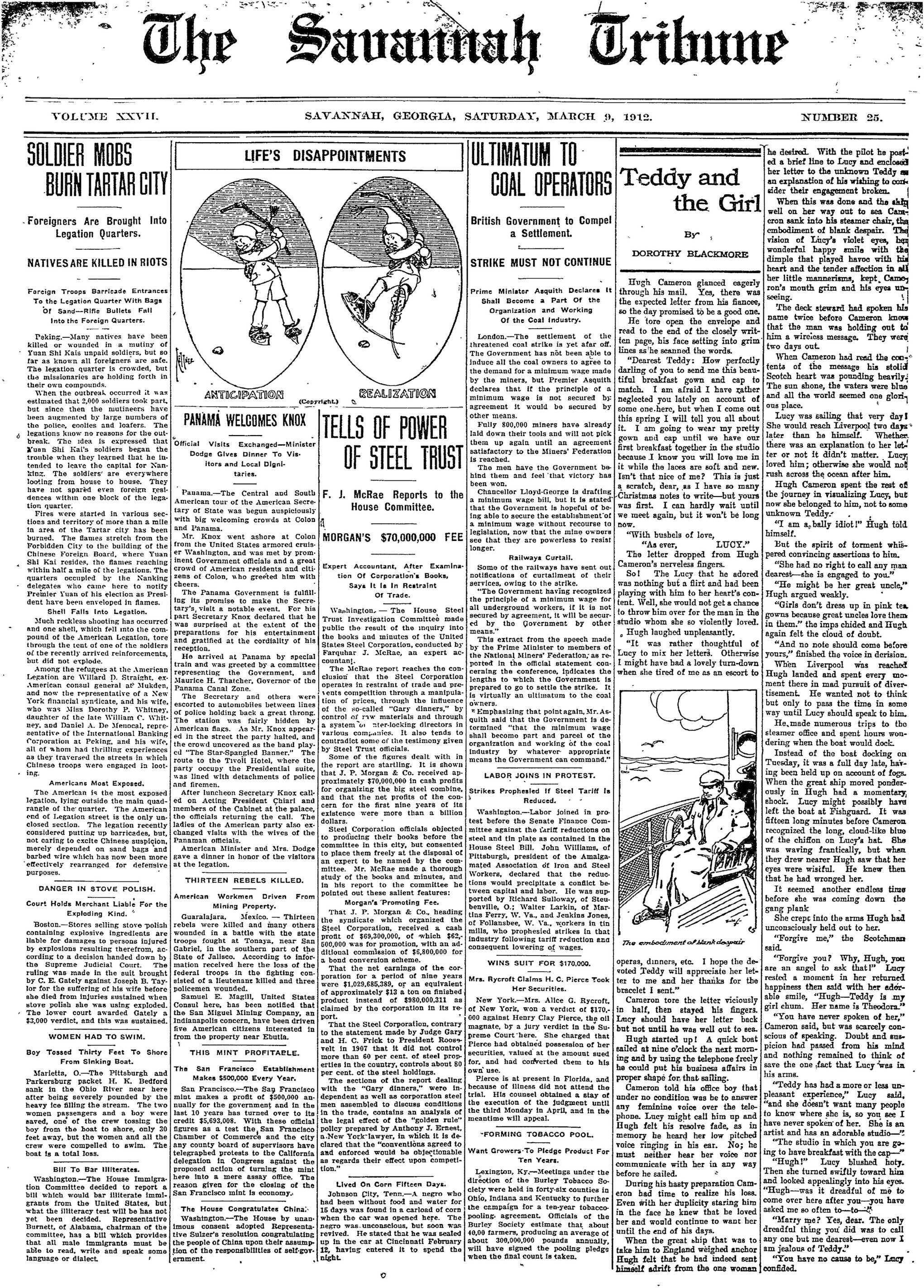
SOLDIER MOBS BURN TARTAR CITY
Foreigners Are Brought Into Legation Quarters.
NATIVES ARE KILLED IN RIOTS
Foreign Troops Barricade Entrances To the Legation Quarter With Bags Of Sand—Rifle Bullets Fall Into the Foreign Quarters.
Peking.—Many natives have been killed or wounded in a mutiny of Yuan Shi Kais unpaid soldiers, but so far as known all foreigners are safe. The legation quarter is crowded, but the missionaries are holding forth in their own compounds.
When the outbreak occurred it was estimated that 2,000 soldiers took part, but since then the mutineers have been augmented by large numbers of the police, coolies and loafers. The legations know no reasons for the outbreak. The idea is expressed that Yuan Shi Kal's soldiers began the trouble when they learned that he intended to leave the capital for Nanking. The soldiers are everywhere looting from house to house. They have not spared even foreign residences within one block of the legation quarter.
Fires were started in various sections and territory of more than a mile in area of the Tartar city has been burned. The flames stretch from the Forbidden City to the building of the Chinese Foreign Board, where Yuan Shi Kai resides, the flames reaching within half a mile of the legations. The quarters occupied by the Nanking delegates who came here to notify Premier Yuan of his election as President have been enveloped in flames.
Shell Falls Into Legation.
Much reckless shooting has occurred and one shell, which fell into the compound of the American Legation, tore through the tent of one of the soldiers of the recently arrived reinforcements, but did not explode.
Among the refugees at the American Legation are Willard D. Straight, ex-American consul general at Mukden, and now the representative of a New York financial syndicate, and his wife, who was Miss Dorothy P. Whitney, daughter of the late William C. Whitney, and Daniel A. De Menocal, representative of the International Banking Corporation at Peking, and his wife, all of whom had thrilling experiences as they traversed the streets in which Chinese troops were engaged in looting.
Americans Most Exposed.
The American is the most exposed legation, lying outside the main quadrange of the quarter. The American end of Legation street is the only unclosed section. The legation recently considered putting up barricades, but, not caring to excite Chinese suspicion, merely depended on sand bags and barbed wire which has now been more effectively rearranged for defensive purposes.
DANGER IN STOVE POLISH.
Court Holds Merchant Liable For the Exploding Kind.
Boston.—Stores selling stove polish containing explosive ingredients are liable for damages to persons injured by explosions resulting therefrom, according to a decision handed down by the Supreme Judicial Court. The ruling was made in the suit brought by C. E. Gately against Joseph B. Taylor for the suffering of his wife before she died from injuries sustained when stove polish she was using exploded. The lower court awarded Gately a $3,000 verdict, and this was sustained.
WOMEN HAD TO SWIM.
Boy Tossed Thirty Feet To Shore From Sinking Boat.
Marietta, O.—The Pittsburgh and Parkersburg packet H. K. Bedford sank in the Ohio River near here after being severely pounded by the heavy ice filling the stream. The two women passengers and a boy were saved, one of the crew tossing the boy from the boat to shore, only 30 feet away, but the women and all the crew were compelled to swim. The boat is a total loss.
Bill To Bar Illiterates.
Washington.—The House Immigration Committee decided to report a bill which would bar illiterate immigrants from the United States, but what the illiteracy test will be has not yet been decided. Representative Burnett, of Alabama, chairman of the committee, has a bill which provides that all male immigrants must be able to read, write and speak some language or dialect.
LIFE'S DISAPPOINTMENTS
ANTICIPATION
(Cop)
ANTICIPATION REALIZATION
PANAMA WELCOMES KNOX
Official Visits Exchanged—Minister Dodge Gives Dinner To Visitors and Local Digni-
Panama.—The Central and South American tour of the American Secretary of State was begun auspiciously with big welcoming crowds at Colon and Panama.
Mr. Knox went ashore at Colon from the United States armored cruiser Washington, and was met by prominent Government officials and a great crowd of American residents and citizens of Colon, who greeted him with cheers.
The Panama Government is fulfilling its promise to make the Secretary's, visit a notable event. For his part Secretary Knox declared that he was surprised at the extent of the preparations for his entertainment and gratified at the cordiality of his reception.
He arrived at Panama by special train and was greeted by a committee representing the Government, and Maurice H. Thatcher, Governor of the Panama Canal Zone.
The Secretary and others were escorted to automobiles between lines of police holding back a great throng. The station was fairly hidden by American flags. As Mr. Knox appeared in the street the party halted, and the crowd uncovered as the band played "The Star-Spangled Banner." The route to the Tivoll Hotel, where the party occupy the Presidential suite, was lined with detachments of police and firemen.
After luncheon Secretary Knox called on Acting President Chiari and members of the Cabinet at the palace, the officials returning the call. The ladies of the American party also exchanged visits with the wives of the Panaman officials. American Minister and Mrs. Dodge gave a dinner in honor of the visitors at the legation.
THIRTEEN REBELS KILLED.
American Workmen Driven From Mining Property.
Guaralajara, Mexico. — Thirteen rebels were killed and many others wounded in a battle with the state troops fought at Tonaya, near San Gabriel, in the southern part of the State of Jalisco. According to information received here the loss of the federal troops in the fighting consisted of a lieutenant killed and three policemen wounded.
Samuel E. Magill, United States Consul here, has been notified that the San Miguel Mining Company, an Indianapolis concern, have been driven five American citizens interested in from the property near Ebutla.
THIS MINT PROFITABLE.
The San Francisco Establishment Makes $500,000 Every Year.
San Francisco.-The Sap Francisco mint makes a profit of $500,000 annually for the government and in the last 10 years has turned over to its credit $5,693,008. With these official figures as a test the San Francisco Chamber of Commerce and the city any county board of supervisors have telegraphed protests to the California delegation in Congress against the proposed action of turning the mint here into a mere assay office. The reason given for the closing of the San Francisco mint is economy.
The House Congratulates China:
Washington.—The House by unanimous consent adopted Representative Sulzer's resolution congratulating the people of China upon their assumption of the responsibilities of self-government.
SAVANNAH, GEORGIA, SATURDAY, MARCH 9, 1912.
REALIZATION
TELLS OF POWER OF STEEL TRUST
F. J. McRae Reports to the House Committee.
MORGAN'S $70,000,000 FEE
Expert Accountant, After Examination Of Corporation's Books, Says It Is In Restraint Of Trade.
Washington. — The House Steel Trust Investigation Committee made public the result of the inquiry into the books and minutes of the United States Steel Corporation, conducted by Farquhar J. McRae, an expert accountant.
The McRae report reaches the conclusion that the Steel Corporation operates in restraint of trade and prevents competition through a manipulation of prices, through the influence of the so-called "Gary dinners," by control of raw materials and through a system of inter-locking directors in various companies. It also tends to contradict some of the testimony given by Steel Trust officials.
Some of the figures dealt with in the report are startling. It is shown that J. P. Morgan & Co. received approximately $70,000,000 in cash profits for organizing the big steel combine, and that the net profits of the concern for the first nine years of its existence were more than a billion dollars.
Steel Corporation officials objected to producing their books before the committee in this city, but consented to place them freely at the disposal of an expert to be named by the committee. Mr. McRae made a thorough study of the books and minutes, and in his report to the committee he pointed out these salient features:
Morgan's Promoting Fee.
That J. P. Morgan & Co., heading the syndicate which organized the Steel Corporation, received a cash profit of $69,300,000, of which $62,500,000 was for promotion, with an additional commission of $6,800,000 for a bond conversion scheme.
That the net earnings of the corporation for a period of nine years were $1,029,685,389, or an equivalent of approximately $13 a ton on finished product instead of $980,000,311 as claimed by the corporation in its report.
That the Steel Corporation, contrary to the statement made by Judge Gary and H. C. Frick to President Roosevelt in 1907 that it did not control more than 60 per cent. of steel properties in the country, controls about 80 per cent. of the steel holdings.
The sections of the report dealing with the "Gary dinners," were independent as well as corporation steel men assembled to discuss conditions in the trade, contains an analysis of the legal effect of the "golden rule" policy prepared by Anthony J. Ernest, a.New York lawyer, in which it is declared that the "conventions agreed to and enforced would be objectionable as regards their effect upon competition."
Lived On Corn Fifteen Days.
Johnson City, Tenn.—A negro who had been without food and water for 15 days was found in a carload of corn when the car was opened here. The negro was unconscious, but soon was revived. He stated that he was sealed up in the car at Cincinnati February 12, having entered it to spend the night.
ULTIMATUM TO COAL OPERATORS
British Government to Compel a Settlement.
STRIKE MUST NOT CONTINUE
Prime Minister Asquith Declares It Shall Become a Part Of the Organization and Working Of the Coal Industry.
London.—The settlement of the threatened coal strike is yet afar off. The Government has not been able to induce all the coal owners to agree to the demand for a minimum wage made by the miners, but Premier Asquith declares that if the principle of a minimum wage is not secured by agreement it would be secured by other means.
Fully 800,000 miners have already laid down their tools and will not pick them up again until an agreement satisfactory to the Miners' Federation is reached.
The men have the Government behind them and feel that victory has been won. Chancellor Lloyd-George is drafting a minimum wage bill, but it is stated that the Government is hopeful of being able to secure the establishment of a minimum wage without recourse to legislation, now that the mine owners see that they are powerless to resist longer.
Railways Curtail.
Some of the railways have sent out notifications of curtailment of their services, owing to the strike.
"The Government having recognized the principle of a minimum wage for all underground workers, if it is not secured by agreement, it will be secured by the Government by other means."
This extract from the speech made by the Prime Minister to members of the National Miners' Federation; as reported in the official statement concerning the conference, indicates the lengths to which the Government is prepared to go to settle the strike. It is virtually an ultimatum to the coal owners.
* Emphasizing that point again, Mr. Asquith said that the Government is determined "that the minimum wage shall become part and parcel of the organization and working of the coal industry by whatever appropriate means the Government can command."
LABOR JOINS IN PROTEST.
Strikes Prophesied If Steel Tariff Is Reduced.
Washington.—Labor joined in protest before the Senate Finance Committee against the tariff reductions on steel and tin plate as contained in the House Steel Bill. John Williams, of Pittsburgh, president of the Amalgamated Association of Iron and Steel Workers, declared that the reductions would precipitate a conflict between capital and labor. He was supported by Richard Sulloway, of Steubenville, O.; Walter Larkin, of Martins Ferry, W. Va., and Jenkins Jones, of Follansbee, W. Va., workers in tin mills, who prophesied strikes in that industry following tariff reduction and consequent lowering of wages.
WINS SUIT FOR $170,000.
Mrs. Rycroft Claims H. C. Pierce Took Her Securities.
New York.—Mrs. Alice G. Rycroft, of New York, won a verdict of $170,000 against Henry Clay Pierce, the oil magnate, by a jury verdict in the Supreme Court here. She charged that Pierce had obtained possession of her securities, valued at the amount sued for, and had converted them to his own use.
Pierce is at present in Florida, and because of illness did not attend the trial. His counsel obtained a stay of the execution of the judgment until the third Monday in April, and in the meantime will appeal.
`FORMING TOBACCO POOL.
Want Growers-To Pledge Product For Ten Years.
Lexington, Ky.—Meetings under the direction of the Burley Tobacco Society were held in forty-six counties in Ohio, Indiana and Kentucky to further the campaign for a ten-year tobacco-pooling, agreement. Officials of the Burley Society estimate that about 40,000 farmers, producing an average of about 300,000,000 pounds annually, will have signed the pooling pledges when the final count is taken.
Teddy and the Girl
By
DOROTHY BLACKMORE
Hugh Cameron glanced eagerly through his mail. Yes, there was the expected letter from his fiancee, so the day promised to be a good one. He tore open the envelope and read to the end of the closely written page, his face setting into grim lines as he scanned the words.
"Dearest Teddy: How perfectly darling of you to send me this beautiful breakfast gown and cap to match. I am afraid I have rather neglected you lately on account of some one here, but when I come out this spring I will tell you all about it. I am going to wear my pretty gown and cap until we have our first breakfast together in the studio because I know you will love me in it while the laces are soft and new. Isn't that nice of me? This is just a scratch, dear, as I have so many Christmas notes to write—but yours was first. I can hardly wait until we meet again, but it won't be long now.
"With bushels of love.
The letter dropped from Hugh Cameron's nerveless fingers.
Sol The Lucy that he adored was nothing but a flirt and had been playing with him to her heart's content. Well, she would not get a chance to throw him over for the man in the studio whom she so violently loved.
Hugh laughed unpleasantly.
"It was rather thoughtful of Lucy to mix her letters. Otherwise I might have had a lovely turn-down when she tired of me as an escort to
5
The embodiment of blank despair operas, dinners, etc. I hope the devoted Teddy will appreciate her letter to me and her thanks for the bracelet I sent." Cameron tore the letter viciously in half, then stayed his fingers. Lucy should have her letter back but not until he was well out to sea. Hugh started up! A quick boat sailed at nine o'clock the next morning and by using the telephone freely he could put his business affairs in proper shape for that sailing.
Cameron told his office boy that under no condition was he to answer any feminine voice over the telephone. Lucy might call him up and Hugh felt his resolve fade, as in memory he heard her low pitched voice ringing in his ear. No; he must neither hear her voice nor communicate with her in any way before he sailed.
During his hasty preparation Cameron had time to realize his loss. Even with her duplicity staring him in the face he knew that he loved her and would continue to want her until the end of his days.
When the great ship that was to take him to England weighed anchor Hugh felt that he had indeed sent himself adrift from the one woman
NUMBER 25.
he desired. With the pilot he post-ed a brief line to Lucy and enclosed her letter to the unknown Teddy an explanation of his wishing to consider their engagement broken. When this was done and the ship well on her way out to sea Cameron sank into his steamer chair, the embodiment of blank despair. The vision of Lucy's violet eyes, her wonderful happy smile with the dimple that played havoc with his heart and the tender affection in all her little mannerisms, kept. Cameron's mouth grim and his eyes unseeing.
The deck steward had spoken his name twice before Cameron knew that the man was holding out to him a wireless message. They were two days out.
When Cameron had read the contents of the message his stolid Scotch heart was pounding heavily. The sun shone, the waters were blue and all the world seemed one glorious place.
Lucy was sailing that very day! She would reach Liverpool two days later than he himself. Whether there was an explanation to her letter or not it didn't matter. Lucy loved him; otherwise she would not rush across the ocean after him.
Hugh Cameron spent the rest of the journey in visualizing Lucy, but now she belonged to him, not to some unknown Teddy.
"I am a a bally idiot!" Hugh told himself.
But the spirit of torment whispered convincing assertions to him.
"She had no right to call any man dearest—she is engaged to you."
"He might be her great uncle," Hugh argued weakly.
"Girls don't dress up in pink tea gowns because great uncles love them in them." the imps chided and Hugh again felt the cloud of doubt.
"And no note should come before yours," finished the voice in derision. When Liverpool was reached Hugh landed and spent every moment there in mad pursuit of diversification. He wanted not to think but only to pass the time in some way until Lucy should speak to him. He made numerous trips to the steamer office and spent hours wondering when the boat would dock.
Instead of the boat docking on Tuesday, it was a full day late, having been held up on account of fog. When the great ship moved ponderously in Hugh had a momentary, shock. Lucy might possibly have left the boat at Fishguard. It was fifteen long minutes before Cameron recognized the long, cloud-like blue of the chiffon on Lucy's hat. She was waving frantically, but when they drew nearer Hugh saw that her eyes were wisful. He knew then that he had wronged her.
It seemed another endless time before she was coming down the gang plank
She crept into the arms Hugh had unconsciously held out to her.
"Forgive me," the Scotchman said.
"Forgive you? Why, Hugh, you are an angel to ask that!" Lucy rested a moment in her returned happiness then said with her adorable smile, "Hugh—Teddy is my girl chum. Her name is Theodora."
"You have never spoken of her," Cameron said, but was scarcely conscious of speaking. Doubt and suspicion had passed from his mind and nothing remained to think of save the one fact that Lucy was in his arms.
"Teddy has had a more or less unpleasant experience," Lucy said, "and she doesn't want many people to know where she is, so you see I have never spoken of her. She is an artist and has an adorable studio—" "The studio in which you are going to have breakfast with the cap—"
"Hugh!" Lucy blushed hoty. Then she turned swiftly toward him and looked appealingly into his eyes. "Hugh—was it dreadful of me to come over here after you—you have asked me so often to—to—"
"Marry me? Yes, dear. The only dreadful thing you did was to call any one but me dearest—even now I am jealous of Teddy."
"You have no cause to be," Lucy confided.
LIBERIA STARTS ON A NEW ERA
The First Detailed Account of Inauguration-Howard Is Presidentf.
NEW EXECUTIVE INTERESTINGLY
DISCUSSES IMPORTANT QUESTIONS IN INAUGURAL ADDRESS
—NATIVE CHIEFS FRIENDLY—
NEARLY TWO HUNDRED THOUSAND NATIVES FROM INTERIOR
ATTEND INAUGURAL CEREMONIES—PROMISE TO WORK
FOR REPUBLIC'S GOOD.
From a correspondent at Monrovia, Liberia, the first detailed account of the inauguration of the black republic's new president, Daniel Edward Howard, has been received in this country. The inaugural ceremonies took place at Monrovia Monday, January 1, and Tuesday, January 2, and were imposing. Aside from the prominent officials of the republic and representatives of foreign nations, the spectacle was made more picturesque by the presence of native chiefs, headmen and retainers.
It was the first inauguration ever attended by native chiefs, headmen and retainers, and their presence was significant. They talked nothing but peace and prosperity, and promised to do all in their power to make the new administration a highly successful one. Nearly 2,000 natives from the Interior listened to President Howard advocate that they be given equal rights, and on the second day President Howard and Vice-President Harmon donned similar attire as worn by the native chiefs, the incident occasioning much good feeling.
The new administration promises to mark a new era for the republic. The officials are working together in harmony; the native chiefs are now for peace instead of war, and taking into consideration that negotiations for receiving the large loan, which was so successfully conducted by the United States government, have been completed, the consensus of opinion in Monrovia is that the country has started on its work of rehabilitation.
The prominent officials of the new Liberian administration are: President, Daniel Edward Howard; vicepresident, Samuel George Harmon; secretary of state, C. D. B. King; secretary of treasury, Thomas W. Haynes; secretary of war and navy, Wilmot E. Dennis; postmaster general, Col. Isaac Moort; secretary of interior, J. J. Morris; attorney general, Samuel A. Ross; Secretary of education, B. W. Payne. Walter F. Walker is executive secretary to the president.
* The inauguration committee was headed by H. J. R. Cooper, chairman of the senate's committee, and J. J. Ells, chairman of the house of representatives' committee.
Among the things said by President Howard, who succeeded Arthur Barclay as chief executive, in his inaugural address were:
"The great American government after a silence, far from forgetting and abandoning the tender infant cast aside upon the shores of Africa, has come in an hour of danger to assist us on her strong pinions to a nest of safety. If we but follow her examples and heed her teaching of economy, thrift and industry, and if we are just in our dealings with men and nations we shall never escape her vigilant eye, nor cease to be the object of marked manifestation of interest on her part.
"I shall do all in my power to maintain and strengthen the friendly feelings now so happily subsisting between us . . . as well as all the other governments here represented, and I shall expect the co-operation of all citizens to that end. I am afraid that some of us are too prone to the belief that foreign powers are our enemies, and that some one of them is always seeking some pretext to thwart God's purposes in the founding of Liberla, and to deprive us of our most sacred heritage. To any mind, however, our real enemies, our most subtle foes, our most potent drawback, lie within and among some of our loudest professed patriots. Liberla must attain to the position of a prosperous African state, and her sons and daughters are to be the agents to bring this about. Let us, therefore, go to work and do what we contend we are capable of doing. Let each one do his part, for it is only by the concentrated efforts of the whole that success can be achieved.
"Our school system needs reorganizing and perfecting from the bottom up. The faint attempts now made to provide educational facilities for the people at large make only the slightest dent in the stronghold of ignorance, and it is high time earnest, persistent and unrestrained efforts should be trained upon the inadequate educational system. Parents must learn the virtue of sacrificing for the intellectual improvement of their children, unless they wish to create a mentally incompetent generation. Common education is the bulwark and strength of any country. The progress of any country, and especially the position it will attain in the rank of nations in the future, is largely to be measured by the provisions made for the largest possible education of the masses. In very few countries perhaps is the need of common education and the preparedness of teachers more vital and pressing than in Liberia. We must
see to it that this condition is altered and that with all possible haste. "Liberia college should be amply maintained for the following reasons: First, it is the oldest and most efficient state school in the country and the first and only state college. Second, it has been of incalculable benefit to the country in preparing and sending out useful men and women ever since its founding, and but for several reasons at this age of the institution it would have realized all that was ever contemplated of it in its founding.
"The agricultural development of the country shall be among our chief concerns and shall engage our most serious attention. With that object in view we feel that it is imperative to inaugurate what may be called a labor bureau, or a system whereby labor may be engaged under government protection. To this end the creation and appointment of two or more labor agents in Montserrado county on each bank of the St. Paul river should be considered. These agents should be charged with the duty of receiving all laborers who may come down from the interior and hiring them out to the farmers under proper guarantee of payment for services.
"The executive government, through the interior department, will hold conferences with the chiefs of the different sections in the county from which labor is recruited, explain to them the policy and object of the government to have them furnish laborers regularly, also of the government's firm determination to see that each laborer is justly paid for his services. Each chief so interesting himself to supply laborers from his section should receive an annual stipend from the government or a fixed sum per capita for each laborer furnished. A law respecting the government's securing the pay of the laborers should be so framed that nothing, not even the homestead exemption, shall prevent the government from entering suits, if occasion requires, to raise the sum due each employer should be fall to pay a laborer at the proper time any amount due him.
"The financial agreement recently concluded between the government of Liberia and certain American and European capitalists through the kindly assistance of the state department at Washington, it is needless to say, has my strongest endorsement and approval. The new administration pledges itself to observe strictly all of its provisions and to afford all necessary facilities for its smooth and effective operation.
"The agreement, though in some respects it may appear to place a little restriction upon us in the management, collection and control of our customs revenues, yet in its political bearings, I am sure, will prove to be of incalculable benefit to the republic. Hence it becomes the sollemn and imperative duty of every citizen to give his individual support to the government in its efforts to initiate and prosecute such a measure, which must tend to our national preservation and security. If the temporary management in the hands of others of a part of our government machinery will result in actual and permanent independence and international respect, which I firmly believe will be the outcome, then it becomes our imperative duty as patriotic citizens to make such a necessary and noble sacrifice.
Daniel Edward Howard, who was elected president of Liberia May 2, 1911, and inaugurated the first of the year, was born in Monrovia, August 4, 1861. While quite an infant his mother died and a grand aunt was entrusted with his care. The new president's father was the late Thomas W. Howard, who for over twenty-five years was chief government printer, and during several political campaigns chairman and leader of the Whig party. The Howards belong to one of the old pioneer families associated with the historical Ellijah Johnson.
The first school ever attended by Mr. Howard was the Methodist Seminary at Monrovia, now the College of West Africa. Later he entered the preparatory department of Liberia College and matriculated in the college proper during the presidency of Prof. Martin H. Freeman. While attending college Mr. Howard worked at the printing trade until Dr. Edward W. Blyden took charge of Liberia College, who made a rule that students would either have to give their whole time to study or leave the institution. Soon afterwards he was compelled to quit college.
When the late President Hillary Johnson entered office he employed Mr. Howard as his private secretary, in which capacity he served the entire eight years of Johnson's administration. President Johnson was so attached to the young man that in 1886 he appointed him clerk of the superior court of Monterrado county and continued him as his private secretary. He remained in the position as clerk of that court for sixteen years. Under Coleman's administration he was appointed superintendent of Monterrado county and did so well with the county's funds that immediately upon the inauguration of President Barclay he was entrusted with the conduct of the treasury department.
The position of secretary of the treasury of Liberia is a very difficult one. He is the paymaster of the republic. As head of the treasury service of the republic, Mr. Howard did his level best to remedy this most prominent point of weakness in the country's finances.
DISTINCTION.
"So the bank teller has disappeared. Was he short in his cash?" "No, he was ahead. It was the bank that was short."—Boston Transcript.
LEFT SOUTH ON PROMISE OF WORK
Two Colored Women Victimized by Fake Employment Bureau.
LURED FROM RICHMOND, TRAVEL HUNDREDS OF MILES TO BELLEFONTE, PA., IN QUEST OF WORK WHICH DID NOT MATERIALIZE.
Williamsport, Pa.—Negroes in the south who contemplate coming north to work would show judgment by thoroughly investigating the standing of the various employment agencies which advertise and promise to secure employment for southern negroes in the northern states. The overseers of the poor in this city had an experience last week with two colored women who had been victimized by a fake employment bureau, and the published fact should be a warning to all who plan to leave the south and make their home in the north.
The case which attracted so much attention in Williamsport last week was that of two women, one of whom had a small baby, who had been fooled from their homes in Richmond, Va., to Bellefonte, Pa., by an employment bureau.
Upon arriving at Bellefonte, the women found that they had been deceived by the employment bureau and that there was no work for them. Not a person in Bellefonte knew of their coming.
Being in destitute circumstances and without a cent to secure railroad fare to return to Richmond, they were compelled to appeal to the city officials of Bellefonte, who directed them to Williamsport for assistance. The unfortunates arrived in Williamsport with the thermometer at 20 below zero, and they presented a pliable picture.
The officials of this city informed the charity applicants that it was impossible to send them to Richmond, but that transportation to the adjoining county would be furnished, and that the officials in the next county would send them to the next, and so on until they would finally reach Richmond.
To make the trip from Bellefonte, Pa., to Richmond, Va., in relays proved a hardship to the female victims of the unscrupulous employment bureau people, and upon reaching Richmond they were much impaired both mentally and physically.
LOUISIANA'S POPULATION
LATE CENSUS SHOWS THAT THERE ARE IN STATE 941,125 WHITES TO 713,874 NEGROES—NEW ORLEANS HAS 249,435 WHITES AND 89,262 NEGROES.
Washington, D. C.—A preliminary statement of the white and negro population of Louisiana, by parishes and principal cities, as shown by the returns of the thirteenth decennial census, taken as of April 15, 1910, has been issued by Director Durand of the bureau of census, department of commerce and labor.
The total population of Louisiana in 1910 was subdivided as to color as follows: White, 941,125; negro, 713,874; all other persons (Indians and Chinese, Japanese and other Asiatics), 1,389. The equivalent figures for 1500 were: White, 729,126; negro, 650,804; all other, 1,209. For 1890 they were: White, 558,395; negro, 559,193; all other, 1,000.
The negro population constituted 43.1 per cent. of the total population of the state in 1910, as against 47.1 per cent. in 1900 and 50 per cent. in 1890.
The rate increase in the negro population since 1900 was less than that for the preceding decade, the increase from 1900 to 1901 being 36,070 or 9.7 per cent., as compared with 91,611 or 16.4 per cent., from 1890 to 1900. The white population increased from 1900 to 1910 at a somewhat lower rate than from 1890 to 1900, the increase being respectively 211,513, or 29 per cent., as against 171,217, or 30.7 per cent.
New Orleans city had a population in 1910 of 329,075, comprisling 249,435 whites. 89,262 negroes and 378 other persons (Indians and Chinese, Japanese and Asiatics). The equivalent figures for 1900 were: White, 208,946; negro, 77,174; all others, 444. For 1890 they were: White, 177,376; negro, 64,491; all other, 172.
JEFFRIES WANTS TO FIGHT AGAIN
FRIEND DECLARES HE IS PREPARING TO MEET JOHNSON ONCE MORE.
New York.—A dispatch received from Los Angeles, Cal., states that a friend of Jim Jeffries gives the information the retired pugilist is preparing to reenter the ring and will challenge Jack Johnson for the heavyweight championship. Jeffries is said to have told his friends he is in better condition than for a long time and that he attributed his defeat by Johnson largely to his method of training for the fight on July 4.
BOOKER T. WASHINGTON INVITES PERSONS FROM DIFFERENT PARTS OF THE WORLD TO MEET AT TUSKEGEE IN APRIL, 1912, AND DISCUSS THE WORK GOING ON FOR EDUCATION AND UPBUILDING OF NEGRO PEOPLE.
Tuskegee, Ala.—Dr. Booker T. Washington,—head of Tuskegee Institute, has issued a statement that an International Conference on the Negro will be held at Tuskegee Institute April 17, 18 and 19, 1912.
The statement:
For some years past I have had in mind to invite here from different parts of the world—from Europe, Africa, the West Indies and North and South America—persons who are actively-interested, or directly engaged as missionaries or otherwise, in the work that is going on in Africa and elsewhere for the education and upbuilding of negro peoples.
For this purpose it has been determined to hold at Tuskegee institute, Alabama, Wednesday, Thursday and Friday, April 17, 18 and 19, 1912, a little more than a year from this time, an International Conference on the Negro. Such a conference as this will offer the opportunity for those engaged in any kind of service in Africa, or the countries above mentioned, to become more intimately acquainted with the work and the problems of Africa and these other countries. Such a meeting will be valuable and helpful, also, in so far as it will give opportunity for a general interchange of ideas of organizing and systematizing the work of education of the native people in Africa and elsewhere and the preparation of teachers for that work. Wider knowledge of the work that each is doing should open means of co-operation that do not now exist.
The object of calling this conference at Tuskegee institute is to afford an opportunity for studying the methods employed in helping the negro people of the United States, with a view of deciding to what extent Tuskegee and Hampton methods may be applied to conditions in these countries, as well as to conditions in Africa.
It is hoped that numbers of people representing the different governments interested in Africa and the West Indies, as well as representatives from the United States and the countries of South America, will decide to attend this conference. Especially is it urged that missionary and other workers in these various countries be present and take an active part in the deliberations of the conference.
It is desirable, in any case, to have any suggestions as to what might be done to make the work of the conference more helpful to all concerned. The names of persons who would like to be present, with whom you are acquainted, will be appreciated, and through you they are invited to be present and take part in the deliberations of the conference.
Those who come to Tuskegee properly accredited will be welcomed and entertained as guests of the institution and will be under no expense during their stay here.
BOOKER T. WASHINGTON,
Principal.
Tuskegee Normal and Industrial Institute, Tuskegee Institute, Ala.
ONLY FOUR NEGRO
OFFICIAL INTERPRETERS
OF FOOTBALL RULES
Washington, D. C.—After a period of two years of consideration, the central board of officials of the football rules committee of the United States has appointed four colored men on the list of qualified officials whose names will appear in the limited list published in the Football Annual. Garnet C. Wilkinson, teacher at the M street high school, perhaps the best known colored official in these parts. As coach of the M street high school team he has developed many stars who have made careers on the gridrids of the larger colleges after leaving this school. Morton P. Robinson has taught and coached football and other branches of athletics at several colleges and high schools. A. Kiger Savoy, a teacher in the Washington public schools, has served capably on the gridiron. Erwin B. Henderson, physical director of the colored high schools of Washington, received his training at the Harvard summer school of physical training where football theory and practice is a strong course and where the leading football experts of the country often gather.
These four gentlemen are the only men of the race in the country whose work has entitled them to the distinction noted. There are some coaches and players who are fitted for official work, but have not yet met all of the requirements for official recognition.
The central board on football officials, who passed on the qualifications of Messrs. Wilkinson, Henderson, Savoy and Robinson, is made up of L. M. Dennis of Cornell university, Walter Camp of Yale university, Parke Davis of Princeton university, Cranford Blagdon and Chairman James A. Babbitt of Haverford college.
WIT AND HUMOR
THE IMITATION EMERALD.
Bishop Johnson of South Dakota tells this story of himself:
"I was dining one night beside a man of whom I had never heard before. I soon discovered that he was quick witted, and later I was also to discover that he was a jewelry expert. I was wearing an emerald ring, which I prize very highly for its history as well as for its beauty.
"Will you let me see your ring?' he asked.
"I gladly passed the trinket to him. He examined it critically and then returned it, saying:
"It is the best imitation emerald I ever saw."
"I was startled. I told him that it was genuine and had been used in England by churchmen for 200 years, and that it had always been considered a flawless gem.
"Nevertheless," he replied, 'it is an imitation emerald."
"Some time later I met an expert in gems in New York, showed him the ring and asked his opinion of it. The man looked at it and, told me it was an imitation.
"Some time after that I again met my banquet friend, and told him what I had done."
"I have reproached myself for having told you,' he remarked.
"I'm glad you did tell me,' I replied. 'Else I might have transmitted a lie to Fosterity.'
"You surely would have been in good company in doing that,' said he, and the incident was at an end."—The World Today.
LIFE IN THE SUBURBS.
Mr. Suburb—Haven't you a dog to protect your house from tramps?
Mr. Lawnmo—Yes.
"Then why do you walk around every night with a gun?"
"Oh, I'm not protecting the house. I'm only protecting the dog."
MAKING SURE.
First Lady (off for a journey)—I hope we've got the right train.
Second Lady—I asked seventeen trainmen and ninety-three passengers if this train went to Blankville, and they all said yes, so I guess we're all right.
A MARTYR TO DUTY.
Husband—Aren't you going to church today?
Wife—No. I am not feeling well.
Husband—Then call a messenger boy and send him. The family must be represented.
RATHER WIRY.
Mrs. Slimdiet—What has made your throat so sore, Mr. Newboarder?
Newboarder—I think it must have been the steak.
Scraps
Scraps
The less a man works the more time he has to think about vacations.
A girl who shows her teeth a lot must have them in first-class order.
The.woman who climbs by toadying will always have to bow to some.
Courage means foolhardiness to a lot of men.
The man who has a card up his sleeve never gesticulates freely.
Pomposity is the only swell way some men know.
By taking another man's prize, you can't get credit for his strife.
The woman who forgets she's intellectual is a scarce delight.
Get away from envy, and you will invisibly get nearer the angels.
Familiarity is the first sign of contempt.
The man who depends upon the humor of his friends has only shaky fences to lean upon.
Bridge spans the chasm of many a dull wit.
A loan of five may bring a guy around ten times.
All college pillows are not exchange for frat pins.
Some men break their smoking resolutions as soon as they can choose their own cigars.
It comforts some poor men to see their better half wearing expensive rig.
A happy household is where the father refrains from getting too happy.
The self-made man does well to hide the trademark.
PROPER HEAT IN THE HOUSE
Matter of Molsture Is Always One of the Most Important Considerations.
According to the medical folks artificial heating of a house with dry, hot air is both unhealthful and expensive. They declare that it begets tuberculosis, pneumonia and colds, and they claim to have plenty of proof to this effect. Their advice is to moisten the air a bit.
The Pennsylvania board of health has prepared some advice on the subject and is distributing it in the form of a bulletin. This states that moistened air does not have to be heated to as great a temperature as dry air in order to be made comfortable. When you feel cold, therefore, instead of seeing whether the furnace needs fuel, find out if the air does not want water. On a cold day the windows of your room should have the perspired look of a kitchen window on a washday. In very cold weather the panes ought to be frosted.
If you find this is not the case the air probably needs a drink. Place a pan of water in the room, or, if you have steam heat, allow a little of the vapor to escape. You will soon feel comfortable, though the temperature of your room will not have risen. With properly moistened air a room need not be heated more than 64 degrees.
M
Mabel—Are your thoughts true to Tom?
Edith—Oh! yes. Whenever another man kisses me I try to think it is Tom who's kissing.
TRUE SELF-CONQUEST.
Even a log can float with the current, it takes a man to fight sturdily against an opposing tide that would sweep his craft out of its course. When the jealousies, the petty intrigues and the meanness and the misunderstandings in life assail you, rise above them. Be like' a lighthouse that illumines and beautifies the snarling, swashing waves of the storm that threaten it, that seek to undermine it and seek to wash over it. This is conquest.—From "Self-Control," by William George Jordan.
OUT OF HER LINE.
The horny-handed son of toil who had just inherited a fortune went to see a manicure.
"Can you do anything with these, ma'am?" he asked, exhibiting his hands.
"Yes, sir," she said, "after you've gone to a surgeon and had those cracks sewed up. I don't meddle with jobs that belong to the regular practitioners."
THE UNKNOWN FUTURE
We take just pride in our present enterprise and achievements, but we may believe that the commerce of the future will as far exceed that of the present as the varied production, the vast extent of commercial exchanges, and the means of communication of today, transcend the hopes and even the dreams of Washington. Governor Charles E. Hughes.
THE TEST.
"She's a woman of splendid taste."
"That so?"
"Yes. I believe I'd almost be willing to agree to wear any necktie she picked out for me."
CONTRADICTORY
"I did a good thing today. My husband is fond of rare steak and I did one to perfection for him."
"A rare deed, yet it was not well done."
EASY TREATMENT.
"My brother's doctor told him he must build himself up."
"Well, he ought to find it easy enough to do that. He's an architect."
Of Interest to Our Women
A set of small knockers for bedroom doors in a house where much entertaining is done is sometimes acceptable. Many of the new houses of colonial style not only have a knocker outside the front and side doors, but also on each bedroom door, for convenience in awaking guests and members of the family. These knockers can be found in antique styles to suit old-time architecture, and in odd designs for other schemes.
The housekeepers are making quilts again, but they are not the elaborate eyesores of old that involved the tearing and sowing together again of yards and yards of cloth. The new quilts are made of linen sheeting, with either appliqué cutout cretonne flowers or with stencil designs in borders and scattered patterns. A thin sheet of wadding is put between the outside and the lining, and the parts are caught together with knots tied from the underside and knotted on top. Now and then the daughter of an old-fashioned mother rigs up a makeshift quilting rame and quilts her spread by hand. Sometimes she does the work on a sewing machine, stamping an allover design and following it. Handsome spreads to match bedroom schemes are made of linen sheeting stenciled and finished around the edge with white cotton fringe. Or an outline pattern is sometimes used if embroidery is better understood.
A few sightly mats around the room on polished top tables and stands will save heart burnings from blemishes left by vases, tumblers and the like. Very attractive mats are made of rounds of glass underlain with embroidered linen and bound around the edge with dull gold galloon. A round of pastboard and felt should underlay the linen. Reed mats for the same purpose are easily made by persons who understand the rudiments of basketry. These may be stalped the tone of the table or stand and not be conspicuous. And there are leather mats and sweet grass ones for similar uses. A woman who serves tea in her living room places such mats around promiscuously as a voloceless invitation not to place dishes directly on her tables.
A sauce that introduced an elaborate dinner the other day was cut in star shape, and each point was heaped with a different relish, while a colled flat of anchovy occupied the center.
A delicate and very appetizing salad for dinner or luncheon combines halved and seeded white grapes, half the quantity of very tender celery cut into small pieces and broken English walnut meats. It is served on white lecture leaves with French dressing or mayonnaise.
A can of sweet red peppers cut fine and mixed with the mear and bread of a meat loaf makes a tasty addition. One pepper is enough for every cupful of meat.
The Creole addition of fried onions and red pepper contributes to the flavor of the northern fricaseed chicken. Only a small portion of onion should be used for the ordinary taste, a thick slice cut fine and yellowed in butter. The canned Mexican sweet peppers are liked better by most persons than the hotter kind kept by the grocer and sold by the piece.
With in grips and feverish colds prevalent, cooling drinks are in demand. Chilled fruit juices are always acceptable, whether they be the juices of dried fruits soaked overnight, then cooked in the same water, tart homemade jellies dissolved in a glass of cold water, or the juice of lemons, limes, oranges or grapefruit diluted with water and sweetened to taste. One patient finds nothing more acceptable than the juice of an orange squeezed into a glass, the same as lemon for lemonade. Another finds applode the most refreshing. To prepare it peel and quarter a tart apple, cover with water and cook until tender. Press to a pulp while hot; sweeten slightly, then cool and strain into a glass of cold water. The water in which rice has been cooked, when strained, cooled and slightly sweetened or lightly salted, is both nourishing and cooling. The addition of lemon juice makes an oriental drink greatly in demand in case of cold or fever. Oyster broth, made with milk and chilled, is often relished.
The peculiar acid of buttermilk appeals to many palates, while with others oatmeal water stands first. To make the latter put one cup oatmeal in a stone jar with a cup of sugar, the juice and thin yellow rind of three lemons. Cover with three quarts of boiling water and let stand until the sugar is dissolved. Strain and put on the ice.
DRY STEW.
Bring one dozen or more oysters in their own liquor, without any milk or water, to a boll. Add quickly a very small piece of butter, a little salt and pepper, just enough to make the dish palatable; bring to a boll again and serve at once. The oysters should be fresh.
A HINT ABOUT THE
SPRING FASHIONS.
A, lingerie gown which forecasts a fashion for summer is extreme in its simplicity. In English embroidery on fine lawn, the foundation of silk and dress material proper have an interlining of deep pansy, purple chiffon, which give a pretty gray note to the dress. Folds of the chiffon encircle the waist down with tiny white buttons, and chiffon is again used for sleeves and yoke, where the embroidered material is slashed up from neck to elbows, and looped together with strands of purple ribbon velvet.
A pretty idea for summer gown is a dress made of white open-work embroidery over white satin. The dress has a dainty little coat of daffodil-yellow ninon, belted at the waist with royal blue Ottoman, and finished with hemstitched edges of yellow satin. The belt is traced in Egyptian style with gold threads near the clasp of black velvet, which has rows of yellow and blue buttons, and the collar, with frill down one side of the front, is of the embroidery edged with Valenciennes.
Two sets of dolllies and a centerpiece made as brave a showing among the wedding gifts of a certain bride as many more costly gifts. There were two sizes of dolllies, a dozen of each, and each dozen as well, as the centerpiece had a case of its own. The cases were round, substantiated with two rounds of cardboard a little larger than the dolllies and covered on the outside with plain blue linen. A strap of ribbon at each side of each case was tied across the top to a large bow and held the two sides together. It must be admitted that the big round case for the centerpiece, which was made like the smaller cases, might make a problem in a small apartment. A linen roll would be preferable for that, with a tube of paper inside on which to roll the linen
FADS IN BAGS.
The pocketbook is quite out of fashion. The only purse the fashionable woman allows herself to be "seen out with" is the tiny change purse.
The bag has put the pocketbook out of commission. The striking feature about bags just now is their length. Imagine a bag a foot or more in length and not more than six inches wide, hanging from heavy silken cords nearly a foot and a half long and these tipped with tassels. This is the new bag. Long as the bag, the contents are perfectly accessible.
While this style is the last word among bags, there are many other desirable shapes somewhat less pronounced. Round bags are extremely mollish and also the elongated styles. Something altogether different is the flat bag, rather longer than wide, having square corners. The noticeable feature is the large flap which buttons down one side.
One of the latest bags has seven compartments. The systematic woman will find this quite to her taste. In fact, all of us who have groped frantically in the depths of crowded bags for some lost trinket will appreciate the possibilities for order such a bag affords. The card case is no longer carried in the hand when a woman starts out on a calling tour. It is carried in the inevitable bag.
BOUDOIR HINTS.
French chalk will remove grease spots from dress material.
To keep a parasol in good condition have a bag hung for it inside the closet door.
Stains may be removed, even from the most delicately colored gloves, by suspending them for a day in atmosphere of ammonia. Provide a tall glass cylinder, in the bottom of which place strong aqua ammonia. Be careful to remove from the sides of the jar any ammonia that may have spattered upon them. Suspend the gloves to the stopper of the jar. They must not come in contact with the liquid. $ ^{o} $
When sewing lace at the top of collars hold it against the wrong side of the collar, so that the stitches will come on the right side, drawing the thread moderately tight. This will make the lace stand up nicely around the neck.
PARISIAN IDEAS.
The moderately small hat is very much in evidence in Paris just now. The weather makes it practical, and the French woman is essentially fond of comfortable headgear although recent fashions would not make one think so.
The high crowned toque trimmed with a stiff feather fantasy jauntily placed, and the whole thing tied round by a vell, generally in limitation white Chantilly, is the usual morning wear for wet days.
The rage for white frocks worn with black velvet or fur trimming continues. A frock of white cloth, for instance, will have a hem of black velvet which is met by a black velvet coat; the lady appears clad in velvet, but when the coat is taken off the greater part of her dress is composed of white charmeuse.
"DERE'S WHA' DE
OL' FOLKS STAY"
ATLANTA'S REFUGE FOR OLD-
TIME DARKIES.
BY GORDON NOEL HURTEL.
Five old negro "mammiles," inmates
of a home established in Atlanta, for
their special benefit, relics of the days
of slavery in the south, awakening the
memory of a loyalty and devotion
that was stronger than the chains of
bondage, make a text of this story of
a people who are passing away from
earth.
The former slaves of the south are fast disappearing. Like others who are veterans of the ante-bellum days, their ranks are thinning out until the few that are left serve only to recall the memories of the picturesque log cabin where superstition wove its wondrous fancies and from which have been handed down the marvelous stories of Brer Rabbit and Brer Fox. In a little while—a very little while—the "last of the southern slaves" will be a story told to memorialize an era of the nation's history which lies beyond the recollection of the living.
The old-time darkey is still honored and respected today everywhere in the south, not only for the memories he invokes, but because he has not forfeited the charm and picture-equeness of his character by the institution of new environments. The old "mammies"—some of the few of them that are left—receive the ministry and devotion claimed by the sanctity of sacred ties. In some southern homes they are the pampered and apolled autocrats, of the nursery, demanding the right to rule by the heritage handed down to them from the times they were in waiting upon the great-grandancestors of our children.
But, alas! many of the aged veterans of slavery, who were faithful and loyal despite the proclamation of freedom, have not been sheltered by the descendants of their former masters, because fate has shifted their lots in life far away from where they might receive protection.
If ever there was a race of people that should be kindly cared for, it is the old-time slave of the south. In one of these beautiful pleas he so often made in behalf of the ex slaves, Henry W. Grady said:
"Witness the miracle of the slave in loyalty to his master, closing the fetters upon his own limbs—maintaining and defending the families of those who fought against his freedom
—and at night on the far-off battlefield searching among the carriage for his young master, that he might lift the dying head to his breast and bend to catch the last words to the old folks at home, so wrestling the meantime in agony and love that he would lay down his life in his master's stead. History has no parallel to the faith kept by the negro in the south during the war. Often five hundred negroes to a single white man, and yet through these dusky throngs the women and children walked in safety, and the unprotected homes rested in peace. Unmarshaled, the black battalions moved patiently to the field in the morning to feed the armies their idleness would have starved, and at night gathered a visibly at the big house to hear the news from marster'. though conscious that his victory made their chains enduring. Everywhere humble and kindly. The bodyguard of the helpless. The rough companion of the little ones. The observant friend. The silent sentry in his lowly cabin. The shrewd counselor. And when the dead came home, a mourner at the open grave. A thousand torches would have disbanded every southern army, but not one was lighted.
"When the master, going to a war in which slavery was involved, said to his slave, 'I leave my home and loved ones in your charge,' the tenderness between man and master stood disclosed. This relation has survived a war and strife and political campaigns in which the drum-beat inspired and federal bayonets fortified. It will never die until the last slaveholder and slave has been gathered to rest. It is the glory of our past in the south. It is the answer to abuse and slander. It is the hope of the future."
Home for Ex-Blayea.
There is in Atlanta an institution, established by the charity of a negro church, to care for the aged ex-slaves who are tootting on the verge of the grave, and who can look for nothing more in this life beyond protecting shelter and daily bread. This refuge for the old-time darkies is a part of the institutional work of the Friendship Baptist church, and is located on West Mitchell street, near the corner of Haynes. The pastor of the church, Rev. E. R. Carter, is an earnest and sincere worker among the people of his own race, and for more than twenty-five years he has had the respect and confidence of his white fellow citizens. For the good of his people he has faithfully fought in his pulpit and in his daily life every form of intemperance and vice which tends to injure the welfare of the class of citizens whom he represents. In carrying out the work of aiding and assisting his people, he established "The Carter Home for Old People," and offered an asylum to the aged negroes who were without means. These old people, who once were well-cared-for family servants before the war, found a refuge where they could end their days in comfort. They have been sent to the home by public officials and by private citizens. The city government at first gave it an annual appropriation, but
of recent years has not given it a dollar. While spending thousands to educate and uplift the negro children of this generation, not a penny goes to an institution that not only deserves assistance as a public charity, but demands the recognition of the white people who should not forget the tender affection of those who have gone before us for the unselfish loyalty of the old "mammy" who would have laid down her life for those she so faithfully and so tenderly served.
When the manhood of the south was called to take up arms in defense of country and principles, the women and children were left at home with no guardians except the slaves whose own freedom was at stake. How loyal were those slaves to their trust is a part of the war history of the south. Amidst scenes of sorrow and in days of almost want it was the tender ministry of the devoted "mammy" that brought comfort into homes made desolate by the merciless flat of pitiless war.
There are only a few of them left, now that the story of the war is written on the pages of history dated half a century ago. Whether these few remaining relics of slavery shall go suffering to their graves or shall pass into eternal freedom in comfort and with a benediction for those they served on earth, remains with a people who can pay a debt of gratitude in recognition of a faithfulness and loyalty that should not go unrewarded.
I visited the Carter Home for Old People and found the place well kept, considering the slender means which are available for its maintenance. It is in charge of Laura Houston, a most worthy colored woman, who is well known and respected by many white people in the city. She not only takes care of the old people in her charge, but uses every dollar of her own money to defray expenses. She carries a small salary from the Friendship Baptist church, every penny of which goes to the home.
For nineteen years the institution has been maintained by the church and by small contributions. The city for several years donated $100 a month, but this allowance has now been entirely cut off.
Of the five old women of whom I write, one is, according to what seems authentic records, one hundred and fifteen years old. The others are ninety, eighty-two, seventy-five and sixty years of age, respectively. Scarcely able to walk and tottering feebly with a staff in her hands, her eyes white from blindness and her face shriveled like a mummy's, Maria Johnson slowly made her way to the entrance of the home for her photograph to be taken. "How old are you, Aunt Maria?" I asked her, and she replied in a quavering voice: "De las' time I heerd ol' marster put hit down was when he cum home from de wah, an' den I was sixty-eight y'ars ob, age." This would make the ancient mummy about one hundred and fifteen years old, and she looks it.
When asked where she came from she repiled, "Ol' Ferginny." Marla was owned before the war by James Dowden, who had a large plantation near Richmond. Just before the close of the war she was brought to Georgia, probably with the refugees who were flying from the advancing enemy, and taking with them as much of their slave property as possible. At the close of the war she was left in Athens and so was far from her old slave home and from those who might have cared for her. A few years ago she became one of the derelicts of human fate, and so found her way into the Carter home.
Next came Patty Green to have her picture made, and as she hobbled through the doorway she screened her eyes from the sun with her hand and exclaimed: "De ol' oman is mouty nigh biln'. Ol' Patty Green haltn't berry far frum de crossin' ob de ribber."
Patsy told me she was ninety years of age. Her master before the war was Dr. George K. Hamilton of De Kalb county, Georgia. Her old folks, she said, have all passed away, and if she had not found a place in the Carter home she would have been without any place to go.
Emma Foster, another of the old "mammates" in the home, said she was eighty-two years of age, and her old "marster" was H. E. Sler, who owned before the war a plantation in Holmes county, Mississippi.
Jemima Stokes, who was the slave of William Spears, whose plantation was near La Grange, Ga., said she was seventy-five years of age, and five years ago was a destitute old pauper without a helping hand in the world until a kind lady sent her to the Carter home.
Lela Key, who says she is sixty years of age, was a slave on a plantation near Newnan, Ga. As her mind is not strong she cannot recall the name of her former "master." I selected these five old women to show that there are such people in the south today who deserve tender ministration in their old age, and that the one home given them demands the recognition of the white people. If this institution had more means at its command it could take care of many more old negroes than it does.
The question may be asked. Why not send these poor old creatures to the almshouse? The reply is `first`, if there is anything abhorrent to the soul of the old-time darkey, it is the "po" house." Every since the slaves secured their freedom they have had instilled into them that to go to the poor house was the greatest stigma and the lowest degradation. Therefore, to send these old negroes to the almshouse would be worse, so far as
they are concerned, than to let them die in the street; second, inmates of almshouses are a tax upon the people, and if these old negroes are to be taken care of by public charity, who not use the money to give them a home in which they will be contented?
While in the Carter home and talking with these old ex-slaves I could not keep from asking why it was left to negroes to care for these old people of their own race, and why do not the white people maintain an institution where the old-time slave will be given the same attention and devotion that they gave to our fathers and mothers?
The time is short in which this debt of gratitude can be paid.
WHITES AND NATIVES FORBIDDEN TO MARRY
Berlin.-Dr. Solf, the new secretary of state for the colonies, has issued an order for bidding in the future all marriages between whites and natives in the two Samoan islands belonging to Germany. Children of marriages heretofore legally contracted will be regarded as of white birth, but offspring of the other unions customary in the islands will be classed among the colored or native population.
The order comes as a culmination of a long agitation against mixed marriages into which a large proportion of the white colonists and even of the imperial officials in German Samoa have entered, and which were tolerated and even protected by former administrations in the colonial office.
The institution is now regarded as a danger to German prestige in the islands, and even as a menace to the future of the colony, as, according to the official standpoint, white colonists intermarrying with natives very often sink to the lower cultural level of the aboriginal population, while the children, inheriting the bad qualities of both parents, form an undesirable element of the population.
NEGRO CATCHES MAD DOG AND HOLDS THE ANIMAL UNTIL POLICE KILL IT
Savannah, Ga.—David Sharperson, a muscular negro, with his bare hands caught a mad dog running smuck on the street, chained him to a post and held, him there until a policeman arived and killed the dog. The spectacular feat was witnessed by a number of people. The dog had just bitten the little daughter of Dr. S. Norton, and the cries of the child attracted the attention of the negro, who was working nearby. Without hesitation he attacked the animal, grappling it with his hands and using a small chain to which some keys were attached to fasten it to the post. Quite a number of children were in the street at the time, the incident occurring in the neighborhood of a school.
DR. BLYDEN IS DEAD
FAMOUS NEGRO AUTHOR, WRITER, LECTURER AND TEACHER DIES IN SIERRA LEONE—PRESIDENT OF LIBERIA COLLEGE—WROTE MANY BOOKS.
Sierra Leone.—Dr. Edward Wilmont Blyden, the famous negro author and lecturer, died here.
Dr. Edward W. Blyden., who was born at St. Thomas, West Indies, in 1552, was of pure negro blood. He studied theology and became a Presbyterian pastor and was later appointed president of the Liberia college.
He was Liberian secretary of state for the interior for some time and was afterwards appointed Liberian minister at London. He published a large number of works mostly connected with the negro in Africa.
NOT GUILTY.
"Little X was one of the most popular of our young officers in the army maneuvers at — during 1910. He had served in the cavalry and had brought with him the cavalry swagger, wore his campaul hat turned up in front and rear, and is said to have slept in his spurs. Our lieutenant colonel, whose treatment of younger officers had made him most unpopular, was then in command of the regiment.
"One day Little X passed the colonel's tent while the old man was standing out in front looking for trouble. He spotted X and sent his orderly for him. 'Mr. X,' said the colonel, as Johnny saluted and brought his heels together with the approved click; 'Mr. X, you appear to have a touch of the outre about you.' Why, colonel,' said X, 'you must be mistaken; I haven't had a drink since I came to camp.'"—Army and Navy Journal.
BOSTON CLIMATE.
Traveler—Boston is so far north that I presume you do not have very hot weather there.
Houest Bostonian—Um—er—only in summer.
NOT A VISITOR.
Mrs. Gadd—That new minister ain't much on visin't, is he?
Mrs. Gabb—No, I guess maybe his wife is a purty good cook herself.
Tuskegee, Ala.-According to statements made at the annual Tuskegee conference here there are 150,000 more negro farmers in the south than 10 years ago and the negroes have had a large share in adding 24,000 000 acres to the improved land of the south. More than 3,000 farmers were present to hear the discussions.
The product of the negro farmers in Alabama last year is estimated at $40,000,000, which those in attendance were told was the negro's actual contribution to the wealth of the south.
The conference was held in the hall of the institute and Dr. Booker Washington presided. On the walls were mottatoes. Some of them read: "Repair old plows and farm tools on rainy days," "Now is the time to begin to save something," and advice about the care of stock and "Living at Home," by raising all that was necessary for the family to eat.
The conference was the climax of a short course in agriculture conducted at the institute by teachers of the school and Federal Demonstrators Thomas M. Campbell and Washington Tate, negroes, and William Rakestraw, conference agent of the talks of the negro farmers, white landlords and expert farmers, were the exhibits of produce from negro's farms, free entertainment at the institute, free distribution at morning and evening papers and free care for stock brought for exhibit or as motive power of the visitor. The conference was classed as one of the best ever held in the south.
But the real feature was the heart to heart talk of the negro farmers to each other. Many of them told how they had started in a swamp with nothing and subsisted on a hop and corn meal while preparing their land for cultivation and how they now own their own homes and—and while very few referred to totals, it is known that a number of them could have said with accuracy that their holdings are listed for taxation with five figures.
Principal Washington in his opening address dwelt chiefly upon the white and black farmers and honesty between tenant and landlord, and he scored the negroes who rent land and move away before the crop is made, or sell all their cotton when they have pledged to pay rent in the staple.
W. W. Thompson, a white planter, proved conditions on his estate since he offered prizes for the best kept homes, the most productive gardens, the best kept ditches, and the biggest yield of cotton from a one-horse farm.
The need of better school buildings was a prominent topic and farmers who could not read the newspapers given them advised their neighbors "to chip in and build a school in your neighborhood, to be sure of a teacher sent there." Reports indicate that the negro farmers are spending thousands of dollars annually building school houses in the rural districts.
The last day's session was devoted to "How We Can Save." "Buy More Land" was the burden of the reply. It was stated that the negroes of the south were carving $500,000,000 annually and of this they would save $15,000,000 or $20,000,000. "Stick to the soil" was the advice.
Between $15,000,000 and $25,000,000 worth of real estate in Pennsylvania is owned by negroes, according to the forthcoming annual report of John L. Rockey, chief of the bureau of industrial statistics in the department of internal affairs. In the 47 wards of Philadelphia negroes own a total of 1,080 parcels of taxable real estate, and exclusive of non-taxable property, with a total tax valuation of $2,801,275.
Among the places in which the largest number of properties are held with the market value of each, are Williamsport, 93, $70,000; Washington, 95, $327,050; Carlisle, 81, $309,500; Darby, 69, $119,300; Scranton, 11, $165,000; Meadville, 27, $38,100; Lewiston, 22, $38,750; Franklin 20, $31,700; Untownton, 21, $33,325; Ardmore, 24, $96,400; Harrisburg (two wards), 41, $66,800; Langhorne, 26, $22,400; Lancaster, 25, $73,000; Norwood, 8, $115,100; Chester (two wards), 14, $28,000; Bristol, 17, $11,770; Swicklell, 11, $32,500; Braddock, 25, $156,700; Reading, 18, $62,750; Reading, 18, $62,750; Greeb, 18, $62,750; Greensburg, 13, $27,900; Three Tuna, 22, $4500; Elizabeth, 28, $32,900.
PROFOUND LINGUIST.
There had been a fatal accident at the railroad crossing in a little Pennsylvania town, and the coroner, a pompous old fellow, who magnified conscientiously both his office and its incumbent, had impaneled a jury for the inquest.
There was only one witness of the accident, an illiterate Slav from the coal mines, who could understand no English. With him the coroner began to struggle.
"Can you speak German?" he asked. The man shook his head.
"Can you speak Italian?" continued the official. Again the man shook his head.
"Can you speak Hungarian?" The same response.
"Can you speak Russian?" finally asked the coroner. Again the man shook his head.
"It's no use, gentlemen," said the coroner, turning to the jury. "We can't proceed with the case. I've spoken to this man in five different languages and can't make him understand me."—Philadelphia Record.
ERP TL RTE ROE OT BS
Ps EI SRR RR MER SE SOE.” REE 1 REY a!
: eS a oe Ee ToS aT aE PRES. - Be CR OO eRe ve fe 3
2 Savannah Tribute, might fittingly do herself justice] Death of Dr, i =
Si jE eee sins sume terl sc F Dr, Nickane tn [mon at 1050'a: m. Sunday school|tirbute ibefaly as the pastor and off ‘
Establiched £873, reformation along thisline. Es-| isteitiges the meats at ccclved thesia lor beeednon ot abe nied sermon |cers hope to have al work done. om | srry =—
ne, sae pecially should the Negro.minis-|Mekuse whieh cee estes | Baers tion of ‘the Most Blessed | cash basis and can only do so with your >
By JOHP L: 2 AVEAUX. moet zs a N a McKane which occ elius: ment at Sp. m. Meeting of St. | co-operati: ¥
z Awe. ters give this eyil their considera-|Mass., Sunday last urred in «Boston, | Mary’s Aid Society after the evening} 2. i
ish - ~- |tion for many of their churches with regret from his large circle nt ace usual Li On Wednesday, evening the |SPegioh Notice FP seholdes
Publishea Every Saturday are in close, proximity to houses of | @usimtatices im the, city and SE ee ee ee ee ee Bleco|, Lodges and Mousenolds:
1000 West Broad Street. ne oe rancat solic oF Ss fae® Patients "Dr. Netane| the P, an. A visting priest wil preae | 1¢a4 Grund Lodge Se yequested 9
this city; both white and black. @ to this clly about wenty-thres| shall have the Stations of the Cross we | District Grand Lodge ‘is requested. to
: Phoue att. city, both whiteund black, are] years ago aud built up a lucrat 'y.three | shall have the Stations of the Cross. |meet at Duffy street hall on Frid:
[Bion “to free the city. of the| te. agoand builtdp alucrative prac-| 10 the chapel of the Immaculate) pight Maren, Suh, at 8:30 ocloa “alt ‘o
ee damaging influence which _ Mine Wooden ar enne Die Heart | OF nara, Harden “and om ledges and households that have not
Subscription Rates: I women have upon our youtss aad fies. She was the first iy aaaaen Sonnint ee Vill be oly mass ad ee eat do so committees are Fe
One Yer = - = - + - 3125 jeu Ee eg aby’ iowainentl teehee aed soa eeeab eee Eat 10. m. Sunday, School at /duested to do
i ¢ y movement practiced an » Together they|11a.m. During mass English JSC: i o8
Se ee 11 as [which will pluce them under sub- | Kane ced and soon esabighed the Me-| wil be. rendered by the teachers and} £@. H. Durkey ete :
Three Moule. - - =, 60 [lectlons Jf ot, wun them out of was shorlly alterwards merged tato the ls, children. . See a eee
: eS down, ‘The subject might well be) NeKane Hospital and located at doth) | The Besclttal ateiaters met wt
Remittance must be made by Express | cod in our mini ight well be) and Florence Sts. This institution was| Dr. R. eal ministers met with LD TS EE EES
ot Grice awty OF455, be Recieter| sae salar unidns | ssccess from is ineiplency. Many of Boral sersiee ues nunticted by ev. Savi
ex Postceoney Orr o RS tome methods adoyied Us| anise ts a S| roe ole wear aving suas, oe
Ttesilone . nay have this evil]omes. Among the first trust e the 8th Psalter was then z number of boys :
spplieaton _ + [stamped out. hospital at Saaied materia Gn the] te Eathes and he Soe he one Money Is girls that enme to
a one — Work and ta tutheranee were the late |of the day was Sermiante Report. ti A Habit theatre on last: Mon
atered site Post tide an savas vhs TethunweNew nome. |222* Randolph, fol G, Johnson, Mes. | was given by Rev J. S. Jenkins. The $ eee _ afternoon you cert:
anh, Ga., as Second-Class mail matter. apit.the course of another ‘week The A.B. G, Carr, thrs, Johnson and tts, | Commiltec on Consttatonand By-Laws (@ Gt 7 ly think 9 lot of
» Ga, -Clas . ribune will be at home to al its | 2 irst graduat eae h " Laws i .
r Tribune will be at home to. all of its| {ue ag the ist graduates of the train-]made their report which was accepted et the habit of place and I
ing school. ‘The name of the institution | and adopted. A donationwas taken up|f#¥ Saving a part of
Sarorpay Marci 97it, 1912
Voters have only a few more
weeks to qualify in order to vote
in the presidential election next
November. Go at once to the
Court House and register. ‘here
should be at Teast one thousand
colored voters in this ‘county.
Recoicter now.
In our last issue we toak occasio)
to call the attention of the public
to the dire need of providing more
wholesome entertainment for out
boys and girls, and by way of
suggestion advised the holding o!
x general field day for the young
folks some time this spring. We
consider the matter of providing
wholesome amusements for our
children a very serious propositio:
and one which shonld receive
more attention than it has. We
nie desirous of seeing -something
done along this line and are ans
ious to know just what our leau-
ers think,about it. We theretore
call their attention to the article
entitled, “Tribune Editorial Com-
fuended,.” which appears in the
next column.
‘The specch of Solicitor General
Walter C. MMartridge on Tuesday
night at the annual diner of the
Irish Amerivan Friendly Society
has given rise to considerable
comment in the community. Mr.
Hartridge is to be Iighiy com-
mended for the oat which In
has taken in respect to law and
order and his speech of ‘Tuesday
night has been far reaching ip
its effect. Mr. Hartridge has
been Solicitor General of the
Superior Court of Chatham Coun-
ty for the past thres years anda
half and is therefore in a position:
to express his views on the mat-
ter of crime in this county, and
what is still more praiseworthy
he has the moral courase to do_ se
unbiasly. The following is what
the Morning News said about his
speech on this particular occasion
when he responded to the toast
““Savannah:”
“Actuated by love of Savannah, Mr
Martridge threw out suggestions for a
course of right living which if followed
he said, would redound to the better-
ment of conditions i Savannah, con-
ditions, which, from the standpoint of
respect for the law, haye deteriorated
He drew his indictment ayamnst the
wis jsople of the city--the whole of
thew “wd not against any class or in-
dividual. -
“Unt the people return to an old-
time neasiby, sane respectsfor the laws
—not mere the sumptuary, sort ~he de
clared there can be no réal_ prozress,
as there can be no progress without
civilization, and no civilization with
out respect for law, and where the
laws are held in contempt there can be
no respect. i
“Mr. Hartridge made an impassioned
appeal for better citizenslup. Out of
his experience as prosecuting, attorney
for the founty he spoke, declaring that
the really shocking crimes have all
been committed by white men since
he has been prosceuting criminals in
Chatham county. Unless the superior
race sets an example of respect for
laws, he declared, the inferior race
cannot be expected to be good.”
The local clergyinen might well
pattern after those of Asheville,
N. C., who recently caused thet
city to be almost entirely rid of
lude houses. The fight against
these honses was begun many
months ago and was a stubborn
one. First, the white clergy
banded together to fight this evil
and effectively succeeded in driy-
ing the inhabitants of these houses
away from those sections of the
city populated by the whites, only
to sec them migrate to the Negro
portion of the city. The Negro
ministers then got busy and pro-
ceeded tv make complaint in 2
formal document that these houses
were allowed close to thei:
churches and schools, and they
were backed by the white cleray
and by the decent public opinion
Thus the white and Negro minis-
ters worked together and have
with but the single exception of
one house succeeded in driving
these women out of their town.
Other towns have followed the
example set by this beautiful
North Carolina city and Savannah
might fittingly do herself justice
if she would take similar steps for
reformation along thig-linc. Es-
pecially should the Negro aninis-
ters give this eyil their considera-
tion for many of their churches
are in close proximity to houses of!
ill fame. ‘The decent public of
this city; both white ‘und black, are
anxious to free the city of the
damaging influence which — these
hvomen have upon our youtzs and
will euter irito any movement
which will place them under sub-
jection, if not run them out of
town. ‘The subject might well be
discussed in our ministers’ unions
and some methods adopted by
which we may haye this evil
stamped out.
The Tribune’s New Home.
In the course of another week The
Tribune will be at home to all of its
friends and patrons. While we are
now Jocated at our new building and
prepared to iill all orders, yet our
stock, etc, are not arranged sufficiently
to make a proper show to our friends.
Tribune Editorial Commended.
To thexEditor of The Savannah Trib-
$0 WOUCNOr OF 28S Savalas ssl
une.
Dear Sir: I have read with pleasure
in the last issue of your paper the
masterly article concerning the amuse-
ments of children. What you say in
it is quite truc; the children have’ not
the number and variety of, healthy
amusements which they should have.
‘The Tribune has become the children’s
friend by bringing this important sub-
ject to the attention of the public. Yes!
wive to our younger boys and girls all
the innocent amusements you can,
‘They will contribute not only to the
physical development of the younger
jr -ople, but also to their moral welfare.
‘Pinys and games in the public’ squares
‘or on the vacant places outside, the
city [will take our boys and girls out of
‘the overcrowded strects and lanes and
give them during a few hours plenty
Gt exercise and tresh air. | Nothing,
therefore, could be better for their
health and the holding up of their con-
stitutions. ‘There is still another and
more mportant advantage which will
result trom those outdour amusements,
which you so strongely recommend in
your paper, and this is the moral good
Which we shall obtain by encouraging
these sports. Those public games and
sports will not only arouse the ambi-
tion of the boys, but they will keep
ther minds away from evil. For
months and weeks boys and girls will
talk about those amusements. Not
only those who take an active part in
the wames. will be interested in them,
jbut their friend» arid companions will
inwe Uieir favorites and encourage
them. ‘They will o out and see “those
favorites” practige and cheer them to
victory, and thus they will be away
Arom all objectionahle company. For
‘this reason alone the churches and
the ministers should encourage” all
healthy amusements Let therefore,
‘the different churehes and schvols go
to work and organize httd teams. ‘It
would be 2 good thing to have two di-
visions in those organizations, one for
the larger boys and one for the smaller
sues, so that all could participate in
the games. St. Benedict’s boys will
be,on the job. We are formmg two
base ball teams: one for the boys under
the age of 12 years and anuther one for
the boys over the age as soon as the
weather will be warner. We shall be
lad io meet any team organized’ under
the same conditions. Get busy; get
‘your hoys ready It is for the physical
‘and moral welfare of the children, and
‘what should we have more at heart
than the welfare of the younger peo-
ple? What I propose concerning the
‘base bali teams may also be applied to
‘any other healthy and innocent games,
“Tanking you mn advance for a space
im your valuable paper,
a Tam, dear Editor
Yours truly,
| Joseph A. Dahlent,
Sl. Benedict's Rectory.
518 E. Gaston St.
Room of Republican Executive
Committee, Chatham Co.,
519 Bolton St.,. West.
Savannah, Ga., March 0, lie.
Ty the Republicans of Ghatham Co.:
‘As chairman of the above named
committee, Itake this method of call-
ing your attention to the revistration
of voters that is now in progress. . You
‘will note that this isa year of general
elections from the president of the
United States down to “magistrates;
and in order to be qualified for same,
{ appeal to your conscience as men
that respect Your franchise, go to the
Court House and sf you have not paid
your taxes aud did not register in 1911
Which would qualify you tor all elec-
tions during 1912, 1 advise you to do
so at onceas the books will only ‘be
opened until the 2nd day of April 1912.
No trouble for you to register if you
have a good character and education
and property qualification. Under
these three clauses we ought to be able
to qualify if no ether. I have.decided
touse the merit system on the chair-
man and secretary of each militia dis-
trictdn the county, that is to say, each
district chairman I have appointed as
a rallying committee and he is required
to show an increase of the registered
voters in his district to be held at the
Daffy street hall. April Gth. Those
districts having men on the committee
that are not qualified must displace
them at once. Any chairman or se-
cretary named that dosen’t appear on
the registration list is considered
dropped from the party. It 1s further
ordered that the seventh and filth dis-
tricts will meet and reorganize the
respective districts and report to me
as chairman not later than April
Gih, It is important that ve poll one
of the largest votes for Mr. Tait that
has been given to any Republican
resident, as there are many new
Richmonds entering the field. So let
us as electors stand by our endorse-
ment and asa party machinery let us
stand together on all propositions
agreed upon by our leaders and in that
we may well demand the respect of the
rank and file of the party.
W. D. Armstrong,
Chairman of Ex. Com.
Walter S. Scott, Sec’y.
Death of Dr, WMcKane In
During the week we received the sad
intelligence of the death of Dr. Cornelius:
McKane which occurred in .Boston,
Mass., Sunday last This was received
with regret from his large circle of ac
guaintances in the city and especialy
by his former patients Dr. McKane
came to this city about twenty-three
years ago and built up a lucrative prac-
tice. He soon afterwards married Dr.
Alice Woodby, a lady of sterling quali-
ties. She was the first lady physician
to register in the state. Together they
practiced and soon established the Mc-
Kane Training School for Nurses. This
was shortly afterwards merged into the
McKane Hospital and located at 36th
and Florence Sts. This institution was
asuccess from its incipiency. Many of
their first graduates are now practicing
and counted among the most efficient
ones. Among the first trustees of the
hospital that assisted materially in the
work and its futherance were the late
Maj. W.H. Royall Sol C. Johnson, Mrs.
Anna Randolph, Mrs E C. Collier, Mrs.
A. B. G. Carr, Mrs. Johnson and others
among the first graduates of the. train-
ing school. ‘The name of the institution
was changed several vears after its es-
tablishmenf to Charity Hospital which
has since been enlarged and improved.
If for na other reason the memory of
Dr. McKane should be revered,-and ap-
reciation should be shown Mrs. Dr.
Ffexane for giving to Savannah such an
institutios.« In order that his boys
may enjoy better educational facilities
the doctor removed to Boston about
three years ago where he purchased a
home and was building up a snug prac-
tice. The death of the doctor is keenly
felt by his acqu tintances here and each
expresses deep sympathy for the be-
reaved widow and children.
Facts Verified.
I respectfully submit the following
facts to correct the unkind statements
made against me. ‘There were three
white firms called and extended their
sympathy and offered requests that
they take charge. I thanked them for
calling. My relations from boyhood,
then business relations, prompted them
todoso. I could not use these firms.
Not at any time were they considered
an caring for my beloved wife’s body.
Lsent-for Mr. Albert Jackson and Mr.
Chas. 11. Royal to prepare the body and
they came as soon as it was possible.
Mr. W. R. Fields conducted the funeral
T ordered that which she selected some
‘Zor 15 months ago and told me where
ii her desk I'd find the number she
wanted. Idid just as the request was
mada.
Woh Very Respecttully.
Andrew M. Monroe,
607 West Broad Sireet
Charlotte N. C. Feb. 28, 1912.
Mr. A. M, Monroe Savannah, Ga.
Dear Sir:- We are in receipt of yours
of the 27th enclosing cheek in payment
of invoice of January 28. We are very
much oblized for your promptness_ in
this matter, and herewith enclose you
receipt covering same.
‘We are also very glad to know that
the casket we sent you met with your
entire satisfaction." We gave this order
our personal attention and had the cas-
ket gotten up,by our‘most experienced
workman, and it was one of the most
perfect caskets we have everscen, and
one of the finest caskets that ever left
our factory. ey
We knéw Mrs. Monroe .personslly,
and are familiar with the manner in
which she conducted the Undertaking
business and it is certainly true that she
made quite a success in this line, and as
the clipping you send us states,'she was
“A Remarkable Woman.”
‘As stated to you over the Telephone,
we were certainly very sorry to hear of
her death and we sympathize with you
and your family, in your bereavement.
ours truly,
Charlotte Casket Co
R_L, Harduge, Sec and Tres.
Office of Secretary and Treas-
j urerof K.of P. Endow-
SS ee
Gen’l F. M, Cohen, the efficient Sec-
retary and Treasurer’ of the Endow-
ment Department of the Knights of
Pythias of Georgia, has removed his
office to Rooms 104 and 106 Tribune
Buildiag,"1009 West Broad street, He
has a suite of two *e.ms which are
neatly arranged s + supplies etc.
He will be glad i, sicome all sir
knights.
Peter Ogden 03 Celebration
Poorly Attended.
‘The Peter Ogden Day celebration by
the Odd Fellows on last Friday night
at First A. B. Church was poorly at-
tended by the members of the order,
thereby causing the affair to fall short
of expectations. The vistors that were
present were very much disappointed
onaccount of the,poor showing of the
lodges. The’ program which was ar-
ranged for the occasion was enjoyable
and the participants acquitted them-
selves admirably.
IN HIS HOLY TEMPLE.
Interesting Services in The
Churches. of the City.
Ppt ace ast AR ie ie tie Ni a
Aspecial service ‘at Butler Presby-
terian Church East Broad, Perry and
McDonough streets at 4 o'clock p.m.
The Rev. Rockwell S. Brank will
preach. All are welcome.
Second Baptist Church.
There was a large concourse of mem-
bers and friends out on Sunday morn-
ing tolistea to. the sermon delivered
by the pastor, Rey. D. Augustine Reid.
Uis text was from 104 Psalin, :34 verse,
subject “The power of Example and
Meditation.” “After the sermon the
rally was on at which time the mem-
bers responded very liberally. To-
morrow is the Communion and recep-
tion of new members. The revival
services will begin next week.
Special Preacher at_ St. Ste-
phen’s Episcopal Church.
On next Weduesday evening the
13th, inst., the Rev. Mr. Gibboney, the
assistant minister at Christ Church
will preach at St. Stephen's at &
o’clock. Mr. Gibboney is a talented
young man and as this will be his first
visit fo St. Stephens cordial invita-
tion is extended to the general public
to come and hear him All seats free.
Gospel hymns that everybody can sing.
Look out forthe notice of the “Dry
Bones” sermon.
fai St. Benedict’s Church.
Gaston and East Broad streets.
Sunday, March 10, third Sunday in
Lent. First mass at 7a, m. Second
mass at 8a m. High mass and ser-
Sacrament 2t Sp. mM. SeeUnE OF vt |
Mary’s Aid Society after the evening)
service. On Wednesday evening the
usual Lenten service will take place
st8p.m. A visiting priest will preach
the ‘sermon. On Friday evening we
shall have the Stations of the Cross.
In the chapel of the Immaculate
Heart of Mary, Harden and 36th
streets, there will be holy mass and
sermor: at 10a.m. Sunday School at
11a.m. During mass English hymns
will be rendered by the teachers and
the children.
Evangelical Ministers Union
The Evangelical ministers met with
Dr. R. H Singleton presiding. Devo-
tional service was conducted by Rev.
C. W-Prothro. Having addressed the
throne of grace the 8th Psalter was then
read. The Union chanted ‘Glory be to
the Father and to the Sun.” The topic
of the day was Sermonic Report. It
was given by Rev J.S. Jenkins. The
Union. offered friendly criticism _ The
committee on Constitution and By-Laws
made their report which was accepted
and adopted. A donation was taken up
toaid Rev. W. D Bayfield and Rev J.
W. Hill. The Union learned of the
death of Rev. W. H. Wells, D. D. with
deep sympathy and adopted resolutions
on™ same and sent them to_ the
church organs.. Come out next Tues-
day. Remember Dr. D. A Ricd’s paper,
subject, “The true Christian Unity."
All Visitors are welcome. =
Monumental Notes.
Last Sunday the Sunday School at-
{endance was so large until it outnum-
bered the candy packages, although the
the little ones were made sweet, refore
leaving, the lessons were thoroughly
discussed. At eleven o'clock Dr. B.
W. Greatheart, D D. filled the pulpit
and preached a wonderful sermon from
Rey. 22:5. The pastor, Dr Townsley,
was present, he read for the merning
the 24th Ps. Accession one. At 3
o'clock p.m. Rev. J. S. Jenkins preach-
eda wonderful sermon from St. Mark
15 chapter, 3rd verse. Dr, Greatheart
was also present and assisted the pas-
tor in giving the Holy communion
The chair rendered sweet music during
the Communion ceremonies — At
o'clock p.m. the pastor preached an
excellent sermon out of the évening
lesson 3rd chapter ot Hebrews. Ovs-
ing to the inelemency of the weather,
Tuesday night class ineetiny was slim
in attendance. “fo morraw’ afternoon
the pastor and his congregation will
worship at Mt. Zion A M.E. church,
West Savannah, an offspring from the
old mother. The rites of communion
will be administered. Services to-mot-
row: Prayer meeting 5:30a.m —Sun-
day Schou! 9:30. m. Preaching 11 a.
mand Sp.m' A. C. E. League 4:39 p.
m. You are cordially, invited to aitend
these services.
St. Philip’s Dots.
Masonic Temple—West Gwinnett St.
Rev. Singleton occupied the pulpit at
St. Philip’s on Sunday at each service.
His text at 11 a m. was Matt. 11-20.
Subject “The collur and the yoke,”
“Lake my yoke upon you and leara of
me” At the same hour three persons
Were given the right hand-of fellowship.
At3 p.m the Sunday School had out x
large attendance. Al4 p.m commun-
ton service and meditation by Rev.
Singleton. At 8 p.m Rev. Singleton
preached again, The Delegates from
St.:Phihp at the District conterence at
Graymont, Ga, reported much good
done for the chureh. All class meetings
of the St. Philip church will be held at
the St. Philip Monumental church, New
St., let all members govern themselves
accordingly. Qn account of the rain on
last Tuesday night there was no elass
meeting. Lvery member must -come
out next Tuesday nisht prepared tu pay
up for two weeks. The following ser-
vices will be held on Sunday: Pray er
meeting at da. m. Preachinyat 1 a.m.
Sunday Scnool at 3 p.m. Preaching ai
Sp..m. There will bea five nights en-
tertainment given at St. James A, M.
E. chureh Maréh 11 to 15 for St. Philip's
building fund. Concerts Monday, Wed-
nesday and Friday nights. Admission
Free | Mesdames R. I. Singleton, C. L.
White and others,
First African Baptist Church.
Much interest was manifested in each
service at the F. A. B chureh on last
Sunday and especially at the communion
service in the afternoon, when the maid
auditorium of the chureh was filled to
its capacity and around the “Sacrament
table” and the deacons’ benches, mints-
ters of’the various churches in the city,
and deacons occupied every available
seat. At the 11 o'clock 2 m, service,
the pastor, Rev. Jones, preached an in:
teresting sermon from the 3rd chapter
of Acts and 14th verse. Text “Look on
us."” The theme of his discourse was
“Looking correctly." The sermon very
ilustratively pictured the laine man
from birth, who was placed in the beau-
tiful zate-way of the temple of \yorship
to ask alms and by looking correctly on
Peter and John, God’s messengers as
commanded received more than he ask-
ed for, not silver and gold but perfect
limbs and activity ofa perfect man. At
the 8:30 o’clock p.m. service his text
jwas selected from St. John $:12, sub-
ject, “What Christ is to the world.”
The church is in progress af a “Mout
gage burning Rally” and the members
are working quietly, yet diligently to
ee ee Oe ee te eee ce eee
SPEND $1.00 WITH
SCOTT BROS.
AND GET A TICKET FOR A PHOTO
OF YOURSELF FREE
tirbute liberally as the pastor and offi-
cers hope to have all work done on a
cash basis and can only do so with your
‘co-operation. 2
Special Notice to Odd Fellow
Lodges and Households.
The committee on entertaining the
District Grand Lodge ‘is requested to
meet at Duffy street hall on Friday
night March 20th at 8:30 o'clock. All
lodges and households that have not
appointed their committees are re-
quested to do so at once.
J.S Causey, Chairman.
Ed. H. Burke, General Sec’y.
etna (|
Saving !
Money is
AHabit...
Get the habit of |
Saving a part of |
your Harnings each i
week. |
$1.00 !
starts An Account |
‘Khe Wage Earners
Loan & Inyest-
ment Co.
468 WEsT BROAD ST,
Savannah. Ga,
FF. JONES
Dealer in ‘“
BEEF, VEAL, MUTTON,
LAMB, PORK, HAMS,
. '
BACON and CORNED BEEF
All kinds of GAME in season.
Stall 2/, City Warket.
'
The Acme Bicycle Store
Sea
Ov AD
jean’ EY
ITT IY.
K. HALPERN, Proprietor,
163 West Bioad St.
Dealer in new sud second handed
bicycles. ‘Fires and Supplies.
Enperi Vuleanizer of Bicyele
Tires. — Veleanizing Te.
, ‘Phone 1340.
Dr d. W. dJamerson
FIRSTELASS DENTIST
AN Work’ Guaranteed
623 West Broad Street
Between Huntingdon and Hall
Phone 2098
Business
Opporiunity
Tot SALE—One First Class
L +. store, Jacksonville, Fla.
Ass ineated, good trade. -
$ see Good reason for sel-
hos.
G. H, BOWEN,
210 Park Ave. I. Sawnh, Ga.
Pics a
Dr. L. S. Parks,
eae LPN PISE -
eee % .
She ae 940 Barnard Street,
Pavanaab, Ga
Does all kind of high grade dental
work of the best quality and workman-
ship. Gold crowns and bridge work.
White Porcelain Pivot and Gold Crowns
mounted on the natural roots. Gold
Fillings, Cement Fillings, and Silver or
‘Amalgam Fillings from nine to a full
set of teeth $7.00 and $8.00 Broken
places mended and teeth added. Gold
ones for asmall cost Bell Phone 314.
Solid Gold Guaranteed 22 1 2K Gold.
Aas RSENS AR RE eae
| For A Professional Reg- 3
itered é
i TRAINED NURSE ;
Ring 3139-3 or Write @
} S90TT STREET. WELL §
) EXPERIENCE MASSEUSE &
| FLORIE A, WILSON §
eet ec ere mere rere ngs pea he
ee —————$—
|
ei
———
I must say from the
number of boys and
girls that came to my
theatre on last Monday
_ afternoon you certain-
ly think a Jot of my
place and I- e
Want to thank
you
and I’m sincere when
Tsay soto. ‘The Mat-
nee was such a
Great Success
I-will continue starting
the show on Monday’s
| 7 >
Yor
| At 4 O'clock
and you can come any
time after that hour up
to 11 p. m.
For the Ladies
o
, On next Thursday Le
* will give each one of
you who attend-n dish
(as long as they last)
three different styles
to pick from—so come’
early and get’ one
e 4
BAKER
~ THE MOVING PICTURE MAN
. <
Show Shop
. .
| of Quality
| Yr If you are judged* ‘
by the company you
| keep you can't be seen
in a better place.
7
eas
ADMISSION |
Always The Same |
|
Dg
Mr. W. Stark Alston, of Jacksonville, Fla., was in the city last week.
Go to Patee Drug Store, West Broad nd Hall streets.
For first class shoe repairing carry your shoes to Thomas Baker.
Mr. Edw. Rankin after a stay of three weeks in Columbus, Ga, returned to the city this week.
Six reliable canvassers can secure a position by calling on Mrs. M. L. Horne, 776 East Waldburg street.
Miss Eleanor Jones of 000 Henry street east, who has been ill for the past two weeks is very much improved.
C. A. Glossner, 24 Ontario St., Rochester, N. Y., has recovered from a long and severe attacks of Kidney trouble, his cure being due to Foley's Kidney Pills. After detailing his case he says: "I am only sorry I did not learn sooner of Foley Kidney Pills. In a few day's time my backache completely left me and I felt greatly improved. My kidneys became stronger, ditzy spells left me and I was no longer annoyed at night. I feel 100 per cent better since using Foley's Kidney Pills." Tonic in action, quick in results. Try them. Livingstons Pharmacy.
Ask Pate's Drug Store about the Nyall Line.
Mrs. John Ray left on last Thursday on the City of Montgomery for her home. Her many friends wish her a pleasant trip. Large front room to rent, neatly furnished with bathroom and modern improvements, suitable for one or two gentlemen. 503 Park avenue west, Mrs. Sarah Heyward. Mrs F. A. Curtwright of Joliet, Ill., who has been in the city for the past month on account of the death of her mother, left Tuesday for home with her two children A Cold, Lagrique. Then Pneumonia.
Is too often the fatal sequence and coughs that hang on weaken the system and lower the vital resistance. R. G. Collins, Postmaster, Barnegat, N. J., was troubled with a severe la gripe cough.] He says: "I would be completely exhausted after each hit of violent coughing. I bought a bottle of Foley's Honey and Tar compound and before I had taken it all the coughing spells had entirely ceased. Foley's Honey and Tar compound can't be beat." It stops the cough by healing he cause. Refuse substitutes. Laggston Pharmacy.
Rev. McD. Spencer, pastor of Mt. Zion Baptist Church made a flying trip to Augusta this week where he conducted a revival in one of the leading churches there.
Mr. M. G. Graham has removed from 626 Park Avenue west to 626 York street west. Mr. Graham has opened a grocery store at his new place and will be pleased to have his friends call to see him. We are now at our new home 1009 West Broad street.
On account of the recent illness of the pastor, Deacon Geo. S. Williams very acceptably delivered an interesting discourse at First Congregational Church at the morning services. Deacon Williams was the recipient of congratulations from all who heard him. Don't Neglect a Child's Cough The "Child's Welfare" movement has changed the attention of thoughtful people everywhere. Mothers are natural supporters and will find in Foley's Honey and Tar Compound a most valuable aid. Coughs and colds that unchecked lead to croup, bronchitis and pneumonia yield quickly to the healing and soothing qualities of Foley's Honey and Tar Compound. Contains no updates and no harmful drugs. Is a medicine, not a narcotic. Refuse substitutes, Livingstons Pharmacy.
Mr. D. Arthur Headen, of New York, who enjoys the distinction of being one of the few Negro aviators, is in the city the this week enroute to Jacksonville, where he expects to begin a country flight up the Atlantic
E. A. Hill wishes to thank the brothers of Olympia Lodge K. of P No. 10 responding so liberally. The brothers who visited the home February 29th, were R. B Holmes, C. C.; G. L. Binyard, E. L. Martin, W. J. Williams, J M. Northington, W. M. Holder, W. B Floyd, R. W. Roberson, Rev. J. H. Gordon, C H. Blount, M, of F.
What was formally known as Starr of Savannah Fountain No. 2450 United Order of.True Reformers is now The R.B.C. with the following officers: Mrs.F.H.Starr, President; Mrs.Rebecca Sanders, Vice president; Mrs. Lucinda Maxwell, Chairlady; Mrs.Janie Dayis, Treasurer; Mrs.Iula Smalls, F.S.
Mrs. Maudina Clayton Suthern and sister, Miss Rhetta Clayton, of Wilmington, N.C., have been in the city since February, 24th, called here by the illness and death of their father, the late Augustus P. Clayton. While in the city they have been the guests of Captain and Mrs John Starr, the former being the God-father of Mrs. Suthern. They were later joined by Mrs Suthern's husband, the Rev.W. B Suthern, Jr., rector of St. Marks Episcopal Church, Wilmington, N.C.
Mrs. F. Dudley entertained on last Sunday afternoon a few of her friends with a dinner informally in honor of her cousin, Mrs. John Ray of New Bedford, Mass.
Backache Almost Unbearable Is an almost certain result of Kidney trouble. D. Toomy, 803 E. Olive St. Bloomington, Ill., says "I suffered with backache and pains in my kidney which were almost unbearable. I gave Foley Kidney Pills a good trial, and they have done wonders for me. Today I can do a real hard day's work and not feel the effects." Foley Kidney Pills will cure any case of kidney and bladder trouble not beyond the reach of medicine. No medicine can do more. Livingstons Pharmacy.
Card of Thanks.
We desire to return many thanks to
friends for their kindness shown our
mother during her recent illness and
death.
Mrs. E. A. DeLyons
Mr. D. S. Larsheay.
Dear old friend: I take this method in thanking my friends both white and colored for their sympathy and help throughout the illness and death of my beloved wife, which occurred February 24th, 1912. Our lost is Heaven's gain.
Two nicely situated rooms at No. 124 East 33d St.
Coming Events in the Social World. NOTICE—Articles in this column one eent per word
March 18th, Monday. Spring. Dance by the Royal Roosters at Harris street Hall. Tickets 25 cents.
New St. Philip cordially.solicit your presence at their one night Social Fair and Musical Entertainment at Masonic Temple Thursday evening March 14th, 1912. From 8 to 12 m. Tickets 15 cents.
March 12th, Tuesday. Repeated Dance by Boys of Pleasure A. and S. C. at Masonic Temple. Tickets 25 and 40 cents.
March 11th, Monday. Grand Spring Hop by The E and W. Laundry Drivers' Association at Harris street Hall. Tickets 15 and 25 cents.
March 11th, Monday. Red, White and Blue Entertainment for benefit of F. A. B. Church, Franklin Square, at residence of Mrs. Wm. H. Ward, 503 34th street. Tickets 10 cents.
March 20th, Wednesday. The Friendly Brothers A. and S. C. 24th, annual dance at Harris street Hall. Tickets 20 and 35 cents.
March 11th, Monday. First Spring Dance of the Friendly Sisters A. and S. C Branch at Masonic Temple. Tickets 20 and 35 cents.
March 18th, Monday. House Party at the residence of Mrs. L. M. Smith, 601 West 31st, street Tickets 10 cents.
March 11th, Monday. Grand Entertainment for benefit of F. A. B. Church at 512 Hartridge street. Tickets 10 cents.
March 25th, Monday. The Naval Stores Coopers Benevolent Association will give their Spring Entertainment at Harris street Hall. Tickets 25 and 40 cents.
March 18th, Monday. Grand Musical Concert at Bethel A. M. E. Church, benefit of St. Philip Building Fund. Tickets 10 cents.
March 13th, Wednesday. Entertainment by Fort Club of Beth-Eden Baptist Church, at the residence of Mrs Annett Harris, Bolton street, Eastville, Tickets 10 cents.
March 11th. Monday. Mutt and Jeff Entertainment by The Red Rose Club at Mechanic's Hall. Admission 15 icents.
Large Furnace
FOR SALE
In Firstclass Condition
Apply 707 Howard Street
CATO YOUNG
The Tri-Weekly Constitution ATLANTA
Tuesday, Thursday, Saturday Every Week. The Farm Paper—Almost a Daily ford to Miss It During The Only $1.00
THE presidential canvass, and discussed, election progress, new governors, state line to the smallest local office that demands the hearing of each Tri-Weekly Constitution in farmers, the most extensively paper in the world, meets all news, gives special articles of departments and regular members of the family—the family even the hired help.
Agents wanted everywhere postoffice, village and hamlet in every farming community. Club offers, small mail premises and contests. Send for you can work.
A free sample to anyone the names and addresses of the quest for same.
Send $1.00 for a yearly sub paper started at once, three times.
Address all orders to
Tri-Weekly Constitution ATLANTA
The Tri=Weekly Constitution ATLANTA, GA.
Tuesday, Thursday, Saturday. Three Times Every Week. The Farmer's Every-Other-Day Paper—Almost a Daily. No Farmer Can Afford to Miss It During This Presidential Year.
THE presidential canvass, conventions, issues involved and discussed, election of president, of a new congress, new governors, state legislatures and on down the line to the smallest local officials, will make a year of news that demands the hearing of every voter.
Tri-Weekly Constitution in the homes of over 100,000 farmers, the most extensively circulated tri-weekly newspaper in the world, meets all the needs of the people for news, gives special articles of unusual value in its various departments and regular features, and interests every member of the family—the father, mother, children, and even the hired help.
Agents wanted everywhere over the South, at every postoffice, village and hamlet, on every rural route and in every farming community. Splendid inducements in club offers, small mail premiums, agents' cash commissions and contests. Send for an outfit today, free, if you can work.
A free sample to anyone sending his own name and the names and addresses of ten neighbors by post card request for same.
Send $1.00 for a yearly subscription now and get your paper started at once, three times a week. Almost a daily!
Address all orders to
Advanced Showing of Spring Millinery at
The Colored People
We are now showing a few of in mind our SPRING When we will be prepared the beauties of the season. Give
We are now showing a few of the Spring Novelties. Keep in mind our SPRING OPENING, MARCH 18TH When we will be prepared to show you the styles and beauties of the season. Give us a call. 464 WEST BROAD ST.
Fro Rent.
The above caption justly describes the reception given by the general public to the sixteen-page Joke Book, published weekly under the name of "FUN" and given free with the Great, Big, Wonderful New York Sunday World. It is great, and it is big, and, when you think of the little you pay for it, it is wonderful. Get the World next Sunday, with its Joke Book, its Magazine, its Comic Weekly for the children and its other features, too numerous to mention.
In Which Class Are You?
"Wise men are instructed by Reason, men of less understanding by Experience; all others by Necessity.
The judgment and sincerity exercised by individuals in their efforts for protection, uplift and development of themselves not those dependent upon them, are the unmistakable marks of the difference in men.
"This suggests the question of Insurance
"Happy is the young man, who by Reason and a knowledge of men and things, protects himself against sickness and accidents by a liberal insurance policy, for he has a certain 'peace of mind' denied the thoughtless. Besides, in youth, the cost of insurance is smaller than in later years.
"Fortunate is the man, wno by Experience with unexpected Doctor's bills appreciates the value of an Insurance policy for himself and those dependent upon him.
"Wretched is the man who, when the ravages of time have reduced his youthful bouyancy and vigor to a declining old age of affliction and discouragement, first awakens to the Necessity of Insurance. Then waning vitality either bars him from insurance benefits or admits him at greatly increased rates."
J.
J. C. LINDSAY
Is the District Manager of the Old Reliable
Union Mutual Association
509 West Broad Street.
PHONE 1470 or write
WM. DRISKELL, Sec'y and Gen'l Mgr
210 Auburn Ave.
ATLANTA, GEORGIA.
Branches everywhere in Georgia
Weekly Institution
ATTA, GA.
Saturday. Three Times
Her's Every-Other-Day
No Farmer Can Af-
This Presidential Year.
10 a Year
conventions, issues involved
of president, of a new con-
gisitatures and on down the
falls, will make a year of news
every voter.
In the homes of over 100,000
circulated tri-weekly news-
the needs of the people for
unusual value in its various
features, and interests every
mother, mother, children, and
are over the South, at every
on every rural route and
Splendid inducements in
columns, agents' cash commis-
or an outfit today, free, if
sending his own name and
in neighbors by post card re-
subscription now and get your
less a week. Almost a daily!
Constitution
ATTA, Ga.
Buy your Suit, Overcoat, Shirts, Underwear, Hats or Shoes now and SAVE MONEY
Who recently bought a place on my advice was offered a profit of $300. 00 within a week.
I really know what you ought to pay for real estate in Savannah Been studying it too long now to have you make a blunder.
---
SEE ME BEFORE YOU BUY and GET STARTED RIGHT
CHAS, A, R, McDOWELL,
Savannah's Leading Negro Real Estate Dealer
623 WEST BROAD STREET
Phone 2098-j
THE BANK OF NEW YORK
The G. U. O of O. F.
The Odd Fellows Building Association
$5.00 per share to all Odd Fellows a
Ruth. We ask every loyal member to
that we will be able to furnish a mode
commodated. For further information
rectors Information cheerfully gives
C. W. ALEXA
A. M. MON
Funeral Directors
JAS. BACON, Manager. E
Prompt and courteous att
entrusted to us. Every
Latest Style Silver G
CARRIAGE FOR HIRE.
605 WEST BROAD STREET
EYE TRO
G. U. O of O. F.
Fellows Building Association is now ready to offer
share to all Odd Fellows and inmates of the House.
ask every loyal member to purchase some amount
will be able to furnish a modern hall that all may be a
need. For further information call on any of the office
Information cheerfully given
C. W. ALEXANDER, Sect'y, 1417 Re
A. M. MONROE & CO.
General Directors and Embal-
mas. BACON, Manager. PAUL STEELE, Embal-
mant and courteous attention given all busi-
trusted to us. Everything of the latest st
Latest Style Silver Gray and Black Car-
riage FOR HIRE.
WEST BROAD STREET Phone
YE TROUBLE
The Odd Fellows Building Association is now ready to offer stock at $5.00 per share to all Odd Fellows and inmates of the House Hold of Ruth. We ask every loyal member to purchase some amount of stock that we will be able to furnish a modern hall that all may be suitably accommodated. For further information call on any of the officers or directors Information cheerfully given
C. W. ALEXANDER Sect'y 1417 Reynold St.
A. M. MONROE & CO.
JAS. BACON, Manager. PAUL STEELE, Embalmer. Prompt and courteous attention given all business entrusted to us. Everything of the latest style.
EYE TROUBLES
We take care of your EYES by Fitting the proper glasses and the right kind of frames to your face. You are assured good attention.
Dr. M. Schwab's &
118 Bull Street, Corner State
M. Schwab's &
118 Bull Street, Corner State
IF You Don't Believe it Drop in and take a Look at Our Store. We Carry Everything. Youno longer have to go to Broughton Street.
Pate's Drug Store
Phones 4710 and 4711 HALL and WEST BROAD STS. [Opposite The Pekin Theatre.
The Proposed New Duffy Street Odd Fewows Haff
E. A. Fields, President
W. H. Burgess, Vice-Pres.
C. W. Alexander, Sect'y
P. L. Bowen, Asst. Sect'y
W. Smitn, Treas.
DIRECTORS
C. W. Alexander H. J. Freemon
W. H Burgess E. Seabrooks
W. H. Ward H. Y Davis
E. A Field W. O. P. Sherman, Jr.
W. B. Willis
R. N. Rutledge W. E. Phillips
P. L. Bowen F. Dudley
W Smith S. Williams
tion is now ready to offer stock at and inmates of the House Hold of purchase some amount of stock turn hall that all may be suitably ac-call on any of the officers or di-
NDER, Sect'y, 1417 Reynold St.
ROE & CO.
and Embalmers
PAUL STEELE, Embalmer.
ention given all business
thing of the latest style.
ray and Black Cars
Phone 1211
DUBLES
ab's & Son
Corner State
RPS TOE Py eon Rhee oes Feast a ne LE Der Mrae PORE ES HER CE oS [OE DSU Se erg RM ETE ET he Na ES RS PP ee eee
a a er el a a TE Sc
: = = FREE EERSTE TE EES A , >)
i> ; ~ «| THE JOHNSON HOTEL
iz ni % AMONG THE MASONS, 4 -
+ * + .
- SEES EP eS eS eS 331 JEFFERSON STREET
= * A number’ of the lodges have al-| With all hotel conveniences. Hot or cold baths. Large parlor with read-i
i he U «tO= Date I ailors ready sent to the Grand Secretary | ing matter and music. Polite help. Carriage and hacks, also telephones.
, the ‘annual report and fees. The {If you want a hack or carriage ring up 676 and the manager will,see that,
Ny real bulk of the lodges are delinquent. | You get it, Rooms to let at 25 cents.
218 WEST BROAD STREET, BETWEEN HULL AND OGLETHORPE AVE. hia seaport should Rave been ia the MEALS AT ALL HOURS. *
= . . 5 Grand Secretary's office by March 1. PRINCE R. BUTLER, Manager and Proprietor.
The Latest Patterns in FALL and WINTER GOODS. First-class workman | sena in your report at once. a
ship guaranteed. Our prices will interest you. The Grand Secretary asks the in-| SEE THE—
z culgenee of those lodges that sent
rr rr eco AL EU? GQ ~~ | him reports within the past ten days. H RT sy LORS
. . - > 2 .
Johnson Undertaking Establishment GAREY’S He has been to much engaged in HIG A Al
COMBINED WITH- Fane eteient office sand pettlng at 821 BROUGHTON STREET, EAST. Next D to Red Ci Ph.
enn — + fairs straight that he was unable to ’ * e: oor to Re ross jarmacy.
The Royall Undertaking Company] o emictY Bakery. [sete rca of at army 1] apc pcs Gen fr They Bape, il ne ot Late
y' z Pp: y Se wee promptly to 999 /05. new building at No. 1009 West @ Fall and Win ter Goods, .
(ucorr orated.) i wee West . | Btreet, Near Gaston Broad street, where he will be glad}? Se
. ereance ‘ie to greet all of the brethren. + Th
Funeral Directors and Embalmers yet the laggard lodges awake ant! WOW WEAR RAKER .- : eC
Johnson Undertaking Establishment
—COMBINED WITH—~
The Royall Undertaking Company
(ncorp orated.) i
Funeral Directors and Embalmers
Finest line of Coffins, Saskets and Robes, White and black funeral
cars, Office and warerooms 325-331 Jeflerson street.
W. R. FIELDS, Manager.
Residence Phone 2032. Livery Stable Attached, Office Phone 676.
C. H. ROYALL, Residence 509 Charles St. Phone 3064.
Take o Policy With The
Pilgrim Health and
| Life Insurance Co.
| ‘The Oldest, Strongest and Most
Rellable Company In the State.
Gives employement to hundreds of
ten and women of our race.
Pays from $1 to $10 weekly sick and
accident benefits and from $10 to $100
death benefits. Our Motto: “Prompt-
ness, Honesty and Justice.”
Home Office:
2143 Gwinnett St- Augusta, Ga.
For further information write 509
West Broad St, Savannah, Ge,
J. 8. Perry, Supt.
A. B. Singfeld, Gen. Supt.
C. T. Walker, D. D; LL. D.,
Director and General Lecturer.
Ww. kL. BE.ON EZ,
WHOLESALE AND RETAIL
e . = e e
Fruit and Commission Merchant
$4 ST. JULIAN 8ST. WEST, 225 BRYAN ST., WEST. Phone 2968.
SAVANNAH, GEORGIA.
TAKE NOTICE THAT— “ F
The Turner Restaurant
Has Moved to 109 JEFFERSON Ry.
In adidtion first class rooms, bar ber shop, hot and cold baths and sw
tomobile service at any hour, day or night Ip all of our departments
we give first class accommodatios. Call and sew our rooms while visit-
irg the city at 109 Jefferson street, just a half block from Broughton St,
ear Une going south on Jefferson Ask any hackman.
. J. H. TURNER, Proprietor.
Go TO
Young Bros.
For your
TOBACCO, CIGARS and FRUITS
Of all kinds. %
698 West Broad Streca.
Paim Shaving Palace
FINEST IN THE CITY.
Expert Halr Cutting, Electric Massage and Shampooing a Specialty. Al
‘Work Done by Experienced Workmen. Courteous attention to all SHIN-
ING PARLOR ATTACHED. .
PERRY R. WRIGHT, Proprietor
617 WEST BROAD ST., — — — — ee et me SAVANNAH, QA.
WEST SIDE
RESTAURANT
461 West Broad Street,
Near Union Btation.
‘The place to get firatclass meals
EXrerything neat and clean Meal
prepared in an appetising mannel
and at all hours daily.
Meals 16 and 26 cents
MRS. A 8. SCOTT, Proprictress
ONE 15 JUDGED BY |
! THE CASING OF THE FEET
pan at a sels ou te bo updo nt be mobaiting pour onder al
J. H. WASHINGTON
309 WHITAKER STREET. -
McFALL’S
Ice Cream Parlor
{ce Cream and Sherbets in
_ large and smal! quantities.
Special prices to Churches
and Societies. Also Hot
and Cold Lunches. Fish
Suppers prepared to order.
Phono 4038. Orders very
Promptly filled. : : 2 : ?
815. East Broad St, Savannah, Ga.
POPULAR PRICED
SHOES‘
I Gi ee ke iss, THE SHOE MAN
19 BAST BROUGHTON STREST.
The affabie H. B. Wright is still with us and expects the continuous
patronage of his friends.
ba
Masonic Books
*
and Regalias
LODGE SEALS,
FINANCIAL, CARDS and "
‘BLANKS of every description.
Publishers and Manufacturers’ Prices
‘Laberal Discounts Will Be Arranged.
SOL G. JOHNSON,
Savannah, Ga.
Atlanta University
ATLANTA, GEORGIA,
An Unsectarian Christian Institution. High School, Normal School and
Col lege.
Superior advantages in Industrial Training, Musfe and Printing. Home
Life Training. For catalog and information address
PRESIDENT EDWARD T. WARE.
‘Who ia the man for Cleaning and
Pressing?
Baker’s Pressing Club
519 PRICE ST.
Men's Suits Pressed 40c; Pants 15c;
Men's Suits Scoured $1. Ladies’ work
a specialty. Give us a trial.
7 WE HAVE TWELVE LOTS ON THIRTY-NINTH © 5 +
ae . STREET, BETWEEN BURROUGHS AND FLOR.
ENCE, UPON WHICH WE WILL BUILD HOMES
: FOR ANY ONE DESIRING THEM. THE KIND OF .
“HOUSE YOU WANT WILL BE BUILT FOR YOU,
AND YOU CAN PAY US FOR IT!N EASY |
MONTHLY PAYMENTS. COME AND SEE US ~
: ABOUT THIS PROPOSITION.
Colli B Cc
OHINsS bros. TO.
@ DRAYTON STREET. PHONE 244,
o -
MADAME FLORENCE £. WILLIAMS
Graduate Prof. Roher’s School,
New York.
_ Hairdressing Parlor
/° 521 Gaston Street, East.
: Telephone 2328
Wigs, Switches and Pompadours
Made from Natural Hair.
Gombings Made Up. Shampooing and
Hair Straightening a Specialty.
Face and Electric Massage. Dyeing
and Matching Hair. ~
ORIENTAL HAIR GROWER.
An excellent preparation, will pro-
duce a beautiful growth of hair. Dt-
rections on each box. For sale, price
25 cents per box.
Turn Over
a New Leaf
Seq
| By subscribing
for THIS PAPER
\
AMONG THE MASONS.
4
A number’ of the lodges have al
ready sent to the Grand Secretary
the annual report and fees, The
real bulk of the lodges are delinquent.
‘This report should have been in the
Grand Secretary's office by March 1.
Send in your report at once.
The Grand Secretary asks the in-
dulgence of those lodges that sent
him reports within the past ten days.
He has been fo much engaged in
removing his office and getting af-
fairs straight that he was unable to
get the receipts off as promptly as
he wanted to. He fs now located in
his new building at No. 1009 West
Broad street, where he will be glad
to greet all of the brethren.
Let the laggard lodges awake and
forward their reports and fees at
once.
The speculative teachings of Ma-
sonry are viewed by many of the
present age as the poetry of life, pre-
senting much that is lofty, {deal _and
pure, but impossible. Yet the objects
of Masonry are perfectly feasible and
inspire all men with a desire to live
the right life and be fully controlled
by 4ts moral ends.—~Illinois Freema-
son
Propitious Days.
‘These are propitious days for Free-
masonry jn all the departments of its
organic life. is prestige and popu.
Jarity were never sa much in evidence
as at the present time. The: prosper-
ity and usefulness of our fraternity
are testified to by the facts and ,fig-
ures which are shown in every print.
ed record, and by the speech of breth-
ren one to another when they rejoice
together over the present auspicious
conditions.—Henry W. Rugg, Rhode
Island.
‘The Cause of Discord.
Ont of the diversities of interests
and temperaments, grow’ more or less
the discords we find in life, and from
the discords we, see the sorrow and
the griefs which hover about us like
ravens. Minds, unconsciously, like
the tones of belle, sooner or later
find those that are in affinity and
group themselves into coteries, soci-
eties and institutions. Not always in
a particular cense, but generally the
tian who seeks to“he a Mason is‘more
or less in accord with those who are
Masons, and in that way segregate
themselves from others and form, the
union which is called Freemasonry.
The pulse of discords felt are but
the result of our own imperfections,
and while we who are near feel the
dissonance, yet when the grand dia-
pason is heard, as it comes welling
up to greater heights, we hear only
the combined harmony of those who
are turned toward us.—Grant S, Ha-
gar, G. M., North Dakota.
In many of our lodges we find breth-
Ten who profess great love forthe
craft. They love the craft, it may
be, but they love themselves more.
When they are no longer flattered:
their conceited, foolish pride ignor-
ed, or their ambition curbed, they
are ready to oppose and denounce ‘ev-
erything Masonic. This class of the
brethren—fortunately they are few—
do great injustice to the craft, both
within and without the precincts of
2 lodge. They are never happy, but
in a storm, and will either rule or
destroy, Nearly every lodge at some
tme in its history has discovered,
especially after elecuons, that one or
more of these restless, ambitious,
pragmatical brethren are on their ros-
ters, and that Freemasonry can gain
‘nothing by such acquisition 1s in
‘painful evidence—Exchange.
Tn the Eraont_
| ‘The Order of the Eastern Star has
‘brought the noble women of our ‘land
to the front. Through their instru-
mentality the order has assumed the
proportions of a powerful organiza-
‘tion, The Star.of Bethlehem is the
basis of its degrees. Its unostenta.
tious charities are legion, and the
‘Masonic and Eastern Star Homes
which have been reared through its
material support stands as monu-
ments to its practica] utility, It needs
no eulogist—the beauties of rhetoric
and the powers of logic need not be
invoked to show the wisdom, beauty
or strength of this organization. Like
the great Masonic institution of which
it is an auxiliary, its tenets are Broth-
erly Love, Relief and Truth, and it is
speeding its way in the wake of clv-
ilization, and wherever Masonry haa
a foothold, wherever truth, justice,
honor, virtue and religion exist and
flourish, there will shine conspicuously
the Order of the Eastern Star. Link
by link its golden chain Is being
lengthened, until it ‘shall encircle the
globe.—W. N. Young, F. C., Mary-
Co _
Macedonia Rich in Minerals.
Since remote times the soflof Mace-
onia has had the reputation of con.
tsining many precidus minerala. Not
only was this stated by historians,
but it is cyident by the remains of
great works undertaken by the an-
cients In the mining centers, and
especially on the Peninsuia of Chalec!-
dice. These works reached the high-
est point of development under Philip
of Macedonia and Alexander the Great.
Irony.of Fate.
The irony of fate was disclosed in
the story of the man who in an effort
to escape a trolley car and an auto-
mobile was run over by a hearse.—
New York World.
331 JEFFERSON STREET .
With all hotel conveniences, Hot or cold baths, Large parlor with read-i
ing matter and music. Polite help. Carriage and hacks, also telepbones
Tf you want a hack or carriage ring up 676 and the manager will,see that,
you get it, Rooms to let at 25 cents. ;
MEALS AT ALL HOURS. °
PRINCE R. BUTLER, Manager and Proprietor.
SEE THE— 7 =
HIGH ART TAILORS .
821 BROUGHTON STREET, EAST. Next. Door to Red Cross Pharmacy.
Spectal Prices Given for Thir ty Daye. A full IIne of Latest
@ Fall and Win ter Goods, -
gprs ee st
THOMAS BAKER, ,,.™
9 Shoemaker
First class SHON REPAIRING. Halt sole, sewed, 85 cents; nalled,
50 cents; rubber heels, 35 and-50 cents, All work guaranteed.
. CORNER EAST BROAD AND BOLTON STREETS.
>
Don’t Buy a New One
Gave the old ones and send to ma. We maka them new—Stoves, Forti
ture, Mattresses, Carpets. UARPET AND MATTING LAYING 4 8
IALTY. Old furniture bought and scl, Packing and Shipping. Gooie
called for and delivered, : ,
JACKSON & SLOCUM, Upholsterers
| BOLTON AND BAST BROAD STREETS.
|
‘When Your Eyes Trouble You
: CONSULT OUR OPTICIAN.
3
DR. M. SCHWABS’ SON
11 BULL STREET.
FOR SAFE, COMFORTABLE AND CLEAN LODGING ‘ca'Yransieny -
Stop at McCARTHY’'S
233 BRYAN ST, WEBT.
FIRST CLASS GANITARY BARBER SHOP AND RESTAURANT ATS
TAC HED,
230 ST. JULIAN STREET, WE8T. ~
ie
Ie net More Lights; New Bulldings
‘The Ideal Picnic Spot of Savannah
THE PROGRESSIVE MAN
Is the one who makes it >
his business to advertise —
his business thoroughly.
Now is your opportunity
. .
The Mordecie Pressing Club
Two suits cleaned and pressed per month for $1.00. Ladies’ work a
specialty. Goods called for and de-livered, All Work guaranteed. Steam,
and dry cleaning. :
816 HAST BROAD STREET. . Phone 3940..
af rl
STAG BOARDING AND LODGING. Vu
Furnished rooms by week or month, +
Hot and cold bath, Electric lights. ‘ s
In center of city. Street car, hack J Jnsintd
and altomobile convenient.
CALL AT 217 EAST BROAD ST.
or phone 3746—I. C. Brown, Prop. i . —
ipmeceiaee i See el
AGENTS WANTED
Magic
Shaving
Powder
en eg
nc OB
freee Bavinced
HIS ad. is directed at the
A man who has all the
business in his line in
this community.
@ Mr. Merchant—You say
you've got it all. You're sell-
ing them all they'll buy, any-
how. But at the same time
you would like more business.
|G Meke this community buy
more.
Advertise strongly, consist-
ently, judiciously.
Suppose you.can buy a lot
\of washtubs cheap; advertise
\k big washtub sale in this pa- §
per. Put in an inviting pic-
ture of a washtub where
people can see it the minute
they look at your ad. Talk
strong on washtubs. And
you'll: find every woman in”
this vicinity who has been
B getting along with a rickety
washtub for years and years
will buy a new one from you.
R @ That's creative business
power.
ny
OUR, AD. RATES ARE RIGHT
—CALL ON US
(Copyright. 108 by W. N. 0
pees penn
Stvmiten te thie neales.